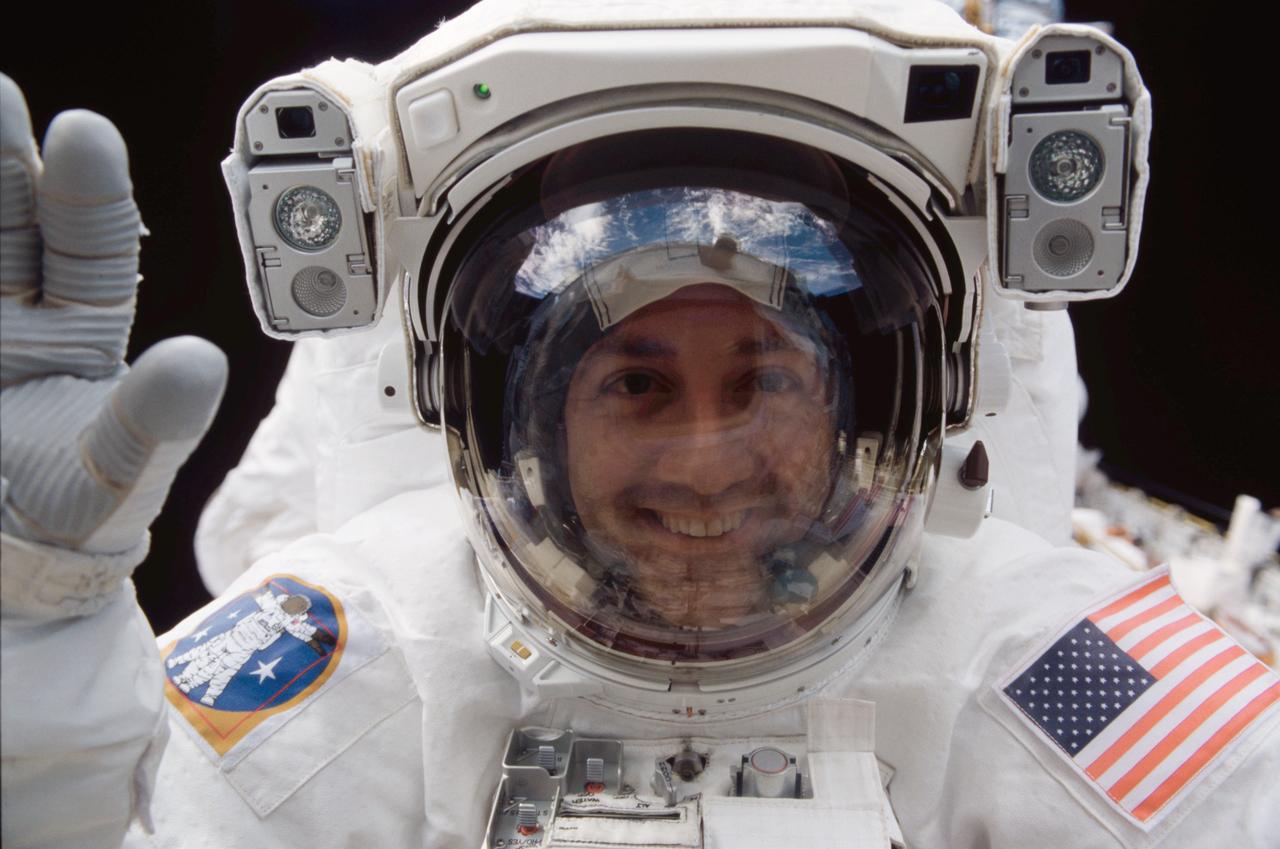
STS-109 Astronauts Michael J. Massimino and James H. Newman were making their second extravehicular activity (EVA) of their mission when astronaut Massimino, mission specialist, peered into Columbia's crew cabin during a brief break from work on the Hubble Space Telescope (HST). The HST is latched down just a few feet behind him in Columbia's cargo bay. The Space Shuttle Columbia STS-109 mission lifted off March 1, 2002 with goals of repairing and upgrading the Hubble Space Telescope (HST). STS-109 upgrades to the HST included: replacement of the solar array panels; replacement of the power control unit (PCU); replacement of the Faint Object Camera (FOC) with a new advanced camera for Surveys (ACS); and installation of the experimental cooling system for the Hubble's Near-Infrared Camera and Multi-object Spectrometer (NICMOS), which had been dormant since January 1999 when its original coolant ran out. The Marshall Space Flight Center in Huntsville, Alabama had the responsibility for the design, development, and construction of the HST, which is the most powerful and sophisticated telescope ever built. Lasting 10 days, 22 hours, and 11 minutes, the STS-109 mission was the 108th flight overall in NASA's Space Shuttle Program.
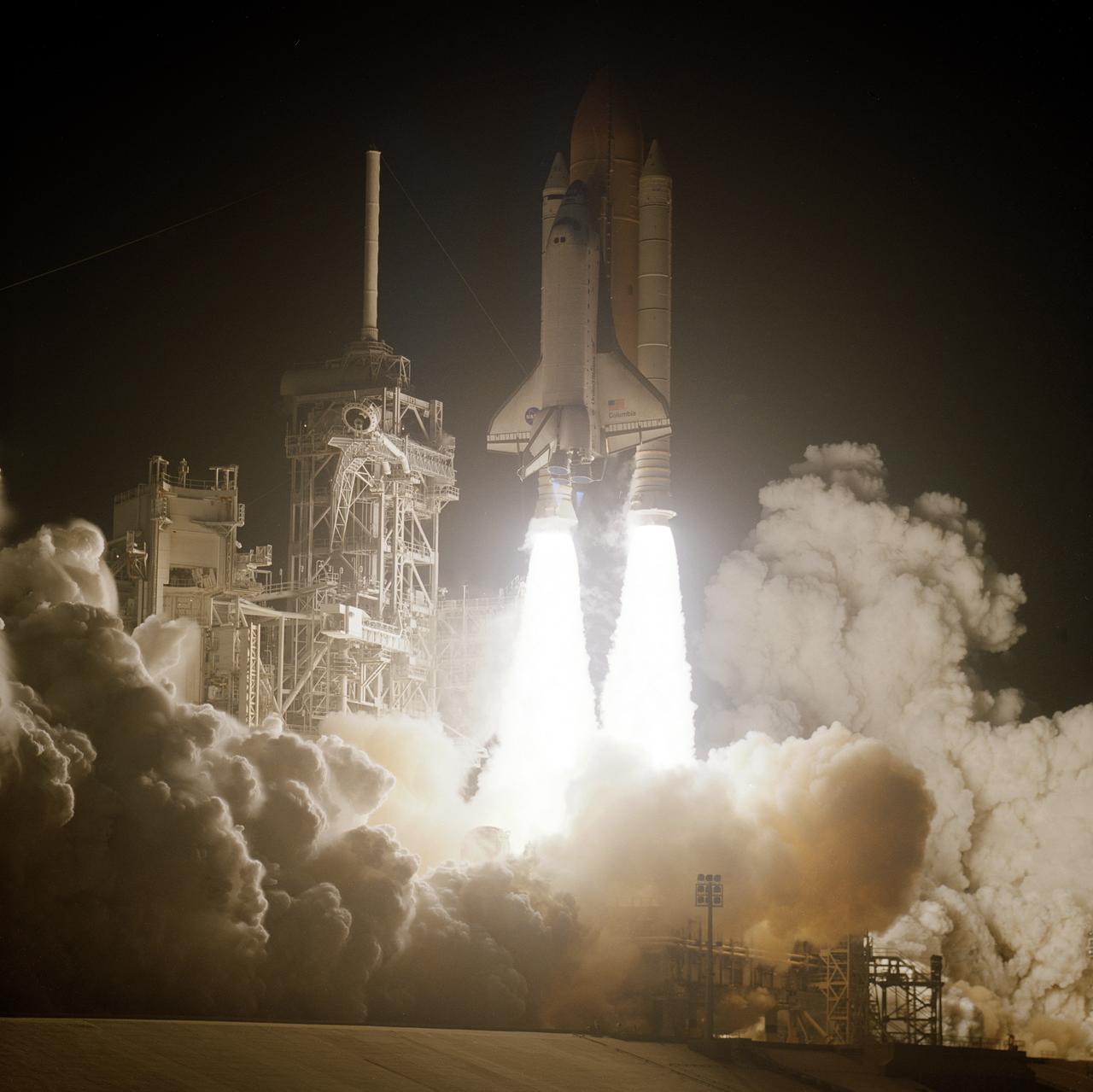
Carrying the STS-109 crew of seven, the Space Shuttle Orbiter Columbia blasted from its launch pad as it began its 27th flight and 108th flight overall in NASA's Space Shuttle Program. Launched March 1, 2002, the goal of the mission was the maintenance and upgrade of the Hubble Space Telescope (HST) which was developed, designed, and constructed by the Marshall Space Flight Center. Captured and secured on a work stand in Columbia's payload bay using Columbia's robotic arm, the HST received the following upgrades: replacement of the solar array panels; replacement of the power control unit (PCU); replacement of the Faint Object Camera (FOC) with a new advanced camera for Surveys (ACS); and installation of the experimental cooling system for the Hubble's Near-Infrared Camera and Multi-object Spectrometer (NICMOS), which had been dormant since January 1999 when it original coolant ran out. Four of the crewmembers performed 5 space walks in the 10 days, 22 hours, and 11 minutes of the the STS-109 mission.
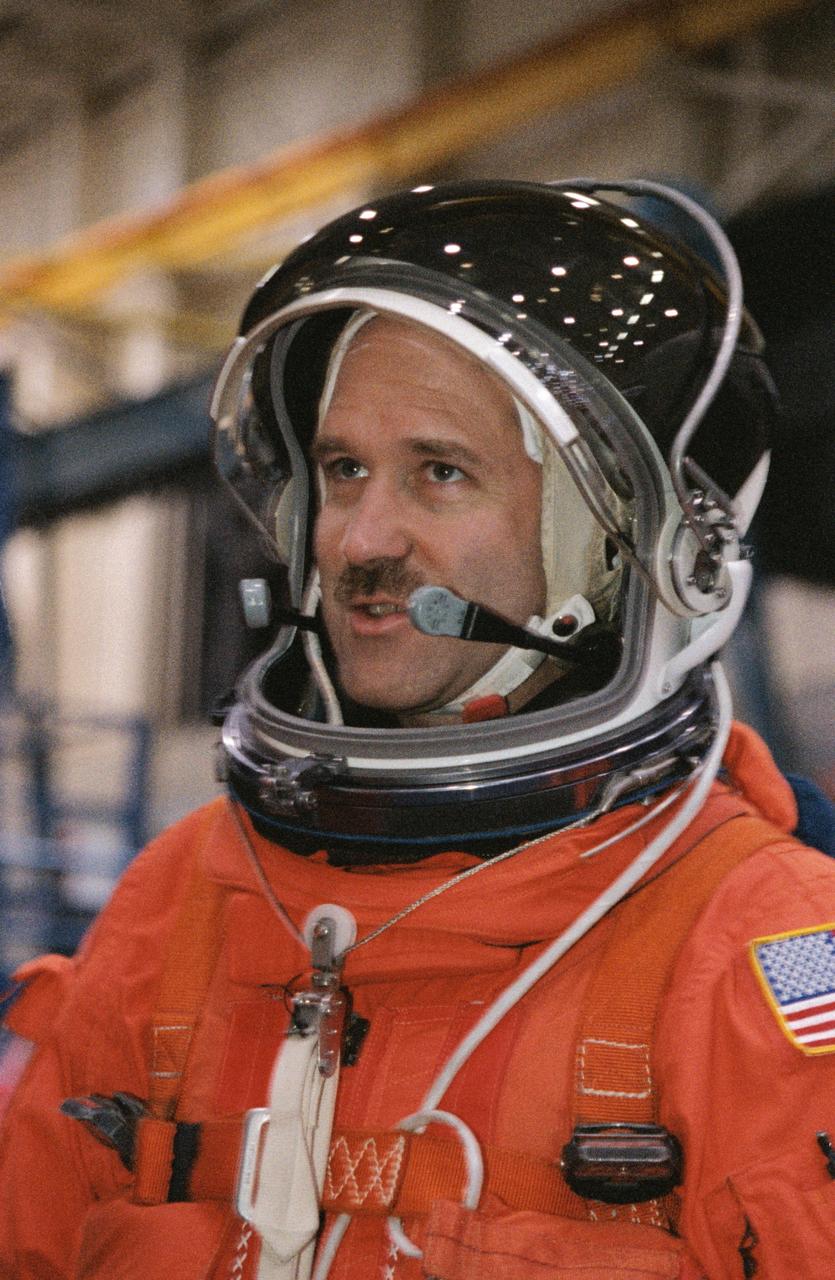
JSC2001-02194 (9 August 2001) --- Suited in a training version of the full-pressure launch and entry suit, astronaut John M. Grunsfeld, STS-109 mission specialist, awaits a training session in one of the trainer/mockups (out of frame) in the Space Vehicle Mockup Facility at the Johnson Space Center (JSC). STS-109 will be the 108th shuttle flight and the fourth Hubble Space Telescope (HST) servicing mission.
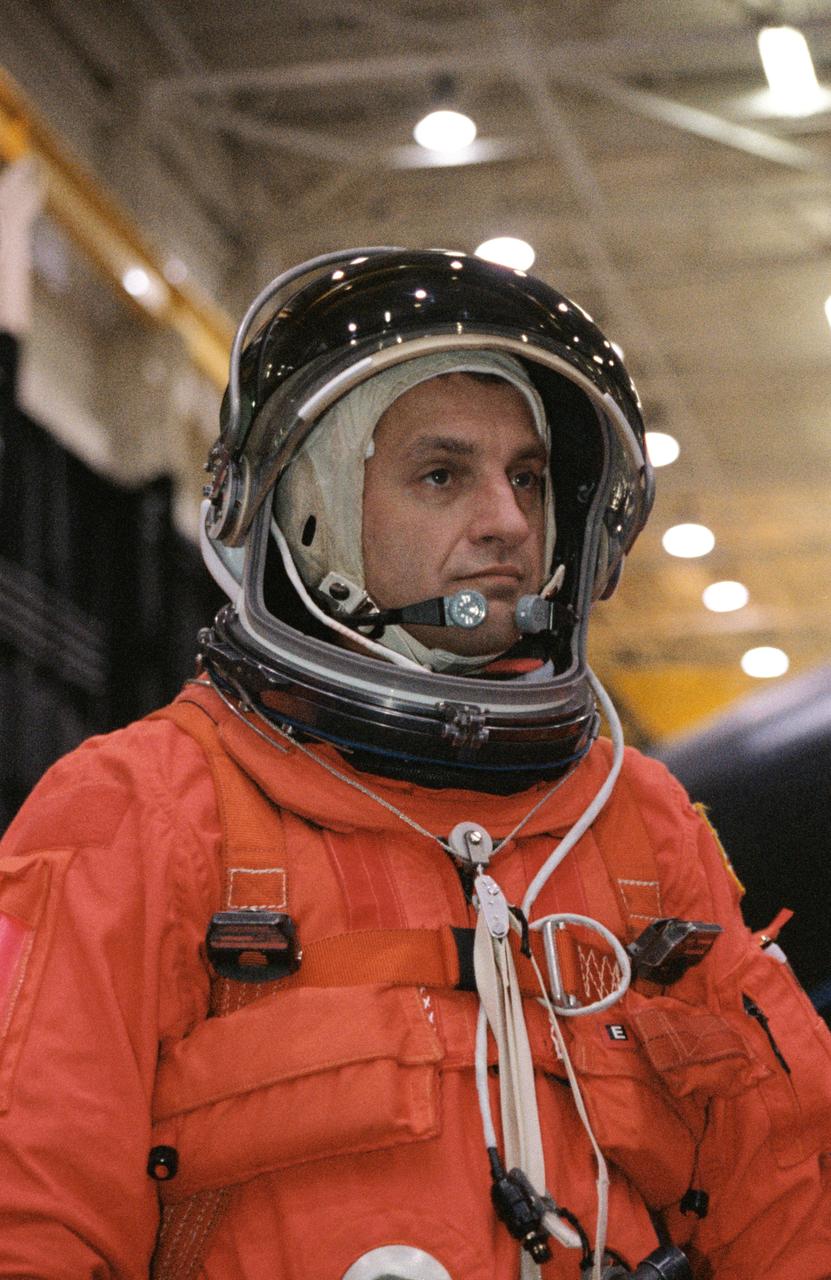
JSC2001-02197 (9 August 2001) --- Suited in a training version of the full-pressure launch and entry suit, astronaut Richard M. Linnehan, STS-109 mission specialist, awaits a training session in one of the trainer/mockups (out of frame) in the Space Vehicle Mockup Facility at the Johnson Space Center (JSC). STS-109 will be the 108th shuttle flight and the fourth Hubble Space Telescope (HST) servicing mission.

JSC2001-02191 (9 August 2001) --- Suited in a training version of the full-pressure launch and entry suit, astronaut Scott D. Altman, STS-109 mission commander, awaits a training session in one of the trainer/mockups (out of frame) in the Space Vehicle Mockup Facility at the Johnson Space Center (JSC). STS-109 will be the 108th shuttle flight and the fourth Hubble Space Telescope (HST) servicing mission.
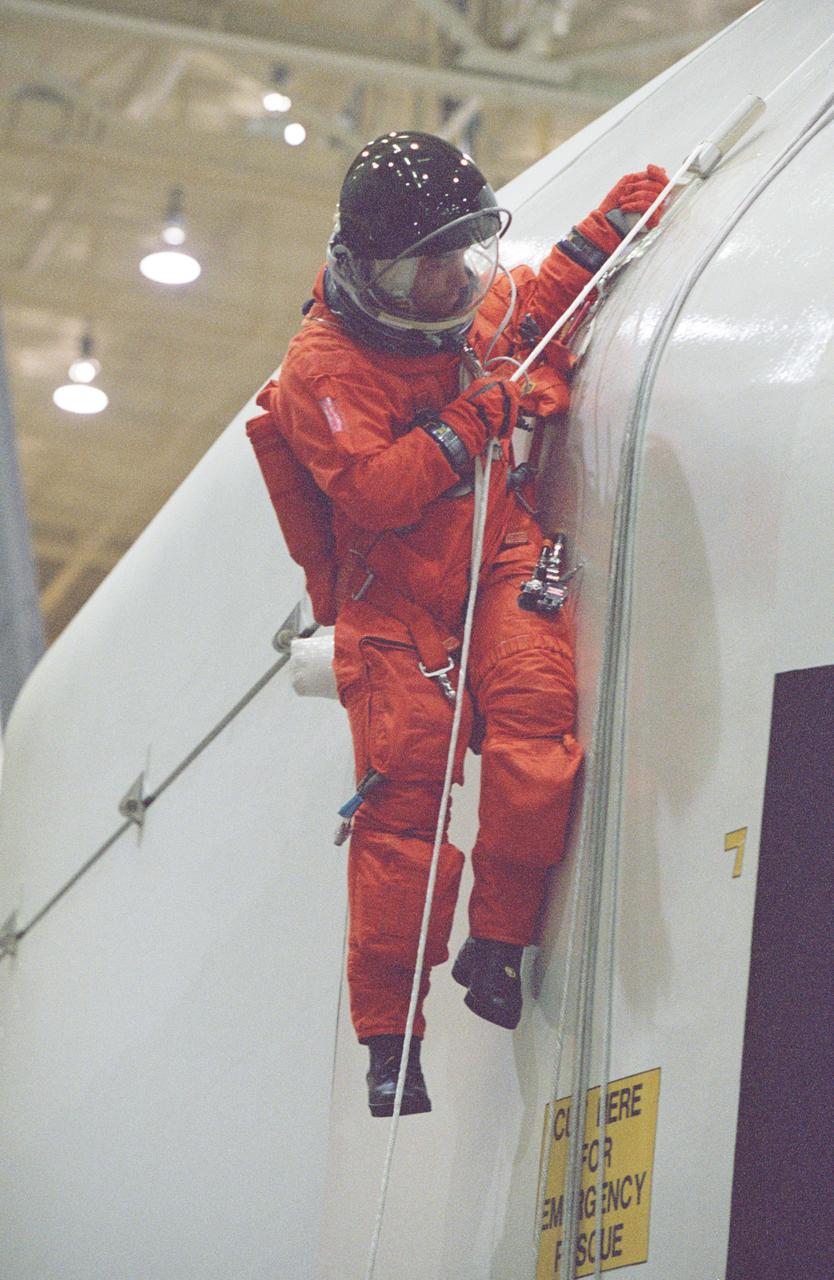
JSC2001-01552 (24 May 2001) --- An unidentified member of the STS-109 crew uses a device called a Sky genie to simulate rappelling from a troubled shuttle in a training session in the Space Vehicle Mockup Facility at the Johnson Space Center (JSC). The mockup is called the Full Fuselage Trainer (FFT). This exercise trains the crewmembers for procedures to follow in egressing a troubled shuttle on the ground. STS-109 will be the 108th shuttle flight and the fourth Hubble Space Telescope (HST) servicing mission.
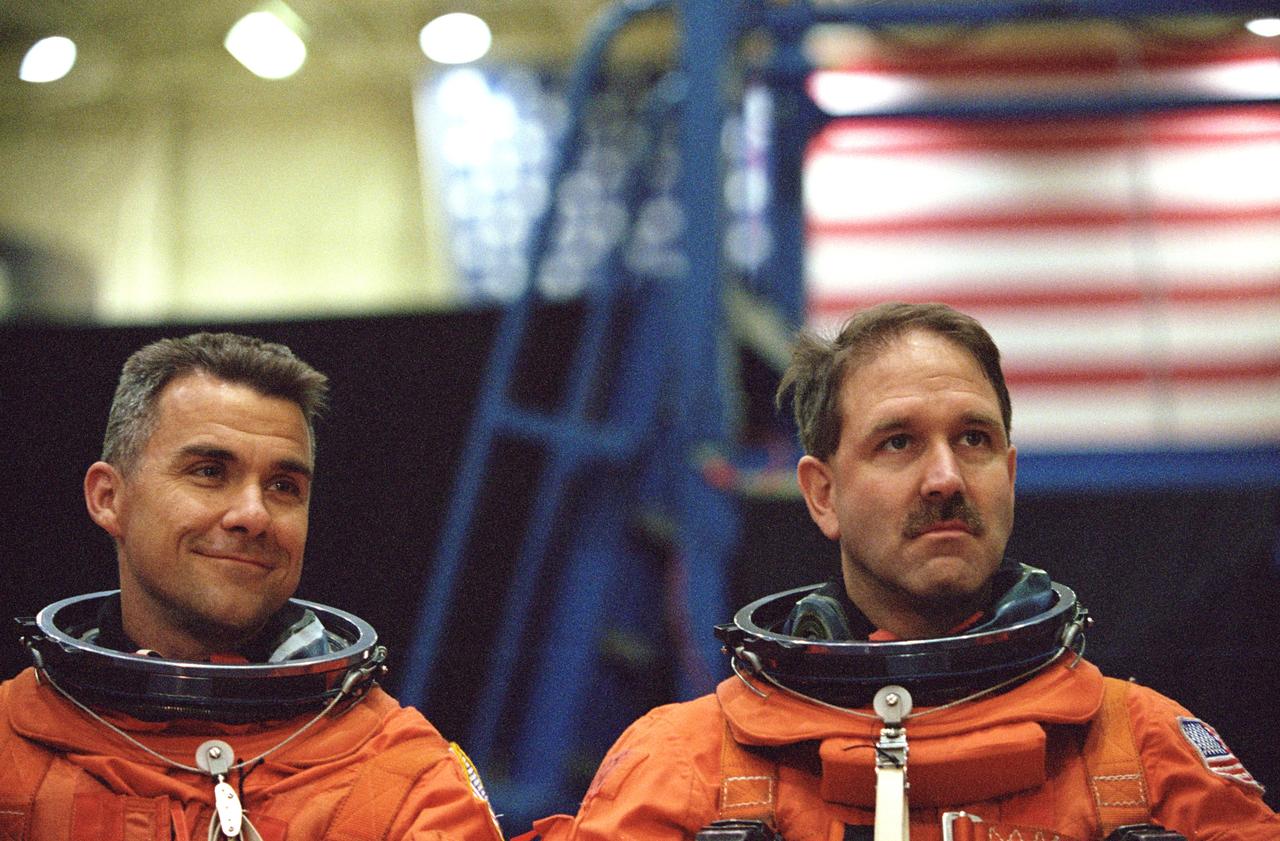
JSC2001-01549 (24 May 2001) --- Suited in training versions of the full-pressure launch and entry suit, astronauts Duane G. Carey (left), STS-109 pilot, and John M. Grunsfeld, mission specialist, await the start of a training session in one of the trainer/mockups (out of frame) in the Space Vehicle Mockup Facility at the Johnson Space Center (JSC). STS-109 will be the 108th shuttle flight and the fourth Hubble Space Telescope (HST) servicing mission.
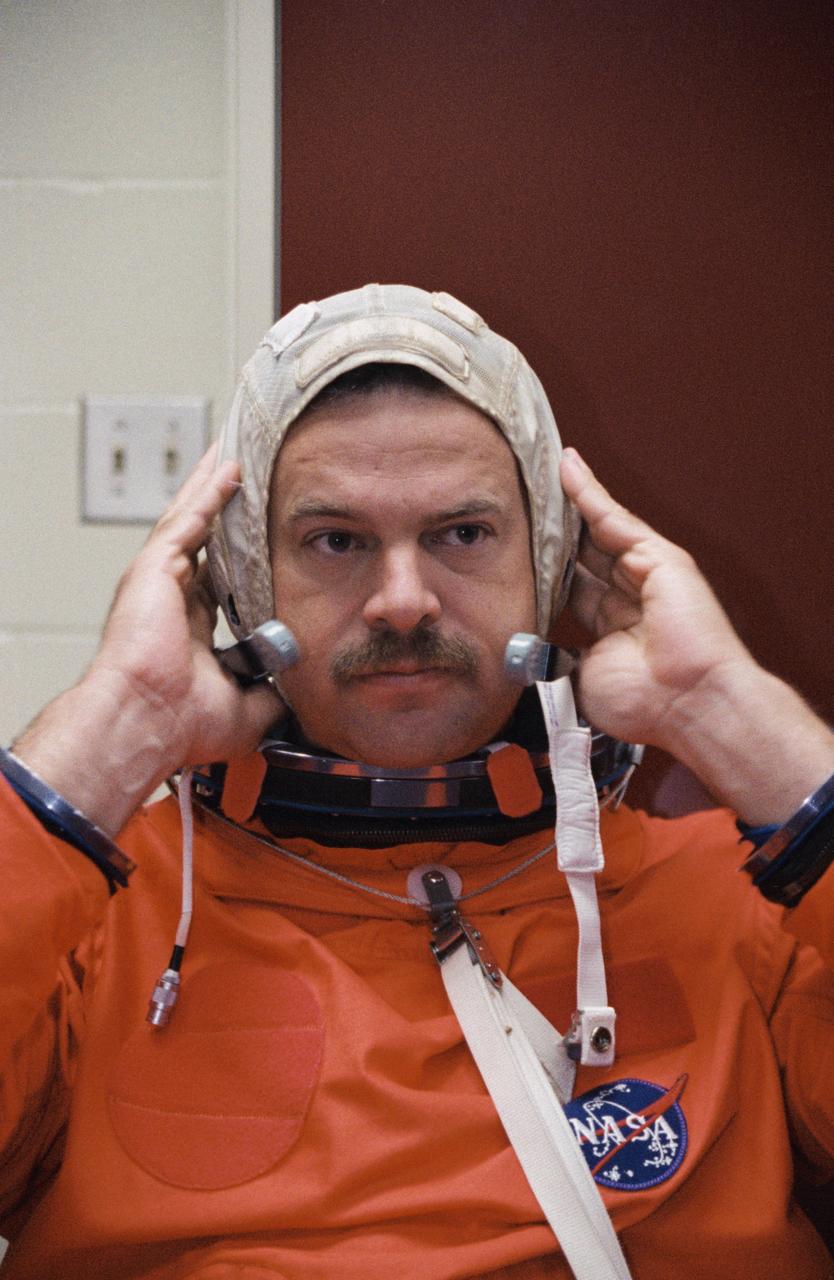
JSC2001-02199 (9 August 2001) --- Astronaut Scott D. Altman, STS-109 mission commander, dons a training version of the full-pressure launch and entry suit prior to a training session in one of the trainer/mockups (out of frame) in the Space Vehicle Mockup Facility at the Johnson Space Center (JSC). STS-109 will be the 108th shuttle flight and the fourth Hubble Space Telescope (HST) servicing mission.

JSC2001-02185 (9 August 2001) --- Astronaut Duane G. Carey, STS-109 pilot, occupies the pilot’s station during a mission training session in the Space Vehicle Mockup Facility at the Johnson Space Center (JSC). Carey is attired in a training version of the shuttle launch and entry garment. STS-109 will be the 108th shuttle flight and the fourth Hubble Space Telescope (HST) servicing mission.
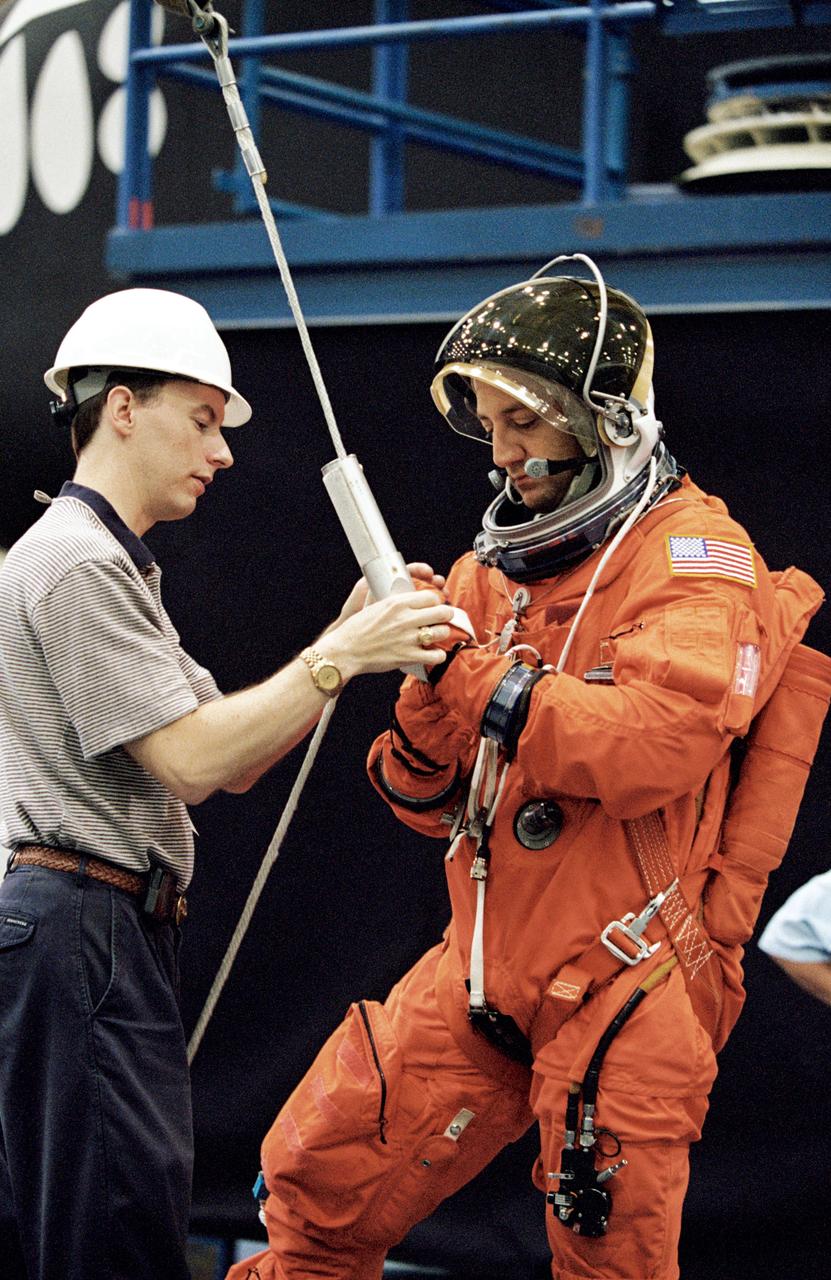
JSC2001-01543 (24 May 2001) --- Astronaut Michael J. Massimino, STS-109 mission specialist, is briefed by United Space Alliance (USA) crew trainer David Pogue on the usage of the Sky-genie device, used to lower oneself from a troubled shuttle, in a training session in the Space Vehicle Mockup Facility at the Johnson Space Center (JSC). Massimino is wearing a training version of the full-pressure launch and entry suit. STS-109 will be the 108th shuttle flight and the fourth Hubble Space Telescope (HST) servicing mission.
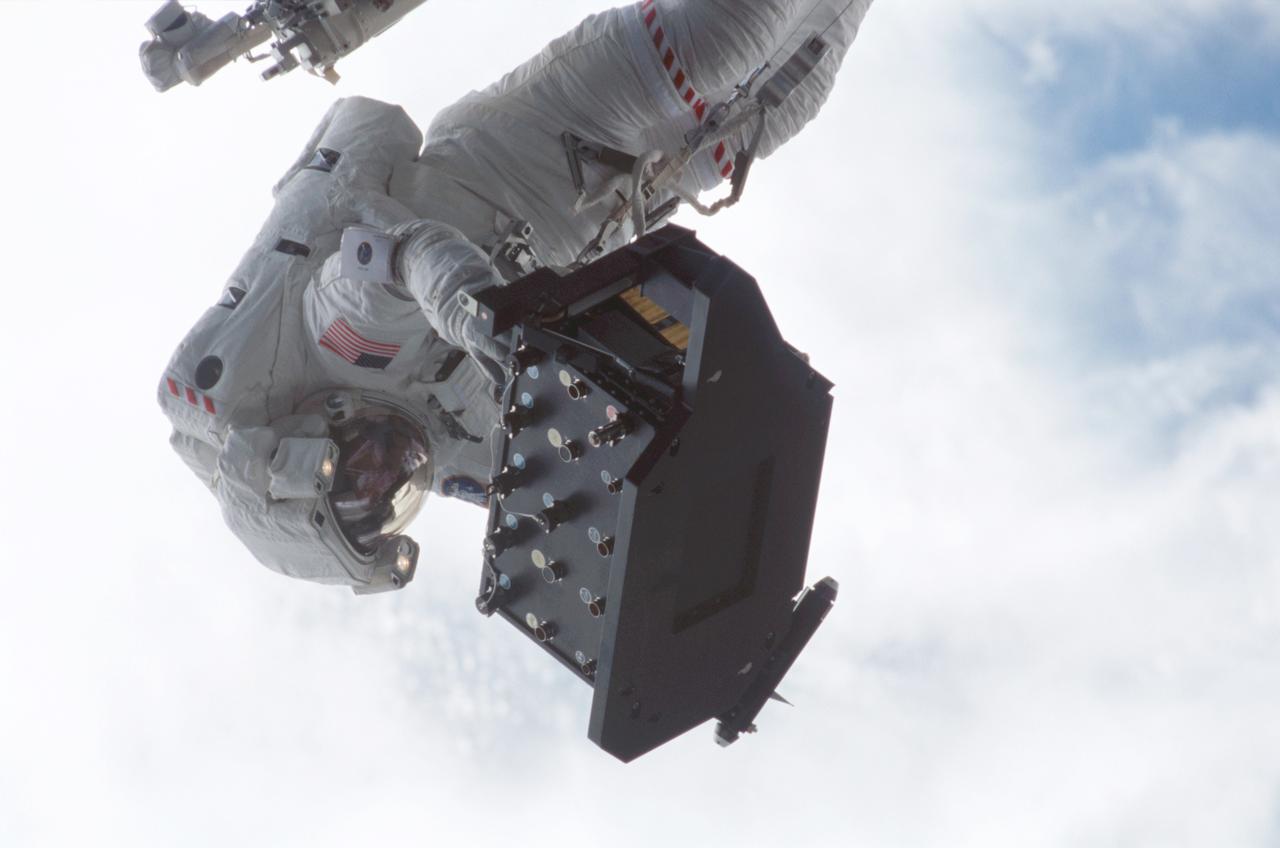
STS-109 Astronaut Michael J. Massimino, mission specialist, perched on the Shuttle's robotic arm, is preparing to install the Electronic Support Module (ESM) in the aft shroud of the Hubble Space telescope (HST), with the assistance of astronaut James H. Newman (out of frame). The module will support a new experimental cooling system to be installed during the next day's fifth and final space walk of the mission. That cooling system is designed to bring the telescope's Near-Infrared Camera and Multi Spectrometer (NICMOS) back to life the which had been dormant since January 1999 when its original coolant ran out. The Space Shuttle Columbia STS-109 mission lifted off March 1, 2002 with goals of repairing and upgrading the Hubble Space Telescope (HST). The Marshall Space Flight Center in Huntsville, Alabama had the responsibility for the design, development, and construction of the HST, which is the most powerful and sophisticated telescope ever built. In addition to the installation of the experimental cooling system for the Hubble's Near-Infrared Camera and NICMOS, STS-109 upgrades to the HST included replacement of the solar array panels, replacement of the power control unit (PCU), and replacement of the Faint Object Camera (FOC) with a new advanced camera for Surveys (ACS). Lasting 10 days, 22 hours, and 11 minutes, the STS-109 mission was the 108th flight overall in NASA's Space Shuttle Program.
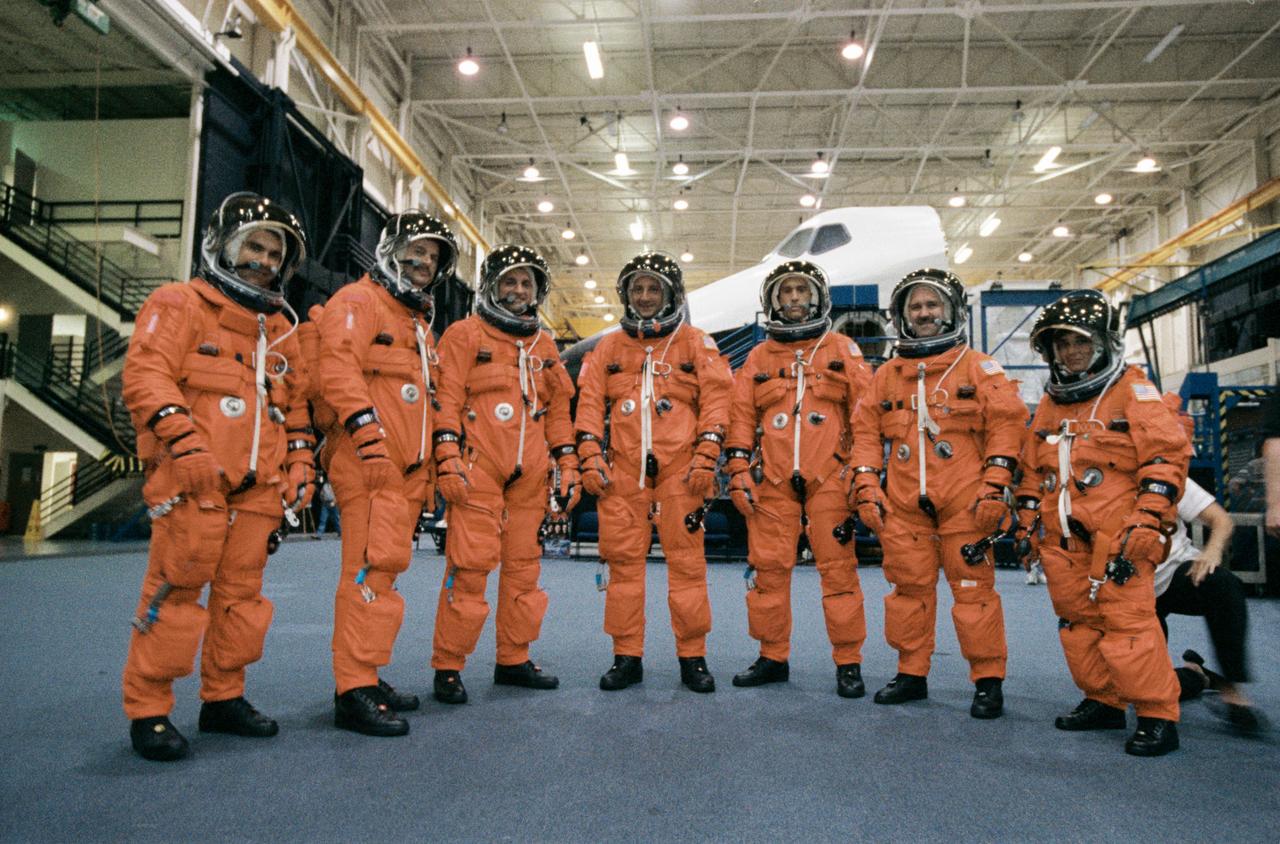
JSC2001-02205 (9 August 2001) --- The seven STS-109 crew members wait for a training and photo session to begin in the Space Vehicle Mockup Facility at the Johnson Space Center (JSC). From the left are astronauts Duane G. Carey and Scott D. Altman, pilot and mission commander, respectively, and Richard M. Linnehan, Michael J. Massimino, James H. Newman, John M. Grunsfeld, and Nancy J. Currie, all mission specialists. STS-109 will be the 108th shuttle flight and the fourth Hubble Space Telescope (HST) servicing mission.
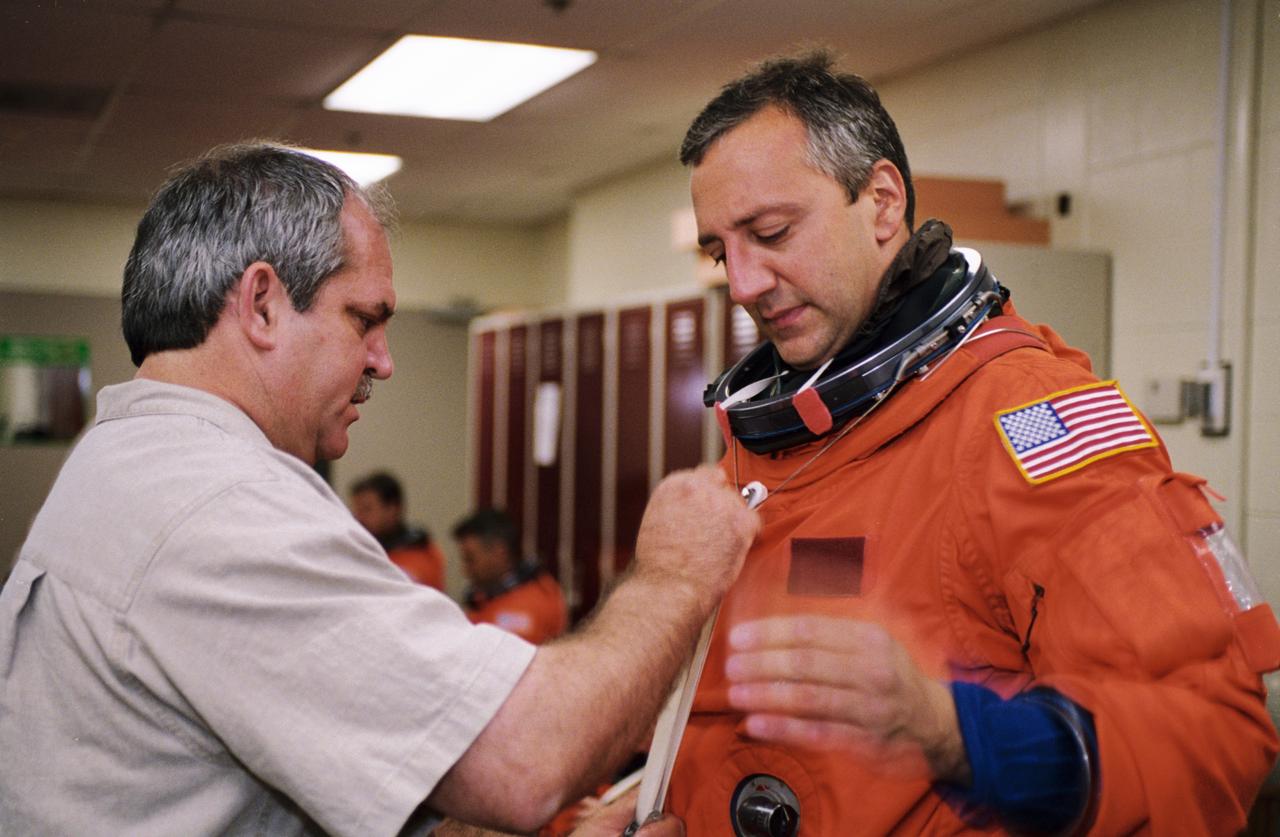
JSC2001-01889 (22 June 2001) --- Astronaut Michael J. Massimino, STS-109 mission specialist, dons a training version of the full-pressure launch and entry suit prior to a training session in one of the trainer/mockups (out of frame) in the Space Vehicle Mockup Facility at the Johnson Space Center (JSC). Massimino is assisted by United Space Alliance (USA) suit technician Lloyd Armintor. STS-109 will be the 108th shuttle flight and the fourth Hubble Space Telescope (HST) servicing mission.
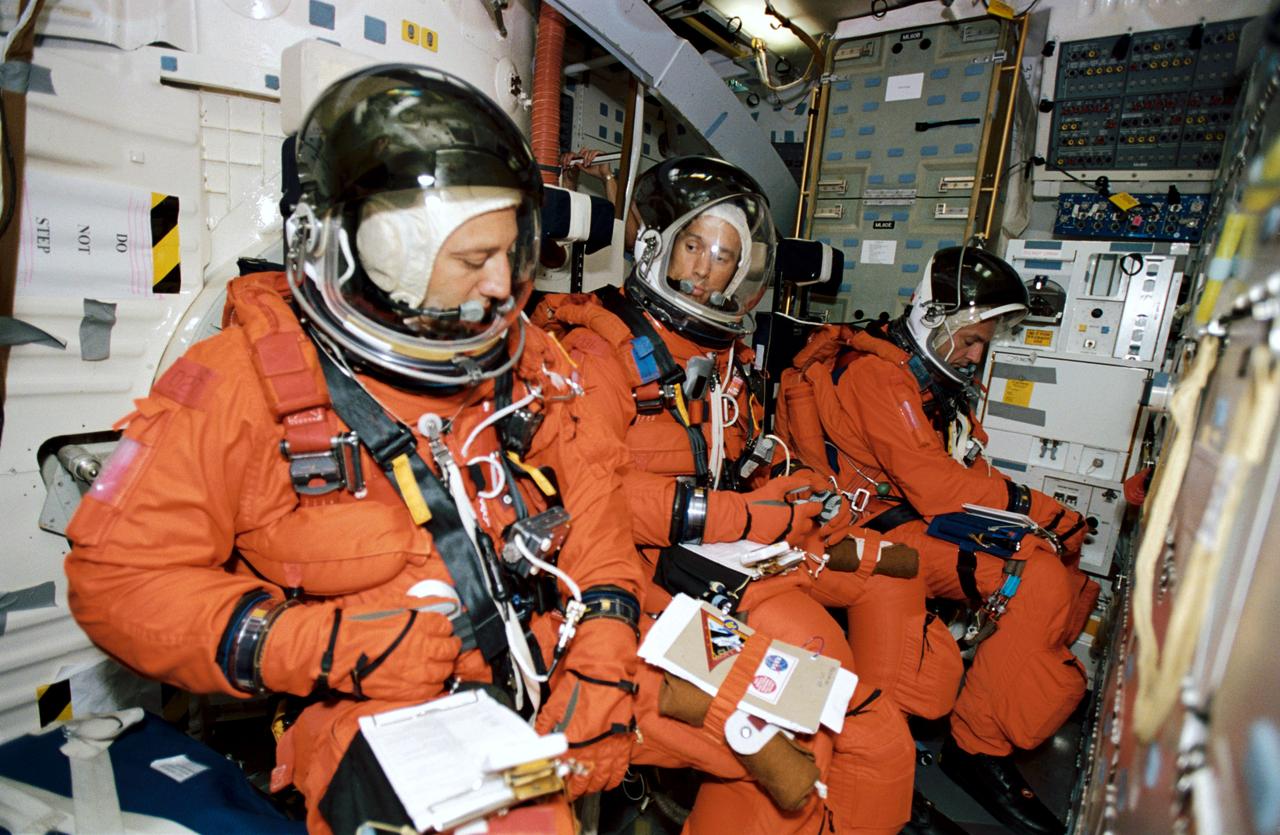
JSC2001-01881 (22 June 2001) --- Astronauts Michael J. Massimino (left), James H. Newman, and Richard M. Linnehan, all STS-109 mission specialists, are photographed in one of the high fidelity trainer/mockups in the Space Vehicle Mockup Facility at the Johnson Space Center (JSC). STS-109 will be the 108th shuttle flight and the fourth Hubble Space Telescope (HST) servicing mission.
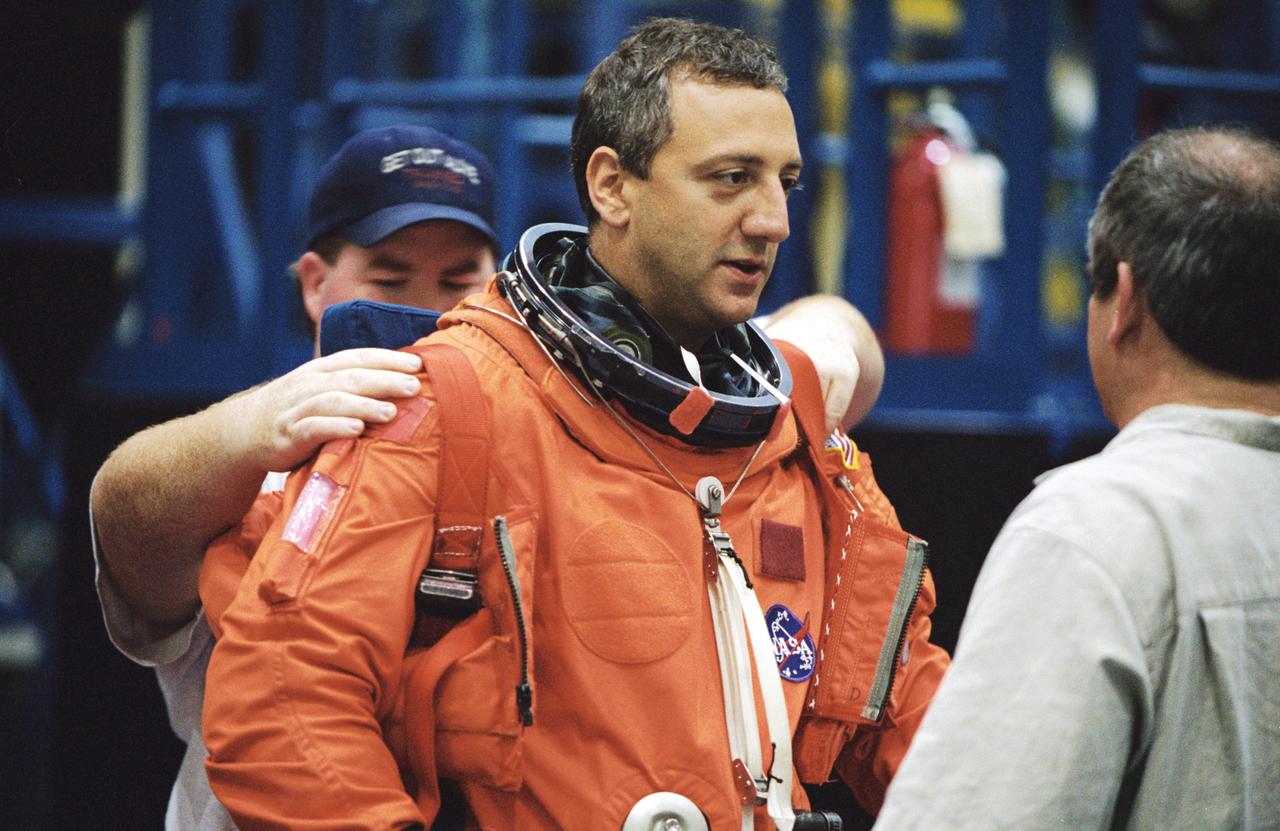
JSC2001-01875 (22 June 2001) --- Astronaut Michael J. Massimino, STS-109 mission specialist, dons a training version of the full-pressure launch and entry suit prior to a training session in one of the trainer/mockups (out of frame) in the Space Vehicle Mockup Facility at the Johnson Space Center (JSC). Massimino is assisted by Tommy McDonald and Lloyd Armintor both United Space Alliance (USA) suit technicians. STS-109 will be the 108th shuttle flight and the fourth Hubble Space Telescope (HST) servicing mission.
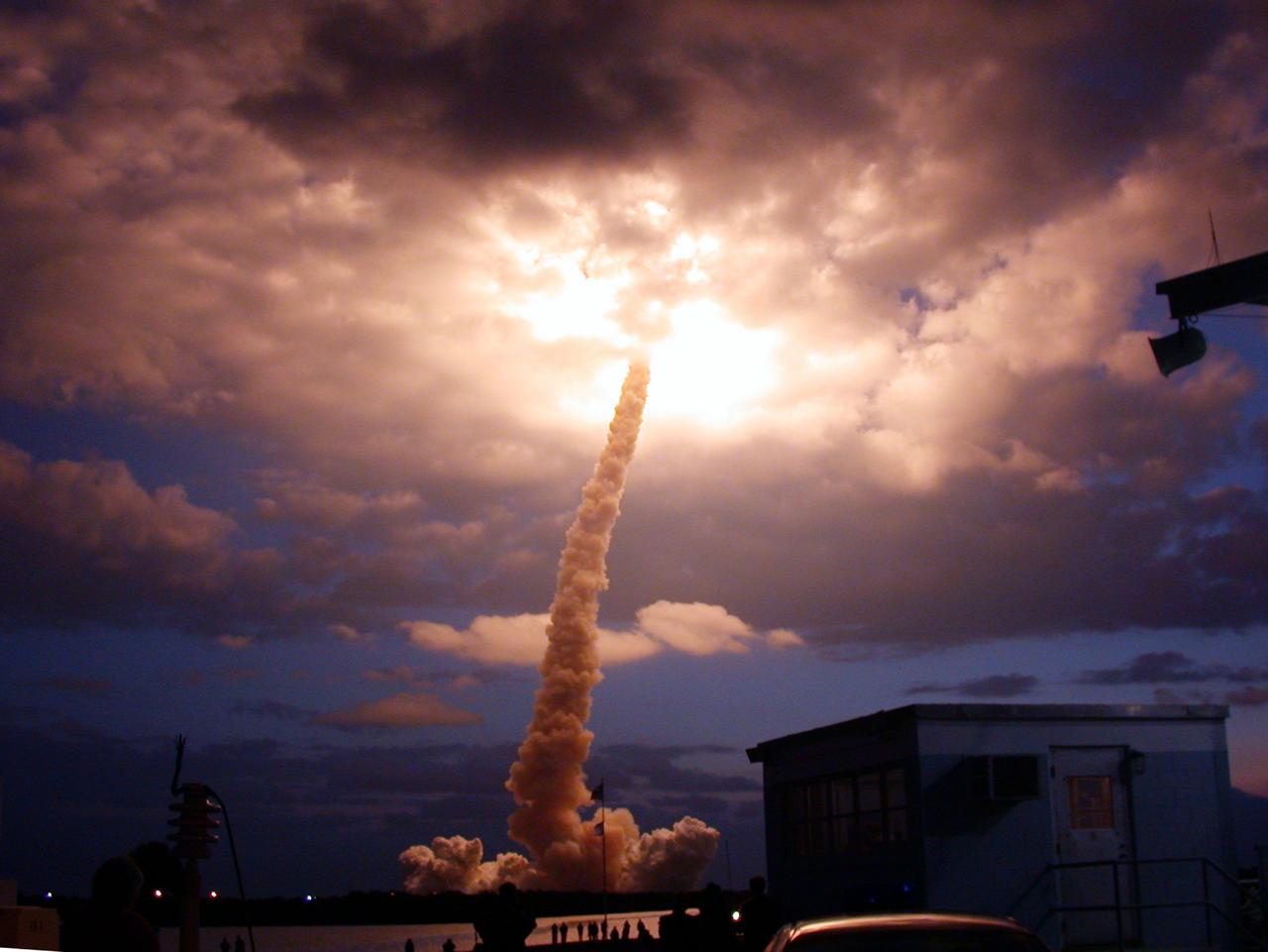
Carrying a crew of seven, the Space Shuttle Orbiter Columbia soared through some pre-dawn clouds into the sky as it began its 27th flight, STS-109. Launched March 1, 2002, the goal of the mission was the maintenance and upgrade of the Hubble Space Telescope (HST). The Marshall Space Flight Center had the responsibility for the design, development, and construction of the HST, which is the most complex and sensitive optical telescope ever made, to study the cosmos from a low-Earth orbit. The HST detects objects 25 times fainter than the dimmest objects seen from Earth and provides astronomers with an observable universe 250 times larger than is visible from ground-based telescopes, perhaps as far away as 14 billion light-years. The HST views galaxies, stars, planets, comets, possibly other solar systems, and even unusual phenomena such as quasars, with 10 times the clarity of ground-based telescopes. During the STS-109 mission, the telescope was captured and secured on a work stand in Columbia's payload bay using Columbia's robotic arm. Here four members of the crew performed five spacewalks completing system upgrades to the HST. Included in those upgrades were: replacement of the solar array panels; replacement of the power control unit (PCU); replacement of the Faint Object Camera (FOC) with a new advanced camera for Surveys (ACS); and installation of the experimental cooling system for the Hubble's Near-Infrared Camera and Multi-object Spectrometer (NICMOS), which had been dormant since January 1999 when it original coolant ran out. Lasting 10 days, 22 hours, and 11 minutes, the STS-109 mission was the 108th flight overall in NASA's Space Shuttle Program.
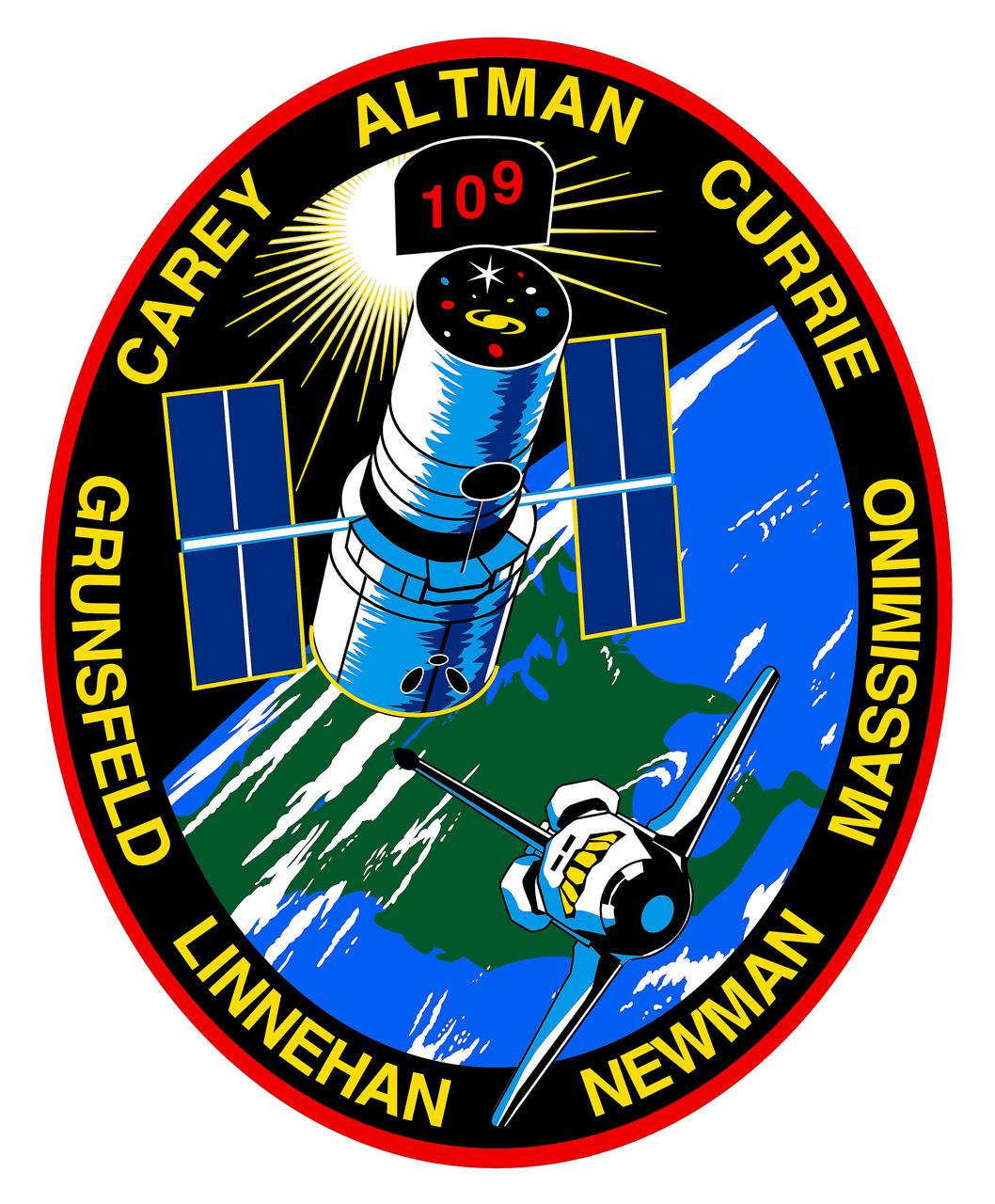
This is the insignia of the STS-109 Space Shuttle mission. Carrying a crew of seven, the Space Shuttle Orbiter Columbia was launched with goals of maintenance and upgrades to the Hubble Space Telescope (HST). The Marshall Space Flight Center had the responsibility for the design, development, and construction of the HST, which is the most complex and sensitive optical telescope ever made, to study the cosmos from a low-Earth orbit. The HST detects objects 25 times fainter than the dimmest objects seen from Earth and provides astronomers with an observable universe 250 times larger than is visible from ground-based telescopes, perhaps as far away as 14 billion light-years. The HST views galaxies, stars, planets, comets, possibly other solar systems, and even unusual phenomena such as quasars, with 10 times the clarity of ground-based telescopes. During the STS-109 mission, the telescope was captured and secured on a work stand in Columbia's payload bay using Columbia's robotic arm where four members of the crew performed five spacewalks completing system upgrades to the HST. Included in those upgrades were: The replacement of the solar array panels; replacement of the power control unit (PCU); replacement of the Faint Object Camera (FOC) with a new advanced camera for Surveys (ACS); and installation of the experimental cooling system for the Hubble's Near-Infrared Camera and Multi-object Spectrometer (NICMOS), which had been dormant since January 1999 when it original coolant ran out. Lasting 10 days, 22 hours, and 11 minutes, the STS-109 mission was the 27th flight of the Orbiter Columbia and the 108th flight overall in NASA's Space Shuttle Program.
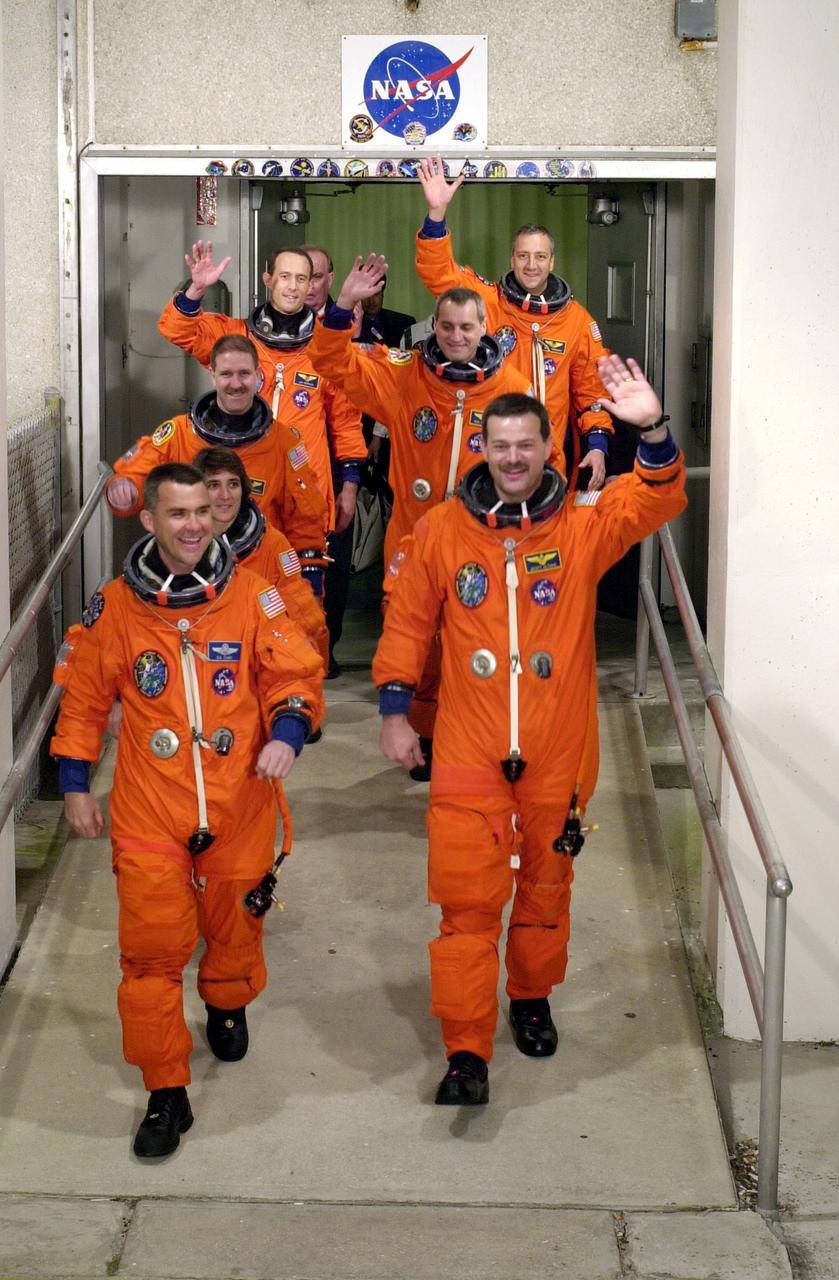
The STS-109 crew of seven waved to onlookers as they emerged from the Operations and Checkout Buildings at Kennedy Space Flight Center eager to get to the launch pad to embark upon the Space Shuttle Orbiter Columbia's 27th flight into space. Crew members included, from front to back, Duane G. Carey (left) and Scott D. Altman (right); Nancy J. Currie, mission specialist; John M. Grunsfield (left), payload commander, and Richard M. Linneham (right); James H. Newman (left) and Michael J. Massimino (right), all mission specialists. Launched March 1, 2002, the goal of the mission was the maintenance and upgrade of the Hubble Space Telescope (HST). The Marshall Space Flight Center had the responsibility for the design, development, and construction of the HST, which is the most complex and sensitive optical telescope ever made, to study the cosmos from a low-Earth orbit. By using Columbia's robotic arm, the telescope was captured and secured on a work stand in Columbia's payload bay where four members of the crew performed five spacewalks to complete system upgrades to the HST. Lasting 10 days, 22 hours, and 11 minutes, the STS-109 mission was the 108th flight overall in NASA's Space Shuttle Program.
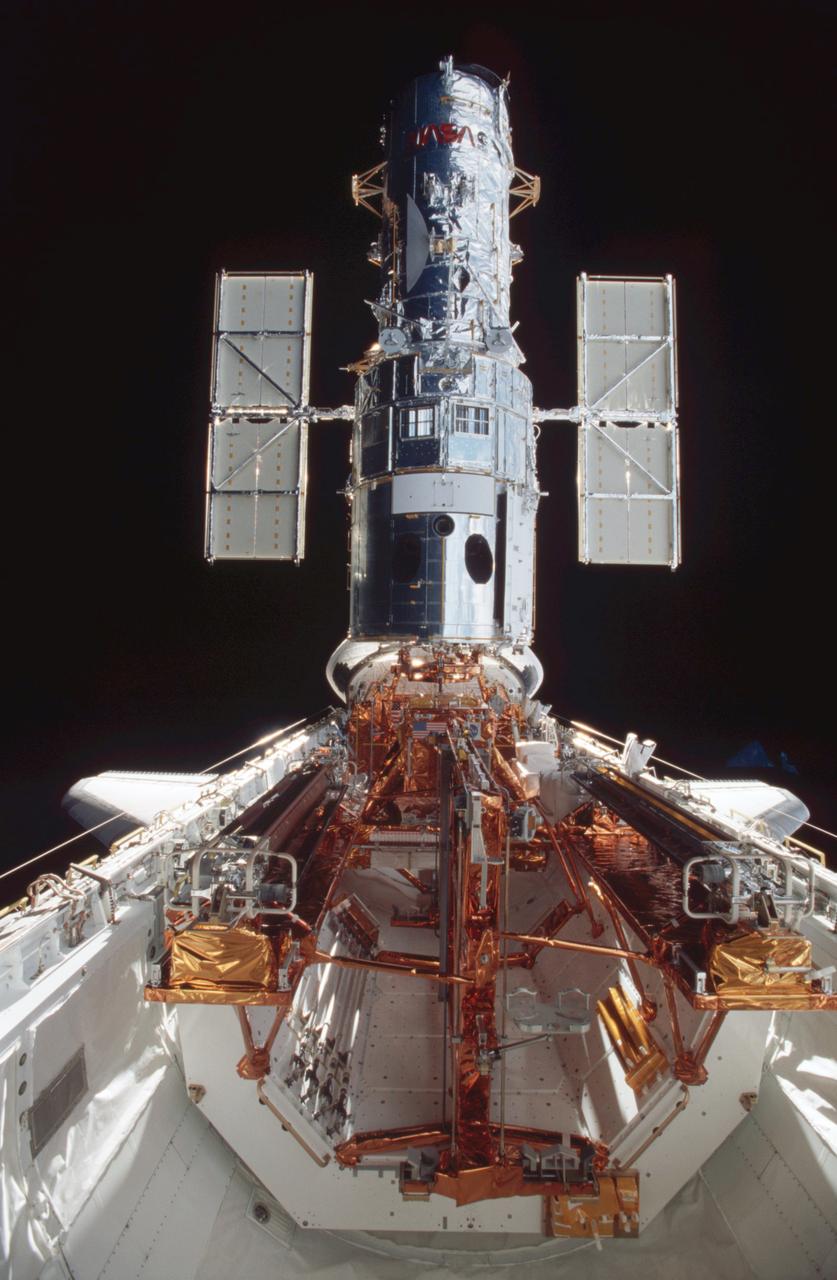
After five days of service and upgrade work on the Hubble Space Telescope (HST), the STS-109 crew photographed the giant telescope in the shuttle's cargo bay. The telescope was captured and secured on a work stand in Columbia's payload bay using Columbia's robotic arm, where 4 of the 7-member crew performed 5 space walks completing system upgrades to the HST. Included in those upgrades were: The replacement of the solar array panels; replacement of the power control unit (PCU); replacement of the Faint Object Camera (FOC) with a new advanced camera for Surveys (ACS); and installation of the experimental cooling system for the Hubble's Near-Infrared Camera and Multi-object Spectrometer (NICMOS), which had been dormant since January 1999 when its original coolant ran out. The Marshall Space Flight Center had the responsibility for the design, development, and construction of the the HST, which is the most complex and sensitive optical telescope ever made, to study the cosmos from a low-Earth orbit. Launched March 1, 2002, the STS-109 HST servicing mission lasted 10 days, 22 hours, and 11 minutes. It was the 108th flight overall in NASA's Space Shuttle Program.
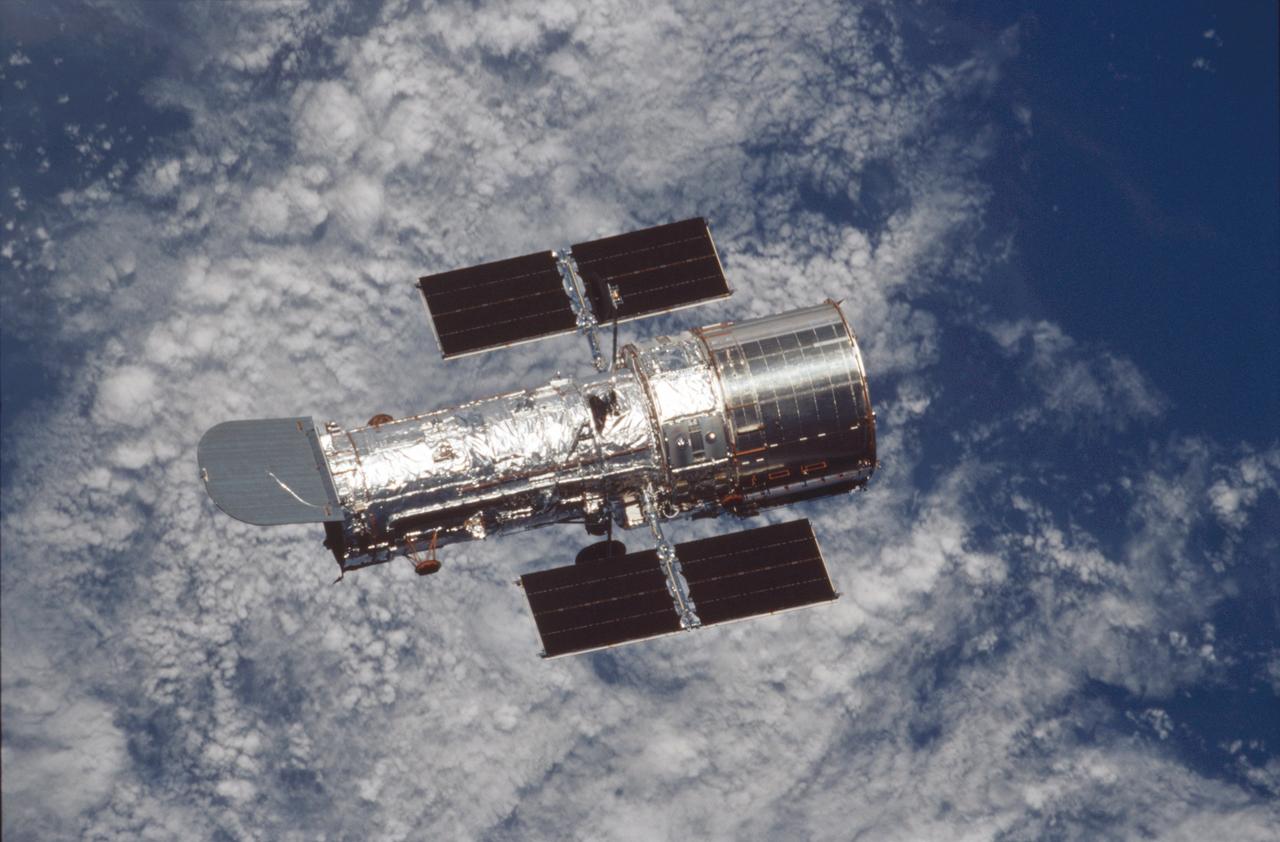
After five days of service and upgrade work on the Hubble Space Telescope (HST), the STS-109 crew photographed the giant telescope returning to its normal routine. The telescope was captured and secured on a work stand in Columbia's payload bay using Columbia's robotic arm, where 4 of the 7-member crew performed 5 space walks completing system upgrades to the HST. Included in those upgrades were: The replacement of the solar array panels; replacement of the power control unit (PCU); replacement of the Faint Object Camera (FOC) with a new advanced camera for Surveys (ACS); and installation of the experimental cooling system for the Hubble's Near- Infrared Camera and Multi-object Spectrometer (NICMOS), which had been dormant since January 1999 when its original coolant ran out. The Marshall Space Flight Center had the responsibility for the design, development, and construction of the the HST, which is the most complex and sensitive optical telescope ever made, to study the cosmos from a low-Earth orbit. Launched March 1, 2002, the STS-109 HST servicing mission lasted 10 days, 22 hours, and 11 minutes. It was the 108th flight overall in NASA's Space Shuttle Program.
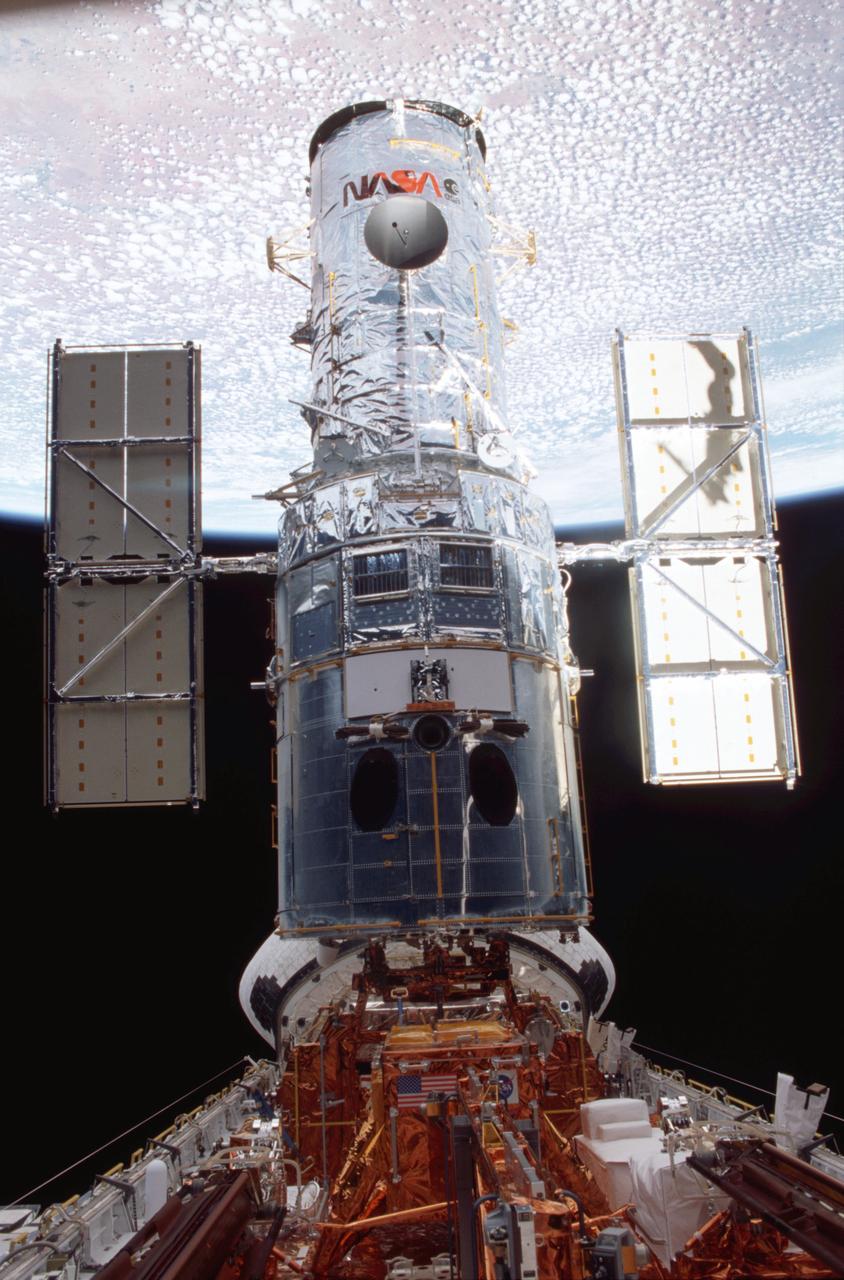
After five days of service and upgrade work on the Hubble Space Telescope (HST), the STS-109 crew photographed the giant telescope in the shuttle's cargo bay. The telescope was captured and secured on a work stand in Columbia's payload bay using Columbia's robotic arm, where 4 of the 7-member crew performed 5 space walks completing system upgrades to the HST. Included in those upgrades were: The replacement of the solar array panels; replacement of the power control unit (PCU); replacement of the Faint Object Camera (FOC) with a new advanced camera for Surveys (ACS); and installation of the experimental cooling system for the Hubble's Near-Infrared Camera and Multi-object Spectrometer (NICMOS), which had been dormant since January 1999 when its original coolant ran out. The Marshall Space Flight Center had the responsibility for the design, development, and construction of the the HST, which is the most complex and sensitive optical telescope ever made, to study the cosmos from a low-Earth orbit. Launched March 1, 2002, the STS-109 HST servicing mission lasted 10 days, 22 hours, and 11 minutes. It was the 108th flight overall in NASA's Space Shuttle Program.
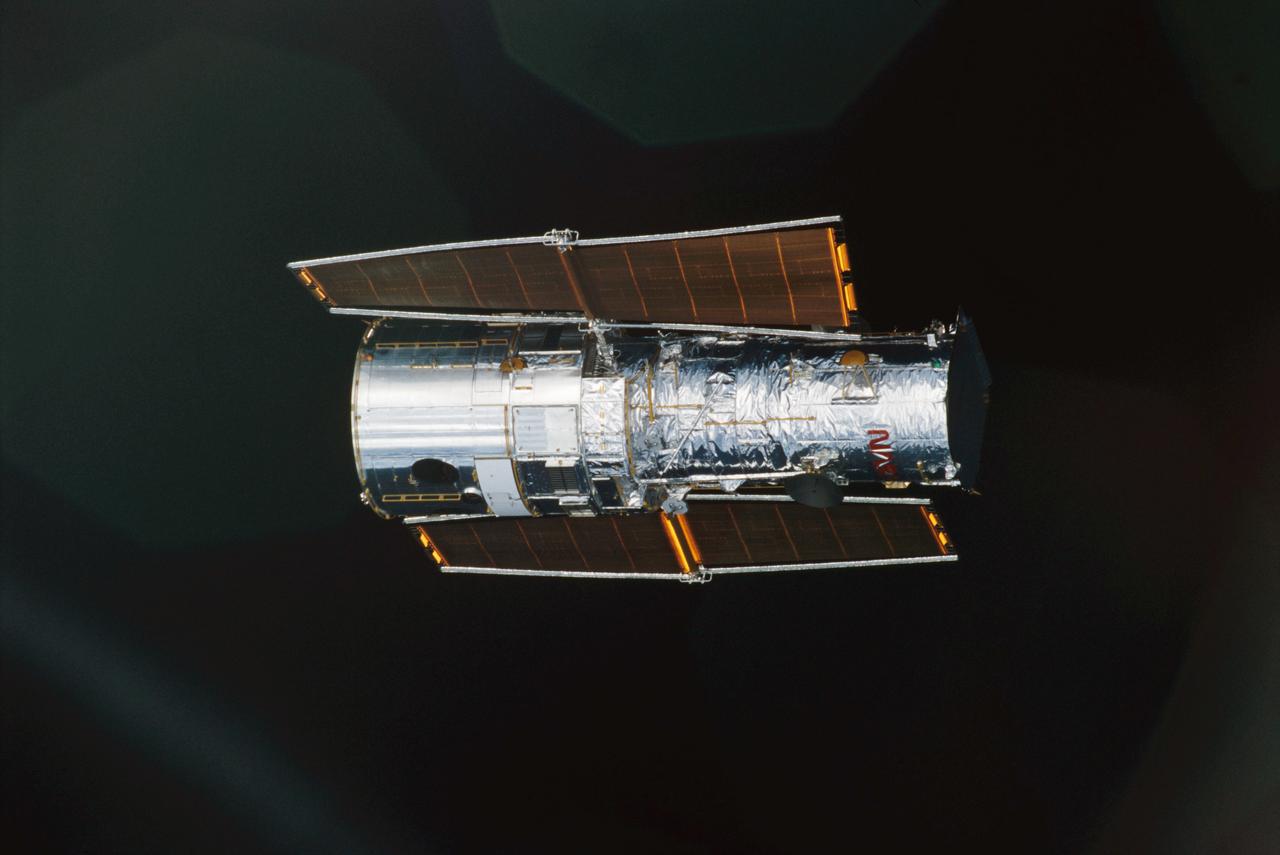
The Hubble Space Telescope (HST), with its normal routine temporarily interrupted, is about to be captured by the Space Shuttle Columbia prior to a week of servicing and upgrading by the STS-109 crew. The telescope was captured by the shuttle's Remote Manipulator System (RMS) robotic arm and secured on a work stand in Columbia's payload bay where 4 of the 7-member crew performed 5 space walks completing system upgrades to the HST. Included in those upgrades were: The replacement of the solar array panels; replacement of the power control unit (PCU); replacement of the Faint Object Camera (FOC) with a new advanced camera for Surveys (ACS); and installation of the experimental cooling system for the Hubble's Near-Infrared Camera and Multi-object Spectrometer (NICMOS), which had been dormant since January 1999 when its original coolant ran out. The Marshall Space Flight Center had the responsibility for the design, development, and construction of the the HST, which is the most complex and sensitive optical telescope ever made, to study the cosmos from a low-Earth orbit. Launched March 1, 2002, the STS-109 HST servicing mission lasted 10 days, 22 hours, and 11 minutes. It was the 108th flight overall in NASA's Space Shuttle Program.
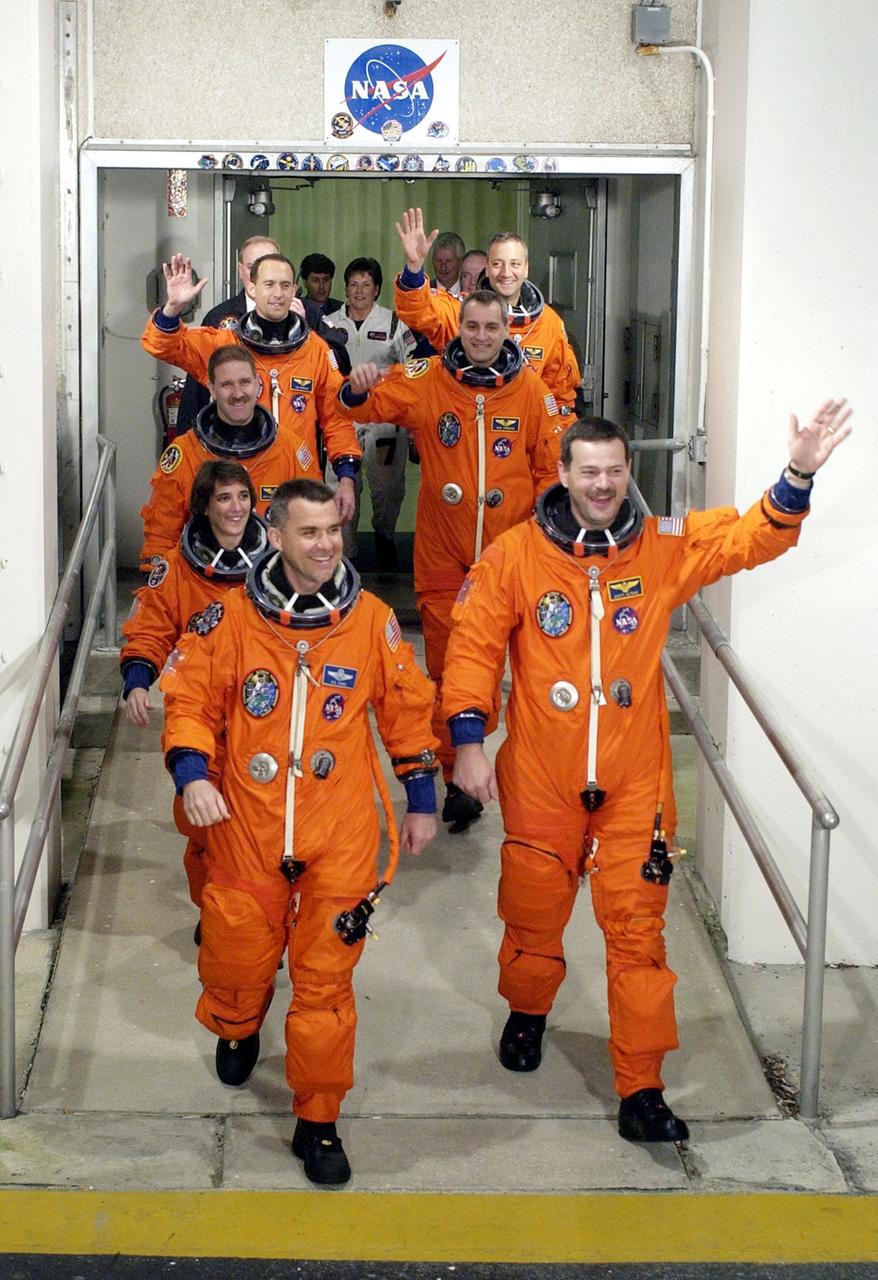
STS109-S-021 (1 March 2002) --- The STS-109 crew members wave to onlookers as they stride out from the Operations and Checkout Building, eager to get to the launch pad. They are, from front to back, Duane G. Carey (left) and Scott D. Altman (right); Nancy J. Currie, mission specialist; John M. Grunsfeld (left), payload commander, and Richard M. Linnehan (right); James H. Newman (left) and Michael J. Massimino (right), all mission specialists. On mission STS-109, the crew will capture the Hubble Space Telescope using Columbia's robotic arm and secure it on a work stand in Columbia's payload bay. Four members of the crew will perform five scheduled space walks to complete system upgrades to the telescope. Mission STS-109 is the 27th flight of the orbiter Columbia and the 108th flight overall in NASA's Space Shuttle program.
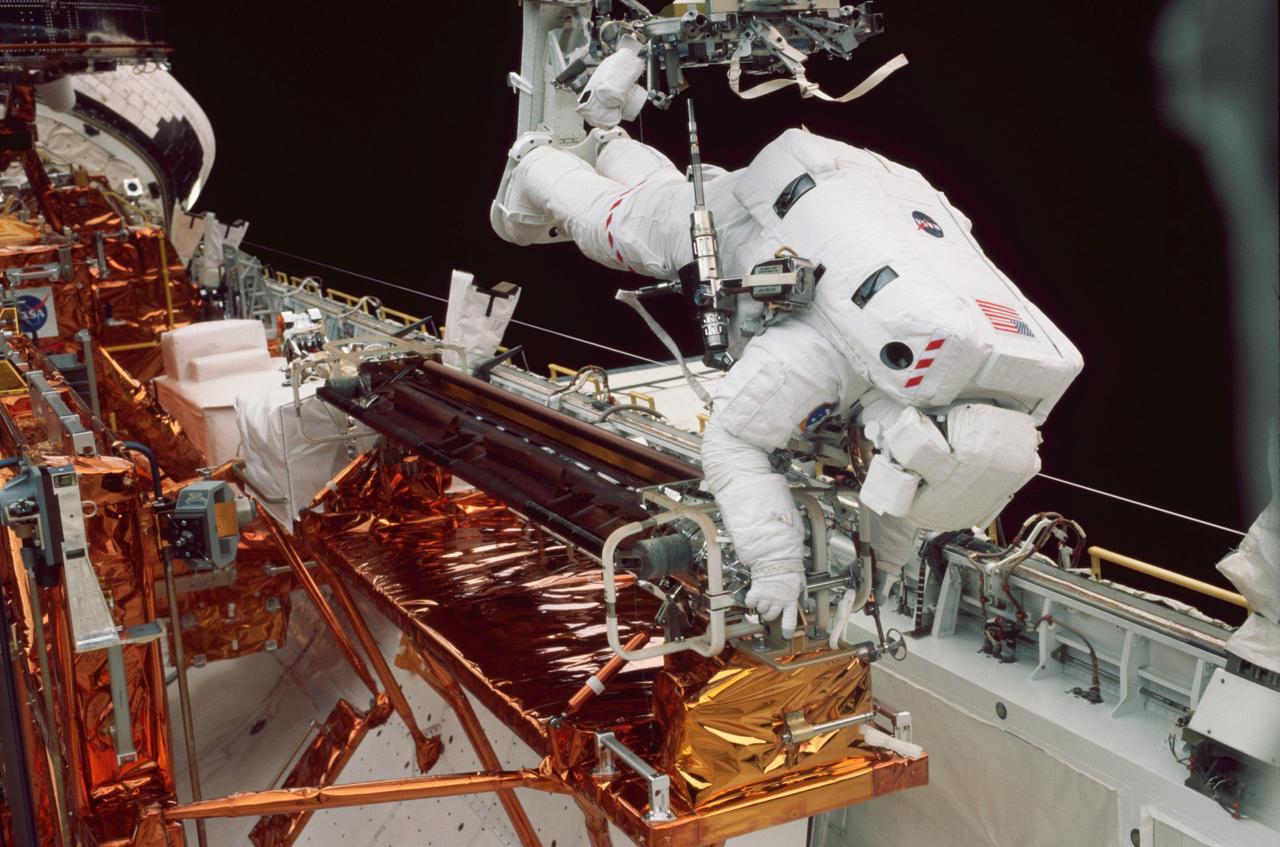
STS-109 Astronaut Michael J. Massimino, mission specialist, perched on the Shuttle's robotic arm is working at the stowage area for the Hubble Space Telescope's port side solar array. Working in tandem with James. H. Newman, Massimino removed the old port solar array and stored it in Columbia's payload bay for return to Earth. The two went on to install a third generation solar array and its associated electrical components. Two crew mates had accomplished the same feat with the starboard array on the previous day. In addition to the replacement of the solar arrays, the STS-109 crew also installed the experimental cooling system for the Hubble's Near-Infrared Camera (NICMOS), replaced the power control unit (PCU), and replaced the Faint Object Camera (FOC) with a new advanced camera for Surveys (ACS). The 108th flight overall in NASA's Space Shuttle Program, the Space Shuttle Columbia STS-109 mission lifted off March 1, 2002 for 10 days, 22 hours, and 11 minutes. Five space walks were conducted to complete the HST upgrades. The Marshall Space Flight Center in Huntsville, Alabama had the responsibility for the design, development, and construction of the HST, which is the most powerful and sophisticated telescope ever built.
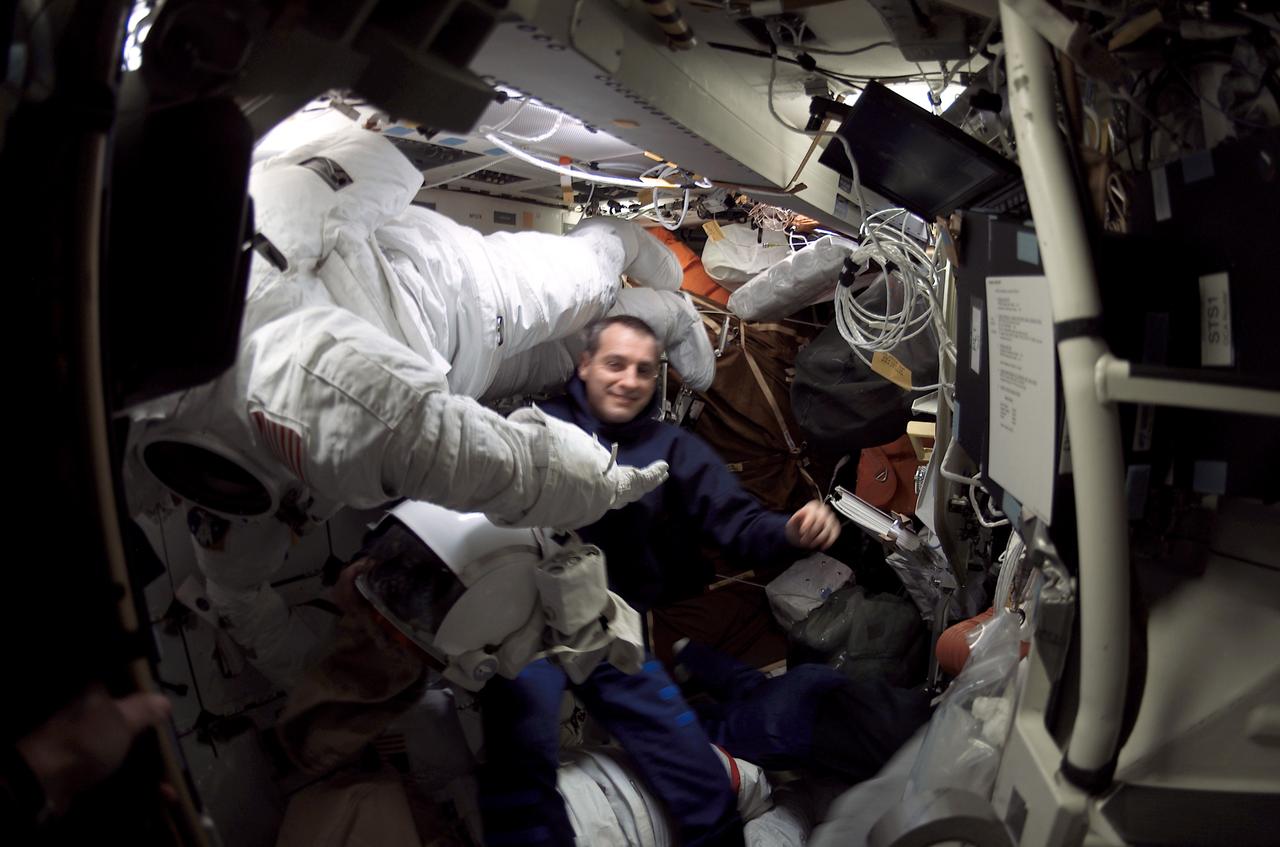
STS109-E-5326 (1-12 March 2002) --- Astronaut Richard M. Linnehan, STS-109 mission specialist, is photographed among Extravehicular Mobility Unit (EMU) space suits and stowage bags on the mid deck of the Space Shuttle Columbia. The image was taken with digital still camera.
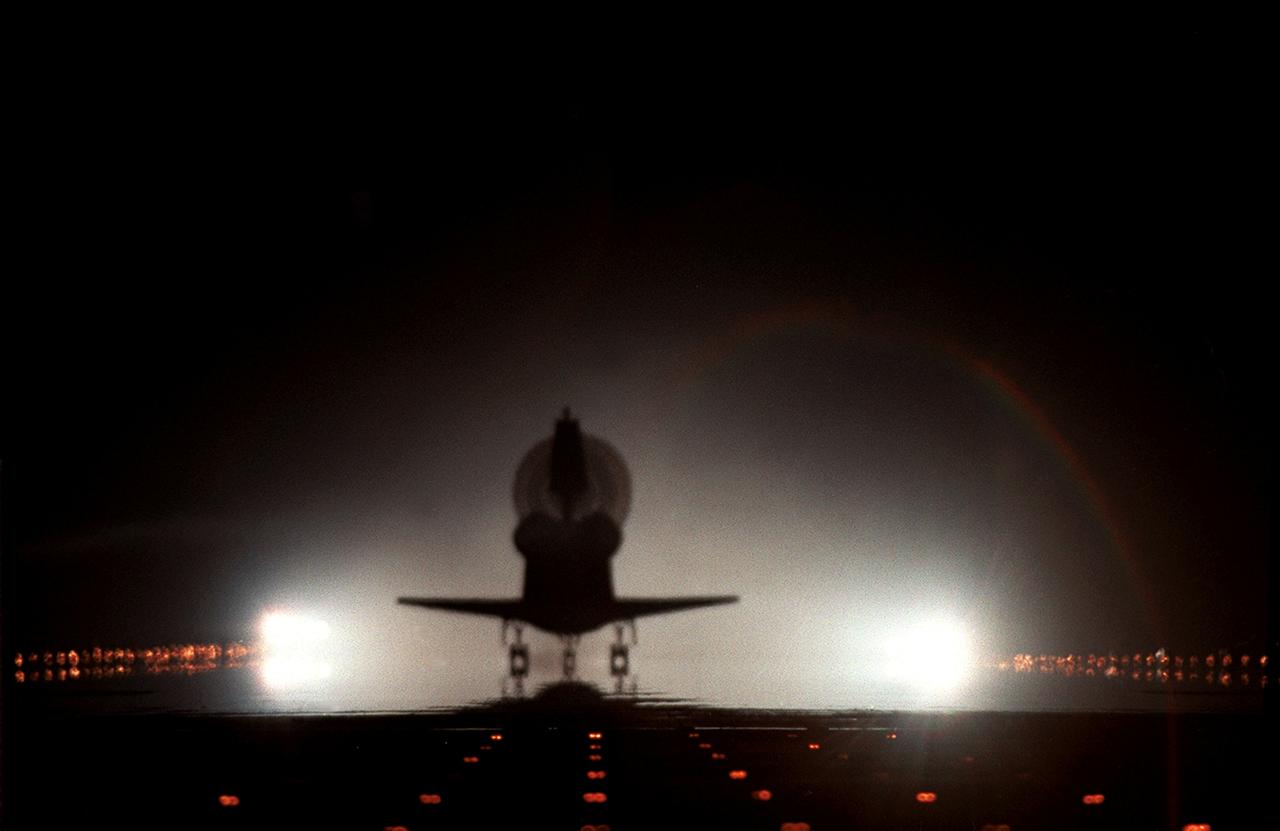
The Space Shuttle Columbia, with its crew of seven astronauts on board, touches down on Runway 33 of the KSC Shuttle Landing Facility, completing mission STS-109 to service the Hubble Space Telescope. Wheel stop occurred on orbit 165 at 4:33:09 a.m. EST with mission elapsed time of 10 days, 22 hours, 11 minutes. Main gear touchdown occurred at 4:31:52 a.m. and nose wheel touchdown an 4:32:02.
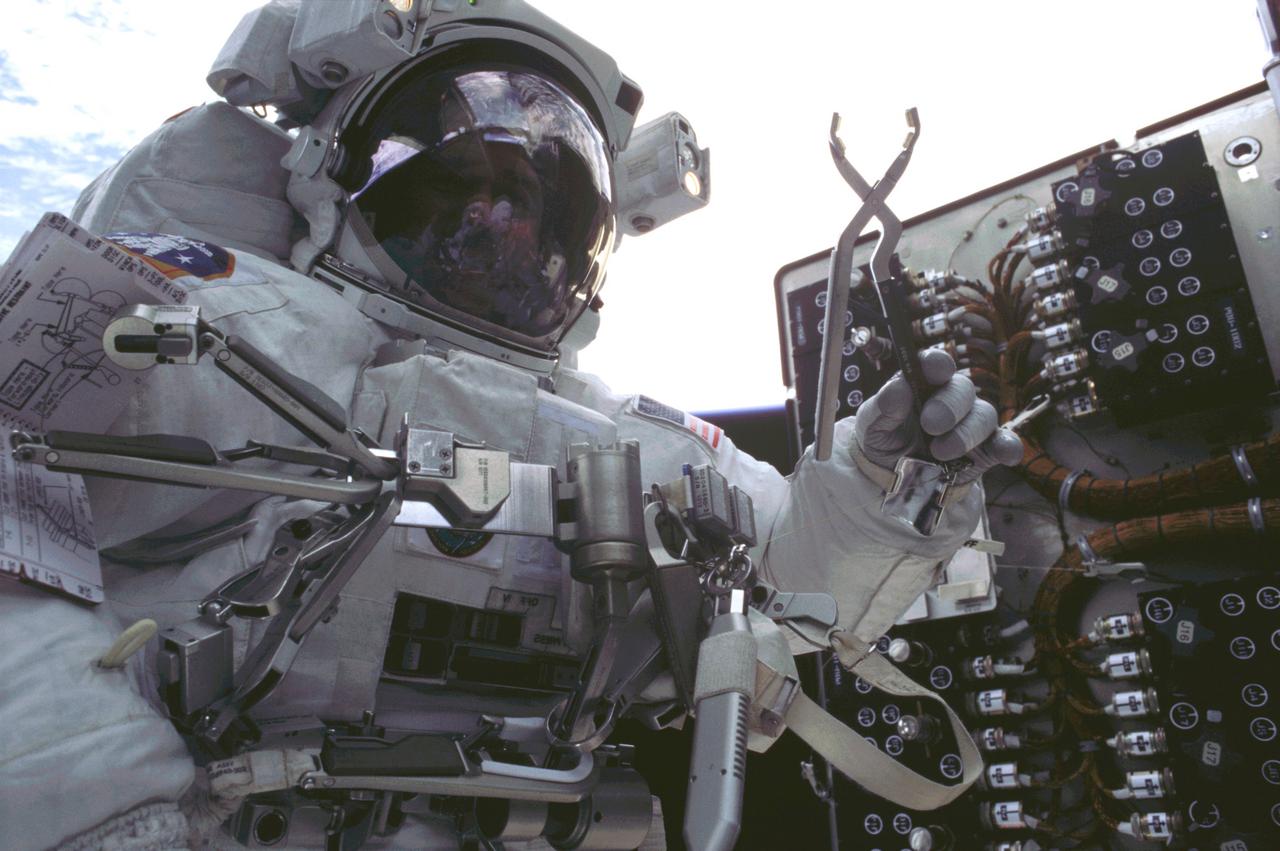
This is an onboard photo of Astronaut John M. Grunsfield, STS-109 payload commander, participating in the third of five spacewalks to perform work on the Hubble Space Telescope (HST). On this particular walk, Grunsfield, joined by Astronaut Richard M. Lirnehan, turned off the telescope in order to replace its power control unit (PCU), the heart of the HST's power system. The telescope was captured and secured on a work stand in Columbia's payload bay using Columbia's robotic arm, where crew members completed system upgrades to the HST. Included in those upgrades were: replacement of the solar array panels; replacement of the power control unit (PCU); replacement of the Faint Object Camera (FOC) with a new advanced camera for Surveys (ACS); and installation of the experimental cooling system for the Hubble's Near-Infrared Camera and Multi-object Spectrometer (NICMOS), which had been dormant since January 1999 when its original coolant ran out. The Marshall Space Flight Center had the responsibility for the design, development, and construction of the HST, which is the most complex and sensitive optical telescope ever made, to study the cosmos from a low-Earth orbit. The HST detects objects 25 times fainter than the dimmest objects seen from Earth and provides astronomers with an observable universe 250 times larger than is visible from ground-based telescopes, perhaps as far away as 14 billion light-years. The HST views galaxies, stars, planets, comets, possibly other solar systems, and even unusual phenomena such as quasars, with 10 times the clarity of ground-based telescopes. Launched March 1, 2002 the STS-109 HST servicing mission lasted 10 days, 22 hours, and 11 minutes. It was the 108th flight overall in NASA's Space Shuttle Program.
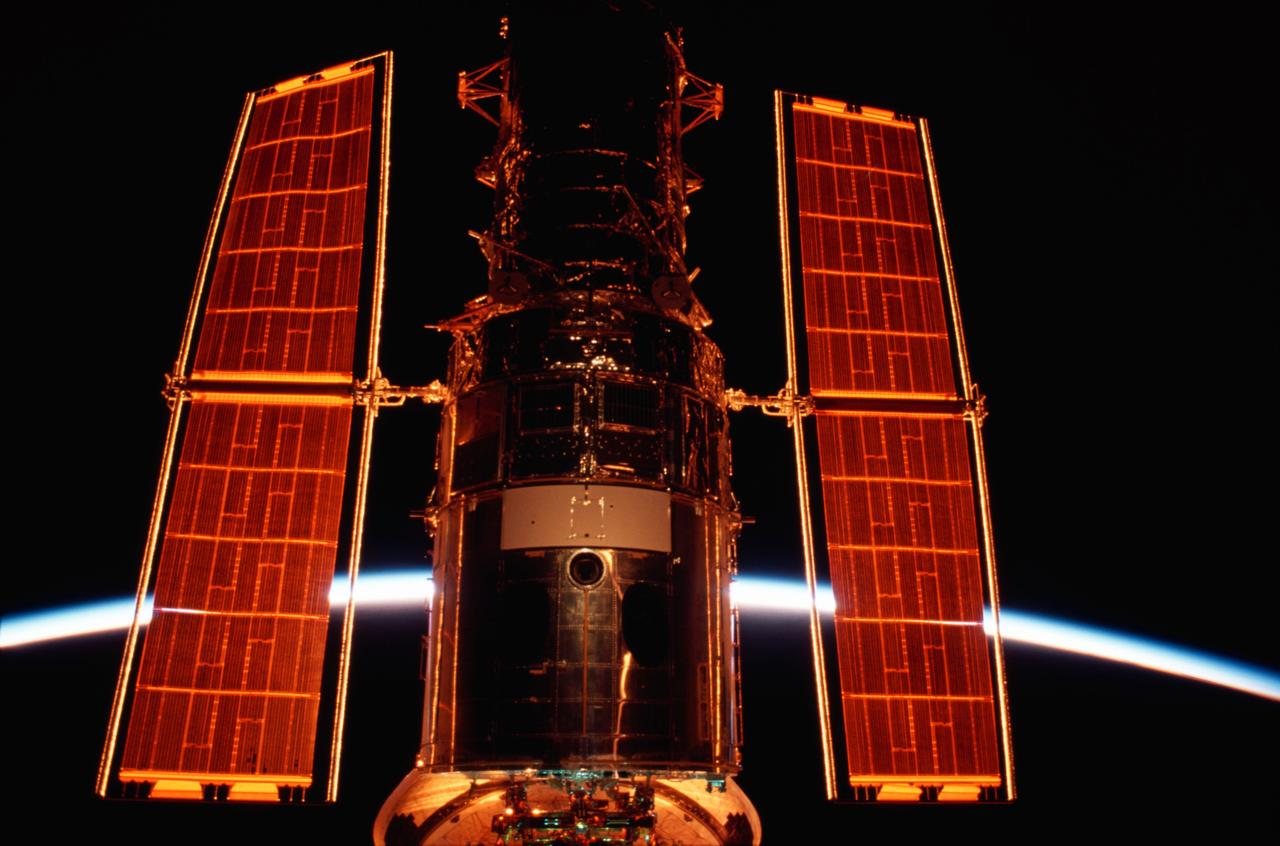
This is a photo of the Hubble Space Telescope (HST),in its origianl configuration, berthed in the cargo bay of the Space Shuttle Columbia during the STS-109 mission silhouetted against the airglow of the Earth's horizon. The telescope was captured and secured on a work stand in Columbia's payload bay using Columbia's robotic arm, where 4 of the 7-member crew performed 5 spacewalks completing system upgrades to the HST. Included in those upgrades were: replacement of the solar array panels; replacement of the power control unit (PCU); replacement of the Faint Object Camera (FOC) with a new advanced camera for Surveys (ACS); and installation of the experimental cooling system for the Hubble's Near-Infrared Camera and Multi-object Spectrometer (NICMOS), which had been dormant since January 1999 when its original coolant ran out. The Marshall Space Flight Center had the responsibility for the design, development, and construction of the the HST, which is the most complex and sensitive optical telescope ever made, to study the cosmos from a low-Earth orbit. The HST detects objects 25 times fainter than the dimmest objects seen from Earth and provides astronomers with an observable universe 250 times larger than is visible from ground-based telescopes, perhaps as far away as 14 billion light-years. The HST views galaxies, stars, planets, comets, possibly other solar systems, and even unusual phenomena such as quasars, with 10 times the clarity of ground-based telescopes. Launched March 1, 2002 the STS-109 HST servicing mission lasted 10 days, 22 hours, and 11 minutes. It was the 108th flight overall in NASA's Space Shuttle Program.
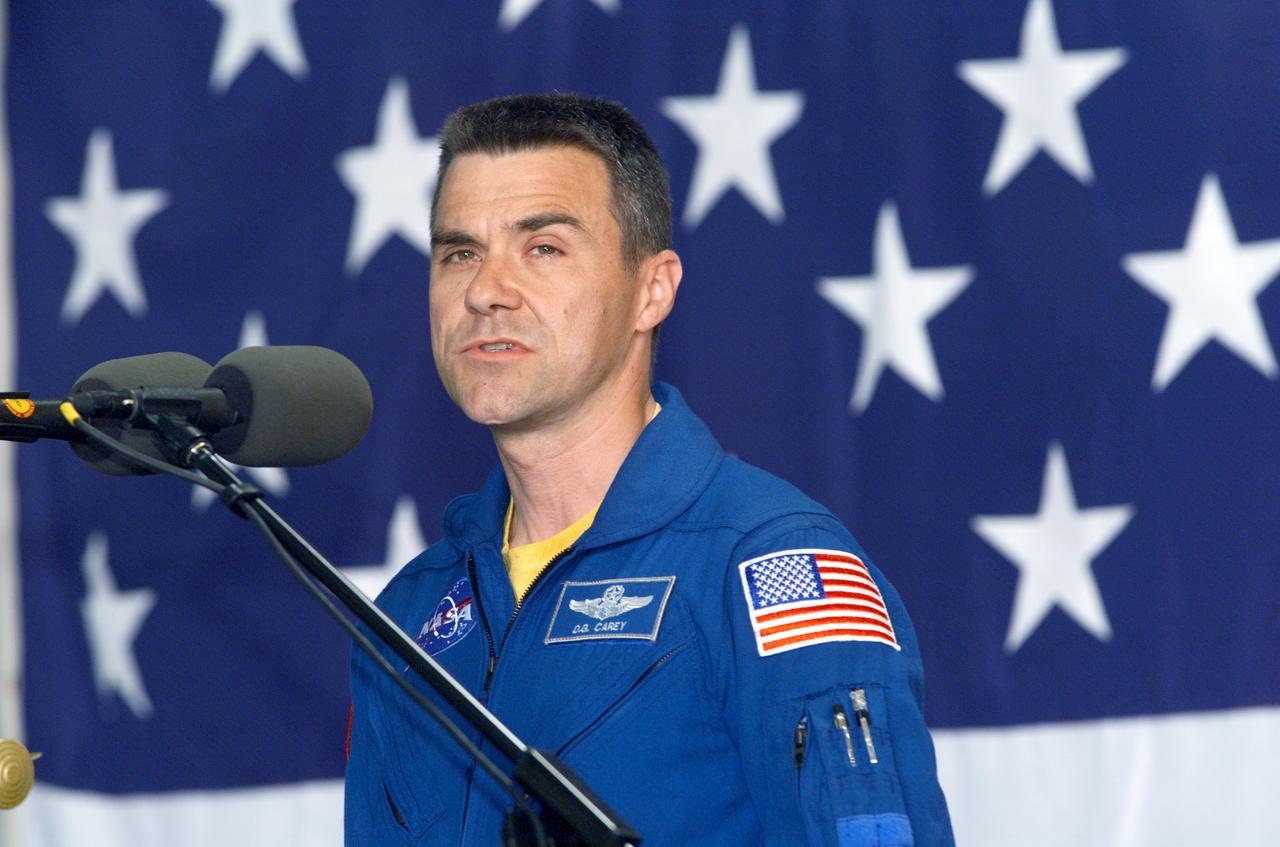
JSC2002-E-09339 (13 March 2002) --- Astronaut Duane G. Carey, STS-109 pilot, speaks from the lectern in Hangar 990 at Ellington Field during the crew return ceremonies.
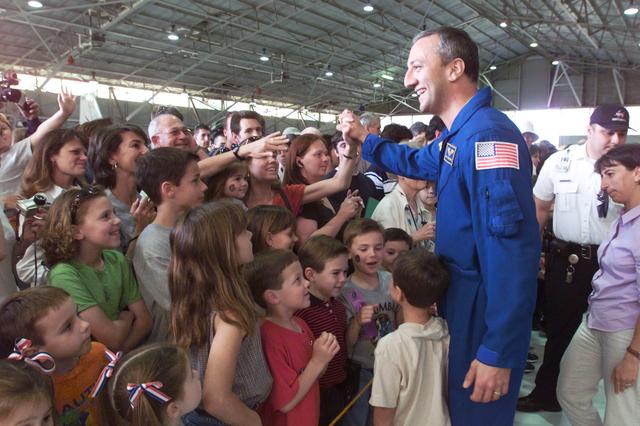
JSC2002-E-09321 (13 March 2002) --- Astronaut Michael J. Massimino, STS-109 mission specialist, greets the assembled crowd in Hangar 990 at Ellington Field during the crew return ceremonies.
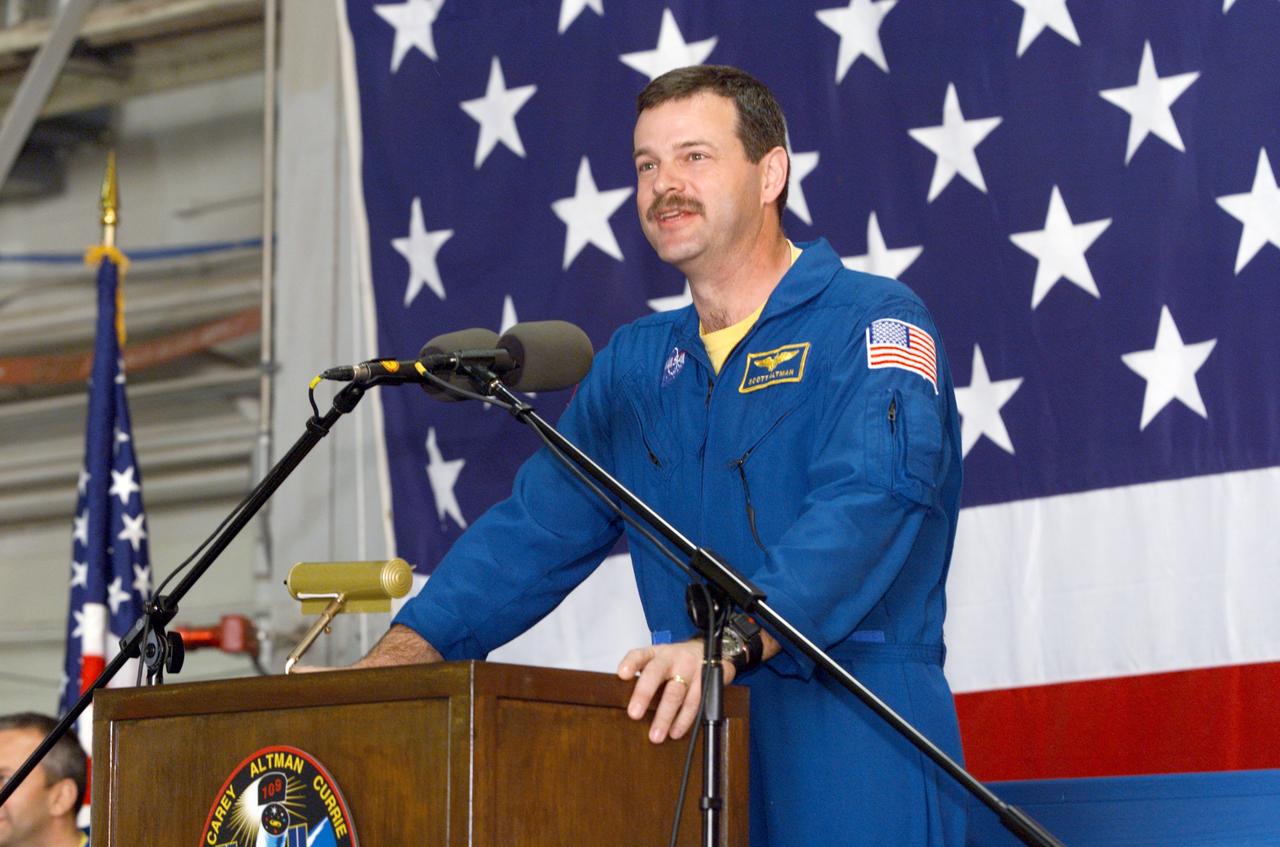
JSC2002-E-09337 (13 March 2002) --- Astronaut Scott D. Altman, STS-109 mission commander, speaks from the lectern in Hangar 990 at Ellington Field during the crew return ceremonies.

JSC2002-E-09343 (13 March 2002) --- Astronaut James H. Newman, STS-109 mission specialist, speaks from the lectern in Hangar 990 at Ellington Field during the crew return ceremonies.
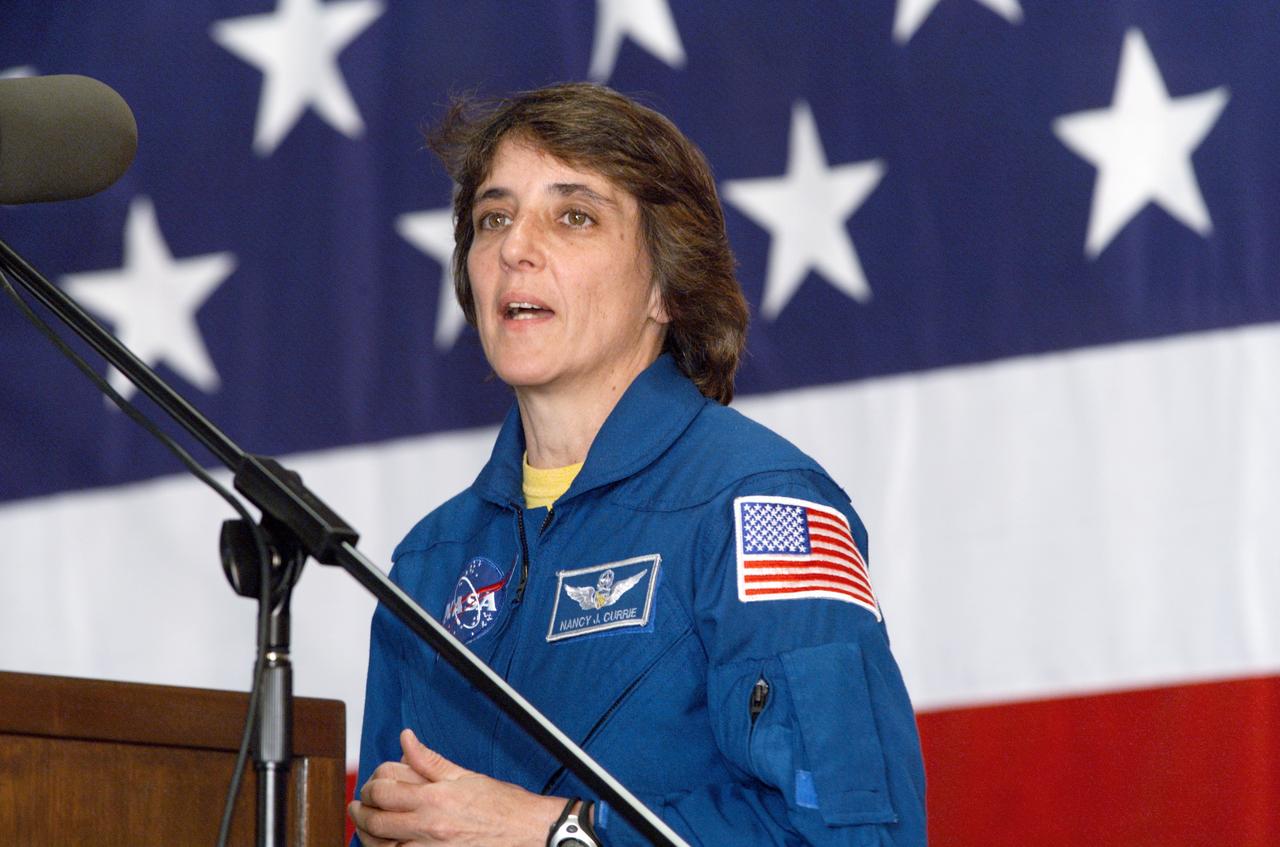
JSC2002-E-09340 (13 March 2002) --- Astronaut Nancy J. Currie, STS-109 mission specialist, speaks from the lectern in Hangar 990 at Ellington Field during the crew return ceremonies.
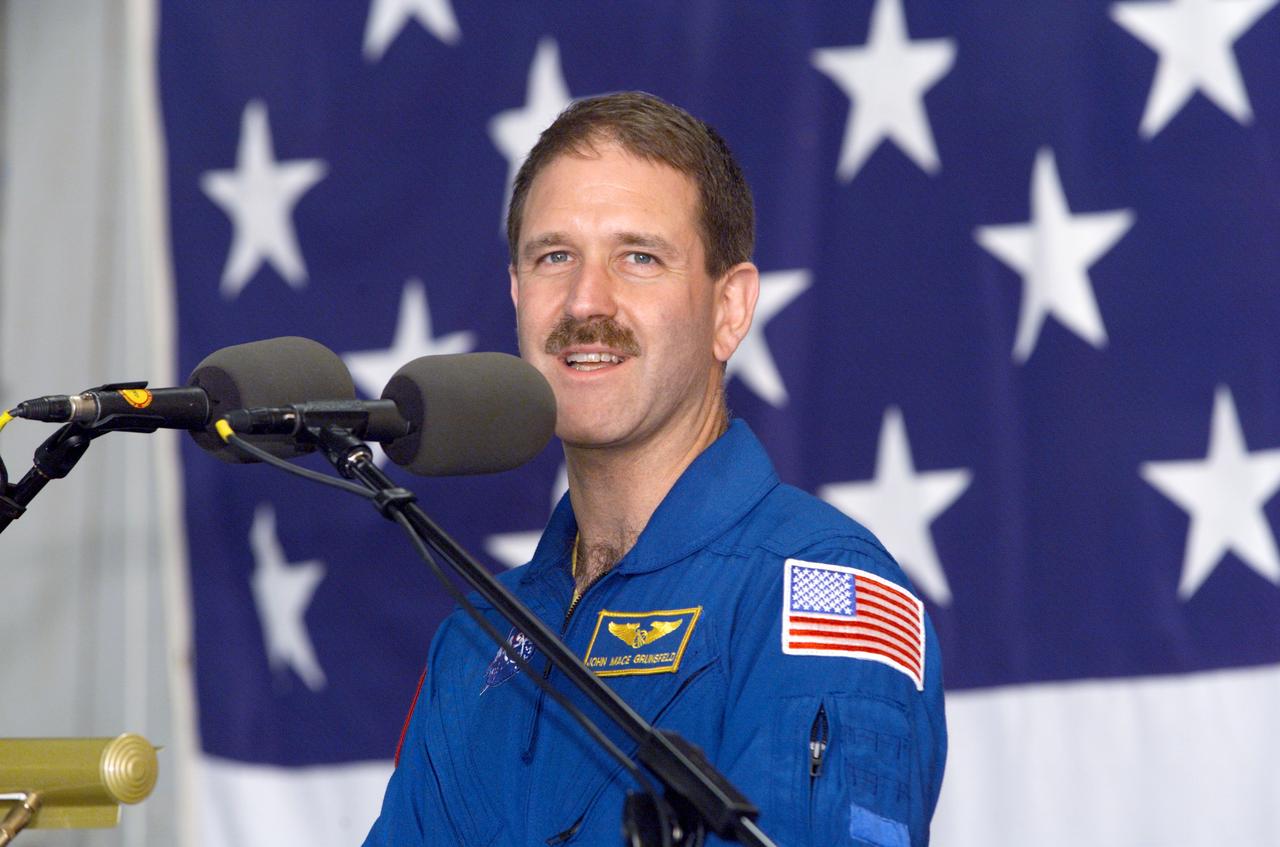
JSC2002-E-09341 (13 March 2002) --- Astronaut John M. Grunsfeld, STS-109 payload commander, speaks from the lectern in Hangar 990 at Ellington Field during the crew return ceremonies.
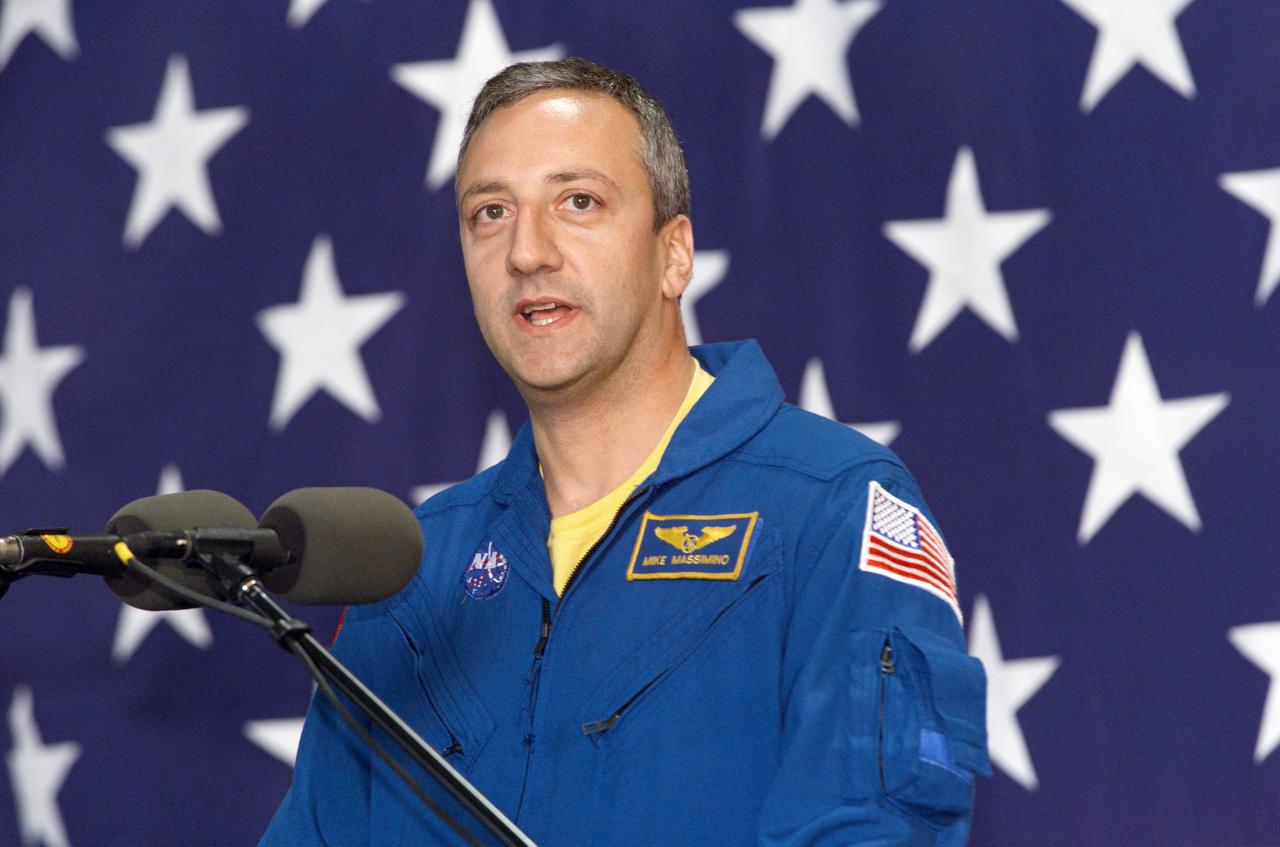
JSC2002-E-09344 (13 March 2002) --- Astronaut Michael J. Massimino, STS-109 mission specialist, speaks from the lectern in Hangar 990 at Ellington Field during the crew return ceremonies.
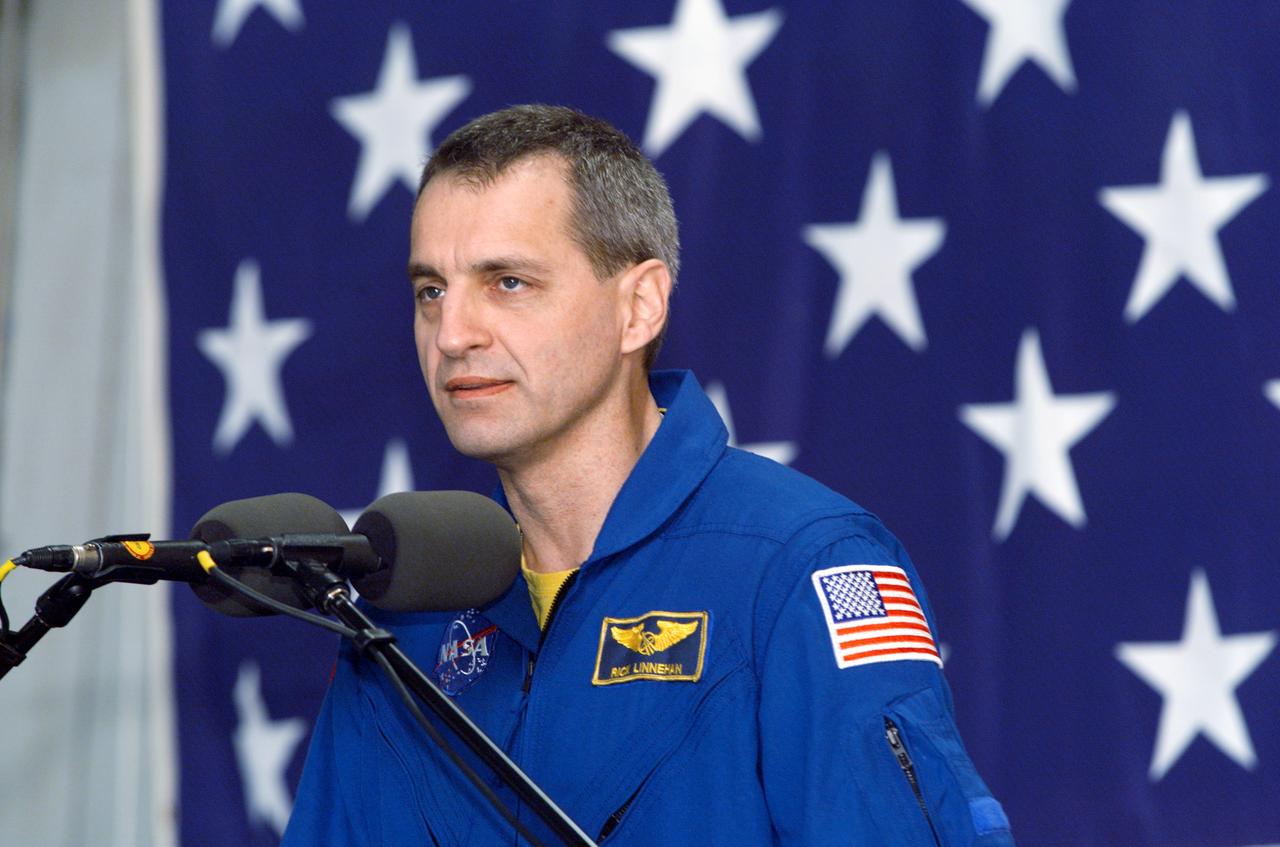
JSC2002-E-09342 (13 March 2002) --- Astronaut Richard M. Linnehan, STS-109 mission specialist, speaks from the lectern in Hangar 990 at Ellington Field during the crew return ceremonies.

On the Space Shuttle Columbia's mid deck, the STS-109 crew of seven pose for the traditional in-flight portrait. From the left (front row), are astronauts Nancy J. Currie, mission specialist; Scott D. Altman, mission commander; and Duane G. Carey, pilot. Pictured on the back row from left to right are astronauts John M. Grunsfield, payload commander; and Richard M. Lirneham, James H. Newman, and Michael J. Massimino, all mission specialists. The 108th flight overall in NASA's Space Shuttle Program, the STS-109 mission launched March 1, 2002, and lasted 10 days, 22 hours, and 11 minutes. The goal of the mission was the maintenance and upgrade of the Hubble Space Telescope (HST). Using Columbia's robotic arm, the telescope was captured and secured on a work stand in Columbia's payload bay where four members of the crew performed five space walks to complete system upgrades to the HST. The Marshall Space Flight Center had the responsibility for the design, development, and construction of the HST, which is the most complex and sensitive optical telescope ever made, to study the cosmos from a low-Earth orbit.
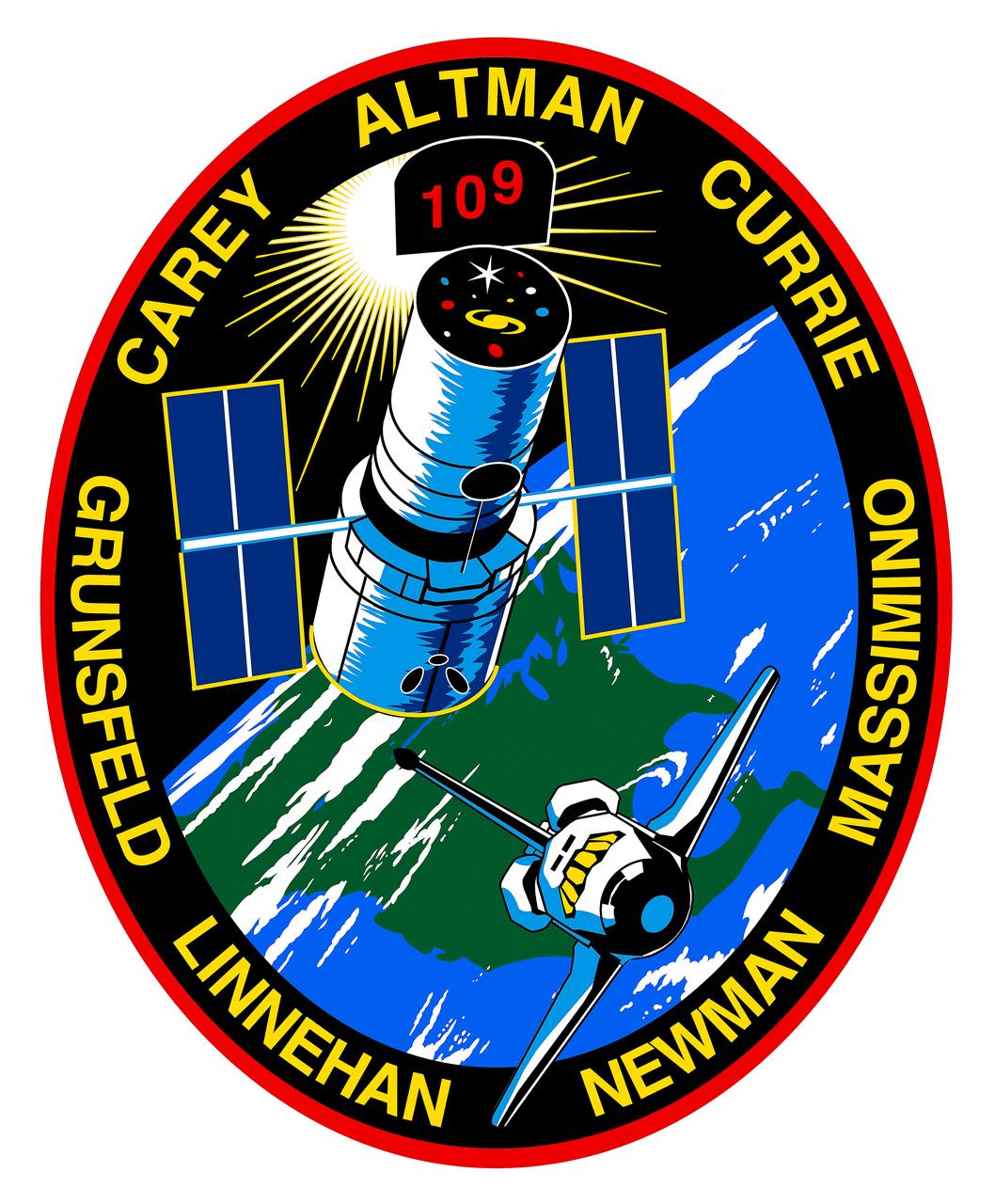
STS109-S-001 (August 2001) --- STS-109 is the fourth mission to service the Hubble Space Telescope (HST). The mission patch depicts the Hubble Space Telescope and the space shuttle Columbia over the North American continent. During the eleven-day mission, the crew of Columbia will rendezvous with the telescope and grapple and berth it to the space shuttle using the remote manipulator system. Then, a series of spacewalks will be performed to significantly upgrade HST?s scientific capabilities and power system. Inside of HST?s aperture is a portrayal of the spectacular Hubble Deep Field Image, representing the billions of stars and galaxies in the Universe. This Deep Field Image symbolizes all the major discoveries made possible by the Hubble Space Telescope over the last ten years, and all those to come following the installation of the Advanced Camera for Surveys (ACS) by the crew of STS-109. The ACS is the major scientific upgrade for this servicing mission and will dramatically increase HST?s ability to see deeper into our universe. To further extend HST?s discovery potential, a new cooling system will be added that will restore HST?s infrared capability. The telescope is also shown with the smaller, sturdier, and more efficient solar arrays that will be installed during the spacewalks on STS-109. When combined with a new Power Control Unit, these solar arrays will provide more power for use by the telescope and allow multiple scientific instruments to operate concurrently. The NASA insignia design for space shuttle flights is reserved for use by the astronauts and for other official use as the NASA Administrator may authorize. Public availability has been approved only in the forms of illustrations by the various news media. When and if there is any change in this policy, which is not anticipated, the change will be publicly announced. Photo credit: NASA
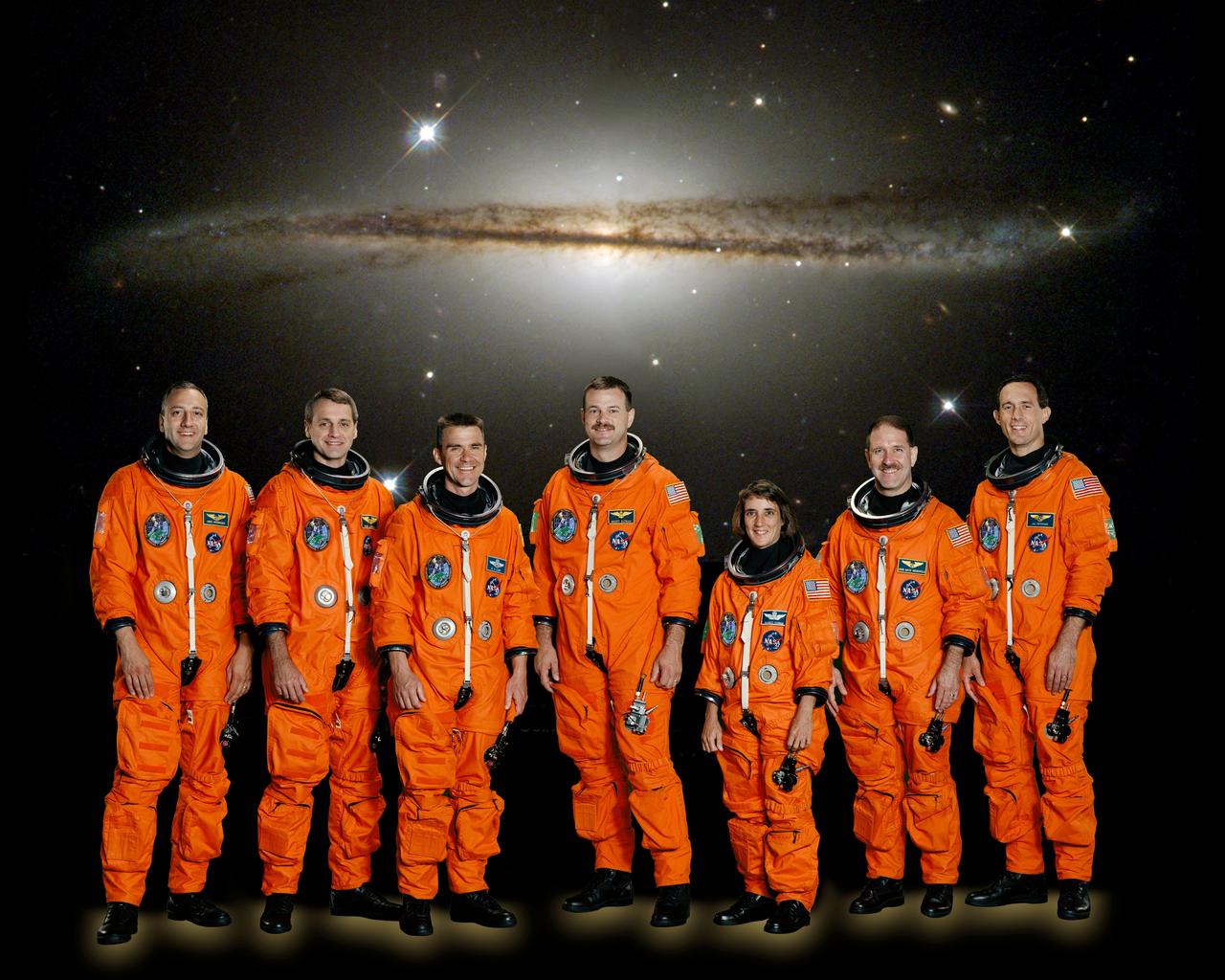
STS109-S-002 (November 2001) --- Seven astronauts take a break from training for the STS-109 mission to pose for the traditional pre-flight crew portrait. From the left are astronauts Michael J. Massimino, Richard M. Linnehan, Duane G. Carey, Scott D. Altman, Nancy J. Currie, John M. Grunsfeld and James H. Newman. Altman and Carey are commander and pilot, respectively, with the others serving as mission specialists. Grunsfeld is payload commander. The group will be the fourth to visit the Hubble Space Telescope (HST) for performing upgrade and servicing on the giant orbital observatory.
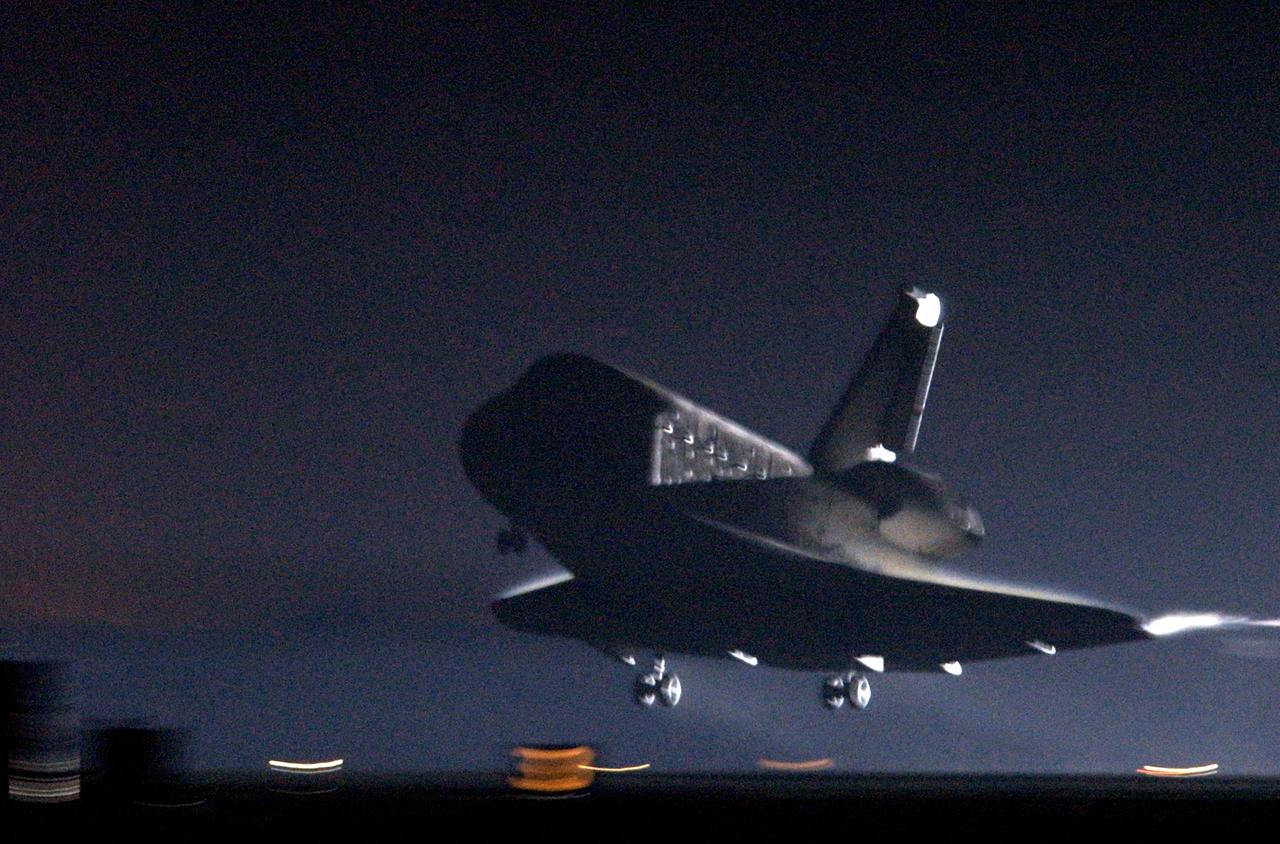
STS109-S-016 (12 March 2002)--- The Space Shuttle Columbia, with its crew of seven astronauts on board, approaches touchdown on Runway 33 of the KSC Shuttle Landing Facility, completing mission STS-109 to service the Hubble Space Telescope. Wheel stop occurred on orbit 165 at 4:33:09 a.m. EST with mission elapsed time of 10 days, 22 hours, 11 minutes. Main gear touchdown occurred at 4:31:52 a.m. and nose wheel touchdown an 4:32:02. It was the 58th landing at KSC out of 108 missions in the history of the Shuttle program.
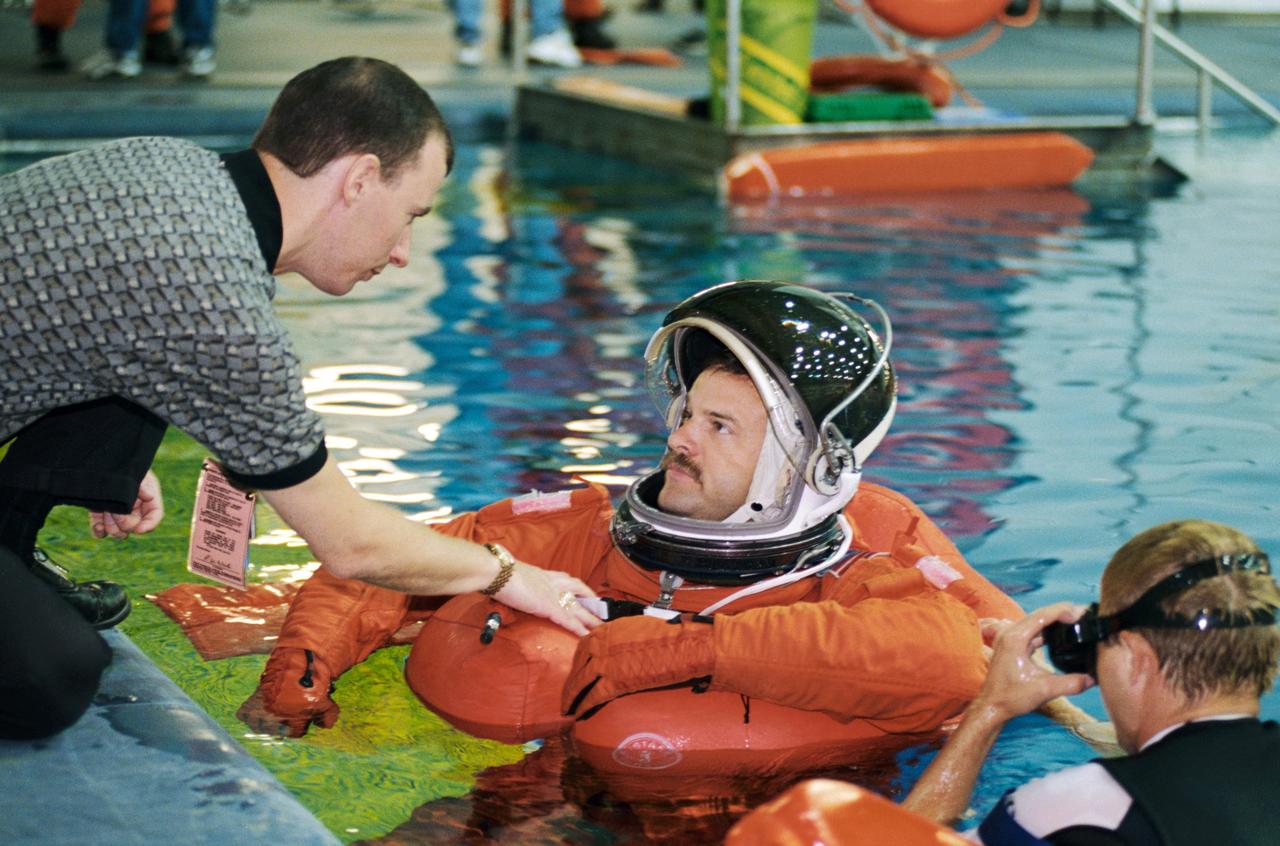
JSC2001-01921 (12 July 2001) --- Astronaut Scott D. Altman, STS-109 mission commander, is assisted by United Space Alliance (USA) crew trainer David Pogue and a diver during an emergency bailout training session in the Neutral Buoyancy Laboratory (NBL) near the Johnson Space Center (JSC). STS-109 will be the 108th shuttle flight and the fourth Hubble Space Telescope (HST) servicing mission.
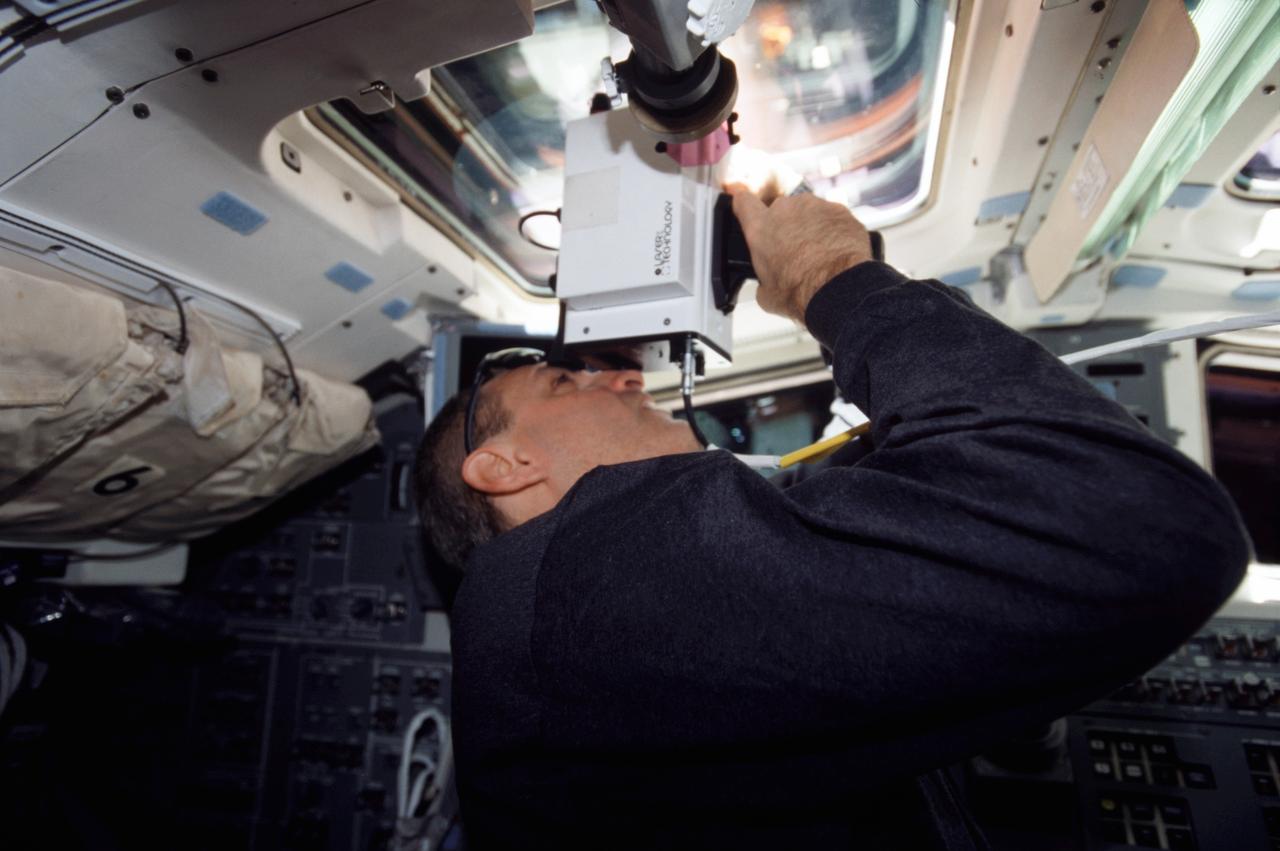
STS109-346-011 (3 March 2002) --- Astronaut Richard M. Linnehan, STS-109 mission specialist, uses a laser ranging device designed to measure the range between two spacecraft. Linnehan positioned himself on the cabin's aft flight deck as the Space Shuttle Columbia approached the Hubble Space Telescope. A short time later, the STS-109 crew captured and latched down the giant telescope in the vehicle's cargo bay for several days of work on the Hubble.
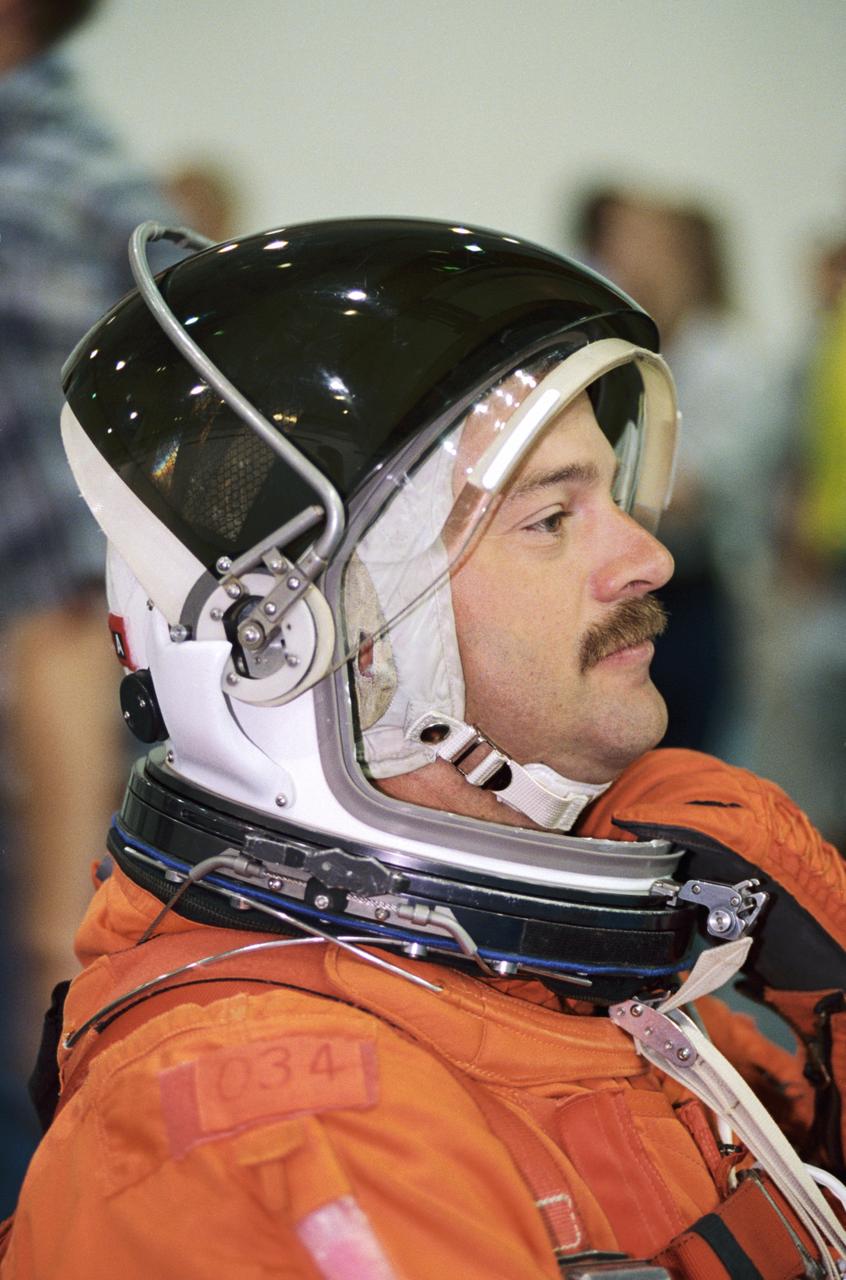
JSC2001-01918 (12 July 2001) --- Astronaut Scott D. Altman, STS-109 mission commander, attired in a training version of the shuttle launch and entry garment, awaits the start of an emergency bailout training session at the Neutral Buoyancy Laboratory (NBL) near the Johnson Space Center (JSC). STS-109 will be the 108th shuttle flight and the fourth Hubble Space Telescope (HST) servicing mission.
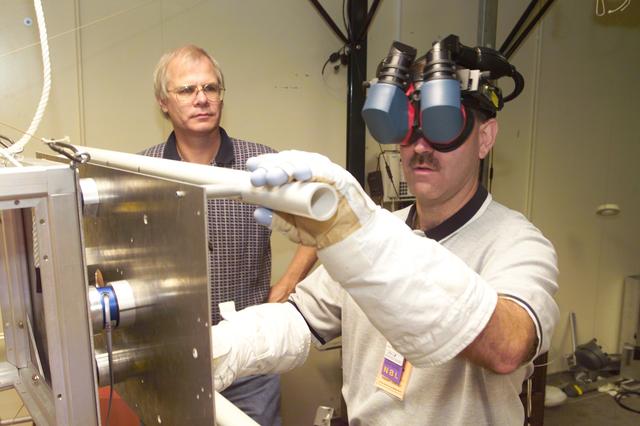
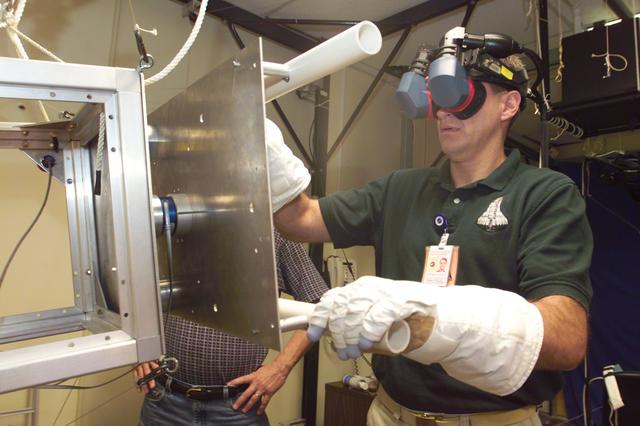
JSC2001-E-24454 (8 August 2001) --- Astronaut John M. Grunsfeld, STS-109 payload commander, uses virtual reality hardware at the Johnson Space Center (JSC) to rehearse some of his duties on the upcoming STS-109 mission, NASA’s fourth servicing visit to the Hubble Space Telescope (HST). He will join six other astronauts for the servicing mission, scheduled for February 2002.
JSC2001-E-24453 (8 August 2001) --- Astronaut Richard M. Linnehan, STS-109 mission specialist, uses virtual reality hardware at the Johnson Space Center (JSC) to rehearse some of his duties on the upcoming STS-109 mission, NASA’s fourth servicing visit to the Hubble Space Telescope (HST). He will join six other astronauts for the servicing mission, scheduled for February 2002.
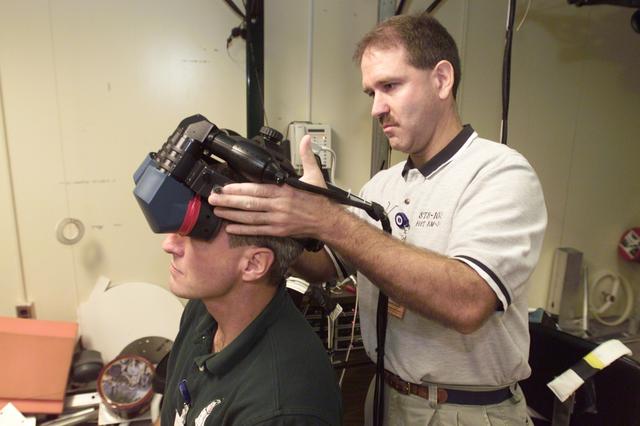
JSC2001-E-24460 (8 August 2001) --- John M. Grunsfeld (right), payload commander, assists Richard M. Linnehan, STS-109 mission specialist, in using virtual reality hardware at the Johnson Space Center (JSC) to rehearse some of his duties on the upcoming STS-109 mission, NASA’s fourth servicing visit to the Hubble Space Telescope (HST). They will join five other astronauts for the servicing mission, scheduled for February 2002.
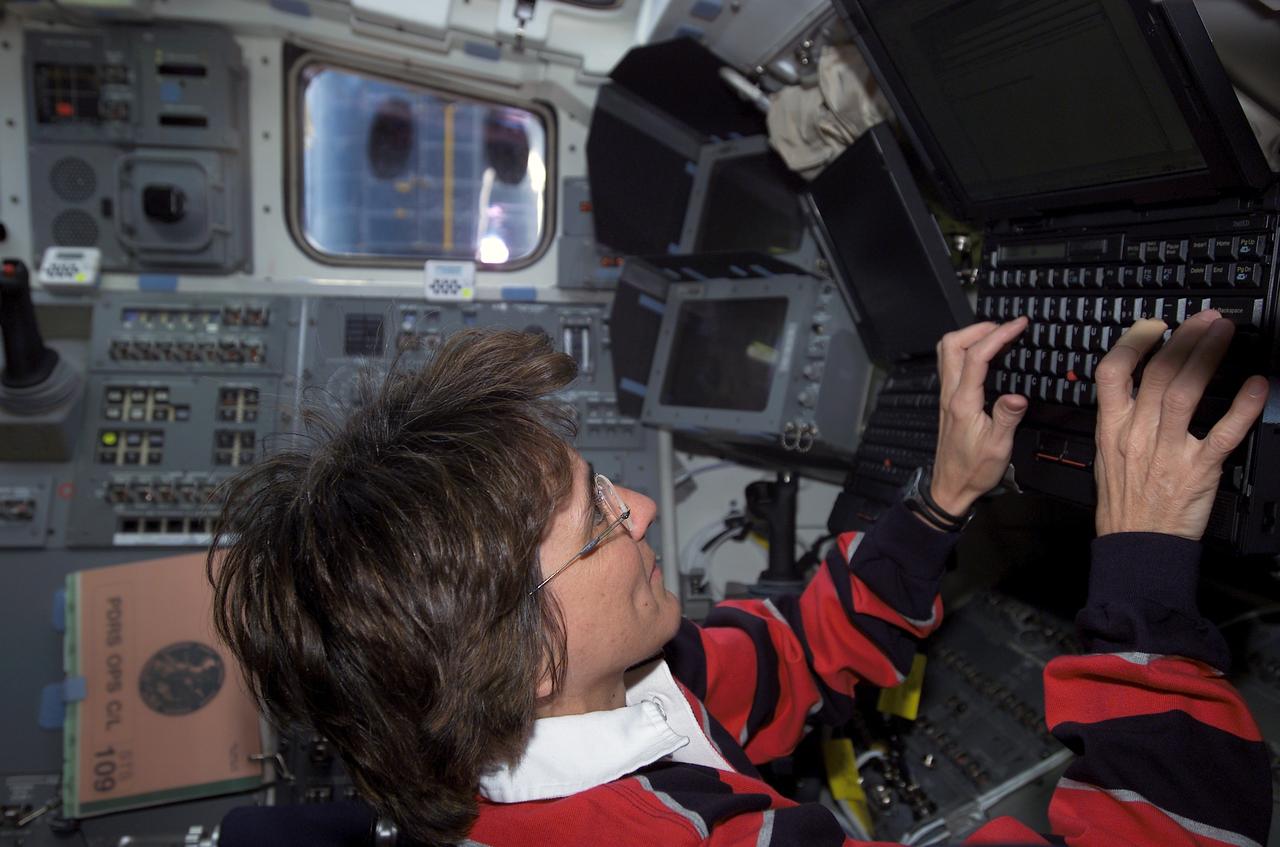
STS109-E-5291 (1-12 March 2002) --- Astronaut Nancy J. Currie, STS-109 mission specialist, works with Payload and General Support Computers (PGSC) on the mid deck of the Space Shuttle Columbia. The image was taken with digital still camera.
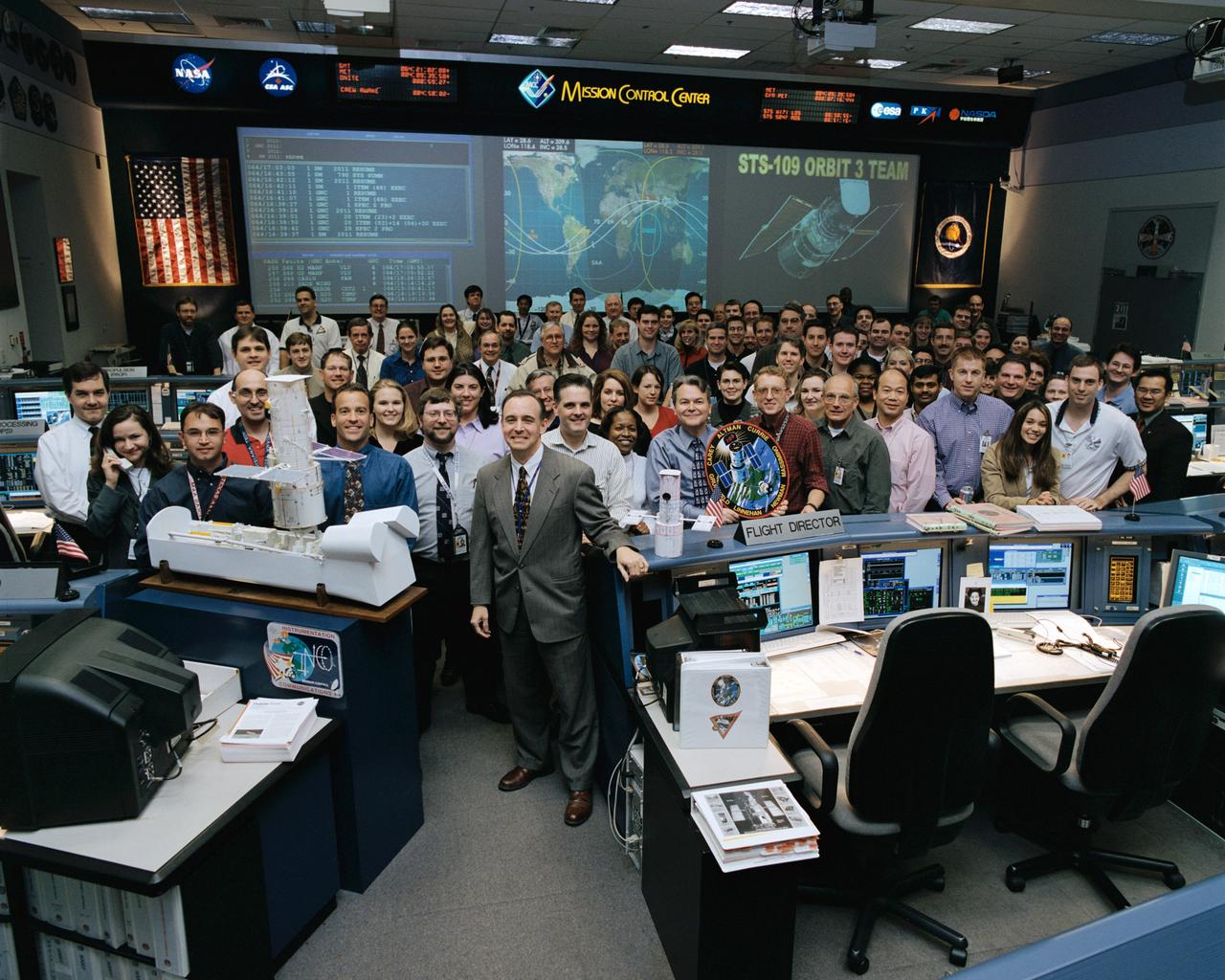
JSC2002-00576 (5 March 2002) --- The members of the STS-109 Orbit 3 Team pose for a group portrait in the shuttle flight control room (WFCR) in Houston’s Mission Control Center (MCC). Flight director Jeff Hanley is visible in the center foreground.
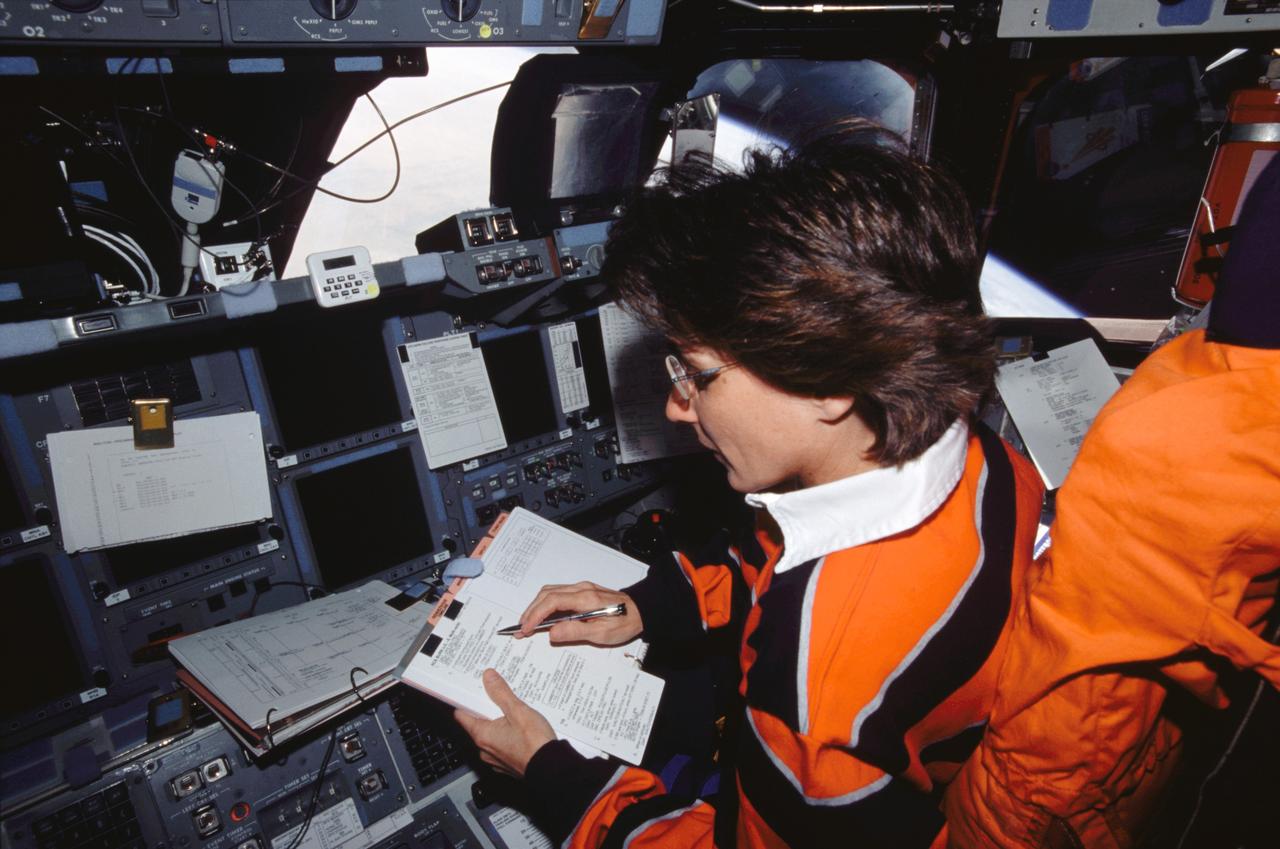
STS109-346-007 (1;12 March 2002) --- Astronaut Nancy J. Currie, STS-109 mission specialist, looks over a procedures check list while occupying the pilot;s station on the forward flight deck of the Space Shuttle Columbia.
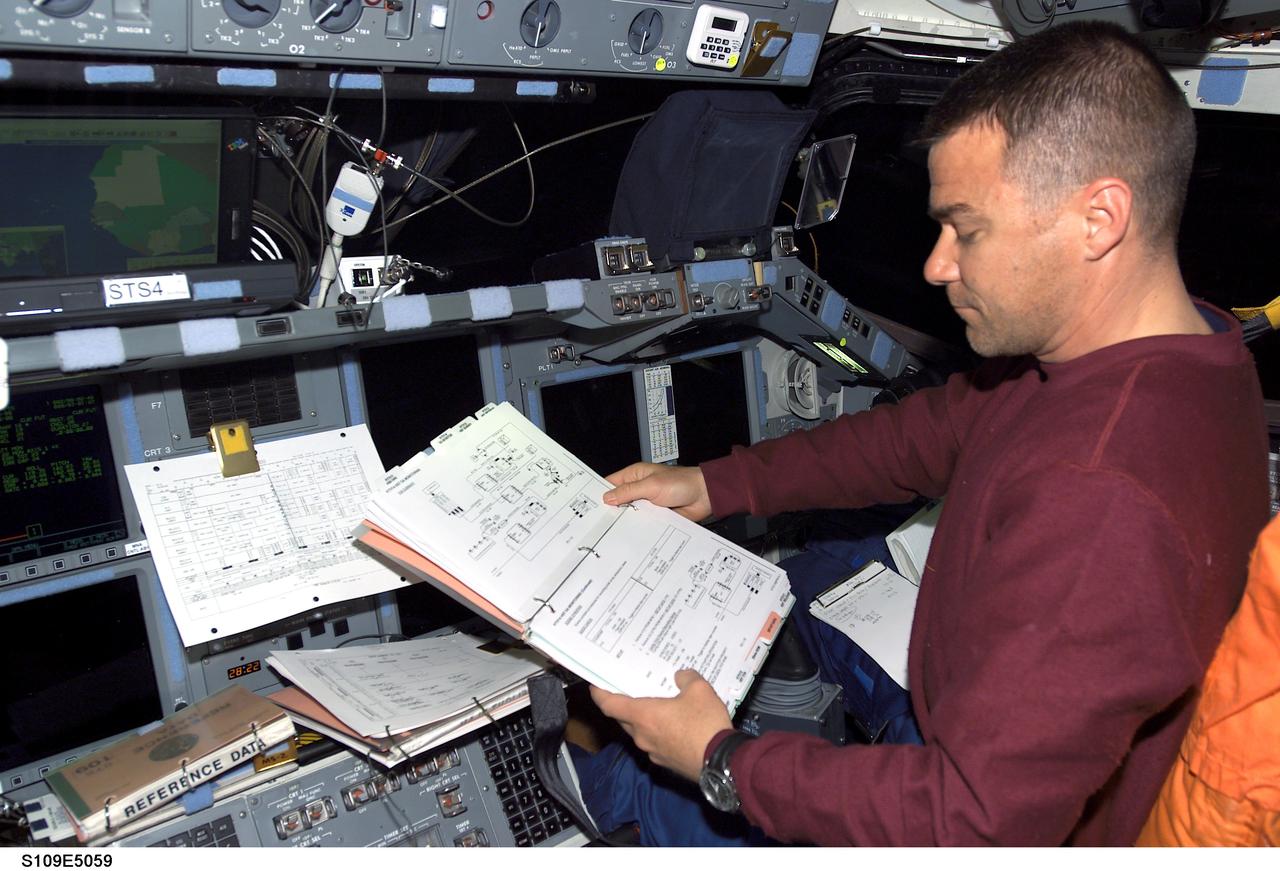
STS109-E-5059 (3 March 2002) --- Astronaut Duane G. Carey, STS-109 pilot, looks over a reference manual during capture and latch operations with the Hubble Space Telescope. The image was recorded with a digital still camera.
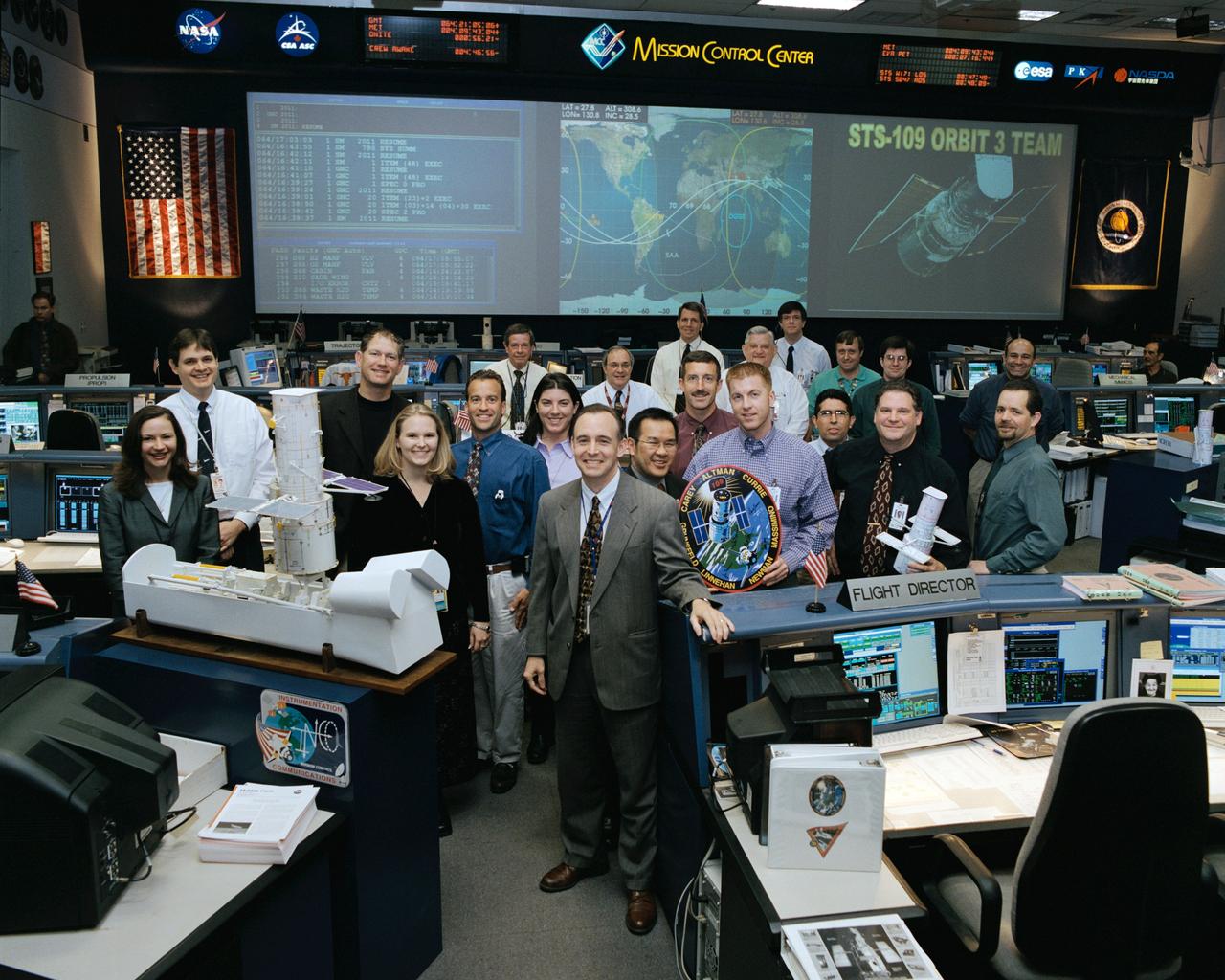
JSC2002-00575 (5 March 2002) --- The members of the STS-109 Orbit 3 Team pose for a group portrait in the shuttle flight control room (WFCR) in Houston’s Mission Control Center (MCC). Flight director Jeff Hanley is visible in the center foreground.
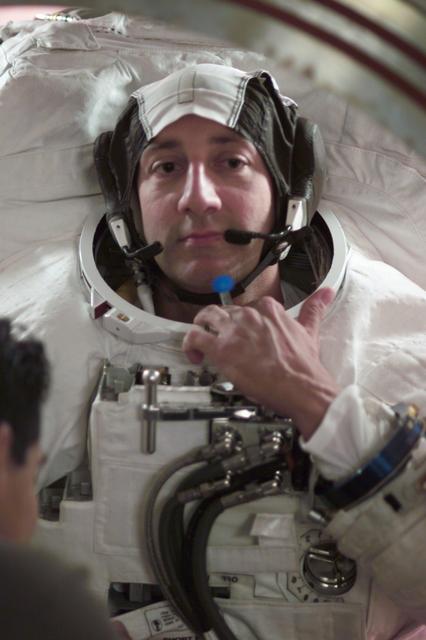
JSC2001-E-44739 (December 2001) --- Astronaut Michael J. Massimino, STS-109 mission specialist, dons a training version of the Extravehicular Mobility Unit (EMU) space suit prior to a mission training session in the Environmental Test Article (ETA) Chamber in the Crew Systems Laboratory at Johnson Space Center (JSC).
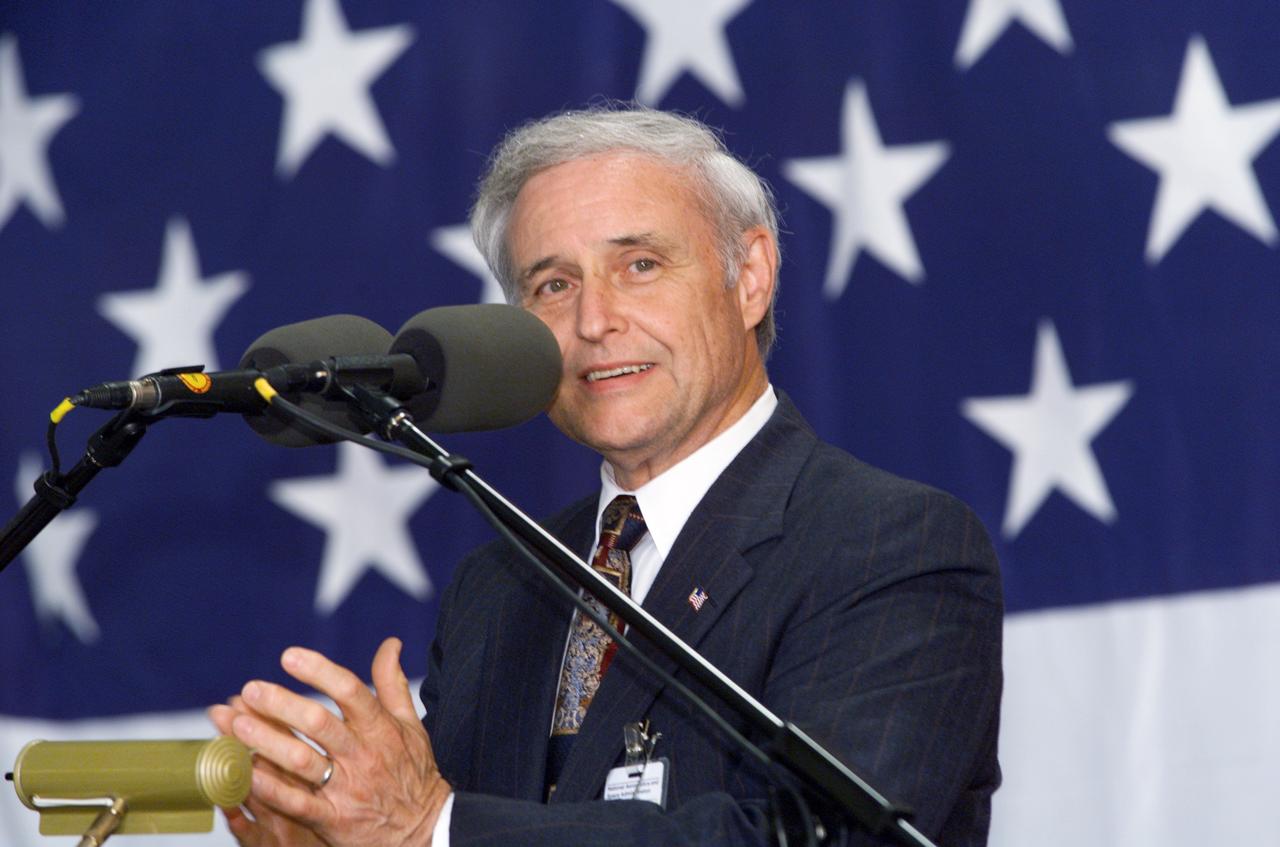
JSC2002-E-09336 (13 March 2002 ) --- Johnson Space Center’s (JSC) Acting Director Roy S. Estess speaks from the lectern in Hangar 990 at Ellington Field during the STS-109 crew return ceremonies.
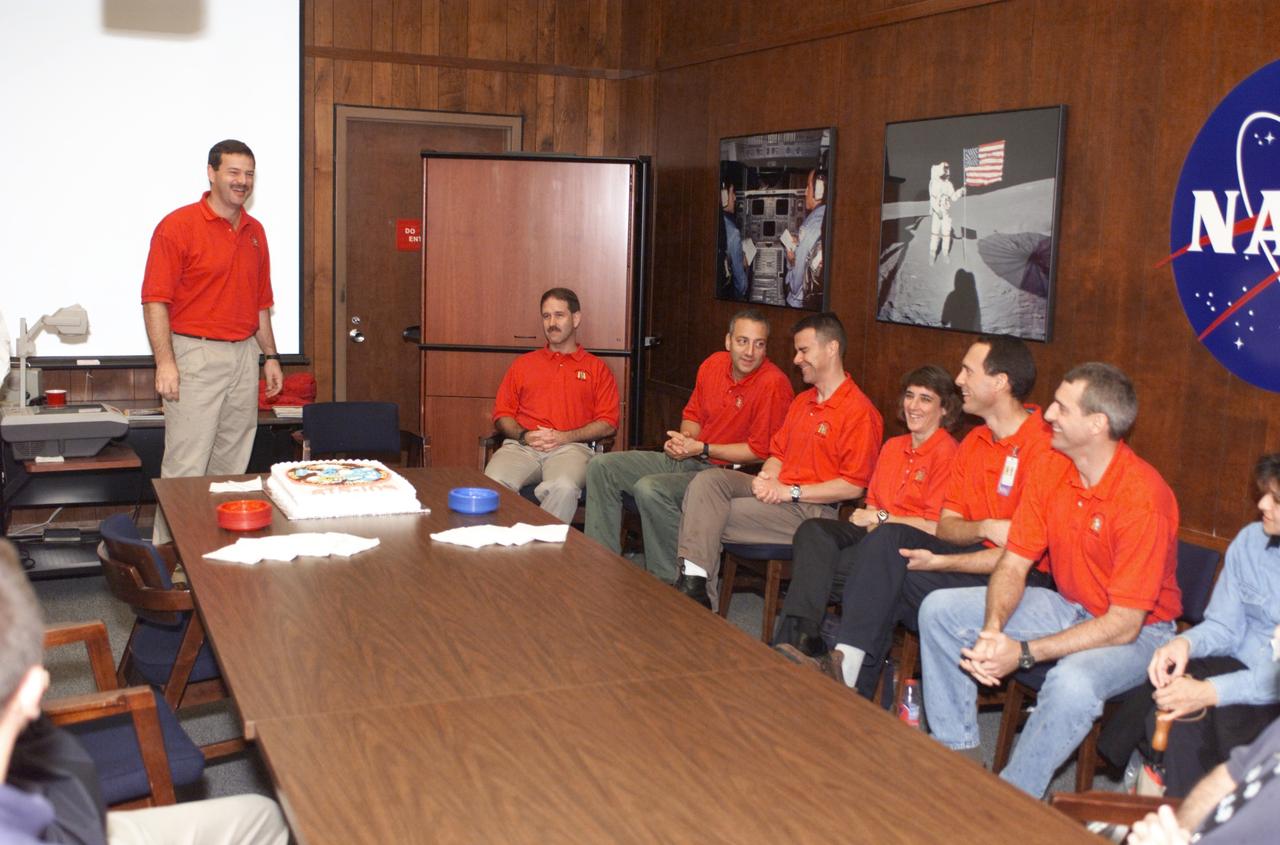
JSC2001-E-44844 (December 2001) --- The STS-109 crew members pause from their mission training for a cake cutting ceremony in the Jake Garn Simulation and Training Facility at the Johnson Space Center (JSC). Standing is astronaut Scott D. Altman, mission commander. Seated from left to right are astronauts John M. Grunsfeld, payload commander; Michael J. Massimino, mission specialist; Duane G. Carey, pilot; along with Nancy J. Currie, James H. Newman, and Richard M. Linnehan, mission specialists.
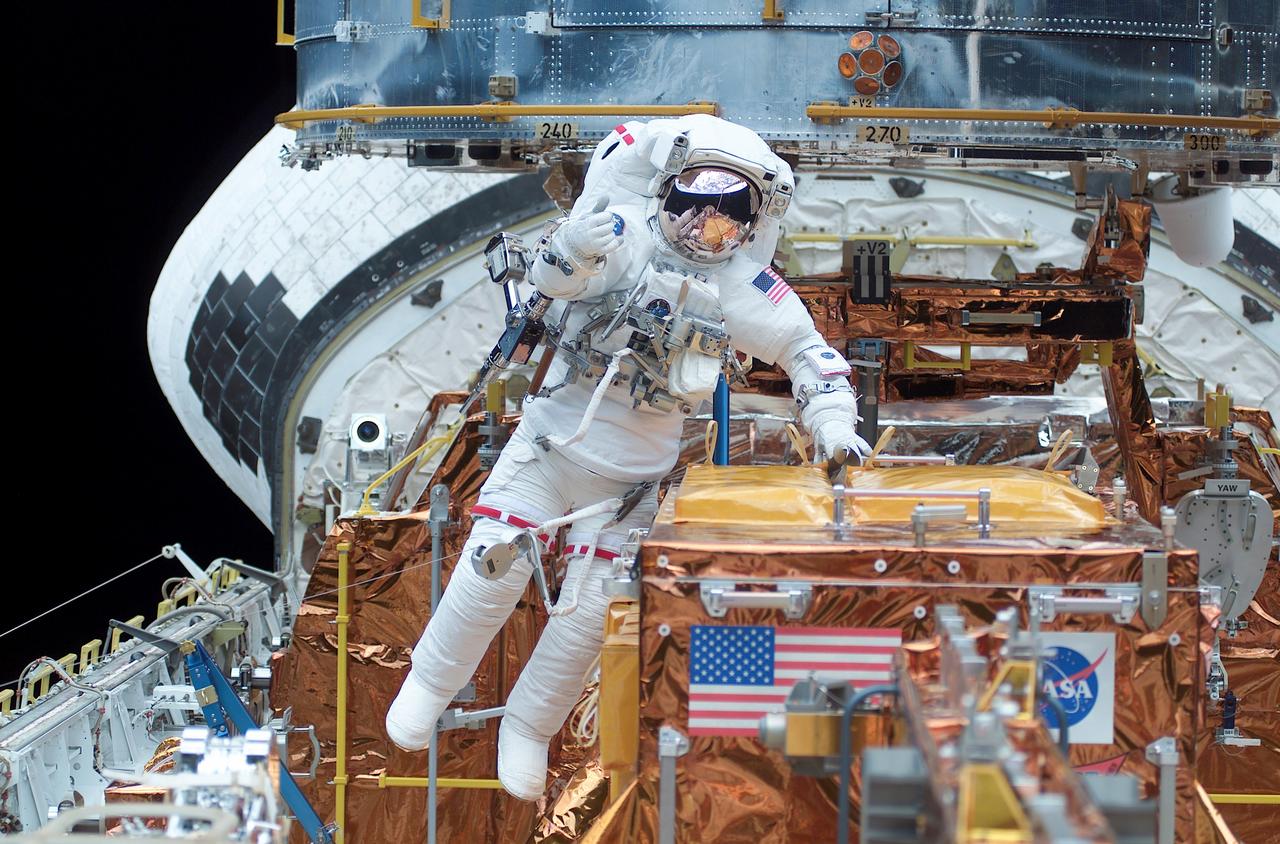
Astronaut James H. Newman, mission specialist, floats about in the Space Shuttle Columbia's cargo bay while working in tandem with astronaut Michael J. Massimino (out of frame),mission specialist, during the STS-109 mission's second day of extravehicular activity (EVA). Inside Columbia's cabin, astronaut Nancy J. Currie, mission specialist, controlled the Remote Manipulator System (RMS) to assist the two in their work on the Hubble Space Telescope (HST). The RMS was used to capture the telescope and secure it into Columbia's cargo bay.Part of the giant telescope's base, latched down in the payload bay, can be seen behind Newman. The Space Shuttle Columbia STS-109 mission lifted off March 1, 2002 with goals of repairing and upgrading the HST. The Marshall Space Flight Center in Huntsville, Alabama had responsibility for the design, development, and contruction of the HST, which is the most powerful and sophisticated telescope ever built. STS-109 upgrades to the HST included: replacement of the solar array panels; replacement of the power control unit (PCU); replacement of the Faint Object Camera (FOC) with a new advanced camera for Surveys (ACS); and installation of the experimental cooling system for the Hubble's Near-Infrared Camera and Multi-object Spectrometer (NICMOS), which had been dormant since January 1999 when its original coolant ran out. Lasting 10 days, 22 hours, and 11 minutes, the STS-109 mission was the 108th flight overall in NASA's Space Shuttle Program.
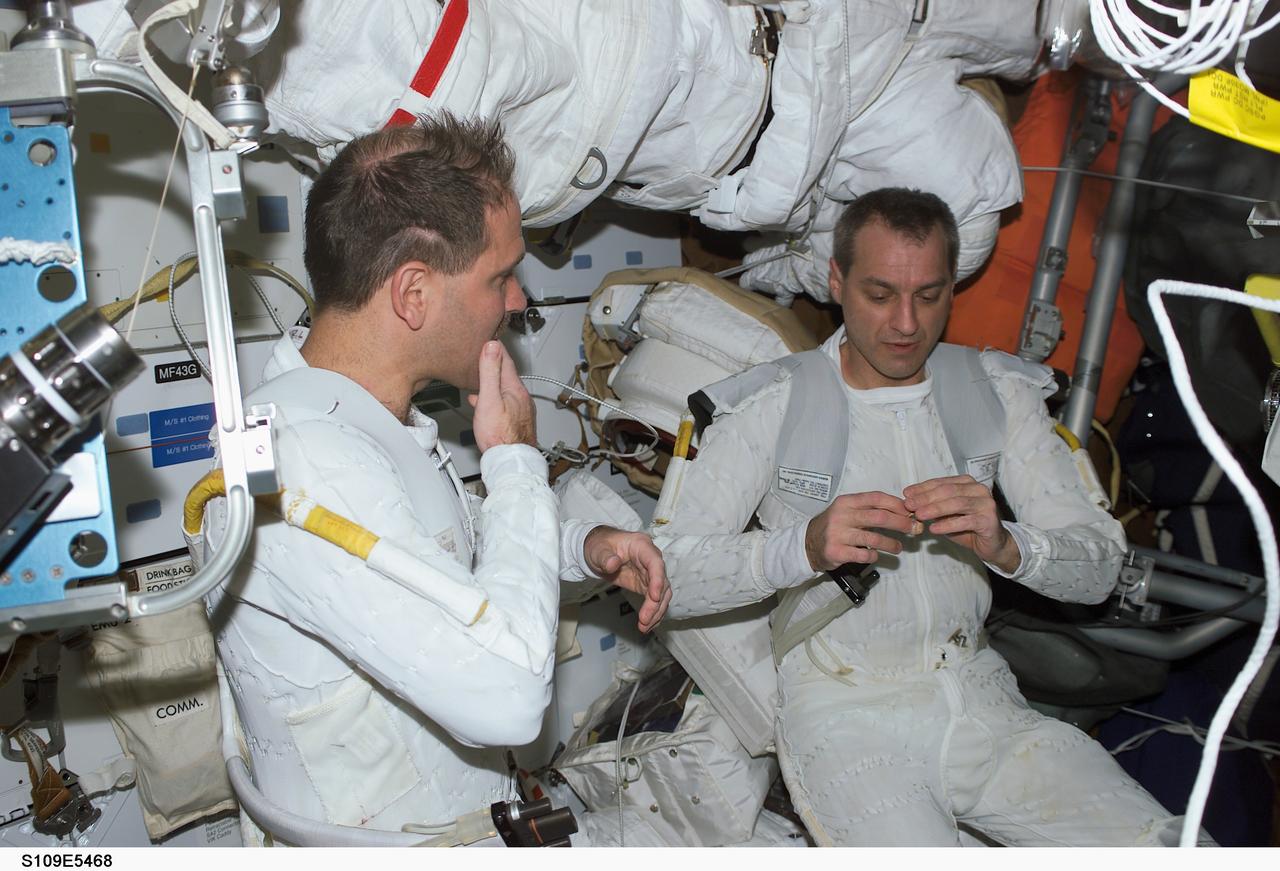
STS109-E-5468 (4 March 2002) --- Having just arrived back on board the crew cabin of the Space Shuttle Columbia, the first team of assigned space walkers for STS-109 talk about their shared seven-hour extravehicular activity while still attired in their thermal undergarments. Astronauts John M. Grunsfeld (left) and Richard M. Linnehan just completed the first of five scheduled STS-109 space walks to work on the Hubble Space Telescope (HST), successfully replacing the starboard solar array on the giant telescope. The next day's assignment will feature replacement of the port array by astronauts James H. Newman and Michael J. Massimino (both out of frame), whose extravehicular mobility unit (EMU)space suits can be seen stowed on the mid deck. This image was recorded with a digital still camera.
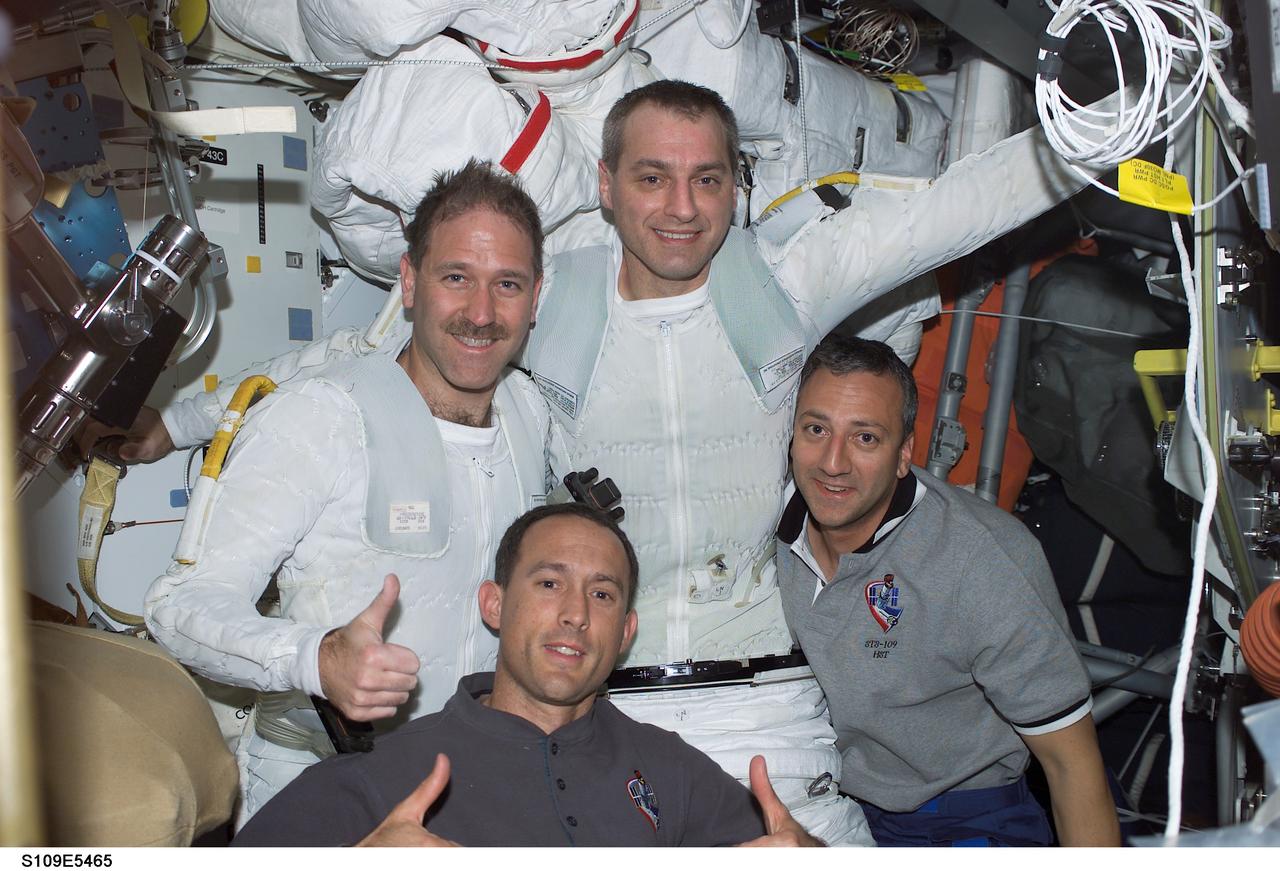
STS109-E-5465 (4 March 2002) --- Gathered near the airlock on the mid deck of the Space Shuttle Columbia, the two teams of assigned space walkers for STS-109 could easily be saying in unison, "One down, four to go." Still attired in their thermal undergarments, astronauts John M. Grunsfeld (left) and Richard M. Linnehan just completed the first of five scheduled STS-109 space walks to work on the Hubble Space Telescope (HST), successfully replacing the starboard solar array on the giant telescope. The next day's assignment will feature replacement of the port array by astronauts James H. Newman (bottom center) and Michael J. Massimino. This image was recorded with a digital still camera.
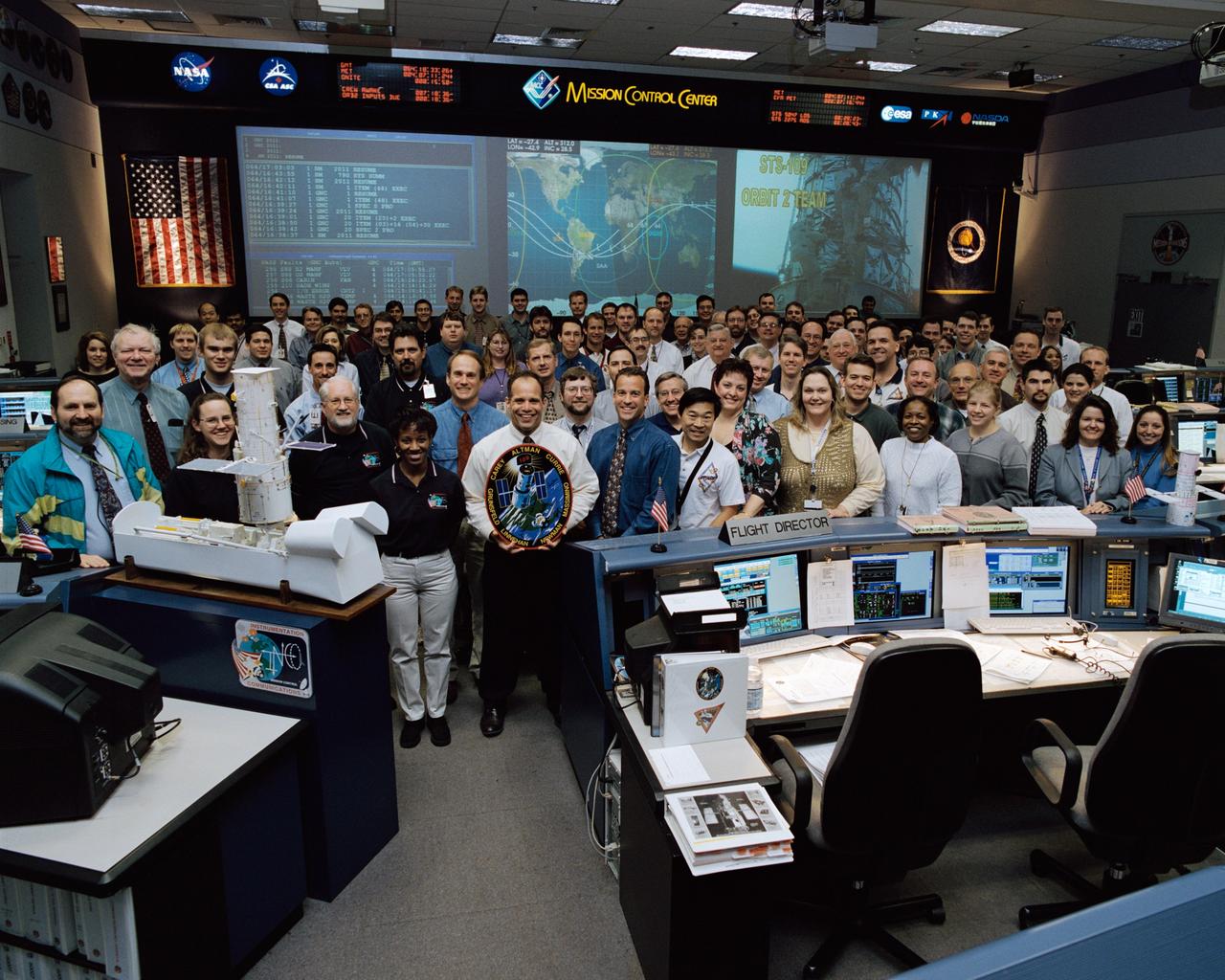
JSC2002-00574 (5 March 2002) --- The members of the STS-109 Orbit 2 Team pose for a group portrait in the shuttle flight control room (WFCR) in Houston's Mission Control Center (MCC). Flight director Tony Ceccacci holds the STS-109 mission logo.
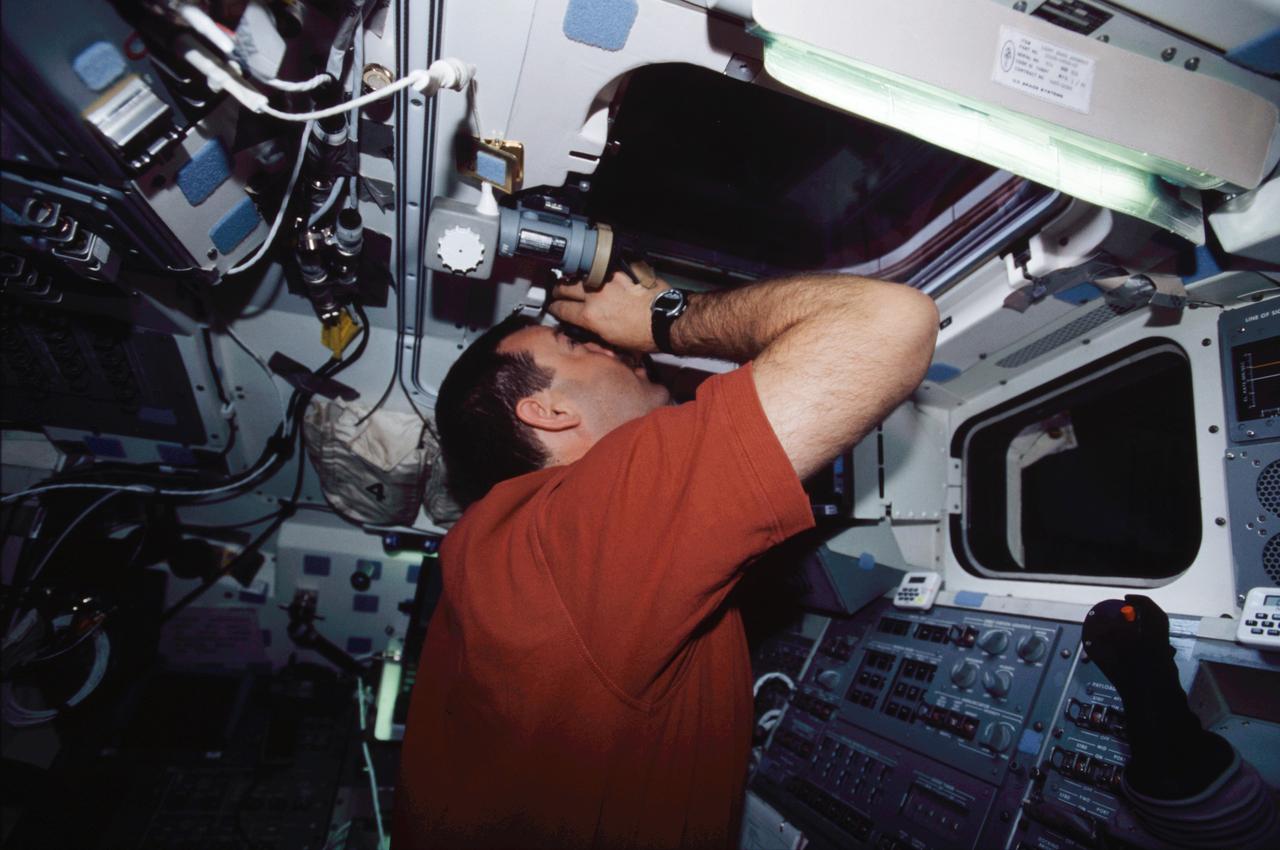
STS109-346-002 (1-12 March 2002) --- Astronaut Scott D. Altman, STS-109 mission commander, looks out an overhead window on the aft flight deck of the Space Shuttle Columbia.
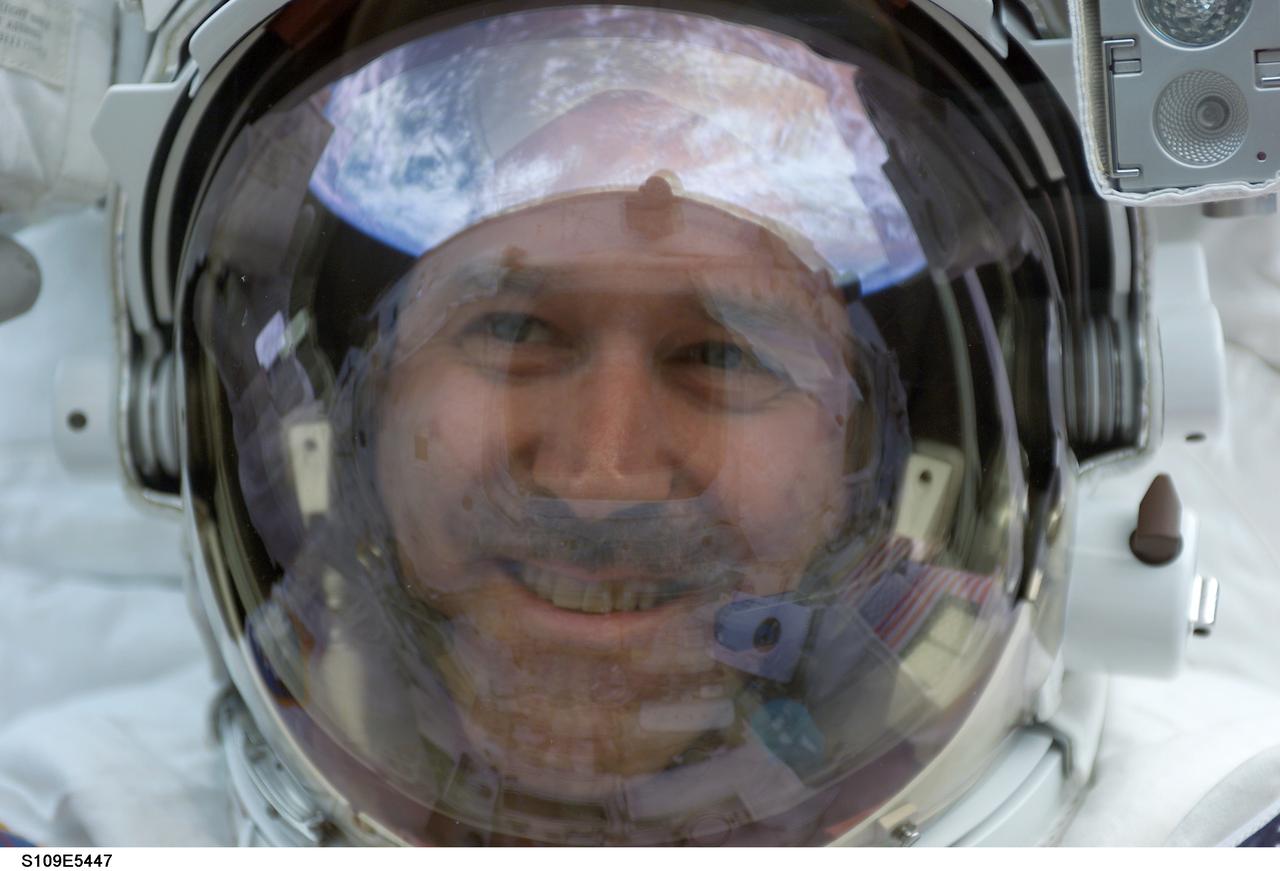
STS109-E-5447 (4 March 2002) --- Astronaut John M. Grunsfeld, payload commander, peers into the crew cabin of the Space Shuttle Columbia during the first STS-109 extravehicular activity (EVA-1) on March 4, 2002. Grunsfeld's helmet visor displays a mirrored image of the Earth's hemisphere. Astronauts Grunsfeld and Richard M. Linnehan replaced the starboard solar array on the Hubble Space Telescope (HST) on the first of five scheduled STS-109 space walks. The image was recorded with a digital still camera by a crewmate on shuttle's aft flight deck.
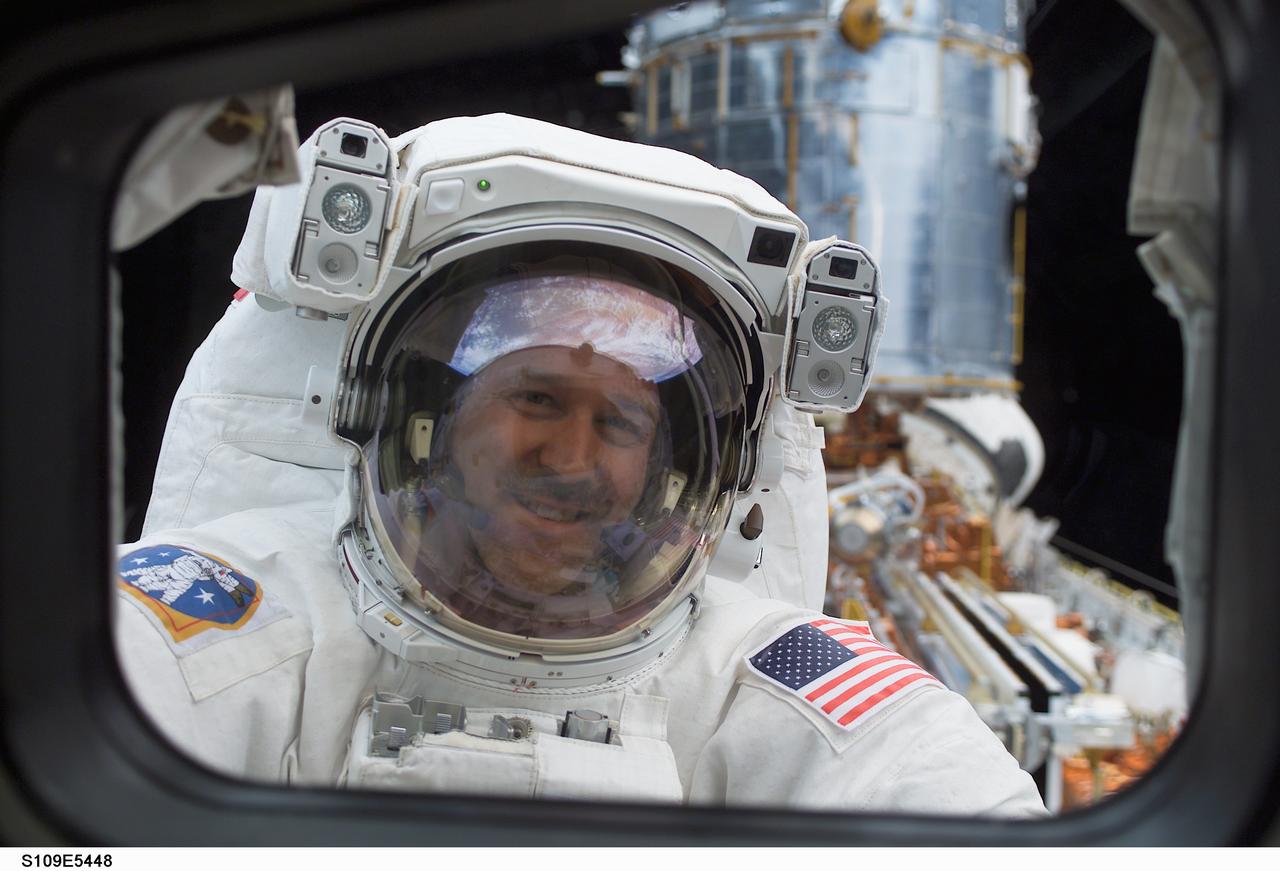
STS109-E-5448 (4 March 2002) --- Astronaut John M. Grunsfeld, payload commander, peers into the crew cabin of the Space Shuttle Columbia during the first STS-109 extravehicular activity (EVA-1) on March 4, 2002. Grunsfeld's helmet visor displays a mirrored image of the Earth's hemisphere. Astronauts Grunsfeld and Richard M. Linnehan replaced the starboard solar array on the Hubble Space Telescope (HST) on the first of five scheduled STS-109 space walks. The lower portion of the giant telescope can be seen over Grunsfeld's left shoulder. The image was recorded with a digital still camera by a crewmate on shuttle's aft flight deck.

STS109-E-5668 (6 March 2002) --- The two space walking teams of STS-109 crew members, who today surpassed the halfway point in their extravehicular activity (EVA) duty, pose for a snapshot on the mid deck of the Space Shuttle Columbia. From the left are astronauts Richard M. Linnehan, James H. Newman, John M. Grunsfeld and Michael J. Massimino. Following the second spacewalk by the Grunsfeld-Linnehan duo earlier today, marking the third overall for the STS-109 mission, each team has one space walk remaining. The image was recorded with a digital still camera.
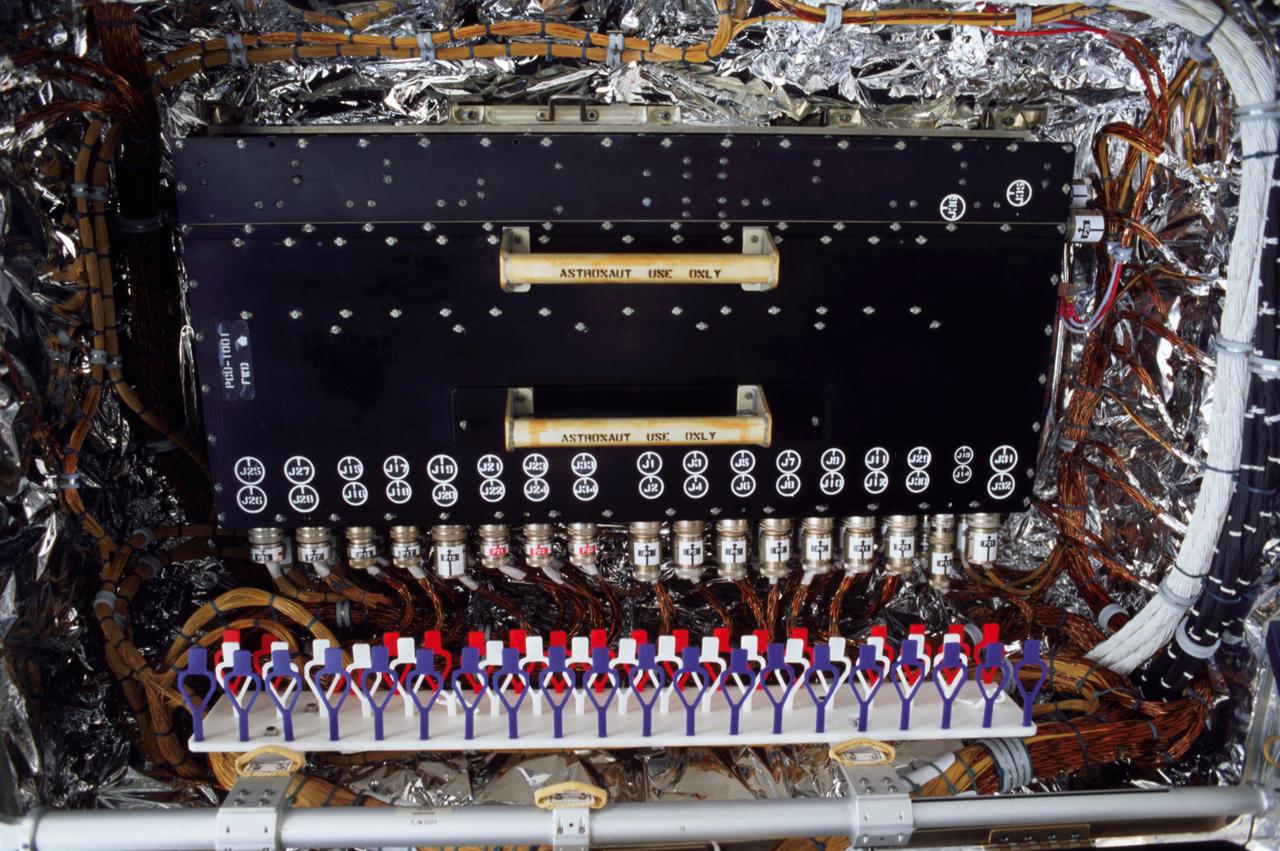
This is an onboard photo of the Hubble Space Telescope (HST) power control unit (PCU), the heart of the HST's power system. STS-109 payload commander John M. Grunsfeld, joined by Astronaut Richard M. Lirnehan, turned off the telescope in order to replace its PCU while participating in the third of five spacewalks dedicated to servicing and upgrading the HST. Other upgrades performed were: replacement of the solar array panels; replacement of the Faint Object Camera (FOC) with a new advanced camera for Surveys (ACS); and installation of the experimental cooling system for the Hubble's Near-Infrared Camera and Multi-Object Spectrometer (NICMOS), which had been dormant since January 1999 when its original coolant ran out. The telescope was captured and secured on a work stand in Columbia's payload bay using Columbia's robotic arm, where crew members completed the system upgrades. The Marshall Space Flight Center had the responsibility for the design, development, and construction of the HST, which is the most complex and sensitive optical telescope ever made, to study the cosmos from a low-Earth orbit. The HST detects objects 25 times fainter than the dimmest objects seen from Earth and provides astronomers with an observable universe 250 times larger than is visible from ground-based telescopes, perhaps as far away as 14 billion light-years. Launched March 1, 2002 the STS-109 HST servicing mission lasted 10 days, 22 hours, and 11 minutes. It was the 108th flight overall in NASA's Space Shuttle Program.
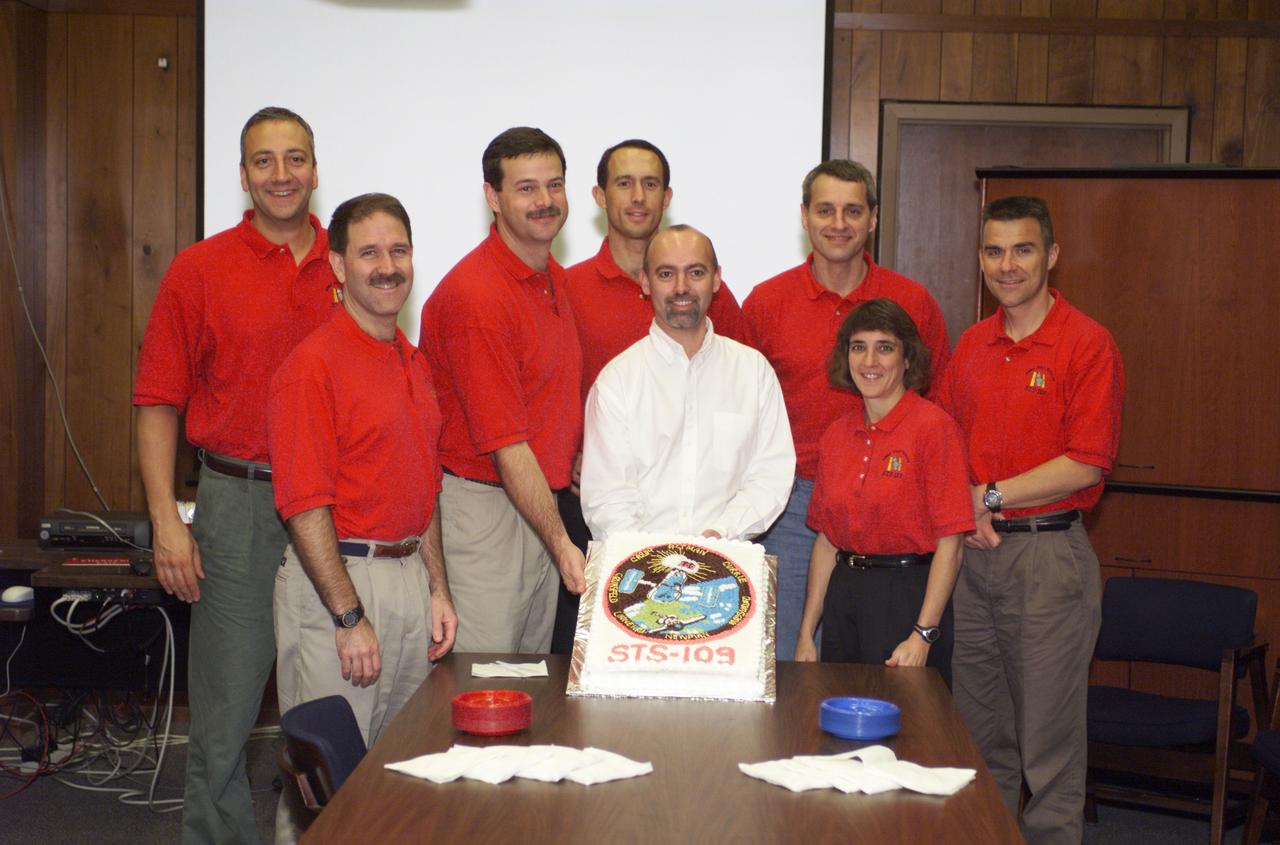
JSC2001-E-44845 (December 2001) --- The STS-109 crew members, along with David Steward (center) of the United Space Alliance (USA), pause from their mission training for a cake cutting ceremony in the Jake Garn Simulation and Training Facility at the Johnson Space Center (JSC). From left to right are astronauts Michael J. Massimino, John M. Grunsfeld, Scott D. Altman, James H. Newman, Richard M. Linnehan, Nancy J. Currie, and Duane G. Carey. Altman and Carey, are mission commander and pilot, respectively. Grunsfeld is payload commander, with the others serving as mission specialists.
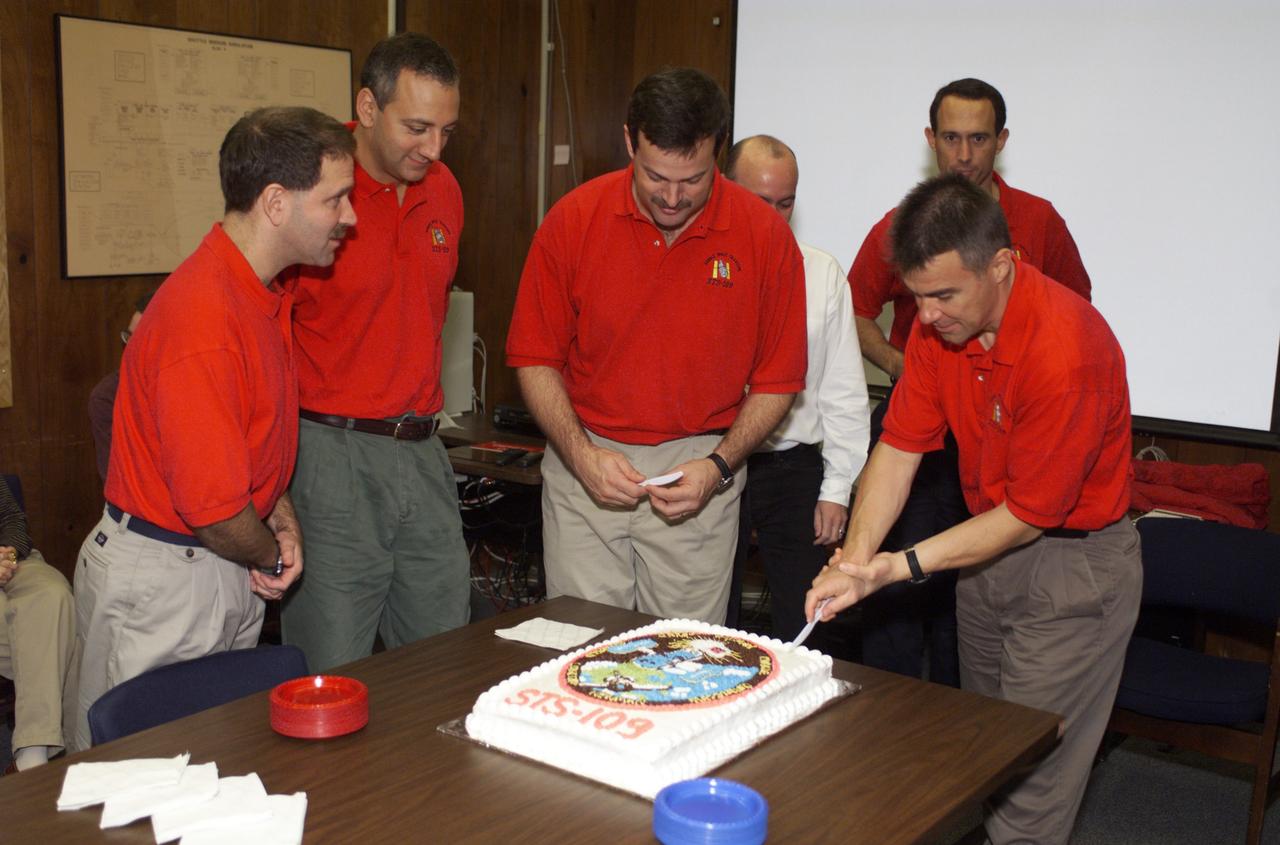
JSC2001-E-44846 (December 2001) --- The STS-109 crew members pause from their mission training for a cake cutting ceremony in the Jake Garn Simulation and Training Facility at the Johnson Space Center (JSC). From left to right are astronauts John M. Grunsfeld, Michael J. Massimino, Scott D. Altman, and Duane G. Carey, James H. Newman; along with David Steward of the United Space Alliance (USA). Altman and Carey are mission commander and pilot, respectively. Grunsfeld is payload commander, with the others serving as mission specialists. Astronauts Nancy J. Currie and Richard M. Linnehan are out of frame.
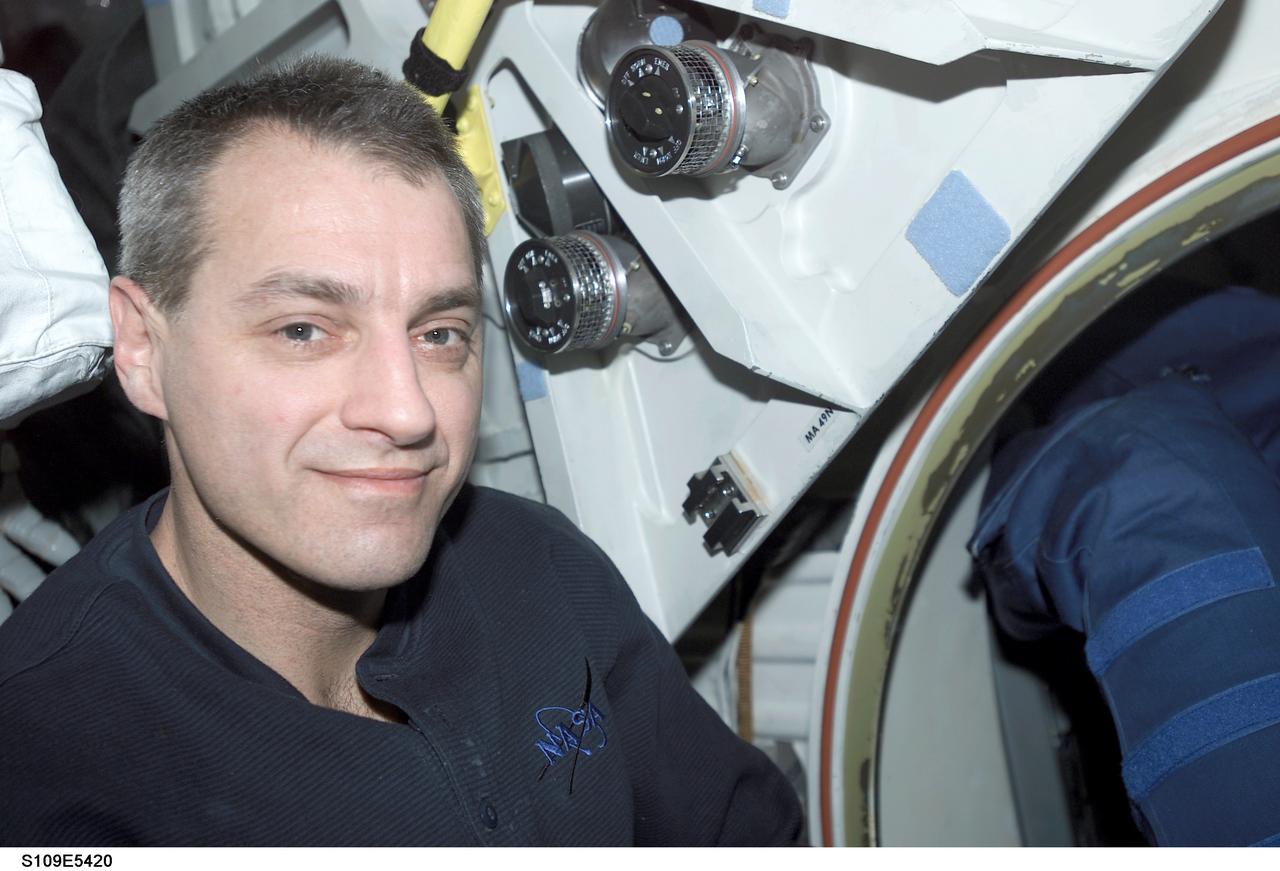
STS109-E-5420 (7 March 2002) --- Flight Day 7 of the STS-109 mission finds astronaut Richard M. Linnehan, mission specialist, back in the shirt-sleeve environment of the Space Shuttle Columbia, just like his space walking partner--astronaut John M. Grunsfeld (out of frame). Two of Grunsfeld's crewmates were about to begin the fourth space walk of the mission to perform special tasks on the Hubble Space Telescope (HST). Linnehan and Grunsfeld will participate in the fifth and final scheduled spacewalk in a little more than 24 hours. It will mark their third shared space walk for the current mission. This image was recorded with a digital still camera.
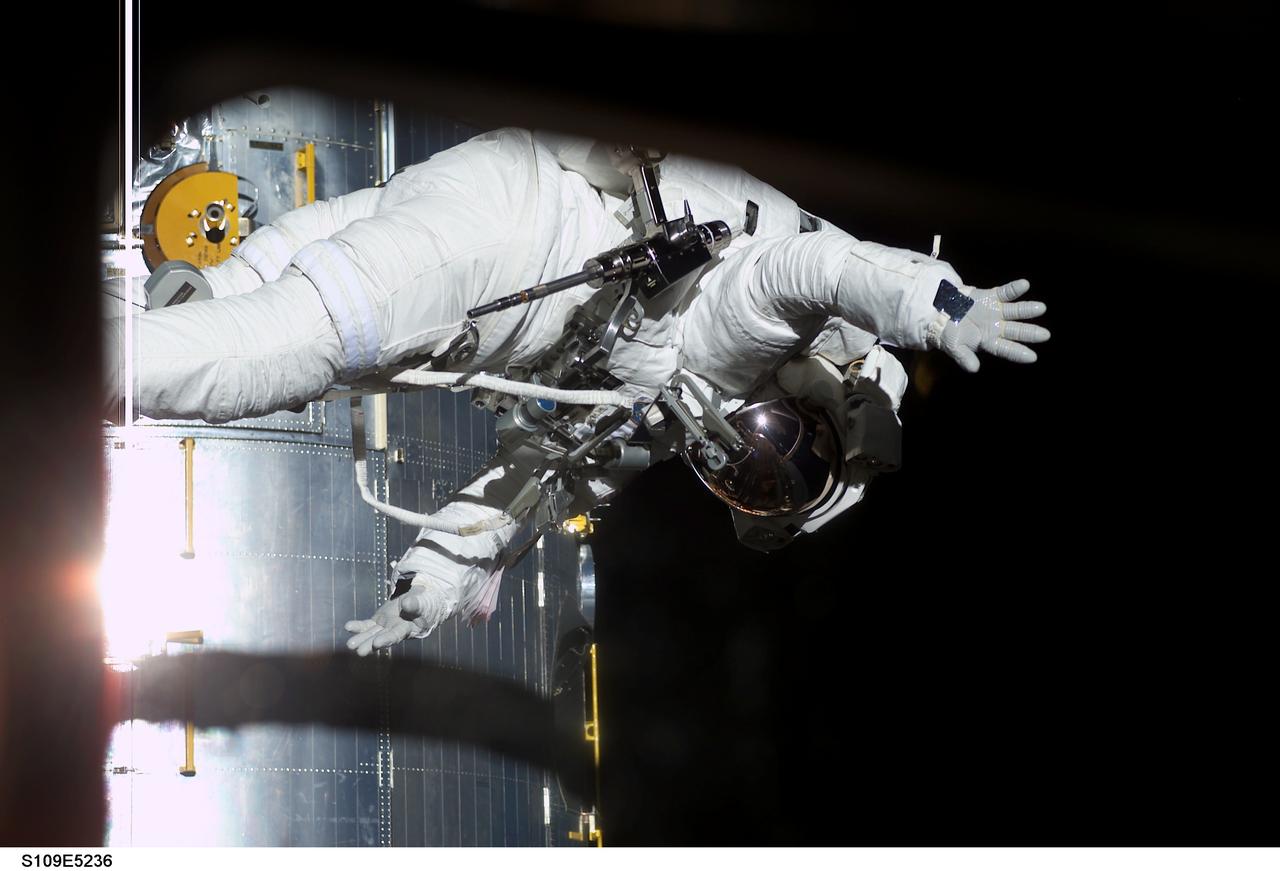
STS109-E-5236 (4 March 2002) --- Astronauts Richard M. (Rick) Linnehan, mission specialist, waves to crewmates inside the Space Shuttle Columbia's crew cabin as he participates in one of his assigned STS-109 space walks to perform work on the Hubble Space Telescope (HST). Astronauts Linnehan and John M. Grunsfeld, payload commander, went on to replace the giant telescope’s starboard solar array. Their seven-hour space walk ended at 7:38 a.m. (CST) or 13:38 GMT March 4, 2002.

STS109-E-5419 (7 March 2002) --- Flight Day 7 of the STS-109 mission finds payload commander John M. Grunsfeld back in the shirt-sleeve environment of the Space Shuttle Columbia. Two of Grunsfeld's crewmates were about to begin the fourth space walk of the mission to perform special tasks on the Hubble Space Telescope (HST). Grunsfeld will participate in the fifth and final scheduled spacewalk in a little more than 24 hours. It will mark his third space walk for the current mission. This image was recorded with a digital still camera.
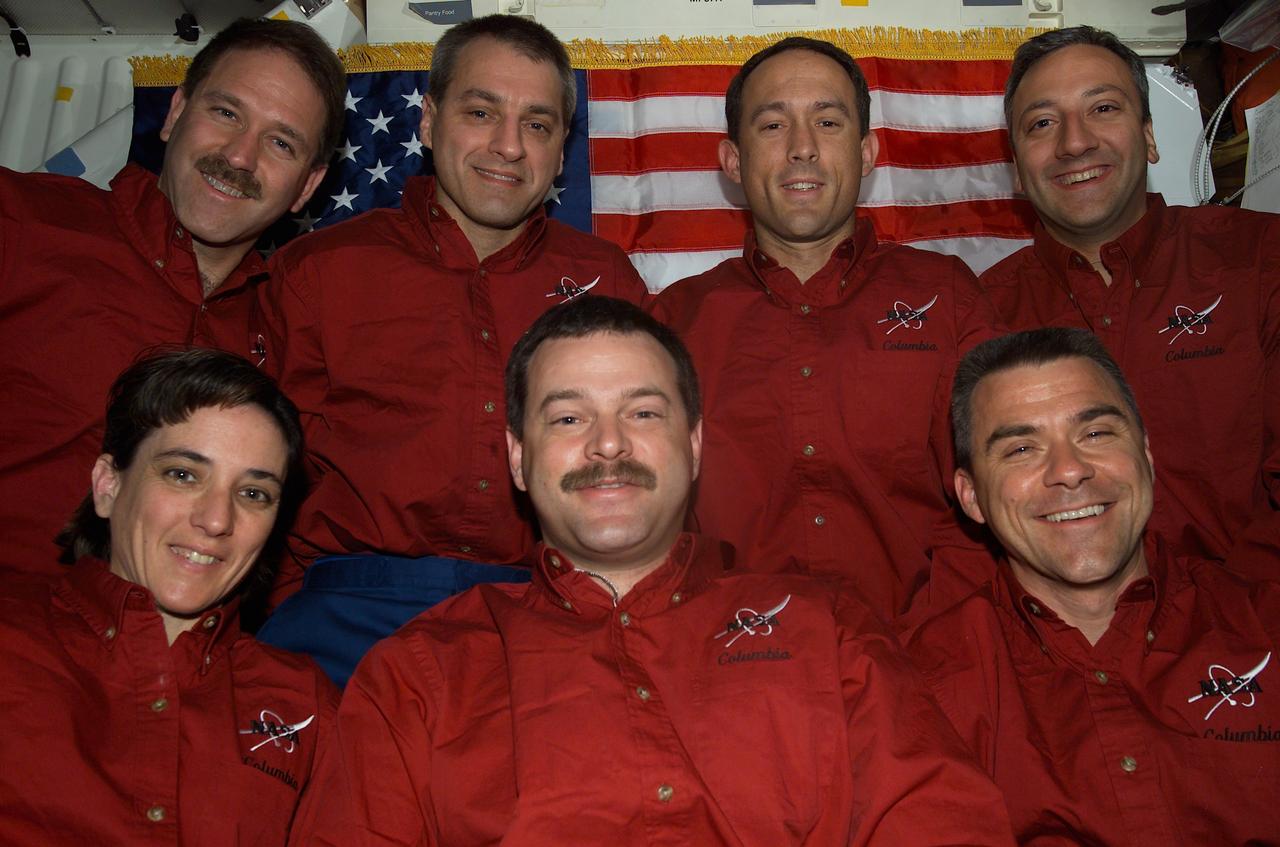
STS109-E-6032 (11 March 2002) --- On the Space Shuttle Columbia’s mid deck, the crewmembers for the STS-109 mission pose for the traditional in-flight portrait. From the left (front row), are astronauts Nancy J. Currie, mission specialist, Scott D. Altman, mission commander, and Duane G. Carey, pilot. From the left (back row), are astronauts John M. Grunsfeld, payload commander, and Richard M. Linnehan, James H. Newman, and Michael J. Massimino, all mission specialists. The image was recorded with a digital still camera.
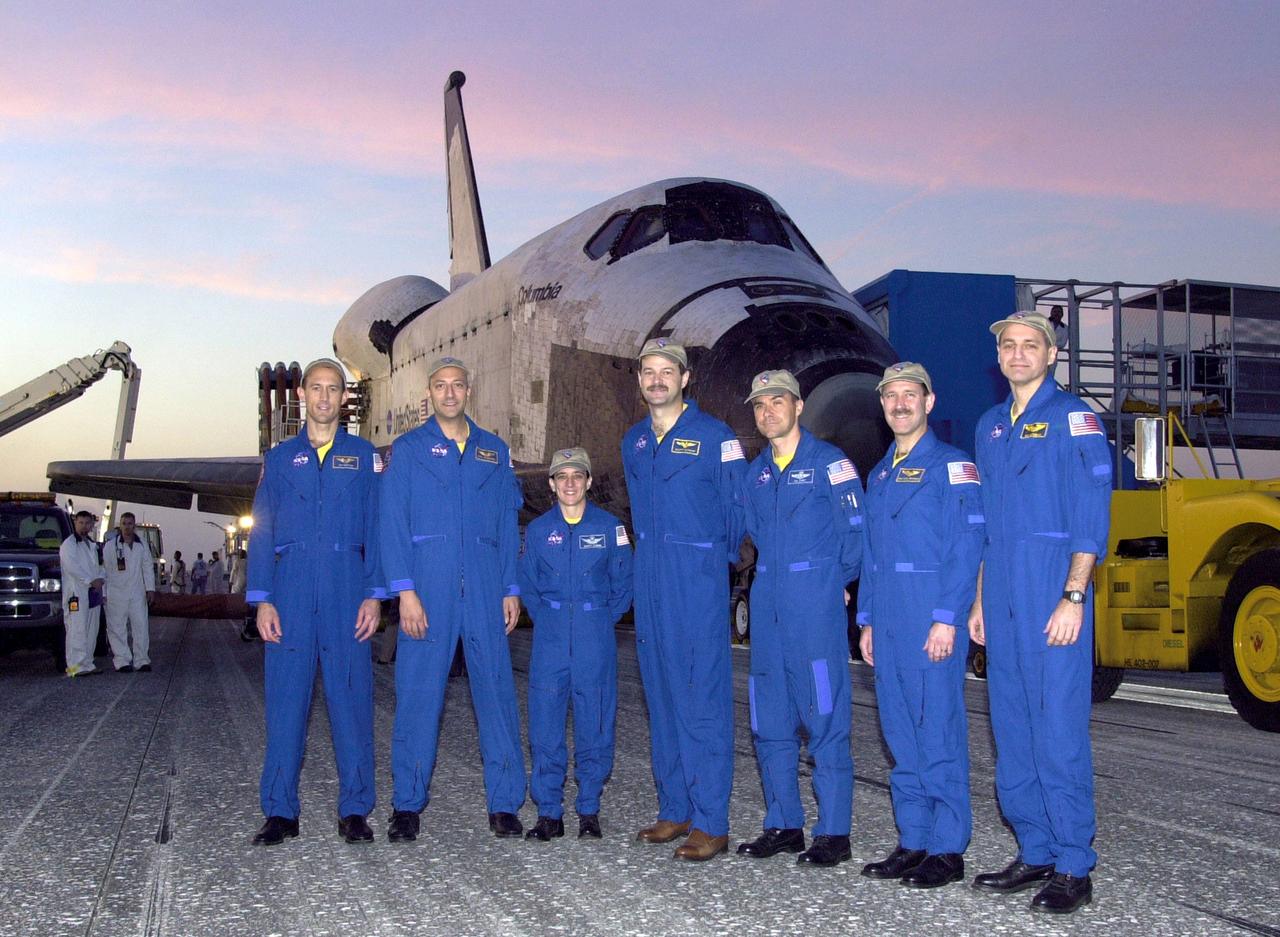
Posing in front of the Space Shuttle Columbia is the returning STS-109 crew. From left are astronauts James H. Newman, Michael J. Massimino, Nancy J. Currie, Scott D. Altman, Duane G. Carey, John M. Grunsfeld and Richard M. Linnehan. The crew returned to Earth after a successful 11-day mission servicing and upgrading the Hubble Space Telescope.

STS109-E-5389 (5 March 2002) --- Astronaut James H. Newman, mission specialist, returns to a stowage area in the cargo bay of the Space Shuttle Columbia during the STS-109 mission's second day of extravehicular activity (EVA). Astronauts Newman and Michael J. Massimino worked to replace the second set of solar arrays on the Hubble Space Telescope (HST). The image was recorded with a digital still camera.
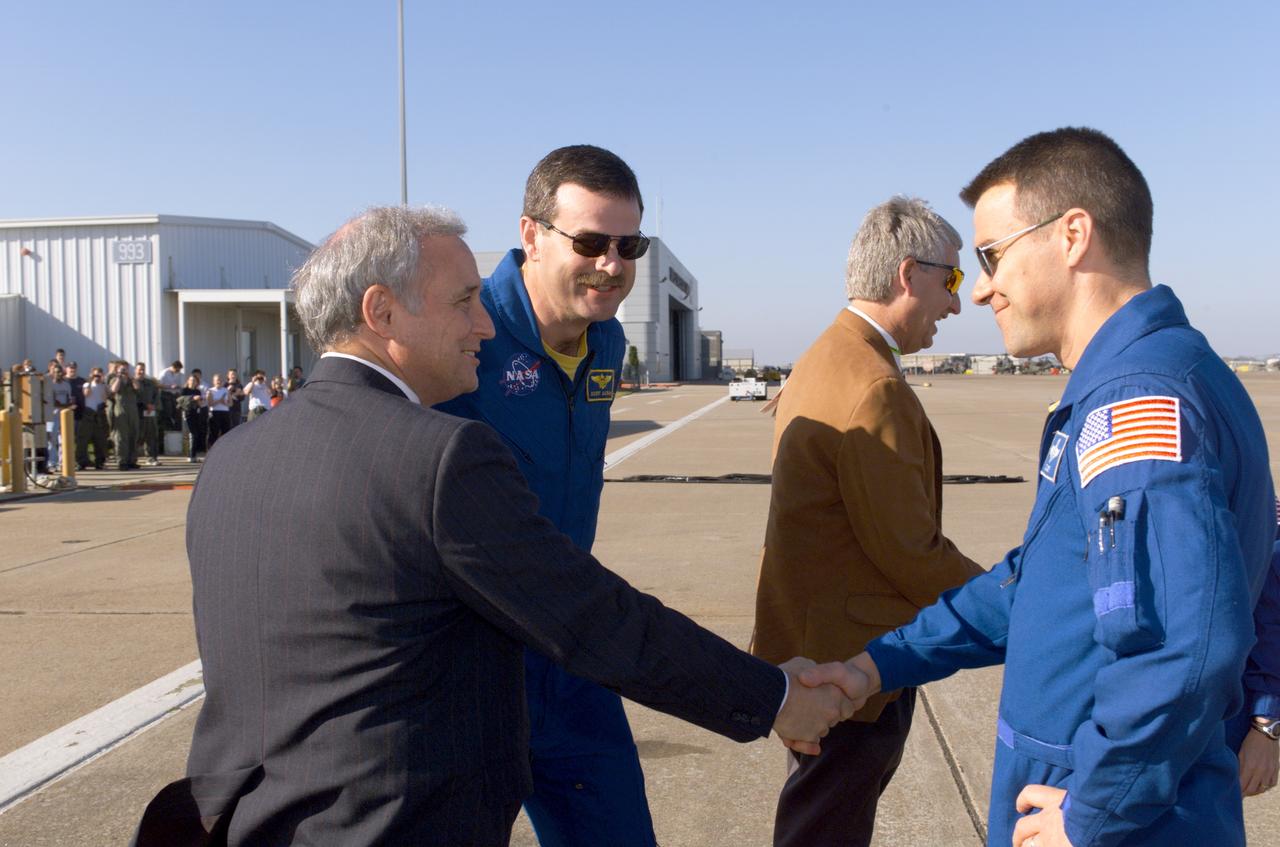
JSC2002-E-09329 (13 March 2002) --- Astronaut Duane G. Carey (right foreground), STS-109 pilot, shakes hands with Johnson Space Center’s (JSC) Acting Director Roy Estess during the crew return ceremonies at Ellington Field. Also pictured are astronaut Scott D. Altman (left background), mission commander, and astronaut Steven A. Hawley, Director of Flight Crew Operations.
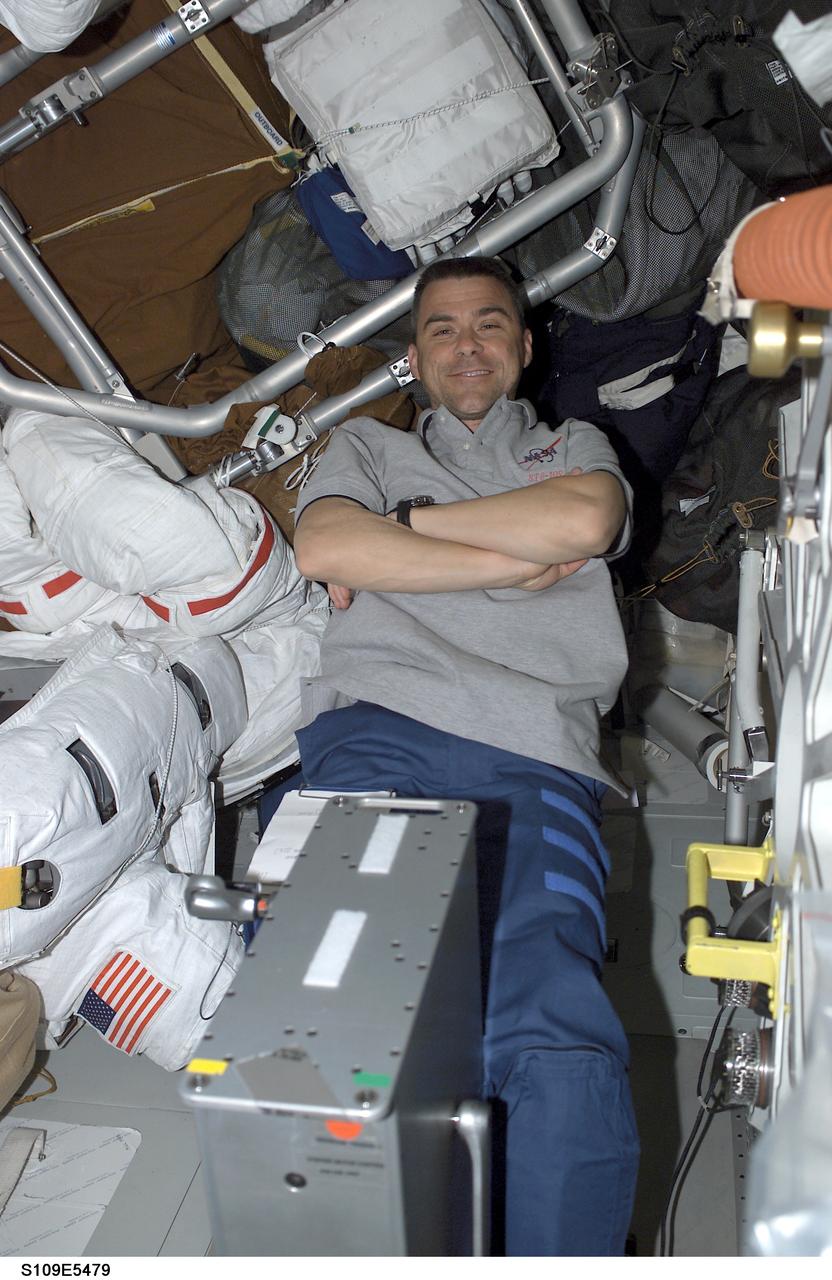
STS109-E-5479 (7 March 2002)-- Astronaut Duane G. Carey, STS-109 pilot, takes a leisurely "spin" on the bicycle ergometer on the mid deck of the Space Shuttle Columbia, while waiting to assist Flight Day 7's assigned space walkers--astronaut James H. Newman and Michael J. Massimino. The extravehicular mobility unit (EMU) space suits of the two can be seen in the background. The image was recorded with a digital still camera.
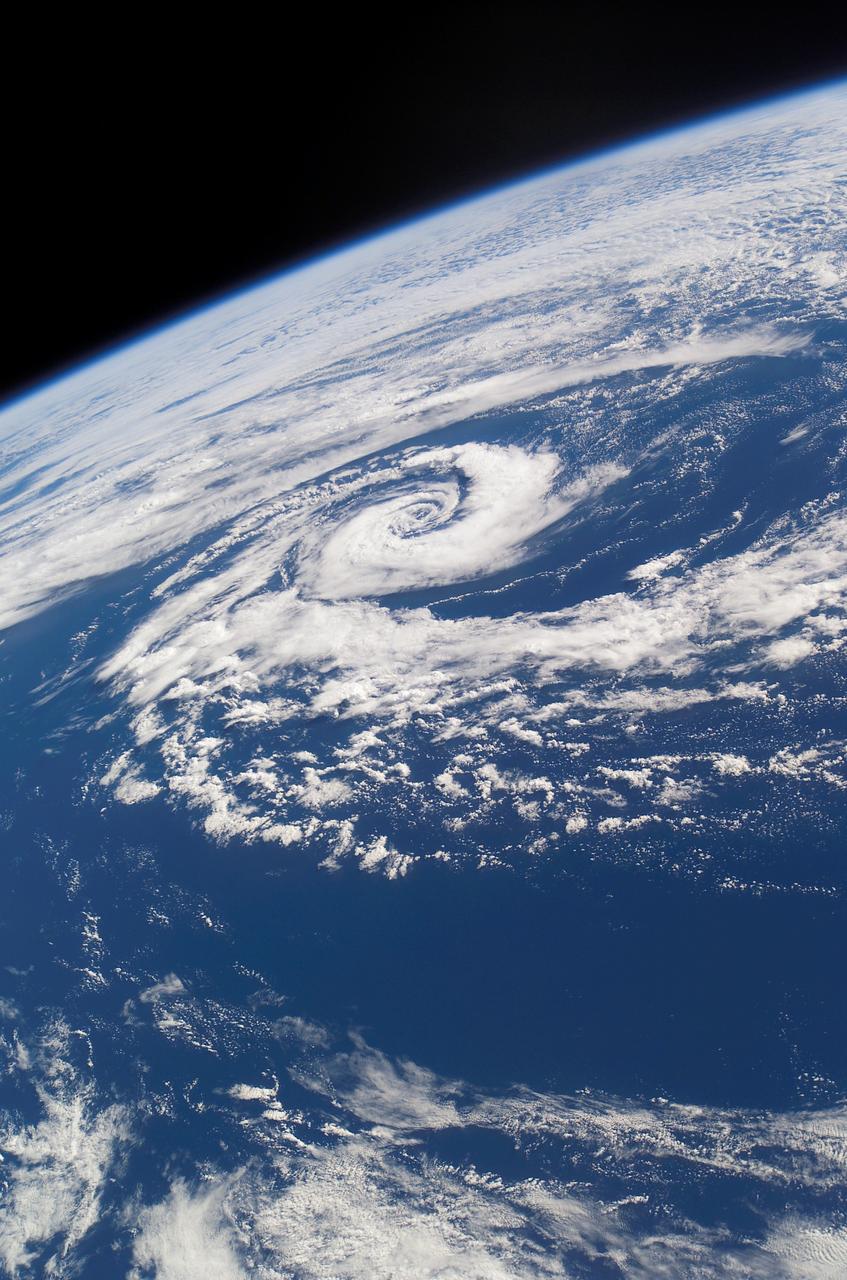
STS109-E-6003 (10 March 2002) --- The astronauts on board the Space Shuttle Columbia took this digital picture featuring a well-defined subtropical cyclone. The view looks southwestward over the Tasman Sea (between Australia and New Zealand). According to meteorologists studying the STS-109 photo collection, such circulations are recognized as hybrids, lacking the tight banding and convection of tropical cyclones, and the strong temperature contrast and frontal boundaries of polar storms. The image was recorded with a digital still camera.
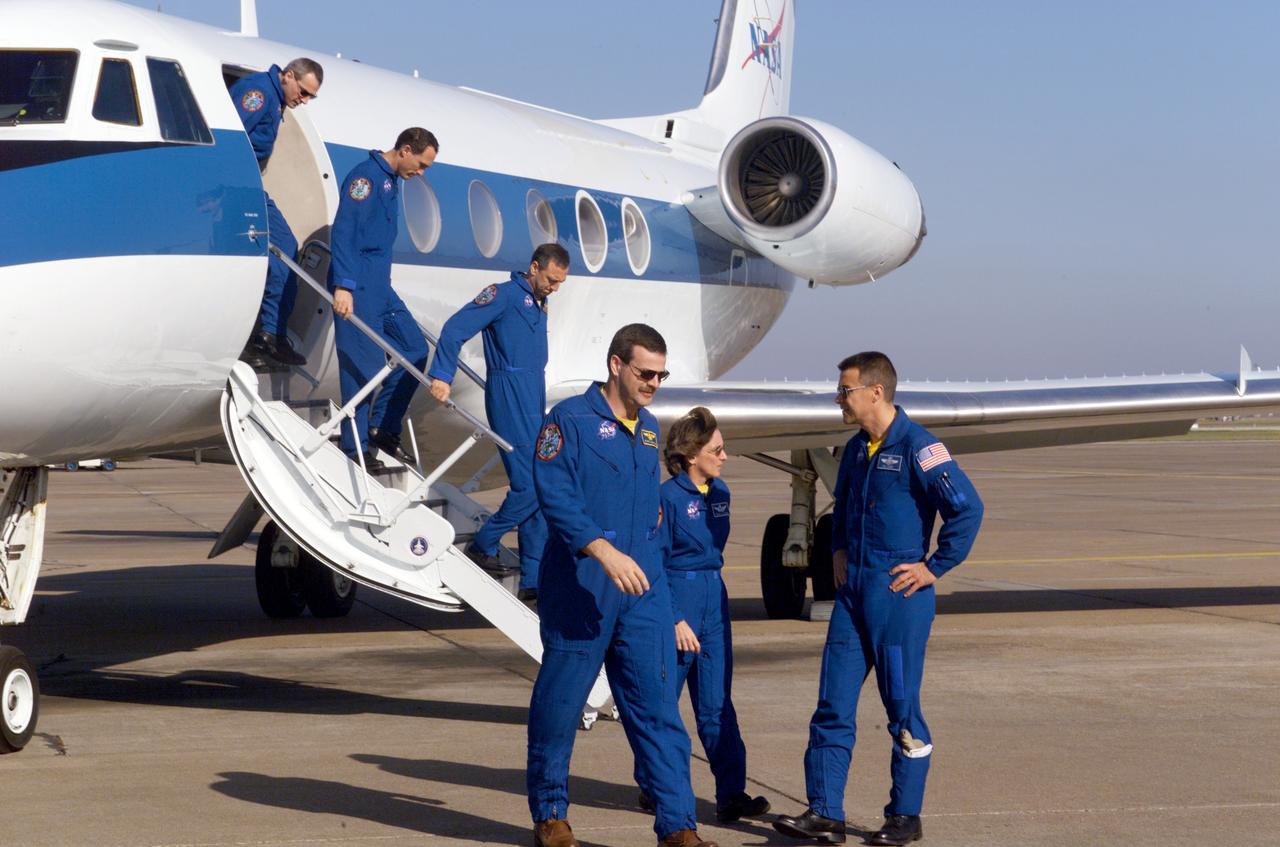
JSC2002-E-09328 (13 March 2002) --- The STS-109 crew exit a Gulfstream aircraft during the crew return ceremonies at Ellington Field. From the left (foreground) are astronauts Scott D. Altman, mission commander, Nancy J. Currie, mission specialist, and Duane G. Carey, pilot. From the top of the stairs are astronauts Richard M. Linnehan, James H. Newman, and Michael J. Massimino, all mission specialists. Astronaut John M. Grunsfeld, payload commander, is out of frame.
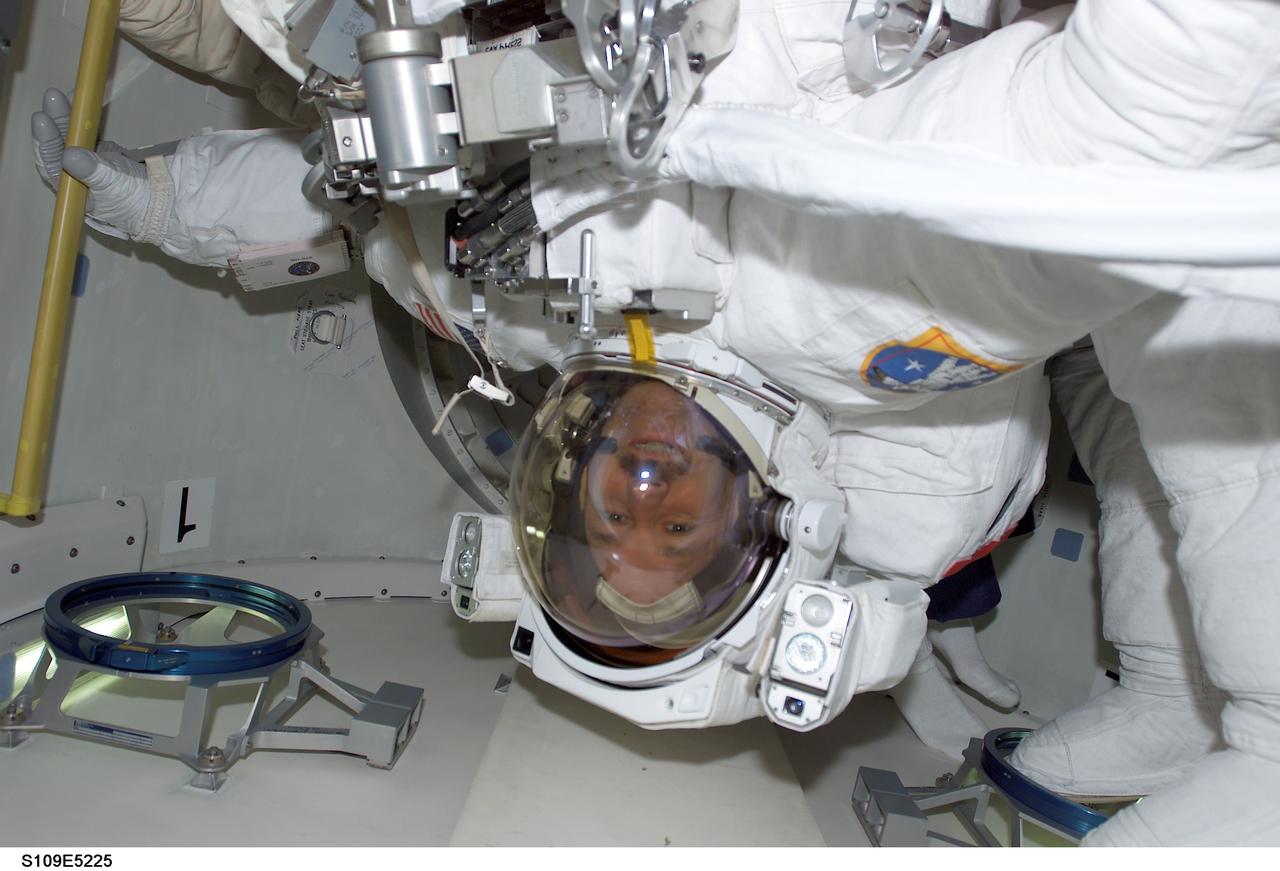
STS109-E-5225 (4 March 2002) --- Astronaut John M. Grunsfeld, payload commander, signals readiness for the first the first of his assigned STS-109 space walks to perform work on the Hubble Space Telescope (HST). Astronauts Grunsfeld and Richard M. Linnehan moments later egressed the Space Shuttle Columbia's airlock, eventually replacing the giant telescope’s starboard solar array during a space walk that ended at 7:38 a.m. (CST) or 13:38 GMT March 4, 2002.
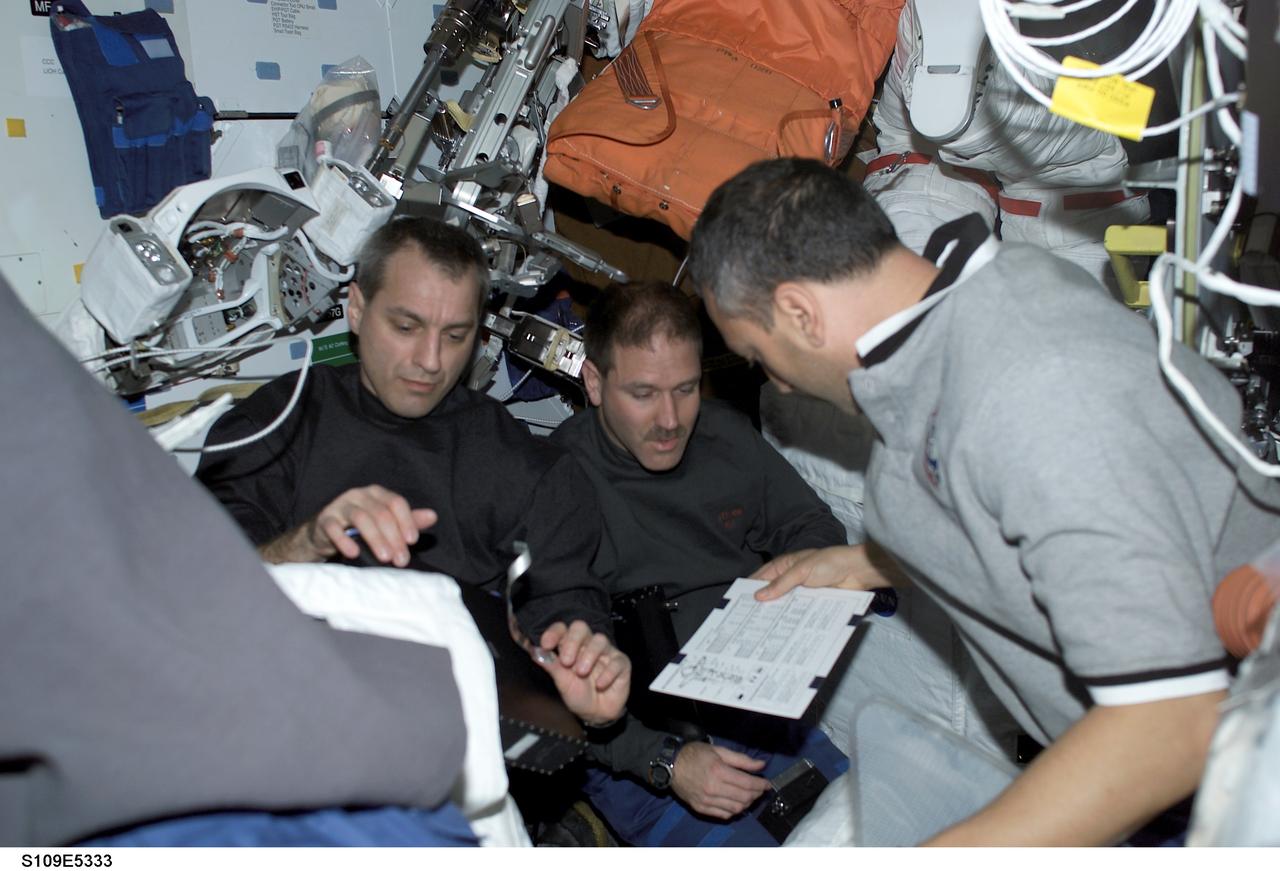
STS109-E-5333 (4 March 2002) --- Three STS-109 crew members assigned to extravehicular activity (EVA) duty on the Hubble Space Telescope (HST) discuss strategy on the mid deck of the Space Shuttle Columbia. From the left are astronauts Richard M. Linnehan, John M. Grunsfeld and Michael J. Massimino. The image was recorded with a digital still camera.
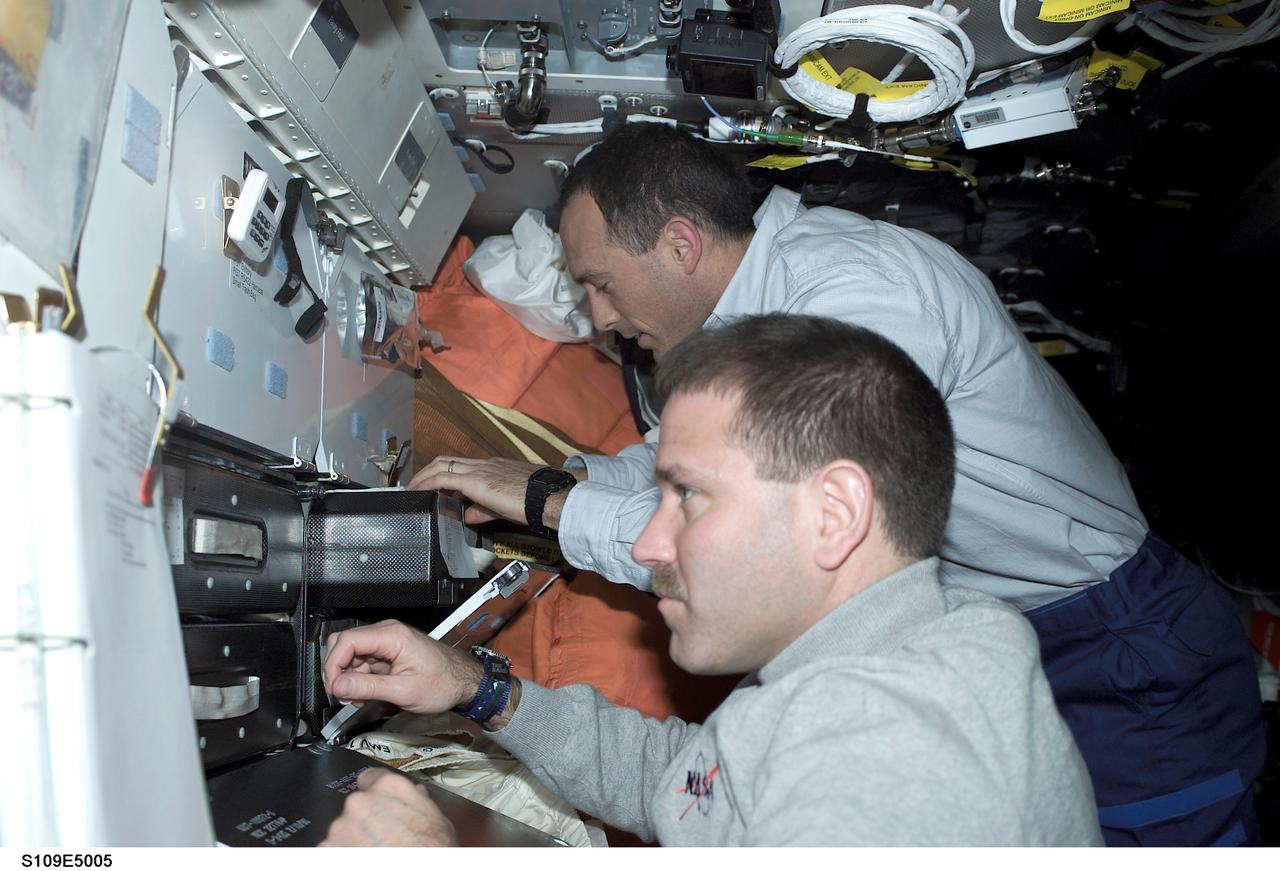
STS109-E-5005 (3 March 2002) --- Astronauts John M. Grunsfeld (foreground), payload commander; and James H. Newman, mission specialist, perform tasks on the mid deck of the Space Shuttle Columbia. Although other tasks are being accomplished, the STS-109 crew is in a general posture of preparation for several days' space walk duty to perform work on the Hubble Space Telescope (HST). The image was recorded with a digital still camera.
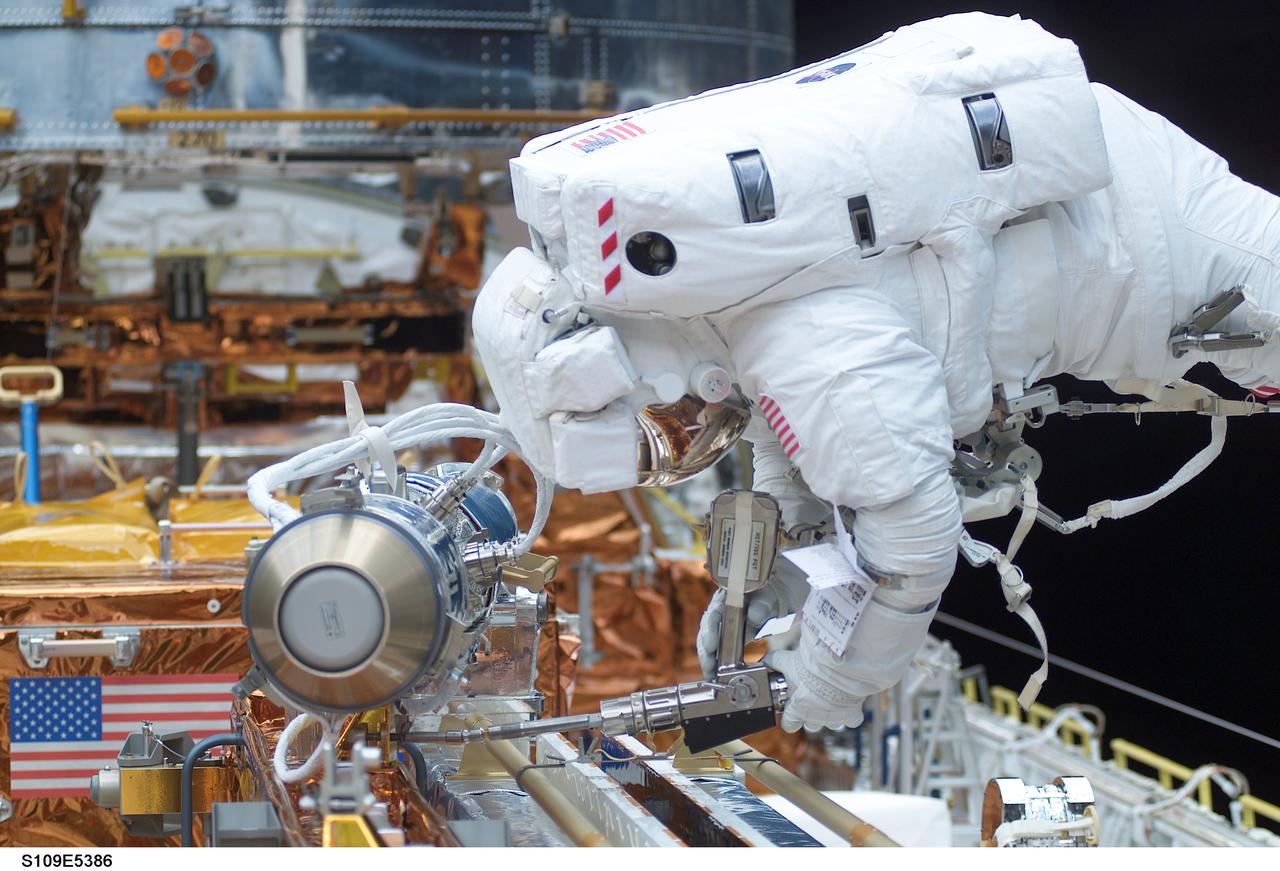
STS109-E-5386 (5 March 2002) --- Astronaut Michael J. Massimino, mission specialist, checks a tool in the cargo bay of the Space Shuttle Columbia during the STS-109 mission's second day of extravehicular activity (EVA). Astronauts Massimino and James H. Newman worked to replace the second set of solar arrays on the Hubble Space Telescope (HST). The image was recorded with a digital still camera.
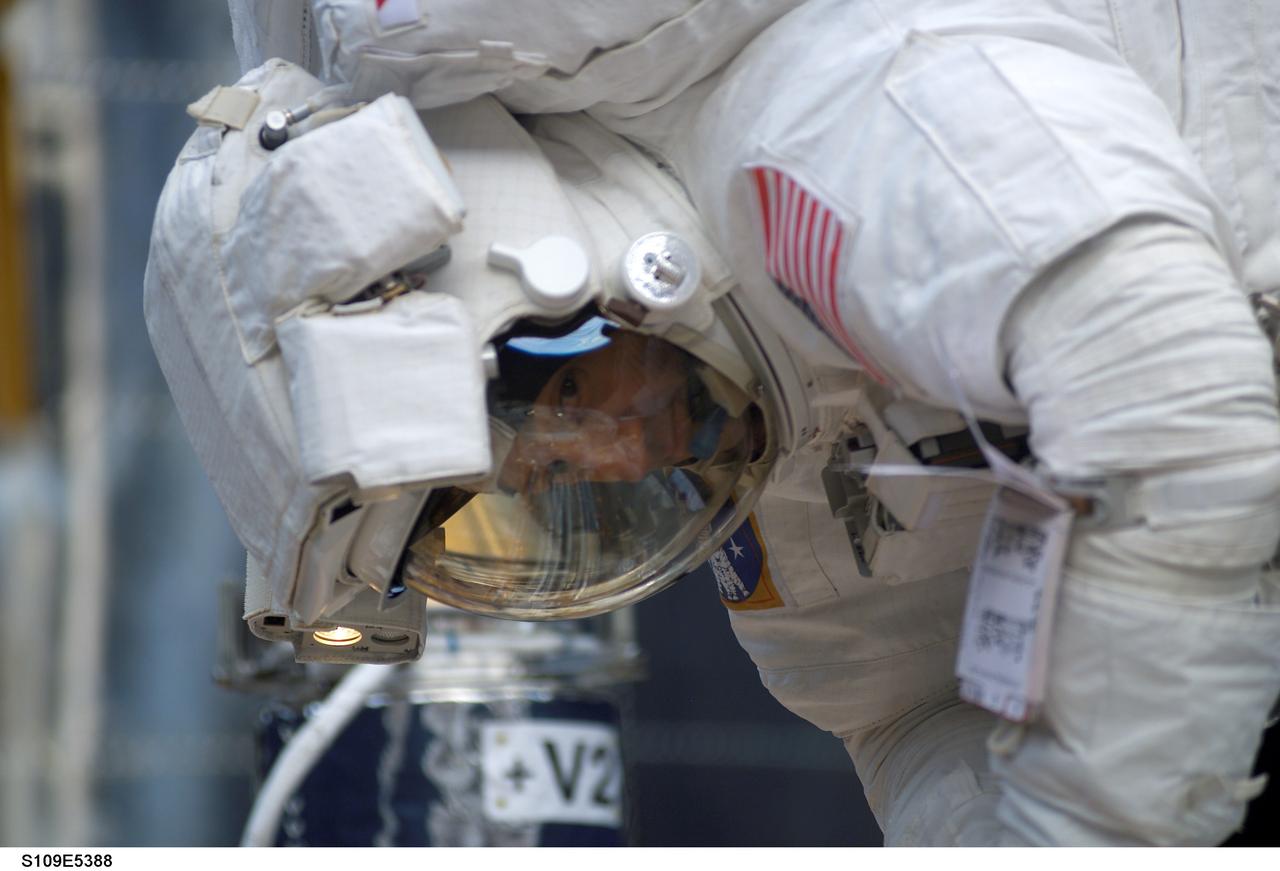
STS109-E-5388 (5 March 2002) --- Astronaut Michael J. Massimino, mission specialist, checks a tool in the cargo bay of the Space Shuttle Columbia during the STS-109 mission's second day of extravehicular activity (EVA). Astronauts Massimino and James H. Newman worked to replace the second set of solar arrays on the Hubble Space Telescope (HST). The image was recorded with a digital still camera.

STS109-E-5887 (9 March 2002) --- This view of a good portion of the country of Chile was recorded with a digital still camera by one of the STS-109 astronauts aboard the Space Shuttle Columbia. Chile's Pacific Coast is featured and the country's borders with three other nations--Bolivia, Peru and Argentina--almost or just barely made it into the frame in three different directions. Punta Angamos and Punta Tetas are readily visible on the anvil shaped peninsular feature, near the city of Antofagasta.
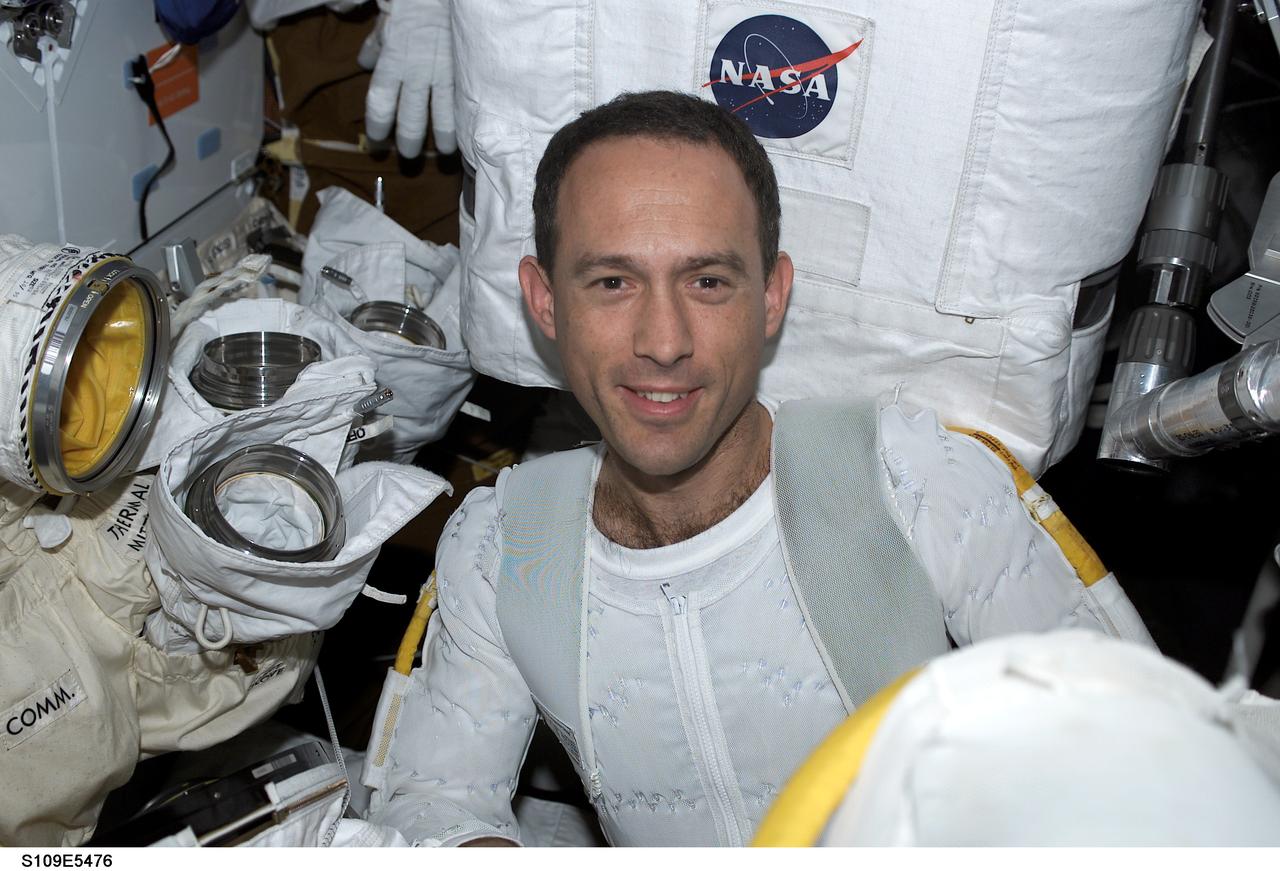
STS109-E-5476 (7 March 2002)-- Astronaut James H. Newman prepares to don his extravehicular mobility unit (EMU) space suit in order to participate in the fourth of five scheduled STS-109 space walks to work on the Hubble Space Telescope (HST). This image was recorded with a digital still camera.
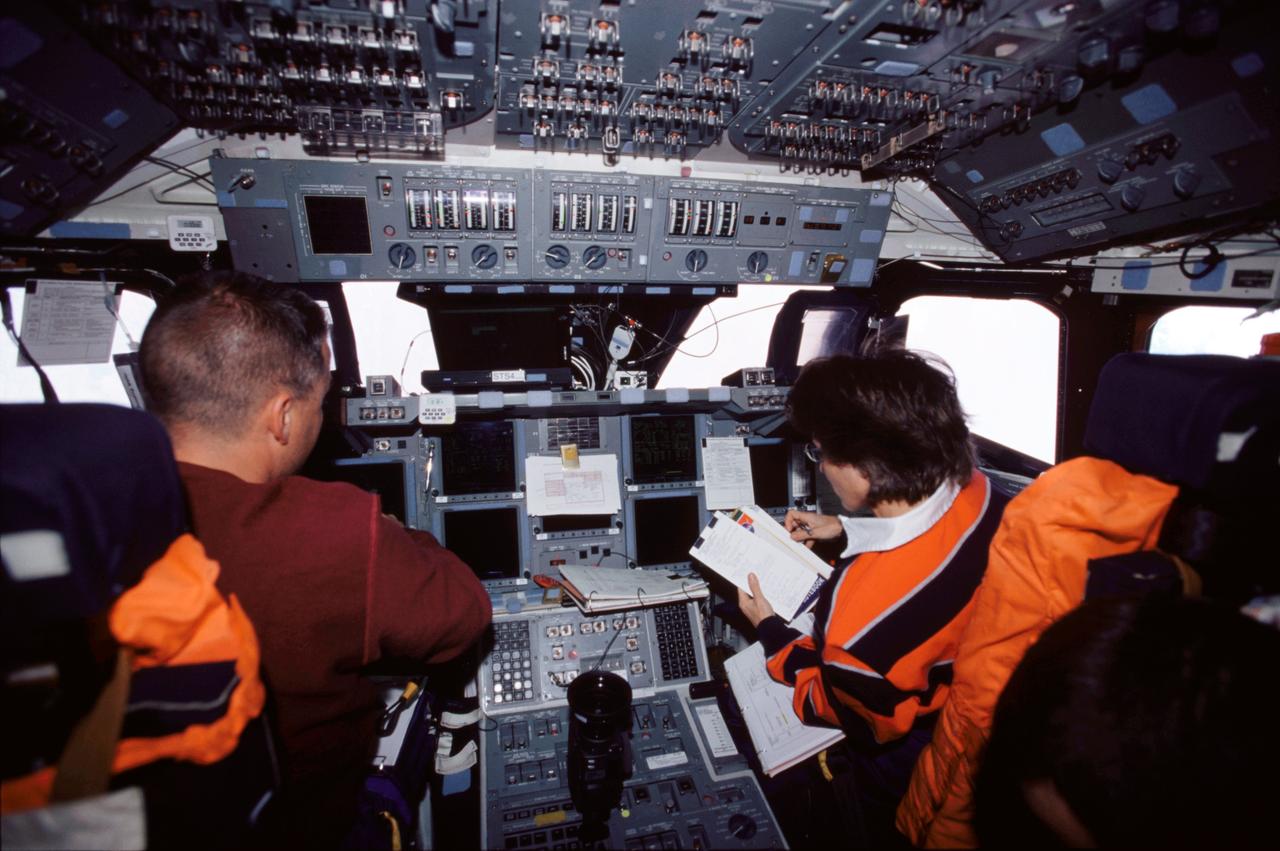
STS109-346-004 (3 March 2002) --- Astronauts Duane G. Carey (left) and Nancy J. Currie, STS-109 pilot and mission specialist, respectively, are photographed on the forward flight deck of the Space Shuttle Columbia during rendezvous with the Hubble Space Telescope (HST).
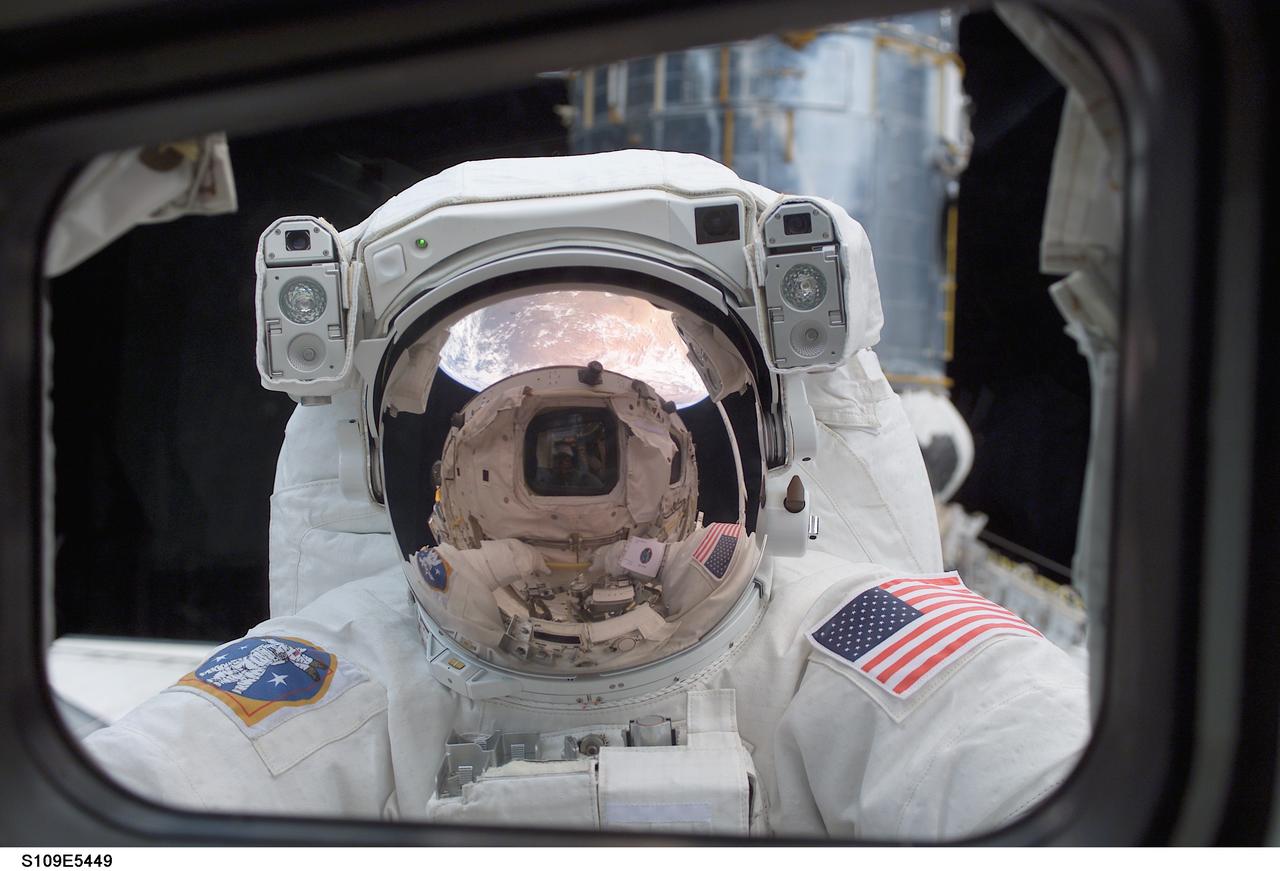
STS109-E-5449 (4 March 2002) --- Astronaut John M. Grunsfeld, payload commander, peers into the crew cabin of the Space Shuttle Columbia during the first STS-109 extravehicular activity (EVA-1) on March 4, 2002. Grunsfeld's helmet visor, with the sunshield now in place, displays mirrored images of the Earth's hemisphere and the Space Shuttle Columbia's aft cabin. The distorted reflection gives the crew cabin a cyclops-like appearance. Astronauts Grunsfeld and Richard M. Linnehan replaced the starboard solar array on the Hubble Space Telescope (HST) on the first of five scheduled STS-109 space walks. The lower portion of the giant telescope can be seen behind the payload commander. The image was recorded with a digital still camera by a crewmate on shuttle's aft flight deck.
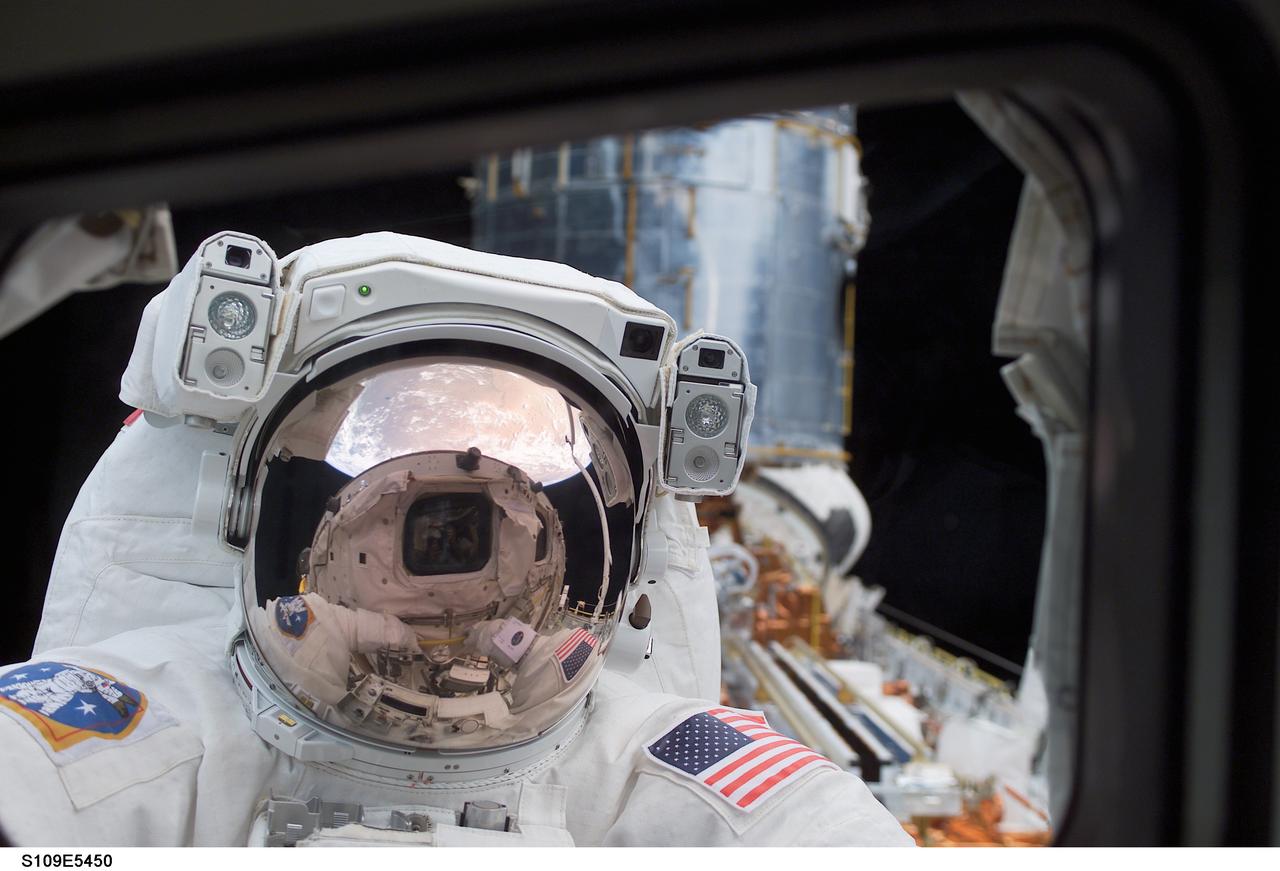
STS109-E-5450 (4 March 2002) --- Astronaut John M. Grunsfeld, payload commander, peers into the crew cabin of the Space Shuttle Columbia during the first STS-109 extravehicular activity (EVA-1) on March 4, 2002. Grunsfeld's helmet visor, with the sunshield now in place, displays mirrored images of the Earth's hemisphere and the Space Shuttle Columbia's aft cabin. The distorted reflection gives the crew cabin a cyclops-like appearance. Astronauts Grunsfeld and Richard M. Linnehan replaced the starboard solar array on the Hubble Space Telescope (HST) on the first of five scheduled STS-109 space walks. The lower portion of the giant telescope can be seen behind the payload commander. The image was recorded with a digital still camera by a crewmate on shuttle's aft flight deck.
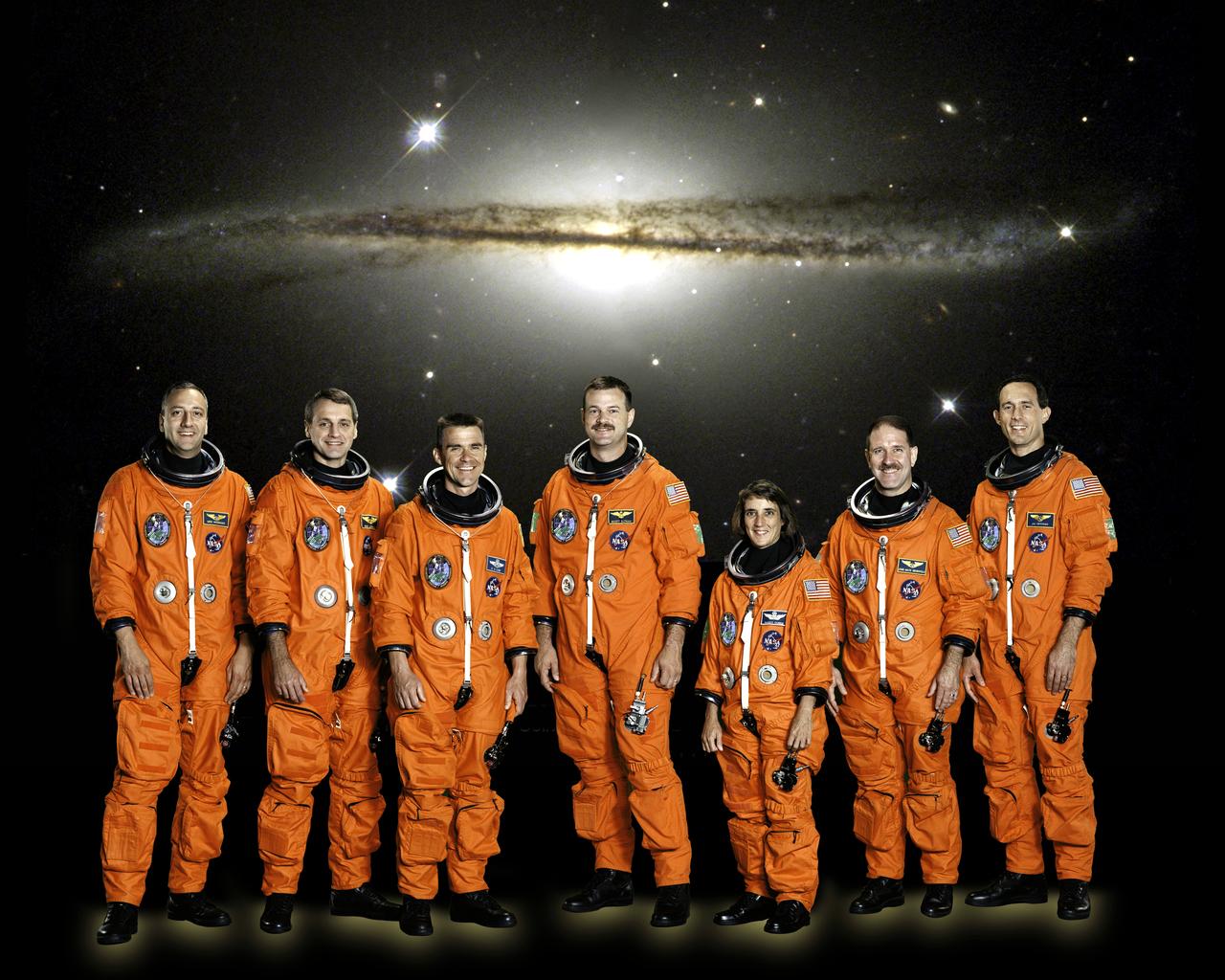
Posing for the traditional preflight crew portrait, the seven astronauts of the STS-109 mission are (left to right) astronauts Michael J. Massimino, Richard M. Linnehan, Duane G. Carey, Scott D. Altman, Nancy J. Currie, John M. Grunsfeld and James H. Newman. Altman and Carey were commander and pilot, respectively, with the others serving as mission specialists. Grunsfeld was payload commander. Launched aboard the Space Shuttle Columbia on March 1, 2002, the group was the fourth visit to the the Hubble Space Telescope (HST) for performing upgrade and servicing on the giant orbital observatory.
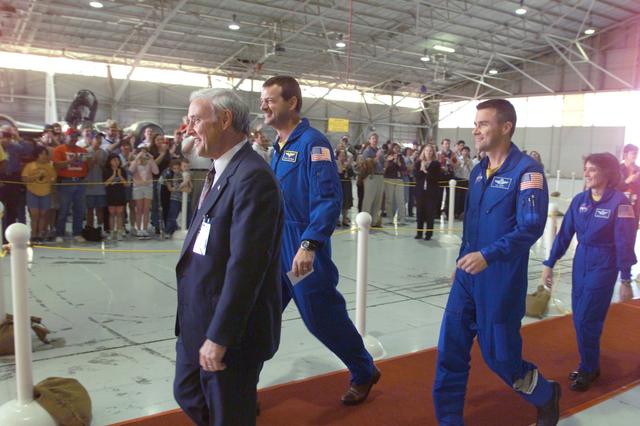
JSC2002-E-09319 (13 March 2002) --- The STS-109 crew and Johnson Space Center’s (JSC) Acting Director Roy Estess enter Hangar 990 at Ellington Field during the crew return ceremonies. From the left are Estess, along with astronauts Scott D. Altman and Duane G. Carey, mission commander and pilot, respectively; and Nancy J. Currie, mission specialist. Out of frame are John M. Grunsfeld, payload commander; and Richard M. Linnehan, James H. Newman, and Michael J. Massimino, all mission specialists.
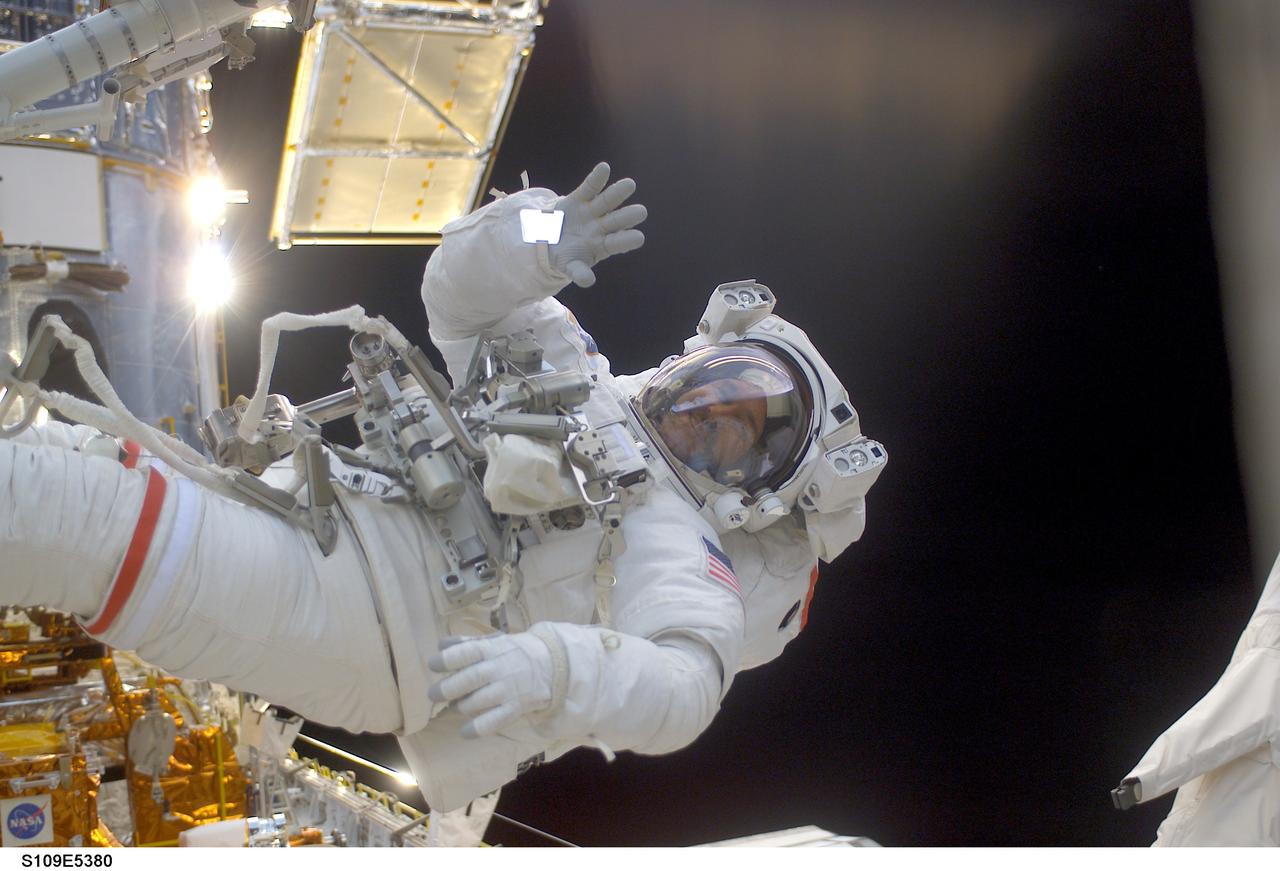
STS109-E-5380 (6 March 2002) --- Astronaut John M. Grunsfeld, payload commander, waves at a crewmate inside Space Shuttle Columbia's crew cabin during a brief break in work on the Hubble Space Telescope (HST) in the cargo bay of the shuttle during the STS-109 mission's third space walk. The primary purpose of the extravehicular activity (EVA) of astronauts Grunsfeld and Richard M. Linnehan was to replace the Power Control Unit on the giant telescope. The image was recorded with a digital still camera by one of Grunsfeld's crew mates inside Columbia's cabin.
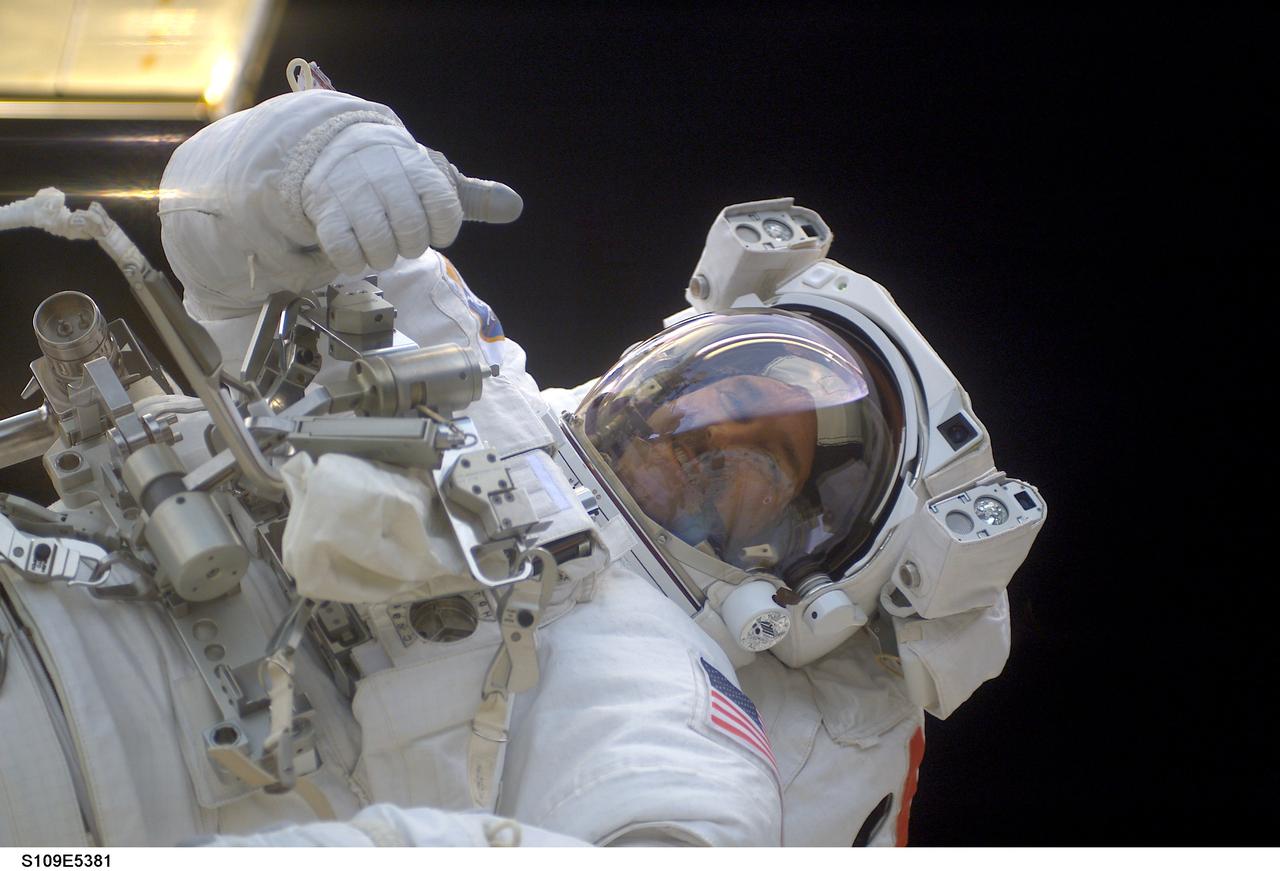
STS109-E-5381 (6 March 2002) --- Astronaut John M. Grunsfeld, payload commander, gives a "thumbs up" signal to crewmates inside Space Shuttle Columbia's crew cabin during a task on the Hubble Space Telescope (HST) in the cargo bay of the shuttle during the STS-109 mission's third space walk. The primary purpose of the extravehicular activity (EVA) of astronauts Grunsfeld and Richard M. Linnehan was to replace the Power Control Unit on the giant telescope. The image was recorded with a digital still camera by one of Grunsfeld's crew mates inside Columbia's cabin.
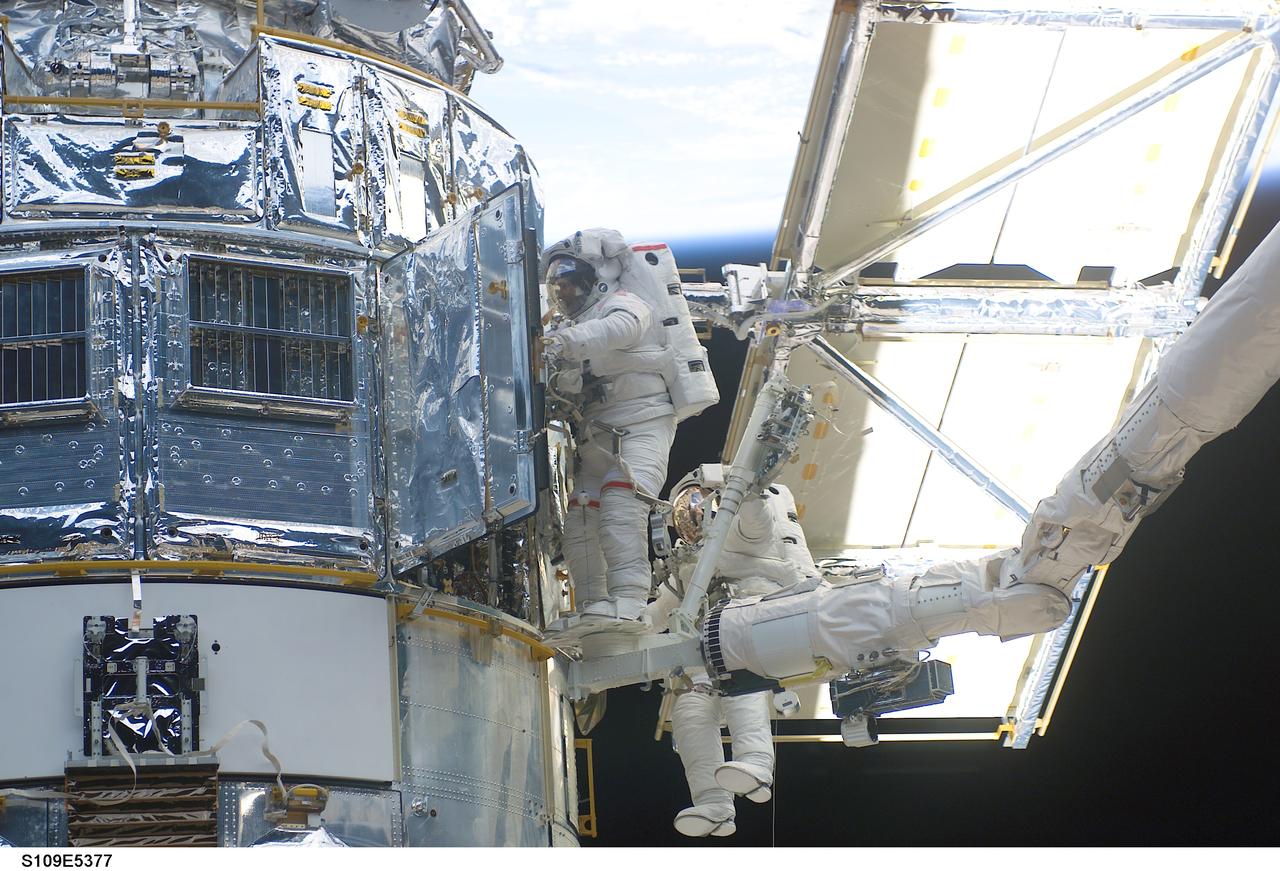
STS109-E-5377 (6 March 2002) --- Astronaut John M. Grunsfeld, payload commander, works in tandem with astronaut Richard M. Linnehan, mission specialist, as the two devote their attention to the Power Control Unit replacement task on the giant Hubble Space Telescope (HST). Grunsfeld stands on a foot restraint on the end of the Space Shuttle Columbia's Remote Manipulator System (RMS). This marked the third of five scheduled STS-109 space walks and the mission's second extravehicular activity (EVA) for the tandem of Grunsfeld and Linnehan. It was completed at 9:16 a.m. CST (1516 GMT), Mar. 6, 2002. The image was recorded with a digital still camera.
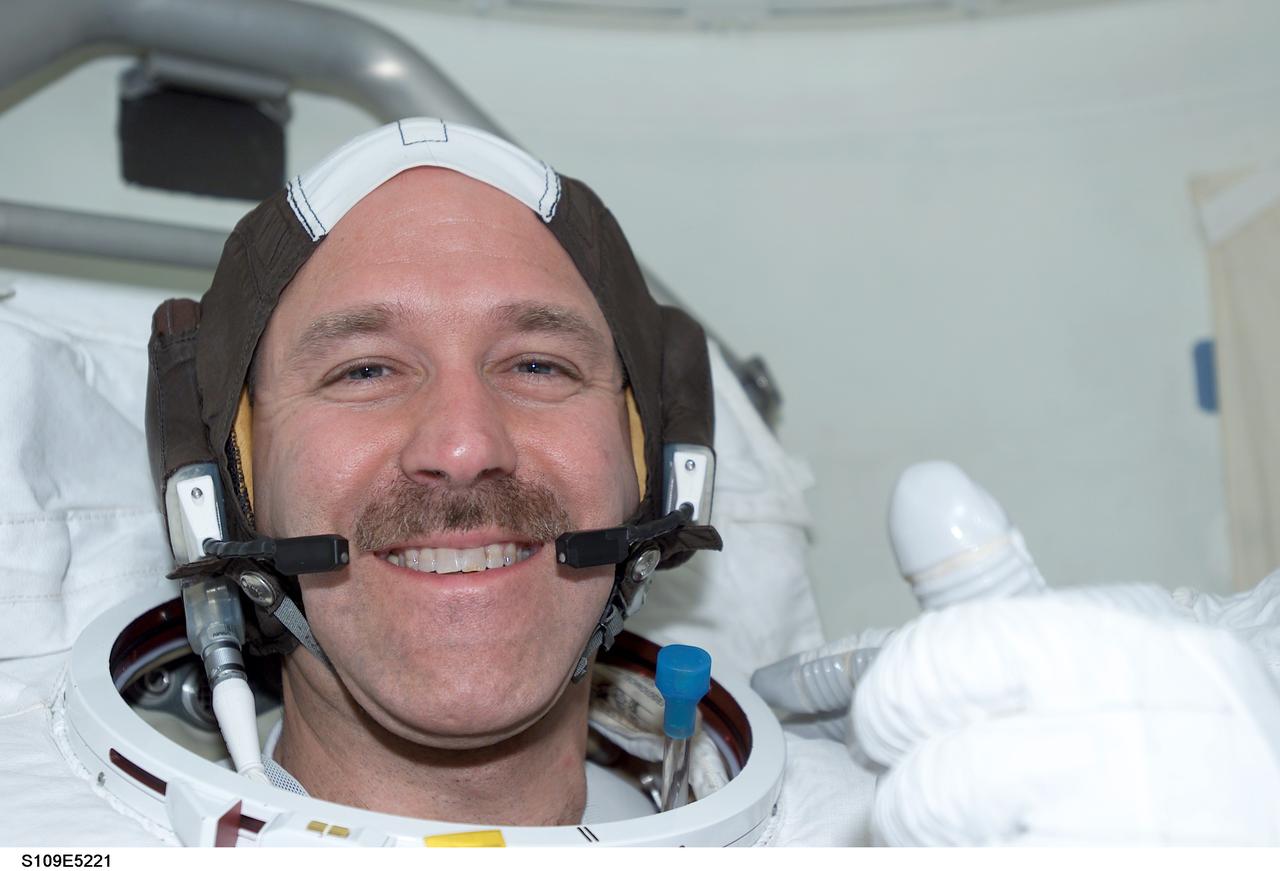
STS109-E-5221 (4 March 2002) --- Astronaut John M. Grunsfeld, payload commander, signals readiness for the first the first of his assigned STS-109 space walks to perform work on the Hubble Space Telescope (HST). Astronauts Grunsfeld and Richard M. Linnehan later donned their helmets and the remainder pieces of their extravehicular mobility unit (EMU) space suits and egressed the Space Shuttle Columbia, eventually replacing the giant telescope’s starboard solar array during a space walk that ended at 7:38 a.m. (CST) or 13:38 GMT March 4, 2002.
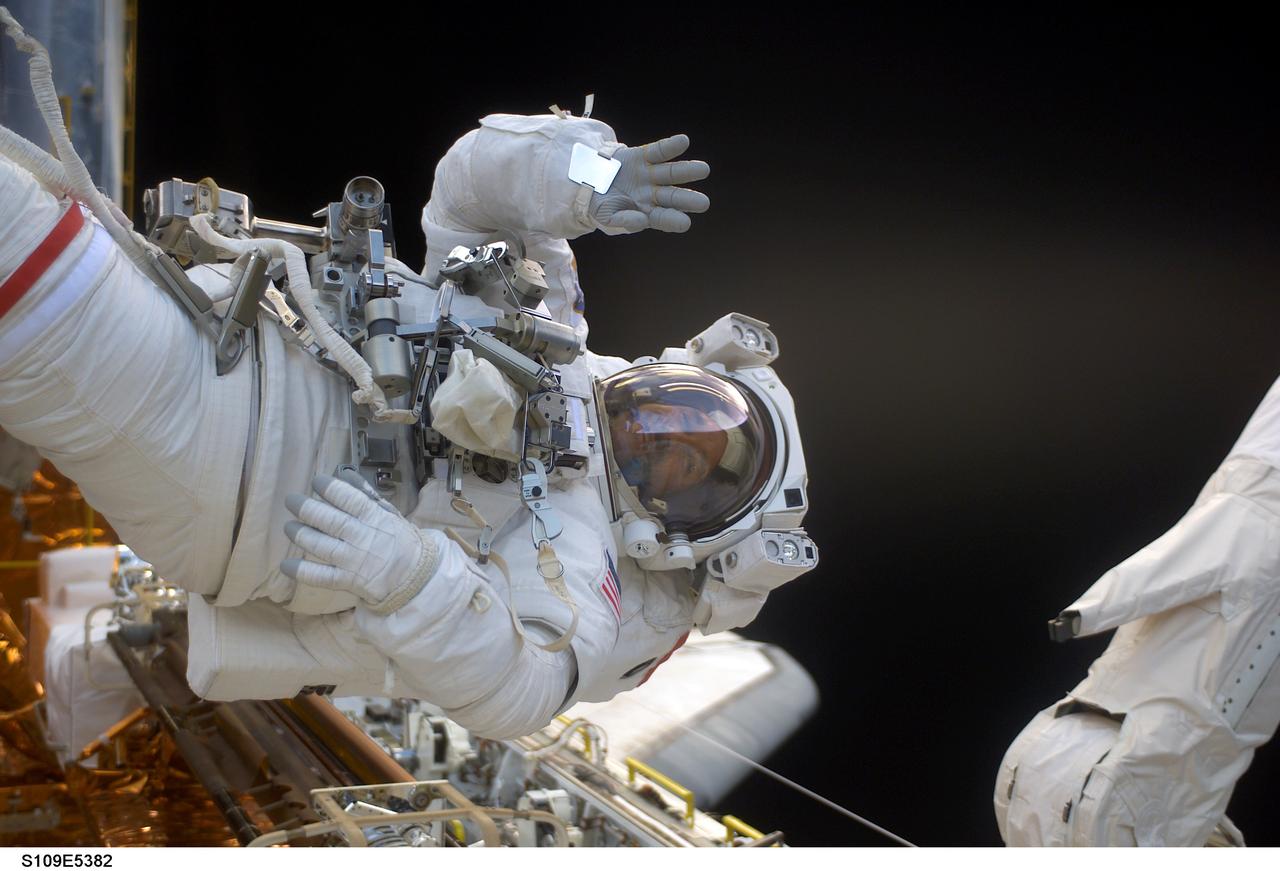
STS109-E-5382 (6 March 2002) --- Astronaut John M. Grunsfeld, payload commander, waves at a crewmate inside Space Shuttle Columbia's crew cabin during a brief break in work on the Hubble Space Telescope (HST) in the cargo bay of the shuttle during the STS-109 mission's third space walk. The primary purpose of the extravehicular activity (EVA) of astronauts Grunsfeld and Richard M. Linnehan was to replace the Power Control Unit on the giant telescope. The image was recorded with a digital still camera by one of Grunsfeld's crew mates inside Columbia's cabin.
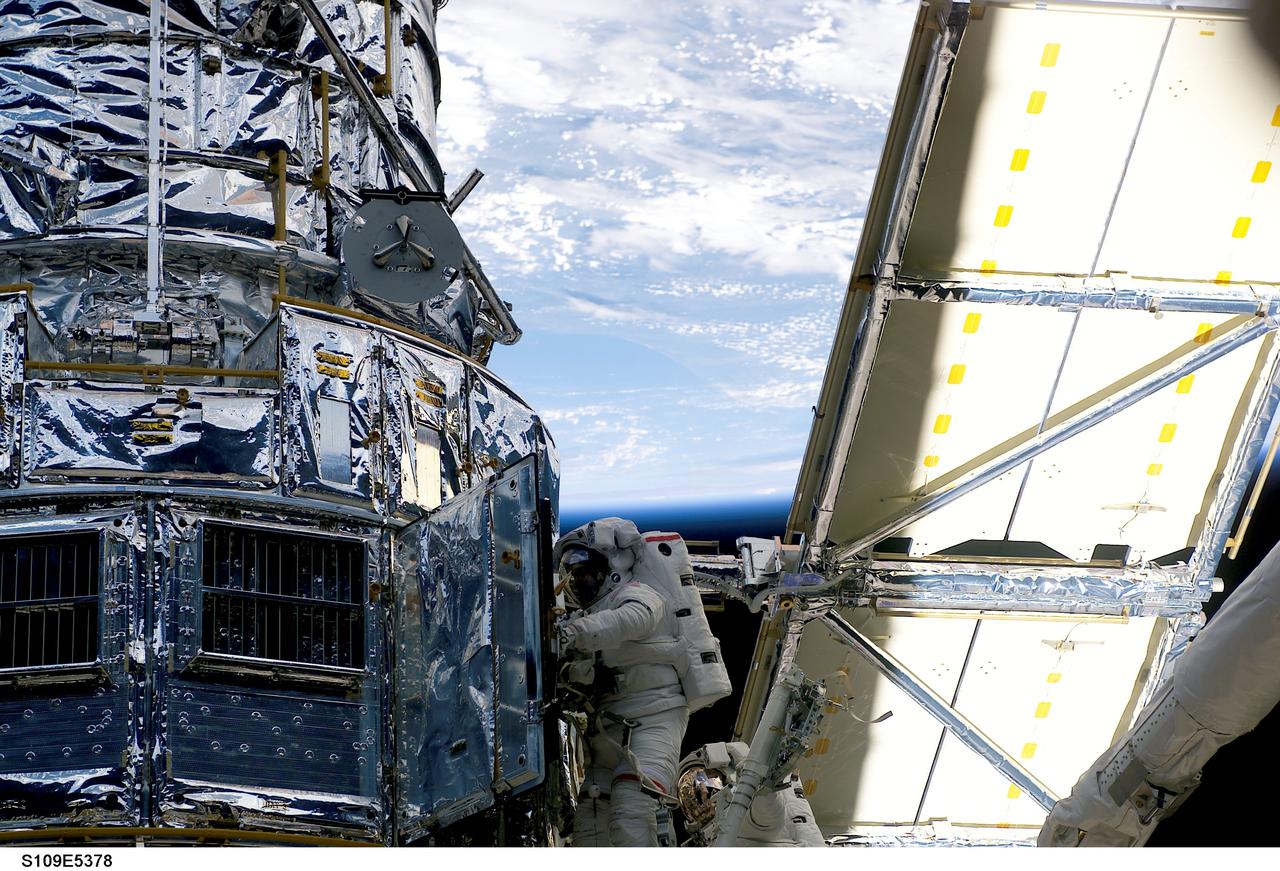
STS109-E-5378 (6 March 2002) --- Astronaut John M. Grunsfeld, payload commander, works in tandem with astronaut Richard M. Linnehan, mission specialist, as the two devote their attention to the Power Control Unit replacement task on the giant Hubble Space Telescope (HST). Grunsfeld stands on a foot restraint on the end of the Space Shuttle Columbia's Remote Manipulator System (RMS). This marked the third of five scheduled STS-109 space walks and the mission's second extravehicular activity (EVA) for the tandem of Grunsfeld and Linnehan. It was completed at 9:16 a.m. CST (1516 GMT), Mar. 6, 2002. The image was recorded with a digital still camera.
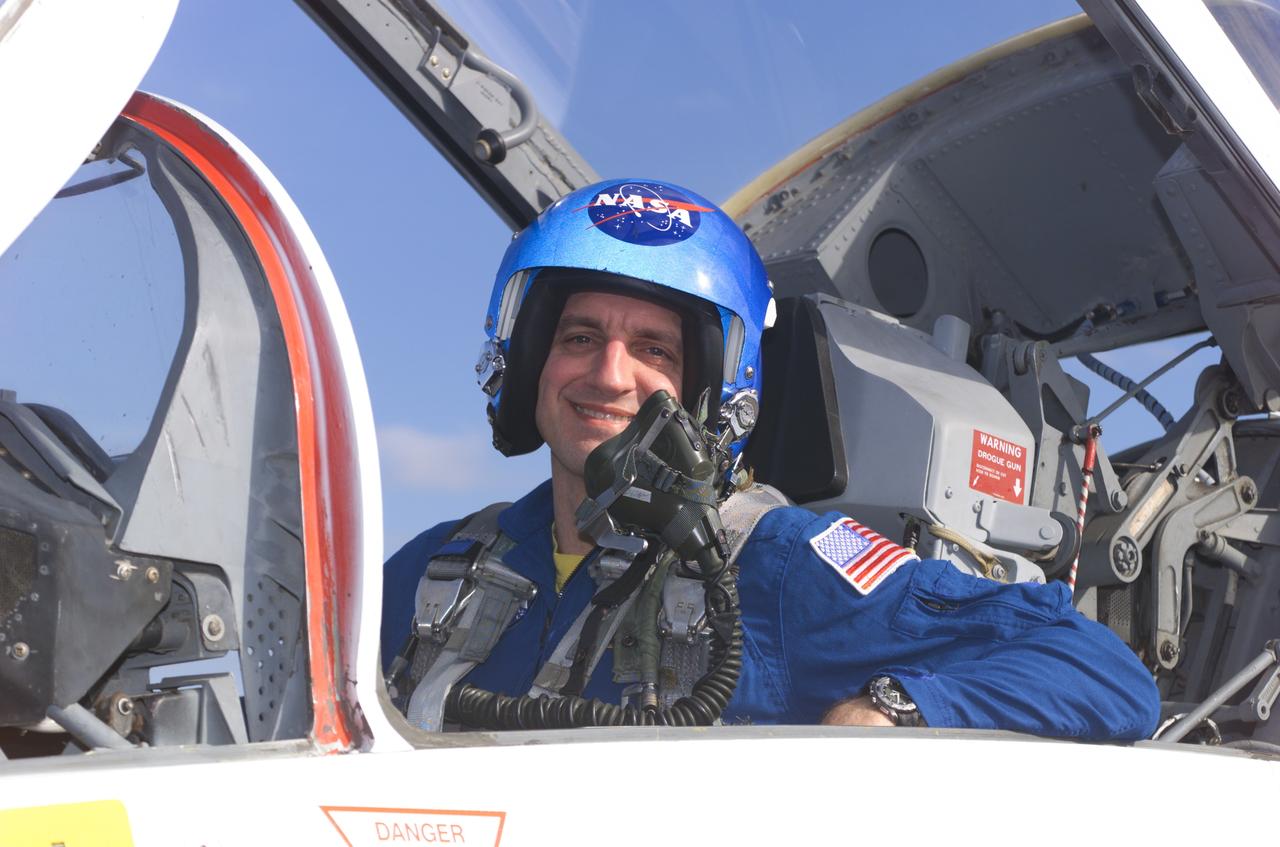
JSC2002-E-01742 (16 January 2002) --- Astronaut Richard M. Linnehan, STS-109 mission specialist, photographed in a T-38 trainer jet, prepares for a flight at Ellington Field near Johnson Space Center (JSC).
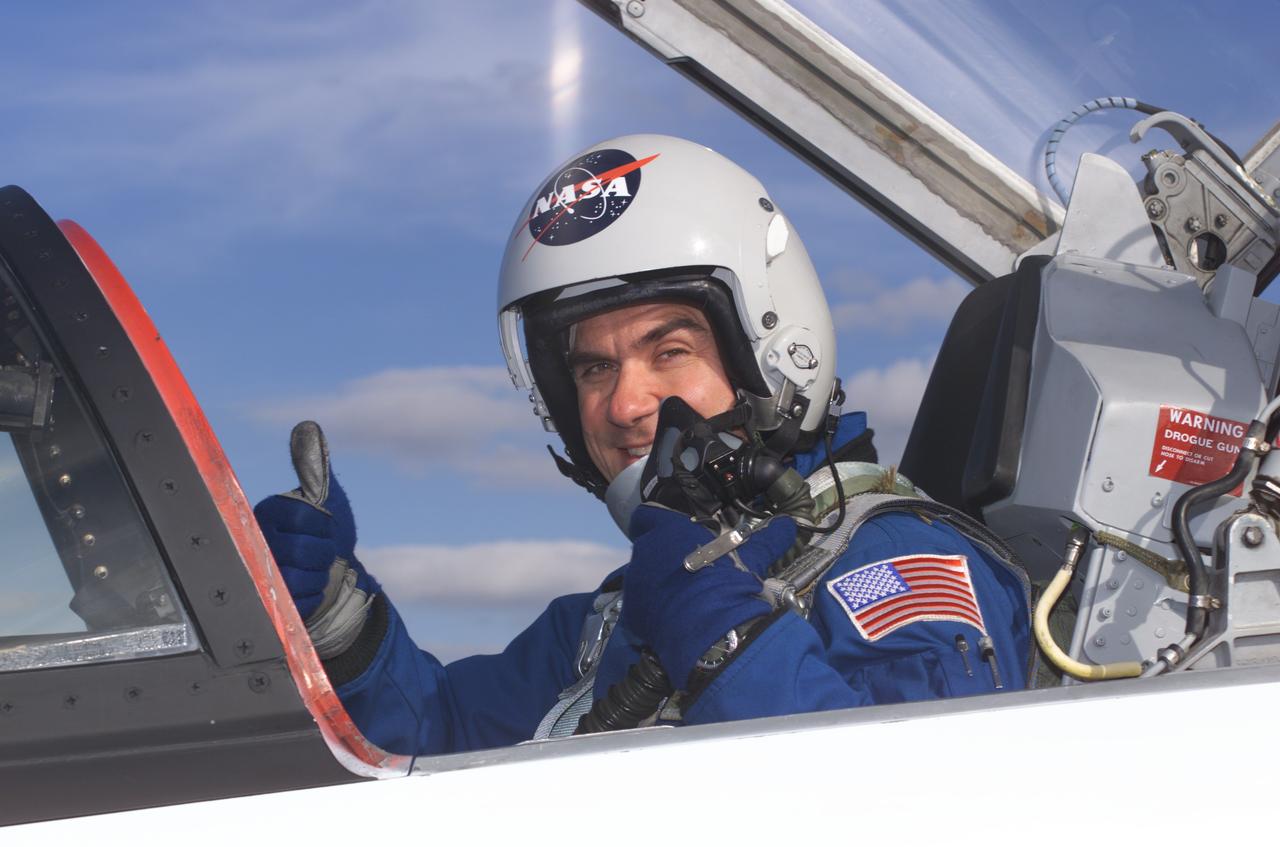
JSC2002-E-01743 (16 January 2002) --- Astronaut Duane G. Carey, STS-109 pilot, photographed in a T-38 trainer jet, prepares for a flight at Ellington Field near Johnson Space Center (JSC).
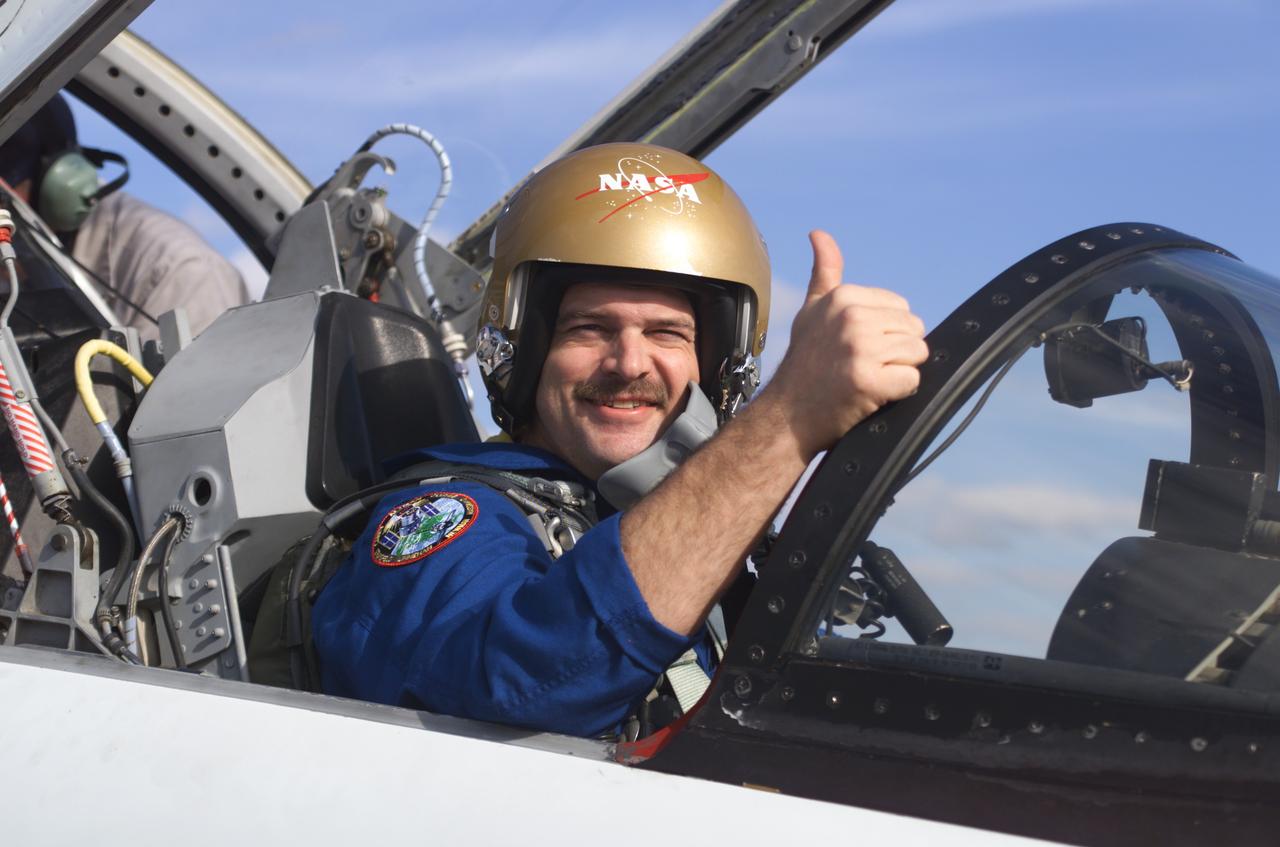
JSC2002-E-01744 (16 January 2002) --- Astronaut Scott D. Altman, STS-109 mission commander, photographed in a T-38 trainer jet, prepares for a flight at Ellington Field near Johnson Space Center (JSC).
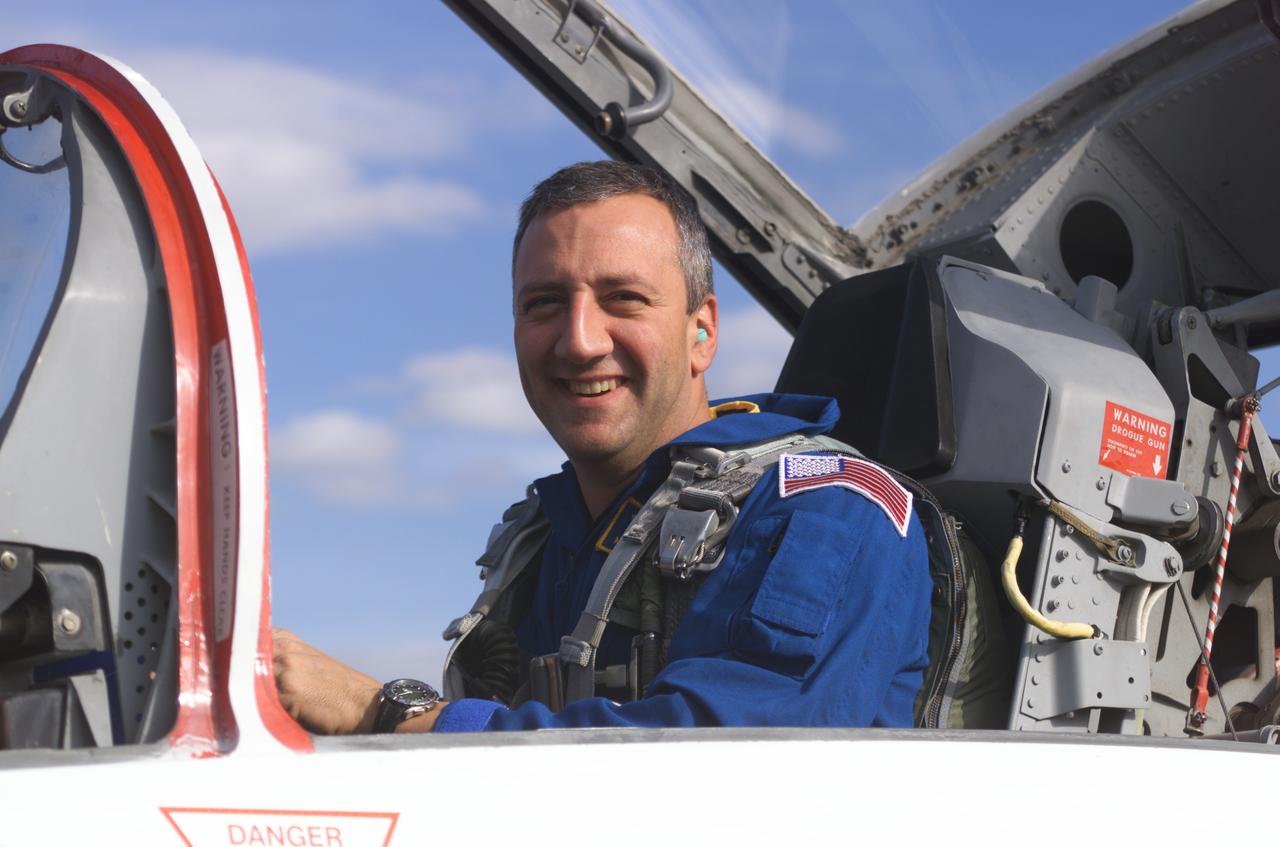
JSC2002-E-01740 (16 January 2002) --- Astronaut Michael J. Massimino, STS-109 mission specialist, photographed in a T-38 trainer jet, prepares for a flight at Ellington Field near Johnson Space Center (JSC).
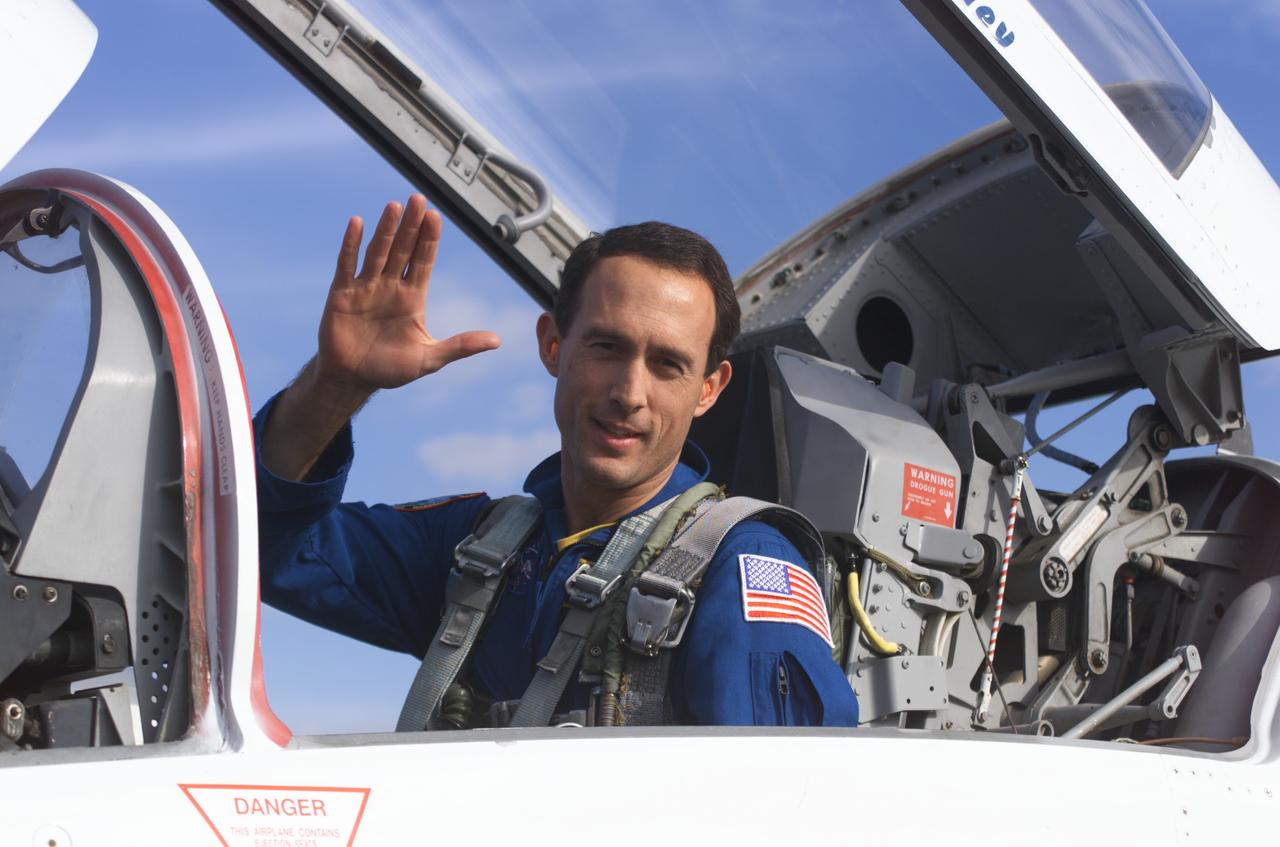
JSC2002-E-01741 (16 January 2002) --- Astronaut James H. Newman, STS-109 mission specialist, photographed in a T-38 trainer jet, prepares for a flight at Ellington Field near Johnson Space Center (JSC).
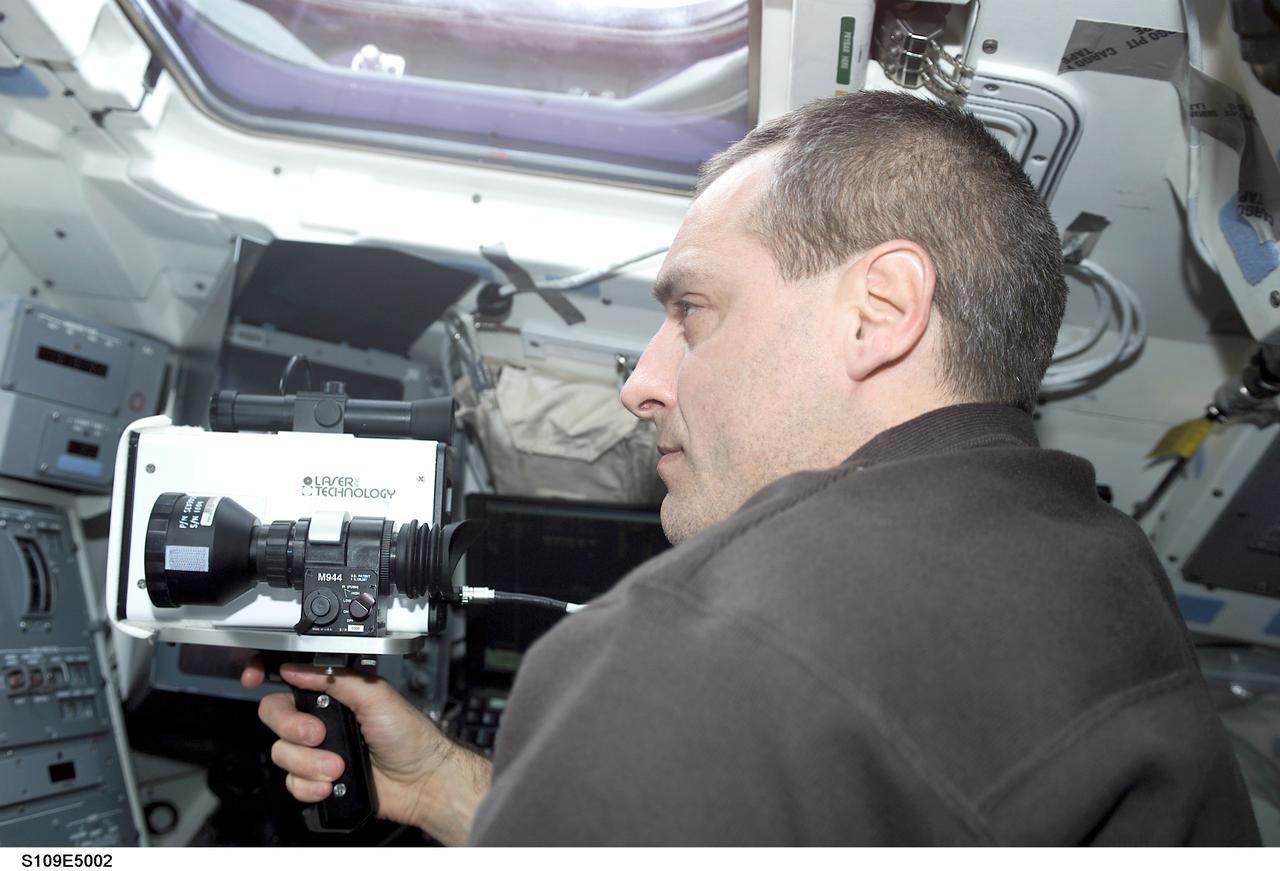
STS109-E-5002 (3 March 2002) --- Astronaut Richard M. Linnehan, mission specialist, uses a laser ranging device designed to measure the range between two spacecraft. Linnehan positioned himself on the cabin's aft flight deck as the Space Shuttle Columbia approached the Hubble Space Telescope. A short time later, the STS-109 crew captured and latched down the giant telescope in the vehicle's cargo bay for several days of work on the Hubble. The image was recorded with a digital still camera.
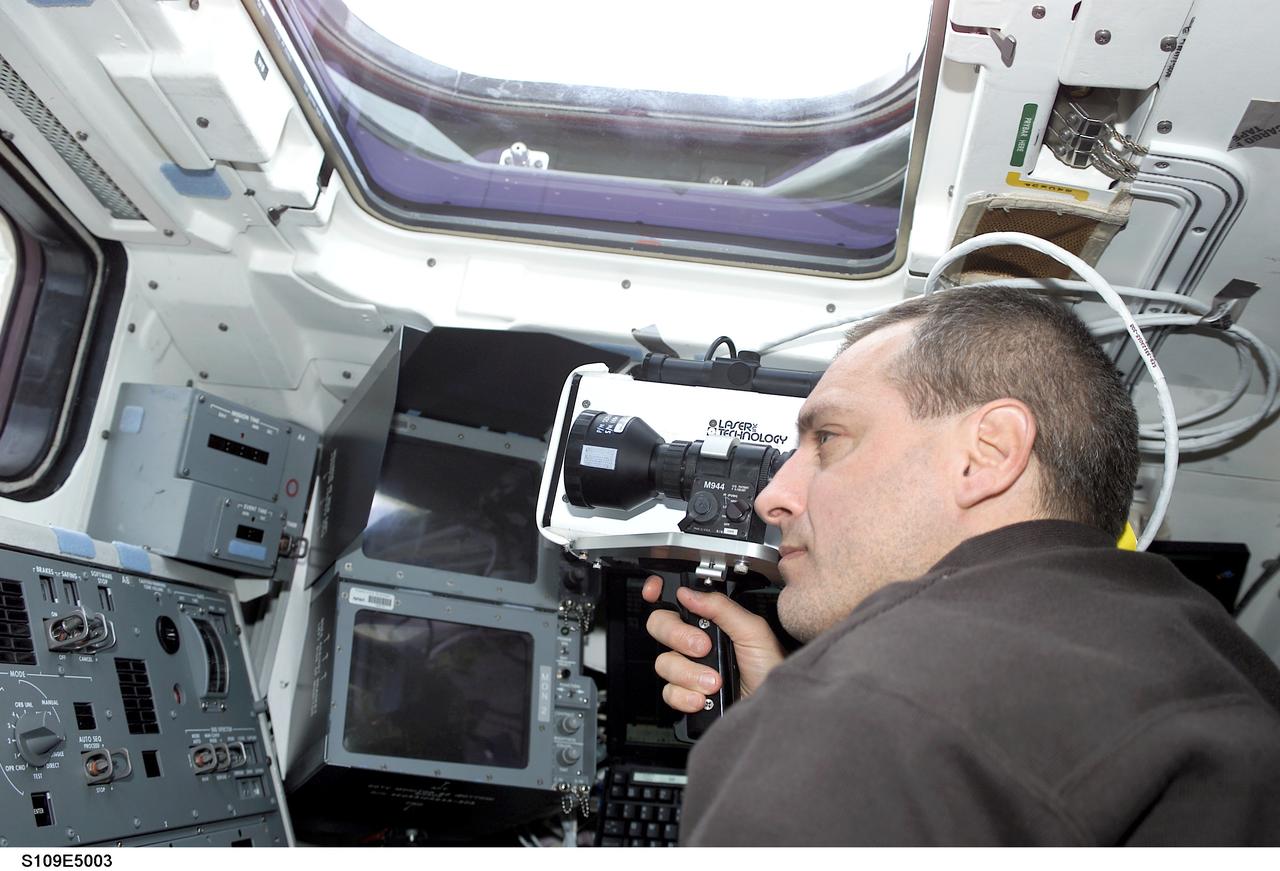
STS109-E-5003 (3 March 2002) --- Astronaut Richard M. Linnehan, mission specialist, uses a laser ranging device designed to measure the range between two spacecraft. Linnehan positioned himself on the cabin's aft flight deck as the Space Shuttle Columbia approached the Hubble Space Telescope. A short time later, the STS-109 crew captured and latched down the giant telescope in the vehicle's cargo bay for several days of work on the Hubble. The image was recorded with a digital still camera.