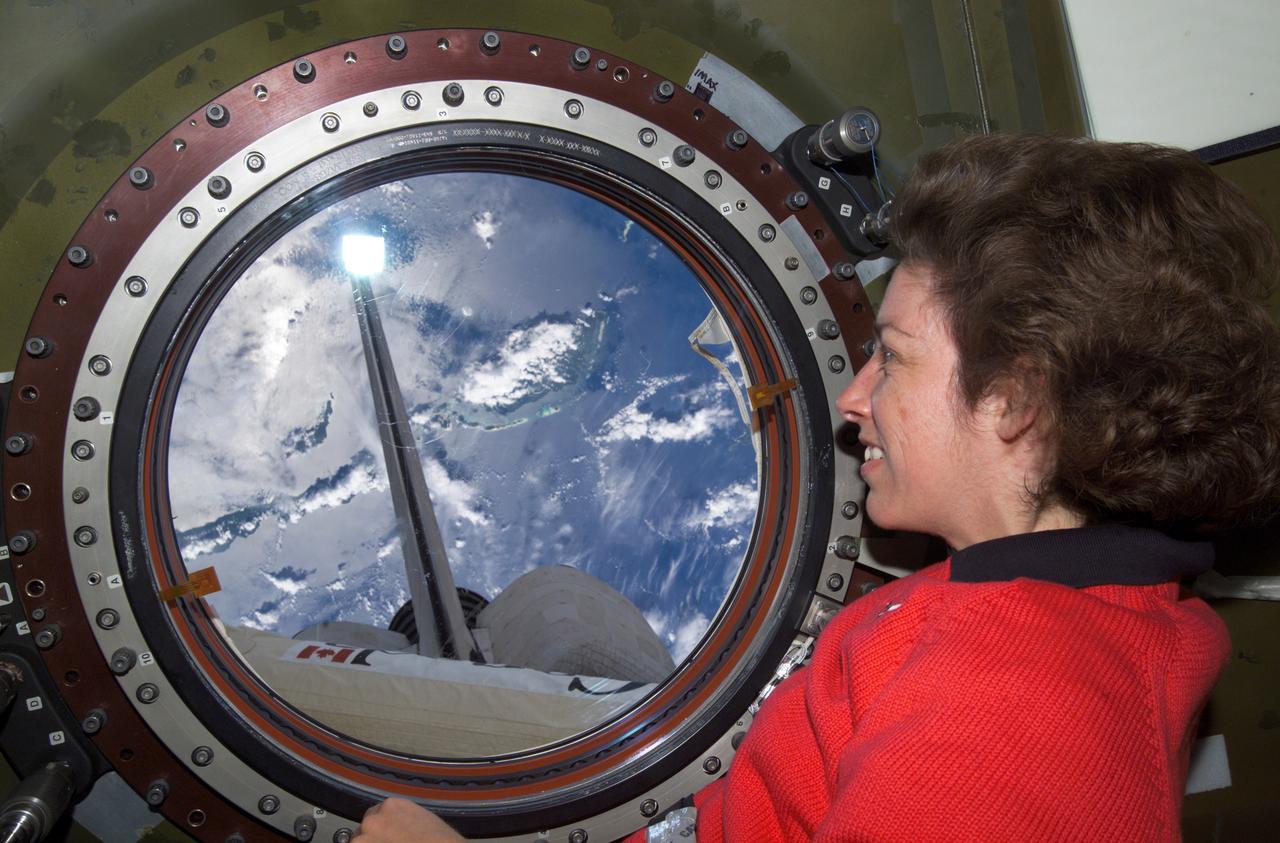
Astronaut Ellen Ochoa, STS-110 mission specialist, looks through the window of the Destiny laboratory on the International Space Station (ISS) as she views portions of the Space Shuttle Atlantis and the Canadarm2. It was during the STS-110 mission that the Canadian-developed ISS robotic arm was used to maneuver spacewalkers around the station for the first time. The STS-110 mission, carried by the Space Shuttle Orbiter Atlantis, was launched on April 8, 2002.
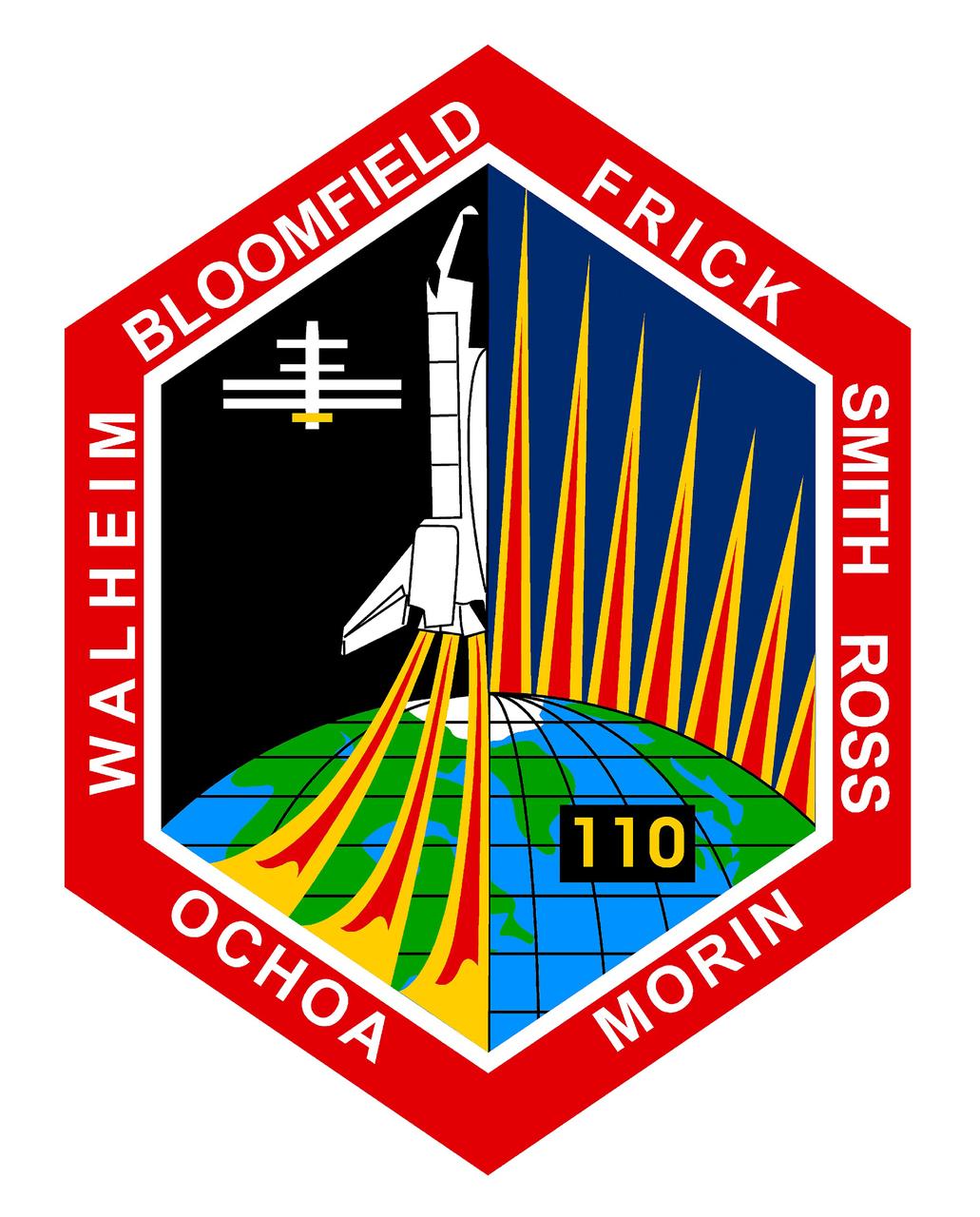
The STS-110 mission began the third and final phase of construction for the International Space Station (ISS) by delivering and installing the Starboard side S0 (S-zero) truss segment that was carried into orbit in the payload bay of the Space Shuttle Atlantis. The STS-110 crew patch is patterned after the cross section of the S0 truss, and encases the launch of the Shuttle Atlantis and a silhouette of the ISS as it will look following mission completion. The successfully installed S0 segment is highlighted in gold. The three prominent flames blasting from the shuttle emphasizes the first shuttle flight to use three Block II Main Engines.

This is the official STS-110 crew portrait. In front, from the left, are astronauts Stephen N. Frick, pilot; Ellen Ochoa, flight engineer; and Michael J. Bloomfield, mission commander; In the back, from left, are astronauts Steven L. Smith, Rex J. Walheim, Jerry L. Ross and Lee M.E. Morin, all mission specialists. Launched aboard the Space Shuttle Orbiter Atlantis on April 8, 2002, the STS-110 mission crew prepared the International Space Station (ISS) for future space walks by installing and outfitting a 43-foot-long Starboard side S0 truss and preparing the Mobile Transporter. The mission served as the 8th ISS assembly flight.
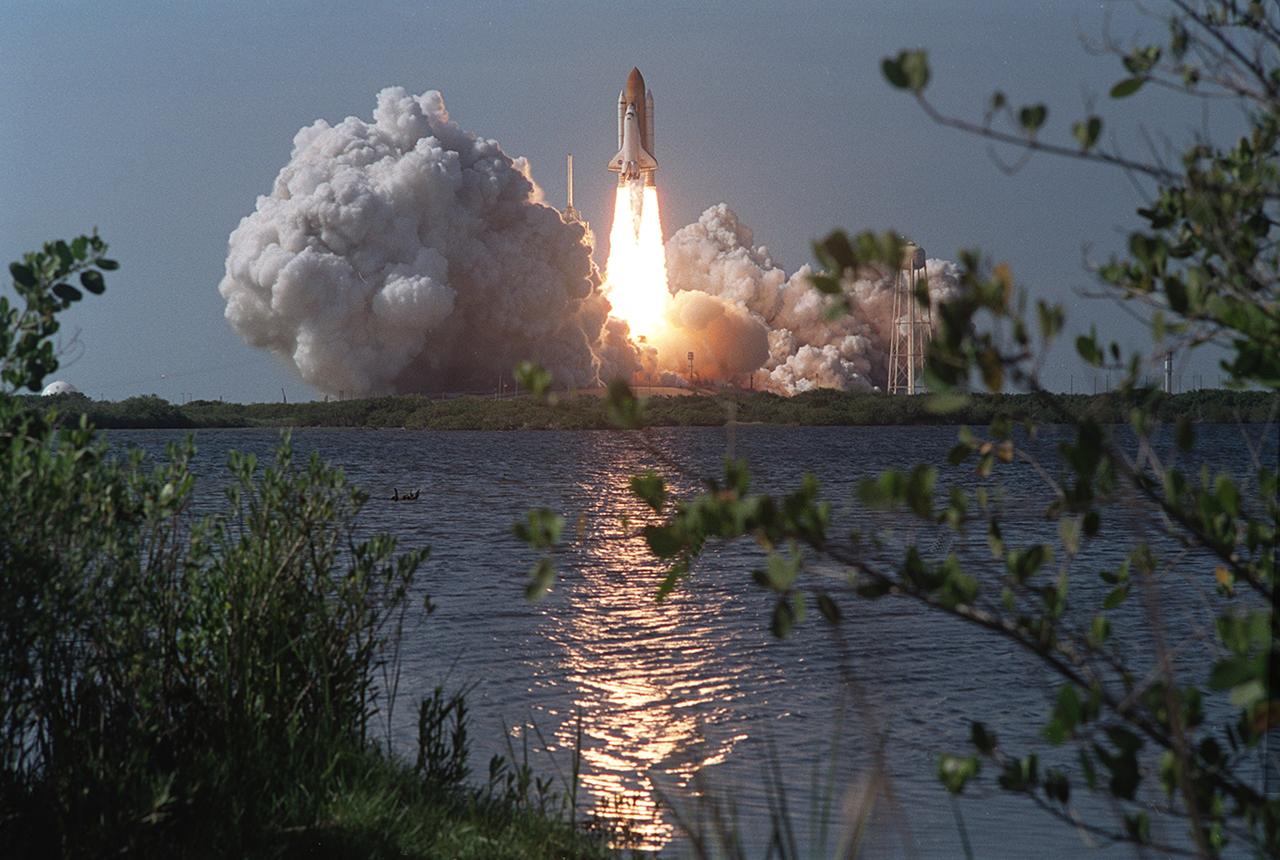
The Space Shuttle Orbiter Atlantis STS-110, embarking on its 25th flight, lifts off from launch pad 39B at Kennedy Space Center at 3:44 p.m. CDT April 8, 2002. The STS-110 mission prepared the International Space Station (ISS) for future space walks by installing and outfitting a 43-foot-long Starboard side S0 truss and preparing the Mobile Transporter. The 27,000 pound S0 Truss was the first of 9 segments that will make up the Station's external framework that will eventually stretch 356 feet (109 meters), or approximately the length of a football field. This central truss segment also includes a flatcar called the Mobile Transporter and rails that will become the first "space railroad," which will allow the Station's robotic arm to travel up and down the finished truss for future assembly and maintenance. The completed truss structure will hold solar arrays and radiators to provide power and cooling for additional international research laboratories from Japan and Europe that will be attached to the Station. Milestones of the S-110 mission included the first time the ISS robotic arm was used to maneuver space walkers around the Station and marked the first time all space walks were based out of the Station's Quest Airlock. It was also the first Shuttle to use three Block II Main Engines.
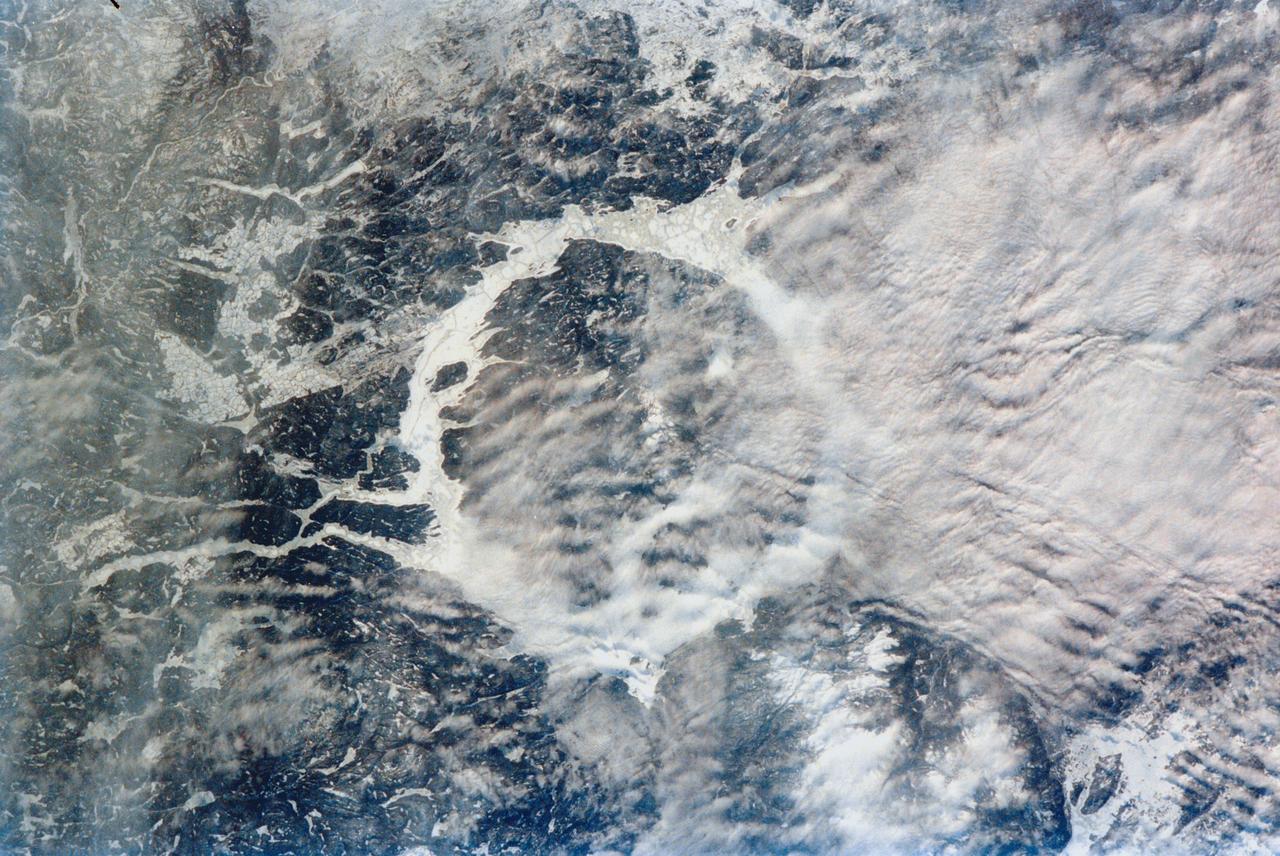
Recorded by the Space Shuttle Atlantis STS-110 mission, this is a photograph of the ice- covered Manicouagin Reservoir located in the Canadian Shield of Quebec Province in Eastern Canada, partially obscured by low clouds. This reservoir marks the site of an impact crater, 60 miles (100 kilometers) wide, which according to geologists was formed 212 million years ago when a meteorite crashed into this area. Over millions of years, the crater has been worn down by glaciers and other erosional processes. The Space Shuttle Orbiter Atlantis, STS-110 mission, was launched April 8, 2002 and returned to Earth April 19, 2002.
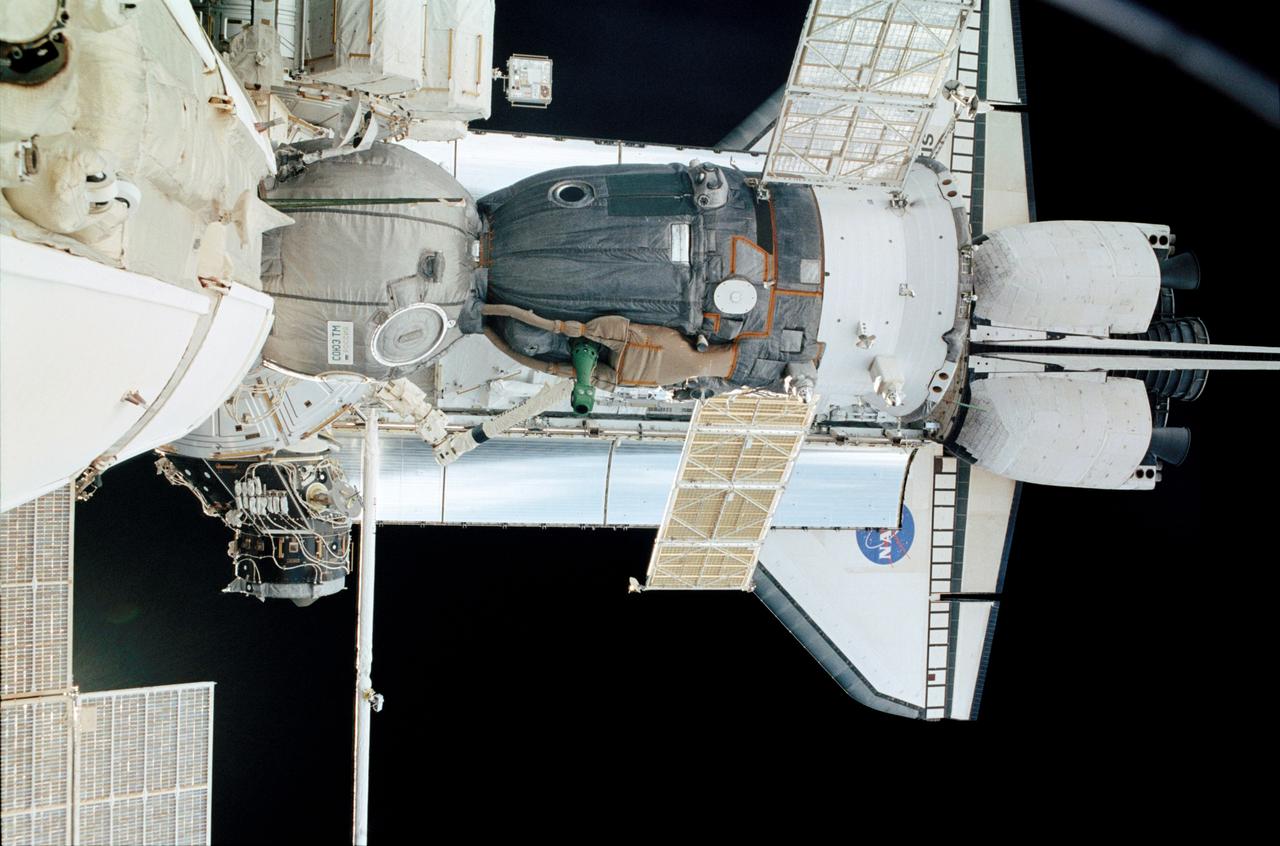
Docked to the International Space Station (ISS), a Soyuz vehicle (foreground) and the Space Shuttle Atlantis were photographed by a crew member in the Pirs docking compartment on the orbital outpost. Atlantis launched on April 8, 2002, carrying the the STS-110 mission which prepared the ISS for future space walks by installing and outfitting the 43-foot-long Starboard side S0 (S-zero) truss and preparing the first railroad in space, the Mobile Transporter. The 27,000 pound S0 truss was the first of 9 segments that will make up the Station's external framework that will eventually stretch 356 feet (109 meters), or approximately the length of a football field. This central truss segment also includes a flatcar called the Mobile Transporter and rails that will become the first "space railroad," which will allow the Station's robotic arm to travel up and down the finished truss for future assembly and maintenance. The completed truss structure will hold solar arrays and radiators to provide power and cooling for additional international research laboratories from Japan and Europe that will be attached to the Station. STS-110 Extravehicular Activity (EVA) marked the first use of the Station's robotic arm to maneuver space walkers around the Station and was the first time all of a shuttle crew's scapulas were based out of the Station's Quest Airlock.
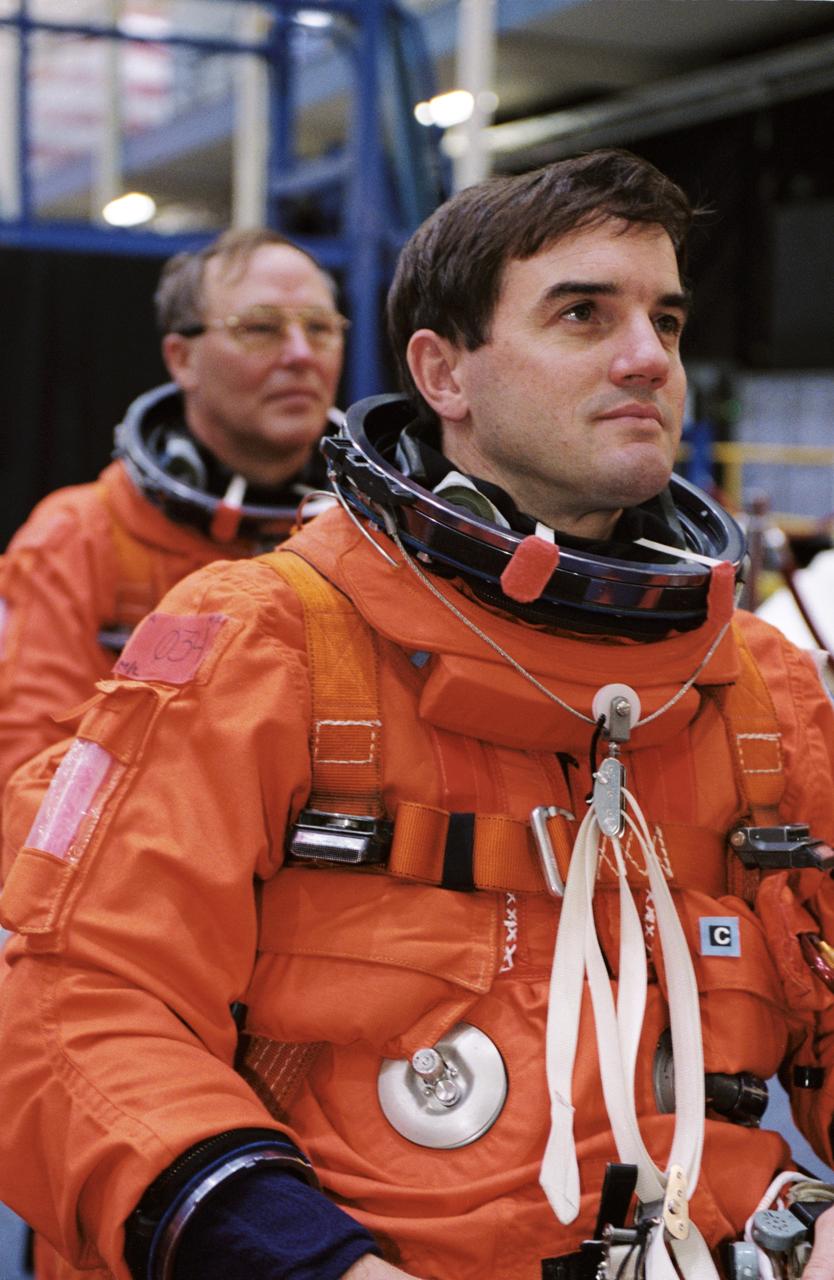
JSC2001-02173 (10 August 2001) --- Astronauts Rex J. Walheim (foreground) and Jerry L. Ross, both STS-110 mission specialists, wearing training versions of the full-pressure launch and entry suit, wait for a training and photo session to begin in the Space Vehicle Mockup Facility at the Johnson Space Center (JSC). STS-110 will be the 13th shuttle mission to visit the International Space Station (ISS).
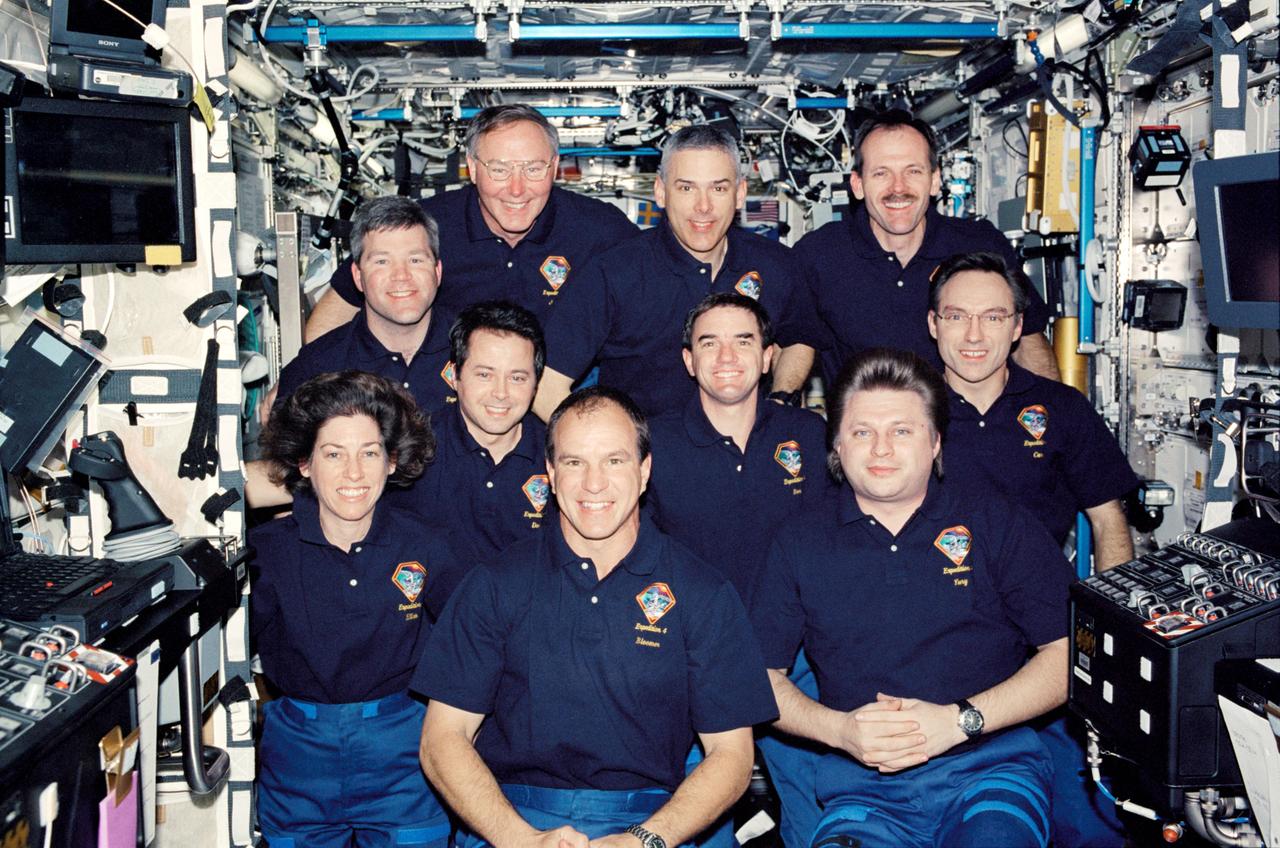
Posed inside the Destiny Laboratory aboard the International Space Station (ISS) are the STS-110 and Expedition Four crews for a traditional onboard portrait From the left, bottom row, are astronauts Ellen Ochoa, STS mission specialist, Michael J. Bloomfield, STS mission commander, and Yury I Onufrienko, Expedition Four mission commander. From the left, middle row, are astronauts Daniel W. Bursch, Expedition Four flight engineer, Rex J. Walheim, STS mission specialist, and Carl E. Walz, Expedition Four flight engineer. From the left, top row, are astronauts Stephen N. Frick, STS pilot; Jerry L. Ross, Lee M.E. Morin, and Steven L. Smith, all mission specialists. Launched aboard the Space Shuttle Orbiter Atlantis on April 8, 2002, the STS-110 mission crew prepared the ISS for future space walks by installing and outfitting the 43-foot-long Starboard side S0 truss and preparing the Mobile Transporter. The mission served as the 8th ISS assembly flight.
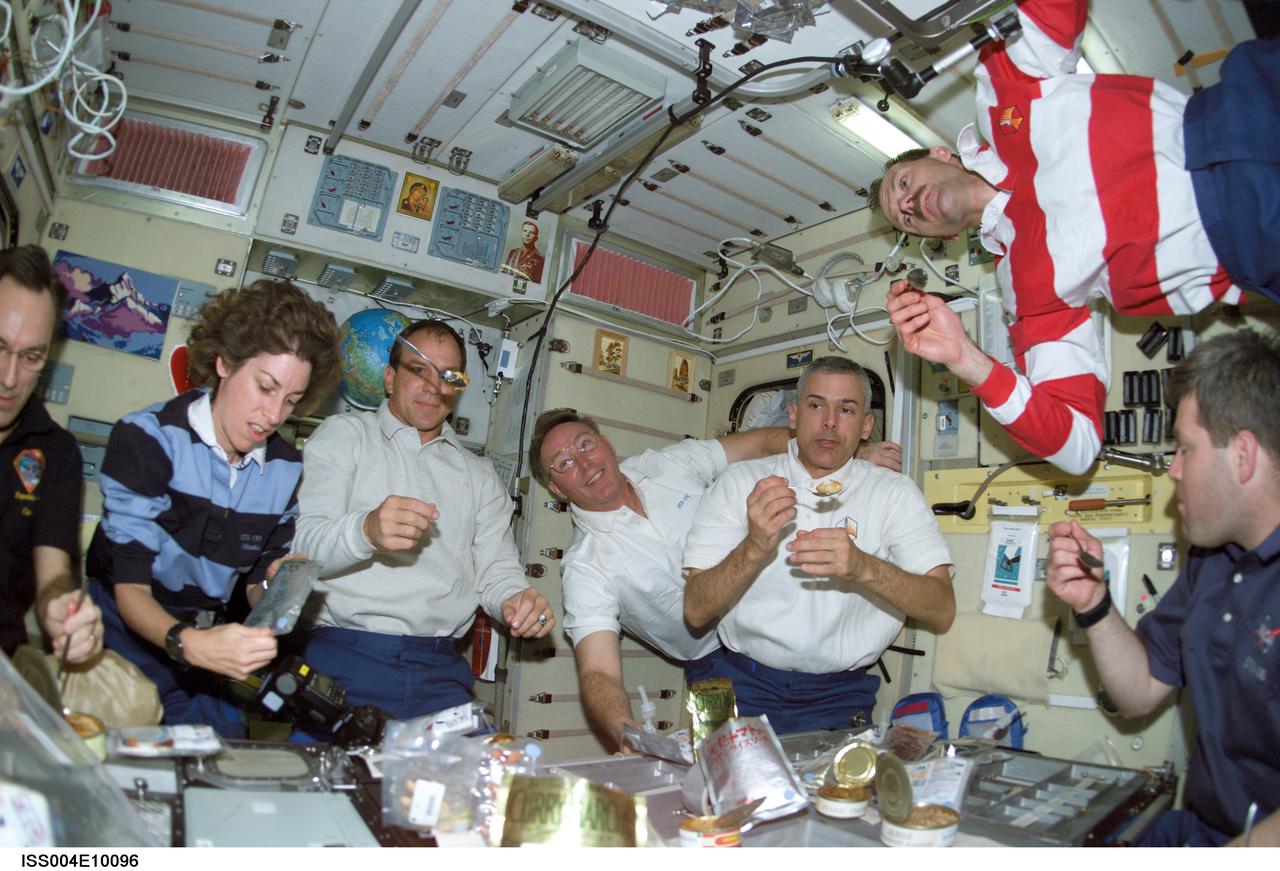
ISS004-E-10096 (16 April 2002) --- The Expedition Four and STS-110 crewmembers share a meal in the Zvezda Service Module on the International Space Station (ISS). From the left are astronauts Carl E. Walz (partially out of frame), Expedition Four flight engineer; Ellen Ochoa, STS-110 mission specialist; Michael J. Bloomfield, STS-110 mission commander; Jerry L. Ross, Lee M. E. Morin, Steven L. Smith, all STS-110 mission specialists; and Stephen N. Frick, STS-110 pilot. The remainders of the crews were out of frame.
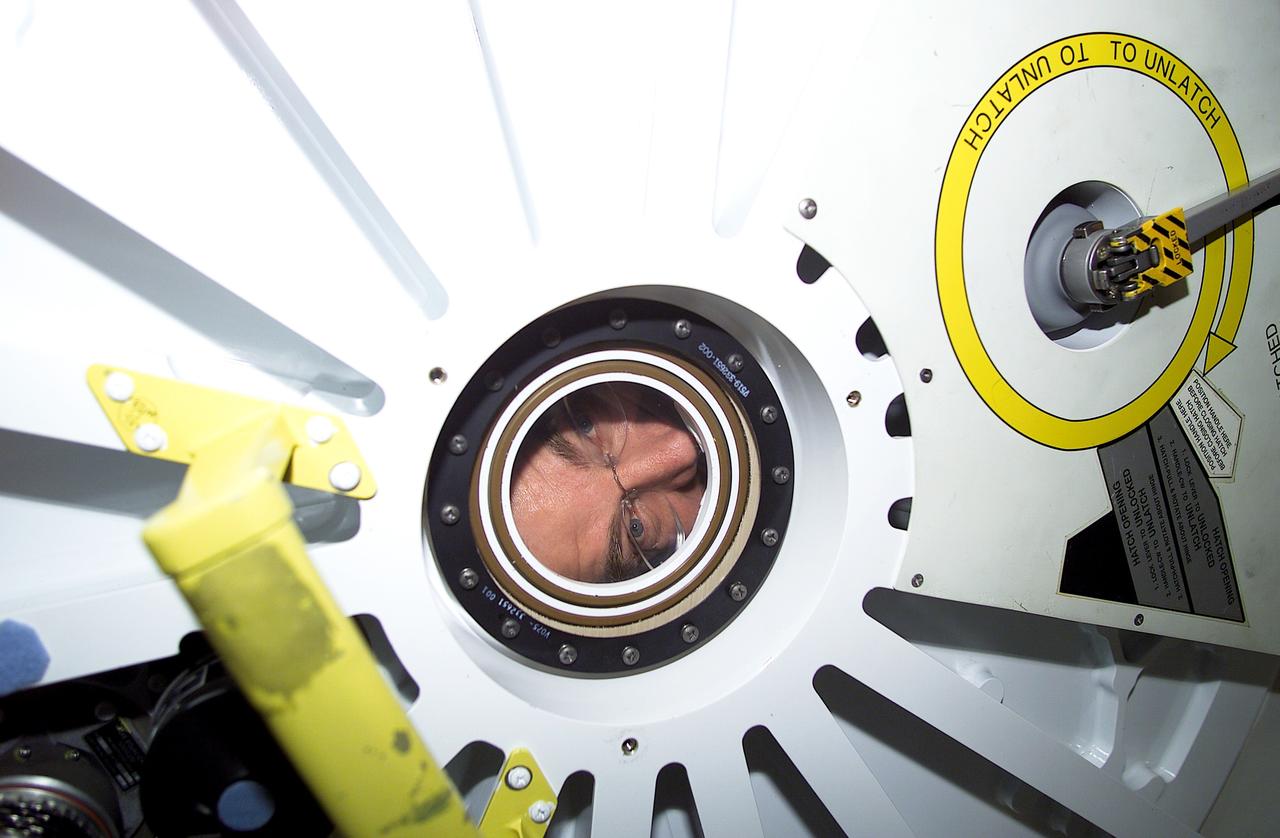
The STS-100 mission launched for the International Space Station (ISS) on April 19, 2001 as the sixth station assembly flight. Main objectives included the delivery and installation of the Canadian-built Space Station Remote Manipulator System (SSRMS), or Canadarm2, the installation of a UHF anterna for space-to-space communications for U.S. based space walks, and the delivery of supplies via the Italian Multipurpose Logistics Module (MPLM) "Raffaello". This is an STS-110 onboard photo of Astronaut James S. Voss, Expedition Two flight engineer, peering into the pressurized Mating Adapter (PMA-2) prior hatch opening. The picture was taken by one of the STS-100 crew members inside the PMA.
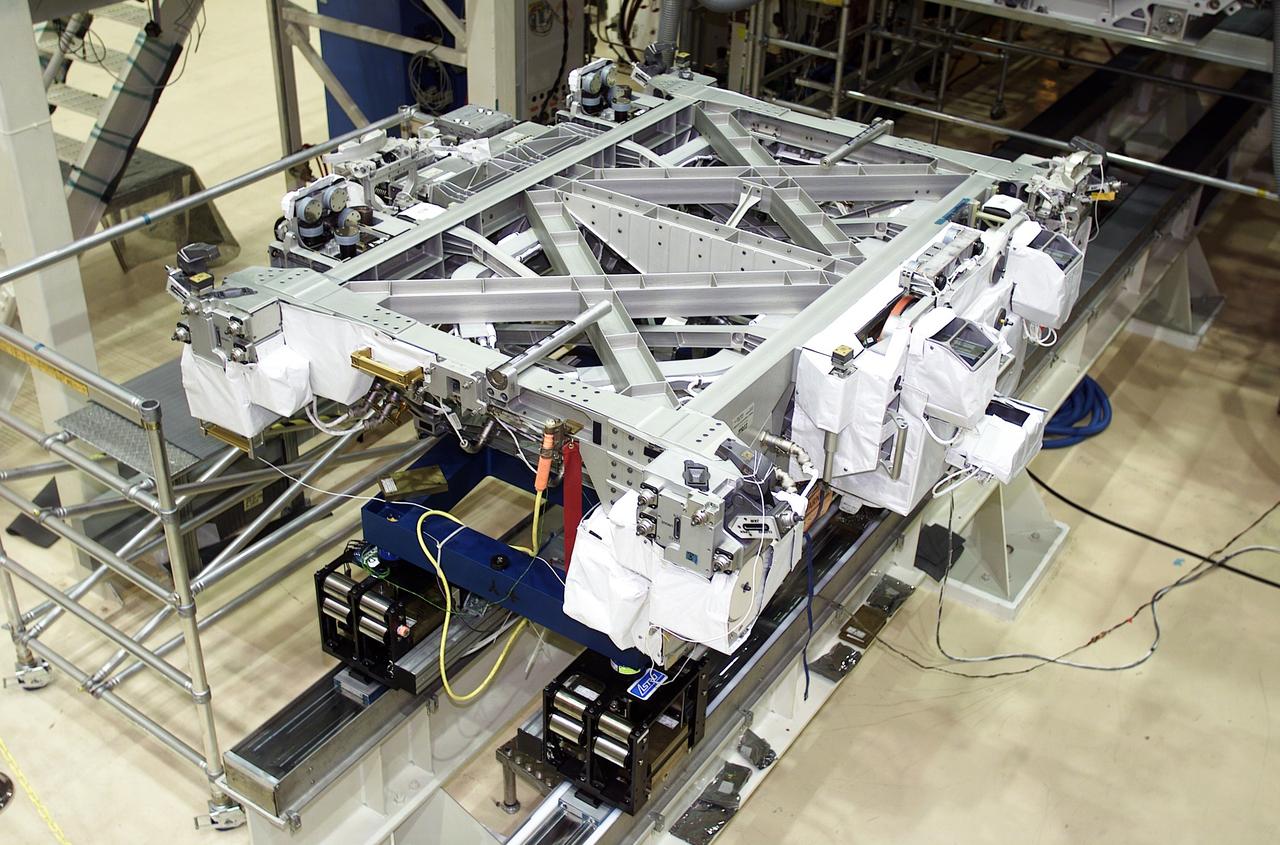
The Space Shuttle Atlantis, STS-110 mission, deployed this railcar, called the Mobile Transporter, and an initial 43-foot section of track, the S0 (S-zero) truss, preparing the International Space Station (ISS) for future spacewalks. The first railroad in space, the Mobile Transporter will allow the Station's robotic arm to travel up and down the finished truss for future assembly and maintenance. The 27,000-pound S0 truss is the first of 9 segments that will make up the Station's external framework that will eventually stretch 356 feet (109 meters), or approximately the length of a football field. The completed truss structure will hold solar arrays and radiators to provide power and cooling for additional international research laboratories from Japan and Europe that will be attached to the Station. The Space Shuttle Orbiter Atlantis, STS-110 mission, was launched April 8, 2002 and returned to Earth April 19, 2002. STS-110's Extravehicular Activity (EVA) marked the first use of the Station's robotic arm to maneuver spacewalkers around the Station.
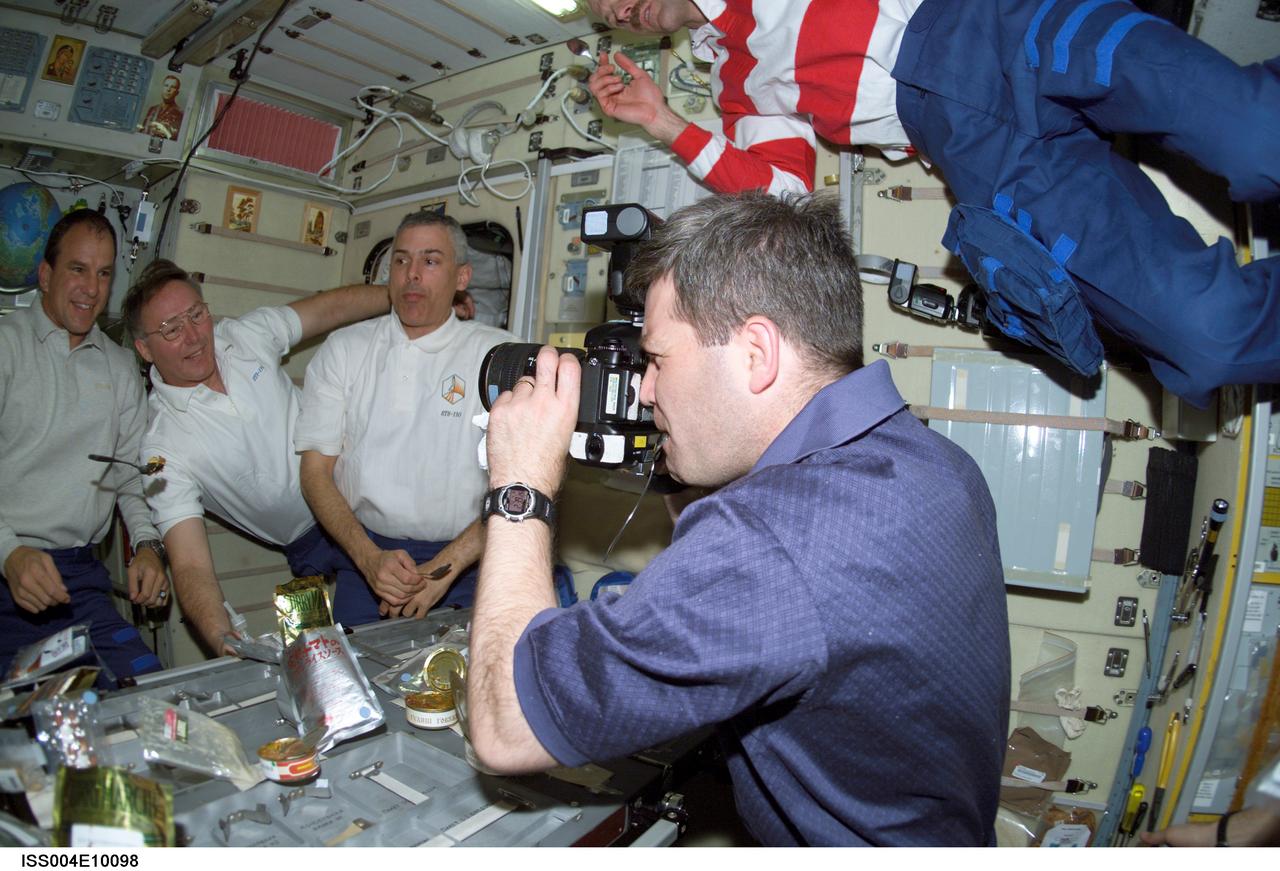
ISS004-E-10098 (16 April 2002) --- Astronaut Stephen N. Frick, STS-110 pilot, photographs crewmates in the Zvezda Service Module on the International Space Station (ISS). From the left are astronauts Michael J. Bloomfield, STS-110 mission commander, Jerry L. Ross and Lee M. E. Morin, both mission specialists. Astronaut Steven L. Smith, STS-110 mission specialist, floats above.
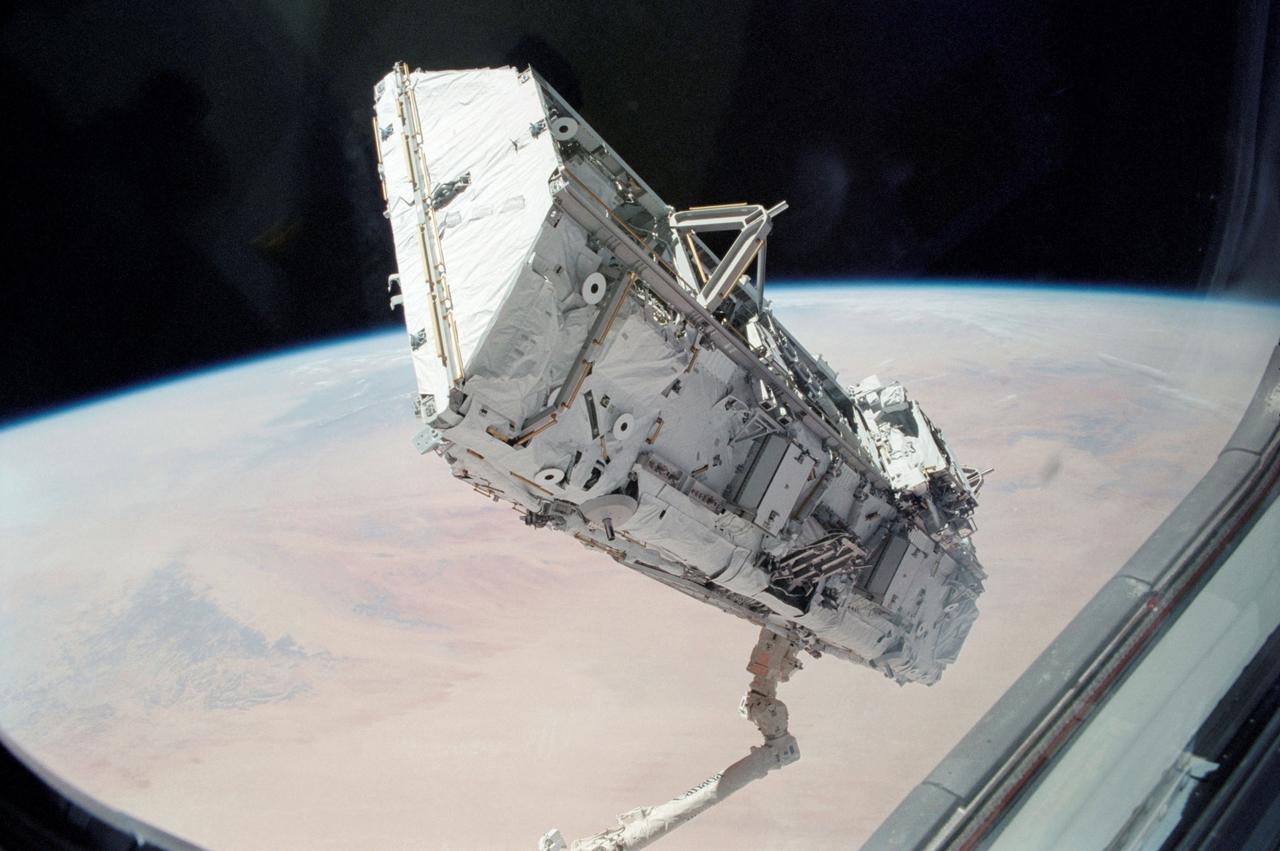
Backdropped against the blackness of space and the Earth's horizon, the S0 (S-zero) truss is removed from Atlantis' cargo bay and onto the Destiny laboratory of the International Space Station (ISS) by Astronauts Ellen Ochoa, STS-110 mission specialist, and Daniel W. Bursch, Expedition Four flight engineer, using the ISS' Canadarm2. Space Shuttle Orbiter Atlantis, STS-110 mission, prepared the International Space Station (ISS) for future spacewalks by installing and outfitting the 43-foot-long S0 truss and preparing the first railroad in space, the Mobile Transporter. The 27,000-pound S0 truss was the first of 9 segments that will make up the Station's external framework that will eventually stretch 356 feet (109 meters), or approximately the length of a football field. This central truss segment also includes a flatcar called the Mobile Transporter and rails that will become the first "space railroad," which will allow the Station's robotic arm to travel up and down the finished truss for future assembly and maintenance. The completed truss structure will hold solar arrays and radiators to provide power and cooling for additional international research laboratories from Japan and Europe that will be attached to the Station. Milestones of the STS-110 mission included the first use of the Station's robotic arm to maneuver spacewalkers around the Station and it was the first time all of a Shuttle crew's spacewalks were based out of the Station's Quest Airlock. It was also the first Shuttle to use three Block II Main Engines. The Space Shuttle Orbiter Atlantis, STS-110 mission, was launched April 8, 2002 and returned to Earth April 19, 2002.
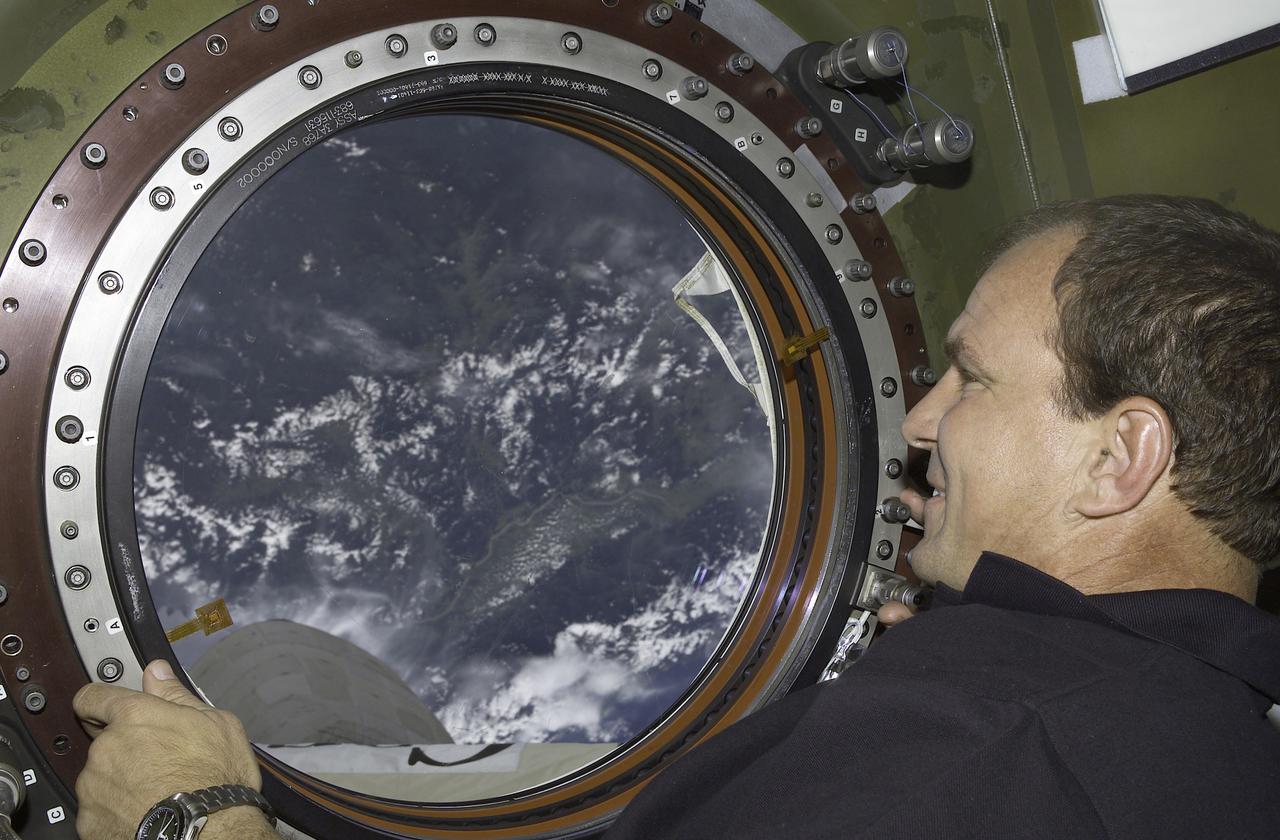
Astronaut Michael J. Bloomfield, STS-110 mission commander, looks through the Earth observation window in the Destiny laboratory aboard the International Space Station (ISS). The STS-110 mission prepared the ISS for future spacewalks by installing and outfitting the S0 (S-zero) truss and the Mobile Transporter. The 43-foot-long S0 Truss, weighing in at 27,000 pounds, was the first of 9 segments that will make up the Station's external framework that will eventually stretch 356 feet (109 meters), or approximately the length of a football field. This central truss segment also includes a flatcar called the Mobile Transporter and rails that will become the first "space railroad," which will allow the Station's robotic arm to travel up and down the finished truss for future assembly and maintenance. The completed truss structure will hold solar arrays and radiators to provide power and cooling for additional international research laboratories from Japan and Europe that will be attached to the Station. Milestones of the STS-110 mission included the first time the ISS robotic arm was used to maneuver spacewalkers around the Station and marked the first time all spacewalks were based out of the Station's Quest Airlock. It was also the first Shuttle to use three Block II Main Engines. The Space Shuttle Orbiter Atlantis, STS-110 mission, was launched April 8, 2002 and returned to Earth April 19, 2002.
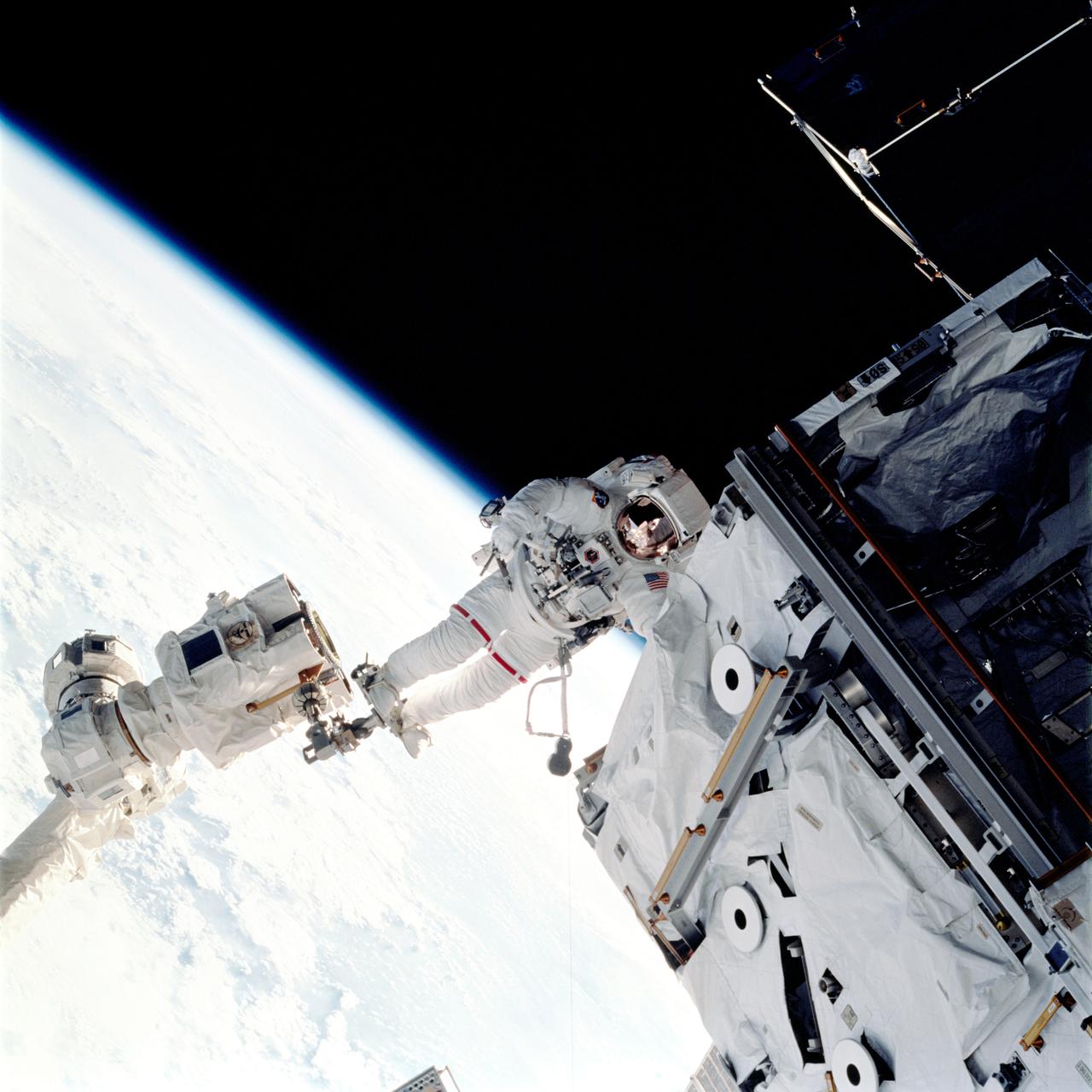
Launched aboard the Space Shuttle Orbiter Atlantis on April 8, 2002, the STS-110 mission prepared the International Space Station (ISS) for future space walks by installing and outfitting the 43-foot-long Starboard side S0 (S-zero) truss and preparing the first railroad in space, the Mobile Transporter. The 27,000 pound S0 truss was the first of 9 segments that will make up the Station's external framework that will eventually stretch 356 feet (109 meters), or approximately the length of a football field. This central truss segment also includes a flatcar called the Mobile Transporter and rails that will become the first "space railroad," which will allow the Station's robotic arm to travel up and down the finished truss for future assembly and maintenance. The completed truss structure will hold solar arrays and radiators to provide power and cooling for additional international research laboratories from Japan and Europe that will be attached to the Station. STS-110 Extravehicular Activity (EVA) marked the first use of the Station's robotic arm to maneuver space walkers around the Station and was the first time all of a shuttle crew's space walks were based out of the Station's Quest Airlock. In this photograph, Astronaut Jerry L. Ross, mission specialist, anchored on the end of the Canadarm2, moves near the newly installed S0 truss. Astronaut Lee M. E. Morin, mission specialist, (out of frame), worked in tandem with Ross during this fourth and final scheduled session of EVA for the STS-110 mission. The final major task of the space walk was the installation of a beam, the Airlock Spur, between the Quest Airlock and the S0. The spur will be used by space walkers in the future as a path from the airlock to the truss.
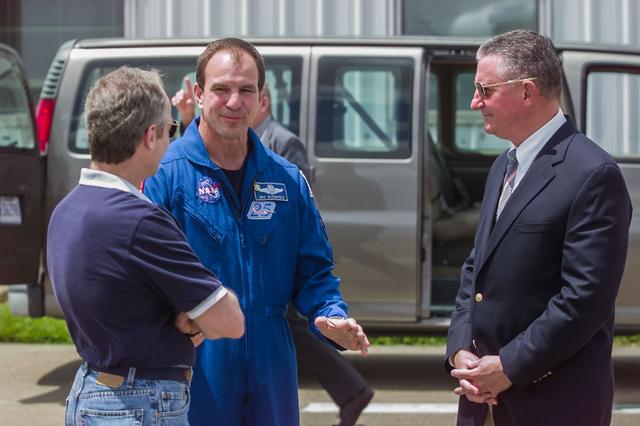
JSC2002-E-14064 (20 April 2002) --- Johnson Space Center’s (JSC) Director Jefferson D. Howell, Jr. (right), astronauts Michael J. Bloomfield, STS-110 mission commander, and Charles J. Precourt, astronaut office chief, exchange greetings at Ellington Field during the STS-110 crew return ceremonies.
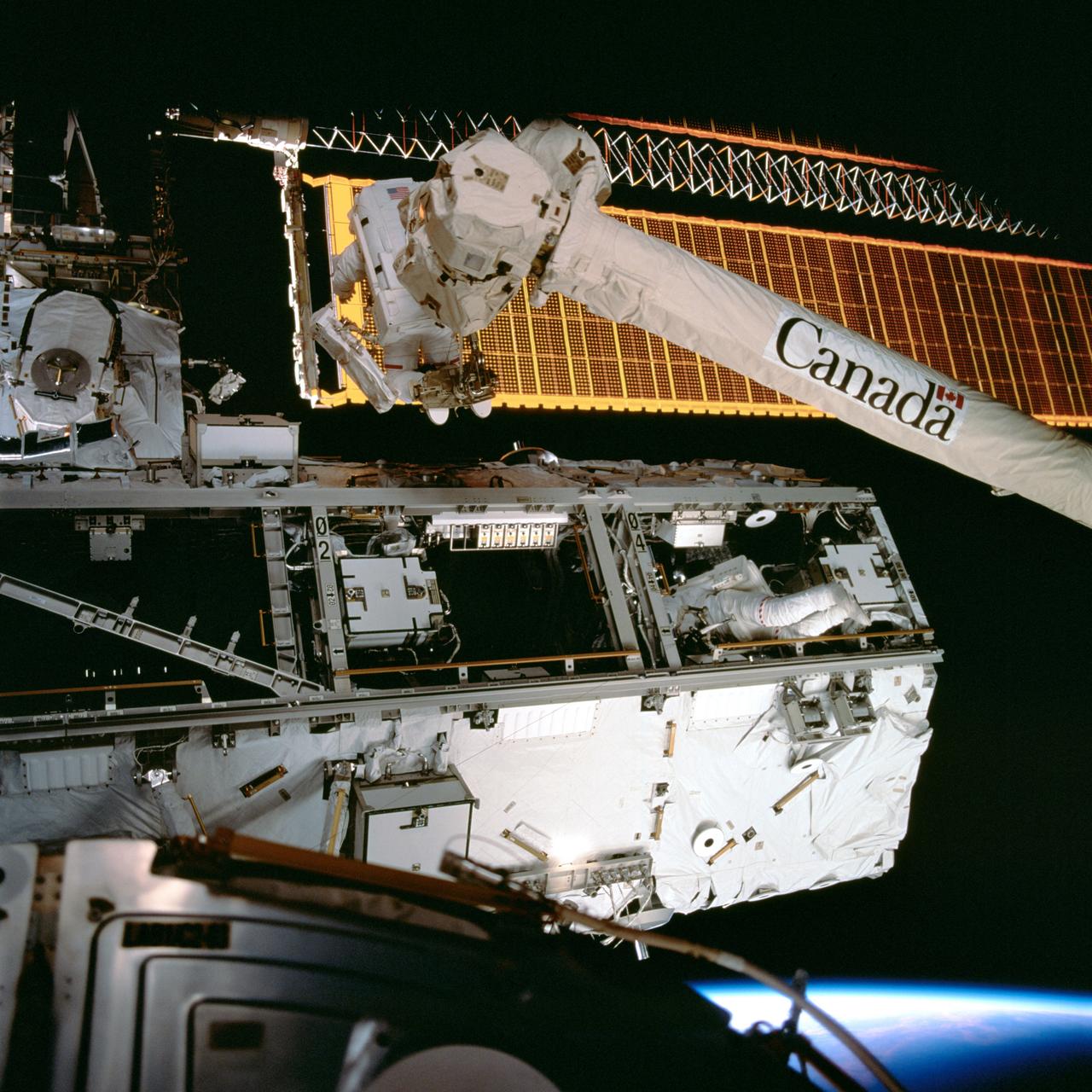
STS-110 Mission Specialists Jerry L. Ross and Lee M.E. Morin work in tandem on the fourth scheduled EVA session for the STS-110 mission aboard the Space Shuttle Orbiter Atlantis. Ross is anchored on the mobile foot restraint on the International Space Station's (ISS) Canadarm2, while Morin works inside the S0 (S-zero) truss. The STS-110 mission prepared the Station for future spacewalks by installing and outfitting a 43-foot-long S0 truss and preparing the Mobile Transporter. The 27,000 pound S0 Truss was the first of 9 segments that will make up the Station's external framework that will eventually stretch 356 feet (109 meters), or approximately the length of a football field. This central truss segment also includes a flatcar called the Mobile Transporter and rails that will become the first "space railroad," which will allow the Station's robotic arm to travel up and down the finished truss for future assembly and maintenance. The completed truss structure will hold solar arrays and radiators to provide power and cooling for additional international research laboratories from Japan and Europe that will be attached to the Station. Milestones of the S-110 mission included the first time the ISS robotic arm was used to maneuver spacewalkers around the Station and marked the first time all spacewalks were based out of the Station's Quest Airlock. It was also the first Shuttle to use three Block II Main Engines. The Space Shuttle Orbiter Atlantis, STS-110 mission, was launched April 8, 2002 and returned to Earth April 19, 2002.
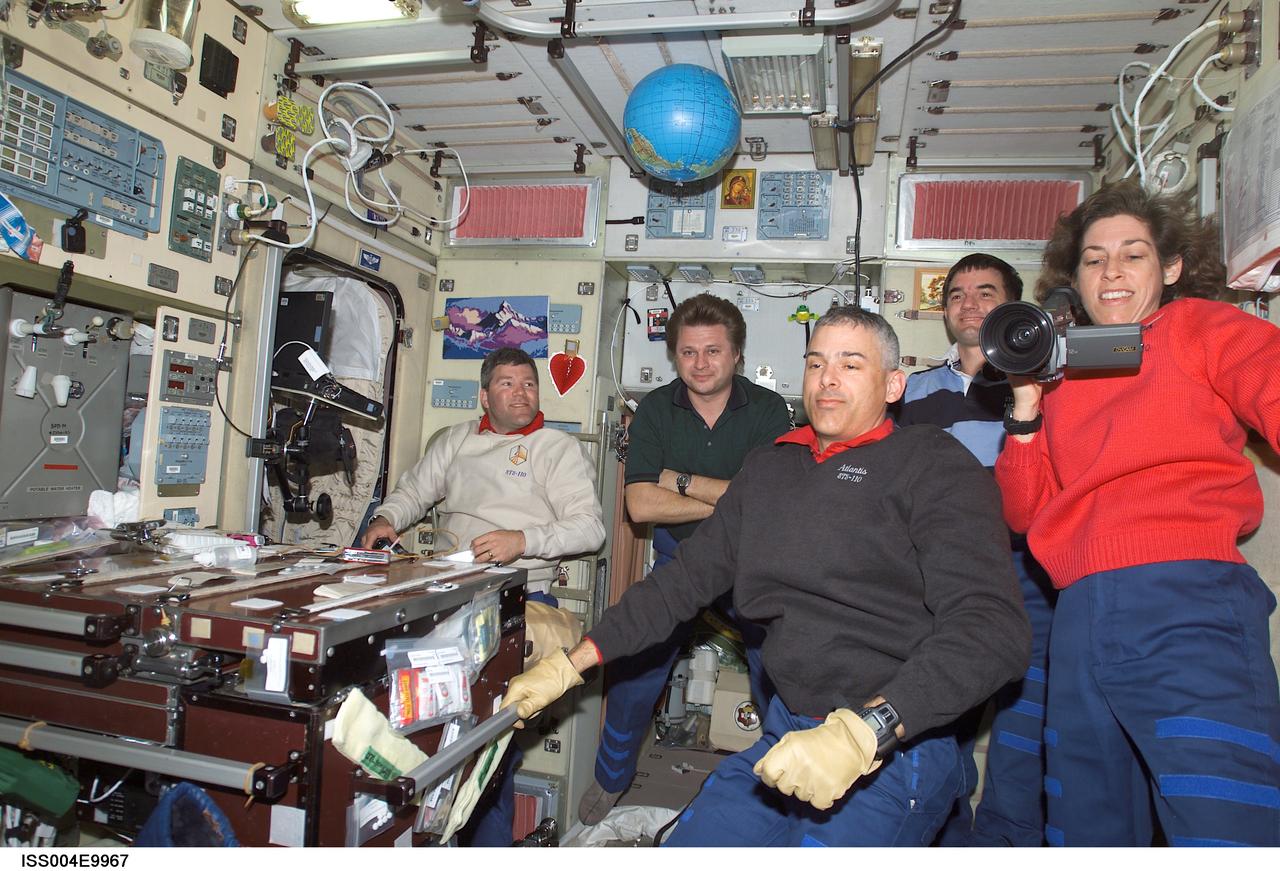
ISS004-E-9967 (10 April 2002) --- Astronauts Lee M. E. Morin (left foreground) and Ellen Ochoa, both STS-110 mission specialists; along with astronaut Stephen N. Frick (left background), STS-110 pilot, cosmonaut Yury I. Onufrienko, Expedition Four mission commander, and astronaut Rex J. Walheim, STS-110 mission specialist, are photographed in the Zvezda Service Module on the International Space Station (ISS).
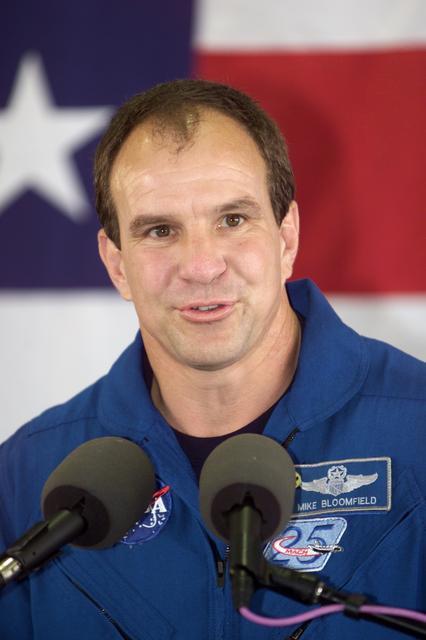
JSC2002-E-14067 (20 April 2002) --- Astronaut Michael J. Bloomfield, STS-110 mission commander, speaks from the lectern in Hangar 990 at Ellington Field during crew return ceremonies.
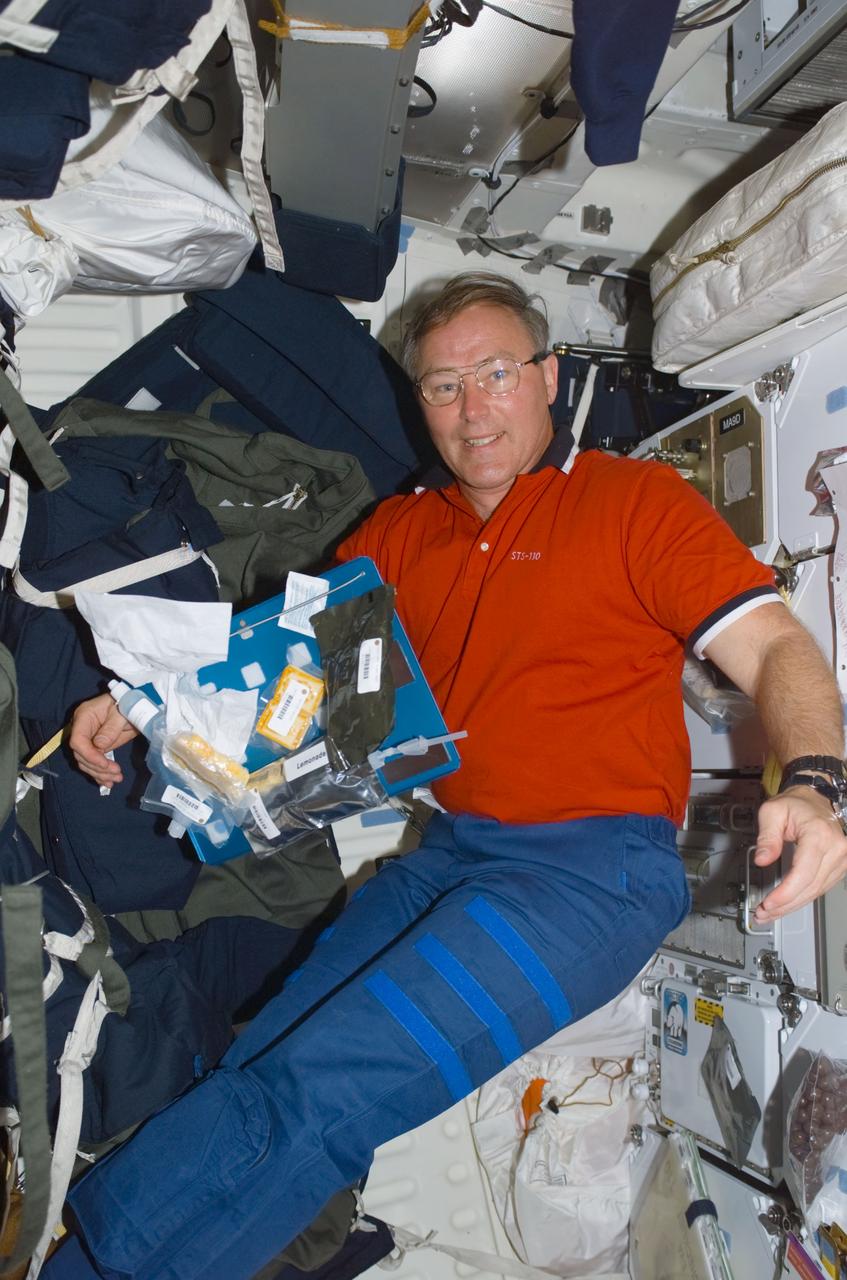
STS110-E-5035 (8 April 2002) --- Astronaut Jerry L. Ross, STS-110 mission specialist, along with a tray of food, floats on the mid deck of the Space Shuttle Atlantis. The image was taken with a digital still camera.
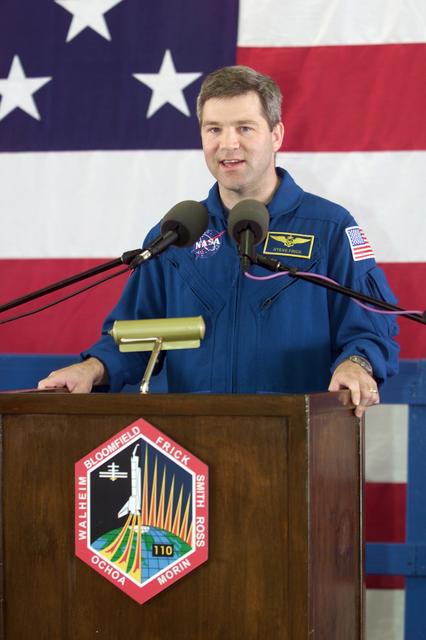
JSC2002-E-14071 (20 April 2002) --- Astronaut Stephen N. Frick, STS-110 pilot, speaks from the lectern in Hangar 990 at Ellington Field during the crew return ceremonies.
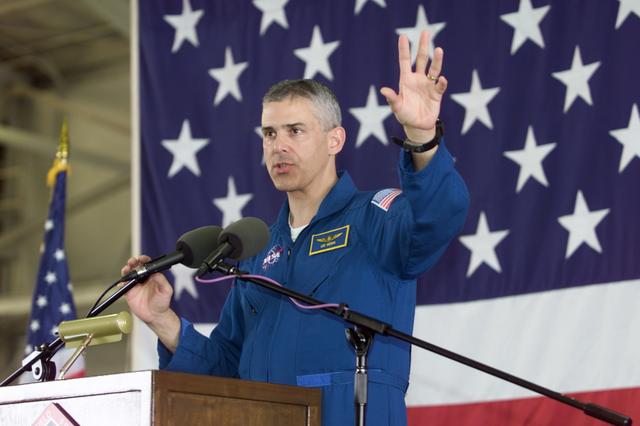
JSC2002-E-14076 (20 April 2002) --- Astronaut Lee M. E. Morin, STS-110 mission specialist, speaks from the lectern in Hangar 990 at Ellington Field during the crew return ceremonies.
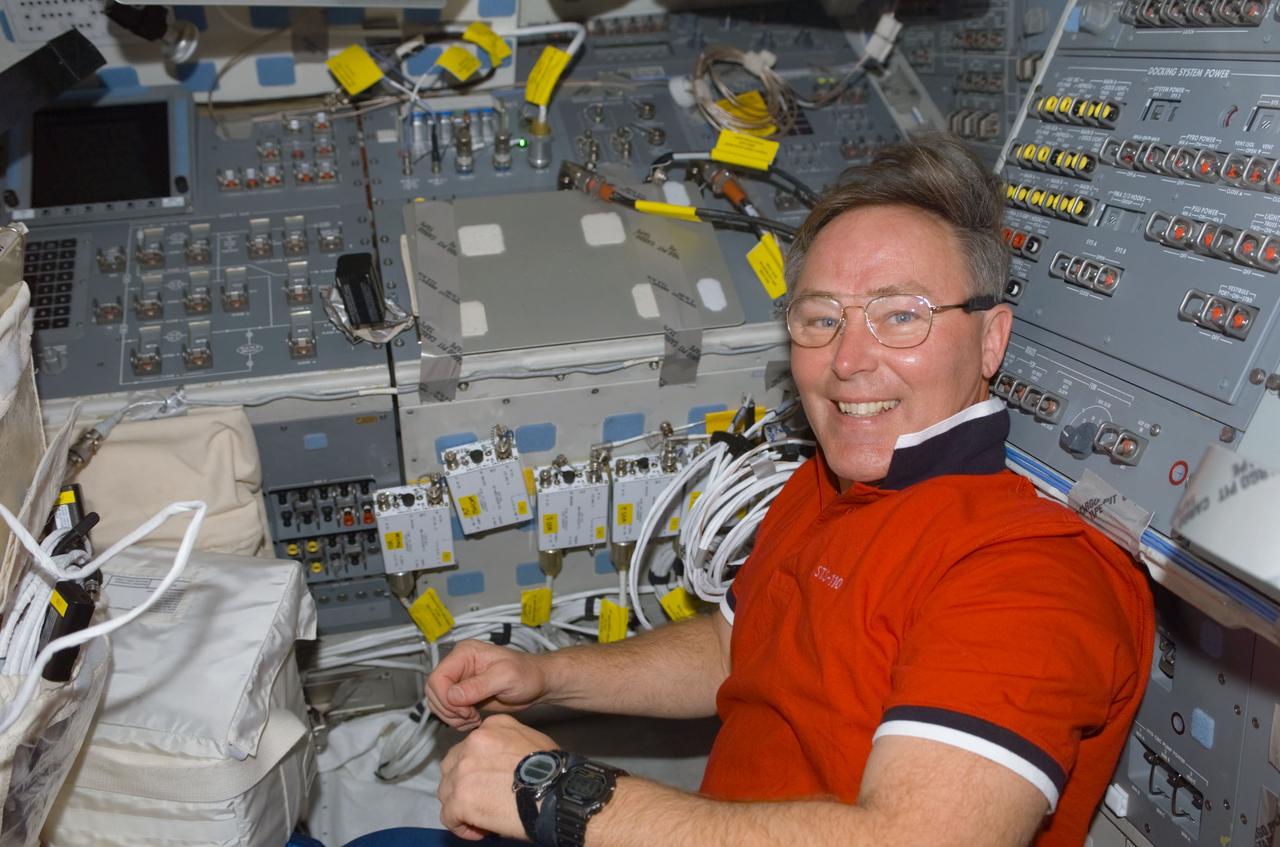
STS110-E-5004 (8 April 2002) --- Astronaut Jerry L. Ross, STS-110 mission specialist, works on the mid deck of the Space Shuttle Atlantis. The image was taken with at digital still camera.
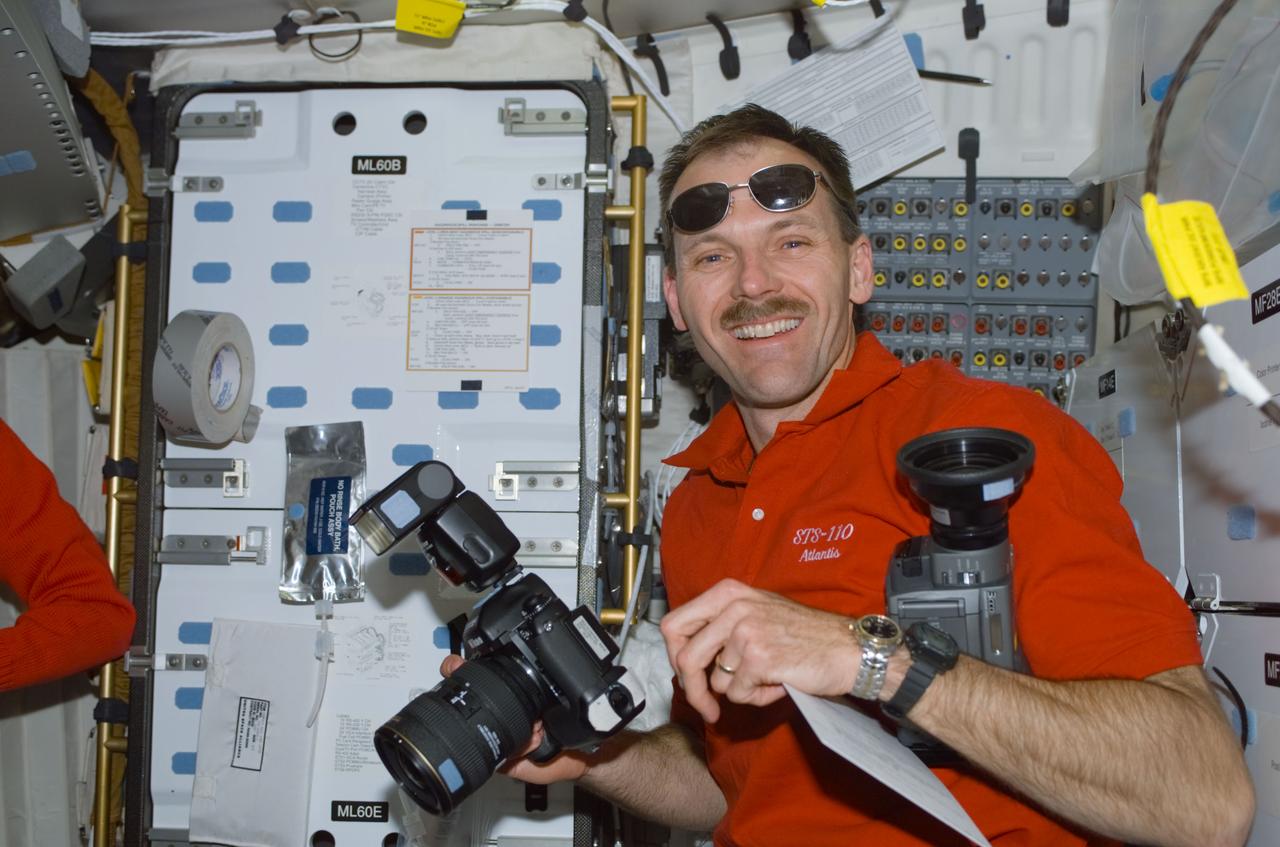
STS110-E-5088 (9 April 2002) --- Astronaut Steven L. Smith, STS-110 mission specialist, holds cameras on the mid deck of the Space Shuttle Atlantis. The image was taken with a digital still camera.
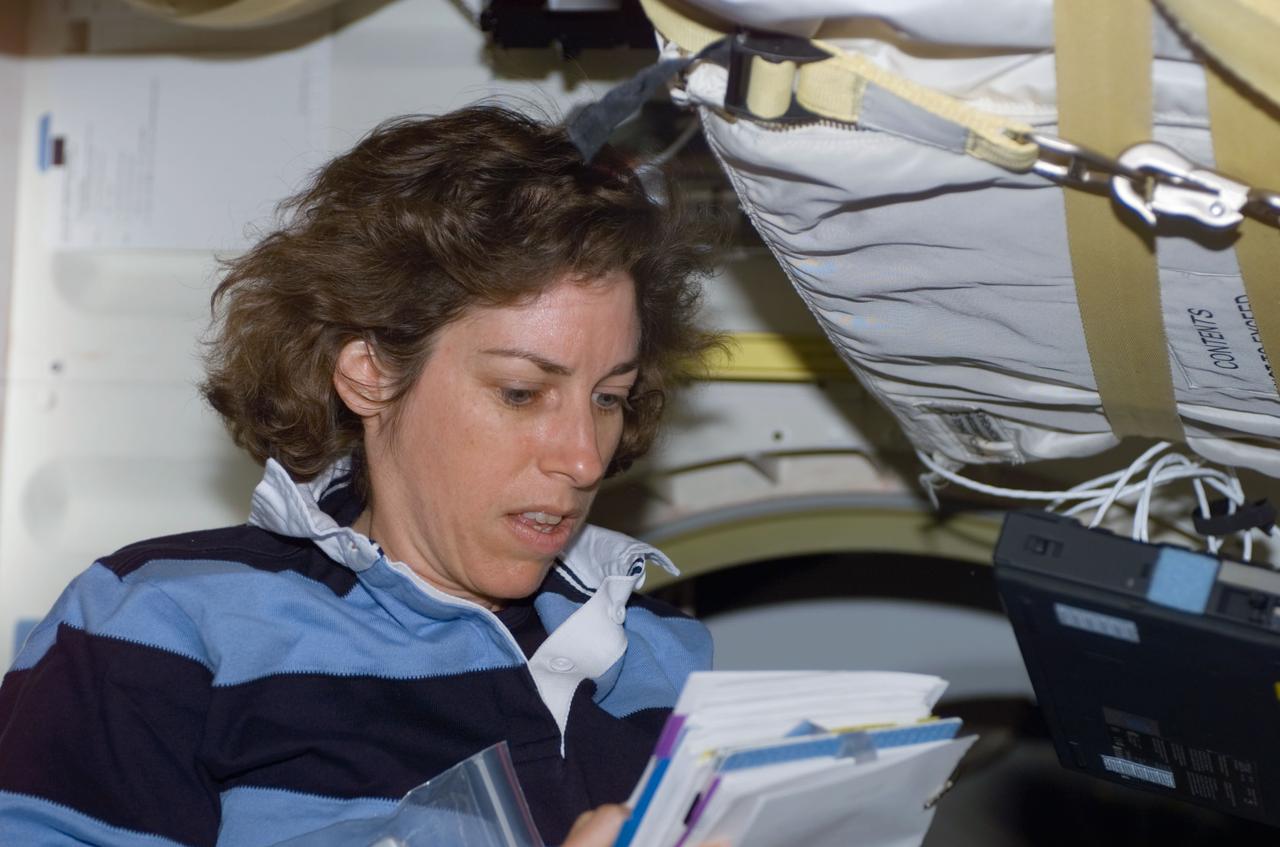
S110-E-5010 (8 April 2002) --- Astronaut Ellen Ochoa, STS-110 mission specialist, goes over a procedures checklist on the mid deck of the Space Shuttle Atlantis. The image was taken with at digital still camera.
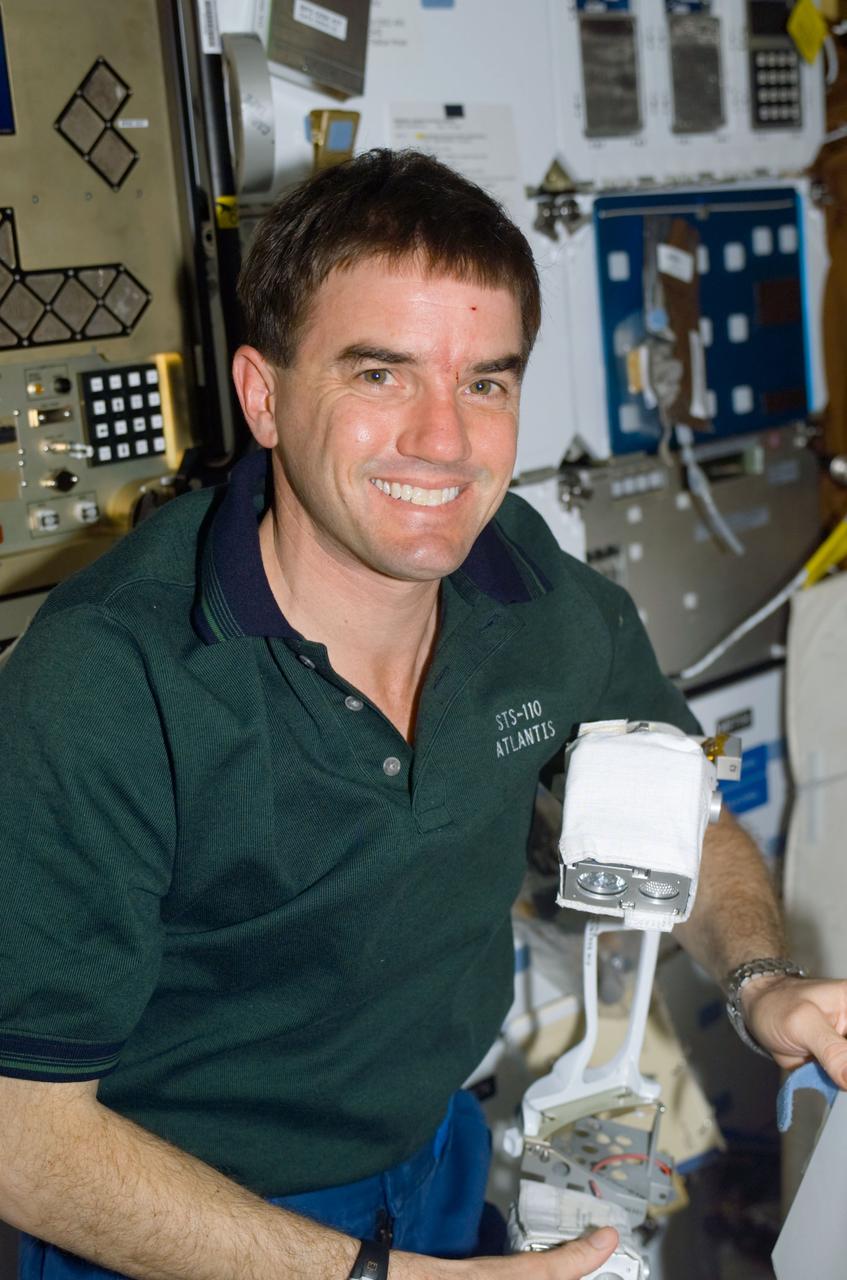
STS110-E-5006 (8 April 2002) --- Astronaut Rex J. Walheim, STS-110 mission specialist, works on the mid deck of the Space Shuttle Atlantis. The image was taken with at digital still camera.
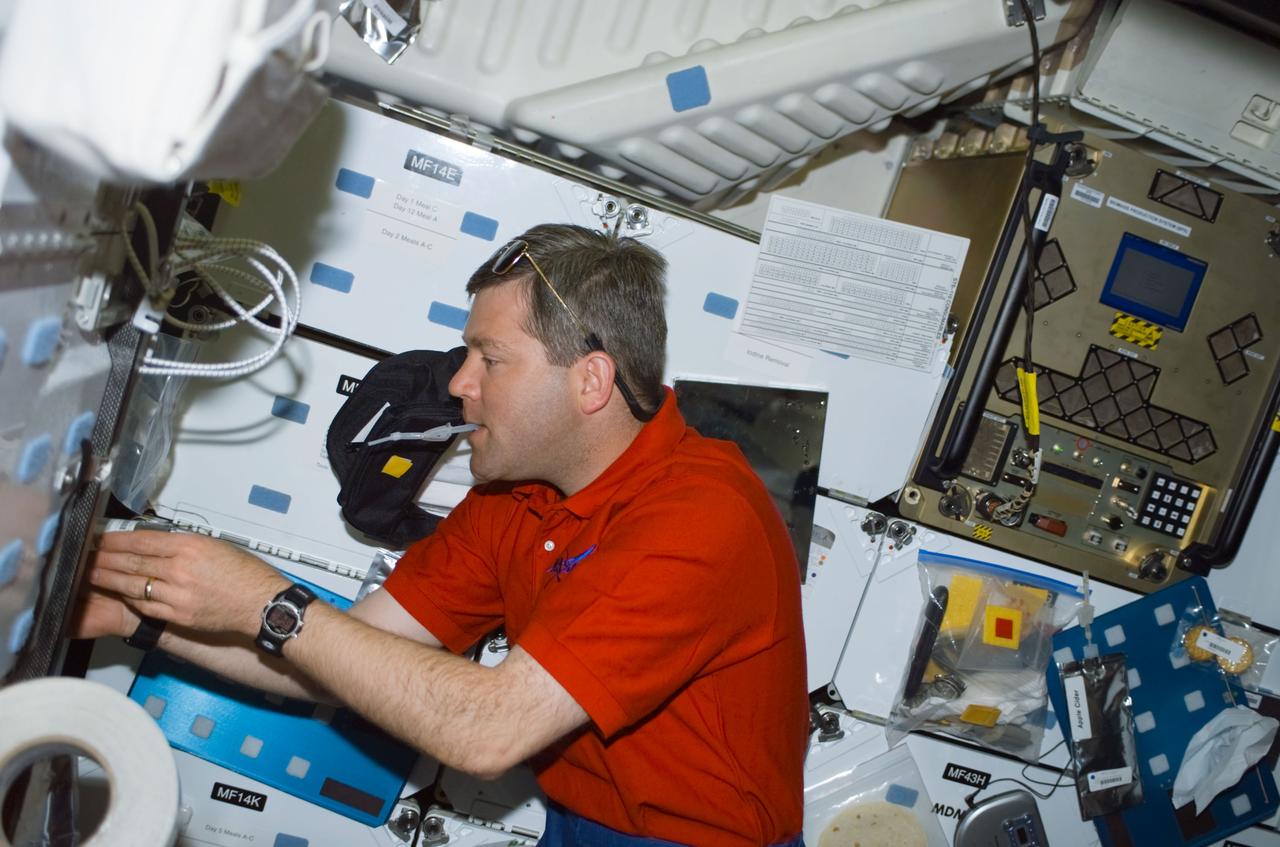
STS110-E-5042 (9 April 2002) --- Astronaut Stephen N. Frick, STS-110 pilot, works on the mid deck of the Space Shuttle Atlantis. The image was taken with a digital still camera.
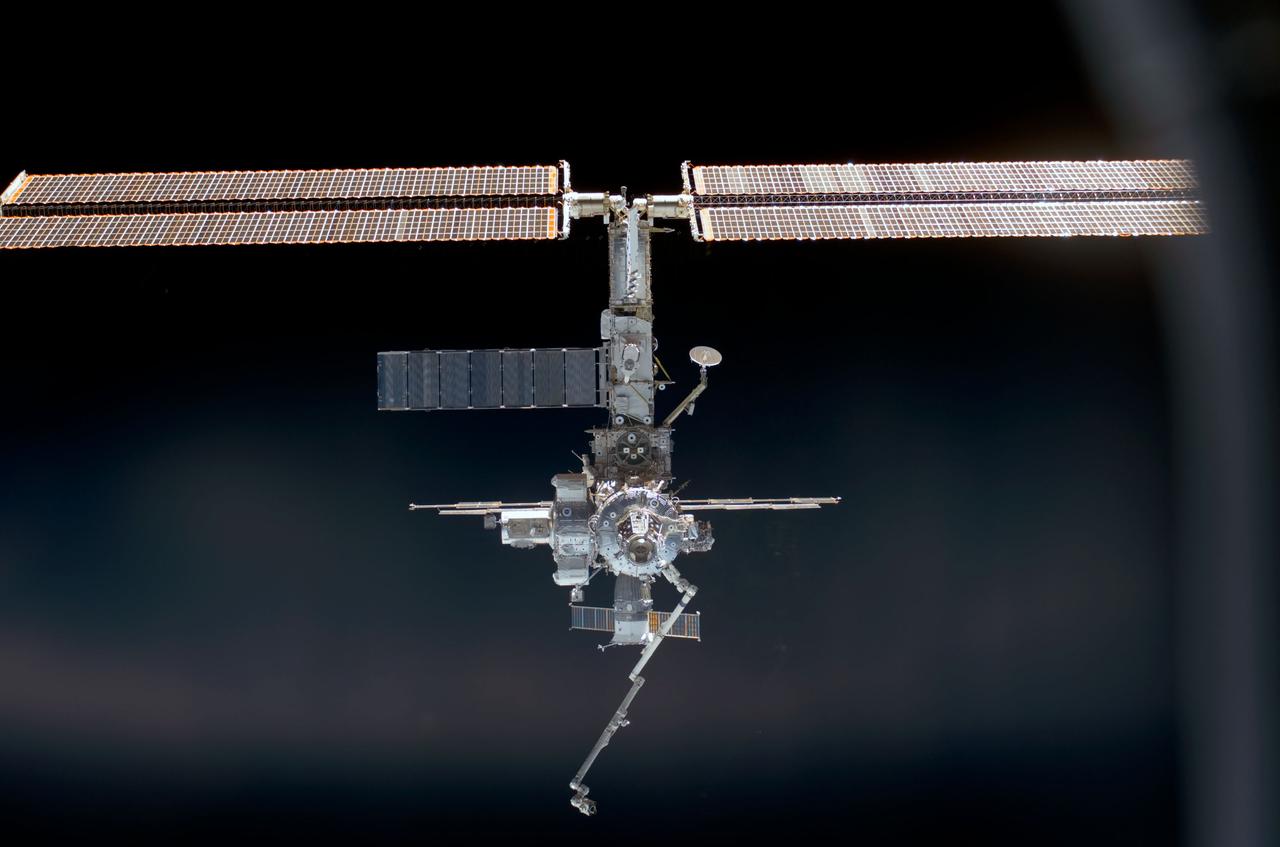
STS110-E-5075 (9 April 2002) --- Backdropped by the blackness of space, this full view of the International Space Station (ISS) was photographed by a STS-110 crewmember with a digital still camera during the docking approach.

JSC2002-E-14079 (20 April 2002) --- Astronaut Jerry L. Ross, STS-110 mission specialist, speaks from the lectern in Hangar 990 at Ellington Field during the crew return ceremonies.
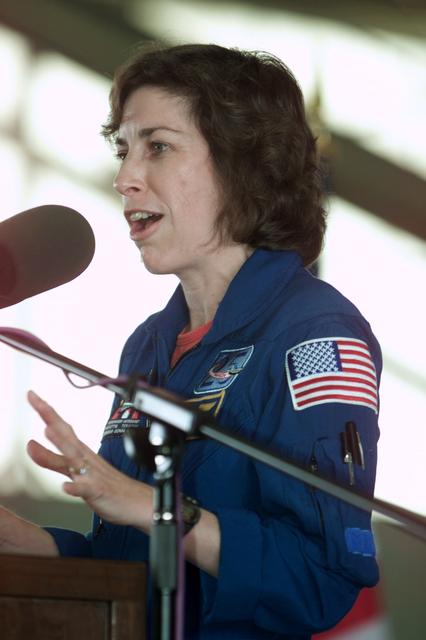
JSC2002-E-14074 (20 April 2002) --- Astronaut Ellen Ochoa, STS-110 mission specialist, speaks from the lectern in Hangar 990 at Ellington Field during the crew return ceremonies. Photo credit: NASA
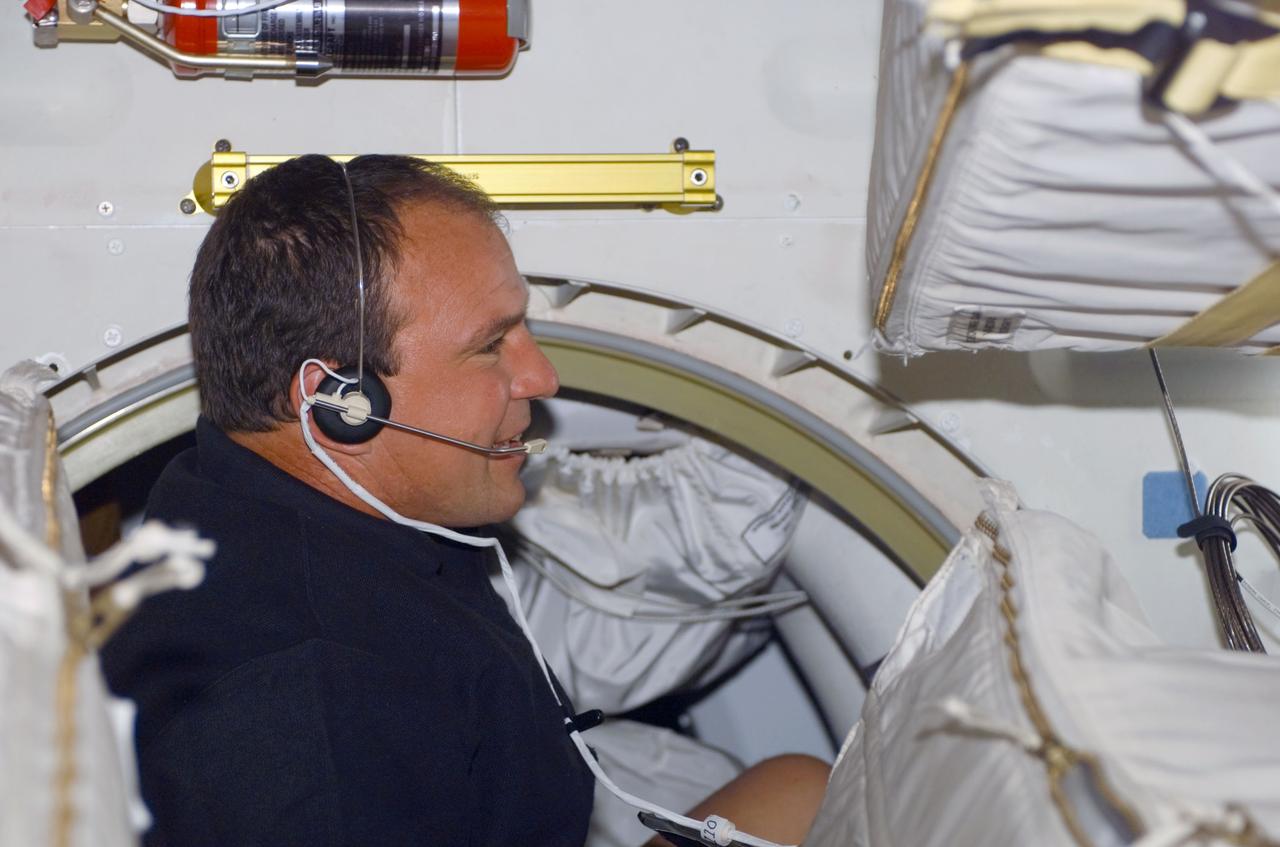
STS110-E-5038 (8 April 2002) --- Astronaut Michael J. Bloomfield, STS-110 mission commander, converses with ground controllers while traversing through the Space Shuttle Atlantis. The image was taken with a digital still camera.

STS110-E-5074 (9 April 2002) --- Backdropped by the blackness of space, this full view of the International Space Station (ISS) was photographed by a STS-110 crewmember with a digital still camera during the docking approach.
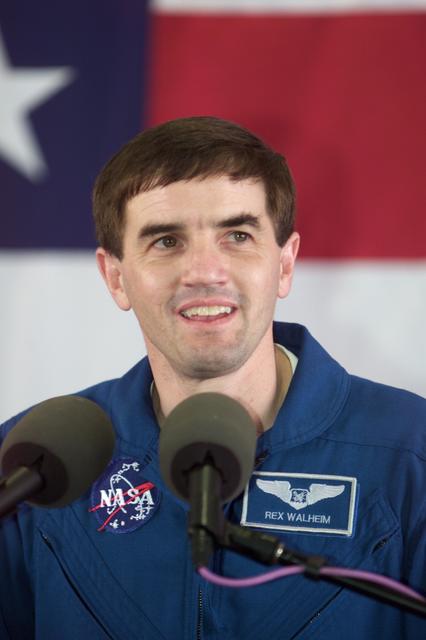
JSC2002-E-14073 (20 April 2002) --- Astronaut Rex J. Walheim, STS-110 mission specialist, speaks from the lectern in Hangar 990 at Ellington Field during the crew return ceremonies.

STS110-E-5148 (10 April 2002) --- Astronaut Jerry L. Ross, STS-110 mission specialist, navigates one of the many hatches on the International Space Station (ISS). The image was taken with a digital still camera.
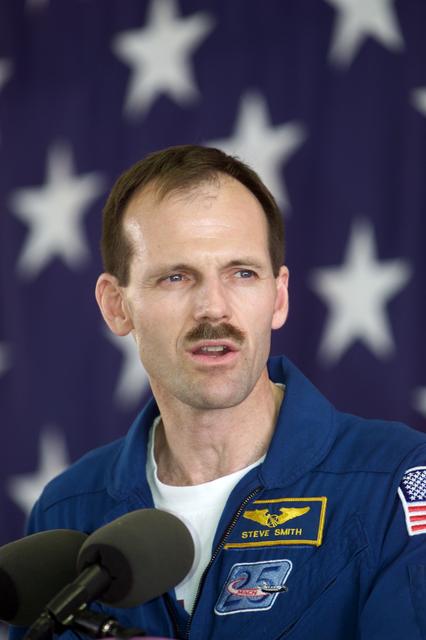
JSC2002-E-14077 (20 April 2002) --- Astronaut Steven L. Smith, STS-110 mission specialist, speaks from the lectern in Hangar 990 at Ellington Field during the crew return ceremonies.
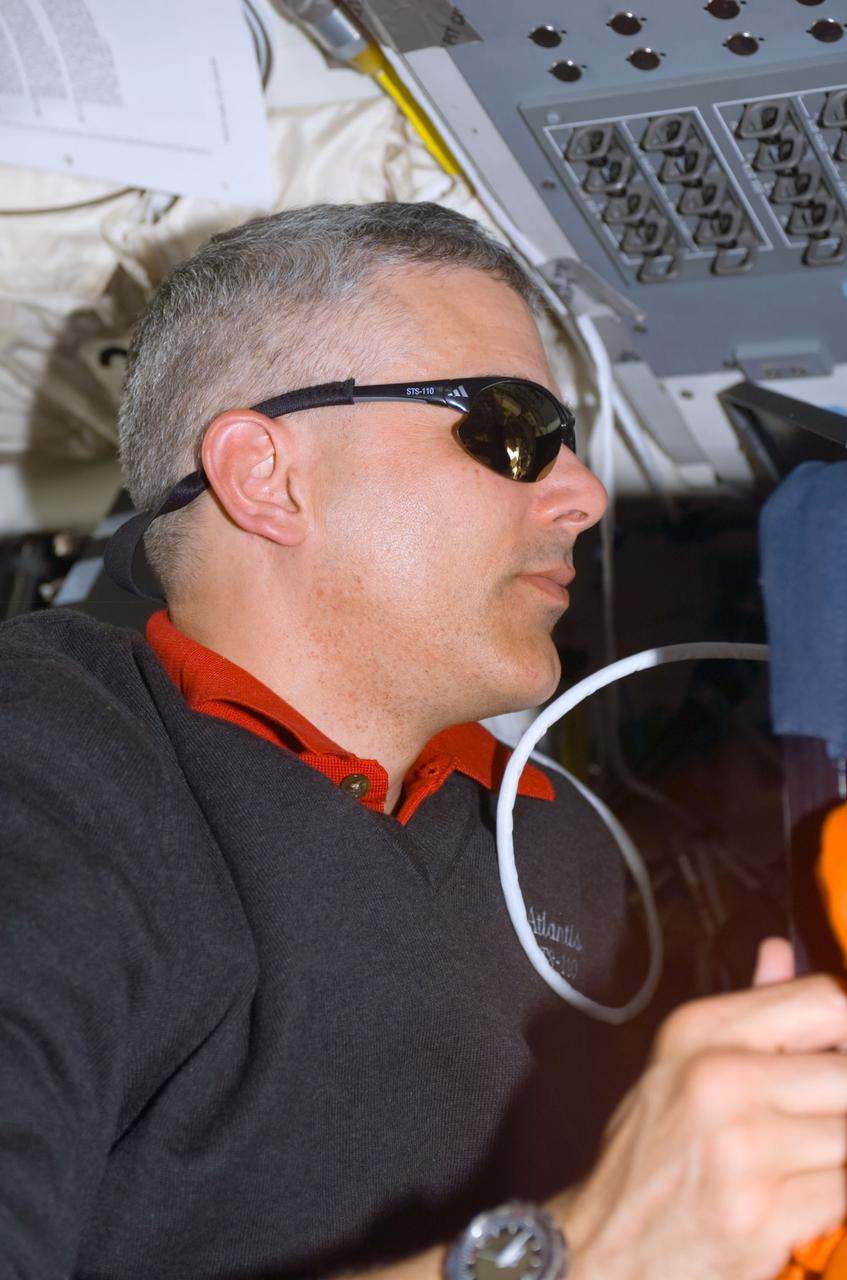
STS110-E-5064 (9 April 2002) --- Astronaut Lee M. E. Morin, STS-110 mission specialist, is photographed on the flight deck of the Space Shuttle Atlantis. The image was taken with a digital still camera.
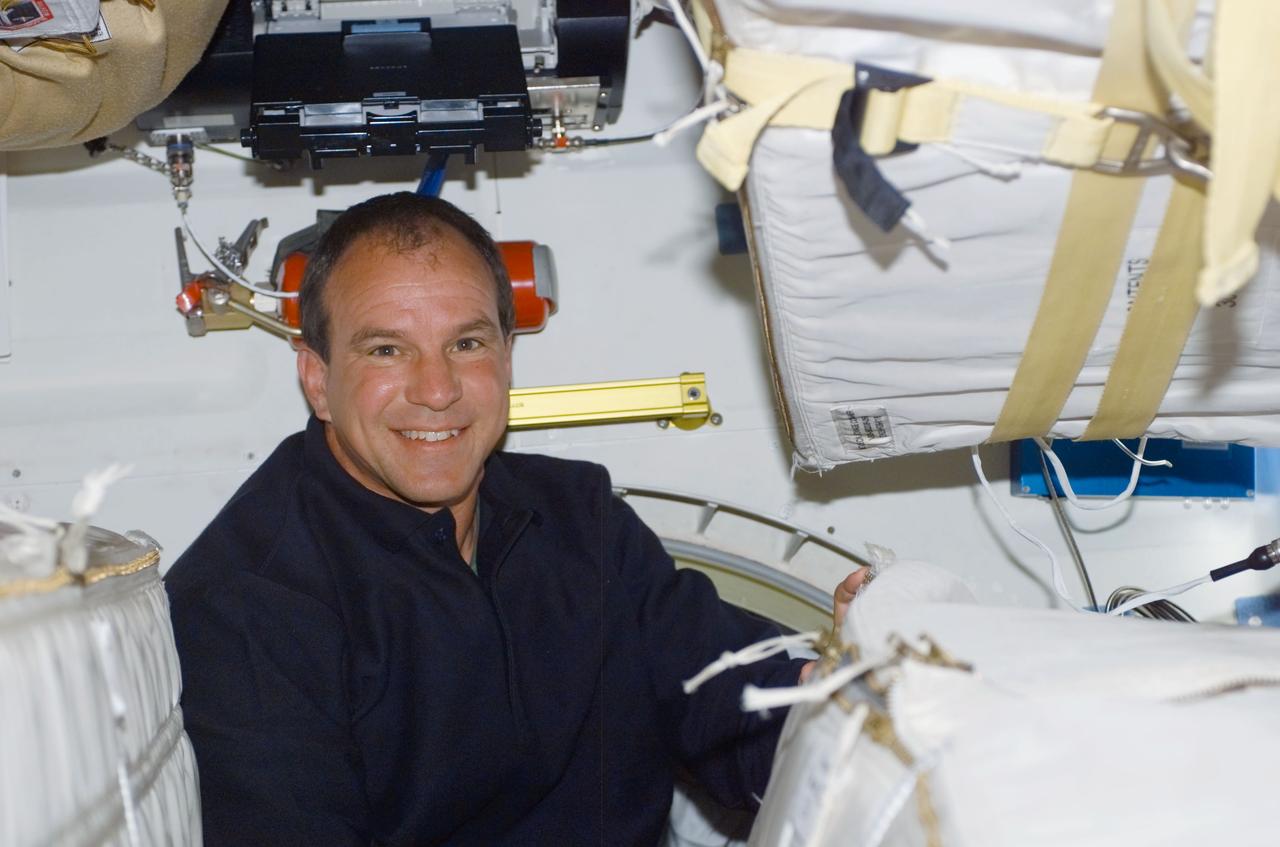
STS110-E-5033 (8 April 2002) --- Astronaut Michael J. Bloomfield, STS-110 mission commander, is photographed on the mid deck of the Space Shuttle Atlantis. The image was taken with a digital still camera.

STS110-E-5043 (9 April 2002) --- Astronaut Lee M. E. Morin, STS-110 mission specialist, is photographed on the mid deck of the Space Shuttle Atlantis. The image was taken with a digital still camera.

STS110-E-5008 (8 April 2002) --- Astronaut Lee M. E. Morin, STS-110 mission specialist, works on the mid deck of the Space Shuttle Atlantis. The image was taken with at digital still camera.
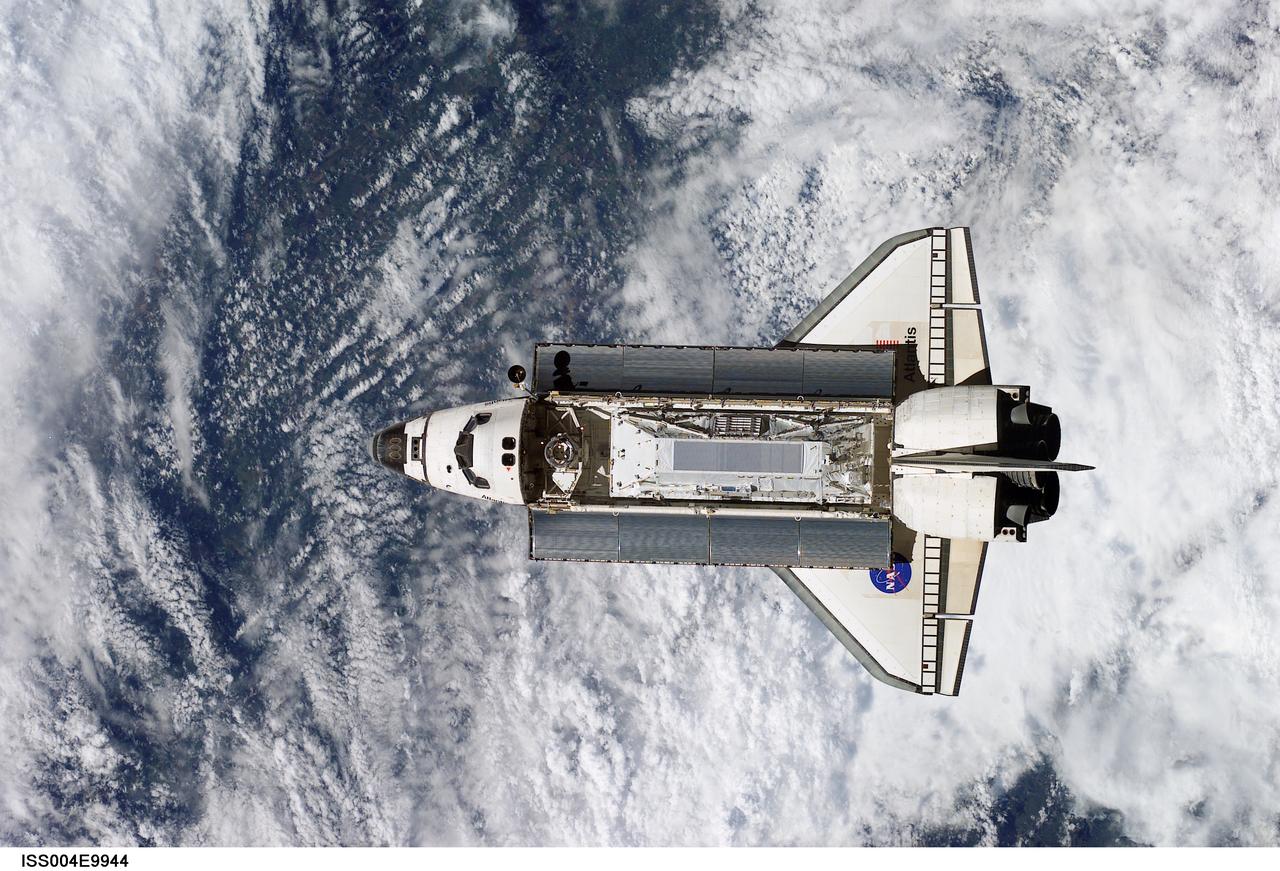
ISS004-E-9944 (10 April 2002) --- The Space Shuttle Atlantis prepares to dock with the International Space Station (ISS) during the STS-110 mission. Aboard Atlantis are astronauts Michael J. Bloomfield, mission commander; Stephen N. Frick, pilot; Rex J. Walheim, Ellen Ochoa, Lee M. E. Morin, Jerry L. Ross, and Steven L. Smith, all mission specialists. The STS-110 crewmembers are delivering the S0 (S-zero) truss, which is visible in Atlantis’ payload bay. This image was taken by an Expedition Four crewmember.
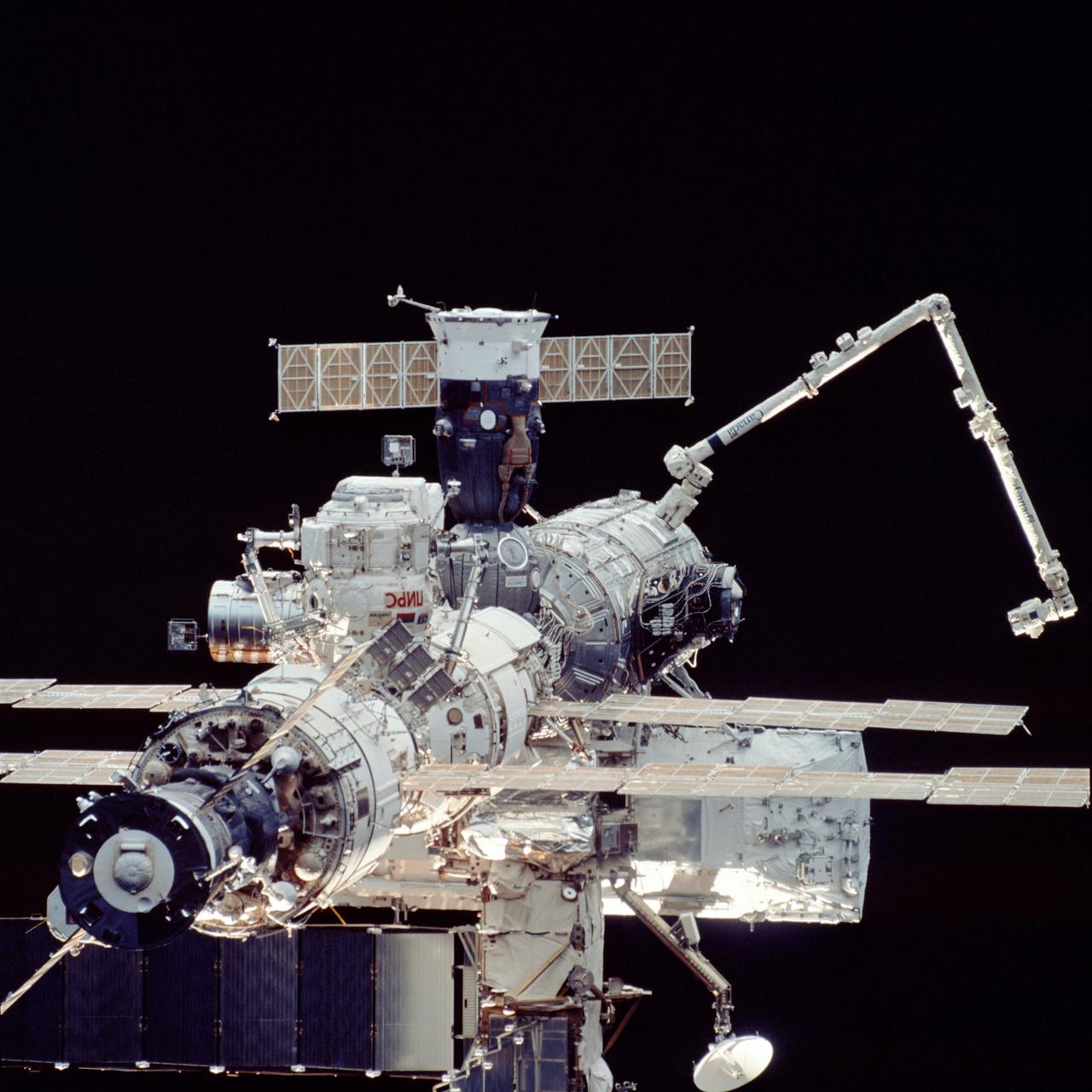
This close-up view of the International Space Station (ISS), newly equipped with its new 27,000 pound S0 (S-zero) truss, was photographed by an astronaut aboard the Space Shuttle Atlantis STS-110 during its ISS fly-around mission while pulling away from the ISS. The STS-110 mission prepared the Station for future spacewalks by installing and outfitting the 43-foot-long S0 truss and preparing the first railroad in space, the Mobile Transporter. The 27,000 pound S0 truss was the first of 9 segments that will make up the Station's external framework that will eventually stretch 356 feet (109 meters), or approximately the length of a football field. This central truss segment also includes a flatcar called the Mobile Transporter and rails that will become the first "space railroad," which will allow the Station's robotic arm to travel up and down the finished truss for future assembly and maintenance. The completed truss structure will hold solar arrays and radiators to provide power and cooling for additional international research laboratories from Japan and Europe that will be attached to the Station. STS-110 Extravehicular Activity (EVA) marked the first use of the Station's robotic arm to manuever spacewalkers around the Station and was the first time all of a shuttle crew's spacewalks were based out of the Station's Quest Airlock. It was also the first Shuttle to use three Block II Main Engines. The Space Shuttle Orbiter Atlantis STS-110 mission, was launched April 8, 2002 and returned to Earth April 19, 2002.
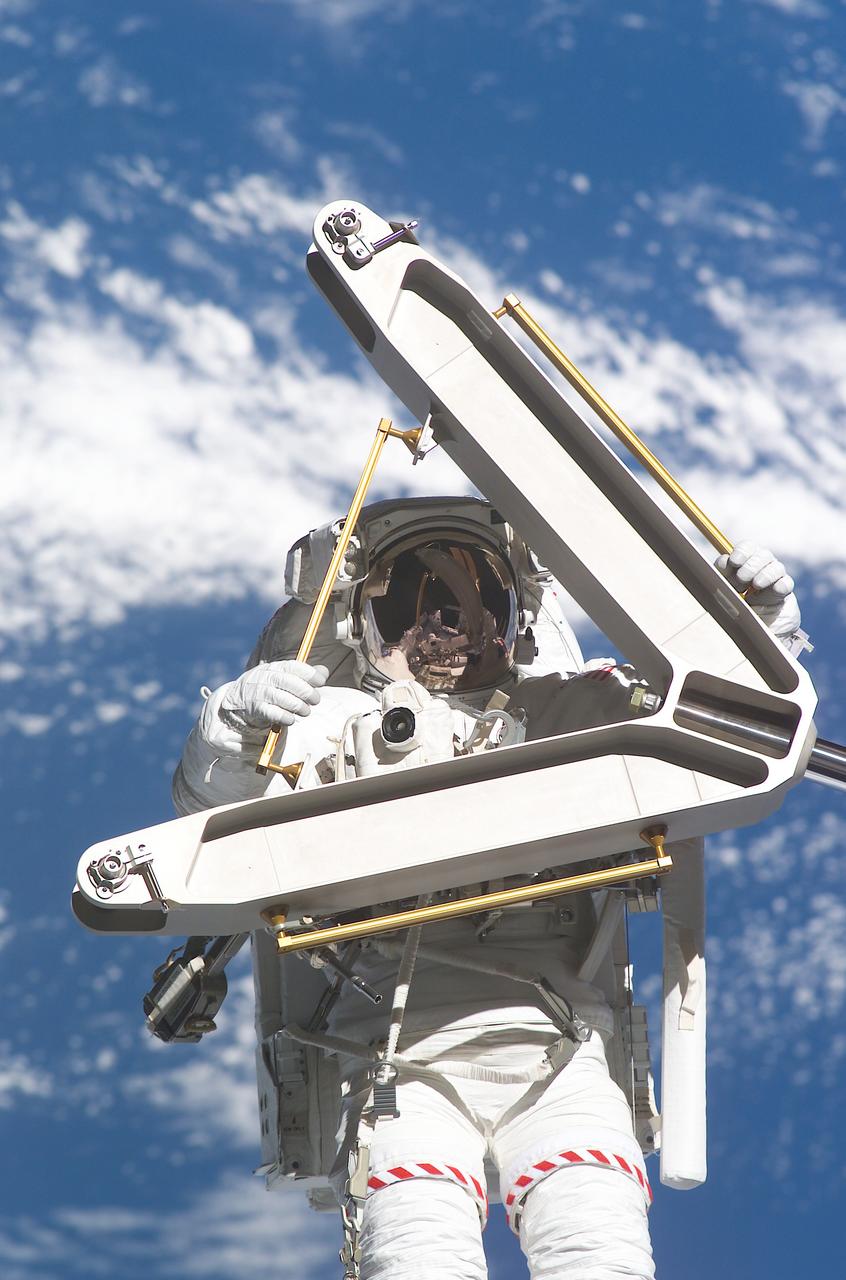
Hovering in space some 240 miles above the blue and white Earth, STS-110 astronaut M.E. Morin participates in his first ever and second of four scheduled space walks for the STS-110 mission. He is seen toting one of the S0 (S-Zero) keel pins which were removed from their functional position on the truss and attached on the truss' exterior for long term stowage. The 43-foot-long, 27,000 pound S0 truss was the first of 9 segments that will make up the International Space Station's external framework that will eventually stretch 356 feet (109 meters), or approximately the length of a football field. This central truss segment also includes a flatcar called the Mobile Transporter and rails that will become the first "space railroad," which will allow the Station's robotic arm to travel up and down the finished truss for future assembly and maintenance. The completed truss structure will hold solar arrays and radiators to provide power and cooling for additional international research laboratories from Japan and Europe that will be attached to the Station. The mission completed the installations and preparations of the S0 truss and the Mobile Transporter within four space walks. STS-110 Extravehicular Activity (EVA) marked the first use of the Station's robotic arm to maneuver space walkers around the Station and was the first time all of a shuttle crew's space walks were based out of the Station's Quest Airlock. It was also the first Shuttle to use three Block II Main Engines. The Space Shuttle Orbiter Atlantis STS-110 mission was launched April 8, 2002 and returned to Earth April 19, 2002.
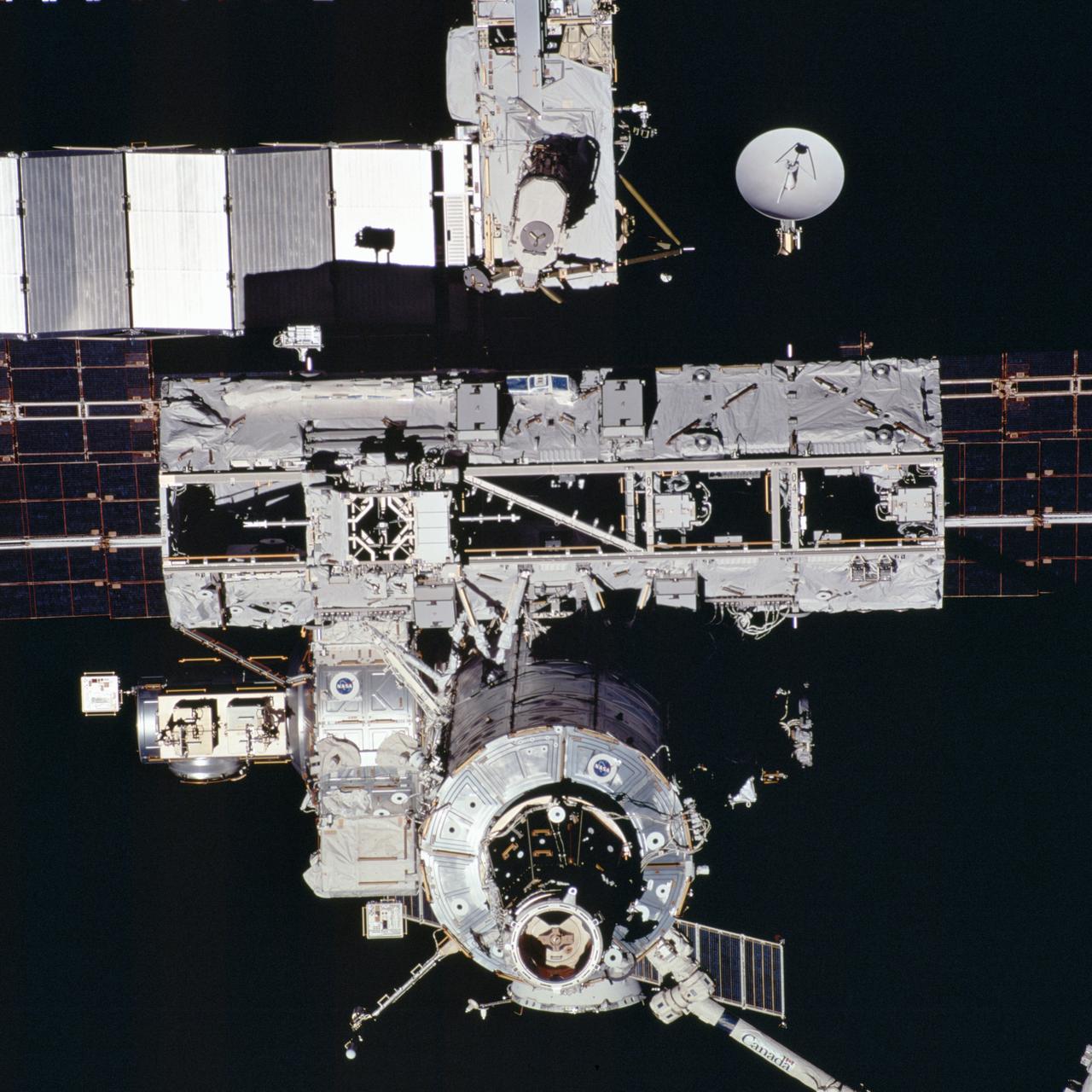
This close-up view of the International Space Station (ISS), newly equipped with its new 27,000-pound S0 (S-zero) truss, was photographed by an astronaut aboard the Space Shuttle Atlantis STS-110 during its ISS flyaround mission while pulling away from the ISS. The STS-110 mission prepared the Station for future spacewalks by installing and outfitting the 43-foot-long S0 truss and preparing the first railroad in space, the Mobile Transporter. The 27,000 pound S0 truss was the first of 9 segments that will make up the Station's external framework that will eventually stretch 356 feet (109 meters), or approximately the length of a football field. This central truss segment also includes a flatcar called the Mobile Transporter and rails that will become the first "space railroad," which will allow the Station's robotic arm to travel up and down the finished truss for future assembly and maintenance. The completed truss structure will hold solar arrays and radiators to provide power and cooling for additional international research laboratories from Japan and Europe that will be attached to the Station. STS-110 Extravehicular Activity (EVA) marked the first use of the Station's robotic arm to maneuver spacewalkers around the Station and was the first time all of a shuttle crew's spacewalks were based out of the Station's Quest Airlock. It was also the first Shuttle to use three Block II Main Engines. The Space Shuttle Orbiter Atlantis STS-110 mission, was launched April 8, 2002 and returned to Earth April 19, 2002.

This close-up view of the International Space Station (ISS), newly equipped with its new 27,000-pound S0 (S-zero) truss, was photographed by an astronaut aboard the Space Shuttle Atlantis STS-110 upon its ISS flyaround mission while pulling away from the ISS. The STS-110 mission prepared the Station for future spacewalks by installing and outfitting the 43-foot-long S0 truss and preparing the first railroad in space, the Mobile Transporter. The 27,000 pound S0 truss was the first of 9 segments that will make up the Station's external framework that will eventually stretch 356 feet (109 meters), or approximately the length of a football field. This central truss segment also includes a flatcar called the Mobile Transporter and rails that will become the first "space railroad," which will allow the Station's robotic arm to travel up and down the finished truss for future assembly and maintenance. The completed truss structure will hold solar arrays and radiators to provide power and cooling for additional international research laboratories from Japan and Europe that will be attached to the Station. STS-110 Extravehicular Activity (EVA) marked the first use of the Station's robotic arm to maneuver spacewalkers around the station and was the first time all of a Shuttle crew's spacewalks were based out of the Station's Quest Airlock. It was also the first Shuttle to use three Block II Main Engines. The Space Shuttle Orbiter Atlantis STS-110 mission, was launched April 8, 2002 and returned to Earth April 19, 2002.
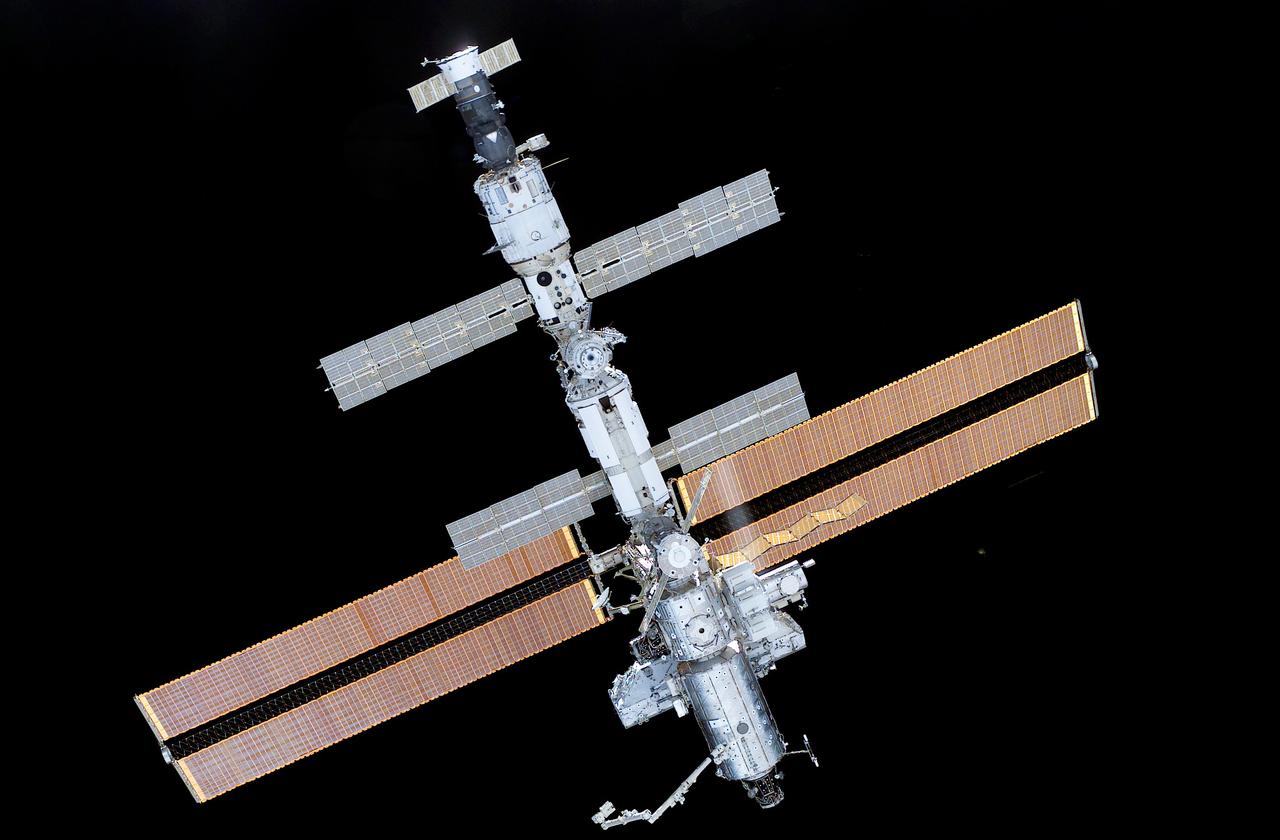
This close-up view of the International Space Station (ISS), newly equipped with its new 27,000-pound S0 (S-zero) truss, was photographed by an astronaut aboard the Space Shuttle Atlantis STS-110 mission following its undocking from the ISS. The STS-110 mission prepared the Station for future spacewalks by installing and outfitting the 43-foot-long S0 truss and preparing the first railroad in space, the Mobile Transporter. The 27,000 pound S0 truss was the first of 9 segments that will make up the Station's external framework that will eventually stretch 356 feet (109 meters), or approximately the length of a football field. This central truss segment also includes a flatcar called the Mobile Transporter and rails that will become the first "space railroad," which will allow the Station's robotic arm to travel up and down the finished truss for future assembly and maintenance. The completed truss structure will hold solar arrays and radiators to provide power and cooling for additional international research laboratories from Japan and Europe that will be attached to the Station. STS-110 Extravehicular Activity (EVA) marked the first use of the Station's robotic arm to maneuver spacewalkers around the Station and was the first time all of a Shuttle crew's spacewalks were based out of the Station's Quest Airlock. It was also the first Shuttle to use three Block II Main Engines. The Space Shuttle Orbiter Atlantis STS-110 mission, was launched April 8, 2002 and returned to Earth April 19, 2002.
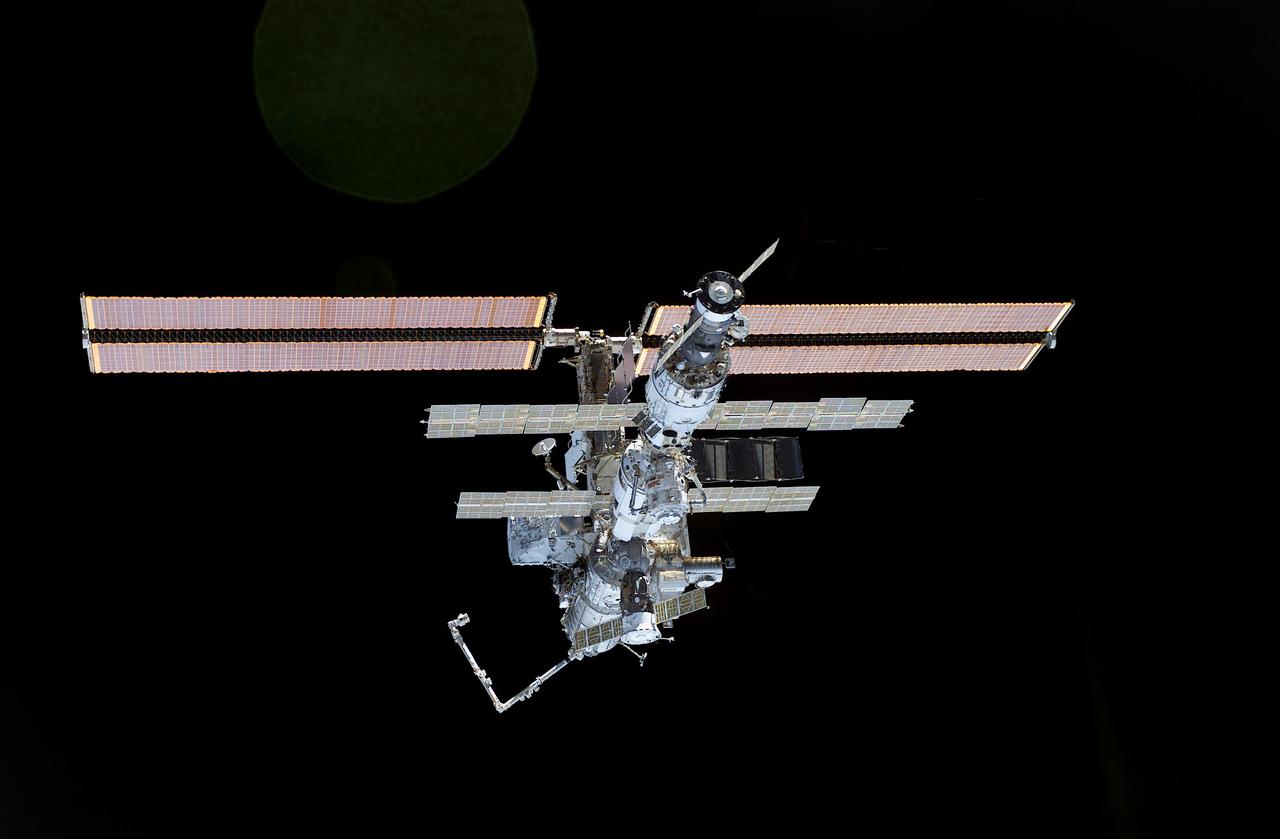
This close-up view of the International Space Station (ISS), newly equipped with its new 27,000- pound S0 (S-zero) truss, was photographed by an astronaut aboard the Space Shuttle Atlantis STS-110 mission following its undocking from the ISS. The STS-110 mission prepared the Station for future spacewalks by installing and outfitting the 43-foot-long S0 truss and preparing the first railroad in space, the Mobile Transporter. The 27,000 pound S0 truss was the first of 9 segments that will make up the Station's external framework that will eventually stretch 356 feet (109 meters), or approximately the length of a football field. This central truss segment also includes a flatcar called the Mobile Transporter and rails that will become the first "space railroad," which will allow the Station's robotic arm to travel up and down the finished truss for future assembly and maintenance. The completed truss structure will hold solar arrays and radiators to provide power and cooling for additional international research laboratories from Japan and Europe that will be attached to the Station. STS-110 Extravehicular Activity (EVA) marked the first use of the Station's robotic arm to maneuver spacewalkers around the Station and was the first time all of a shuttle crew's spacewalks were based out of the Station's Quest Airlock. It was also the first Shuttle to use three Block II Main Engines. The Space Shuttle Orbiter Atlantis STS-110 mission, was launched April 8, 2002 and returned to Earth April 19, 2002.
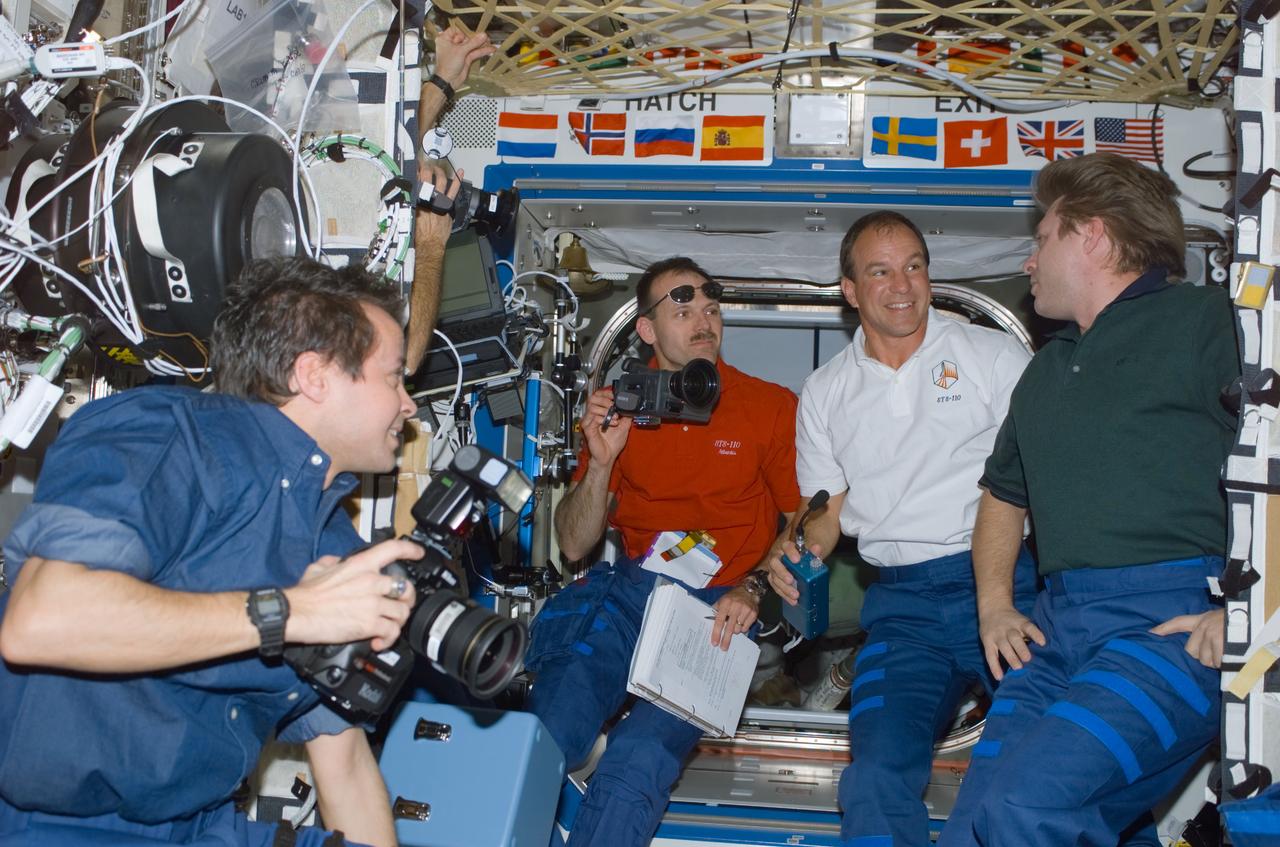
STS110-E-5103 (10 April 2002) --- Astronaut Daniel W. Bursch (left), Expedition Four flight engineer; astronauts Steven L. Smith and Michael J. Bloomfield, STS-110 mission specialist and mission commander, respectively; and cosmonaut Yury I. Onufrienko, Expedition Four mission commander, are photographed in the Destiny laboratory on the International Space Station (ISS). The image was taken with a digital still camera.
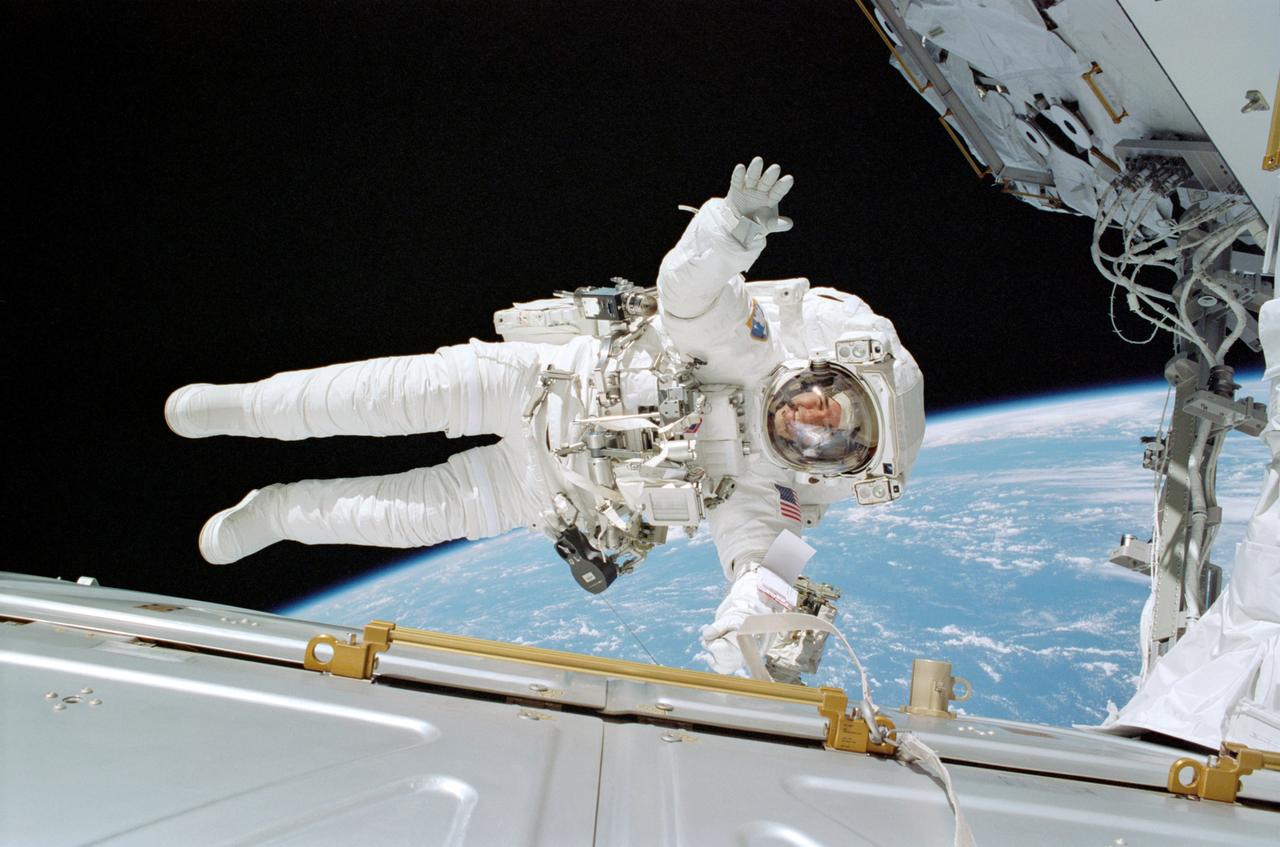
STS-110 Mission astronaut Rex J. Walheim, accompanied by astronaut Steven L. Smith (out of frame) translates along the Destiny laboratory on the International Space Station (ISS) during the third scheduled EVA session. The duo released the locking bolts on the Mobile Transporter and rewired the Station's robotic arm. The STS-110 mission prepared the ISS for future space walks by installing and outfitting the S0 (S-Zero) Truss and the Mobile Transporter. The 43-foot-long S0 truss weighing in at 27,000 pounds was the first of 9 segments that will make up the Station's external framework that will eventually stretch 356 feet (109 meters), or approximately the length of a football field. This central truss segment also includes a flatcar called the Mobile Transporter and rails that will become the first "space railroad," which will allow the Station's robotic arm to travel up and down the finished truss for future assembly and maintenance. The completed truss structure will hold solar arrays and radiators to provide power and cooling for additional international research laboratories from Japan and Europe that will be attached to the Station. Milestones of the S-110 mission included the first time the ISS robotic arm was used to maneuver space walkers around the Station and marked the first time all space walks were based out of the Station's Quest Airlock. It was also the first Shuttle to use three Block II Main Engines. The Space Shuttle Orbiter Atlantis, STS-110 mission, was launched April 8, 2002 and returned to Earth April 19, 2002.
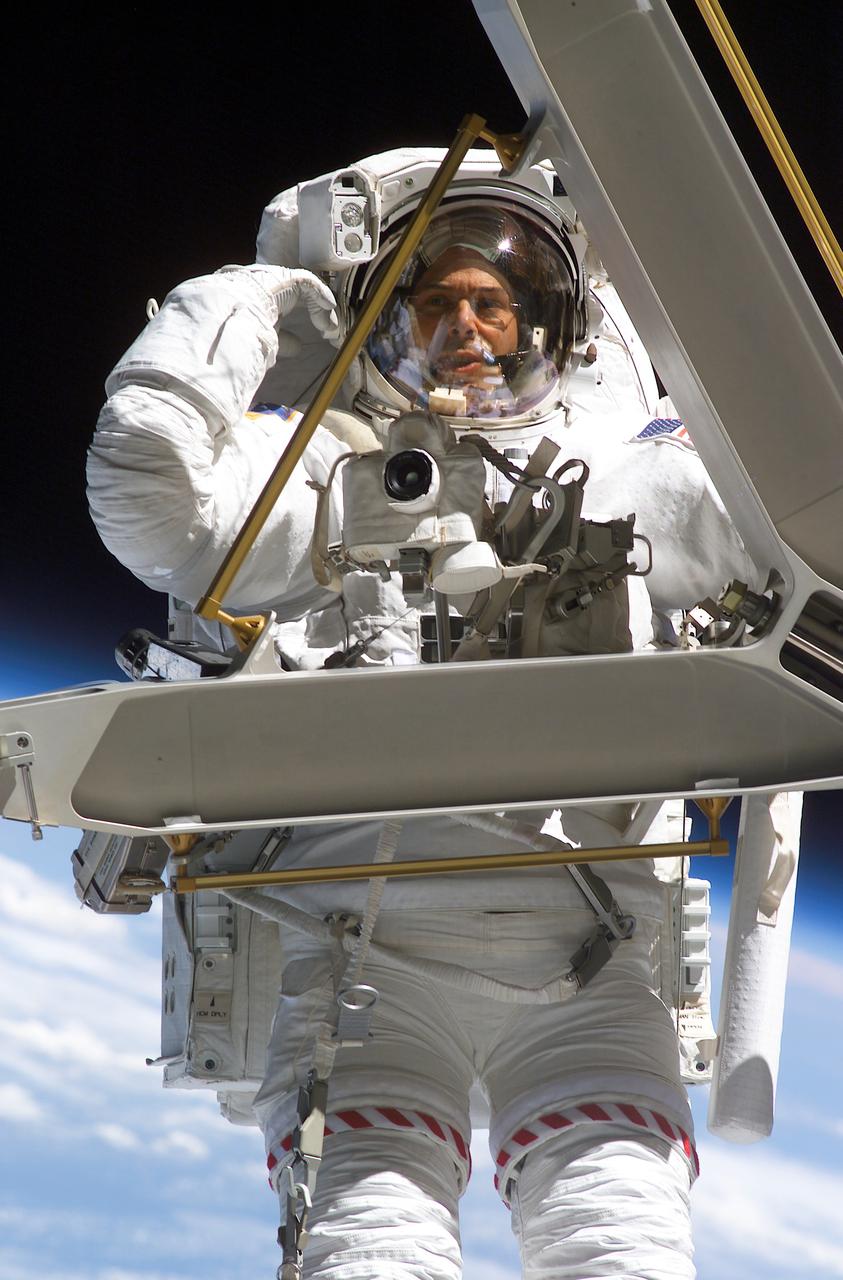
STS-110 mission specialist Lee M.E. Morin carries an affixed 35 mm camera to record work which is being performed on the International Space Station (ISS). Working with astronaut Jerry L. Ross (out of frame), the duo completed the structural attachment of the S0 (s-zero) truss, mating two large tripod legs of the 13 1/2 ton structure to the station's main laboratory during a 7-hour, 30-minute space walk. The STS-110 mission prepared the Station for future space walks by installing and outfitting the 43-foot-long S0 truss and preparing the Mobile Transporter. The S0 Truss was the first of 9 segments that will make up the Station's external framework that will eventually stretch 356 feet (109 meters), or approximately the length of a football field. This central truss segment also includes a flatcar called the Mobile Transporter and rails that will become the first "space railroad," which will allow the Station's robotic arm to travel up and down the finished truss for future assembly and maintenance. The completed truss structure will hold solar arrays and radiators to provide power and cooling for additional international research laboratories from Japan and Europe that will be attached to the Station. Milestones of the S-110 mission included the first time the ISS robotic arm was used to maneuver space walkers around the Station and marked the first time all space walks were based out of the Station's Quest Airlock. It was also the first Shuttle to use three Block II Main Engines. The Space Shuttle Orbiter Atlantis, STS-110 mission, was launched April 8, 2002 and returned to Earth April 19, 2002.
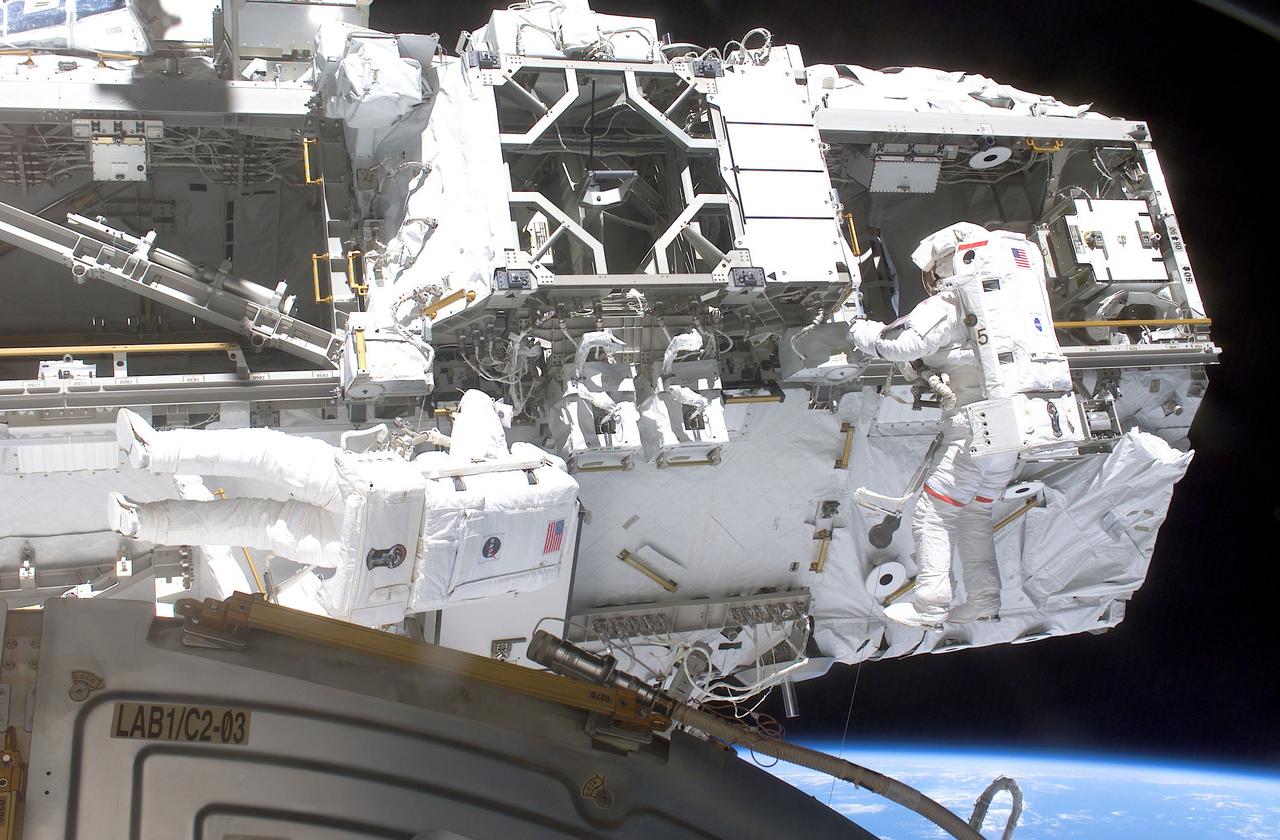
STS-110 Mission astronauts Steven L. Smith (right) and Rex J. Walheim work in tandem on the third scheduled EVA session in which they released the locking bolts on the Mobile Transporter and rewired the Station's robotic arm (out of frame). Part of the Destiny laboratory and a glimpse of the Earth's horizon are seen in the lower portion of this digital image. The STS-110 mission prepared the International Space Station (ISS) for future spacewalks by installing and outfitting the S0 (S-zero) Truss and the Mobile Transporter. The 43-foot-long S0 truss weighing in at 27,000 pounds was the first of 9 segments that will make up the Station's external framework that will eventually stretch 356 feet (109 meters), or approximately the length of a football field. This central truss segment also includes a flatcar called the Mobile Transporter and rails that will become the first "space railroad," which will allow the Station's robotic arm to travel up and down the finished truss for future assembly and maintenance. The completed truss structure will hold solar arrays and radiators to provide power and cooling for additional international research laboratories from Japan and Europe that will be attached to the Station. Milestones of the S-110 mission included the first time the ISS robotic arm was used to maneuver spacewalkers around the Station and marked the first time all spacewalks were based out of the Station's Quest Airlock. It was also the first Shuttle to use three Block II Main Engines. The Space Shuttle Orbiter Atlantis, STS-110 mission, was launched April 8, 2002 and returned to Earth April 19, 2002.

STS110-E-5068 (9 April 2002) --- During the docking approach of the Space Shuttle Atlantis to the International Space Station (ISS), a STS-110 crewmember photographed this close-up view of the station with a digital still camera. As Atlantis approached the Pressurized Mating Adapter (PMA-2) on the ISS, the Quest Airlock was visible on the right in this picture.
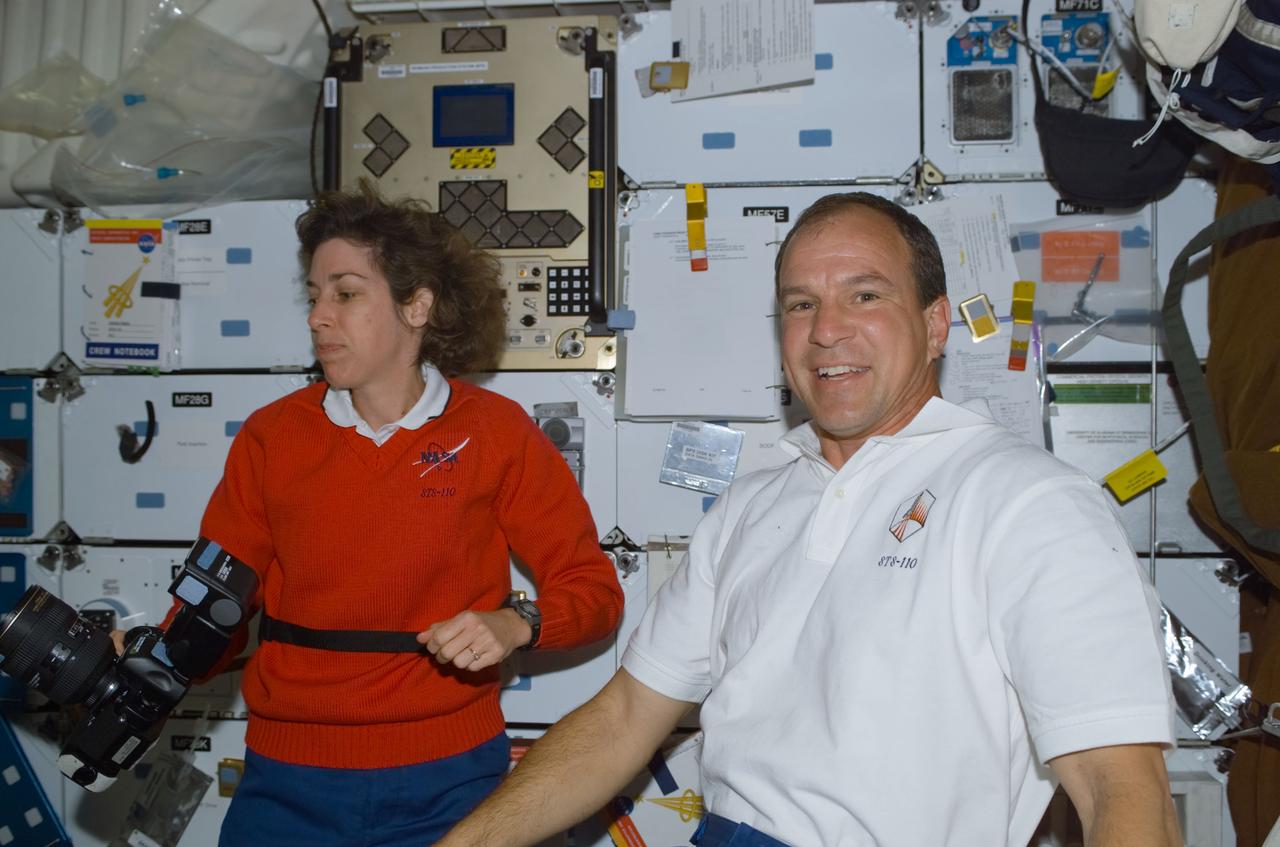
STS110-E-5091 (9 April 2002) --- Astronauts Ellen Ochoa (left) and Michael J. Bloomfield, STS-110 mission specialist and mission commander, respectively, are photographed on the mid deck of the Space Shuttle Atlantis. The image was taken with a digital still camera.

STS110-E-5071 (9 April 2002) --- During the docking approach of the Space Shuttle Atlantis to the International Space Station (ISS), a STS-110 crewmember photographed this close-up view of the station with a digital still camera. As Atlantis approached the Pressurized Mating Adapter (PMA-2) of the ISS, the Quest Airlock was visible on the right in this picture.
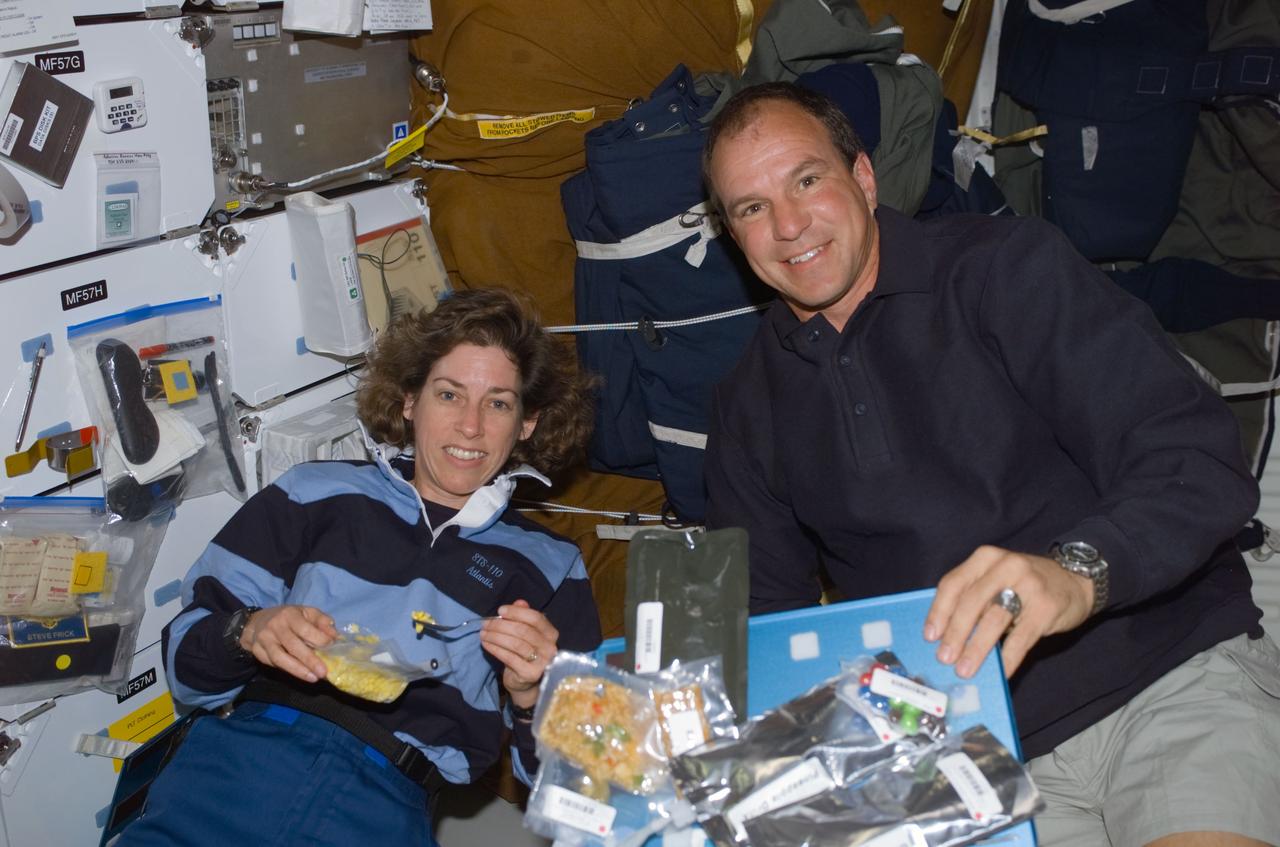
STS110-E-5028 (8 April 2002) --- Astronauts Michael J. Bloomfield (right) and Ellen Ochoa, STS-110 mission commander and mission specialist, respectively, eat a meal on the mid deck of the Space Shuttle Atlantis. The image was taken with a digital still camera.
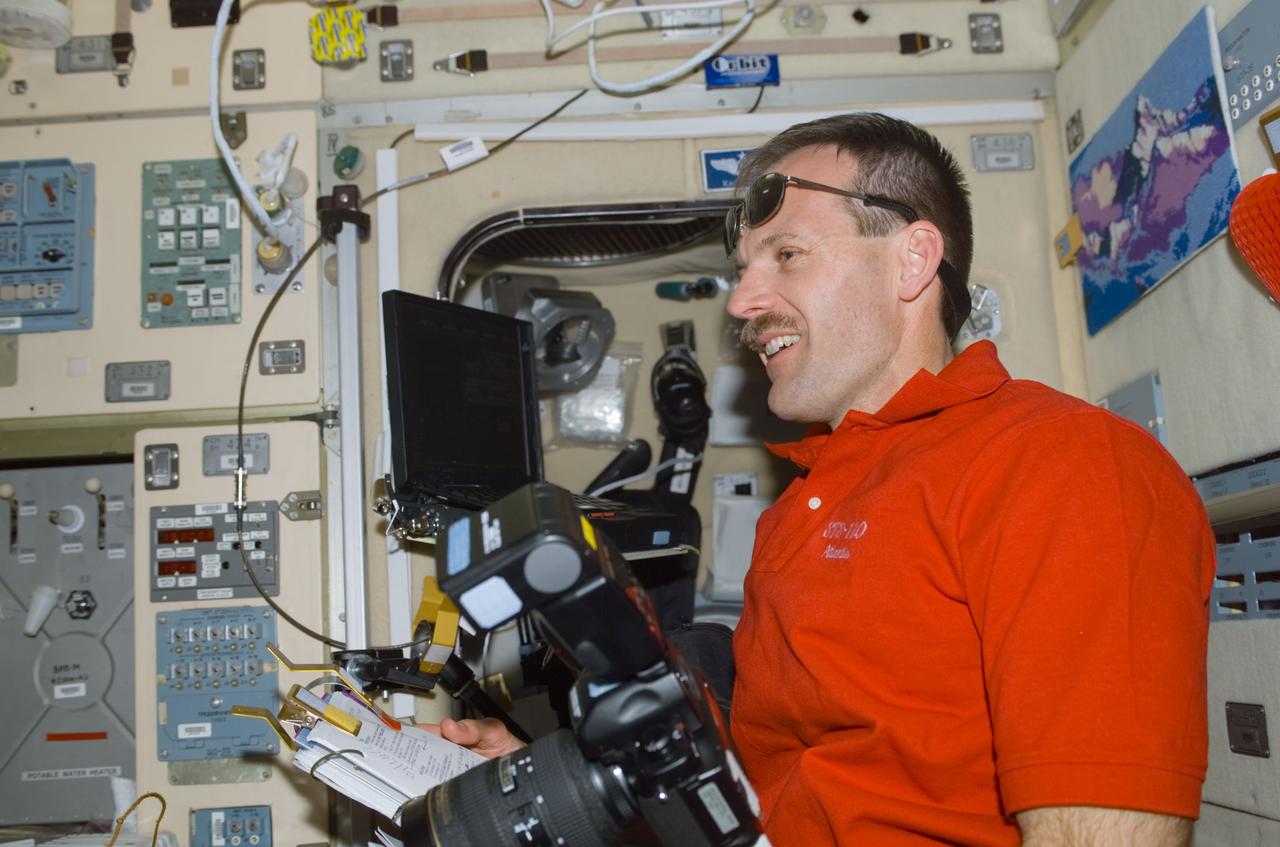
STS110-E-5131 (10 April 2002) --- Astronaut Steven L. Smith, STS-110 mission specialist, holds a still camera and a procedures checklist in the Zvezda Service Module on the International Space Station (ISS). The image was taken with a digital still camera.
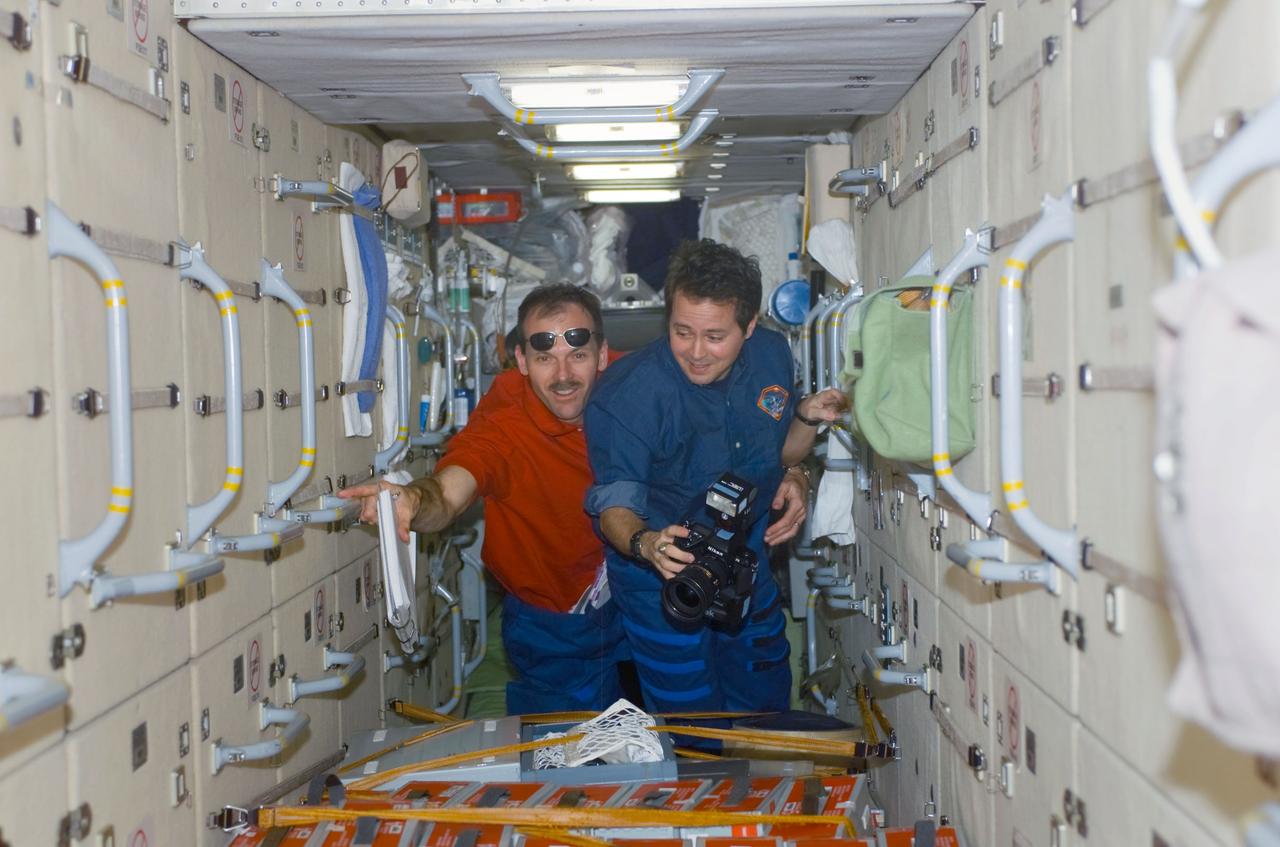
STS110-E-5115 (10 April 2002) --- Astronauts Daniel W. Bursch (right), Expedition Four flight engineer, and Steven L. Smith, STS-110 mission specialist, traverse through the functional cargo block (FGB), or Zarya on the International Space Station (ISS). The image was taken with a digital still camera.
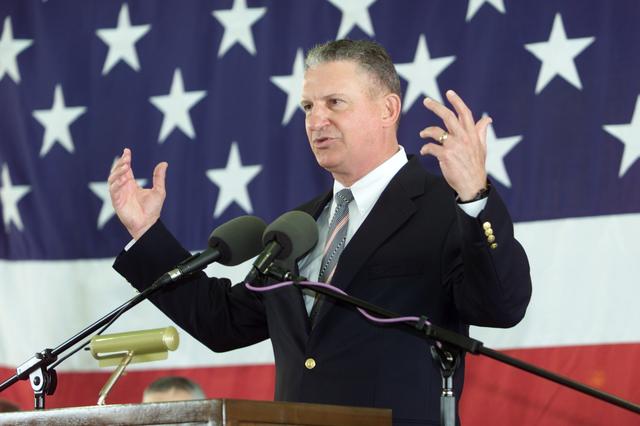
JSC2002-E-14066 (20 April 2002) --- Johnson Space Center’s (JSC) Director Jefferson D. Howell, Jr. speaks from the lectern in Hangar 990 at Ellington Field during the STS-110 crew return ceremonies.
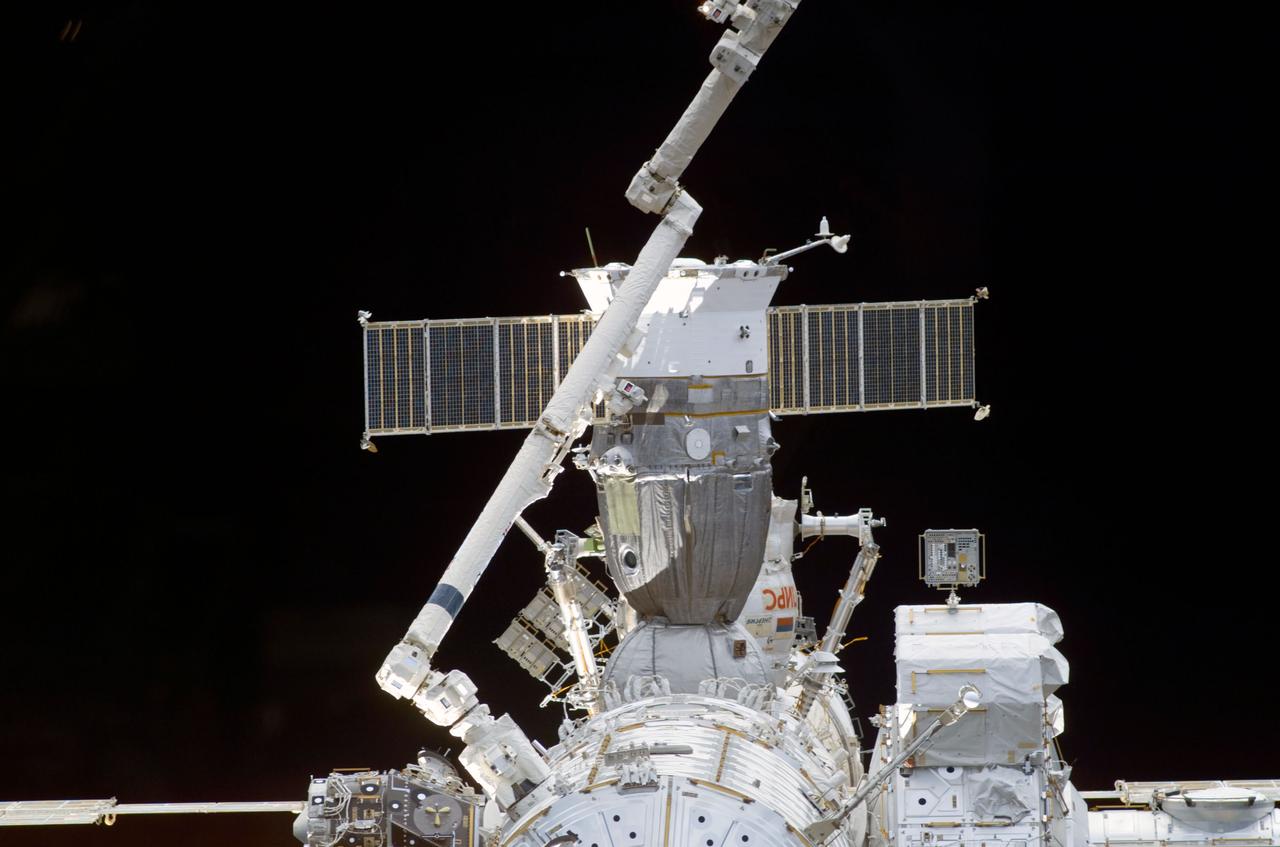
STS110-E-5069 (9 April 2002) --- During the docking approach of the Space Shuttle Atlantis to the International Space Station (ISS), a STS-110 crewmember photographed this close-up view of the orbital outpost with a digital still camera. A Soyuz vehicle, docked to the station, was visible behind the Canadarm2.
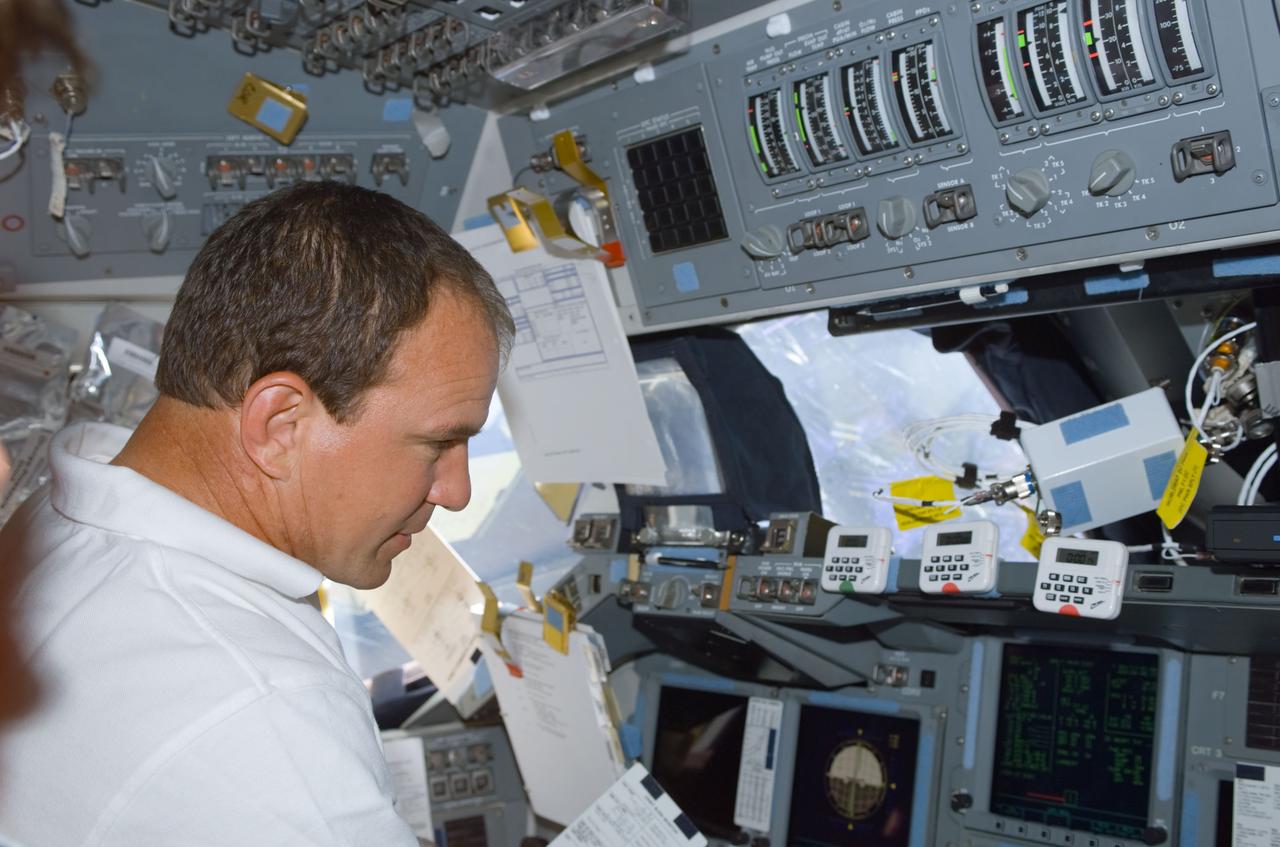
STS110-E-5067 (9 April 2002) --- Astronaut Michael J. Bloomfield, STS-110 mission commander, occupying the commander’s station, checks data on the cockpit displays on the forward flight deck of the Space Shuttle Atlantis. The image was taken with a digital still camera.
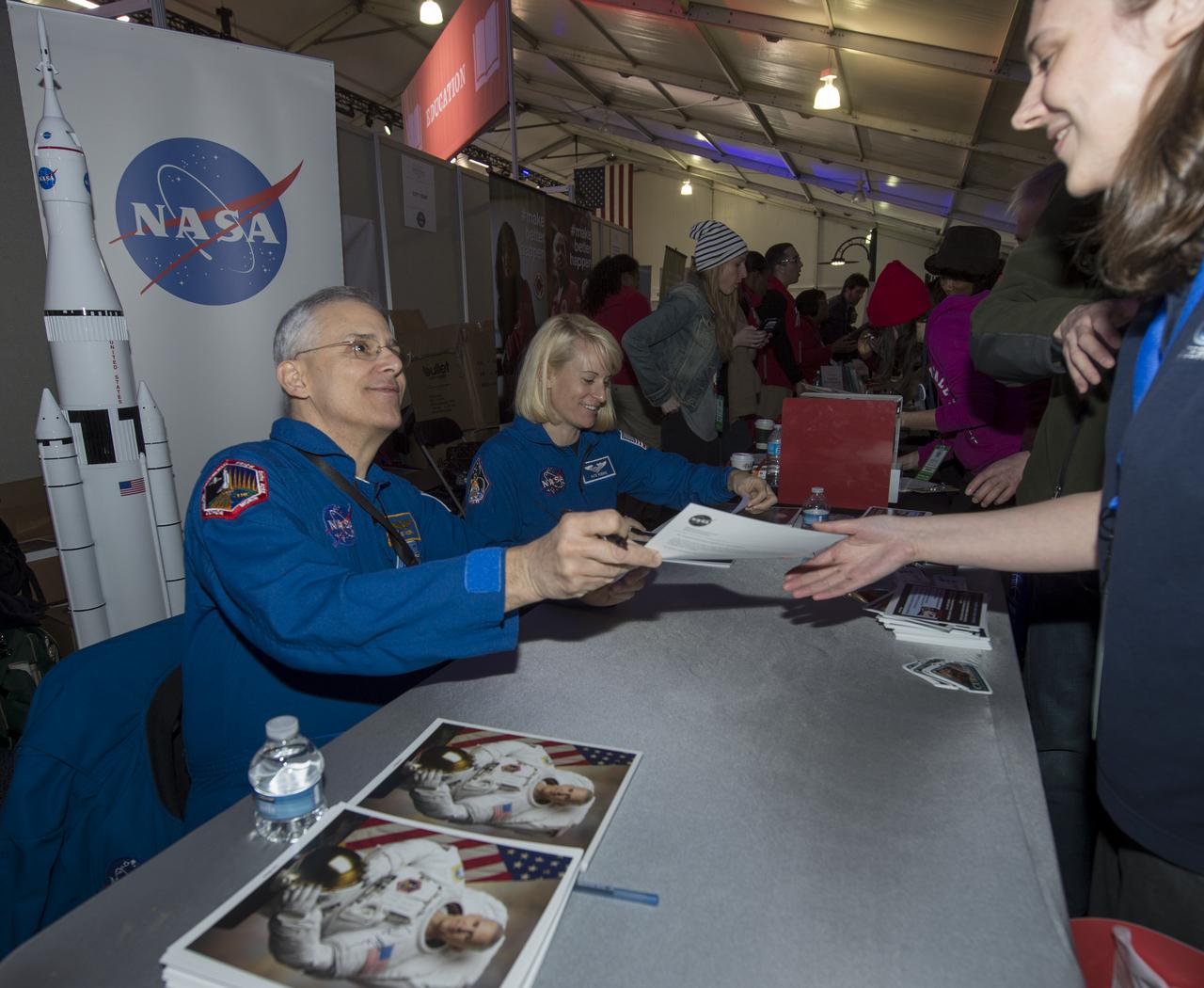
NASA Astronaut Lee Morin, a veteran of space shuttle mission STS-110, signs autographs at the NASA booth set up on the National Mall as part of the National Day of Service, Saturday, January 19, 2013, in Washington. NASA along with other federal agencies set up along the Mall as part of events surrounding the inauguration of President Barack Obama. Photo Credit: (NASA/Carla Cioffi)
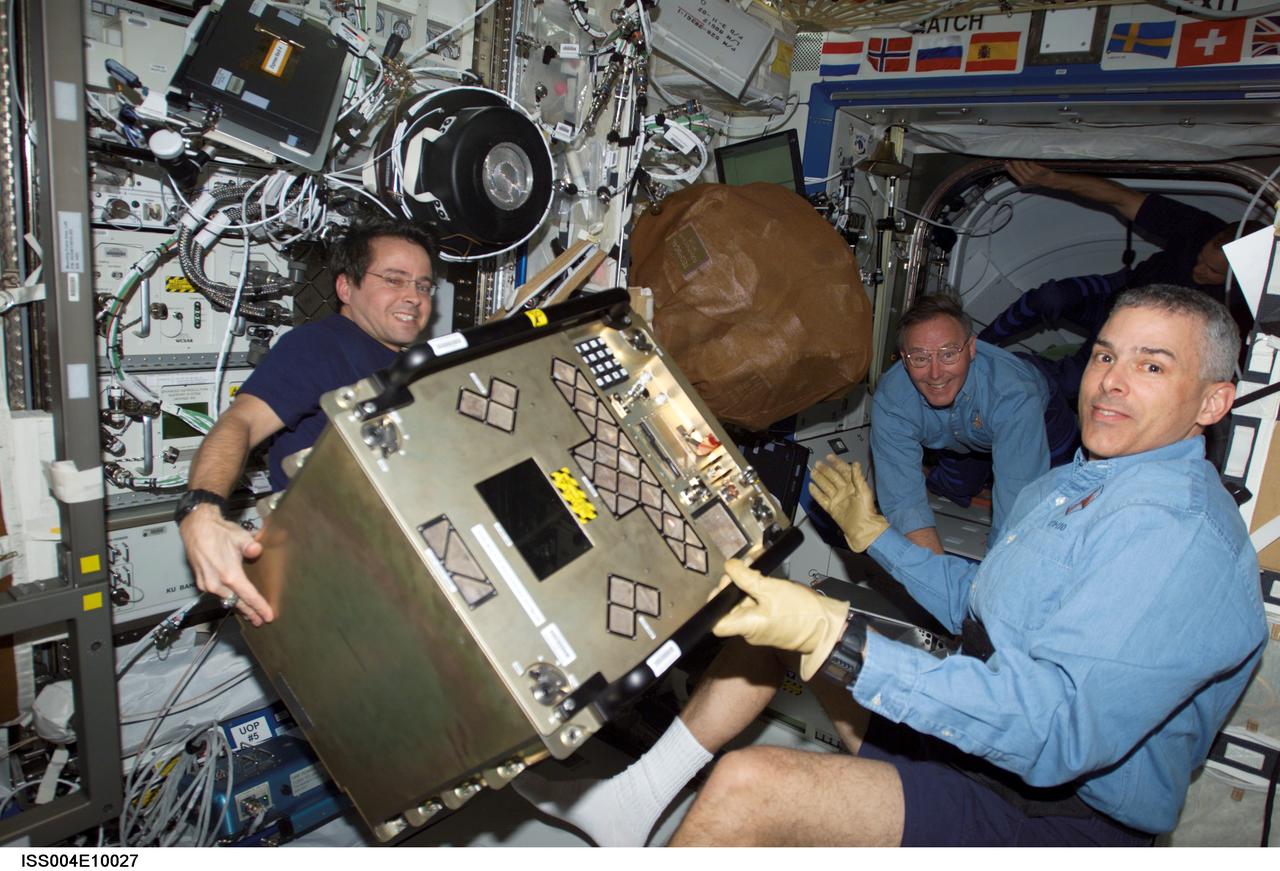
ISS004-E-10027 (12 April 2002) --- Astronauts Daniel W. Bursch (left), Expedition Four flight engineer, and Lee M. E. Morin, STS-110 mission specialist, move equipment in the Destiny laboratory on the International Space Station (ISS). Astronaut Jerry L. Ross, STS-110 mission specialist, is visible in the background.
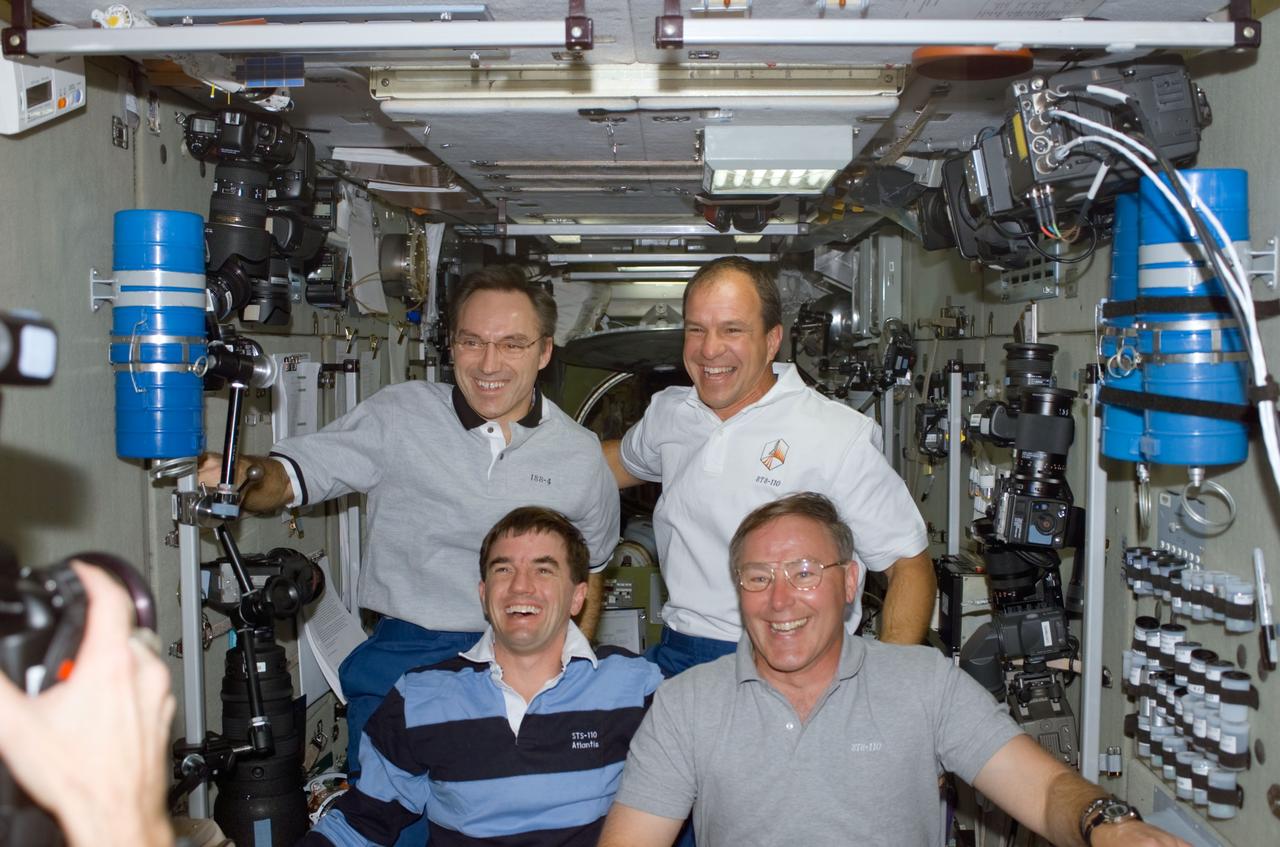
STS110-E-5127 (10 April 2002) --- Astronauts Carl E. Walz (top left), Expedition Four flight engineer, Michael J. Bloomfield, STS-110 mission commander, and Rex J. Walheim (bottom left) and Jerry L. Ross, both STS-110 mission specialists, gather for an informal photo in the Zvezda Service Module on the International Space Station (ISS). The image was taken with a digital still camera.
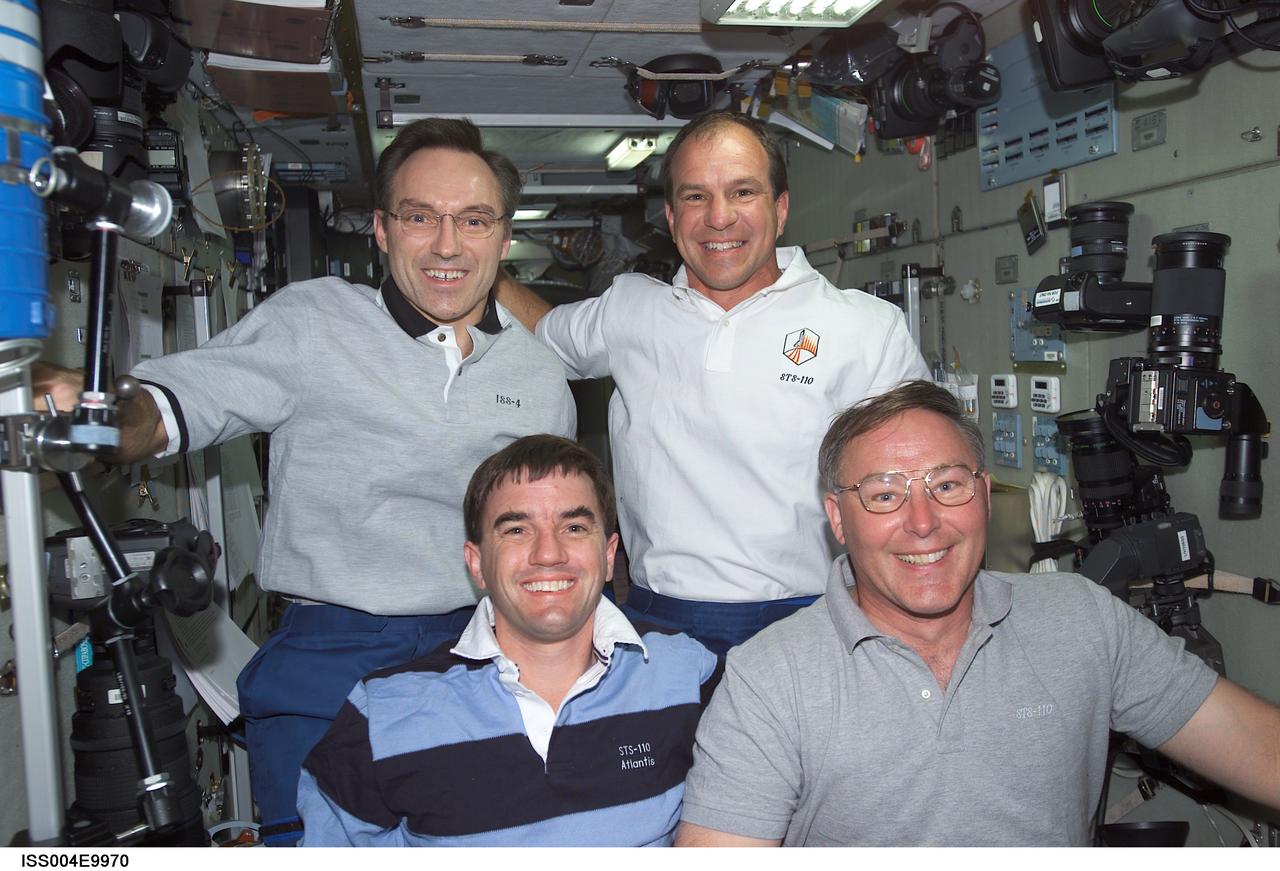
ISS004-E-9970 (10 April 2002) --- Astronauts Rex J. Walheim (bottom left), Jerry L. Ross, both STS-110 mission specialists, Carl E. Walz (top left) and Michael J. Bloomfield, Expedition Four flight engineer and STS-110 mission commander, respectively, gather for a group photo in the Zvezda Service Module on the International Space Station (ISS).
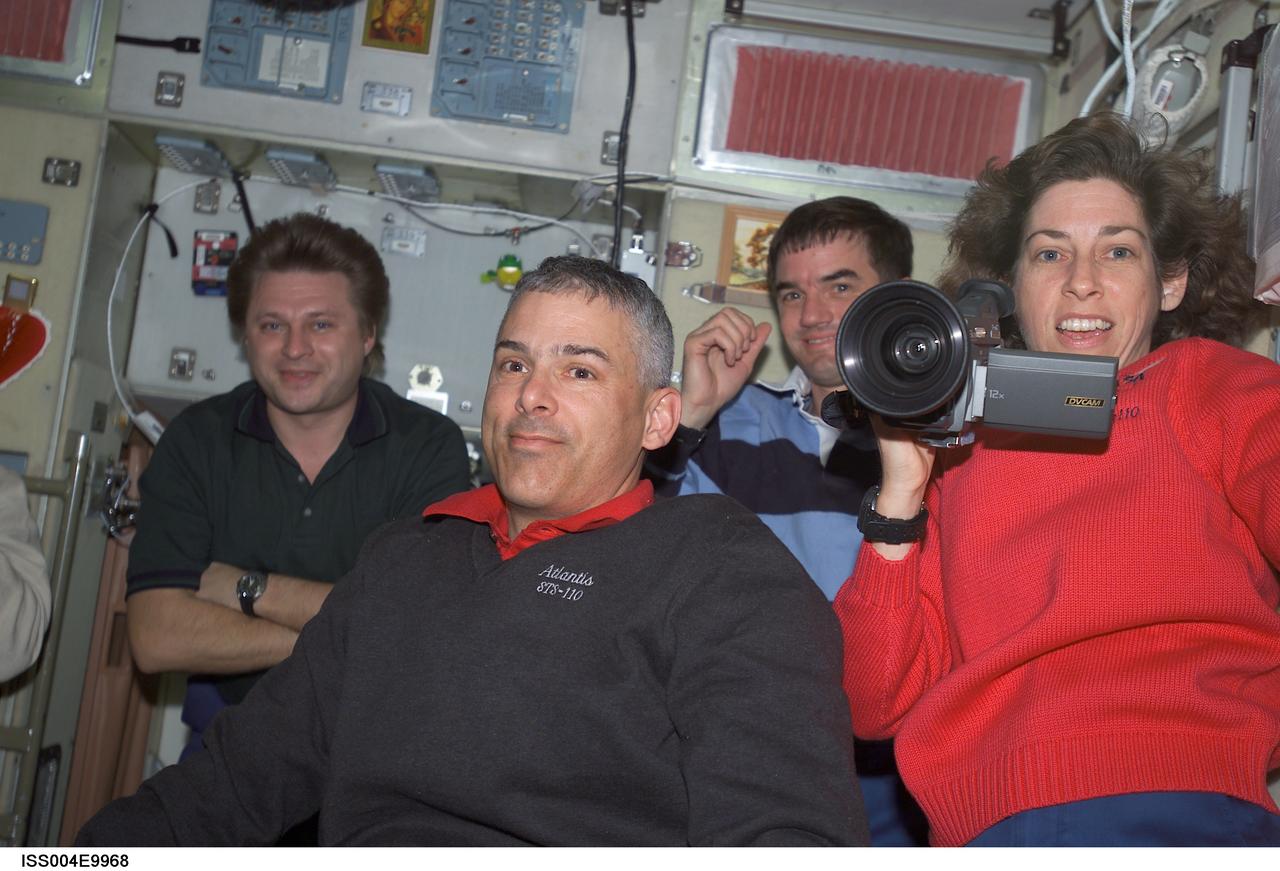
ISS004-E-9968 (10 April 2002) --- Astronauts Lee M. E. Morin (left foreground) and Ellen Ochoa, both STS-110 mission specialists, cosmonaut Yury I. Onufrienko (left background), Expedition Four mission commander, and astronaut Rex J. Walheim, STS-110 mission specialist, are photographed in the Zvezda Service Module on the International Space Station (ISS).
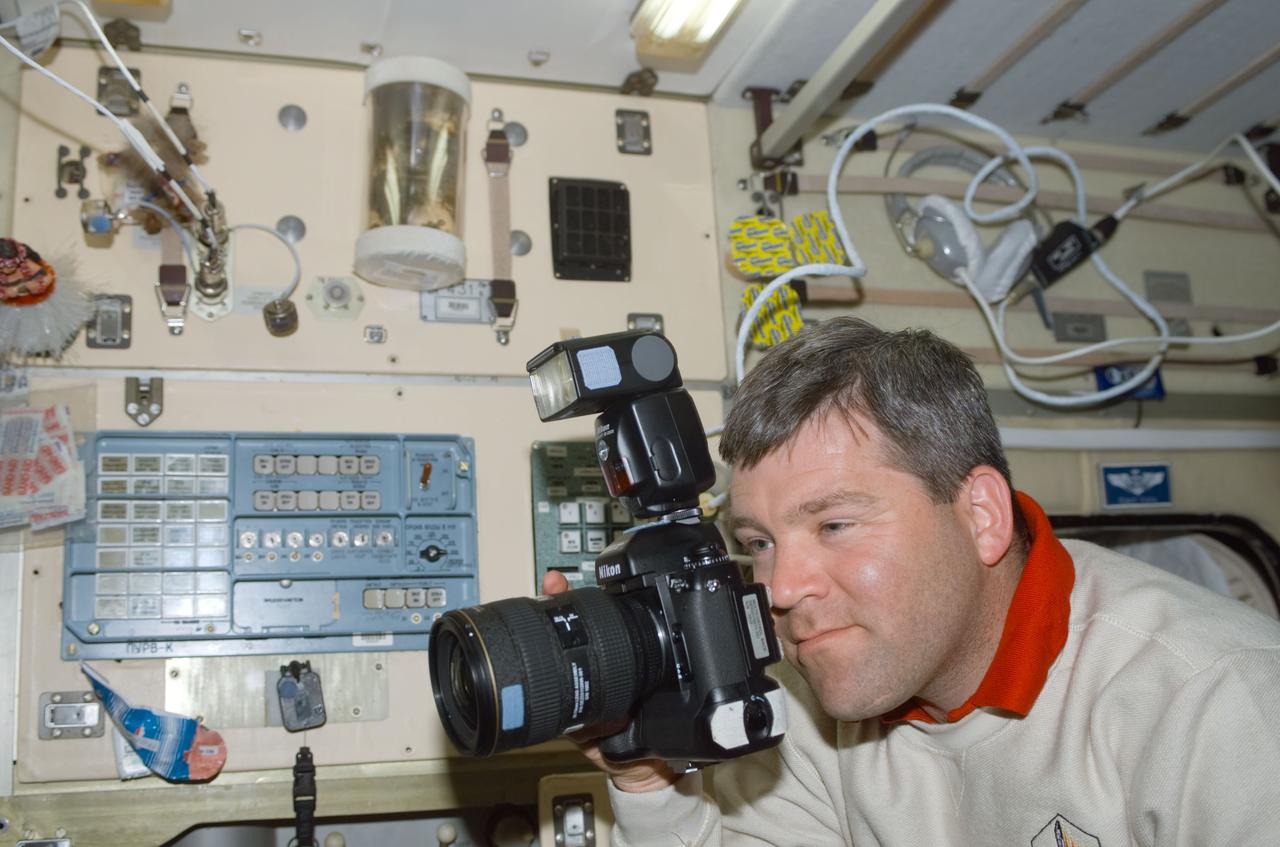
STS110-E-5134 (10 April 2002) --- Astronaut Stephen N. Frick, STS-110 pilot, uses a still camera in the Zvezda Service Module on the International Space Station (ISS). The image was taken with a digital still camera.

STS110-E-5158 (10 April 2002) --- Astronaut Stephen N. Frick, STS-110 pilot, is photographed in the Unity node on the International Space Station (ISS). The image was taken with a digital still camera.
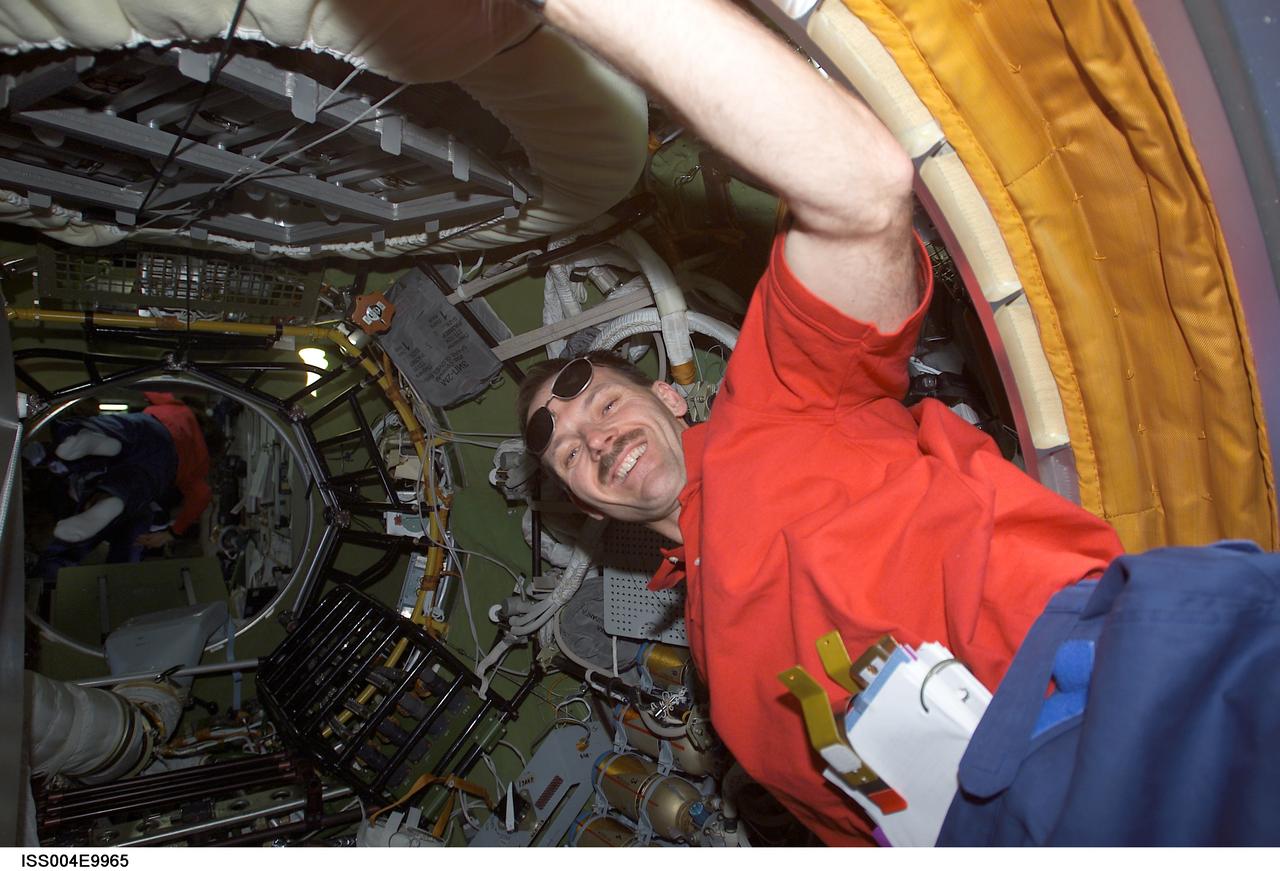
ISS004-E-9965 (10 April 2002) --- Astronaut Steven L. Smith, STS-110 mission specialist, enters the Zvezda Service Module’s transfer compartment on the International Space Station (ISS).

ISS004-E-9977 (10 April 2002) --- Astronaut Michael J. Bloomfield, STS-110 mission commander, uses a still camera in the Zvezda Service Module’s transfer compartment on the International Space Station (ISS).
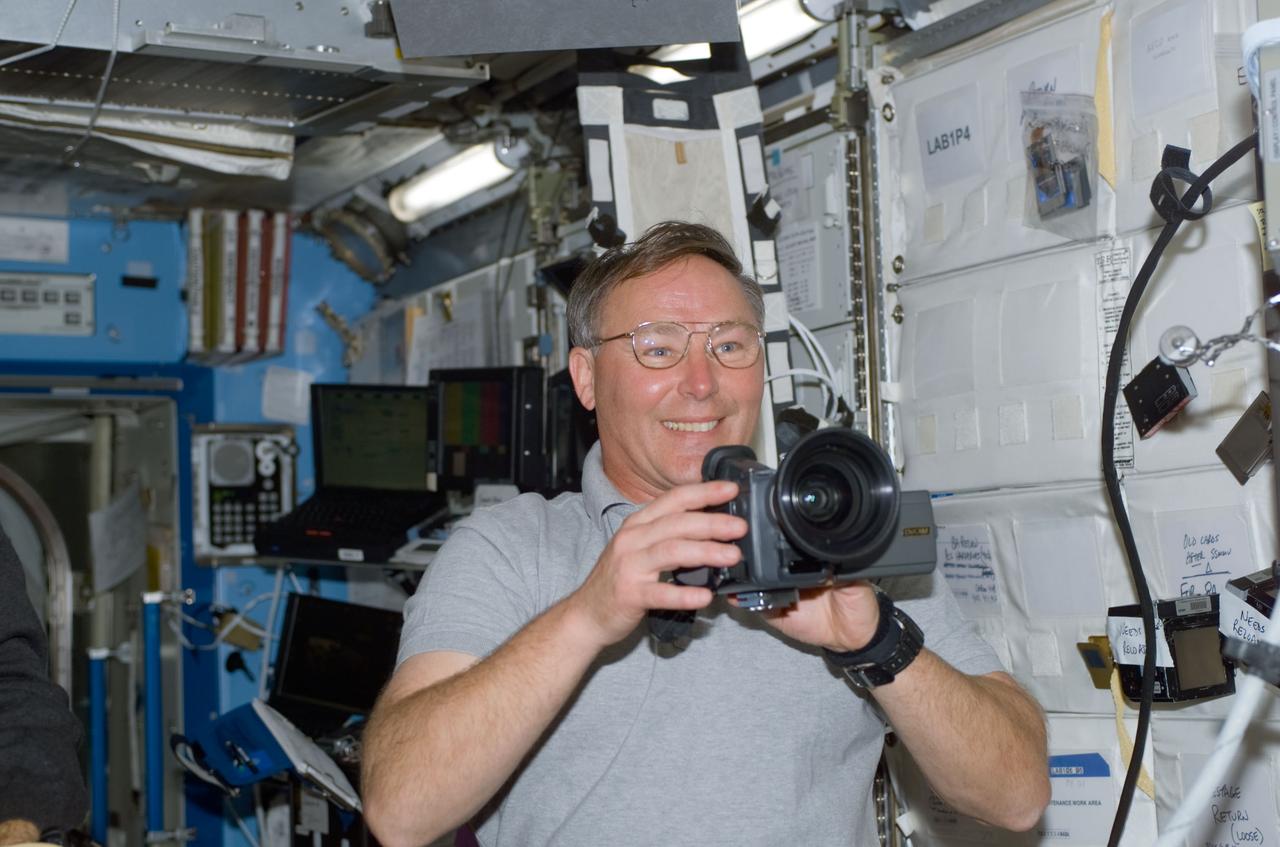
STS110-E-5110 (10 April 2002) --- Astronaut Jerry L. Ross, STS-110 mission specialist, holds a still camera in the Destiny laboratory on the International Space Station (ISS). The image was taken with a digital still camera.
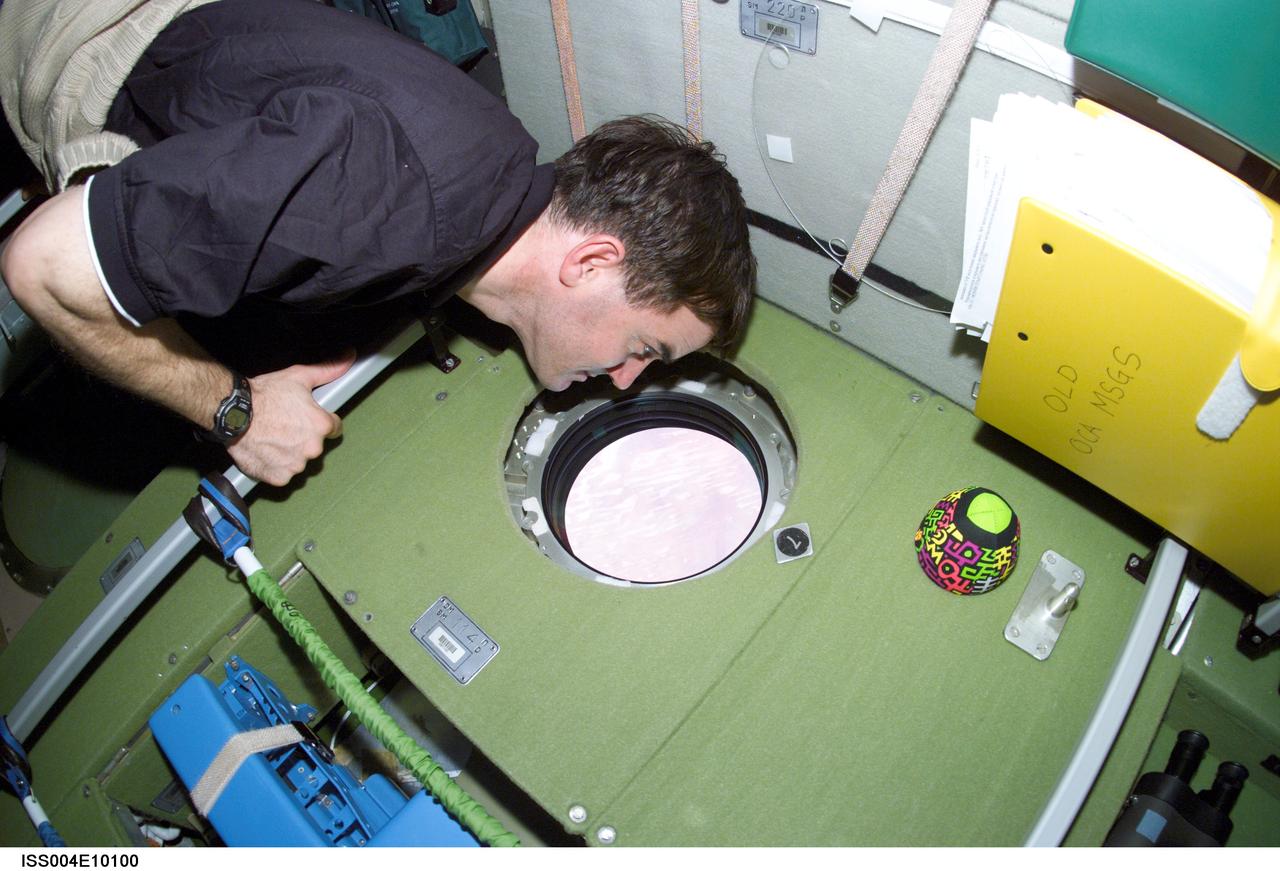
ISS004-E-10100 (16 April 2002) --- Astronaut Rex J. Walheim, STS-110 mission specialist, looks out a window in the Zvezda Service Module on the International Space Station (ISS).
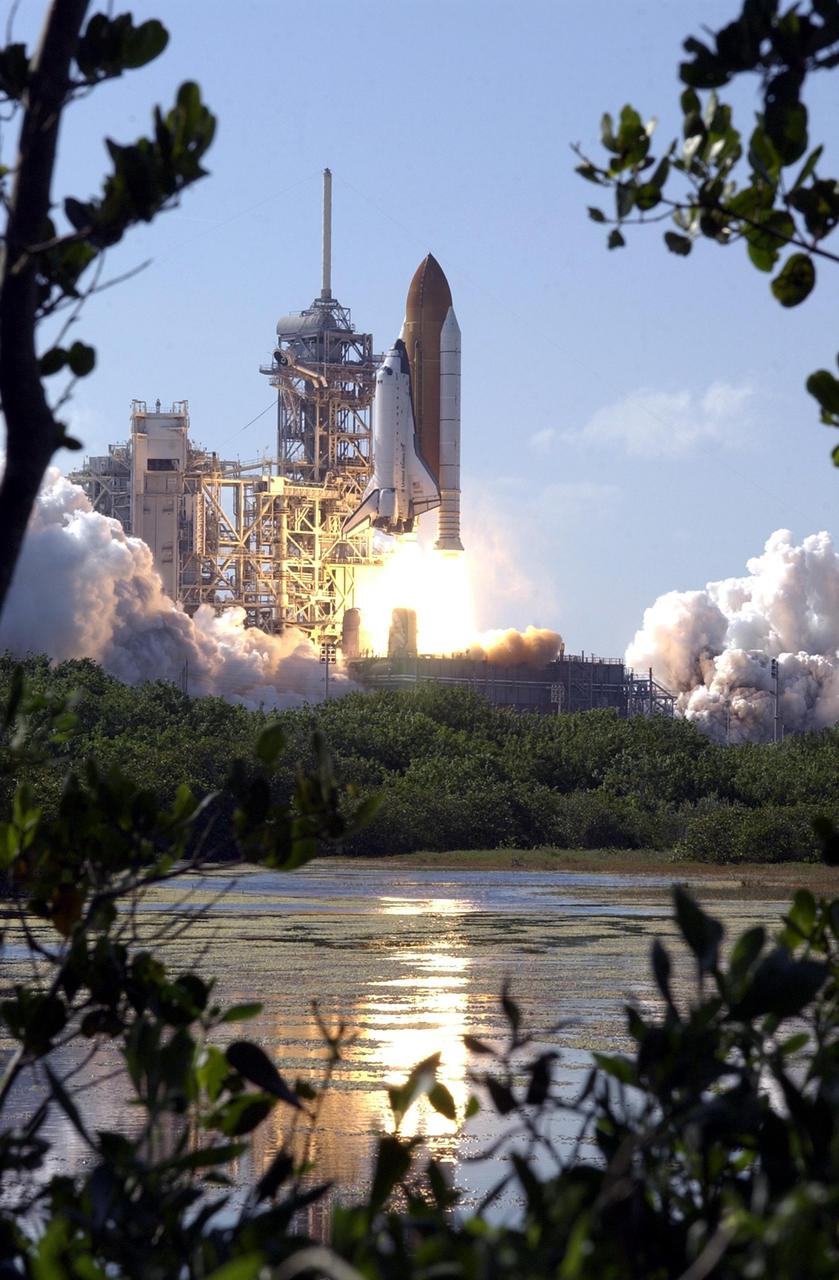
KENNEDY SPACE CENTER, FLA. -- Space Shuttle Atlantis hurtles into the clear blue sky as it lifts off on mission STS-110. Liftoff occurred at 4:44:19 p.m. EDT (20:44:19 GMT). STS-110 is the 13th assembly flight to the International Space Station
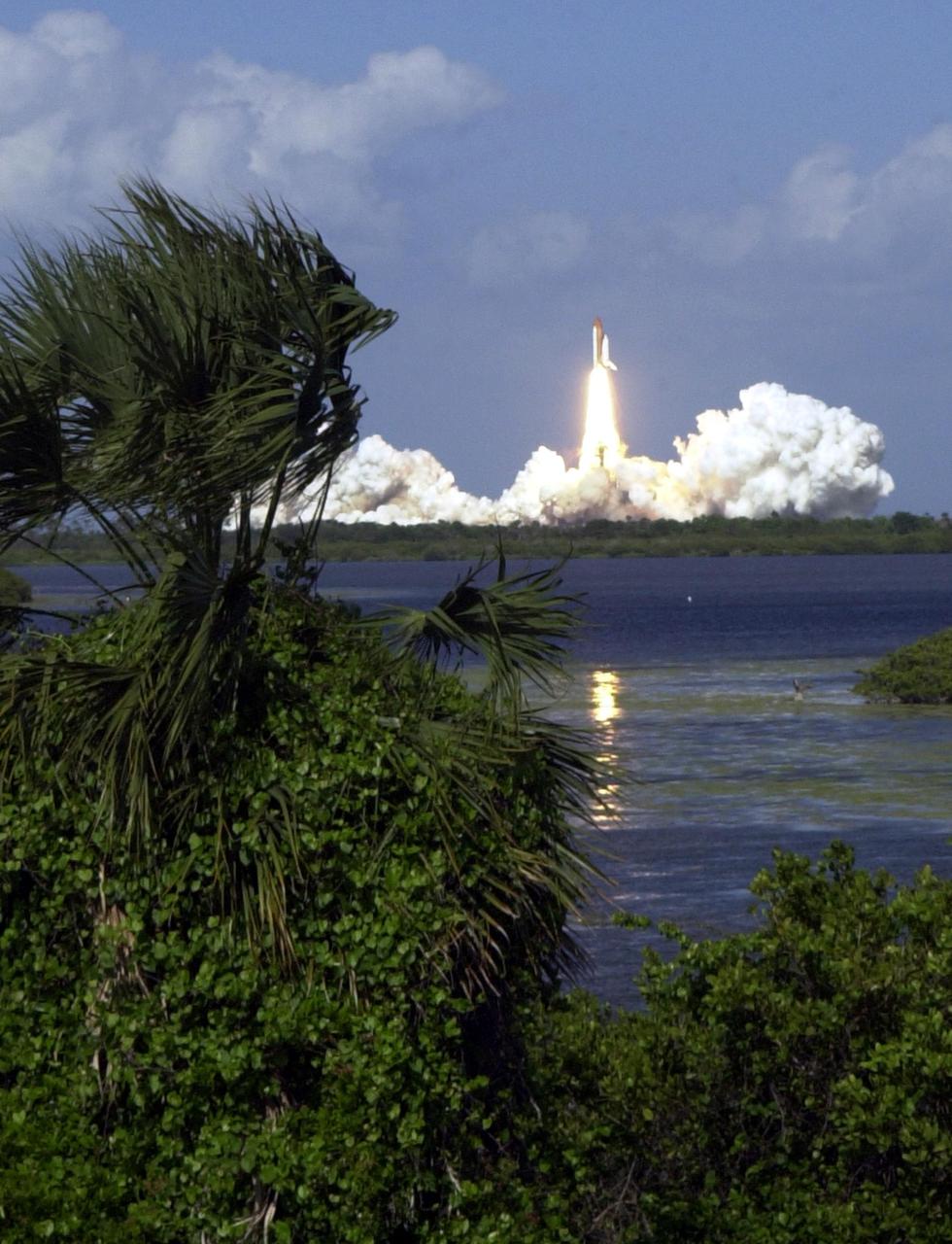
KENNEDY SPACE CENTER, FLA. - Gusty winds that blow the palmettos in the foreground don't deter the launch of Space Shuttle Atlantis, across the water, on mission STS-110. Liftoff occurred at 4:44:19 p.m. EDT (20:41:19 GMT). STS-110 is the 13th assembly flight to the International Space Station
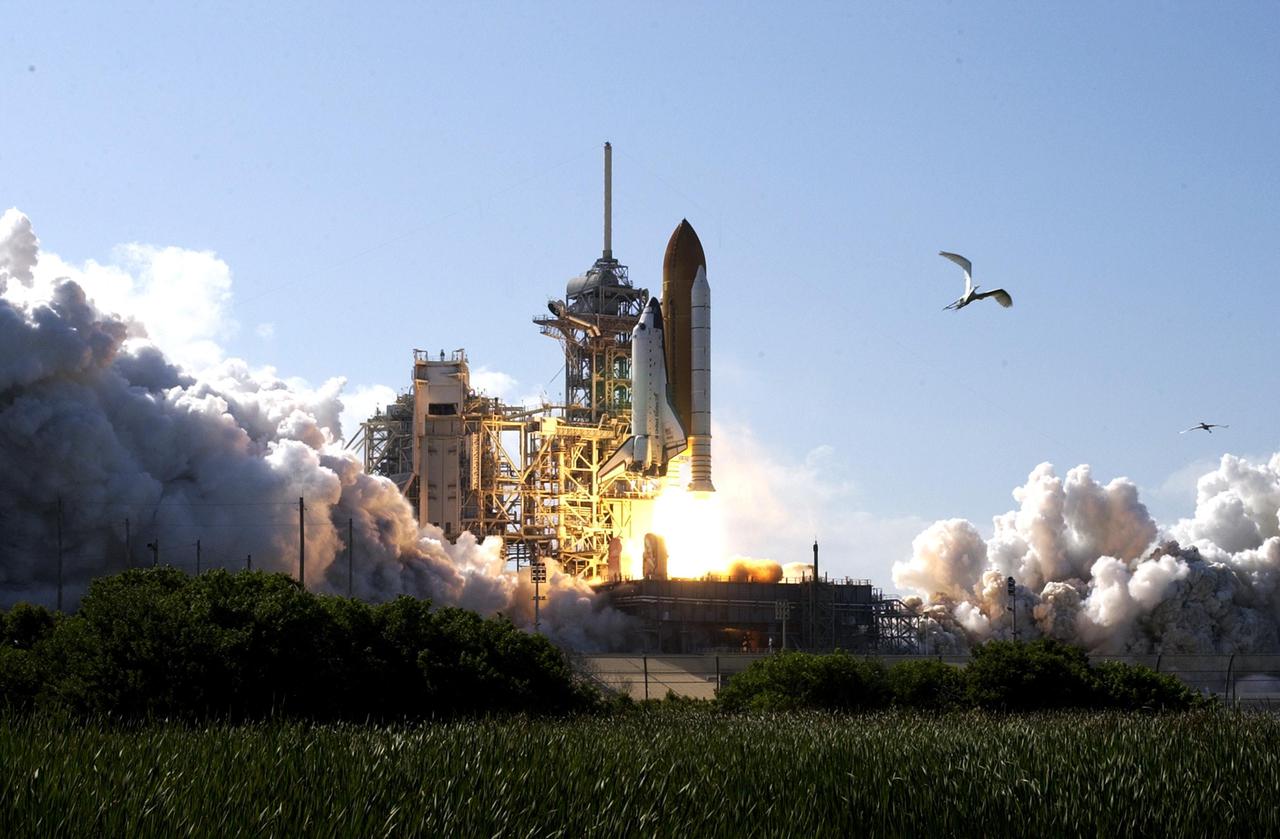
KENNEDY SPACE CENTER, FLA. -- Space Shuttle Atlantis hurtles into the clear blue sky as it lifts off on mission STS-110. Liftoff occurred at 4:44:19 p.m. EDT (20:44:19 GMT). STS-110 is the 13th assembly flight to the International Space Station
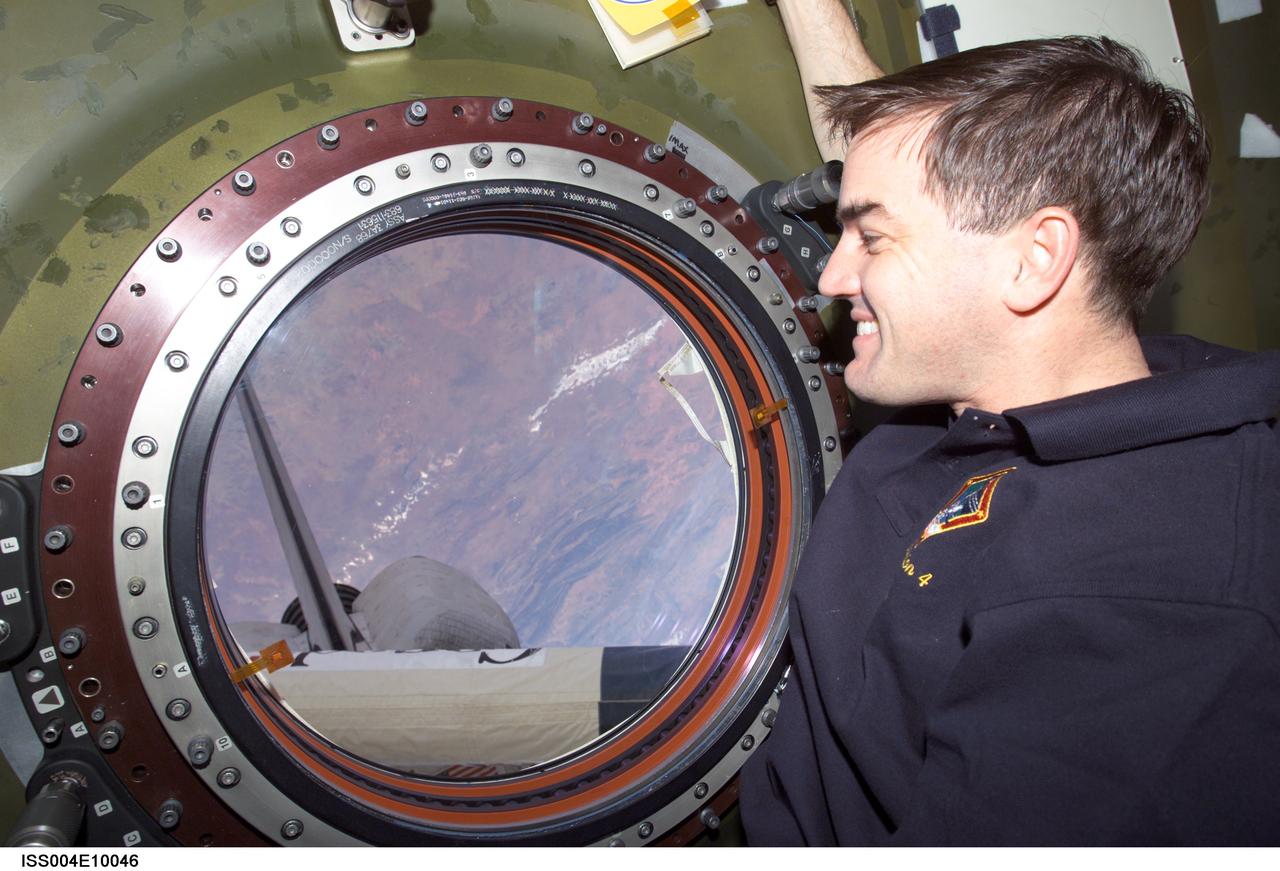
ISS004-E-10046 (16 April 2002) --- Astronaut Rex J. Walheim, STS-110 mission specialist, looks through the Earth observation window in the Destiny laboratory on the International Space Station (ISS). Portions of the Space Shuttle Atlantis and the Canadarm2 are visible through the window.
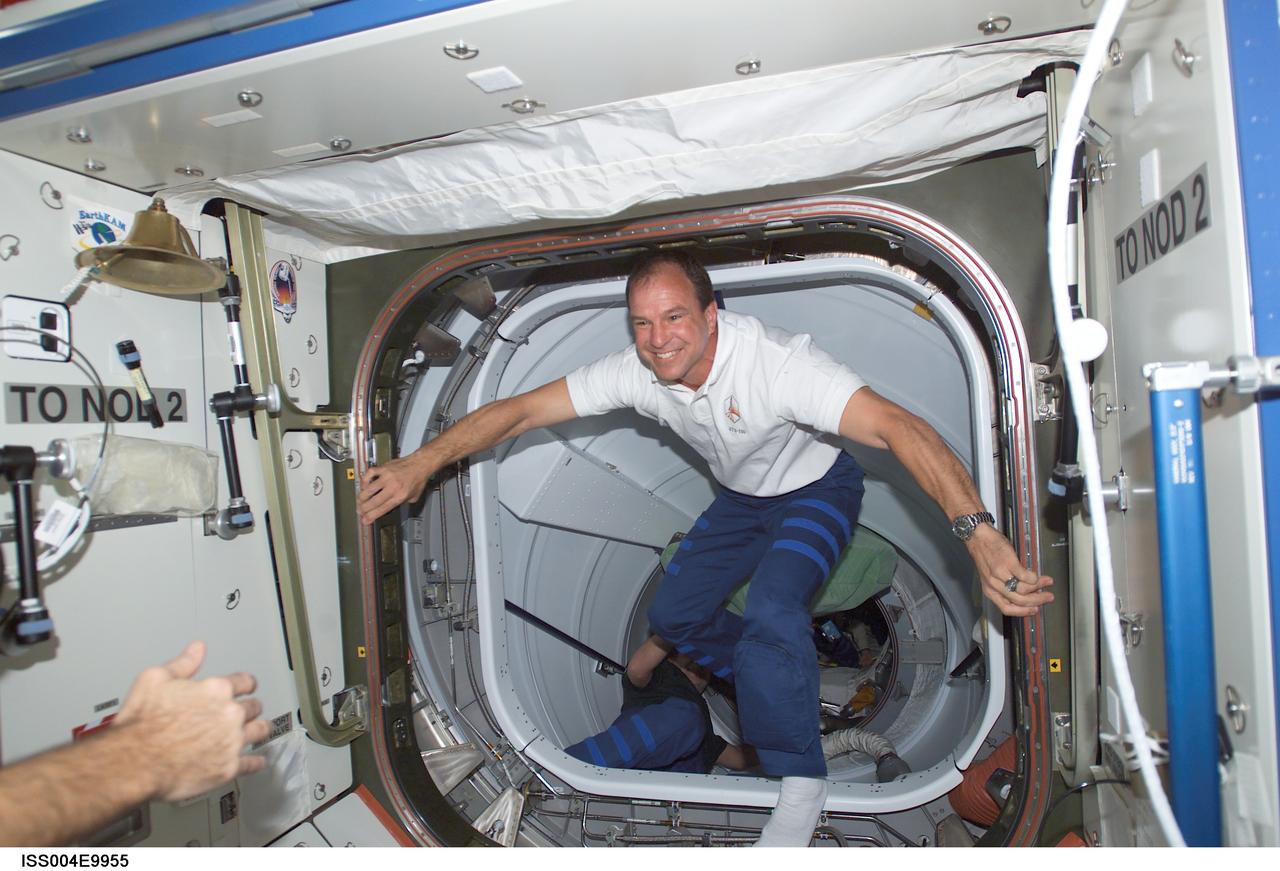
ISS004-E-9955 (10 April 2002) --- Astronaut Michael J. Bloomfield, STS-110 mission commander, steps into the Destiny laboratory on the International Space Station (ISS) through the Pressurized Mating Adapter 2 (PMA-2) upon docking of the Space Shuttle Atlantis and the station.
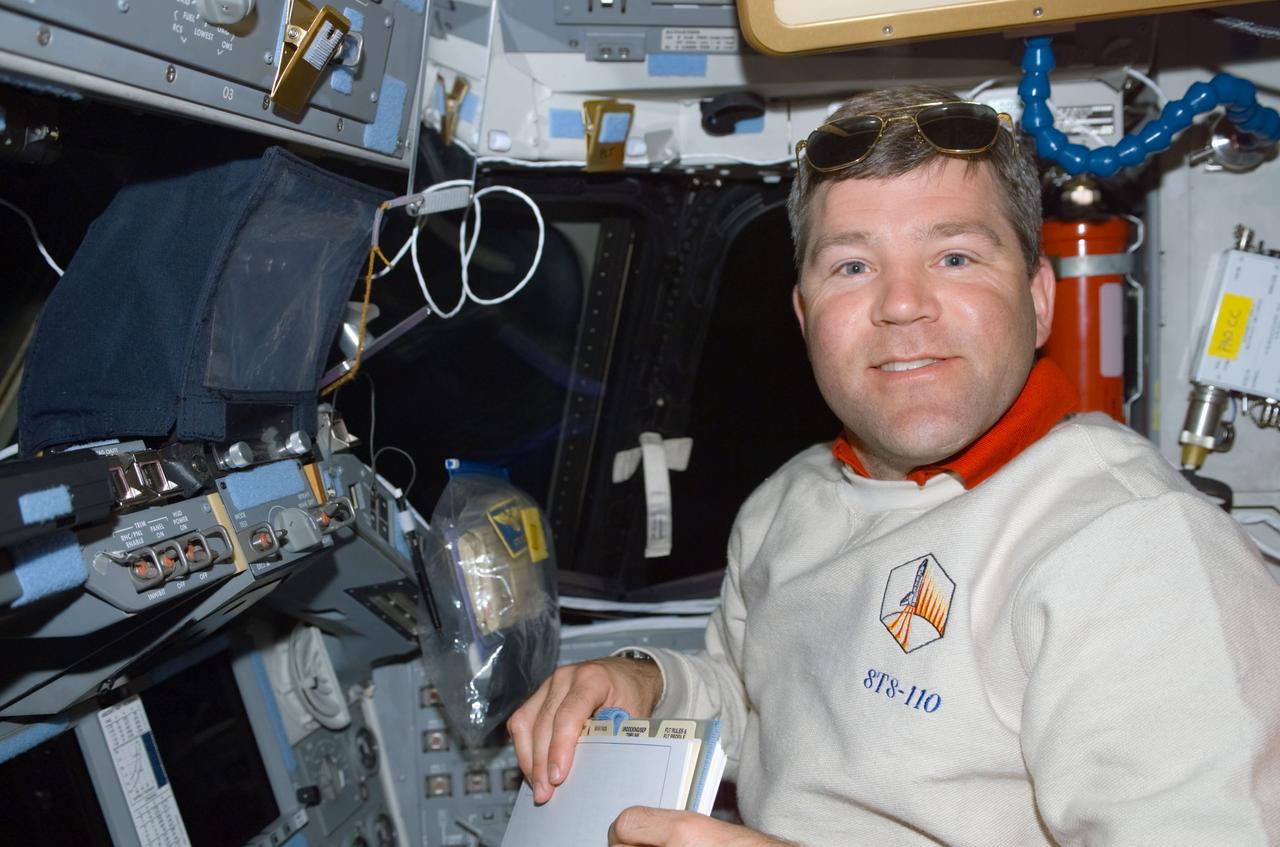
STS110-E-5060 (9 April 2002) --- Astronaut Stephen N. Frick, STS-110 pilot, occupies the pilot’s station on the forward flight deck of the Space Shuttle Atlantis. The image was taken with a digital still camera.
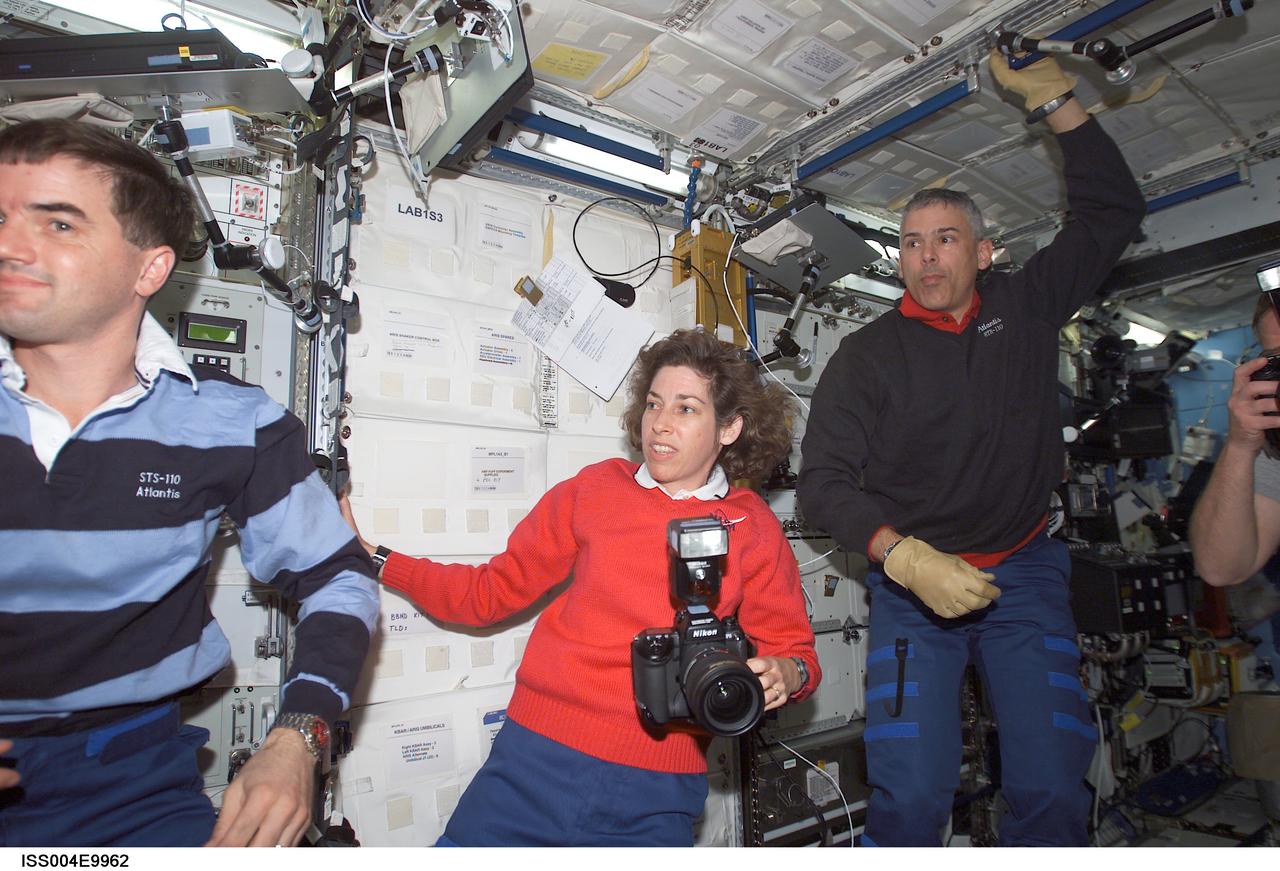
ISS004-E-9962 (10 April 2002) --- Astronauts Rex J. Walheim (left), Ellen Ochoa, and Lee M. E. Morin, all STS-110 mission specialists, are photographed in the Destiny laboratory on the International Space Station (ISS).
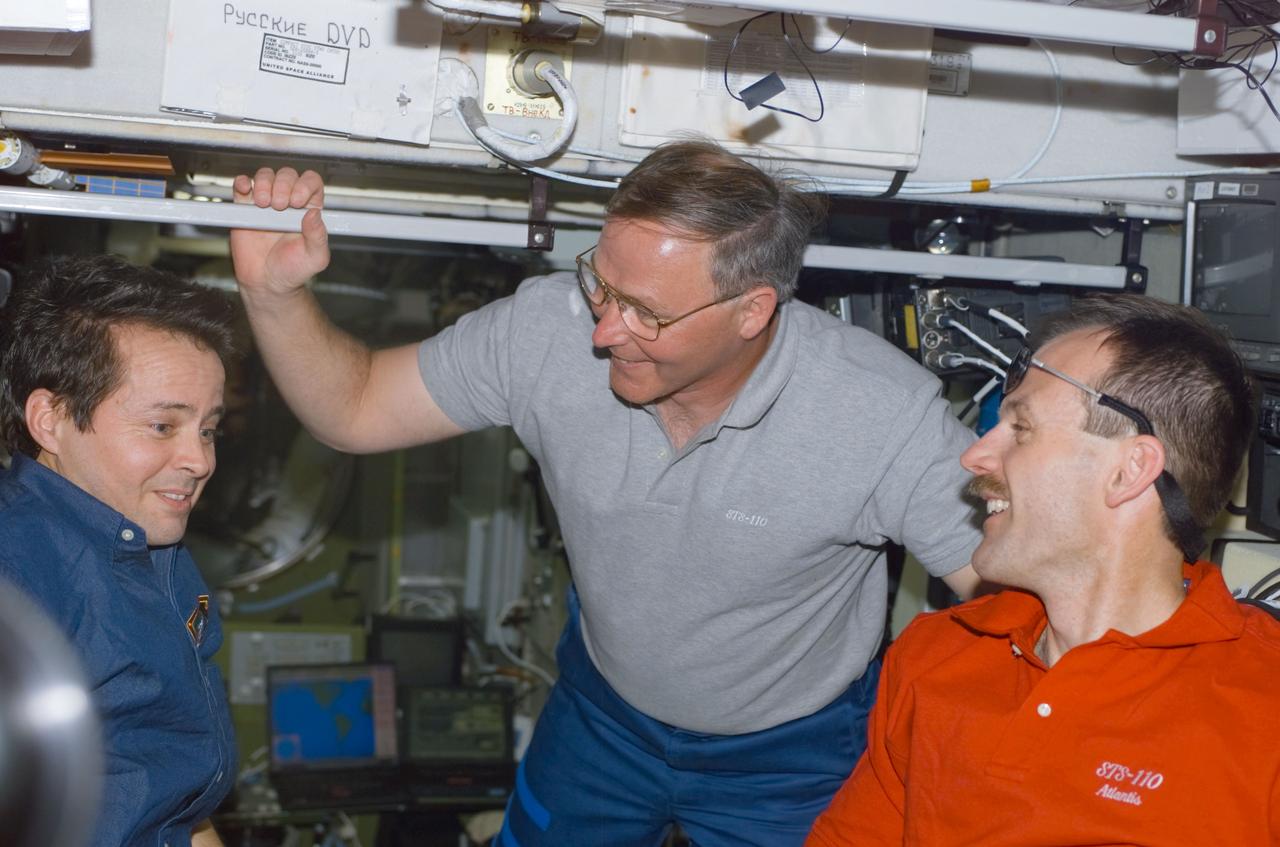
STS110-E-5122 (10 April 2002) --- Astronauts Daniel W. Bursch (left), Expedition Four flight engineer, Jerry L. Ross and Steven L. Smith, both STS-110 mission specialists, converse in the Zvezda Service Module on the International Space Station (ISS). The image was taken with a digital still camera.
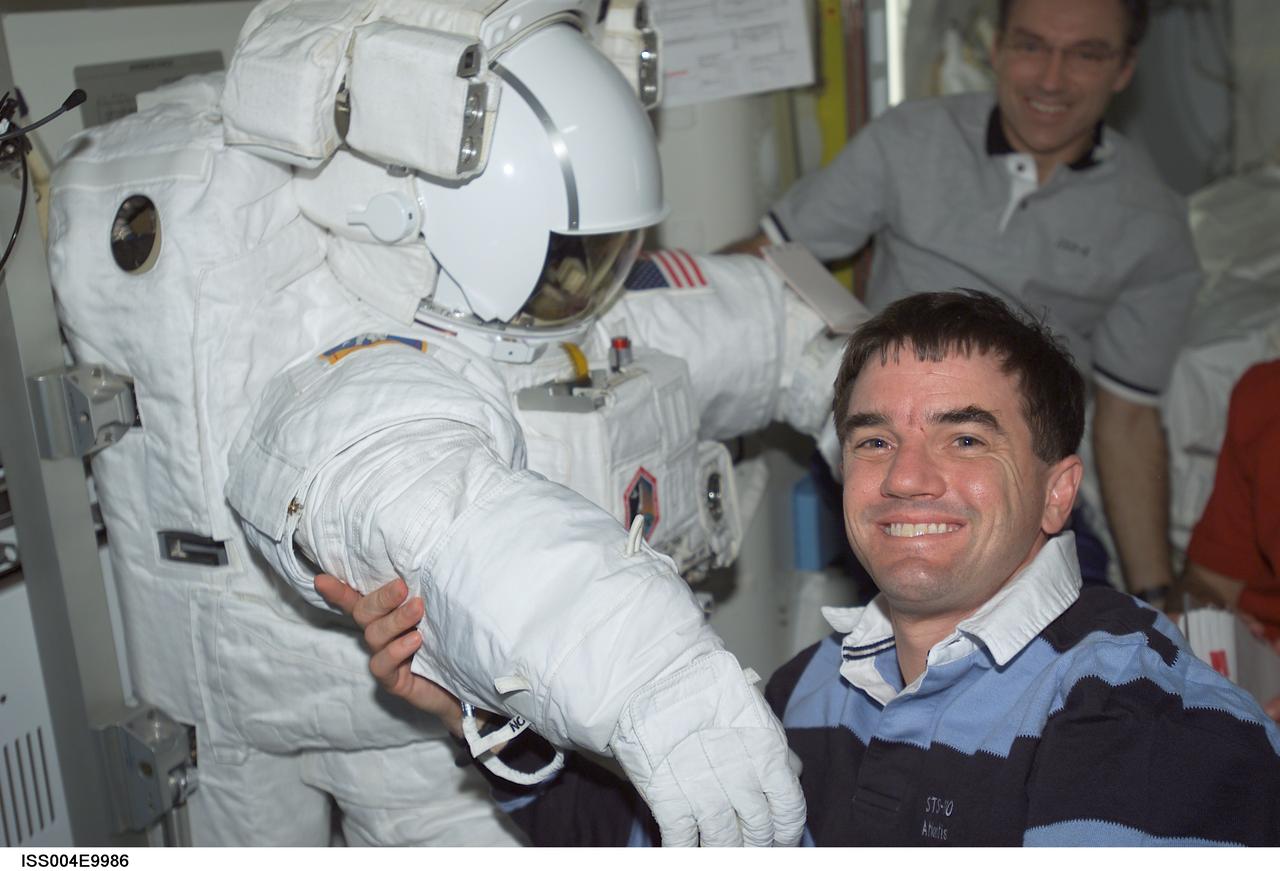
ISS004-E-9986 (10 April 2002) --- Astronaut Rex J. Walheim, STS-110 mission specialist, stands near an Extravehicular Mobility Unit (EMU) space suit in the Quest Airlock on the International Space Station (ISS). Astronaut Carl E. Walz, Expedition Four flight engineer, is visible in the background.
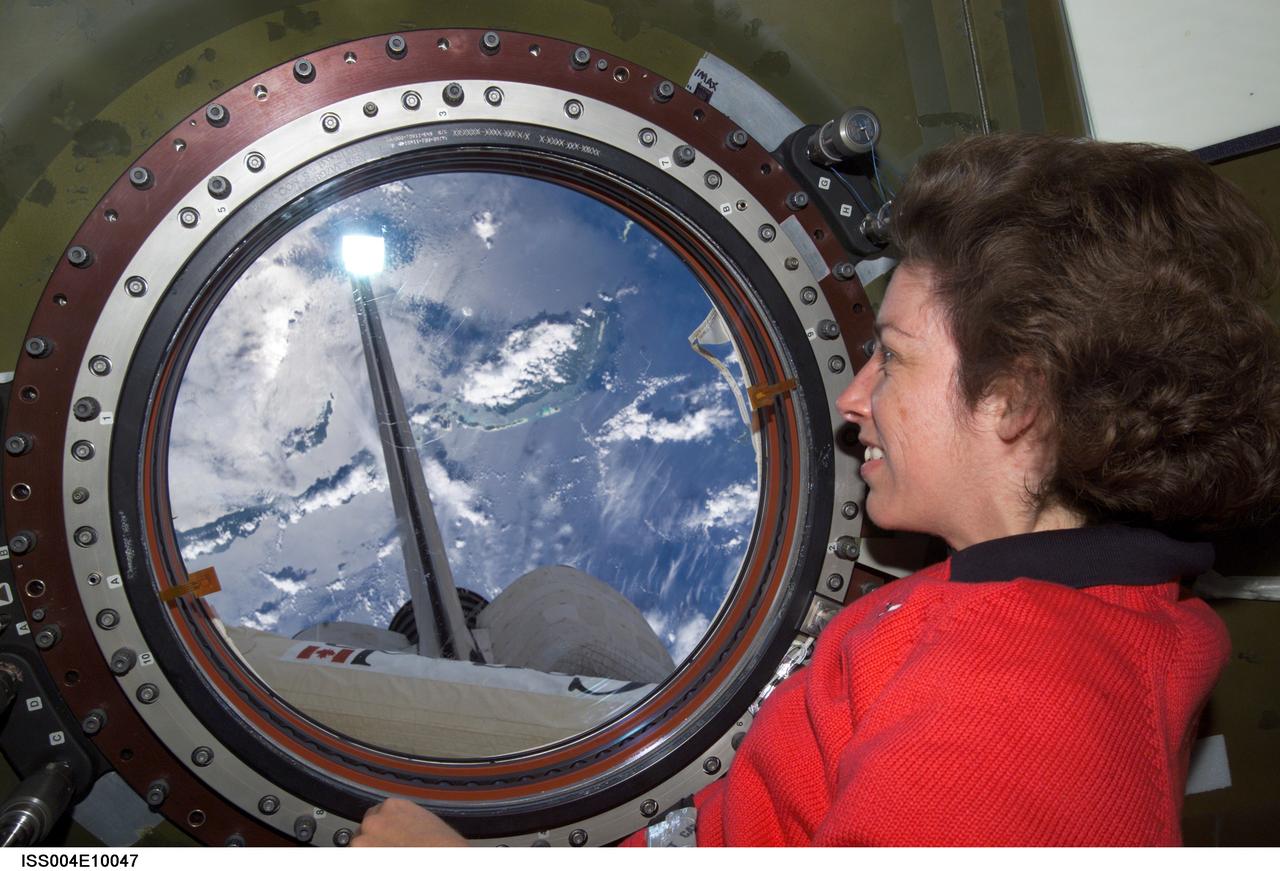
ISS004-E-10047 (16 April 2002) --- Astronaut Ellen Ochoa, STS-110 mission specialist, looks through the Earth observation window in the Destiny laboratory on the International Space Station (ISS). Portions of the space shuttle Atlantis and the Canadarm2 are visible through the window.
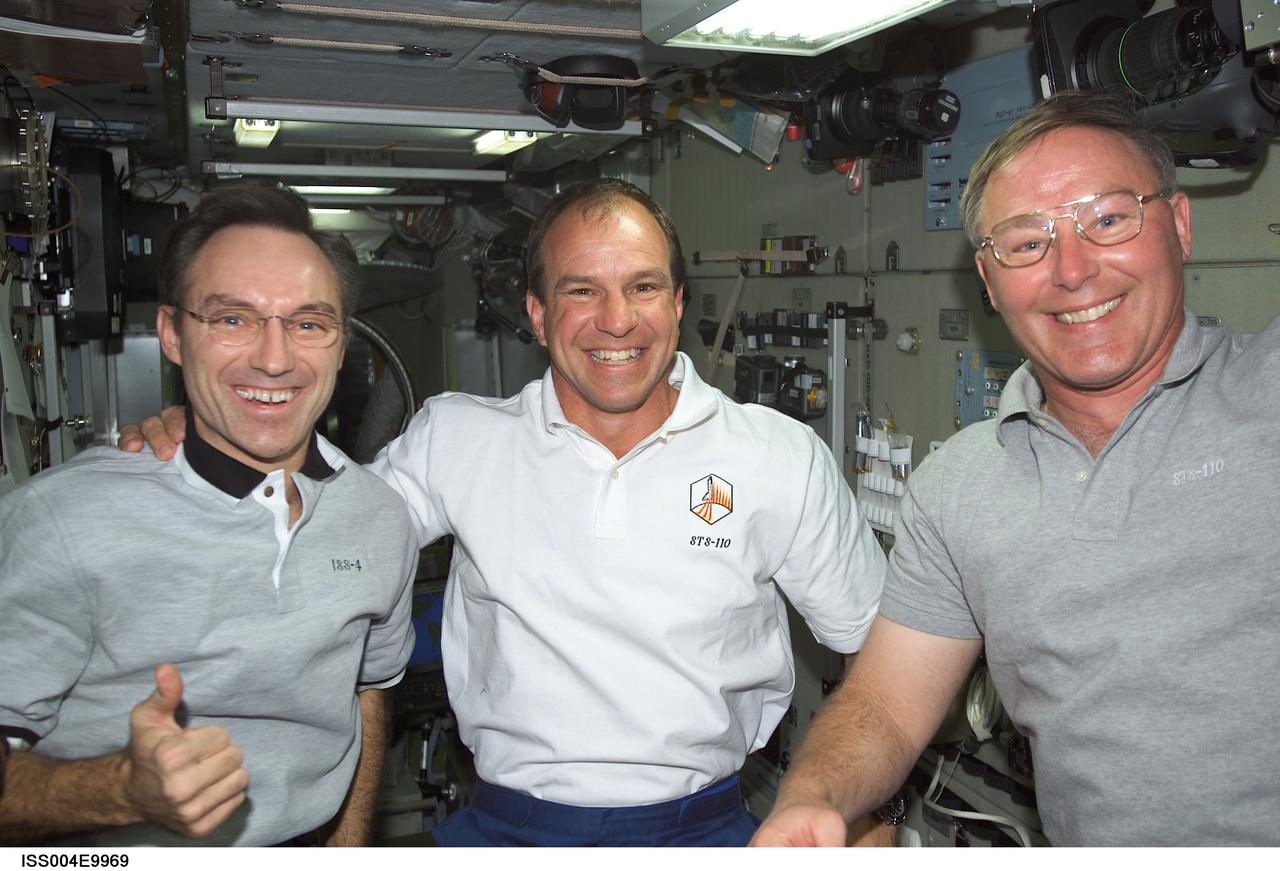
ISS004-E-9969 (10 April 2002) --- Astronauts Carl E. Walz (left), Expedition Four flight engineer, Michael J. Bloomfield and Jerry L. Ross, STS-110 mission commander and mission specialist, respectively, are photographed in the Zvezda Service Module on the International Space Station (ISS).
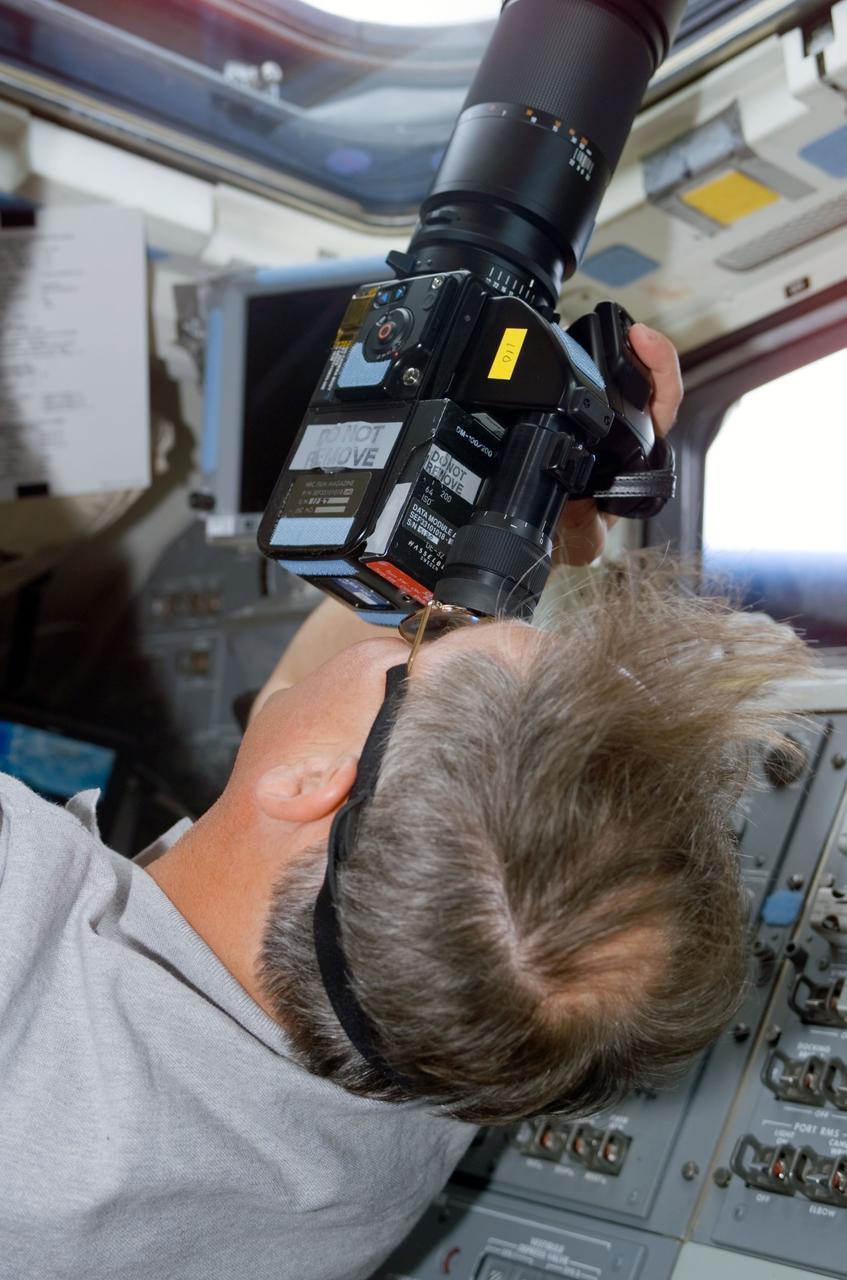
STS110-E-5050 (9 April 2002) --- Astronaut Jerry L. Ross, STS-110 mission specialist, takes photos out of an aft flight deck overhead window using a 70mm hand-held camera. The image was taken with a digital still camera.
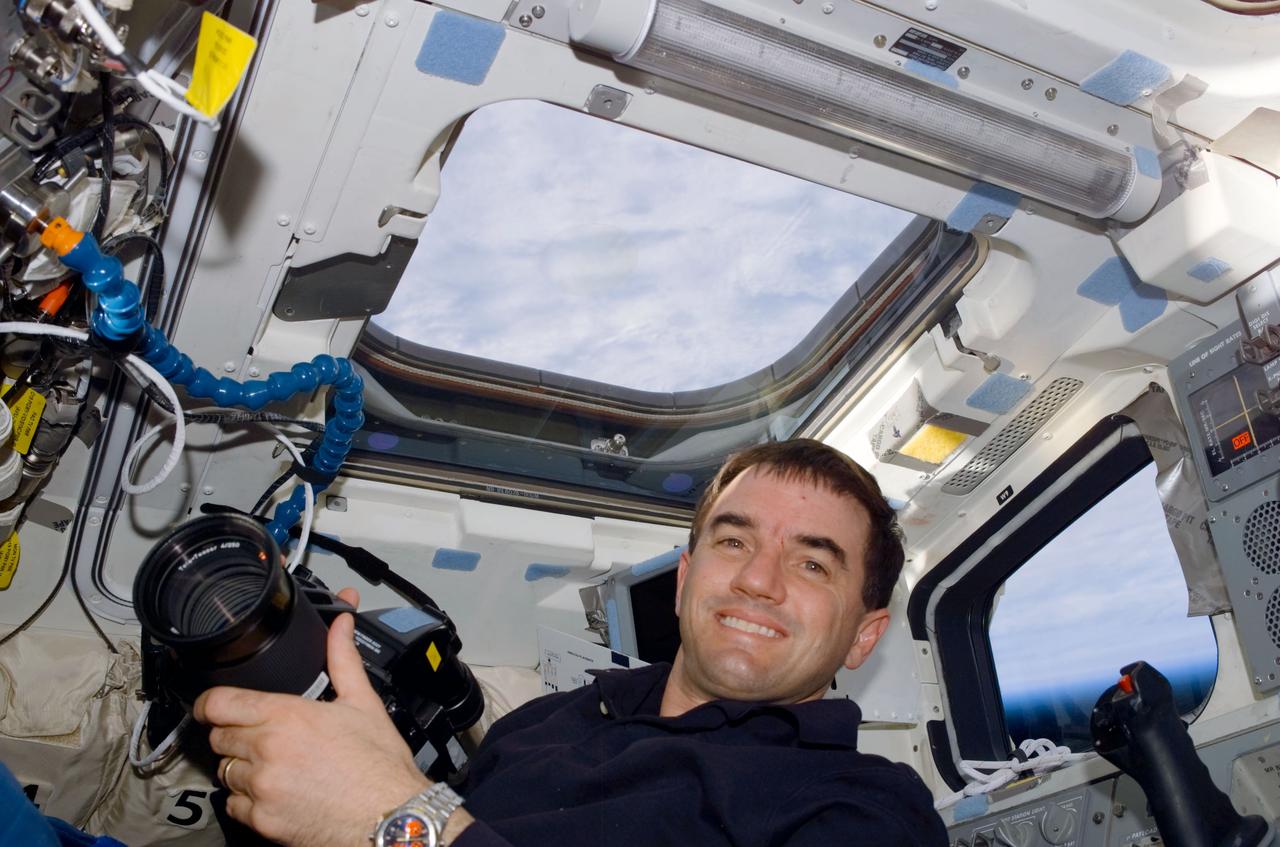
STS110-E-5017 (8 April 2002) --- Astronaut Rex J. Walheim, STS-110 mission specialist, holds a camera on the aft flight deck of the Space Shuttle Atlantis. A blue and white Earth is visible through the overhead windows of the orbiter. The image was taken with a digital still camera.
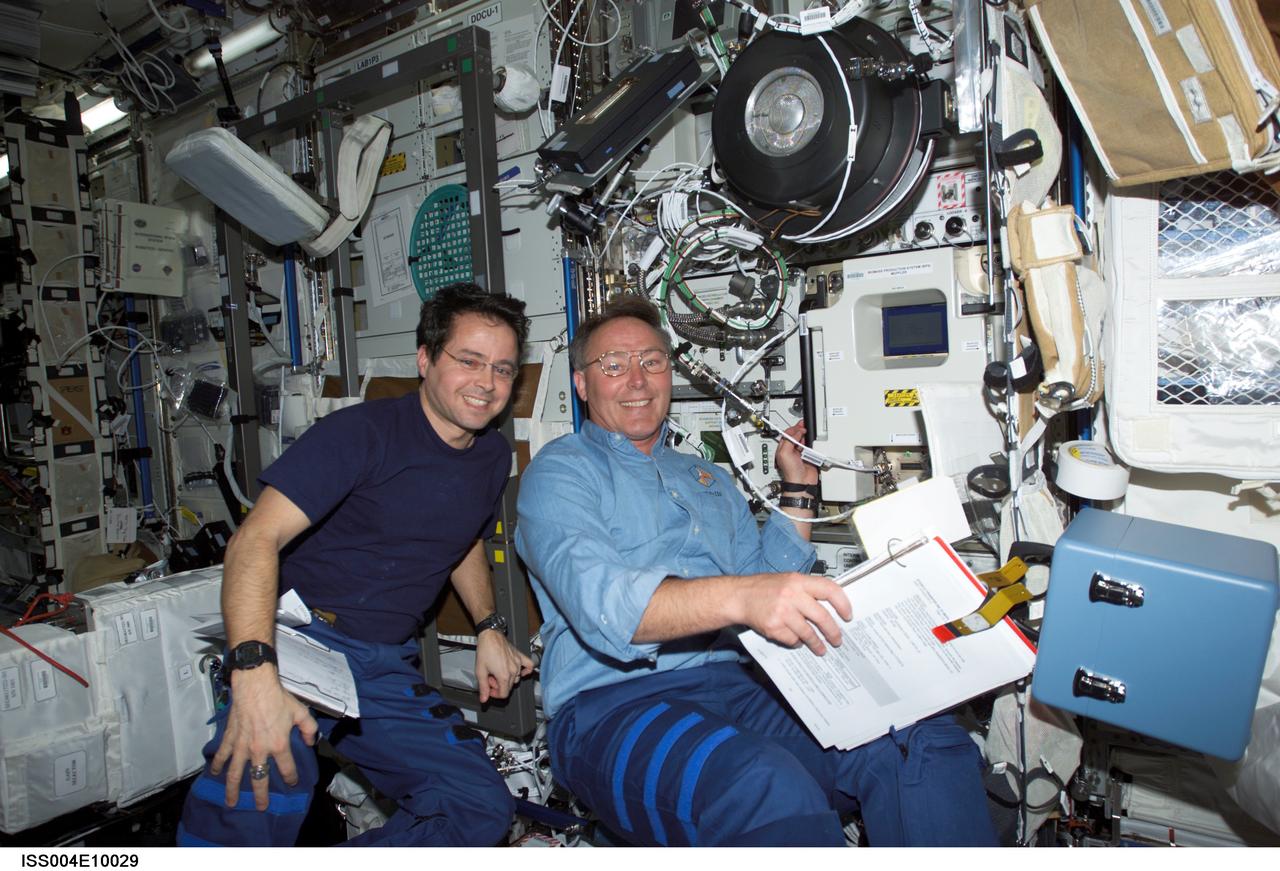
ISS004-E-10029 (12 April 2002) --- Astronauts Daniel W. Bursch (left), Expedition Four flight engineer, and Jerry L. Ross, STS-110 mission specialist, work in the Destiny laboratory on the International Space Station (ISS).
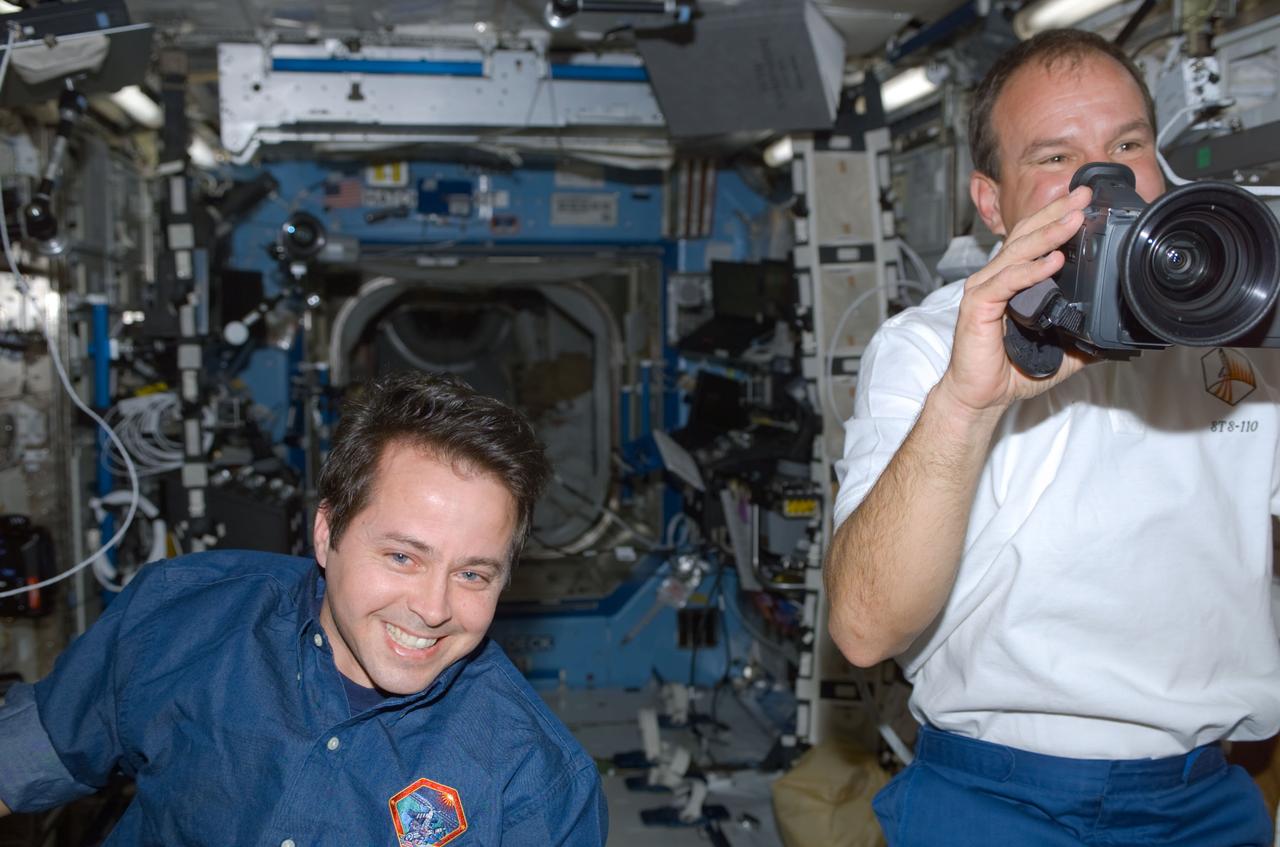
STS110-E-5093 (10 April 2002) --- Astronauts Michael J. Bloomfield (right), STS-110 mission commander, and Daniel W. Bursch, Expedition Four flight engineer, are photographed in the Destiny laboratory on the International Space Station (ISS). The image was taken with a digital still camera.
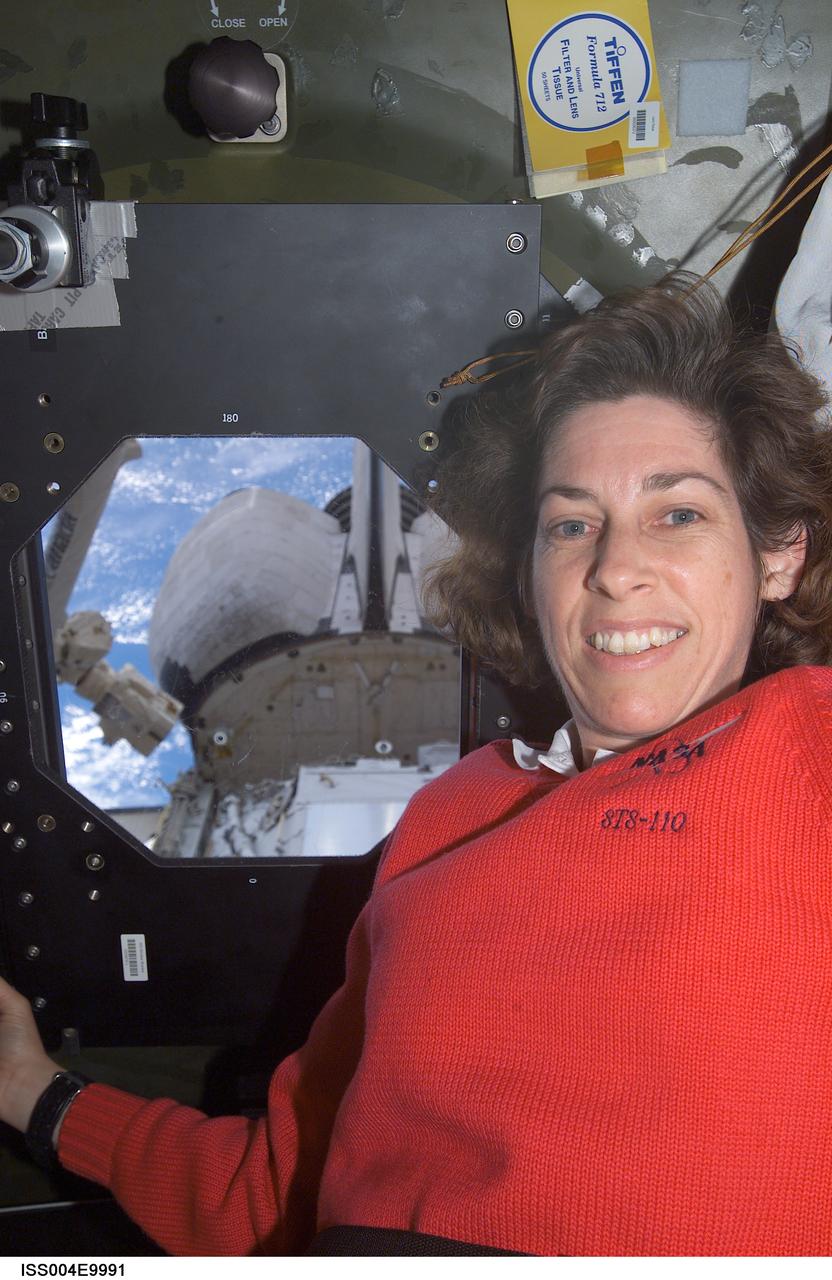
ISS004-E-9991 (10 April 2002) --- Astronaut Ellen Ochoa, STS-110 mission specialist, is photographed near a Destiny laboratory window on the International Space Station (ISS). Portions of the Space Shuttle Atlantis and the Canadarm2 are visible through the window.
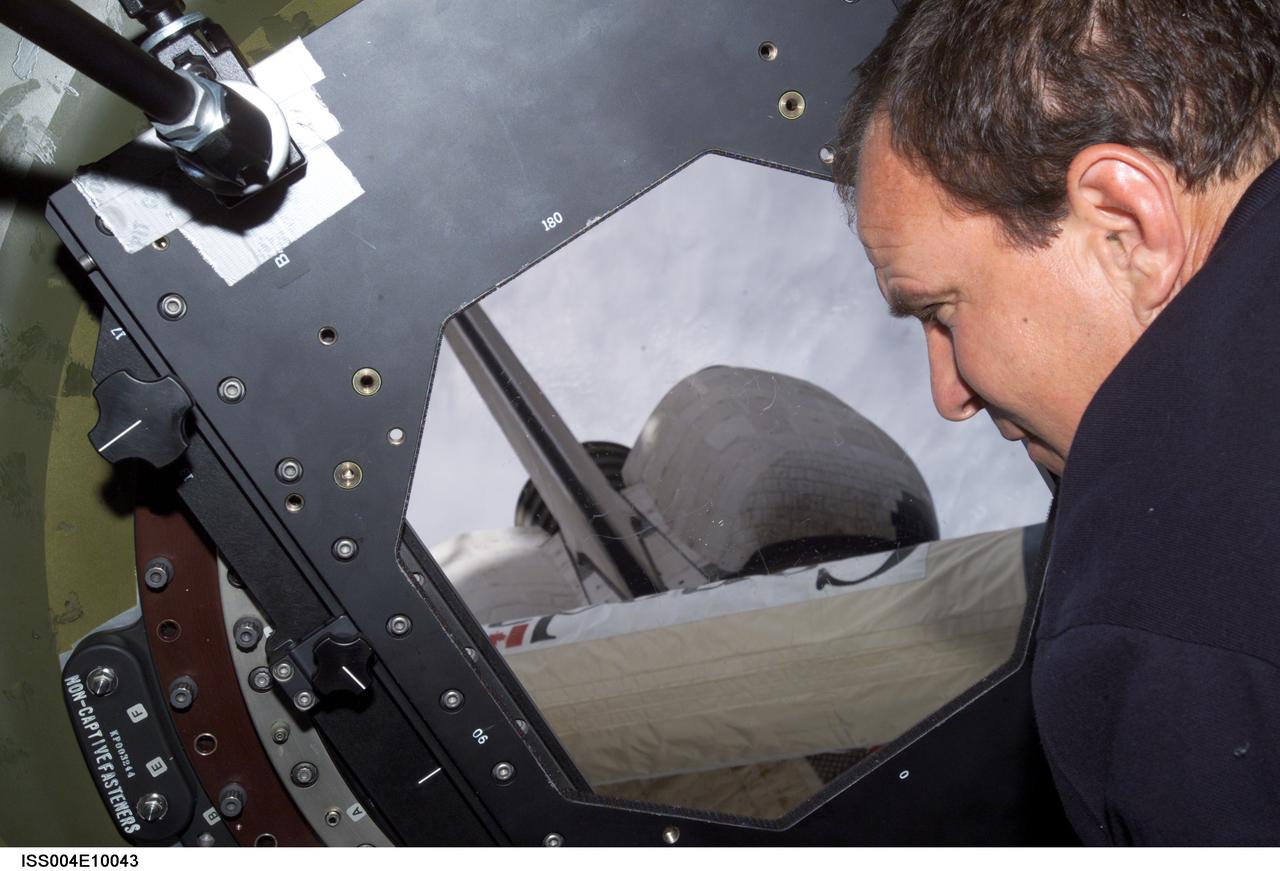
ISS004-E-10043 (15 April 2002) --- Astronaut Michael J. Bloomfield, STS-110 mission commander, looks through the Earth observation window in the Destiny laboratory on the International Space Station (ISS). Portions of the Space Shuttle Atlantis and the Canadarm2 are visible through the window.
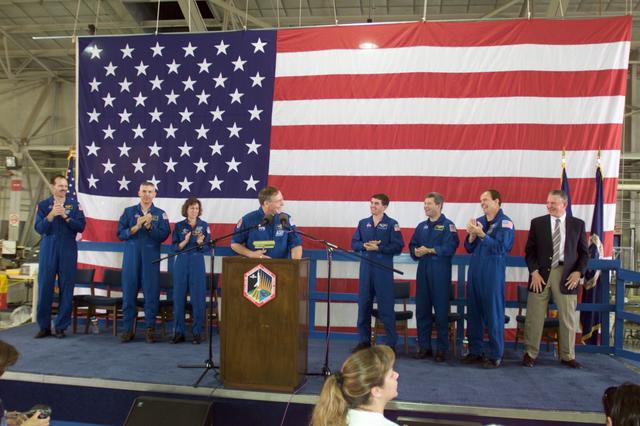
JSC2002-E-14078 (20 April 2002) --- Astronaut Jerry L. Ross, STS-110 mission specialist, speaks from the lectern in Hangar 990 at Ellington Field during the crew return ceremonies. From the left (standing behind Ross) are astronauts Steven L. Smith, Lee M. E. Morin, Ellen Ochoa, Rex J. Walheim, all mission specialists; Stephen N. Frick, pilot; Michael J. Bloomfield, mission commander; and Johnson Space Center’s (JSC) Director Jefferson D. Howell, Jr.
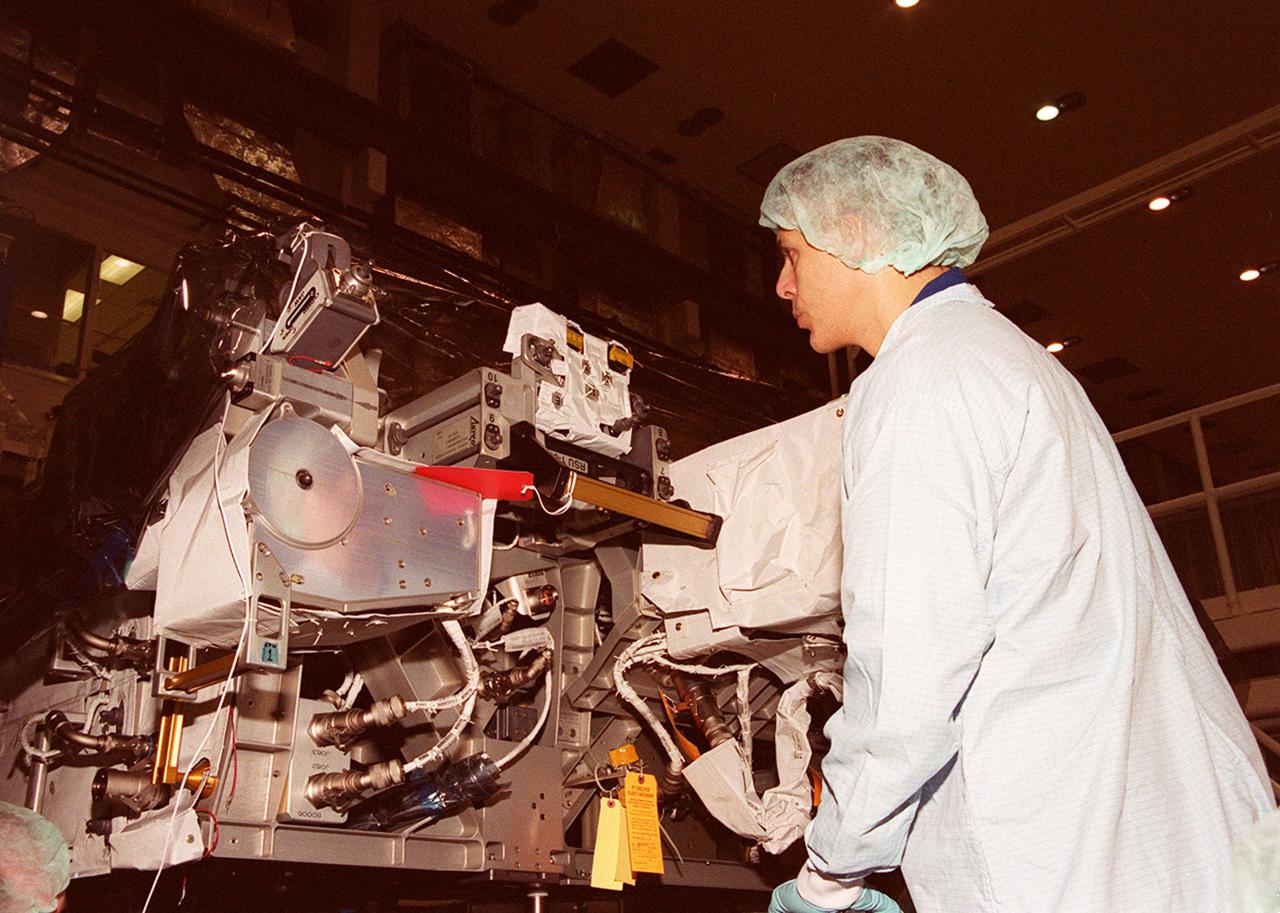
KENNEDY SPACE CENTER, Fla. -- In the Operations and Checkout Building, STS-110 Mission Specialist Lee M. Morin checks out Integrated Truss Structure (ITS) S0, which will be part of the payload on the mission. He and other crew members are at KSC for a Crew Equipment Interface Test. The STS-110 crew comprises Commander Michael J. Bloomfield, Pilot Stephen N. Frick, Mission Specialists Jerry L. Ross , Steven L. Smith, Ellen Ochoa, Morin and Rex J. Walheim. The ITS S0 is part of the payload on the mission. It is the center segment they will be installing on the International Space Station, part of the 300-foot (91-meter) truss attached to the U.S. Lab. By assembly completion, four more truss segments will attach to either side of the S0 truss. STS-110 is currently scheduled to launch in February 2002
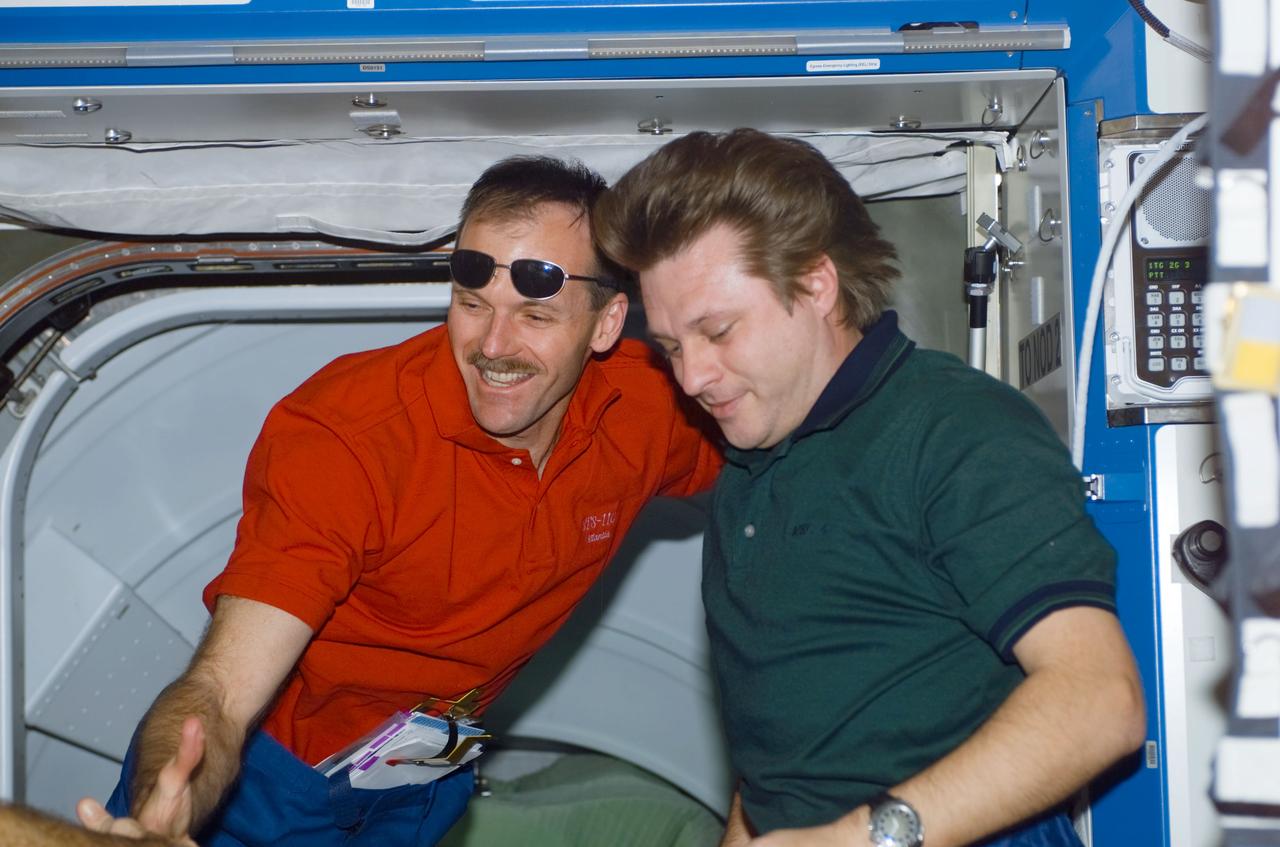
STS110-E-5097 (10 April 2002) --- Astronaut Steven L. Smith (left), STS-110 mission specialist, and cosmonaut Yury I. Onufrienko, Expedition Four mission commander, converse in the Destiny laboratory near the Pressurized Mating Adapter (PMA-2) on the International Space Station (ISS). The image was taken with a digital still camera.
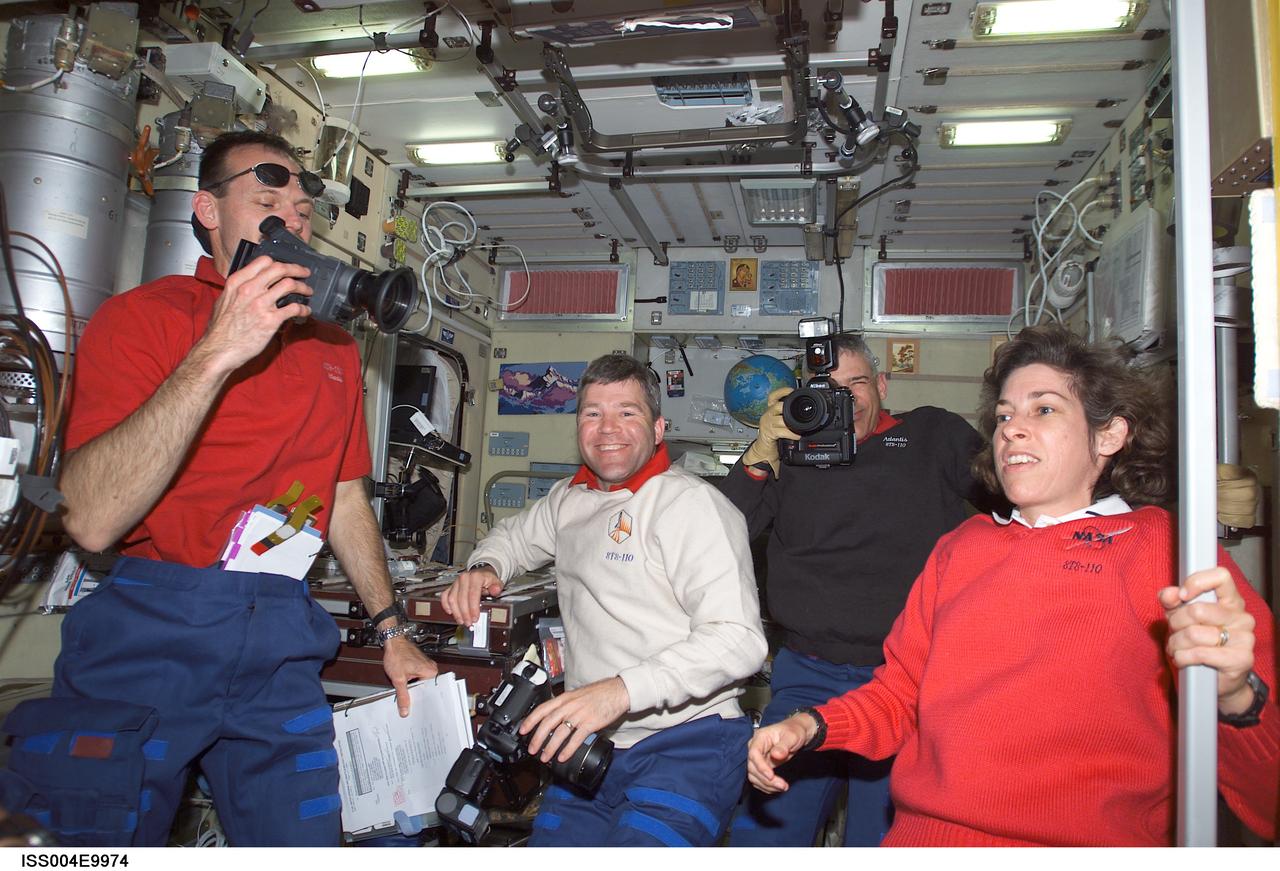
ISS004-E-9974 (10 April 2002) --- Astronauts Steven L. Smith (left), STS-110 mission specialist, Stephen N. Frick, pilot, Lee M. E. Morin, mission specialist, hold cameras in the Zvezda Service Module on the International Space Station (ISS) while astronaut Ellen Ochoa, mission specialist, looks on.
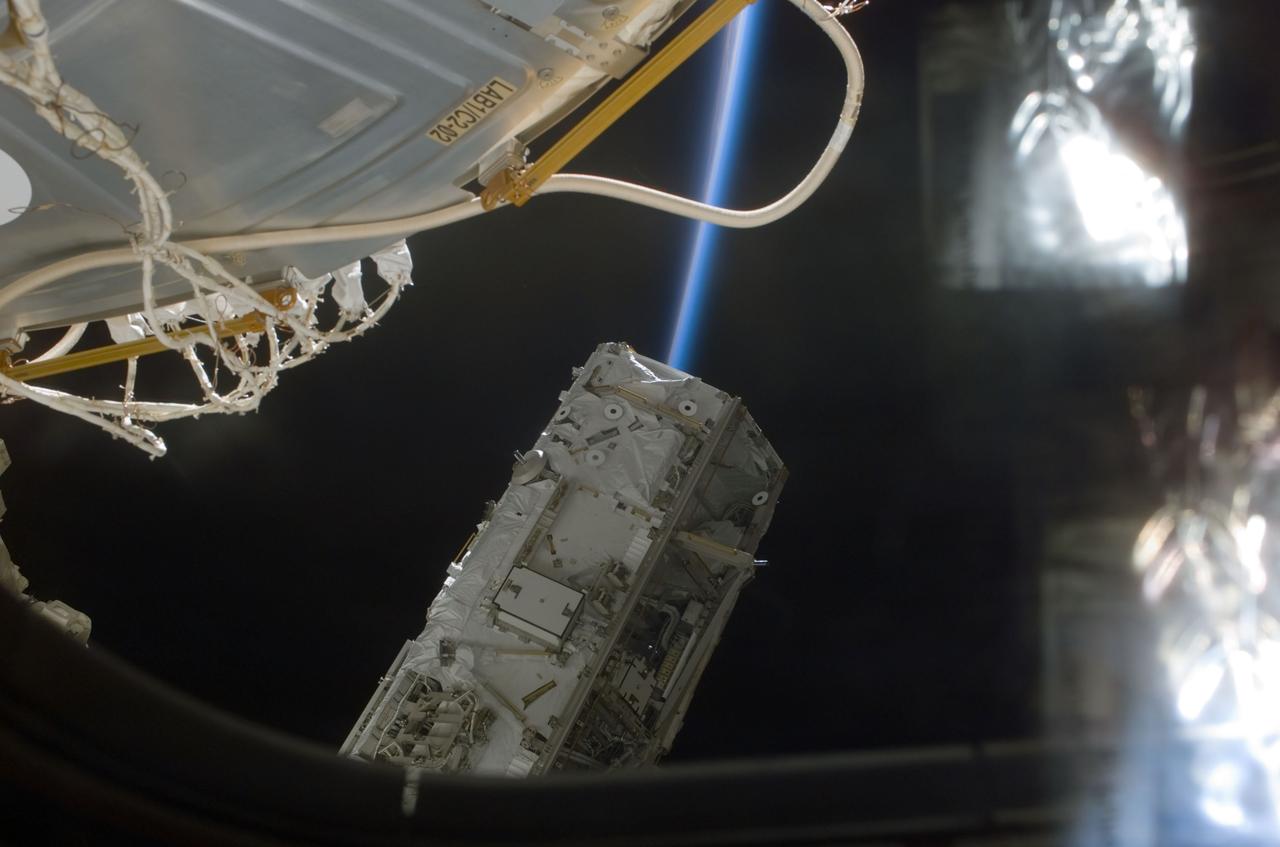
STS110-E-5180 (11 April 2002) --- Backdropped by the blackness of space, the S0 (S-Zero) Truss is moved from the Space Shuttle Atlantis’ cargo bay. Astronauts Ellen Ochoa, STS-110 mission specialist, and Daniel W. Bursch, Expedition Four flight engineer, used the International Space Station’s (ISS) Canadarm2 to lift the S0 Truss out of the orbiter’s payload bay and install it onto the temporary claw fixture on the Destiny laboratory. The image was taken with a digital still camera.
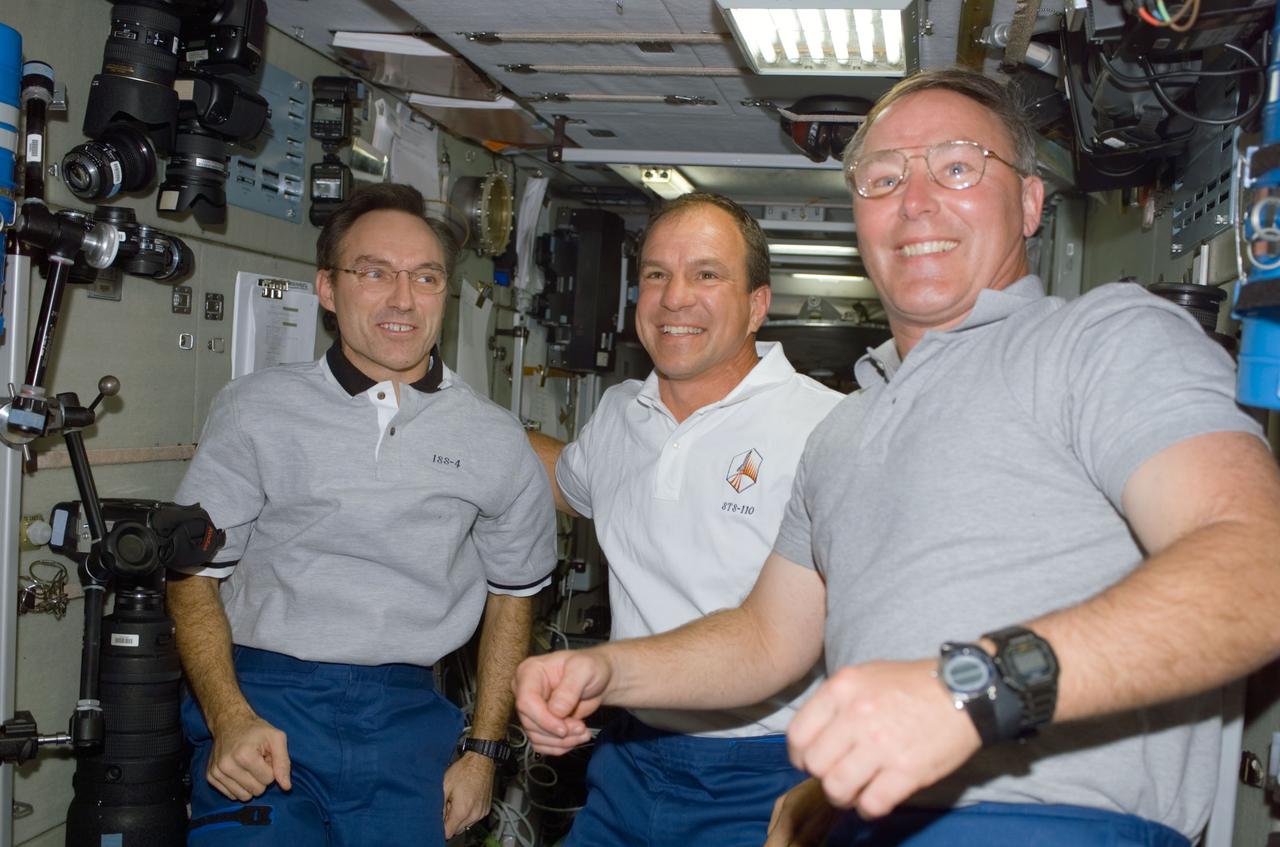
STS110-E-5126 (10 April 2002) --- Astronauts Carl E. Walz (left), Expedition Four flight engineer, Michael J. Bloomfield and Jerry L. Ross, STS-110 mission commander and mission specialist, respectively, are photographed in the Zvezda Service Module on the International Space Station (ISS). The image was taken with a digital still camera.
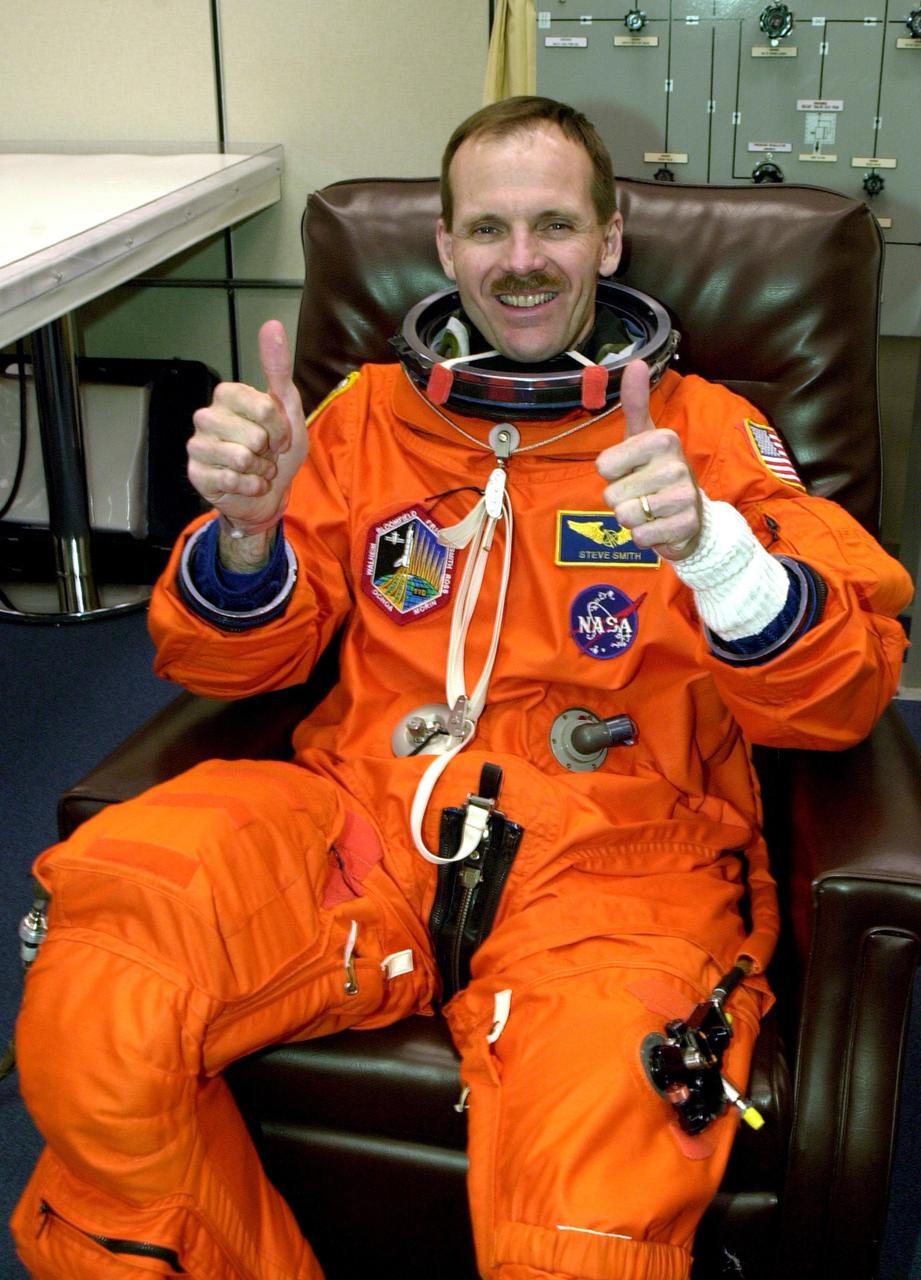
KENNEDY SPACE CENTER, FLA. -- Making his fourth Shuttle flight, STS-110 Mission Specialist Steven L. Smith gives a thumbs up for the launch scheduled for 4:40 p.m. EDT. STS-110 is the 13th assembly flight to the International Space Station, carrying the S0 Integrated Truss Structure and Mobile Transporter (MT). On the 11-day mission, the mission features four spacewalks to attach the S0 truss, which will become the backbone of the Space Station, to the U.S. Lab, 'Destiny.' The MT, a space 'railcar,' is attached to the truss segment and will make its debut run during the flight
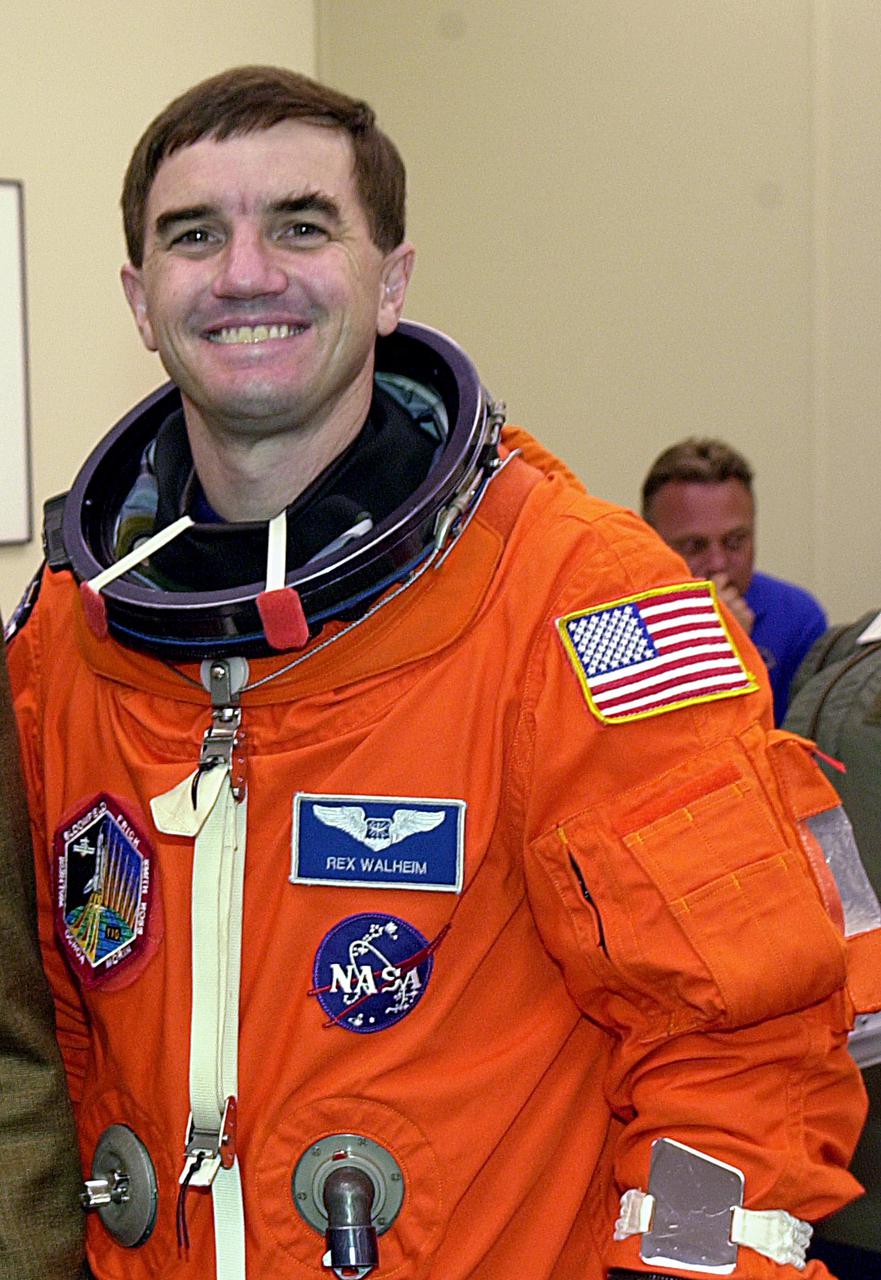
KENNEDY SPACE CENTER, FLA. -- During suitup for launch, STS-110 Mission Specialist Rex J. Walheim smiles in anticipation of his first Shuttle flight. STS-110 is the 13th assembly flight to the International Space Station, carrying the S0 Integrated Truss Structure and Mobile Transporter (MT). On the 11-day mission, the mission features four spacewalks to attach the S0 truss, which will become the backbone of the Space Station, to the U.S. Lab, 'Destiny.' The MT, a space 'railcar,' is attached to the truss segment and will make its debut run during the flight. Launch is scheduled for 4:40 p.m. EDT (20:40 GMT)
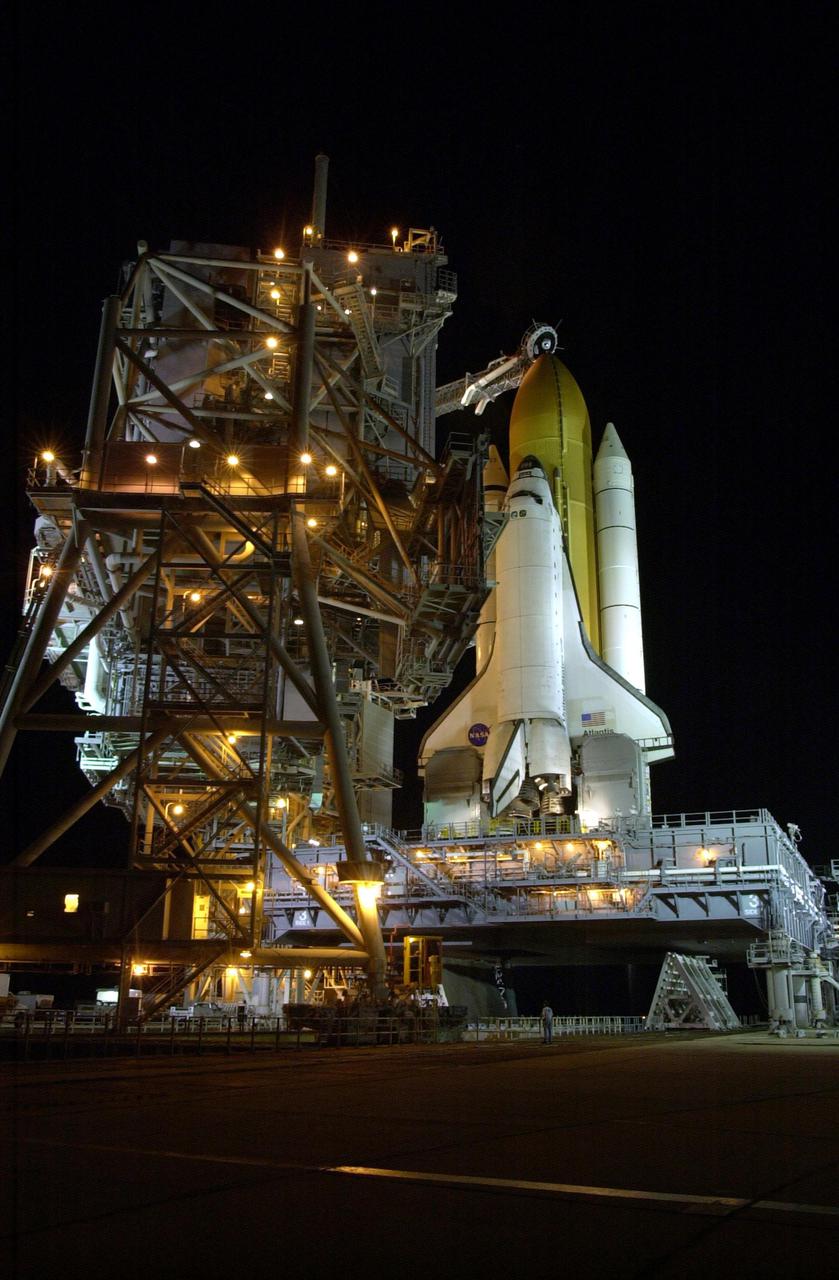
KENNEDY SPACE CENTER, FLA. -- In preparation for launch of Space Shuttle Atlantis on mission STS-110, the Rotating Service Structure (RSS) rolls back into launch position. The RSS provides protected access to the orbiter for changeout and servicing of payloads at the pad. The structure has access platforms at five levels to provide access to the payload bay. The Shuttle rests on the Mobile Launcher Platform (MLP), which straddles the flame trench below. The flame trench is part of the Flame Deflector System that insulates pad structures from the intense heat of a launch. Mission STS-110 is scheduled to launch April 4 on its 11-day mission to the International Space Station
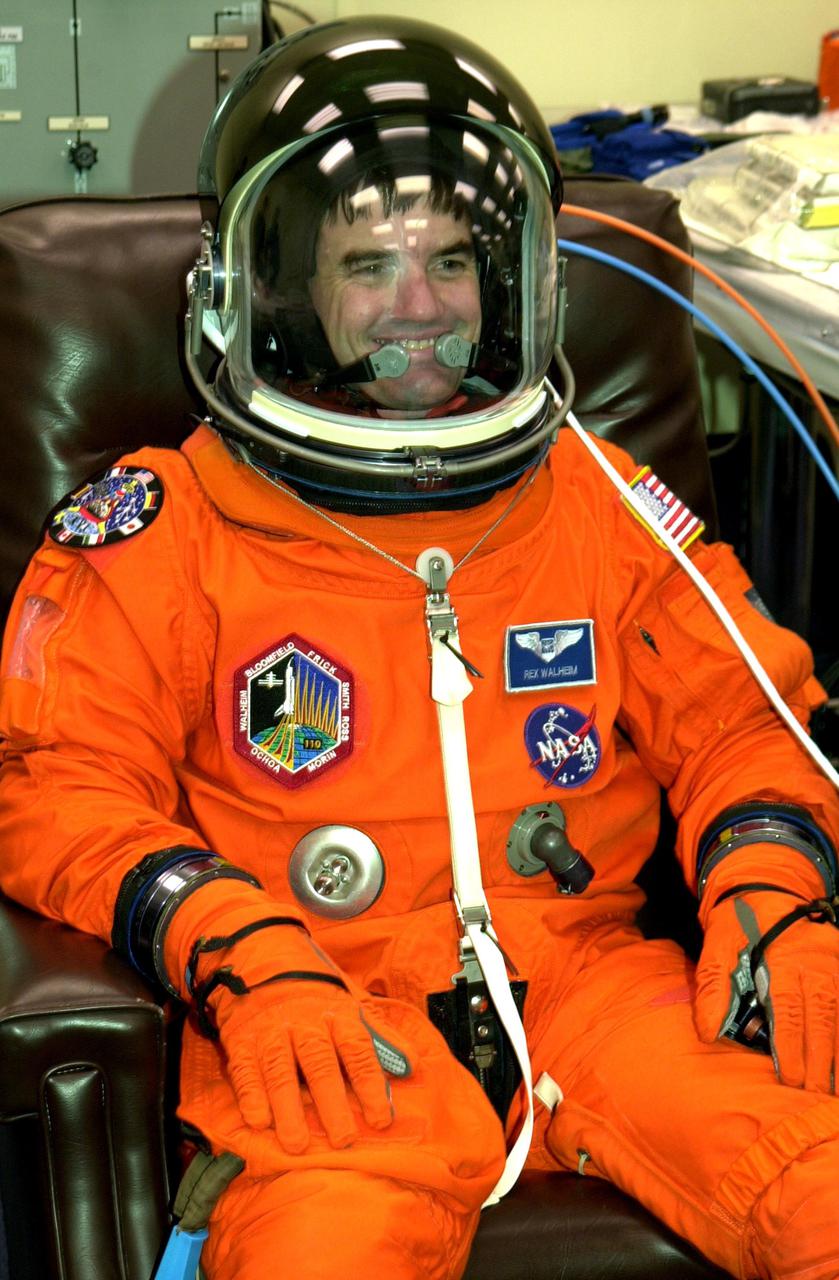
KENNEDY SPACE CENTER, FLA. -- STS-110 Mission Specialist Rex Walheim rests comfortably in his launch and entry suit during final suit check. This will be his first Shuttle flight. The STS-110 payload includes the S0 Integrated Truss Structure (ITS), the Canadian Mobile Transporter, power distribution system modules, a heat pipe radiator for cooling, computers and a pair of rate gyroscopes. The 11-day mission is the 13th assembly flight to the ISS and includes four spacewalks to attach the S0 truss to the U.S. Lab Destiny. Launch is scheduled for April 4
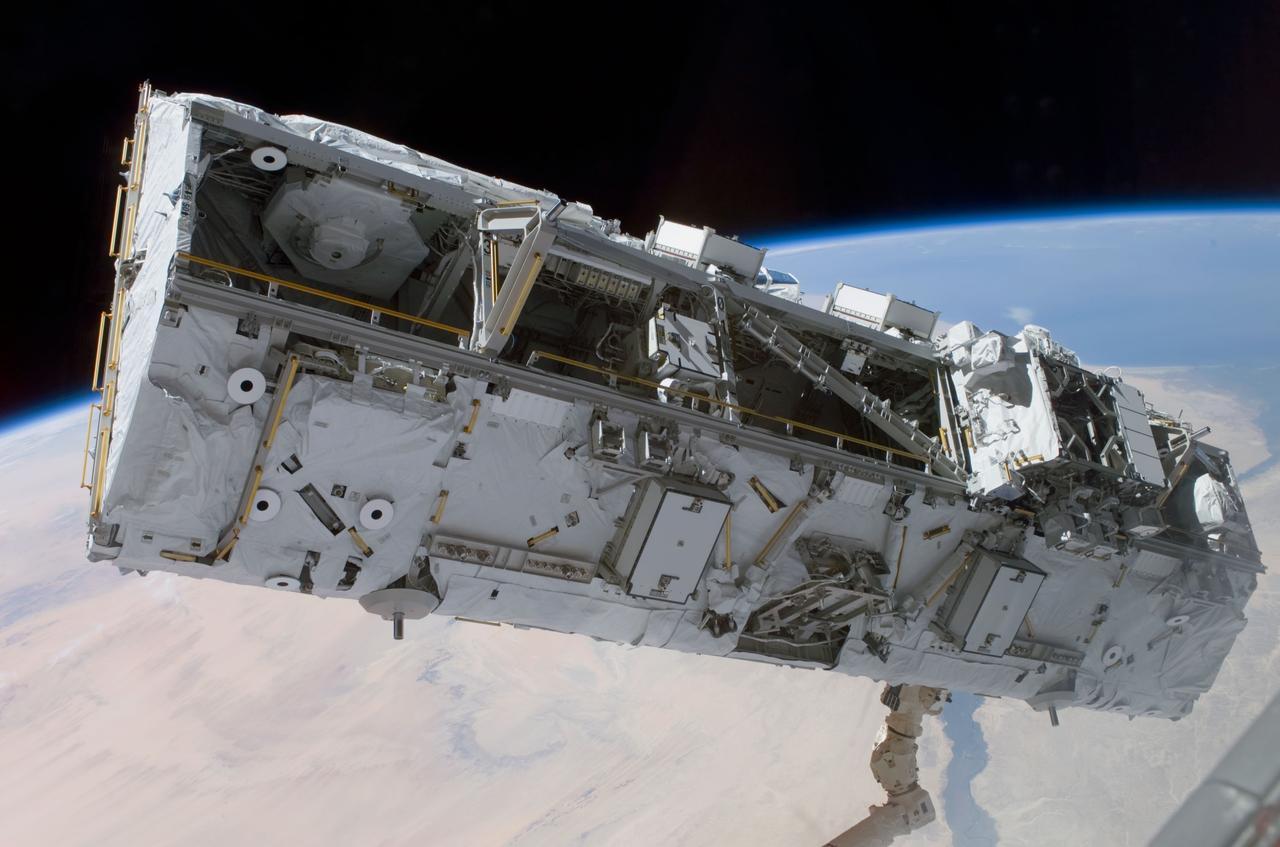
STS110-E-5173 (11 April 2002) --- Backdropped by the blackness of space and Earth’s horizon, the S0 (S-Zero) Truss is moved from the Space Shuttle Atlantis’ cargo bay. Astronauts Ellen Ochoa, STS-110 mission specialist, and Daniel W. Bursch, Expedition Four flight engineer, used the International Space Station’s (ISS) Canadarm2 to lift the S0 Truss out of the orbiter’s payload bay and install it onto the temporary claw fixture on the Destiny laboratory. The image was taken with a digital still camera.
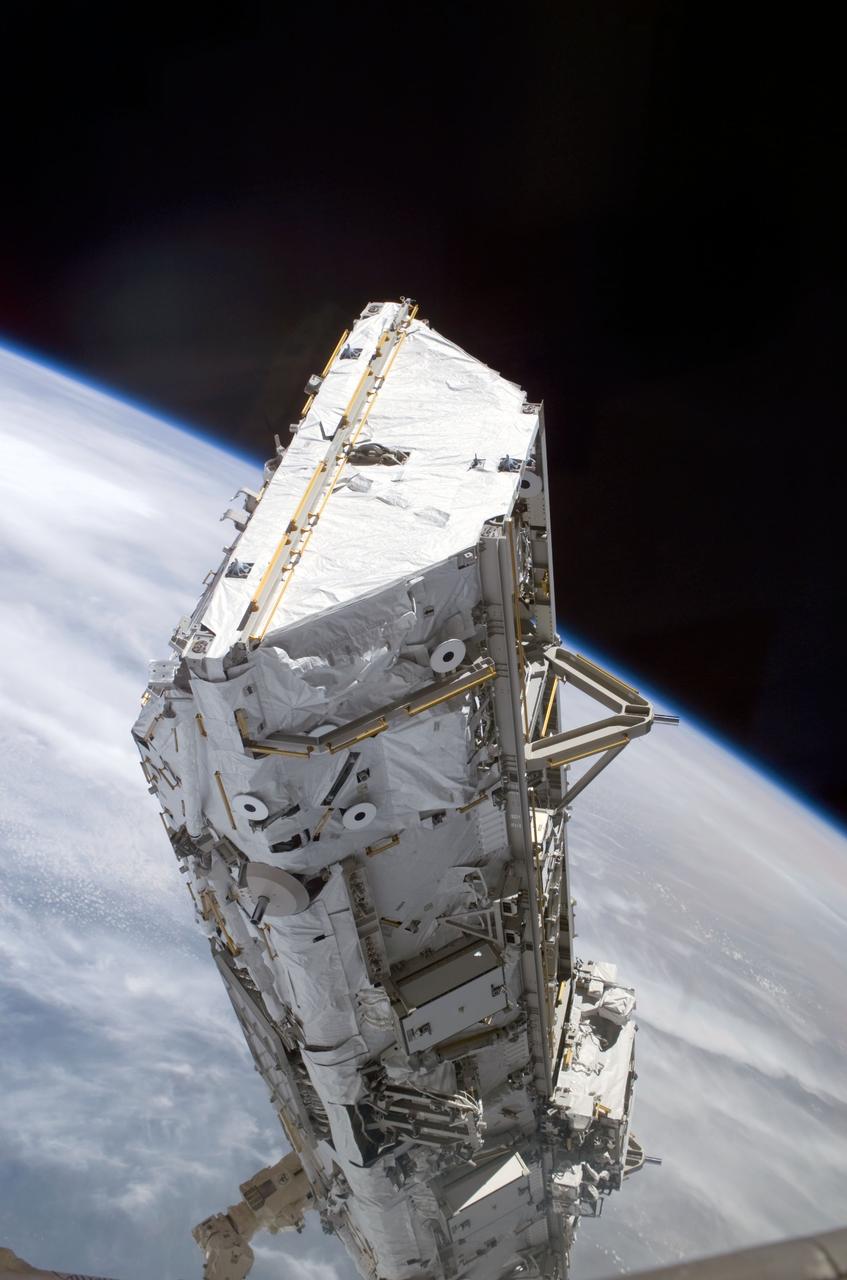
STS110-E-5170 (11 April 2002) --- Backdropped by the blackness of space and Earth’s horizon, the S0 (S-Zero) Truss is moved from the Space Shuttle Atlantis’ cargo bay. Astronauts Ellen Ochoa, STS-110 mission specialist, and Daniel W. Bursch, Expedition Four flight engineer, used the International Space Station’s (ISS) Canadarm2 to lift the S0 Truss out of the orbiter’s payload bay and install it onto the temporary claw fixture on the Destiny laboratory. The image was taken with a digital still camera.
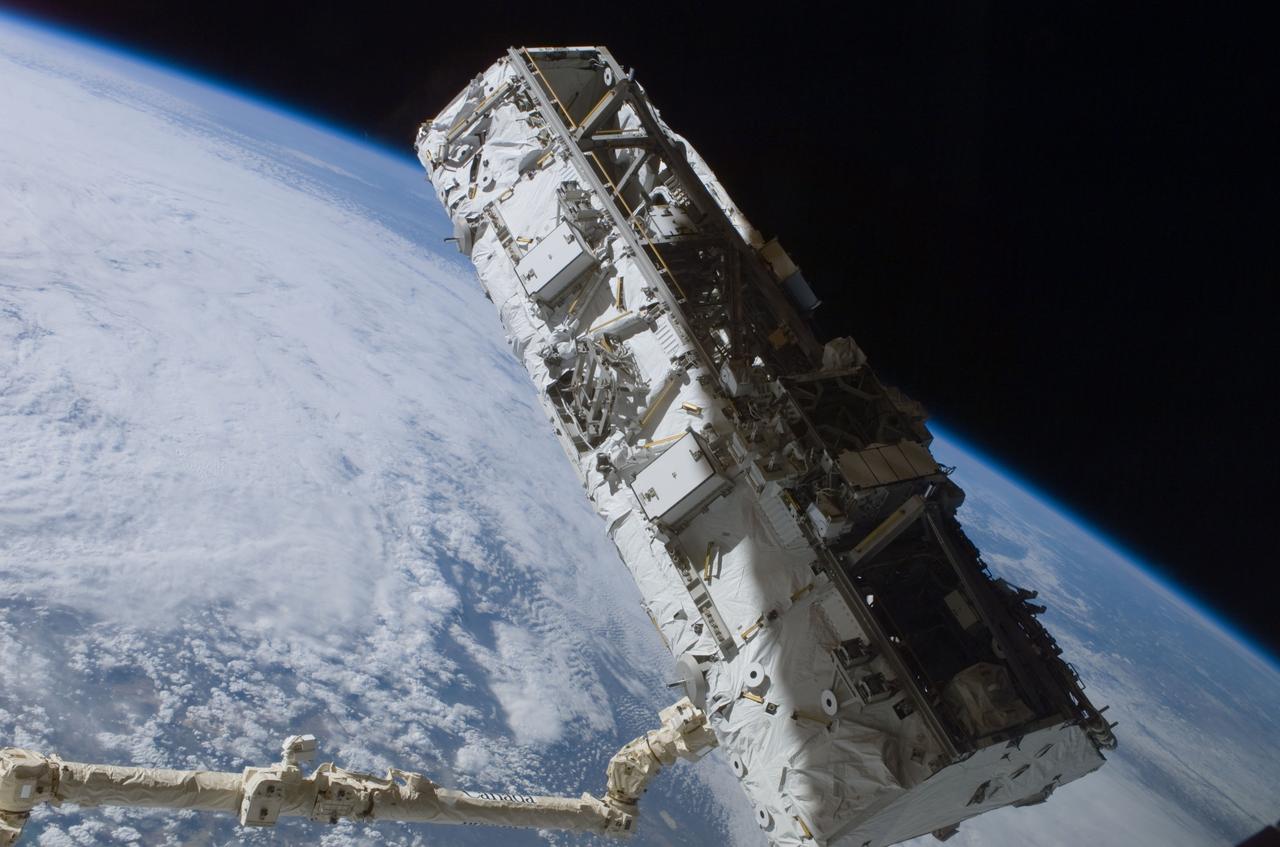
STS110-E-5174 (11 April 2002) --- Backdropped by the blackness of space and Earth’s horizon, the S0 (S-Zero) Truss is moved from the Space Shuttle Atlantis’ cargo bay. Astronauts Ellen Ochoa, STS-110 mission specialist, and Daniel W. Bursch, Expedition Four flight engineer, used the International Space Station’s (ISS) Canadarm2 to lift the S0 Truss out of the orbiter’s payload bay and install it onto the temporary claw fixture on the Destiny laboratory. The image was taken with a digital still camera.