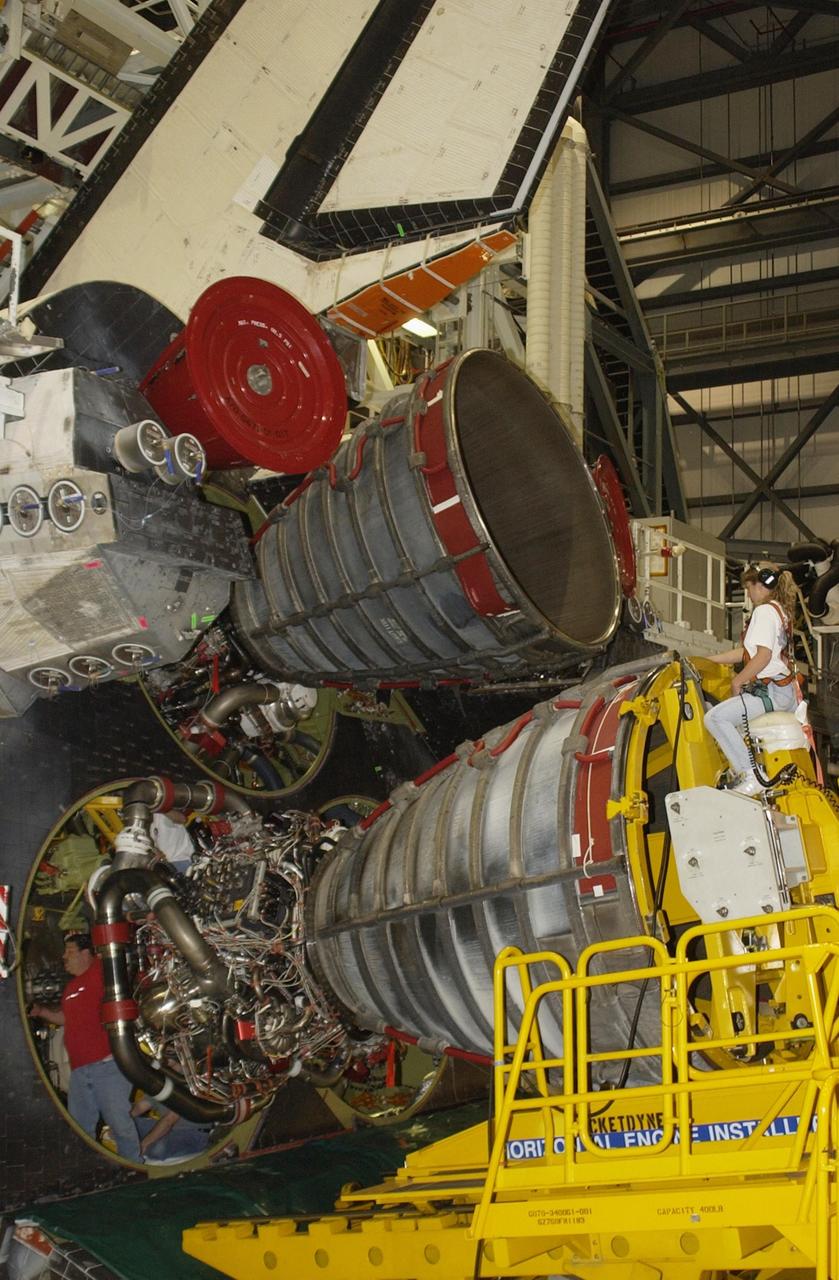
KENNEDY SPACE CENTER, FLA. -- The last engine is installed in orbiter Atlantis after a welding and polishing process was undertaken on flow liners where cracks were detected. All engines were removed for inspection of flow liners. Atlantis will next fly on mission STS-112, scheduled for launch no earlier than Oct. 2.

KENNEDY SPACE CENTER, FLA. -- The last engine is installed in orbiter Atlantis after a welding and polishing process was undertaken on flow liners where cracks were detected. All engines were removed for inspection of flow liners. Atlantis will next fly on mission STS-112, scheduled for launch no earlier than Oct. 2.
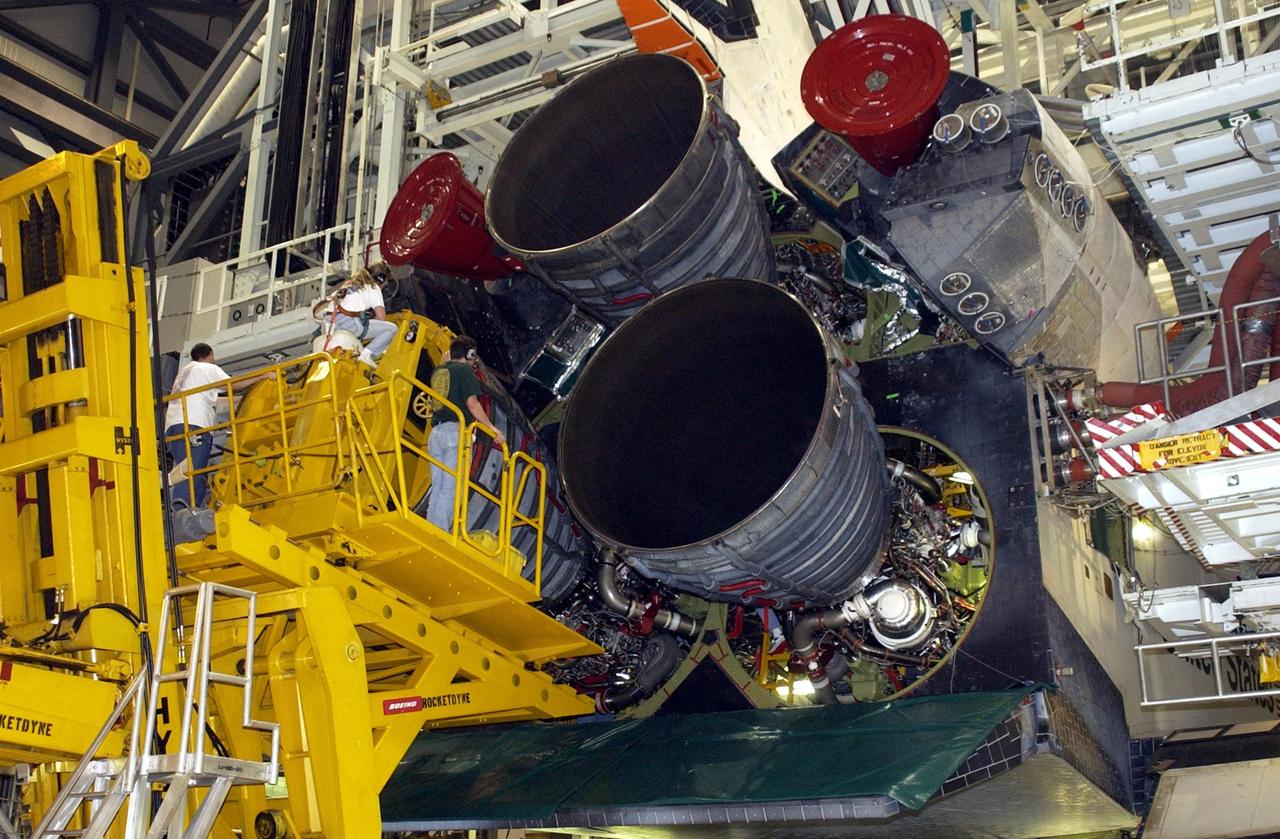
KENNEDY SPACE CENTER, FLA. -- The last engine is installed in orbiter Atlantis after a welding and polishing process was undertaken on flow liners where cracks were detected. All engines were removed for inspection of flow liners. Atlantis will next fly on mission STS-112, scheduled for launch no earlier than Oct. 2.
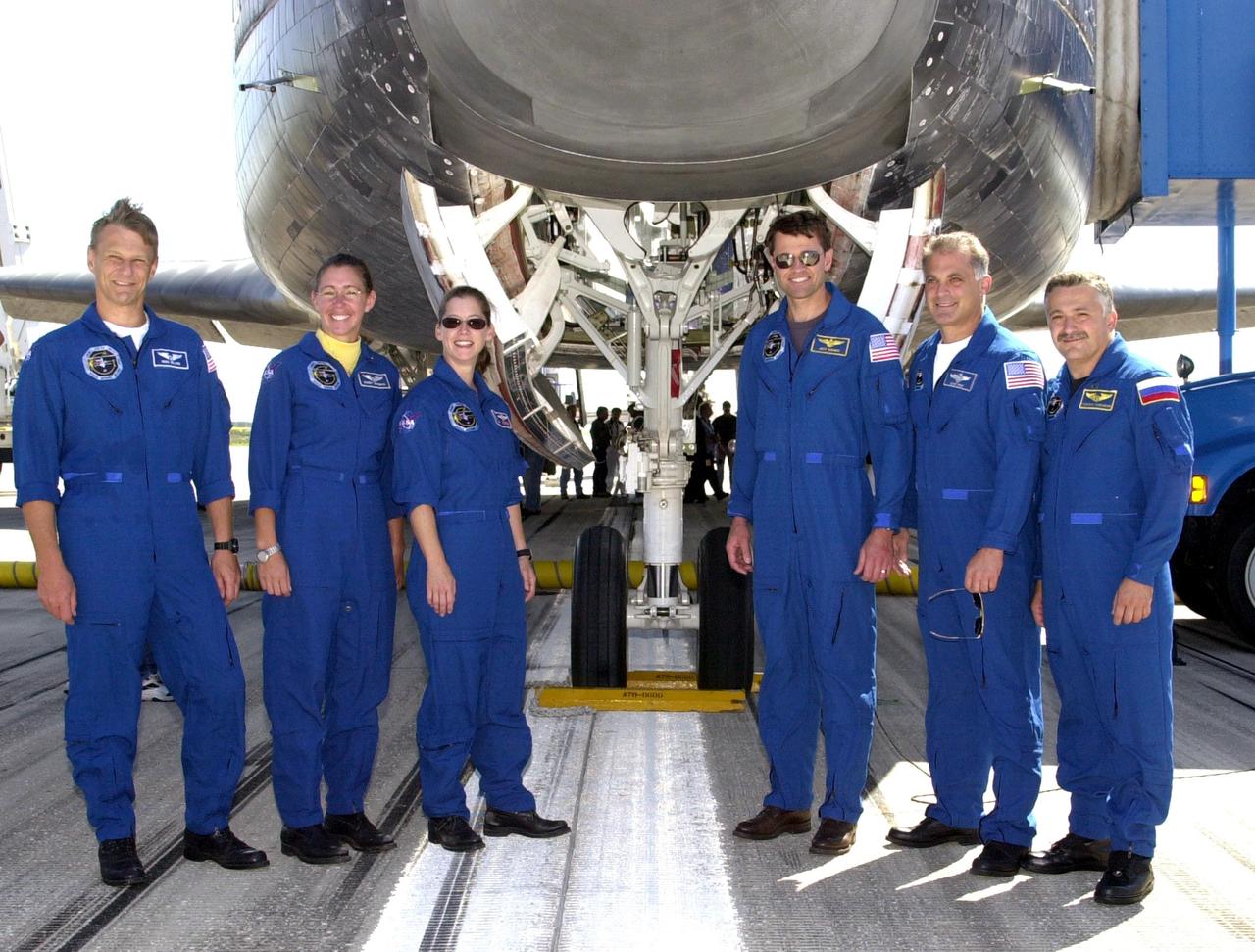
KENNEDY SPACE CENTER, FLA. -- After a flawless landing on runway 33 of the Shuttle Landing Facility, the STS-112 crew poses in front of Atlantis. From left are Mission Specialists Piers Sellers and Sandra Magnus, Pilot Pamela Melroy, Commander Jeffrey Ashby, and Mission Specialists David Wolf and Fyodor Yurchikhin, who represents the Russian Space Agency. Main gear touchdown occurred at 11:43:40 a.m. EDT; nose gear touchdown at 11:43:48 a.m.; and wheel stop at 11:44:35 a.m. Mission elapsed time was 10:19:58:44. STS-112 expanded the size of the Station with the addition of the S1 truss segment.
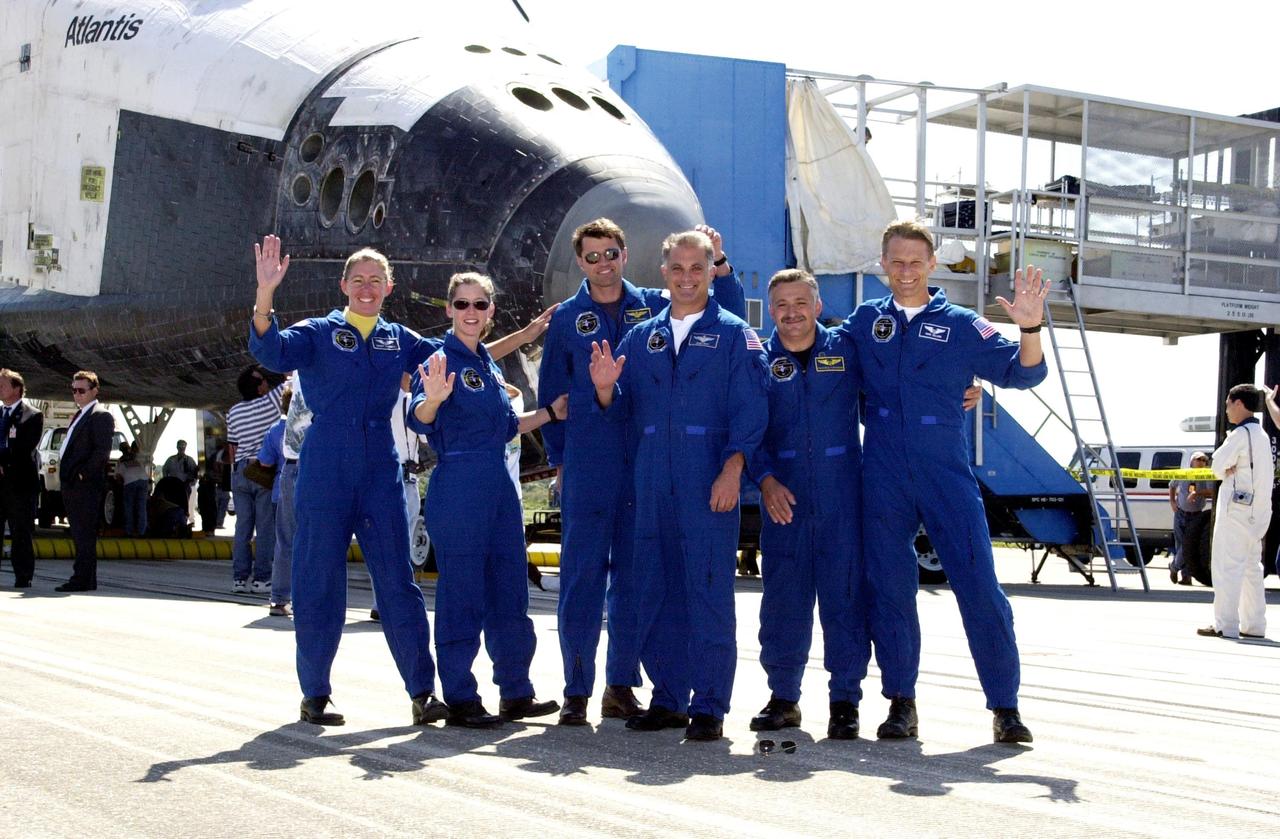
KENNEDY SPACE CENTER, FLA. -- The STS-112 crew clown for the camera in front of Atlantis after saying a few words about their 4.5-million-mile journey to the International Space Station. From left are Mission Specialist Sandra Magnus, Pilot Pamela Melroy, Commander Jeffrey Ashby, and Mission Specialists David Wolf, Fyodor Yurchikhin and Piers Sellers. The flawless landing of Space Shuttle Atlantis on Runway 33 at KSC completed the 10 day, 19 hour, 58 minute, 44 second- long mission. Main gear touchdown occurred at 11:43:40 a.m. EDT; nose gear touchdown at 11:43:48 a.m.; and wheel stop at 11:44:35 a.m. Mission STS-112 expanded the size of the Station with the addition of the S1 truss segment.
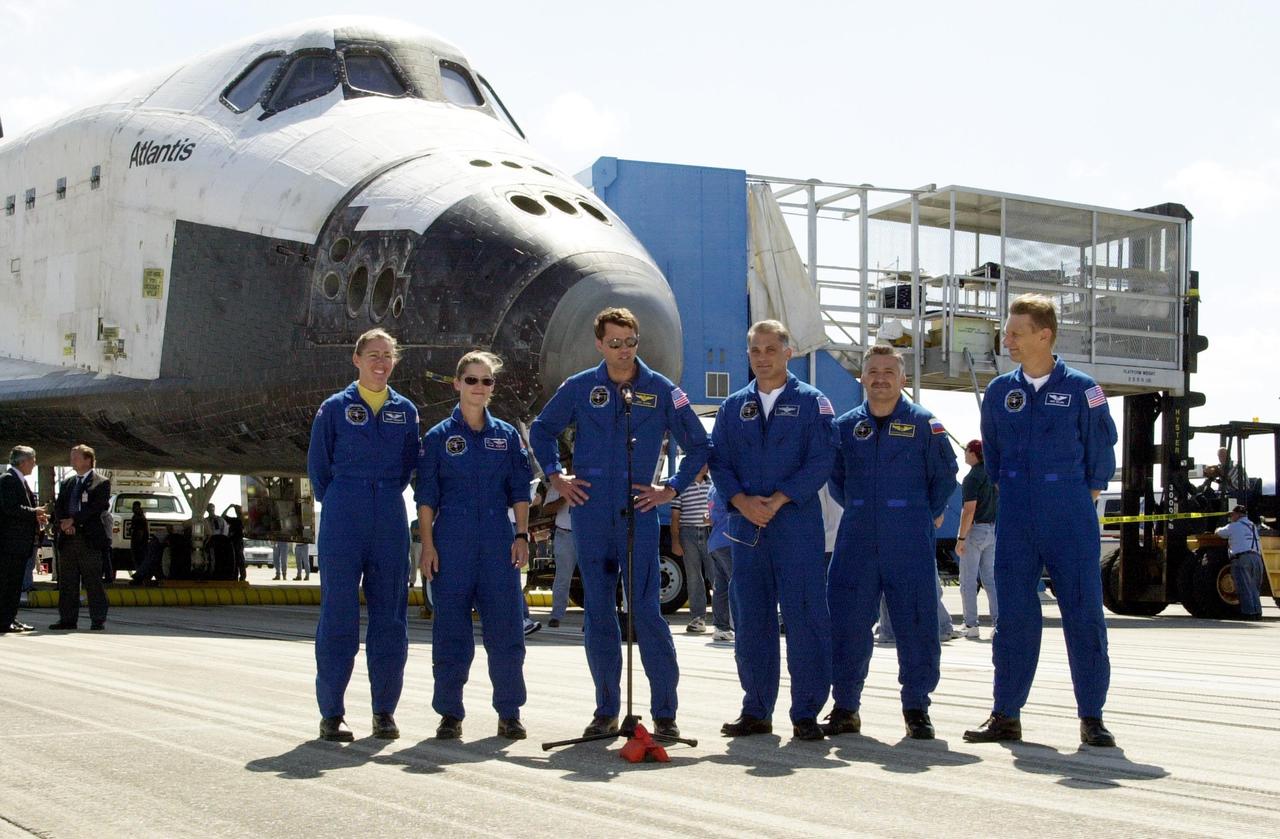
KENNEDY SPACE CENTER, FLA. - The STS-112 crew pauses at the microphone in front of Atlantis after exiting the crew transport vehicle. From left are Mission Specialist Sandra Magnus, Pilot Pamela Melroy, Commander Jeffrey Ashby, and Mission Specialists David Wolf, Fyodor Yurchikhin and Piers Sellers. The flawless landing of Space Shuttle Atlantis on Runway 33 at KSC completed a 4.5-million-mile journey to the International Space Station. Main gear touchdown occurred at 11:43:40 a.m. EDT; nose gear touchdown at 11:43:48 a.m.; and wheel stop at 11:44:35 a.m. Mission elapsed time was 10:19:58:44. Mission STS-112 expanded the size of the Station with the addition of the S1 truss segment.
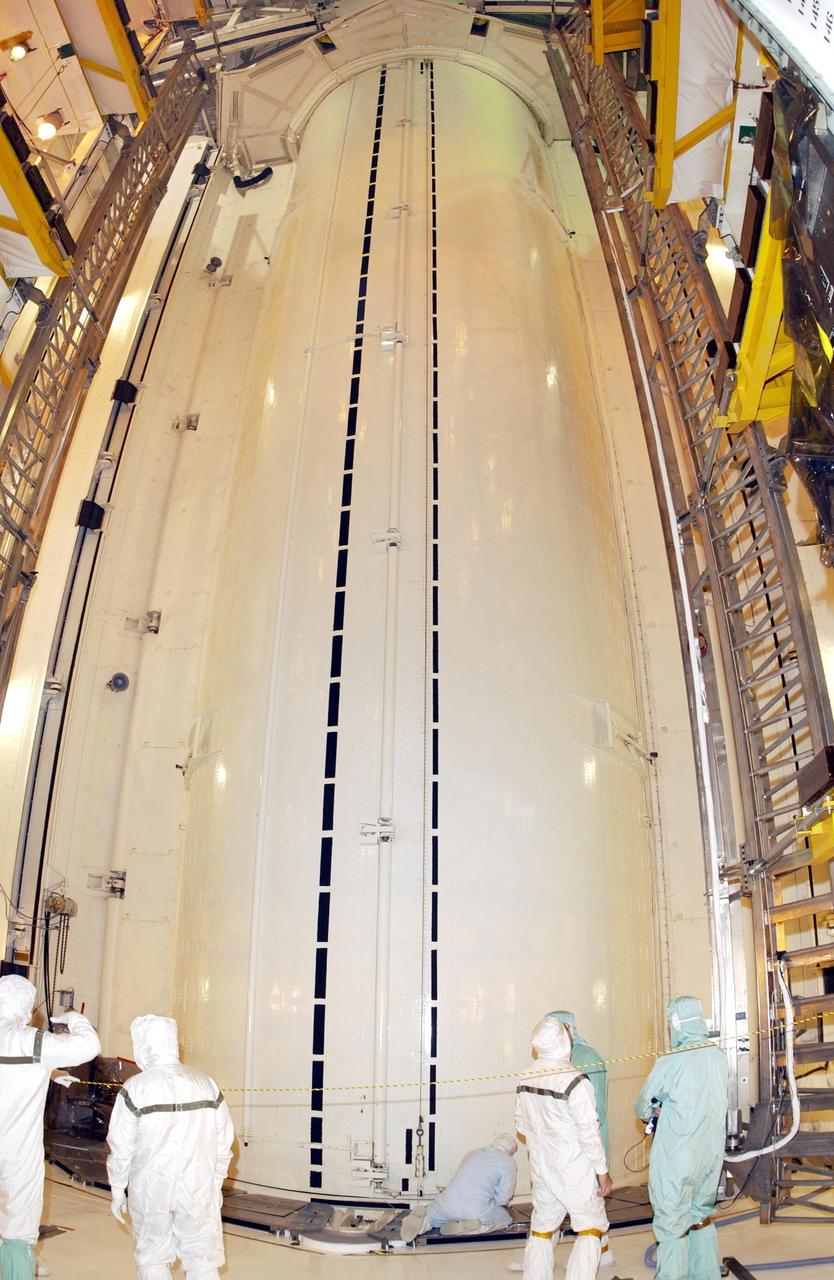
KENNEDY SPACE CENTER, FLA. -- The payload canister is ready to be opened in the Payload Changeout Room at the pad. Inside is the S1 Integrated Truss Structure, primary payload on mission STS-112 aboard Space Shuttle Atlantis. The first starboard truss segment, the S1 will be attached to the Central truss segment, the S0 Truss, on the International Space Station during the mission. Atlantis is scheduled to launch no earlier than Oct. 2.
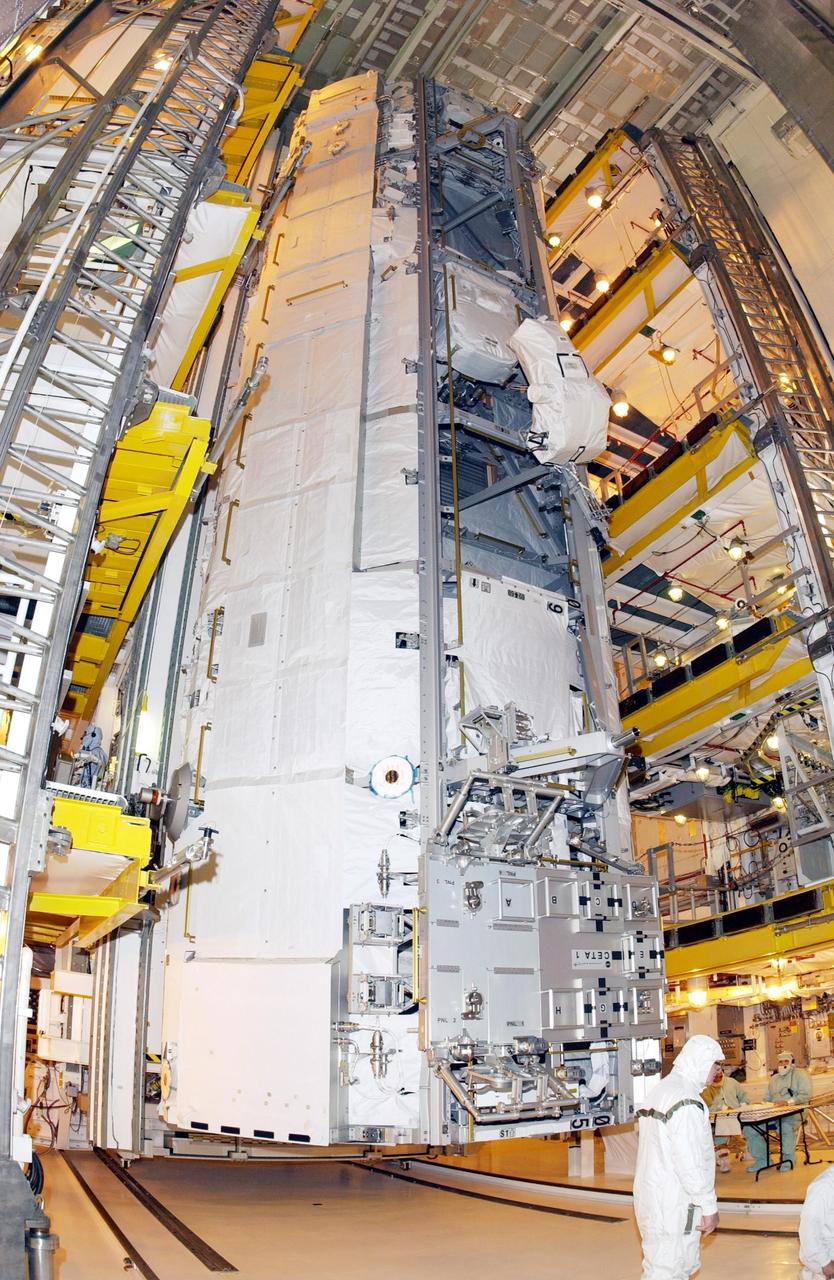
KENNEDY SPACE CENTER, FLA. -- In the Payload Changeout Room at the pad, the payload is moved out of the payload canister for transfer to Space Shuttle Atlantis' payload bay for mission STS-112. The primary payload on the mission is the S1 Integrated Truss Structure. The first starboard truss segment, the S1 will be attached to the Central truss segment, the S0 Truss, on the International Space Station during the mission. Atlantis is scheduled to launch no earlier than Oct. 2.
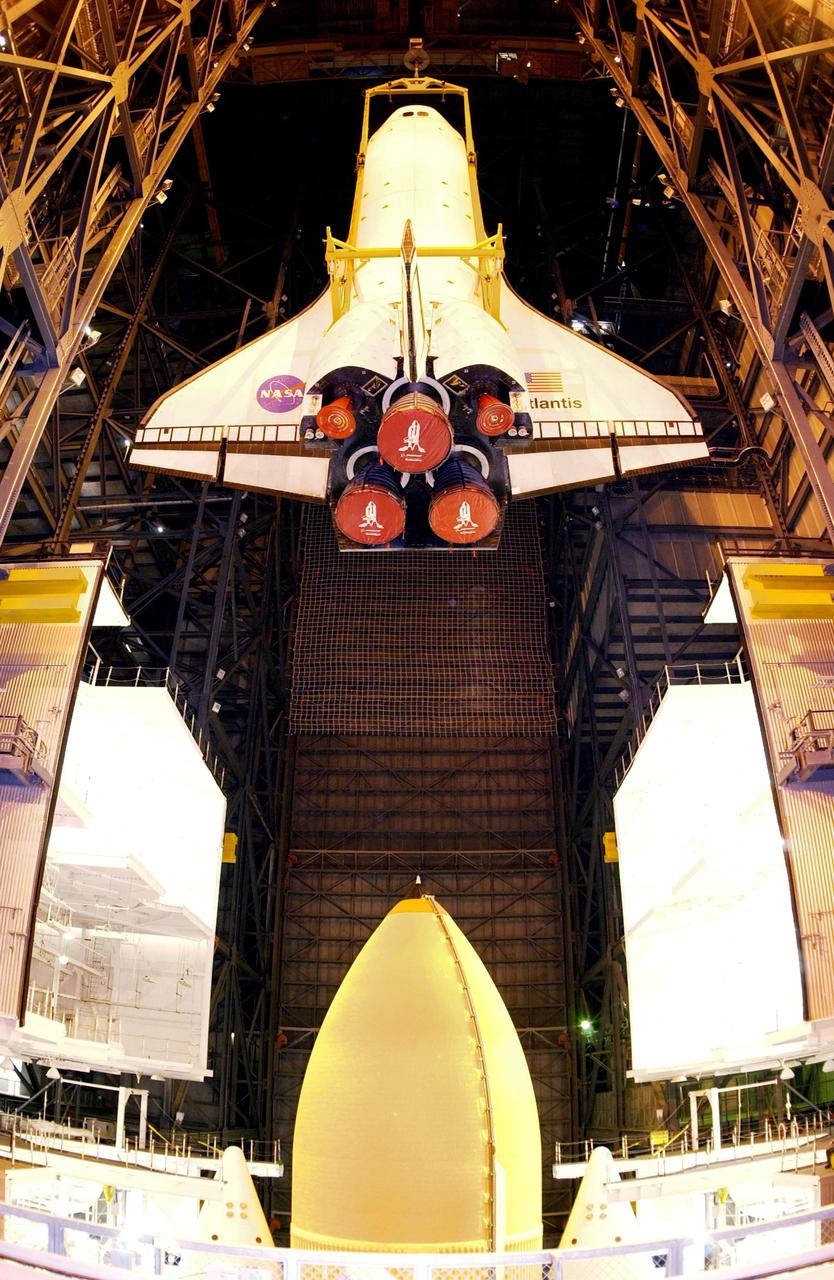
KENNEDY SPACE CENTER, FLA. - Suspended from an overhead crane, the orbiter Atlantis is lowered toward the solid rocket booster and external tank below, on top of the Mobile Launcher Platform, for mating before rollout to the launch pad for mission STS-112. Launch is scheduled no earlier than Oct. 2 for the 15th assembly flight to the International Space Station. Atlantis will carry the S1 Integrated Truss Structure, which will be attached to the central truss segment, the S0 truss, during the mission.
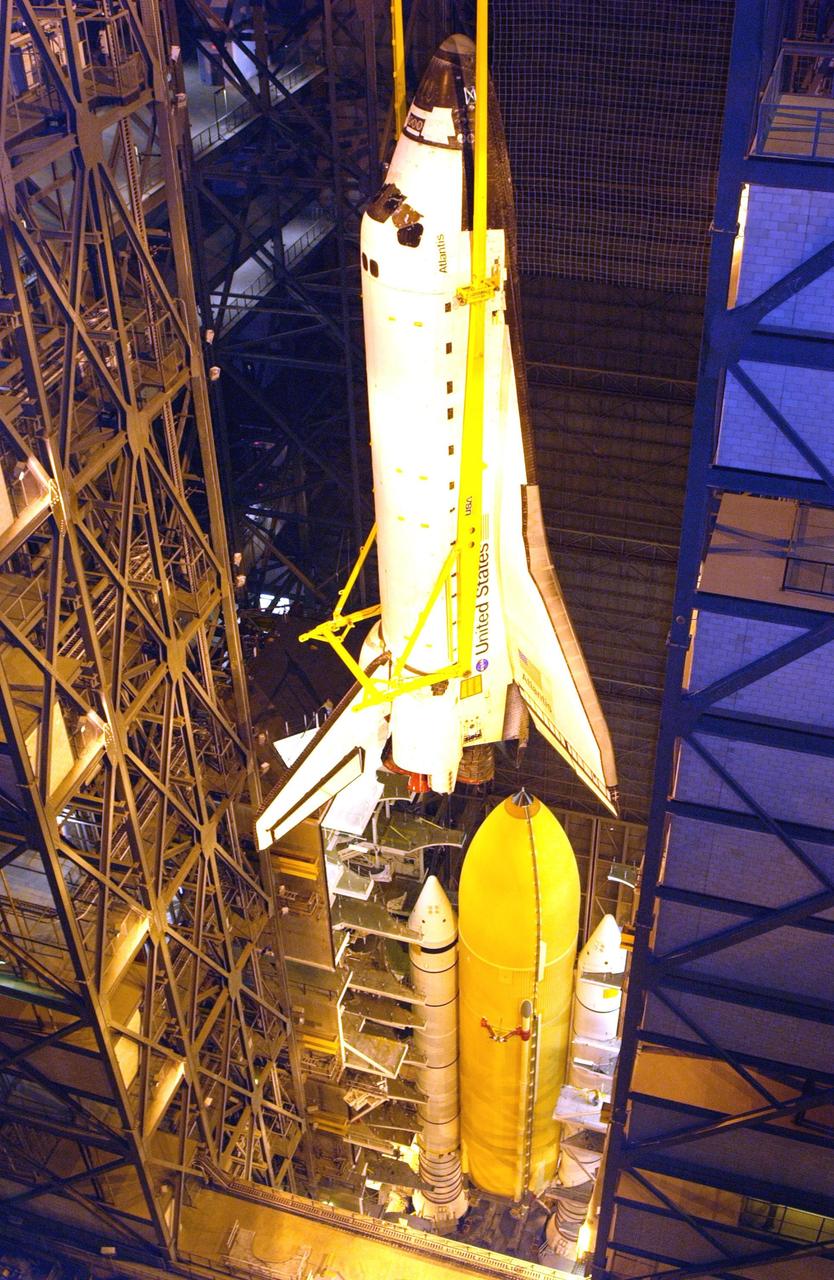
KENNEDY SPACE CENTER, FLA. -- After lifting to vertical, the orbiter Atlantis is moved toward the solid rocket booster and external tank below, on top of the Mobile Launcher Platform, for mating before rollout to the launch pad for mission STS-112. Launch is scheduled no earlier than Oct. 2 for the 15th assembly flight to the International Space Station. Atlantis will carry the S1 Integrated Truss Structure, which will be attached to the central truss segment, the S0 truss, during the mission.

KENNEDY SPACE CENTER, FLA. - Workers get ready to install the last engine in orbiter Atlantis after a welding and polishing process was undertaken on flow liners where cracks were detected. All engines were removed for inspection of flow liners. Atlantis will next fly on mission STS-112, scheduled for launch no earlier than Oct. 2.
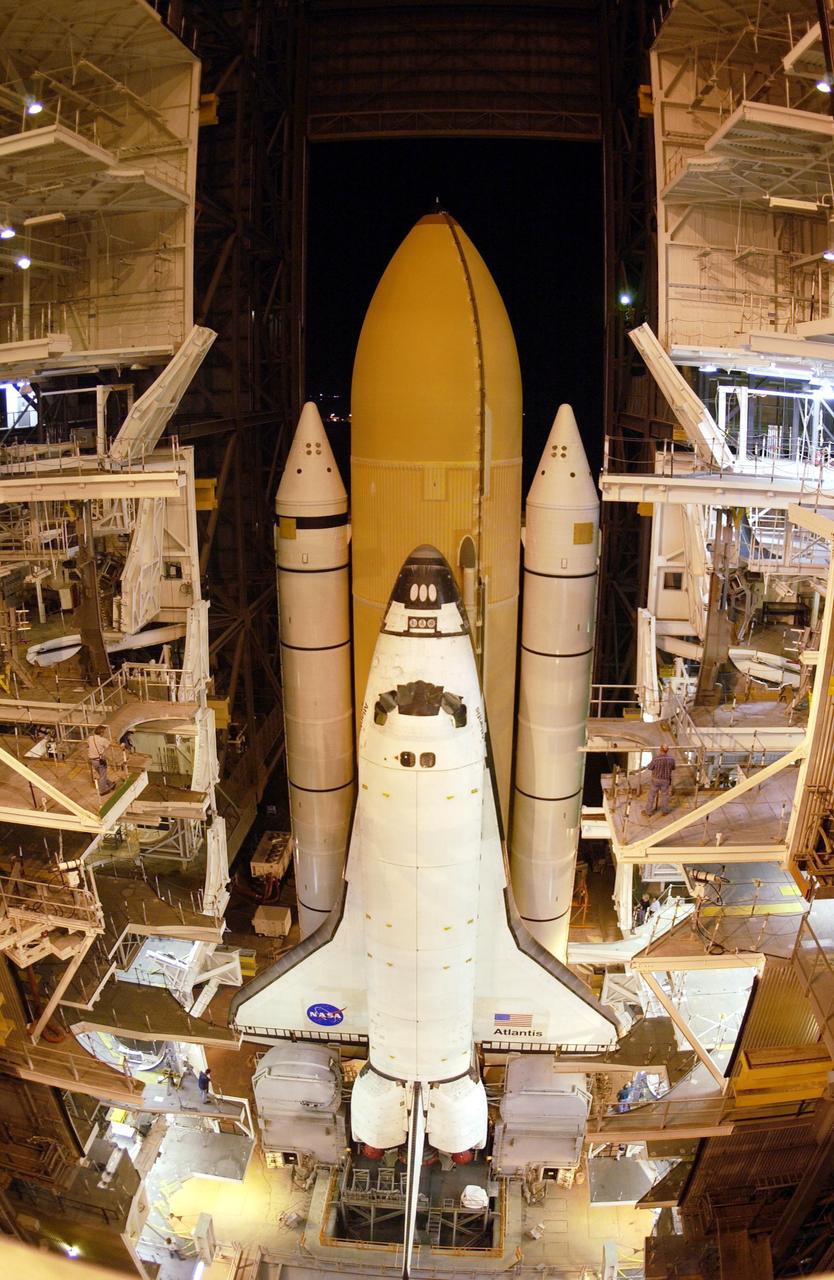
KENNEDY SPACE CENTER, FLA. -- In the early morning hours, Space Shuttle Atlantis, with its solid rocket boosters and orange external tank, sits atop the Mobile Launcher Platform ready to roll to the launch pad. Atlantis began its rollout to Launch Pad 39B at 2:27 a.m. EDT in preparation for launch to the International Space Station. The Shuttle arrived at the Pad and was hard down at 9:38 a.m. Launch is scheduled no earlier than Oct. 2 for mission STS-112, the 15th assembly flight to the International Space Station. Atlantis will carry the S1 Integrated Truss Structure, which will be attached to the central truss segment, the S0 truss, during the mission.
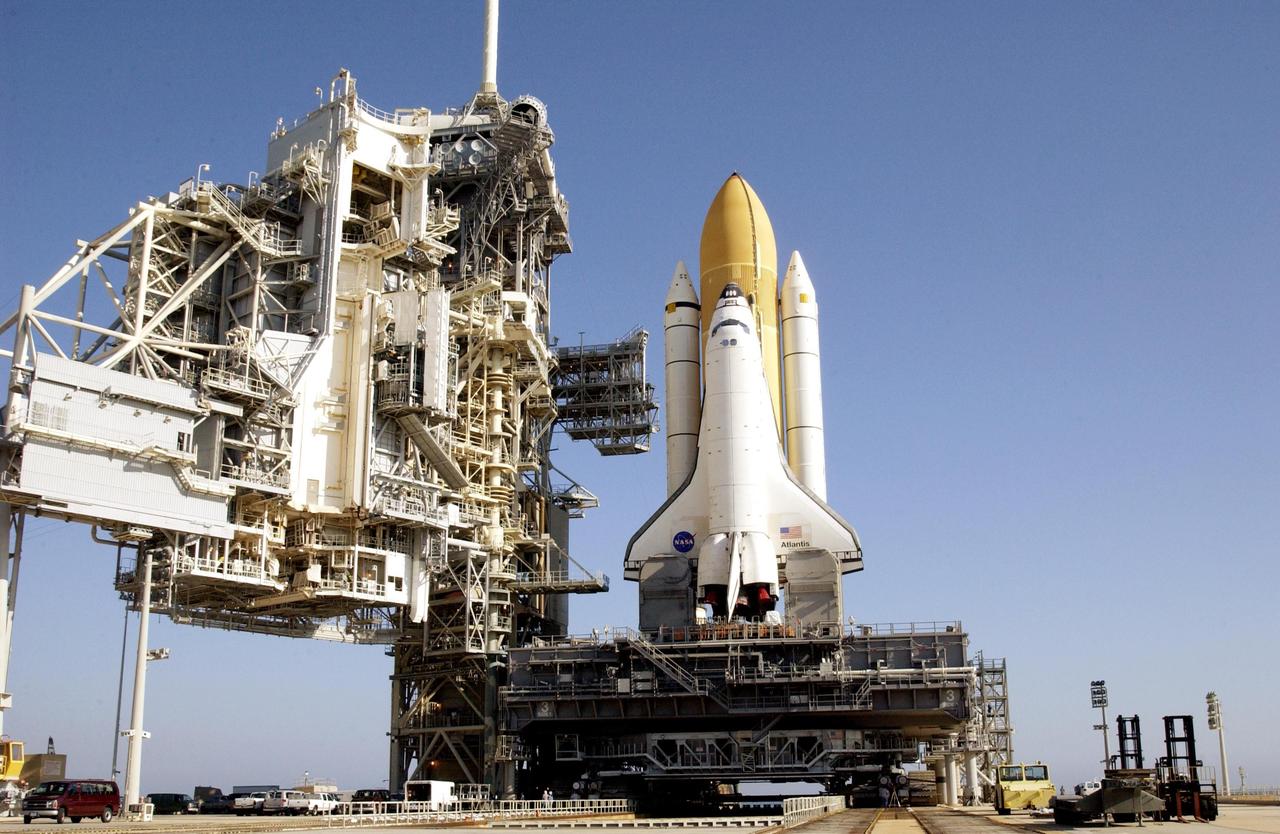
KENNEDY SPACE CENTER, FLA. -- After an early morning rollout, Space Shuttle Atlantis sits on the launch pad. The Rotating Service Structure is wide open (at left). After being stacked with its solid rocket boosters and external tank, Atlantis began its rollout to Launch Pad 39B at 2:27 a.m. EDT in preparation for launch to the International Space Station. The Shuttle arrived at the Pad and was hard down at 9:38 a.m. Launch is scheduled no earlier than Oct. 2 for mission STS-112, the 15th assembly flight to the International Space Station. Atlantis will carry the S1 Integrated Truss Structure, which will be attached to the central truss segment, the S0 truss, during the mission.
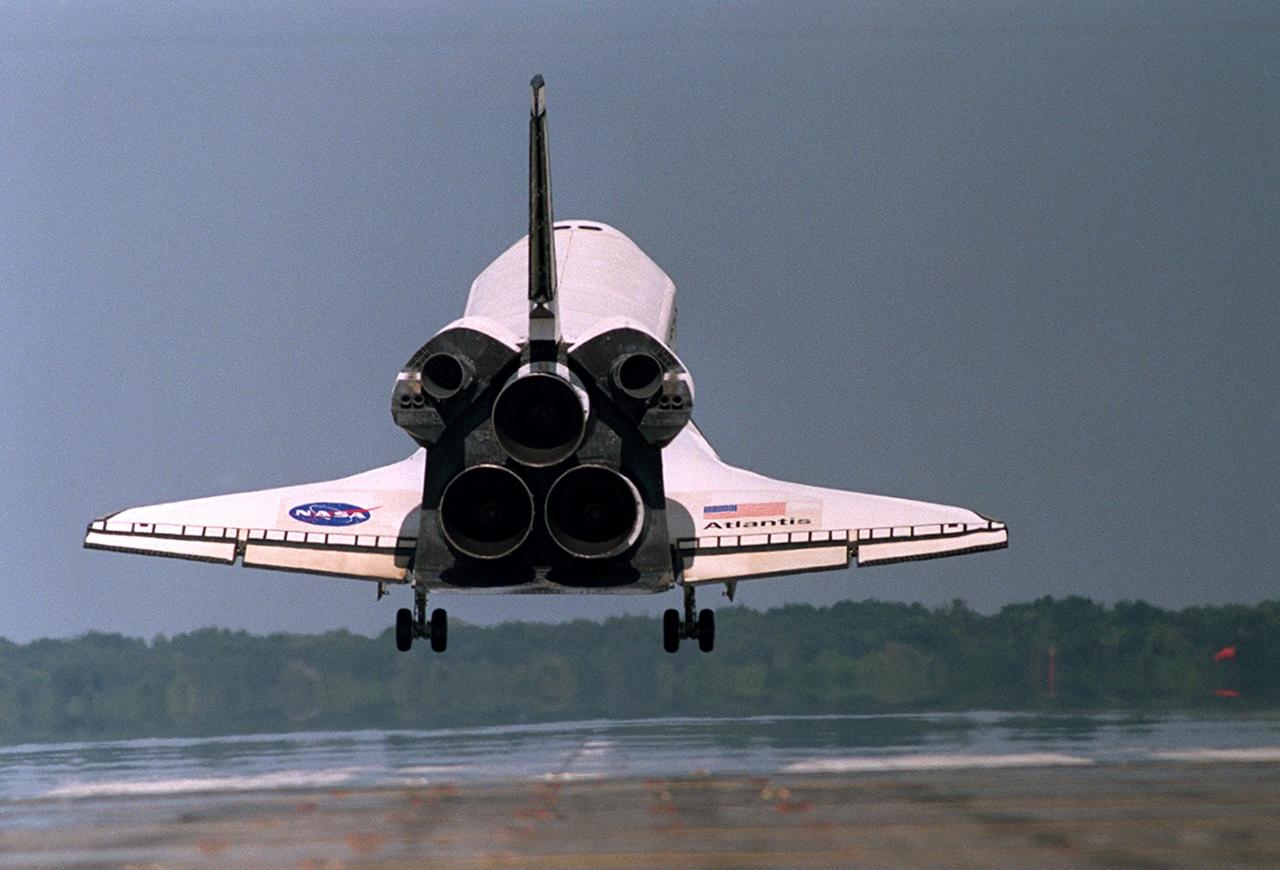
KENNEDY SPACE CENTER, FLA. - Atlantis kicks up dust as it touches down on runway 33 at the KSC Shuttle Landing Facility after completing its 11-day mission to the International Space Station. Aboard is the STS-112 crew comprising Commander Jeffrey Ashby, Pilot Pamela Melroy and Mission Specialists David Wolf, Sandra Magnus, Piers Sellers and Fyodor Yurchikhin. Main gear touchdown occurred at 11:43:40 a.m. EDT; nose gear touchdown at 11:43:48 a.m.; and wheel stop at 11:44:35 a.m. Mission elapsed time was 10:19:58:44. STS-112 expanded the size of the Station with the addition of the S1 truss segment. This was the 60th landing at KSC in the history of the Shuttle program.
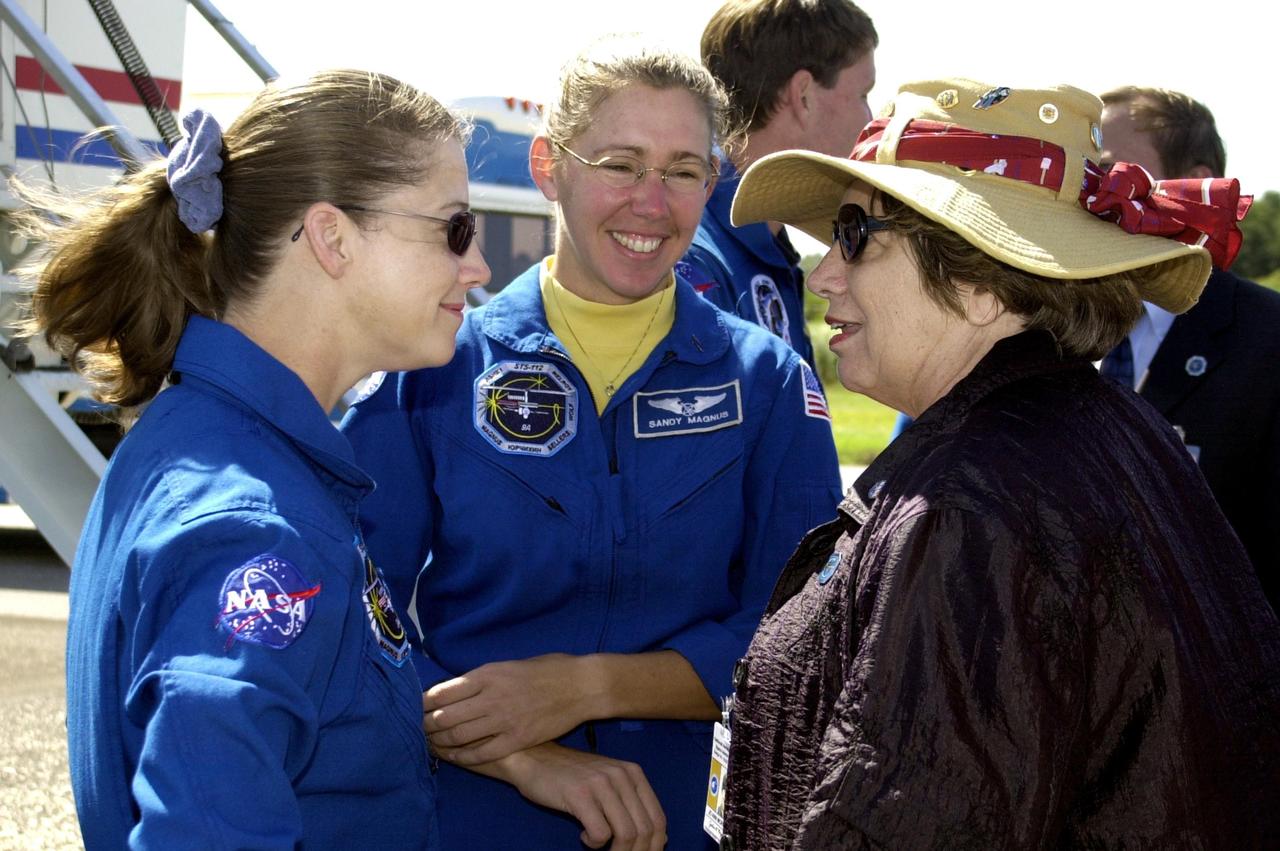
KENNEDY SPACE CENTER, FLA. -- STS-112 Pilot Pamela Melroy (left) and Mission Specialist Sandra Magnus (center) talk to Acting Deputy Director JoAnn Morgan (right) after the crew's return to KSC. A flawless landing of Space Shuttle Atlantis completed a 4.5-million-mile journey to the International Space Station. Other crew members are Commander Jeffrey Ashby and Mission Specialists David Wolf, Fyodor Yurchikhin and Piers Sellers. Main gear touchdown occurred at 11:43:40 a.m. EDT; nose gear touchdown at 11:43:48 a.m.; and wheel stop at 11:44:35 a.m. Mission elapsed time was 10:19:58:44. Mission STS-112 expanded the size of the Station with the addition of the S1 truss segment.
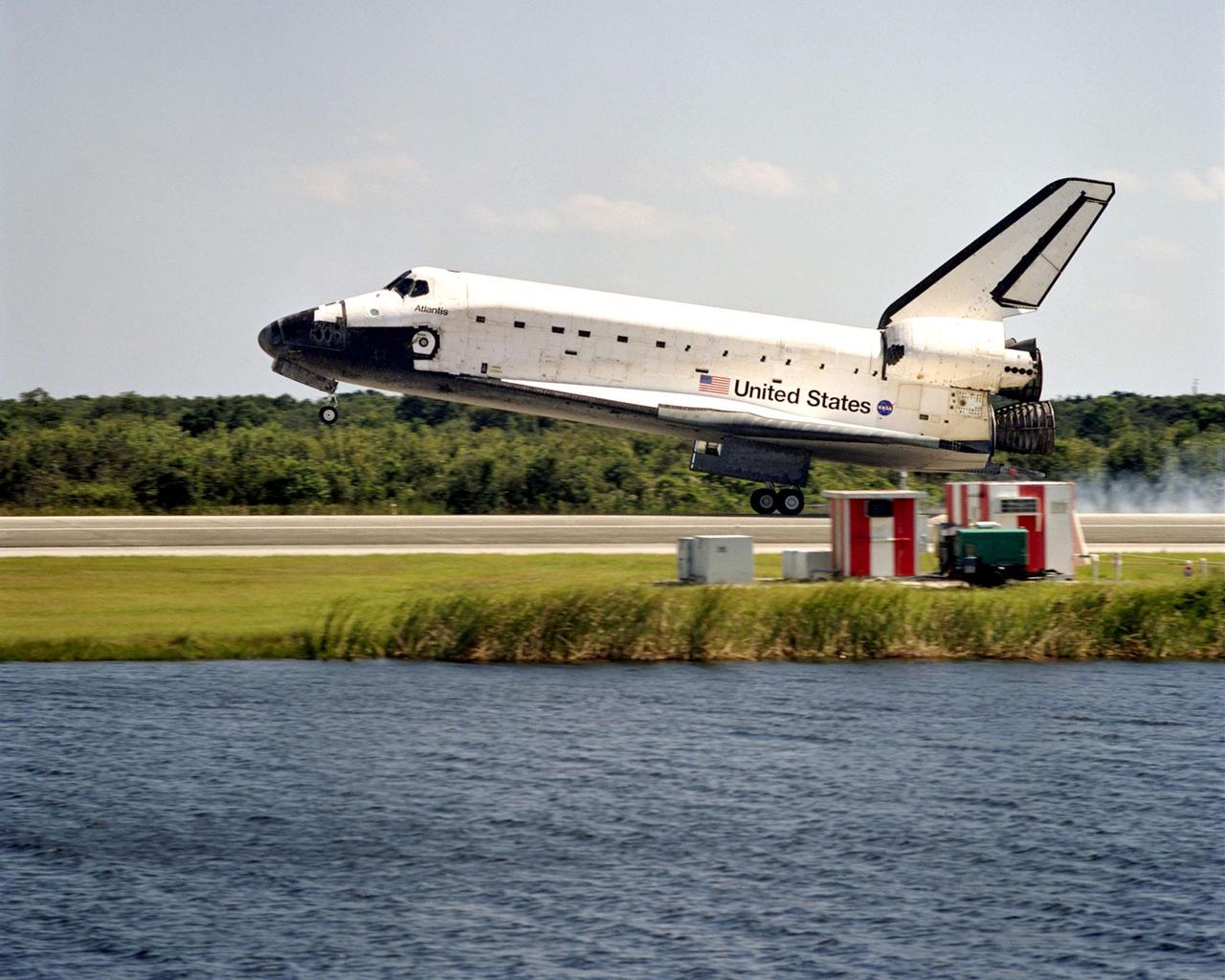
KENNEDY SPACE CENTER, FLA. -- Atlantis kicks up dust as it touches down on runway 33 at the KSC Shuttle Landing Facility after completing its 11-day mission to the International Space Station. Aboard is the STS-112 crew comprising Commander Jeffrey Ashby, Pilot Pamela Melroy and Mission Specialists David Wolf, Sandra Magnus, Piers Sellers and Fyodor Yurchikhin. Main gear touchdown occurred at 11:43:40 a.m. EDT; nose gear touchdown at 11:43:48 a.m.; and wheel stop at 11:44:35 a.m. Mission elapsed time was 10:19:58:44. STS-112 expanded the size of the Station with the addition of the S1 truss segment. This was the 60th landing at KSC in the history of the Shuttle program.
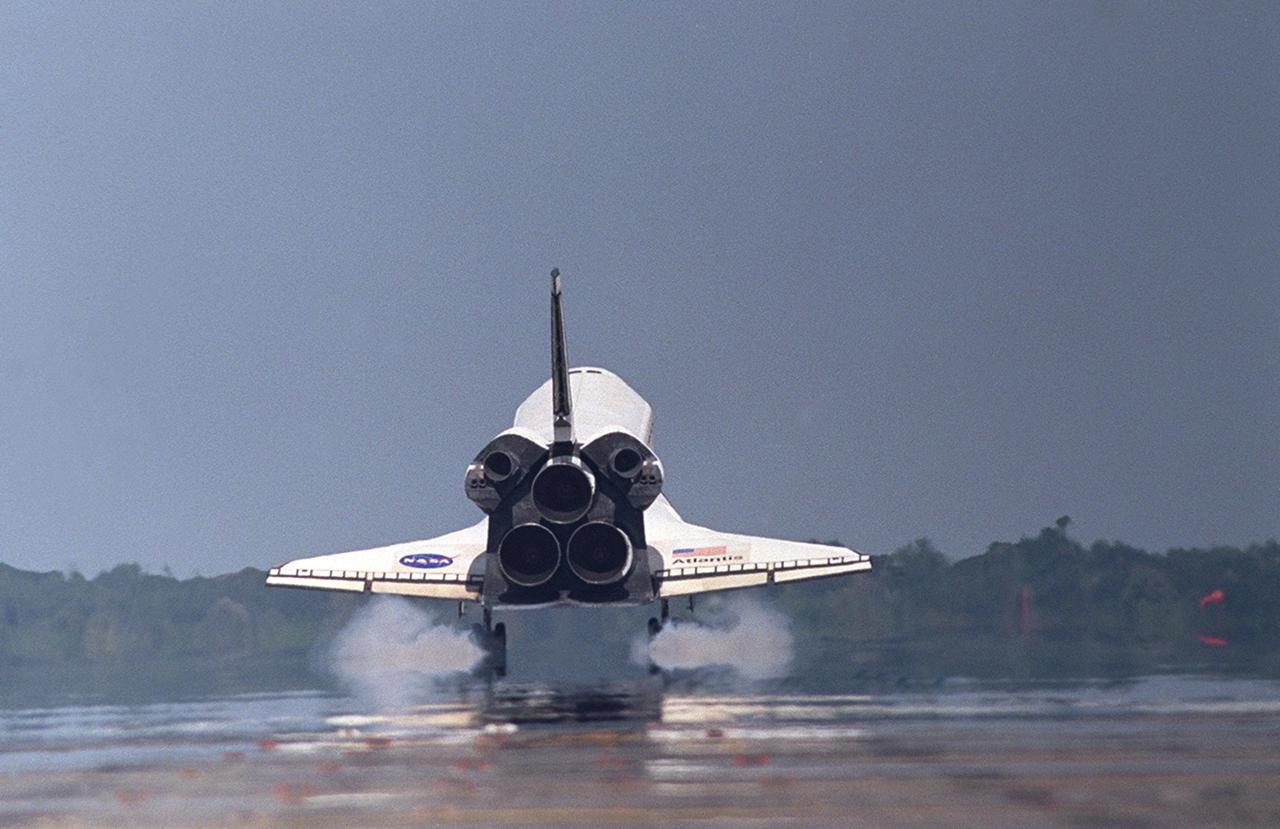
KENNEDY SPACE CENTER, FLA. - Atlantis kicks up dust as it touches down on runway 33 at the KSC Shuttle Landing Facility after completing its 11-day mission to the International Space Station. Aboard is the STS-112 crew comprising Commander Jeffrey Ashby, Pilot Pamela Melroy and Mission Specialists David Wolf, Sandra Magnus, Piers Sellers and Fyodor Yurchikhin. Main gear touchdown occurred at 11:43:40 a.m. EDT; nose gear touchdown at 11:43:48 a.m.; and wheel stop at 11:44:35 a.m. Mission elapsed time was 10:19:58:44. STS-112 expanded the size of the Station with the addition of the S1 truss segment. This was the 60th landing at KSC in the history of the Shuttle program.
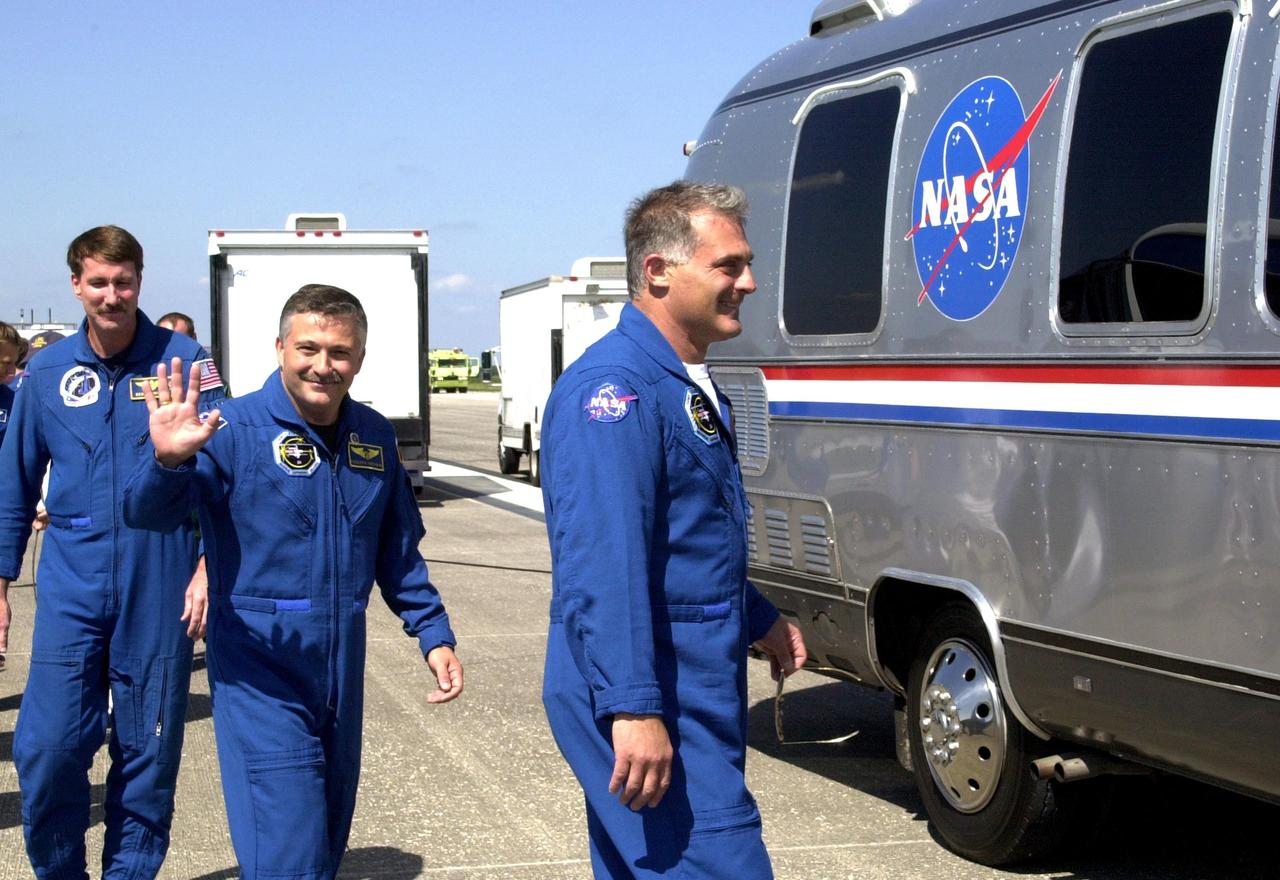
KENNEDY SPACE CENTER, FLA. - Accompanied by astronaut Kent Rominger (far left), STS-112 crew members head for the Astrovan after exiting the crew transport vehicle and greeting the spectators. In the center is Mission Specialist Fyodor Yurchikhin; at right is Mission Specialist David Wolf. The flawless landing of Atlantis on Runway 33 at KSC completed a 4.5-million-mile journey to the International Space Station. Main gear touchdown occurred at 11:43:40 a.m. EDT; nose gear touchdown at 11:43:48 a.m.; and wheel stop at 11:44:35 a.m. Mission elapsed time was 10:19:58:44. Mission STS-112 expanded the size of the Station with the addition of the S1 truss segment.
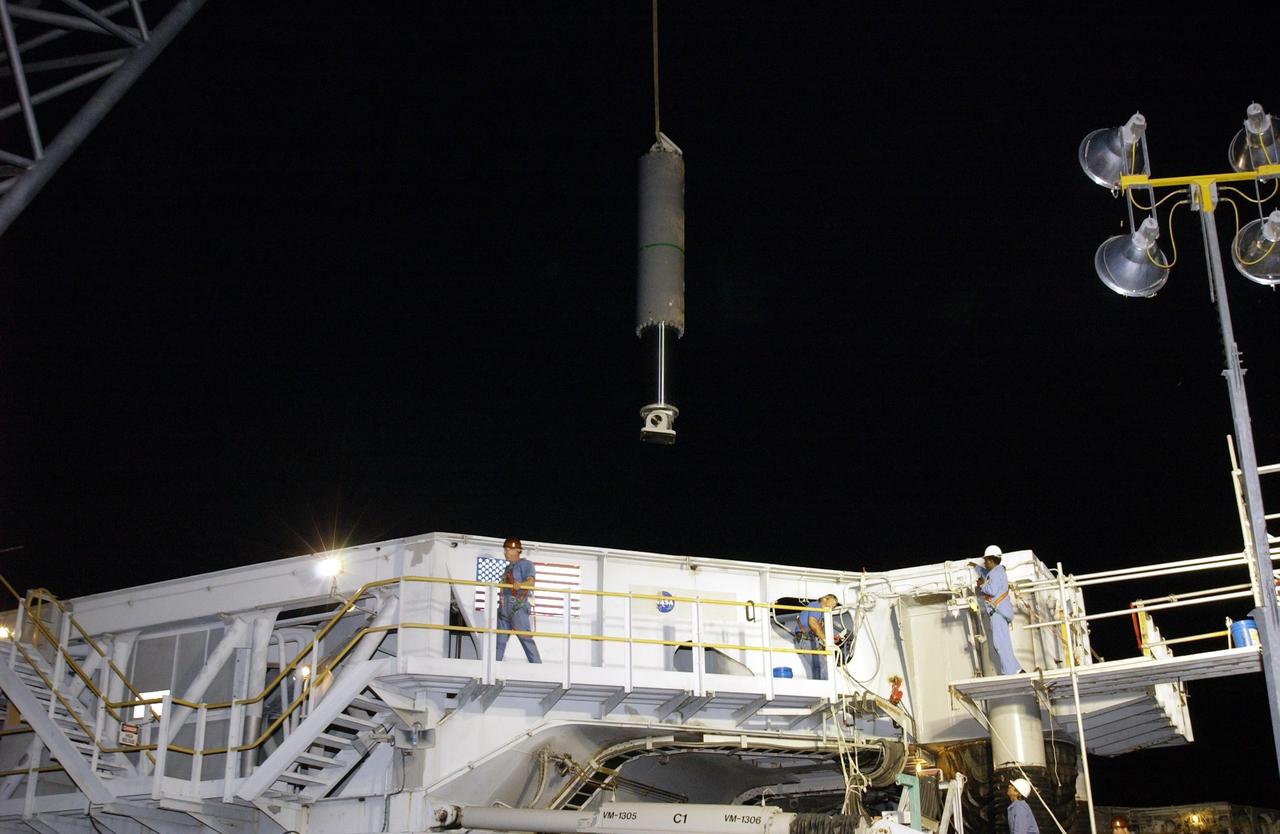
KENNEDY SPACE CENTER, FLA. -- The final Jacking, Equalization and Leveling (JEL) cylinder is moved to Crawler Transporter No. 2 (CT-2) for installation. During recent routine maintenance inspections, cracks were found on four bearings in two JEL cylinders. Further eddy current inspections indicated that cracks were present on 15 bearings. There are 16 cylinders and 32 bearings per crawler. CT-2 was repaired in order to enable Atlantis' rollout for mission STS-112, scheduled for launch no earlier than Oct. 2.
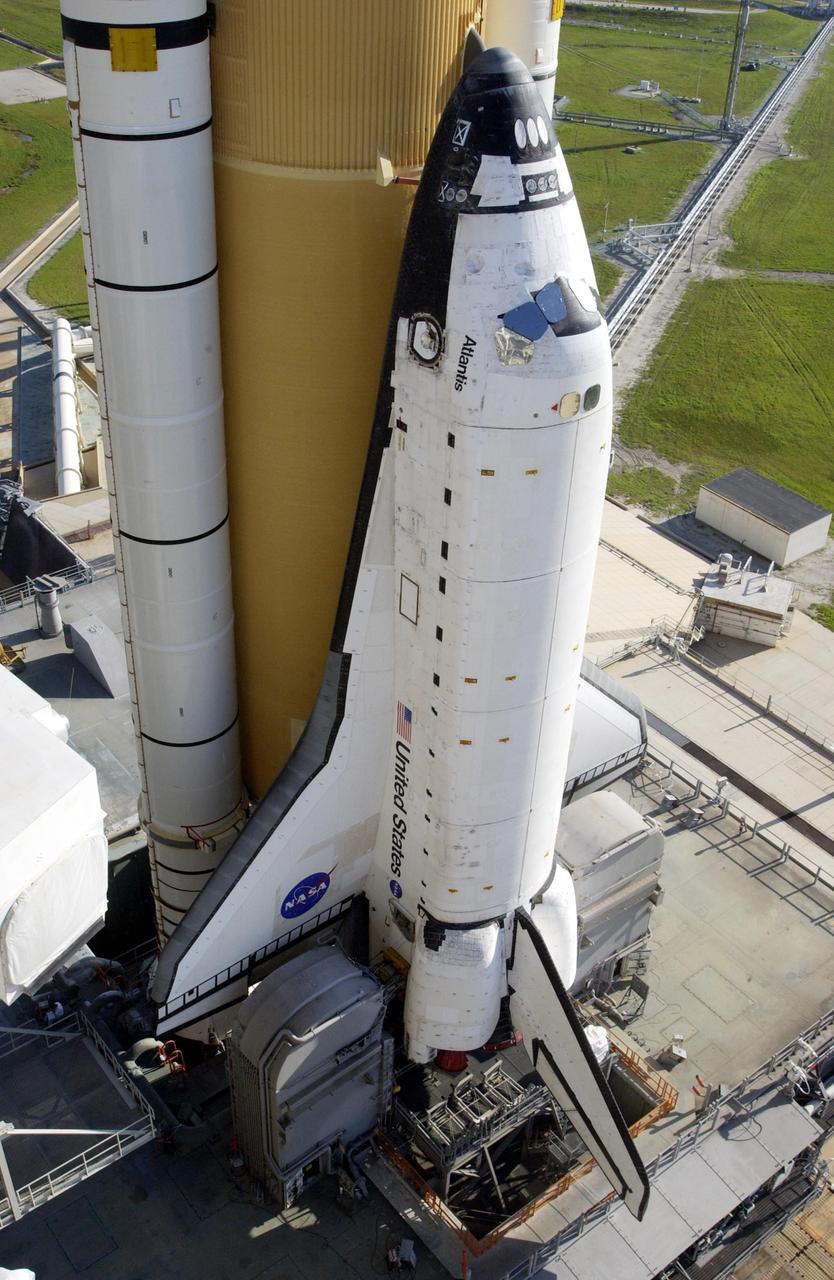
KENNEDY SPACE CENTER, FLA. -- After an early morning rollout, Space Shuttle Atlantis sits on the launch pad. Visible near the tail are the tail service masts that support the fluid, gas and electrical requirements of the orbiter's liquid oxygen and liquid hydrogen aft T-0 umbilicals. After being stacked with its solid rocket boosters and external tank, Atlantis began its rollout to Launch Pad 39B at 2:27 a.m. EDT in preparation for launch to the International Space Station. The Shuttle arrived at the Pad and was hard down at 9:38 a.m. Launch is scheduled no earlier than Oct. 2 for mission STS-112, the 15th assembly flight to the International Space Station. Atlantis will carry the S1 Integrated Truss Structure, which will be attached to the central truss segment, the S0 truss, during the mission.
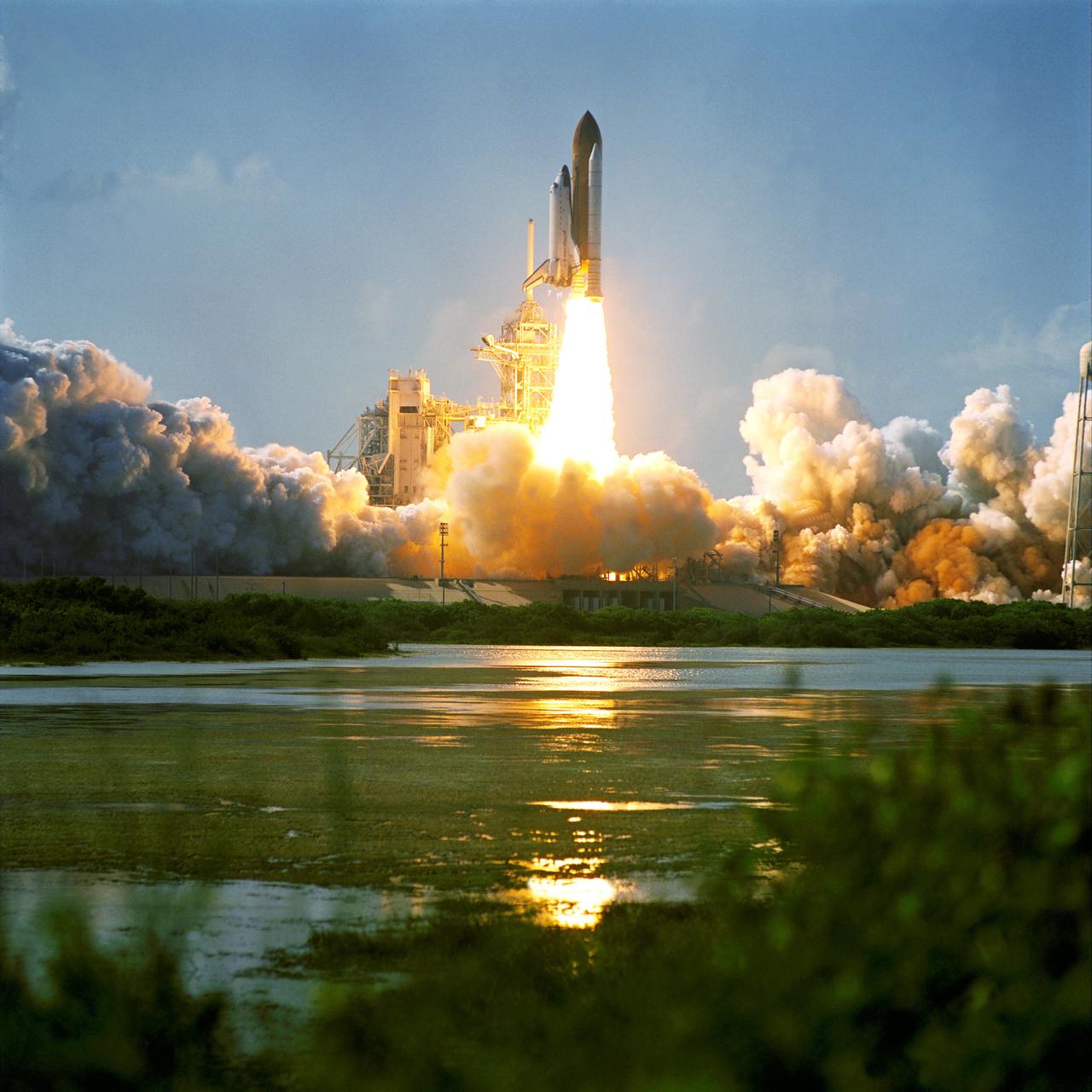
Space Shuttle Orbiter Atlantis hurdles toward space from Launch Pad 39B at Kennedy Space Center in Florida for the STS-112 mission. Liftoff occurred at 3:46pm EDT, October 7, 2002. Atlantis carried the Starboard-1 (S1) Integrated Truss Structure and the Crew and Equipment Translation Aid (CETA) Cart A. The S1 was the second truss structure installed on the International Space Station (ISS). It was attached to the S0 truss which was previously installed by the STS-110 mission. The CETA is the first of two human-powered carts that ride along the ISS railway, providing mobile work platforms for future space walking astronauts. The 11 day mission performed three space walks to attach the S1 truss.
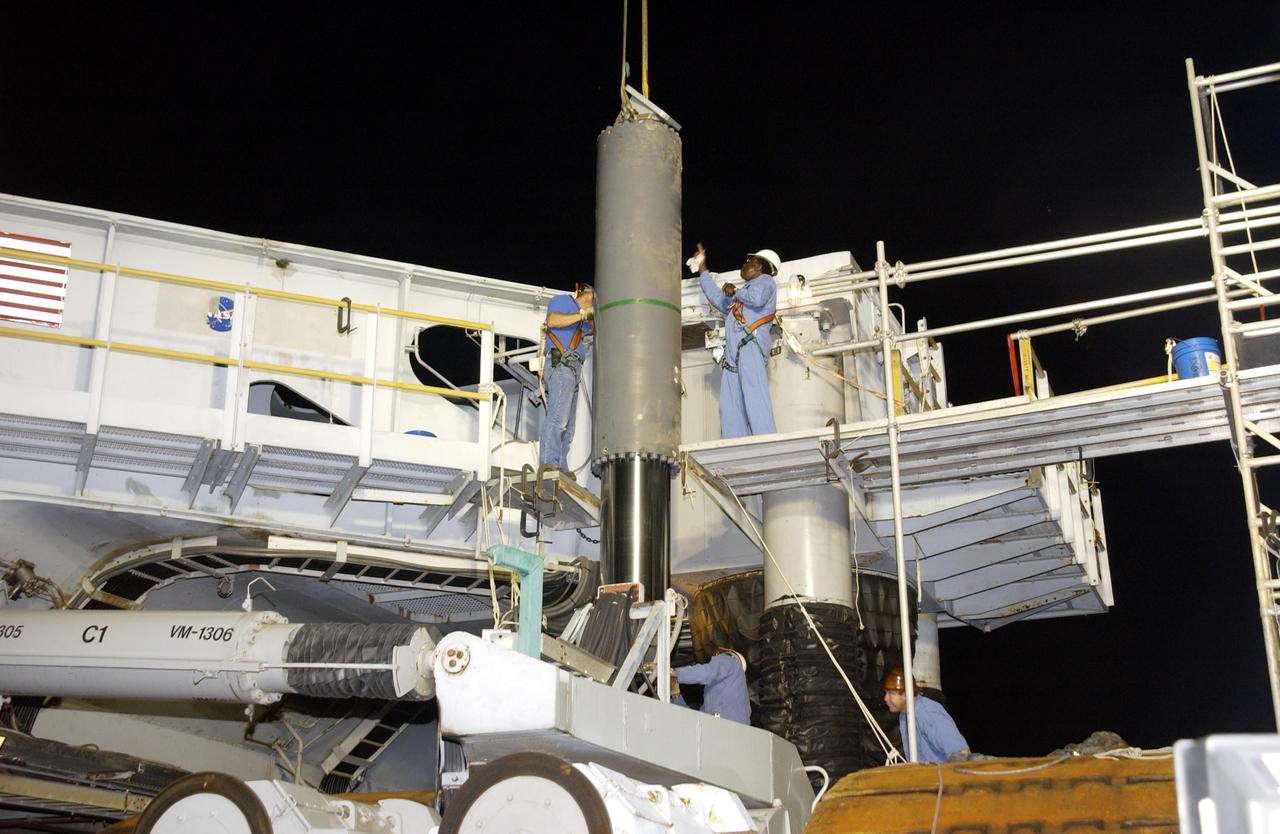
KENNEDY SPACE CENTER, FLA. -- Workers help guide the final Jacking, Equalization and Leveling (JEL) cylinder into place on Crawler Transporter No. 2 (CT-2) for installation. During recent routine maintenance inspections, cracks were found on four bearings in two JEL cylinders. Further eddy current inspections indicated that cracks were present on 15 bearings. There are 16 cylinders and 32 bearings per crawler. CT-2 was repaired in order to enable Atlantis' rollout for mission STS-112, scheduled for launch no earlier than Oct. 2.
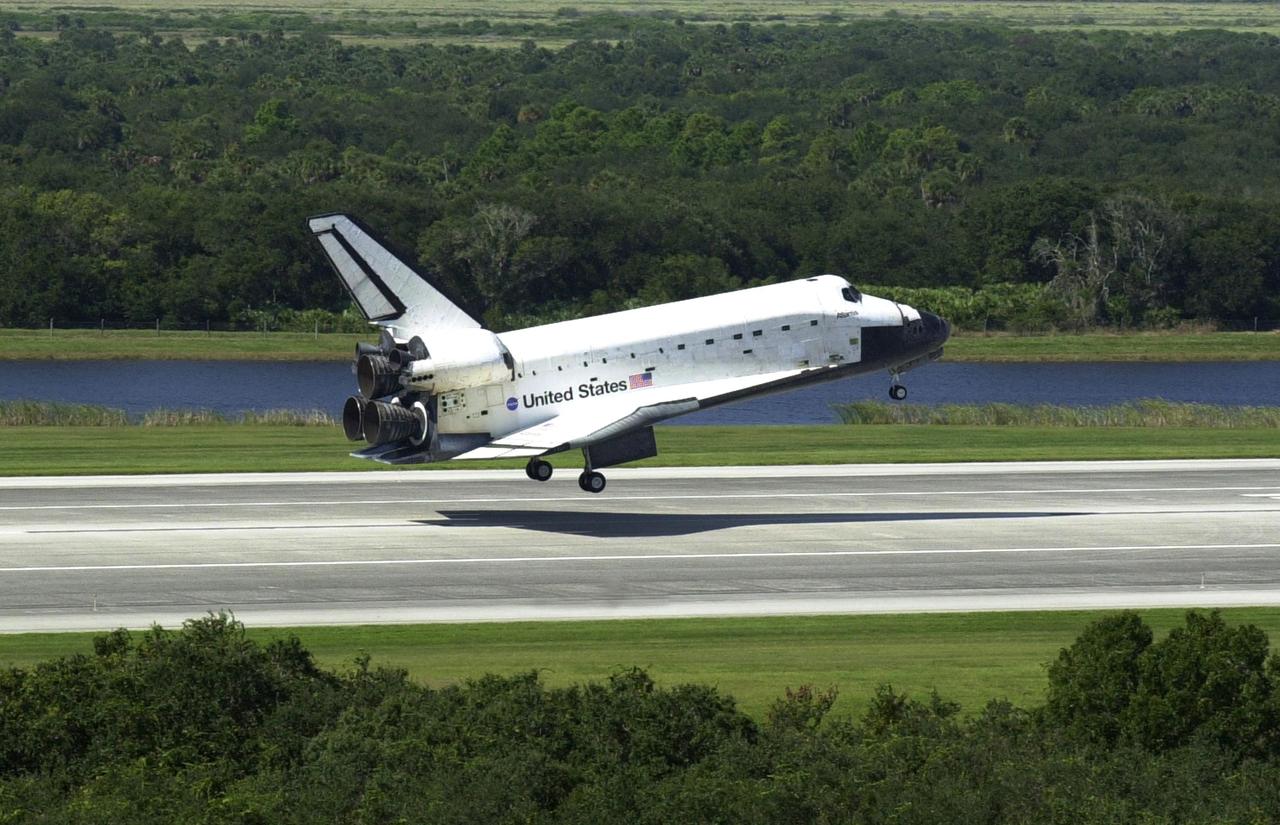
KENNEDY SPACE CENTER, FLA. - Its shadow precedes it as Space Shuttle Atlantis drops to the runway at the Shuttle Landing Facility, completing the 4.5-million-mile journey to the International Space Station. Main gear touchdown occurred at 11:43:40 a.m. EDT; nose gear touchdown at 11:43:48 a.m.; and wheel stop at 11:44:35 a.m. Mission elapsed time was 10:19:58:44. Mission STS-112 expanded the size of the Station with the addition of the S1 truss segment. The returning crew of Atlantis are Commander Jeffrey Ashby, Pilot Pamela Melroy, and Mission Specialists David Wolf, Piers Sellers, Sandra Magnus and Fyodor Yurchikhin. This landing is the 60th at KSC in the history of the Shuttle program. .
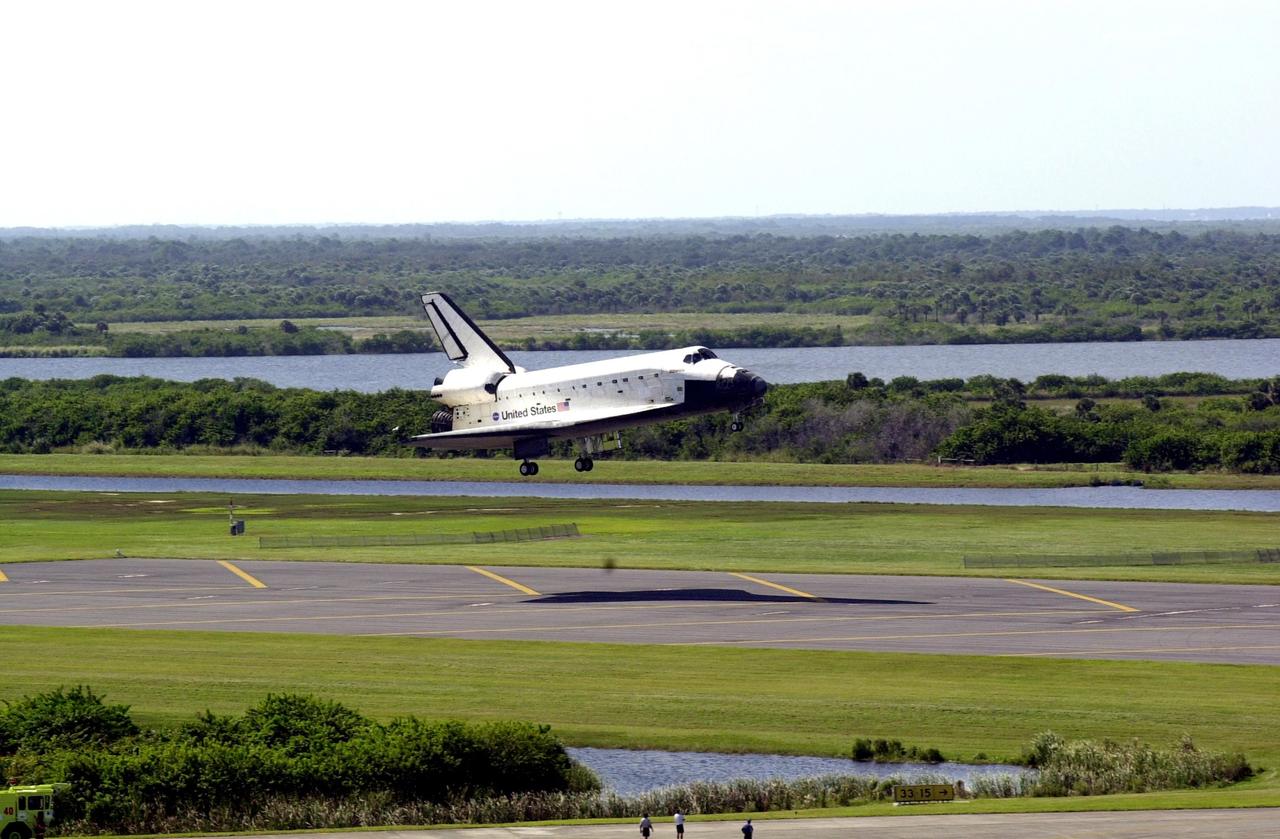
KENNEDY SPACE CENTER, FLA. - Space Shuttle Atlantis drops to the runway at the Shuttle Landing Facility, completing the 4.5-million-mile journey to the International Space Station. Main gear touchdown occurred at 11:43:40 a.m. EDT; nose gear touchdown at 11:43:48 a.m.; and wheel stop at 11:44:35 a.m. Mission elapsed time was 10:19:58:44. Mission STS-112 expanded the size of the Station with the addition of the S1 truss segment. The returning crew of Atlantis are Commander Jeffrey Ashby, Pilot Pamela Melroy, and Mission Specialists David Wolf, Piers Sellers, Sandra Magnus and Fyodor Yurchikhin. This landing is the 60th at KSC in the history of the Shuttle program.
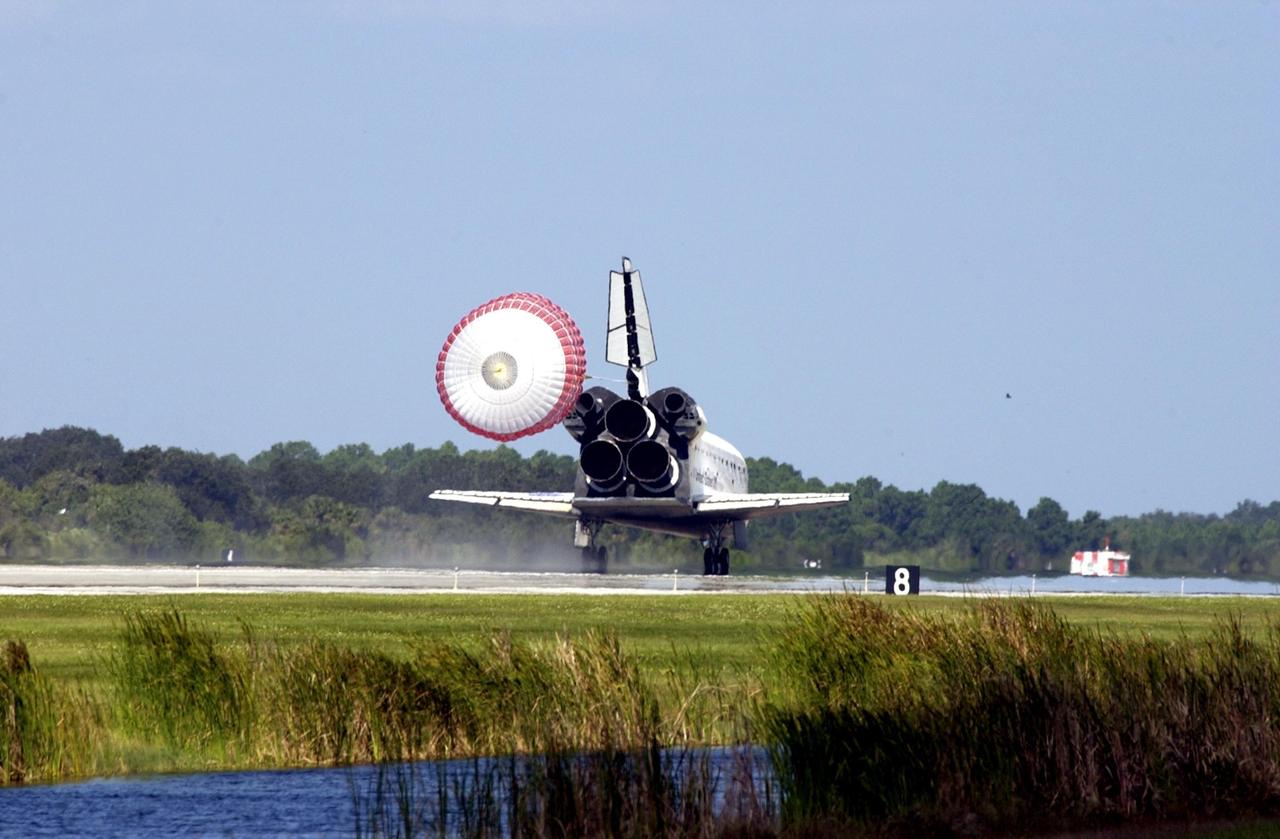
KENNEDY SPACE CENTER, FLA. -- Its drag chute deployed, Space Shuttle Atlantis slows to a stop after touchdown on Runway 33 at the Shuttle Landing Facility, completing the 4.5-million-mile journey to the International Space Station. Main gear touchdown occurred at 11:43:40 a.m. EDT; nose gear touchdown at 11:43:48 a.m.; and wheel stop at 11:44:35 a.m. Mission elapsed time was 10:19:58:44. Mission STS-112 expanded the size of the Station with the addition of the S1 truss segment. The returning crew of Atlantis are Commander Jeffrey Ashby, Pilot Pamela Melroy, and Mission Specialists David Wolf, Piers Sellers, Sandra Magnus and Fyodor Yurchikhin. This landing is the 60th at KSC in the history of the Shuttle program. .
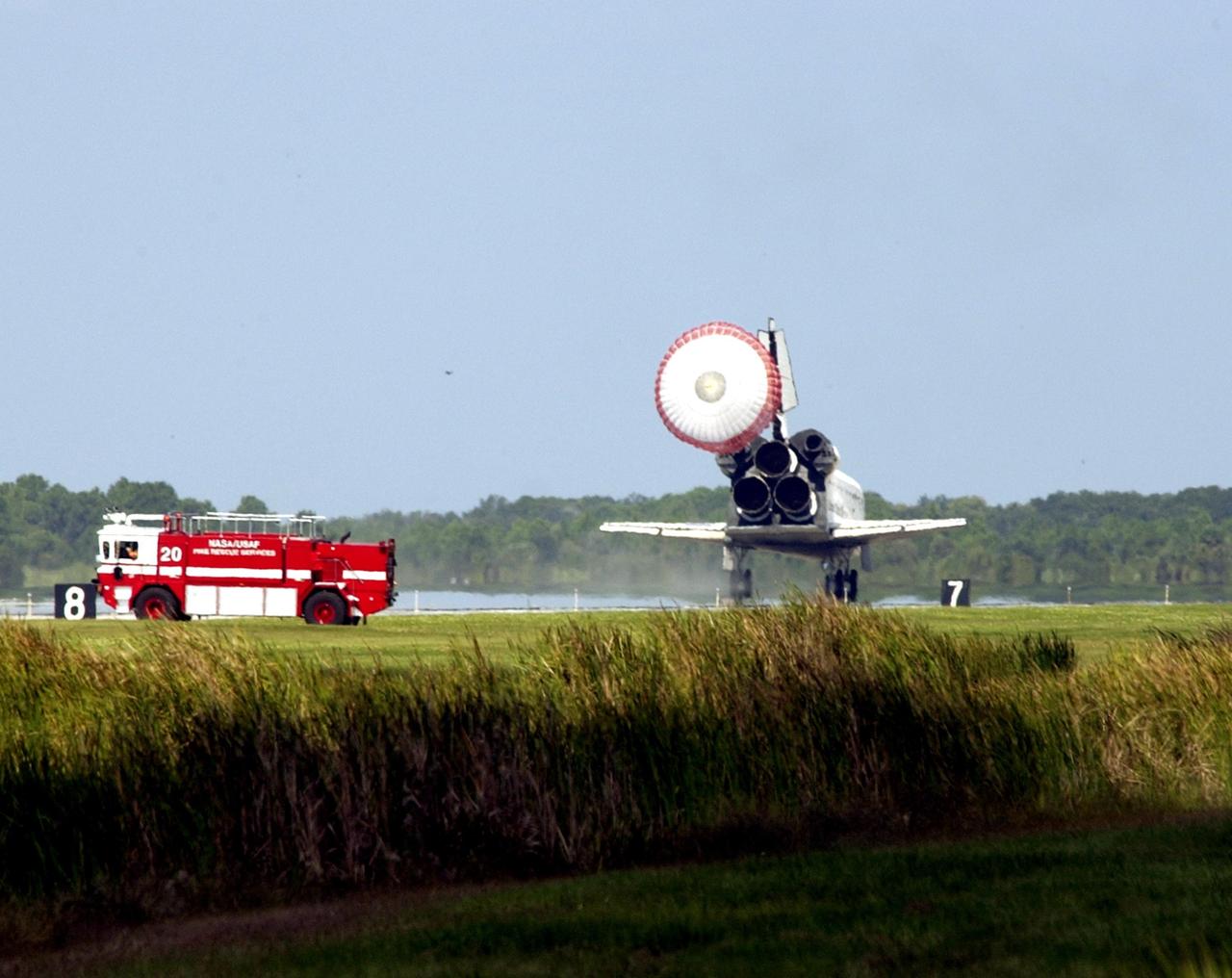
KENNEDY SPACE CENTER, FLA. - A fire rescue truck stands by for safety reasons as Space Shuttle Atlantis slows to a stop on Runway 33 at the Shuttle Landing Facility, completing the 4.5-million-mile journey to the International Space Station. Main gear touchdown occurred at 11:43:40 a.m. EDT; nose gear touchdown at 11:43:48 a.m.; and wheel stop at 11:44:35 a.m. Mission elapsed time was 10:19:58:44. Mission STS-112 expanded the size of the Station with the addition of the S1 truss segment. The returning crew of Atlantis are Commander Jeffrey Ashby, Pilot Pamela Melroy, and Mission Specialists David Wolf, Piers Sellers, Sandra Magnus and Fyodor Yurchikhin. This landing is the 60th at KSC in the history of the Shuttle program. .
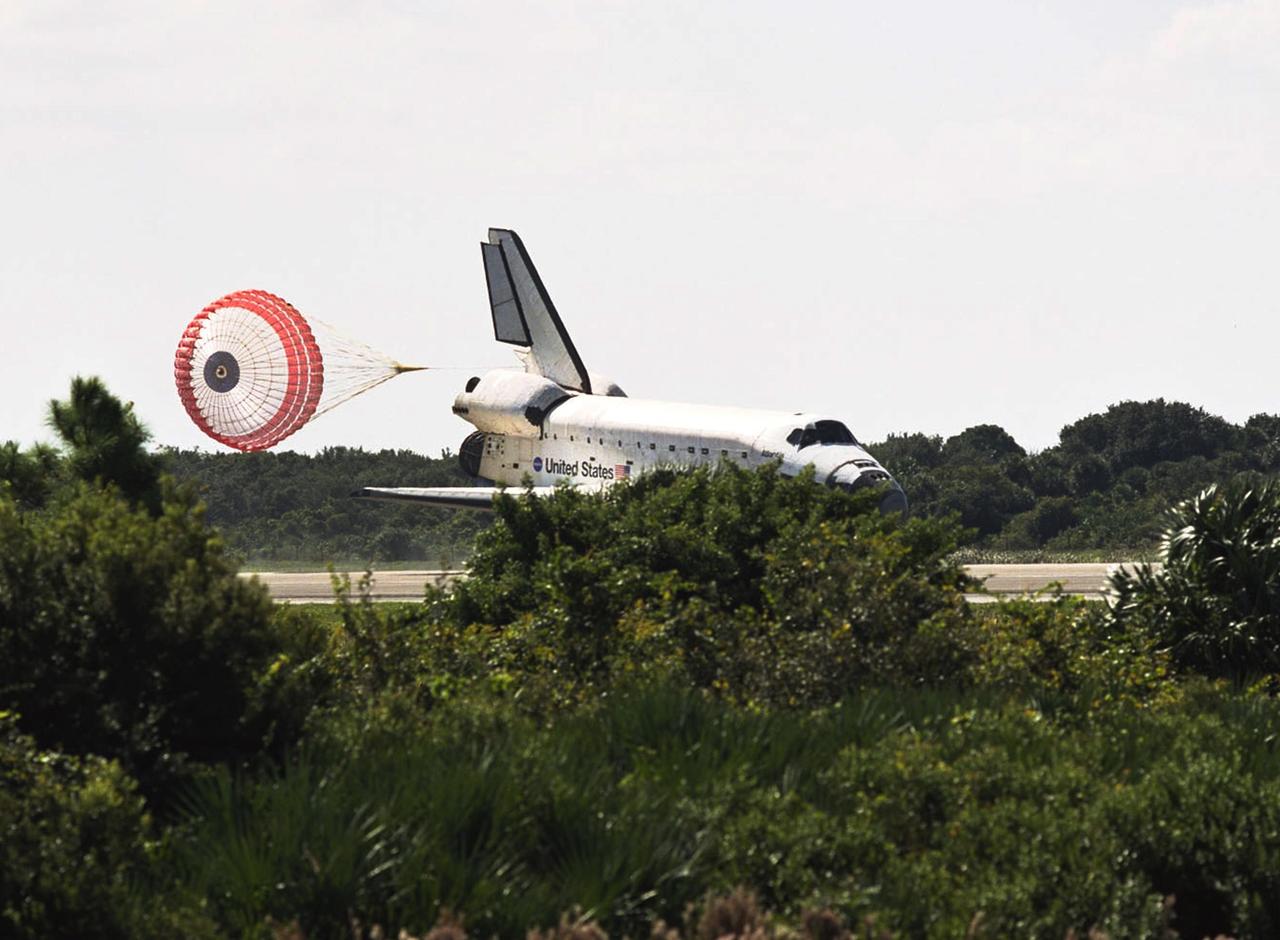
KENNEDY SPACE CENTER, FLA. - A drag chute slows Atlantis after touchdown on Runway 33 at the Shuttle Landing Facility, completing the 4.5-million-mile journey to the International Space Station. Main gear touchdown occurred at 11:43:40 a.m. EDT; nose gear touchdown at 11:43:48 a.m.; and wheel stop at 11:44:35 a.m. Mission elapsed time was 10:19:58:44. Mission STS-112 expanded the size of the Station with the addition of the S1 truss segment. The returning crew of Atlantis are Commander Jeffrey Ashby, Pilot Pamela Melroy, and Mission Specialists David Wolf, Piers Sellers, Sandra Magnus and Fyodor Yurchikhin. This landing is the 60th at KSC in the history of the Shuttle program.
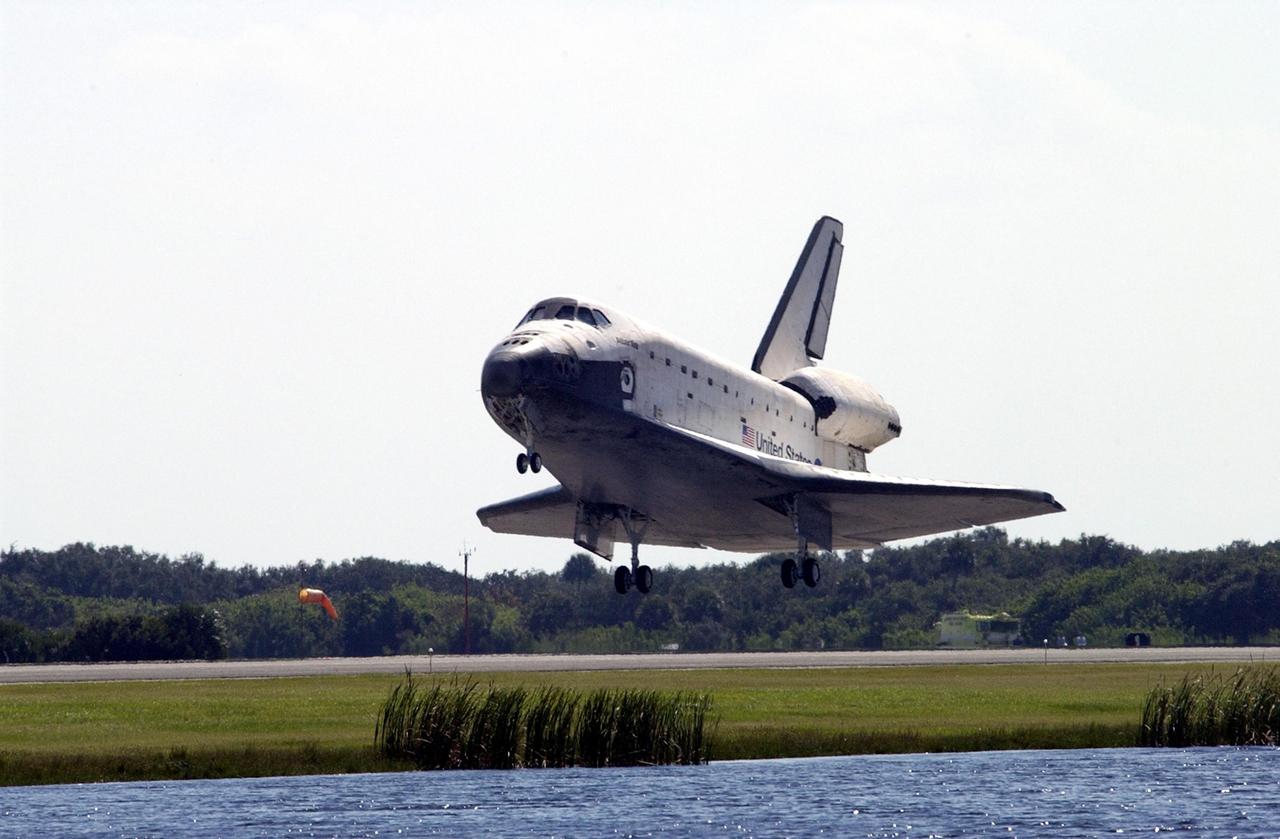
KENNEDY SPACE CENTER, FLA. - Space Shuttle Atlantis approaches the runway at the Shuttle Landing Facility, completing the 4.5-million-mile journey to the International Space Station. Main gear touchdown occurred at 11:43:40 a.m. EDT; nose gear touchdown at 11:43:48 a.m.; and wheel stop at 11:44:35 a.m. Mission elapsed time was 10:19:58:44. Mission STS-112 expanded the size of the Station with the addition of the S1 truss segment. The returning crew of Atlantis are Commander Jeffrey Ashby, Pilot Pamela Melroy, and Mission Specialists David Wolf, Piers Sellers, Sandra Magnus and Fyodor Yurchikhin. This landing is the 60th at KSC in the history of the Shuttle program.

KENNEDY SPACE CENTER, FLA. - Space Shuttle Atlantis is close to touchdown at the Shuttle Landing Facility, completing the 4.5-million-mile journey to the International Space Station. Main gear touchdown occurred at 11:43:40 a.m. EDT; nose gear touchdown at 11:43:48 a.m.; and wheel stop at 11:44:35 a.m. Mission elapsed time was 10:19:58:44. Mission STS-112 expanded the size of the Station with the addition of the S1 truss segment. The returning crew of Atlantis are Commander Jeffrey Ashby, Pilot Pamela Melroy, and Mission Specialists David Wolf, Piers Sellers, Sandra Magnus and Fyodor Yurchikhin. This landing is the 60th at KSC in the history of the Shuttle program.
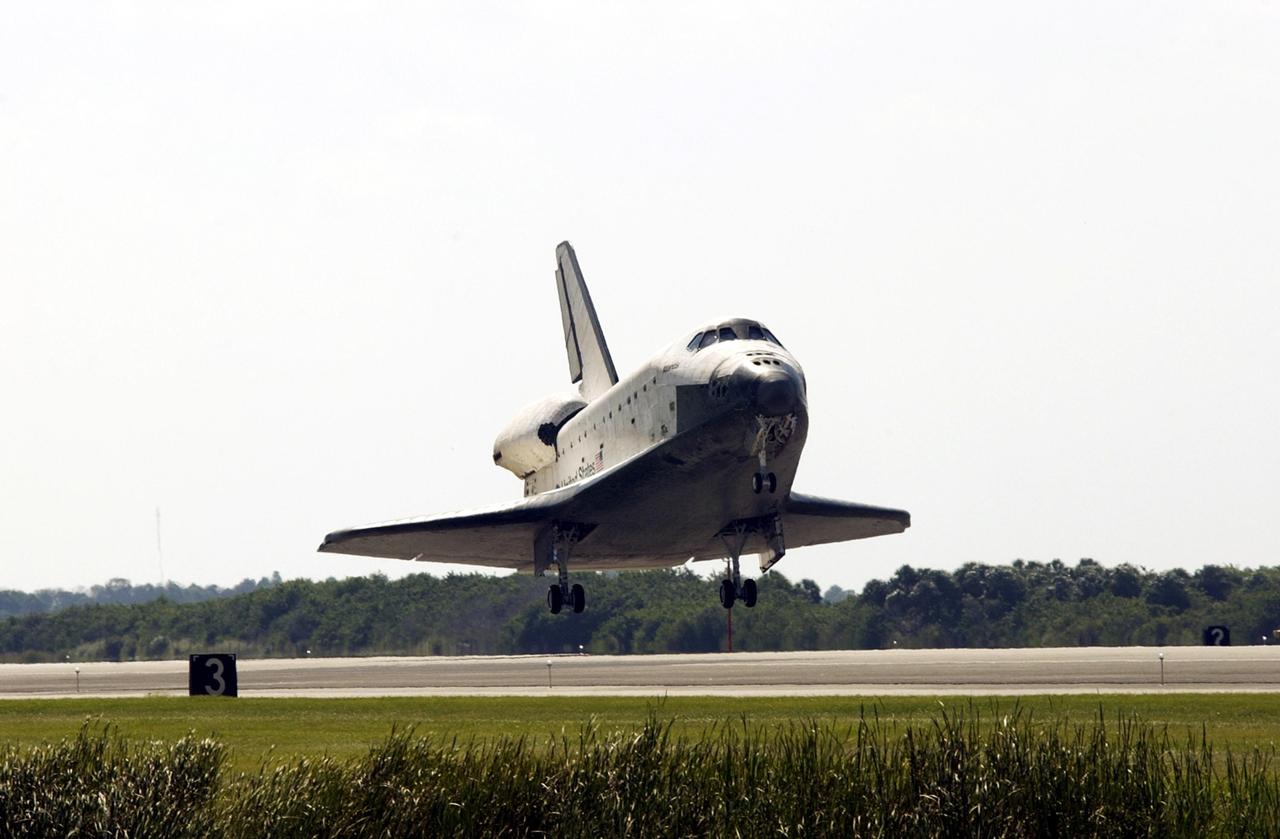
KENNEDY SPACE CENTER, FLA. -- Space Shuttle Atlantis approaches the runway at the Shuttle Landing Facility, completing the 4.5-million-mile journey to the International Space Station. Main gear touchdown occurred at 11:43:40 a.m. EDT; nose gear touchdown at 11:43:48 a.m.; and wheel stop at 11:44:35 a.m. Mission elapsed time was 10:19:58:44. Mission STS-112 expanded the size of the Station with the addition of the S1 truss segment. The returning crew of Atlantis are Commander Jeffrey Ashby, Pilot Pamela Melroy, and Mission Specialists David Wolf, Piers Sellers, Sandra Magnus and Fyodor Yurchikhin. This landing is the 60th at KSC in the history of the Shuttle program. .
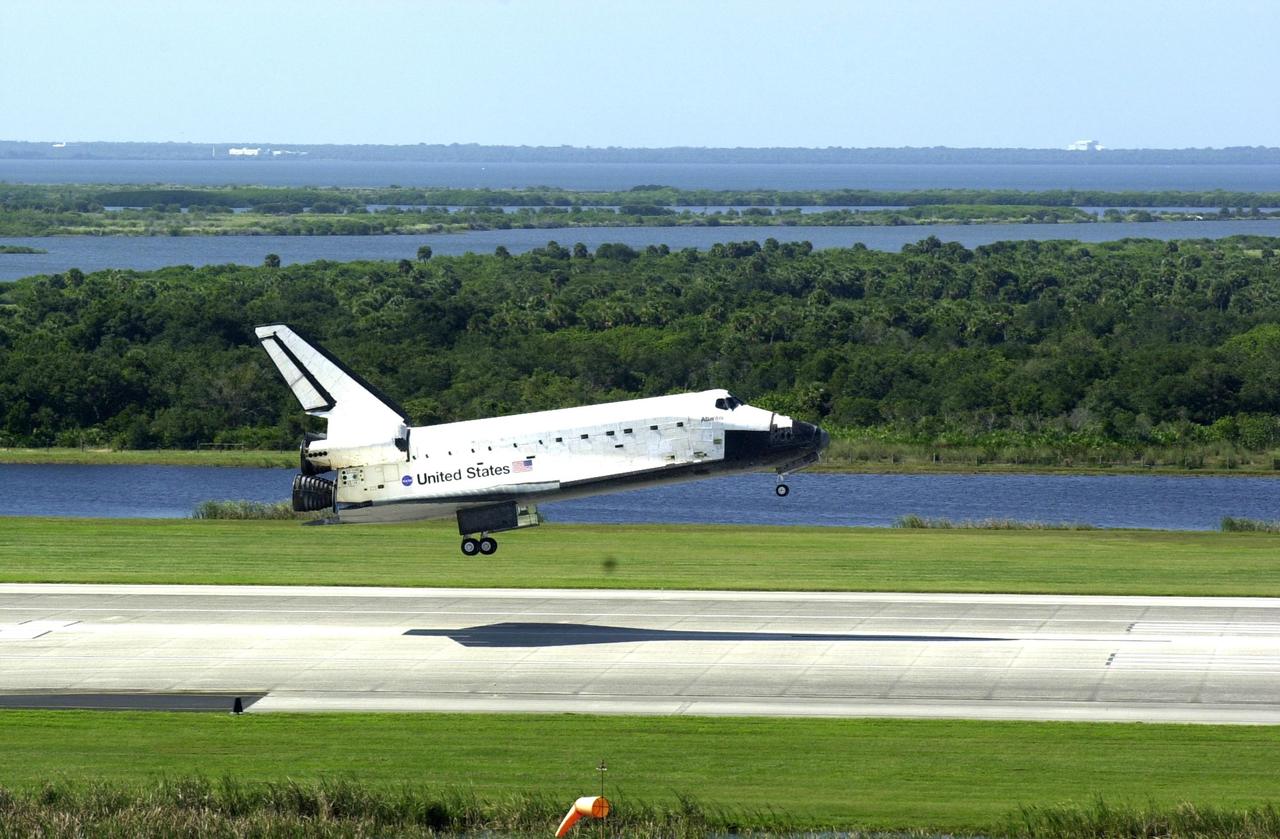
KENNEDY SPACE CENTER, FLA. -- Space Shuttle Atlantis casts a needle-shaped shadow as it drops to the runway at the Shuttle Landing Facility, completing the 4.5-million-mile journey to the International Space Station. Main gear touchdown occurred at 11:43:40 a.m. EDT; nose gear touchdown at 11:43:48 a.m.; and wheel stop at 11:44:35 a.m. Mission elapsed time was 10:19:58:44. Mission STS-112 expanded the size of the Station with the addition of the S1 truss segment. The returning crew of Atlantis are Commander Jeffrey Ashby, Pilot Pamela Melroy, and Mission Specialists David Wolf, Piers Sellers, Sandra Magnus and Fyodor Yurchikhin. This landing is the 60th at KSC in the history of the Shuttle program.
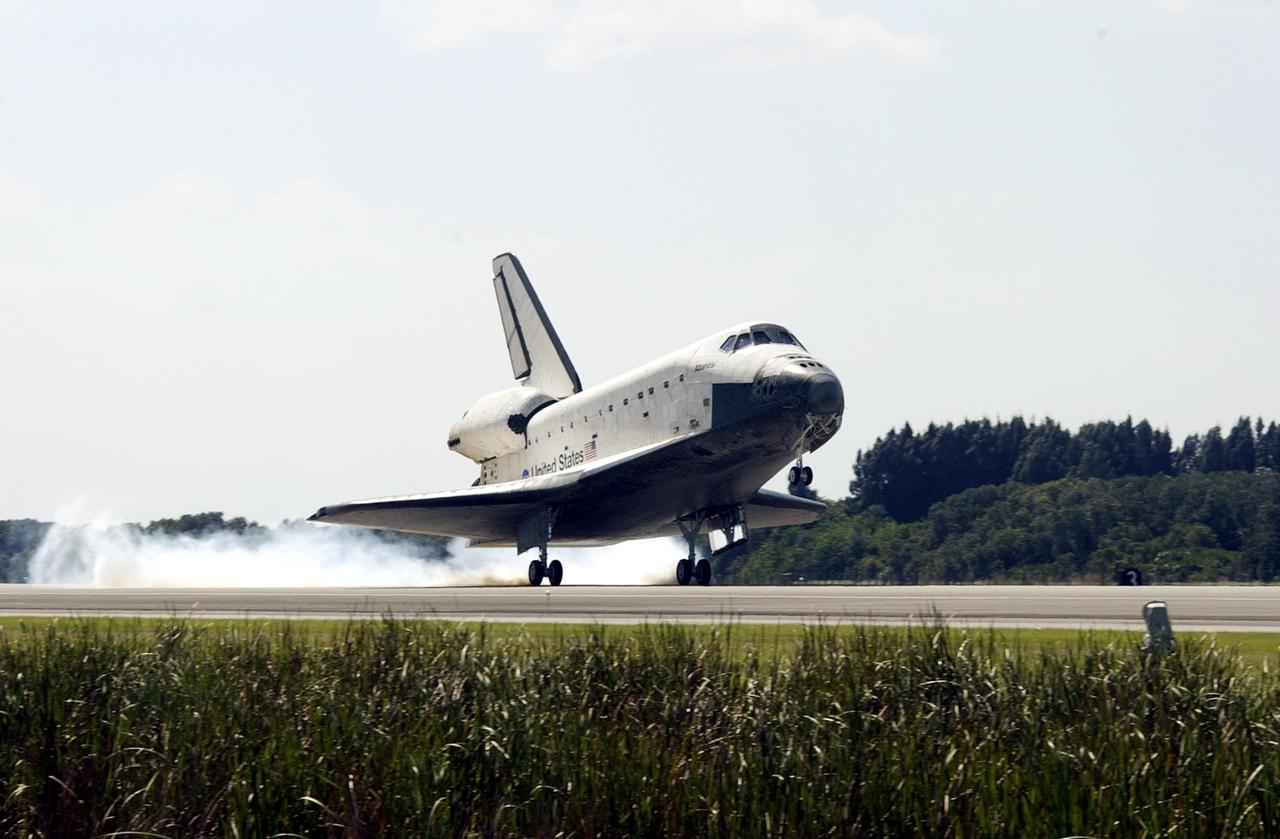
KENNEDY SPACE CENTER, FLA. -- Space Shuttle Atlantis stirs up dust as it touches down on Runway 33 at the Shuttle Landing Facility, completing the 4.5-million-mile journey to the International Space Station. Main gear touchdown occurred at 11:43:40 a.m. EDT; nose gear touchdown at 11:43:48 a.m.; and wheel stop at 11:44:35 a.m. Mission elapsed time was 10:19:58:44. Mission STS-112 expanded the size of the Station with the addition of the S1 truss segment. The returning crew of Atlantis are Commander Jeffrey Ashby, Pilot Pamela Melroy, and Mission Specialists David Wolf, Piers Sellers, Sandra Magnus and Fyodor Yurchikhin. This landing is the 60th at KSC in the history of the Shuttle program. .

A tracking camera on Launch Pad 39B of the Kennedy Space Center in Florida captures the flames of Space Shuttle Atlantis' three main engines as the Orbiter hurdles into space on mission STS-112. Liftoff occurred at 3:46 pm EDT, October 7, 2002. Atlantis carried the Starboard-1 (S1) Integrated Truss Structure and the Crew and Equipment Translation Aid (CETA) Cart A. The S1 was the second truss structure installed on the International Space Station (ISS). It was attached to the S0 truss which was previously installed by the STS-110 mission. The CETA is the first of two human-powered carts that ride along the ISS railway, providing mobile work platforms for future space walking astronauts. The 11 day mission performed three space walks to attach the S1 truss.
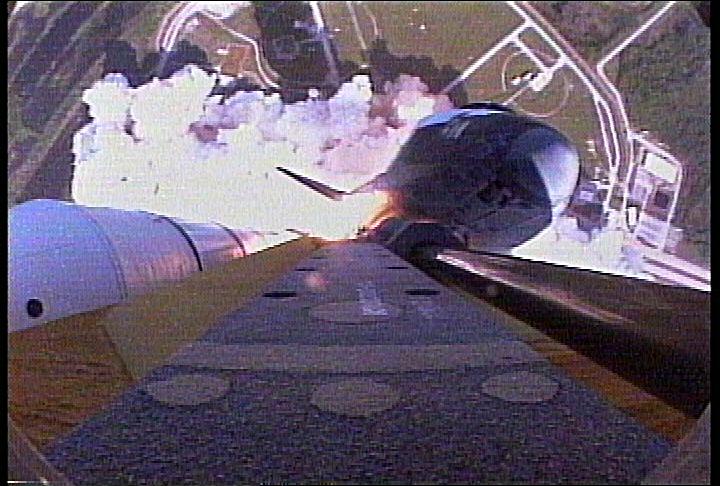
A color video camera mounted to the top of the External Tank (ET) provided this spectacular never-before-seen view of the STS-112 mission as the Space Shuttle Orbiter Atlantis lifted off in the afternoon of October 7, 2002, The camera provided views as the the orbiter began its ascent until it reached near-orbital speed, about 56 miles above the Earth, including a view of the front and belly of the orbiter, a portion of the Solid Rocket Booster, and ET. The video was downlinked during flight to several NASA data-receiving sites, offering the STS-112 team an opportunity to monitor the shuttle's performance from a new angle. Atlantis carried the S1 Integrated Truss Structure and the Crew and Equipment Translation Aid (CETA) Cart. The CETA is the first of two human-powered carts that will ride along the International Space Station's railway providing a mobile work platform for future extravehicular activities by astronauts. Landing on October 18, 2002, the Orbiter Atlantis ended its 11-day mission.
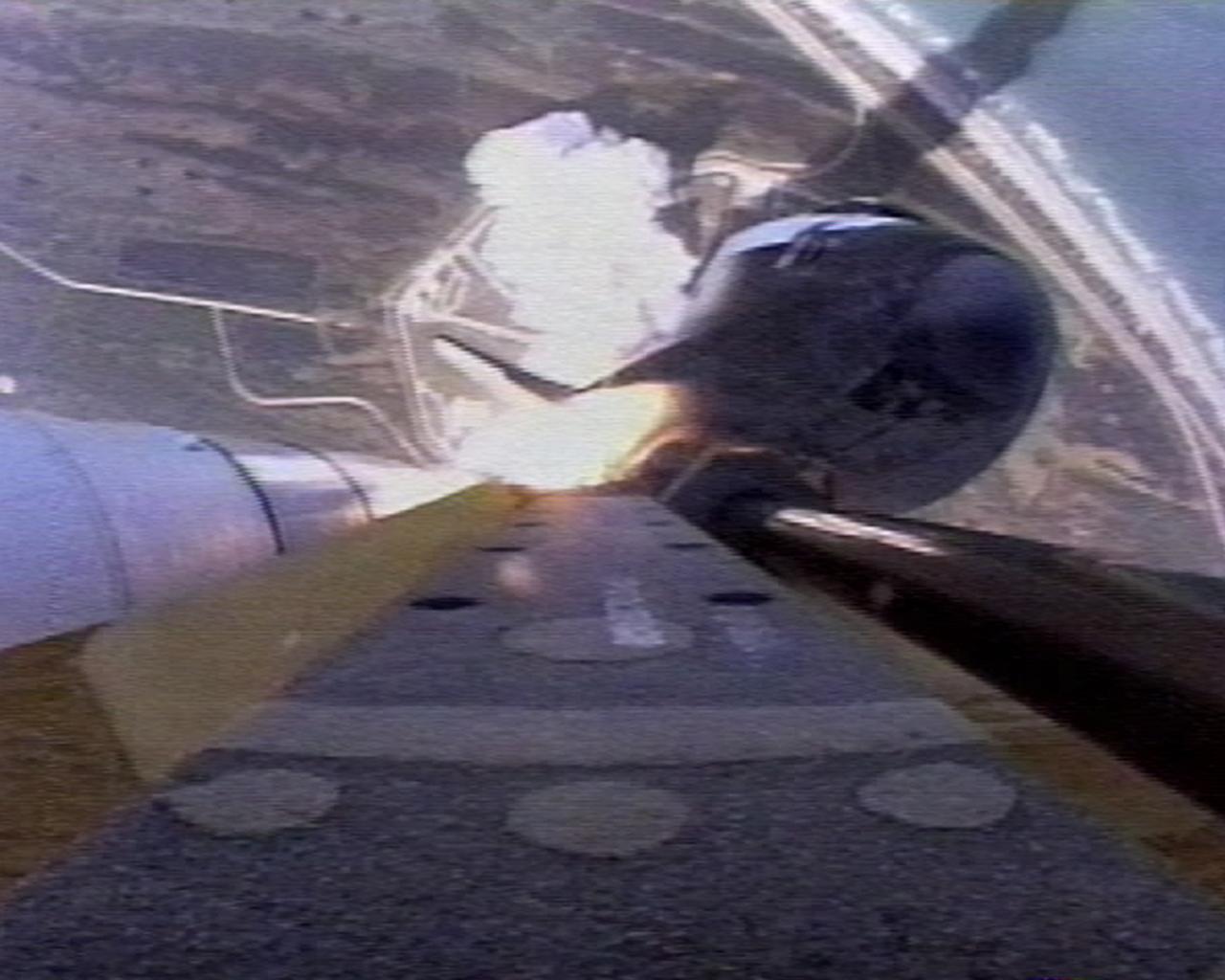
A color video camera mounted to the top of the External Tank (ET) provided this spectacular never-before-seen view of the STS-112 mission as the Space Shuttle Orbiter Atlantis lifted off in the afternoon of October 7, 2002. The camera provided views as the orbiter began its ascent until it reached near-orbital speed, about 56 miles above the Earth, including a view of the front and belly of the orbiter, a portion of the Solid Rocket Booster, and ET. The video was downlinked during flight to several NASA data-receiving sites, offering the STS-112 team an opportunity to monitor the shuttle's performance from a new angle. Atlantis carried the S1 Integrated Truss Structure and the Crew and Equipment Translation Aid (CETA) Cart. The CETA is the first of two human-powered carts that will ride along the International Space Station's railway providing a mobile work platform for future extravehicular activities by astronauts. Landing on October 18, 2002, the Orbiter Atlantis ended its 11-day mission.

KENNEDY SPACE CENTER, FLA. -- The STS-112 crew pauses for a photo after their arrival at the KSC Shuttle Landing Facility. Standing, left to right, are Mission Specialist Piers Sellers, Pilot Pamela Melroy, Commander Jeffrey Ashby, and Mission Specialists David Wolf, Sandra Magnus and cosmonaut Fyodor Yurchikhin. Sellers, Magnus and Yurchikhin are making their first Shuttle flights. STS-112, aboard Space Shuttle Atlantis, is the 15th assembly mission to the International Space Station. Atlantis will be carrying the S1 Integrated Truss Structure, the first starboard truss segment, to be attached to the central truss segment, S0, and the Crew and Equipment Translation Aid (CETA) Cart A. The CETA is the first of two human-powered carts that will ride along the ISS railway, providing mobile work platforms for future spacewalking astronauts. The 11-day mission includes three spacewalks. Launch is scheduled for Oct. 2 between 2 and 6 p.m.
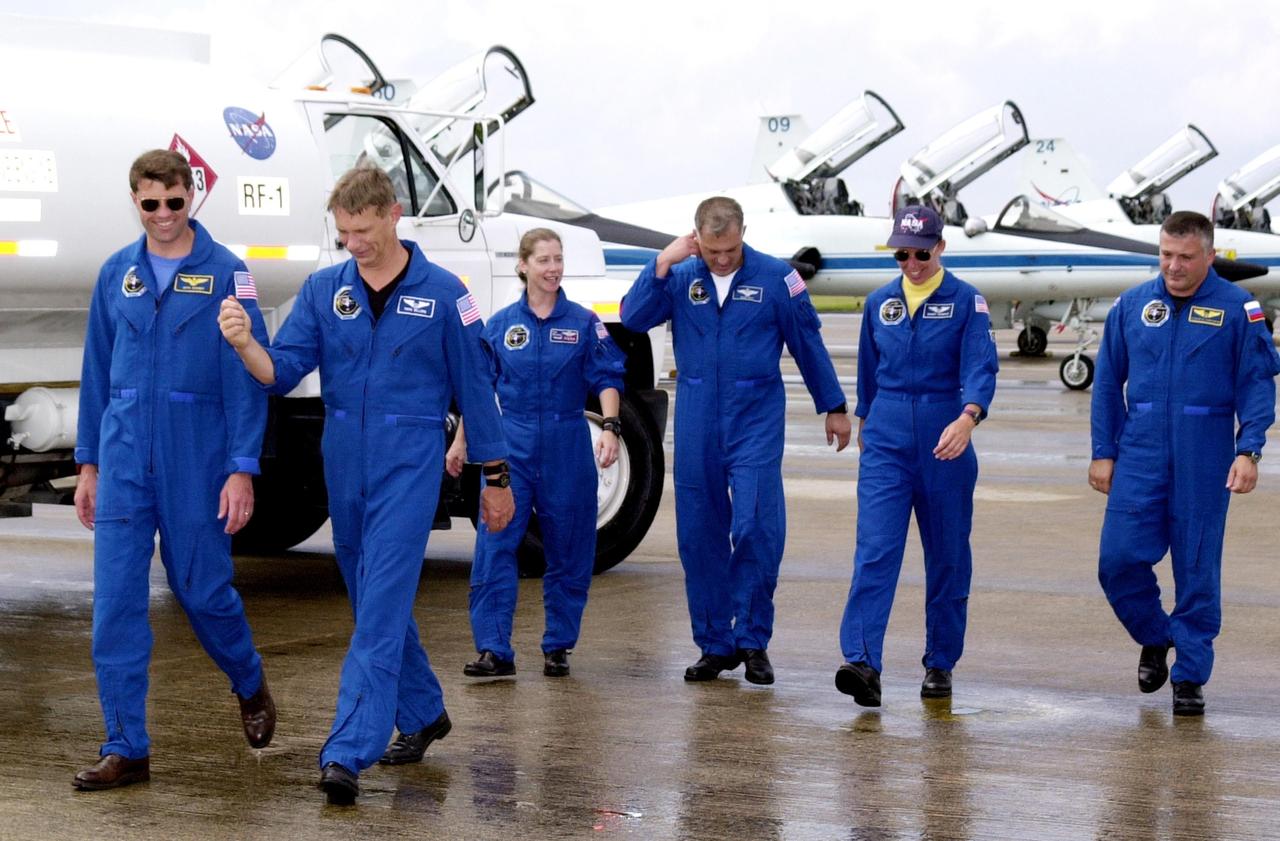
KENNEDY SPACE CENTER, FLA. -- After their arrival at the KSC Shuttle Landing Facility, the STS-112 crew members stride happily to the side of the parking apron and a photo opportunity. From left are Commander Jeffrey Ashby, Mission Specialist Piers Sellers, Pilot Pamela Melroy and Mission Specialists David Wolf, Sandra Magnus and Fyodor Yurchikhin, who is with the Russian Space Agency. Launch is scheduled for Oct. 2 between 2 and 6 p.m. STS-112, aboard Space Shuttle Atlantis, is the 15th assembly mission to the International Space Station. Atlantis will be carrying the S1 Integrated Truss Structure, the first starboard truss segment, to be attached to the central truss segment, S0, and the Crew and Equipment Translation Aid (CETA) Cart A. The CETA is the first of two human-powered carts that will ride along the ISS railway, providing mobile work platforms for future spacewalking astronauts. The 11-day mission includes three spacewalks.
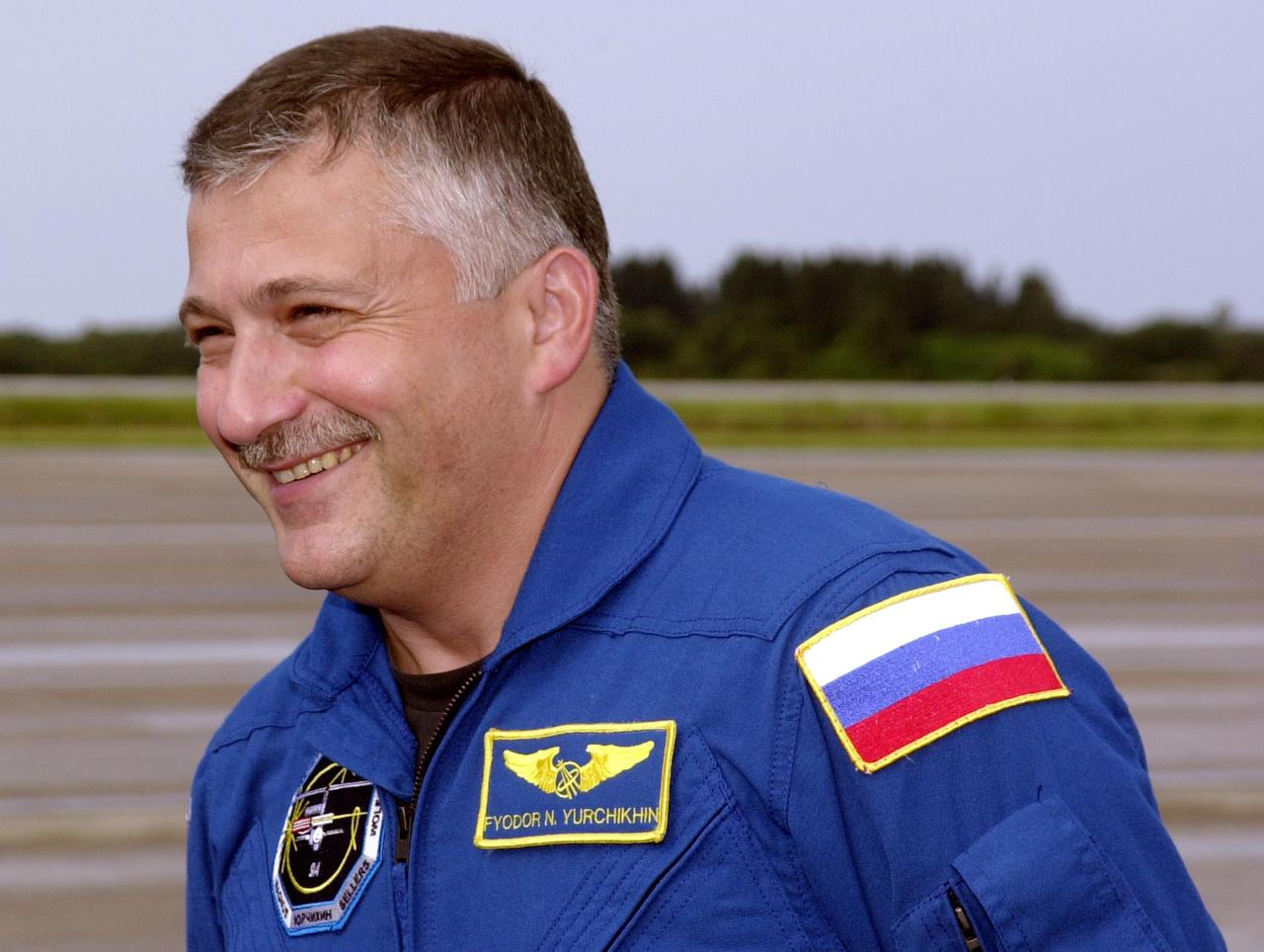
KENNEDY SPACE CENTER, FLA. -- STS-112 Mission Specialist Fyodor Yurchikhin, who is with the Russian Space Agency, shows his happiness at returning to KSC to prepare for launch. He will be making his first Shuttle flight. STS-112, aboard Space Shuttle Atlantis, is the 15th assembly mission to the International Space Station. Atlantis will be carrying the S1 Integrated Truss Structure, the first starboard truss segment, to be attached to the central truss segment, S0, and the Crew and Equipment Translation Aid (CETA) Cart A. The CETA is the first of two human-powered carts that will ride along the ISS railway, providing mobile work platforms for future spacewalking astronauts. The 11-day mission includes three spacewalks. Launch is scheduled for Oct. 2 between 2 and 6 p.m.

KENNEDY SPACE CENTER, FLA. -- STS-112 Mission Specialist Sandra Magnus is happy to return to KSC to prepare for launch. She will be making her first Shuttle flight. STS-112, aboard Space Shuttle Atlantis, is the 15th assembly mission to the International Space Station. Atlantis will be carrying the S1 Integrated Truss Structure, the first starboard truss segment, to be attached to the central truss segment, S0, and the Crew and Equipment Translation Aid (CETA) Cart A. The CETA is the first of two human-powered carts that will ride along the ISS railway, providing mobile work platforms for future spacewalking astronauts. The 11-day mission includes three spacewalks. Launch is scheduled for Oct. 2 between 2 and 6 p.m.
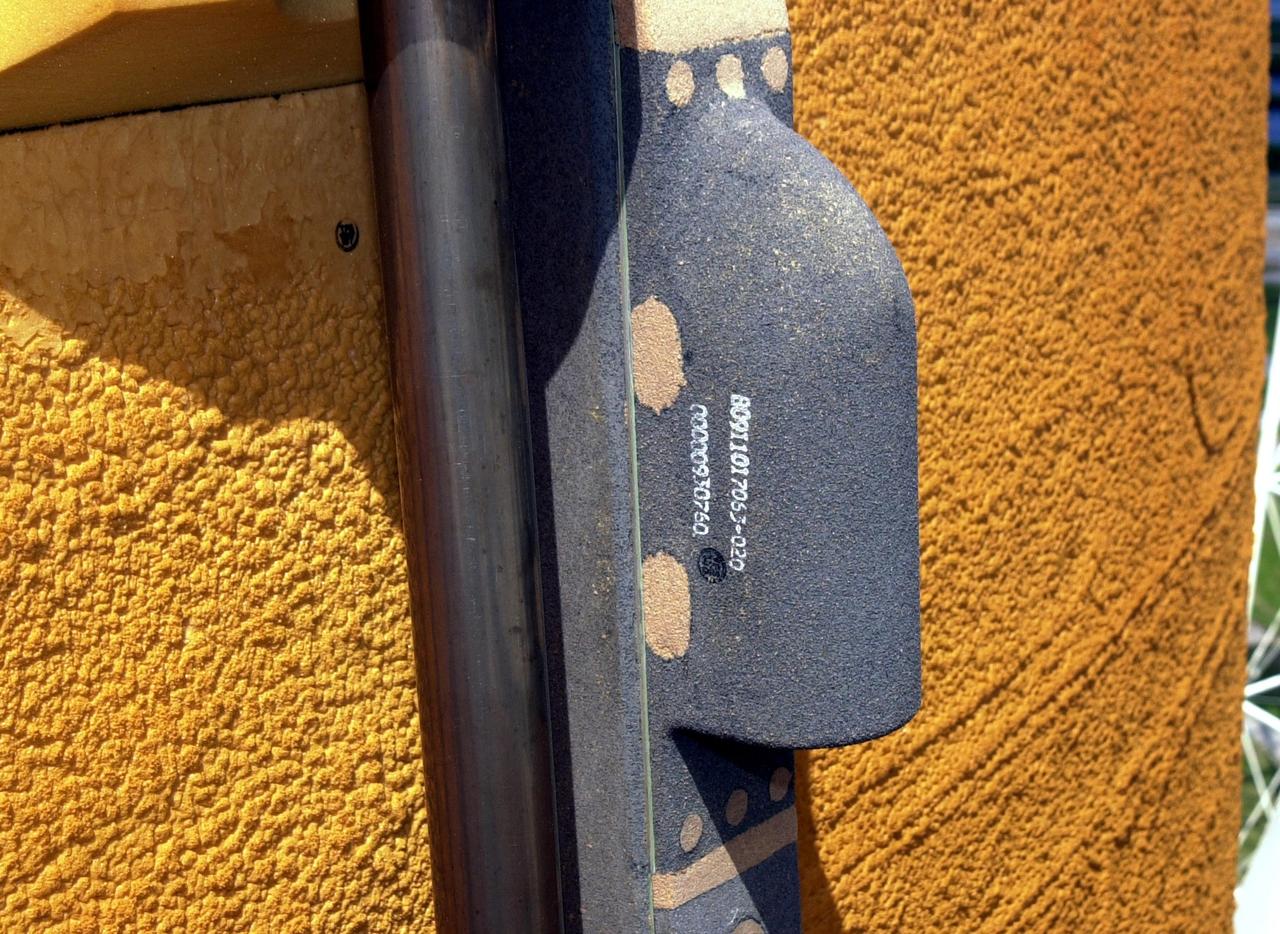
KENNEDY SPACE CENTER, FLA. - A closeup view of the camera mounted on the external tank of Space Shuttle Atlantis. The color video camera mounted to the top of Atlantis' external tank will provide a view of the front and belly of the orbiter and a portion of the solid rocket boosters (SRBs) and external tank during the launch of Atlantis on mission STS-112. It will offer the STS-112 team an opportunity to monitor the shuttle's performance from a new angle. The camera will be turned on fifteen minutes prior to launch and will show the orbiter and solid rocket boosters on the launch pad. The video will be downlinked from the external tank during flight to several NASA data-receiving sites and then relayed to the live television broadcast. The camera is expected to operate for about 15 minutes following liftoff. At liftoff, viewers will see the shuttle clearing the launch tower and, at two minutes after liftoff, see the right SRB separate from the external tank. When the external tank separates from Atlantis about eight minutes into the flight, the camera is expected to continue its live feed for about six more minutes although NASA may be unable to pick up the camera's signal because the tank may have moved out of range.
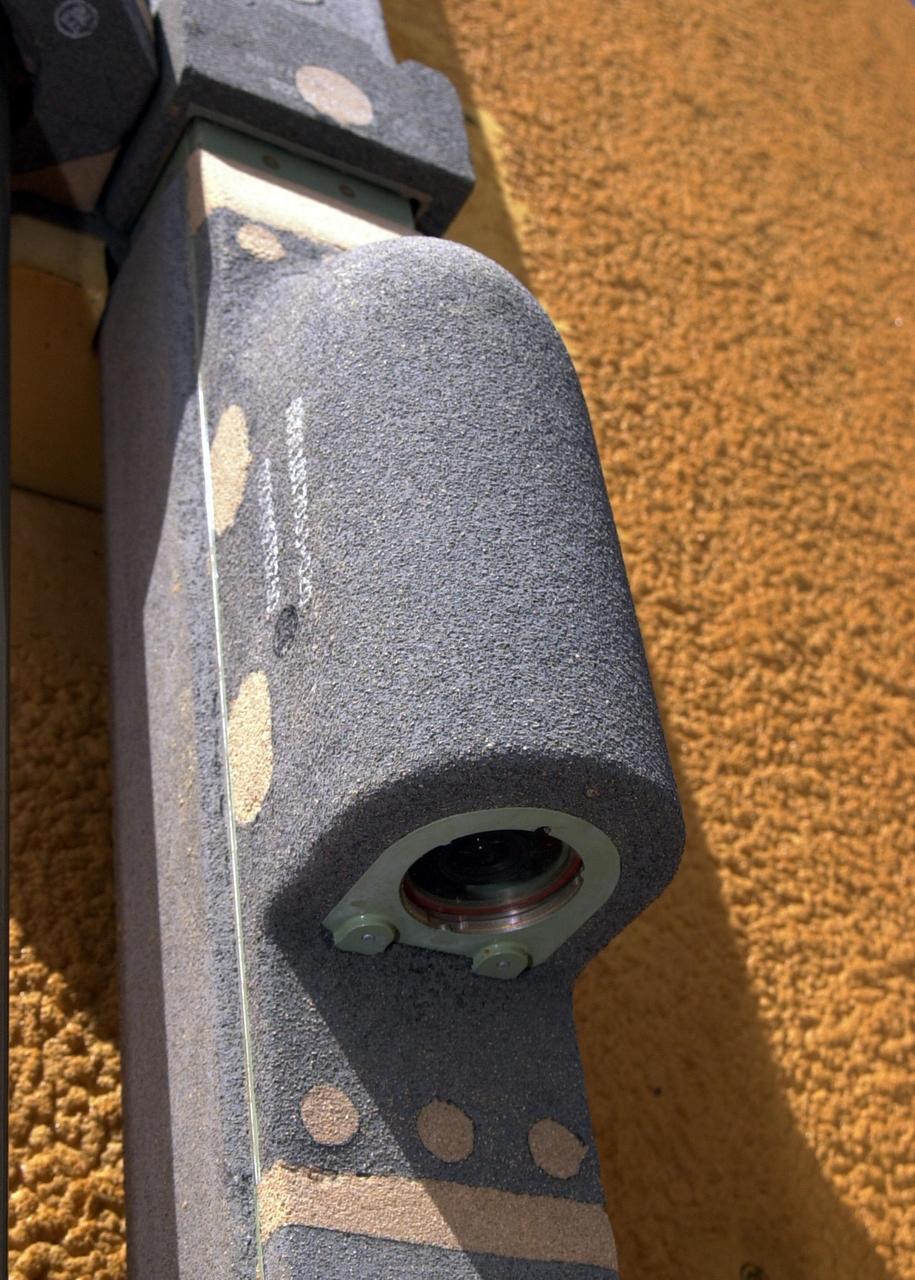
KENNEDY SPACE CENTER, FLA. - A closeup view of the camera mounted on the external tank of Space Shuttle Atlantis. The color video camera mounted to the top of Atlantis' external tank will provide a view of the front and belly of the orbiter and a portion of the solid rocket boosters (SRBs) and external tank during the launch of Atlantis on mission STS-112. It will offer the STS-112 team an opportunity to monitor the shuttle's performance from a new angle. The camera will be turned on fifteen minutes prior to launch and will show the orbiter and solid rocket boosters on the launch pad. The video will be downlinked from the external tank during flight to several NASA data-receiving sites and then relayed to the live television broadcast. The camera is expected to operate for about 15 minutes following liftoff. At liftoff, viewers will see the shuttle clearing the launch tower and, at two minutes after liftoff, see the right SRB separate from the external tank. When the external tank separates from Atlantis about eight minutes into the flight, the camera is expected to continue its live feed for about six more minutes although NASA may be unable to pick up the camera's signal because the tank may have moved out of range.
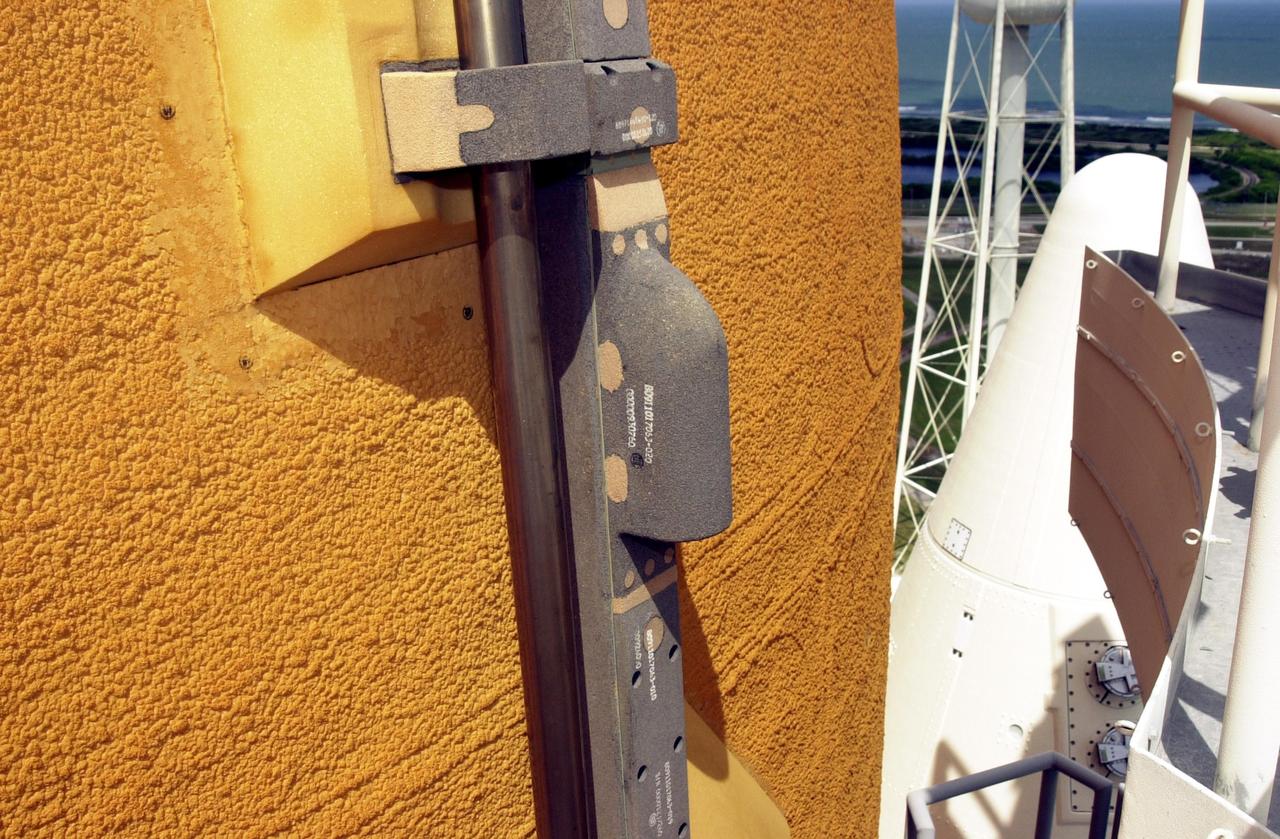
KENNEDY SPACE CENTER, FLA. - A view of the camera mounted on the external tank of Space Shuttle Atlantis. The color video camera mounted to the top of Atlantis' external tank will provide a view of the front and belly of the orbiter and a portion of the solid rocket boosters (SRBs) and external tank during the launch of Atlantis on mission STS-112. It will offer the STS-112 team an opportunity to monitor the shuttle's performance from a new angle. The camera will be turned on fifteen minutes prior to launch and will show the orbiter and solid rocket boosters on the launch pad. The video will be downlinked from the external tank during flight to several NASA data-receiving sites and then relayed to the live television broadcast. The camera is expected to operate for about 15 minutes following liftoff. At liftoff, viewers will see the shuttle clearing the launch tower and, at two minutes after liftoff, see the right SRB separate from the external tank. When the external tank separates from Atlantis about eight minutes into the flight, the camera is expected to continue its live feed for about six more minutes although NASA may be unable to pick up the camera's signal because the tank may have moved out of range.

KENNEDY SPACE CENTER, FLA. -- STS-112 crew members share a few words after their arrival at the KSC Shuttle Landing Facility to begin launch preparations. In the center are Commander Jeffrey Ashby (left) and Mission Specialist David Wolf (right). With their backs to the camera are Mission Specialists Piers Sellers (far left) and Sandra Magnus (far right). Not shown are Pilot Pamela Melroy and Mission Specialist Fyodor Yurchikhin, who is with the Russian Space Agency. STS-112, aboard Space Shuttle Atlantis, is the 15th assembly mission to the International Space Station. Atlantis will be carrying the S1 Integrated Truss Structure, the first starboard truss segment, to be attached to the central truss segment, S0, and the Crew and Equipment Translation Aid (CETA) Cart A. The CETA is the first of two human-powered carts that will ride along the ISS railway, providing mobile work platforms for future spacewalking astronauts. The 11-day mission includes three spacewalks. Launch is scheduled for Oct. 2 between 2 and 6 p.m.
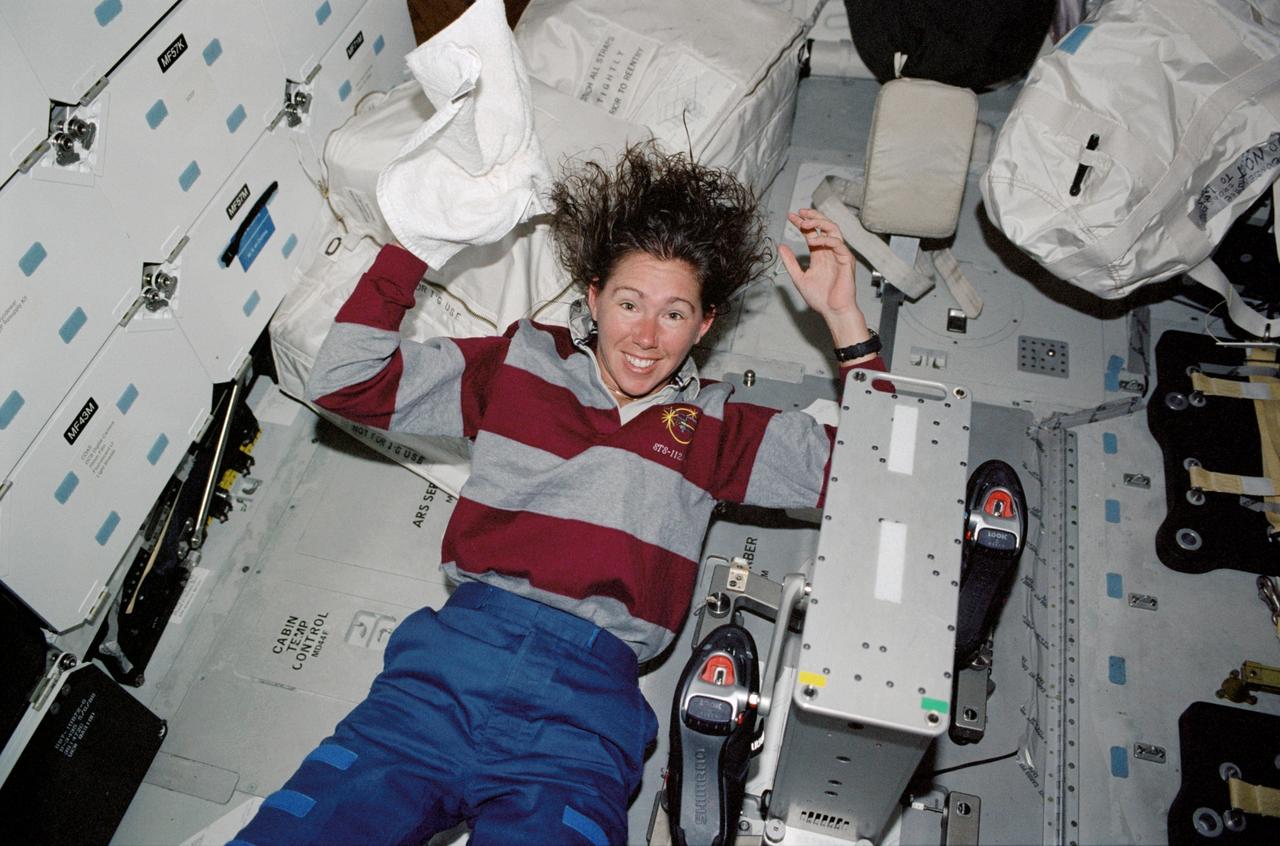
STS112-329-022 (7-18 October 2002) --- Astronaut Sandra H. Magnus, STS-112 mission specialist, washes her hair near a bicycle ergometer on the middeck of the Space Shuttle Atlantis.
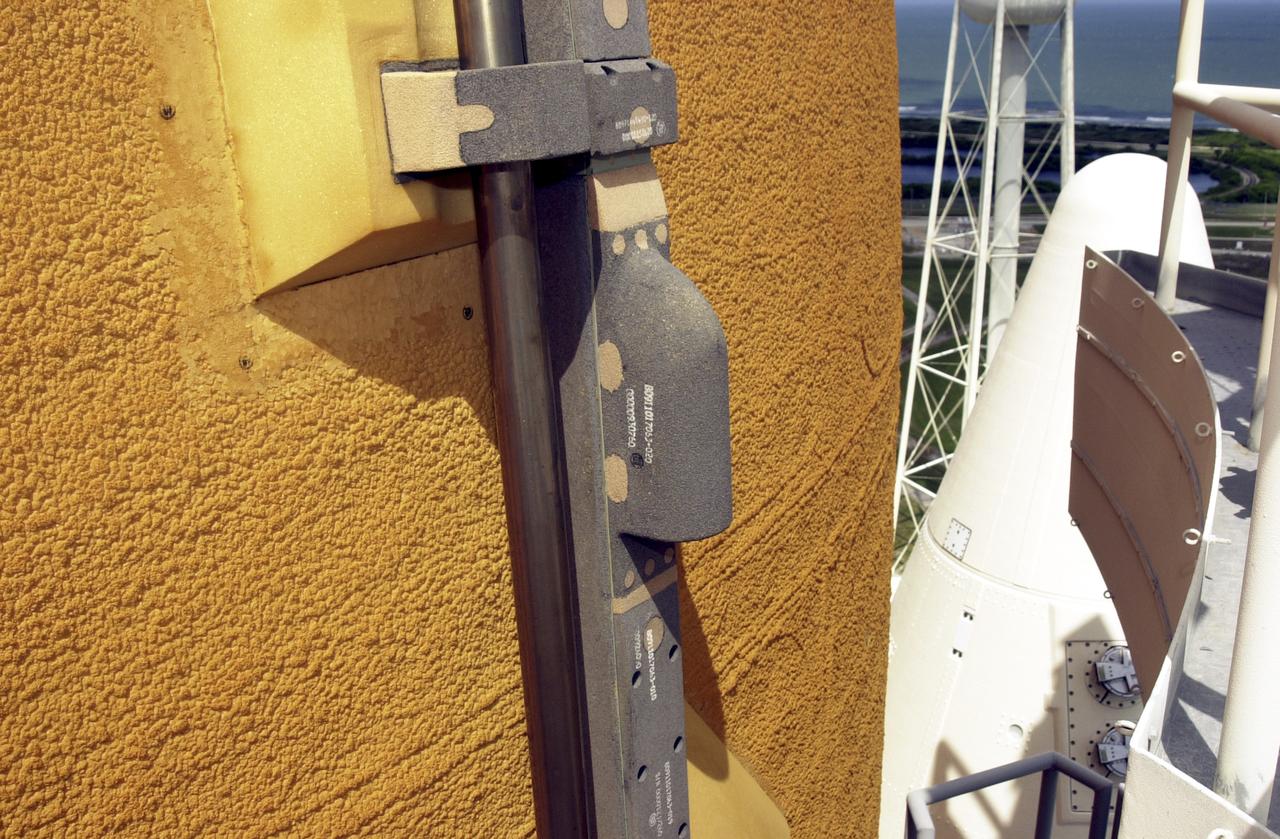
This is a view of the video camera mounted on the External Tank (ET) of the Space Shuttle Orbiter Atlantis (STS-112). The camera provided a view of the front and belly of the orbiter, a portion of the Solid Rocket Boosters (SRBs), and ET during the launch. Located high on the ET liquid oxygen tank cable tray, the camera, 6 inches long and resembling a short thin flashlight, is inside an aluminum fairing covered in protective insulating foam. The battery pack and transmitter are contained in an electronics box and mounted in the intertank crossbeam inside the ET. The camera turned on 15 minutes prior to launch and operated for about 15 minutes following liftoff. At liftoff, viewers saw the Shuttle clearing the launch tower and, at 2 minutes after liftoff, saw the right SRB separate from the ET, and ET separation about 8 minutes into the flight. The video was downlinked from the ET during flight to several NASA data-receiving sites and then relayed to the live television broadcast. It provided the STS-112 team an opportunity to monitor the Shuttle's performance from a new angle. Launched on October 7, 2002, Atlantis carried its primary payload, the S1 Truss for the International Space Station.
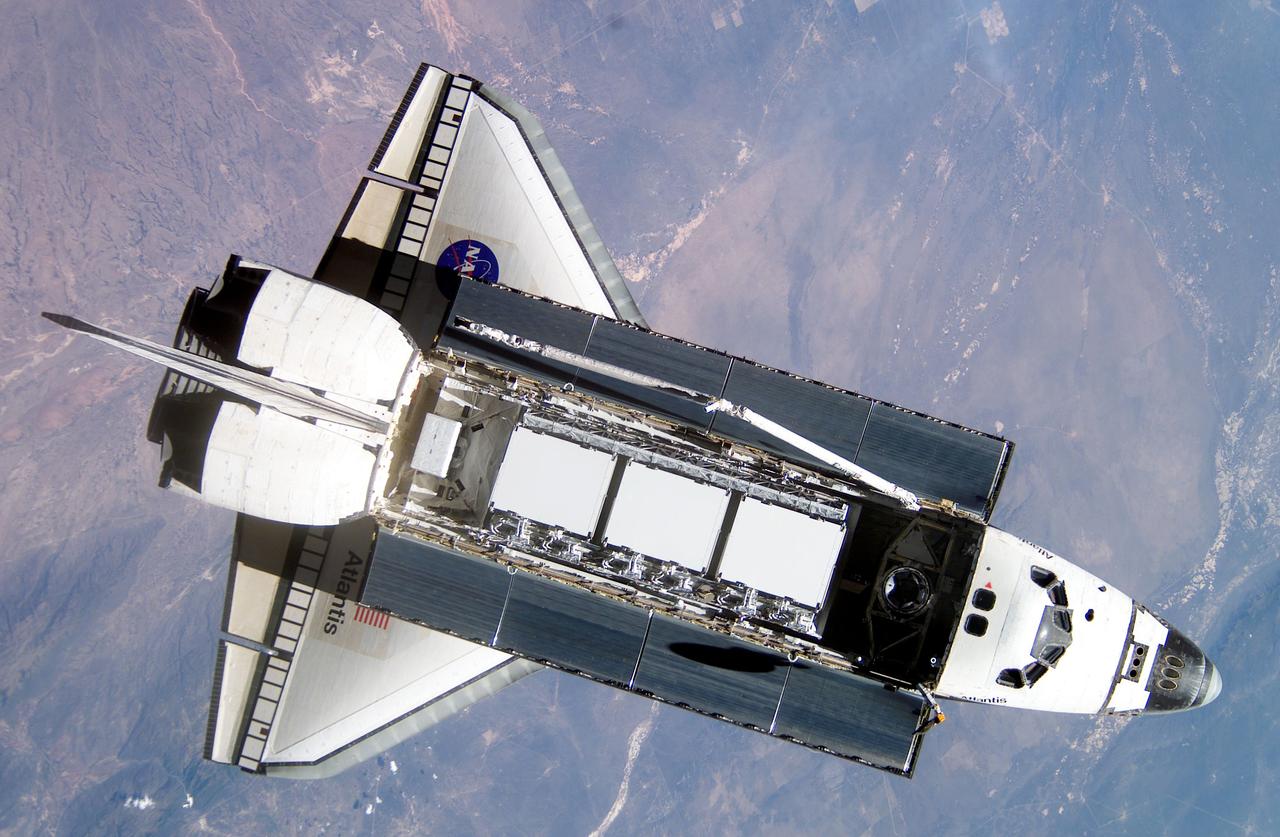
Back dropped against a blue and white Earth, the Space Shuttle Orbiter Atlantis was photographed by an Expedition 5 crew member onboard the International Space Station (ISS) during rendezvous and docking operations. Docking occurred at 10:17 am on October 9, 2002. The Starboard 1 (S1) Integrated Truss Structure, the primary payload of the STS-112 mission, can be seen in Atlantis' cargo bay. Installed and outfitted within 3 sessions of Extravehicular Activity (EVA) during the 11 day mission, the S1 truss provides structural support for the orbiting research facility's radiator panels, which use ammonia to cool the Station's complex power system. The S1 truss, attached to the S0 (S Zero) truss installed by the previous STS-110 mission, flows 637 pounds of anhydrous ammonia through three heat rejection radiators.
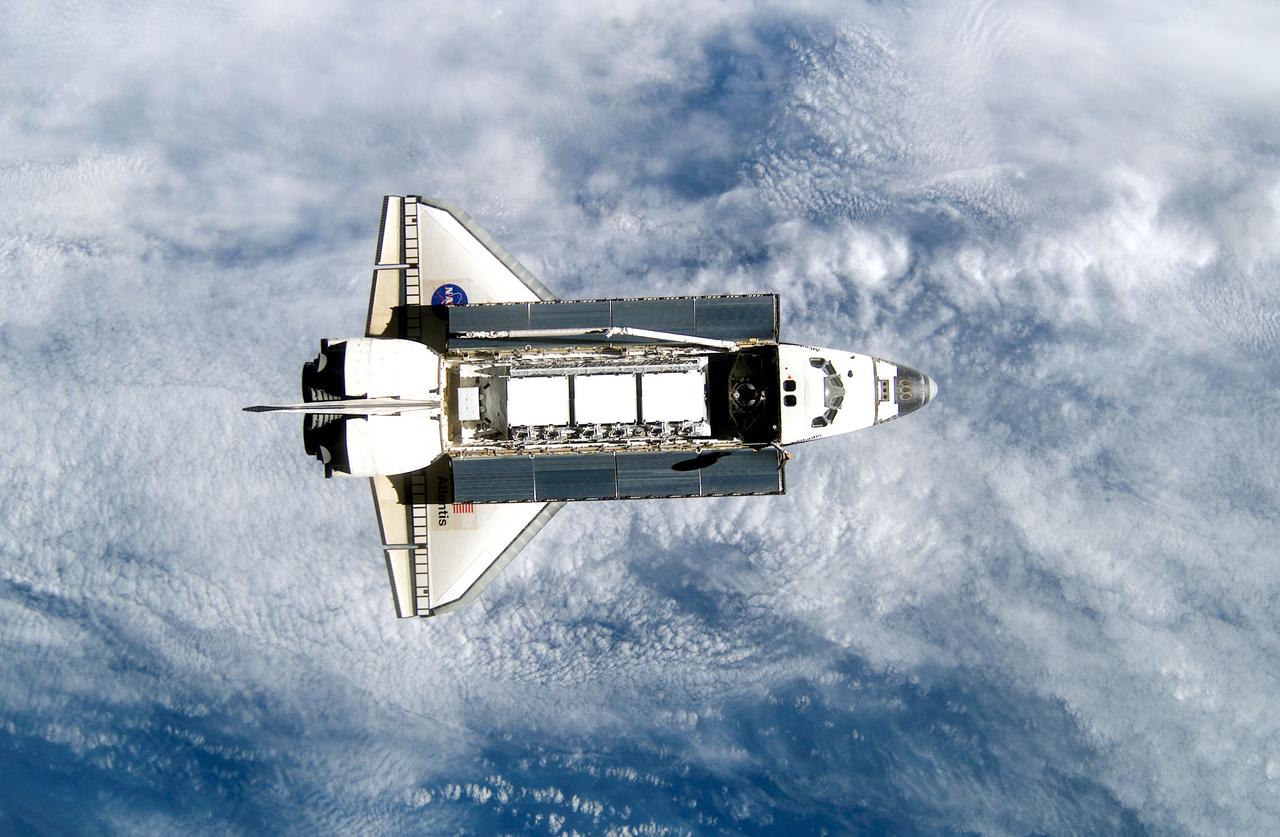
Back dropped against a blue and white Earth, the Space Shuttle Orbiter Atlantis was photographed by an Expedition 5 crew member onboard the International Space Station (ISS) during rendezvous and docking operations. Docking occurred at 10:17 am on October 9, 2002. The Starboard 1 (S1) Integrated Truss Structure, the primary payload of the STS-112 mission, can be seen in Atlantis' cargo bay. Installed and outfitted within 3 sessions of Extravehicular Activity (EVA) during the 11 day mission, the S1 truss provides structural support for the orbiting research facility's radiator panels, which use ammonia to cool the Station's complex power system. The S1 truss, attached to the S0 (S Zero) truss installed by the previous STS-110 mission, flows 637 pounds of anhydrous ammonia through three heat rejection radiators.
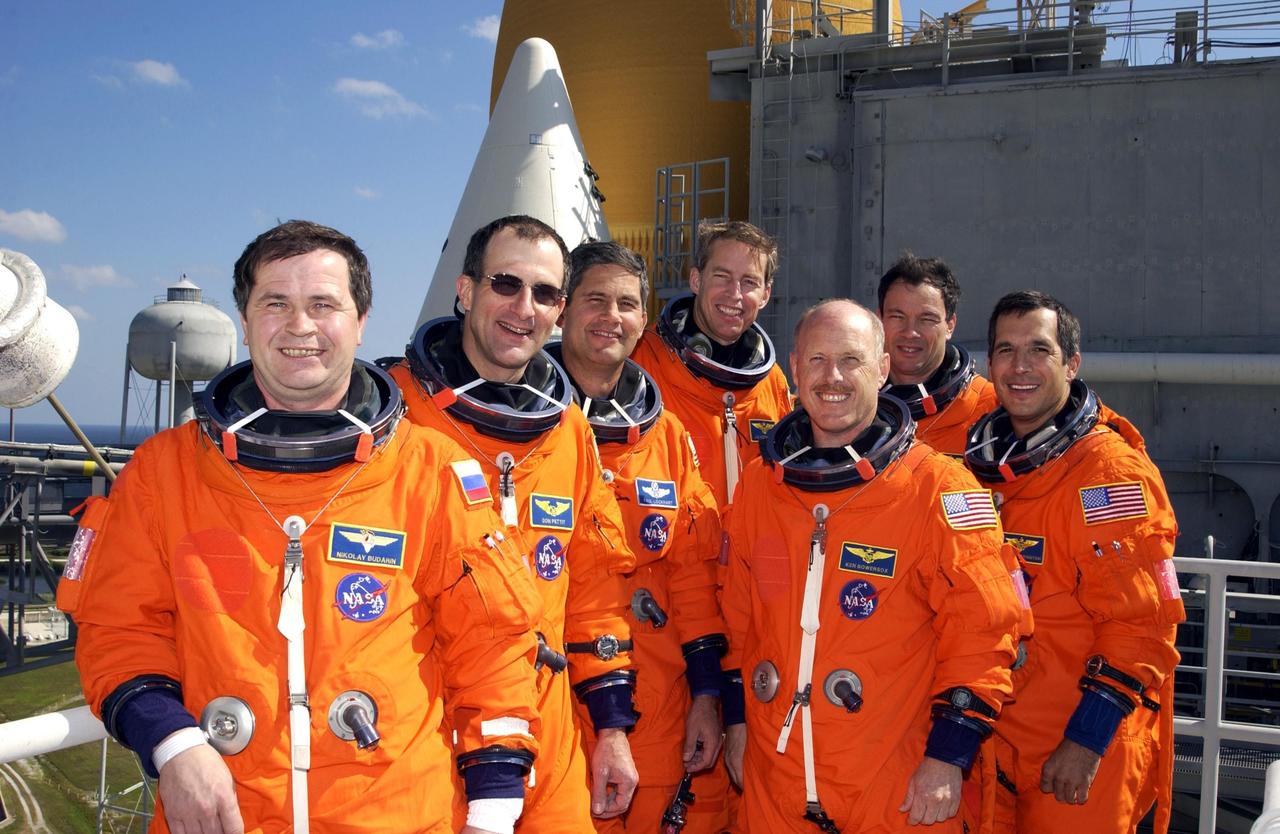
KENNEDY SPACE CENTER, FLA. -- The crews of Mission STS-113 gather for a group photograph on the 195-foot level of the Fixed Service Structure on Launch Pad 39A. From left are Expedition 6 cosmonaut Nikolai Budarin and astronaut Donald Pettit; STS-113 Pilot Paul Lockhart and Commander James Wetherbee; Expedition 6 Commander Ken Bowersox; STS-113 Mission Specialists Michael Lopez-Alegria and John Herrington. They have been participating in emergency egress training, part of Terminal Countdown Demonstration Test activities in preparation for their launch. The 16th assembly flight to the International Space Station, STS-113 will carry the Port 1 (P1) truss aboard Space Shuttle Endeavour, as well as Expedition 6, who will replace Expedition 5 on the Station. The mission is scheduled to launch Nov. 10, 2002.
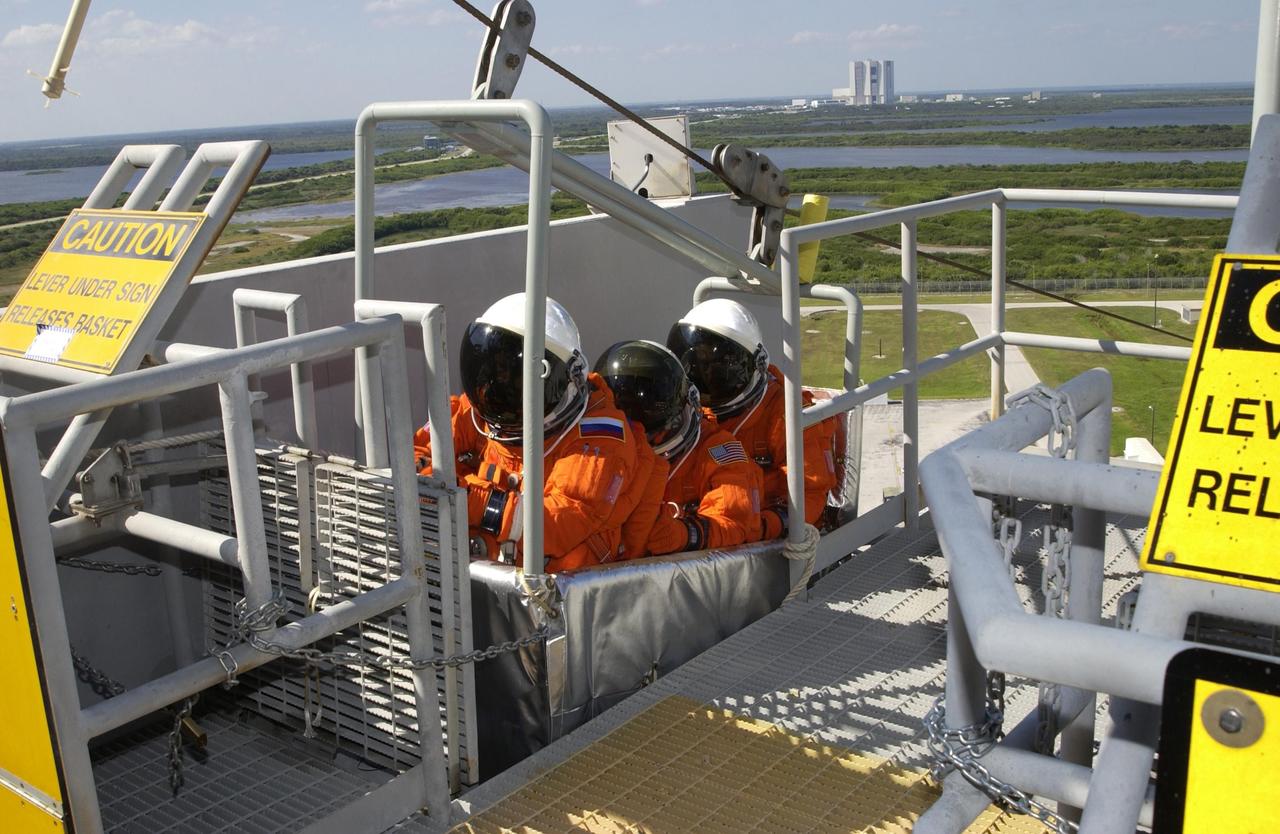
KENNEDY SPACE CENTER, FLA. -- The Expedition 6 crew practice emergency egress from the 195-foot level of the Fixed Service Structure on Launch Pad 39A. In the slidewire basket are (from left) cosmonaut Nikolai Budarin, astronaut Donald Pettit and Commander Ken Bowersox. The crew, travelers on Mission STS-113, will be replacing Expedition 5 on the International Space Station. Along with Expedition 6, STS-113 will carry the Port 1 (P1) truss aboard Space Shuttle Endeavour. Mission STS-113 is scheduled to launch Nov. 10, 2002.
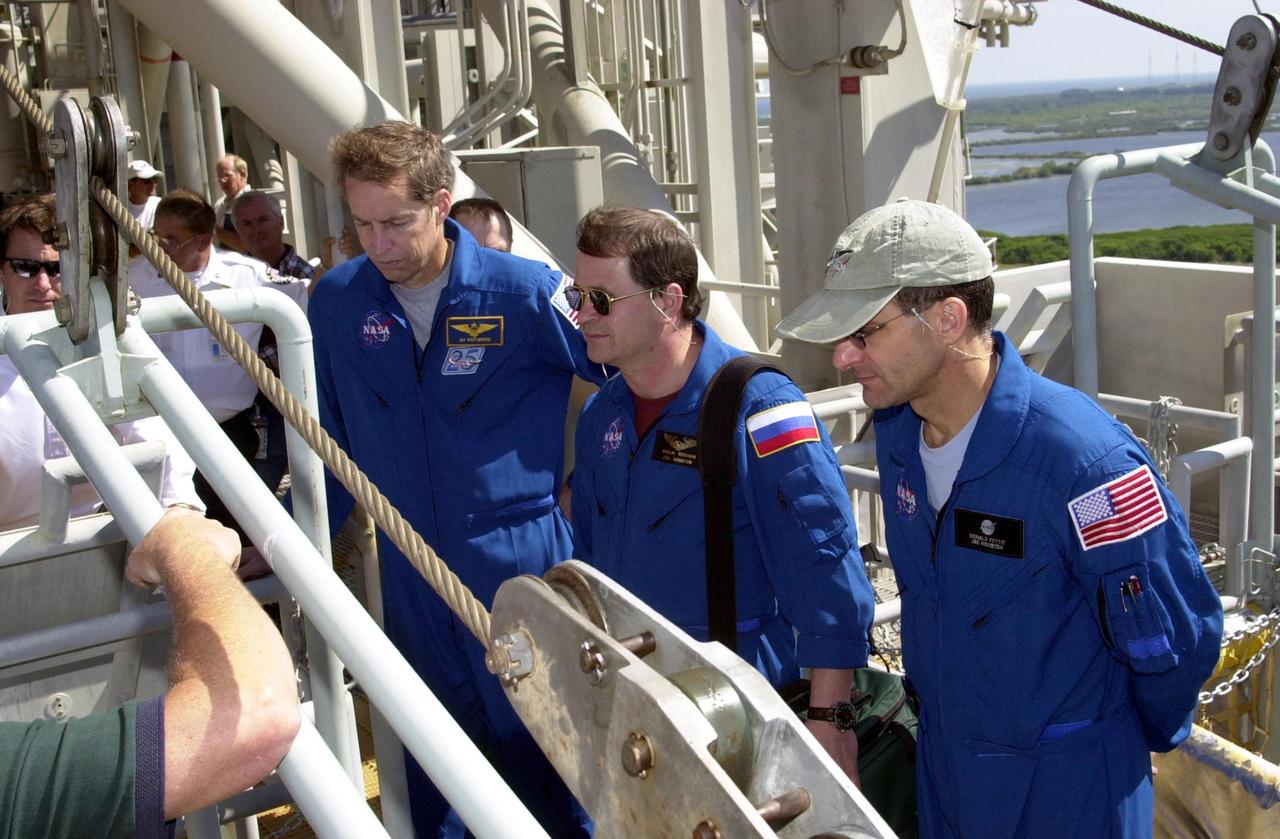
KENNEDY SPACE CENTER, FLA. - As part of Terminal Countdown Demonstration Test (TCDT) activities, the STS-113 and Expedition 6 crews receive training in emergency exit from the orbiter on Launch Pad 39A. Shown are (from left) Mission Commander James Wetherbee and cosmonaut Nikolai Budarin and astronaut Donald Pettit of the Expedition 6 crew. The TCDT also includes a simulated launch countdown. The 16th assembly flight to the International Space Station, STS-113 will carry the Port 1 (P1) truss aboard Space Shuttle Endeavour as well as the Expedition 6 crew, who will replace Expedition 5 on the Station. Mission STS-113 is scheduled to launch Nov. 10, 2002.
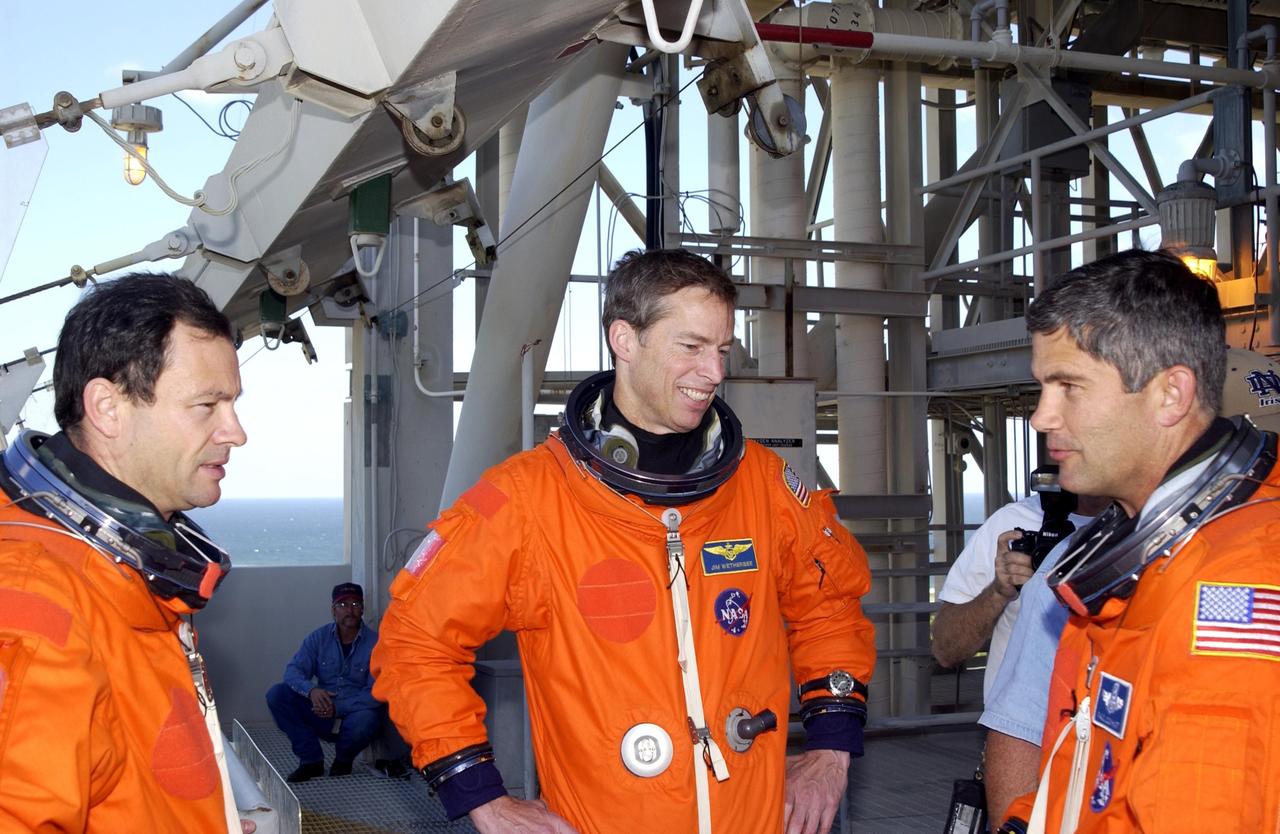
KENNEDY SPACE CENTER, FLA. -- STS-113 crew members pause during a break in emergency egress practice from the 195-foot level of the Fixed Service Structure on Launch Pad 39A. From left are Mission Specialist Michael Lopez-Alegria, Commander James Wetherbee and Pilot Paul Lockhart. The 16th assembly flight to the International Space Station, STS-113 will carry the Port 1 (P1) truss aboard Space Shuttle Endeavour, as well as Expedition 6, who will replace Expedition 5 on the Station. The mission is scheduled to launch Nov. 10, 2002.
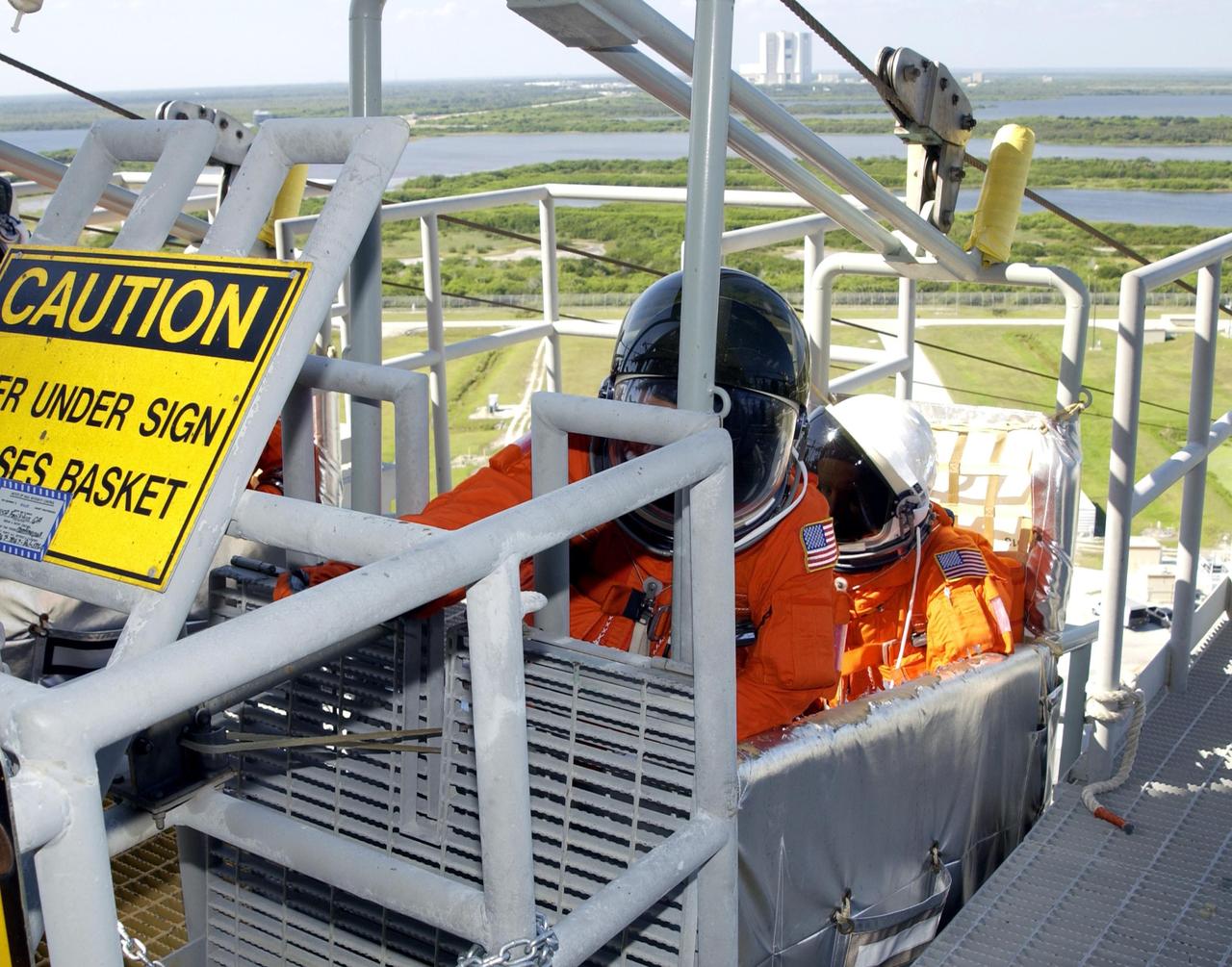
KENNEDY SPACE CENTER, FLA. - STS-113 Commander James Wetherbee (left) reaches for the release level on the slidewire basket during emergency egress practice from the 195-foot level of the Fixed Service Structure on Launch Pad 39A. At right is Pilot Paul Lockhart. The 16th assembly flight to the International Space Station, STS-113 will carry the Port 1 (P1) truss aboard Space Shuttle Endeavour as well as the Expedition 6 crew, who will replace Expedition 5 on the Station. Mission STS-113 is scheduled to launch Nov. 10, 2002.
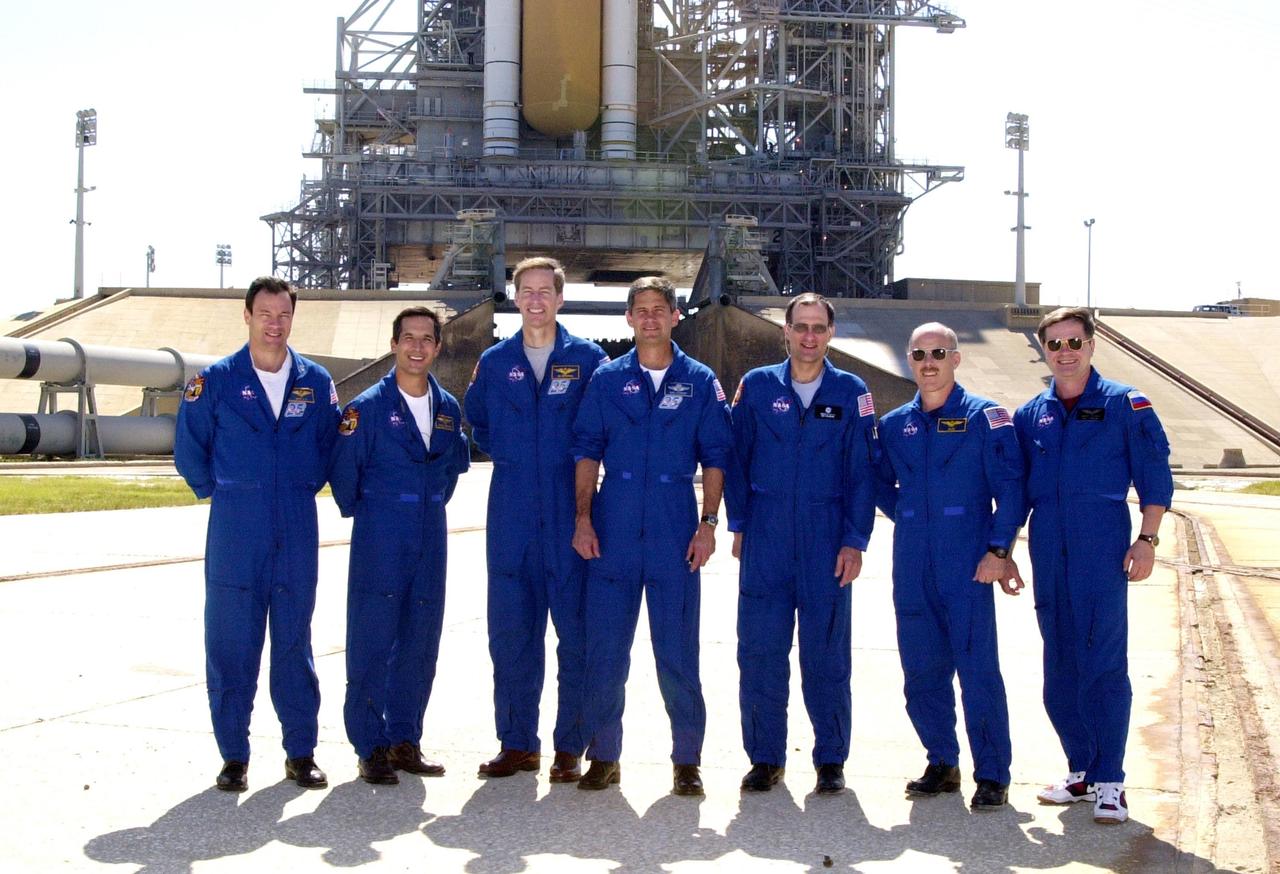
KENNEDY SPACE CENTER, FLA. - The STS-113 and Expedition 6 crews pause for a photo during Terminal Countdown Demonstration Test activities at the pad. From left are STS-113 Mission Specialists Michael Lopez-Alegria and John Herrington, Commander James Wetherbee and Pilot Paul Lockhart; Expedition 6 astronaut Donald Pettit, Commander Ken Bowersox and cosmonaut Nikolai Budarin. The TCDT also includes a simulated launch countdown. The 16th assembly flight to the International Space Station, STS-113 will carry the Port 1 (P1) truss aboard Space Shuttle Endeavour as well as the Expedition 6 crew, who will replace Expedition 5 on the Station. Mission STS-113 is scheduled to launch Nov. 10, 2002.
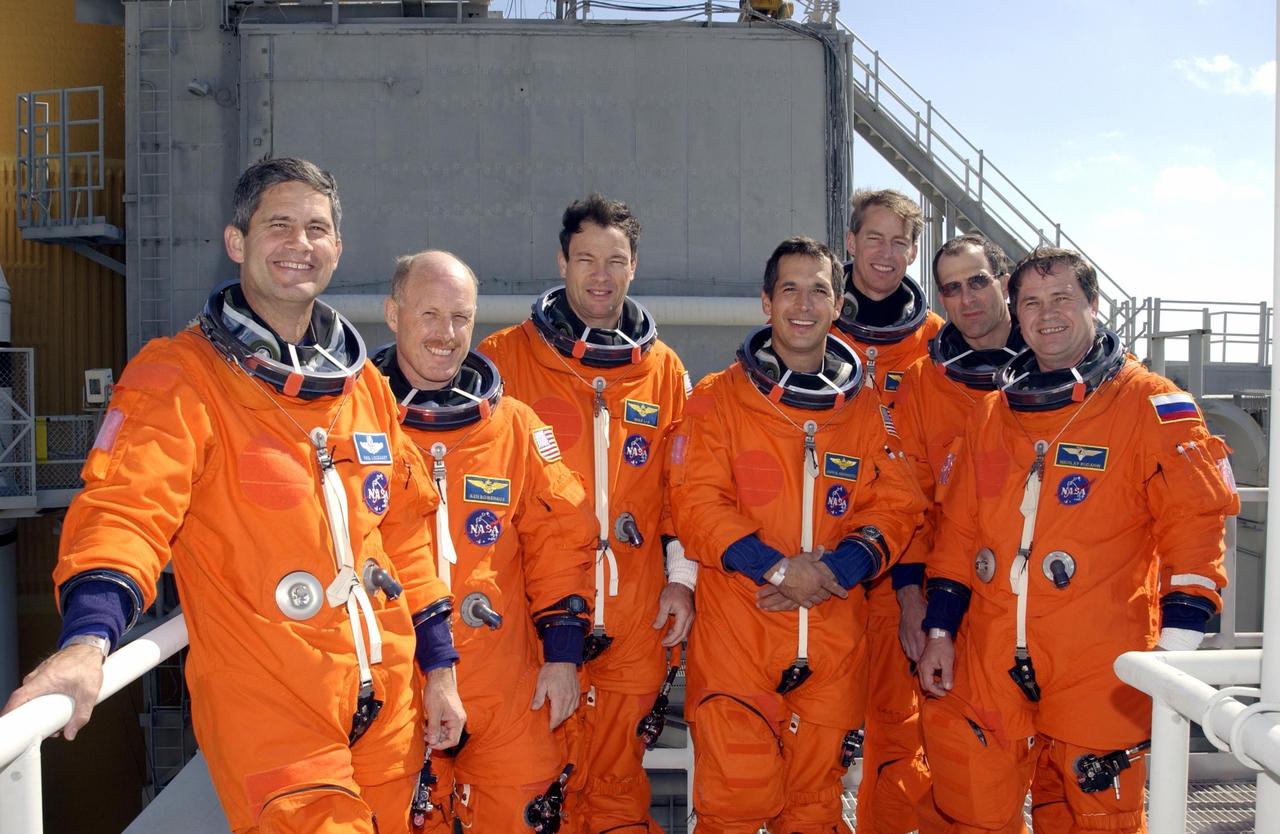
KENNEDY SPACE CENTER, FLA. -- The crews of Mission STS-113 gather for a group photograph on the 195-foot level of the Fixed Service Structure on Launch Pad 39A. From left are STS-113 Pilot Paul Lockhart; Expedition 6 Commander Ken Bowersox; STS-113 Mission Specialists Michael Lopez-Alegria and John Herrington, and Commander James Wetherbee; Expedition 6 astronaut Donald Pettit and cosmonaut Nikolai Budarin. They have been participating in emergency egress training, part of Terminal Countdown Demonstration Test activities in preparation for their launch. The 16th assembly flight to the International Space Station, STS-113 will carry the Port 1 (P1) truss aboard Space Shuttle Endeavour, as well as Expedition 6, who will replace Expedition 5 on the Station. The mission is scheduled to launch Nov. 10, 2002.
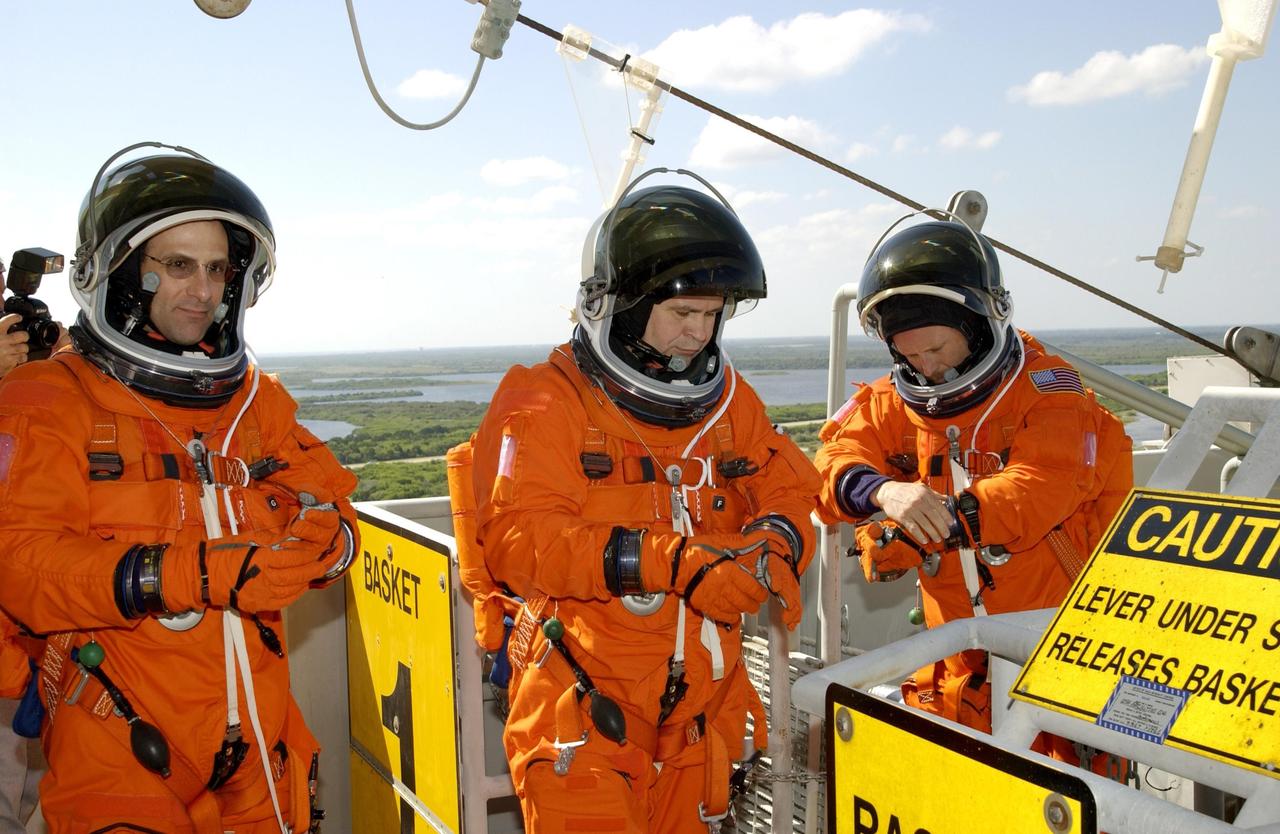
KENNEDY SPACE CENTER, FLA. - The Expedition 6 crew adjust their gloves during emergency egress practice from the 195-foot level of the Fixed Service Structure on Launch Pad 39A. From left are astronaut Donald Pettit, cosmonaut Nikolai Budarin and Commander Ken Bowersox. The crew, travelers on Mission STS-113, will be replacing Expedition 5 on the International Space Station. Along with Expedition 6, STS-113 will carry the Port 1 (P1) truss aboard Space Shuttle Endeavour. Mission STS-113 is scheduled to launch Nov. 10, 2002.
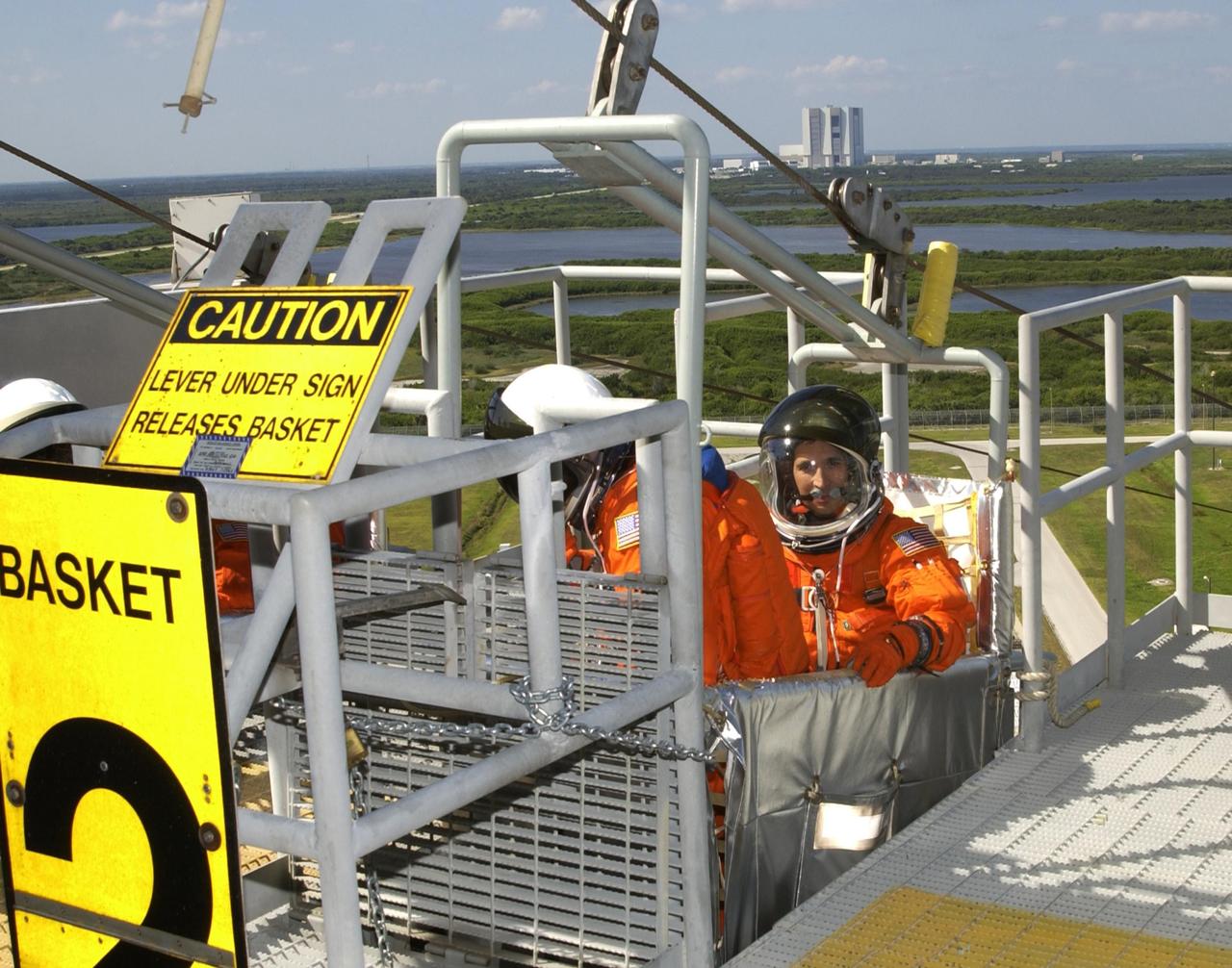
KENNEDY SPACE CENTER, FLA. - STS-113 Mission Specialists Michael Lopez-Alegria (left) and John Herrington (right) climb into the slidewire basket during emergency egress practice from the 195-foot level of the Fixed Service Structure on Launch Pad 39A. The 16th assembly flight to the International Space Station, STS-113 will carry the Port 1 (P1) truss aboard Space Shuttle Endeavour as well as the Expedition 6 crew, who will replace Expedition 5 on the Station. Mission STS-113 is scheduled to launch Nov. 10, 2002.
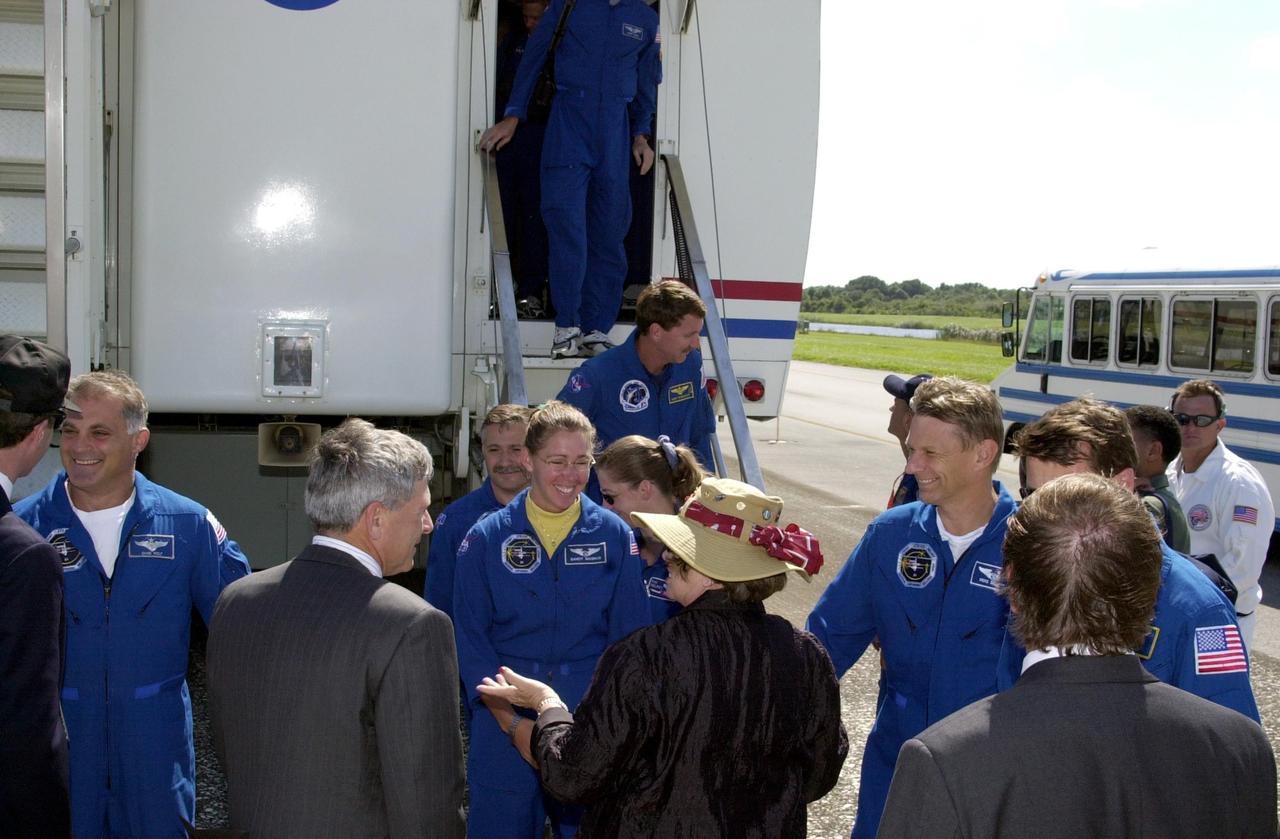
KENNEDY SPACE CENTER, FLA. -- As the STS-112 crew leaves the crew transport vehicle, they are greeted by mission managers and guests. The crew, from left, are Mission Specialists David Wolf, Fyodor Yurchikhin and Sandra Magnus; Pilot Pamela Melroy; Piers Sellers (talking to Acting Deputy Director JoAnn Morgan) and Commander Jeffrey Ashby (talking to Launch Director Mike Leinbach). Morgan is also Director of External Relations and Business Development. The crew returned to KSC after completing a 4.5-million-mile journey to the International Space Station. Main gear touchdown occurred at 11:43:40 a.m. EDT; nose gear touchdown at 11:43:48 a.m.; and wheel stop at 11:44:35 a.m. Mission elapsed time was 10:19:58:44. Mission STS-112 expanded the size of the Station with the addition of the S1 truss segment. .
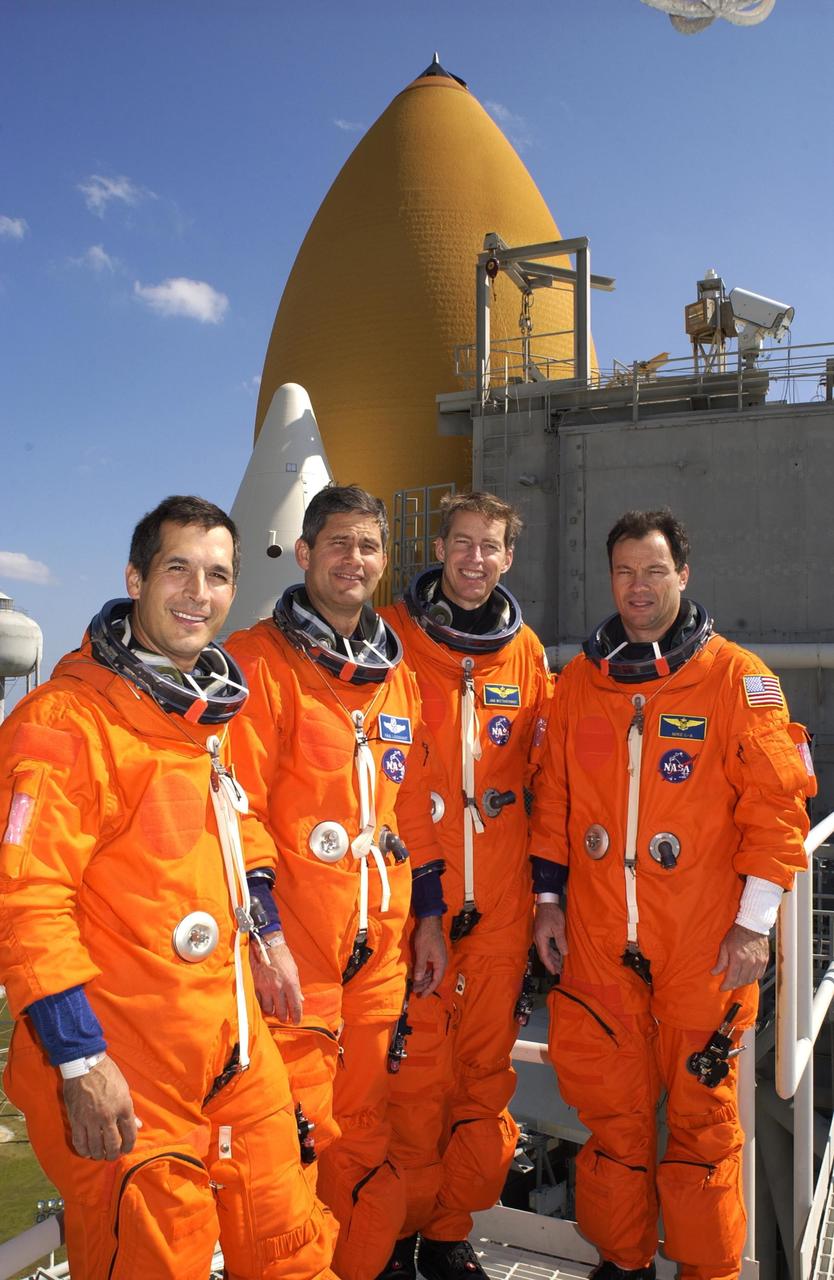
KENNEDY SPACE CENTER, FLA. -- The STS-113 crew poses for a photo on 195-foot level of the Fixed Service Structure on Launch Pad 39A. From left are Mission Specialist John Herrington, Pilot Paul Lockhart, Commander James Wetherbee and Mission Specialist Michael Lopez-Alegria. Along with the Expedition 6 crew, they have been participating in emergency egress training, part of Terminal Countdown Demonstration Test activities in preparation for their launch. The 16th assembly flight to the International Space Station, STS-113 will carry the Port 1 (P1) truss aboard Space Shuttle Endeavour, as well as Expedition 6, who will replace Expedition 5 on the Station. The mission is scheduled to launch Nov. 10, 2002.
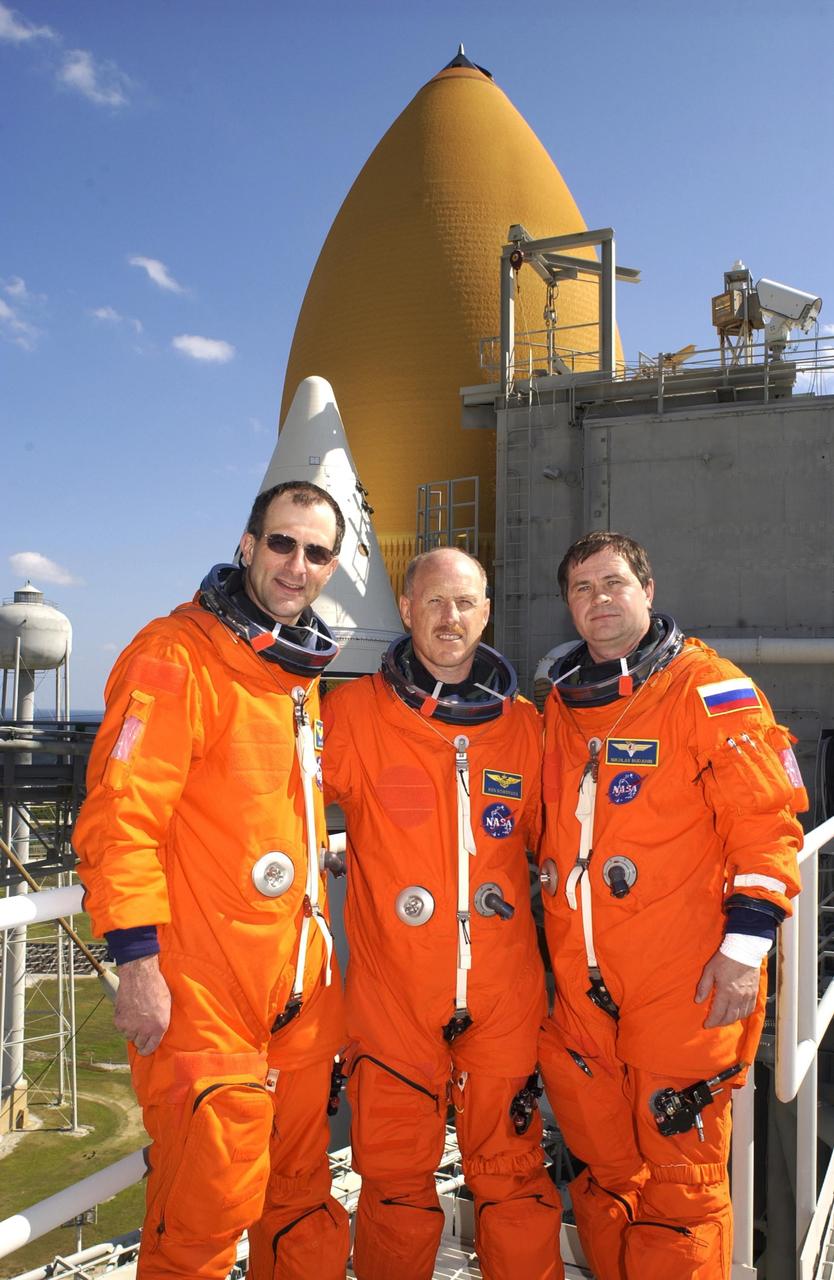
KENNEDY SPACE CENTER, FLA. - The Expedition 6 crew poses for a photo on 195-foot level of the Fixed Service Structure on Launch Pad 39A. From left are astronaut Donald Pettit, Commander Ken Bowersox and cosmonaut Nikolai Budarin. Along with the STS-113 crew, they have been participating in emergency egress training, part of Terminal Countdown Demonstration Test activities in preparation for their launch. The 16th assembly flight to the International Space Station, STS-113 will carry the Port 1 (P1) truss aboard Space Shuttle Endeavour, as well as Expedition 6, who will replace Expedition 5 on the Station. The mission is scheduled to launch Nov. 10, 2002.
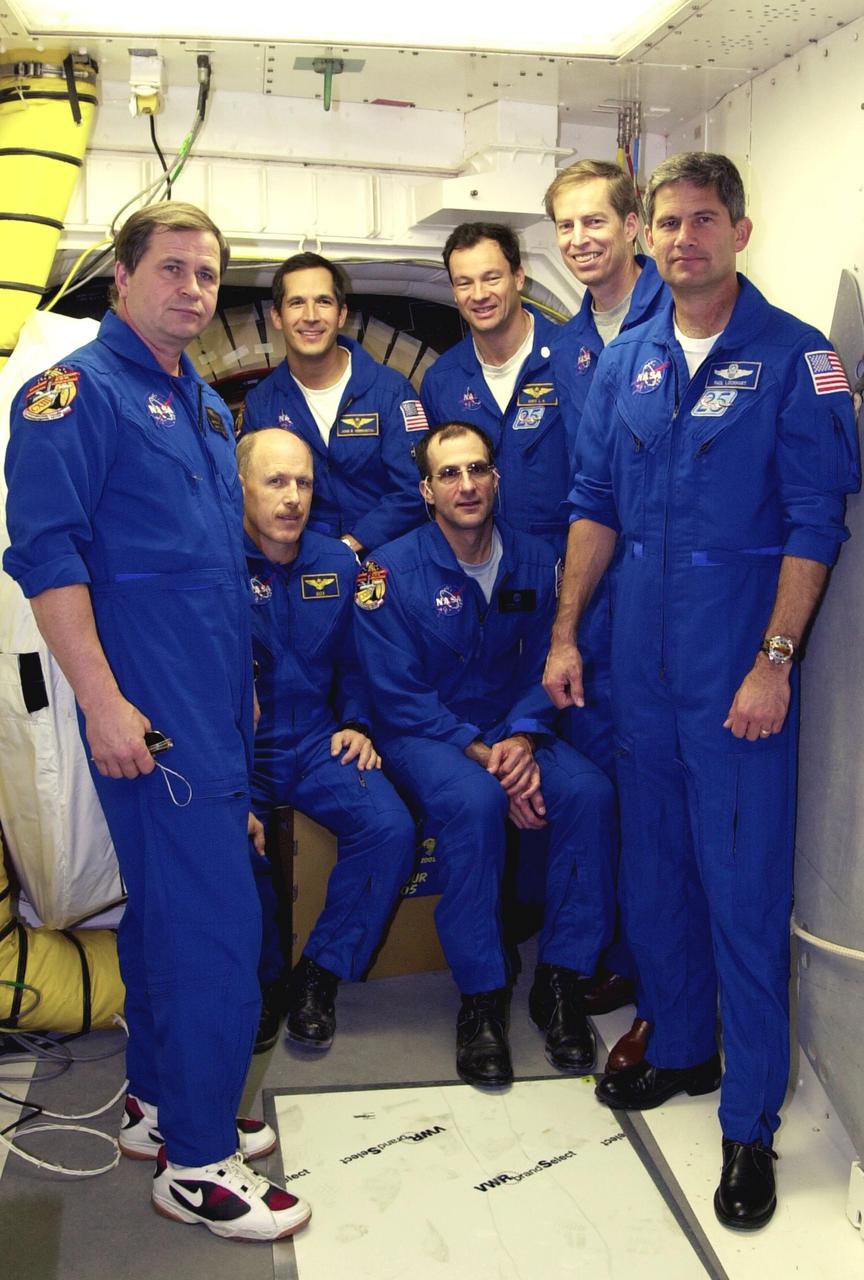
KENNEDY SPACE CENTER, FLA. -- At the entrance to Space Shuttle Endeavour's cockpit, the STS-113 and Expedition 6 crews gather for a photo during Terminal Countdown Demonstration Test activities at the pad. From left, in front, are cosmonaut Nikolai Budarin, Commander Ken Bowersox and astronaut Donald Pettit of Expedition 6, and STS-113 Pilot Paul Lockhart. In back, from left, are STS-113 Mission Specialists John Herrington and Michael Lopez-Alegria and Commander James Wetherbee. The TCDT also includes a simulated launch countdown. The 16th assembly flight to the International Space Station, STS-113 will carry the Port 1 (P1) truss aboard Space Shuttle Endeavour as well as the Expedition 6 crew, who will replace Expedition 5 on the Station. Mission STS-113 is scheduled to launch Nov. 10, 2002.
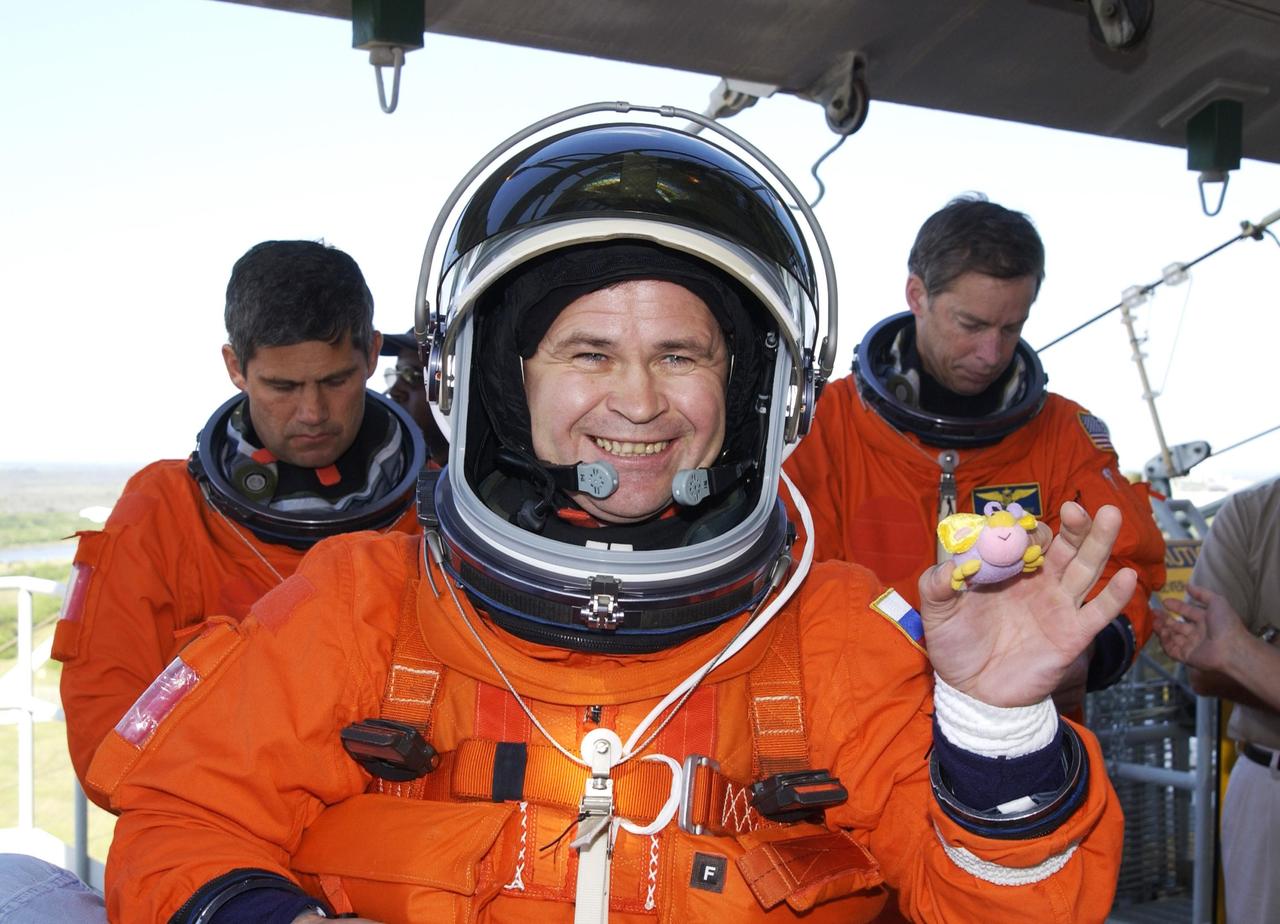
KENNEDY SPACE CENTER, FLA. - Expedition 6 cosmonaut Nikolai Budarin (center) holds a mini-mascot during a break in emergency egress practice from the 195-foot level of the Fixed Service Structure on Launch Pad 39A. Behind him are STS-113 Pilot Paul Lockhart (left) and Commander James Wetherbee. Expedition 6 will be replacing Expedition 5 on the International Space Station. The 16th assembly flight to the International Space Station, STS-113 will carry the Port 1 (P1) truss aboard Space Shuttle Endeavour. The mission is scheduled to launch Nov. 10, 2002.
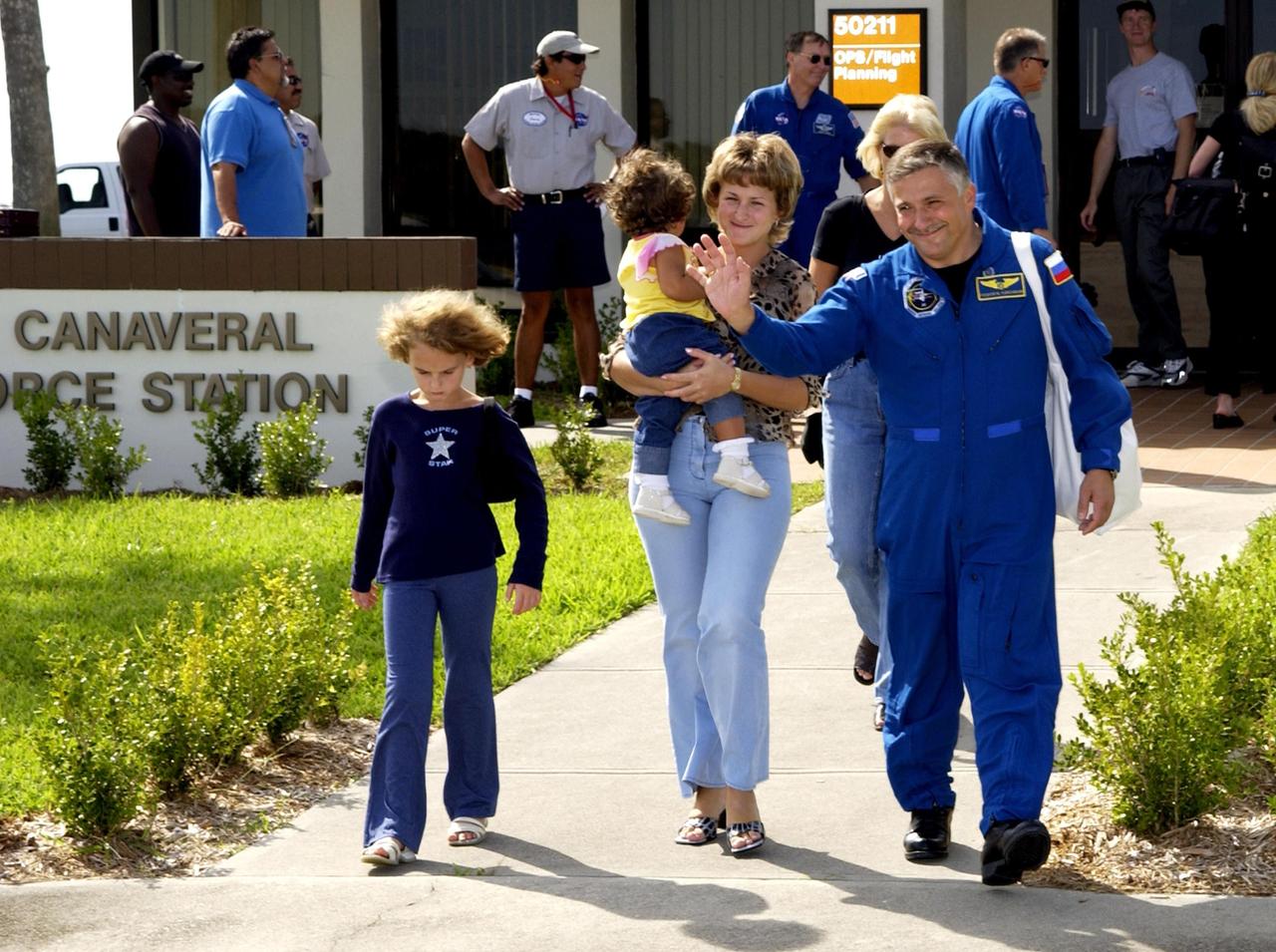
KENNEDY SPACE CENTER, FLA. -- The STS-112 crew departs for Houston after their successful landing Oct. 18 on orbiter Atlantis. Seen with his family is cosmonaut Fyodor Yurchikhin. Mission STS-112 was the 15th assembly flight to the International Space Station, installing the S1 truss. The landing was the 60th at KSC in the history of the Shuttle program.
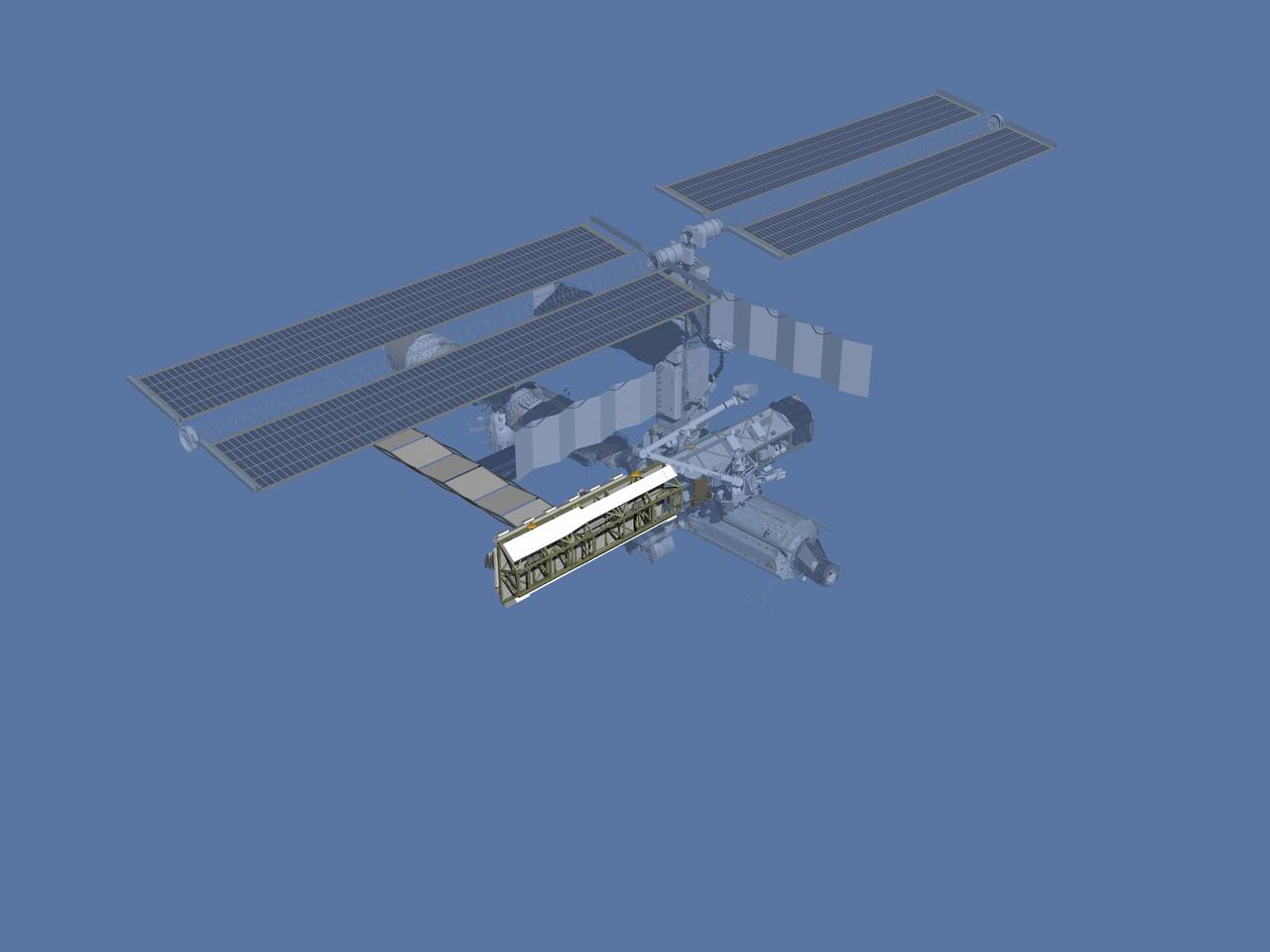
JSC2006-E-43494 (October 2002) --- Computer-generated artist's rendering of the International Space Station after flight STS-112/9A. Space Shuttle Atlantis delivered the S1 truss; the first starboard truss segment; installed by the STS-112 crew.
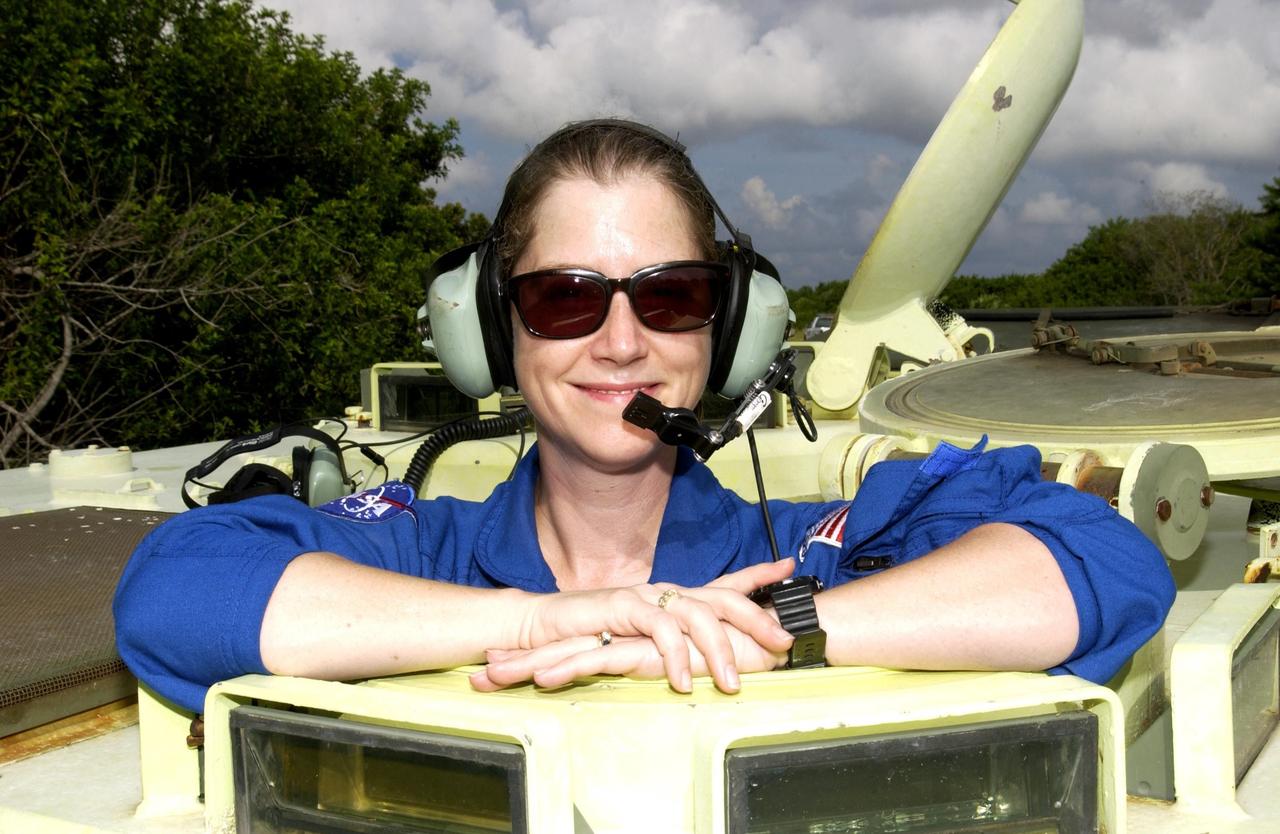
KENNEDY SPACE CENTER, Fla. - STS-112 Pilot Pamela Melroy is ready for her practice run driving the M-113 armored personnel carrier. Melroy and the rest of the crew are at KSC for Terminal Countdown Demonstration Test activities, which also include a simulated launch countdown. Mission STS-112 aboard Space Shuttle Atlantis is scheduled to launch no earlier than Oct. 2, between 2 and 6 p.m. EDT. STS-112 is the 15th assembly mission to the International Space Station. Atlantis will be carrying the S1 Integrated Truss Structure, the first starboard truss segment. The S1 will be attached to the central truss segment, S0, during the 11-day mission.
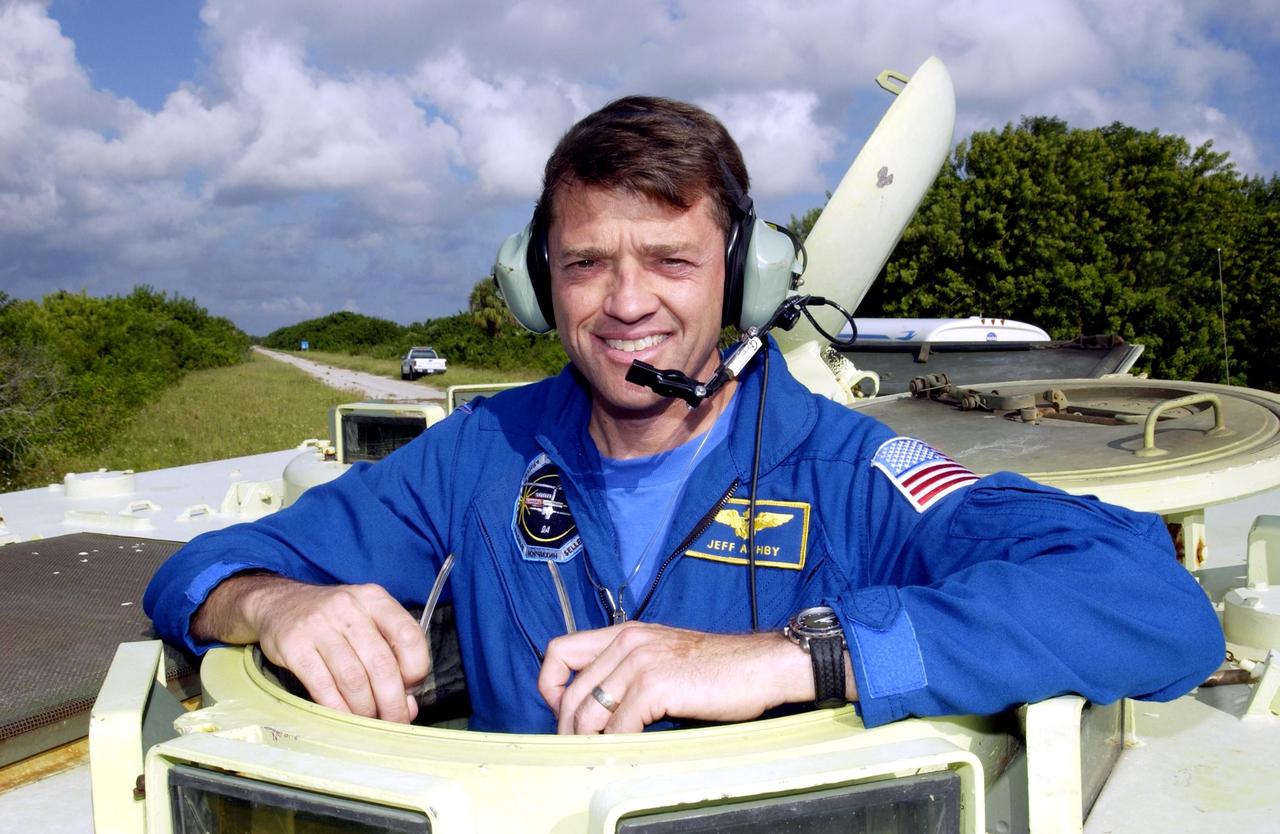
KENNEDY SPACE CENTER, FLA. -- STS-112 Commander Jeffrey Ashby is ready for his practice run driving the M-113 armored personnel carrier. Ashby and the rest of the crew are at KSC for Terminal Countdown Demonstration Test activities, which include emergency egress training and driving the M-113. Mission STS-112 aboard Space Shuttle Atlantis is scheduled to launch no earlier than Oct. 2, between 2 and 6 p.m. EDT. STS-112 is the 15th assembly mission to the International Space Station. Atlantis will be carrying the S1 Integrated Truss Structure, the first starboard truss segment. The S1 will be attached to the central truss segment, S0, during the 11-day mission.

KENNEDY SPACE CENTER, Fla. - STS-112 Mission Specialist David Wolf is ready for his practice run driving the M-113 armored personnel carrier. Wolf and the rest of the crew are at KSC for Terminal Countdown Demonstration Test activities, which also include a simulated launch countdown. Mission STS-112 aboard Space Shuttle Atlantis is scheduled to launch no earlier than Oct. 2, between 2 and 6 p.m. EDT. STS-112 is the 15th assembly mission to the International Space Station. Atlantis will be carrying the S1 Integrated Truss Structure, the first starboard truss segment. The S1 will be attached to the central truss segment, S0, during the 11-day mission.
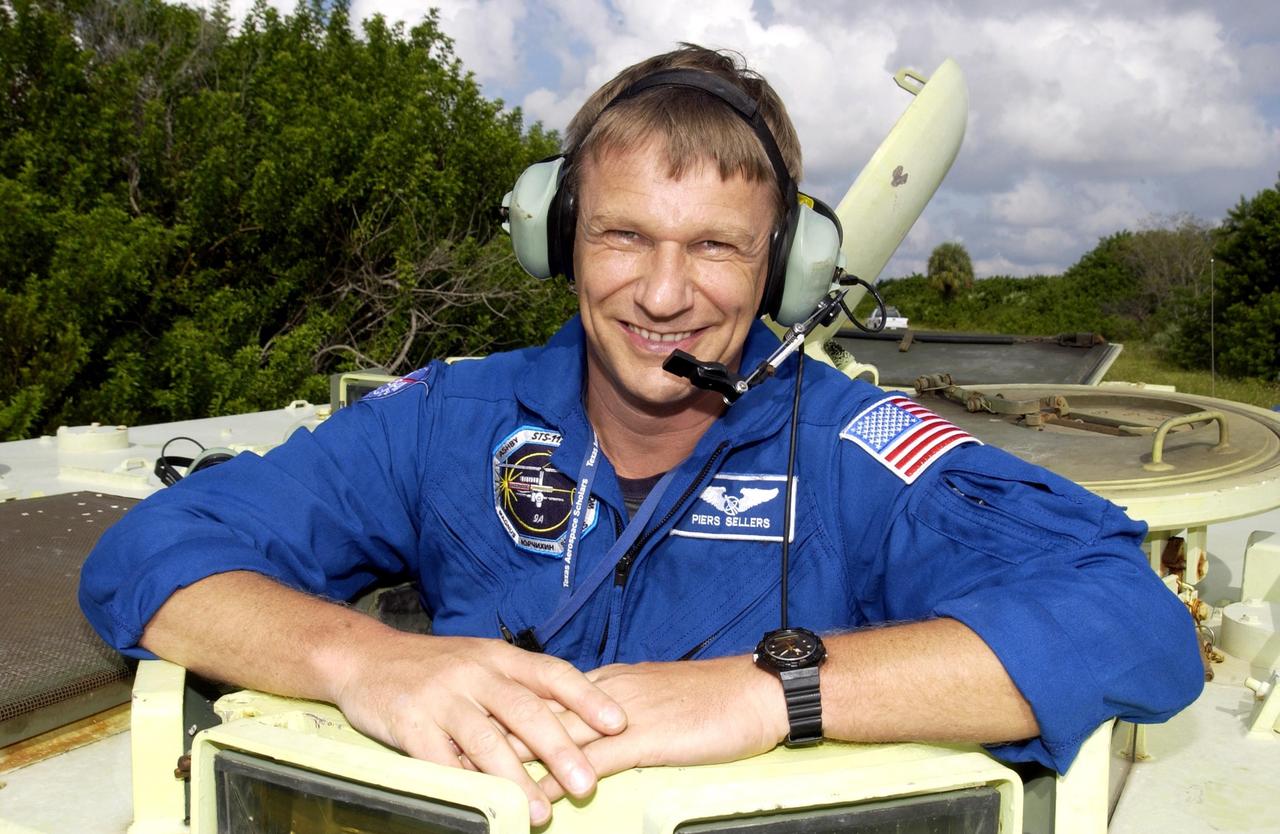
KENNEDY SPACE CENTER, Fla. - STS-112 Mission Specialist Piers Sellers is ready for his practice run driving the M-113 armored personnel carrier. Sellers and the rest of the crew are at KSC for Terminal Countdown Demonstration Test activities, which also include a simulated launch countdown. Mission STS-112 aboard Space Shuttle Atlantis is scheduled to launch no earlier than Oct. 2, between 2 and 6 p.m. EDT. STS-112 is the 15th assembly mission to the International Space Station. Atlantis will be carrying the S1 Integrated Truss Structure, the first starboard truss segment. The S1 will be attached to the central truss segment, S0, during the 11-day mission.
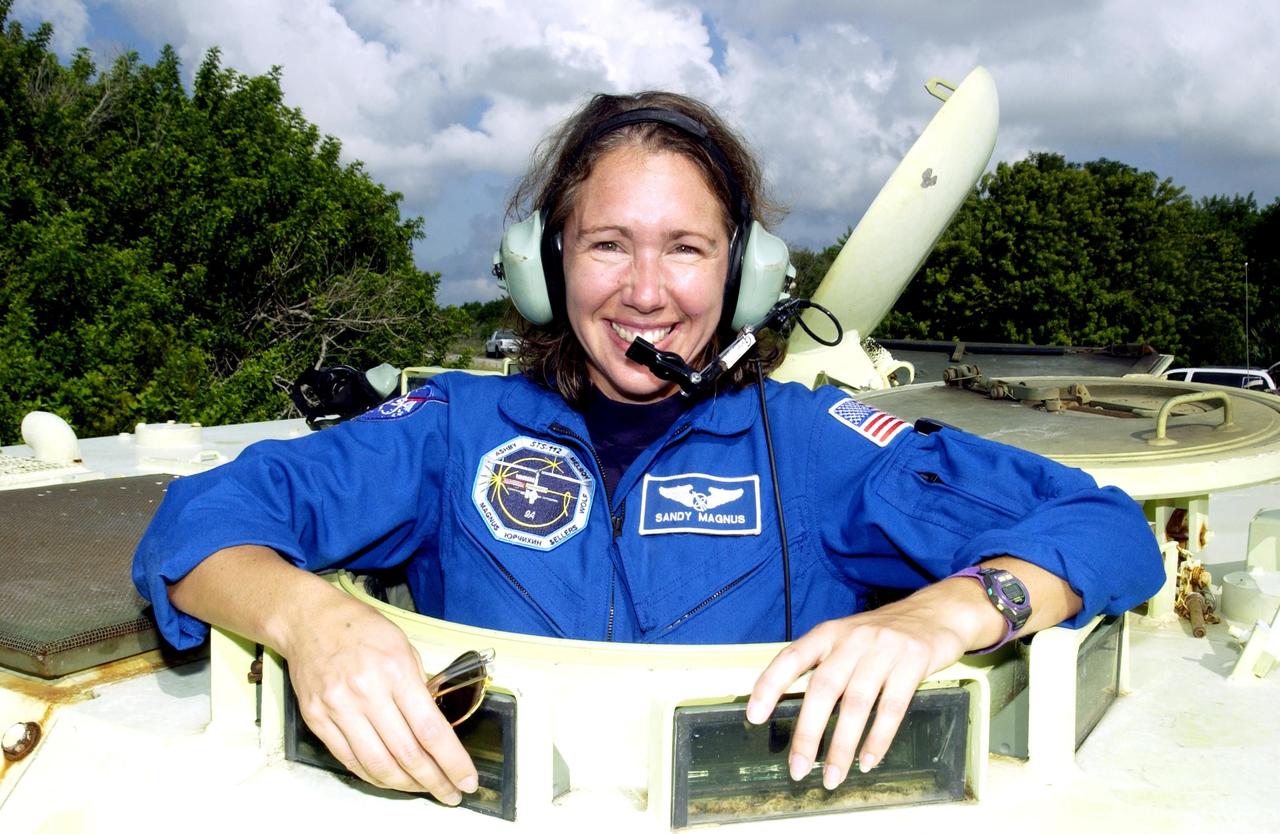
KENNEDY SPACE CENTER, Fla. - STS-112 Mission Specialist Sandra Magnus is ready for her practice run driving the M-113 armored personnel carrier. Magnus and the rest of the crew are at KSC for Terminal Countdown Demonstration Test activities, which also include a simulated launch countdown. Mission STS-112 aboard Space Shuttle Atlantis is scheduled to launch no earlier than Oct. 2, between 2 and 6 p.m. EDT. STS-112 is the 15th assembly mission to the International Space Station. Atlantis will be carrying the S1 Integrated Truss Structure, the first starboard truss segment. The S1 will be attached to the central truss segment, S0, during the 11-day mission.

KENNEDY SPACE CENTER, FLA. --STS-112 Pilot Pamela Melroy prepares to taxi the Shuttle Training Aircraft to the runway at the Shuttle Landing Facility as part of landing exercises.
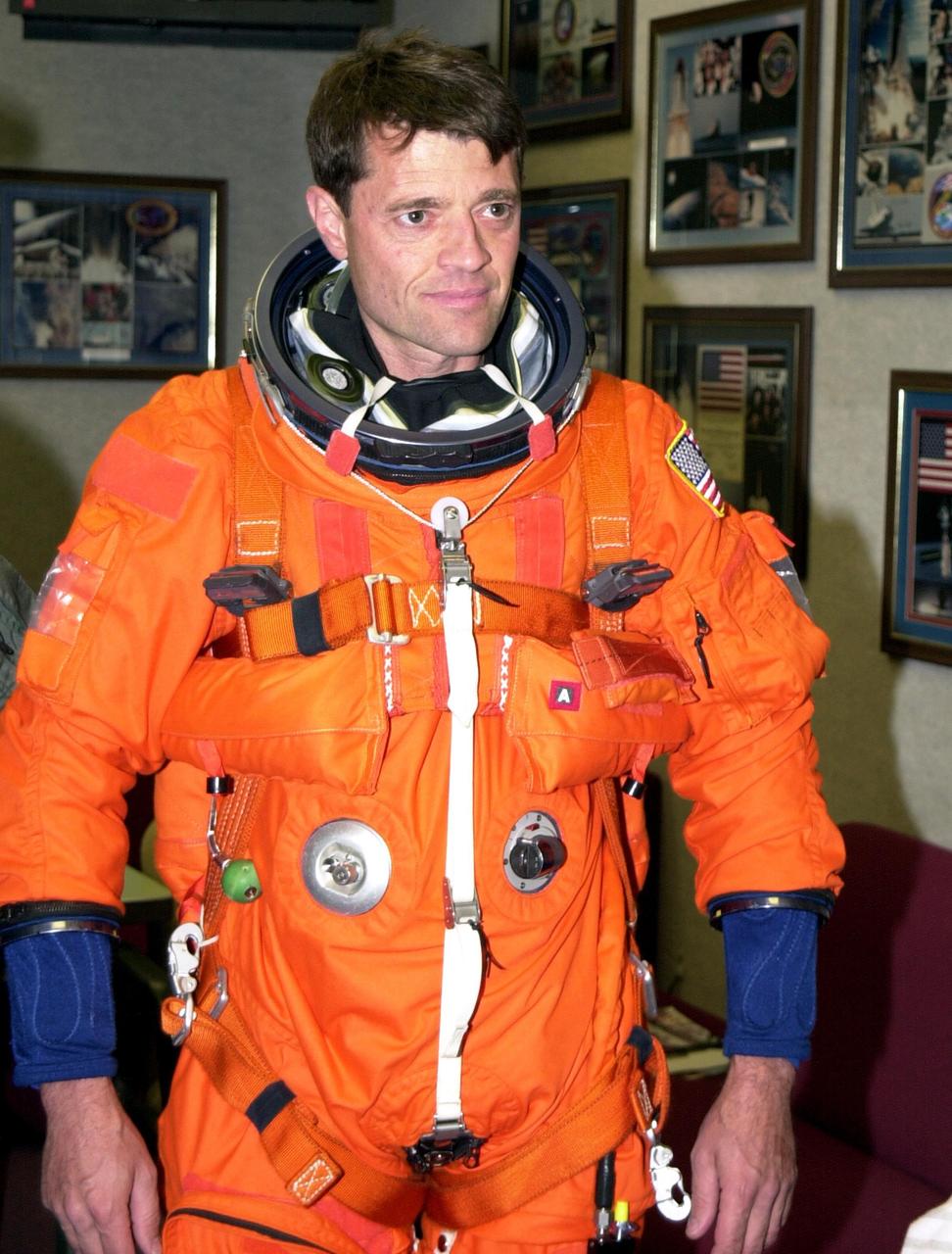
KENNEDY SPACE CENTER, FLA. --STS-112 Commander Jeffrey Ashby is suited up and ready to participate in landing exercises in the Shuttle Training Aircraft at the Shuttle Landing Facility.
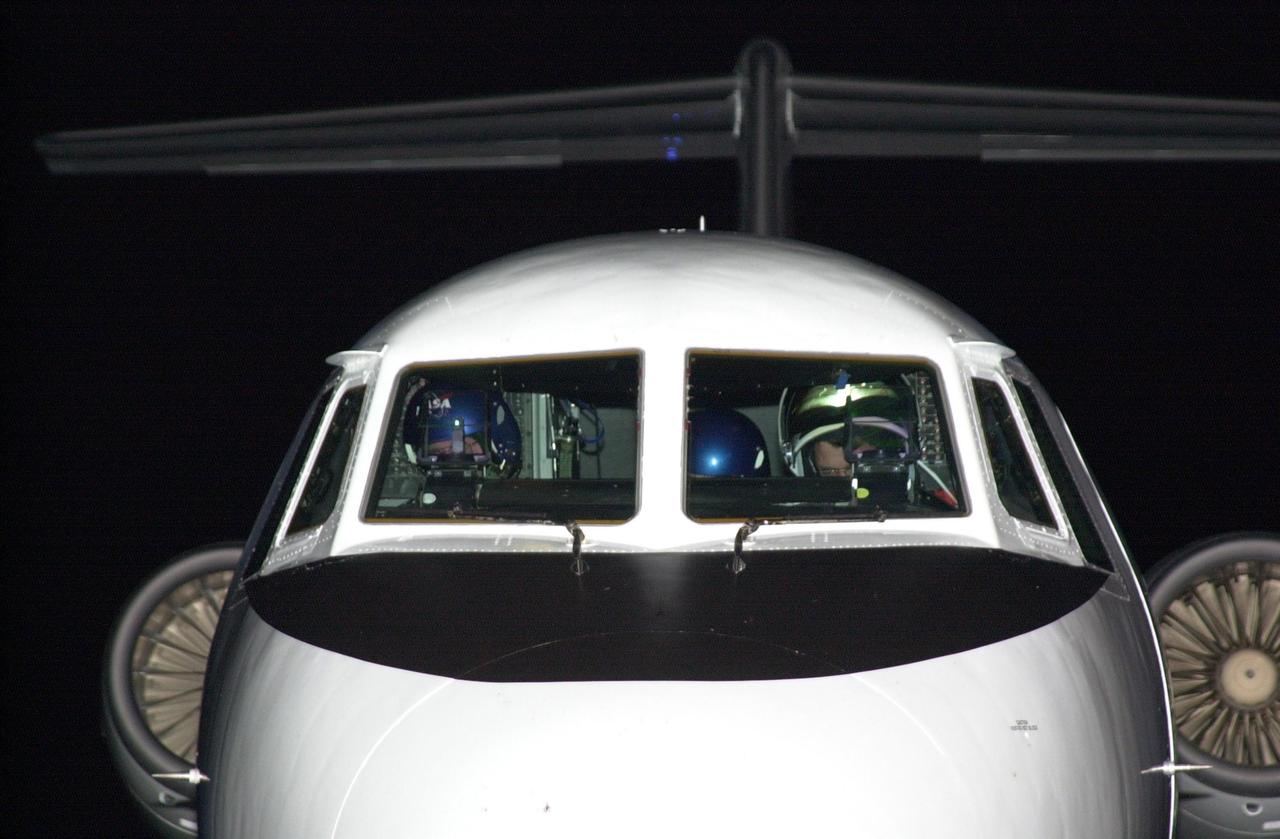
KENNEDY SPACE CENTER, FLA. --STS-112 Commander Jeffrey Ashby prepares to taxi the Shuttle Training Aircraft to the runway at the Shuttle Landing Facility as part of landing exercises.

KENNEDY SPACE CENTER, FLA. --STS-112 Pilot Pamela Melroy prepares to taxi the Shuttle Training Aircraft to the runway at the Shuttle Landing Facility as part of landing exercises.
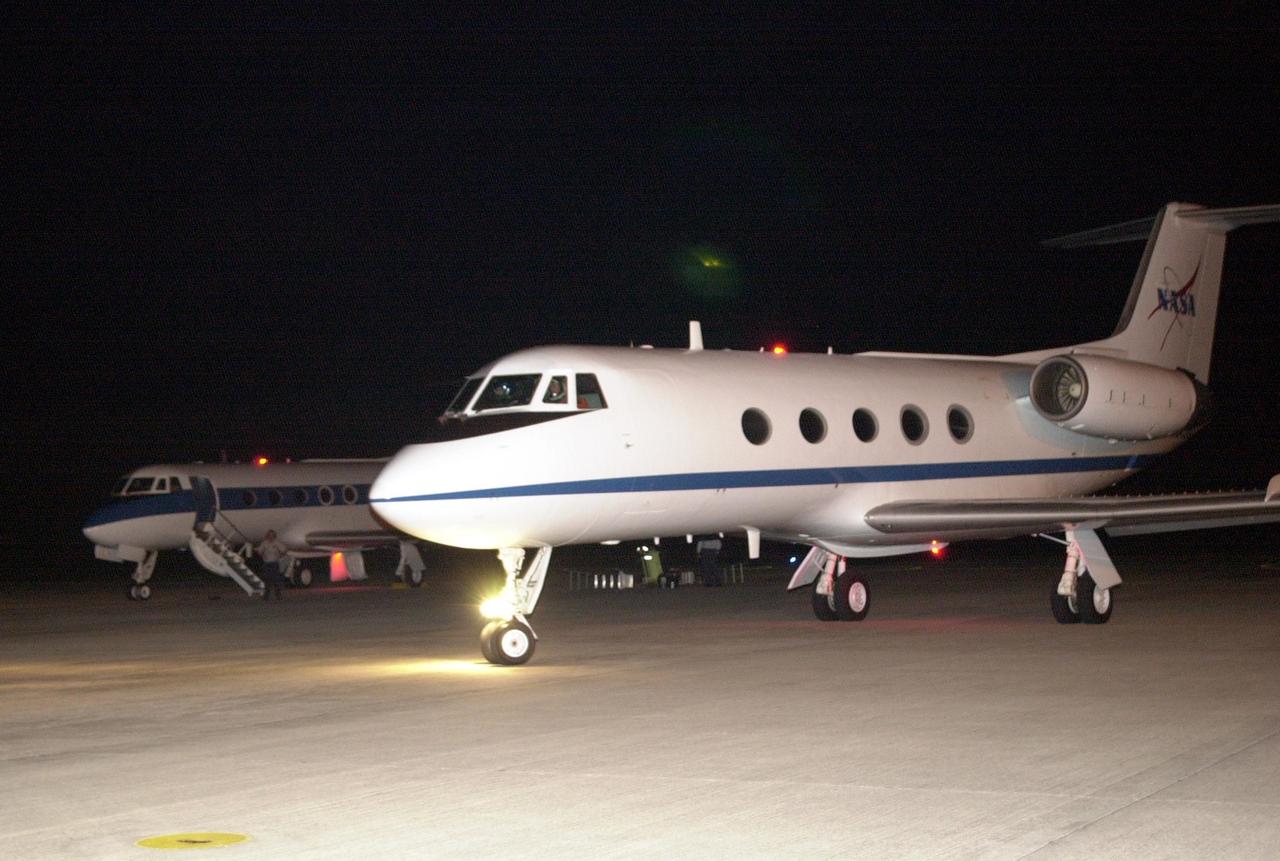
KENNEDY SPACE CENTER, FLA. --STS-112 Commander Jeffrey Ashby prepares to taxi the Shuttle Training Aircraft to the runway at the Shuttle Landing Facility as part of landing exercises.
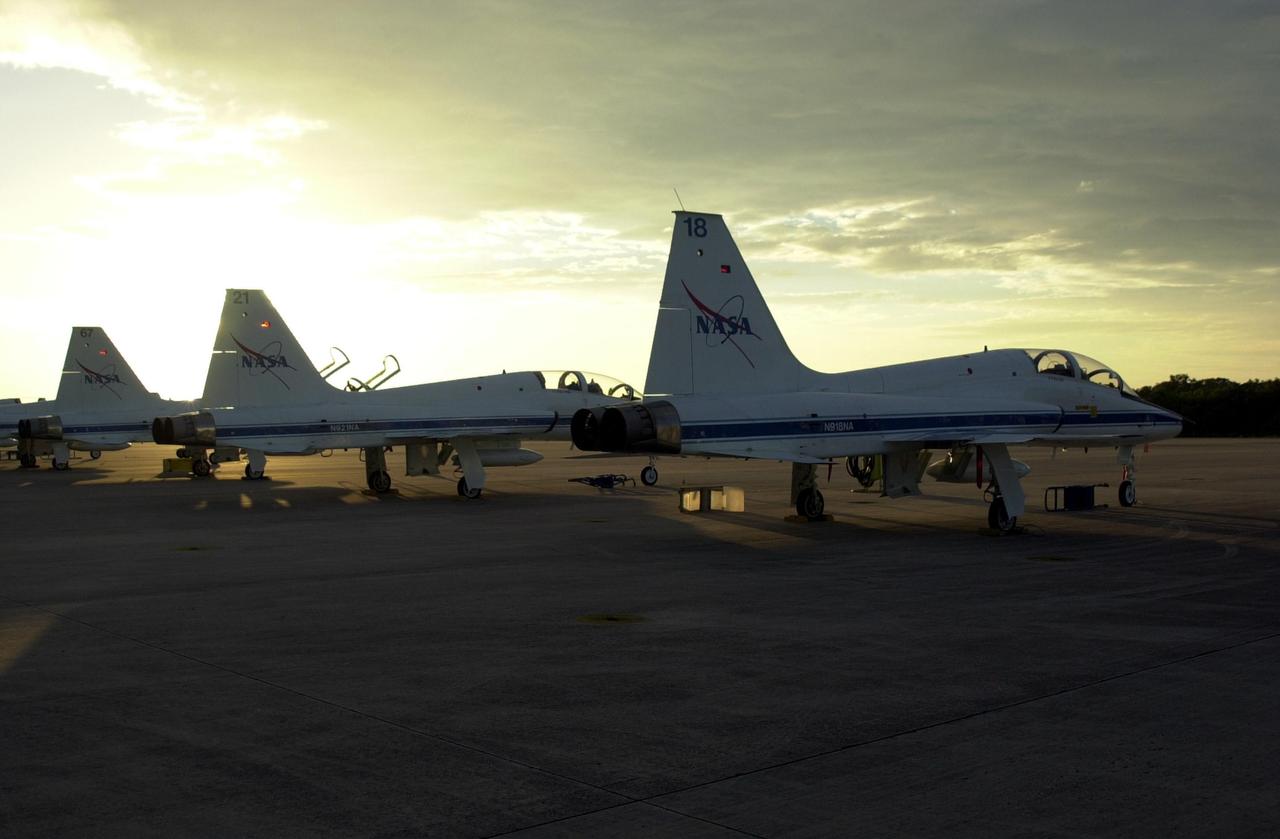
KENNEDY SPACE CENTER, FLA. -- At sunset after the arrival of the STS-112 crew, a row of T-38 jet aircraft are lined up on parking apron of the KSC Shuttle Landing Facility.
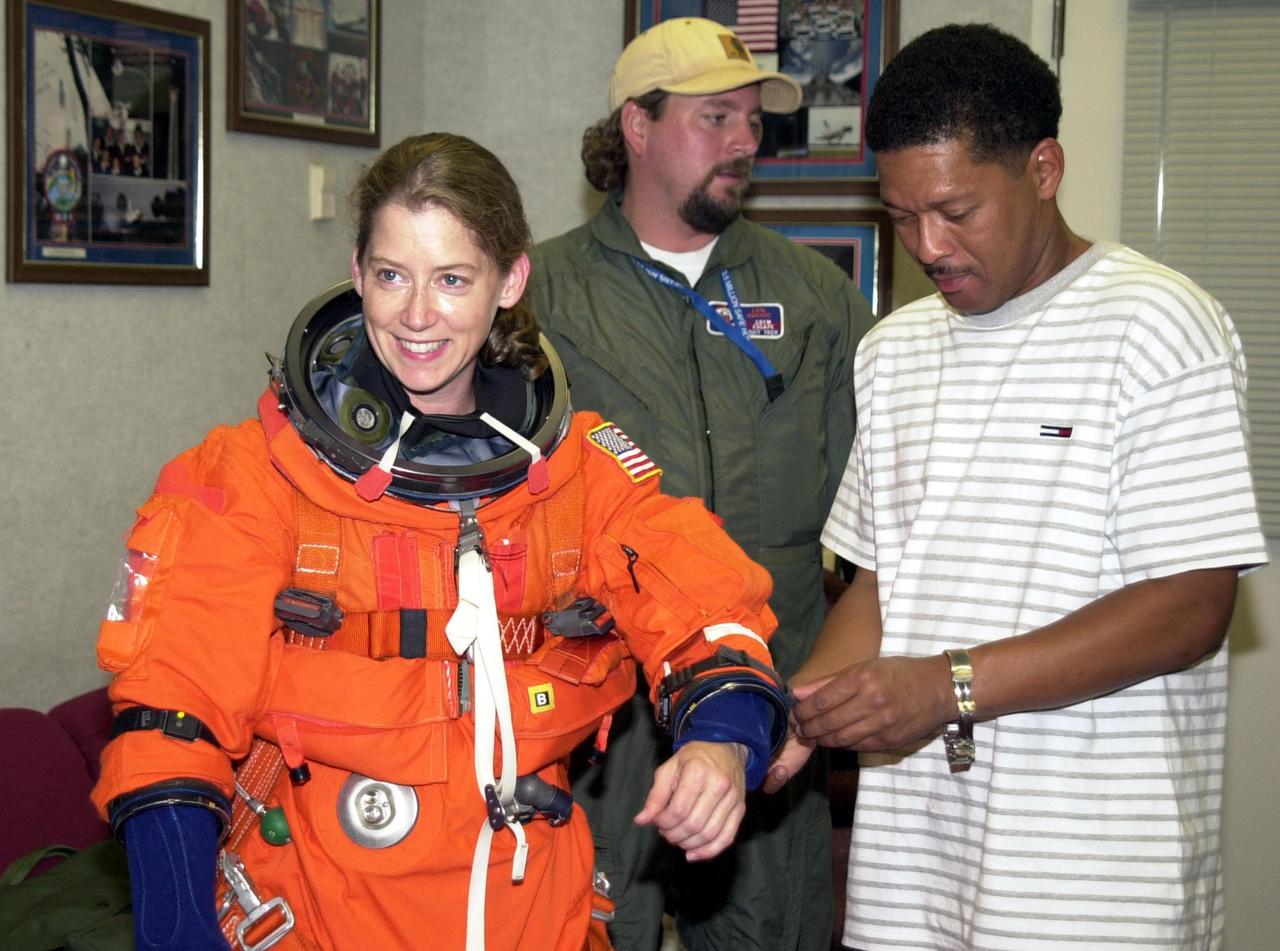
KENNEDY SPACE CENTER, FLA. --STS-112 Pilot Pamela Melroy receives some assistance with her spacesuit as she prepares to participate in landing exercises in the Shuttle Training Aircraft at the Shuttle Landing Facility.
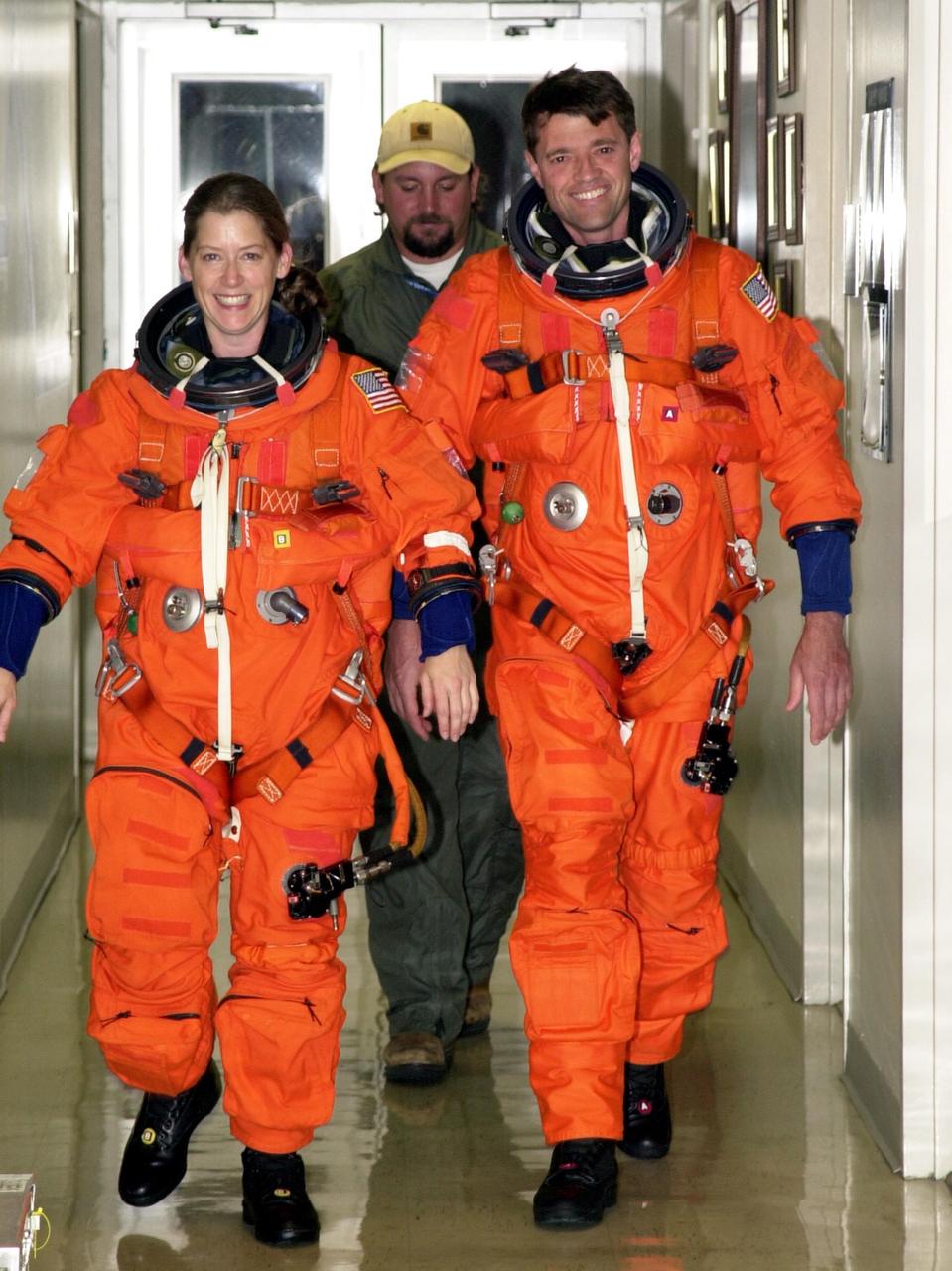
KENNEDY SPACE CENTER, FLA. --STS-112 Pilot Pamela Melroy (left) and Commander Jeffrey Ashby are suited up and ready to participate in landing exercises in the Shuttle Training Aircraft at the Shuttle Landing Facility.
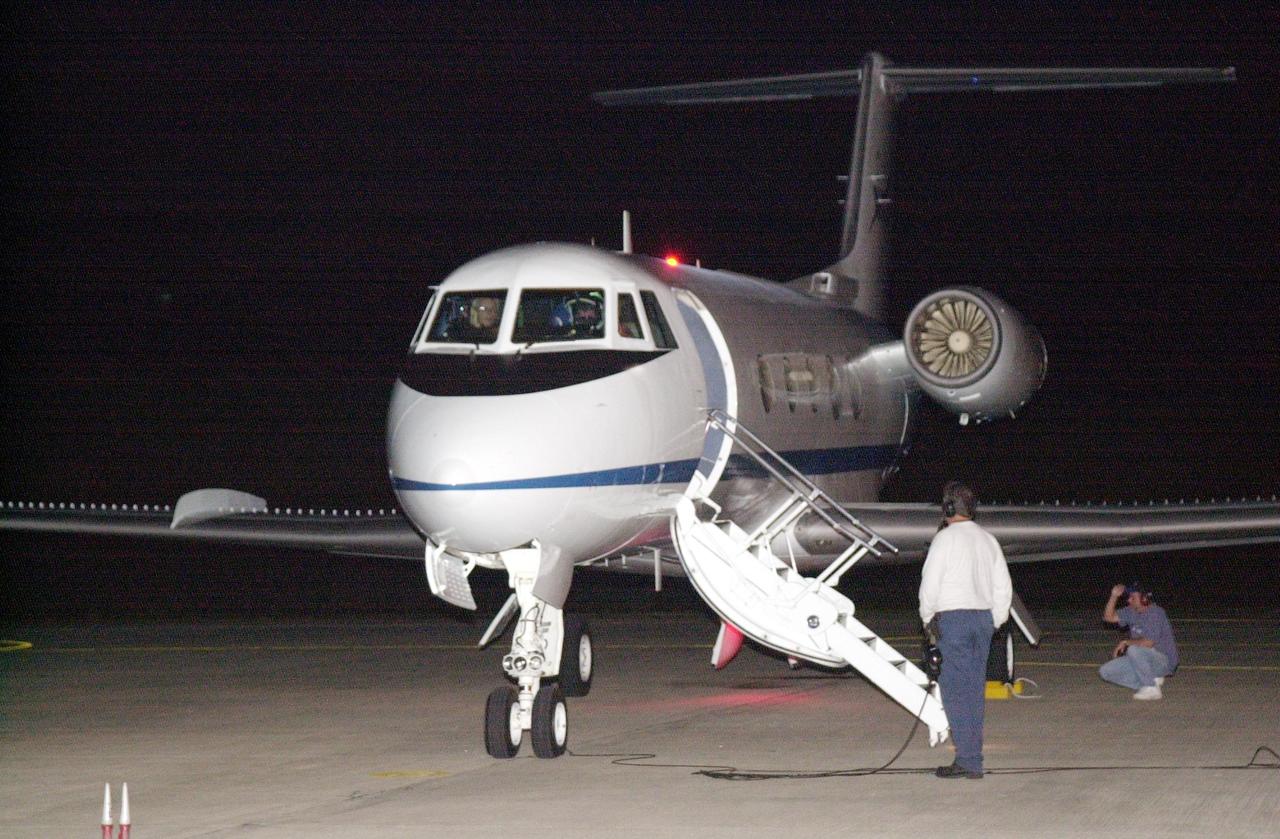
KENNEDY SPACE CENTER, FLA. --STS-112 Commander Jeffrey Ashby prepares to taxi the the Shuttle Training Aircraft to the runway at the Shuttle Landing Facility as part of landing exercises.
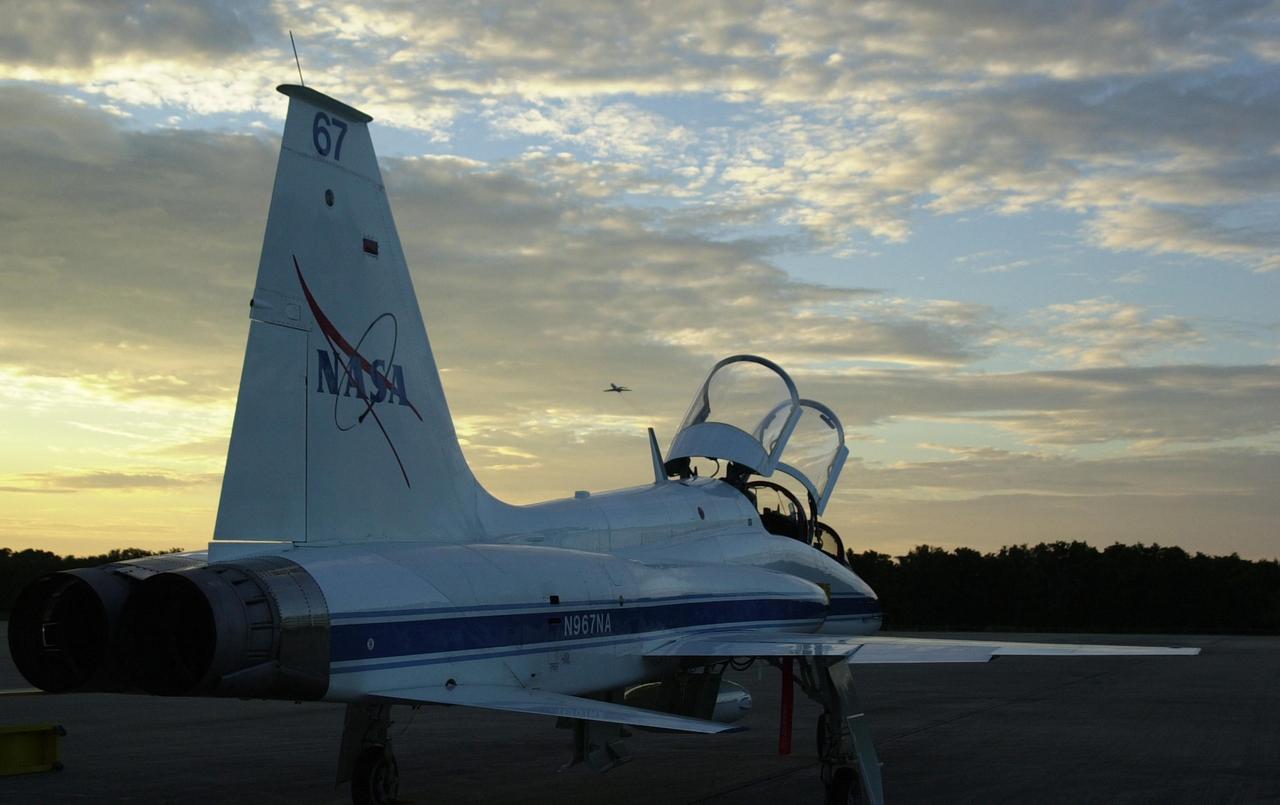
KENNEDY SPACE CENTER, FLA. --Framed by a T-38 on the Shuttle Landing Facility, the Shuttle Training Aircraft can be seen in the distance against the sunset. Commander Jeffrey Ashby and Pilot Pamela Melroy are going through landing exercises on the SLF.
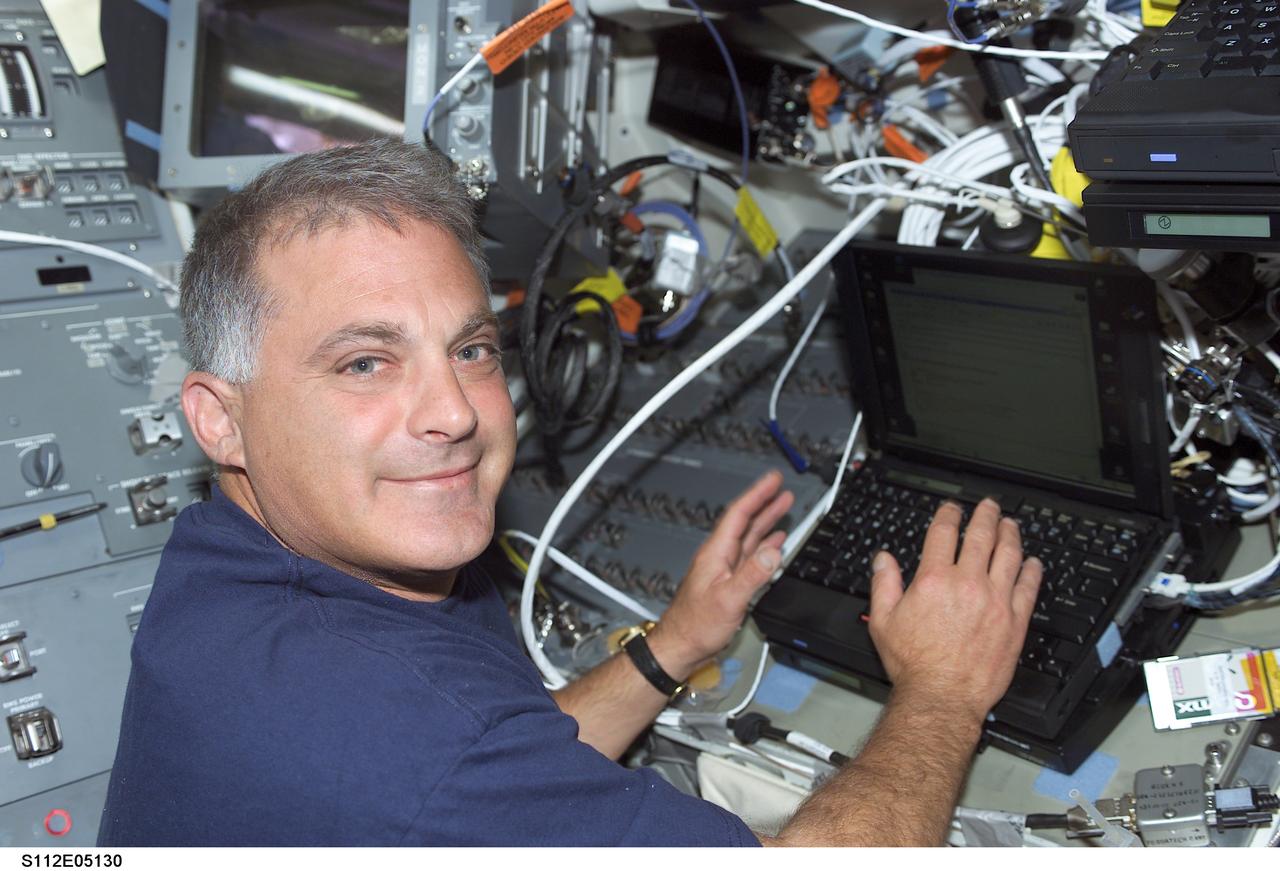
STS112-E-05130 (11 October 2002) --- Astronaut David A. Wolf, STS-112 mission specialist, is pictured on the aft flight deck of the Space Shuttle Atlantis.
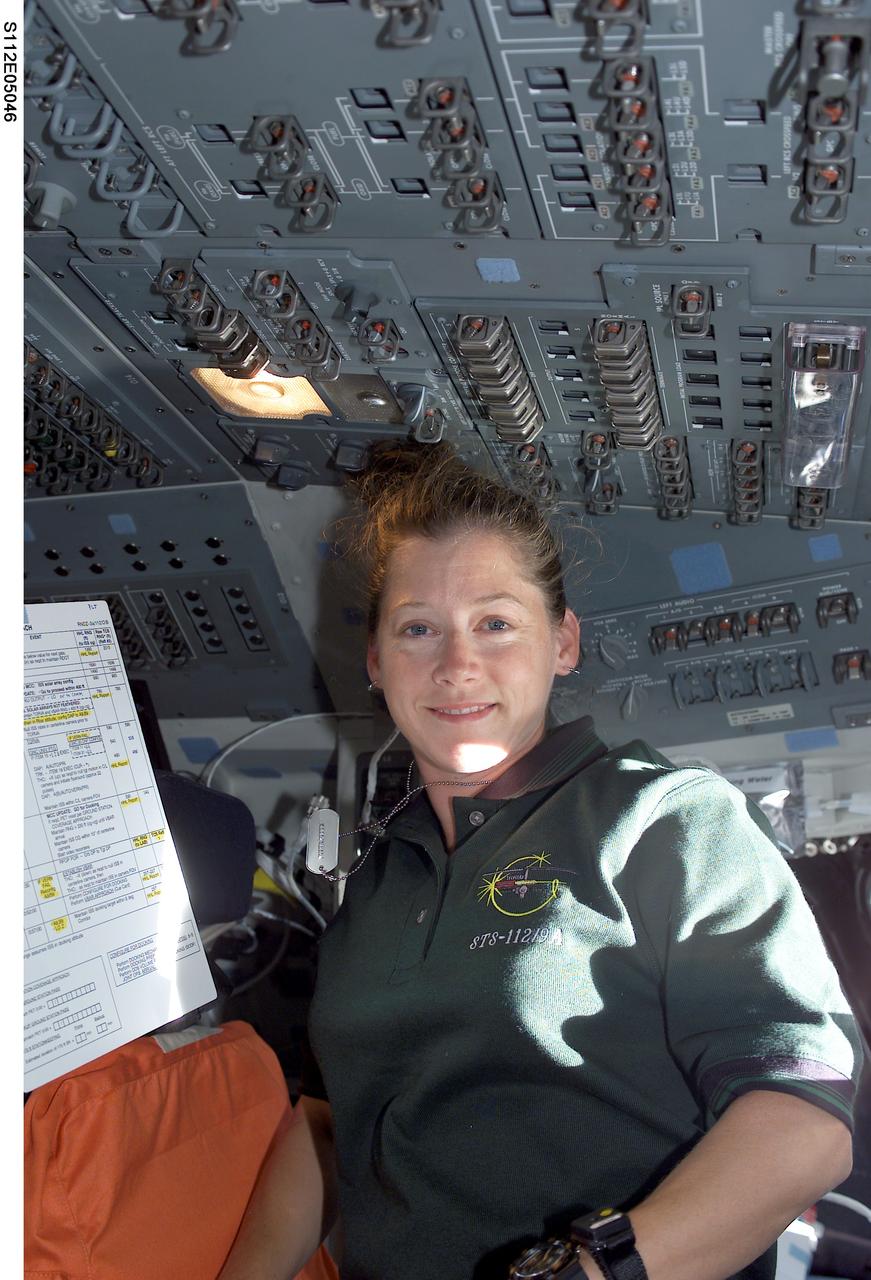
STS112-E-05046 (9 October 2002) --- Astronaut Pamela A. Melroy, STS-112 pilot, is pictured on the flight deck of the Space Shuttle Atlantis.
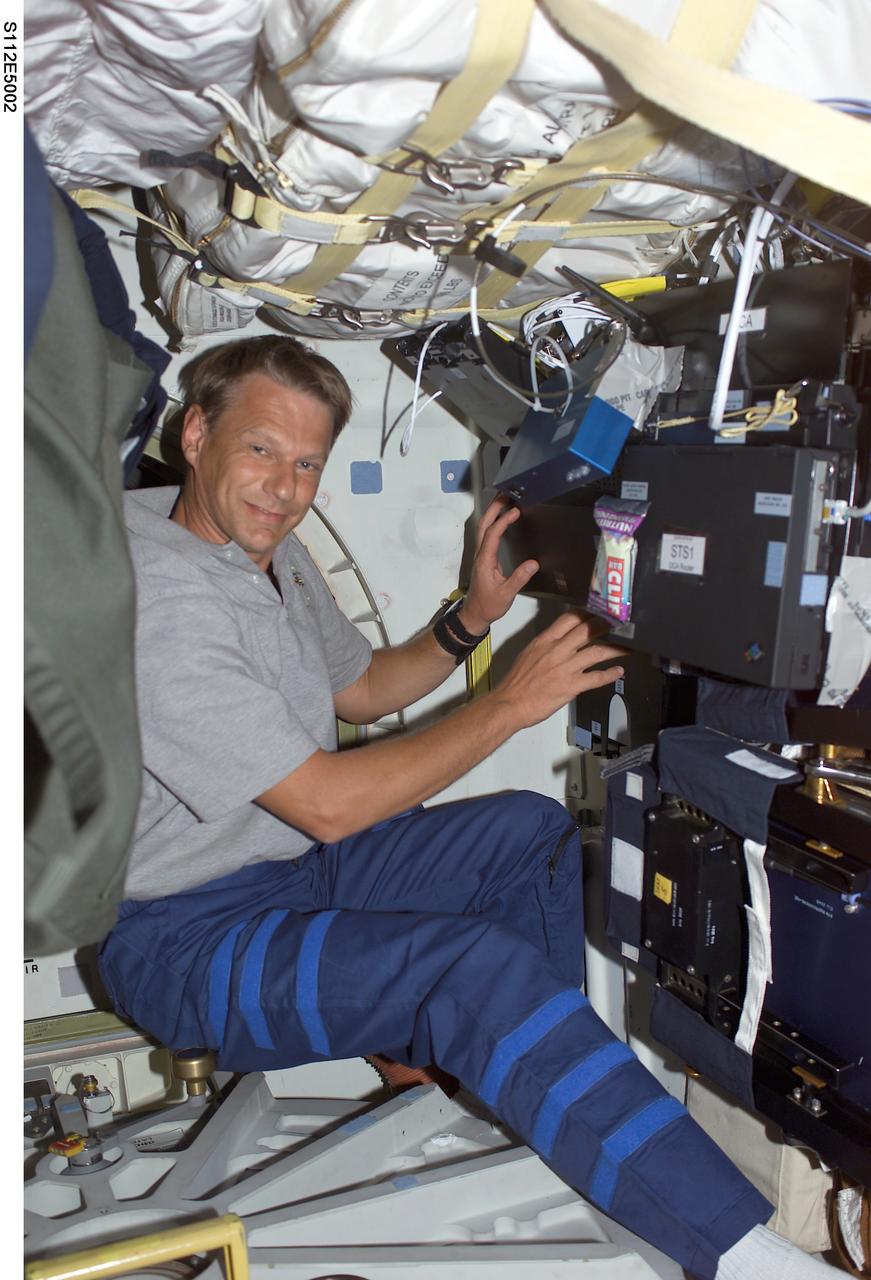
STS112-E-05002 (8 October 2002) --- Astronaut Piers J. Sellers, STS-112 mission specialist, is pictured on the middeck of the Space Shuttle Atlantis.
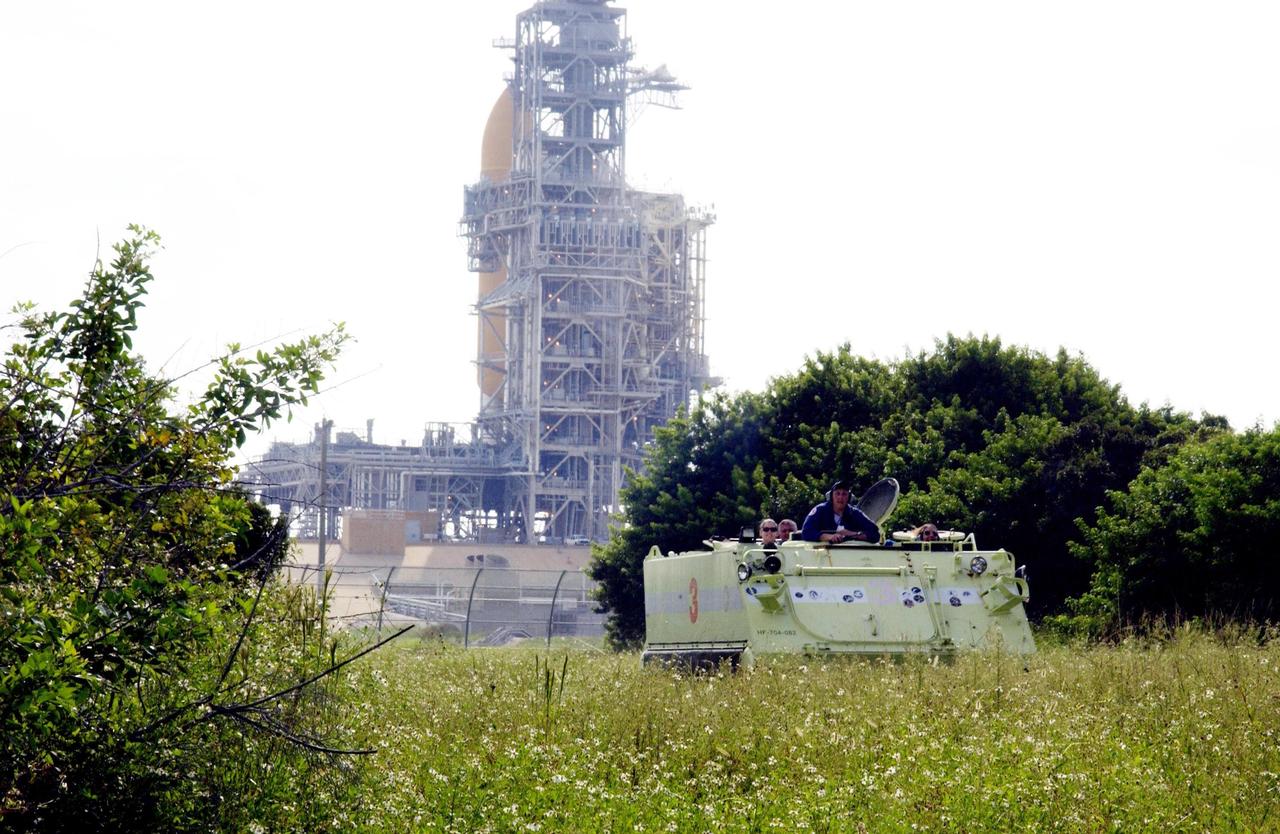
KENNEDY SPACE CENTER, Fla. - STS-112 Mission Specialist Sandra Magnus takes her turn driving the M-113 armored personnel carrier. Space Shuttle Atlantis is in the background. Magnus and the rest of the crew are at KSC for Terminal Countdown Demonstration Test activities, which also include a simulated launch countdown. Mission STS-112 aboard Space Shuttle Atlantis is scheduled to launch no earlier than Oct. 2, between 2 and 6 p.m. EDT. STS-112 is the 15th assembly mission to the International Space Station. Atlantis will be carrying the S1 Integrated Truss Structure, the first starboard truss segment. The S1 will be attached to the central truss segment, S0, during the 11-day mission.
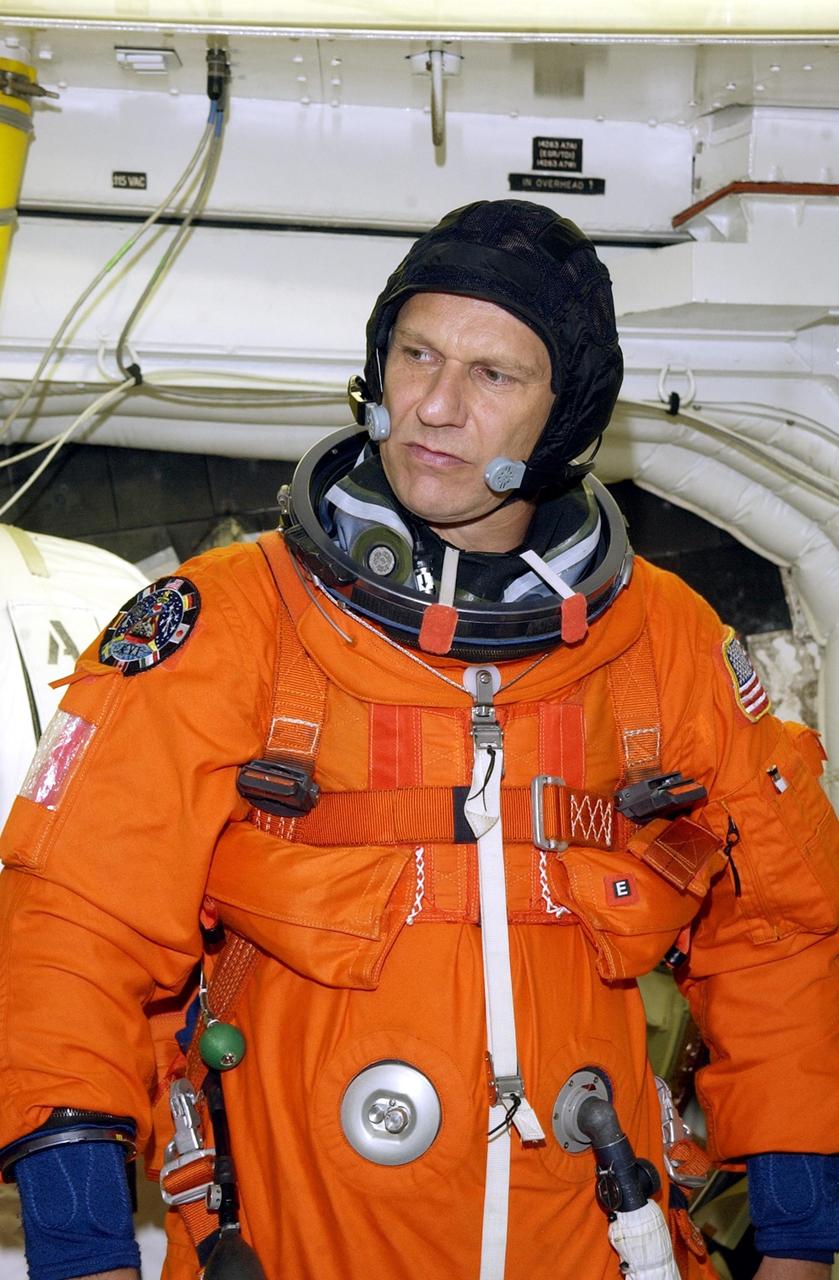
KENNEDY SPACE CENTER, FLA. -- In the White Room at Launch Pad 39B, STS-112 Mission Specialist Piers Sellers, Ph.D., prepares to enter Space Shuttle Atlantis during a simulated launch countdown, part of Terminal Countdown Demonstration Test activities, a dress rehearsal for launch. Launch of STS-112 aboard Space Shuttle Atlantis is scheduled for Oct. 2, between 2 and 6 p.m. EDT. STS-112 is the 15th assembly mission to the International Space Station. Atlantis will be carrying the S1 Integrated Truss Structure, the first starboard truss segment, which will be attached to the central truss segment, S0, and the Crew and Equipment Translation Aid (CETA) Cart A. The CETA is the first of two human-powered carts that will ride along the ISS railway, providing mobile work platforms for future spacewalking astronauts.
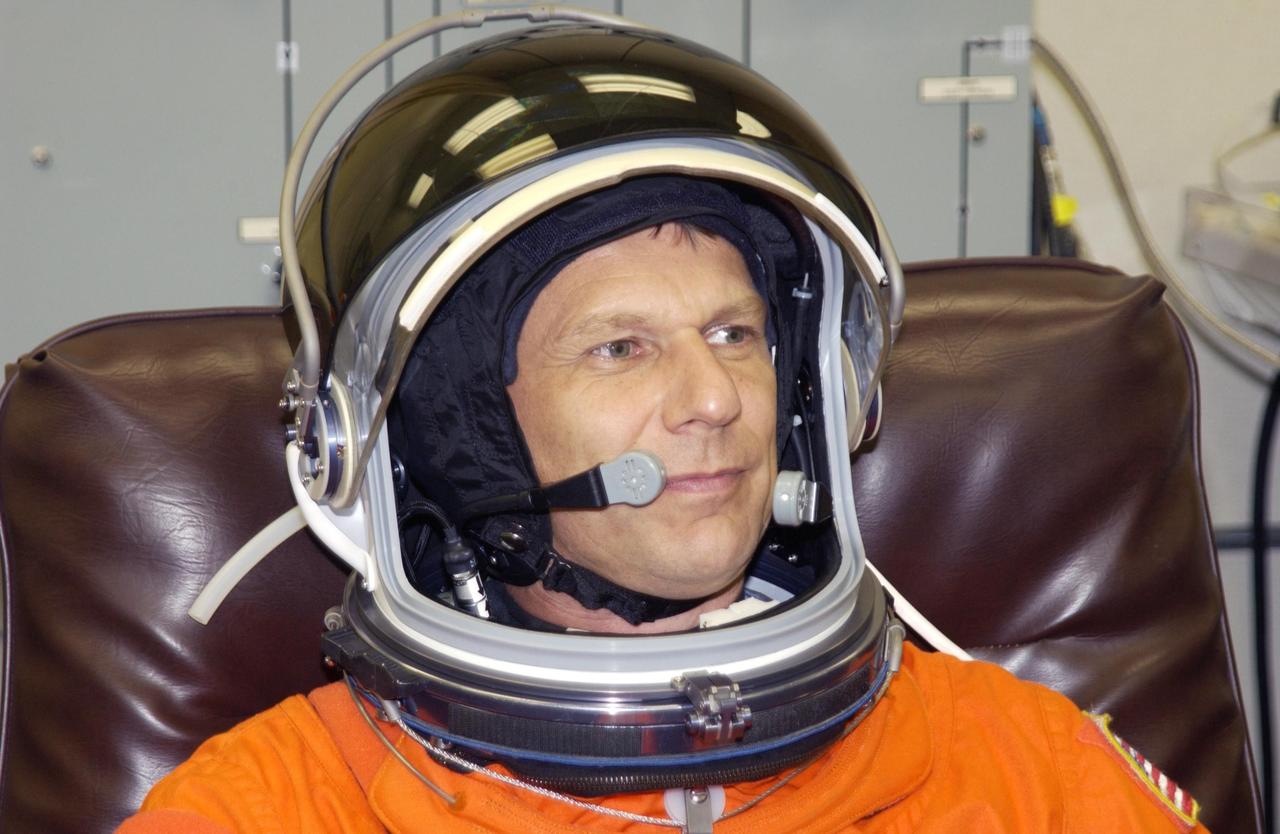
KENNEDY SPACE CENTER, Fla. - STS-112 Mission Specialist Piers Sellers tries out his helmet during suit check, part of Terminal Countdown Demonstration Test activities. The TCDT also includes emergency egress training and a simulated launch countdown. The mission aboard Space Shuttle Atlantis is scheduled to launch no earlier than Oct. 2, between 2 and 6 p.m. EDT. STS-112 is the 15th assembly mission to the International Space Station. Atlantis will be carrying the S1 Integrated Truss Structure, the first starboard truss segment. The S1 will be attached to the central truss segment, S0, during the 11-day mission. Sellers will be undertaking three spacewalks during the mission. In addition, he will be in charge of on-board computers and rendezvous tools during Atlantis' approach for docking and the undocking and flyaround. STS-112 is Sellers first Shuttle flight.
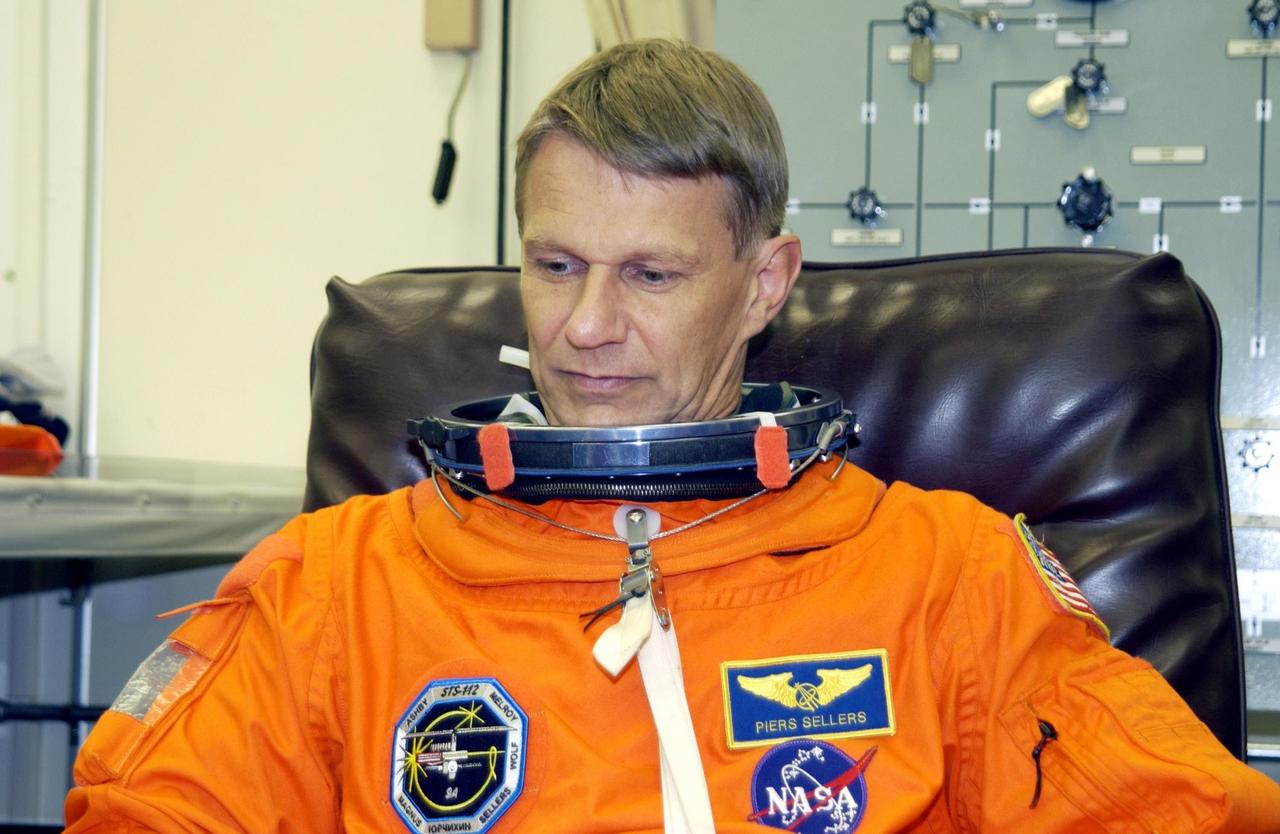
KENNEDY SPACE CENTER, Fla. - STS-112 Mission Specialist Piers Sellers undergoes suit check, part of Terminal Countdown Demonstration Test activities. The TCDT also includes emergency egress training and a simulated launch countdown. The mission aboard Space Shuttle Atlantis is scheduled to launch no earlier than Oct. 2, between 2 and 6 p.m. EDT. STS-112 is the 15th assembly mission to the International Space Station. Atlantis will be carrying the S1 Integrated Truss Structure, the first starboard truss segment. The S1 will be attached to the central truss segment, S0, during the 11-day mission. Sellers will be undertaking three spacewalks during the mission. In addition, he will be in charge of on-board computers and rendezvous tools during Atlantis' approach for docking and the undocking and flyaround. STS-112 is Sellers first Shuttle flight.
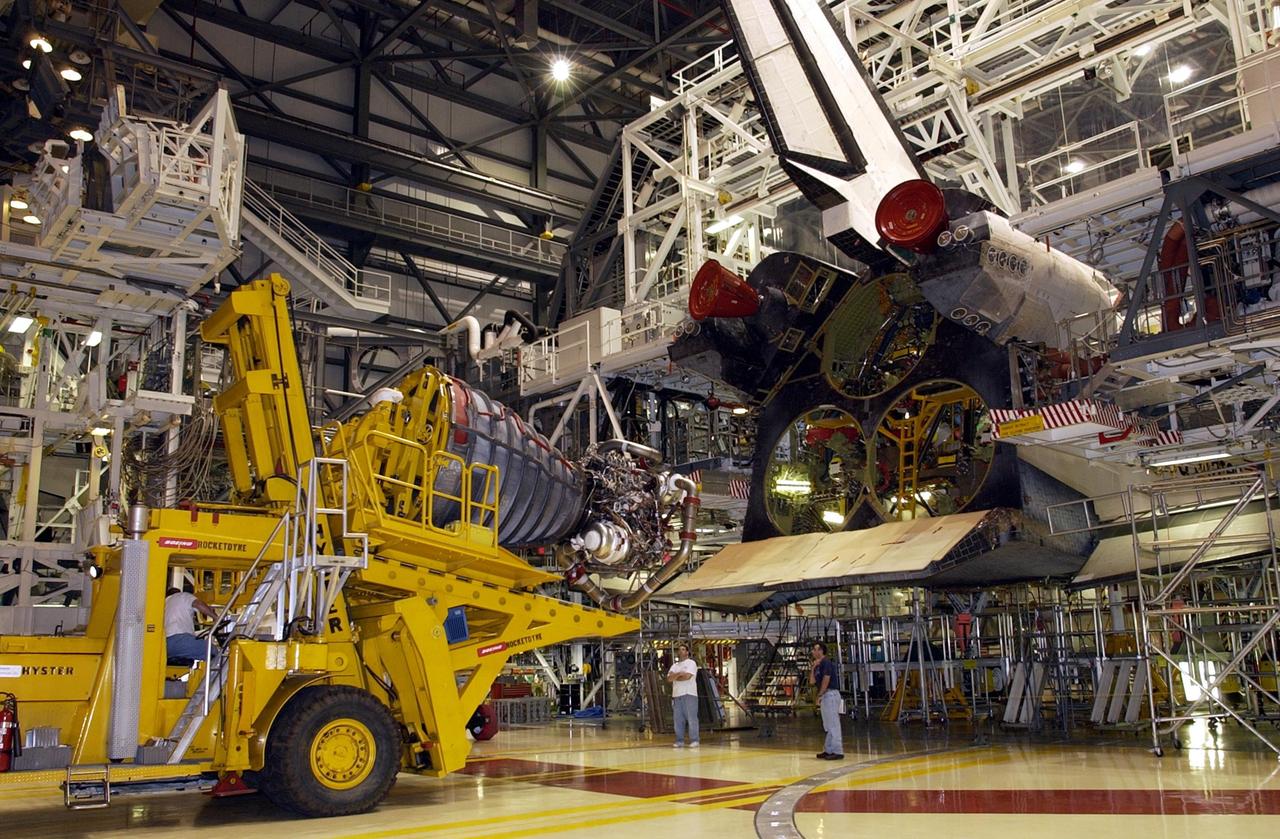
KENNEDY SPACE CENTER, FLA. -- The first Space Shuttle Main Engine (SSME) is installed on Space Shuttle Atlantis following the welding repair of the propulsion system flow liners as preparations to launch mission STS-112 continue. Mission STS-112 is an assembly flight to the International Space Station and is targeted for launch no earlier than Sept. 28, 2002. Members of the STS-112 crew are Commander Jeffrey Ashby; Pilot Pamela Melroy; and Mission Specialists David Wolf, Piers Sellers, Sandra Magnus, and Fyodor Yurchikhin of the Russian Space Agency.
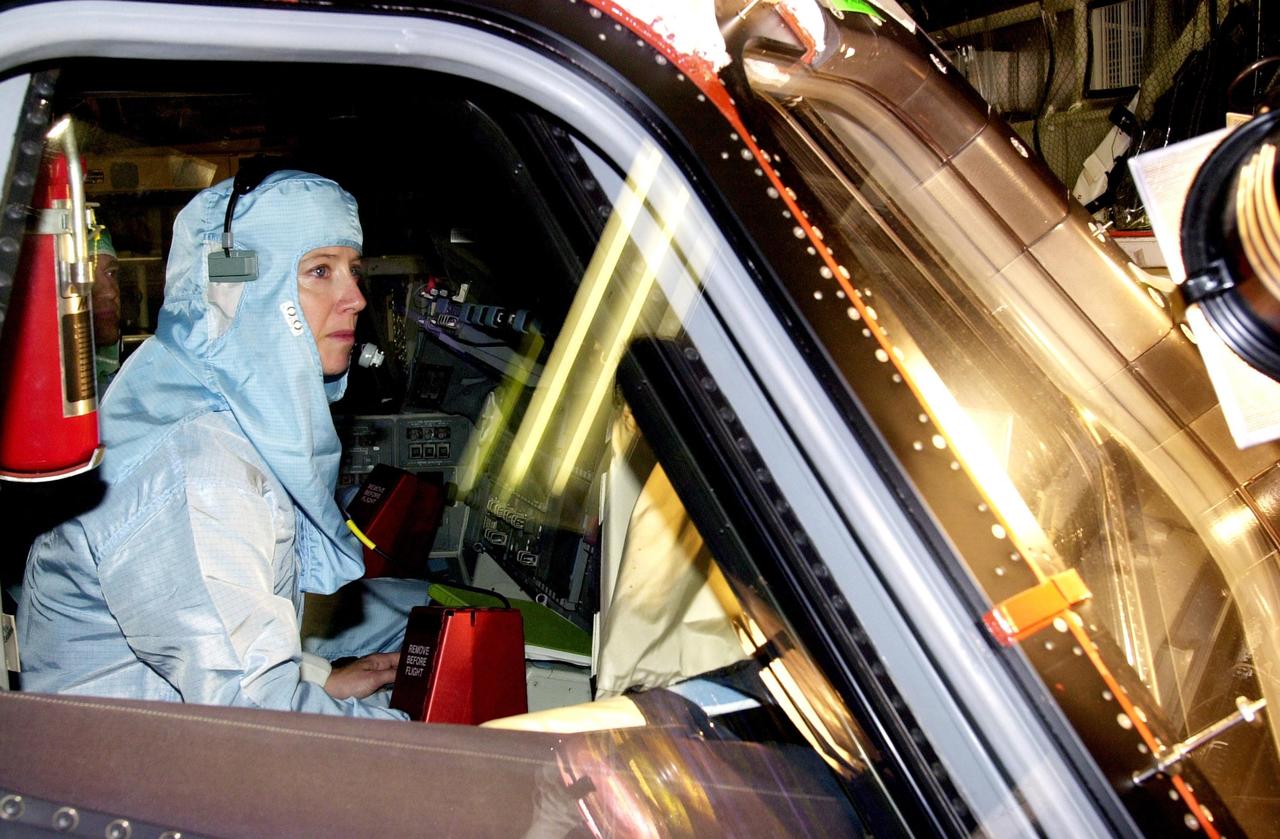
KENNEDY SPACE CENTER, FLA. -- During a Crew Equipment Interface Test, STS-112 Pilot Pamela Melroy checks out the windshield on Atlantis, the designated orbiter for the mission. STS-112 is the 15th assembly flight to the International Space Station and will be ferrying the S1 Integrated Truss Structure. The S1 truss is the first starboard (right-side) truss segment, whose main job is providing structural support for the radiator panels that cool the Space Station's complex power system. The S1 truss segment also will house communications systems, external experiment positions and other subsystems. The S1 truss will be attached to the S0 truss. STS-112 is currently scheduled for launch Aug. 22, 2002
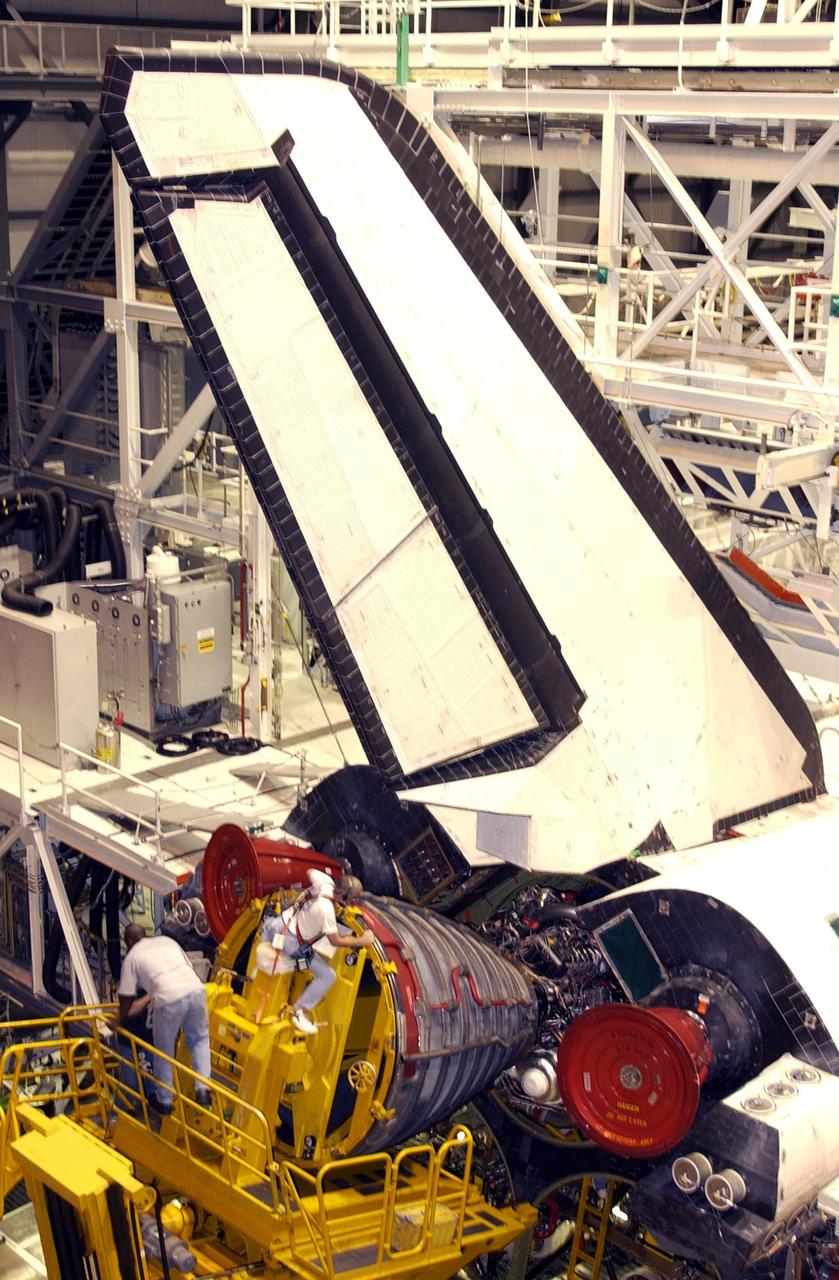
KENNEDY SPACE CENTER, FLA. -- The first Space Shuttle Main Engine (SSME) is installed on Space Shuttle Atlantis following the welding repair of the propulsion system flow liners as preparations to launch mission STS-112 continue. Angela DiMattia is the move director for Rocketdyne. Rocketdyne employee Gerald Braham is seen here behind the engine offering additional guidance. Mission STS-112 is an assembly flight to the International Space Station and is targeted for launch no earlier than Sept. 28, 2002. Members of the STS-112 crew are Commander Jeffrey Ashby; Pilot Pamela Melroy; and Mission Specialists David Wolf, Piers Sellers, Sandra Magnus, and Fyodor Yurchikhin of the Russian Space Agency.
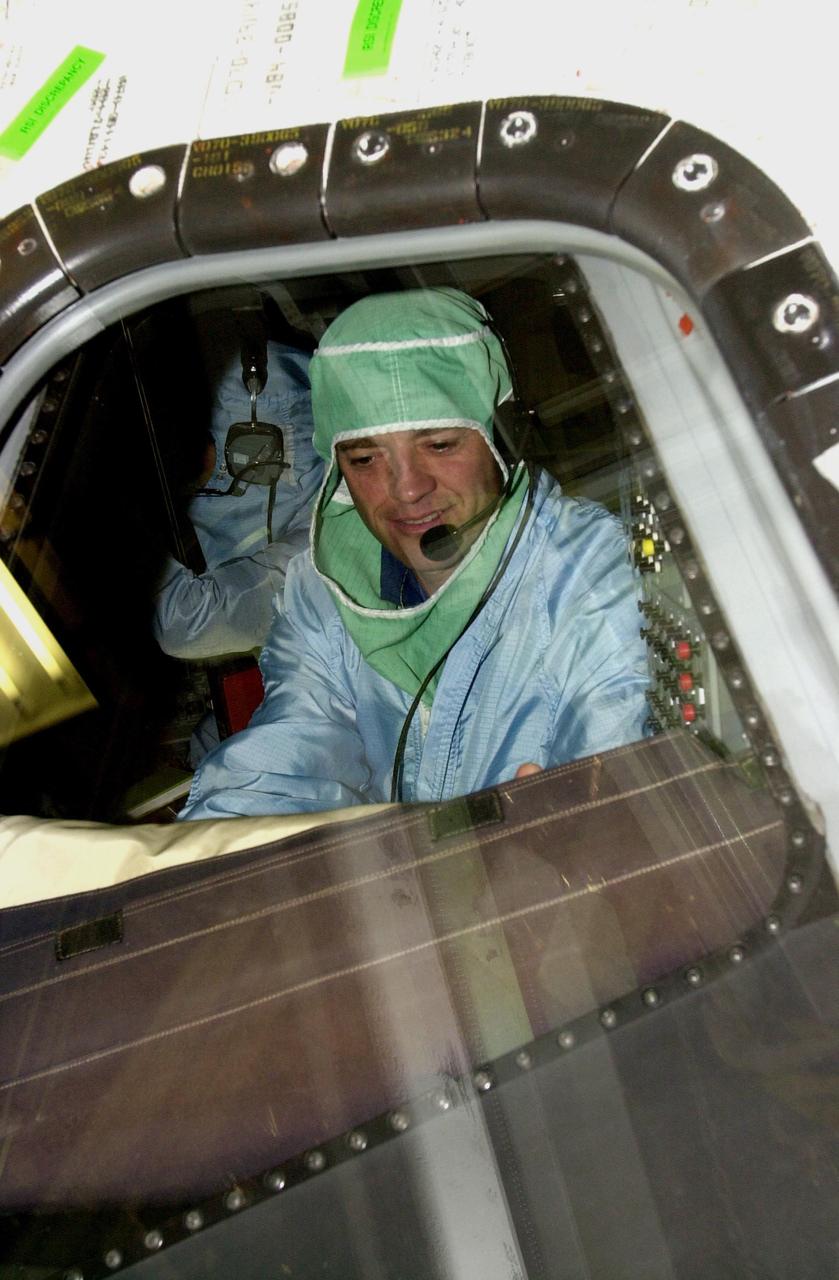
KENNEDY SPACE CENTER, FLA. -- During a Crew Equipment Interface Test, STS-112 Commander Jeffrey Ashby checks out the windshield on Atlantis, the designated orbiter for the mission. STS-112 is the 15th assembly flight to the International Space Station and will be ferrying the S1 Integrated Truss Structure. The S1 truss is the first starboard (right-side) truss segment, whose main job is providing structural support for the radiator panels that cool the Space Station's complex power system. The S1 truss segment also will house communications systems, external experiment positions and other subsystems. The S1 truss will be attached to the S0 truss. STS-112 is currently scheduled for launch Aug. 22, 2002
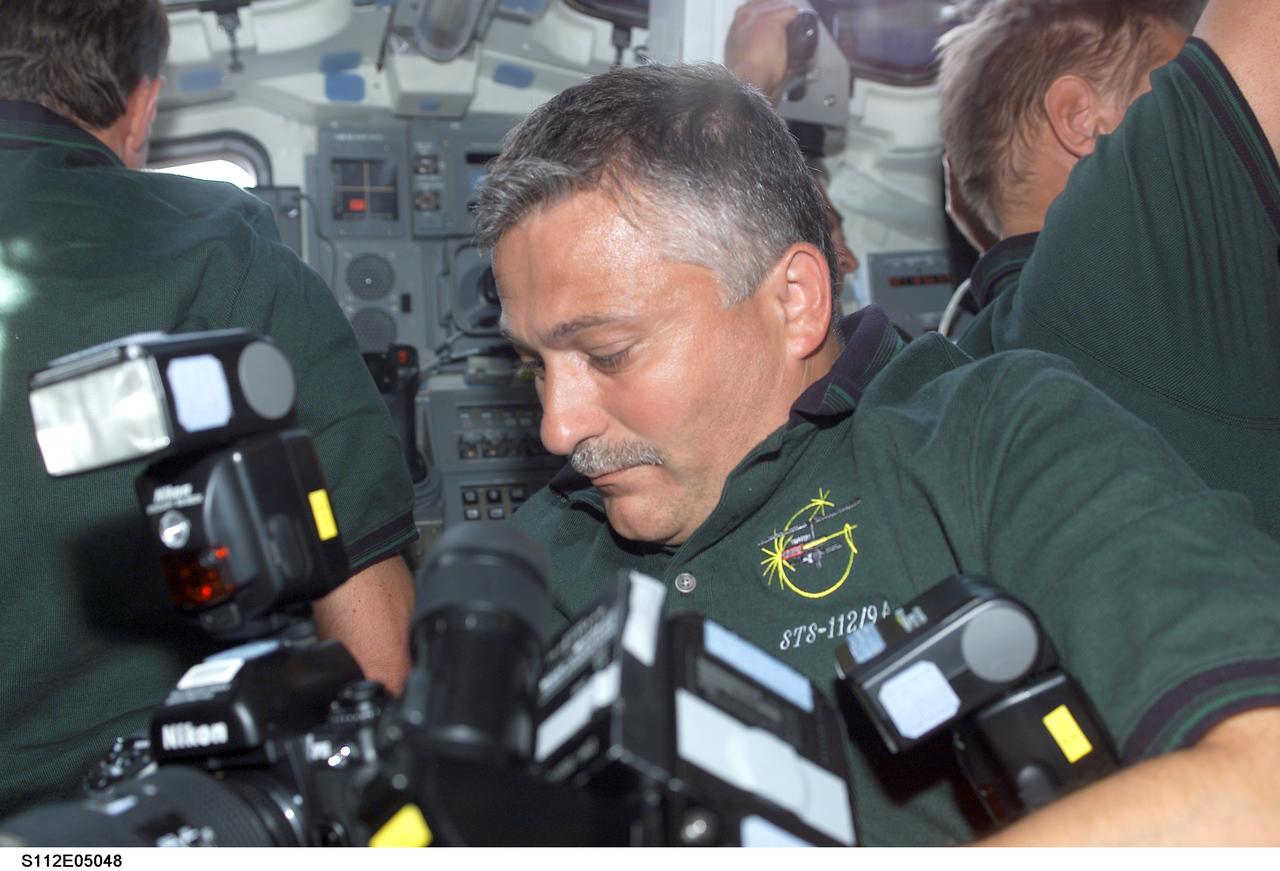
STS112-E-05048 (9 October 2002) --- Cosmonaut Fyodor N. Yurchikhin, STS-112 mission specialist representing Rosaviakosmos, works with camera equipment on the flight deck of the Space Shuttle Atlantis.
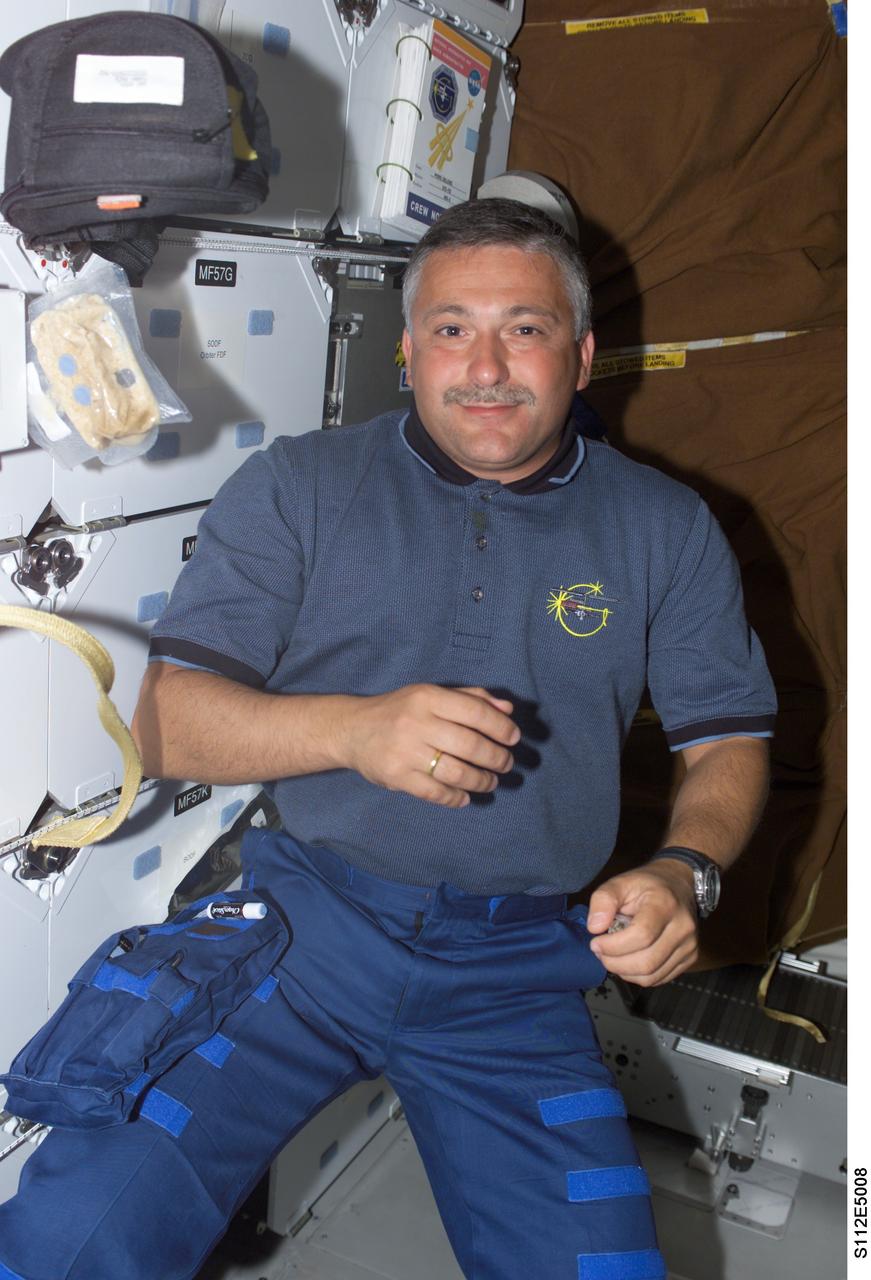
STS112-E-05008 (8 October 2002) --- Cosmonaut Fyodor N. Yurchikhin, STS-112 mission specialist representing Rosaviakosmos, is pictured on the middeck of the Space Shuttle Atlantis.
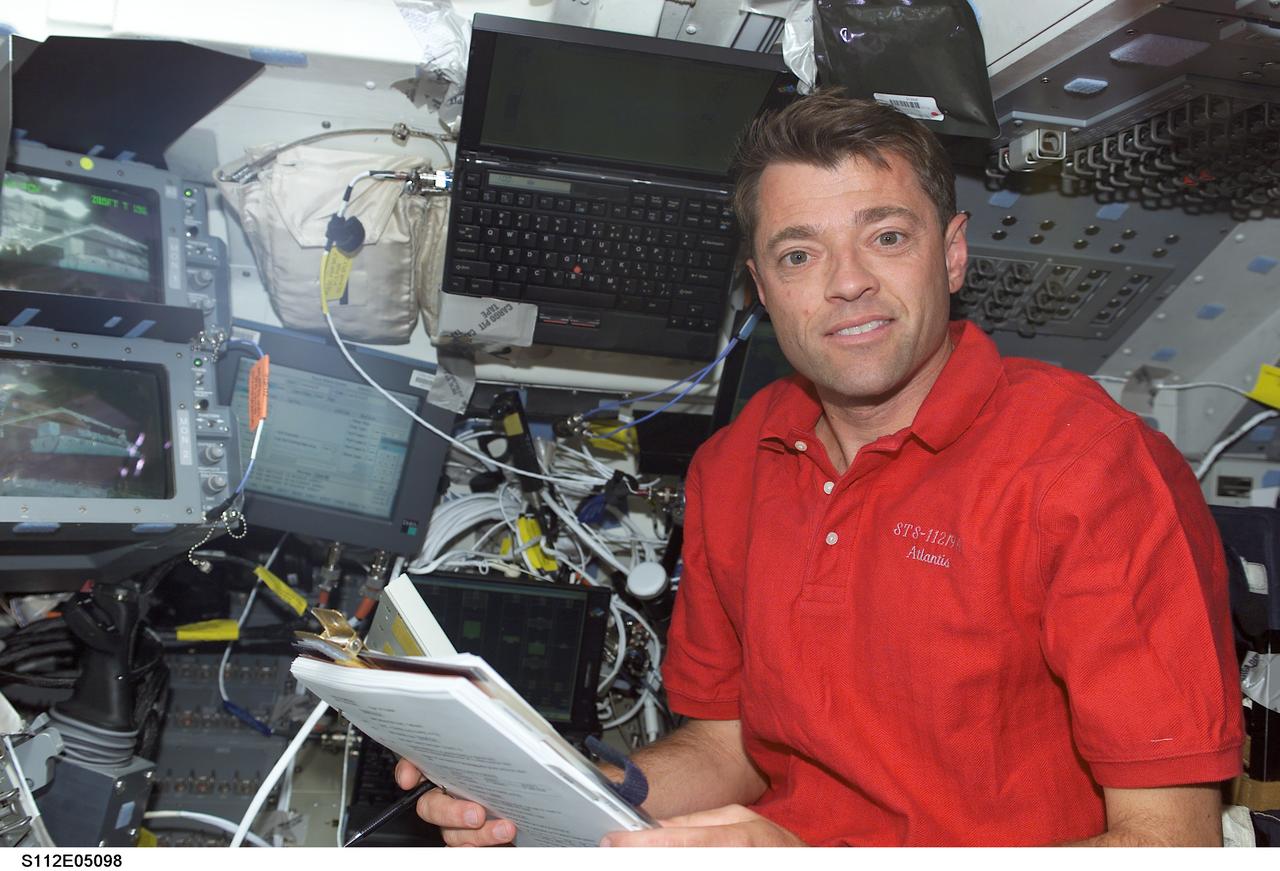
STS112-E-05098 (10 October 2002) --- Astronaut Jeffrey S. Ashby, STS-112 mission commander, looks over a procedures checklist on the aft flight deck of the Space Shuttle Atlantis.
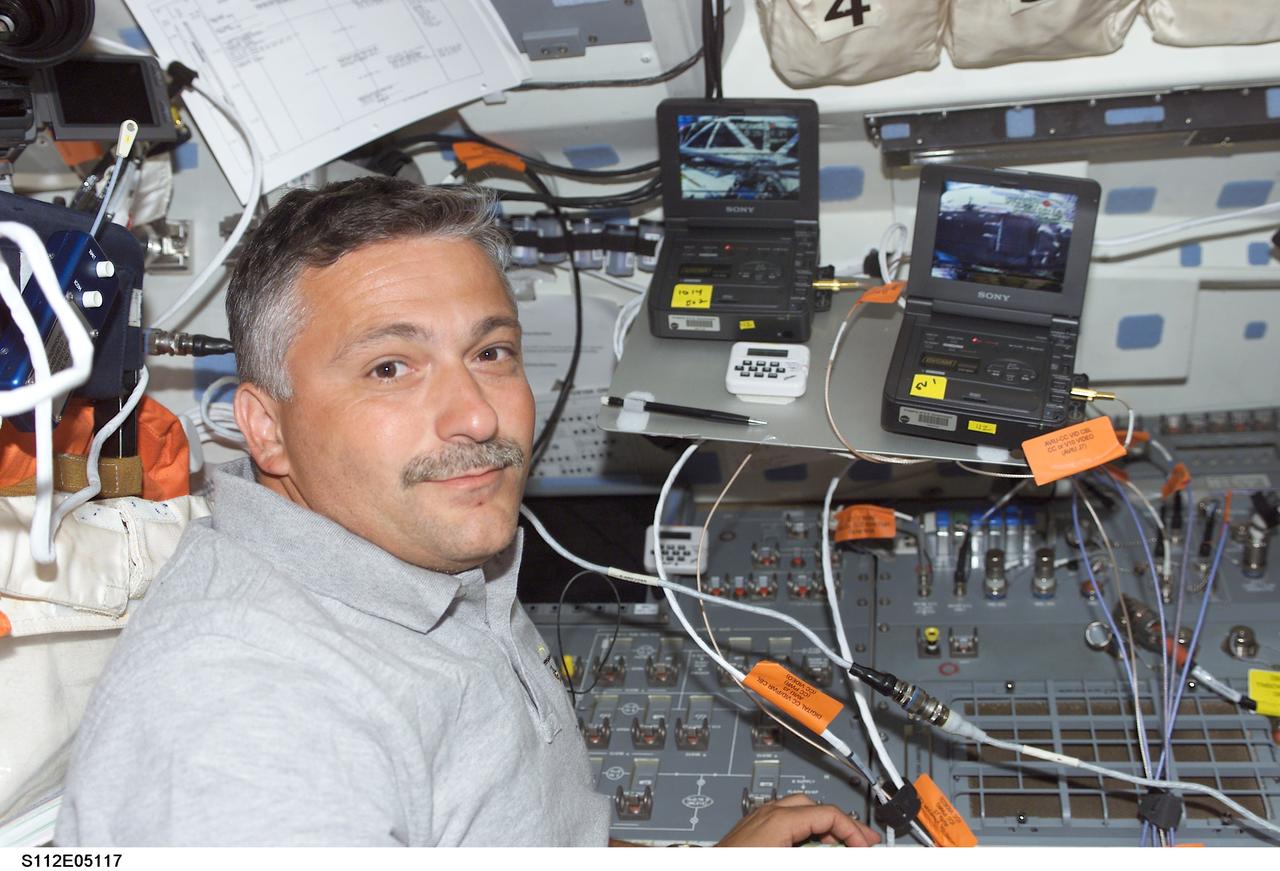
STS112-E-05117 (10 October 2002) --- Cosmonaut Fyodor N. Yurchikhin, STS-112 mission specialist, is pictured on the flight deck of the Space Shuttle Atlantis. Yurchikhin represents Rosaviakosmos.
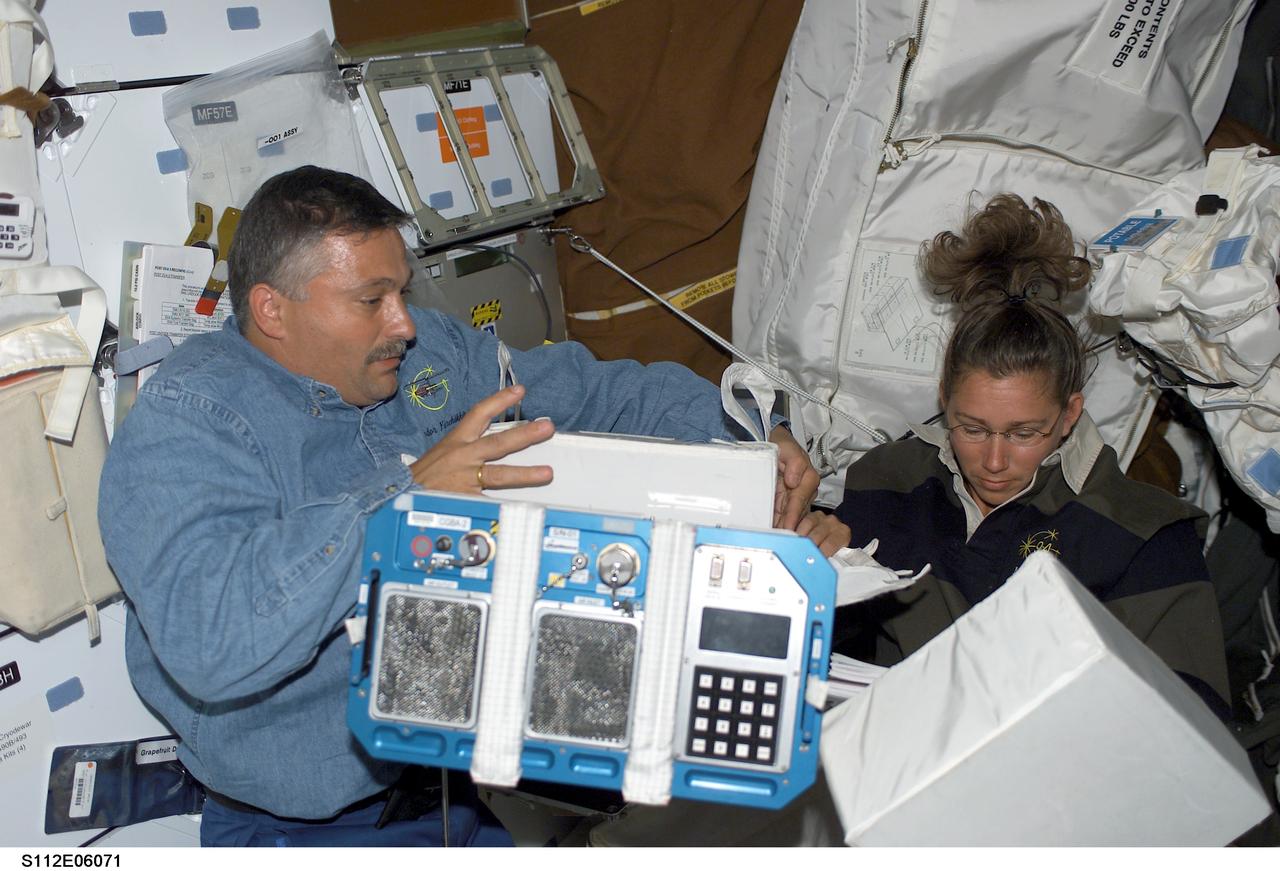
STS112-E-06071 (15 October 2002) --- Cosmonaut Fyodor N. Yurchikhin (left) and astronaut Sandra H. Magnus, STS-112 mission specialists, work on the middeck of the Space Shuttle Atlantis. Yurchikhin represents Rosaviakosmos.
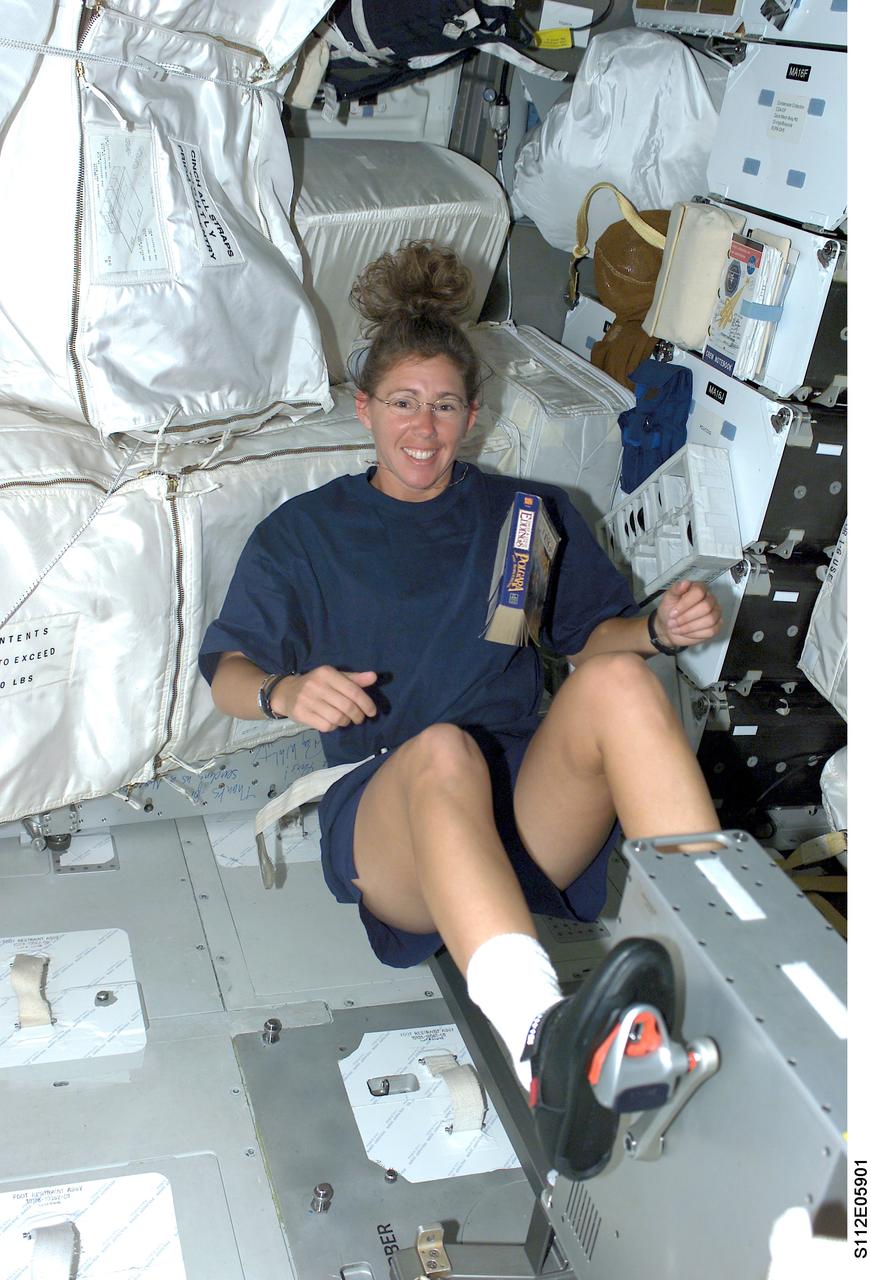
STS112-E-05901 (16 October 2002) --- Astronaut Sandra H. Magnus, STS-112 mission specialist, works out on a bicycle ergometer on the middeck of the Space Shuttle Atlantis.
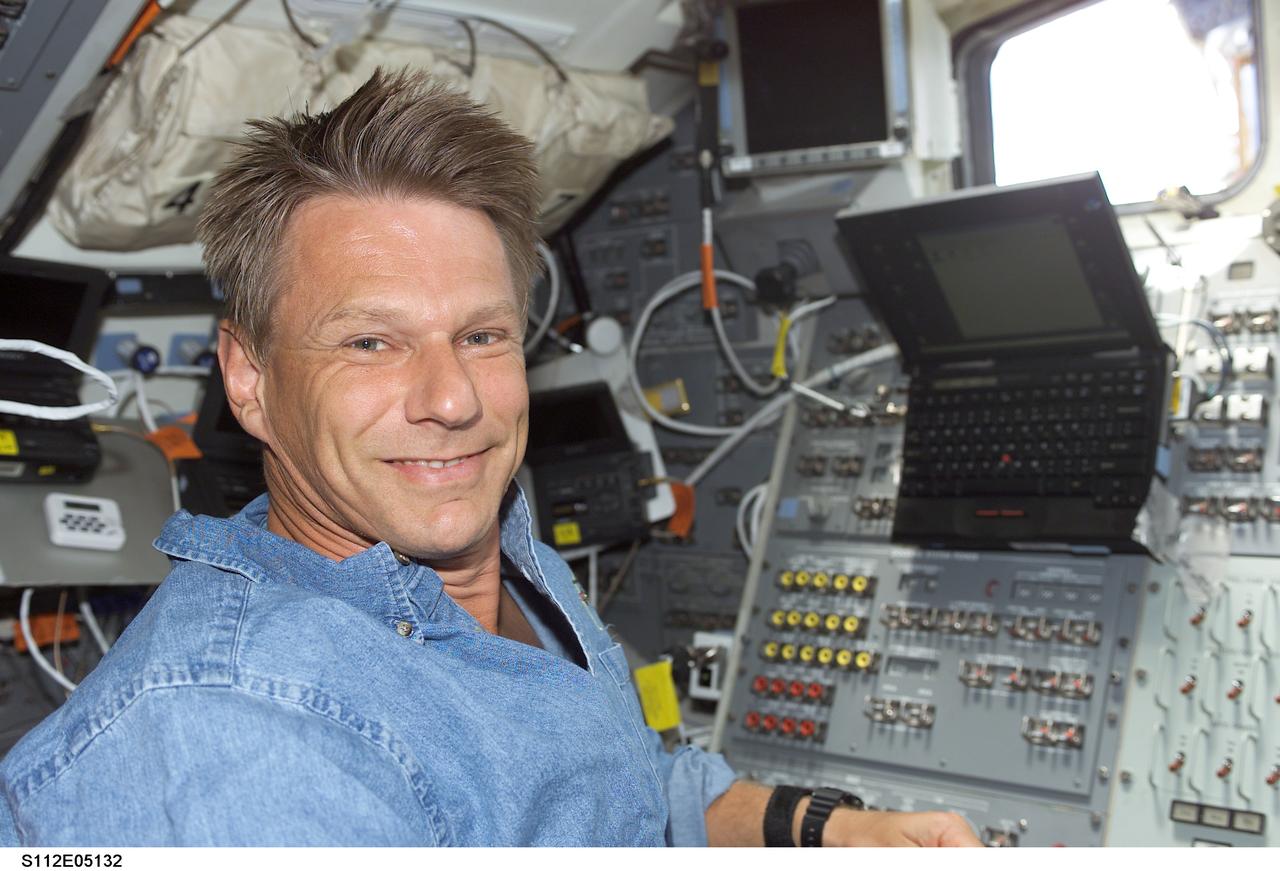
STS112-E-05132 (11 October 2002) --- Astronaut Piers J. Sellers, STS-112 mission specialist, is pictured on the aft flight deck of the Space Shuttle Atlantis.
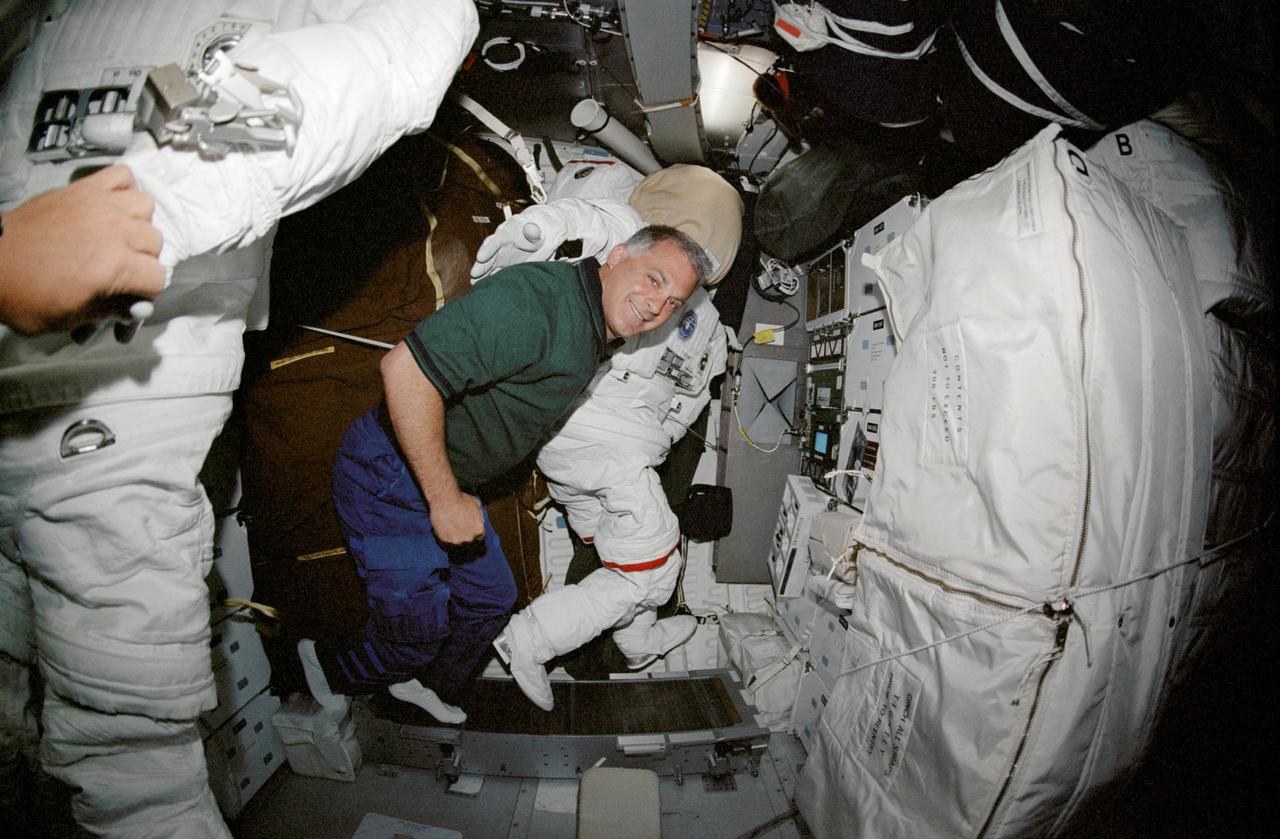
STS112-309-008 (7-18 October 2002) --- Astronaut David A. Wolf, STS-112 mission specialist, is pictured near an Extravehicular Mobility Unit (EMU) space suit on the middeck of the Space Shuttle Atlantis.
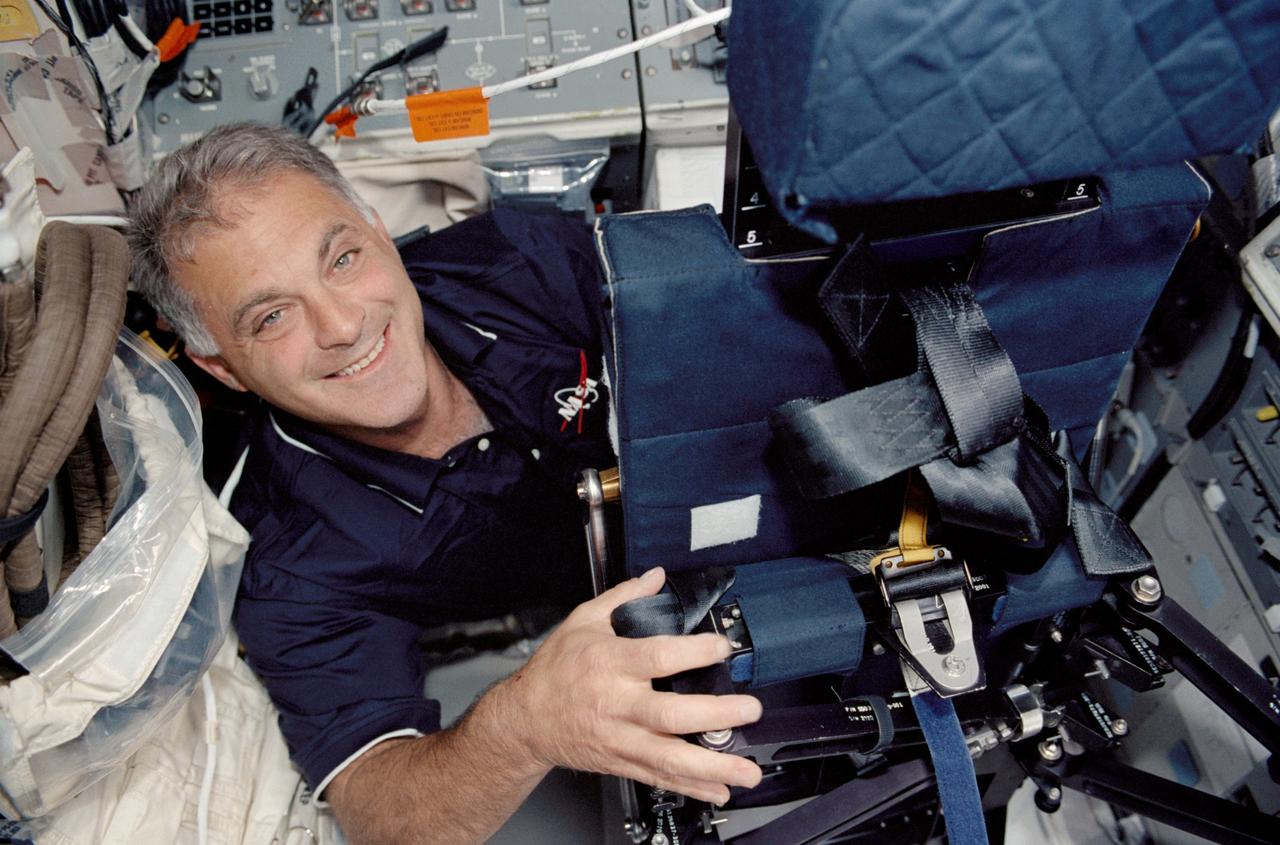
STS112-324-008 (7-18 October 2002) --- Astronaut David A. Wolf, STS-112 mission specialist, works with a temporary flight deck seat, used for launch and entry, on the Space Shuttle Atlantis.
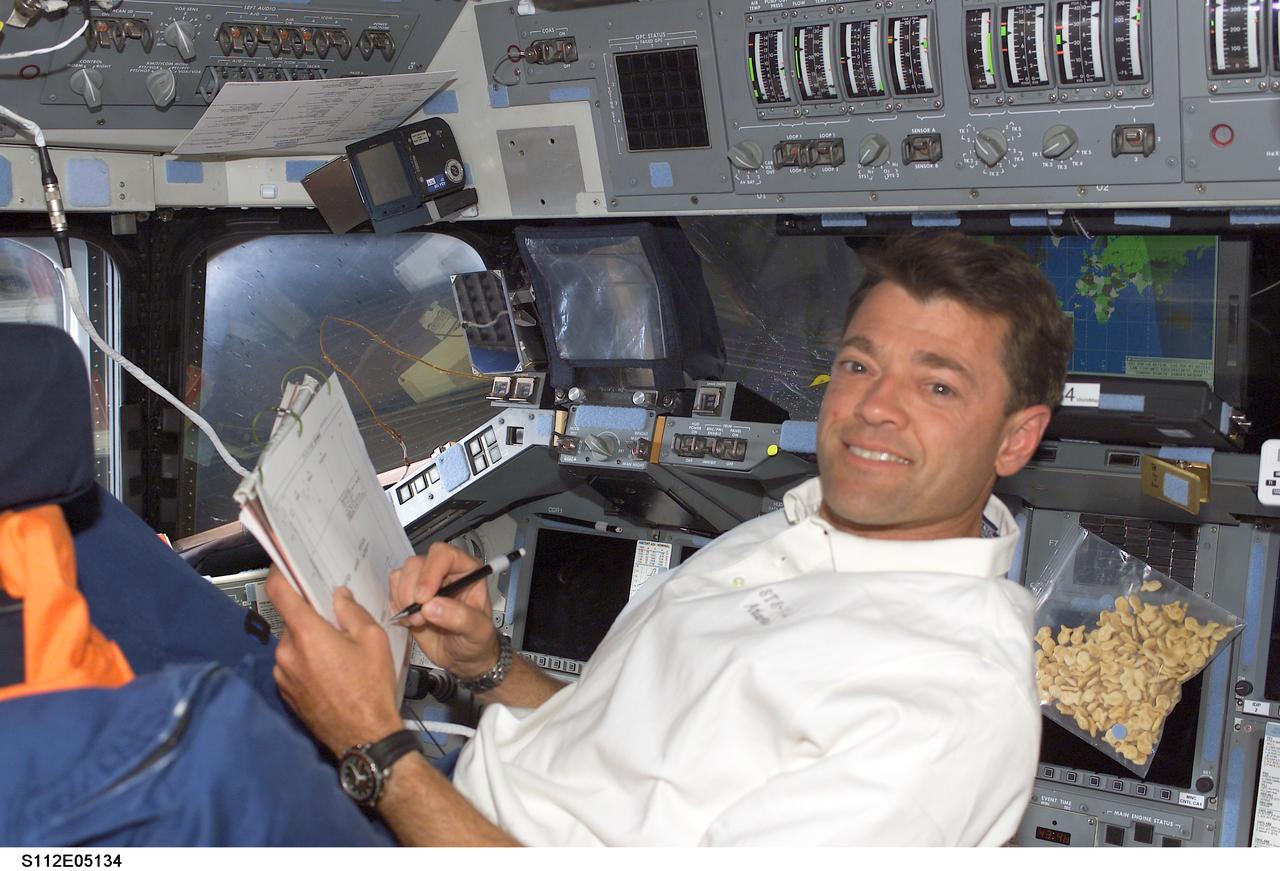
STS112-E-05134 (11 October 2002) --- Astronaut Jeffrey S. Ashby, STS-112 mission commander, looks over a procedures checklist on the flight deck of the Space Shuttle Atlantis.
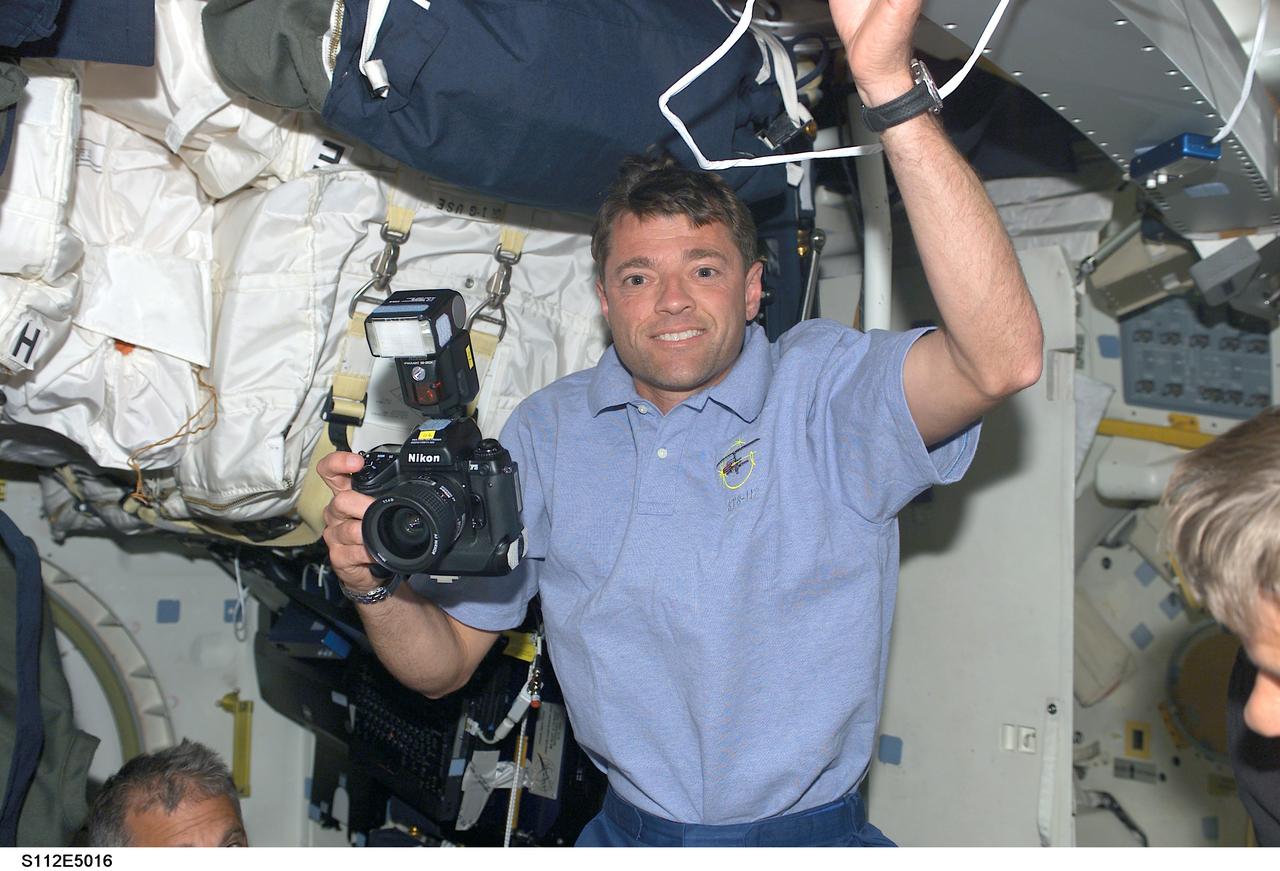
STS112-E-05016 (8 October 2002) --- Astronaut Jeffrey S. Ashby, STS-112 mission commander, holds a still photo camera on the middeck of the Space Shuttle Atlantis.