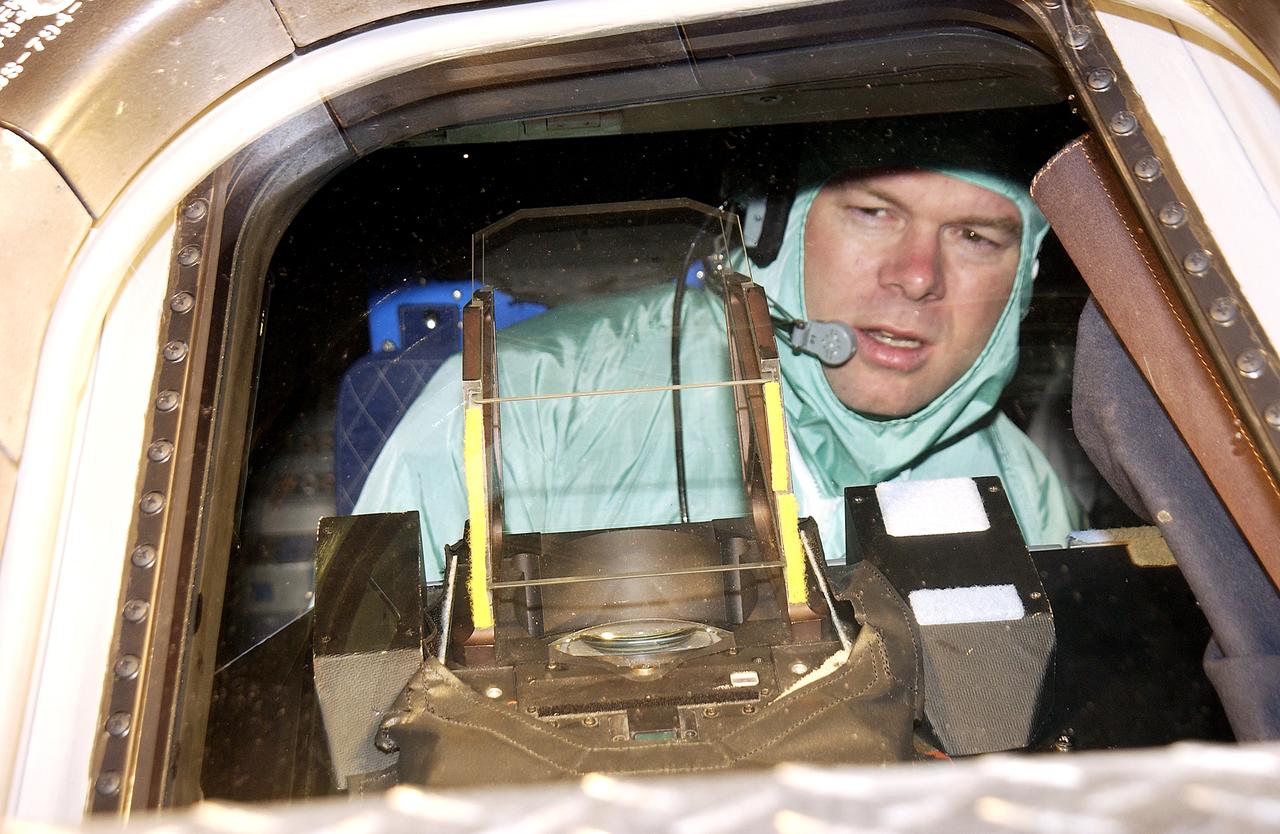
STS-114 Pilot James Kelly in Atlantis in Orbiter Processing Facility

KENNEDY SPACE CENTER, FLA. - After arrival at NASA’s Kennedy Space Center, the STS-114 crew members are greeted by KSC officials. Seen from left are Deputy Director Woodrow Whitlow Jr., Commander Eileen Collins, Mission Specialists Charles Camarda (behind Collins) and Andrew Thomas, astronaut Jerry Ross, who is chief of the Vehicle Integration Test (VIT) office, VIT Lead for STS-114 Robert Hanley, Shuttle Launch Director Mike Leinbach and Center Director Jim Kennedy. Crew members are taking part in the Terminal Countdown Demonstration Test (TCDT) over the next three days. The TCDT is held at KSC prior to each Space Shuttle flight. It provides the crew of each mission an opportunity to participate in simulated countdown activities. The test ends with a mock launch countdown culminating in a simulated main engine cutoff. The crew also spends time undergoing emergency egress training exercises at the launch pad. STS-114 is the first Return to Flight mission to the International Space Station. The launch window extends July 13 through July 31.
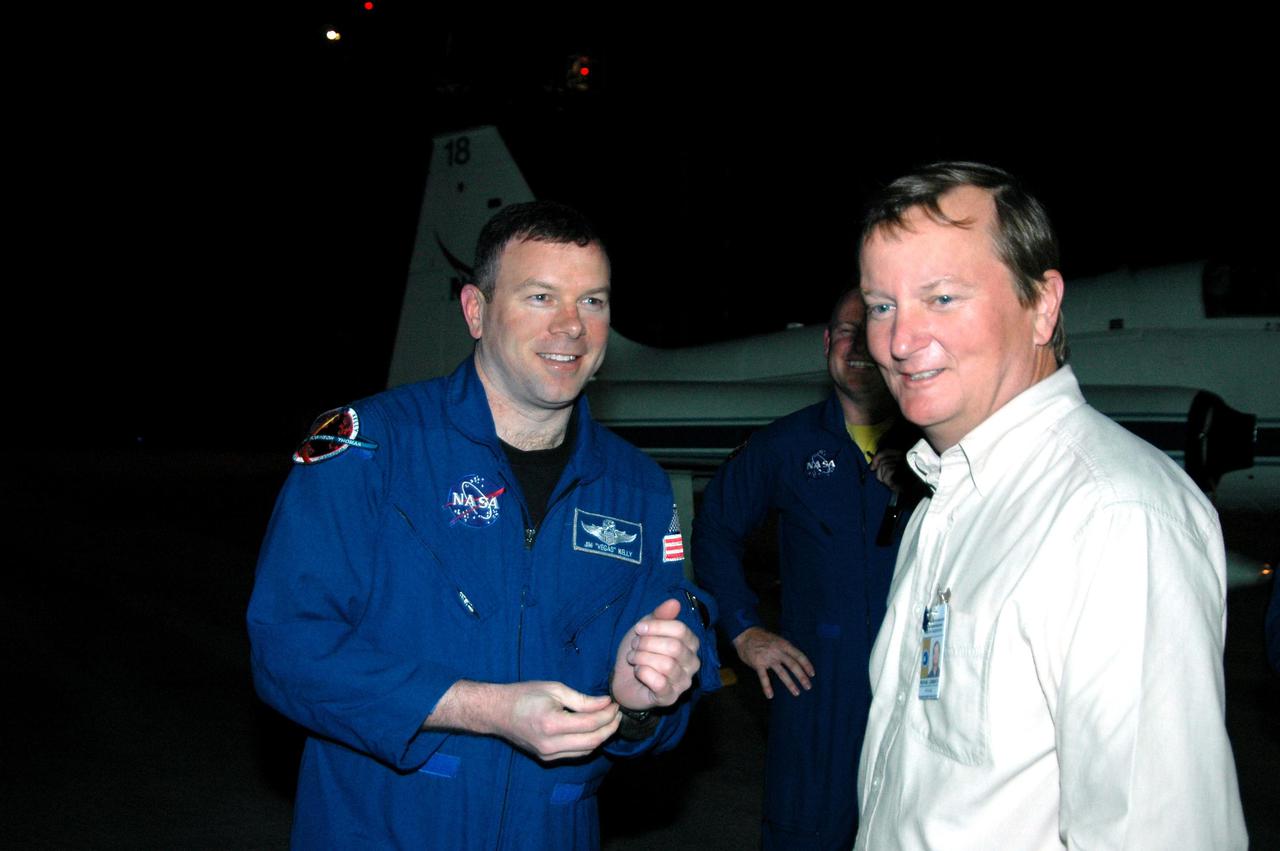
KENNEDY SPACE CENTER, FLA. - At Kennedy Space Center’s Shuttle Landing Facility, STS-114 Pilot James Kelly (left) is greeted by Shuttle Launch Director Mike Leinbach. Kelly and other crew members are taking part in the Terminal Countdown Demonstration Test (TCDT) over the next three days. The TCDT is held at KSC prior to each Space Shuttle flight. It provides the crew of each mission an opportunity to participate in simulated countdown activities. The test ends with a mock launch countdown culminating in a simulated main engine cutoff. The crew also spends time undergoing emergency egress training exercises at the launch pad. This is Kelly’s second space flight. STS-114 is the first Return to Flight mission to the International Space Station. The launch window extends July 13 through July 31.
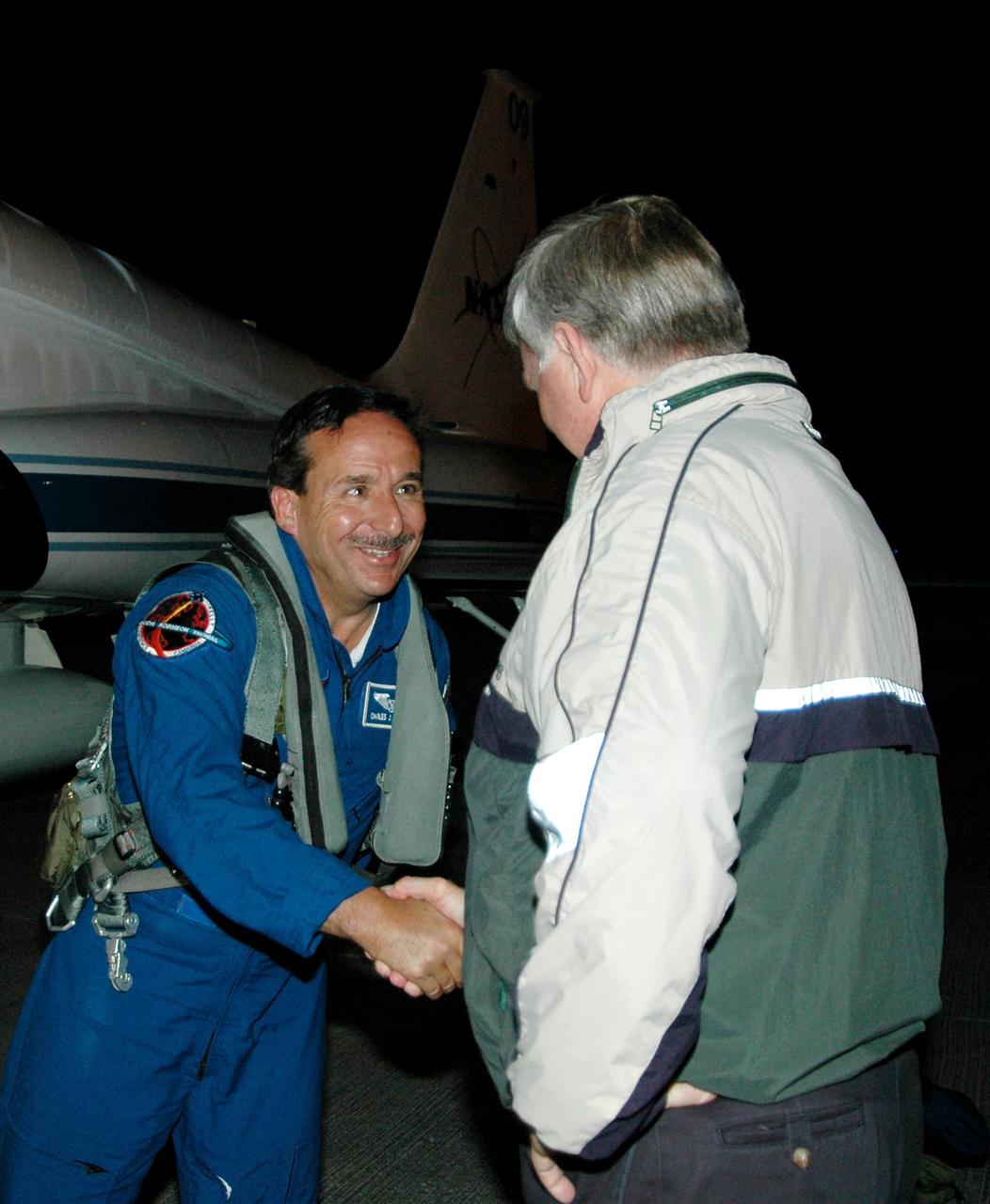
KENNEDY SPACE CENTER, FLA. - At Kennedy Space Center’s Shuttle Landing Facility, STS-114 Mission Specialist Charles Camarda (left) is greeted by Center Director Jim Kennedy. Camarda and other crew members are taking part in the Terminal Countdown Demonstration Test (TCDT) over the next three days. The TCDT is held at KSC prior to each Space Shuttle flight. It provides the crew of each mission an opportunity to participate in simulated countdown activities. The test ends with a mock launch countdown culminating in a simulated main engine cutoff. The crew also spends time undergoing emergency egress training exercises at the launch pad. This is Camarda’s first space flight. STS-114 is the first Return to Flight mission to the International Space Station. The launch window extends July 13 through July 31.
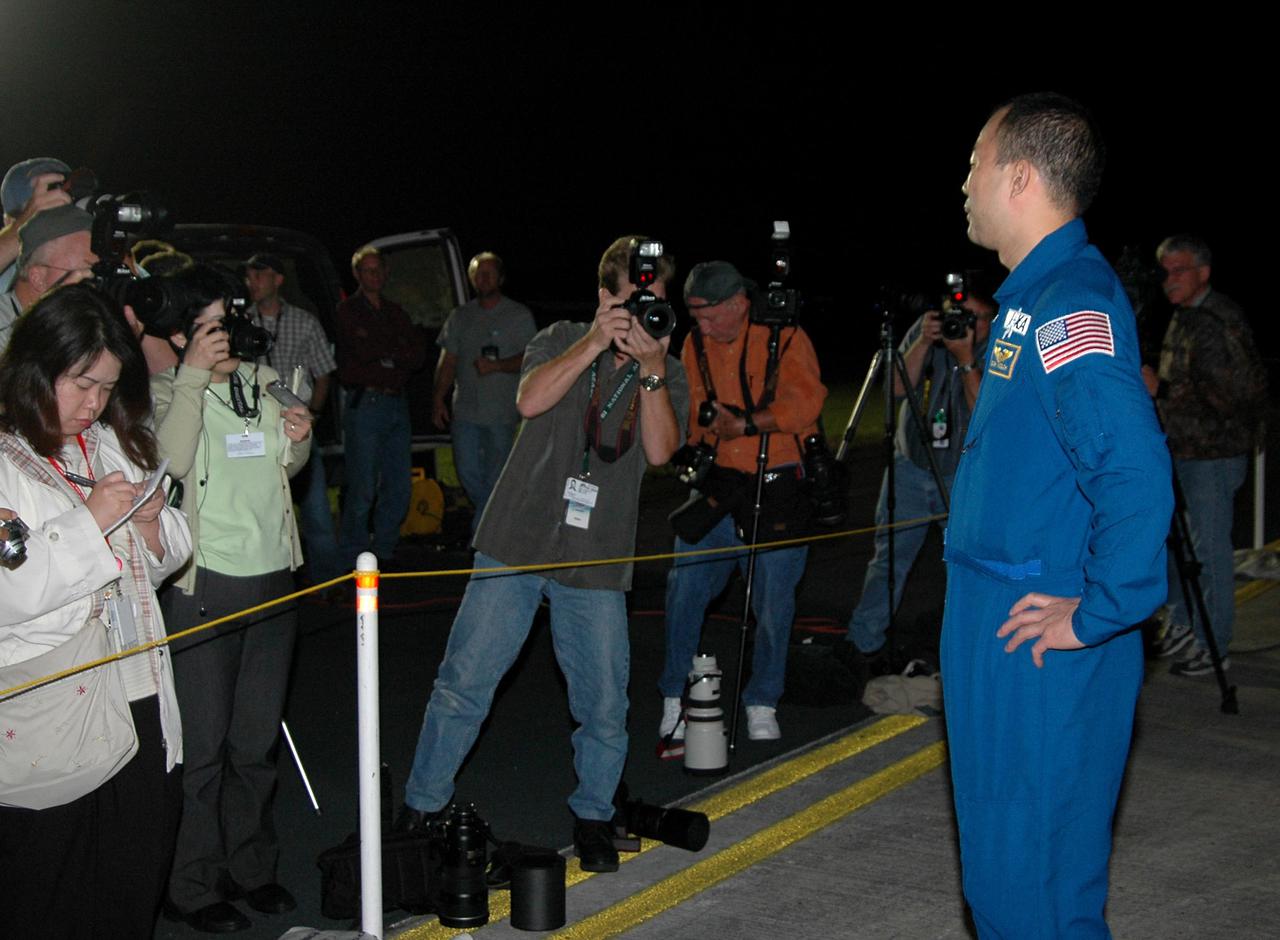
KENNEDY SPACE CENTER, FLA. - After arriving at Kennedy Space Center’s Shuttle Landing Facility, STS-114 Mission Specialist Soichi Noguchi talks to the media. Noguchi is with the Japan Aerospace Exploration Agency. He and other crew members are taking part in the Terminal Countdown Demonstration Test (TCDT) over the next three days. The TCDT is held at KSC prior to each Space Shuttle flight. It provides the crew of each mission an opportunity to participate in simulated countdown activities. The test ends with a mock launch countdown culminating in a simulated main engine cutoff. The crew also spends time undergoing emergency egress training exercises at the launch pad. This is Noguchi’s first space flight. STS-114 is the first Return to Flight mission to the International Space Station. The launch window extends July 13 through July 31.
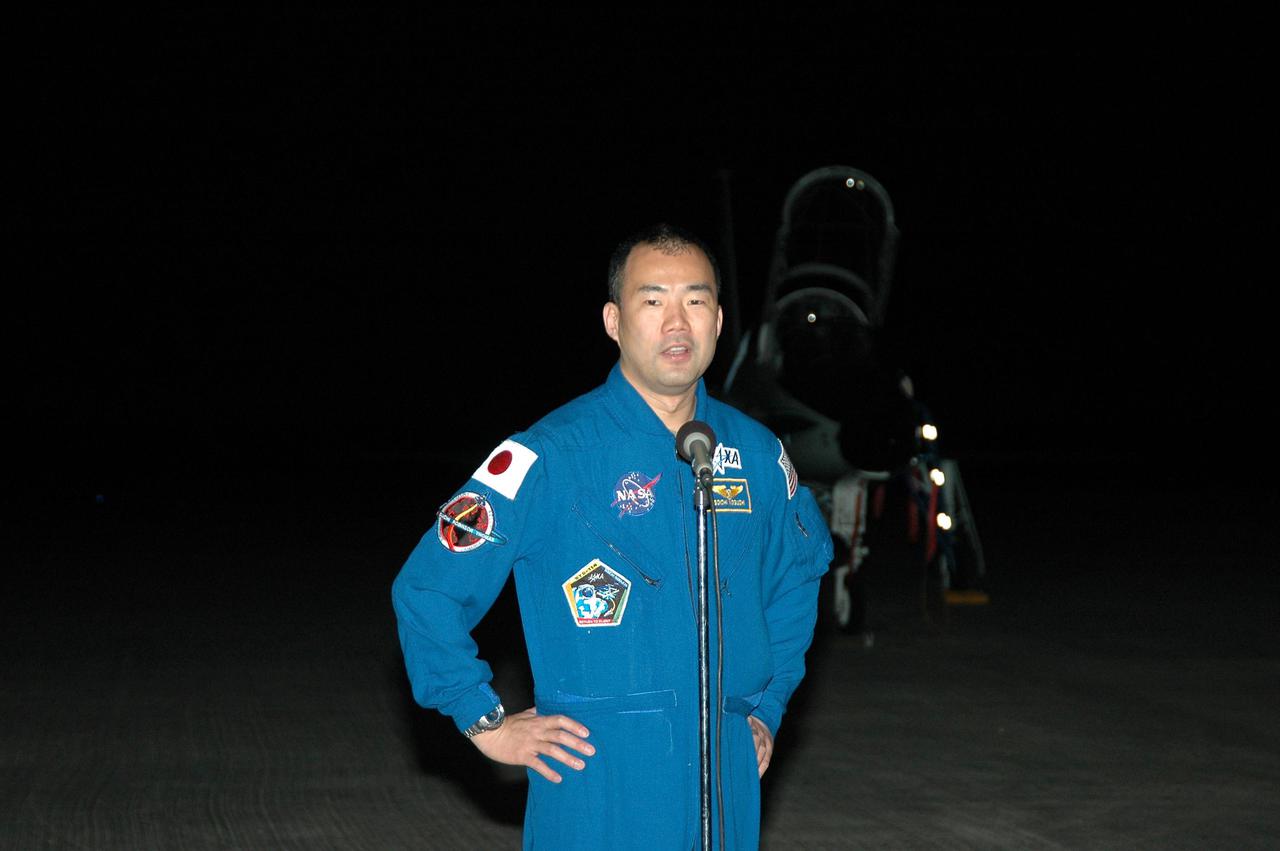
KENNEDY SPACE CENTER, FLA. - After arriving at Kennedy Space Center’s Shuttle Landing Facility, STS-114 Mission Specialist Soichi Noguchi talks to the media. Noguchi is with the Japan Aerospace Exploration Agency. He and other crew members are taking part in the Terminal Countdown Demonstration Test (TCDT) over the next three days. The TCDT is held at KSC prior to each Space Shuttle flight. It provides the crew of each mission an opportunity to participate in simulated countdown activities. The test ends with a mock launch countdown culminating in a simulated main engine cutoff. The crew also spends time undergoing emergency egress training exercises at the launch pad. This is Noguchi’s first space flight. STS-114 is the first Return to Flight mission to the International Space Station. The launch window extends July 13 through July 31.
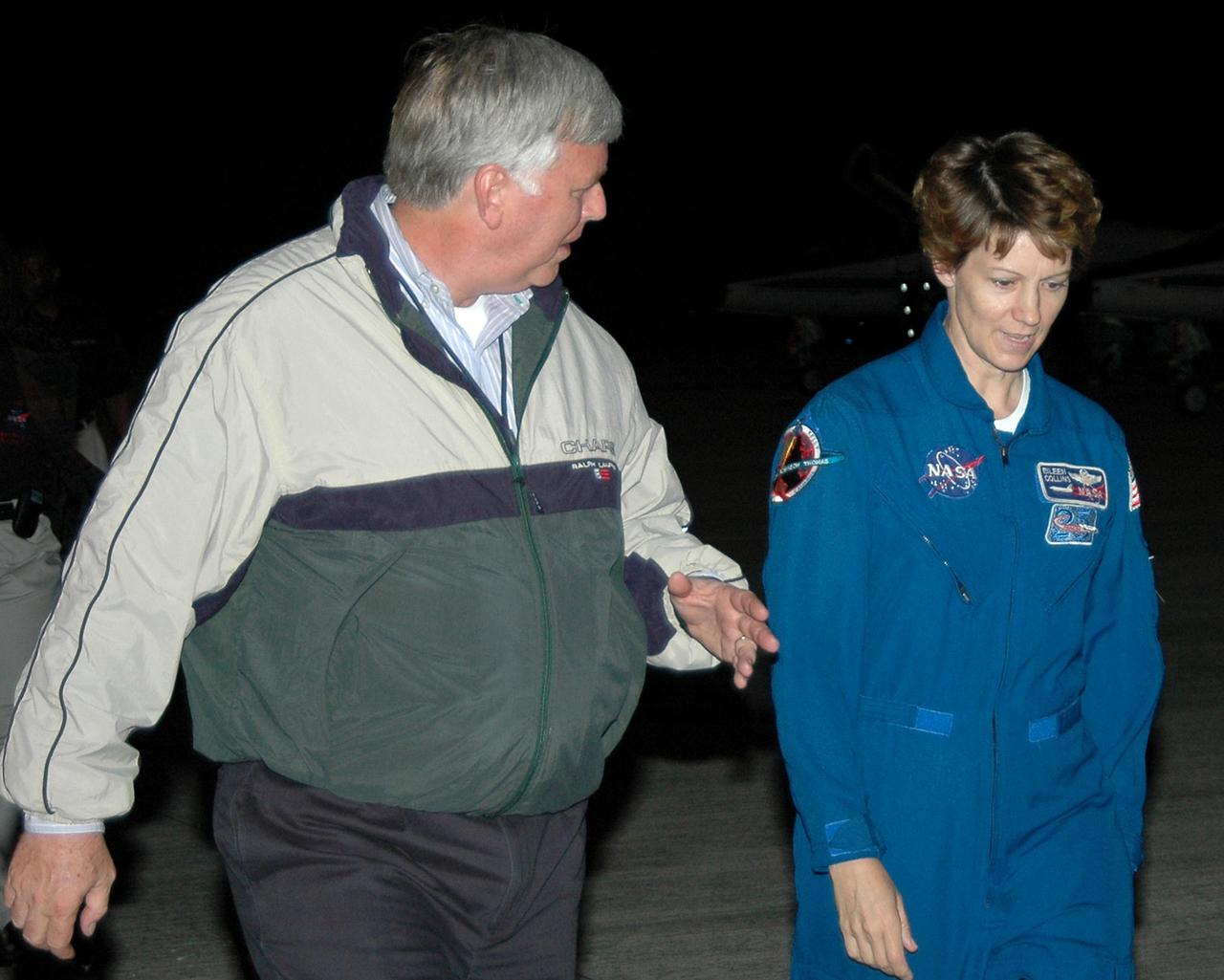
KENNEDY SPACE CENTER, FLA. - At Kennedy Space Center’s Shuttle Landing Facility, Center Director Jim Kennedy talks with STS-114 Commander Eileen Collins after her arrival. She and the rest of the crew are at KSC to take part in the Terminal Countdown Demonstration Test (TCDT) over the next three days. The TCDT is held at KSC prior to each Space Shuttle flight. It provides the crew of each mission an opportunity to participate in simulated countdown activities. The test ends with a mock launch countdown culminating in a simulated main engine cutoff. The crew also spends time undergoing emergency egress training exercises at the launch pad. This is Collins’ fourth space flight and second as commander. STS-114 is the first Return to Flight mission to the International Space Station. The launch window extends July 13 through July 31.
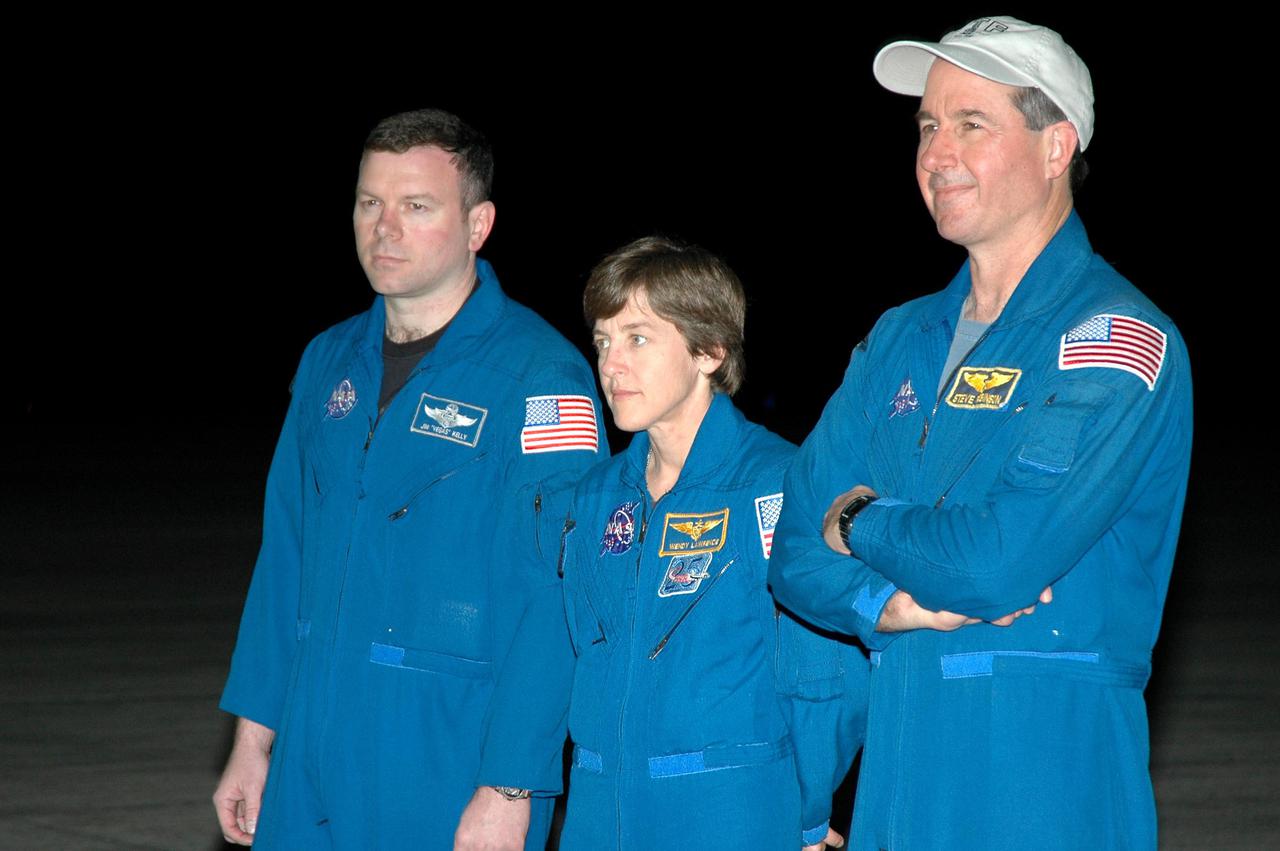
KENNEDY SPACE CENTER, FLA. - After arrival at NASA’s Kennedy Space Center, the STS-114 crew members pause on the runway while Commander Eileen Collins makes a brief statement to the media. Seen here are Pilot James Kelly and Mission Specialists Wendy Lawrence and Stephen Robinson. The crew is at KSC to take part in the Terminal Countdown Demonstration Test (TCDT) over the next three days. The TCDT is held at KSC prior to each Space Shuttle flight. It provides the crew of each mission an opportunity to participate in simulated countdown activities. The test ends with a mock launch countdown culminating in a simulated main engine cutoff. The crew also spends time undergoing emergency egress training exercises at the launch pad. STS-114 is the first Return to Flight mission to the International Space Station. The launch window extends July 13 through July 31.

KENNEDY SPACE CENTER, FLA. - STS-114 Mission Specialist Soichi Noguchi arrives at NASA’s Kennedy Space Center aboard a T-38 jet training aircraft. Noguchi is with the Japan Aerospace Exploration Agency. He and other crew members are taking part in the Terminal Countdown Demonstration Test (TCDT) over the next three days. The TCDT is held at KSC prior to each Space Shuttle flight. It provides the crew of each mission an opportunity to participate in simulated countdown activities. The test ends with a mock launch countdown culminating in a simulated main engine cutoff. The crew also spends time undergoing emergency egress training exercises at the launch pad. This is Noguchi’s first space flight. STS-114 is the first Return to Flight mission to the International Space Station. The launch window extends July 13 through July 31.
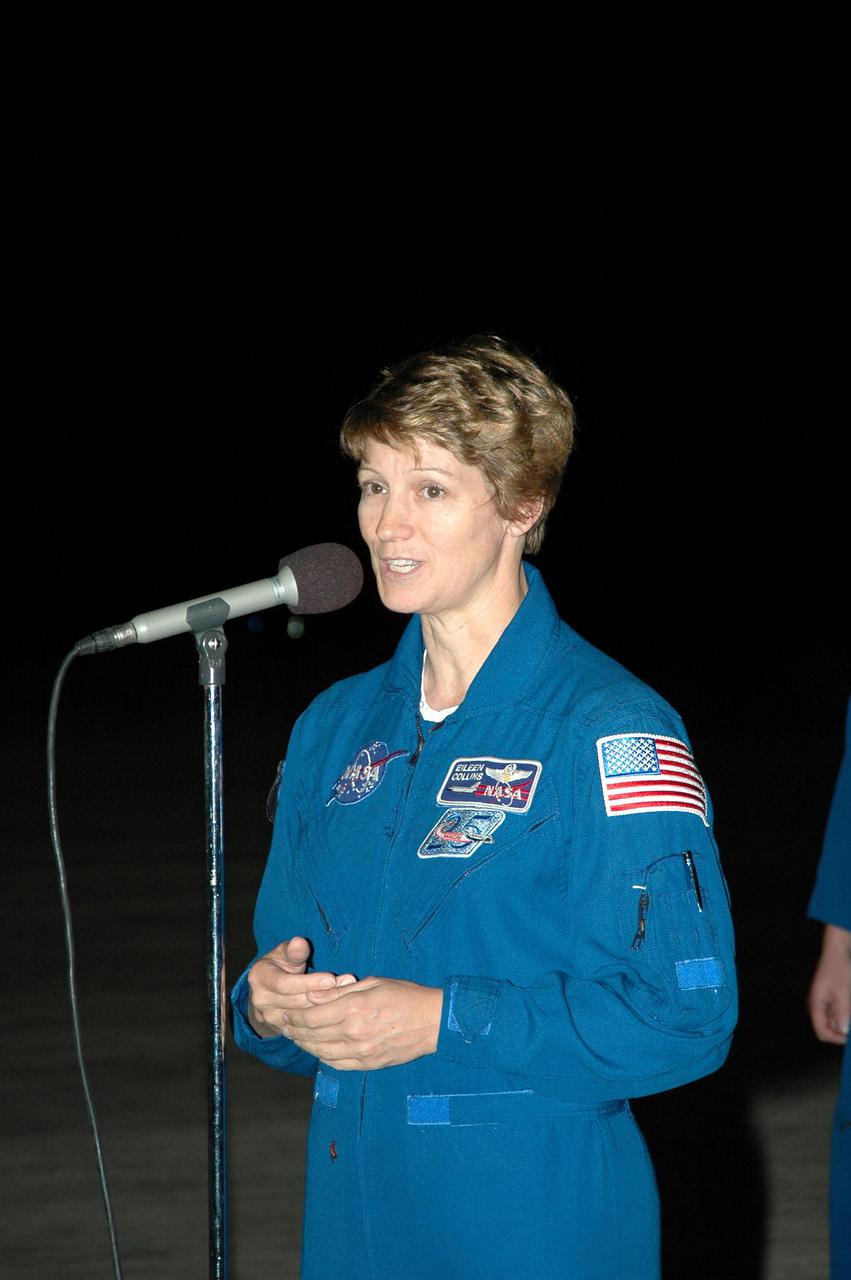
KENNEDY SPACE CENTER, FLA. - After arrival at NASA’s Kennedy Space Center, the STS-114 crew members pause on the runway while Commander Eileen Collins makes a brief statement to the media. The crew is at KSC to take part in the Terminal Countdown Demonstration Test (TCDT) over the next three days. The TCDT is held at KSC prior to each Space Shuttle flight. It provides the crew of each mission an opportunity to participate in simulated countdown activities. The test ends with a mock launch countdown culminating in a simulated main engine cutoff. The crew also spends time undergoing emergency egress training exercises at the launch pad. STS-114 is the first Return to Flight mission to the International Space Station. The launch window extends July 13 through July 31.
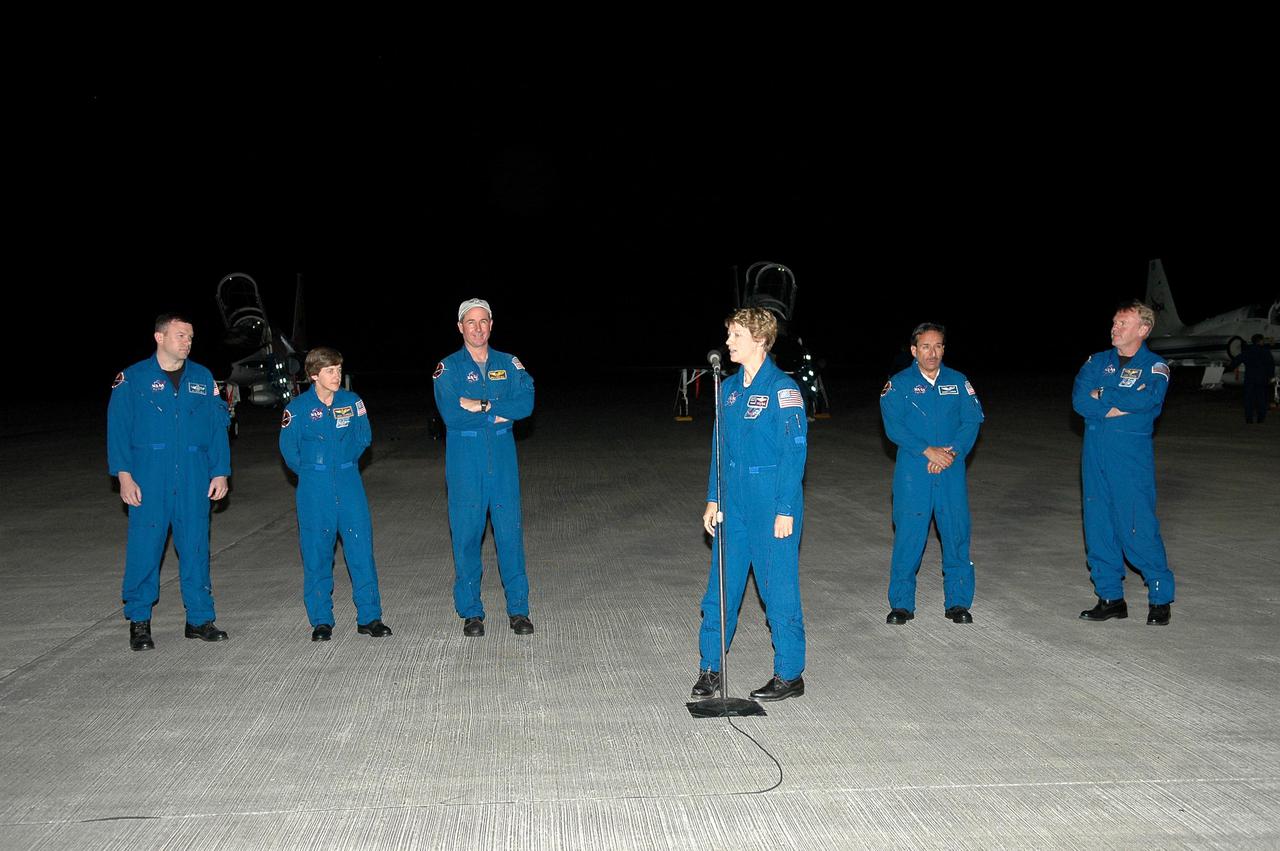
KENNEDY SPACE CENTER, FLA. - After arrival at NASA’s Kennedy Space Center, the STS-114 crew members pause on the runway while Commander Eileen Collins makes a brief statement to the media. Standing behind her, from left, are Pilot James Kelly and Mission Specialists Wendy Lawrence, Stephen Robinson, Charles Camarda, and Andrew Thomas. The crew is at KSC to take part in the Terminal Countdown Demonstration Test (TCDT) over the next three days. The TCDT is held at KSC prior to each Space Shuttle flight. It provides the crew of each mission an opportunity to participate in simulated countdown activities. The test ends with a mock launch countdown culminating in a simulated main engine cutoff. The crew also spends time undergoing emergency egress training exercises at the launch pad. STS-114 is the first Return to Flight mission to the International Space Station. The launch window extends July 13 through July 31.
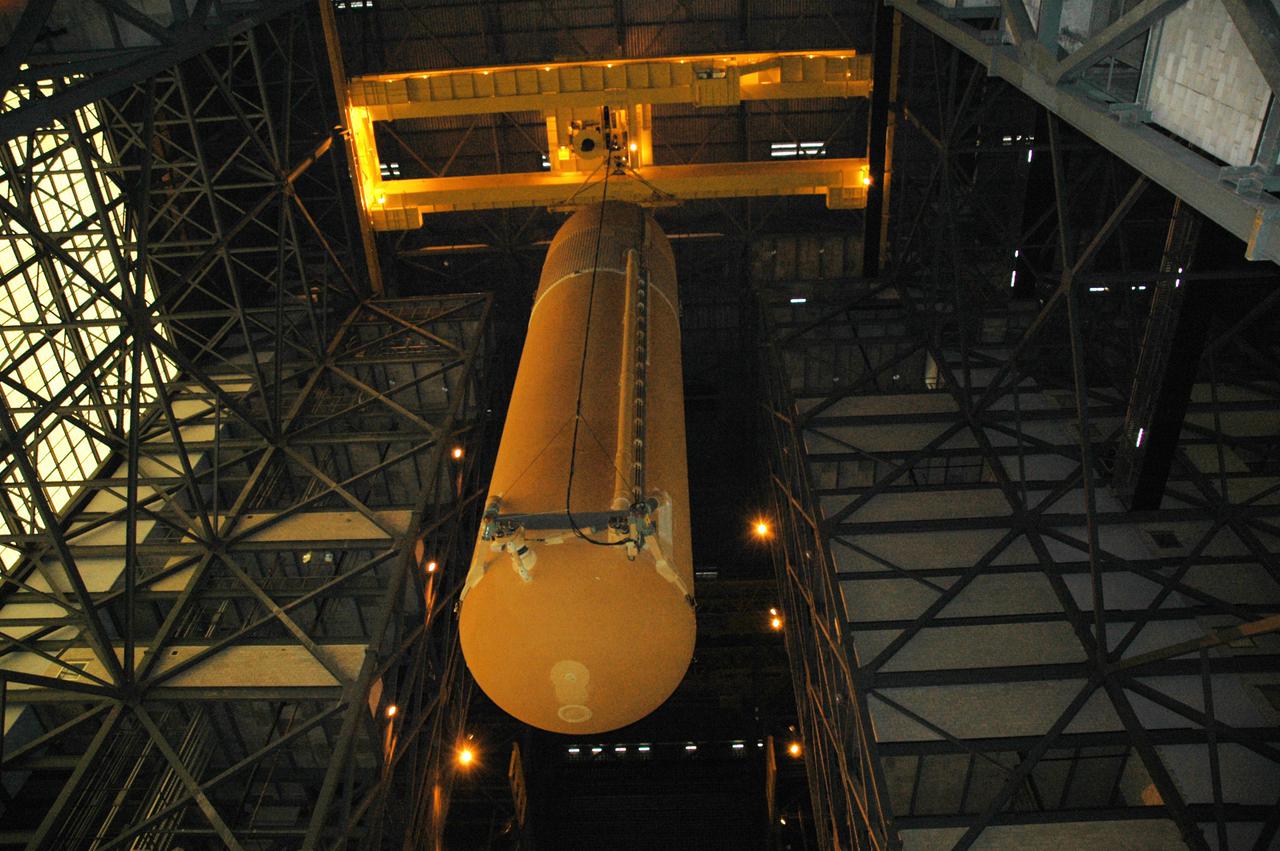
KENNEDY SPACE CENTER, FLA. - An overhead crane lowers the External Tank that will be used to return the Space Shuttle program to flight into high bay 3 in the Vehicle Assembly Building. The tank, ET-121, and the Solid Rocket Boosters were originally scheduled to fly with orbiter Atlantis on mission STS-121 but will now be used to launch Discovery on mission STS-114. Once secure in the high bay, a new heater will be added to the feedline bellows to minimize the potential for ice and frost buildup. STS-114 is the first Return to Flight mission to the International Space Station. The launch window extends from July 13 through July 31.
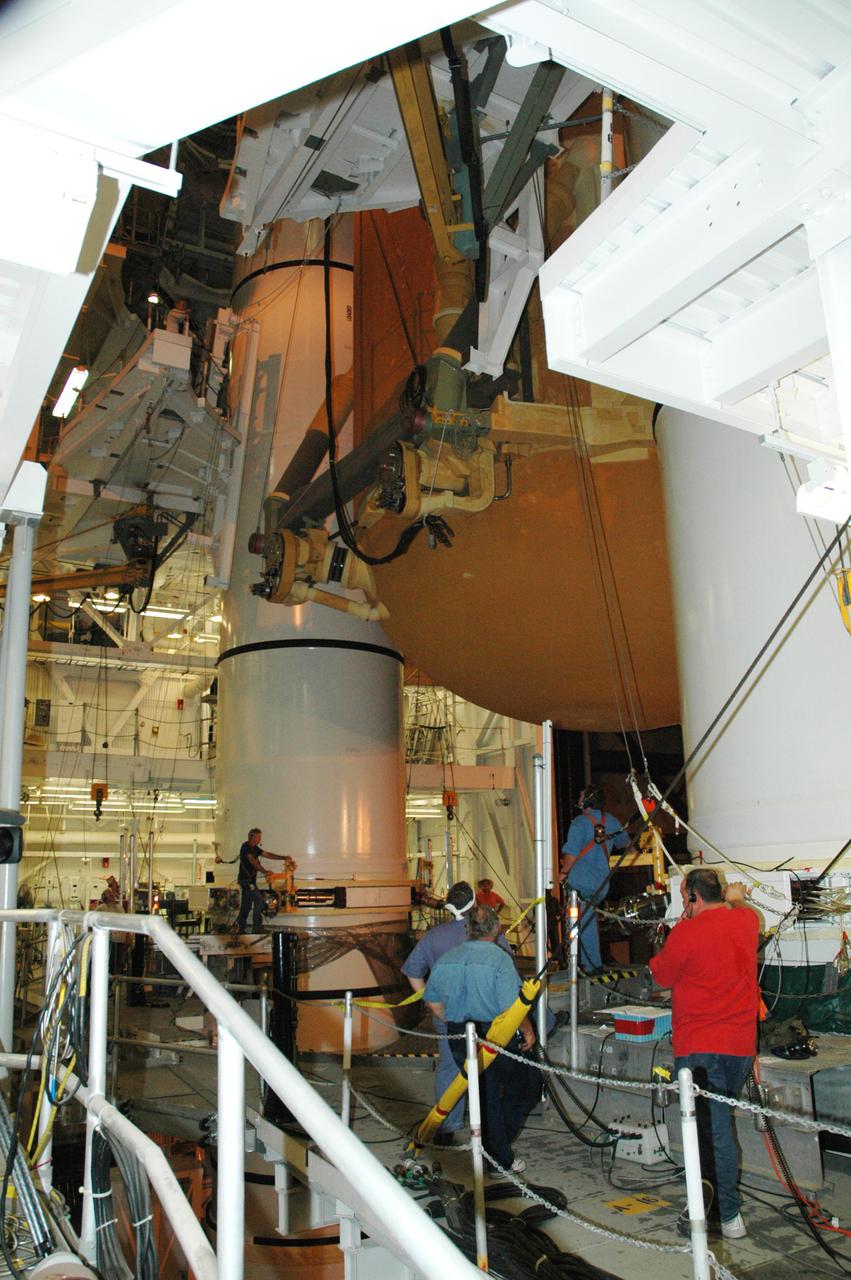
KENNEDY SPACE CENTER, FLA. - Technicians attach the External Tank that will be used to return the Space Shuttle program to flight to a pair of Solid Rocket Boosters in high bay 3 in the Vehicle Assembly Building. The tank, ET-121, and the Solid Rocket Boosters were originally scheduled to fly with orbiter Atlantis on mission STS-121 but will now be used to launch Discovery on mission STS-114. Once secure in the high bay, a new heater will be added to the feedline bellows to minimize the potential for ice and frost buildup. STS-114 is the first Return to Flight mission to the International Space Station. The launch window extends from July 13 through July 31.
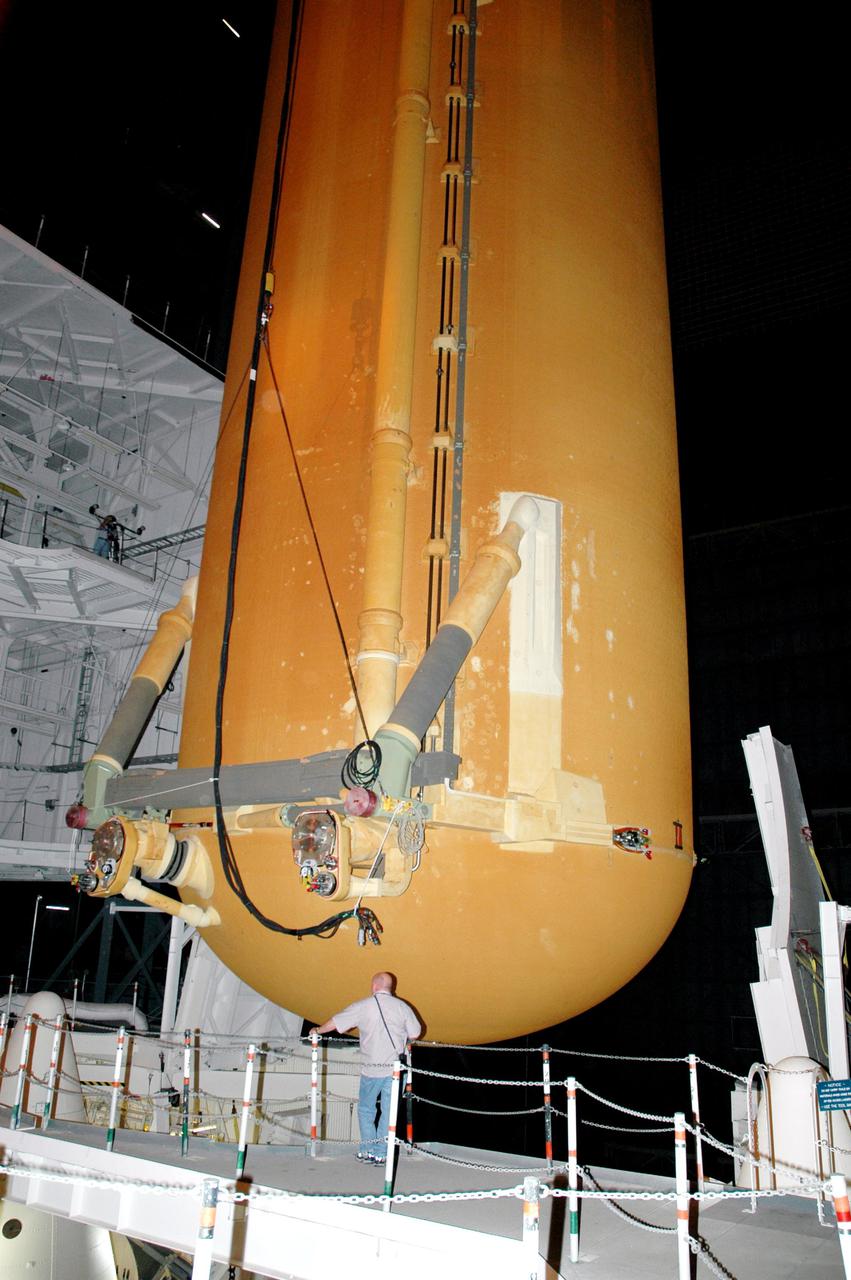
KENNEDY SPACE CENTER, FLA. - A technician monitors the External Tank that will be used to return the Space Shuttle program to flight as it is positioned into high bay 3 in the Vehicle Assembly Building. The tank, ET-121, and the Solid Rocket Boosters were originally scheduled to fly with orbiter Atlantis on mission STS-121 but will now be used to launch Discovery on mission STS-114. Once secure in the high bay, a new heater will be added to the feedline bellows to minimize the potential for ice and frost buildup. STS-114 is the first Return to Flight mission to the International Space Station. The launch window extends from July 13 through July 31.
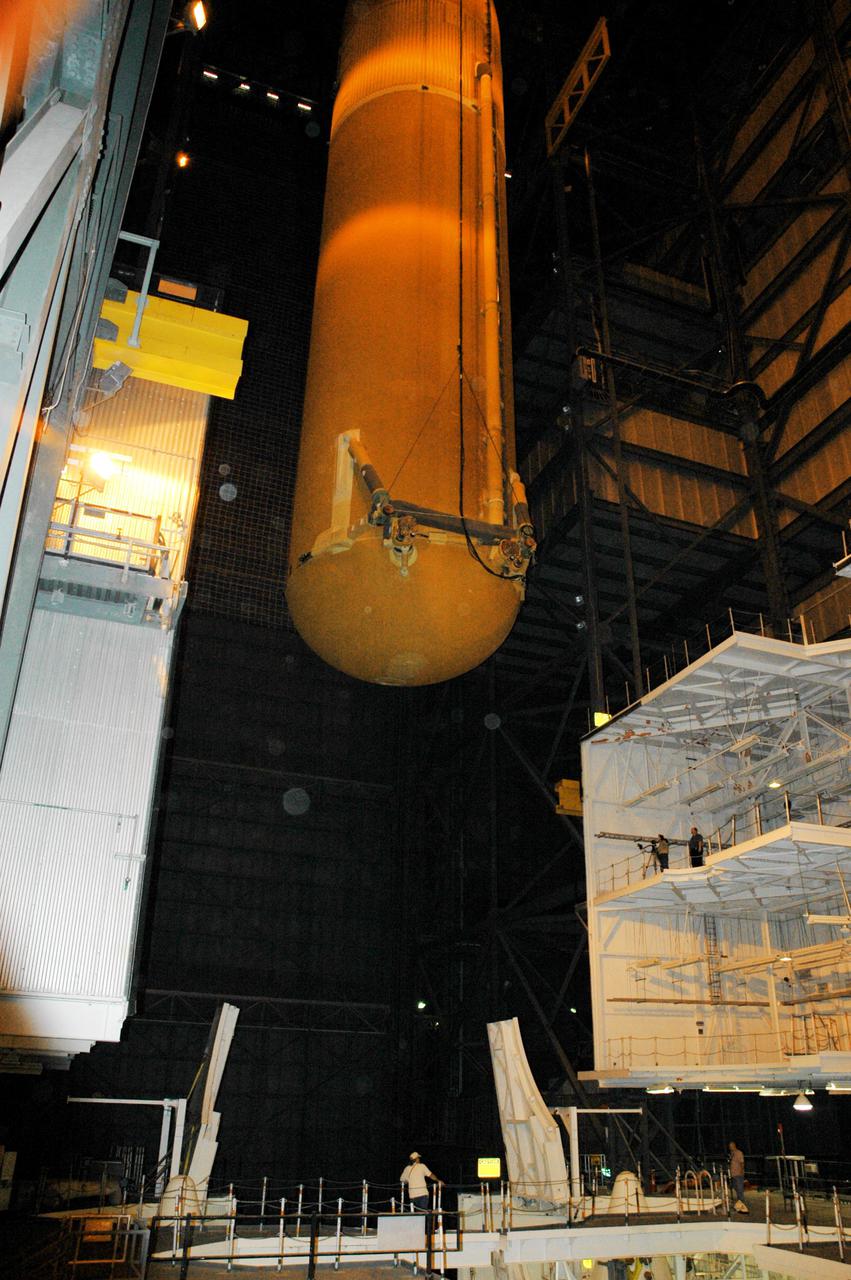
KENNEDY SPACE CENTER, FLA. - The External Tank that will be used to return the Space Shuttle program to flight is lowered into high bay 3 in the Vehicle Assembly Building. The tank, ET-121, and the Solid Rocket Boosters were originally scheduled to fly with orbiter Atlantis on mission STS-121 but will now be used to launch Discovery on mission STS-114. Once secure in the high bay, a new heater will be added to the feedline bellows to minimize the potential for ice and frost buildup. STS-114 is the first Return to Flight mission to the International Space Station. The launch window extends from July 13 through July 31.
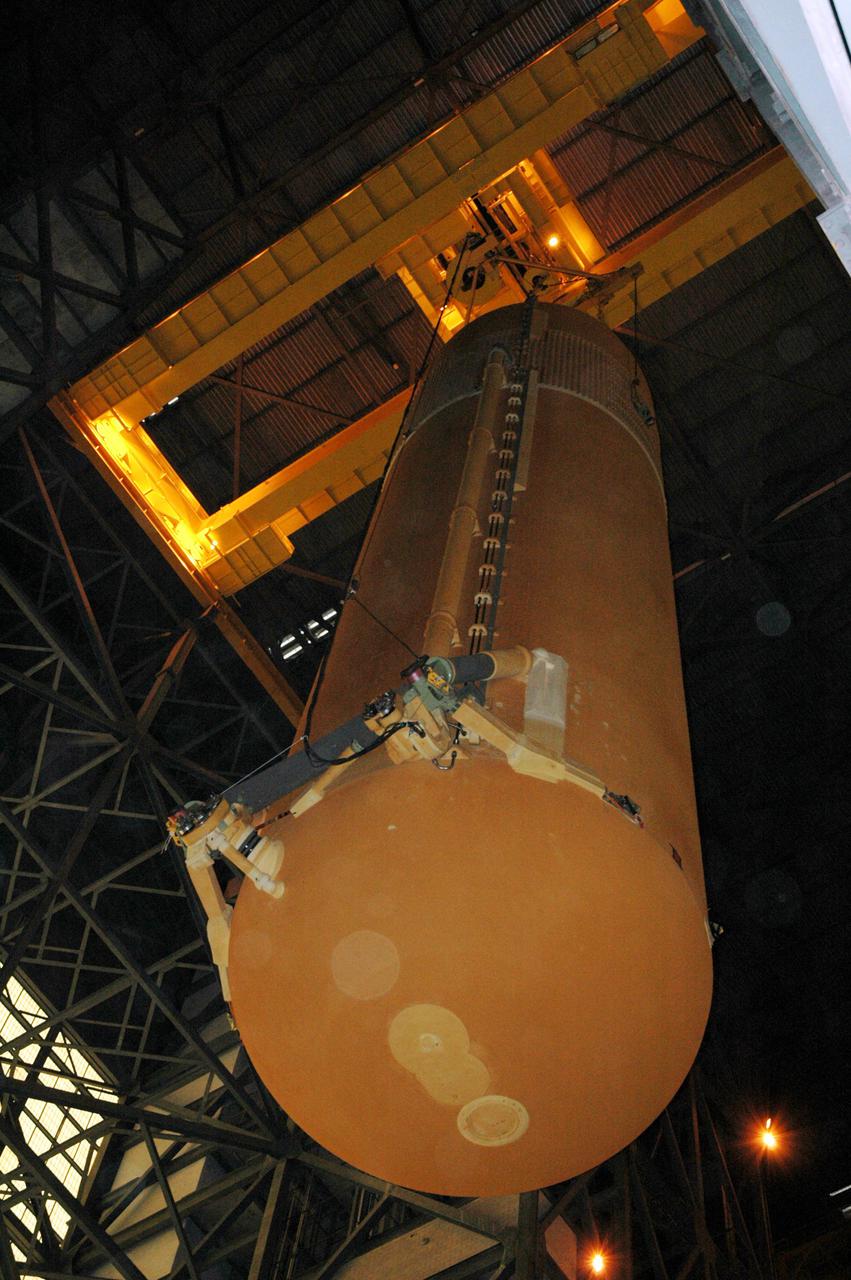
KENNEDY SPACE CENTER, FLA. - The External Tank that will be used to return the Space Shuttle program to flight is lifted into high bay 3 in the Vehicle Assembly Building. The tank, ET-121, and the Solid Rocket Boosters were originally scheduled to fly with orbiter Atlantis on mission STS-121 but will now be used to launch Discovery on mission STS-114. Once secure in the high bay, a new heater will be added to the feedline bellows to minimize the potential for ice and frost buildup. STS-114 is the first Return to Flight mission to the International Space Station. The launch window extends from July 13 through July 31.
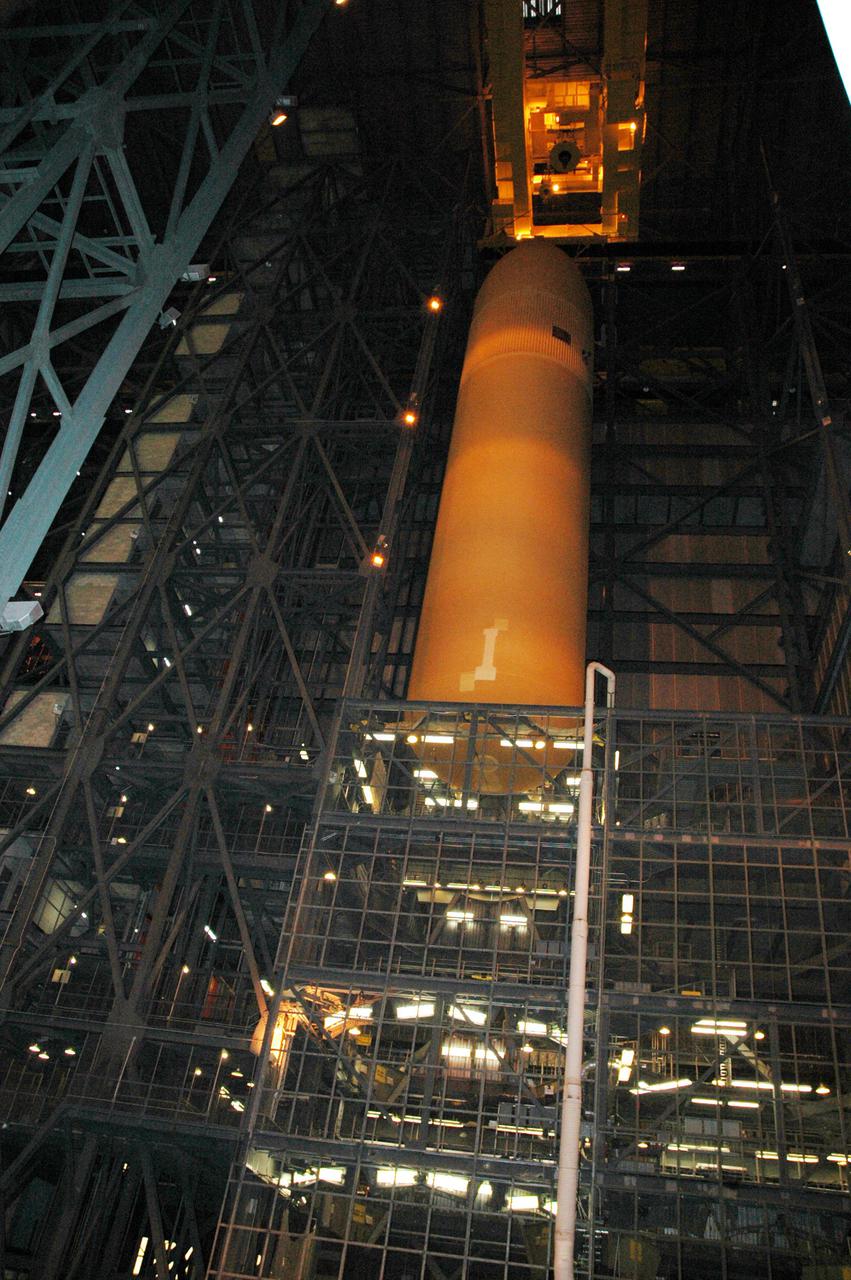
KENNEDY SPACE CENTER, FLA. - The External Tank that will be used to return the Space Shuttle program to flight is lifted into high bay 3 in the Vehicle Assembly Building. The tank, ET-121, and the Solid Rocket Boosters were originally scheduled to fly with orbiter Atlantis on mission STS-121 but will now be used to launch Discovery on mission STS-114. Once secure in the high bay, a new heater will be added to the feedline bellows to minimize the potential for ice and frost buildup. STS-114 is the first Return to Flight mission to the International Space Station. The launch window extends from July 13 through July 31.
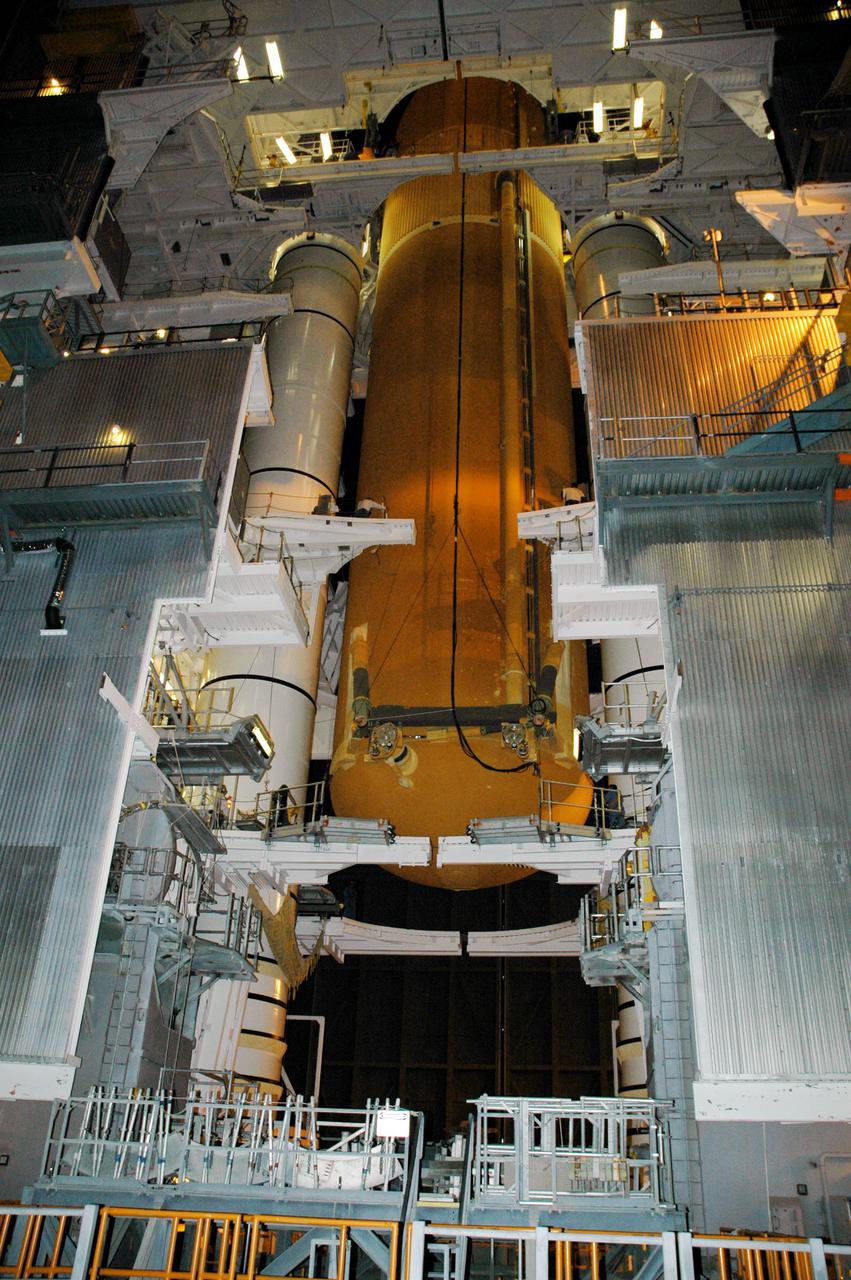
KENNEDY SPACE CENTER, FLA. - The External Tank that will be used to return the Space Shuttle program to flight is attached to a pair of Solid Rocket Boosters in high bay 3 in the Vehicle Assembly Building. The tank, ET-121, and the Solid Rocket Boosters were originally scheduled to fly with orbiter Atlantis on mission STS-121 but will now be used to launch Discovery on mission STS-114. Once secure in the high bay, a new heater will be added to the feedline bellows to minimize the potential for ice and frost buildup. STS-114 is the first Return to Flight mission to the International Space Station. The launch window extends from July 13 through July 31.
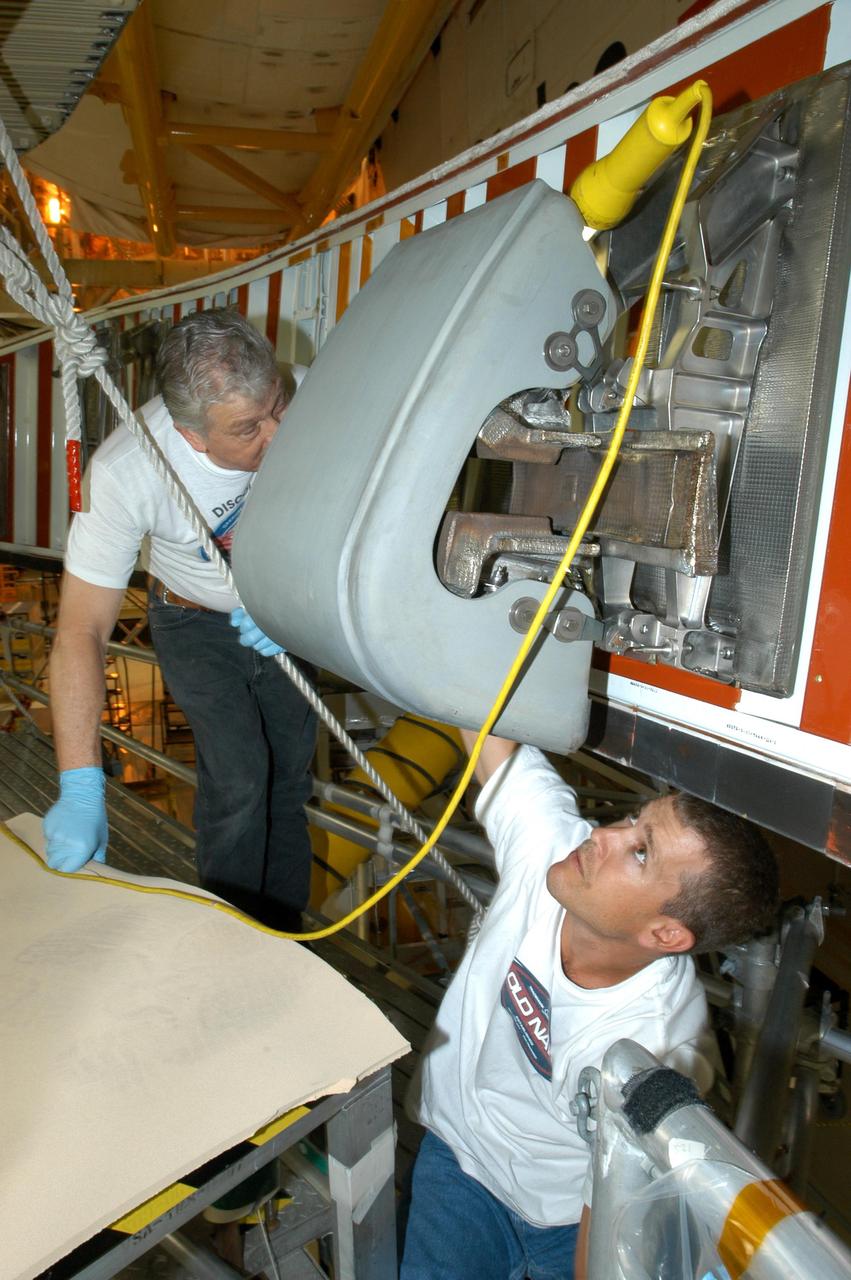
KENNEDY SPACE CENTER, FLA. -- In the Orbiter Processing Facility, technicians Jake Jacobson (left) and Billy Barecka install a reinforced carbon carbon panel on the right wing of Space Shuttle Discovery. The next flight planned for Discovery is the STS-114 mission on Logistics Flight 1 to deliver supplies and equipment, as well as the external stowage platform, to the International Space Station. STS-114 will be the mission that returns the Space Shuttle to flight status and is scheduled for no earlier than March 2005.
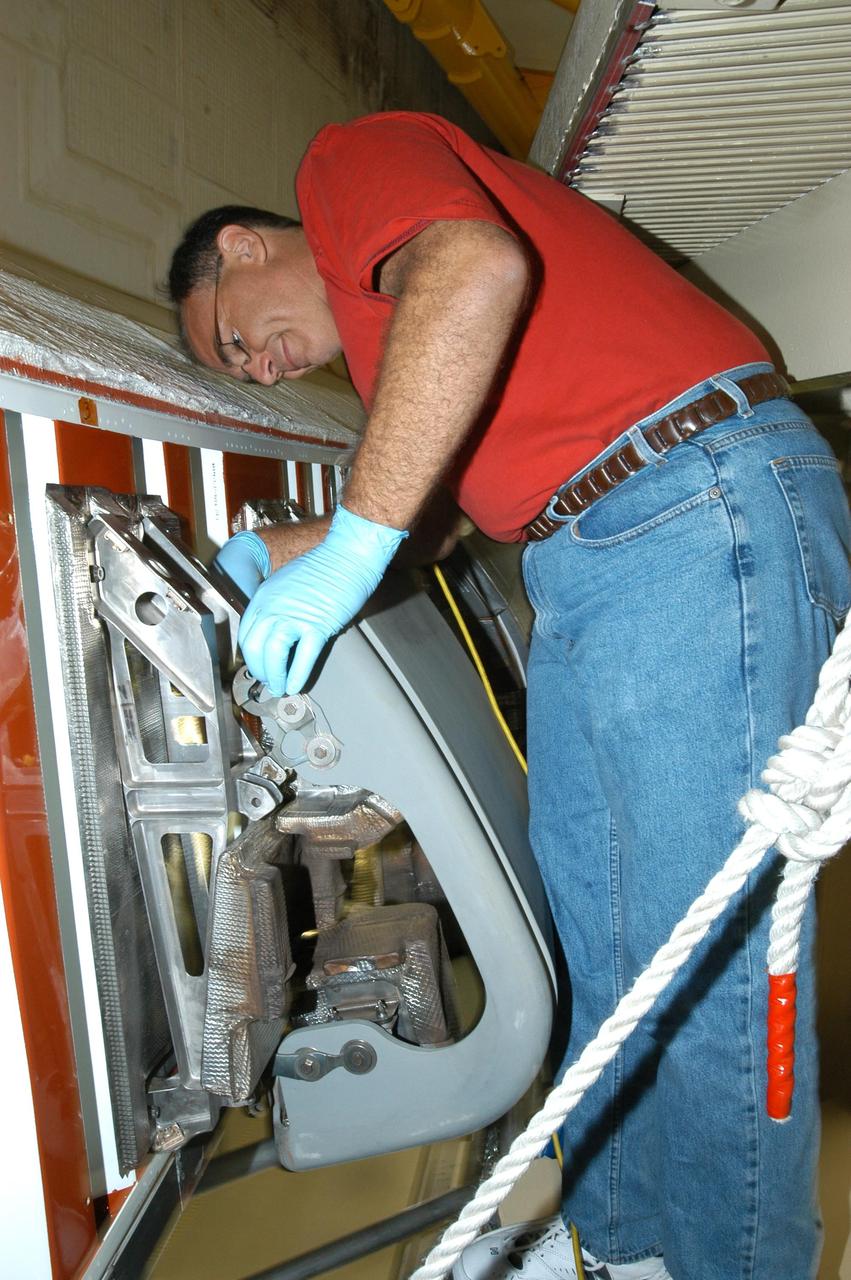
KENNEDY SPACE CENTER, FLA. -- In the Orbiter Processing Facility, technician Mike McCall installs a reinforced carbon carbon panel on the right wing of Space Shuttle Discovery. The next flight planned for Discovery is the STS-114 mission on Logistics Flight 1 to deliver supplies and equipment, as well as the external stowage platform, to the International Space Station. STS-114 will be the mission that returns the Space Shuttle to flight status and is scheduled for no earlier than March 2005.
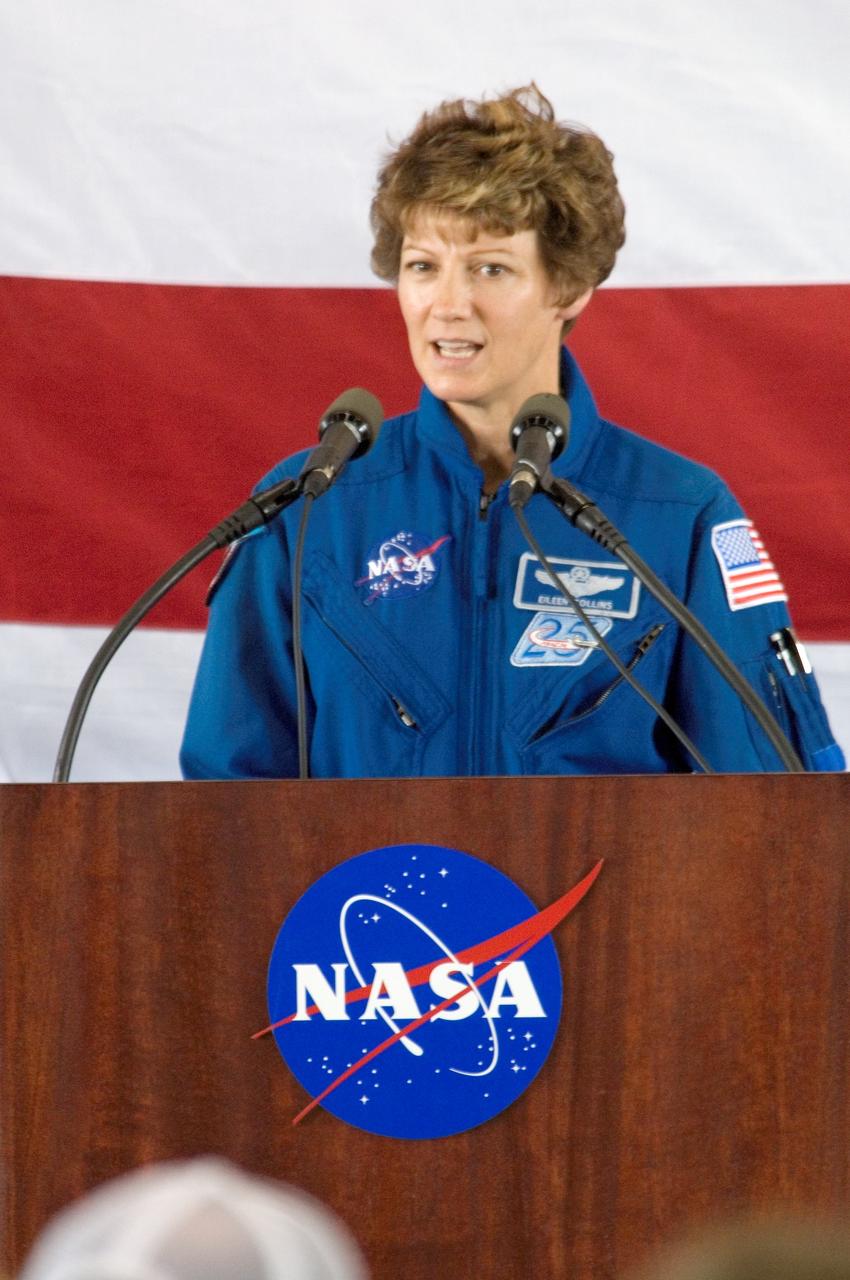
JSC2005-E-33409 (10 August 2005) --- Astronaut Eileen M. Collins, STS-114 commander, addresses a crowd on hand at Ellington Field’s Hangar 276 near Johnson Space Center (JSC) during the STS-114 crew return ceremonies.

JSC2005-E-33423 (10 August 2005) --- Astronaut Stephen K. Robinson, STS-114 mission specialist, addresses a crowd on hand at Ellington Field’s Hangar 276 near Johnson Space Center (JSC) during the STS-114 crew return ceremonies.

JSC2005-E-33428 (10 August 2005) --- Astronaut Andrew S. W. Thomas, STS-114 mission specialist, addresses a crowd on hand at Ellington Field’s Hangar 276 near Johnson Space Center (JSC) during the STS-114 crew return ceremonies.

JSC2005-E-33430 (10 August 2005) --- Astronaut Wendy B. Lawrence, STS-114 mission specialist, addresses a crowd on hand at Ellington Field’s Hangar 276 near Johnson Space Center (JSC) during the STS-114 crew return ceremonies.
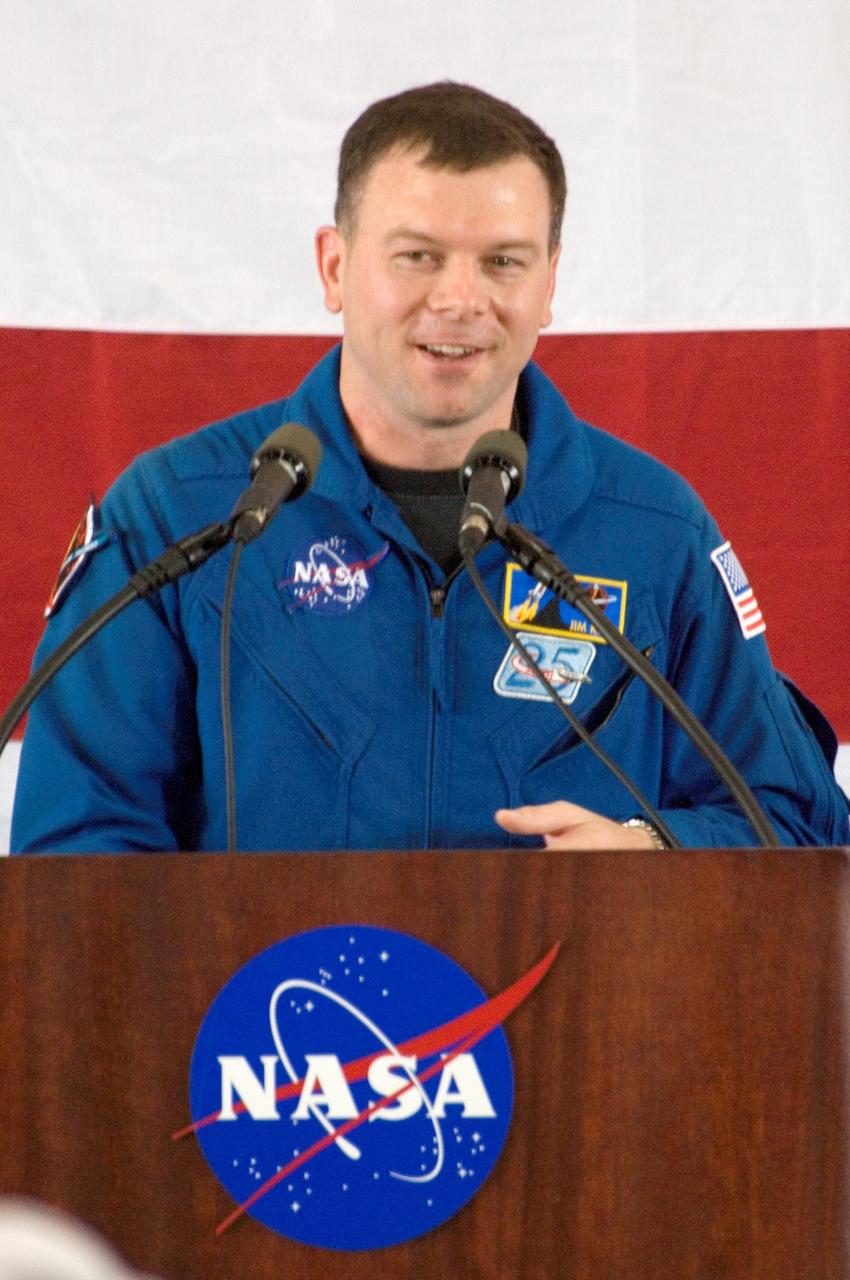
JSC2005-E-33414 (10 August 2005) --- Astronaut James M. Kelly, STS-114 pilot, addresses a crowd on hand at Ellington Field’s Hangar 276 near Johnson Space Center (JSC) during the STS-114 crew return ceremonies.
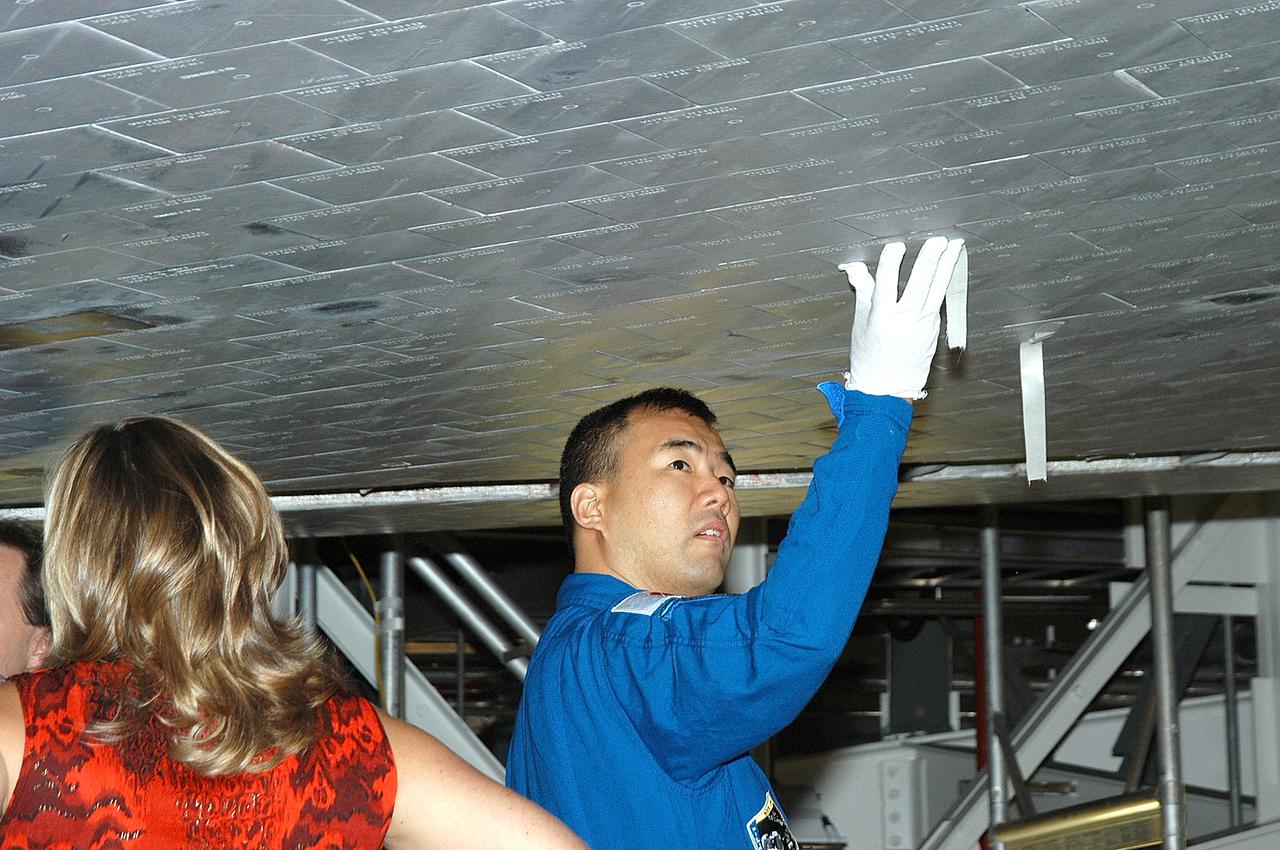
In the Orbiter Processing Facility, STS-114 Mission Specialist Soichi Noguchi takes a close look at the some of the tiles underneath Atlantis. Noguchi is with the Japan Aerospace Exploration Agency, JAXA. The STS-114 crew is at KSC to take part in crew equipment and orbiter familiarization.
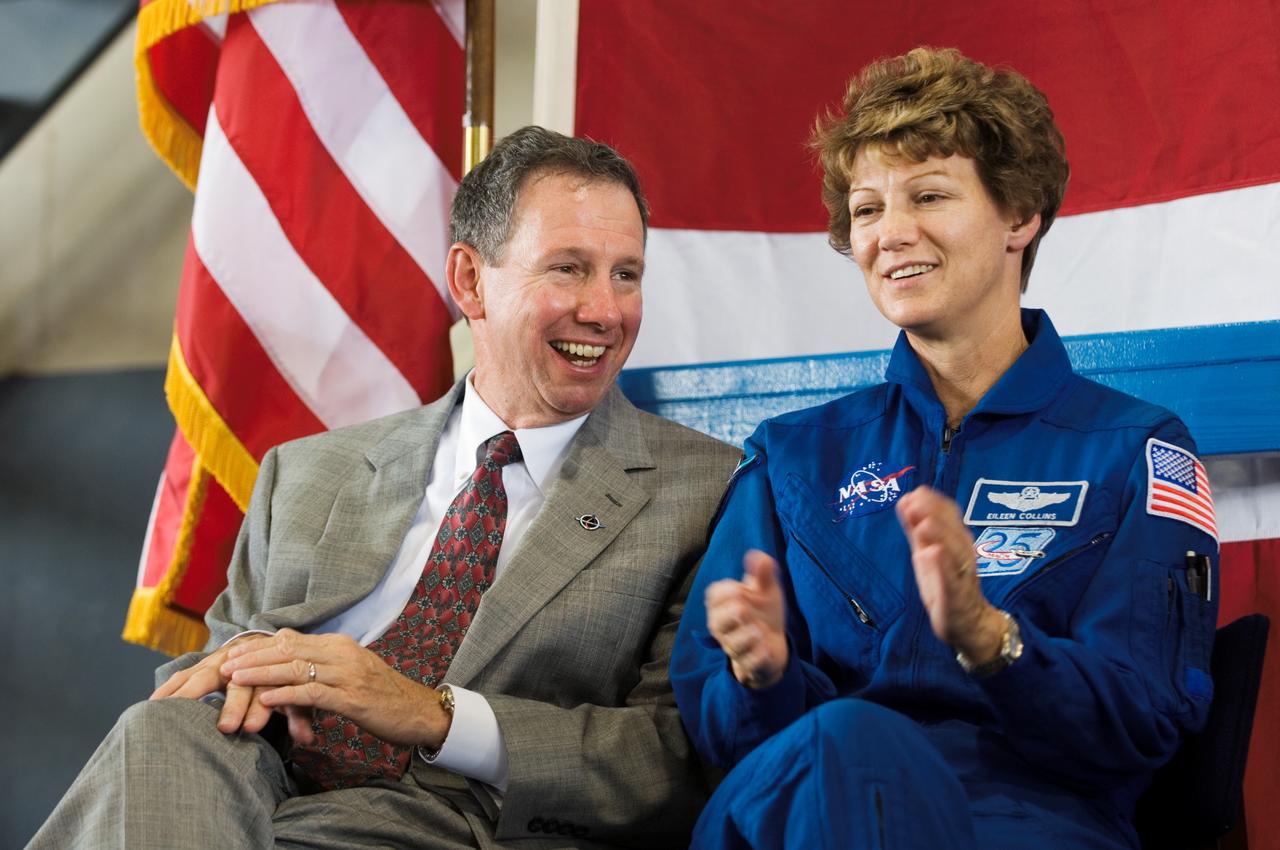
JSC2005-E-33335 (10 August 2005) --- NASA Administrator Michael Griffin and astronaut Eileen M. Collins, STS-114 commander, are pictured during the STS-114 crew return ceremonies at Ellington Field’s Hangar 276 near Johnson Space Center (JSC).
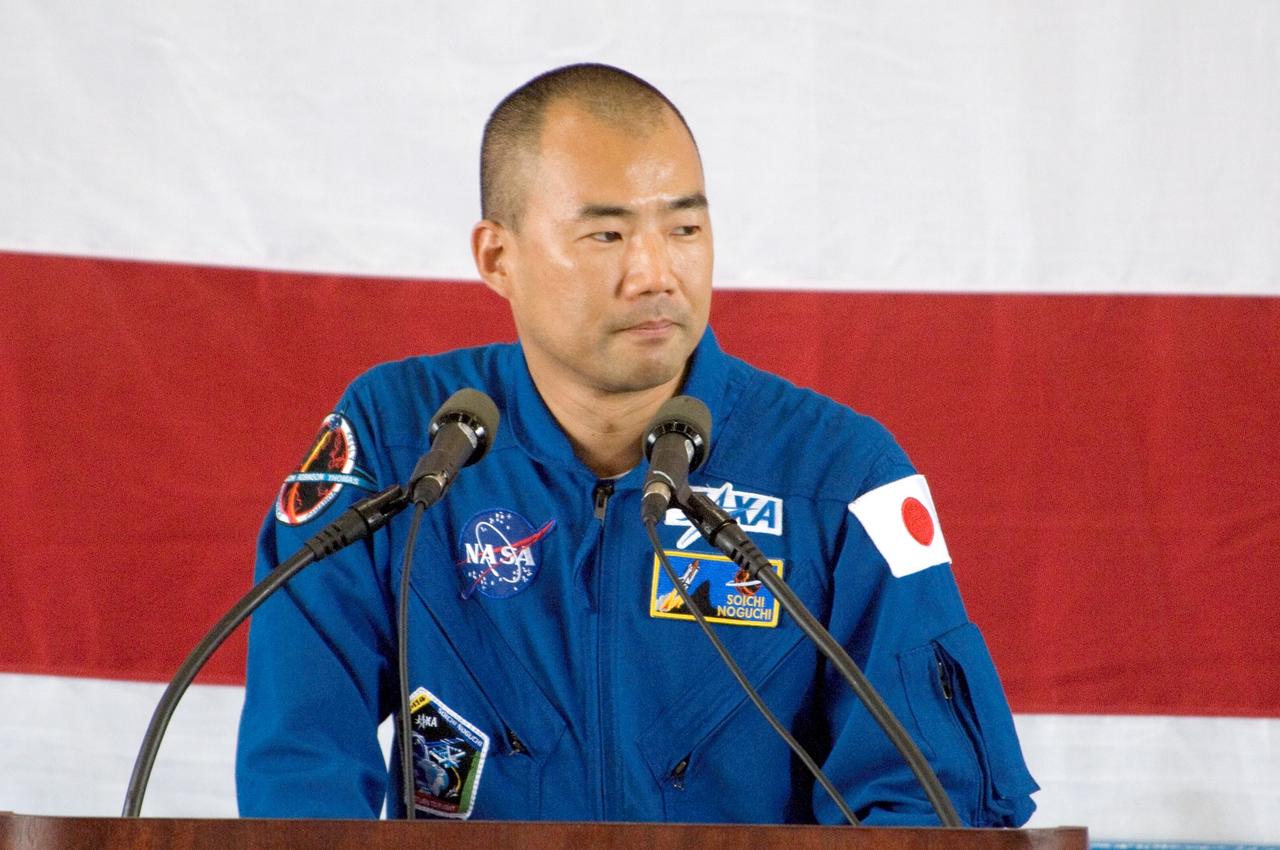
JSC2005-E-33421 (10 August 2005) --- Astronaut Soichi Noguchi, STS-114 mission specialist representing Japan Aerospace Exploration Agency (JAXA), addresses a crowd on hand at Ellington Field’s Hangar 276 near Johnson Space Center (JSC) during the STS-114 crew return ceremonies.
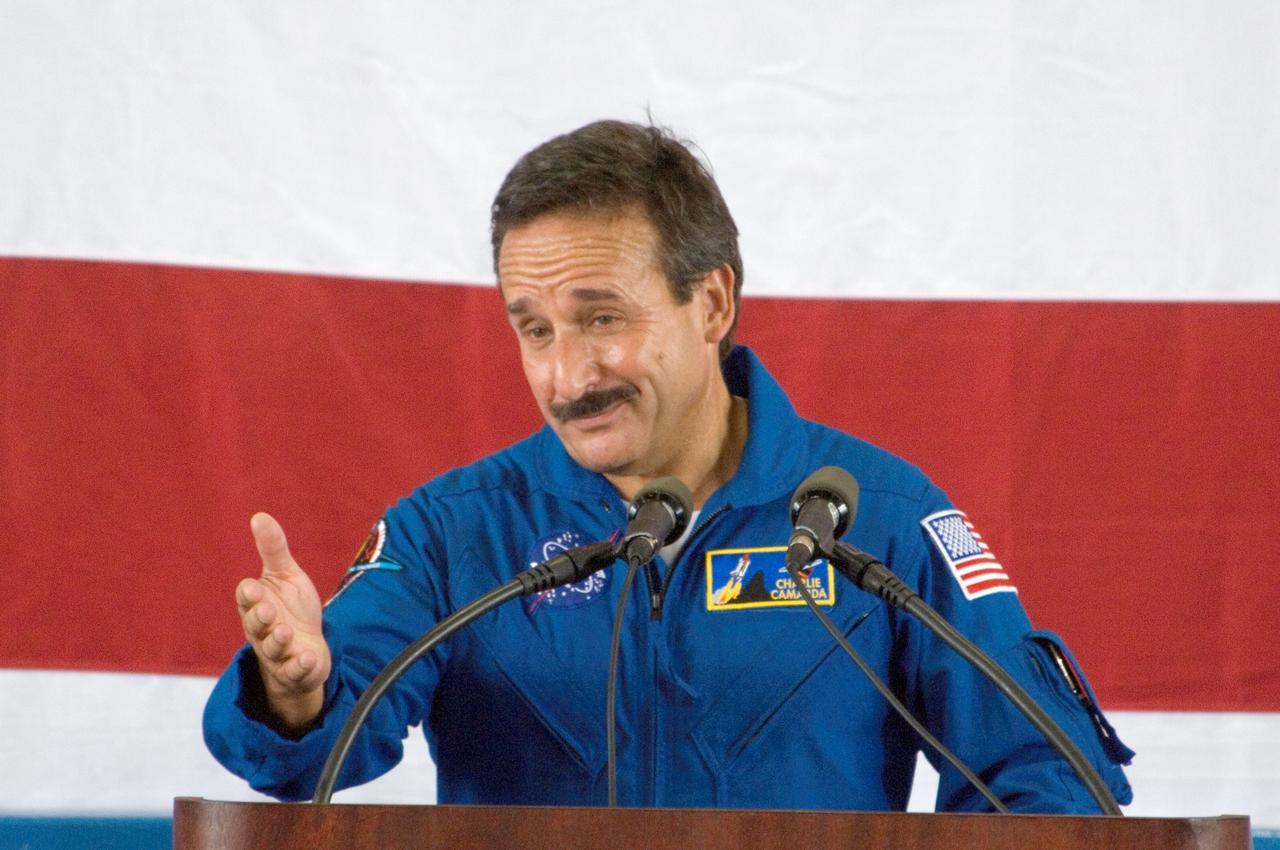
JSC2005-E-33431 (10 August 2005) --- Astronaut Charles J. Camarda, STS-114 mission specialist, addresses a crowd on hand at Ellington Field’s Hangar 276 near Johnson Space Center (JSC) during the STS-114 crew return ceremonies.
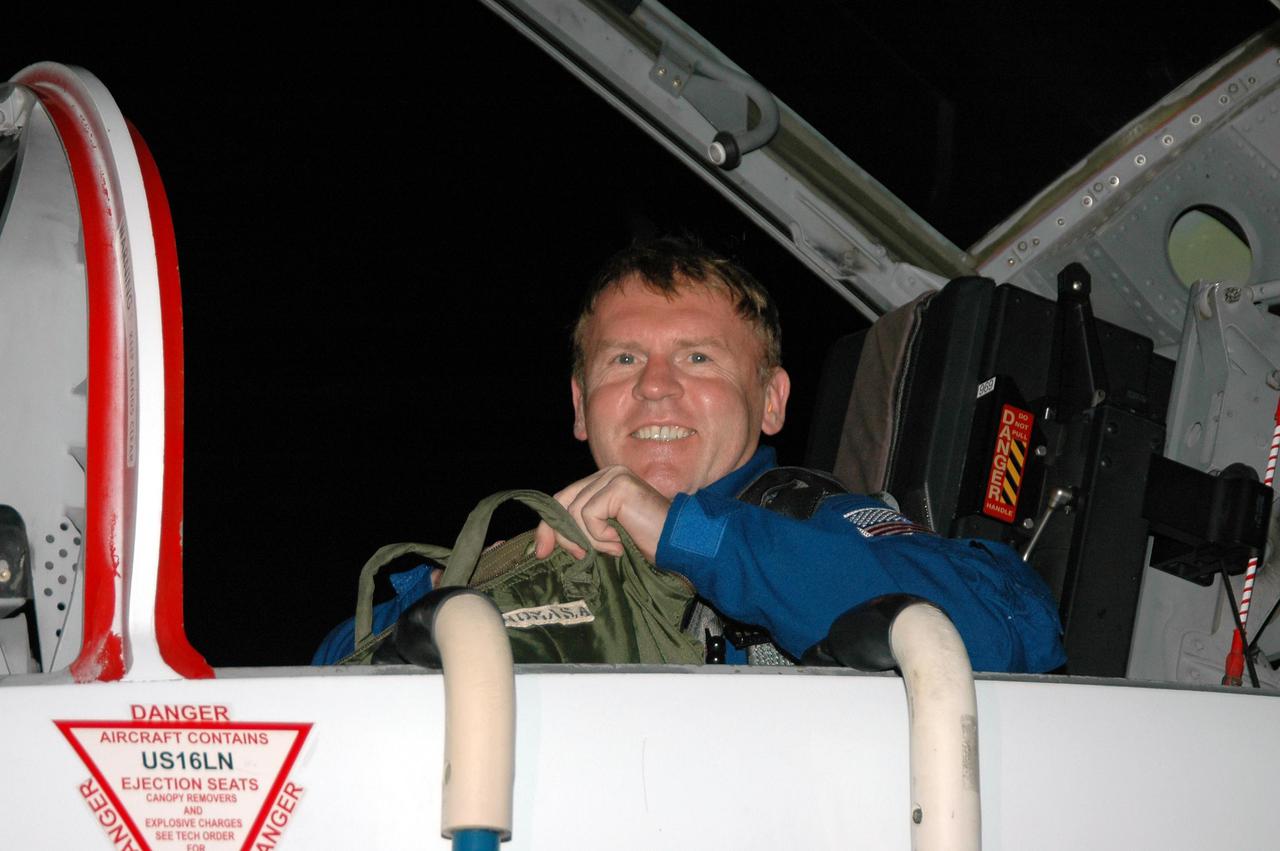
KENNEDY SPACE CENTER, FLA. - STS-114 Mission Specialist Andrew Thomas arrives at NASA’s Kennedy Space Center aboard a T-38 jet training aircraft. He and other crew members are taking part in the Terminal Countdown Demonstration Test (TCDT) over the next three days. The TCDT is held at KSC prior to each Space Shuttle flight. It provides the crew of each mission an opportunity to participate in simulated countdown activities. The test ends with a mock launch countdown culminating in a simulated main engine cutoff. The crew also spends time undergoing emergency egress training exercises at the launch pad. This is Thomas’ fourth space flight. STS-114 is the first Return to Flight mission to the International Space Station. The launch window extends July 13 through July 31.
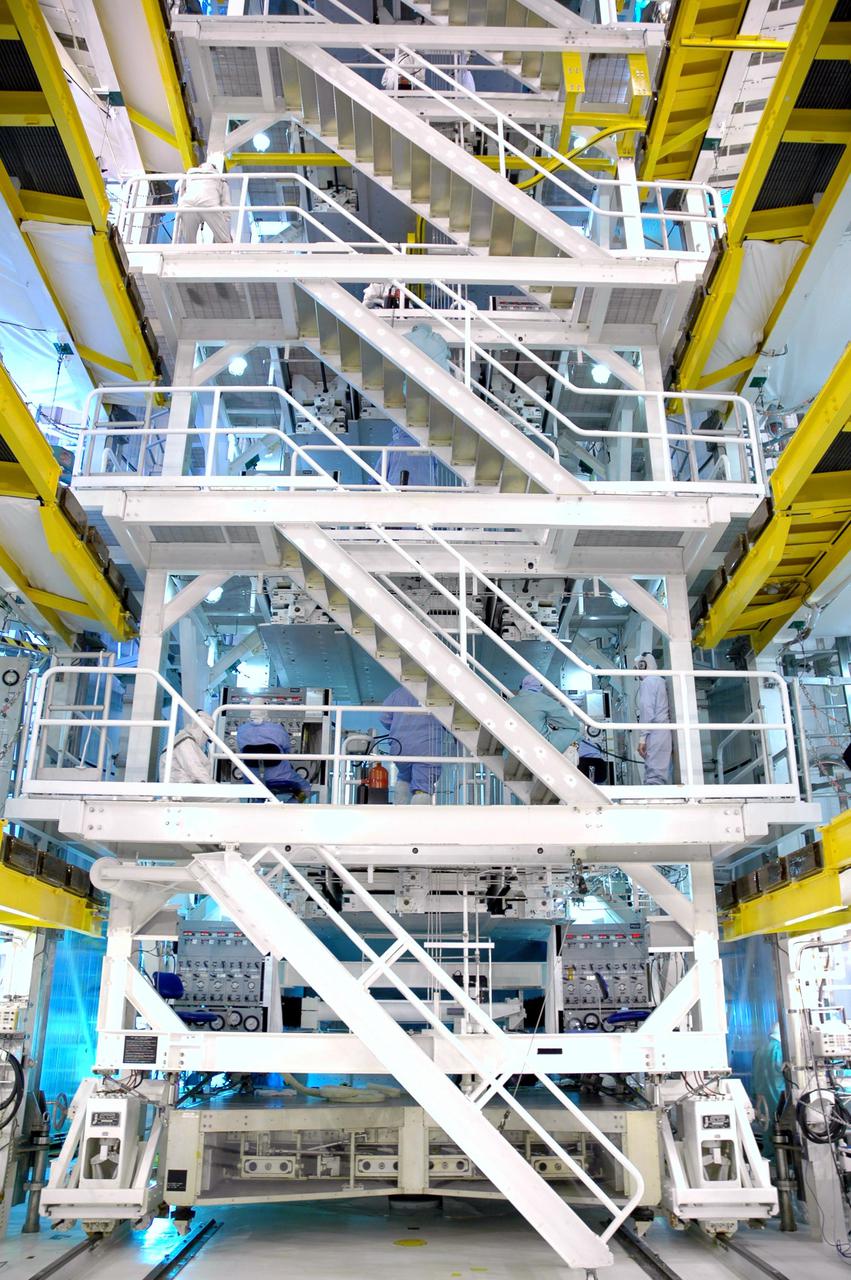
KENNEDY SPACE CENTER, FLA. - In the Payload Changeout Room on Launch Pad 39B, access stairs are rolled into place next to the Payload Ground Handling Mechanism, which is used to transfer the payloads into the orbiter. The payloads for Return to Flight mission STS-114 that are being transferred to Discovery’s payload bay include a Control Moment Gyro, the Thermal Protection System Detailed Test Objective box, which is placed on the Lightweight Multi-Purpose Experiment Support Structure Carrier, External Stowage Platform 2 and Multi-Purpose Logistics Module Raffaello. Already installed in the payload bay are the airlock, the Canadarm 2, or Shuttle arm, and the Orbiter Boom Sensor System. The launch window for mission STS-114 extends from July 13 to July 31.
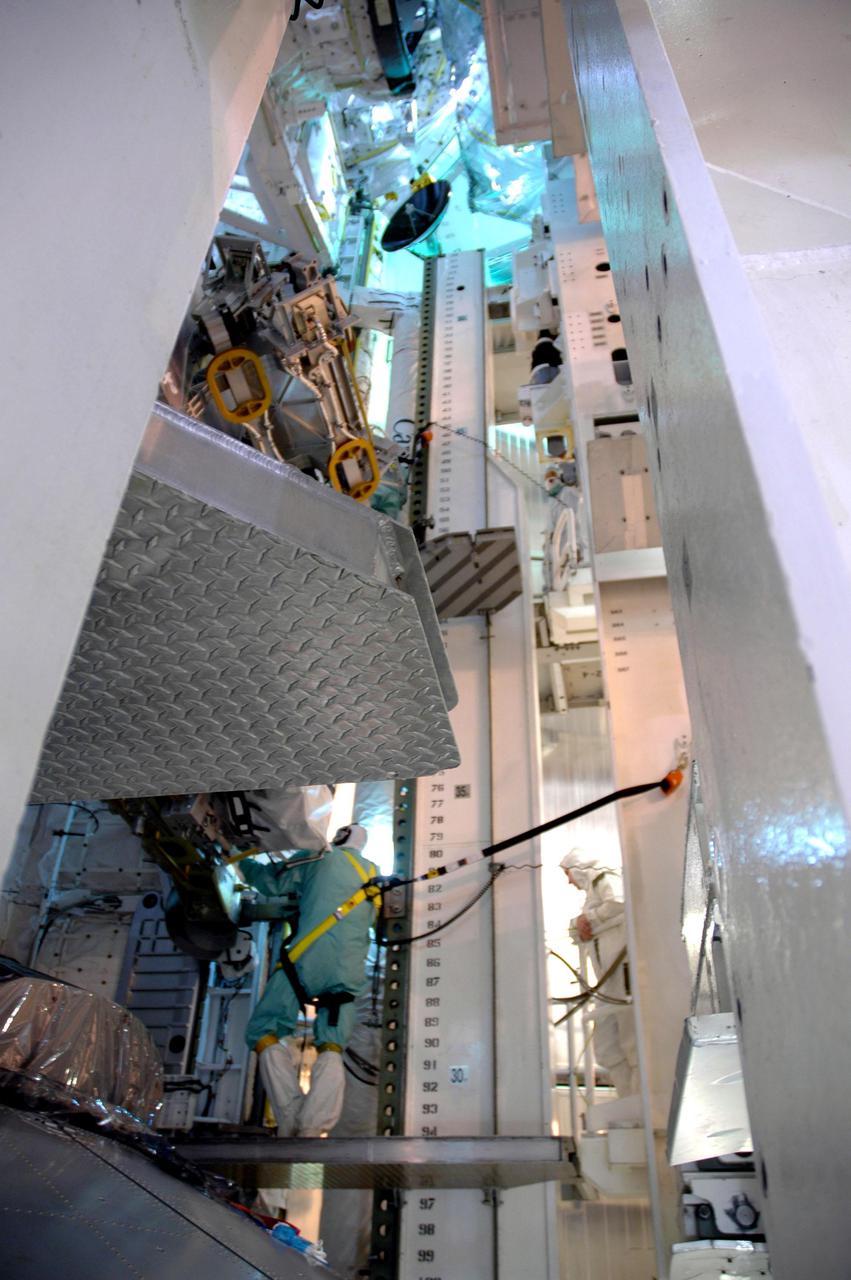
KENNEDY SPACE CENTER, FLA. - In the Payload Changeout Room on Launch Pad 39B, the payloads for Return to Flight mission STS-114 are being transferred to Discovery’s payload bay. Seen here is the Payload Ground Handling Mechanism, which is used for the transfer. Payloads being installed in the bay are a Control Moment Gyro, the Thermal Protection System Detailed Test Objective box, which is placed on the Lightweight Multi-Purpose Experiment Support Structure Carrier, External Stowage Platform 2 and Multi-Purpose Logistics Module Raffaello. Already installed in the payload bay are the airlock, the Canadarm 2, or Shuttle arm, and the Orbiter Boom Sensor System. The launch window for mission STS-114 extends from July 13 to July 31.
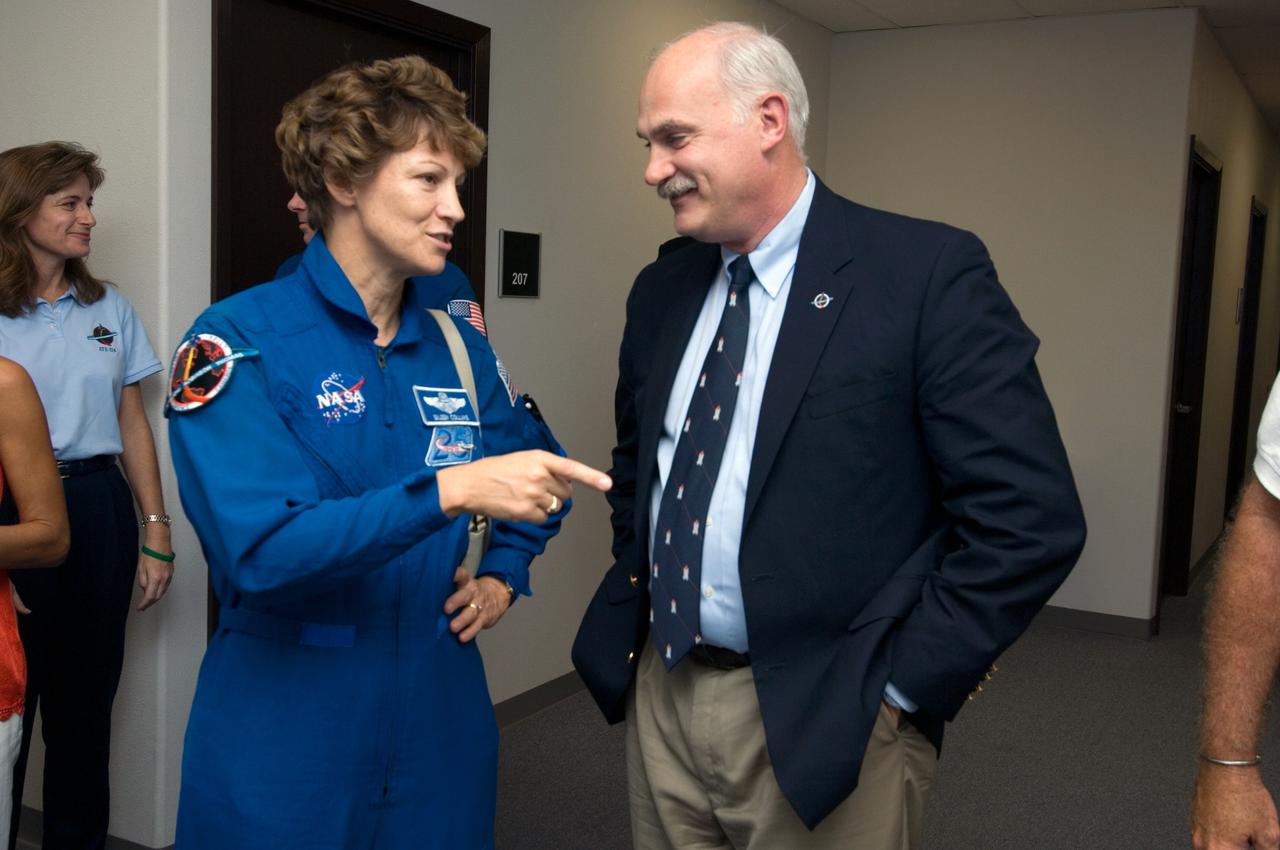
JSC2005-E-33437 (10 August 2005) --- Astronaut Eileen M. Collins, STS-114 commander, and William F. Readdy, Associate Administrator for Space Flight, NASA Headquarters, enjoy a light moment prior to the STS-114 crew return ceremonies at Ellington Field near Johnson Space Center (JSC).
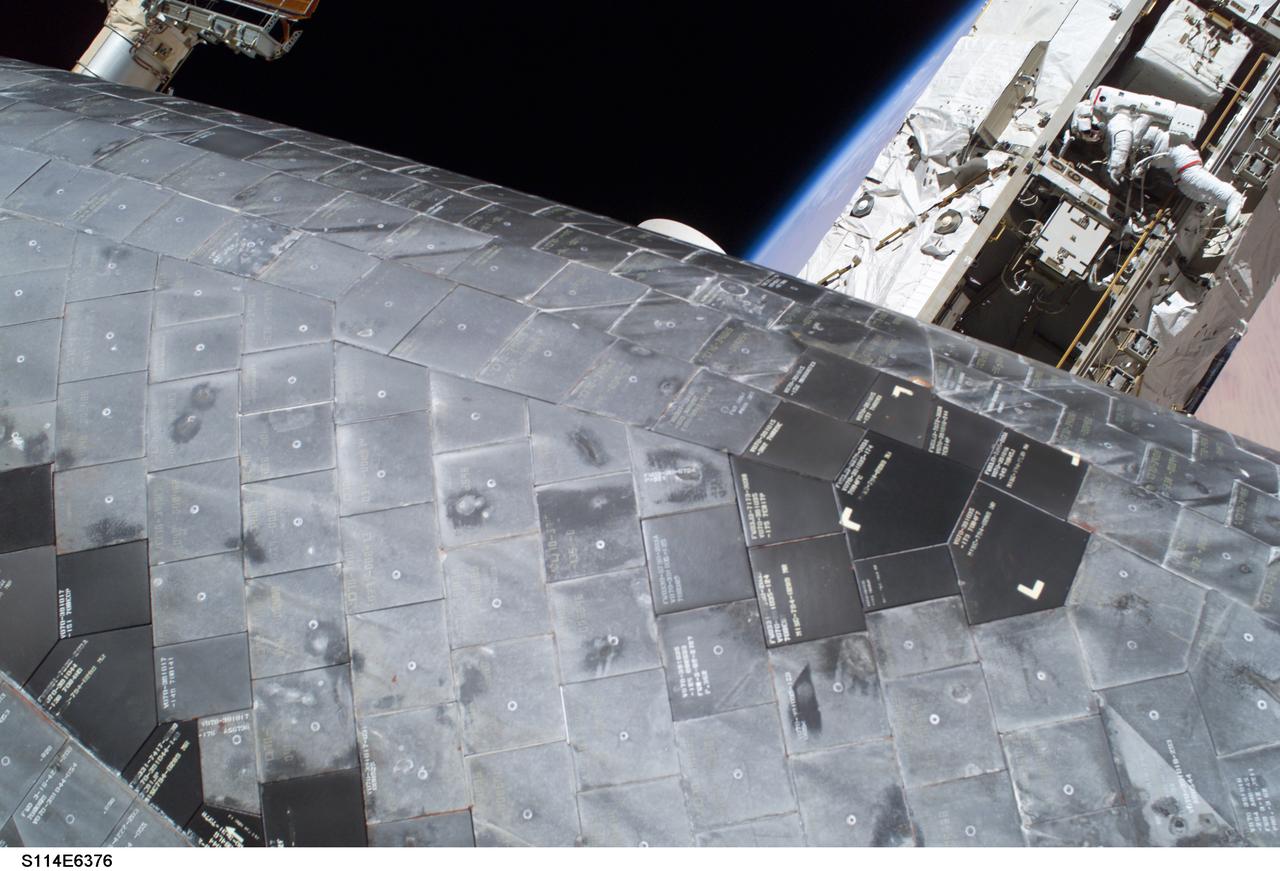
Launched on July 26 2005, from the Kennedy Space Center in Florida, STS-114 was classified as Logistics Flight 1. Among the Station-related activities of the mission were the delivery of new supplies and the replacement of one of the orbital outpost's Control Moment Gyroscopes (CMGs). STS-114 also carried the Raffaello Multi-Purpose Logistics Module and the External Stowage Platform-2. A major focus of the mission was the testing and evaluation of new Space Shuttle flight safety, which included new inspection and repair techniques. Upon its approach to the International Space Station (ISS), the Space Shuttle Discovery underwent a photography session in order to assess any damages that may have occurred during its launch and/or journey through Space. The mission’s third and final Extra Vehicular Activity (EVA) included taking a close-up look and the repair of the damaged heat shield. Gap fillers were removed from between the orbiter’s heat-shielding tiles located on the craft’s underbelly. Never before had any repairs been done to an orbiter while still in space. This close up of the thermal tiles was taken by astronaut Stephen K. Robinson, STS-114 mission specialist (out of frame). Astronaut Soichi Noguchi, STS-114 mission specialist representing the Japan Aerospace Exploration (JAXA), can be seen in the background perched on a Space Station truss.
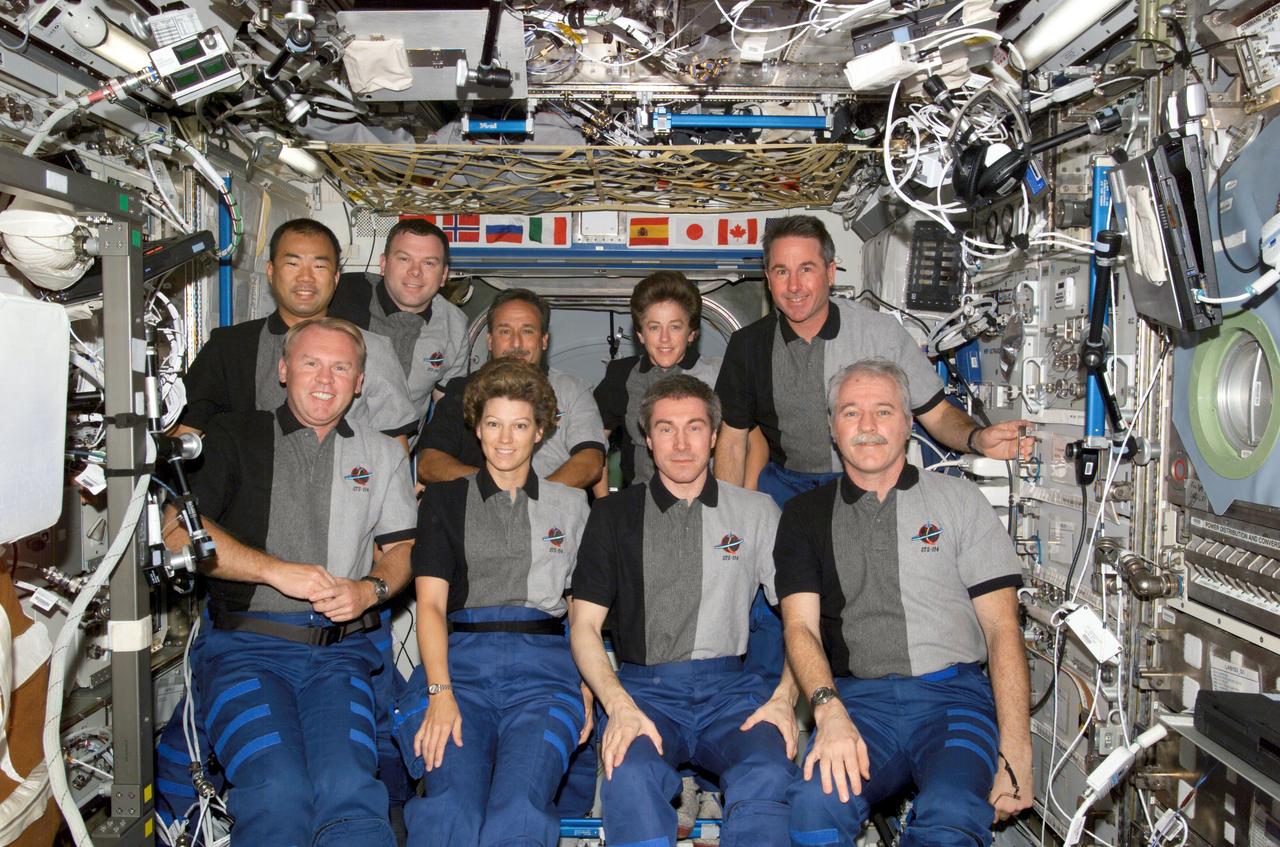
ISS011-E-11403 (2 August 2005) --- The Expedition 11 and STS-114 crewmembers gather for a group photo in the Destiny laboratory of the international space station. From the left (front row) are astronauts Andrew S. W. Thomas, STS-114 mission specialist; Eileen M. Collins, STS-114 commander; cosmonaut Sergei K. Krikalev, Expedition 11 commander representing Russia's Federal Space Agency; astronaut John L. Phillips, Expedition 11 NASA Space Station science officer and flight engineer. From the left (back row) are astronauts Soichi Noguchi, STS-114 mission specialist representing Japan Aerospace Exploration Agency (JAXA); James M. Kelly, STS-114 pilot; Charles J. Camarda, Wendy B. Lawrence and Stephen K. Robinson, all STS-114 mission specialists.
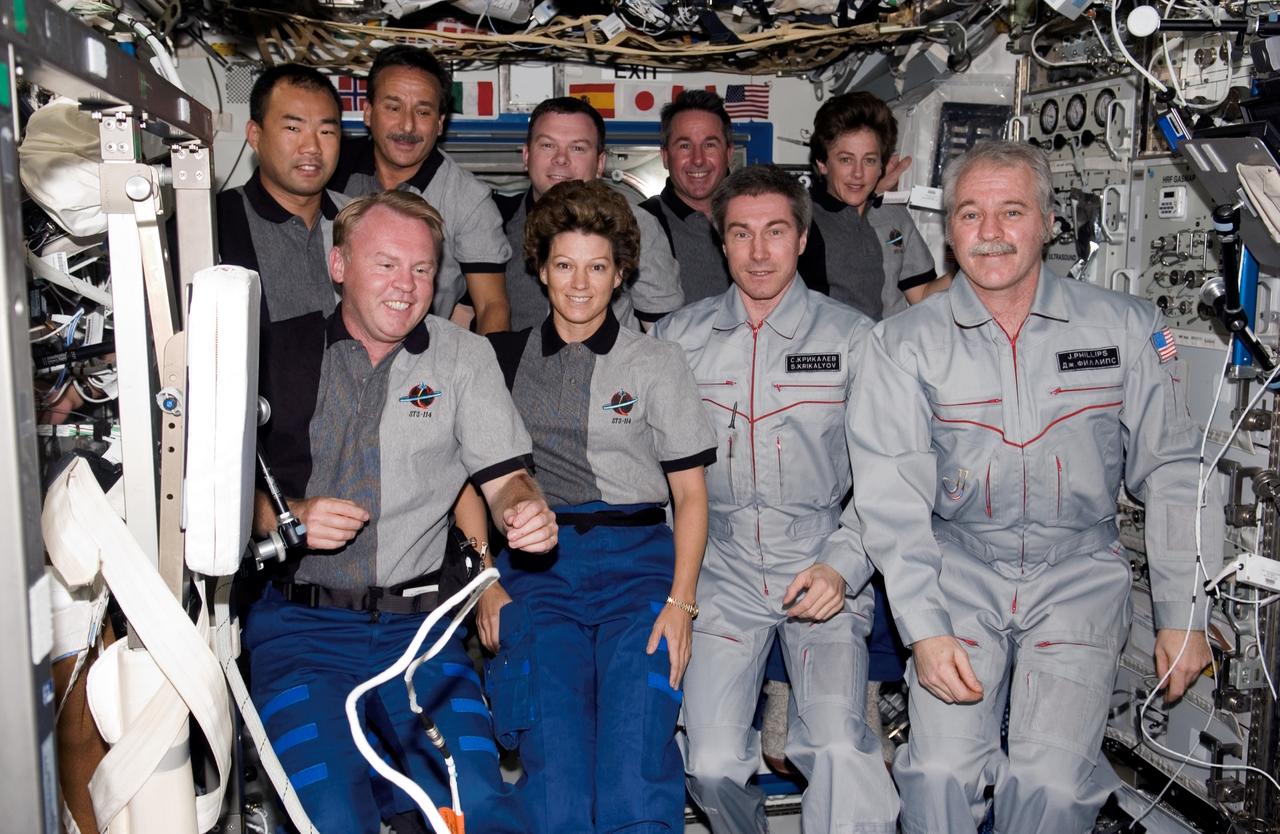
ISS011-E-12407 (2 August 2005) --- The STS-114 and Expedition 11 crew members gather for a group photo in the Destiny laboratory of the international space station. From the left (front row) are astronauts Andrew S. W. Thomas, STS-114 mission specialist; Eileen M. Collins, STS-114 commander; cosmonaut Sergei K. Krikalev, Expedition 11 commander representing Russia's Federal Space Agency; and astronaut John L. Phillips, Expedition 11 NASA science officer and flight engineer. From the left (back row) are astronauts Soichi Noguchi representing Japan Aerospace Exploration Agency (JAXA) and Charles J. Camarda, both STS-114 mission specialists; James M. Kelly, STS-114 pilot; Stephen K. Robinson and Wendy B. Lawrence, both STS-114 mission specialists.
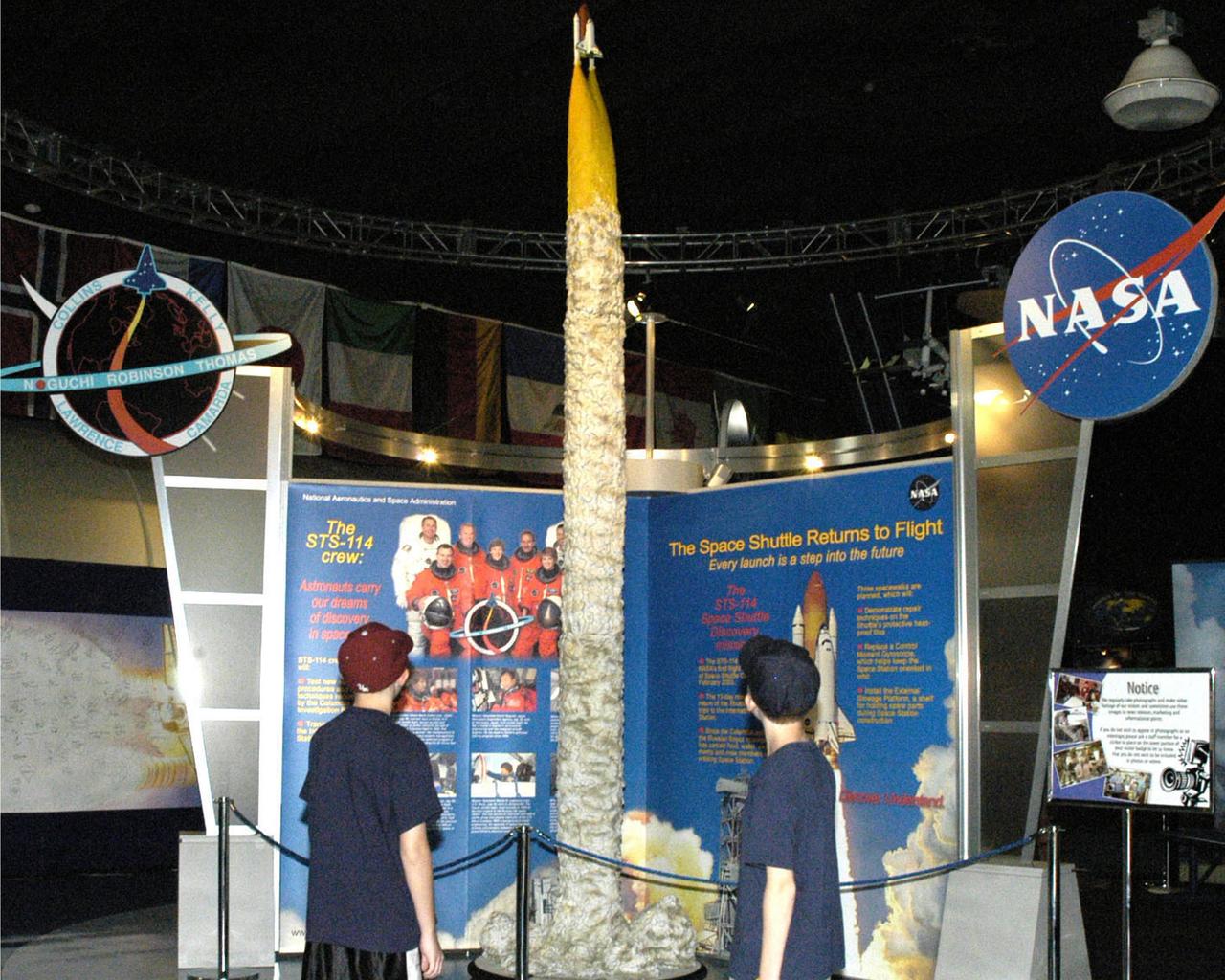
Visitors to StenniSphere, the visitor center at NASA's Stennis Space Center, learn about the crew of Space Shuttle Discovery who will fly aboard NASA's Return to Flight mission, designated STS-114.
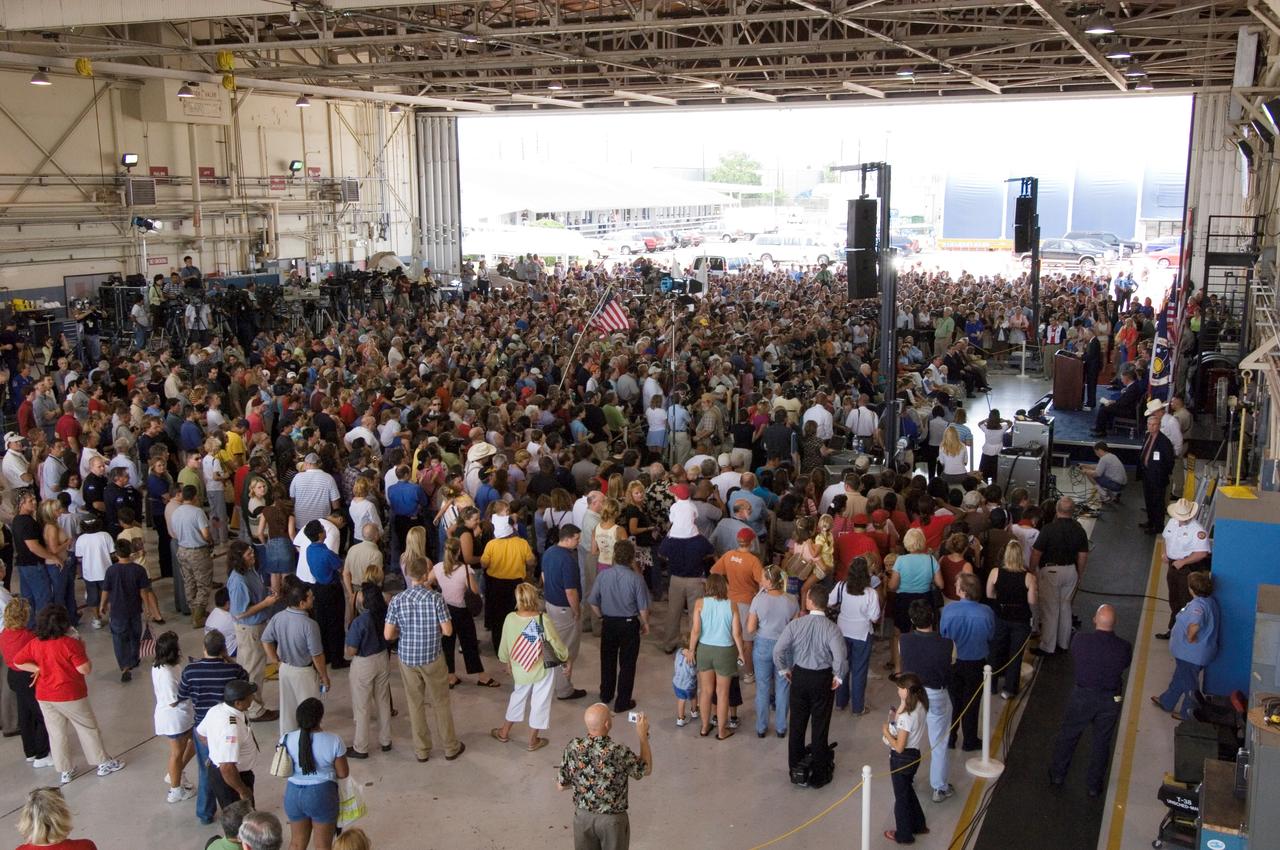
JSC2005-E-33361 (10 August 2005) --- A large crowd gathers in Ellington Field’s Hangar 276 near Johnson Space Center (JSC) during the STS-114 crew return ceremonies.
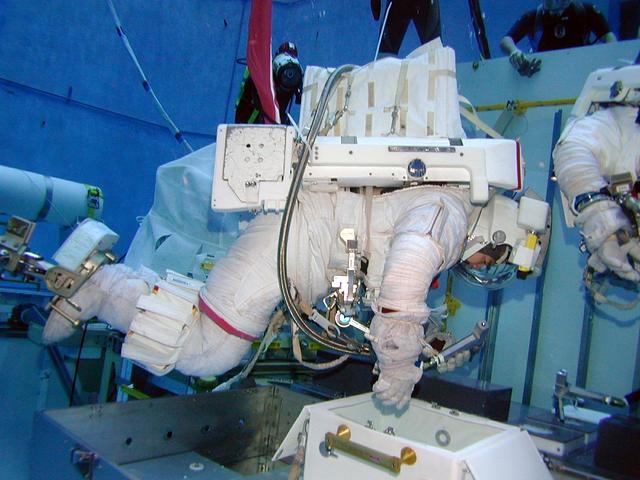
JSC2004-E-13024 (2 March 2004) --- Japanese Aerospace and Exploration Agency (JAXA) Astronaut Soichi Noguchi, the lead space walker for the Space Shuttle's return to flight on mission STS-114, checks a potential repair technique for the Shuttle's heat protection tiles in Johnson Space Center's (JSC) Neutral Buoyancy Laboratory (NBL) pool. The checkout session was conducted on March 2, 2004, and checked the latest techniques and hardware under development for Noguchi to use during an in-flight test of new Shuttle heat shield repair possibilities during STS-114. The mission is now targeted for launch no earlier than the spring of 2005.
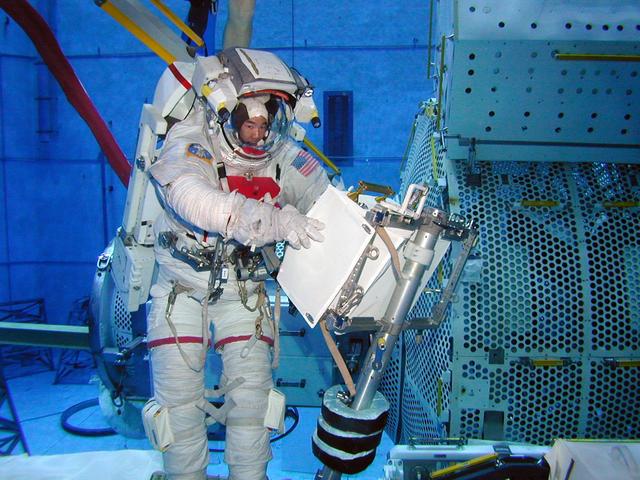
JSC2004-E-13023 (2 March 2004) --- Japanese Aerospace and Exploration Agency (JAXA) Astronaut Soichi Noguchi, the lead space walker for the Space Shuttle's return to flight on mission STS-114, checks a potential repair technique for the Shuttle's heat protection tiles in Johnson Space Center's (JSC) Neutral Buoyancy Laboratory (NBL) pool. The checkout session was conducted on March 2, 2004, and checked the latest techniques and hardware under development for Noguchi to use during an in-flight test of new Shuttle heat shield repair possibilities during STS-114. The mission is now targeted for launch no earlier than the spring of 2005.
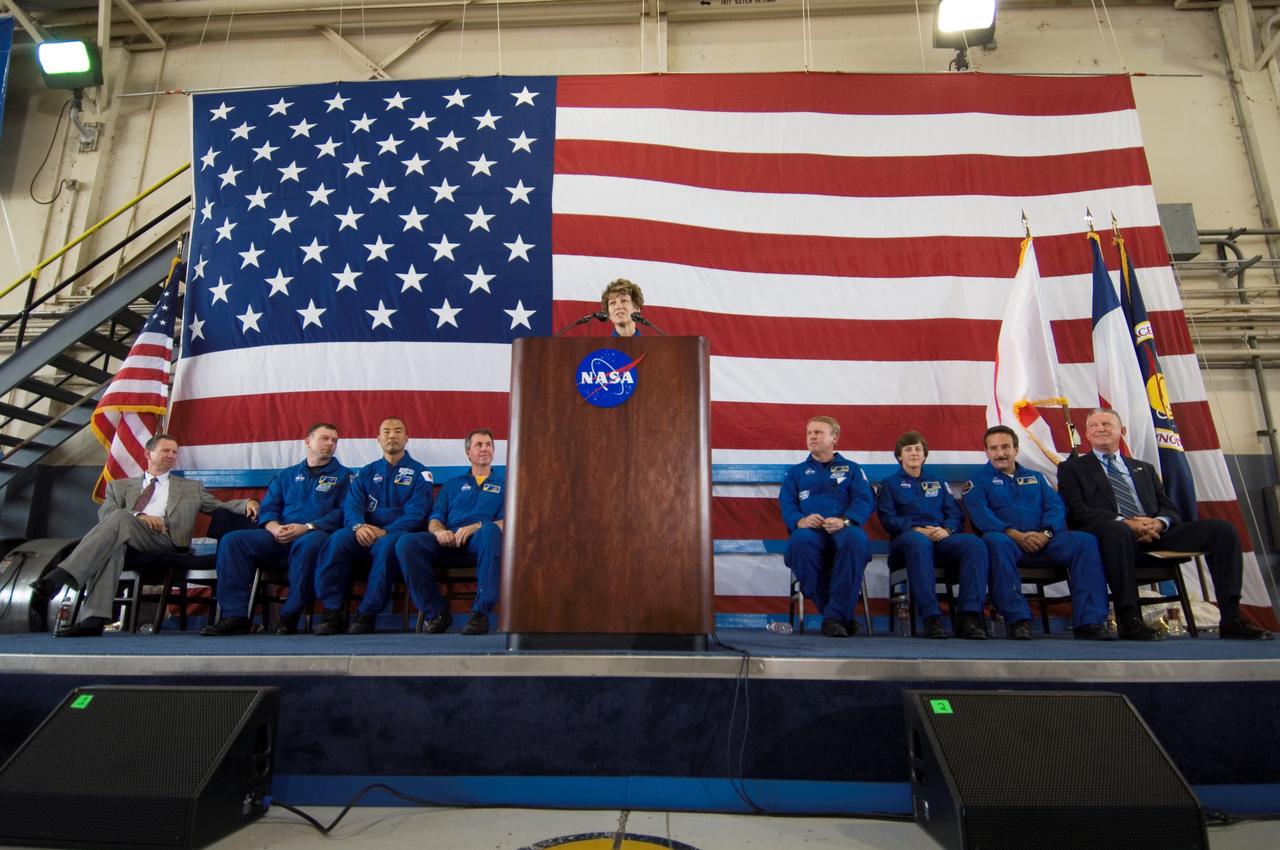
JSC2005-E-33333 (10 August 2005) --- Astronaut Eileen M. Collins, STS-114 commander, speaks from a lectern in Ellington Field’s Hangar 276 near Johnson Space Center (JSC) during the STS-114 crew return ceremonies. Seated from the left are NASA Administrator Michael Griffin; astronauts James M. Kelly, pilot; Soichi Noguchi, mission specialist representing Japan Aerospace Exploration Agency (JAXA); Stephen K. Robinson, Andrew S. W. Thomas, Wendy B. Lawrence, Charles J. Camarda, mission specialists; and JSC Director General Jefferson D. Howell, Jr.
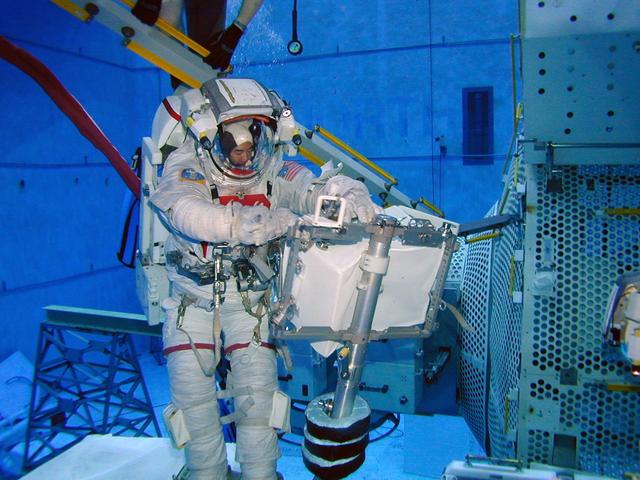
JSC2004-E-13022 (2 March 2004) --- Japanese Aerospace and Exploration Agency (JAXA) Astronaut Soichi Noguchi, the lead space walker for the Space Shuttle's return to flight on mission STS-114, checks a potential repair technique for the Shuttle's heat protection tiles in Johnson Space Center's (JSC) Neutral Buoyancy Laboratory (NBL) pool. The checkout session was conducted on March 2, 2004, and checked the latest techniques and hardware under development for Noguchi to use during an in-flight test of new Shuttle heat shield repair possibilities during STS-114. The mission is now targeted for launch no earlier than the spring of 2005.
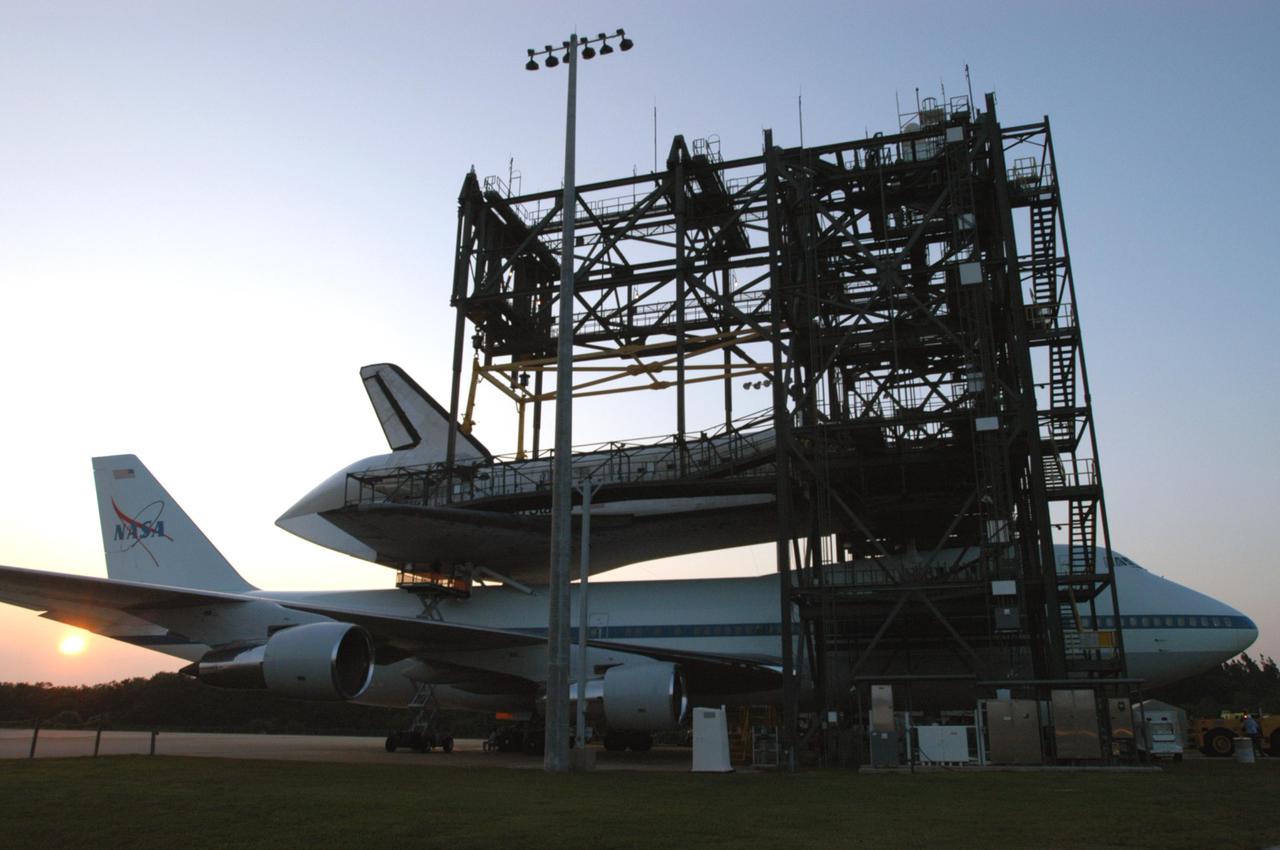
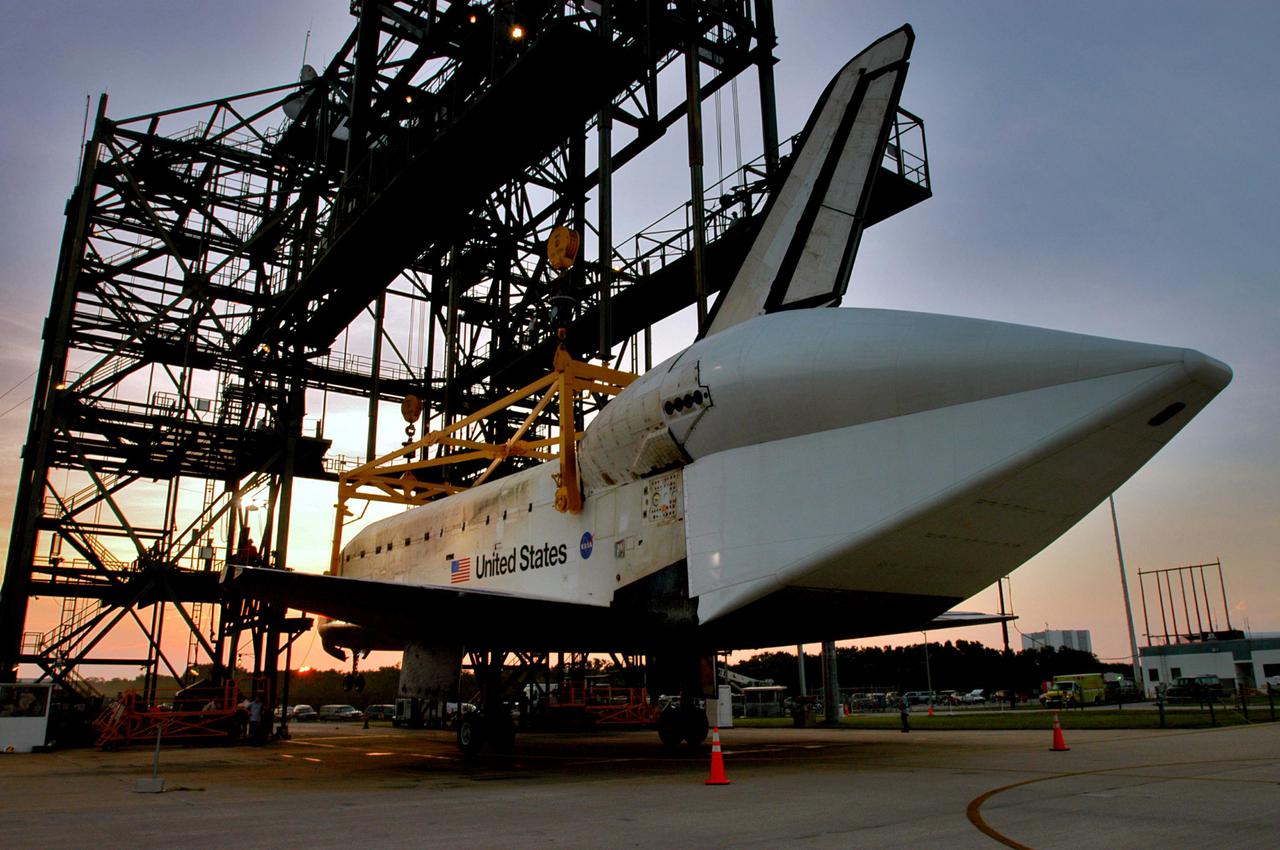
KENNEDY SPACE CENTER, FLA. - The sun is setting behind the tail of the Shuttle Carrier Aircraft, a modified Boeing 747, and orbiter Discovery where they are parked in the mate_demate device. Discovery was returned to Kennedy Space Center on a ferry flight from Edwards Air Force Base in California, where it landed Aug. 9 after 13 days in space on mission STS-114. In the mate_demate device, a horizontal structure mounted at the 80-foot level between two towers controls and guides a large lift beam that attaches to the orbiter to raise and lower it. Once Discovery is lifted off the back of the SCA, the 747 can then roll away and the orbiter will be lowered to the ground. It will then be towed from the SLF to the Orbiter Processing Facility. Once inside the OPF, the payload bay doors will be opened and the MPLM Raffaello brought back from the International Space Station will be unloaded and transferred to the Space Station Processing Facility. This concludes mission STS-114.
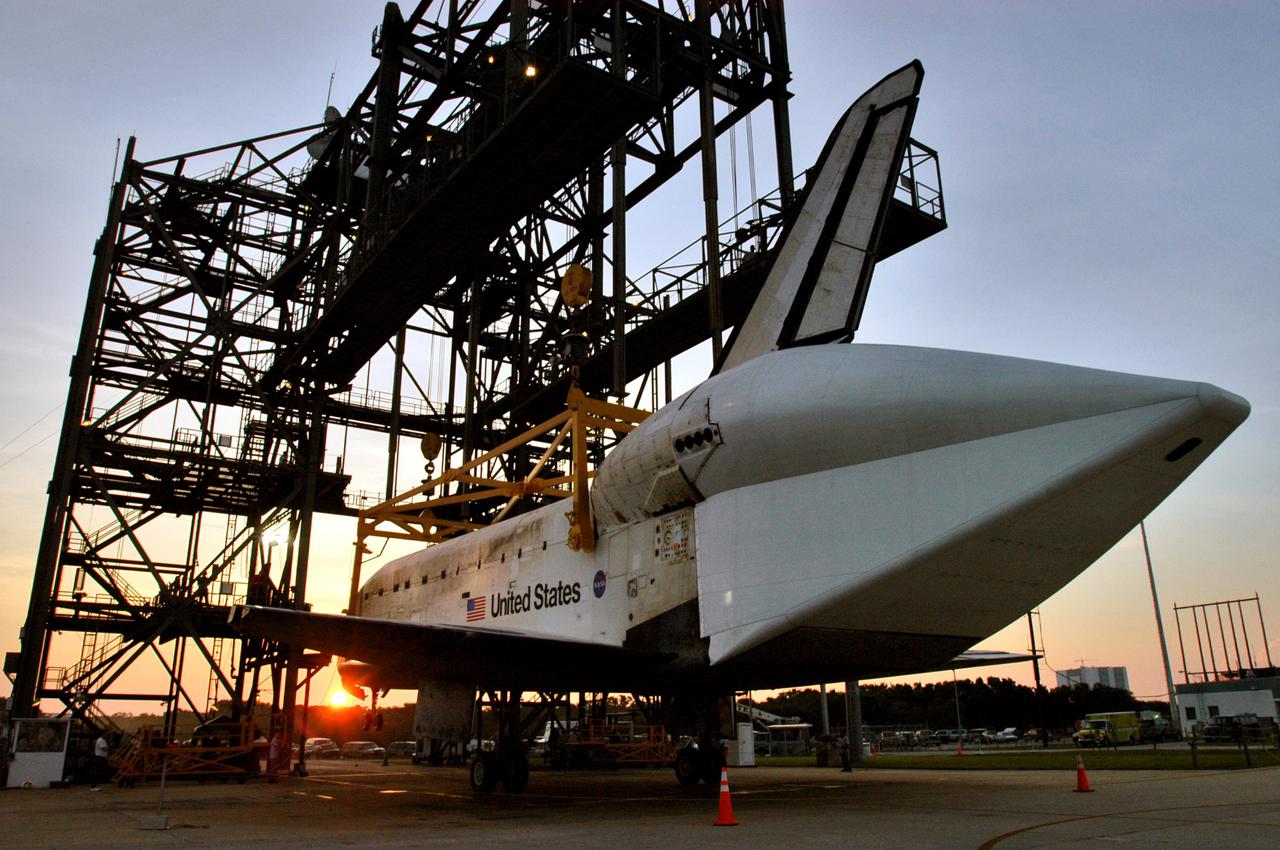
KENNEDY SPACE CENTER, FLA. - At sunrise, Discovery finally rests on its wheels on the ground at NASA Kennedy Space Center’s Shuttle Landing Facility. The orbiter was lowered overnight from the mate_demate device after the Shuttle Carrier Aircraft, a modified Boeing 747, was rolled away. Discovery was returned to Kennedy Space Center on a ferry flight from Edwards Air Force Base in California, where it landed Aug. 9 after 13 days in space on mission STS-114. In the mate_demate device, a horizontal structure mounted at the 80-foot level between two towers controls and guides a large lift beam that attaches to the orbiter to raise and lower it. The orbiter will be towed to the Orbiter Processing Facility. Once inside the OPF, the payload bay doors will be opened and the MPLM Raffaello brought back from the International Space Station will be unloaded and transferred to the Space Station Processing Facility. This concludes mission STS-114.
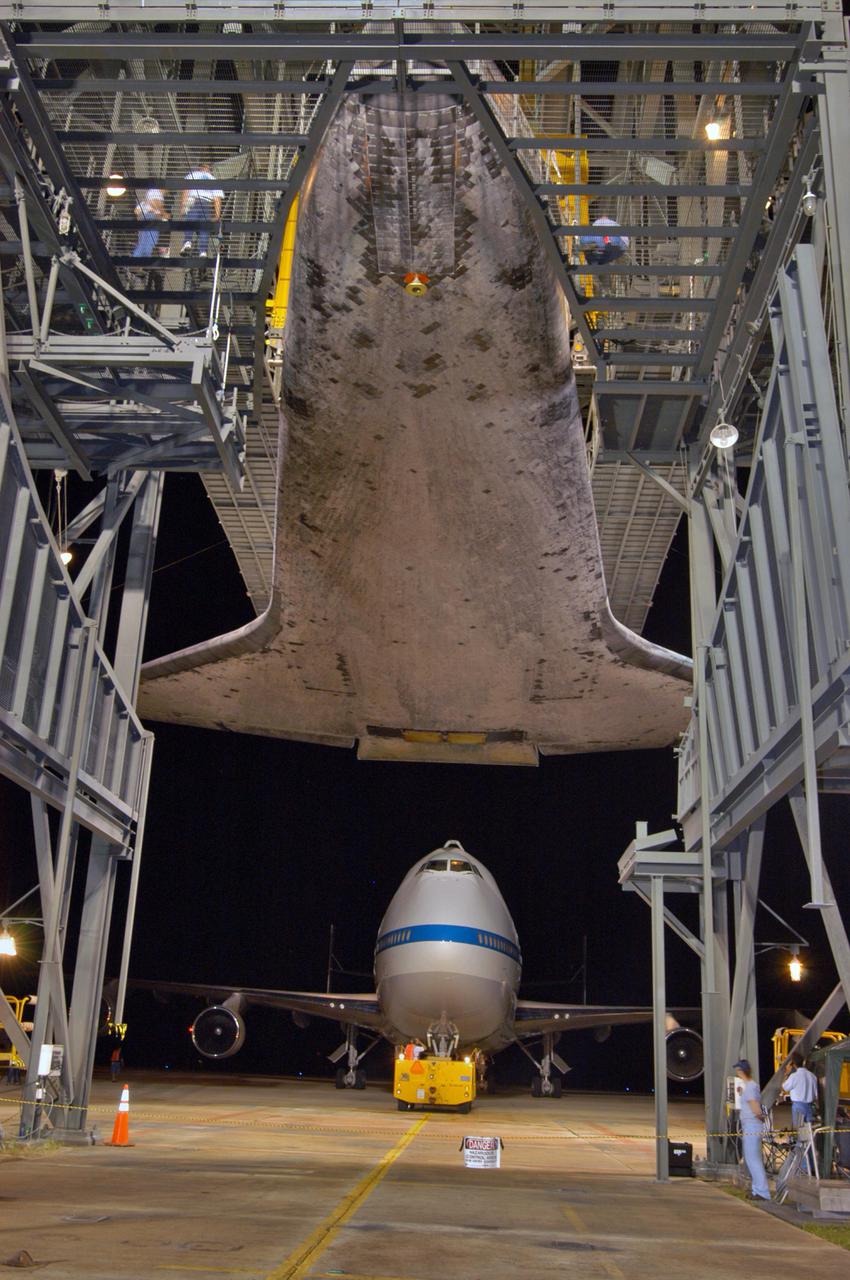
KENNEDY SPACE CENTER, FLA. - In the early morning hours at NASA Kennedy Space Center’s Shuttle Landing Facility, the orbiter Discovery is suspended within the mate_demate device after the Shuttle Carrier Aircraft, a modified Boeing 747, has rolled away from beneath it. Discovery was returned to Kennedy Space Center on a ferry flight from Edwards Air Force Base in California, where it landed Aug. 9 after 13 days in space on mission STS-114. In the mate_demate device, a horizontal structure mounted at the 80-foot level between two towers controls and guides a large lift beam that attaches to the orbiter to raise and lower it. The orbiter will be lowered to the ground and then be towed to the Orbiter Processing Facility. Once inside the OPF, the payload bay doors will be opened and the MPLM Raffaello brought back from the International Space Station will be unloaded and transferred to the Space Station Processing Facility. This concludes mission STS-114.
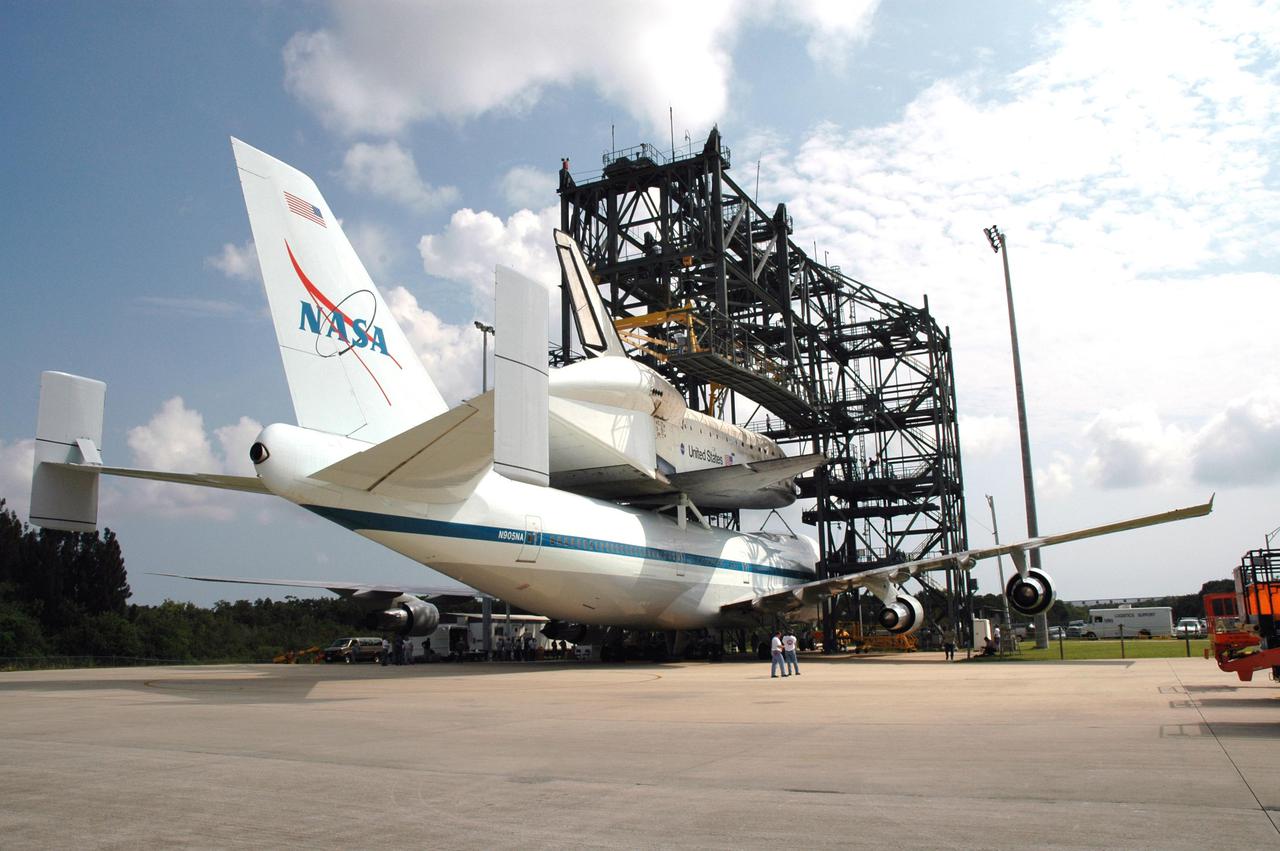
KENNEDY SPACE CENTER, FLA. - The orbiter Discovery on top of the Shuttle Carrier Aircraft, a modified Boeing 747, is towed into the mate_demate device at NASA Kennedy Space Center’s Shuttle Landing Facility. Discovery was returned to Kennedy Space Center on a ferry flight from Edwards Air Force Base in California, where it landed Aug. 9 after 13 days in space on mission STS-114. In the mate_demate device, a horizontal structure mounted at the 80-foot level between two towers controls and guides a large lift beam that attaches to the orbiter to raise and lower it. Once Discovery is lifted off the back of the SCA, the 747 can then roll away and the orbiter will be lowered to the ground. It will then be towed from the SLF to the Orbiter Processing Facility. Once inside the OPF, the payload bay doors will be opened and the MPLM Raffaello brought back from the International Space Station will be unloaded and transferred to the Space Station Processing Facility. This concludes mission STS-114.
KENNEDY SPACE CENTER, FLA. - Just before sunrise, Discovery finally rests on its wheels on the ground at NASA Kennedy Space Center’s Shuttle Landing Facility. The orbiter was lowered overnight from the mate_demate device after the Shuttle Carrier Aircraft, a modified Boeing 747, was rolled away. Discovery was returned to Kennedy Space Center on a ferry flight from Edwards Air Force Base in California, where it landed Aug. 9 after 13 days in space on mission STS-114. In the mate_demate device, a horizontal structure mounted at the 80-foot level between two towers controls and guides a large lift beam that attaches to the orbiter to raise and lower it. The orbiter will be lowered to the ground and then be towed to the Orbiter Processing Facility. Once inside the OPF, the payload bay doors will be opened and the MPLM Raffaello brought back from the International Space Station will be unloaded and transferred to the Space Station Processing Facility. This concludes mission STS-114.
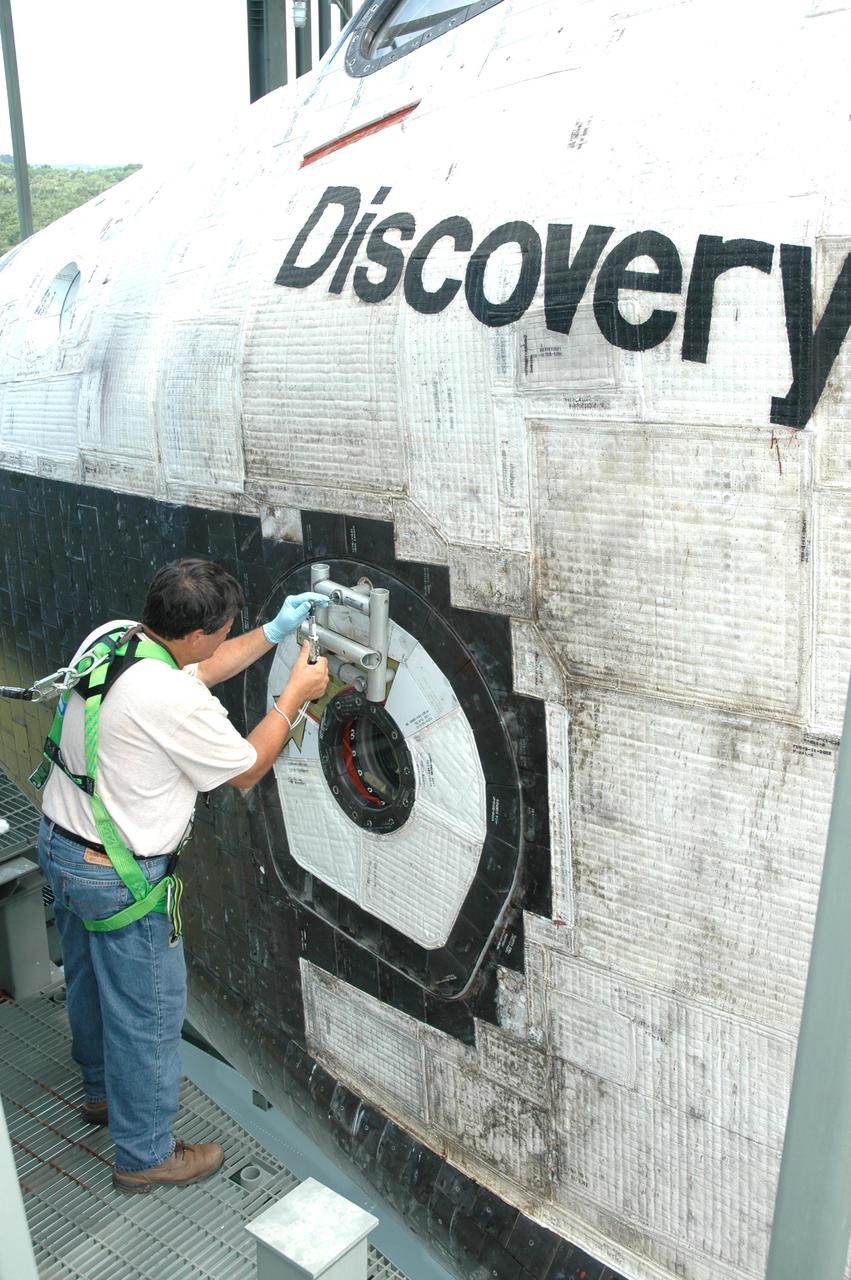
KENNEDY SPACE CENTER, FLA. - At NASA Kennedy Space Center’s Shuttle Landing Facility, a worker begins preparing the orbiter Discovery for demating. Discovery was returned to Kennedy Space Center on a ferry flight from Edwards Air Force Base in California, where it landed Aug. 9 after 13 days in space on mission STS-114. In the mate_demate device, a horizontal structure mounted at the 80-foot level between two towers controls and guides a large lift beam that attaches to the orbiter to raise and lower it. Once Discovery is lifted off the back of the SCA, the 747 can then roll away and the orbiter will be lowered to the ground. It will then be towed from the SLF to the Orbiter Processing Facility. Once inside the OPF, the payload bay doors will be opened and the MPLM Raffaello brought back from the International Space Station will be unloaded and transferred to the Space Station Processing Facility. This concludes mission STS-114.
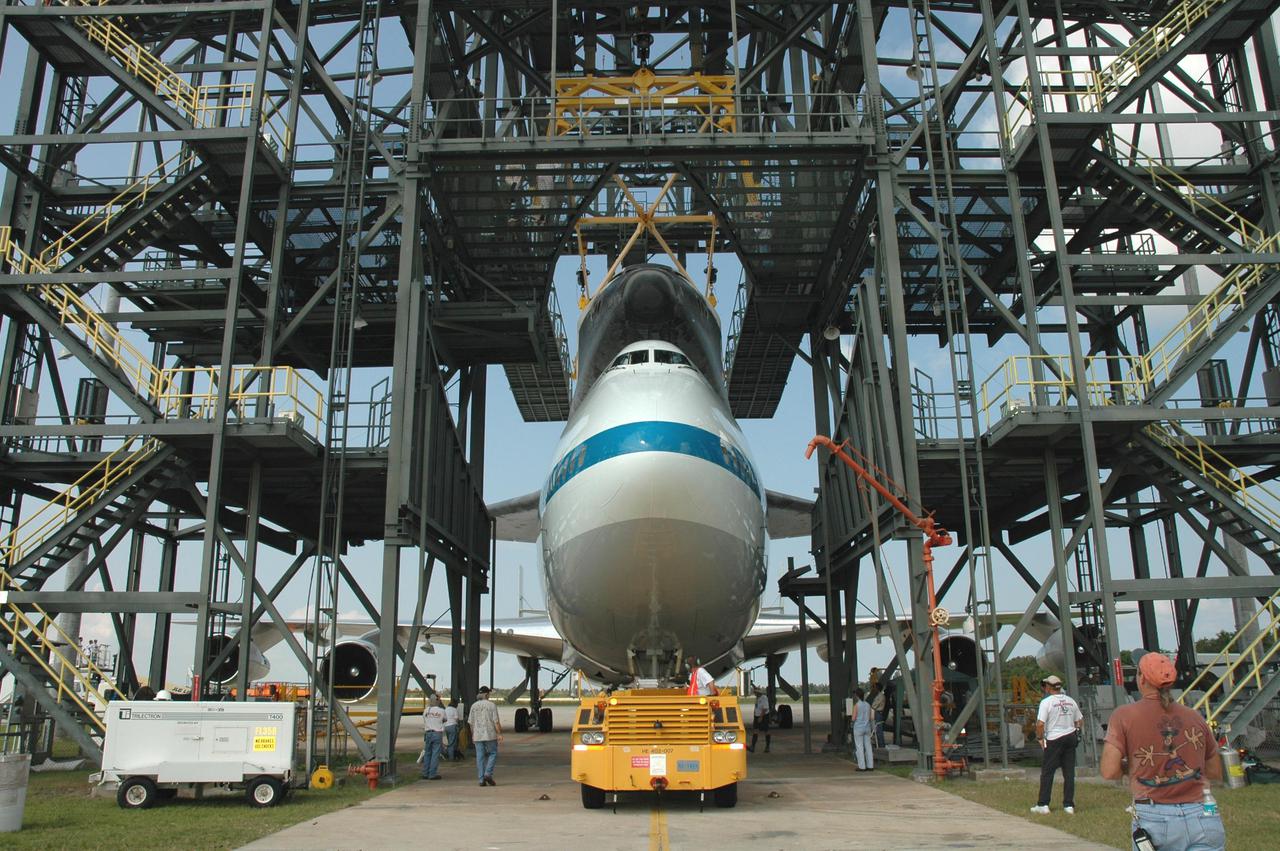
KENNEDY SPACE CENTER, FLA. - The Shuttle Carrier Aircraft, a modified Boeing 747, with the orbiter Discovery on top is towed into the mate_demate device at NASA Kennedy Space Center’s Shuttle Landing Facility. Discovery was returned to Kennedy Space Center on a ferry flight from Edwards Air Force Base in California, where it landed Aug. 9 after 13 days in space on mission STS-114. In the mate_demate device, a horizontal structure mounted at the 80-foot level between two towers controls and guides a large lift beam that attaches to the orbiter to raise and lower it. Once Discovery is lifted off the back of the SCA, the 747 can then roll away and the orbiter will be lowered to the ground. It will then be towed from the SLF to the Orbiter Processing Facility. Once inside the OPF, the payload bay doors will be opened and the MPLM Raffaello brought back from the International Space Station will be unloaded and transferred to the Space Station Processing Facility. This concludes mission STS-114.
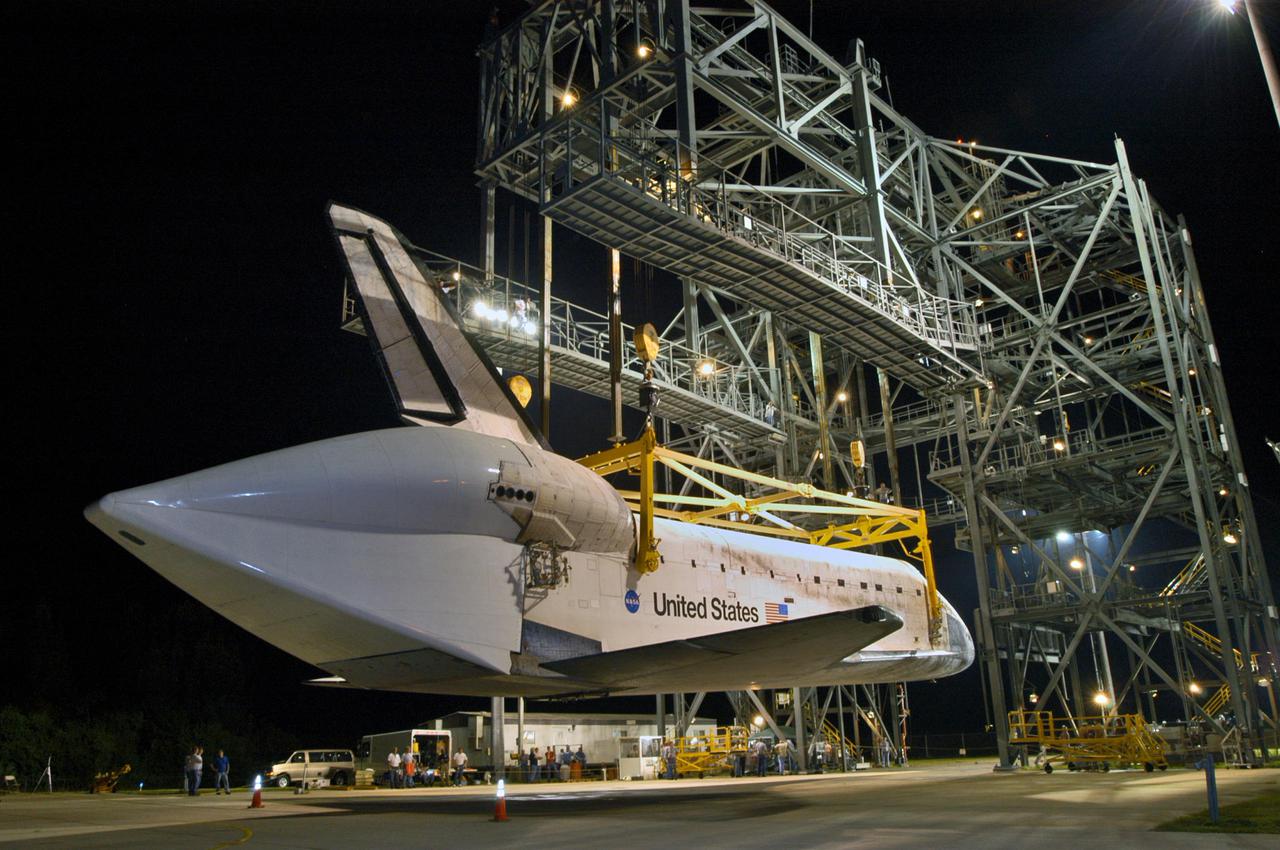
KENNEDY SPACE CENTER, FLA. - In the early morning hours at NASA Kennedy Space Center’s Shuttle Landing Facility, the orbiter Discovery is slowly lowered toward the ground from the mate_demate device. Discovery was returned to Kennedy Space Center on a ferry flight from Edwards Air Force Base in California, where it landed Aug. 9 after 13 days in space on mission STS-114. In the mate_demate device, a horizontal structure mounted at the 80-foot level between two towers controls and guides a large lift beam that attaches to the orbiter to raise and lower it. The orbiter will be lowered to the ground and then be towed to the Orbiter Processing Facility. Once inside the OPF, the payload bay doors will be opened and the MPLM Raffaello brought back from the International Space Station will be unloaded and transferred to the Space Station Processing Facility. This concludes mission STS-114.
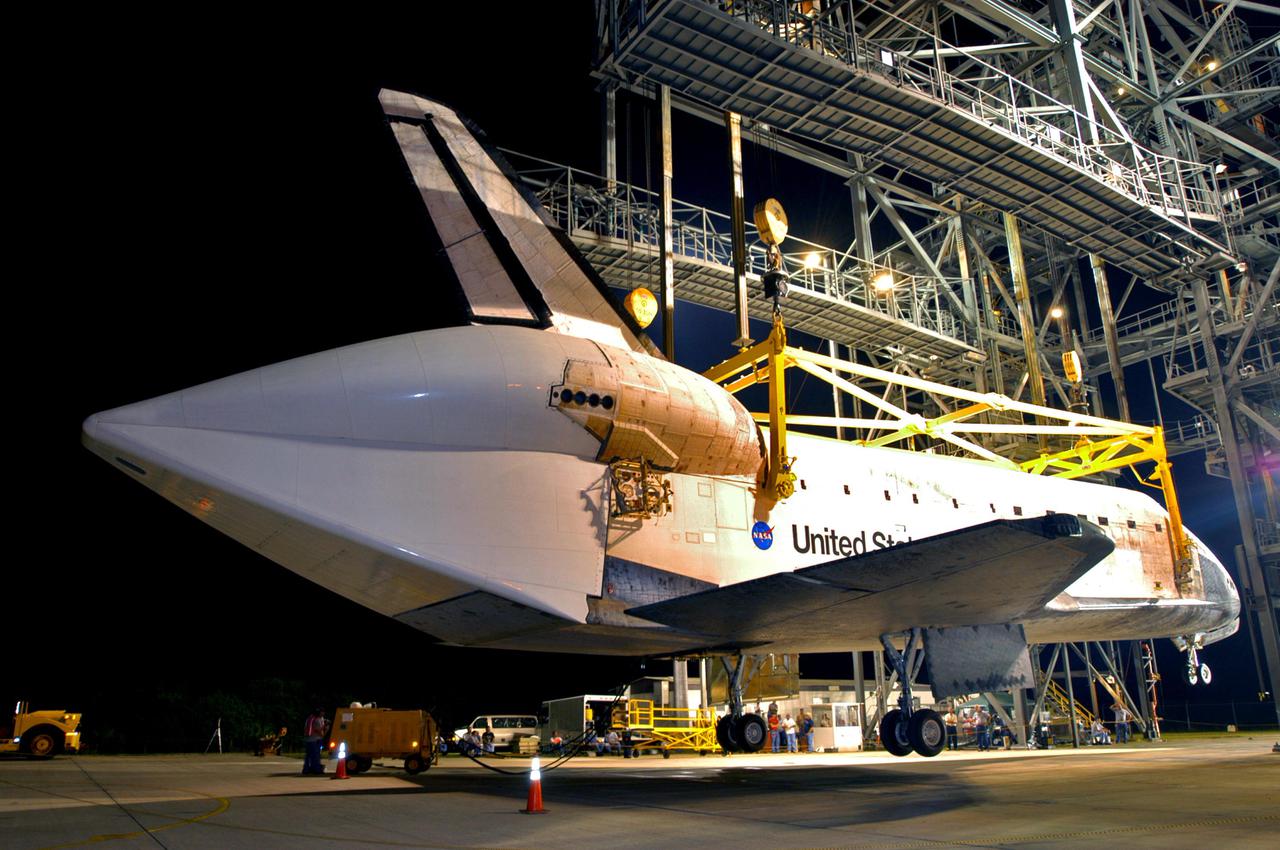
KENNEDY SPACE CENTER, FLA. - After being lowered close enough to the ground from the mate_demate device, Discovery’s wheels are lowered at NASA Kennedy Space Center’s Shuttle Landing Facility. Visible on the orbiter is the tail cone that covers the main engines during the ferry flight. Discovery was returned to Kennedy Space Center on a ferry flight from Edwards Air Force Base in California, where it landed Aug. 9 after 13 days in space on mission STS-114. In the mate_demate device, a horizontal structure mounted at the 80-foot level between two towers controls and guides a large lift beam that attaches to the orbiter to raise and lower it. The orbiter will be lowered to the ground and then be towed to the Orbiter Processing Facility. Once inside the OPF, the payload bay doors will be opened and the MPLM Raffaello brought back from the International Space Station will be unloaded and transferred to the Space Station Processing Facility. This concludes mission STS-114.
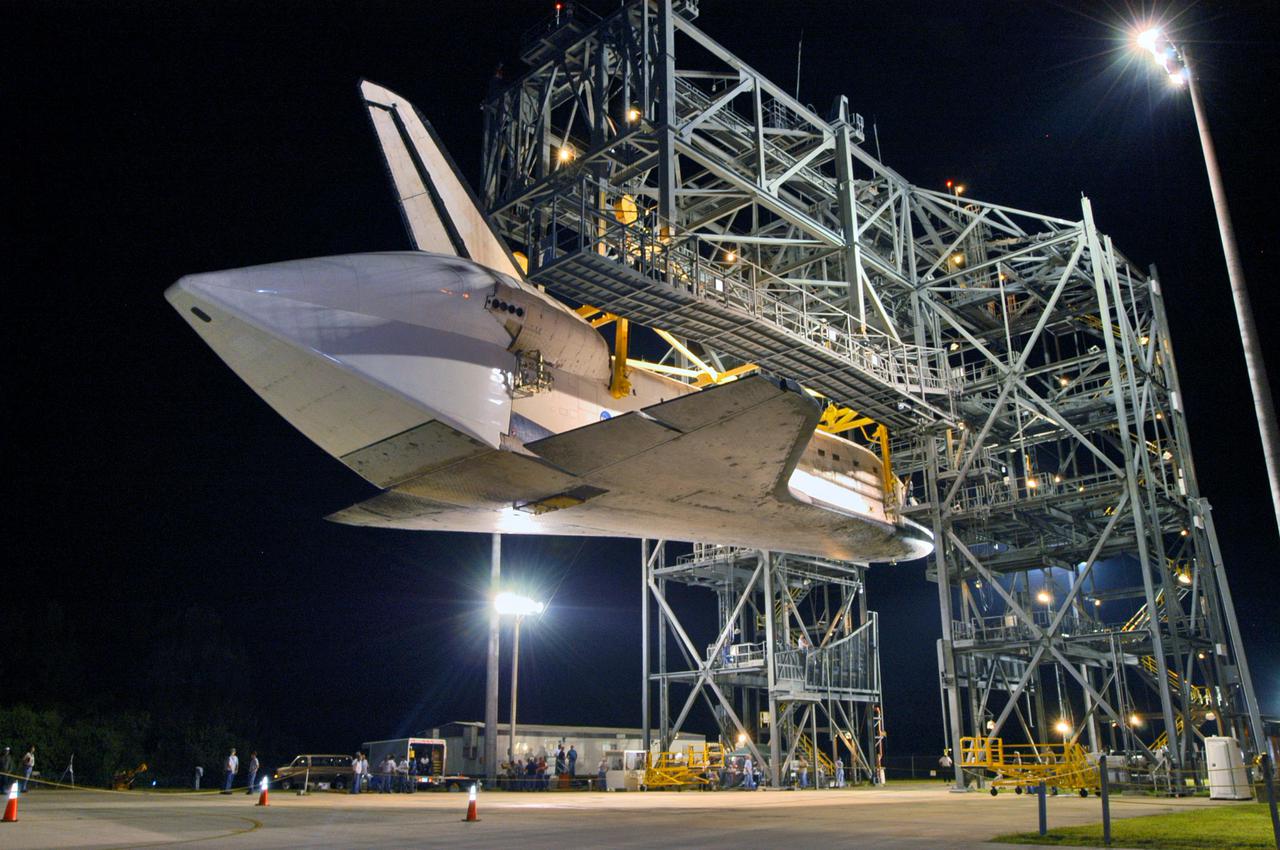
KENNEDY SPACE CENTER, FLA. - In the early morning hours at NASA Kennedy Space Center’s Shuttle Landing Facility, the orbiter Discovery is slowly lowered toward the ground from the mate_demate device. Visible on the orbiter is the tail cone that covers the main engines during the ferry flight. Discovery was returned to Kennedy Space Center on a ferry flight from Edwards Air Force Base in California, where it landed Aug. 9 after 13 days in space on mission STS-114. In the mate_demate device, a horizontal structure mounted at the 80-foot level between two towers controls and guides a large lift beam that attaches to the orbiter to raise and lower it. The orbiter will be lowered to the ground and then be towed to the Orbiter Processing Facility. Once inside the OPF, the payload bay doors will be opened and the MPLM Raffaello brought back from the International Space Station will be unloaded and transferred to the Space Station Processing Facility. This concludes mission STS-114.
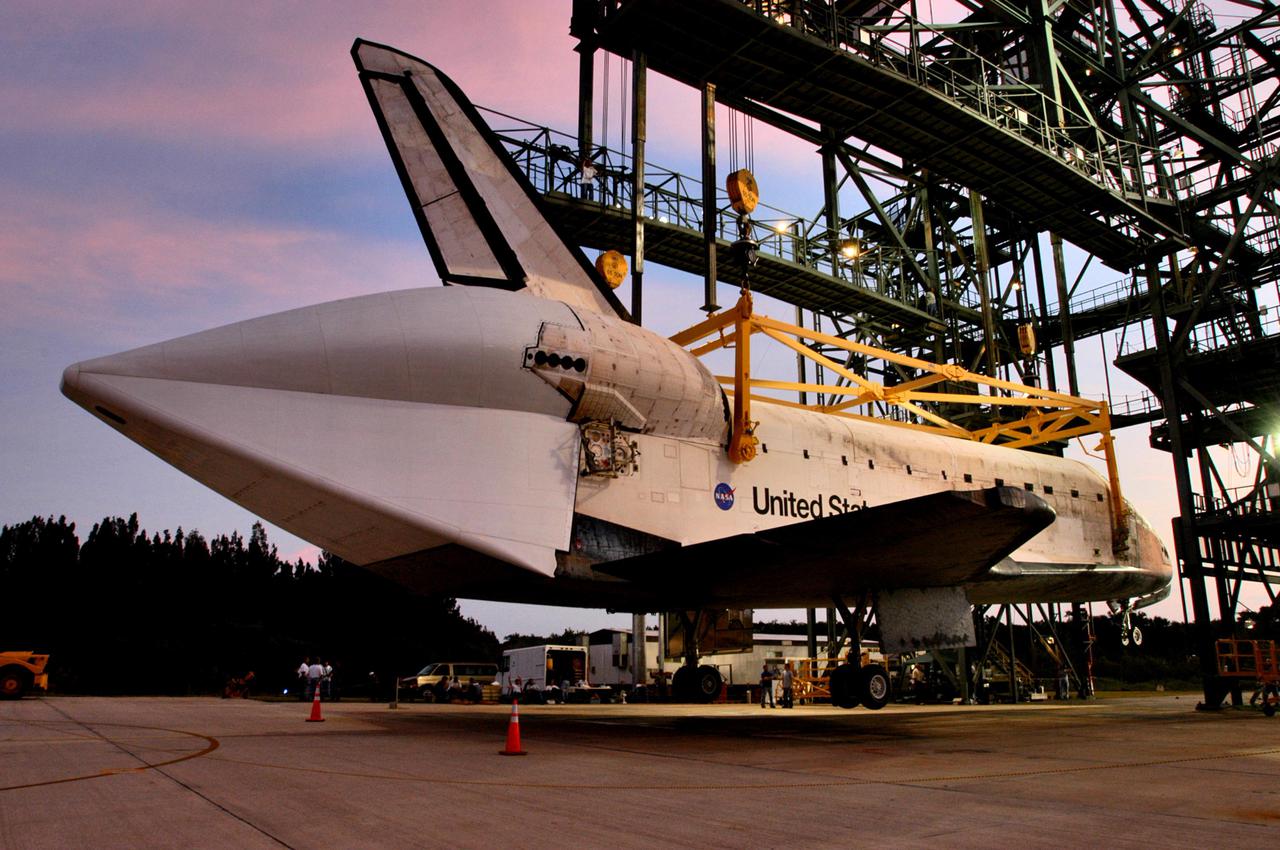
KENNEDY SPACE CENTER, FLA. - Just before sunrise, Discovery finally rests on its wheels on the ground at NASA Kennedy Space Center’s Shuttle Landing Facility. The orbiter was lowered overnight from the mate_demate device after the Shuttle Carrier Aircraft, a modified Boeing 747, was rolled away. Discovery was returned to Kennedy Space Center on a ferry flight from Edwards Air Force Base in California, where it landed Aug. 9 after 13 days in space on mission STS-114. In the mate_demate device, a horizontal structure mounted at the 80-foot level between two towers controls and guides a large lift beam that attaches to the orbiter to raise and lower it. The orbiter will be lowered to the ground and then be towed to the Orbiter Processing Facility. Once inside the OPF, the payload bay doors will be opened and the MPLM Raffaello brought back from the International Space Station will be unloaded and transferred to the Space Station Processing Facility. This concludes mission STS-114.
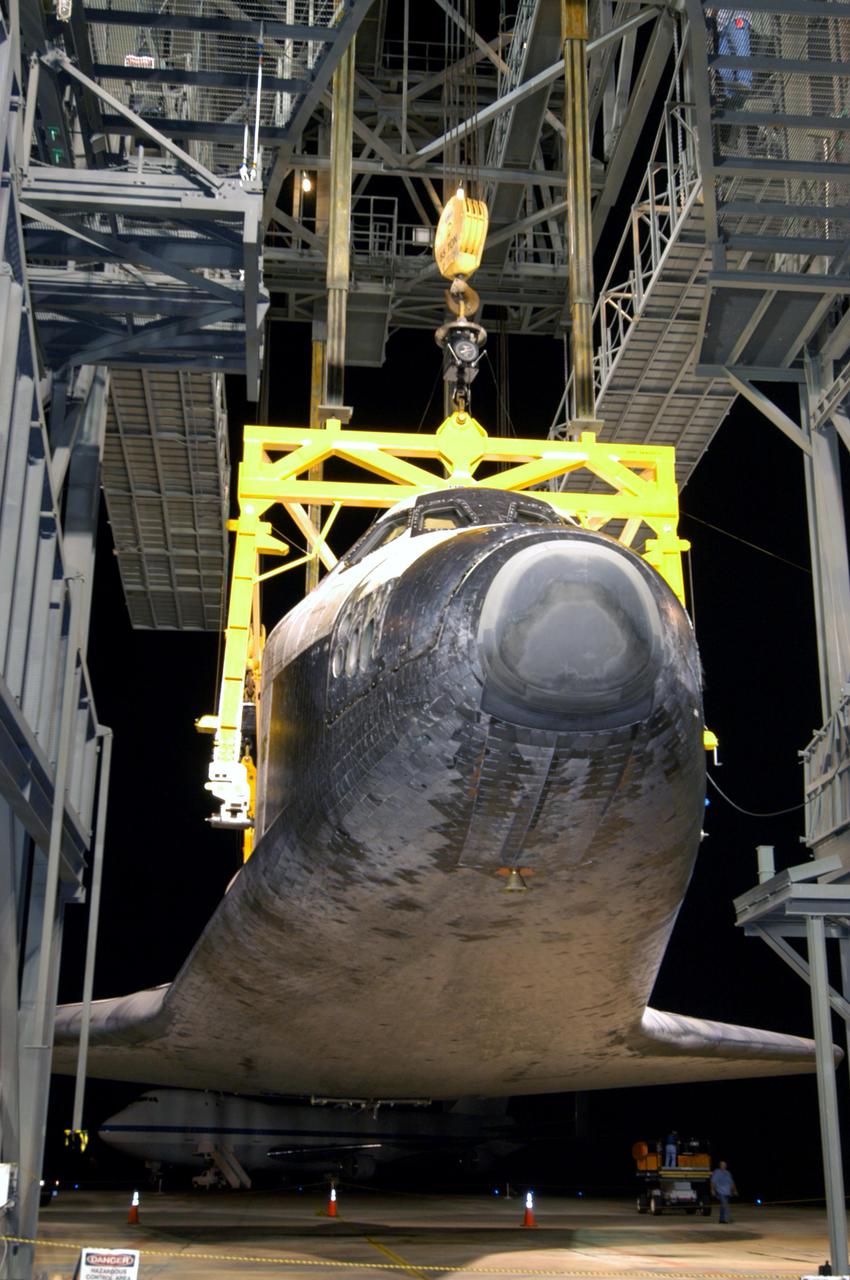
KENNEDY SPACE CENTER, FLA. - In the early morning hours at NASA Kennedy Space Center’s Shuttle Landing Facility, the orbiter Discovery is slowly lowered toward the ground from the mate_demate device. Visible on the orbiter is the tail cone that covers the main engines during the ferry flight. Discovery was returned to Kennedy Space Center on a ferry flight from Edwards Air Force Base in California, where it landed Aug. 9 after 13 days in space on mission STS-114. In the mate_demate device, a horizontal structure mounted at the 80-foot level between two towers controls and guides a large lift beam that attaches to the orbiter to raise and lower it. The orbiter will be lowered to the ground and then be towed to the Orbiter Processing Facility. Once inside the OPF, the payload bay doors will be opened and the MPLM Raffaello brought back from the International Space Station will be unloaded and transferred to the Space Station Processing Facility. This concludes mission STS-114.
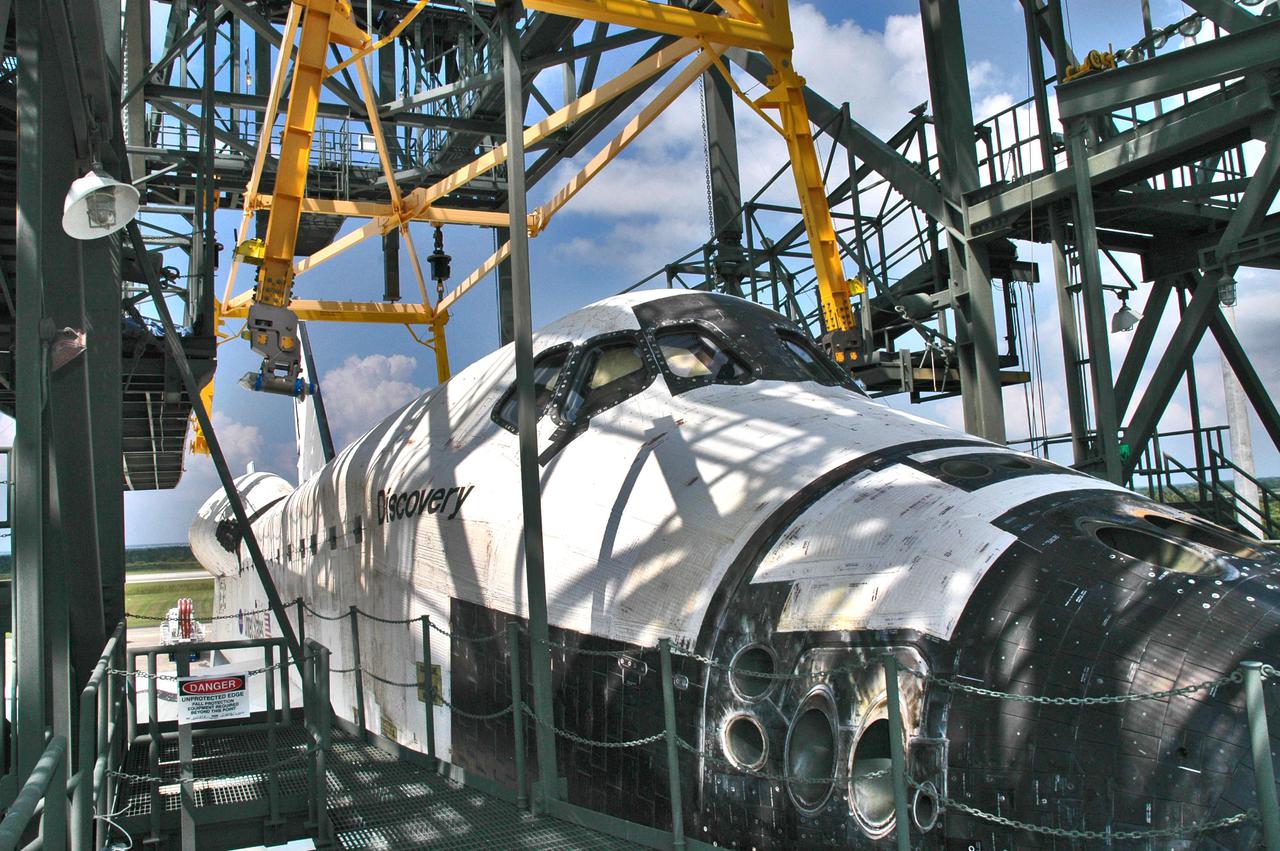
KENNEDY SPACE CENTER, FLA. - The orbiter Discovery on top of the Shuttle Carrier Aircraft, a modified Boeing 747, is in place under the mate_demate device at NASA Kennedy Space Center’s Shuttle Landing Facility. Discovery was returned to Kennedy Space Center on a ferry flight from Edwards Air Force Base in California, where it landed Aug. 9 after 13 days in space on mission STS-114. In the mate_demate device, a horizontal structure mounted at the 80-foot level between two towers controls and guides a large lift beam that attaches to the orbiter to raise and lower it. Once Discovery is lifted off the back of the SCA, the 747 can then roll away and the orbiter will be lowered to the ground. It will then be towed from the SLF to the Orbiter Processing Facility. Once inside the OPF, the payload bay doors will be opened and the MPLM Raffaello brought back from the International Space Station will be unloaded and transferred to the Space Station Processing Facility. This concludes mission STS-114.
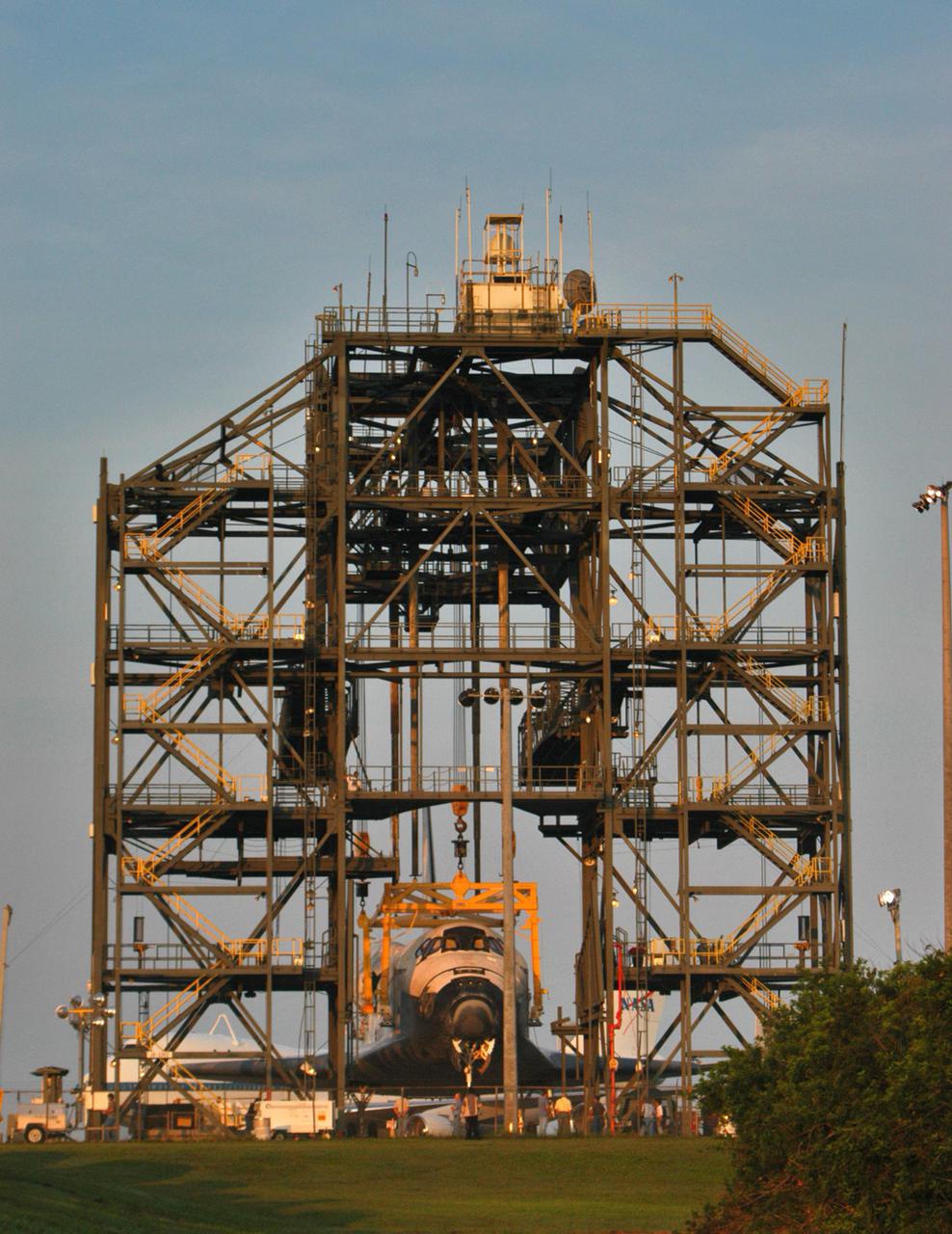
KENNEDY SPACE CENTER, FLA. - Discovery finally rests on its wheels on the ground at NASA Kennedy Space Center’s Shuttle Landing Facility. The orbiter was lowered overnight from the mate_demate device after the Shuttle Carrier Aircraft, a modified Boeing 747, was rolled away. Discovery was returned to Kennedy Space Center on a ferry flight from Edwards Air Force Base in California, where it landed Aug. 9 after 13 days in space on mission STS-114. In the mate_demate device, a horizontal structure mounted at the 80-foot level between two towers controls and guides a large lift beam that attaches to the orbiter to raise and lower it. The orbiter will be towed to the Orbiter Processing Facility. Once inside the OPF, the payload bay doors will be opened and the MPLM Raffaello brought back from the International Space Station will be unloaded and transferred to the Space Station Processing Facility. This concludes mission STS-114.
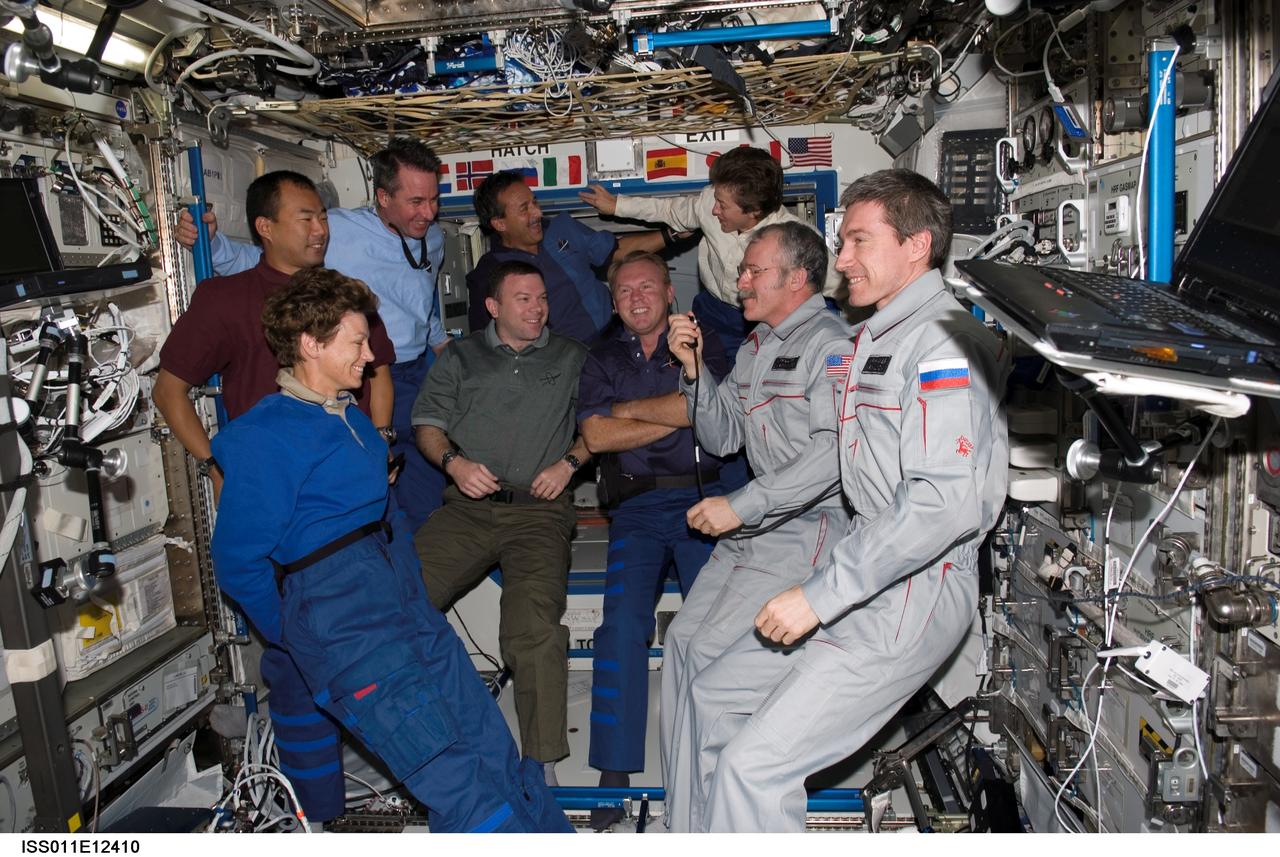
ISS011-E-12410 (6 August 2005) --- The STS-114 and Expedition 11 crewmembers gather in the Destiny laboratory of the International Space Station. From the left (front row) are astronaut Eileen M. Collins, STS-114 commander; James M. Kelly, STS-114 pilot; Andrew S. W. Thomas, STS-114 mission specialist; John L. Phillips, Expedition 11 NASA Space Station science officer and flight engineer; and cosmonaut Sergei K. Krikalev, Expedition 11 commander representing Russia's Federal Space Agency. From the left (back row) are astronauts Soichi Noguchi representing Japan Aerospace Exploration Agency (JAXA), Stephen K. Robinson, Charles J. Camarda, and Wendy B. Lawrence, all STS-114 mission specialists.
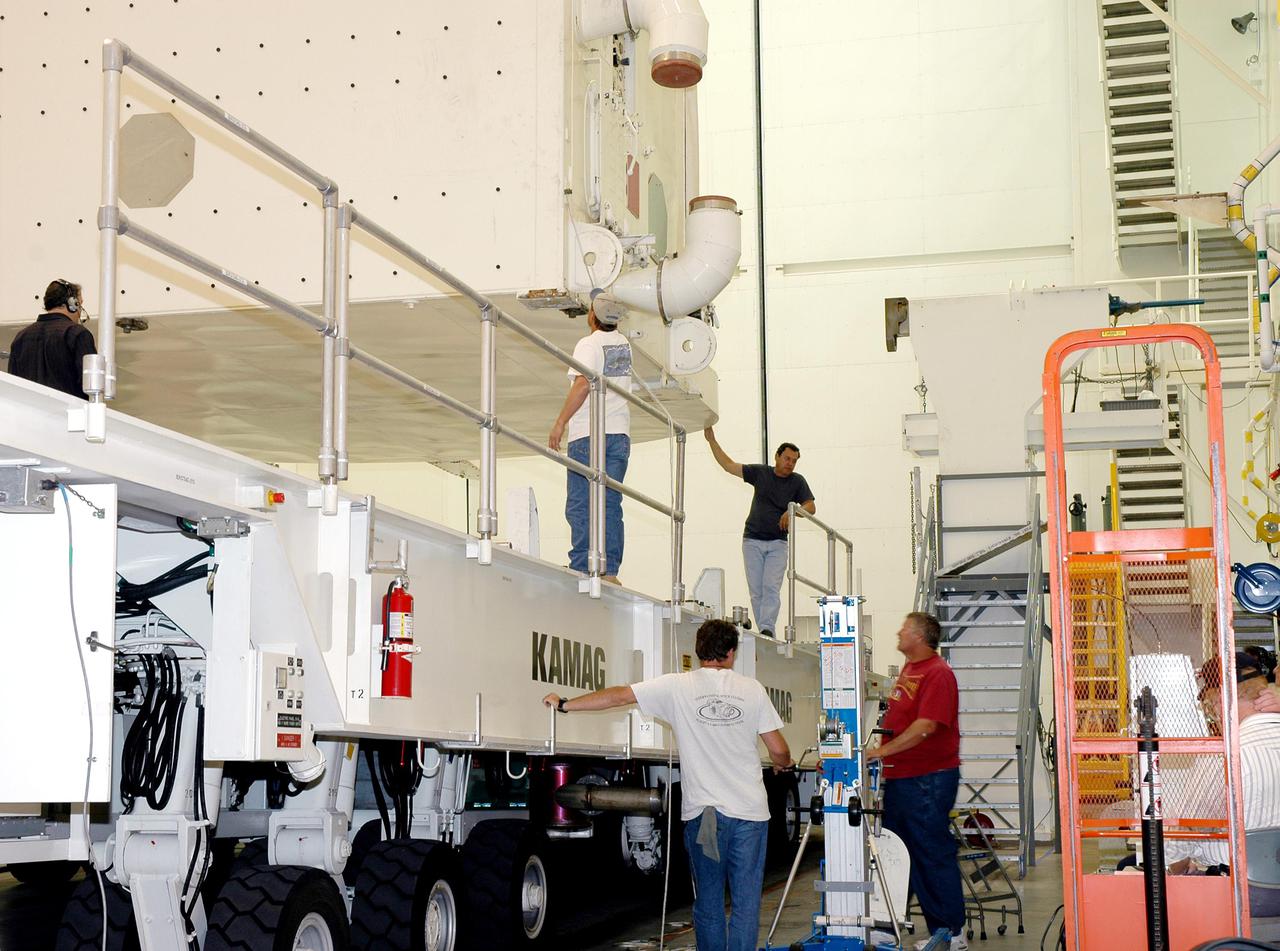
KENNEDY SPACE CENTER, FLA. - Workers in the Canister Rotation Facility at NASA’s Kennedy Space Center observe the Payload Canister after its rotation to a vertical position. The canister will be transported to Launch Pad 39B. The payloads inside, including the Multi-Purpose Logistics Module Raffaello and External Stowage Platform-2, will be moved into the Payload Changeout Room in the Rotating Service Structure and then installed in Discovery’s payload bay. Space Shuttle Discovery is scheduled to launch on Return to Flight mission STS-114 to the International Space Station. The launch window extends from May 22 to June 3.
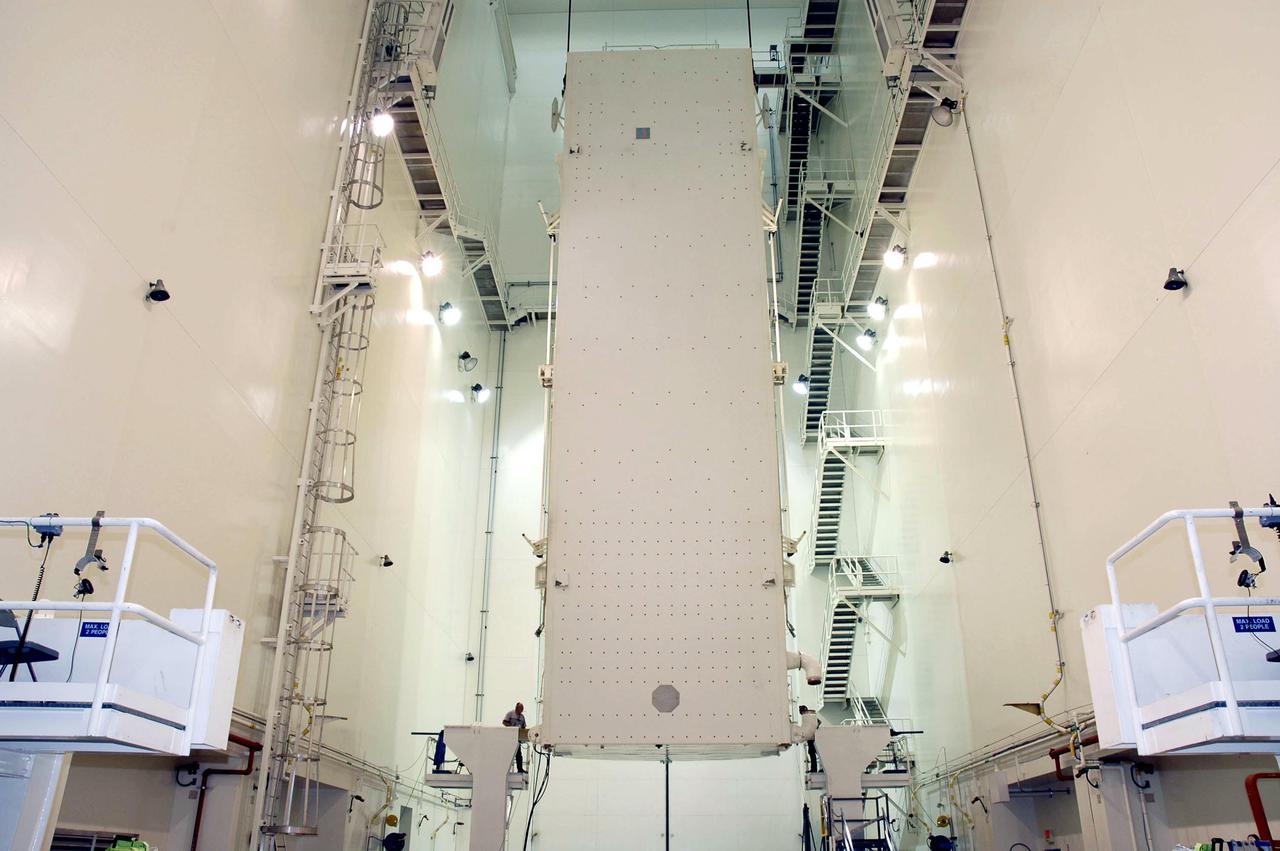
KENNEDY SPACE CENTER, FLA. - In the Canister Rotation Facility at NASA’s Kennedy Space Center, the Payload Canister is being raised to a vertical position for transport to Launch Pad 39B. The payloads inside, including the Multi-Purpose Logistics Module Raffaello and External Stowage Platform-2, will be moved into the Payload Changeout Room in the Rotating Service Structure and then installed in Discovery’s payload bay. Space Shuttle Discovery is scheduled to launch on Return to Flight mission STS-114 to the International Space Station. The launch window extends from May 22 to June 3.
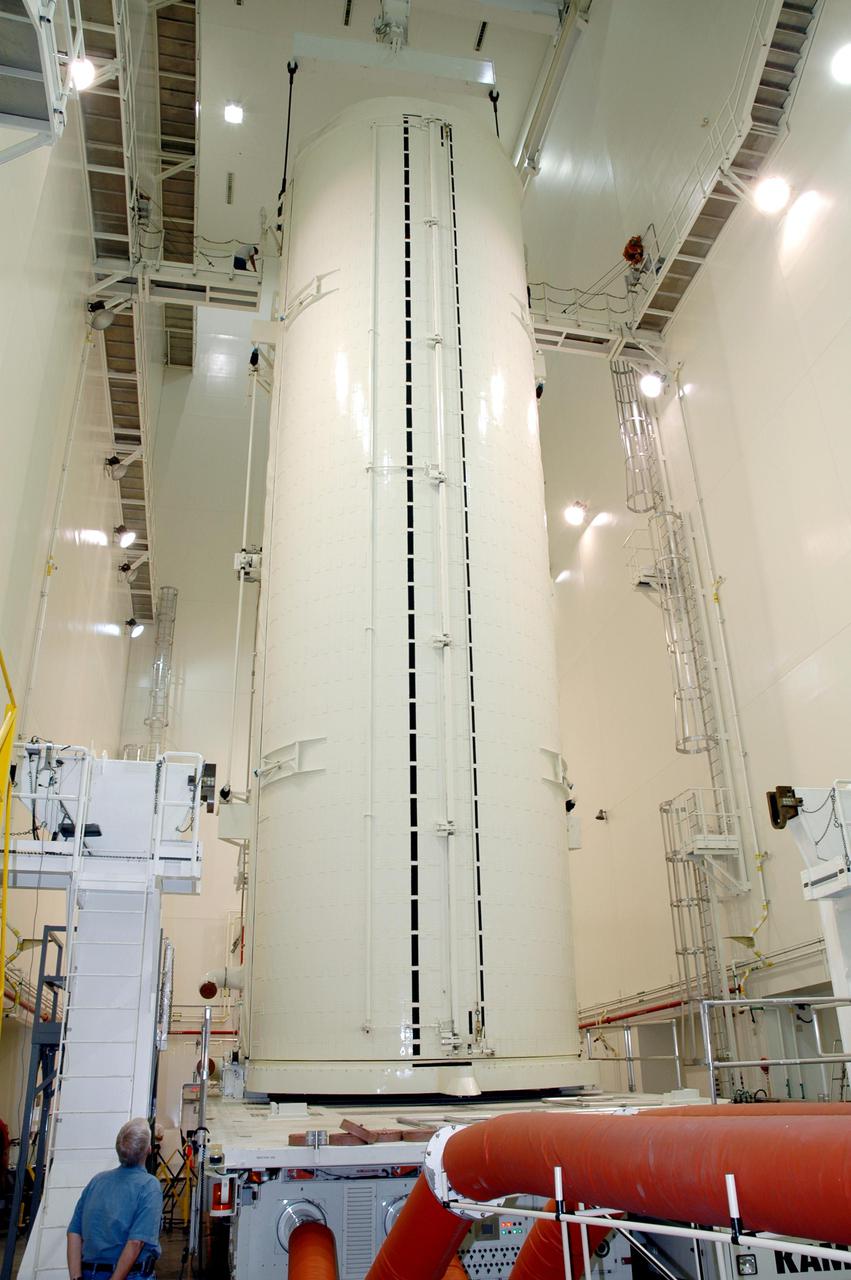
KENNEDY SPACE CENTER, FLA. - In the Canister Rotation Facility at NASA’s Kennedy Space Center, the vertical Payload Canister is ready for transport to Launch Pad 39B. The canister will be transported to Launch Pad 39B. The payloads inside, including the Multi-Purpose Logistics Module Raffaello and External Stowage Platform-2, will be moved into the Payload Changeout Room in the Rotating Service Structure and then installed in Discovery’s payload bay. Space Shuttle Discovery is scheduled to launch on Return to Flight mission STS-114 to the International Space Station. The launch window extends from May 22 to June 3.
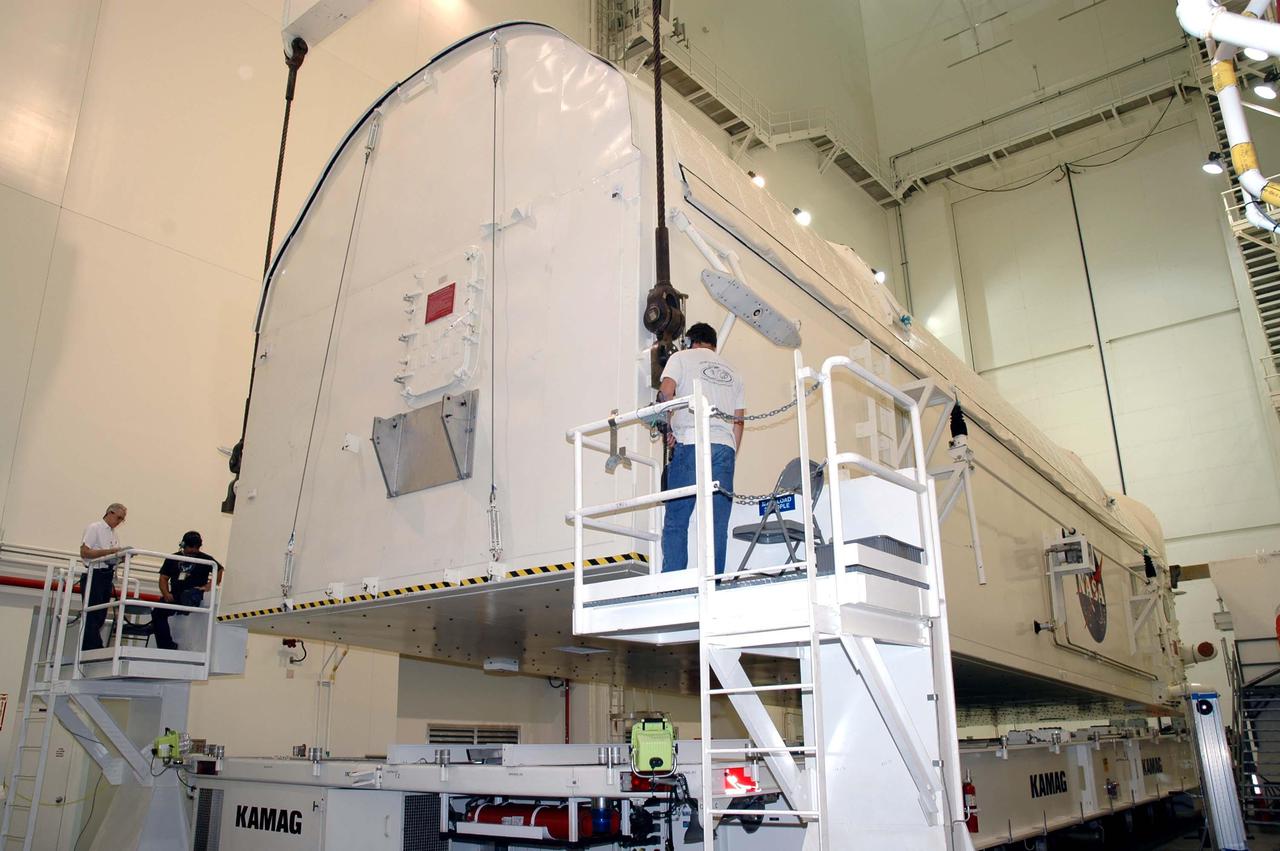
KENNEDY SPACE CENTER, FLA. - In the Canister Rotation Facility at NASA’s Kennedy Space Center, the Payload Canister is being raised to a vertical position for transport to Launch Pad 39B. The payloads inside, including the Multi-Purpose Logistics Module Raffaello and External Stowage Platform-2, will be moved into the Payload Changeout Room in the Rotating Service Structure and then installed in Discovery’s payload bay. Space Shuttle Discovery is scheduled to launch on Return to Flight mission STS-114 to the International Space Station. The launch window extends from May 22 to June 3.
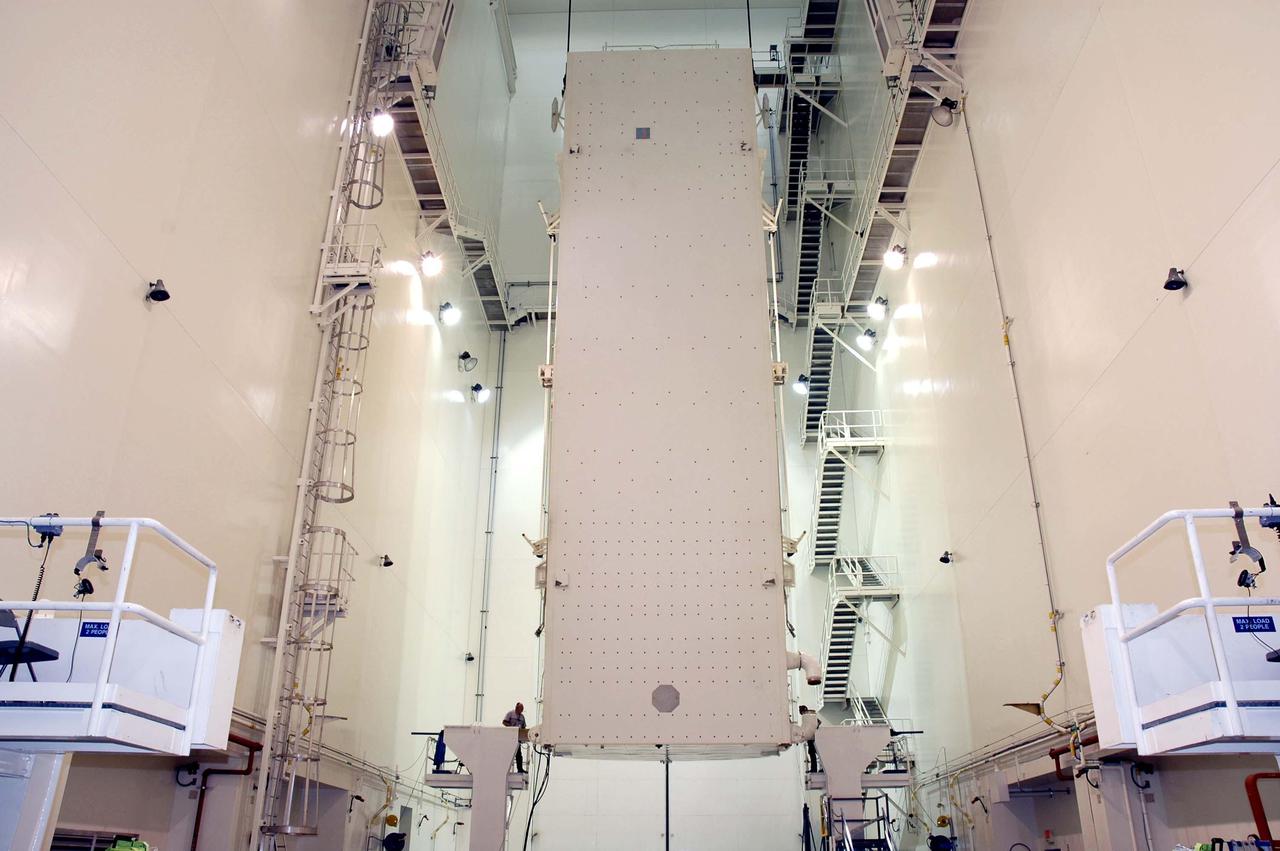
KENNEDY SPACE CENTER, FLA. - In the Canister Rotation Facility at NASA’s Kennedy Space Center, the Payload Canister has been raised to a vertical position for transport to Launch Pad 39B. The payloads inside, including the Multi-Purpose Logistics Module Raffaello and External Stowage Platform-2, will be moved into the Payload Changeout Room in the Rotating Service Structure and then installed in Discovery’s payload bay. Space Shuttle Discovery is scheduled to launch on Return to Flight mission STS-114 to the International Space Station. The launch window extends from May 22 to June 3.
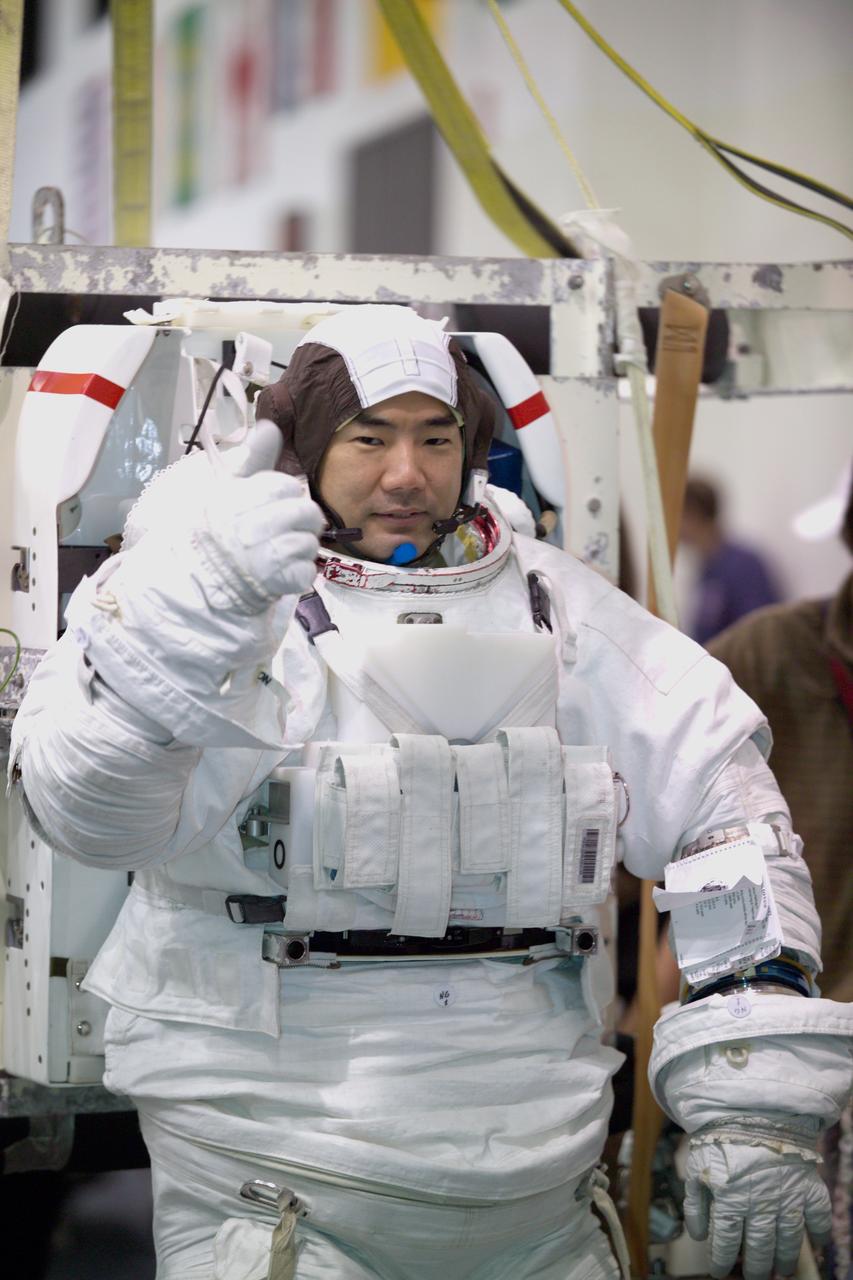
JSC2005-E-07617 (24 February 2005) --- Astronaut Soichi Noguchi, STS-114 mission specialist representing Japan Aerospace Exploration Agency (JAXA), attired in a training version of the Extravehicular Mobility Unit (EMU) spacesuit, gives a ;thumbs up; signal prior to being submerged in the waters of the Neutral Buoyancy Laboratory (NBL) near Johnson Space Center. This training session occurred during STS-114 Media Day at the NBL.

JSC2005-E-07622 (24 February 2005) --- Astronaut Stephen K. Robinson, STS-114 mission specialist, attired in a training version of the Extravehicular Mobility Unit (EMU) spacesuit, waves at the camera prior to being submerged in the waters of the Neutral Buoyancy Laboratory (NBL) near Johnson Space Center. This training session occurred during STS-114 Media Day at the NBL.

JSC2005-E-07623 (24 February 2005) --- Astronaut Stephen K. Robinson and Japan Aerospace Exploration Agency (JAXA) astronaut Soichi Noguchi (partially obscured), both STS-114 mission specialists, are about to be submerged in the waters of the Neutral Buoyancy Laboratory (NBL) near the Johnson Space Center (JSC). Noguchi and Robinson are wearing training versions of the Extravehicular Mobility Unit (EMU) spacesuit. Divers are in the water to assist the crewmembers during this training session, which occurred during STS-114 Media Day at the NBL.
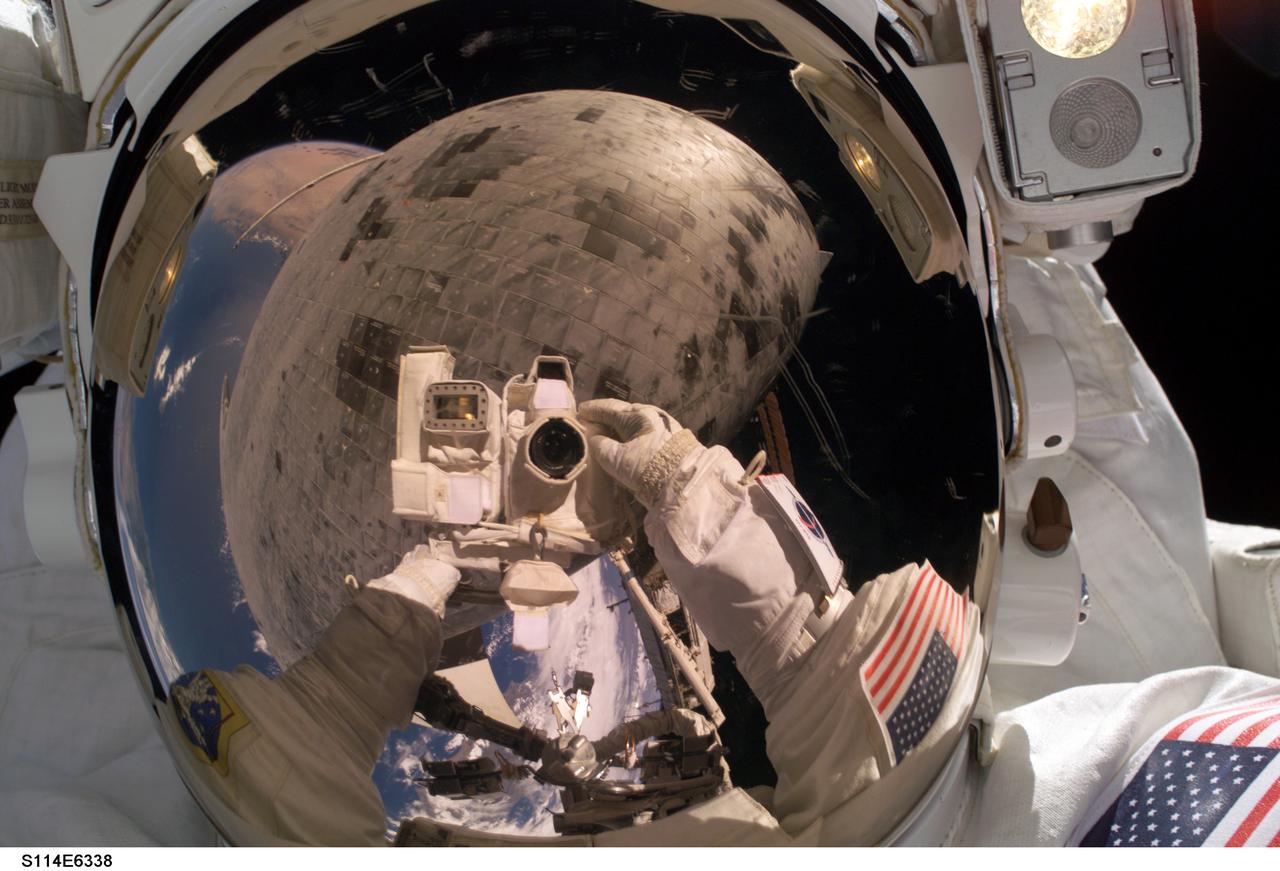
Launched on July 26, 2005 from the Kennedy Space Center in Florida, STS-114 was classified as Logistics Flight 1. Among the Station-related activities of the mission were the delivery of new supplies and the replacement of one of the orbital outpost's Control Moment Gyroscopes (CMGs). STS-114 also carried the Raffaello Multi-Purpose Logistics Module and the External Stowage Platform-2. A major focus of the mission was the testing and evaluation of new Space Shuttle flight safety, which included new inspection and repair techniques. Upon its approach to the International Space Station (ISS), the Space Shuttle Discovery underwent a photography session in order to assess any damages that may have occurred during its launch and/or journey through Space. The mission’s third and final Extra Vehicular Activity (EVA) included taking a close-up look and the repair of the damaged heat shield. Gap fillers were removed from between the orbiter’s heat-shielding tiles located on the craft’s underbelly. Never before had any repairs been done to an orbiter while still in space. Astronaut Stephen K. Robinson, STS-114 mission specialist, used the pictured still digital camera to expose a photo of his helmet visor during the EVA. Also visible in the reflection are thermal protection tiles on Discovery’s underside.
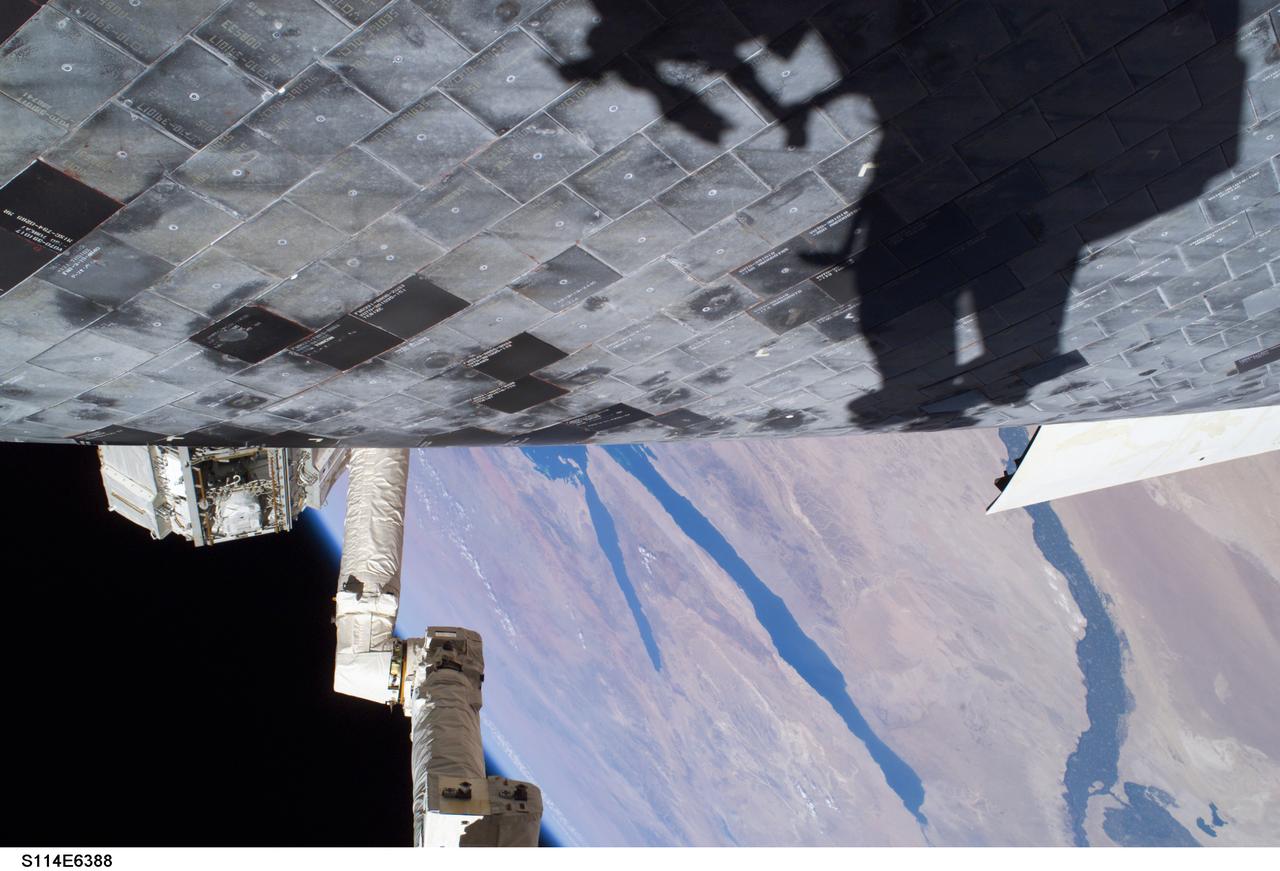
Launched on July 26, 2005 from the Kennedy Space Center in Florida, STS-114 was classified as Logistics Flight 1. Among the Station-related activities of the mission were the delivery of new supplies and the replacement of one of the orbital outpost's Control Moment Gyroscopes (CMGs). STS-114 also carried the Raffaello Multi-Purpose Logistics Module and the External Stowage Platform-2. A major focus of the mission was the testing and evaluation of new Space Shuttle flight safety, which included new inspection and repair techniques. Upon its approach to the International Space Station (ISS), the Space Shuttle Discovery underwent a photography session in order to assess any damages that may have occurred during its launch and/or journey through Space. The mission’s third and final Extra Vehicular Activity (EVA) included taking a close-up look and the repair of the damaged heat shield. Gap fillers were removed from between the orbiter’s heat-shielding tiles located on the craft’s underbelly. Never before had any repairs been done to an orbiter while still in space. This particular photo was taken by astronaut Stephen K. Robinson, STS-114 mission specialist, whose shadow is visible on the thermal protection tiles, and a portion of the Canadian built Remote Manipulator System (RMS) robotic arm and the Nile River is visible at the bottom.
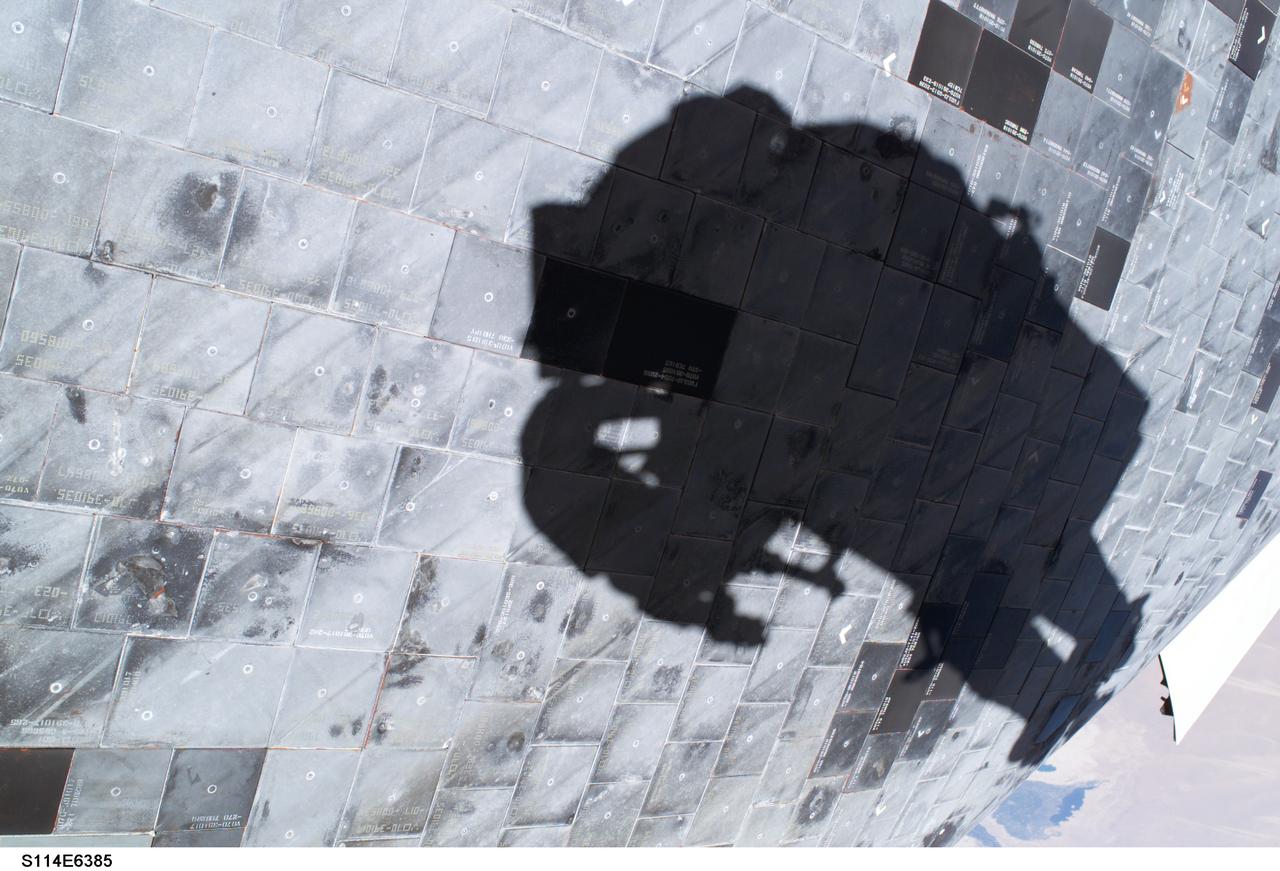
Launched on July 26, 2005 from the Kennedy Space Center in Florida, STS-114 was classified as Logistics Flight 1. Among the Station-related activities of the mission were the delivery of new supplies and the replacement of one of the orbital outpost's Control Moment Gyroscopes (CMGs). STS-114 also carried the Raffaello Multi-Purpose Logistics Module and the External Stowage Platform-2. A major focus of the mission was the testing and evaluation of new Space Shuttle flight safety, which included new inspection and repair techniques. Upon its approach to the International Space Station (ISS), the Space Shuttle Discovery underwent a photography session in order to assess any damages that may have occurred during its launch and/or journey through Space. The mission’s third and final Extra Vehicular Activity (EVA) included taking a close-up look and the repair of the damaged heat shield. Gap fillers were removed from between the orbiter’s heat-shielding tiles located on the craft’s underbelly. Never before had any repairs been done to an orbiter while still in space. This particular photo was taken by astronaut Stephen K. Robinson, STS-114 mission specialist, whose shadow is visible on the thermal protection tiles.
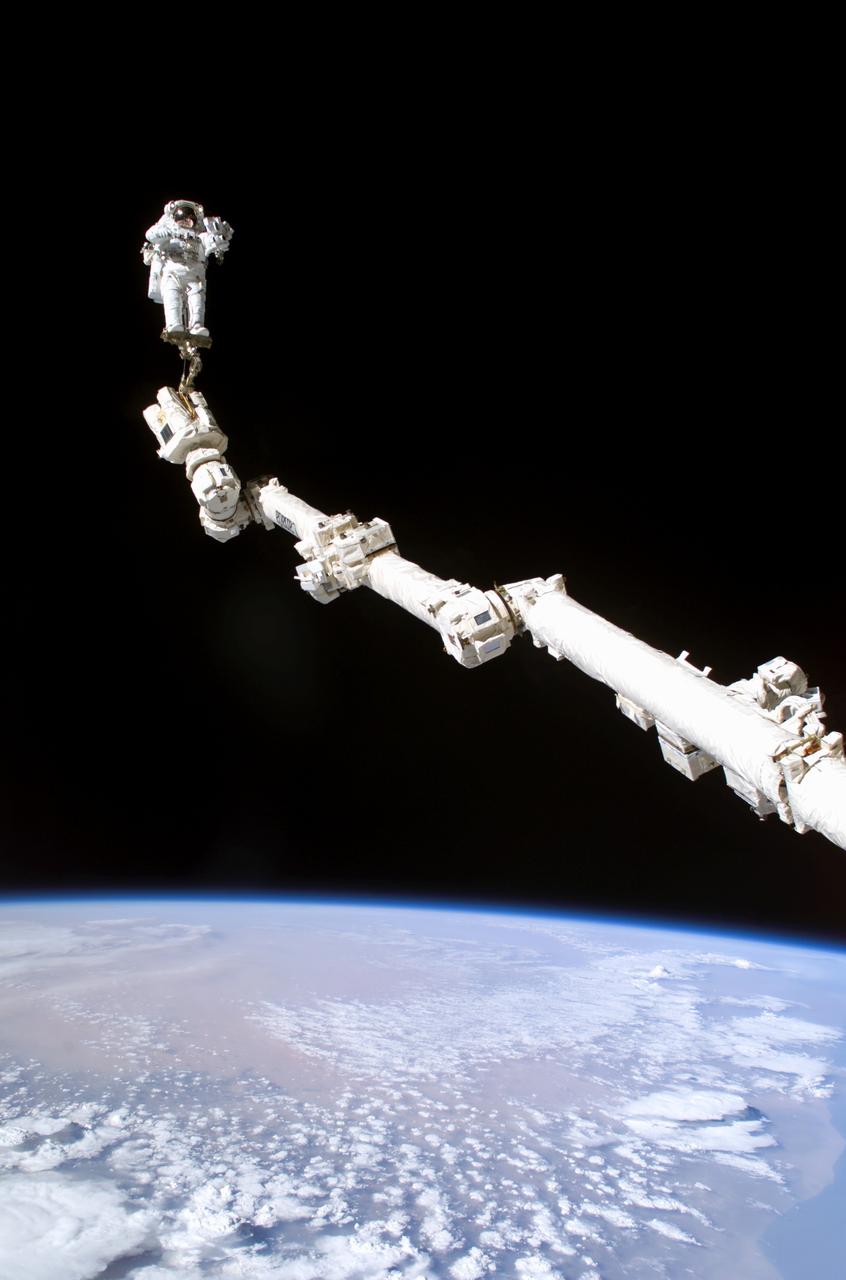
Launched on July 26, 2005 from the Kennedy Space Center in Florida, STS-114 was classified as Logistics Flight 1. Among the Station-related activities of the mission were the delivery of new supplies and the replacement of one of the orbital outpost's Control Moment Gyroscopes (CMGs). STS-114 also carried the Raffaello Multi-Purpose Logistics Module and the External Stowage Platform-2. A major focus of the mission was the testing and evaluation of new Space Shuttle flight safety, which included new inspection and repair techniques. Upon its approach to the International Space Station (ISS), the Space Shuttle Discovery underwent a photography session in order to assess any damages that may have occurred during its launch and/or journey through Space. The mission’s third and final Extra Vehicular Activity (EVA) included taking a close-up look and the repair of the damaged heat shield. Gap fillers were removed from between the orbiter’s heat-shielding tiles located on the craft’s underbelly. Never before had any repairs been done to an orbiter while still in space. Back dropped by the blackness of space and Earth’s horizon, astronaut Stephen K. Robinson, STS-114 mission specialist, is anchored to a foot restraint on the extended ISS’s Canadarm-2.
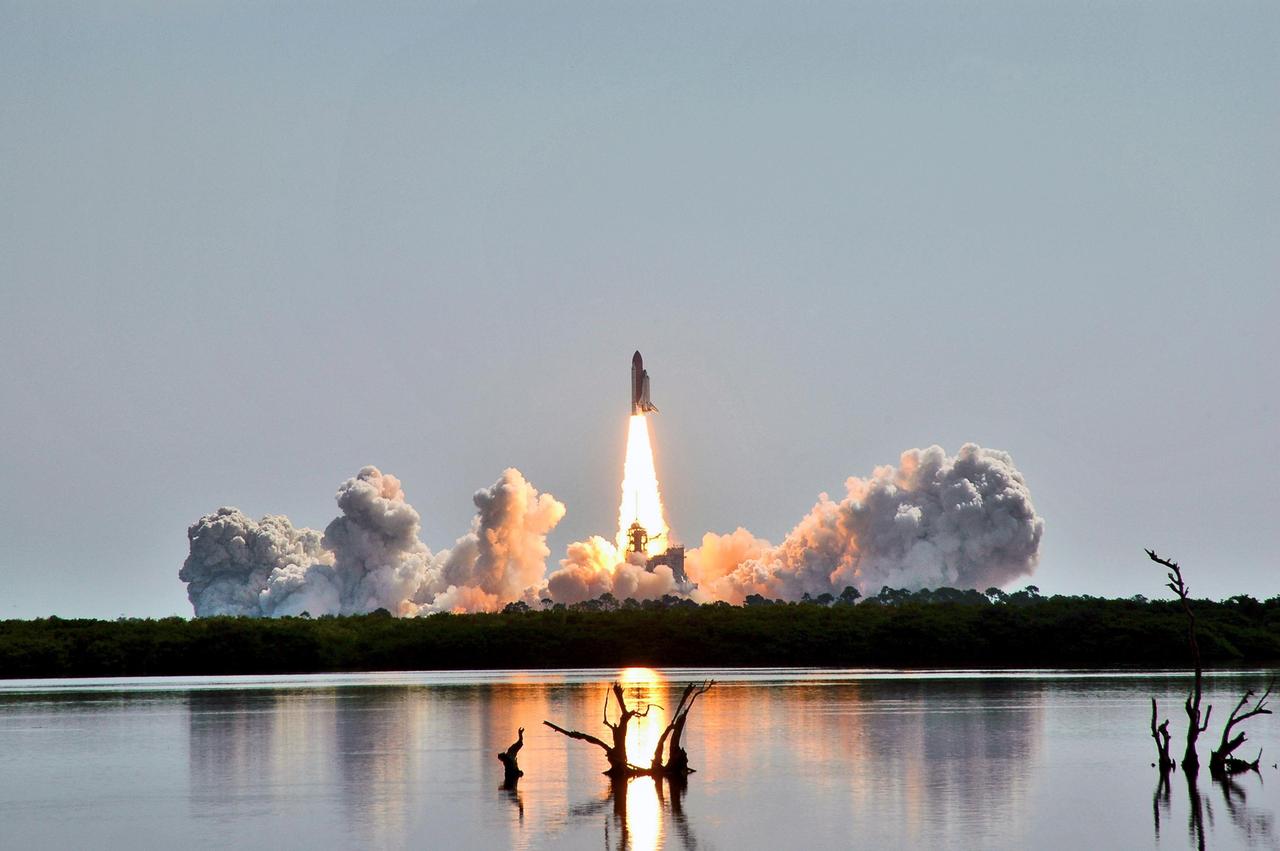
STS114-S-024 (26 July 2005) --- Space Shuttle Discovery and its seven-member crew launched at 10:39 a.m. (EDT) on July 26, 2005 to begin the two-day journey to the international space station on the historic STS-114 Return to Flight mission.
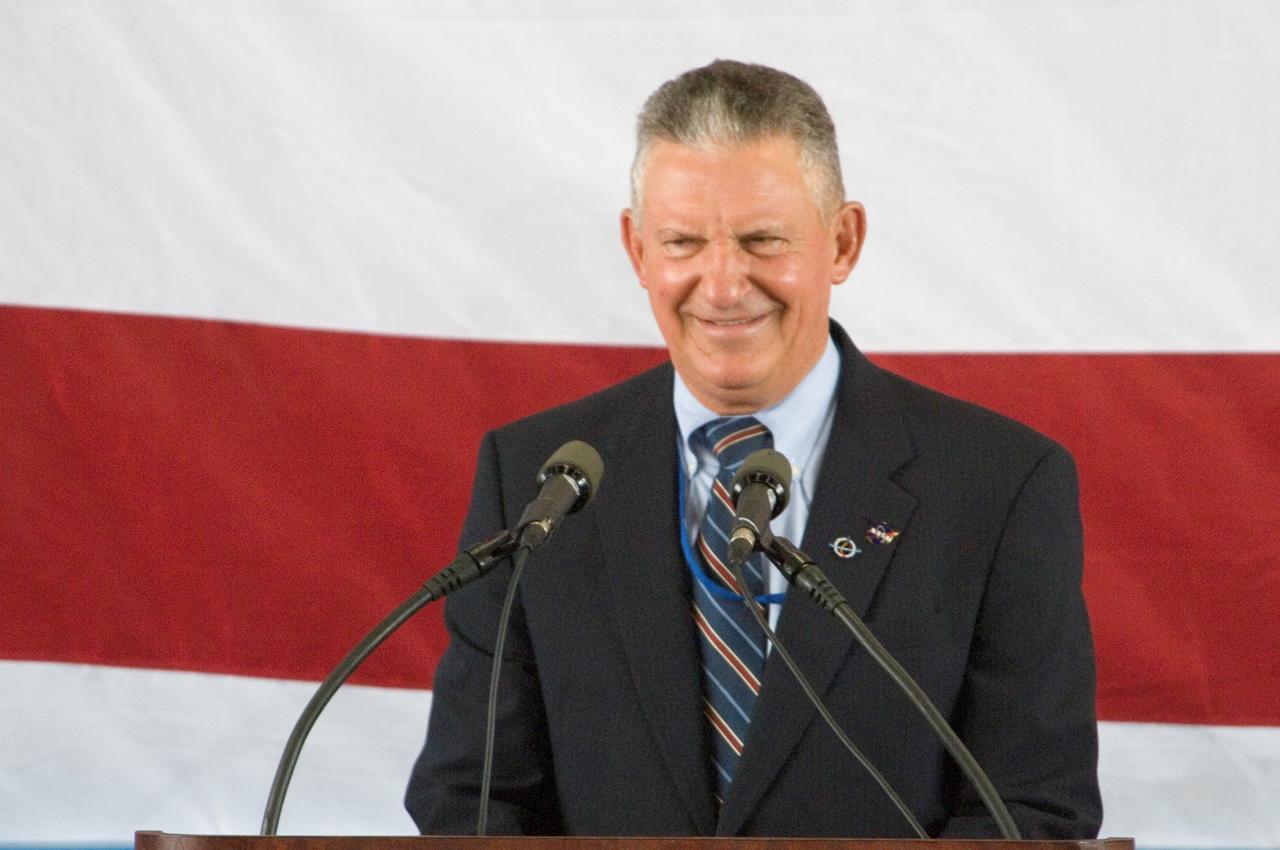
JSC2005-E-33392 (10 August 2005) --- Johnson Space Center (JSC) Director General Jefferson D. Howell, Jr. addresses a crowd on hand at Ellington Field’s Hangar 276 near Johnson Space Center (JSC) during the STS-114 crew return ceremonies.
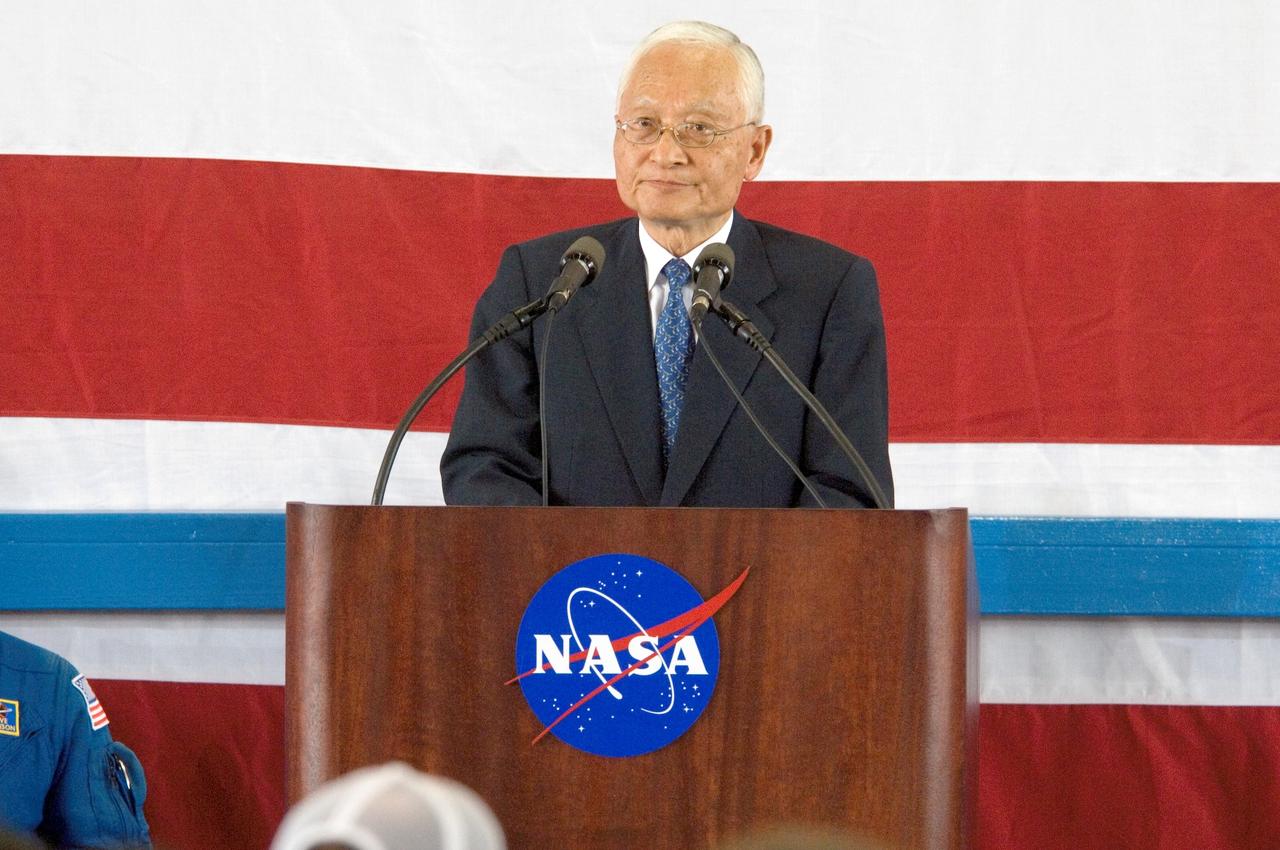
JSC2005-E-33405 (10 August 2005) --- Dr. Keiji Tachikawa, Japan Aerospace Exploration Agency (JAXA) President, addresses a crowd on hand at Ellington Field’s Hangar 276 near Johnson Space Center (JSC) during the STS-114 crew return ceremonies.
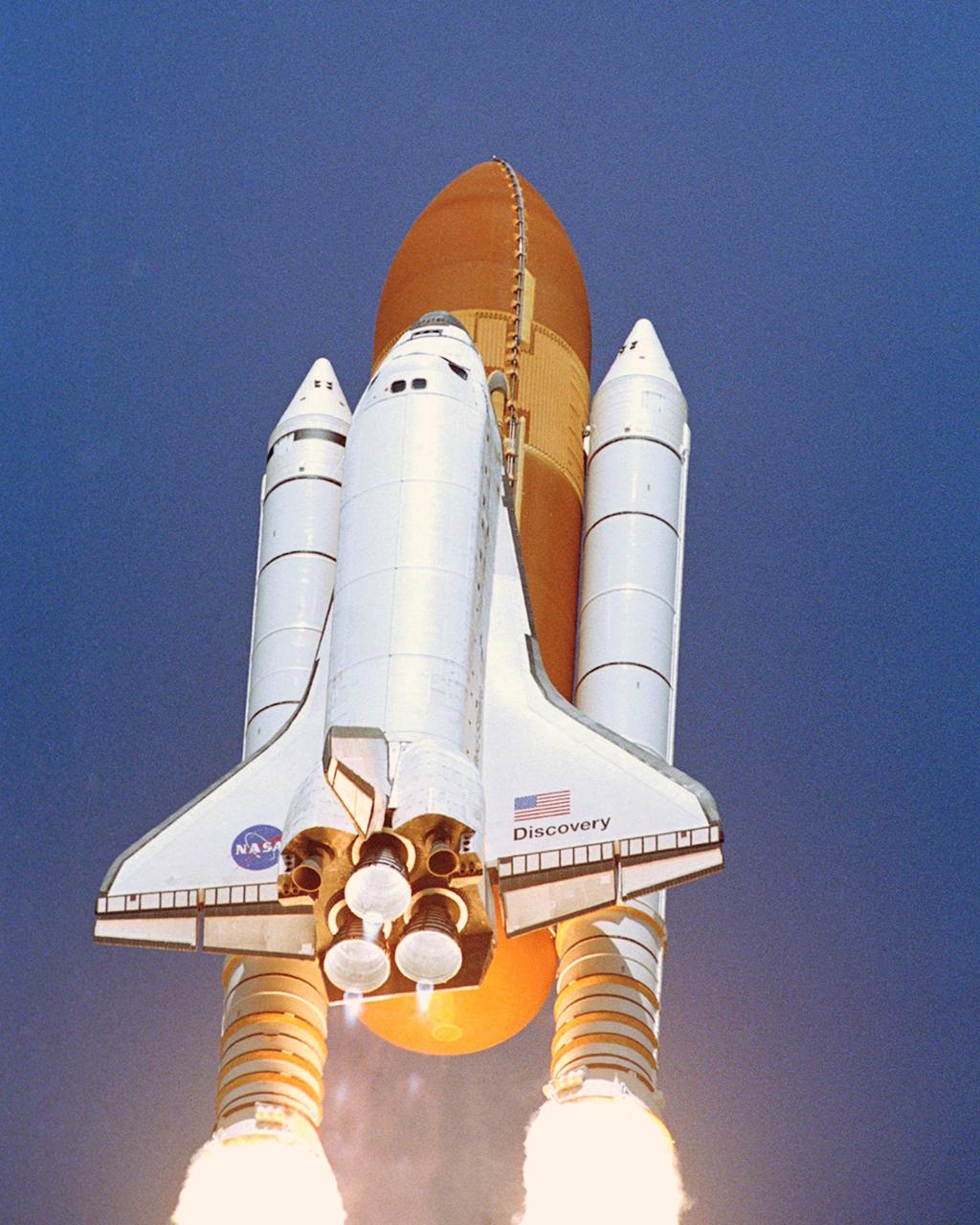
STS114-S-028 (26 July 2005) --- Space Shuttle Discovery and its seven-member crew launched at 10:39 a.m. (EDT) on July 26, 2005 to begin the two-day journey to the international space station on the historic STS-114 Return to Flight mission.
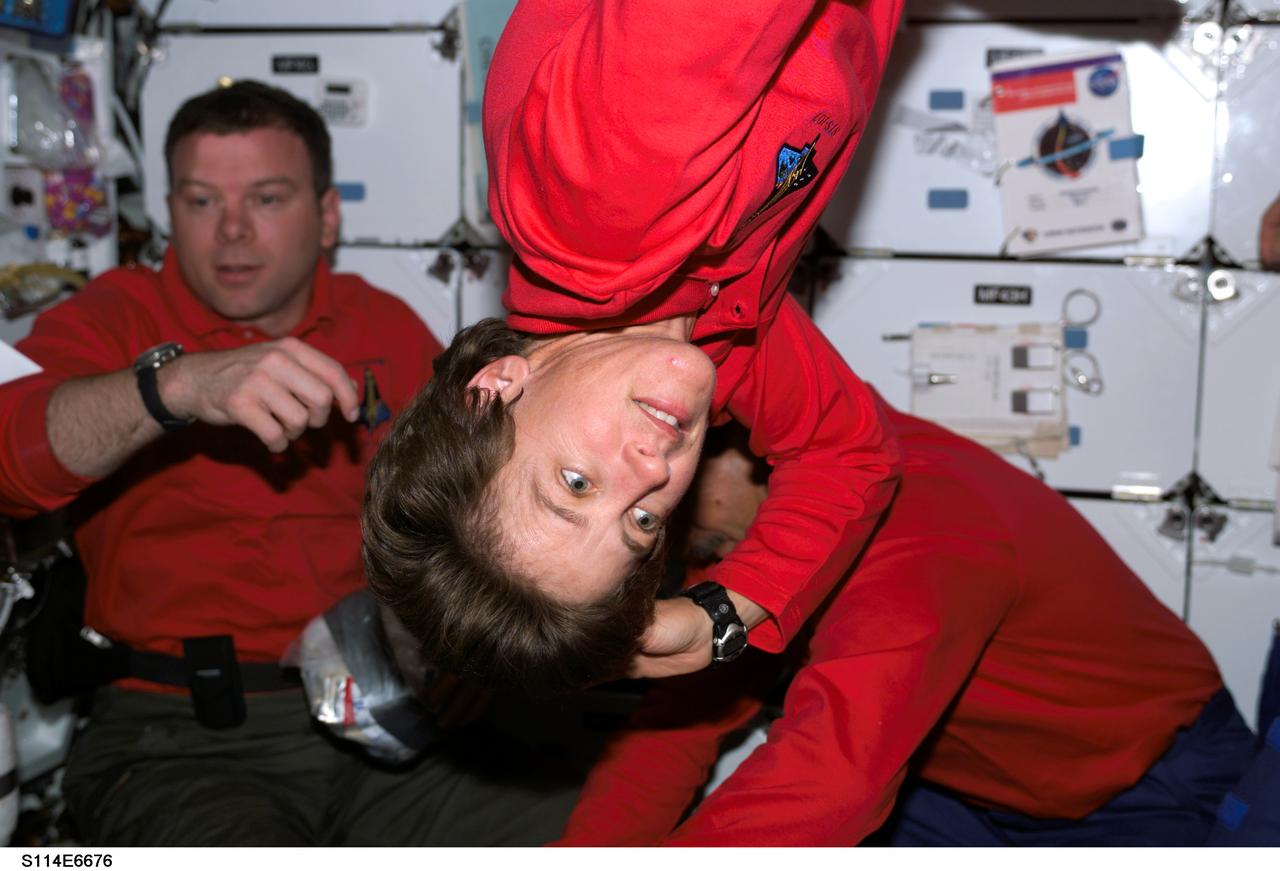
S114-E-6676 (3 August 2005) --- Astronaut Wendy B. Lawrence, STS-114 mission specialist, floats freely on the middeck of the Space Shuttle Discovery while the Shuttle was docked to the International Space Station. Astronauts James M. Kelly, pilot, and Charles J. Camarda, mission specialist, are visible in the background.

Space Shuttle Discovery landed safely at NASA's Dryden Flight Research Center at Edwards Air Force Base in Calif. at 5:11 a.m. this morning, following the very successful 14-day STS-114 return to flight mission.
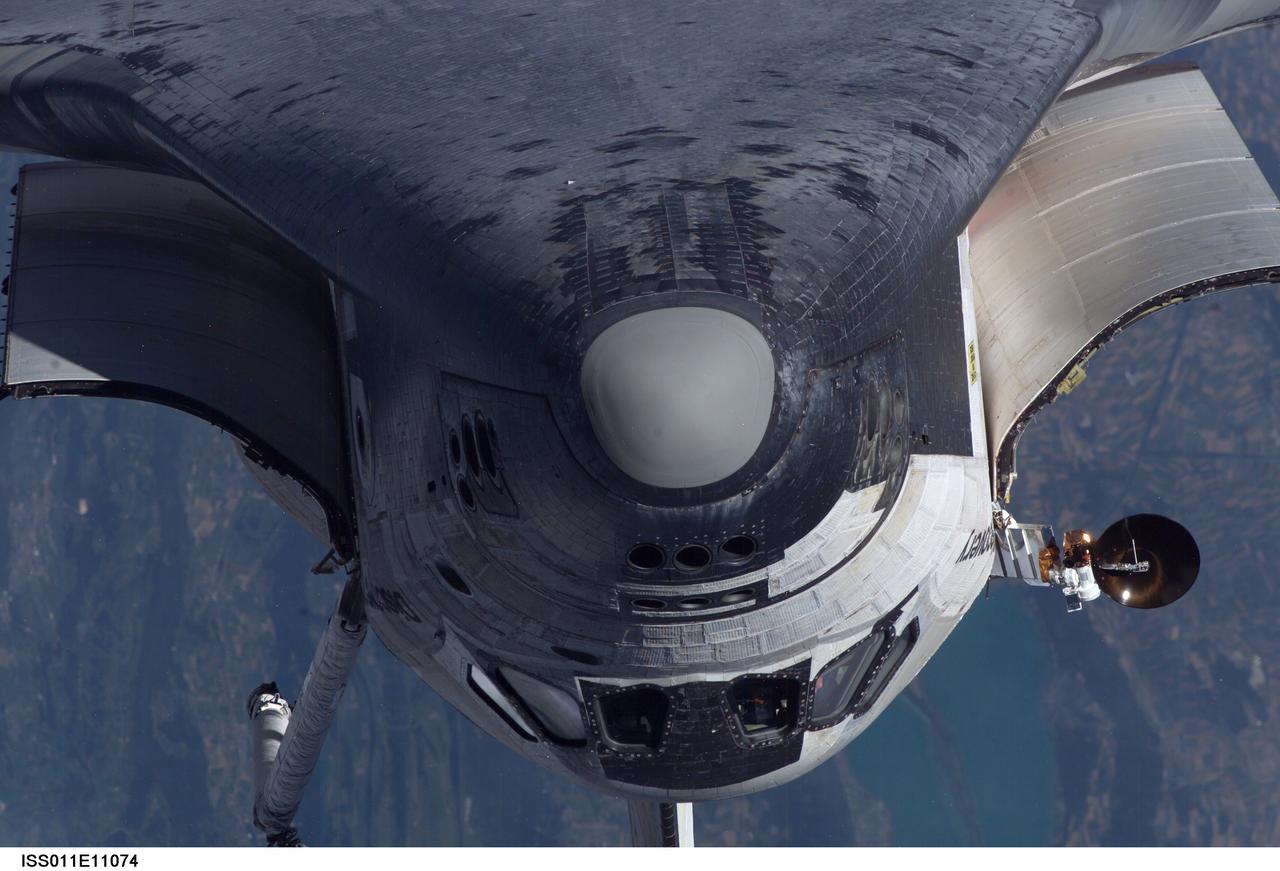
Launched on July 26, 2005 from the Kennedy Space Center in Florida, STS-114 was classified as Logistics Flight 1. Among the Station-related activities of the mission were the delivery of new supplies and the replacement of one of the orbital outpost's Control Moment Gyroscopes (CMGs). STS-114 also carried the Raffaello Multi-Purpose Logistics Module and the External Stowage Platform-2. A major focus of the mission was the testing and evaluation of new Space Shuttle flight safety, which included new inspection and repair techniques. Upon its approach to the International Space Station (ISS), the Space Shuttle Discovery underwent a photography session in order to assess any damages that may have occurred during its launch and/or journey through Space. Discovery was over Switzerland, about 600 feet from the ISS, when Cosmonaut Sergei K. Kriklev, Expedition 11 Commander, and John L. Phillips, NASA Space Station officer and flight engineer photographed the spacecraft as it performed a back flip to allow photography of its heat shield. Astronaut Eileen M. Collins, STS-114 Commander, guided the shuttle through the flip. The photographs were analyzed by engineers on the ground to evaluate the condition of Discovery’s heat shield. The crew safely returned to Earth on August 9, 2005. The mission historically marked the Return to Flight after nearly a two and one half year delay in flight after the Space Shuttle Columbia tragedy in February 2003.
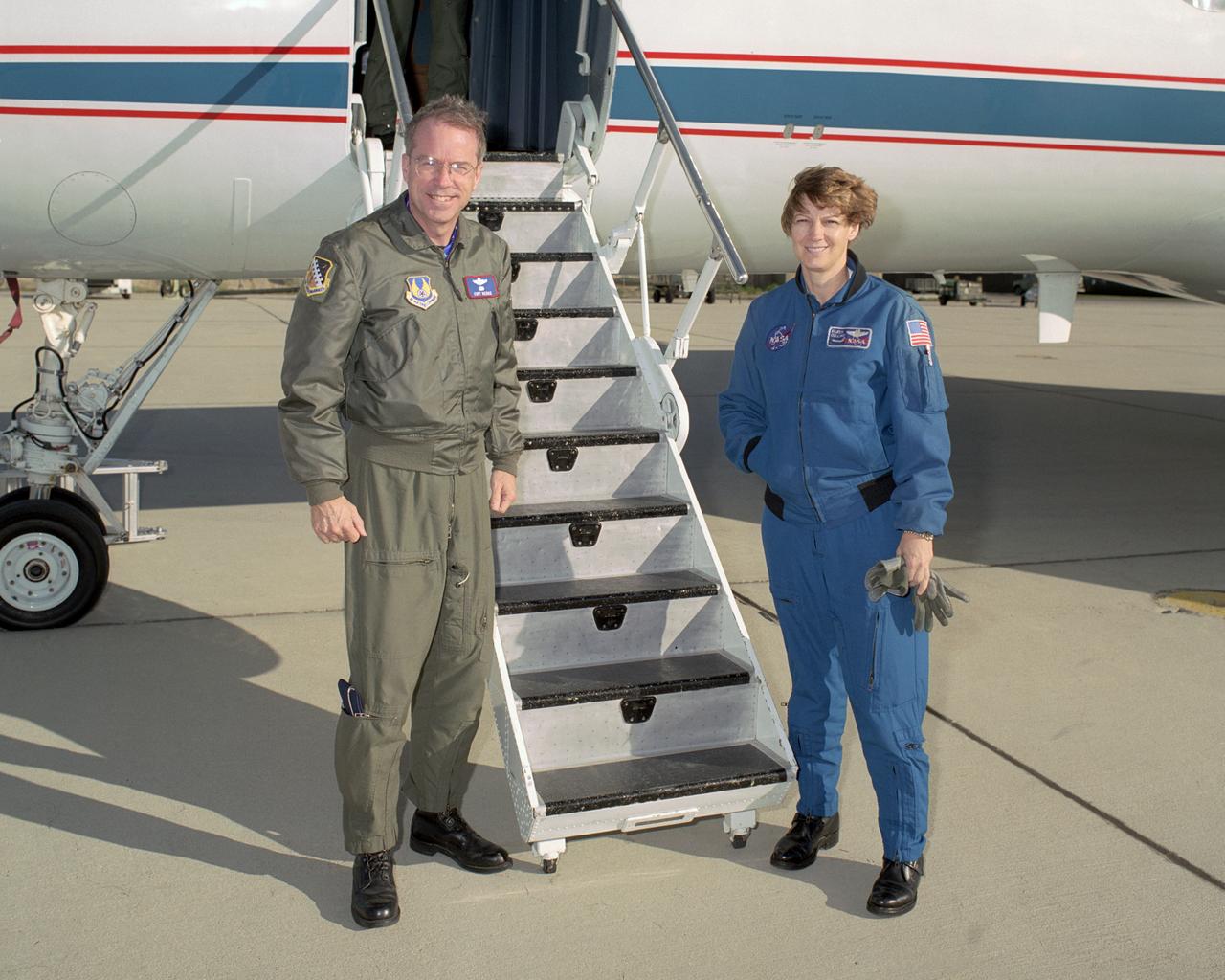
Brig. Gen. Curtis Bedke, commander of the Air Force Flight Test Center at Edwards Air Force Base, received some first-hand insight on how to fly a Space Shuttle approach and landing, courtesy of NASA astronaut and STS-114 mission commander Eileen Collins. The series of proficiency flights in NASA's modified Grumman Gulfstream-II Shuttle Training Aircraft were in preparation for the STS-114 mission with the shuttle Discovery. Although NASA's Kennedy Space Center in Florida is the primary landing site for Space Shuttle missions, flight crews also practice the shuttle's steep approach and landing at Edwards in case weather or other situations preclude a landing at the Florida site and force a diversion to Edwards AFB.
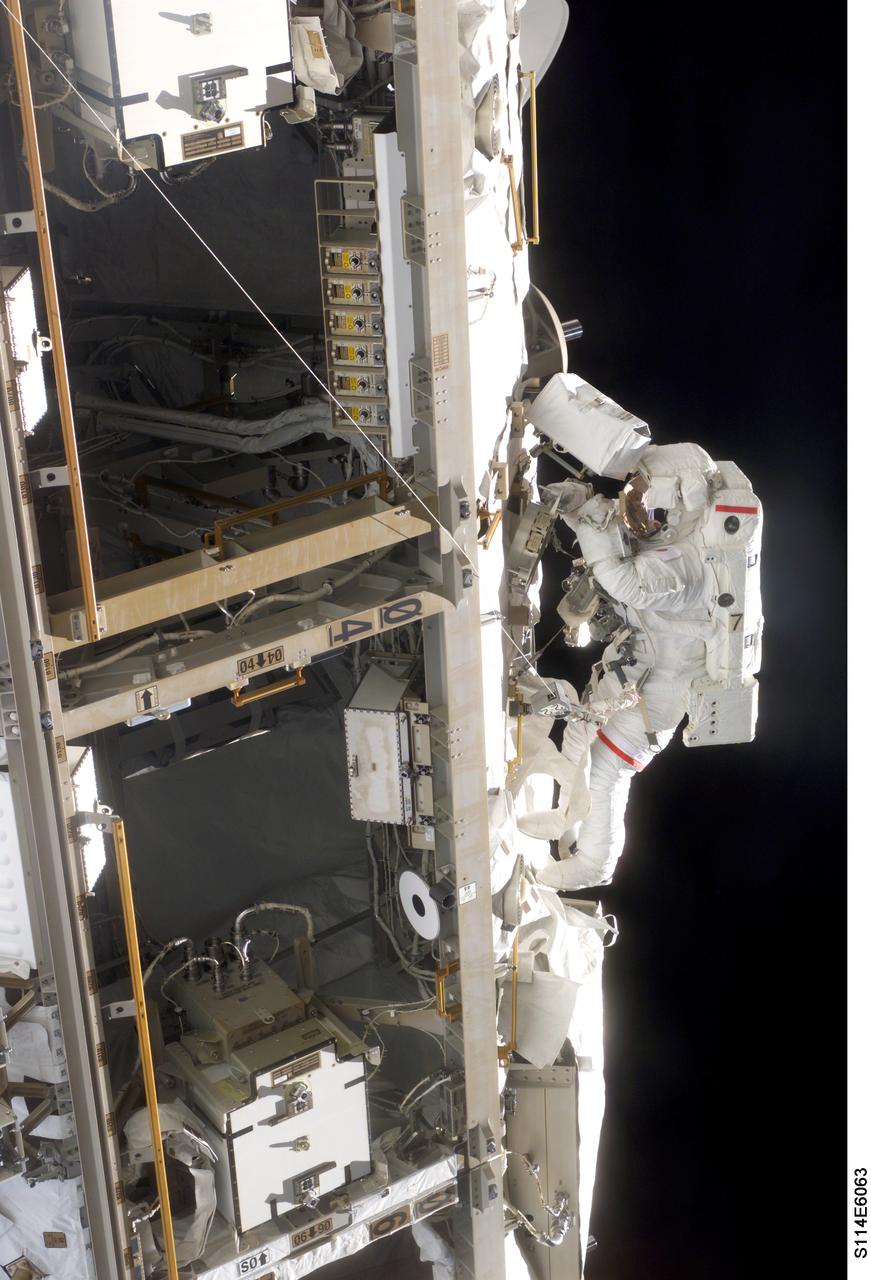
Launched on July 26, 2005 from the Kennedy Space Center in Florida, STS-114 was classified as Logistics Flight 1. Among the Station-related activities of the mission were the delivery of new supplies and the replacement of one of the orbital outpost's Control Moment Gyroscopes (CMGs). STS-114 also carried the Raffaello Multi-Purpose Logistics Module (MPLM) and the External Stowage Platform-2. In this photograph, astronaut Soichi Noguchi, STS-114 mission specialist representing the Japan Aerospace Exploration Agency (JAXA), participates in the mission’s first scheduled session of Extra Vehicular Activity (EVA). Noguchi and crew mate Stephen K. Robinson (out of frame) completed a demonstration of Shuttle thermal protection repair techniques and enhancements to the ISS’s attitude control system during the successful 6 hour, 50 minute space walk.
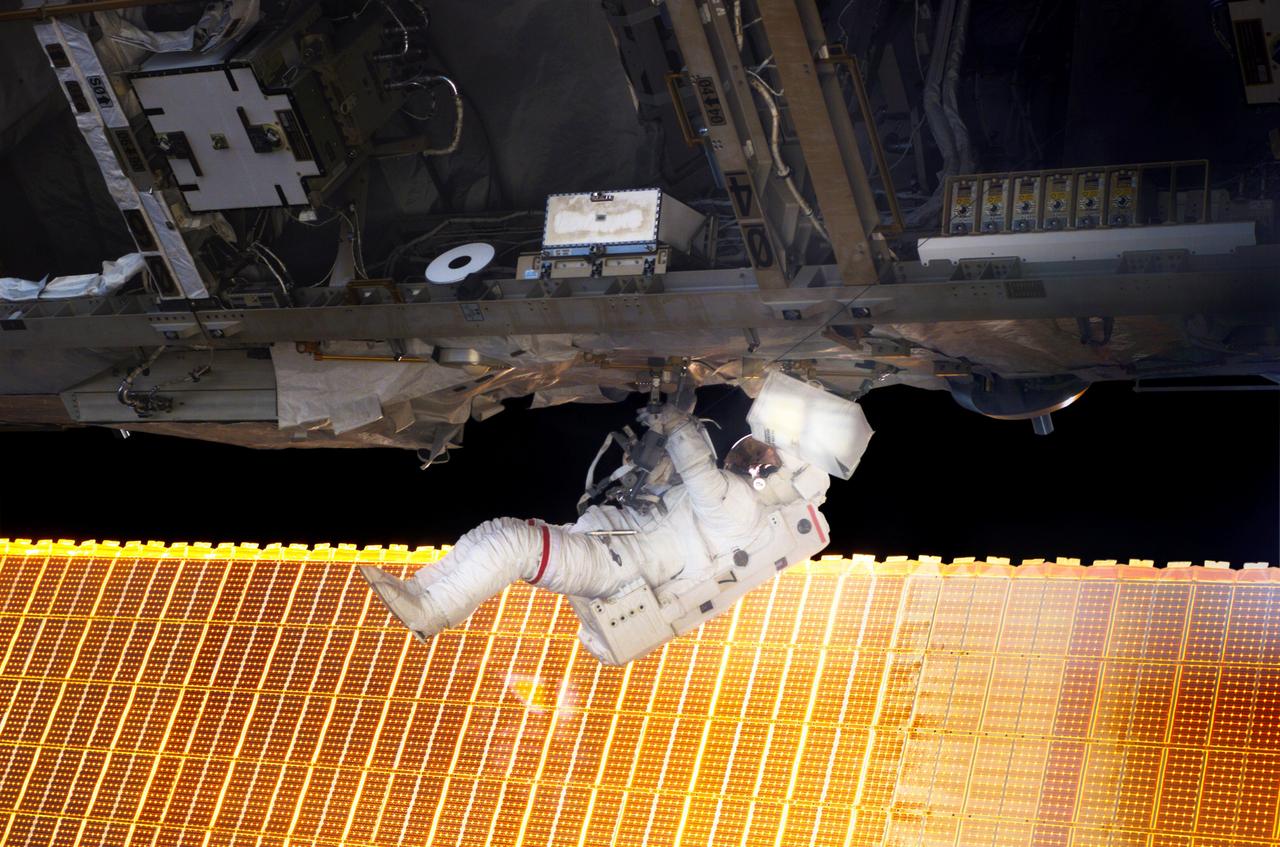
Launched on July 26, 2005 from the Kennedy Space Center in Florida, STS-114 was classified as Logistics Flight 1. Among the Station-related activities of the mission were the delivery of new supplies and the replacement of one of the orbital outpost's Control Moment Gyroscopes (CMGs). STS-114 also carried the Raffaello Multi-Purpose Logistics Module (MPLM) and the External Stowage Platform-2. In this photograph, astronaut Soichi Noguchi, STS-114 mission specialist representing the Japan Aerospace Exploration Agency (JAXA), participates in the mission’s first scheduled session of Extra-Vehicular Activity (EVA). Noguchi and crew mate Stephen K. Robinson (out of frame) completed a demonstration of Shuttle thermal protection repair techniques and enhancements to the ISS’s attitude control system during the successful 6 hour, 50 minute space walk.
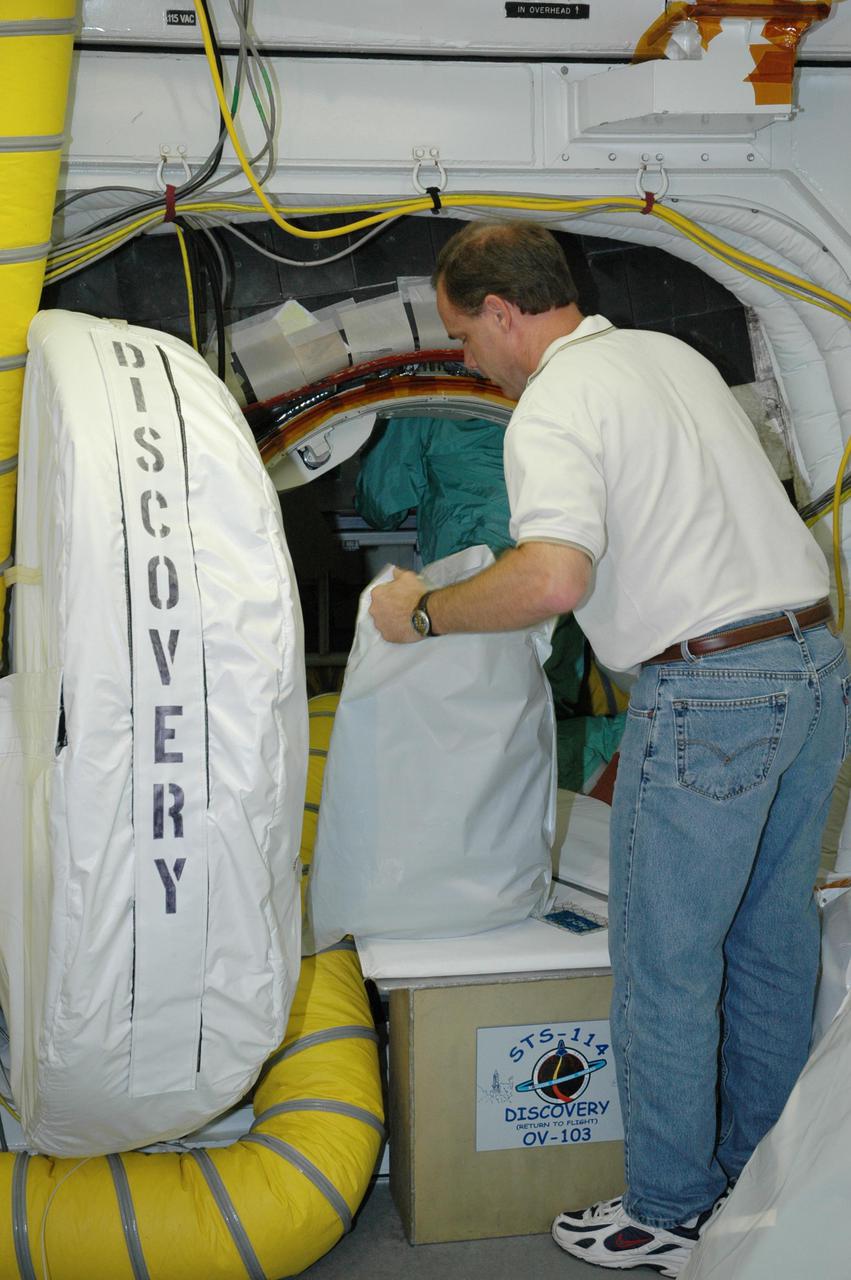
KENNEDY SPACE CENTER, FLA. - At Launch Pad 39B, United Space Alliance Flight Crew Systems engineer John Biegert uncovers a sleep restraint to be installed inside Space Shuttle Discovery, a final step in launch preparations. Launch of Discovery on its Return to Flight mission STS-114 is set for July 13, just days away. During its 12-day mission, Discovery’s seven-person crew will test new hardware and techniques to improve Shuttle safety, as well as deliver supplies to the International Space Station. Discovery’s payloads include the Multi-Purpose Logistics Module Raffaello, the Lightweight Multi-Purpose Experiment Support Structure Carrier (LMC), and the External Stowage Platform-2 (ESP-2). Raffaello will deliver supplies to the International Space Station including food, clothing and research equipment. The LMC will carry a replacement Control Moment Gyroscope and a tile repair sample box. The ESP-2 is outfitted with replacement parts.
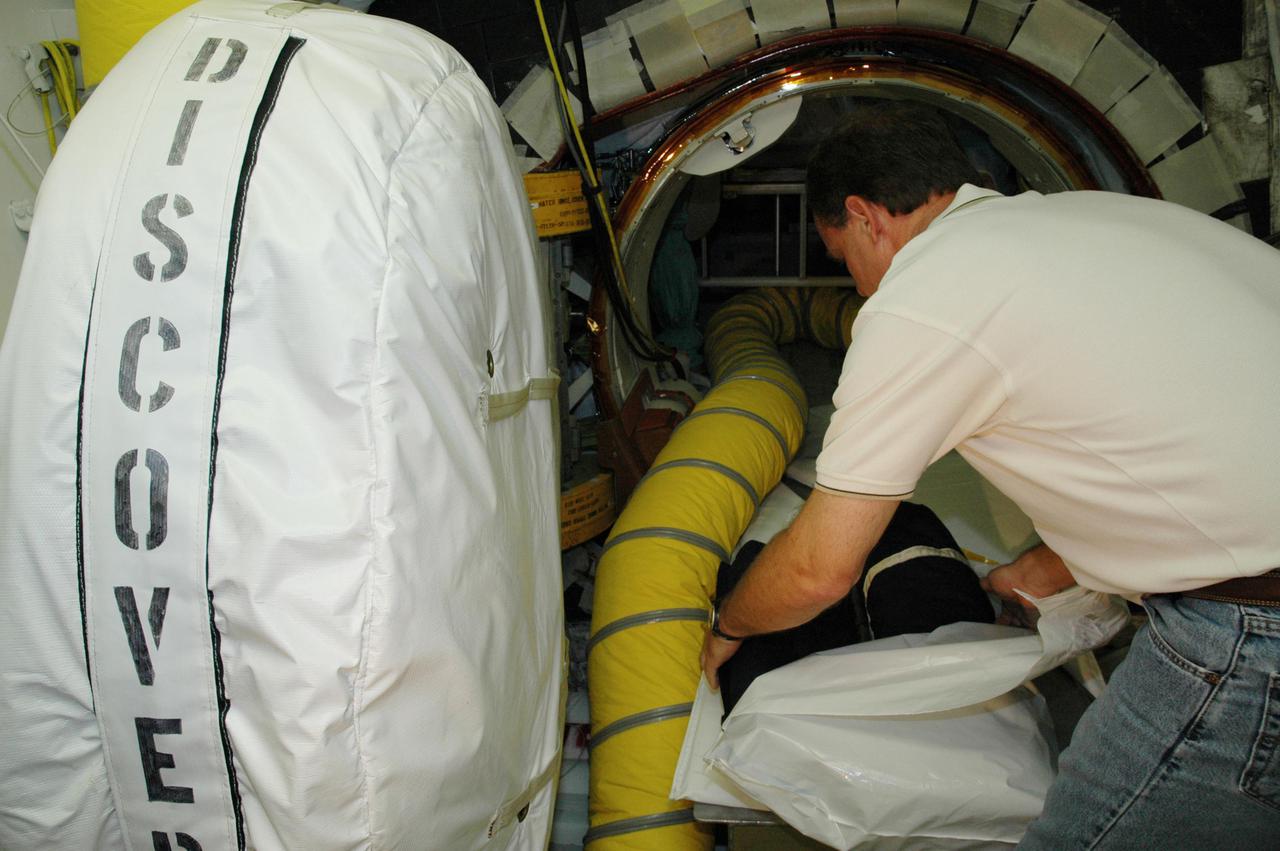
KENNEDY SPACE CENTER, FLA. - At Launch Pad 39B, United Space Alliance Flight Crew Systems engineer John Biegert passes a sleep restraint to a technician inside Space Shuttle Discovery for installation, a final step in launch preparations. Launch of Discovery on its Return to Flight mission STS-114 is set for July 13, just days away. During its 12-day mission, Discovery’s seven-person crew will test new hardware and techniques to improve Shuttle safety, as well as deliver supplies to the International Space Station. Discovery’s payloads include the Multi-Purpose Logistics Module Raffaello, the Lightweight Multi-Purpose Experiment Support Structure Carrier (LMC), and the External Stowage Platform-2 (ESP-2). Raffaello will deliver supplies to the International Space Station including food, clothing and research equipment. The LMC will carry a replacement Control Moment Gyroscope and a tile repair sample box. The ESP-2 is outfitted with replacement parts.
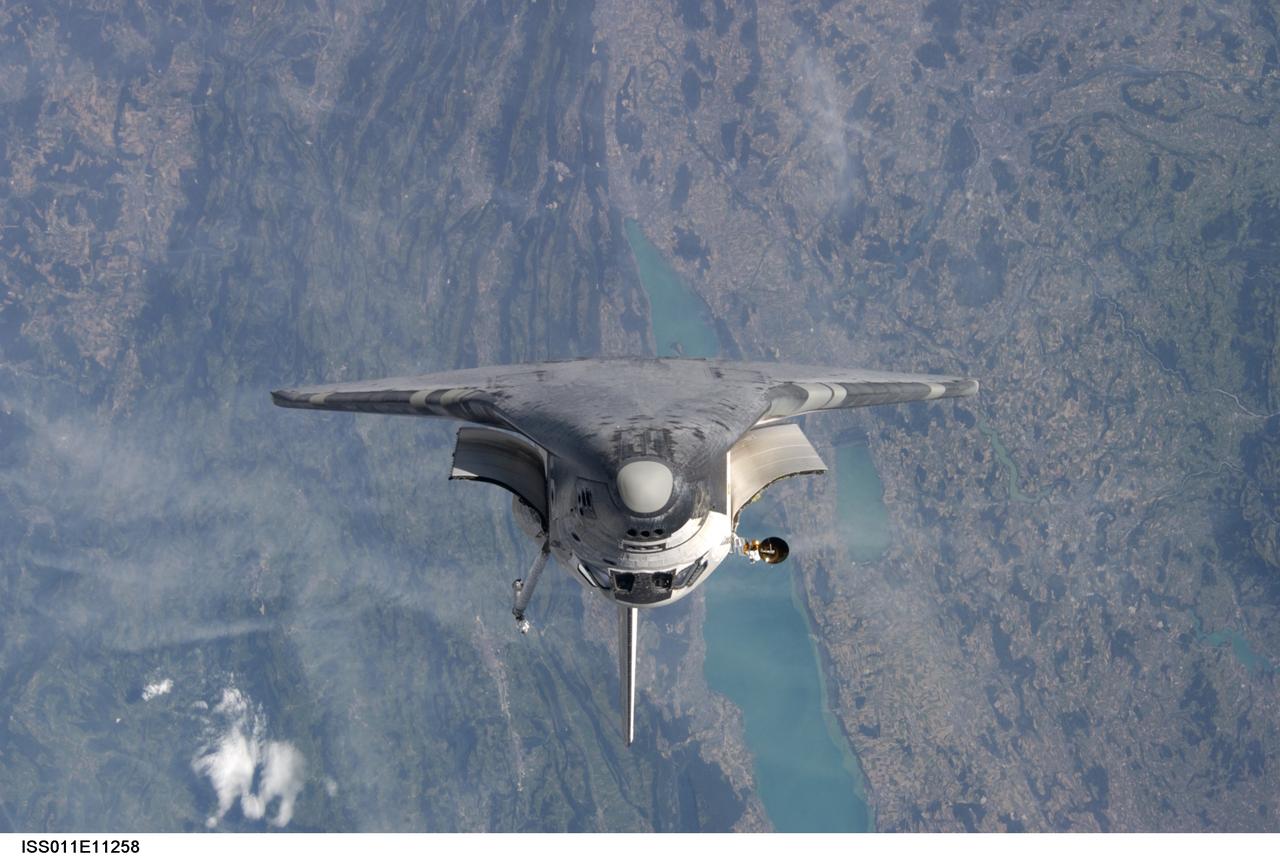
ISS011-E-11258 (28 July 2005) --- View of the Space Shuttle Discovery as photographed during the survey operations performed by the Expedition 11 crew on the International Space Station during the STS-114 R-Bar Pitch Maneuver on Flight Day 3. Discovery docked to the station at 6:18 a.m. (CDT) on Thursday, July 28, 2005. Parts of Switzerland are in the background. Onboard the shuttle were astronauts Eileen M. Collins, STS-114 commander; James M. Kelly, pilot; Andrew S. W. Thomas, Stephen K. Robinson, Wendy B. Lawrence, Charles J. Camarda and Japan Aerospace Exploration Agency (JAXA) astronaut Soichi Noguchi, all mission specialists.
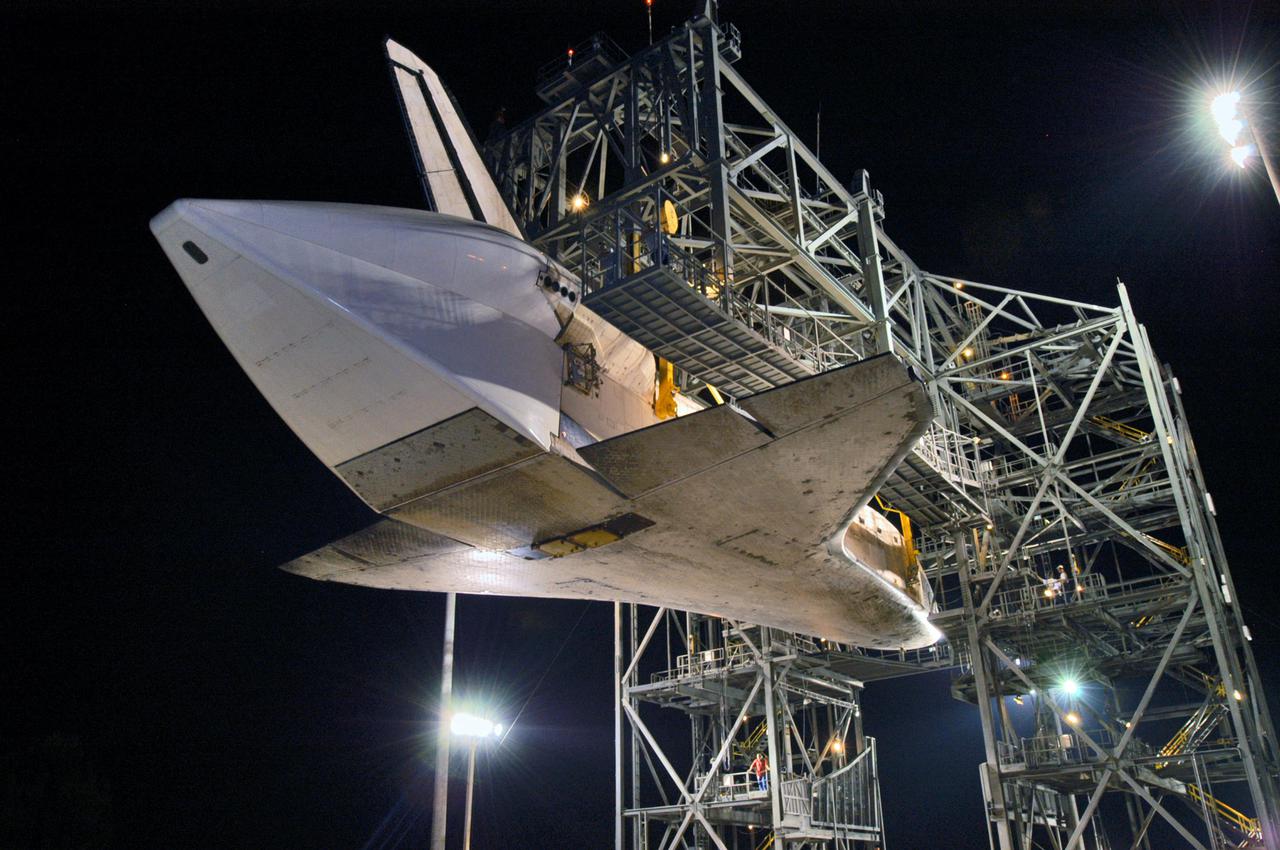
KENNEDY SPACE CENTER, FLA. - In the early morning hours at NASA Kennedy Space Center’s Shuttle Landing Facility, the orbiter Discovery is suspended within the mate_demate device after the Shuttle Carrier Aircraft, a modified Boeing 747, has rolled away from beneath it. Visible on the orbiter is the tail cone that covers the main engines during the ferry flight. Discovery was returned to Kennedy Space Center on a ferry flight from Edwards Air Force Base in California, where it landed Aug. 9 after 13 days in space on mission STS-114. In the mate_demate device, a horizontal structure mounted at the 80-foot level between two towers controls and guides a large lift beam that attaches to the orbiter to raise and lower it. The orbiter will be lowered to the ground and then be towed to the Orbiter Processing Facility. Once inside the OPF, the payload bay doors will be opened and the MPLM Raffaello brought back from the International Space Station will be unloaded and transferred to the Space Station Processing Facility. This concludes mission STS-114.
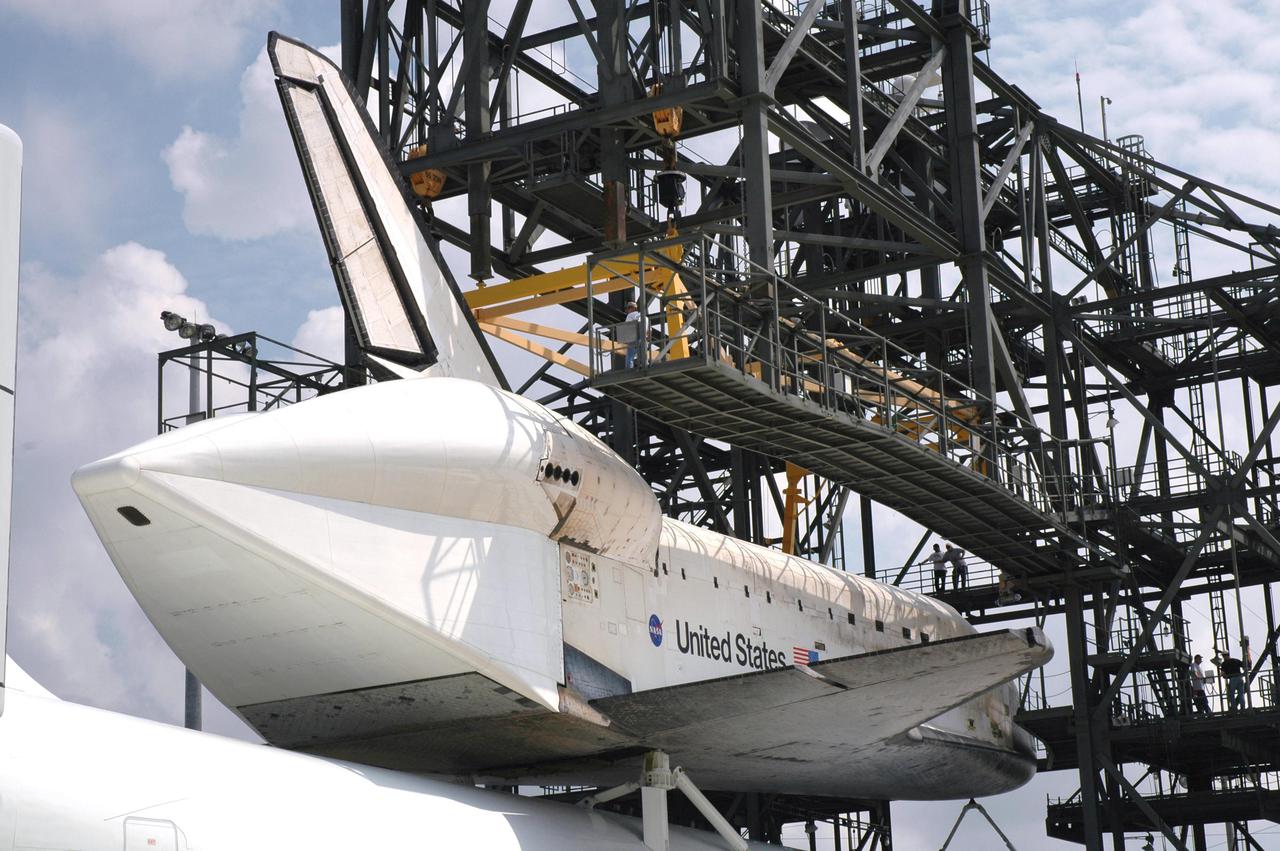
KENNEDY SPACE CENTER, FLA. - The orbiter Discovery on top of the Shuttle Carrier Aircraft, a modified Boeing 747, is towed into the mate_demate device at NASA Kennedy Space Center’s Shuttle Landing Facility. Visible in the closeup is the tail cone that covers the main engines during the ferry flight. Discovery was returned to Kennedy Space Center on a ferry flight from Edwards Air Force Base in California, where it landed Aug. 9 after 13 days in space on mission STS-114. In the mate_demate device, a horizontal structure mounted at the 80-foot level between two towers controls and guides a large lift beam that attaches to the orbiter to raise and lower it. Once Discovery is lifted off the back of the SCA, the 747 can then roll away and the orbiter will be lowered to the ground. It will then be towed from the SLF to the Orbiter Processing Facility. Once inside the OPF, the payload bay doors will be opened and the MPLM Raffaello brought back from the International Space Station will be unloaded and transferred to the Space Station Processing Facility. This concludes mission STS-114.
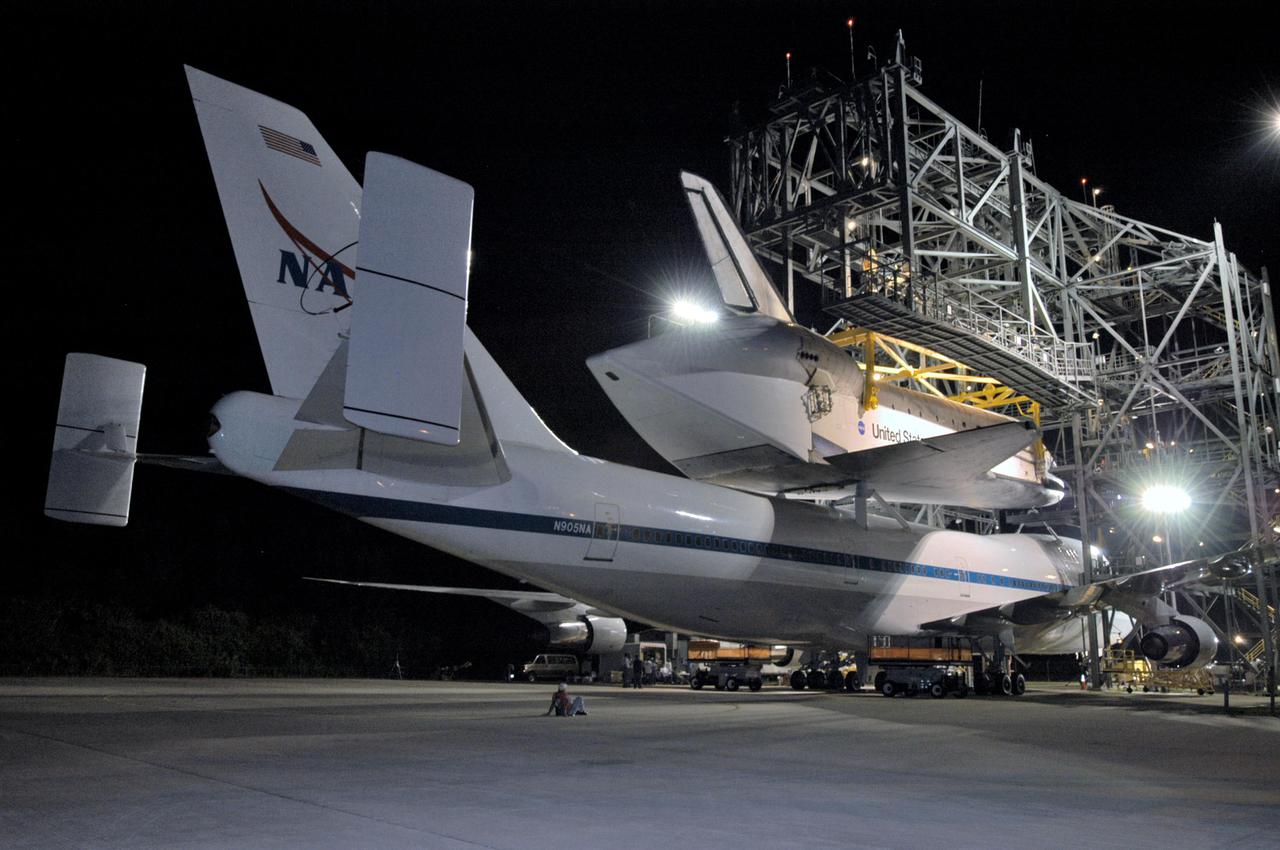
KENNEDY SPACE CENTER, FLA. - Near midnight, lights from the mate_demate device at NASA Kennedy Space Center’s Shuttle Landing Facility shine on the orbiter Discovery on top of the Shuttle Carrier Aircraft, a modified Boeing 747. Discovery was returned to Kennedy Space Center on a ferry flight from Edwards Air Force Base in California, where it landed Aug. 9 after 13 days in space on mission STS-114. In the mate_demate device, a horizontal structure mounted at the 80-foot level between two towers controls and guides a large lift beam that attaches to the orbiter to raise and lower it. Once Discovery is lifted off the back of the SCA, the 747 can then roll away and the orbiter will be lowered to the ground. It will then be towed from the SLF to the Orbiter Processing Facility. Once inside the OPF, the payload bay doors will be opened and the MPLM Raffaello brought back from the International Space Station will be unloaded and transferred to the Space Station Processing Facility. This concludes mission STS-114.
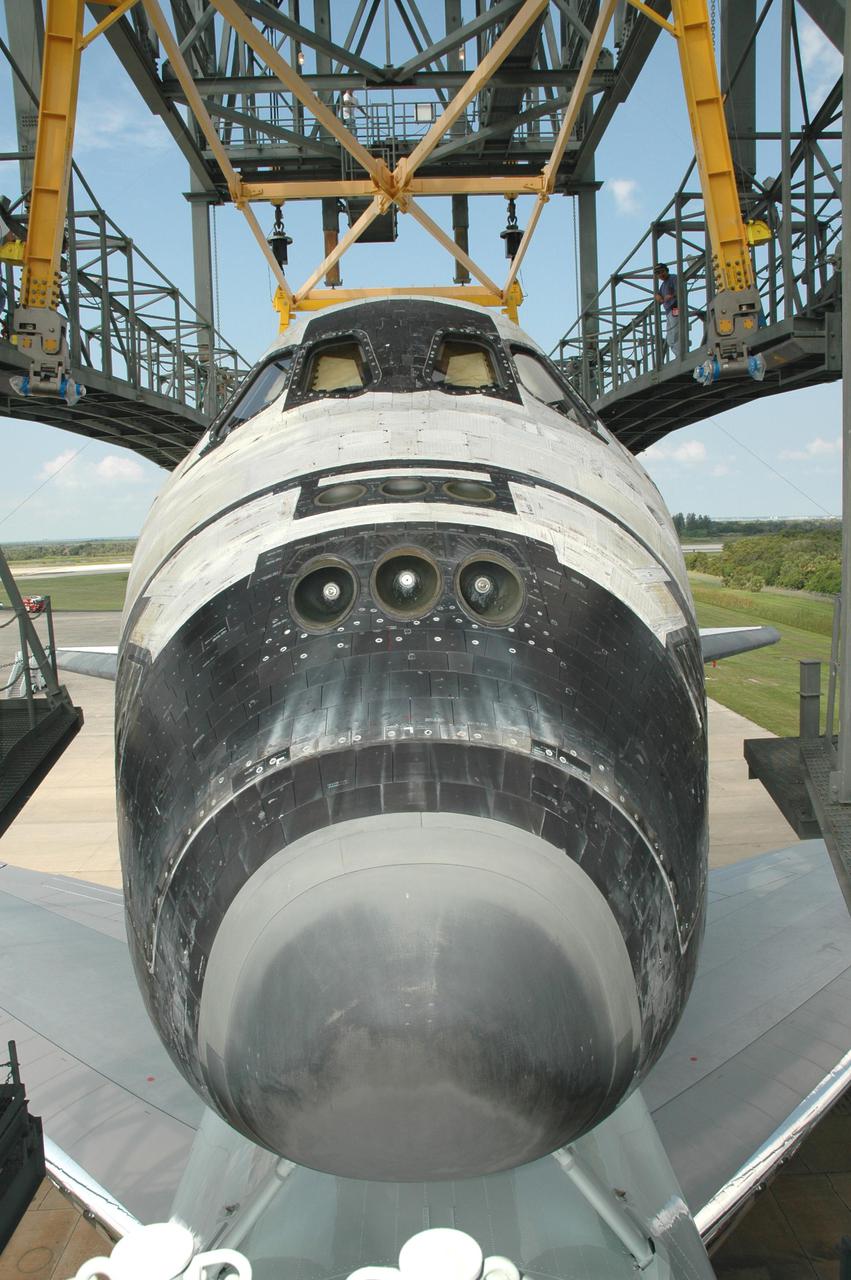
KENNEDY SPACE CENTER, FLA. - This view shows the orbiter Discovery on top of the Shuttle Carrier Aircraft, a modified Boeing 747, being towed into the mate_demate device at NASA Kennedy Space Center’s Shuttle Landing Facility. Discovery was returned to Kennedy Space Center on a ferry flight from Edwards Air Force Base in California, where it landed Aug. 9 after 13 days in space on mission STS-114. In the mate_demate device, a horizontal structure mounted at the 80-foot level between two towers controls and guides a large lift beam that attaches to the orbiter to raise and lower it. Once Discovery is lifted off the back of the SCA, the 747 can then roll away and the orbiter will be lowered to the ground. It will then be towed from the SLF to the Orbiter Processing Facility. Once inside the OPF, the payload bay doors will be opened and the MPLM Raffaello brought back from the International Space Station will be unloaded and transferred to the Space Station Processing Facility. This concludes mission STS-114.
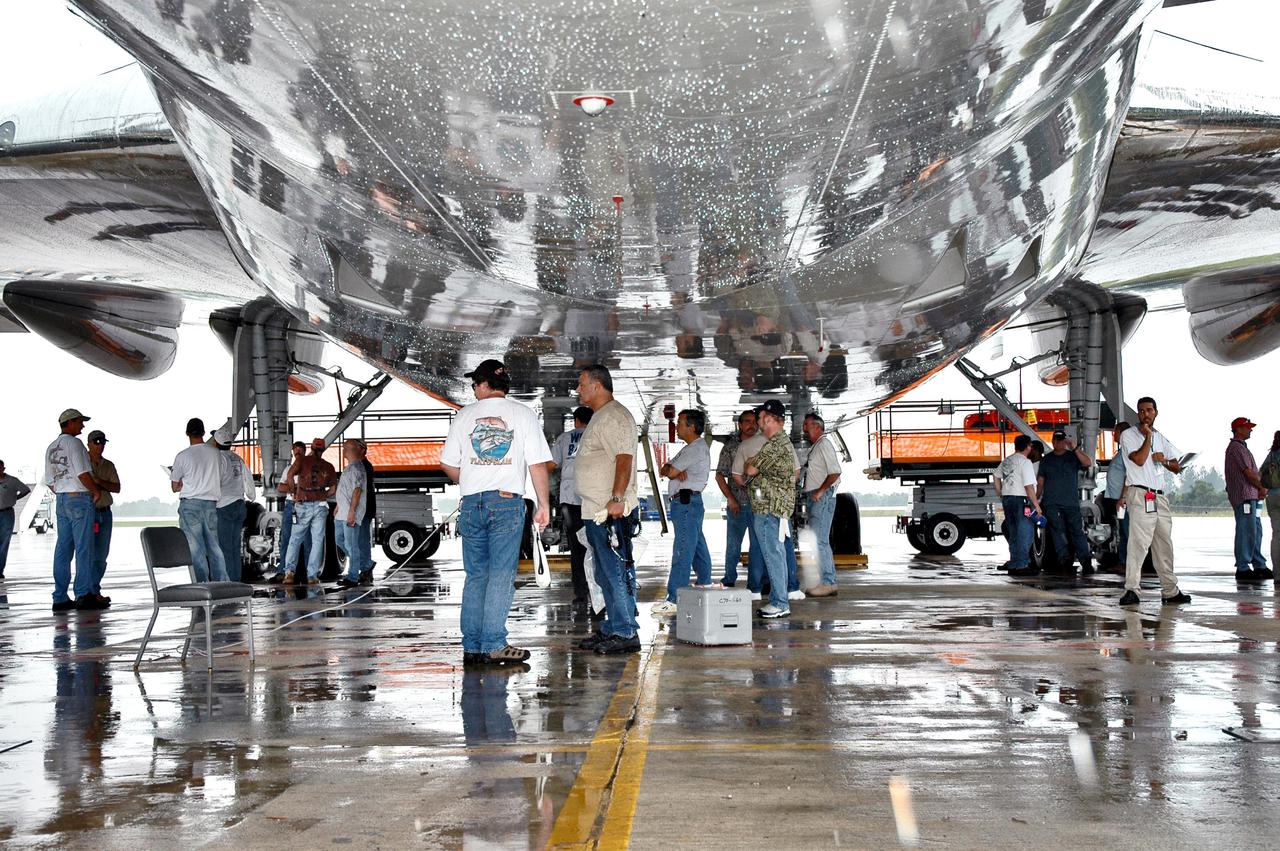
KENNEDY SPACE CENTER, FLA. - At NASA Kennedy Space Center’s Shuttle Landing Facility, workers secure the Shuttle Carrier Aircraft, a modified Boeing 747, on the ground under the mate_demate device. The orbiter Discovery is still on top of the aircraft. Discovery was returned to Kennedy Space Center on a ferry flight from Edwards Air Force Base in California, where it landed Aug. 9 after 13 days in space on mission STS-114. In the mate_demate device, a horizontal structure mounted at the 80-foot level between two towers controls and guides a large lift beam that attaches to the orbiter to raise and lower it. Once Discovery is lifted off the back of the SCA, the 747 can then roll away and the orbiter will be lowered to the ground. It will then be towed from the SLF to the Orbiter Processing Facility. Once inside the OPF, the payload bay doors will be opened and the MPLM Raffaello brought back from the International Space Station will be unloaded and transferred to the Space Station Processing Facility. This concludes mission STS-114.
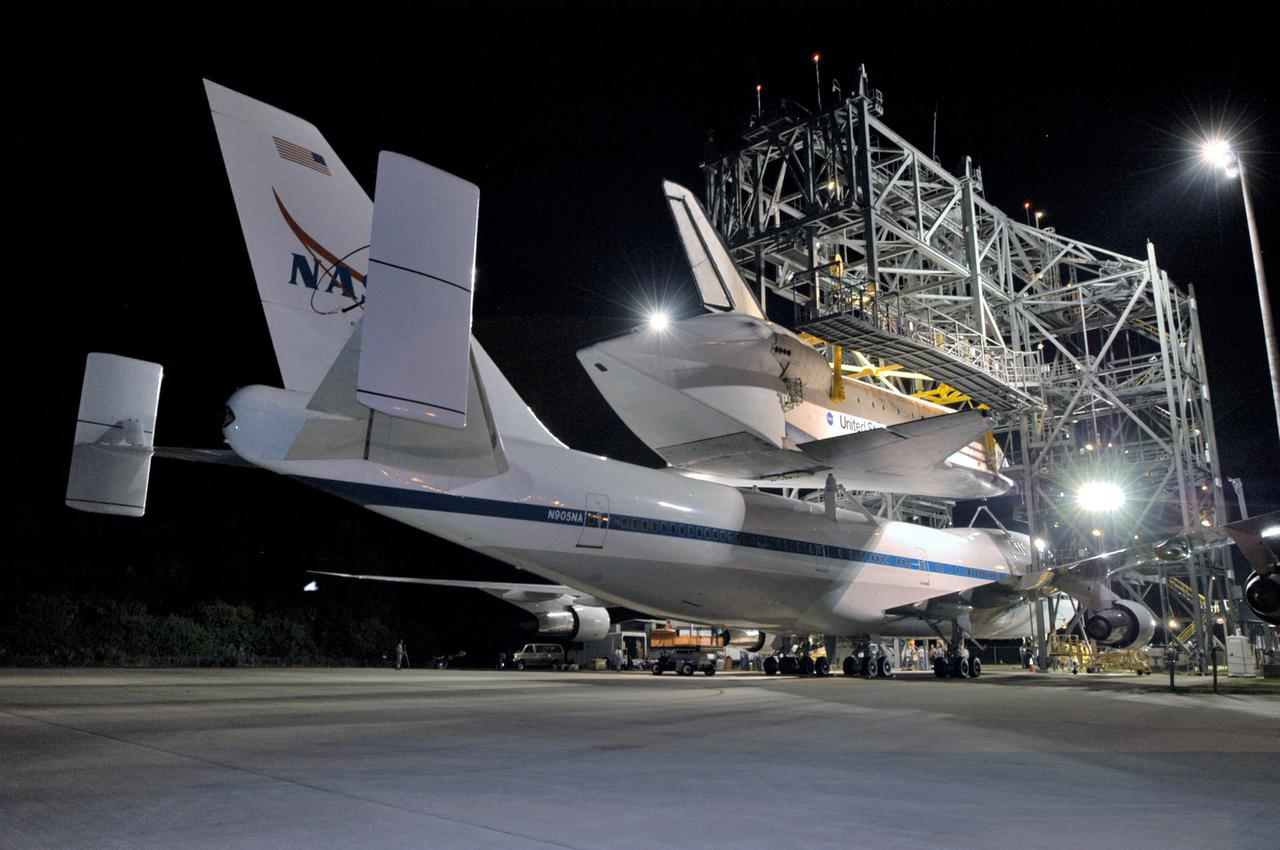
KENNEDY SPACE CENTER, FLA. - In the early morning hours at NASA Kennedy Space Center’s Shuttle Landing Facility, the orbiter Discovery is being demated from the Shuttle Carrier Aircraft, a modified Boeing 747, beneath it. Discovery was returned to Kennedy Space Center on a ferry flight from Edwards Air Force Base in California, where it landed Aug. 9 after 13 days in space on mission STS-114. In the mate_demate device, a horizontal structure mounted at the 80-foot level between two towers controls and guides a large lift beam that attaches to the orbiter to raise and lower it. Once Discovery is lifted off the back of the SCA, the 747 can then roll away and the orbiter will be lowered to the ground. It will then be towed from the SLF to the Orbiter Processing Facility. Once inside the OPF, the payload bay doors will be opened and the MPLM Raffaello brought back from the International Space Station will be unloaded and transferred to the Space Station Processing Facility. This concludes mission STS-114.

KENNEDY SPACE CENTER, FLA. - The orbiter Discovery on top of the Shuttle Carrier Aircraft, a modified Boeing 747, is towed into the mate_demate device at NASA Kennedy Space Center’s Shuttle Landing Facility. Visible on the orbiter is the tail cone that covers the main engines during the ferry flight. Discovery was returned to Kennedy Space Center on a ferry flight from Edwards Air Force Base in California, where it landed Aug. 9 after 13 days in space on mission STS-114. In the mate_demate device, a horizontal structure mounted at the 80-foot level between two towers controls and guides a large lift beam that attaches to the orbiter to raise and lower it. Once Discovery is lifted off the back of the SCA, the 747 can then roll away and the orbiter will be lowered to the ground. It will then be towed from the SLF to the Orbiter Processing Facility. Once inside the OPF, the payload bay doors will be opened and the MPLM Raffaello brought back from the International Space Station will be unloaded and transferred to the Space Station Processing Facility. This concludes mission STS-114.
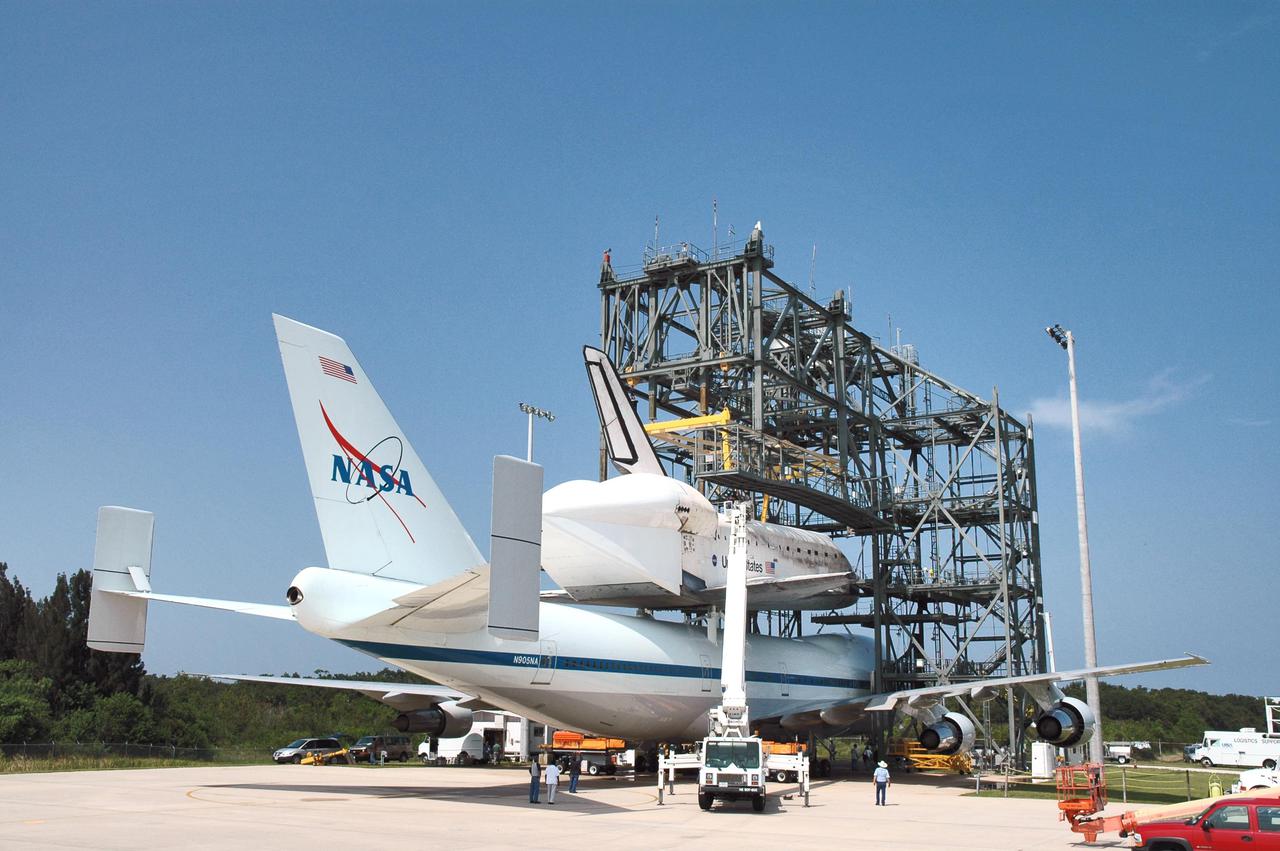
KENNEDY SPACE CENTER, FLA. - At NASA Kennedy Space Center’s Shuttle Landing Facility, the Shuttle Carrier Aircraft, a modified Boeing 747, and orbiter Discovery on top, remain in the mate_demate device while Discovery is prepared for demating. Discovery was returned to Kennedy Space Center on a ferry flight from Edwards Air Force Base in California, where it landed Aug. 9 after 13 days in space on mission STS-114. In the mate_demate device, a horizontal structure mounted at the 80-foot level between two towers controls and guides a large lift beam that attaches to the orbiter to raise and lower it. Once Discovery is lifted off the back of the SCA, the 747 can then roll away and the orbiter will be lowered to the ground. It will then be towed from the SLF to the Orbiter Processing Facility. Once inside the OPF, the payload bay doors will be opened and the MPLM Raffaello brought back from the International Space Station will be unloaded and transferred to the Space Station Processing Facility. This concludes mission STS-114.
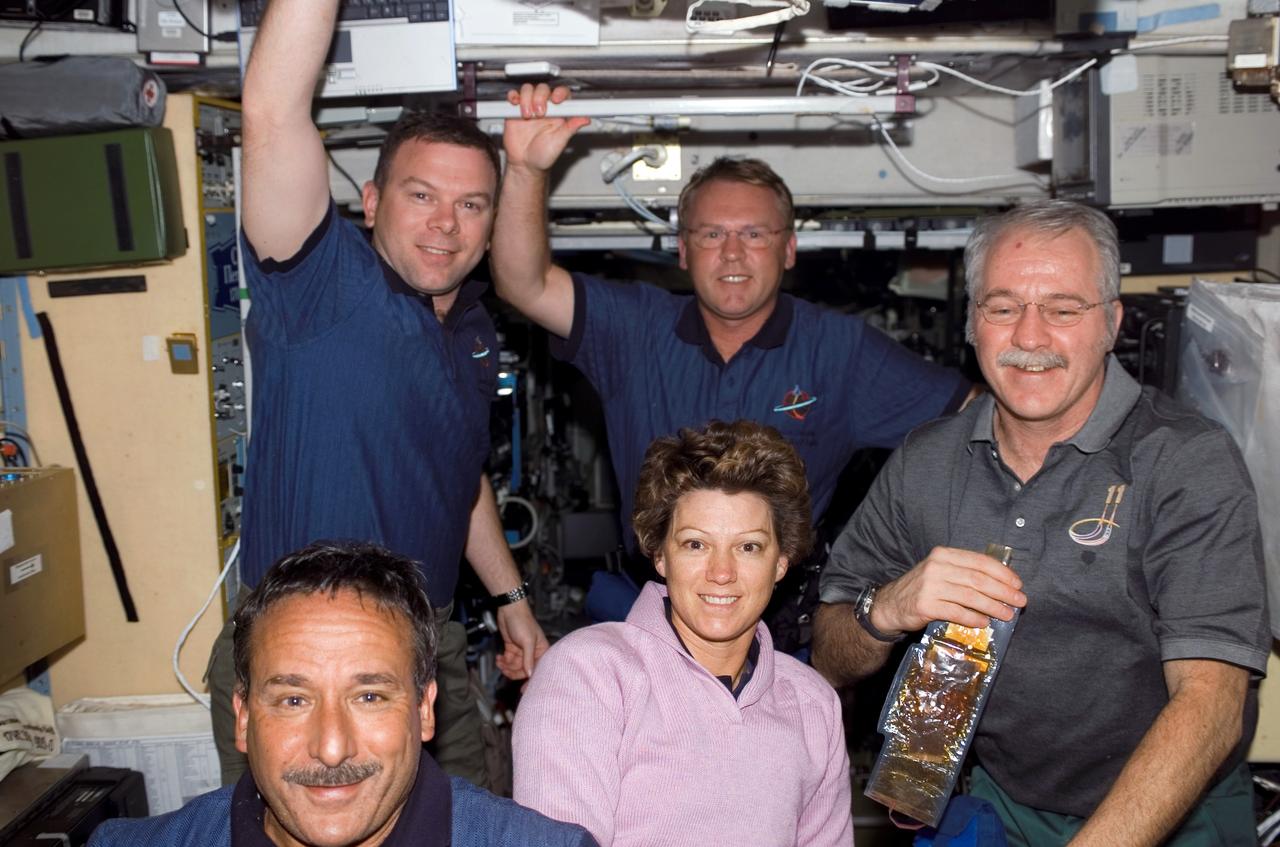
S114-E-5578 (28 July 2005) --- This is a rare scene of relaxation onboard the International Space Station as compared to the expected norm over the next several days when these astronauts and cosmonauts will be working jointly to perform a variegated lists of tasks. In front, from the left, are astronaut Charles J. Camarda, STS-114 mission specialist; astronaut Eileen M. Collins, STS-114 commander; and astronaut John L. Phillips, NASA Space Station Science Officer and flight engineer for Expedition 11. Standing behind them are astronauts James M. Kelly (left), STS-114 pilot; and astronaut Andrew S.W. Thomas, STS-114 mission specialist.
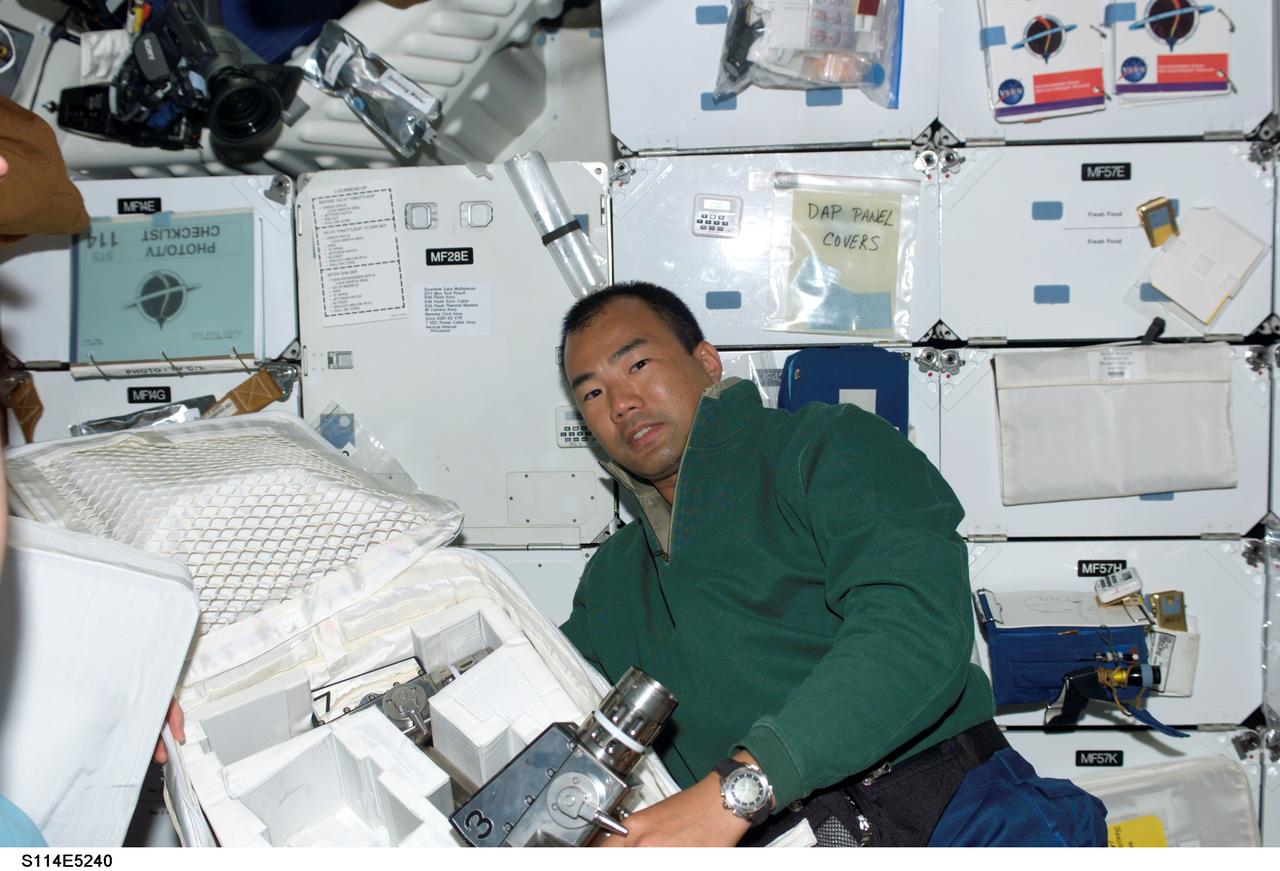
STS114-E-5240 (27 July 2005) --- JAXA astronaut Soichi Noguchi, STS-114 mission specialist, on Discovery's mid deck.

S114-E-5632 (28 July 2005) --- Tokyo Bay area is featured in this image photographed by a STS-114 crewmember onboard the Space Shuttle Discovery.
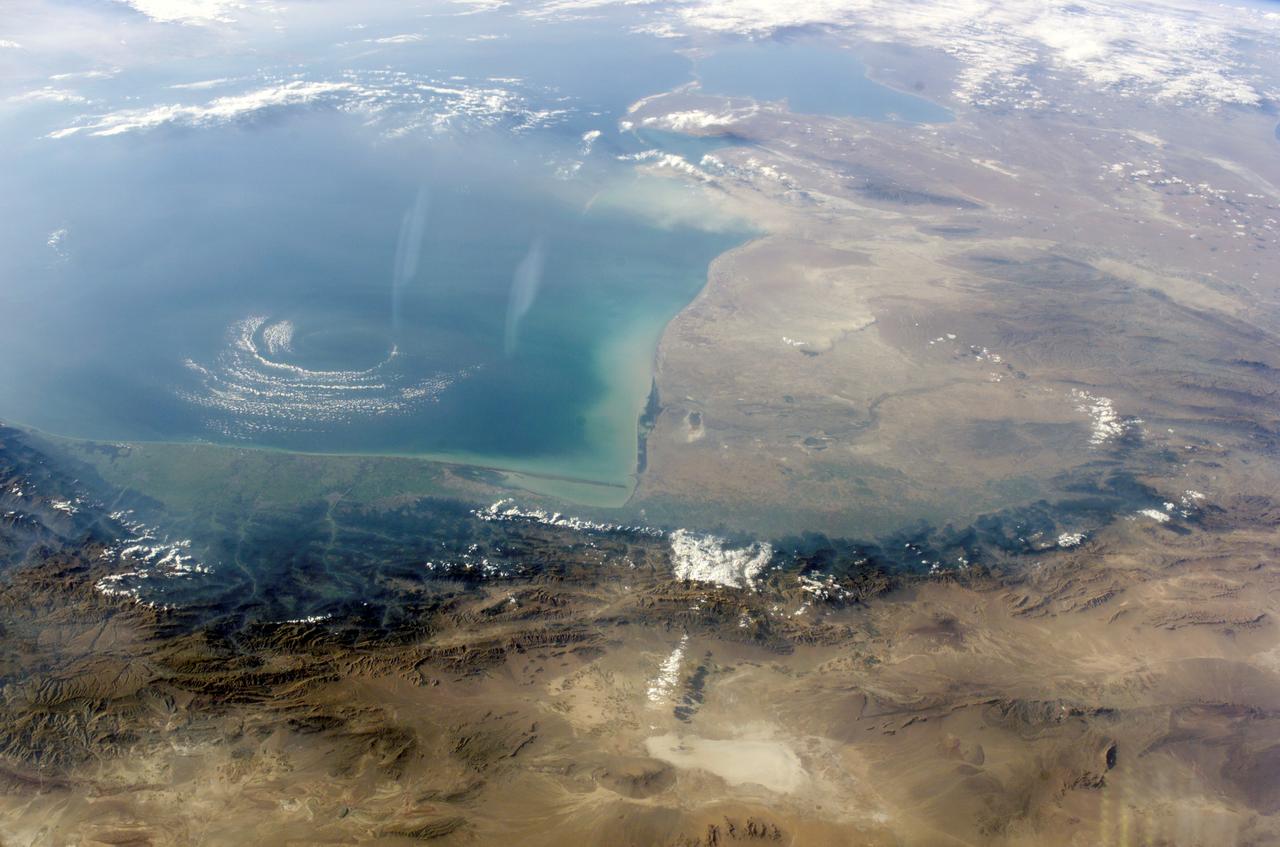
S114-E-5343 (27 July 2005) --- The Caspian Sea is featured in this image photographed by a Space Shuttle Discovery crewmember during the STS-114 mission.
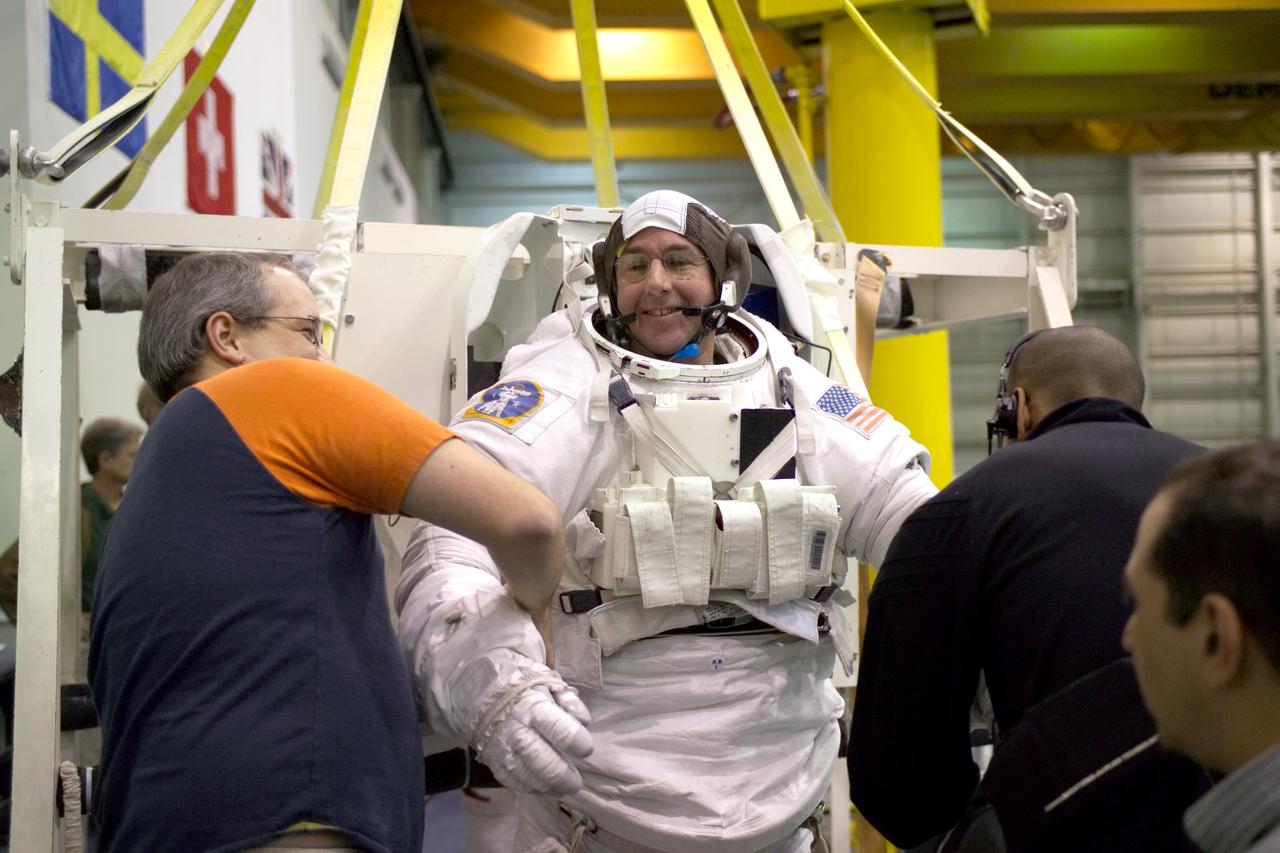
JSC2005-E-02827 (26 January 2005) --- Astronaut Stephen K. Robinson, STS-114 mission specialist, dons a training version of the Extravehicular Mobility Unit (EMU) spacesuit prior to being submerged in the waters of the Neutral Buoyancy Laboratory (NBL) near Johnson Space Center. Suit technicians assisted Robinson.
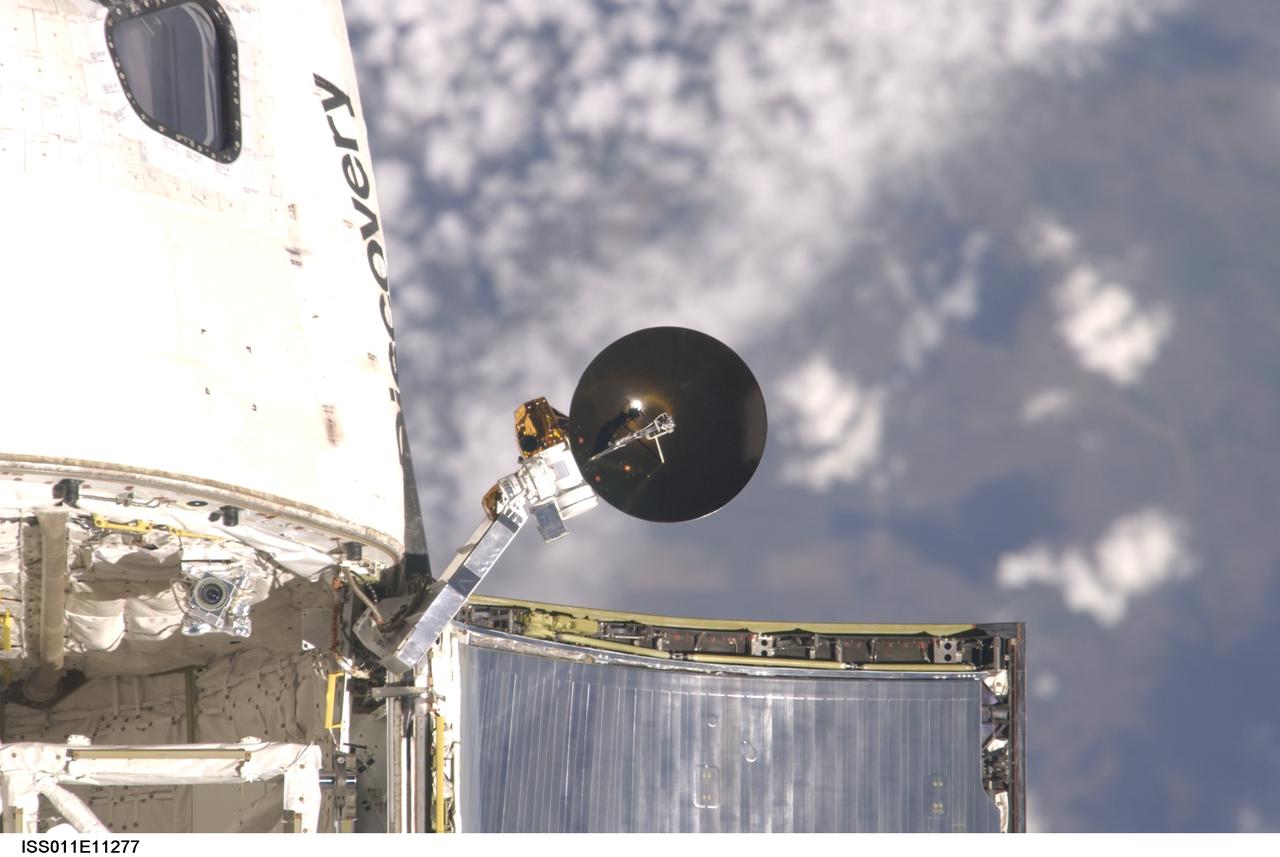
ISS011-E-11277 (28 July 2005) --- View of the Space Shuttle Discovery's Ku-band antenna photographed during the mapping sequence by the Expedition 11 crew on the International Space Station during the STS-114 R-Bar Pitch Maneuver on Flight Day 3.

STS114-S-033 (26 July 2005) --- Space Shuttle Discovery and its seven-member crew launched at 10:39 a.m. (EDT) to begin the two-day journey to the International Space Station on the historic Return to Flight STS-114 mission. Discovery is slated to dock with the Station at 7:18 a.m. (EDT) Thursday July 28, 2005.
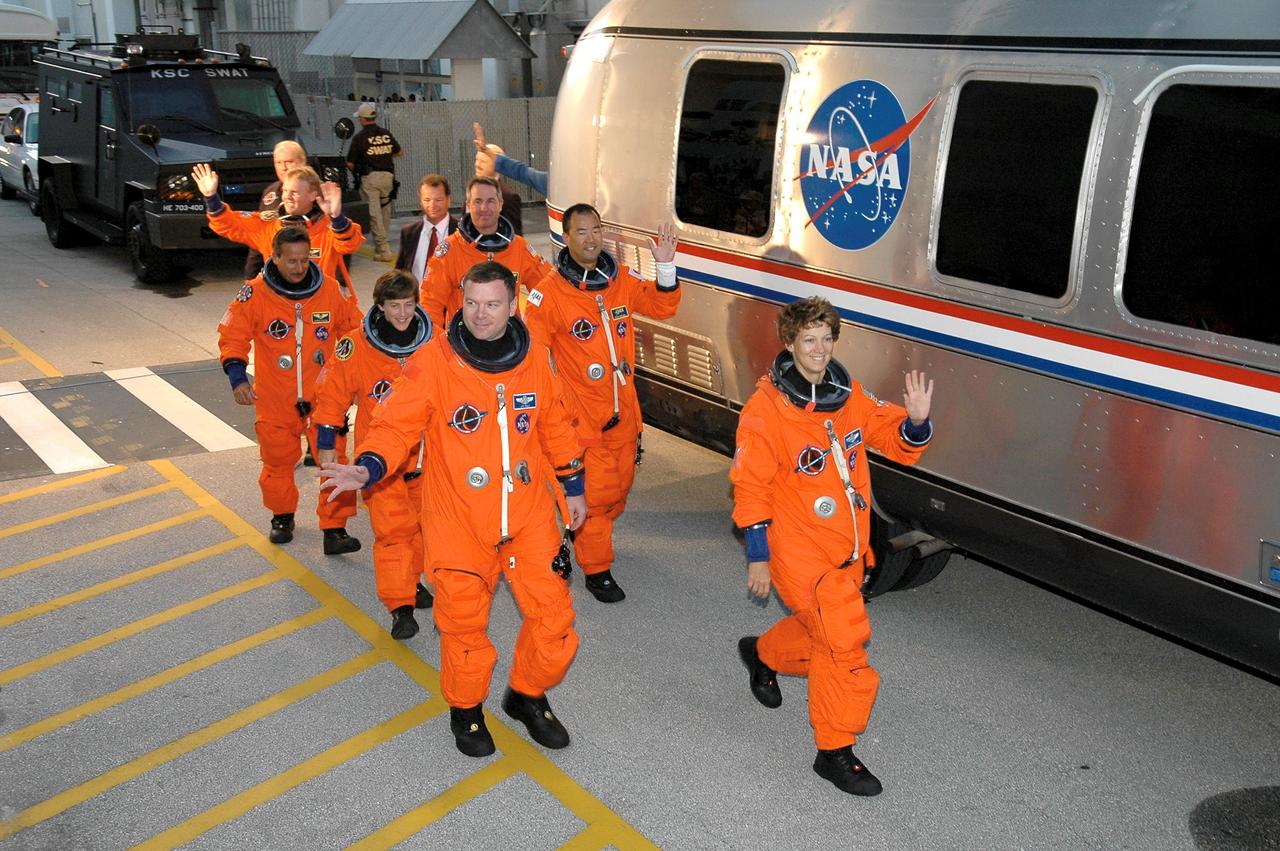
STS114-S-007 (26 July 2005) --- The STS-114 crew members, having donned their launch and entry suits, wave at KSC employees as they prepare to board the transfer van awaiting to take them to Launch Pad 39B. Eileen M. Collins, mission commander, leads the way. James M. Kelly, pilot, is at front left. Other crew members -- Wendy Lawrence, Andrew S.W. Thomas, Stephen K. Robinson, Charles J. Camarda and JAXA astronaut Soichi Noguchi -- follow.

JSC2003-E-61571 (29 October 2003) --- Astronaut Wendy B. Lawrence, STS-114 mission specialist, arrives at the Kennedy Space Center (KSC) Shuttle Landing Facility in a T-38 jet aircraft. Lawrence, who is a new addition to the mission crew, is taking part in hands-on equipment and orbiter familiarization along with other crewmembers.
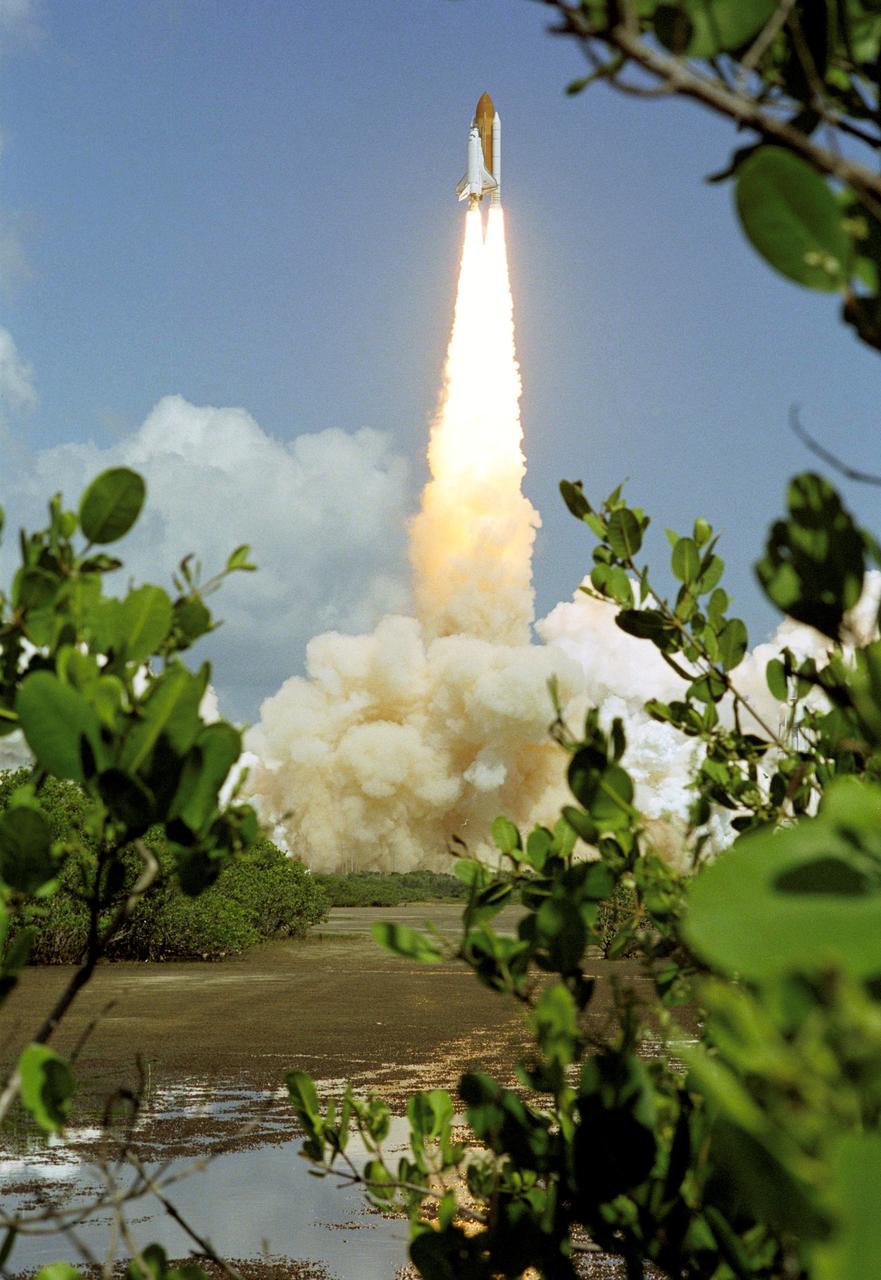
STS114-S-036 (26 July 2005) --- Space Shuttle Discovery and its seven-member crew launched at 10:39 a.m. (EDT) to begin the two-day journey to the International Space Station on the historic Return to Flight STS-114 mission. Discovery is slated to dock with the Station at 7:18 a.m. (EDT) Thursday July 28, 2005.