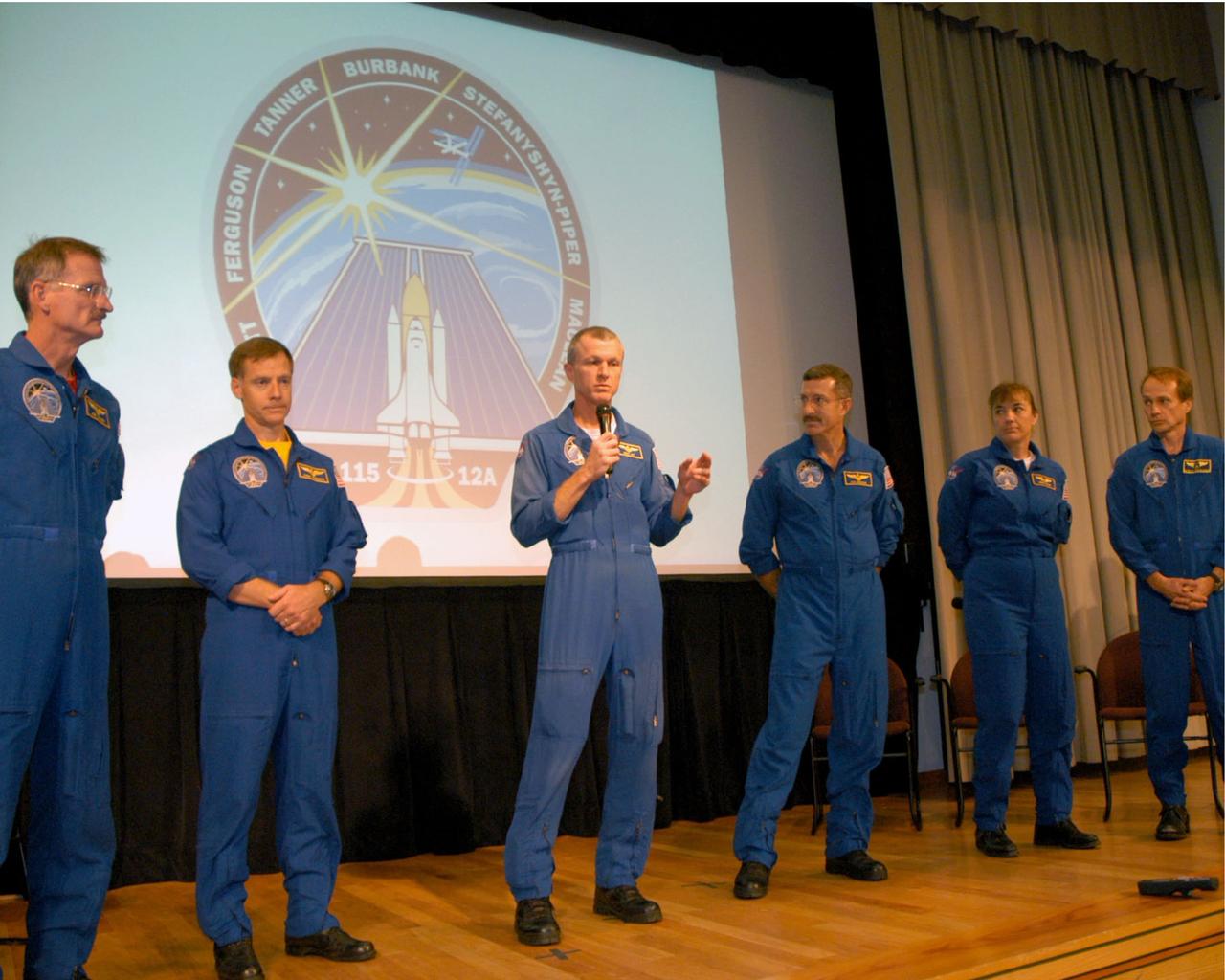
Commander Brent Jett (center) talks with employees and visitors at NASA Stennis Space Center. The astronauts of NASA's STS-115 space shuttle mission visited SSC in south Mississippi to share highlights of their 12-day mission and to thank SSC employees for the reliability of the space shuttle's main engines, which helped propel Space Shuttle Atlantis into orbit. STS-115's other crewmembers are (from left) Mission Specialists Joe Tanner, Dan Burbank, Heidemarie Stefanyshyn-Piper and Steve MacLean of the Canadian Space Agency. The mission launched Sept. 9, 2006, resuming construction of the International Space Station.

KENNEDY SPACE CENTER, FLA. - Inside the Launch Control Center, NASA Administrator Michael Griffin congratulates the launch team after the liftoff of Space Shuttle Atlantis on mission STS-115. Behind him are (left to right) Shuttle Launch Director Mike Leinbach, Pat Leslie and Robbie Ashley, STS-115 payload manager. Mission STS-115 is the 116th space shuttle flight, the 27th flight for orbiter Atlantis, and the 19th U.S. flight to the International Space Station. Mission STS-115 is scheduled to last 11 days with a planned landing at KSC. Photo credit: NASA/Kim Shiflett
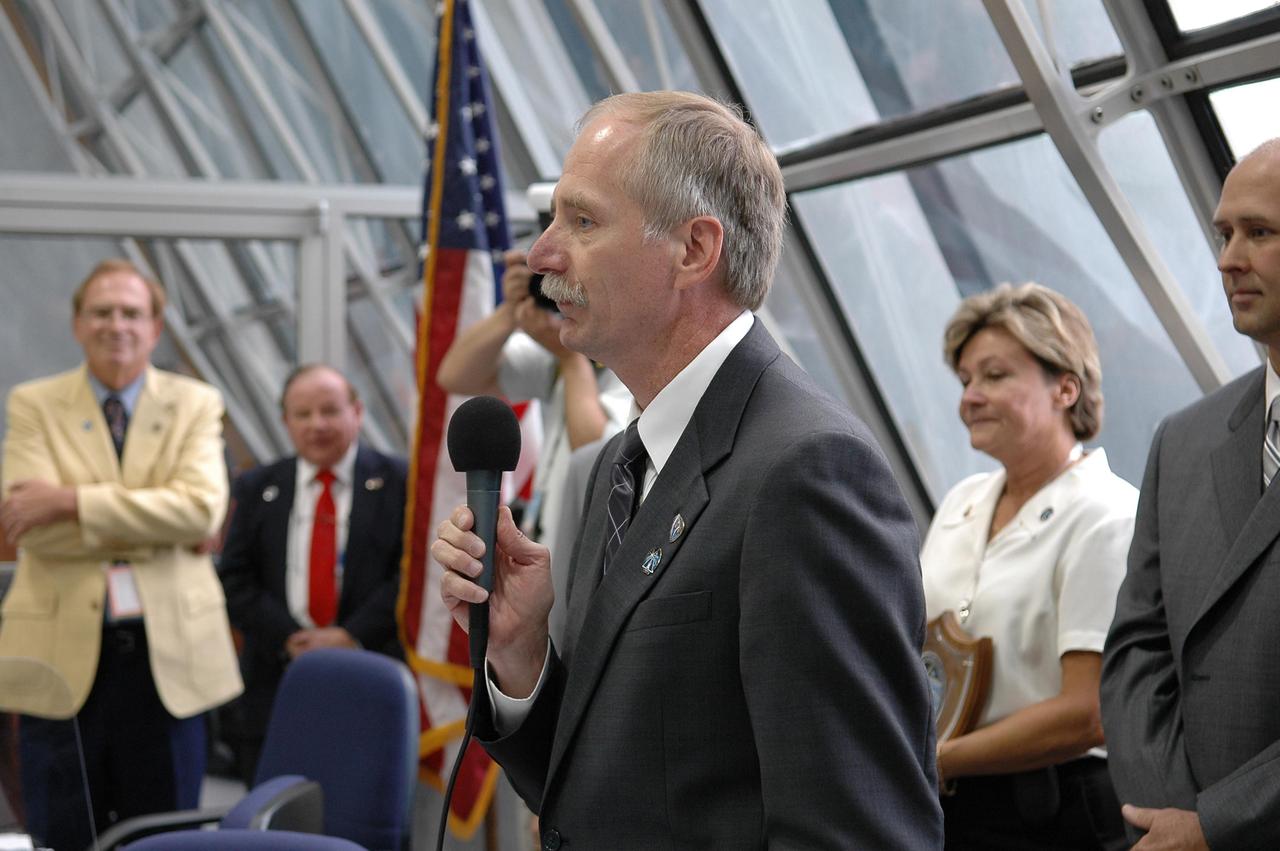
KENNEDY SPACE CENTER, FLA. - Inside the Launch Control Center, Associate Administrator for Space Operations Mission William Gerstenmaier congratulates the launch team after the liftoff of Space Shuttle Atlantis on mission STS-115. Behind him, at right, are Pat Leslie and Robbie Ashley, STS-115 payload manager. Mission STS-115 is the 116th space shuttle flight, the 27th flight for orbiter Atlantis, and the 19th U.S. flight to the International Space Station. Mission STS-115 is scheduled to last 11 days with a planned landing at KSC. Photo credit: NASA/Kim Shiflett

KENNEDY SPACE CENTER, FLA. - Inside the Launch Control Center, KSC Director Jim Kennedy congratulates the launch team after the liftoff of Space Shuttle Atlantis on mission STS-115. Behind him are (left to right) Shuttle Launch Director Mike Leinbach, Pat Leslie and Robbie Ashley, STS-115 payload manager. Mission STS-115 is the 116th space shuttle flight, the 27th flight for orbiter Atlantis, and the 19th U.S. flight to the International Space Station. Mission STS-115 is scheduled to last 11 days with a planned landing at KSC. Photo credit: NASA/Kim Shiflett

KENNEDY SPACE CENTER, FLA. - Inside the Launch Control Center, Shuttle Launch Director Mike Leinbach (center, standing) watches the computer screen as cameras document Space Shuttle Atlantis' climb toward space on mission STS-115. Mission STS-115 is the 116th space shuttle flight, the 27th flight for orbiter Atlantis, and the 19th U.S. flight to the International Space Station. sts-115 is scheduled to last 11 days with a planned landing at KSC. Photo credit: NASA/Kim Shiflett
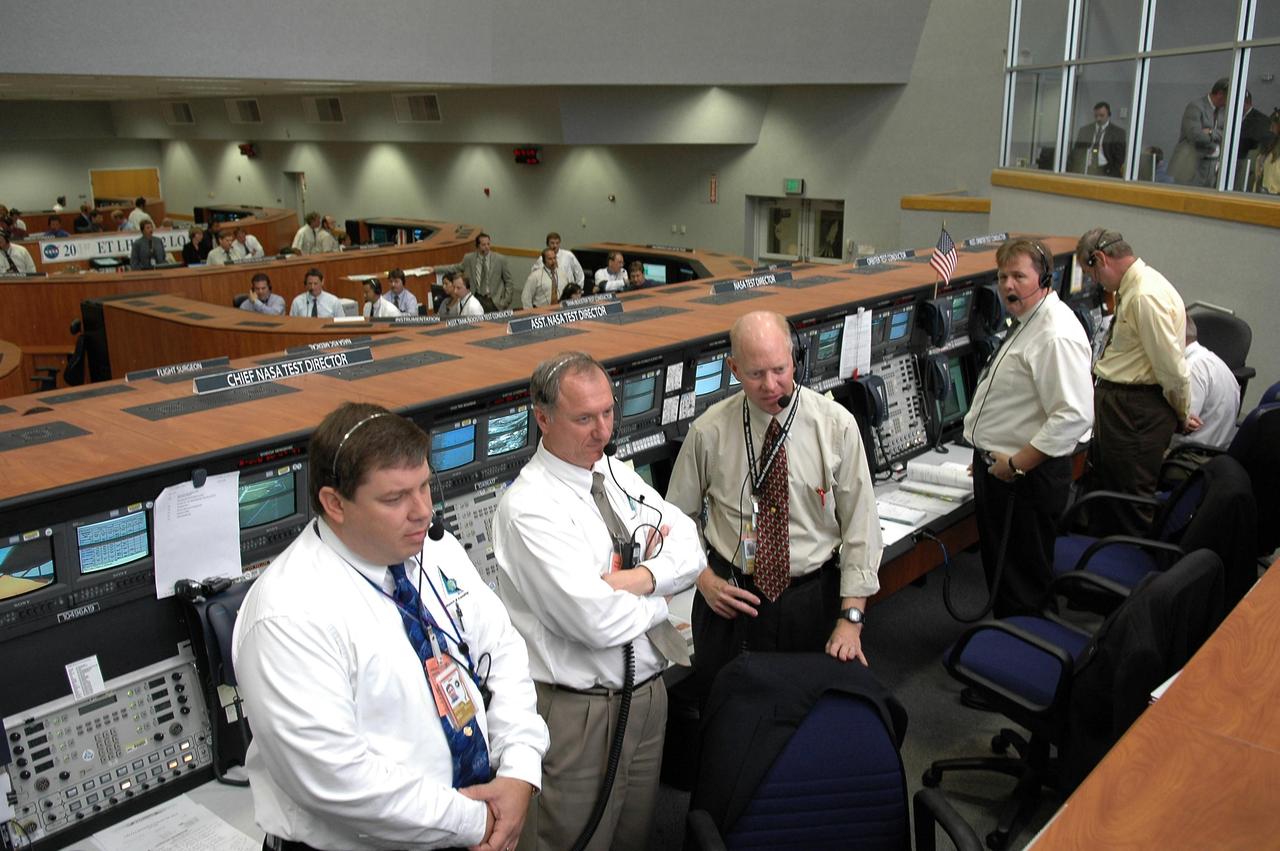
KENNEDY SPACE CENTER, FLA. - Inside the Launch Control Center, KSC officials turn from their computers to watch through the broad windows the launch of Space Shuttle Atlantis on mission STS-115. Second from left is NASA Test Director Pete Nickolenko. Mission STS-115 is the 116th space shuttle flight, the 27th flight for orbiter Atlantis, and the 19th U.S. flight to the International Space Station. sts-115 is scheduled to last 11 days with a planned landing at KSC. Photo credit: NASA/Kim Shiflett
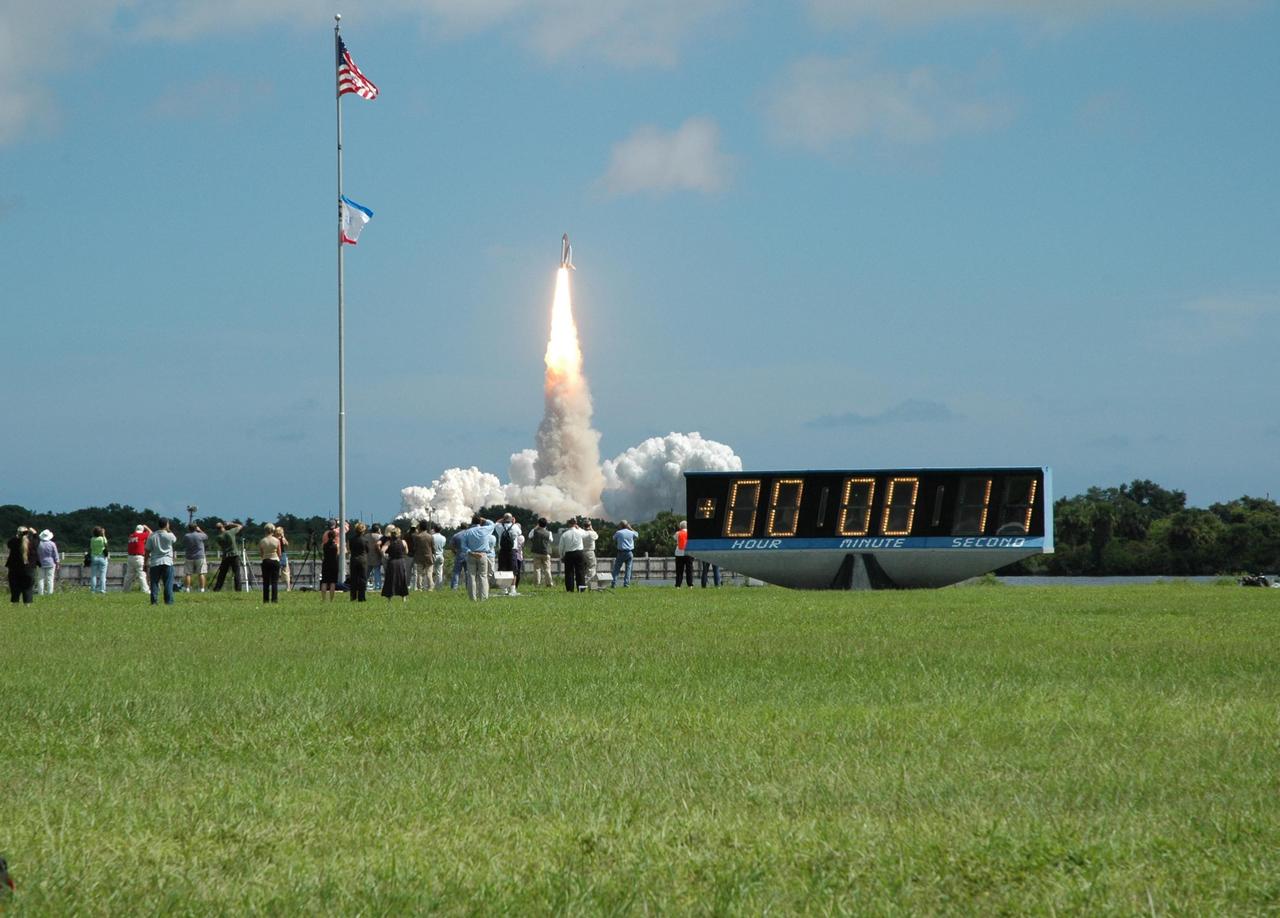
KENNEDY SPACE CENTER, FLA. - Space Shuttle Atlantis roars off the launch pad for a rendezvous with the International Space Station on mission STS-115. In the foreground is the countdown clock, marking launch and mission-elapsed time, on the grounds of the NASA News Center. After launch attempts were scrubbed Aug. 27 and 29 and Sept. 3 and 8 due to weather and technical concerns, this launch was executed perfectly. During the STS-115 mission, Atlantis' astronauts will deliver and install the 17.5-ton, bus-sized P3/P4 integrated truss segment on the station. The girder-like truss includes a set of giant solar arrays, batteries and associated electronics and will provide one-fourth of the total power-generation capability for the completed station. This mission is the 116th space shuttle flight, the 27th flight for orbiter Atlantis, and the 19th U.S. flight to the ISS. STS-115 is scheduled to last 11 days with a planned landing at KSC. Photo credit: NASA/Webb Dillard
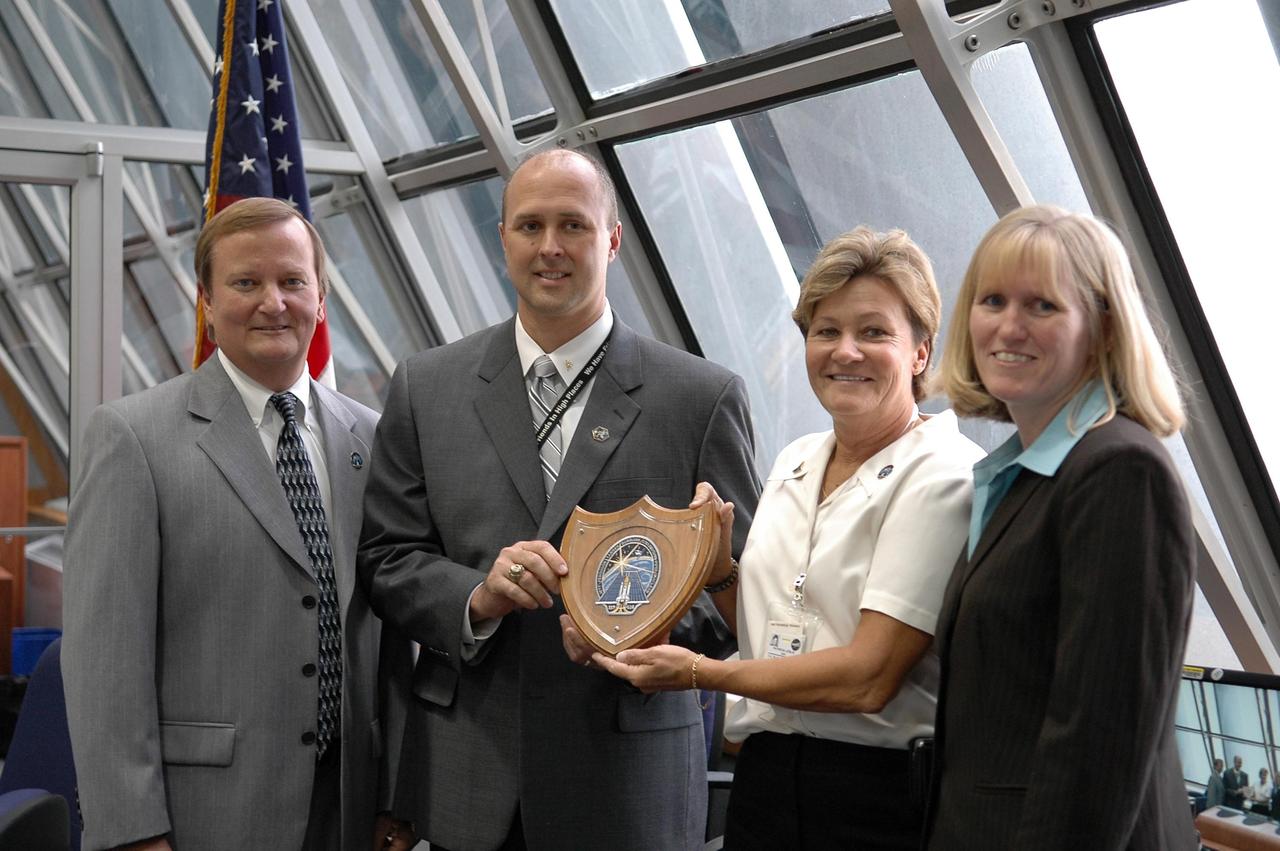
KENNEDY SPACE CENTER, FLA. - Inside the Launch Control Center, Robbie Ashley, STS-115 payload manager, and Pat Lesley, with United Space Alliance, receive a special award from (at left) Shuttle Launch Director Mike Leinbach and (at right) NASA Flow Director Angie Brewer. Mission STS-115 is the 116th space shuttle flight, the 27th flight for orbiter Atlantis, and the 19th U.S. flight to the International Space Station. STS-115 is scheduled to last 11 days with a planned landing at KSC. Photo credit: NASA/Kim Shiflett
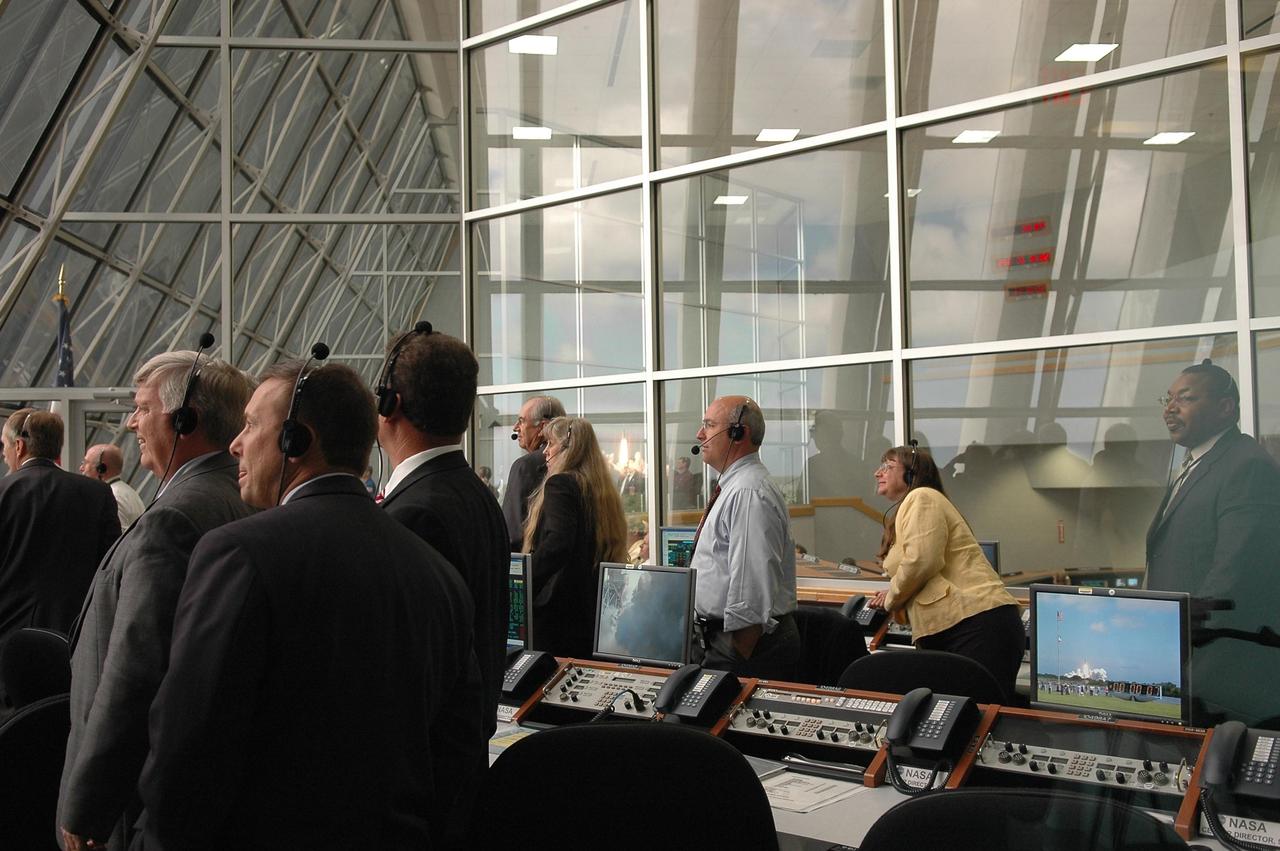
KENNEDY SPACE CENTER, FLA. - Inside the Launch Control Center, NASA and KSC officials turn from their computers to watch through the broad windows the launch of Space Shuttle Atlantis on mission STS-115. Second from left is Kennedy Space Center Director Jim Kennedy. Mission STS-115 is the 116th space shuttle flight, the 27th flight for orbiter Atlantis, and the 19th U.S. flight to the International Space Station. STS-115 is scheduled to last 11 days with a planned landing at KSC. Photo credit: NASA/Kim Shiflett
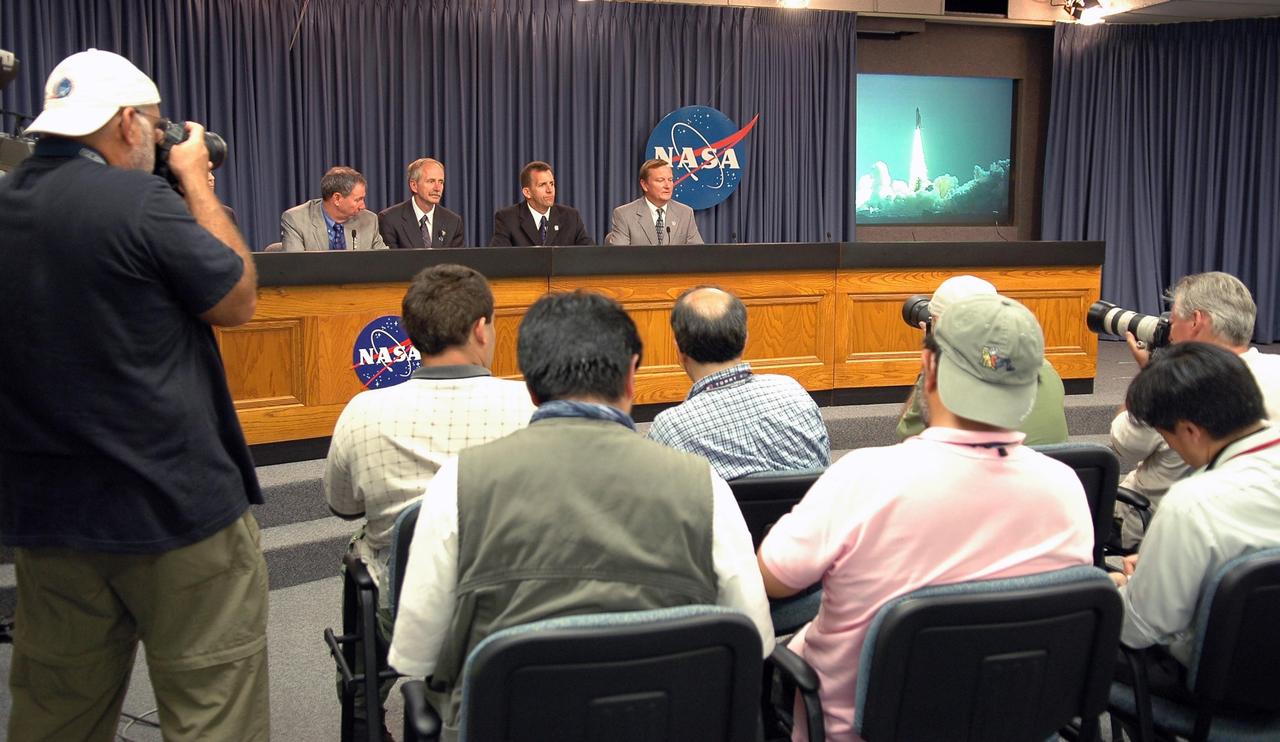
KENNEDY SPACE CENTER, FLA. - Following the successful launch of Space Shuttle Atlantis on mission STS-115, NASA Administrator Michael Griffin, Associate Administrator for Space Operations Mission William Gerstenmaier, Launch Integration Director LeRoy Cain and Shuttle Launch Director Mike Leinbach respond to questions from the media during a post-launch press conference. Mission STS-115 is the 116th space shuttle flight, the 27th flight for orbiter Atlantis, and the 19th U.S. flight to the International Space Station. STS-115 is scheduled to last 11 days with a planned landing at KSC. Photo credit: NASA/Kim Shiflett
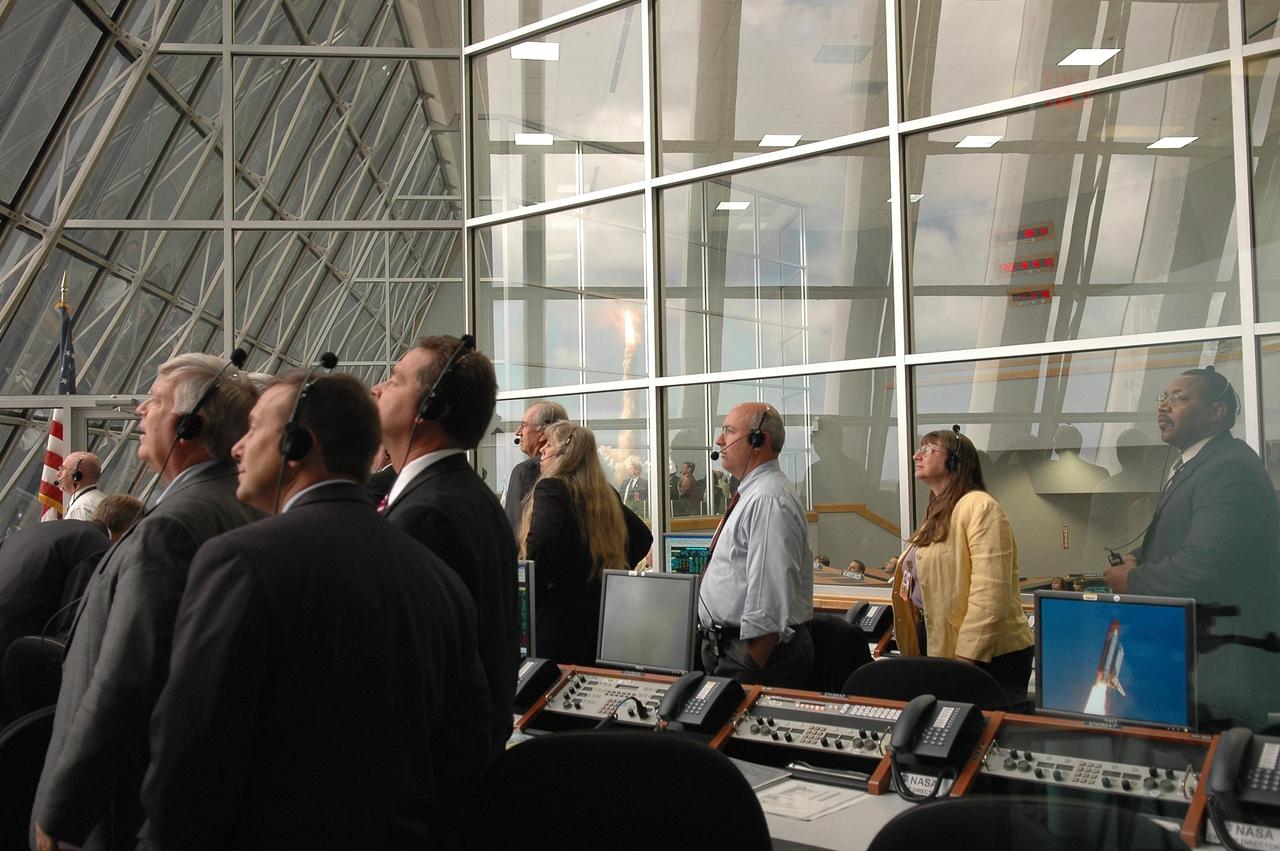
KENNEDY SPACE CENTER, FLA. - Inside the Launch Control Center, NASA and KSC officials turn from their computers to watch through the broad windows the launch of Space Shuttle Atlantis on mission STS-115. Second from left is Kennedy Space Center Director Jim Kennedy. Mission STS-115 is the 116th space shuttle flight, the 27th flight for orbiter Atlantis, and the 19th U.S. flight to the International Space Station. STS-115 is scheduled to last 11 days with a planned landing at KSC. Photo credit: NASA/Kim Shiflett
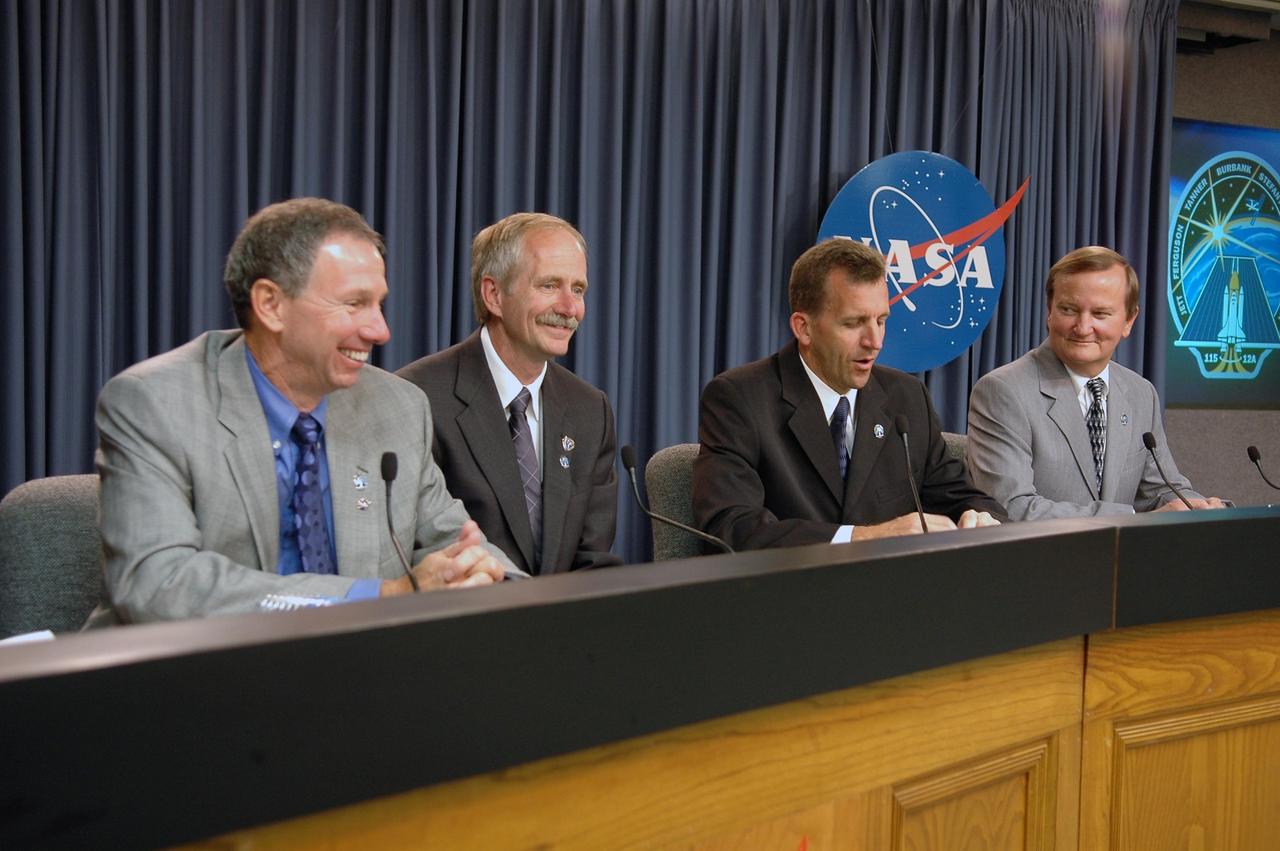
KENNEDY SPACE CENTER, FLA. - NASA and KSC officials discuss the successful launch of Space Shuttle Atlantis on mission STS-115 at a press conference at NASA's Kennedy Space Center. From left are NASA Administrator Michael Griffin, Associate Administrator for Space Operations Mission William Gerstenmaier, Launch Integration Director LeRoy Cain and Shuttle Launch Director Mike Leinbach.Mission STS-115 is the 116th space shuttle flight, the 27th flight for orbiter Atlantis, and the 19th U.S. flight to the International Space Station. STS-115 is scheduled to last 11 days with a planned landing at KSC. Photo credit: NASA/Kim Shiflett
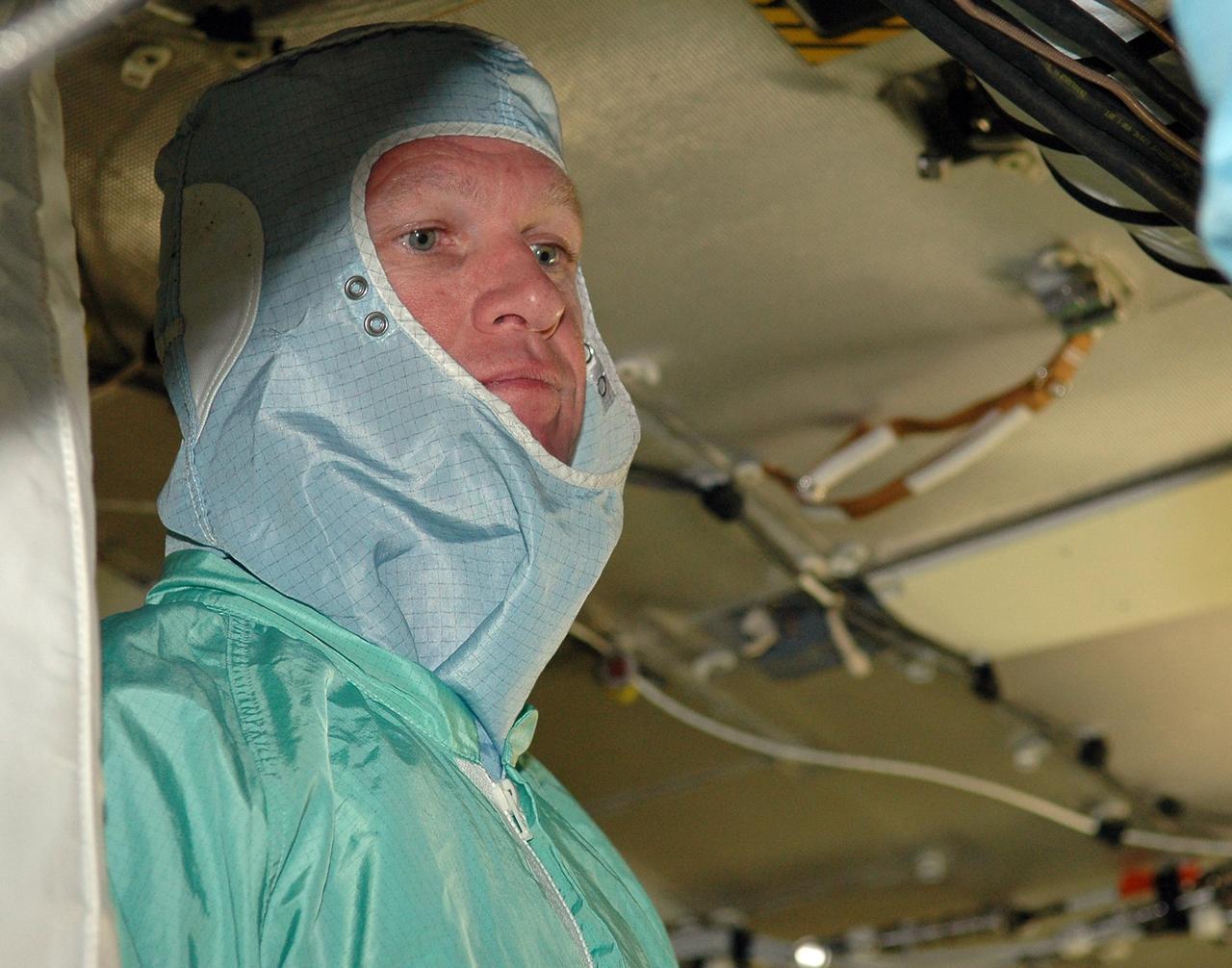
KENNEDY SPACE CENTER, FLA. - In the Orbiter Processing Facility, STS-115 Commander Brent Jett completes inspection of the orbiter Atlantis. The crew is at KSC for Crew Equipment Interface Test activities, which involve equipment familiarization and inspection, a routine part of astronaut training and launch preparations. The STS-115 mission will deliver the second port truss segment, the P3/P4 truss, to the International Space Station. The crew will attach the P3 to the first port truss segment, the P1 truss, as well as deploy solar array set 2A and 4A. Launch on Space Shuttle Atlantis is scheduled for late August. Photo credit: NASA/Kim Shiflett
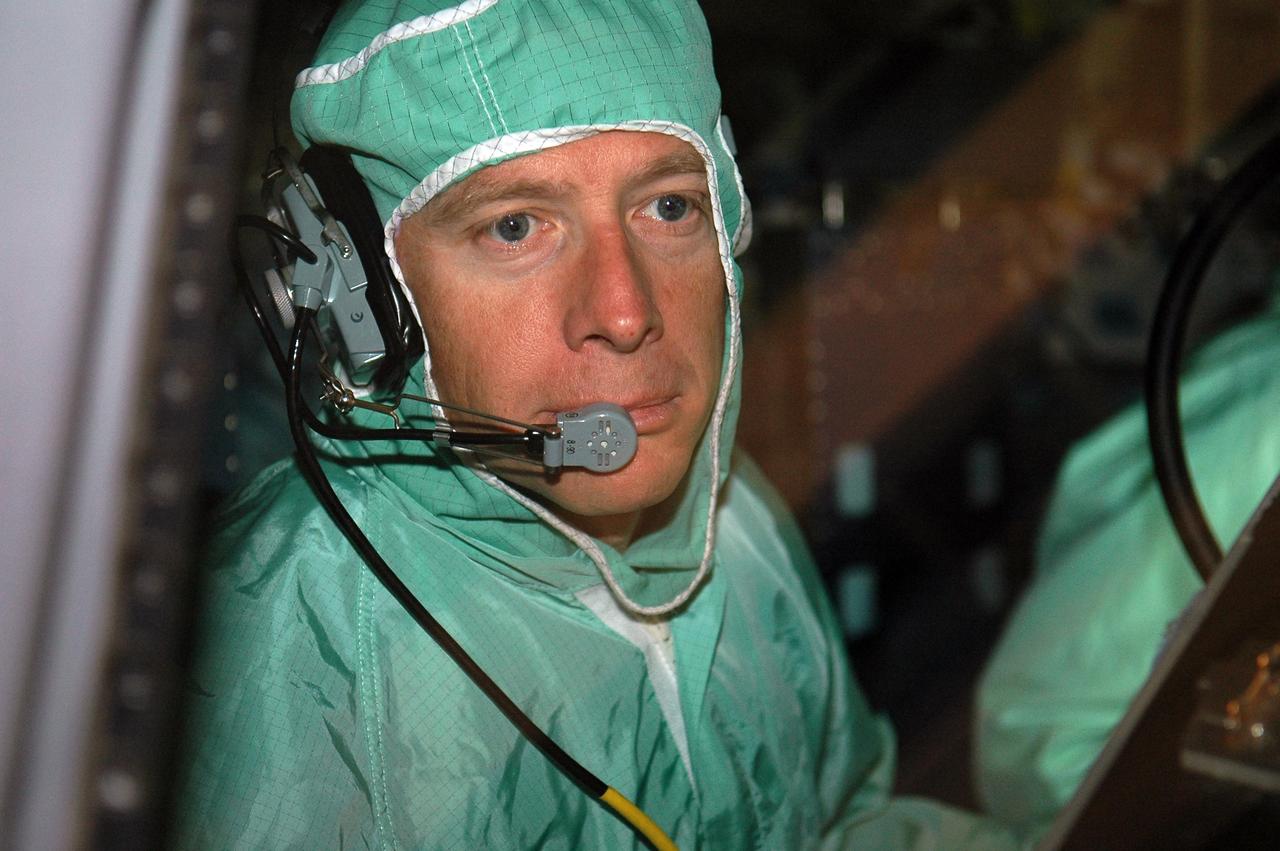
KENNEDY SPACE CENTER, FLA. - In the Orbiter Processing Facility, STS-115 Pilot Christopher Ferguson inspects the window of the cockpit in the orbiter Atlantis. The crew is at KSC for Crew Equipment Interface Test activities, which involve equipment familiarization and inspection, a routine part of astronaut training and launch preparations. The STS-115 mission will deliver the second port truss segment, the P3/P4 truss, to the International Space Station. The crew will attach the P3 to the first port truss segment, the P1 truss, as well as deploy solar array set 2A and 4A. Launch on Space Shuttle Atlantis is scheduled for late August. Photo credit: NASA/Kim Shiflett

KENNEDY SPACE CENTER, FLA. - In the Orbiter Processing Facility, STS-115 Pilot Christopher Ferguson and Commander Brent Jett review procedures in the cockpit of the orbiter Atlantis. The crew is at KSC for Crew Equipment Interface Test activities, which involve equipment familiarization and inspection, a routine part of astronaut training and launch preparations. The STS-115 mission will deliver the second port truss segment, the P3/P4 truss, to the International Space Station. The crew will attach the P3 to the first port truss segment, the P1 truss, as well as deploy solar array set 2A and 4A. Launch on Space Shuttle Atlantis is scheduled for late August. Photo credit: NASA/Kim Shiflett

KENNEDY SPACE CENTER, FLA. - In the Orbiter Processing Facility, STS-115 Pilot Christopher Ferguson inspects the window of the cockpit in the orbiter Atlantis. The crew is at KSC for Crew Equipment Interface Test activities, which involve equipment familiarization and inspection, a routine part of astronaut training and launch preparations. The STS-115 mission will deliver the second port truss segment, the P3/P4 truss, to the International Space Station. The crew will attach the P3 to the first port truss segment, the P1 truss, as well as deploy solar array set 2A and 4A. Launch on Space Shuttle Atlantis is scheduled for late August. Photo credit: NASA/Kim Shiflett
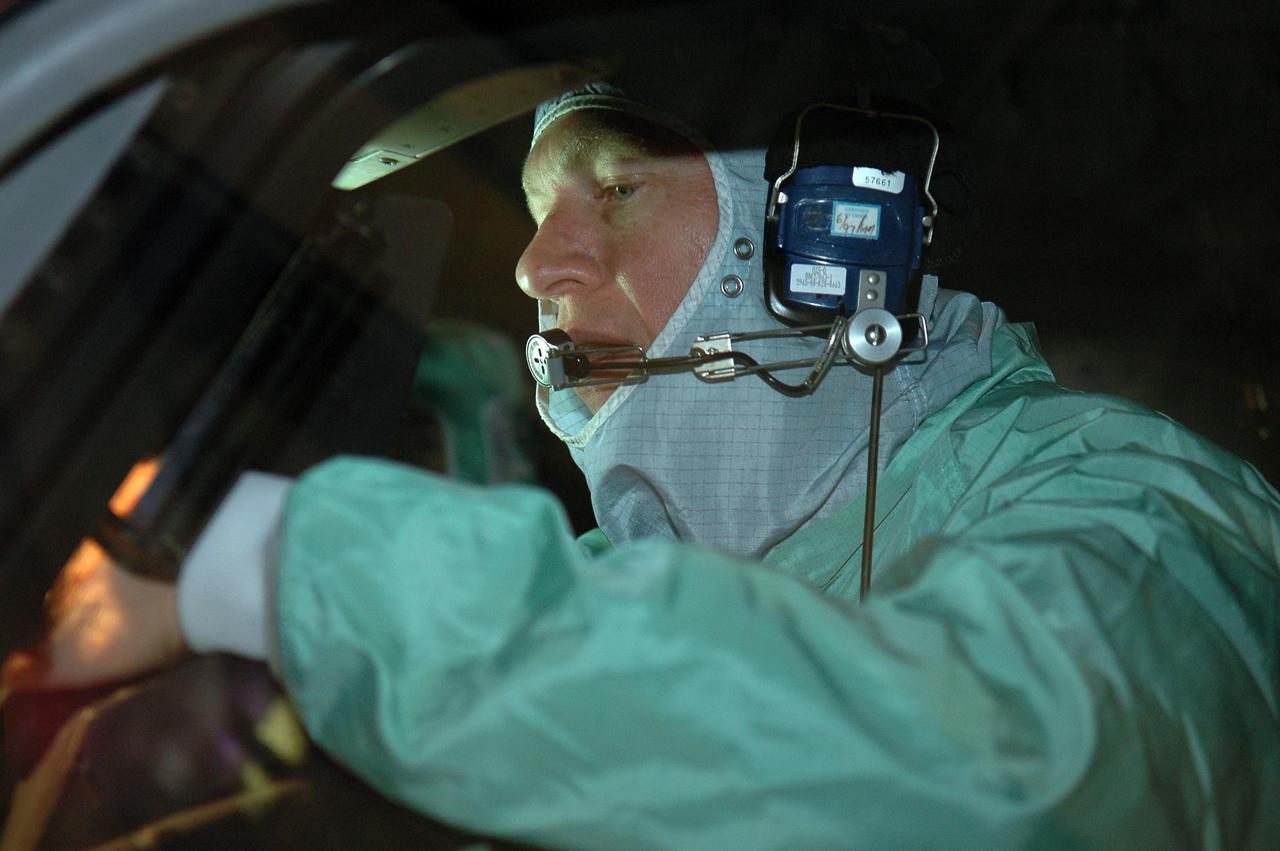
KENNEDY SPACE CENTER, FLA. - In the Orbiter Processing Facility, STS-115 Commander Brent Jett inspects the window of the cockpit in the orbiter Atlantis. The crew is at KSC for Crew Equipment Interface Test activities, which involve equipment familiarization and inspection, a routine part of astronaut training and launch preparations. The STS-115 mission will deliver the second port truss segment, the P3/P4 truss, to the International Space Station. The crew will attach the P3 to the first port truss segment, the P1 truss, as well as deploy solar array set 2A and 4A. Launch on Space Shuttle Atlantis is scheduled for late August. Photo credit: NASA/Kim Shiflett
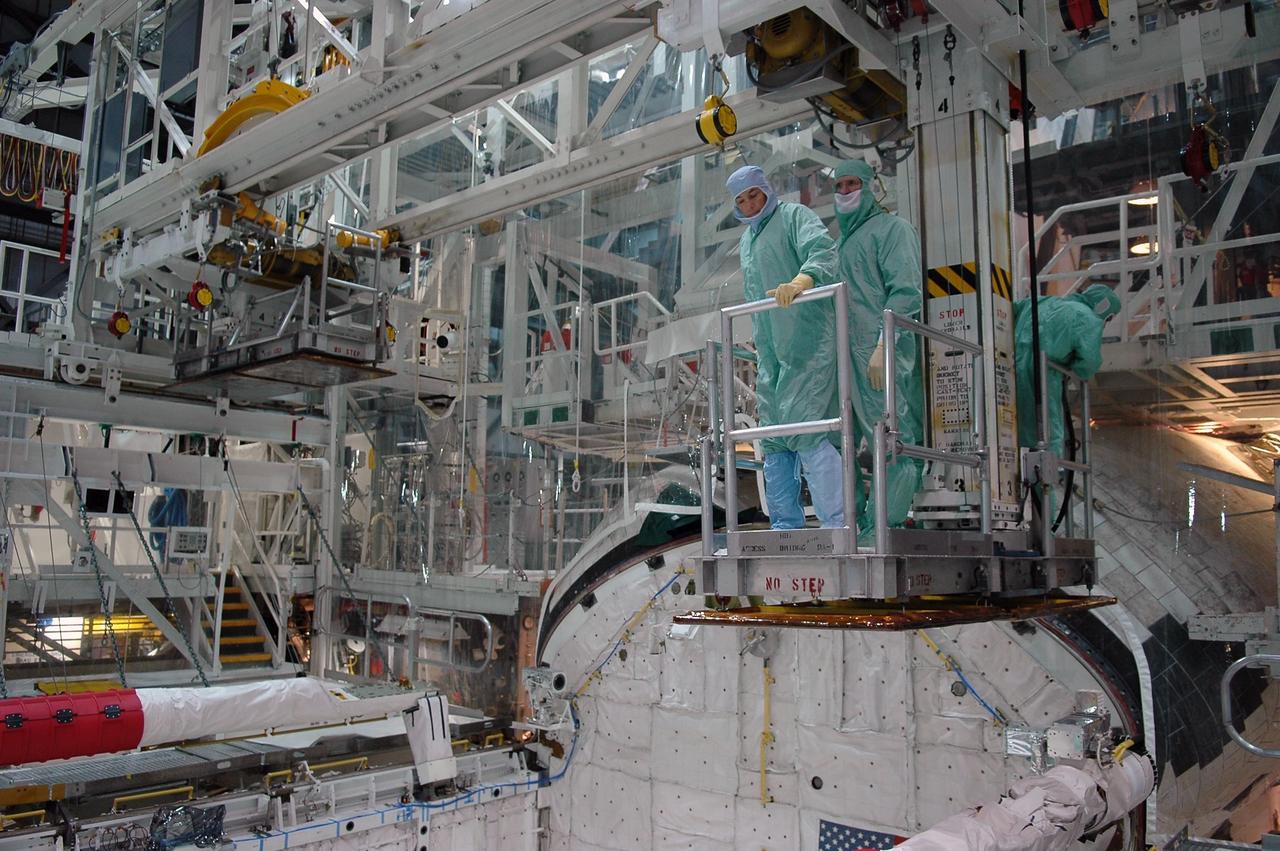
KENNEDY SPACE CENTER, FLA. - In the Orbiter Processing Facility at NASA's Kennedy Space Center, STS-115 crew members inspect equipment in Atlantis's payload bay. The crew is at KSC for Crew Equipment Interface Test activities, which involves equipment familiarization, a routine part of astronaut training and launch preparations. The STS-115 mission will deliver the second port truss segment, the P3/P4 truss, to the International Space Station. The crew will attach the P3 to the first port truss segment, the P1 truss, as well as deploy solar array set 2A and 4A. Launch on Space Shuttle Atlantis is scheduled for late August. Photo credit: NASA/Kim Shiflett
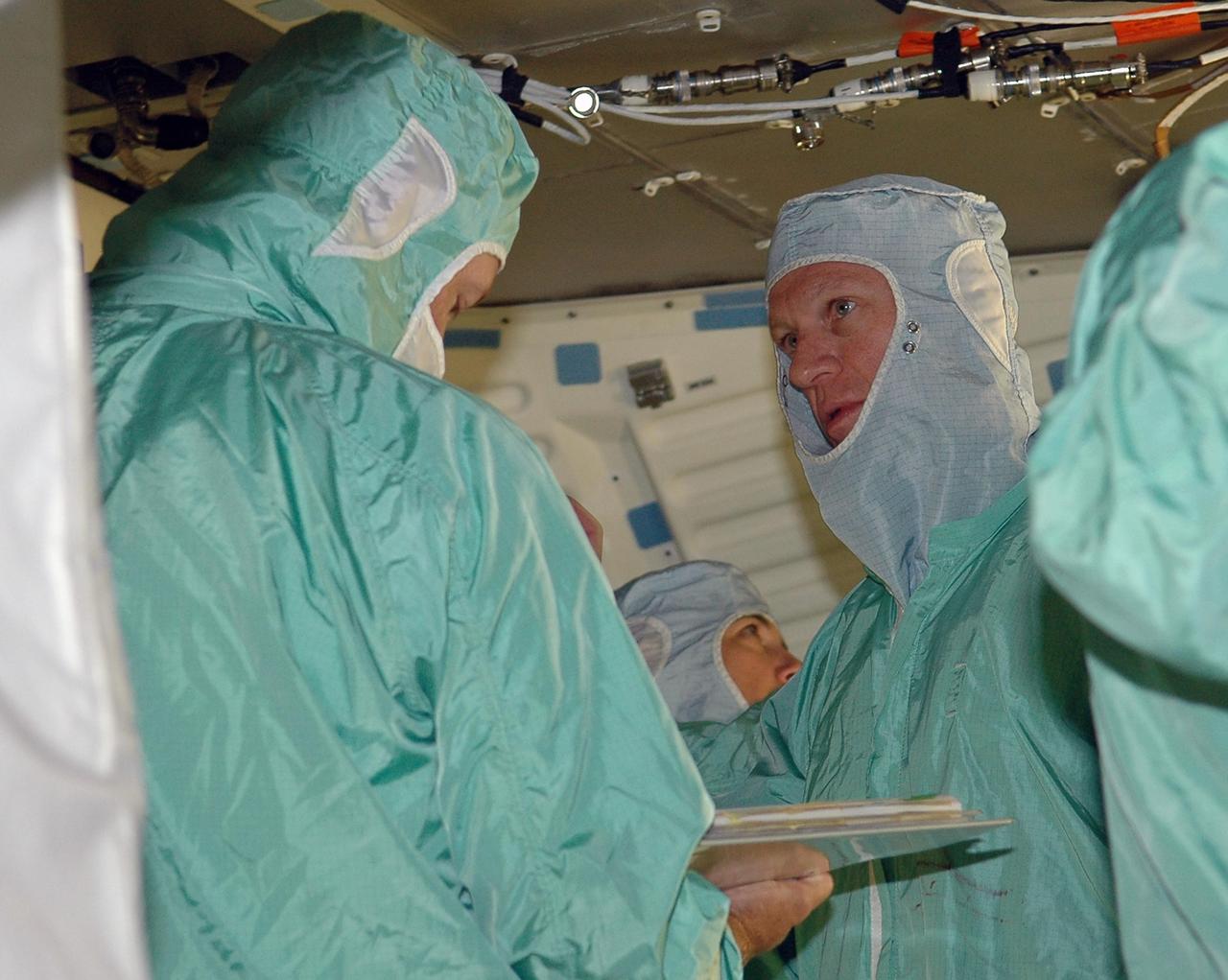
KENNEDY SPACE CENTER, FLA. - In the Orbiter Processing Facility, STS-115 Commander Brent Jett continues inspection of the orbiter Atlantis with other crew members. The crew is at KSC for Crew Equipment Interface Test activities, which involve equipment familiarization and inspection, a routine part of astronaut training and launch preparations. The STS-115 mission will deliver the second port truss segment, the P3/P4 truss, to the International Space Station. The crew will attach the P3 to the first port truss segment, the P1 truss, as well as deploy solar array set 2A and 4A. Launch on Space Shuttle Atlantis is scheduled for late August. Photo credit: NASA/Kim Shiflett
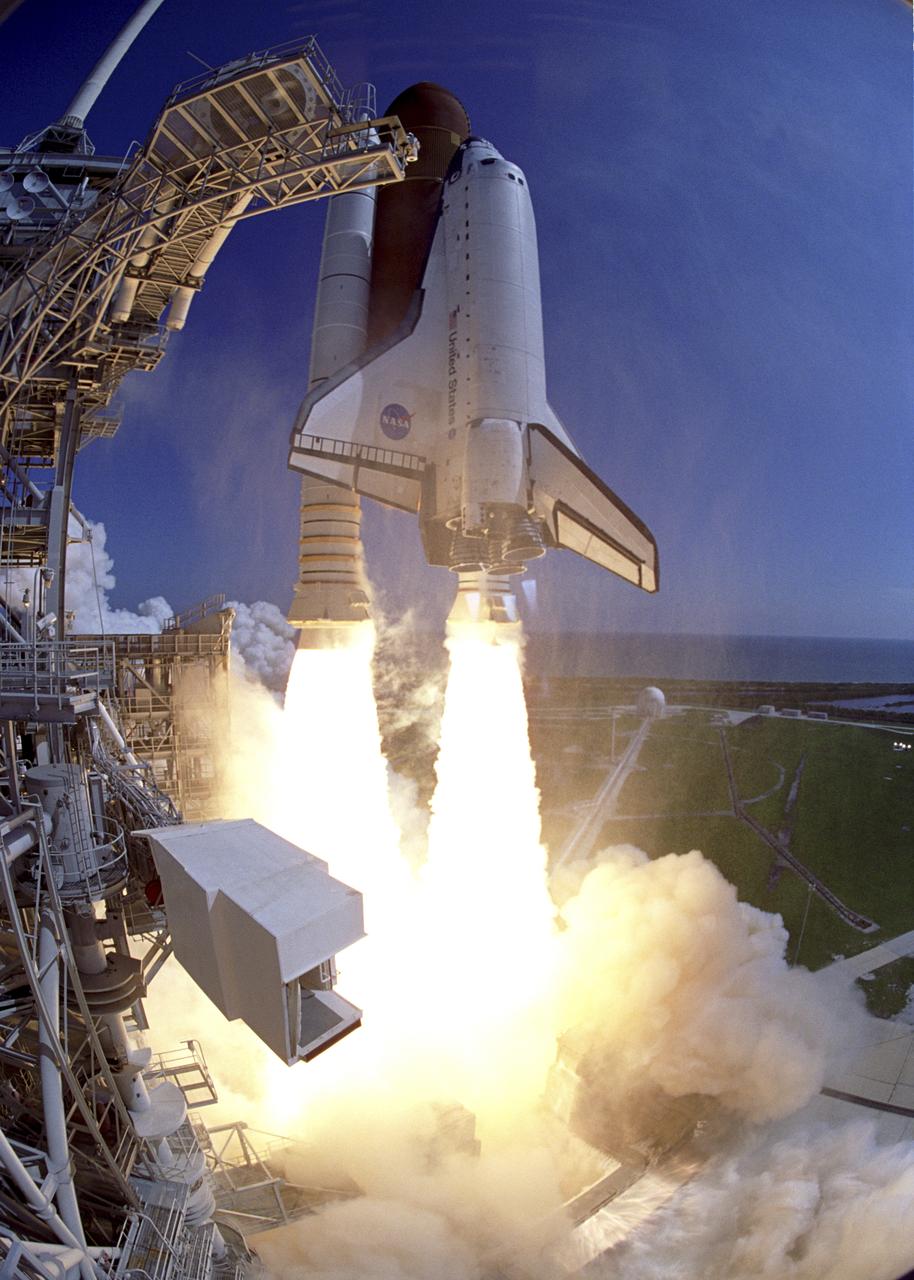
The Space Shuttle Atlantis and its six-member crew launched at 11:15 a.m. (EDT) on September 9, 2006 to begin the two-day journey to the International Space Station (ISS) on the STS-115 mission. During the 11-day mission, the STS-115 crew of six, along with station crews and ground teams, resumed construction of the ISS with the installation of a girder-like structure, known as the P3/P4 truss. The 35,000-pound piece includes a set of giant solar arrays, batteries and associated electronics. The arrays eventually will double the power capability of the Station.

JSC2006-E-41582 (22 Sept. 2006) --- Astronaut Christopher J. Ferguson, STS-115 pilot, speaks from a lectern in Ellington Field's Hangar 276 near Johnson Space Center during the STS-115 crew return ceremonies.
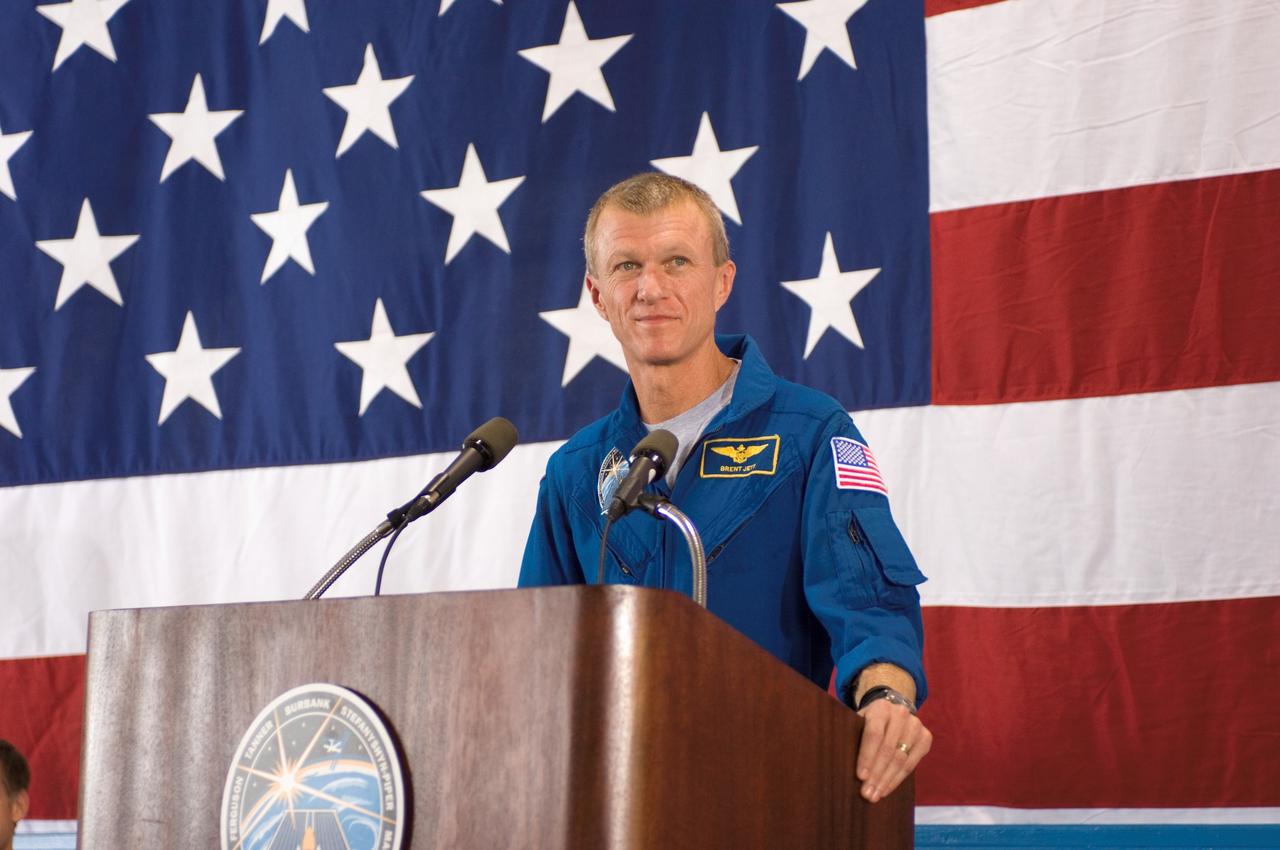
JSC2006-E-41579 (22 Sept. 2006) --- Astronaut Brent W. Jett, Jr., STS-115 commander, speaks from a lectern in Ellington Field's Hangar 276 near Johnson Space Center during the STS-115 crew return ceremonies.
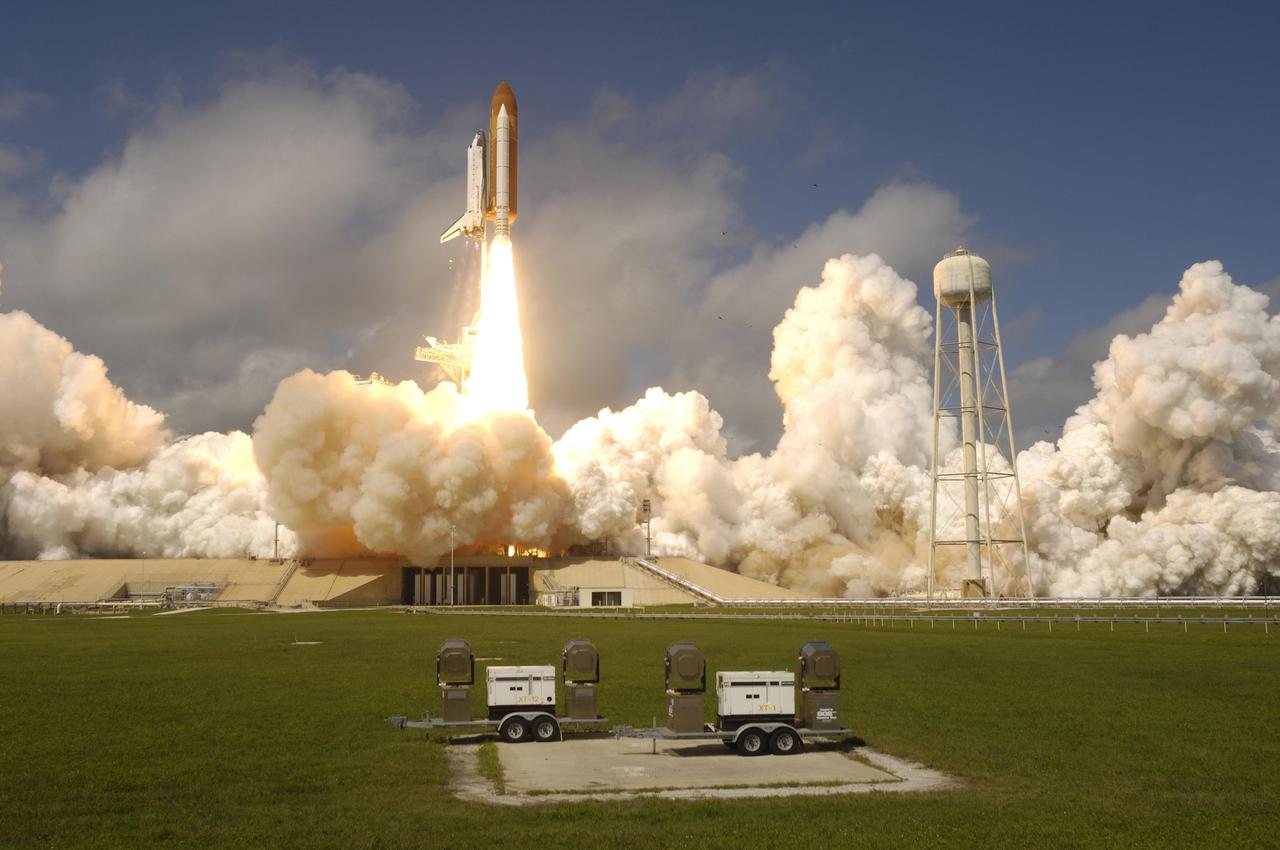
KENNEDY SPACE CENTER, FLA. - Smoke and steam billow across Launch Pad 39B as Space Shuttle Atlantis hurtles into the sky for its rendezvous with the International Space Station on mission STS-115. Liftoff was on-time at 11:14:55 a.m. EDT. After several earlier launch attempts were scrubbed due to weather and technical concerns, this launch was executed perfectly. Mission STS-115 is the 116th space shuttle flight, the 27th flight for orbiter Atlantis, and the 19th U.S. flight to the International Space Station. During the mission, Atlantis' astronauts will deliver and install the 17.5-ton, bus-sized P3/P4 integrated truss segment on the station. The girder-like truss includes a set of giant solar arrays, batteries and associated electronics and will provide one-fourth of the total power-generation capability for the completed station. STS-115 is scheduled to last 11 days with a planned landing at KSC. Photo courtesy of Nikon/Scott Andrews

KENNEDY SPACE CENTER, FLA. -Through a haze of clouds, Space Shuttle Atlantis hurtles toward space for a rendezvous with the International Space Station on mission STS-115. Liftoff was on-time at 11:14:55 a.m. EDT. After launch attempts were scrubbed Aug. 27 and 29 and Sept. 3 and 8 due to weather and technical concerns, this launch was executed perfectly. Mission STS-115 is the 116th space shuttle flight, the 27th flight for orbiter Atlantis, and the 19th U.S. flight to the International Space Station. During the mission, Atlantis' astronauts will deliver and install the 17.5-ton, bus-sized P3/P4 integrated truss segment on the station. The girder-like truss includes a set of giant solar arrays, batteries and associated electronics and will provide one-fourth of the total power-generation capability for the completed station. STS-115 is scheduled to last 11 days with a planned landing at KSC. Photo courtesy of Nikon/Scott Andrews
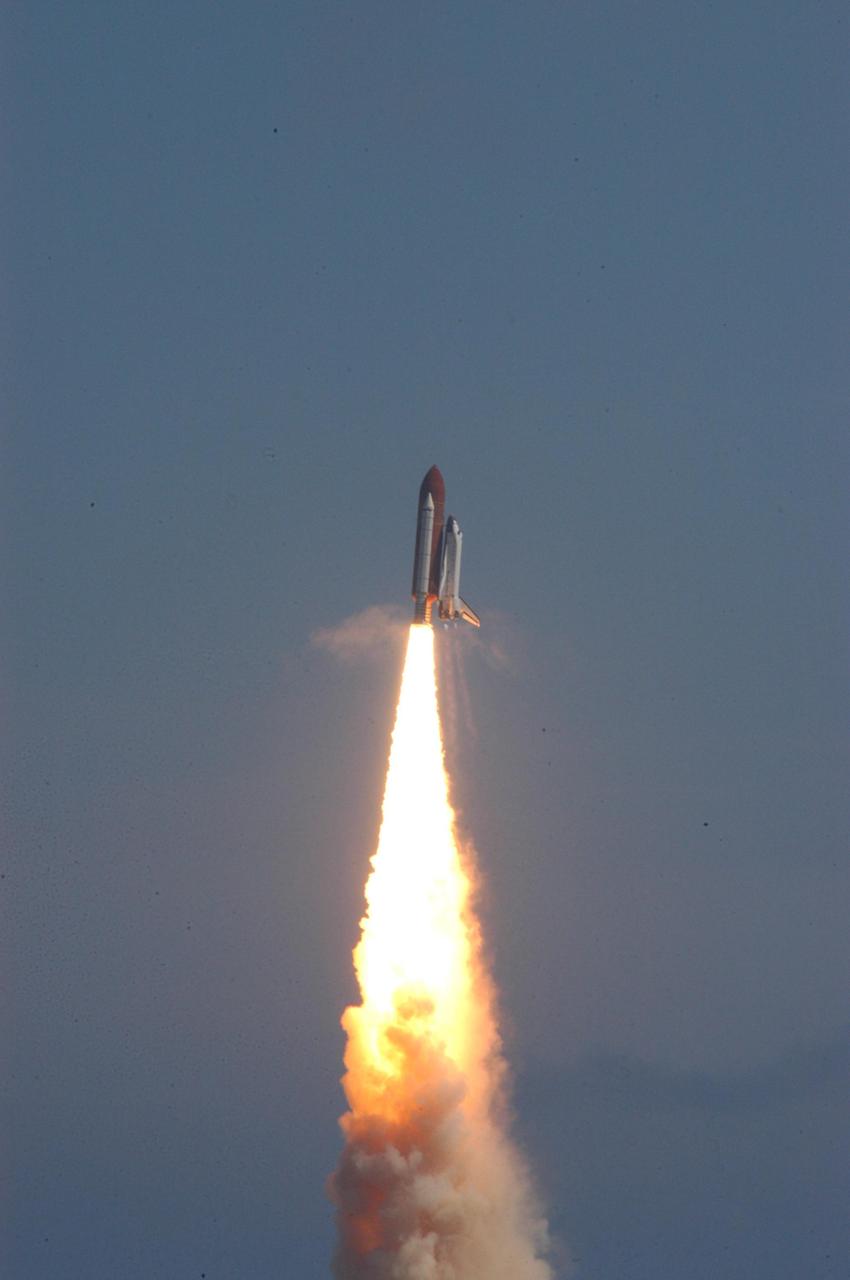
KENNEDY SPACE CENTER, FLA. - The fiery launch of Space Shuttle Atlantis makes a perfect picture against the blue Florida sky as Atlantis heads for a rendezvous with the International Space Station on mission STS-115. After launch attempts were scrubbed Aug. 27 and 29 and Sept. 3 and 8 due to weather and technical concerns, this launch was executed perfectly. During the STS-115 mission, Atlantis' astronauts will deliver and install the 17.5-ton, bus-sized P3/P4 integrated truss segment on the station. The girder-like truss includes a set of giant solar arrays, batteries and associated electronics and will provide one-fourth of the total power-generation capability for the completed station. This mission is the 116th space shuttle flight, the 27th flight for orbiter Atlantis, and the 19th U.S. flight to the ISS. STS-115 is scheduled to last 11 days with a planned landing at KSC. Photo credit: NASA/George Shelton
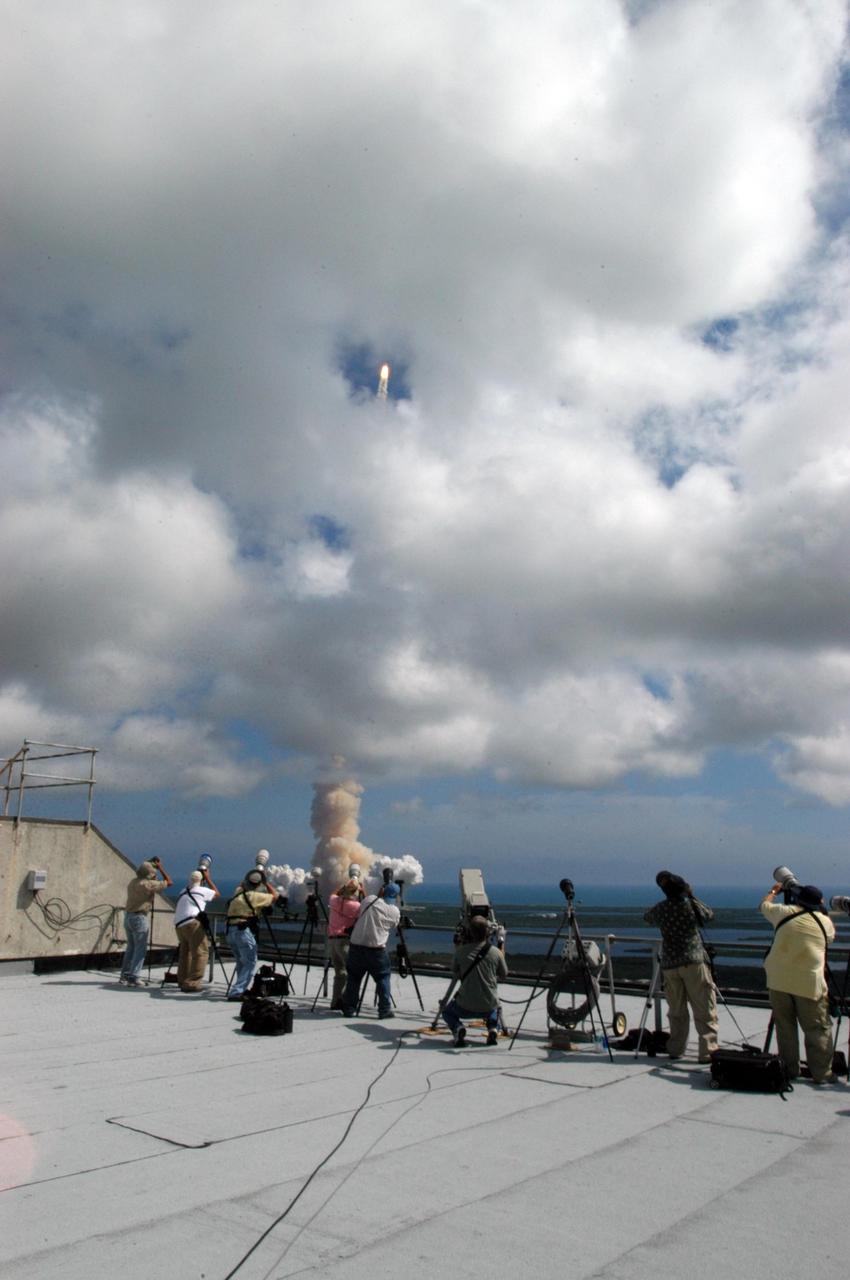
KENNEDY SPACE CENTER, FLA. - A phalanx of photographers line the roof of the Vehicle Assembly Building as Space Shuttle Atlantis roars off the launch pad at 11:14:55 a.m. EDT for a rendezvous with the International Space Station on mission STS-115. After launch attempts were scrubbed Aug. 27 and 29 and Sept. 3 and 8 due to weather and technical concerns, this launch was executed perfectly. During the STS-115 mission, Atlantis' astronauts will deliver and install the 17.5-ton, bus-sized P3/P4 integrated truss segment on the station. The girder-like truss includes a set of giant solar arrays, batteries and associated electronics and will provide one-fourth of the total power-generation capability for the completed station. This mission is the 116th space shuttle flight, the 27th flight for orbiter Atlantis, and the 19th U.S. flight to the ISS. STS-115 is scheduled to last 11 days with a planned landing at KSC. Photo credit: NASA/George Shelton
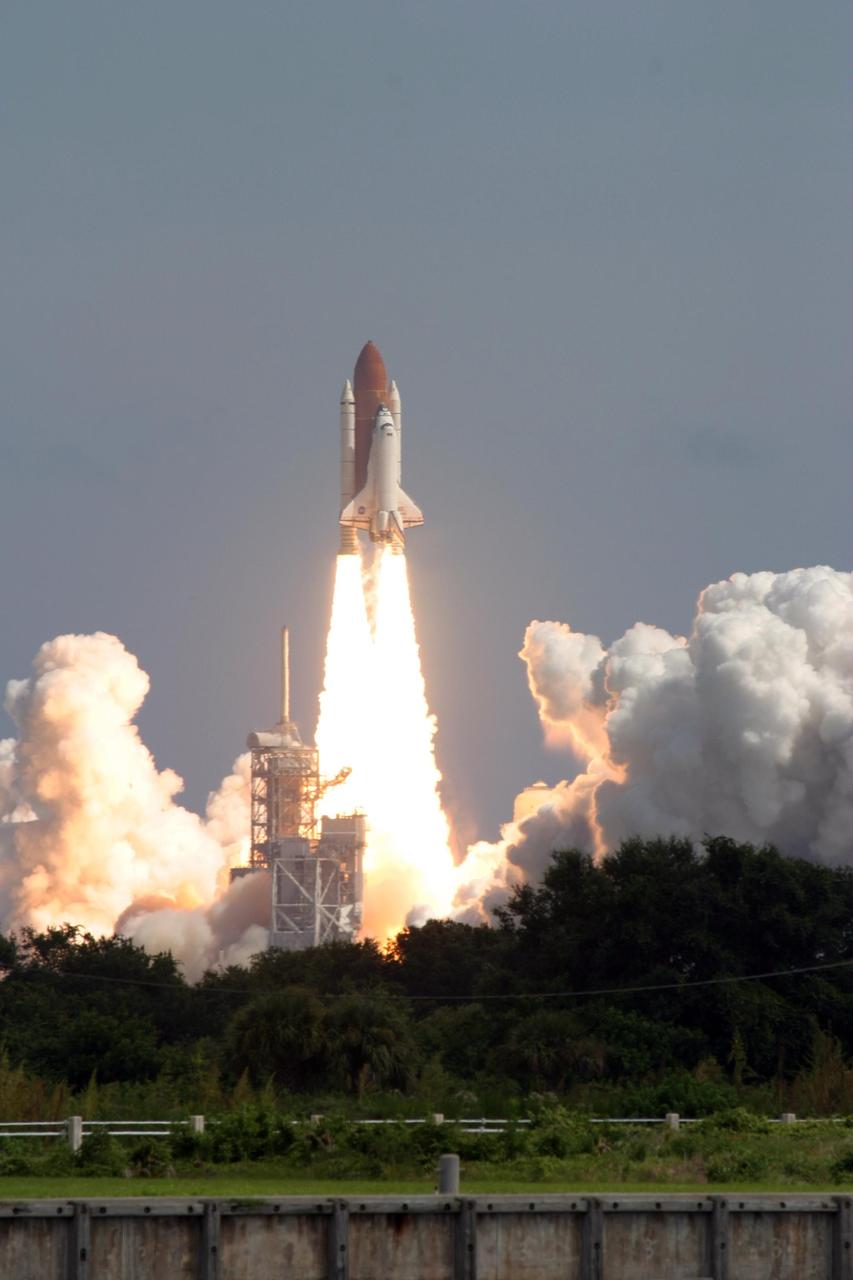
KENNEDY SPACE CENTER, FLA. - With a fiery liftoff, Space Shuttle Atlantis roars off the launch pad for a rendezvous with the International Space Station on mission STS-115. After launch attempts were scrubbed Aug. 27 and 29 and Sept. 3 and 8 due to weather and technical concerns, this launch was executed perfectly. During the STS-115 mission, Atlantis' astronauts will deliver and install the 17.5-ton, bus-sized P3/P4 integrated truss segment on the station. The girder-like truss includes a set of giant solar arrays, batteries and associated electronics and will provide one-fourth of the total power-generation capability for the completed station. This mission is the 116th space shuttle flight, the 27th flight for orbiter Atlantis, and the 19th U.S. flight to the ISS. STS-115 is scheduled to last 11 days with a planned landing at KSC. Photo credit: NASA/Dennis Sabo
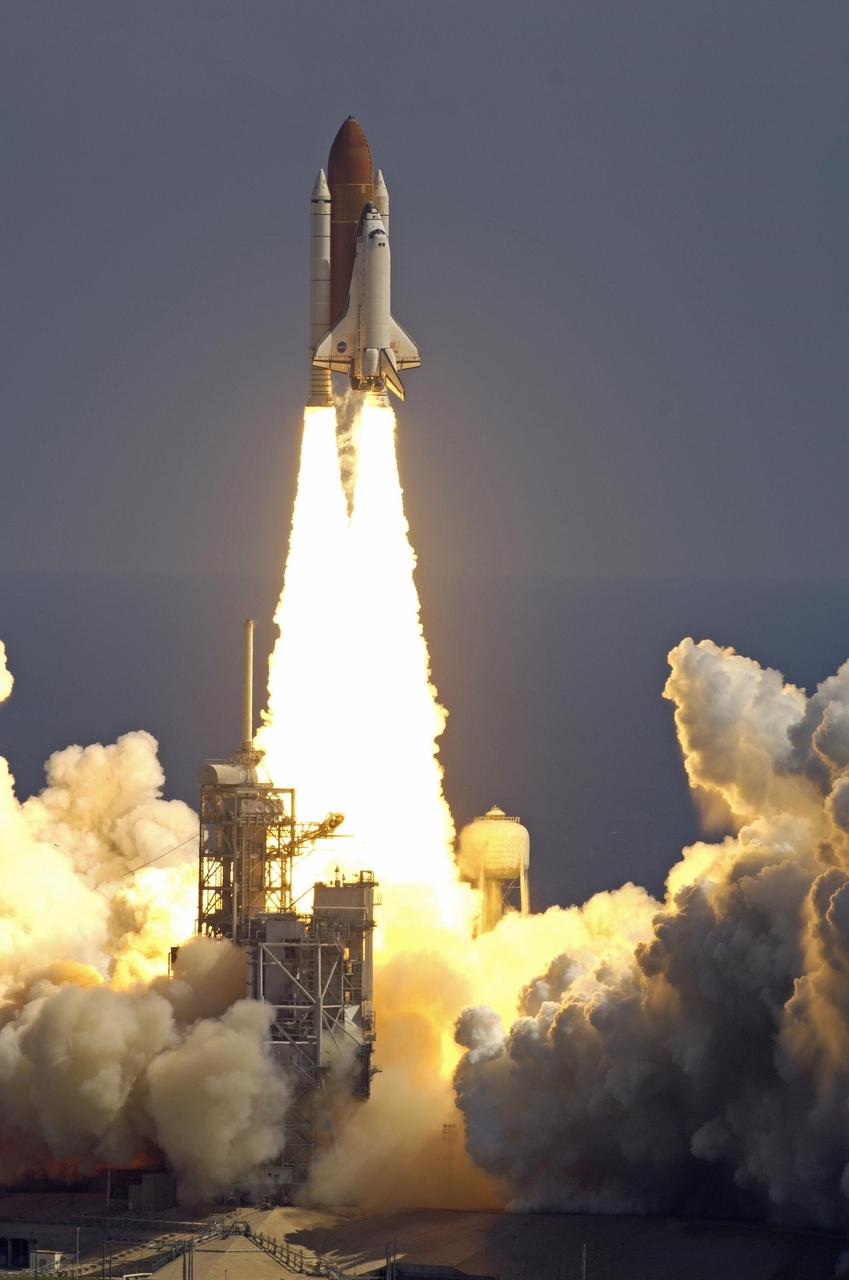
KENNEDY SPACE CENTER, FLA. - Flaming rockets propel Space Shuttle Atlantis into the sky for a rendezvous with the International Space Station on mission STS-115. Liftoff was on-time at 11:14:55 a.m. EDT. After launch attempts were scrubbed Aug. 27 and 29 and Sept. 3 and 8 due to weather and technical concerns, this launch was executed perfectly. Mission STS-115 is the 116th space shuttle flight, the 27th flight for orbiter Atlantis, and the 19th U.S. flight to the International Space Station. During the mission, Atlantis' astronauts will deliver and install the 17.5-ton, bus-sized P3/P4 integrated truss segment on the station. The girder-like truss includes a set of giant solar arrays, batteries and associated electronics and will provide one-fourth of the total power-generation capability for the completed station. STS-115 is scheduled to last 11 days with a planned landing at KSC. Photo courtesy of Nikon/Scott Andrews
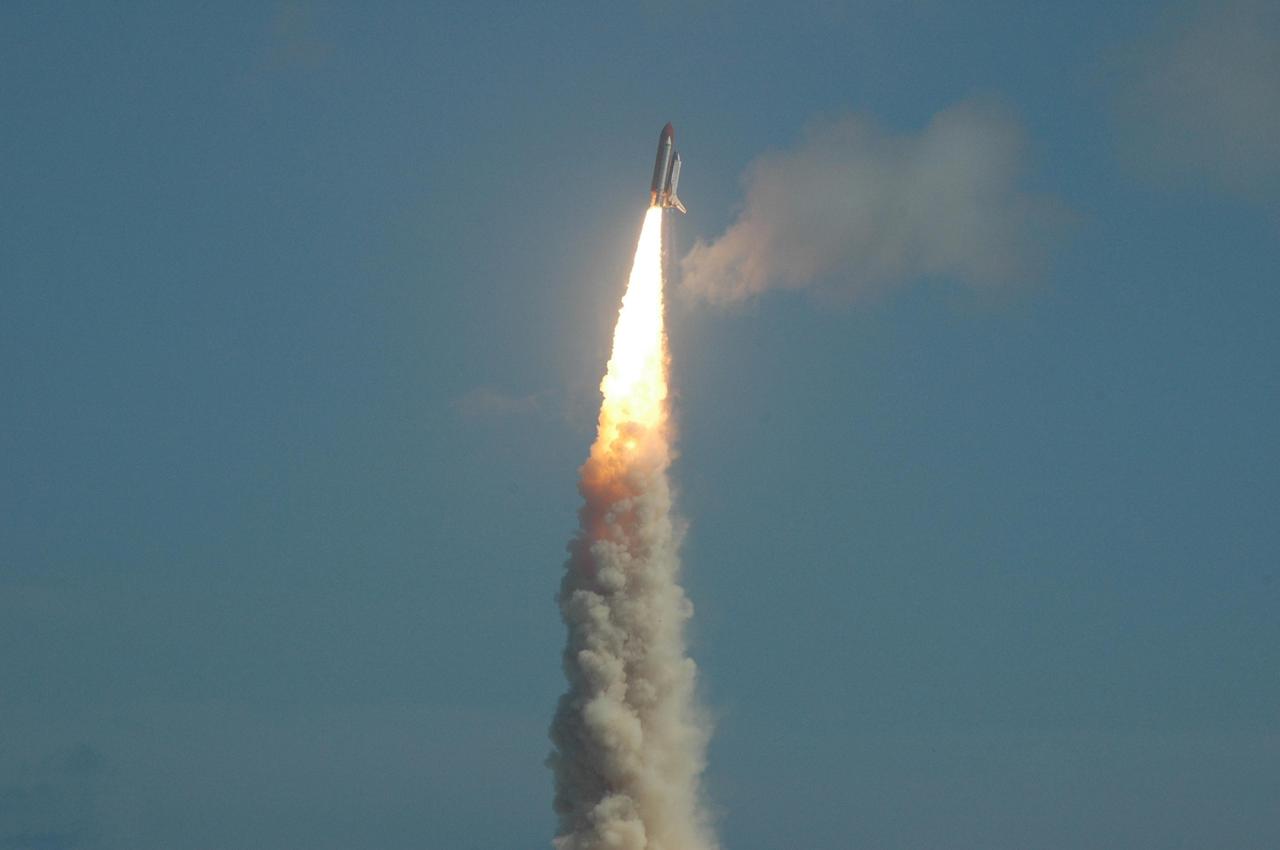
KENNEDY SPACE CENTER, FLA. - Through a slight haze of clouds, Space Shuttle Atlantis hurtles toward space for a rendezvous with the International Space Station on mission STS-115. Liftoff was on-time at 11:14:55 a.m. EDT. After launch attempts were scrubbed Aug. 27 and 29 and Sept. 3 and 8 due to weather and technical concerns, this launch was executed perfectly. Mission STS-115 is the 116th space shuttle flight, the 27th flight for orbiter Atlantis, and the 19th U.S. flight to the International Space Station. During the mission, Atlantis' astronauts will deliver and install the 17.5-ton, bus-sized P3/P4 integrated truss segment on the station. The girder-like truss includes a set of giant solar arrays, batteries and associated electronics and will provide one-fourth of the total power-generation capability for the completed station. STS-115 is scheduled to last 11 days with a planned landing at KSC. Photo credit: NASA/Ken Thornsley
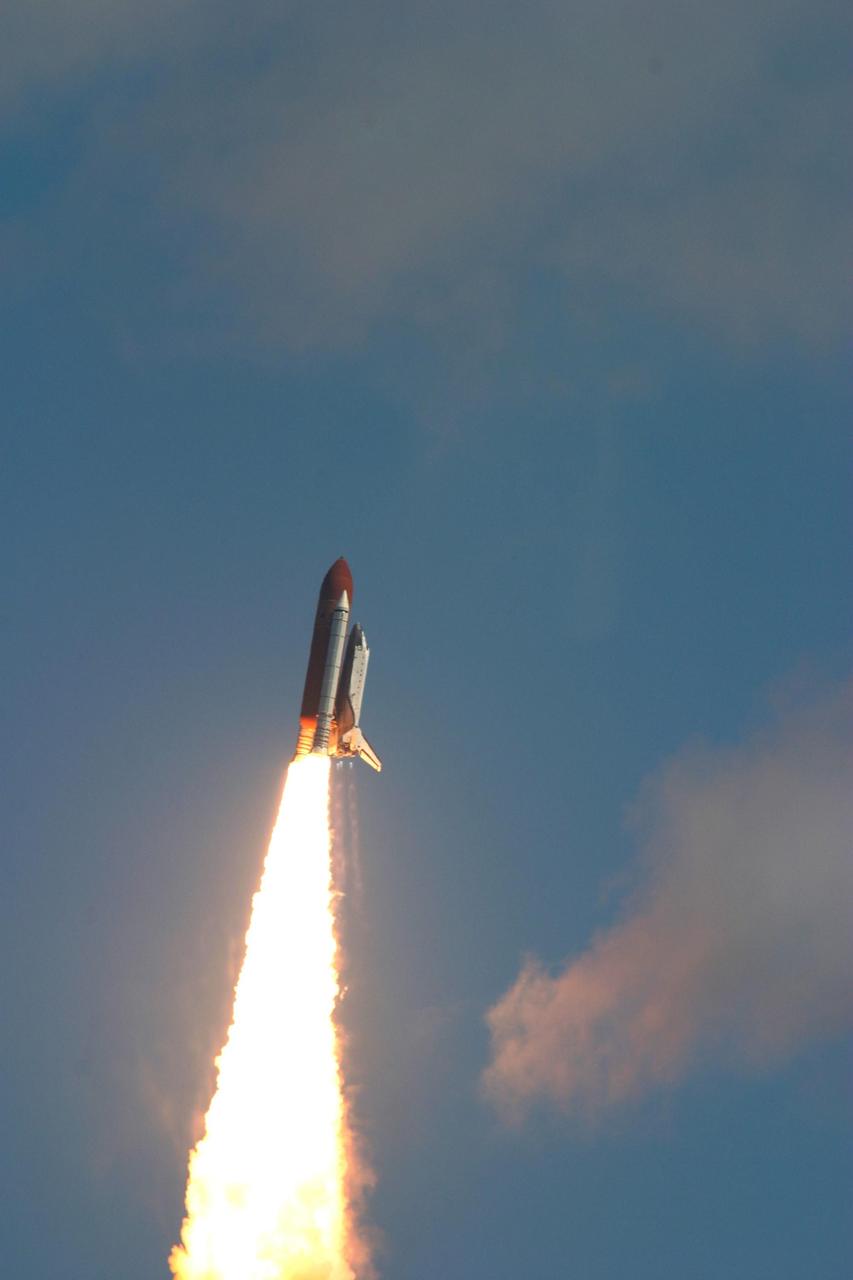
KENNEDY SPACE CENTER, FLA. - Looking like a work of art, Space Shuttle Atlantis roars into the blue Florida sky atop a column of fire for a rendezvous with the International Space Station on mission STS-115. After launch attempts were scrubbed Aug. 27 and 29 and Sept. 3 and 8 due to weather and technical concerns, this launch was executed perfectly. During the STS-115 mission, Atlantis' astronauts will deliver and install the 17.5-ton, bus-sized P3/P4 integrated truss segment on the station. The girder-like truss includes a set of giant solar arrays, batteries and associated electronics and will provide one-fourth of the total power-generation capability for the completed station. This mission is the 116th space shuttle flight, the 27th flight for orbiter Atlantis, and the 19th U.S. flight to the ISS. STS-115 is scheduled to last 11 days with a planned landing at KSC. Photo credit: NASA/Dennis Sabo
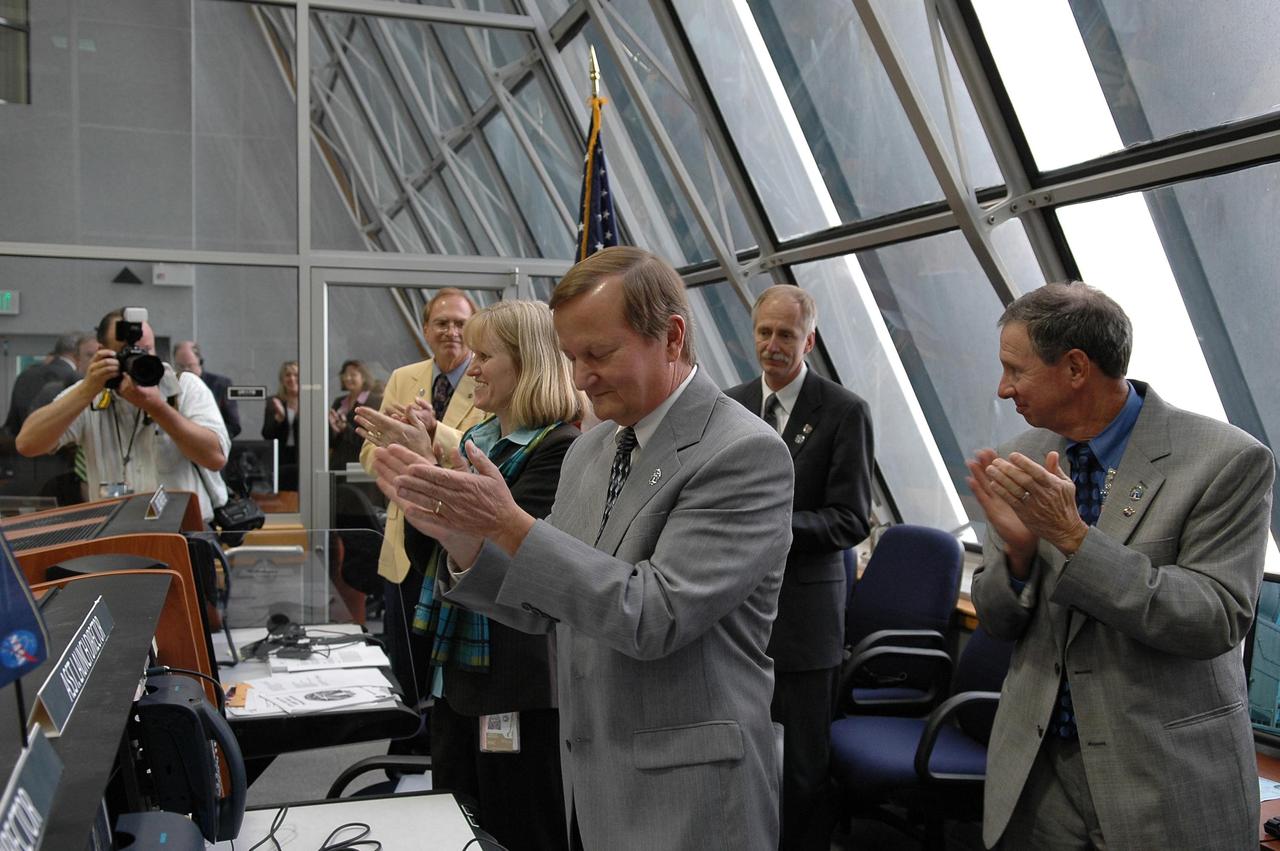
KENNEDY SPACE CENTER, FLA. - Inside the Launch Control Center, NASA and KSC officials applaud the successful launch of Space Shuttle Atlantis on mission STS-115. From right are NASA Administrator Michael Griffin, Associate Administrator for Space Operations Mission William Gerstenmaier, Shuttle Launch Director Mike Leinbach, NASA Flow Director Angie Brewer, and Public Affairs Officer George Diller, who provided commentary leading up to the launch. Mission STS-115 is the 116th space shuttle flight, the 27th flight for orbiter Atlantis, and the 19th U.S. flight to the International Space Station. STS-115 is scheduled to last 11 days with a planned landing at KSC. Photo credit: NASA/Kim Shiflett
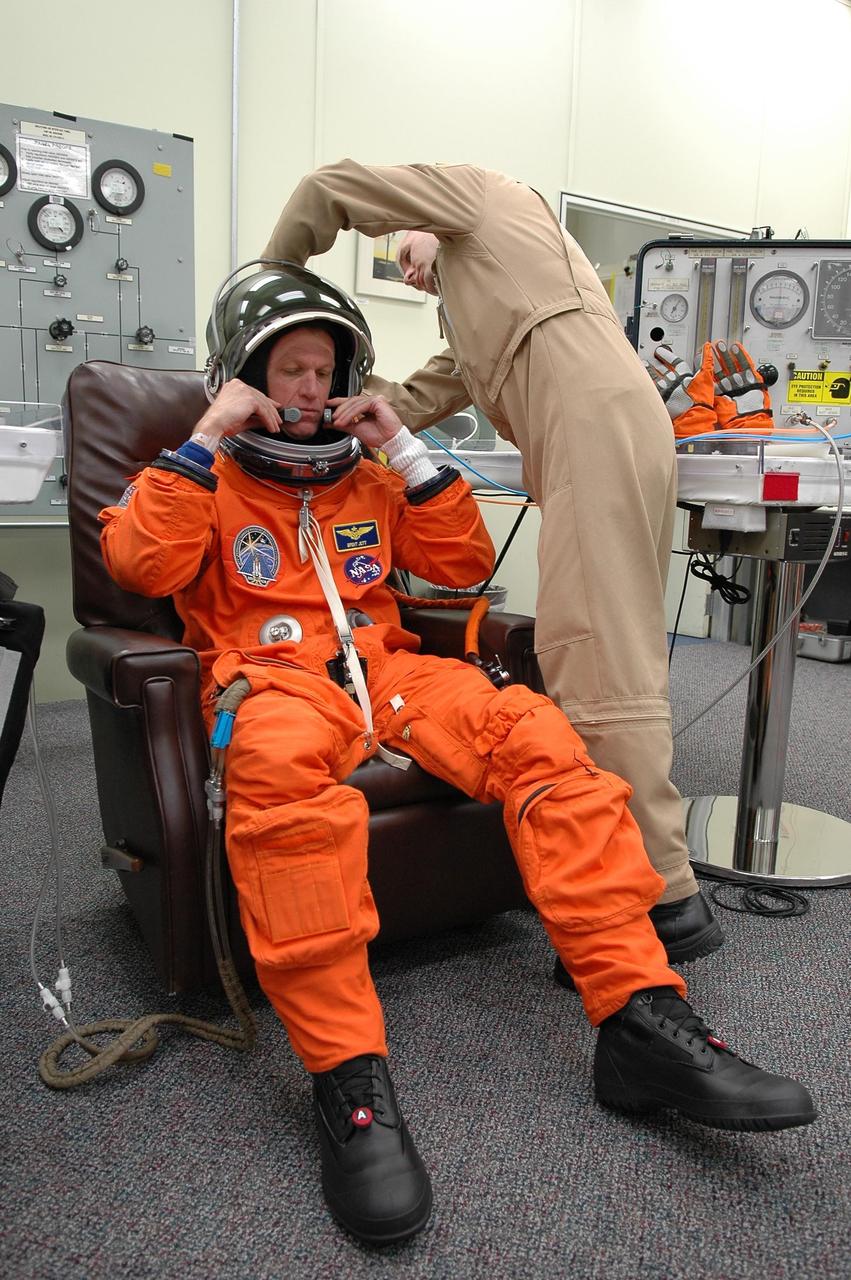
KENNEDY SPACE CENTER, FLA. - In the Operations and Checkout Building at NASA Kennedy Space Center, STS-115 Commander Brent Jett dons his launch and re-entry suit before heading to the launch pad. Jett is making his fourth shuttle flight on this mission to the International Space Station aboard Space Shuttle Atlantis. On its second attempt for launch, Atlantis is scheduled to lift off at 11:41 a.m. EDT today from Launch Pad 39B. During the STS-115 mission, Atlantis' astronauts will deliver and install the 17.5-ton, bus-sized P3/P4 integrated truss segment on the station. The girder-like truss includes a set of giant solar arrays, batteries and associated electronics and will provide one-fourth of the total power-generation capability for the completed station. This mission is the 116th space shuttle flight, the 27th flight for orbiter Atlantis, and the 19th U.S. flight to the ISS. STS-115 is scheduled to last 11 days with a planned landing at KSC. Photo credit: NASA/Kim Shiflett
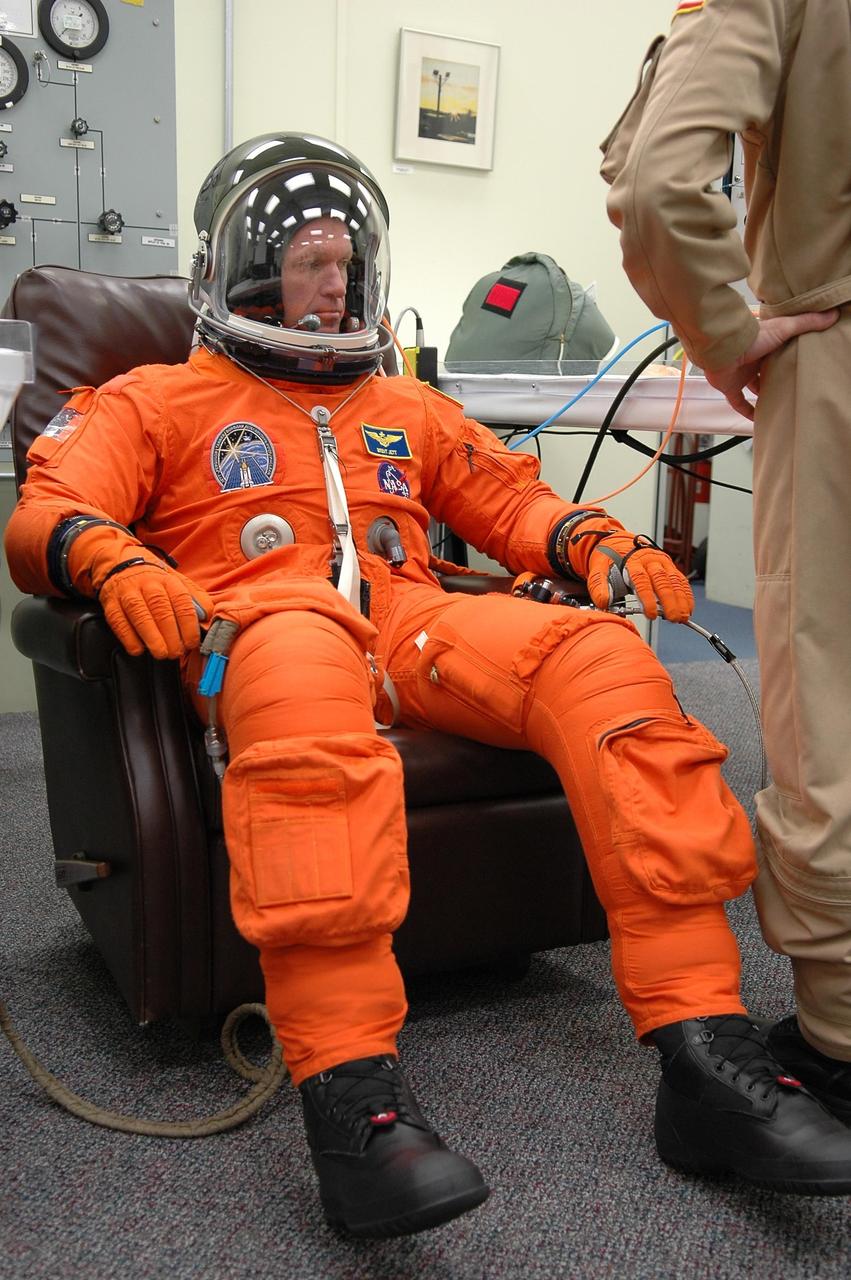
KENNEDY SPACE CENTER, FLA. - In the Operations and Checkout Building at NASA Kennedy Space Center, STS-115 Mission Commander Brent Jett finishes suiting up for another attempt at liftoff. The launch attempt on Sept. 8 was scrubbed due to an issue with a fuel cut-off sensor system inside the external fuel tank. This is one of several systems that protect the shuttle's main engines by triggering their shutdown if fuel runs unexpectedly low. During the STS-115 mission, Atlantis' astronauts will deliver and install the 17.5-ton, bus-sized P3/P4 integrated truss segment on the station. The girder-like truss includes a set of giant solar arrays, batteries and associated electronics and will provide one-fourth of the total power-generation capability for the completed station. This mission is the 116th space shuttle flight, the 27th flight for orbiter Atlantis, and the 19th U.S. flight to the ISS. STS-115 is scheduled to last 11 days with a planned landing at KSC. Photo credit: NASA/Kim Shiflett
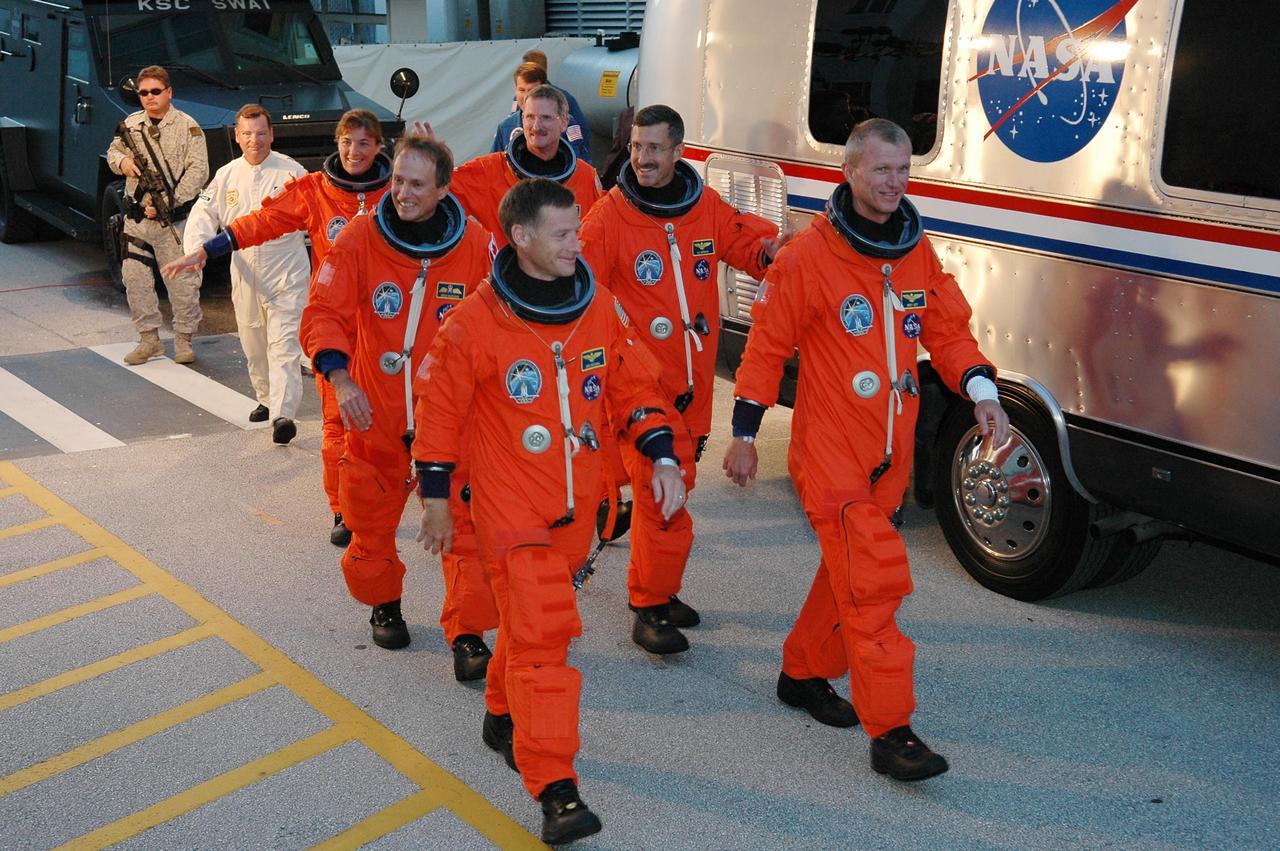
KENNEDY SPACE CENTER, FLA. - The STS-115 mission crew happily heads to the Astrovan for the ride to Launch Pad 39B and another attempt at liftoff. From the left, in the back row are Mission Specialists Heidemarie Stefanyshyn-Piper and Joseph Tanner; in the center row are Mission Specialists Steven MacLean and Daniel Burbank; in the front row leading the way are Pilot Christopher Ferguson and Commander Brent Jett. The launch attempt on Sept. 8 was scrubbed due to an issue with a fuel cut-off sensor system inside the external fuel tank. This is one of several systems that protect the shuttle's main engines by triggering their shutdown if fuel runs unexpectedly low. During the STS-115 mission, Atlantis' astronauts will deliver and install the 17.5-ton, bus-sized P3/P4 integrated truss segment on the station. The girder-like truss includes a set of giant solar arrays, batteries and associated electronics and will provide one-fourth of the total power-generation capability for the completed station. This mission is the 116th space shuttle flight, the 27th flight for orbiter Atlantis, and the 19th U.S. flight to the ISS. STS-115 is scheduled to last 11 days with a planned landing at KSC. Photo credit: NASA/Kim Shiflett
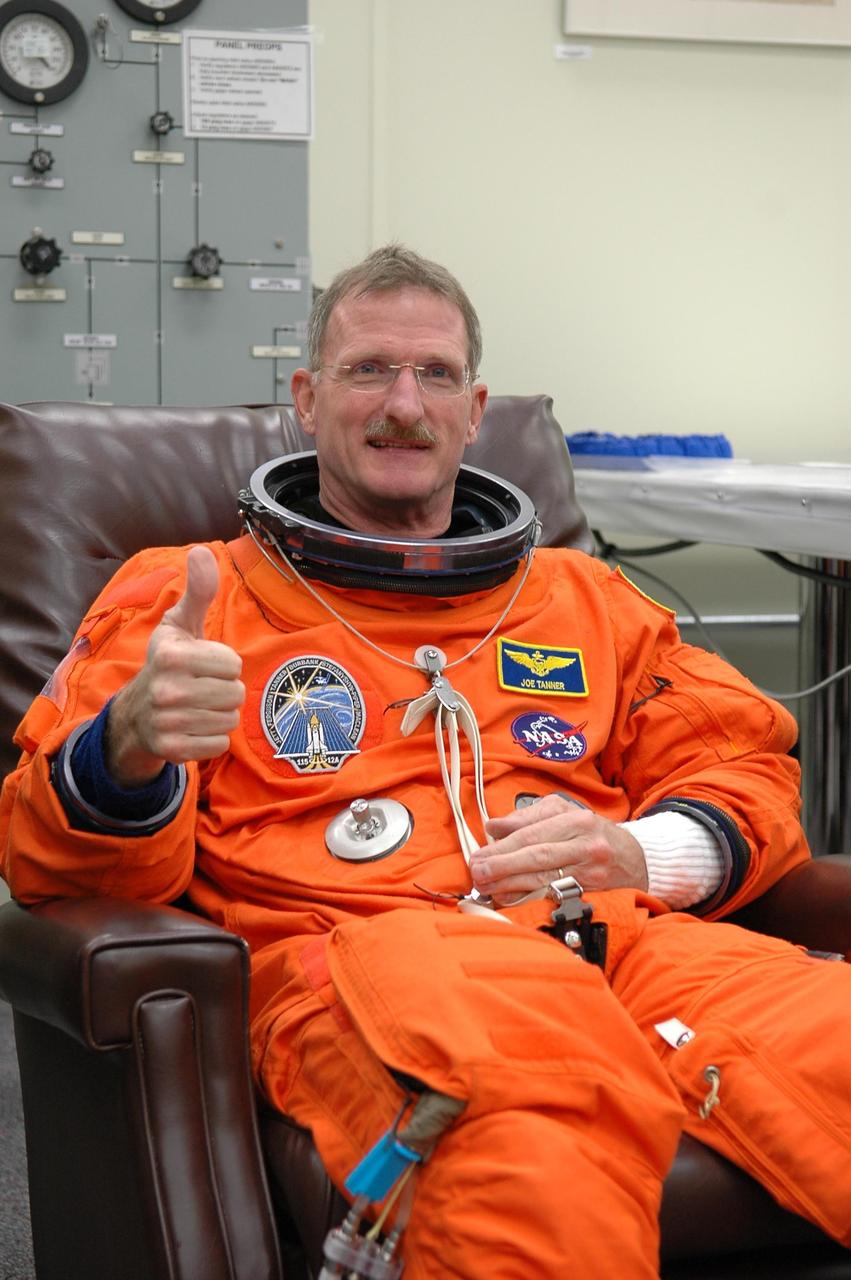
KENNEDY SPACE CENTER, FLA. - During suitup in the Operations and Checkout Building at NASA Kennedy Space Center, STS-115 Mission Specialist Joseph Tanner signals a "go" for another attempt at liftoff. The launch attempt on Sept. 8 was scrubbed due to an issue with a fuel cut-off sensor system inside the external fuel tank. This is one of several systems that protect the shuttle's main engines by triggering their shutdown if fuel runs unexpectedly low. During the STS-115 mission, Atlantis' astronauts will deliver and install the 17.5-ton, bus-sized P3/P4 integrated truss segment on the station. The girder-like truss includes a set of giant solar arrays, batteries and associated electronics and will provide one-fourth of the total power-generation capability for the completed station. This mission is the 116th space shuttle flight, the 27th flight for orbiter Atlantis, and the 19th U.S. flight to the ISS. STS-115 is scheduled to last 11 days with a planned landing at KSC. Photo credit: NASA/Kim Shiflett
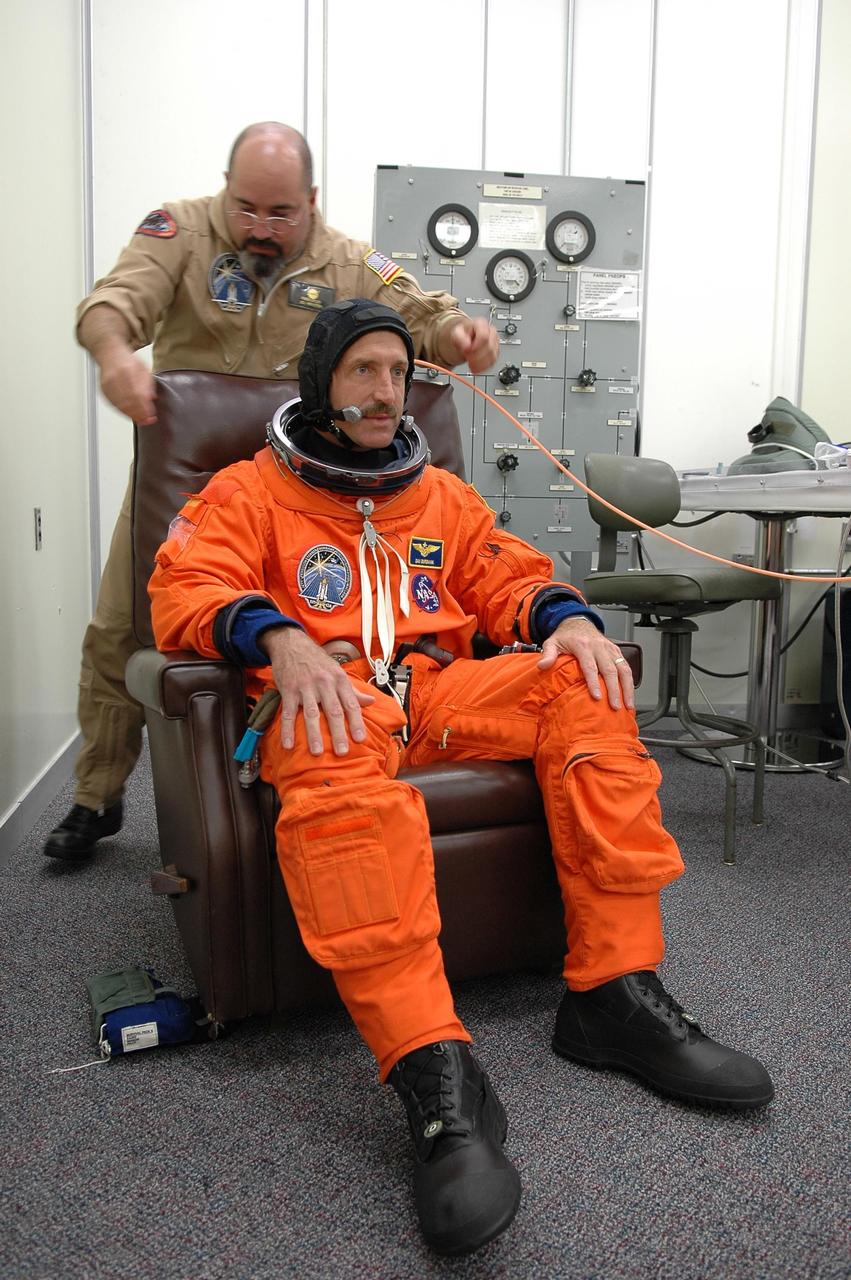
KENNEDY SPACE CENTER, FLA. - In the Operations and Checkout Building at NASA Kennedy Space Center, STS-115 Mission Specialist Daniel Burbank dons his launch and re-entry suit before heading to the launch pad for another attempt at liftoff. The launch attempt on Sept. 8 was scrubbed due to an issue with a fuel cut-off sensor system inside the external fuel tank. This is one of several systems that protect the shuttle's main engines by triggering their shutdown if fuel runs unexpectedly low. During the STS-115 mission, Atlantis' astronauts will deliver and install the 17.5-ton, bus-sized P3/P4 integrated truss segment on the station. The girder-like truss includes a set of giant solar arrays, batteries and associated electronics and will provide one-fourth of the total power-generation capability for the completed station. This mission is the 116th space shuttle flight, the 27th flight for orbiter Atlantis, and the 19th U.S. flight to the ISS. STS-115 is scheduled to last 11 days with a planned landing at KSC. Photo credit: NASA/Kim Shiflett
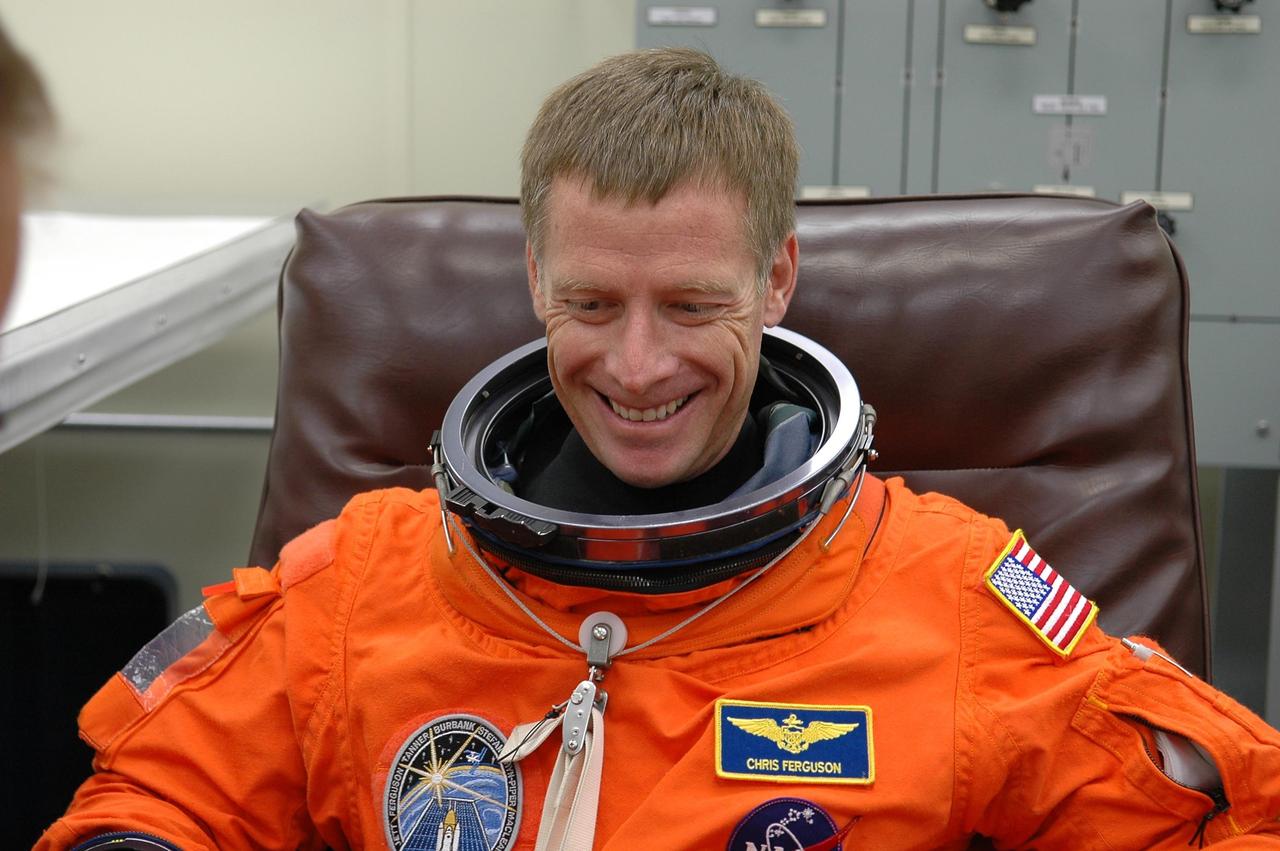
KENNEDY SPACE CENTER, FLA. - In the Operations and Checkout Building at NASA Kennedy Space Center, STS-115 Pilot Christopher Ferguson dons his launch and re-entry suit before heading to the launch pad. Ferguson is making his first shuttle flight on this mission to the International Space Station aboard Space Shuttle Atlantis. On its second attempt for launch, Atlantis is scheduled to lift off at 11:41 a.m. EDT today from Launch Pad 39B. During the STS-115 mission, Atlantis' astronauts will deliver and install the 17.5-ton, bus-sized P3/P4 integrated truss segment on the station. The girder-like truss includes a set of giant solar arrays, batteries and associated electronics and will provide one-fourth of the total power-generation capability for the completed station. This mission is the 116th space shuttle flight, the 27th flight for orbiter Atlantis, and the 19th U.S. flight to the ISS. STS-115 is scheduled to last 11 days with a planned landing at KSC. Photo credit: NASA/Kim Shiflett

KENNEDY SPACE CENTER, FLA. - In the Operations and Checkout Building at NASA Kennedy Space Center, STS-115 Mission Specialist Heidemarie Stefanyshyn-Piper is donning her launch and re-entry suit before heading to the launch pad for another attempt at liftoff. The launch attempt on Sept. 8 was scrubbed due to an issue with a fuel cut-off sensor system inside the external fuel tank. This is one of several systems that protect the shuttle's main engines by triggering their shutdown if fuel runs unexpectedly low. During the STS-115 mission, Atlantis' astronauts will deliver and install the 17.5-ton, bus-sized P3/P4 integrated truss segment on the station. The girder-like truss includes a set of giant solar arrays, batteries and associated electronics and will provide one-fourth of the total power-generation capability for the completed station. This mission is the 116th space shuttle flight, the 27th flight for orbiter Atlantis, and the 19th U.S. flight to the ISS. STS-115 is scheduled to last 11 days with a planned landing at KSC. Photo credit: NASA/Kim Shiflett
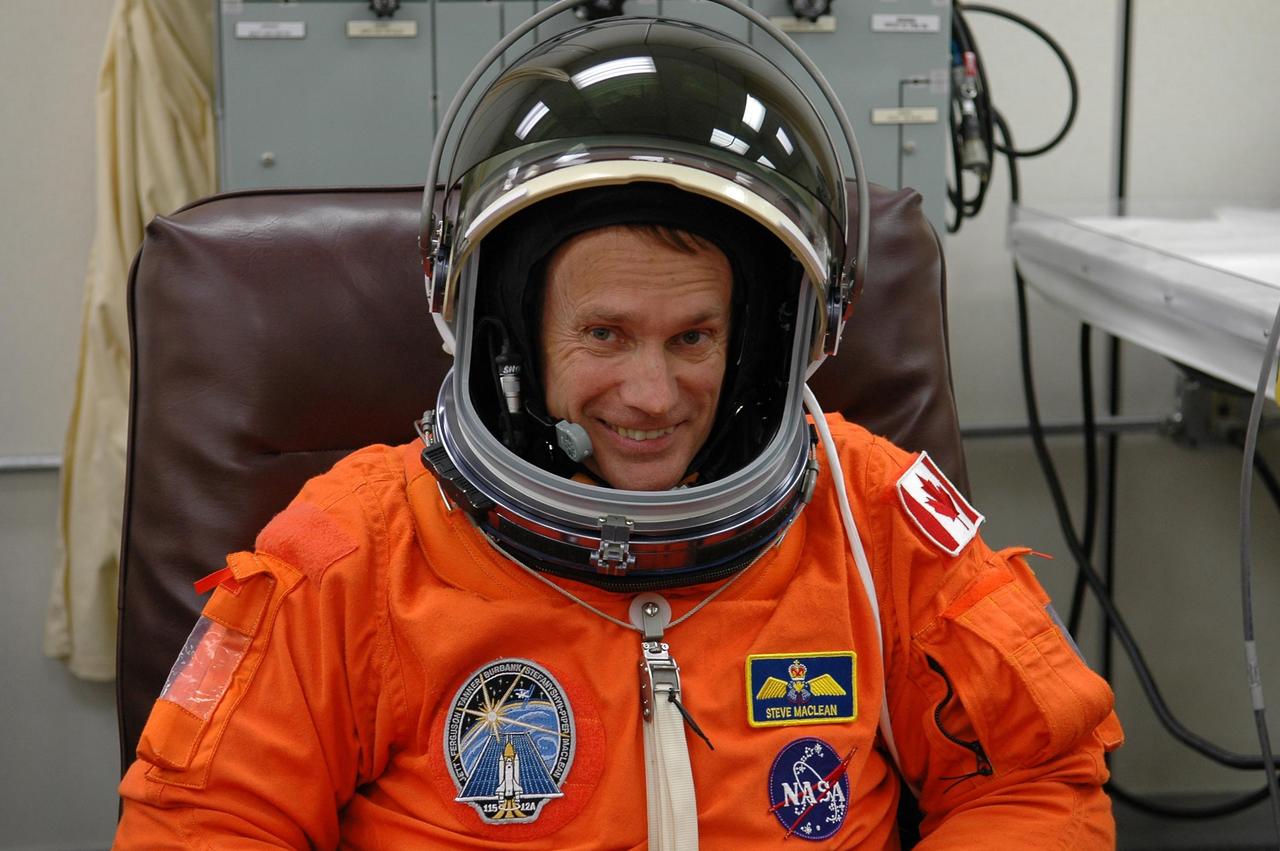
KENNEDY SPACE CENTER, FLA. - In the Operations and Checkout Building at NASA Kennedy Space Center, STS-115 Mission Specialist Steven MacLean dons his helmet to complete suiting up for another attempt at liftoff. MacLean is with the Canadian Space Agency. The launch attempt on Sept. 8 was scrubbed due to an issue with a fuel cut-off sensor system inside the external fuel tank. This is one of several systems that protect the shuttle's main engines by triggering their shutdown if fuel runs unexpectedly low. During the STS-115 mission, Atlantis' astronauts will deliver and install the 17.5-ton, bus-sized P3/P4 integrated truss segment on the station. The girder-like truss includes a set of giant solar arrays, batteries and associated electronics and will provide one-fourth of the total power-generation capability for the completed station. This mission is the 116th space shuttle flight, the 27th flight for orbiter Atlantis, and the 19th U.S. flight to the ISS. STS-115 is scheduled to last 11 days with a planned landing at KSC. Photo credit: NASA/Kim Shiflett
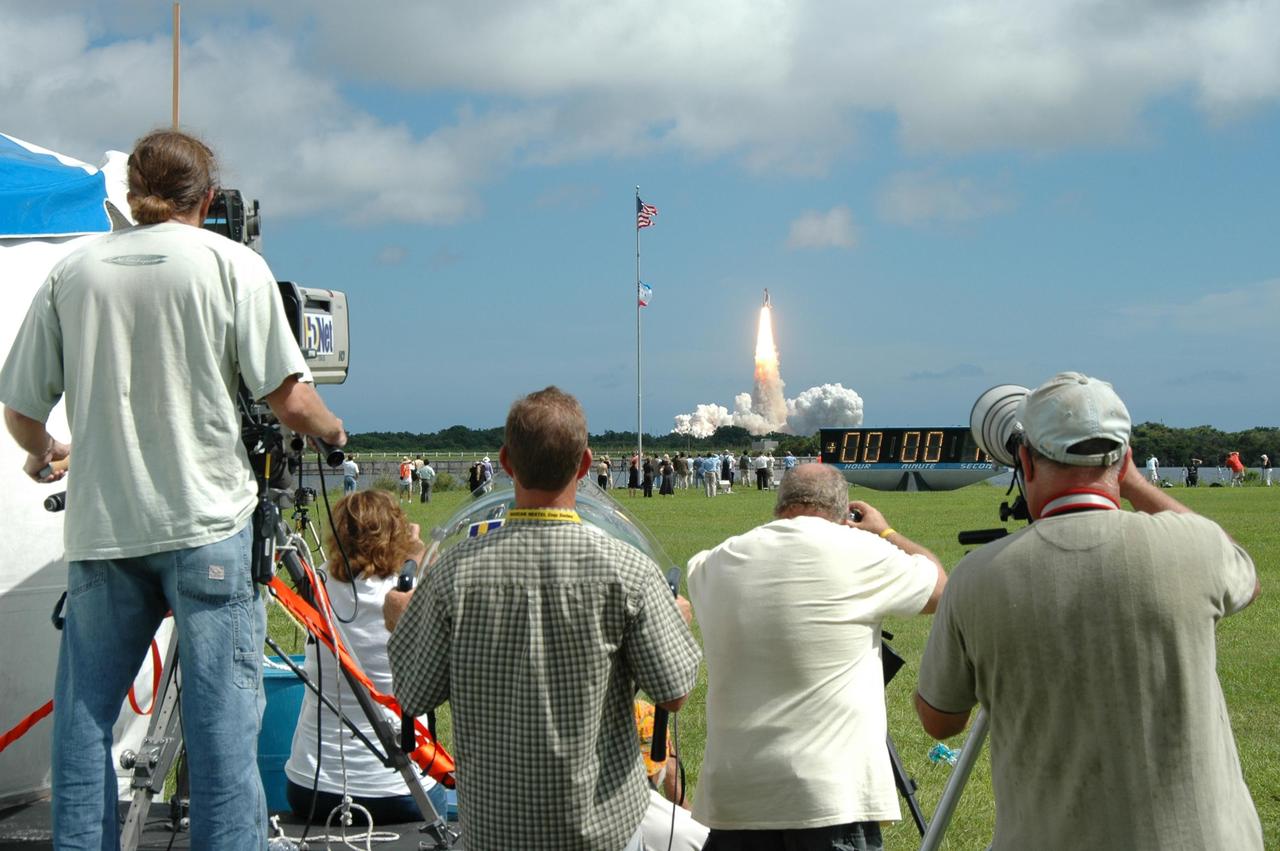
KENNEDY SPACE CENTER, FLA. - Space Shuttle Atlantis roars off the launch pad for a rendezvous with the International Space Station on mission STS-115. In the foreground are only a few of the hundreds of photographers capturing the historic scene from the grounds of the NASA News Center. Just beyond them is the countdown clock, marking launch and mission-elapsed time. After launch attempts were scrubbed Aug. 27 and 29 and Sept. 3 and 8 due to weather and technical concerns, this launch was executed perfectly. During the STS-115 mission, Atlantis' astronauts will deliver and install the 17.5-ton, bus-sized P3/P4 integrated truss segment on the station. The girder-like truss includes a set of giant solar arrays, batteries and associated electronics and will provide one-fourth of the total power-generation capability for the completed station. This mission is the 116th space shuttle flight, the 27th flight for orbiter Atlantis, and the 19th U.S. flight to the ISS. STS-115 is scheduled to last 11 days with a planned landing at KSC. Photo credit: NASA/Jim Grossmann
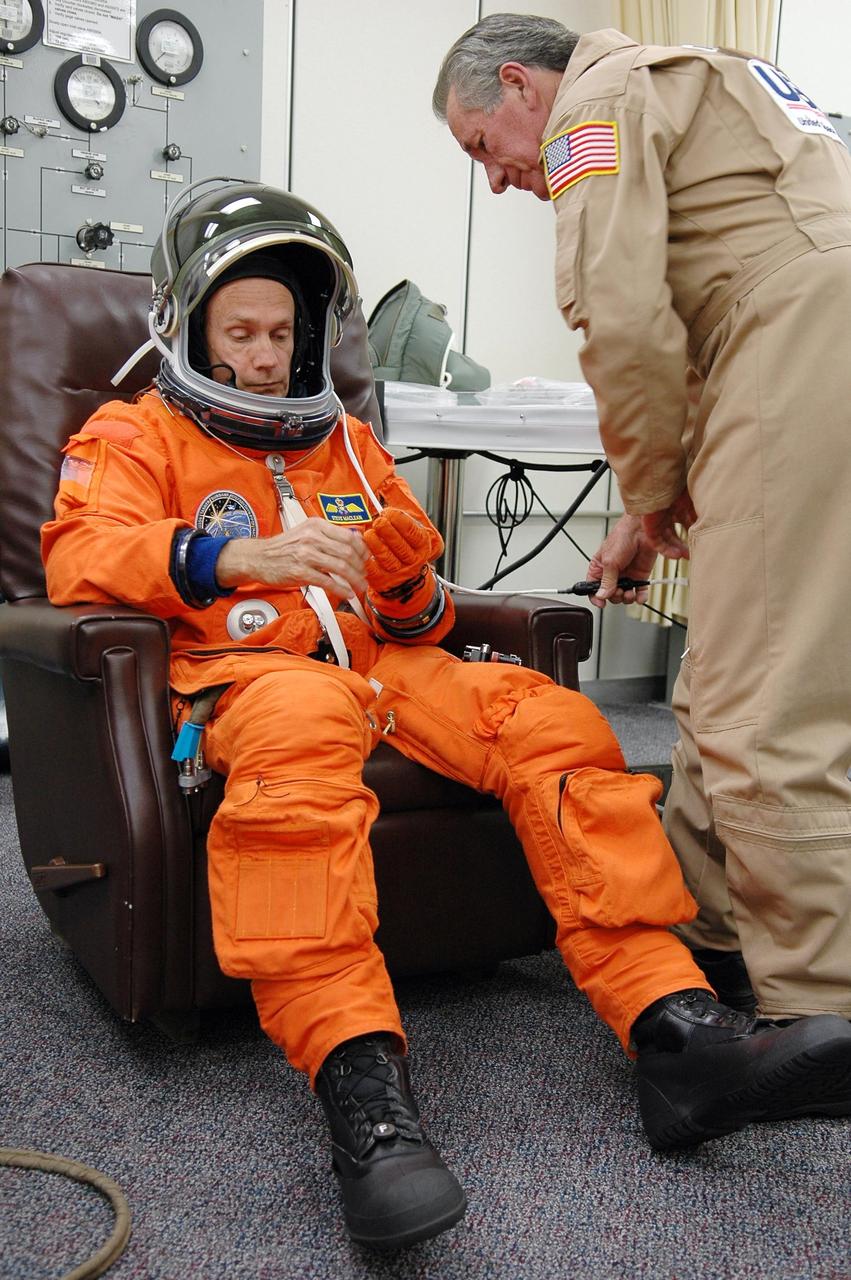
KENNEDY SPACE CENTER, FLA. - In the Operations and Checkout Building at NASA Kennedy Space Center, STS-115 Mission Specialist Steven MacLean checks his glove during suitup before heading to the launch pad. MacLean is with the Canadian Space Agency. MacLean is making his second shuttle flight on this mission to the International Space Station aboard Space Shuttle Atlantis. On its second attempt for launch, Atlantis is scheduled to lift off at 11:41 a.m. EDT today from Launch Pad 39B. During the STS-115 mission, Atlantis' astronauts will deliver and install the 17.5-ton, bus-sized P3/P4 integrated truss segment on the station. The girder-like truss includes a set of giant solar arrays, batteries and associated electronics and will provide one-fourth of the total power-generation capability for the completed station. This mission is the 116th space shuttle flight, the 27th flight for orbiter Atlantis, and the 19th U.S. flight to the ISS. STS-115 is scheduled to last 11 days with a planned landing at KSC. Photo credit: NASA/Kim Shiflett
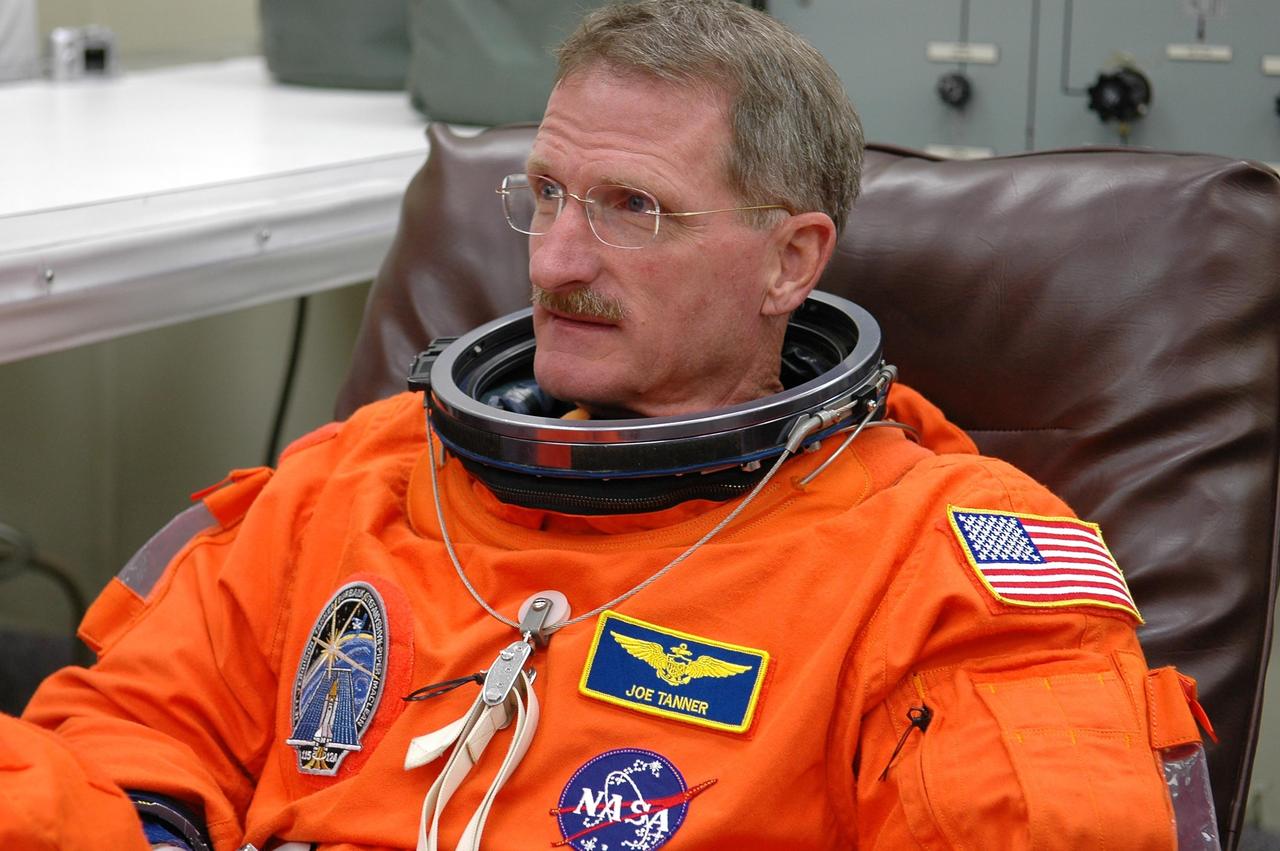
KENNEDY SPACE CENTER, FLA. - In the Operations and Checkout Building at NASA Kennedy Space Center, STS-115 Mission Specialist Joseph Tanner waits to complete suiting up before heading to the launch pad. Tanner is making his fourth shuttle flight on this mission to the International Space Station aboard Space Shuttle Atlantis. On its second attempt for launch, Atlantis is scheduled to lift off at 11:41 a.m. EDT today from Launch Pad 39B. During the STS-115 mission, Atlantis' astronauts will deliver and install the 17.5-ton, bus-sized P3/P4 integrated truss segment on the station. The girder-like truss includes a set of giant solar arrays, batteries and associated electronics and will provide one-fourth of the total power-generation capability for the completed station. This mission is the 116th space shuttle flight, the 27th flight for orbiter Atlantis, and the 19th U.S. flight to the ISS. STS-115 is scheduled to last 11 days with a planned landing at KSC. Photo credit: NASA/Kim Shiflett
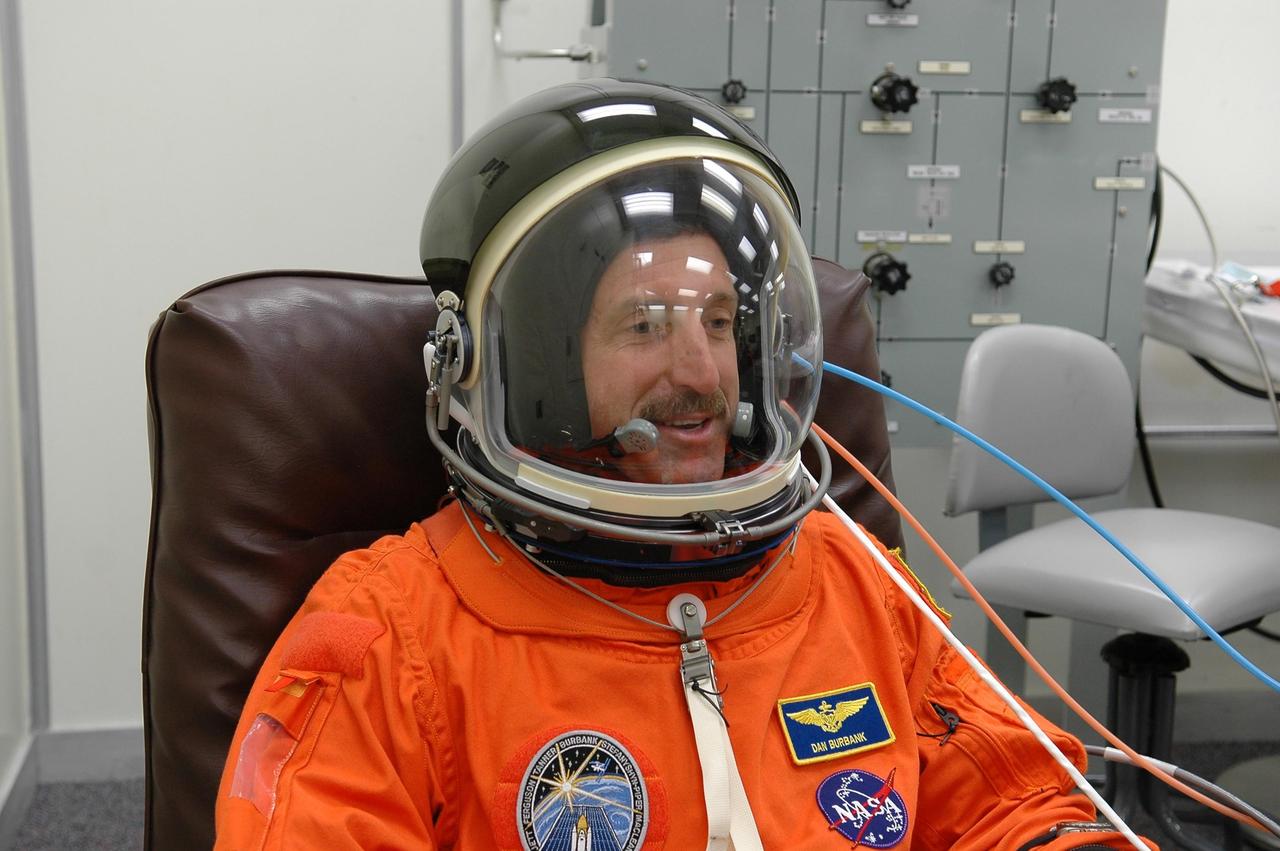
KENNEDY SPACE CENTER, FLA. - During suitup in the Operations and Checkout Building at NASA Kennedy Space Center, STS-115 Mission Specialist Daniel Burbank tests the communication system in his helmet. Burbank is making his second shuttle flight on this mission to the International Space Station aboard Space Shuttle Atlantis. On its second attempt for launch, Atlantis is scheduled to lift off at 11:41 a.m. EDT today from Launch Pad 39B. During the STS-115 mission, Atlantis' astronauts will deliver and install the 17.5-ton, bus-sized P3/P4 integrated truss segment on the station. The girder-like truss includes a set of giant solar arrays, batteries and associated electronics and will provide one-fourth of the total power-generation capability for the completed station. This mission is the 116th space shuttle flight, the 27th flight for orbiter Atlantis, and the 19th U.S. flight to the ISS. STS-115 is scheduled to last 11 days with a planned landing at KSC. Photo credit: NASA/Kim Shiflett
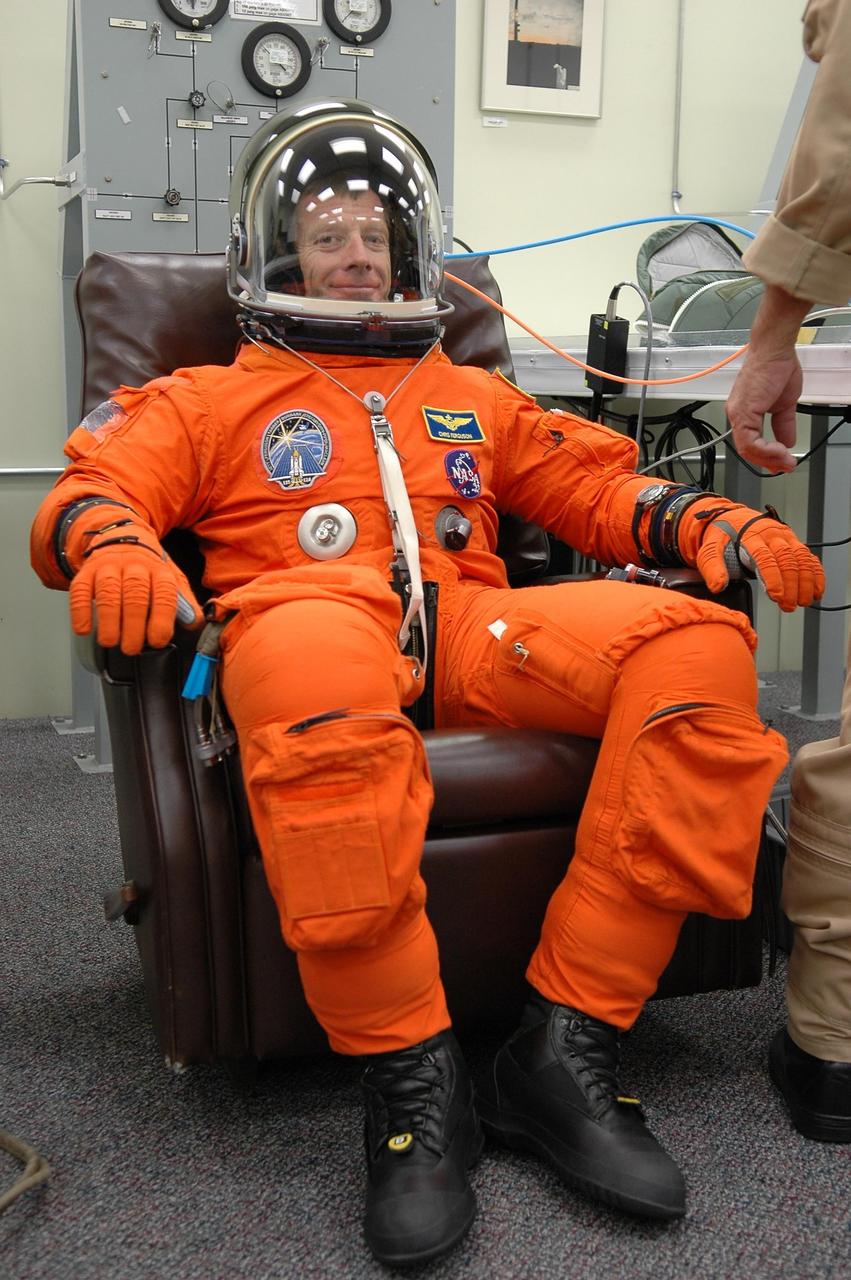
KENNEDY SPACE CENTER, FLA. - In the Operations and Checkout Building at NASA Kennedy Space Center, STS-115 Pilot Christopher Ferguson finishes suiting up for another attempt at liftoff. The launch attempt on Sept. 8 was scrubbed due to an issue with a fuel cut-off sensor system inside the external fuel tank. This is one of several systems that protect the shuttle's main engines by triggering their shutdown if fuel runs unexpectedly low. During the STS-115 mission, Atlantis' astronauts will deliver and install the 17.5-ton, bus-sized P3/P4 integrated truss segment on the station. The girder-like truss includes a set of giant solar arrays, batteries and associated electronics and will provide one-fourth of the total power-generation capability for the completed station. This mission is the 116th space shuttle flight, the 27th flight for orbiter Atlantis, and the 19th U.S. flight to the ISS. STS-115 is scheduled to last 11 days with a planned landing at KSC. Photo credit: NASA/Kim Shiflett
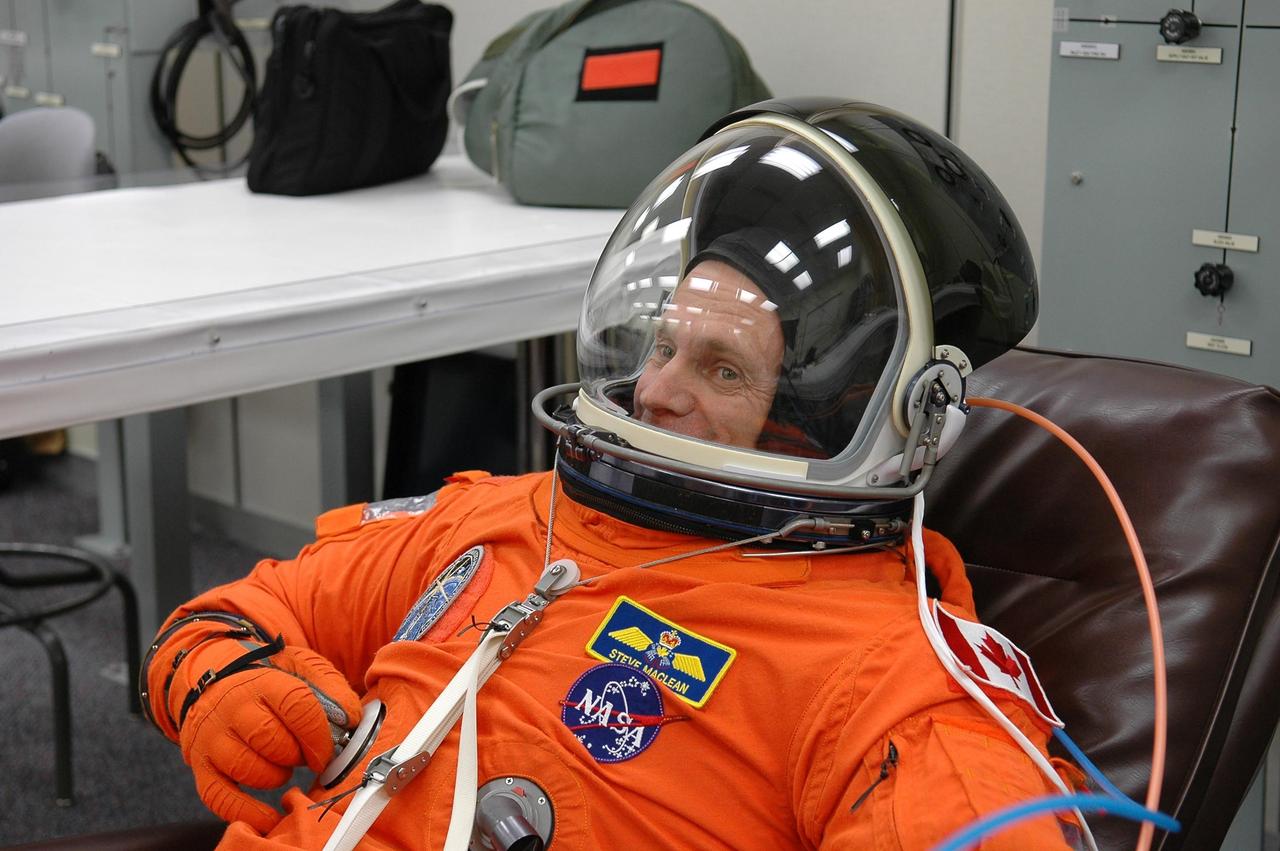
KENNEDY SPACE CENTER, FLA. - In the Operations and Checkout Building at NASA Kennedy Space Center, STS-115 Mission Specialist Steven MacLean dons his launch and re-entry suit before heading to the launch pad. MacLean is with the Canadian Space Agency. MacLean is making his second shuttle flight on this mission to the International Space Station aboard Space Shuttle Atlantis. On its second attempt for launch, Atlantis is scheduled to lift off at 11:41 a.m. EDT today from Launch Pad 39B. During the STS-115 mission, Atlantis' astronauts will deliver and install the 17.5-ton, bus-sized P3/P4 integrated truss segment on the station. The girder-like truss includes a set of giant solar arrays, batteries and associated electronics and will provide one-fourth of the total power-generation capability for the completed station. This mission is the 116th space shuttle flight, the 27th flight for orbiter Atlantis, and the 19th U.S. flight to the ISS. STS-115 is scheduled to last 11 days with a planned landing at KSC. Photo credit: NASA/Kim Shiflett
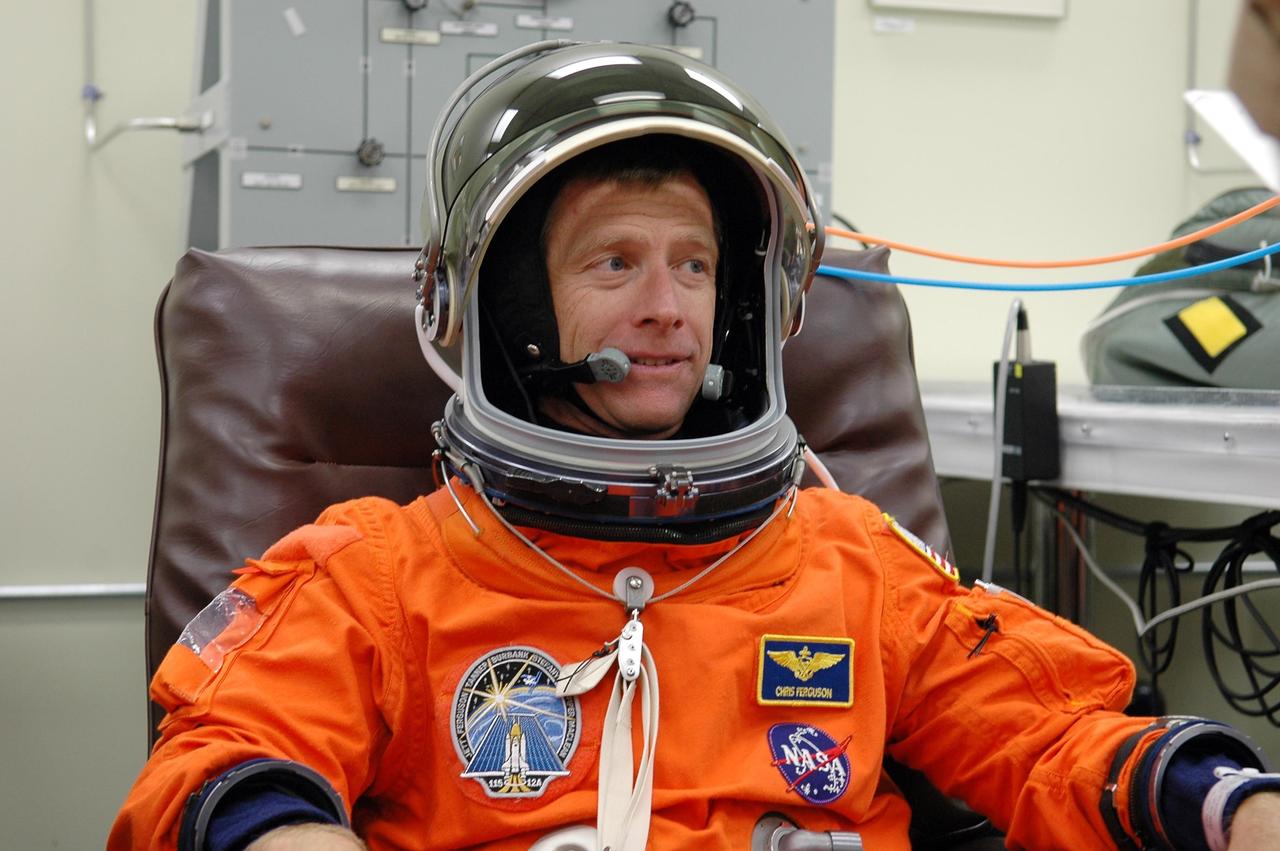
KENNEDY SPACE CENTER, FLA. - In the Operations and Checkout Building at NASA Kennedy Space Center, STS-115 Pilot Christopher Ferguson checks his helmet during suitup before heading to the launch pad. Ferguson is making his first shuttle flight on this mission to the International Space Station aboard Space Shuttle Atlantis. On its second attempt for launch, Atlantis is scheduled to lift off at 11:41 a.m. EDT today from Launch Pad 39B. During the STS-115 mission, Atlantis' astronauts will deliver and install the 17.5-ton, bus-sized P3/P4 integrated truss segment on the station. The girder-like truss includes a set of giant solar arrays, batteries and associated electronics and will provide one-fourth of the total power-generation capability for the completed station. This mission is the 116th space shuttle flight, the 27th flight for orbiter Atlantis, and the 19th U.S. flight to the ISS. STS-115 is scheduled to last 11 days with a planned landing at KSC. Photo credit: NASA/Kim Shiflett
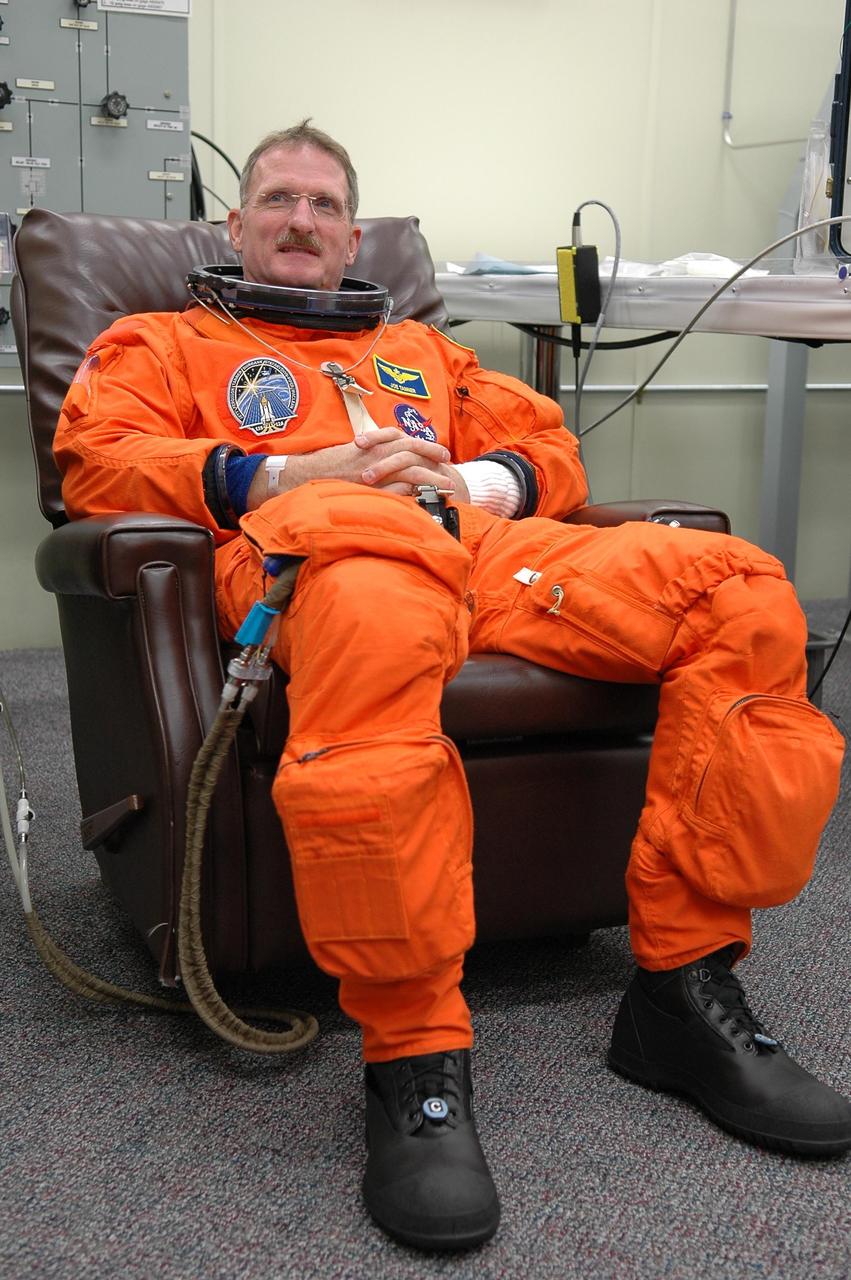
KENNEDY SPACE CENTER, FLA. - In the Operations and Checkout Building at NASA Kennedy Space Center, STS-115 Mission Specialist Joseph Tanner dons his launch and re-entry suit before heading to the launch pad. Tanner is making his fourth shuttle flight on this mission to the International Space Station aboard Space Shuttle Atlantis. On its second attempt for launch, Atlantis is scheduled to lift off at 11:41 a.m. EDT today from Launch Pad 39B. During the STS-115 mission, Atlantis' astronauts will deliver and install the 17.5-ton, bus-sized P3/P4 integrated truss segment on the station. The girder-like truss includes a set of giant solar arrays, batteries and associated electronics and will provide one-fourth of the total power-generation capability for the completed station. This mission is the 116th space shuttle flight, the 27th flight for orbiter Atlantis, and the 19th U.S. flight to the ISS. STS-115 is scheduled to last 11 days with a planned landing at KSC. Photo credit: NASA/Kim Shiflett
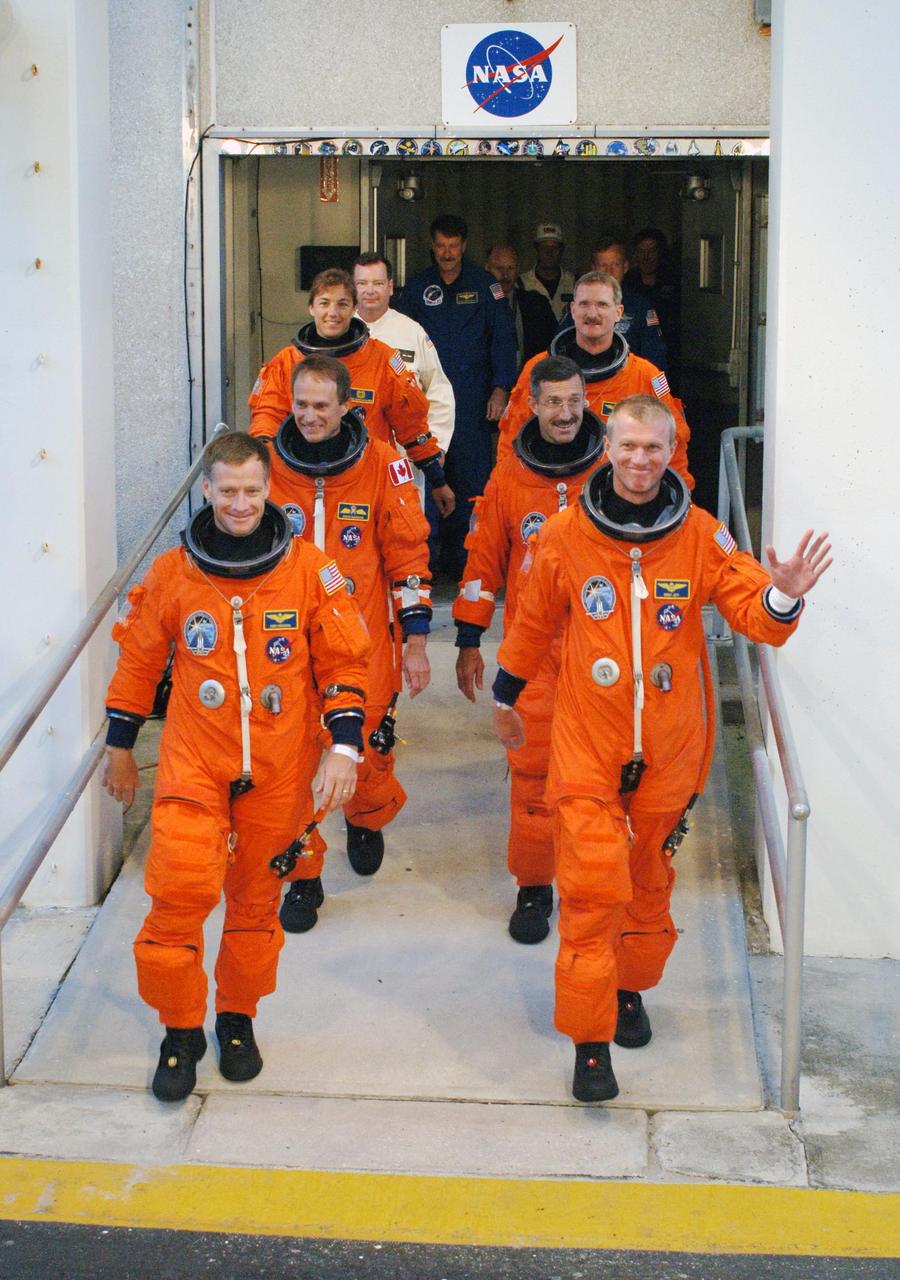
KENNEDY SPACE CENTER, FLA. - After suiting up, the STS-115 mission crew exits the Operations and Checkout Building to board the Astrovan to Launch Pad 39B. On the left, front to back, are Pilot Christopher Ferguson and Mission Specialists Steven MacLean and Heidemarie Stefanyshyn-Piper. On the right, front to back, are Commander Brent Jett and Mission Specialists Daniel Burbank and Joseph Tanner. The launch attempt on Sept. 8 was scrubbed due to an issue with a fuel cut-off sensor system inside the external fuel tank. This is one of several systems that protect the shuttle's main engines by triggering their shutdown if fuel runs unexpectedly low. During the STS-115 mission, Atlantis' astronauts will deliver and install the 17.5-ton, bus-sized P3/P4 integrated truss segment on the station. The girder-like truss includes a set of giant solar arrays, batteries and associated electronics and will provide one-fourth of the total power-generation capability for the completed station. This mission is the 116th space shuttle flight, the 27th flight for orbiter Atlantis, and the 19th U.S. flight to the ISS. STS-115 is scheduled to last 11 days with a planned landing at KSC. Photo credit: NASA/Kim Shiflett
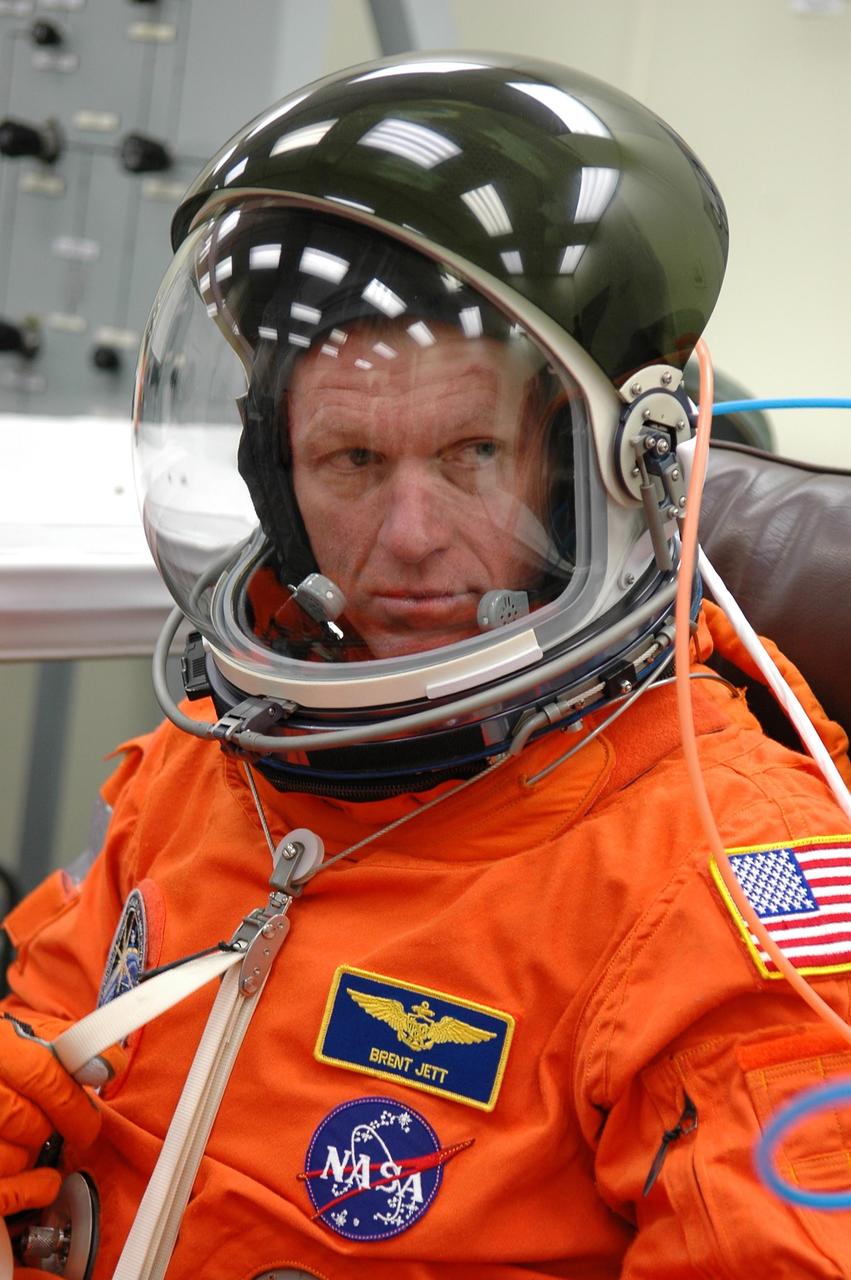
KENNEDY SPACE CENTER, FLA. - In the Operations and Checkout Building at NASA Kennedy Space Center, STS-115 Commander Brent Jett looks reflective as he suits up for launch before heading to the launch pad. Jett is making his fourth shuttle flight on this mission to the International Space Station aboard Space Shuttle Atlantis. On its second attempt for launch, Atlantis is scheduled to lift off at 11:41 a.m. EDT today from Launch Pad 39B. During the STS-115 mission, Atlantis' astronauts will deliver and install the 17.5-ton, bus-sized P3/P4 integrated truss segment on the station. The girder-like truss includes a set of giant solar arrays, batteries and associated electronics and will provide one-fourth of the total power-generation capability for the completed station. This mission is the 116th space shuttle flight, the 27th flight for orbiter Atlantis, and the 19th U.S. flight to the ISS. STS-115 is scheduled to last 11 days with a planned landing at KSC. Photo credit: NASA/Kim Shiflett
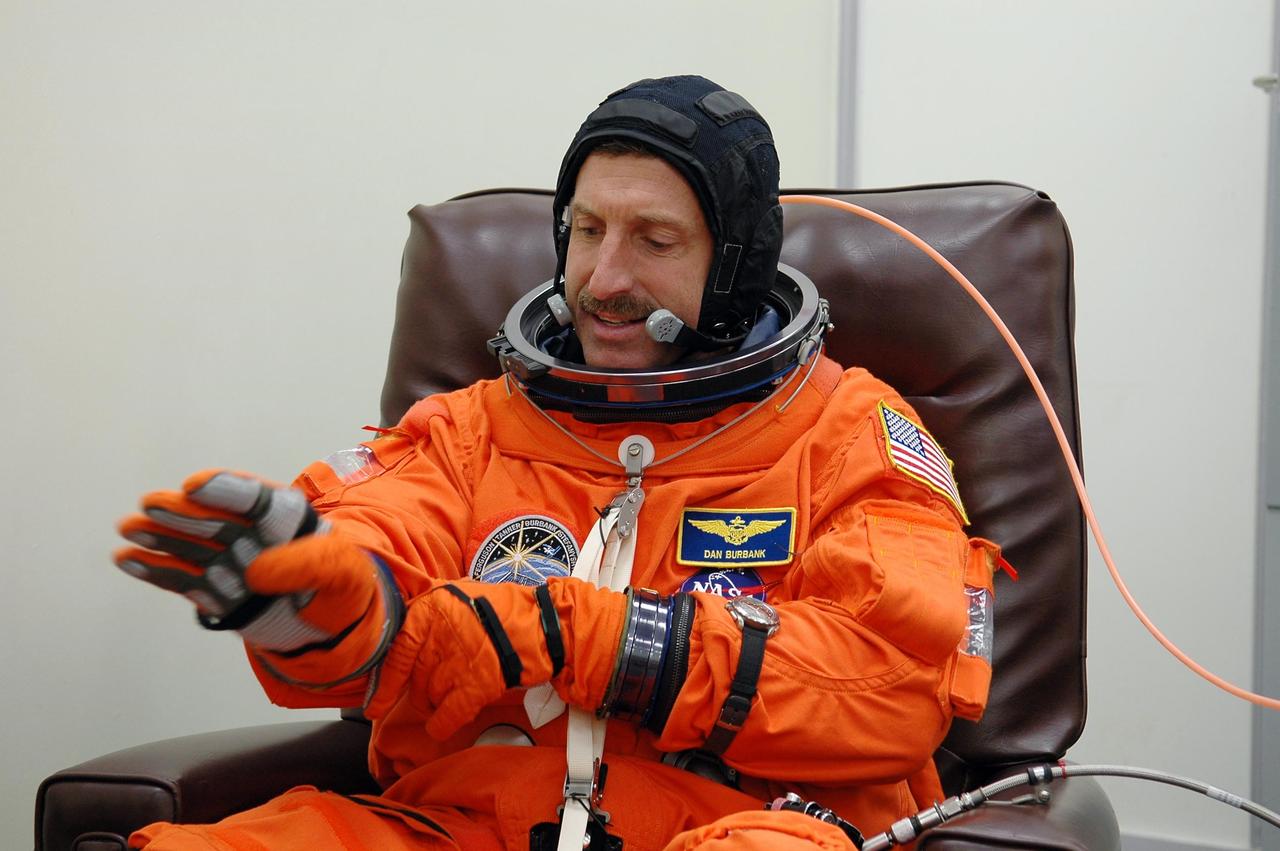
KENNEDY SPACE CENTER, FLA. - In the Operations and Checkout Building at NASA Kennedy Space Center, STS-115 Mission Specialist Daniel Burbank adjusts his glove during suitup before heading to the launch pad. Burbank is making his second shuttle flight on this mission to the International Space Station aboard Space Shuttle Atlantis. On its second attempt for launch, Atlantis is scheduled to lift off at 11:41 a.m. EDT today from Launch Pad 39B. During the STS-115 mission, Atlantis' astronauts will deliver and install the 17.5-ton, bus-sized P3/P4 integrated truss segment on the station. The girder-like truss includes a set of giant solar arrays, batteries and associated electronics and will provide one-fourth of the total power-generation capability for the completed station. This mission is the 116th space shuttle flight, the 27th flight for orbiter Atlantis, and the 19th U.S. flight to the ISS. STS-115 is scheduled to last 11 days with a planned landing at KSC. Photo credit: NASA/Kim Shiflett
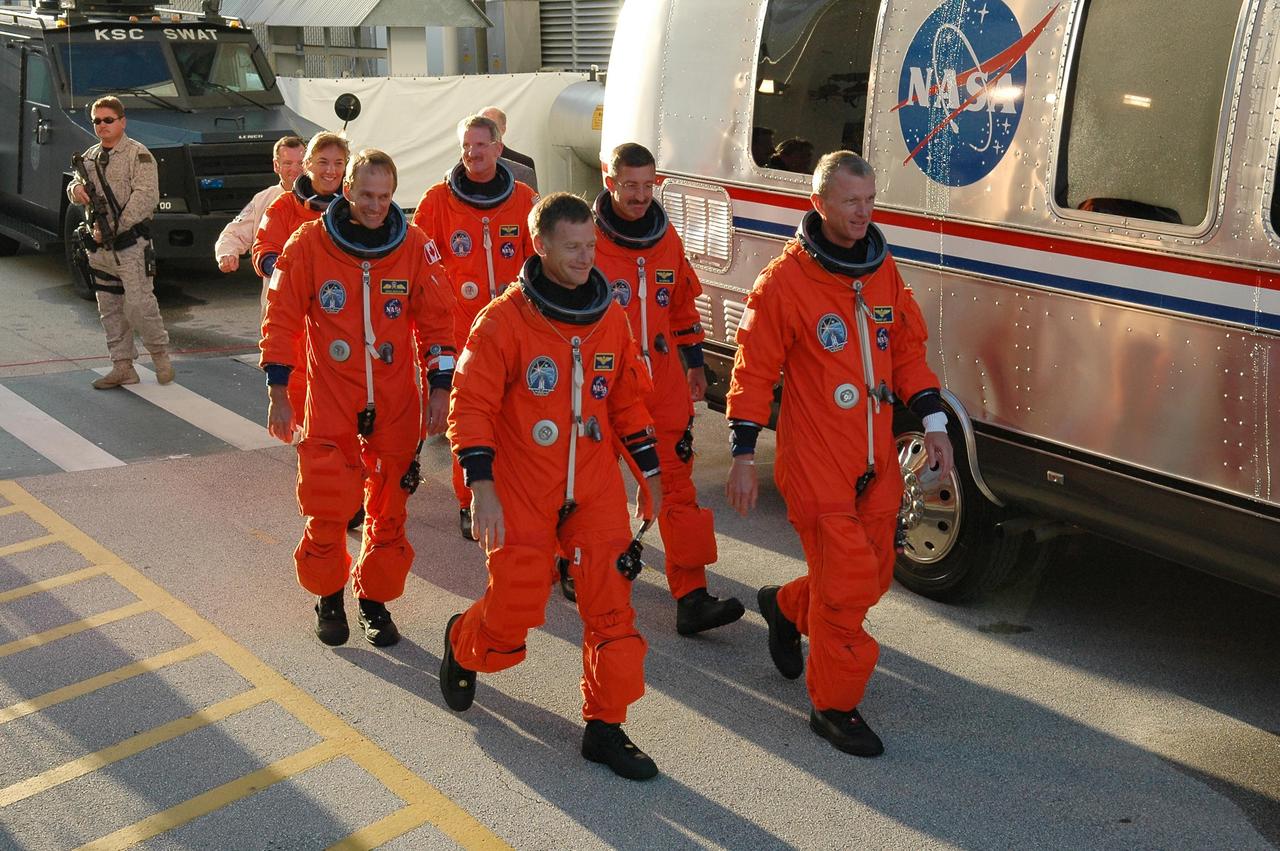
KENNEDY SPACE CENTER, FLA. - The STS-115 crew members walk toward the Astrovan that will take them to Launch Pad 39B. Seen left to right are Mission Specialists Heidemarie Stefanyshyn-Piper, Steven MacLean, Joseph Tanner and Daniel Burbank; Pilot Christopher Ferguson; and Commander Brent Jett. This is the second attempt at launch after a week's postponement due to weather and technical concerns. Atlantis is scheduled to lift off at 11:41 a.m. EDT on this date from Launch Pad 39B. During the STS-115 mission, Atlantis' astronauts will deliver and install the 17.5-ton, bus-sized P3/P4 integrated truss segment on the station. The girder-like truss includes a set of giant solar arrays, batteries and associated electronics and will provide one-fourth of the total power-generation capability for the completed station. This mission is the 116th space shuttle flight, the 27th flight for orbiter Atlantis, and the 19th U.S. flight to the ISS. STS-115 is scheduled to last 11 days with a planned landing at KSC. Photo credit: NASA/Kim Shiflett
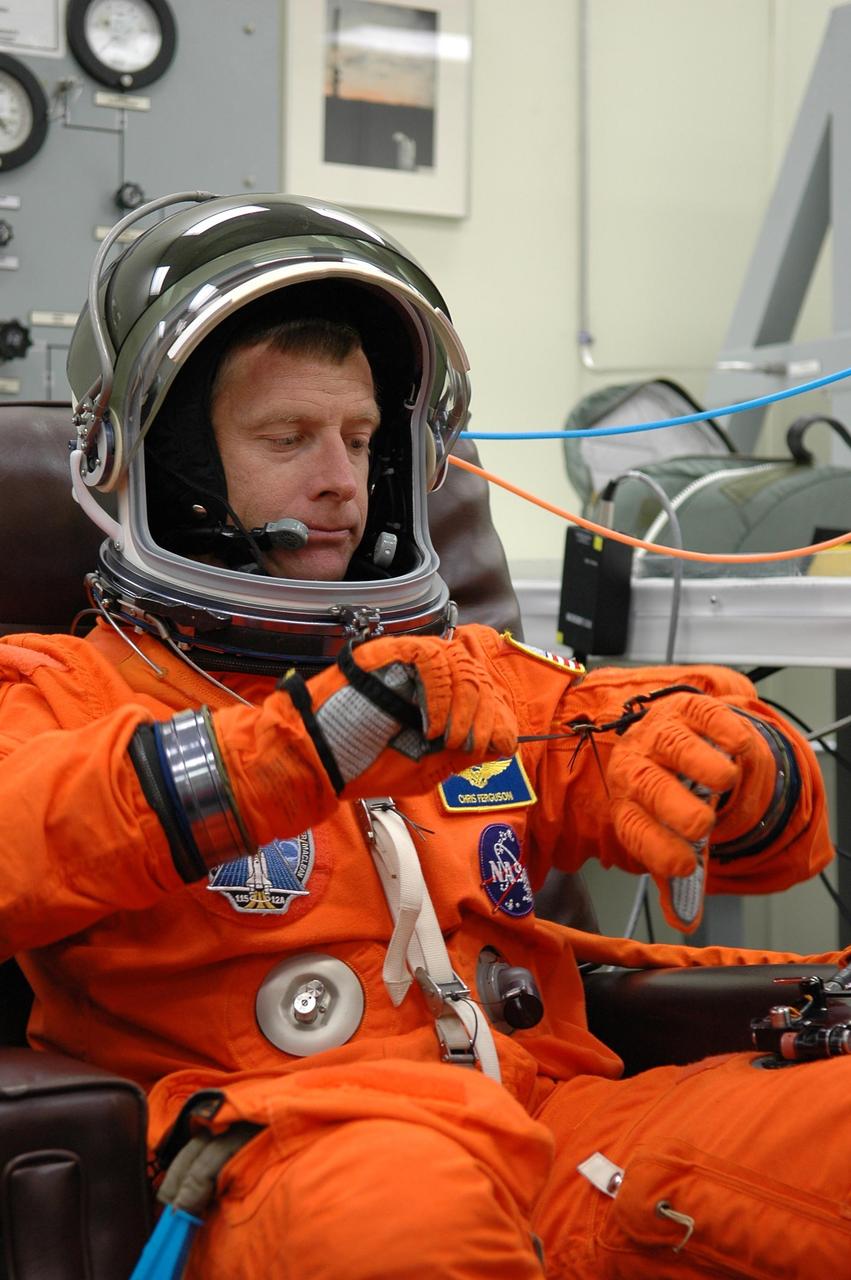
KENNEDY SPACE CENTER, FLA. - In the Operations and Checkout Building at NASA Kennedy Space Center, STS-115 Pilot Christopher Ferguson adjusts his glove during suitup before heading to the launch pad for another attempt at liftoff. The launch attempt on Sept. 8 was scrubbed due to an issue with a fuel cut-off sensor system inside the external fuel tank. This is one of several systems that protect the shuttle's main engines by triggering their shutdown if fuel runs unexpectedly low. During the STS-115 mission, Atlantis' astronauts will deliver and install the 17.5-ton, bus-sized P3/P4 integrated truss segment on the station. The girder-like truss includes a set of giant solar arrays, batteries and associated electronics and will provide one-fourth of the total power-generation capability for the completed station. This mission is the 116th space shuttle flight, the 27th flight for orbiter Atlantis, and the 19th U.S. flight to the ISS. STS-115 is scheduled to last 11 days with a planned landing at KSC. Photo credit: NASA/Kim Shiflett
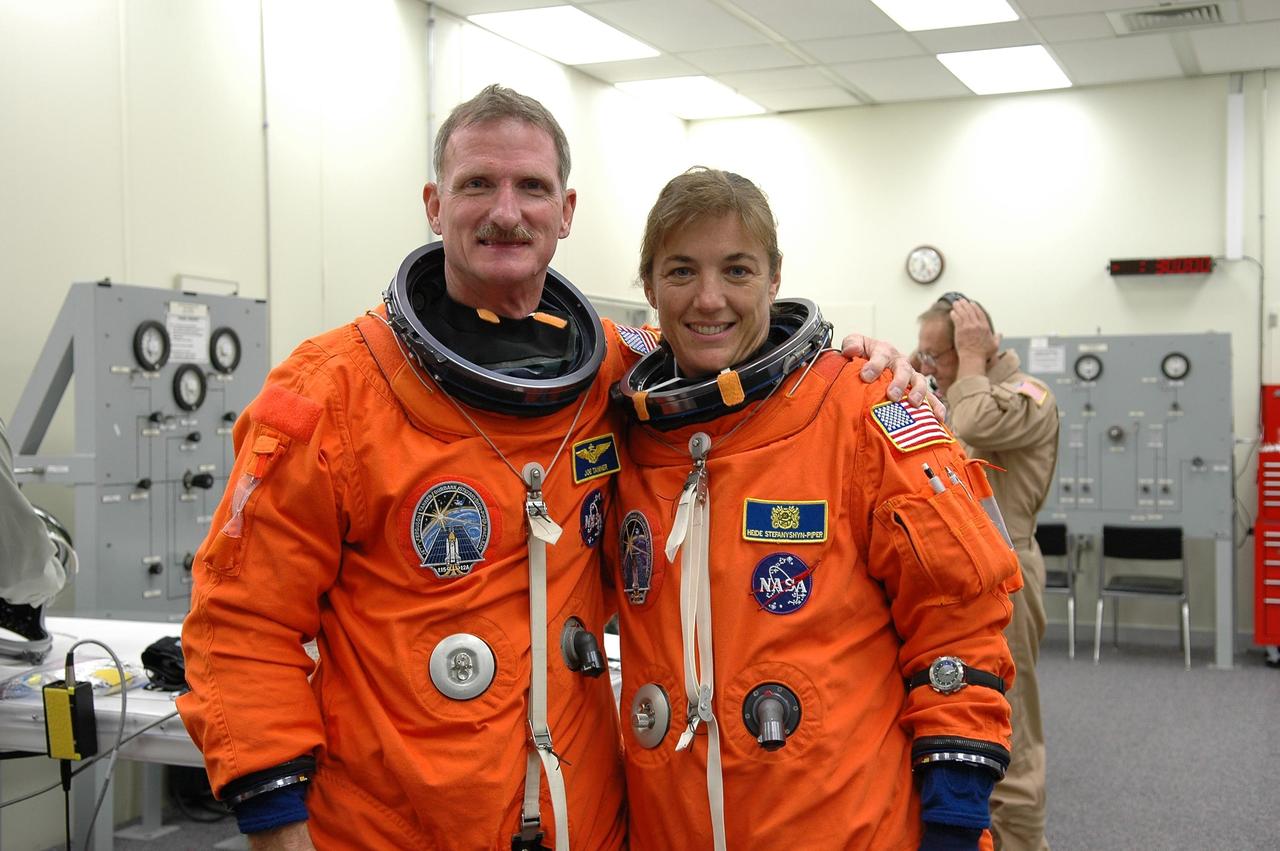
KENNEDY SPACE CENTER, FLA. - In the Operations and Checkout Building at NASA Kennedy Space Center, STS-115 Mission Specialists Joseph Tanner and Heidemarie Stefanyshyn-Piper pose while suiting up for the ride to Launch Pad 39B and another attempt at liftoff. The launch attempt on Sept. 8 was scrubbed due to an issue with a fuel cut-off sensor system inside the external fuel tank. This is one of several systems that protect the shuttle's main engines by triggering their shutdown if fuel runs unexpectedly low. During the STS-115 mission, Atlantis' astronauts will deliver and install the 17.5-ton, bus-sized P3/P4 integrated truss segment on the station. The girder-like truss includes a set of giant solar arrays, batteries and associated electronics and will provide one-fourth of the total power-generation capability for the completed station. This mission is the 116th space shuttle flight, the 27th flight for orbiter Atlantis, and the 19th U.S. flight to the ISS. STS-115 is scheduled to last 11 days with a planned landing at KSC. Photo credit: NASA/Kim Shiflett

KENNEDY SPACE CENTER, FLA. - STS-115 Mission Specialist Heidemarie Stefanyshyn-Piper waves during suitup in the Operations and Checkout Building at NASA Kennedy Space Center. She is making her first shuttle flight on this mission to the International Space Station aboard Space Shuttle Atlantis. On its second attempt for launch, Atlantis is scheduled to lift off at 11:41 a.m. EDT today from Launch Pad 39B. During the STS-115 mission, Atlantis' astronauts will deliver and install the 17.5-ton, bus-sized P3/P4 integrated truss segment on the station. The girder-like truss includes a set of giant solar arrays, batteries and associated electronics and will provide one-fourth of the total power-generation capability for the completed station. This mission is the 116th space shuttle flight, the 27th flight for orbiter Atlantis, and the 19th U.S. flight to the ISS. STS-115 is scheduled to last 11 days with a planned landing at KSC. Photo credit: NASA/Kim Shiflett

KENNEDY SPACE CENTER, FLA. - In the Operations and Checkout Building at NASA Kennedy Space Center, STS-115 Mission Specialist Steven MacLean signals "go" for another attempt at liftoff. MacLean is with the Canadian Space Agency. The launch attempt on Sept. 8 was scrubbed due to an issue with a fuel cut-off sensor system inside the external fuel tank. This is one of several systems that protect the shuttle's main engines by triggering their shutdown if fuel runs unexpectedly low. During the STS-115 mission, Atlantis' astronauts will deliver and install the 17.5-ton, bus-sized P3/P4 integrated truss segment on the station. The girder-like truss includes a set of giant solar arrays, batteries and associated electronics and will provide one-fourth of the total power-generation capability for the completed station. This mission is the 116th space shuttle flight, the 27th flight for orbiter Atlantis, and the 19th U.S. flight to the ISS. STS-115 is scheduled to last 11 days with a planned landing at KSC. Photo credit: NASA/Kim Shiflett
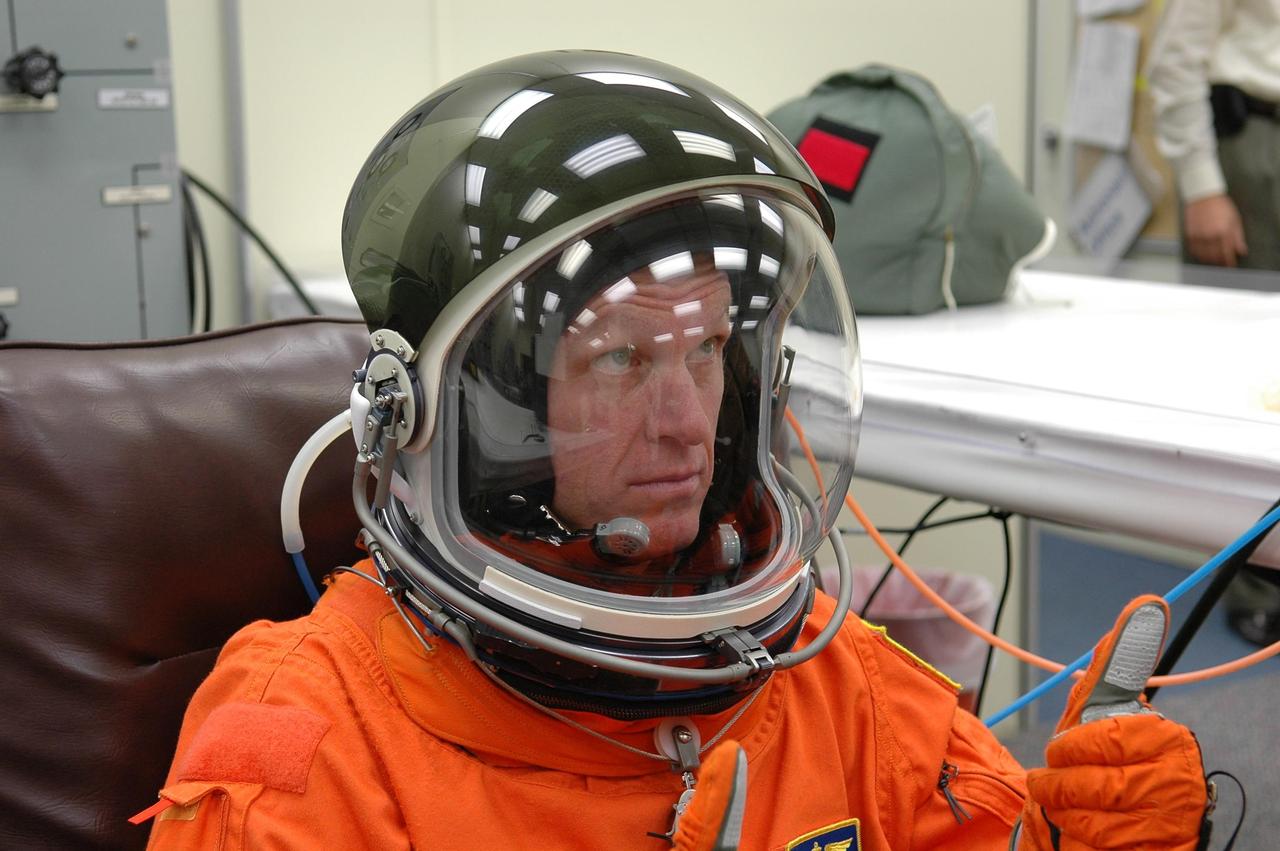
KENNEDY SPACE CENTER, FLA. - In the Operations and Checkout Building at NASA Kennedy Space Center, STS-115 Mission Commander Brent Jett signals a "go" for another attempt at liftoff. The launch attempt on Sept. 8 was scrubbed due to an issue with a fuel cut-off sensor system inside the external fuel tank. This is one of several systems that protect the shuttle's main engines by triggering their shutdown if fuel runs unexpectedly low. During the STS-115 mission, Atlantis' astronauts will deliver and install the 17.5-ton, bus-sized P3/P4 integrated truss segment on the station. The girder-like truss includes a set of giant solar arrays, batteries and associated electronics and will provide one-fourth of the total power-generation capability for the completed station. This mission is the 116th space shuttle flight, the 27th flight for orbiter Atlantis, and the 19th U.S. flight to the ISS. STS-115 is scheduled to last 11 days with a planned landing at KSC. Photo credit: NASA/Kim Shiflett
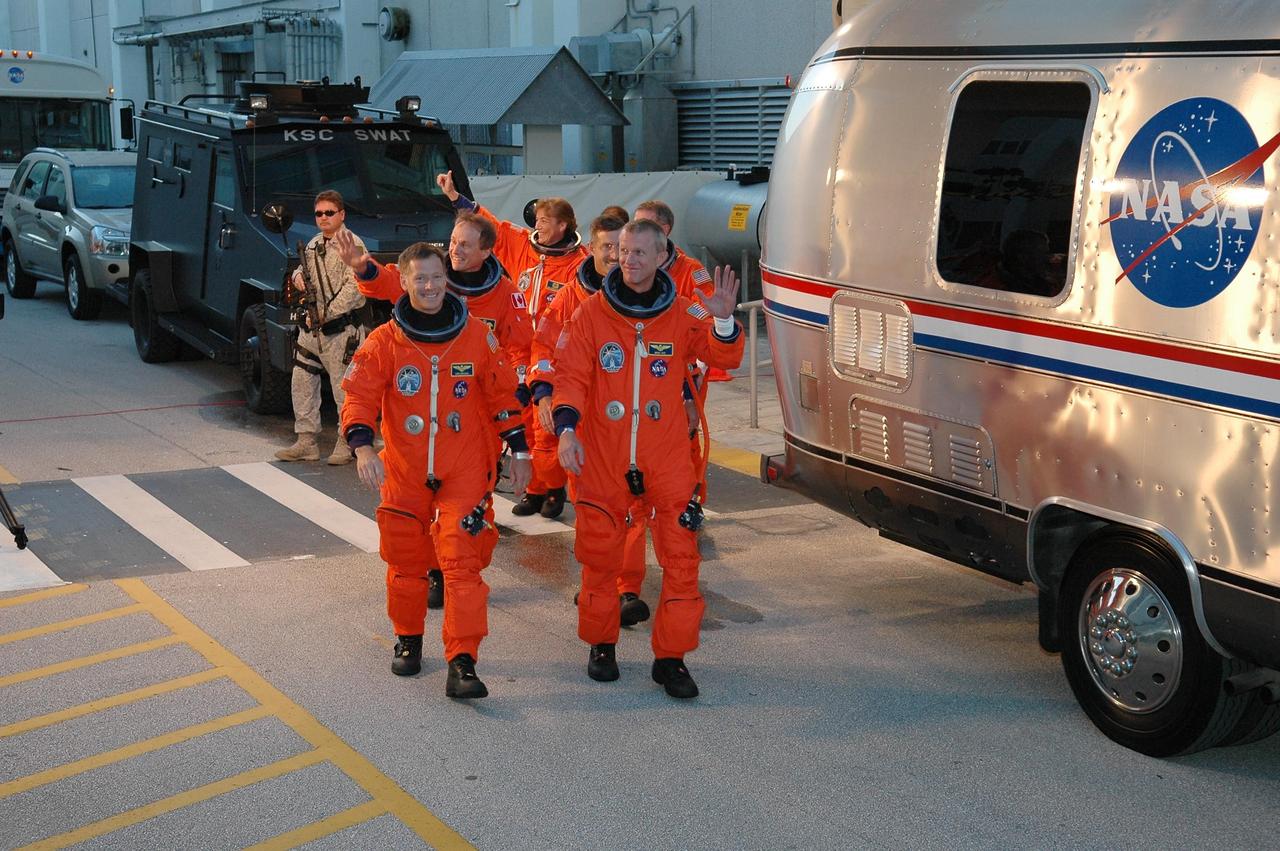
KENNEDY SPACE CENTER, FLA. - The STS-115 mission crew respond to well-wishers as they head to the Astrovan for the ride to Launch Pad 39B. From left are Pilot Christopher Ferguson, Mission Specialists Steven MacLean, Heidemarie Stefanyshyn-Piper, Daniel Burbank and Joseph Tanner (hidden), and Commander Brent Jett. The crew is eager for another attempt at liftoff after the Sept. 8 scrub. The launch attempt on Sept. 8 was scrubbed due to an issue with a fuel cut-off sensor system inside the external fuel tank. This is one of several systems that protect the shuttle's main engines by triggering their shutdown if fuel runs unexpectedly low. During the STS-115 mission, Atlantis' astronauts will deliver and install the 17.5-ton, bus-sized P3/P4 integrated truss segment on the station. The girder-like truss includes a set of giant solar arrays, batteries and associated electronics and will provide one-fourth of the total power-generation capability for the completed station. This mission is the 116th space shuttle flight, the 27th flight for orbiter Atlantis, and the 19th U.S. flight to the ISS. STS-115 is scheduled to last 11 days with a planned landing at KSC. Photo credit: NASA/Kim Shiflett
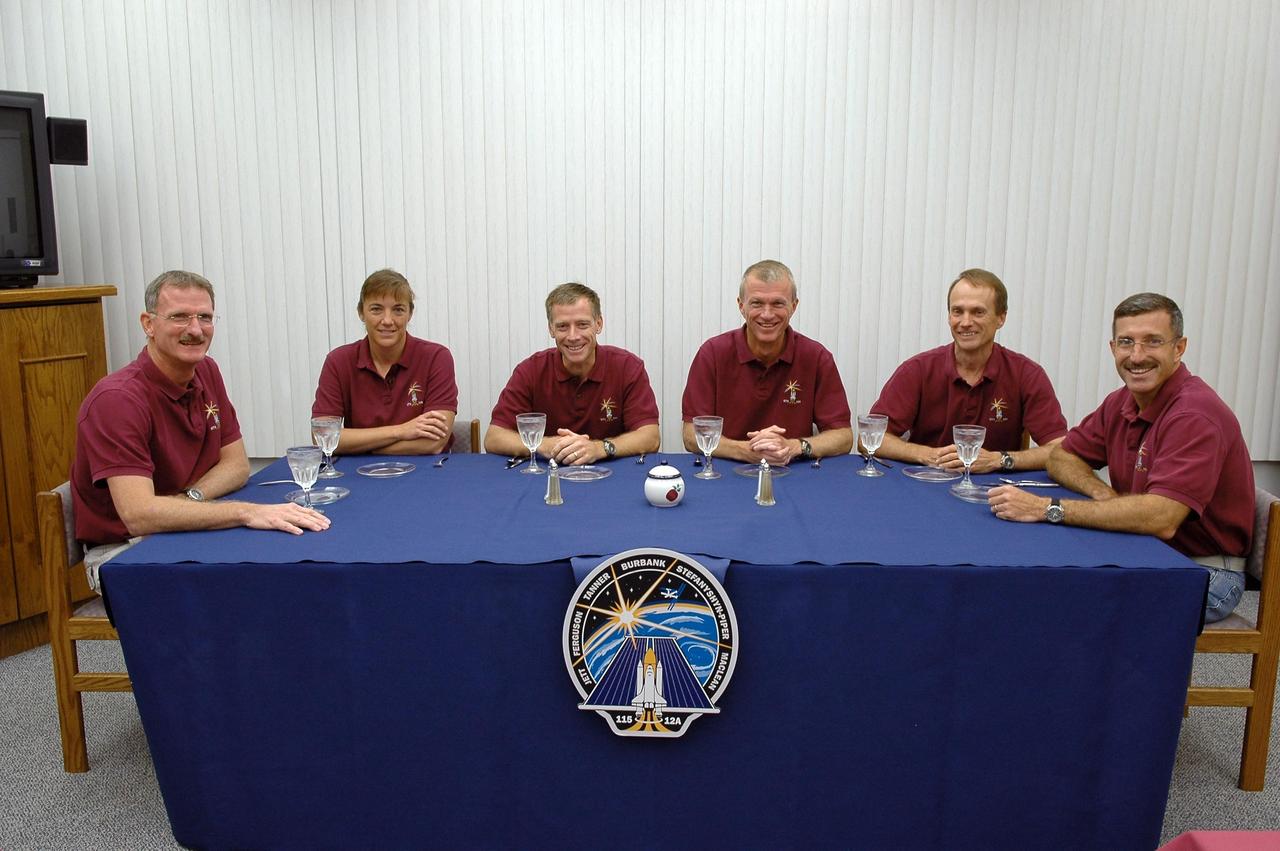
KENNEDY SPACE CENTER, FLA. - After a week's delay of launching due to weather and technical issues, the crew of mission STS-115 enjoy the traditional breakfast before their second attempt to launch on Space Shuttle Atlantis. Seated left to right are Mission Specialists Joseph Tanner and Heidemarie Stefanyshyn-Piper, Pilot Christopher Ferguson, Commander Brent Jett and Mission Specialists Steven MacLean and Daniel Burbank. MacLean is with the Canadian Space Agency. Following the breakfast, the crew will don their launch suits before heading to Launch Pad 39B. During the STS-115 mission, Atlantis' astronauts will deliver and install the 17.5-ton, bus-sized P3/P4 integrated truss segment on the station. The girder-like truss includes a set of giant solar arrays, batteries and associated electronics and will provide one-fourth of the total power-generation capability for the completed station. This mission is the 116th space shuttle flight, the 27th flight for orbiter Atlantis, and the 19th U.S. flight to the International Space Station. STS-115 is scheduled to last 11 days with a planned landing at KSC. Photo credit: NASA/Kim Shiflett
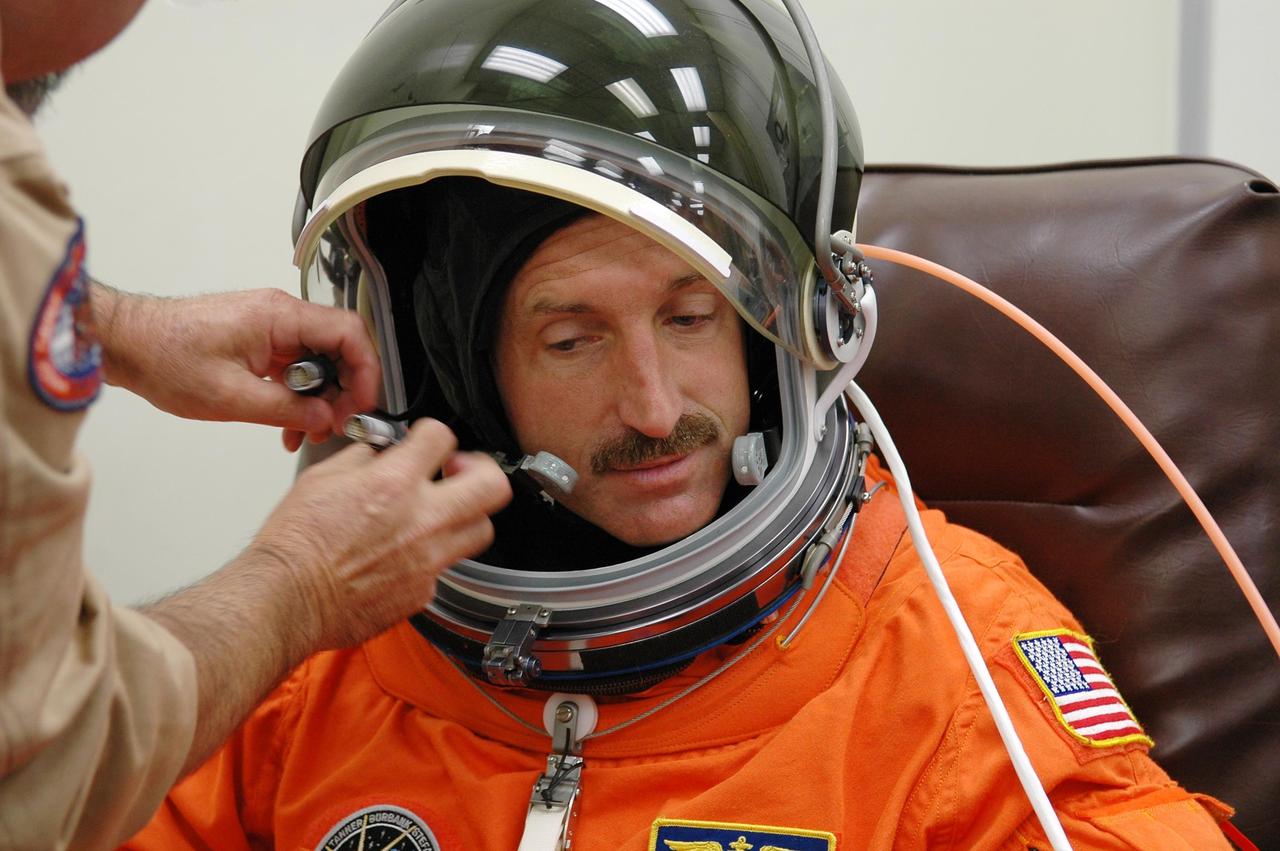
KENNEDY SPACE CENTER, FLA. - In the Operations and Checkout Building at NASA Kennedy Space Center, STS-115 Mission Specialist Daniel Burbank gets a final adjustment on his helmet before heading to the launch pad for another attempt at liftoff. The launch attempt on Sept. 8 was scrubbed due to an issue with a fuel cut-off sensor system inside the external fuel tank. This is one of several systems that protect the shuttle's main engines by triggering their shutdown if fuel runs unexpectedly low. During the STS-115 mission, Atlantis' astronauts will deliver and install the 17.5-ton, bus-sized P3/P4 integrated truss segment on the station. The girder-like truss includes a set of giant solar arrays, batteries and associated electronics and will provide one-fourth of the total power-generation capability for the completed station. This mission is the 116th space shuttle flight, the 27th flight for orbiter Atlantis, and the 19th U.S. flight to the ISS. STS-115 is scheduled to last 11 days with a planned landing at KSC. Photo credit: NASA/Kim Shiflett
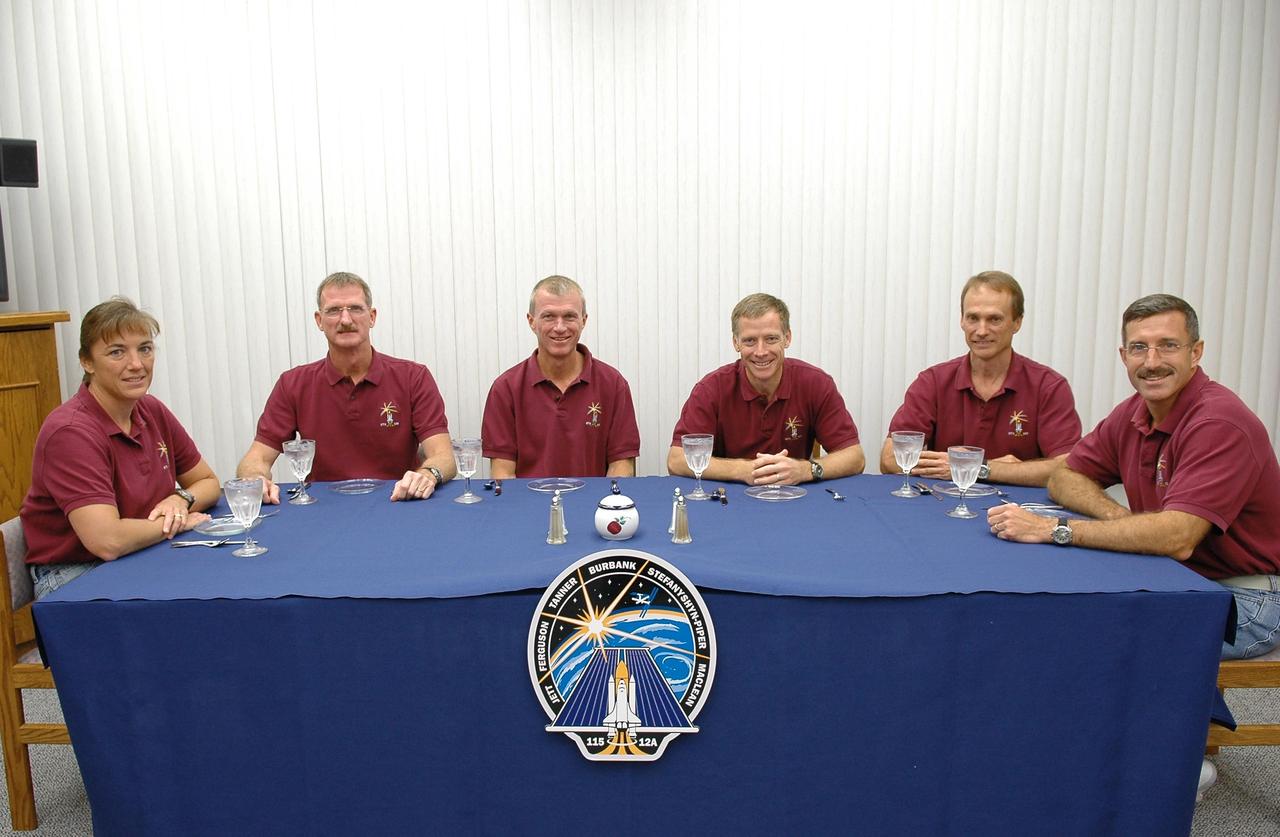
KENNEDY SPACE CENTER, FLA. - After a week's delay of launching due to weather and technical issues, the crew of mission STS-115 have had the traditional breakfast before their third attempt to launch on Space Shuttle Atlantis. Seated left to right are Mission Specialists Heidemarie Stefanyshyn-Piper and Joseph Tanner, Commander Brent Jett, Pilot Christopher Ferguson and Mission Specialists Steven MacLean and Daniel Burbank. MacLean is with the Canadian Space Agency. The launch attempt on Sept. 8 was scrubbed due to an issue with a fuel cut-off sensor system inside the external fuel tank. This is one of several systems that protect the shuttle's main engines by triggering their shutdown if fuel runs unexpectedly low. Following the breakfast, the crew will don their launch suits before heading to Launch Pad 39B. During the STS-115 mission, Atlantis' astronauts will deliver and install the 17.5-ton, bus-sized P3/P4 integrated truss segment on the station. The girder-like truss includes a set of giant solar arrays, batteries and associated electronics and will provide one-fourth of the total power-generation capability for the completed station. This mission is the 116th space shuttle flight, the 27th flight for orbiter Atlantis, and the 19th U.S. flight to the ISS. STS-115 is scheduled to last 11 days with a planned landing at KSC. Photo credit: NASA/Kim Shiflett
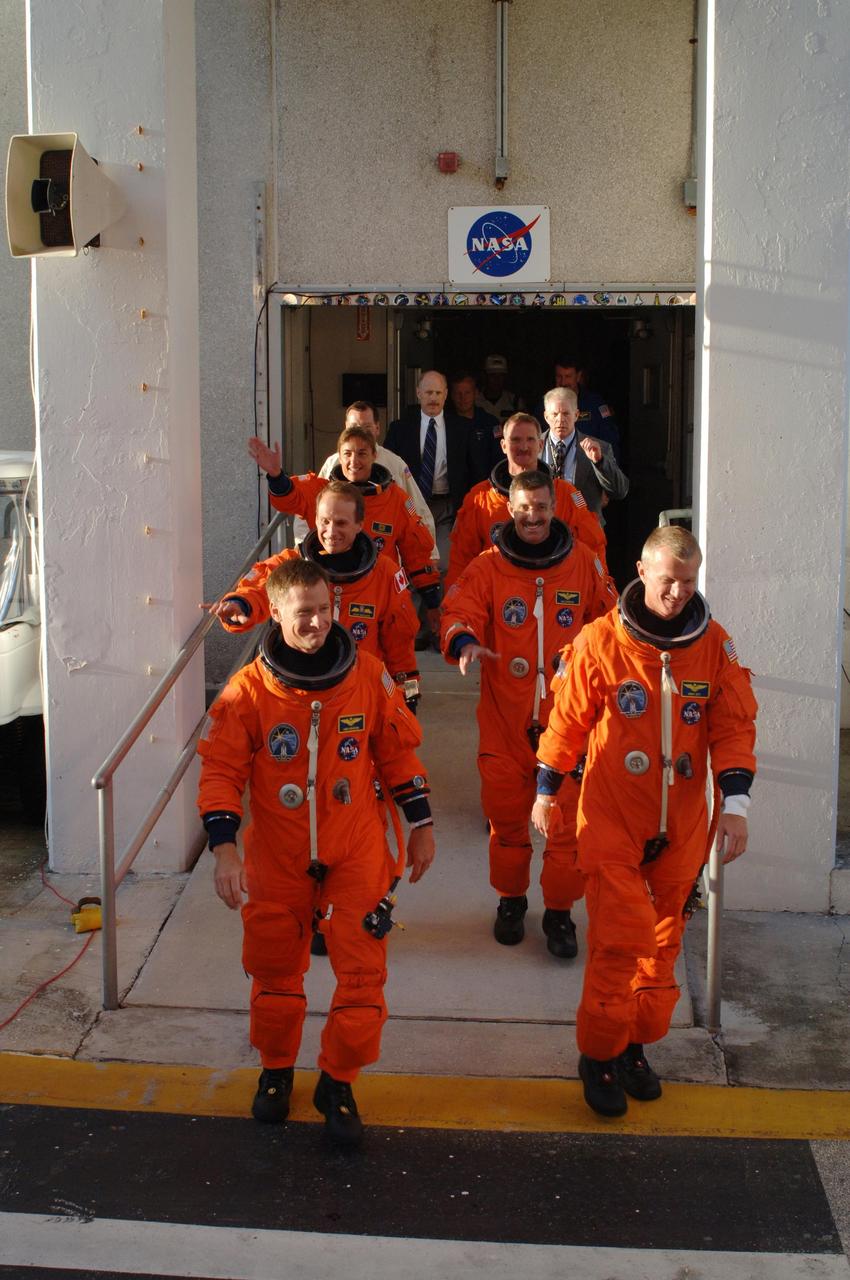
KENNEDY SPACE CENTER, FLA. - The STS-115 crew members stride out of the Operations and Checkout Building eager to get to Launch Pad 39B and the start of their mission to the International Space Station. This is the second attempt at launch after a week's postponement due to weather and technical concerns. On the left side, front to back, are Pilot Christopher Ferguson and Mission Specialists Steven MacLean and Heidemarie Stefanyshyn-Piper. On the right side, front to back, are Commander Brent Jett and Mission Specialists Daniel Burbank and Joseph Tanner. On its second attempt for launch, Atlantis is scheduled to lift off at 11:41 a.m. EDT today from Launch Pad 39B. During the STS-115 mission, Atlantis' astronauts will deliver and install the 17.5-ton, bus-sized P3/P4 integrated truss segment on the station. The girder-like truss includes a set of giant solar arrays, batteries and associated electronics and will provide one-fourth of the total power-generation capability for the completed station. This mission is the 116th space shuttle flight, the 27th flight for orbiter Atlantis, and the 19th U.S. flight to the ISS. STS-115 is scheduled to last 11 days with a planned landing at KSC. Photo credit: NASA/Kim Shiflett
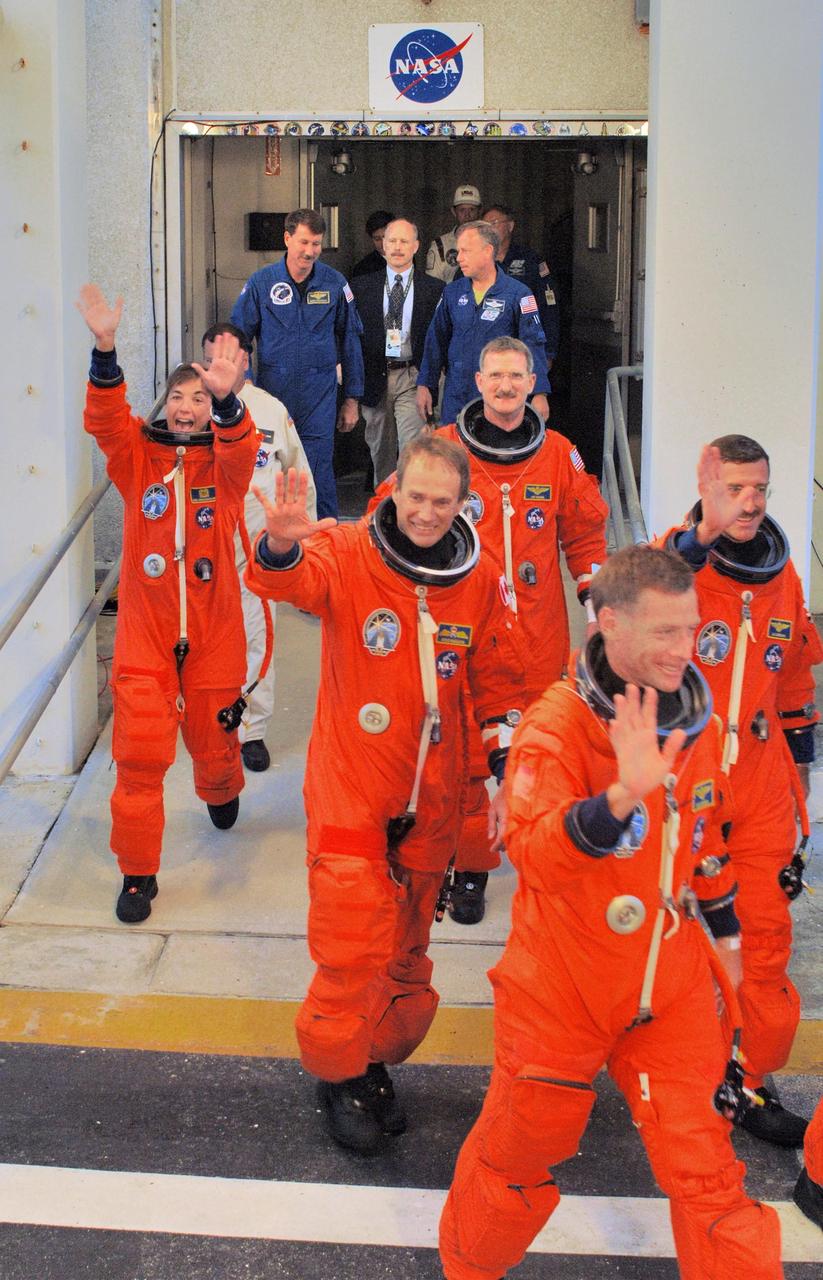
KENNEDY SPACE CENTER, FLA. - After suiting up, the STS-115 mission crew enthusiastically greet the onlookers as they head to the Astrovan for the ride to Launch Pad 39B. From left are Mission Specialist Heidemarie Stefanyshyn-Piper, Steven MacLean, Joseph Tanner, Pilot Christopher Ferguson and Daniel Burbank. Not seen is Commander Brent Jett. The crew is eager for another attempt at liftoff after the Sept. 8 scrub. The launch attempt on Sept. 8 was scrubbed due to an issue with a fuel cut-off sensor system inside the external fuel tank. This is one of several systems that protect the shuttle's main engines by triggering their shutdown if fuel runs unexpectedly low. During the STS-115 mission, Atlantis' astronauts will deliver and install the 17.5-ton, bus-sized P3/P4 integrated truss segment on the station. The girder-like truss includes a set of giant solar arrays, batteries and associated electronics and will provide one-fourth of the total power-generation capability for the completed station. This mission is the 116th space shuttle flight, the 27th flight for orbiter Atlantis, and the 19th U.S. flight to the ISS. STS-115 is scheduled to last 11 days with a planned landing at KSC. Photo credit: NASA/Kim Shiflett
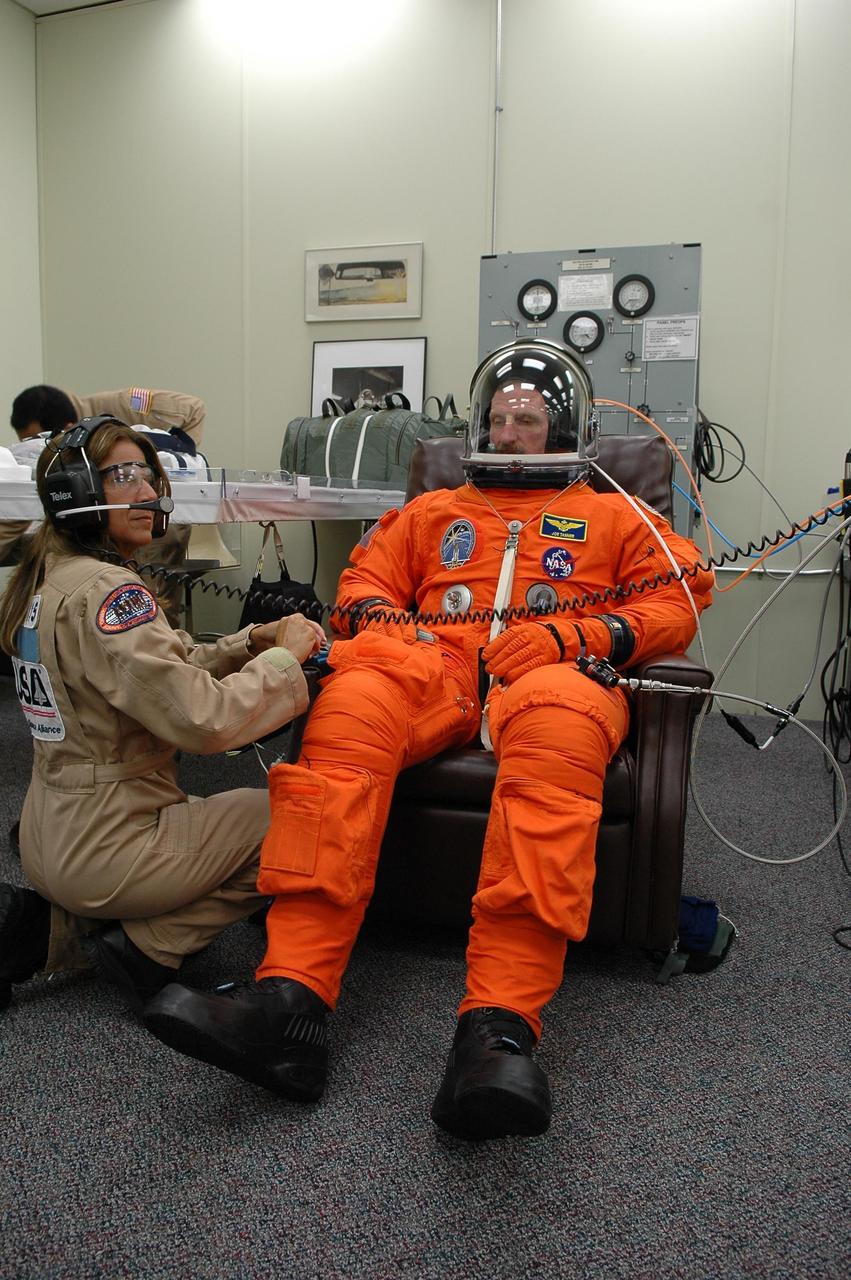
KENNEDY SPACE CENTER, FLA. - In the Operations and Checkout Building at NASA Kennedy Space Center, STS-115 Mission Specialist Joseph Tanner dons his launch and re-entry suit before heading to the launch pad for another attempt at liftoff. The launch attempt on Sept. 8 was scrubbed due to an issue with a fuel cut-off sensor system inside the external fuel tank. This is one of several systems that protect the shuttle's main engines by triggering their shutdown if fuel runs unexpectedly low. Liftoff today is scheduled for 11:15 a.m. EDT. During the STS-115 mission, Atlantis' astronauts will deliver and install the 17.5-ton, bus-sized P3/P4 integrated truss segment on the station. The girder-like truss includes a set of giant solar arrays, batteries and associated electronics and will provide one-fourth of the total power-generation capability for the completed station. This mission is the 116th space shuttle flight, the 27th flight for orbiter Atlantis, and the 19th U.S. flight to the ISS. STS-115 is scheduled to last 11 days with a planned landing at KSC. Photo credit: NASA/Kim Shiflett
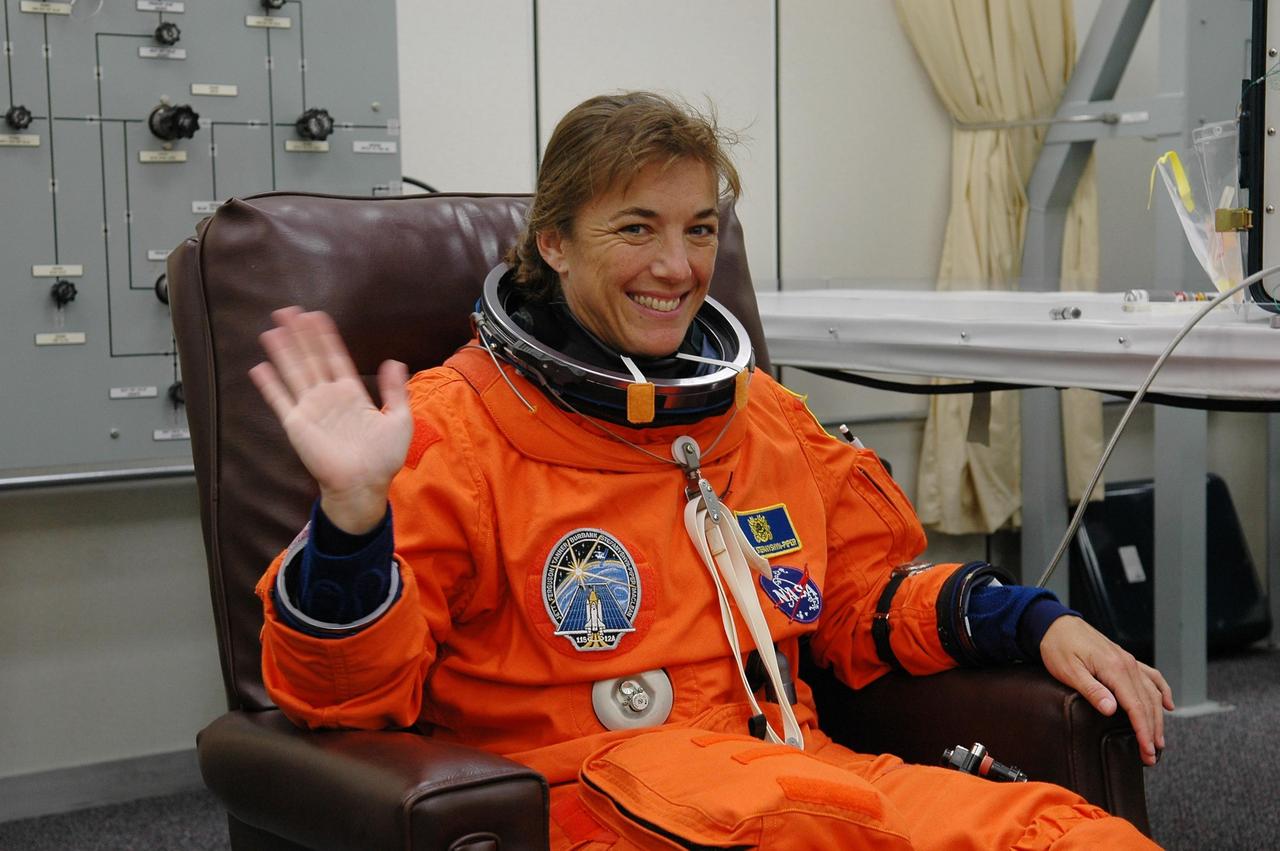
KENNEDY SPACE CENTER, FLA. - In the Operations and Checkout Building at NASA Kennedy Space Center, STS-115 Mission Specialist Heidemarie Stefanyshyn-Piper is eager for another attempt at liftoff. The launch attempt on Sept. 8 was scrubbed due to an issue with a fuel cut-off sensor system inside the external fuel tank. This is one of several systems that protect the shuttle's main engines by triggering their shutdown if fuel runs unexpectedly low. During the STS-115 mission, Atlantis' astronauts will deliver and install the 17.5-ton, bus-sized P3/P4 integrated truss segment on the station. The girder-like truss includes a set of giant solar arrays, batteries and associated electronics and will provide one-fourth of the total power-generation capability for the completed station. This mission is the 116th space shuttle flight, the 27th flight for orbiter Atlantis, and the 19th U.S. flight to the ISS. STS-115 is scheduled to last 11 days with a planned landing at KSC. Photo credit: NASA/Kim Shiflett
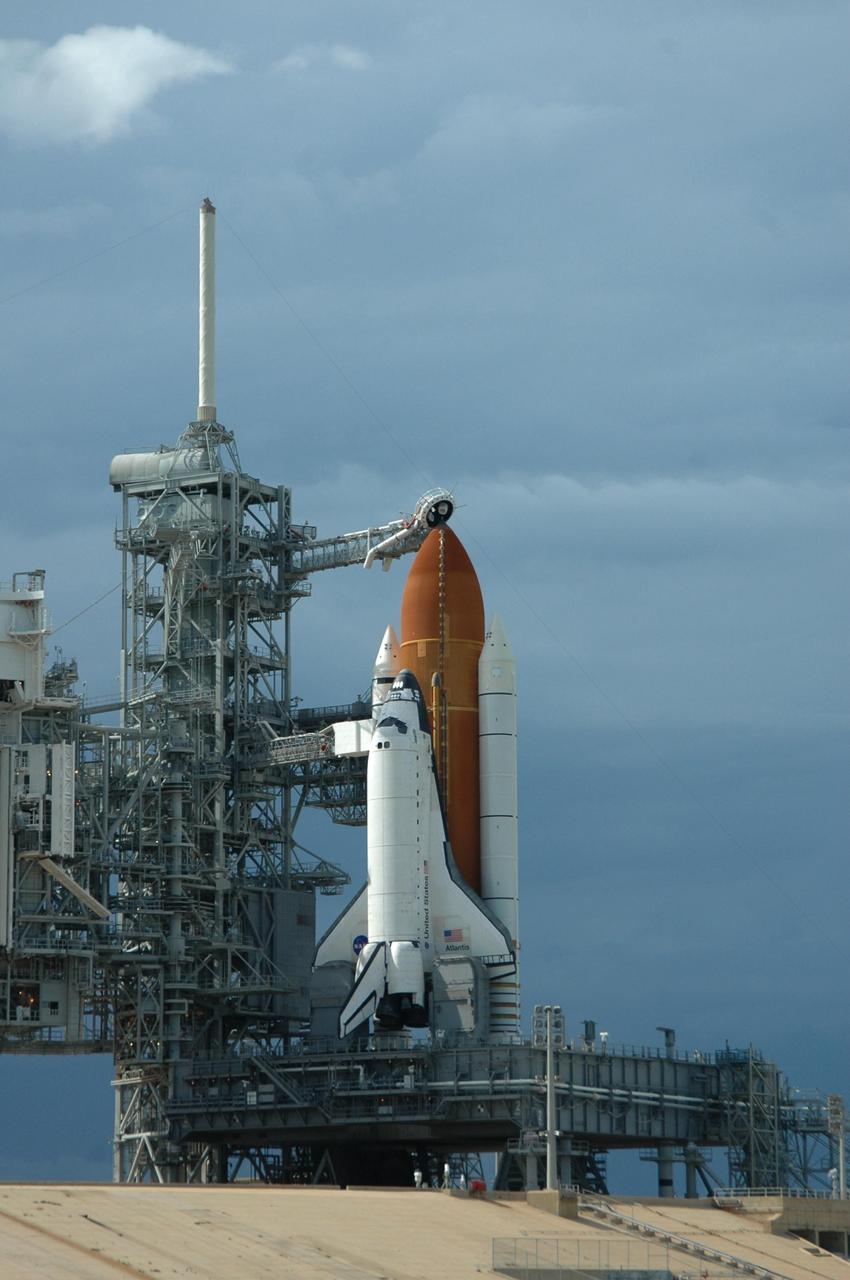
KENNEDY SPACE CENTER, FLA. - Storm clouds gather behind Space Shuttle Atlantis on Launch Pad 39B. Atlantis was originally scheduled to launch on Aug. 27, but a scrub was called by mission managers due to a concern with fuel cell 1. Towering above the shuttle is the 80-foot lightning mast. During the STS-115 mission, Atlantis' astronauts will deliver and install the 17.5-ton, bus-sized P3/P4 integrated truss segment on the station. The girder-like truss includes a set of giant solar arrays, batteries and associated electronics and will provide one-fourth of the total power-generation capability for the completed station. This mission is the 116th space shuttle flight, the 27th flight for orbiter Atlantis, and the 19th U.S. flight to the International Space Station. STS-115 is scheduled to last 11 days with a planned landing at KSC. Photo credit: NASA/Ken Thornsley
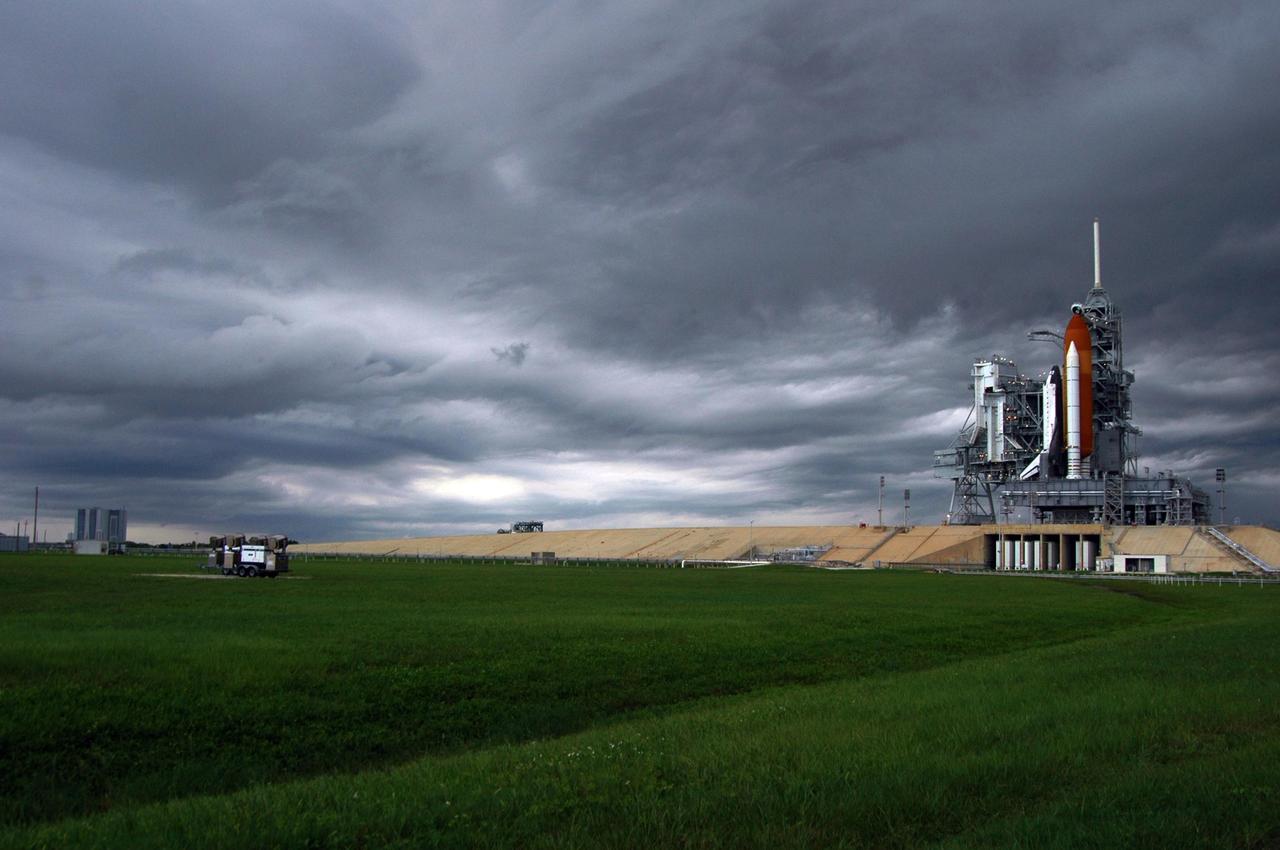
KENNEDY SPACE CENTER, FLA. - Storm clouds roll across Launch Pad 39B where Space Shuttle Atlantis still sits on the pad. Atlantis was originally scheduled to launch Aug. 27, but a scrub was called by mission managers due to a concern with fuel cell 1. Towering above the shuttle is the 80-foot lightning mast. During the STS-115 mission, Atlantis' astronauts will deliver and install the 17.5-ton, bus-sized P3/P4 integrated truss segment on the station. The girder-like truss includes a set of giant solar arrays, batteries and associated electronics and will provide one-fourth of the total power-generation capability for the completed station. This mission is the 116th space shuttle flight, the 27th flight for orbiter Atlantis, and the 19th U.S. flight to the International Space Station. STS-115 is scheduled to last 11 days with a planned landing at KSC. Photo credit: NASA/Ken Thornsley
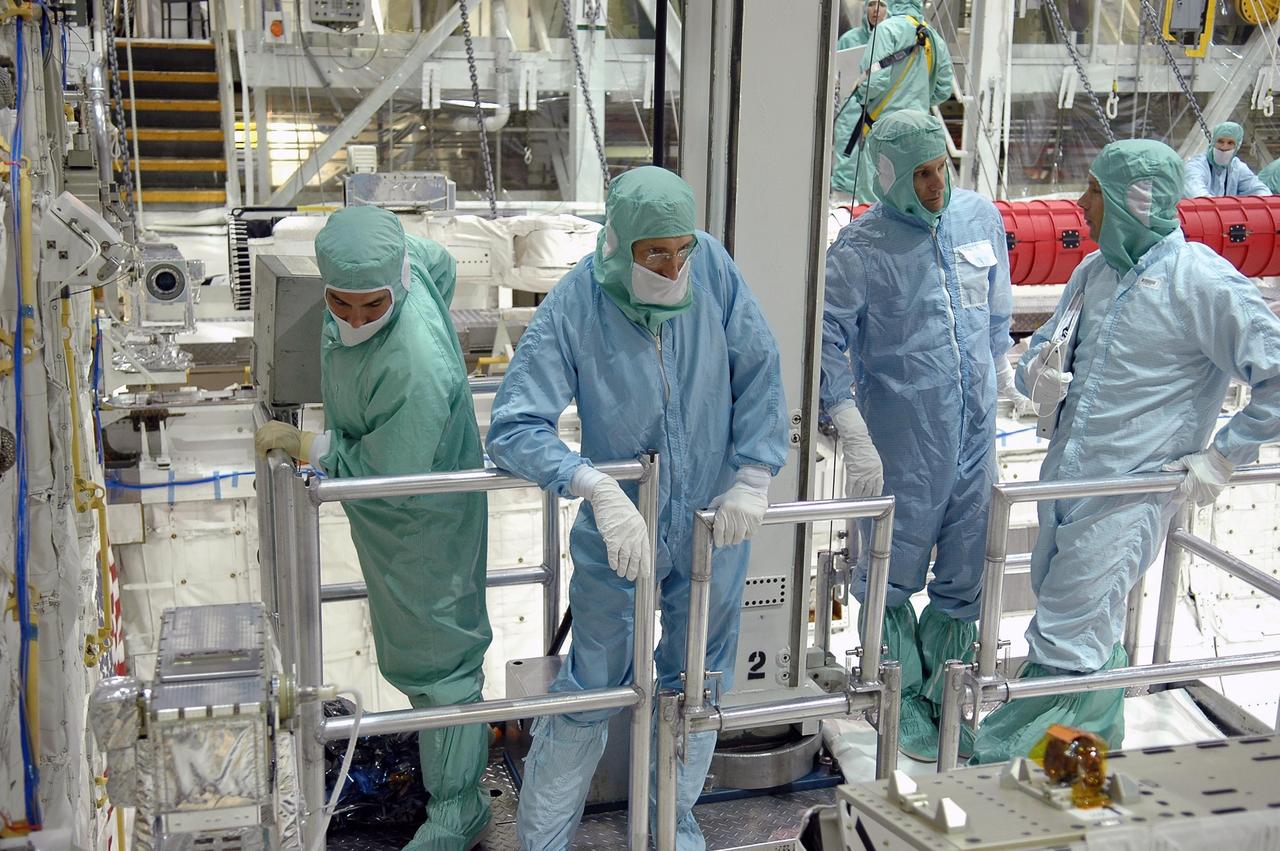
KENNEDY SPACE CENTER, FLA. - In the Orbiter Processing Facility at NASA's Kennedy Space Center, STS-115 crew members inspect equipment in Atlantis's payload bay. Mission Specialist Daniel Burbank (second from left) looks into the bay. Next to him on the right is Mission Specialist Steven MacLean, talking to a technician. The crew is at KSC for Crew Equipment Interface Test activities, which involves equipment familiarization, a routine part of astronaut training and launch preparations. The STS-115 mission will deliver the second port truss segment, the P3/P4 truss, to the International Space Station. The crew will attach the P3 to the first port truss segment, the P1 truss, as well as deploy solar array set 2A and 4A. Launch on Space Shuttle Atlantis is scheduled for late August. Photo credit: NASA/Kim Shiflett
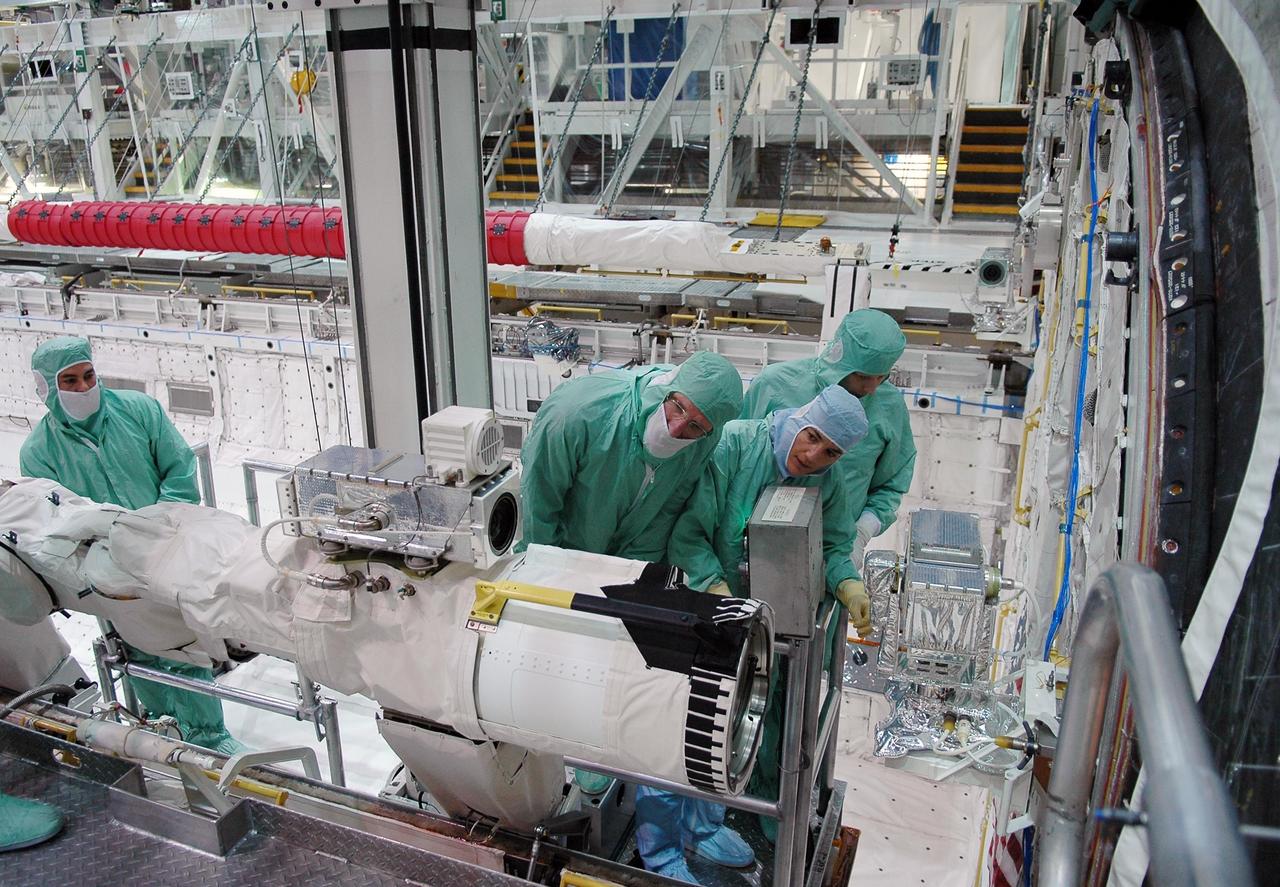
KENNEDY SPACE CENTER, FLA. - In the Orbiter Processing Facility at NASA's Kennedy Space Center, STS-115 crew members inspect equipment in Atlantis's payload bay. Looking at the orbiter boom sensor system are, from left, Mission Specialists Joseph Tanner and Heidemarie Stefanyshyn-Piper. The crew is at KSC for Crew Equipment Interface Test activities, which involves equipment familiarization, a routine part of astronaut training and launch preparations. The STS-115 mission will deliver the second port truss segment, the P3/P4 truss, to the International Space Station. The crew will attach the P3 to the first port truss segment, the P1 truss, as well as deploy solar array set 2A and 4A. Launch on Space Shuttle Atlantis is scheduled for late August. Photo credit: NASA/Kim Shiflett
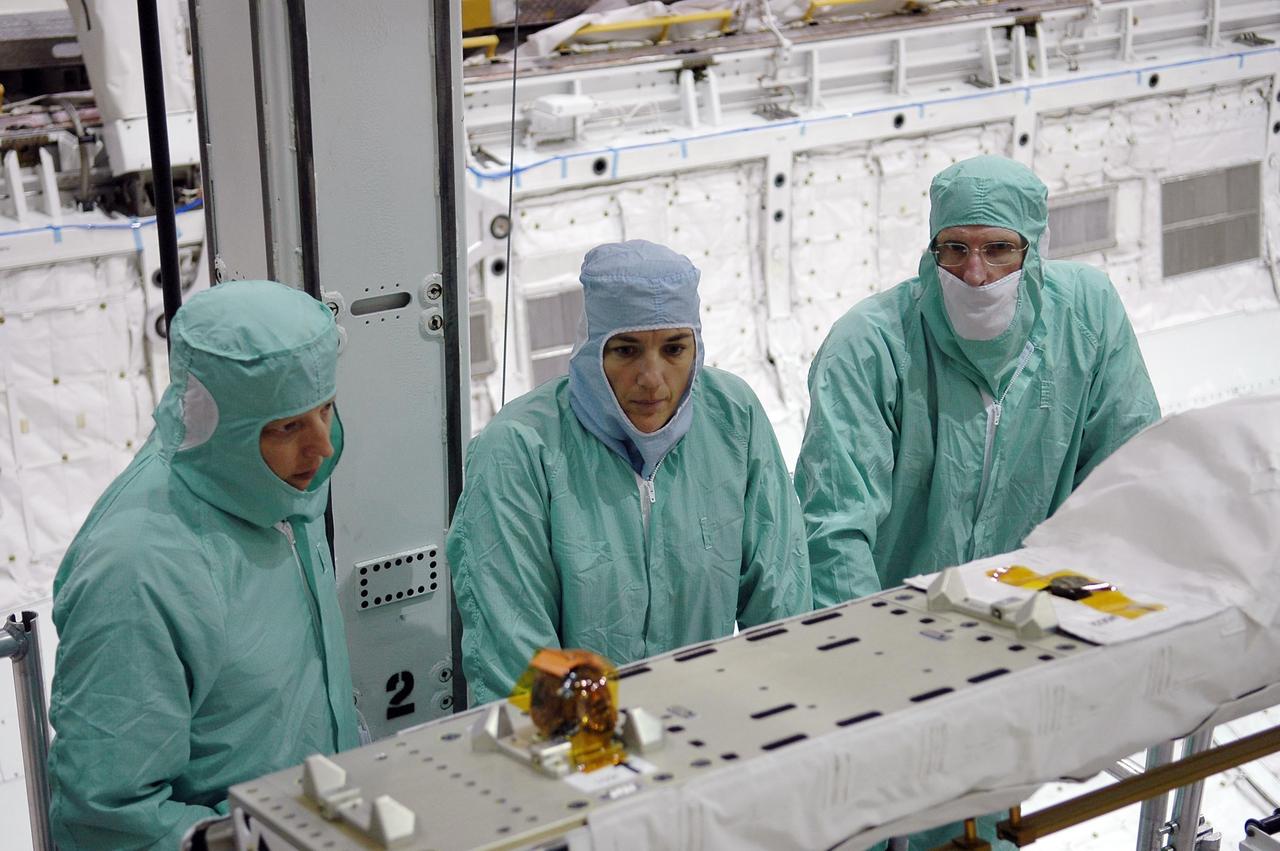
KENNEDY SPACE CENTER, FLA. - In the Orbiter Processing Facility at NASA's Kennedy Space Center, STS-115 crew members inspect equipment in Atlantis's payload bay. Mission Specialists Heidemarie Stefanyshyn-Piper (center) and Joseph Tanner (right) look at the orbiter boom sensor system. The crew is at KSC for Crew Equipment Interface Test activities, which involves equipment familiarization, a routine part of astronaut training and launch preparations. The STS-115 mission will deliver the second port truss segment, the P3/P4 truss, to the International Space Station. The crew will attach the P3 to the first port truss segment, the P1 truss, as well as deploy solar array set 2A and 4A. Launch on Space Shuttle Atlantis is scheduled for late August. Photo credit: NASA/Kim Shiflett
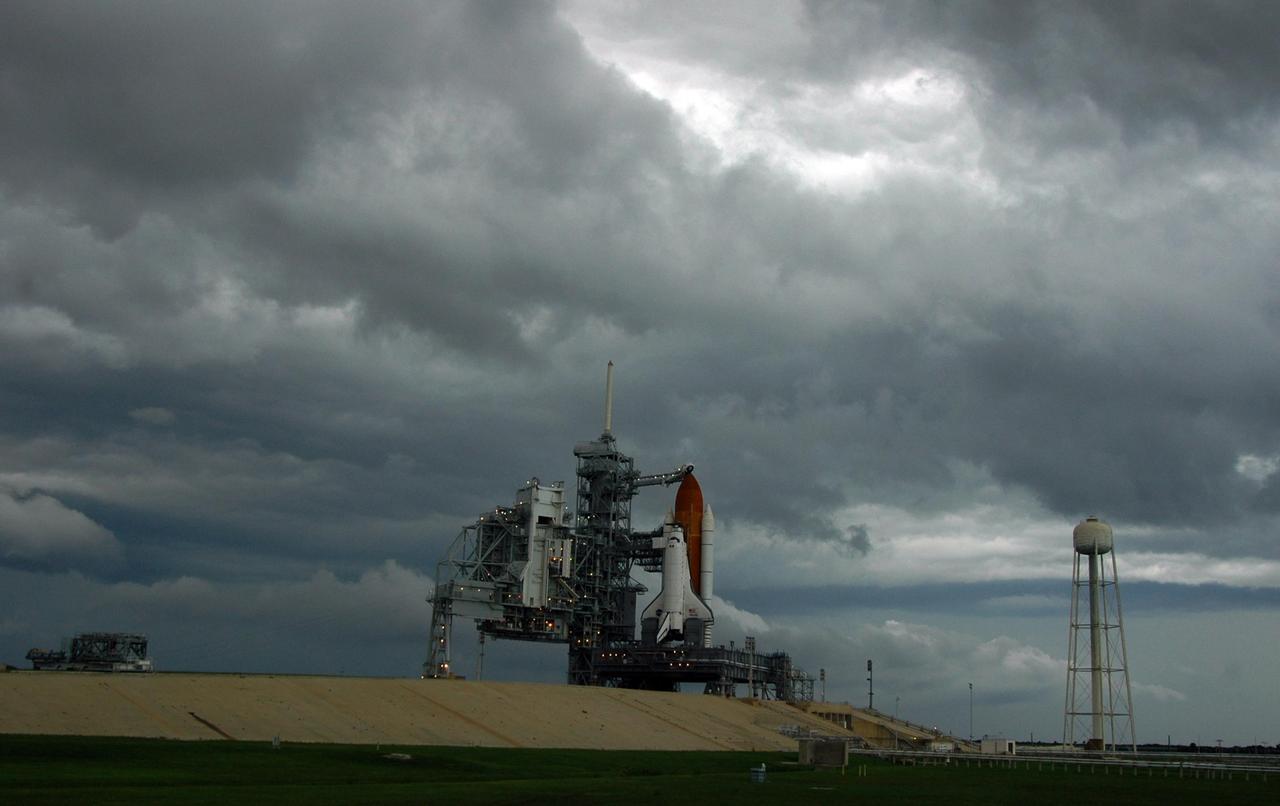
KENNEDY SPACE CENTER, FLA. - Storm clouds fill the sky from Launch Pad 39B, at right, west beyond the Vehicle Assembly Building. Space Shuttle Atlantis still sits on the pad after a scrub was called Aug. 27 due to a concern with fuel cell 1. Towering above the shuttle is the 80-foot lightning mast. During the STS-115 mission, Atlantis' astronauts will deliver and install the 17.5-ton, bus-sized P3/P4 integrated truss segment on the station. The girder-like truss includes a set of giant solar arrays, batteries and associated electronics and will provide one-fourth of the total power-generation capability for the completed station. This mission is the 116th space shuttle flight, the 27th flight for orbiter Atlantis, and the 19th U.S. flight to the International Space Station. STS-115 is scheduled to last 11 days with a planned landing at KSC. Photo credit: NASA/Ken Thornsley
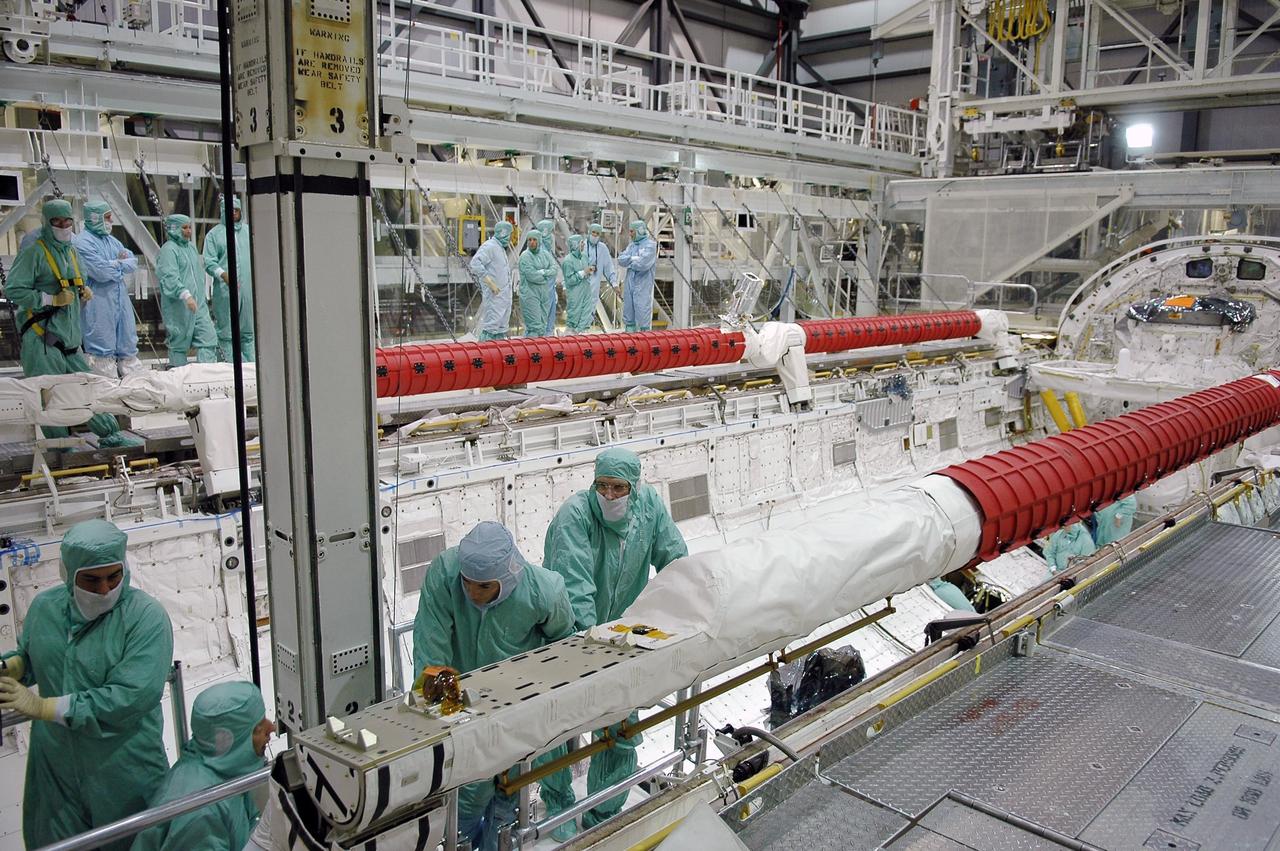
KENNEDY SPACE CENTER, FLA. - In the Orbiter Processing Facility at NASA's Kennedy Space Center, STS-115 crew members inspect equipment in Atlantis's payload bay. At right are Mission Specialists Heidemarie Stefanyshyn-Piper and Joseph Tanner looking at the orbiter boom sensor system. The crew is at KSC for Crew Equipment Interface Test activities, which involves equipment familiarization, a routine part of astronaut training and launch preparations. The STS-115 mission will deliver the second port truss segment, the P3/P4 truss, to the International Space Station. The crew will attach the P3 to the first port truss segment, the P1 truss, as well as deploy solar array set 2A and 4A. Launch on Space Shuttle Atlantis is scheduled for late August. Photo credit: NASA/Kim Shiflett

KENNEDY SPACE CENTER, FLA. - In the Orbiter Processing Facility at NASA's Kennedy Space Center, STS-115 crew members inspect equipment in Atlantis's payload bay. Mission Specialists Heidemarie Stefanyshyn-Piper (center) and Joseph Tanner look at the orbiter docking mechanism. The crew is at KSC for Crew Equipment Interface Test activities, which involves equipment familiarization, a routine part of astronaut training and launch preparations. The STS-115 mission will deliver the second port truss segment, the P3/P4 truss, to the International Space Station. The crew will attach the P3 to the first port truss segment, the P1 truss, as well as deploy solar array set 2A and 4A. Launch on Space Shuttle Atlantis is scheduled for late August. Photo credit: NASA/Kim Shiflett
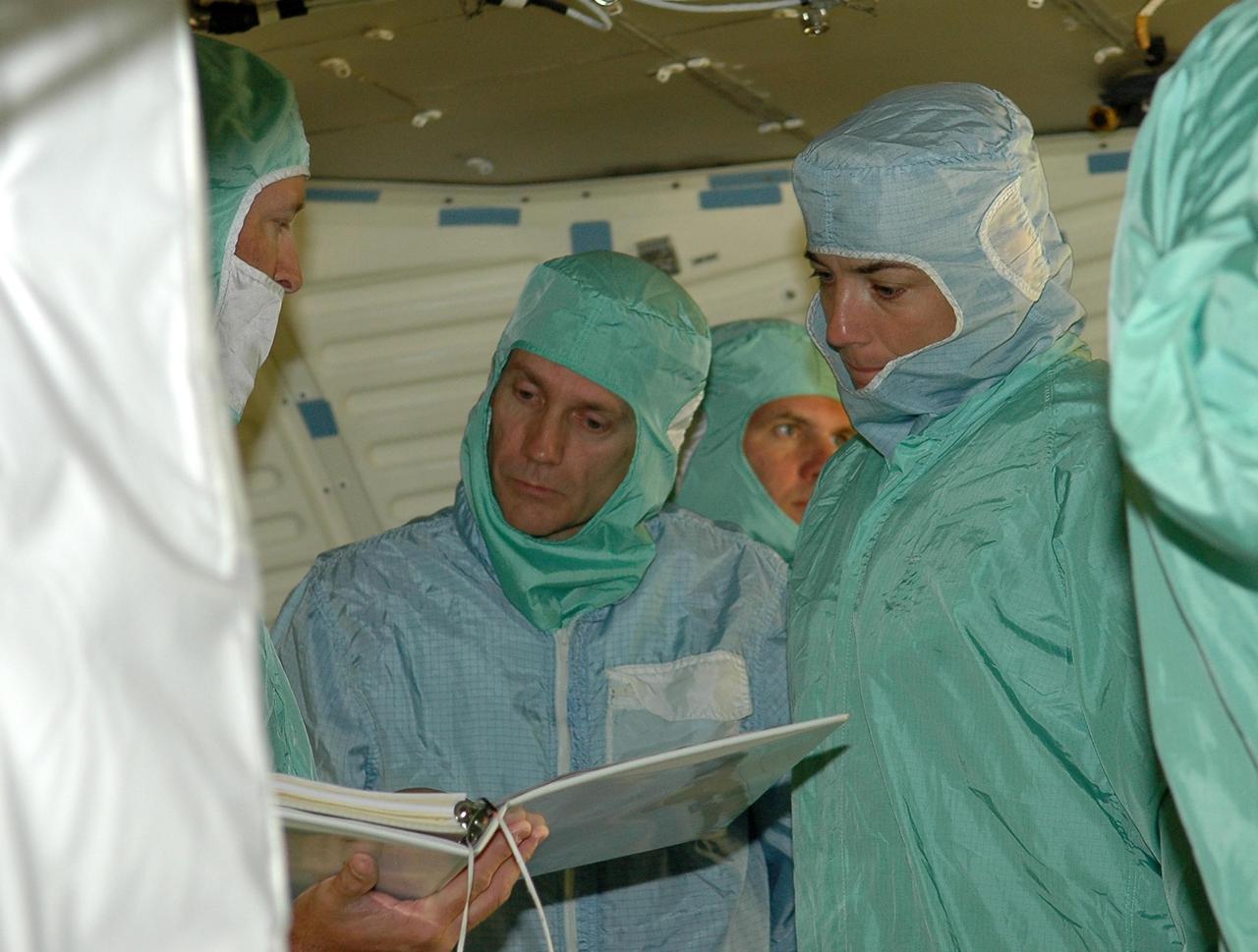
KENNEDY SPACE CENTER, FLA. - In the Orbiter Processing Facility, STS-115 Mission Speciailsts Steven MacLean and Heidemarie Stefanyshyn-Piper (center) review procedures for launch while inspecting the orbiter Atlantis. The crew is at KSC for Crew Equipment Interface Test activities, which involve equipment familiarization and inspection, a routine part of astronaut training and launch preparations. The STS-115 mission will deliver the second port truss segment, the P3/P4 truss, to the International Space Station. The crew will attach the P3 to the first port truss segment, the P1 truss, as well as deploy solar array set 2A and 4A. Launch on Space Shuttle Atlantis is scheduled for late August. Photo credit: NASA/Kim Shiflett

KENNEDY SPACE CENTER, FLA. - A heavy bank of storm clouds gather behind Space Shuttle Atlantis on Launch Pad 39B. Atlantis was originally scheduled to launch Aug. 27, but a scrub was called by mission managers due to a concern with fuel cell 1. Towering above the shuttle is the 80-foot lightning mast. During the STS-115 mission, Atlantis' astronauts will deliver and install the 17.5-ton, bus-sized P3/P4 integrated truss segment on the station. The girder-like truss includes a set of giant solar arrays, batteries and associated electronics and will provide one-fourth of the total power-generation capability for the completed station. This mission is the 116th space shuttle flight, the 27th flight for orbiter Atlantis, and the 19th U.S. flight to the International Space Station. STS-115 is scheduled to last 11 days with a planned landing at KSC. Photo credit: NASA/Ken Thornsley
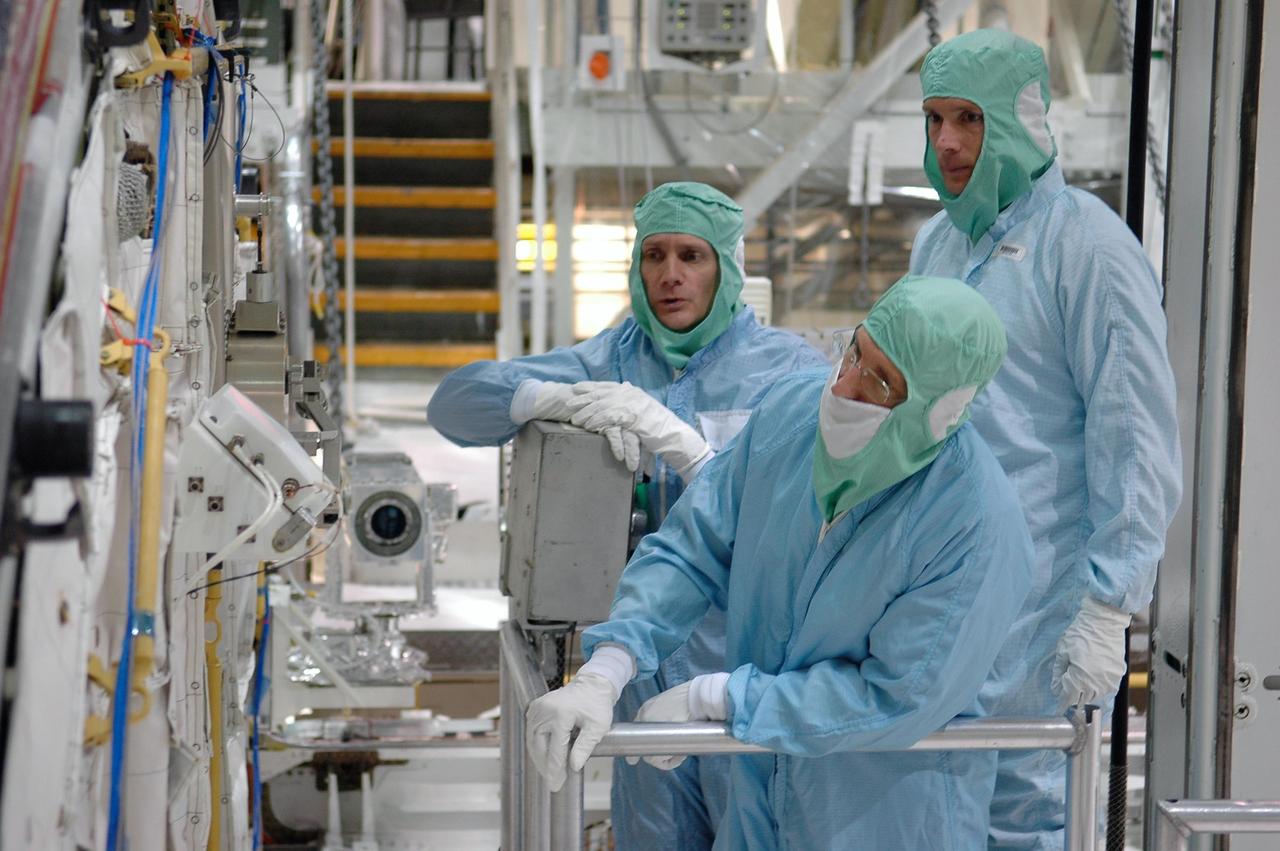
KENNEDY SPACE CENTER, FLA. - In the Orbiter Processing Facility at NASA's Kennedy Space Center, STS-115 crew members inspect equipment in Atlantis's payload bay. Looking at the airlock are Mission Specialists Steven MacLean (left) and Daniel Burbank (foreground). The crew is at KSC for Crew Equipment Interface Test activities, which involves equipment familiarization, a routine part of astronaut training and launch preparations. The STS-115 mission will deliver the second port truss segment, the P3/P4 truss, to the International Space Station. The crew will attach the P3 to the first port truss segment, the P1 truss, as well as deploy solar array set 2A and 4A. Launch on Space Shuttle Atlantis is scheduled for late August. Photo credit: NASA/Kim Shiflett
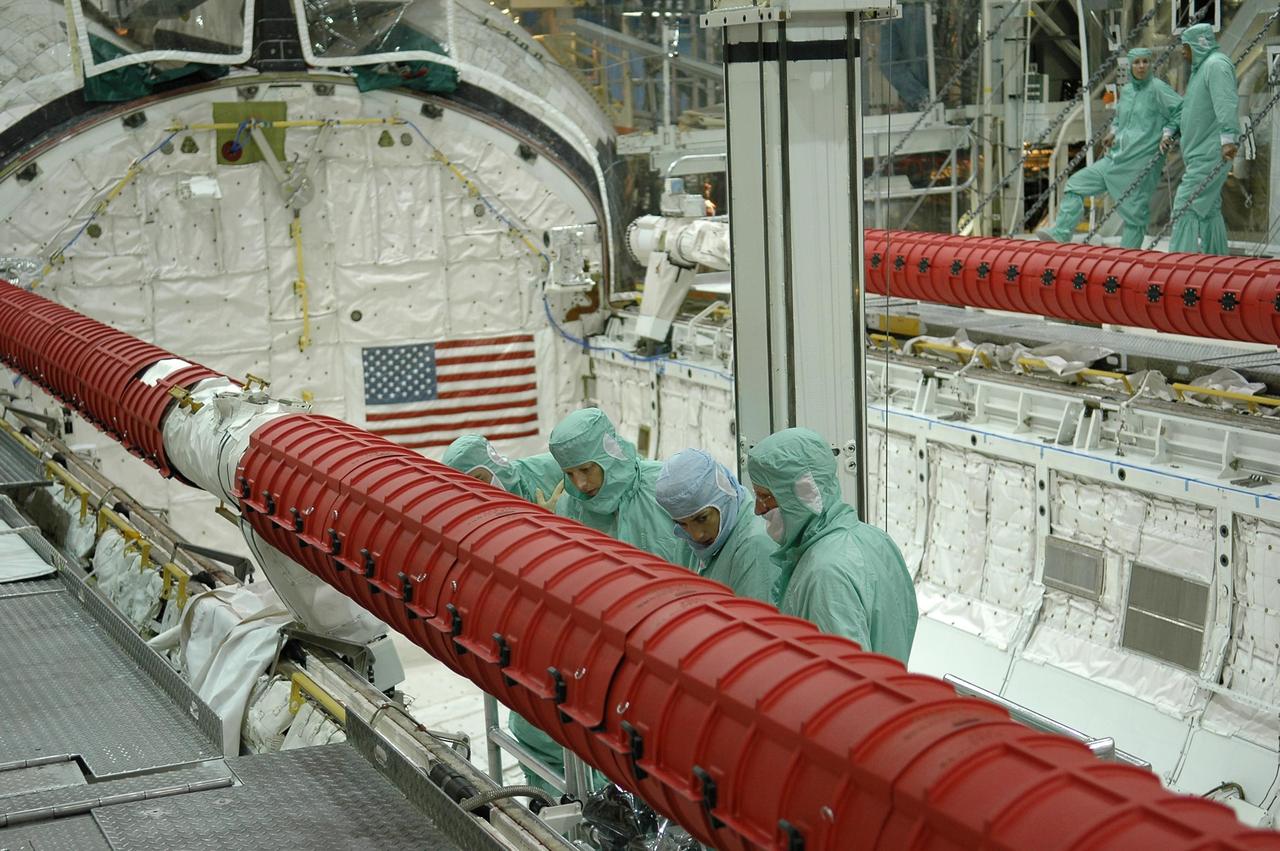
KENNEDY SPACE CENTER, FLA. - In the Orbiter Processing Facility at NASA's Kennedy Space Center, STS-115 crew members inspect equipment in Atlantis's payload bay. Mission Specialists Heidemarie Stefanyshyn-Piper (second from right) and Joseph Tanner (right) look at the orbiter boom sensor system. The crew is at KSC for Crew Equipment Interface Test activities, which involves equipment familiarization, a routine part of astronaut training and launch preparations. The STS-115 mission will deliver the second port truss segment, the P3/P4 truss, to the International Space Station. The crew will attach the P3 to the first port truss segment, the P1 truss, as well as deploy solar array set 2A and 4A. Launch on Space Shuttle Atlantis is scheduled for late August. Photo credit: NASA/Kim Shiflett
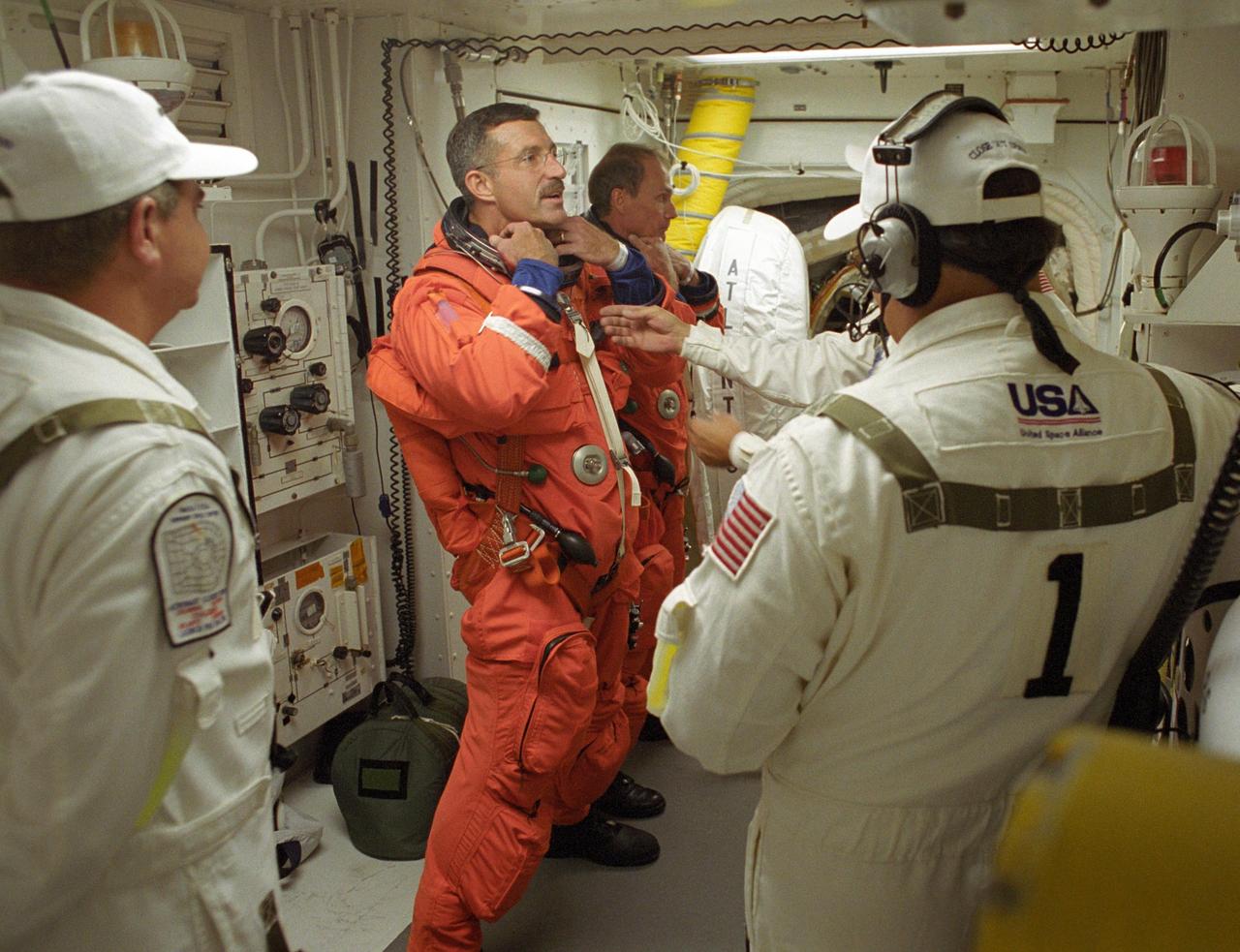
KENNEDY SPACE CENTER, FLA. - STS-115 Mission Specialists Daniel Burbank (left) and Steven MacLean get help with their launch suits from the closeout crew before entering Space Shuttle Atlantis. Both astronauts are making their second shuttle flights. MacLean is with the Canadian Space Agency. During the mission, Atlantis' astronauts will deliver and install the 17.5-ton, bus-sized P3/P4 integrated truss segment on the station. The girder-like truss includes a set of giant solar arrays, batteries and associated electronics and will provide one-fourth of the total power-generation capability for the completed station. This mission is the 116th space shuttle flight, the 27th flight for orbiter Atlantis, and the 19th U.S. flight to the International Space Station. STS-115 is scheduled to last 11 days with a planned landing at KSC

KENNEDY SPACE CENTER, FLA. - In the White Room on Launch Pad 39B, STS-115 Commander Brent Jett gets help with his launch suit from the closeout crew before entering Space Shuttle Atlantis. Jett is making his fourth shuttle flight. During the mission, Atlantis' astronauts will deliver and install the 17.5-ton, bus-sized P3/P4 integrated truss segment on the station. The girder-like truss includes a set of giant solar arrays, batteries and associated electronics and will provide one-fourth of the total power-generation capability for the completed station. This mission is the 116th space shuttle flight, the 27th flight for orbiter Atlantis, and the 19th U.S. flight to the International Space Station. STS-115 is scheduled to last 11 days with a planned landing at KSC.
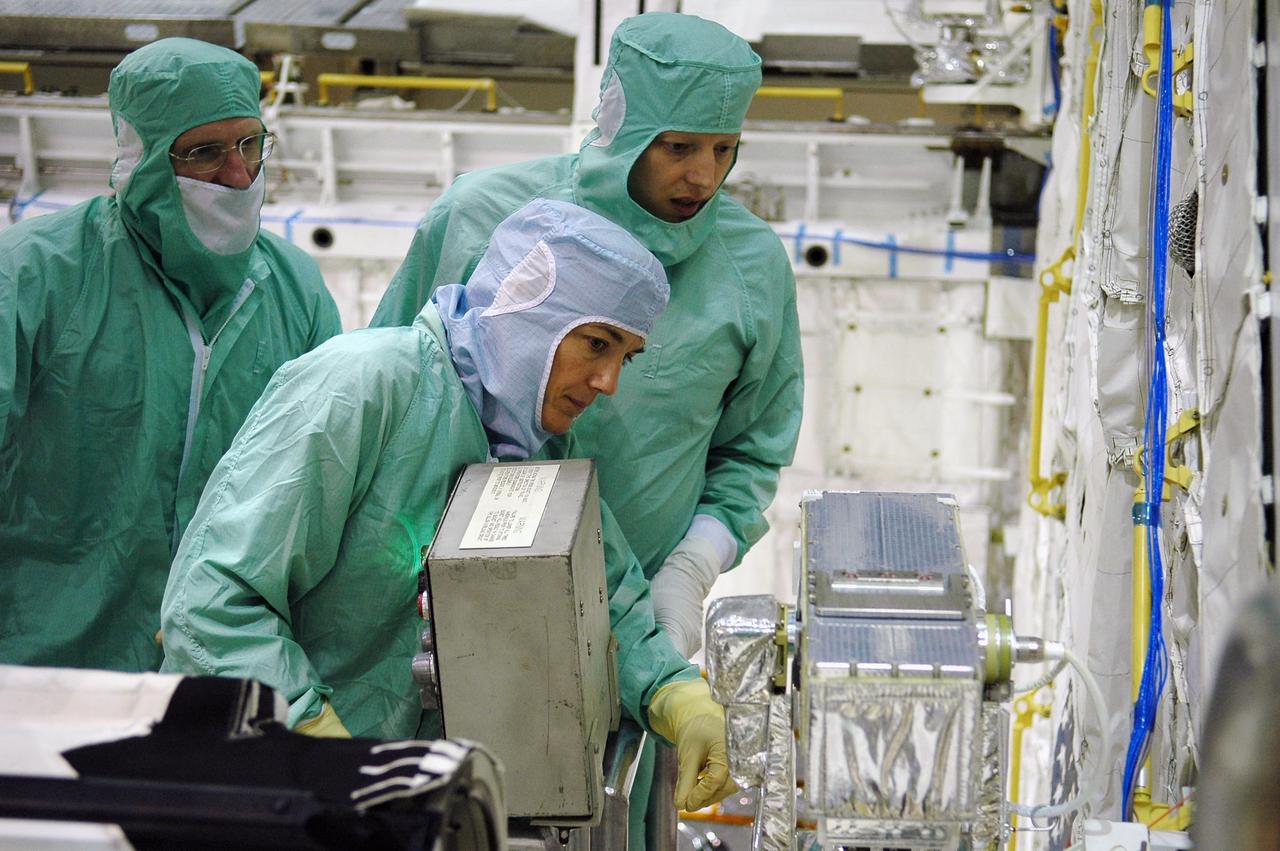
KENNEDY SPACE CENTER, FLA. - In the Orbiter Processing Facility at NASA's Kennedy Space Center, STS-115 crew members inspect equipment in Atlantis's payload bay. From left are Mission Specialists Joseph Tanner and Heidemarie Stefanyshyn-Piper. The crew is at KSC for Crew Equipment Interface Test activities, which involves equipment familiarization, a routine part of astronaut training and launch preparations. The STS-115 mission will deliver the second port truss segment, the P3/P4 truss, to the International Space Station. The crew will attach the P3 to the first port truss segment, the P1 truss, as well as deploy solar array set 2A and 4A. Launch on Space Shuttle Atlantis is scheduled for late August. Photo credit: NASA/Kim Shiflett
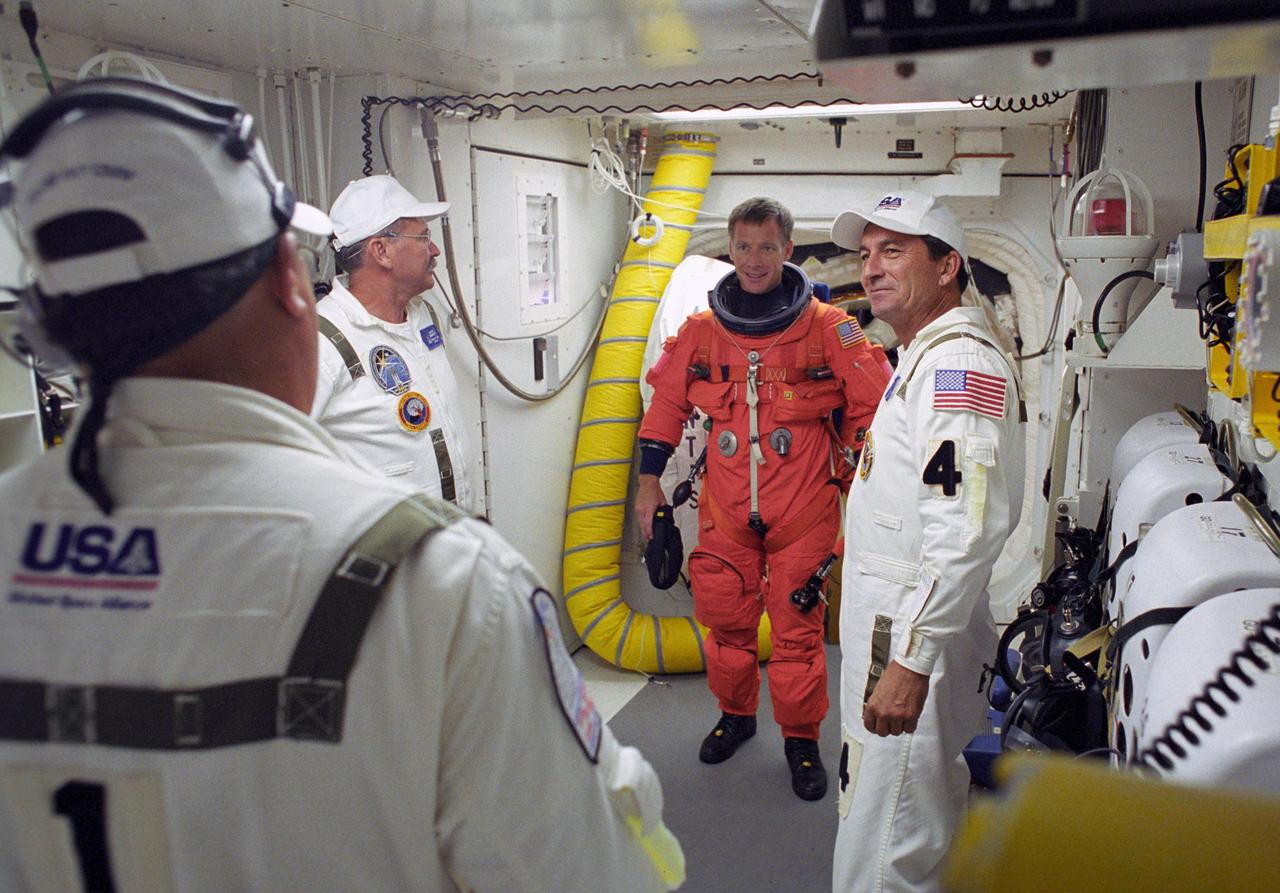
KENNEDY SPACE CENTER, FLA. - In the White Room on Launch Pad 39B, STS-115 Pilot Christopher Ferguson talks with the closeout crew before entering Space Shuttle Atlantis. Ferguson is making his first shuttle flight. During the mission, Atlantis' astronauts will deliver and install the 17.5-ton, bus-sized P3/P4 integrated truss segment on the station. The girder-like truss includes a set of giant solar arrays, batteries and associated electronics and will provide one-fourth of the total power-generation capability for the completed station. This mission is the 116th space shuttle flight, the 27th flight for orbiter Atlantis, and the 19th U.S. flight to the International Space Station. STS-115 is scheduled to last 11 days with a planned landing at KSC.
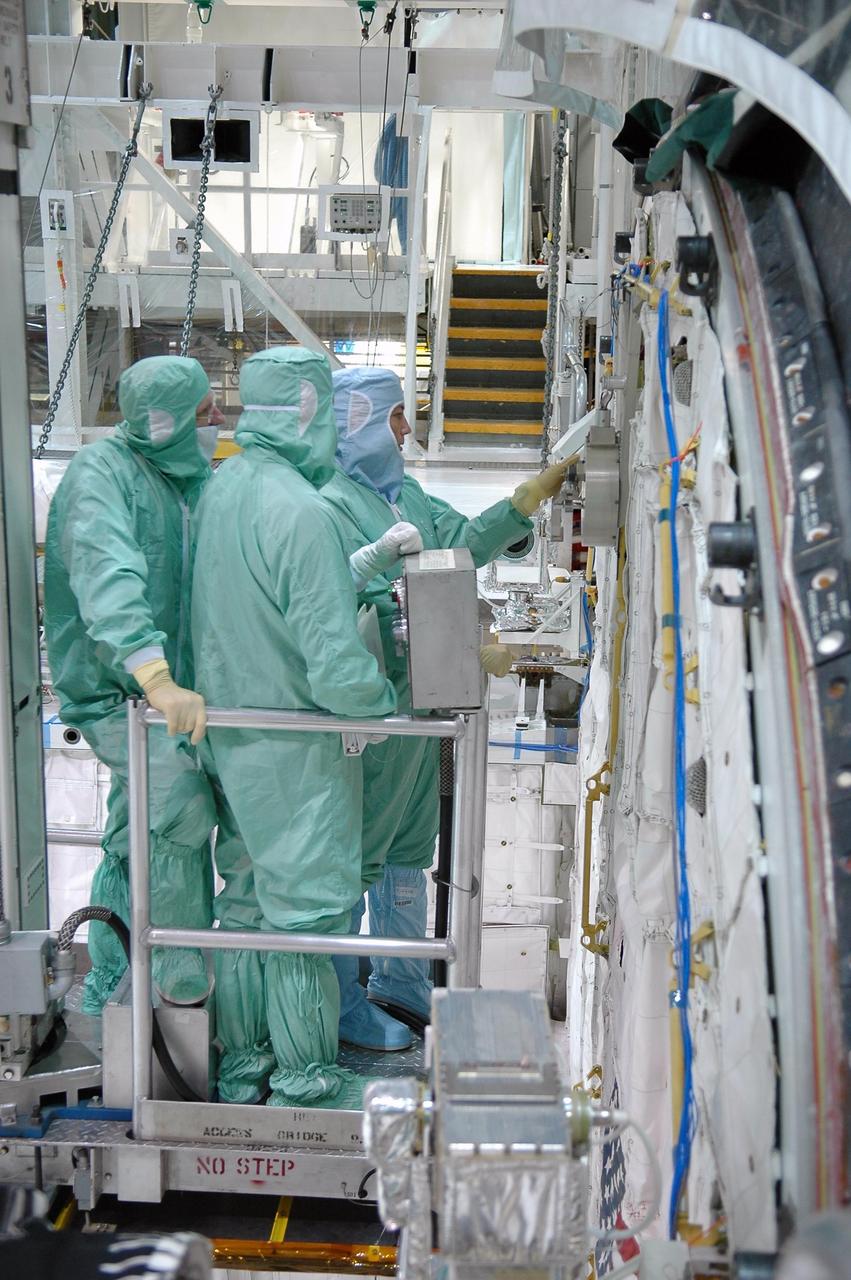
KENNEDY SPACE CENTER, FLA. - In the Orbiter Processing Facility at NASA's Kennedy Space Center, STS-115 crew members inspect equipment in Atlantis's payload bay. Mission Specialists (at left) Joseph Tanner and (at right) Heidemarie Stefanyshyn-Piper look at the airlock. The crew is at KSC for Crew Equipment Interface Test activities, which involves equipment familiarization, a routine part of astronaut training and launch preparations. The STS-115 mission will deliver the second port truss segment, the P3/P4 truss, to the International Space Station. The crew will attach the P3 to the first port truss segment, the P1 truss, as well as deploy solar array set 2A and 4A. Launch on Space Shuttle Atlantis is scheduled for late August. Photo credit: NASA/Kim Shiflett
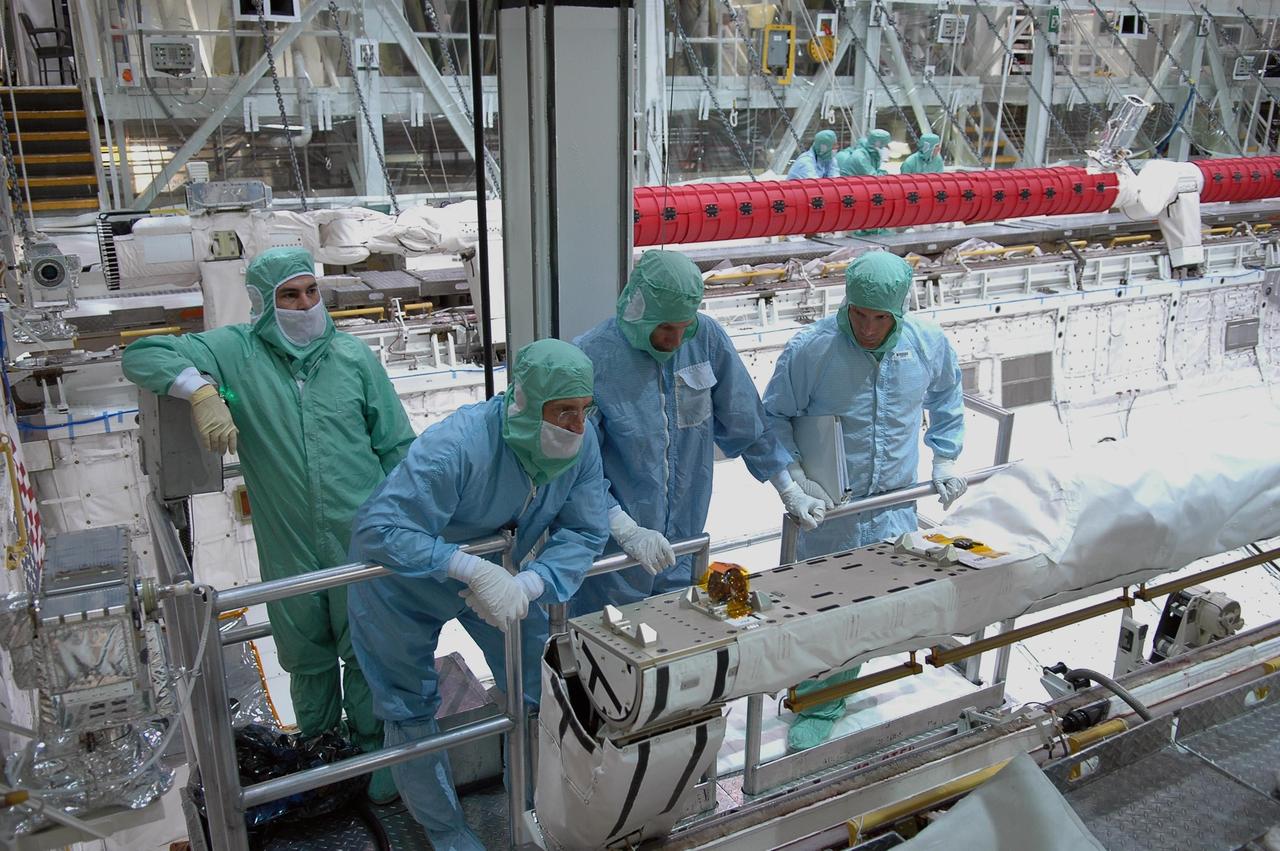
KENNEDY SPACE CENTER, FLA. - In the Orbiter Processing Facility at NASA's Kennedy Space Center, STS-115 crew members inspect equipment in Atlantis's payload bay. Mission Specialists (starting second from left) Daniel Burbank and Steven MacLean look at the orbiter boom sensor system. The crew is at KSC for Crew Equipment Interface Test activities, which involves equipment familiarization, a routine part of astronaut training and launch preparations. The STS-115 mission will deliver the second port truss segment, the P3/P4 truss, to the International Space Station. The crew will attach the P3 to the first port truss segment, the P1 truss, as well as deploy solar array set 2A and 4A. Launch on Space Shuttle Atlantis is scheduled for late August. Photo credit: NASA/Kim Shiflett
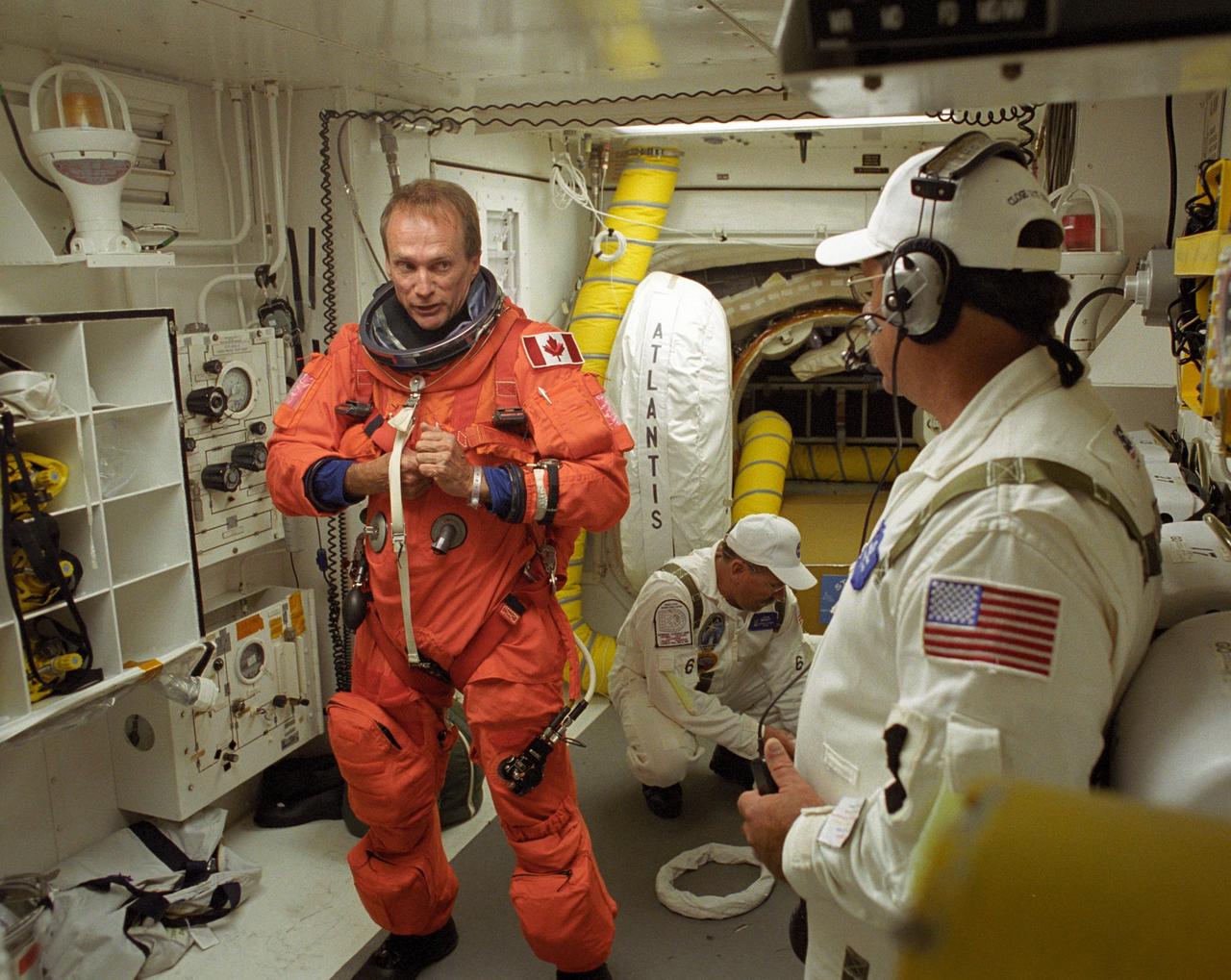
KENNEDY SPACE CENTER, FLA. - In the White Room on Launch Pad 39B, STS-115 Mission Specialist Steven MacLean adjusts his launch suit while talking with the closeout crew. MacLean, who represents the Canadian Space Agency, is making his second shuttle flight. During the mission, Atlantis' astronauts will deliver and install the 17.5-ton, bus-sized P3/P4 integrated truss segment on the station. The girder-like truss includes a set of giant solar arrays, batteries and associated electronics and will provide one-fourth of the total power-generation capability for the completed station. This mission is the 116th space shuttle flight, the 27th flight for orbiter Atlantis, and the 19th U.S. flight to the International Space Station. STS-115 is scheduled to last 11 days with a planned landing at KSC
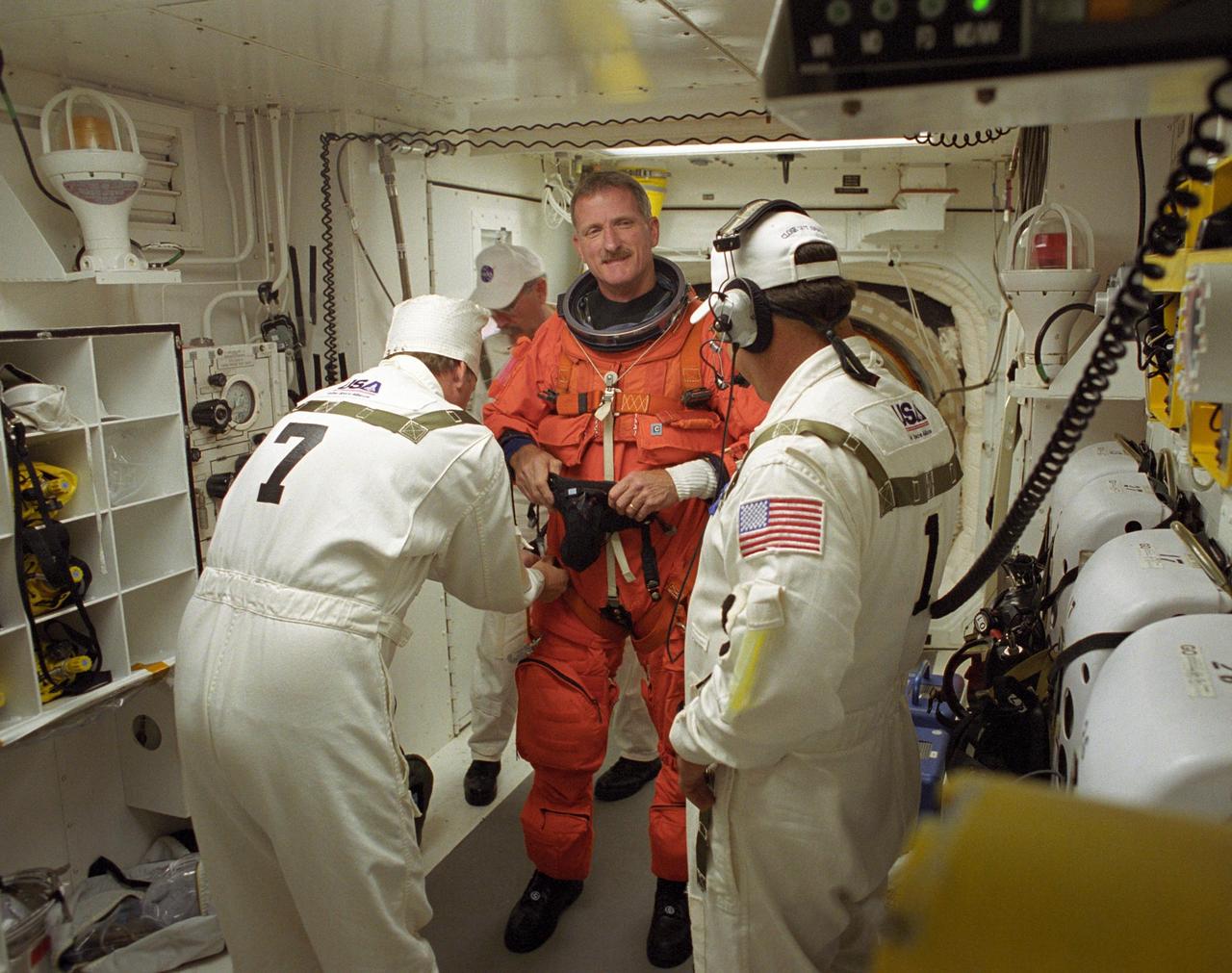
KENNEDY SPACE CENTER, FLA. - In the White Room on Launch Pad 39B, STS-115 Mission Specialist Joseph Tanner gets help with his launch suit from the closeout crew before entering Space Shuttle Atlantis. Tanner is making his fourth shuttle flight. During the mission, Atlantis' astronauts will deliver and install the 17.5-ton, bus-sized P3/P4 integrated truss segment on the station. The girder-like truss includes a set of giant solar arrays, batteries and associated electronics and will provide one-fourth of the total power-generation capability for the completed station. This mission is the 116th space shuttle flight, the 27th flight for orbiter Atlantis, and the 19th U.S. flight to the International Space Station. STS-115 is scheduled to last 11 days with a planned landing at KSC.
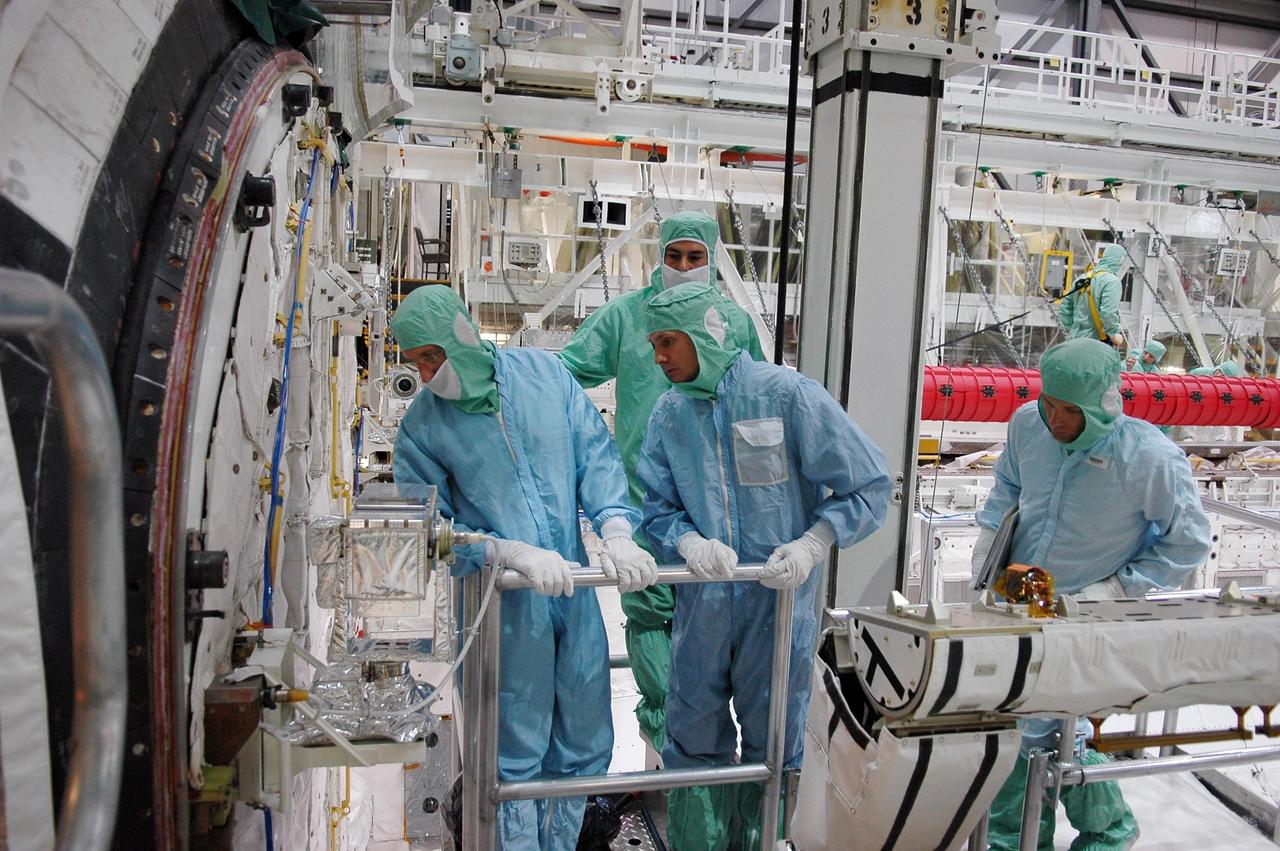
KENNEDY SPACE CENTER, FLA. - In the Orbiter Processing Facility at NASA's Kennedy Space Center, STS-115 crew members inspect equipment in Atlantis's payload bay. Looking at the airlock are Mission Specialist Daniel Burbank (left) and Steven MacLean. The crew is at KSC for Crew Equipment Interface Test activities, which involves equipment familiarization, a routine part of astronaut training and launch preparations. The STS-115 mission will deliver the second port truss segment, the P3/P4 truss, to the International Space Station. The crew will attach the P3 to the first port truss segment, the P1 truss, as well as deploy solar array set 2A and 4A. Launch on Space Shuttle Atlantis is scheduled for late August. Photo credit: NASA/Kim Shiflett
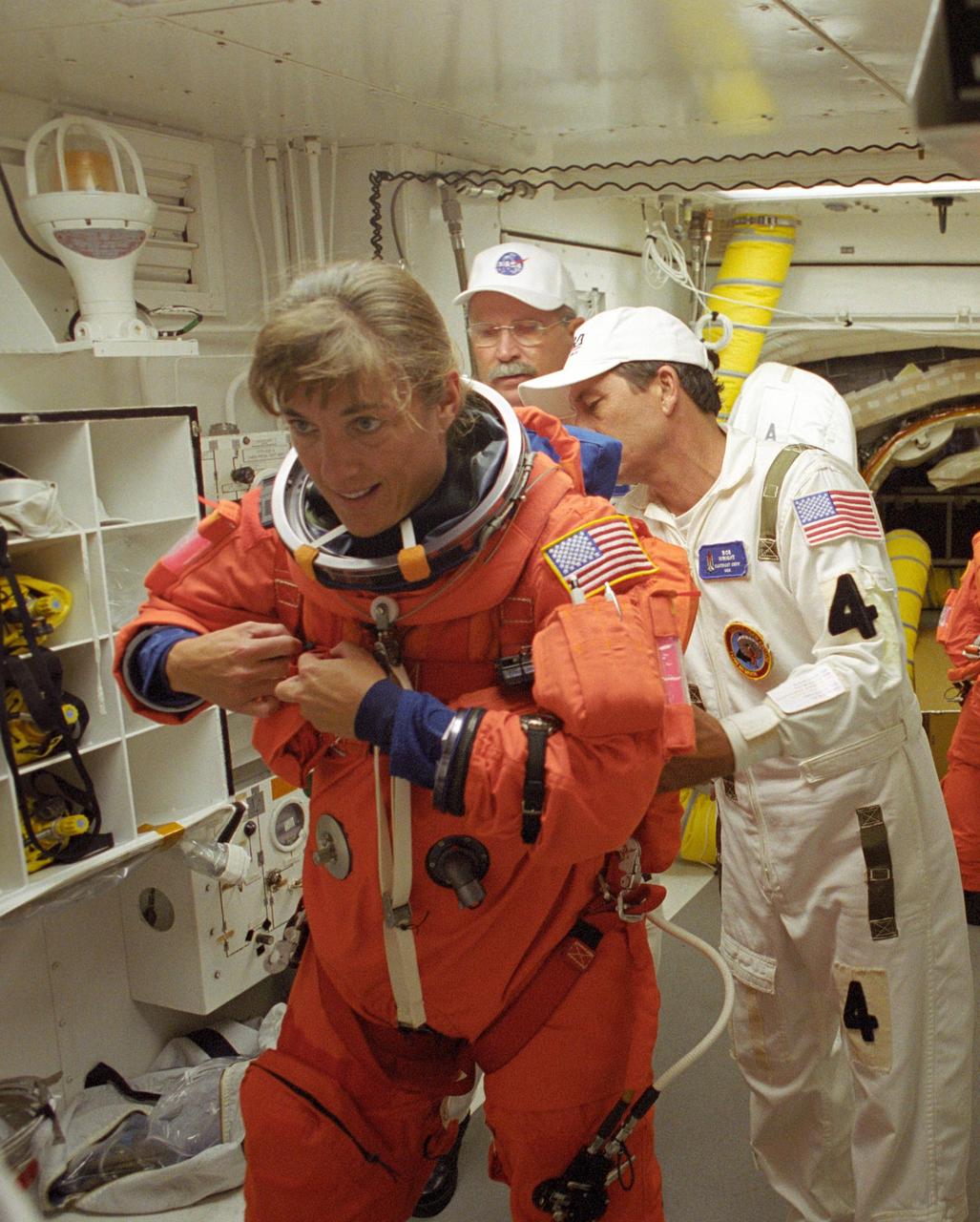
KENNEDY SPACE CENTER, FLA. - In the White Room on Launch Pad 39B, STS-115 Mission Specialist Heidemarie Stefanyshyn-Piper gets help with her launch suit from the closeout crew before entering Space Shuttle Atlantis. Piper is making her first shuttle flight. During the mission, Atlantis' astronauts will deliver and install the 17.5-ton, bus-sized P3/P4 integrated truss segment on the station. The girder-like truss includes a set of giant solar arrays, batteries and associated electronics and will provide one-fourth of the total power-generation capability for the completed station. This mission is the 116th space shuttle flight, the 27th flight for orbiter Atlantis, and the 19th U.S. flight to the International Space Station. STS-115 is scheduled to last 11 days with a planned landing at KSC
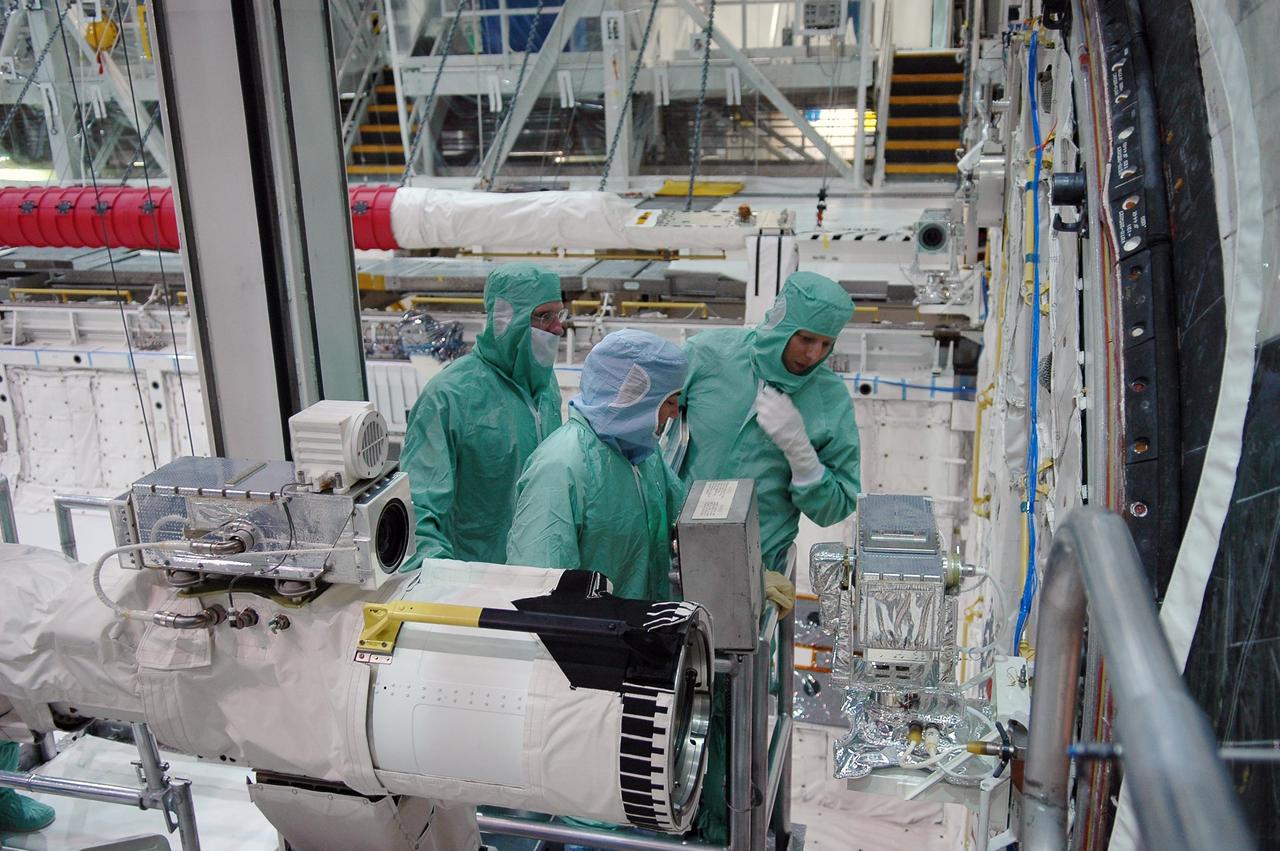
KENNEDY SPACE CENTER, FLA. - In the Orbiter Processing Facility at NASA's Kennedy Space Center, STS-115 crew members inspect equipment in Atlantis's payload bay. From left are Mission Specialists Joseph Tanner and Heidemarie Stefanyshyn-Piper. The crew is at KSC for Crew Equipment Interface Test activities, which involves equipment familiarization, a routine part of astronaut training and launch preparations. The STS-115 mission will deliver the second port truss segment, the P3/P4 truss, to the International Space Station. The crew will attach the P3 to the first port truss segment, the P1 truss, as well as deploy solar array set 2A and 4A. Launch on Space Shuttle Atlantis is scheduled for late August. Photo credit: NASA/Kim Shiflett
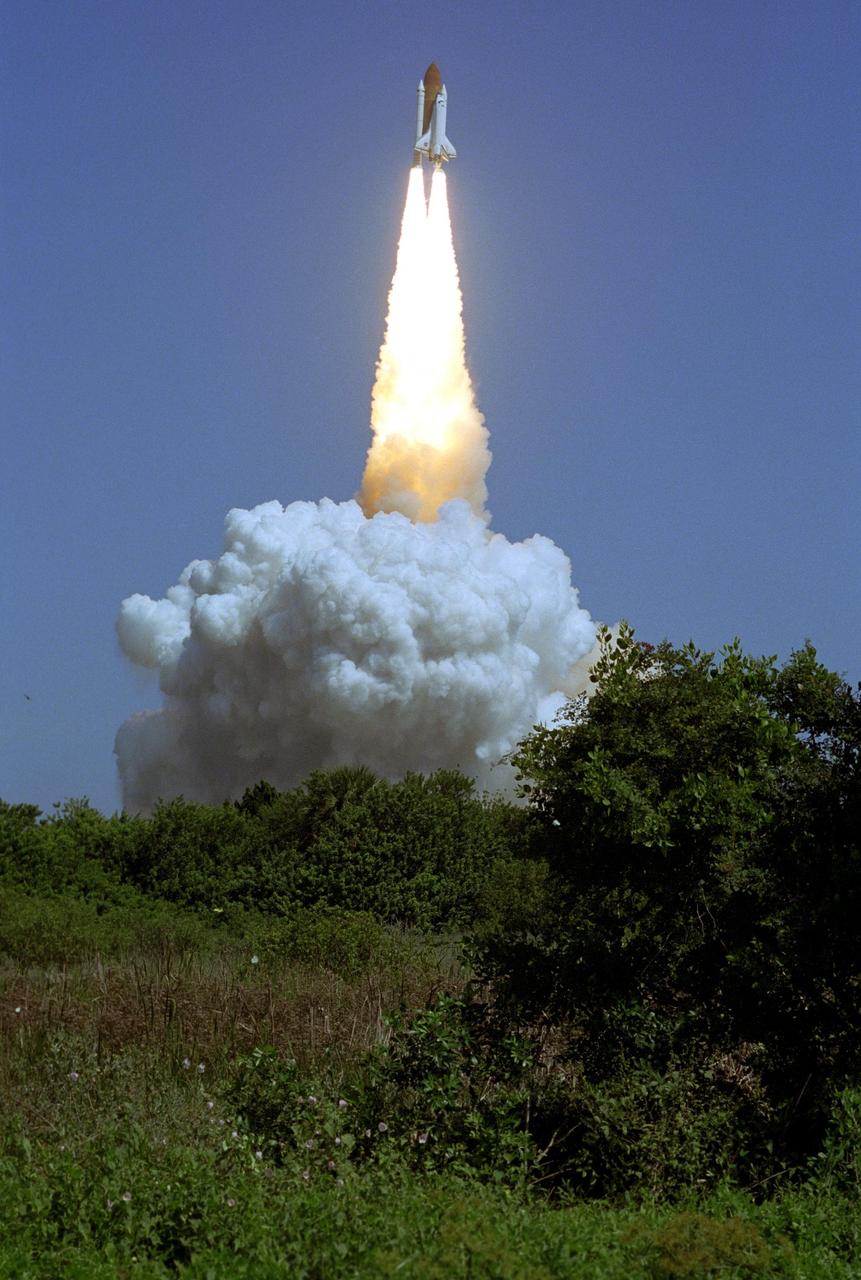
KENNEDY SPACE CENTER, FLA. - Space Shuttle Atlantis appears to spring out of the shrubbery near Launch Pad 39B. Atlantis is heading for a rendezvous with the International Space Station on mission STS-115. Liftoff was on-time at 11:14:55 a.m. EDT. After several launch attempts were scrubbed due to weather and technical concerns, this launch was executed perfectly. Mission STS-115 is the 116th space shuttle flight, the 27th flight for orbiter Atlantis, and the 19th U.S. flight to the International Space Station. During the mission, Atlantis' astronauts will deliver and install the 17.5-ton, bus-sized P3/P4 integrated truss segment on the station. The girder-like truss includes a set of giant solar arrays, batteries and associated electronics and will provide one-fourth of the total power-generation capability for the completed station. STS-115 is scheduled to last 11 days with a planned landing at KSC
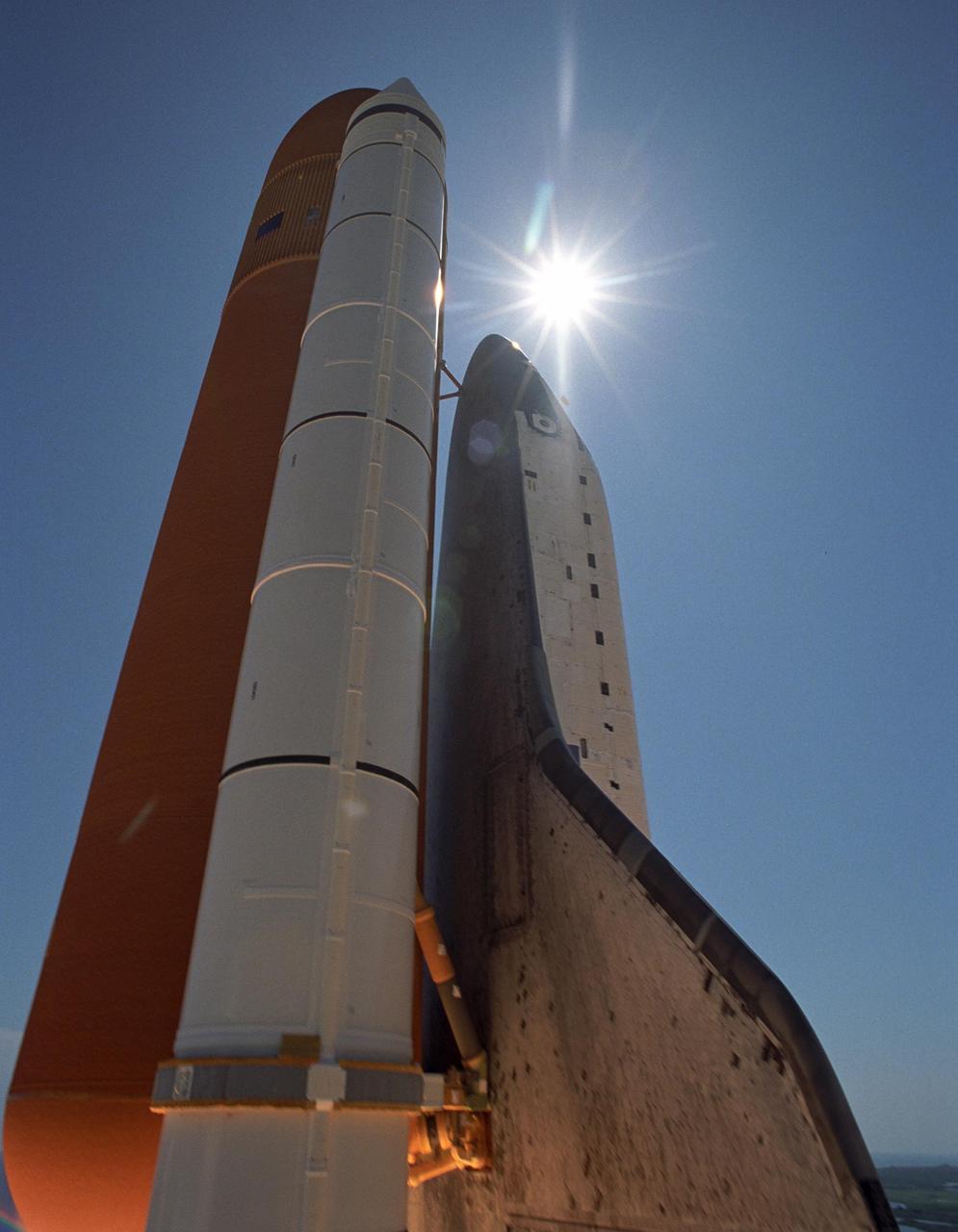
KENNEDY SPACE CENTER, FLA. - The sun radiates on Space Shuttle Atlantis as it heads for space on mission STS-115 to the International Space Station. Liftoff was on-time at 11:14:55 a.m. EDT. After several launch attempts were scrubbed due to weather and technical concerns, this launch was executed perfectly. Mission STS-115 is the 116th space shuttle flight, the 27th flight for orbiter Atlantis, and the 19th U.S. flight to the International Space Station. During the mission, Atlantis' astronauts will deliver and install the 17.5-ton, bus-sized P3/P4 integrated truss segment on the station. The girder-like truss includes a set of giant solar arrays, batteries and associated electronics and will provide one-fourth of the total power-generation capability for the completed station. STS-115 is scheduled to last 11 days with a planned landing at KSC.
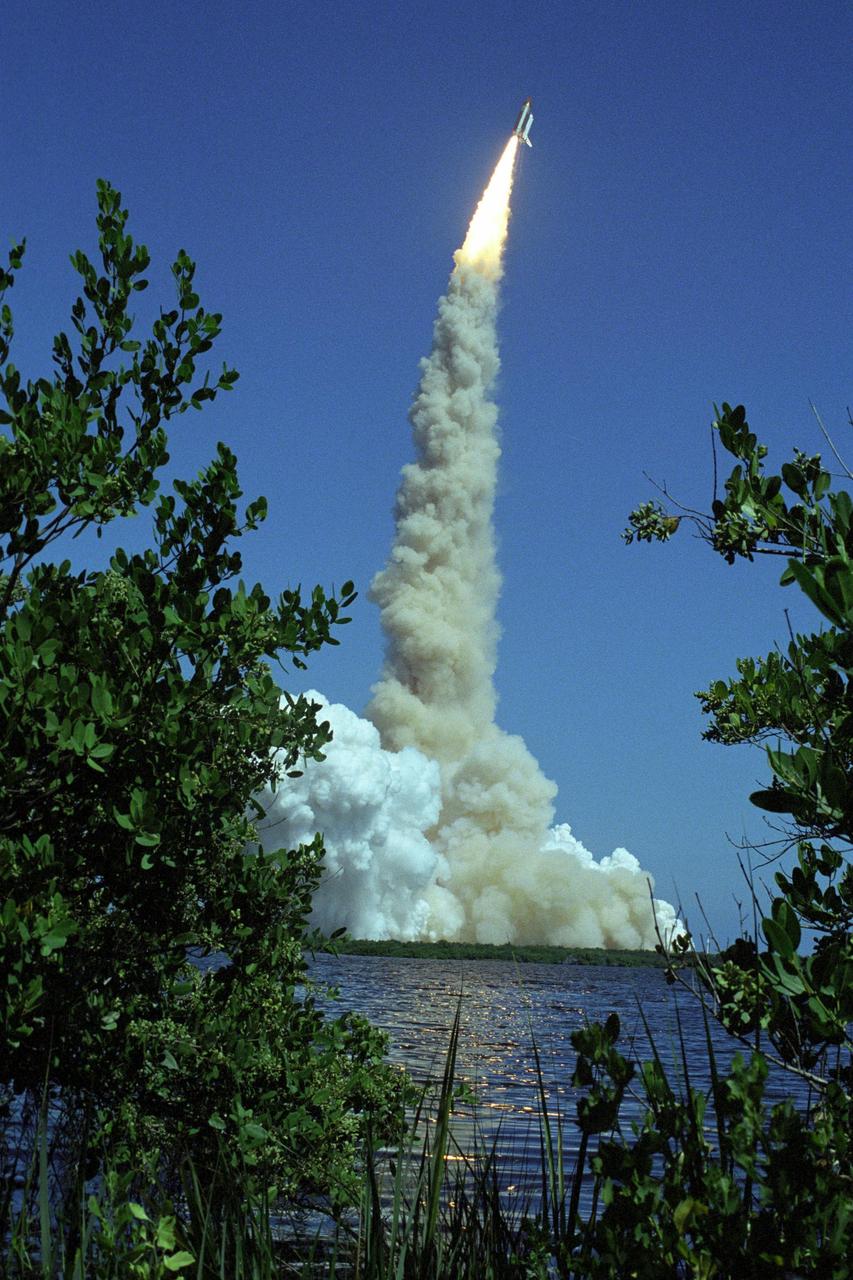
KENNEDY SPACE CENTER, FLA. - Trailing fire and a plume of smoke, Space Shuttle Atlantis leaves a dance of lights on nearby water as it hurtles toward space for a rendezvous with the International Space Station on mission STS-115. Liftoff was on-time at 11:14:55 a.m. EDT. After several launch attempts were scrubbed due to weather and technical concerns, this launch was executed perfectly. Mission STS-115 is the 116th space shuttle flight, the 27th flight for orbiter Atlantis, and the 19th U.S. flight to the International Space Station. During the mission, Atlantis' astronauts will deliver and install the 17.5-ton, bus-sized P3/P4 integrated truss segment on the station. The girder-like truss includes a set of giant solar arrays, batteries and associated electronics and will provide one-fourth of the total power-generation capability for the completed station. STS-115 is scheduled to last 11 days with a planned landing at KSC
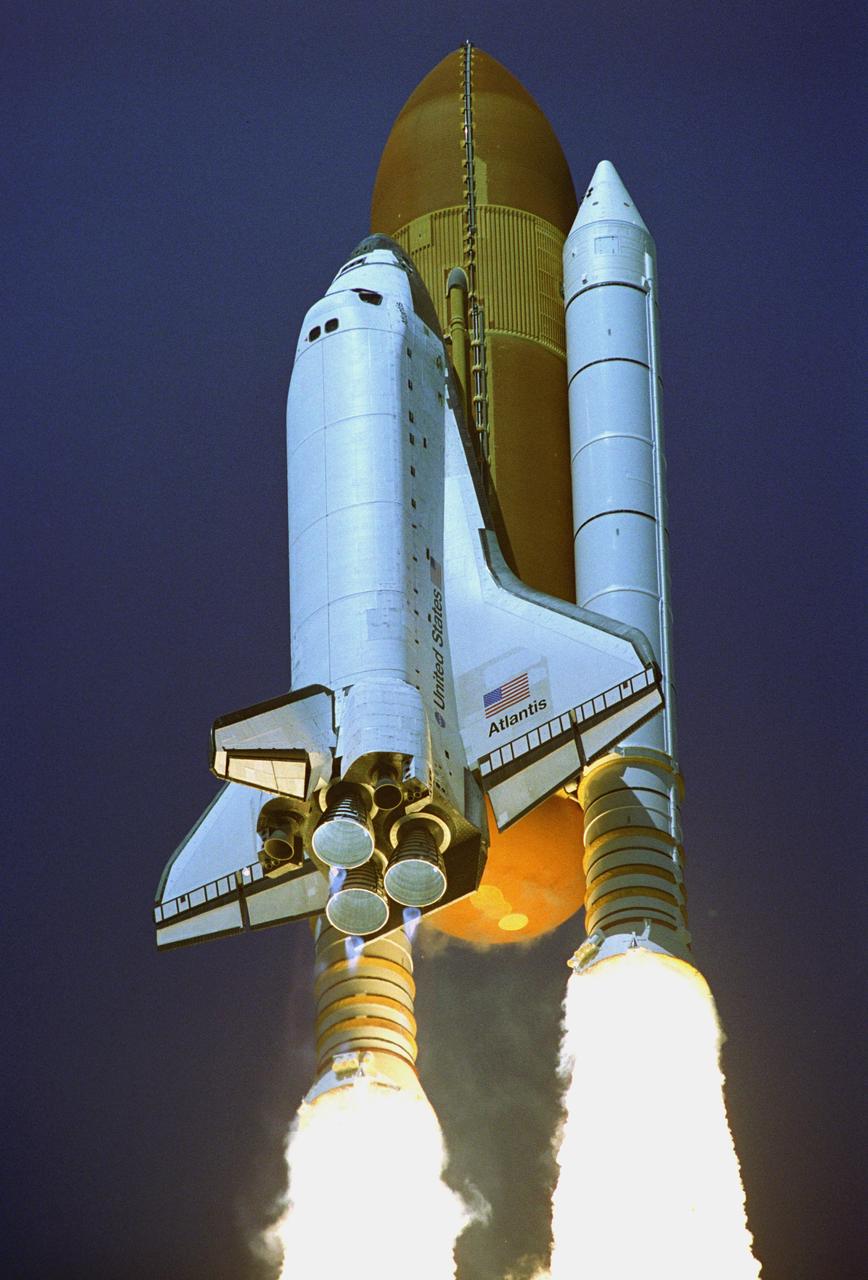
KENNEDY SPACE CENTER, FLA. - Twin columns of fire propel Space Shuttle Atlantis into a clear blue sky after liftoff from Launch Pad 39B. Atlantis is heading for a rendezvous with the International Space Station on mission STS-115. Liftoff was on-time at 11:14:55 a.m. EDT. After several launch attempts were scrubbed due to weather and technical concerns, this launch was executed perfectly. Mission STS-115 is the 116th space shuttle flight, the 27th flight for orbiter Atlantis, and the 19th U.S. flight to the International Space Station. During the mission, Atlantis' astronauts will deliver and install the 17.5-ton, bus-sized P3/P4 integrated truss segment on the station. The girder-like truss includes a set of giant solar arrays, batteries and associated electronics and will provide one-fourth of the total power-generation capability for the completed station. STS-115 is scheduled to last 11 days with a planned landing at KSC
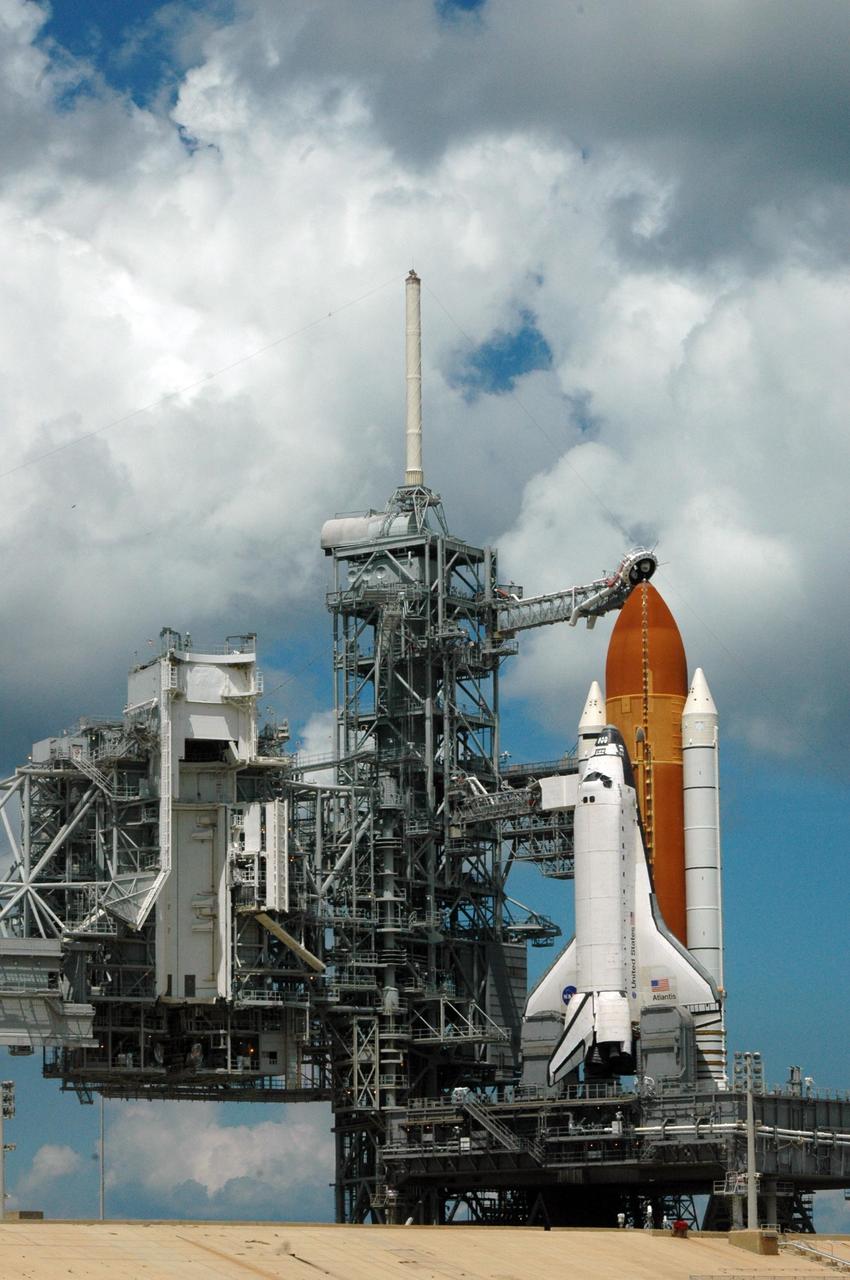
KENNEDY SPACE CENTER, FLA. - Huge clouds roll over Launch Pad 39B where Space Shuttle Atlantis still sits after the scrub of its launch on mission STS-115. Atlantis was originally scheduled to launch at 12:29 p.m. EDT on this date, but a 24-hour scrub was called by mission managers due to a concern with fuel cell 1. Towering above the shuttle is the 80-foot lightning mast. At left is the rolled-back rotating service structure with the payload changeout room open. Just above the orange external tank is the vent hood (known as the "beanie cap") at the end of the gaseous oxygen vent arm. Vapors are created as the liquid oxygen in the external tank boil off. The hood vents the gaseous oxygen vapors away from the space shuttle vehicle. During the STS-115 mission, Atlantis' astronauts will deliver and install the 17.5-ton, bus-sized P3/P4 integrated truss segment on the station. The girder-like truss includes a set of giant solar arrays, batteries and associated electronics and will provide one-fourth of the total power-generation capability for the completed station. This mission is the 116th space shuttle flight, the 27th flight for orbiter Atlantis, and the 19th U.S. flight to the International Space Station. STS-115 is scheduled to last 11 days with a planned landing at KSC. Photo credit: NASA/Ken Thornsley
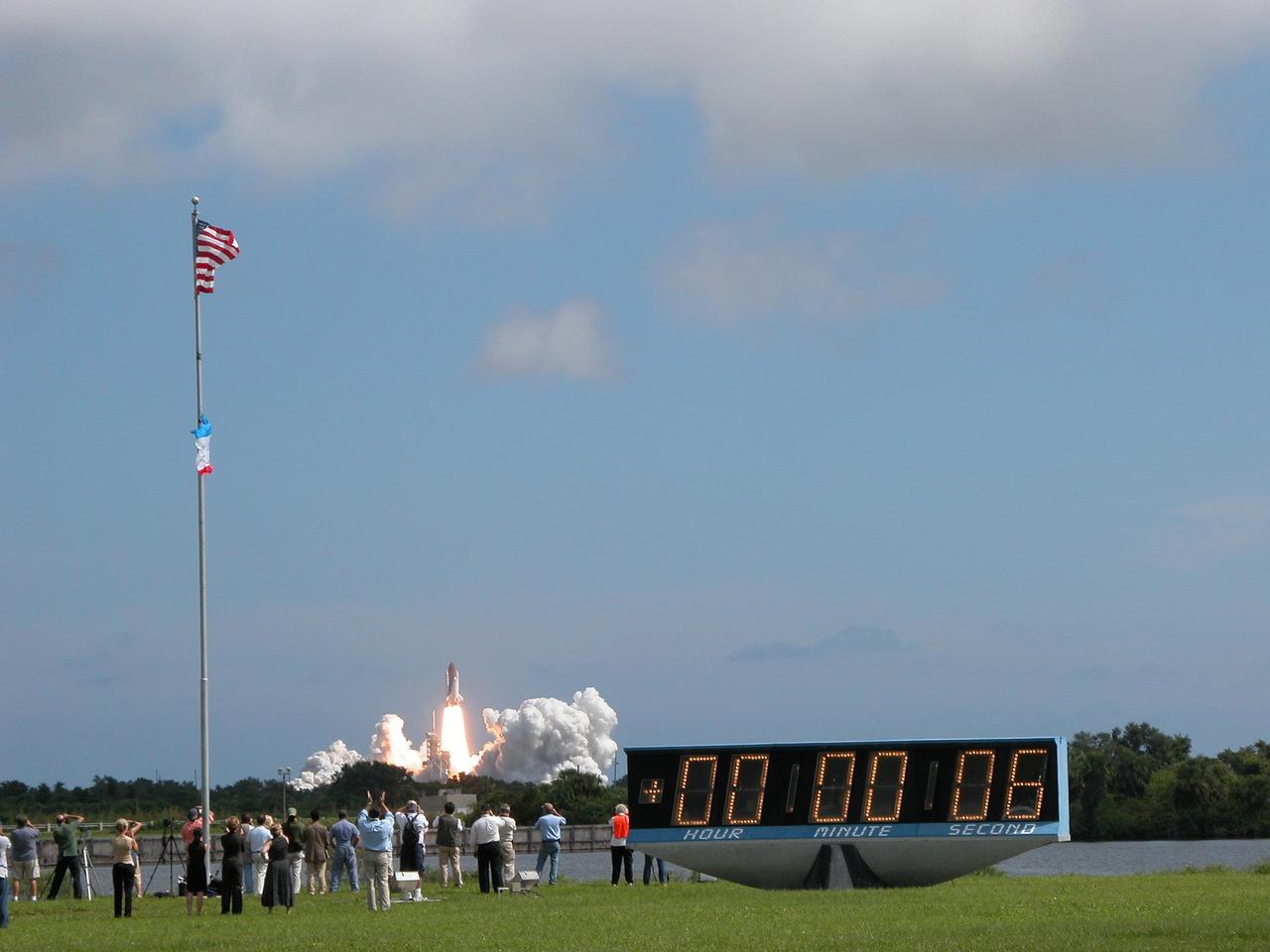
KENNEDY SPACE CENTER, FLA. - With applause and cheers from the onlookers, Space Shuttle Atlantis roars off the launch pad for a rendezvous with the International Space Station on mission STS-115. In the foreground is the countdown clock, marking launch and mission-elapsed time, on the grounds of the NASA News Center. After launch attempts were scrubbed Aug. 27 and 29 and Sept. 3 and 8 due to weather and technical concerns, this launch was executed perfectly. During the STS-115 mission, Atlantis' astronauts will deliver and install the 17.5-ton, bus-sized P3/P4 integrated truss segment on the station. The girder-like truss includes a set of giant solar arrays, batteries and associated electronics and will provide one-fourth of the total power-generation capability for the completed station. This mission is the 116th space shuttle flight, the 27th flight for orbiter Atlantis, and the 19th U.S. flight to the ISS. STS-115 is scheduled to last 11 days with a planned landing at KSC. Photo credit: NASA/Debbie Odom
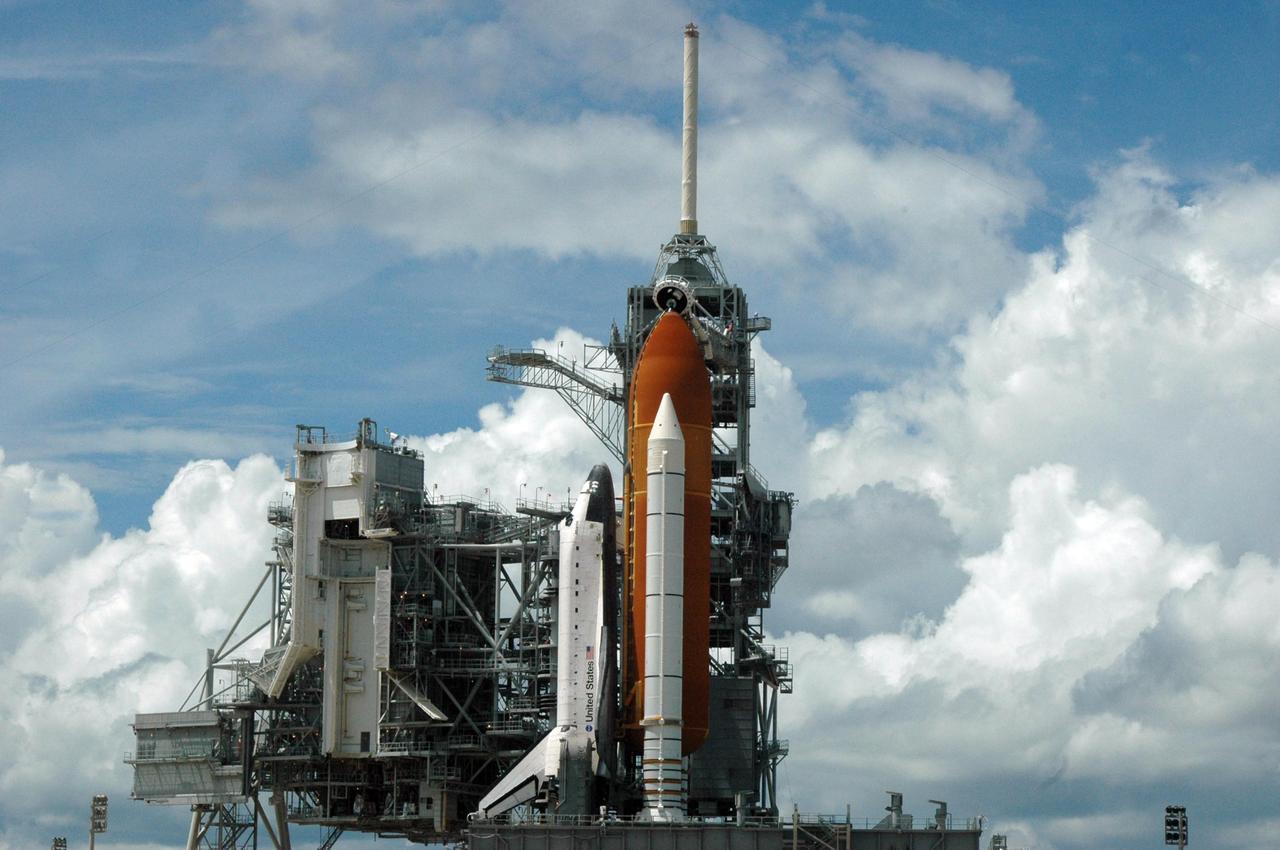
KENNEDY SPACE CENTER, FLA. - Huge clouds billow on the horizon behind Space Shuttle Atlantis still sitting on Launch Pad 39B after the scrub of its launch on mission STS-115. Atlantis was originally scheduled to launch at 12:29 p.m. EDT on this date, but a 24-hour scrub was called by mission managers due to a concern with fuel cell 1. Towering above the shuttle is the 80-foot lightning mast. At left is the rolled-back rotating service structure with the payload changeout room open. During the STS-115 mission, Atlantis' astronauts will deliver and install the 17.5-ton, bus-sized P3/P4 integrated truss segment on the station. The girder-like truss includes a set of giant solar arrays, batteries and associated electronics and will provide one-fourth of the total power-generation capability for the completed station. This mission is the 116th space shuttle flight, the 27th flight for orbiter Atlantis, and the 19th U.S. flight to the International Space Station. STS-115 is scheduled to last 11 days with a planned landing at KSC. Photo credit: NASA/Ken Thornsley
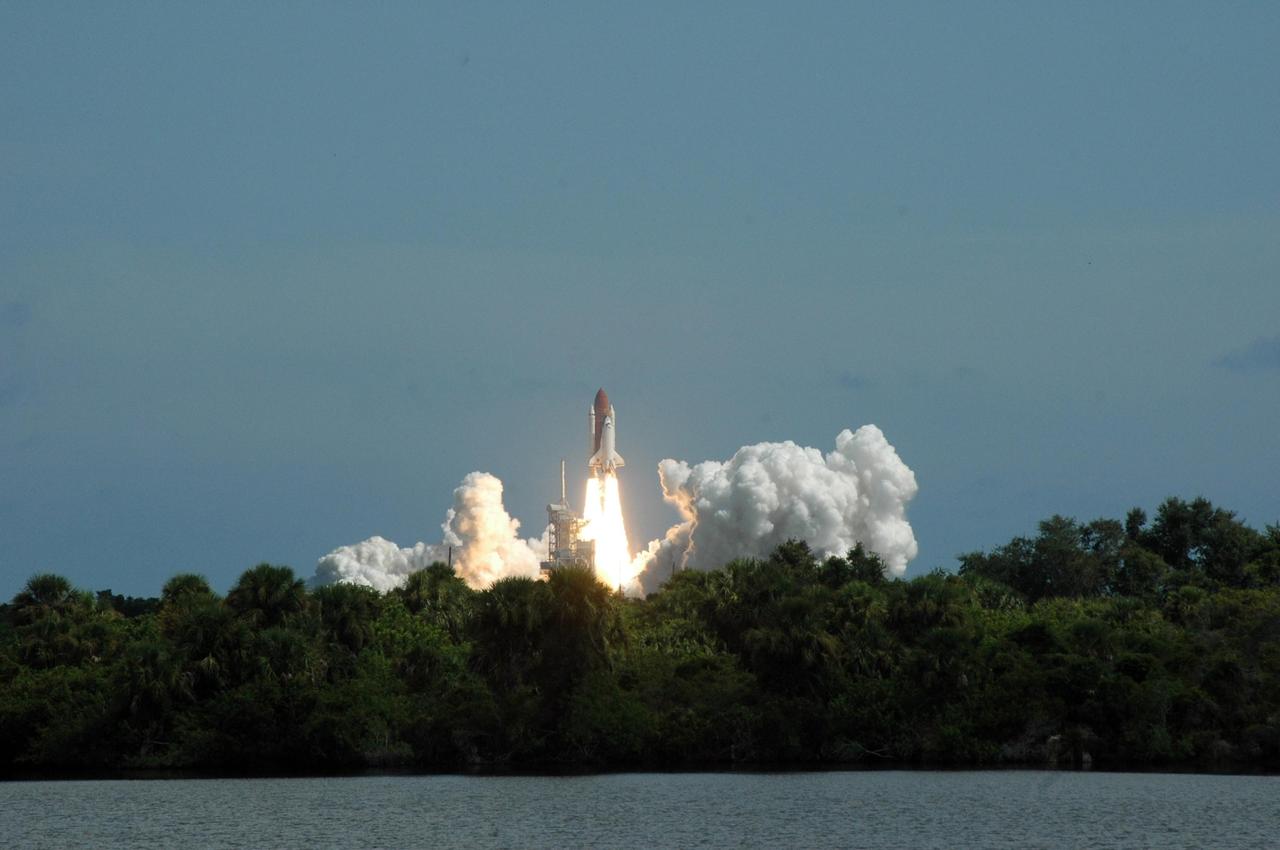
KENNEDY SPACE CENTER, FLA. -As if leaping out from amidst the woods, Space Shuttle Atlantis roars off Launch Pad 39B for a rendezvous with the International Space Station on mission STS-115. Liftoff was on-time at 11:14:55 a.m. EDT. After launch attempts were scrubbed Aug. 27 and 29 and Sept. 3 and 8 due to weather and technical concerns, this launch was executed perfectly. Mission STS-115 is the 116th space shuttle flight, the 27th flight for orbiter Atlantis, and the 19th U.S. flight to the International Space Station. During the mission, Atlantis' astronauts will deliver and install the 17.5-ton, bus-sized P3/P4 integrated truss segment on the station. The girder-like truss includes a set of giant solar arrays, batteries and associated electronics and will provide one-fourth of the total power-generation capability for the completed station. STS-115 is scheduled to last 11 days with a planned landing at KSC. Photo credit: NASA/Ken Thornsley
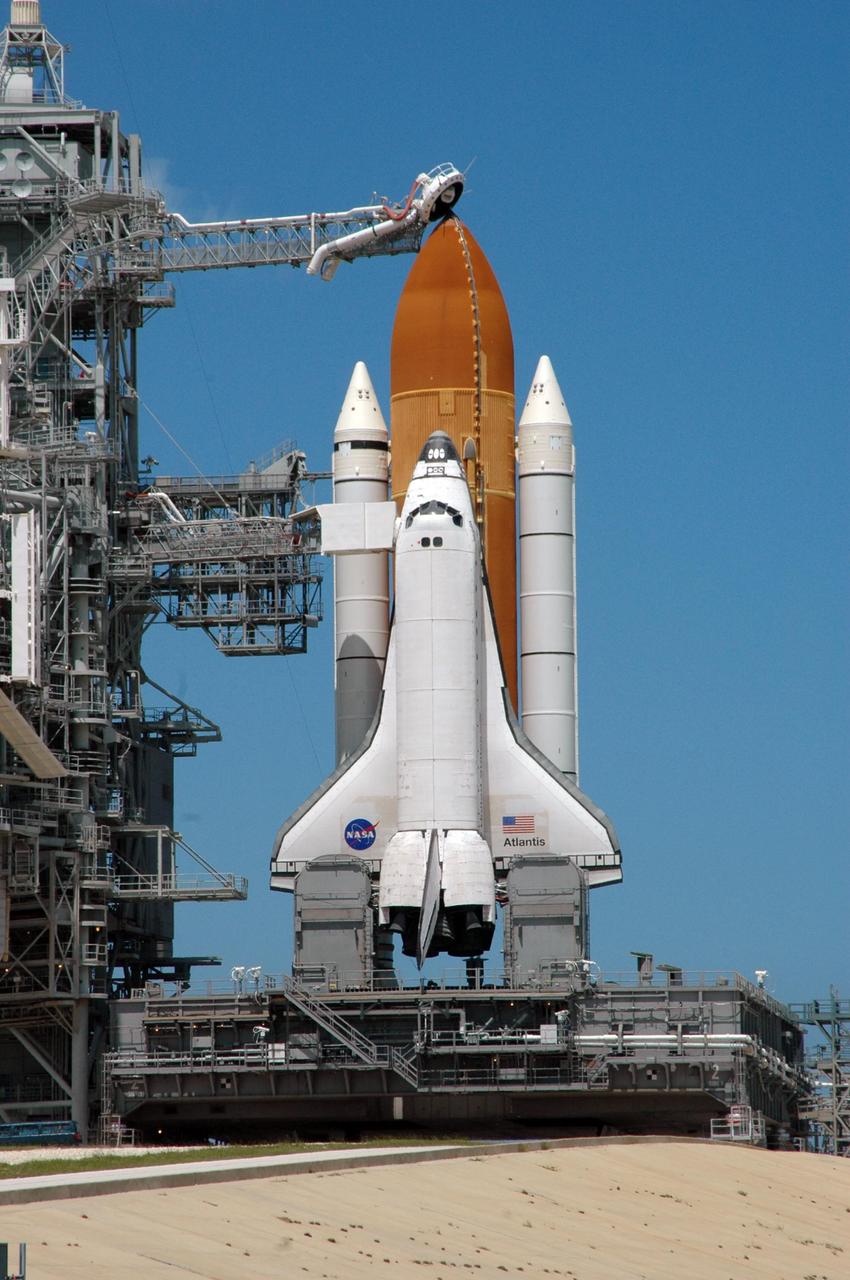
KENNEDY SPACE CENTER, FLA. - The sky is finally clear behind Launch Pad 39B where Space Shuttle Atlantis still sits after the scrub of its launch on mission STS-115. Atlantis was originally scheduled to launch at 12:29 p.m. EDT on this date, but a 24-hour scrub was called by mission managers due to a concern with fuel cell 1. Just above the orange external tank is the vent hood (known as the "beanie cap") at the end of the gaseous oxygen vent arm. Vapors are created as the liquid oxygen in the external tank boil off. The hood vents the gaseous oxygen vapors away from the space shuttle vehicle. Below, the orbiter access arm extends toward the cockpit of Atlantis with the White Room at the end. The White Room provides access into the cockpit of the vehicle. During the STS-115 mission, Atlantis' astronauts will deliver and install the 17.5-ton, bus-sized P3/P4 integrated truss segment on the station. The girder-like truss includes a set of giant solar arrays, batteries and associated electronics and will provide one-fourth of the total power-generation capability for the completed station. This mission is the 116th space shuttle flight, the 27th flight for orbiter Atlantis, and the 19th U.S. flight to the International Space Station. STS-115 is scheduled to last 11 days with a planned landing at KSC. Photo credit: NASA/Ken Thornsley
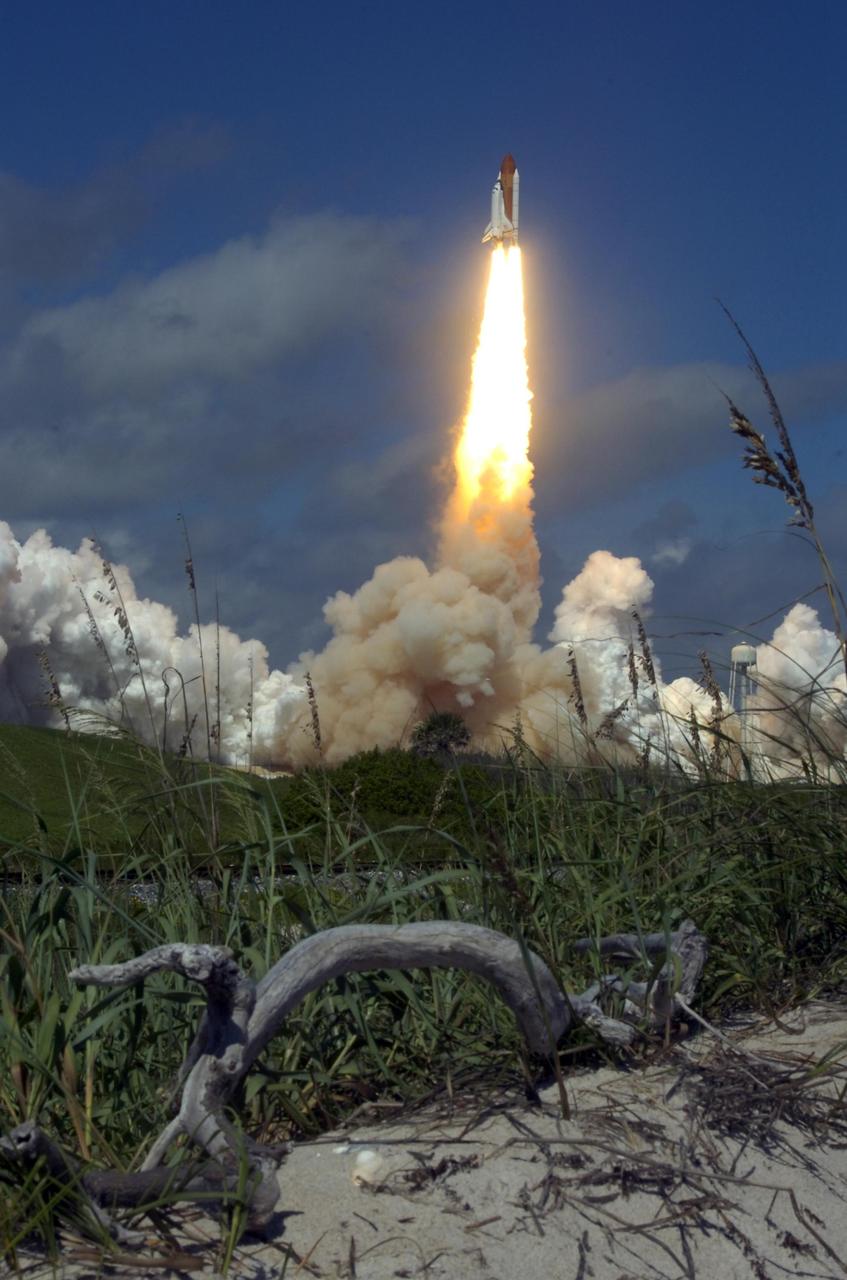
KENNEDY SPACE CENTER, FLA. - Space Shuttle Atlantis roars into the sky above the primitive sand dunes in the foreground. Heading for its rendezvous with the International Space Station on mission STS-115, liftoff was on-time at 11:14:55 a.m. EDT. After launch attempts were scrubbed Aug. 27 and 29 and Sept. 3 and 8 due to weather and technical concerns, this launch was executed perfectly. Mission STS-115 is the 116th space shuttle flight, the 27th flight for orbiter Atlantis, and the 19th U.S. flight to the International Space Station. During the mission, Atlantis' astronauts will deliver and install the 17.5-ton, bus-sized P3/P4 integrated truss segment on the station. The girder-like truss includes a set of giant solar arrays, batteries and associated electronics and will provide one-fourth of the total power-generation capability for the completed station. STS-115 is scheduled to last 11 days with a planned landing at KSC. Photo credit: NASA/Sandra Joseph & Robert Murray
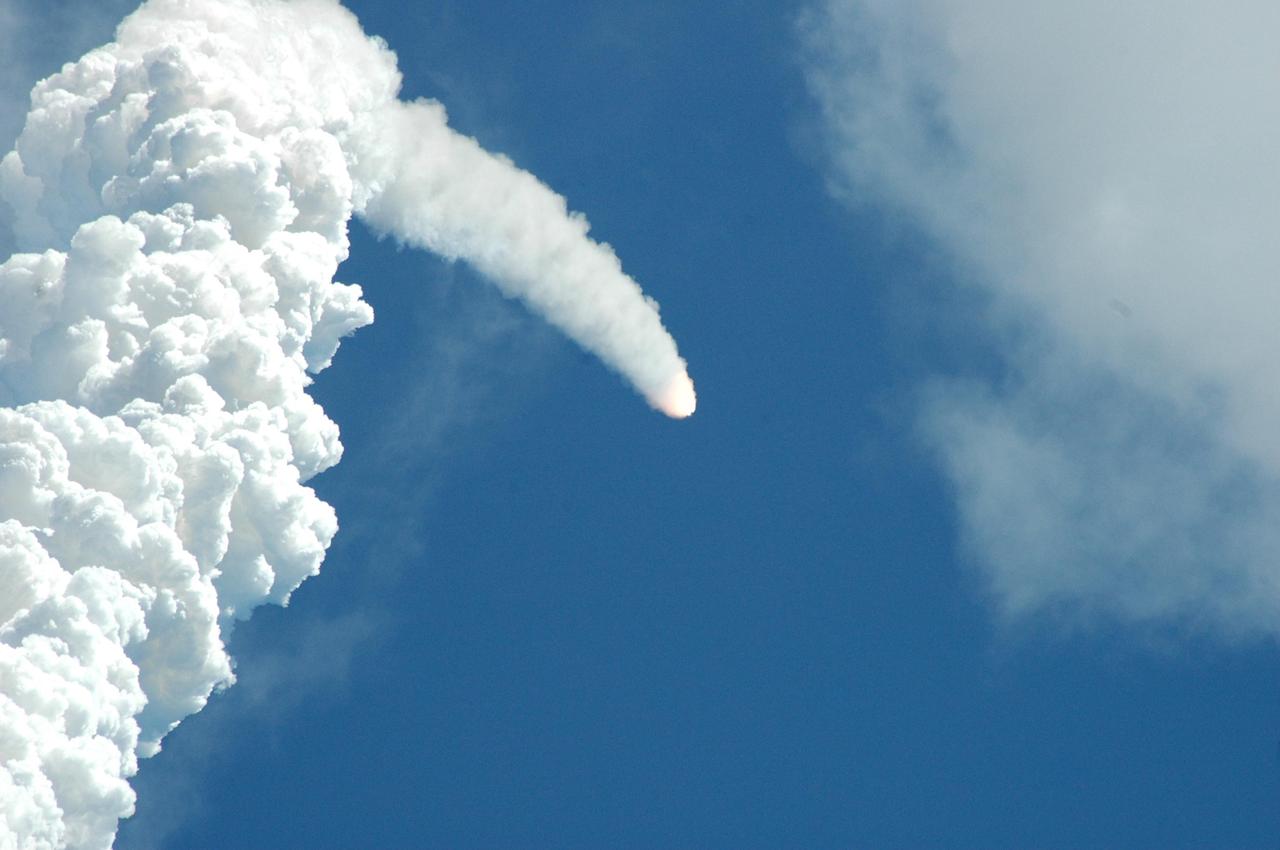
KENNEDY SPACE CENTER, FLA. - Nearly obscured by its own contrail, Space Shuttle Atlantis hurtles toward space for a rendezvous with the International Space Station on mission STS-115. Liftoff was on-time at 11:14:55 a.m. EDT. After launch attempts were scrubbed Aug. 27 and 29 and Sept. 3 and 8 due to weather and technical concerns, this launch was executed perfectly. Mission STS-115 is the 116th space shuttle flight, the 27th flight for orbiter Atlantis, and the 19th U.S. flight to the International Space Station. During the mission, Atlantis' astronauts will deliver and install the 17.5-ton, bus-sized P3/P4 integrated truss segment on the station. The girder-like truss includes a set of giant solar arrays, batteries and associated electronics and will provide one-fourth of the total power-generation capability for the completed station. STS-115 is scheduled to last 11 days with a planned landing at KSC. Photo credit: NASA/Ken Thornsley
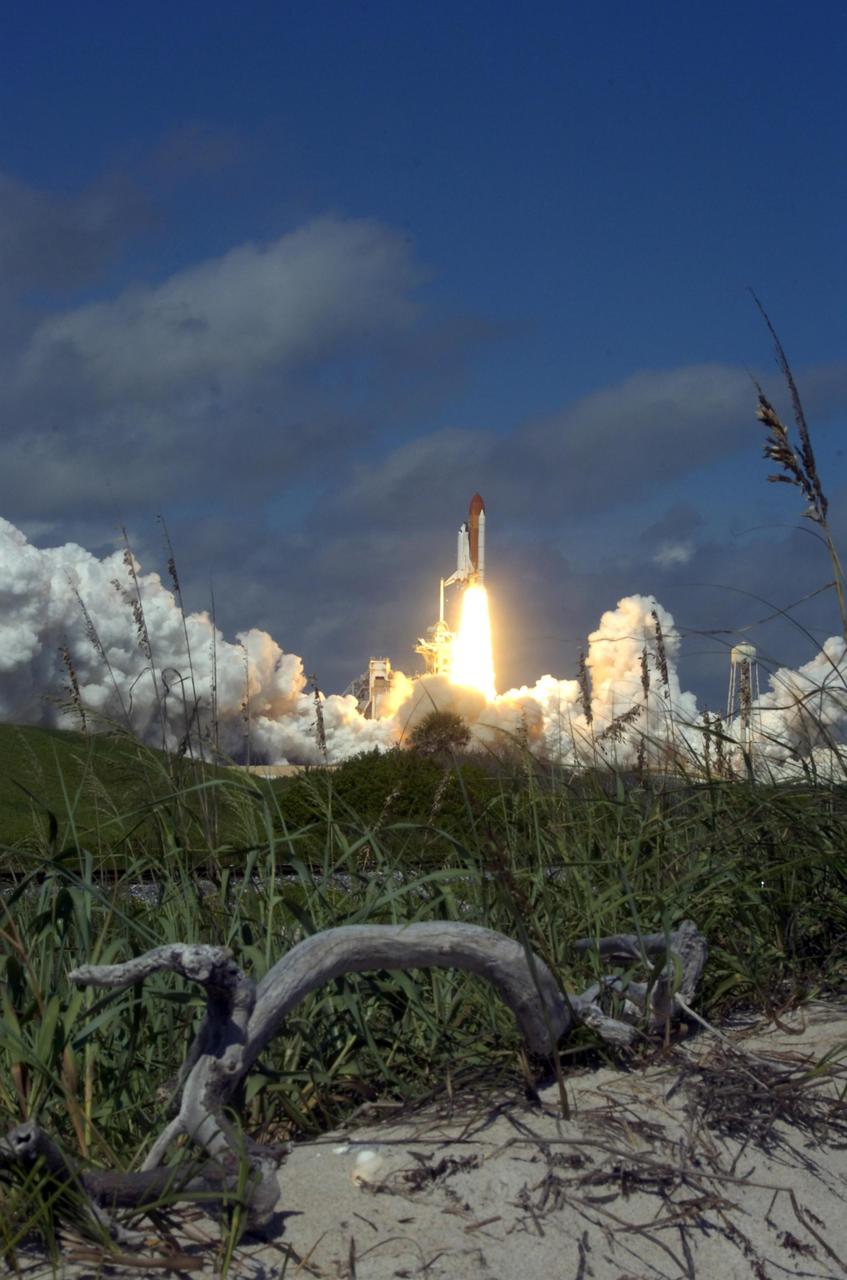
KENNEDY SPACE CENTER, FLA. - The primitiveness of the dunes (foreground) clash with the technology exhibited in the launch of Space Shuttle Atlantis for its rendezvous with the International Space Station on mission STS-115. Liftoff was on-time at 11:14:55 a.m. EDT. After launch attempts were scrubbed Aug. 27 and 29 and Sept. 3 and 8 due to weather and technical concerns, this launch was executed perfectly. Mission STS-115 is the 116th space shuttle flight, the 27th flight for orbiter Atlantis, and the 19th U.S. flight to the International Space Station. During the mission, Atlantis' astronauts will deliver and install the 17.5-ton, bus-sized P3/P4 integrated truss segment on the station. The girder-like truss includes a set of giant solar arrays, batteries and associated electronics and will provide one-fourth of the total power-generation capability for the completed station. STS-115 is scheduled to last 11 days with a planned landing at KSC. Photo credit: NASA/Sandra Joseph & Robert Murray
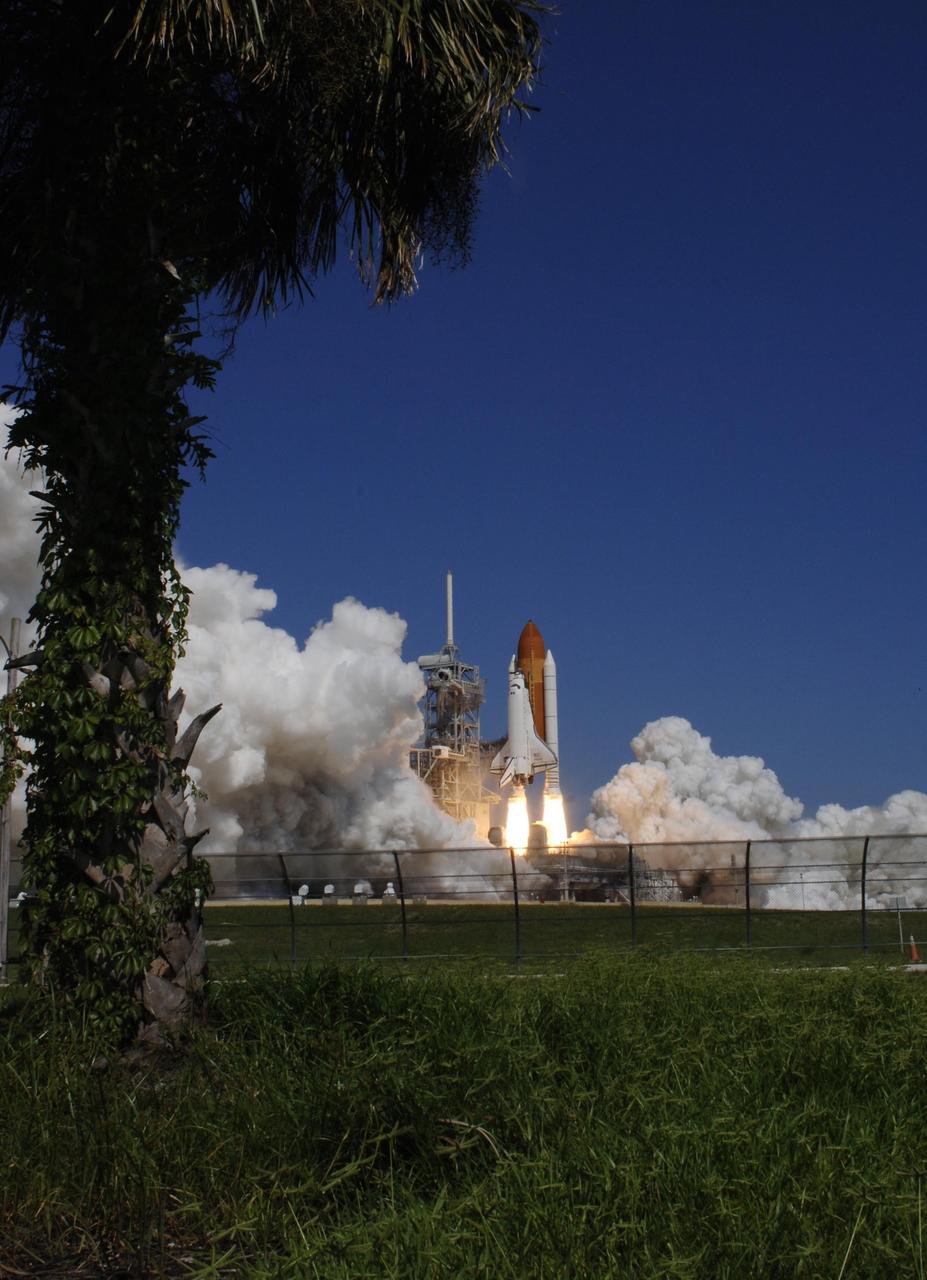
KENNEDY SPACE CENTER, FLA. - Although it appears to be standing on twin columns of fire, Space Shuttle Atlantis leaps off the launch pad, heading toward space for a rendezvous with the International Space Station on mission STS-115. Liftoff was on-time at 11:14:55 a.m. EDT. After launch attempts were scrubbed Aug. 27 and 29 and Sept. 3 and 8 due to weather and technical concerns, this launch was executed perfectly. Mission STS-115 is the 116th space shuttle flight, the 27th flight for orbiter Atlantis, and the 19th U.S. flight to the International Space Station. During the mission, Atlantis' astronauts will deliver and install the 17.5-ton, bus-sized P3/P4 integrated truss segment on the station. The girder-like truss includes a set of giant solar arrays, batteries and associated electronics and will provide one-fourth of the total power-generation capability for the completed station. STS-115 is scheduled to last 11 days with a planned landing at KSC. Photo credit: NASA/Sandra Joseph & Robert Murray