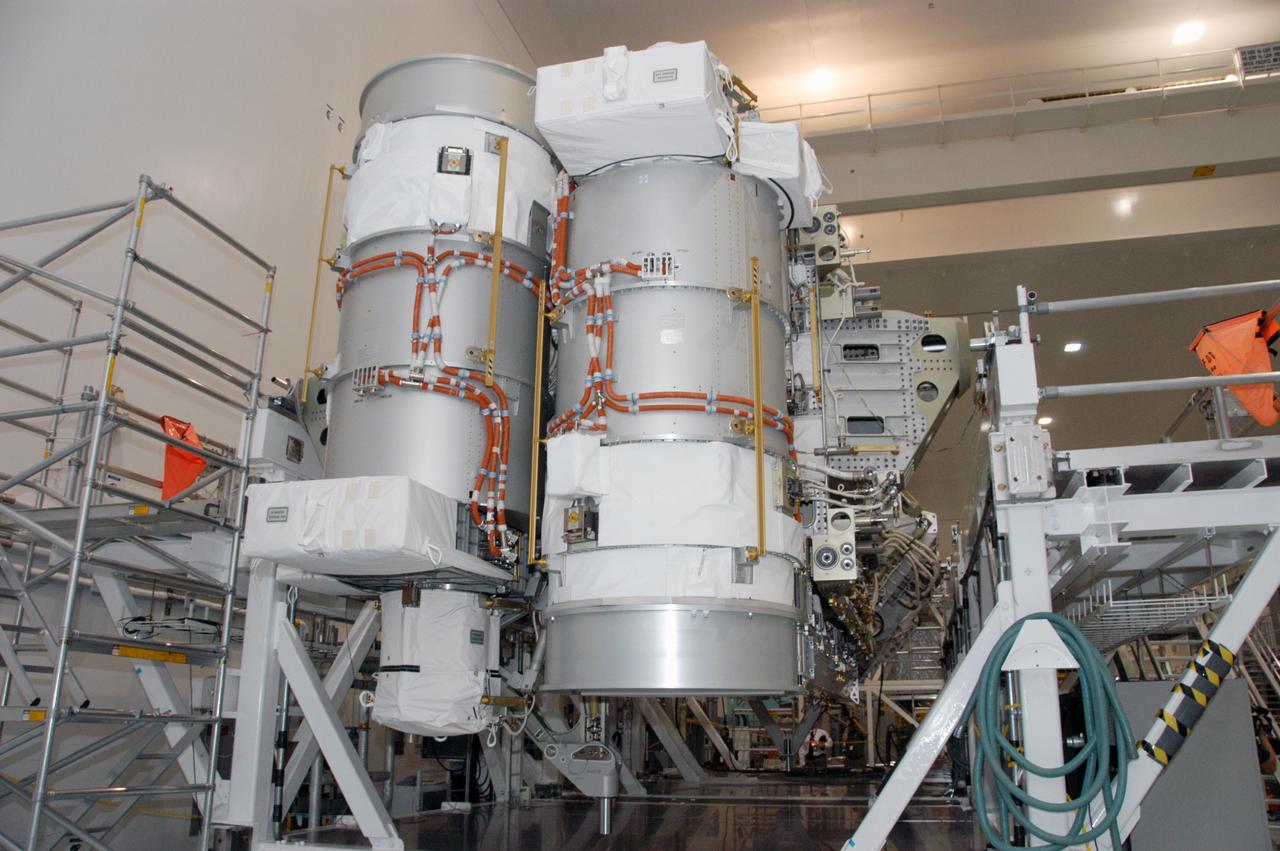
In the Space Station Processing Facility, the S3/S4 integrated truss segment is on display for the media. The starboard 3/4 truss segment will launch aboard Space Shuttle Atlantis on mission STS-117, targeted for March 15. The element will be added to the 11-segment integrated truss structure, the station's backbone. The integrated truss structure eventually will span more than 300 feet. The S3/S4 truss has two large solar arrays and will provide one-fourth of the total power generation for the completed station.
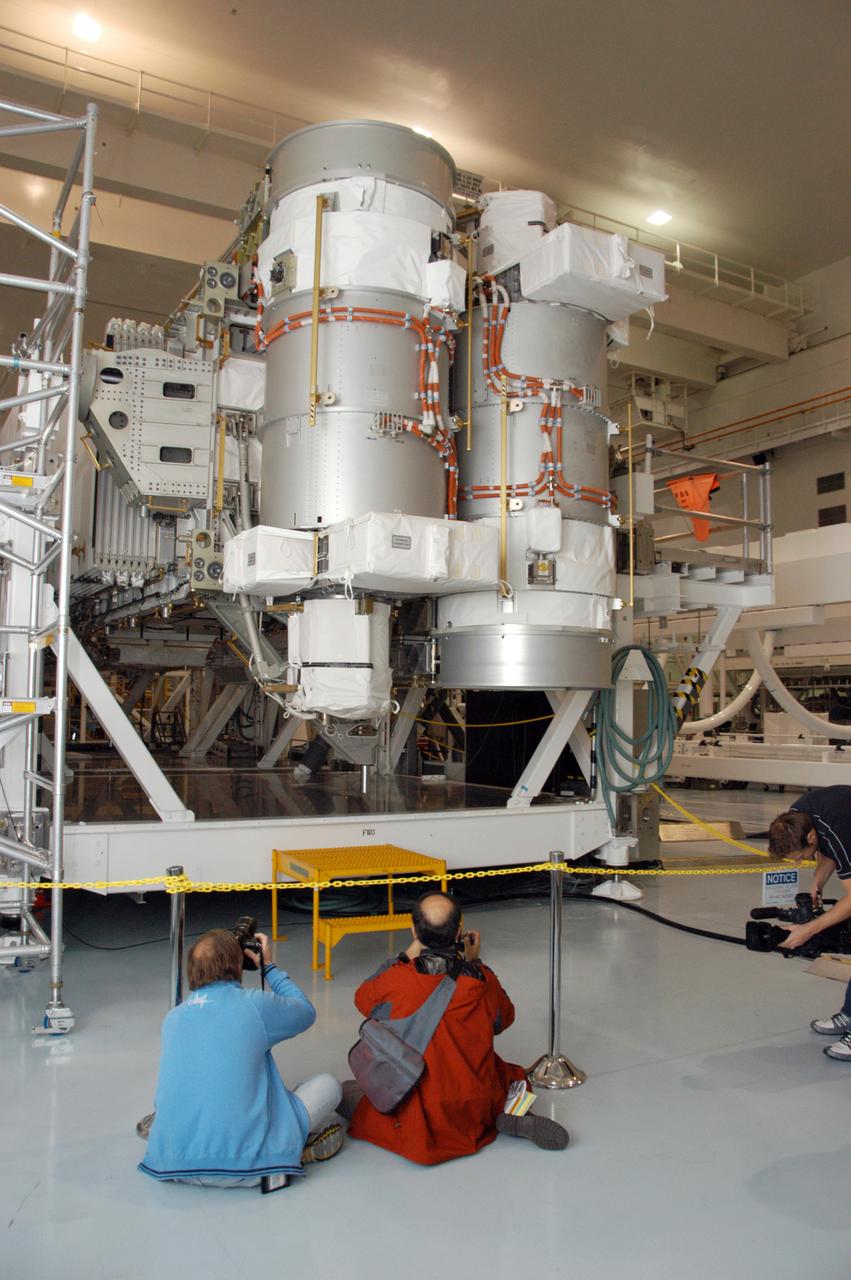
In the Space Station Processing Facility, photographers take advantage of a media showcase to get photos of the S3/S4 integrated truss segment. The starboard 3/4 truss segment will launch aboard Space Shuttle Atlantis on mission STS-117, targeted for March 15. The element will be added to the 11-segment integrated truss structure, the station's backbone. The integrated truss structure eventually will span more than 300 feet. The S3/S4 truss has two large solar arrays and will provide one-fourth of the total power generation for the completed station.
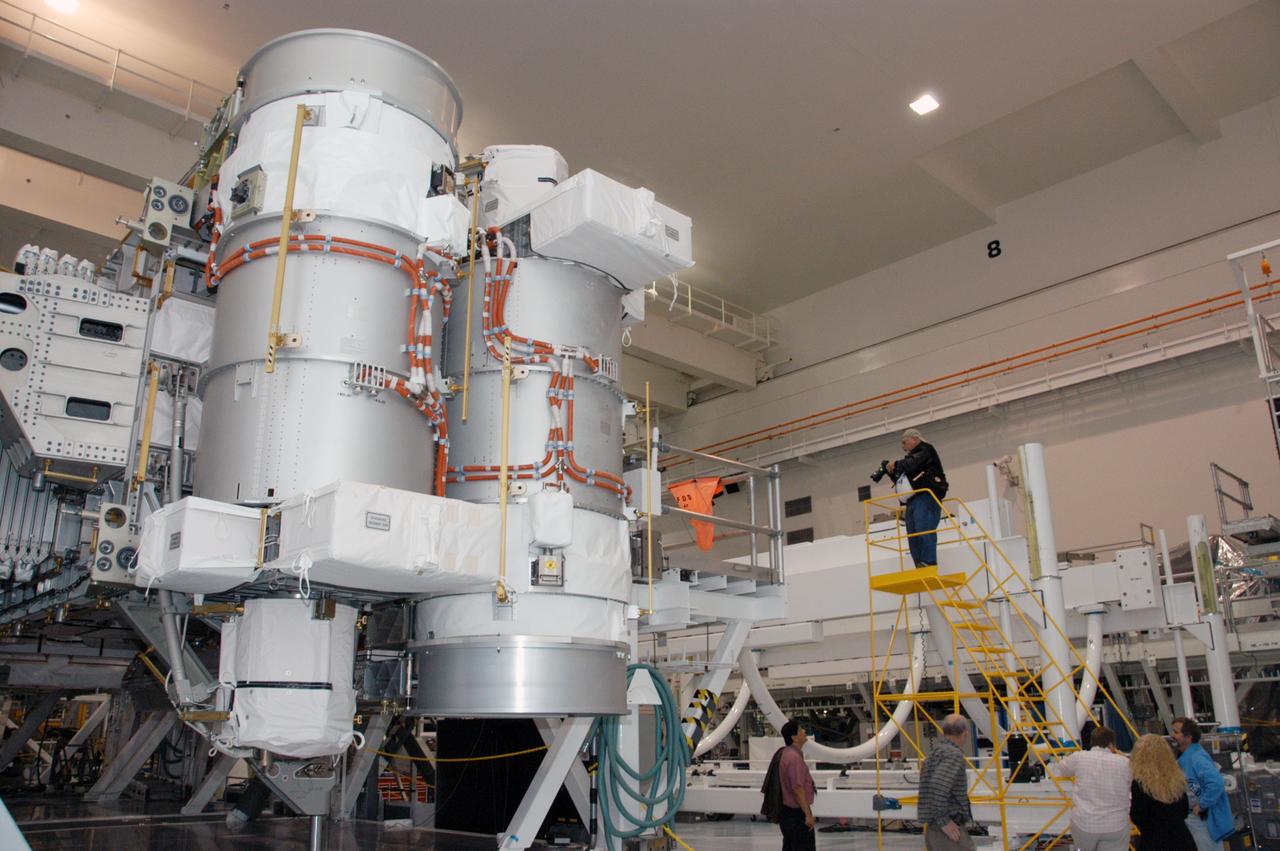
At a media showcase in the Space Station Processing Facility, reporters and photographers get a close look at the S3/S4 integrated truss segment. The starboard 3/4 truss segment will launch aboard Space Shuttle Atlantis on mission STS-117, targeted for March 15. The element will be added to the 11-segment integrated truss structure, the station's backbone. The integrated truss structure eventually will span more than 300 feet. The S3/S4 truss has two large solar arrays and will provide one-fourth of the total power generation for the completed station.
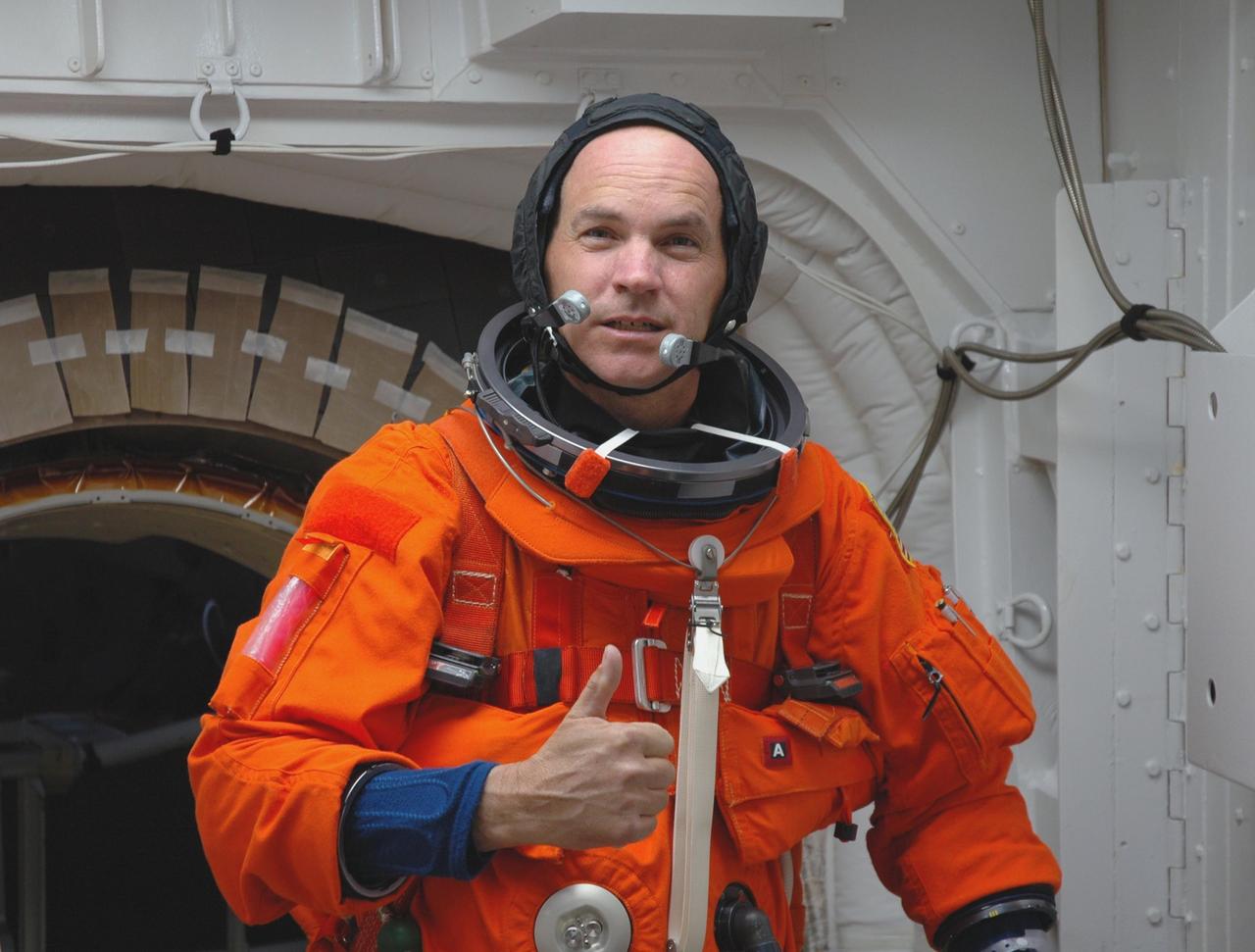
KENNEDY SPACE CENTER, FLA. -- In the white room on Launch Pad 39A, Mission STS-117 Commander Rick Sturckow gives a thumbs up as he prepares to enter Space Shuttle Atlantis. The STS-117 crew practices for launch with a simulation of activities, from suit-up to countdown in the orbiter during terminal countdown demonstration test activities. The STS-117 mission is No. 21 to the International Space Station. Mission payloads aboard Atlantis include the S3/S4 integrated truss structure, a third set of solar arrays and batteries. The crew of six astronauts will install the truss to continue assembly of the station. Launch is scheduled for no earlier than March 15. Photo credit: NASA/Jim Grossmann
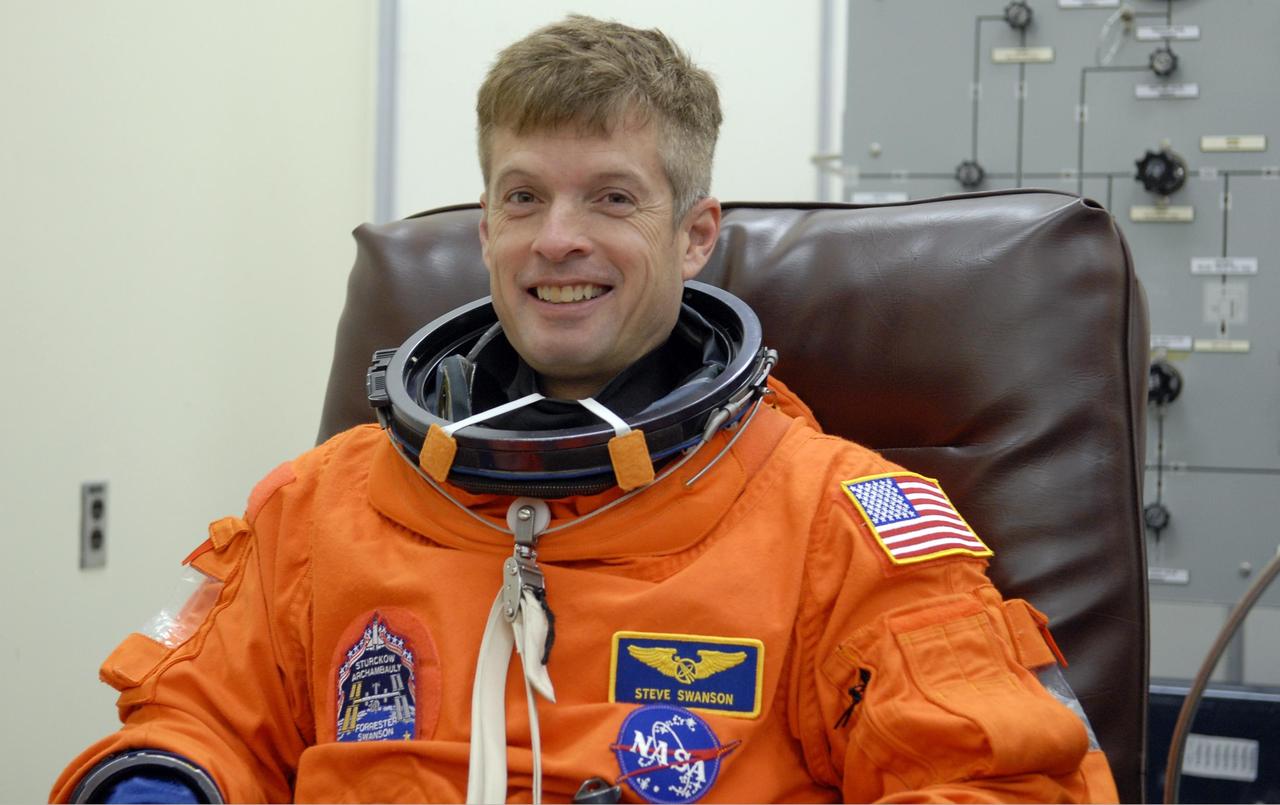
KENNEDY SPACE CENTER, FLA. -- Mission STS-117 Mission Specialist Steven Swanson has donned his launch suit for a fit check, part of the pre-launch preparations during terminal countdown demonstration test (TCDT) activities. The mission crew is at KSC for the TCDT, which includes a simulated launch countdown. The STS-117 mission is No. 21 to the International Space Station. Mission payloads aboard Atlantis include the S3/S4 integrated truss structure, a third set of solar arrays and batteries. The crew of six astronauts will install the truss to continue assembly of the station. Launch is scheduled for no earlier than March 15. Photo credit: NASA/Kim Shiflett.
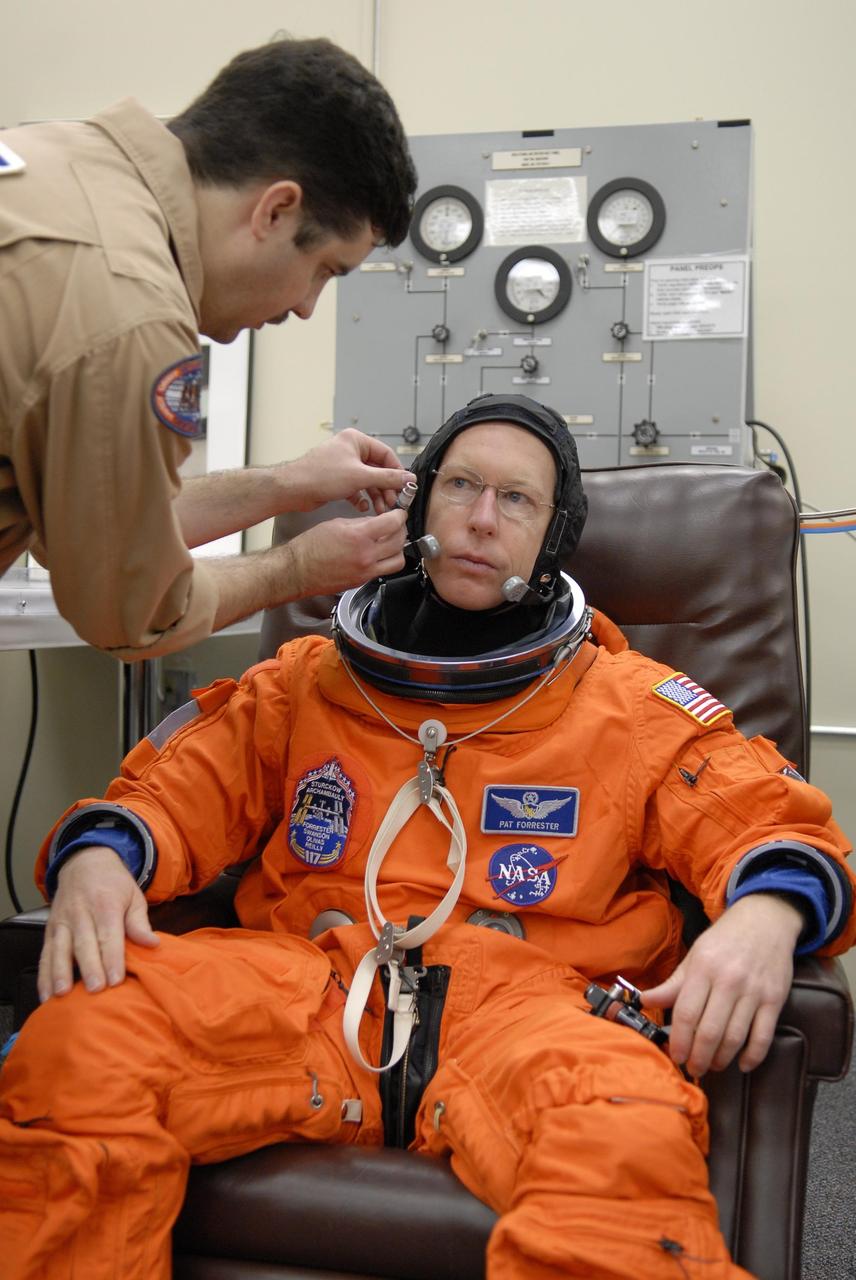
KENNEDY SPACE CENTER, FLA. -- Mission STS-117 Mission Specialist Patrick Forrester has donned his launch suit for a fit check, part of the pre-launch preparations during terminal countdown demonstration test (TCDT) activities. The mission crew is at KSC for the TCDT, which includes a simulated launch countdown. The STS-117 mission is No. 21 to the International Space Station. Mission payloads aboard Atlantis include the S3/S4 integrated truss structure, a third set of solar arrays and batteries. The crew of six astronauts will install the truss to continue assembly of the station. Launch is scheduled for no earlier than March 15. Photo credit: NASA/Kim Shiflett.
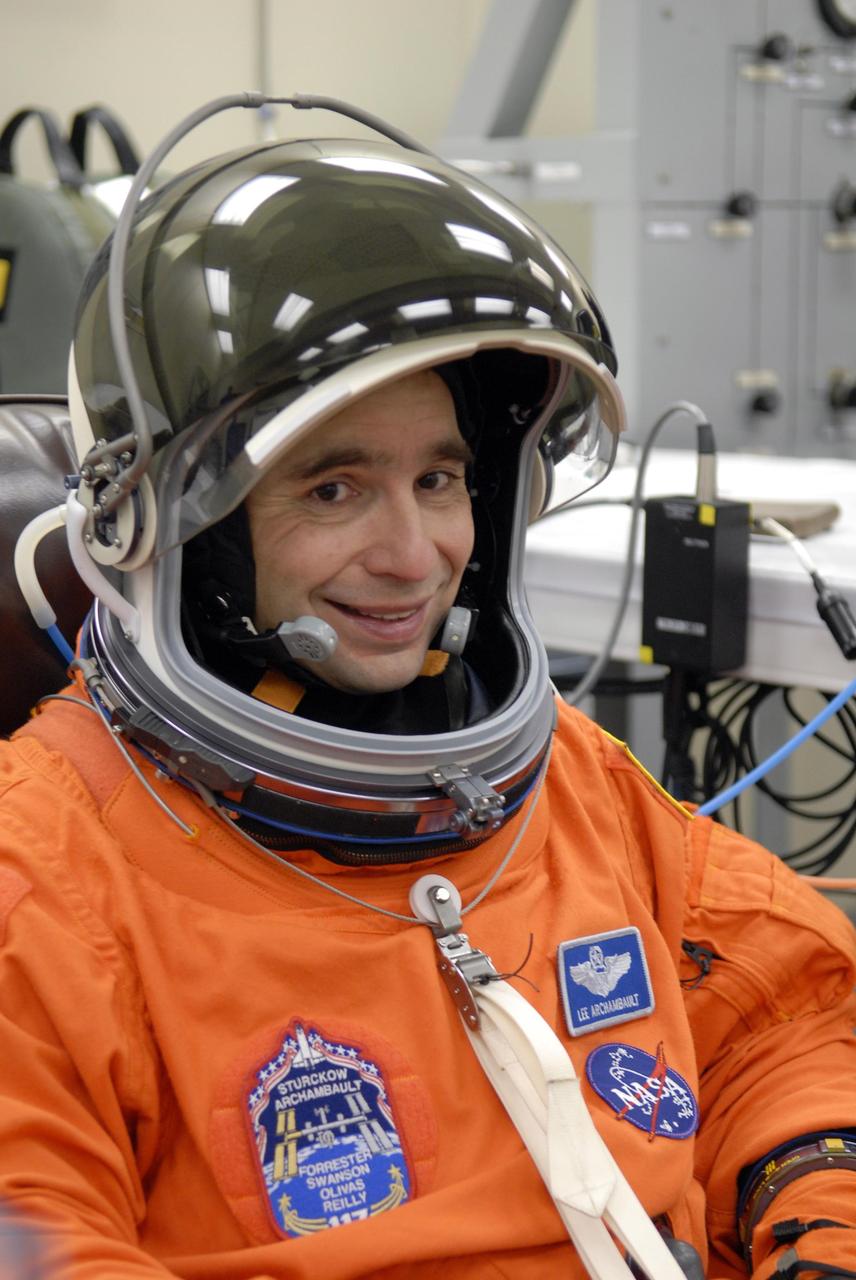
KENNEDY SPACE CENTER, FLA. -- Mission STS-117 Pilot Lee Archambault checks the fit of his launch suit and helmet, part of pre-launch preparations during terminal countdown demonstration test (TCDT) activities. The mission crew is at KSC for the TCDT, which includes a simulated launch countdown. The STS-117 mission is No. 21 to the International Space Station. Mission payloads aboard Atlantis include the S3/S4 integrated truss structure, a third set of solar arrays and batteries. The crew of six astronauts will install the truss to continue assembly of the station. Launch is scheduled for no earlier than March 15. Photo credit: NASA/Kim Shiflett.
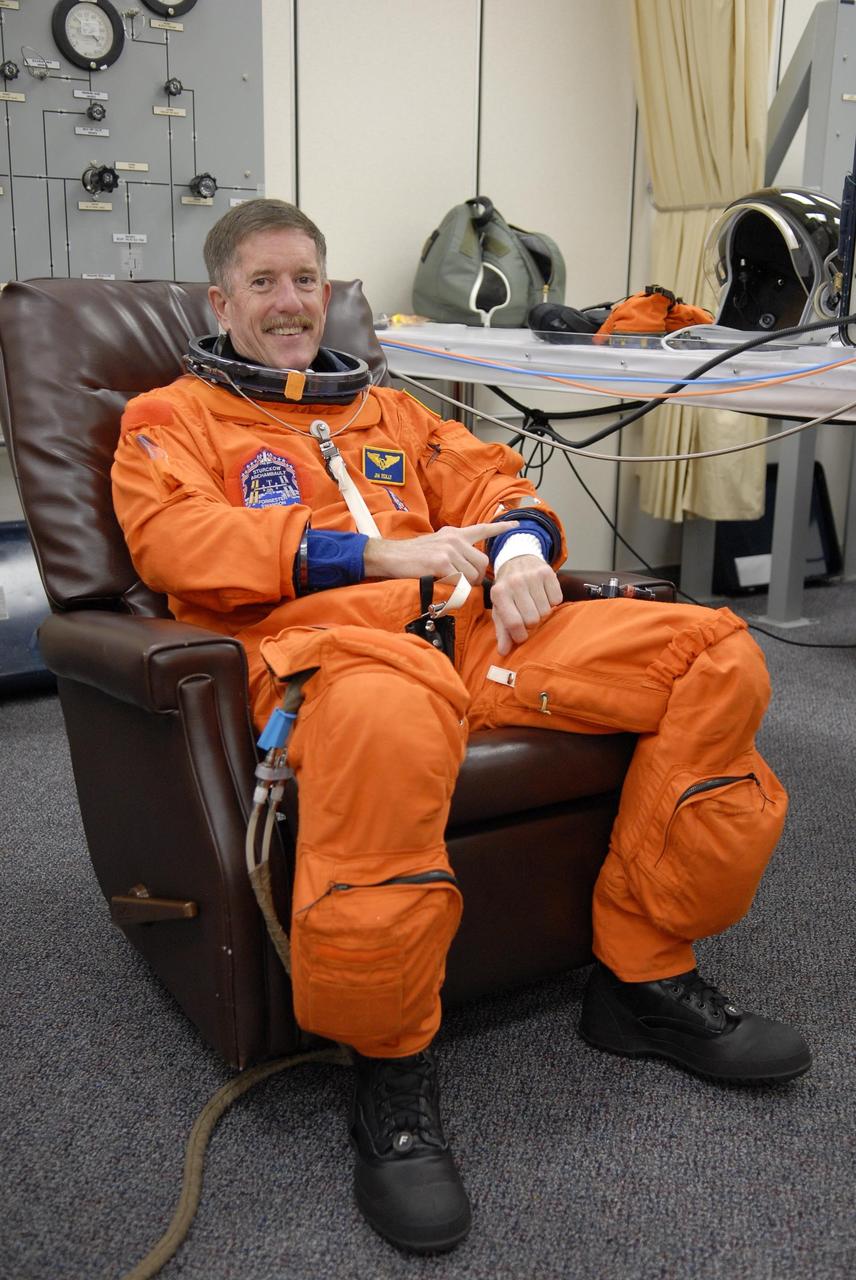
KENNEDY SPACE CENTER, FLA. -- Mission STS-117 Mission Specialist James Reilly has donned his launch suit for a fit check, part of the pre-launch preparations during terminal countdown demonstration test (TCDT) activities. The mission crew is at KSC for the TCDT, which includes a simulated launch countdown.The STS-117 mission is No. 21 to the International Space Station. Mission payloads aboard Atlantis include the S3/S4 integrated truss structure, a third set of solar arrays and batteries. The crew of six astronauts will install the truss to continue assembly of the station. Launch is scheduled for no earlier than March 15. Photo credit: NASA/Kim Shiflett.

KENNEDY SPACE CENTER, FLA. -- Mission STS-117 Mission Specialist James Reilly has donned his launch suit and helmet for a fit check, part of the pre-launch preparations during terminal countdown demonstration test (TCDT) activities. The mission crew is at KSC for the TCDT, which includes a simulated launch countdown. The STS-117 mission is No. 21 to the International Space Station. Mission payloads aboard Atlantis include the S3/S4 integrated truss structure, a third set of solar arrays and batteries. The crew of six astronauts will install the truss to continue assembly of the station. Launch is scheduled for no earlier than March 15. Photo credit: NASA/Kim Shiflett.
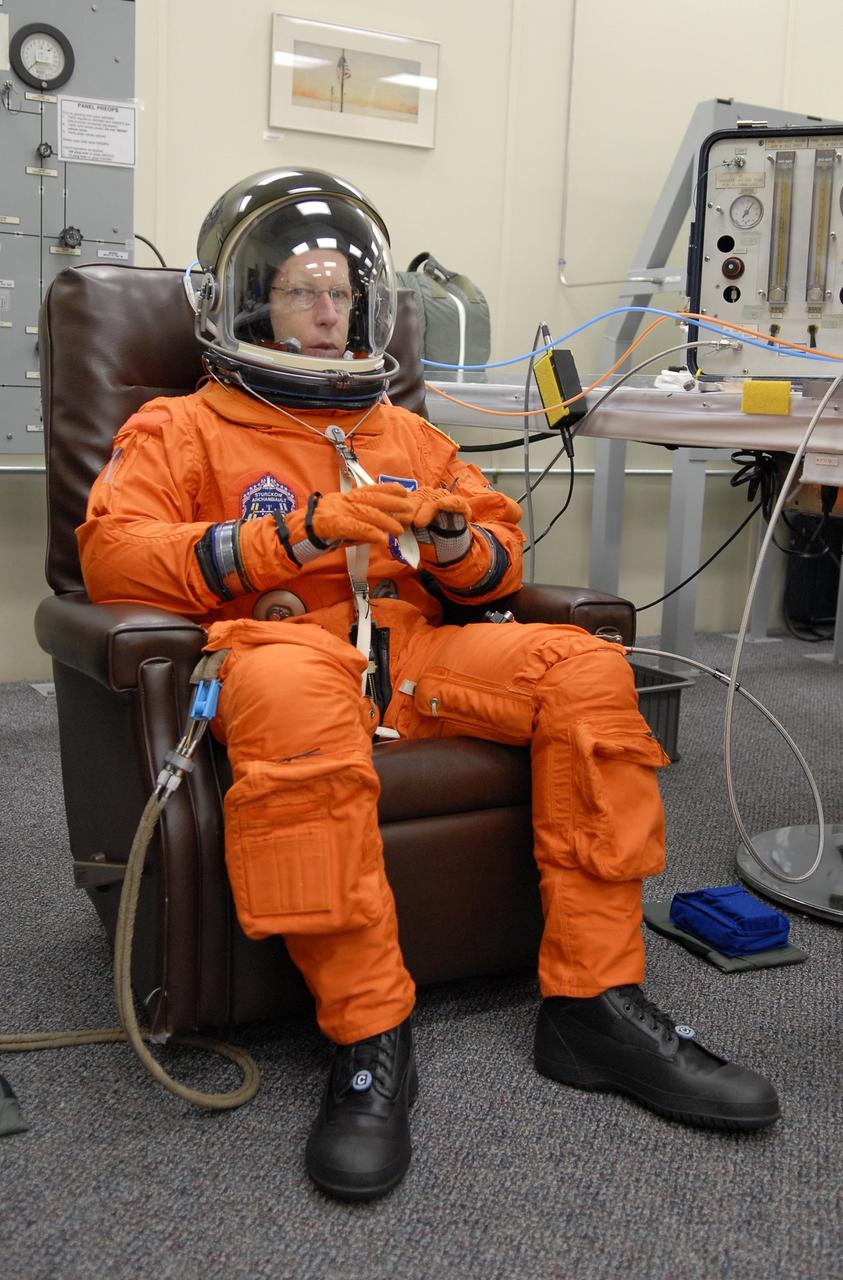
KENNEDY SPACE CENTER, FLA. -- Mission STS-117 Mission Specialist Patrick Forrester has donned his launch suit and helmet for a fit check, part of the pre-launch preparations during terminal countdown demonstration test (TCDT) activities. The mission crew is at KSC for the TCDT, which includes a simulated launch countdown. The STS-117 mission is No. 21 to the International Space Station. Mission payloads aboard Atlantis include the S3/S4 integrated truss structure, a third set of solar arrays and batteries. The crew of six astronauts will install the truss to continue assembly of the station. Launch is scheduled for no earlier than March 15. Photo credit: NASA/Kim Shiflett.
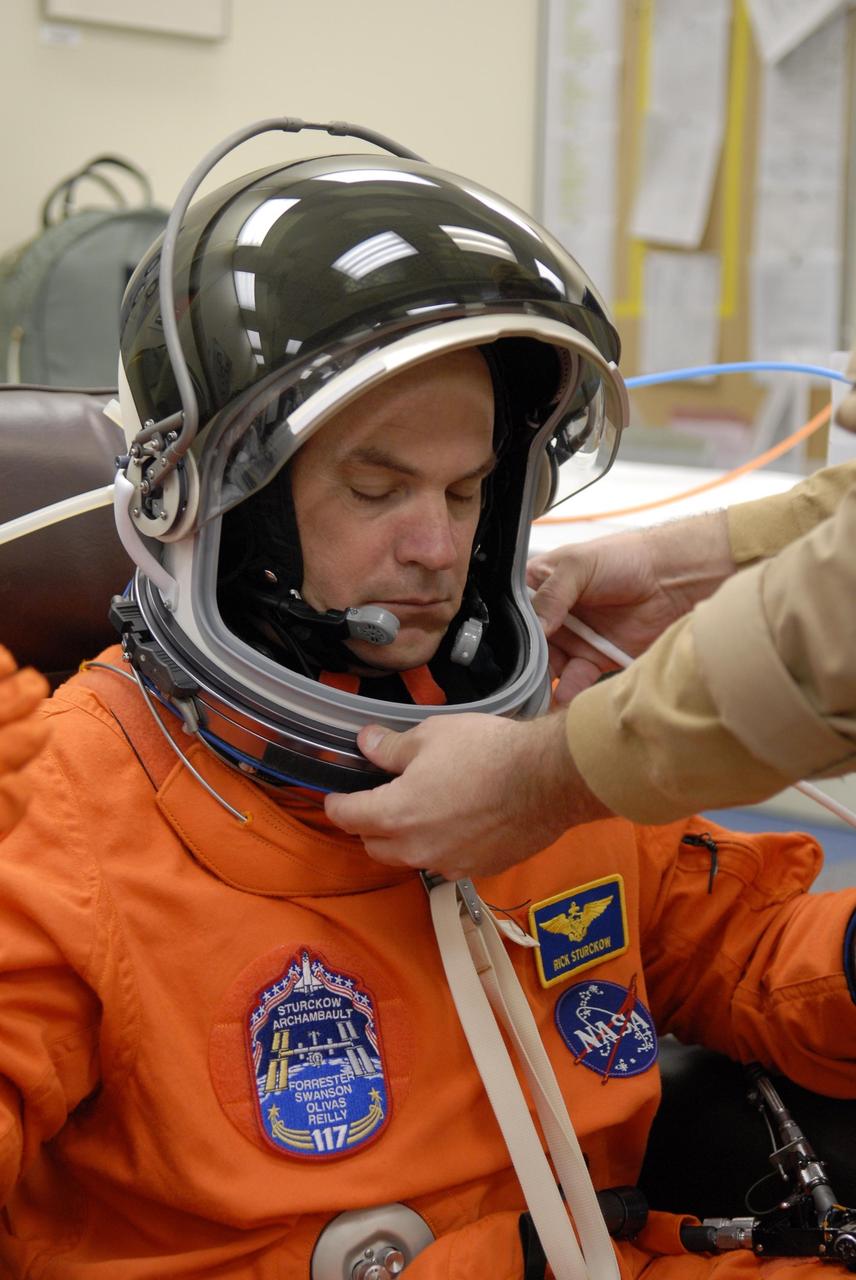
KENNEDY SPACE CENTER, FLA. -- Mission STS-117 Commander Rick Sturckow checks the fit of his launch suit and helmet, part of pre-launch preparations during terminal countdown demonstration test (TCDT) activities. The mission crew is at KSC for the TCDT, which includes a simulated launch countdown. The STS-117 mission is No. 21 to the International Space Station. Mission payloads aboard Atlantis include the S3/S4 integrated truss structure, a third set of solar arrays and batteries. The crew of six astronauts will install the truss to continue assembly of the station. Launch is scheduled for no earlier than March 15. Photo credit: NASA/Kim Shiflett.
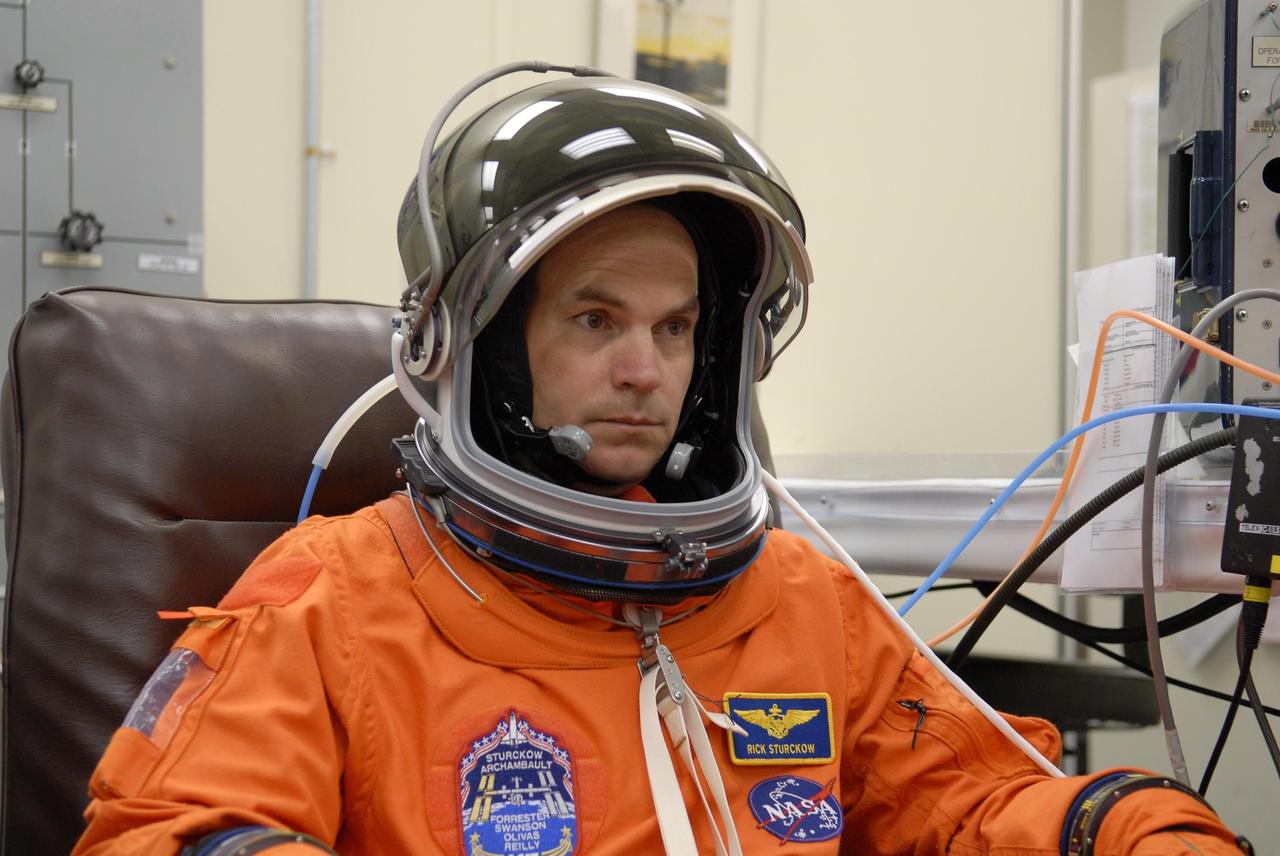
KENNEDY SPACE CENTER, FLA. -- Mission STS-117 Commander Rick Sturckow checks the fit of his launch suit and helmet, part of pre-launch preparations during terminal countdown demonstration test (TCDT) activities. The mission crew is at KSC for the TCDT, which includes a simulated launch countdown. The STS-117 mission is No. 21 to the International Space Station. Mission payloads aboard Atlantis include the S3/S4 integrated truss structure, a third set of solar arrays and batteries. The crew of six astronauts will install the truss to continue assembly of the station. Launch is scheduled for no earlier than March 15. Photo credit: NASA/Kim Shiflett.

KENNEDY SPACE CENTER, FLA. -- Mission STS-117 Commander Rick Sturckow checks the fit of his launch suit and helmet, part of pre-launch preparations during terminal countdown demonstration test (TCDT) activities. The mission crew is at KSC for the TCDT, which includes a simulated launch countdown. The STS-117 mission is No. 21 to the International Space Station. Mission payloads aboard Atlantis include the S3/S4 integrated truss structure, a third set of solar arrays and batteries. The crew of six astronauts will install the truss to continue assembly of the station. Launch is scheduled for no earlier than March 15. Photo credit: NASA/Kim Shiflett.
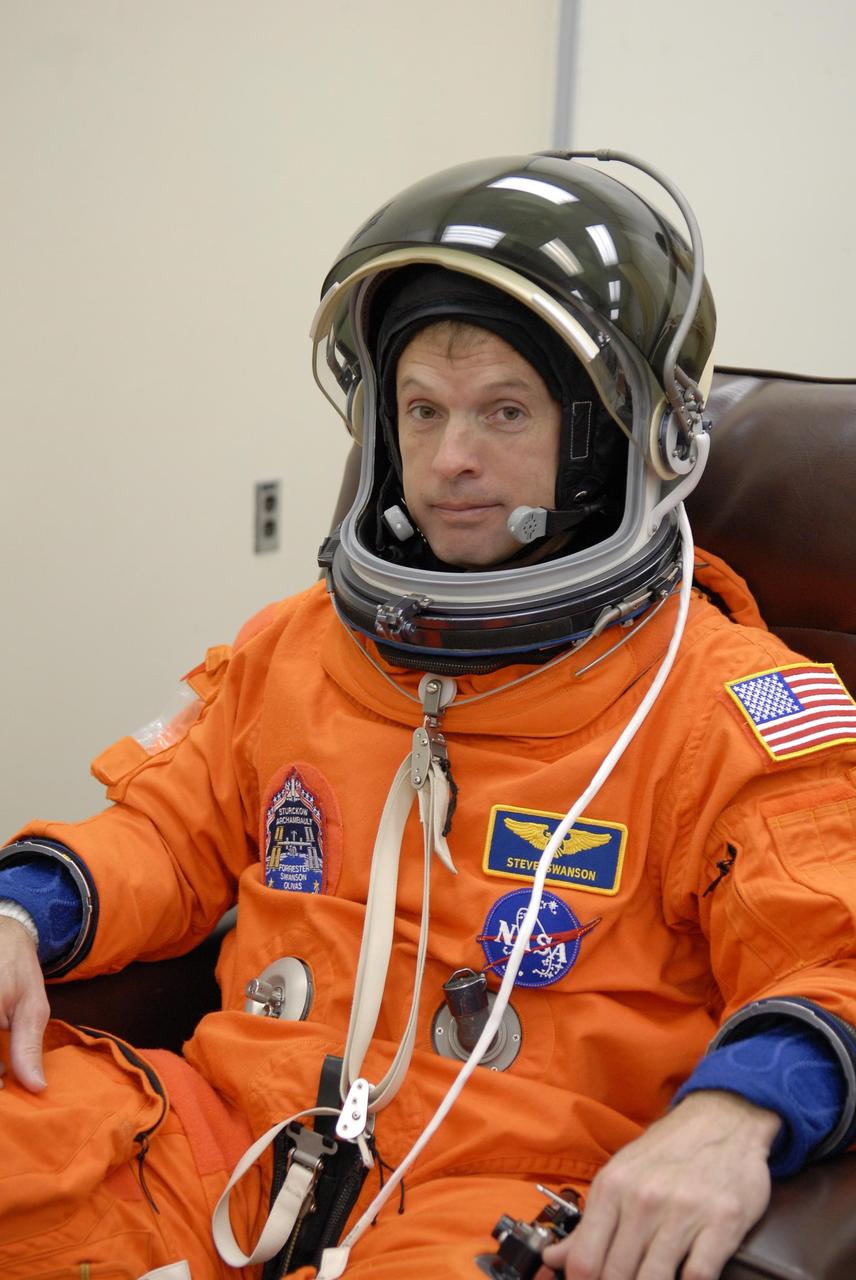
KENNEDY SPACE CENTER, FLA. -- Mission STS-117 Mission Specialist Steven Swanson checks the fit of his launch suit and helmet, part of pre-launch preparations during terminal countdown demonstration test (TCDT) activities. The mission crew is at KSC for the TCDT, which includes a simulated launch countdown. The STS-117 mission is No. 21 to the International Space Station. Mission payloads aboard Atlantis include the S3/S4 integrated truss structure, a third set of solar arrays and batteries. The crew of six astronauts will install the truss to continue assembly of the station. Launch is scheduled for no earlier than March 15. Photo credit: NASA/Kim Shiflett.

KENNEDY SPACE CENTER, FLA. -- Mission STS-117 Mission Specialist Danny Olivas has donned his launch suit for a fit check, part of the pre-launch preparations during terminal countdown demonstration test (TCDT) activities. The mission crew is at KSC for the TCDT, which includes a simulated launch countdown. The STS-117 mission is No. 21 to the International Space Station. Mission payloads aboard Atlantis include the S3/S4 integrated truss structure, a third set of solar arrays and batteries. The crew of six astronauts will install the truss to continue assembly of the station. Launch is scheduled for no earlier than March 15. Photo credit: NASA/Kim Shiflett.
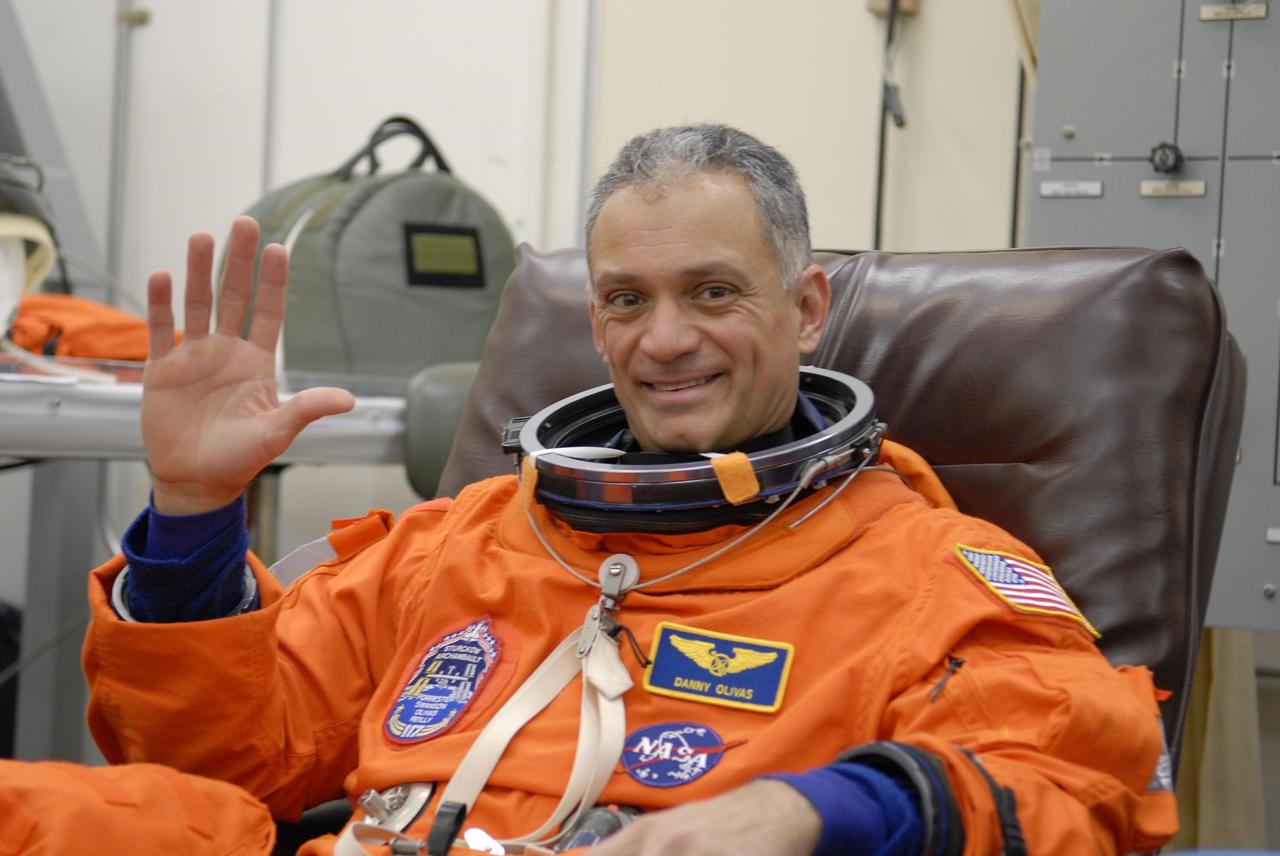
KENNEDY SPACE CENTER, FLA. -- Mission STS-117 Mission Specialist Danny Olivas has donned his launch suit for a fit check, part of the pre-launch preparations during terminal countdown demonstration test (TCDT) activities. The mission crew is at KSC for the TCDT, which includes a simulated launch countdown. The STS-117 mission is No. 21 to the International Space Station. Mission payloads aboard Atlantis include the S3/S4 integrated truss structure, a third set of solar arrays and batteries. The crew of six astronauts will install the truss to continue assembly of the station. Launch is scheduled for no earlier than March 15. Photo credit: NASA/Kim Shiflett.

KENNEDY SPACE CENTER, FLA. -- Mission STS-117 Pilot Lee Archambault checks the fit of his launch suit and helmet, part of pre-launch preparations during terminal countdown demonstration test (TCDT) activities. The mission crew is at KSC for the TCDT, which includes a simulated launch countdown. The STS-117 mission is No. 21 to the International Space Station. Mission payloads aboard Atlantis include the S3/S4 integrated truss structure, a third set of solar arrays and batteries. The crew of six astronauts will install the truss to continue assembly of the station. Launch is scheduled for no earlier than March 15. Photo credit: NASA/Kim Shiflett.
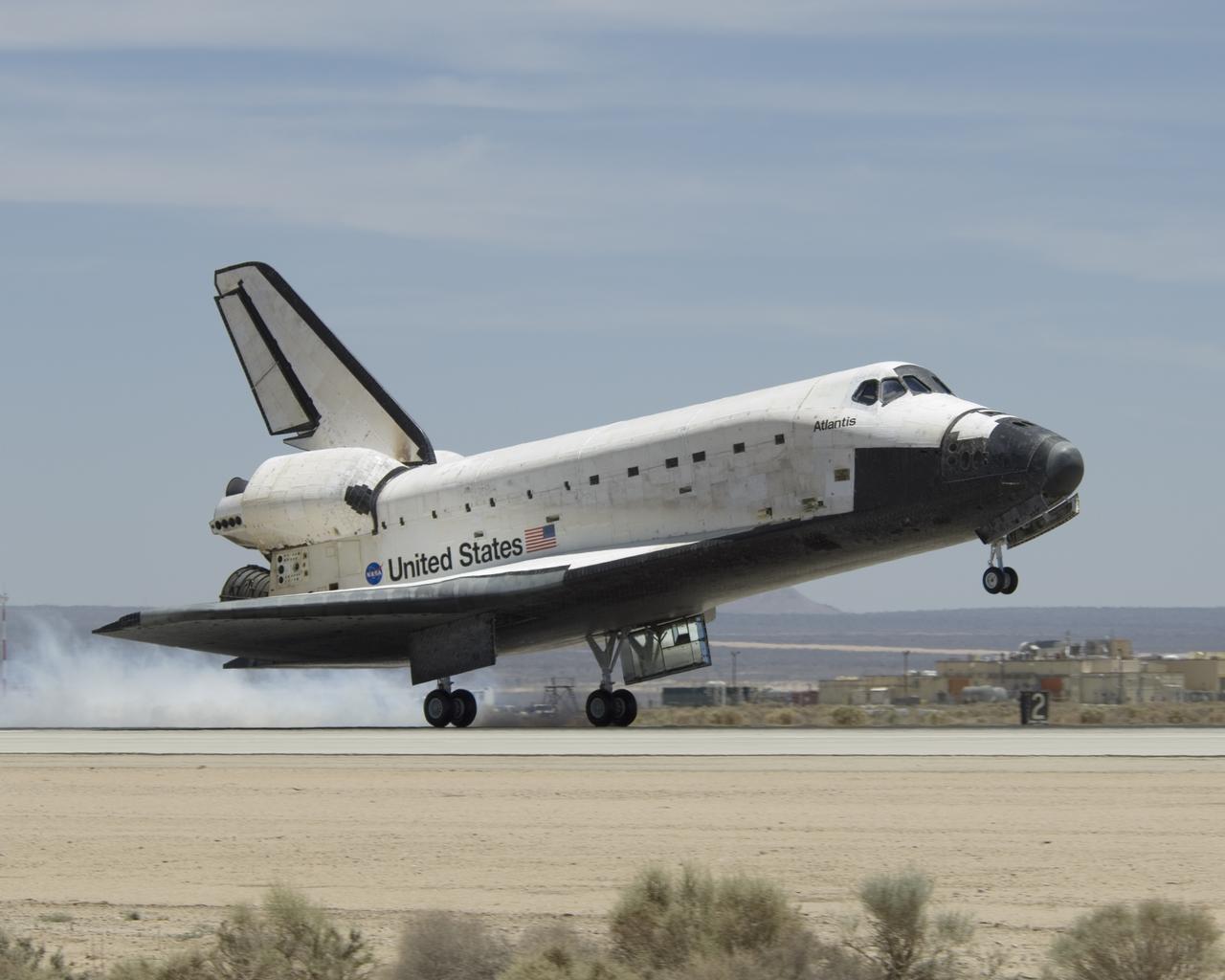
The Space Shuttle Atlantis touches down at Edwards AFB on June 22, 2007, to conclude International Space Station construction and supply mission STS-117.
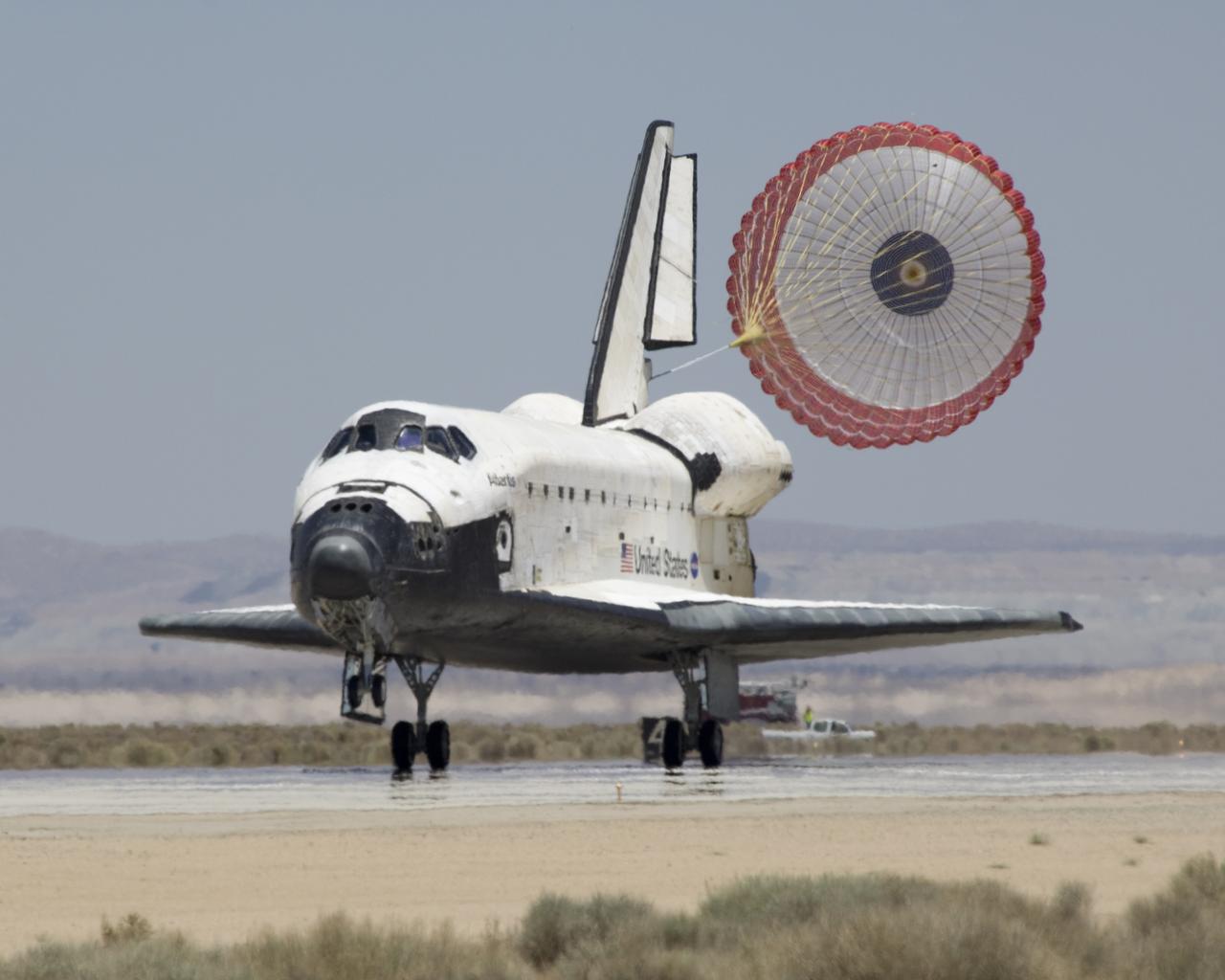
The Space Shuttle Atlantis' drag chute deploys as it rolls out on Runway 22 at Edwards AFB at the conclusion of its 13-day STS-117 mission to the ISS.
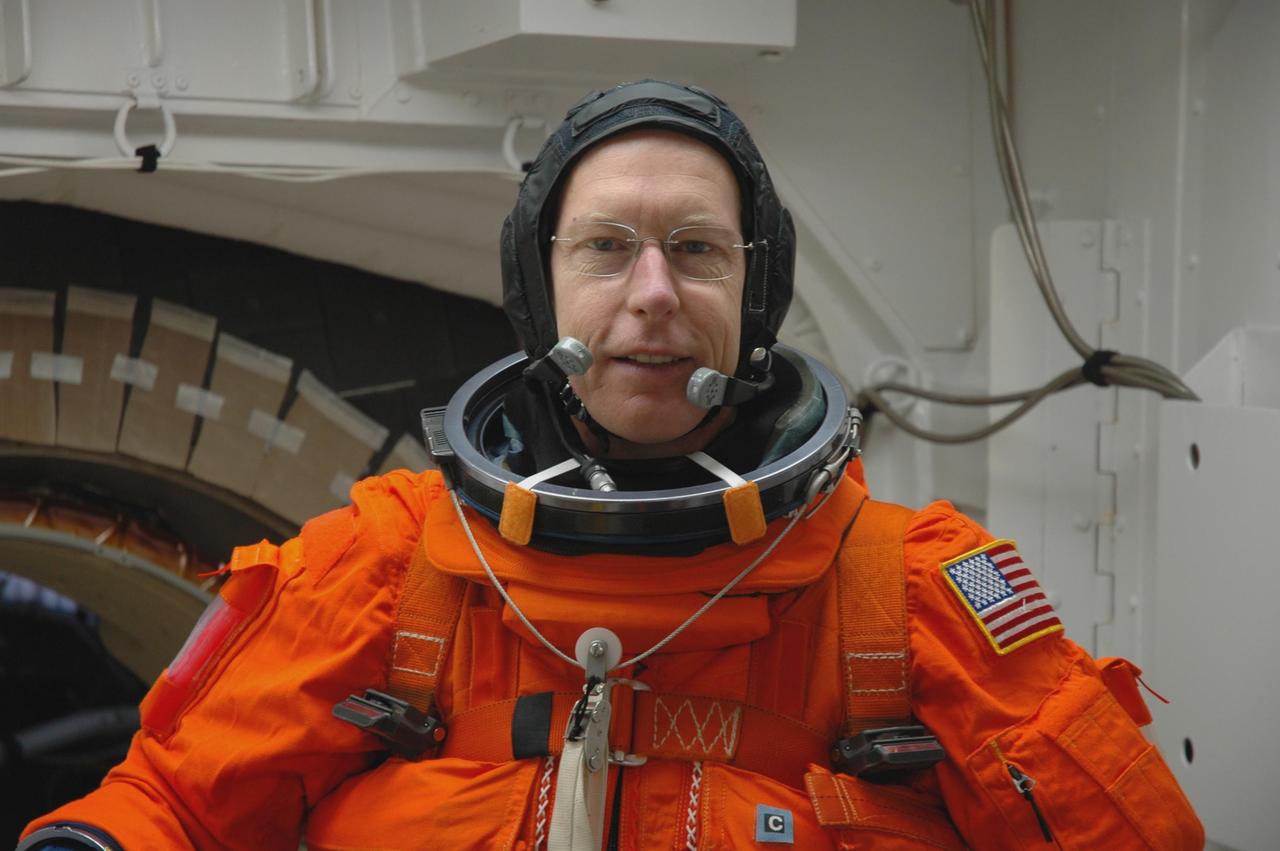
KENNEDY SPACE CENTER, FLA. -- In the white room on Launch Pad 39A, Mission STS-117 Mission Specialist Patrick Forrester prepares to enter Space Shuttle Atlantis. The STS-117 crew practices for launch with a simulation of activities, from suit-up to countdown in the orbiter during terminal countdown demonstration test activities. The STS-117 mission is No. 21 to the International Space Station. Mission payloads aboard Atlantis include the S3/S4 integrated truss structure, a third set of solar arrays and batteries. The crew of six astronauts will install the truss to continue assembly of the station. Launch is scheduled for no earlier than March 15. Photo credit: NASA/Jim Grossmann
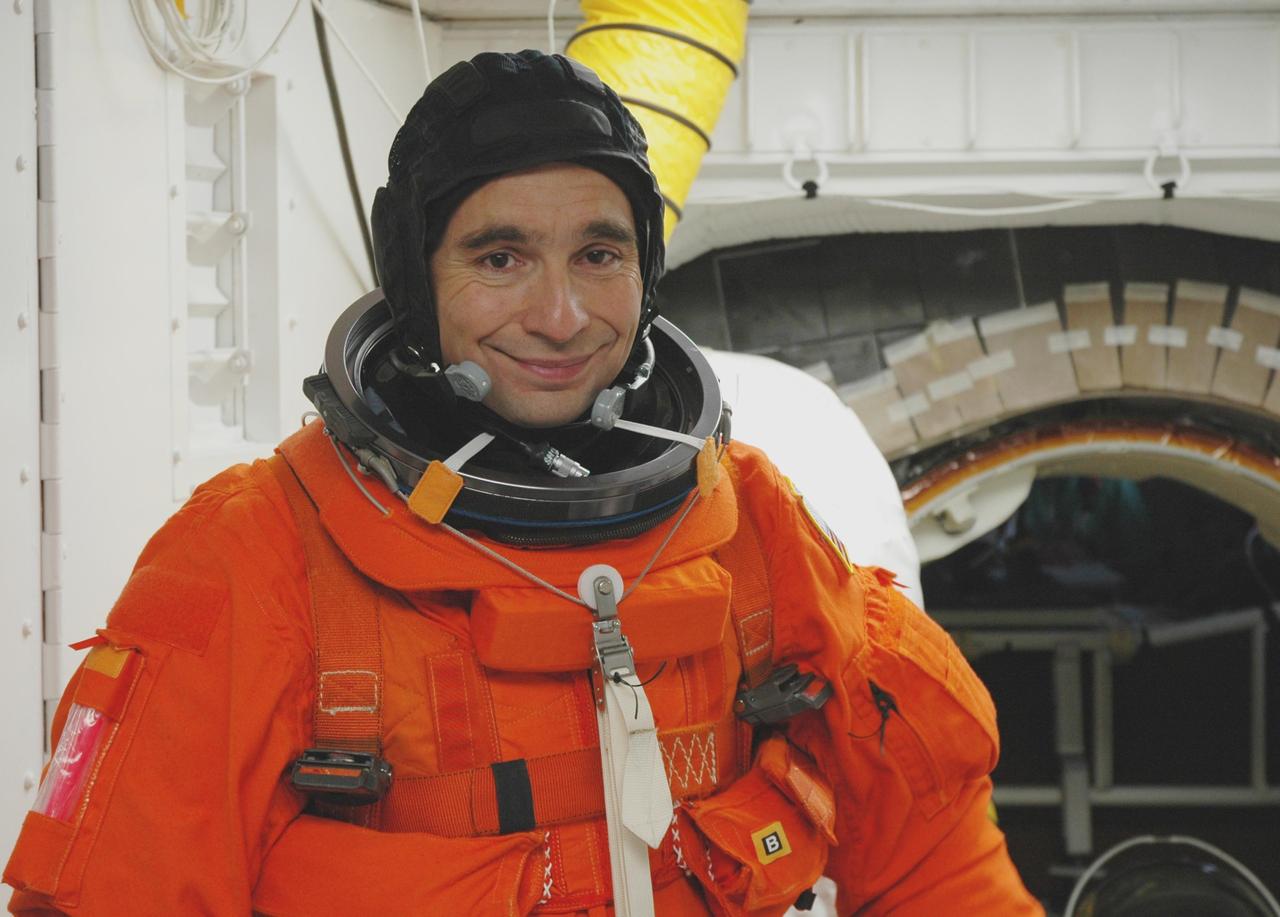
KENNEDY SPACE CENTER, FLA. -- In the white room on Launch Pad 39A, Mission STS-117 Pilot Lee Archambault prepares to enter Space Shuttle Atlantis. The STS-117 crew practices for launch with a simulation of activities, from suit-up to countdown in the orbiter during terminal countdown demonstration test activities. The STS-117 mission is No. 21 to the International Space Station. Mission payloads aboard Atlantis include the S3/S4 integrated truss structure, a third set of solar arrays and batteries. The crew of six astronauts will install the truss to continue assembly of the station. Launch is scheduled for no earlier than March 15. Photo credit: NASA/Jim Grossmann
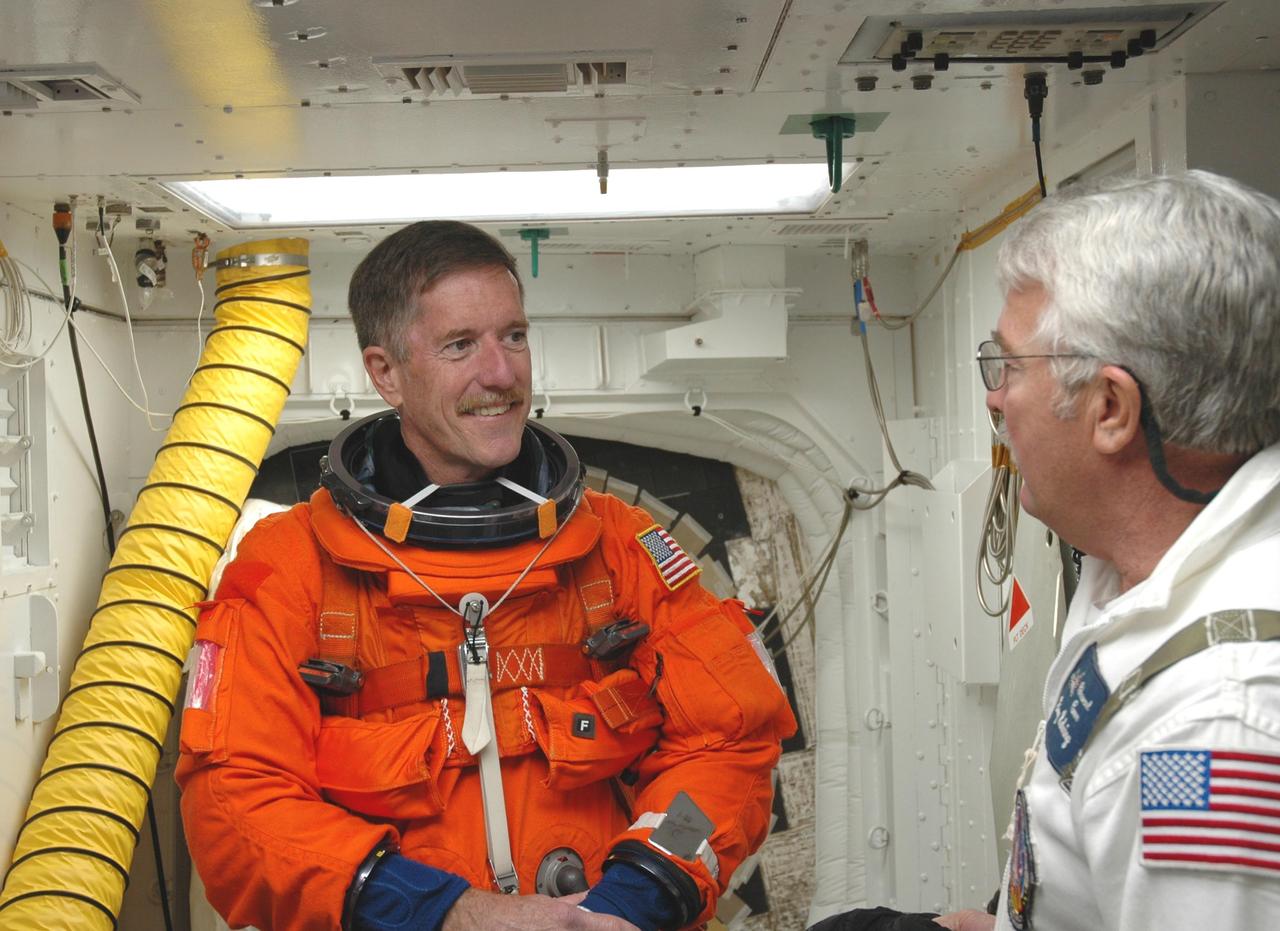
KENNEDY SPACE CENTER, FLA. -- In the white room on Launch Pad 39A, Mission STS-117 Mission Specialist James Reilly is helped with his gear before entering Space Shuttle Atlantis. The STS-117 crew practices for launch with a simulation of activities, from suit-up to countdown in the orbiter during terminal countdown demonstration test activities. The STS-117 mission is No. 21 to the International Space Station. Mission payloads aboard Atlantis include the S3/S4 integrated truss structure, a third set of solar arrays and batteries. The crew of six astronauts will install the truss to continue assembly of the station. Launch is scheduled for no earlier than March 15. Photo credit: NASA/Jim Grossmann
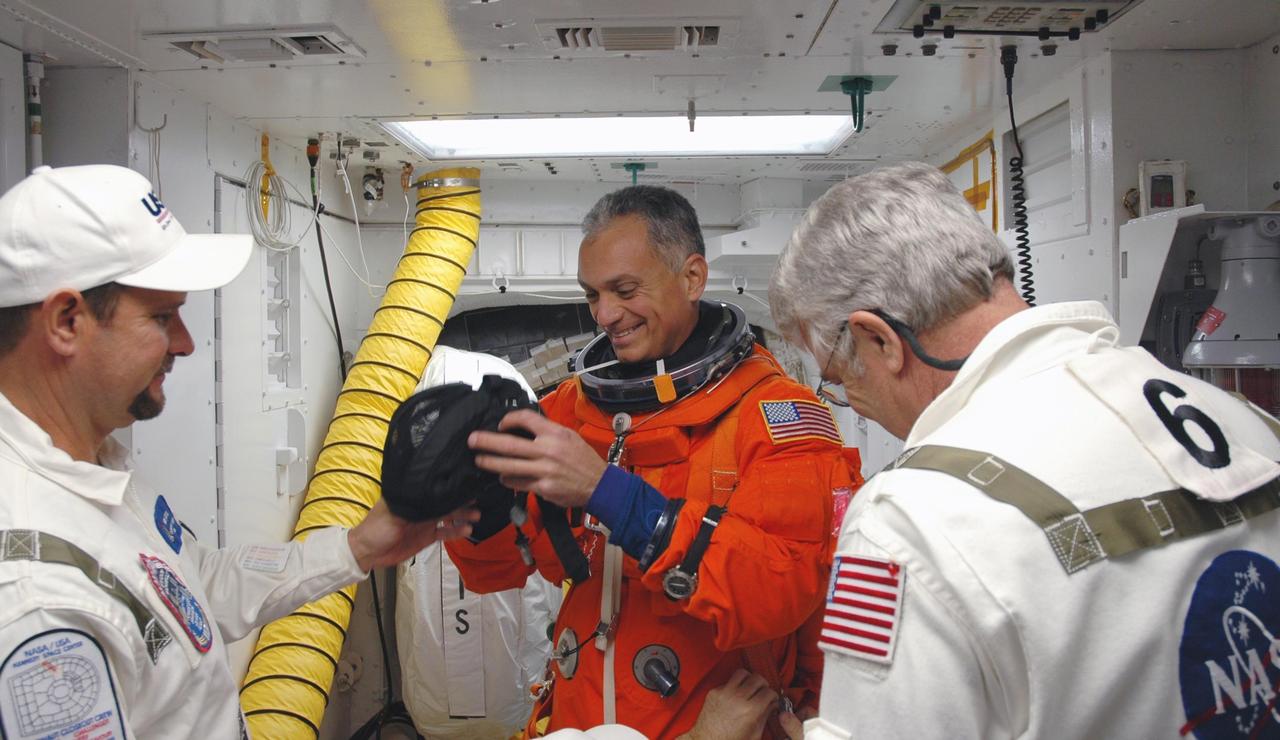
KENNEDY SPACE CENTER, FLA. -- In the white room on Launch Pad 39A, Mission STS-117 Mission Specialist Danny Olivas is helped with his gear before entering Space Shuttle Atlantis. The STS-117 crew practices for launch with a simulation of activities, from suit-up to countdown in the orbiter during terminal countdown demonstration test activities. The STS-117 mission is No. 21 to the International Space Station. Mission payloads aboard Atlantis include the S3/S4 integrated truss structure, a third set of solar arrays and batteries. The crew of six astronauts will install the truss to continue assembly of the station. Launch is scheduled for no earlier than March 15. Photo credit: NASA/Jim Grossmann
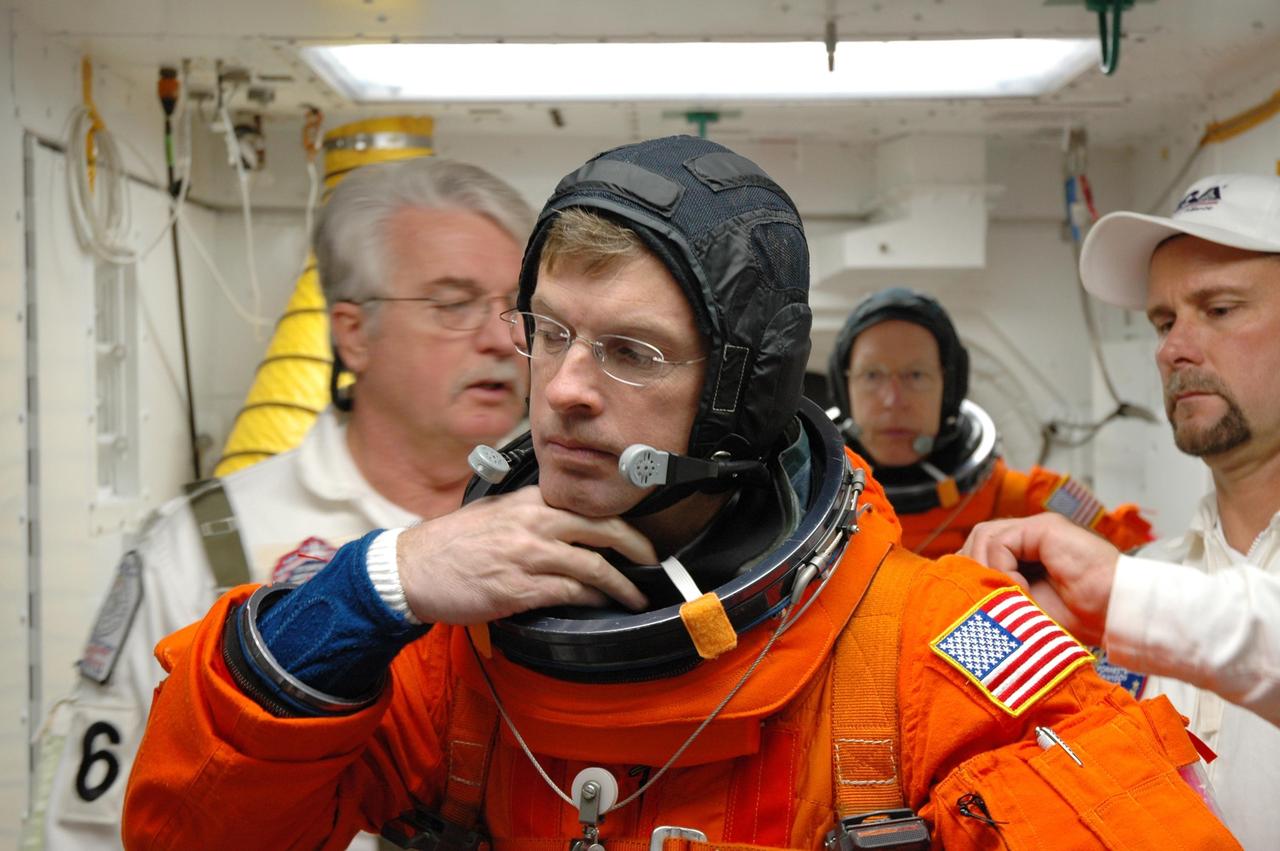
KENNEDY SPACE CENTER, FLA. -- In the white room on Launch Pad 39A, Mission STS-117 Mission Specialist Steven Swanson is helped with his gear before entering Space Shuttle Atlantis. The STS-117 crew practices for launch with a simulation of activities, from suit-up to countdown in the orbiter during terminal countdown demonstration test activities. The STS-117 mission is No. 21 to the International Space Station. Mission payloads aboard Atlantis include the S3/S4 integrated truss structure, a third set of solar arrays and batteries. The crew of six astronauts will install the truss to continue assembly of the station. Launch is scheduled for no earlier than March 15. Photo credit: NASA/Jim Grossmann
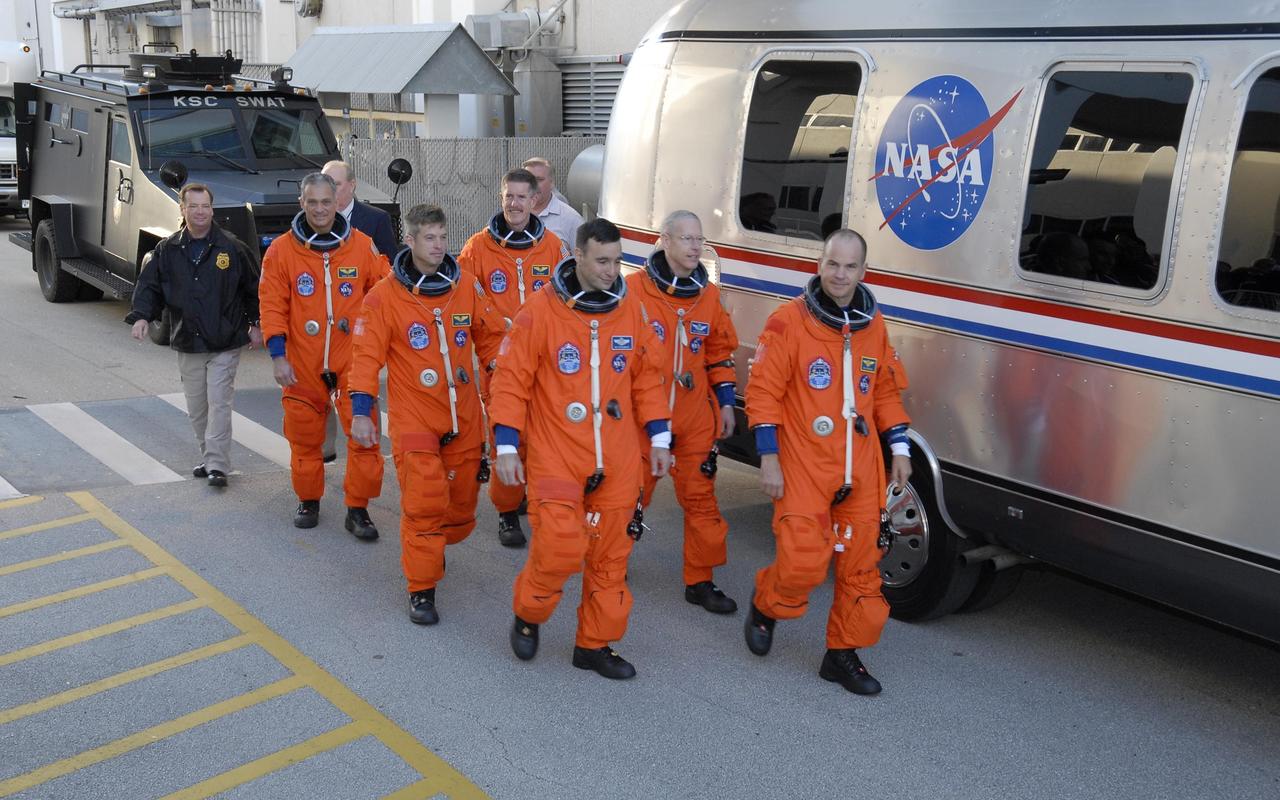
KENNEDY SPACE CENTER, FLA. -- Dressed in their flights suits, the Mission STS-117 crew members practice walk out from the Operations and Checkout Building to the astronaut van for transport to Launch Pad 39A during terminal countdown demonstration test activities. From the left are Mission Specialists Danny Olivas, Steven Swanson and James Reilly (behind Swanson), Pilot Lee Archambault, Mission Specialist Patrick Forrester, and Commander Rick Sturckow is leading the way. The STS-117 mission is No. 21 to the International Space Station. Mission payloads aboard Atlantis include the S3/S4 integrated truss structure, a third set of solar arrays and batteries. The crew of six astronauts will install the truss to continue assembly of the station. Launch is scheduled for no earlier than March 15. Photo credit: NASA/Kim Shiflett.
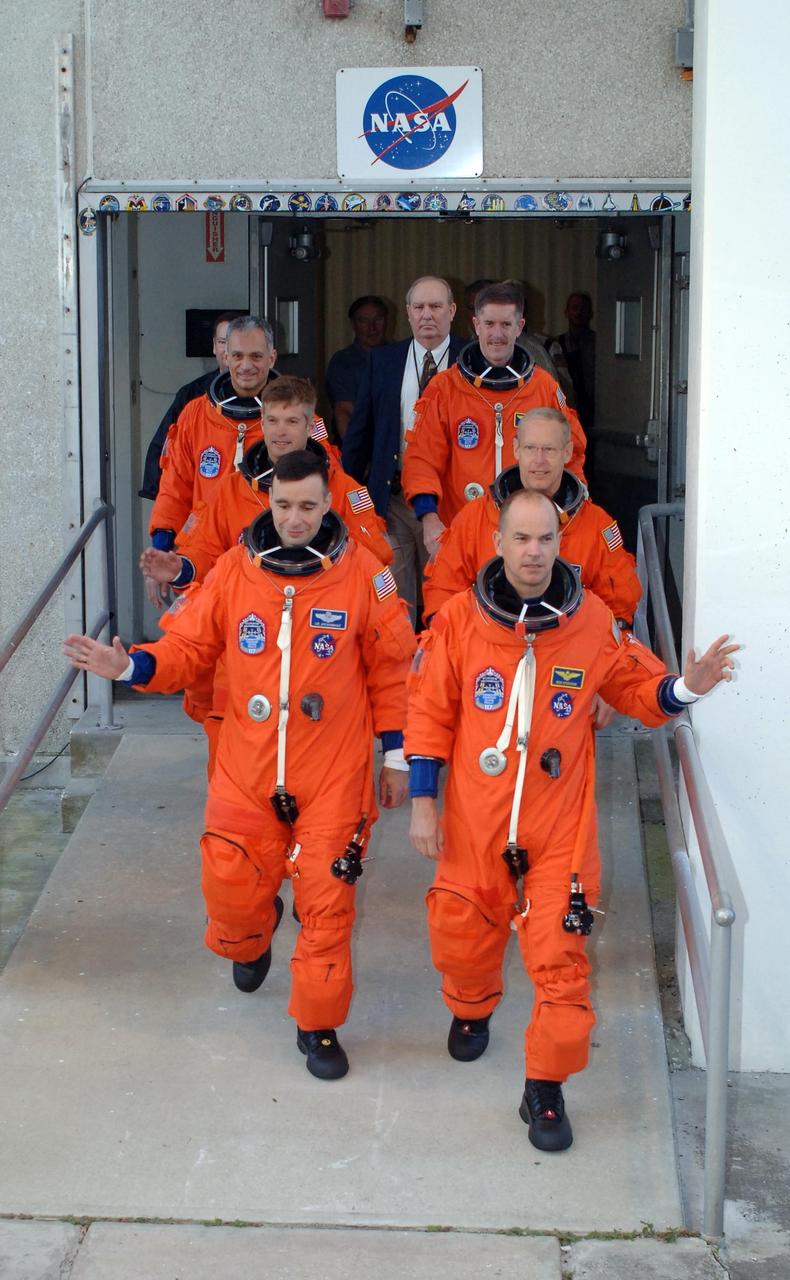
KENNEDY SPACE CENTER, FLA. -- Dressed in their flights suits, the Mission STS-117 crew members practice walk out from the Operations and Checkout Building to the astronaut van for transport to Launch Pad 39A during terminal countdown demonstration test activities. At left from the front are Pilot Lee Archambault and Mission Specialists Steven Swanson and Danny Olivas. At right from the front are Commander Rick Sturckow and Mission Specialists Patrick Forrester and James Reilly. The STS-117 mission is No. 21 to the International Space Station. Mission payloads aboard Atlantis include the S3/S4 integrated truss structure, a third set of solar arrays and batteries. The crew of six astronauts will install the truss to continue assembly of the station. Launch is scheduled for no earlier than March 15. Photo credit: NASA/Kim Shiflett.
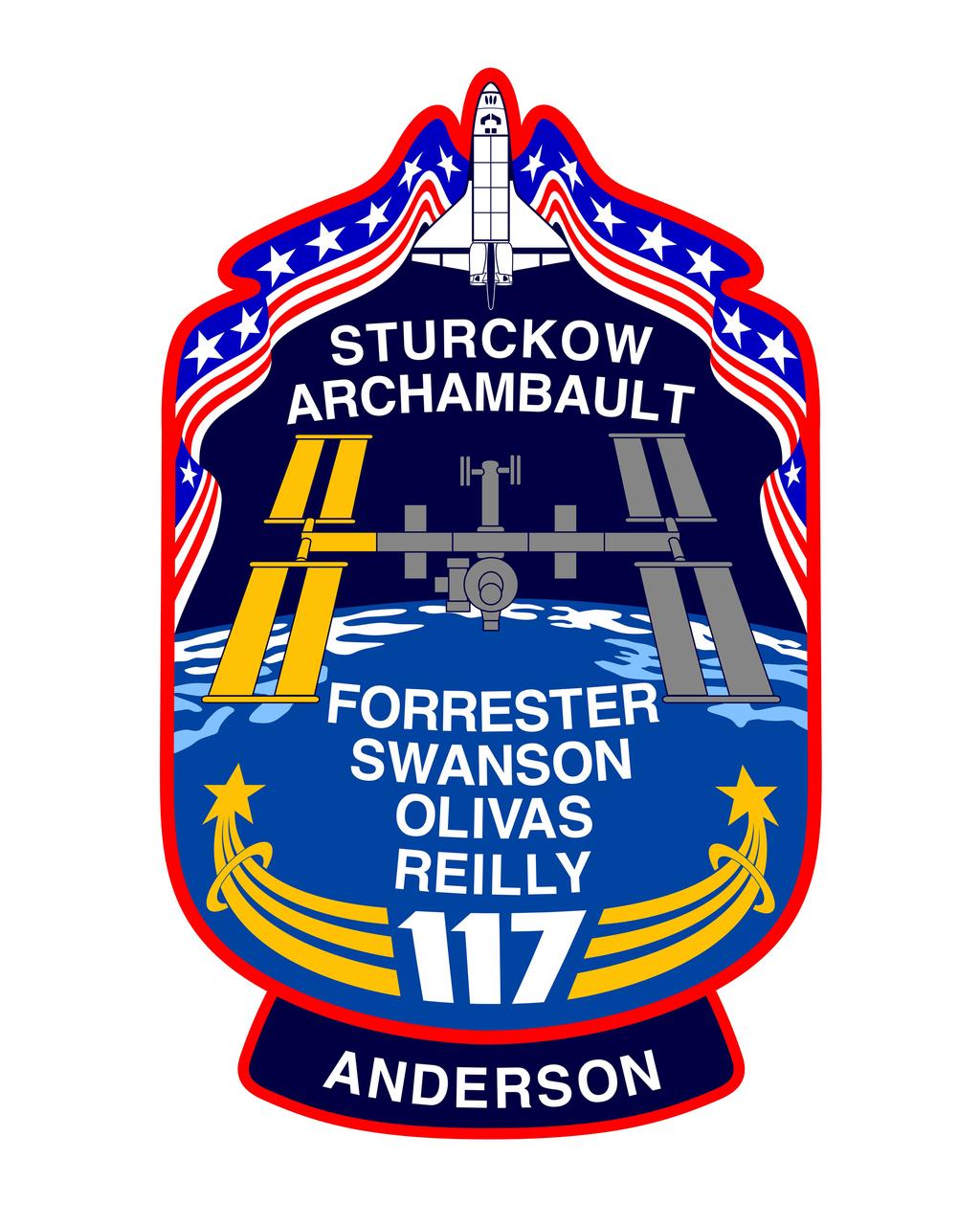
The STS-117 crew patch symbolizes the continued construction of the International Space Station (ISS) and our ongoing human presence in space. The ISS is shown orbiting high above the Earth. Gold is used to highlight the portion of the ISS that will be installed by the STS-117 crew. It consists of the second starboard truss section, S3 and S4, and a set of solar arrays. The names of the STS-117 crew are located above and below the orbiting outpost. The two gold astronaut office symbols, emanating from the 117 at the bottom of the patch, represent the concerted efforts of the shuttle and station programs toward the completion of the station. The orbiter and unfurled banner of red, white, and blue represent our Nation and renewed patriotism as we continue to explore the universe.

Extravehicular Activity (EVA) suits packed inside containers arrive at the Space Station Processing Facility from Johnson Space Center in Texas. The suits will be used by STS-117 crew members to perform several spacewalks during the mission. The mission payload aboard Space Shuttle Atlantis is the S3/S4 integrated truss structure, along with a third set of solar arrays and batteries. The crew of six astronauts will install the truss to continue assembly of the International Space Station.
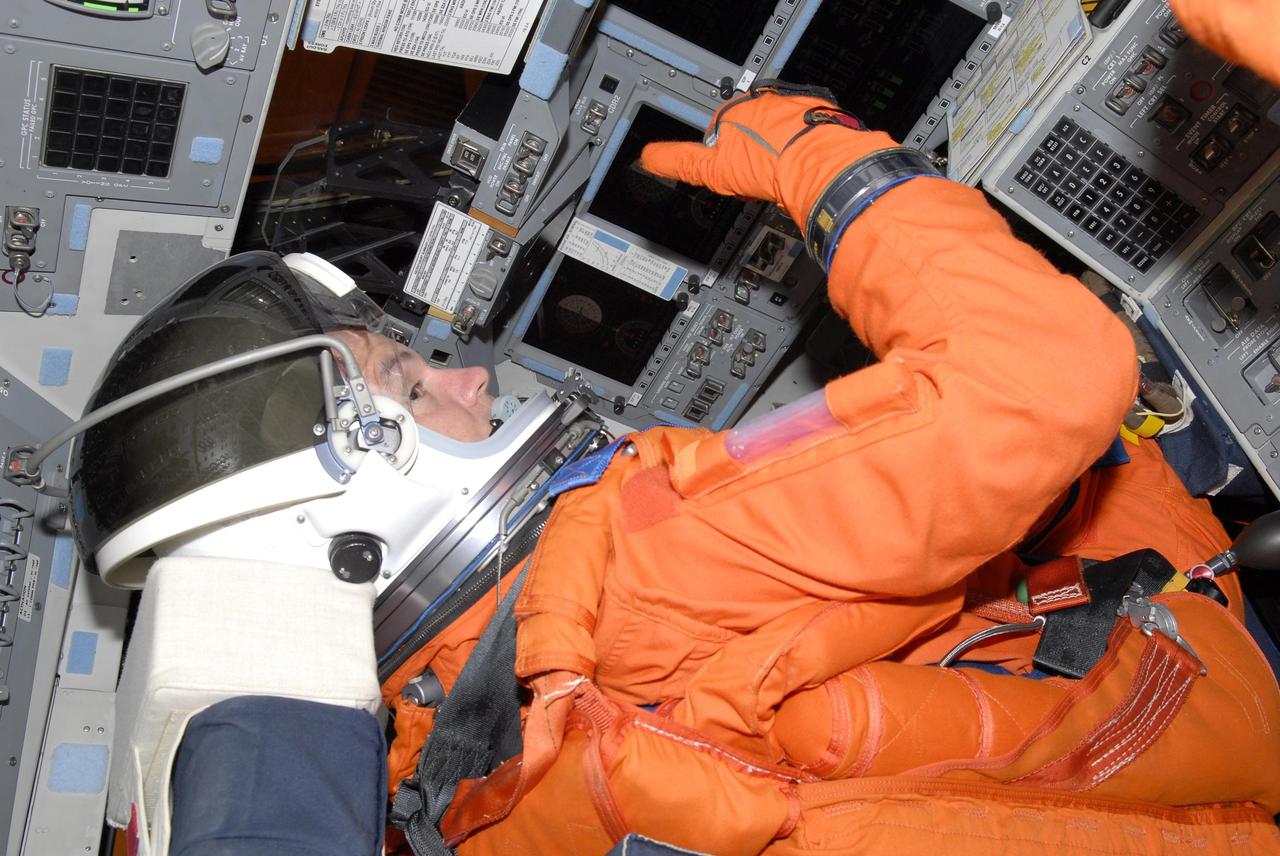
KENNEDY SPACE CENTER, FLA. -- Mission STS-117 Commander Rick Sturckow sits in the cockpit of Space Shuttle Atlantis at Launch Pad 39A to participate in a simulated launch countdown that is part of the prelaunch preparations known as terminal demonstration countdown test (TCDT). The TCDT also includes M-113 armored personnel carrier training and payload familiarization. The STS-117 mission is No. 21 to the International Space Station. Mission payloads aboard Atlantis include the S3/S4 integrated truss structure, a third set of solar arrays and batteries. The crew of six astronauts will install the truss to continue assembly of the station. Launch is scheduled for no earlier than March 15. Photo credit: NASA/Kim Shiflett.
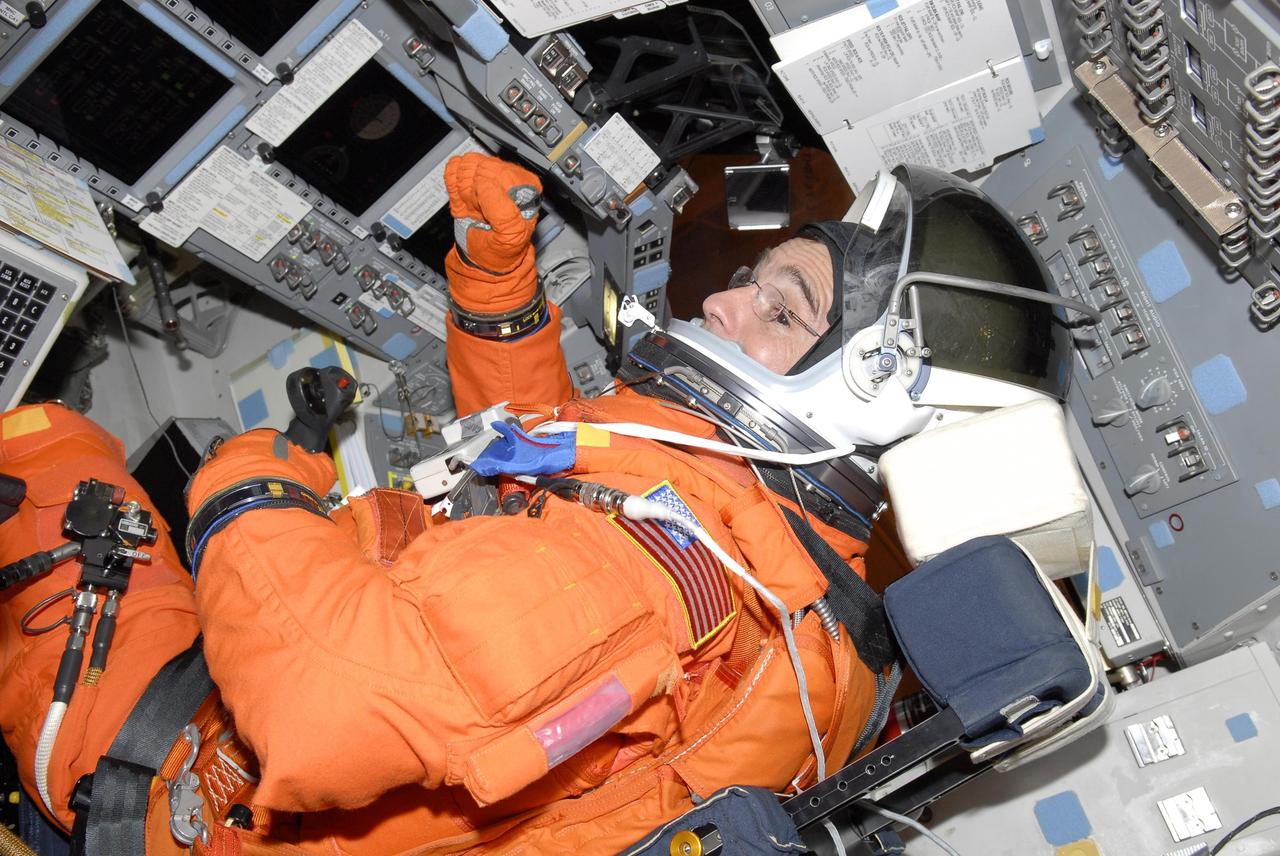
KENNEDY SPACE CENTER, FLA. -- Mission STS-117 Pilot Lee Archambault sits in the cockpit of Space Shuttle Atlantis at Launch Pad 39A to participate in a simulated launch countdown that is part of the prelaunch preparations known as terminal countdown demonstration test (TCDT). The TCDT also includes M-113 armored personnel carrier training and payload familiarization. The STS-117 mission is No. 21 to the International Space Station. Mission payloads aboard Atlantis include the S3/S4 integrated truss structure, a third set of solar arrays and batteries. The crew of six astronauts will install the truss to continue assembly of the station. Launch is scheduled for no earlier than March 15. Photo credit: NASA/Kim Shiflett.
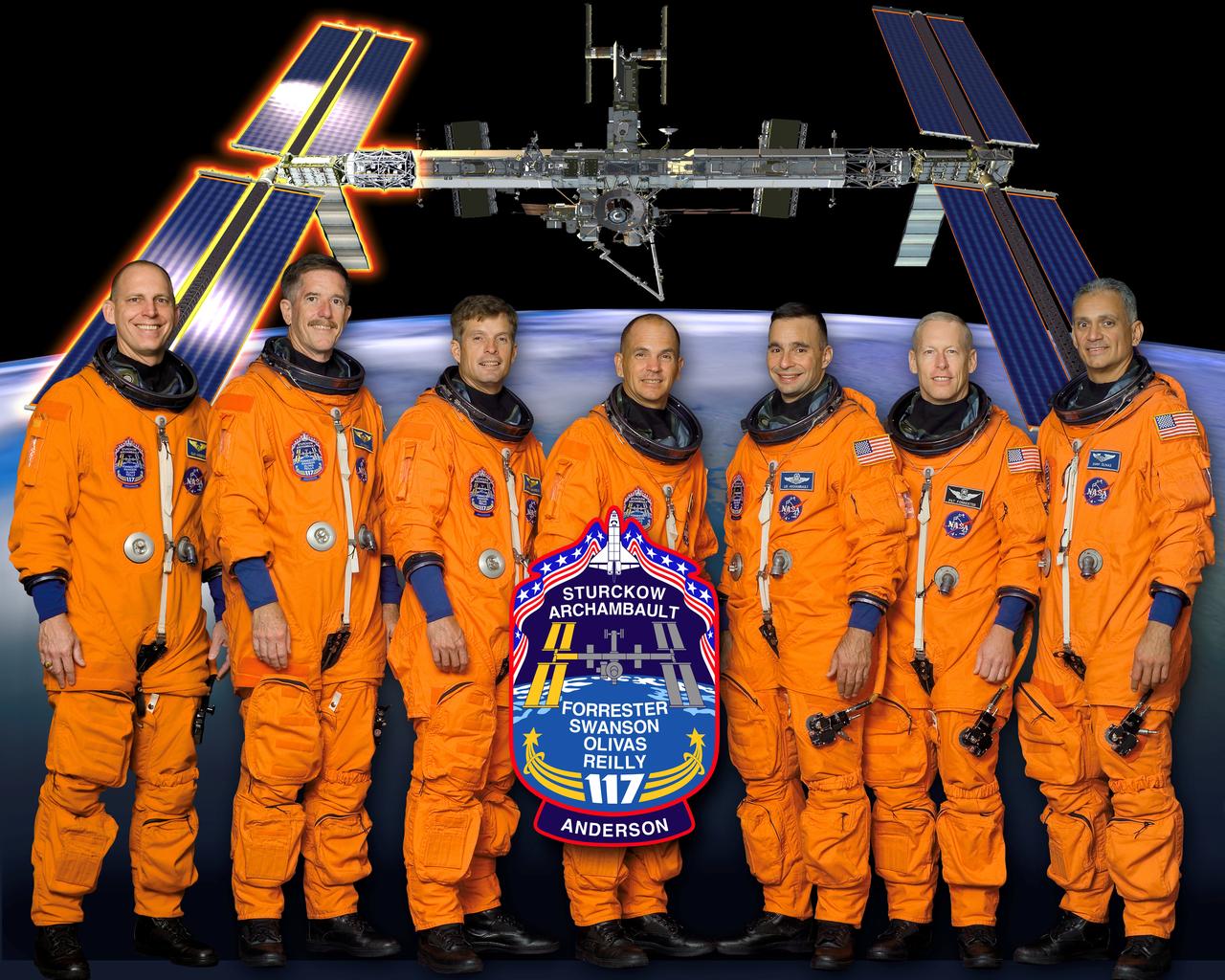
These six STS 117 astronauts, assigned to launch aboard the Space Shuttle Atlantis, are (from the left) astronauts James F. Reilly II, Steven R. Swanson, mission specialists; Frederick W. (Rick) Sturckow, commander; Lee J. Archambault, pilot; and Patrick G. Forrester and John D. (Danny) Olivas, mission specialists. The crewmembers are attired in training versions of their shuttle launch and entry suits. Mission objectives include the addition of the second and third starboard truss segments (S3/S4) with Photovoltaic Radiator (PVR), the deployed third set of solar arrays. The P6 starboard solar array wing and one radiator are to be retracted.
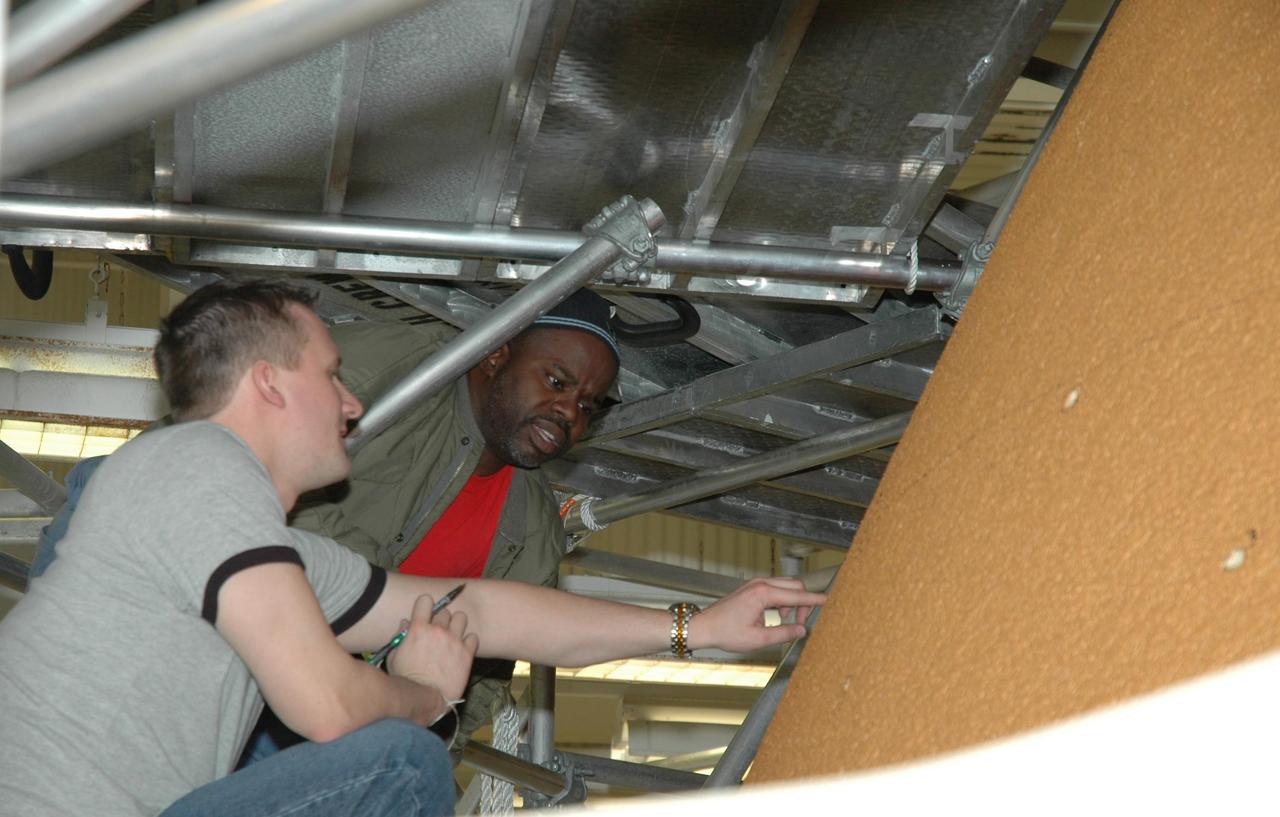
KENNEDY SPACE CENTER, FLA. -- In Highbay 1 inside the Vehicle Assembly Building, technicians look at hail damage on the external tank. A severe thunderstorm with golf ball-sized hail caused visible divots in the giant tank's foam insulation and minor surface damage to about 26 heat shield tiles on the shuttle's left wing. A new target launch date has not been determined, but teams will focus on preparing Atlantis for liftoff in late April on mission STS-117. Photo credit: NASA/Jim Grossmann
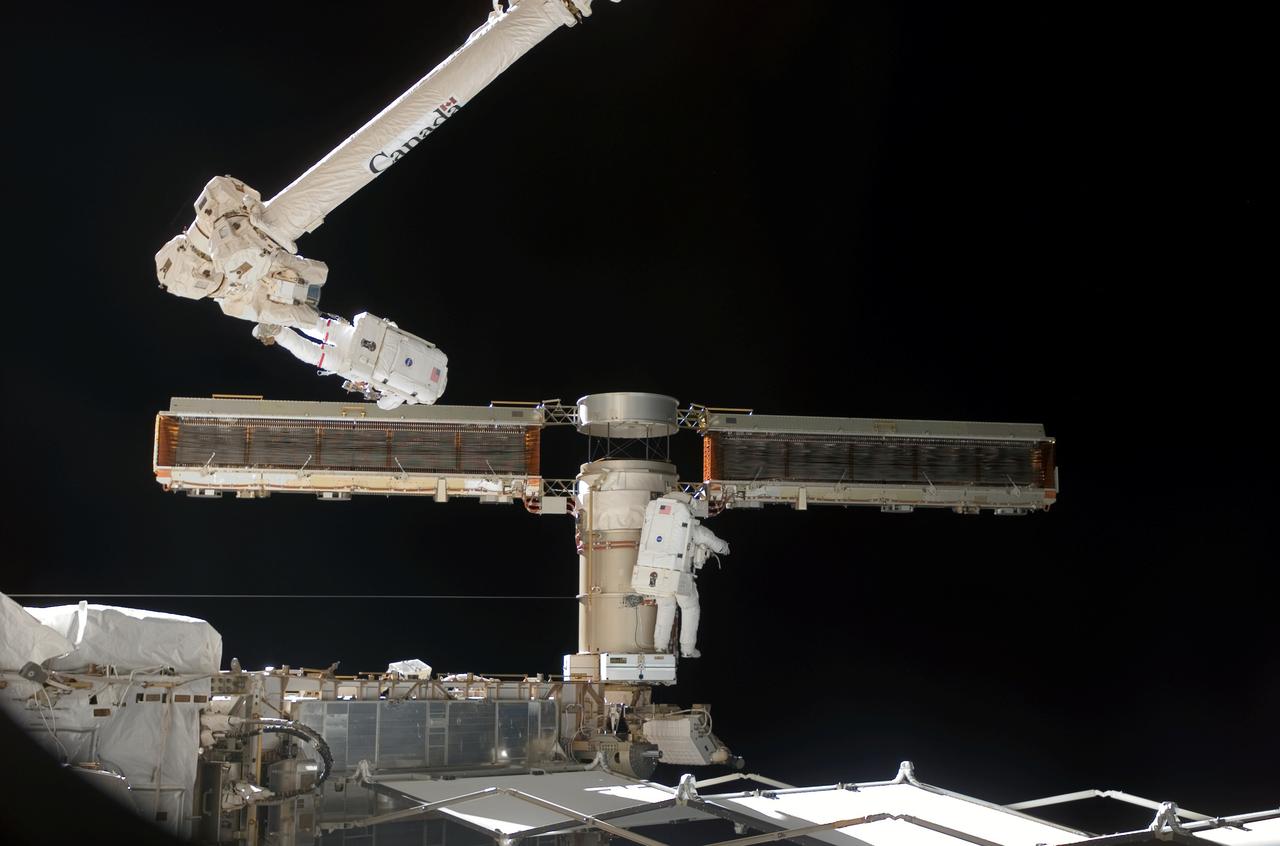
Construction resumed on the International Space Station (ISS), as STS-117 astronauts and mission specialists Jim Reilly (on robotic arm), and John “Danny” Olivas joined forces with their colleagues inside the Shuttle and station, and controllers in Houston, to complete the delicate process of folding an older solar array, Port 6 (P6), so that it can be moved from its temporary location to its permanent home during an upcoming Fall scheduled Shuttle mission. The EVA lasted nearly 8 hours.

STS-117 astronauts and mission specialists Patrick Forrester and Steven Swanson (out of frame), participated in the second Extra Vehicular Activity (EVA) as construction resumed on the International Space Station (ISS). Among other tasks, the two removed all of the launch locks holding the 10 foot wide solar alpha rotary joint in place and began the solar array retraction. The primary mission objective was the installment of the second and third starboard truss segments (S3 and S4).
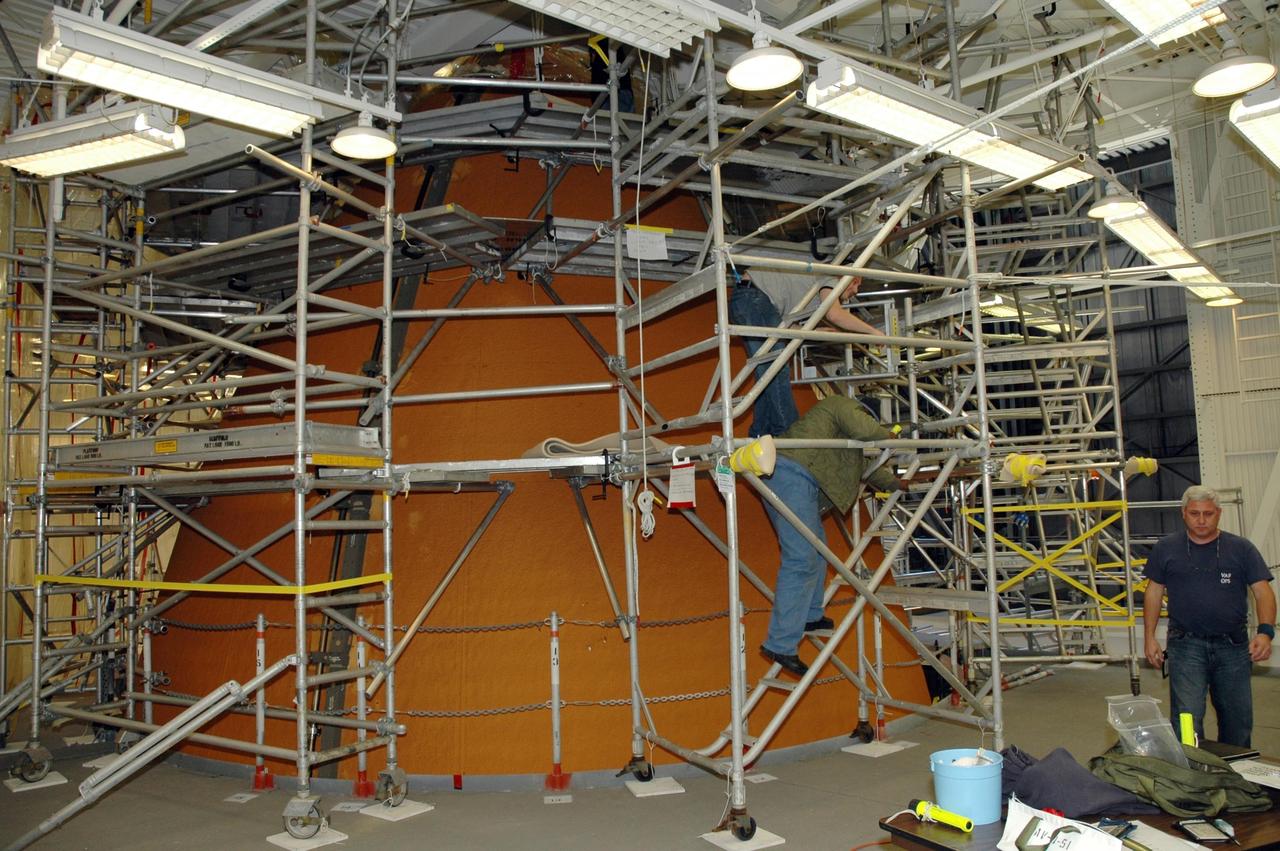
KENNEDY SPACE CENTER, FLA. -- In Highbay 1 inside the Vehicle Assembly Building, workers secure scaffolding around the external tank to prepare it for repairs. A severe thunderstorm with golf ball-sized hail caused visible divots in the giant tank's foam insulation and minor surface damage to about 26 heat shield tiles on the shuttle's left wing. A new target launch date has not been determined, but teams will focus on preparing Atlantis for liftoff in late April on mission STS-117. Photo credit: NASA/Jim Grossmann
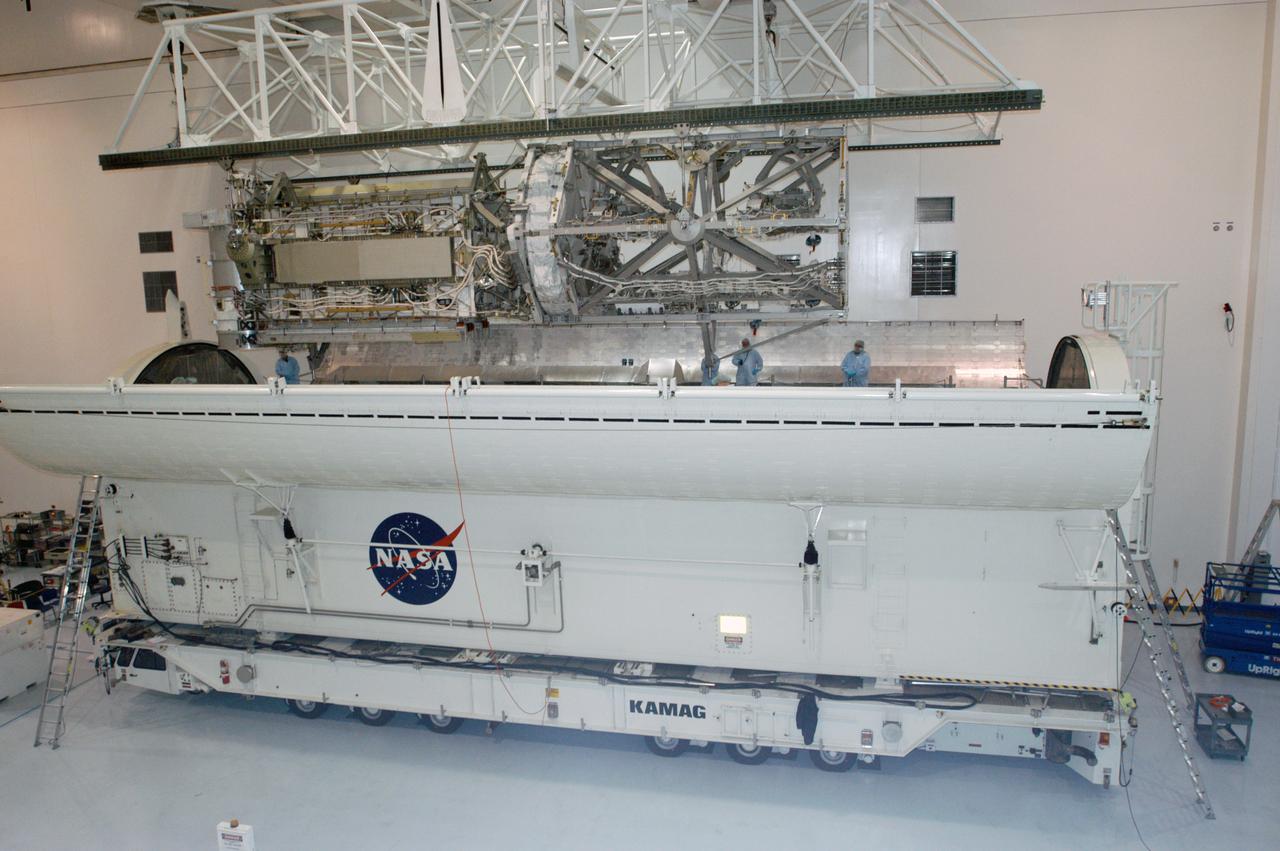
In the Space Station Processing Facility, an overhead crane lowers the S3/S4 integrated truss into the open bay of the payload canister. After it is stowed in the canister, the S3/S4 truss will be transported to the launch pad. The truss is the payload on mission STS-117, targeted for launch on March 15.
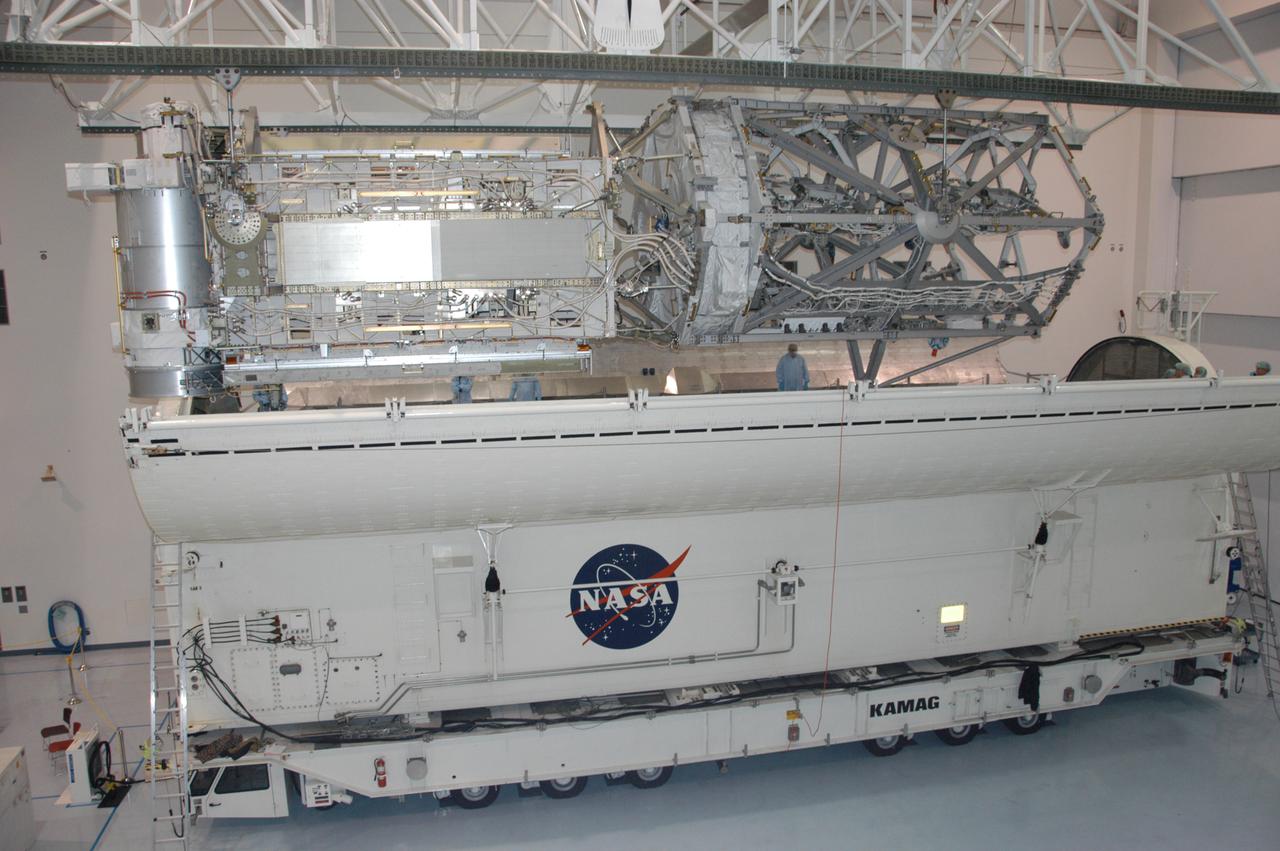
In the Space Station Processing Facility, an overhead crane lowers the S3/S4 integrated truss toward the open doors of the payload canister. After it is stowed in the canister, the S3/S4 truss will be transported to the launch pad. The truss is the payload on mission STS-117, targeted for launch on March 15.
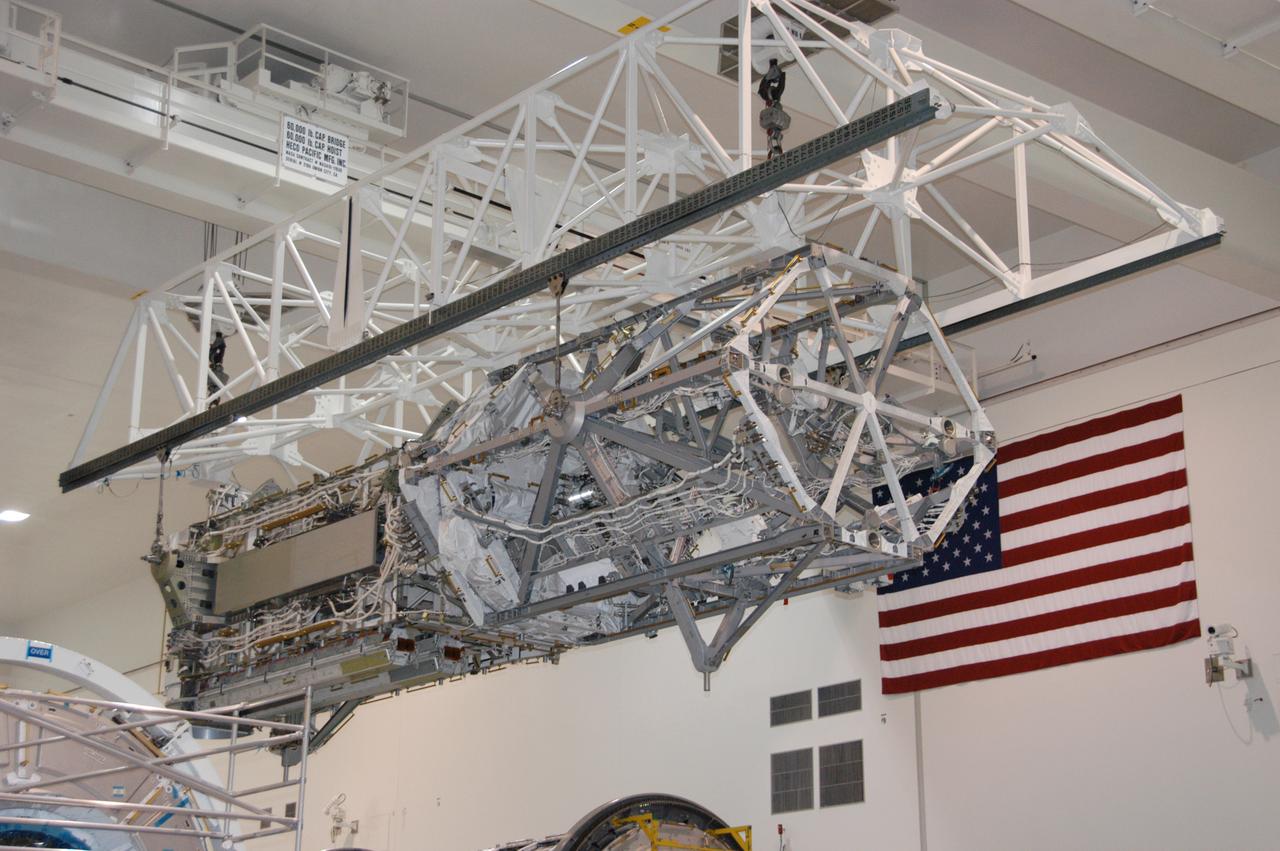
In the Space Station Processing Facility, an overhead crane moves the S3/S4 integrated truss to a payload canister. After it is stowed in the canister, the S3/S4 truss will be transported to the launch pad. The truss is the payload on mission STS-117, targeted for launch on March 15.
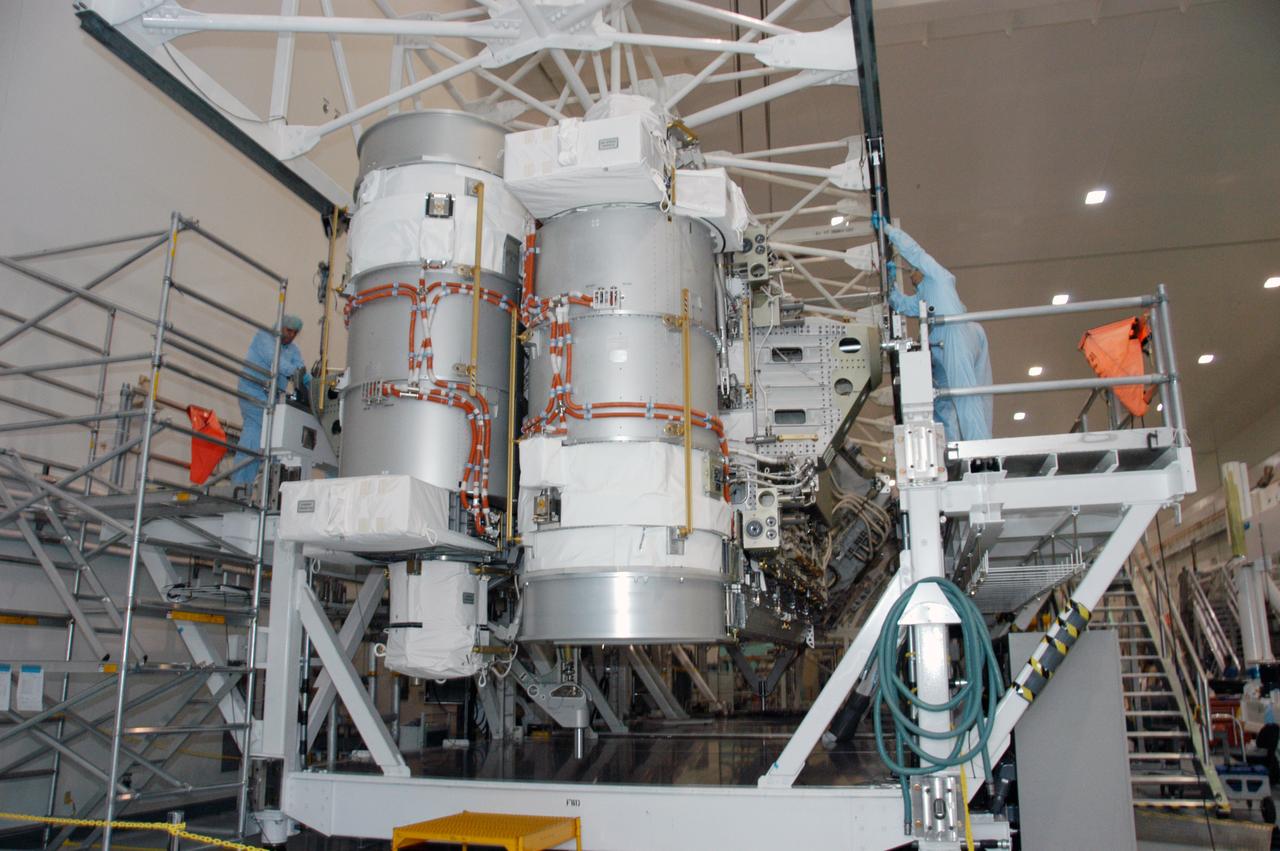
In the Space Station Processing Facility, workers attach an overhead crane to the S3/S4 integrated truss in order to move it to the payload canister. After it is stowed in the canister, the S3/S4 truss will be transported to the launch pad. The truss is the payload on mission STS-117, targeted for launch on March 15.
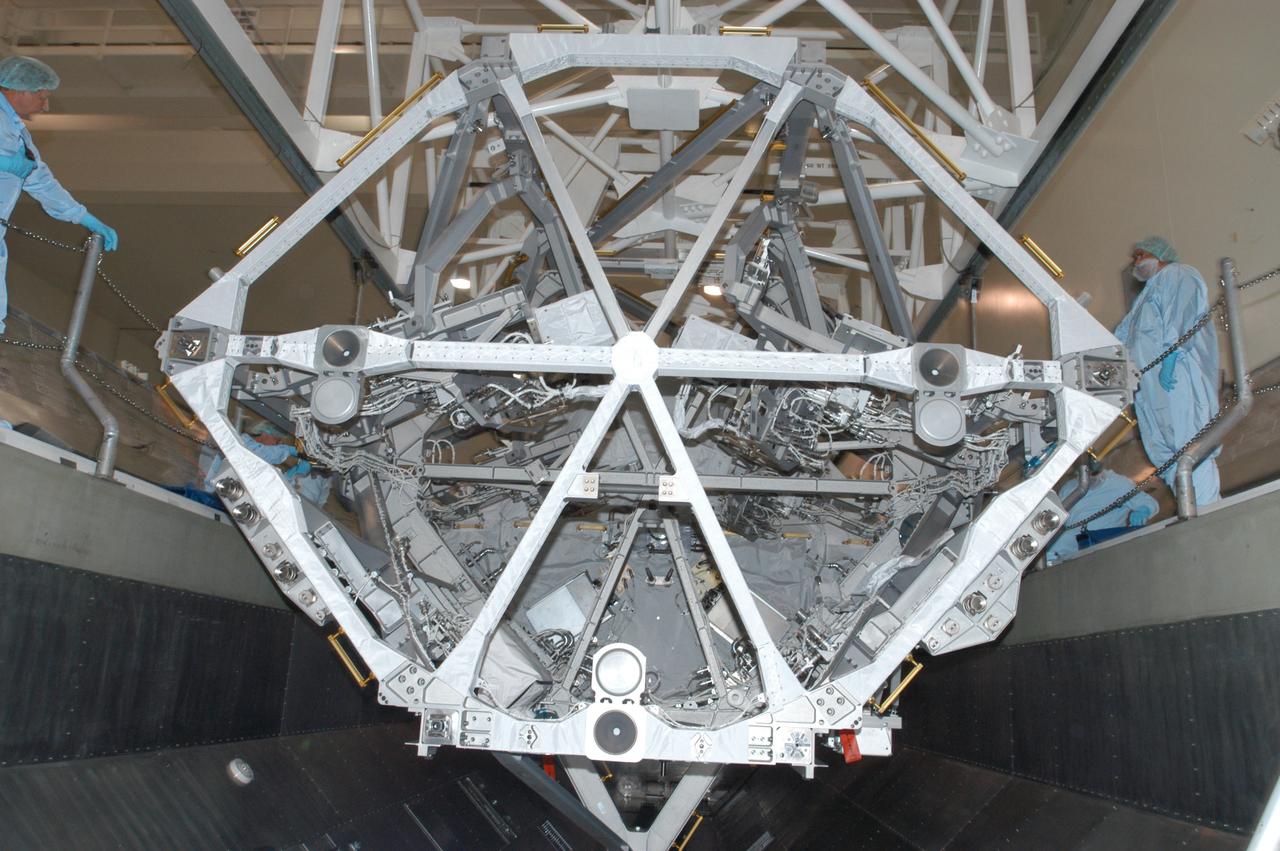
In the Space Station Processing Facility, an overhead crane settles the S3/S4 integrated truss into the payload canister. After it is stowed in the canister, the S3/S4 truss will be transported to the launch pad. The truss is the payload on mission STS-117, targeted for launch on March 15.
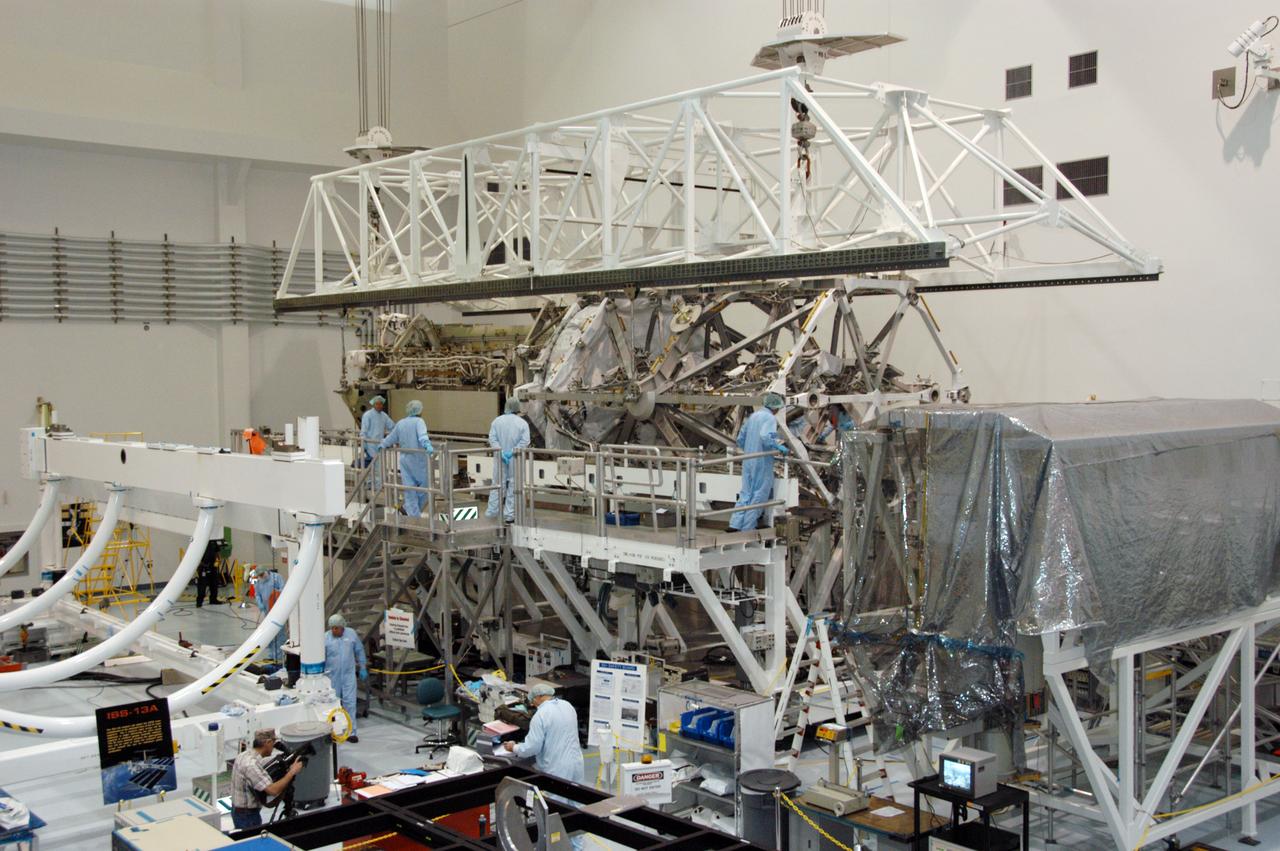
In the Space Station Processing Facility, workers attach an overhead crane to the S3/S4 integrated truss in order to move it to the payload canister. After it is stowed in the canister, the S3/S4 truss will be transported to the launch pad. The truss is the payload on mission STS-117, targeted for launch on March 15.
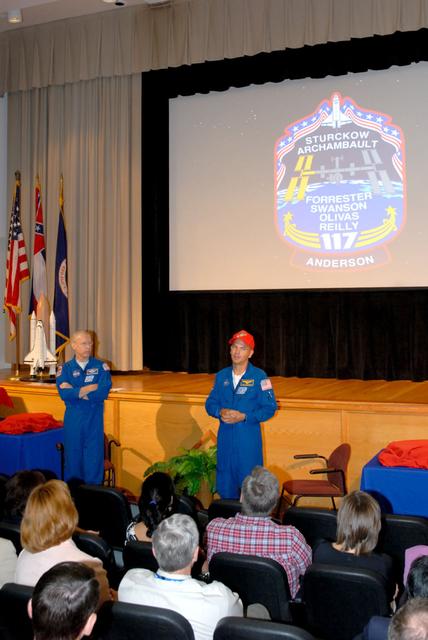
Astronauts Rick Sturckow (right) and Pat Forrester make a presentation Aug. 2 at NASA Stennis Space Center near Bay St. Louis, Miss., about their recent space shuttle mission, STS-117. Sturckow and Forrester thanked employees for the reliability and safe performance of the space shuttle's main engines, which are all tested and proved flight-worthy at SSC. The astronauts delivered a video of their mission's highlights, held a question-and-answer session, met one-on-one with employees and presented two Silver Snoopy awards during their visit. The STS-117 mission, which launched June 8, delivered a truss segment and a set of U.S. solar arrays, batteries and associated equipment to the International Space Station. Sturckow commanded the mission; Forrester was a mission specialist who performed two of STS-117's four spacewalks.
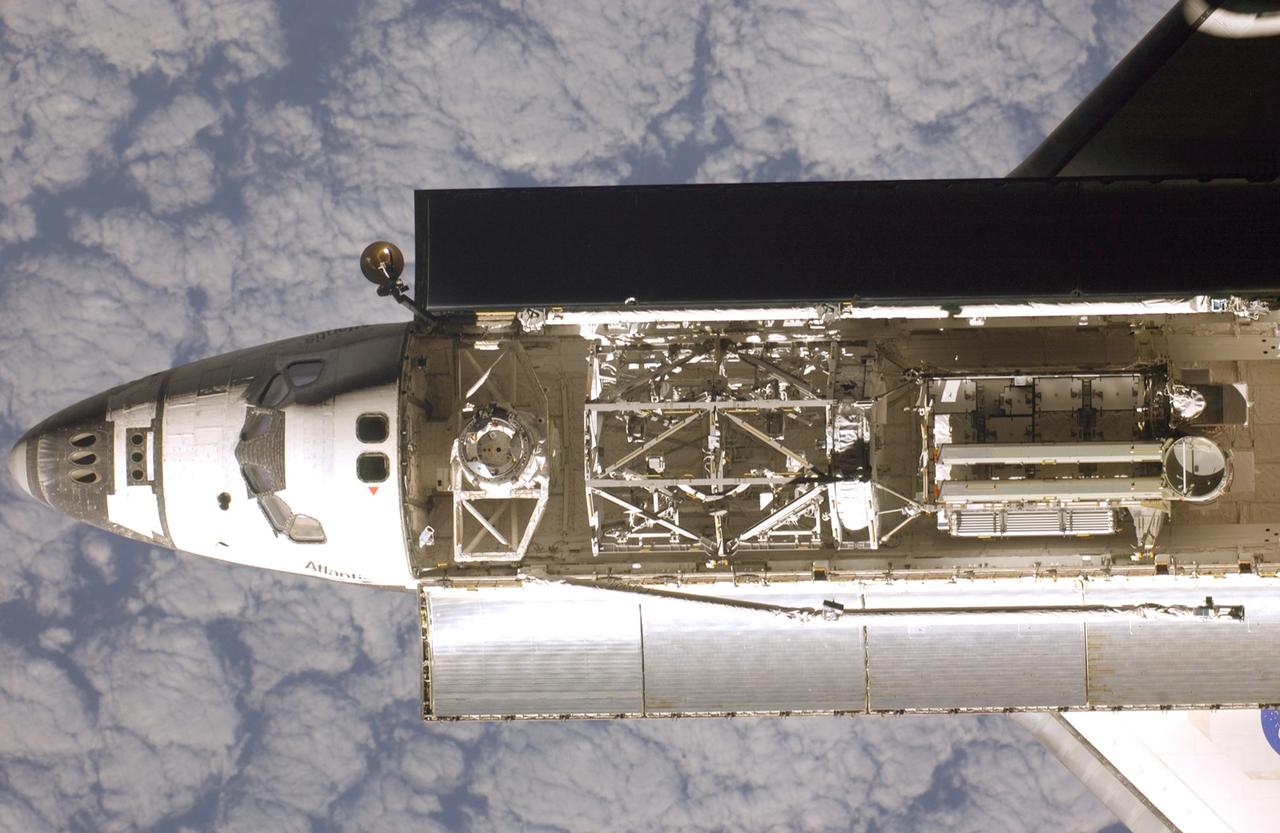
This nadir view of the STS-117 mission Space Shuttle Atlantis, taken by the Expedition 15 crew aboard the International Space Station (ISS), occurred just before the two spacecraft linked up in Earth orbit. Berthed in the cargo bay are the 17.8 ton second and third (S3 and S4) truss segments ready for installment. STS-117 mission objectives included the addition of S3 and S4 with Photovoltaic Radiator (PVR), the deployment of the third set of solar arrays, and the retraction of the P4 starboard solar array wing and one radiator.
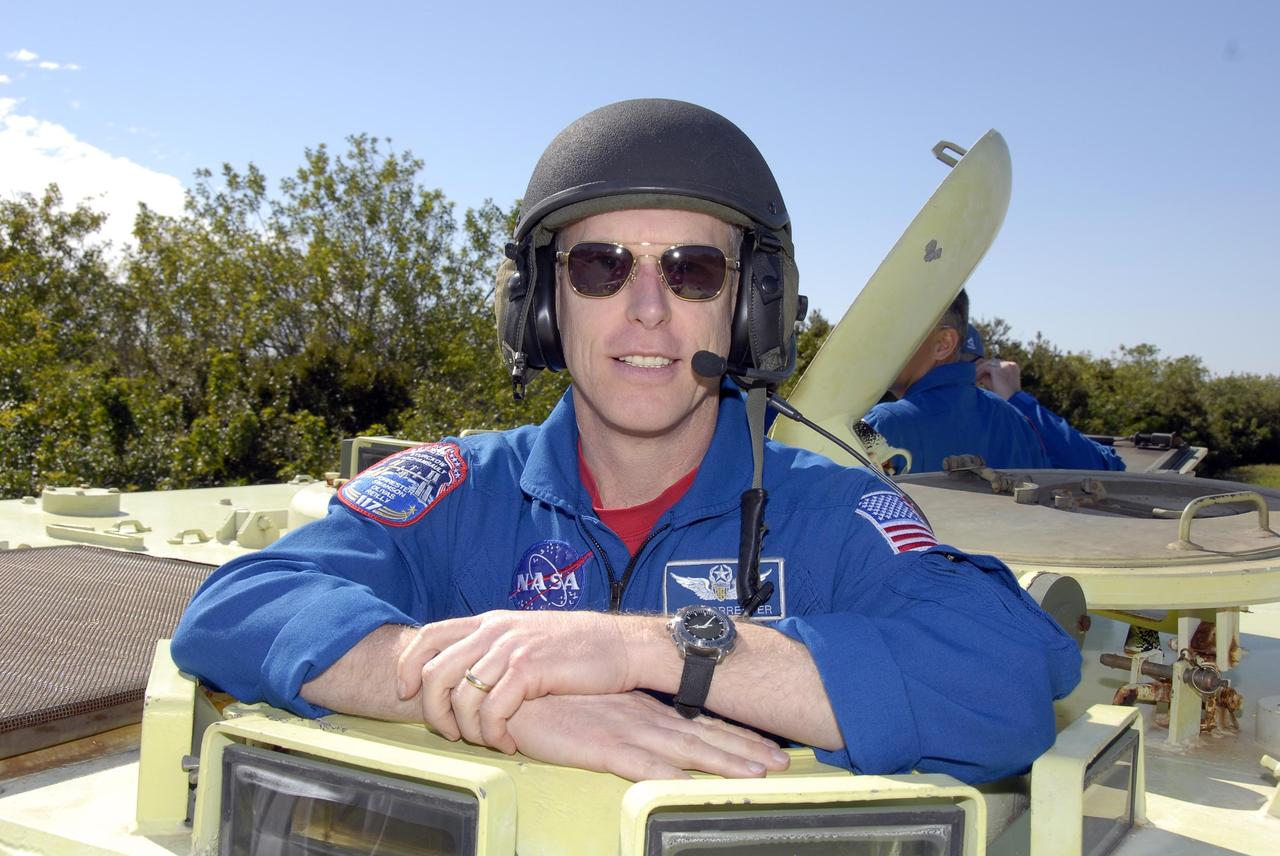
KENNEDY SPACE CENTER, FLA. -- At Launch Complex 39, STS-117 Mission Specialist Patrick Forrester is helmeted and ready to practice driving an M-113 armored personnel carrier. The astronauts on the STS-117 crew are participating in M-113 armored personnel carrier training during Terminal Countdown Demonstration Test (TCDT) activities, a dress rehearsal for their launch, targeted for March 15. The M-113 could be used to move the crew away from the launch pad quickly in the event of an emergency. The TCDT also includes pad emergency egress training and a simulated launch countdown. The mission payload aboard Space Shuttle Atlantis is the S3/S4 integrated truss structure, along with a third set of solar arrays and batteries. The crew of six astronauts will install the truss to continue assembly of the station. Photo credit: NASA/Kim Shiflett
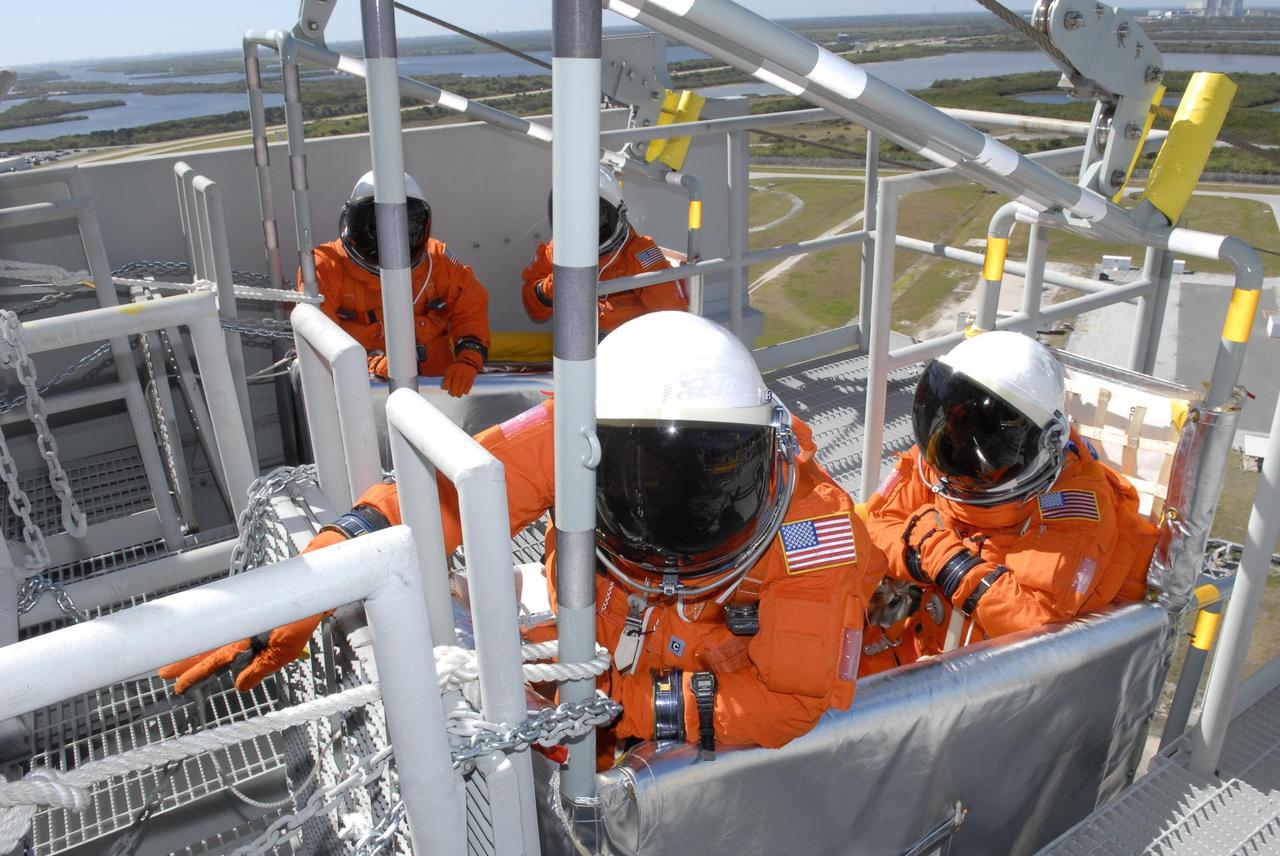
KENNEDY SPACE CENTER, FLA. -- From the 195-foot level of the fixed service structure on Launch Pad 39A, STS-117 Mission Specialists Patrick Forrester (front) and Steven Swanson sit in a slidewire basket, part of the emergency egress system. They and other crew members are practicing the emergency egress procedure to get off the pad, part of the prelaunch preparations known as terminal countdown demonstration test (TCDT). The TCDT also includes M-113 armored personnel carrier training and payload familiarization. The STS-117 mission is No. 21 to the International Space Station. Mission payloads aboard Atlantis include the S3/S4 integrated truss structure, a third set of solar arrays and batteries. The crew of six astronauts will install the truss to continue assembly of the station. Launch is scheduled for no earlier than March 15. Photo credit: NASA/Kim Shiflett.
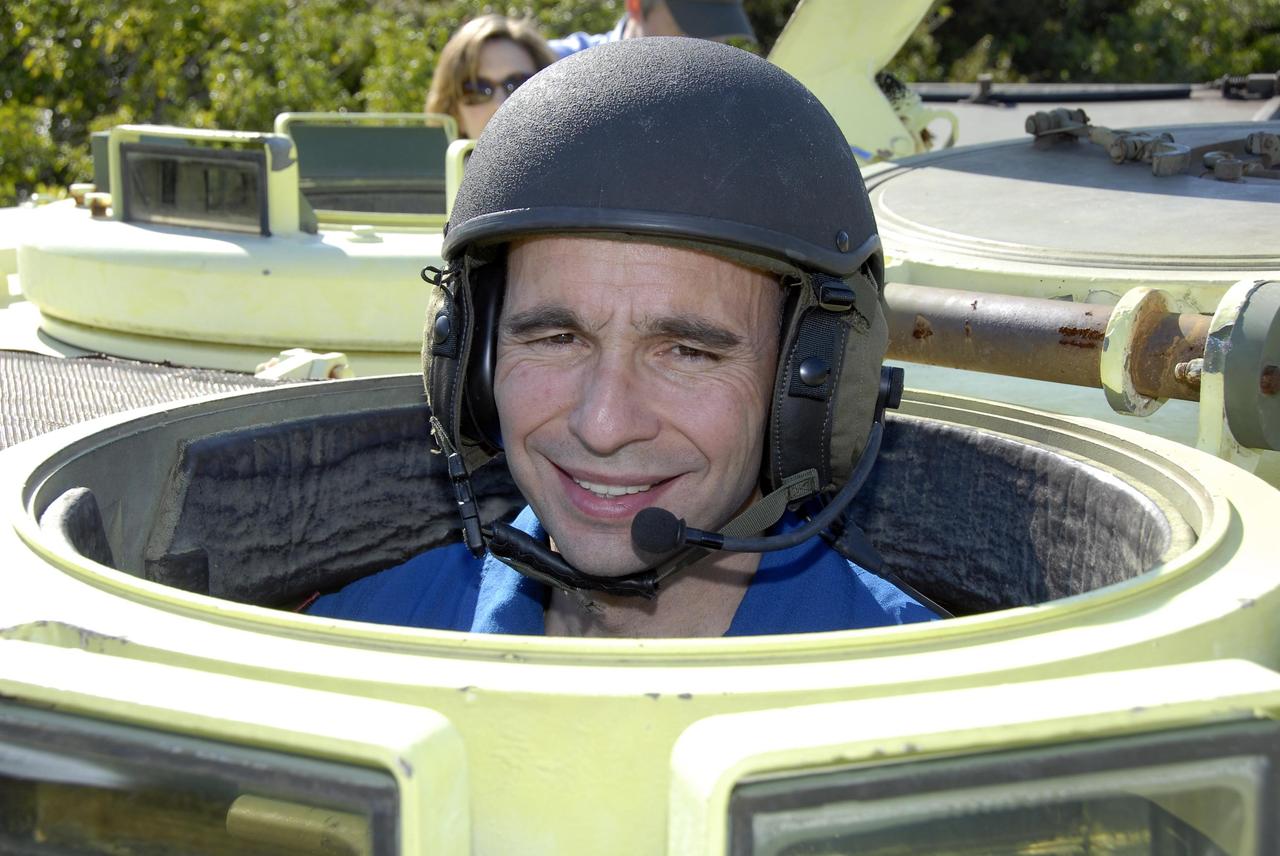
KENNEDY SPACE CENTER, FLA. -- At Launch Complex 39, STS-117 Pilot Lee Archambault is helmeted and ready to practice driving an M-113 armored personnel carrier. The astronauts on the STS-117 crew are participating in M-113 armored personnel carrier training during Terminal Countdown Demonstration Test (TCDT) activities, a dress rehearsal for their launch, targeted for March 15. The M-113 could be used to move the crew away from the launch pad quickly in the event of an emergency. The TCDT also includes pad emergency egress training and a simulated launch countdown. The mission payload aboard Space Shuttle Atlantis is the S3/S4 integrated truss structure, along with a third set of solar arrays and batteries. The crew of six astronauts will install the truss to continue assembly of the station. Photo credit: NASA/Kim Shiflett
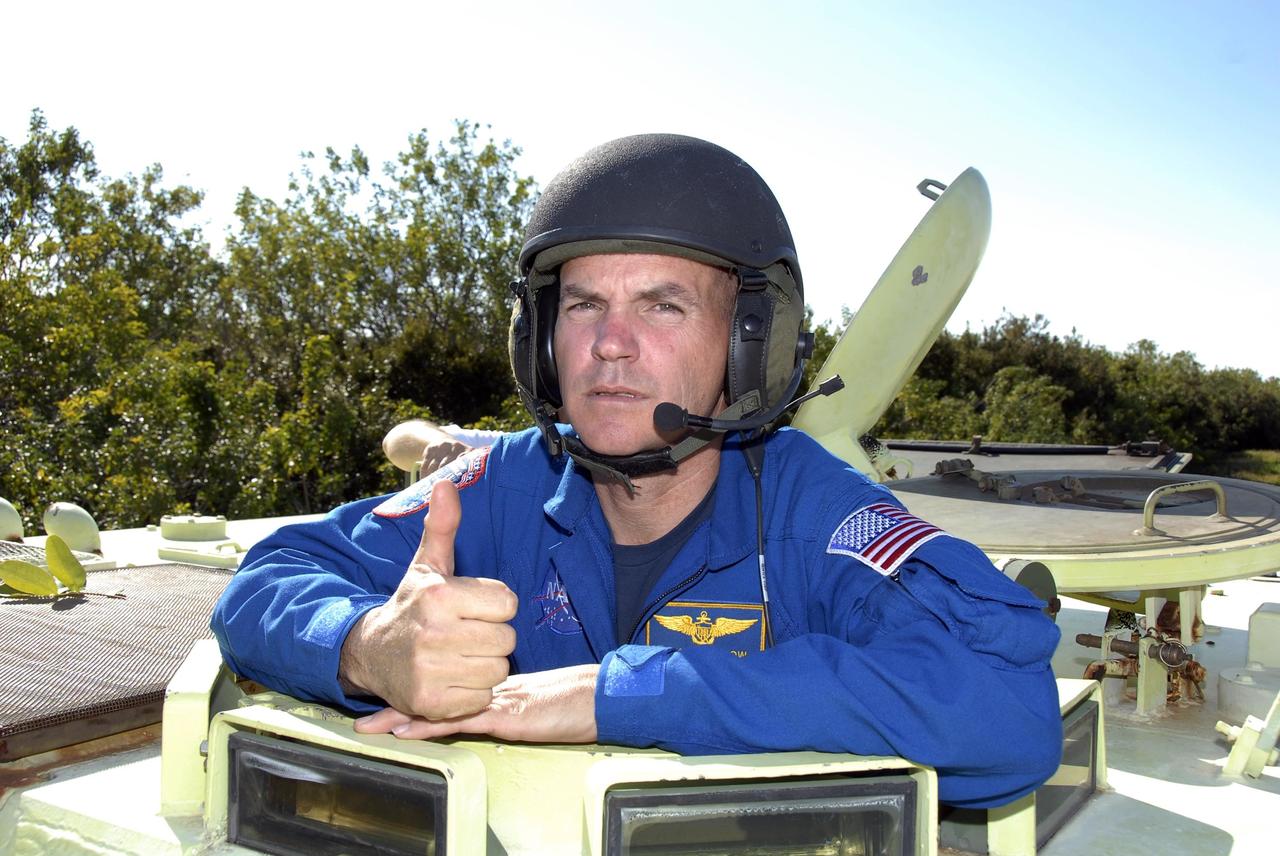
KENNEDY SPACE CENTER, FLA. -- At Launch Complex 39, STS-117 Commander Rick Sturckow signals that he is ready to practice driving an M-113 armored personnel carrier. The astronauts on the STS-117 crew are participating in M-113 armored personnel carrier training during Terminal Countdown Demonstration Test (TCDT) activities, a dress rehearsal for their launch, targeted for March 15. The M-113 could be used to move the crew away from the launch pad quickly in the event of an emergency. The TCDT also includes pad emergency egress training and a simulated launch countdown. The mission payload aboard Space Shuttle Atlantis is the S3/S4 integrated truss structure, along with a third set of solar arrays and batteries. The crew of six astronauts will install the truss to continue assembly of the station. Photo credit: NASA/Kim Shiflett
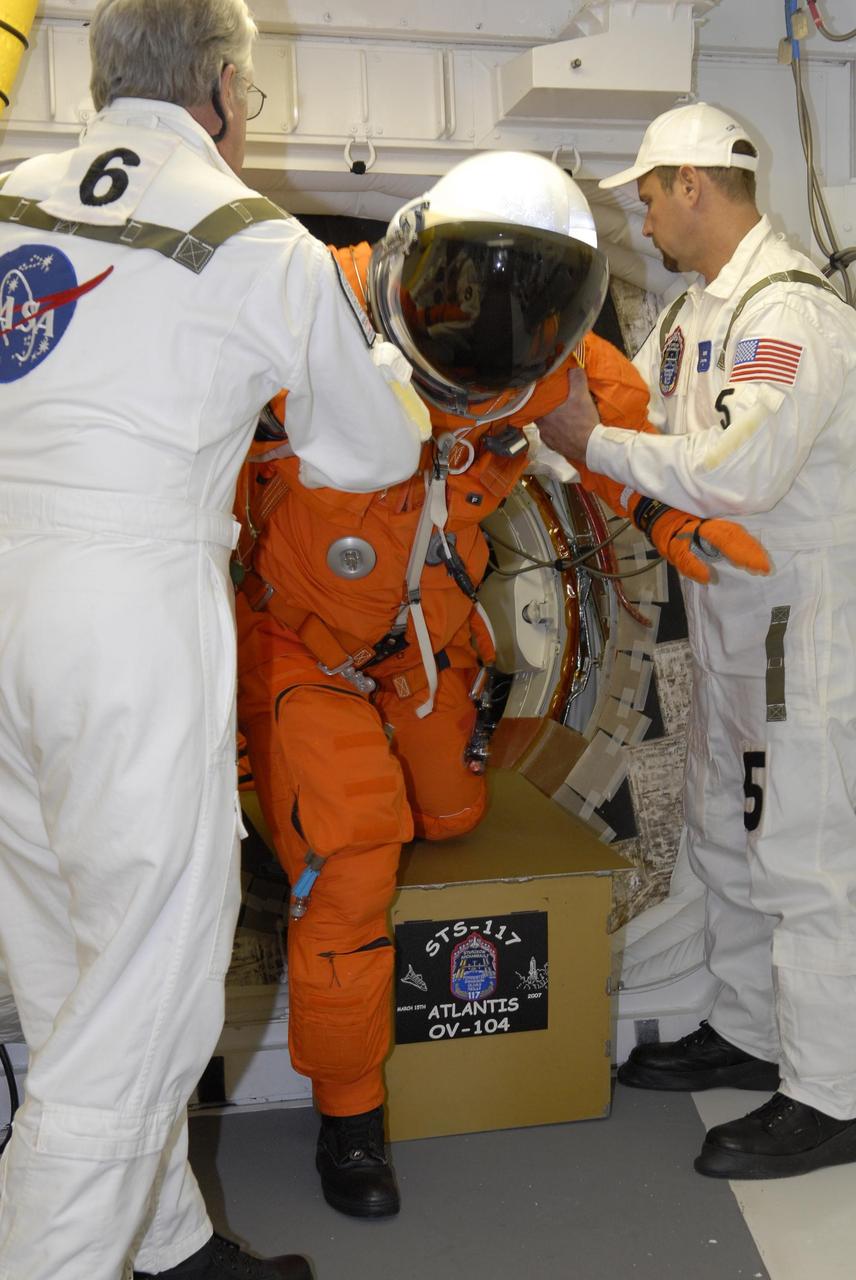
KENNEDY SPACE CENTER, FLA. -- Mission STS-117 Mission Specialist James Reilly egresses from Space Shuttle Atlantis at Launch Pad 39A after participating in a simulated launch countdown that is part of the prelaunch preparations known as terminal demonstration countdown test (TCDT). The TCDT also includes M-113 armored personnel carrier training and payload familiarization. The STS-117 mission is No. 21 to the International Space Station. Mission payloads aboard Atlantis include the S3/S4 integrated truss structure, a third set of solar arrays and batteries. The crew of six astronauts will install the truss to continue assembly of the station. Launch is scheduled for no earlier than March 15. Photo credit: NASA/Kim Shiflett.
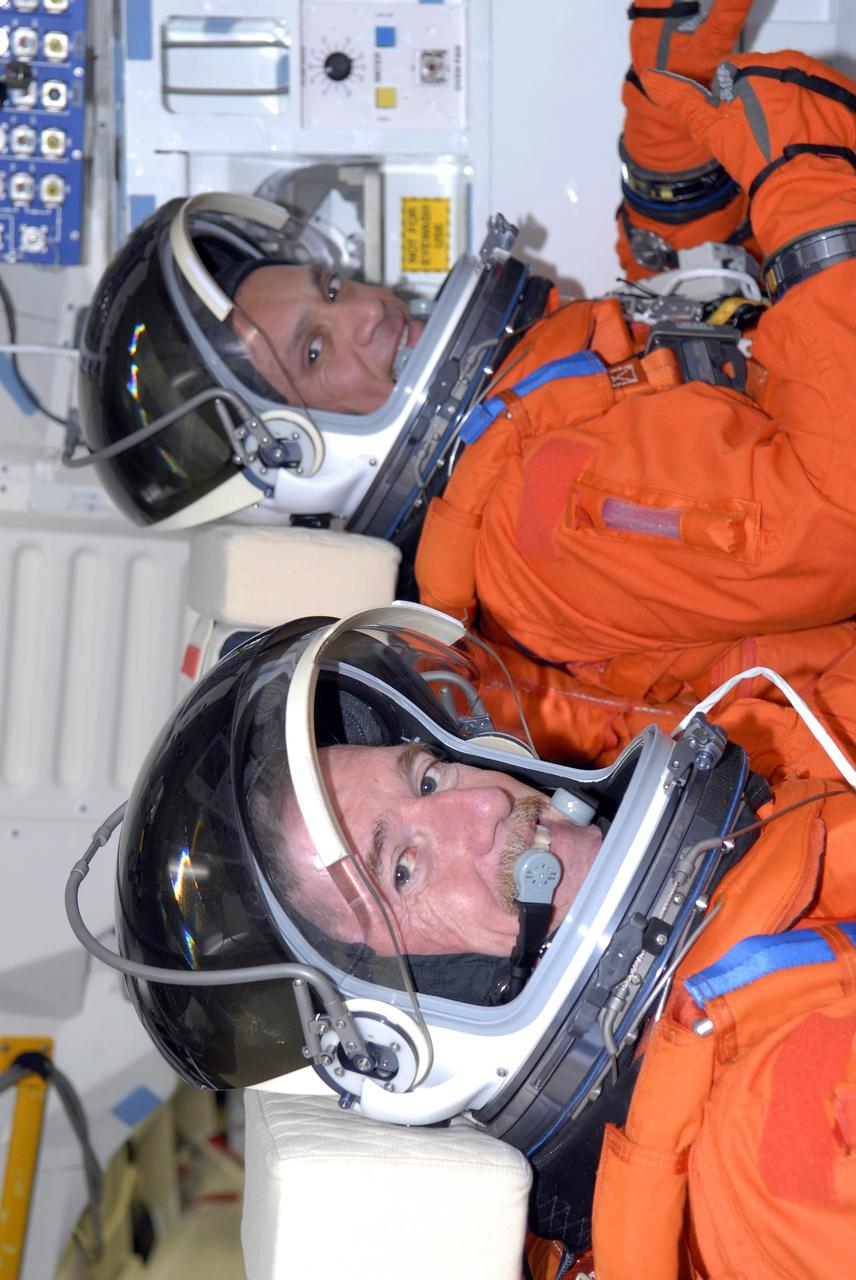
KENNEDY SPACE CENTER, FLA. -- Mission STS-117 Mission Specialists James Reilly (left) and Danny Olivas sit in the mid-deck of Space Shuttle Atlantis at Launch Pad 39A to participate in a simulated launch countdown that is part of the prelaunch preparations known as terminal countdown demonstration test (TCDT). The TCDT also includes M-113 armored personnel carrier training and payload familiarization. The STS-117 mission is No. 21 to the International Space Station. Mission payloads aboard Atlantis include the S3/S4 integrated truss structure, a third set of solar arrays and batteries. The crew of six astronauts will install the truss to continue assembly of the station. Launch is scheduled for no earlier than March 15. Photo credit: NASA/Kim Shiflett.
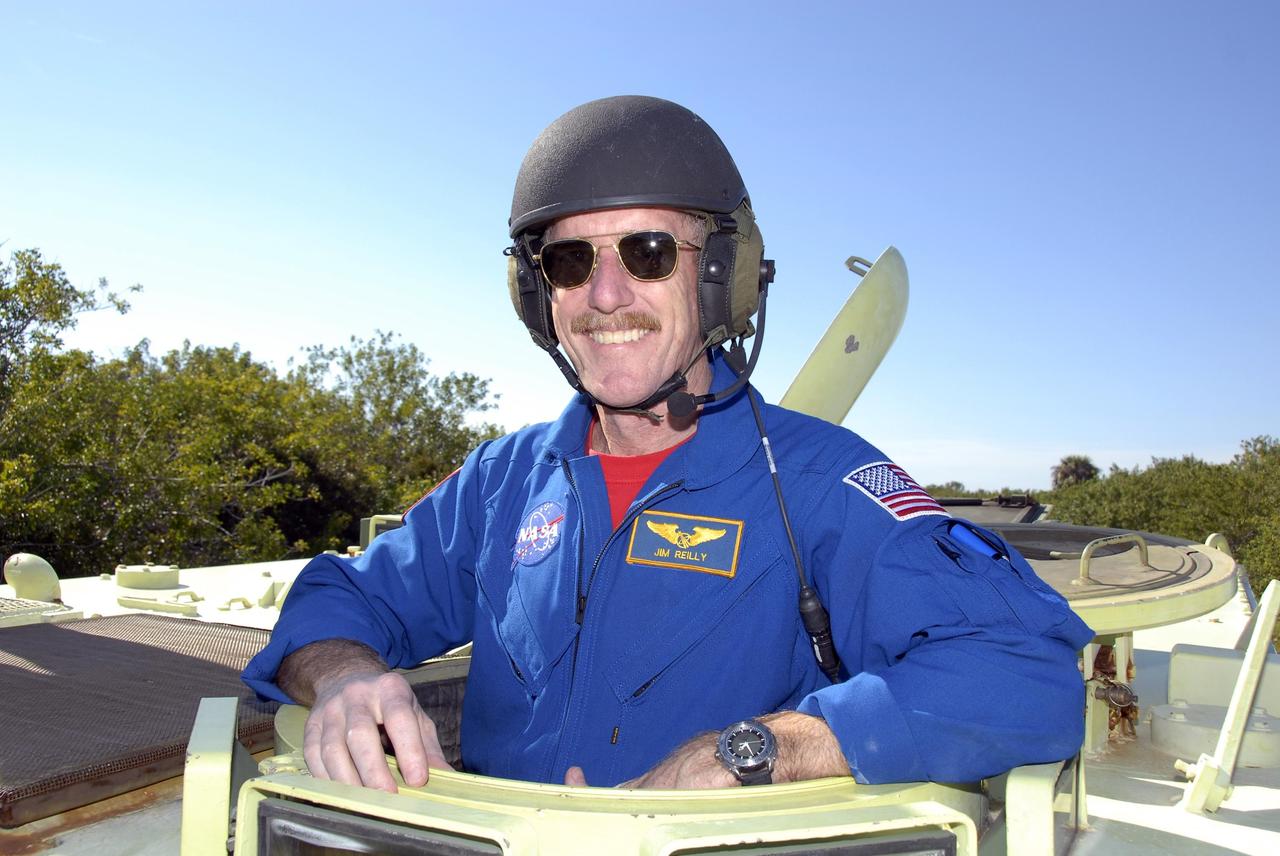
KENNEDY SPACE CENTER, FLA. -- At Launch Complex 39, STS-117 Mission Specialist James Reilly is helmeted and ready to practice driving an M-113 armored personnel carrier. The astronauts on the STS-117 crew are participating in M-113 armored personnel carrier training during Terminal Countdown Demonstration Test (TCDT) activities, a dress rehearsal for their launch, targeted for March 15. The M-113 could be used to move the crew away from the launch pad quickly in the event of an emergency. The TCDT also includes pad emergency egress training and a simulated launch countdown. The mission payload aboard Space Shuttle Atlantis is the S3/S4 integrated truss structure, along with a third set of solar arrays and batteries. The crew of six astronauts will install the truss to continue assembly of the station. Photo credit: NASA/Kim Shiflett
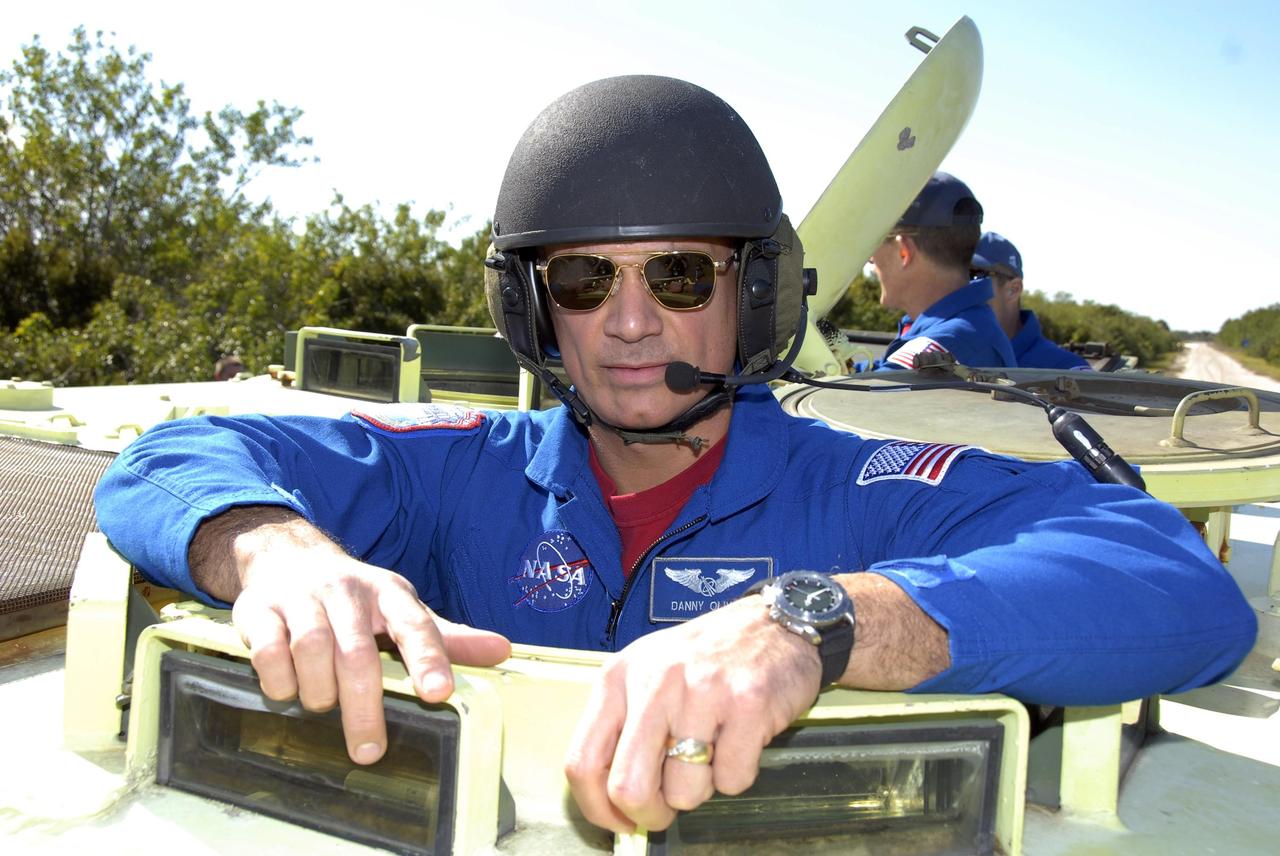
KENNEDY SPACE CENTER, FLA. -- At Launch Complex 39, STS-117 Mission Specialist Danny Olivas is helmeted and ready to practice driving an M-113 armored personnel carrier. The astronauts on the STS-117 crew are participating in M-113 armored personnel carrier training during Terminal Countdown Demonstration Test (TCDT) activities, a dress rehearsal for their launch, targeted for March 15. The M-113 could be used to move the crew away from the launch pad quickly in the event of an emergency. The TCDT also includes pad emergency egress training and a simulated launch countdown. The mission payload aboard Space Shuttle Atlantis is the S3/S4 integrated truss structure, along with a third set of solar arrays and batteries. The crew of six astronauts will install the truss to continue assembly of the station. Photo credit: NASA/Kim Shiflett
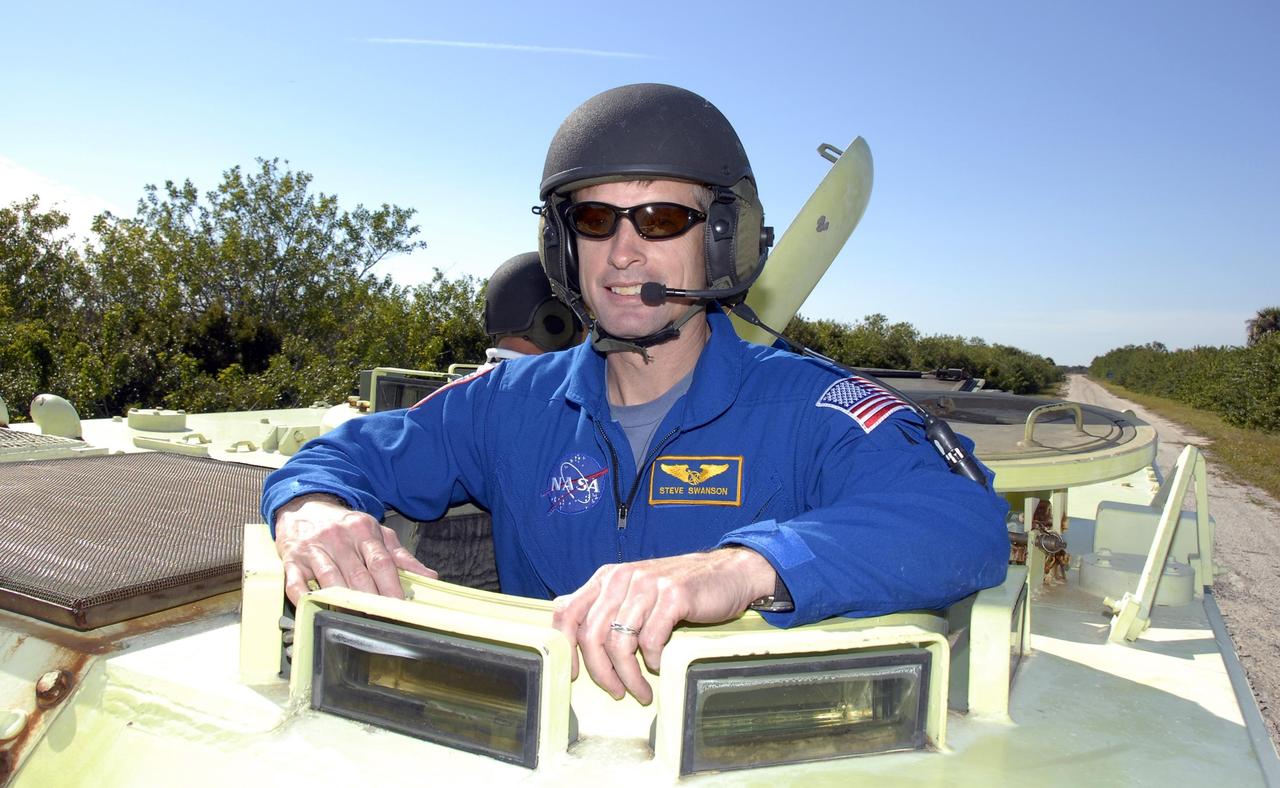
KENNEDY SPACE CENTER, FLA. -- At Launch Complex 39, STS-117 Mission Specialist Steven Swanson is helmeted and ready to practice driving an M-113 armored personnel carrier. The astronauts on the STS-117 crew are participating in M-113 armored personnel carrier training during Terminal Countdown Demonstration Test (TCDT) activities, a dress rehearsal for their launch, targeted for March 15. The M-113 could be used to move the crew away from the launch pad quickly in the event of an emergency. The TCDT also includes pad emergency egress training and a simulated launch countdown. The mission payload aboard Space Shuttle Atlantis is the S3/S4 integrated truss structure, along with a third set of solar arrays and batteries. The crew of six astronauts will install the truss to continue assembly of the station. Photo credit: NASA/Kim Shiflett
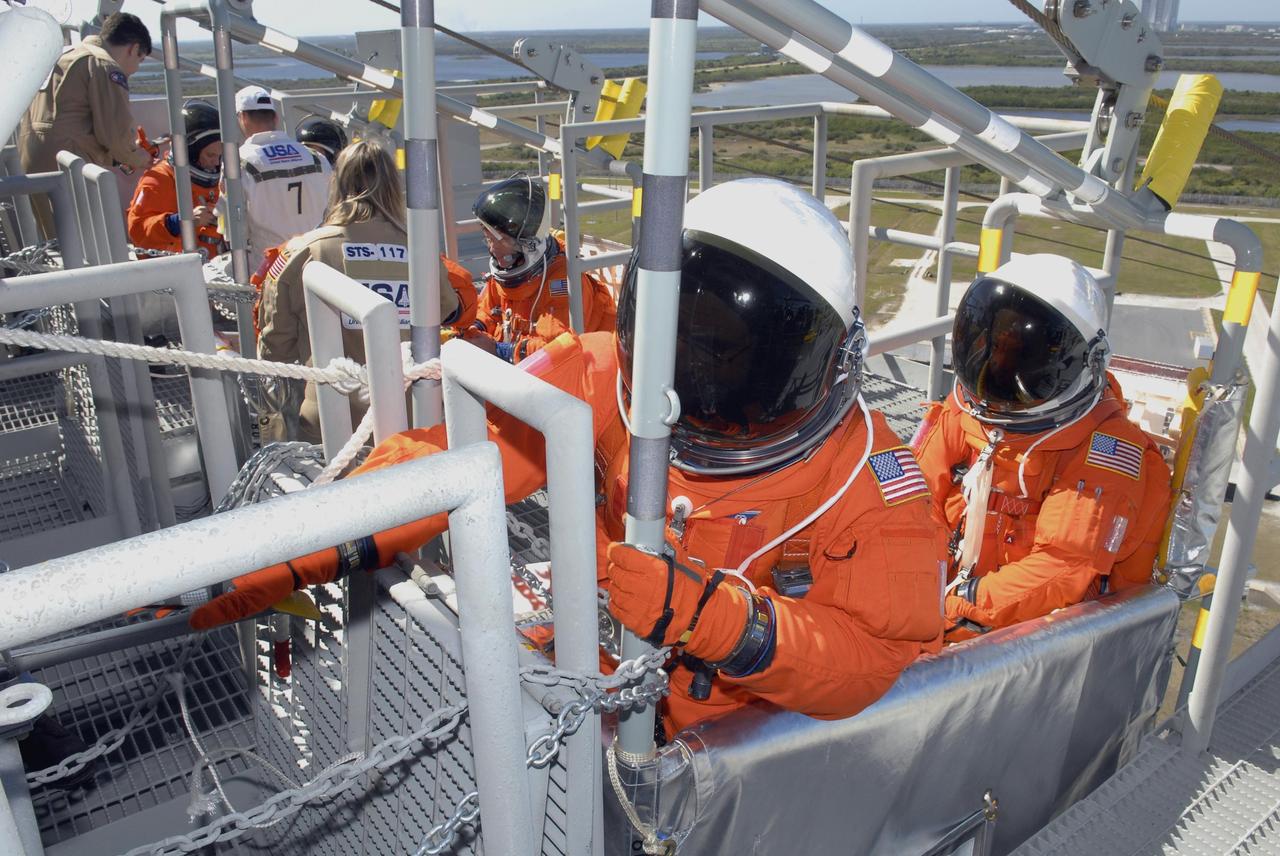
KENNEDY SPACE CENTER, FLA. -- From the 195-foot level of the fixed service structure on Launch Pad 39A, STS-117 Pilot Lee Archambault (front) and Commander Rick Sturckow sit in a slidewire basket, part of the emergency egress system. They and other crew members are practicing the emergency egress procedure to get off the pad, part of the prelaunch preparations known as terminal countdown demonstration test. The TCDT also includes M-113 armored personnel carrier training and payload familiarization. The STS-117 mission is No. 21 to the International Space Station. Mission payloads aboard Atlantis include the S3/S4 integrated truss structure, a third set of solar arrays and batteries. The crew of six astronauts will install the truss to continue assembly of the station. Launch is scheduled for no earlier than March 15. Photo credit: NASA/Kim Shiflett.
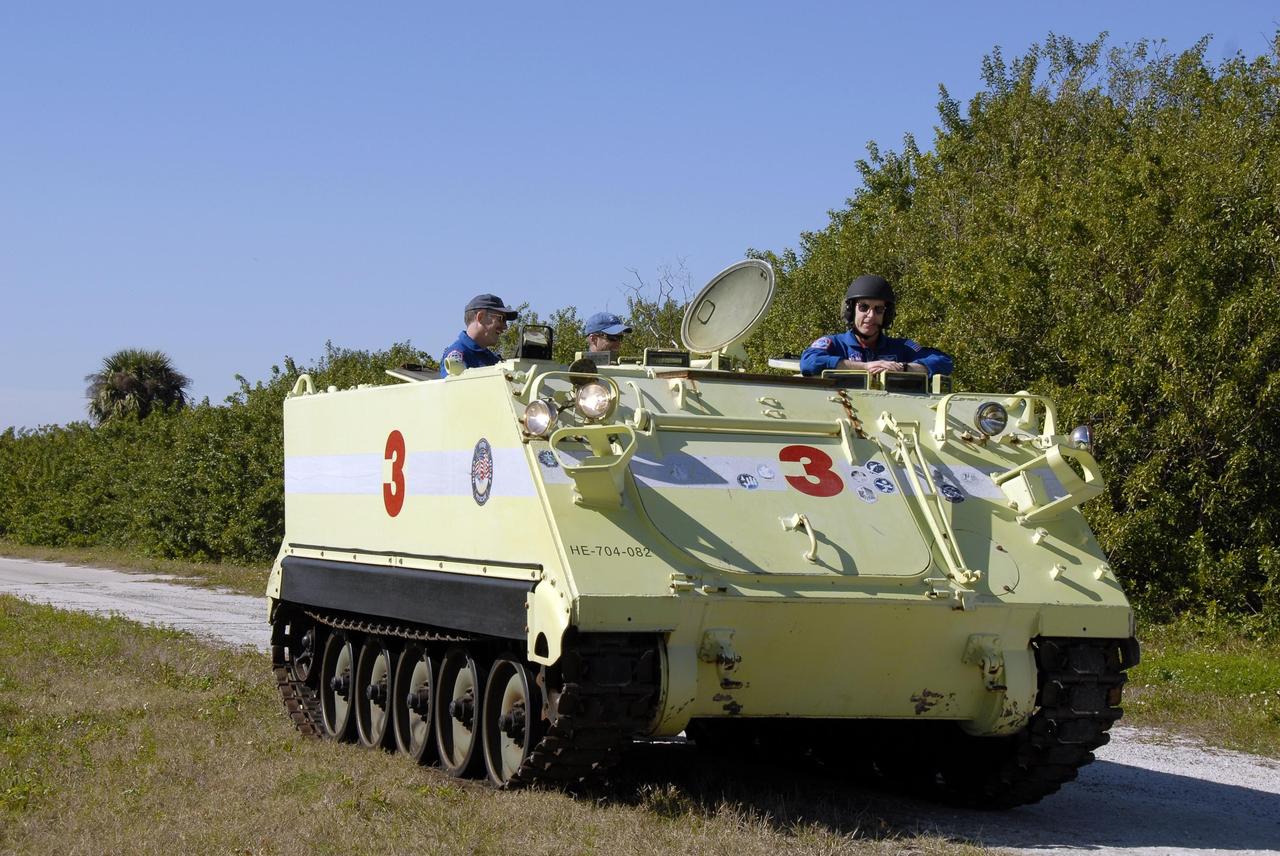
KENNEDY SPACE CENTER, FLA. -- At Launch Complex 39, STS-117 Mission Specialist Patrick Forrester (right) waits his turn to practice driving an M-113 armored personnel carrier as fellow crew members look on. The astronauts on the STS-117 crew are participating in M-113 armored personnel carrier training during Terminal Countdown Demonstration Test (TCDT) activities, a dress rehearsal for their launch, targeted for March 15. The M-113 could be used to move the crew away from the launch pad quickly in the event of an emergency. The TCDT also includes pad emergency egress training and a simulated launch countdown. The mission payload aboard Space Shuttle Atlantis is the S3/S4 integrated truss structure, along with a third set of solar arrays and batteries. The crew of six astronauts will install the truss to continue assembly of the station. Photo credit: NASA/Kim Shiflett
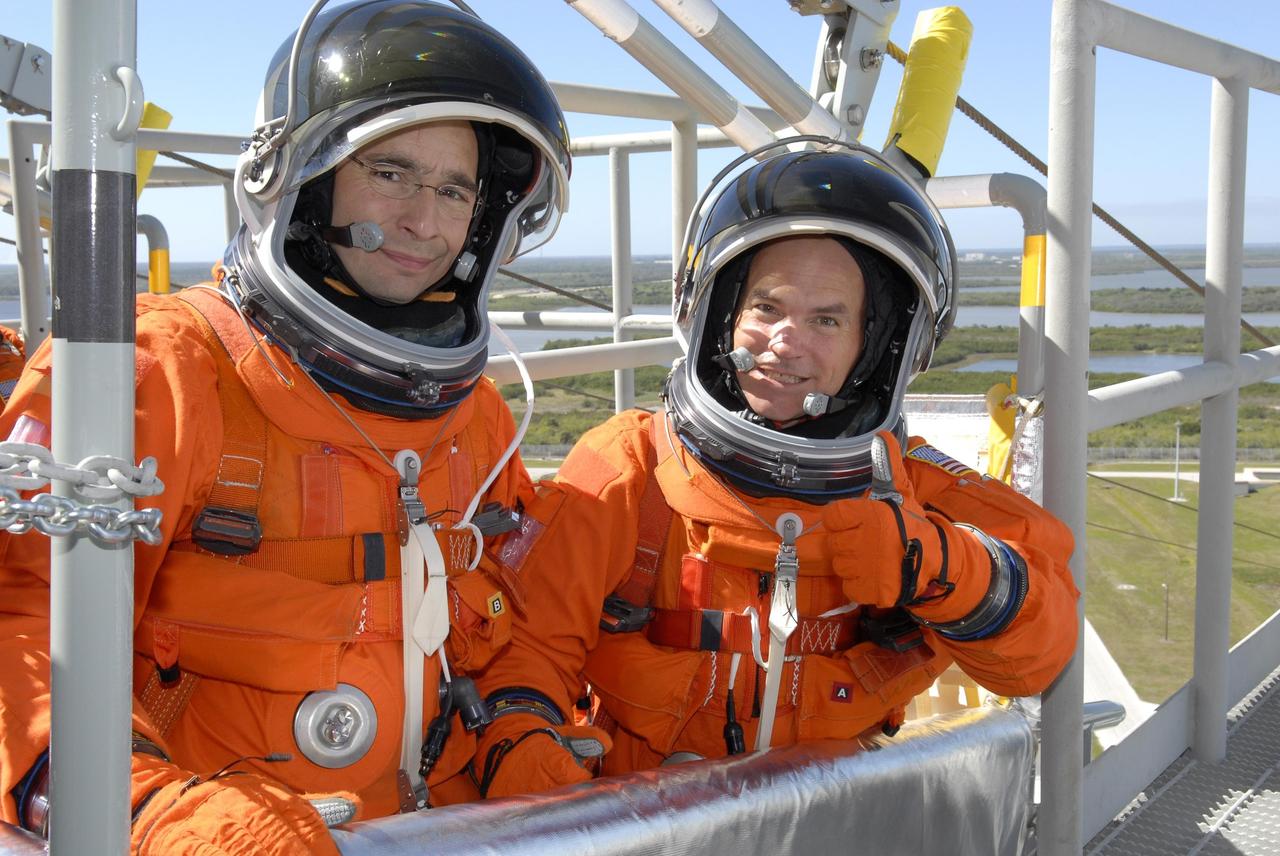
KENNEDY SPACE CENTER, FLA. -- Mission STS-117 Commander Rick Sturckow (right) gives a thumbs up after he and Pilot Lee Archambault practice emergency egress procedures in a slidewire basket at the 195-foot level of the fixed service structure on Launch Pad 39A. They and other crew members are practicing the emergency egress procedure to get off the pad, part of the prelaunch preparations known as terminal countdown demonstration test (TCDT). The TCDT also includes M-113 armored personnel carrier training and payload familiarization. The STS-117 mission is No. 21 to the International Space Station. Mission payloads aboard Atlantis include the S3/S4 integrated truss structure, a third set of solar arrays and batteries. The crew of six astronauts will install the truss to continue assembly of the station. Launch is scheduled for no earlier than March 15. Photo credit: NASA/Kim Shiflett.
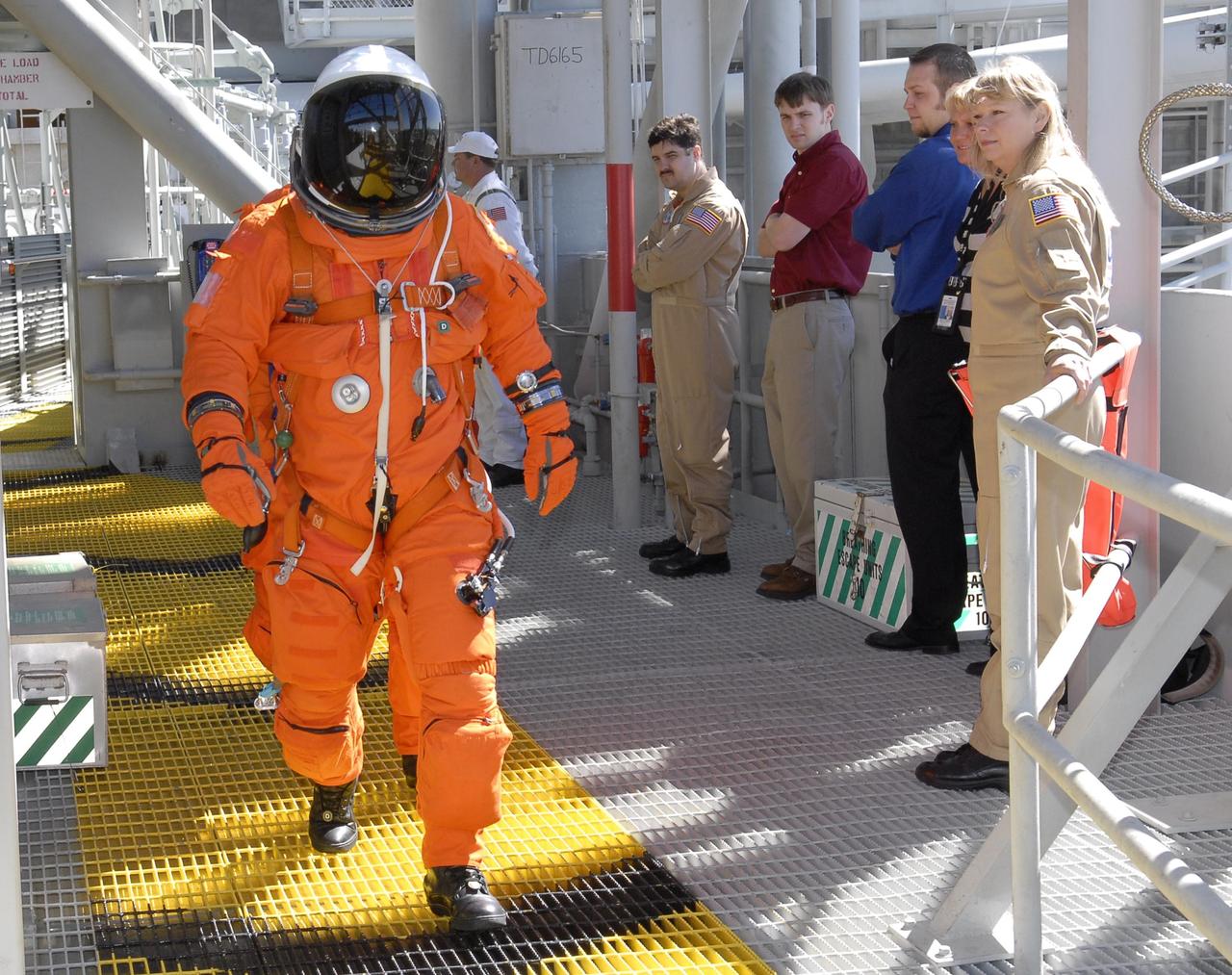
KENNEDY SPACE CENTER, FLA. -- On the 195-foot level of the fixed service structure on Launch Pad 39A, STS-117 Mission Specialists Steven Swanson and Patrick Forrester (directly behind him) head for the slidewire baskets. They and other crew members are practicing the emergency egress procedure to get off the pad, part of the prelaunch preparations known as terminal countdown demonstration test (TCDT). The TCDT also includes M-113 armored personnel carrier training and payload familiarization. The STS-117 mission is No. 21 to the International Space Station. Mission payloads aboard Atlantis include the S3/S4 integrated truss structure, a third set of solar arrays and batteries. The crew of six astronauts will install the truss to continue assembly of the station. Launch is scheduled for no earlier than March 15. Photo credit: NASA/Kim Shiflett.
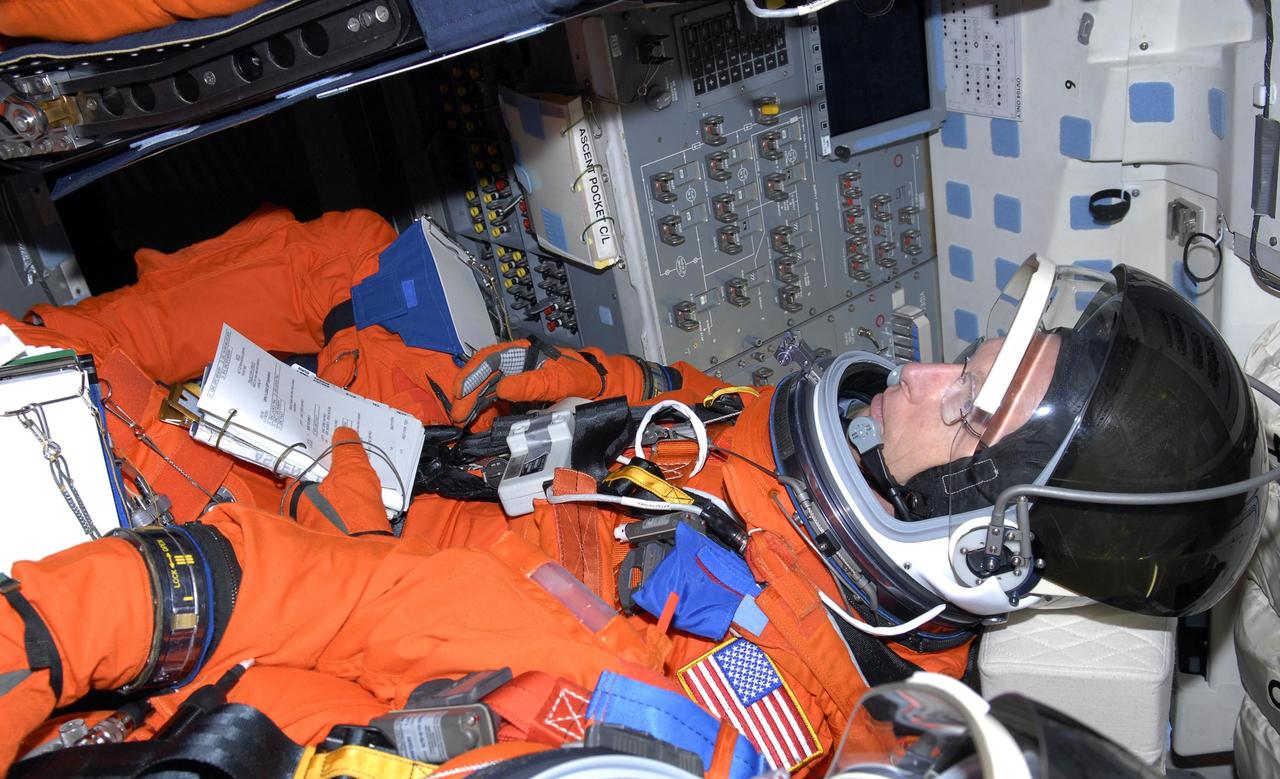
KENNEDY SPACE CENTER, FLA. -- Mission STS-117 Mission Specialist Patrick Forrester sits inside Space Shuttle Atlantis at Launch Pad 39A to participate in a simulated launch countdown that is part of the prelaunch preparations known as the terminal countdown demonstration test (TCDT).The TCDT also includes M-113 armored personnel carrier training and payload familiarization. The STS-117 mission is No. 21 to the International Space Station. Mission payloads aboard Atlantis include the S3/S4 integrated truss structure, a third set of solar arrays and batteries. The crew of six astronauts will install the truss to continue assembly of the station. Launch is scheduled for no earlier than March 15. Photo credit: NASA/Kim Shiflett.
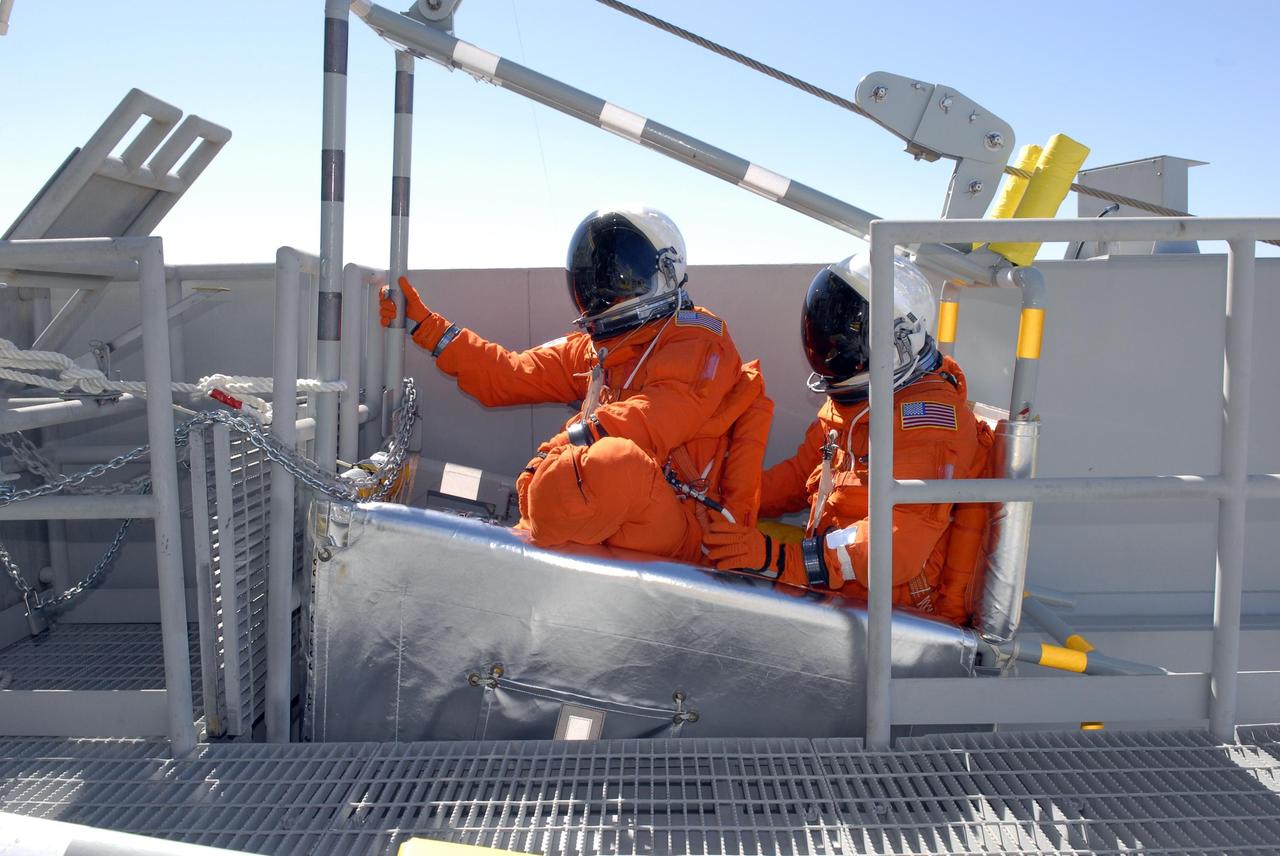
KENNEDY SPACE CENTER, FLA. -- From the 195-foot level of the fixed service structure on Launch Pad 39A, STS-117 Mission Specialists Danny Olivas (front) and James Reilly sit in a slidewire basket, part of the emergency egress system. They and other crew members are practicing the emergency egress procedure to get off the pad, part of the prelaunch preparations known as terminal countdown demonstration test (TCDT). The TCDT also includes M-113 armored personnel carrier training and payload familiarization. The STS-117 mission is No. 21 to the International Space Station. Mission payloads aboard Atlantis include the S3/S4 integrated truss structure, a third set of solar arrays and batteries. The crew of six astronauts will install the truss to continue assembly of the station. Launch is scheduled for no earlier than March 15. Photo credit: NASA/Kim Shiflett.
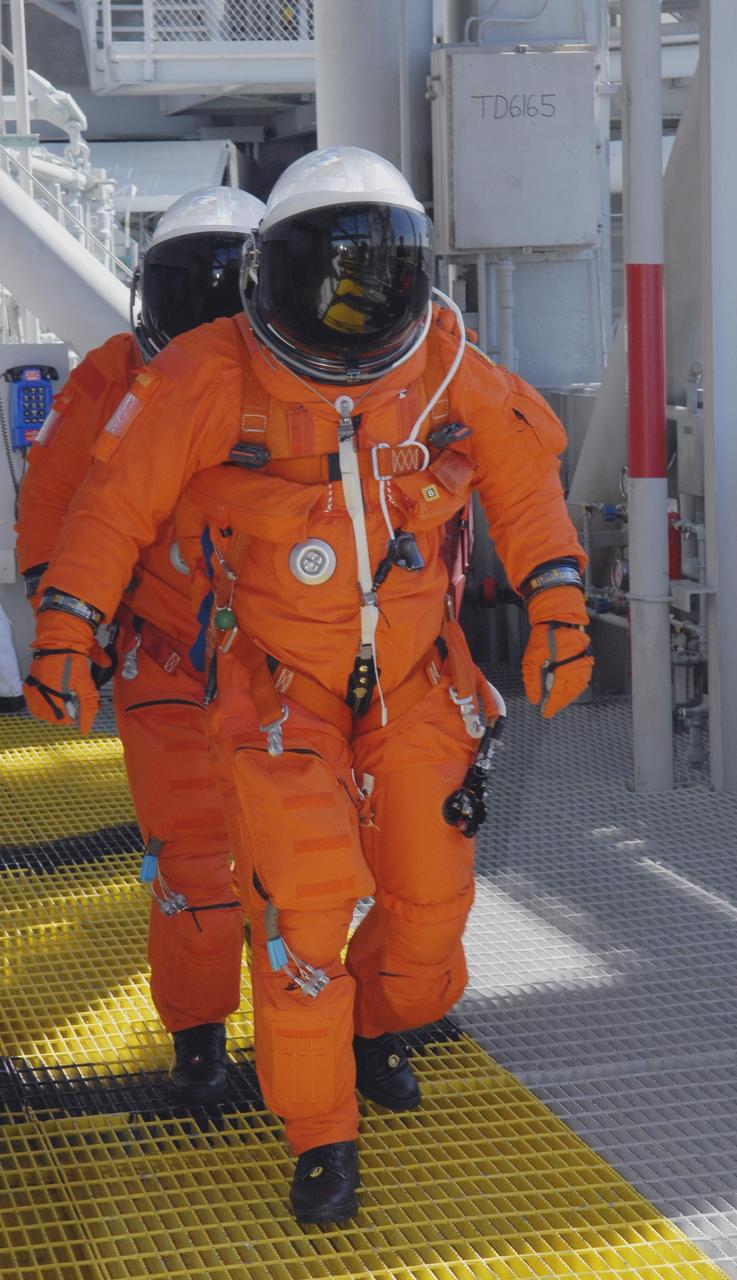
KENNEDY SPACE CENTER, FLA. -- On the 195-foot level of the fixed service structure on Launch Pad 39A, STS-117 Pilot Lee Archambault (front) and Commander Rick Sturckow head for the slidewire baskets. They and other crew members are practicing the emergency egress procedure to get off the pad, part of the prelaunch preparations known as terminal countdown demonstration test (TCDT). The TCDT also includes M-113 armored personnel carrier training and payload familiarization. The STS-117 mission is No. 21 to the International Space Station. Mission payloads aboard Atlantis include the S3/S4 integrated truss structure, a third set of solar arrays and batteries. The crew of six astronauts will install the truss to continue assembly of the station. Launch is scheduled for no earlier than March 15. Photo credit: NASA/Kim Shiflett.
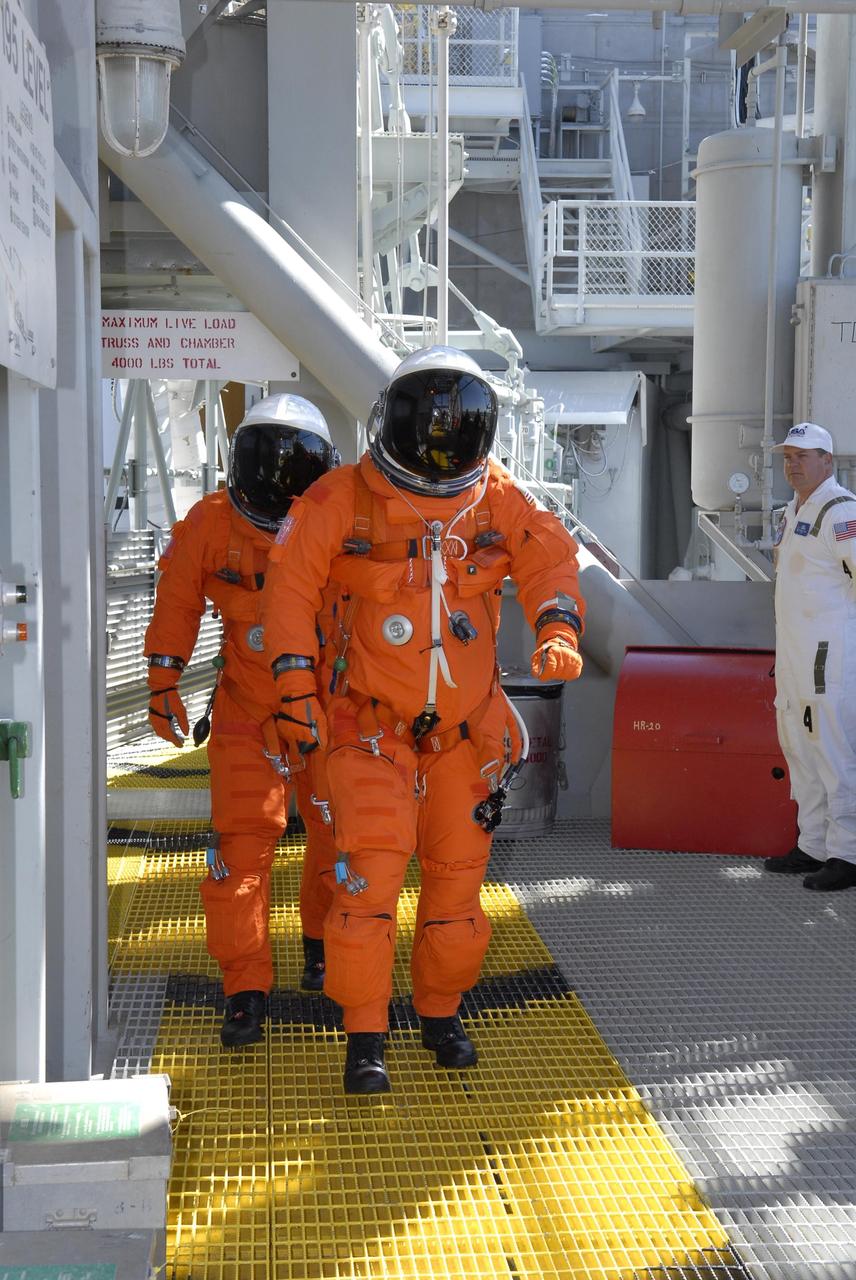
KENNEDY SPACE CENTER, FLA. -- On the 195-foot level of the fixed service structure on Launch Pad 39A, STS-117 Mission Specialists James Reilly (front) and Danny Olivas head for the slidewire baskets. They and other crew members are practicing the emergency egress procedure to get off the pad, part of the prelaunch preparations known as terminal countdown demonstration test (TCDT). The TCDT also includes M-113 armored personnel carrier training and payload familiarization. The STS-117 mission is No. 21 to the International Space Station. Mission payloads aboard Atlantis include the S3/S4 integrated truss structure, a third set of solar arrays and batteries. The crew of six astronauts will install the truss to continue assembly of the station. Launch is scheduled for no earlier than March 15. Photo credit: NASA/Kim Shiflett.
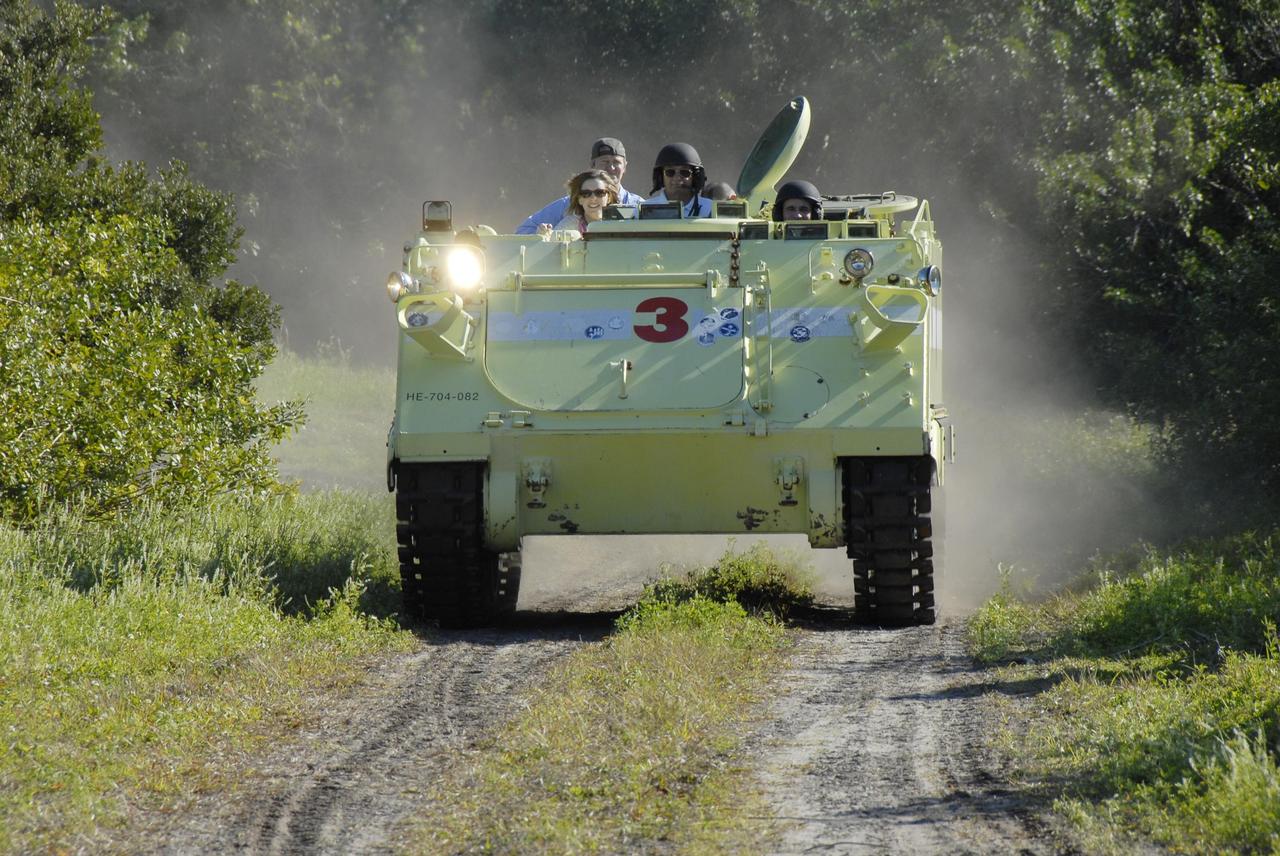
KENNEDY SPACE CENTER, FLA. -- At Launch Complex 39, members of the STS-117 crew are instructed in the operation of an M-113 armored personnel carrier by the astronaut rescue team. The astronauts on the STS-117 crew are participating in M-113 armored personnel carrier training during Terminal Countdown Demonstration Test (TCDT) activities, a dress rehearsal for their launch, targeted for March 15. The M-113 could be used to move the crew away from the launch pad quickly in the event of an emergency. The TCDT also includes pad emergency egress training and a simulated launch countdown. The mission payload aboard Space Shuttle Atlantis is the S3/S4 integrated truss structure, along with a third set of solar arrays and batteries. The crew of six astronauts will install the truss to continue assembly of the station. Photo credit: NASA/Kim Shiflett
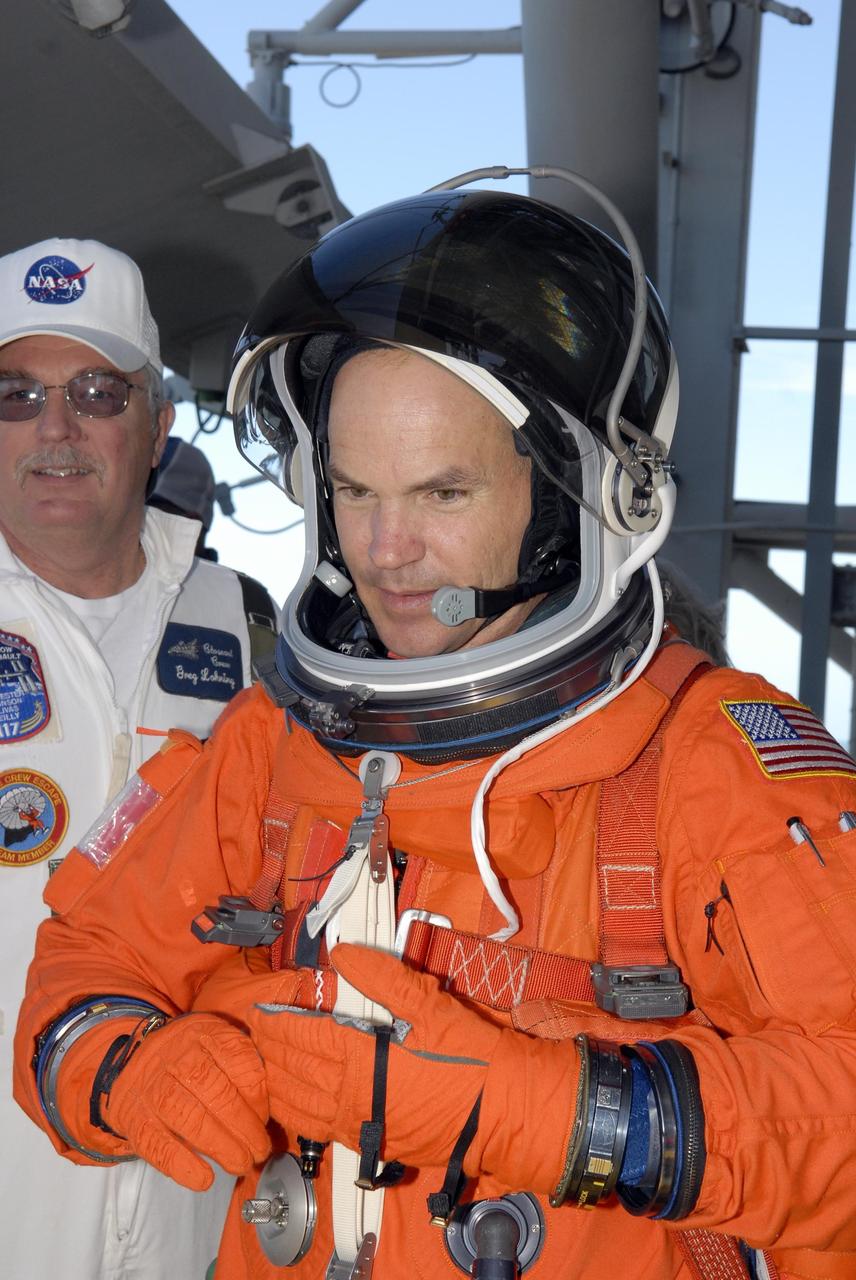
KENNEDY SPACE CENTER, FLA. -- Mission STS-117 Commander Rick Sturckow completes emergency egress procedures at the 195-foot level of the fixed service structure on Launch Pad 39A during the prelaunch preparations known as terminal countdown demonstration test (TCDT). The TCDT also includes M-113 armored personnel carrier training and payload familiarization. The STS-117 mission is No. 21 to the International Space Station. Mission payloads aboard Atlantis include the S3/S4 integrated truss structure, a third set of solar arrays and batteries. The crew of six astronauts will install the truss to continue assembly of the station. Launch is scheduled for no earlier than March 15. Photo credit: NASA/Kim Shiflett.
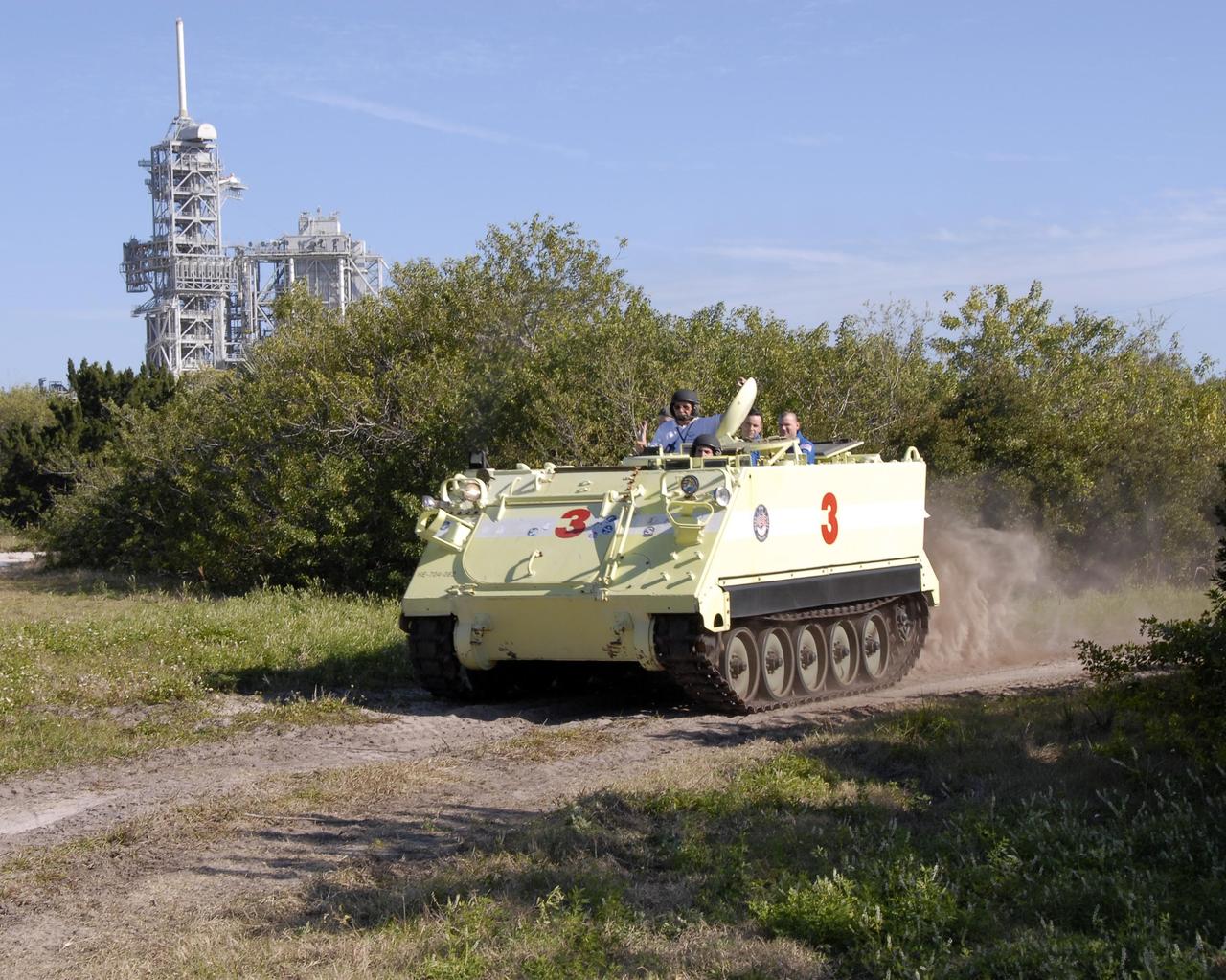
KENNEDY SPACE CENTER, FLA. -- At Launch Complex 39, members of the STS-117 crew are instructed in the operation of an M-113 armored personnel carrier by astronaut rescue team leader Capt. George Hoggard (left). The astronauts on the STS-117 crew are participating in M-113 armored personnel carrier training during Terminal Countdown Demonstration Test (TCDT) activities, a dress rehearsal for their launch, targeted for March 15. The M-113 could be used to move the crew away from the launch pad quickly in the event of an emergency. The TCDT also includes pad emergency egress training and a simulated launch countdown. The mission payload aboard Space Shuttle Atlantis is the S3/S4 integrated truss structure, along with a third set of solar arrays and batteries. The crew of six astronauts will install the truss to continue assembly of the station. Photo credit: NASA/Kim Shiflett

KENNEDY SPACE CENTER, FLA. -- Mission STS-117 Mission Specialist Steven Swanson sits inside Space Shuttle Atlantis at Launch Pad 39A to participate in a simulated launch countdown that is part of the prelaunch preparations known as terminal demonstration countdown test (TCDT). The TCDT also includes M-113 armored personnel carrier training and payload familiarization. The STS-117 mission is No. 21 to the International Space Station. Mission payloads aboard Atlantis include the S3/S4 integrated truss structure, a third set of solar arrays and batteries. The crew of six astronauts will install the truss to continue assembly of the station. Launch is scheduled for no earlier than March 15. Photo credit: NASA/Kim Shiflett.
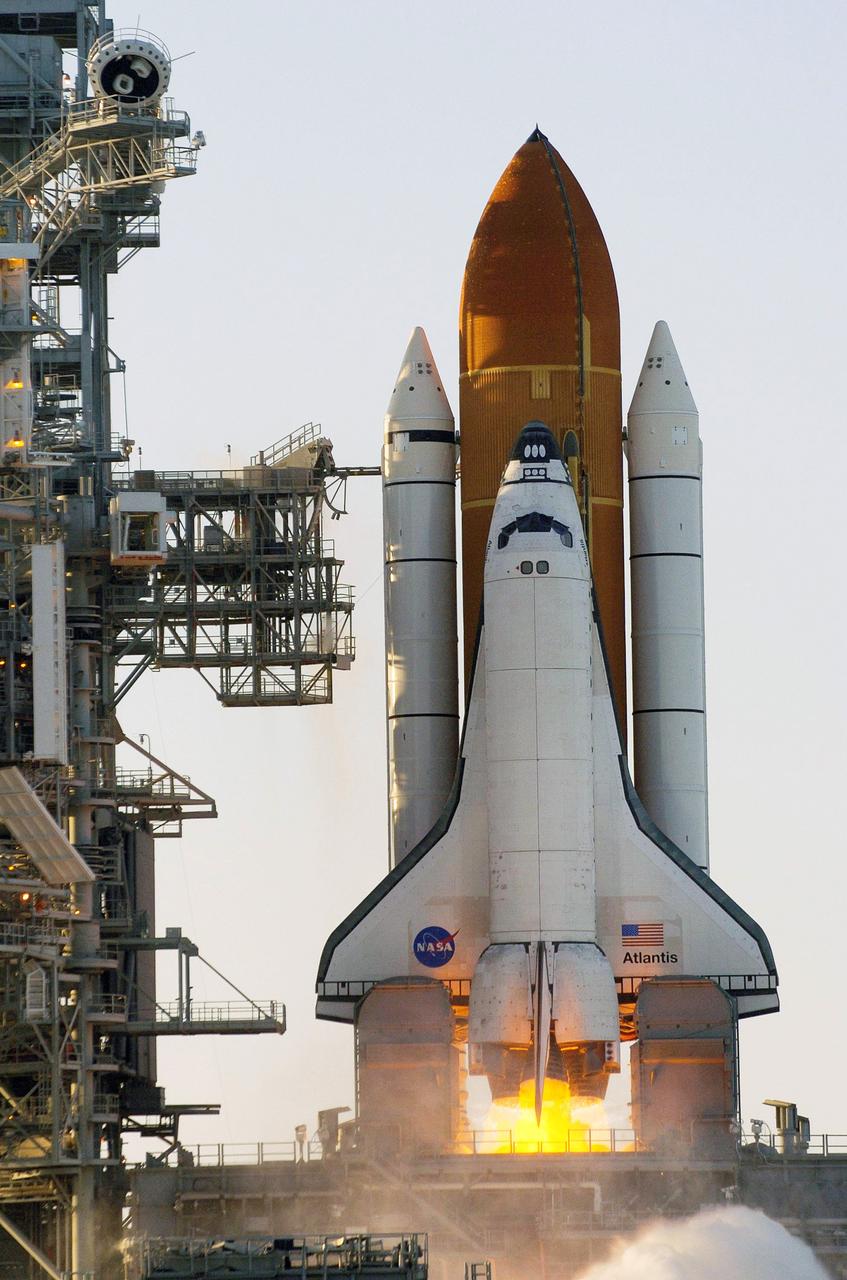
Headed toward Earth orbit and a link up with the International Space Station (ISS), the Space Shuttle Atlantis lifted off from Kennedy Space Center on June 8, 2007. Aboard were STS-117 astronauts James F. Reilly II, Steven R. Swanson, Patrick G. Forrester and John D. “Danny” Olivas, all mission specialists; Frederick W. (Rick) Sturckow, commander; Lee J. Archambault, pilot; and Clayton Anderson, mission specialist who joined the Expedition 15 crew. The crew members along with the Expedition 15 crew spent 8 days resuming construction on the ISS with the installation of the second and third starboard truss segments (S3 and S4) with Photovoltaic Radiator (PVR), and retracted the P6 starboard solar array wing and radiator for later use.
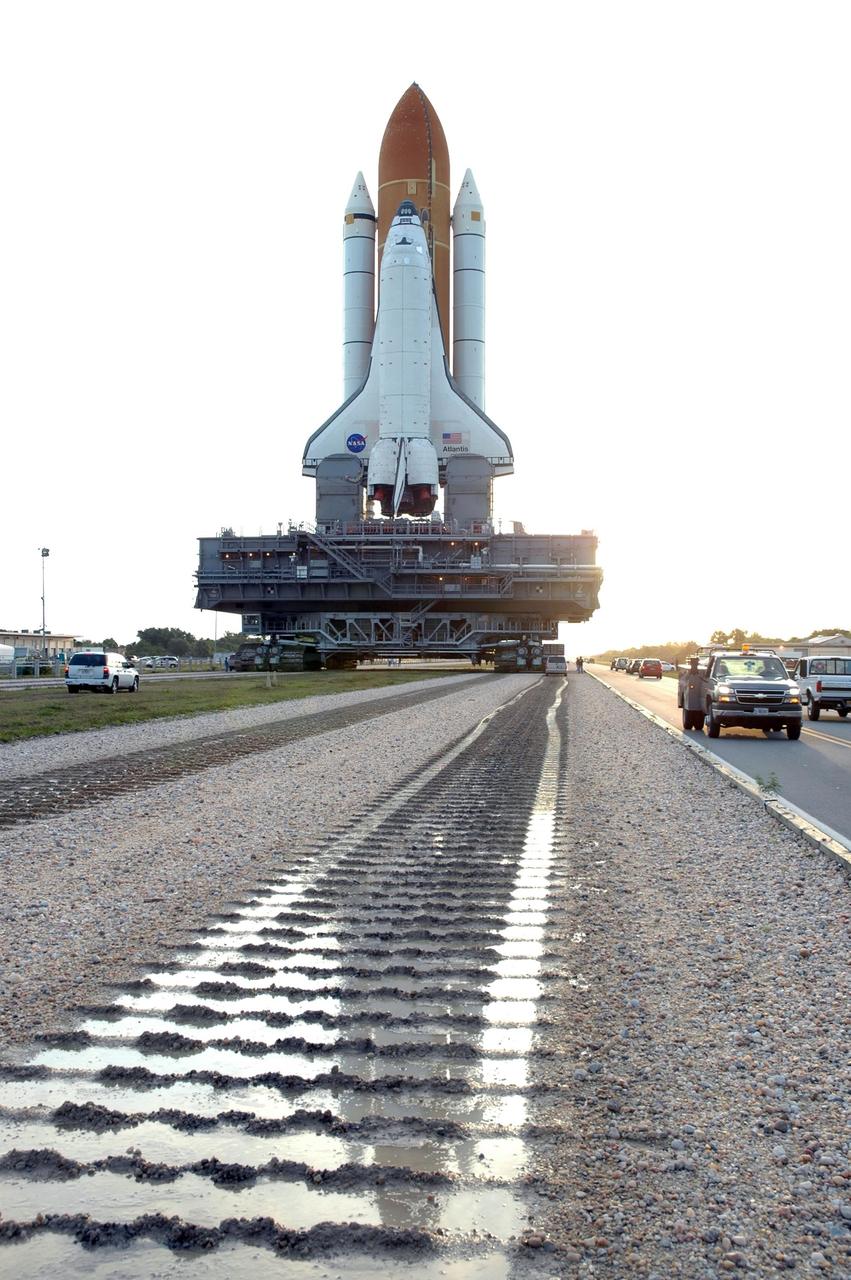
KENNEDY SPACE CENTER, FLA. -- In the early light of morning, Space Shuttle Atlantis, mounted on a mobile launch platform, rolls a second time to Launch Pad 39A atop a crawler transporter. First motion out of the Vehicle Assembly Building was at 5:02 a.m. EDT. In late February, while Atlantis was on the launch pad, Atlantis' external tank received hail damage during a severe thunderstorm that passed through the Kennedy Space Center Launch Complex 39 area. The hail caused visible divots in the giant tank's foam insulation, as well as minor surface damage to about 26 heat shield tiles on the shuttle's left wing. The shuttle was returned to the VAB for repairs. The launch of Space Shuttle Atlantis on mission STS-117 is now targeted for June 8. A flight readiness review will be held on May 30 and 31. Photo credit: NASA/Jim Grossmann
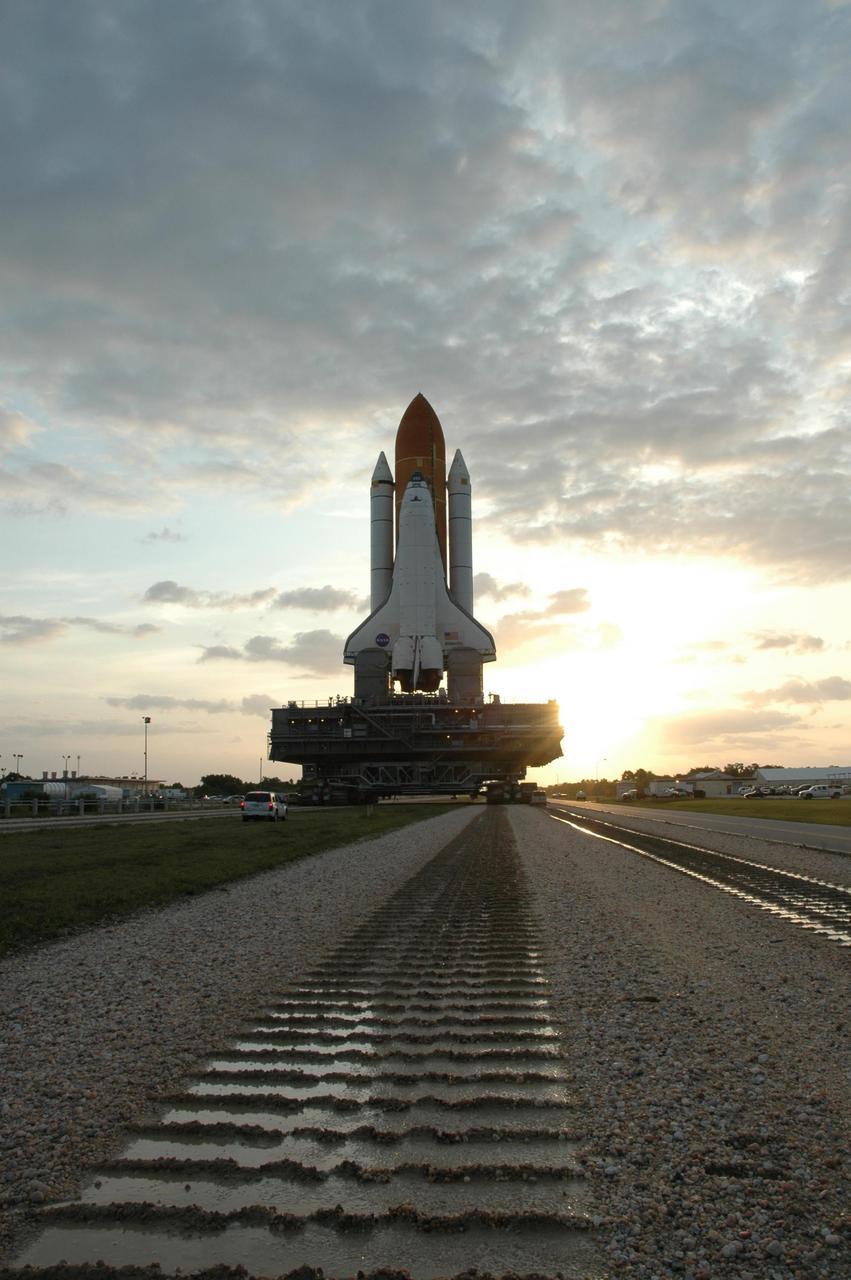
KENNEDY SPACE CENTER, FLA. -- Just after sunrise, Space Shuttle Atlantis, mounted on a mobile launch platform, rolls a second time to Launch Pad 39A atop a crawler transporter. First motion out of the Vehicle Assembly Building was at 5:02 a.m. EDT. In late February, while Atlantis was on the launch pad, Atlantis' external tank received hail damage during a severe thunderstorm that passed through the Kennedy Space Center Launch Complex 39 area. The hail caused visible divots in the giant tank's foam insulation, as well as minor surface damage to about 26 heat shield tiles on the shuttle's left wing. The shuttle was returned to the VAB for repairs. The launch of Space Shuttle Atlantis on mission STS-117 is now targeted for June 8. A flight readiness review will be held on May 30 and 31. Photo credit: NASA/Jim Grossmann

KENNEDY SPACE CENTER, FLA. -- Casting giant shadows just after sunrise, Space Shuttle Atlantis, mounted on a mobile launch platform, rolls a second time to Launch Pad 39A atop a crawler transporter. First motion out of the Vehicle Assembly Building was at 5:02 a.m. EDT. In late February, while Atlantis was on the launch pad, Atlantis' external tank received hail damage during a severe thunderstorm that passed through the Kennedy Space Center Launch Complex 39 area. The hail caused visible divots in the giant tank's foam insulation, as well as minor surface damage to about 26 heat shield tiles on the shuttle's left wing. The shuttle was returned to the VAB for repairs. The launch of Space Shuttle Atlantis on mission STS-117 is now targeted for June 8. A flight readiness review will be held on May 30 and 31. Photo credit: NASA/Jim Grossmann
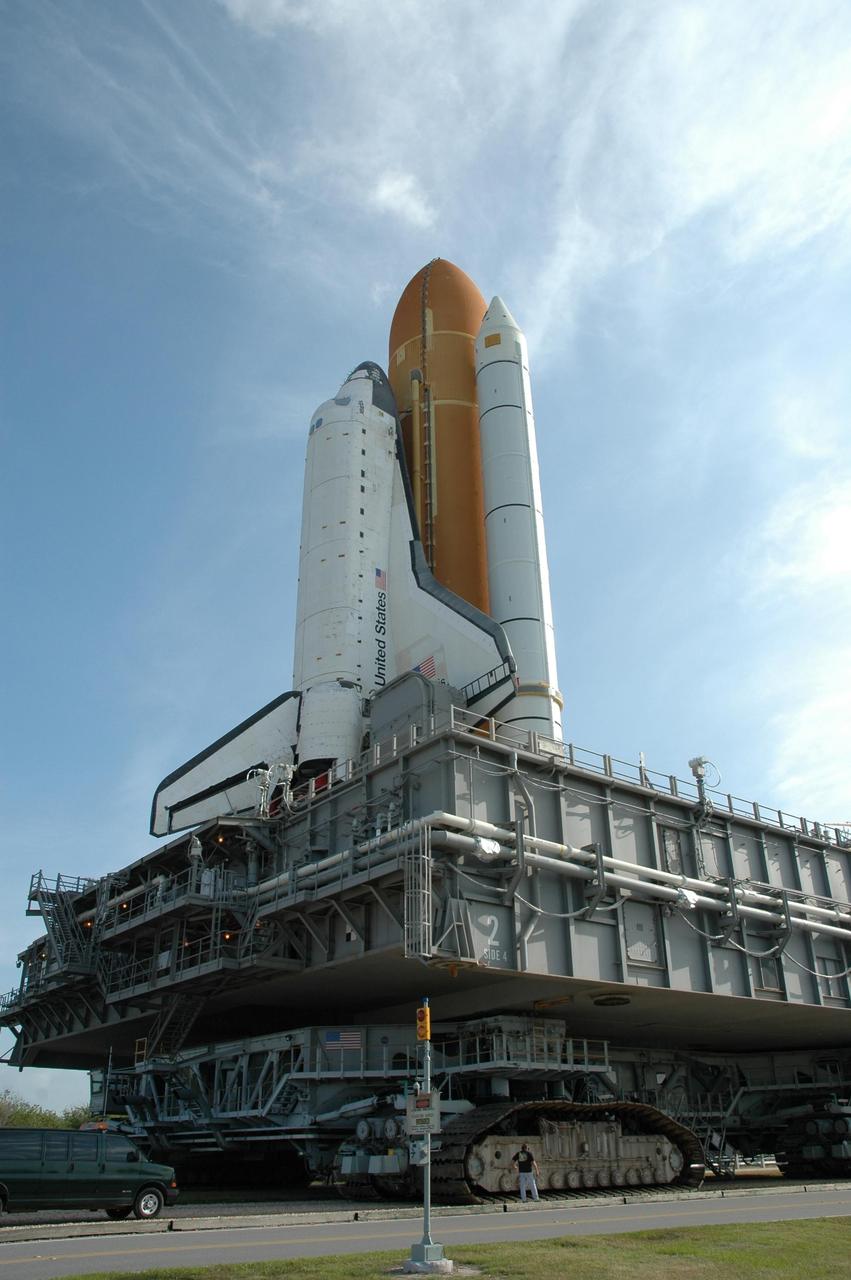
KENNEDY SPACE CENTER, FLA. -- By midmorning, Space Shuttle Atlantis, mounted on a mobile launch platform, nears Launch Pad 39A atop a crawler transporter. First motion out of the Vehicle Assembly Building was at 5:02 a.m. EDT. In late February, while Atlantis was on the launch pad, Atlantis' external tank received hail damage during a severe thunderstorm that passed through the Kennedy Space Center Launch Complex 39 area. The hail caused visible divots in the giant tank's foam insulation, as well as minor surface damage to about 26 heat shield tiles on the shuttle's left wing. The shuttle was returned to the VAB for repairs. The launch of Space Shuttle Atlantis on mission STS-117 is now targeted for June 8. A flight readiness review will be held on May 30 and 31. Photo credit: NASA/Jim Grossmann
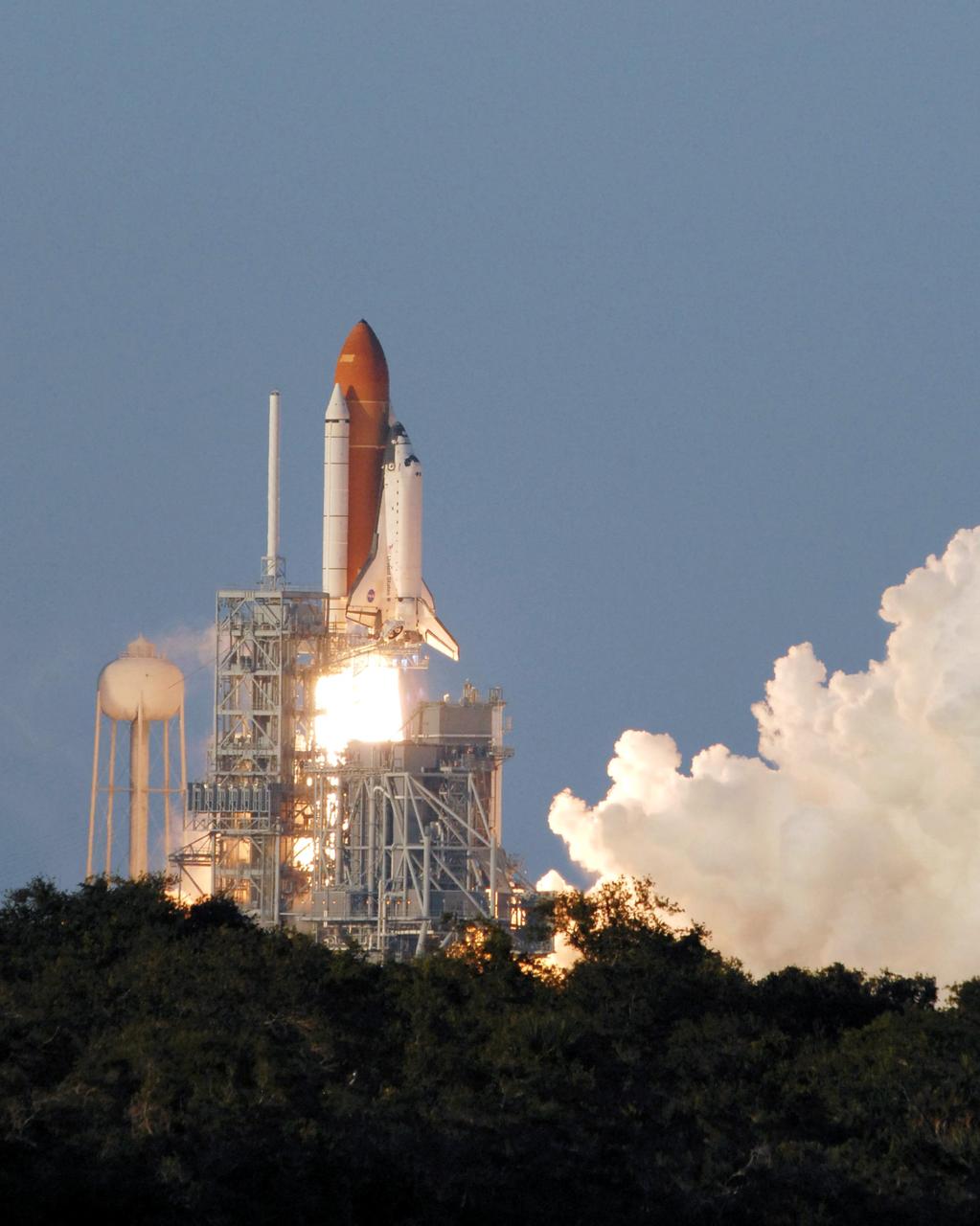
Headed toward Earth orbit and a link up with the International Space Station (ISS), the Space Shuttle Atlantis lifted off from Kennedy Space Center on June 8, 2007. Aboard were STS-117 astronauts James F. Reilly II, Steven R. Swanson, Patrick G. Forrester and John D. “Danny” Olivas, all mission specialists; Frederick W. (Rick) Sturckow, commander; Lee J. Archambault, pilot; and Clayton Anderson, mission specialist who joined the Expedition 15 crew. The crew members along with the Expedition 15 crew spent 8 days resuming construction on the ISS with the installation of the second and third starboard truss segments (S3 and S4) with Photovoltaic Radiator (PVR), and retracted the P6 starboard solar array wing and radiator for later use.
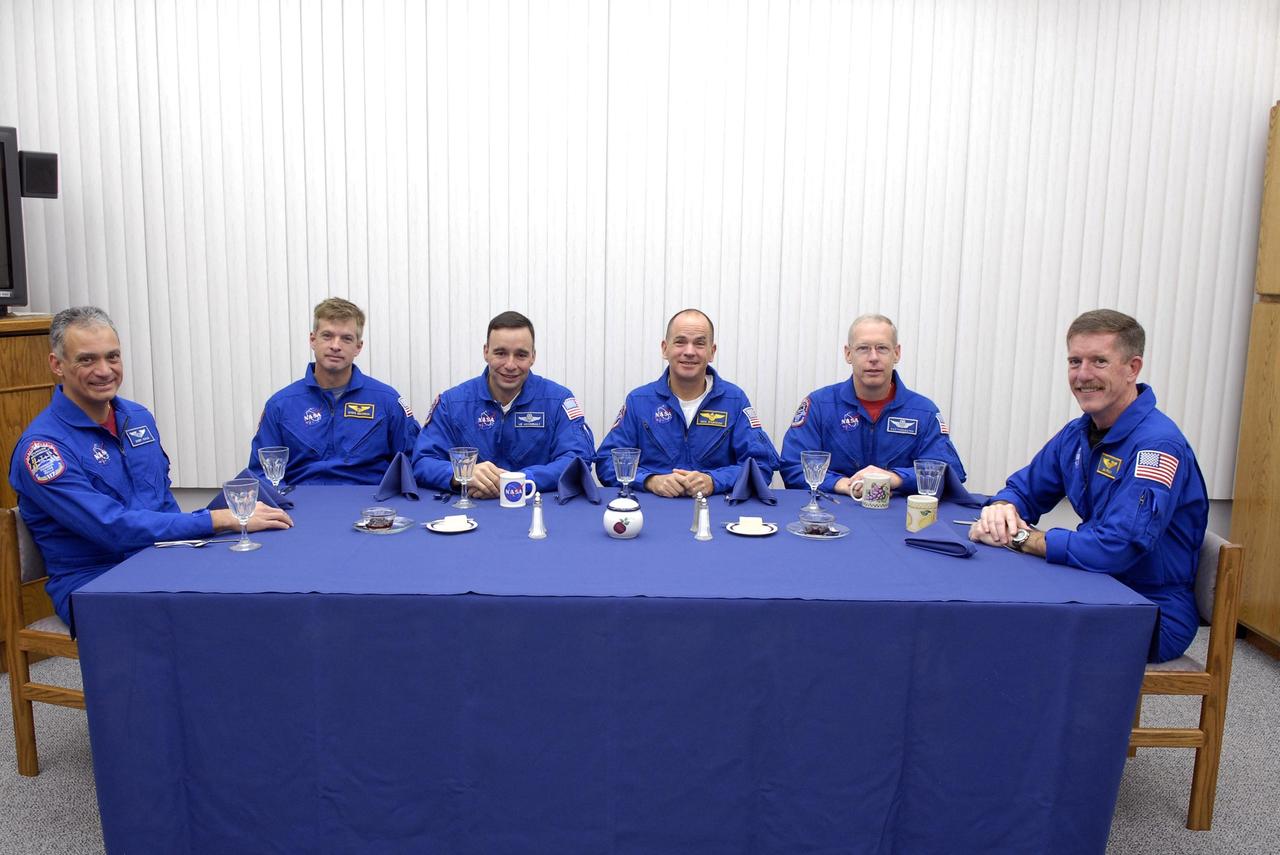
KENNEDY SPACE CENTER, FLA. -- In the crew quarters at the Operations and Checkout Building, the Mission STS-117 crew members enjoy breakfast before resuming Terminal Countdown Demonstration Test activities. From left are Mission Specialists Danny Olivas and Steven Swanson, Pilot Lee Archambault, Commander Rick Sturckow and Mission Specialists Patrick Forrester and James Reilly. The TCDT also includes M-113 armored personnel carrier training, pad emergency egress training and a simulated launch countdown. The mission payload aboard Space Shuttle Atlantis is the S3/S4 integrated truss structure, along with a third set of solar arrays and batteries. The crew of six astronauts will install the truss to continue assembly of the International Space Station. Photo credit: NASA/Kim Shiflett.
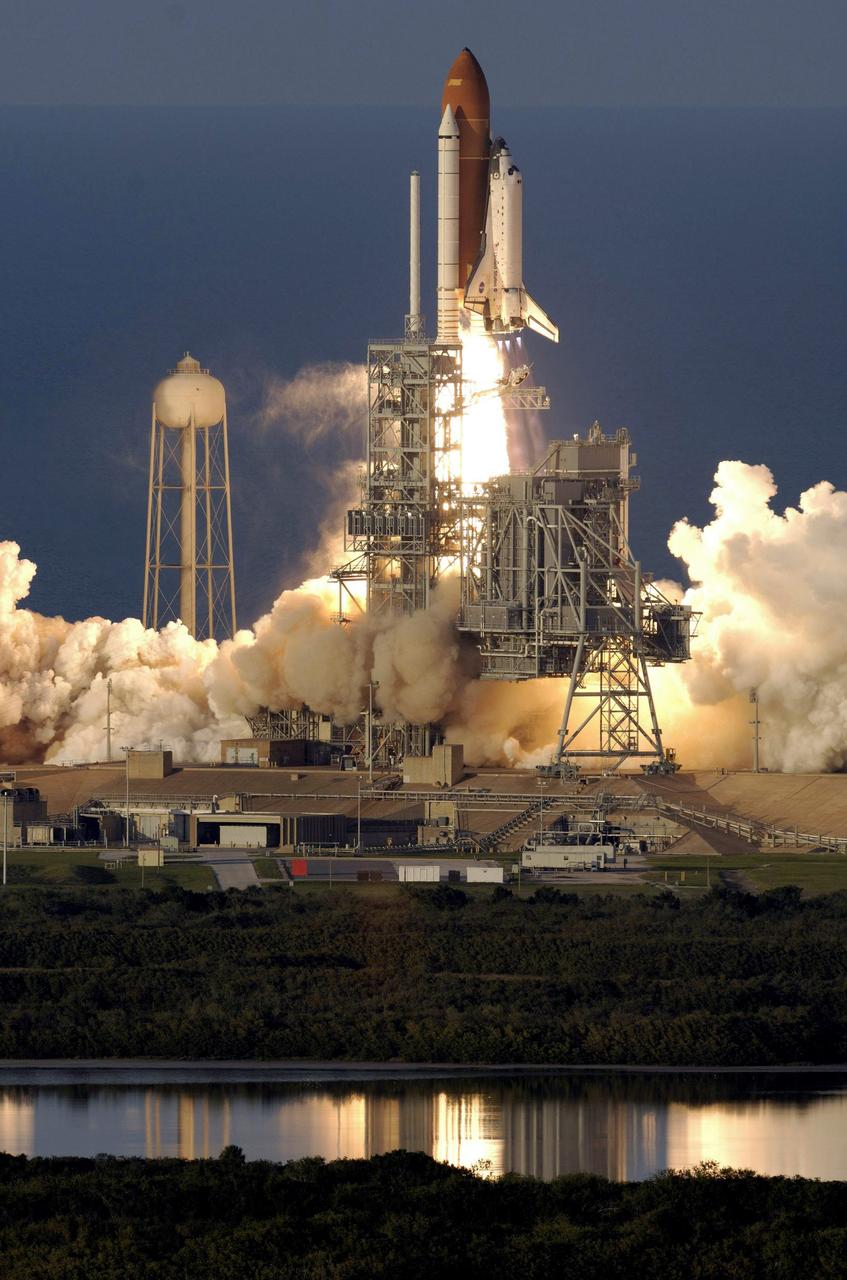
Headed toward Earth orbit and a link up with the International Space Station (ISS), the Space Shuttle Atlantis lifted off from Kennedy Space Center on June 8, 2007. Aboard were STS-117 astronauts James F. Reilly II, Steven R. Swanson, Patrick G. Forrester and John D. “Danny” Olivas, all mission specialists; Frederick W. (Rick) Sturckow, commander; Lee J. Archambault, pilot; and Clayton Anderson, mission specialist who joined the Expedition 15 crew. The crew members along with the Expedition 15 crew spent 8 days resuming construction on the ISS with the installation of the second and third starboard truss segments (S3 and S4) with Photovoltaic Radiator (PVR), and retracted the P6 starboard solar array wing and radiator for later use.
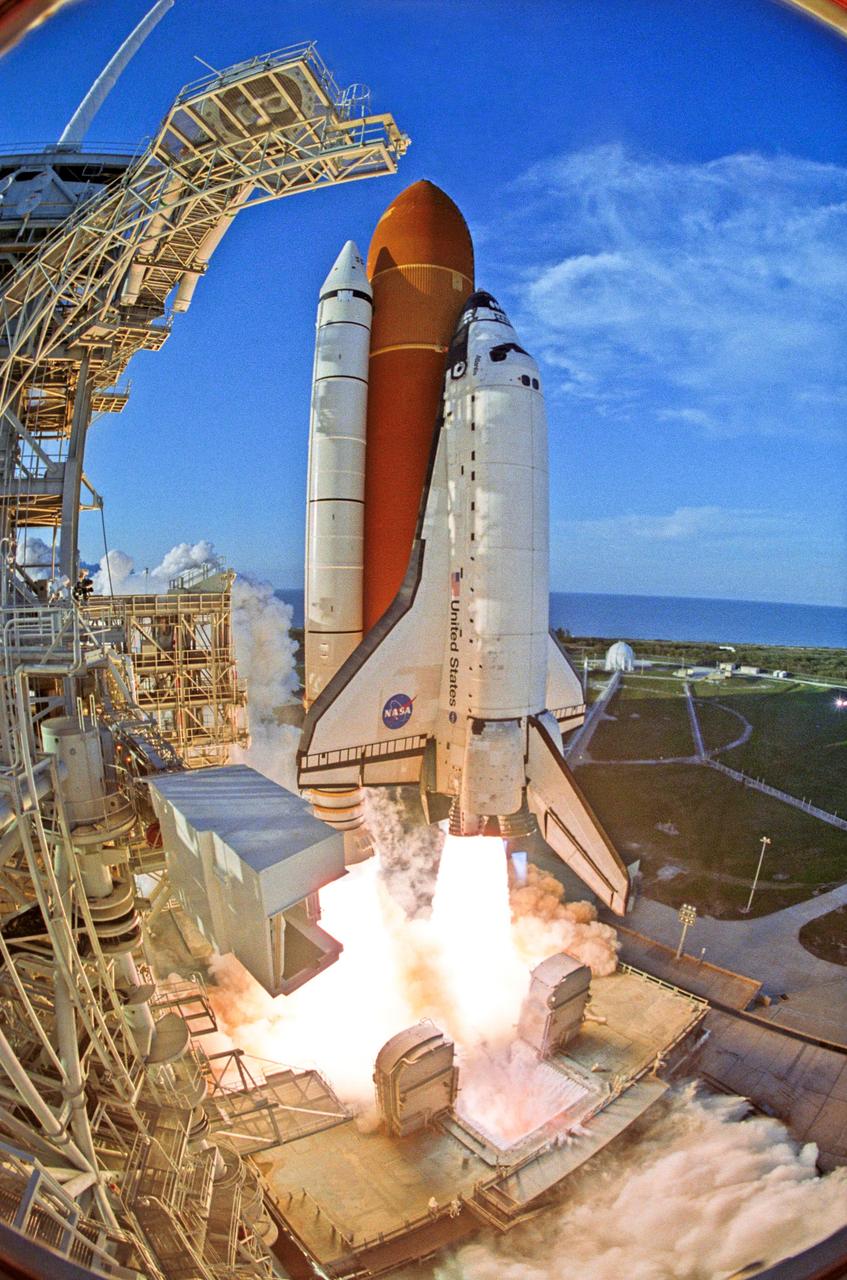
Headed toward Earth orbit and a link up with the International Space Station (ISS), the Space Shuttle Atlantis lifted off from Kennedy Space Center on June 8, 2007. Aboard were STS-117 astronauts James F. Reilly II, Steven R. Swanson, Patrick G. Forrester and John D. “Danny” Olivas, all mission specialists; Frederick W. (Rick) Sturckow, commander; Lee J. Archambault, pilot; and Clayton Anderson, mission specialist who joined the Expedition 15 crew. The crew members along with the Expedition 15 crew spent 8 days resuming construction on the ISS with the installation of the second and third starboard truss segments (S3 and S4) with Photovoltaic Radiator (PVR), and retracted the P6 starboard solar array wing and radiator for later use.
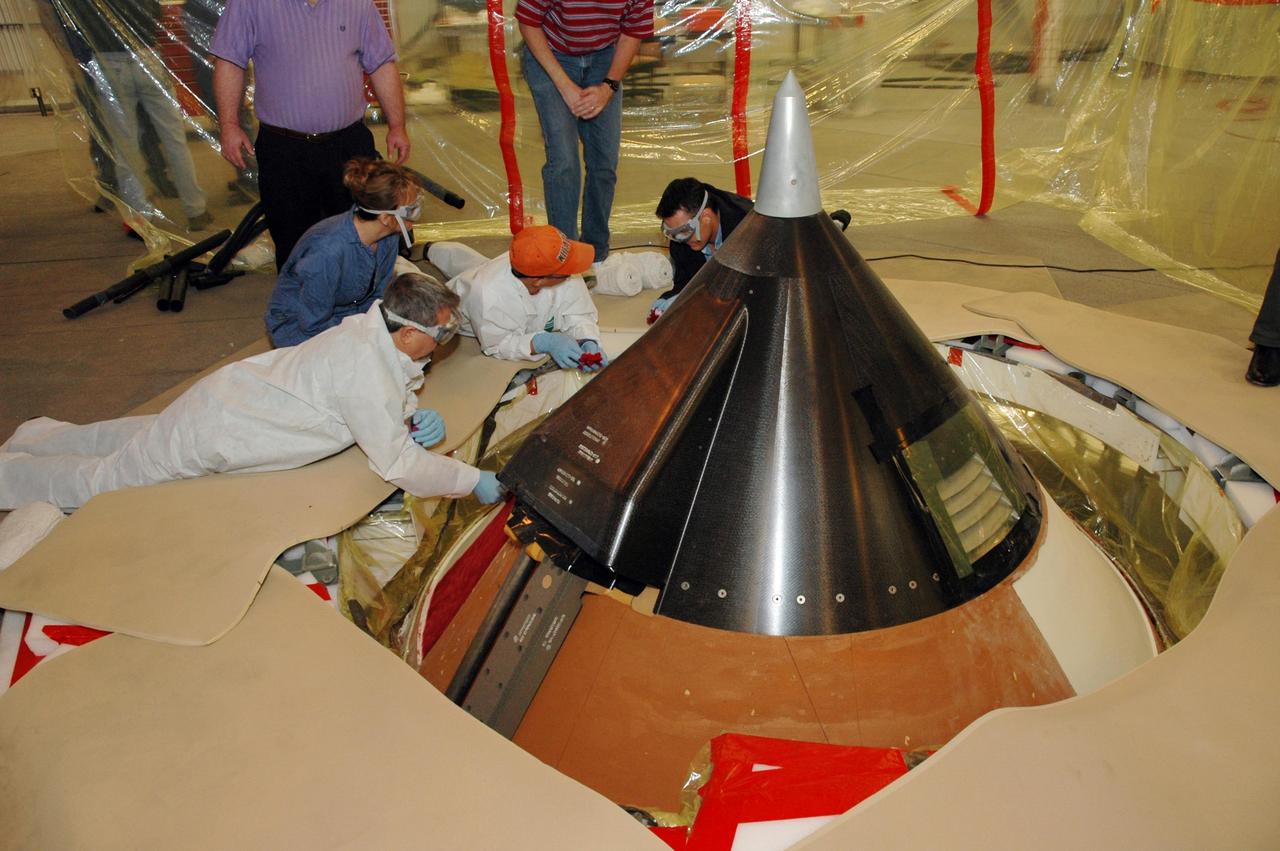
KENNEDY SPACE CENTER, FLA. -- In Highbay 1 inside the Vehicle Assembly Building, technicians perform repair techniques to the external tank inside a tented area that protects the top of the tank. A severe thunderstorm with golf ball-sized hail caused visible divots in the giant tank's foam insulation and minor surface damage to about 26 heat shield tiles on the shuttle's left wing. A new target launch date has not been determined, but teams will focus on preparing Atlantis for liftoff in late April on mission STS-117. Photo credit: NASA/Jim Grossmann
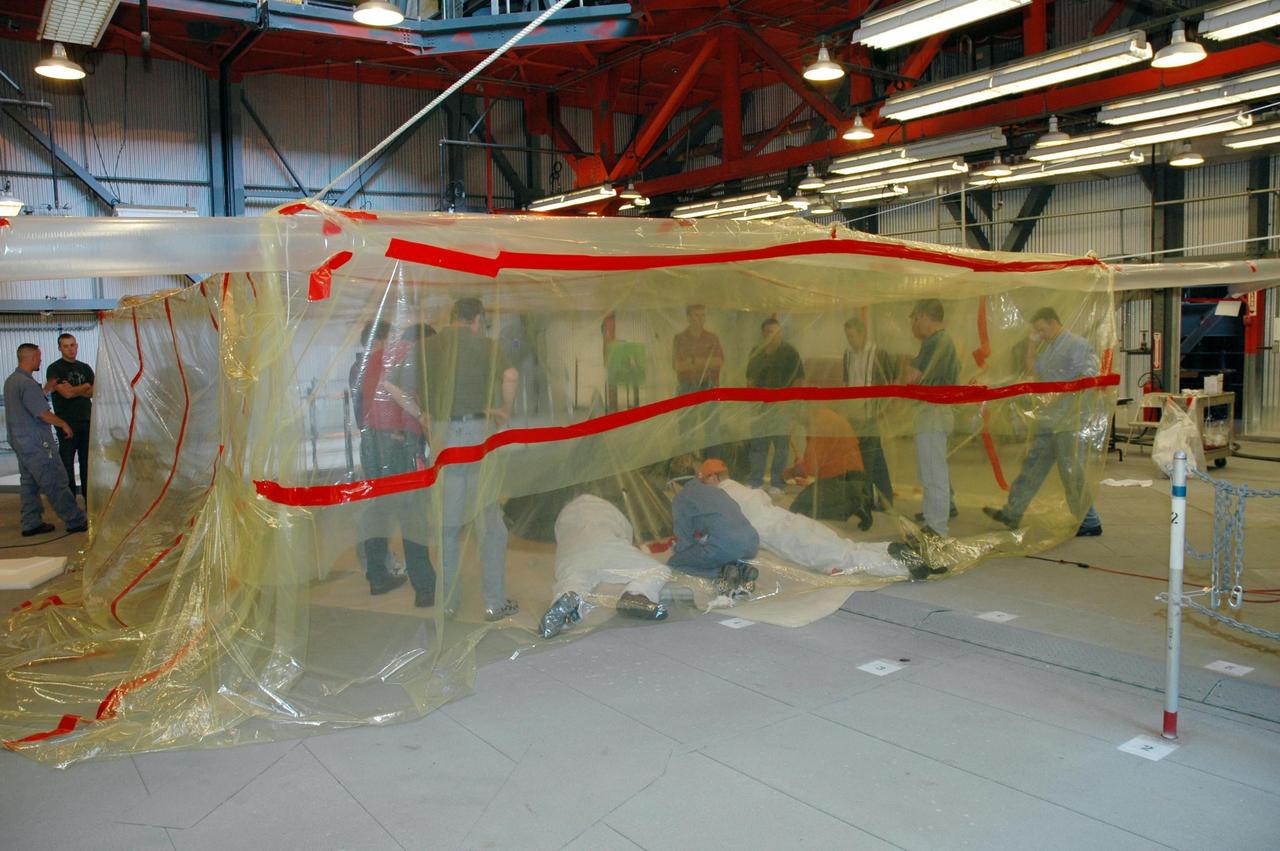
KENNEDY SPACE CENTER, FLA. -- In Highbay 1 inside the Vehicle Assembly Building, technicians work on repair techniques to the external tank. They are inside a tented area that protects the tank. A severe thunderstorm with golf ball-sized hail caused visible divots in the giant tank's foam insulation and minor surface damage to about 26 heat shield tiles on the shuttle's left wing. A new target launch date has not been determined, but teams will focus on preparing Atlantis for liftoff in late April on mission STS-117. Photo credit: NASA/Jim Grossmann

KENNEDY SPACE CENTER, FLA. -- In Highbay 1 inside the Vehicle Assembly Building, a technician carefully applies red dye to the external tank as part of repair operations. A severe thunderstorm with golf ball-sized hail caused visible divots in the giant tank's foam insulation and minor surface damage to about 26 heat shield tiles on the shuttle's left wing. A new target launch date has not been determined, but teams will focus on preparing Atlantis for liftoff in late April on mission STS-117. Photo credit: NASA/Jim Grossmann
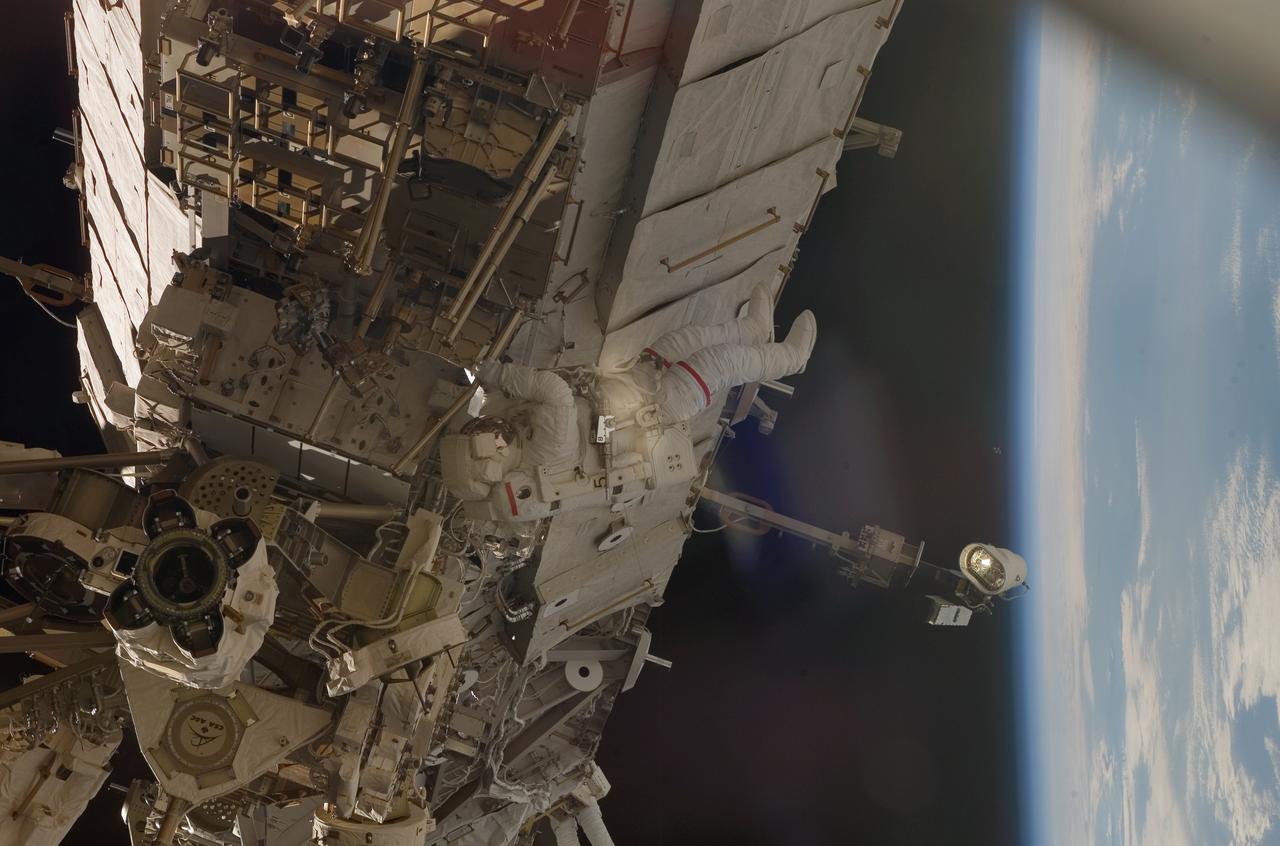
STS-117 astronauts and mission specialists Jim Reilly (center frame), and John “Danny” Olivas (bottom center), participated in the first Extra Vehicular Activity (EVA) as construction resumed on the International Space Station (ISS). Among other tasks, the two connected power, data, and cooling cables between trusses 1 (S1) and 3 (S3), released the launch restraints from and deployed the four solar array blanket boxes on S4, and released the cinches and winches holding the photovoltaic radiator on S4. The primary mission objective was the installment of the second and third starboard truss segments (S3 and S4).
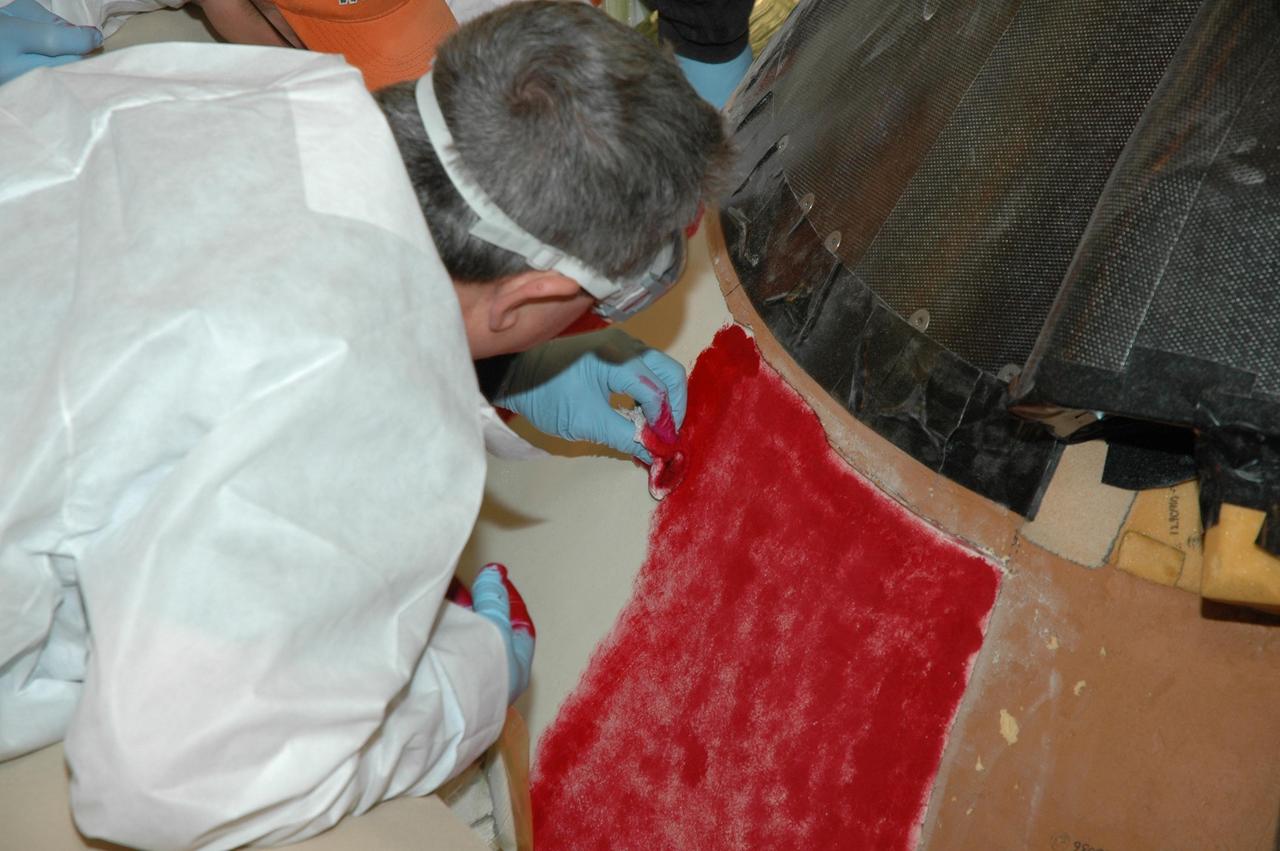
KENNEDY SPACE CENTER, FLA. -- In Highbay 1 inside the Vehicle Assembly Building, a technician carefully applies red dye to the external tank as part of repair operations. A severe thunderstorm with golf ball-sized hail caused visible divots in the giant tank's foam insulation and minor surface damage to about 26 heat shield tiles on the shuttle's left wing. A new target launch date has not been determined, but teams will focus on preparing Atlantis for liftoff in late April on mission STS-117. Photo credit: NASA/Jim Grossmann
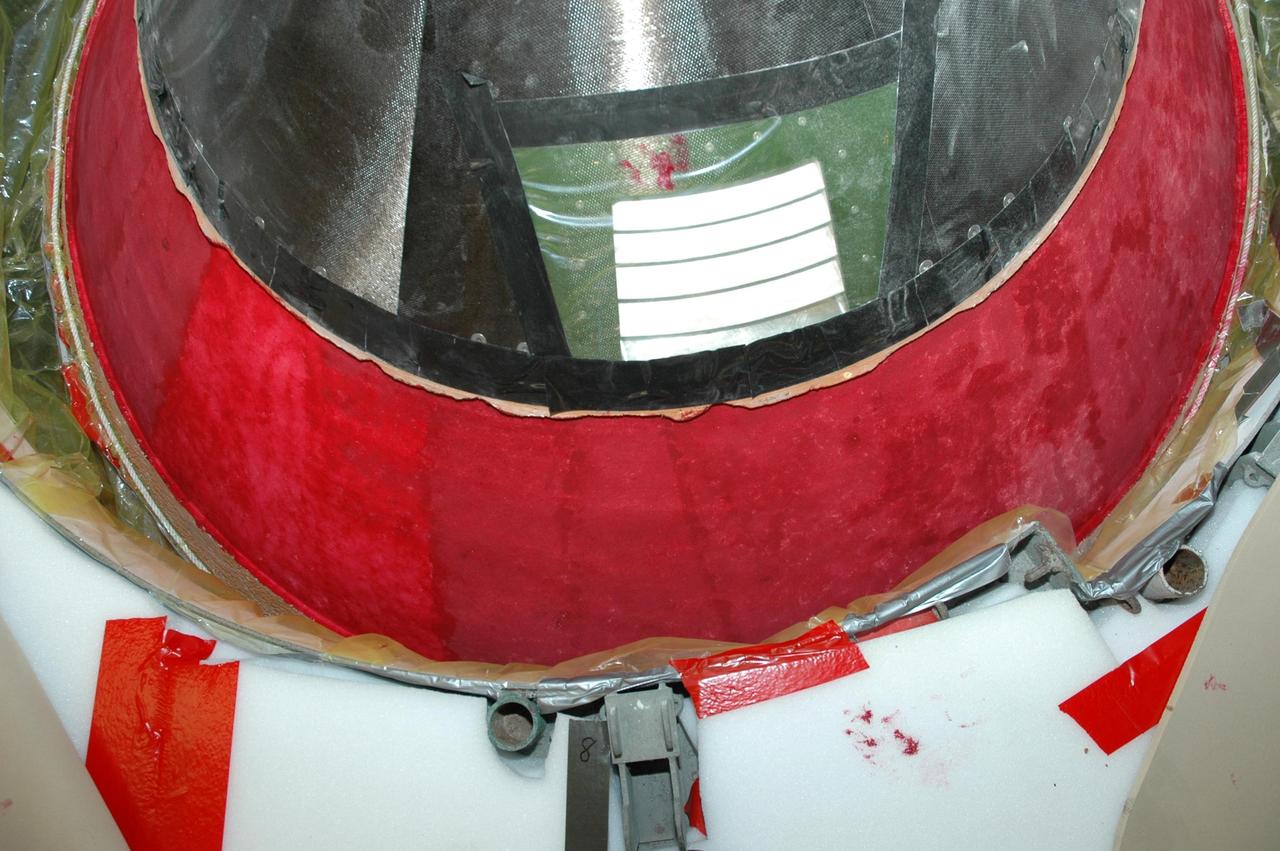
KENNEDY SPACE CENTER, FLA. -- In Highbay 1 inside the Vehicle Assembly Building, an area near the top of the external tank has been covered in a red dye to help expose cracks or compression dents. A severe thunderstorm with golf ball-sized hail caused visible divots in the giant tank's foam insulation and minor surface damage to about 26 heat shield tiles on the shuttle's left wing. A new target launch date has not been determined, but teams will focus on preparing Atlantis for liftoff in late April on mission STS-117. Photo credit: NASA/Jim Grossmann
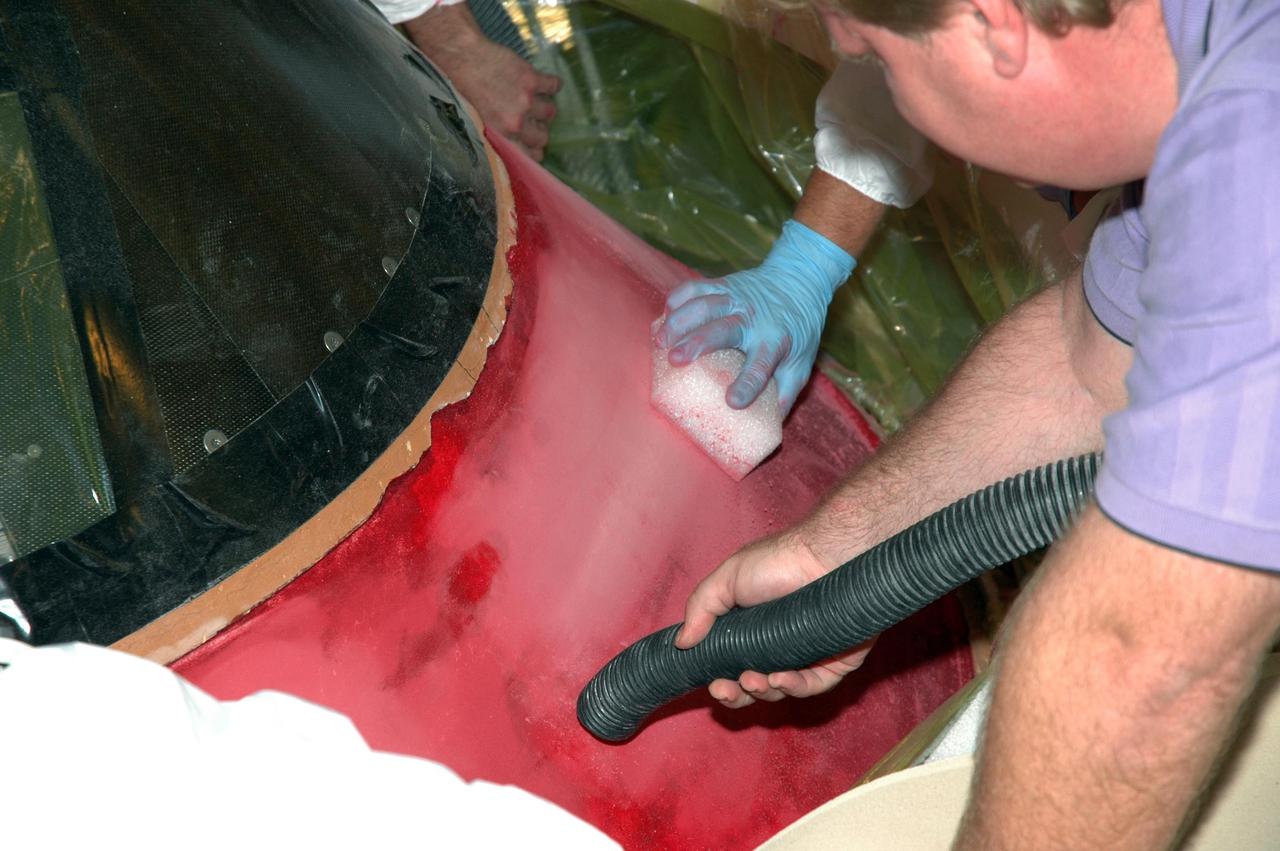
KENNEDY SPACE CENTER, FLA. -- In Highbay 1 inside the Vehicle Assembly Building, a technician carefully sands away the red dye that has been applied to the external tank to help expose cracks or compression dents, while another technician uses a compression hose to remove excess particles. A severe thunderstorm with golf ball-sized hail caused visible divots in the giant tank's foam insulation and minor surface damage to about 26 heat shield tiles on the shuttle's left wing. A new target launch date has not been determined, but teams will focus on preparing Atlantis for liftoff in late April on mission STS-117. Photo credit: NASA/Jim Grossmann

KENNEDY SPACE CENTER, FLA. -- In Highbay 1 inside the Vehicle Assembly Building, technicians carefully inspect a portion of the external tank foam that has been covered in red dye to help expose cracks or compression dents. A severe thunderstorm with golf ball-sized hail caused visible divots in the giant tank's foam insulation and minor surface damage to about 26 heat shield tiles on the shuttle's left wing. A new target launch date has not been determined, but teams will focus on preparing Atlantis for liftoff in late April on mission STS-117. Photo credit: NASA/Jim Grossmann
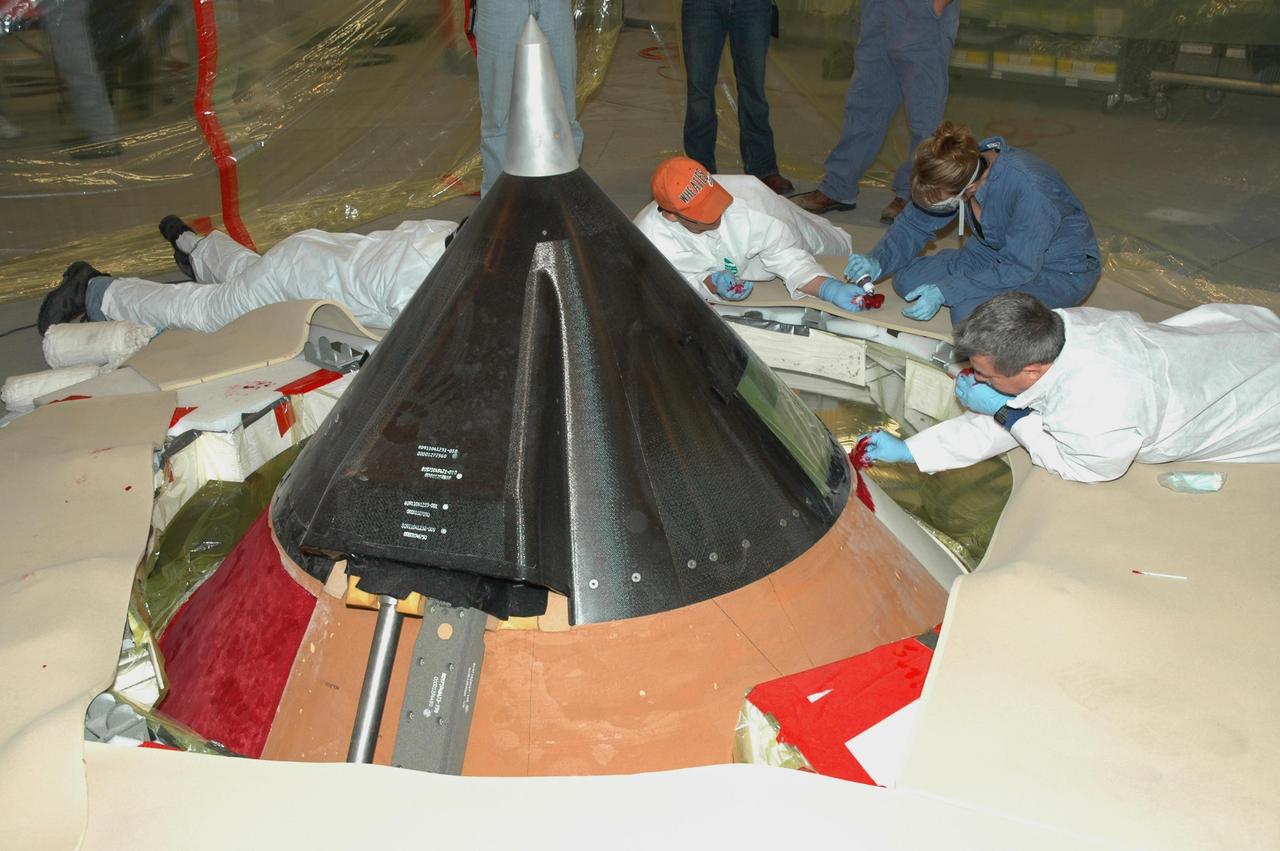
KENNEDY SPACE CENTER, FLA. -- In Highbay 1 inside the Vehicle Assembly Building, technicians carefully apply red dye to the external tank as part of repair operations. A severe thunderstorm with golf ball-sized hail caused visible divots in the giant tank's foam insulation and minor surface damage to about 26 heat shield tiles on the shuttle's left wing. A new target launch date has not been determined, but teams will focus on preparing Atlantis for liftoff in late April on mission STS-117. Photo credit: NASA/Jim Grossmann

KENNEDY SPACE CENTER, FLA. -- In Highbay 1 inside the Vehicle Assembly Building, technicians work on repair techniques to the hail-damaged external tank. They are inside a tented area that protects the tank. Scaffolding around the tank can be seen below. A severe thunderstorm with golf ball-sized hail caused visible divots in the giant tank's foam insulation and minor surface damage to about 26 heat shield tiles on the shuttle's left wing. A new target launch date has not been determined, but teams will focus on preparing Atlantis for liftoff in late April on mission STS-117. Photo credit: NASA/Jim Grossmann
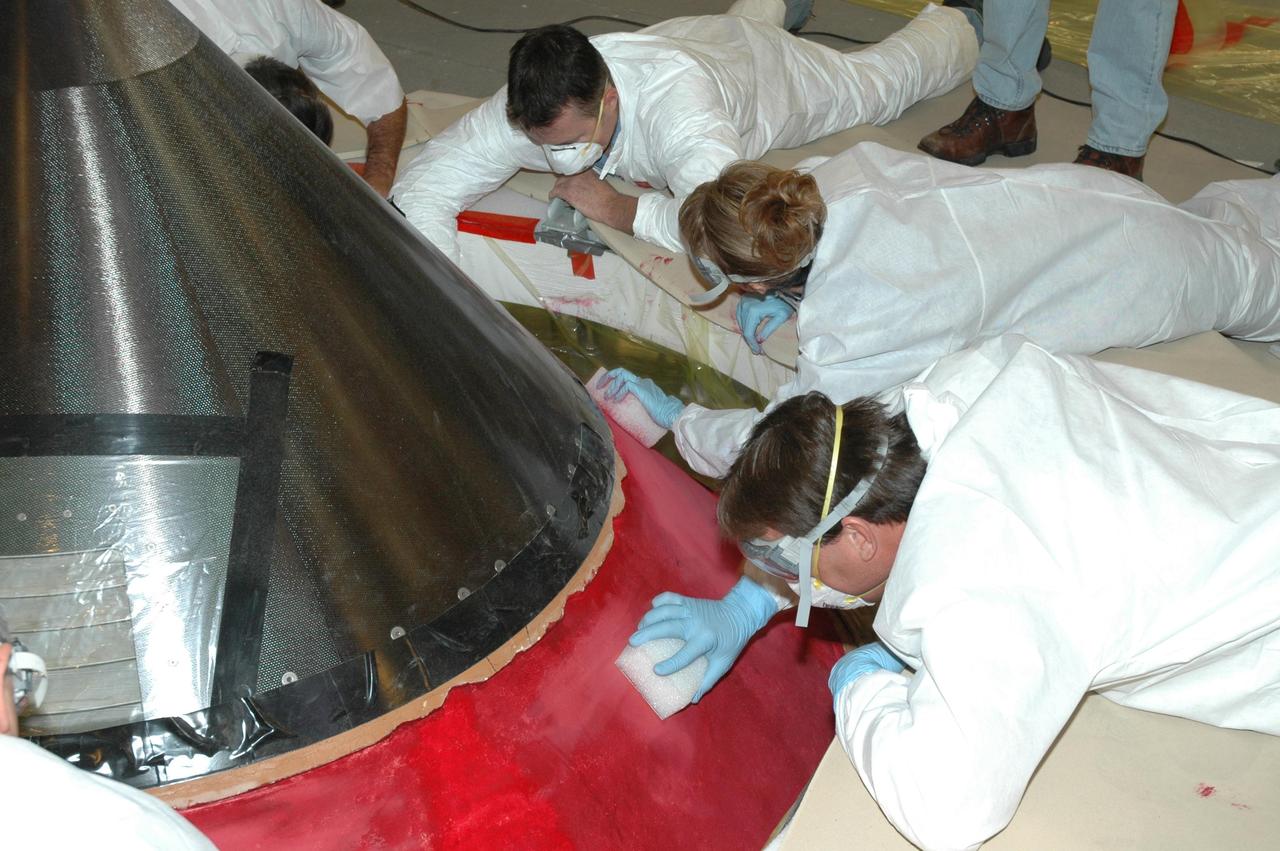
KENNEDY SPACE CENTER, FLA. -- In Highbay 1 inside the Vehicle Assembly Building, technicians begin to carefully sand away the red dye that has been applied to the external tank to help expose cracks or compression dents. A severe thunderstorm with golf ball-sized hail caused visible divots in the giant tank's foam insulation and minor surface damage to about 26 heat shield tiles on the shuttle's left wing. A new target launch date has not been determined, but teams will focus on preparing Atlantis for liftoff in late April on mission STS-117. Photo credit: NASA/Jim Grossmann
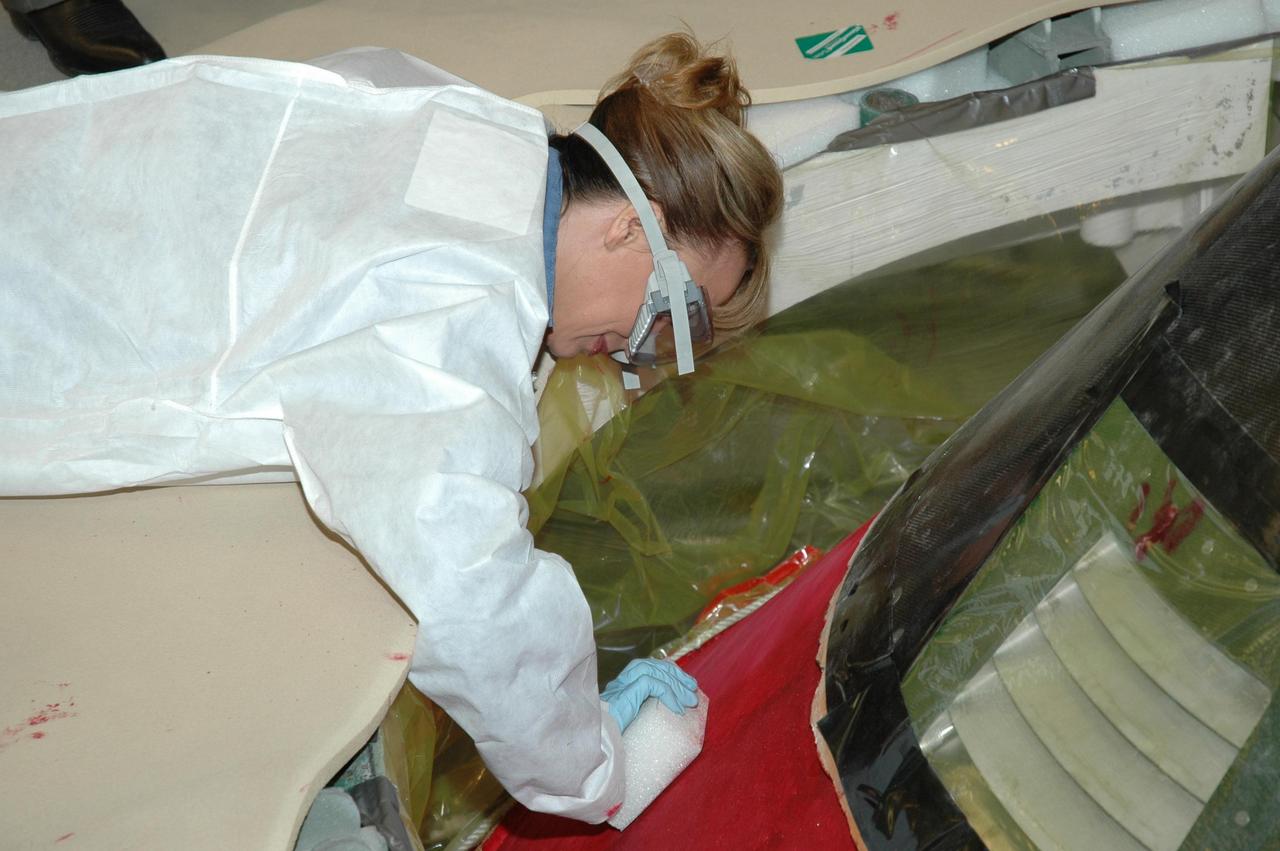
KENNEDY SPACE CENTER, FLA. -- In Highbay 1 inside the Vehicle Assembly Building, a technician carefully begins to sand away the red dye that has been applied to the external tank to help expose cracks or compression dents. A severe thunderstorm with golf ball-sized hail caused visible divots in the giant tank's foam insulation and minor surface damage to about 26 heat shield tiles on the shuttle's left wing. A new target launch date has not been determined, but teams will focus on preparing Atlantis for liftoff in late April on mission STS-117. Photo credit: NASA/Jim Grossmann

KENNEDY SPACE CENTER, FLA. -- In Highbay 1 inside the Vehicle Assembly Building, a technician carefully begins to carefully sand away the red dye that has been applied to the external tank to help expose cracks or compression dents. A severe thunderstorm with golf ball-sized hail caused visible divots in the giant tank's foam insulation and minor surface damage to about 26 heat shield tiles on the shuttle's left wing. A new target launch date has not been determined, but teams will focus on preparing Atlantis for liftoff in late April on mission STS-117. Photo credit: NASA/Jim Grossmann
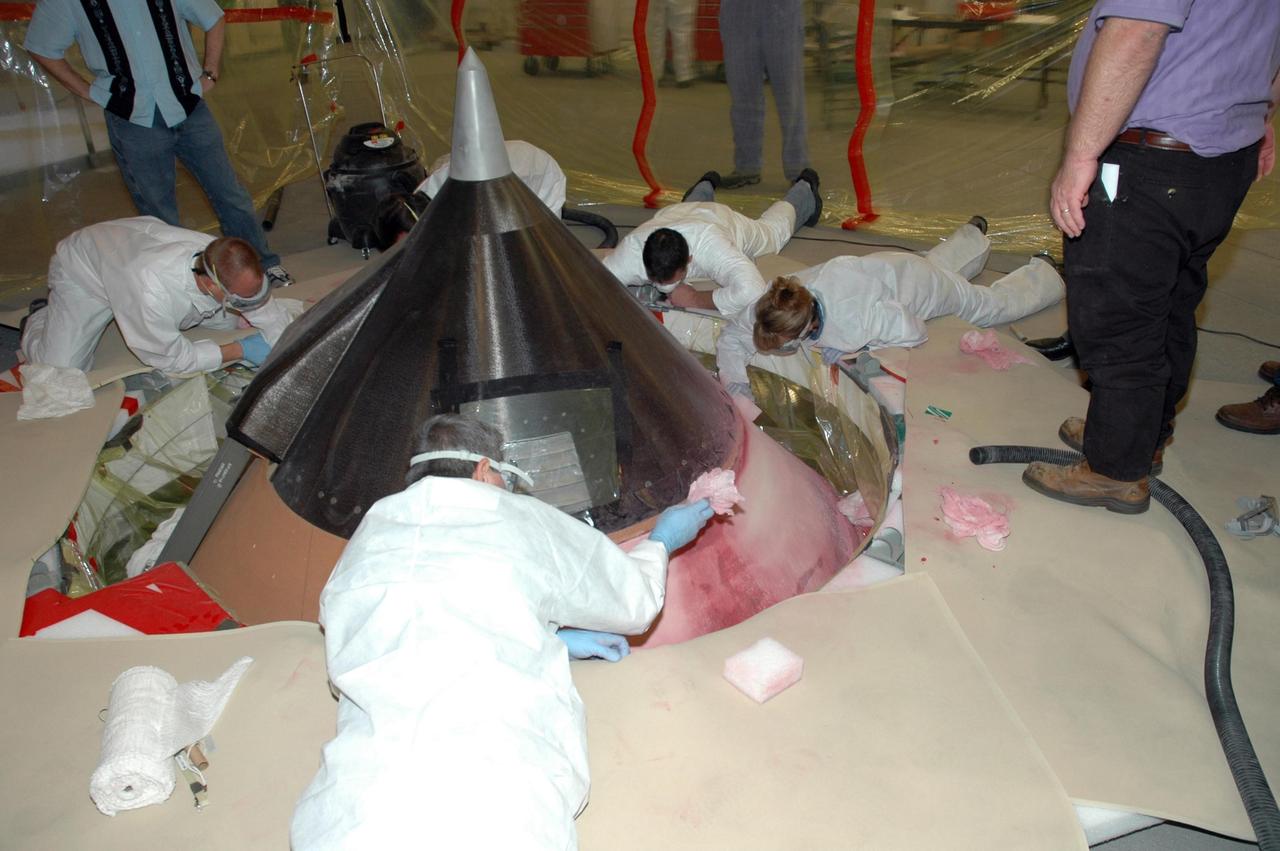
KENNEDY SPACE CENTER, FLA. -- In Highbay 1 inside the Vehicle Assembly Building, technicians carefully sand away the red dye that has been applied to the external tank to help expose cracks or compression dents. A severe thunderstorm with golf ball-sized hail caused visible divots in the giant tank's foam insulation and minor surface damage to about 26 heat shield tiles on the shuttle's left wing. A new target launch date has not been determined, but teams will focus on preparing Atlantis for liftoff in late April on mission STS-117. Photo credit: NASA/Jim Grossmann

S117-E-09604 (21 June 2007) --- The profile of the atmosphere and a setting sun are featured in this image photographed by a STS-117 crewmember onboard Space Shuttle Atlantis.
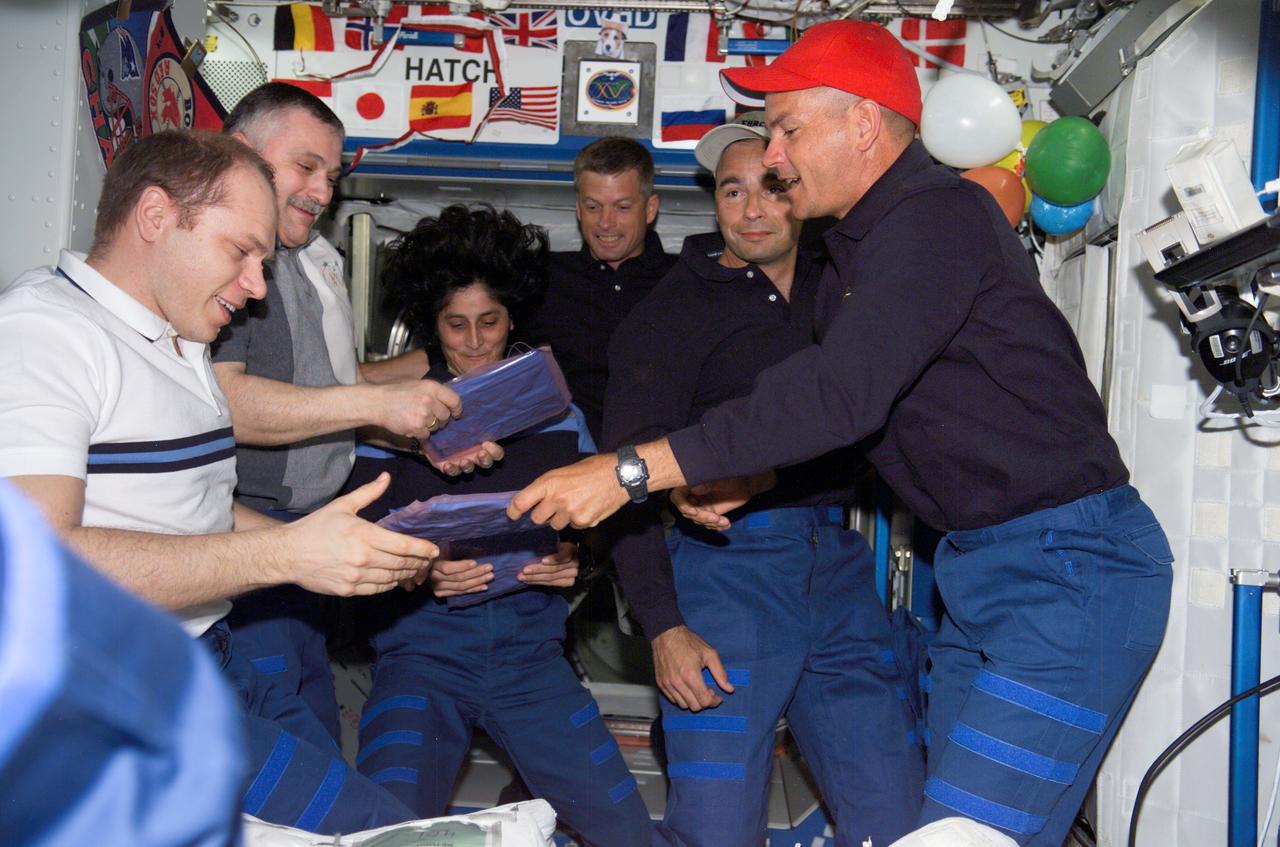
ISS015-E-11778 (10 June 2007) --- The STS-117 crewmembers give the Expedition 15 crewmembers packages from Earth in the Destiny laboratory of the International Space Station shortly after Space Shuttle Atlantis docked with the station. Pictured are (left to right) cosmonauts Oleg V. Kotov and Fyodor N. Yurchikhin, Expedition 15 flight engineer and commander, respectively, representing Russia's Federal Space Agency; astronauts Sunita L. Williams, Expedition 15 flight engineer; Steven Swanson, STS-117 mission specialist; Lee Archambault, STS-117 pilot; and Rick Sturckow, STS-117 commander.
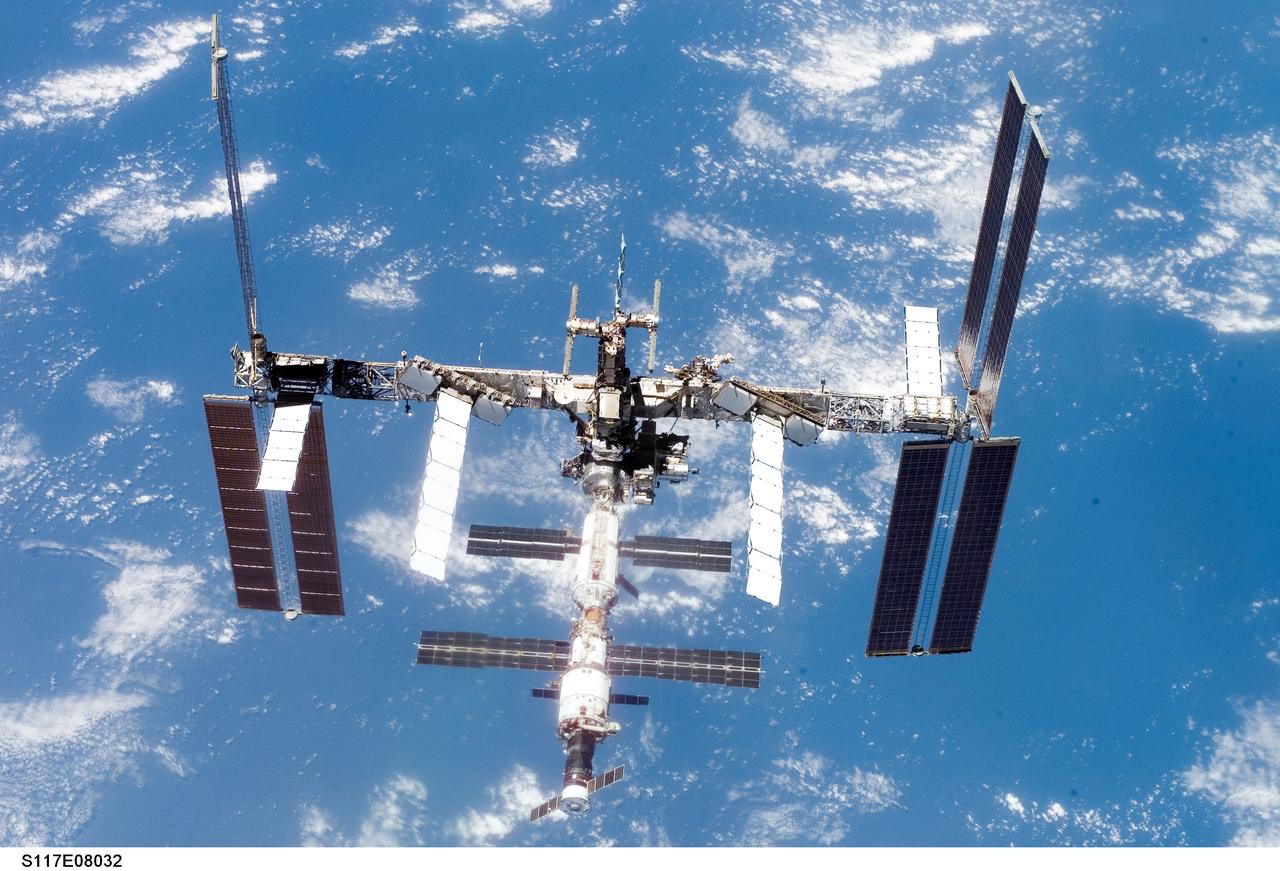
S117-E-08032 (19 June 2007) --- Backdropped by a blue and white Earth, the International Space Station moves away from the Space Shuttle Atlantis. Earlier the STS-117 and Expedition 15 crews concluded about eight days of cooperative work onboard the shuttle and station. Undocking of the two spacecraft occurred at 9:42 a.m. (CDT) on June 19, 2007. Astronaut Lee Archambault, STS-117 pilot, was at the controls for the departure and fly-around, which gave Atlantis' crew a look at the station's new expanded configuration.
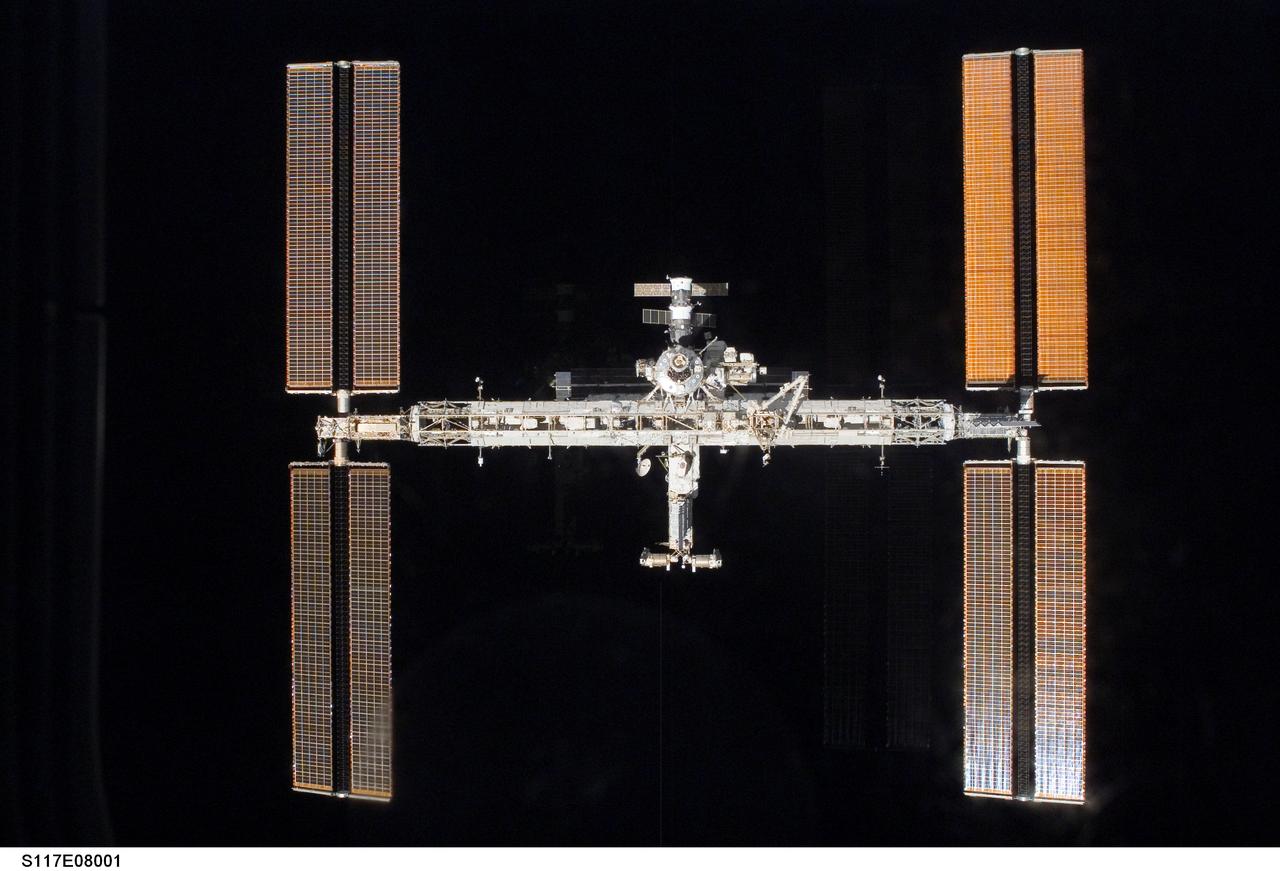
S117-E-08001 (19 June 2007) --- Backdropped by the blackness of space, the International Space Station moves away from the Space Shuttle Atlantis. Earlier the STS-117 and Expedition 15 crews concluded about eight days of cooperative work onboard the shuttle and station. Undocking of the two spacecraft occurred at 9:42 a.m. (CDT) on June 19, 2007. Astronaut Lee Archambault, STS-117 pilot, was at the controls for the departure and fly-around, which gave Atlantis' crew a look at the station's new expanded configuration.
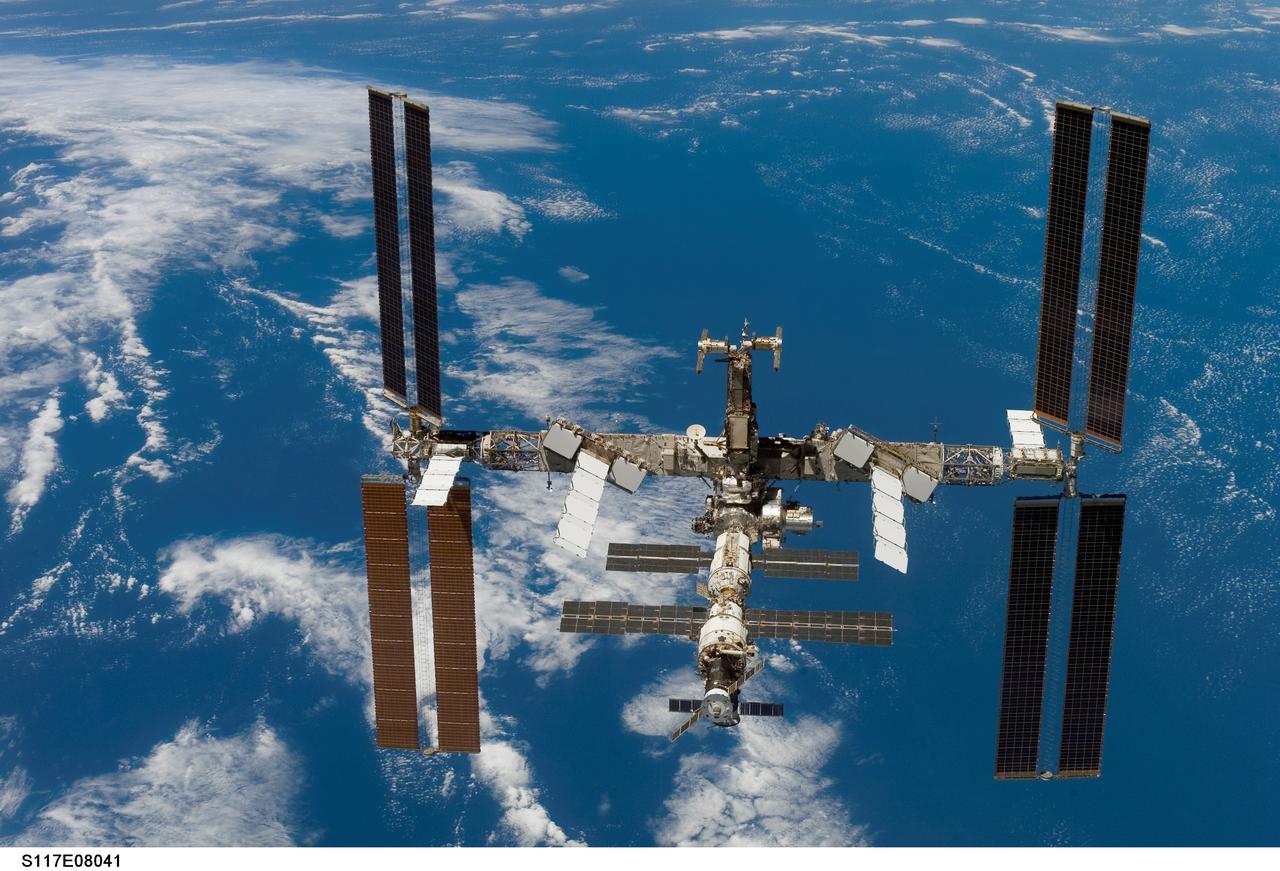
S117-E-08041 (19 June 2007) --- Backdropped by a blue and white Earth, the International Space Station moves away from the Space Shuttle Atlantis. Earlier the STS-117 and Expedition 15 crews concluded about eight days of cooperative work onboard the shuttle and station. Undocking of the two spacecraft occurred at 9:42 a.m. (CDT) on June 19, 2007. Astronaut Lee Archambault, STS-117 pilot, was at the controls for the departure and fly-around, which gave Atlantis' crew a look at the station's new expanded configuration.
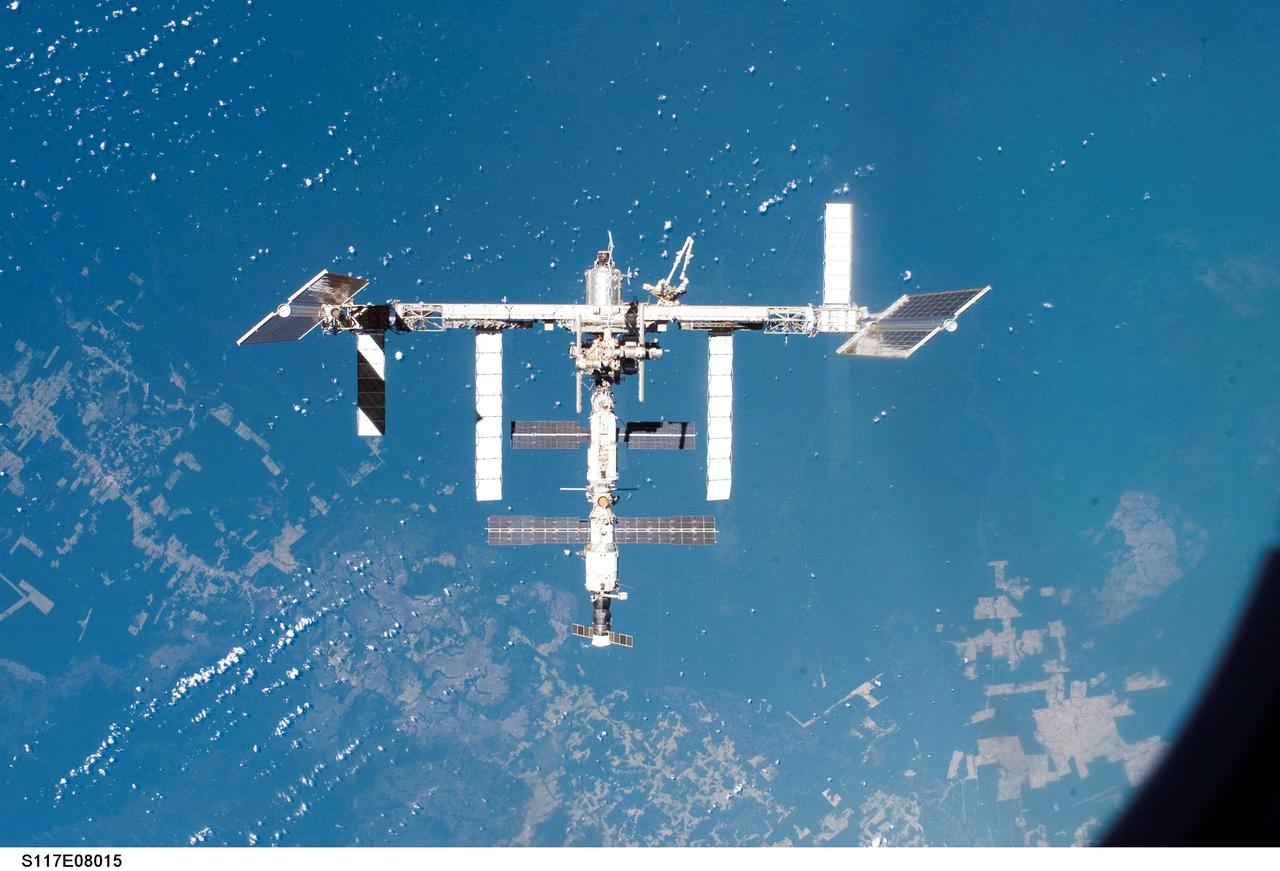
S117-E-08015 (19 June 2007) --- Backdropped by a colorful Earth, the International Space Station moves away from the Space Shuttle Atlantis. Earlier the STS-117 and Expedition 15 crews concluded about eight days of cooperative work onboard the shuttle and station. Undocking of the two spacecraft occurred at 9:42 a.m. (CDT) on June 19, 2007. Astronaut Lee Archambault, STS-117 pilot, was at the controls for the departure and fly-around, which gave Atlantis' crew a look at the station's new expanded configuration.
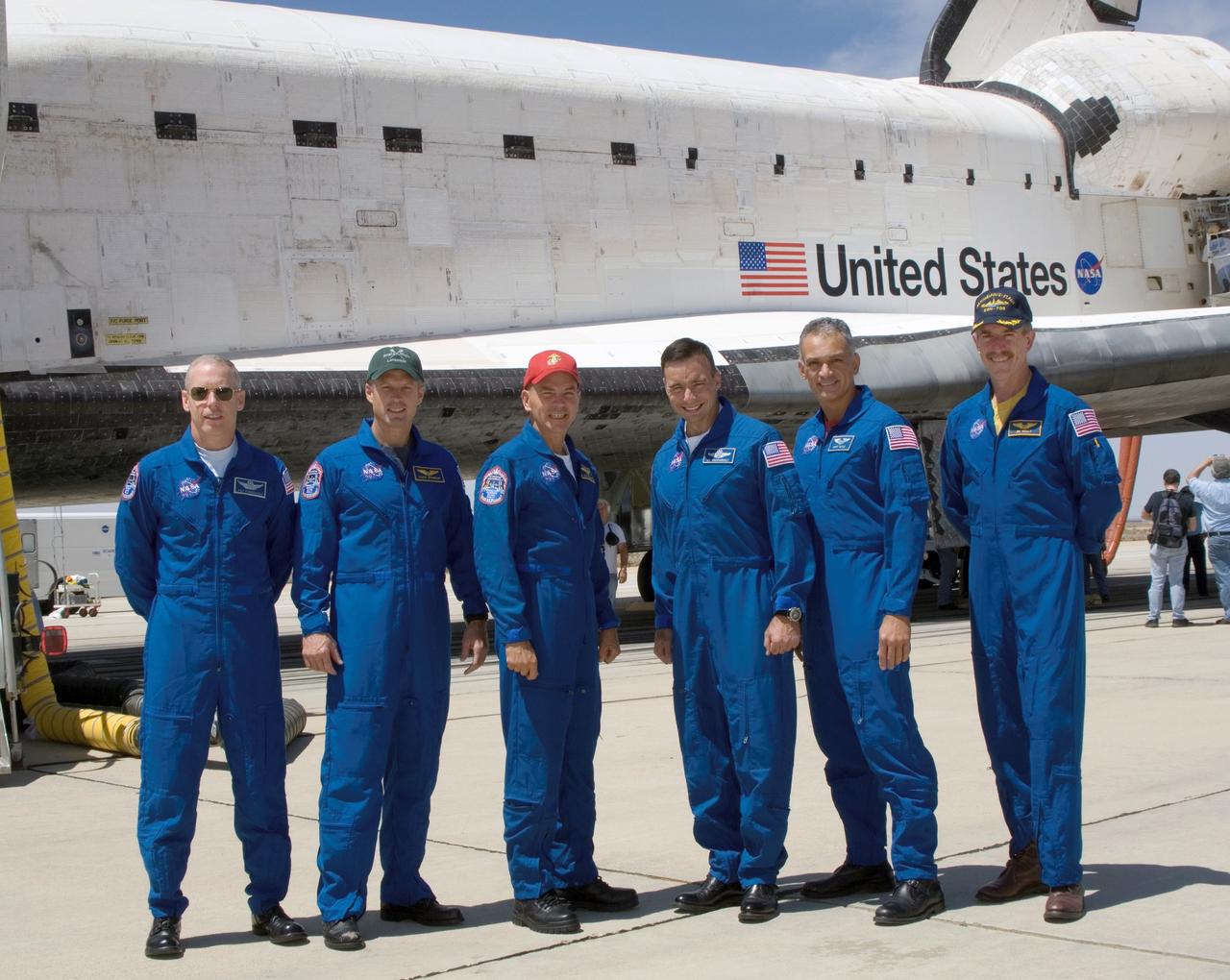
STS117-S-052 (22 June 2007) --- The STS-117 crew poses in front of the Space Shuttle Atlantis after a successful landing at 12:49 p.m. (PDT) on June 22, 2007 at Edwards Air Force Base in California. From the left are astronauts Patrick Forrester, Steven Swanson, both mission specialists; Rick Sturckow, commander; Lee Archambault, pilot; John "Danny" Olivas and Jim Reilly, both mission specialists.
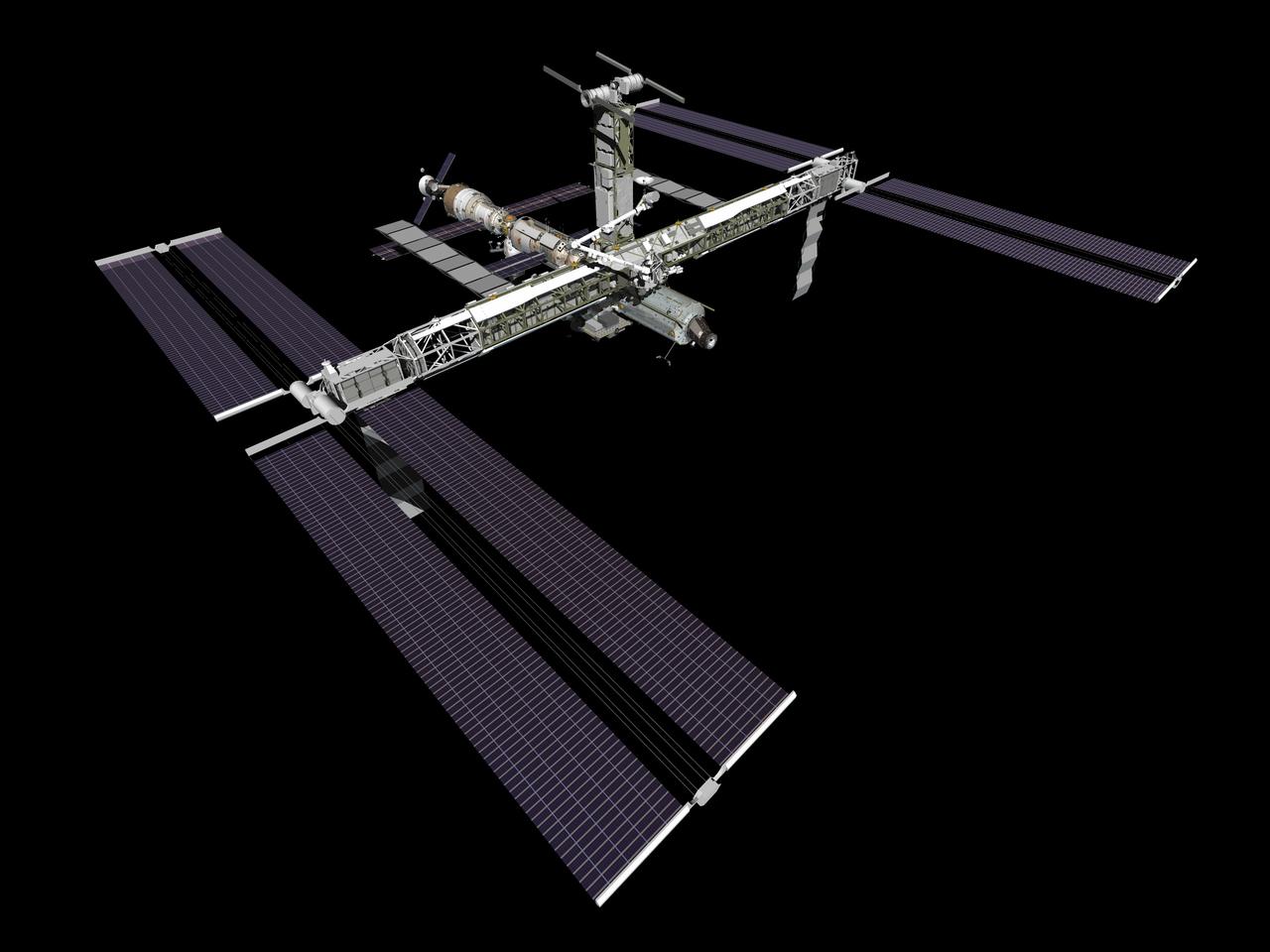
JSC2007-E-06523 (February 2007) --- Computer-generated artist's rendering of the International Space Station after Space Shuttle Atlantis' (STS-117/13A) undocking and departure. The image shows the addition of the second and third starboard truss segments (S3/S4) with Photovoltaic Radiator (PVR) and the deployed third set of solar arrays. P6 starboard solar array wing and one radiator are retracted.
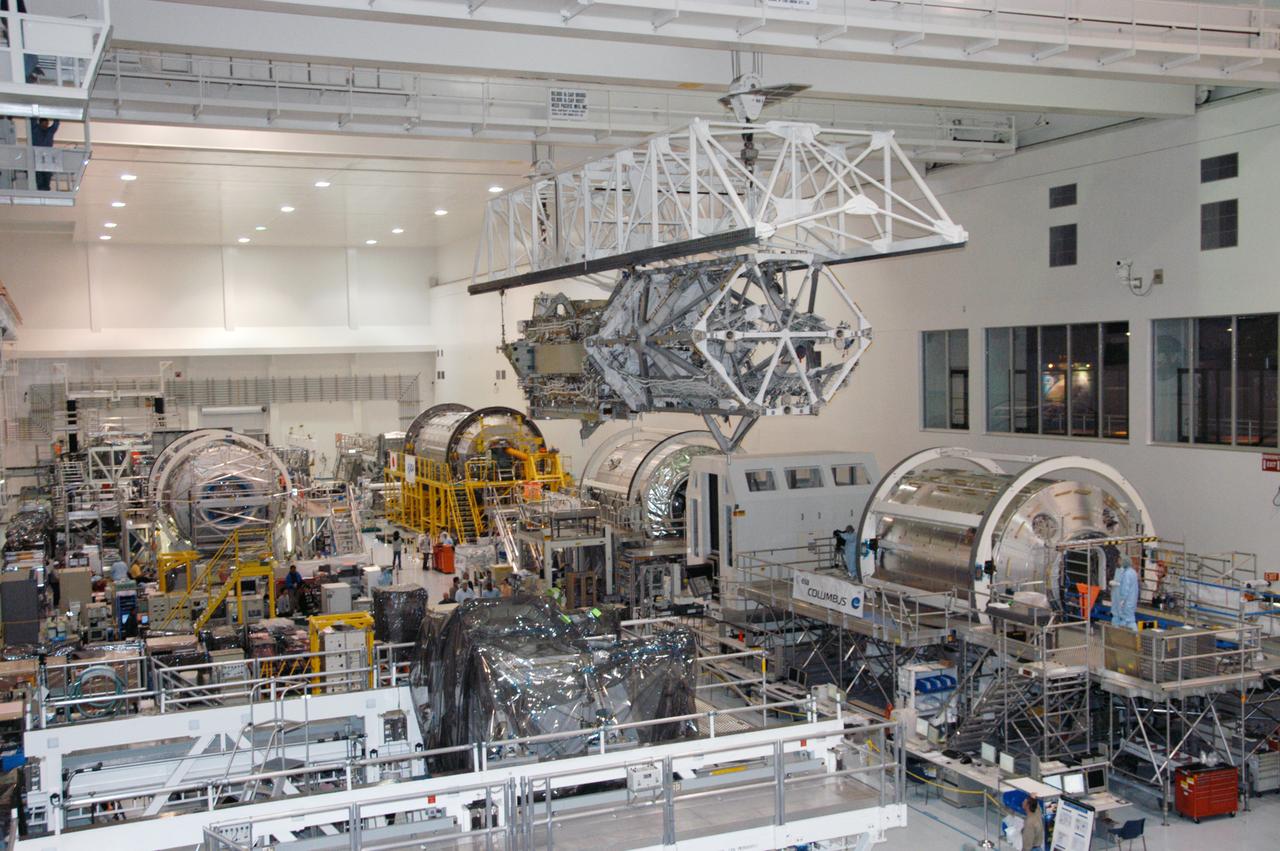
In the Space Station Processing Facility, an overhead crane moves the S3/S4 integrated truss above the floor to a payload canister. Several space station modules can be seen at various points on the floor. After it is stowed in the canister, the S3/S4 truss will be transported to the launch pad. The truss is the payload on mission STS-117, targeted for launch on March 15.
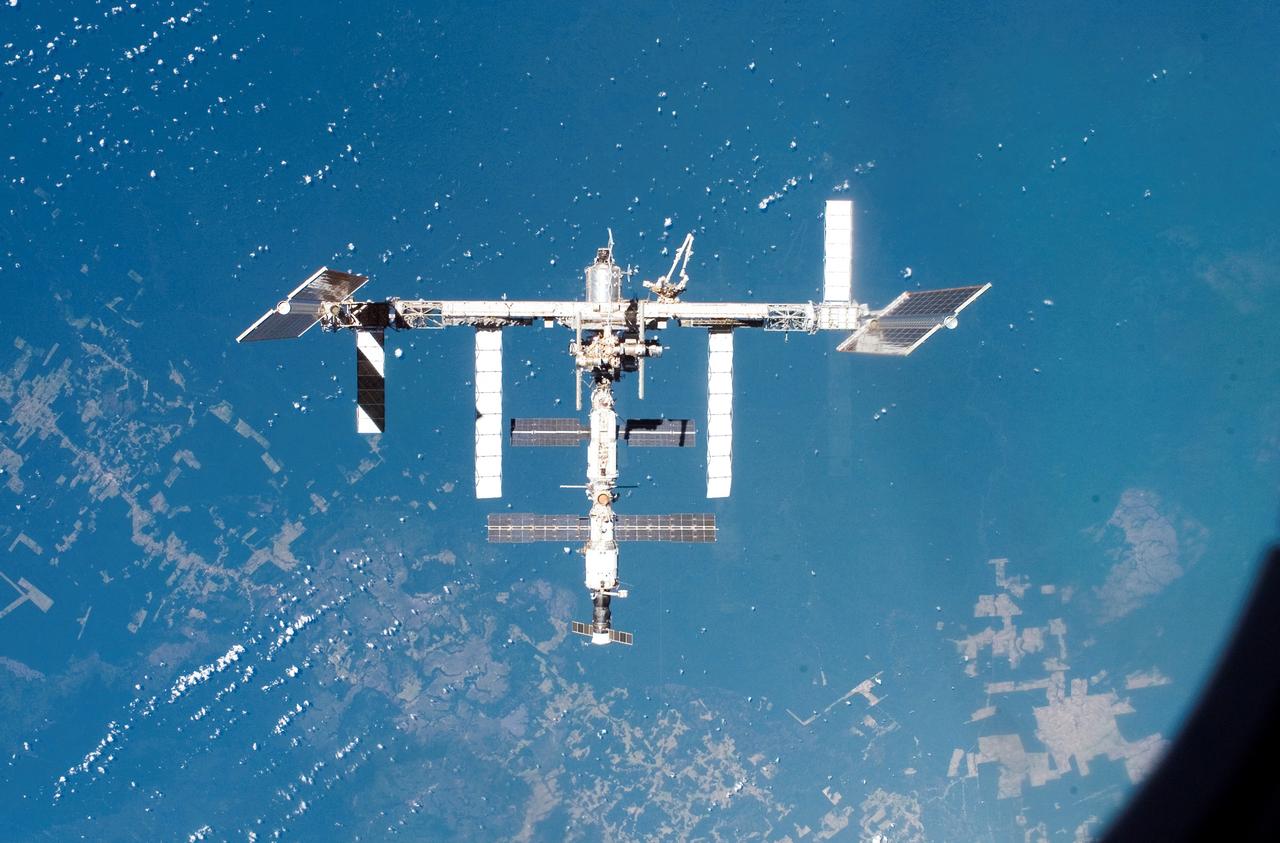
Eight days of construction resumed on the International Space Station (ISS), as STS-117 astronauts and mission specialists and the Expedition 15 crew completed installation of the second and third starboard truss segments (S3 and S4). Back dropped by our colorful Earth, its newly expanded configuration is revealed as pilot Lee Archambault conducts a fly around upon departure from the station on June 19, 2007.
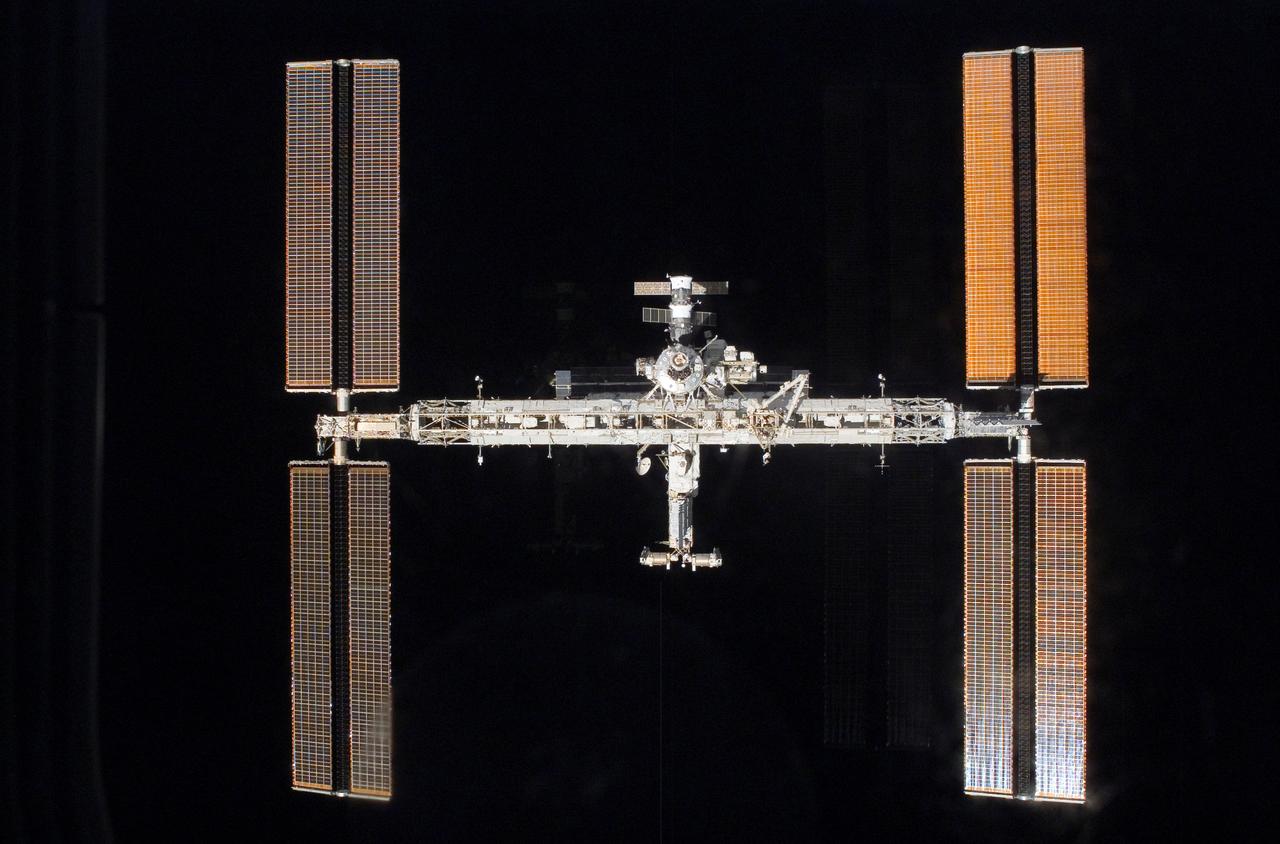
Eight days of construction resumed on the International Space Station (ISS), as STS-117 astronauts and mission specialists and the Expedition 15 crew completed installation of the second and third starboard truss segments (S3 and S4). Back dropped by the blackness of space, its newly expanded configuration is revealed as pilot Lee Archambault conducts a fly around upon departure from the station on June 19, 2007.
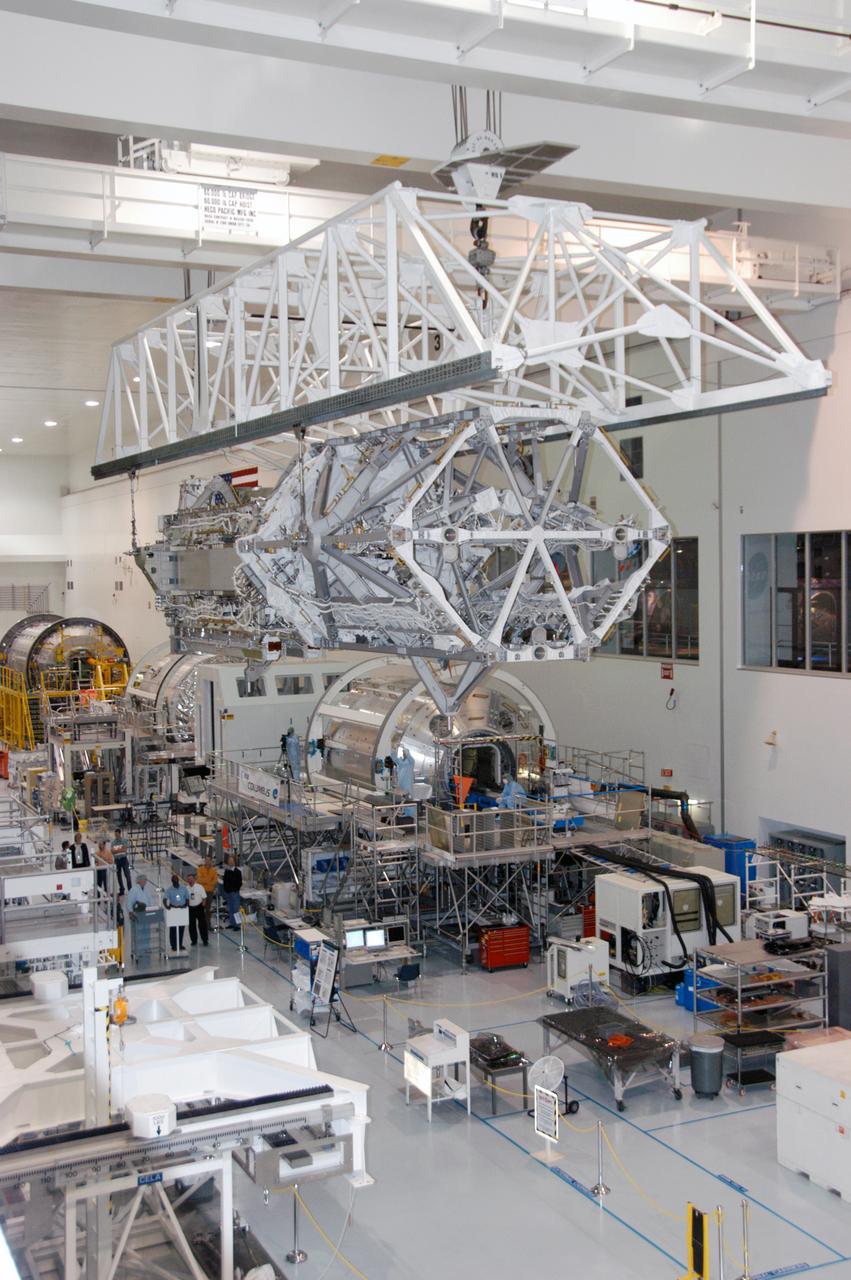
In the Space Station Processing Facility, an overhead crane moves the S3/S4 integrated truss above the floor to a payload canister. Several space station modules can be seen at various points on the floor. After it is stowed in the canister, the S3/S4 truss will be transported to the launch pad. The truss is the payload on mission STS-117, targeted for launch on March 15.
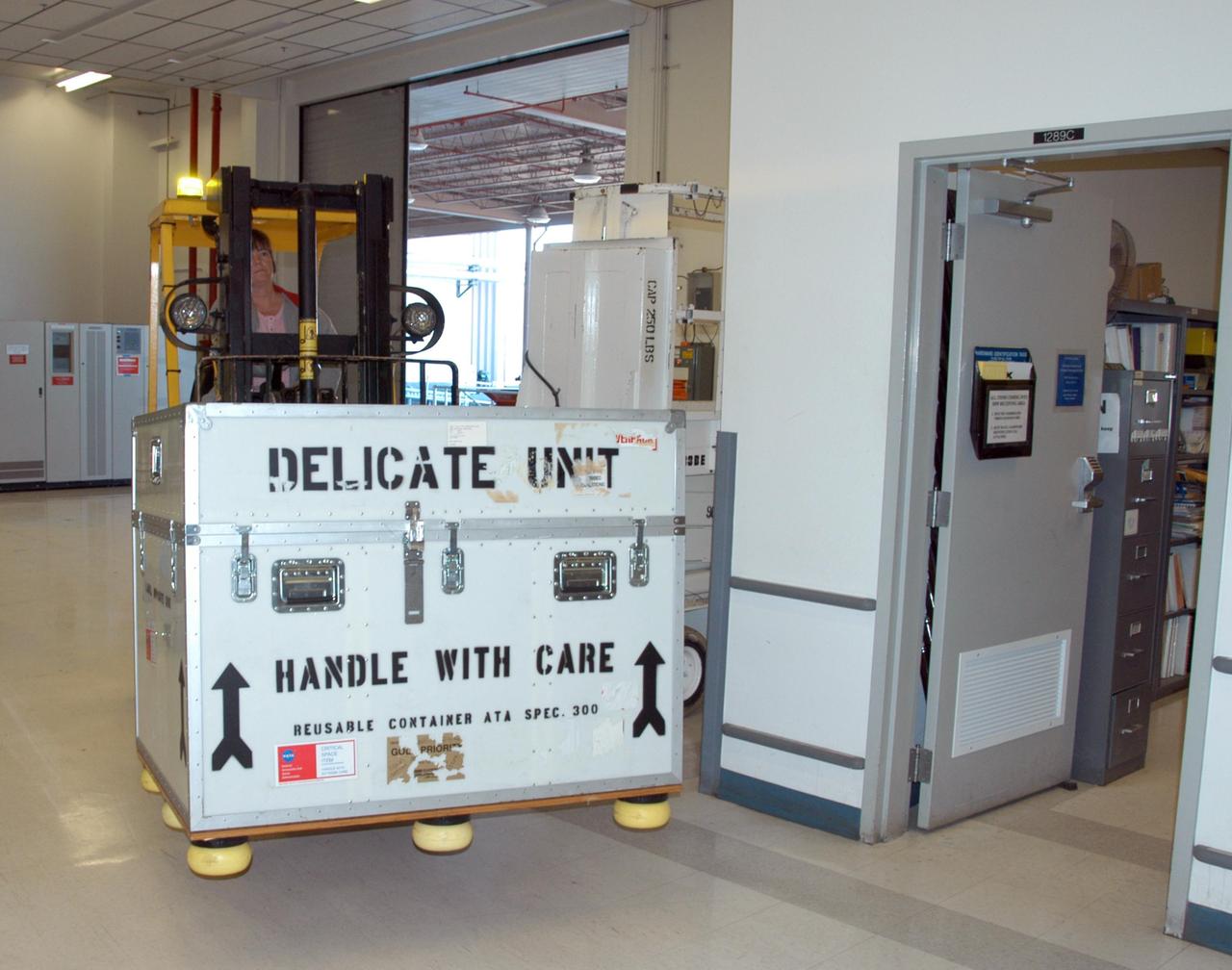
KENNEDY SPACE CENTER, FLA. -- Extravehicular Activity (EVA) suits packed inside containers arrive at the Space Station Processing Facility from Johnson Space Center in Texas. The suits will be used by STS-117 crew members to perform several spacewalks during the mission. The mission payload aboard Space Shuttle Atlantis is the S3/S4 integrated truss structure, along with a third set of solar arrays and batteries. The crew of six astronauts will install the truss to continue assembly of the International Space Station. Photo credit: NASA/George Shelton.