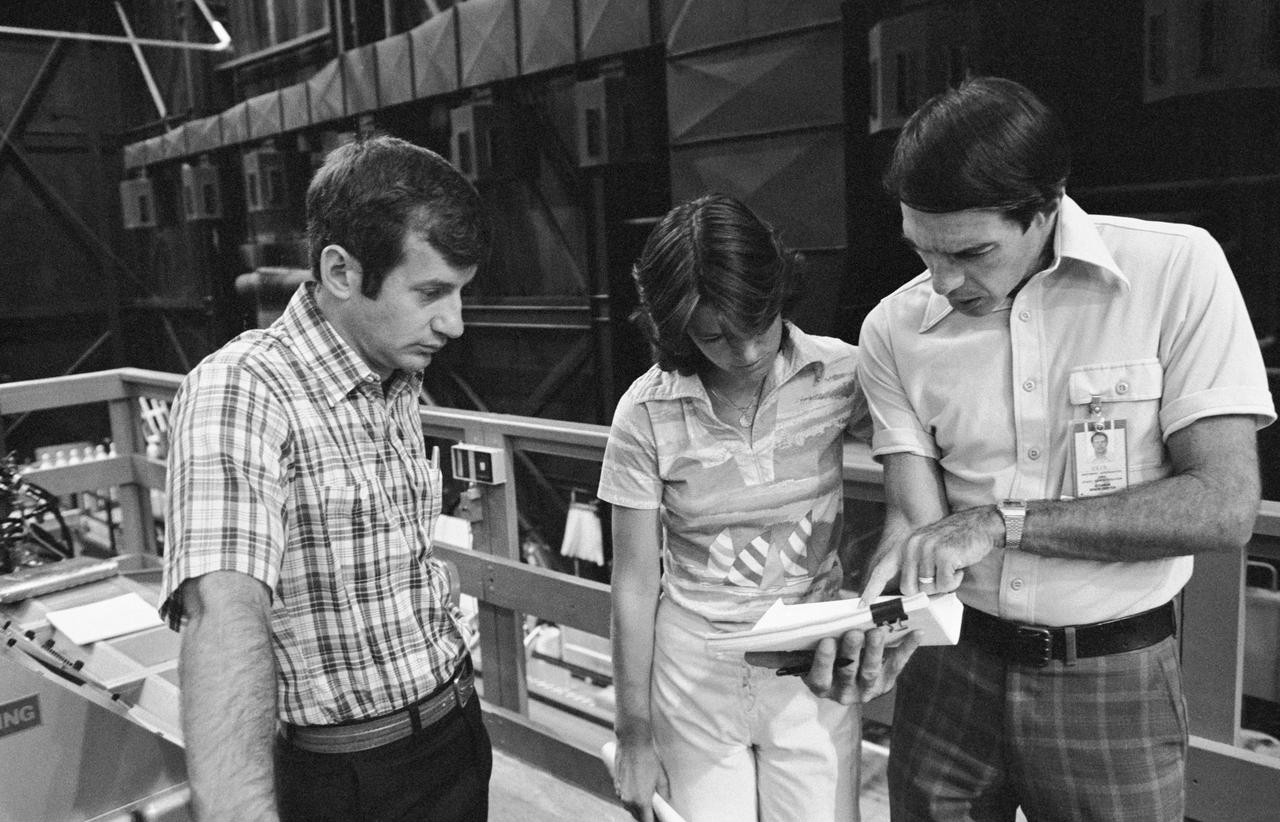
Astronauts Sally Ride and Terry Hart prepare for remote manipulator system (RMS) training for STS-2 in bldg 9A. Views include Ride, Hart and Robert R. Kain of the Flight Activites Branch reviewing procedures for RMS training (34262); Ride and Hart stand beside the RMS control center looking down at the payload bay mock-up (34263).
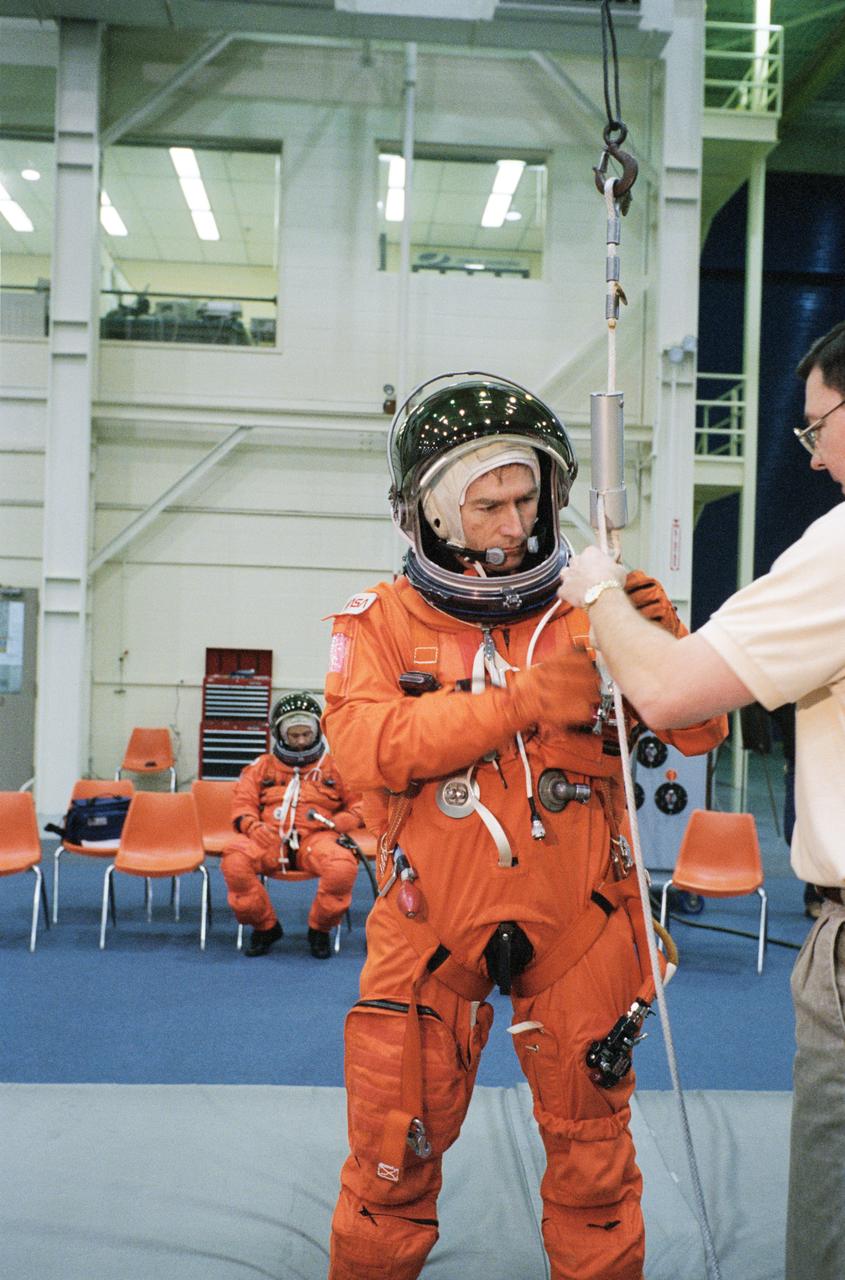
S95-09157 (27 Apr. 1995) --- Payload specialist Fred W. Leslie has just translated from the top of a Shuttle mockup-trainer using a Sky-genie device during emergency egress training with his six STS-73 crew mates. He is assisted here by Scott Gill, a member of the STS-73 training staff. The seven will fly aboard the Space Shuttle Columbia later this year to support the United States Microgravity Laboratory (USML-2) mission.
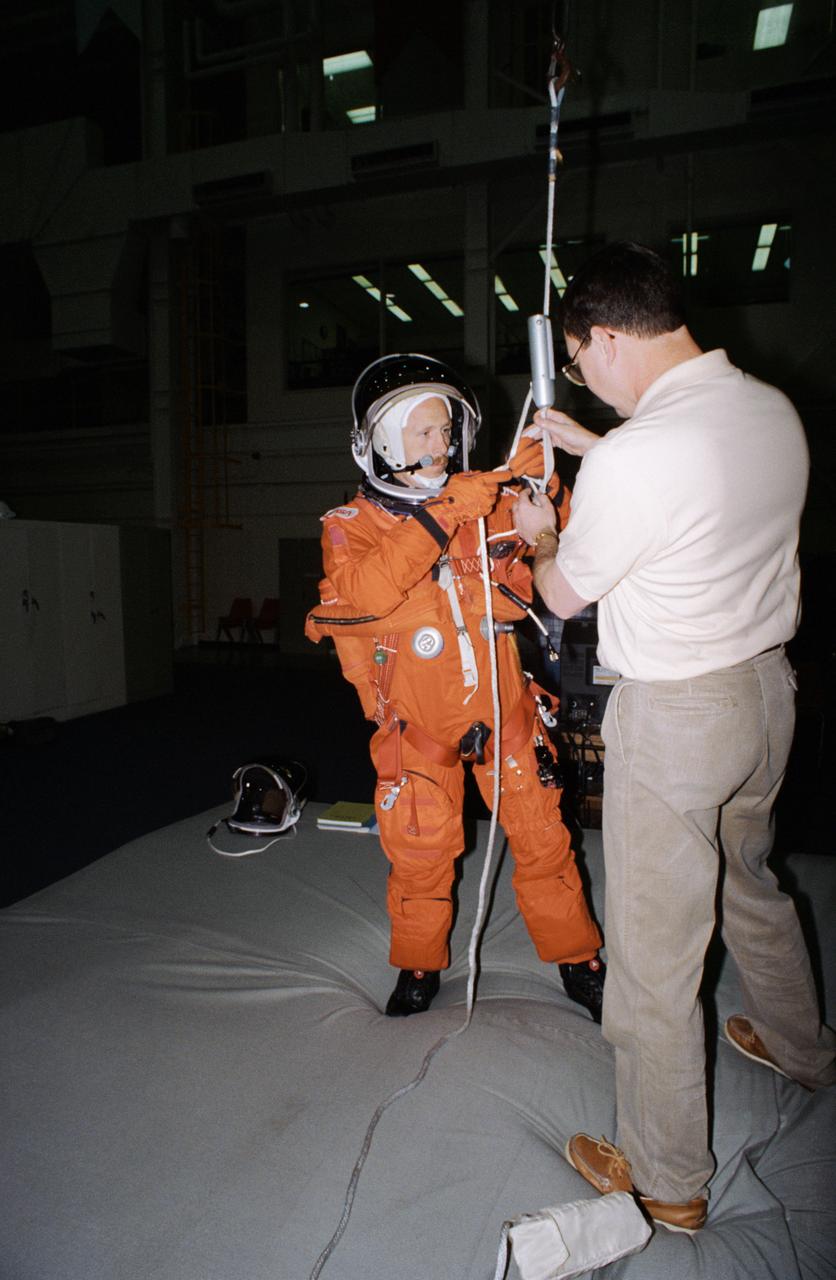
S95-09153 (27 Apr. 1995) --- Astronaut Kenneth D. Bowersox has just translated from the top of a Shuttle mockup-trainer using a Sky-genie device during emergency egress training with his six STS-73 crew mates. He is assisted here by Scott Gill, a member of the STS-73 training staff. The seven will fly aboard the Space Shuttle Columbia later this year to support the United States Microgravity Laboratory (USML-2) mission.
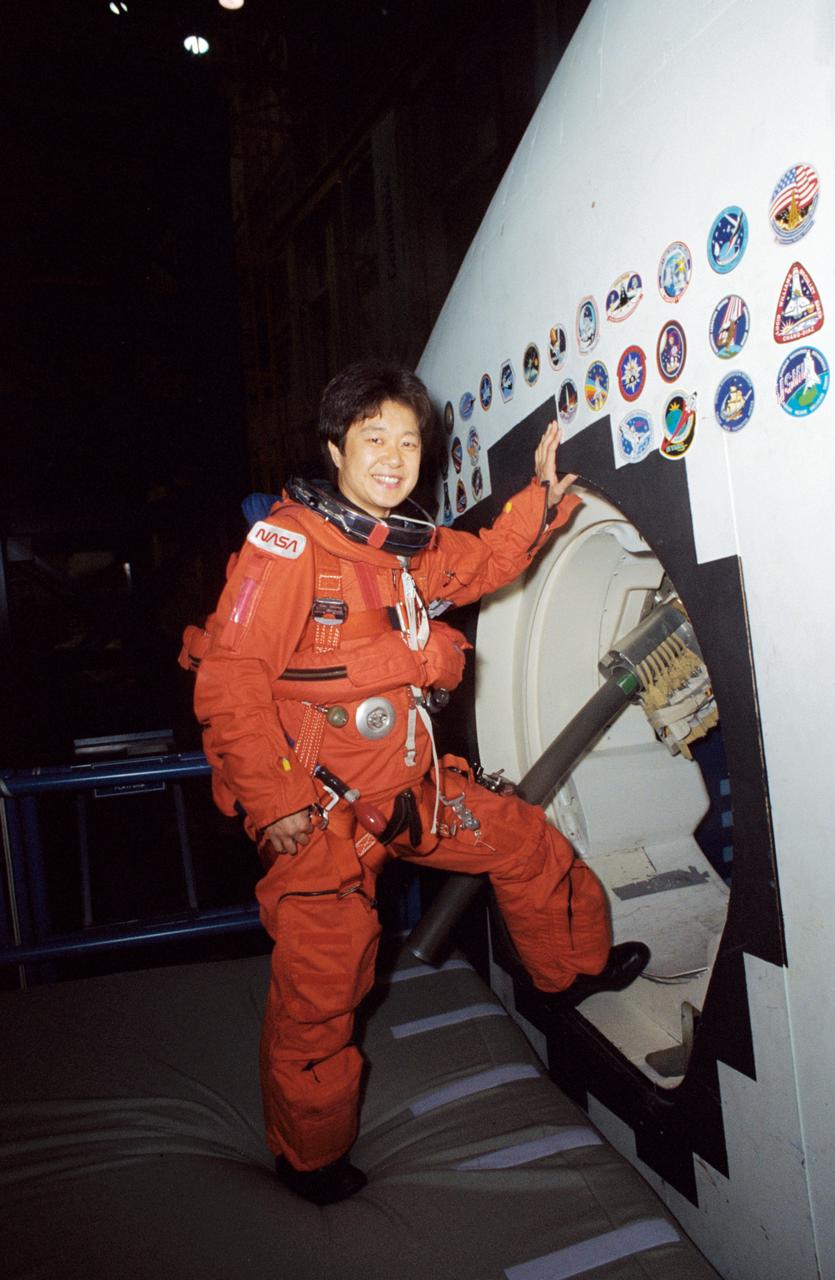
STS-65 Japanese Payload Specialist Chiaki Mukai takes a break from training at the Johnson Space Center (JSC). Wearing a training version of the orange launch and entry suit (LES), Mukai stands at the crew compartment trainer (CCT) side hatch in the Mockup and Integration Laboratory (MAIL) Bldg 9NE. Note the crew escape system (CES) pole device extending out the side hatch which would accommodate crewmembers in bailout from a troubled spacecraft. Mukai represents the National Space Development Agency (NASDA) of Japan and will serve as a payload specialist aboard Columbia, Orbiter Vehicle (OV) 102, during the STS-65 International Microgravity Laboratory 2 (IML-2) mission.
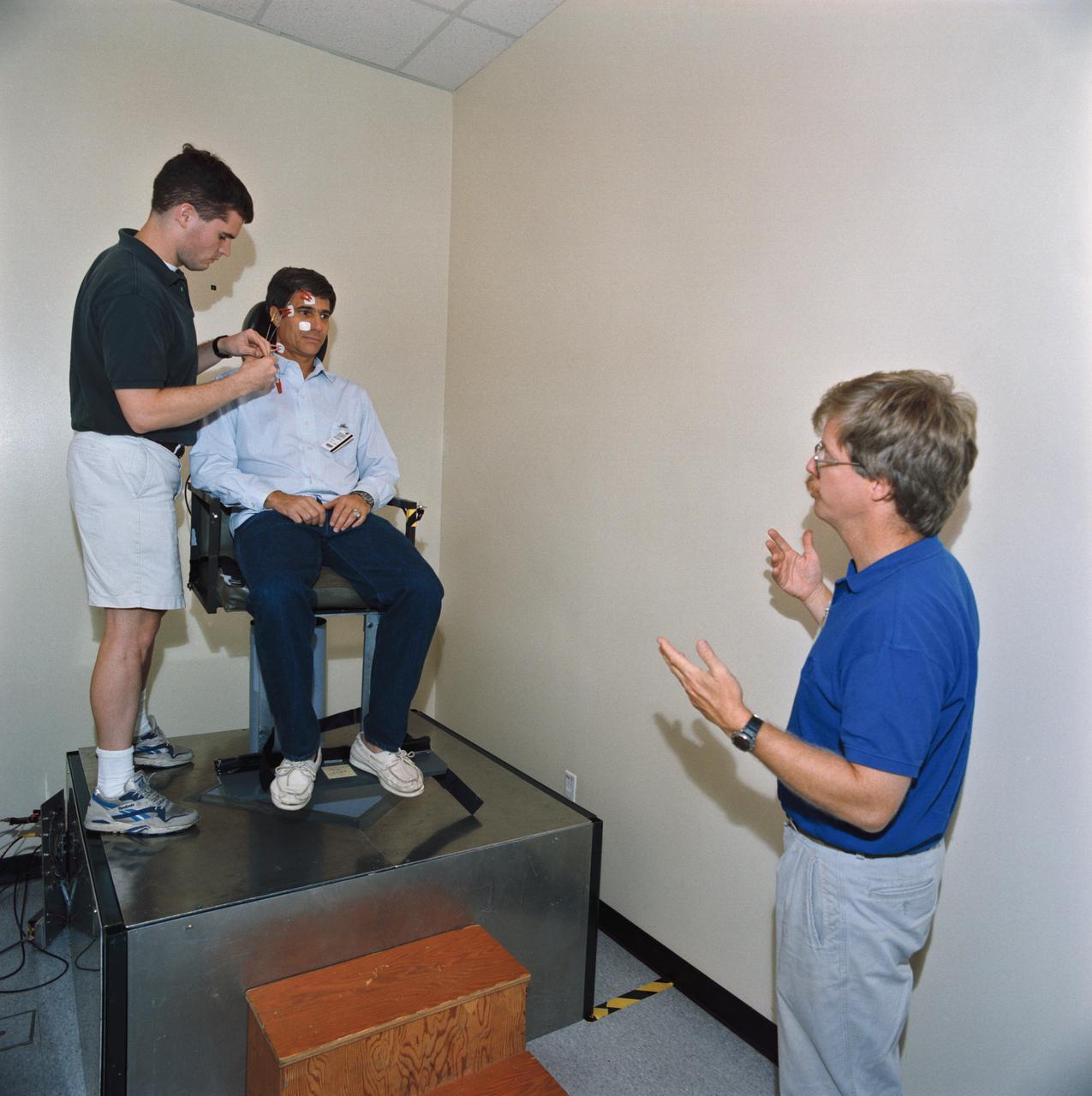
S93-45366 (29 Sept 1993) --- Astronaut John E. Blaha, STS-58 mission commander, sits in a training version of the rotating chair test device. Sensors are attached to Blaha's head and face to record responses to the rotation. Blaha was participating with five other NASA astronauts and a payload specialist for data collection and training in preparation for the two week Spacelab Life Sciences (SLS-2) mission.
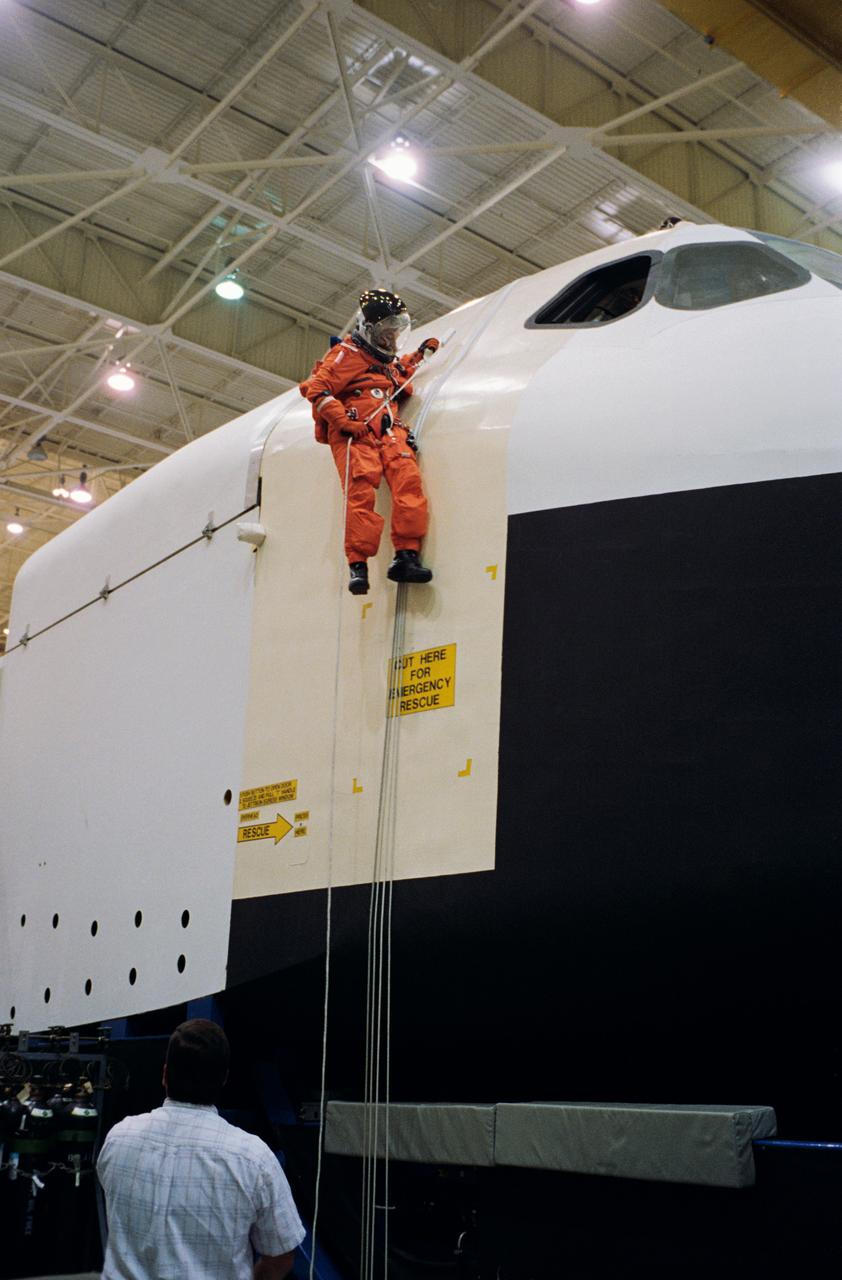
S95-09163 (27 Apr. 1995) --- Payload specialist Albert Sacco Jr. rappels from the top of a Shuttle mockup-trainer using a Sky-genie device during emergency egress training with his six STS-73 crew mates. The seven will fly aboard the Space Shuttle Columbia later this year to support the United States Microgravity Laboratory (USML-2) mission.
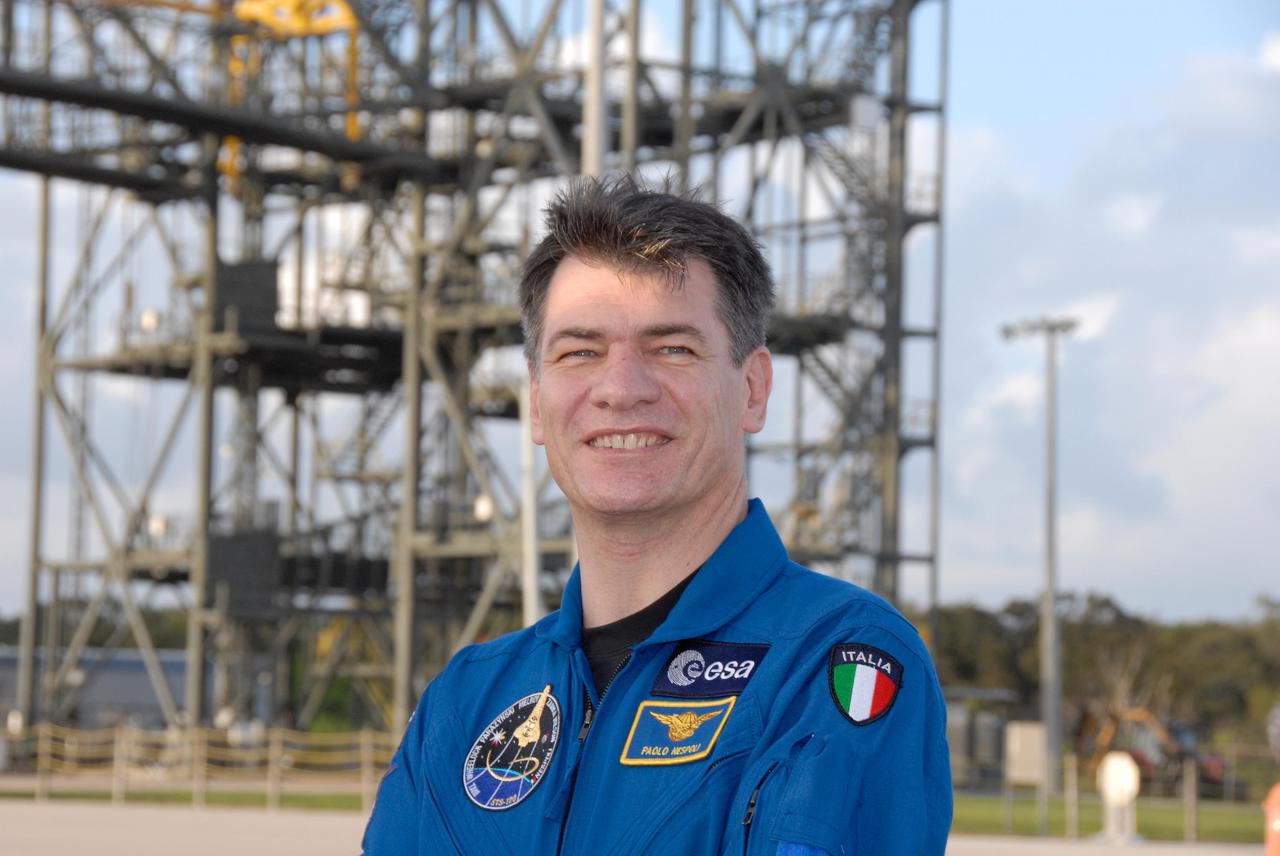
KENNEDY SPACE CENTER, FLA. -- The crew members of mission STS-120 arrive at NASA's Kennedy Space Center Shuttle Landing Facility aboard T-38 jet aircraft to take part in terminal countdown demonstration test activities. Mission Specialist Paolo Nespoli, representing the European Space Agency on his first shuttle flight, is seen here with the space shuttle mate-demate device in the background. The terminal countdown demonstration test provides astronauts and ground crews an opportunity to participate in various simulated countdown activities, including equipment familiarization and emergency training. The STS-120 mission will deliver the U.S. Node 2 module, named Harmony, aboard space shuttle Discovery to the International Space Station. Launch of Discovery on mission STS-120 is targeted for Oct. 23 at 11:38 a.m. EDT on a 14-day mission to the International Space Station. Photo credit: NASA_Kim Shiflett
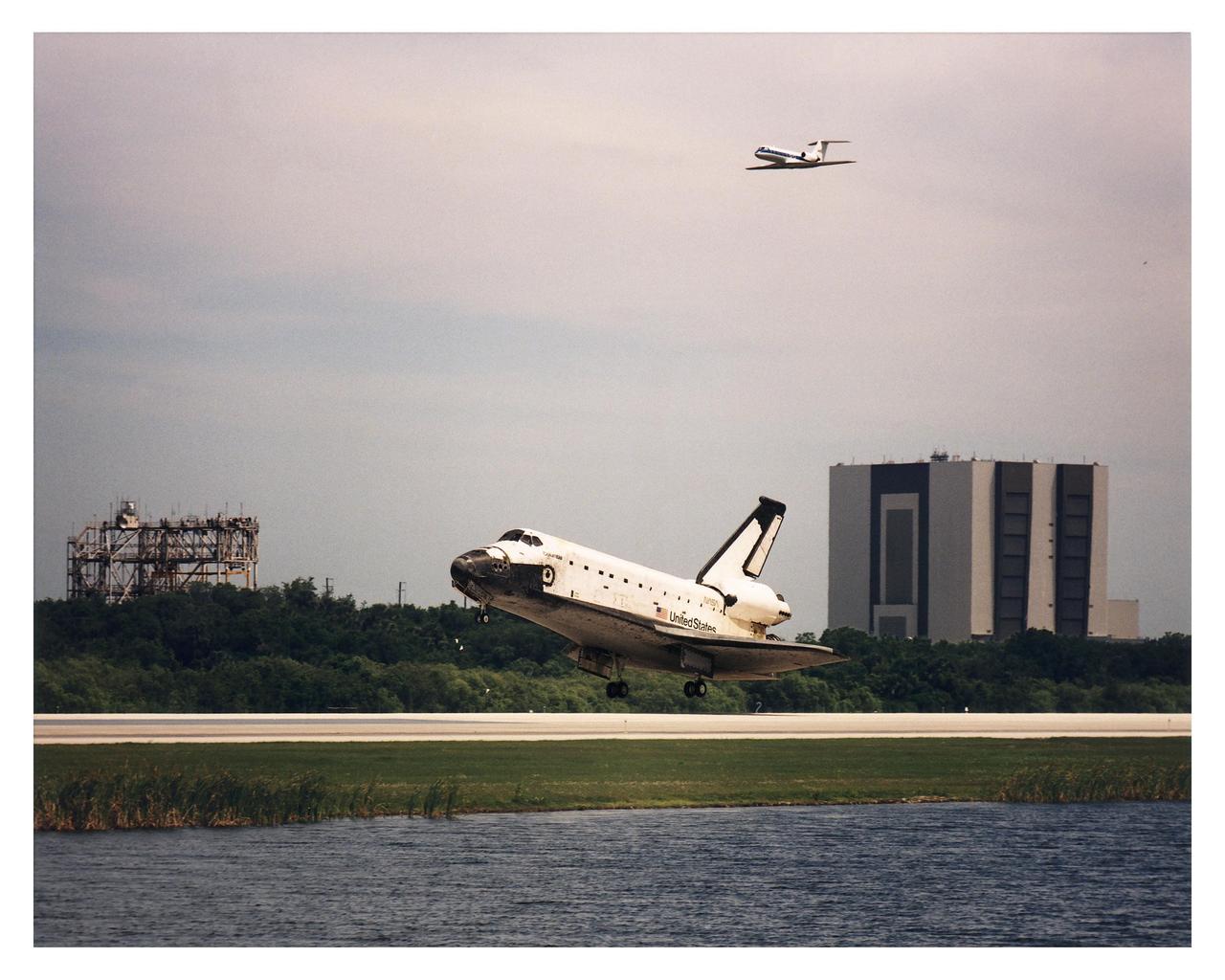
KENNEDY SPACE CENTER, FLA. -- The Space Shuttle Orbiter Columbia glides in for a touchdown on Runway 33 at KSC’s Shuttle Landing Facility that will conclude the Microgravity Science Laboratory-1 (MSL-1) mission. Columbia was scheduled to touch down at 2:33 p.m. EDT, April 8. The Vehicle Assembly Building (VAB) is to the right, while the Mate/Demate Device (MDD) is to the left. A NASA Shuttle Training Aircraft (STA) that acts as a chase plane during landings passes by overhead. With Columbia’s on-time main gear touchdown, the STS-83 mission duration will be 3 days, 23 hours, 12 minutes. The planned 16-day mission was cut short by a faulty fuel cell. This is only the third time in Shuttle program history that an orbiter was brought home early due to mechanical problems. This was also the 36th KSC landing since the program began in 1981
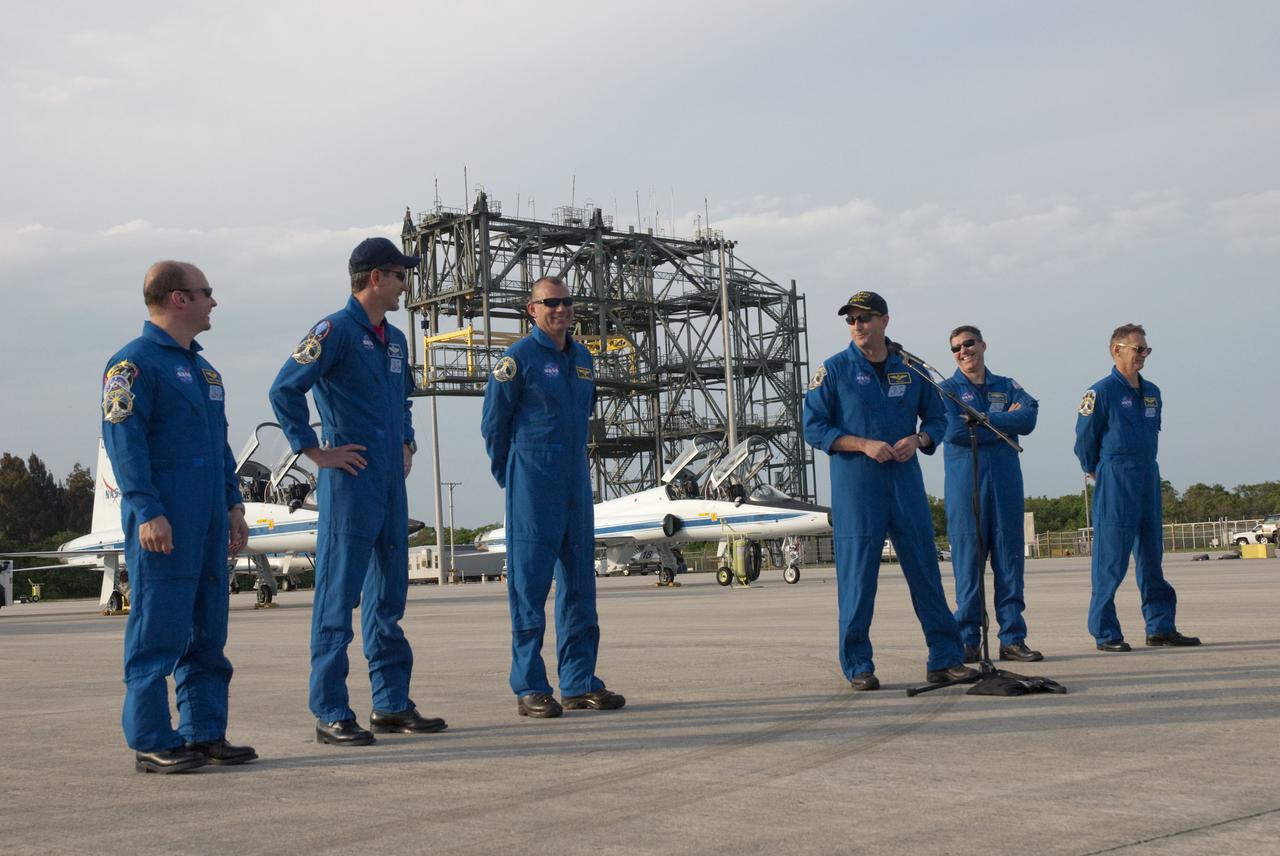
CAPE CANAVERAL, Fla. - At NASA's Kennedy Space Center in Florida, STS-132 Commander Ken Ham announces to media representatives gathered for his crew’s arrival for a practice launch dress rehearsal called the Terminal Countdown Demonstration Test, or TCDT, that Pilot Tony Antonelli has recently been promoted to the rank of captain in the U.S. Navy. From left are Mission Specialists Garrett Reisman and Michael Good; Antonelli; Ham, at the microphone; and Mission Specialists Steve Bowen and Piers Sellers. In the background is a mate-demate device, used to lift the shuttle on or off the back of a Shuttle Carrier Aircraft. The STS-132 crew arrived at Kennedy’s Shuttle Landing Facility at 6:11 p.m. EDT aboard four T-38 jets. TCDT provides each shuttle crew and launch team with an opportunity to participate in various simulated countdown activities, including equipment familiarization and emergency training. On the STS-132 mission, the six-member crew will deliver an Integrated Cargo Carrier, or ICC, and the Russian-built Mini-Research Module-1, or MRM-1, to the International Space Station aboard space shuttle Atlantis. The ICC is an unpressurized flat bed pallet and keel yoke assembly used to support the transfer of exterior cargo from the shuttle to the space station. The MRM-1, known as Rassvet, is the second in a series of new pressurized components for Russia and will be permanently attached to the Earth-facing port of the Zarya control module. Rassvet, which translates to 'dawn,' will be used for cargo storage and will provide an additional docking port to the station. STS-132 is the 34th mission to the station and the 132nd shuttle mission overall. Atlantis is targeted to launch on May 14 at 2:19 p.m. For information on the STS-132 mission, visit http:__www.nasa.gov_mission_pages_shuttle_shuttlemissions_sts132_index.html. Photo credit: NASA_Cory Huston