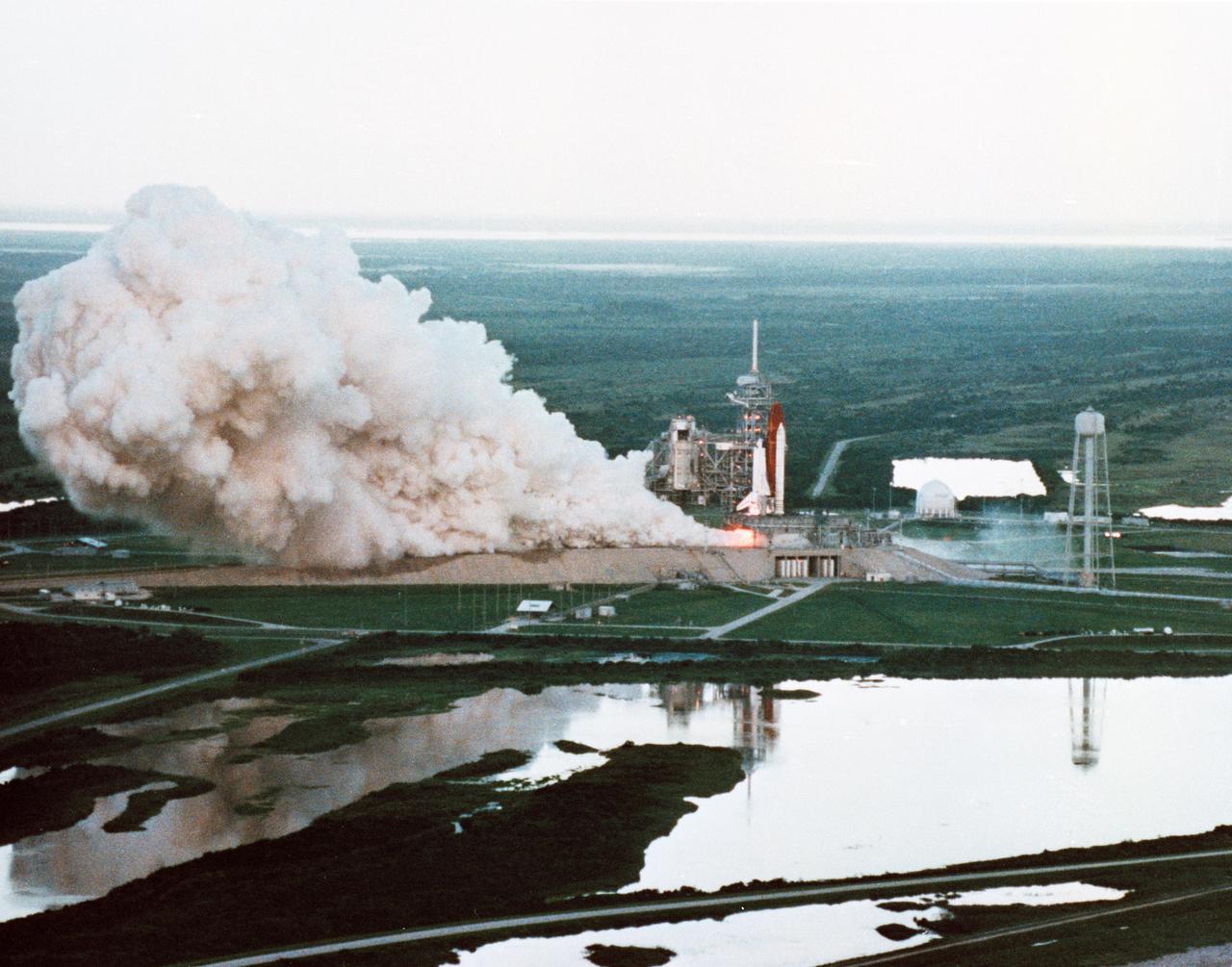
Documentary views of the STS-26 Flight Readiness Firing at KSC, Pad 39B, on 10 Aug 1988. (KSC-88PC-752 closer) (KSC-88PC-752, 753)
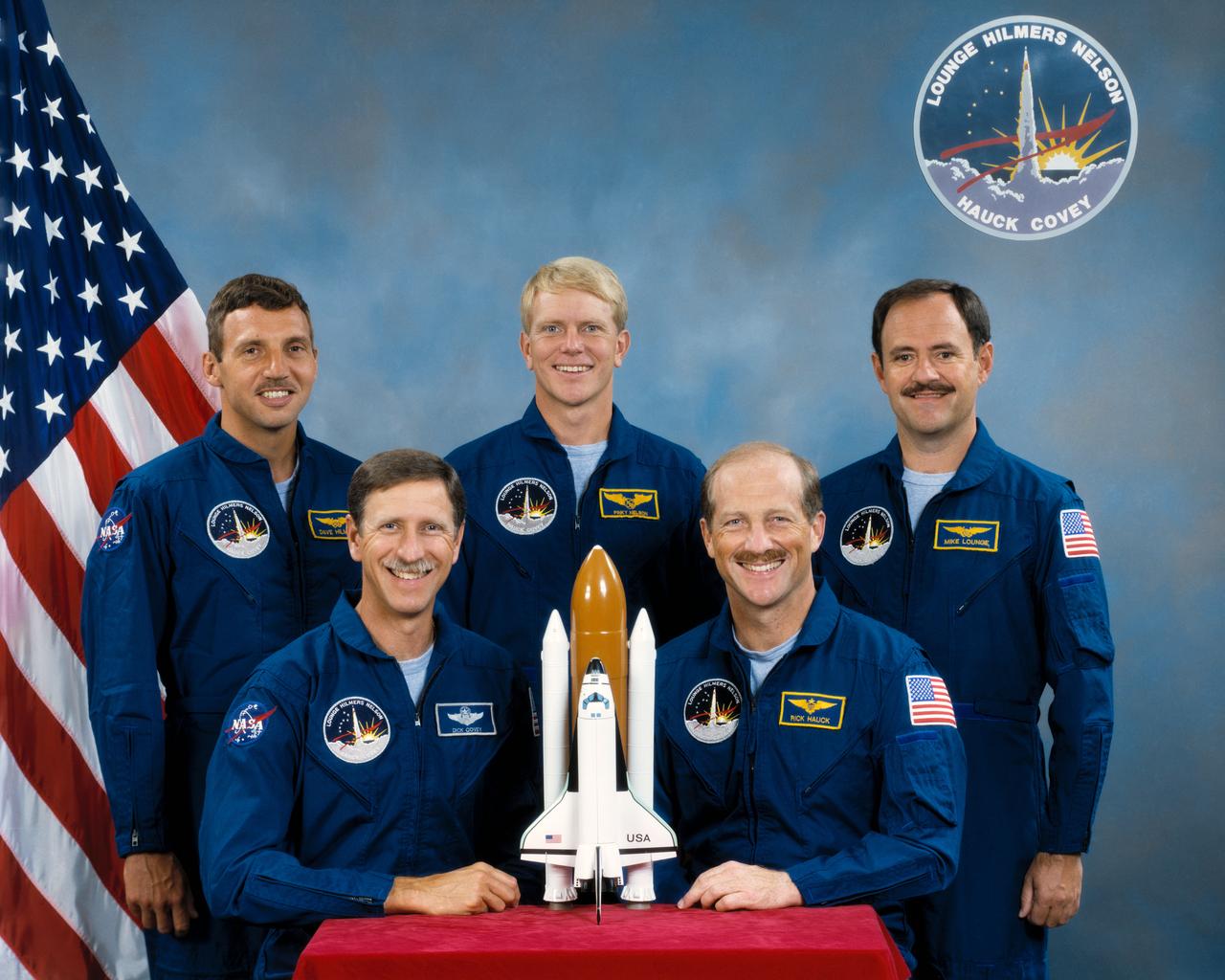
S87-40673 (September 1987) --- Astronauts Frederick H. (Rick) Hauck (right front), mission commander, and Richard O. Covey (left front), pilot, are flanked by NASA's STS-26 mission specialists (l.-r.) David C. Hilmers, George D. (Pinky) Nelson and John M. (Mike) Lounge.
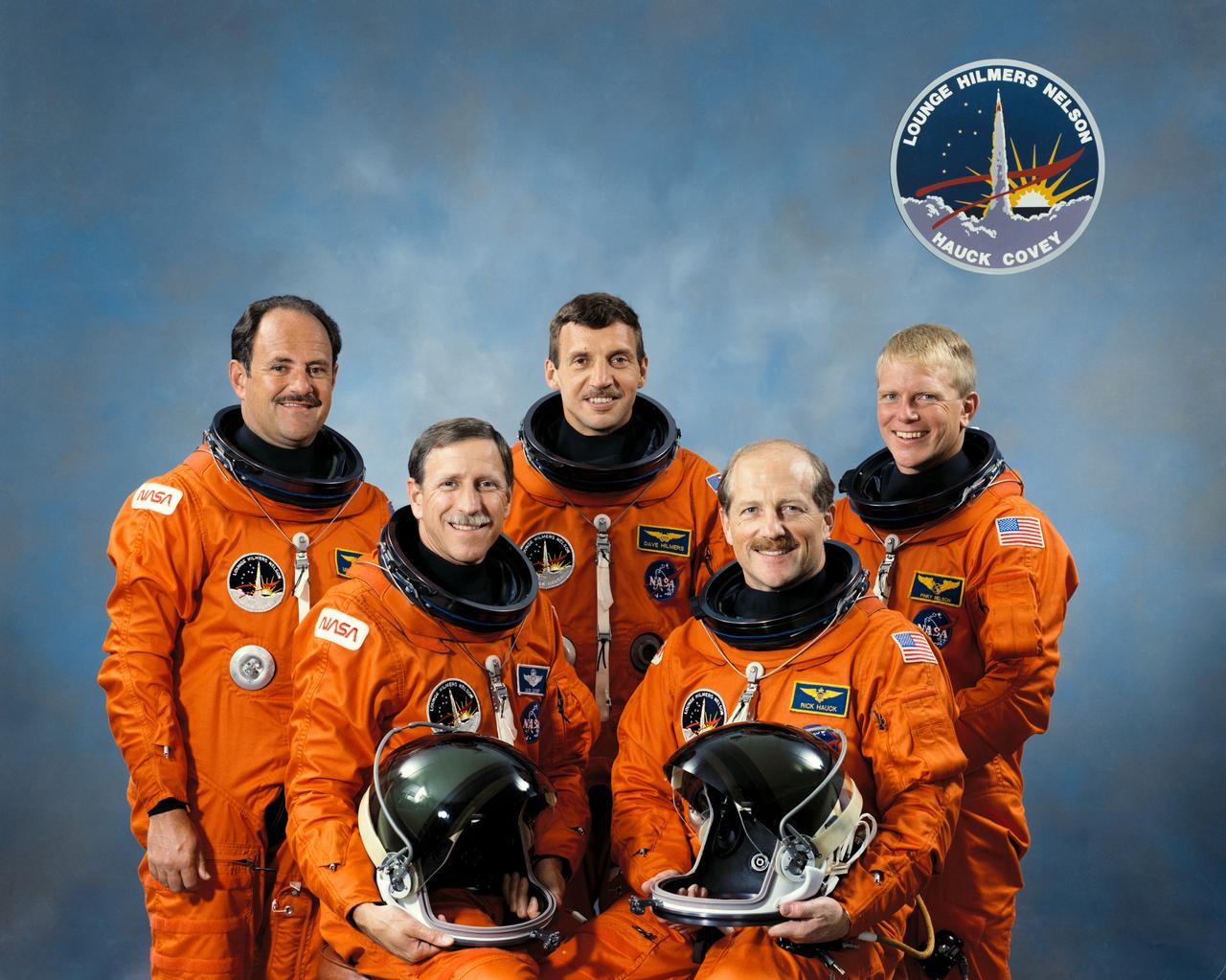
S88-47522 (10 Sept 1988) --- These five veteran astronauts have been training for over a year to serve as NASA's crew aboard the Space Shuttle Discovery for STS-26. On the front row are Astronauts Frederick H. (Rick) Hauck (right), commander; and Richard O. Covey, pilot. On the back row are Astronauts John M. (Mike) Lounge, David C. Hilmers and George D. Nelson -- all mission specialists. The crewmembers are wearing the orange partial pressure garments that they will be wearing on the launch and entry phases of the flight, scheduled for launch later this month.
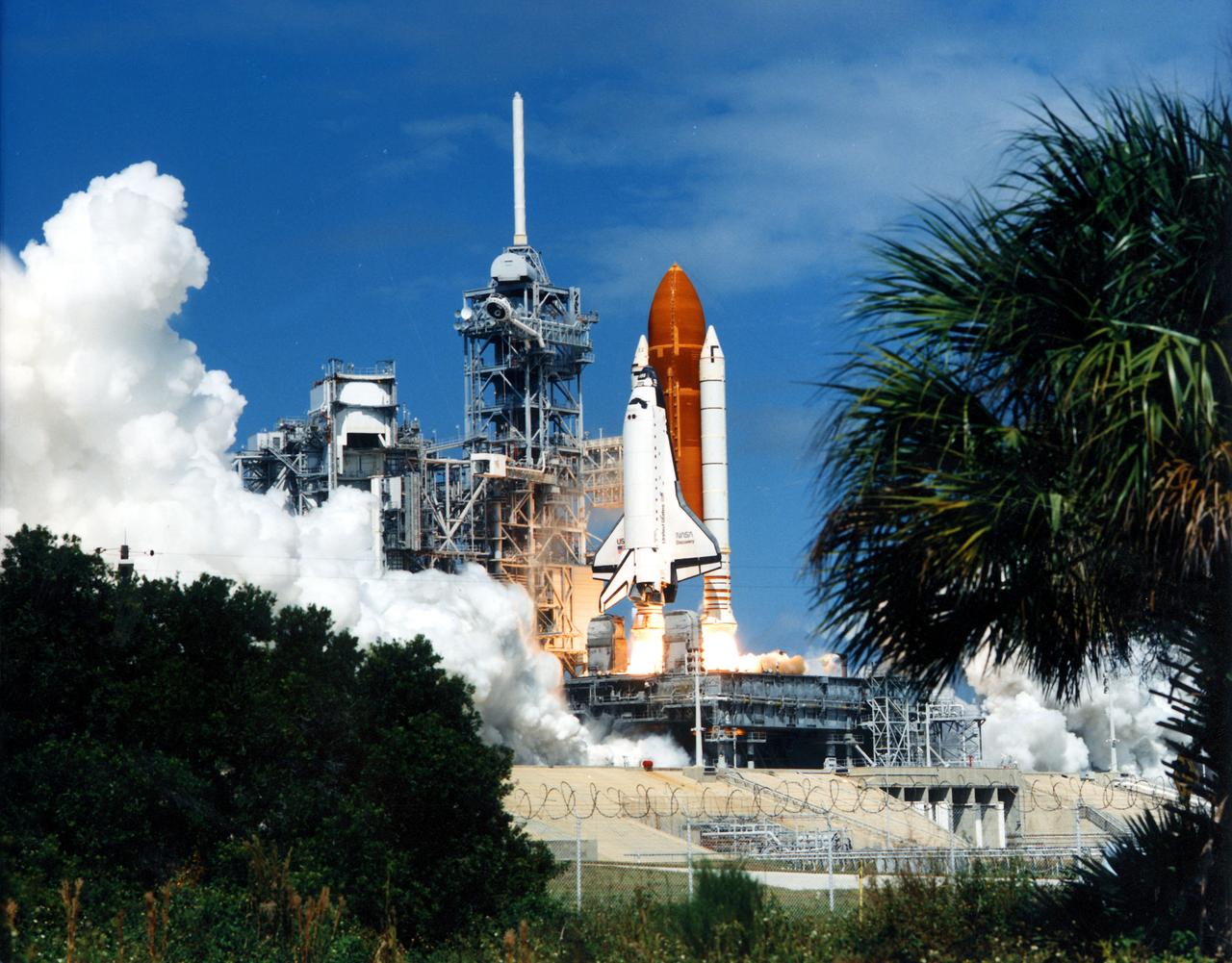
STS-26 Liftoff
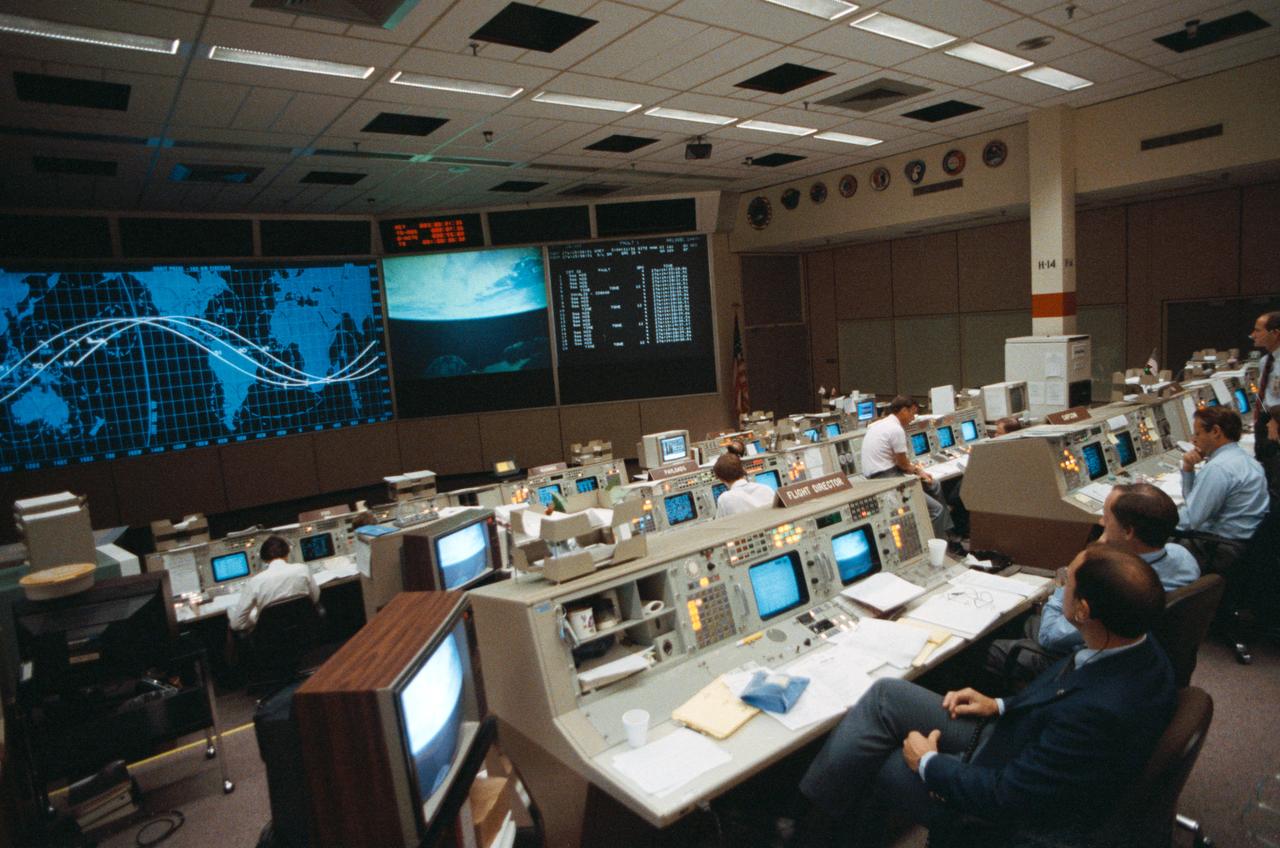
STS026-S-101 (2 Oct 1988) --- Flight controllers in the Johnson Space Center?s mission control center listen to a presentation by the five members of the STS 26 crew on the fourth day of Discovery?s orbital mission. Flight Directors Charles W. Shaw and James M. (Milt) Heflin (in the foreground) and other controllers view a television image of Earth on a screen in the front of the flight control room while each member relates some inner feelings while paying tribute to the Challenger crew.
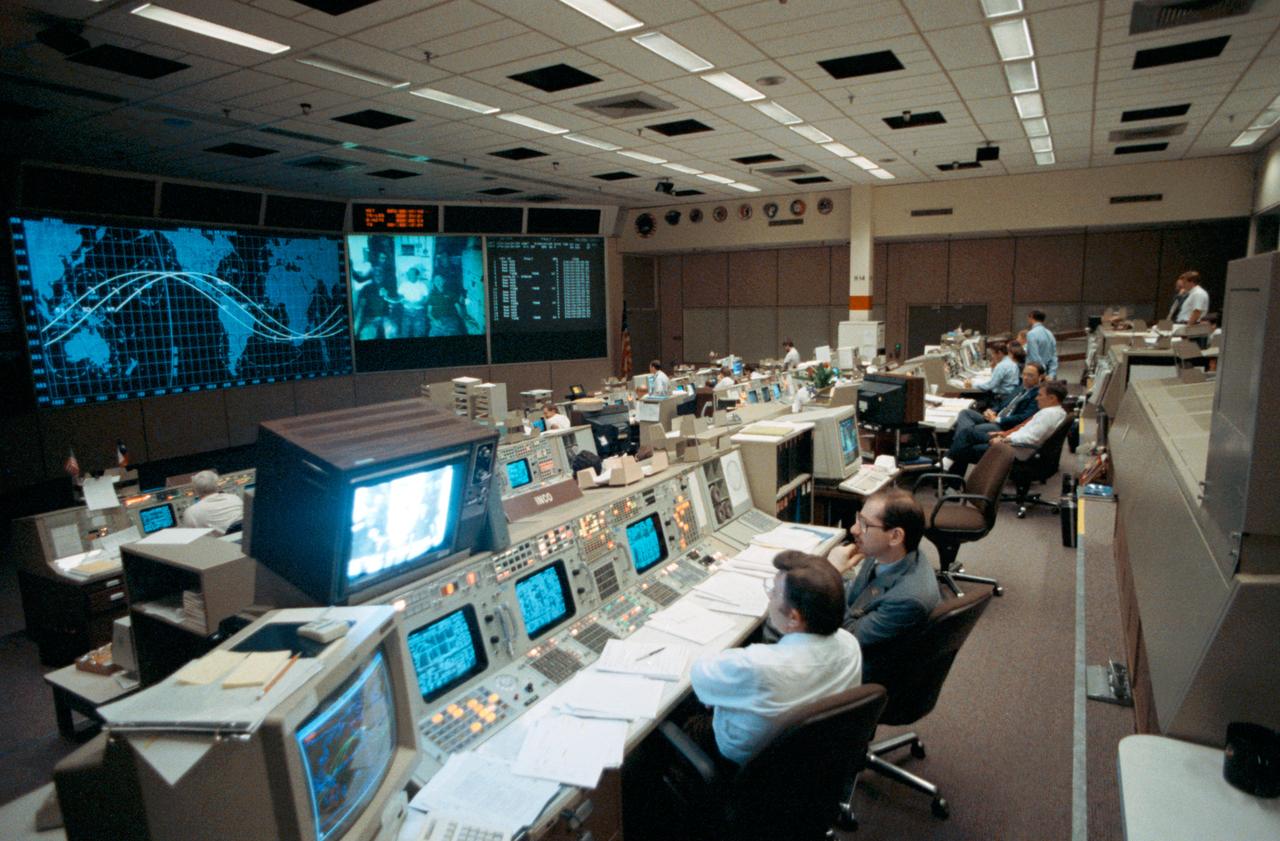
Flight controllers in JSC's Mission Control Center (MCC) Bldg 30 flight control room (FCR) listen to a presentation by STS-26 crewmembers on the fourth day of Discovery's, Orbiter Vehicle (OV) 103's, orbital mission. Instrumentation and Communications Officers (INCOs) Harold Black (left foreground) and John F. Muratore and other controllers view a television (TV) transmission of the crew on a screen in front of the FCR as each member relates some inner feelings while paying tribute to the 51L Challenger crew.
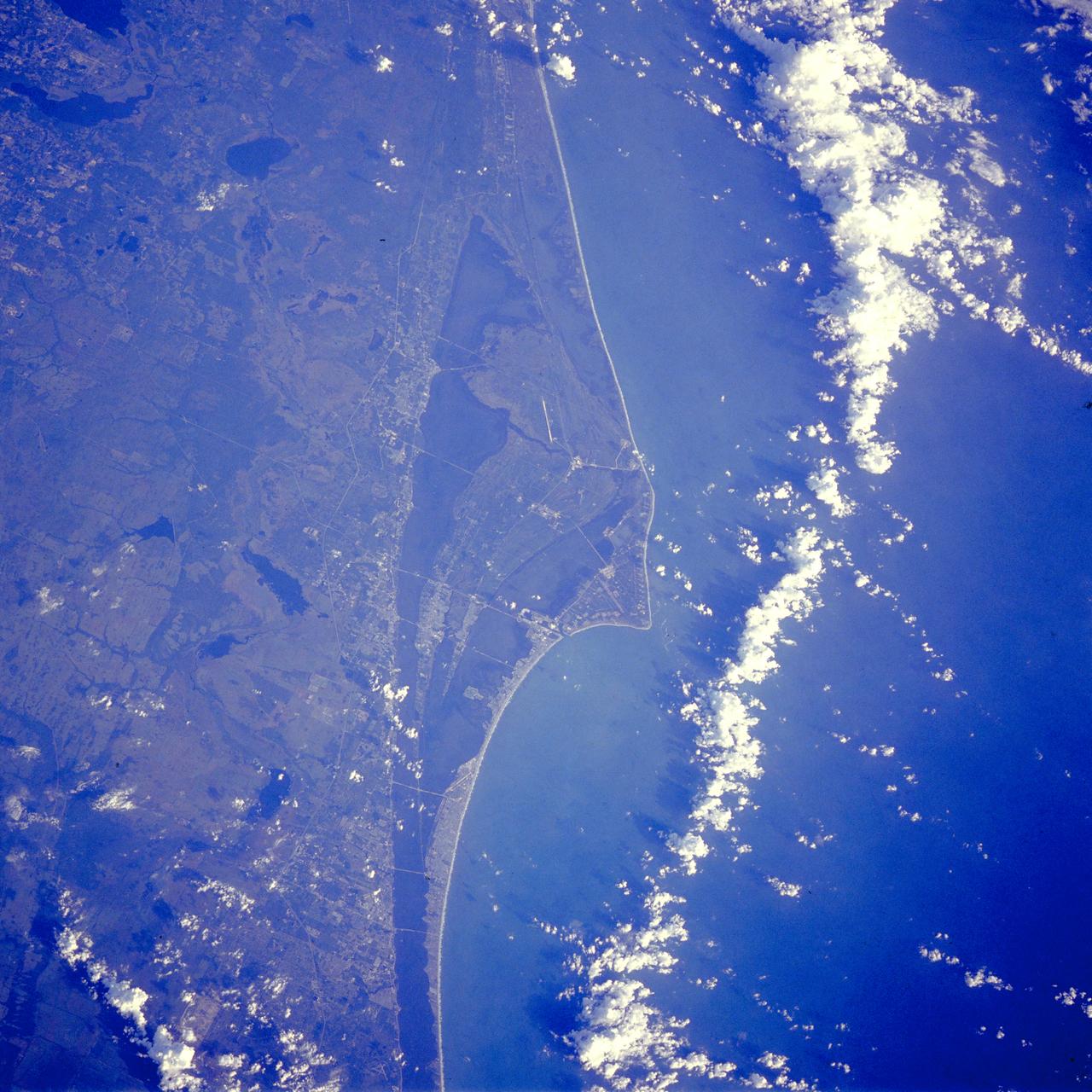
STS-26 ONBOARD - The Kennedy Space Center, Cape Canaveral, and most of Brevard County, Florida, are clearly visible in this photo taken by the crew of the orbiter Discovery while in orbit during space shuttle mission STS-26.
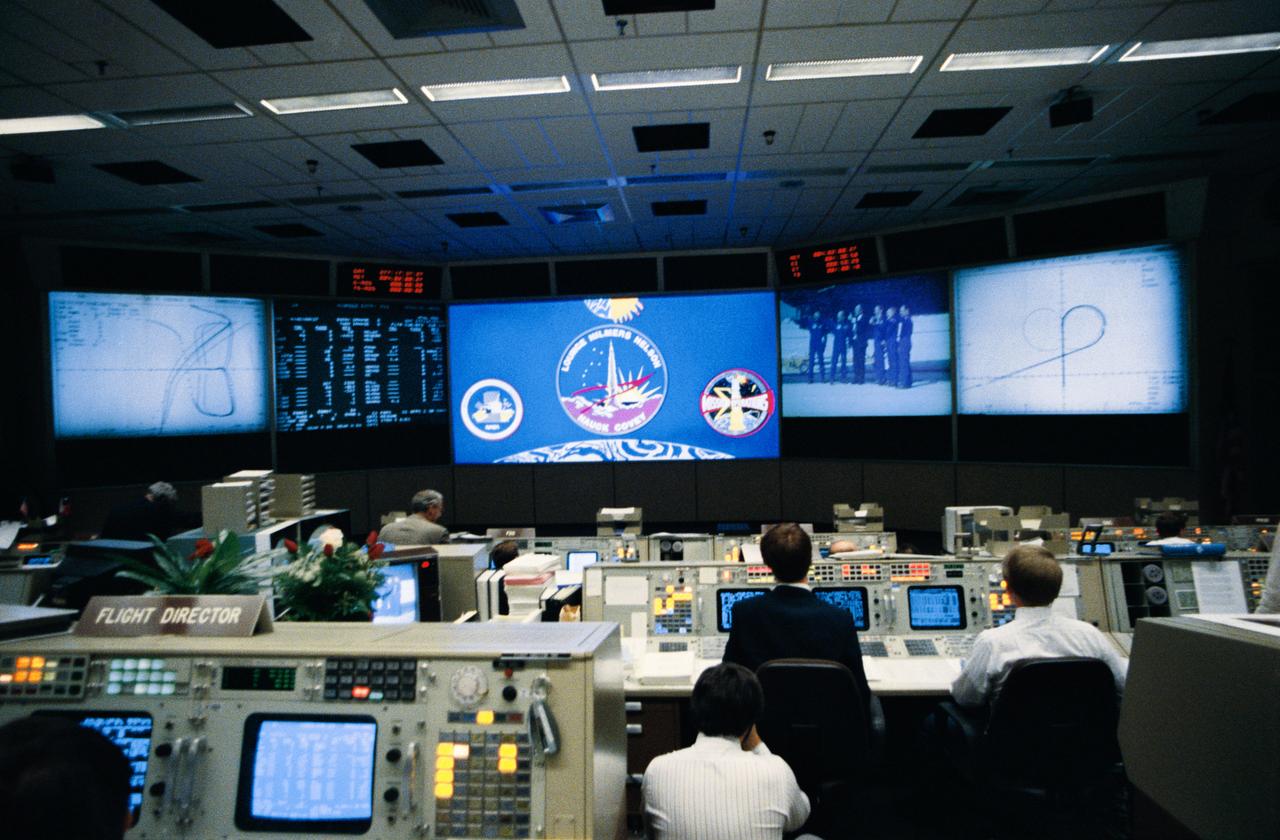
JSC Mission Control Center (MCC) Bldg 30 flight control room (FCR) personnel monitor STS-26 post landing activities and ceremonies at Edwards Air Force Base (EAFB) via their monitors. Displayed on front screens are approach and landing diagrams, data, the space shuttle program insignia, the STS-26 mission insignia, the Mission Operations Directorate insignia, and the STS-26 crew standing in front of Discovery, Orbiter Vehicle (OV) 103.
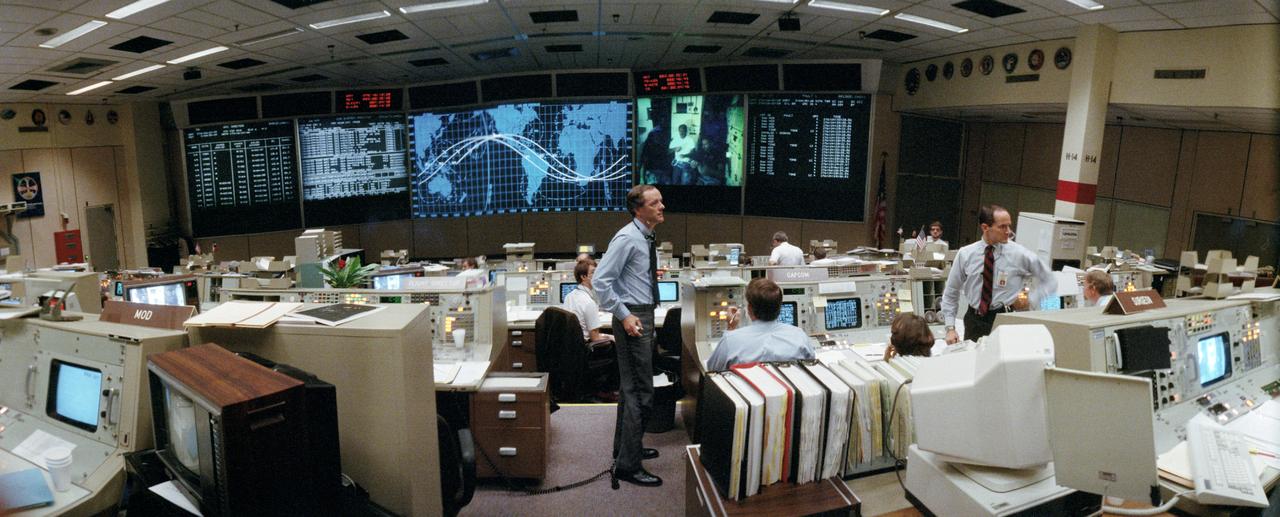
STS26-S-103 (2 October 1988) --- A wide-angle view of flight controllers in the Johnson Space Center's mission control center as they listen to a presentation by the five members of the STS-26 crew on the fourth day of Discovery's orbital mission. Flight Director James M. (Milt) Heflin (standing at center), astronaut G. David Low (standing at right), a spacecraft communicator, and other controllers view a television image of the crew on a screen in the front of the flight control room as each member relates some inner feelings while paying tribute to the Challenger crew.
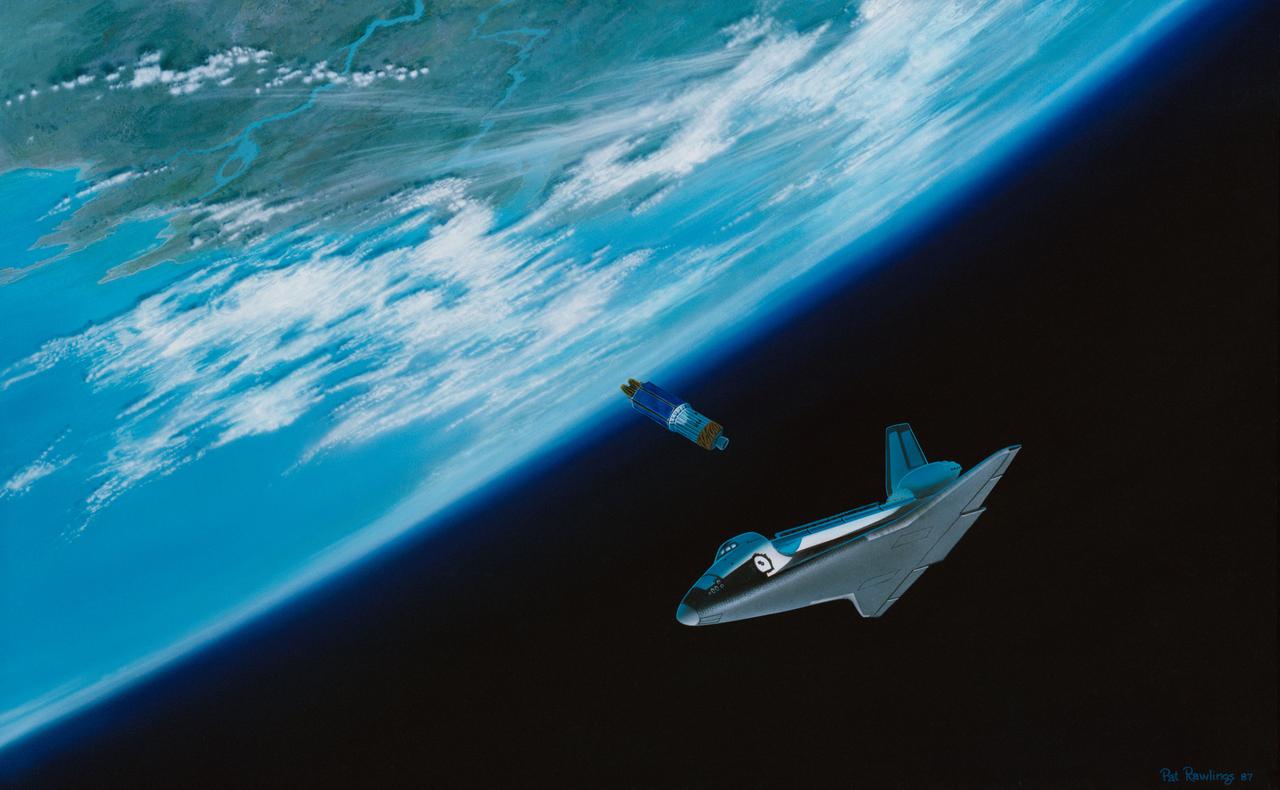
STS-26 Discovery, Orbiter Vehicle (OV) 103, artwork depicts tracking and data relay satellite C (TDRS-C) deployment. OV-103 orbits above Earth in bottom-to-sun attitude, moments after TDRS-C's release into space. TDRS-C is seen just below open payload bay (PLB). Artwork was done by Pat Rawlings of Eagle Engineering.
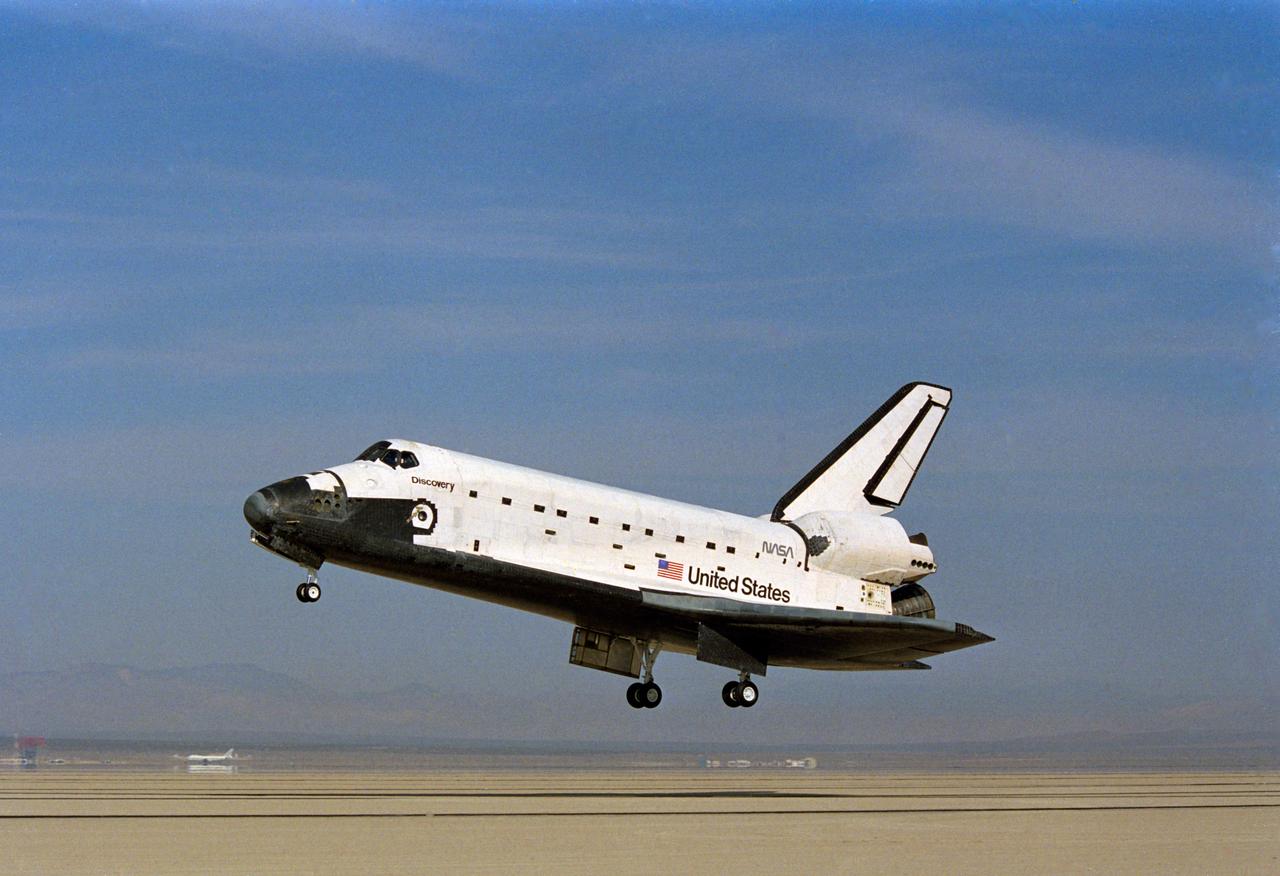
STS-26 Discovery, Orbiter Vehicle (OV) 103, with nose landing gear (NLG) and main landing gear (MLG) deployed glides above dry lakebed runway 17 at Edwards Air Force Base (EAFB), California. This profile view shows OV-103's port side just before MLG touchdown.
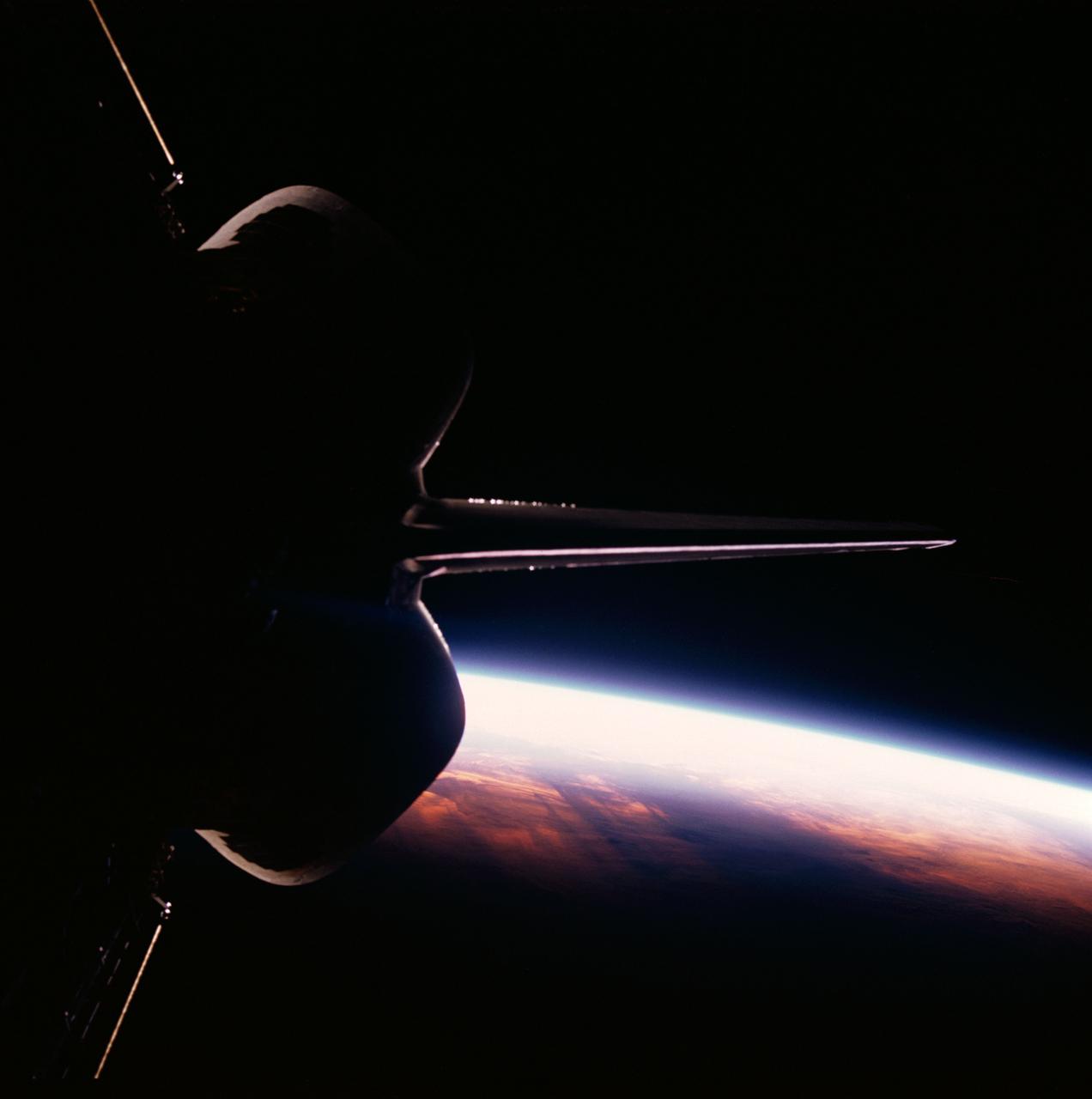
Discovery's, Orbiter Vehicle (OV) 103's, vertical stabilizer and orbital maneuvering system (OMS) pods are backdropped against the contrasted blackness of space illuminated by a colorful Earth / sunrise panorama. View was taken through the aft flight deck viewing windows during STS-26.
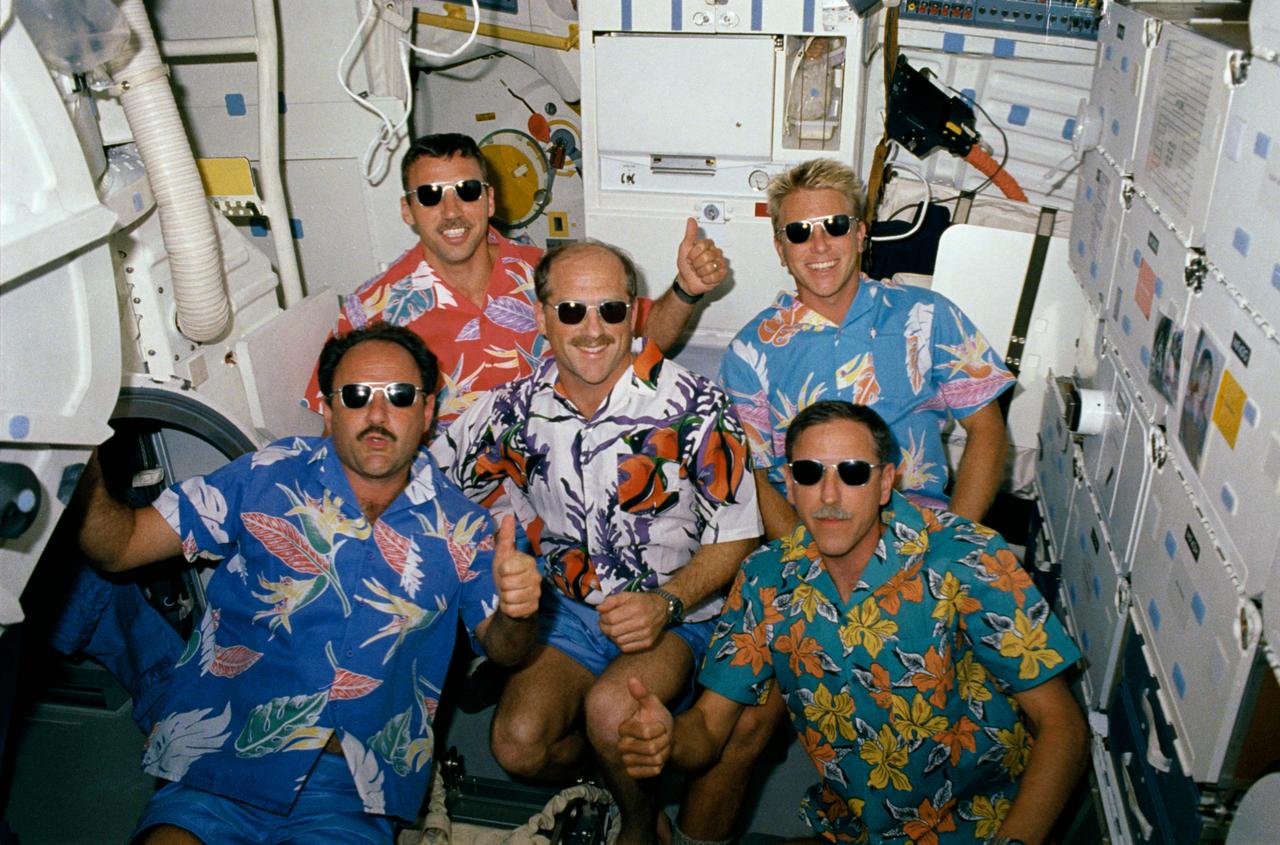
STS026-09-008 (3 Oct 1988) --- STS-26 crewmembers wear Hawaiian attire (brightly colored shirts with bold prints) and sunglasses while giving the "thumbs up" signal as they pay tribute to the Hawaii tracking station during an unscheduled television (TV) downlink. On Discovery's, Orbiter Vehicle (OV) 103's, middeck are (left to right) Mission Specialist (MS) John M. Lounge, holding onto open airlock hatch, MS David C. Hilmers, wearing red shirt, Commander Frederick H. Hauck, wearing white shirt and positioned in center of crew, MS George D. Nelson, and Pilot Richard O. Covey (lower right corner of the frame). The shirts were given to the crewmembers by the Kennedy Space Center (KSC) Loud and Proud Team.
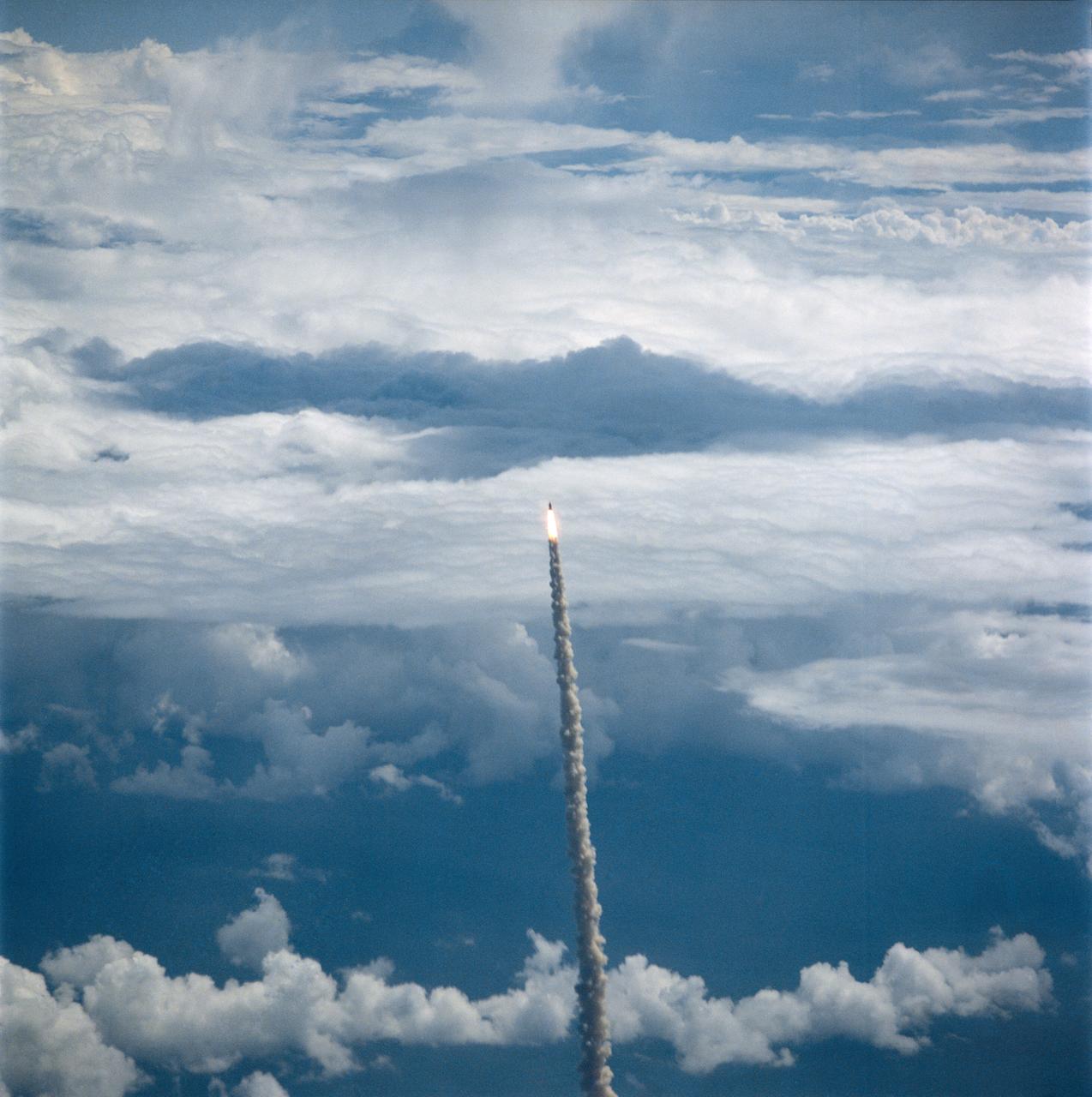
S26-S-026 (29 Sept. 1988) --- The STS-26 launch was captured on film from the NASA Shuttle Training Aircraft, piloted by astronaut Daniel C. Brandenstein, chief of JSC's Astronaut Office. Discovery?s mission was the first flight to be flown after the Challenger accident. The flight crew included astronauts Rick Hauck, commander; Dick Covey, pilot; and three mission specialists, Dave Hilmers, Mike Lounge, and George (Pinky) Nelson. During the four-day mission, the crew deployed the Tracking and Data Relay Satellite (TDRS-C) and operated eleven mid-deck experiments. Discovery completed 64 orbits of the earth before landing at Edwards Air Force Base, California, on October 3, 1988. Photo credit: NASA or National Aeronautics and Space Administration
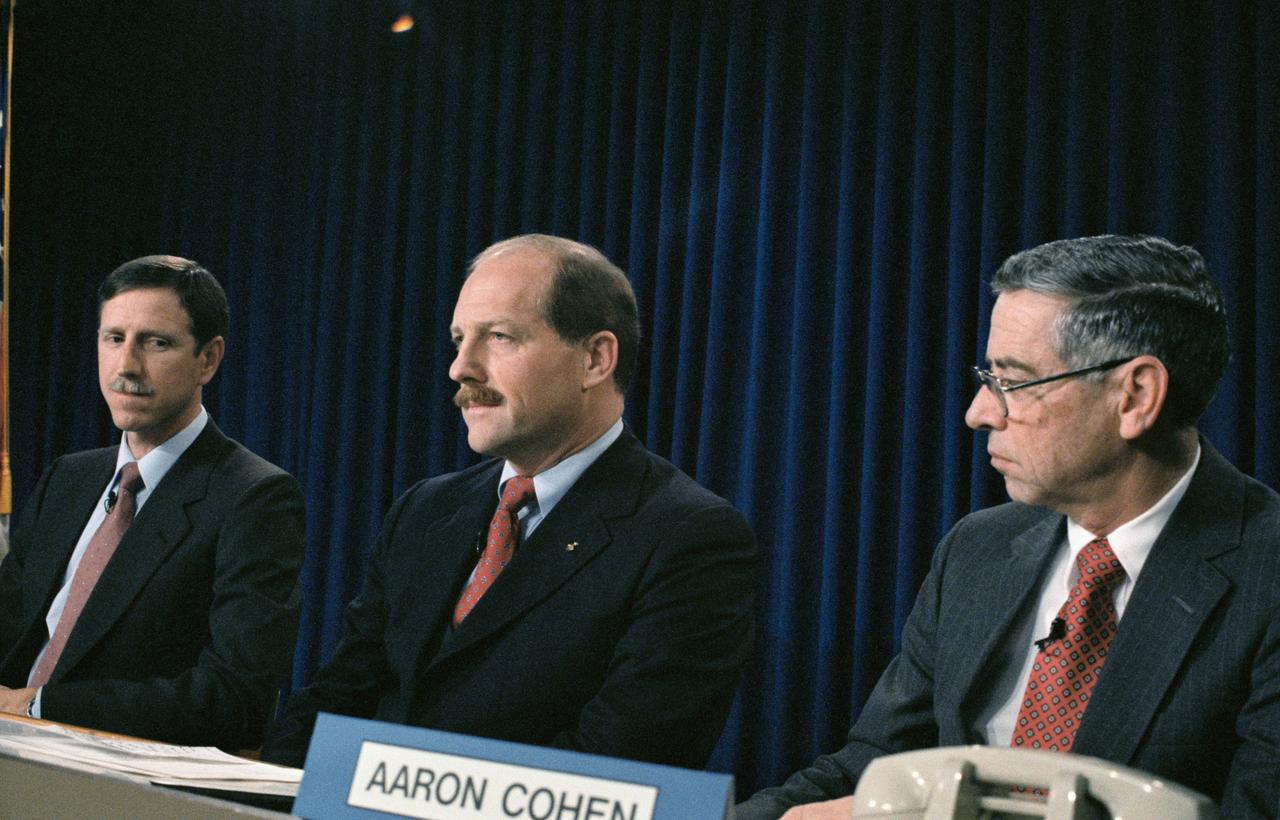
STS-26 Discovery, Orbiter Vehicle (OV) 103, crew including Commander Frederick H. Hauck and Pilot Richard O. Covey and JSC Director Aaron Cohen participate in press conference held at JSC Auditorium and Public Affairs Facility Bldg 2. Hauck and Covey are shown with Cohen as they ponder queries from news media representatives during the first press conference for the group since the mission's announcement last week. Left to right are Covey, Hauck, and Cohen.
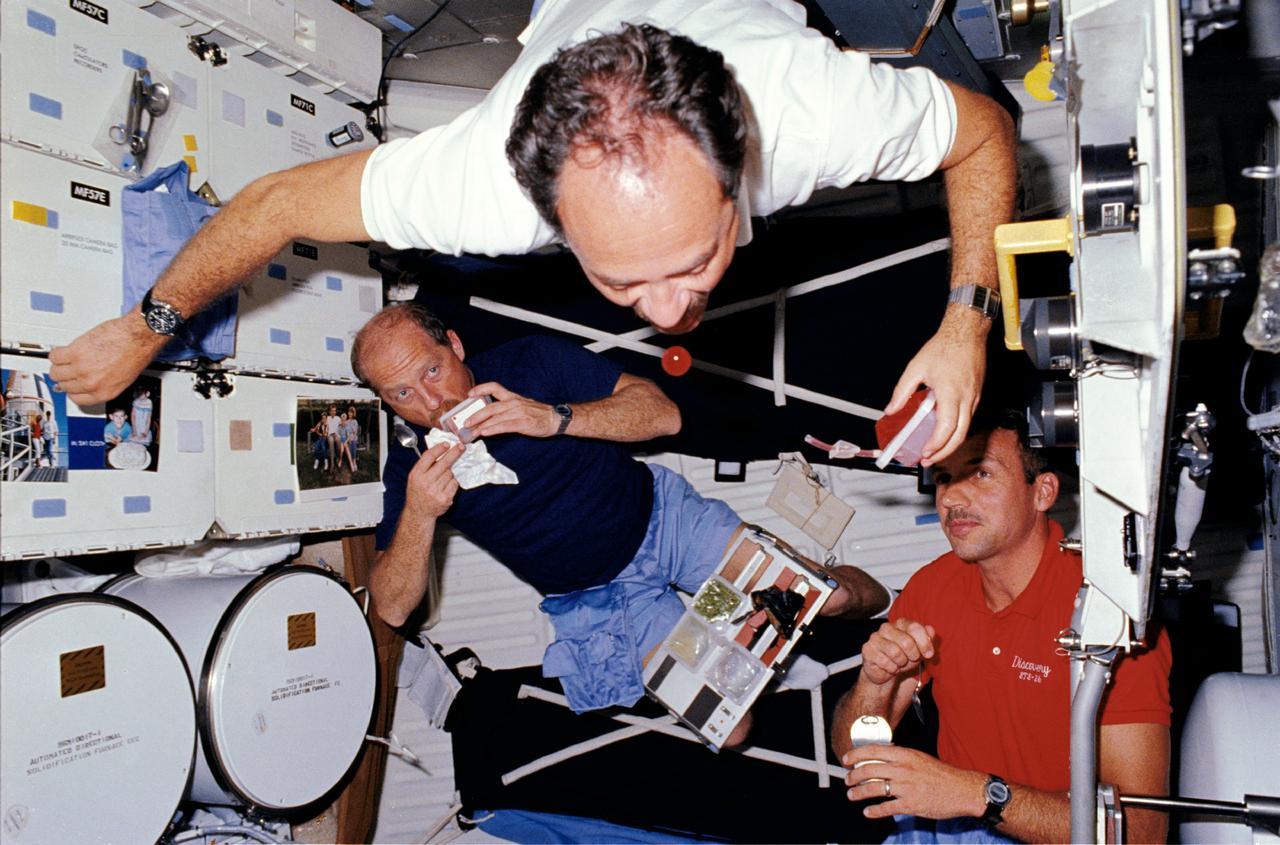
STS026-06-018 (29 Sept. - 3 Oct. 1988) --- Astronaut John M. Lounge, STS-26 mission specialist (MS), using a beverage container, experiments with microgravity as Commander Frederick H. Hauck (left) and MS David C. Hilmers (right) look on. Lounge freefloats as he closes in on a sphere of the red liquid drifting in front of his mouth. Hauck holds a spoon while sipping from a beverage container as he balances a meal tray assembly on his thighs. Hilmers, partially blocked by the open airlock hatch and holding a spoon and a can of food, pauses to watch the experiment. Automated Directional Solidification Furnace (ADSF) and forward middeck lockers appear on Lounge's right.
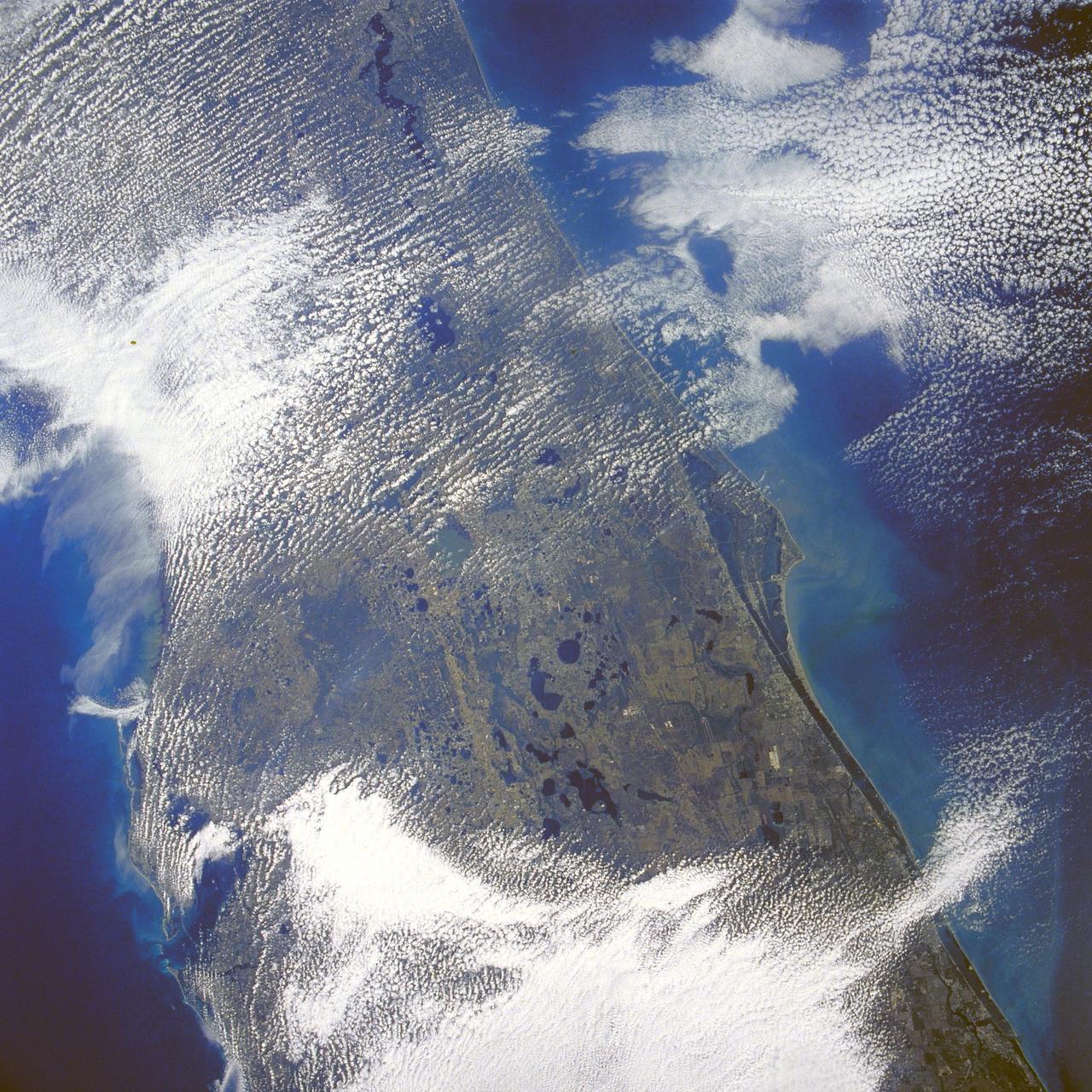
The Kennedy Space Center, Cape Canaveral, and most of Brevard County, Florida, are clearly visible in this photo taken by the crew of the orbiter Discovery while in orbit during space shuttle mission STS-26.
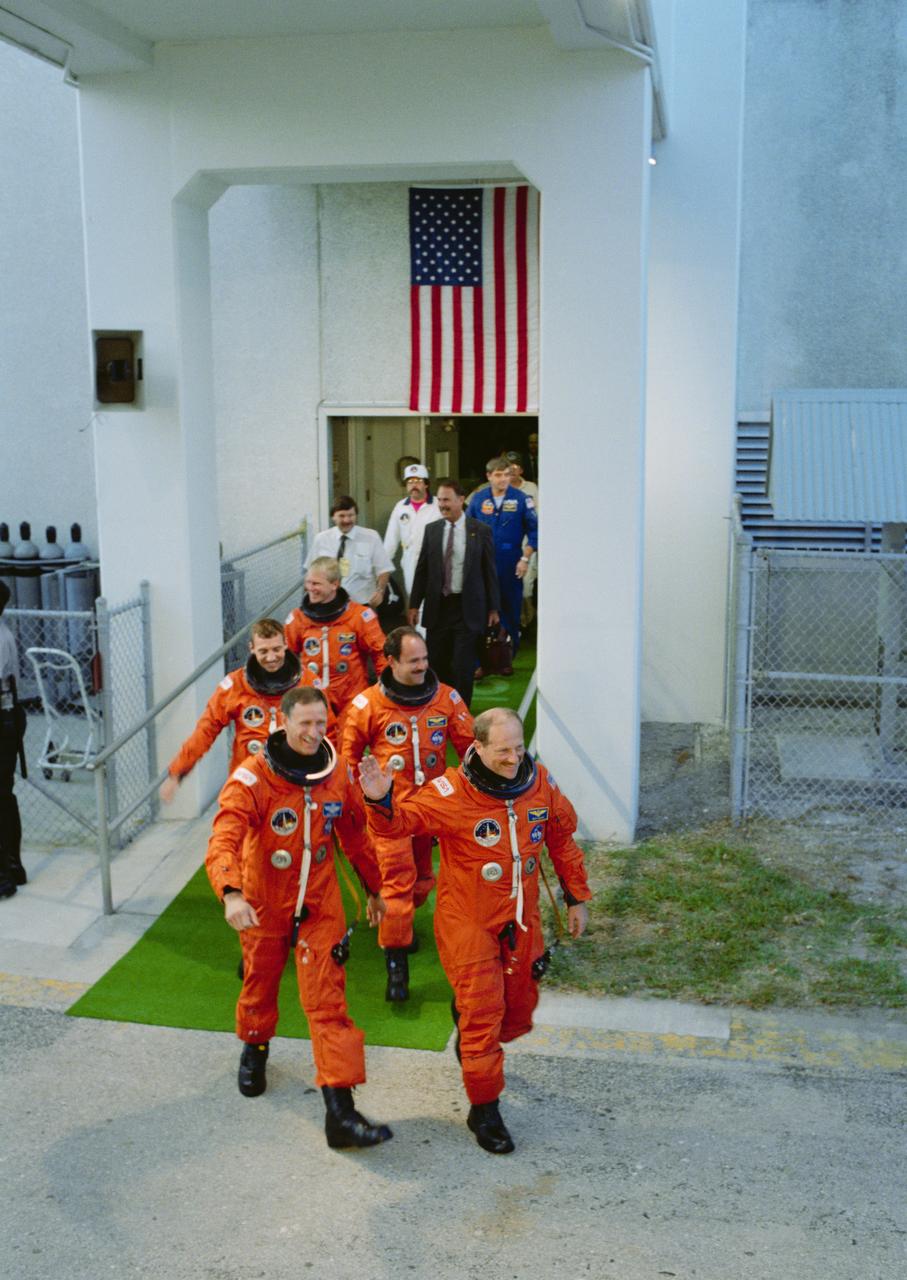
STS-26 crewmembers, suited in launch and entry suits (LESs), leave the Kennedy Space Center (KSC) Operations and Checkout (O&C) Building on their way to the launch complex (LC) pad 39B where they will board Discovery, Orbiter Vehicle (OV) 103. Commander Frederick H. Hauck, waving to spectators, is followed by Pilot Richard O. Covey, Mission Specialist (MS) John M. Lounge, MS David C. Hilmers, and MS George D. Nelson. Others accompanying the crew are JSC Flight Crew Operations Directorate (FCOD) Director Donald R. Puddy, Astronaut Office Chief Daniel C. Brandenstein, and a Crew Training Officer Richard W. Nygren.
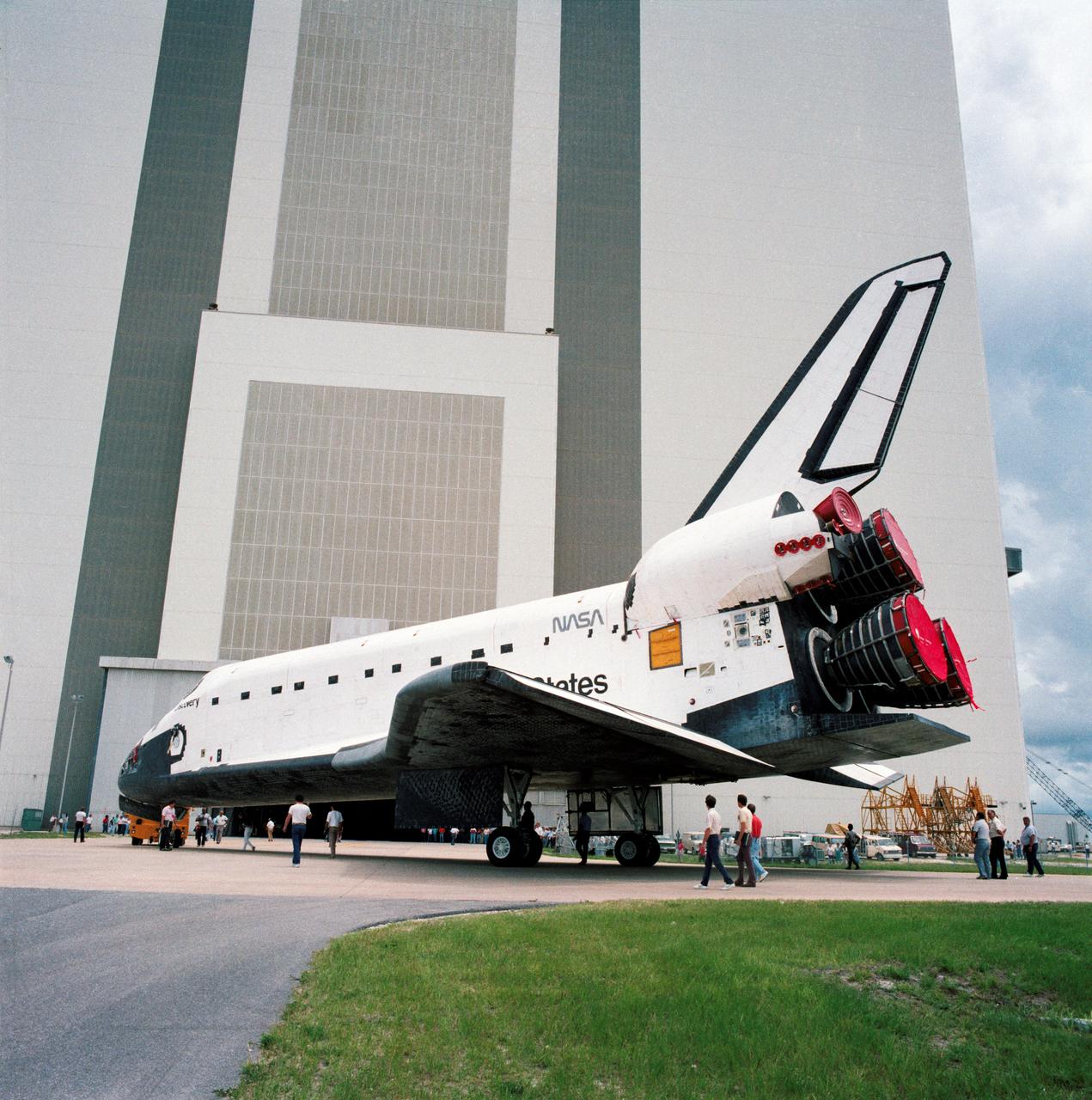
S88-42092 (15 July 1988) --- STS-26 Discovery, Orbiter Vehicle (OV) 103, rollover at Kennedy Space Center (KSC) is closely monitored by engineers and technicians in the late stages of the move from the orbiter processing facility (OPF) to the vehicle assembly building (VAB) as preflight preparations continue. A large crowd of KSC employees and other spectators watches in the background as OV-103, supported by its landing gear, is pulled toward VAB (background). While in the VAB, OV-103 will be mated to two solid rocket boosters (SRBs) and an external fuel tank.
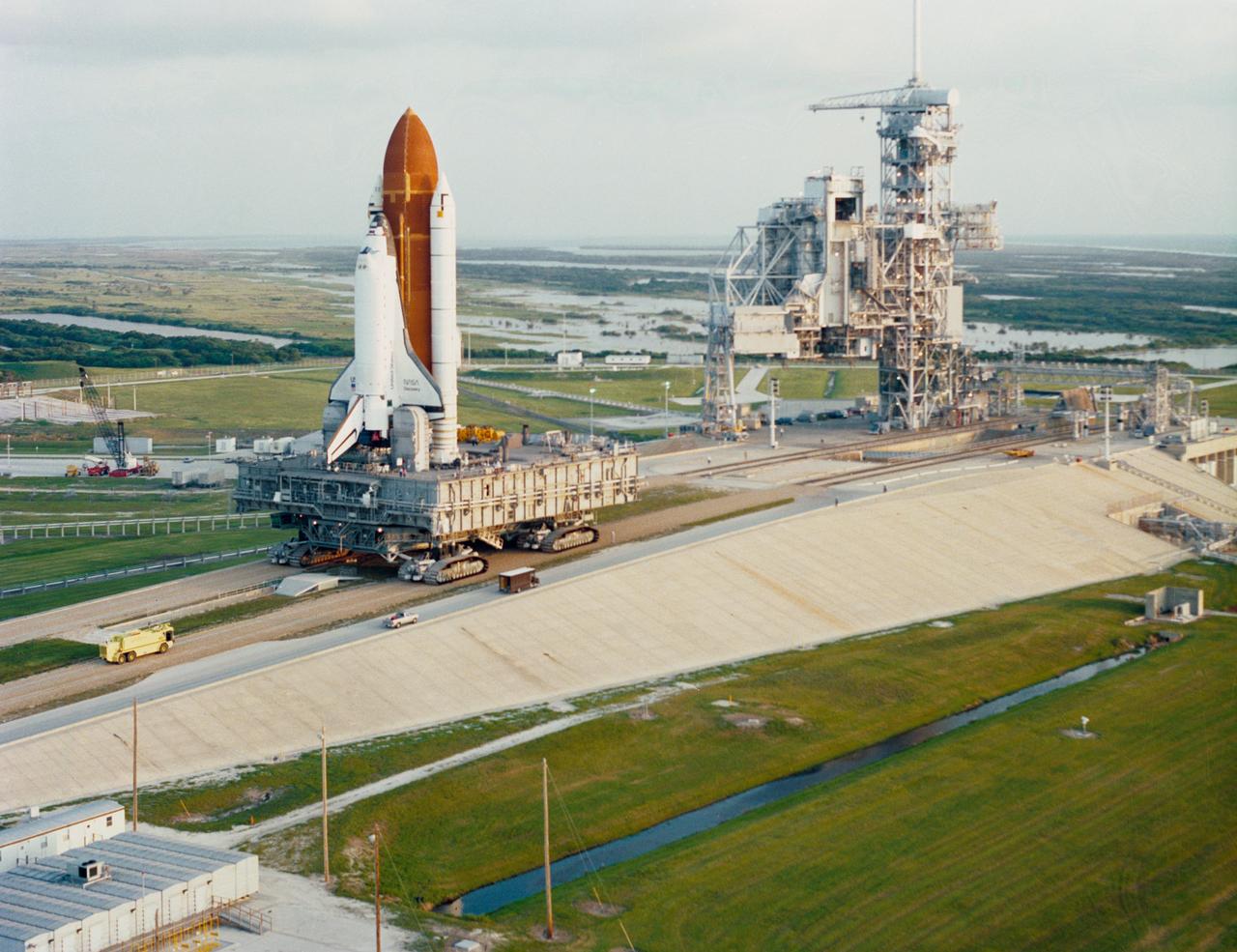
STS-26 Discovery, Orbiter Vehicle (OV) 103, rolls out to Kennedy Space Center (KSC) launch complex (LC) pad 39B on top of the crawler transporter. OV-103 nears LC pad 39B after a six-hour journey from the vehicle assembly building (VAB). When locked onto the nearby rotating service structure (RSS), work will continue to ready the vehicle for the STS-26 launch later in the summer.
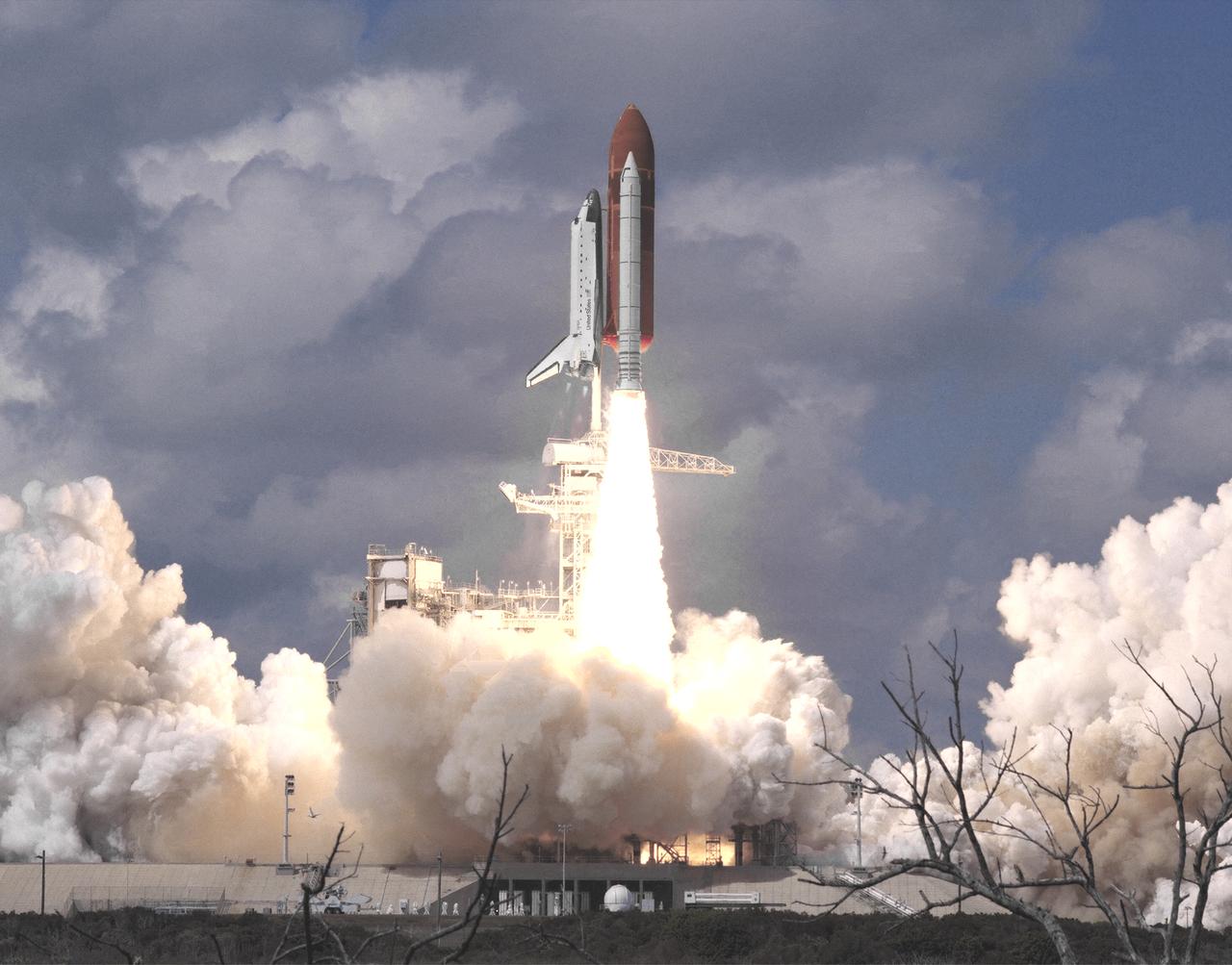
The Space Shuttle Discovery takes off from Launch Pad 39B at the Kennedy Space Center, Florida, to being Mission STS-26 on 29 September 1988,11:37:00 a.m. EDT. The 26th shuttle mission lasted four days, one hour, zero minutes, and 11 seconds. Discovery landed 3 October 1988, 9:37:11 a.m. PDT, on Runway 17 at Edwards Air Force Base, California. Its primary payload, NASA Tracking and Data Relay Satellite-3 (TDRS-3) attached to an Inertial Upper Stage (IUS), became the second TDRS deployed. After deployment, IUS propelled the satellite to a geosynchronous orbit. The crew consisted of Frederick H. Hauck, Commander; Richard O. Covey, Pilot; John M. Lounge, Mission Specialist 1; George D. Nelson, Mission Specialist 2; and David C. Hilmers, Mission Specialist 3.
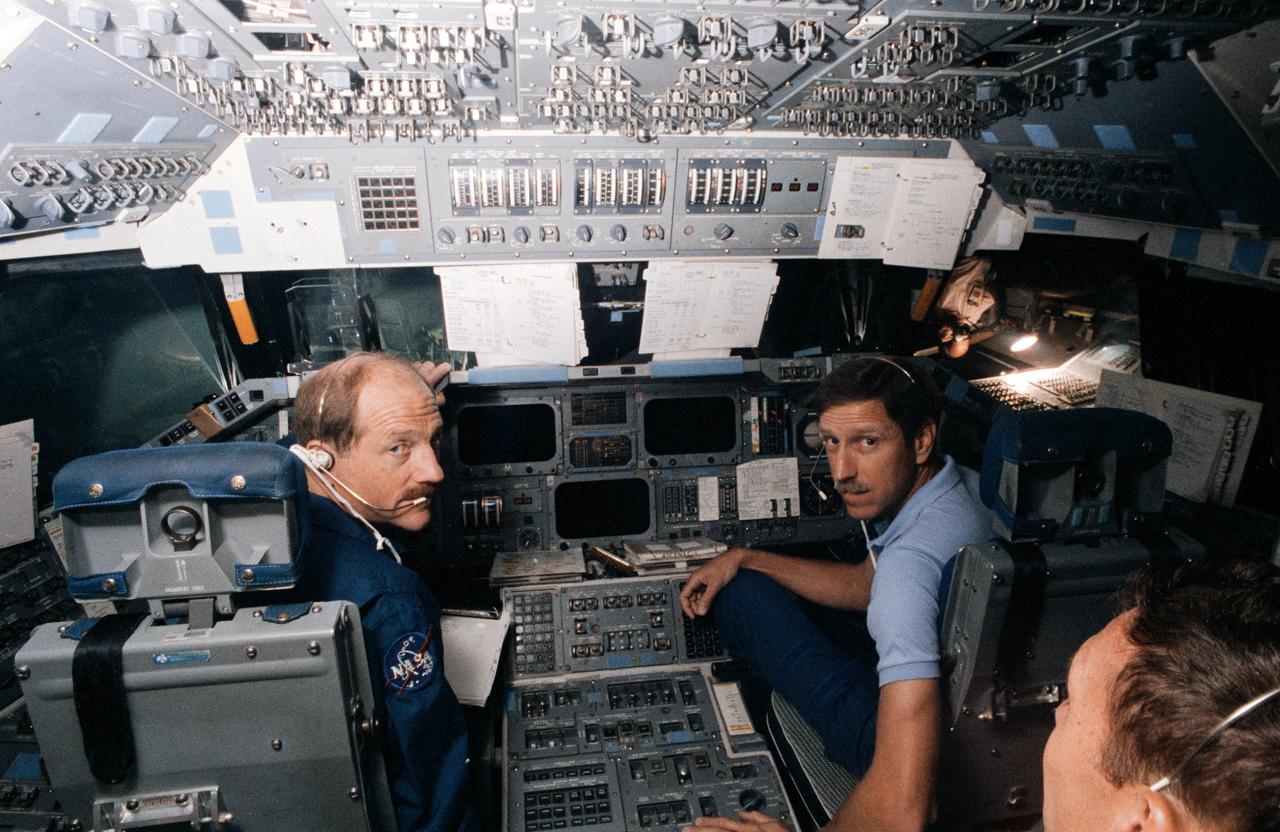
S87-46304 (20 Oct 1987) --- Astronauts Frederick H. (Rick) Hauck, left, STS-26 commander, and Richard O. Covey, pilot, man their respective stations in the Shuttle mission simulator (fixed base) at the Johnson Space Center. A simulation for their anticipated June 1988 flight aboard the space shuttle Discovery began Oct. 20. Astronaut David C. Hilmers, one of three mission specialists for the flight, is partially visible in the foreground.
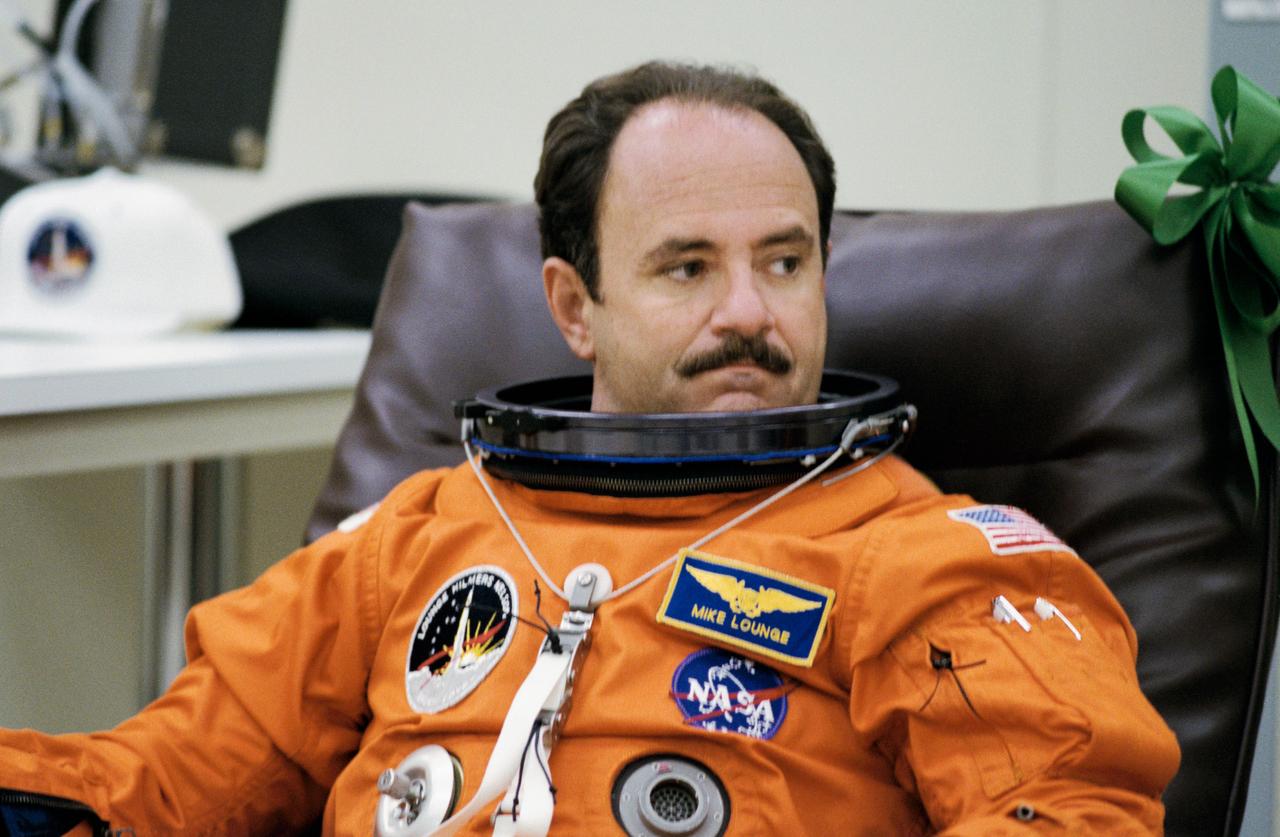
STS-26 Discovery, Orbiter Vehicle (OV) 103, Mission Specialist (MS) John M. Lounge relaxes in reclining chair after donning his orange launch and entry suit (LES) at the Kennedy Space Center (KSC) Operations and Checkout (O&C) Building. Upon completion of preflight suit tests, crewmembers will head to the launch pad.
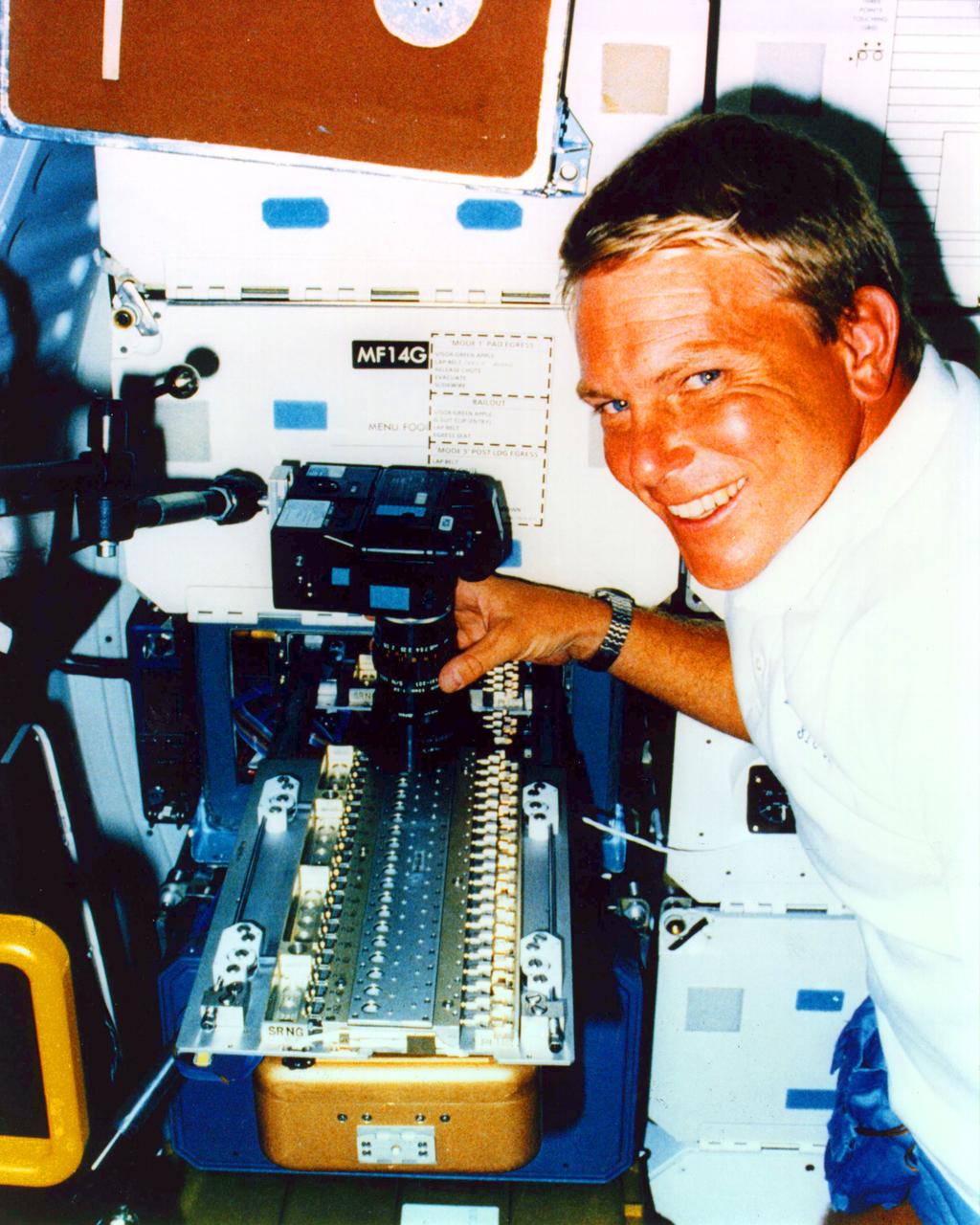
Mission Specialist George (Pinky) D. Nelson uses a 35 mm camera to photograph a protein crystal grown during the STS-26 Protein Crystal Growth (PCG-II-01) experiment. The protein crystal growth (PCG) carrier is shown deployed from the PCG Refrigerator/Incubator Mocule (R/IM) located in the middeck forward locker. The R/IM contained three Vapor Diffusion Apparatus (VDS) trays (one of which is shown). A total of sixty protein crystal samples were processed during the STS-26 mission.

ISS026-E-031101 (1 March 2011) --- Expedition 26 and STS-133 crew members pose for a photo in the newly-attached Permanent Multipurpose Module (PMM) of the International Space Station while space shuttle Discovery remains docked with the station. Pictured (clockwise from the lower left) are NASA astronauts Scott Kelly, Expedition 26 commander; Alvin Drew, Steve Bowen, Nicole Stott, all STS-133 mission specialists; Russian cosmonauts Oleg Skripochka and Alexander Kaleri, NASA astronaut Cady Coleman, Russian cosmonaut Dmitry Kondratyev, all Expedition 26 flight engineers; NASA astronaut Steve Lindsey, STS-133 commander; European Space Agency astronaut Paolo Nespoli, Expedition 26 flight engineer; NASA astronauts Eric Boe, STS-133 pilot; and Michael Barratt, STS-133 mission specialist.
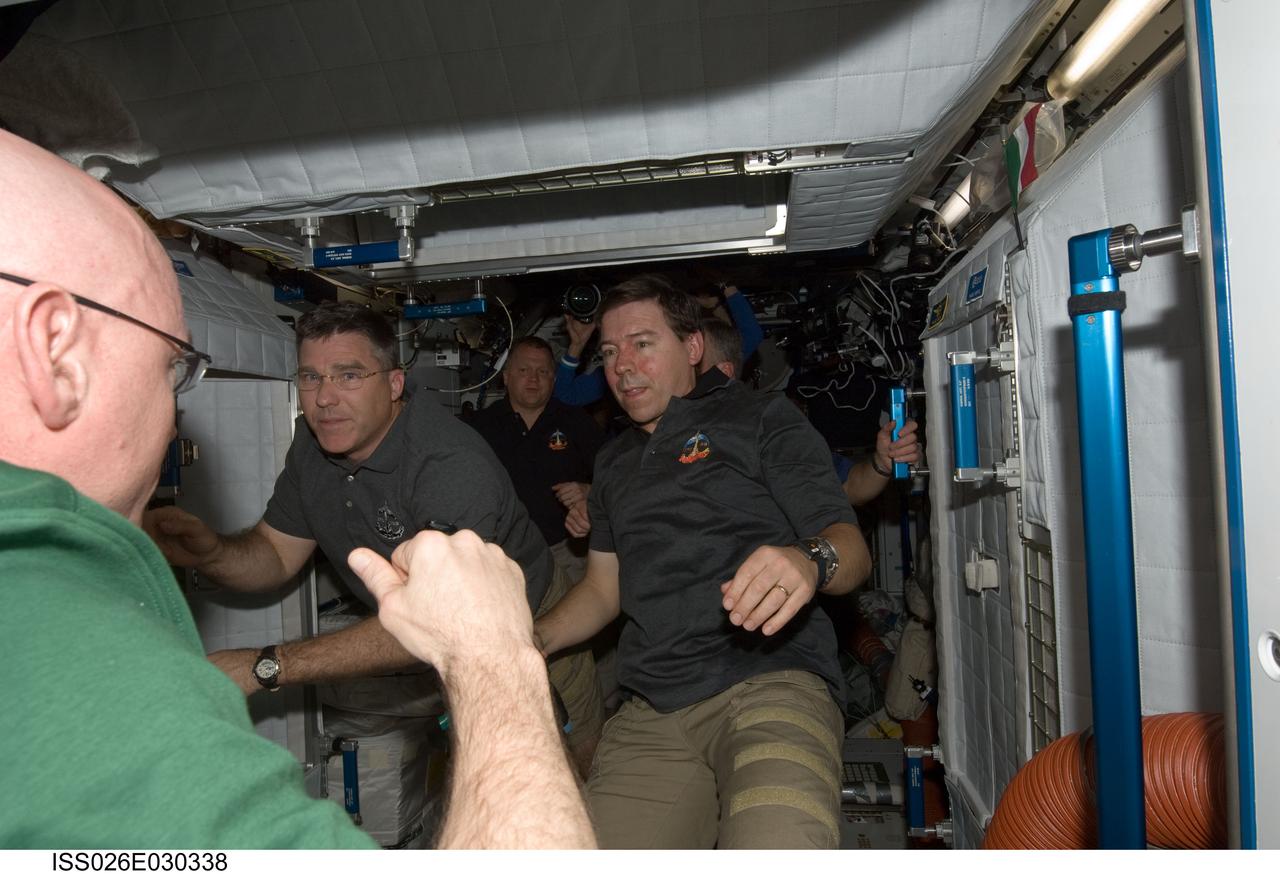
ISS026-E-030338 (26 Feb. 2011) --- STS-133 and Expedition 26 crew members are pictured shortly after space shuttle Discovery and the International Space Station docked in space and the hatches were opened. Pictured are NASA astronauts Scott Kelly (left foreground), Expedition 26 commander; Steve Bowen (left) and Michael Barratt (right foreground), both STS-133 mission specialists. Visible in the background are NASA astronauts Eric Boe (left), STS-133 pilot; and Steve Lindsey (mostly obscured at right), STS-133 commander.
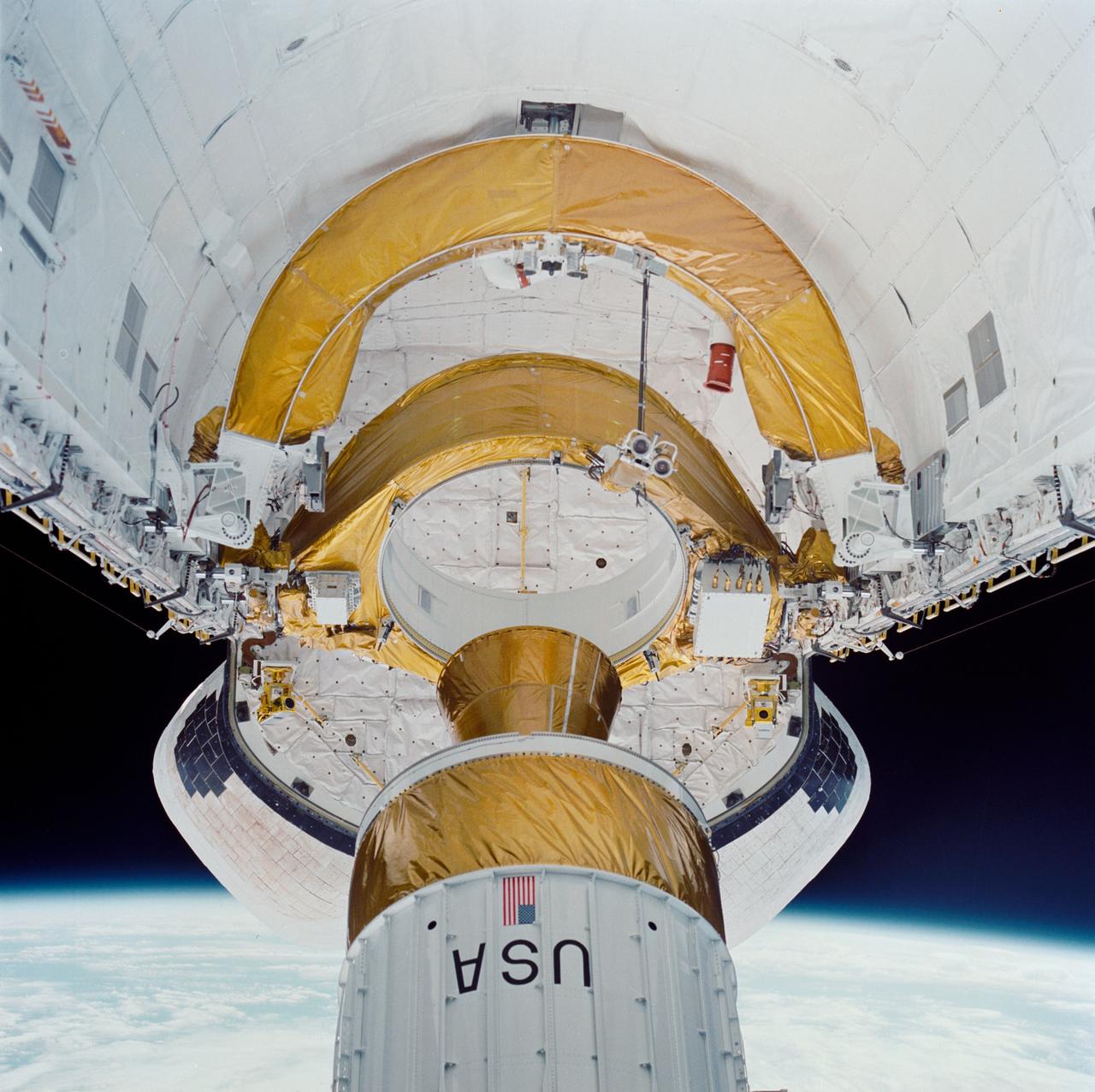
During STS-26, inertial upper stage (IUS) with the tracking and data relay satellite C (TDRS-C) drifts above Discovery, Orbiter Vehicle (OV) 103, payload bay (PLB) after being positioned in deployment attitude (an angle of 50 degrees) by the airborne support equipment (ASE). IUS vacates the ASE aft frame tilt actuator (AFTA) table in the PLB while the disconnected ASE umbilical boom floats above ASE forward cradle. IUS first stage rocket motor and nozzle and the interstage are visible as the IUS is deployed. In the background are the orbital maneuvering system (OMS) pods and the Earth's limb.
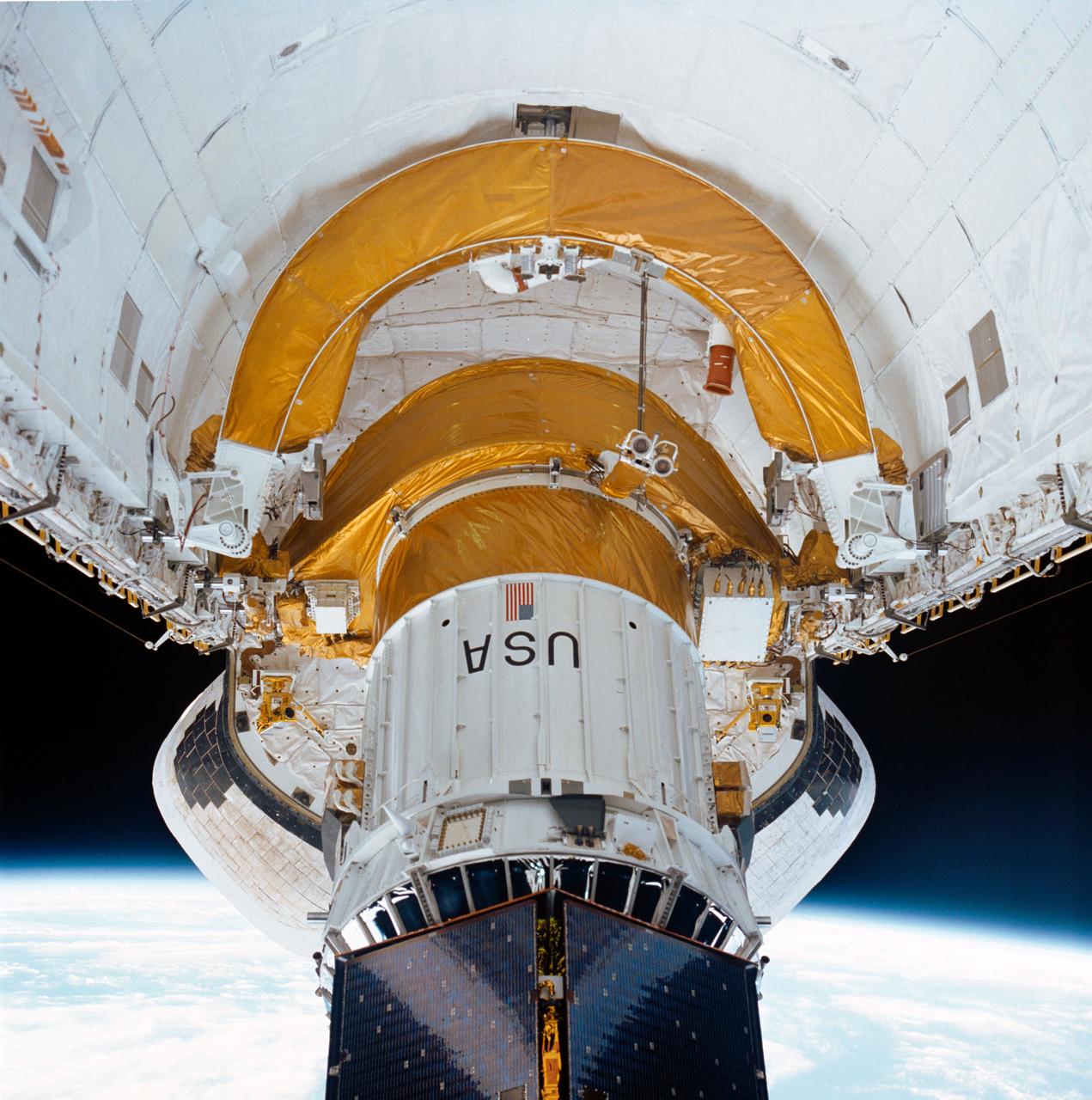
During STS-26, inertial upper stage (IUS) with the tracking and data relay satellite C (TDRS-C) located in the payload bay (PLB) of Discovery, Orbiter Vehicle (OV) 103, is raised into deployment attitude (an angle of 50 degrees) by the airborne support equipment (ASE). ASE aft frame tilt actuator (AFTA) table supports the IUS as it is positioned in the PLB and the ASE umbilical boom drifts away from IUS toward ASE forward cradle. TDRS-C solar array panels (in stowed configuration) are visible on top of the IUS. In the background are the orbital maneuvering system (OMS) pods and the Earth's limb.
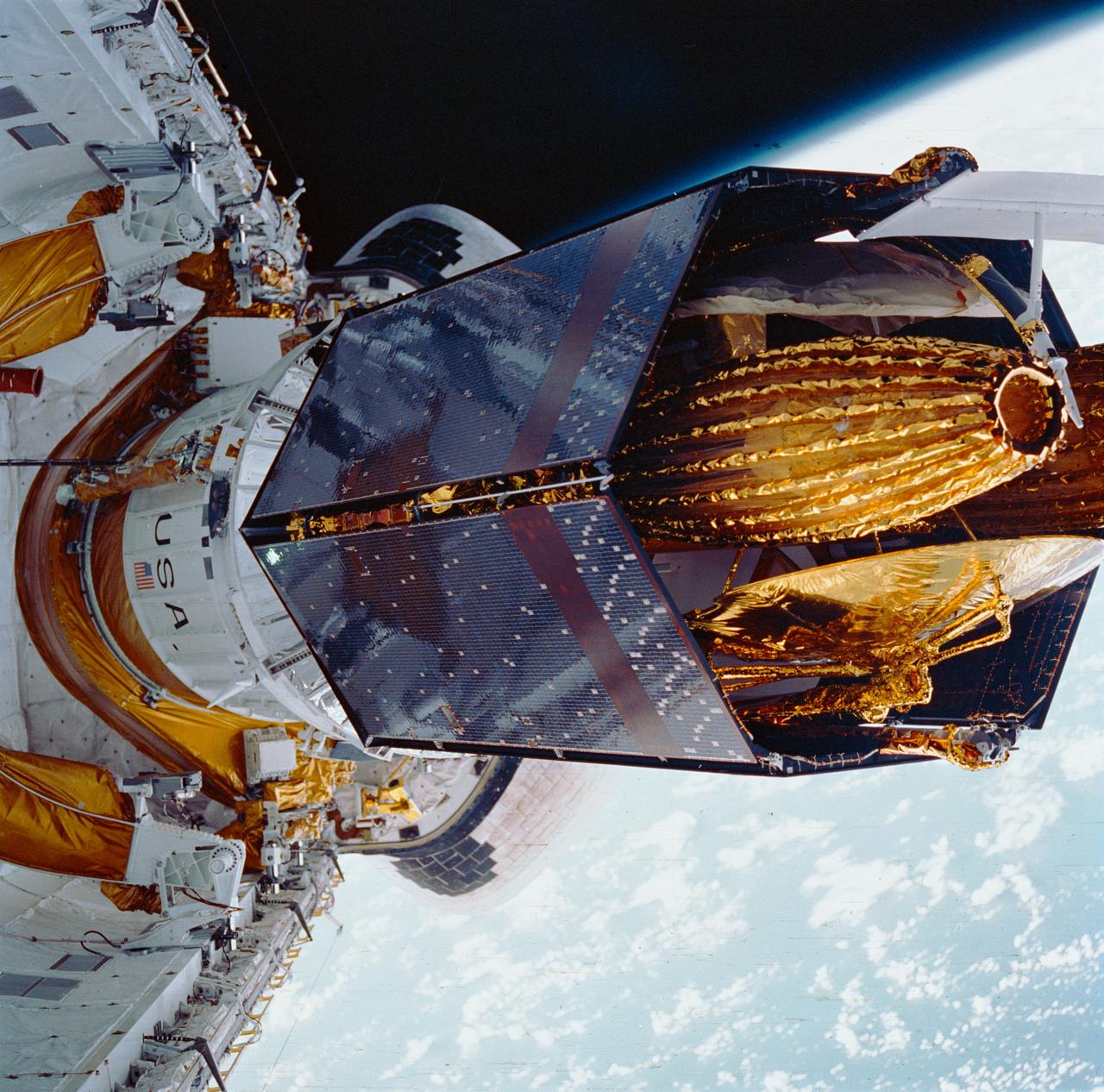
During STS-26, inertial upper stage (IUS) with tracking and data relay satellite C (TDRS-C) located in the payload bay (PLB) of Discovery, Orbiter Vehicle (OV) 103, is positioned into its proper deployment attitude (an angle of 50 degrees) by the airborne support equipment (ASE). In the foreground, the ASE forward cradle is visible. The IUS is mounted in the ASE aft frame tilt actuator (AFTA) table. TDRS-C components in stowed configuration include solar array panels, TDRS single access #1 and #2, TDRS SGL, and S-Band omni antenna. In the background are the orbital maneuvering system (OMS) pods, the Earth's cloud-covered surface, and the Earth's limb.
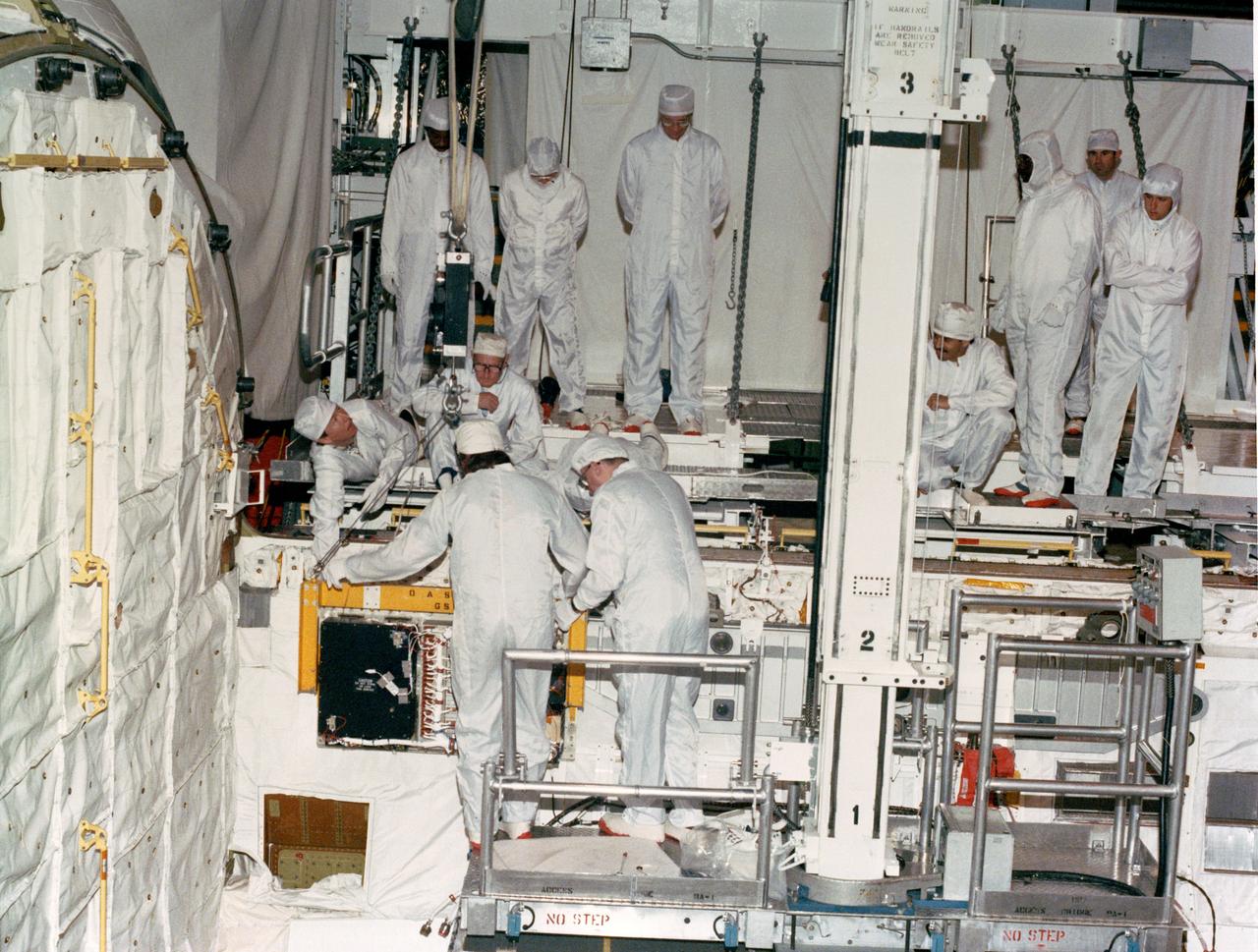
S88-37764 (18 April 1988) --- OASIS, instrumentation which will record the environment experienced by Discovery during the STS-26 Space Shuttle mission, is lowered into position for attachment to the orbiter's aft port sill. Instrumentation sensors in the payload bay which are connected to the tape recorder module will document a variety of environmental measurements during various phases of the flight including temperature, pressure, vibration, sounds, acceleration, stress, and strain. OASIS will also record data during the Flight Readiness Firing. NASA is flying OASIS aboard Discovery in support of the Inertial Upper Stage (IUS) program office of the Air Force Space Division. The system was developed by Lockheed under a NASA contract, funded by the Air Force.
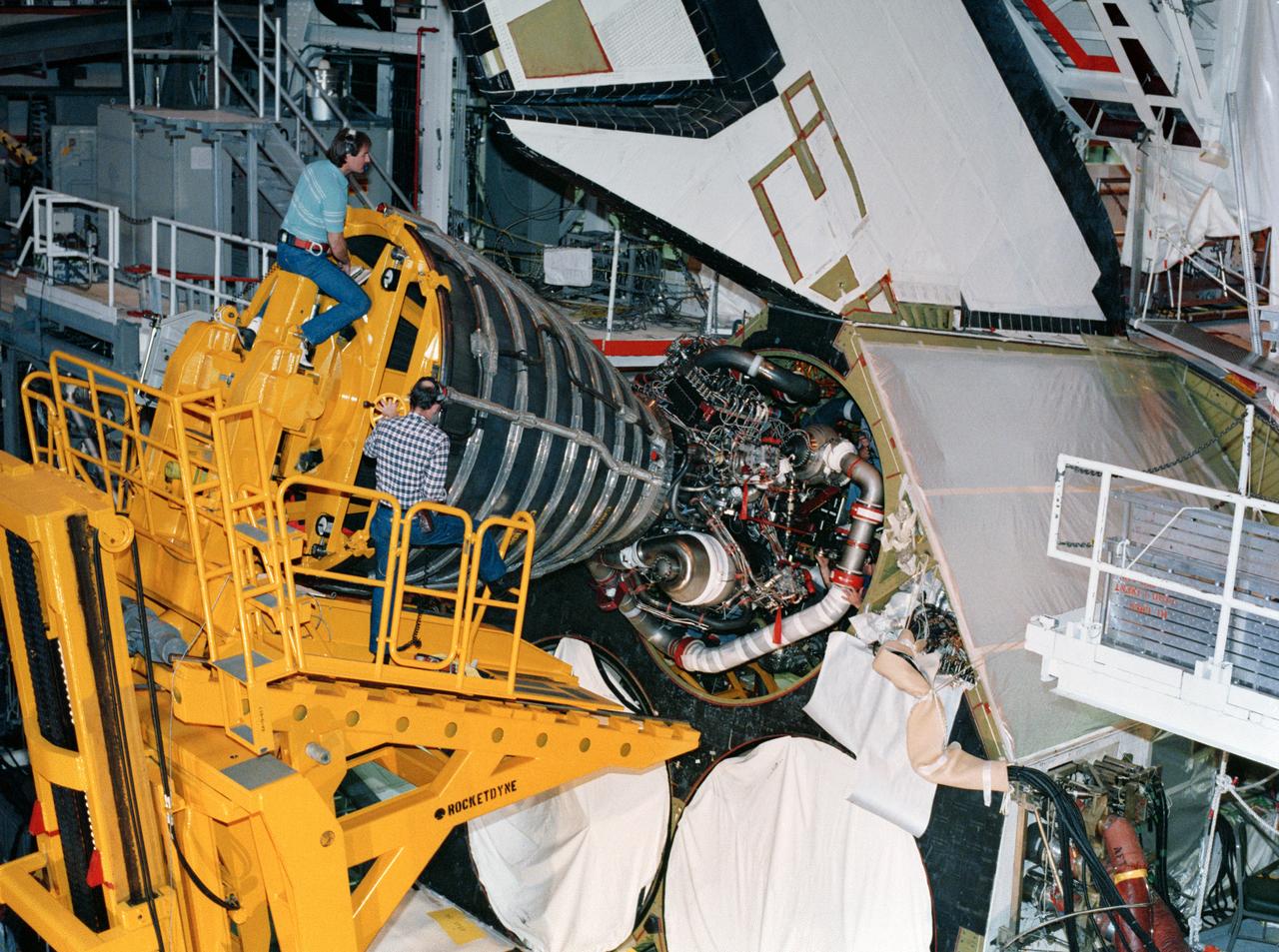
S88-29076 (10 Jan 1988) --- KSC employees work together to carefully guide a 7,000 pound main engine into the number one position in Discovery's aft compartment. Because of the engine's weight and size, special handling equipment is needed to perform the installation. Discovery is currently being prepared for the upcoming STS-26 mission in bay 1 of the Orbiter Processing Facility. This engine, 2019, arrived at KSC on Jan. 6 and was installed Jan. 10. The other two engines are scheduled to be installed later this month. The shuttle's three main liquid fueled engines provide the main propulsion for the orbiter vehicle. The cluster of three engines operate in parallel with the solid rocket boosters during the initial ascent.
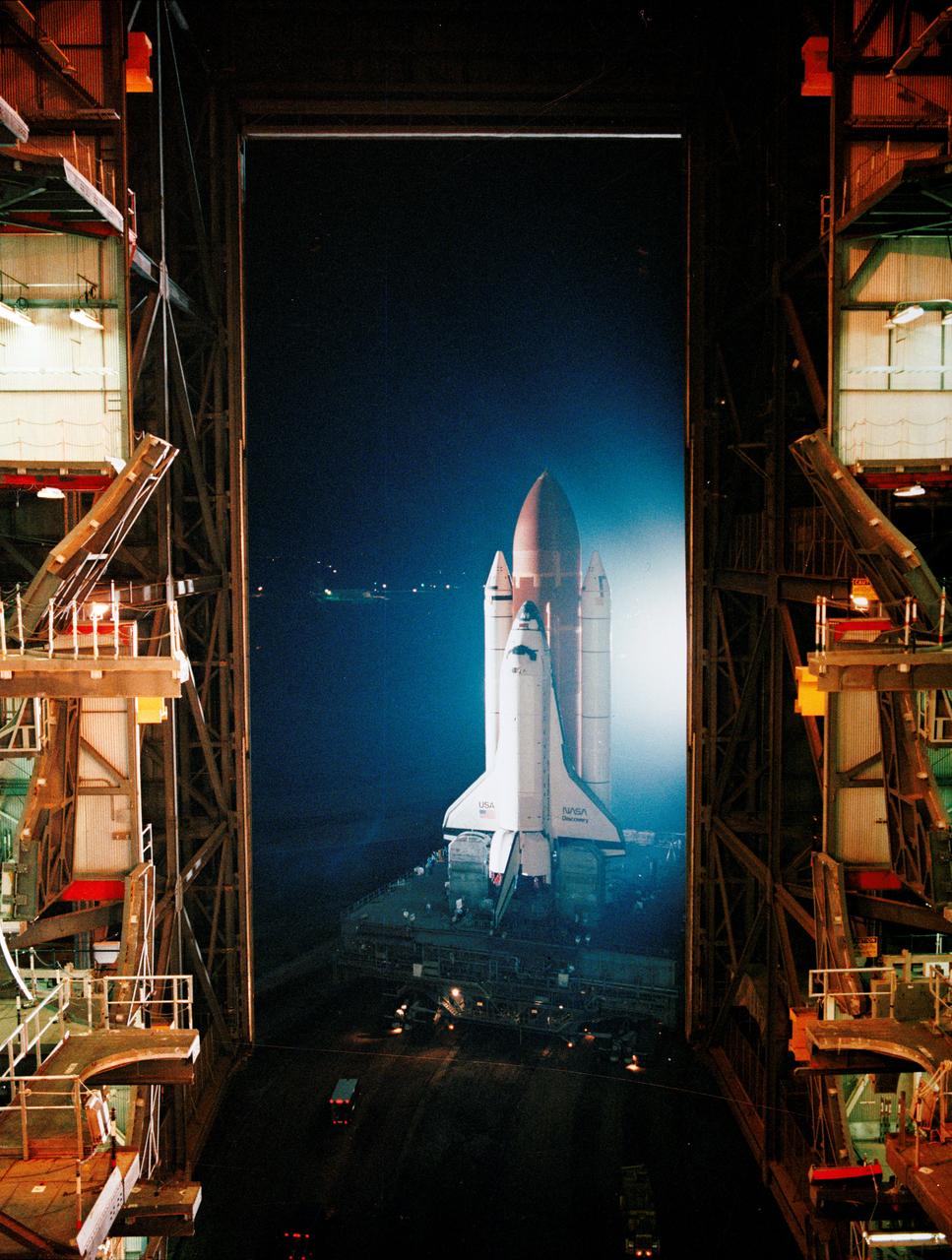
STS-26 Discovery, Orbiter Vehicle (OV) 103, mated with the external tank (ET) and solid rocket boosters (SRBs), is framed by Kennedy Space Center's (KSC's) vehicle assembly building (VAB) doorway as it rolled out. This high angle view shows OV-103 atop the mobile launch pad and crawler transporter as it begins its slow exit from VAB en route to launch complex (LC) pad 39B. The move began shortly after midnight on the nation's 212th birthday. Ceremonies marking the event were held later during daylight hours.
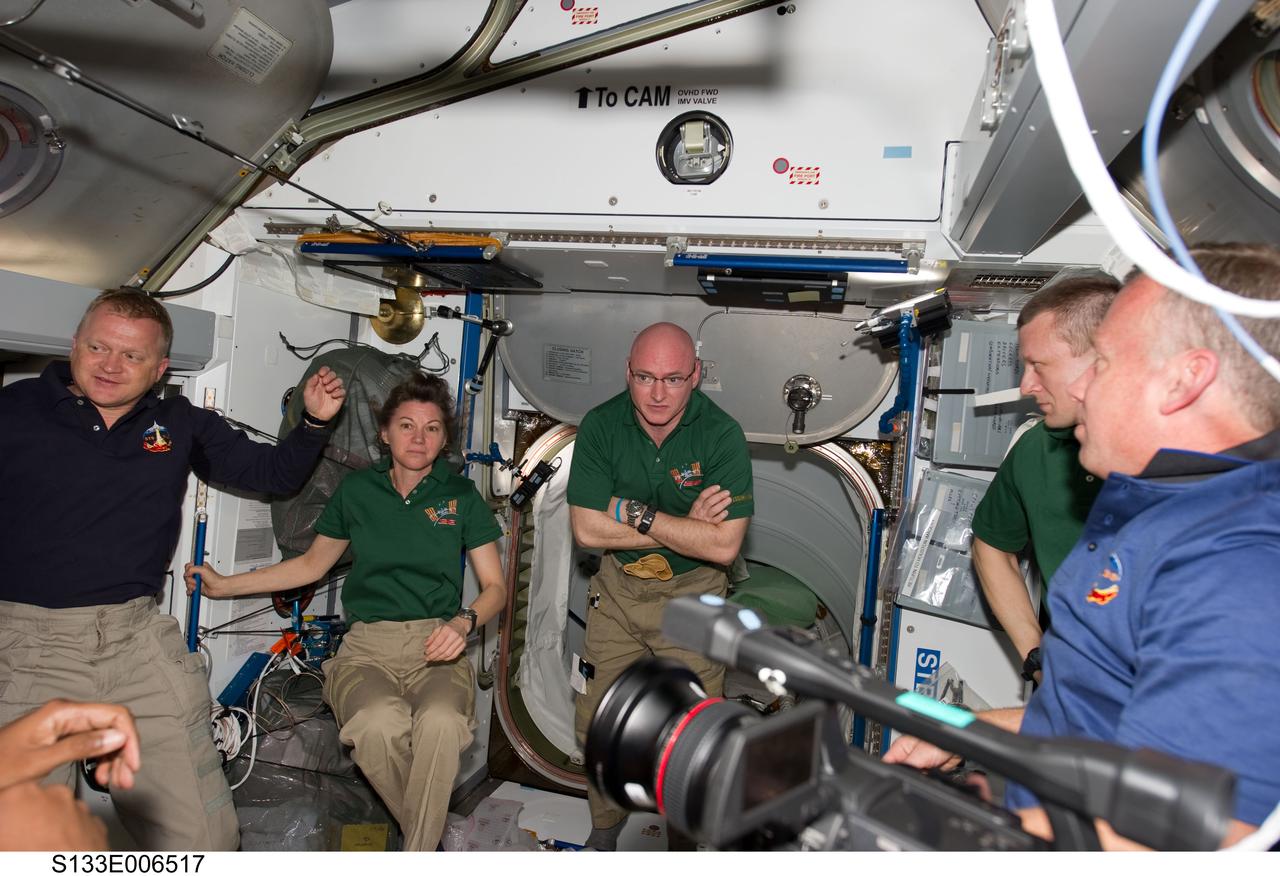
S133-E-006517 (26 Feb. 2011) --- STS-133 and Expedition 26 crew members are pictured in the Harmony node of the International Space Station shortly after space shuttle Discovery and the space station docked in space and the hatches were opened. Pictured from the left are NASA astronauts Eric Boe, STS-133 pilot; Catherine (Cady) Coleman, Expedition 26 flight engineer; Scott Kelly, Expedition 26 commander; Russian cosmonaut Dmitry Kondratyev, Expedition 26 flight engineer; and NASA astronaut Steve Lindsey, STS-133 commander. Photo credit: NASA or National Aeronautics and Space Administration
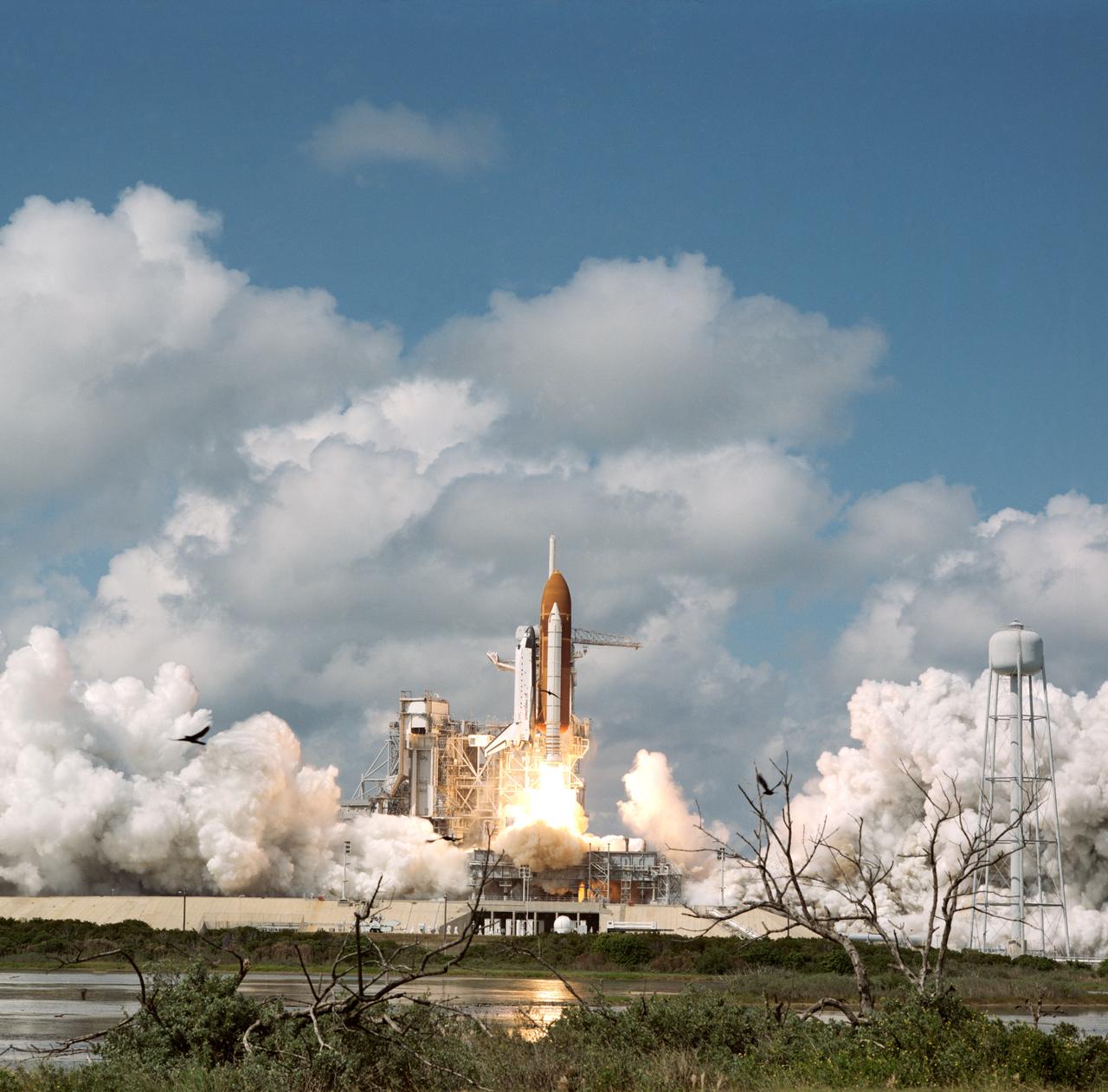
STS-26 Discovery, Orbiter Vehicle (OV) 103, lifts off from mobile launcher platform at Kennedy Space Center (KSC) Launch Complex (LC) pad 39B. Riding atop the orange external tank (ET), OV-103 heads for Earth orbit as the exhaust plumes from the two solid rocket boosters (SRBs) cover the mobile launcher platform and the area surrounding the launch pad. SRB firings are reflected in a nearby waterway. In the foreground are trees and several birds in flight. STS-26 marks OV-103's first flight since September 1985 and NASA's first manned mission since the 51L Challenger accident, 01-28-86.
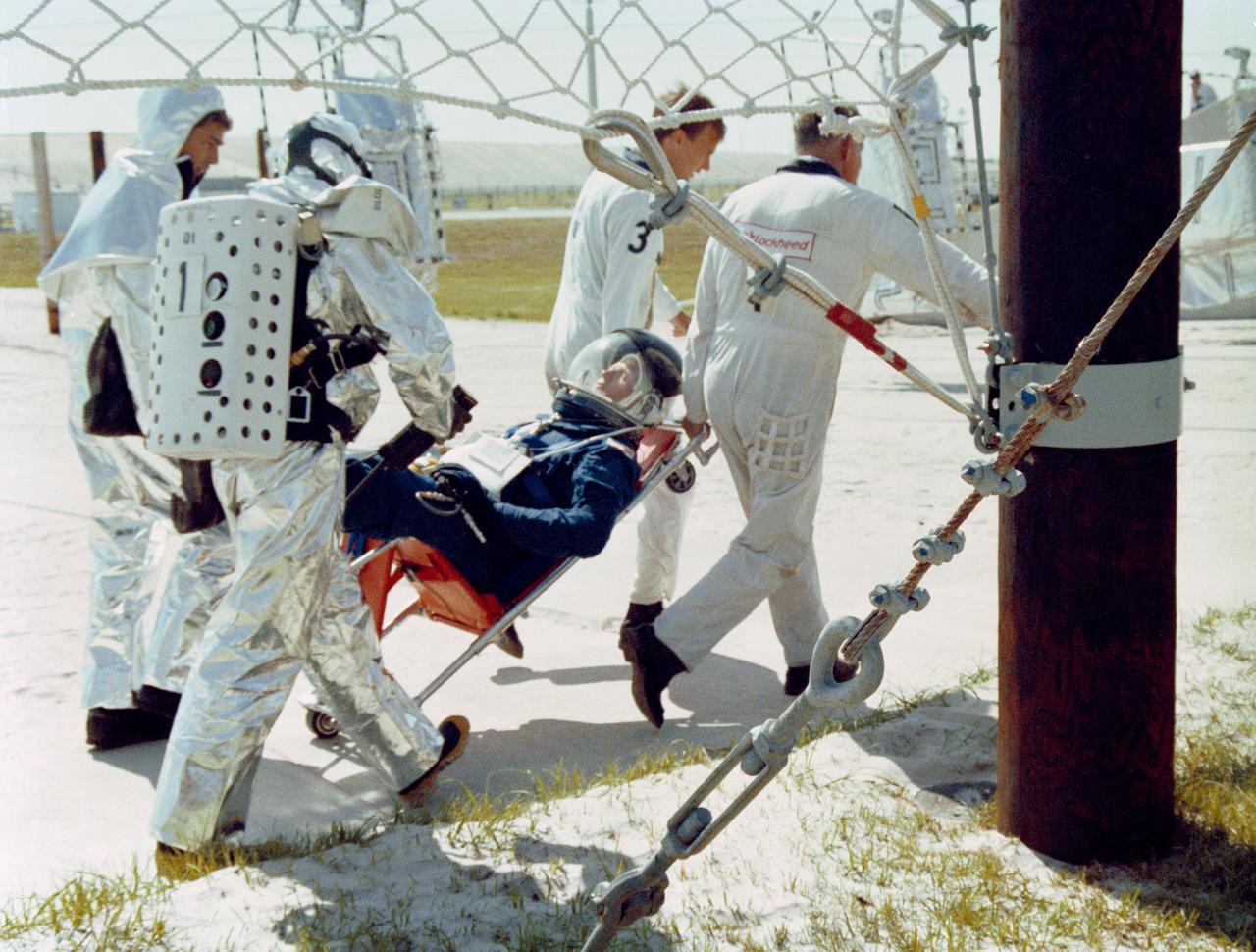
S88-40898 (4 May 1988) --- Astronauts, members of the orbiter close-out crew and fire and rescue personnel participate in a simulated emergency egress exercise near the slide wire termination point bunker at Launch Pad 39B. The simulated exercise was performed to familiarize personnel with evacuation routes as well as emergency equipment and procedures. Reasons for conducting the emergency exercises include the need to validate recent post-Challenger upgrades to the launch pad's emergency escape system and the new procedures developed in preparation for STS-26. (NOTE: The astronaut pictured and many of the others who participated in the exercises are not members of STS-26 prime crew).
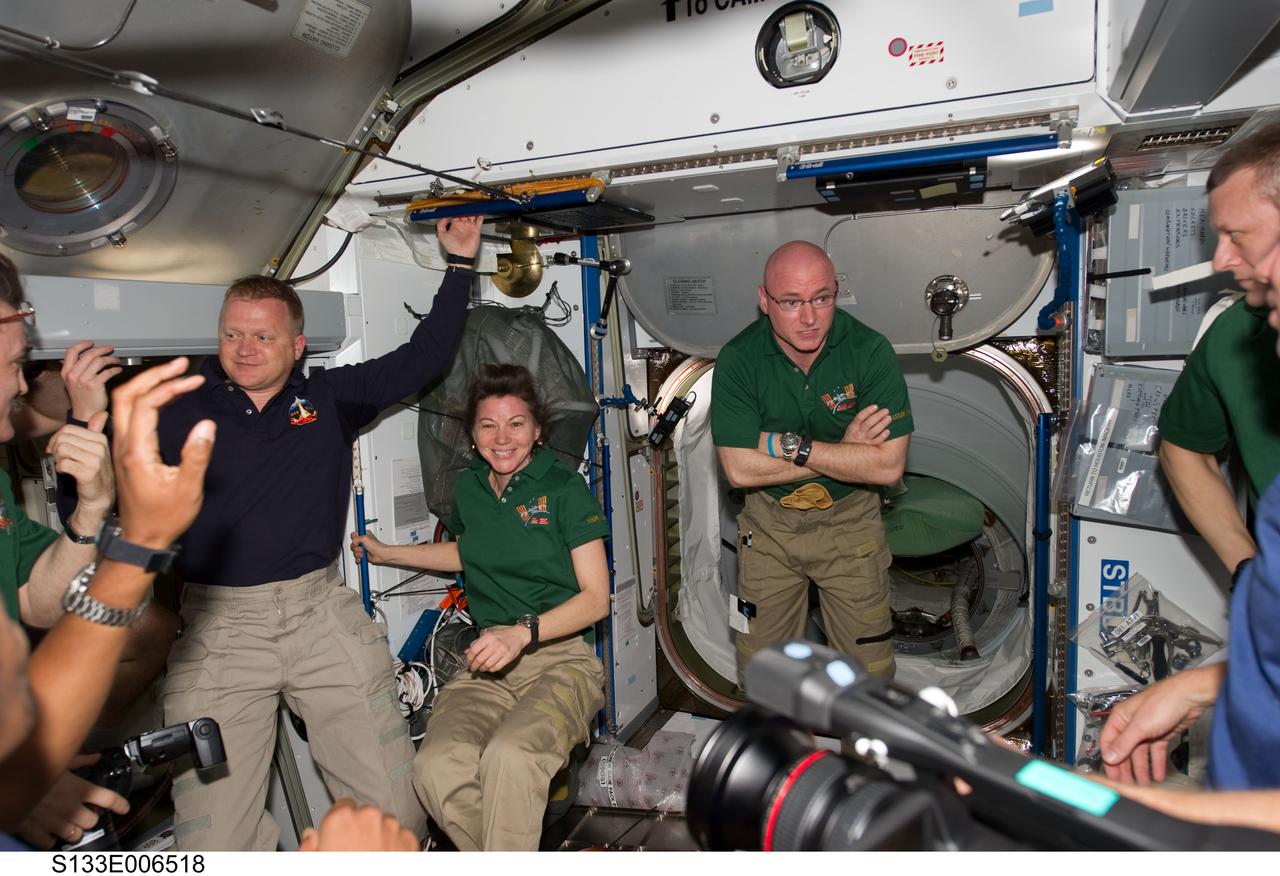
S133-E-006518 (26 Feb. 2011) --- STS-133 and Expedition 26 crew members are pictured in the Harmony node of the International Space Station shortly after space shuttle Discovery and the space station docked in space and the hatches were opened. Pictured from the left are NASA astronauts Eric Boe, STS-133 pilot; Catherine (Cady) Coleman, Expedition 26 flight engineer; Scott Kelly, Expedition 26 commander; and Russian cosmonaut Dmitry Kondratyev, Expedition 26 flight engineer. Photo credit: NASA or National Aeronautics and Space Administration
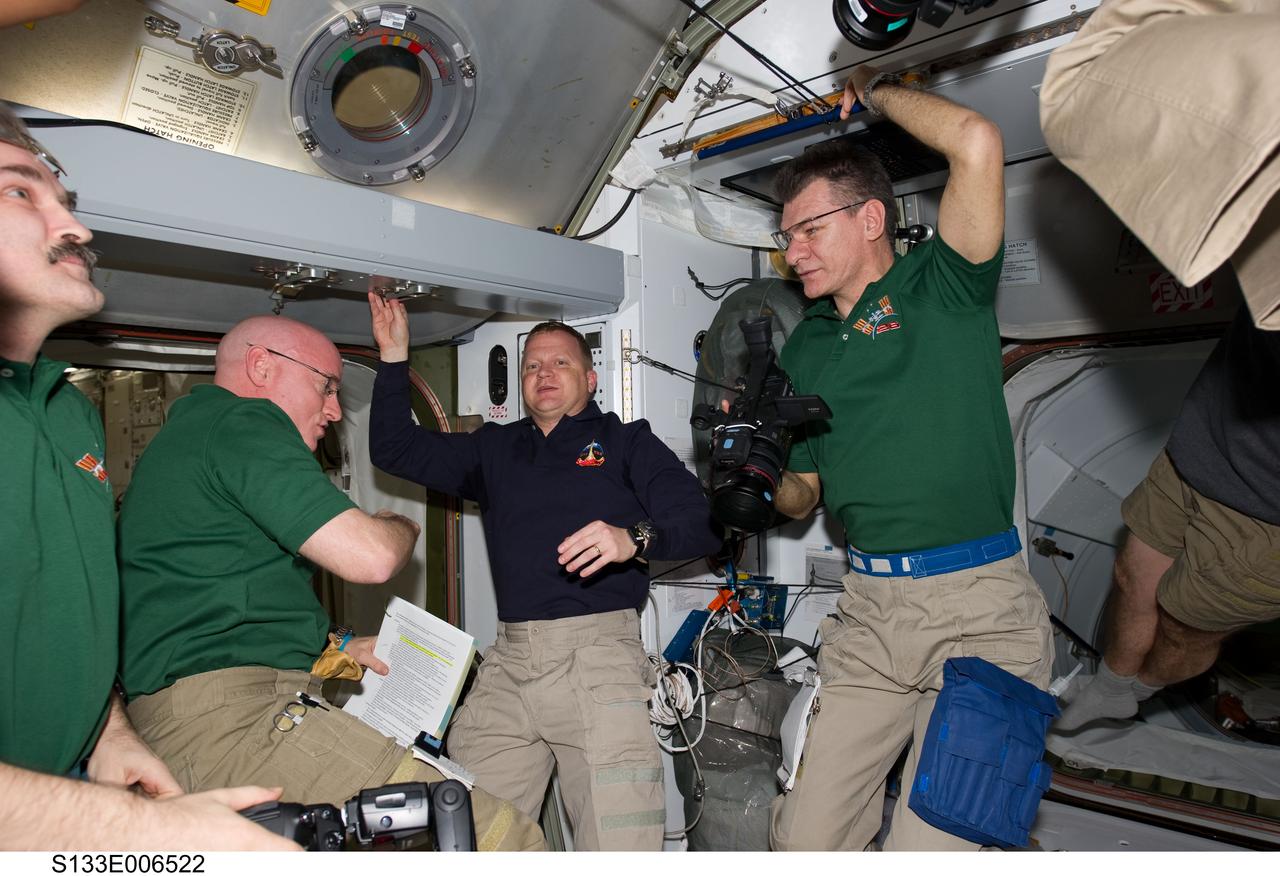
S133-E-006522 (26 Feb. 2011) --- STS-133 and Expedition 26 crew members are pictured in the Harmony node of the International Space Station shortly after space shuttle Discovery and the space station docked in space and the hatches were opened. Pictured from the left are Russian cosmonaut Alexander Kaleri, Expedition 26 flight engineer; NASA astronauts Scott Kelly, Expedition 26 commander; and Eric Boe, STS-133 pilot; along with European Space Agency astronaut Paolo Nespoli, Expedition 26 flight engineer. Photo credit: NASA or National Aeronautics and Space Administration
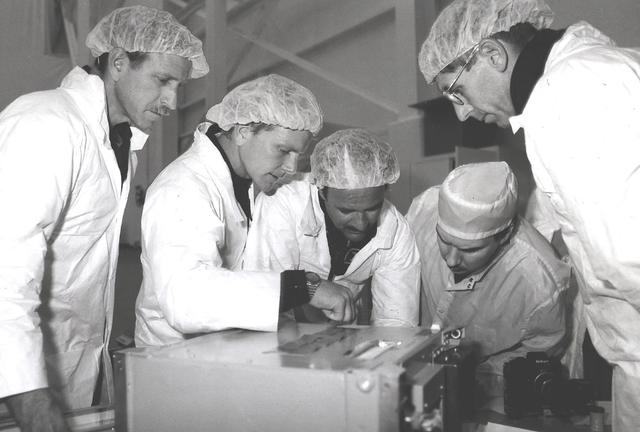
Space Shuttle Discovery (STS-26) astronauts George Nelson, John Lounge, and Richard Covey are pictured training on protein crystal growth (PCG) experiment in Marshall's Building 4708's clean room.
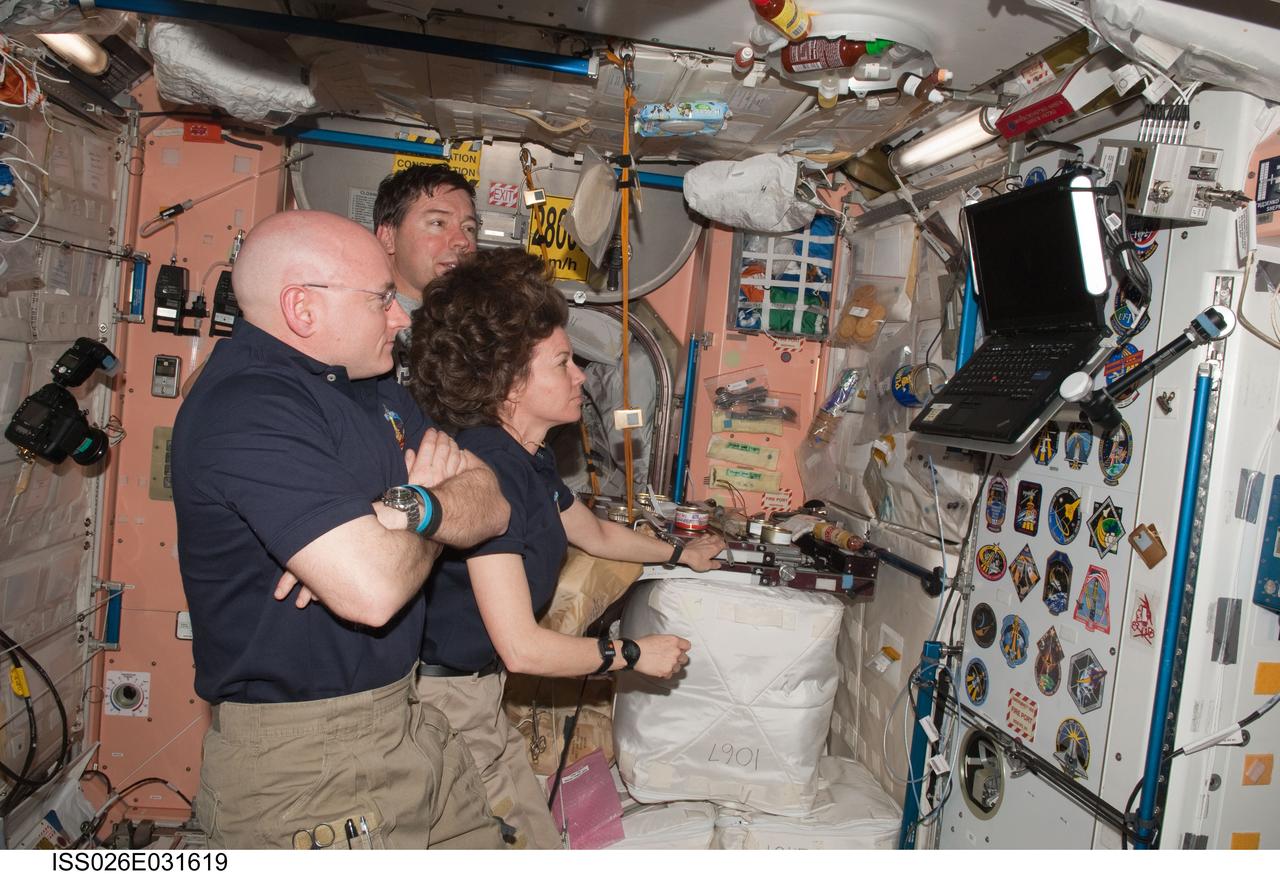
ISS026-E-031619 (3 March 2011) --- NASA astronauts Scott Kelly (foreground), Expedition 26 commander; Cady Coleman, Expedition 26 flight engineer; and Michael Barratt, STS-133 mission specialist, watch a monitor in the Unity node of the International Space Station while space shuttle Discovery remains docked with the station.
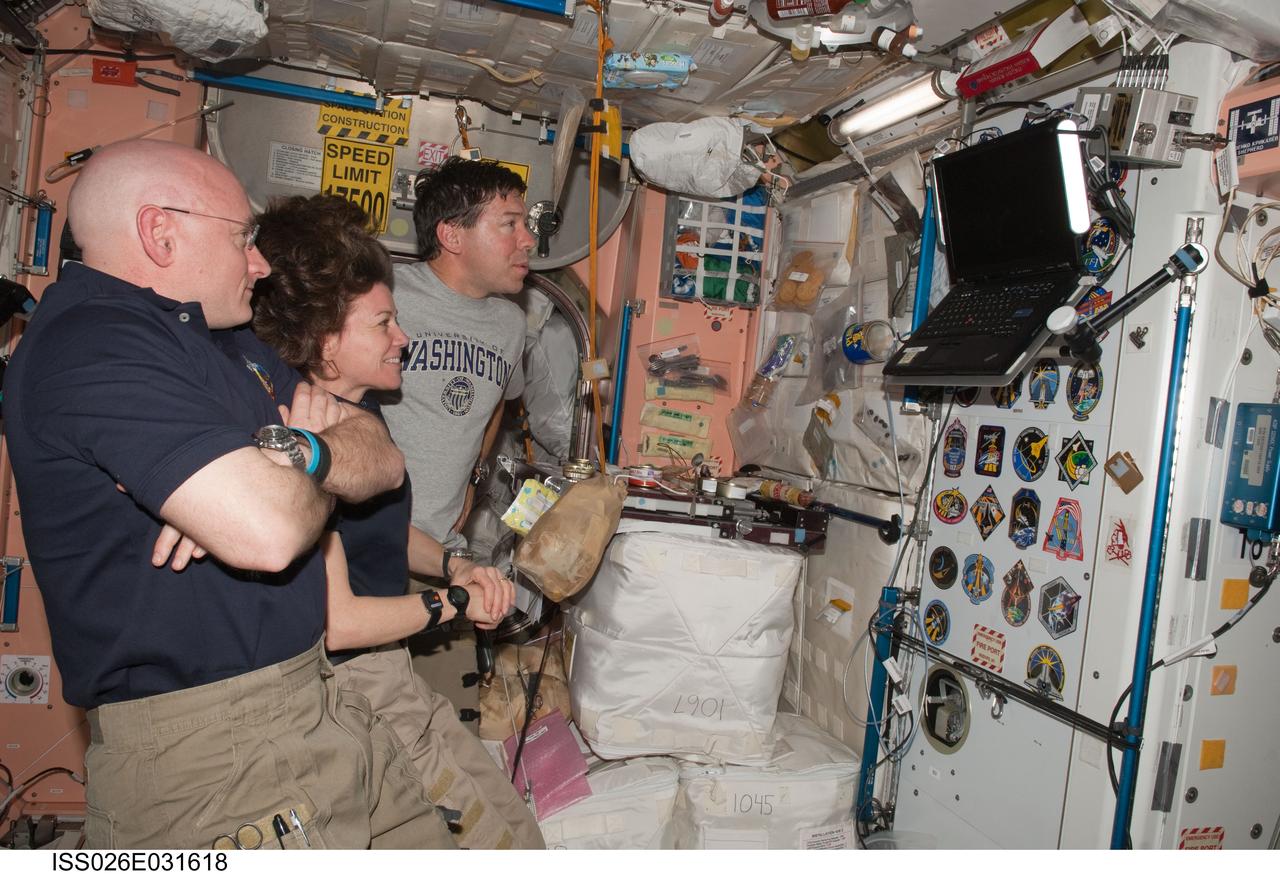
ISS026-E-031618 (3 March 2011) --- NASA astronauts Scott Kelly (foreground), Expedition 26 commander; Cady Coleman, Expedition 26 flight engineer; and Michael Barratt, STS-133 mission specialist, watch a monitor in the Unity node of the International Space Station while space shuttle Discovery remains docked with the station.
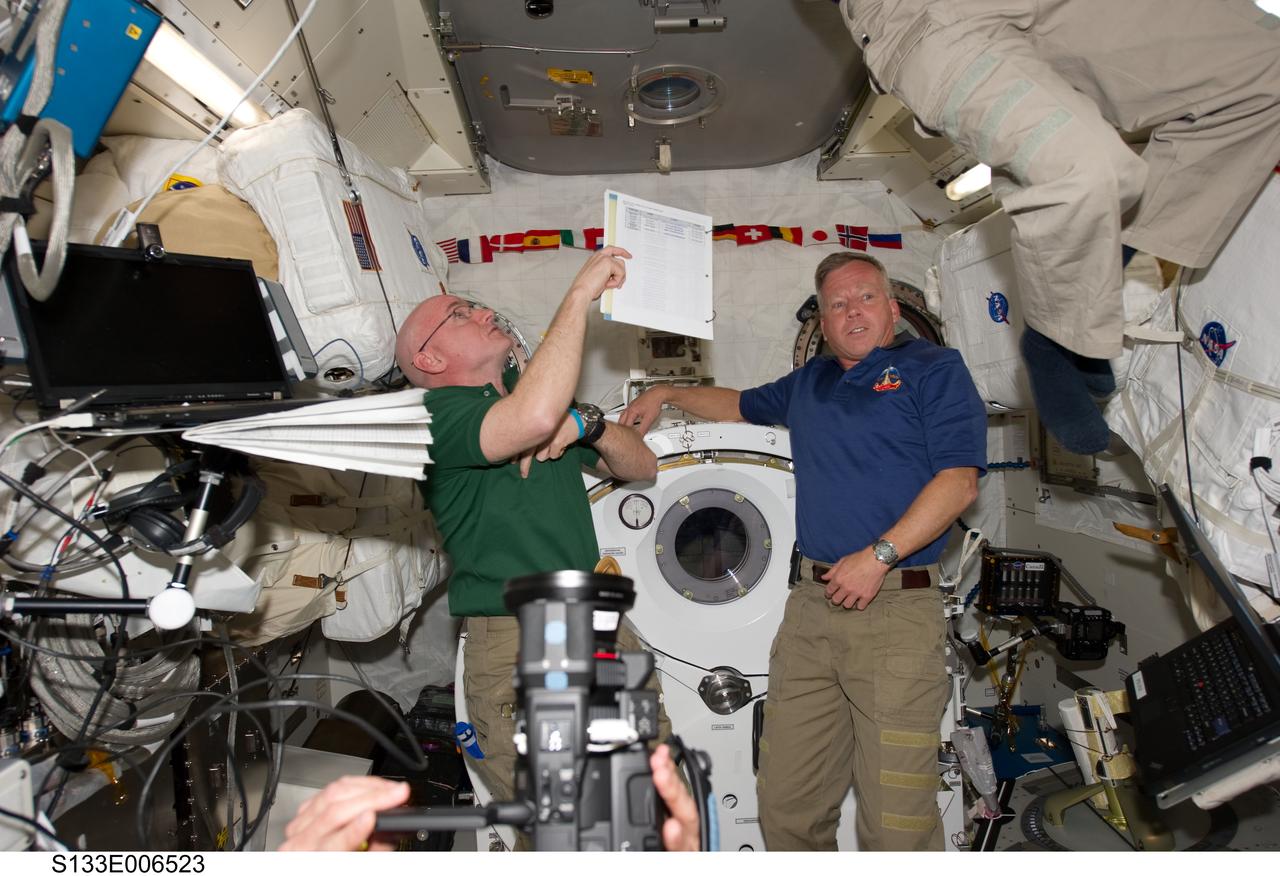
S133-E-006523 (26 Feb. 2011) --- NASA astronauts Scott Kelly (left), Expedition 26 commander; and Steve Lindsey, STS-133 commander, are pictured in the Kibo laboratory of the International Space Station while space shuttle Discovery remains docked with the station. Photo credit: NASA or National Aeronautics and Space Administration
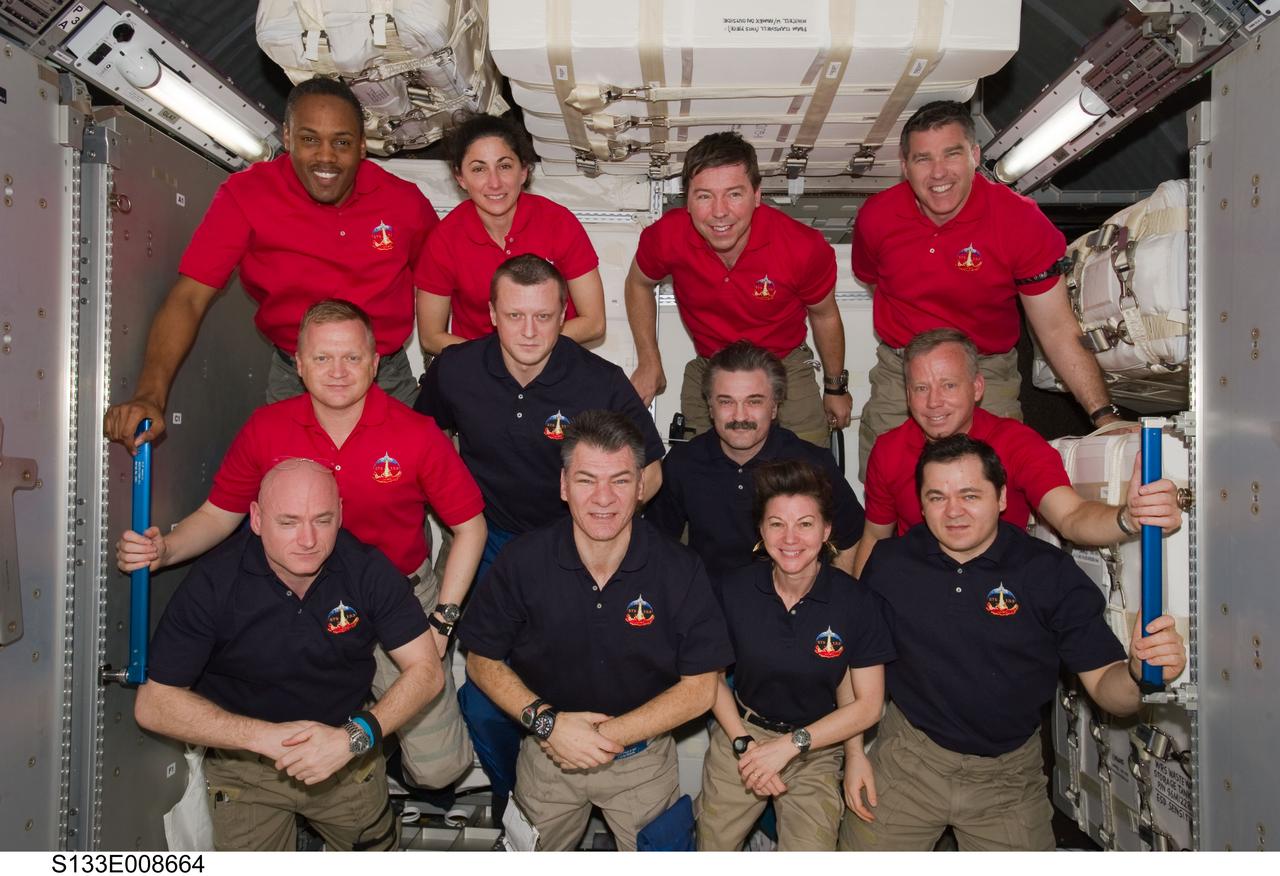
S133-E-008664 (4 March 2011) --- Twelve astronauts and cosmonauts take a break from a very busy week aboard the International Space Station to pose for a joint STS-133/Expedition 26 group portrait in the newly-installed Permanent Multipurpose Module. The STS-133 crew members, all attired in red shirts (from left) are NASA astronauts Alvin Drew, Eric Boe (below), Nicole Stott, Michael Barratt, Steve Bowen and Steve Lindsey (below). The dark blue-attired Expedition 26 crew members, from bottom left, are NASA astronaut Scott Kelly, European Space Agency astronaut Paolo Nespoli, NASA astronaut Cady Coleman along with Russian cosmonaut Oleg Skripochka. In the center of the photo are Dmitry Kondratyev and Alexander Kaleri. Serving the STS-133 and Expedition 26 missions as commanders were Lindsey and Kelly, respectively. Photo credit: NASA or National Aeronautics and Space Administration
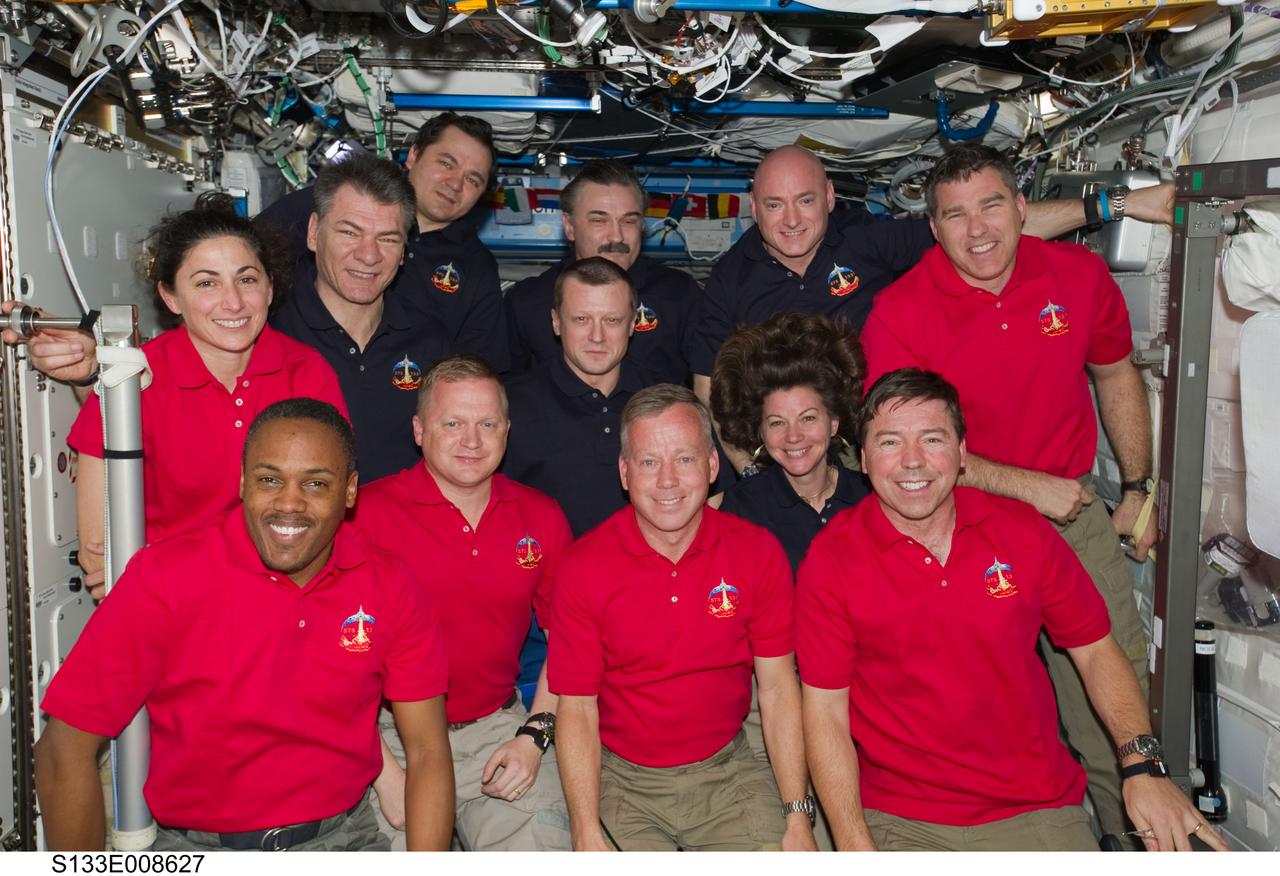
S133-E-008627 (3 March 2011) --- Inside the U.S. lab Destiny, 12 astronauts and cosmonauts take a break from a very busy week aboard the International Space Station to pose for a joint STS-133/Expedition 26 group portrait. The STS-133 crew members, all attired in red shirts (from left) are NASA astronauts Nicole Stott, Alvin Drew, Eric Boe, Steve Lindsey, Michael Barratt and Steve Bowen. The dark blue-attired Expedition 26 crew members, from left, are European Space Agency astronaut Paolo Nespoli, along with Russian cosmonauts Oleg Skripochka, Dmitry Kondratyev (below), and Alexander Kaleri and astronauts Scott Kelly and Cady Coleman (below). Serving the STS-133 and Expedition 26 missions as commanders were Lindsey and Kelly, respectively. Photo credit: NASA or National Aeronautics and Space Administration
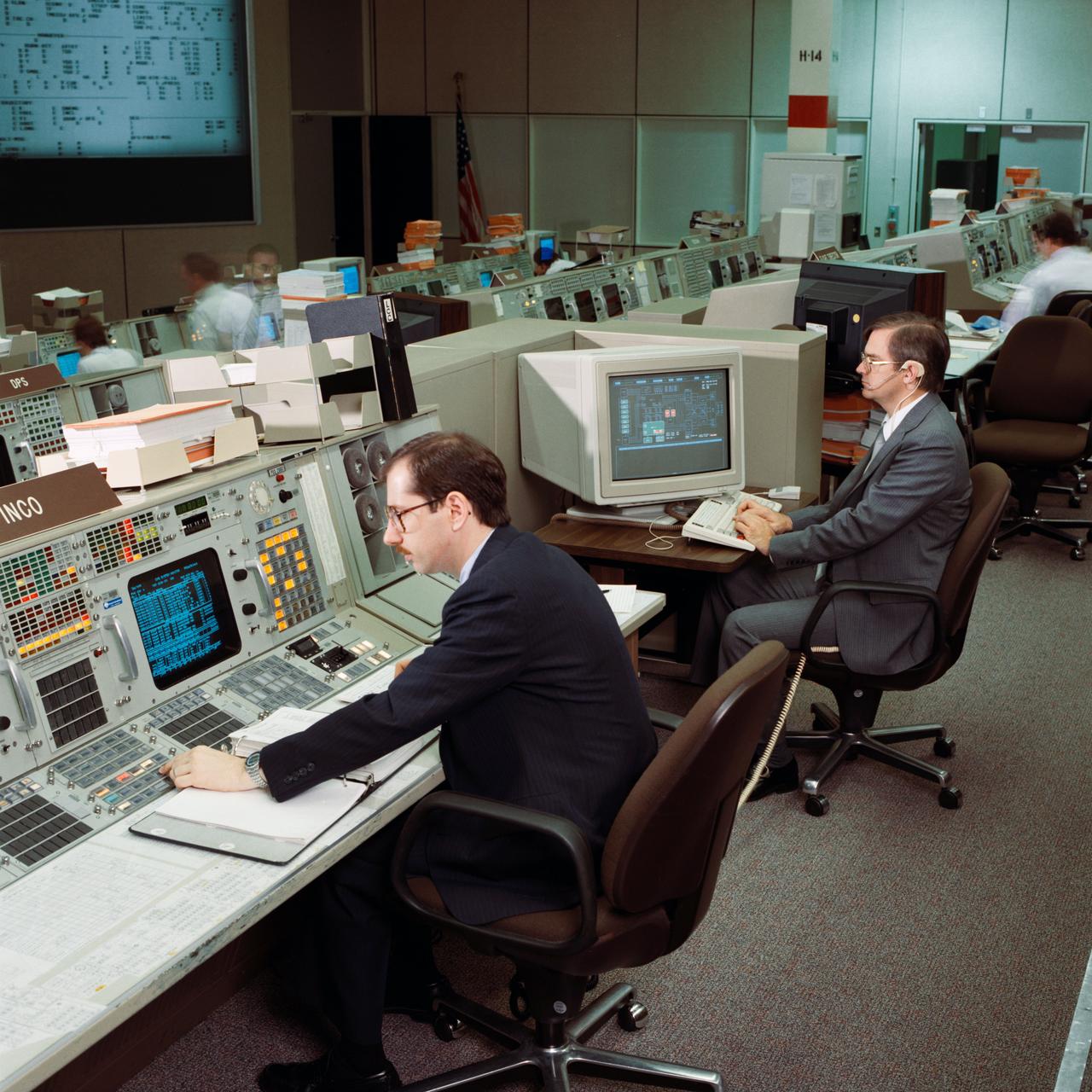
Instrumentation and Communications Officer (INCO) John F. Muratore monitors conventional workstation displays during an STS-26 simulation in JSC Mission Control Center (MCC) Bldg 30 Flight Control Room (FCR). Next to Muratore an operator views the real time data system (RTDS), an expert system. During the STS-29 mission two conventional monochrome console display units will be removed and replaced with RTDS displays. View is for the STS-29 press kit from Office of Aeronautics and Space Technology (OAST) RTDS.
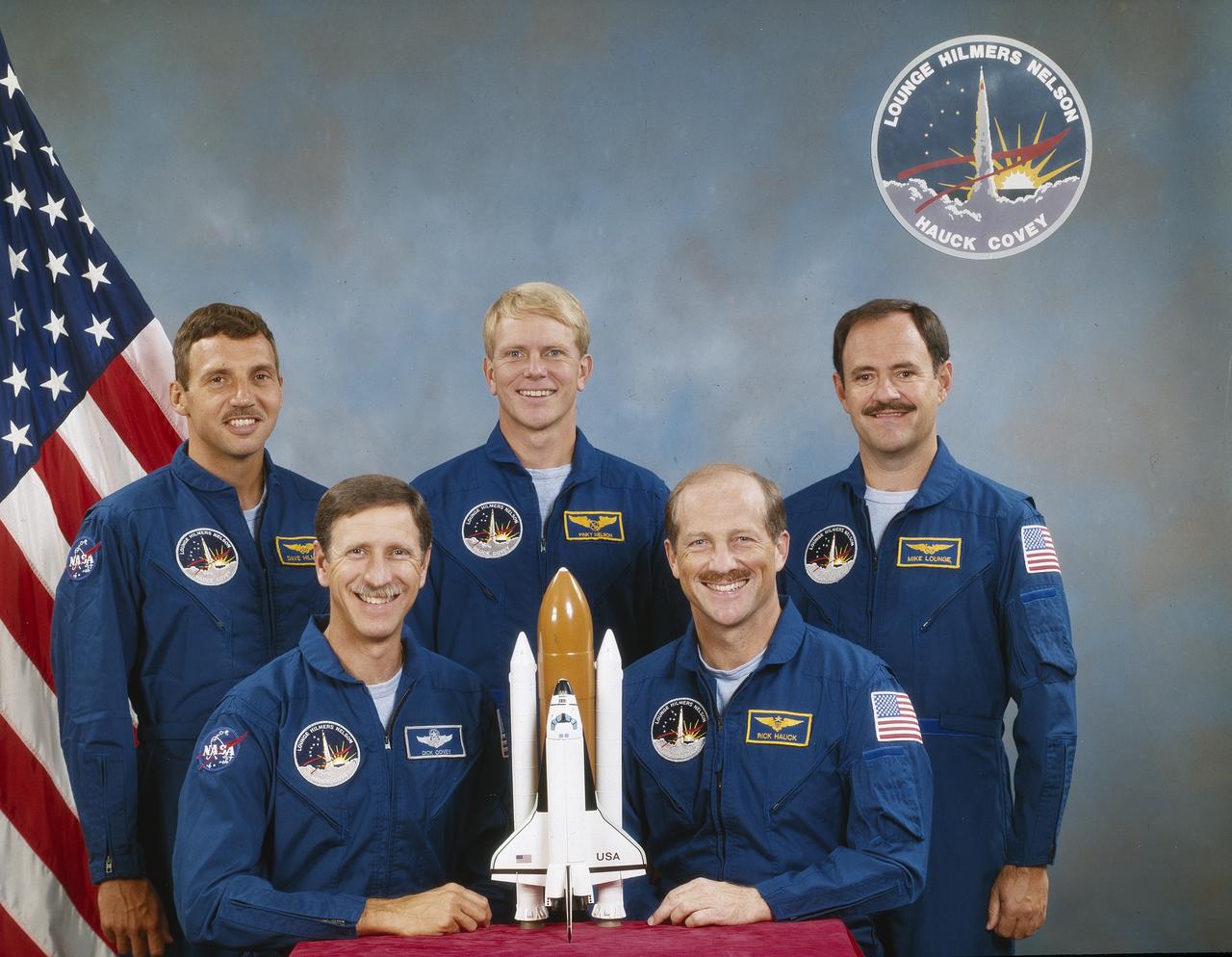
Five astronauts composed the crew of the STS-26 mission. Pictured in the portrait (left to right) are David C. Hilmer, mission specialist; Richard O. Covey, pilot; George D. Nelson, mission specialist; Frederick H. Hauck, Jr., commander; and John, M. Lounge, mission specialist. Launched aboard the Space Shuttle Orbiter Discovery, liftoff occurred on September 29, 1988 at 11:37am (EDT). This was the 7th flight of the Orbiter Discovery, and the return to flight after the STS-51L mission accident. The primary payload was the NASA Tracking and Data Relay Satellite-3 (TDRS-3).
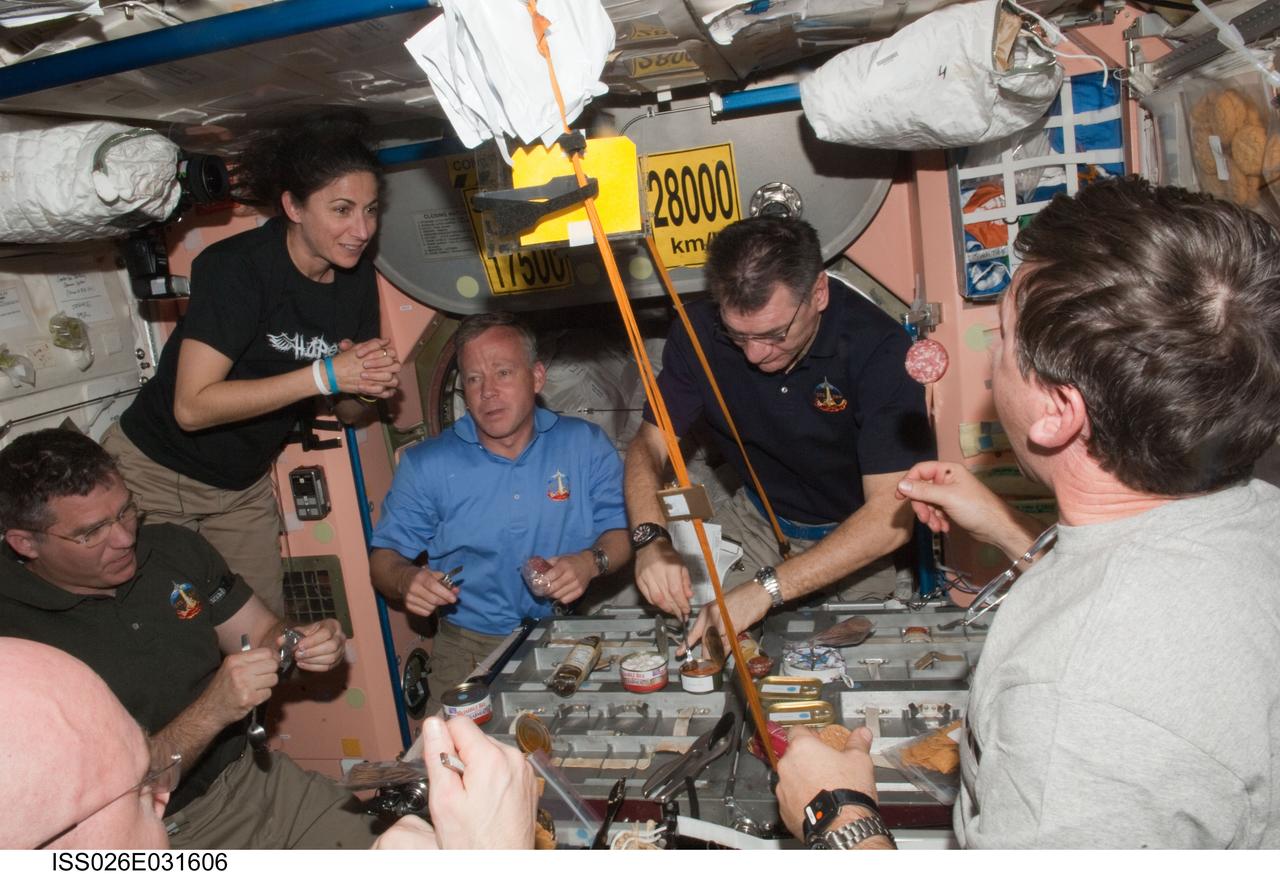
ISS026-E-031606 (3 March 2011) --- Expedition 26 and STS-133 crew members share a meal in the Unity node of the International Space Station while space shuttle Discovery remains docked with the station. Pictured from the left are NASA astronauts Steve Bowen, Nicole Stott, both STS-133 mission specialists; Steve Lindsey, STS-133 commander; European Space Agency astronaut Paolo Nespoli, Expedition 26 flight engineer; and NASA astronaut Michael Barratt, STS-133 mission specialist.
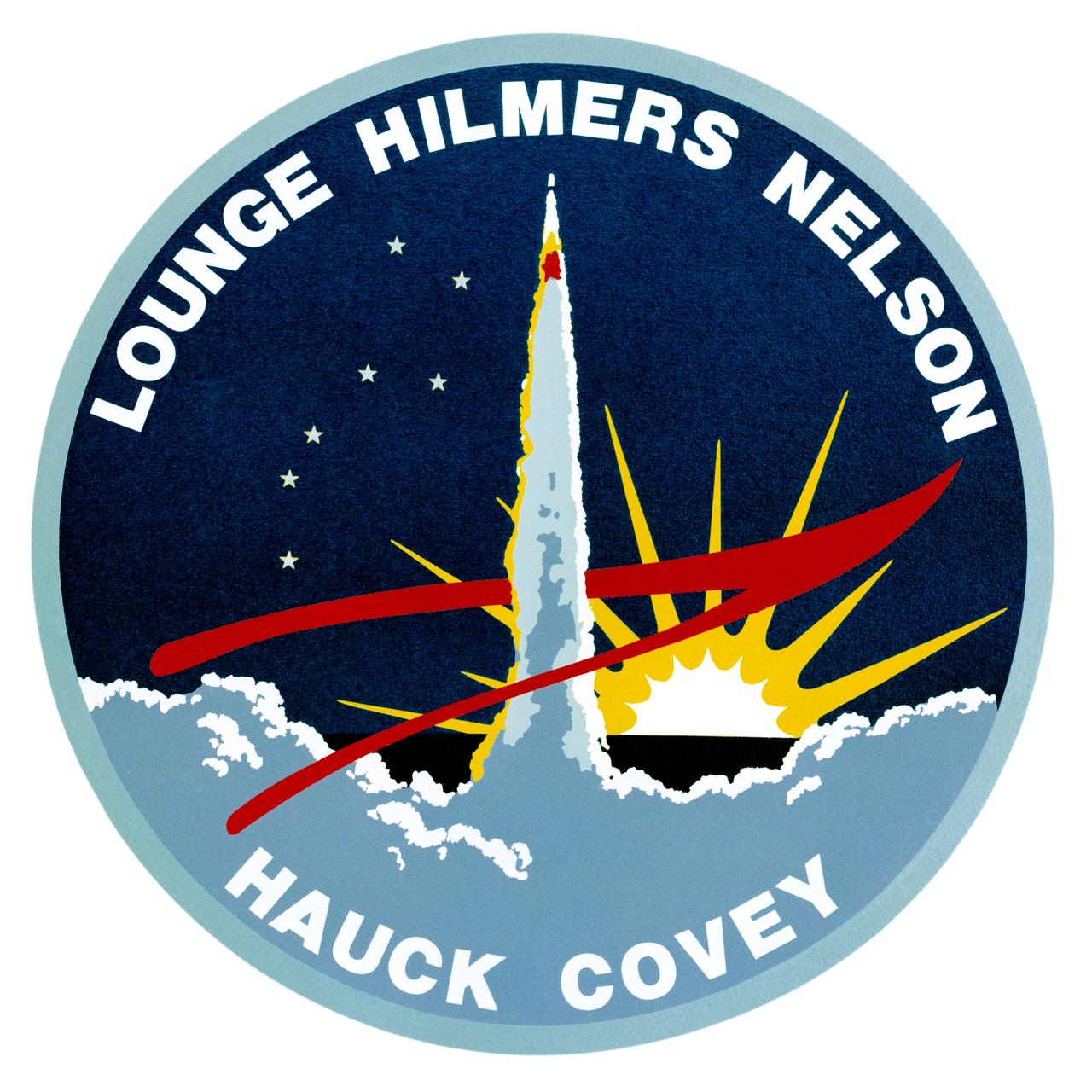
S87-39136 (4 Aug. 1987) --- This is the STS-26 crew patch. The predominant themes are: a new beginning (sunrise), a safe mission (stylized launch and plume), the building upon the traditional strengths of NASA (the red vector which symbolizes aeronautics on the original NASA insignia), and a remembrance of their seven colleagues who died aboard Challenger (the seven-starred Big Dipper). The patch was designed by artist Stephen R. Hustvedt of Annapolis, MD. STS-26 crew members are astronauts Frederick H. (Rick) Hauck, commander; Richard O. Covey, pilot; and George D. (Pinky) Nelson, John M. (Mike) Lounge and David C. Hilmers, mission specialists. The NASA insignia design for space shuttle flights is reserved for use by the astronauts and for other official use as the NASA Administrator may authorize. Public availability has been approved only in the forms of illustrations by the various news media. When and if there is any change in this policy, which is not anticipated, the change will be publicly announced. Photo credit: NASA
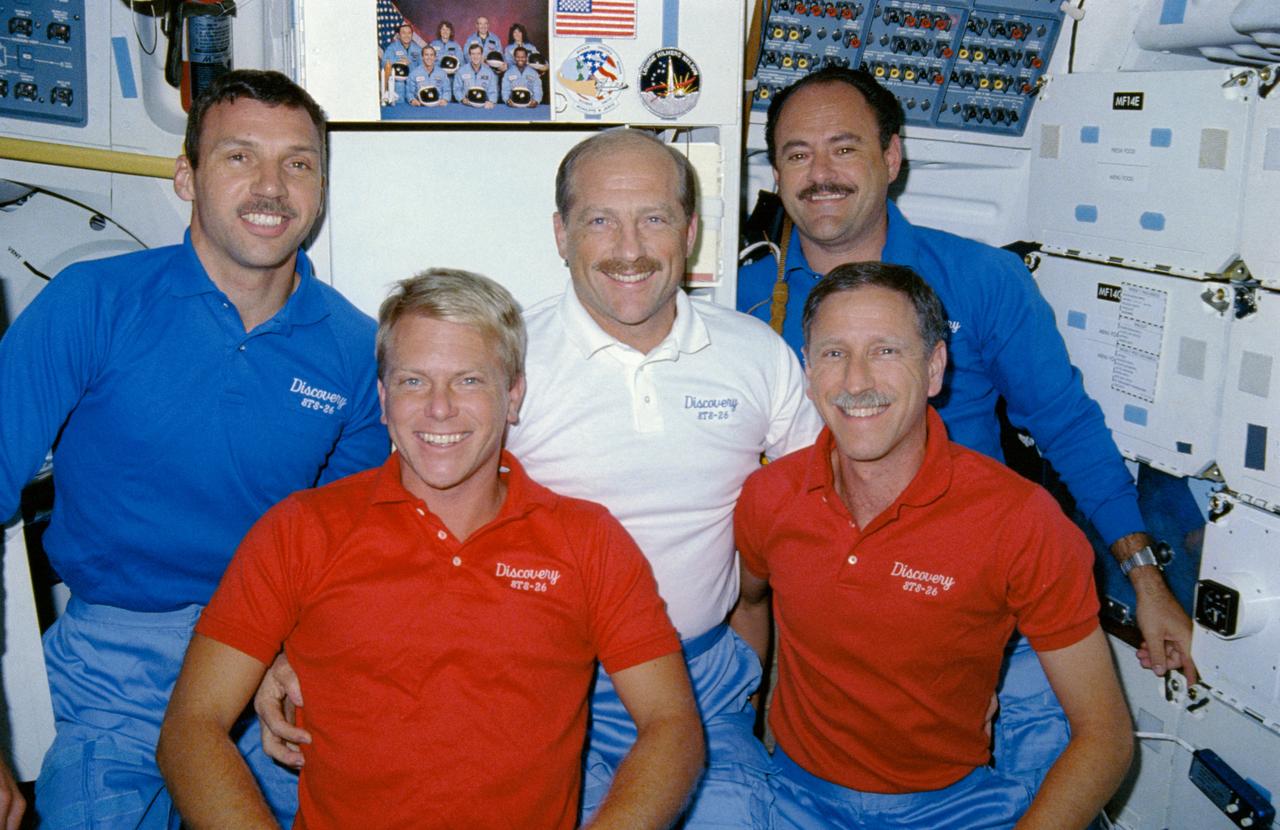
STS026-08-007 (29 Sept-3 Oct 1988) --- An in-space crew portrait on the middeck of Discovery. Left to right are Astronauts David C. Hilmers, George D. Nelson, Frederick H. (Rick) Hauck, John M. (Mike) Lounge and Richard O. Covey (front). The crew portrait for STS 51-L, its flight insignia and the STS 26 flight insignia are at top edge of the frame. This photo was shown by the STS 26 astronaut crew during its Oct. 11, l988 post-flight press conference.
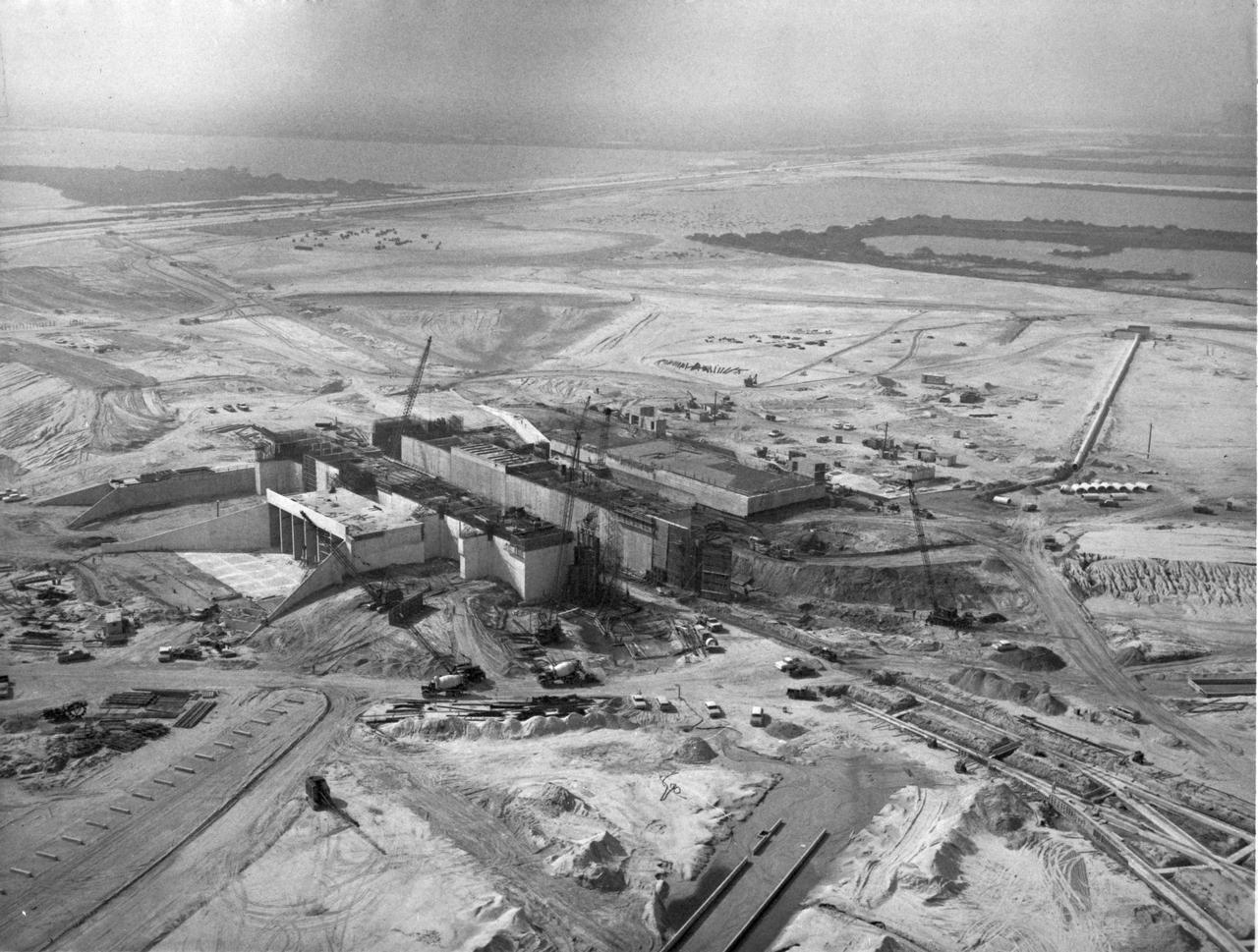
KENNEDY SPACE CENTER, FLA. -- An aerial view of early construction of Launch Pad 39A, looking southwest. Pad 39A is one of two launch sites for the Apollo Saturn V Moon rocket. Each site is an eight-sided polygon and 3,000 feet across. The pad is 390 feet by 325 feet reinforced concrete hardstand standing 48 feet above sea level. The flame trench in the center holds a 700,000-pound flame deflector during launch operations.
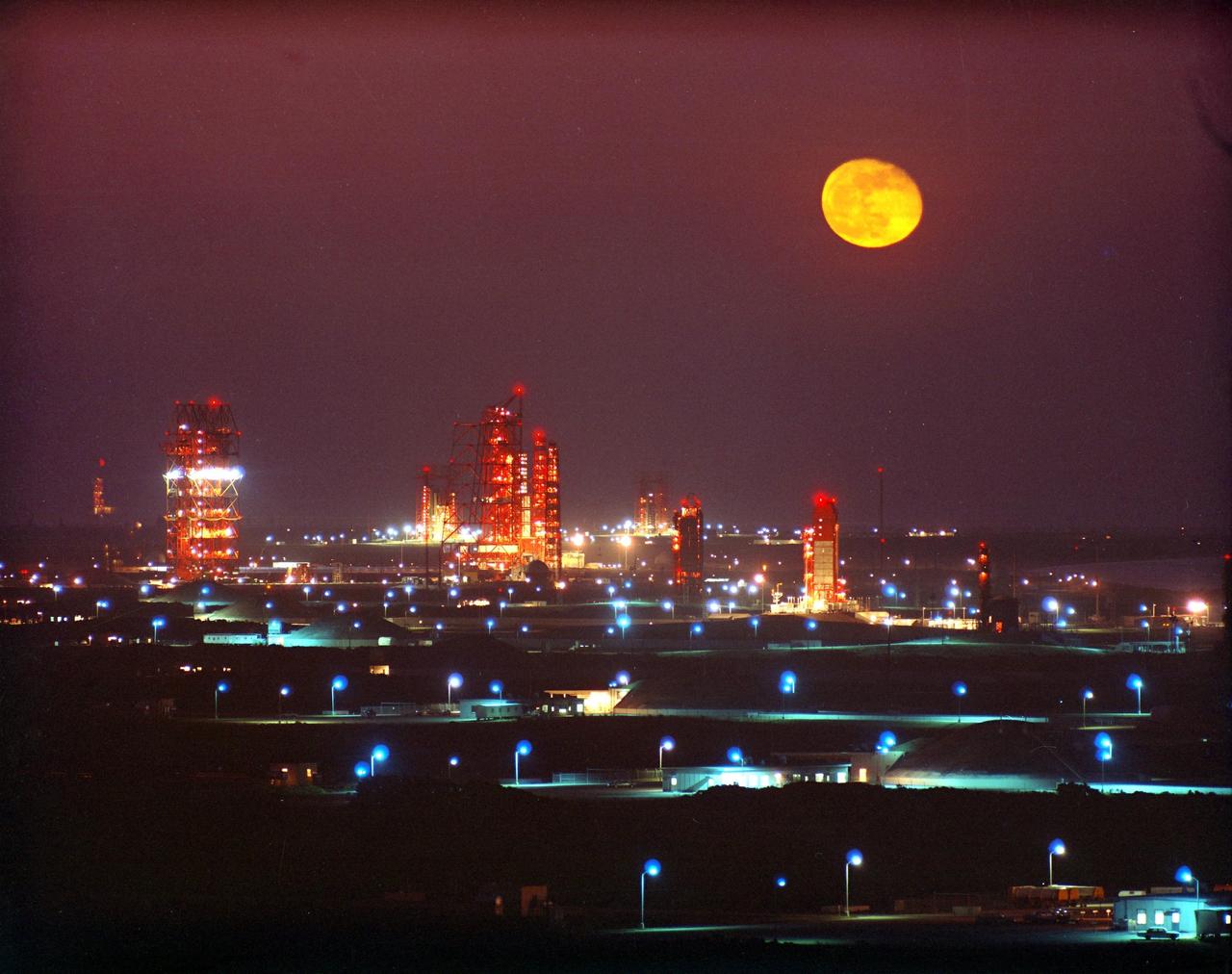
KENNEDY SPACE CENTER, FLA. -- A full moon is outdazzled by the liglhts of the gantries below on "Missile Row" as they stretch north along the shoreline of Cape Canaveral Air Force Station.
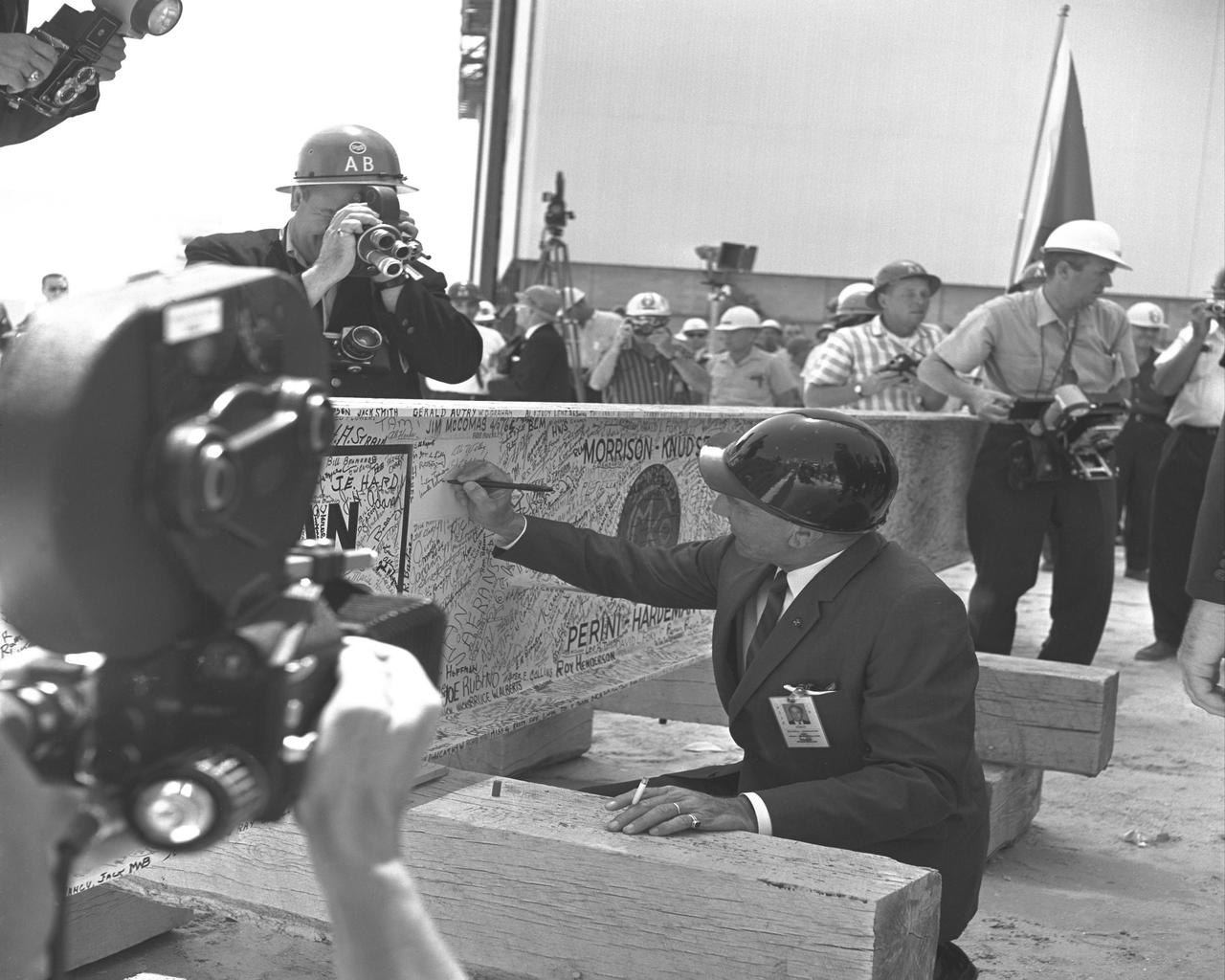
KENNEDY SPACE CENTER, FLA. -- Dr. Kurt Debus, Kennedy Space Center's first director, adds his name to the thousands of signatures affixed to the 38-foot-long steel beam used in the VAB's 'Topping Off' ceremonies.
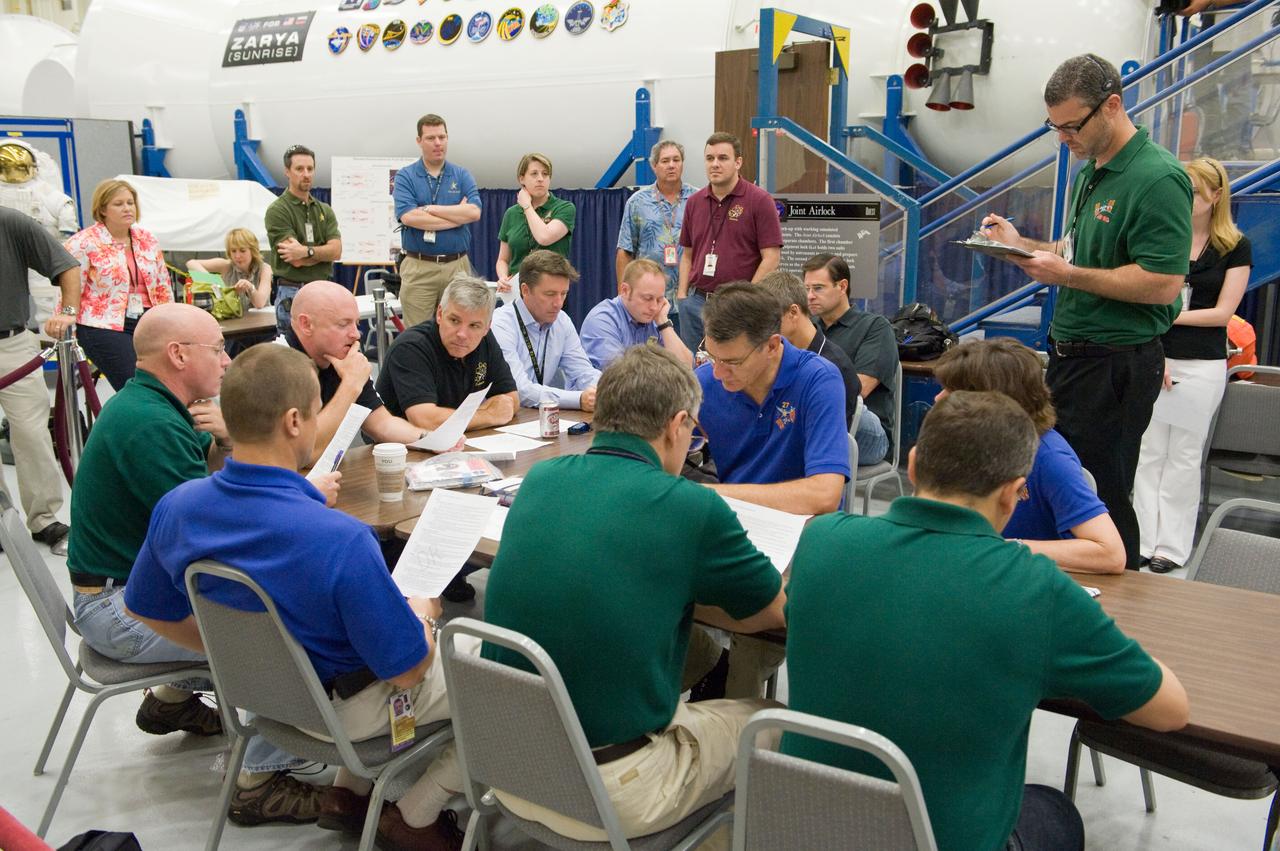
JSC2010-E-132403 (16 July 2010) --- Expedition 25/26, Expedition 26/27 and STS-134 crew members are pictured during a joint emergency scenarios training session in the Space Vehicle Mock-up Facility at NASA's Johnson Space Center. Photo credit: NASA or National Aeronautics and Space Administration
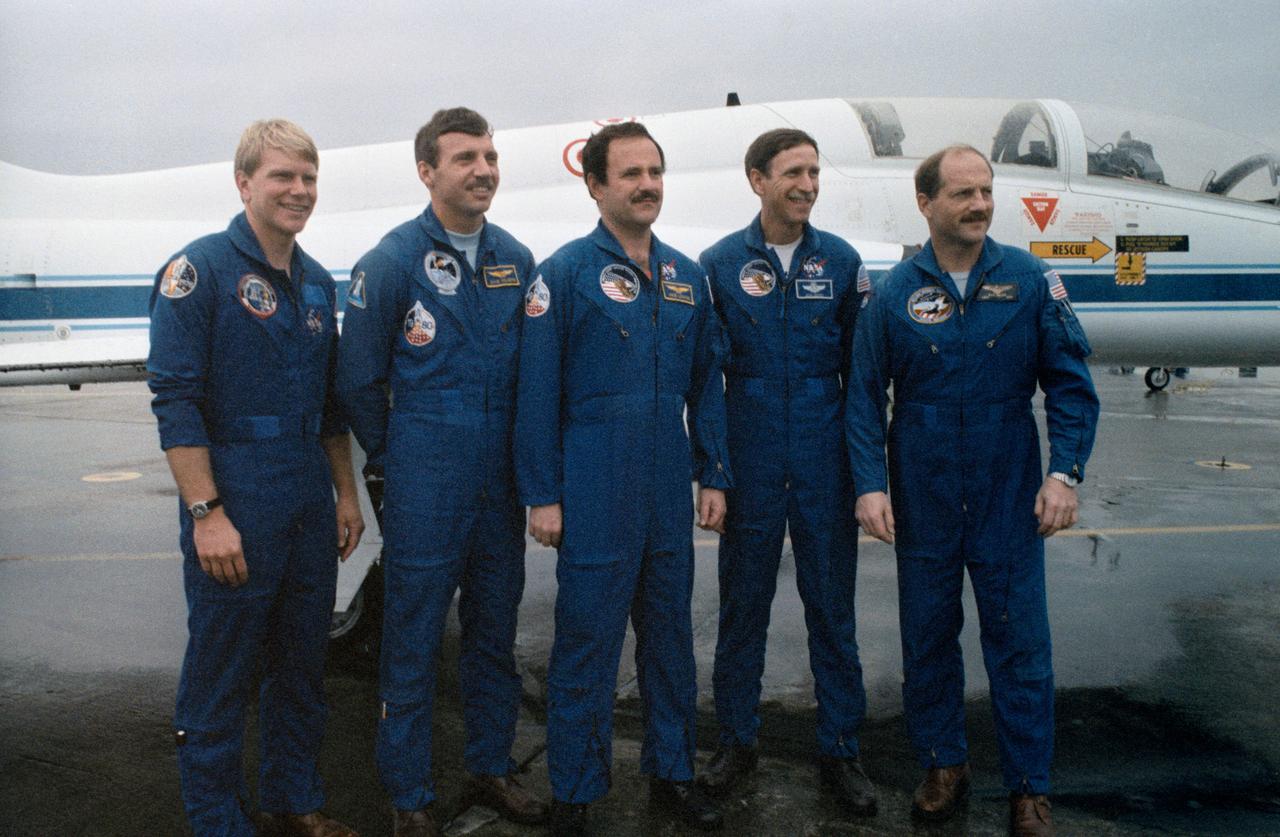
S87-28139 (26 Feb 1987) --- The five veteran astronauts recently assigned to the STS 26 space mission pose for photographers prior to departure from Ellington Field in T-38 jets (parked in background). Astronaut Frederick H. (Rick) Hauck (right) is mission commander. Astronaut Richard O. Covey, second right, is pilot; and (l.-r.) Astronauts George D. Nelson, David C. Hilmers and John M. (Mike) Lounge are mission specialists. The five were headed for KSC in Florida where they were to interface with flight hardware. The Discovery has been assigned as the STS 26 Shuttle vehicle.

PHOTO DATE: 16 July 2010, LOCATION: Bldg. 9NW, SVMTF - ISS Mockups, SUBJECT: Joint STS-134, Expedition 25 and Expedition 26 ISS EmergencyScenario training. PHOTOGRAPHER: Mark Sowa
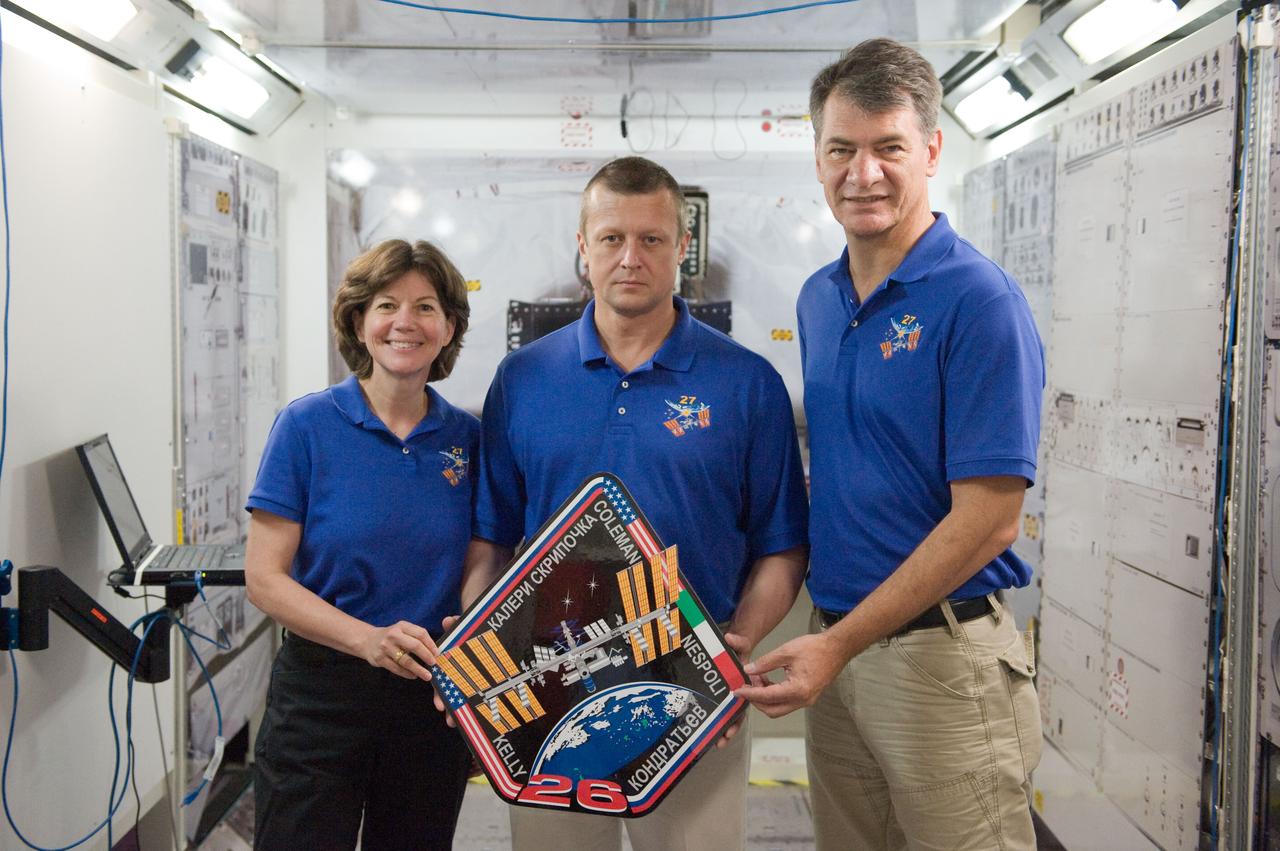
PHOTO DATE: 16 July 2010, LOCATION: Bldg. 9NW, SVMTF - ISS Mockups, SUBJECT: Joint STS-134, Expedition 25 and Expedition 26 ISS EmergencyScenario training. PHOTOGRAPHER: Mark Sowa
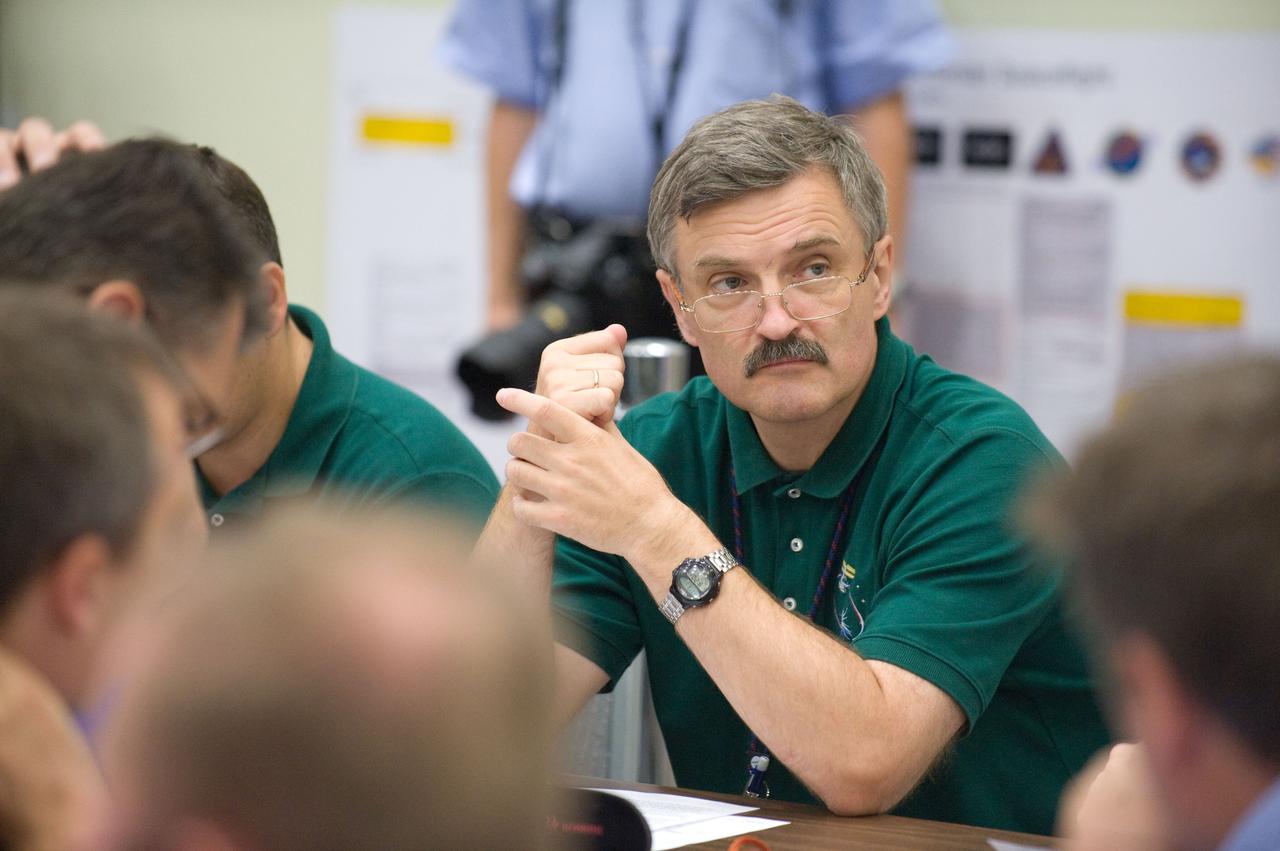
PHOTO DATE: 16 July 2010, LOCATION: Bldg. 9NW, SVMTF - ISS Mockups, SUBJECT: Joint STS-134, Expedition 25 and Expedition 26 ISS EmergencyScenario training. PHOTOGRAPHER: Mark Sowa
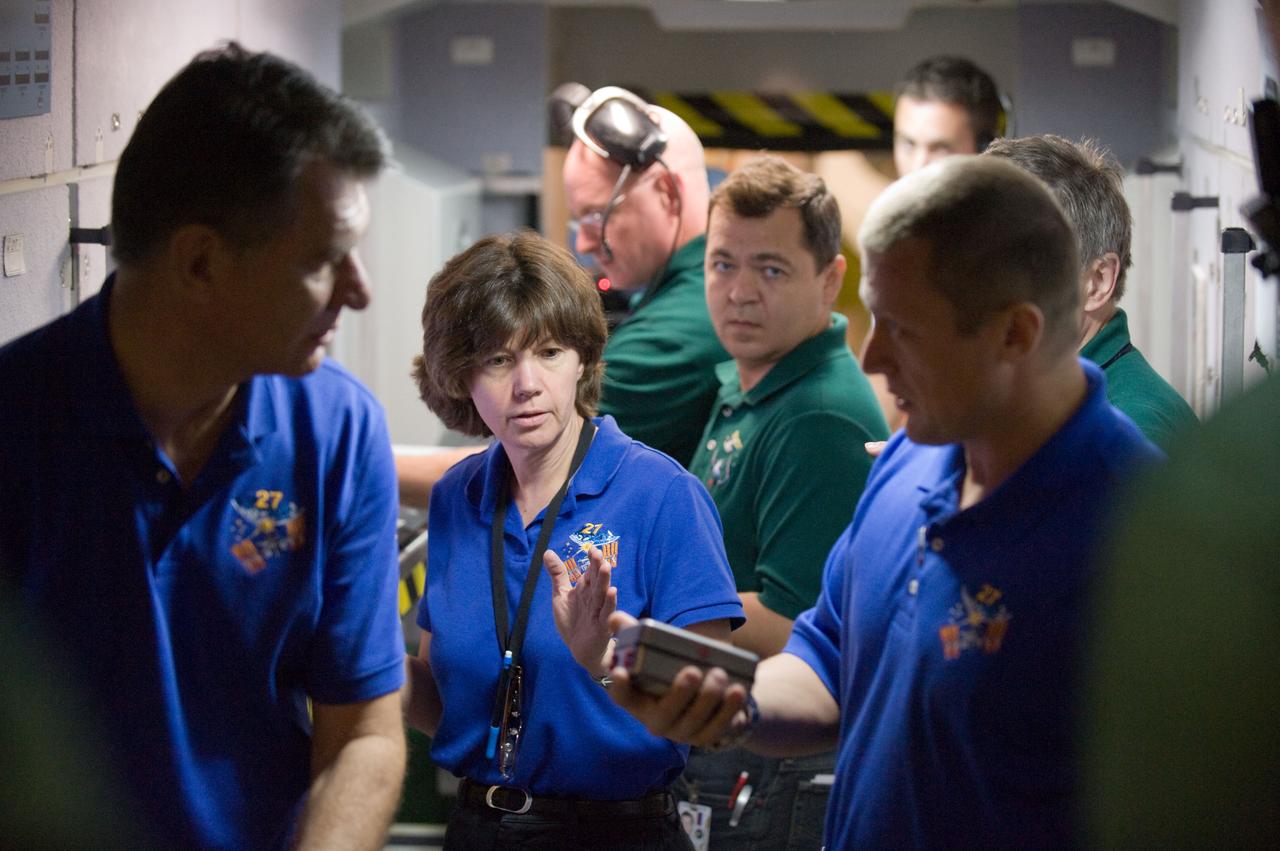
PHOTO DATE: 16 July 2010, LOCATION: Bldg. 9NW, SVMTF - ISS Mockups, SUBJECT: Joint STS-134, Expedition 25 and Expedition 26 ISS EmergencyScenario training. PHOTOGRAPHER: Mark Sowa

PHOTO DATE: 16 July 2010, LOCATION: Bldg. 9NW, SVMTF - ISS Mockups, SUBJECT: Joint STS-134, Expedition 25 and Expedition 26 ISS EmergencyScenario training. PHOTOGRAPHER: Mark Sowa
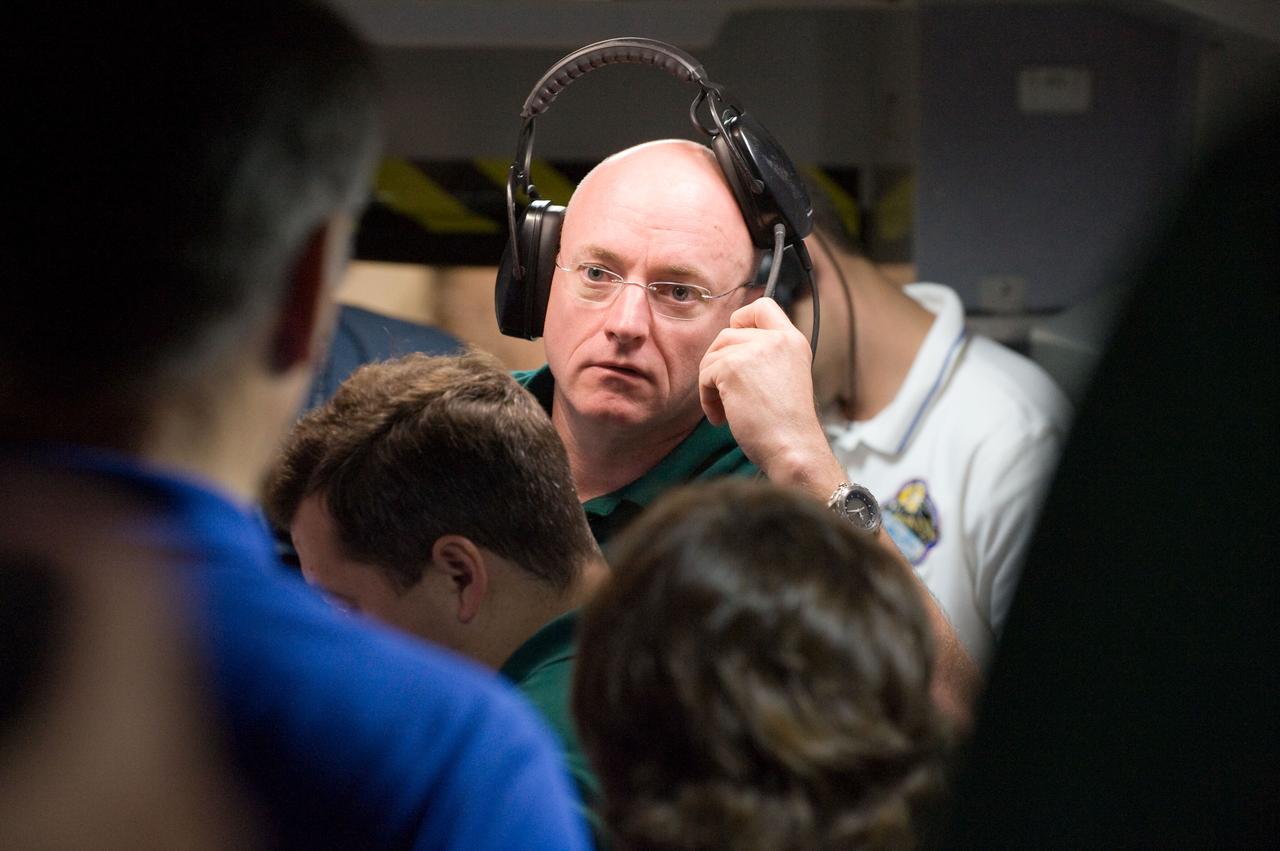
PHOTO DATE: 16 July 2010, LOCATION: Bldg. 9NW, SVMTF - ISS Mockups, SUBJECT: Joint STS-134, Expedition 25 and Expedition 26 ISS EmergencyScenario training. PHOTOGRAPHER: Mark Sowa
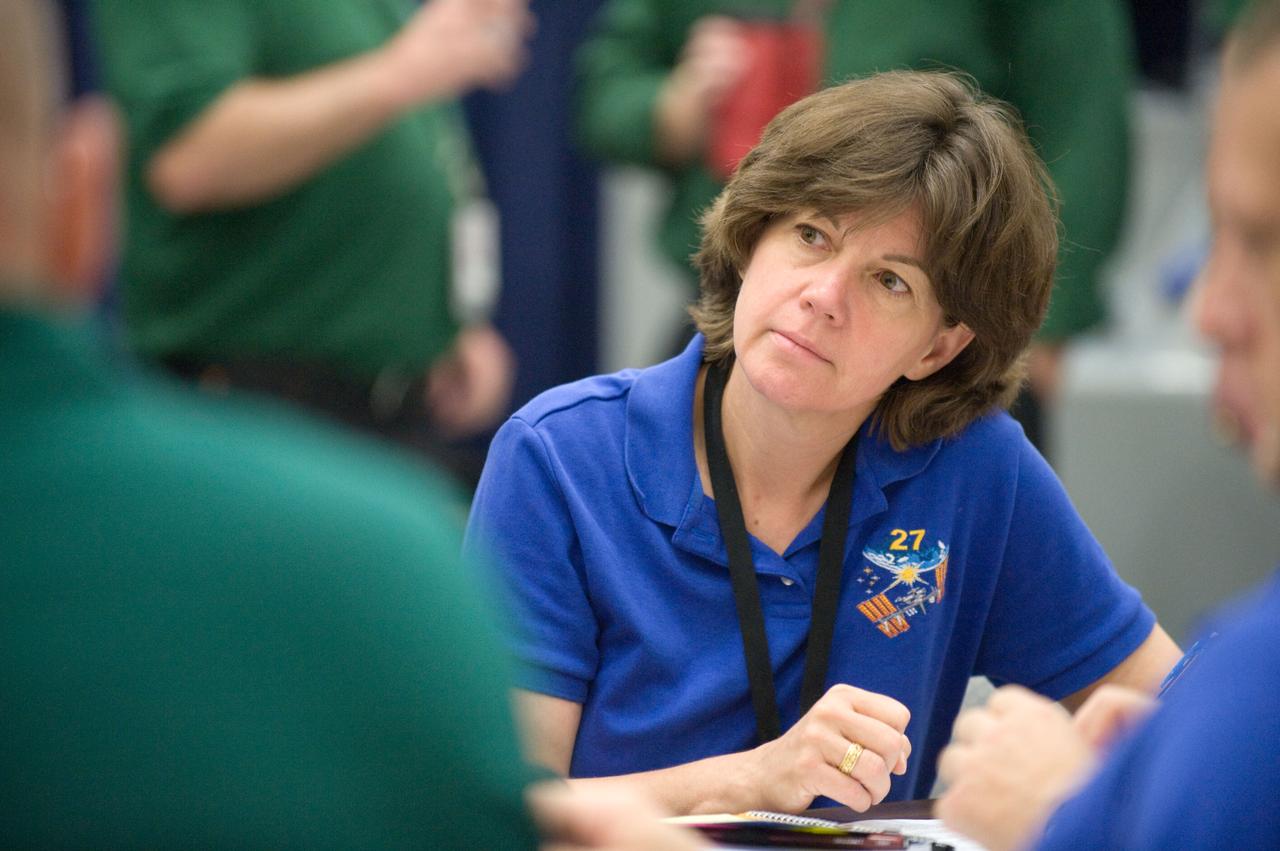
PHOTO DATE: 16 July 2010, LOCATION: Bldg. 9NW, SVMTF - ISS Mockups, SUBJECT: Joint STS-134, Expedition 25 and Expedition 26 ISS EmergencyScenario training. PHOTOGRAPHER: Mark Sowa
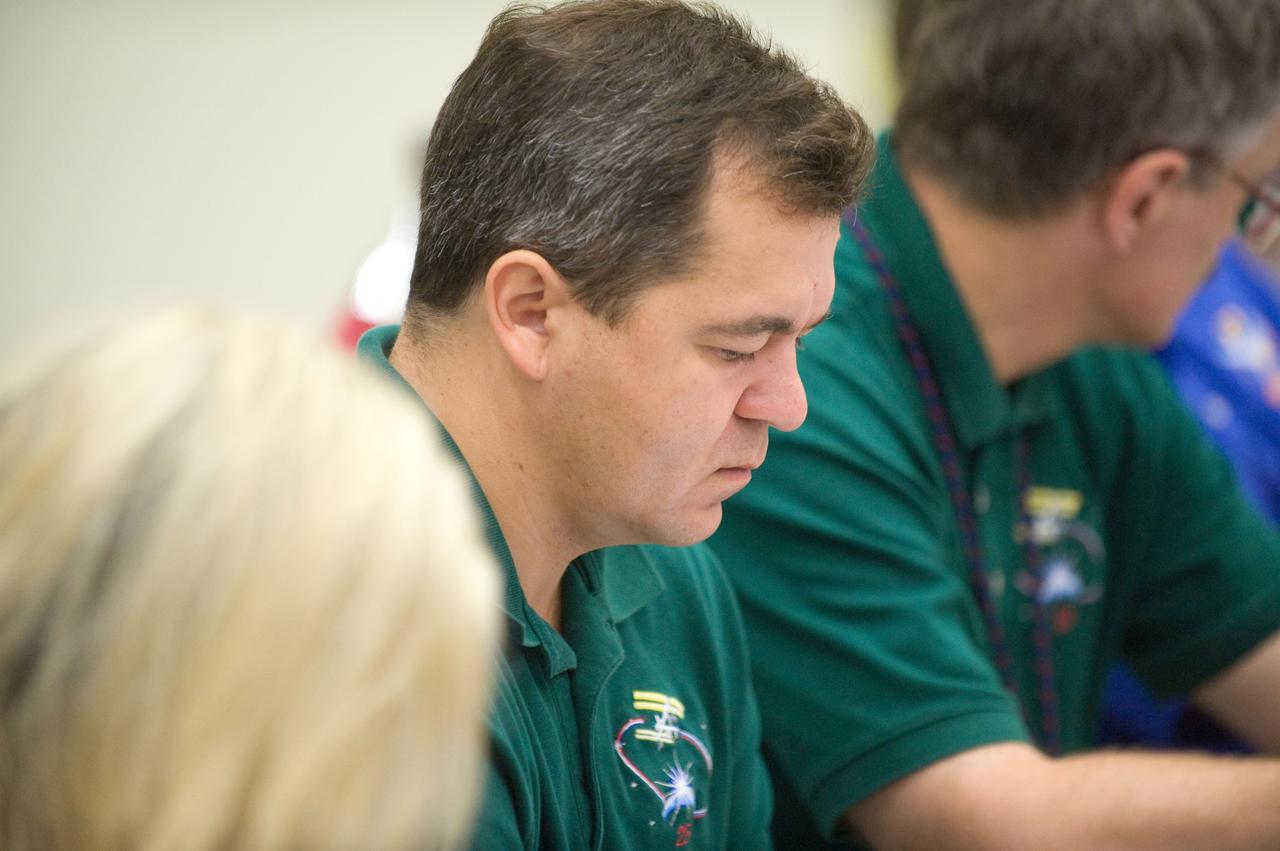
PHOTO DATE: 16 July 2010, LOCATION: Bldg. 9NW, SVMTF - ISS Mockups, SUBJECT: Joint STS-134, Expedition 25 and Expedition 26 ISS EmergencyScenario training. PHOTOGRAPHER: Mark Sowa
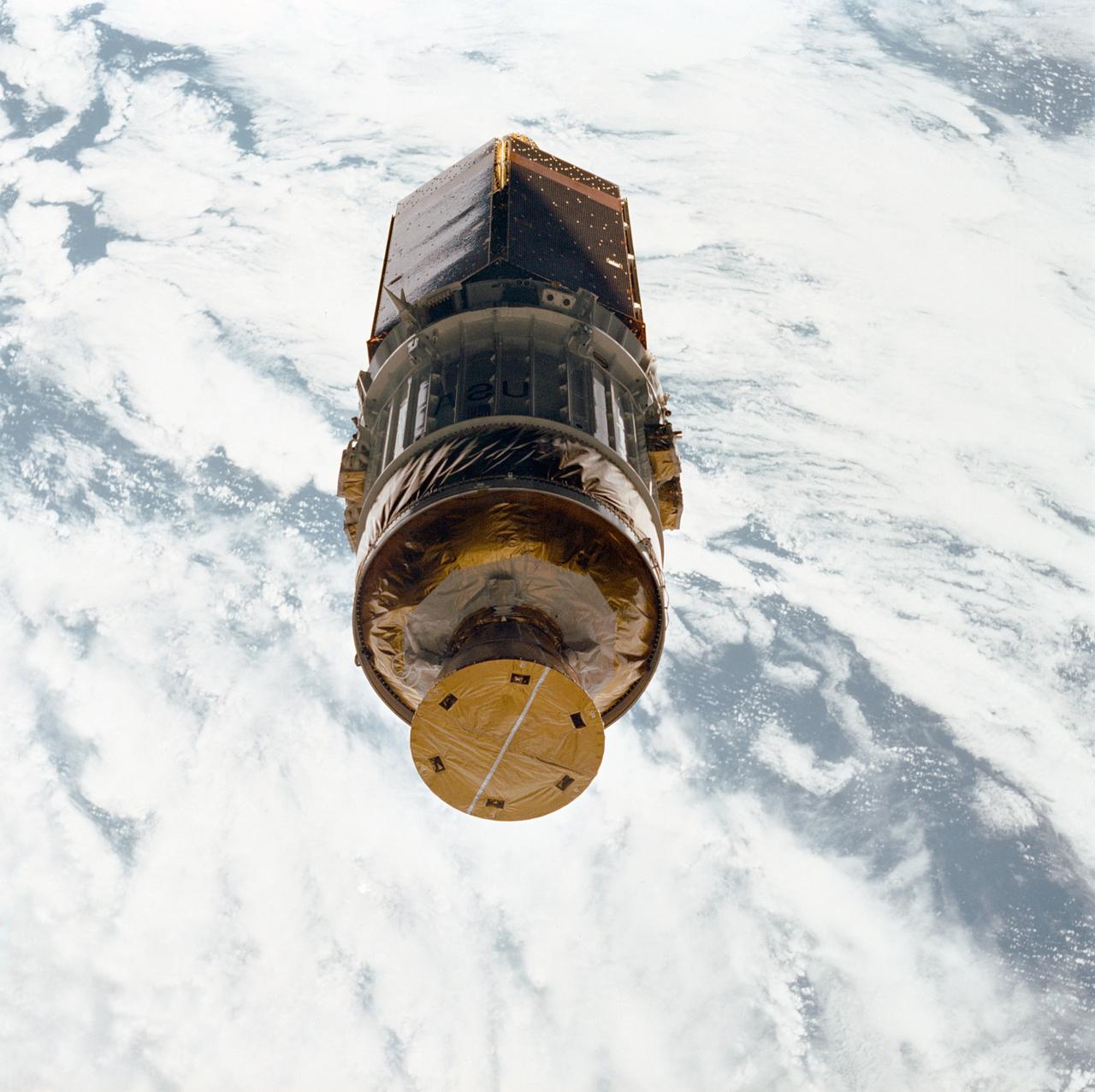
STS026-31-071 (3 Oct 1988) --- After deployment from Discovery, Orbiter Vehicle (OV) 103, the inertial upper stage (IUS) with the tracking and data relay satellite C (TDRS-C) drifts above the cloud-covered Earth surface. TDRS-C, in stowed configuration (solar array panels visible), is mounted atop the IUS with the interstage and solid rocket motor and nozzle seen in the foreground.
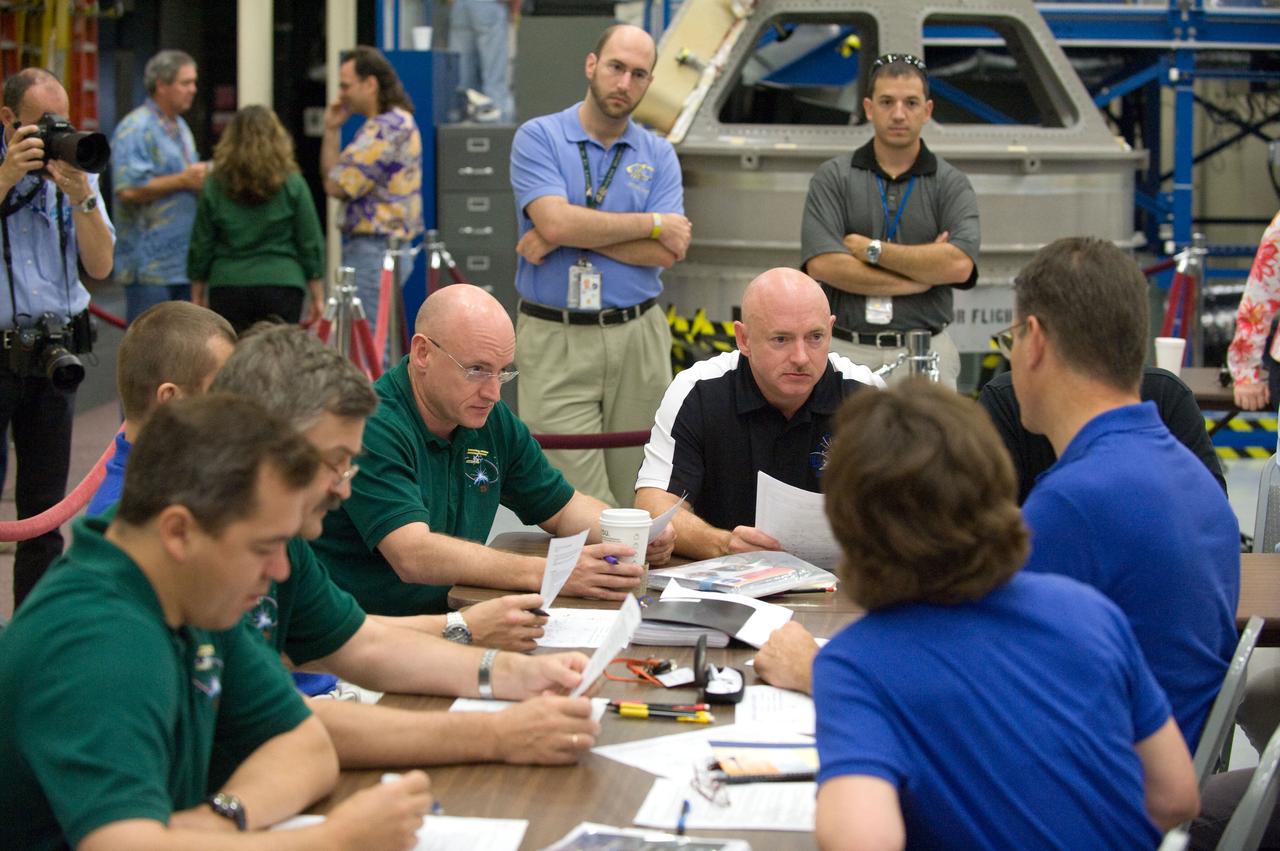
JSC2010-E-132378 (16 July 2010) --- Pictured clockwise from the left, Russian cosmonauts Oleg Skripochka and Alexander Kaleri, both Expedition 25/26 flight engineers; Russian cosmonaut Dmitry Kondratyev, Expedition 26 flight engineer and Expedition 27 commander; NASA astronaut Scott Kelly, Expedition 25 flight engineer and Expedition 26 commander; NASA astronaut Mark Kelly, STS-134 commander; European Space Agency (ESA) astronaut Paolo Nespoli and NASA astronaut Catherine Coleman, both Expedition 26/27 flight engineers, participate in an emergency scenarios training session in the Space Vehicle Mock-up Facility at NASA's Johnson Space Center. Photo credit: NASA or National Aeronautics and Space Administration
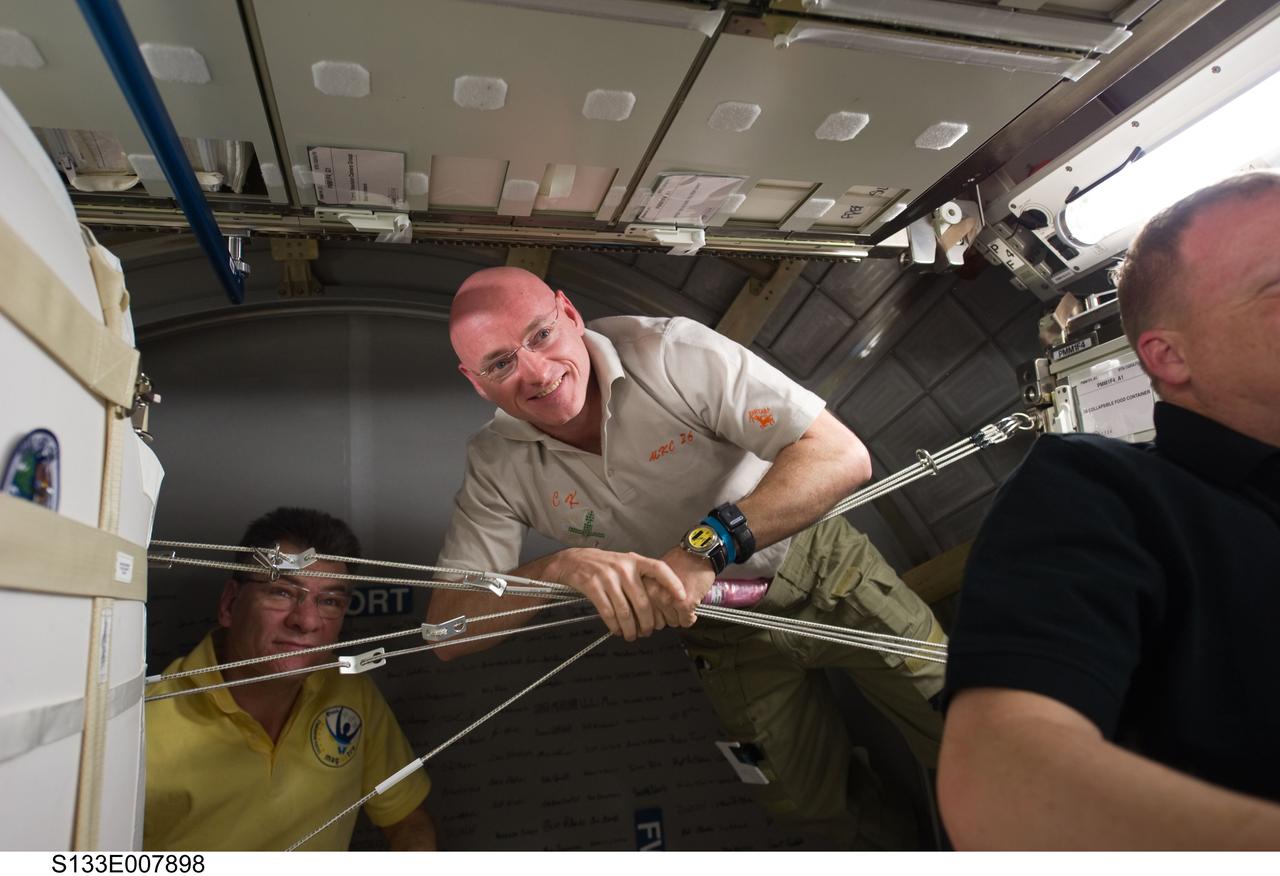
S133-E-007898 (1 March 2011) --- NASA astronauts Scott Kelly (center), Expedition 26 commander; and Eric Boe (right), STS-133 pilot; along with European Space Agency astronaut Paolo Nespoli, Expedition 26 flight engineer, are pictured in the newly-installed Permanent Multipurpose Module (PMM) of the International Space Station while space shuttle Discovery remains docked with the station. Photo credit: NASA or National Aeronautics and Space Administration

S133-E-007901 (1 March 2011) --- NASA astronauts Cady Coleman, Expedition 26 flight engineer; and Alvin Drew (top right), STS-133 mission specialist; along with Russian cosmonaut Dmitry Kondratyev, Expedition 26 flight engineer, are pictured in the newly-installed Permanent Multipurpose Module (PMM) of the International Space Station while space shuttle Discovery remains docked with the station. Photo credit: NASA or National Aeronautics and Space Administration
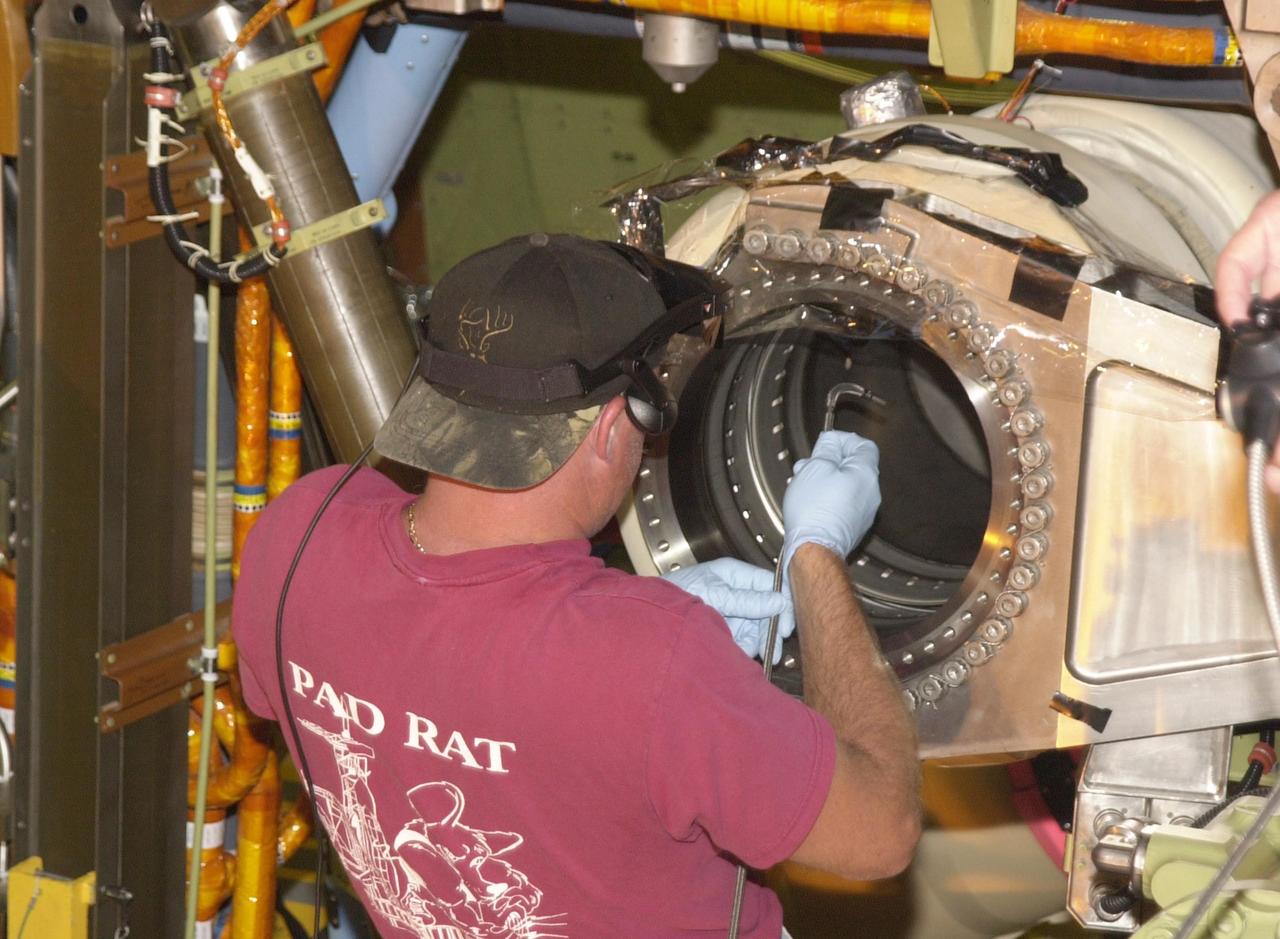
KENNEDY SPACE CENTER, FLA. -- Scott Minnick, with United Space Alliance, places a fiber-optic camera inside the flow line on Endeavour. Minnick wears a special viewing apparatus that sees where the camera is going. The inspection is the result of small cracks being discovered on the LH2 Main Propulsion System (MPS) flow liners in other orbiters. Endeavour is next scheduled to fly on mission STS-113.
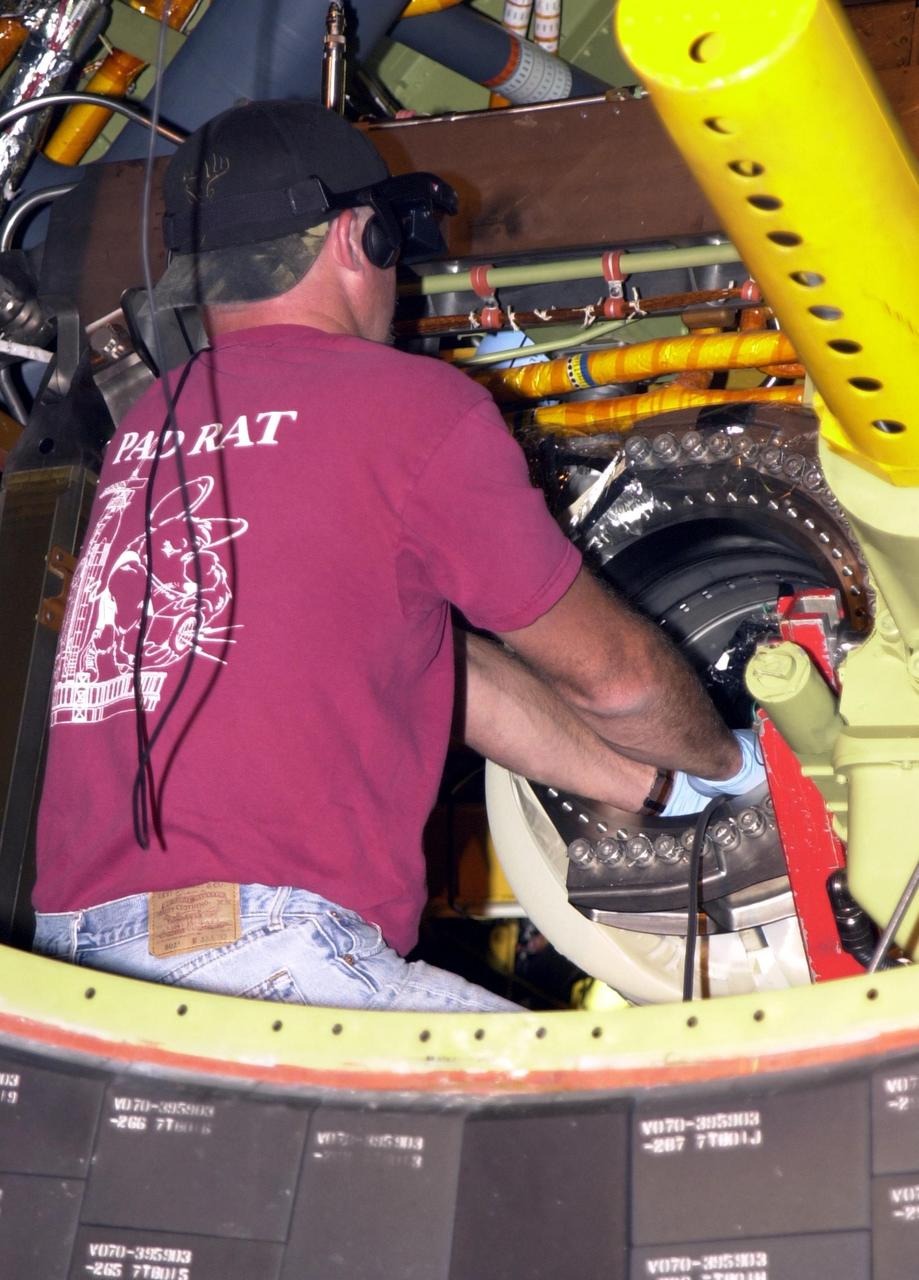
KENNEDY SPACE CENTER, FLA. -- Scott Minnick, with United Space Alliance, places a fiber-optic camera inside the flow line on Endeavour. Minnick wears a special viewing apparatus that sees where the camera is going. The inspection is the result of small cracks being discovered on the LH2 Main Propulsion System (MPS) flow liners in other orbiters. Endeavour is next scheduled to fly on mission STS-113.
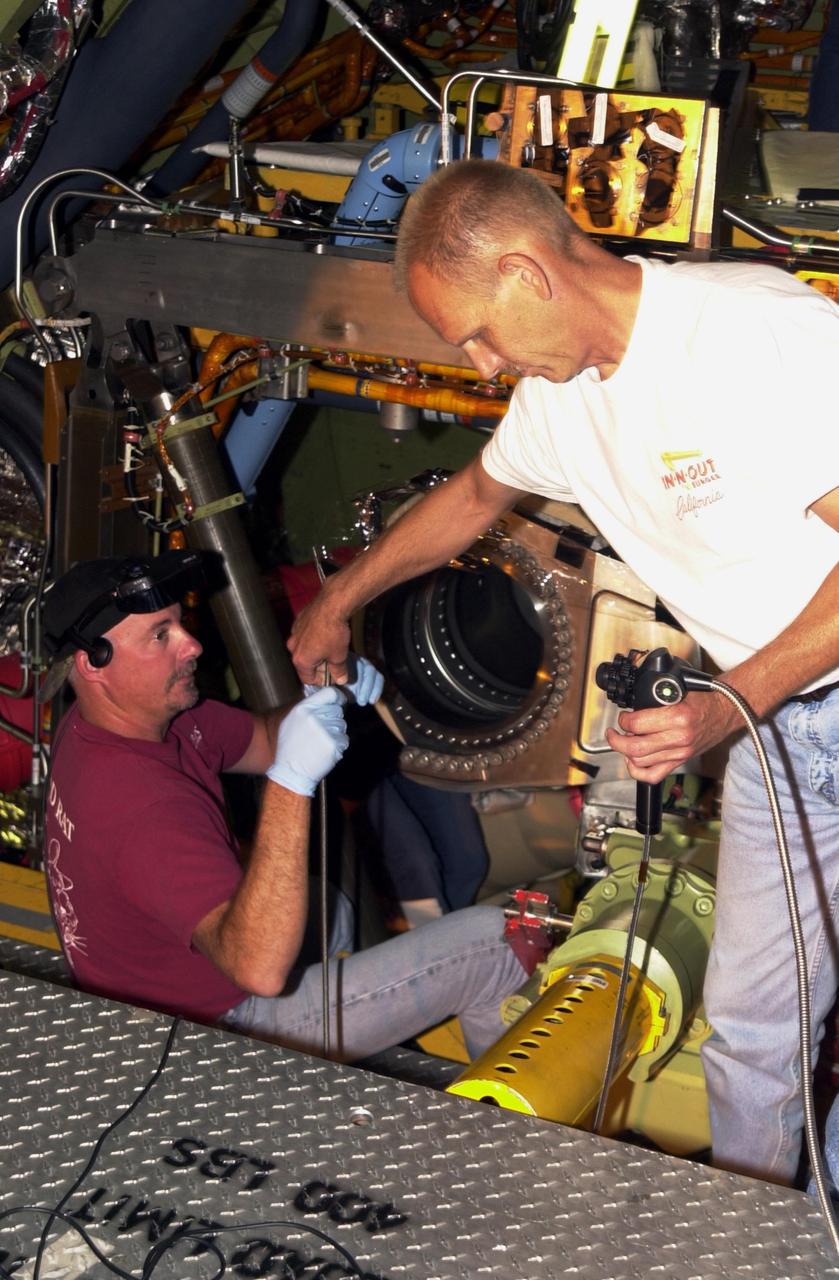
KENNEDY SPACE CENTER, FLA. -- With the engines removed from Endeavour, the flow line can be inspected. On the right, Gerry Kathka, with United Space Alliance, hands part of a fiber-optic camera system to Scott Minnick, left. Minnick wears a special viewing apparatus that sees where the camera is going. The inspection is the result of small cracks being discovered on the LH2 Main Propulsion System (MPS) flow liners in other orbiters. Endeavour is next scheduled to fly on mission STS-113.
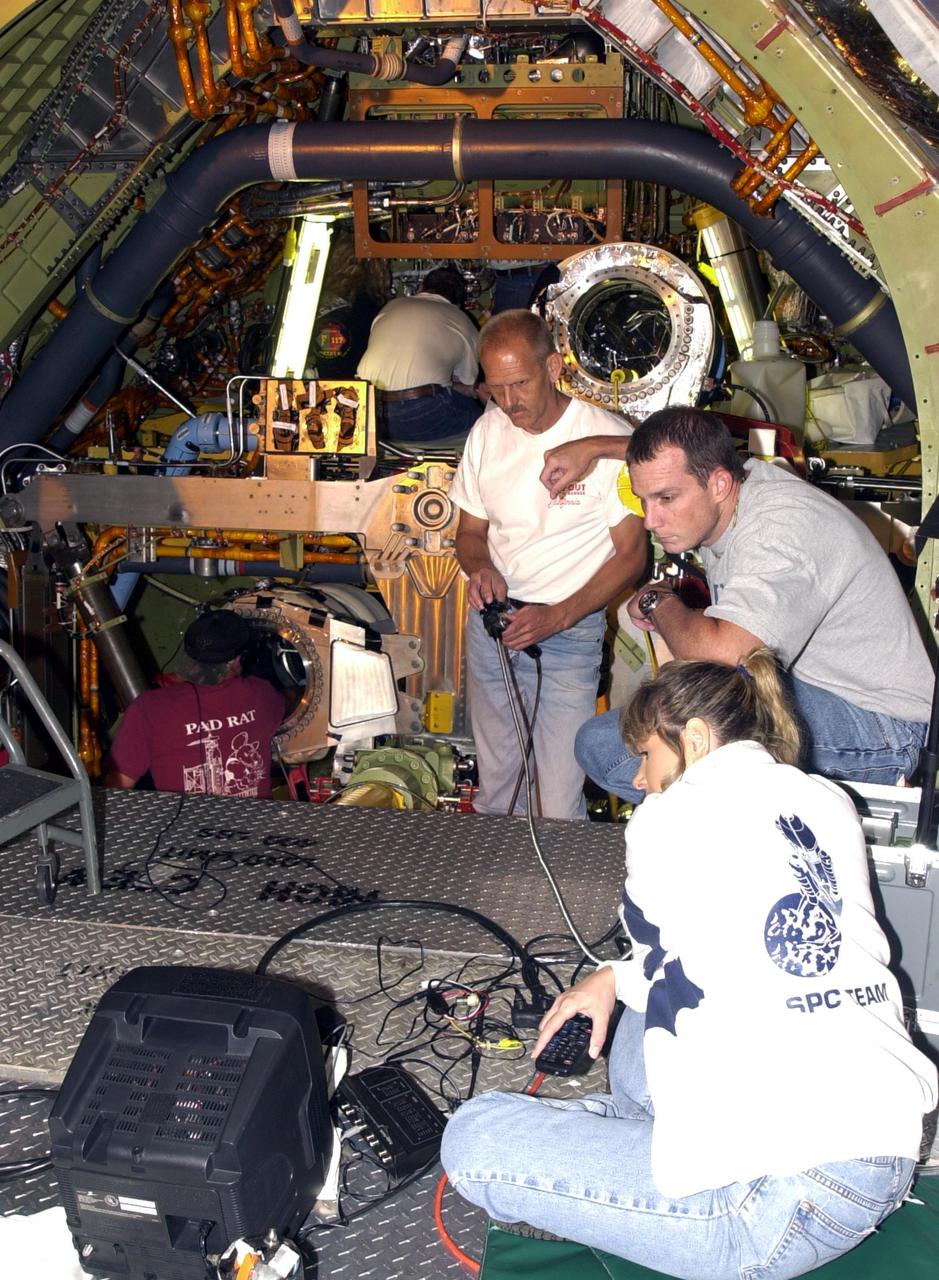
KENNEDY SPACE CENTER, FLA. -- With the engines removed from Endeavour, the inside of Endeavour is exposed. At left center, Scott Minnick, with United Space Alliance, operates a fiber-optic camera inside the flow line. Other USA team members, right, watching the progress on a screen in front, are Gerry Kathka (with controls), Mike Fore and Peggy Ritchie. The inspection is the result of small cracks being discovered on the LH2 Main Propulsion System (MPS) flow liners in other orbiters. Endeavour is next scheduled to fly on mission STS-113.
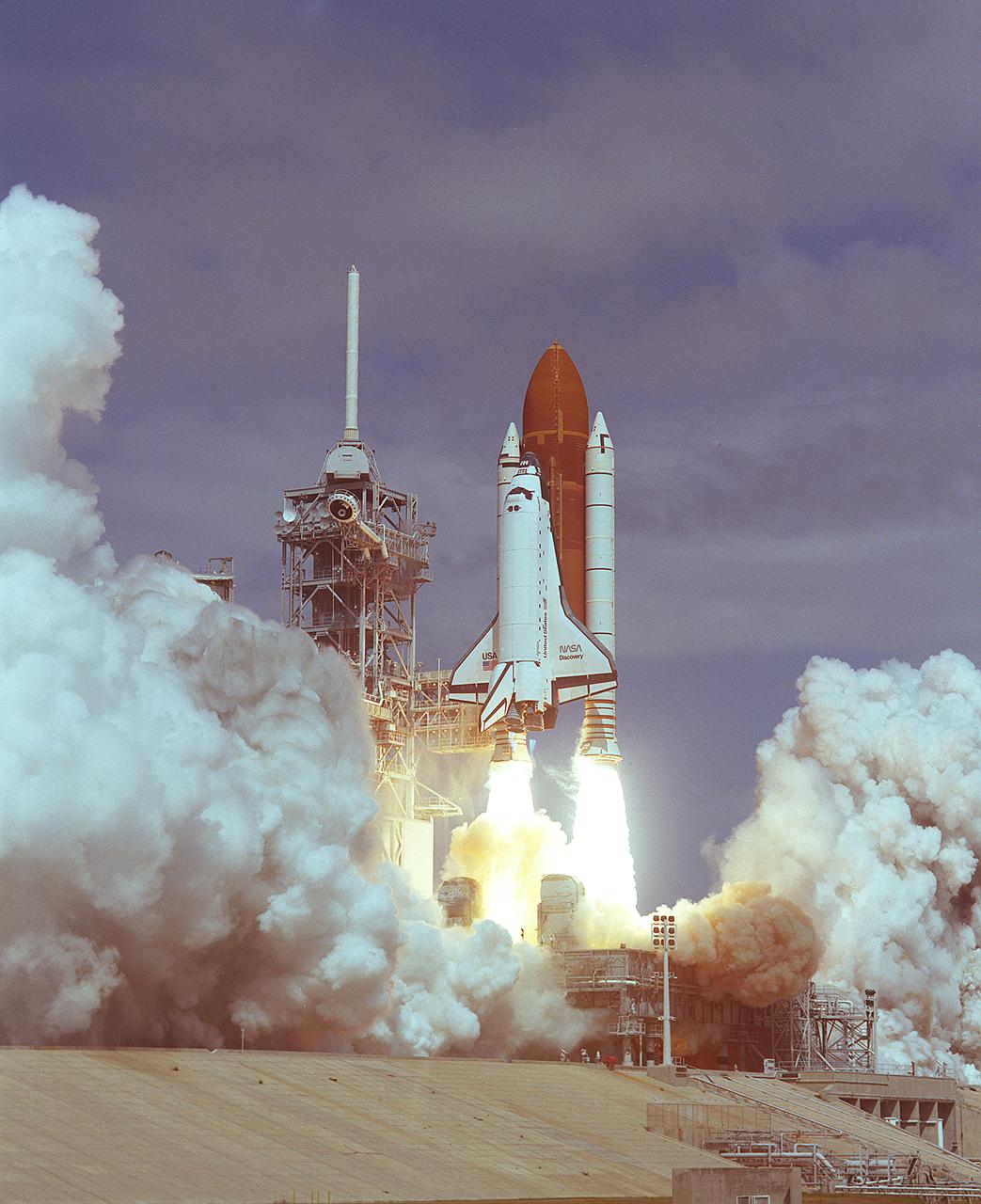
On September 29, 1988, after a 32-month hiatus in the Space Shuttle program that followed the Challenger accident, orbiter Discovery roared upward on the strength of its Marshall-managed solid rocket boosters, external tank, and Space Shuttle main engines.
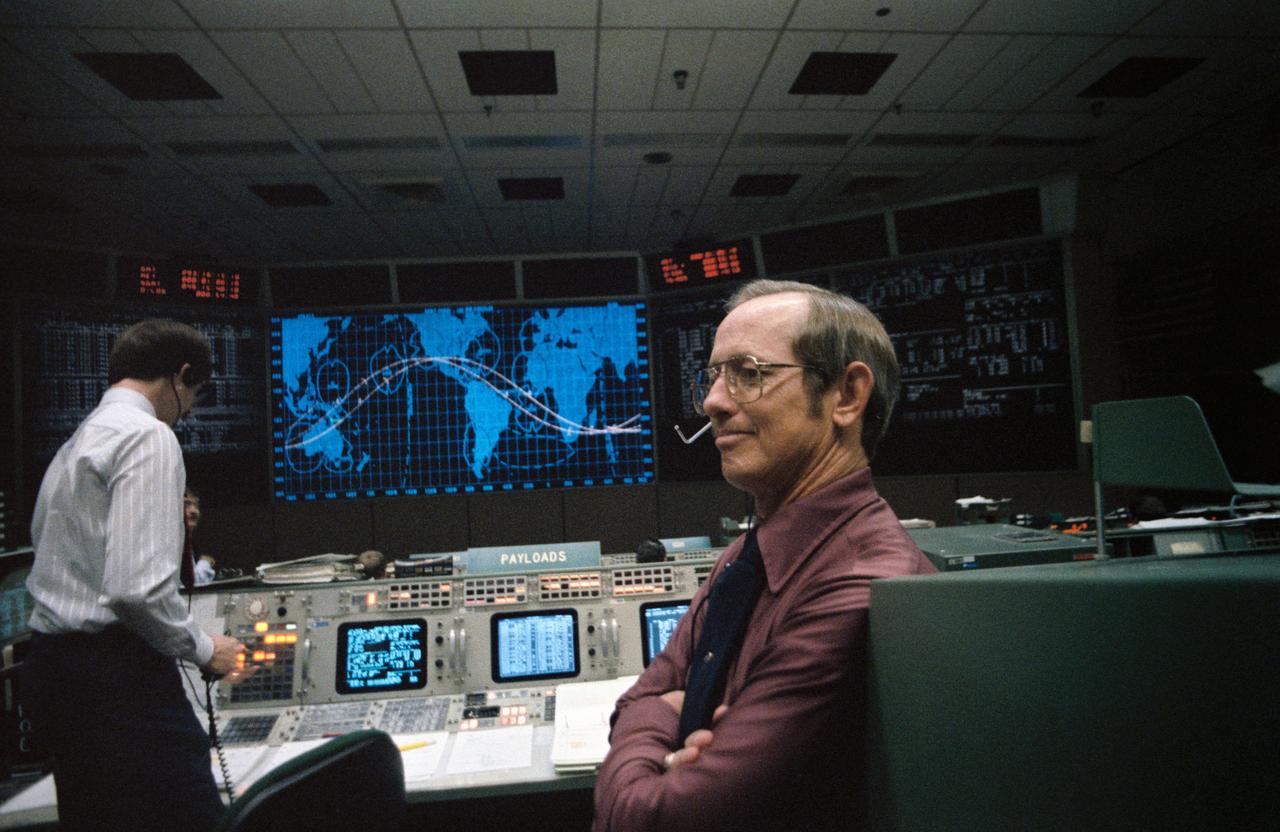
S87-46338 (20 Oct 1987) --- Flight controller Granvil Pennington listens to communications from the STS-26 integrated simulations in the flight control room of JSC's mission control center. Five veteran astronauts were in a simulator in another JSC building rehearsing their roles for the scheduled June 1988 flight aboard the Discovery.
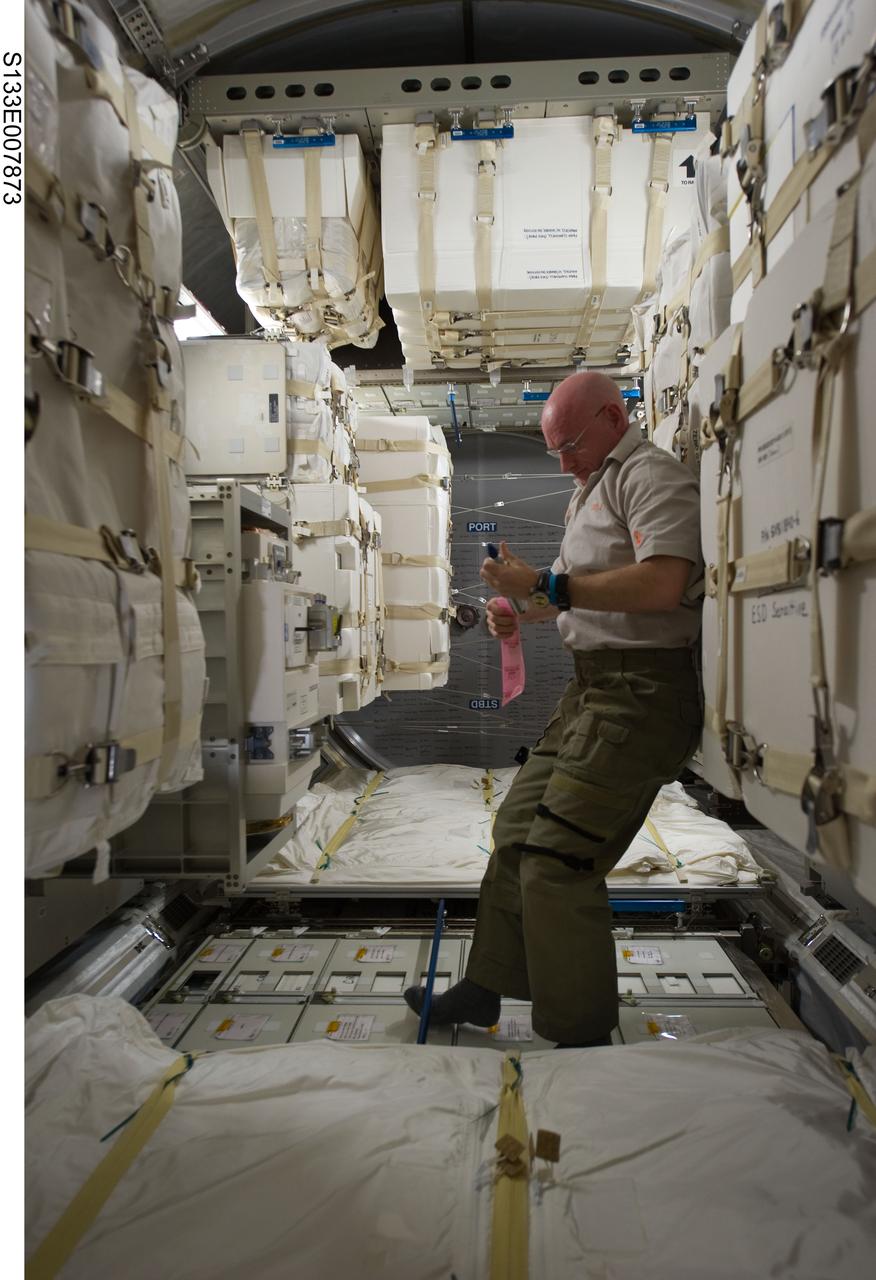
S133-E-007873 (1 March 2011) --- NASA astronaut Scott Kelly, Expedition 26 commander, is pictured in the newly-installed Permanent Multipurpose Module (PMM) of the International Space Station while space shuttle Discovery (STS-133) remains docked with the station. Photo credit: NASA or National Aeronautics and Space Administration
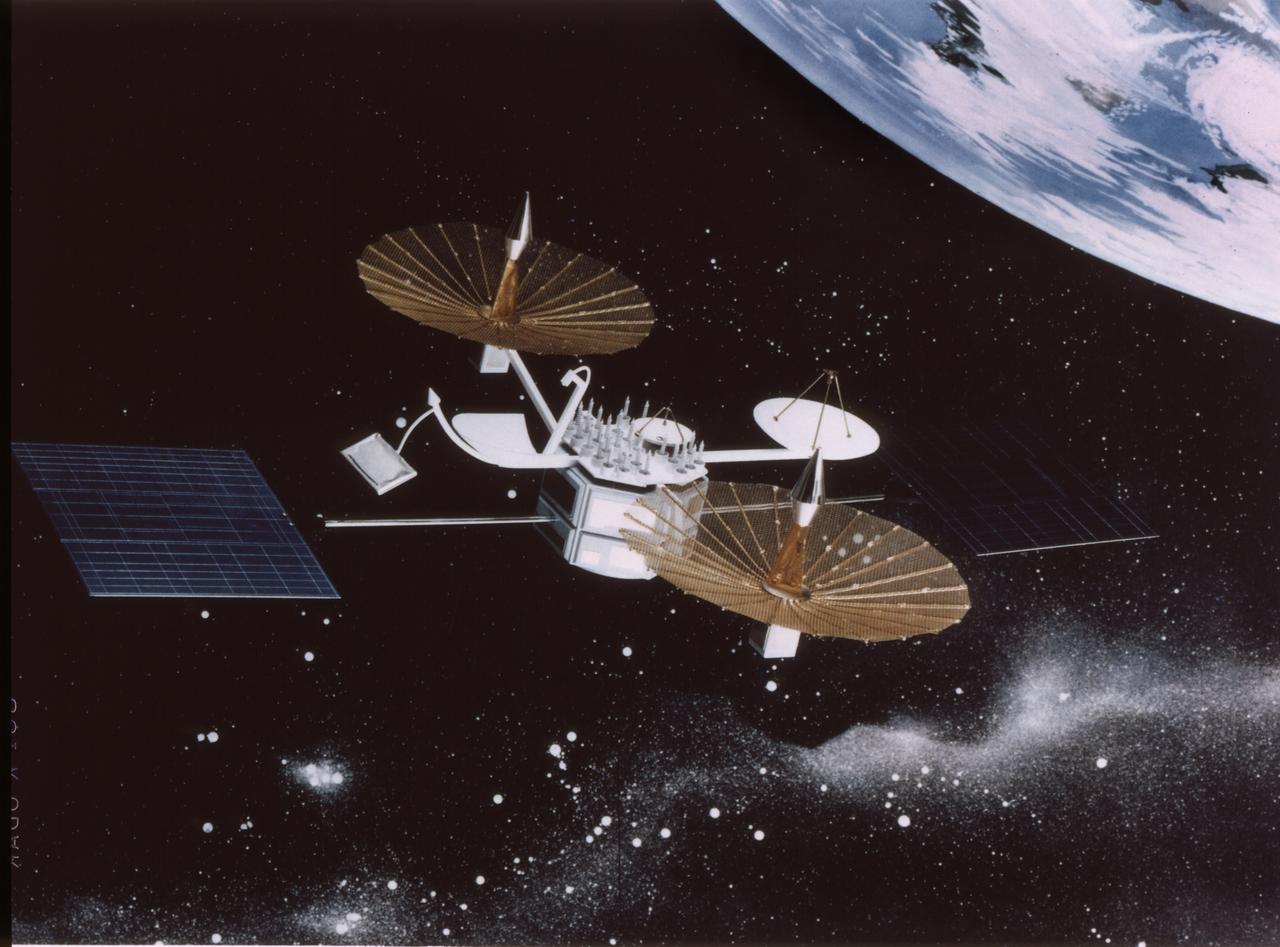
This artist's concept drawing depicts the Tracking and Data Relay Satellite-C (TDRS-C), which was the primary payload of the Space Shuttle Discovery on the STS-26 mission, launched on September 29, 1988. The TDRS system provides almost uninterrupted communications with Earth-orbiting Shuttles and satellites, and had replaced the intermittent coverage provided by globe-encircling ground tracking stations used during the early space program. The TDRS can transmit and receive data, and track a user spacecraft in a low Earth orbit. The deployment of TDRS-G on the STS-70 mission being the latest in the series, NASA has successfully launched six TDRSs.
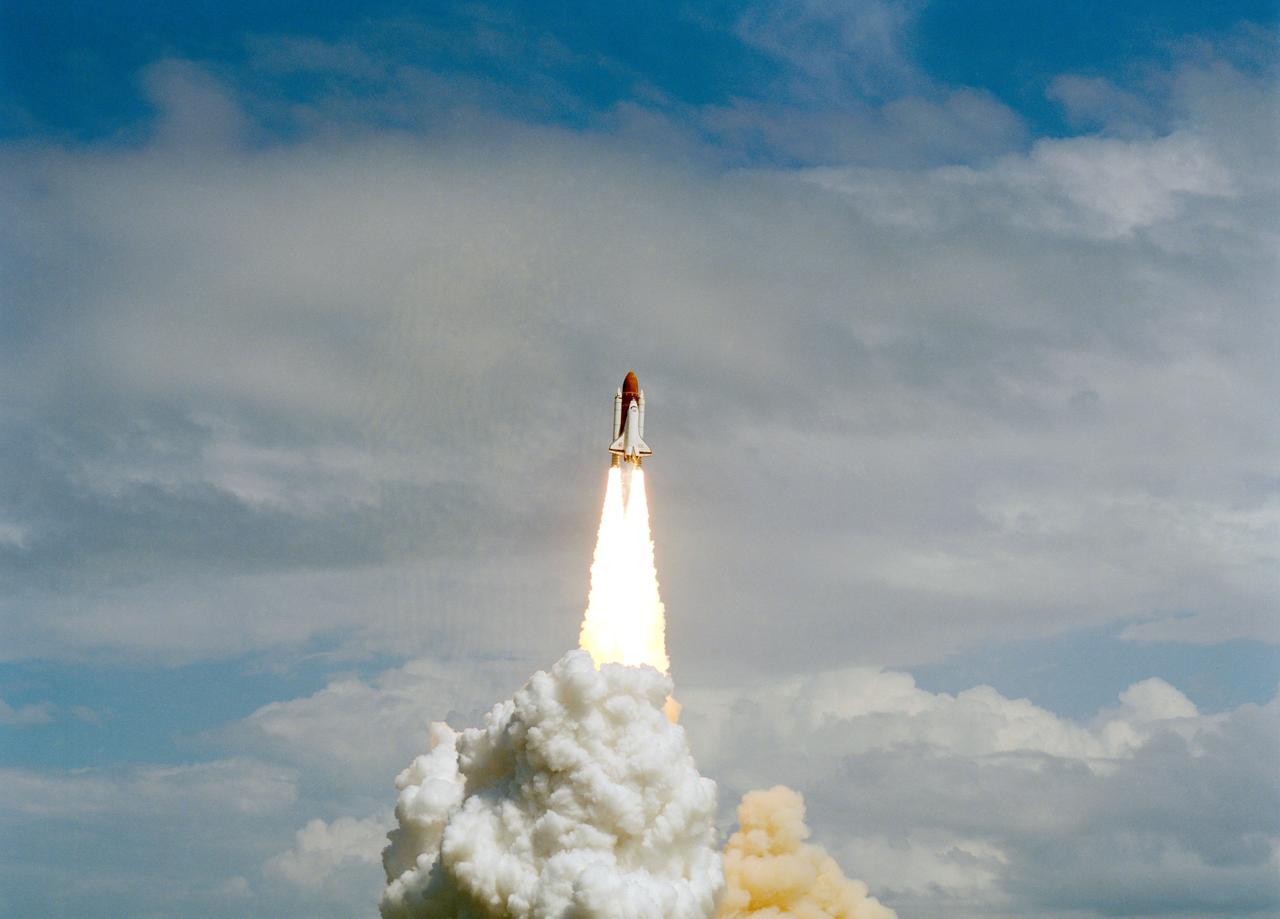
STS-26 Discovery, Orbiter Vehicle (OV) 103, rises into a cloudy sky and heads for Earth orbit atop the external tank (ET) as exhaust plumes billow from the two solid rocket boosters (SRBs) during liftoff from Kennedy Space Center (KSC) Launch Complex (LC) pad 39B. STS-26 marks OV-103's first flight since September 1985 and NASA's first manned mission since 51L Challenger accident, 01-28-86.
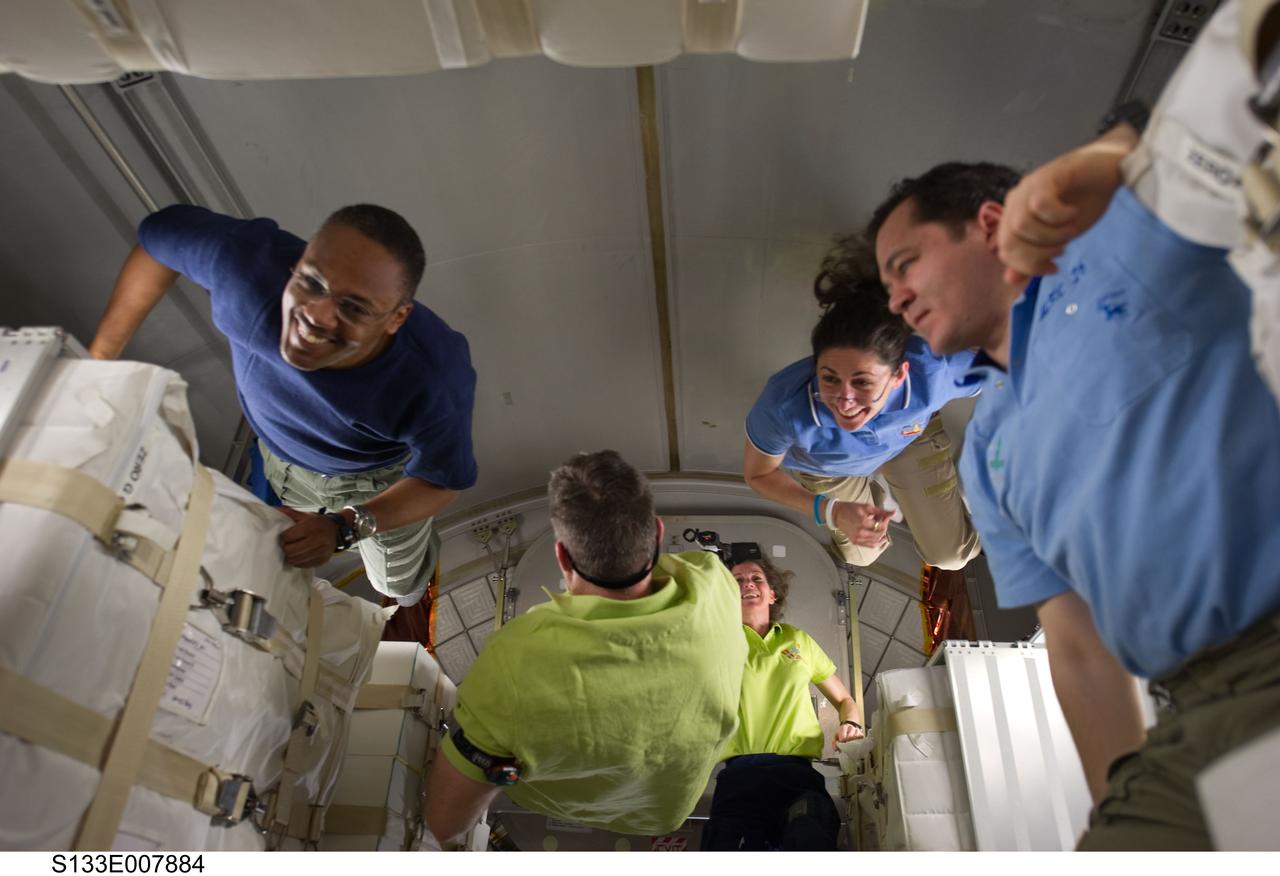
S133-E-007884 (1 March 2011) --- NASA astronauts Alvin Drew (left), Steve Bowen (center) and Nicole Stott (second right), all STS-133 mission specialists; along with NASA astronaut Cady Coleman and Russian cosmonaut Oleg Skripochka, both Expedition 26 flight engineers, are pictured in the newly-installed Permanent Multipurpose Module (PMM) of the International Space Station while space shuttle Discovery remains docked with the station. Photo credit: NASA or National Aeronautics and Space Administration
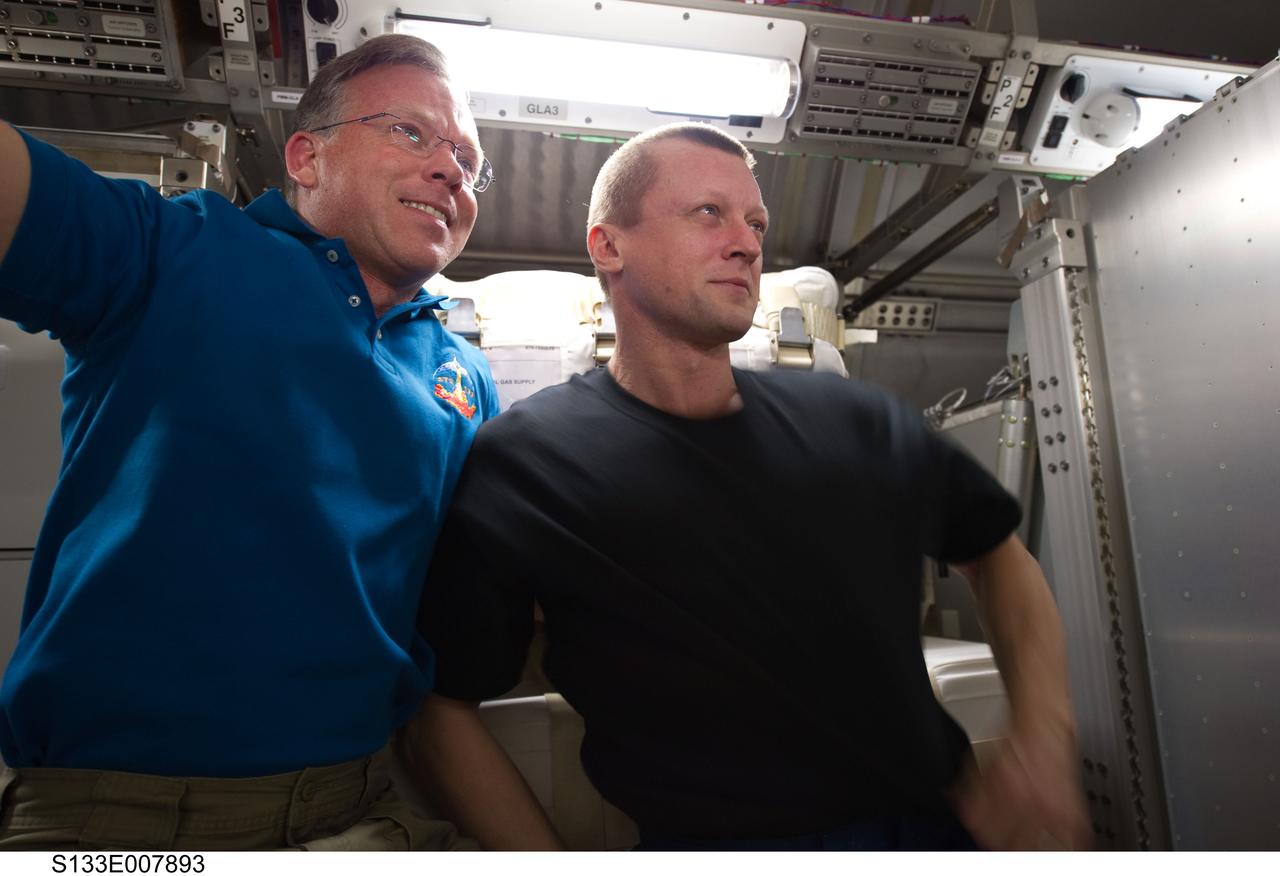
S133-E-007893 (1 March 2011) --- NASA astronaut Steve Lindsey (left), STS-133 commander; and Russian cosmonaut Dmitry Kondratyev, Expedition 26 flight engineer, are pictured in the newly-installed Permanent Multipurpose Module (PMM) of the International Space Station while space shuttle Discovery remains docked with the station. Photo credit: NASA or National Aeronautics and Space Administration
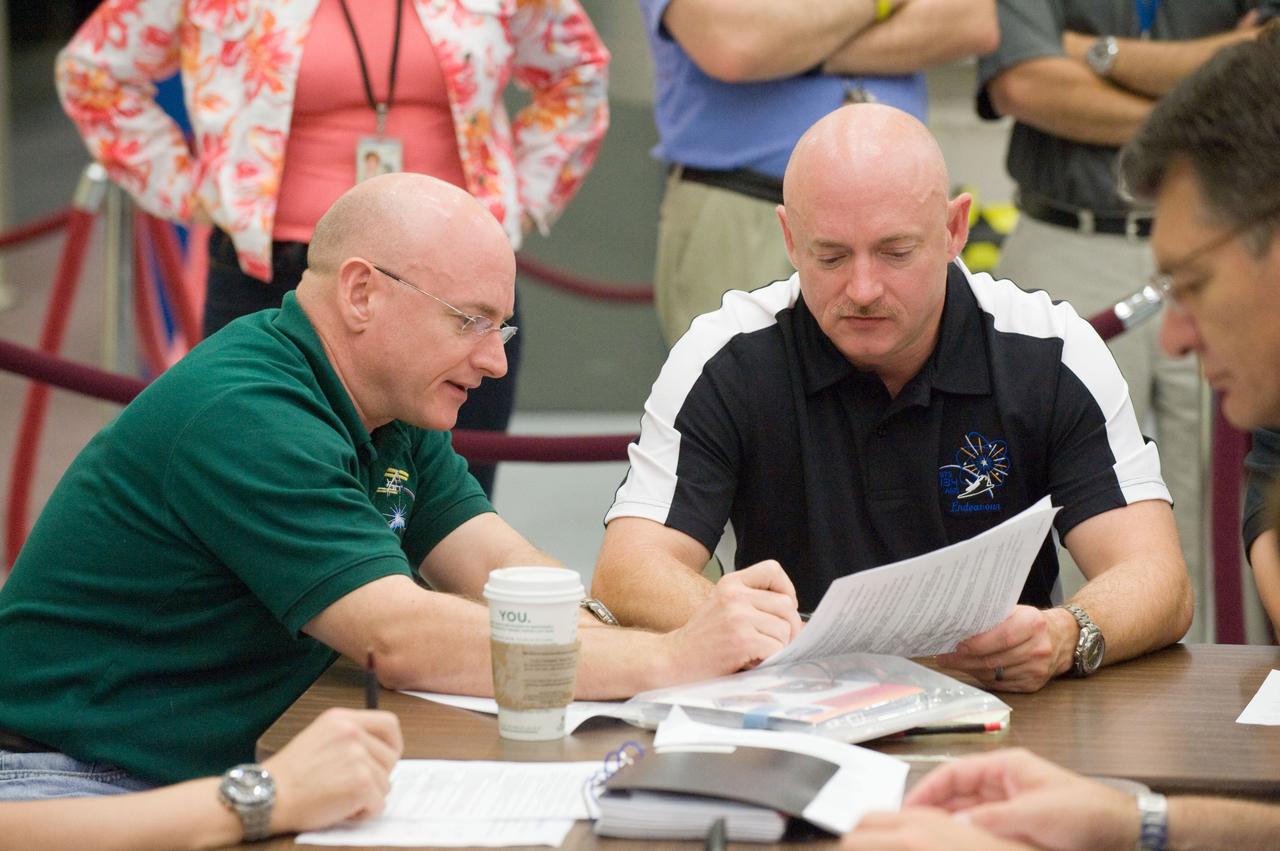
JSC2010-E-132382 (16 July 2010) --- NASA astronauts Scott Kelly (left), Expedition 25 flight engineer and Expedition 26 commander; and Mark Kelly, STS-134 commander, are pictured during an emergency scenarios training session in the Space Vehicle Mock-up Facility at NASA's Johnson Space Center. Photo credit: NASA or National Aeronautics and Space Administration
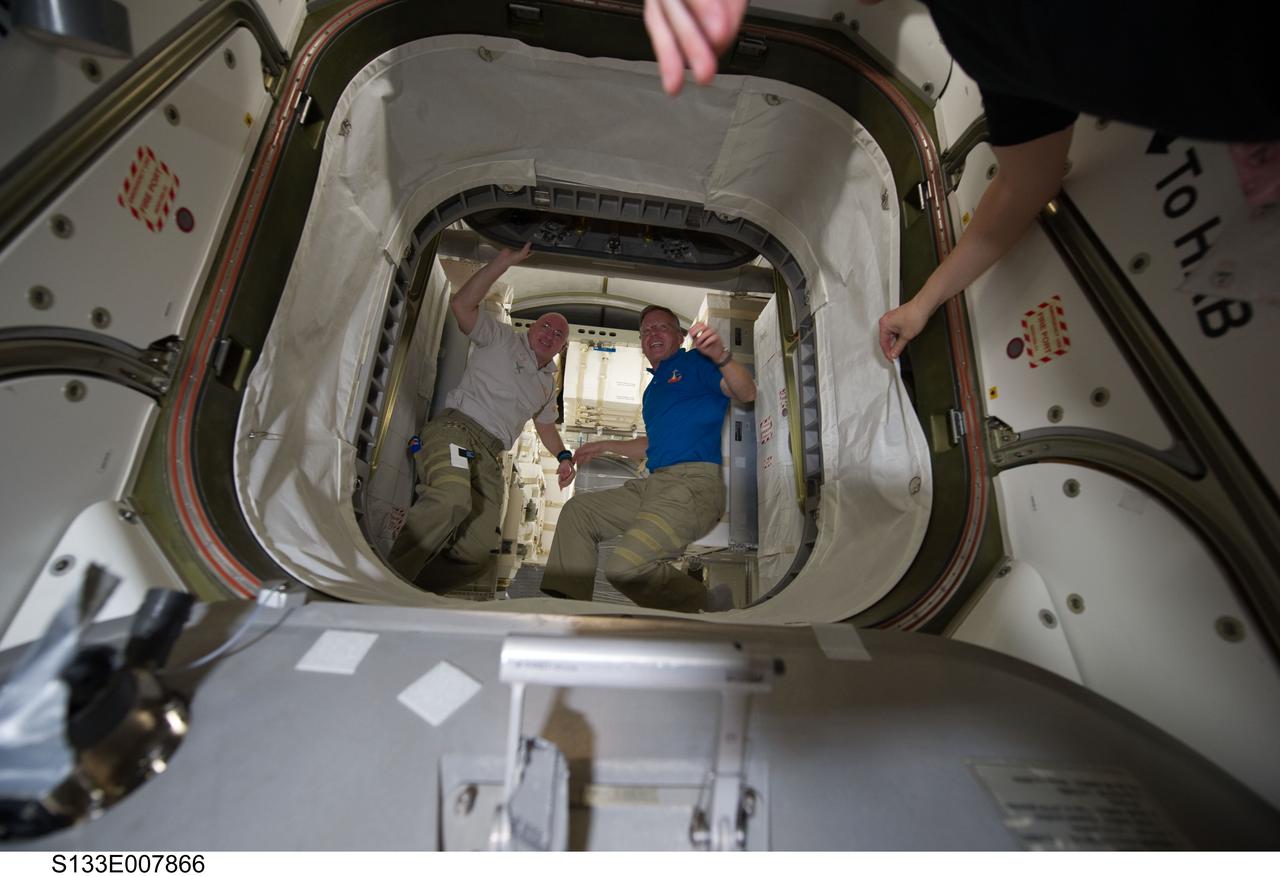
S133-E-007866 (1 March 2011) --- NASA astronauts Scott Kelly (left), Expedition 26 commander; and Steve Lindsey, STS-133 commander, are pictured in the hatch that leads to the newly-installed Permanent Multipurpose Module (PMM) of the International Space Station while space shuttle Discovery remains docked with the station. Photo credit: NASA or National Aeronautics and Space Administration

JSC2010-E-132377 (16 July 2010) --- NASA astronauts Scott Kelly (left), Expedition 25 flight engineer and Expedition 26 commander; and Mark Kelly, STS-134 commander, are pictured during an emergency scenarios training session in the Space Vehicle Mock-up Facility at NASA's Johnson Space Center. Photo credit: NASA or National Aeronautics and Space Administration
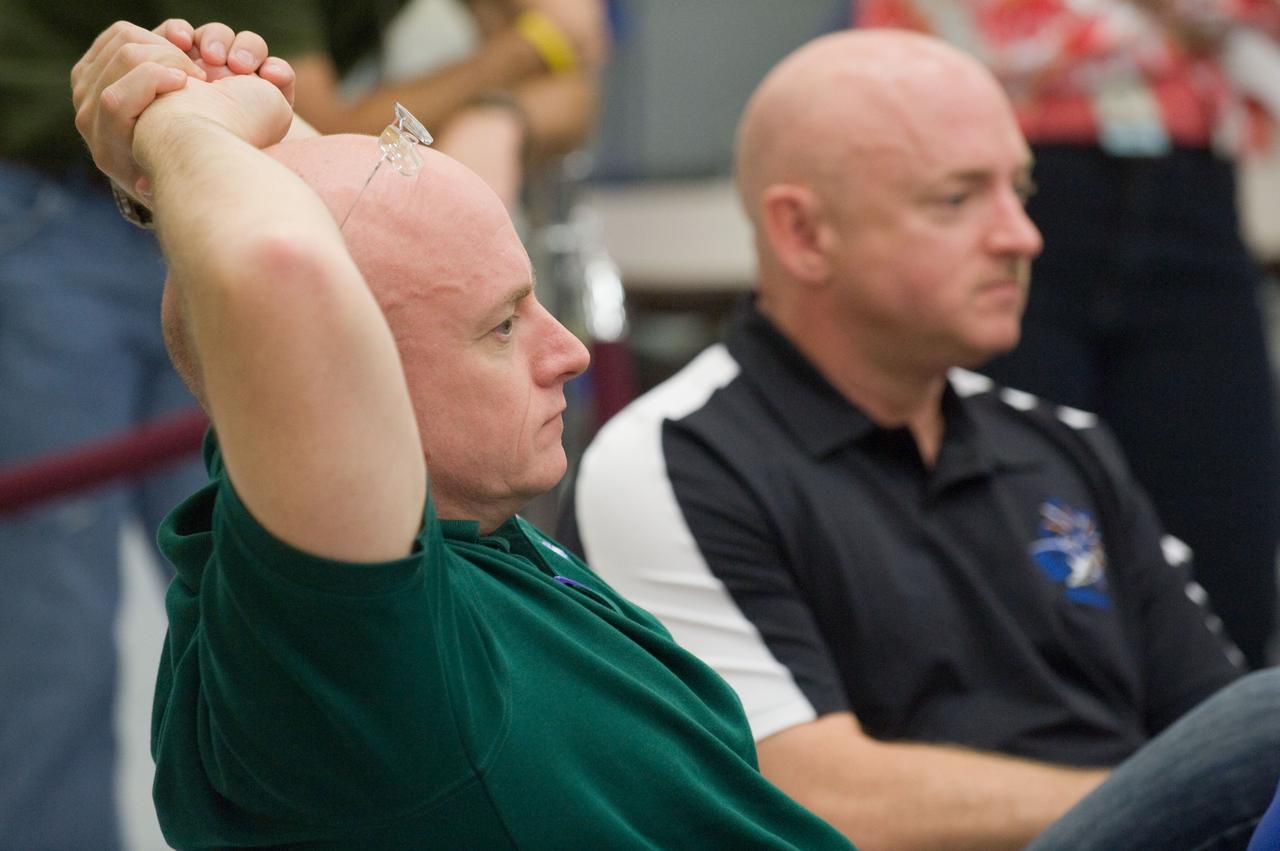
JSC2010-E-132379 (16 July 2010) --- NASA astronauts Scott Kelly (foreground), Expedition 25 flight engineer and Expedition 26 commander; and Mark Kelly, STS-134 commander, are pictured during an emergency scenarios training session in the Space Vehicle Mock-up Facility at NASA's Johnson Space Center. Photo credit: NASA or National Aeronautics and Space Administration
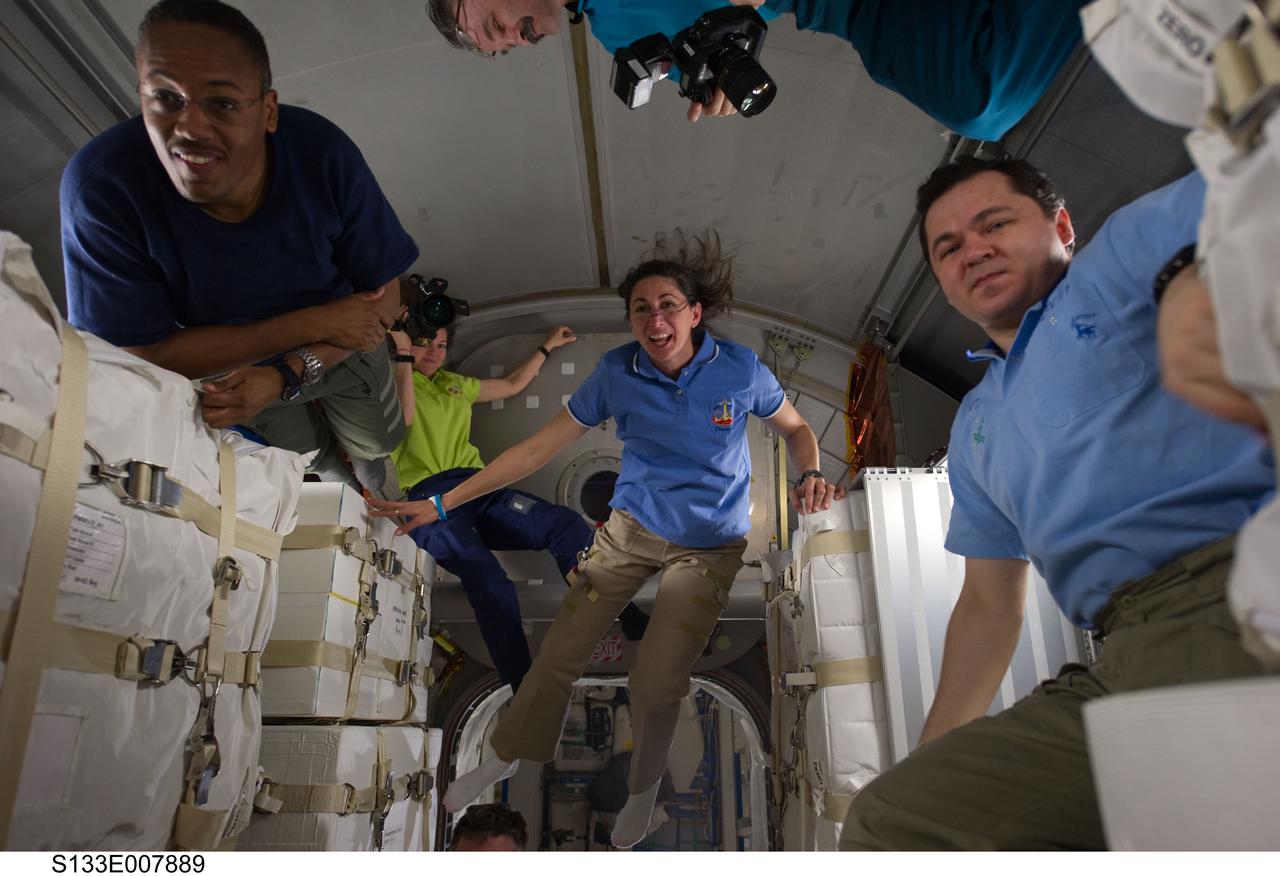
S133-E-007889 (1 March 2011) --- NASA astronauts Alvin Drew (left) and Nicole Stott (center), both STS-133 mission specialists; along with NASA astronaut Cady Coleman and Russian cosmonauts Oleg Skripochka and Alexander Kaleri (mostly out of frame at top), all Expedition 26 flight engineers, are pictured in the newly-installed Permanent Multipurpose Module (PMM) of the International Space Station while space shuttle Discovery remains docked with the station. Photo credit: NASA or National Aeronautics and Space Administration
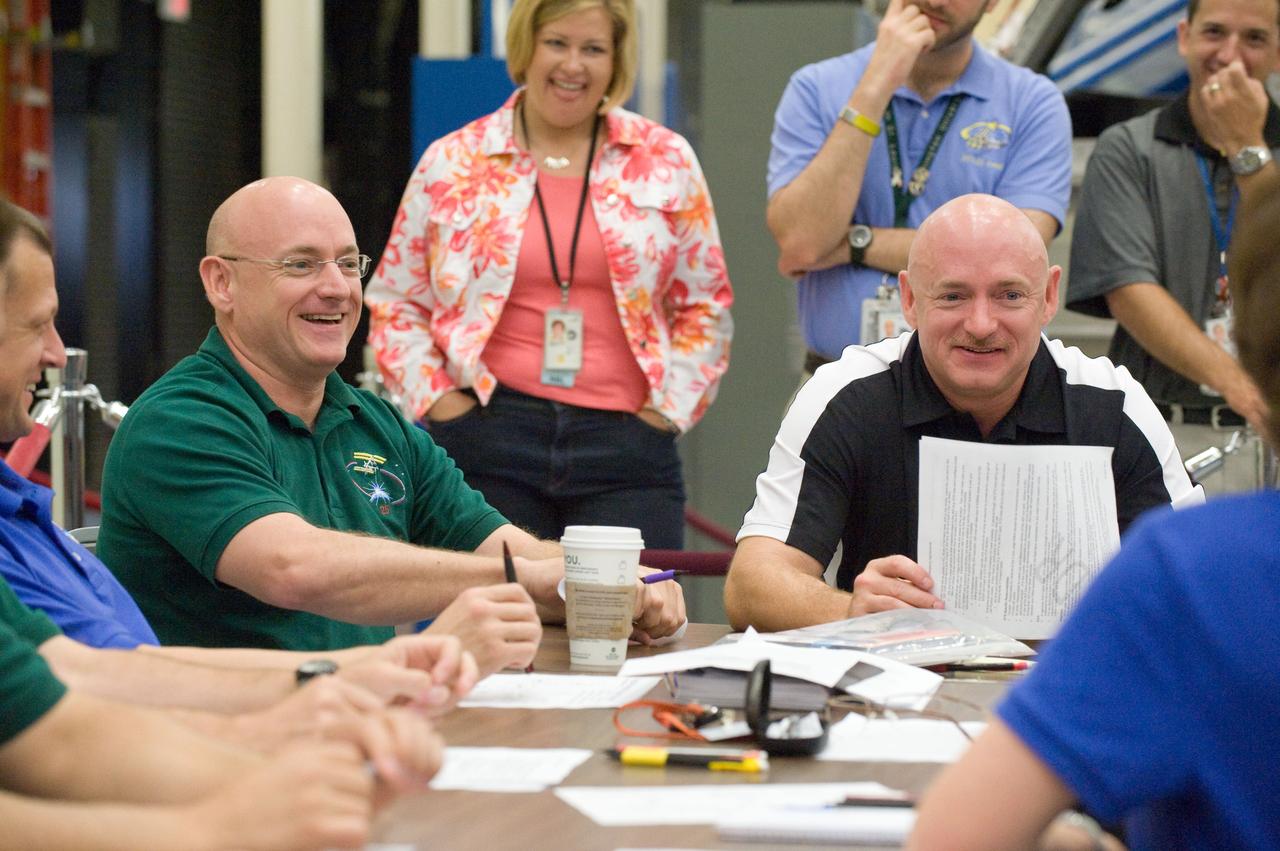
JSC2010-E-132381 (16 July 2010) --- NASA astronauts Scott Kelly (left), Expedition 25 flight engineer and Expedition 26 commander; and Mark Kelly, STS-134 commander, are pictured during an emergency scenarios training session in the Space Vehicle Mock-up Facility at NASA's Johnson Space Center. Photo credit: NASA or National Aeronautics and Space Administration

S133-E-007907 (1 March 2011) --- Russian cosmonaut Alexander Kaleri (bottom), Expedition 26 flight engineer; along with NASA astronauts Alvin Drew (top) and Steve Bowen, both STS-133 mission specialists, are pictured in the newly-installed Permanent Multipurpose Module (PMM) of the International Space Station while space shuttle Discovery remains docked with the station. Photo credit: NASA or National Aeronautics and Space Administration
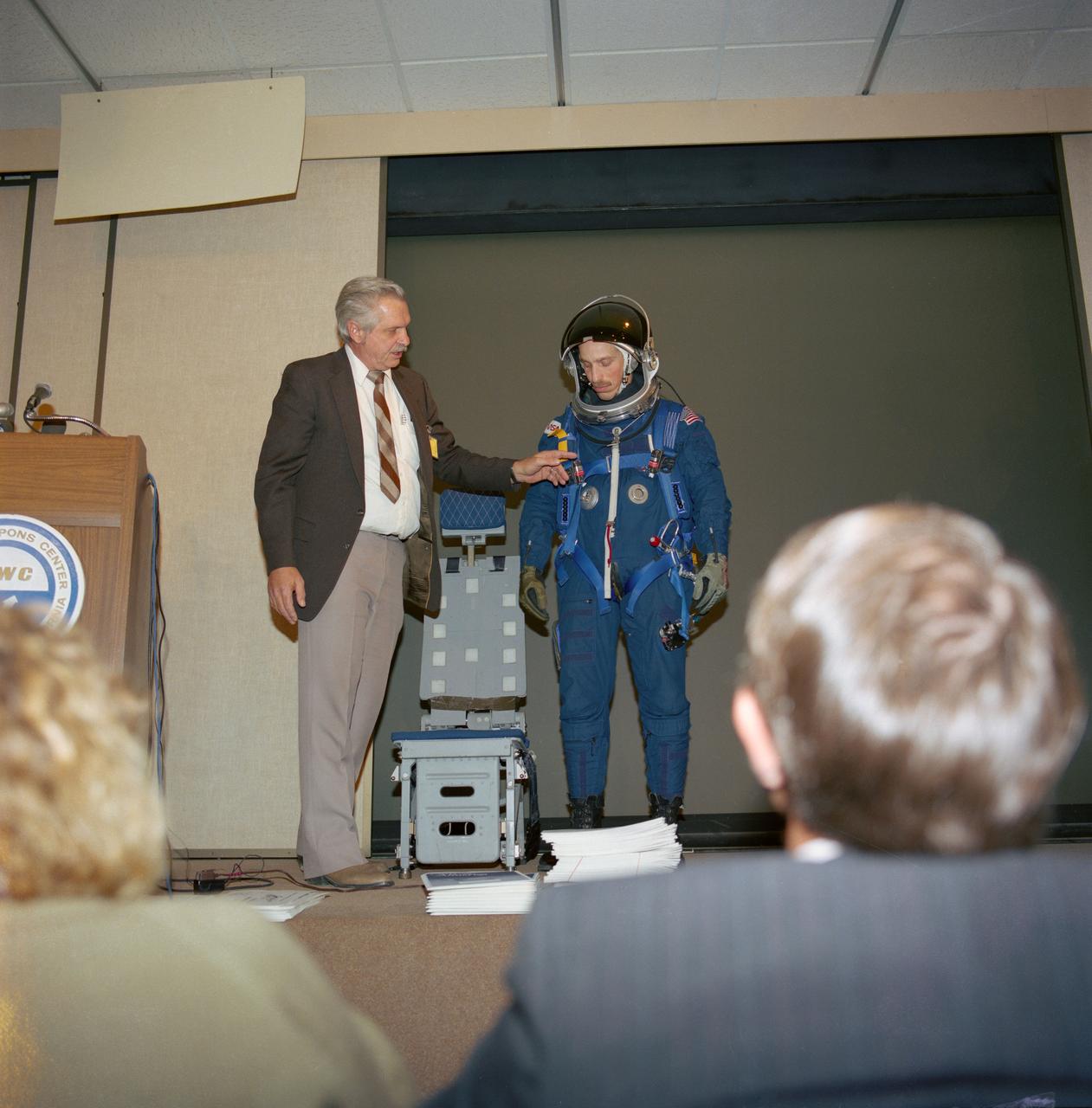
S88-25408 (8 Dec 1987) --- James O. Schlosser (left), JSC crew systems branch employee responsible for crew equipment development, gives a briefing on the crew equipment baselined for STs-26 as astronaut James P. Bagian models the new gear. Included in the package are a partial pressure suit, harness, parachute, life raft and survival gear. The deomonstration took place at the Naval Weapons Center in China Lake, CA.
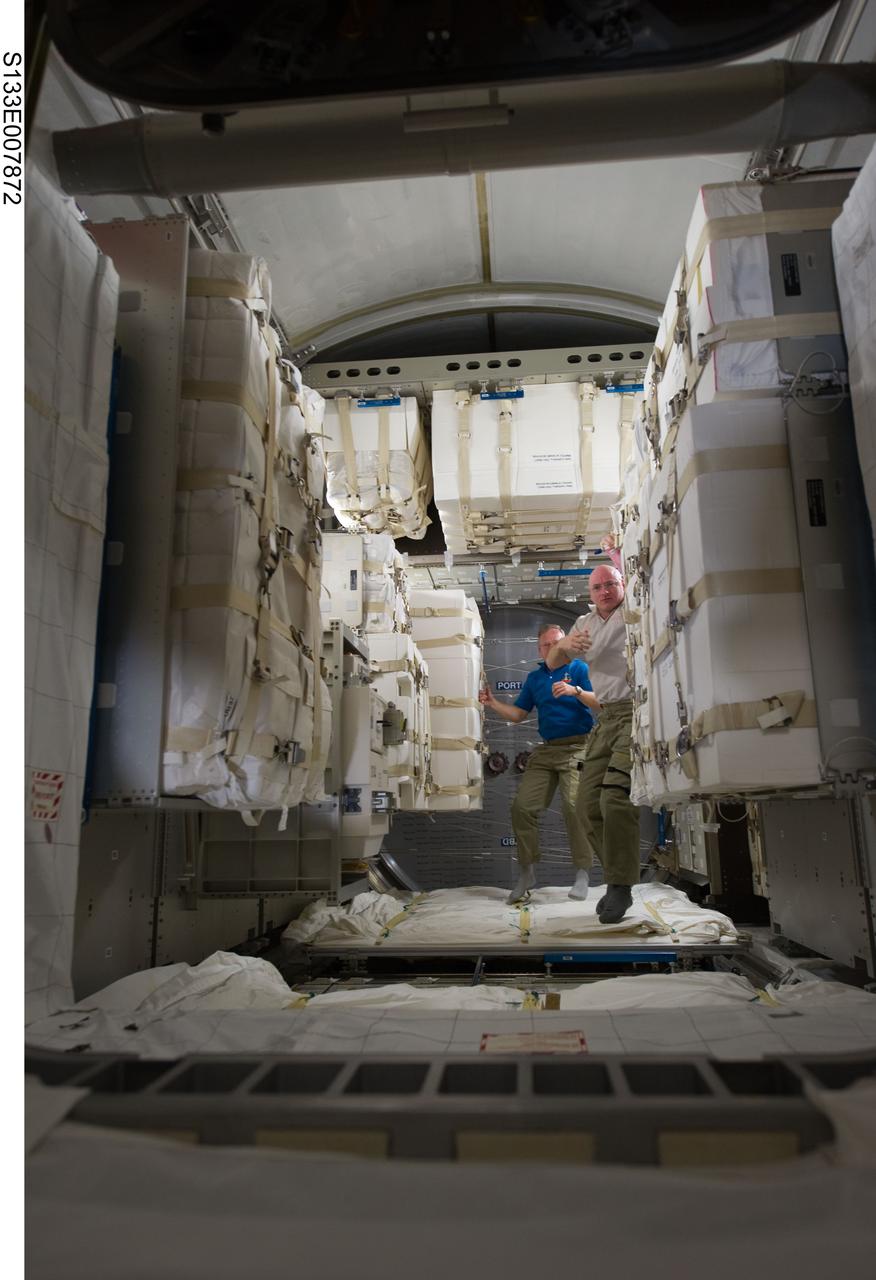
S133-E-007872 (1 March 2011) --- NASA astronauts Scott Kelly (foreground), Expedition 26 commander; and Steve Lindsey, STS-133 commander, are pictured in the newly-installed Permanent Multipurpose Module (PMM) of the International Space Station while space shuttle Discovery remains docked with the station. Photo credit: NASA or National Aeronautics and Space Administration
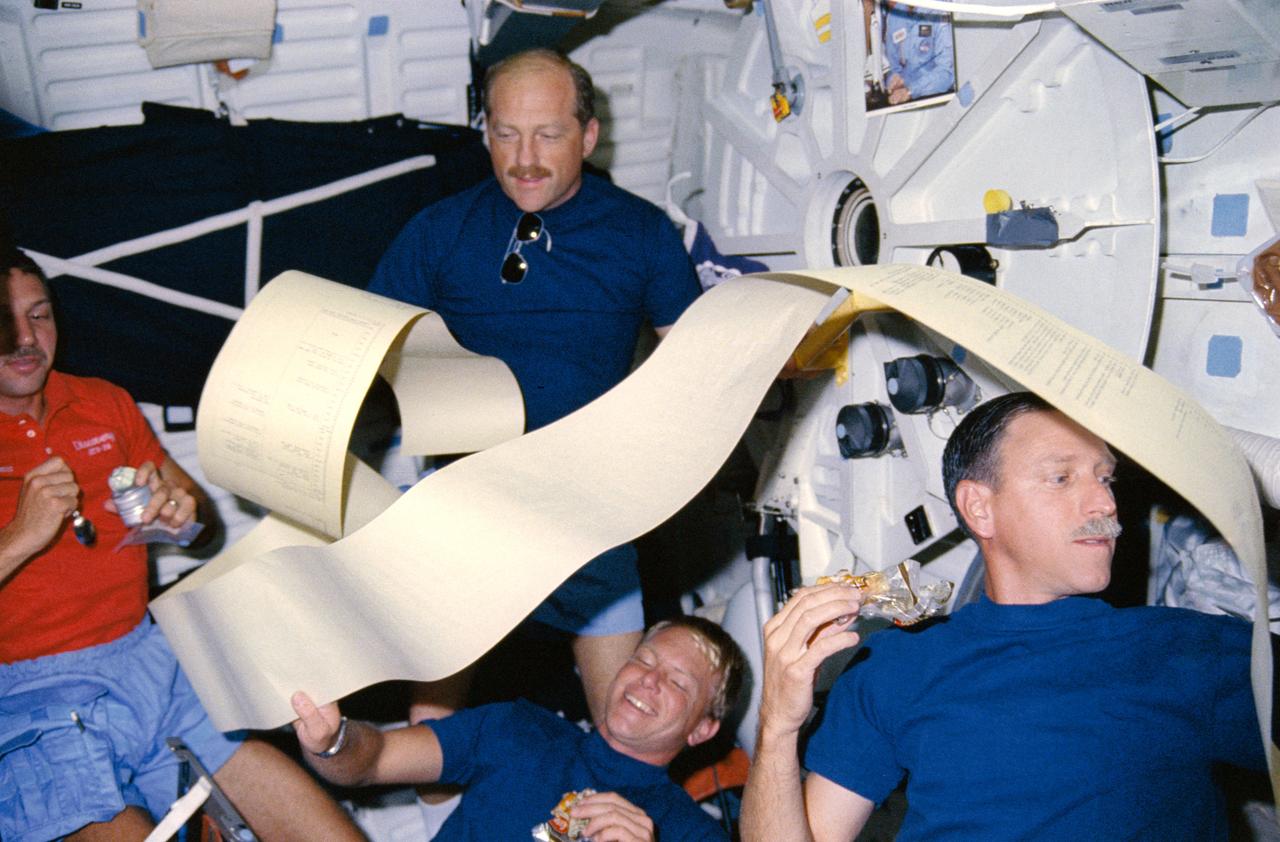
STS026-03-019 (3 Oct 1988) --- STS-26 Commander Frederick H. Hauck (center) reviews lengthy text and graphics system (TAGS) printout as it drifts across the middeck while his fellow crewmembers (left to right) Mission Specialist (MS) David C. Hilmers, MS George D. Nelson, and Pilot Richard O. Covey eat various snack items. The open airlock hatch and the sleep restraints on the starboard wall are visible in the background.
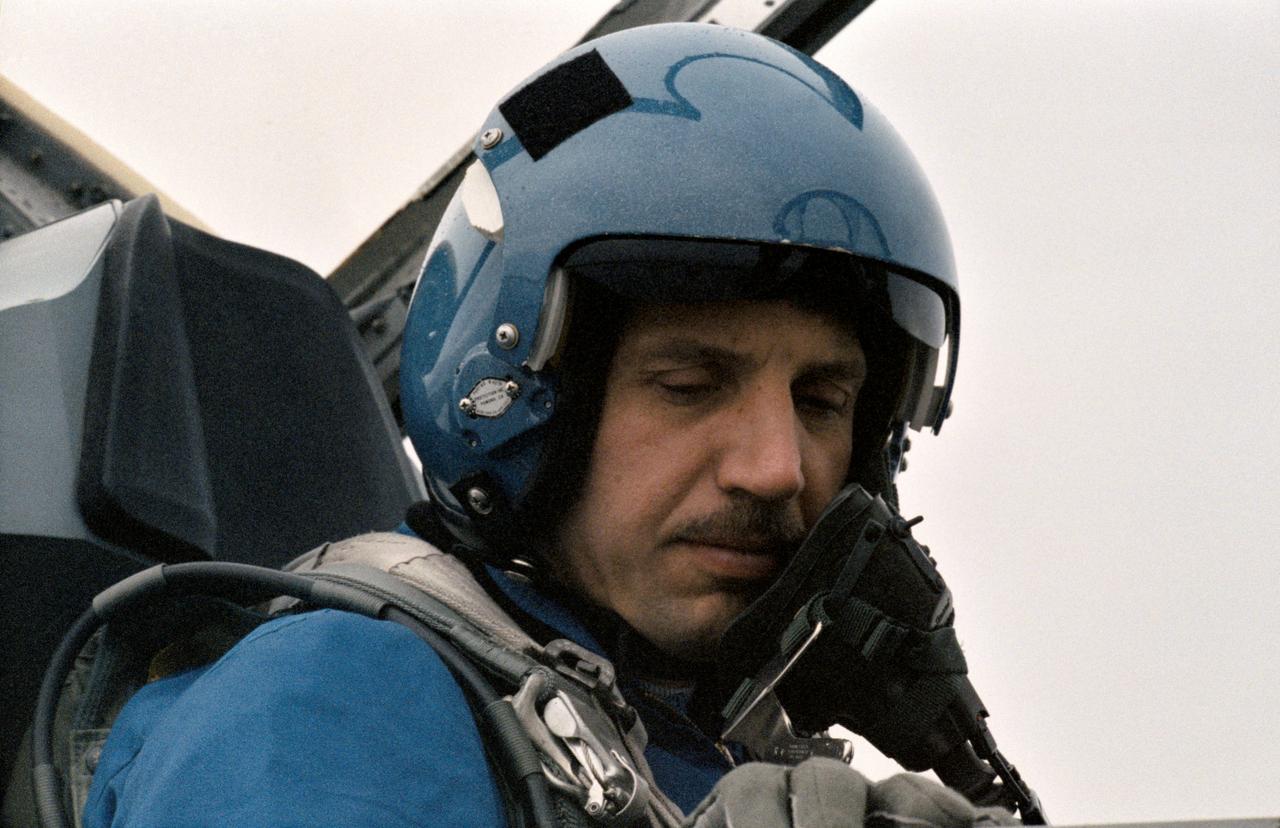
S87-28147 (26 Feb 1987) --- Astronaut David C. Hilmers sits in the rear station of a NASA T-38 jet aircraft prior to departure of the STS 26 crew from Ellington Field, destination Kennedy Space Center for interfacing with flight hardware which is undergoing preparations. Hilmers is one of three mission specialists for the flight.
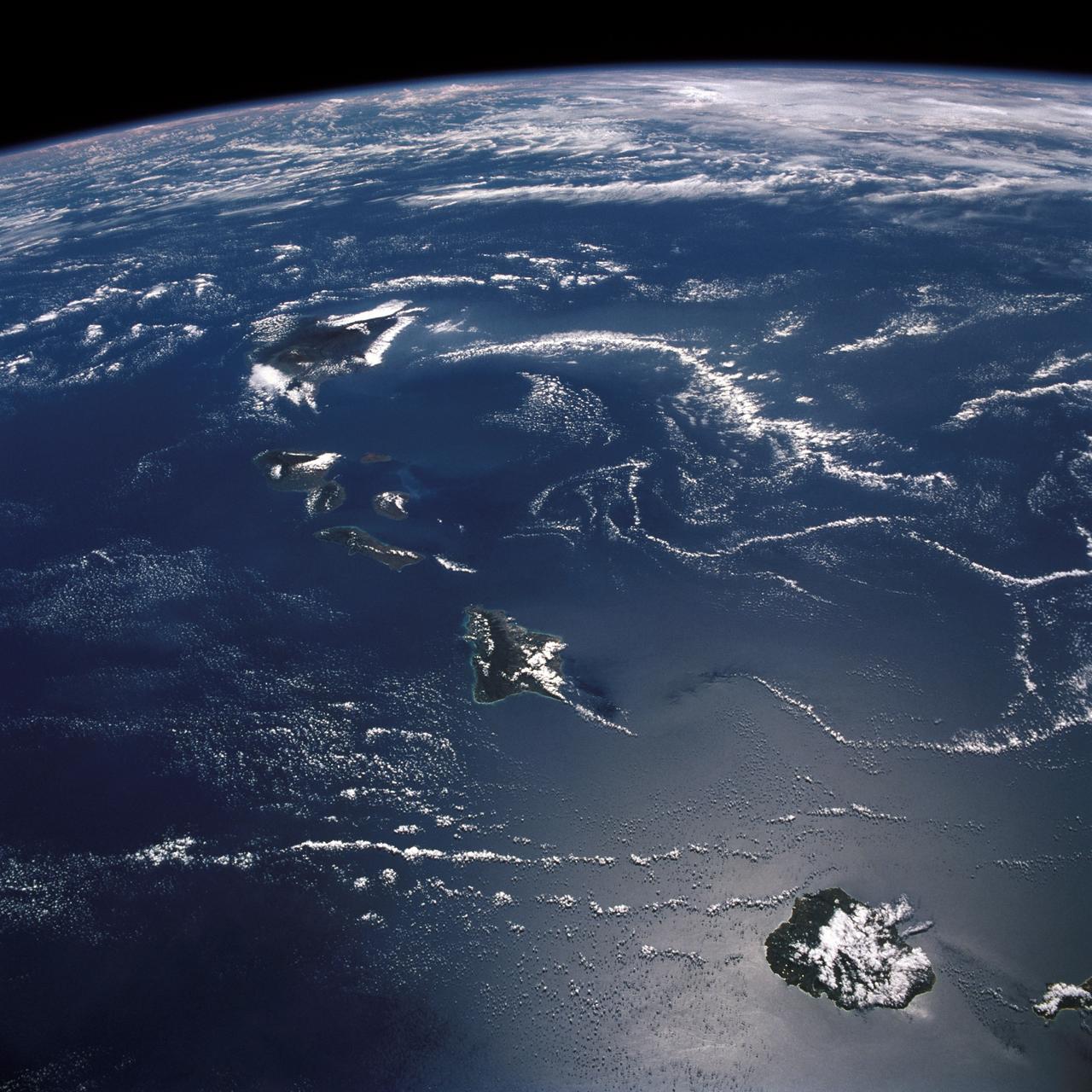
STS026-43-082 (29 Sept. - 3 Oct. 1988) --- This 70mm northerly oriented frame over the Pacific Ocean features the Hawaiian Islands chain. The islands perturb the prevailing northeasterly winds producing extensive cloud wakes in the lee of the islands. Photo experts feel that atmospheric haze in the Hawaii wake is probably a result of the continuing eruptions of Kilauea volcano on the southeast coast. From the lower right corner in a diagonal directed upward to the north are the islands of Nihau, Kauai, Oahu, Molokai, Lanai, Maui, Kahoolawe, and Hawaii. This photo was shown during the post-flight press conference on October 11, 1988 by the STS-26 astronauts, who at one time during the flight wore Hawaiian attire to pay tribute to the working staff of the Hawaii tracking station.
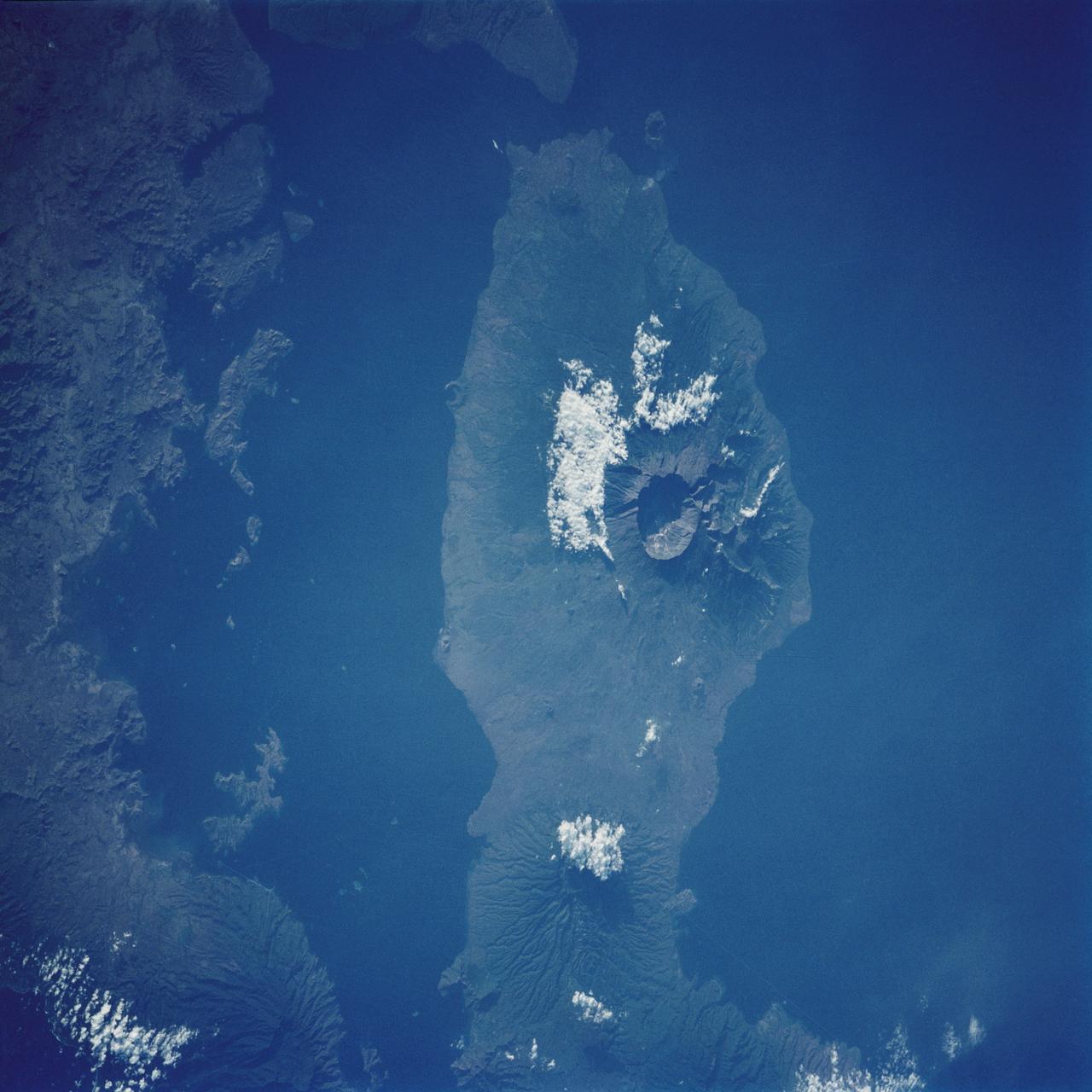
STS026-038-056 (29 Sept. - 3 Oct. 1988) --- Tambora Caldera, Sumbawa Island, Indonesia as photographed with a 70mm handheld Hasselblad camera. Tambora is a 6-kilometer-wide and 650-meter-deep Caldera formed in 1815 as a result of a huge volcanic eruption. Gases from the eruption were ejected high into Earth's atmosphere and transported around the globe. The atmospheric gases trapped part of the incoming sunglint, resulting in extremely cold weather. In New England, snow fell in June, and freezes occurred throughout the summer of 1816, which became known as "the year without a summer." This photo was shown by the STS-26 astronaut crew during its Oct. 11, l988 post-flight press conference.
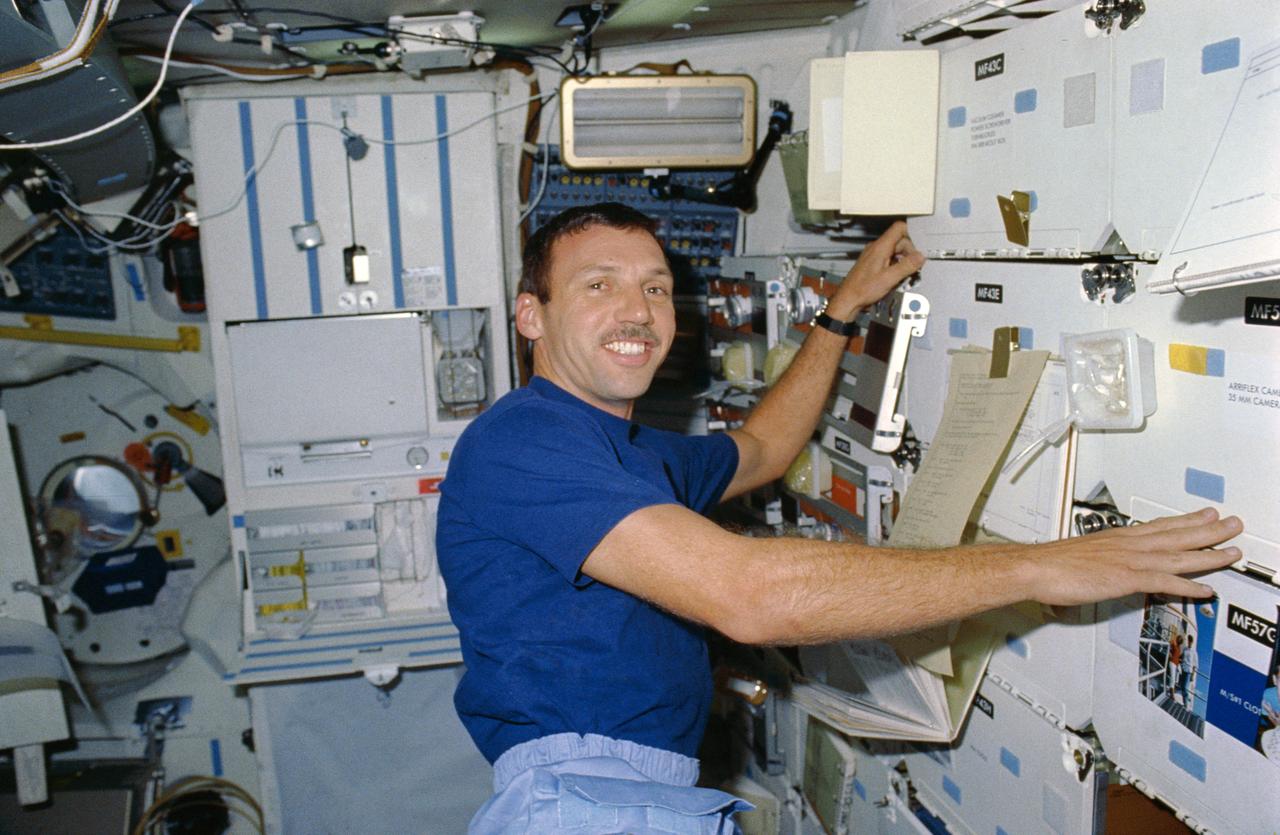
STS026-06-033 (5 Oct 1988) --- Astronaut David C. Hilmers, STS-26 mission specialist, reads teleprinted message which has been clipped to stowage locker doors on the middeck. Food, a galley and various experiments surround the mission specialist.
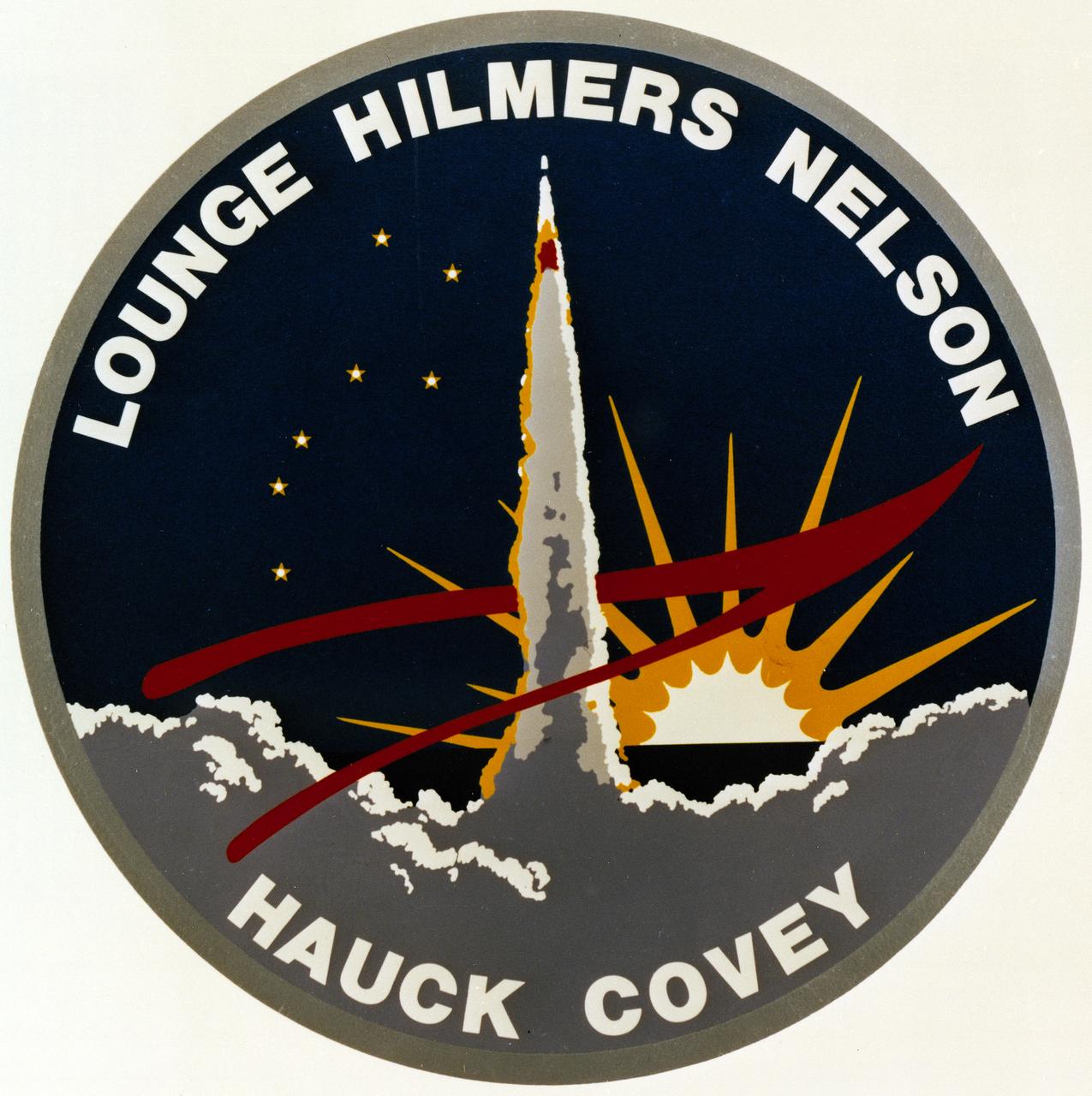
The predominant themes are: a new beginning (sunrise), a safe mission (stylized launch and plume), the building upon the traditional strengths of NASA (the red vector which symbolizes aeronautics on the original NASA insignia), and a remembrance of their seven colleagues who died aboard Challenger (the seven-starred Big Dipper). The patch was designed by artist Stephen R. Hustvedt of Annapolis, MD.
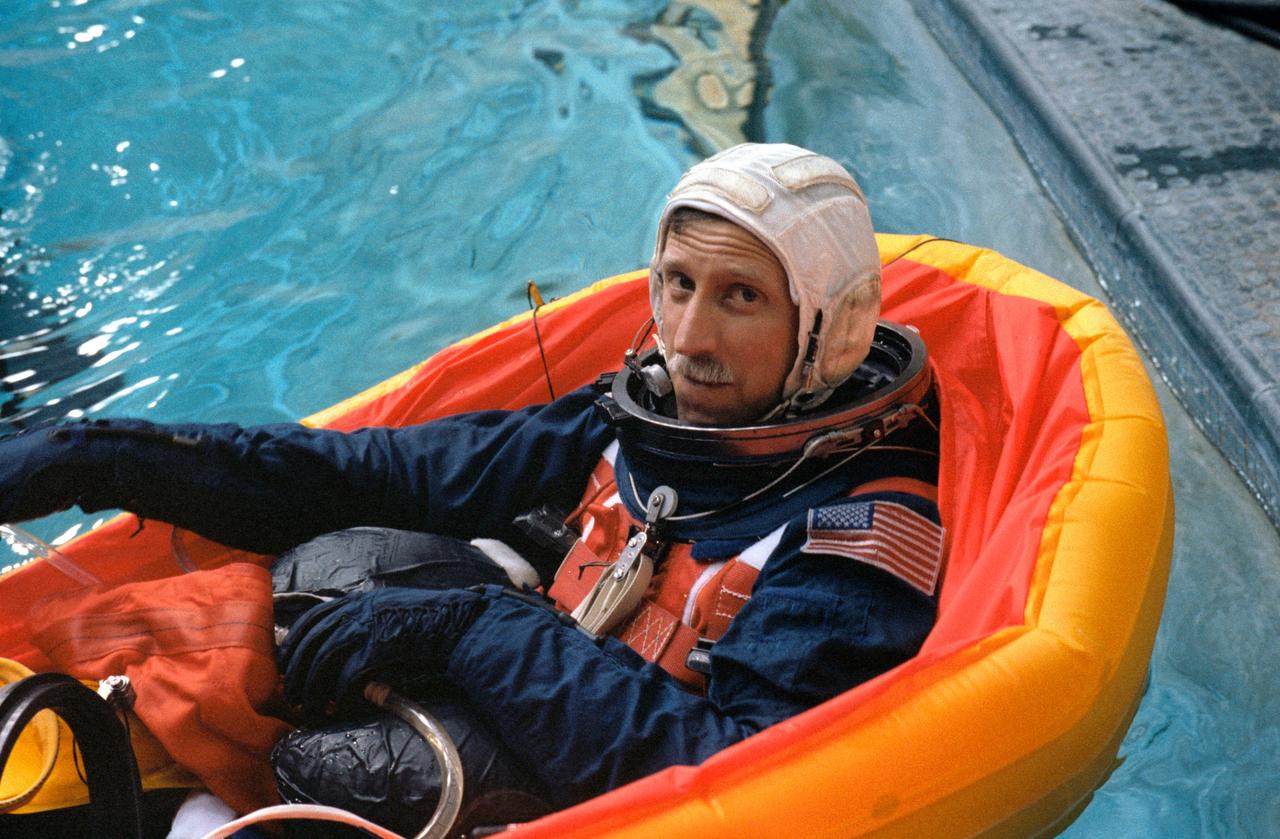
S88-42425 (20 July 1988) --- STS-26 Discovery, Orbiter Vehicle (OV) 103, Pilot Richard O. Covey, wearing the newly designed launch and entry suit (LES), floats in single-occupant life raft in JSC Weightless Environment Training Facility (WETF) Bldg 29 pool. The simulation of the escape and rescue operations utilized the crew escape system (CES) pole method of egress from the Space Shuttle.
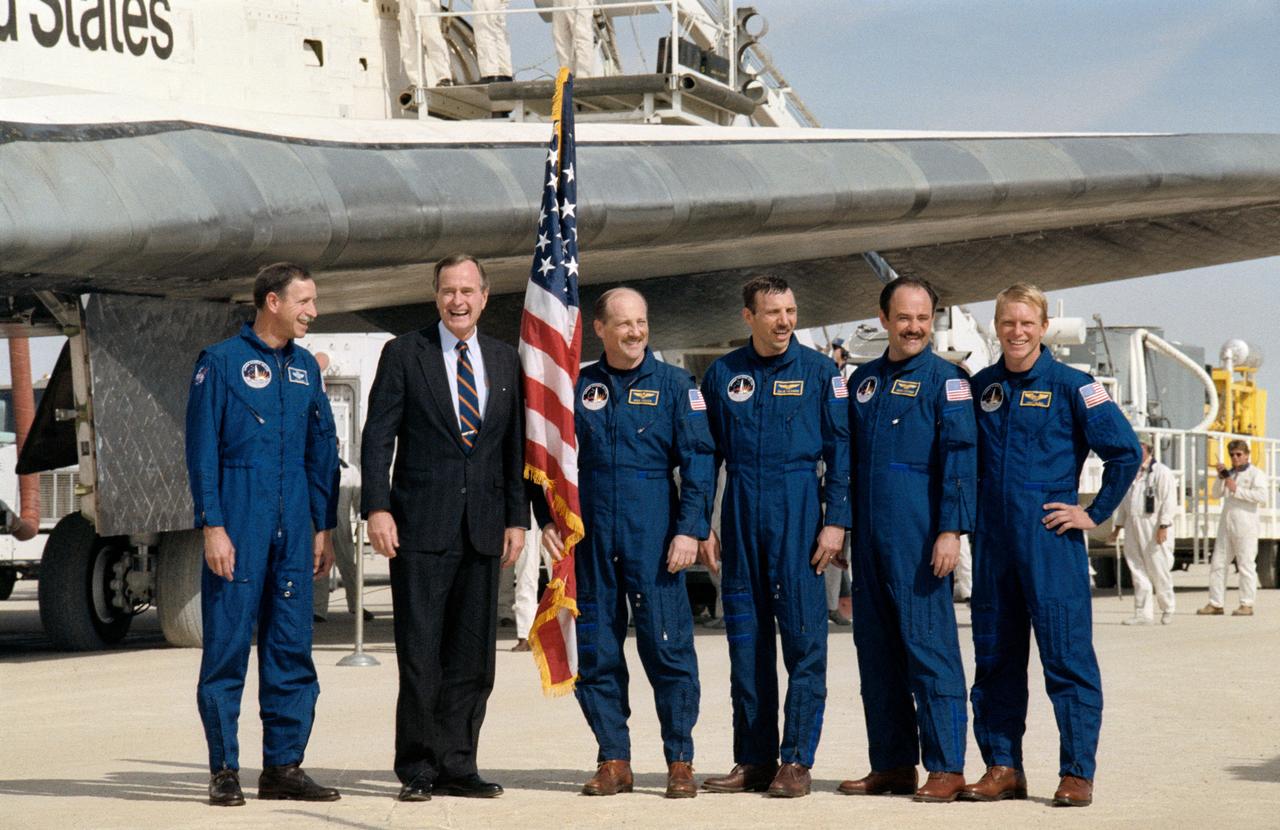
STS026-S-169 (3 Oct 1988) --- The five STS 26 crewmembers pose with Vice President George Bush after completing a successful four-day mission aboard the Space Shuttle Discovery (background). Pictured, from left to right, are astronaut Richard O. Covey, pilot; Vice President Bush; and astronauts Frederick H. (Rick) Hauck, mission commander; and David C. Hilmers, John M. (Mike) Lounge, and George D. Nelson, all mission specialists.
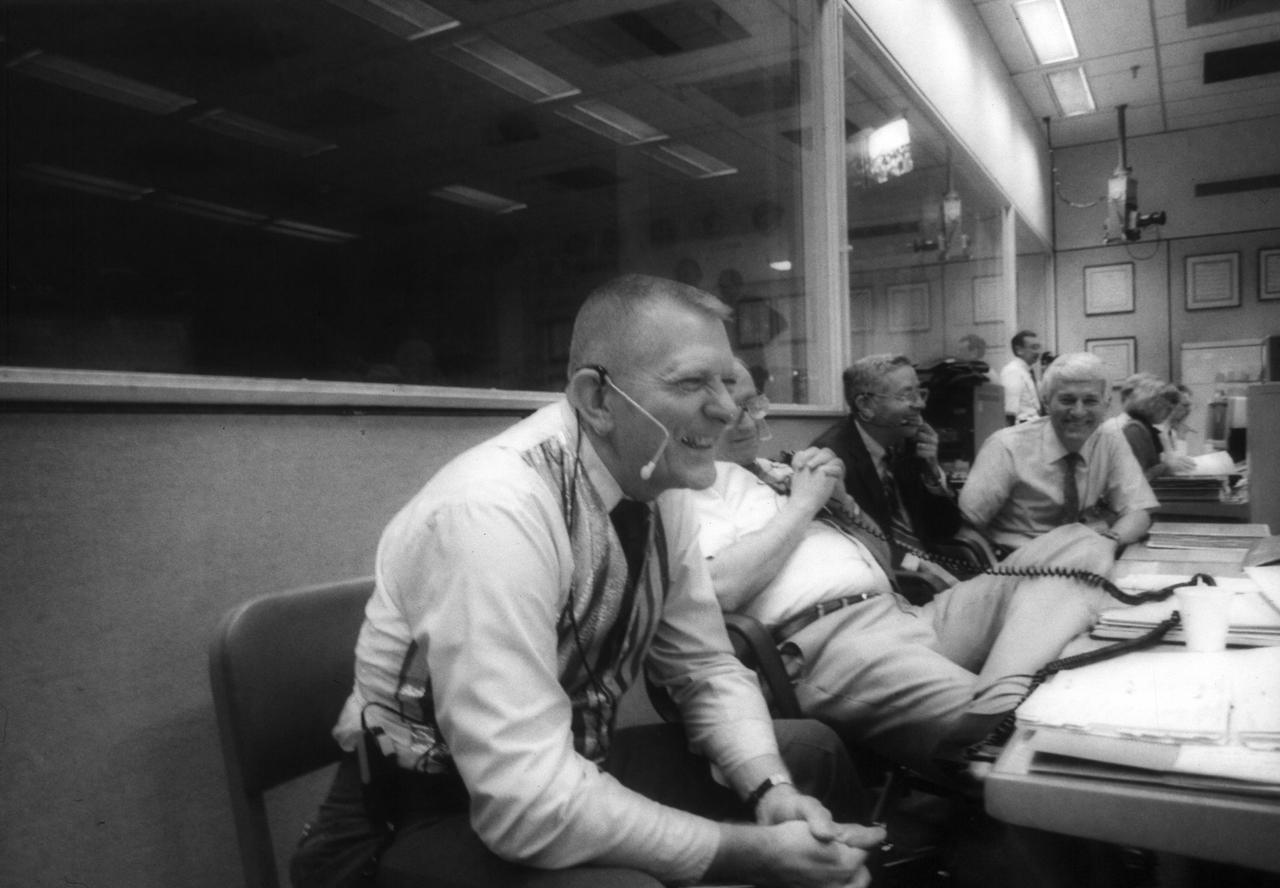
JSC officials, laughing, listen to crewmembers' commentary onboard Discovery, Orbiter Vehicle (OV) 103, during STS-26. In the Flight Control Room (FCR) of JSC's Mission Control Center (MCC) Bldg 30 and seated at the Mission Operations Directorate (MOD) console, MOD Director Eugene F. Kranz (foreground), wearing red, white and blue vest, smiles along with JSC Director Aaron Cohen and Flight Crew Operations Deputy Director Henry W. Hartsfield, Jr. (far right).
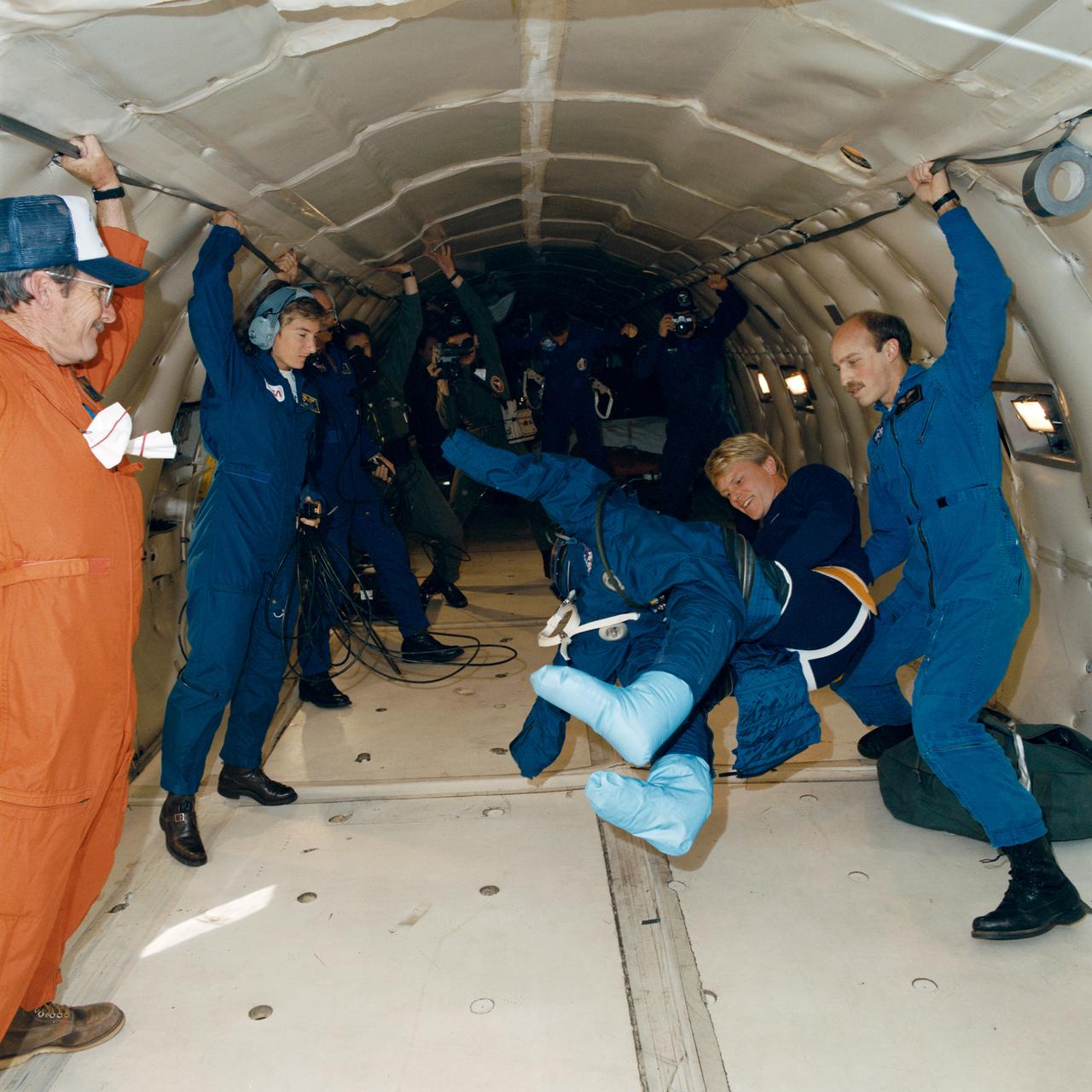
STS-26 Discovery, Orbiter Vehicle (OV) 103, Mission Specialist (MS) George D. Nelson practices donning and doffing new (navy blue) partial pressure suit (launch and entry suit (LES)) aboard KC-135 NASA 930 during zero gravity testing. Nelson is assisted by astronaut James P. Bagian as KC-135 flight crew (including Stephanie A. Wells) looks on and photographers document activities.
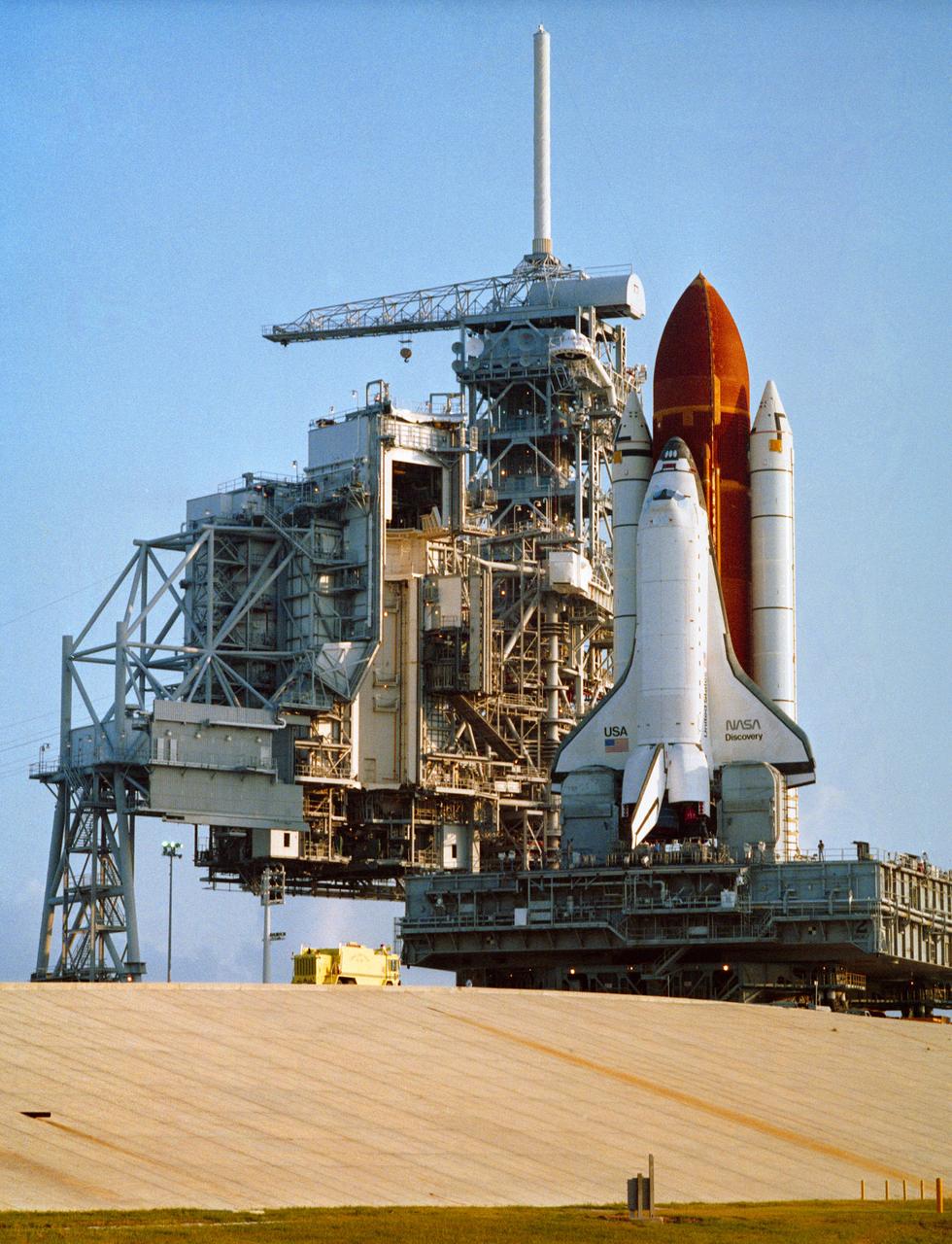
S88-42101 (15 July 1988) --- STS-26 Discovery, Orbiter Vehicle (OV) 103, awaits further processing at Kennedy Space Center (KSC) launch complex (LC) pad 39B. OV-103 arrived at LC pad 39B after a six-hour journey from the vehicle assembly building (VAB). The rotating service structure is retracted.
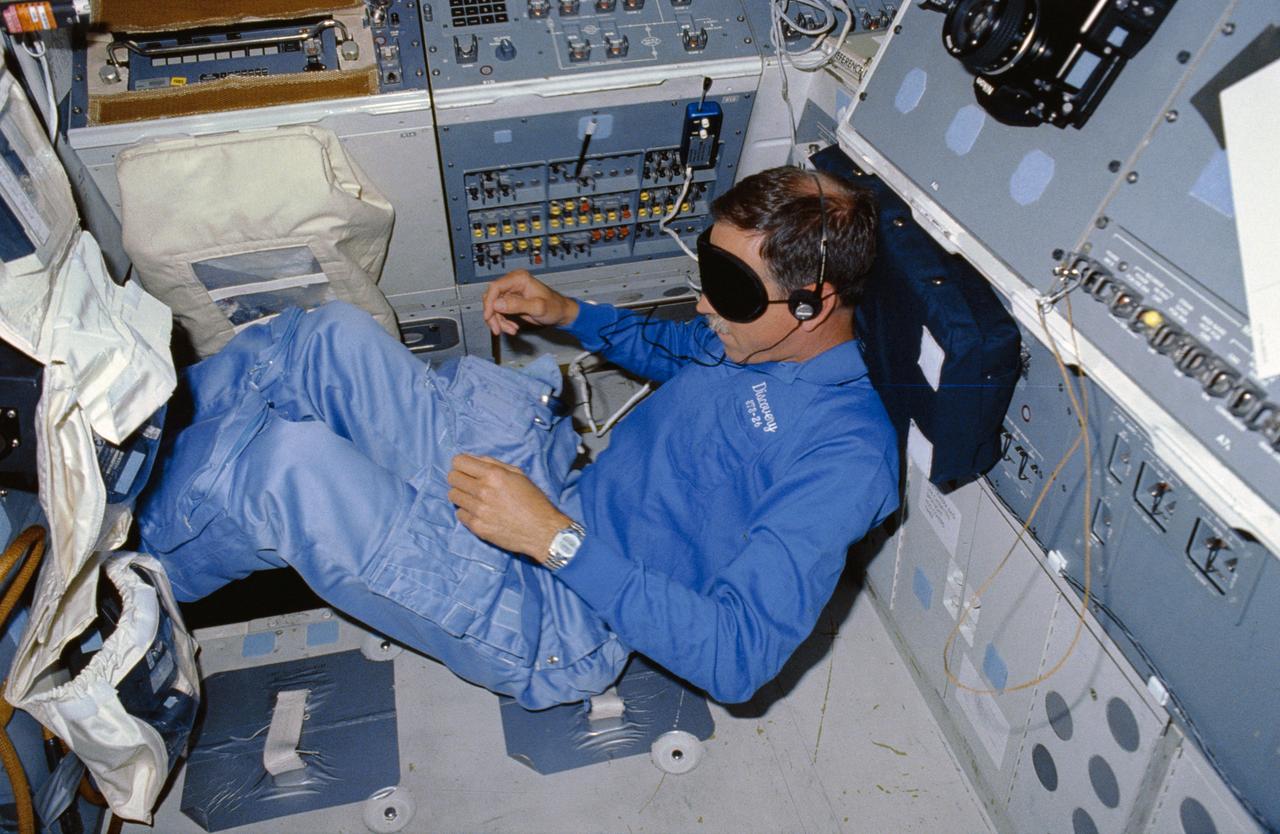
STS026-09-021 (3 Oct 1988) --- Astronaut Richard O. Covey, STS-26 pilot, wearing sleep mask (blindfold) and a headset, props his feet under the pilots seat and rests his head and back on the aft flight deck on orbit station panels while he sleeps. At Covey's right are the mission station control panels.
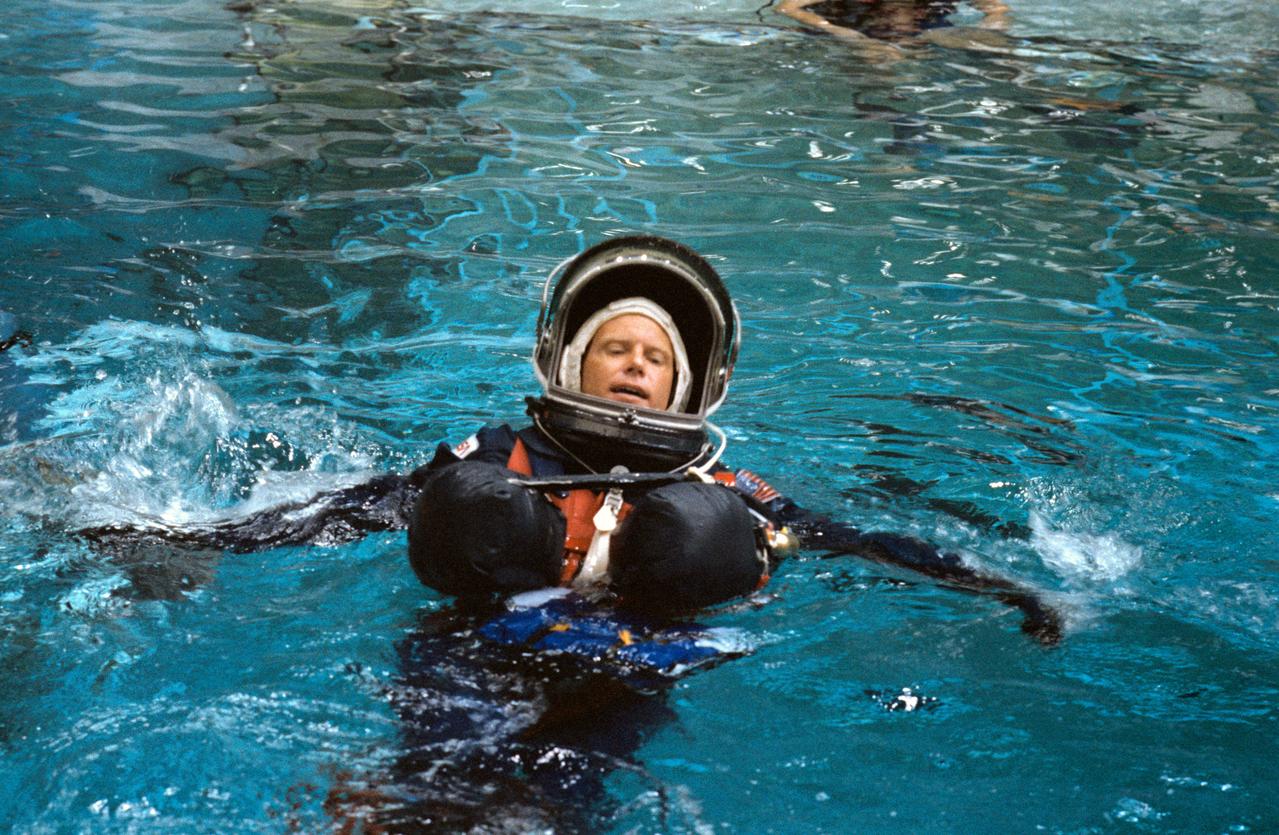
S88-42409 (20 July 1988) --- STS-26 Discovery, Orbiter Vehicle (OV) 103, Mission Specialist (MS) George D. Nelson participates in crew escape system (CES) testing in JSC Weightless Environment Training Facility (WETF) Bldg 29. Nelson, wearing the newly designed (navy blue) launch and entry suit (LES), floats in WETF pool with the aid of an underarm flotation device (modern version of Mas West floats). He awaits the assistance of SCUBA-equipped divers during a simulation of escape and rescue operations utilizing a new CES pole for emergency exit from the Space Shuttle.
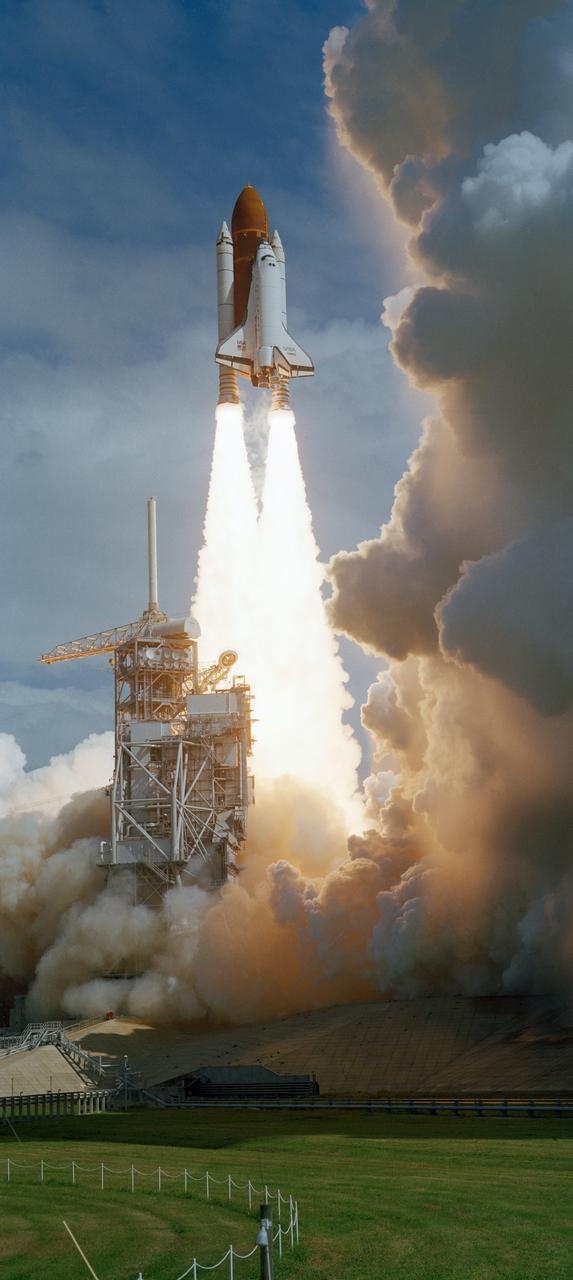
S26-S-032 (29 Sept. 1988) --- The STS-26 launch of space shuttle Discovery begins the first flight to be flown after the Challenger accident. The flight crew included astronauts Rick Hauck, commander; Dick Covey, pilot; and three mission specialists, Dave Hilmers, Mike Lounge, and George (Pinky) Nelson. During the four-day mission, the crew deployed the Tracking and Data Relay Satellite (TDRS-C) and operated eleven mid-deck experiments. Discovery completed 64 orbits of the earth before landing at Edwards Air Force Base, California, on October 3, 1988. Photo credit: NASA or National Aeronautics and Space Administration
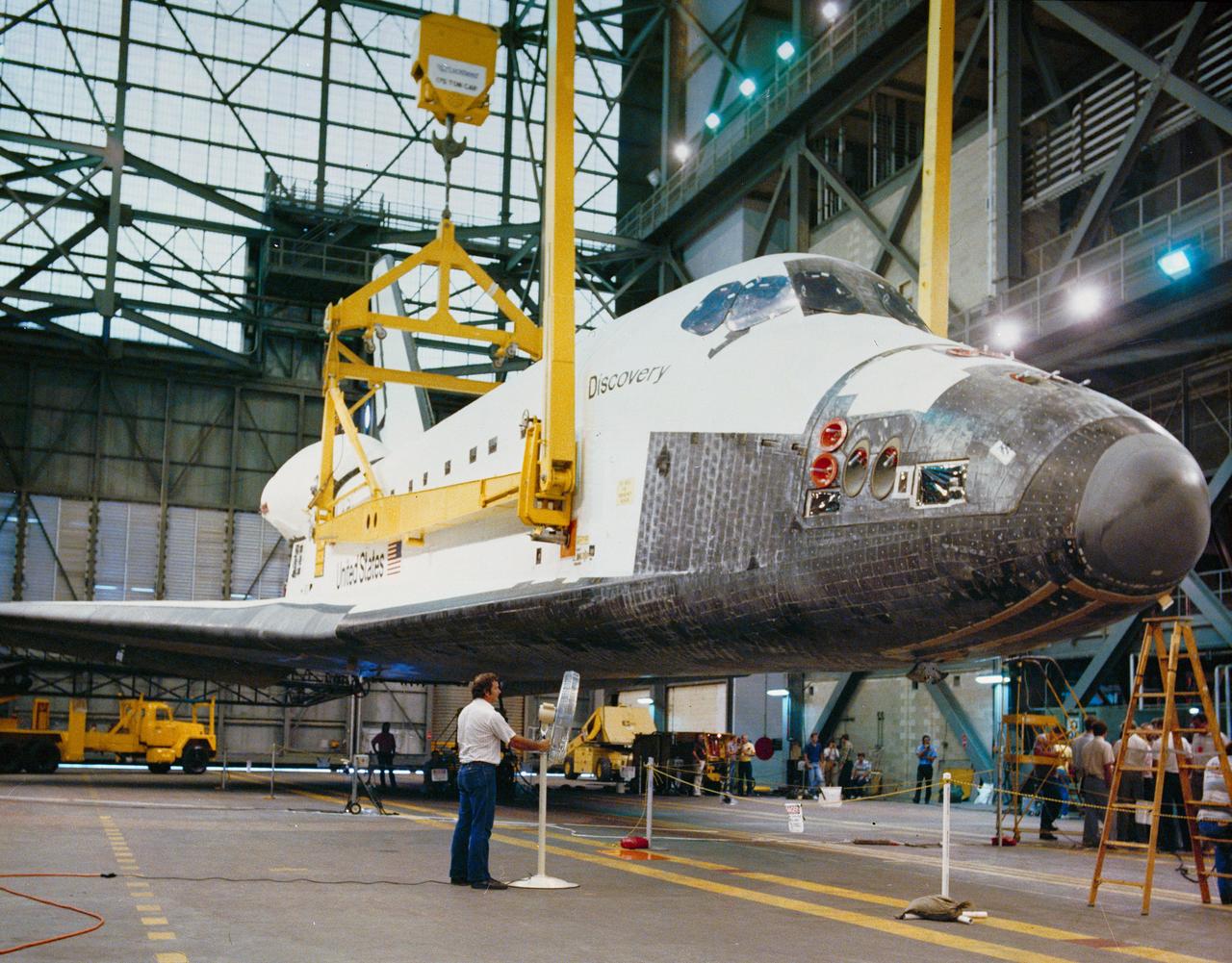
S88-41541 (7 July 1988) --- STS-26 Discovery, Orbiter Vehicle (OV) 103, is suspended by overhead crane and large frame attached to vehicle at four points. A ground-level view shows OV-103 during operations to accomplish its mating to two solid rocket boosters (SRBs) and an external fuel tank (ET) in the vehicle assembly building (VAB) at the Kennedy Space Center (KSC). From this step OV-103 will be lifted vertically and hoisted high inside the VAB for mating with the already connected ET and SRBs. In less than two weeks, the combined components will be rolled to Pad 39B atop a mobile launch platform.