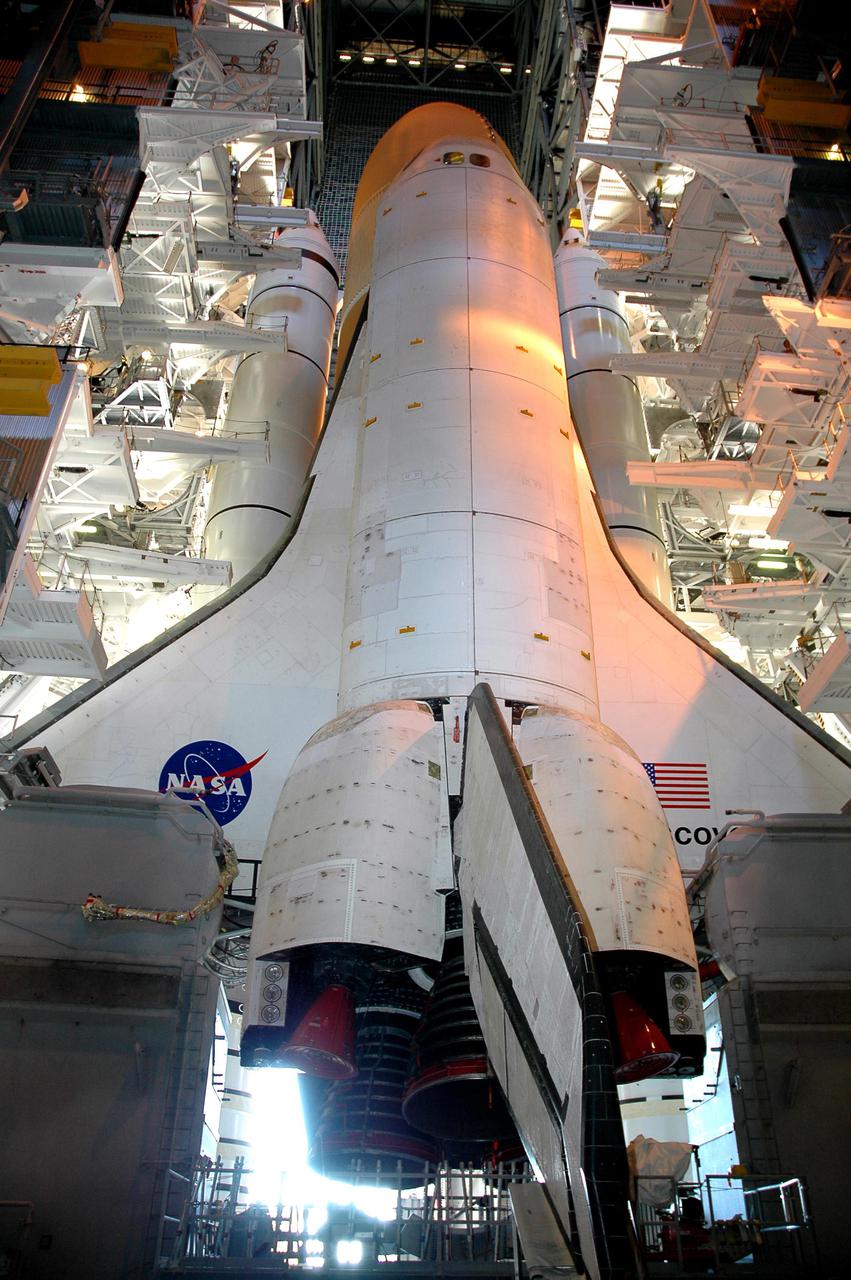
KENNEDY SPACE CENTER, FLA. - Framed in lights both inside and from outside, Space Shuttle Discovery waits on top of the Mobile Launcher Platform in the Vehicle Assembly Building for rollout to Launch Pad 39B. Rollout is expected to begin about 12:01 a.m. June 15 for the 4-mile, 6-hour trip to the pad. On either side of Discovery’s tail and orbital maneuvering system pods are the Tail Masts that support the fluid, gas and electrical requirements of the orbiter’s liquid oxygen and liquid hydrogen aft T-0 umbilicals. Space Shuttle Discovery's Return to Flight mission STS-114 is scheduled for liftoff in a window extending from July 13 to July 31.
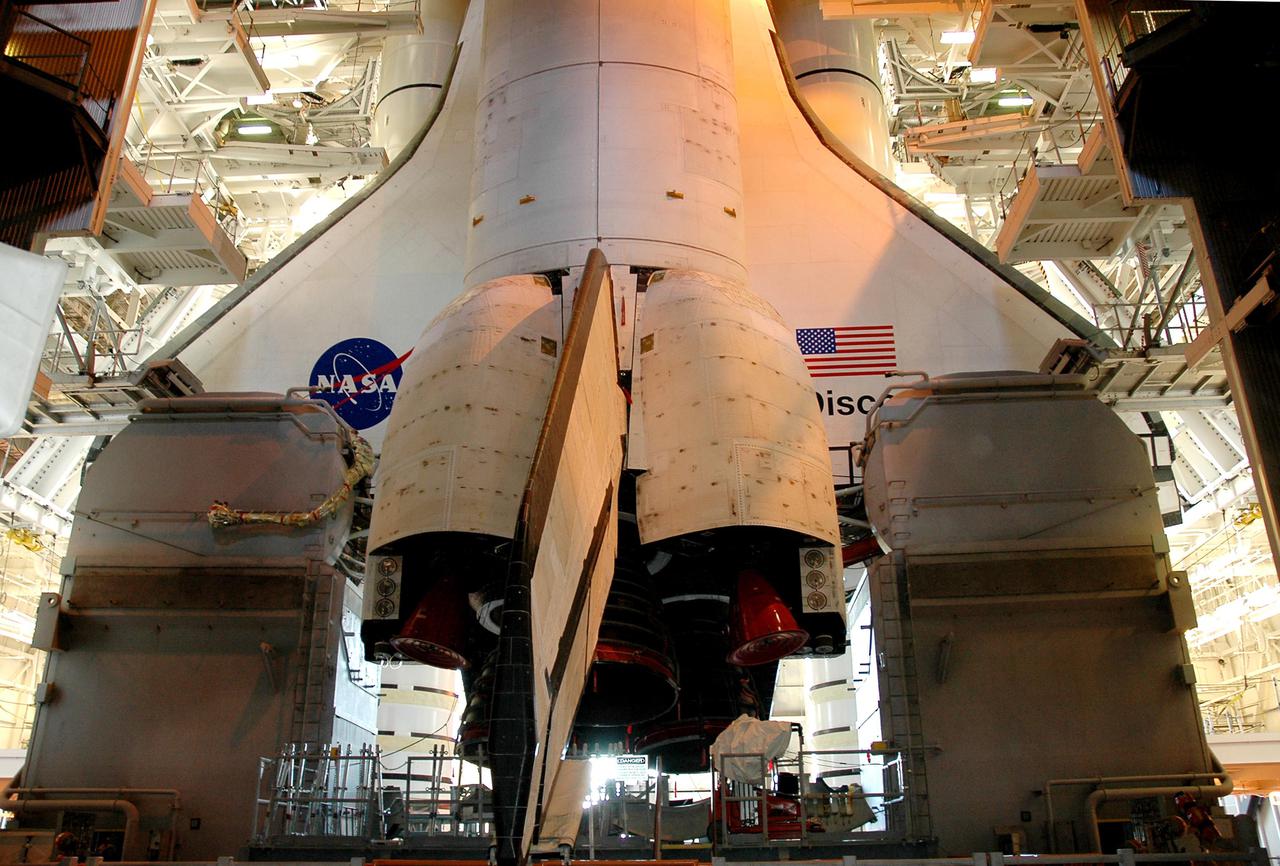
KENNEDY SPACE CENTER, FLA. - Lights inside the Vehicle Assembly Building cast an orange glow on Space Shuttle Discovery as waits on top of the Mobile Launcher Platform for rollout to Launch Pad 39B. Rollout is expected to begin about 12:01 a.m. June 15 for the 4-mile, 6-hour trip to the pad. On either side of Discovery’s tail and orbital maneuvering system pods are the Tail Masts that support the fluid, gas and electrical requirements of the orbiter’s liquid oxygen and liquid hydrogen aft T-0 umbilicals. Space Shuttle Discovery's Return to Flight mission STS-114 is scheduled for liftoff in a window extending from July 13 to July 31.
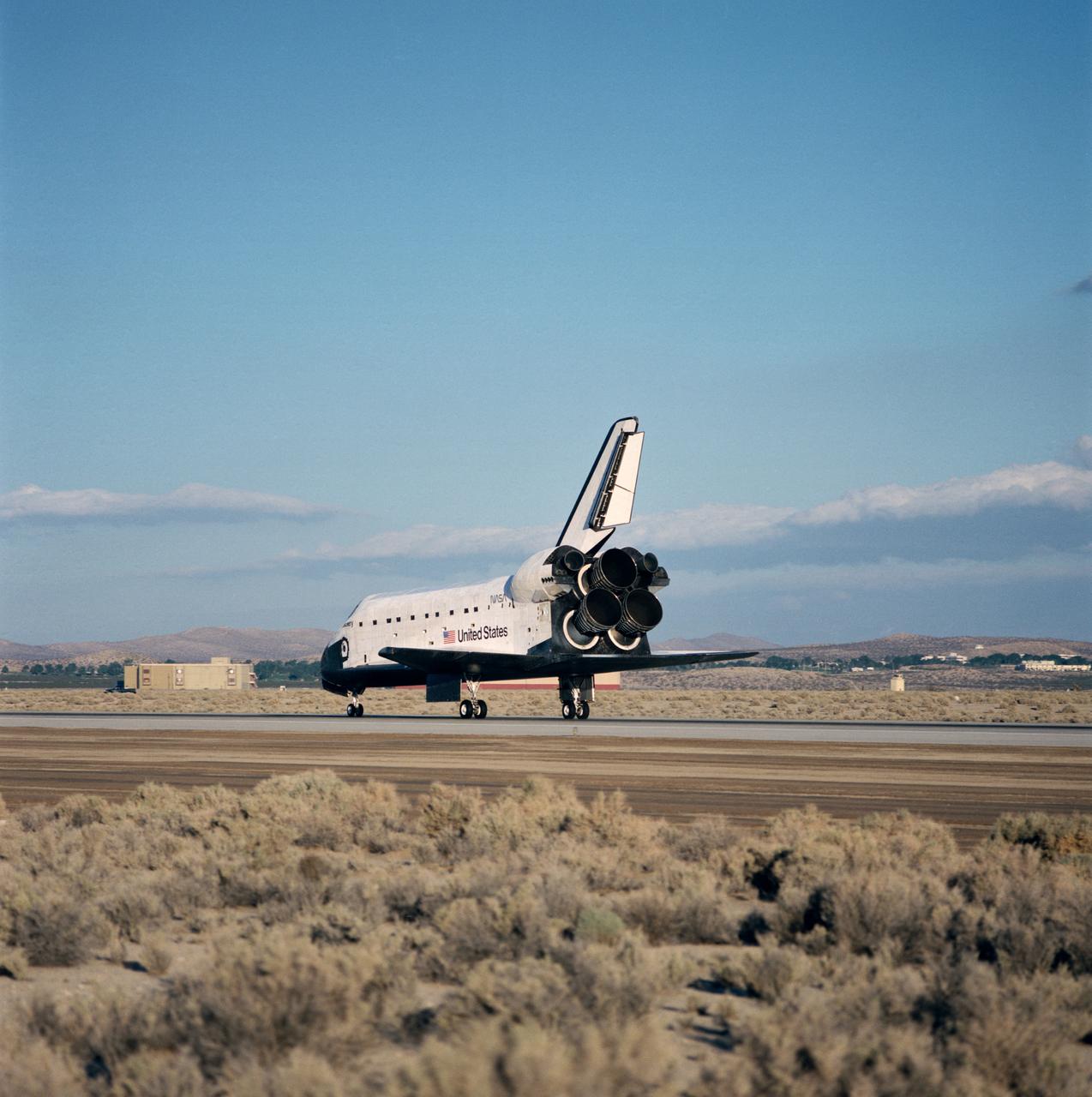
STS-31 Discovery, Orbiter Vehicle (OV) 103, rolls along concrete runway 22 at Edwards Air Force Base (EAFB), California, after nose landing gear (NLG) and main landing gear (MLG) touchdown. This view looks down OV-103's port side from the space shuttle main engines (SSMEs) to the nose section. The SSMEs are gimbaled to their descent position and the rudder/speedbrake is deployed on the vertical stabilizer. Wheel stop occurred at 6:51 am (Pacific Daylight Time (PDT)). In the distance EAFB facilities are visible.
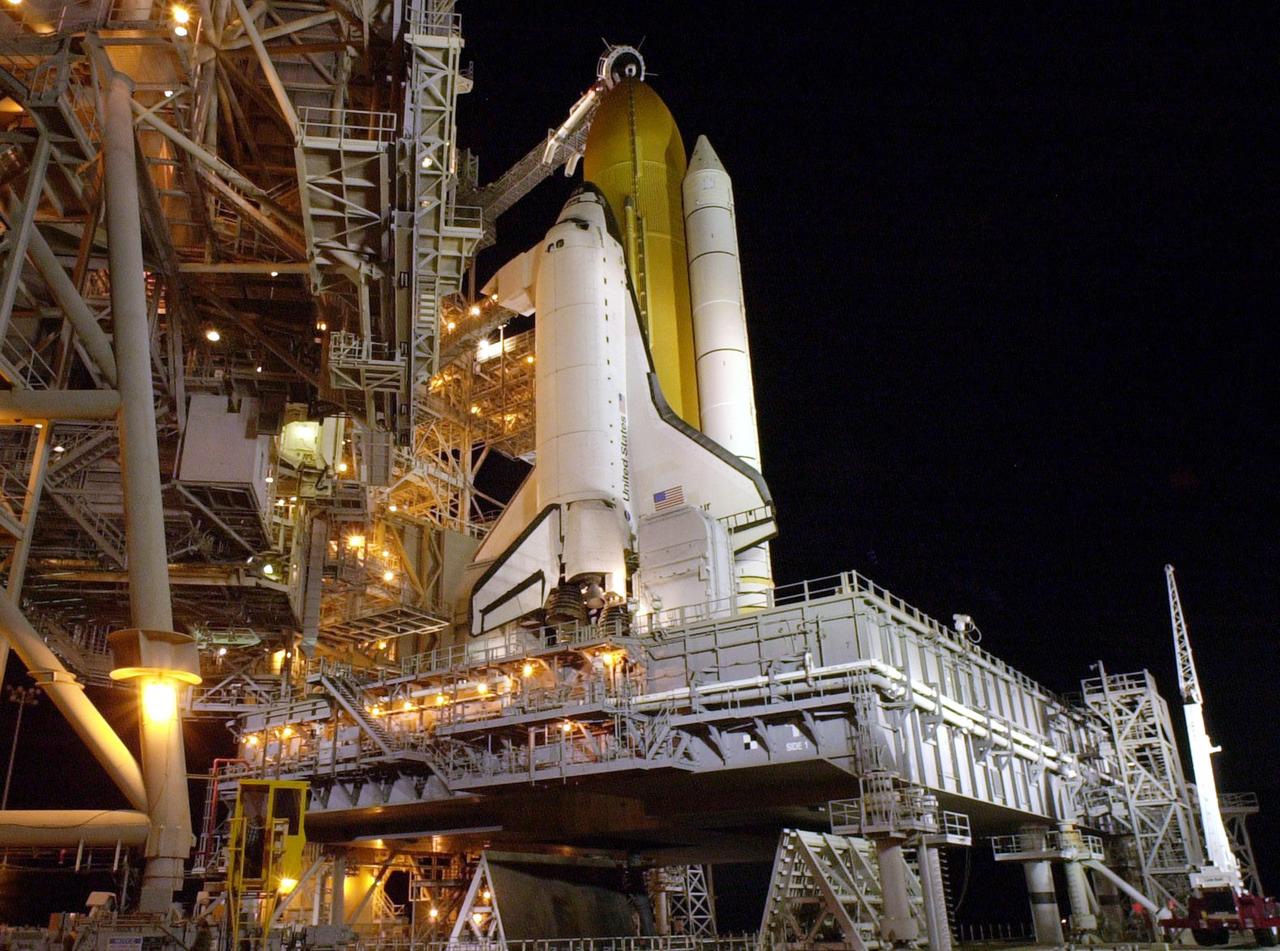
KENNEDY SPACE CENTER, Fla. -- Space Shuttle Endeavour is revealed after rollback of the Rotating Service Structure on Launch Pad 39B. Seen is one of the twin solid rocket boosters that flank the orange external tank. Above the external tank is the Gaseous Oxygen Vent Arm that vents gaseous oxygen vapors away from the Shuttle. The vent hood assembly at the end is often referred to as the "beanie cap." Stretching to the crew hatch on the side is the Orbiter Access Arm with its environmentally controlled White Room at the end. The Shuttle sits on the Mobile Launcher Platform with the two service tail masts on either side of the main engines. The tail masts support the fluid, gas and electrical requirements of the orbiter's liquid oxygen and liquid hydrogen aft T-0 umbilicals. Each tail mast is 31 feet (9.4 meters) high, 15 feet (4.6 meters) long and 9 feet (3.1 meters) wide. Endeavour is scheduled to launch on mission STS-108 Nov. 29 at 7:41 p.m. On this 12th flight to the International Space Station, known as a Utilization Flight, Endeavour will carry a crew of four plus the Expedition 4 crew, who will replace Expedition 3 aboard the ISS. The payload includes the Multi-Purpose Logistics Module Raffaello, filled with supplies, equipment and experiments
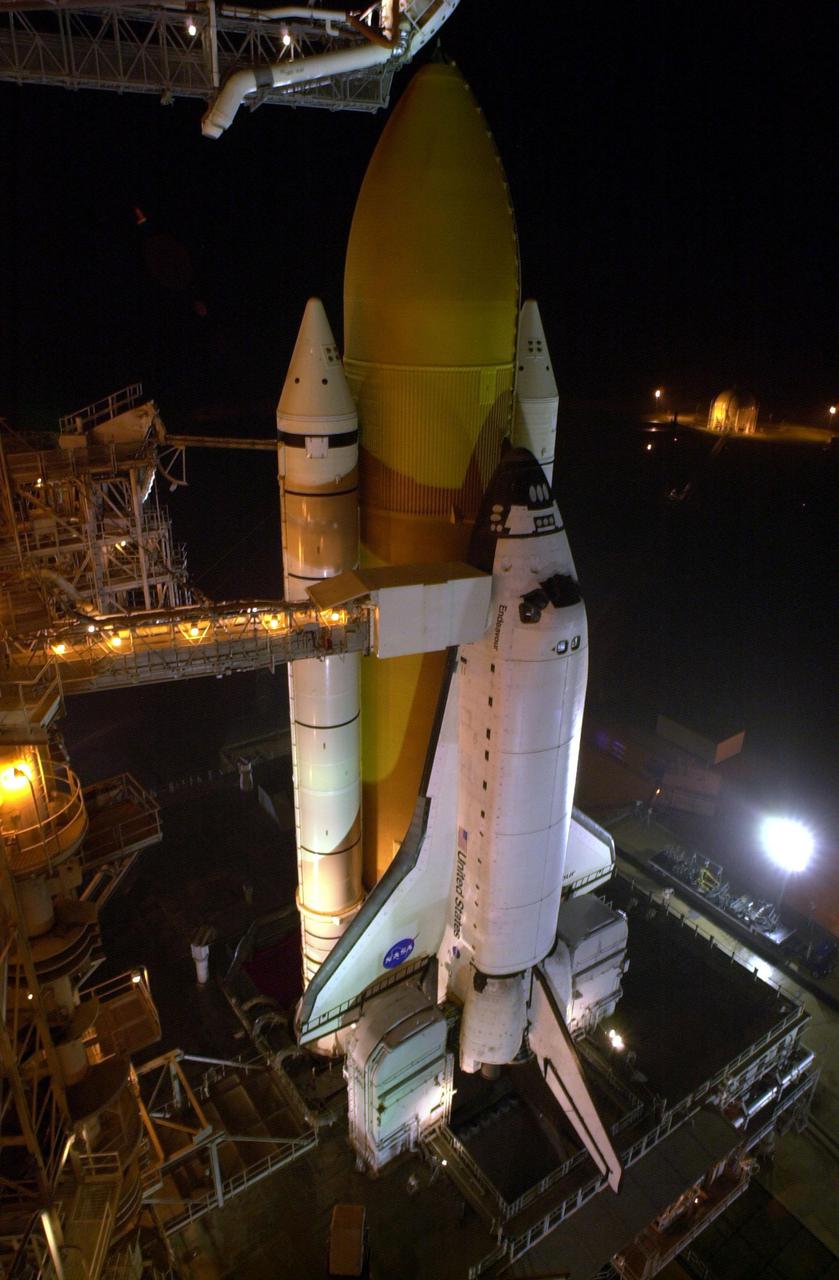
KENNEDY SPACE CENTER, Fla. -- After rollback of the Rotating Service Structure on Launch Pad 39B, Space Shuttle Endeavour is bathed in light. Twin solid rocket boosters flank the orange external tank behind Endeavour. Above the external tank is the Gaseous Oxygen Vent Arm that vents gaseous oxygen vapors away from the Shuttle. The vent hood assembly at the end is often referred to as the 'beanie cap.' Stretching to the crew hatch on the side of Endeavour is the Orbiter Access Arm with its environmentally controlled White Room at the end, through which the crew enters the vehicle. The Shuttle sits on the Mobile Launcher Platform with the two service tail masts on either side of the main engines. The tail masts support the fluid, gas and electrical requirements of the orbiter's liquid oxygen and liquid hydrogen aft T-0 umbilicals. Each tail mast is 31 feet (9.4 meters) high, 15 feet (4.6 meters) long and 9 feet (3.1 meters) wide. Endeavour is scheduled to launch on mission STS-108 Dec. 4 at 5:45 p.m. EST. On this 12th flight to the International Space Station, known as a Utilization Flight, Endeavour will carry a crew of four plus the Expedition 4 crew, who will replace Expedition 3 aboard the ISS. The payload includes the Multi-Purpose Logistics Module Raffaello, filled with supplies, equipment and experiments
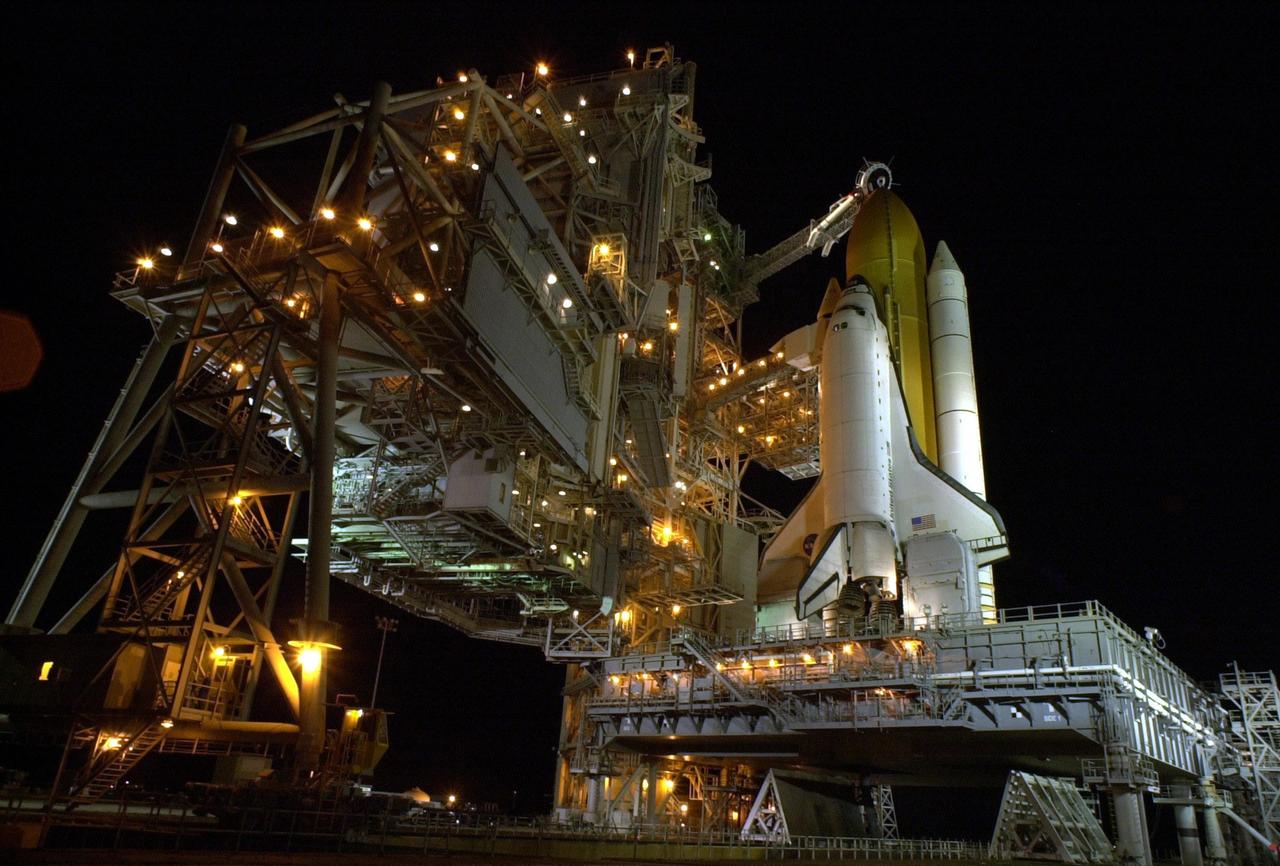
KENNEDY SPACE CENTER, Fla. -- After rollback of the Rotating Service Structure on Launch Pad 39B, Space Shuttle Endeavour is bathed in light. Seen is one of the twin solid rocket boosters that flank the orange external tank. Above the external tank is the Gaseous Oxygen Vent Arm that vents gaseous oxygen vapors away from the Shuttle. The vent hood assembly at the end is often referred to as the "beanie cap." Stretching to the crew hatch on the side is the Orbiter Access Arm with its environmentally controlled White Room at the end. The Shuttle sits on the Mobile Launcher Platform with the two service tail masts on either side of the main engines. The tail masts support the fluid, gas and electrical requirements of the orbiter's liquid oxygen and liquid hydrogen aft T-0 umbilicals. Each tail mast is 31 feet (9.4 meters) high, 15 feet (4.6 meters) long and 9 feet (3.1 meters) wide. Endeavour is scheduled to launch on mission STS-108 Nov. 29 at 7:41 p.m. On this 12th flight to the International Space Station, known as a Utilization Flight, Endeavour will carry a crew of four plus the Expedition 4 crew, who will replace Expedition 3 aboard the ISS. The payload includes the Multi-Purpose Logistics Module Raffaello, filled with supplies, equipment and experiments
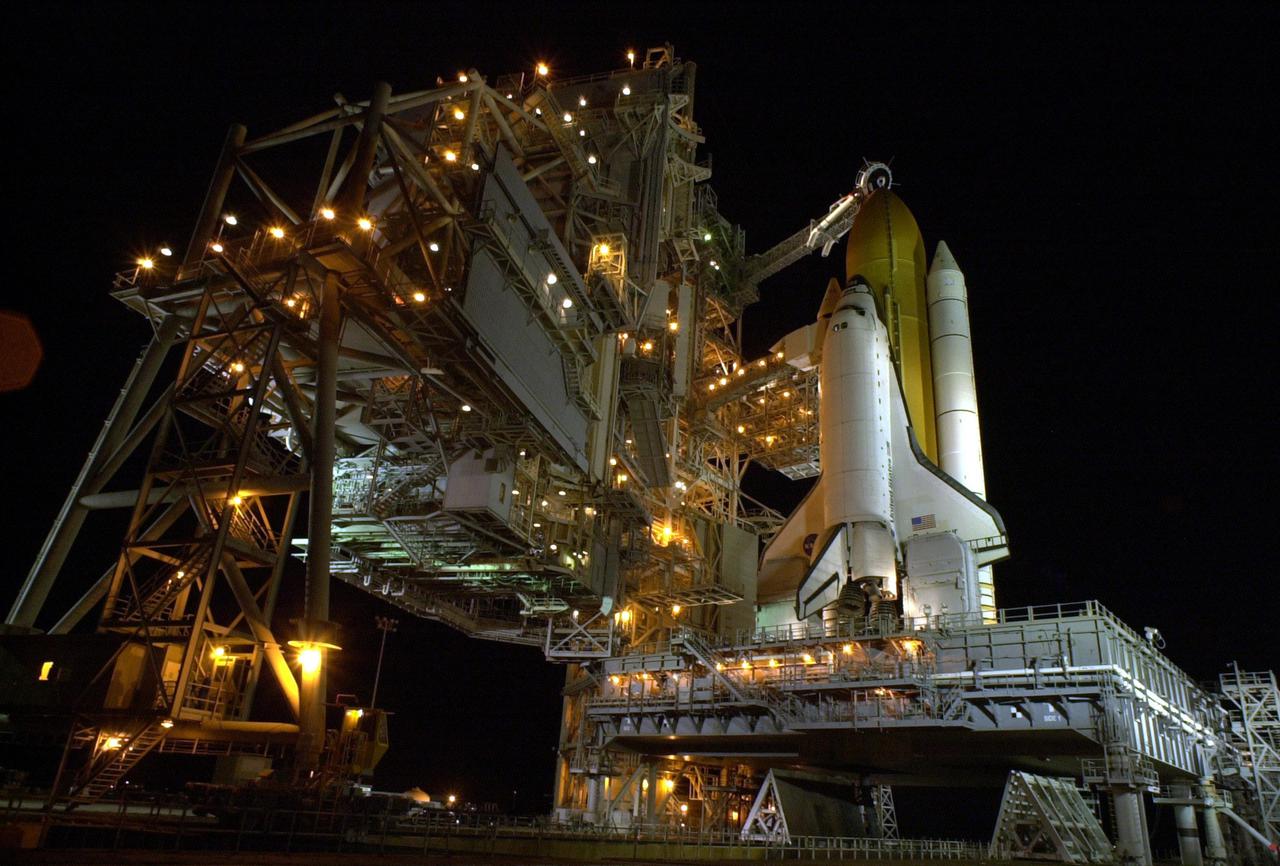
KENNEDY SPACE CENTER, Fla. -- After rollback of the Rotating Service Structure on Launch Pad 39B, Space Shuttle Endeavour is bathed in light. Seen is one of the twin solid rocket boosters that flank the orange external tank. Above the external tank is the Gaseous Oxygen Vent Arm that vents gaseous oxygen vapors away from the Shuttle. The vent hood assembly at the end is often referred to as the 'beanie cap.' Stretching to the crew hatch on the side is the Orbiter Access Arm with its environmentally controlled White Room at the end. The Shuttle sits on the Mobile Launcher Platform with the two service tail masts on either side of the main engines. The tail masts support the fluid, gas and electrical requirements of the orbiter's liquid oxygen and liquid hydrogen aft T-0 umbilicals. Each tail mast is 31 feet (9.4 meters) high, 15 feet (4.6 meters) long and 9 feet (3.1 meters) wide. Endeavour is scheduled to launch on mission STS-108 Nov. 29 at 7:41 p.m. On this 12th flight to the International Space Station, known as a Utilization Flight, Endeavour will carry a crew of four plus the Expedition 4 crew, who will replace Expedition 3 aboard the ISS. The payload includes the Multi-Purpose Logistics Module Raffaello, filled with supplies, equipment and experiments

KENNEDY SPACE CENTER, Fla. -- After rollback of the Rotating Service Structure on Launch Pad 39B, Space Shuttle Endeavour is bathed in light. Twin solid rocket boosters flank the orange external tank behind Endeavour. Above the external tank is the Gaseous Oxygen Vent Arm that vents gaseous oxygen vapors away from the Shuttle. The vent hood assembly at the end is often referred to as the "beanie cap." Stretching to the crew hatch on the side of Endeavour is the Orbiter Access Arm with its environmentally controlled White Room at the end, through which the crew enters the vehicle. The Shuttle sits on the Mobile Launcher Platform with the two service tail masts on either side of the main engines. The tail masts support the fluid, gas and electrical requirements of the orbiter's liquid oxygen and liquid hydrogen aft T-0 umbilicals. Each tail mast is 31 feet (9.4 meters) high, 15 feet (4.6 meters) long and 9 feet (3.1 meters) wide. Endeavour is scheduled to launch on mission STS-108 Dec. 4 at 5:45 p.m. EST. On this 12th flight to the International Space Station, known as a Utilization Flight, Endeavour will carry a crew of four plus the Expedition 4 crew, who will replace Expedition 3 aboard the ISS. The payload includes the Multi-Purpose Logistics Module Raffaello, filled with supplies, equipment and experiments
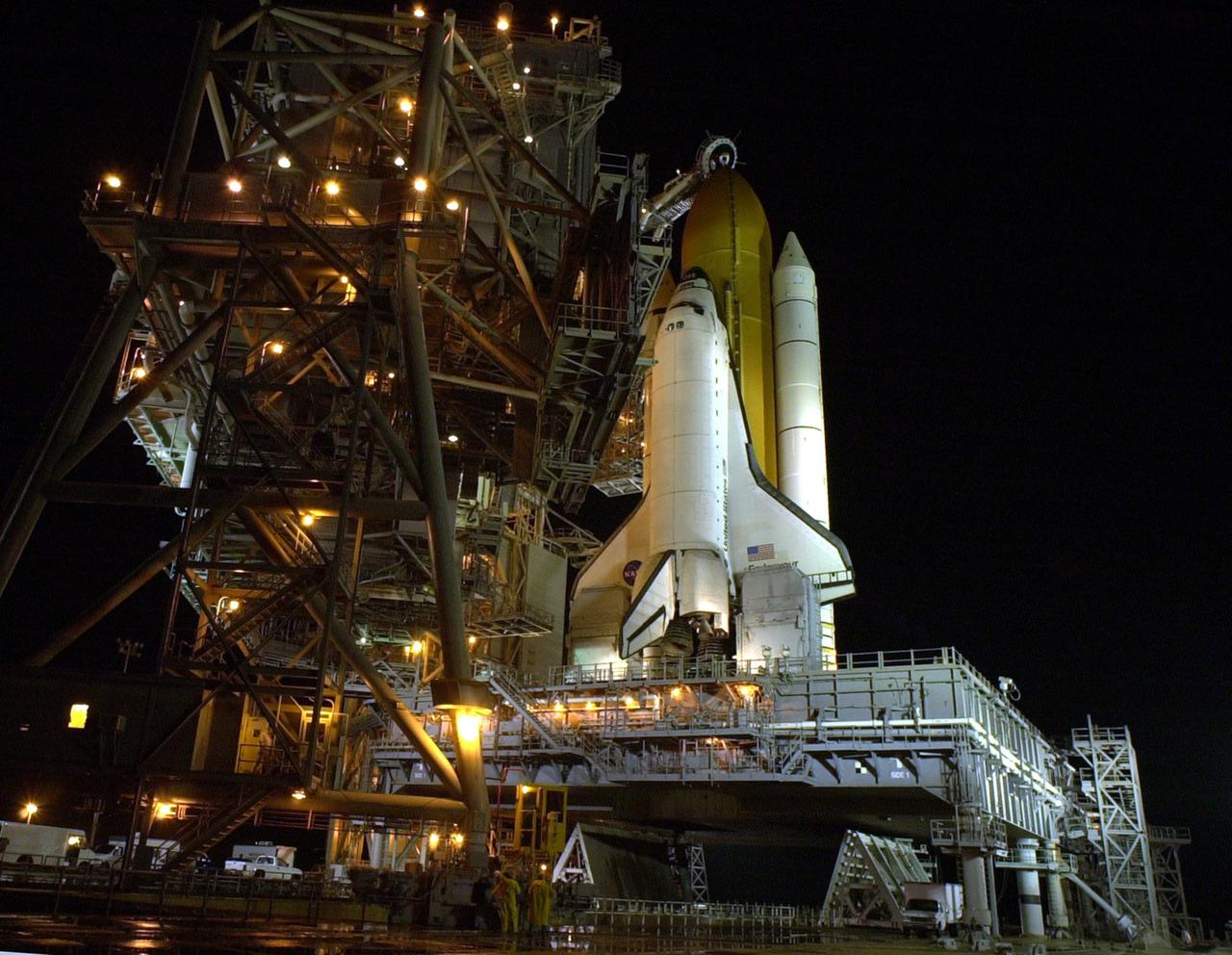
KENNEDY SPACE CENTER, Fla. -- The Rotating Service Structure on Launch Pad 39B rolls away from Space Shuttle Endeavour atop the Mobile Launcher Platform. The Space Shuttle comprises the orbiter and an external tank flanked by twin solid rocket boosters. Above the external tank is the Gaseous Oxygen Vent Arm that vents gaseous oxygen vapors away from the Shuttle. The vent hood assembly at the end is often referred to as the "beanie cap." On either side of the orbiter's tail and main engines are two tail masts that support the fluid, gas and electrical requirements of the orbiter's liquid oxygen and liquid hydrogen aft T-0 umbilicals. . Each tail mast is 31 feet (9.4 meters) high, 15 feet (4.6 meters) long and 9 feet (3.1 meters) wide. Endeavour is scheduled to launch on mission STS-108 Dec. 4 at 5:45 p.m. EST. On this 12th flight to the International Space Station, known as a Utilization Flight, Endeavour will carry a crew of four plus the Expedition 4 crew, who will replace Expedition 3 aboard the ISS. The payload includes the Multi-Purpose Logistics Module Raffaello, filled with supplies, equipment and experiments
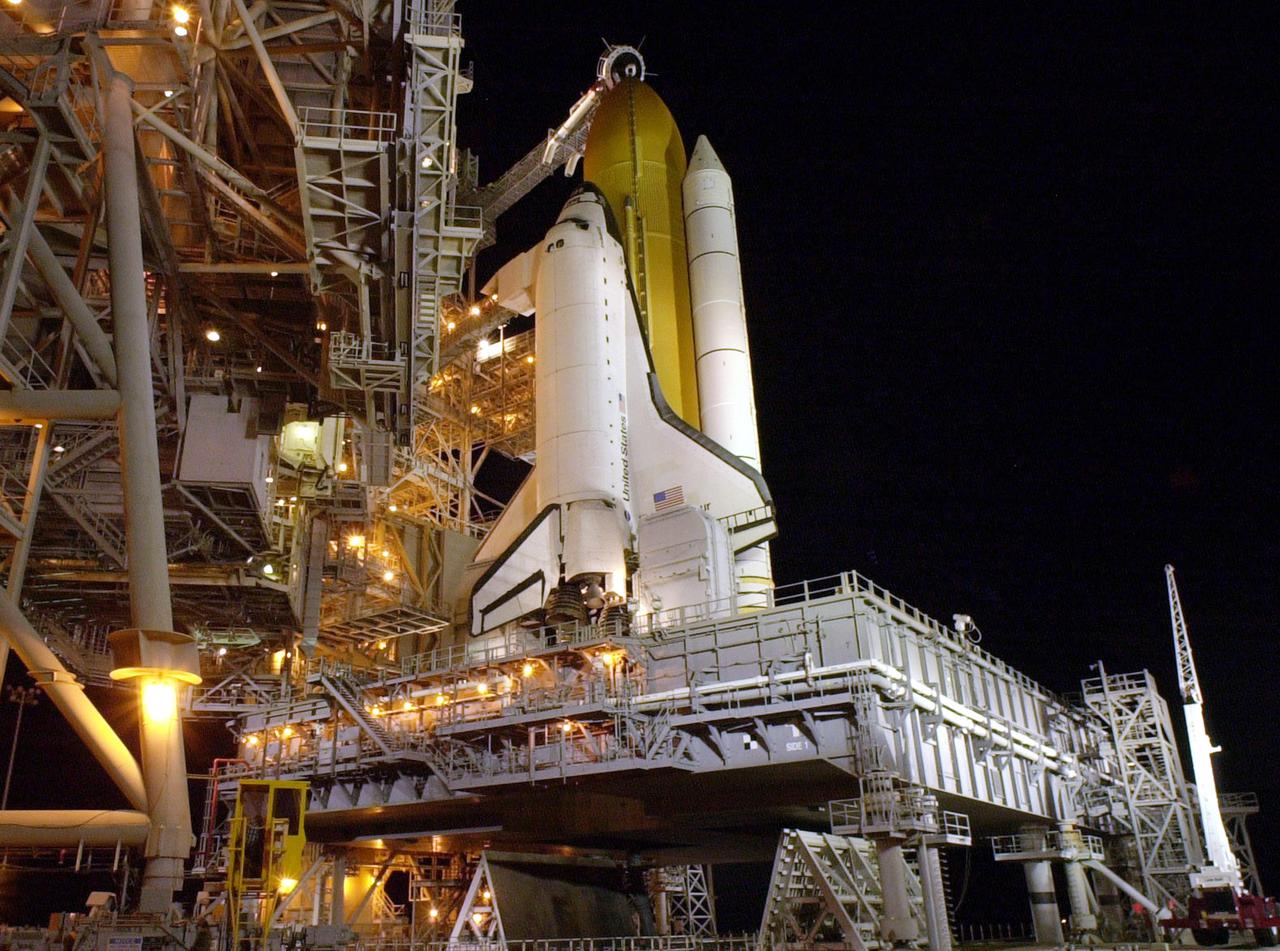
KENNEDY SPACE CENTER, Fla. -- Space Shuttle Endeavour is revealed after rollback of the Rotating Service Structure on Launch Pad 39B. Seen is one of the twin solid rocket boosters that flank the orange external tank. Above the external tank is the Gaseous Oxygen Vent Arm that vents gaseous oxygen vapors away from the Shuttle. The vent hood assembly at the end is often referred to as the 'beanie cap.' Stretching to the crew hatch on the side is the Orbiter Access Arm with its environmentally controlled White Room at the end. The Shuttle sits on the Mobile Launcher Platform with the two service tail masts on either side of the main engines. The tail masts support the fluid, gas and electrical requirements of the orbiter's liquid oxygen and liquid hydrogen aft T-0 umbilicals. Each tail mast is 31 feet (9.4 meters) high, 15 feet (4.6 meters) long and 9 feet (3.1 meters) wide. Endeavour is scheduled to launch on mission STS-108 Nov. 29 at 7:41 p.m. On this 12th flight to the International Space Station, known as a Utilization Flight, Endeavour will carry a crew of four plus the Expedition 4 crew, who will replace Expedition 3 aboard the ISS. The payload includes the Multi-Purpose Logistics Module Raffaello, filled with supplies, equipment and experiments
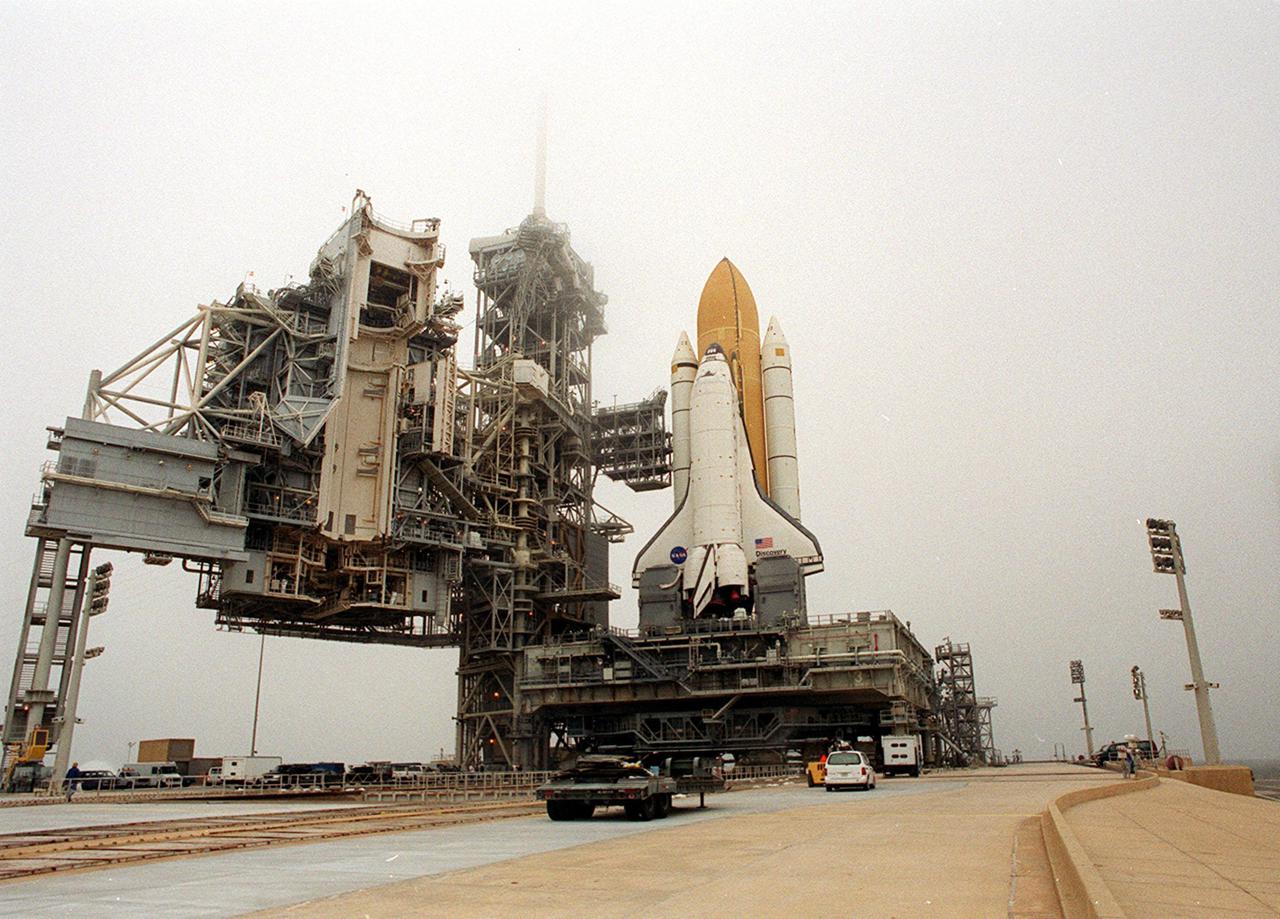
KENNEDY SPACE CENTER, Fla. -- Space Shuttle Discovery sits on Launch Pad 39B after its approximately 5-hour rollout from the Vehicle Assembly Building. At center left can be seen the White Room, the environmentally controlled chamber that provides entry into the orbiter for the astronaut crews. The chamber is at the end of the Orbiter Access Arm, which has not been extended yet. At the bottom of Discovery’s left wing is the tail service mast, one of two belonging to the Mobile Launcher Platform on which the Shuttle rests. The tail service mast is 31 feet high, 15 feet long and 9 feet wide. A second TSM is on the other side. They support the fluid, gas and electrical requirements of the orbiter’s liquid oxygen and liquid hydrogen aft T-0 umbilicals. Discovery will be flying on mission STS-102 to the International Space Station. Its payload is the Multi-Purpose Logistics Module Leonardo, a “moving van,” to carry laboratory racks filled with equipment, experiments and supplies to and from the Space Station aboard the Space Shuttle. The flight will also carry the Expedition Two crew up to the Space Station, replacing Expedition One, who will return to Earth on Discovery. Launch is scheduled for March 8 at 6:45 a.m. EST
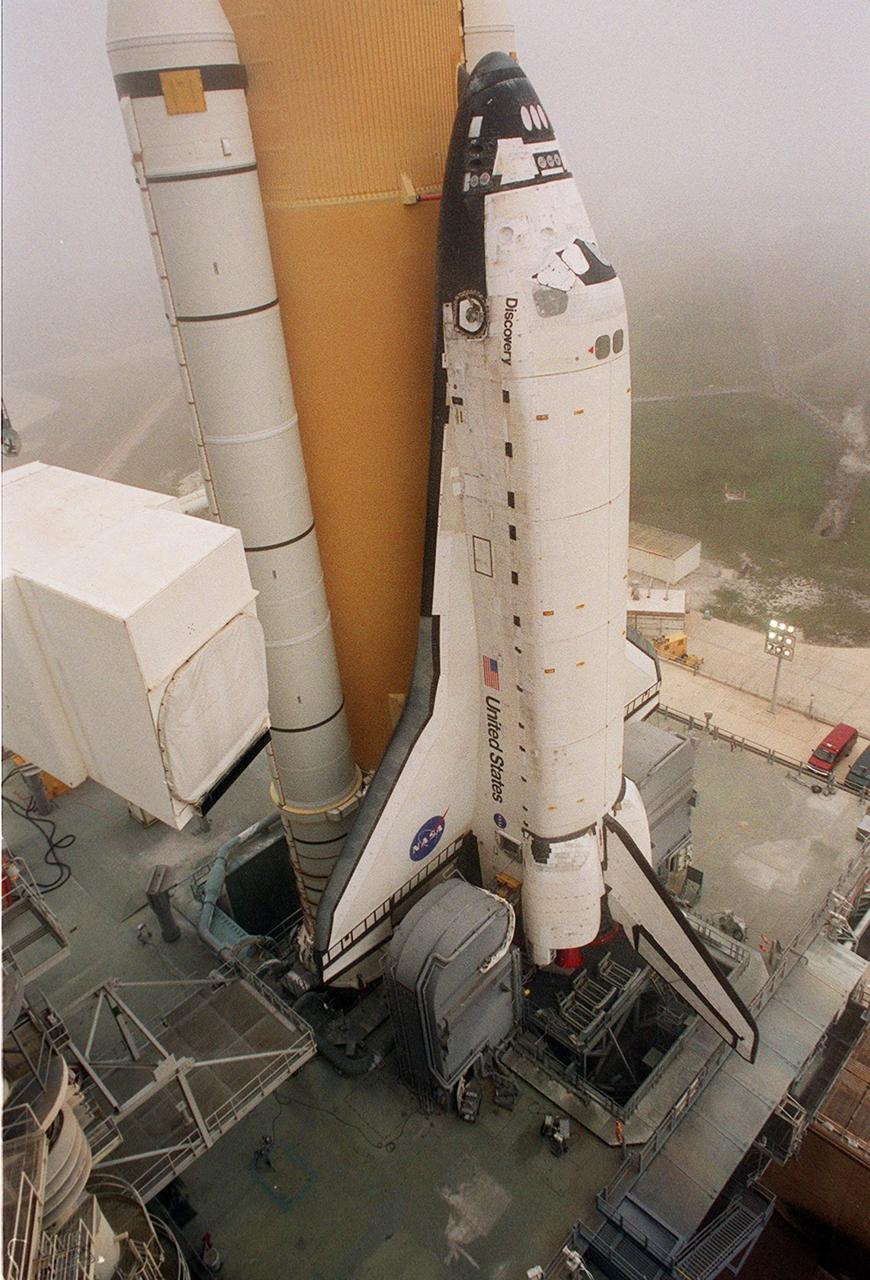
KENNEDY SPACE CENTER, Fla. -- Space Shuttle Discovery sits on Launch Pad 39B after its approximately 5-hour rollout from the Vehicle Assembly Building. At center left can be seen the White Room, the environmentally controlled chamber that provides entry into the orbiter for the astronaut crews. The chamber is at the end of the Orbiter Access Arm, which has not been extended yet. At the bottom of Discovery’s left wing is the tail service mast, one of two belonging to the Mobile Launcher Platform on which the Shuttle rests. The tail service mast is 31 feet high, 15 feet long and 9 feet wide. A second TSM is on the other side. They support the fluid, gas and electrical requirements of the orbiter’s liquid oxygen and liquid hydrogen aft T-0 umbilicals. Discovery will be flying on mission STS-102 to the International Space Station. Its payload is the Multi-Purpose Logistics Module Leonardo, a “moving van,” to carry laboratory racks filled with equipment, experiments and supplies to and from the Space Station aboard the Space Shuttle. The flight will also carry the Expedition Two crew up to the Space Station, replacing Expedition One, who will return to Earth on Discovery. Launch is scheduled for March 8 at 6:45 a.m. EST
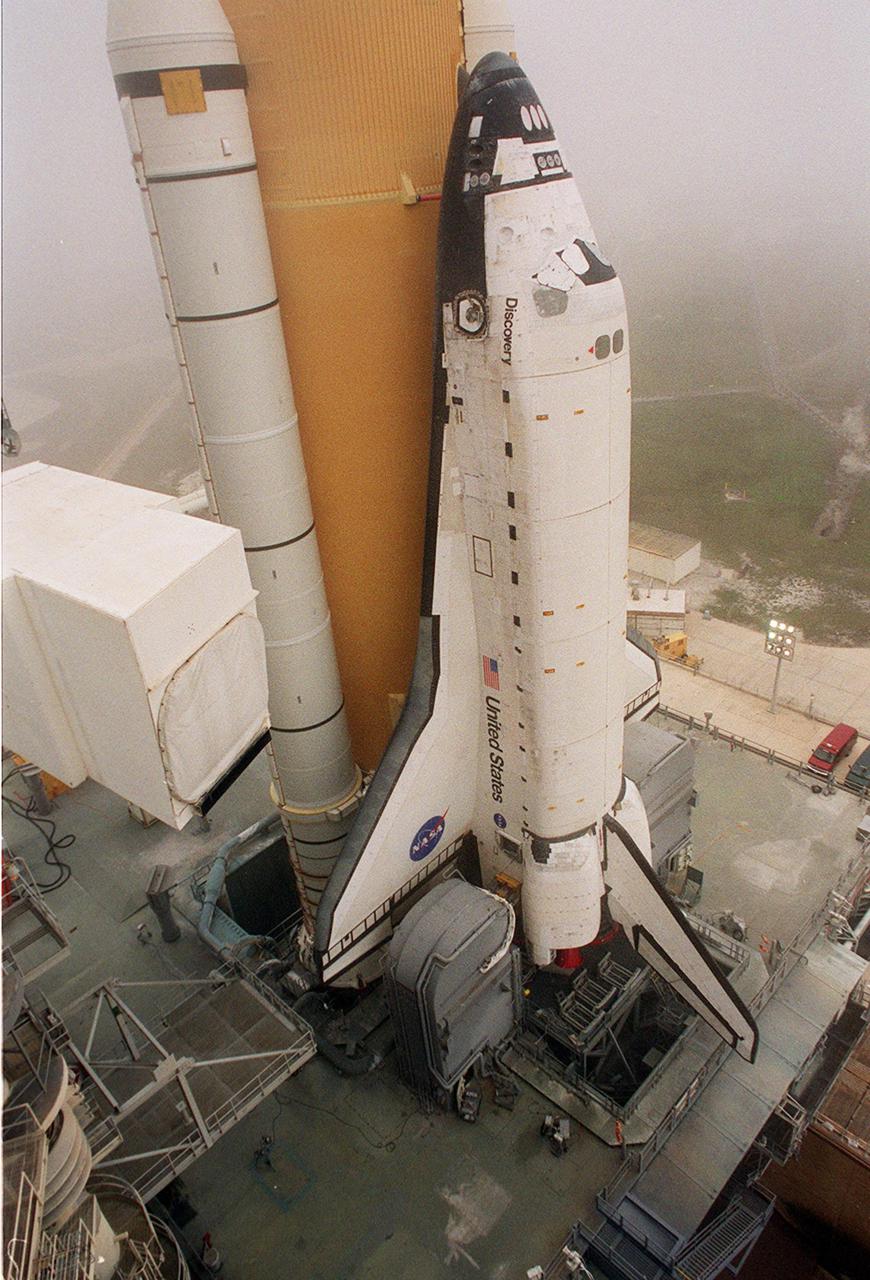
KENNEDY SPACE CENTER, Fla. -- Space Shuttle Discovery sits on Launch Pad 39B after its approximately 5-hour rollout from the Vehicle Assembly Building. At center left can be seen the White Room, the environmentally controlled chamber that provides entry into the orbiter for the astronaut crews. The chamber is at the end of the Orbiter Access Arm, which has not been extended yet. At the bottom of Discovery’s left wing is the tail service mast, one of two belonging to the Mobile Launcher Platform on which the Shuttle rests. The tail service mast is 31 feet high, 15 feet long and 9 feet wide. A second TSM is on the other side. They support the fluid, gas and electrical requirements of the orbiter’s liquid oxygen and liquid hydrogen aft T-0 umbilicals. Discovery will be flying on mission STS-102 to the International Space Station. Its payload is the Multi-Purpose Logistics Module Leonardo, a “moving van,” to carry laboratory racks filled with equipment, experiments and supplies to and from the Space Station aboard the Space Shuttle. The flight will also carry the Expedition Two crew up to the Space Station, replacing Expedition One, who will return to Earth on Discovery. Launch is scheduled for March 8 at 6:45 a.m. EST
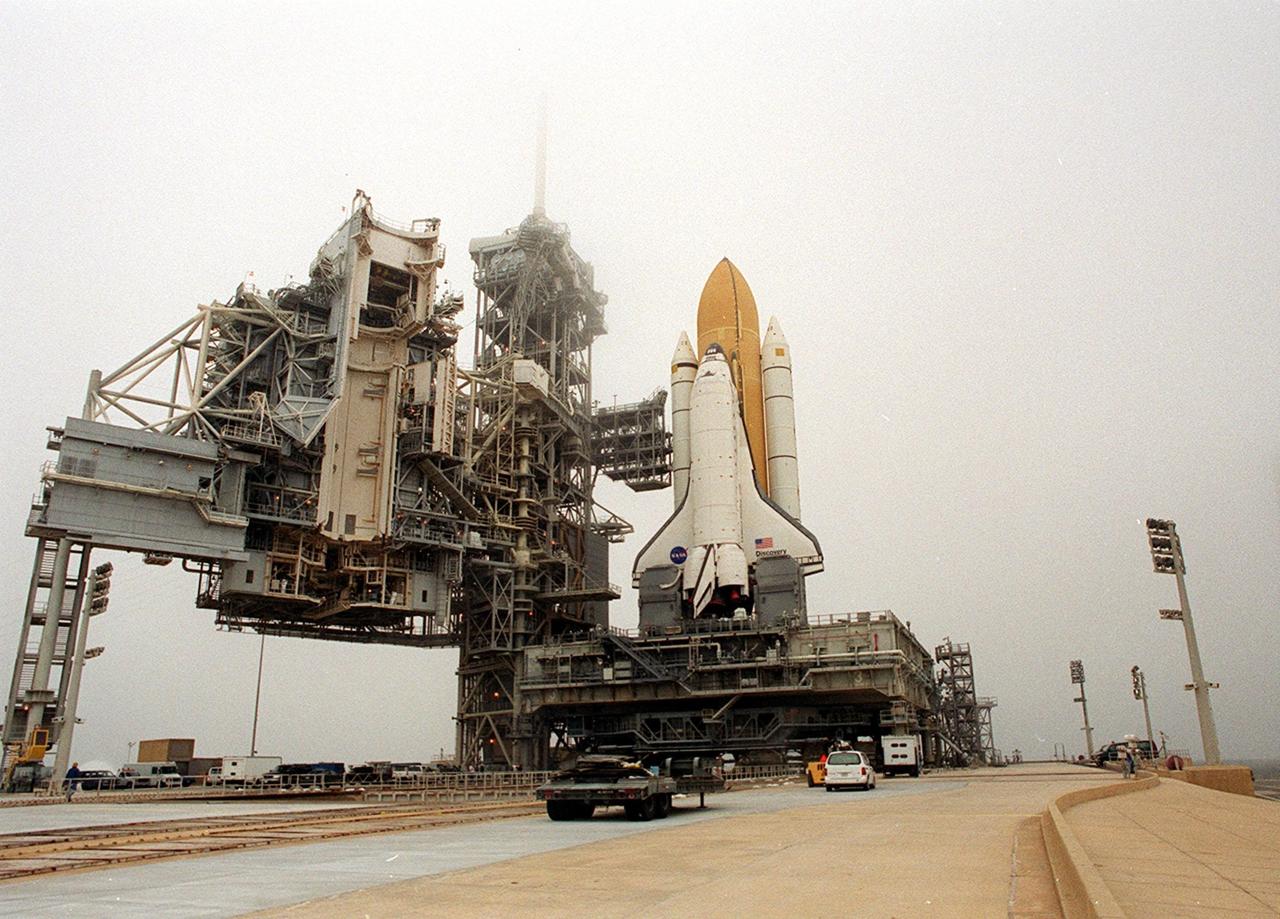
KENNEDY SPACE CENTER, Fla. -- Space Shuttle Discovery sits on Launch Pad 39B after its approximately 5-hour rollout from the Vehicle Assembly Building. At center left can be seen the White Room, the environmentally controlled chamber that provides entry into the orbiter for the astronaut crews. The chamber is at the end of the Orbiter Access Arm, which has not been extended yet. At the bottom of Discovery’s left wing is the tail service mast, one of two belonging to the Mobile Launcher Platform on which the Shuttle rests. The tail service mast is 31 feet high, 15 feet long and 9 feet wide. A second TSM is on the other side. They support the fluid, gas and electrical requirements of the orbiter’s liquid oxygen and liquid hydrogen aft T-0 umbilicals. Discovery will be flying on mission STS-102 to the International Space Station. Its payload is the Multi-Purpose Logistics Module Leonardo, a “moving van,” to carry laboratory racks filled with equipment, experiments and supplies to and from the Space Station aboard the Space Shuttle. The flight will also carry the Expedition Two crew up to the Space Station, replacing Expedition One, who will return to Earth on Discovery. Launch is scheduled for March 8 at 6:45 a.m. EST
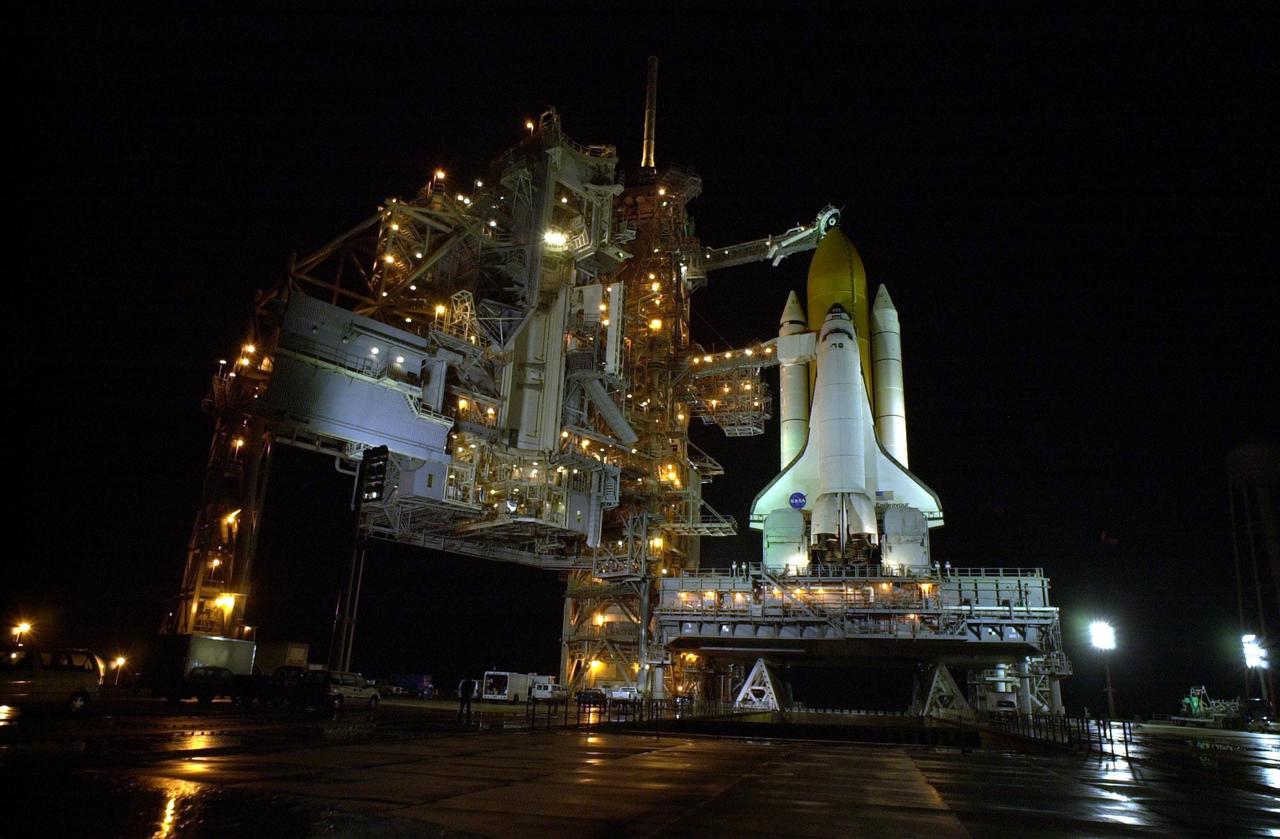
KENNEDY SPACE CENTER, Fla. -- Rain on the ground around Space Shuttle Endeavour on Launch Pad 39B reflects the many lights illluminating the Rotating Service Structure (at left), Fixed Service Structure and Shuttle. Twin solid rocket boosters flank the orange external tank behind Endeavour. Above the external tank is the Gaseous Oxygen Vent Arm that vents gaseous oxygen vapors away from the Shuttle. The vent hood assembly at the end is often referred to as the "beanie cap." Stretching from the FSS to the crew hatch on the side of Endeavour is the Orbiter Access Arm with its environmentally controlled White Room at the end, through which the crew enters the vehicle. The Shuttle sits on the Mobile Launcher Platform with the two service tail masts on either side of the main engines. The tail masts support the fluid, gas and electrical requirements of the orbiter's liquid oxygen and liquid hydrogen aft T-0 umbilicals. Each tail mast is 31 feet (9.4 meters) high, 15 feet (4.6 meters) long and 9 feet (3.1 meters) wide. Endeavour is scheduled to launch on mission STS-108 Dec. 4 at 5:45 p.m. EST. On this 12th flight to the International Space Station, known as a Utilization Flight, Endeavour will carry a crew of four plus the Expedition 4 crew, who will replace Expedition 3 aboard the ISS. The payload includes the Multi-Purpose Logistics Module Raffaello, filled with supplies, equipment and experiments
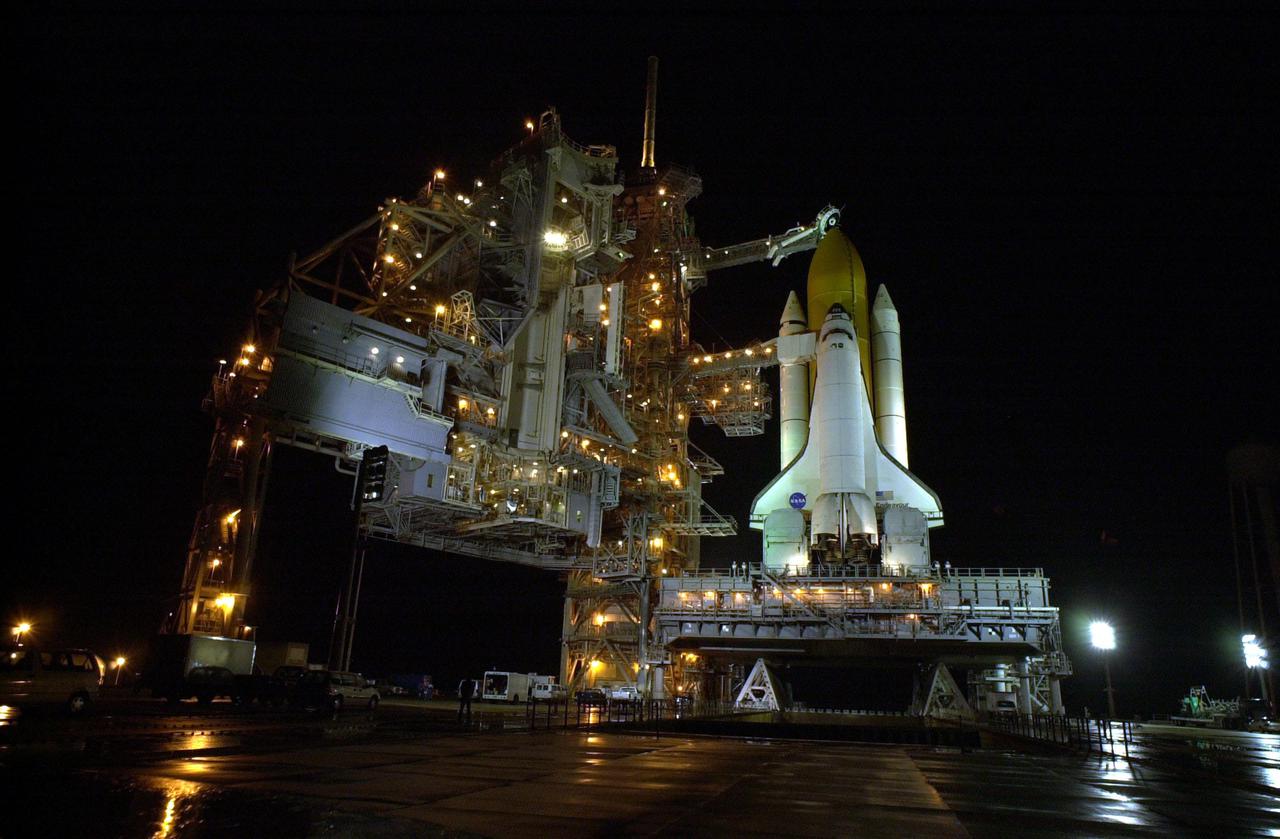
KENNEDY SPACE CENTER, Fla. -- Rain on the ground around Space Shuttle Endeavour on Launch Pad 39B reflects the many lights illluminating the Rotating Service Structure (at left), Fixed Service Structure and Shuttle. Twin solid rocket boosters flank the orange external tank behind Endeavour. Above the external tank is the Gaseous Oxygen Vent Arm that vents gaseous oxygen vapors away from the Shuttle. The vent hood assembly at the end is often referred to as the 'beanie cap.' Stretching from the FSS to the crew hatch on the side of Endeavour is the Orbiter Access Arm with its environmentally controlled White Room at the end, through which the crew enters the vehicle. The Shuttle sits on the Mobile Launcher Platform with the two service tail masts on either side of the main engines. The tail masts support the fluid, gas and electrical requirements of the orbiter's liquid oxygen and liquid hydrogen aft T-0 umbilicals. Each tail mast is 31 feet (9.4 meters) high, 15 feet (4.6 meters) long and 9 feet (3.1 meters) wide. Endeavour is scheduled to launch on mission STS-108 Dec. 4 at 5:45 p.m. EST. On this 12th flight to the International Space Station, known as a Utilization Flight, Endeavour will carry a crew of four plus the Expedition 4 crew, who will replace Expedition 3 aboard the ISS. The payload includes the Multi-Purpose Logistics Module Raffaello, filled with supplies, equipment and experiments

KENNEDY SPACE CENTER, FLA. -- Space Shuttle Atlantis, mounted on a mobile launch platform, finally rests on the hard stand of Launch Pad 39A after an early morning rollout. This is the second rollout for the shuttle. Seen on either side of the main engine exhaust hole on the launcher platform are the tail service masts. Their function is to provide umbilical connections for liquid oxygen and liquid hydrogen lines to fuel the external tank from storage tanks adjacent to the launch pad. Other umbilical lines carry helium and nitrogen, as well as ground electrical power and connections for vehicle data and communications. First motion out of the Vehicle Assembly Building was at 5:02 a.m. EDT. In late February, while Atlantis was on the launch pad, Atlantis' external tank received hail damage during a severe thunderstorm that passed through the Kennedy Space Center Launch Complex 39 area. The hail caused visible divots in the giant tank's foam insulation, as well as minor surface damage to about 26 heat shield tiles on the shuttle's left wing. The shuttle was returned to the VAB for repairs. The launch of Space Shuttle Atlantis on mission STS-117 is now targeted for June 8. A flight readiness review will be held on May 30 and 31. Photo credit: NASA/Troy Cryder