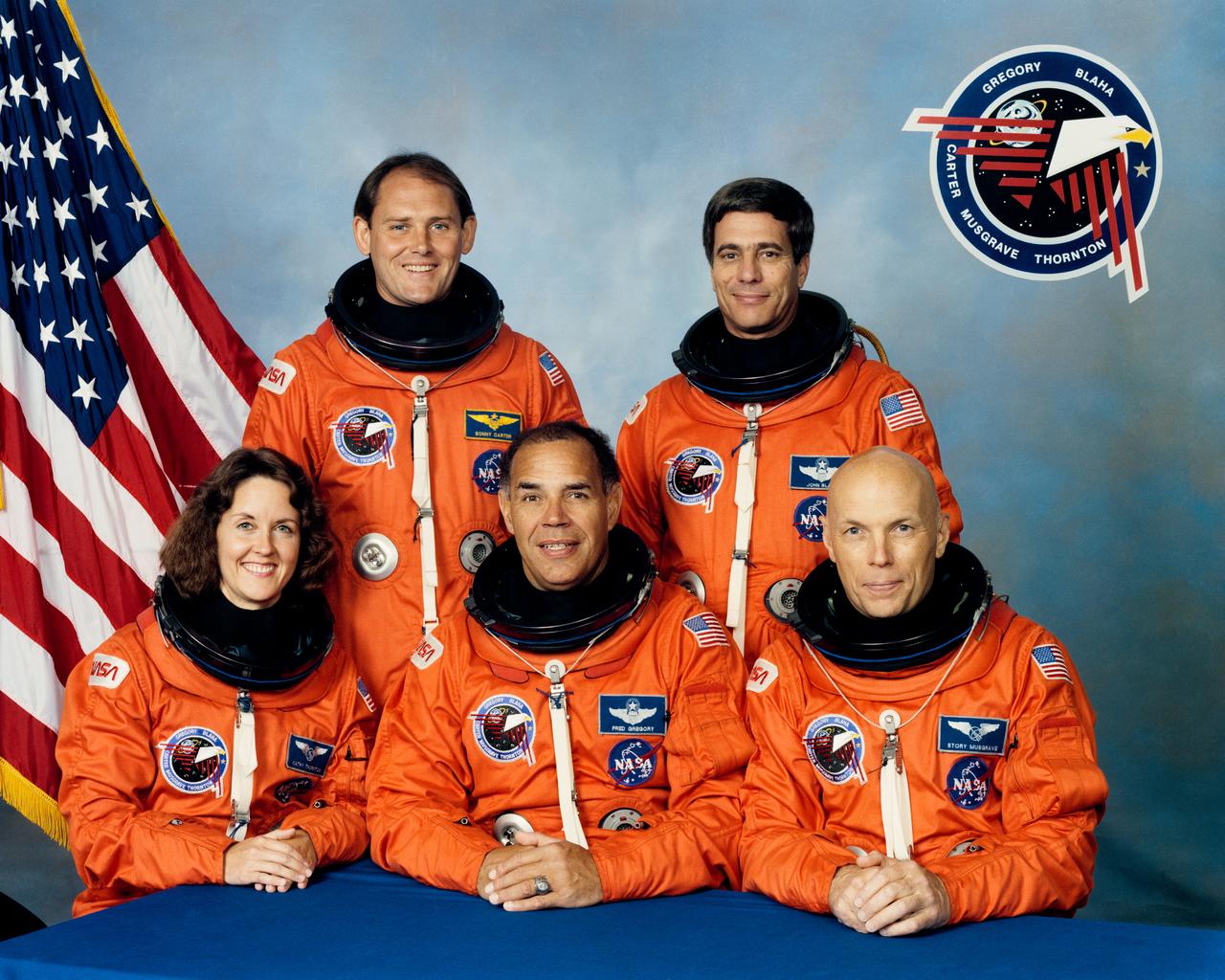
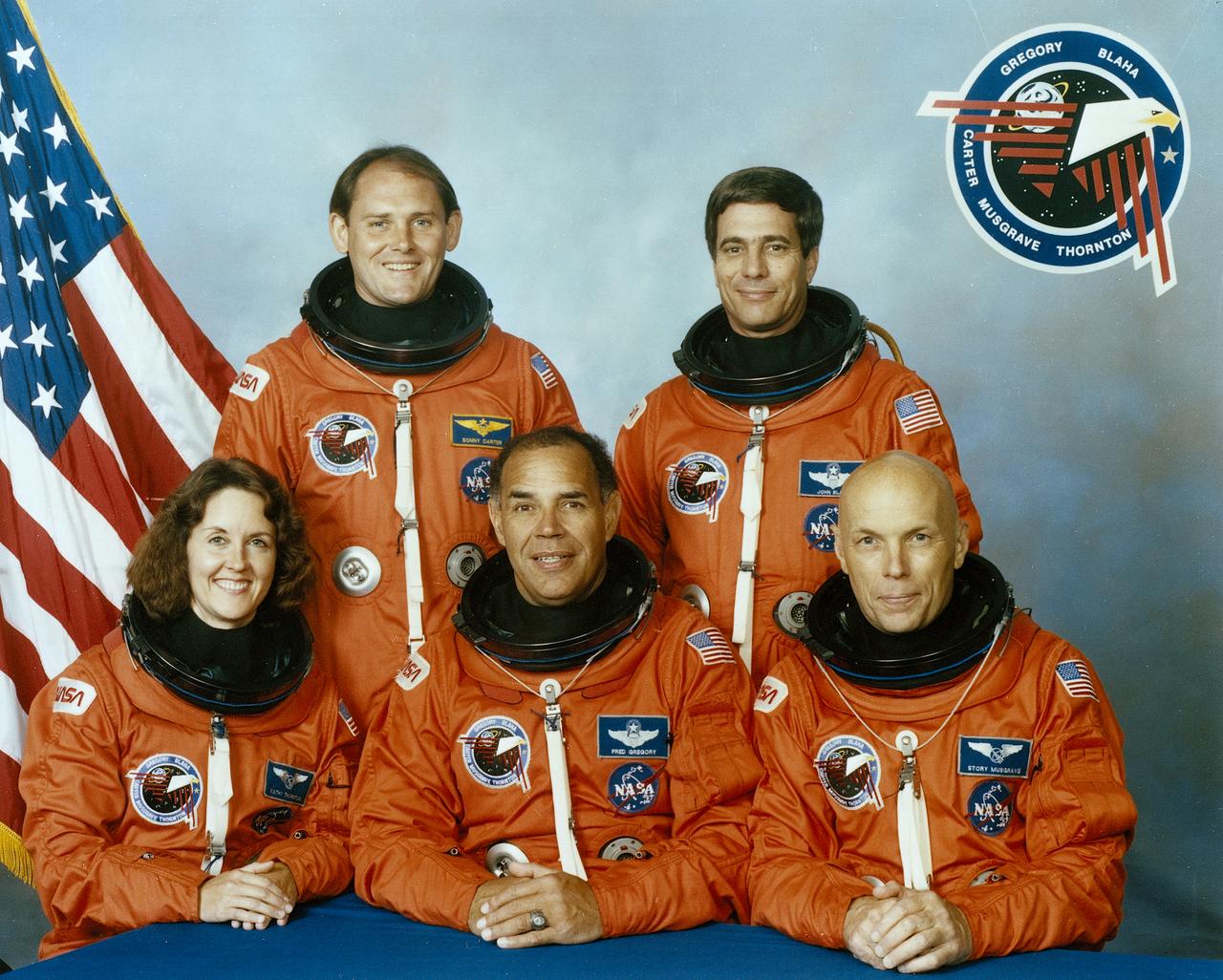
S89-45737 (19 September 1989) --- Official STS-33 crew portrait. These five astronauts will be aboard the space shuttle Discovery for a scheduled November 1989 mission for the Department of Defense (DOD). Frederick D. Gregory (center, front) is mission commander. He is flanked by Kathryn C. Thornton and F. Story Musgrave, mission specialists. At rear are Manley L. Carter, Jr., mission specialist, and John E. Blaha, pilot.
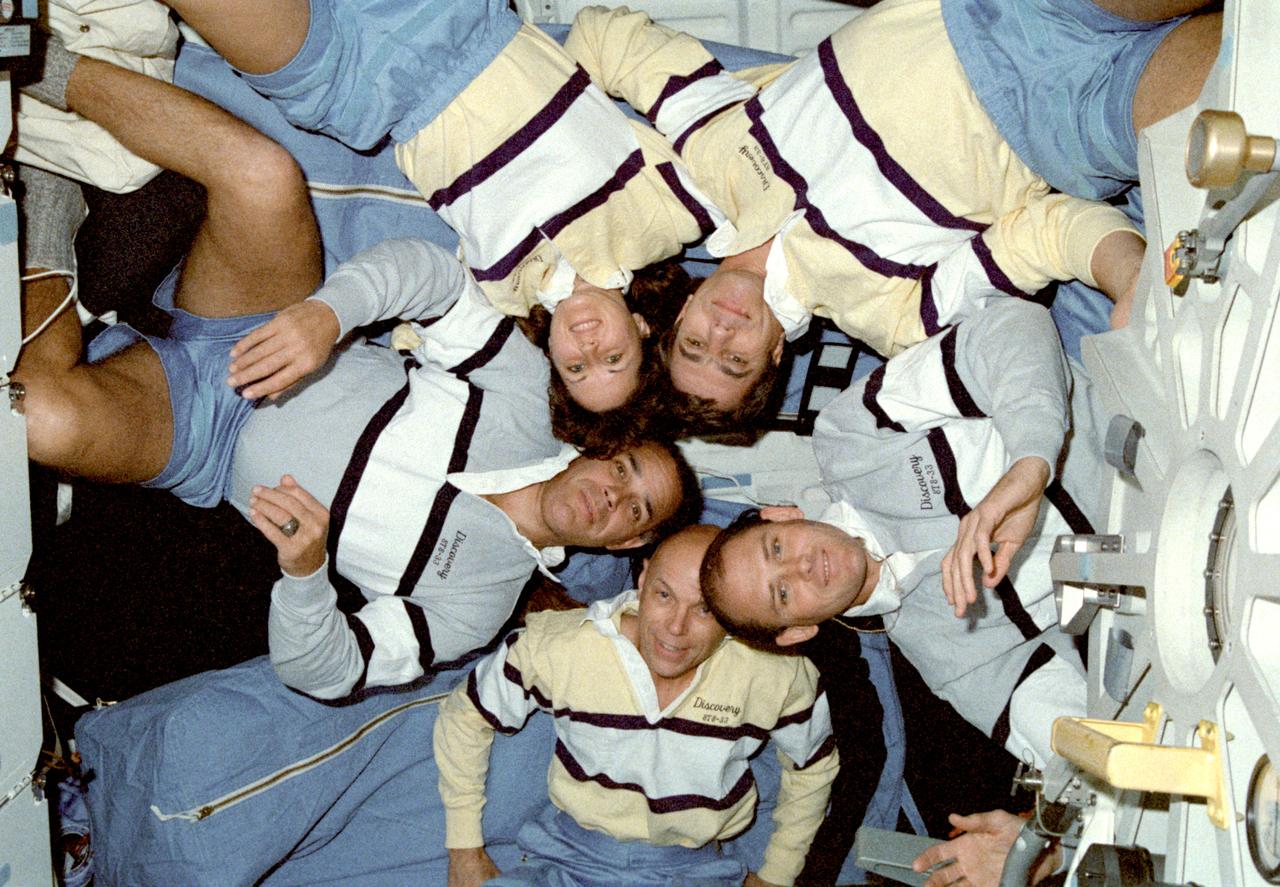
STS033-22-035 (22-27 Nov. 1989) --- STS-33 crewmembers, wearing mission polo shirts, pose on the middeck of the Space Shuttle Discovery for an in-flight crew portrait. Clockwise (starting at left) are astronauts Frederick D. Gregory, commander; Kathryn C. Thornton, mission specialist; John E. Blaha, pilot; Manley L. (Sonny) Carter Jr., and F. Story Musgrave, mission specialists.
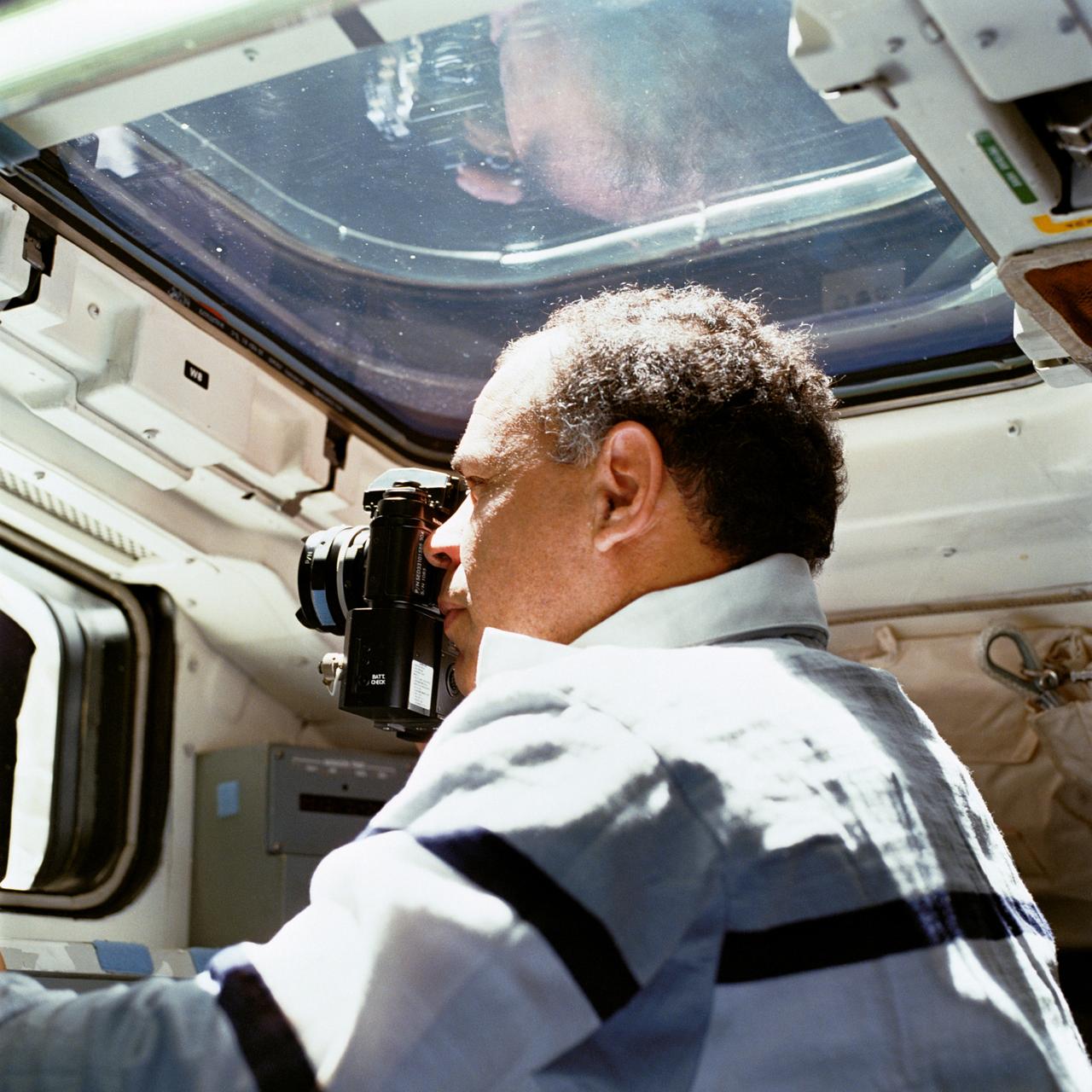
STS033-93-036 (22-27 Nov. 1989) --- Astronaut Frederick D. Gregory, STS-33 commander, aims a 35mm camera out an aft flight deck viewing window while onboard the Space Shuttle Discovery.
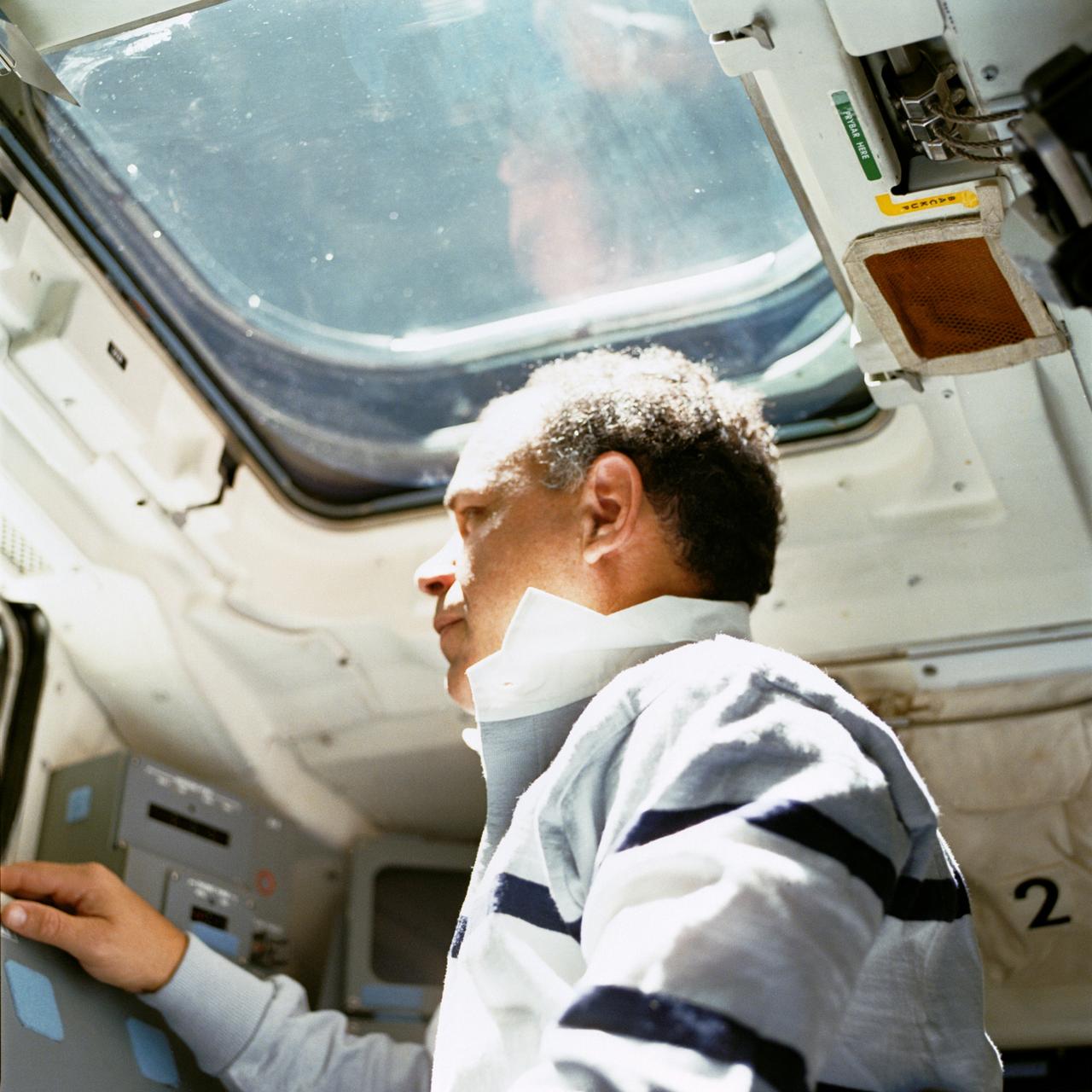
STS033-93-034 (22-27 Nov. 1989) --- Astronaut Frederick D. Gregory, STS-33 commander looks through aft flight deck viewing window while onboard the Space Shuttle Discovery.
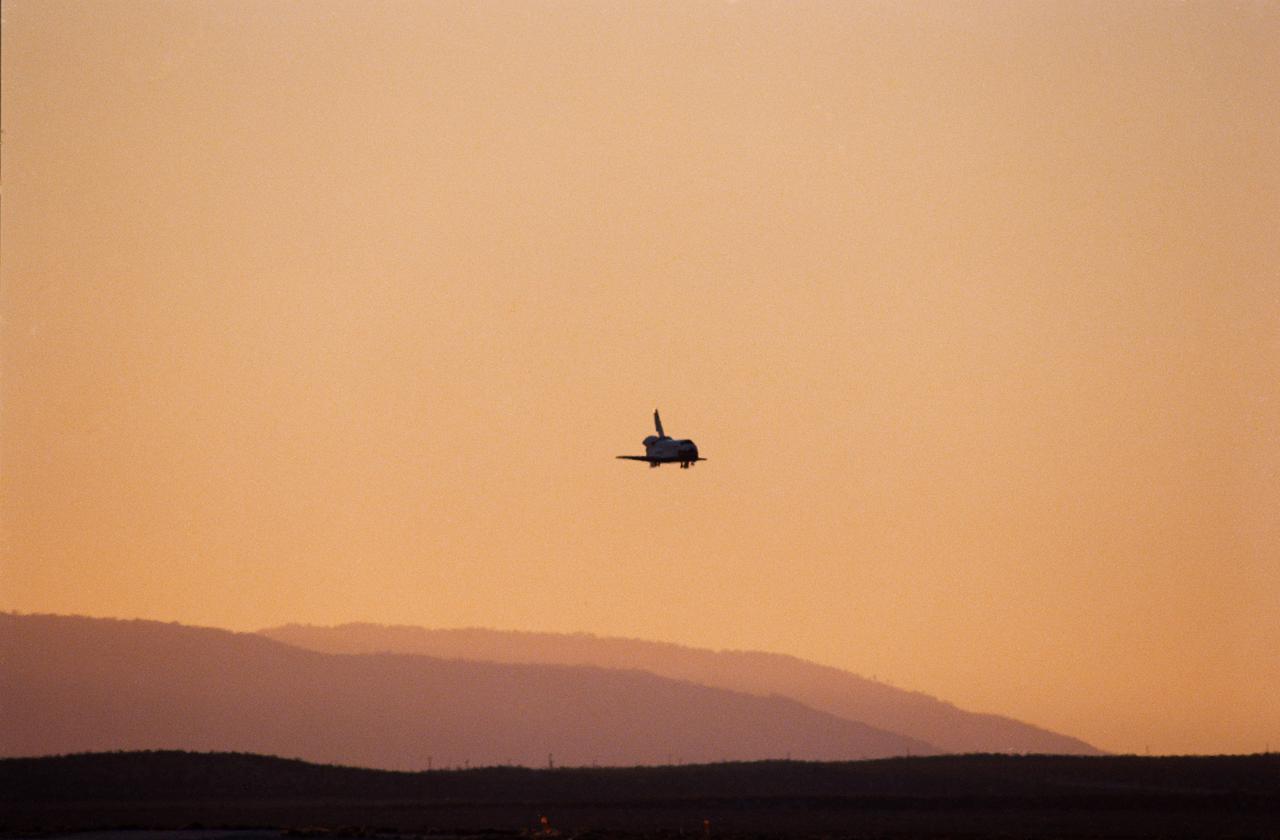
STS033-S-014 (27 Nov 1989) --- The Space Shuttle Discovery is silhouetted against late afternoon California skies as it approaches the runway for landing at Edwards Air Force Base in southern California. A five-member crew aboard was about to complete the DOD-devoted STS-33 mission. The landing occurred at 16:31:02 p.m. (PST), Nov. 27, 1989. Onboard Discovery for the mission were Astronauts Frederick D. Gregory, John E. Blaha, Kathryn C. Thornton, F. Story Musgrave and Manley L. Carter.
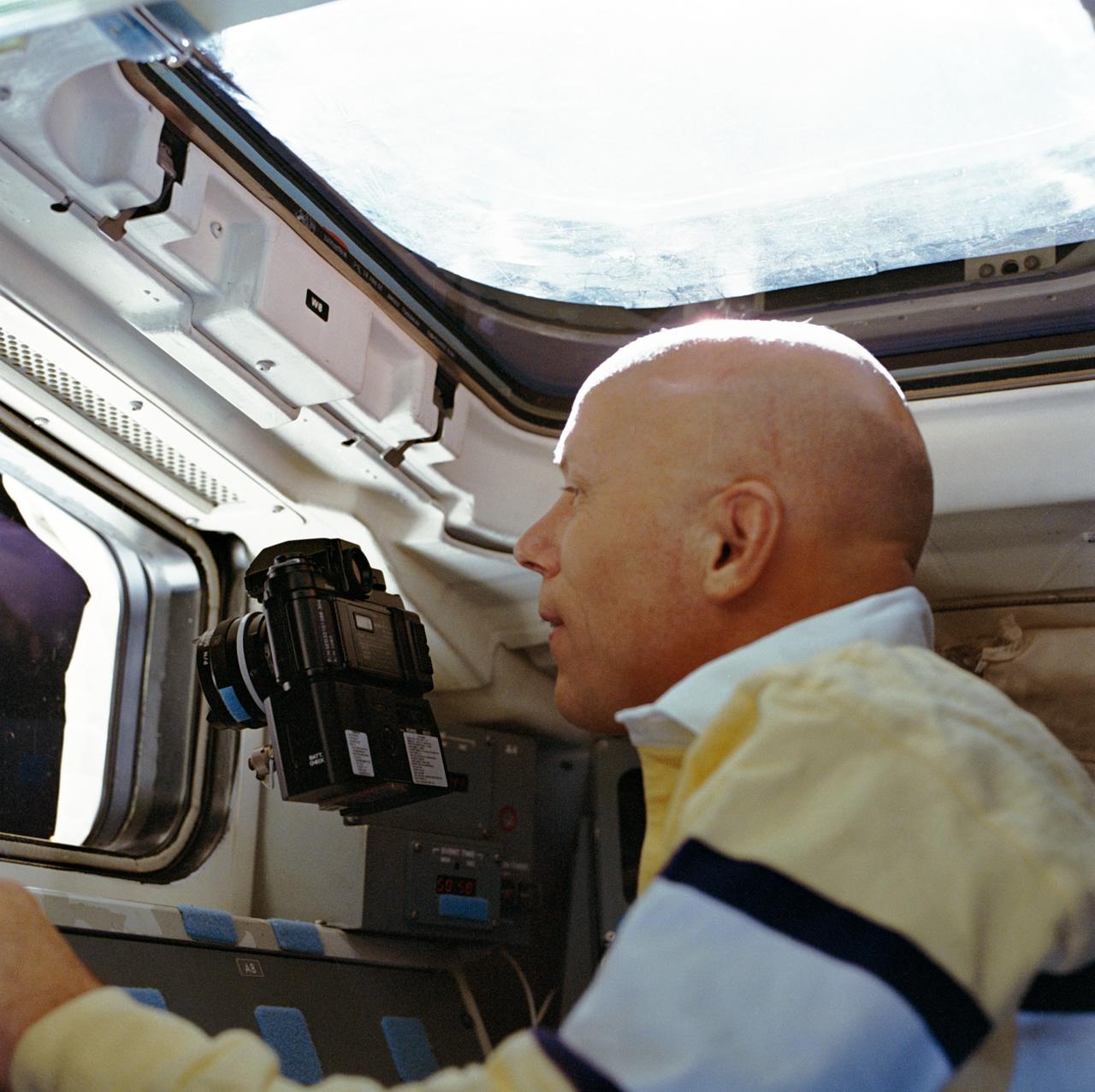
STS-33 Mission Specialist (MS) F. Story Musgrave views activity outside aft flight deck viewing window W10 as a 35mm camera freefloats in front of his face. Overhead window W8 appears above his head.
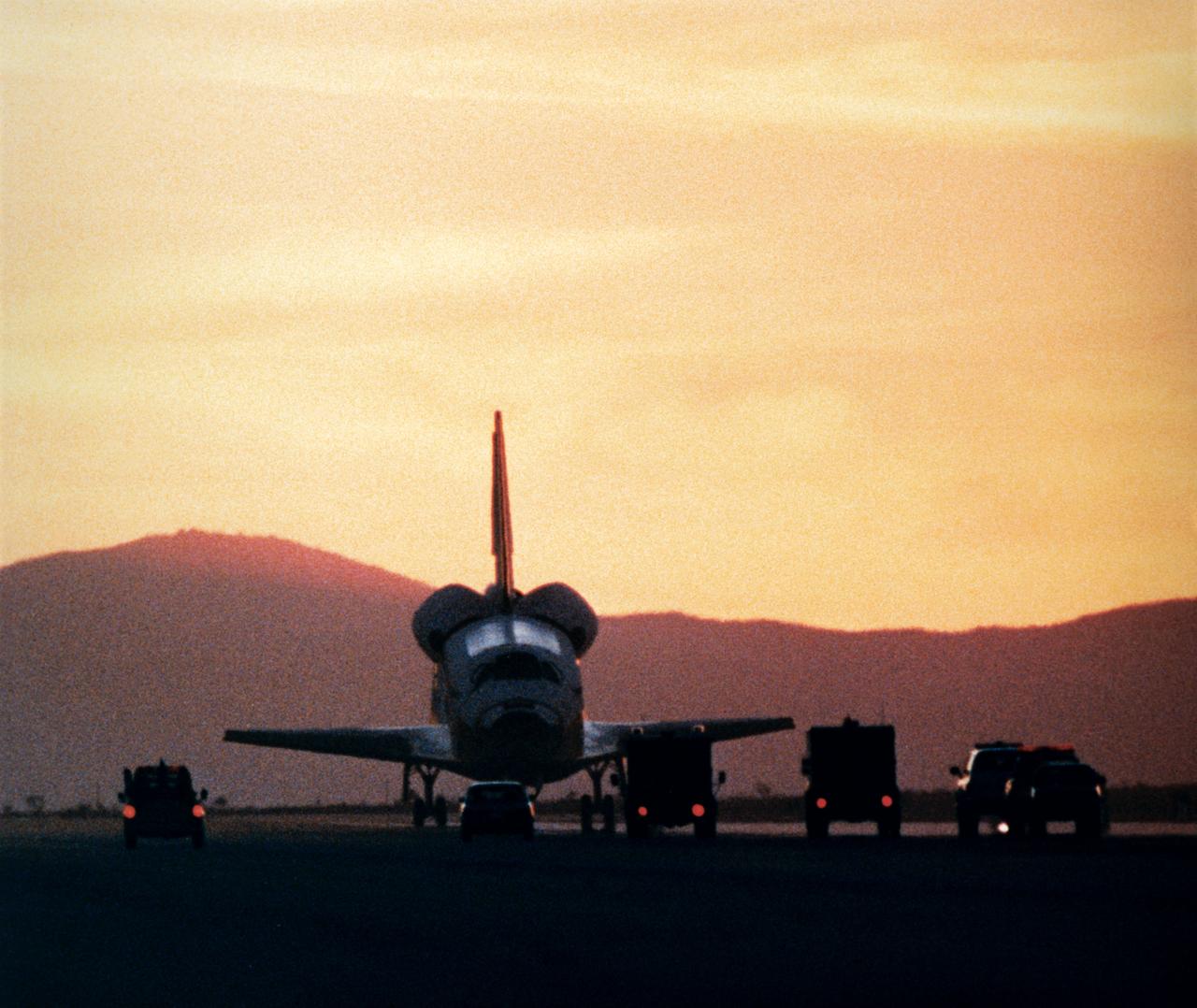
STS033-S-017 (27 Nov 1989) --- The Space Shuttle Discovery is approached by safing vehicles and team members following its late-afternoon landing at Edwards Air Force Base in southern California. A five member crew aboard had just completed the DOD-devoted STS-33 mission. The landing occurred at 16:31:02 p.m. (PST), Nov. 27, 1989. Onboard Discovery for the mission and still aboard the craft when this photo was made were Astronauts Frederick D. Gregory, John E. Blaha, Kathryn C. Thornton, F. Story Musgrave and Manley L. Carter.
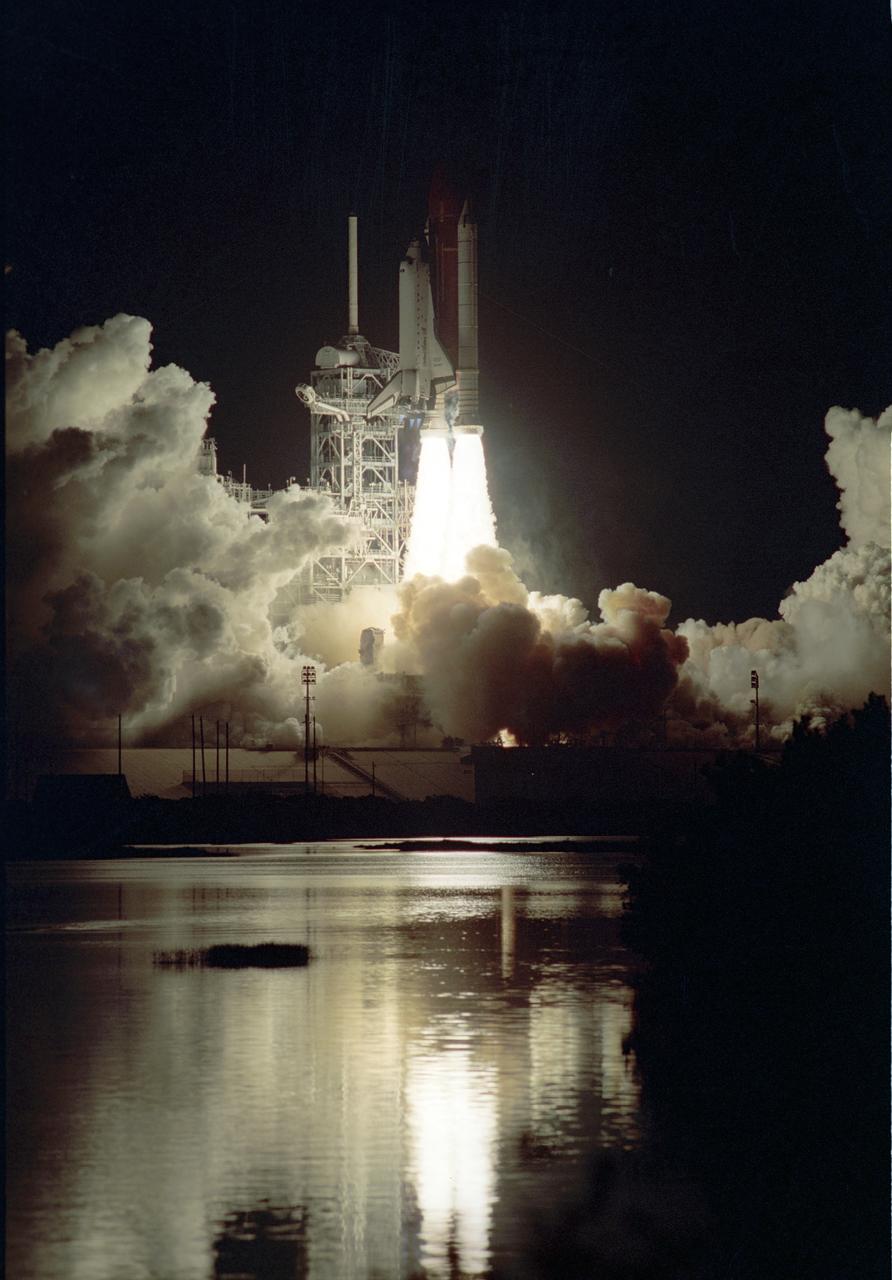
On November 22, 1989, at 7:23:30pm (EST), five astronauts were launched into space aboard the Space Shuttle Orbiter Discovery for the 5th Department of Defense (DOD) mission, STS-33. Crew members included Frederick D. Gregory, commander; John E. Blaha, pilot; and mission specialists Kathryn C. Thornton, Manley L. (Sonny) Carter, and F. Story Musgrave.
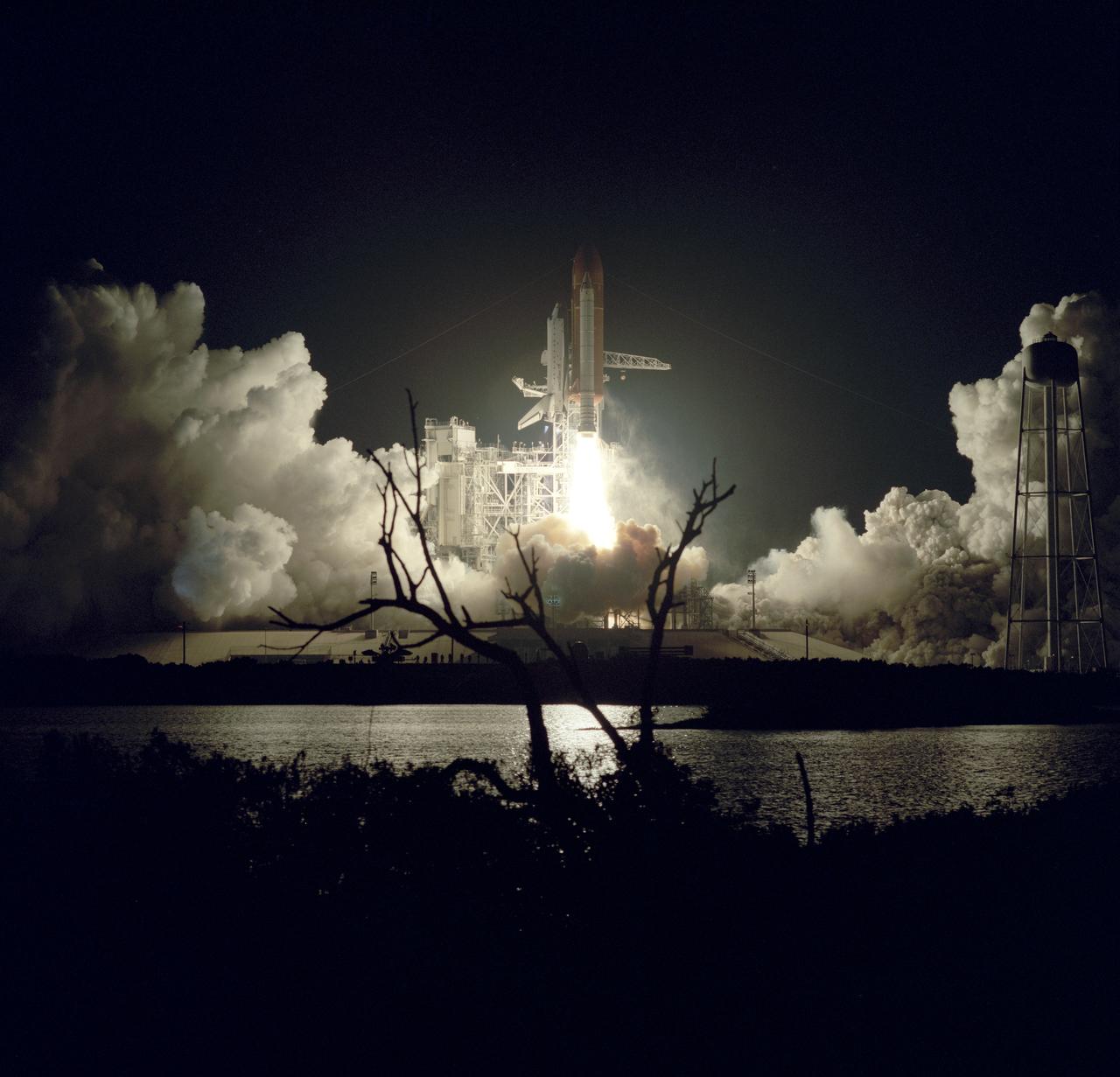
On November 22, 1989, at 7:23:30pm (EST), five astronauts were launched into space aboard the Space Shuttle Orbiter Discovery for the 5th Department of Defense (DOD) mission, STS-33. Crew members included Frederick D. Gregory, commander; John E. Blaha, pilot; and mission specialists Kathryn C. Thornton, Manley L. (Sonny) Carter, and F. Story Musgrave.
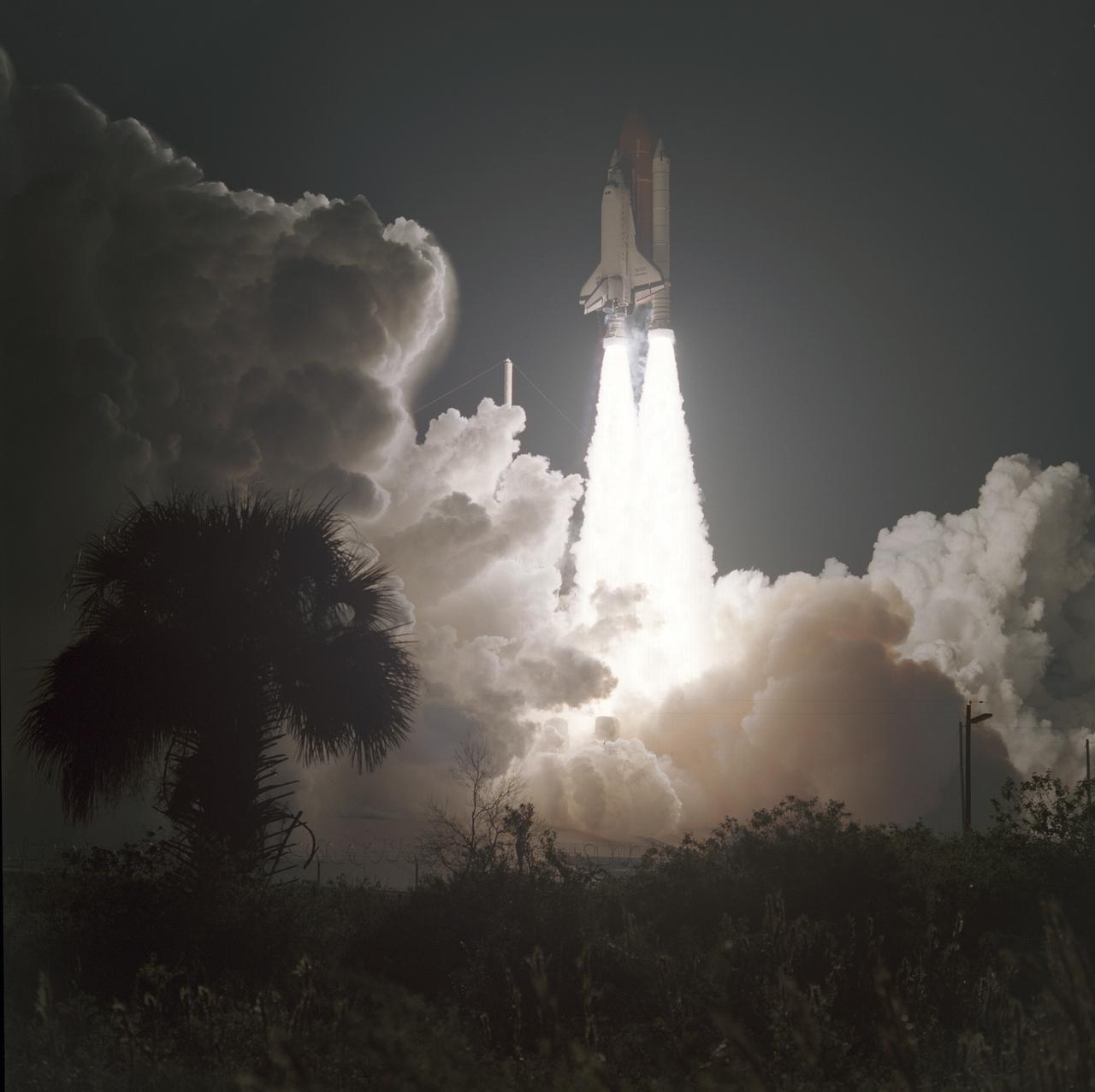
On November 22, 1989, at 7:23:30pm (EST), five astronauts were launched into space aboard the Space Shuttle Orbiter Discovery for the 5th Department of Defense (DOD) mission, STS-33. Crew members included Frederick D. Gregory, commander; John E. Blaha, pilot; and mission specialists Kathryn C. Thornton, Manley L. (Sonny) Carter, and F. Story Musgrave.
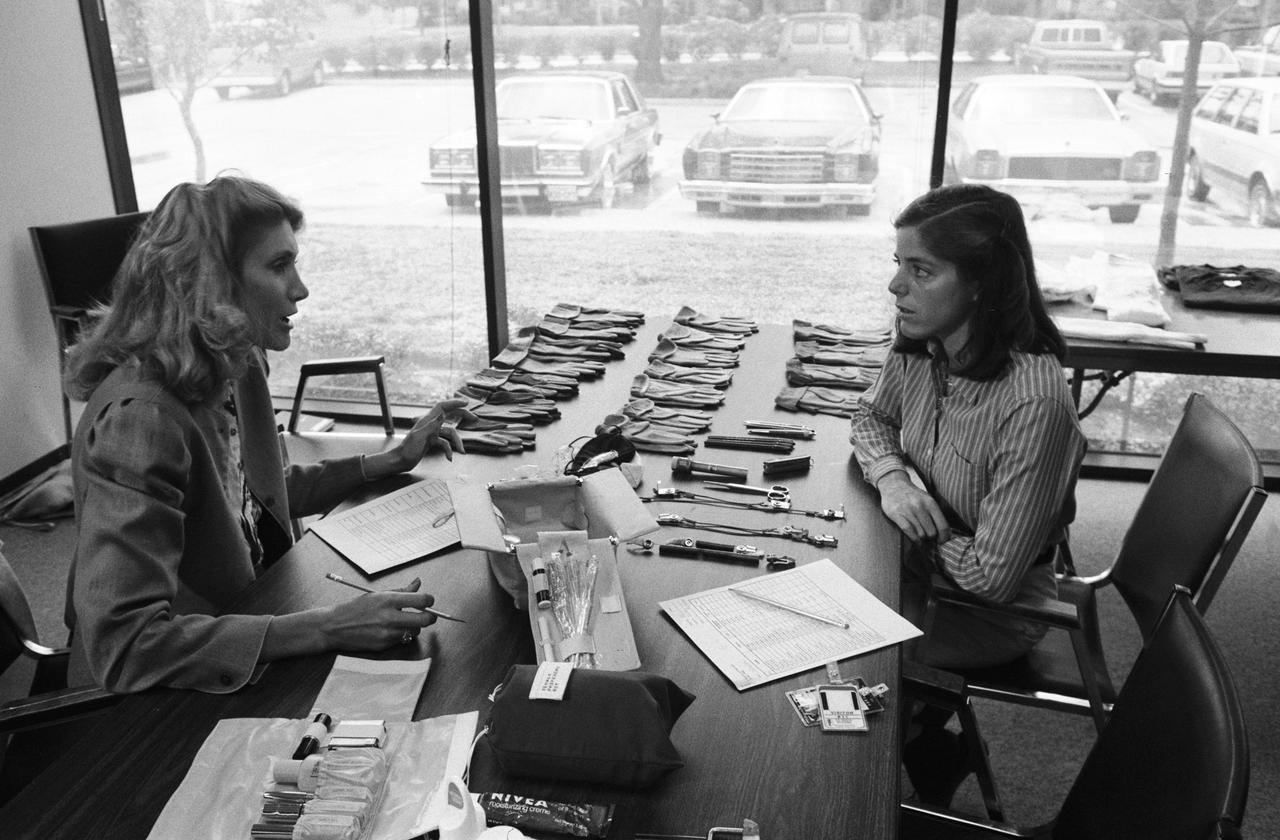
Views of STS-33/51L crew personnel Prime McAuliffe and Backup Morgan at the ILC Facility during clothing selection and Building #37 during food sampling, and with the rest of the STS-33/51L crew. 40074: "Teacher-in-Space" Participant Barbara Morgan (right) is briefed on her suit and on personal hygiene equipment to be used on the STS-51L Mission. 1. JSC - Education Program (Teacher in Space) 2. Barbara Morgan 3. Christa McAuliffe 4. STS-33/51L - Crew Training (Uniforms/Food/Crew)

S90-27594 (November 1989) --- Manley L. "Sonny" Carter Jr., STS-33 mission specialist, wearing a Launch and Entry Suit (LES), poses in front of the space shuttle Discovery, Orbiter Vehicle (OV) 103 at the Kennedy Space Center (KSC) Launch Complex Pad 39B, at the 195 feet level elevator entrance at Pad 39B. Visible in the background is the catwalk to OV-103's side hatch and the Atlantic Ocean. Note: Carter died April 5, 1991 at age 43, in a civil aviation accident.
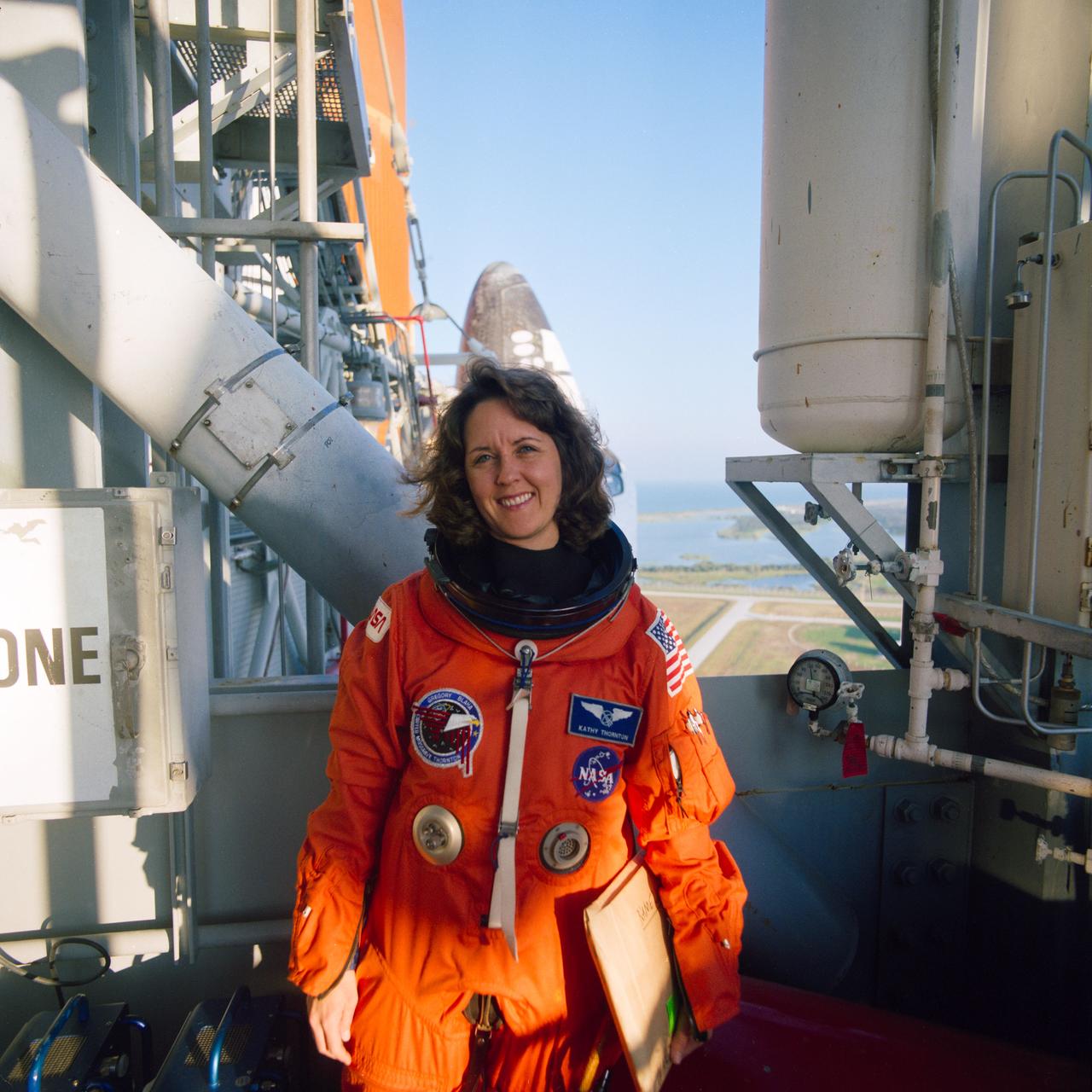
STS-33 Mission Specialist (MS) Kathryn C. Thornton, wearing launch and entry suit (LES) and holding file folder, poses in front of Discovery, Orbiter Vehicle (OV) 103, at the 195 ft level elevator entrance at Kennedy Space Center (KSC) Launch Complex (LC) Pad 39B. Visible in the background is the catwalk to OV-103's side hatch and the Atlantic Ocean.
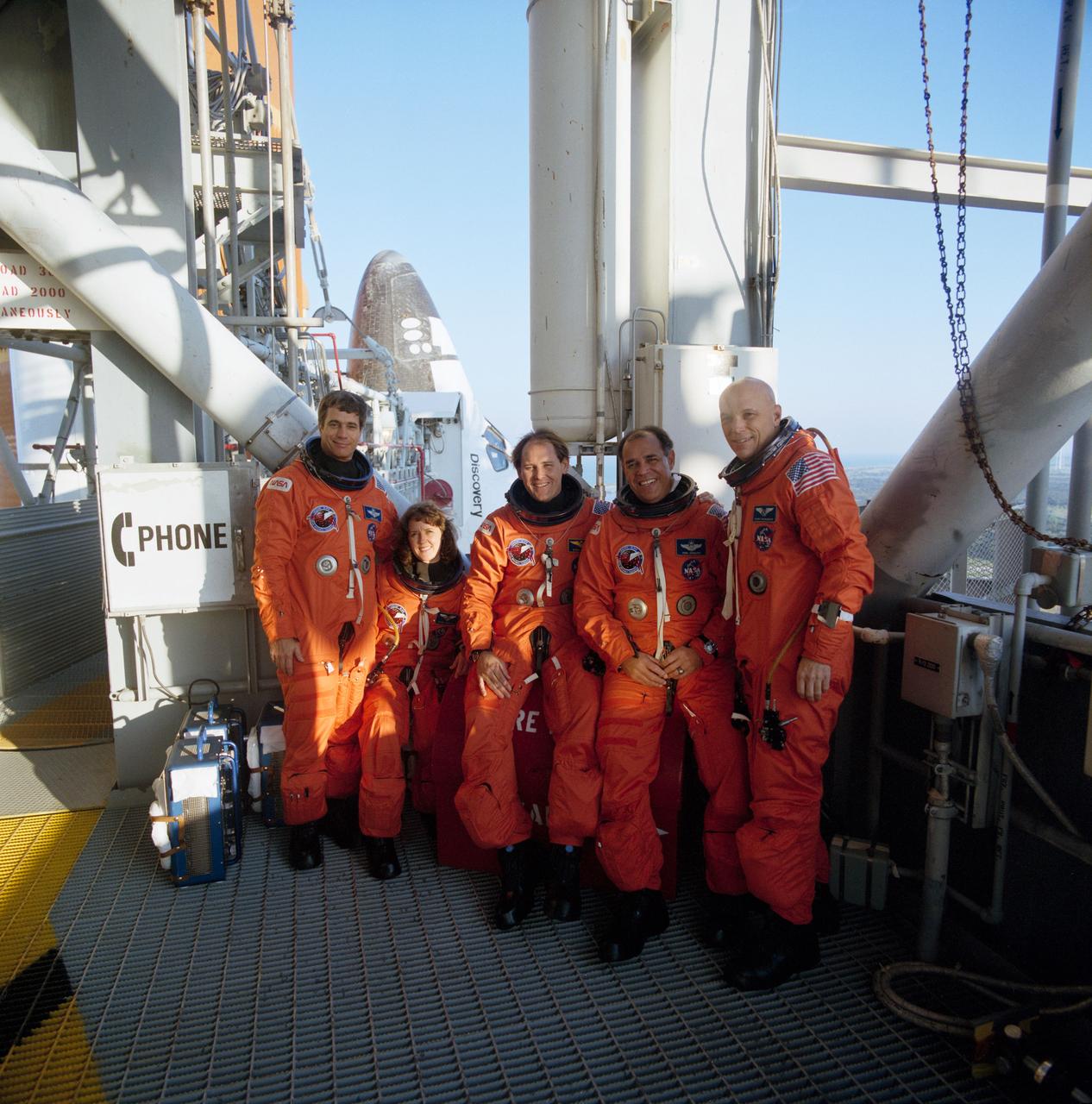
S90-27591 (23 Jan 1990) --- STS-33 crewmembers, wearing launch and entry suit (LES), take a break from training activities to pose for group portrait in front of Discovery, Orbiter Vehicle (OV) 103, at the 195 ft level elevator entrance at Kennedy Space Center (KSC) Launch Complex (LC) Pad 39B. Left to right are Pilot John E. Blaha, Mission Specialist (MS) Kathryn C. Thornton, MS Manley L. Carter, Jr, Commander Frederick D. Gregory, and MS F. Story Musgrave. Visible in the background is the catwalk to OV-103's side hatch.
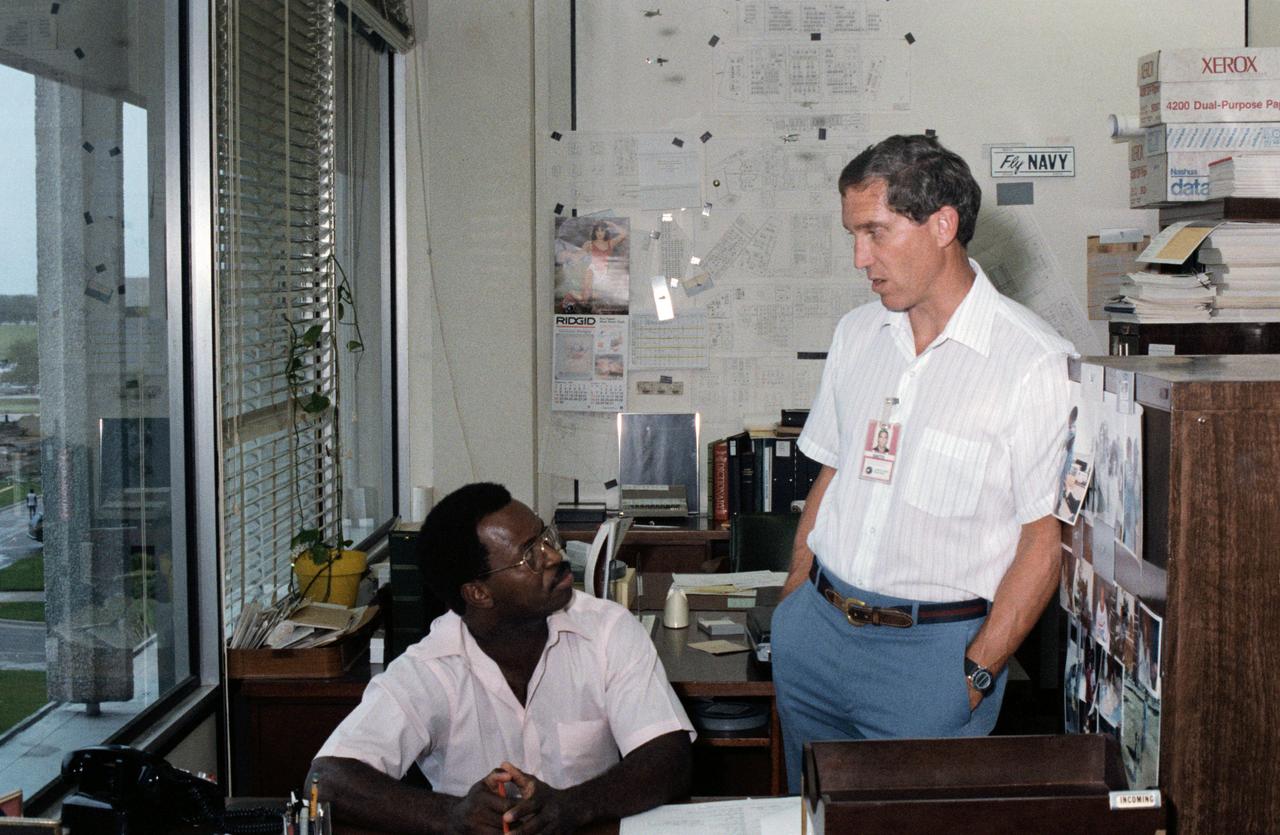
Candid views of the STS-33/51L Crew during study periods in their offices, 09/09/1985. Astronauts Michael J. Smith, STS-51L Pilot, and Ronald E. McNair, STS-51L Mission Specialist, are photographed in conversation while in training at JSC. JSC, HOUSTON, TX
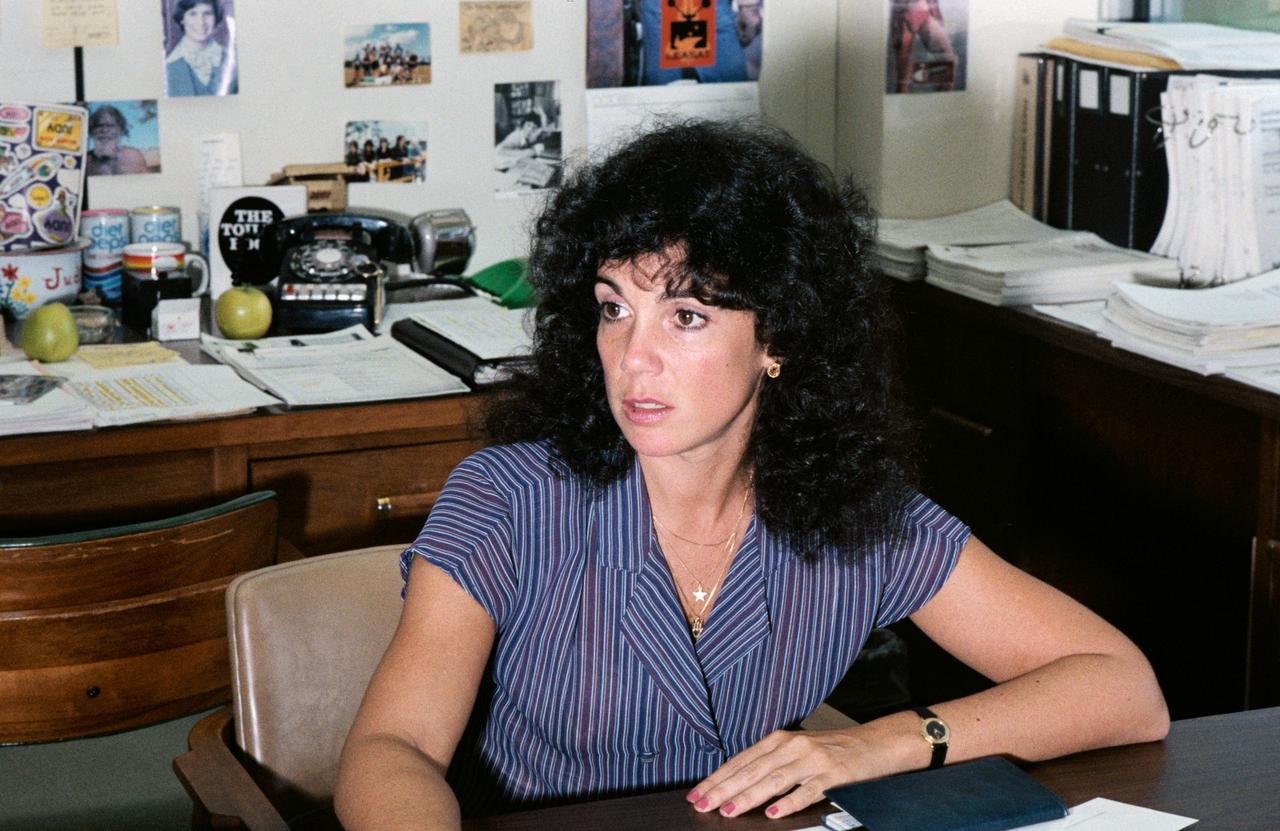
Candid views of the STS-33/51L Crew during study periods in their offices on 09/09/1985. Portrait of Astronaut Judith A. Resnik, seated in her office. JSC, HOUSTON, TX
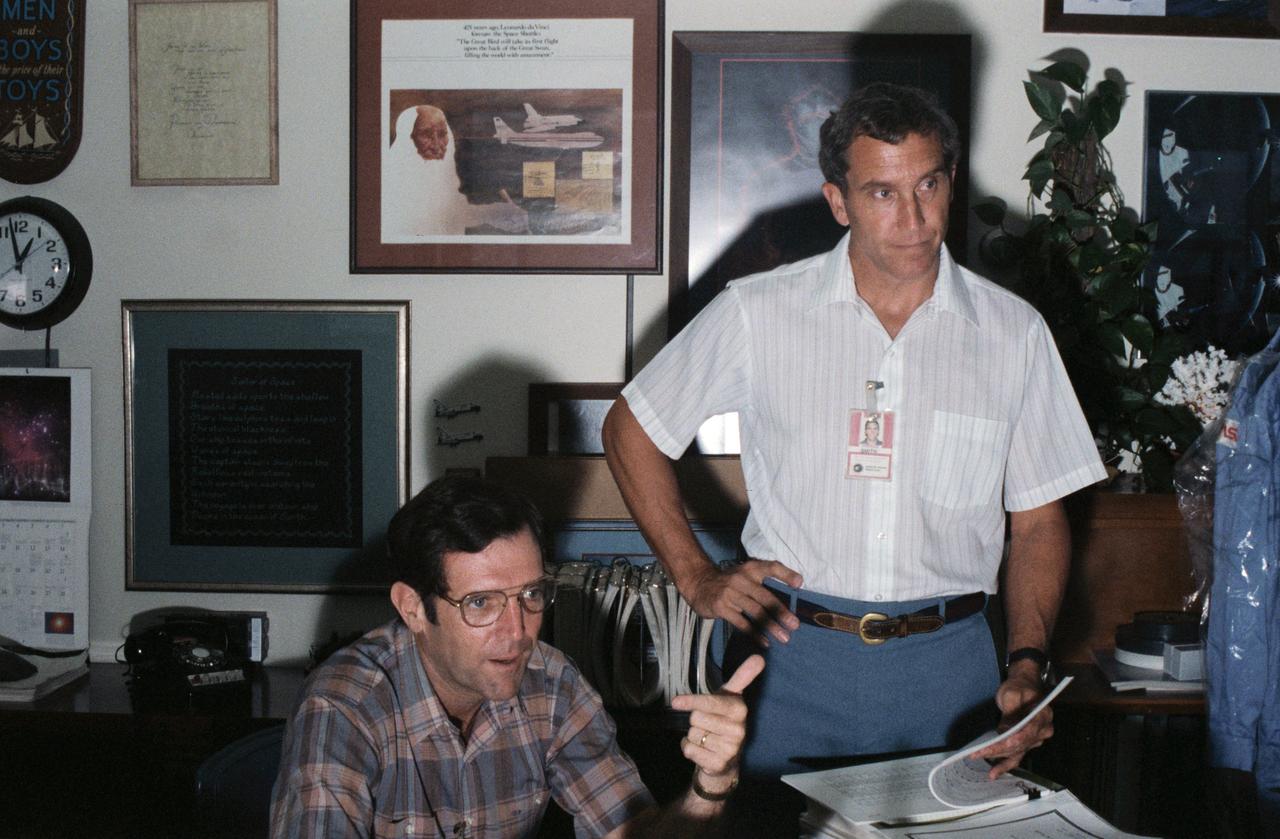
Candid views of the STS-33/51L Crew during study periods in their offices on 09/09/1985. Astronauts Michael J. Smith (right), STS 51L Pilot, and Francis R. (Dick) Scobee, 51L Mission Commander, are photographed in conversation while in training. JSC, HOUSTON, TX
On November 22, 1989, at 7:23:30pm (EST), 5 astronauts were launched into space aboard the Space Shuttle Orbiter Discovery for the 5th Department of Defense mission, STS-33. Photographed from left to right are Kathryn C. Thornton, mission specialist 3; Manley L. (Sonny) Carter, mission specialist 2; Frederick D. Gregory, commander; John E. Blaha, pilot; and F. Story Musgrave, mission specialist 1.
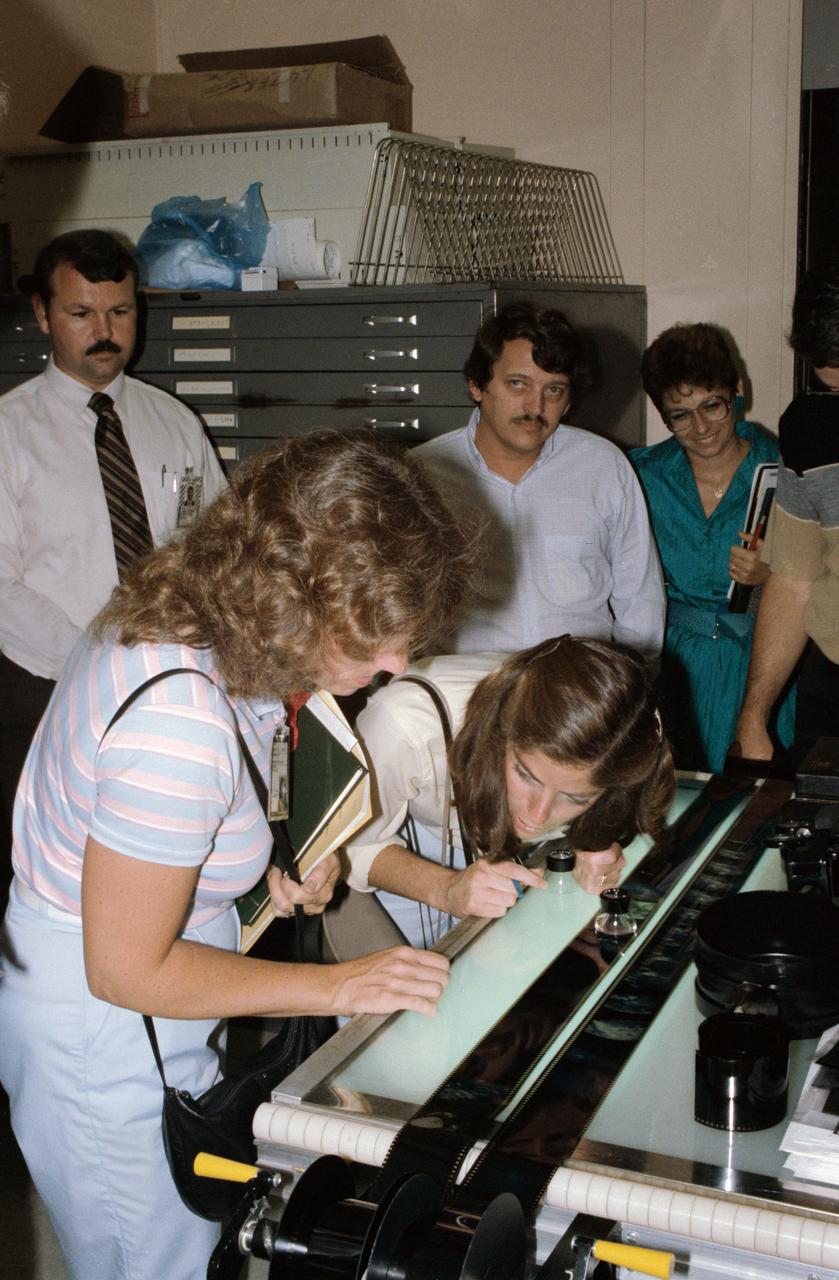
View of STS-33/51L Prime Teacher, Christa McAuliffe (left foreground) and Barbara Morgan (second left), both "Teacher in Space" Trainees, review film shot while training with Arriflex camera. 1. McAuliffe, S. Christa - Photography 2. Morgan, Barbara - Photography
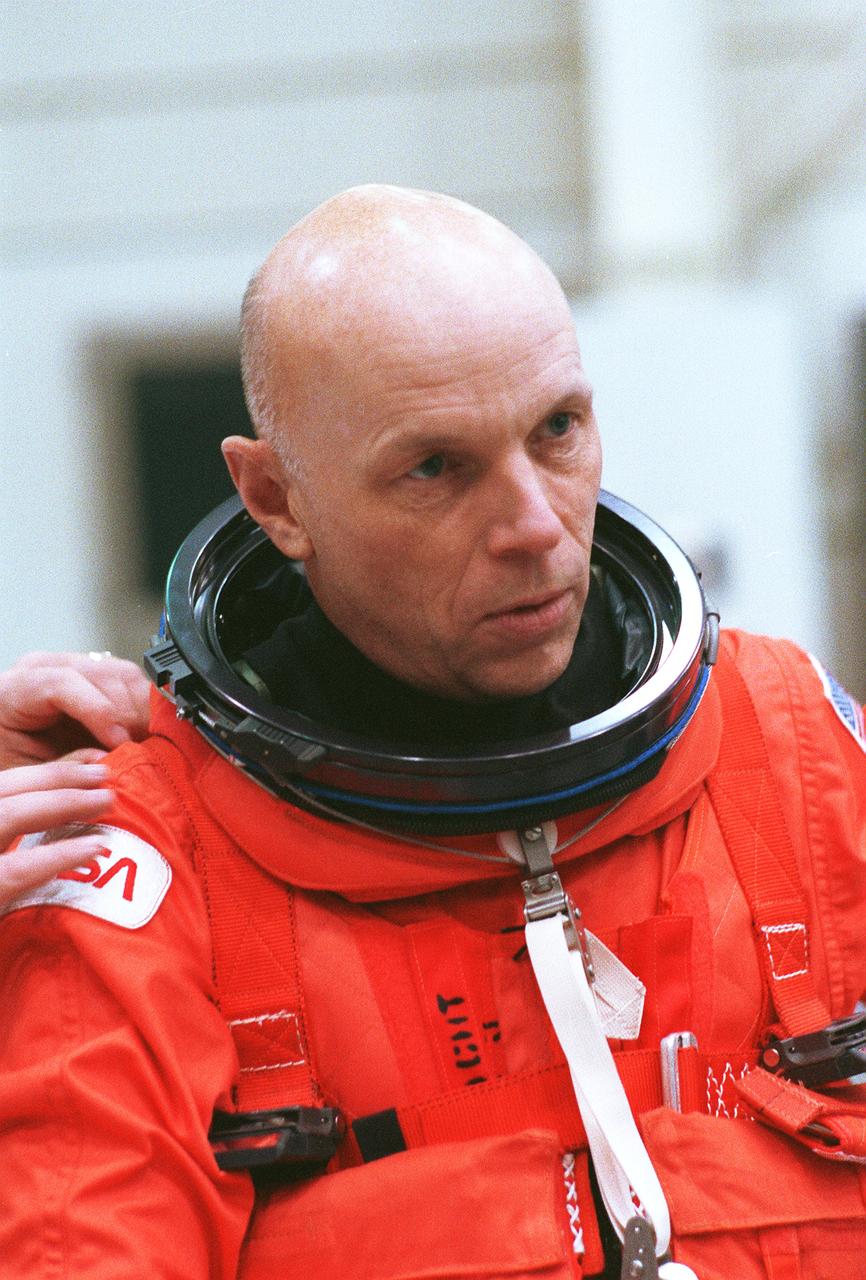
S89-48009 (29 Oct. 1996) --- About to embark on his sixth shuttle flight, astronaut Story Musgrave receives assistance with his launch and entry suit during a training session in the Johnson Space Center's (JSC) Shuttle Mockup and Integration Laboratory (SMIL).
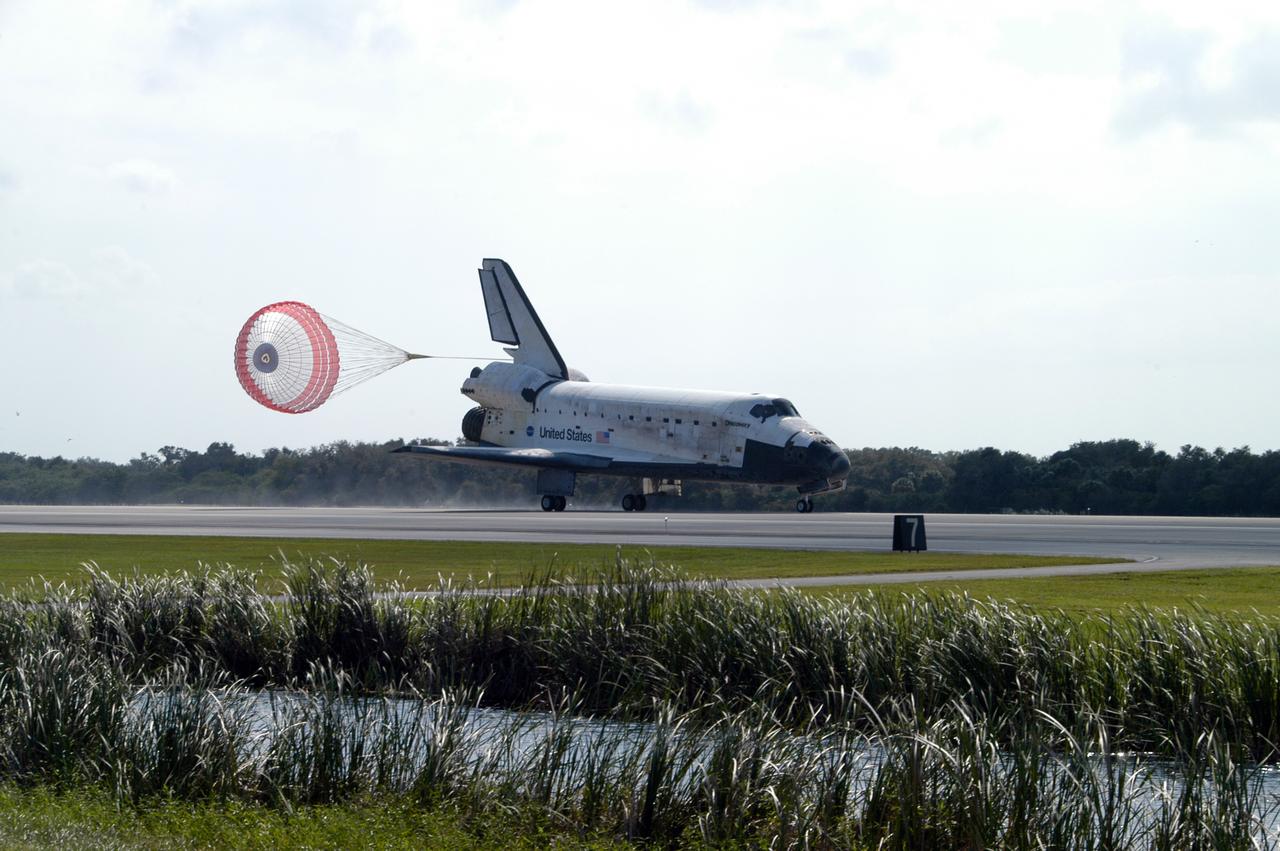
The drag chute deployed behind space shuttle Discovery helps slow its smooth landing on Runway 33 of the Shuttle Landing Facility at NASA's Kennedy Space Center, completing the 15-day mission STS-120. Main gear touchdown was 1:01:16 p.m. Wheel stop was at 1:02:07 p.m. Mission elapsed time was 15 days, 2 hours, 24 minutes and 2 seconds. The STS-120 crew continued the construction of the station with the installation of the Harmony Node 2 module and the relocation of the P6 truss.
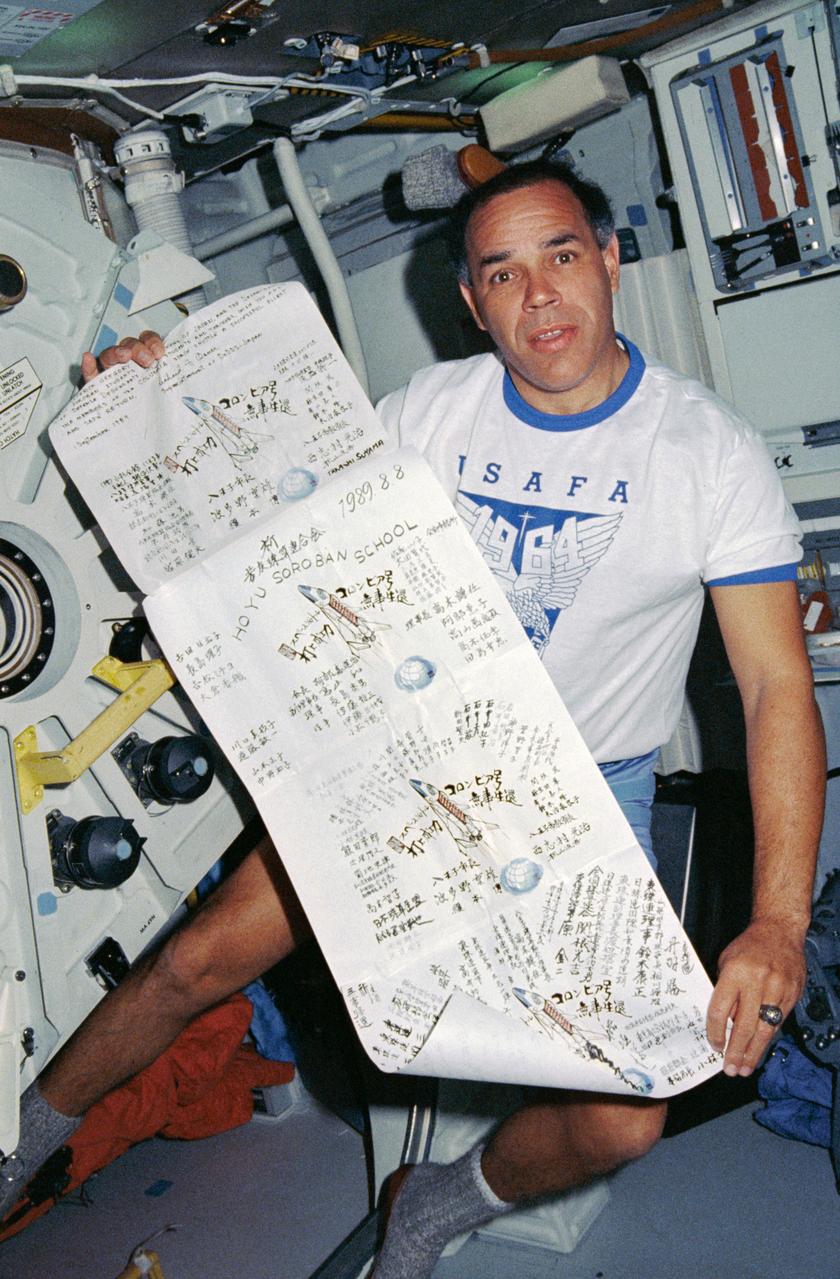
STS033-03-008 (22-27 Nov 1989) --- Astronaut Frederick D. Gregory, STS-33 commander, displays a letter from a special group of well-wishers. The letter is signed by the superintendent of Department of Defense Dependents School in Japan. It was carried onboard Discovery for the five-day DOD-devoted mission.
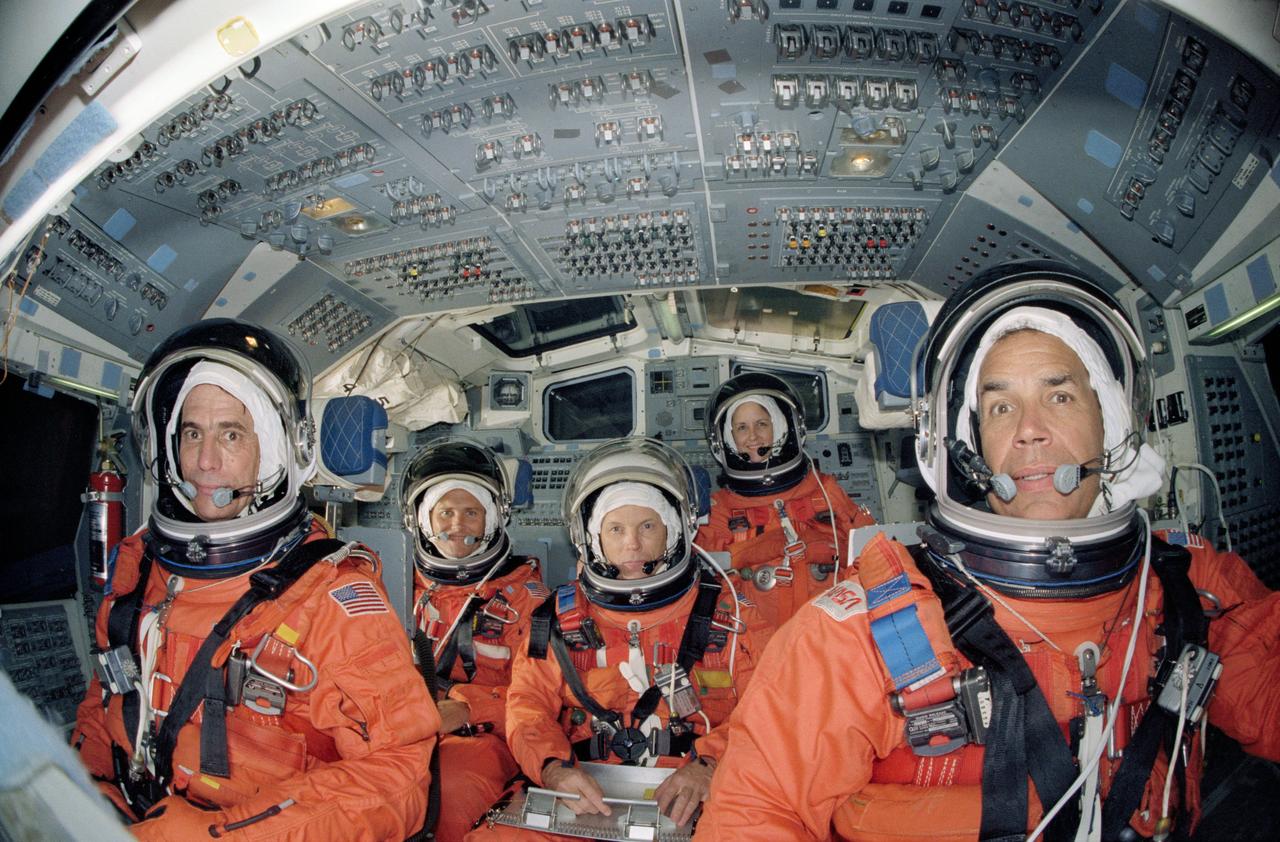
STS-33 Discovery, Orbiter Vehicle (OV) 103, crewmembers, wearing orange launch and entry suits (LESs) and launch and entry helmets (LEHs), are seated in their launch and entry positions on crew compartment trainer (CCT) flight deck during a training exercise in JSC Mockup and Integration Laboratory (MAIL) Bldg 9A. Commander Frederick D. Gregory (far right) is stationed at forward flight deck commanders controls, Pilot John E. Blaha (far left) at the pilots controls and on aft flight deck are mission specialists Manley L. Carter, Jr (left), MS F. Story Musgrave (center, holding clipboard), and MS Kathryn C. Thornton (standing). Overhead forward control panels are visible above the astronauts and aft flight deck onorbit station control panels and windows are visible in the background. Thornton is on the flight deck for this photo but during launch and entry will be seated on the middeck.
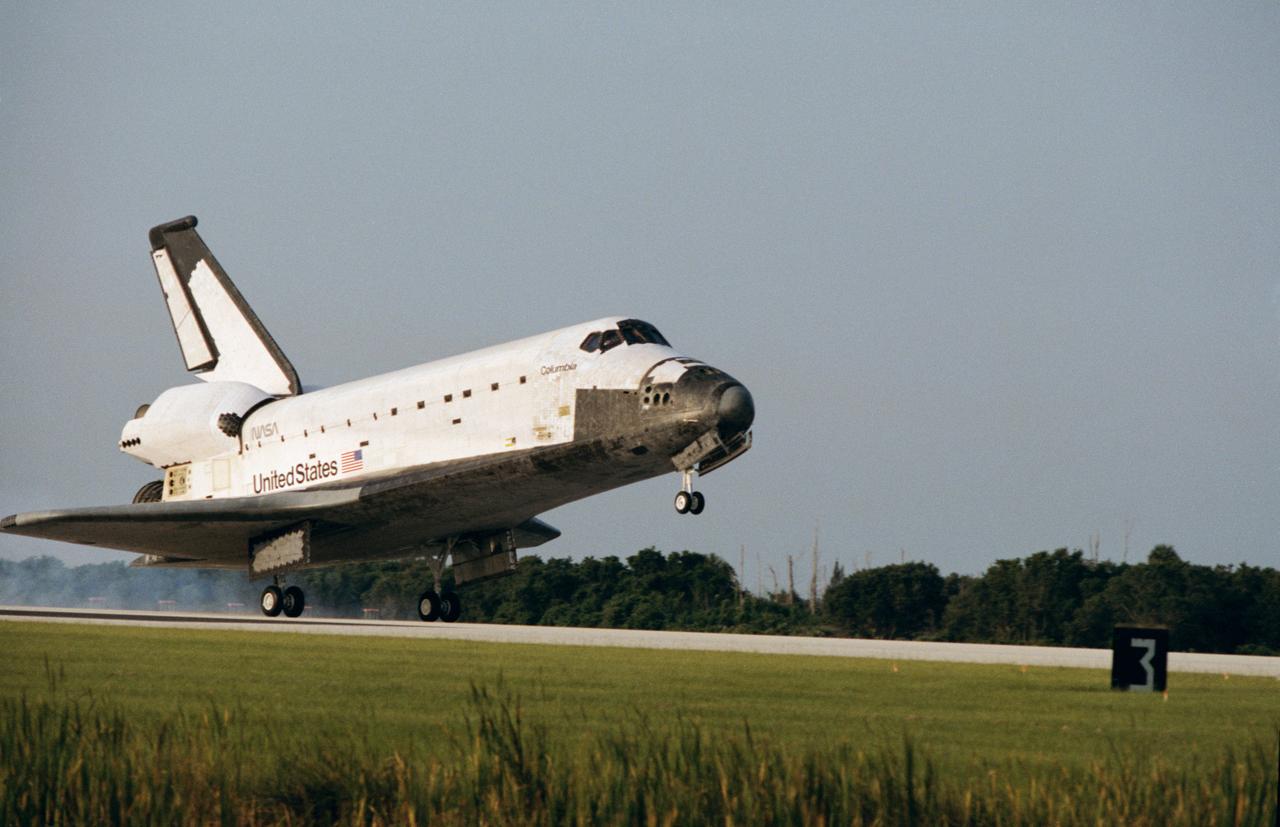
STS-50 Columbia's, Orbiter Vehicle (OV) 102's, main landing gear touches down on runway 33 at the Kennedy Space Center (KSC) Shuttle Landing Facility (SLF) producing a small cloud of dust. Landing occurred at 7:42 am (Eastern Daylight Time (EDT)). In this view of the OV-102's starboard side, the nose landing gear (NLG) continues to ride above the runway surface. Florida vegetation, a runway sign, and runway lights appear in the foreground.

STS038-S-041 (20 Nov 1990) --- STS-38 Atlantis, Orbiter Vehicle (OV) 104, lands on runway 33 at Kennedy Space Center (KSC) Shuttle Landing Facility (SLF). The main landing gear (MLG) has just touched down on the runway surface as the nose landing gear (NLG) glides above it. The Department of Defense (DOD)-devoted mission came to an end (with complete wheel stop) at 4:43:37 pm (Eastern Standard Time (EST)).
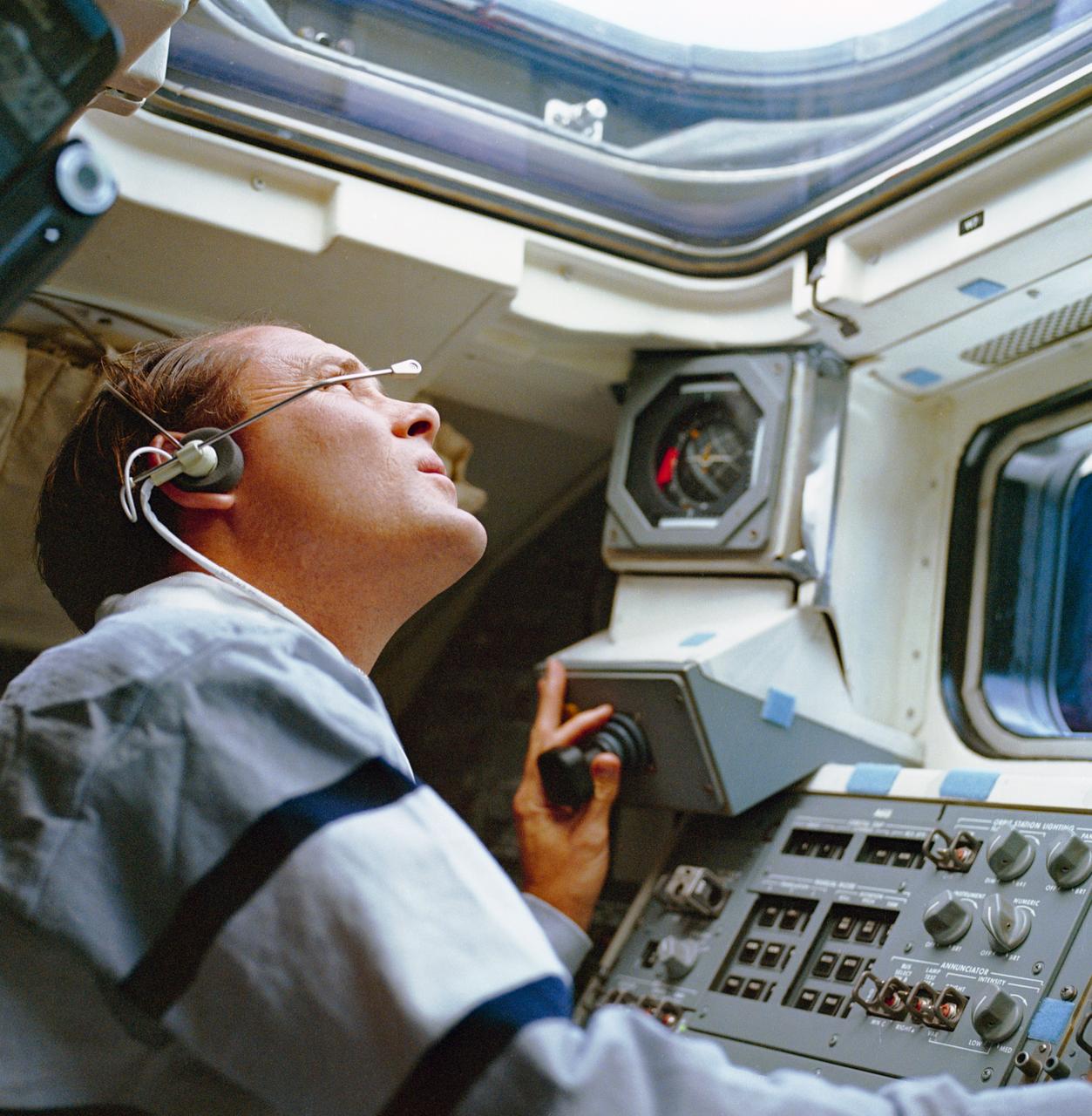
STS033-93-011 (27 Nov 1989) --- Astronaut Manley L. Carter, Jr., STS-33 mission specialist, operates translation hand control (THC) at the aft flight deck on orbit station while peering out overhead window W7. Carter's communications kit assembly headset microphone extends across his face.
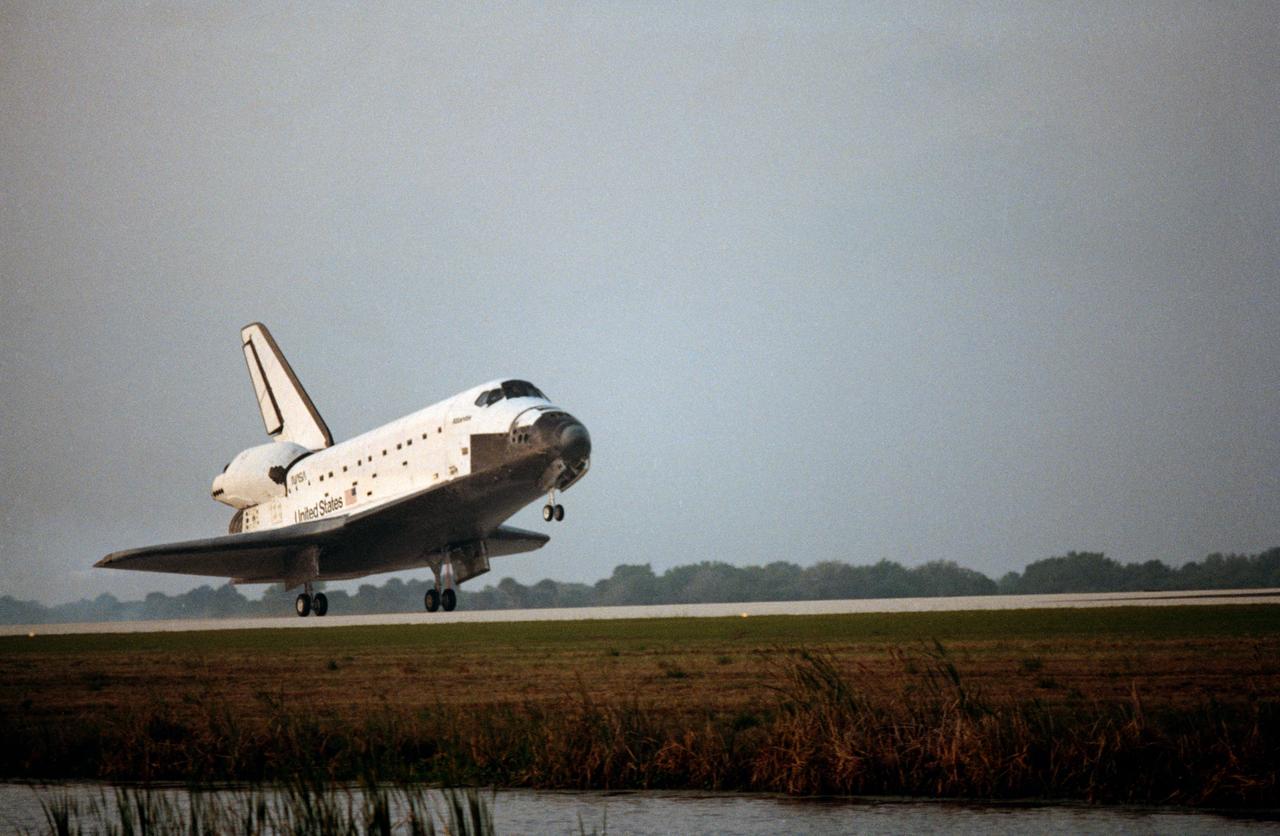
STS-45 Atlantis, Orbiter Vehicle (OV) 104, lands on concrete runway 33 at the Kennedy Space Center's (KSC's) Shuttle Landing Facility (SLF). The main landing gear (MLG) touched down at 6:23:06 am (Eastern Standard Time (EST)) in the early morning Florida fog as seen in these views. The deployed nose landing gear (NLG) rides above the runway before wheel stop.
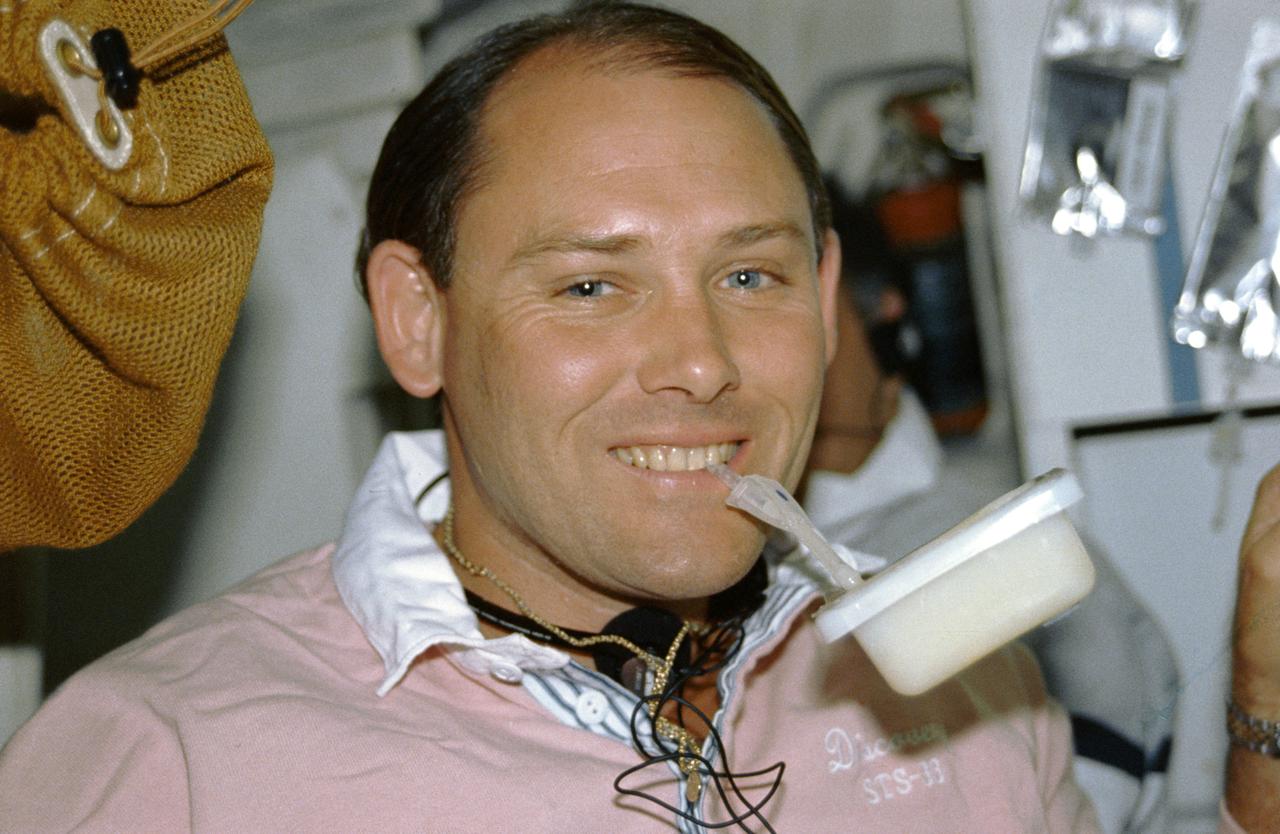
STS033-17-005A (27 Nov 1989) --- Astronaut Manley L. Carter, Jr., STS-33 mission specialist, smiling, sips drink from a beverage container using a straw on Discovery's, Orbiter Vehicle (OV) 103's, middeck. Around Carter's neck are a necklace and tape recorder headphones (headset). A net stowage bag free floats next to Carter's head.
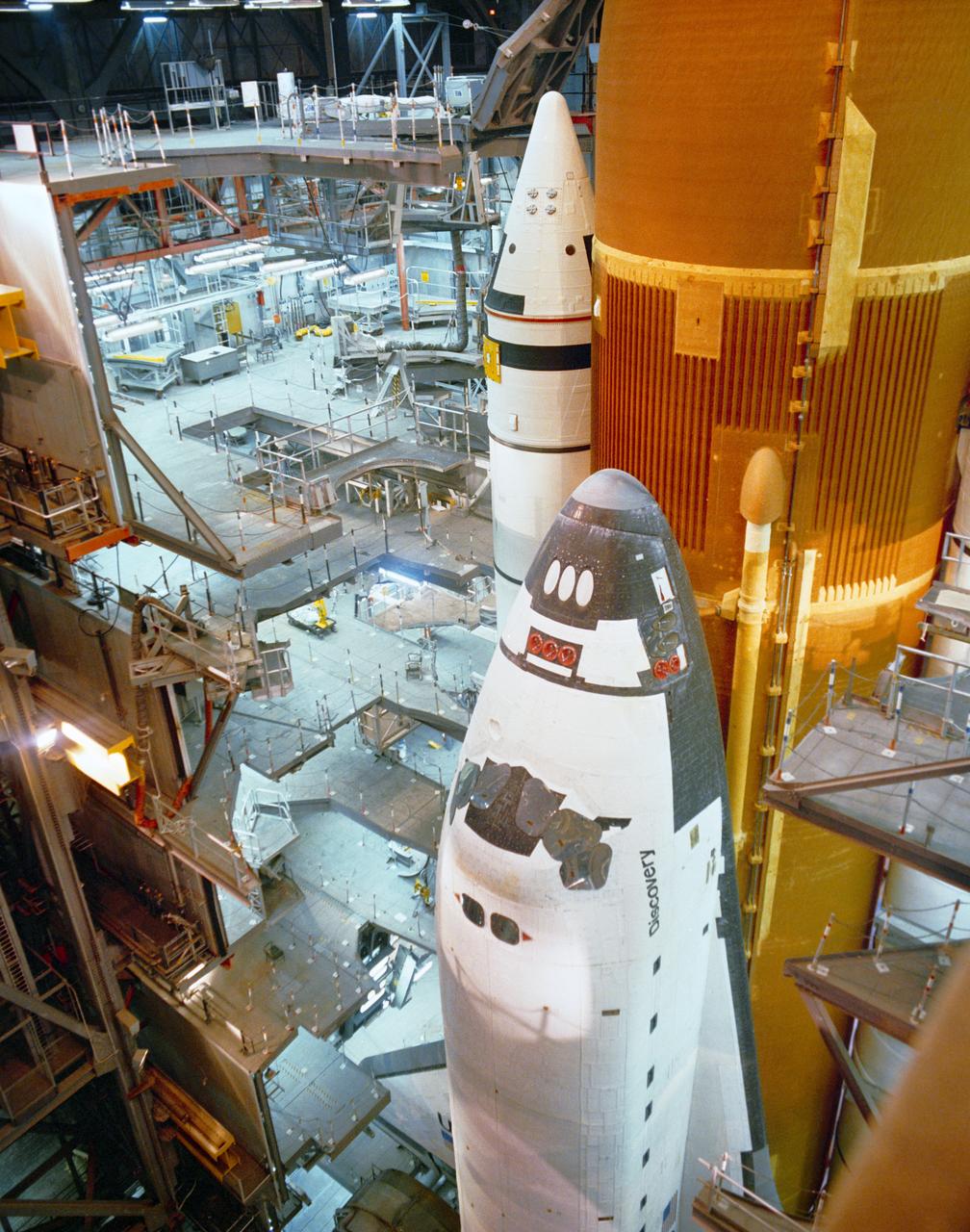
S89-49412 (25 Oct 1989) --- Preparations are underway to rollout the Space Shuttle orbiter Discovery from the Vehicle Assembly Building (VAB) to Pad 39B, as KSC employees work toward the mid-November launch of STS-33, a Department of Defense Devoted mission. Poor weather has thus far hampered attempts to roll out the Discovery and the next attempt is scheduled for midnight tomorrow.
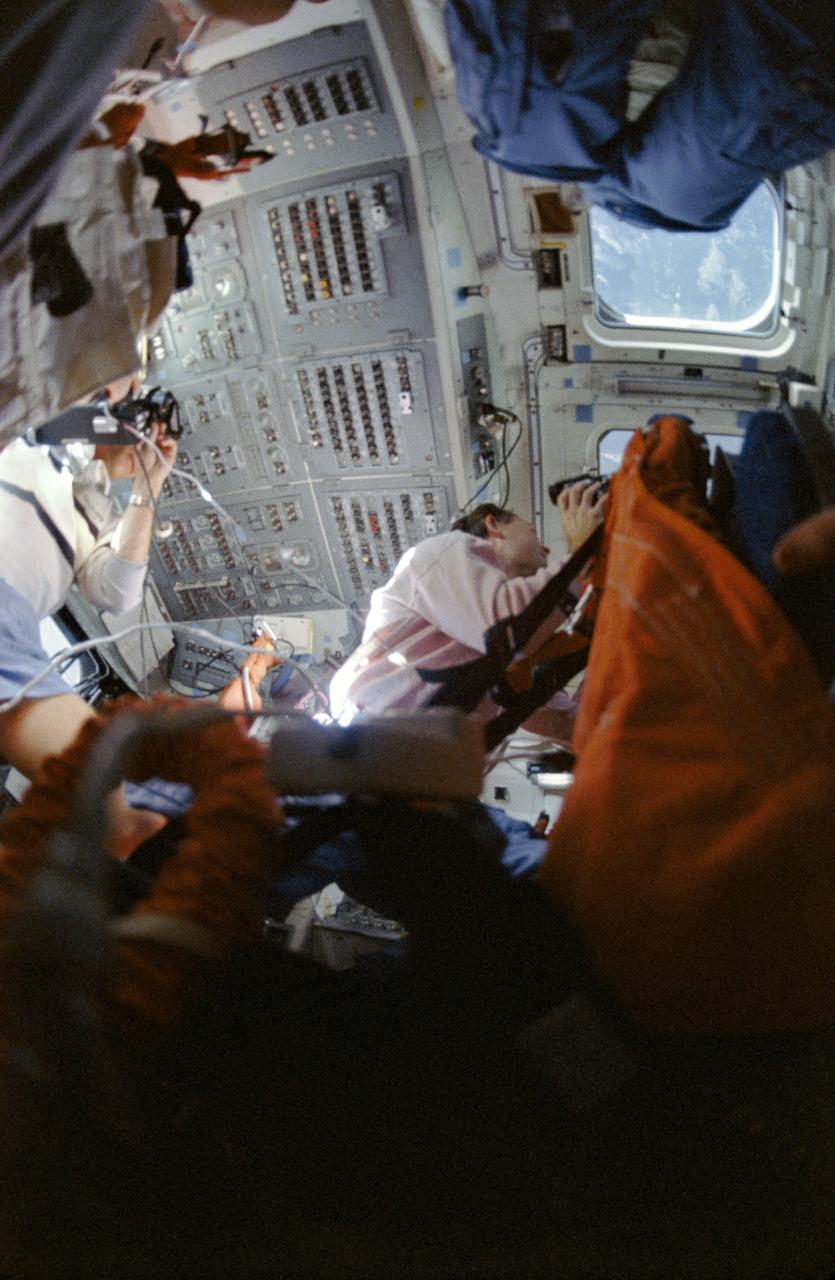
STS033-05-014A (22-27 Nov 1989) --- A low-angle view of STS-33's two astronaut medical doctors doubling as photographers and Earth observers on the flight deck of the Earth-orbiting Space Shuttle Discovery. Astronauts Story Musgrave, left, and Manley L. Carter and three other crewmembers shared five days aboard the Discovery for this DOD-devoted mission.
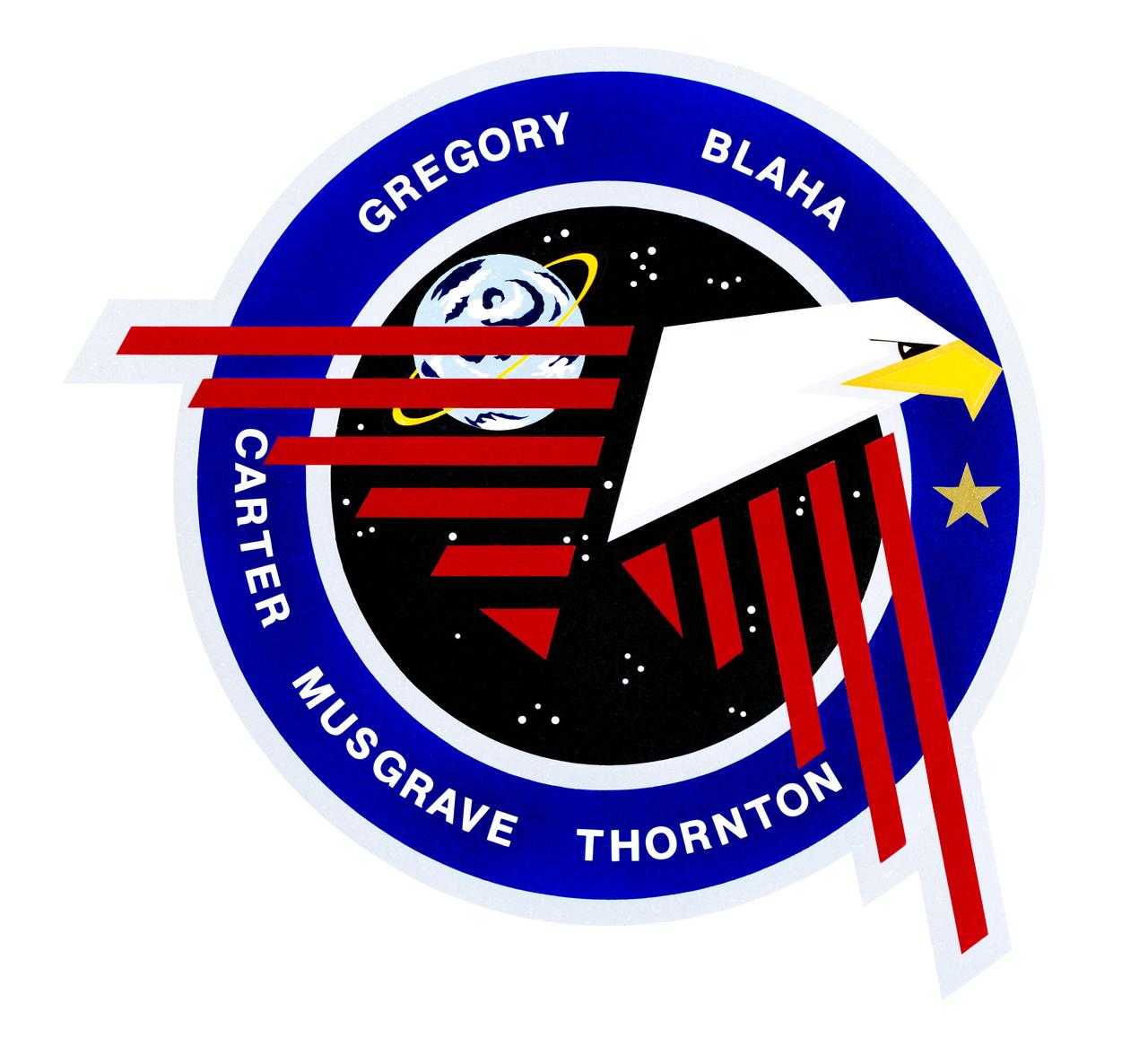
S89-39195 (July 1989) --- This is the crew patch for STS-33, designed by the five crew members. It features a stylized falcon soaring into space to represent America's commitment to manned spaceflight. The crew members feel the falcon symbolizes courage, intelligence, tenacity, and love of flight. They intend the orbit around Earth to represent the falcon's lofty domain; however, the bird, with its keen vision and natural curiosity, is depicted looking forward beyond that domain to challenge the edge of the universe. The bold red feathers of the wings drawn from the American flag overlaying the random field of stars illustrate the determination to expand the boundaries of knowledge by American presence in space. The single gold star on a field of blue honors the memory of the late Rear Admiral S. David Griggs, originally assigned to this crew. The NASA insignia design for space shuttle flights is reserved for use by the astronauts and for other official use as the NASA Administrator may authorize. Public availability has been approved only in the forms of illustrations by the various news media. When and if there is any change in this policy, which is not anticipated, the change will be publicly announced. Photo credit: NASA
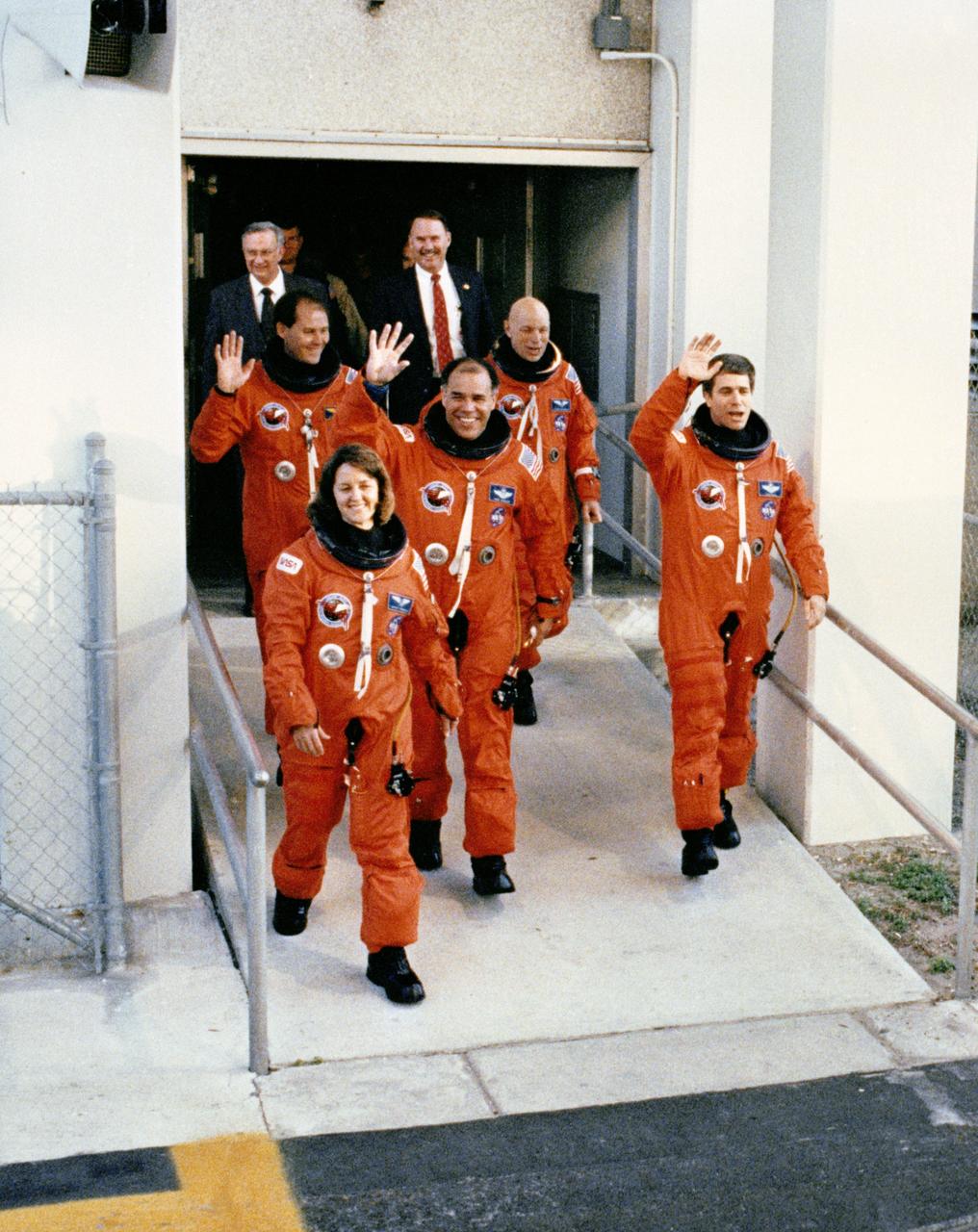
STS033-S-009 (22 Nov 1989) --- Leaving the operations and checkout building for catching a van ride to the launch pad are the five astronaut crewmembers assigned to STS-33, a DOD-devoted mission. Displaying smiles and waves for the crowd on hand are (left to right) Astronauts Manley L. Carter, Kathryn C. Thornton; Frederick D. Gregory, commander; F. Story Musgrave and John E. Blaha. Behind them are (left to right), Olan J. Bertrand, Michael L. Coats (partially obscured) and Donald R. Puddy of the Johnson Space Center (JSC).
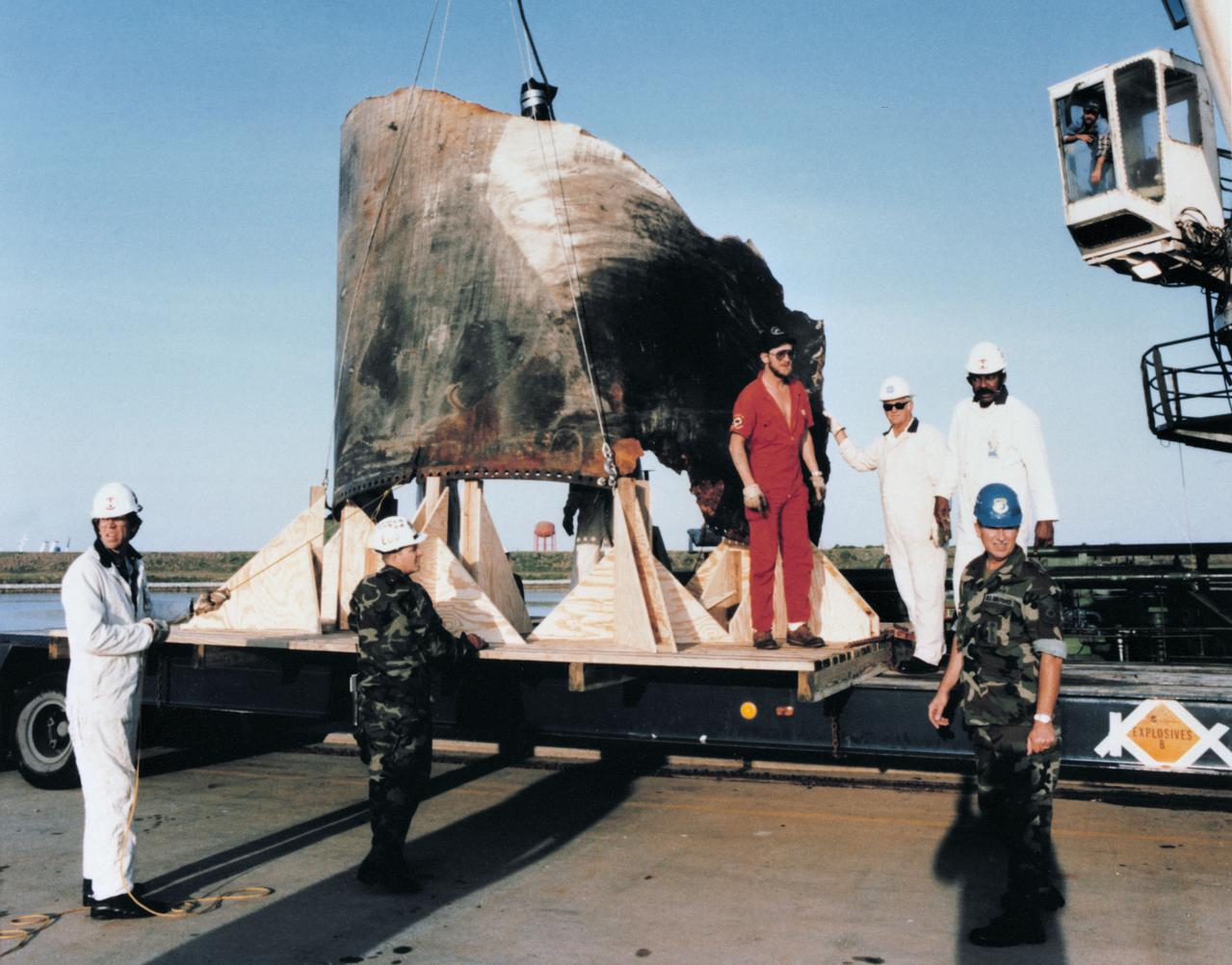
S86-30504 (16 April 1986) --- A 4,000 pound, 11' x 20' piece of the aft center segment tang joint of the space shuttle Challenger's right-hand solid rocket booster is off loaded from the Stena Workhorse after its recovery on April 13, 1986. The burned out area is 15" x 28". Photo credit: NASA
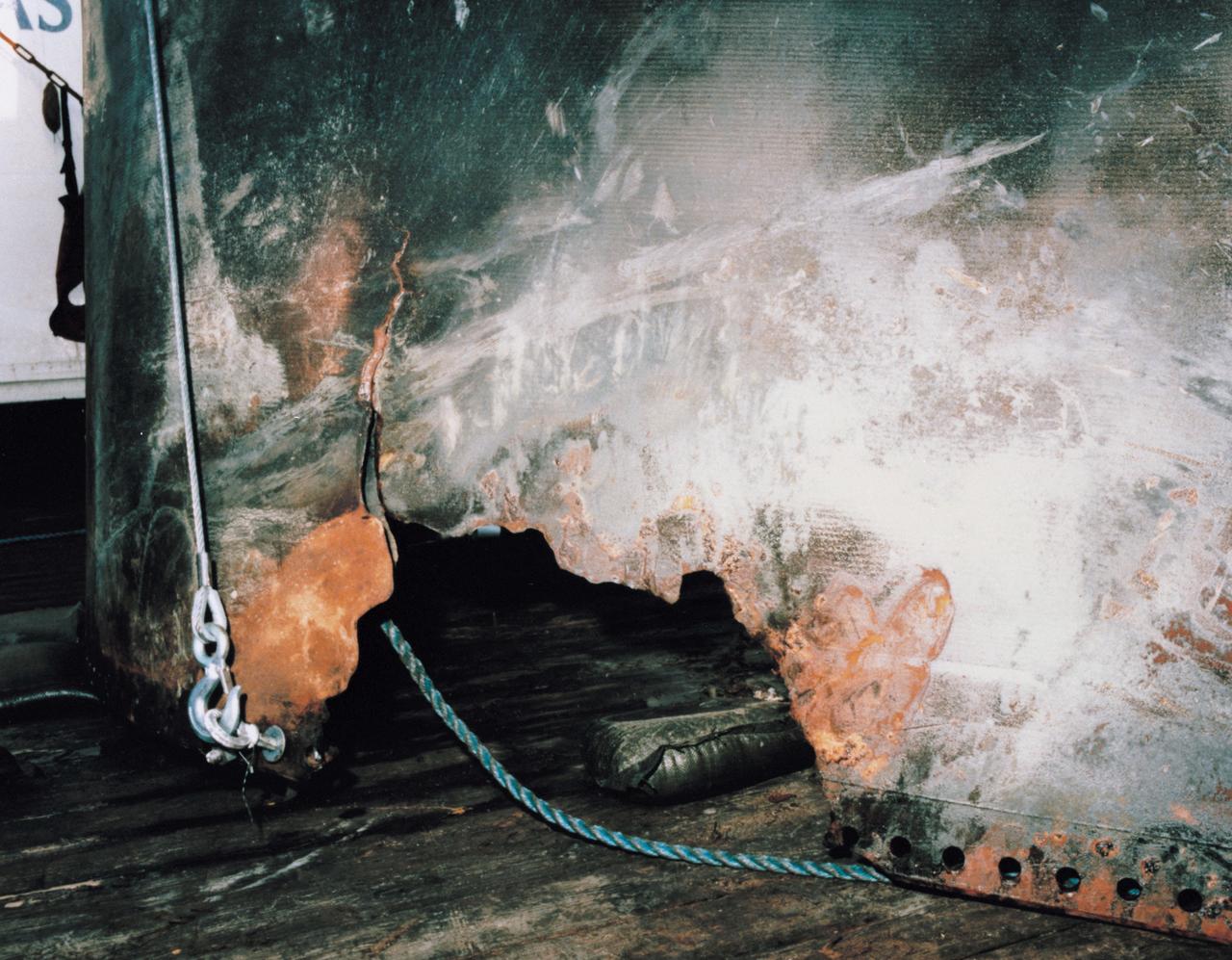
S86-30503 (16 April 1986) --- A 4,000 pound, 11' x 20' piece of the aft center segment tang joint of the space shuttle Challenger's right-hand solid rocket booster is off loaded from the Stena Workhorse after its recovery on April 13, 1986. The burned out area is 15" x 28". Photo credit: NASA
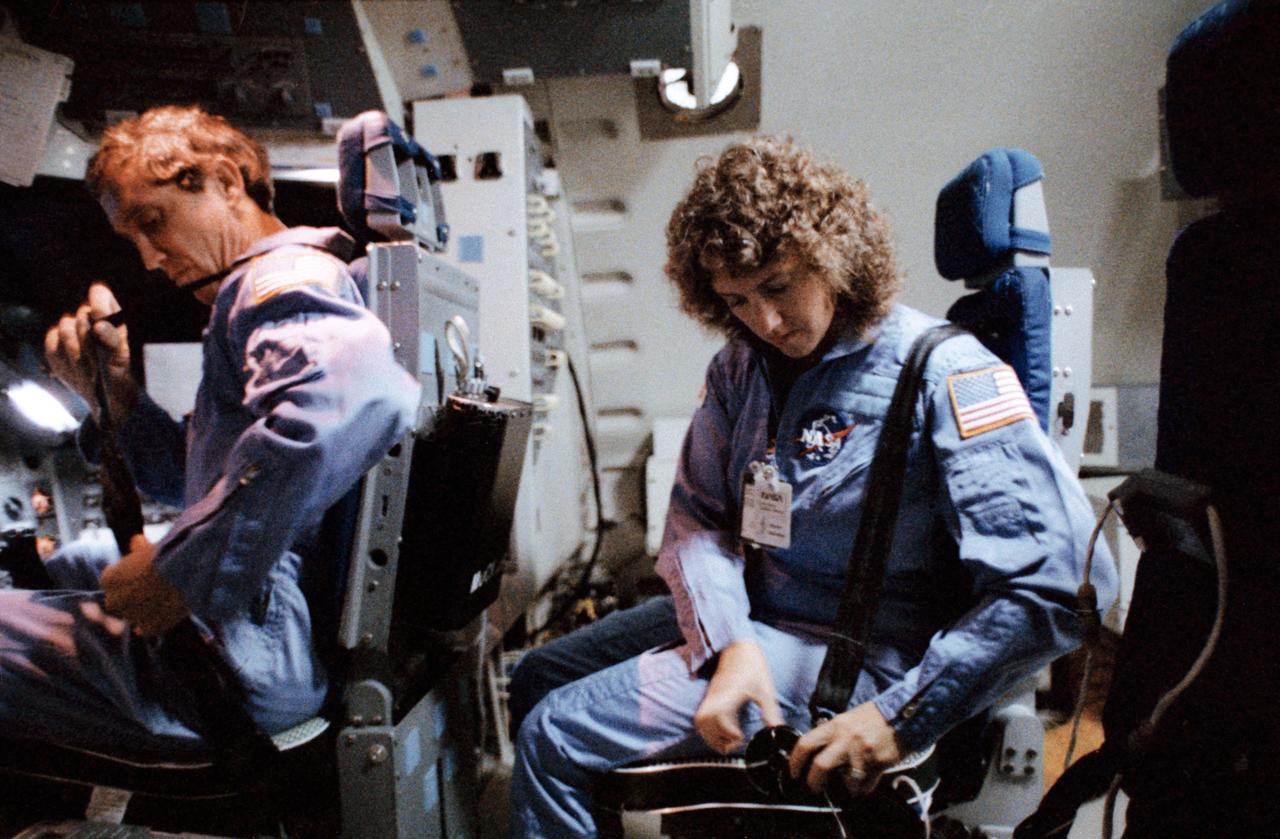
S85-44459 (19 Nov. 1985) --- Sharon Christa McAuliffe, seated behind 51-L pilot Michael J. Smith, prepares to strap herself into the mission specialists position in the Shuttle Mission Simulator (SMS) as part of her training for the 51-L mission. Photo credit: NASA
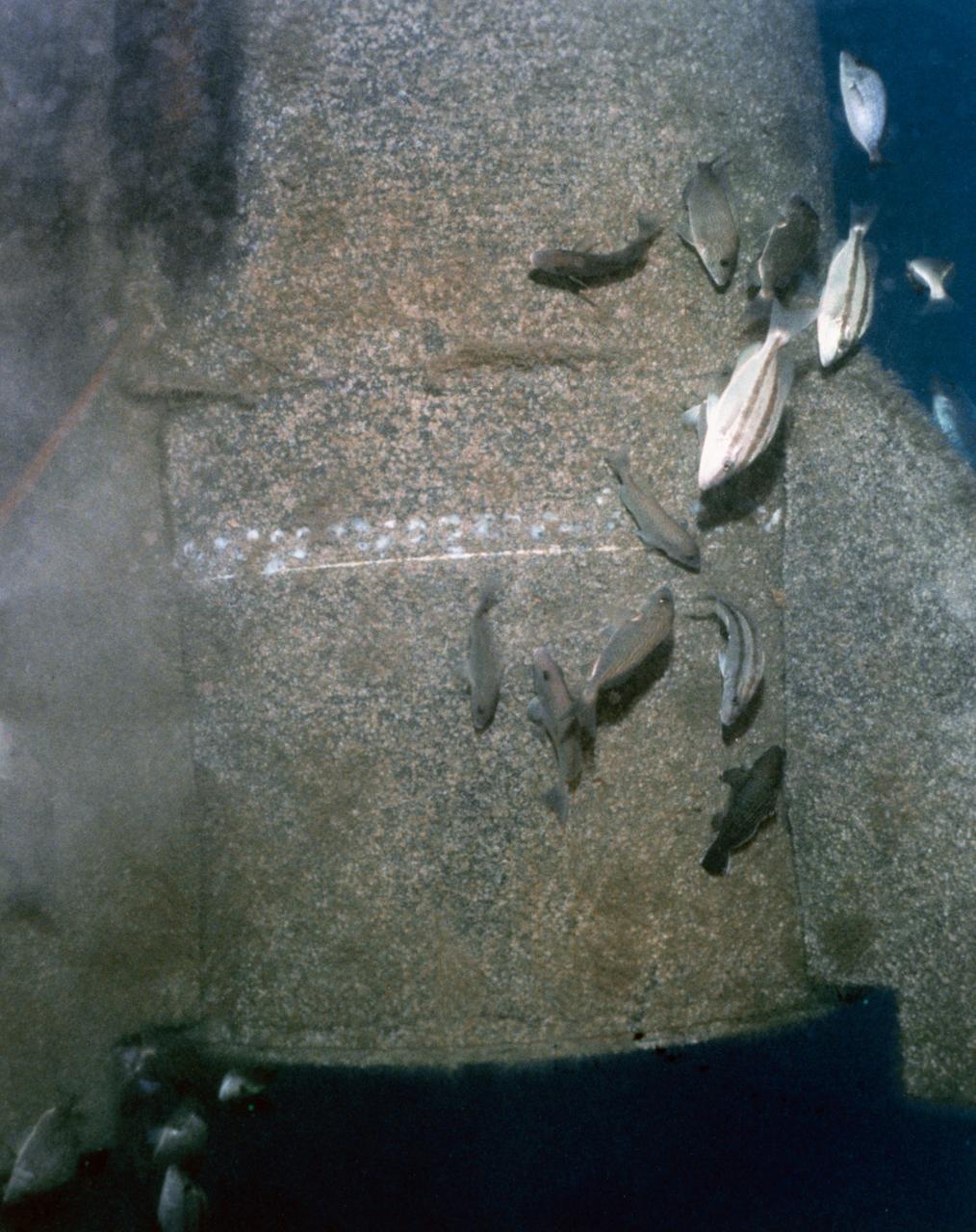
S86-30363 (13 March 1986) --- Deep Drone Dive #52 March 13, 1986, OCC contact 191 Photosea 1200 camera. (fc)
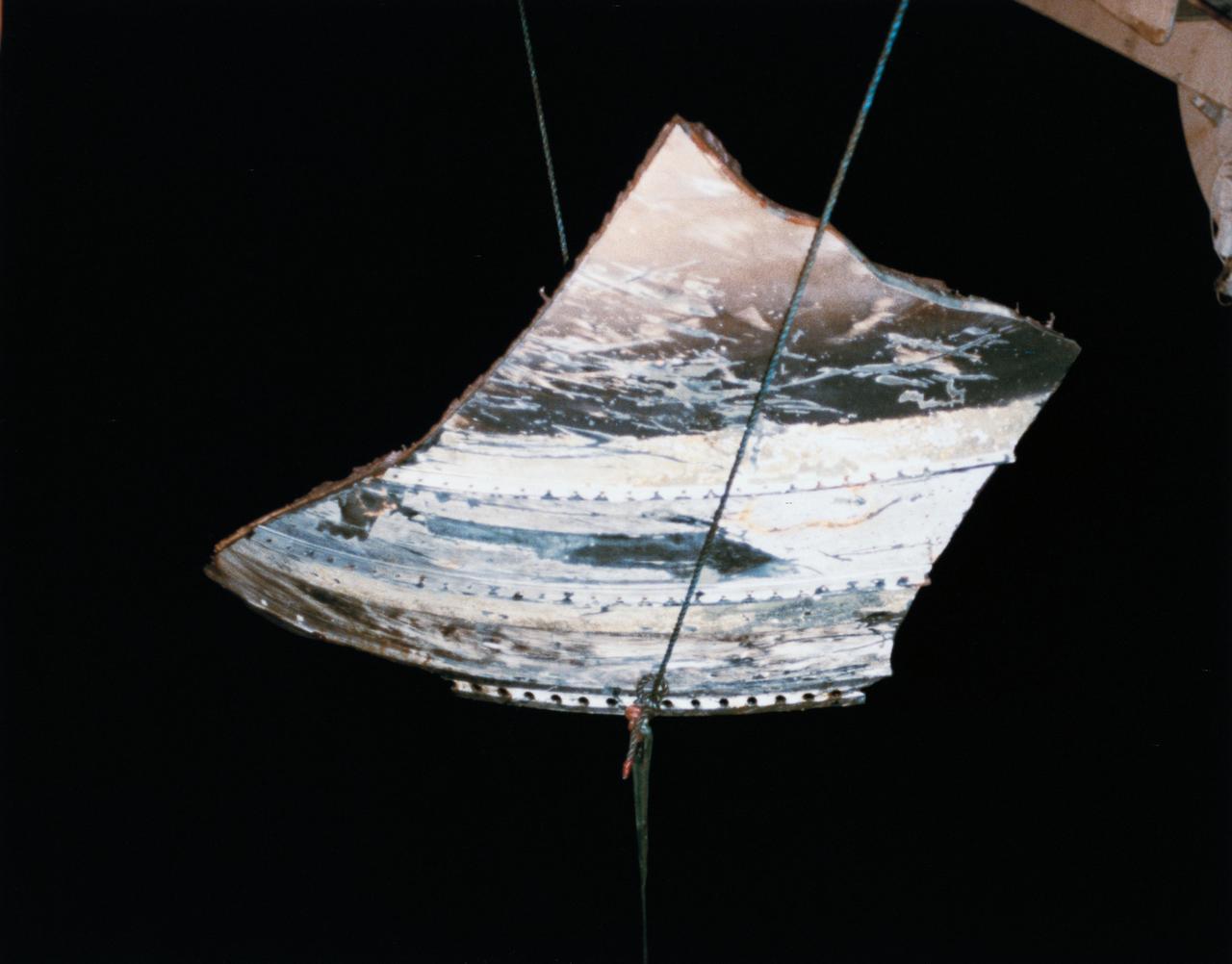
S86-29994 (17 & 19 March 1986) --- OOC #195, 292, 301 March 17 and March 19, SRB recovery operations. (FRS. 0X-9) (bg)
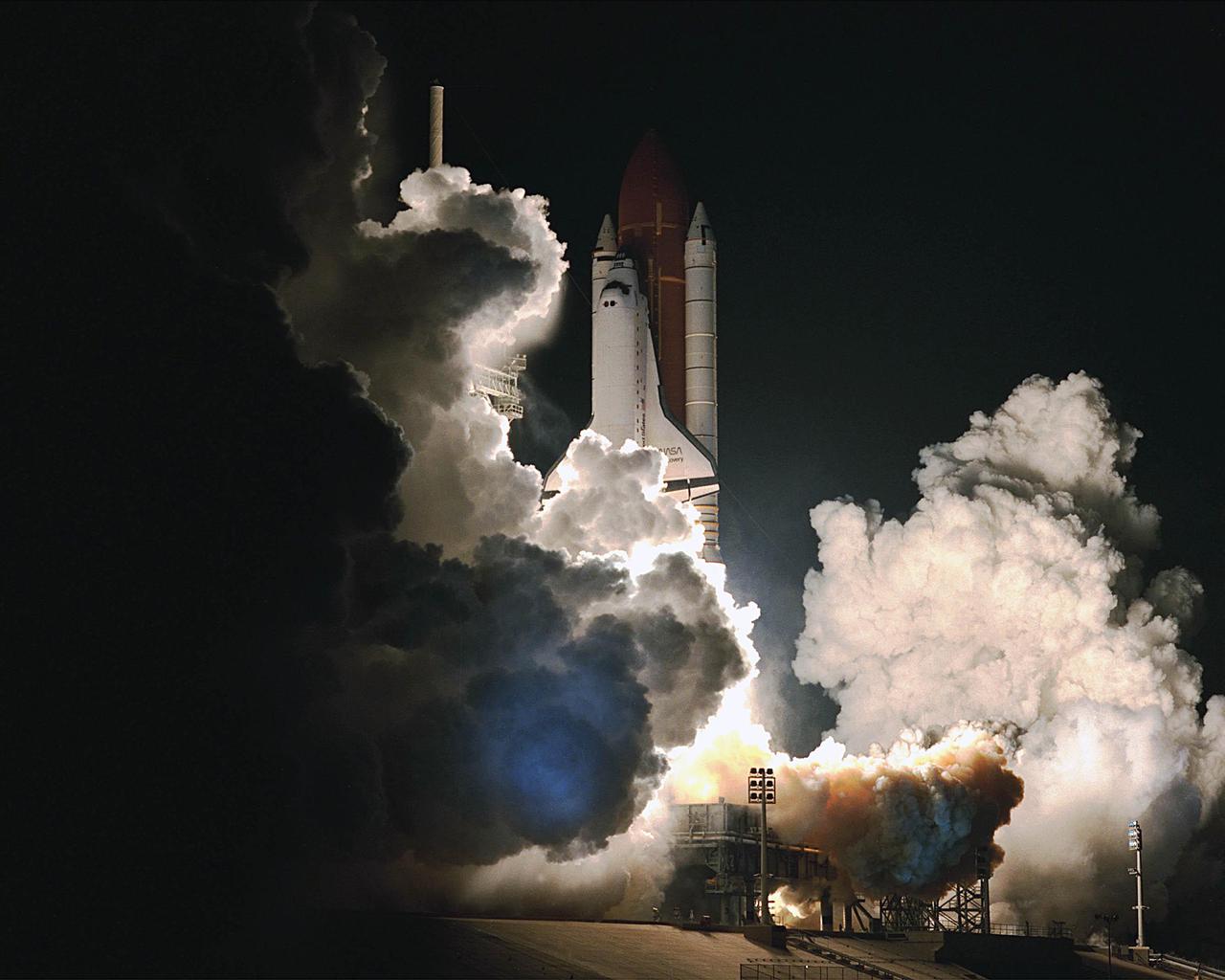
KENNEDY SPACE CENTER, FLA. -- STS-33: Discovery
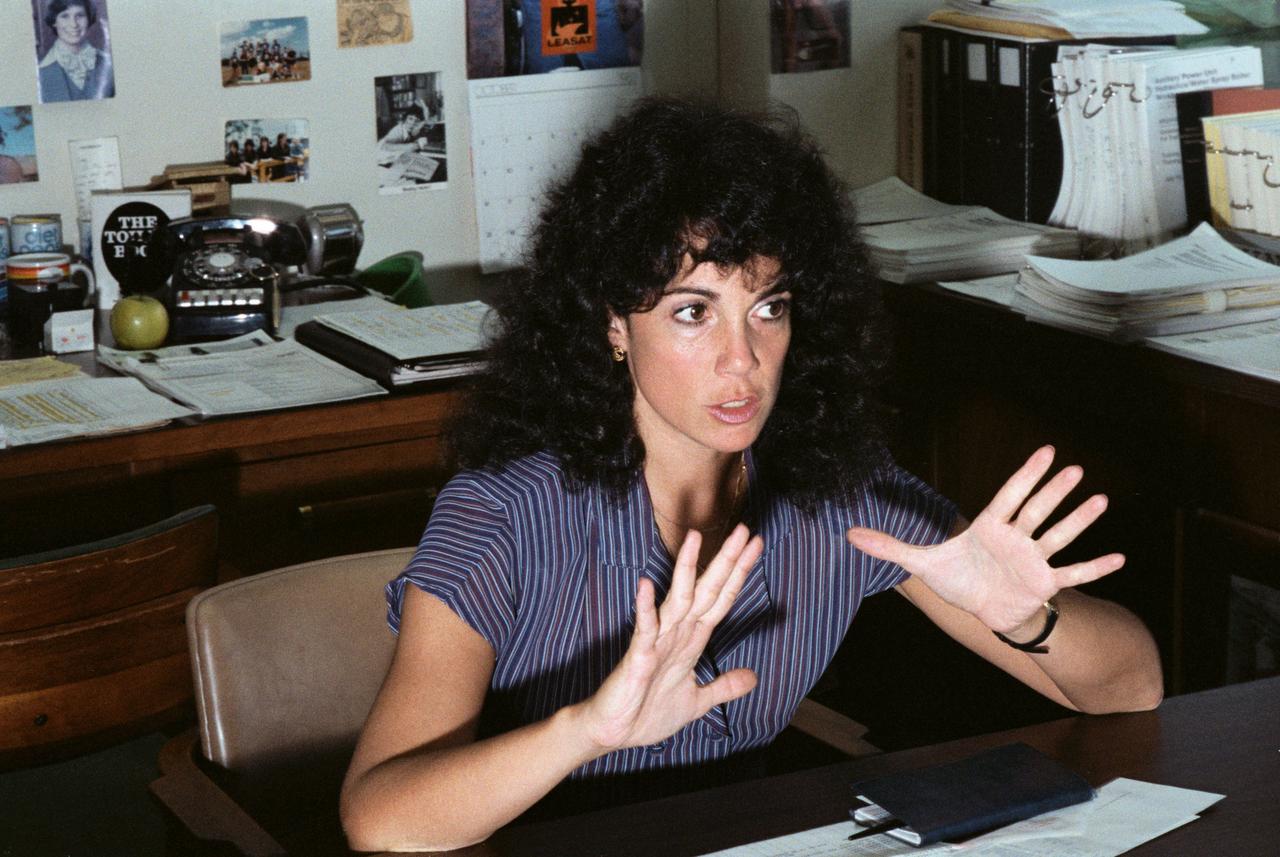
S85-40171 (5 Sept. 1985) --- Astronaut Judith A. Resnik, in her office, at the Johnson Space Center (JSC). Resnik is taking a break from training for her upcoming space mission. EDITOR’S NOTE: The STS-51L crew members lost their lives in the space shuttle Challenger accident moments after launch on Jan. 28, 1986 from the Kennedy Space Center (KSC). Photo credit: NASA
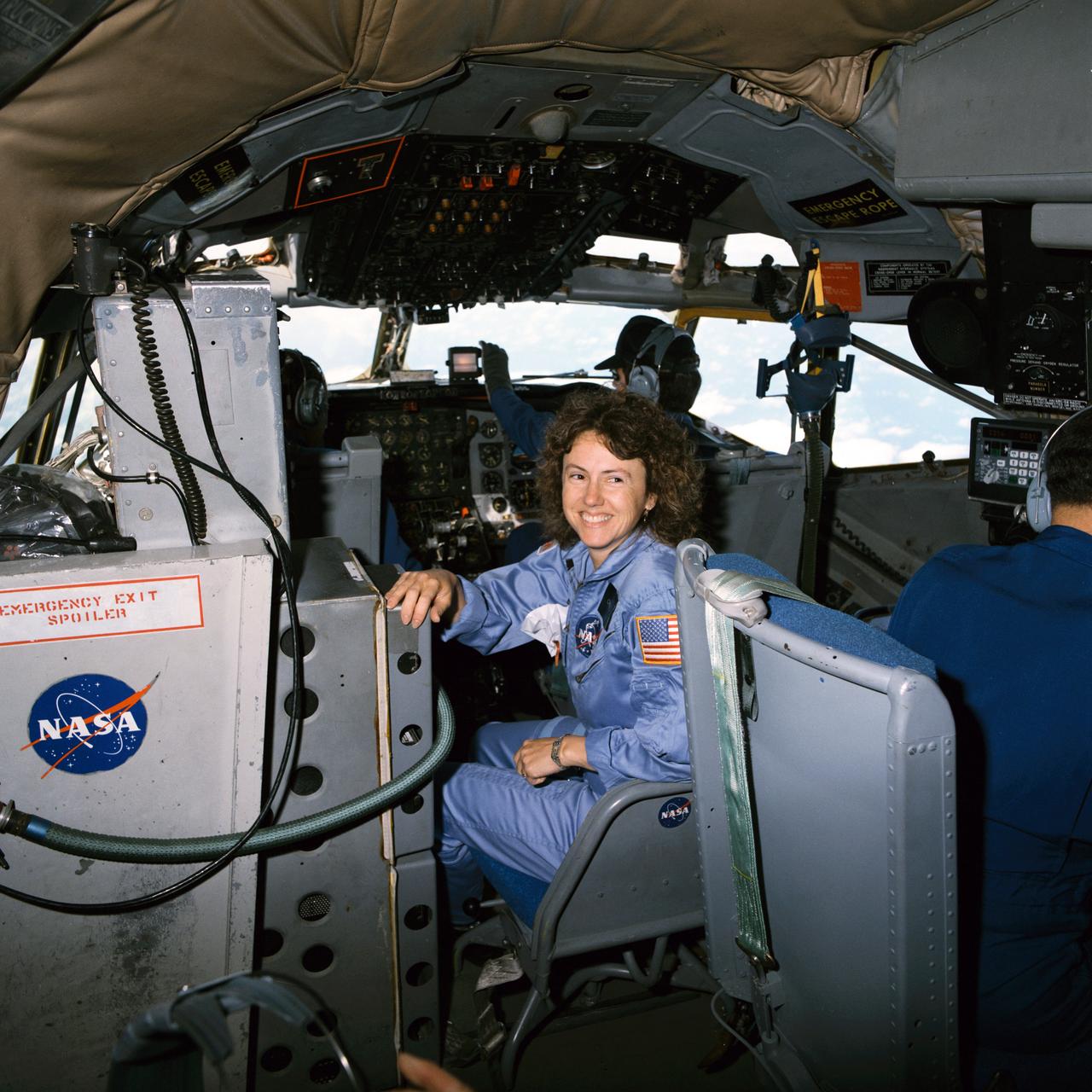
S85-42473 (16 Oct. 1985) --- Sharon Christa McAuliffe, a teacher-citizen observer on STS-51L, smiles before participating in some zero-G rehearsals for her upcoming flight. She is seated near the controls of the KC-135 aircraft, flying for the Johnson Space Center from Ellington Air Field. Referred to as the ?zero-gravity? aircraft, the KC-135 provides brief moments of weightlessness for shuttle crew members in training. Photo credit: NASA
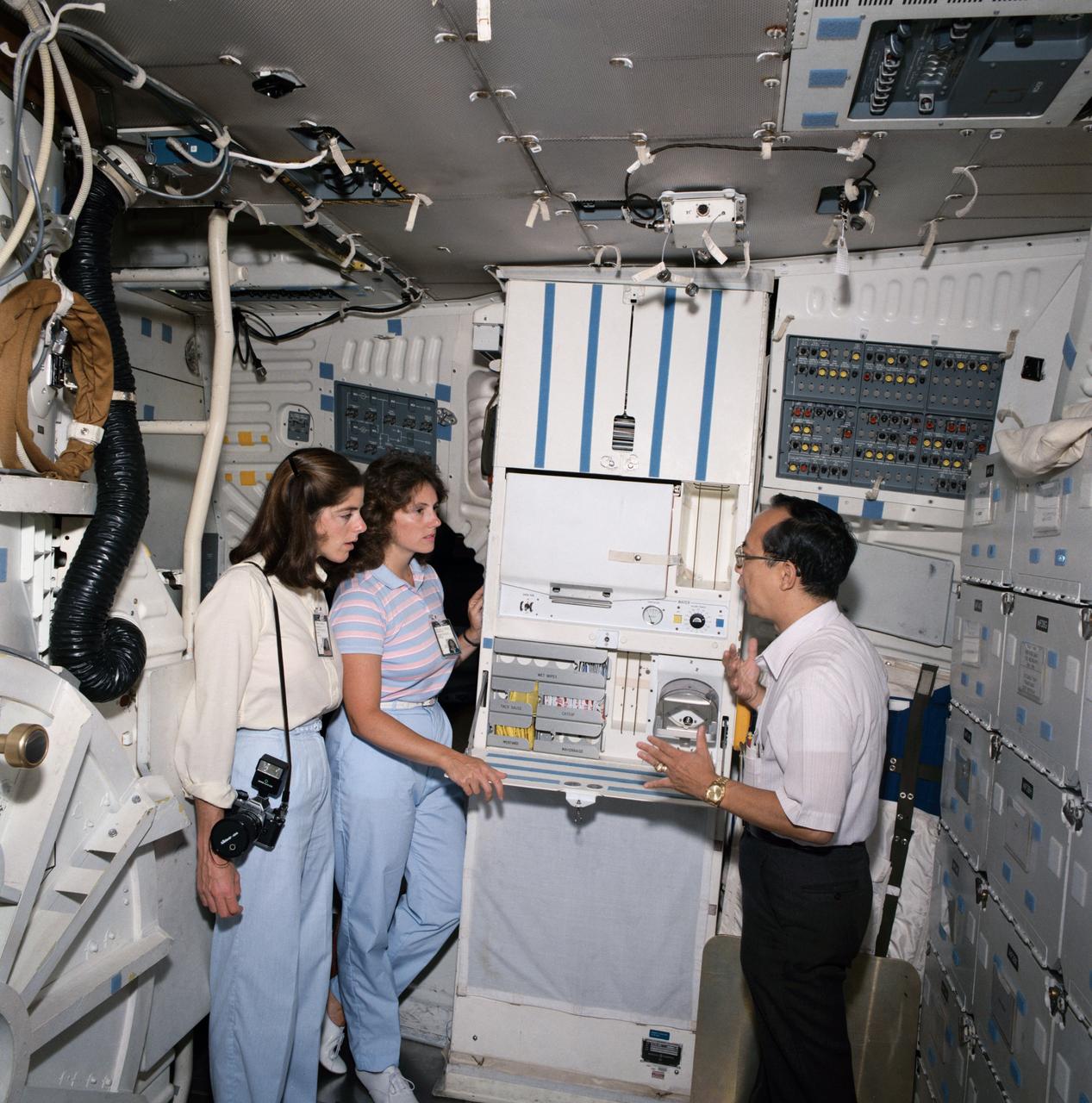
S85-40509 (23 Sept. 1985) --- Two women representing the Teacher-in-Space project undergo training in preparation for the STS-51L mission in two photographs made in Johnson Space Center trainers. Barbara R. Morgan (left), 51-L’s backup teacher, and McAuliffe are briefed by L.W. Lew on the space shuttle galley, located on the middeck. Photo credit: NASA
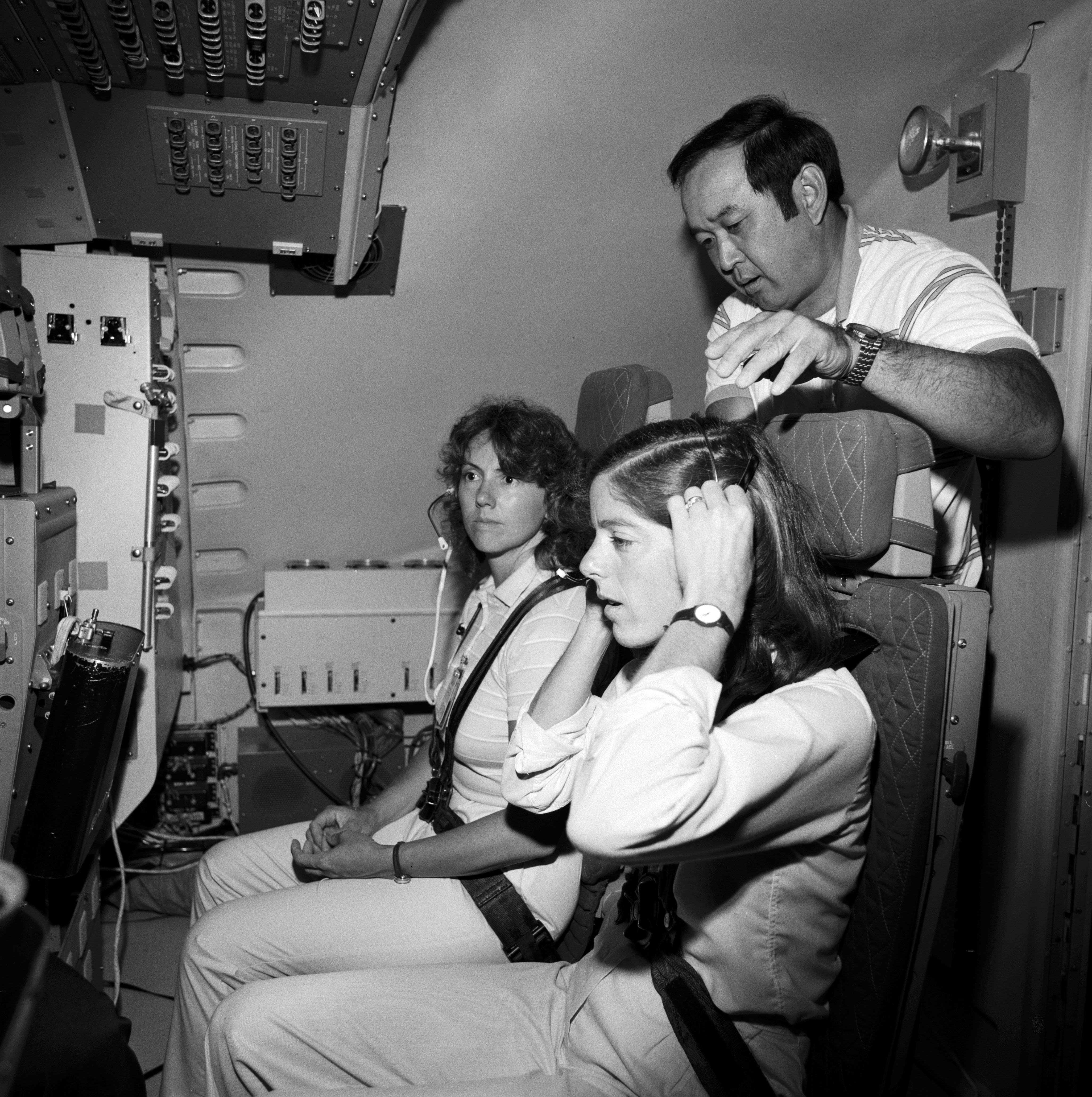
S85-40510 & S85-40511 (23 Sept. 1985) --- Two women representing the Teacher-in-Space Project undergo training in preparation for the 51-L mission in two photographs made in the Johnson Space Center’s mission simulation and training facility. In S85-40510, Sharon Christa McAuliffe (second right), prime crew member; and Barbara R. Morgan (second left), backup, are briefed in the shuttle mission simulator’s instruction station by Jerry Swain, right, instruction team leader. Others pictured are Michelle Brekke (far left) of the payload specialists’ office and Patricia A. Lawson (lower left foreground). Astronaut Ellison S. Onizuka, in S85-40511, assists Morgan with a head set as the two trainees are familiarized with launch and entry stations in the motion base shuttle mission simulator (SMS). The citizen observer (McAuliffe) is scheduled to be seated on the middeck. This picture, however, was taken at the mission specialists’ station on the flight deck. Photo credit: NASA
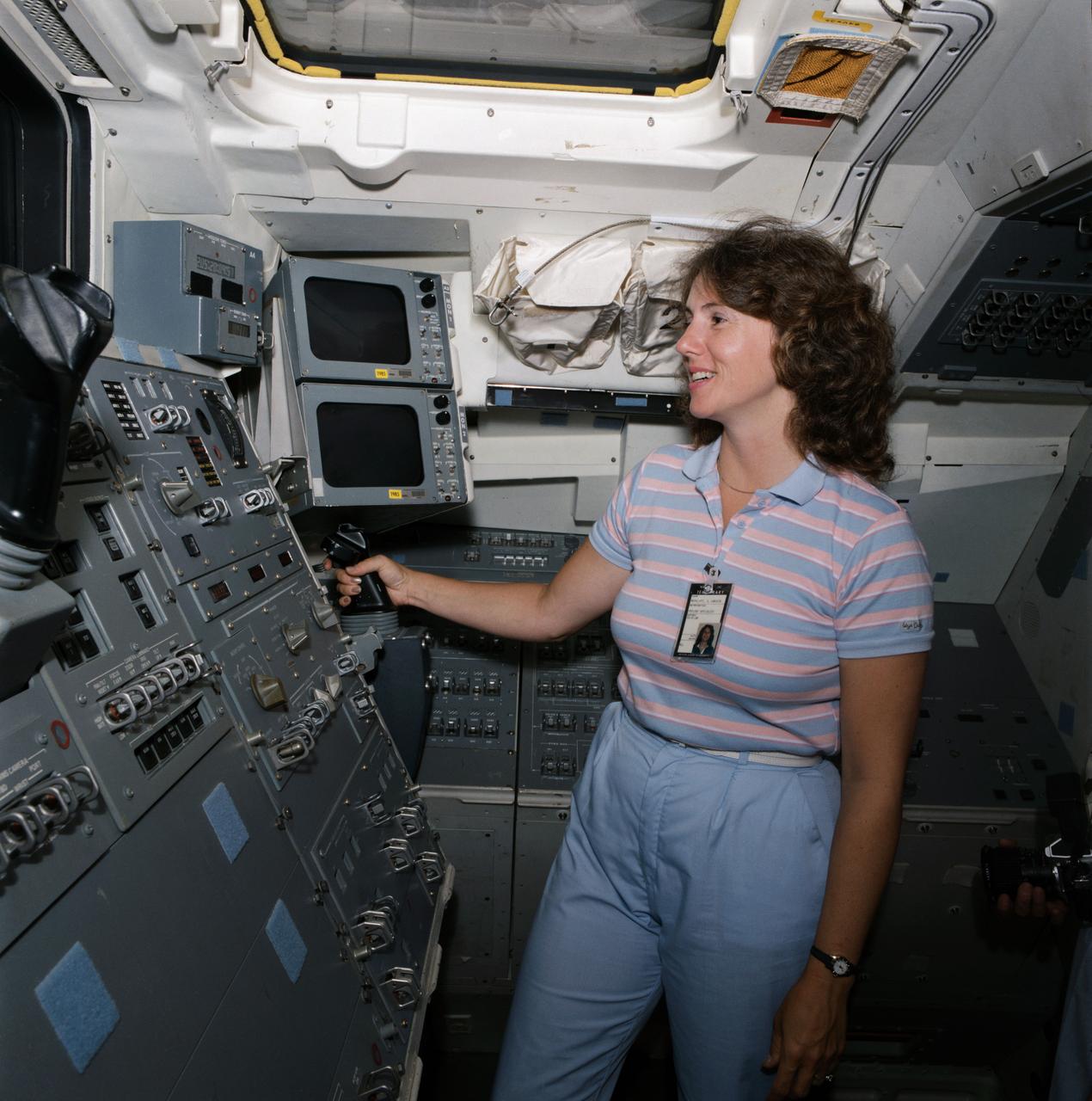
S85-40508 (23 Sept. 1985) --- Two women representing the Teacher-in-Space project undergo training in preparation for the STS-51L mission in two photographs made in Johnson Space Center trainers. Sharon Christa McAuliffe, named as prime crew citizen observer on the spaceflight, studies the console on the aft flight deck, which contains controls for the remote manipulator system (RMS) and other important functions. Photo credit: NASA
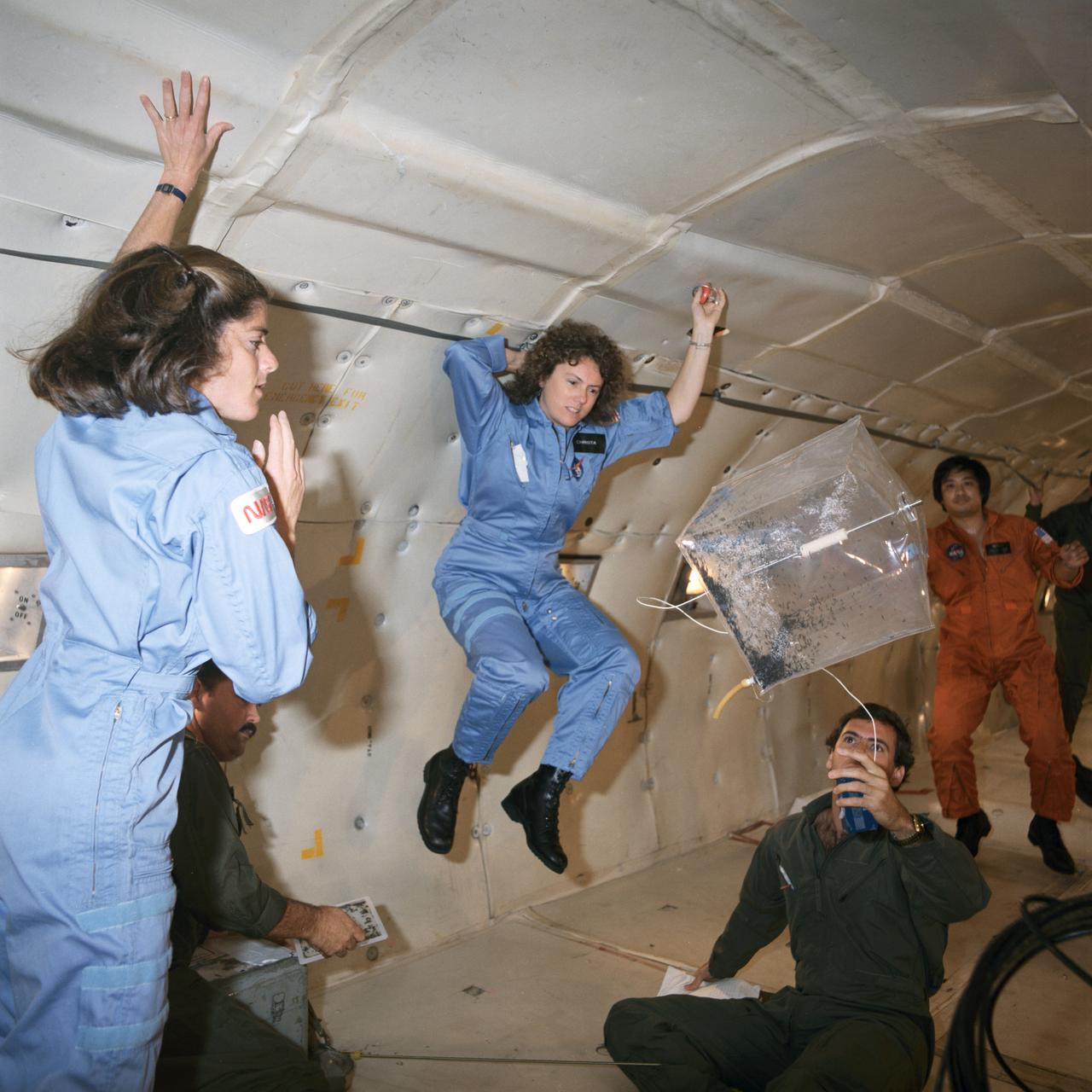
S85-42474 (16 Oct. 1985) --- A KC-135 aircraft provides a brief period of weightlessness as a preview for a teacher, in training to fly onboard a space shuttle for the Teacher-in-Space Project, and her backup. Sharon Christa McAuliffe (center frame), STS-51L prime crew member, and Barbara Morgan, her backup, monitor an experiment involving magnetic effects - one of the tests to be performed on the STS-51L flight. The experiment uses a control box, a square receptacle containing rubber tubing, stainless steel rod, a filter with desiccant, soft iron wire and a magnet. Photo credit: NASA
S85-38312 (September 1985) --- Logo designed for use by the 10 finalists in NASA’s Teacher in Space Project, who were at JSC for training and orientation the week of July 8–12, 1985. They are David M. Marquart, Boise High, Boise, Idaho; Michael W. Metcalf, Hazen Union School, Hardwick, Vermont; Judith Marie Garcia, Thomas Jefferson School for Science and Technology, Alexandria, Virginia; Peggy J. Lathlaen, Westwood Elementary, Friendswood, Texas; Niki Mason Wenger, Vandevender Junior High, Parkersburg, West Virginia; Barbara R. Morgan, McCall-Donnelly Elementary, McCall, Idaho; Kathleen Anne Beres, Kenwood High, Baltimore, Maryland; Richard A. Methia, New Bedford High, New Bedford, Mass.; Sharon Christa McAuliffe, Concord High, Concord, New Hampshire; and Robert S. Foerster, Cumberland Elementary School, West Lafayette, Indiana. Photo credit: NASA
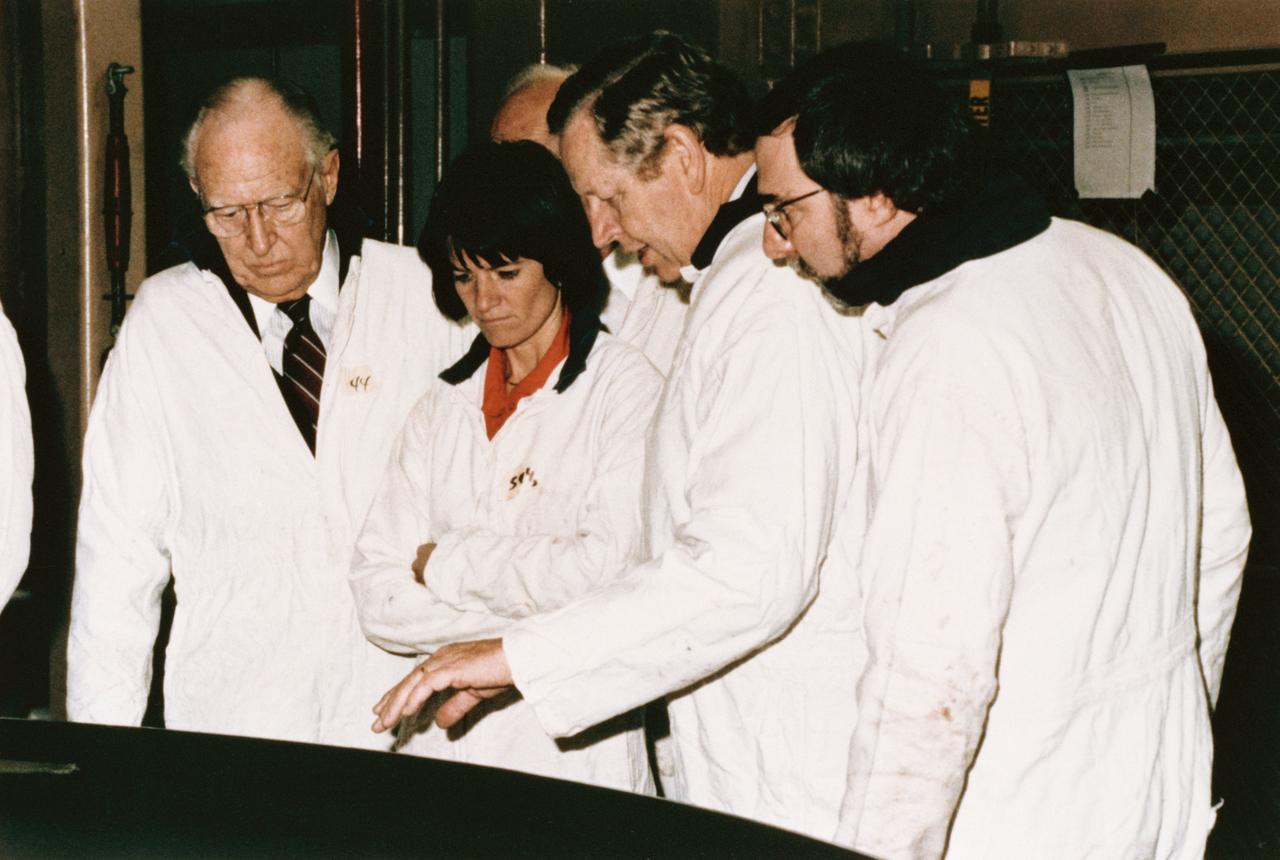
S86-28889 (14 Feb. 1986) --- Kennedy Space Center Director Richard Smith points out a portion of a solid rocket booster segment to astronaut Sally Ride and to the chairman of the Presidential Commission on the Space Shuttle Challenger Accident, William P. Rogers. The commission was taken to various booster storage and handling facilities at KSC on Feb. 14, 1986 as part of the failure investigation. Photo credit: NASA
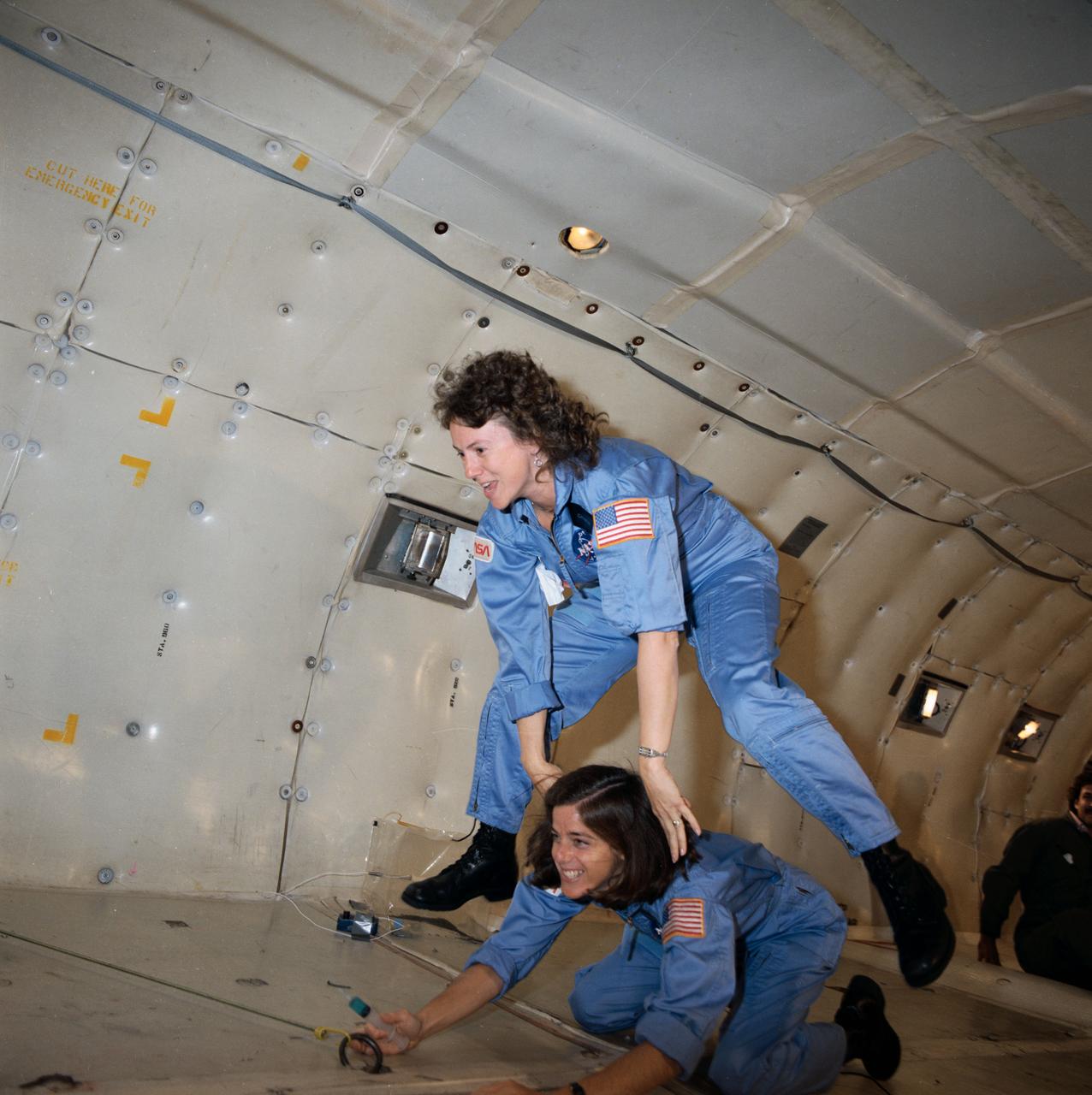
S85-42472 (16 Oct. 1985) --- Teacher-in-Space trainees on the KC-135 for zero-G training. Sharon Christa McAuliffe, right, and Barbara R. Morgan, play leap-frog in the temporary weightlessness of the KC-135. Photo credit: NASA
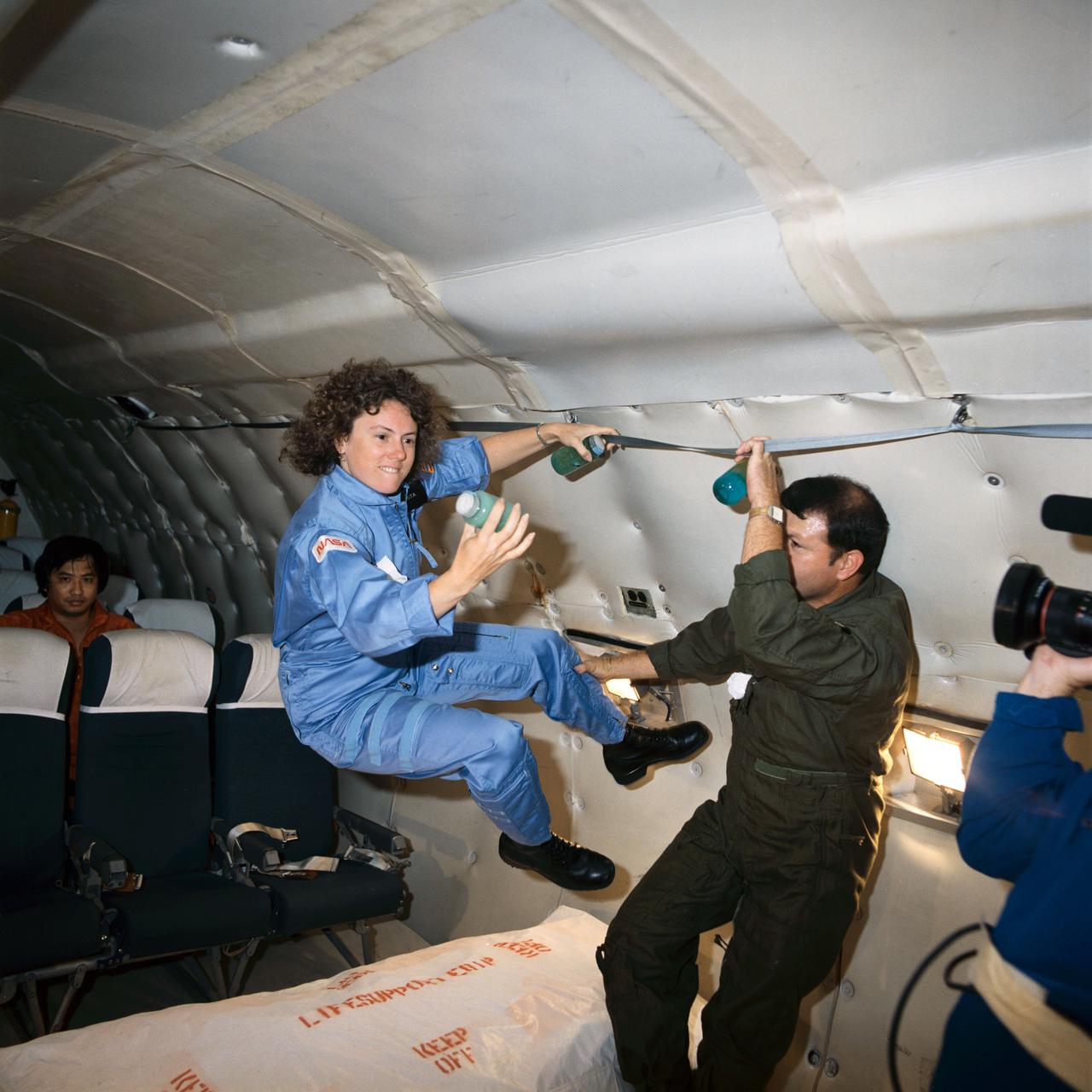
Teacher-in-Space trainees on the KC-135 for Zero-G training. Sharon Christa McAuliffe experiences a few moments of weightlessness provided by the KC-135. She and Bob Mayfield, a JSC Aerospace Education Specialist, are previewing a Molecular Mixing Experiment which was designed to demonstrate differences of separation process in 1-G and Zero-G.
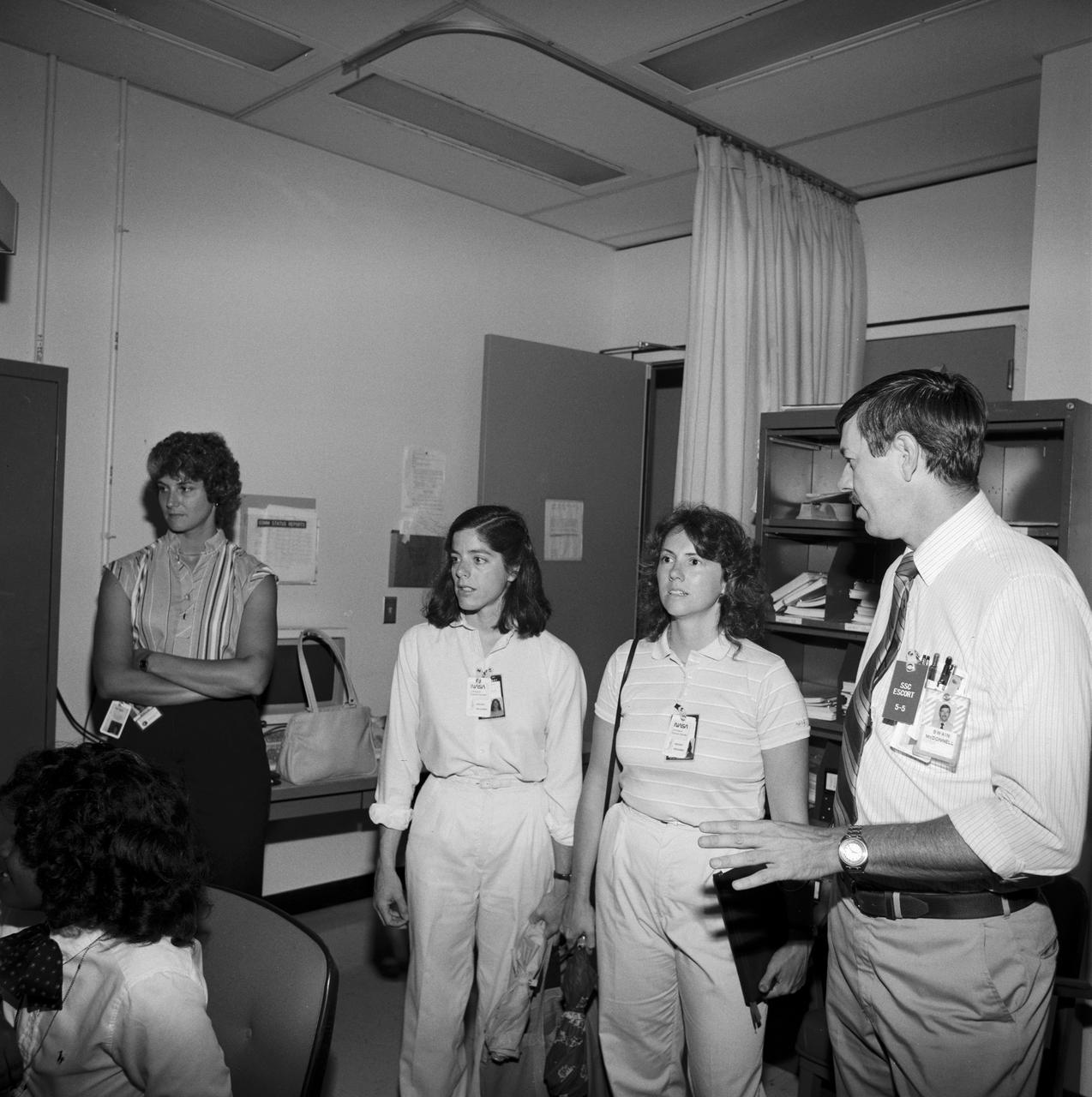
S85-40510 & S85-40511 (23 Sept. 1985) --- Two women representing the Teacher-in-Space Project undergo training in preparation for the 51-L mission in two photographs made in the Johnson Space Center’s mission simulation and training facility. In S85-40510, Sharon Christa McAuliffe (second right), prime crew member; and Barbara R. Morgan (second left), backup, are briefed in the shuttle mission simulator’s instruction station by Jerry Swain, right, instruction team leader. Others pictured are Michelle Brekke (far left) of the payload specialists’ office and Patricia A. Lawson (lower left foreground). Astronaut Ellison S. Onizuka, in S85-40511, assists Morgan with a head set as the two trainees are familiarized with launch and entry stations in the motion base shuttle mission simulator (SMS). The citizen observer (McAuliffe) is scheduled to be seated on the middeck. This picture, however, was taken at the mission specialists’ station on the flight deck. Photo credit: NASA
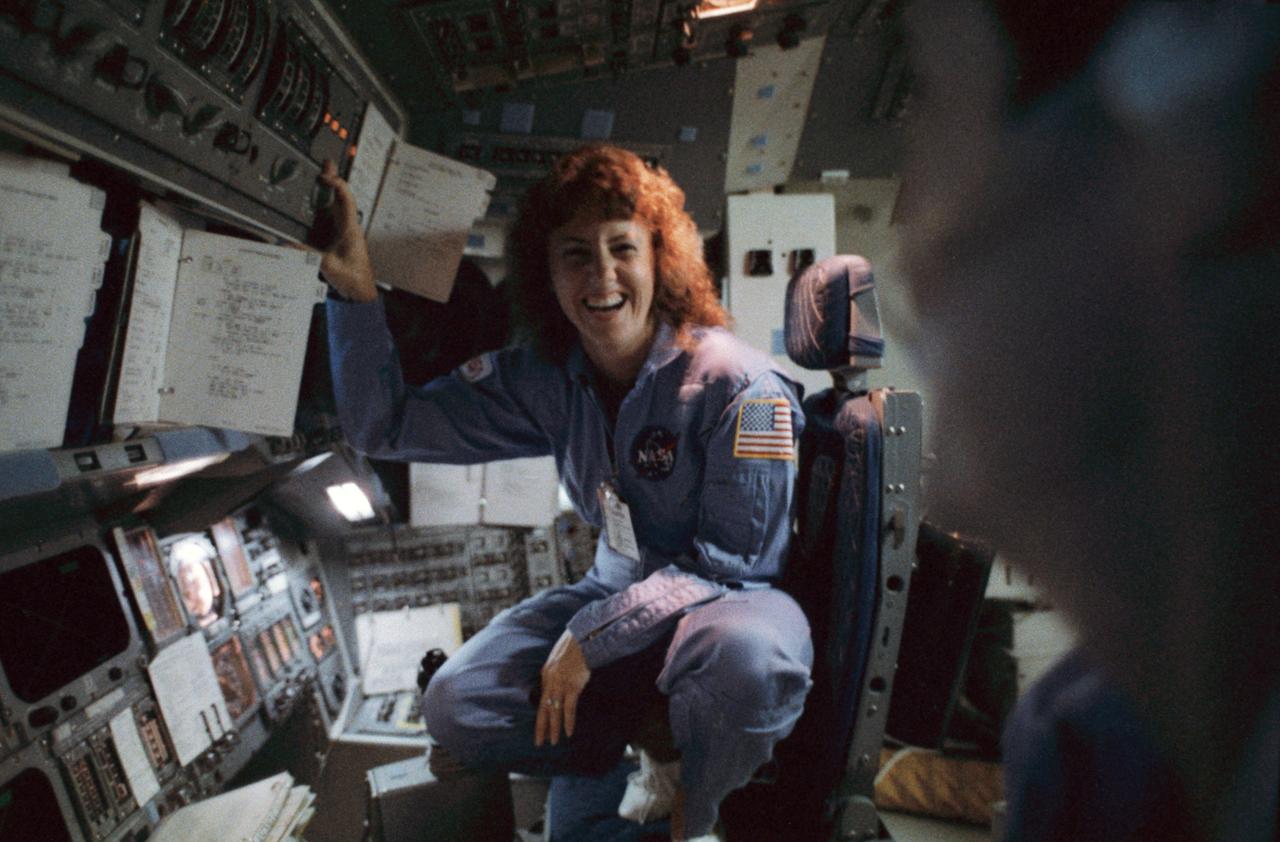
S85-44507 (October 1985) --- Sharon Christa McAuliffe, a teacher from Concord, New Hampshire, trains for the January 1986 mission of the space shuttle Challenger in the Johnson Space Center’s shuttle mission simulator (SMS). Learning about the overall spacecraft systems, McAuliffe is pictured here in the pilot’s station. For actual launch and landing phases, the Teacher-in-Space Project payload specialist would sit on the middeck. The photograph was taken by Michael O’Brien of Life Magazine. Photo credit: NASA
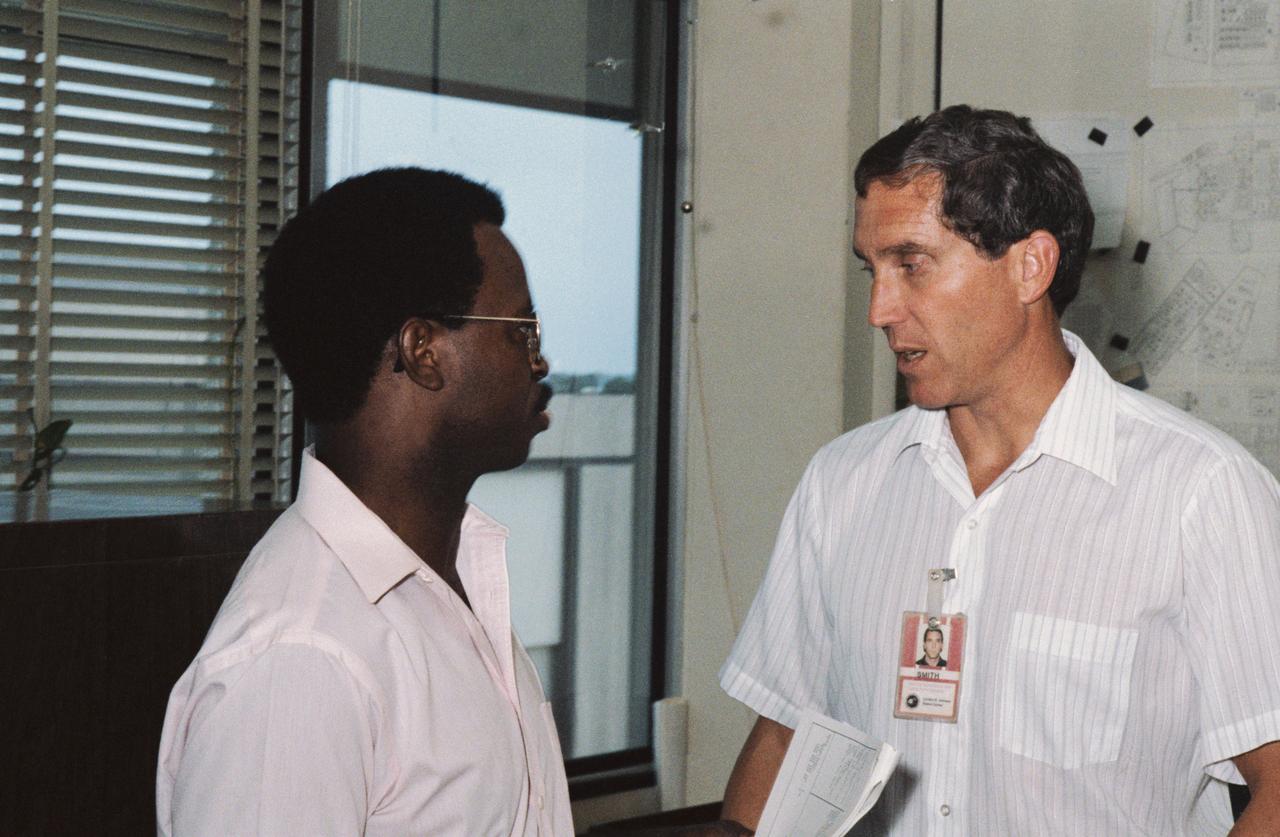
S85-40172 (5 Sept. 1985) --- Astronauts Ronald E. McNair (left), mission specialist, and Michael J. Smith, pilot, talk about their upcoming space mission in JSC's astronaut office. SINCE THIS PHOTOGRAPH WAS MADE: McNair, Smith and five other crew members lost their lives in the Challenger accident on Jan. 28, 1986. Photo credit: NASA
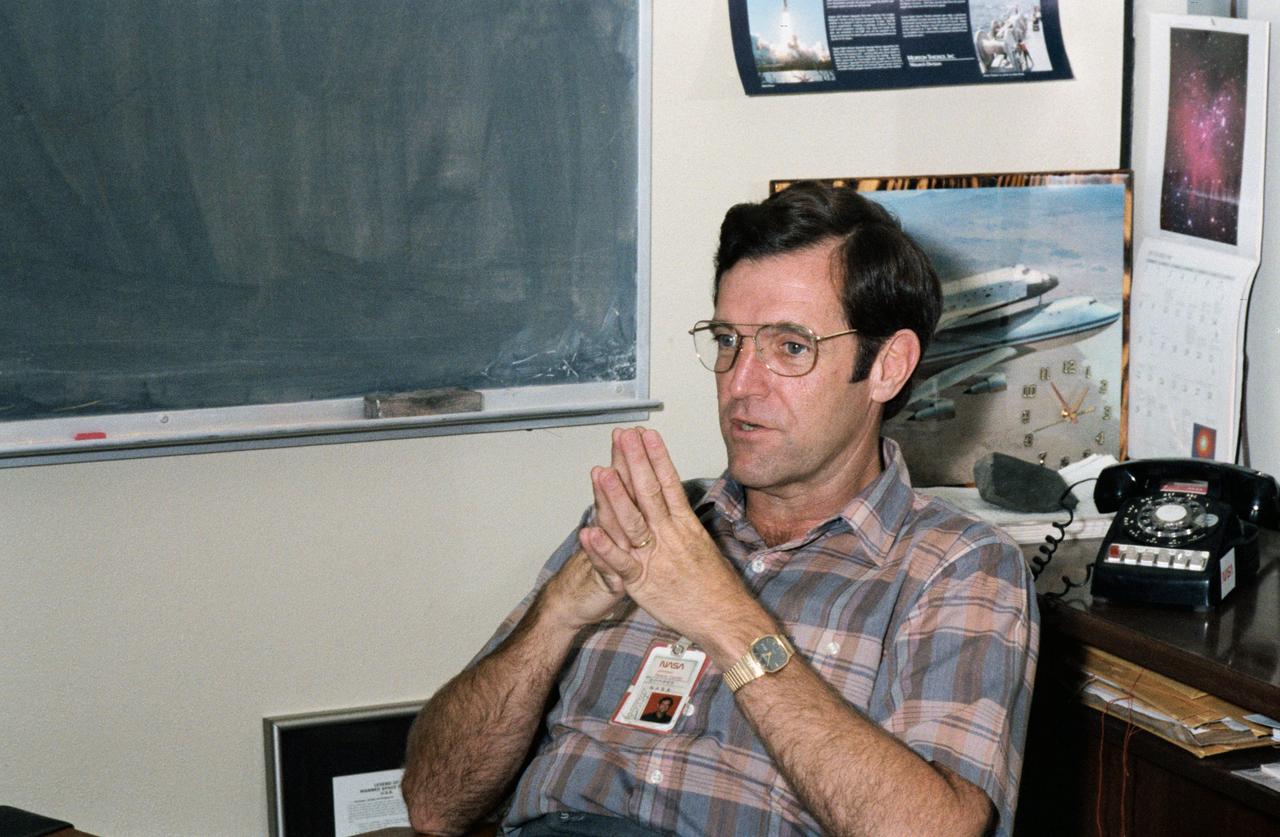
S85-40173 (5 Sept. 1985) --- In Johnson Space Center’s (JSC) Astronaut Office, astronaut F. Richard (Dick) Scobee, STS-51L mission commander, takes a break from training for his upcoming space mission. EDITOR’S NOTE: The STS-51L crew members lost their lives in the space shuttle Challenger accident moments after launch on Jan. 28, 1986 from the Kennedy Space Center (KSC). Photo credit: NASA
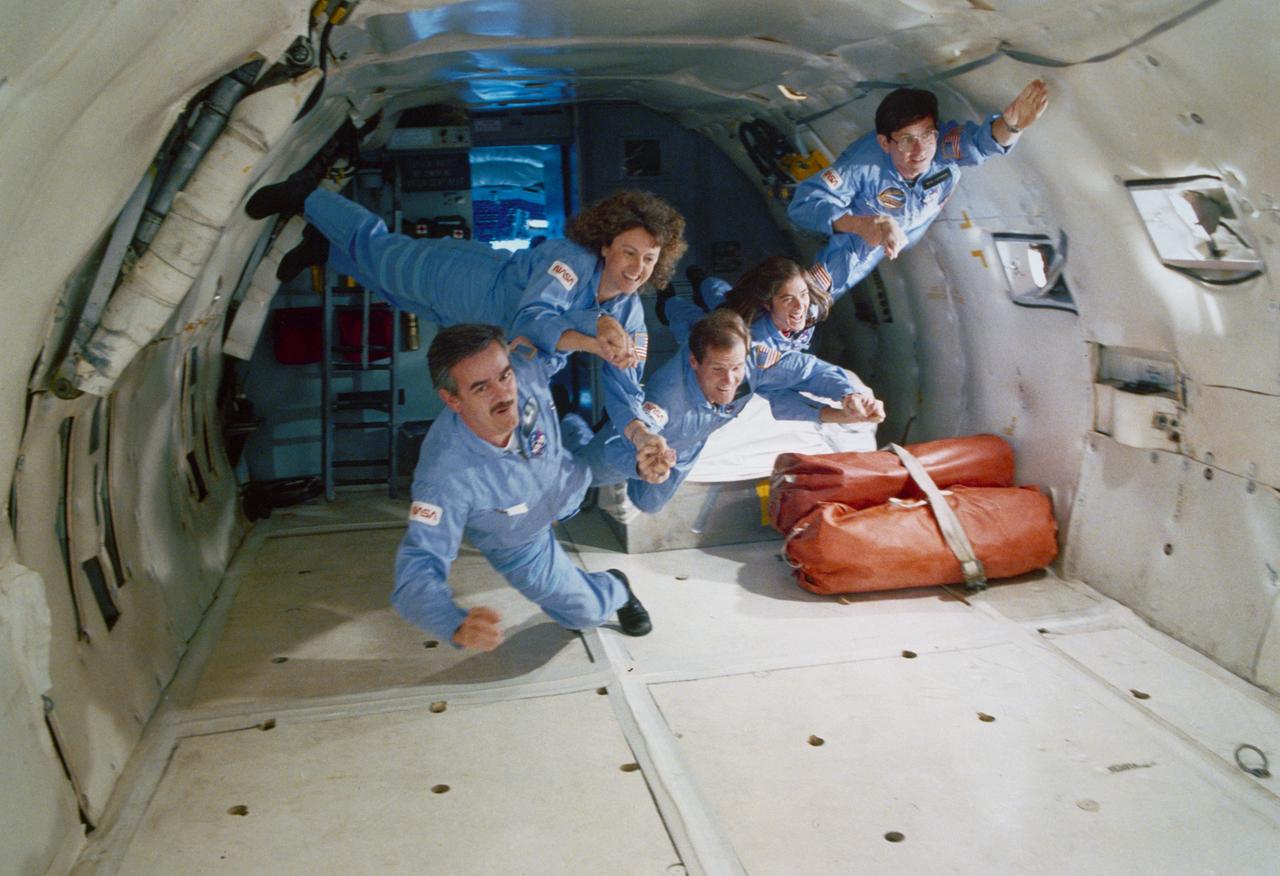
S85-44835 (20 Nov. 1985) --- This flying human chain represents prime and backup payload specialists for two upcoming STS missions. The group, representing trainees for STS-61C later this year and STS-51L early next year, shared some 40 parabolas in NASA?s KSC-135, ?Zero-G? aircraft on Nov. 20. Left to right are Gerard Magilton, RCA backup payload specialist for STS-61C; Sharon Christa McAuliffe, payload specialist/teacher citizen observer for STS-51L; U.S. Rep. Bill Nelson (D., Florida), scheduled for 61-C; Barbara R. Morgan, backup to McAuliffe; and Robert J. Cenker, RCA payload specialist for 61-C. The photo was taken by Keith Meyers, New York Times. Photo credit: NASA
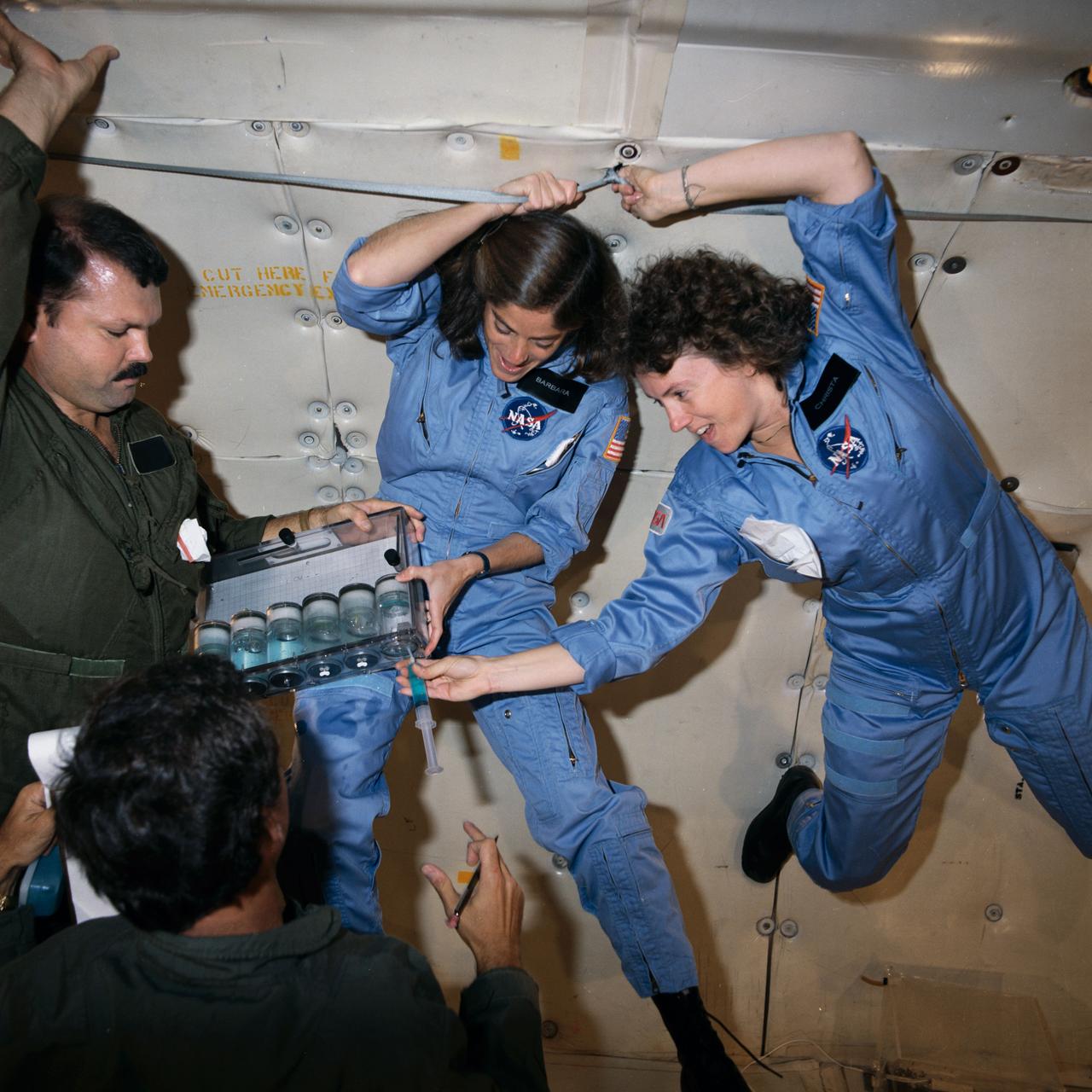
S85-42470 (16 Oct. 1985) --- Sharon Christa McAuliffe, right, and Barbara R. Morgan, participating in the Teacher-in-Space Project, team up with Bob Mayfield, a JSC aerospace educations specialist, to preview some experiments in zero-G. A KC-135 aircraft flies a special pattern to provide series of brief periods of weightlessness. McAuliffe, prime crew member for STS-51L, injects a hydroponic solution into a cylinder to review one of the experiments planned for the flight. Morgan is backup for McAuliffe on that mission. Photo credit: NASA
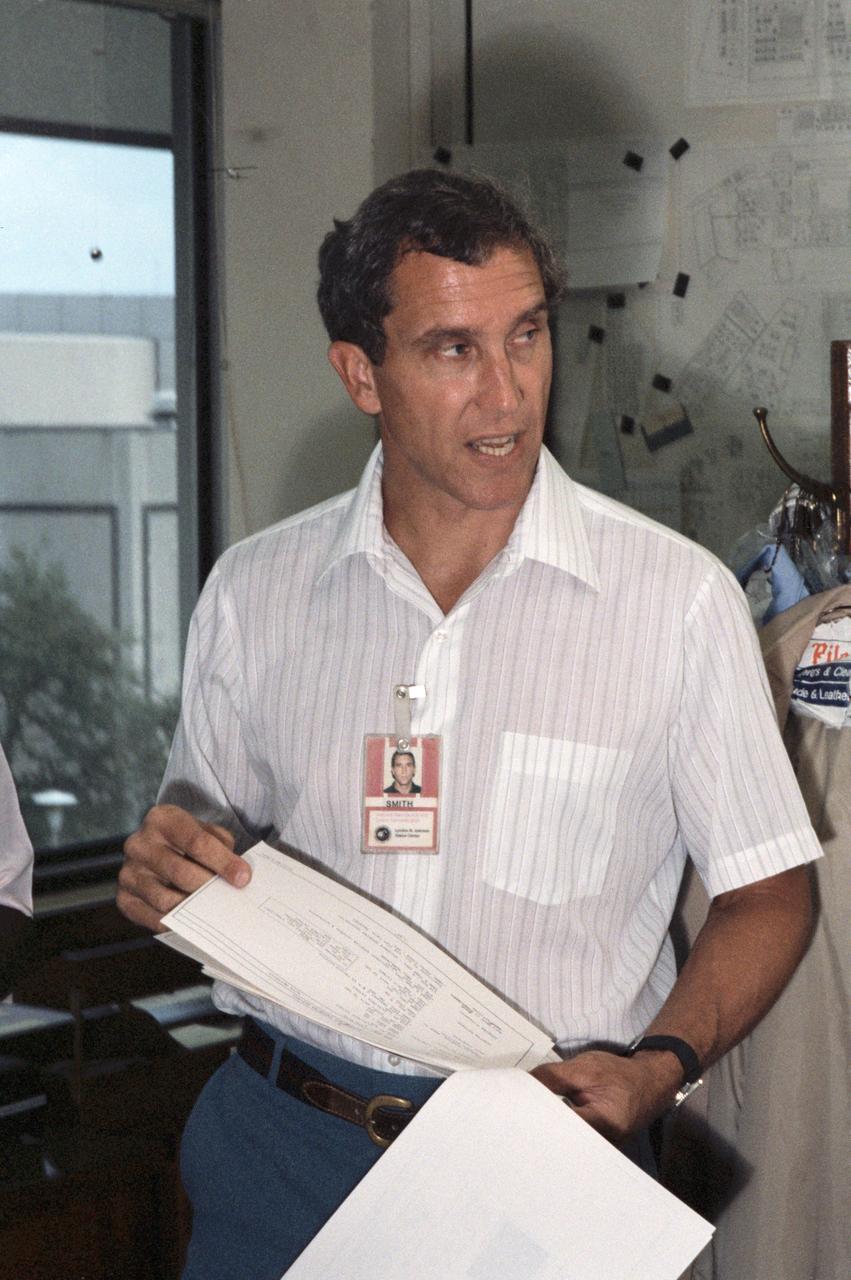
S85-40174 (5 Sept. 1985) --- In Johnson Space Center’s (JSC) Astronaut Office, astronaut Michael J. Smith, STS-51L pilot, looks over part of the flight plan for his upcoming space mission. EDITOR’S NOTE: The STS-51L crew members lost their lives in the space shuttle Challenger accident moments after launch on January 28, 1986 from the Kennedy Space Center (KSC). Photo credit: NASA
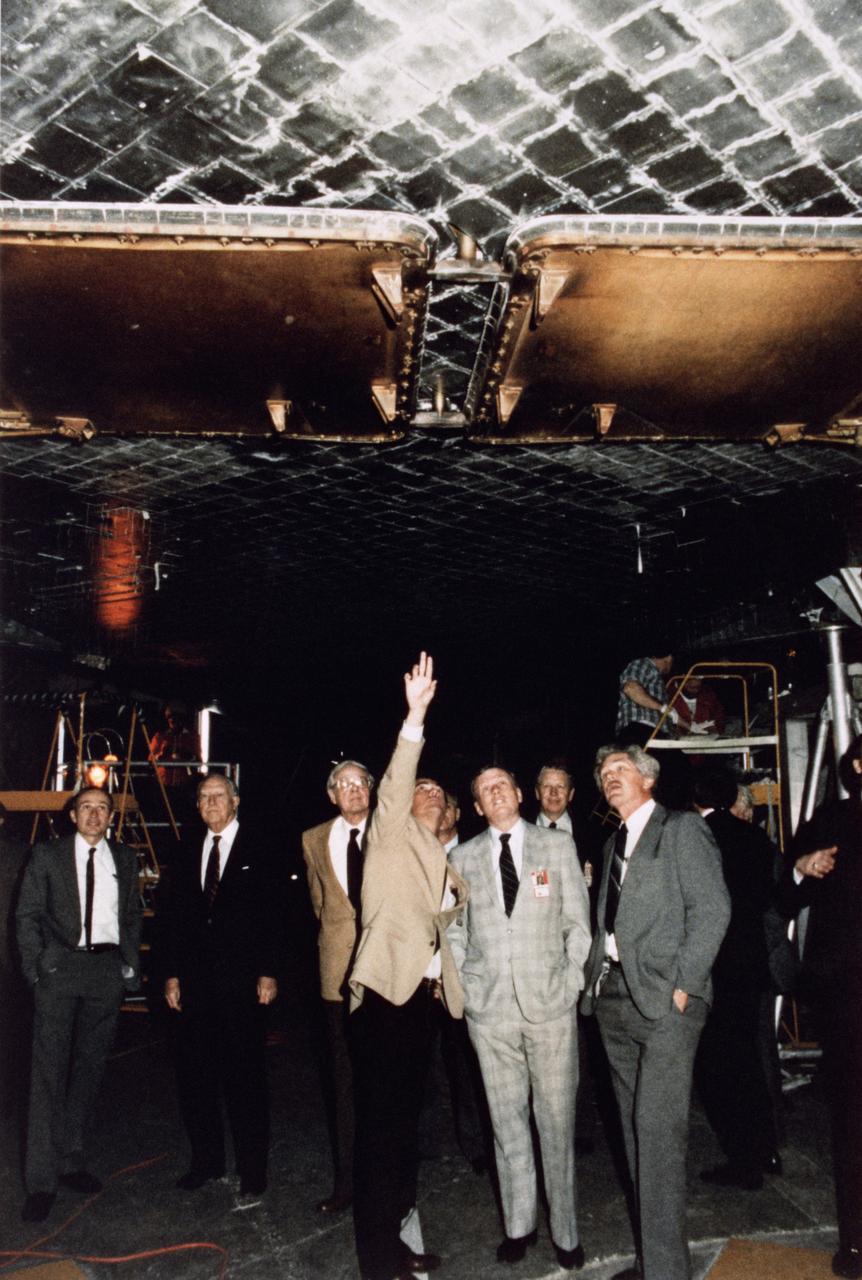
S86-28888 (14 Feb. 1986) --- NASA astronaut Robert Crippen points out Discovery tile work in the Vehicle Assembly Building to the Presidential Commission on the Space Shuttle Challenger Accident. The commission was taken to the facility on Feb. 14, 1986 as part of their investigation. Photo credit: NASA
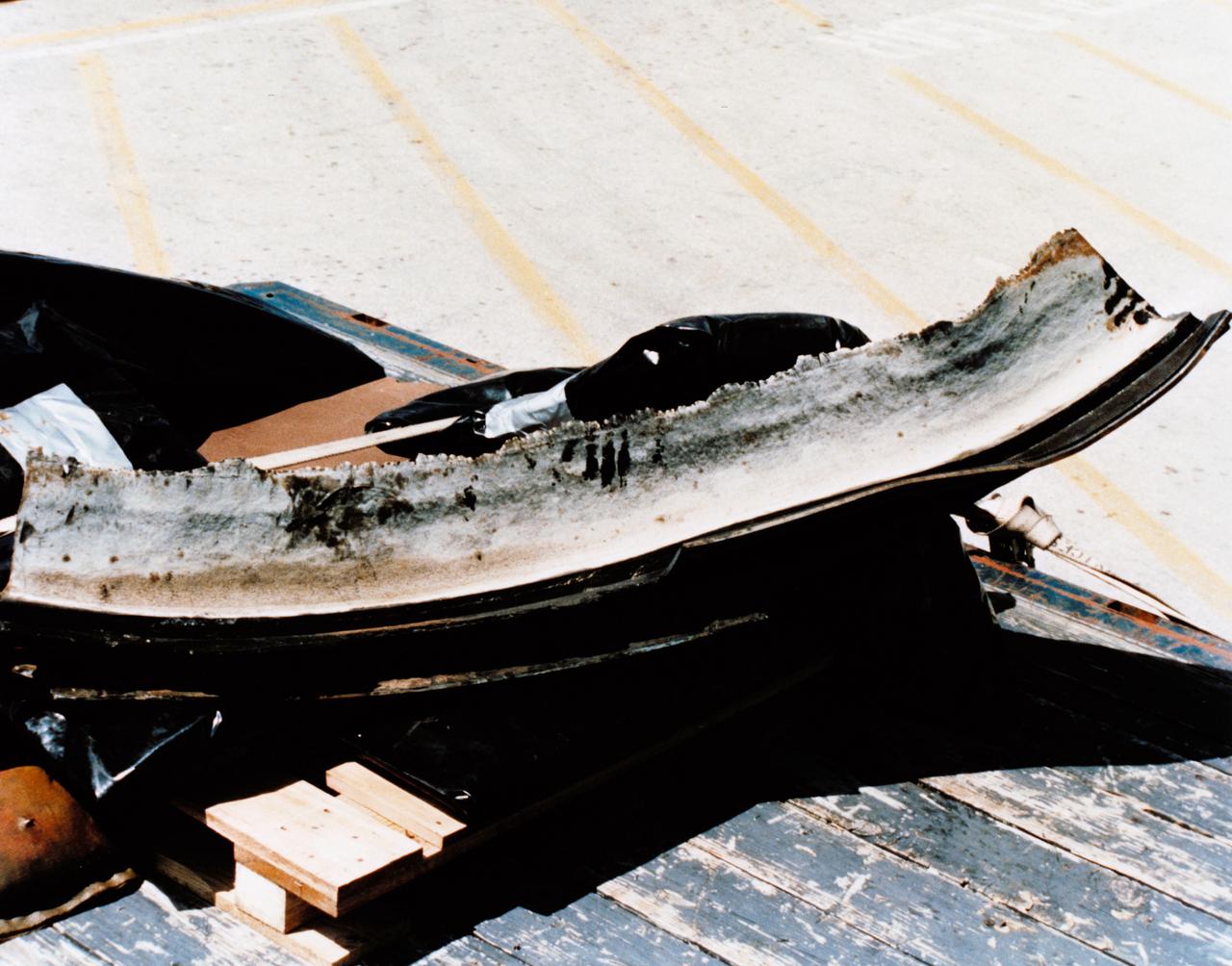
S86-29888 (20 March 1986) --- Stena workhorse arrival and offload of SRB. Trident Basin. (112) (st)
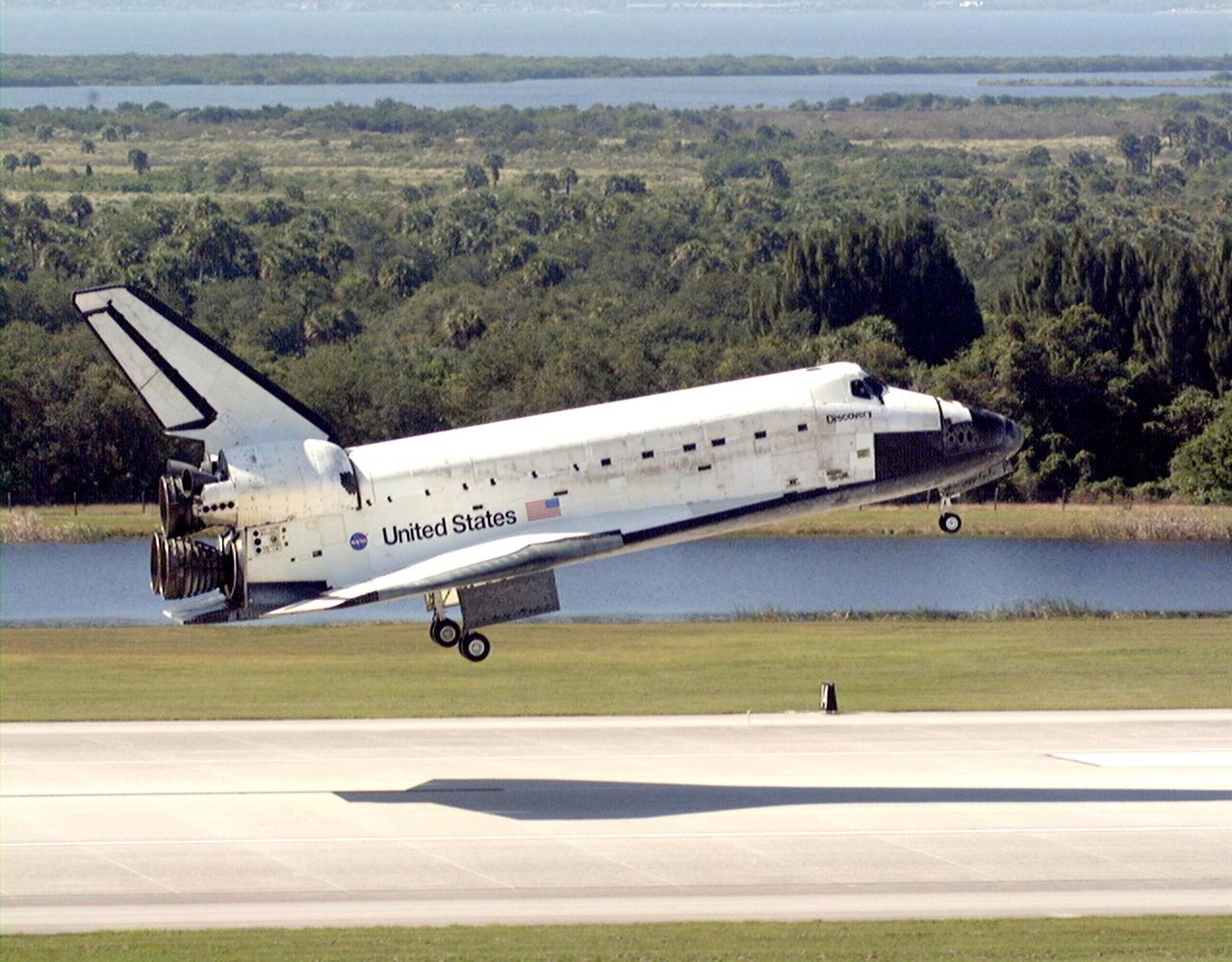
Orbiter Discovery gets ready to land on runway 33 at the Shuttle Landing Facility after a successful 3.6-million-mile voyage on mission STS-95
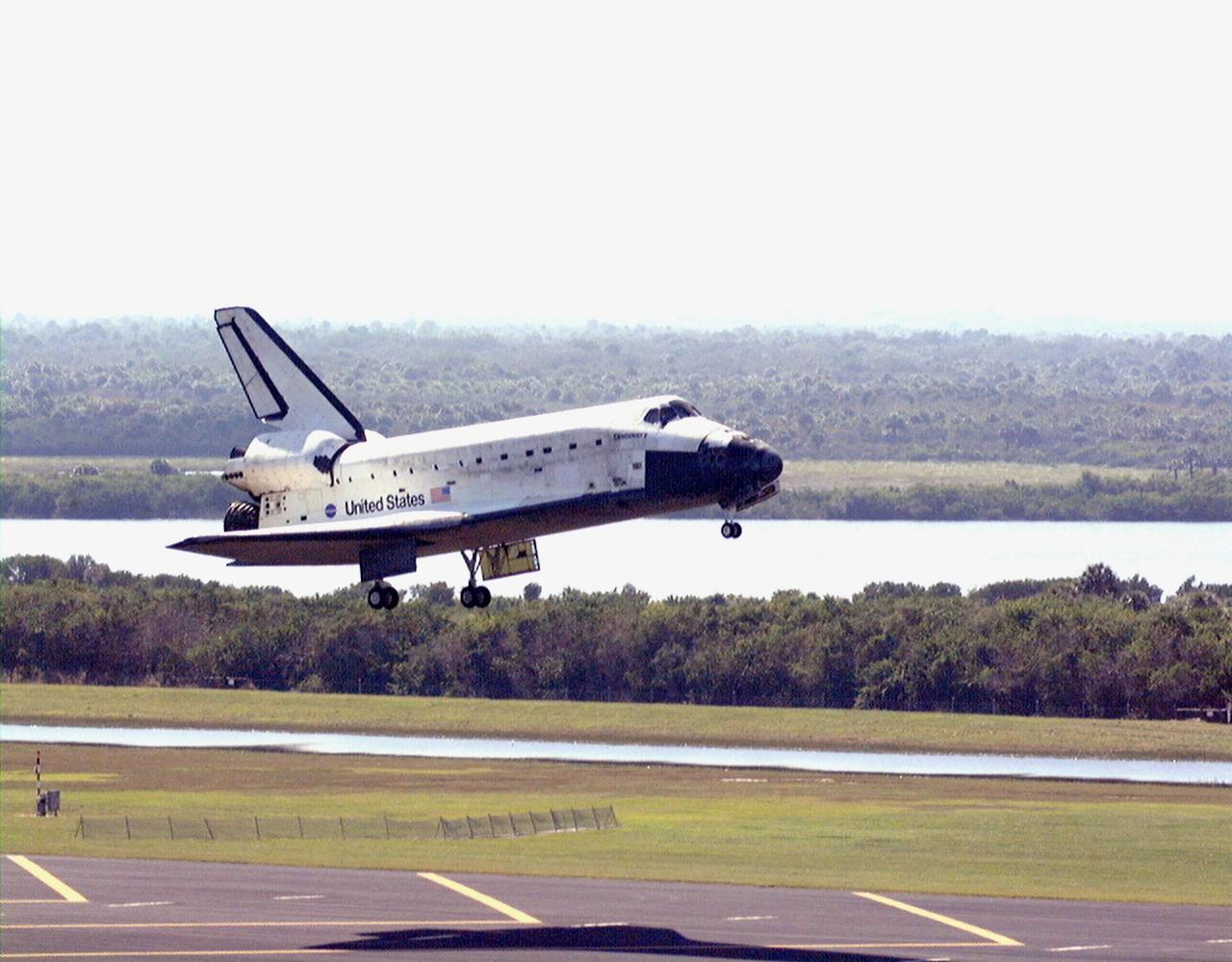
Orbiter Discovery approaches runway 33 at the Shuttle Landing Facility after a successful 3.6-million-mile voyage on mission STS-95
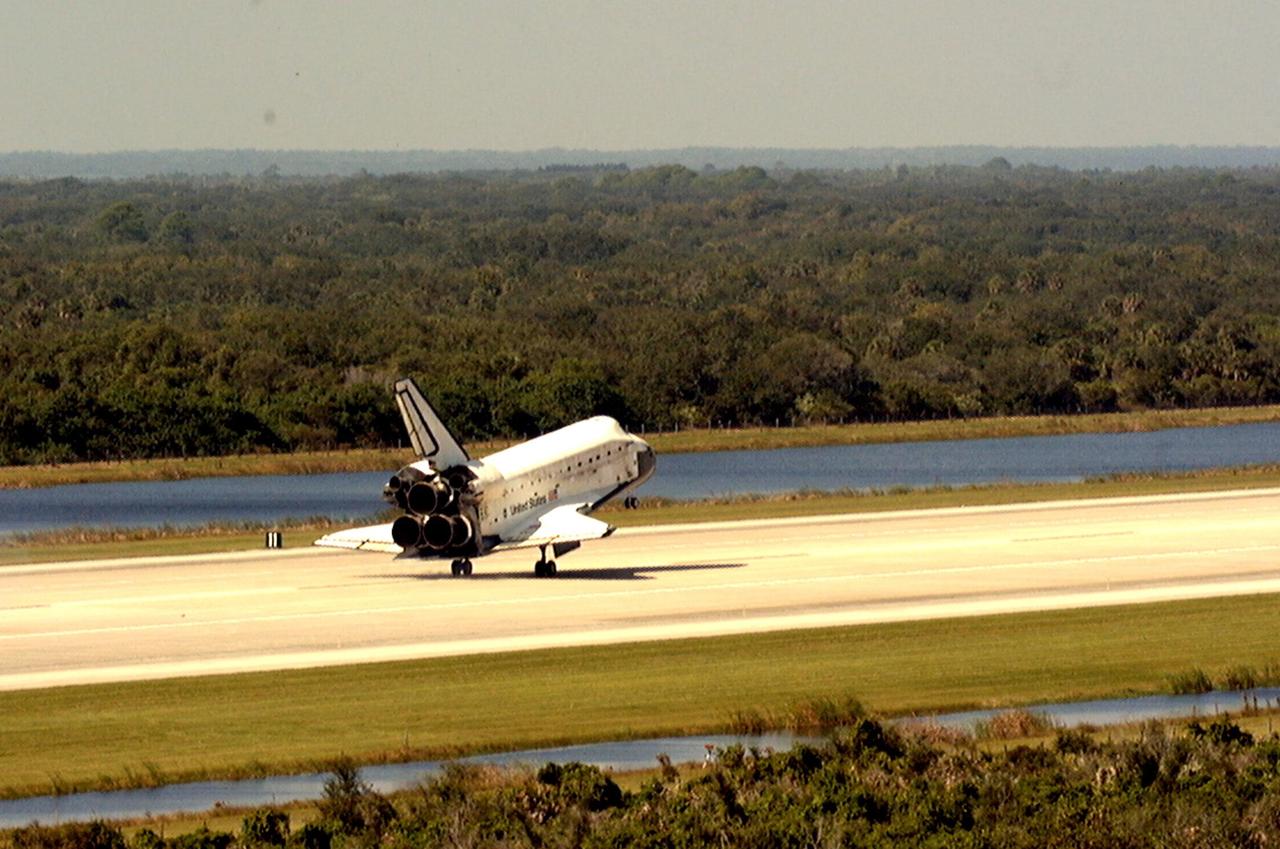
Orbiter Discovery touches down on runway 33 at the Shuttle Landing Facility after a successful 3.6-million-mile voyage on mission STS-95
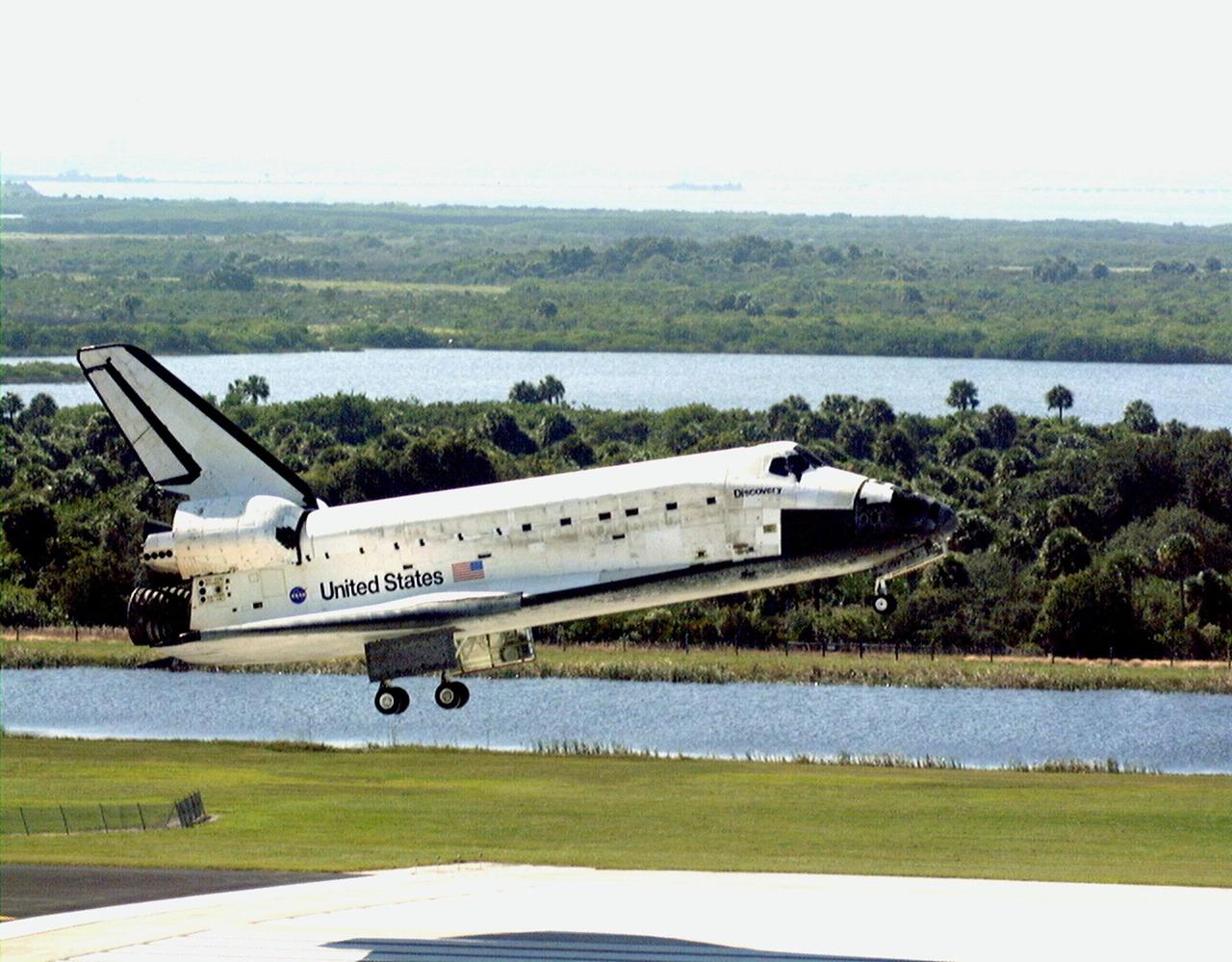
Orbiter Discovery gets ready to land on runway 33 at the Shuttle Landing Facility after a successful 3.6-million-mile voyage on mission STS-95
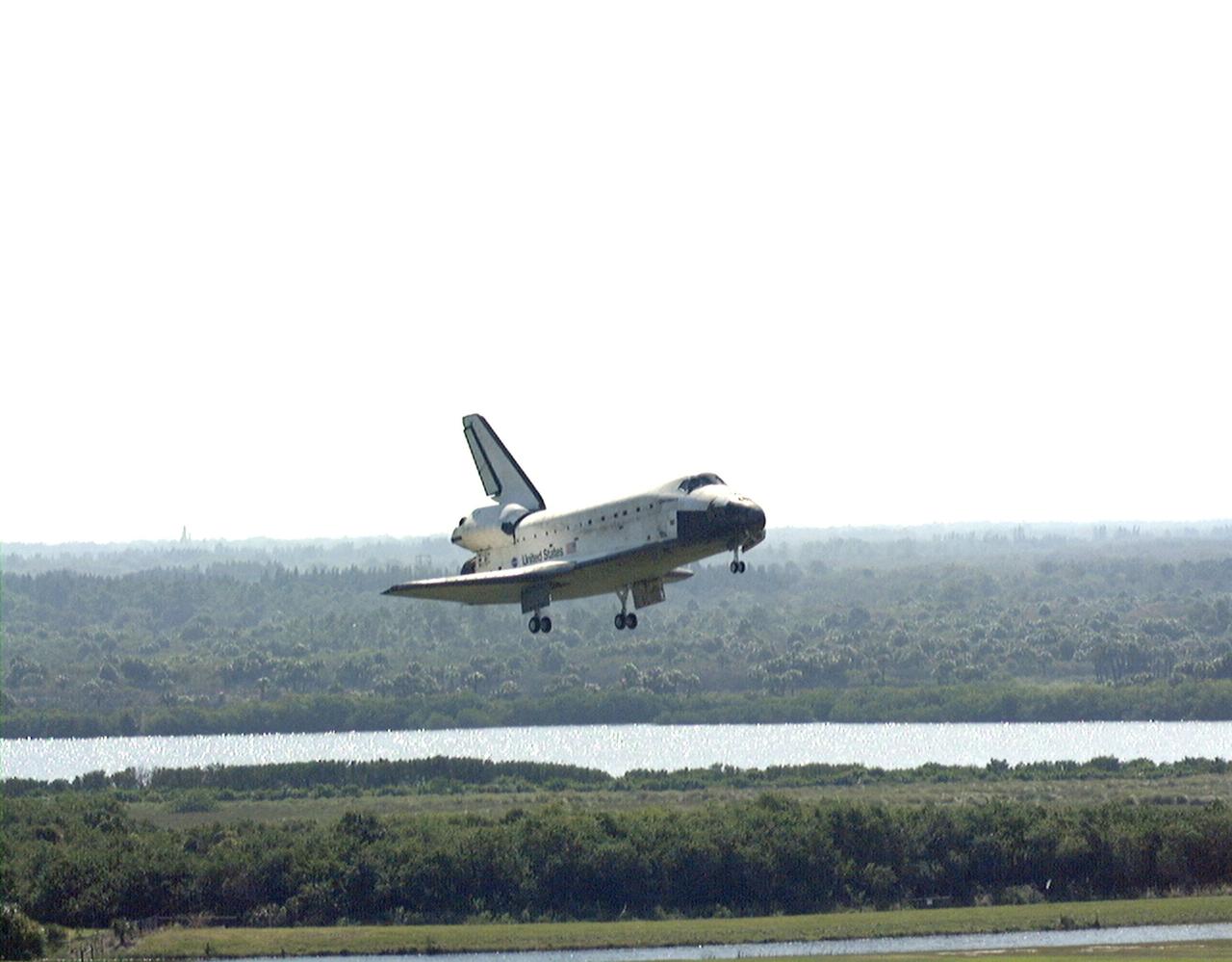
Orbiter Discovery approaches runway 33 at the Shuttle Landing Facility after a successful 3.6-million-mile voyage on mission STS-95
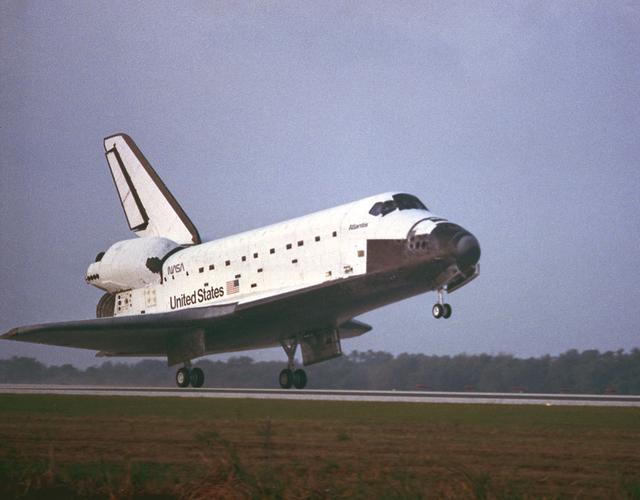
The orbiter Atlantis (STS-45) touched down on Runway 33 of Kennedy Space Center's Shuttle Landing Facility, bringing to a conclusion Mission STS-45. On board were seven crew members and the Atmospheric Lab for Applications and Sciences 1 (ATLAS-1).
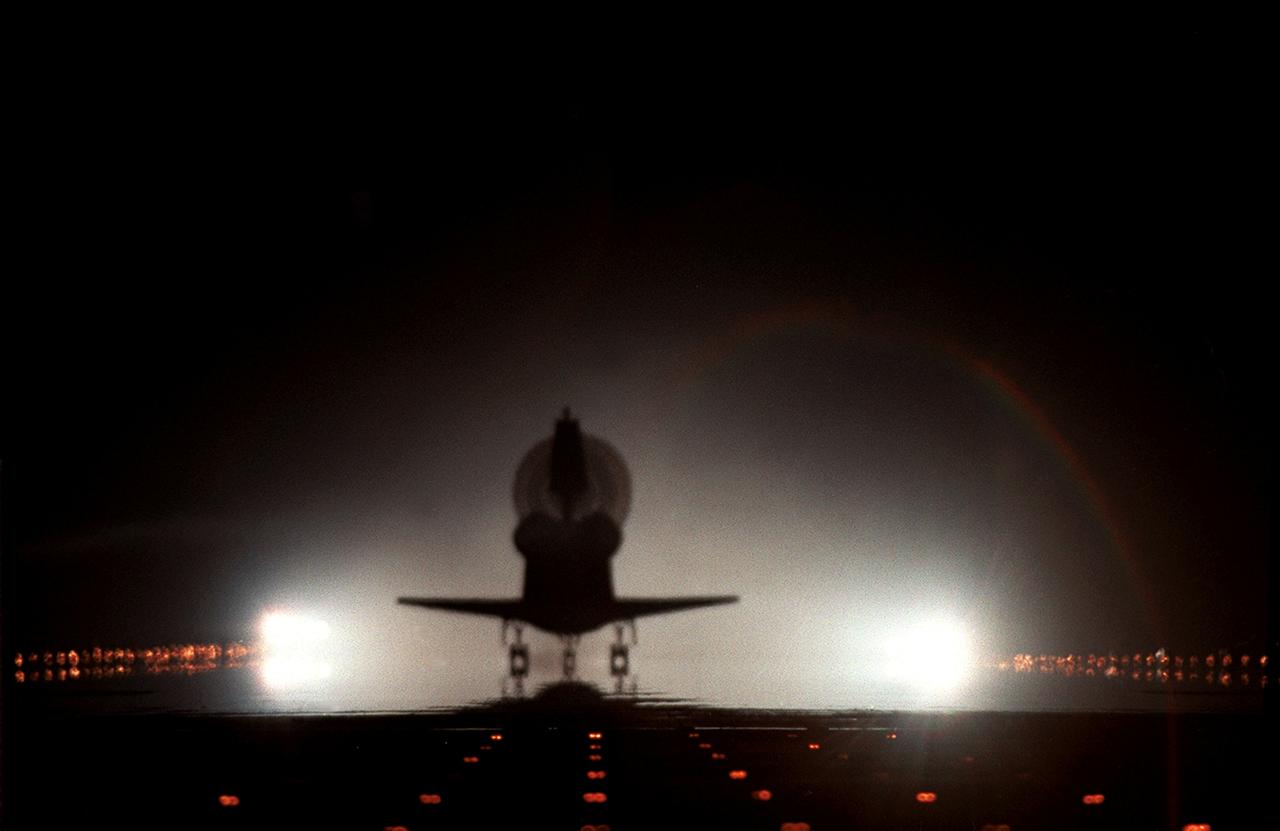
The Space Shuttle Columbia, with its crew of seven astronauts on board, touches down on Runway 33 of the KSC Shuttle Landing Facility, completing mission STS-109 to service the Hubble Space Telescope. Wheel stop occurred on orbit 165 at 4:33:09 a.m. EST with mission elapsed time of 10 days, 22 hours, 11 minutes. Main gear touchdown occurred at 4:31:52 a.m. and nose wheel touchdown an 4:32:02.
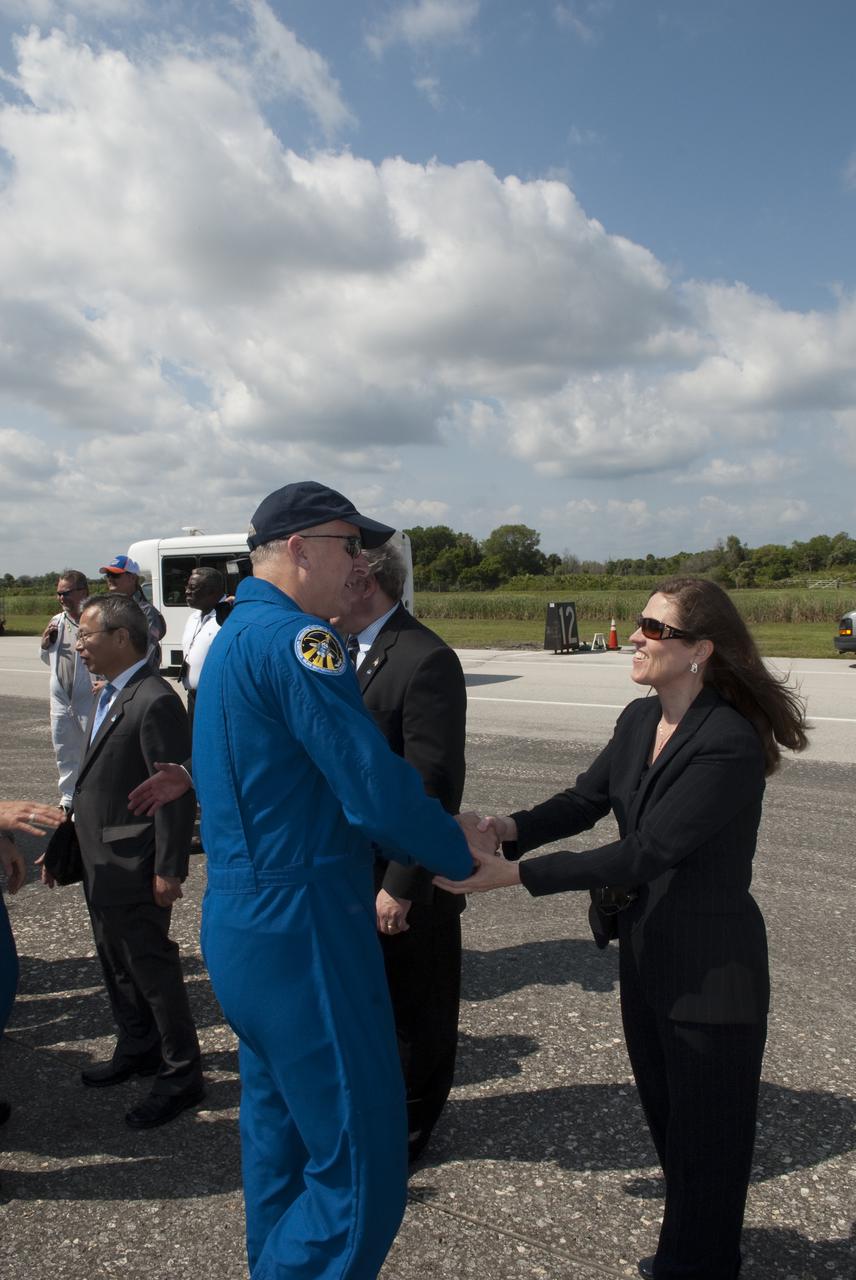
CAPE CANAVERAL, Fla. - At the Shuttle Landing Facility at NASA's Kennedy Space Center in Florida, Rita Willcoxon, director of Launch Vehicle Processing at Kennedy, welcomes STS-131 Commander Alan Poindexter back to Florida following the landing of space shuttle Discovery on Runway 33. Discovery landed on Runway 33 after 15 days in space, completing the more than 6.2-million-mile STS-131 mission on orbit 238. Main gear touchdown was at 9:08:35 a.m. EDT followed by nose gear touchdown at 9:08:47 a.m. and wheelstop at 9:09:33 a.m. The seven-member STS-131 crew carried the multi-purpose logistics module Leonardo, filled with supplies, a new crew sleeping quarters and science racks that were transferred to the International Space Station's laboratories. The crew also switched out a gyroscope on the station’s truss, installed a spare ammonia storage tank and retrieved a Japanese experiment from the station’s exterior. STS-131 is the 33rd shuttle mission to the station and the 131st shuttle mission overall. For information on the STS-131 mission and crew, visit http:__www.nasa.gov_mission_pages_shuttle_shuttlemissions_sts131_index.html. Photo credit: NASA_Jim Grossmann
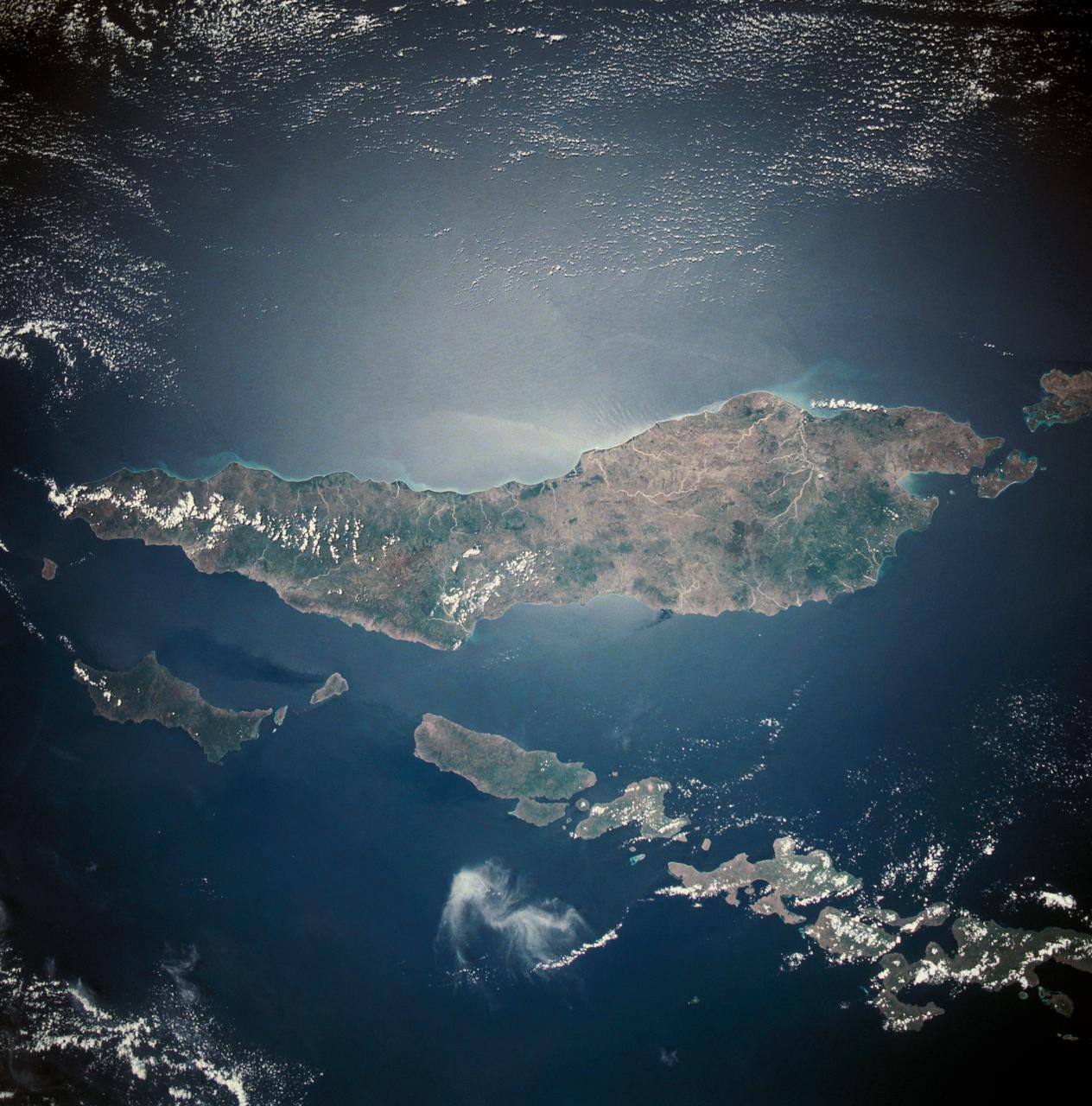
This almost totally cloud free, photo of the island of Timor, Indonesia (9.0S, 125.0E) illustrates the volcanic origin of the over 1500 islands of Indonesia. Close examination of the photo reveals several eroded volcanoes on the Island of Timor and several of the adjacent islands. The linear alignment of the volcanoes, as seen from space, indicates the edges of the tectonic plates of the Earth's crust where volcanic activity is most common.
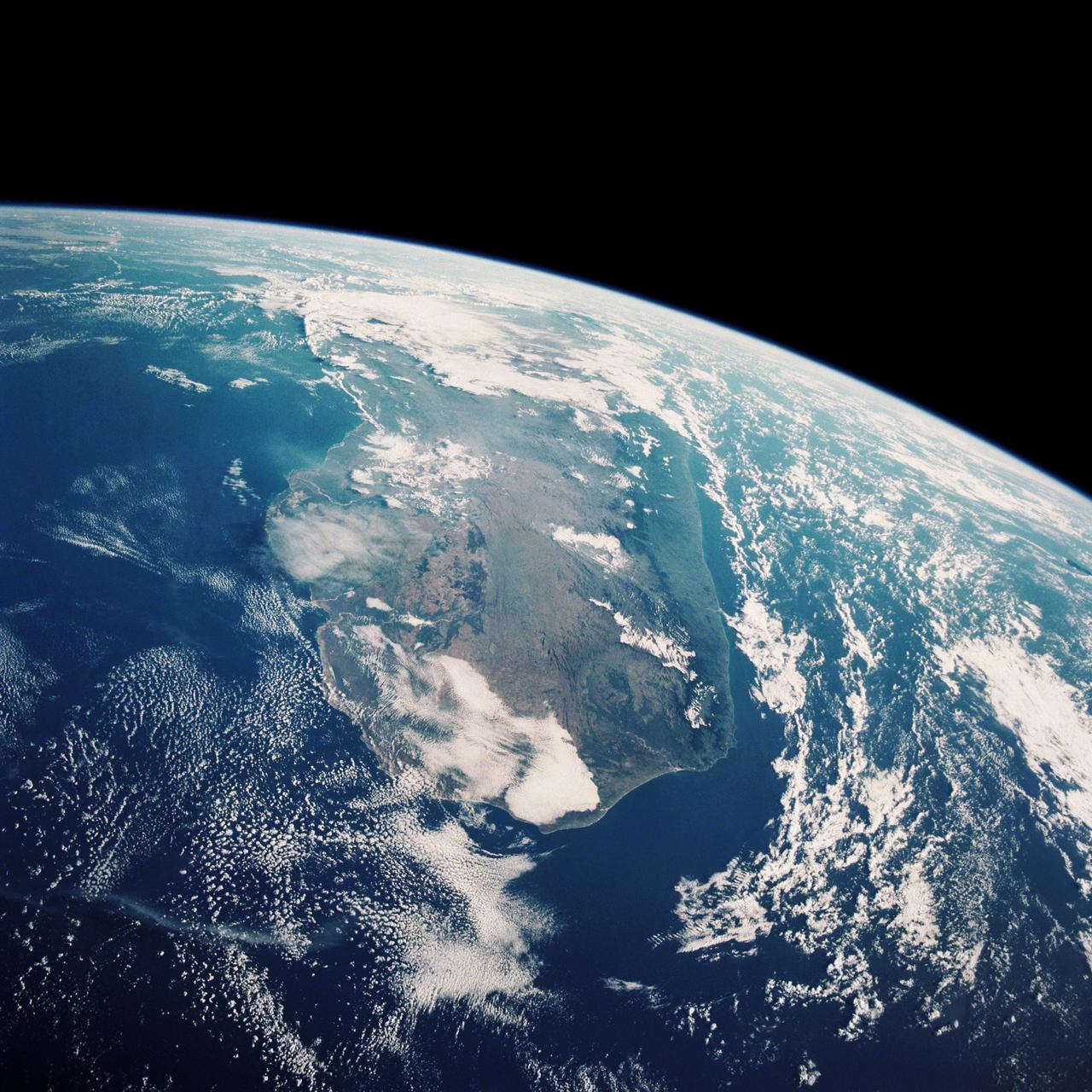
STS033-82-103 (22-27 Nov. 1989) --- This oblique view of the southern half of Madagascar was taken by the crew members of the Space Shuttle Discovery as they orbited Earth at an altitude of 289 nautical miles.
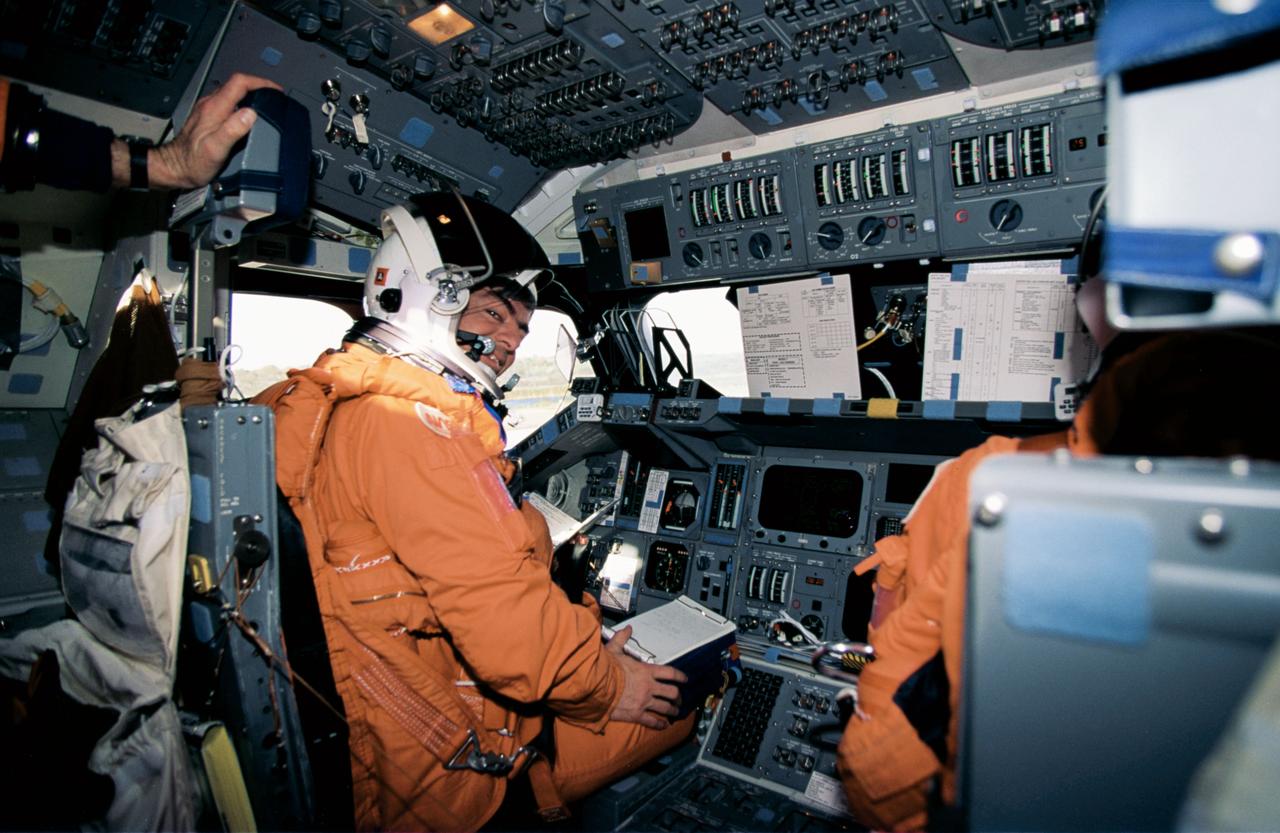
STS075-303-007 (9 March 1996) --- Astronauts Andrew M. Allen (left), mission commander, and Scott J. Horowitz (partially visible at right), pilot, have just completed the landing phase of the STS-75 flight. The Space Shuttle Columbia is now securely on Runway 33 at the Kennedy Space Center (KSC).
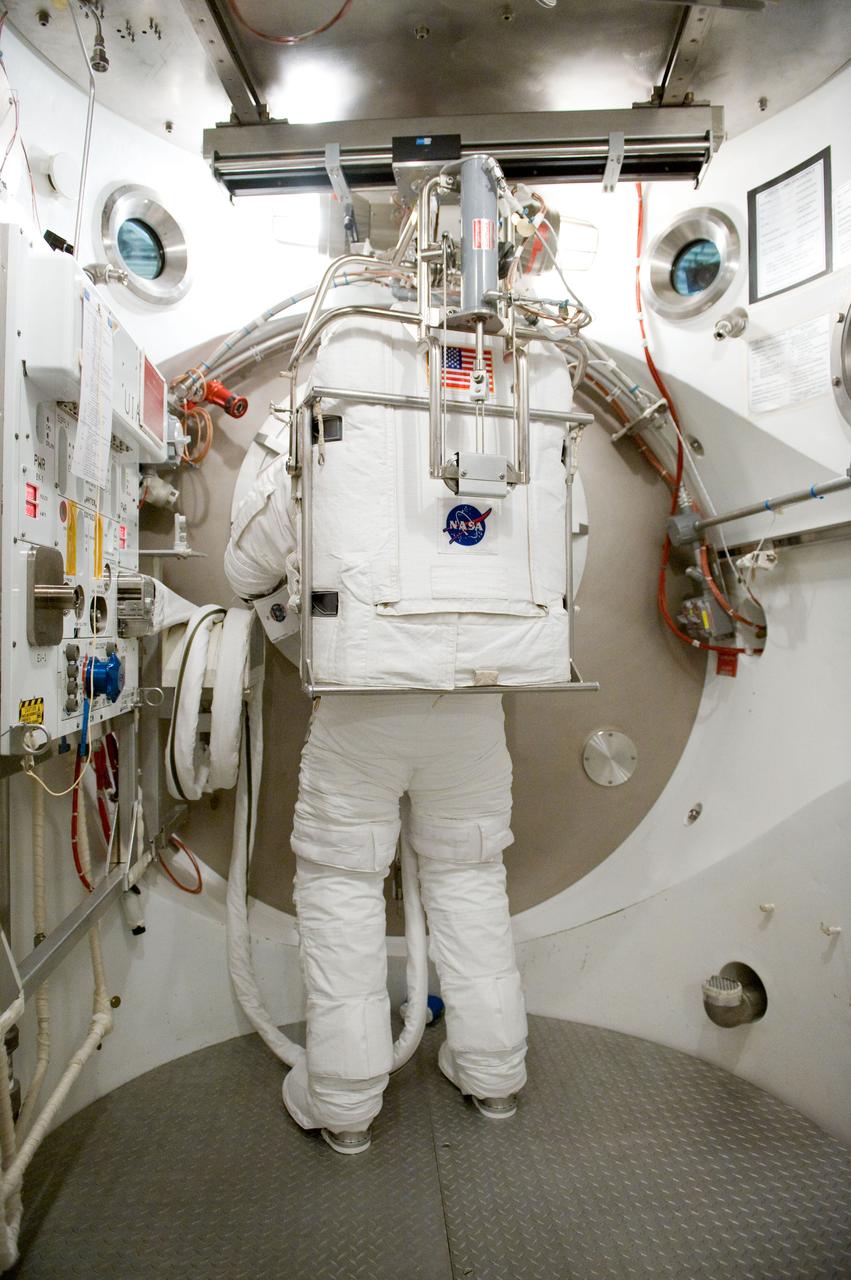
PHOTO DATE: 31 July 2012 LOCATION: Bldg. 7, SSATA Chamber SUBJECT: Expedition 33/34 Canadian astronaut and crew member Chris Hadfield during SSATA EMU training and certification - Dry Run. TD: Cristina Anchondo and Joel Maganza. STB-ST-963 PHOTOGRAPHER: Mark Sowa
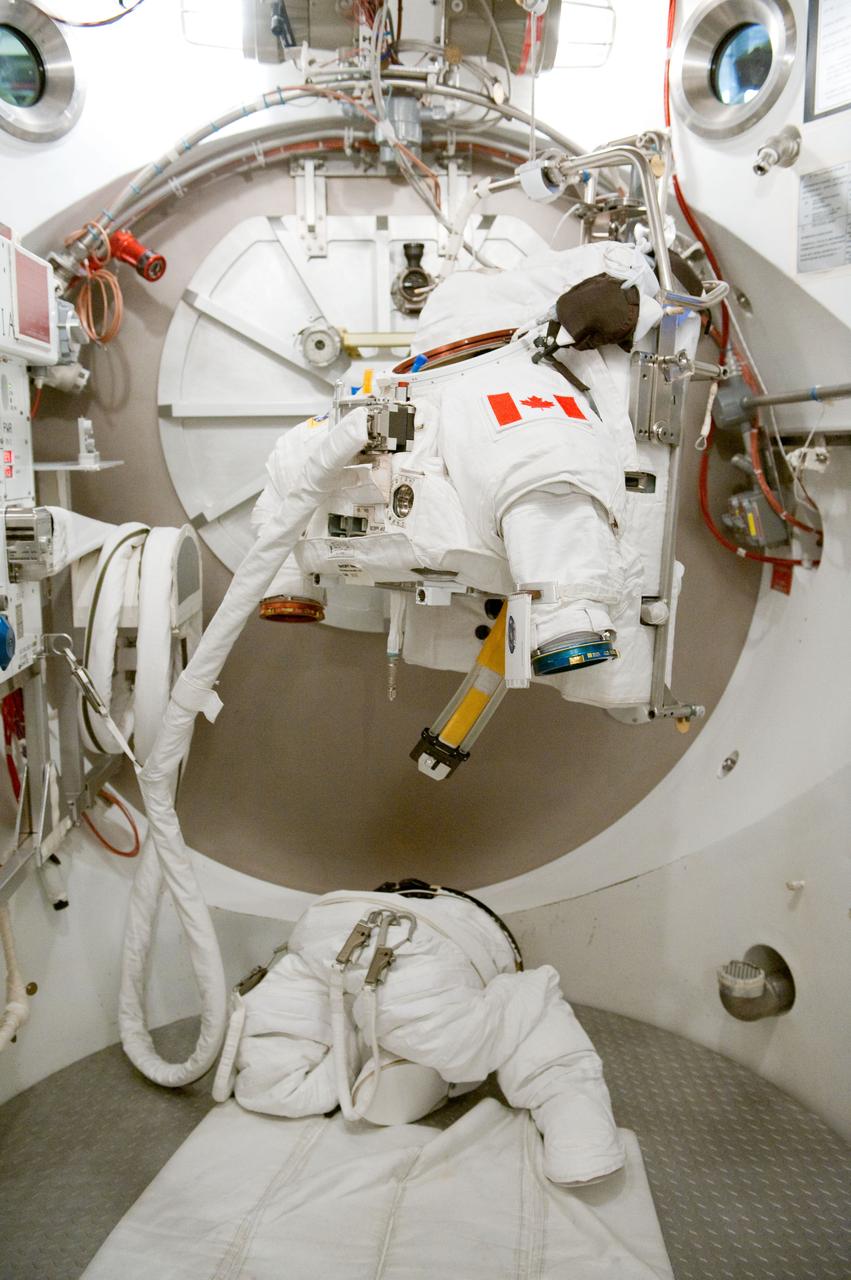
PHOTO DATE: 31 July 2012 LOCATION: Bldg. 7, SSATA Chamber SUBJECT: Expedition 33/34 Canadian astronaut and crew member Chris Hadfield during SSATA EMU training and certification - Dry Run. TD: Cristina Anchondo and Joel Maganza. STB-ST-963 PHOTOGRAPHER: Mark Sowa
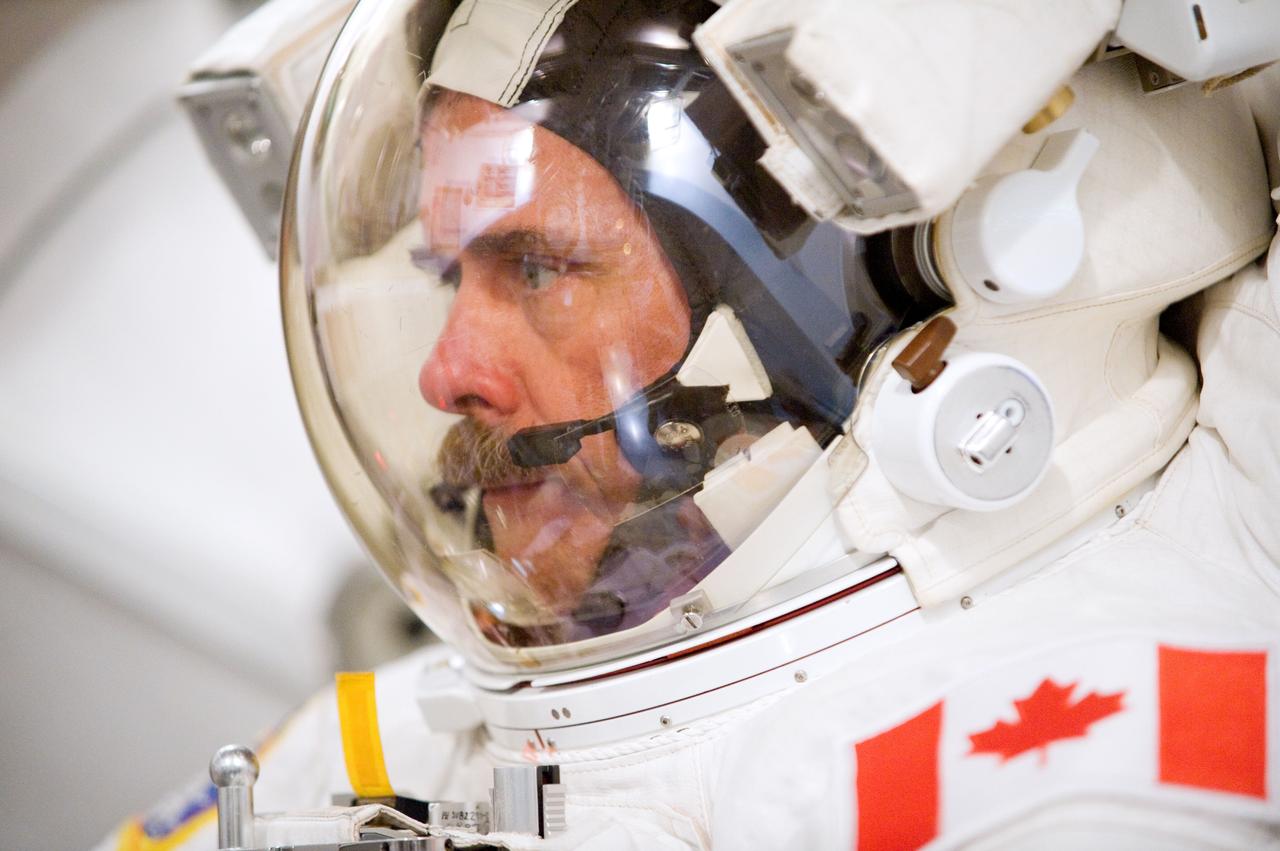
PHOTO DATE: 31 July 2012 LOCATION: Bldg. 7, SSATA Chamber SUBJECT: Expedition 33/34 Canadian astronaut and crew member Chris Hadfield during SSATA EMU training and certification - Dry Run. TD: Cristina Anchondo and Joel Maganza. STB-ST-963 PHOTOGRAPHER: Mark Sowa
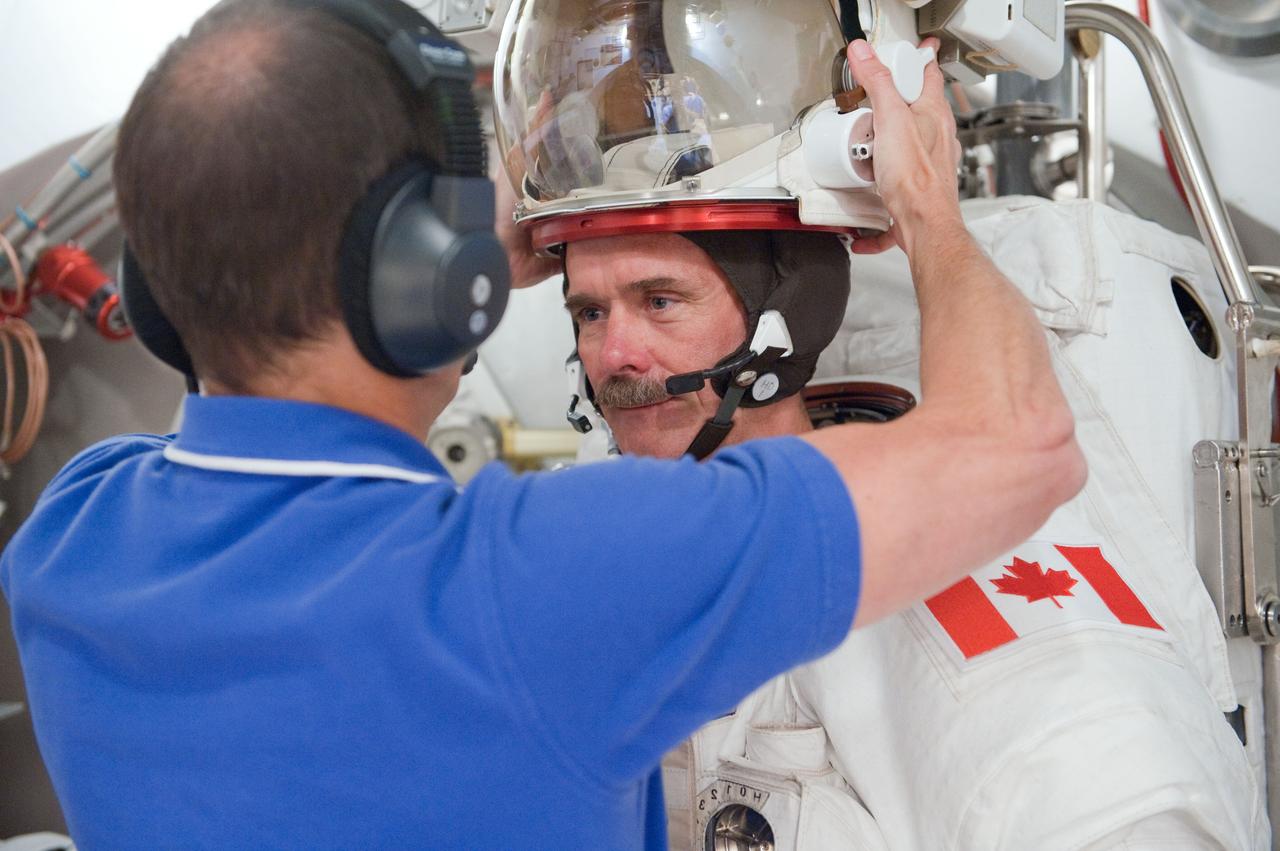
PHOTO DATE: 31 July 2012 LOCATION: Bldg. 7, SSATA Chamber SUBJECT: Expedition 33/34 Canadian astronaut and crew member Chris Hadfield during SSATA EMU training and certification - Dry Run. TD: Cristina Anchondo and Joel Maganza. STB-ST-963 PHOTOGRAPHER: Mark Sowa
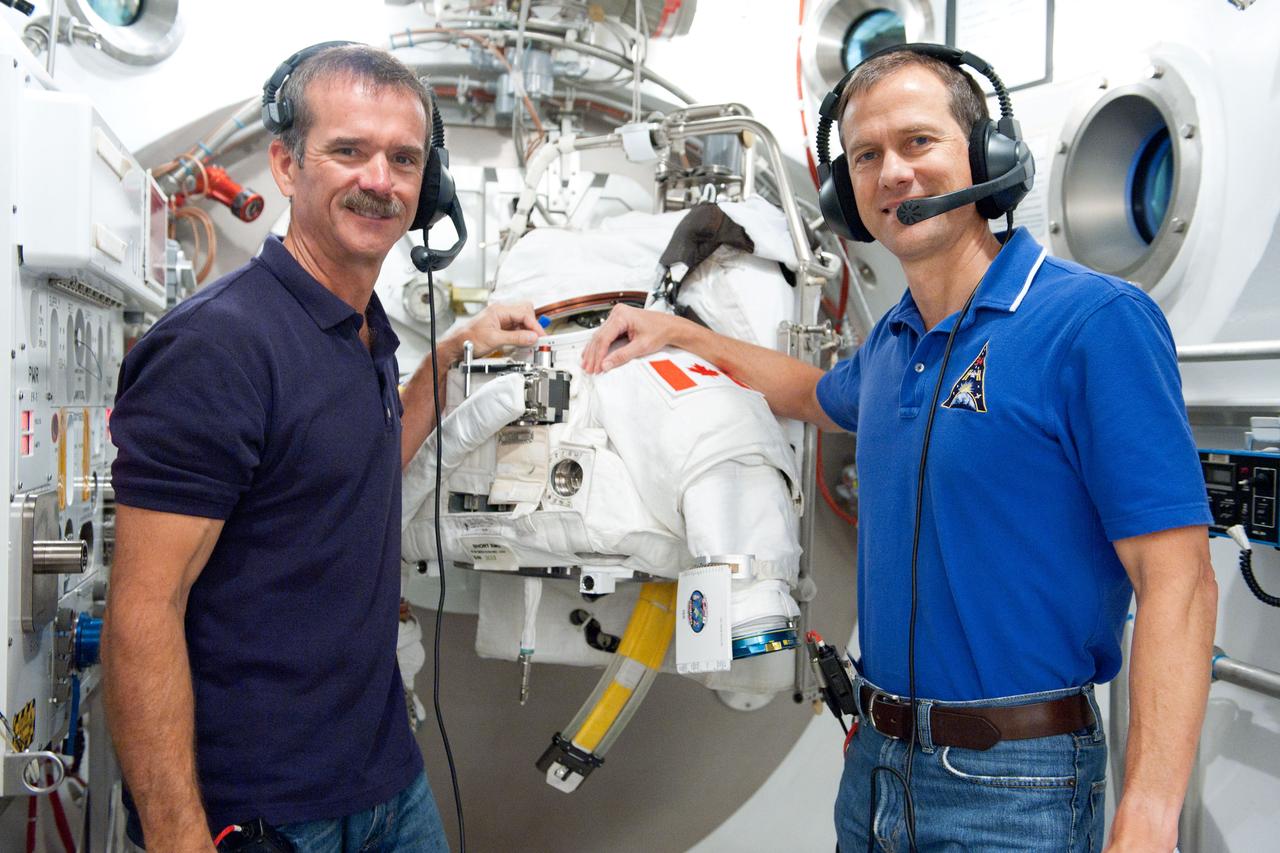
PHOTO DATE: 31 July 2012 LOCATION: Bldg. 7, SSATA Chamber SUBJECT: Expedition 33/34 Canadian astronaut and crew member Chris Hadfield during SSATA EMU training and certification - Dry Run. TD: Cristina Anchondo and Joel Maganza. STB-ST-963 PHOTOGRAPHER: Mark Sowa
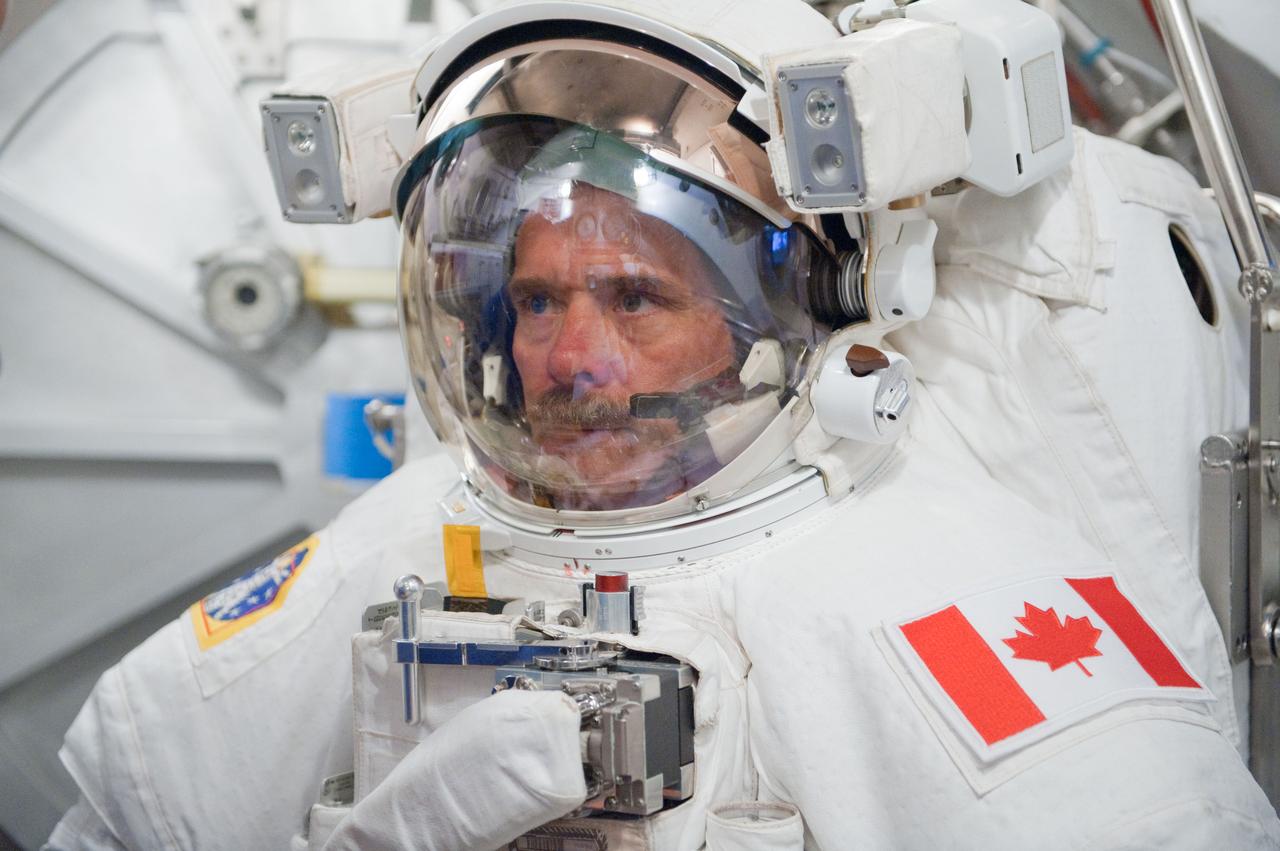
PHOTO DATE: 31 July 2012 LOCATION: Bldg. 7, SSATA Chamber SUBJECT: Expedition 33/34 Canadian astronaut and crew member Chris Hadfield during SSATA EMU training and certification - Dry Run. TD: Cristina Anchondo and Joel Maganza. STB-ST-963 PHOTOGRAPHER: Mark Sowa
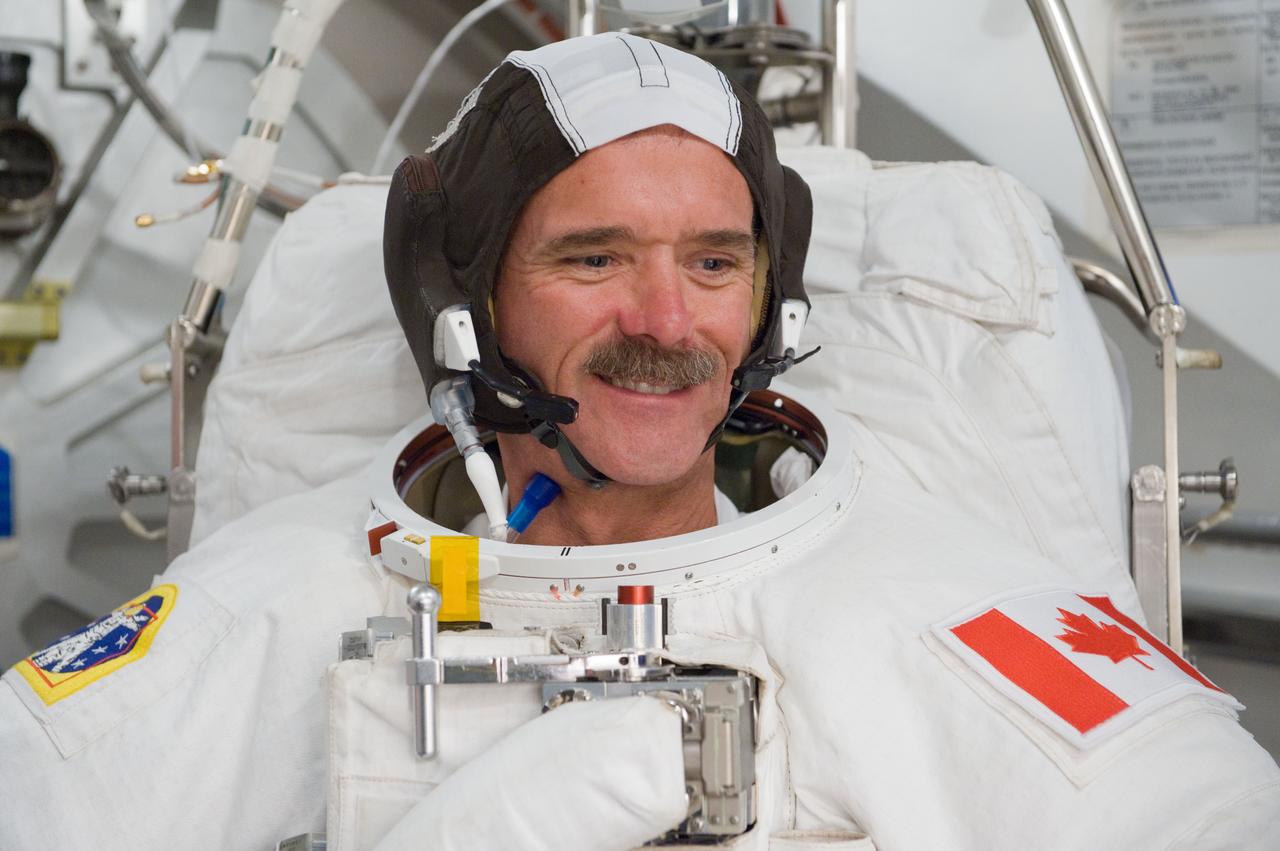
PHOTO DATE: 31 July 2012 LOCATION: Bldg. 7, SSATA Chamber SUBJECT: Expedition 33/34 Canadian astronaut and crew member Chris Hadfield during SSATA EMU training and certification - Dry Run. TD: Cristina Anchondo and Joel Maganza. STB-ST-963 PHOTOGRAPHER: Mark Sowa
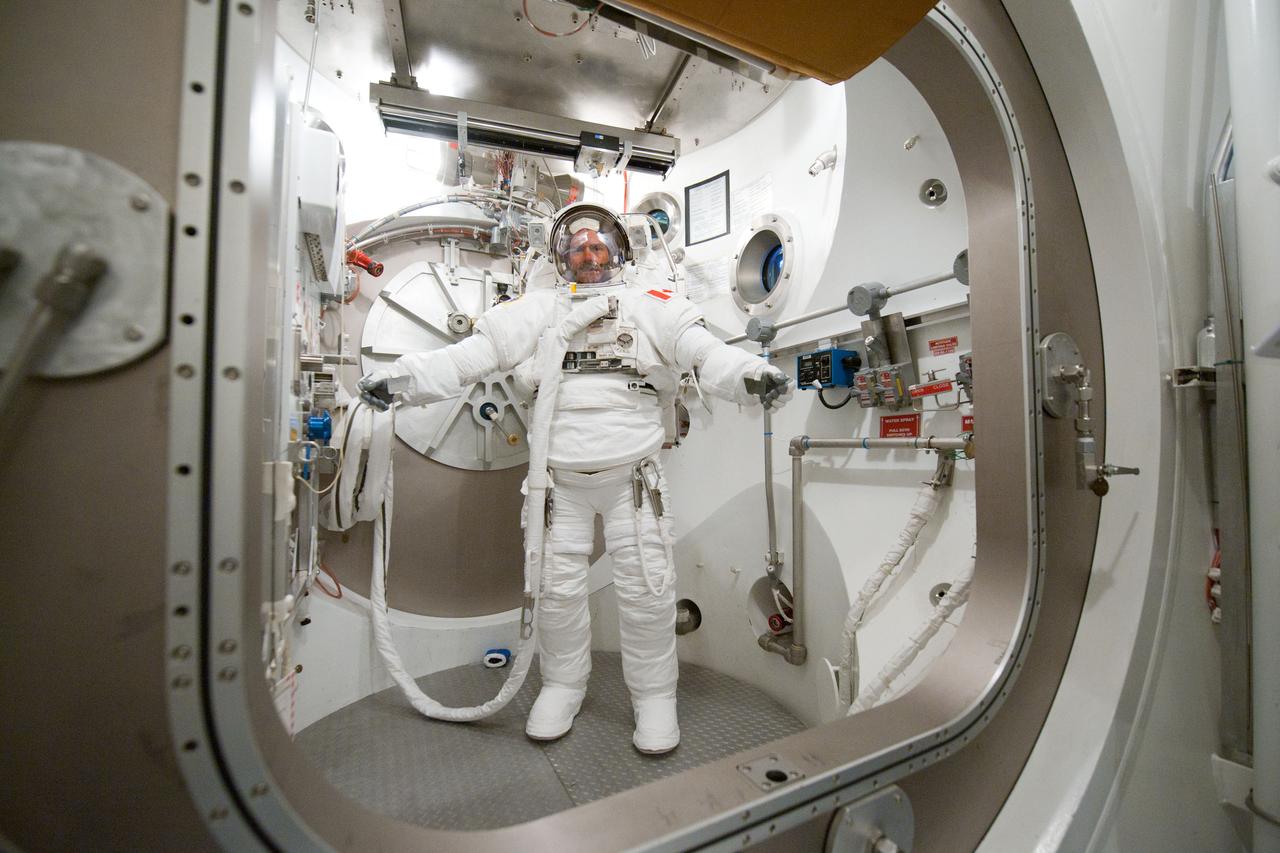
PHOTO DATE: 31 July 2012 LOCATION: Bldg. 7, SSATA Chamber SUBJECT: Expedition 33/34 Canadian astronaut and crew member Chris Hadfield during SSATA EMU training and certification - Dry Run. TD: Cristina Anchondo and Joel Maganza. STB-ST-963 PHOTOGRAPHER: Mark Sowa
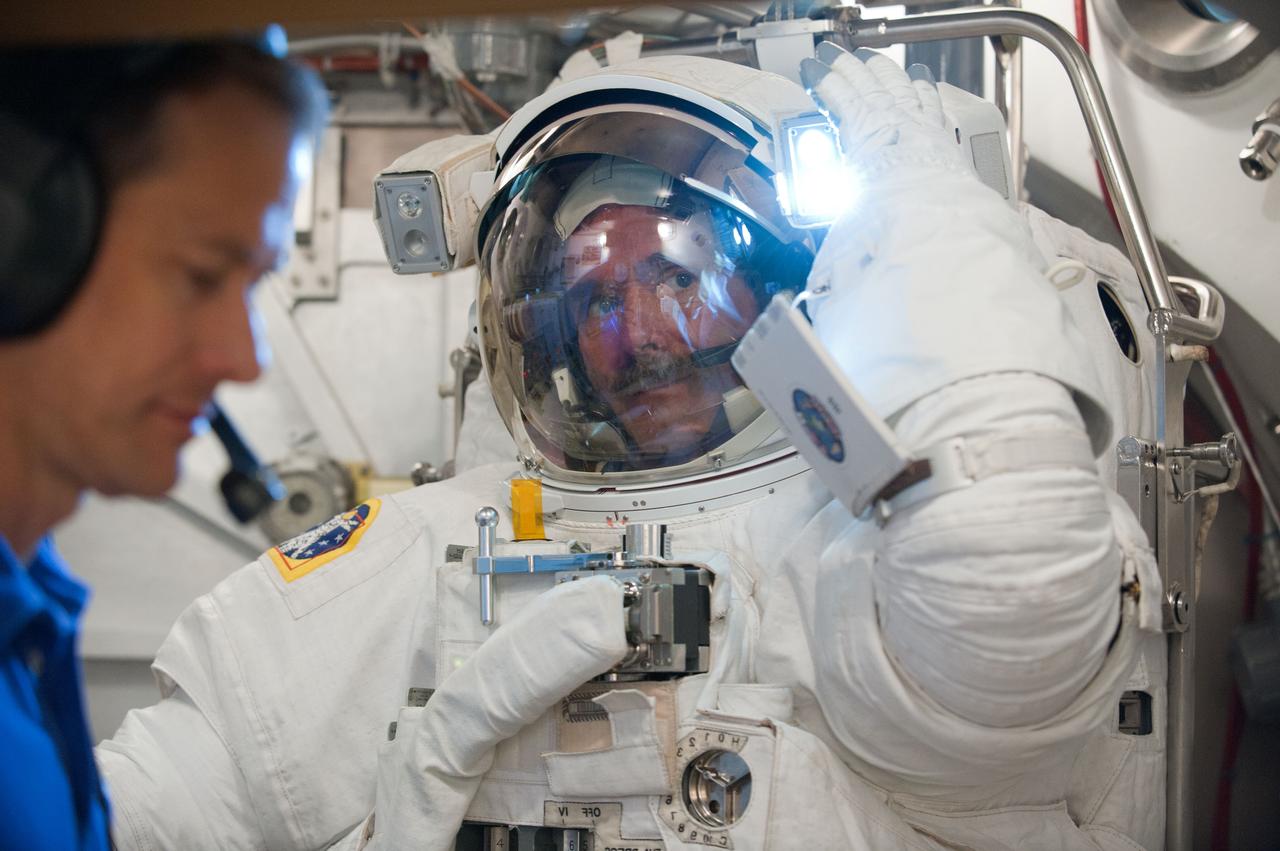
PHOTO DATE: 31 July 2012 LOCATION: Bldg. 7, SSATA Chamber SUBJECT: Expedition 33/34 Canadian astronaut and crew member Chris Hadfield during SSATA EMU training and certification - Dry Run. TD: Cristina Anchondo and Joel Maganza. STB-ST-963 PHOTOGRAPHER: Mark Sowa
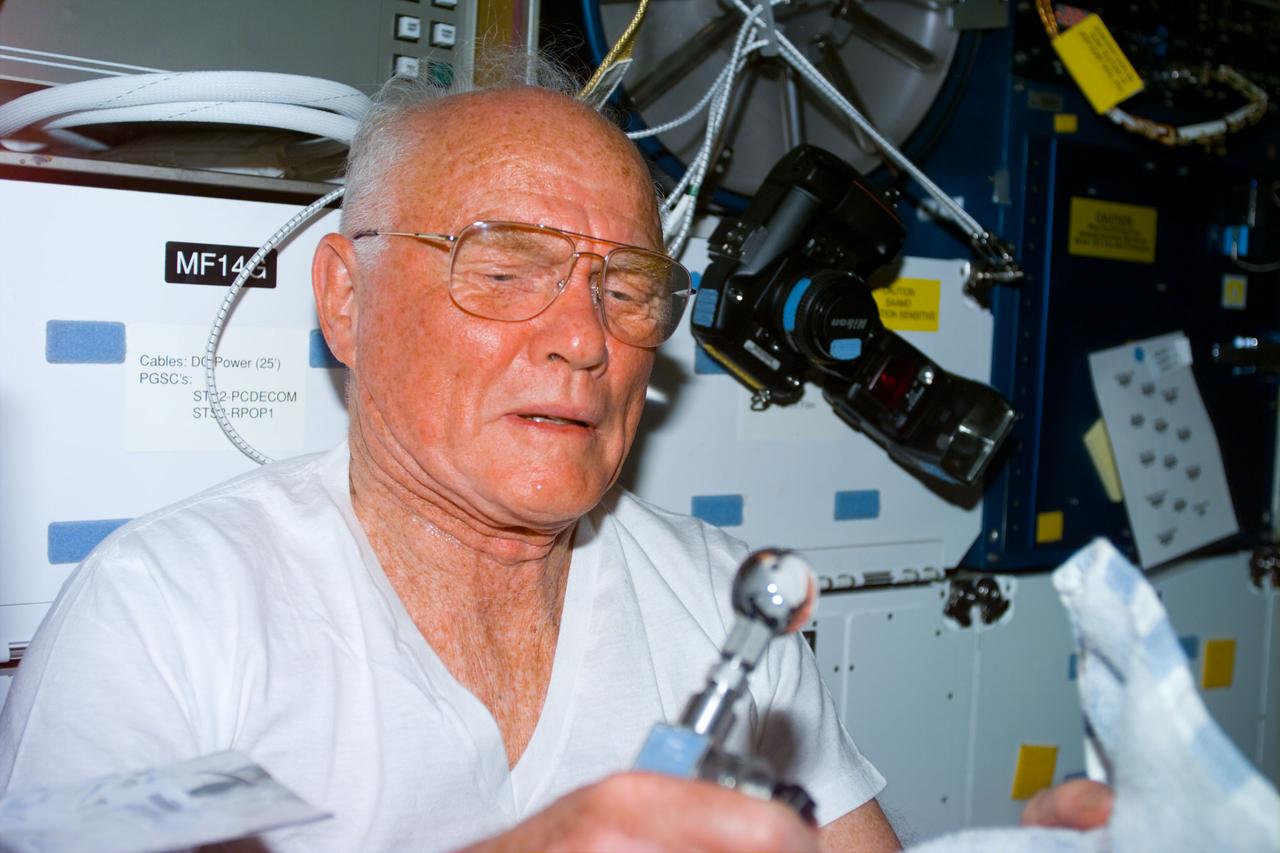
STS095-E-5195 (31 Oct. 1998) --- U.S. Sen. John H. Glenn Jr., STS-95 payload specialist, is pictured with a water dispenser on Discovery's middeck during Flight Day two activity. The photo was taken with an electronic still camera (ESC) at 07:09:33 GMT, Oct. 31.

PHOTO DATE: 31 July 2012 LOCATION: Bldg. 7, SSATA Chamber SUBJECT: Expedition 33/34 Canadian astronaut and crew member Chris Hadfield during SSATA EMU training and certification - Dry Run. TD: Cristina Anchondo and Joel Maganza. STB-ST-963 PHOTOGRAPHER: Mark Sowa
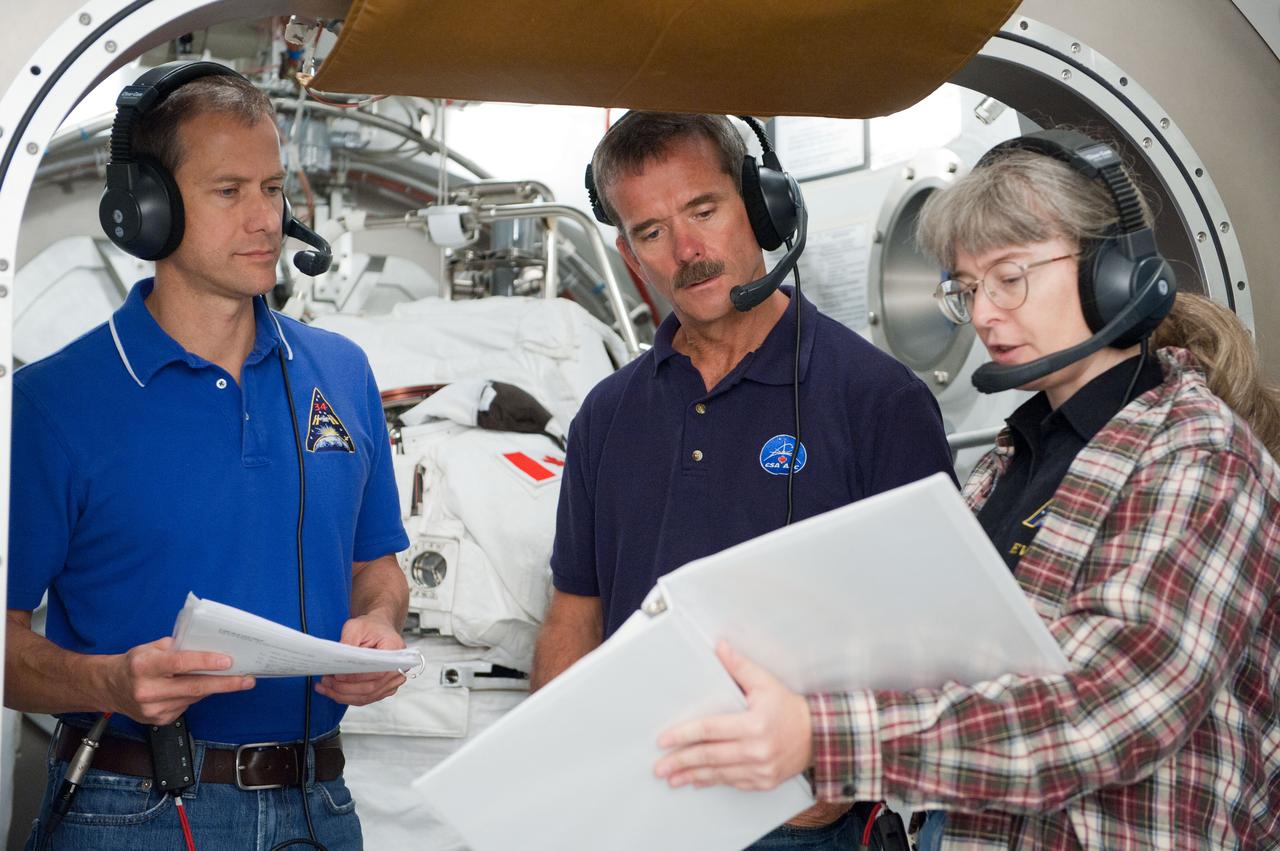
PHOTO DATE: 31 July 2012 LOCATION: Bldg. 7, SSATA Chamber SUBJECT: Expedition 33/34 Canadian astronaut and crew member Chris Hadfield during SSATA EMU training and certification - Dry Run. TD: Cristina Anchondo and Joel Maganza. STB-ST-963 PHOTOGRAPHER: Mark Sowa
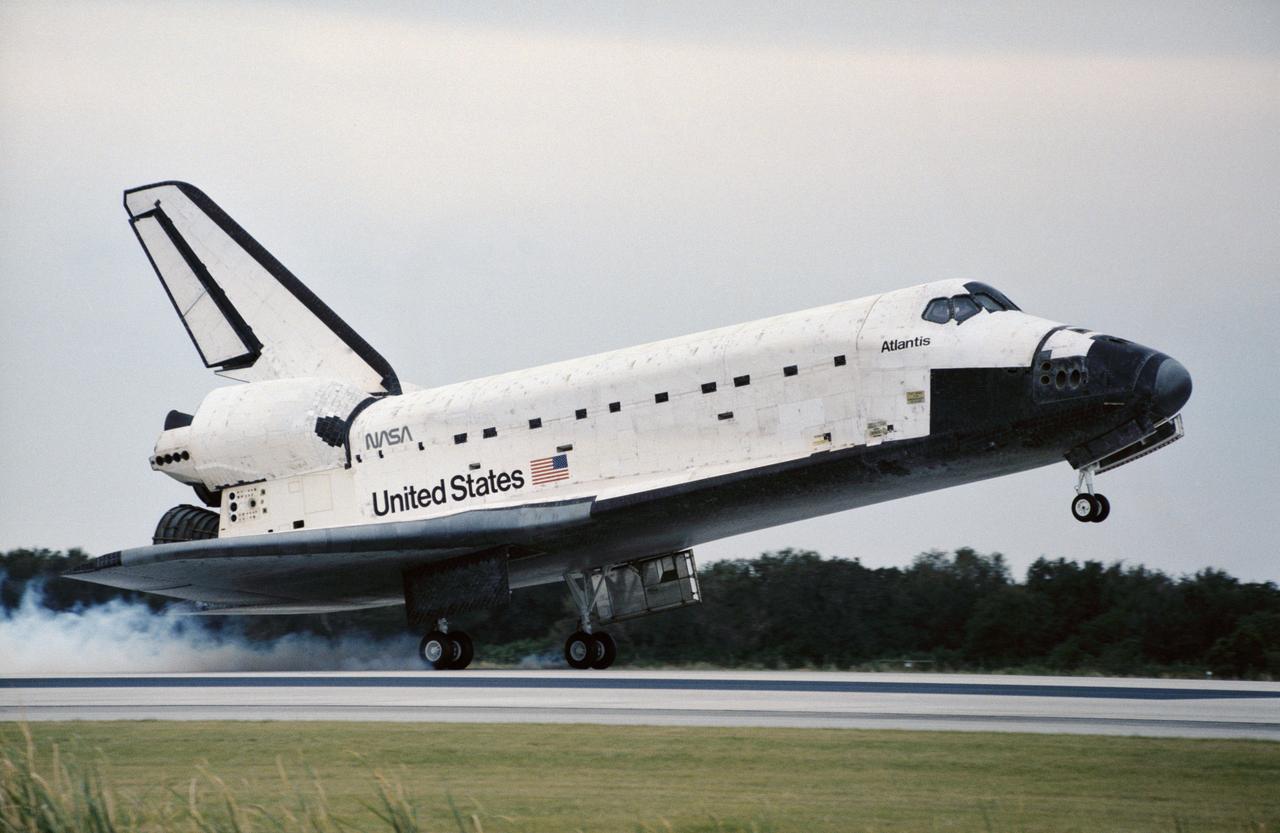
STS074-S-025 (20 Nov 1995) --- The Space Shuttle Atlantis touches down on Runway 33 of Kennedy Space Center?s (KSC) Shuttle Landing Facility, completing its STS-74 mission. The spacecraft touched down at 12:01:27 p.m. (EST), November 20, 1995.
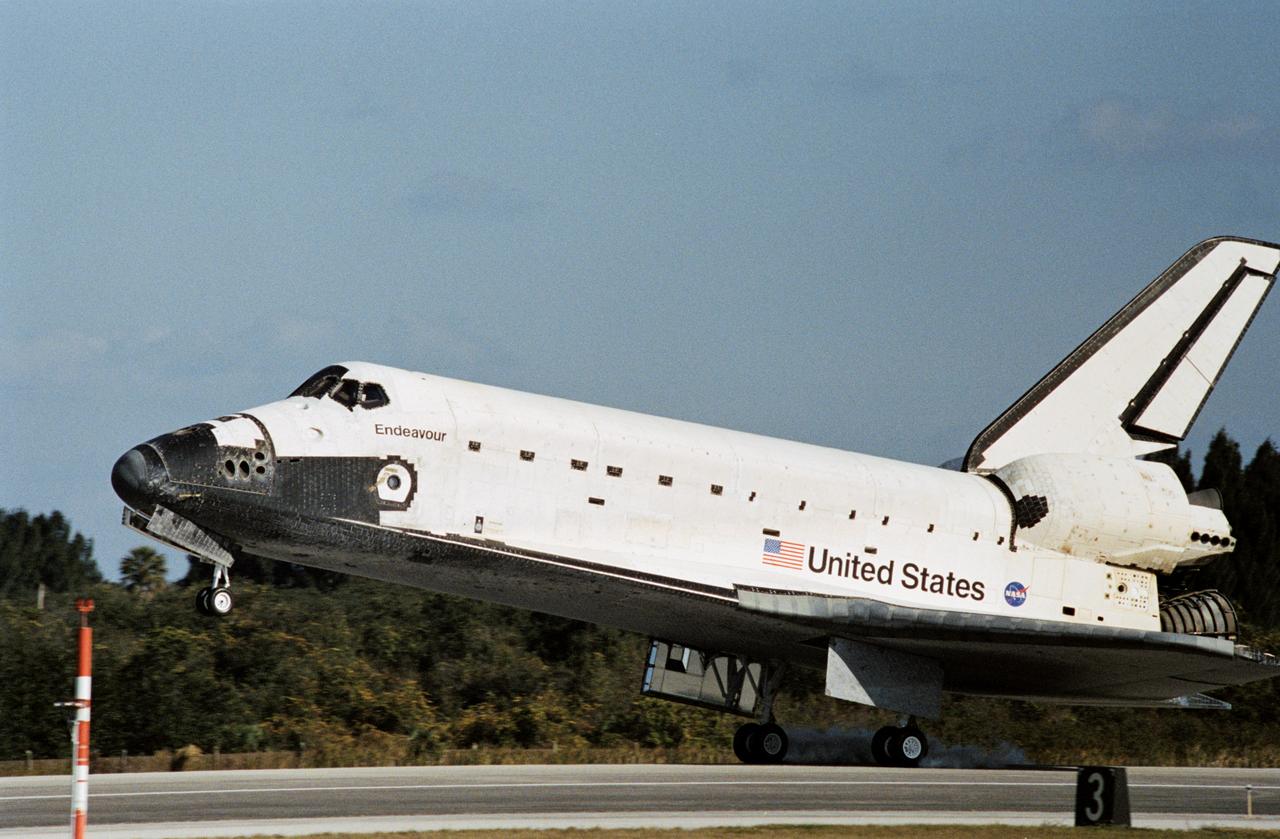
STS113-S-041 (7 December 2002) --- The main landing gear of Space Shuttle Endeavour touches down on runway 33 at the KSC landing facility, completing the nearly 14-day STS-113 mission to the International Space Station (ISS). Astronaut James D. Wetherbee, mission commander, eased Endeavour to a textbook landing on runway 33 at the Florida spaceport at 2:37 p.m. (EST) on December 7, 2002. The landing completed a 5.74-million mile mission that saw successful delivery and installation of the Port One (P1) truss on the orbital outpost.
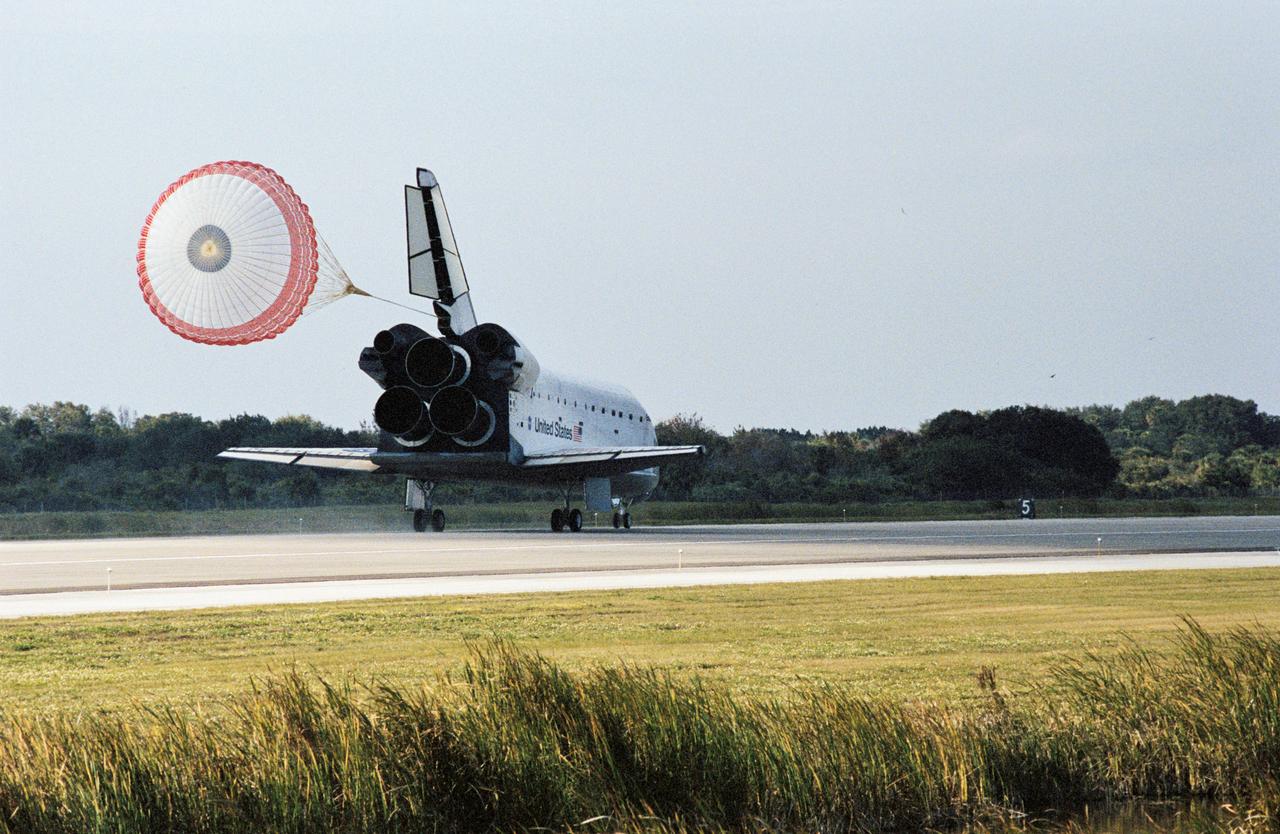
STS113-S-043 (7 December 2002) --- The drag chute on the Space Shuttle Endeavour deploys to slow down the spacecraft during landing on runway 33 at the KSC landing facility, completing the nearly 14-day STS-113 mission to the International Space Station (ISS). Astronaut James D. Wetherbee, mission commander, eased Endeavour to a textbook landing on runway 33 at the Florida spaceport at 2:37 p.m. (EST) on December 7, 2002. The landing completed a 5.74-million mile mission that saw successful delivery and installation of the Port One (P1) truss on the orbital outpost.
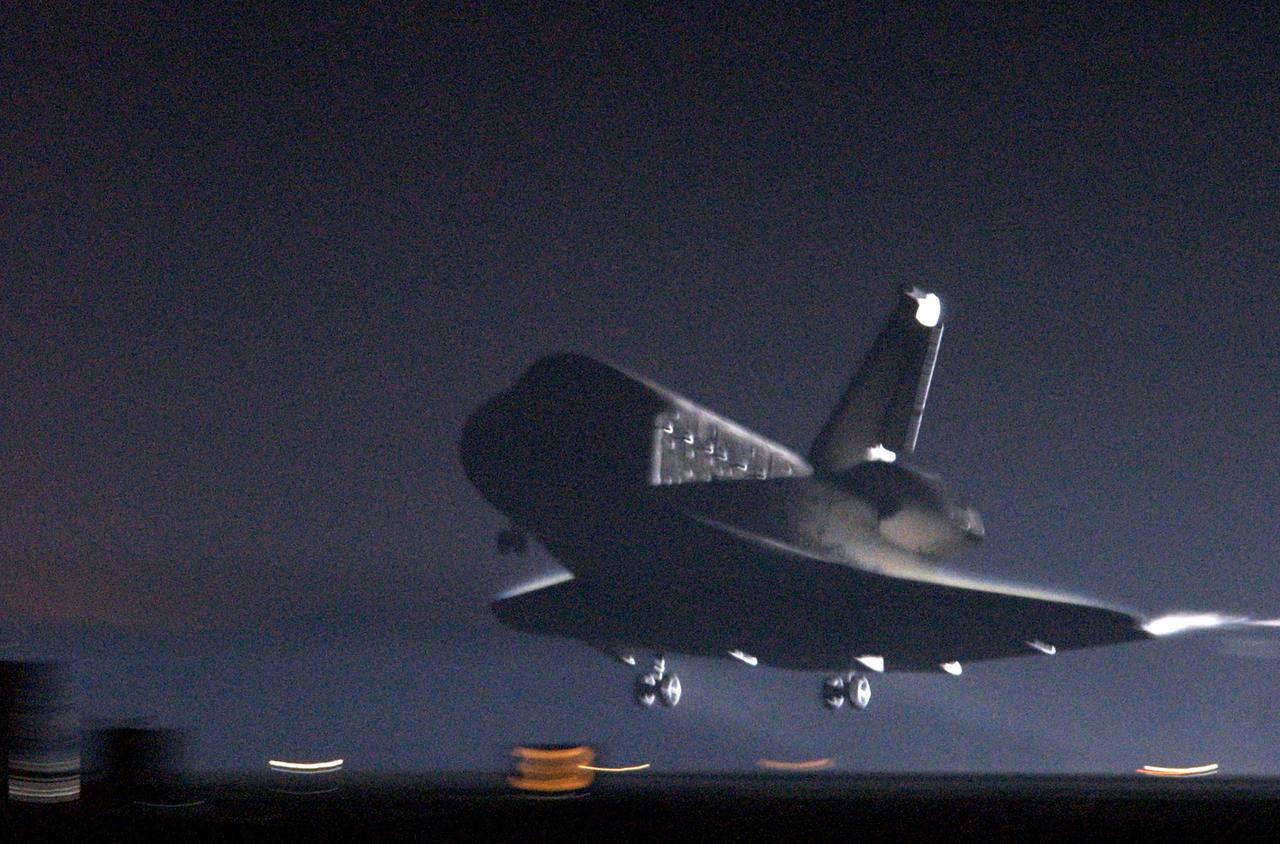
KENNEDY SPACE CENTER, FLA. -- Powerful xenon lights on the Shuttle Landing Facility outline the dark image of orbiter Columbia as it approaches touchdown on Runway 33. The landing completes mission STS-109 to service the Hubble Space Telescope, returning the crew of seven to Earth after a mission elapsed time of 10 days, 22 hours, 11 minutes. Wheel stop occurred on orbit 165 at 4:33:09 a.m. EST. Main gear touchdown occurred at 4:31:52 a.m. and nose wheel touchdown an 4:32:02. It was the 58th landing at KSC out of 108 missions in the history of the Shuttle program
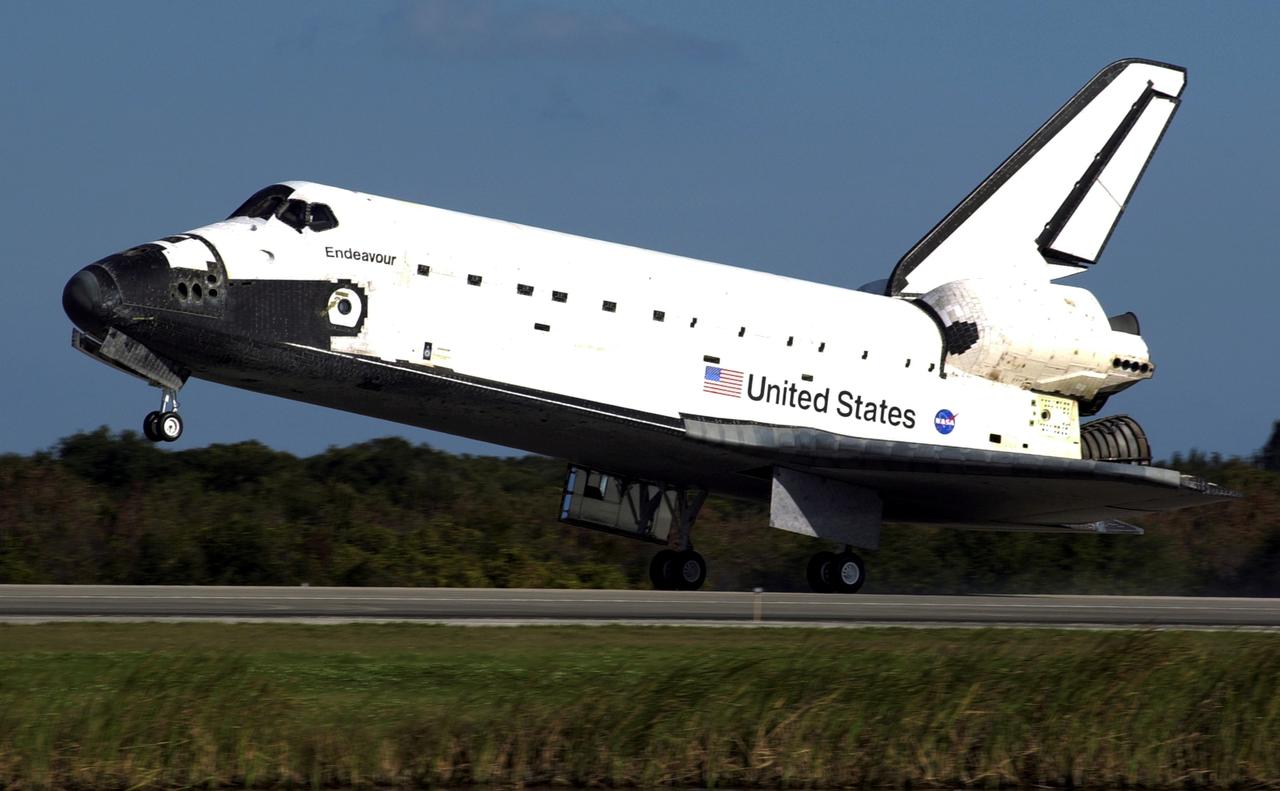
STS113-S-021 (7 December 2002) --- The main landing gear of Space Shuttle Endeavour touches down on runway 33 at the KSC landing facility, completing the nearly 14-day STS-113 mission to the International Space Station (ISS). Astronaut James D. Wetherbee, mission commander, eased Endeavour to a textbook landing on runway 33 at the Florida spaceport at 2:37 p.m. (EST) on December 7, 2002. The landing completed a 5.74-million mile mission that saw successful delivery and installation of the Port One (P1) truss on the orbital outpost.
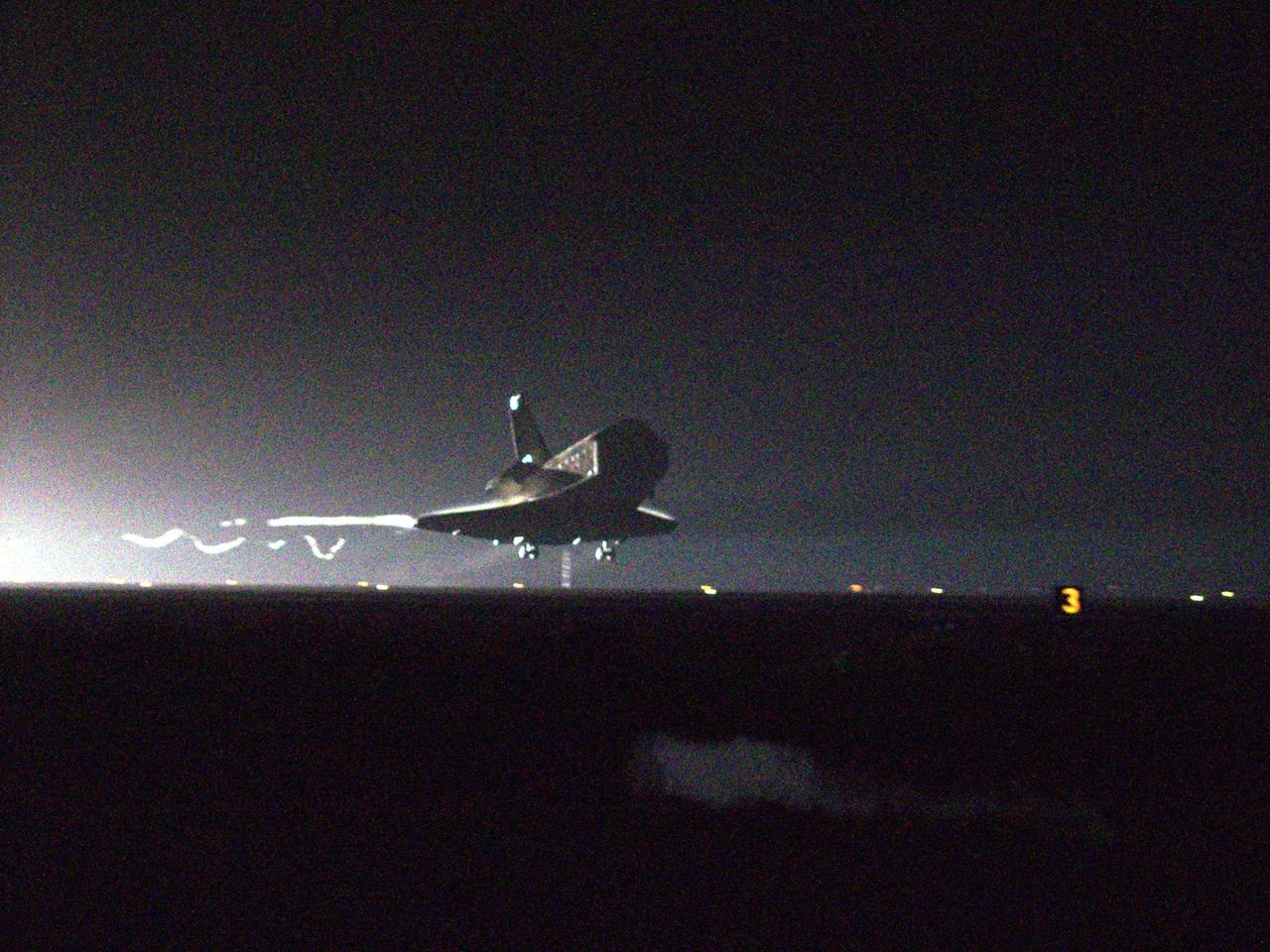
KENNEDY SPACE CENTER, FLA. -- Orbiter Columbia, with its crew of seven, approaches touchdown on Runway 33 of the KSC Shuttle Landing Facility, completing mission STS-109 to service the Hubble Space Telescope. Wheel stop occurred on orbit 165 at 4:33:09 a.m. EST with mission elapsed time of 10 days, 22 hours, 11 minutes. Main gear touchdown occurred at 4:31:52 a.m. and nose wheel touchdown an 4:32:02. It was the 58th landing at KSC out of 108 missions in the history of the Shuttle program
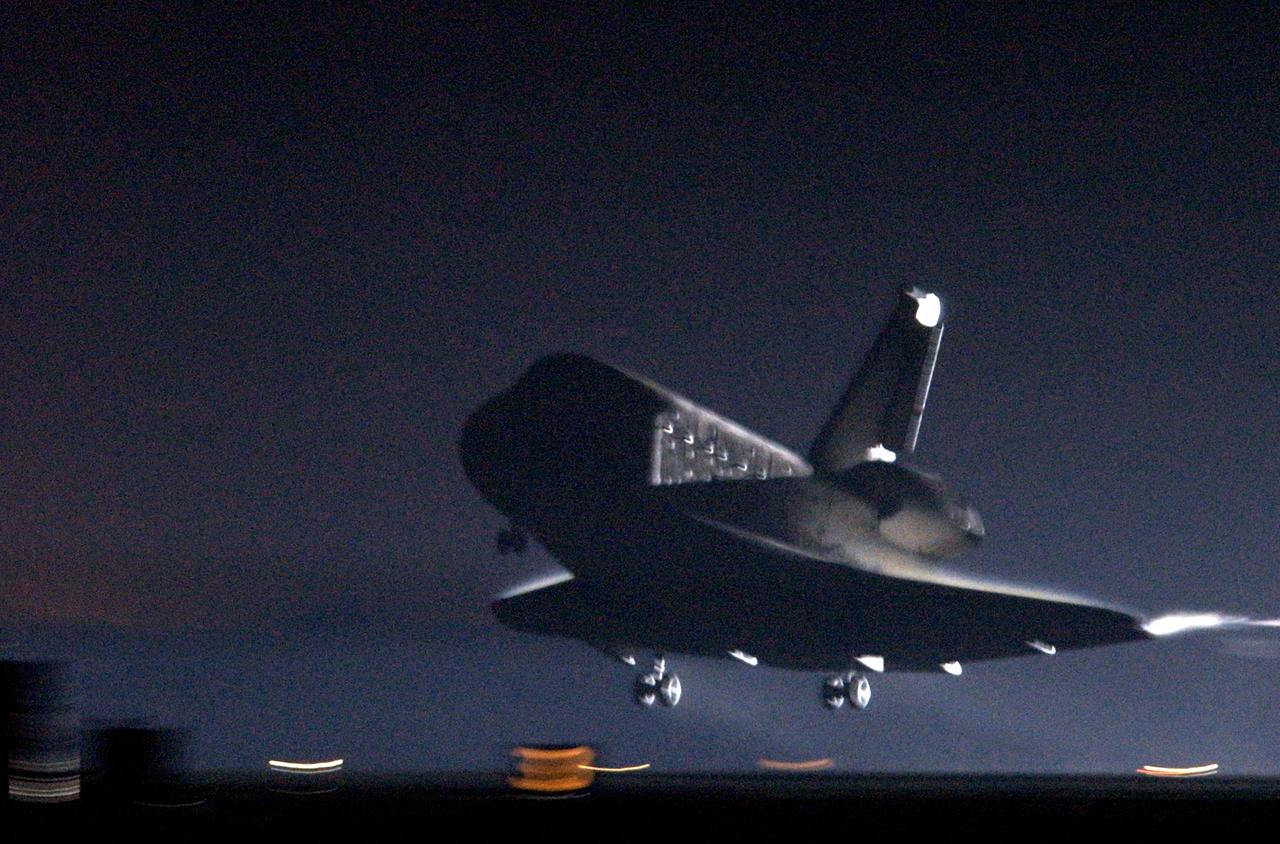
STS109-S-016 (12 March 2002)--- The Space Shuttle Columbia, with its crew of seven astronauts on board, approaches touchdown on Runway 33 of the KSC Shuttle Landing Facility, completing mission STS-109 to service the Hubble Space Telescope. Wheel stop occurred on orbit 165 at 4:33:09 a.m. EST with mission elapsed time of 10 days, 22 hours, 11 minutes. Main gear touchdown occurred at 4:31:52 a.m. and nose wheel touchdown an 4:32:02. It was the 58th landing at KSC out of 108 missions in the history of the Shuttle program.
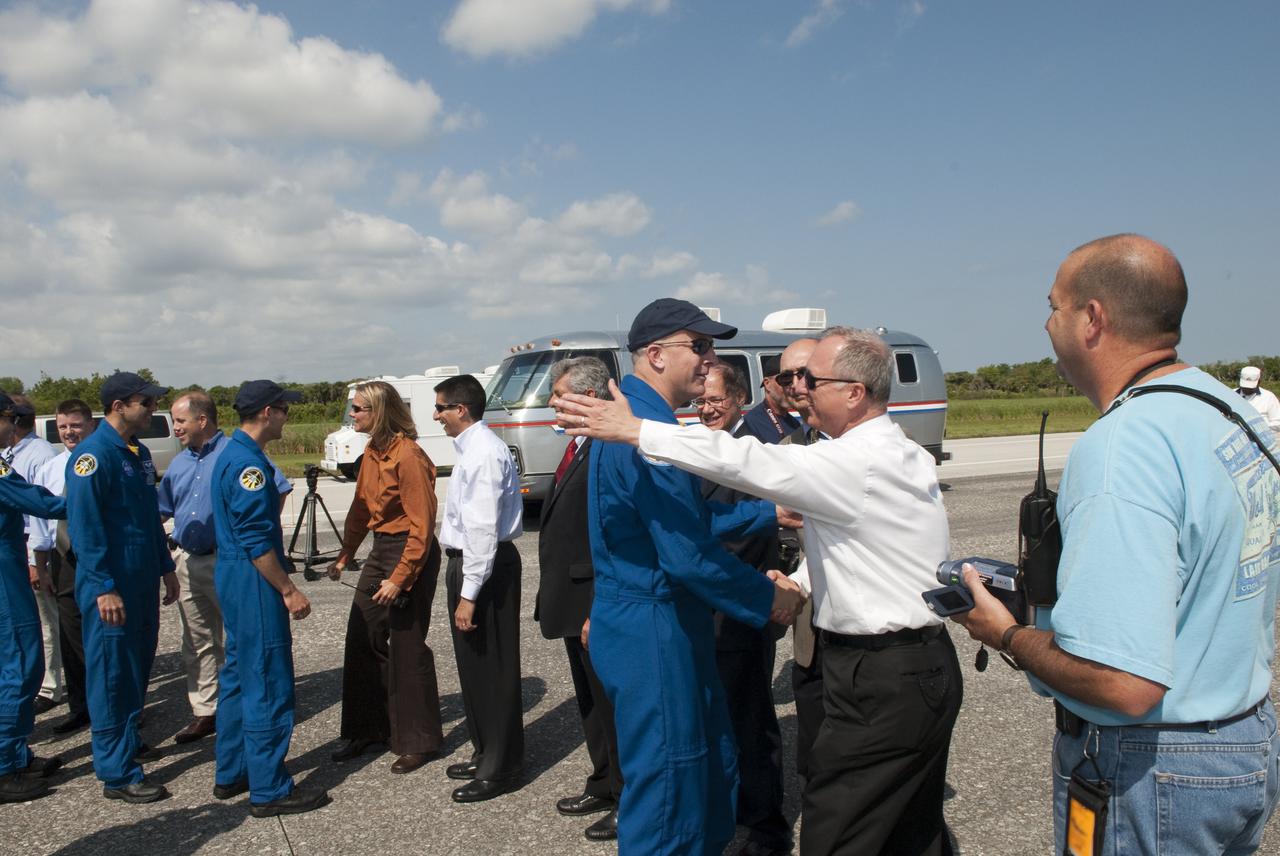
CAPE CANAVERAL, Fla. - At the Shuttle Landing Facility at NASA's Kennedy Space Center in Florida, STS-131 Launch Director Pete Nickolenko, second from right, congratulates STS-131 Commander Alan Poindexter on a successful mission following landing of space shuttle Discovery on Runway 33. Other members of the STS-131 crew are, from left, Mission Specialist Rick Mastracchio and Pilot James P. Dutton Jr. Discovery landed at Kennedy after 15 days in space, completing the more than 6.2-million-mile STS-131 mission on orbit 238. Main gear touchdown was at 9:08:35 a.m. EDT followed by nose gear touchdown at 9:08:47 a.m. and wheelstop at 9:09:33 a.m. The seven-member STS-131 crew carried the multi-purpose logistics module Leonardo, filled with supplies, a new crew sleeping quarters and science racks that were transferred to the International Space Station's laboratories. The crew also switched out a gyroscope on the station’s truss, installed a spare ammonia storage tank and retrieved a Japanese experiment from the station’s exterior. STS-131 is the 33rd shuttle mission to the station and the 131st shuttle mission overall. For information on the STS-131 mission and crew, visit http:__www.nasa.gov_mission_pages_shuttle_shuttlemissions_sts131_index.html. Photo credit: NASA_Jim Grossmann
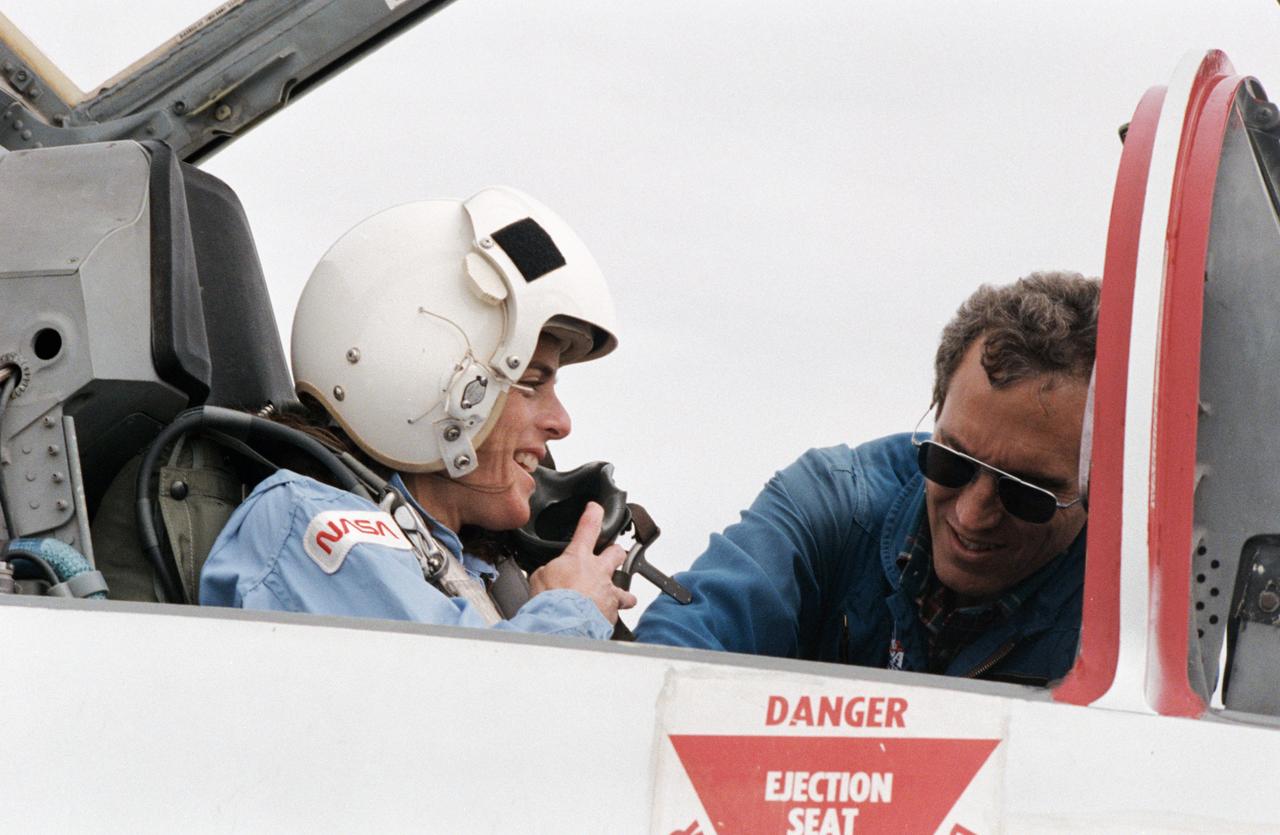
S85-41451 (3 Oct. 1985) --- Barbara Morgan, backup to the Teacher-in-Space participant Christa McAuliffe, prepares for a ride in the rear station of one of NASA's T-38 jet trainers at Ellington Field, near the Johnson Space Center (JSC). The McCall, Idaho teacher is briefed by astronaut Michael J. Smith, 51-L pilot, before departing Ellington Field. Photo credit: NASA
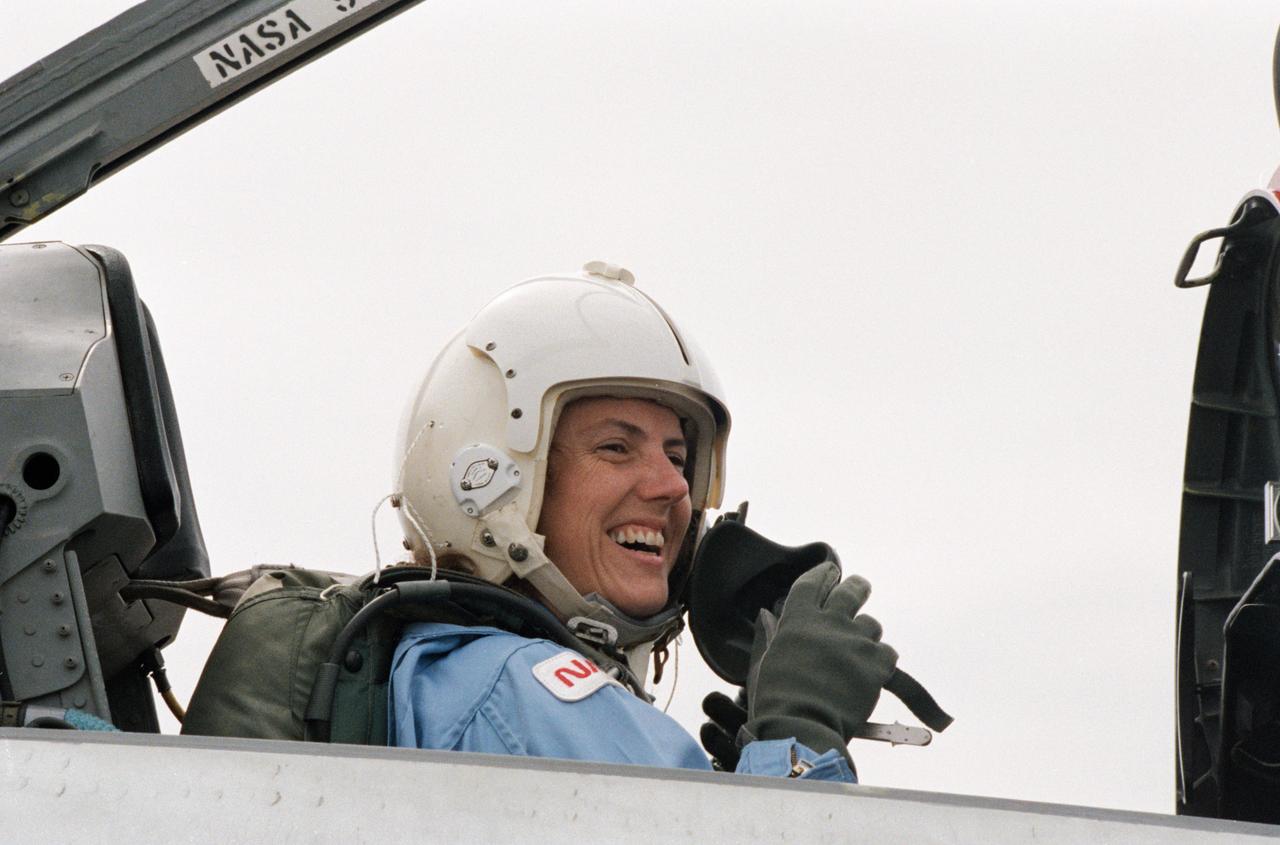
Sharon Christa McAuliffe, the Teacher in Space participant from Concord, New Hampshire, prepares for a ride in the rear station of one of NASA's T-38 jet trainers at Ellington Field near JSC.
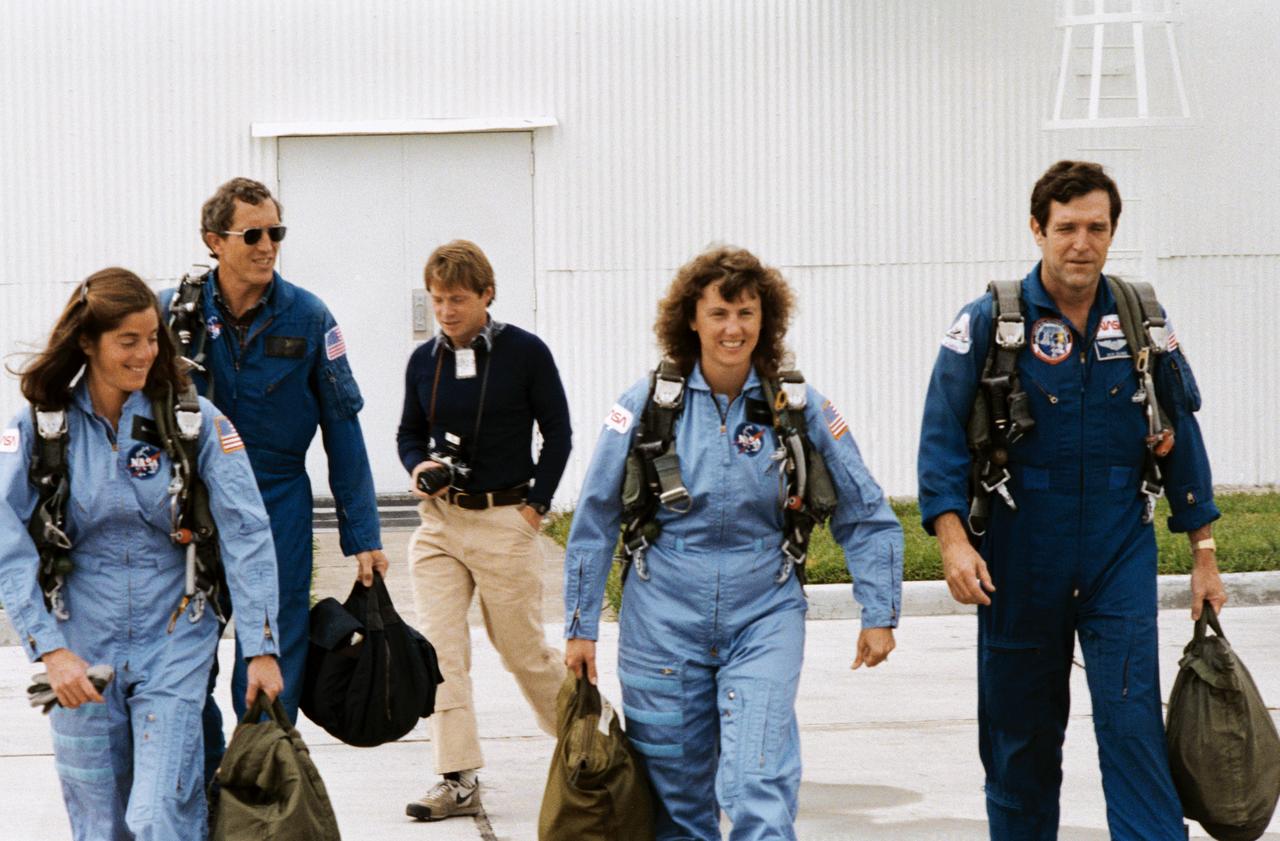
S85-41443 (12 Dec. 1985) --- Assigned STS-51L mission crew members, and a backup, are pictured at Ellington Air Field following brief flights in NASA's T-38 jet trainers. Left to right are Barbara R. Morgan, Michael J. Smith, an unidentified visitor, S. Christa McAuliffe and Francis R. (Dick) Scobee. Morgan is serving as backup, to McAuliffe's payload specialist position, as Teacher-in-Space Project representative on the flight. Scobee and Smith are commander and pilot, respectively, for NASA's 25th STS flight. Photo credit: NASA
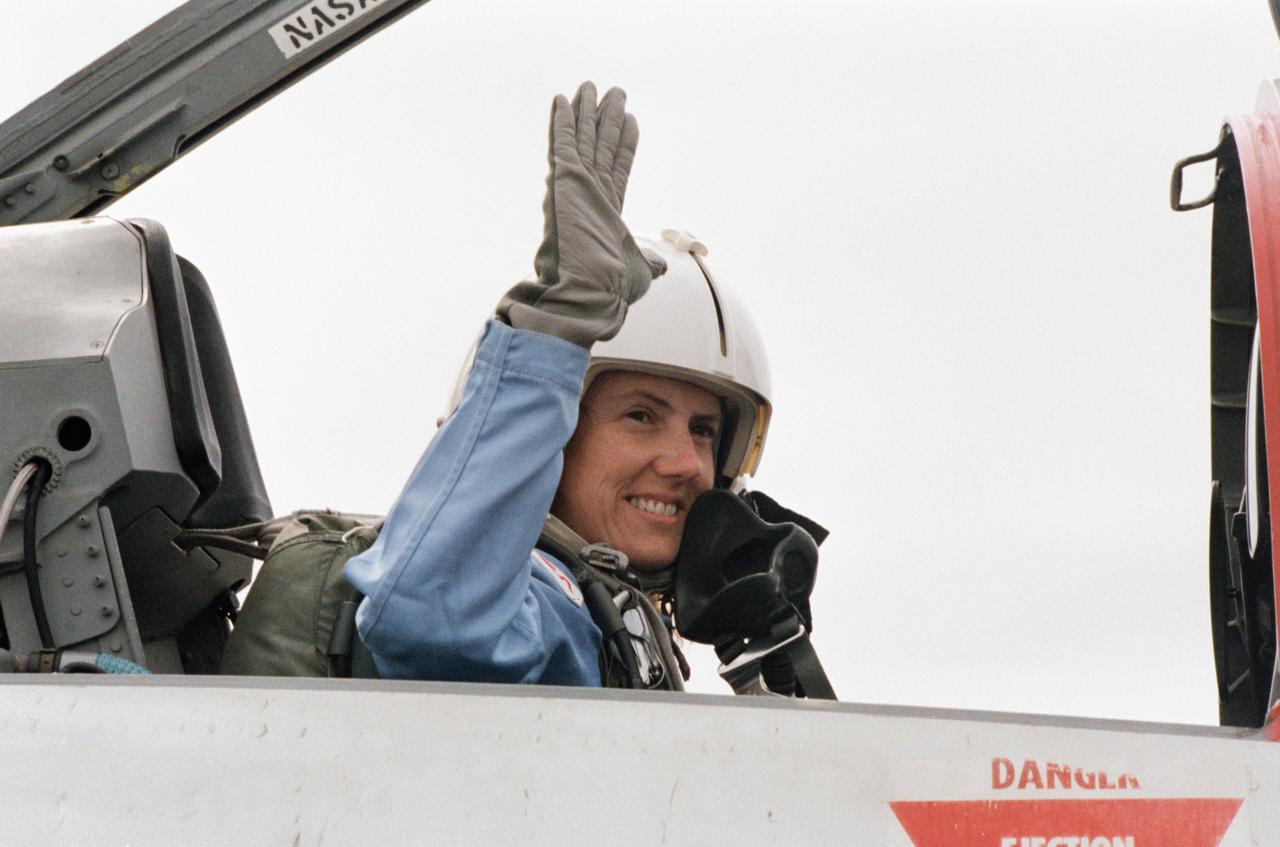
Sharon Christa McAuliffe, the Teacher in Space participant from Concord, New Hampshire, prepares for a ride in the rear station of one of NASA's T-38 jet trainers at Ellington Field near JSC.
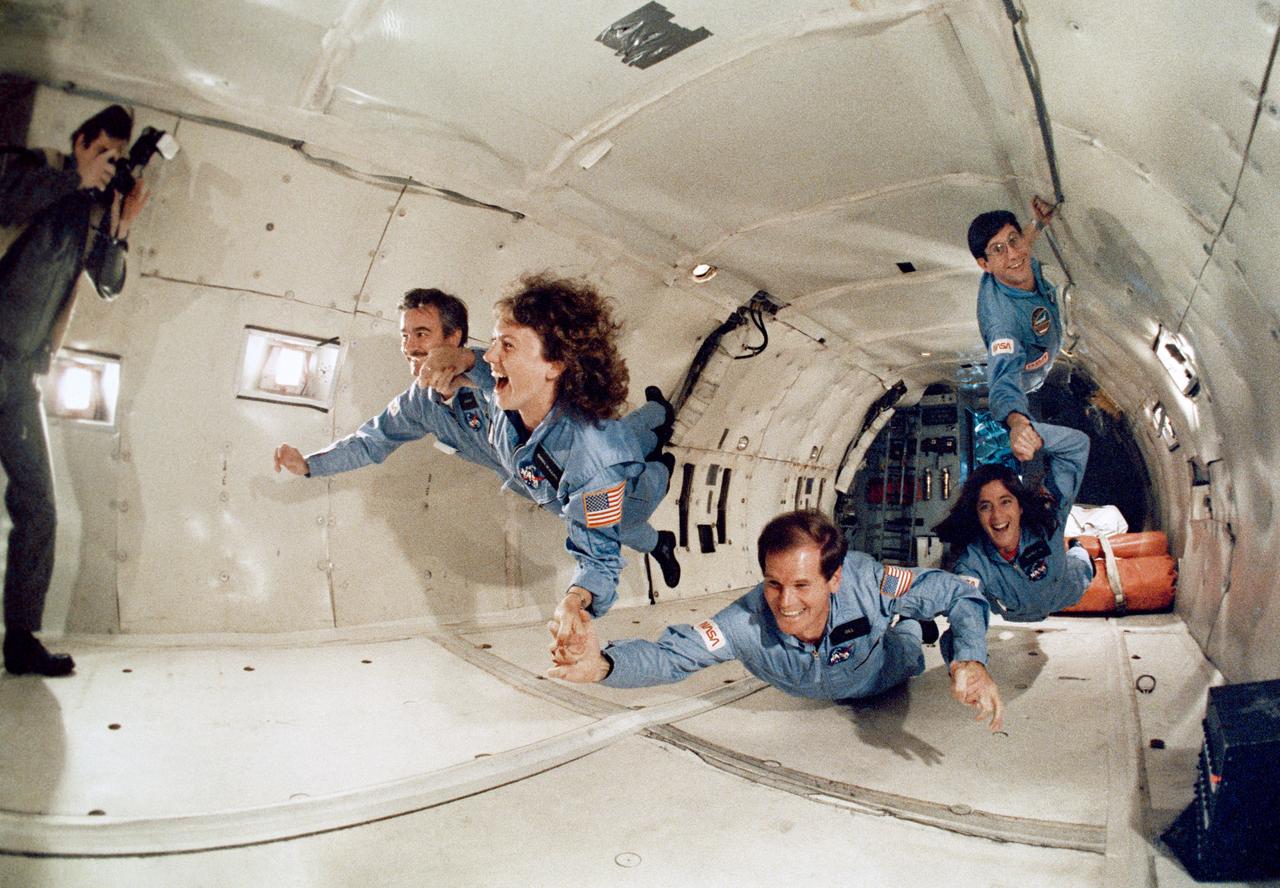
S85-44834 (20 Nov. 1985) --- This flying human chain represents prime and backup payload specialists for two upcoming STS missions. The group, representing trainees for STS-61C later this year and STS-51L early next year, shared some 40 parabolas in NASA?s KC-135, ?Zero-G? aircraft on Nov. 20, 1985. Left to right are Gerard Magilton, RCA backup payload specialist for STS-61C; Sharon Christa McAuliffe, payload specialist/teacher citizen observer for STS-51L; U.S. Representative Bill Nelson (D., Florida), scheduled for 61C; Barbara R. Morgan, backup to McAuliffe; and Robert J. Cenker, RCA payload specialist for 61C. The photo was taken by Otis Imboden. Photo credit: NASA
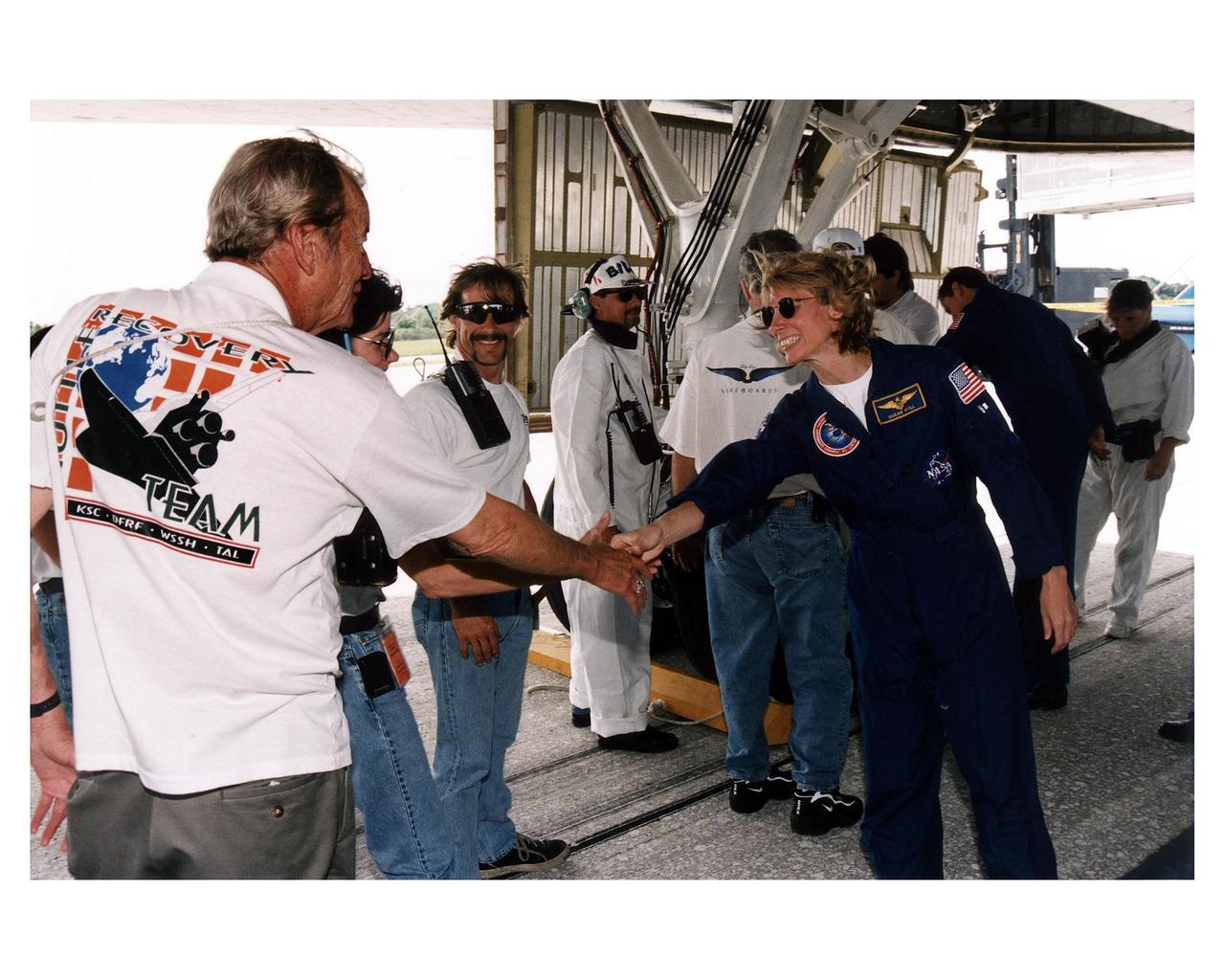
KENNEDY SPACE CENTER, FLA. -- STS-83 Pilot Susan L. Still greets KSC postlanding operations workers on Runway 33 at the Space Center’s Shuttle Landing Facility after the Space Shuttle Orbiter Columbia landed at 2:33:11 p. m. EDT, April 8, to conclude the Microgravity Science Laboratory-1 (MSL-1) mission. At main gear touchdown, the STS-83 mission duration was 3 days, 23 hours, 12 minutes. The planned 16-day mission was cut short by a faulty fuel cell. This is only the third time in Shuttle program history that an orbiter was brought home early due to mechanical problems. This was also the 36th KSC landing since the program began in 1981
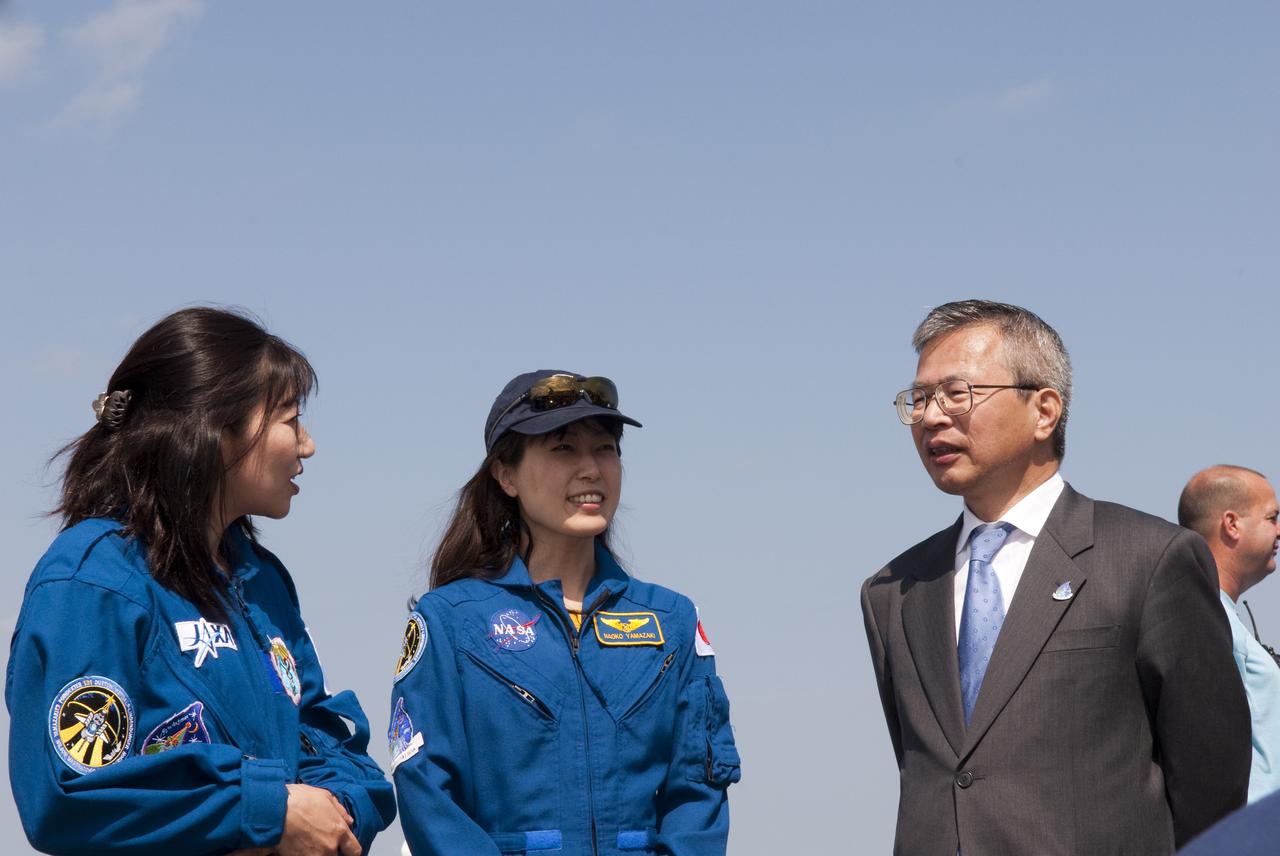
CAPE CANAVERAL, Fla. - At the Shuttle Landing Facility at NASA's Kennedy Space Center in Florida, Dr. Kuniaki Shiraki, right, executive director of the Japan Aerospace Exploration Agency, or JAXA, talks with STS-131 Mission Specialist and JAXA astronaut Naoko Yamazaki, center, following the landing of space shuttle Discovery on Runway 33. At left is STS-131 Flight Surgeon Dr. Akiko Matsumoto. Discovery landed at Kennedy after 15 days in space, completing the more than 6.2-million-mile STS-131 mission on orbit 238. Main gear touchdown was at 9:08:35 a.m. EDT followed by nose gear touchdown at 9:08:47 a.m. and wheelstop at 9:09:33 a.m. The seven-member STS-131 crew carried the multi-purpose logistics module Leonardo, filled with supplies, a new crew sleeping quarters and science racks that were transferred to the International Space Station's laboratories. The crew also switched out a gyroscope on the station’s truss, installed a spare ammonia storage tank and retrieved a Japanese experiment from the station’s exterior. STS-131 is the 33rd shuttle mission to the station and the 131st shuttle mission overall. For information on the STS-131 mission and crew, visit http:__www.nasa.gov_mission_pages_shuttle_shuttlemissions_sts131_index.html. Photo credit: NASA_Jim Grossmann
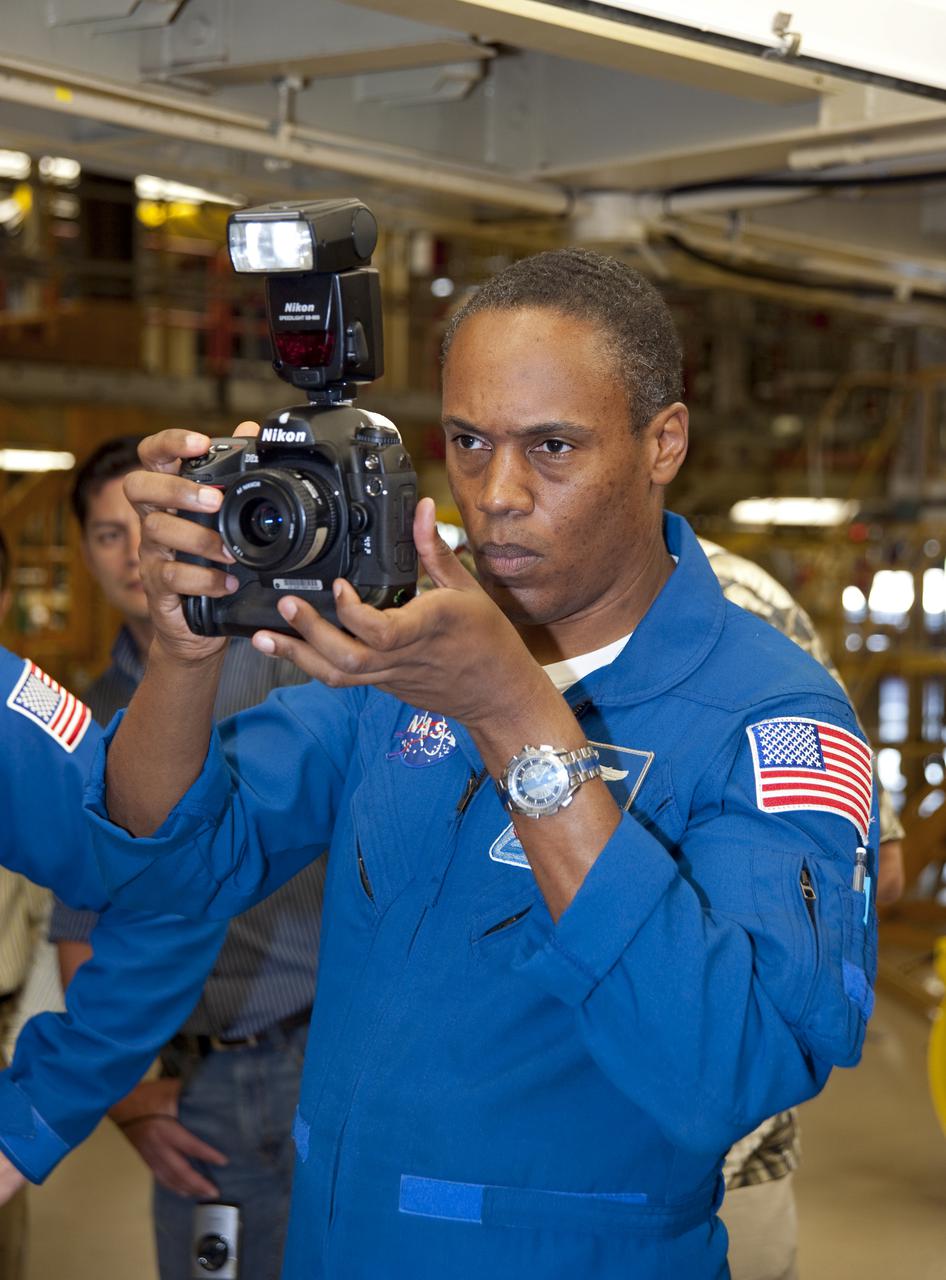
CAPE CANAVERAL, Fla. -- In Orbiter Processing Facility-3 at NASA's Kennedy Space Center in Florida, STS-133 Mission Specialist Alvin Drew looks through the viewfinder of a camera that he will use while in space. The astronauts are at Kennedy for the Crew Equipment Interface Test, or CEIT, which provides the crew with hands-on training and observation of shuttle and flight hardware for their mission to the International Space Station. Launch of the STS-133 mission on space shuttle Discovery is targeted for Nov. 1 at 4:33 p.m. EDT. Photo credit: NASA_Kim Shiflett
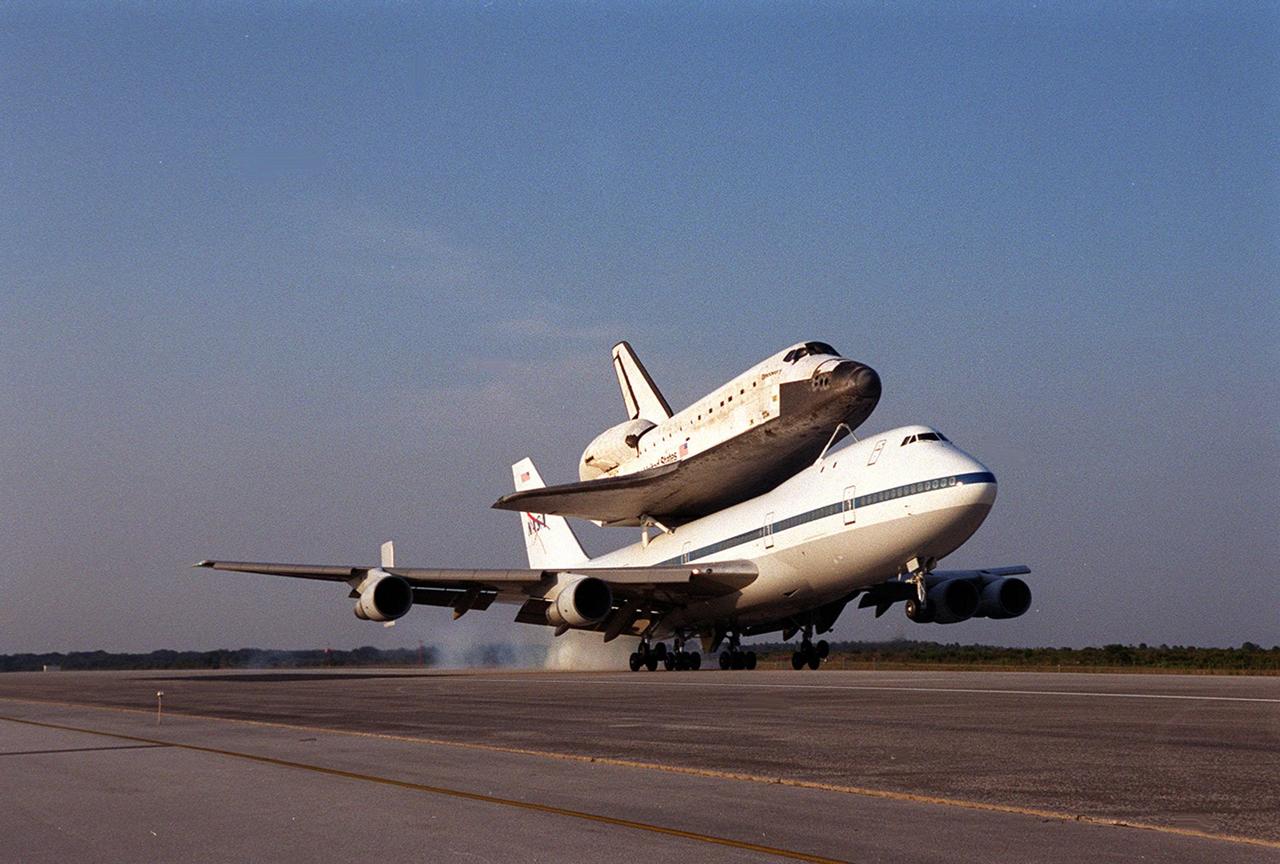
Kicking up dust, the Shuttle Carrier Aircraft, with its unique cargo on top, touches down on runway 33 at the Shuttle Landing Facility. The ferry flight started in California after the orbiter’s landing more than a week ago at Edwards Air Force Base at the end of mission STS-92. Discovery will be demated from the SCA via the mate/demate device at the SLF and transported to the Orbiter Processing Facility bay 1. There it will undergo preparations for its next launch, STS-102, scheduled for February 2001
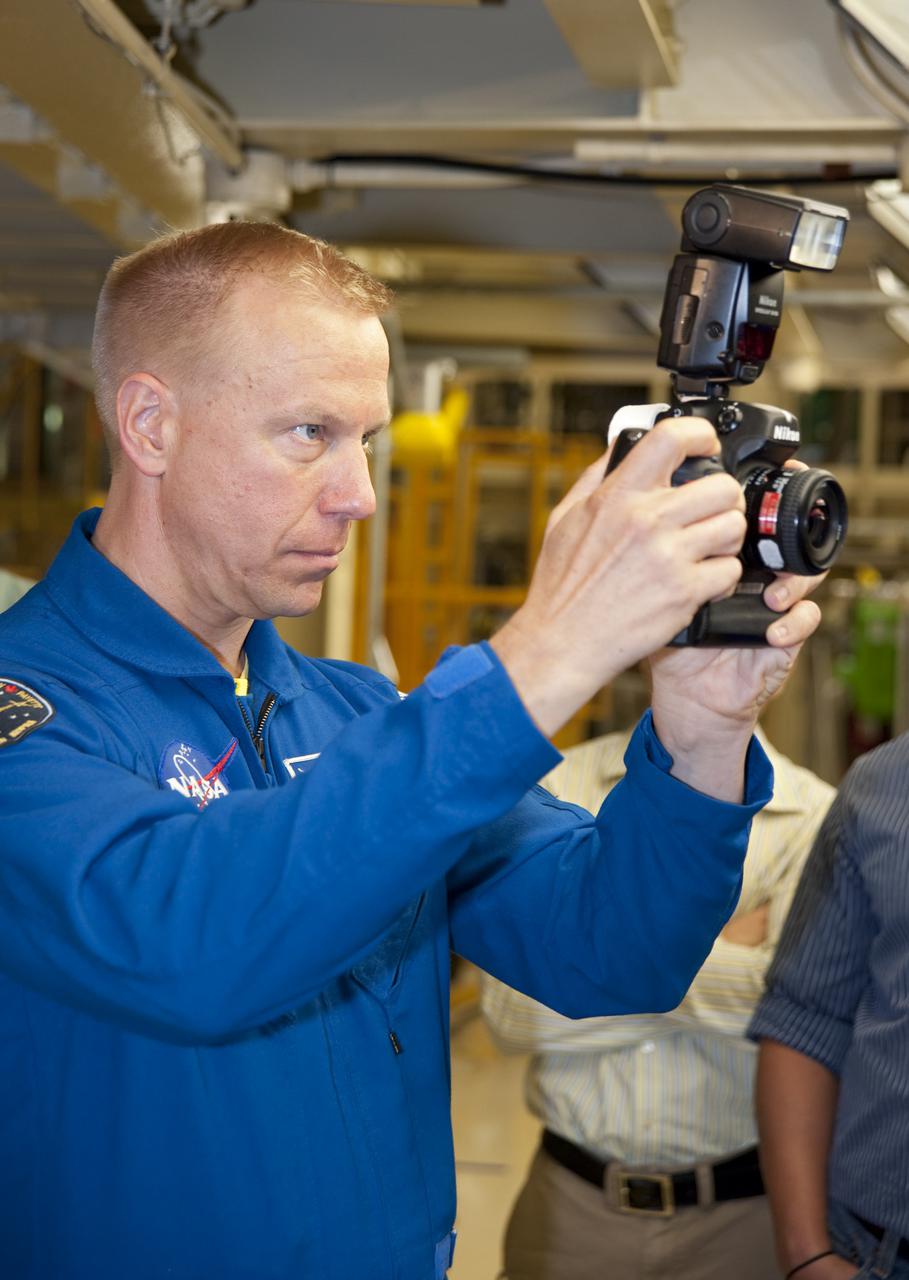
CAPE CANAVERAL, Fla. -- In Orbiter Processing Facility-3 at NASA's Kennedy Space Center in Florida, STS-133 Mission Specialist Tim Kopra looks through the viewfinder of a camera that he will use while in space. The astronauts are at Kennedy for the Crew Equipment Interface Test, or CEIT, which provides the crew with hands-on training and observation of shuttle and flight hardware for their mission to the International Space Station. Launch of the STS-133 mission on space shuttle Discovery is targeted for Nov. 1 at 4:33 p.m. EDT. Photo credit: NASA_Kim Shiflett
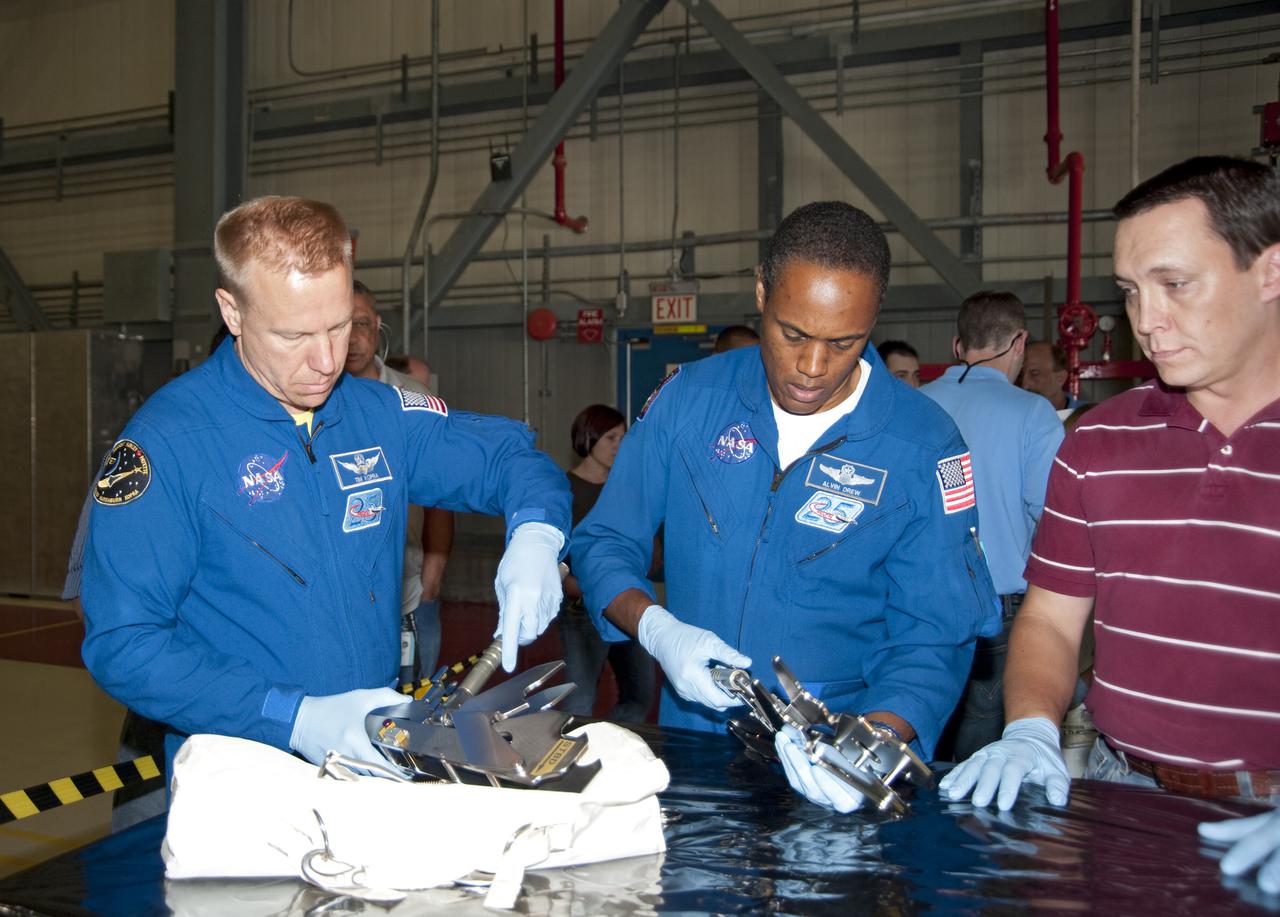
CAPE CANAVERAL, Fla. -- In Orbiter Processing Facility-3 at NASA's Kennedy Space Center in Florida, STS-133 Mission Specialists Tim Kopra (left) and Alvin drew examine hardware they will use while in space. The astronauts are at Kennedy for the Crew Equipment Interface Test, or CEIT, which provides the crew with hands-on training and observation of shuttle and flight hardware for their mission to the International Space Station. Launch of the STS-133 mission on space shuttle Discovery is targeted for Nov. 1 at 4:33 p.m. EDT. Photo credit: NASA_Kim Shiflett
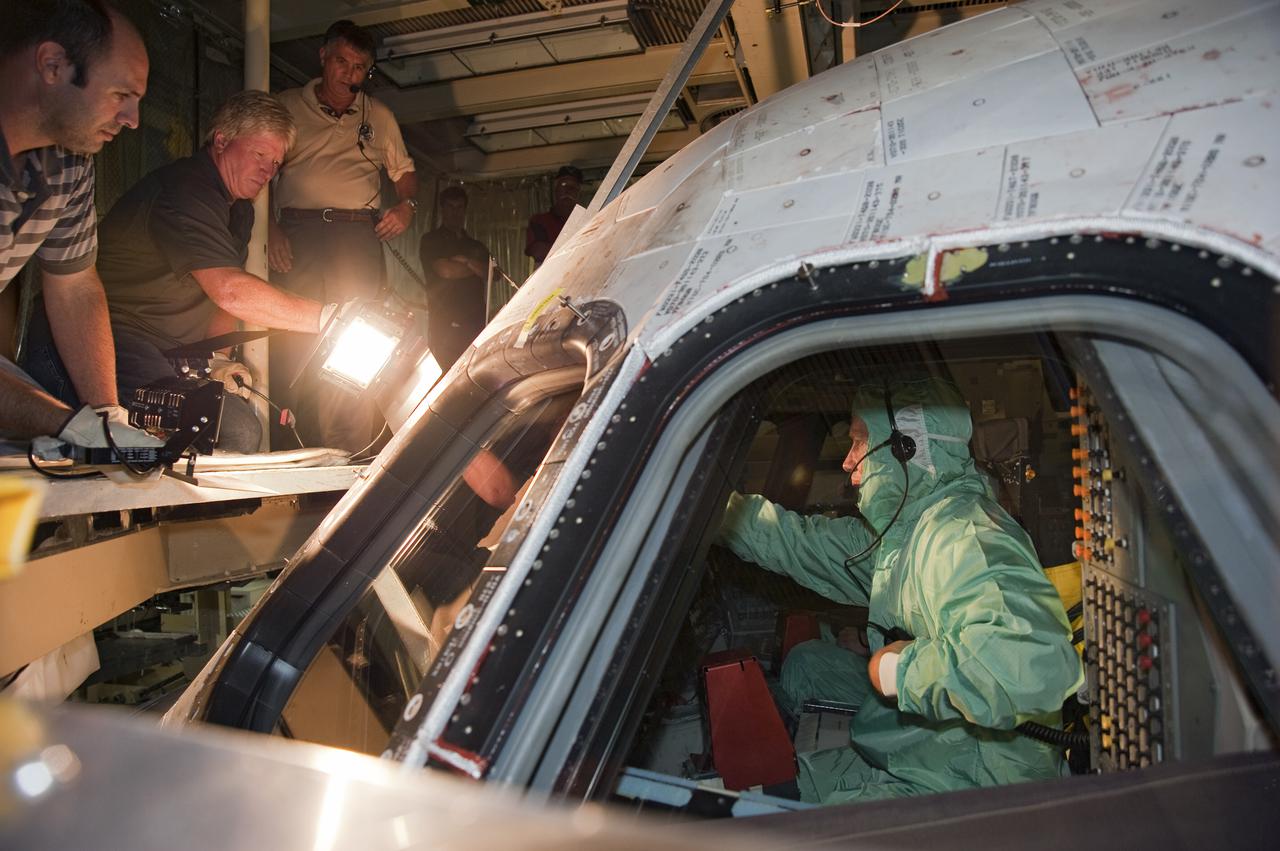
CAPE CANAVERAL, Fla. -- In Orbiter Processing Facility-3 at NASA's Kennedy Space Center in Florida, STS-133 Commander Steve Lindsey familiarizes himself with the layout of the shuttle's cockpit. The astronauts are at Kennedy for the Crew Equipment Interface Test, or CEIT, which provides the crew with hands-on training and observation of shuttle and flight hardware for their mission to the International Space Station. Launch of the STS-133 mission on space shuttle Discovery is targeted for Nov. 1 at 4:33 p.m. EDT. Photo credit: NASA_Kim Shiflett