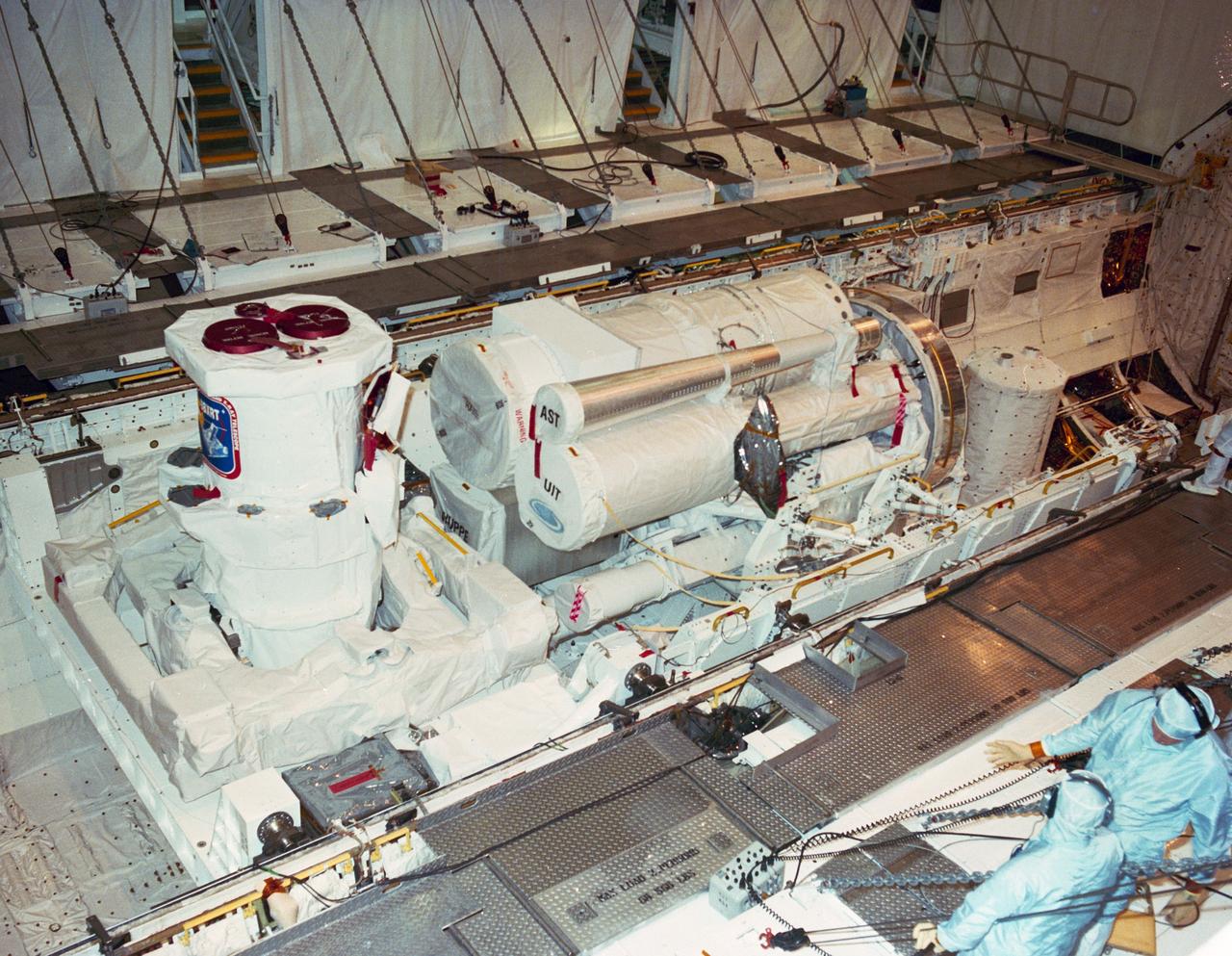
STS-35 Astronomy Laboratory 1 (ASTRO-1) is installed in Columbia's, Orbiter Vehicle (OV) 102's, payload bay (PLB) at the Kennedy Space Center (KSC) Orbiter Processing Facility (OPF). On the left, in the aft PLB is the Broad Band X Ray Telescope (BBXRT) mounted on the two axis pointing system (TAPS). In the center, the three ultraviolet telescopes - Wisconsin Ultraviolet Photo-Polarimeter Experiment (WUPPE), the Hopkins Ultraviolet Telescope (HUT), and the Ultraviolet Imaging Telescope (UIT) - are mounted on the instrument pointing system (IPS) and are in stowed position. At the far right is the Spacelab Pallet System (SPS) igloo. View provided by KSC with alternate number KSSC-90PC-421.
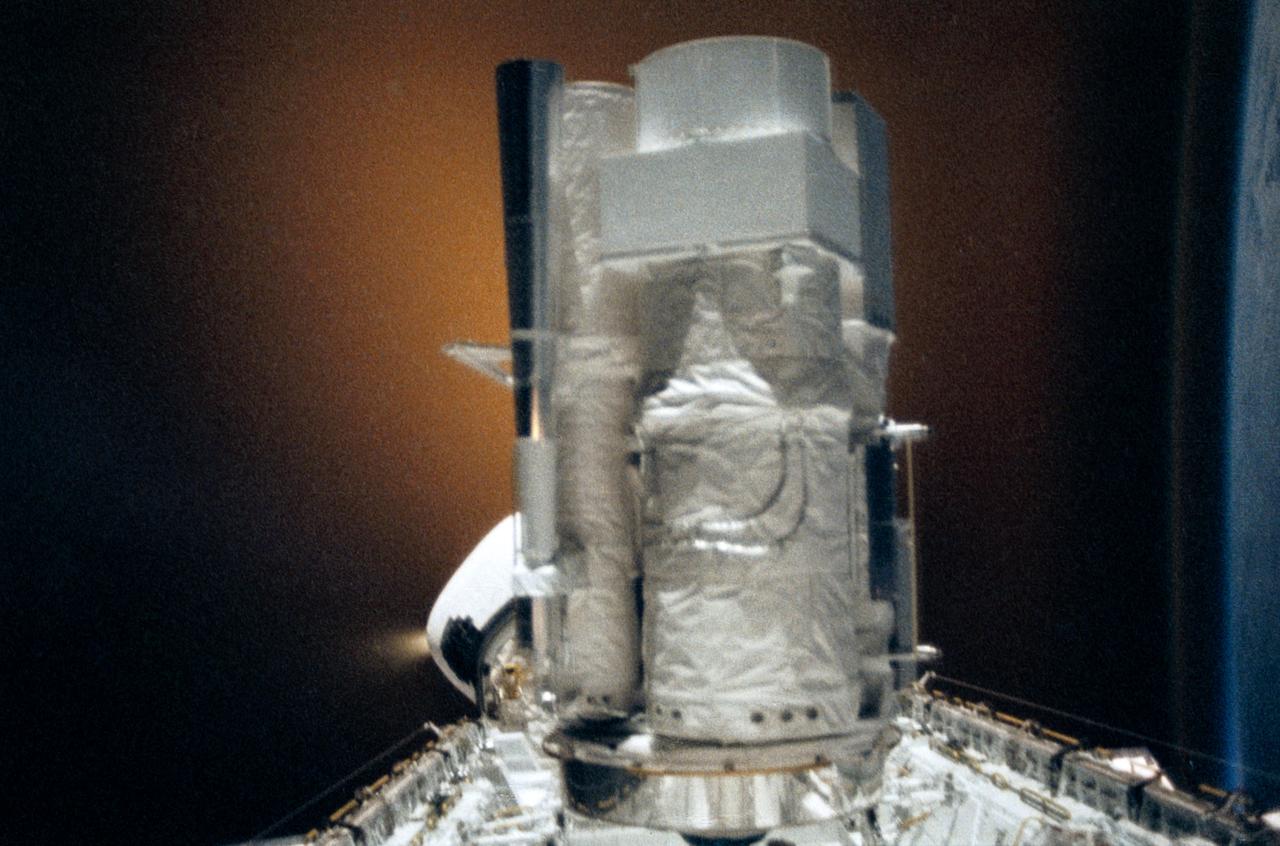
STS035-28-006 (2-10 Dec 1990) --- STS-35 Astronomy Laboratory 1 (ASTRO-1) telescopes, in on-orbit operating position in the payload bay (PLB), are silhouetted against an reaction control system (RCS) right thruster firing. Three ultraviolet telescopes are mounted and precisely co-aligned on a common structure, called the cruciform, that is attached to the instrument pointing system (IPS). Here the IPS holds the telescopes in a position that is parallel to the Earth's limb below. Visible on the cruciform are the star tracker (S TRK) (silver cone at the top), the Ultraviolet Imaging Telescope (UIT) (behind S TRK), and the Hopkins Ultraviolet Telescope(HUT).
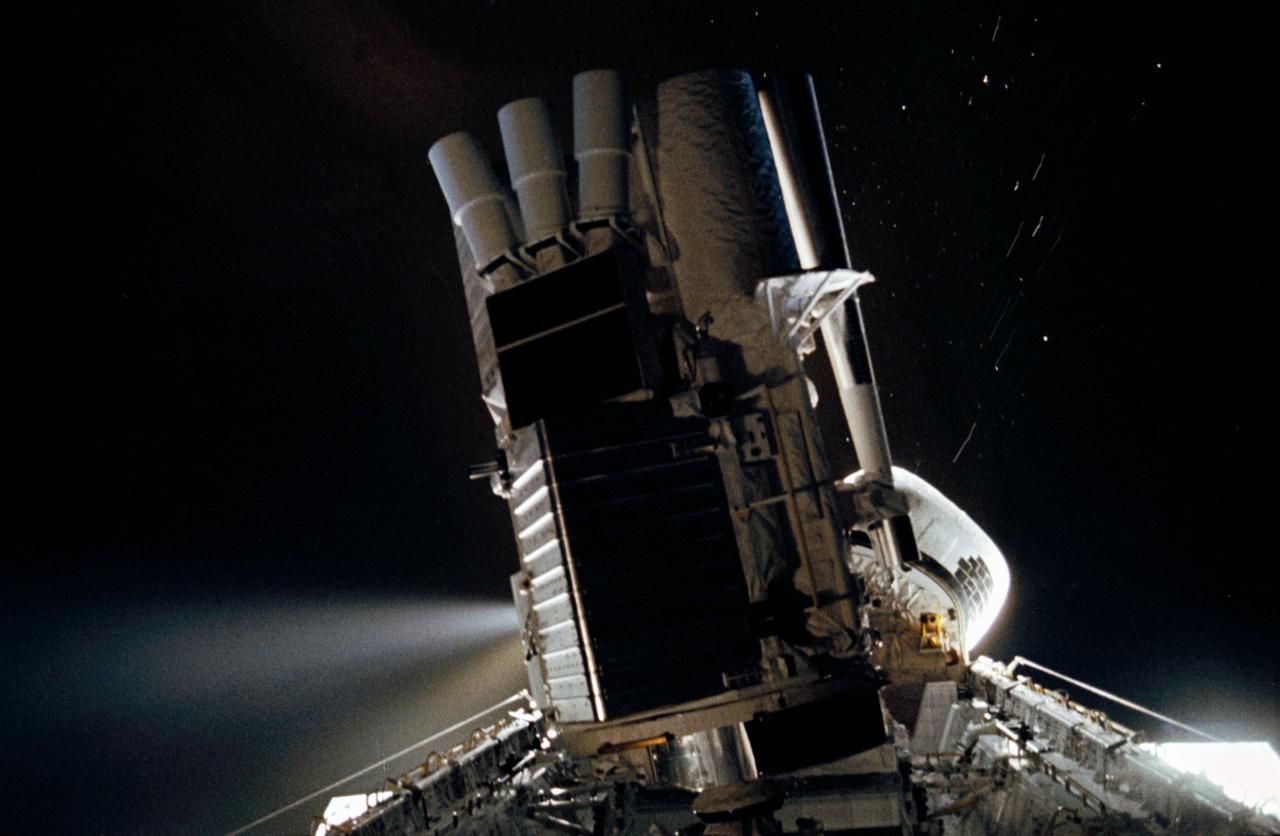
STS035-35-007 (2-10 Dec 1990) --- During the STS-35 mission, the Astronomy Laboratory 1 (ASTRO-1) payload, in its on-orbit operating configuration in the payload bay (PLB), is silhouetted against the firing of a reaction control system (RCS) jet. In the center of the frame, three ultraviolet telescopes are mounted and precisely co-aligned on a common structure, called the cruciform, that is attached to the instrument pointing system (IPS). Visible on the cruciform are Integrated Radiator System (IRS) (silver box on left), the Optical Sensor Package (OSP) (above IRS), the Ultraviolet Imaging Telescope (UIT), and the star tracker (S TRK) (far right). A right RCS jet is fired during this maneuver of Columbia, Orbiter Vehicle (OV) 102.
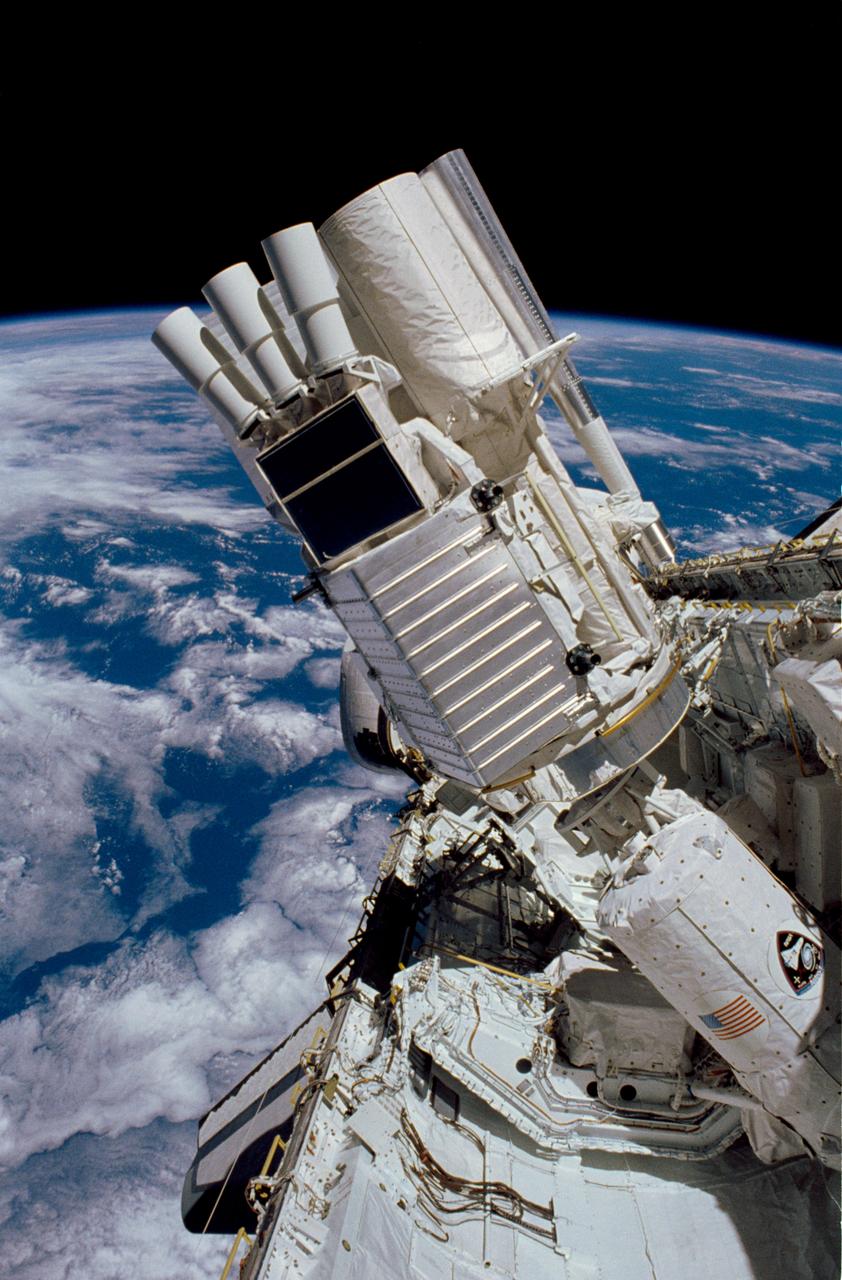
STS035-13-008 (2-10 Dec. 1990) --- The various components of the Astro-1 payload are seen backdropped against the blue and white Earth in this 35mm scene photographed through Columbia's aft flight deck windows. Parts of the Hopkins Ultraviolet Telescope (HUT), Ultraviolet Imaging Telescope (UIT) and the Wisconsin Ultraviolet Photo-Polarimeter Experiment (WUPPE) are visible on the Spacelab Pallet in the foreground. The Broad Band X-Ray Telescope (BBXRT) is behind this pallet and is not visible in this scene. The smaller cylinder in the foreground is the "Igloo," which is a pressurized container housing the Command and Data Management System, which interfaces with the in-cabin controllers to control the Instrument Pointing System (IPS) and the telescopes.
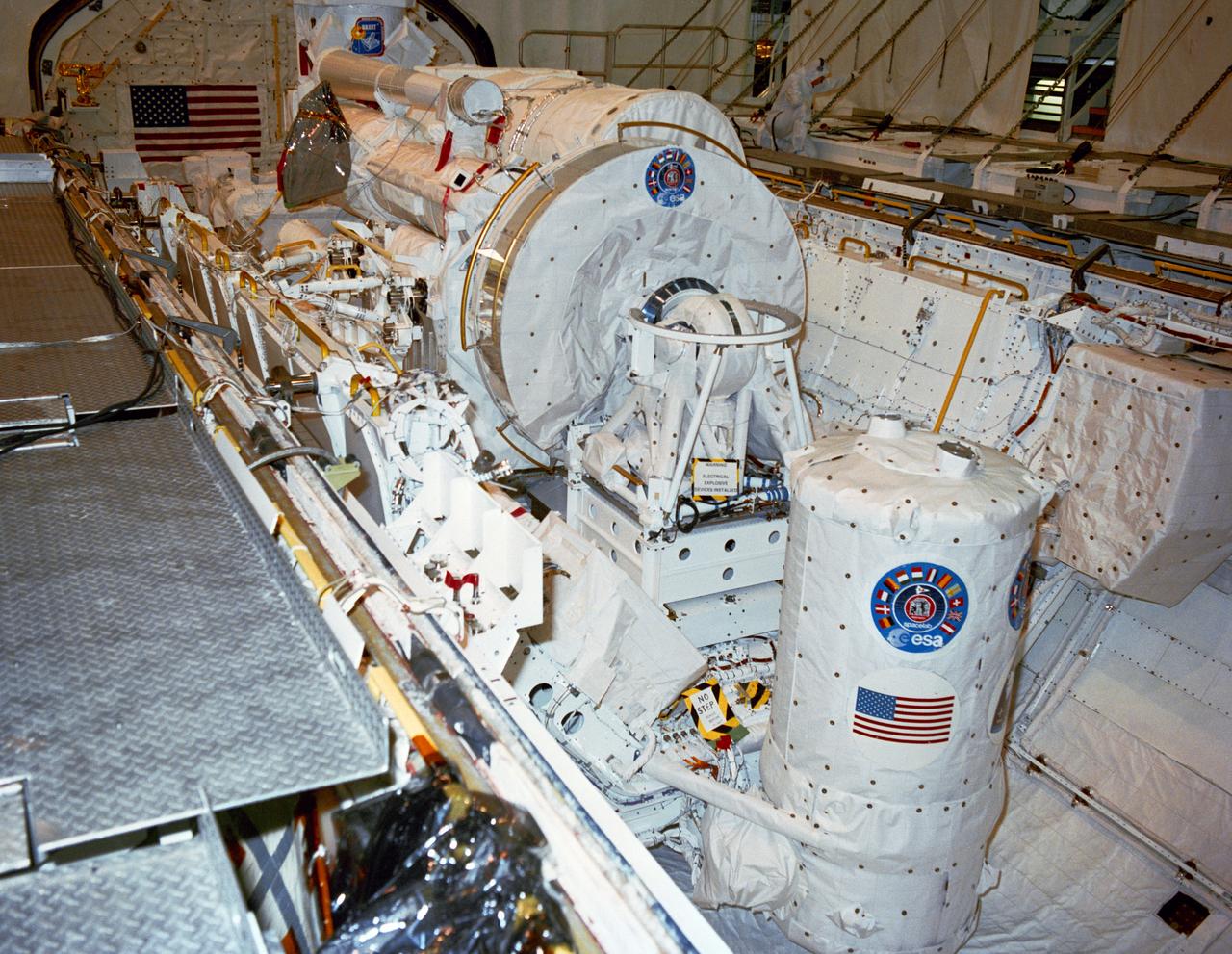
S90-36708 (7 May 1990) --- STS-35 Astronomy Laboratory 1 (ASTRO-1) view shows its telescopes, instrument pointing system (IPS), and support equipment installed in Columbia's, Orbiter Vehicle (OV) 102's, payload bay (PLB) at the Kennedy Space Center (KSC) Orbiter Processing Facility (OPF). In the foreground is the Spacelab Pallet System (SPS) igloo. The stowed IPS with its three ultraviolet telescopes appears in the center of the picture. In the background, the Broad Band X Ray Telescope (BBXRT) two axis pointing system (TAPS) is barely visible. View provided by KSC with alternate number KSC-90PC-423.
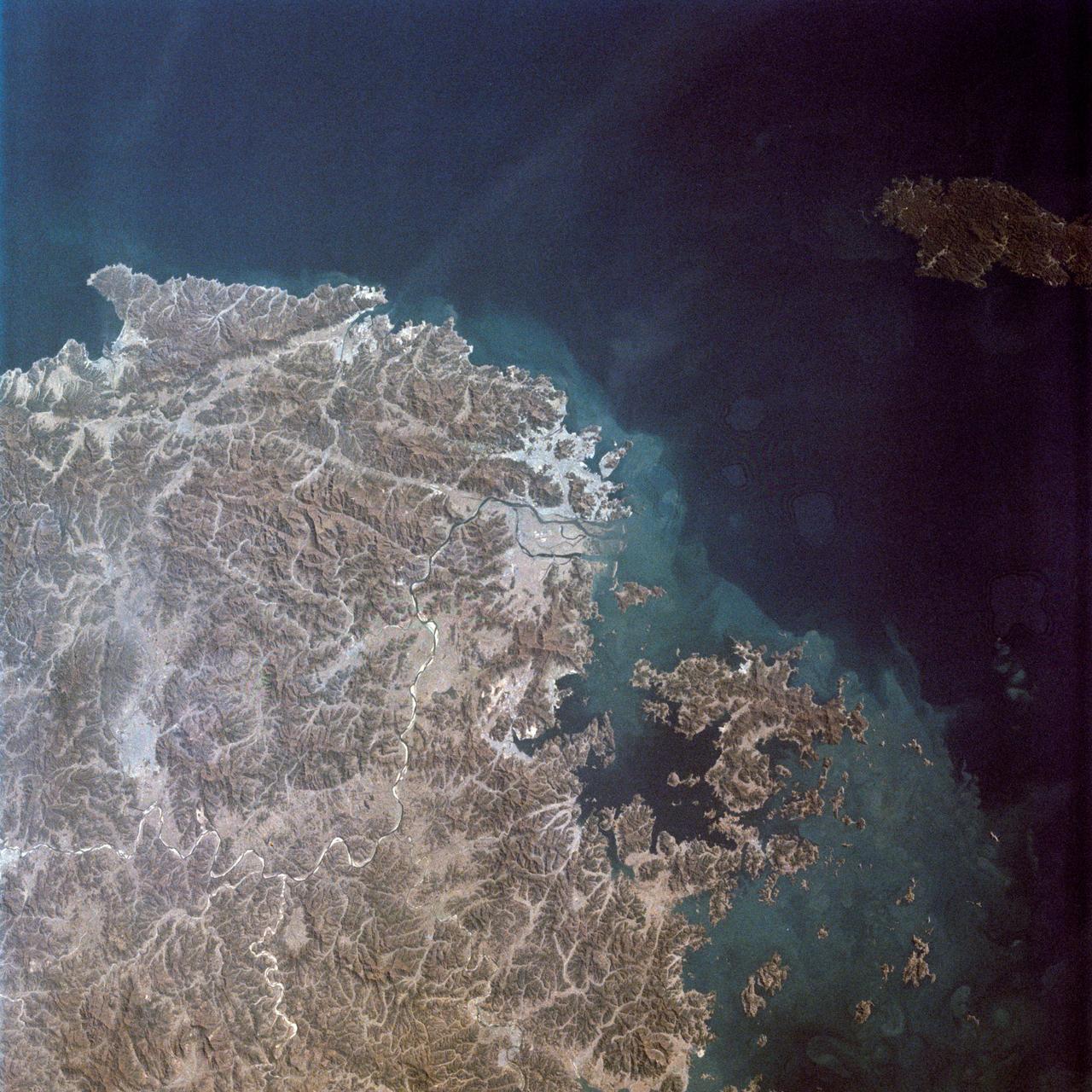
Onboard views by the STS-2 Crew of the Payload Bay with Office of Space and Terrestrial Applications (OSTA)-1 Payload, the Remote Manipulator System (RMS) and Earth views of: Korea, China and Columbia. Also available in 4x5 BW 1. REAGAN, RONALD PRESIDENT - MOCR (STS-2) JSC, HOUSTON, TX Also available in 4x5 BW, 35 CN, 35 BW
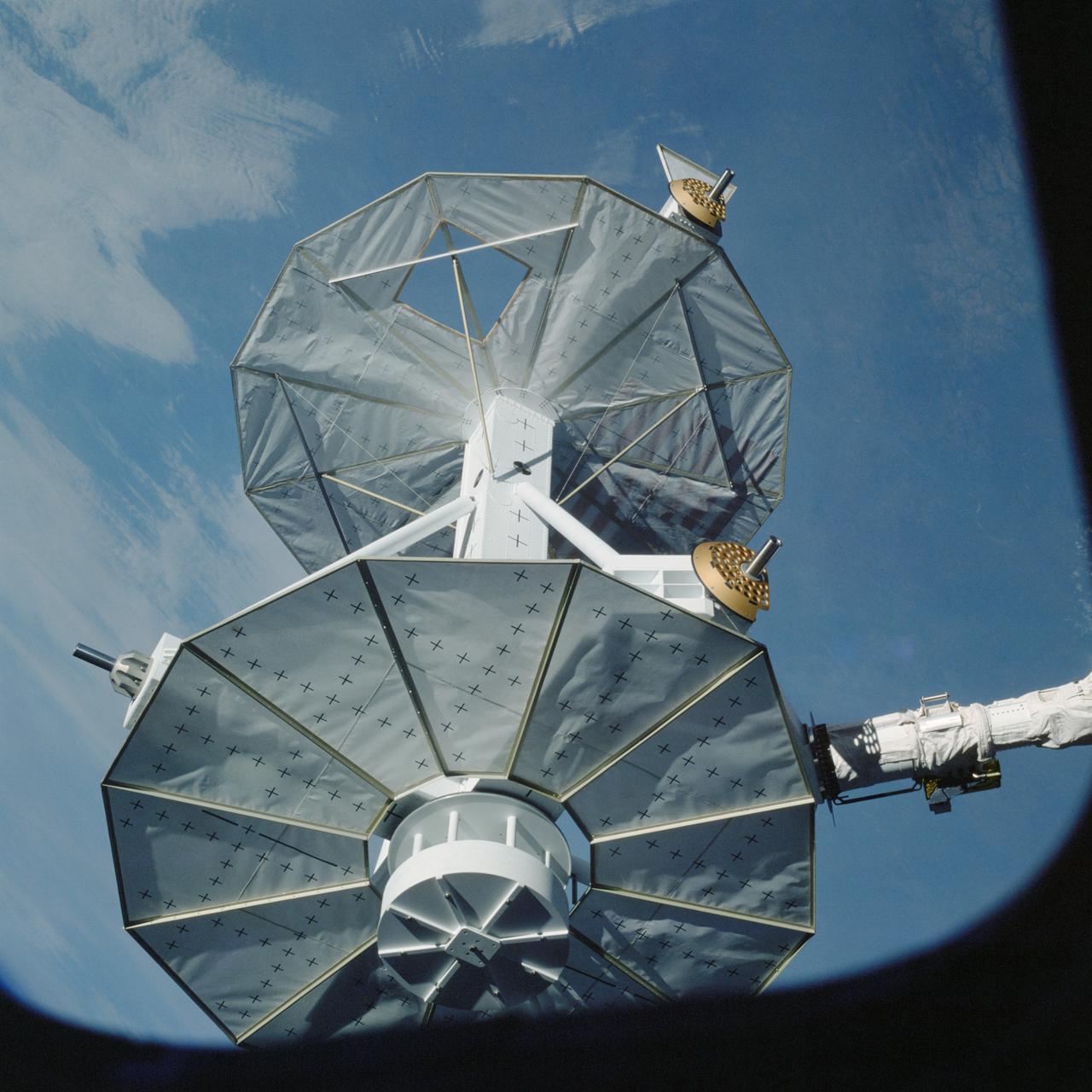
STS008-35-1239 (30 Aug.-5 Sept. 1983) --- The space shuttle Challenger?s payload flight test article (PFTA) is lifted from the cargo bay and held over clouds and water on Earth. The 70mm frame was photographed by one of the five STS-8 crew members with a free hand during the busy RMS/PFTA agenda. Photo credit: NASA
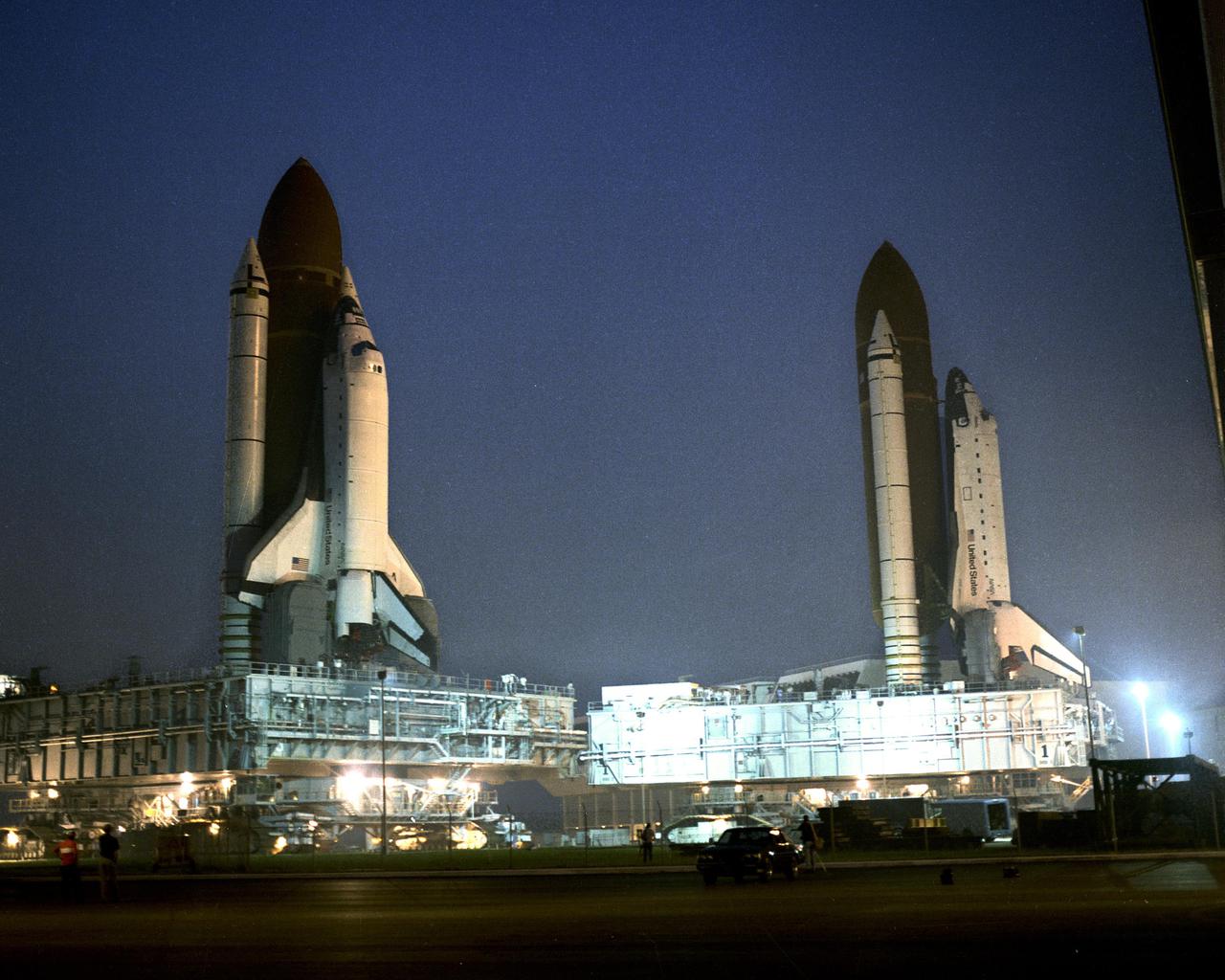
KENNEDY SPACE CENTER, FLA. -- The Space Shuttle Columbia (left), slated for mission STS-35, is rolled past the Space Shuttle Atlantis on its way to Pad 39A. Atlantis, slated for mission STS-38, is parked in front of bay three of the Vehicle Assembly Building following its rollback from Pad 39A for repairs to the liquid hydrogen lines. First motion of Atlantis from the pad was at 10:14 p.m. August 8. It arrived at the VAB at 4 a.m. August 9. First motion of Coumbia leaving the VAB for the pad was at 5:47 a.m. Columbia is due to arrive at the pad at noon August 9. Once Columbia is hard down at the pad, Atlantis will be moved into the VAB for destack operations. When Columbia reaches the pad, its payload bay doors will be opened and servicing of the ASTRO-1 payload will begin. Also, portions of the Shuttle interface verification test not completed in the VAB will be conducted.
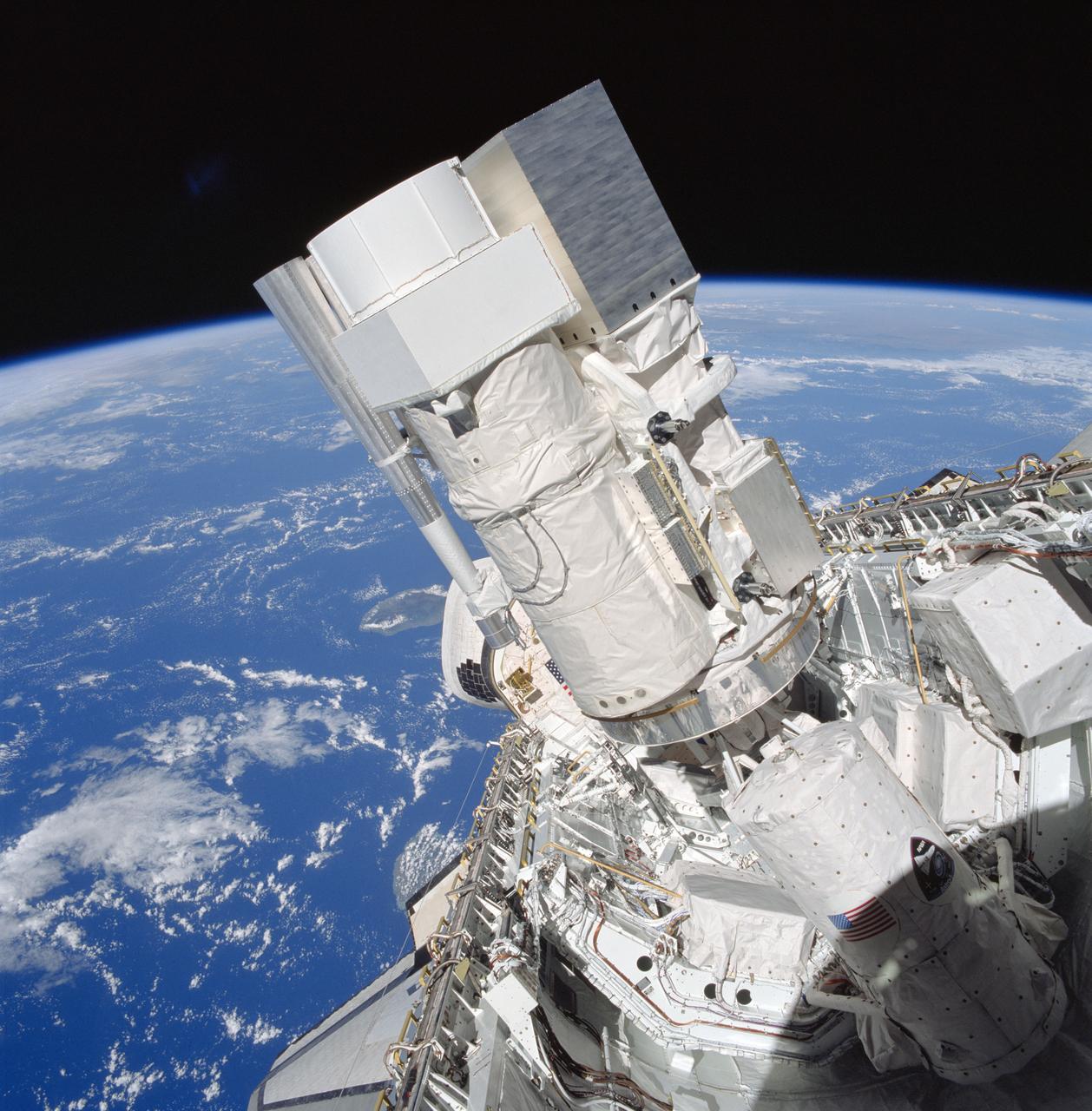
STS035-604-058 (2-10 Dec 1990) --- The various components of the Astro-1 payload are seen backdropped against the blue and white Earth in this scene photographed through Columbia's aft flight deck windows. Parts of the Hopkins Ultraviolet Telescope (HUT), Ultraviolet Imaging Telescope (UIT) and the Wisconsin Ultraviolet Photopolarimetry Experiment (WUPPE) are visible on the Spacelab pallet in the foreground. The Broad Band X-ray Telescope (BBXRT) is behind this pallet and is not visible in this scene. The smaller cylinder in the foreground is the "Igloo," which is a pressurized container housing the Command and Data Management System, which interfaces with the in-cabin controllers to control the Instrument Pointing System (IPS) and the telescopes. The photograph was made with a handheld Rolleiflex camera aimed through Columbia's aft flight deck windows.
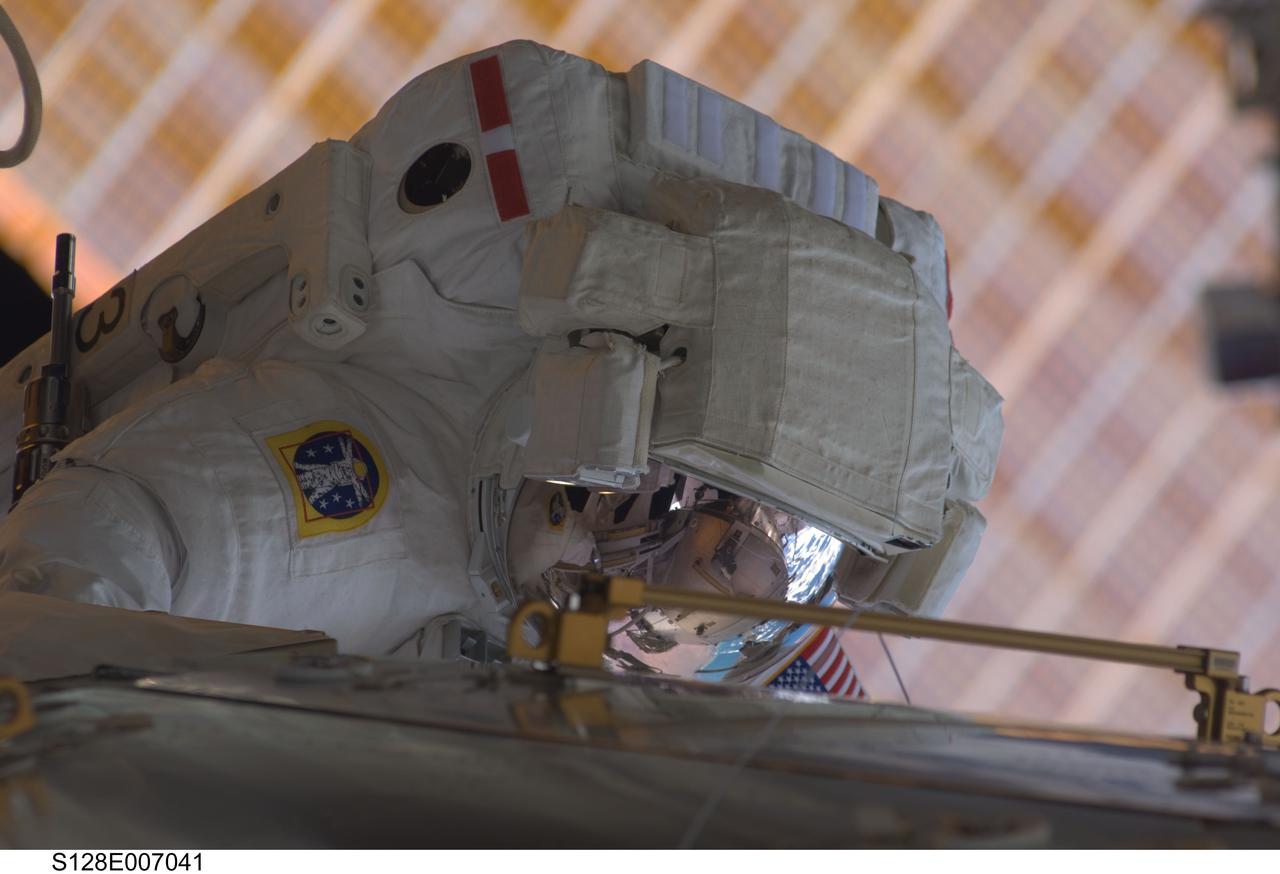
S128-E-007041 (1 Sept. 2009) --- Astronaut Nicole Stott, Expedition 20 flight engineer, participates in the STS-128 mission's first session of extravehicular activity (EVA) as construction and maintenance continue on the International Space Station. During the six-hour, 35-minute spacewalk, Stott and astronaut John “Danny” Olivas (out of frame), mission specialist, removed an empty ammonia tank from the station’s truss and temporarily stowed it on the station’s robotic arm. Olivas and Stott also retrieved the European Technology Exposure Facility (EuTEF) and Materials International Space Station Experiment (MISSE) from the Columbus laboratory module and installed them on Discovery’s payload bay for return.
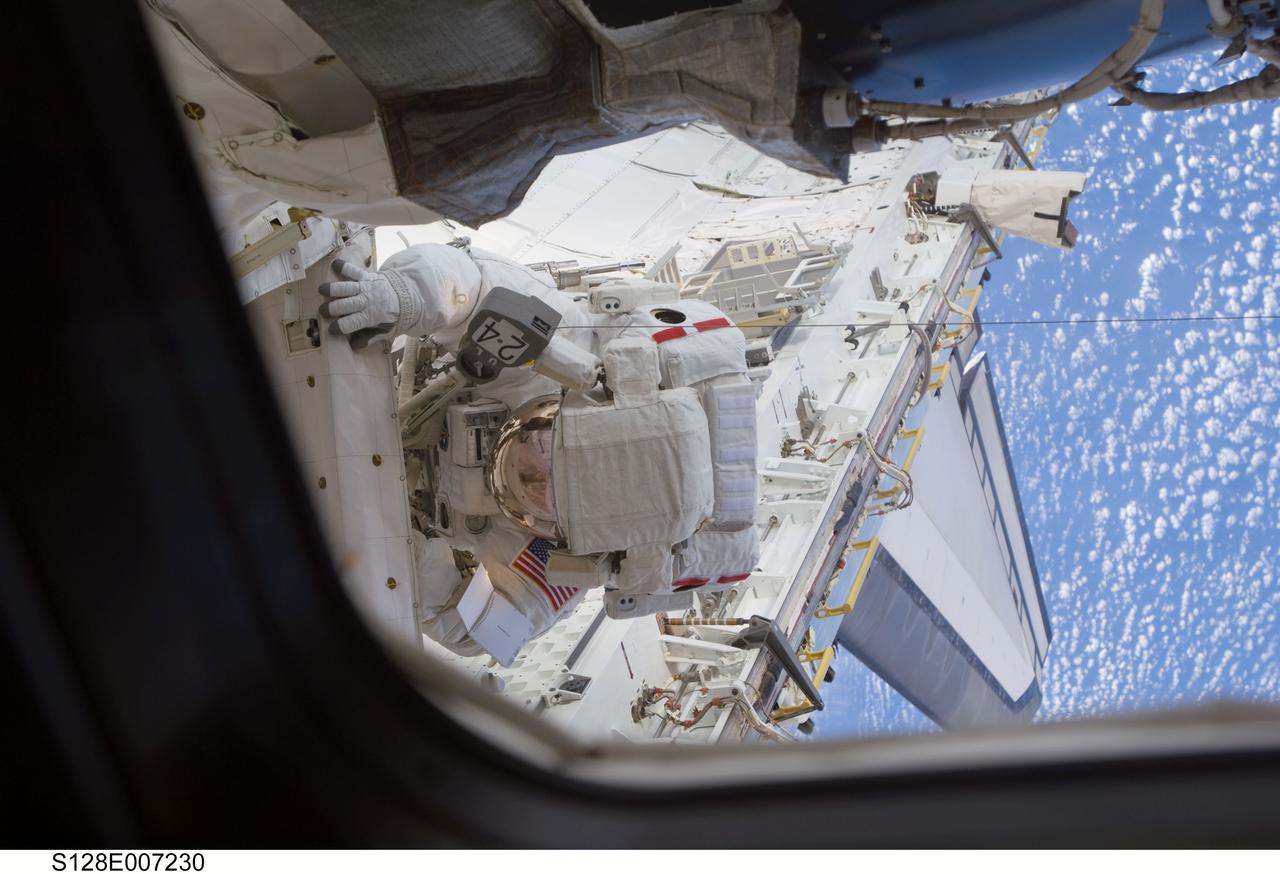
S128-E-007230 (1 Sept. 2009) --- Astronaut Nicole Stott, Expedition 20 flight engineer, participates in the STS-128 mission's first session of extravehicular activity (EVA) as construction and maintenance continue on the International Space Station. During the six-hour, 35-minute spacewalk, Stott and astronaut John “Danny” Olivas (out of frame), mission specialist, removed an empty ammonia tank from the station’s truss and temporarily stowed it on the station’s robotic arm. Olivas and Stott also retrieved the European Technology Exposure Facility (EuTEF) and Materials International Space Station Experiment (MISSE) from the Columbus laboratory module and installed them on Discovery’s payload bay for return.

S128-E-007029 (1 Sept. 2009) --- Astronaut John “Danny” Olivas, STS-128 mission specialist, participates in the mission's first session of extravehicular activity (EVA) as construction and maintenance continue on the International Space Station. During the six-hour, 35-minute spacewalk, Olivas and astronaut Nicole Stott (out of frame), mission specialist, removed an empty ammonia tank from the station’s truss and temporarily stowed it on the station’s robotic arm. Olivas and Stott also retrieved the European Technology Exposure Facility (EuTEF) and Materials International Space Station Experiment (MISSE) from the Columbus laboratory module and installed them on Discovery’s payload bay for return.
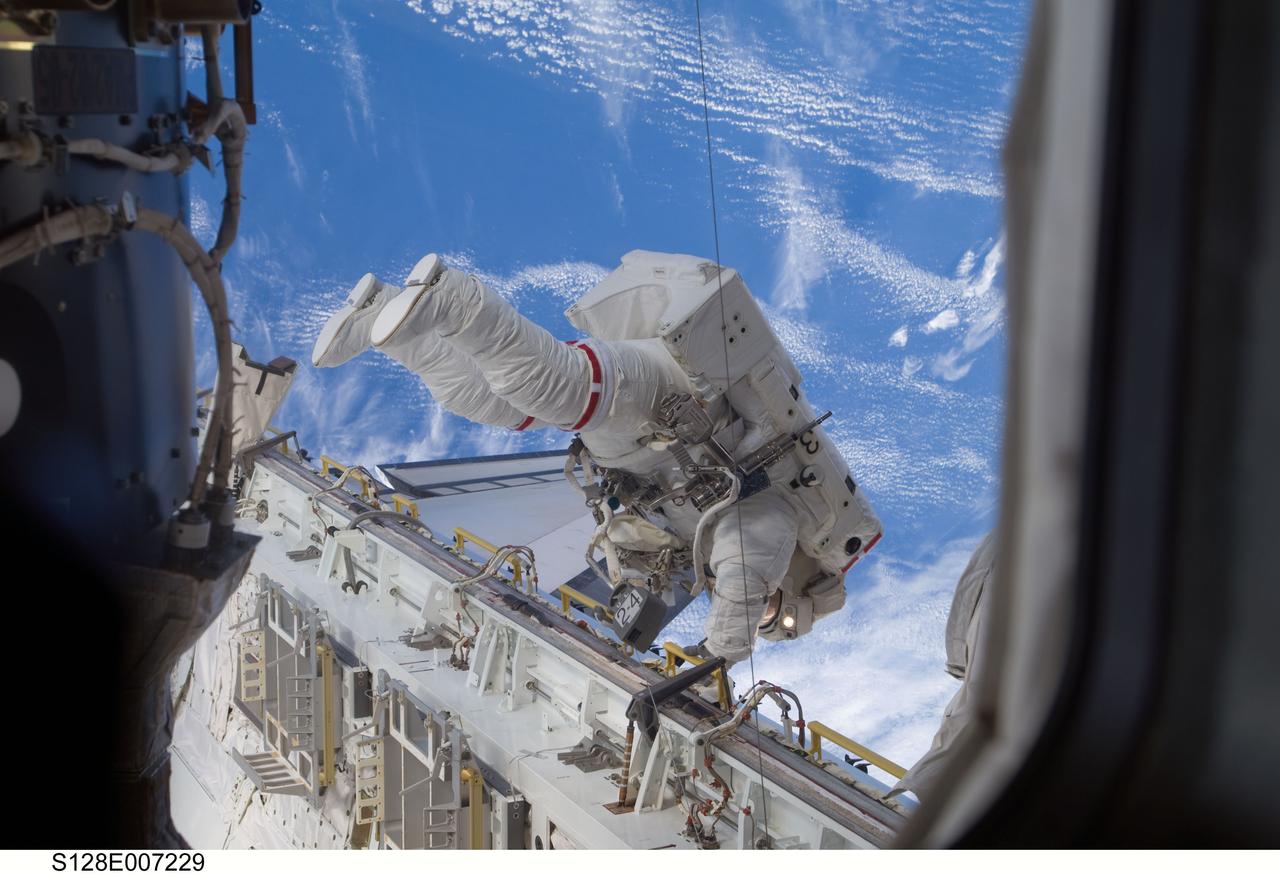
S128-E-007229 (1 Sept. 2009) --- Astronaut Nicole Stott, Expedition 20 flight engineer, participates in the STS-128 mission's first session of extravehicular activity (EVA) as construction and maintenance continue on the International Space Station. During the six-hour, 35-minute spacewalk, Stott and astronaut John “Danny” Olivas (out of frame), mission specialist, removed an empty ammonia tank from the station’s truss and temporarily stowed it on the station’s robotic arm. Olivas and Stott also retrieved the European Technology Exposure Facility (EuTEF) and Materials International Space Station Experiment (MISSE) from the Columbus laboratory module and installed them on Discovery’s payload bay for return.
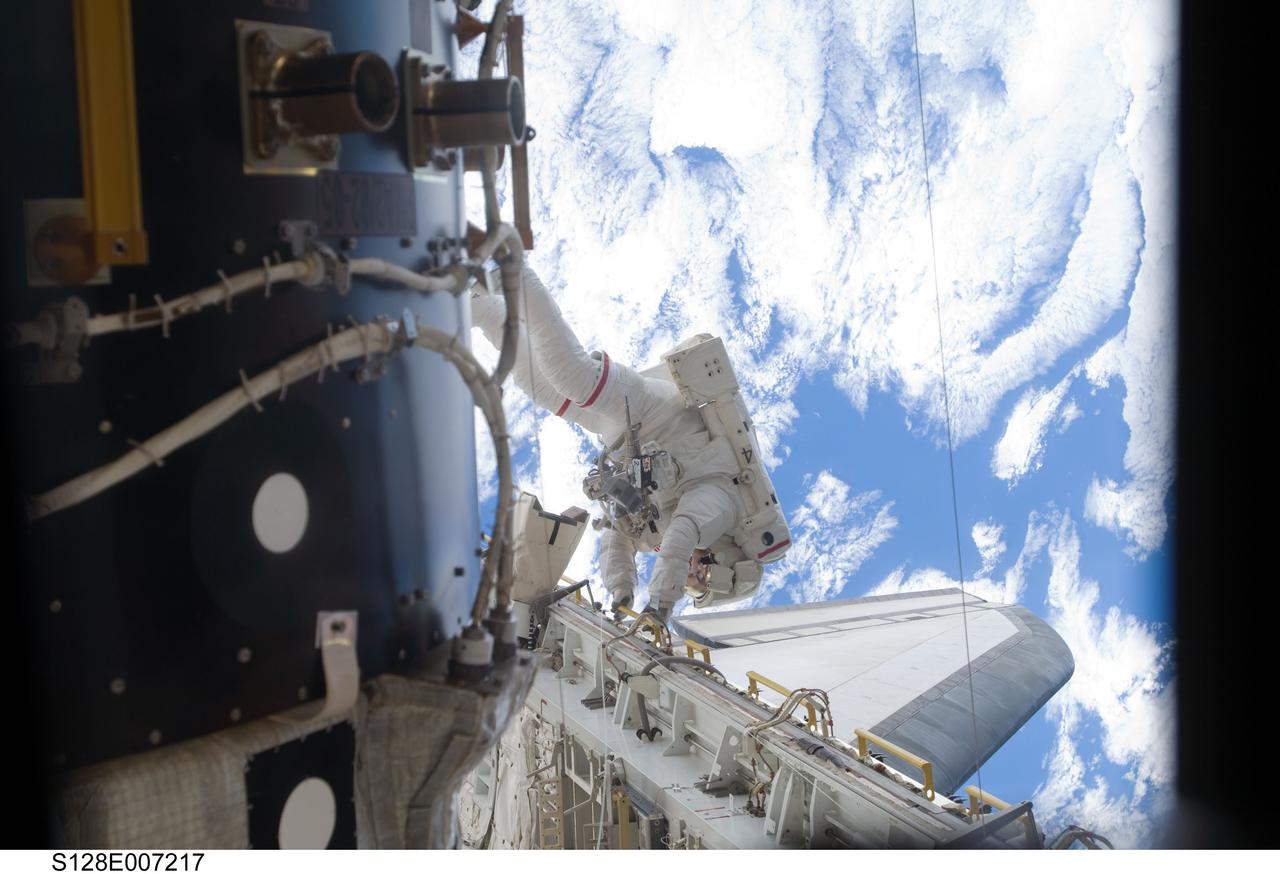
S128-E-007217 (1 Sept. 2009) --- Astronaut John “Danny” Olivas, STS-128 mission specialist, participates in the mission's first session of extravehicular activity (EVA) as construction and maintenance continue on the International Space Station. During the six-hour, 35-minute spacewalk, Olivas and astronaut Nicole Stott (out of frame), mission specialist, removed an empty ammonia tank from the station’s truss and temporarily stowed it on the station’s robotic arm. Olivas and Stott also retrieved the European Technology Exposure Facility (EuTEF) and Materials International Space Station Experiment (MISSE) from the Columbus laboratory module and installed them on Discovery’s payload bay for return.
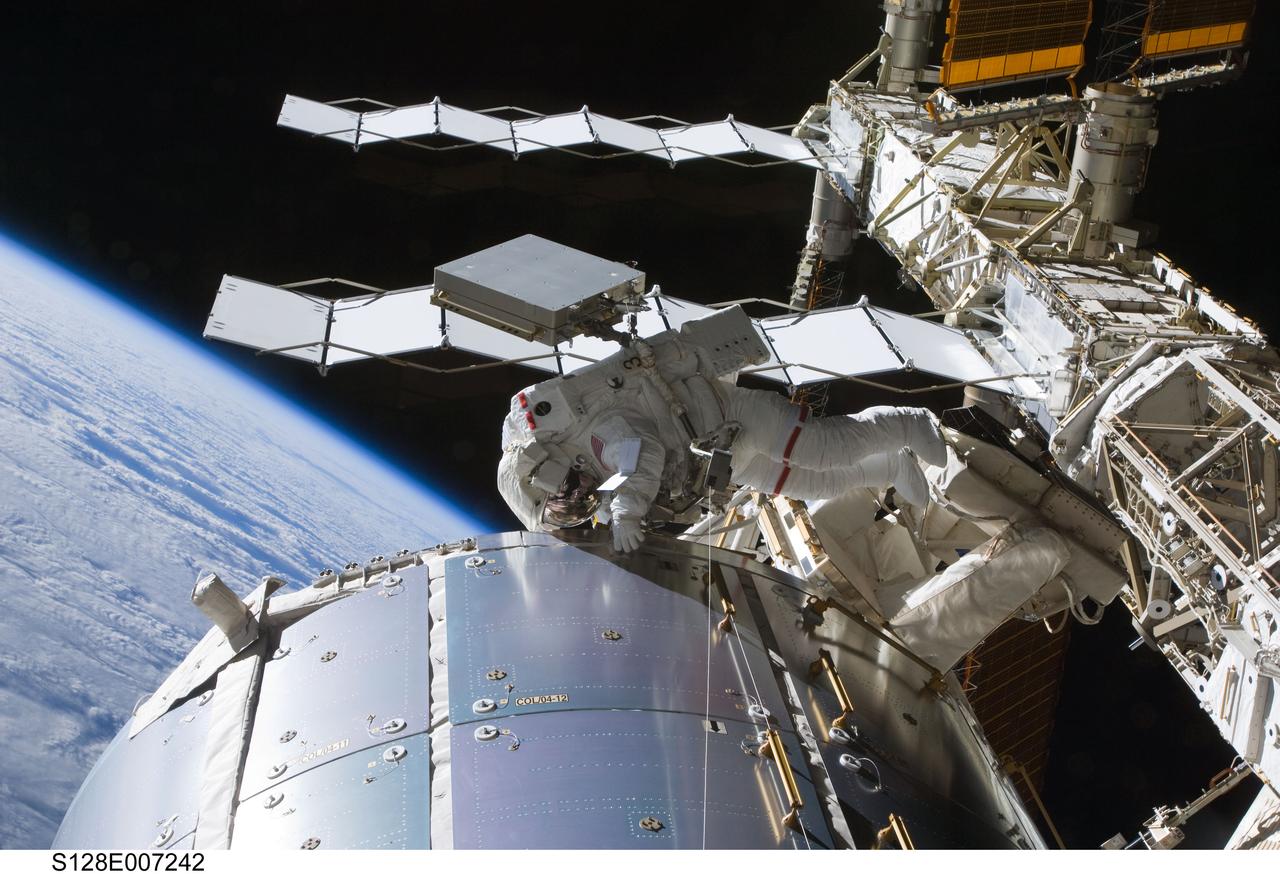
S128-E-007242 (1 Sept. 2009) --- Astronaut Nicole Stott, Expedition 20 flight engineer, participates in the STS-128 mission's first session of extravehicular activity (EVA) as construction and maintenance continue on the International Space Station. During the six-hour, 35-minute spacewalk, Stott and astronaut John “Danny” Olivas (out of frame), mission specialist, removed an empty ammonia tank from the station’s truss and temporarily stowed it on the station’s robotic arm. Olivas and Stott also retrieved the European Technology Exposure Facility (EuTEF) and Materials International Space Station Experiment (MISSE) from the Columbus laboratory module and installed them on Discovery’s payload bay for return.
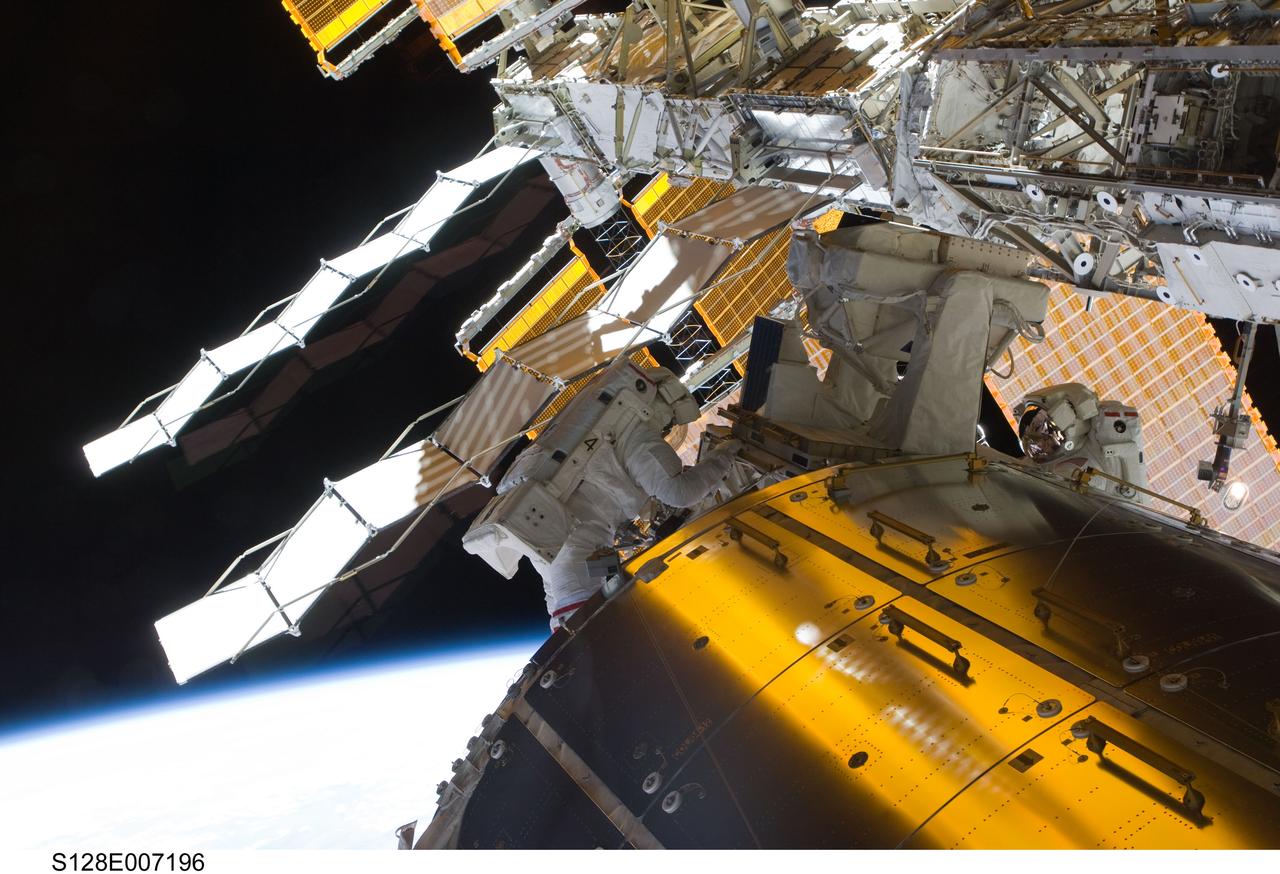
S128-E-007196 (1 Sept. 2009) --- Astronauts John “Danny” Olivas and Nicole Stott (right), both STS-128 mission specialists, participate in the mission's first session of extravehicular activity (EVA) as construction and maintenance continue on the International Space Station. During the six-hour, 35-minute spacewalk, Olivas and Stott removed an empty ammonia tank from the station’s truss and temporarily stowed it on the station’s robotic arm. Olivas and Stott also retrieved the European Technology Exposure Facility (EuTEF) and Materials International Space Station Experiment (MISSE) from the Columbus laboratory module and installed them on Discovery’s payload bay for return.
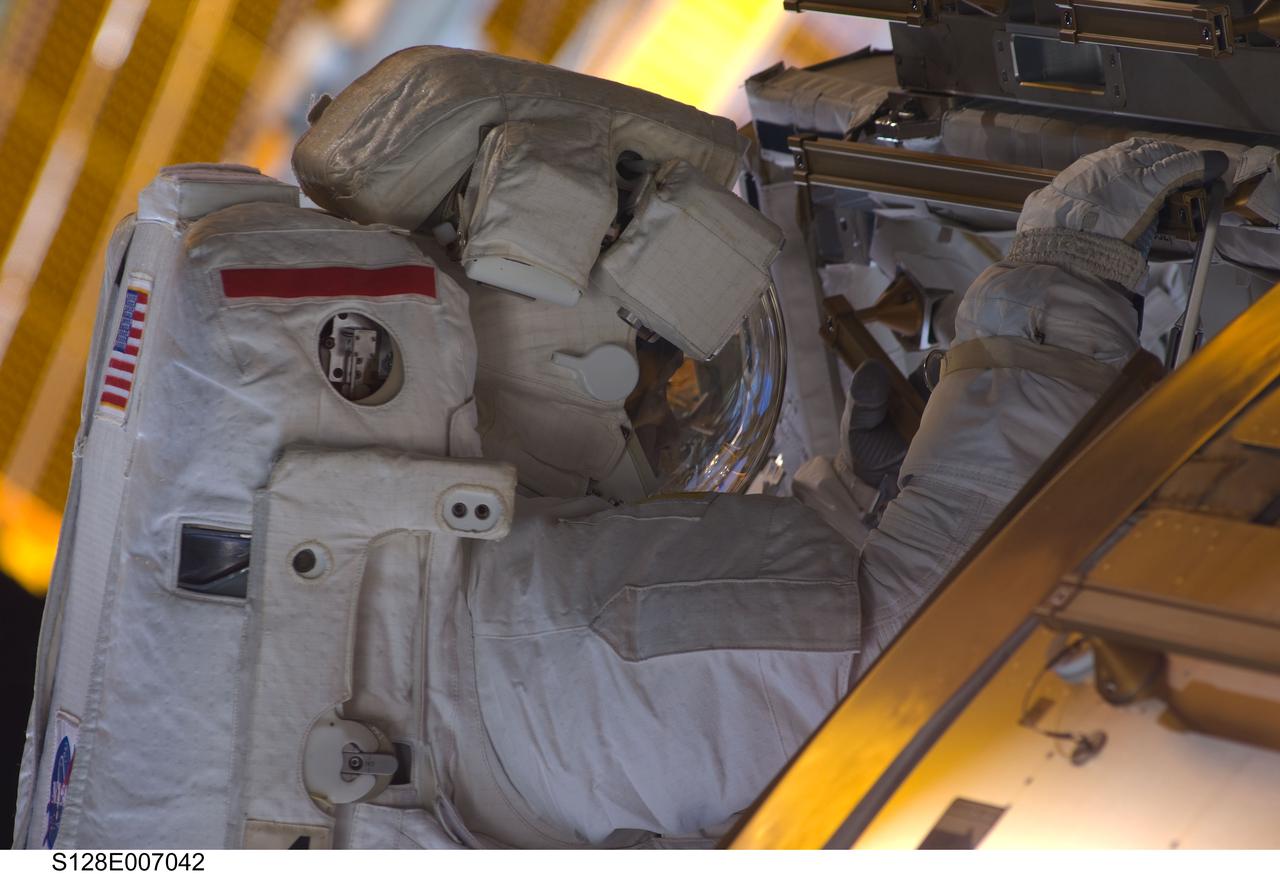
S128-E-007042 (1 Sept. 2009) --- Astronaut John “Danny” Olivas, STS-128 mission specialist, participates in the mission's first session of extravehicular activity (EVA) as construction and maintenance continue on the International Space Station. During the six-hour, 35-minute spacewalk, Olivas and astronaut Nicole Stott (out of frame), mission specialist, removed an empty ammonia tank from the station’s truss and temporarily stowed it on the station’s robotic arm. Olivas and Stott also retrieved the European Technology Exposure Facility (EuTEF) and Materials International Space Station Experiment (MISSE) from the Columbus laboratory module and installed them on Discovery’s payload bay for return.
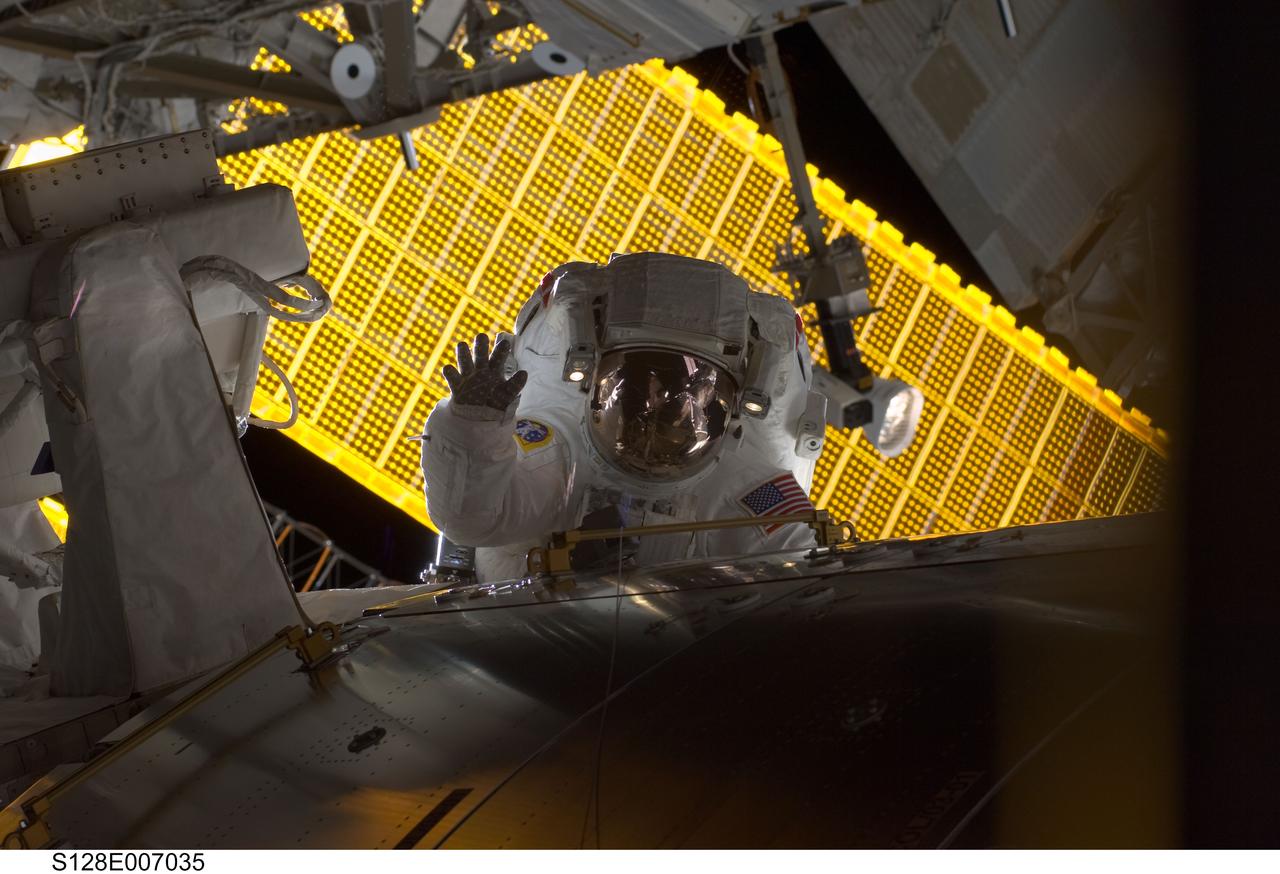
S128-E-007035 (1 Sept. 2009) --- Astronaut Nicole Stott, Expedition 20 flight engineer, participates in the STS-128 mission's first session of extravehicular activity (EVA) as construction and maintenance continue on the International Space Station. During the six-hour, 35-minute spacewalk, Stott and astronaut John “Danny” Olivas (out of frame), mission specialist, removed an empty ammonia tank from the station’s truss and temporarily stowed it on the station’s robotic arm. Olivas and Stott also retrieved the European Technology Exposure Facility (EuTEF) and Materials International Space Station Experiment (MISSE) from the Columbus laboratory module and installed them on Discovery’s payload bay for return.
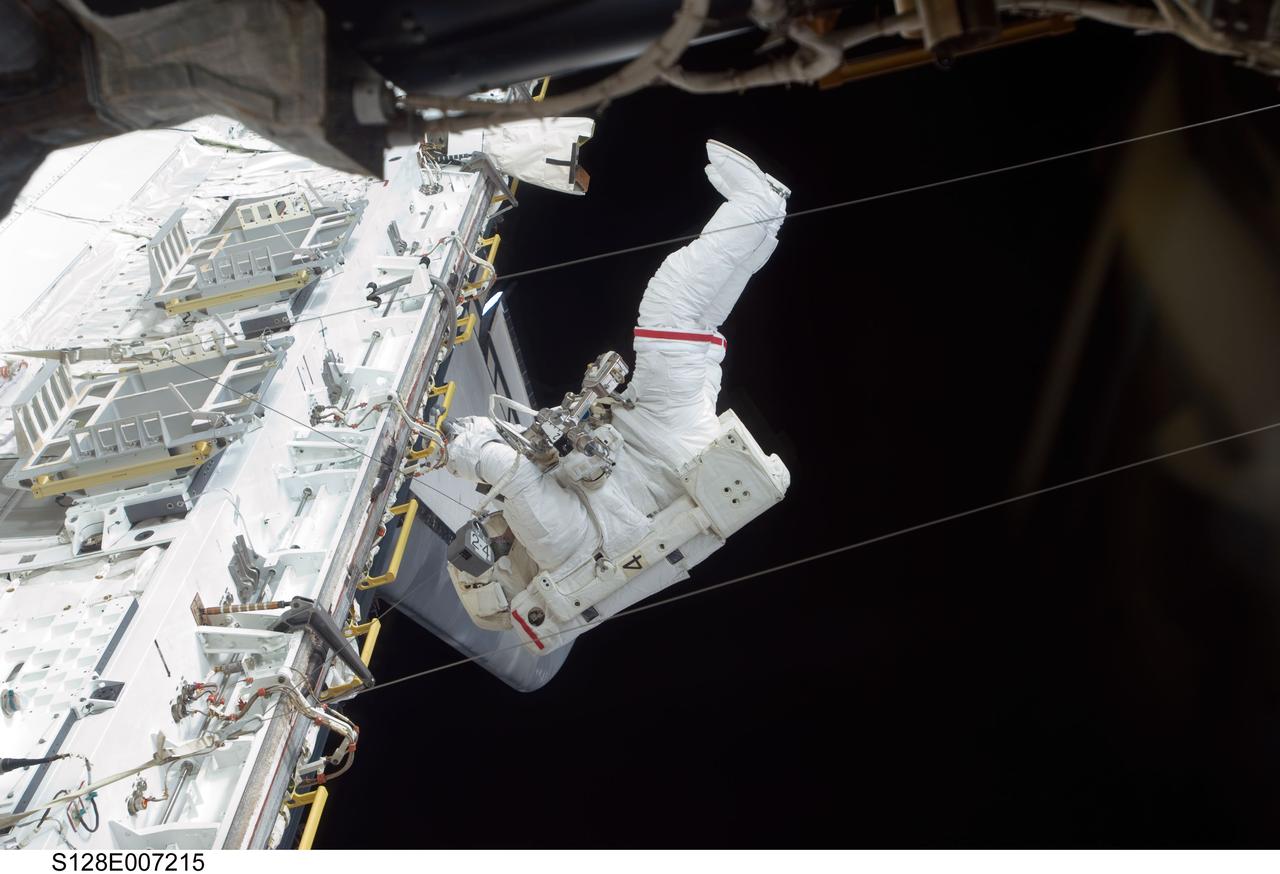
S128-E-007215 (1 Sept. 2009) --- Astronaut John “Danny” Olivas, STS-128 mission specialist, participates in the mission's first session of extravehicular activity (EVA) as construction and maintenance continue on the International Space Station. During the six-hour, 35-minute spacewalk, Olivas and astronaut Nicole Stott (out of frame), mission specialist, removed an empty ammonia tank from the station’s truss and temporarily stowed it on the station’s robotic arm. Olivas and Stott also retrieved the European Technology Exposure Facility (EuTEF) and Materials International Space Station Experiment (MISSE) from the Columbus laboratory module and installed them on Discovery’s payload bay for return.
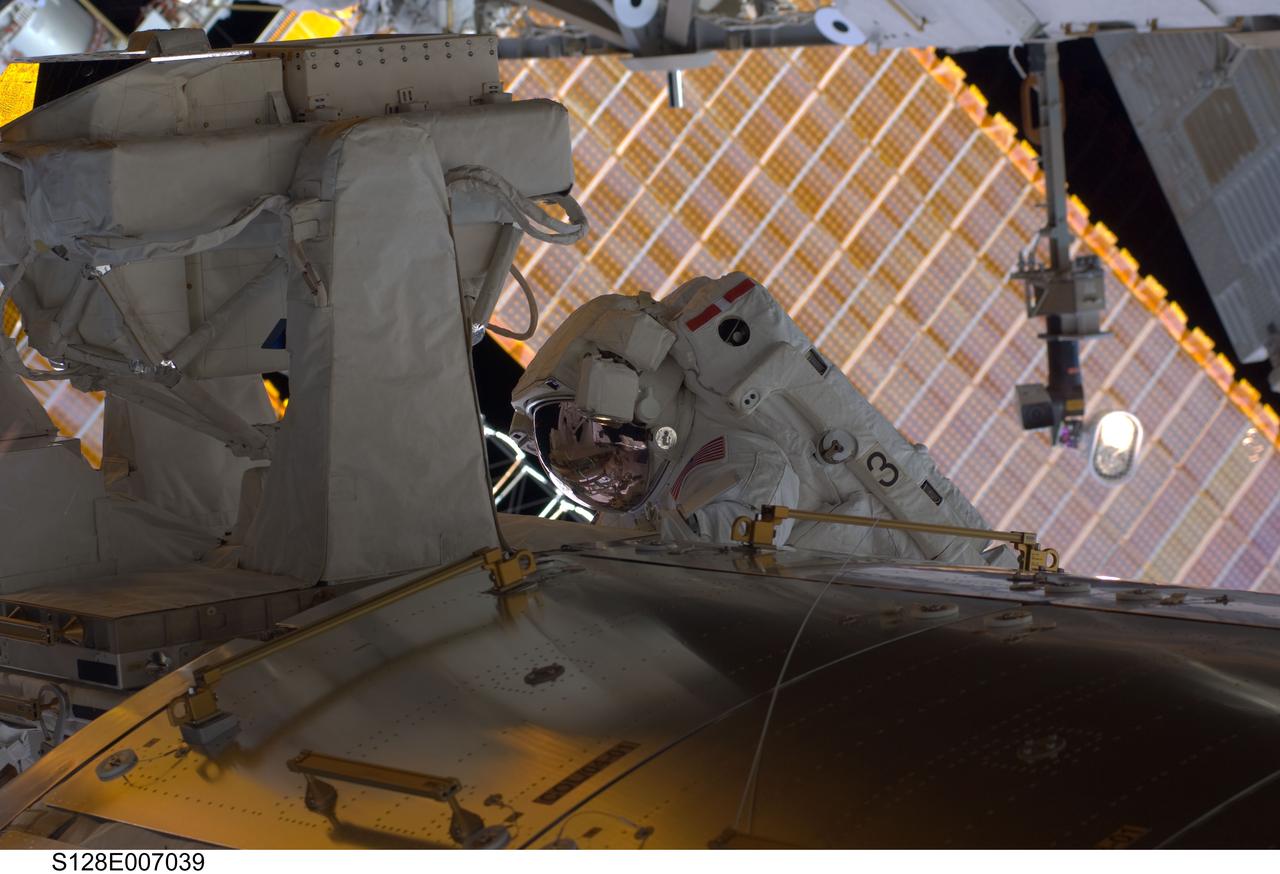
S128-E-007039 (1 Sept. 2009) --- Astronaut Nicole Stott, Expedition 20 flight engineer, participates in the STS-128 mission's first session of extravehicular activity (EVA) as construction and maintenance continue on the International Space Station. During the six-hour, 35-minute spacewalk, Stott and astronaut John “Danny” Olivas (out of frame), mission specialist, removed an empty ammonia tank from the station’s truss and temporarily stowed it on the station’s robotic arm. Olivas and Stott also retrieved the European Technology Exposure Facility (EuTEF) and Materials International Space Station Experiment (MISSE) from the Columbus laboratory module and installed them on Discovery’s payload bay for return.
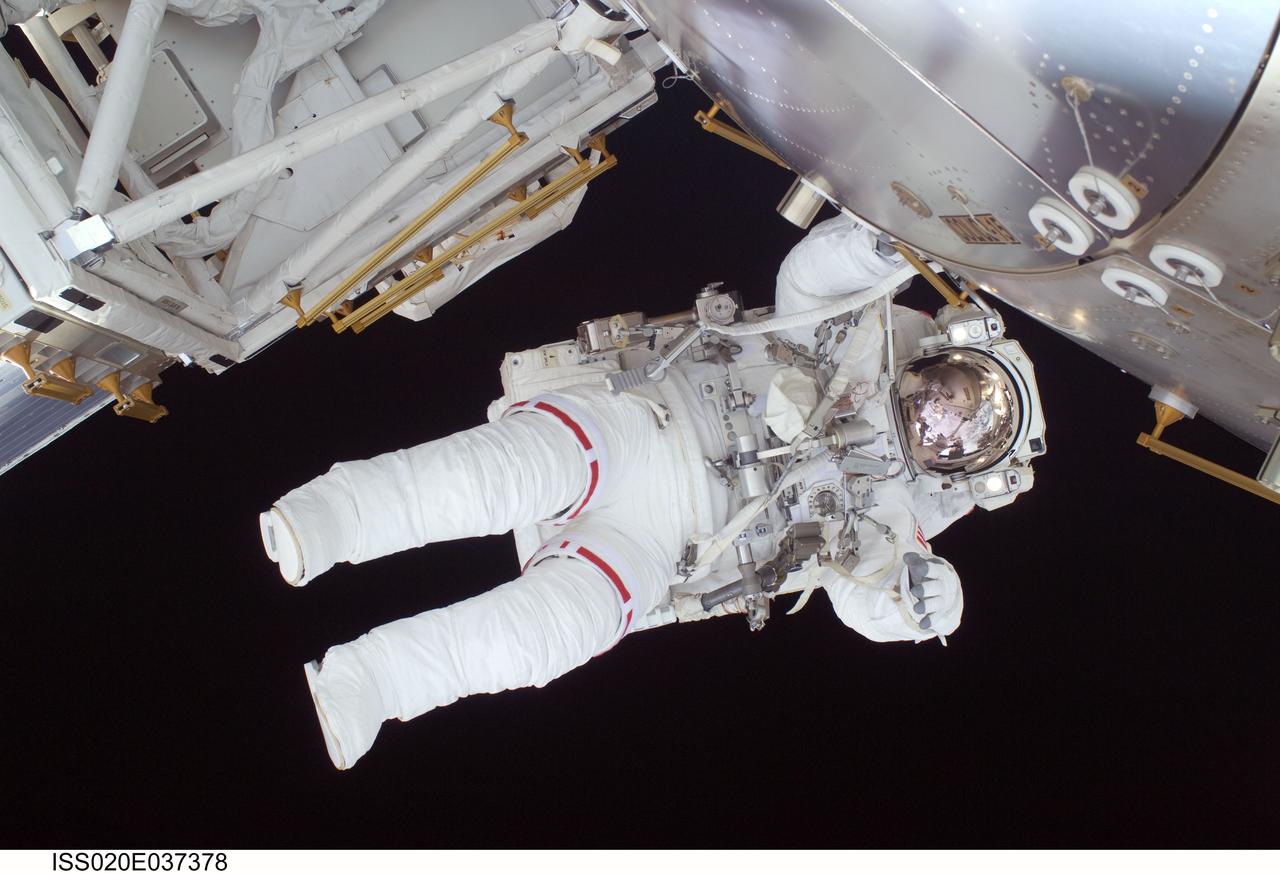
ISS020-E-037378 (1 Sept. 2009) --- Astronaut Nicole Stott, Expedition 20 flight engineer, participates in the STS-128 mission's first session of extravehicular activity (EVA) as construction and maintenance continue on the International Space Station. During the six-hour, 35-minute spacewalk, Stott and astronaut John "Danny" Olivas (out of frame), mission specialist, removed an empty ammonia tank from the station's truss and temporarily stowed it on the station's robotic arm. Olivas and Stott also retrieved the European Technology Exposure Facility (EuTEF) and Materials International Space Station Experiment (MISSE) from the Columbus laboratory module and installed them on Discovery's payload bay for return.

S128-E-007225 (1 Sept. 2009) --- Astronaut John “Danny” Olivas, STS-128 mission specialist, participates in the mission's first session of extravehicular activity (EVA) as construction and maintenance continue on the International Space Station. During the six-hour, 35-minute spacewalk, Olivas and astronaut Nicole Stott (out of frame), mission specialist, removed an empty ammonia tank from the station’s truss and temporarily stowed it on the station’s robotic arm. Olivas and Stott also retrieved the European Technology Exposure Facility (EuTEF) and Materials International Space Station Experiment (MISSE) from the Columbus laboratory module and installed them on Discovery’s payload bay for return.
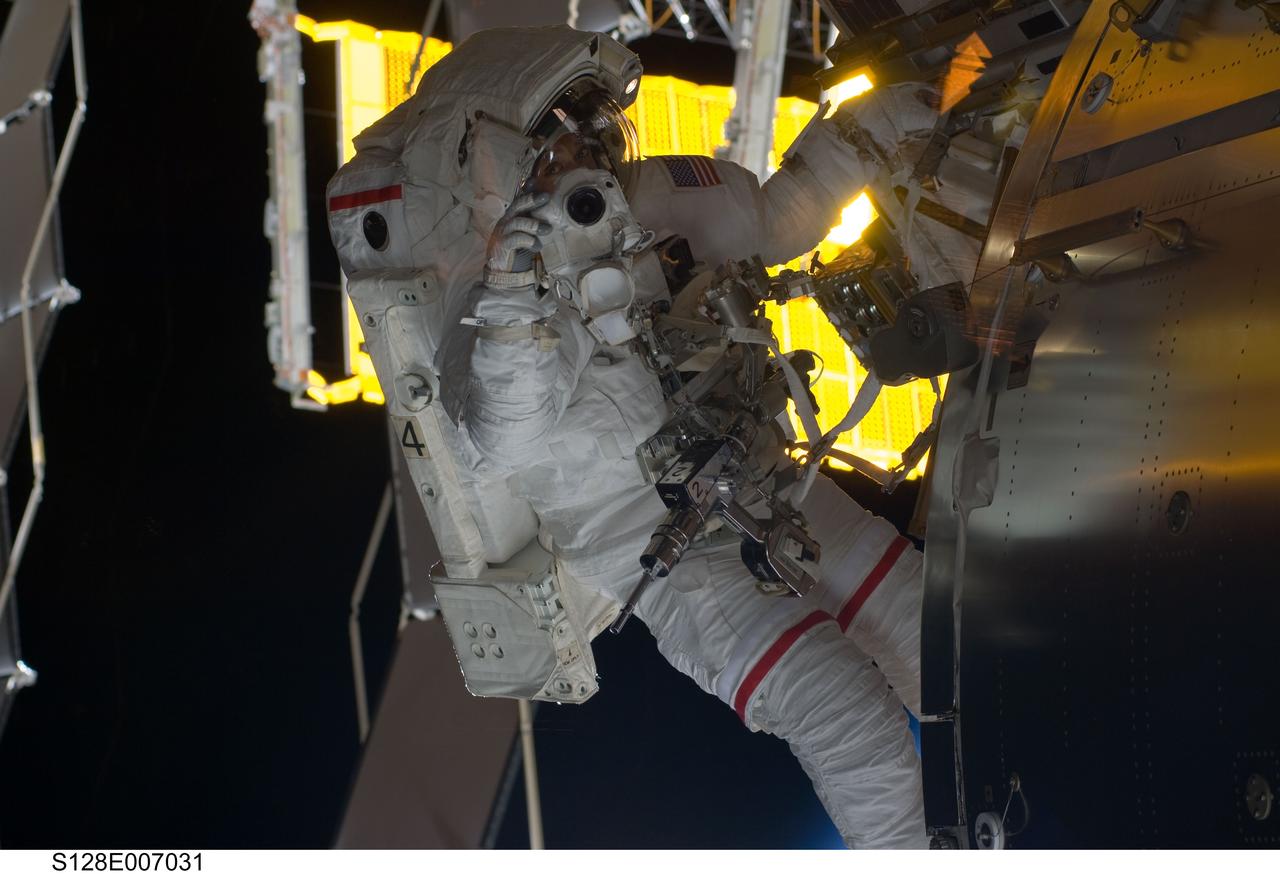
S128-E-007031 (1 Sept. 2009) --- Astronaut John “Danny” Olivas, STS-128 mission specialist, participates in the mission's first session of extravehicular activity (EVA) as construction and maintenance continue on the International Space Station. During the six-hour, 35-minute spacewalk, Olivas and astronaut Nicole Stott (out of frame), mission specialist, removed an empty ammonia tank from the station’s truss and temporarily stowed it on the station’s robotic arm. Olivas and Stott also retrieved the European Technology Exposure Facility (EuTEF) and Materials International Space Station Experiment (MISSE) from the Columbus laboratory module and installed them on Discovery’s payload bay for return.
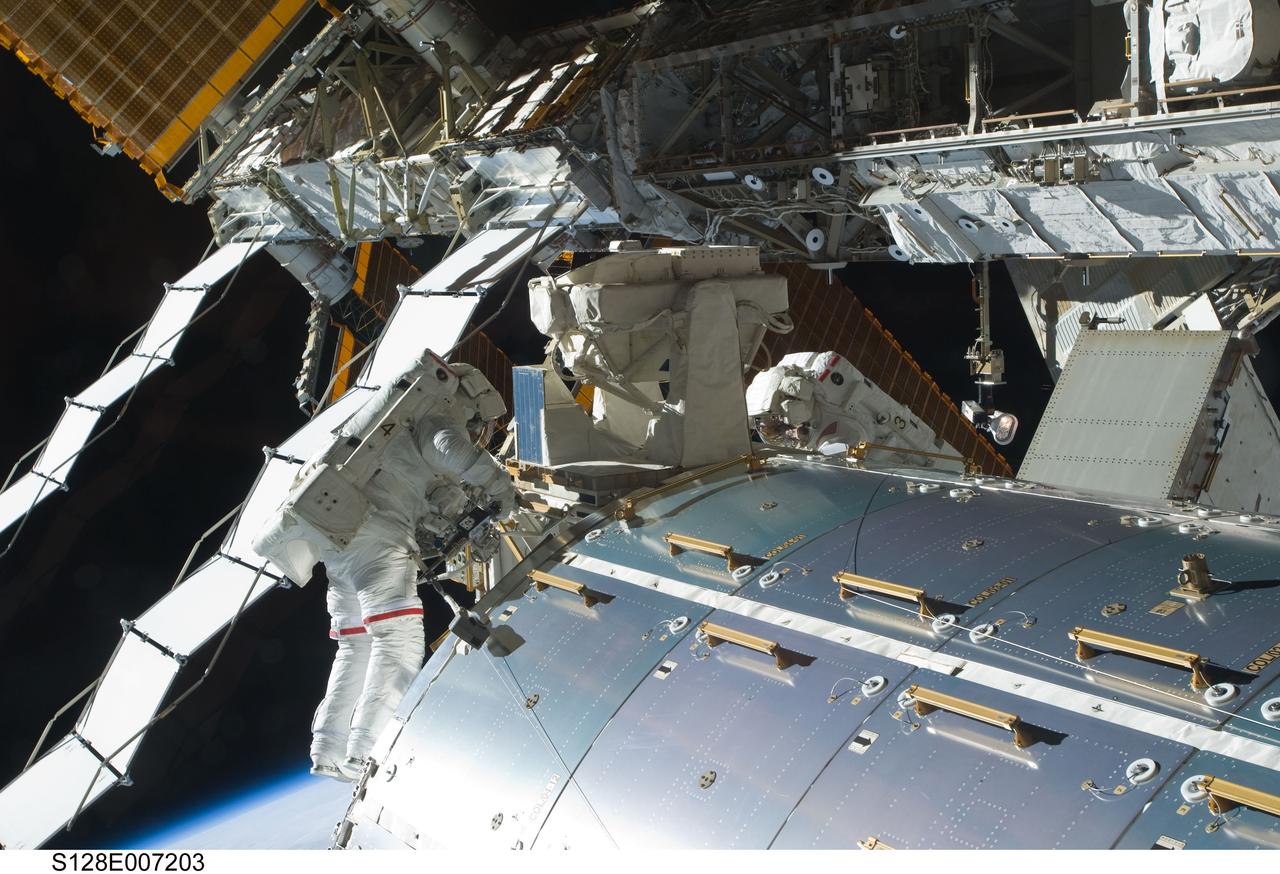
S128-E-007203 (1 Sept. 2009) --- Astronauts John “Danny” Olivas and Nicole Stott (right), both STS-128 mission specialists, participate in the mission's first session of extravehicular activity (EVA) as construction and maintenance continue on the International Space Station. During the six-hour, 35-minute spacewalk, Olivas and Stott removed an empty ammonia tank from the station’s truss and temporarily stowed it on the station’s robotic arm. Olivas and Stott also retrieved the European Technology Exposure Facility (EuTEF) and Materials International Space Station Experiment (MISSE) from the Columbus laboratory module and installed them on Discovery’s payload bay for return.
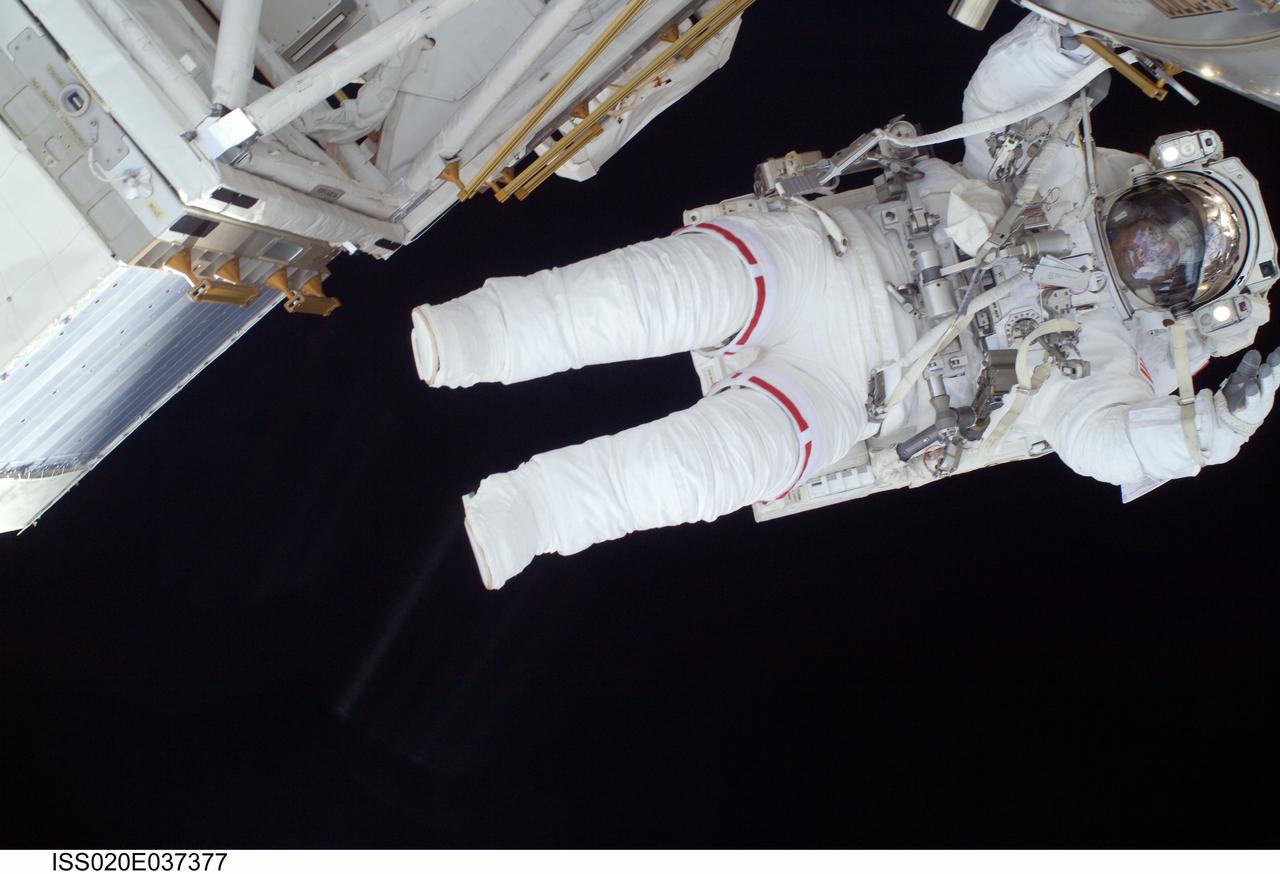
ISS020-E-037377 (1 Sept. 2009) --- Astronaut Nicole Stott, Expedition 20 flight engineer, participates in the STS-128 mission's first session of extravehicular activity (EVA) as construction and maintenance continue on the International Space Station. During the six-hour, 35-minute spacewalk, Stott and astronaut John "Danny" Olivas (out of frame), mission specialist, removed an empty ammonia tank from the station's truss and temporarily stowed it on the station's robotic arm. Olivas and Stott also retrieved the European Technology Exposure Facility (EuTEF) and Materials International Space Station Experiment (MISSE) from the Columbus laboratory module and installed them on Discovery's payload bay for return.
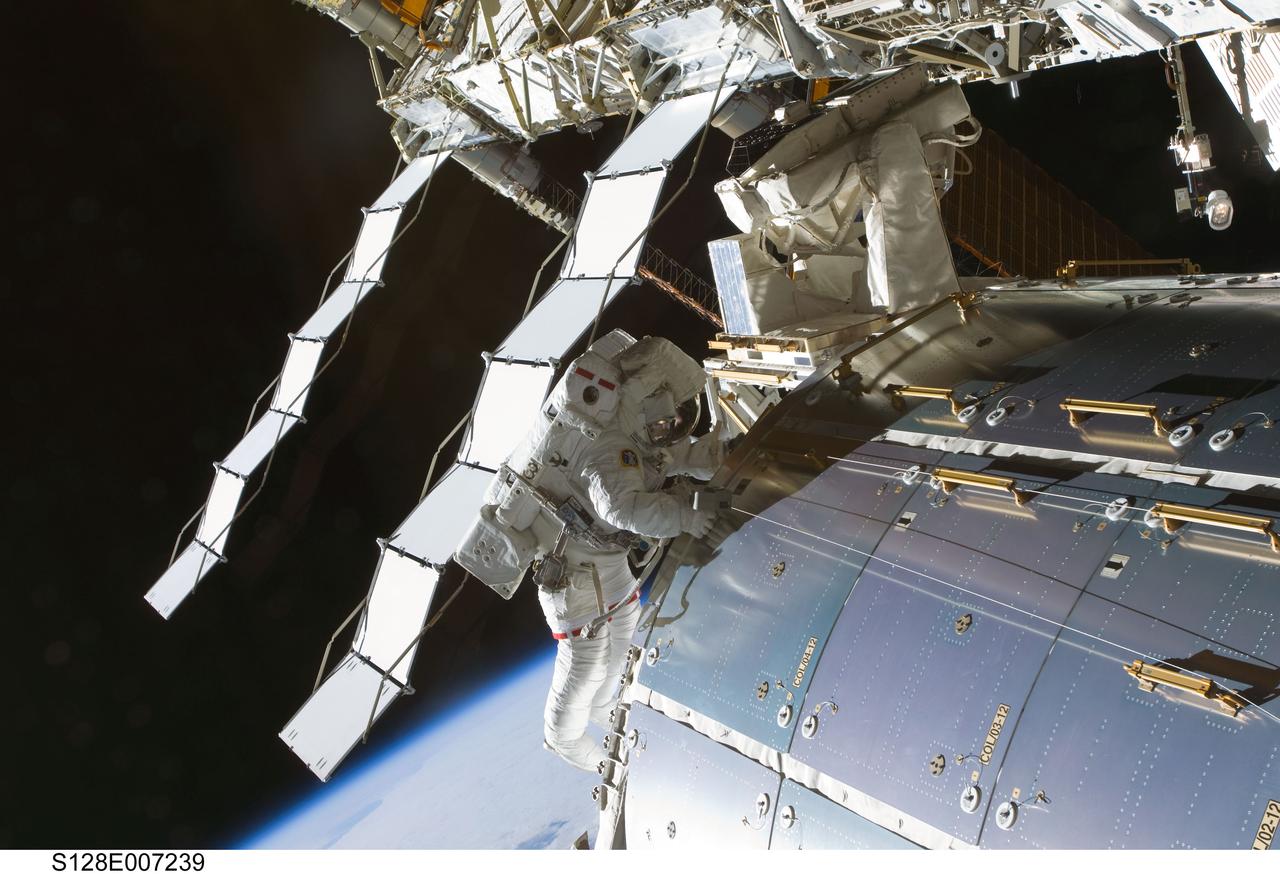
S128-E-007239 (1 Sept. 2009) --- Astronaut Nicole Stott, Expedition 20 flight engineer, participates in the STS-128 mission's first session of extravehicular activity (EVA) as construction and maintenance continue on the International Space Station. During the six-hour, 35-minute spacewalk, Stott and astronaut John “Danny” Olivas (out of frame), mission specialist, removed an empty ammonia tank from the station’s truss and temporarily stowed it on the station’s robotic arm. Olivas and Stott also retrieved the European Technology Exposure Facility (EuTEF) and Materials International Space Station Experiment (MISSE) from the Columbus laboratory module and installed them on Discovery’s payload bay for return.
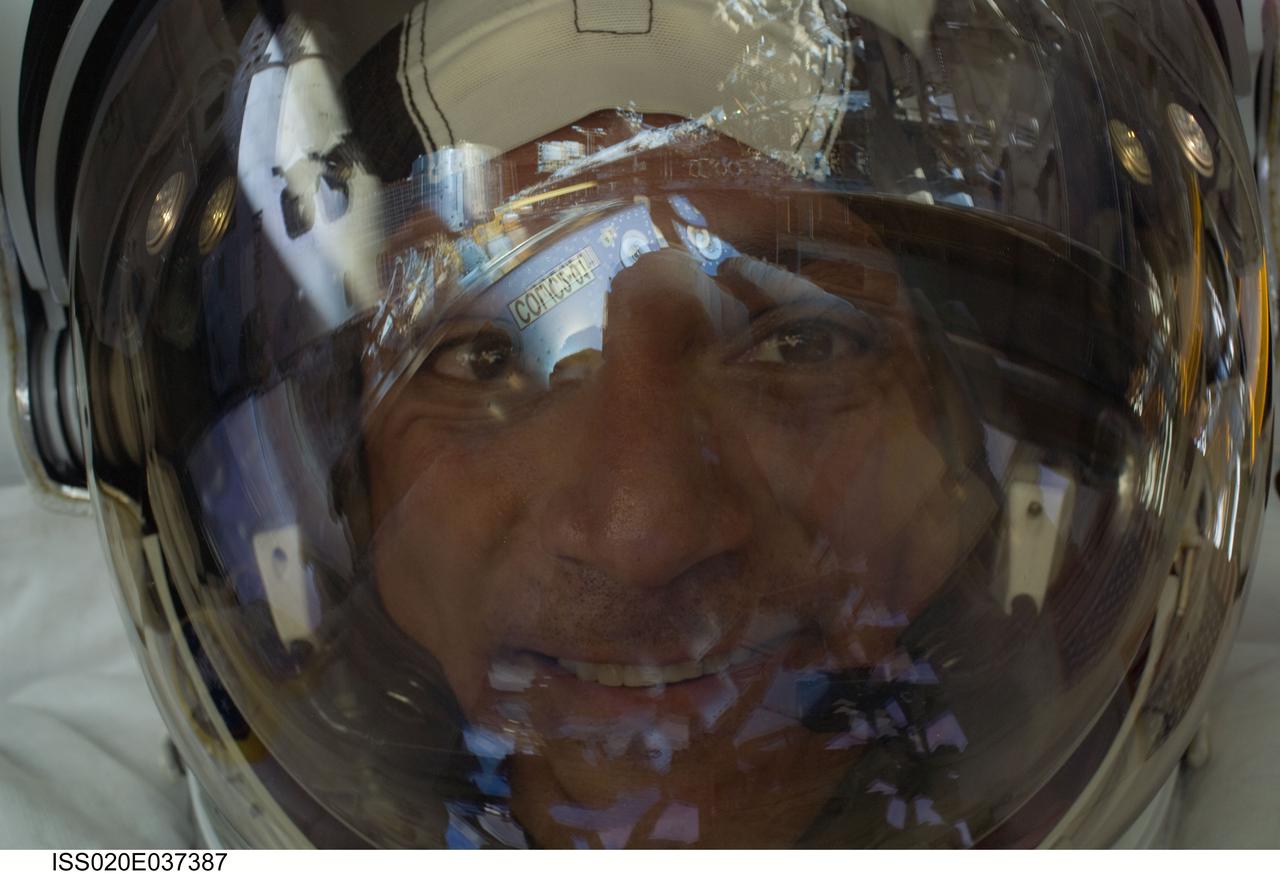
ISS020-E-037387 (1 Sept. 2009) --- This is a close-up view of the face of astronaut John ?Danny? Olivas, STS-128 mission specialist, as he participated in the STS-128 mission's first session of extravehicular activity (EVA) as construction and maintenance picked up once more on the International Space Station. During the six-hour, 35-minute spacewalk, Olivas and astronaut Nicole Stott (out of frame), Expedition 20 flight engineer, removed an empty ammonia tank from the station's truss and temporarily stowed it on the station's robotic arm. Olivas and Stott also retrieved the European Technology Exposure Facility (EuTEF) and Materials International Space Station Experiment (MISSE) from the Columbus laboratory module and installed them on Discovery's payload bay for return.
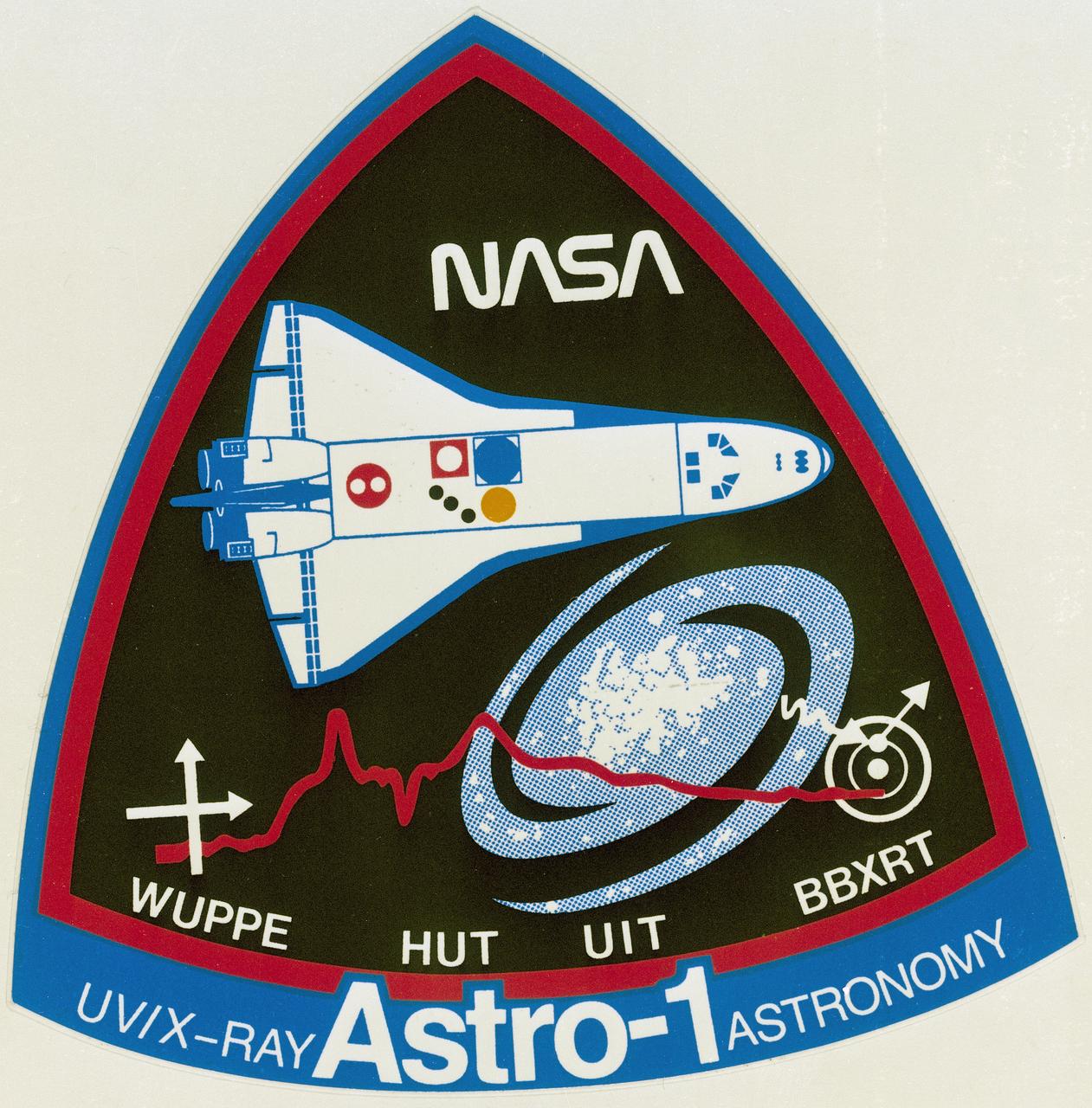
The primary payload for Space Shuttle Mission STS-35, launched December 2, 1990, was the ASTRO-1 Observatory. Designed for round the clock observation of the celestial sphere in ultraviolet and X-ray astronomy, ASTRO-1 featured a collection of four telescopes: the Hopkins Ultraviolet Telescope (HUT); the Wisconsin Ultraviolet Photo- Polarimeter Experiment (WUPPE); the Ultraviolet Imaging Telescope (UIT); and the Broad Band X-ray Telescope (BBXRT). Ultraviolet telescopes mounted on Spacelab elements in cargo bay were to be operated in shifts by flight crew. Loss of both data display units (used for pointing telescopes and operating experiments) during mission impacted crew-aiming procedures and forced ground teams at Marshall Space Flight Center to aim ultraviolet telescopes with fine-tuning by flight crew. BBXRT, also mounted in cargo bay, was directed from outset by ground-based operators at Goddard Space Flight Center. This is the logo or emblem that was designed to represent the ASTRO-1 payload.
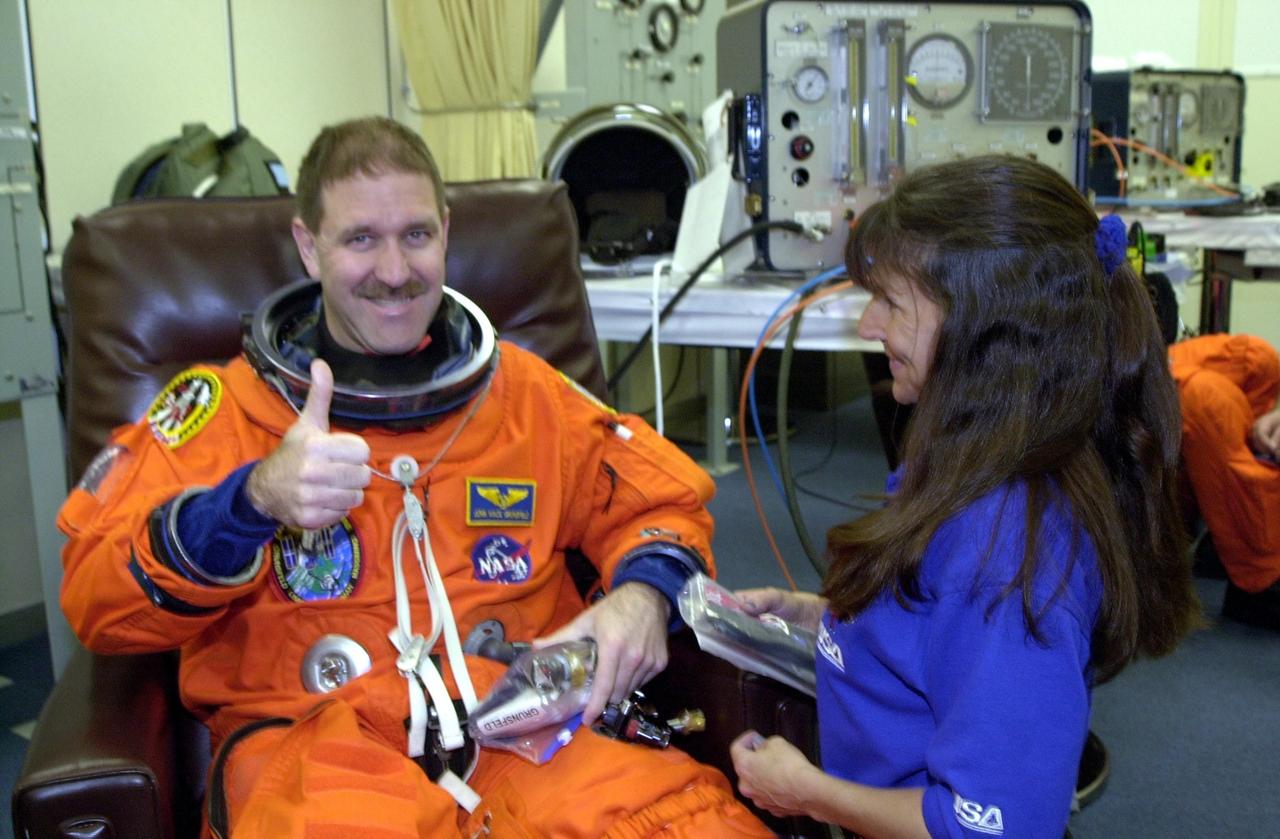
KENNEDY SPACE CENTER, Fla. - During suitup, STS-109 Payload Commander John M. Grunsfeld shows his readiness for launch. Liftoff of Space Shuttle Columbia is scheduled for 6:22 a.m. EST March 1. On mission STS-109, the crew will capture the Hubble Space Telescope using the Shuttle's robotic arm and secure it on a workstand in Columbia's payload bay. Four mission specialists will perform five scheduled spacewalks to complete system upgrades to the telescope. More durable solar arrays, a large gyroscopic assembly to help point the telescope properly, a new telescope power control unit, and a cooling system to restore the use of a key infrared camera and spectrometer unit, which has been dormant since 1999, will all be installed. In addition, the telescope's view of the Universe will be improved with the addition of the Advanced Camera for Surveys (ACS), which replaces the Faint Object Camera, the last of Hubble's original instruments. Mission STS-109 is the 27th flight of the orbiter Columbia and the 108th flight overall in NASA's Space Shuttle program. After the 11-day mission, Columbia is scheduled to land about 4:35 a.m. EST March 12
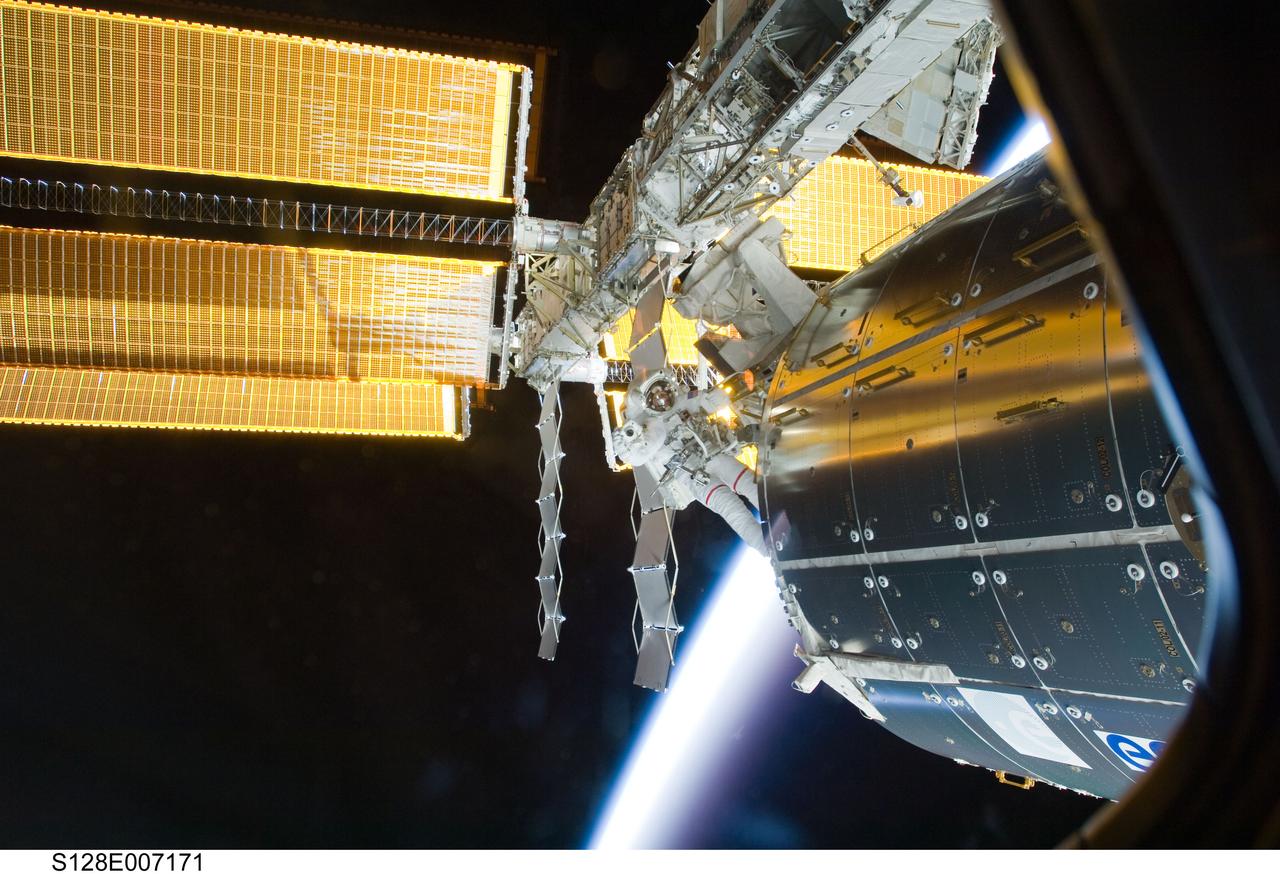
S128-E-007171 (1 Sept. 2009) --- Astronaut John “Danny” Olivas, STS-128 mission specialist, participates in the mission's first session of extravehicular activity (EVA) as construction and maintenance continue on the International Space Station. During the six-hour, 35-minute spacewalk, Olivas and astronaut Nicole Stott (out of frame), mission specialist, removed an empty ammonia tank from the station’s truss and temporarily stowed it on the station’s robotic arm. Olivas and Stott also retrieved the European Technology Exposure Facility (EuTEF) and Materials International Space Station Experiment (MISSE) from the Columbus laboratory module and installed them on Discovery’s payload bay for return. The blackness of space and Earth’s atmosphere provide the backdrop for the scene.
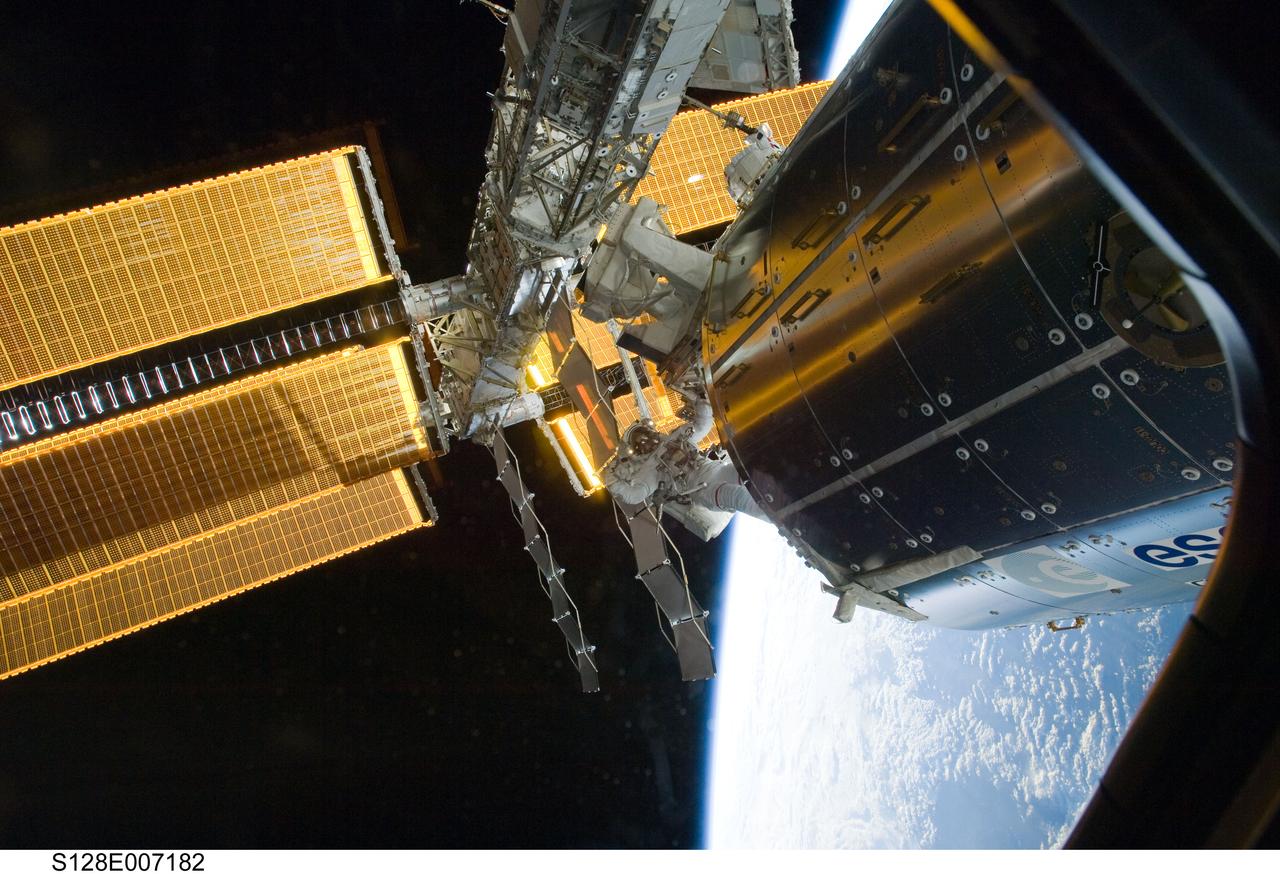
S128-E-007182 (1 Sept. 2009) --- Astronauts John “Danny” Olivas and Nicole Stott (partially obscured at top), both STS-128 mission specialists, participate in the mission's first session of extravehicular activity (EVA) as construction and maintenance continue on the International Space Station. During the six-hour, 35-minute spacewalk, Olivas and Stott removed an empty ammonia tank from the station’s truss and temporarily stowed it on the station’s robotic arm. Olivas and Stott also retrieved the European Technology Exposure Facility (EuTEF) and Materials International Space Station Experiment (MISSE) from the Columbus laboratory module and installed them on Discovery’s payload bay for return. The blackness of space and Earth’s horizon provide the backdrop for the scene.
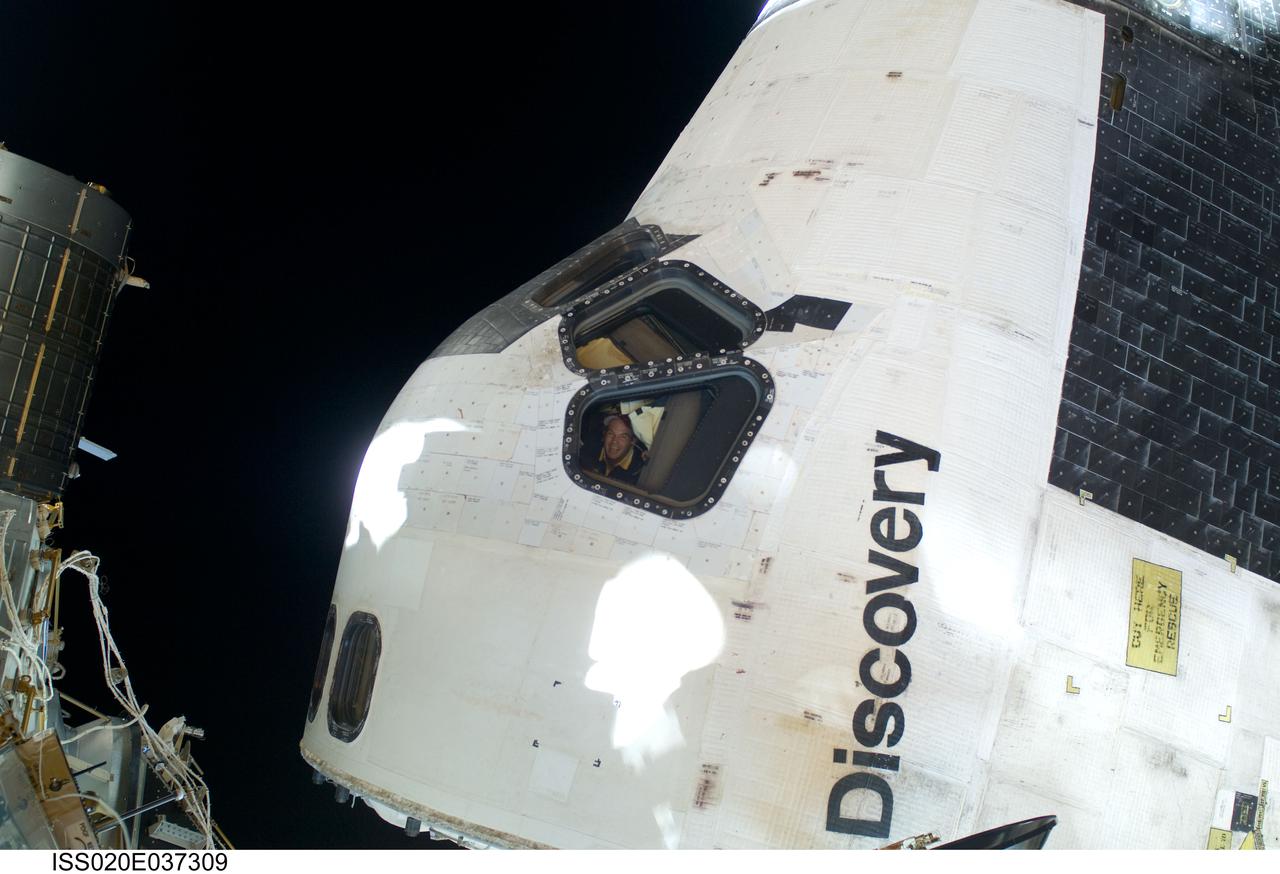
ISS020-E-037309 (1 Sept. 2009) --- One of the space-walking astronauts on the STS-128 mission's first session of extravehicular activity (EVA)captured this electronic still image of the Space Shuttle Discovery's cabin. Construction and maintenance continued on the International Space Station during the six-hour, 35-minute spacewalk of astronauts Nicole Stott and John "Danny" Olivas (both out of frame), mission specialist. Among their accomplishments, they removed an empty ammonia tank from the station's truss and temporarily stowed it on the station's robotic arm. Olivas and Stott also retrieved the European Technology Exposure Facility (EuTEF) and Materials International Space Station Experiment (MISSE) from the Columbus laboratory module and installed them on Discovery's payload bay for return.
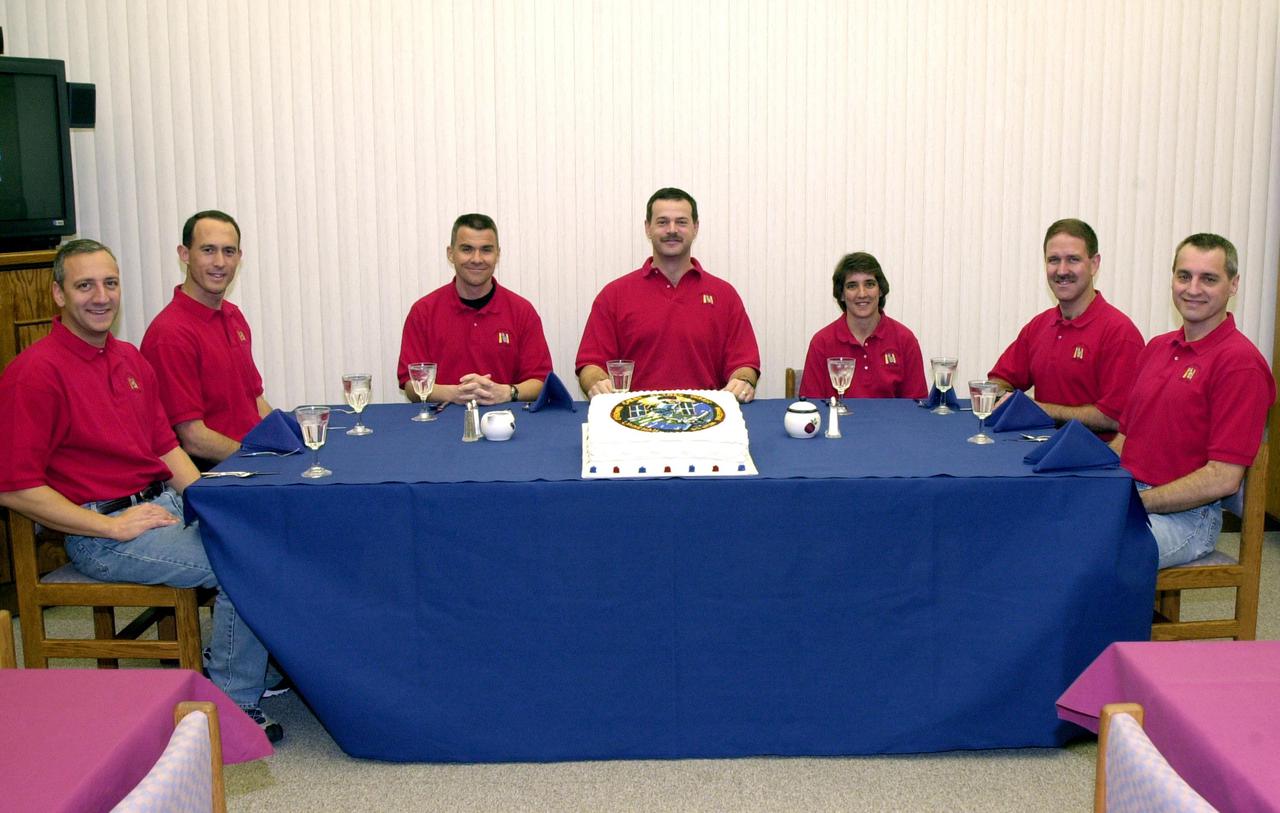
KENNEDY SPACE CENTER, Fla. -- The STS-109 crew enjoys an early morning snack that includes a symbolic cake with the mission logo, part of a ritual before a launch. Seated, left to right, are MIssion Specialists Michael Massimino and James Newman; Pilot Duane Carey; Commander Scott Altman; and Mission Specialists Nancy Currie, John Grunsfeld and Richard Linnehan. On mission STS-109, the crew will capture the Hubble Space Telescope using the Shuttle’s robotic arm and secure it on a workstand in Columbia's payload bay. Four mission specialists will perform five scheduled spacewalks to complete system upgrades to the telescope. More durable solar arrays, a large gyroscopic assembly to help point the telescope properly, a new telescope power control unit, and a cooling system to restore the use of a key infrared camera and spectrometer unit, which has been dormant since 1999, will all be installed. In addition, the telescope's view of the Universe will be improved with the addition of the Advanced Camera for Surveys (ACS), which replaces the Faint Object Camera, the last of Hubble's original instruments. Mission STS-109 is the 27th flight of the orbiter Columbia and the 108th flight overall in NASA’s Space Shuttle program. After the 11-day mission, STS-109 is scheduled to land about 4:35 a.m. EST on March 12
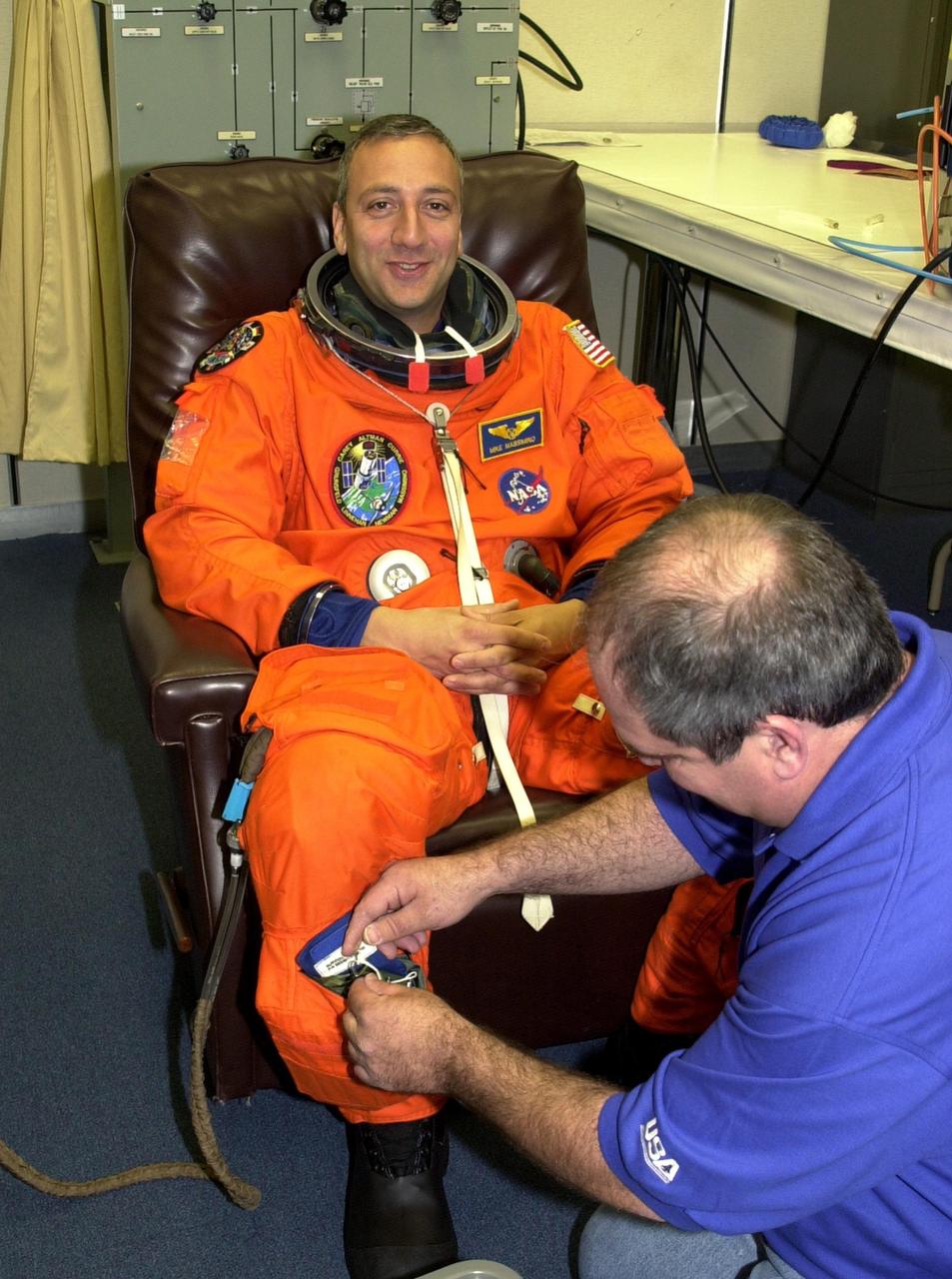
KENNEDY SPACE CENTER, Fla. - STS-109 Mission Specialist Michael J. Massimino gets help suiting up for launch, scheduled for 6:22 a.m. EST March 1. On mission STS-109, the crew will capture the Hubble Space Telescope using the Shuttle's robotic arm and secure it on a workstand in Columbia's payload bay. Four mission specialists will perform five scheduled spacewalks to complete system upgrades to the telescope. More durable solar arrays, a large gyroscopic assembly to help point the telescope properly, a new telescope power control unit, and a cooling system to restore the use of a key infrared camera and spectrometer unit, which has been dormant since 1999, will all be installed. In addition, the telescope's view of the Universe will be improved with the addition of the Advanced Camera for Surveys (ACS), which replaces the Faint Object Camera, the last of Hubble's original instruments. Mission STS-109 is the 27th flight of the orbiter Columbia and the 108th flight overall in NASA's Space Shuttle program. After the 11-day mission, Columbia is scheduled to land about 4:35 a.m. EST March 12
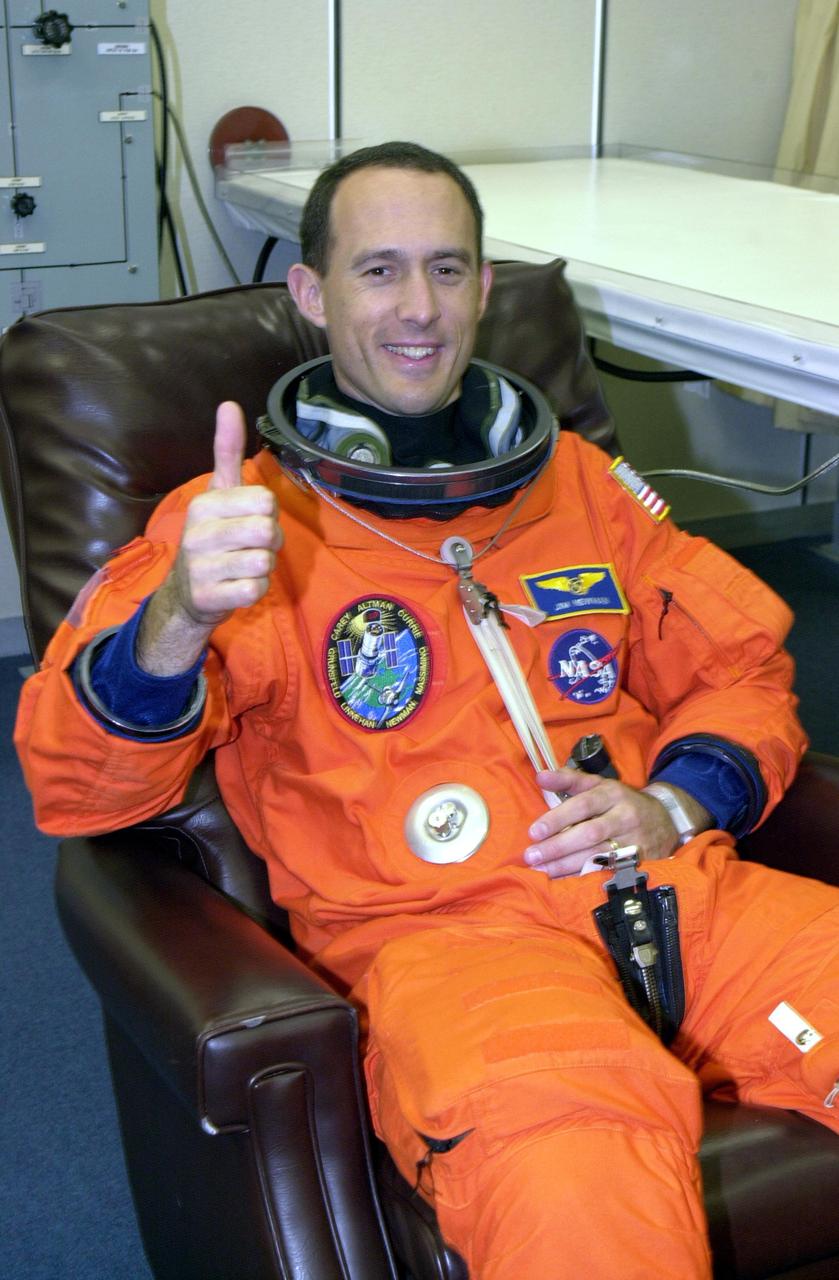
KENNEDY SPACE CENTER, Fla. - During suitup, STS-109 Mission Specialist James H. Newman gives a thumbs up for launch. Liftoff of Space Shuttle Columbia is scheduled for 6:22 a.m. EST March 1. On mission STS-109, the crew will capture the Hubble Space Telescope using the Shuttle's robotic arm and secure it on a workstand in Columbia's payload bay. Four mission specialists will perform five scheduled spacewalks to complete system upgrades to the telescope. More durable solar arrays, a large gyroscopic assembly to help point the telescope properly, a new telescope power control unit, and a cooling system to restore the use of a key infrared camera and spectrometer unit, which has been dormant since 1999, will all be installed. In addition, the telescope's view of the Universe will be improved with the addition of the Advanced Camera for Surveys (ACS), which replaces the Faint Object Camera, the last of Hubble's original instruments. Mission STS-109 is the 27th flight of the orbiter Columbia and the 108th flight overall in NASA's Space Shuttle program. After the 11-day mission, Columbia is scheduled to land about 4:35 a.m. EST March 12
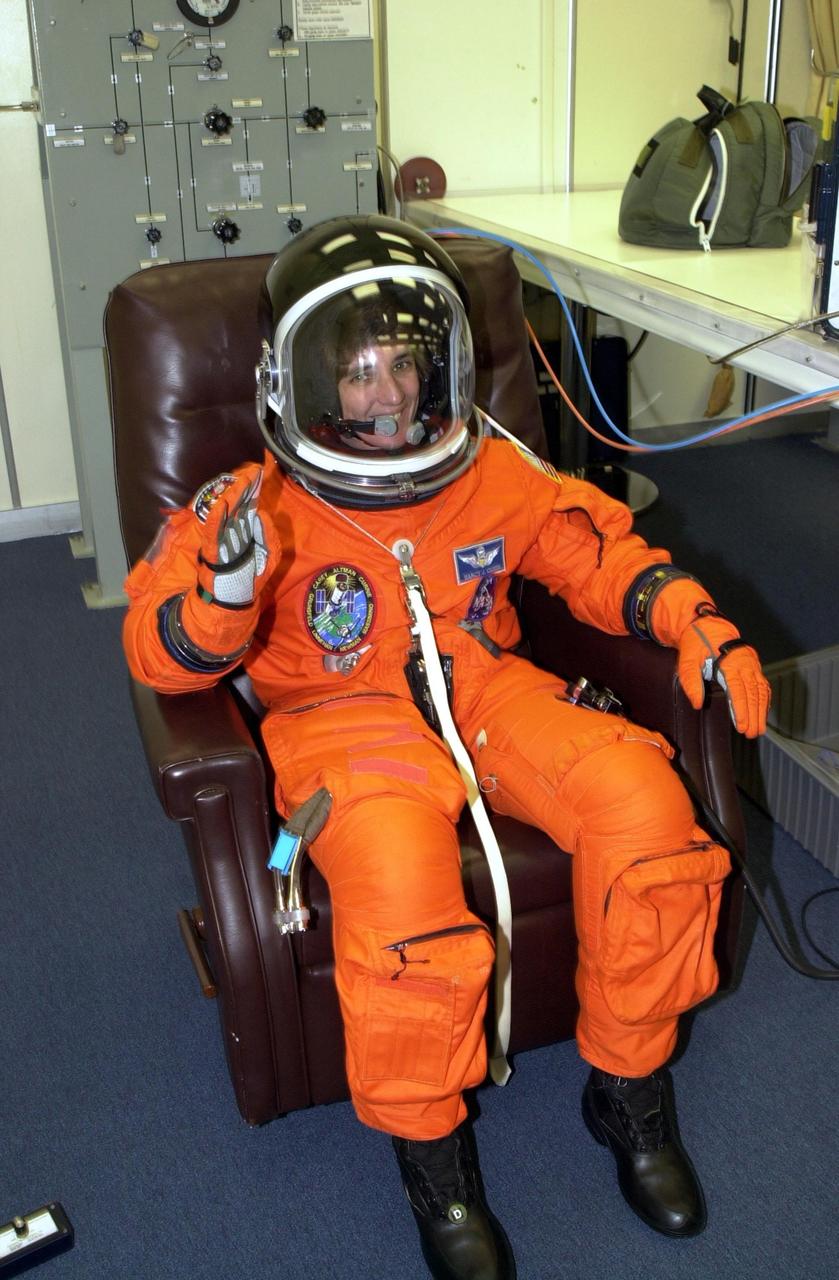
KENNEDY SPACE CENTER, Fla. - STS-109 Mission Specialist Nancy Jane Currie is ready for launch after suiting up. Liftoff is scheduled for 6:22 a.m. EST March 1. On mission STS-109, the crew will capture the Hubble Space Telescope using the Shuttle's robotic arm and secure it on a workstand in Columbia's payload bay. Currie will be the primary arm operator. Four mission specialists will perform five scheduled spacewalks to complete system upgrades to the telescope. More durable solar arrays, a large gyroscopic assembly to help point the telescope properly, a new telescope power control unit, and a cooling system to restore the use of a key infrared camera and spectrometer unit, which has been dormant since 1999, will all be installed. In addition, the telescope's view of the Universe will be improved with the addition of the Advanced Camera for Surveys (ACS), which replaces the Faint Object Camera, the last of Hubble's original instruments. Mission STS-109 is the 27th flight of the orbiter Columbia and the 108th flight overall in NASA's Space Shuttle program. After the 11-day mission, Columbia is scheduled to land about 4:35 a.m. EST March 12

KENNEDY SPACE CENTER, Fla. - During suitup, STS-109 Mission Specialist Richard M. Linnehan shows he is ready for launch. Liftoff of Space Shuttle Columbia is scheduled for 6:22 a.m. EST March 1. On mission STS-109, the crew will capture the Hubble Space Telescope using the Shuttle's robotic arm and secure it on a workstand in Columbia's payload bay. Four mission specialists will perform five scheduled spacewalks to complete system upgrades to the telescope. More durable solar arrays, a large gyroscopic assembly to help point the telescope properly, a new telescope power control unit, and a cooling system to restore the use of a key infrared camera and spectrometer unit, which has been dormant since 1999, will all be installed. In addition, the telescope's view of the Universe will be improved with the addition of the Advanced Camera for Surveys (ACS), which replaces the Faint Object Camera, the last of Hubble's original instruments. Mission STS-109 is the 27th flight of the orbiter Columbia and the 108th flight overall in NASA's Space Shuttle program. After the 11-day mission, Columbia is scheduled to land about 4:35 a.m. EST March 12
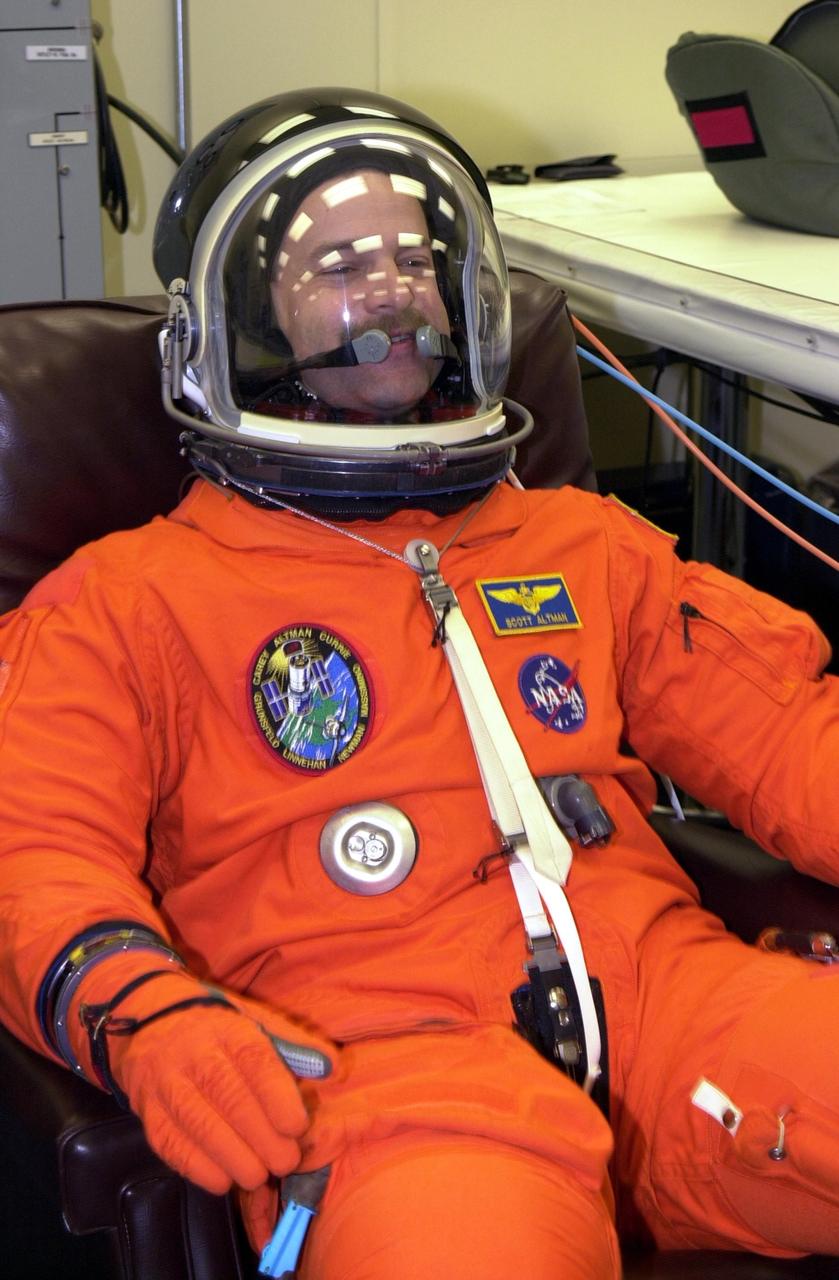
KENNEDY SPACE CENTER, Fla. - During suitup, STS-109 Commander Scott D. Altman gives a thumbs up for launch. Liftoff of Space Shuttle Columbia is scheduled for 6:22 a.m. EST March 1. On mission STS-109, the crew will capture the Hubble Space Telescope using the Shuttle's robotic arm and secure it on a workstand in Columbia's payload bay. Four mission specialists will perform five scheduled spacewalks to complete system upgrades to the telescope. More durable solar arrays, a large gyroscopic assembly to help point the telescope properly, a new telescope power control unit, and a cooling system to restore the use of a key infrared camera and spectrometer unit, which has been dormant since 1999, will all be installed. In addition, the telescope's view of the Universe will be improved with the addition of the Advanced Camera for Surveys (ACS), which replaces the Faint Object Camera, the last of Hubble's original instruments. Mission STS-109 is the 27th flight of the orbiter Columbia and the 108th flight overall in NASA's Space Shuttle program. After the 11-day mission, Columbia is scheduled to land about 4:35 a.m. EST March 12
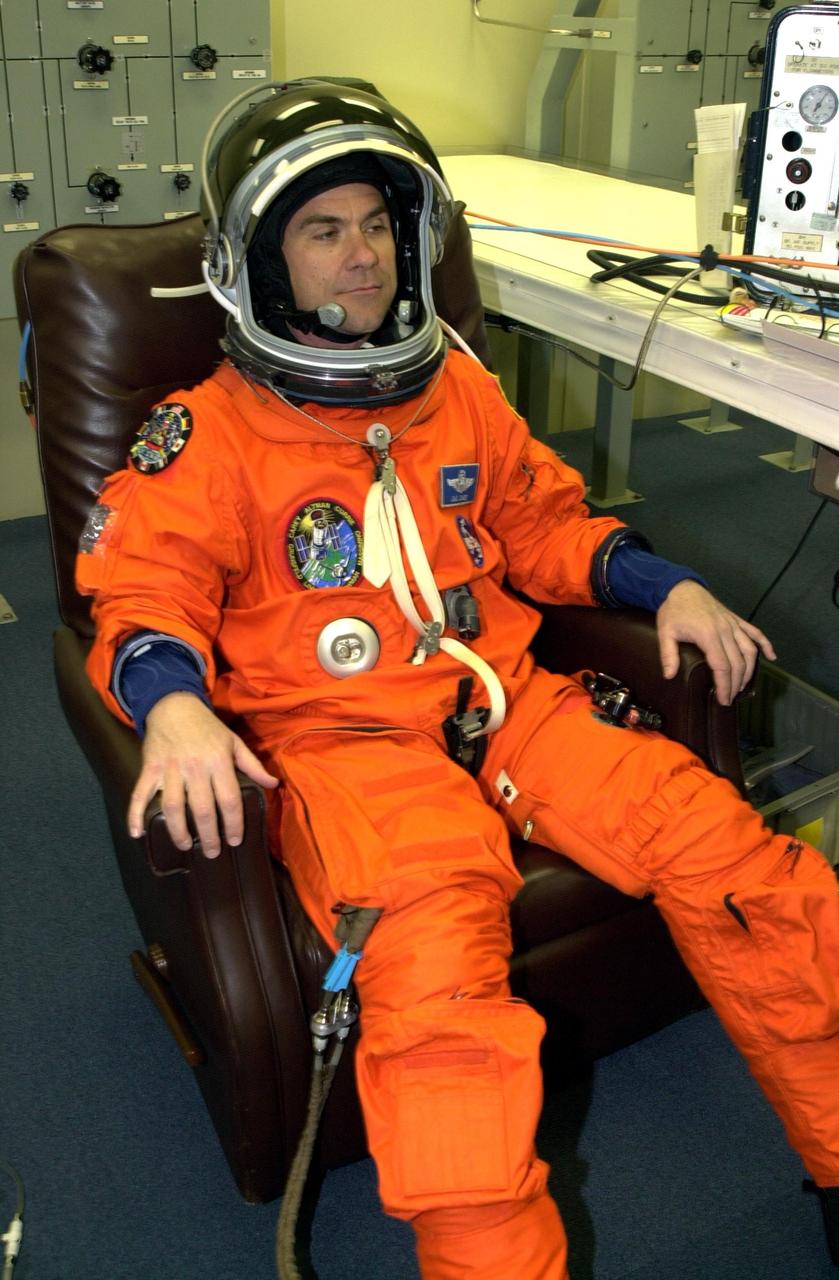
KENNEDY SPACE CENTER, FLA. - STS-109 Pilot Duane G. Carey suits up for launch, scheduled for 6:22 a.m. EST March 1. On mission STS-109, the crew will capture the Hubble Space Telescope using the Shuttle's robotic arm and secure it on a workstand in Columbia's payload bay. Four mission specialists will perform five scheduled spacewalks to complete system upgrades to the telescope. More durable solar arrays, a large gyroscopic assembly to help point the telescope properly, a new telescope power control unit, and a cooling system to restore the use of a key infrared camera and spectrometer unit, which has been dormant since 1999, will all be installed. In addition, the telescope's view of the Universe will be improved with the addition of the Advanced Camera for Surveys (ACS), which replaces the Faint Object Camera, the last of Hubble's original instruments. Mission STS-109 is the 27th flight of the orbiter Columbia and the 108th flight overall in NASA's Space Shuttle program. After the 11-day mission, Columbia is scheduled to land about 4:35 a.m. EST March 12

This photograph was taken during the integration of the Astro-1 mission payloads at the Kennedy Space Center on March 20, 1990, showing the Broad Band X-Ray Telescope (BBXRT) at the left, as three telescopes for the Astro-1 Observatory are settled into the Orbiter Columbia payload bay. Above Earth's atmospheric interference, Astro-1 would make precise measurements of objects such as planets, stars, and galaxies in relatively small fields of view and would observe and measure ultraviolet radiation from celestial objects. The Astro-1 used a Spacelab pallet system with an instrument pointing system and a cruciform structure for bearing the three ultraviolet instruments mounted in a parallel configuration. The three instruments were: The Hopkins Ultraviolet Telescope (HUT), which was designed to obtain far-ultraviolet spectroscopic data from white dwarfs, emission nebulae, active galaxies, and quasars; the Wisconsin Ultraviolet Photo-Polarimeter Experiment (WUPPE) which was to study polarized ultraviolet light from magnetic white dwarfs, binary stars, reflection nebulae, and active galaxies; and the Ultraviolet Imaging Telescope (UIT), which was to record photographic images in ultraviolet light of galaxies, star clusters, and nebulae. The star trackers that supported the instrument pointing system, were also mounted on the cruciform. Also in the payload bay was the Broad Band X-Ray Telescope (BBXRT), which was designed to obtain high-resolution x-ray spectra from stellar corona, x-ray binary stars, active galactic nuclei, and galaxy clusters. Managed by the Marshall Space Flight Center, the Astro-1 observatory was launched aboard the Space Shuttle Orbiter Columbia (STS-35) on December 2, 1990.
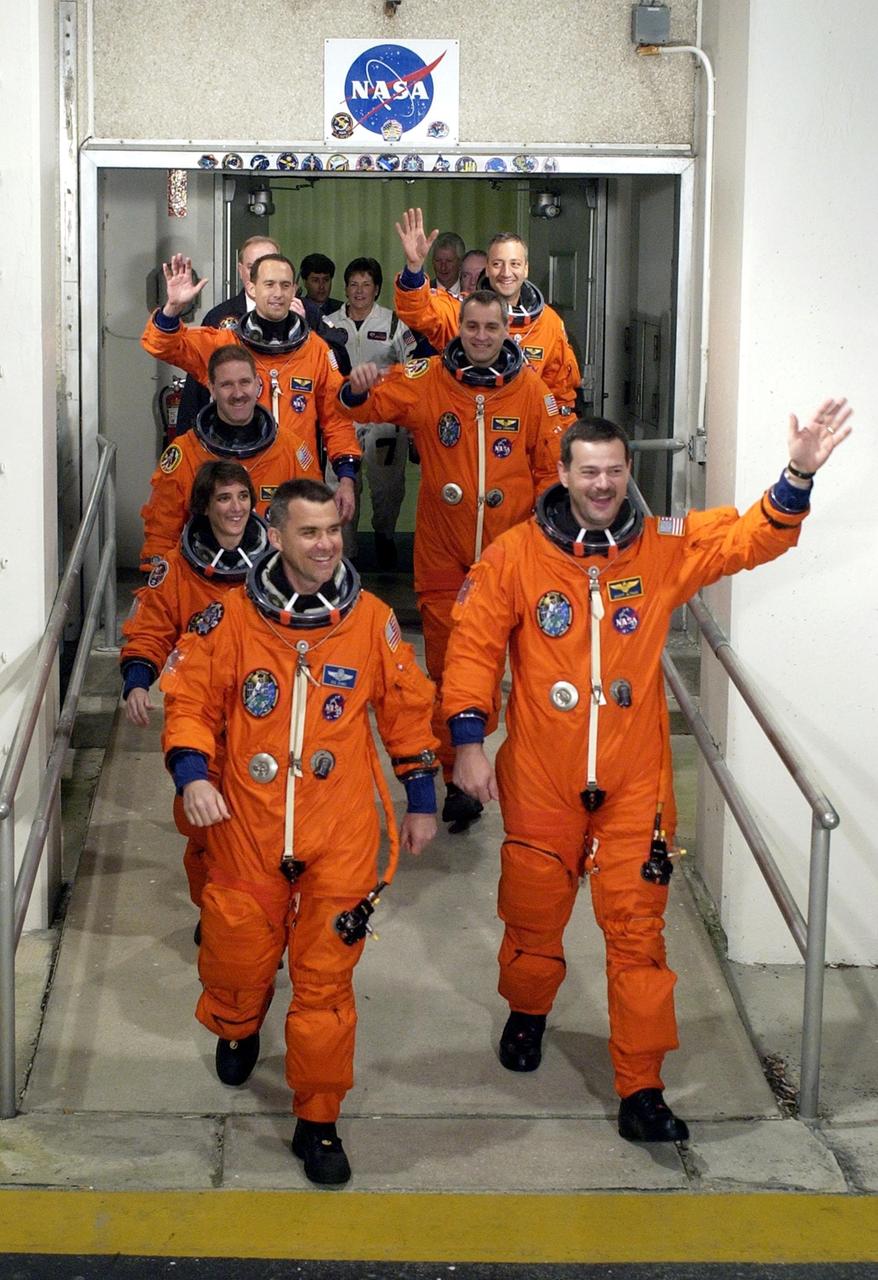
KENNEDY SPACE CENTER, Fla. - The STS-109 crew members wave to onlookers as they stride out from the Operations and Checkout Building, eager to get to the launch pad. They are, from front to back, Pilot Duane G. Carey (left) and Commander Scott D. Altman (right); Mission Specialist Nance Jane Currie; Payload Commander John M. Grunsfeld (left) and Richard M. Linnehan (right); James H. Newman (left) and Michael J. Massimino (right). On mission STS-109, the crew will capture the Hubble Space Telescope using the Shuttle's robotic arm and secure it on a workstand in Columbia's payload bay. Four mission specialists will perform five scheduled spacewalks to complete system upgrades to the telescope. More durable solar arrays, a large gyroscopic assembly to help point the telescope properly, a new telescope power control unit, and a cooling system to restore the use of a key infrared camera and spectrometer unit, which has been dormant since 1999, will all be installed. In addition, the telescope's view of the Universe will be improved with the addition of the Advanced Camera for Surveys (ACS), which replaces the Faint Object Camera, the last of Hubble's original instruments. Mission STS-109 is the 27th flight of the orbiter Columbia and the 108th flight overall in NASA's Space Shuttle program. After the 11-day mission, STS-109 is scheduled to land about 4:35 a.m. EST on March 12. [Photo by Scott Andrews
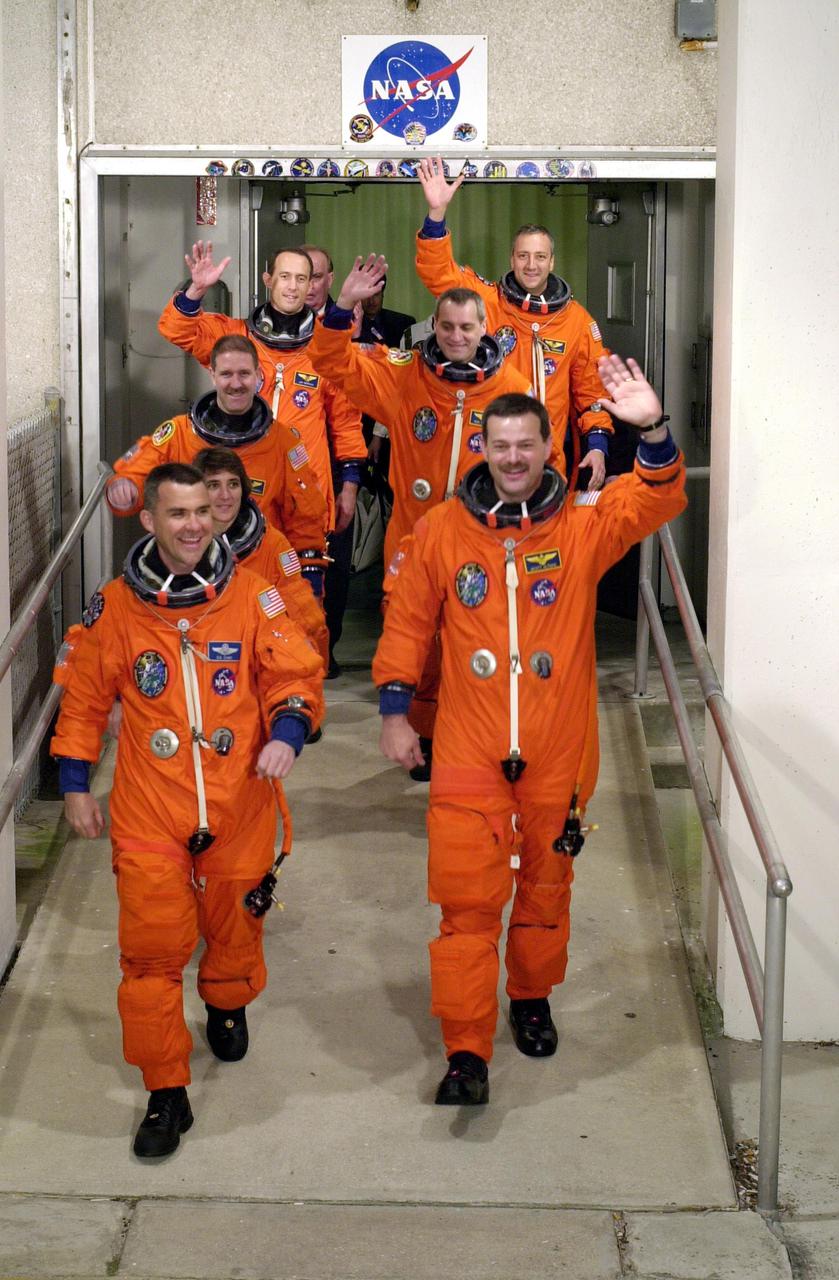
KENNEDY SPACE CENTER, Fla. - The STS-109 crew members wave to onlookers as they stride out from the Operations and Checkout Building, eager to get to the launch pad. They are, from front to back, Pilot Duane G. Carey (left) and Commander Scott D. Altman (right); Mission Specialist Nance Jane Currie; Payload Commander John M. Grunsfeld (left) and Richard M. Linnehan (right); James H. Newman (left) and Michael J. Massimino (right). On mission STS-109, the crew will capture the Hubble Space Telescope using the Shuttle's robotic arm and secure it on a workstand in Columbia's payload bay. Four mission specialists will perform five scheduled spacewalks to complete system upgrades to the telescope. More durable solar arrays, a large gyroscopic assembly to help point the telescope properly, a new telescope power control unit, and a cooling system to restore the use of a key infrared camera and spectrometer unit, which has been dormant since 1999, will all be installed. In addition, the telescope's view of the Universe will be improved with the addition of the Advanced Camera for Surveys (ACS), which replaces the Faint Object Camera, the last of Hubble's original instruments. Mission STS-109 is the 27th flight of the orbiter Columbia and the 108th flight overall in NASA's Space Shuttle program. After the 11-day mission, STS-109 is scheduled to land about 4:35 a.m. EST on March 12

In this photograph, the instruments of the Astro-1 Observatory are erected in the cargo bay of the Columbia orbiter. Astro-1 was launched aboard the the Space Shuttle Orbiter Columbia (STS-35) mission on December 2, 1990. The Astro Observatory was designed to explore the universe by observing and measuring the ultraviolet radiation from celestial objects. Astronomical targets of observation selected for Astro missions included planets, stars, star clusters, galaxies, clusters of galaxies, quasars, remnants of exploded stars (supernovae), clouds of gas and dust (nebulae), and the interstellar medium. Astro-1 used a Spacelab pallet system with an instrument pointing system and a cruciform structure for bearing the three ultraviolet instruments mounted in a parallel configuration. The three instruments were:The Hopkins Ultraviolet Telescope (HUT), the Wisconsin Ultraviolet Photo-Polarimeter Experiment (WUPPE), and the Ultraviolet Imaging Telescope (UIT). Also in the payload bay was the Broad Band X-Ray Telescope (BBXRT). Scientific return included approximately 1,000 photographs of the ultraviolet sky in the most extensive ultraviolet imagery ever attempted, the longest ultraviolet spectral observation of a comet ever made, and data never before seen on types of active galaxies called Seyfert galaxies. The mission also provided data on a massive supergiant star captured in outburst and confirmed that a spectral feature observed in the interstellar medium was due to graphite. In addition, Astro-1 acquired superb observations of the Jupiter magnetic interaction with one of its satellites.

In 1986, NASA introduced a Shuttle-borne ultraviolet observatory called Astro. The Astro Observatory was designed to explore the universe by observing and measuring the ultraviolet radiation from celestial objects. Astronomical targets of observation selected for Astro missions included planets, stars, star clusters, galaxies, clusters of galaxies, quasars, remnants of exploded stars (supernovae), clouds of gas and dust (nebulae), and the interstellar medium. Astro-1 used a Spacelab pallet system with an instrument pointing system and a cruciform structure for bearing the three ultraviolet instruments mounted in a parallel configuration. The three instruments were: The Hopkins Ultraviolet Telescope (HUT), which was designed to obtain far-ultraviolet spectroscopic data from white dwarfs, emission nebulae, active galaxies, and quasars; the Wisconsin Ultraviolet Photo-Polarimeter Experiment (WUPPE) which was to study polarized ultraviolet light from magnetic white dwarfs, binary stars, reflection nebulae, and active galaxies; and the Ultraviolet Imaging Telescope (UIT) which was to record photographic images in ultraviolet light of galaxies, star clusters, and nebulae. The star trackers that supported the instrument pointing system were also mounted on the cruciform. Also in the payload bay was the Broad Band X-Ray Telescope (BBXRT), which was designed to obtain high-resolution x-ray spectra from stellar corona, x-ray binary stars, active galactic nuclei, and galaxy clusters. Managed by the Marshall Space Flight Center, the Astro-1 observatory was launched aboard the Space Shuttle Orbiter Columbia (STS-35) on December 2, 1990.