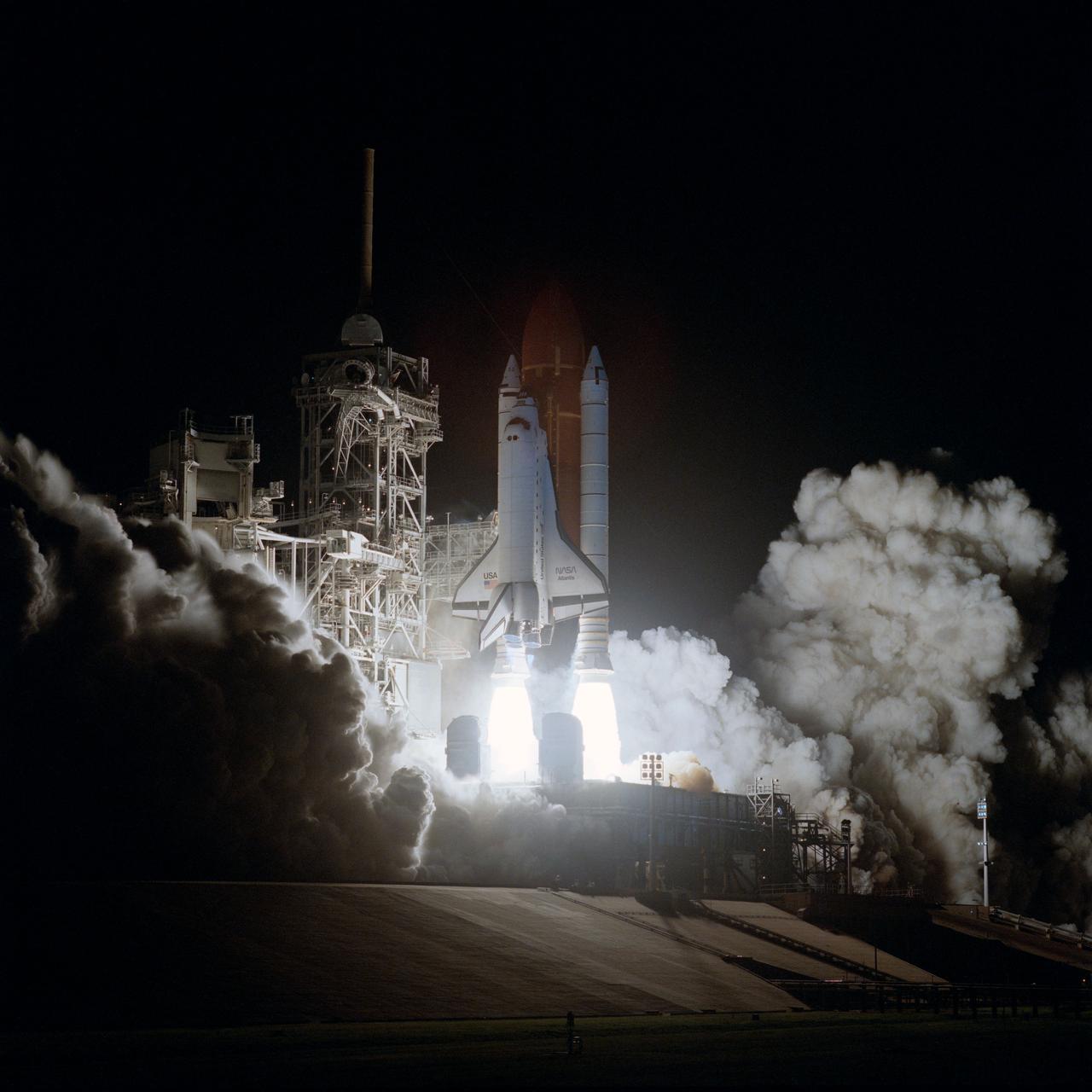
STS-38 Atlantis, Orbiter Vehicle (OV) 104, lifts off from Kennedy Space Center (KSC) Launch Complex Pad at 6:46:15:0639 pm (Eastern Standard Time (EST)). As OV-104, atop the external tank (ET) and flanked by two solid rocket boosters (SRBs), rises above the mobile launcher platform, exhaust smoke fills the area surrounding the launch pad. SRB and space shuttle main engine (SSME) firings glow against the night darkness and light up the fixed service structure (FSS) and retracted rotating service structure (RSS). STS-38 is a Department of Defense (DOD) devoted mission.
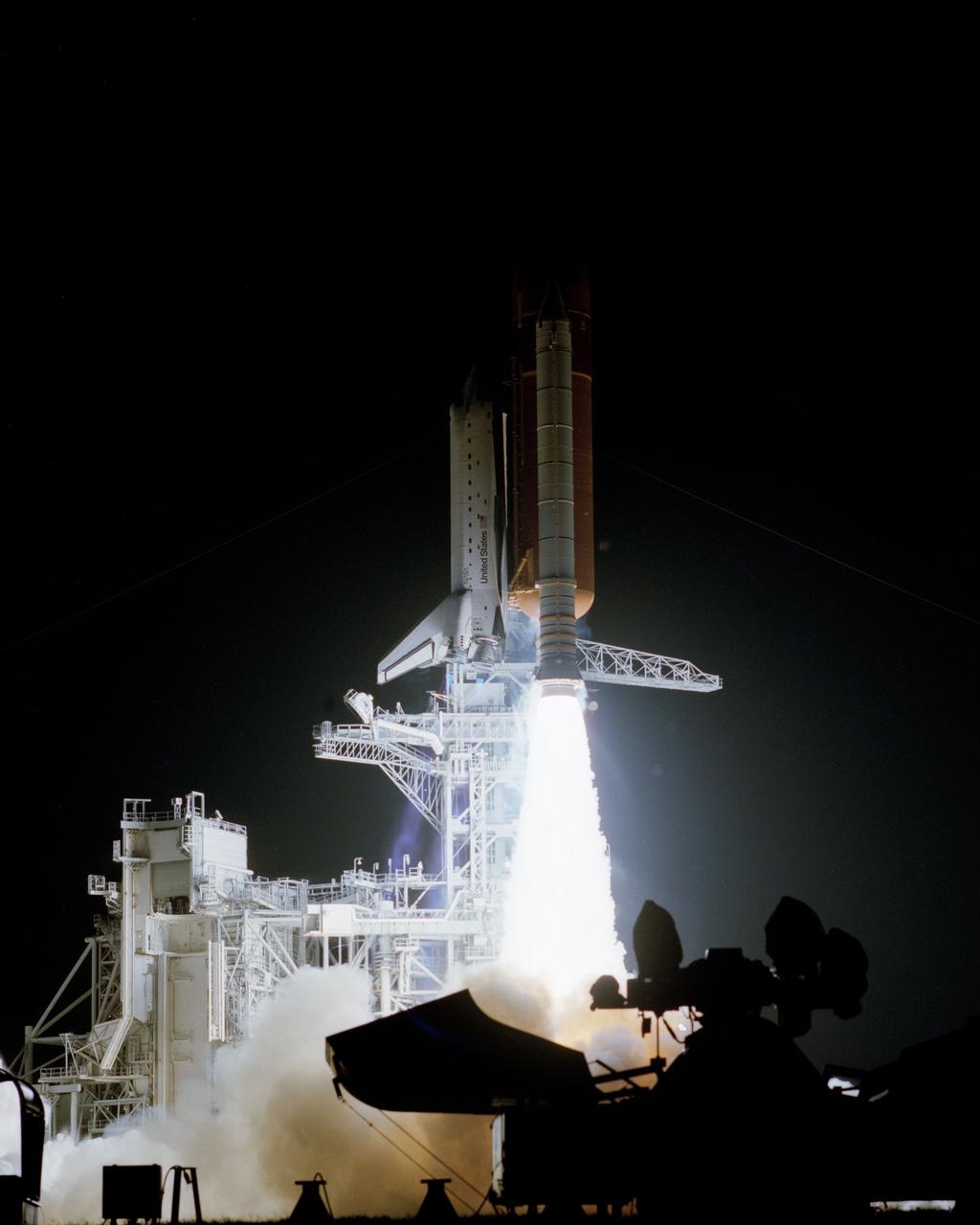
STS-38 Atlantis, Orbiter Vehicle (OV) 104, lifts off from Kennedy Space Center (KSC) Launch Complex (LC) Pad at 6:48:15:0639 pm (Eastern Standard Time (EST)) for Department of Defense (DOD)-devoted mission. OV-104, atop the external tank (ET) and flanked by solid rocket boosters (SRBs), is almost clear of the launch tower which is lit up by the SRB and space shuttle main engine (SSME) firings. Spotlight equipment is silhouetted against the SRB/SSME glow in the foreground. The retracted rotating service structure (RSS) is highlighted against the evening darkness by the launch fireworks.
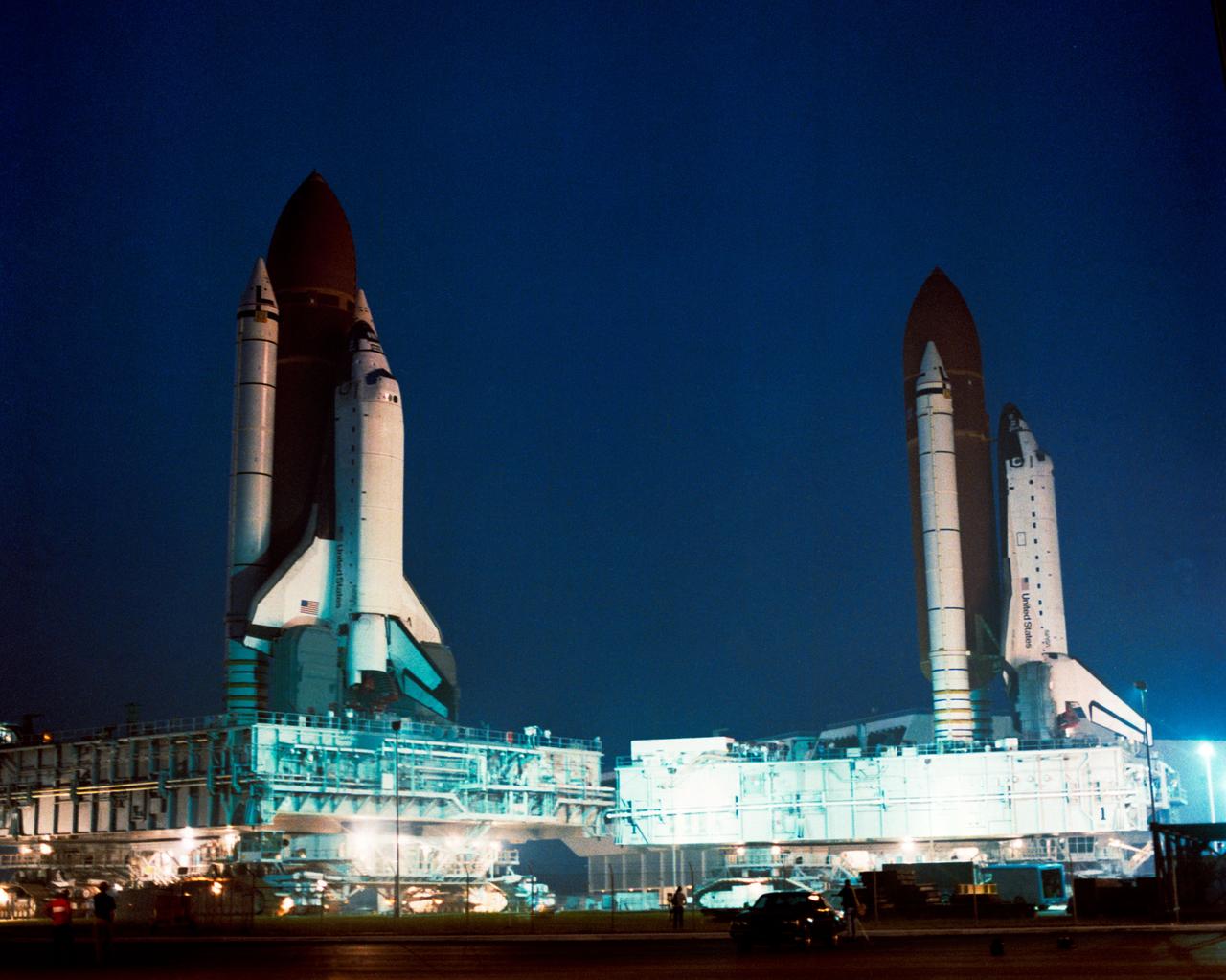
Columbia, Orbiter Vehicle (OV) 102, slated for mission STS-35, left, rolls past Atlantis, OV-104, on its way to Kennedy Space Center (KSC) launch pad 39A. OV-104, being readied for STS-38, is parked in front of the Vehicle Assembly Building (VAB) following its rollback from the pad for liquid hydrogen (LH2) line repairs. View provided by KSC with alternate number KSC-90PC-1152.
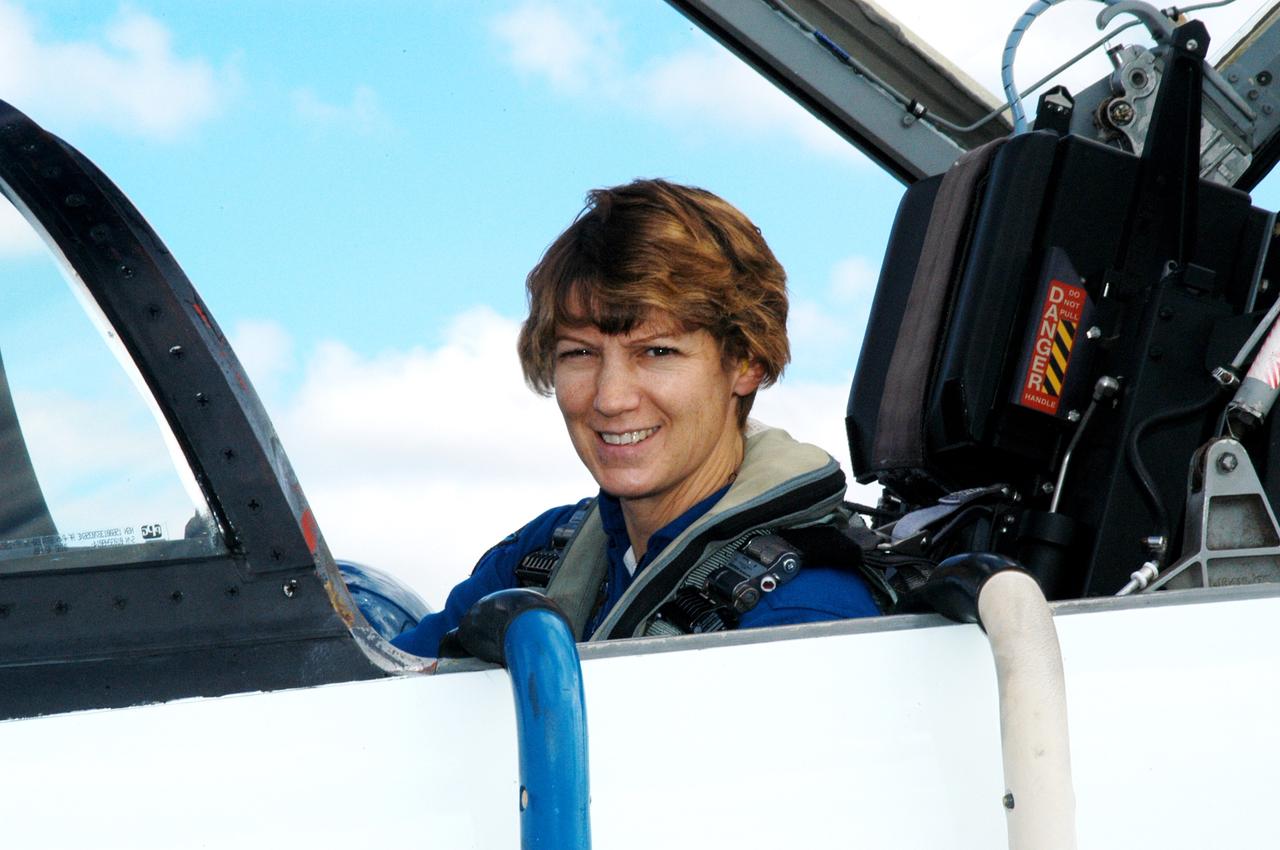
KENNEDY SPACE CENTER, FLA. - STS-114 Commander Eileen Collins arrives at the KSC Shuttle Landing Facility in a T-38 jet aircraft. She and other crew members are at KSC to take part in crew equipment and orbiter familiarization.
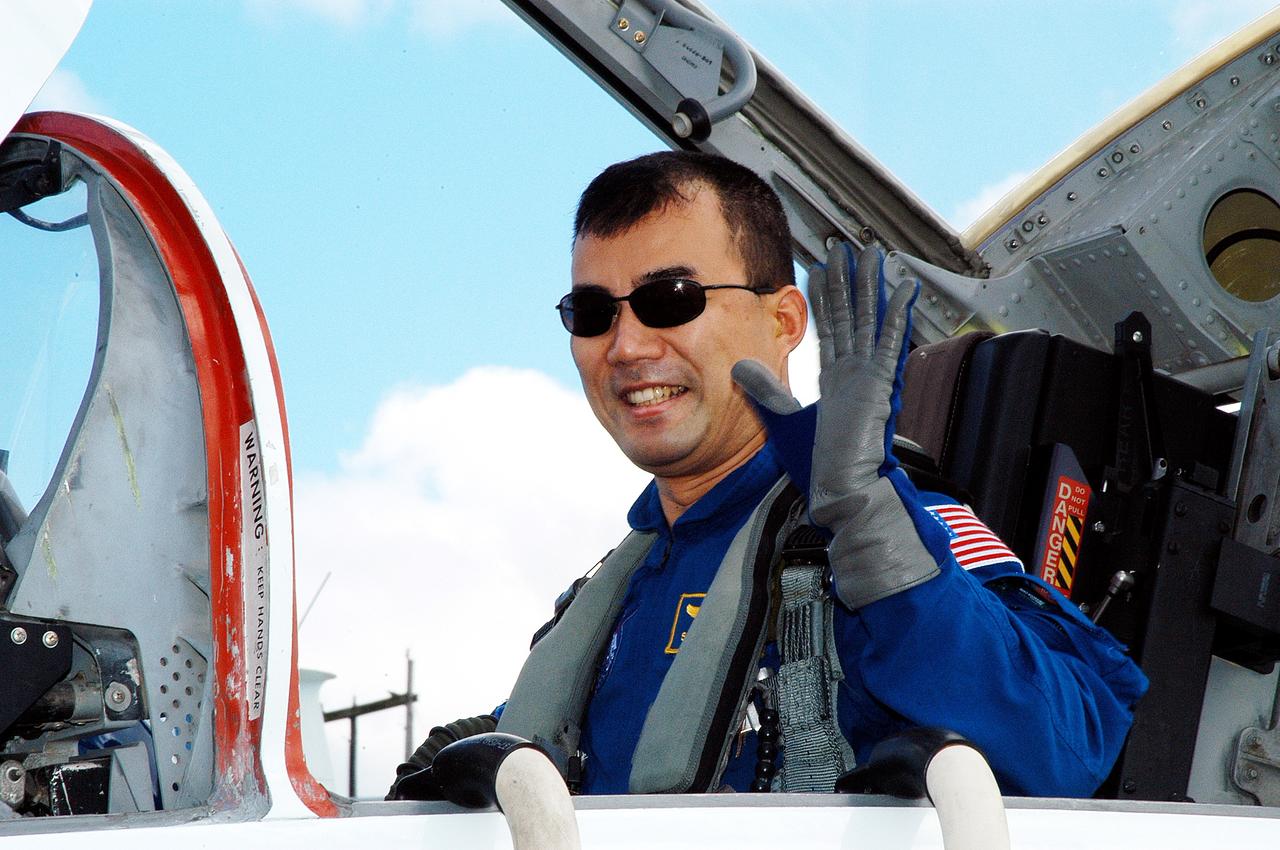
KENNEDY SPACE CENTER, FLA. - STS-114 Mission Specialist Soichi Noguchi arrives at the KSC Shuttle Landing Facility in a T-38 jet aircraft. Noguchi, who is with the Japan Aerospace Exploration Agency (JAXA), is taking part in crew equipment and orbiter familiarization along with other mission crew members.
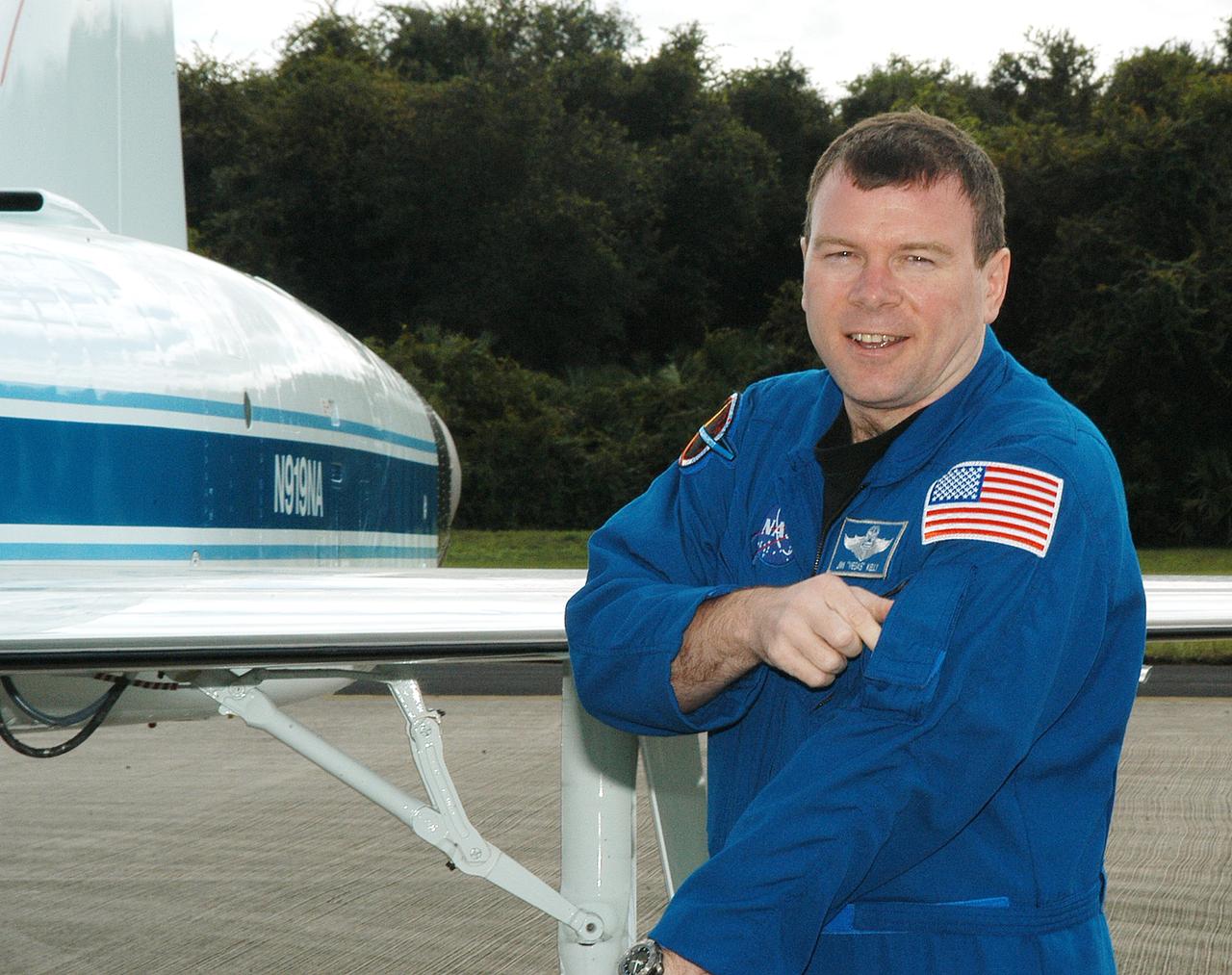
KENNEDY SPACE CENTER, FLA. - STS-114 Pilot James Kelly arrives at the KSC Shuttle Landing Facility in a T-38 jet aircraft. He and other crew members are at KSC to take part in crew equipment and orbiter familiarization.
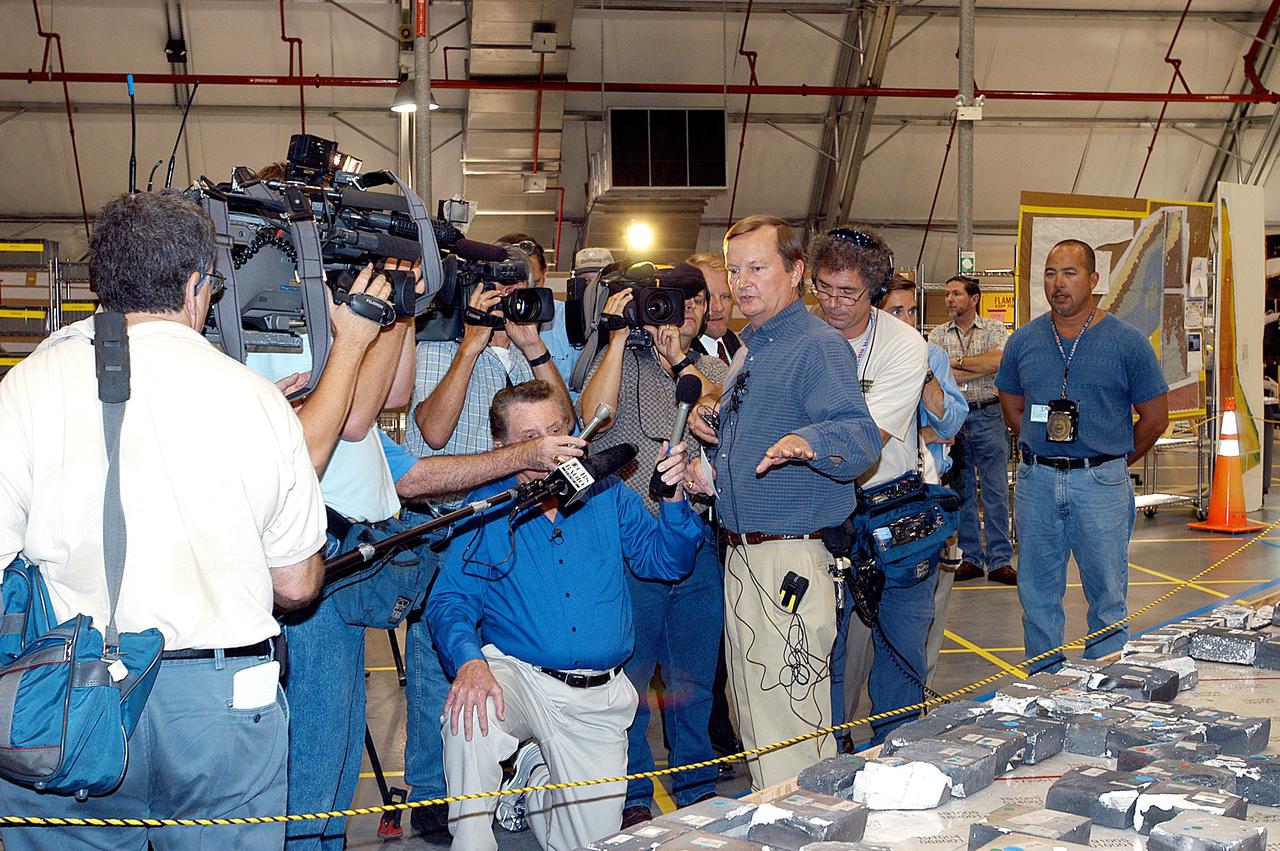
KENNEDY SPACE CENTER, FLA. - In the Columbia Debris Hangar, Shuttle Launch Director Mike Leinbach points to some of the tiles recovered from the orbiter as he explains to the media about activities that have taken place since the Columbia accident on Feb. 1, 2003. STS-107 debris recovery and reconstruction operations are winding down. To date, nearly 84,000 pieces of debris have been recovered and sent to KSC. That represents about 38 percent of the dry weight of Columbia, equaling almost 85,000 pounds.
KENNEDY SPACE CENTER, FLA. - In the Columbia Debris Hangar, Shuttle Launch Director Mike Leinbach talks to the media about activities that have taken place since the Columbia accident on Feb. 1, 2003. Behind him is a model of the left wing of the orbiter. STS-107 debris recovery and reconstruction operations are winding down. To date, nearly 84,000 pieces of debris have been recovered and sent to KSC. That represents about 38 percent of the dry weight of Columbia, equaling almost 85,000 pounds.
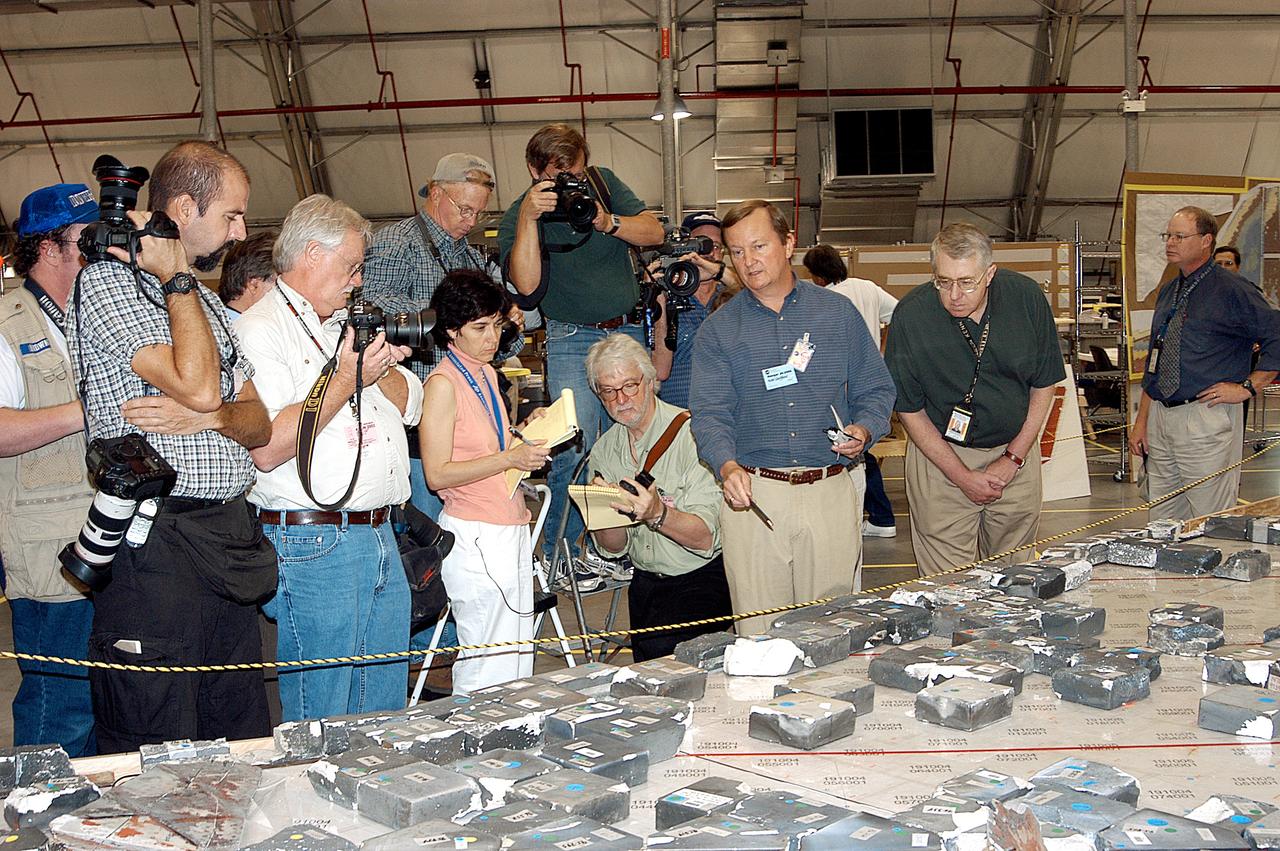
KENNEDY SPACE CENTER, FLA. - In the Columbia Debris Hangar, Shuttle Launch Director Mike Leinbach (center) points to some of the tiles recovered from the orbiter as he explains to the media about activities that have taken place since the Columbia accident on Feb. 1, 2003. STS-107 debris recovery and reconstruction operations are winding down. To date, nearly 84,000 pieces of debris have been recovered and sent to KSC. That represents about 38 percent of the dry weight of Columbia, equaling almost 85,000 pounds.
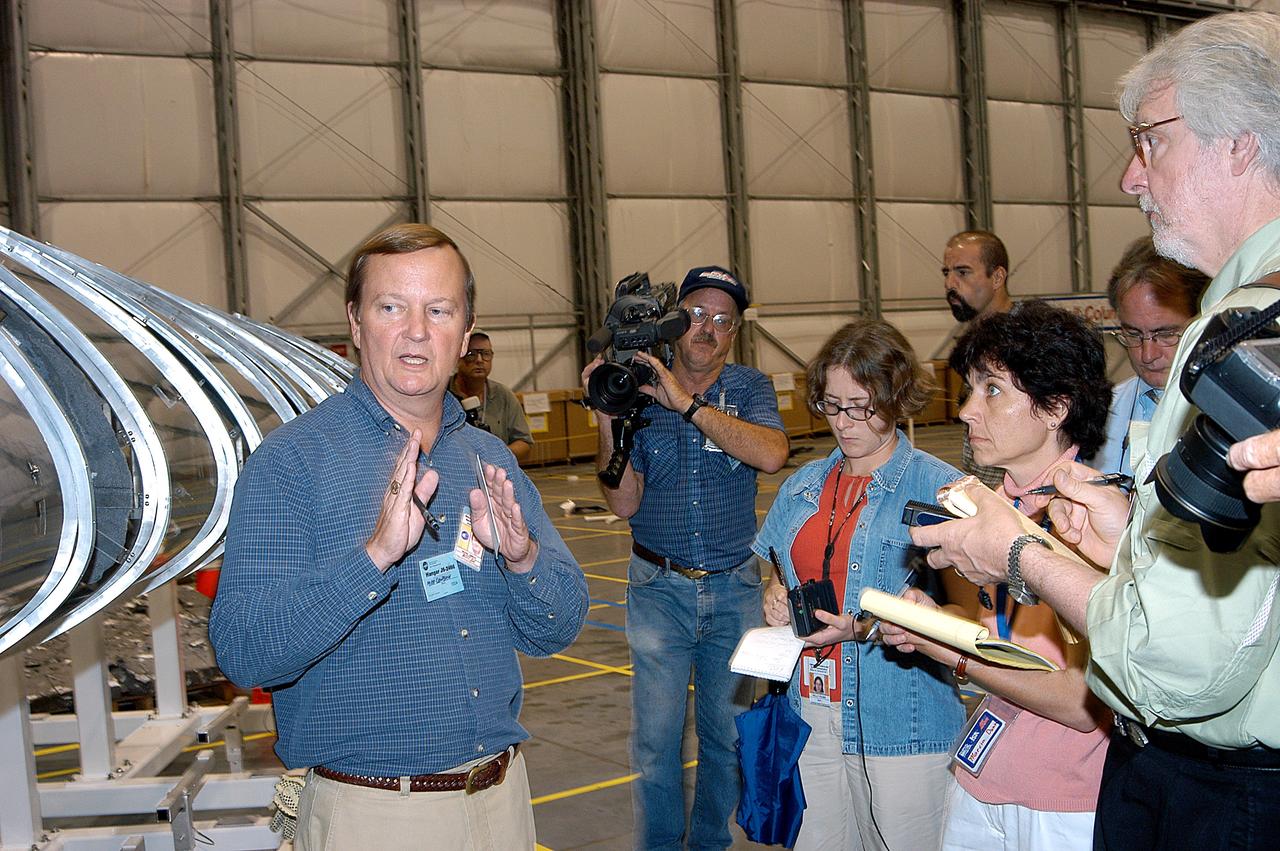
KENNEDY SPACE CENTER, FLA. - In the Columbia Debris Hangar, Shuttle Launch Director Mike Leinbach (left) talks to the media about activities that have taken place since the Columbia accident on Feb. 1, 2003. Behind him is a model of the left wing of the orbiter. STS-107 debris recovery and reconstruction operations are winding down. To date, nearly 84,000 pieces of debris have been recovered and sent to KSC. That represents about 38 percent of the dry weight of Columbia, equaling almost 85,000 pounds.
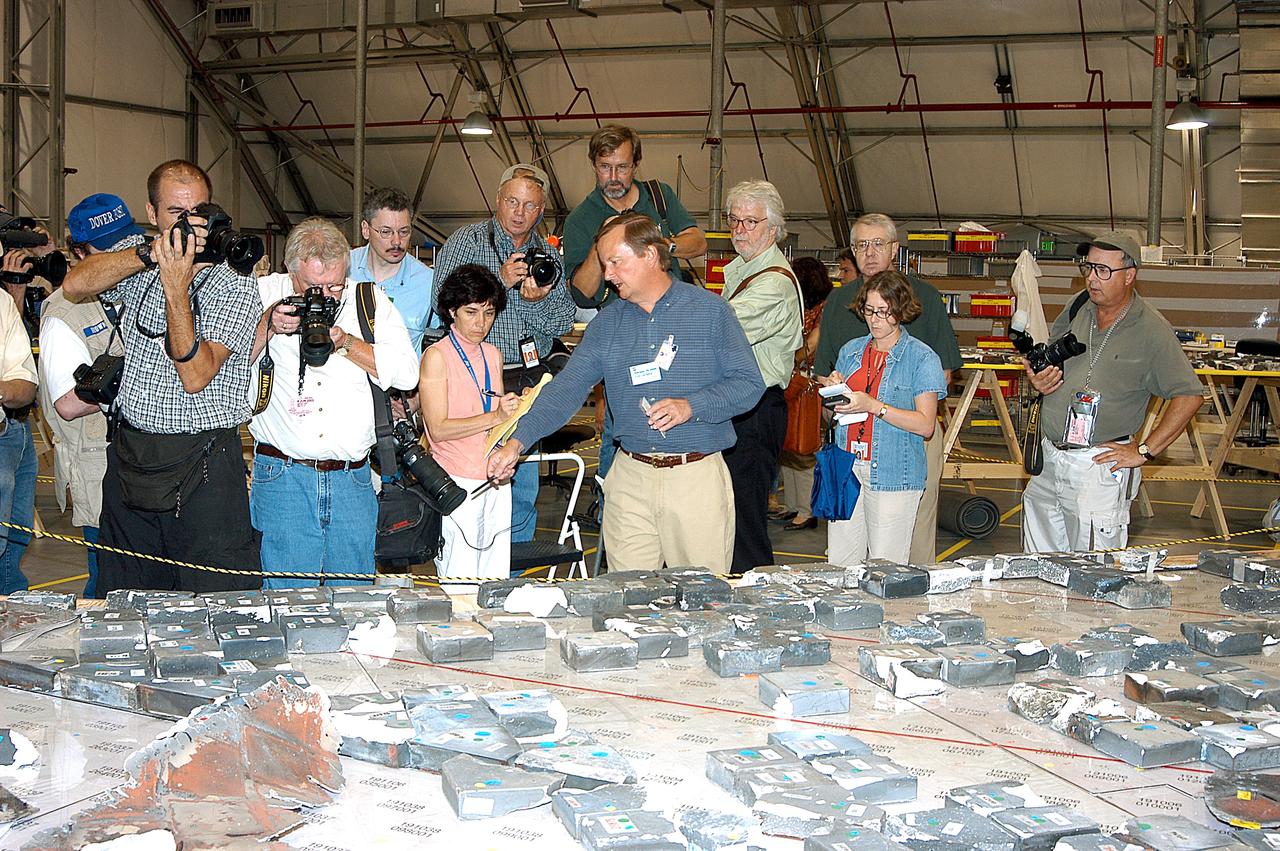
KENNEDY SPACE CENTER, FLA. - In the Columbia Debris Hangar, Shuttle Launch Director Mike Leinbach points to some of the tiles recovered from the orbiter as he explains to the media about activities that have taken place since the Columbia accident on Feb. 1, 2003. STS-107 debris recovery and reconstruction operations are winding down. To date, nearly 84,000 pieces of debris have been recovered and sent to KSC. That represents about 38 percent of the dry weight of Columbia, equaling almost 85,000 pounds.
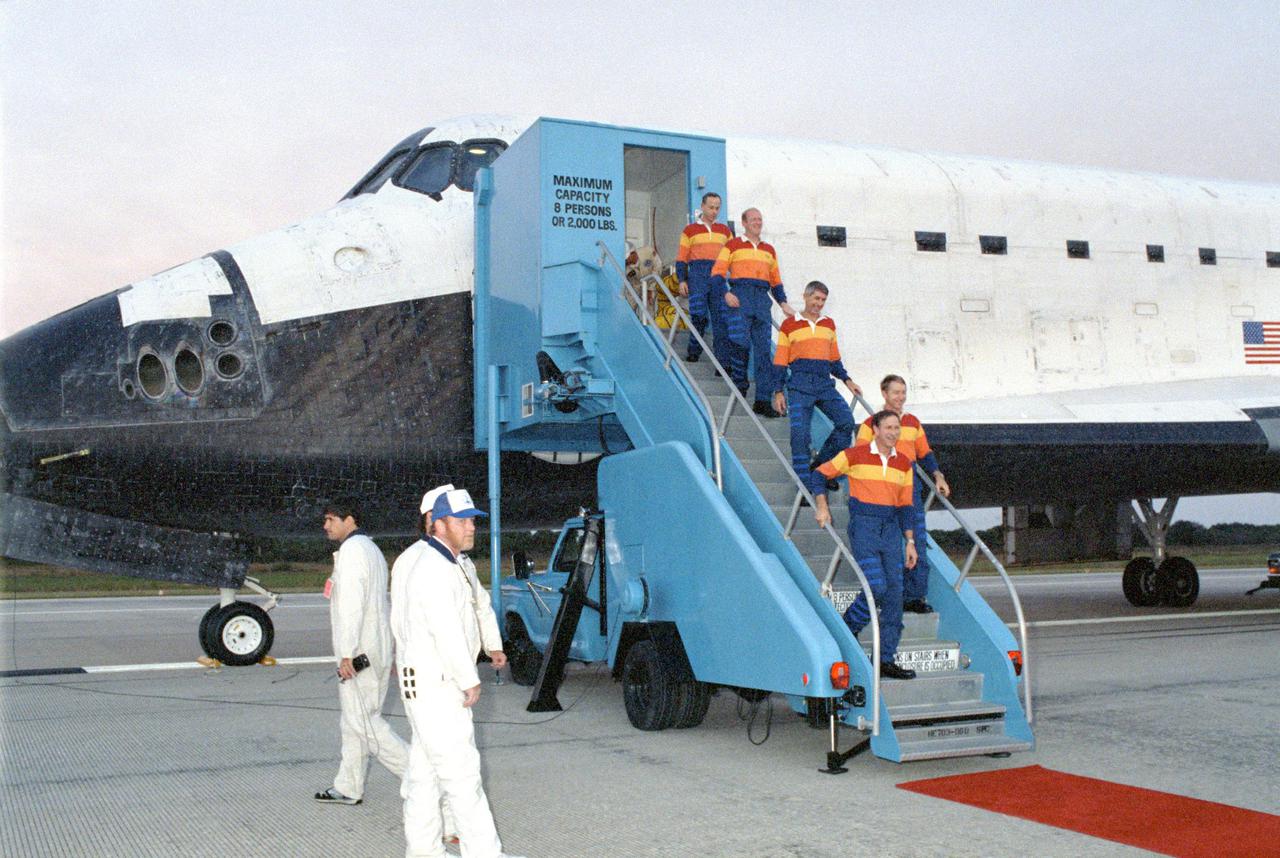
KENNEDY SPACE CENTER, FLA. -- The STS-38 flight crew disembark from the orbiter Atlantis after a successful landing at KSC's Shuttle Landing Facility. From bottom up are Commander Richard Covey, Pilot Frank Culbertson and Mission Specialists Robert Springer, Charles Gemar and Carl Meade.
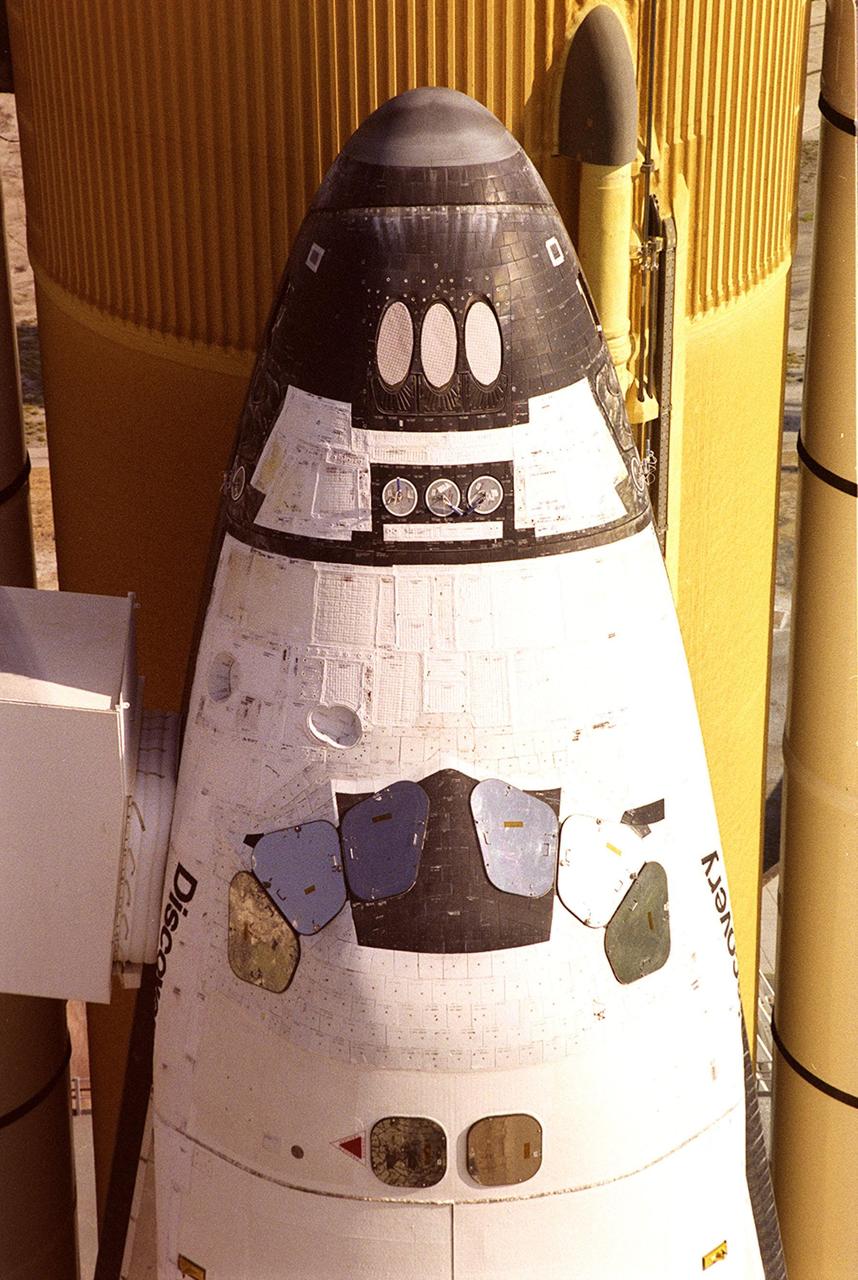
KENNEDY SPACE CENTER, FLA. -- A closeup of Space Shuttle Discovery on Launch Pad 39A shows the White Room (left) extended to the side of the orbiter, at the entrance to the crew compartment. Discovery is undergoing final launch preparations of STS-92. Scheduled to lift off Oct. 5 at 9:38 p.m. EDT, Discovery will be making the 100th Space Shuttle mission launched from Kennedy Space Center. Discovery also will be making its 28th flight into space, more than any of the other orbiters to date. STS-92 is a mission to the International Space Station, carrying the Z1 truss, which is the first of 10 trusses on the Station, and the third Pressurized Mating Adapter
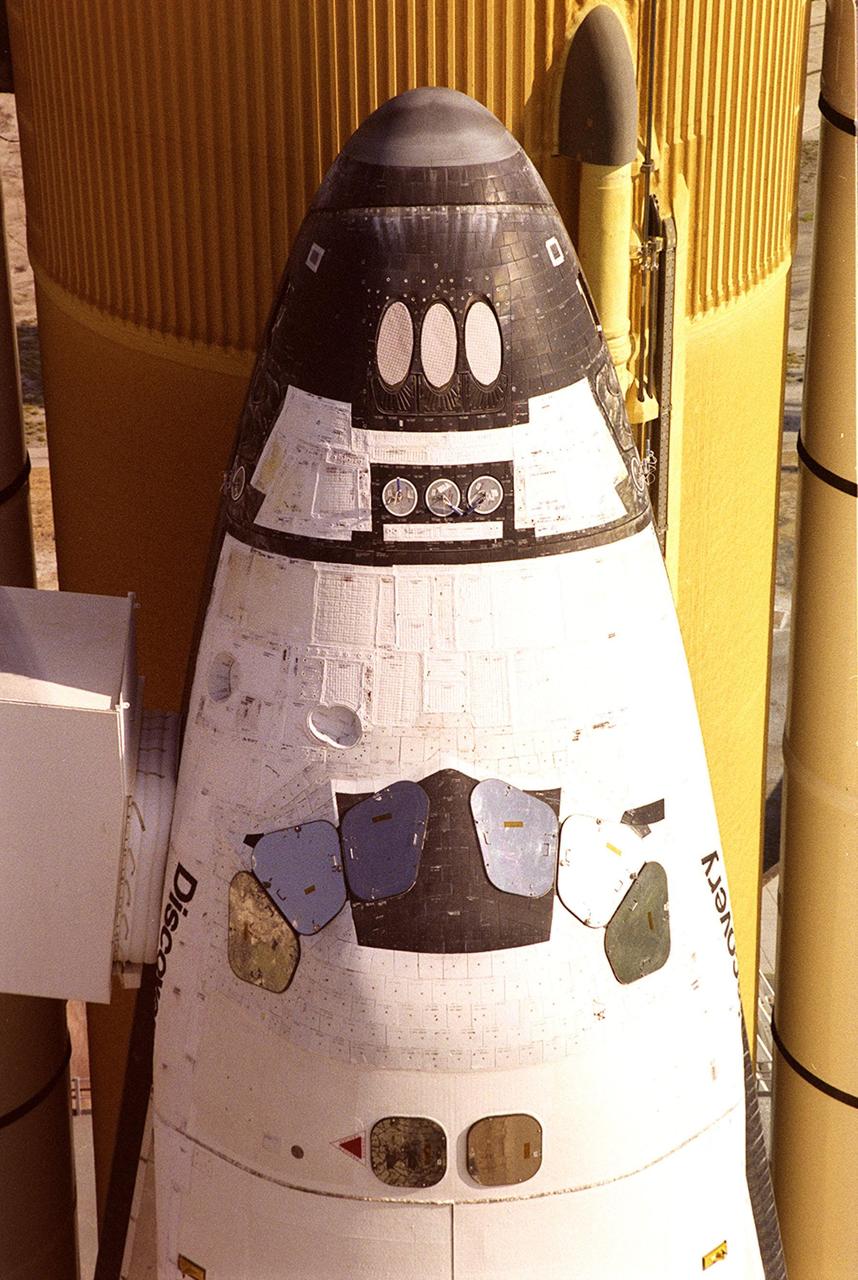
KENNEDY SPACE CENTER, FLA. -- A closeup of Space Shuttle Discovery on Launch Pad 39A shows the White Room (left) extended to the side of the orbiter, at the entrance to the crew compartment. Discovery is undergoing final launch preparations of STS-92. Scheduled to lift off Oct. 5 at 9:38 p.m. EDT, Discovery will be making the 100th Space Shuttle mission launched from Kennedy Space Center. Discovery also will be making its 28th flight into space, more than any of the other orbiters to date. STS-92 is a mission to the International Space Station, carrying the Z1 truss, which is the first of 10 trusses on the Station, and the third Pressurized Mating Adapter

Technicians complete foaming around the area of Atlantis, Orbiter Vehicle (OV) 104, 17 inch diameter external tank (ET) feed line in preparation for the second liquid hydrogen tanking test at the Kennedy Space Center (KSC). An elaborate network of sensors, leak detectors, and baggies were set up on OV-104 by technicians. Engineers hope this extra instrumentation will help pinpoint the exact location of the leak. OV-104 is scheduled to be launched for the STS-38 mission, a classified Department of Defense (DOD) flight. View provided by KSC with alternate number KSC-90PC-988.
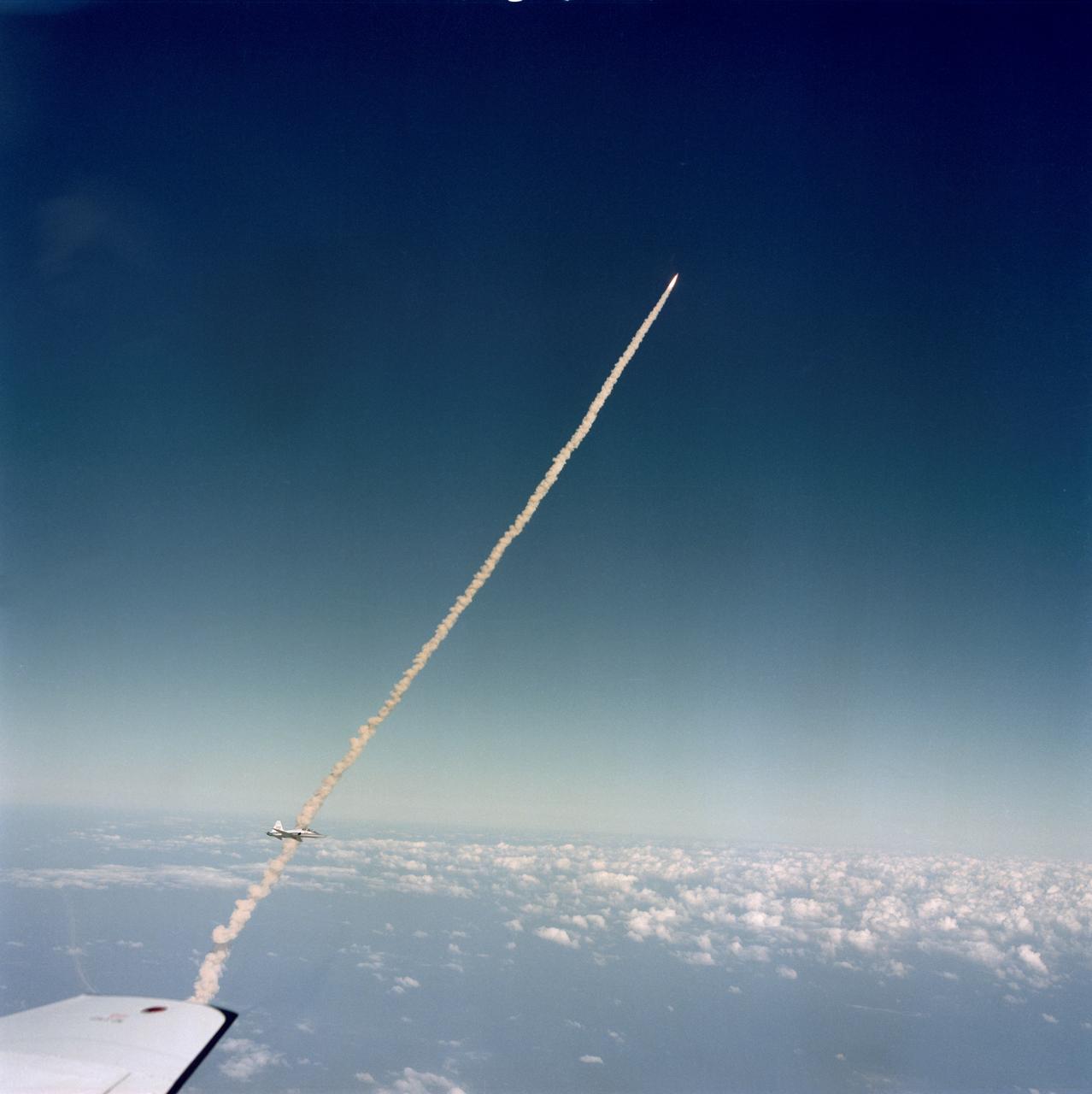
S81-39527 (12 Nov. 1981) --- This photograph of the STS-2 crew and the space shuttle Columbia soaring toward Earth orbit was captured with a hand-held 70mm camera (using an 80mm lens) operated from the rear station of a T-38 jet aircraft. Mission specialist-astronaut Kathryn D. Sullivan took the picture, and part of the wing tip of her aircraft can be seen in lower left corner. Astronaut John W. Young piloting NASA?s shuttle training aircraft (STA) was taking pictures from a higher angle. A close look can delineate his craft above the orbiter and supportive elements, almost perpendicular to them from this point of view. Another T-38 jet, with a TV camera operator as back-seat passenger, can be seen at lower left corner near the smoke trails from the shuttle. Photo credit: NASA
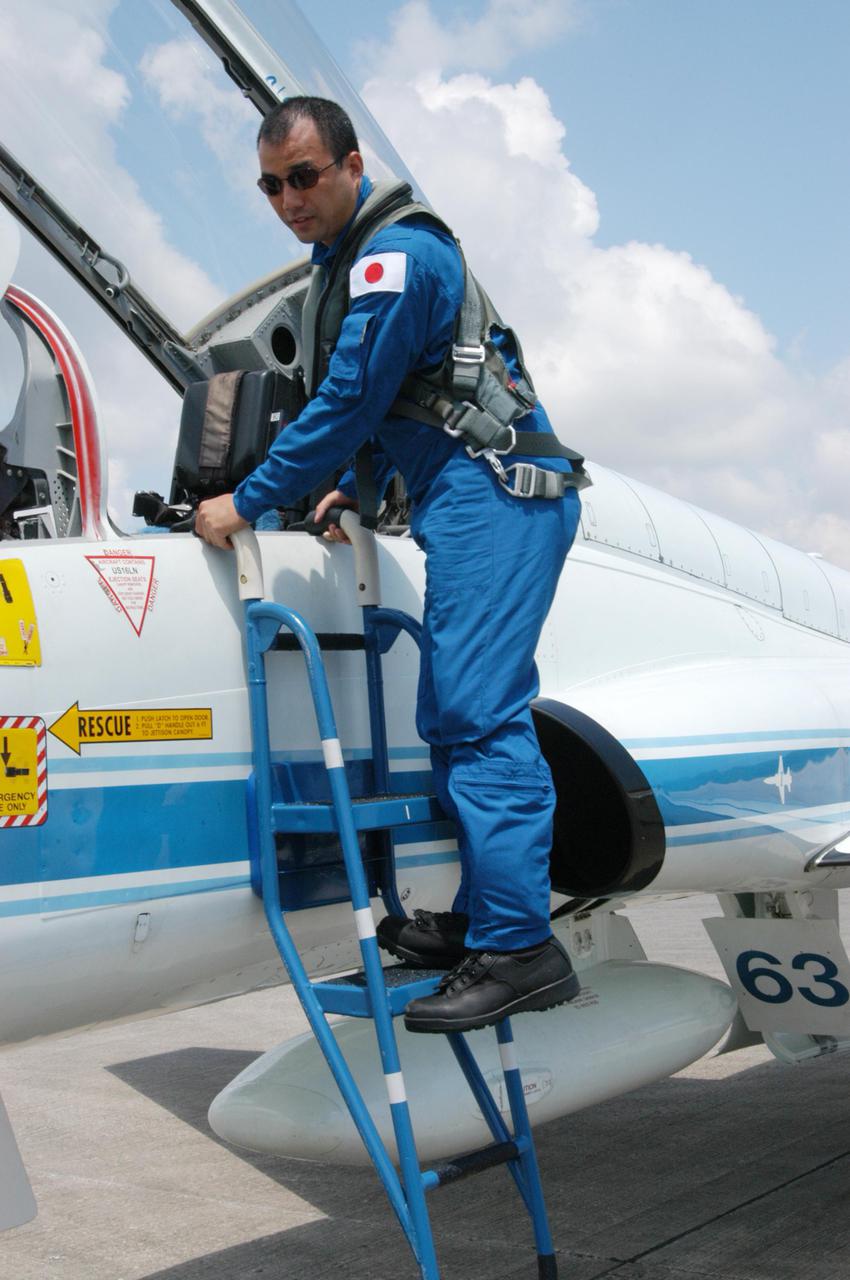
KENNEDY SPACE CENTER, FLA. - The Return to Flight STS-114 crew arrives at NASA Kennedy Space Center in T-38 training jets to get ready for a second launch attempt aboard Space Shuttle Discovery. Seen in the photo climbing out of the T-38 is Mission Specialist Soichi Noguchi, who represents the Japan Aerospace Exploration Agency (JAXA). Mission Commander Eileen Collins later told the media who waited nearby that since the scrub on July 13, the crew has focused on the on-orbit part of the mission and training for night landings using the Shuttle Training Aircraft. She praised the engineers and technicians who have been troubleshooting the elusive sensor problem and thanked them. STS-114 is scheduled to launch July 26 at 10:39 a.m. EDT from Launch Pad 39B.
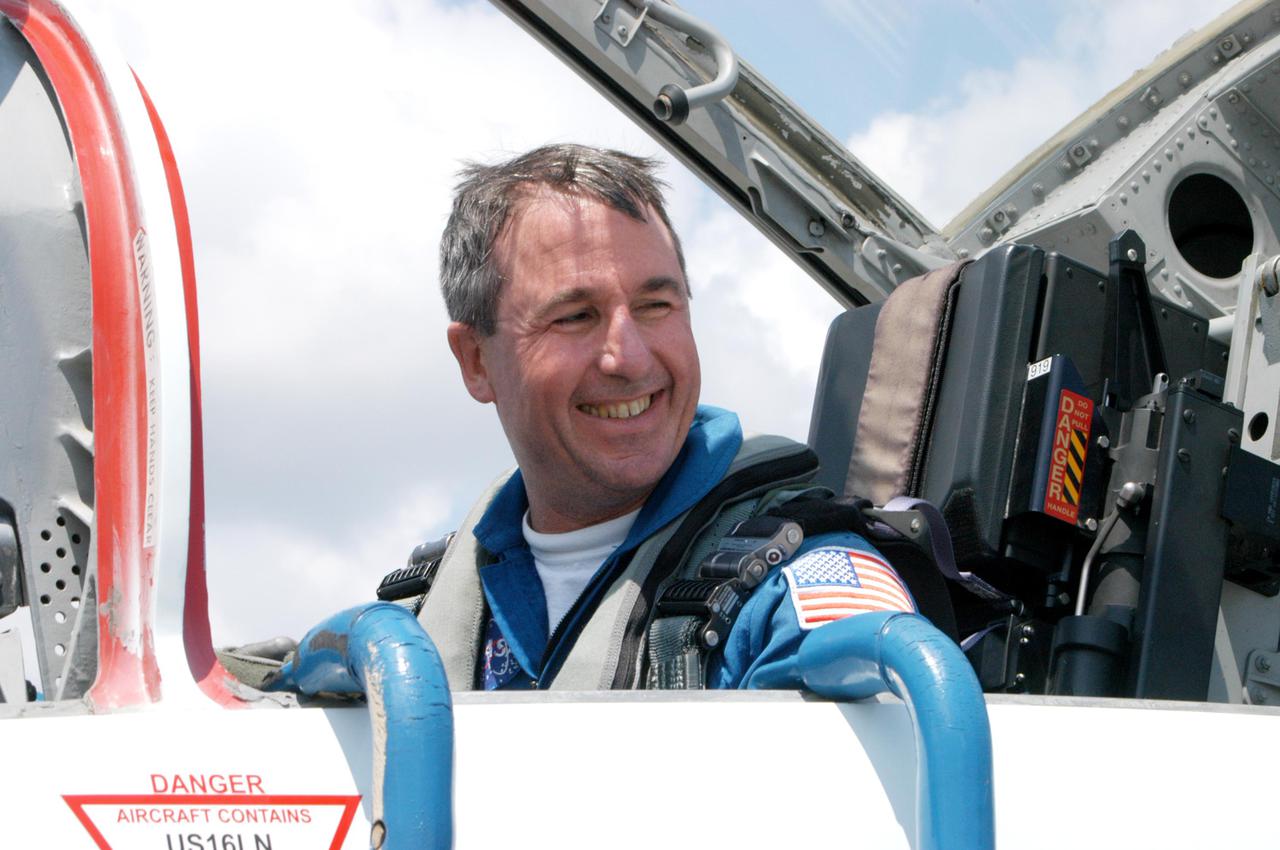
KENNEDY SPACE CENTER, FLA. - The Return to Flight STS-114 crew arrives at NASA Kennedy Space Center in T-38 training jets to get ready for a second launch attempt aboard Space Shuttle Discovery. Seen in the photo is Mission Specialist Stephen Robinson, still in the T-38 jet. Mission Commander Eileen Collins later told the media who waited nearby that since the scrub on July 13, the crew has focused on the on-orbit part of the mission and training for night landings using the Shuttle Training Aircraft. She praised the engineers and technicians who have been troubleshooting the elusive sensor problem and thanked them. STS-114 is scheduled to launch July 26 at 10:39 a.m. EDT from Launch Pad 39B.
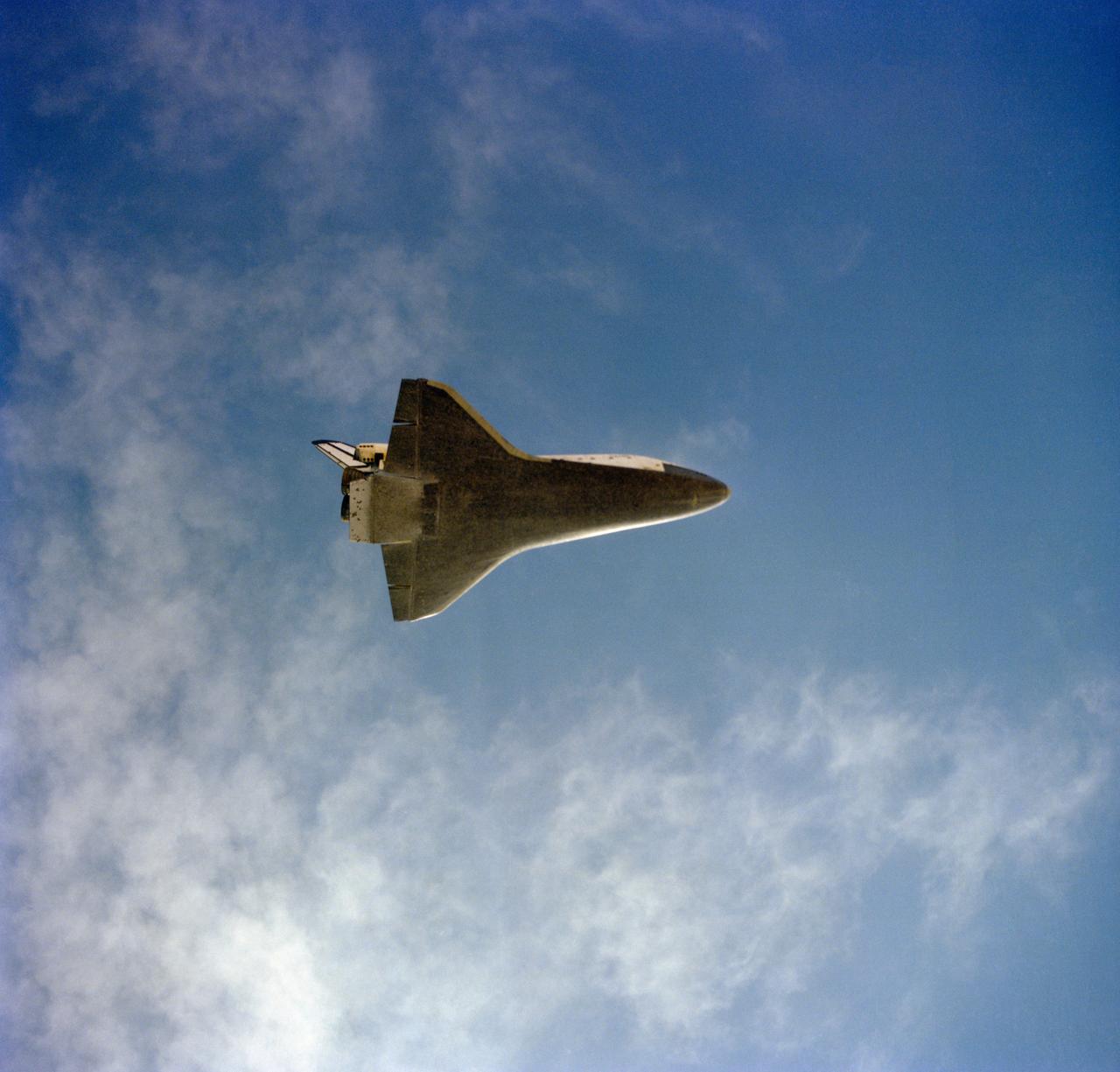
S82-28835 (30 March 1982) --- This unique view of the underside of the space shuttle orbiter Columbia was taken with a handheld camera aboard a T-38 chase plane over the White Sands Missile Range in New Mexico. Bad weather here yesterday vanished and the STS-3 crew of astronaut Jack R. Lousma and C. Gordon Fullerton greeted a pleasant climate along with a large crowd of spectators upon their landing. The successful landing was the first attempted in the actual orbiter on New Mexico soil. Photo credit: NASA
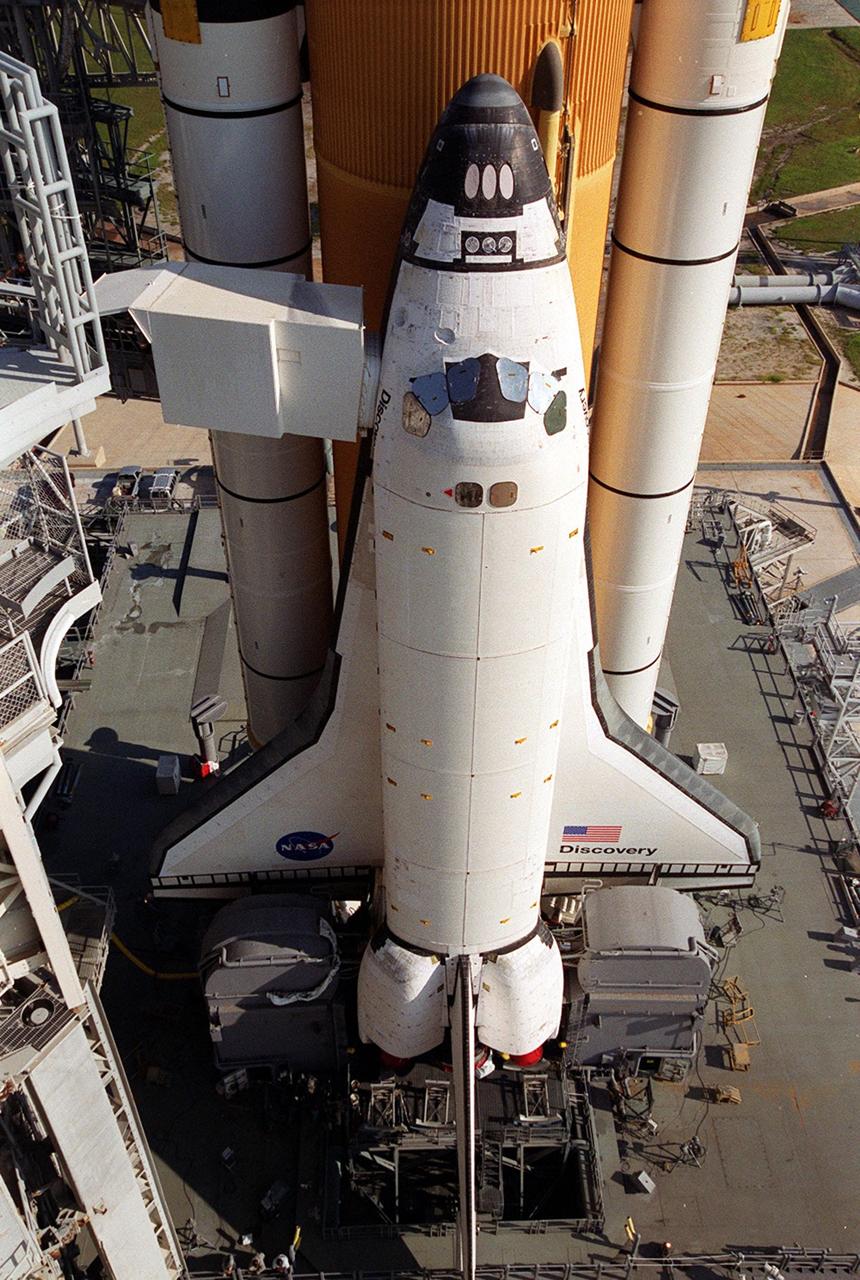
KENNEDY SPACE CENTER, FLA. -- Space Shuttle Discovery is ready on Launch Pad 39A for final launch preparations of STS-92. Scheduled to lift off Oct. 5 at 9:38 p.m. EDT, Discovery will be making the 100th Space Shuttle mission launched from Kennedy Space Center. Discovery also will be making its 28th flight into space, more than any of the other orbiters to date. STS-92 is a mission to the International Space Station, carrying the Z1 truss, which is the first of 10 trusses on the Station, and the third Pressurized Mating Adapter
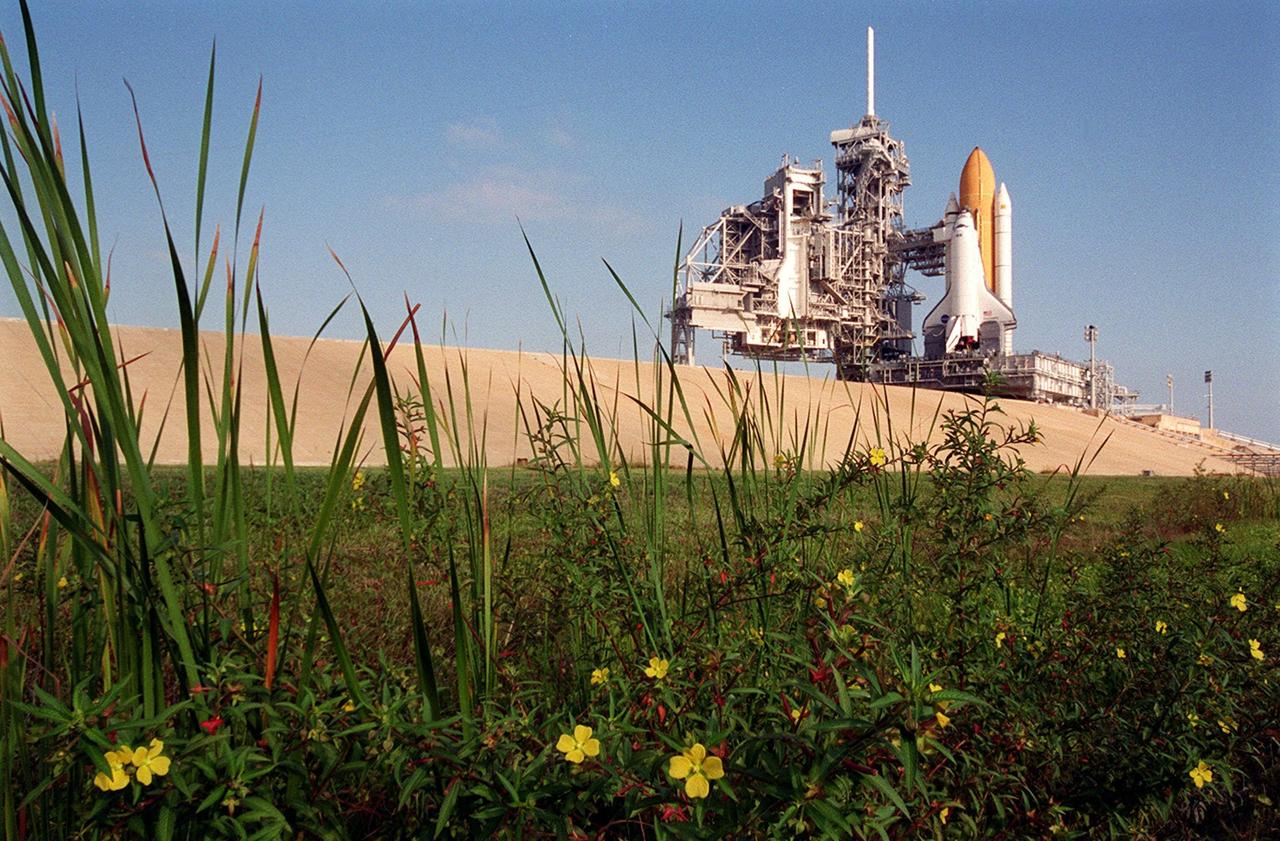
KENNEDY SPACE CENTER, FLA. -- Viewed across a field of wildflowers and other greenery, Space Shuttle Discovery rises above them on Launch Pad 39A. Discovery is undergoing final launch preparations of STS-92. Scheduled to lift off Oct. 5 at 9:38 p.m. EDT, Discovery will be making the 100th Space Shuttle mission launched from Kennedy Space Center. Discovery also will be making its 28th flight into space, more than any of the other orbiters to date. STS-92 is a mission to the International Space Station, carrying the Z1 truss, which is the first of 10 trusses on the Station, and the third Pressurized Mating Adapter
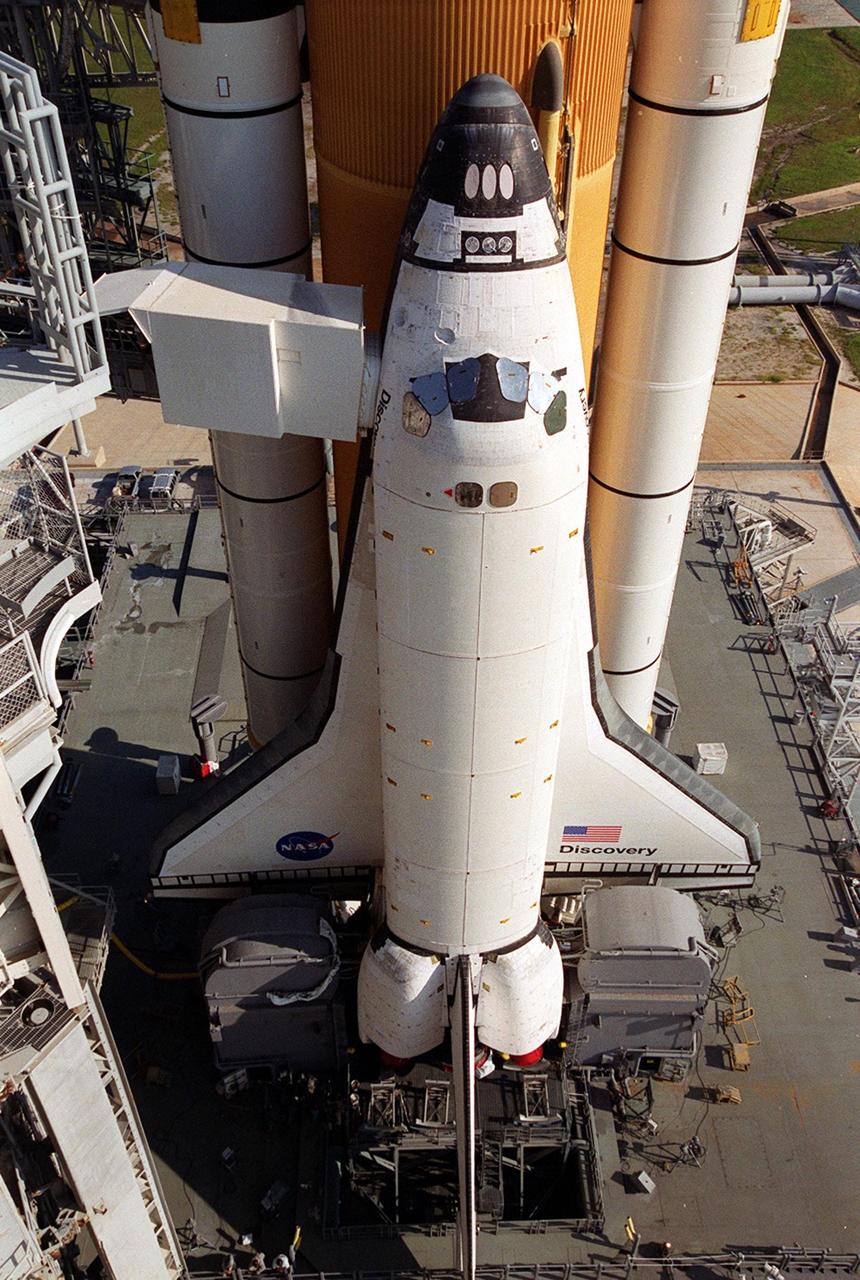
KENNEDY SPACE CENTER, FLA. -- Space Shuttle Discovery is ready on Launch Pad 39A for final launch preparations of STS-92. Scheduled to lift off Oct. 5 at 9:38 p.m. EDT, Discovery will be making the 100th Space Shuttle mission launched from Kennedy Space Center. Discovery also will be making its 28th flight into space, more than any of the other orbiters to date. STS-92 is a mission to the International Space Station, carrying the Z1 truss, which is the first of 10 trusses on the Station, and the third Pressurized Mating Adapter
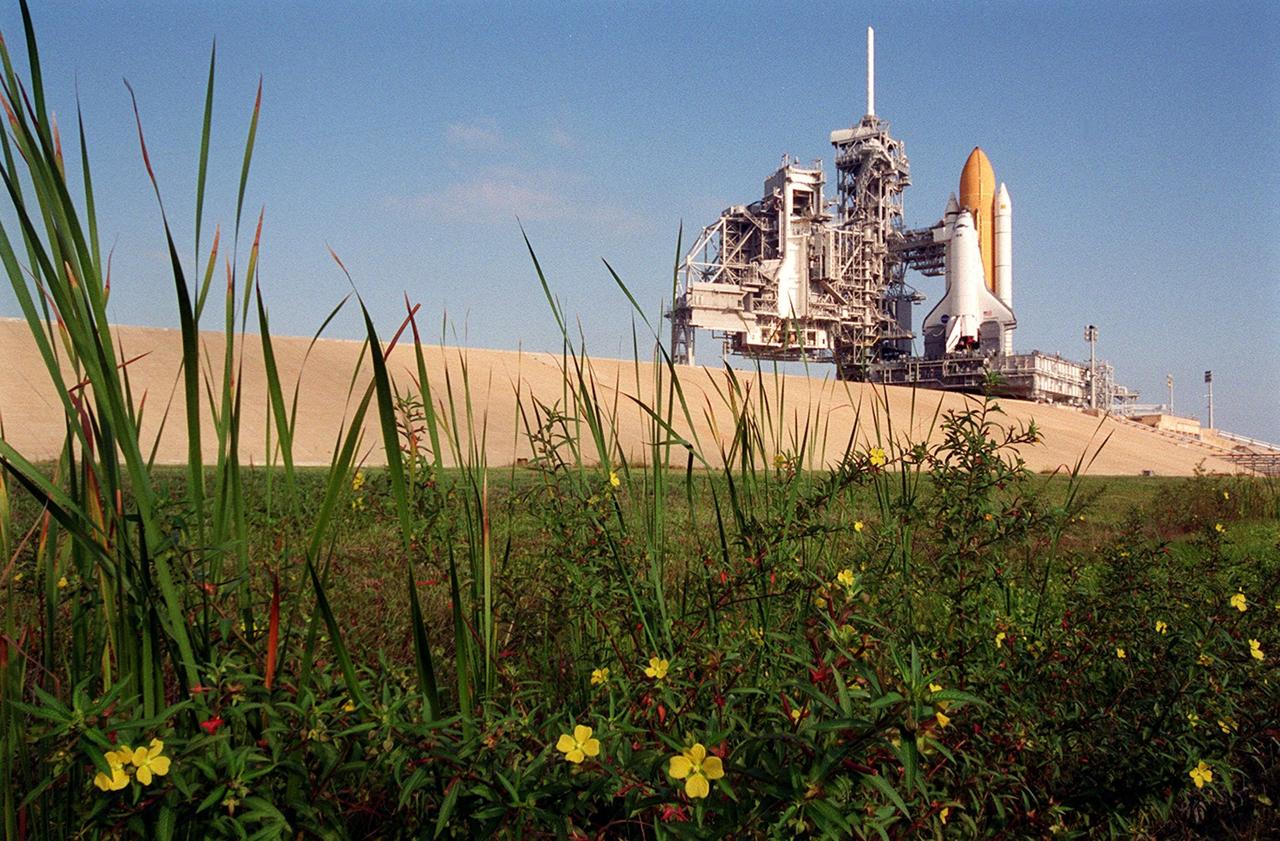
KENNEDY SPACE CENTER, FLA. -- Viewed across a field of wildflowers and other greenery, Space Shuttle Discovery rises above them on Launch Pad 39A. Discovery is undergoing final launch preparations of STS-92. Scheduled to lift off Oct. 5 at 9:38 p.m. EDT, Discovery will be making the 100th Space Shuttle mission launched from Kennedy Space Center. Discovery also will be making its 28th flight into space, more than any of the other orbiters to date. STS-92 is a mission to the International Space Station, carrying the Z1 truss, which is the first of 10 trusses on the Station, and the third Pressurized Mating Adapter
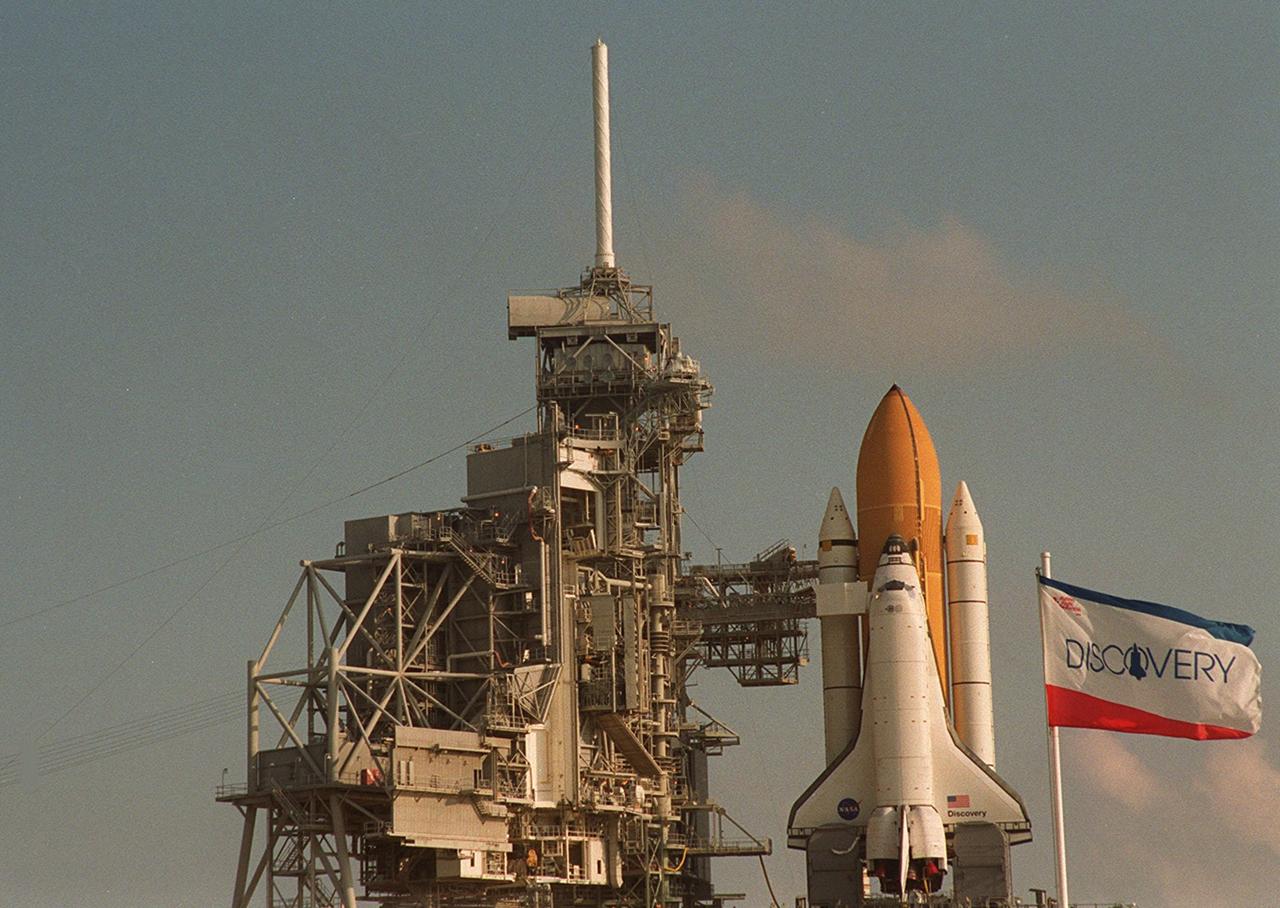
KENNEDY SPACE CENTER, FLA. -- The flag at right identifies Space Shuttle Discovery on Launch Pad 39A after its rollout and before the Rotating Service Structure is moved around it. Scheduled to launch Oct. 5 at 9:38 p.m. EDT on mission STS-92, Discovery will be making the 100th Space Shuttle mission launched from Kennedy Space Center. Discovery also will be making its 28th flight into space, more than any of the other orbiters to date. STS-92 is a mission to the International Space Station, carrying the Z1 truss, which is the first of 10 trusses on the Station, and the third Pressurized Mating Adapter
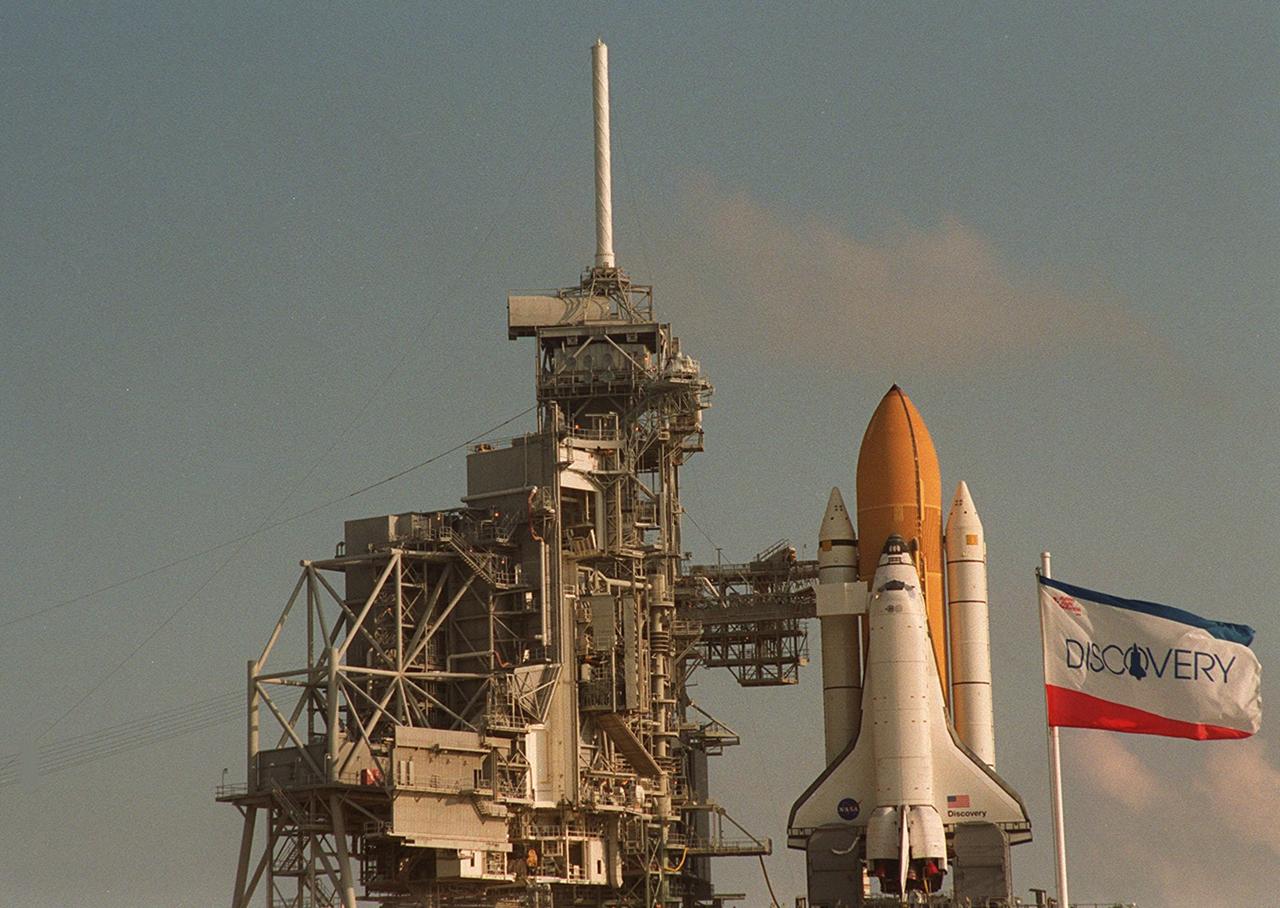
KENNEDY SPACE CENTER, FLA. -- The flag at right identifies Space Shuttle Discovery on Launch Pad 39A after its rollout and before the Rotating Service Structure is moved around it. Scheduled to launch Oct. 5 at 9:38 p.m. EDT on mission STS-92, Discovery will be making the 100th Space Shuttle mission launched from Kennedy Space Center. Discovery also will be making its 28th flight into space, more than any of the other orbiters to date. STS-92 is a mission to the International Space Station, carrying the Z1 truss, which is the first of 10 trusses on the Station, and the third Pressurized Mating Adapter
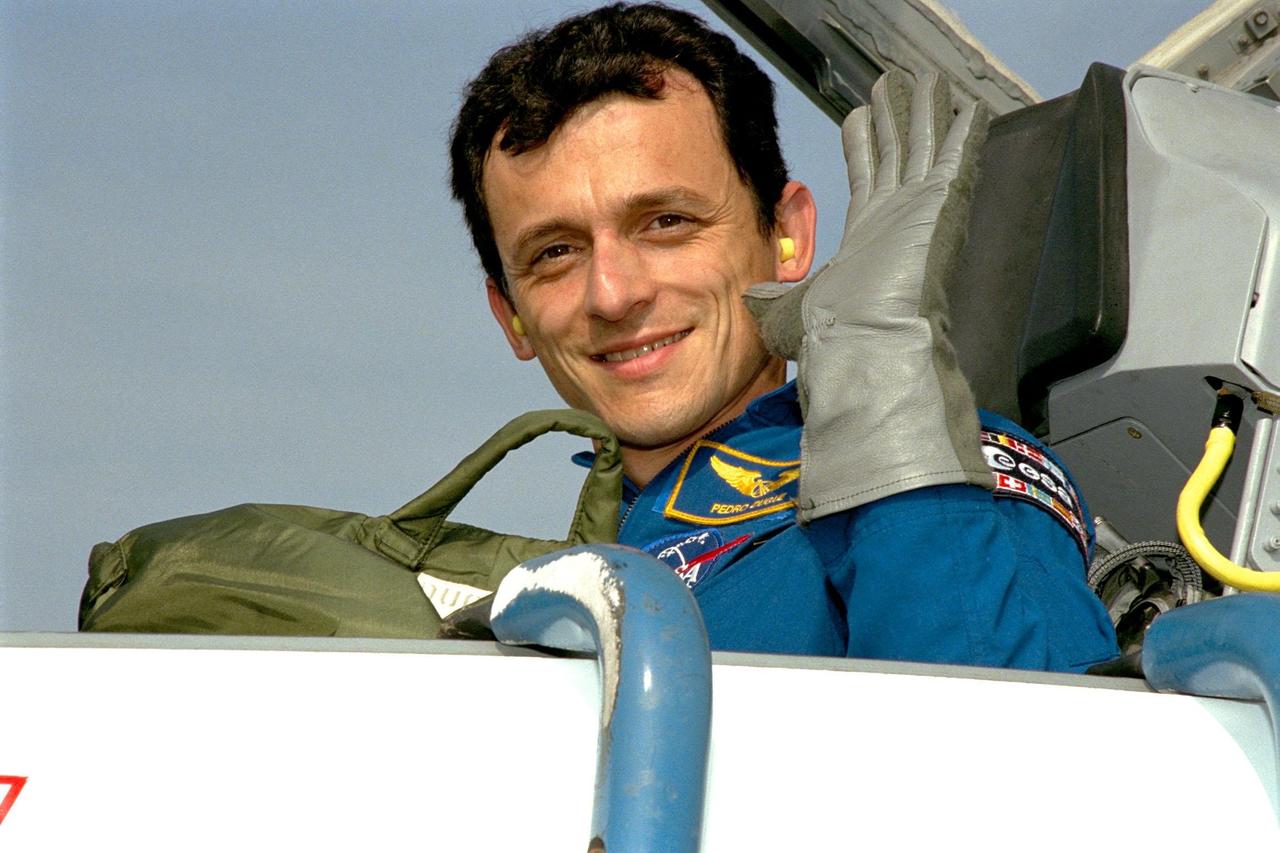
STS-95 Payload Specialist Pedro Duque of Spain, who represents the European Space Agency (ESA), waves after arriving in a T-38 jet aircraft at the Shuttle Landing Facility at KSC. He is joining other STS-95 crew members in a familiarization tour of the SPACEHAB module and the equipment that will fly with them on the Space Shuttle Discovery scheduled to launch Oct. 29, 1998. The mission includes research payloads such as the Spartan solar-observing deployable spacecraft, the Hubble Space Telescope Orbital Systems Test Platform, the International Extreme Ultraviolet Hitchhiker, as well as the SPACEHAB single module with experiments on space flight and the aging process
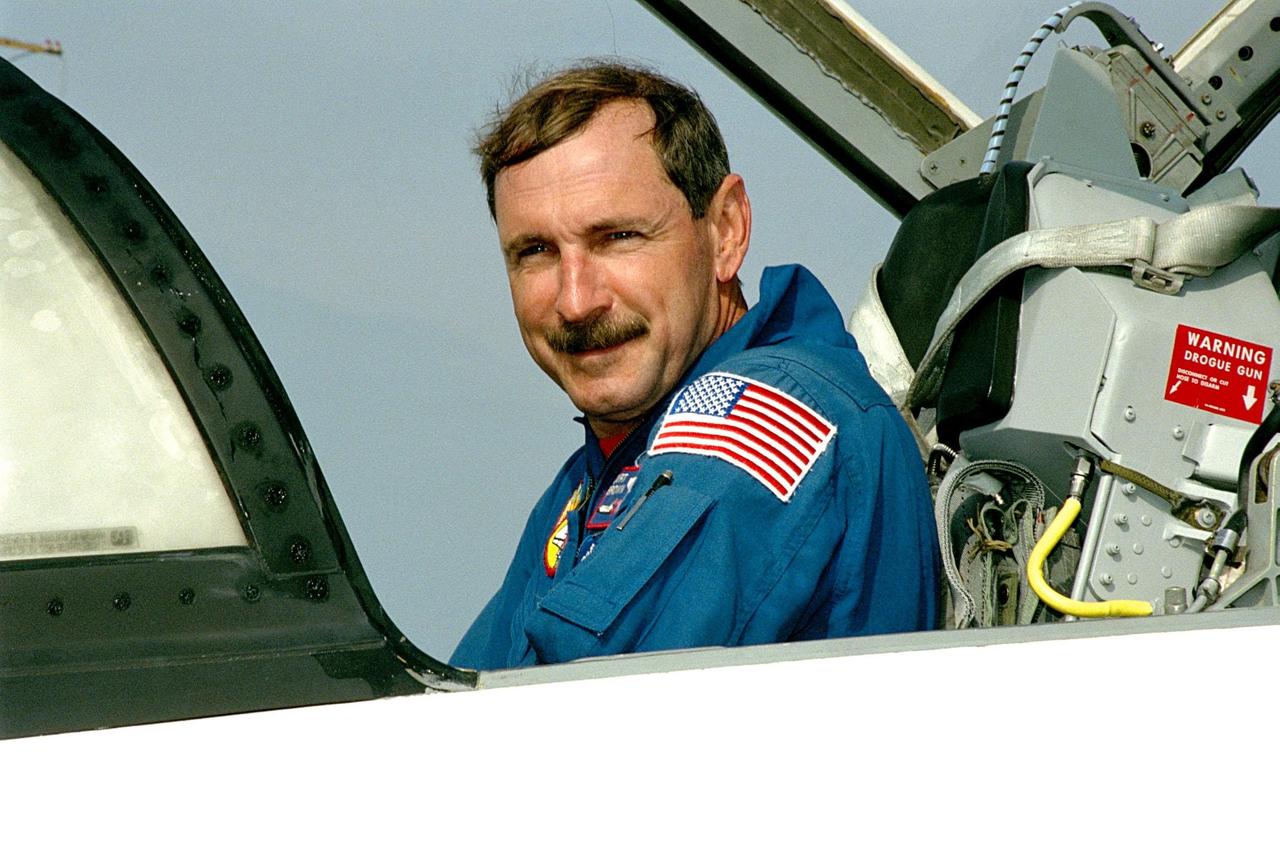
STS-95 Mission Commander Curtis L. Brown Jr. arrives aboard a T-38 jet aircraft at the Shuttle Landing Facility at KSC. The STS-95 crew is at KSC to look at the SPACEHAB module and the equipment that will fly with them on the Space Shuttle Discovery scheduled to launch Oct. 29, 1998. The mission includes research payloads such as the Spartan solar-observing deployable spacecraft, the Hubble Space Telescope Orbital Systems Test Platform, the International Extreme Ultraviolet Hitchhiker, as well as the SPACEHAB single module with experiments on space flight and the aging process
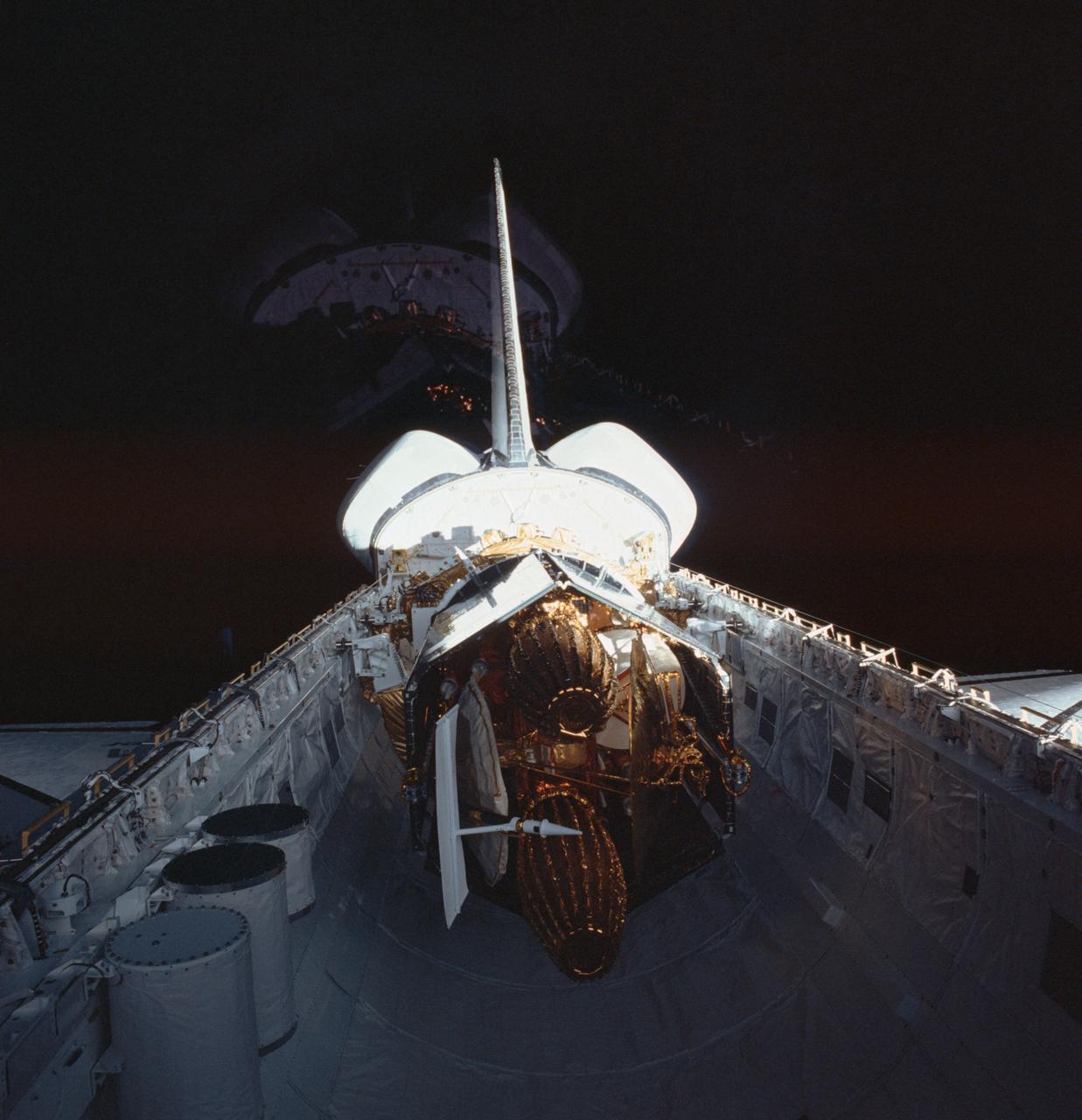
STS006-38-844 (4 April 1983) --- The stowed tracking and data relay satellite (TDRS) and its inertial upper stage (IUS) are seen in duplicate in this 70mm frame taken by the STS-6 crew aboard the Earth-orbiting space shuttle Challenger on its first day in space. A reflection in the aft window of the flight deck resulted in the mirage effect of the “second” TDRS. The three canisters in the aft foreground contain experiments of participants in NASA’s STS getaway special (GAS) program. Onboard the second reusable shuttle for this five-day flight were astronauts Paul J. Weitz, Karol J. Bobko, Dr. F. Story Musgrave and Donald H. Peterson. Photo credit: NASA
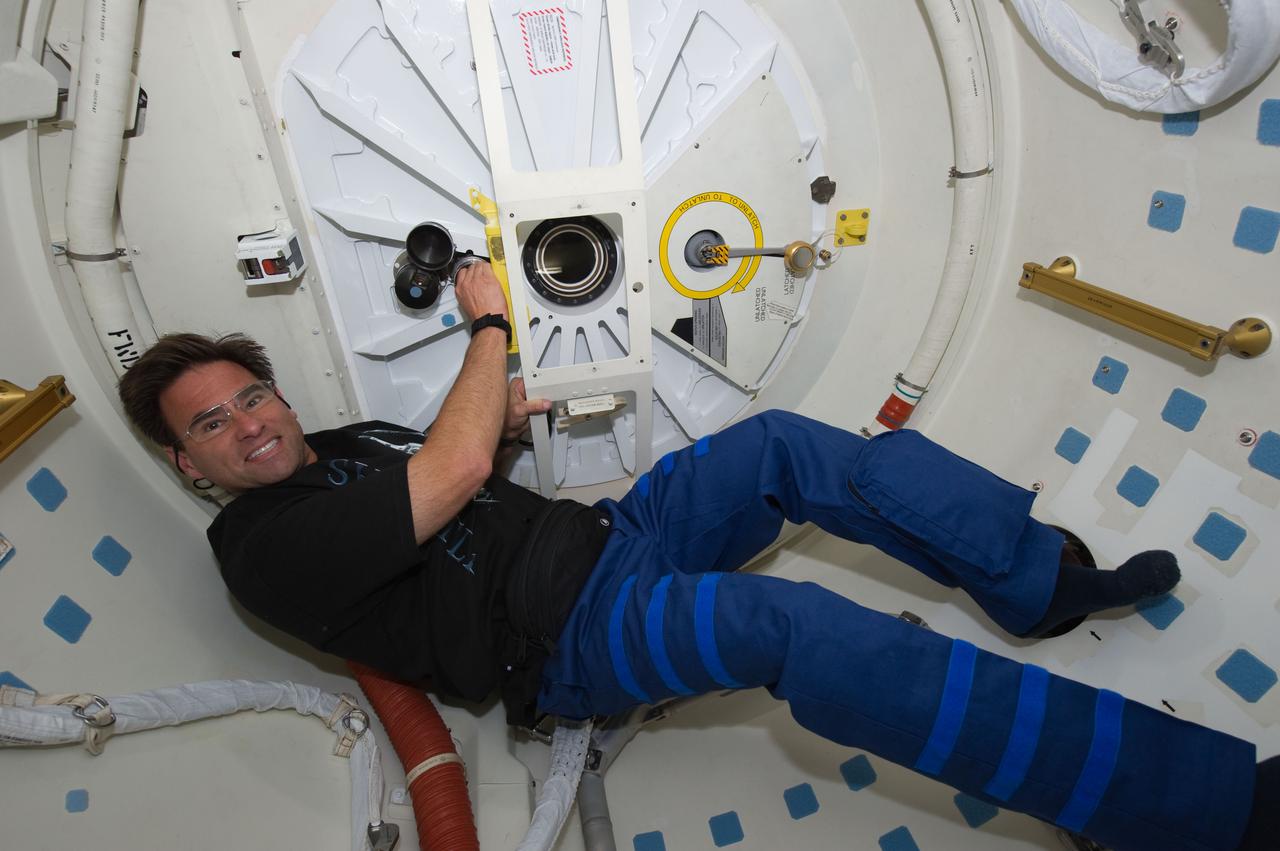
S134-E-007289 (18 May 2011) --- NASA astronaut Greg Chamitoff, STS-134 mission specialist, prepares to open the hatch that will lead the space shuttle Endeavour crew into the International Space Station. The two spacecraft docked at 6:14 a.m. (EDT) and the Endeavour crew entered the orbital outpost at 7:38 a.m. May 18, 2011. Photo credit: NASA
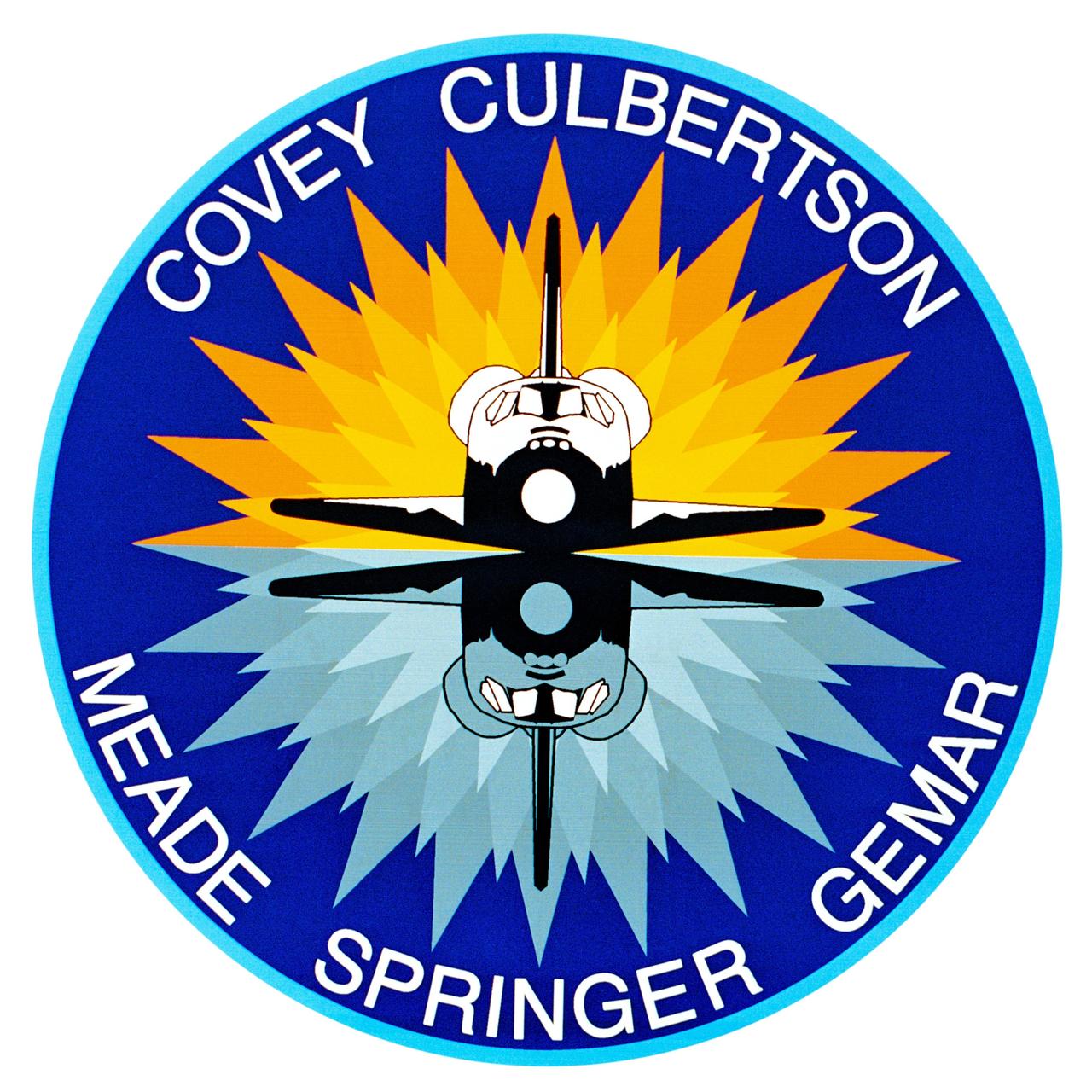
STS038-S-001 (May 1990) --- The STS-38 patch was designed to represent and pay tribute to all the men and women who contribute to the Space Shuttle Program. The top orbiter, with the stylistic Orbital Maneuvering System burn, symbolizes the continuing dynamic nature of the Space Shuttle Program. The bottom orbiter, a black and white mirror image, acknowledges the thousands of unheralded individuals who work behind the scenes in support of America's Space Shuttle Program. This mirror image symbolizes the importance of their contributions. The NASA insignia design for space shuttle flights is reserved for use by the astronauts and for other official use as the NASA Administrator may authorize. Public availability has been approved only in the forms of illustrations by the various news media. When and if there is any change in this policy, which is not anticipated, the change will be publicly announced. Photo credit: NASA
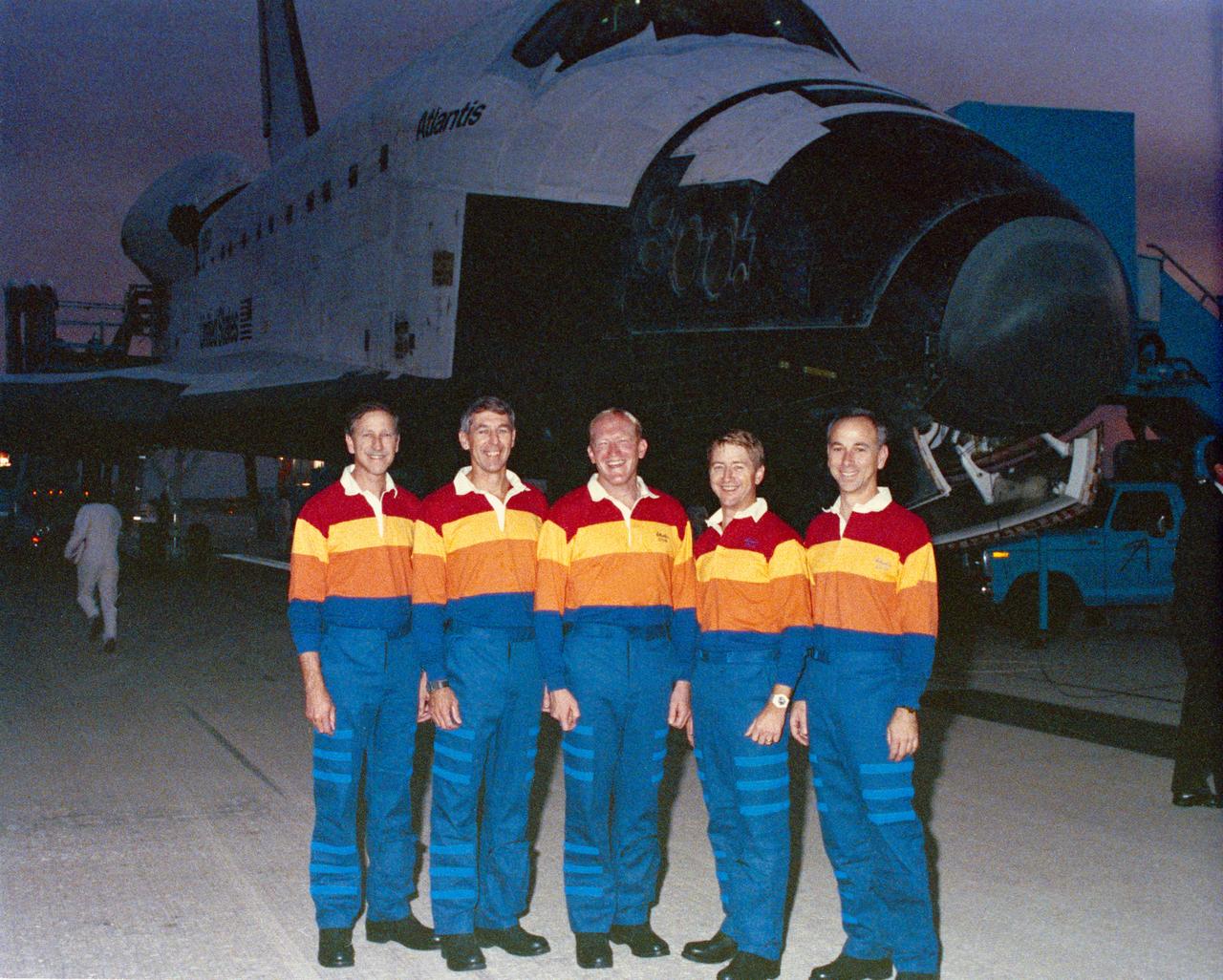
STS038-S-040 (20 Nov 1990) --- STS-38 crewmembers, wearing red, yellow, and orange polo shirts, pose in front of Atlantis, Orbiter Vehicle (OV) 104, parked on runway 33 at Kennedy Space Center's (KSC) Shuttle Landing Facility (SLF) during post flight activities. Left to right are Commander Richard O. Covey, Mission Specialist (MS) Robert C. Springer, MS Charles D. Gemar, Pilot Frank L. Culbertson, and MS Carl J. Meade.

STS038-S-041 (20 Nov 1990) --- STS-38 Atlantis, Orbiter Vehicle (OV) 104, lands on runway 33 at Kennedy Space Center (KSC) Shuttle Landing Facility (SLF). The main landing gear (MLG) has just touched down on the runway surface as the nose landing gear (NLG) glides above it. The Department of Defense (DOD)-devoted mission came to an end (with complete wheel stop) at 4:43:37 pm (Eastern Standard Time (EST)).

JSC2003-E-61571 (29 October 2003) --- Astronaut Wendy B. Lawrence, STS-114 mission specialist, arrives at the Kennedy Space Center (KSC) Shuttle Landing Facility in a T-38 jet aircraft. Lawrence, who is a new addition to the mission crew, is taking part in hands-on equipment and orbiter familiarization along with other crewmembers.
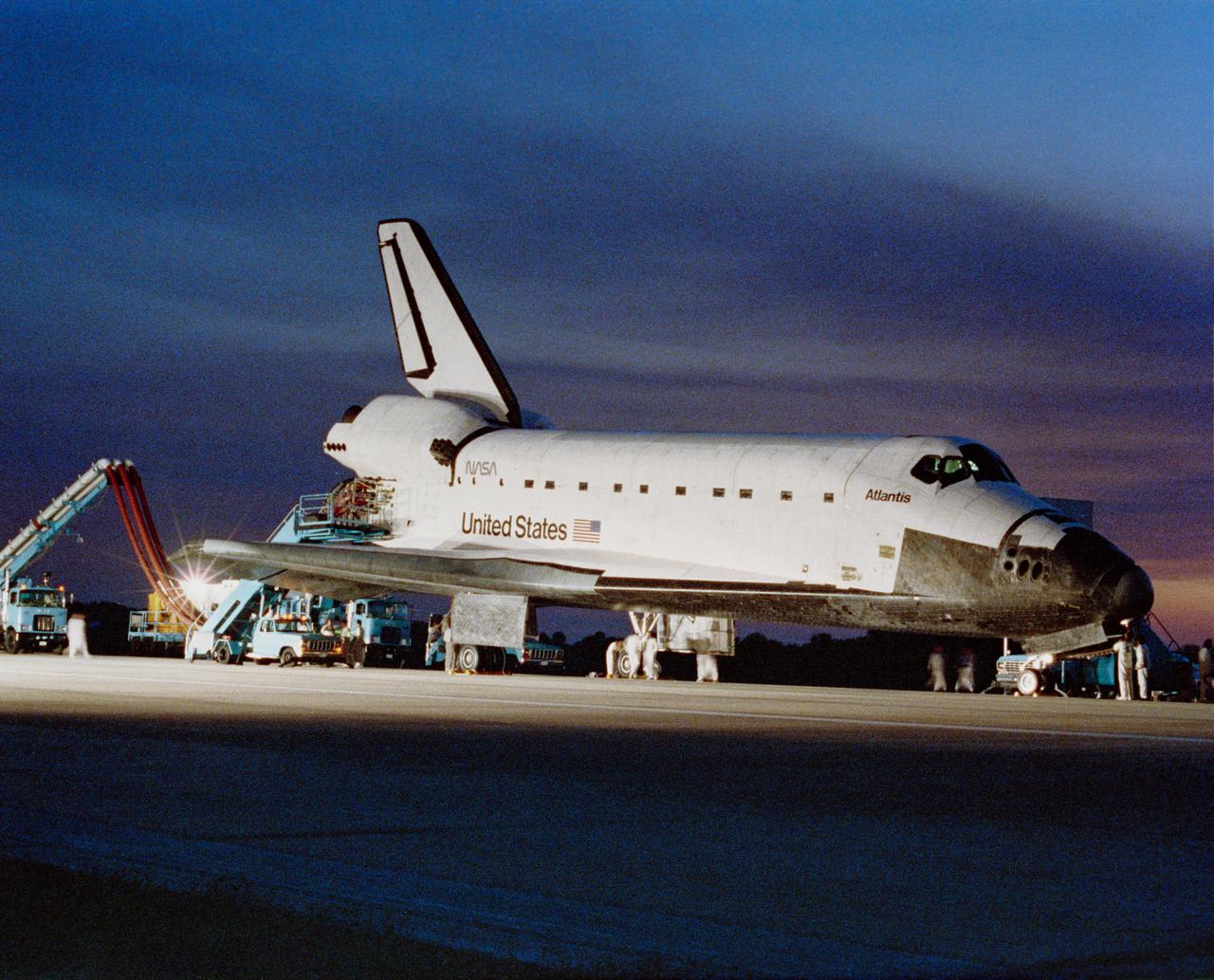
Spotlights illuminate Atlantis, Orbiter Vehicle (OV) 104, during safing operations at the Kennedy Space Center's (KSC's) Shuttle Landing Facility (SLF). OV-104 parked on runway 33 is serviced by KSC ground crews. STS-38, a Department of Defense (DOD)-devoted mission, came to an end (with complete wheel stop) at 4:43:37 pm (Eastern Standard Time (EST)).
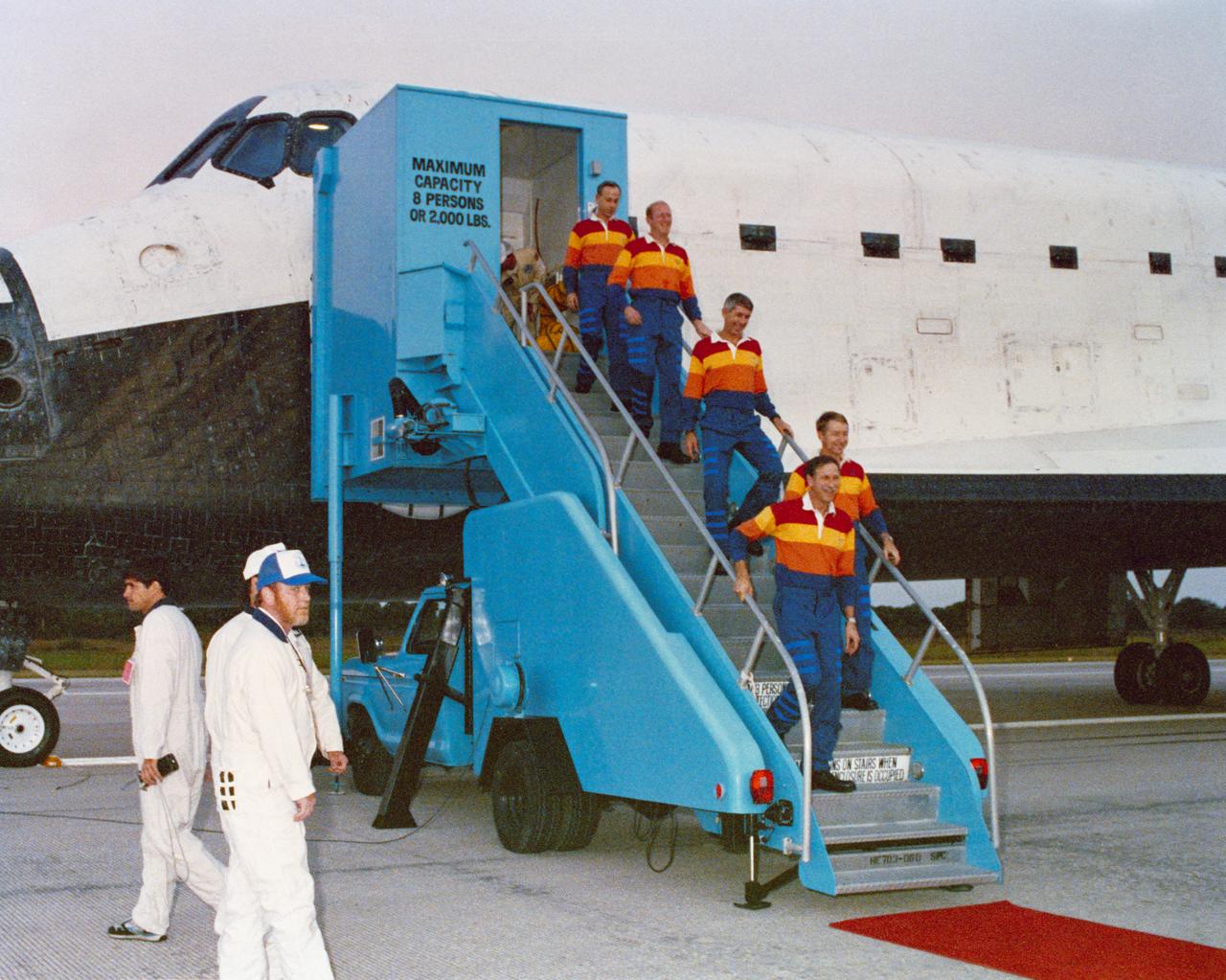
STS-38 crewmembers, wearing red, yellow, and orange polo shirts, egress Atlantis, Orbiter Vehicle (OV) 104, via a mobile stairway at the Kennedy Space Center's (KSC's) Shuttle Landing Facility (SLF). Commander Richard O. Covey, nearing the bottom of the stairway, is followed by Pilot Frank L. Culbertson, Mission Specialist (MS) Robert C. Springer, MS Charles D. Gemar, and MS Carl J. Meade. Ground servicing personnel look on in the foreground.
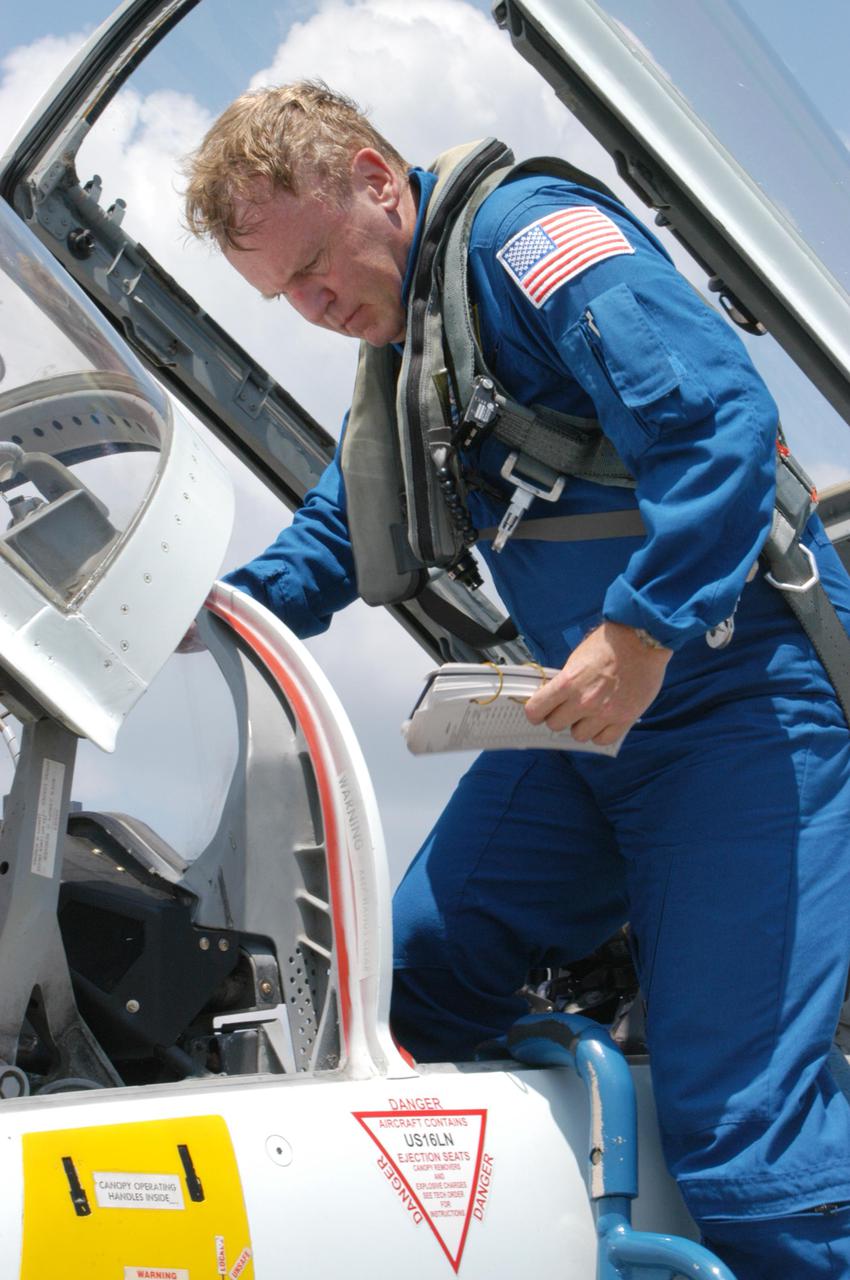
KENNEDY SPACE CENTER, FLA. - STS-114 Mission Specialist Andrew Thomas climbs out of the T-38 jet aircraft on NASA Kennedy Space Center’s Shuttle Landing Facility. The Return to Flight STS-114 crew has returned to KSC to get ready for a second launch attempt aboard Space Shuttle Discovery. Mission Commander Eileen Collins later told the media who waited nearby that since the scrub on July 13, the crew has focused on the on-orbit part of the mission and training for night landings using the Shuttle Training Aircraft. She praised the engineers and technicians who have been troubleshooting the elusive sensor problem and thanked them. STS-114 is scheduled to launch July 26 at 10:39 a.m. EDT from Launch Pad 39B.
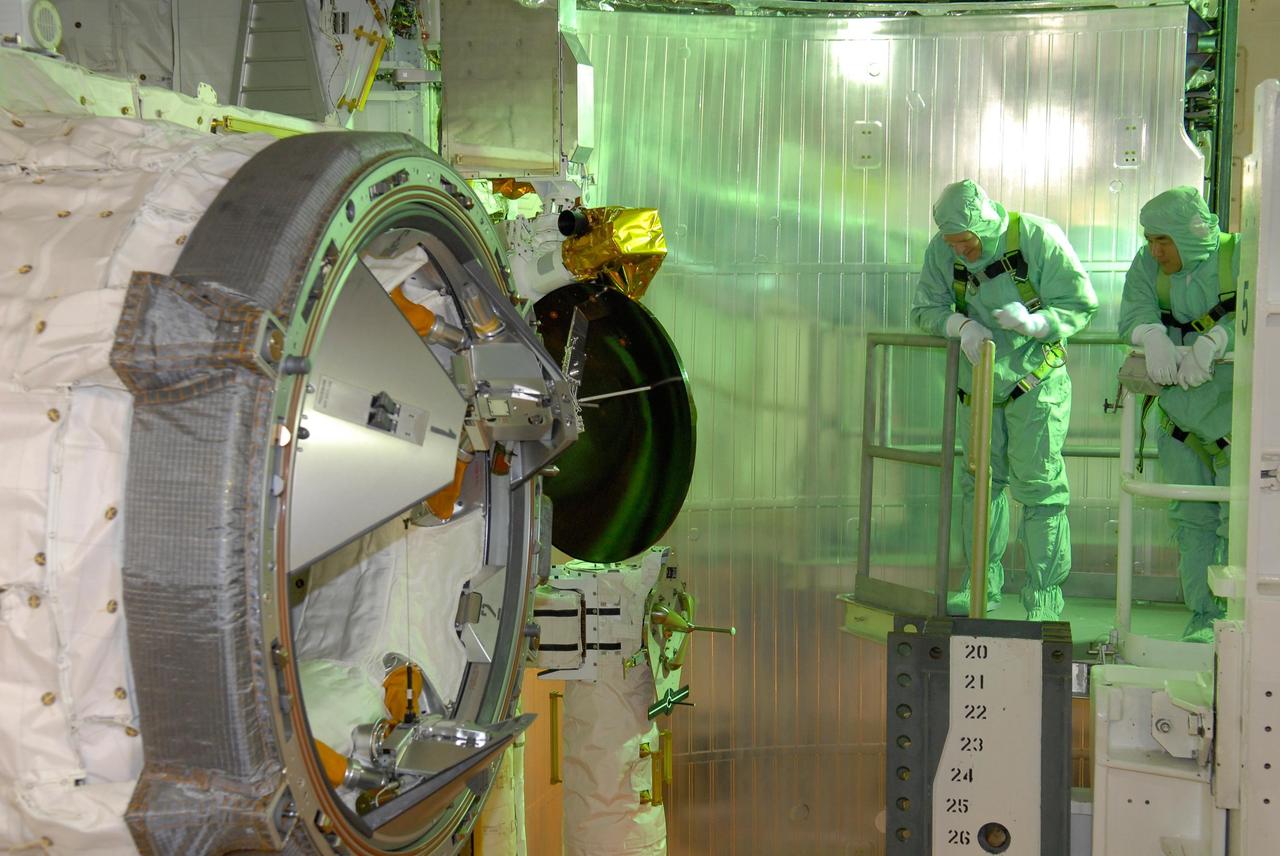
KENNEDY SPACE CENTER, FLA. -- In space shuttle Discovery's payload bay, STS-120 crew members get a close look at the orbital docking system. Seen here are Mission Specialists Scott Parazynski (left) and Daniel Tani. After the mission, Tani will remain aboard the International Space Station and return with the STS-122 crew, targeted to launch Dec. 6. The TCDT provides astronauts and ground crews an opportunity to participate in various simulated countdown activities, including equipment familiarization and emergency training. The STS-120 mission will deliver the U.S. Node 2 module, named Harmony, aboard space shuttle Discovery to the International Space Station. Launch of Discovery on mission STS-120 is targeted for Oct. 23 at 11:38 a.m. EDT on a 14-day mission. Photo credit: NASA/Kim Shiflett
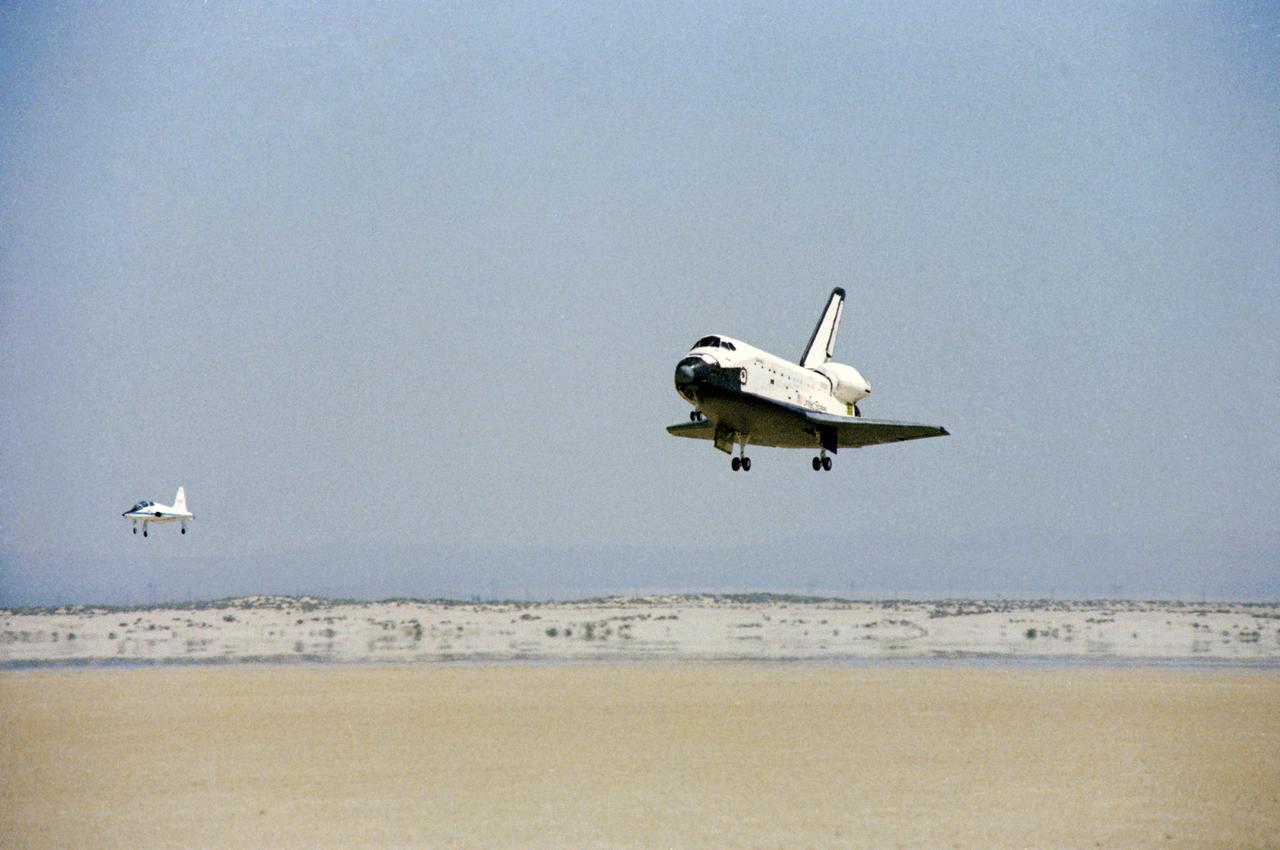
S81-30425 (14 April 1981) --- The space shuttle orbiter Columbia is seen from the front as it heads for a touchdown atop a dry lake bed at Edwards Air Force Base in southern California. A T-38 chase plane follows it in at left. Aboard Columbia were astronauts John W. Young, STS-1 commander, and Robert L. Crippen, pilot. Their landing marked the completion of a successful two-and-a-third day flight in space and the beginning of a new era of space transportation. A series of additional test flights will follow before the Space Shuttle Program becomes fully operational later in this decade. Photo credit: NASA
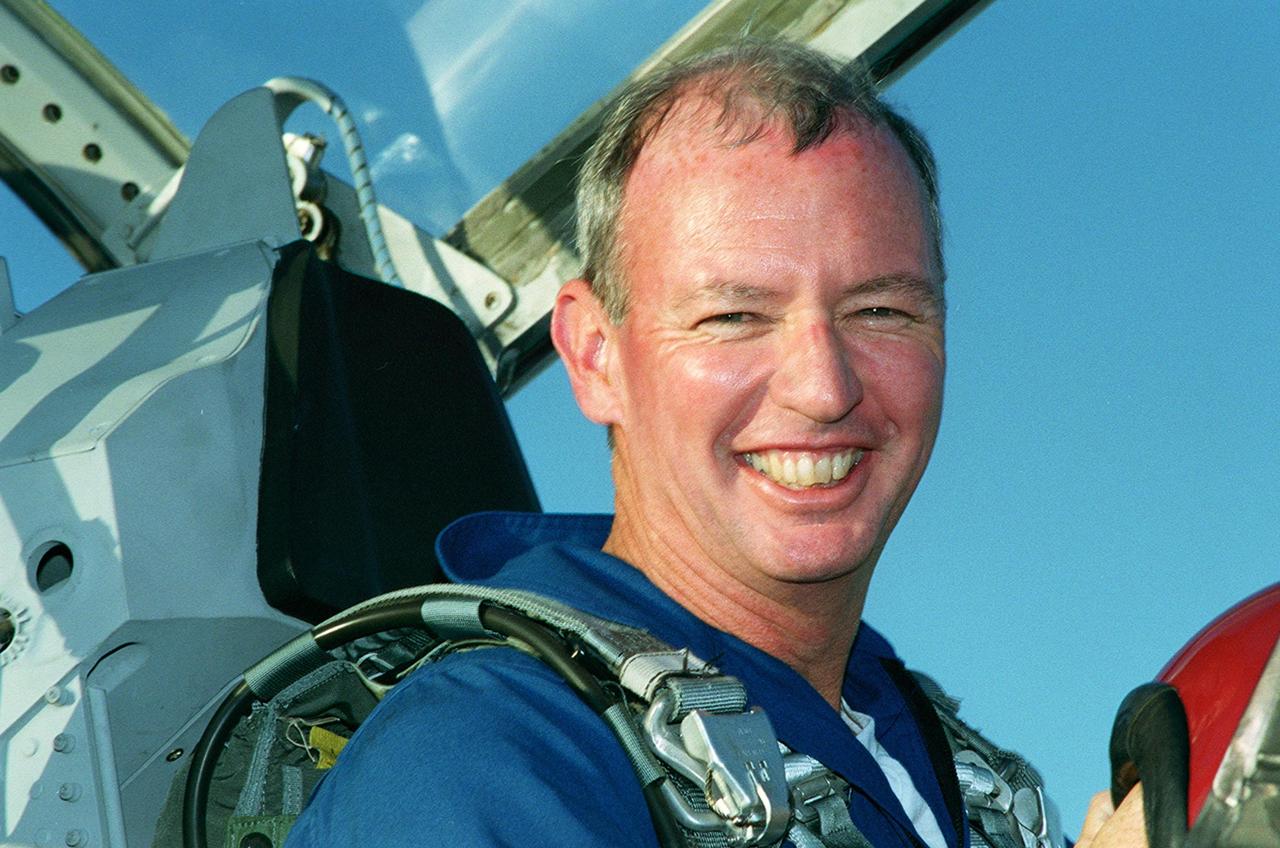
STS-92 Commander Brian Duffy smiles after landing at the KSC Shuttle Landing Facility in a T-38 training jet aircraft. He and the rest of the crew are at KSC to take part in Terminal Countdown Demonstration Test activities, which include emergency egress training from the orbiter and pad, and a simulated countdown. The fifth mission to the International Space Station, STS-92 will carry the Integrated Truss Structure Z1, the first of the planned 10 trusses on the Space Station, and the third Pressurized Mating Adapter. The Z1 will allow the first U.S. solar arrays on a future flight to be temporarily installed on Unity for early power. PMA-3 will provide a Shuttle docking port for the solar array installation on the sixth ISS flight and Lab installation on the seventh ISS flight. STS-92 is scheduled to launch Oct. 5 from launch Pad 39A. It will be the 100th flight in the Shuttle program
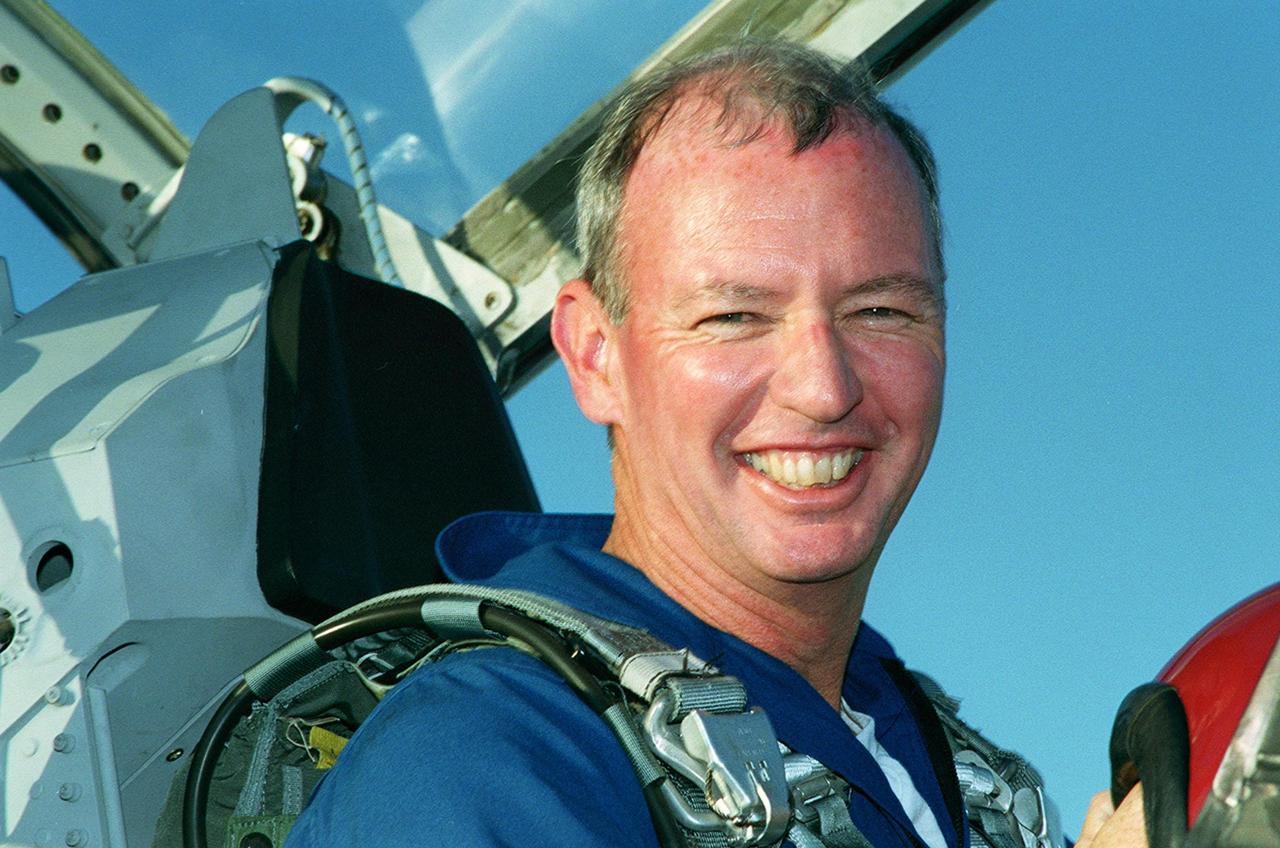
STS-92 Commander Brian Duffy smiles after landing at the KSC Shuttle Landing Facility in a T-38 training jet aircraft. He and the rest of the crew are at KSC to take part in Terminal Countdown Demonstration Test activities, which include emergency egress training from the orbiter and pad, and a simulated countdown. The fifth mission to the International Space Station, STS-92 will carry the Integrated Truss Structure Z1, the first of the planned 10 trusses on the Space Station, and the third Pressurized Mating Adapter. The Z1 will allow the first U.S. solar arrays on a future flight to be temporarily installed on Unity for early power. PMA-3 will provide a Shuttle docking port for the solar array installation on the sixth ISS flight and Lab installation on the seventh ISS flight. STS-92 is scheduled to launch Oct. 5 from launch Pad 39A. It will be the 100th flight in the Shuttle program
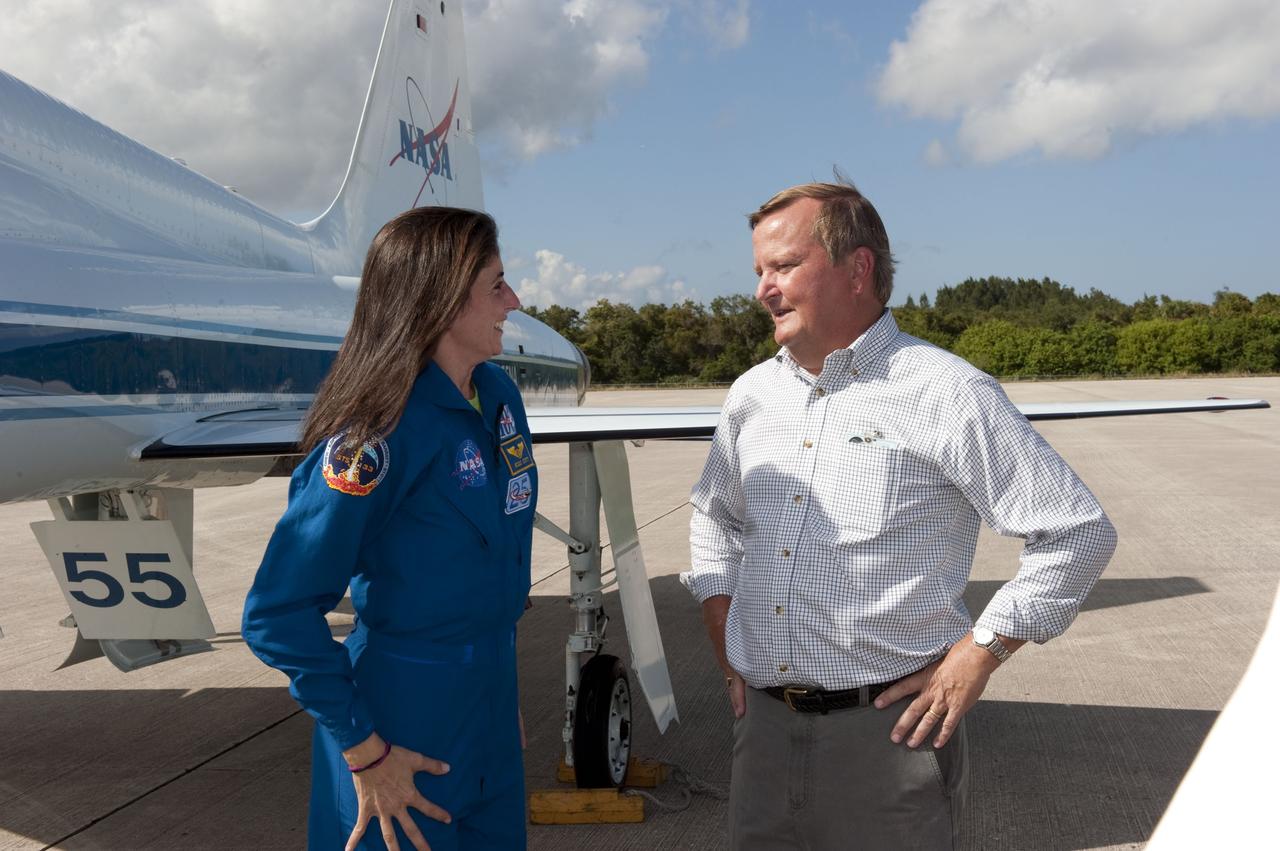
CAPE CANAVERAL, Fla. -- At NASA's Kennedy Space Center in Florida, space shuttle Discovery's STS-133 Mission Specialist Nicole Stott, left, is greeted by Shuttle Launch Director Mike Leinbach on the Shuttle Landing Facility runway after arriving in a T-38 training jet. In the days leading up to their launch to the International Space Station, Stott and her crew members will check the fit of their launch-and-entry suits, review launch-day procedures, receive weather briefings and remain medically quarantined to prevent sickness. Scheduled to lift off Nov. 1 at 4:40 p.m., Discovery and crew will deliver the Permanent Multipurpose Module, packed with supplies and critical spare parts, as well as Robonaut 2, the dexterous humanoid astronaut helper, to the orbiting outpost. For more information on the STS-133 mission, visit www.nasa.gov/mission_pages/shuttle/shuttlemissions/sts133/. Photo credit: NASA/Jack Pfaller
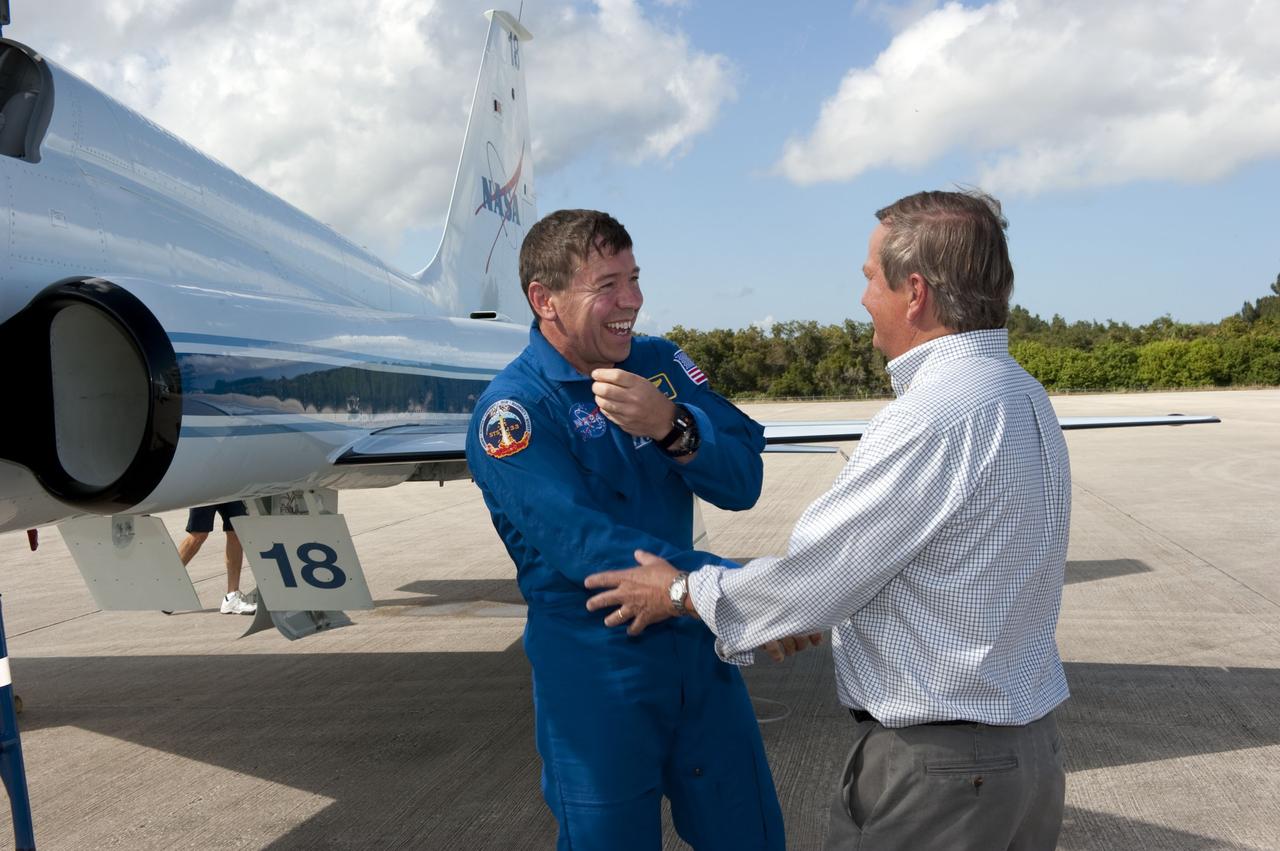
CAPE CANAVERAL, Fla. -- At NASA's Kennedy Space Center in Florida, space shuttle Discovery's STS-133 Mission Specialist Michael Barratt, left, is greeted by Shuttle Launch Director Mike Leinbach on the Shuttle Landing Facility runway after arriving in a T-38 training jet. In the days leading up to their launch to the International Space Station, Barratt and his crew members will check the fit of their launch-and-entry suits, review launch-day procedures, receive weather briefings and remain medically quarantined to prevent sickness. Scheduled to lift off Nov. 1 at 4:40 p.m., Discovery and crew will deliver the Permanent Multipurpose Module, packed with supplies and critical spare parts, as well as Robonaut 2, the dexterous humanoid astronaut helper, to the orbiting outpost. For more information on the STS-133 mission, visit www.nasa.gov/mission_pages/shuttle/shuttlemissions/sts133/. Photo credit: NASA/Kim Shiflett
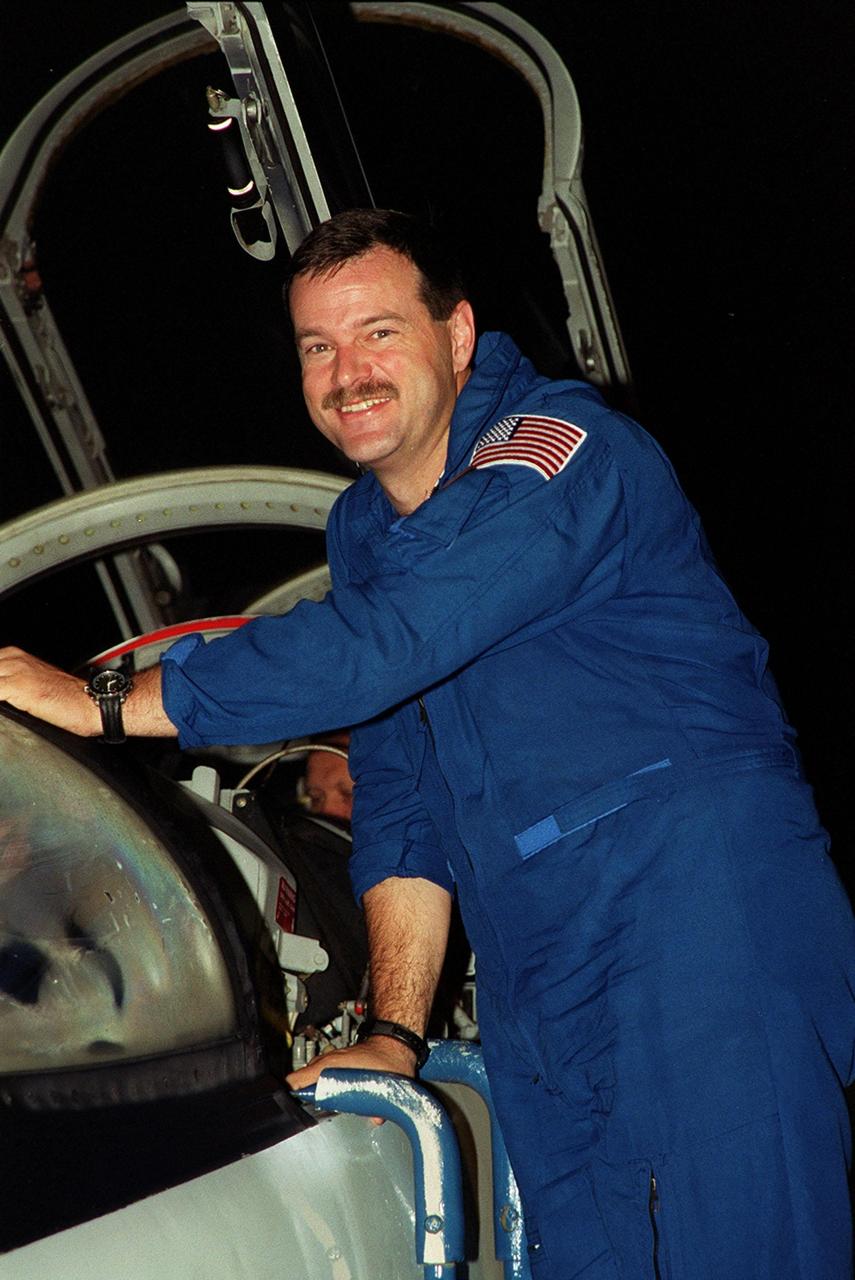
STS-106 Pilot Scott D. Altman steps down from the T-38 jet aircraft after landing at the KSC Shuttle Landing Facility. He and the rest of the crew will be making pre-launch preparations for the fourth flight to the International Space Station. STS-106 is scheduled to launch Sept. 8, 2000, at 8:45 a.m. EDT from Launch Pad 39B. On the 11-day mission, the seven-member crew will perform support tasks on orbit, transfer supplies and prepare the living quarters in the newly arrived Zvezda Service Module. The first long-duration crew, dubbed “Expedition One,” is due to arrive at the Station in late fall
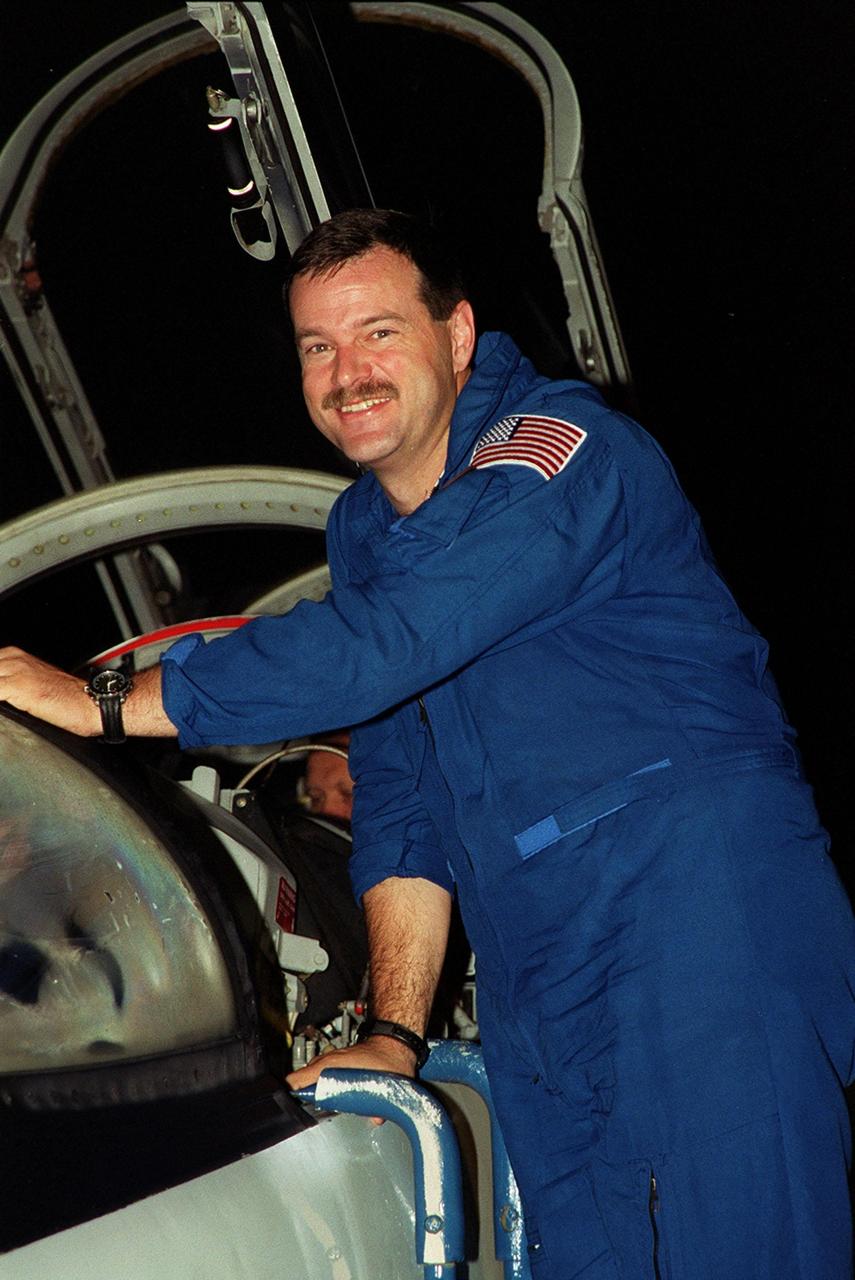
STS-106 Pilot Scott D. Altman steps down from the T-38 jet aircraft after landing at the KSC Shuttle Landing Facility. He and the rest of the crew will be making pre-launch preparations for the fourth flight to the International Space Station. STS-106 is scheduled to launch Sept. 8, 2000, at 8:45 a.m. EDT from Launch Pad 39B. On the 11-day mission, the seven-member crew will perform support tasks on orbit, transfer supplies and prepare the living quarters in the newly arrived Zvezda Service Module. The first long-duration crew, dubbed “Expedition One,” is due to arrive at the Station in late fall
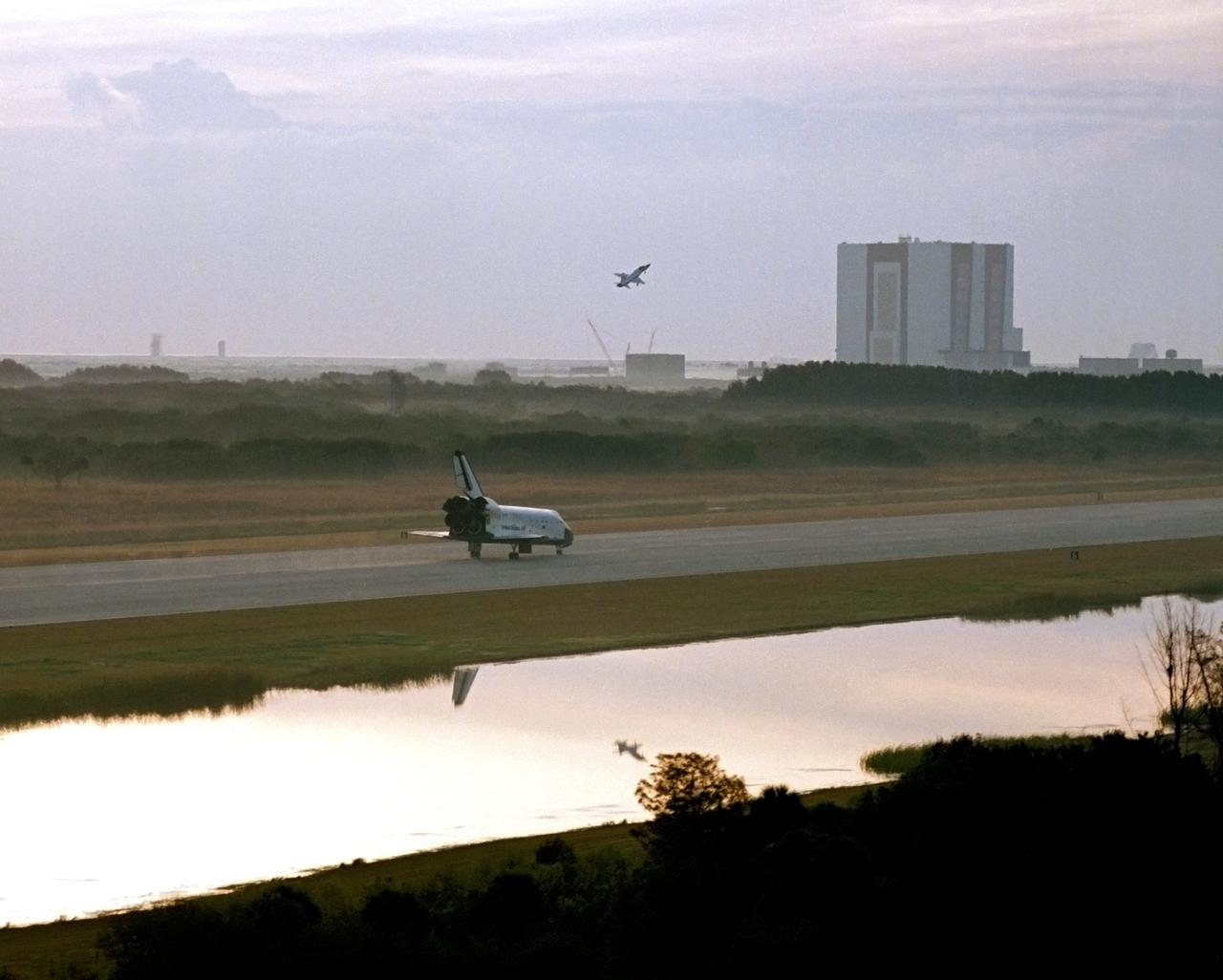
CAPE CANAVERAL, Fla. -- Shortly after sunrise the space shuttle orbiter Challenger touches down on the KSC runway at 7:16 a.m. The T-38 escort chase plane is seen just above the orbiter. The historic first landing at KSC brought to a conclusion an eight-day mission that started at 8:00 a.m. Feb. 3, 1984. The STS 41-B mission had several other firsts including an un-tethered spacewalk made by two of the astronauts. The Vehicle Assembly Building can be seen in the right side of the photograph. Photo credit: NASA
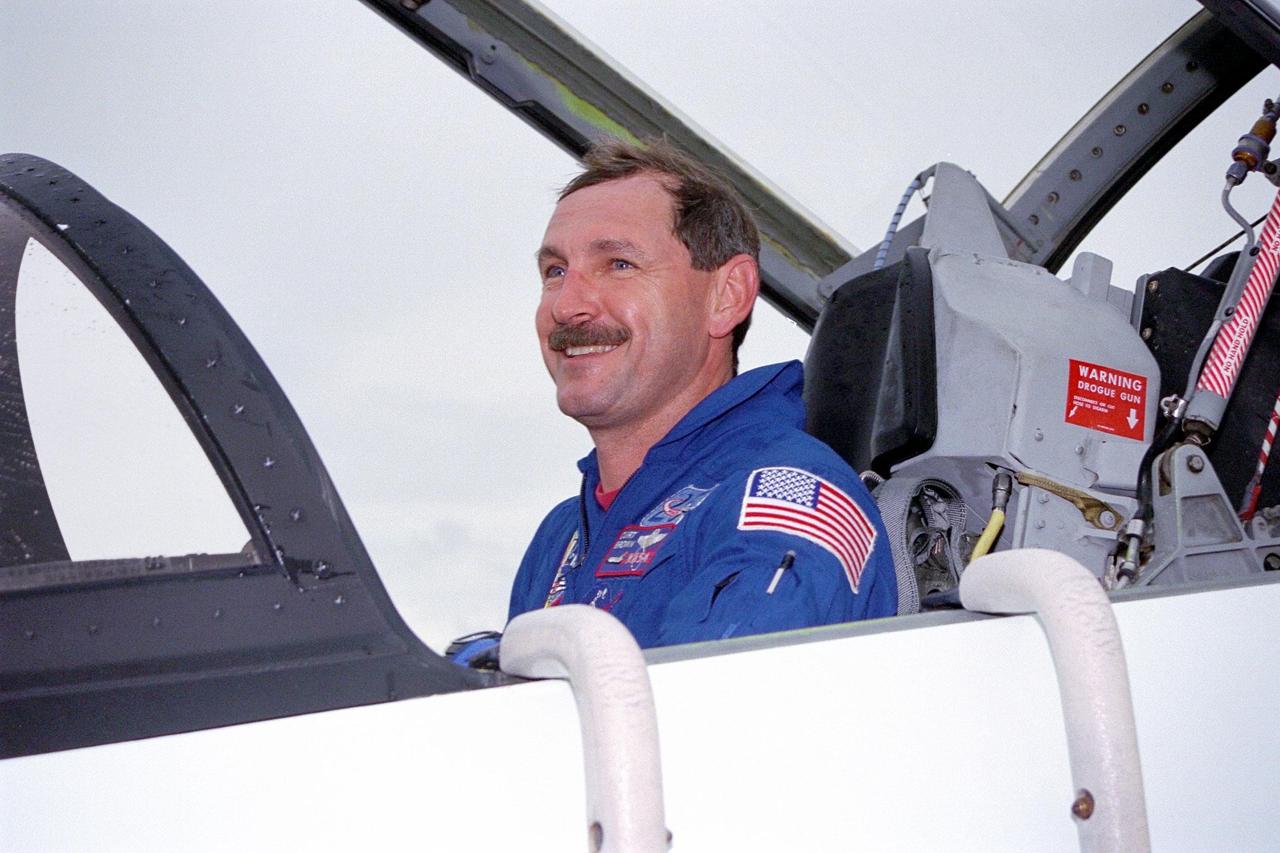
STS-85 Commander Curtis L. Brown, Jr. poses in the cockpit of his T-38 jet trainer aircraft at KSC’s Shuttle Landing Facility (SLF) after his arrival with the rest of the flight crew from NASA’s Johnson Space Center to begin final preparations for the STS-85 mission. The other crew members are Pilot Kent V. Rominger, Payload Commander N. Jan Davis, Mission Specialist Robert L. Curbeam, Jr., Mission Specialist Stephen K. Robinson and Payload Specialist Bjarni V. Tryggvason. The primary payload aboard the Space Shuttle orbiter Discovery for the 11-day space flight is the Cryogenic Infrared Spectrometers and Telescopes for the Atmosphere-2 (CRISTA-SPAS-2). Other STS-85 payloads include the Manipulator Flight Demonstration (MFD), and Technology Applications and Science-1 (TAS-1) and International Extreme Ultraviolet Hitchhiker-2 (IEH-2) experiments
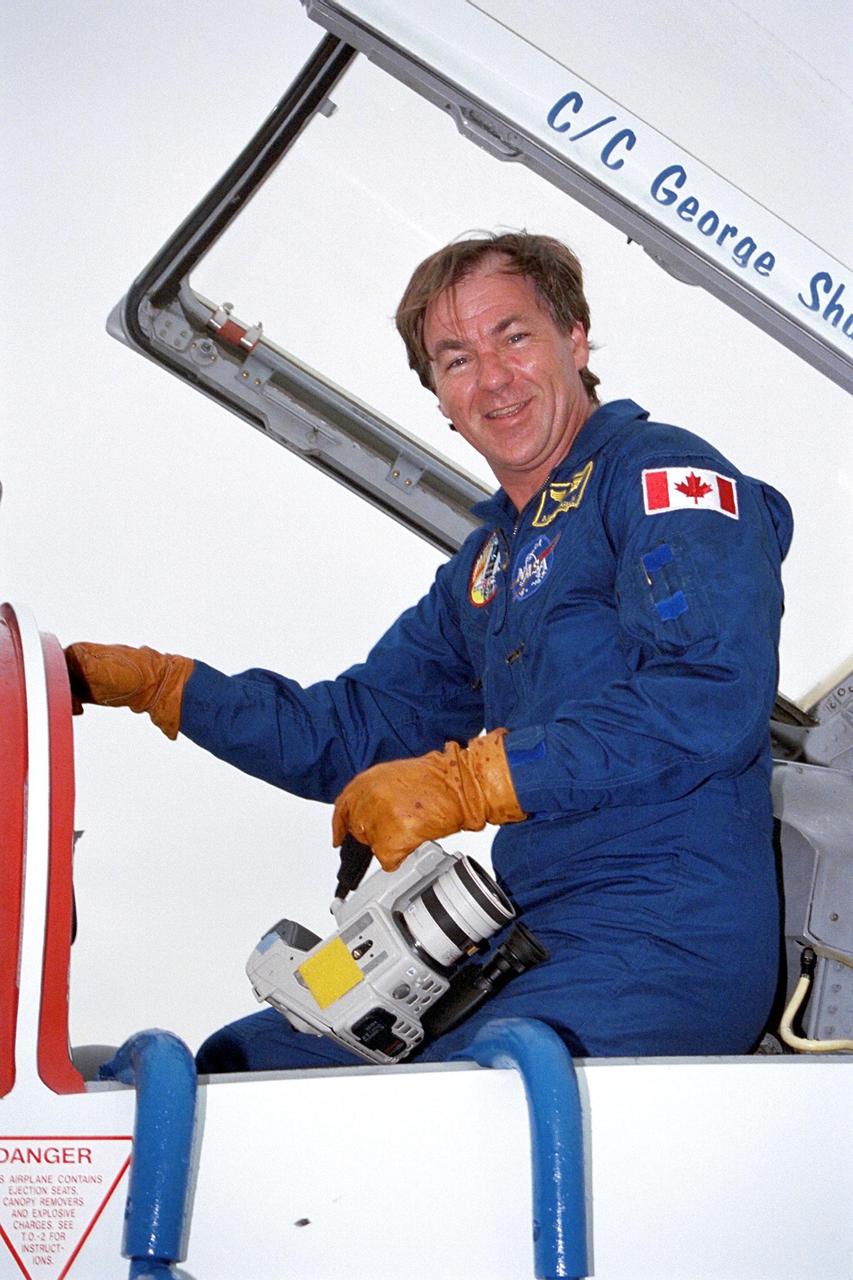
STS-85 Payload Specialist Bjarni V. Tryggvason poses in the cockpit of his T-38 jet trainer aircraft at KSC’s Shuttle Landing Facility (SLF) after his arrival with the rest of the flight crew from NASA’s Johnson Space Center to begin final preparations for the STS-85 mission. The other crew members are Commander Curtis L. Brown, Jr., Pilot Kent V. Rominger, Payload Commander N. Jan Davis, Mission Specialist Robert L. Curbeam, Jr., and Mission Specialist Stephen K. Robinson. The primary payload aboard the Space Shuttle orbiter Discovery for the 11-day space flight is the Cryogenic Infrared Spectrometers and Telescopes for the Atmosphere-2 (CRISTA-SPAS-2). Other STS-85 payloads include the Manipulator Flight Demonstration (MFD), and Technology Applications and Science-1 (TAS-1) and International Extreme Ultraviolet Hitchhiker-2 (IEH-2) experiments
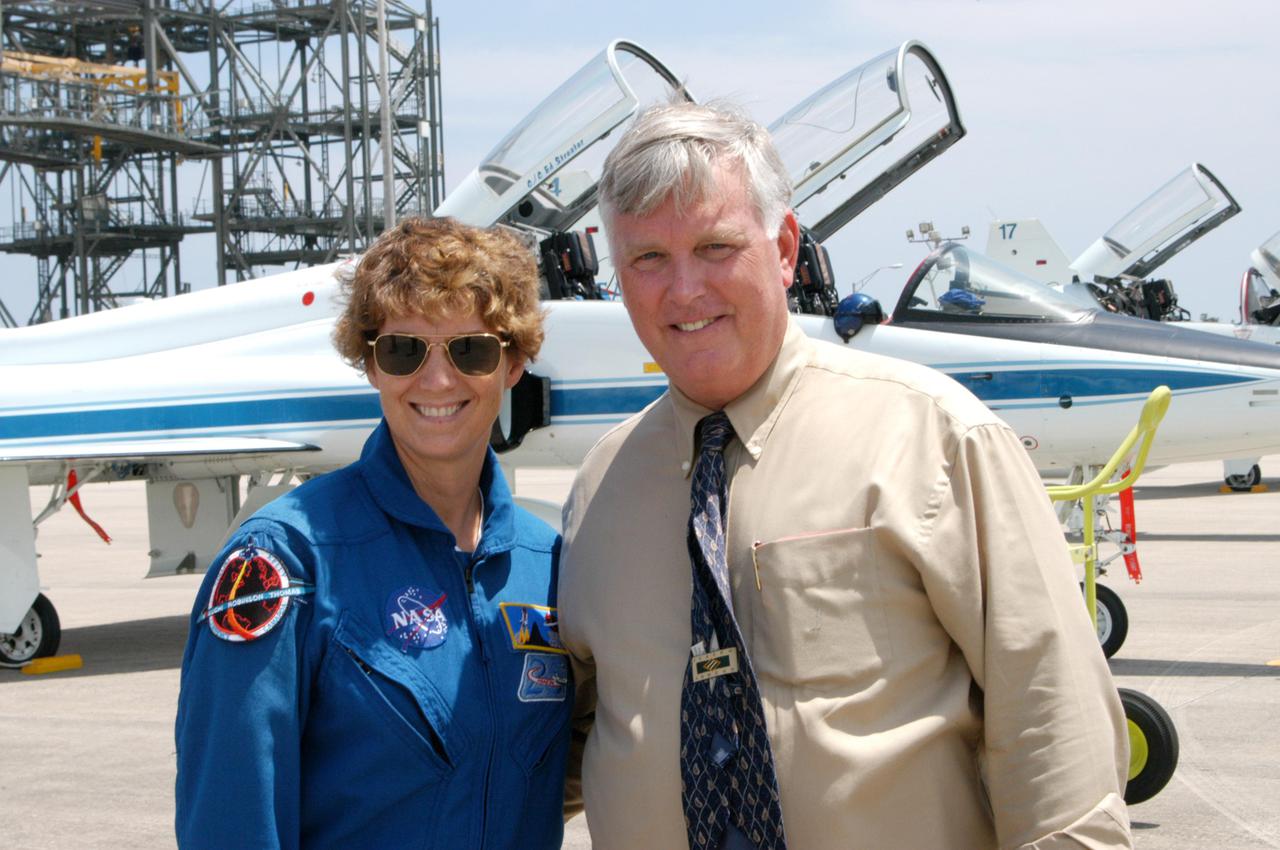
KENNEDY SPACE CENTER, FLA. - Center Director Jim Kennedy (right) greets STS-114 Mission Commander Eileen Collins after her arrival at NASA Kennedy Space Center aboard a T-38 jet aircraft. The Return to Flight STS-114 crew has returned to KSC to get ready for a second launch attempt aboard Space Shuttle Discovery. Collins later told the media who waited nearby that since the scrub on July 13, the crew has focused on the on-orbit part of the mission and training for night landings using the Shuttle Training Aircraft. She praised the engineers and technicians who have been troubleshooting the elusive sensor problem and thanked them. STS-114 is scheduled to launch July 26 at 10:39 a.m. EDT from Launch Pad 39B.
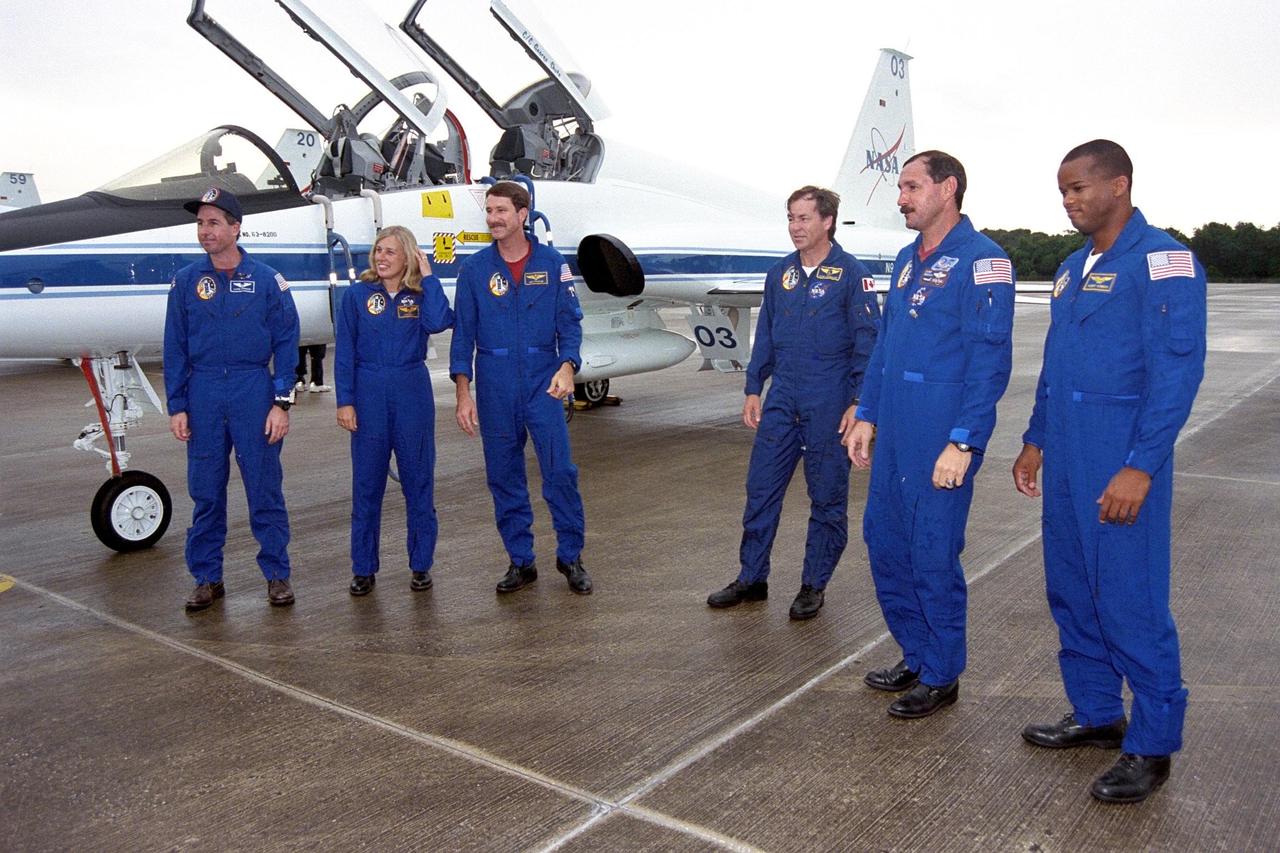
The STS-85 flight crew members pose with their T-38 jet trainer aircraft at the KSC Shuttle Landing Facility (SLF) after their arrival from NASA’s Johnson Space Center to begin final preparations for the STS-85 mission. They are (from left): Mission Specialist Stephen K. Robinson; Payload Commander N. Jan Davis; Pilot Kent V. Rominger; Payload Specialist Bjarni V. Tryggvason; Commander Curtis L. Brown, Jr.; and Mission Specialist Robert L. Curbeam, Jr. The primary payload aboard the Space Shuttle orbiter Discovery for the 11-day space flight is the Cryogenic Infrared Spectrometers and Telescopes for the Atmosphere-2 (CRISTA-SPAS-2). Other STS-85 payloads include the Manipulator Flight Demonstration (MFD), and Technology Applications and Science-1 (TAS-1) and International Extreme Ultraviolet Hitchhiker-2 (IEH-2) experiments
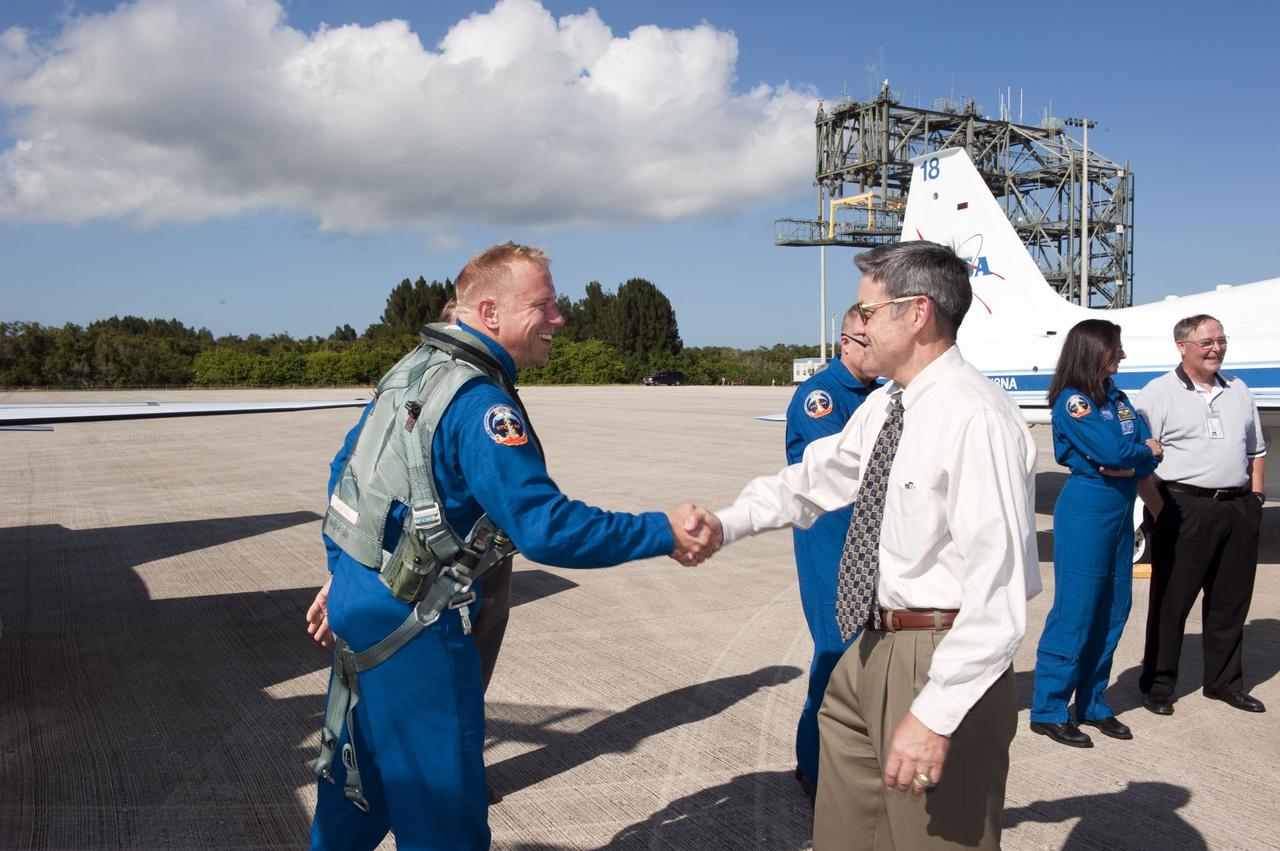
CAPE CANAVERAL, Fla. -- At NASA's Kennedy Space Center in Florida, space shuttle Discovery's STS-133 Mission Specialist Tim Kopra, left, shakes hands with Kennedy's Center Director Bob Cabana on the Shuttle Landing Facility runway after arriving in a T-38 training jet. In the days leading up to their launch to the International Space Station, Kopra and his crew members will check the fit of their launch-and-entry suits, review launch-day procedures, receive weather briefings and remain medically quarantined to prevent sickness. Scheduled to lift off Nov. 1 at 4:40 p.m., Discovery and crew will deliver the Permanent Multipurpose Module, packed with supplies and critical spare parts, as well as Robonaut 2, the dexterous humanoid astronaut helper, to the orbiting outpost. For more information on the STS-133 mission, visit www.nasa.gov/mission_pages/shuttle/shuttlemissions/sts133/. Photo credit: NASA/Kim Shiflett
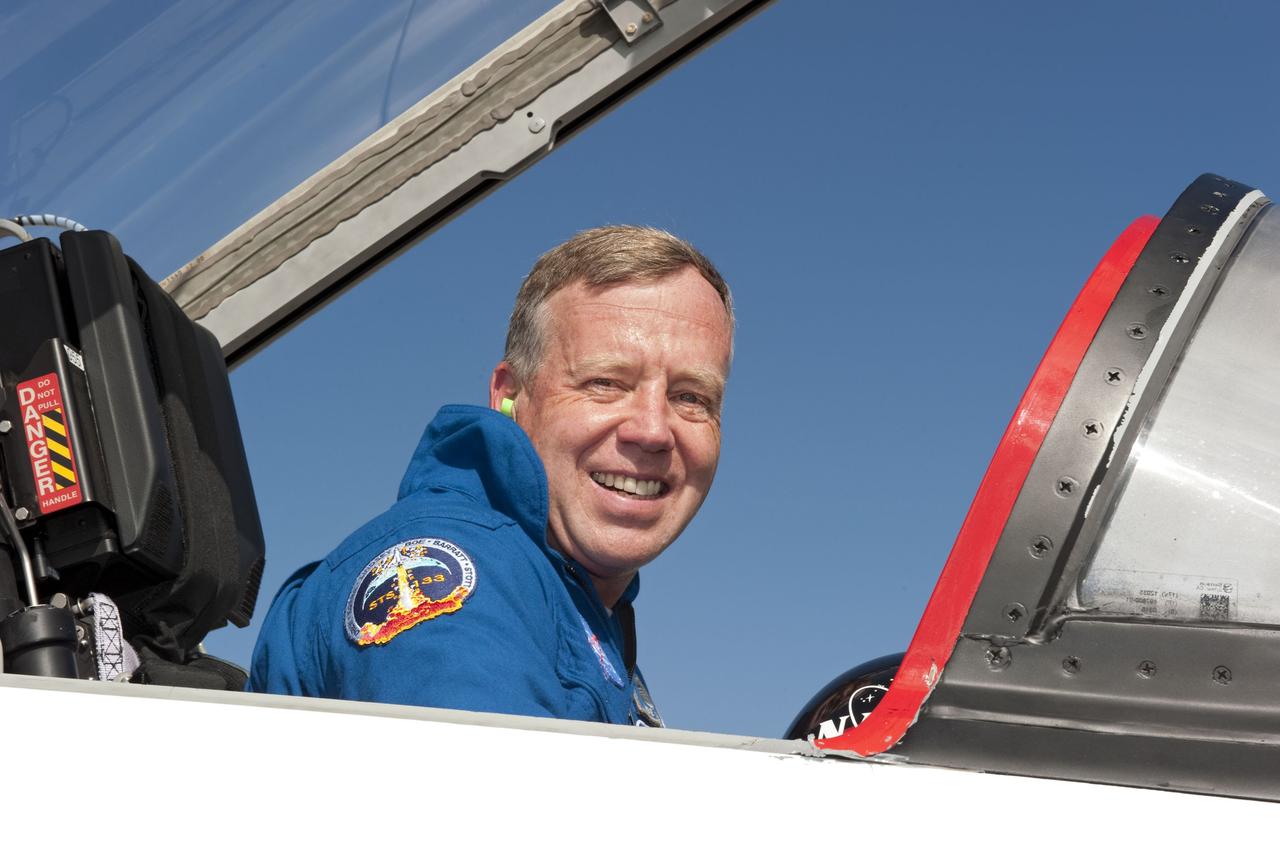
CAPE CANAVERAL, Fla. -- At NASA's Kennedy Space Center in Florida, space shuttle Discovery's STS-133 Commander Steve Lindsey arrives on the Shuttle Landing Facility runway aboard a T-38 training jet. In the days leading up to their launch to the International Space Station, Lindsey and his crew members will check the fit of their launch-and-entry suits, review launch-day procedures, receive weather briefings and remain medically quarantined to prevent sickness. Scheduled to lift off Nov. 1 at 4:40 p.m., Discovery and crew will deliver the Permanent Multipurpose Module, packed with supplies and critical spare parts, as well as Robonaut 2, the dexterous humanoid astronaut helper, to the orbiting outpost. For more information on the STS-133 mission, visit www.nasa.gov/mission_pages/shuttle/shuttlemissions/sts133/. Photo credit: NASA/Kim Shiflett
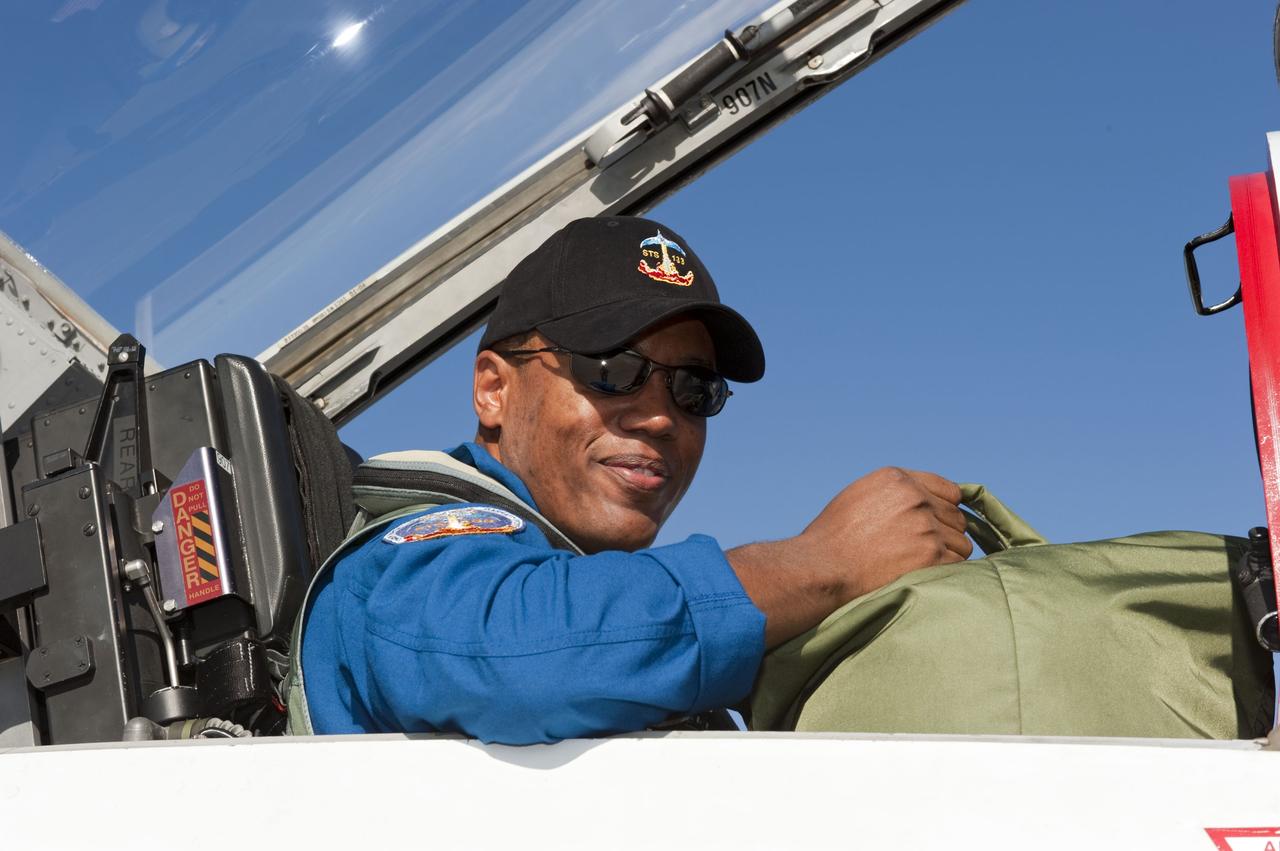
CAPE CANAVERAL, Fla. -- At NASA's Kennedy Space Center in Florida, space shuttle Discovery's STS-133 Mission Specialist Alvin Drew arrives on the Shuttle Landing Facility runway aboard a T-38 training jet. In the days leading up to their launch to the International Space Station, Drew and his crew members will check the fit of their launch-and-entry suits, review launch-day procedures, receive weather briefings and remain medically quarantined to prevent sickness. Scheduled to lift off Nov. 1 at 4:40 p.m., Discovery and crew will deliver the Permanent Multipurpose Module, packed with supplies and critical spare parts, as well as Robonaut 2, the dexterous humanoid astronaut helper, to the orbiting outpost. For more information on the STS-133 mission, visit www.nasa.gov/mission_pages/shuttle/shuttlemissions/sts133/. Photo credit: NASA/Kim Shiflett
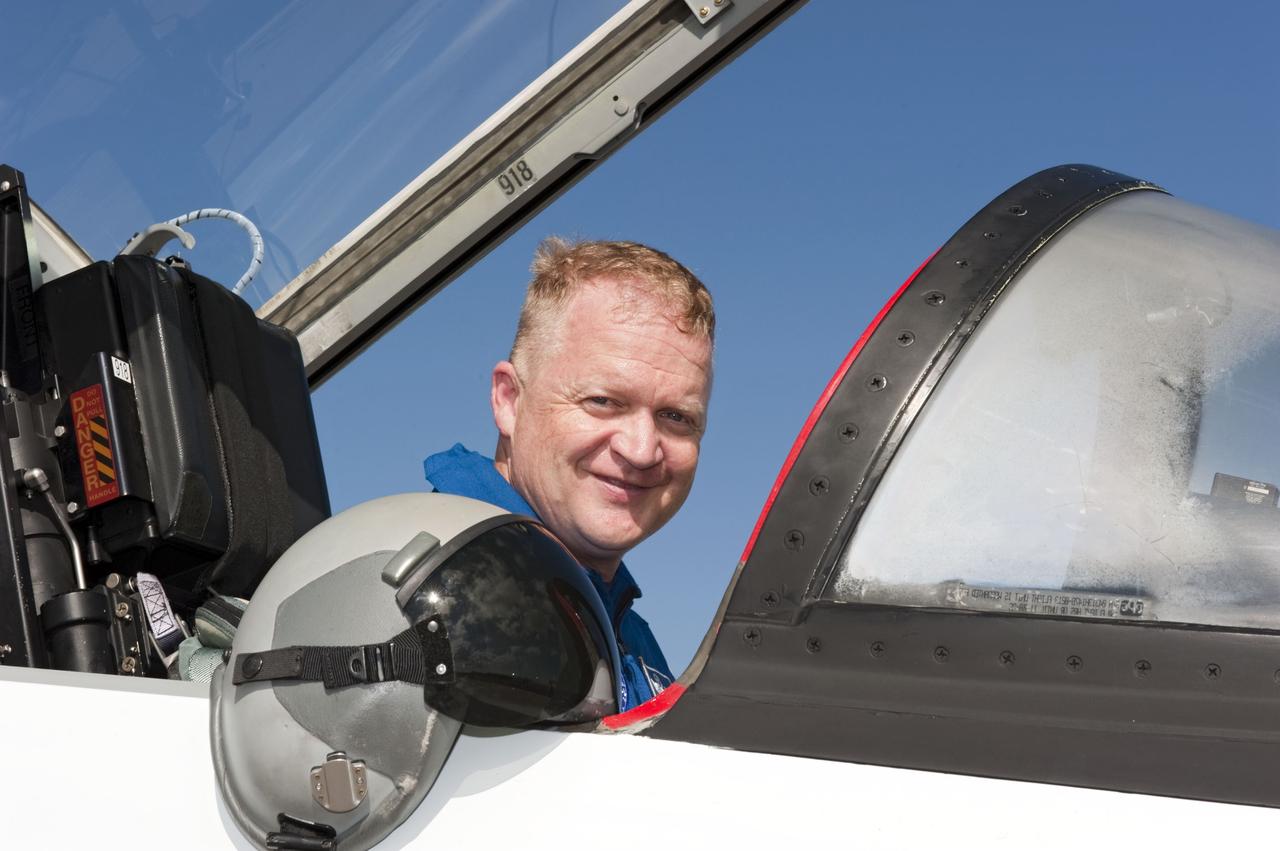
CAPE CANAVERAL, Fla. -- At NASA's Kennedy Space Center in Florida, space shuttle Discovery's STS-133 Pilot Eric Boe arrives on the Shuttle Landing Facility runway aboard a T-38 training jet. In the days leading up to their launch to the International Space Station, Boe and his crew members will check the fit of their launch-and-entry suits, review launch-day procedures, receive weather briefings and remain medically quarantined to prevent sickness. Scheduled to lift off Nov. 1 at 4:40 p.m., Discovery and crew will deliver the Permanent Multipurpose Module, packed with supplies and critical spare parts, as well as Robonaut 2, the dexterous humanoid astronaut helper, to the orbiting outpost. For more information on the STS-133 mission, visit www.nasa.gov/mission_pages/shuttle/shuttlemissions/sts133/. Photo credit: NASA/Kim Shiflett
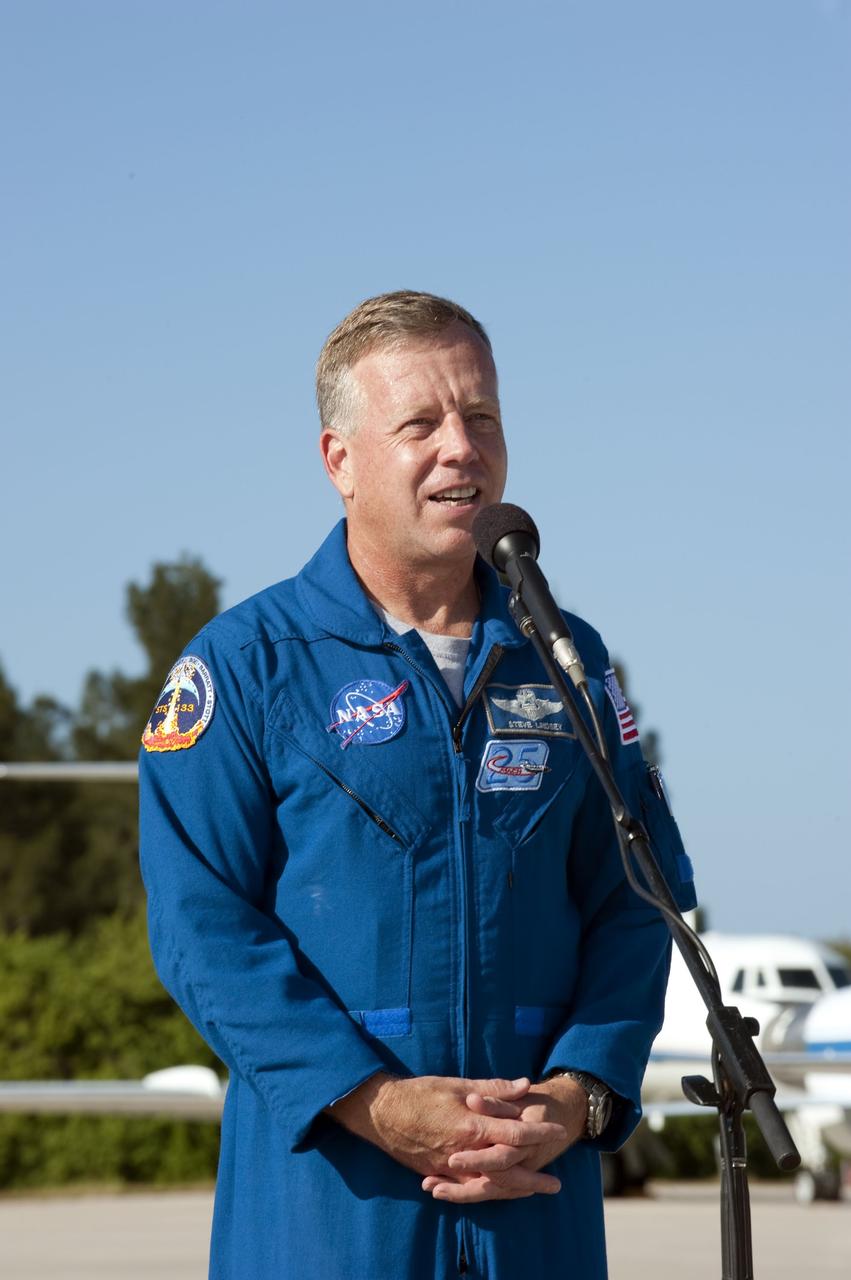
CAPE CANAVERAL, Fla. -- At NASA's Kennedy Space Center in Florida, space shuttle Discovery's STS-133 Commander Steve Lindsey speaks to media on the Shuttle Landing Facility runway after arriving aboard a T-38 training jet. In the days leading up to their launch to the International Space Station, Lindsey and his crew members will check the fit of their launch-and-entry suits, review launch-day procedures, receive weather briefings and remain medically quarantined to prevent sickness. Scheduled to lift off Nov. 1 at 4:40 p.m., Discovery and crew will deliver the Permanent Multipurpose Module, packed with supplies and critical spare parts, as well as Robonaut 2, the dexterous humanoid astronaut helper, to the orbiting outpost. For more information on the STS-133 mission, visit www.nasa.gov/mission_pages/shuttle/shuttlemissions/sts133/. Photo credit: NASA/Kim Shiflett
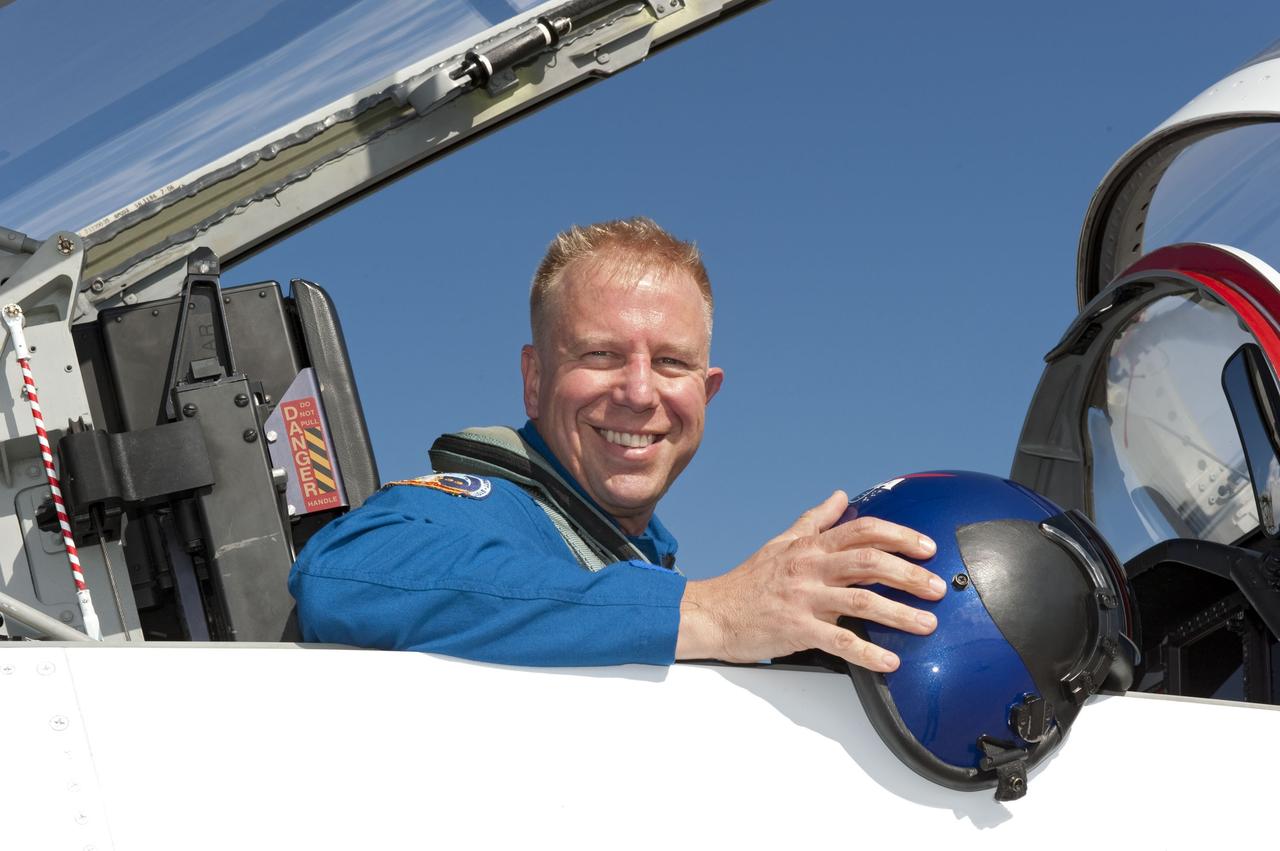
CAPE CANAVERAL, Fla. -- At NASA's Kennedy Space Center in Florida, space shuttle Discovery's STS-133 Mission Specialist Tim Kopra arrives on the Shuttle Landing Facility runway aboard a T-38 training jet. In the days leading up to their launch to the International Space Station, Kopra and his crew members will check the fit of their launch-and-entry suits, review launch-day procedures, receive weather briefings and remain medically quarantined to prevent sickness. Scheduled to lift off Nov. 1 at 4:40 p.m., Discovery and crew will deliver the Permanent Multipurpose Module, packed with supplies and critical spare parts, as well as Robonaut 2, the dexterous humanoid astronaut helper, to the orbiting outpost. For more information on the STS-133 mission, visit www.nasa.gov/mission_pages/shuttle/shuttlemissions/sts133/. Photo credit: NASA/Kim Shiflett
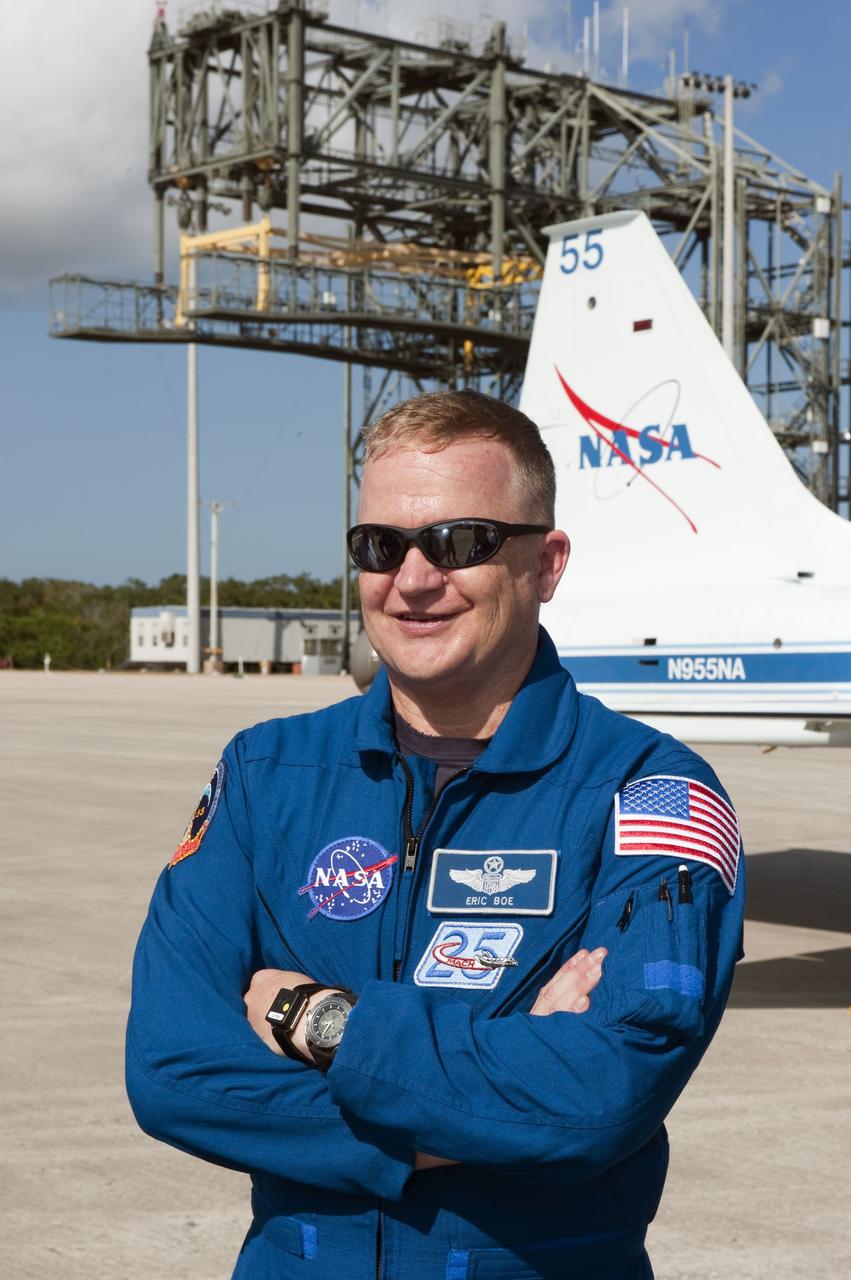
CAPE CANAVERAL, Fla. -- At NASA's Kennedy Space Center in Florida, space shuttle Discovery's STS-133 Pilot Eric Boe stands in front of a T-38 training jet that he flew from Houston to the Shuttle Landing Facility. In the days leading up to their launch to the International Space Station, Boe and his crew members will check the fit of their launch-and-entry suits, review launch-day procedures, receive weather briefings and remain medically quarantined to prevent sickness. Scheduled to lift off Nov. 1 at 4:40 p.m., Discovery and crew will deliver the Permanent Multipurpose Module, packed with supplies and critical spare parts, as well as Robonaut 2, the dexterous humanoid astronaut helper, to the orbiting outpost. For more information on the STS-133 mission, visit www.nasa.gov/mission_pages/shuttle/shuttlemissions/sts133/. Photo credit: NASA/Kim Shiflett
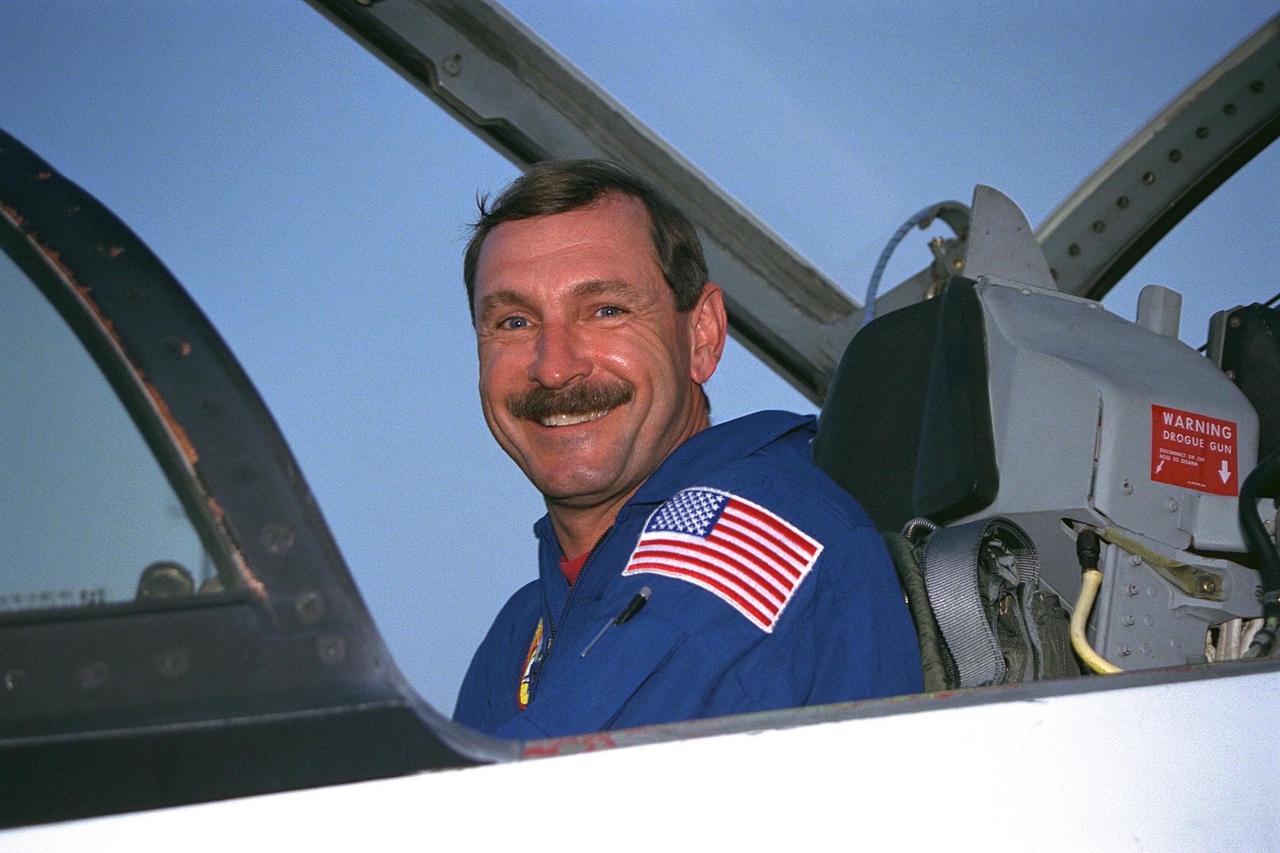
STS-85 Mission Commander Curtis L. Brown, Jr., poses in his T-38 jet trainer after landing with his crew at KSC’s Shuttle Landing Facility from NASA’s Johnson Space Center to begin Terminal Countdown Demonstration Test (TCDT) activities for that mission. The TCDT includes a dress rehearsal of the launch countdown. The STS-85 mission is now targeted for Aug. 7. The primary payload aboard the Space Shuttle orbiter Discovery is the Cryogenic Infrared Spectrometers and Telescopes for the Atmosphere-2 (CRISTA-SPAS-2). Other STS-85 payloads include the Manipulator Flight Demonstration (MFD), and Technology Applications and Science-1 (TAS-1) and International Extreme Ultraviolet Hitchhiker-2 (IEH-2) experiments
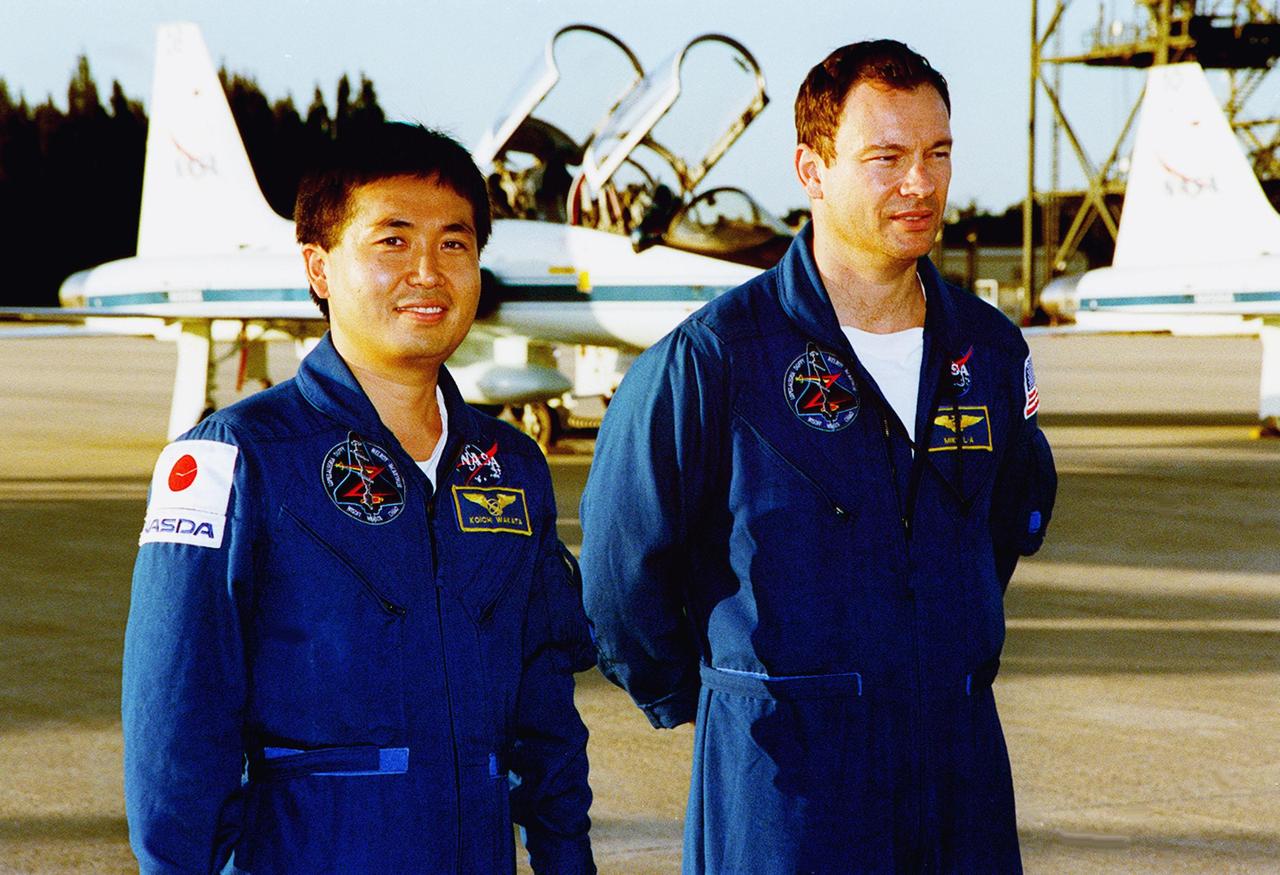
STS-92 Mission Specialists Koichi Wakata and Michael Lopez-Alegria pause on the tarmac after their arrival aboard the T-38 jet aircraft in the background. They and the rest of the crew are at KSC to take part in Terminal Countdown Demonstration Test (TCDT) activities. The TCDT includes emergency egress training from the orbiter and pad, plus a simulated countdown. The fifth mission to the International Space Station, STS-92 will carry the Integrated Truss Structure Z1, the first of the planned 10 trusses on the Space Station, and the third Pressurized Mating Adapter. The Z1 will allow the first U.S. solar arrays on a future flight to be temporarily installed on Unity for early power. PMA-3 will provide a Shuttle docking port for the solar array installation on the sixth ISS flight and Lab installation on the seventh ISS flight. STS-92 is scheduled to launch Oct. 5 from launch Pad 39A. It will be the 100th flight in the Shuttle program
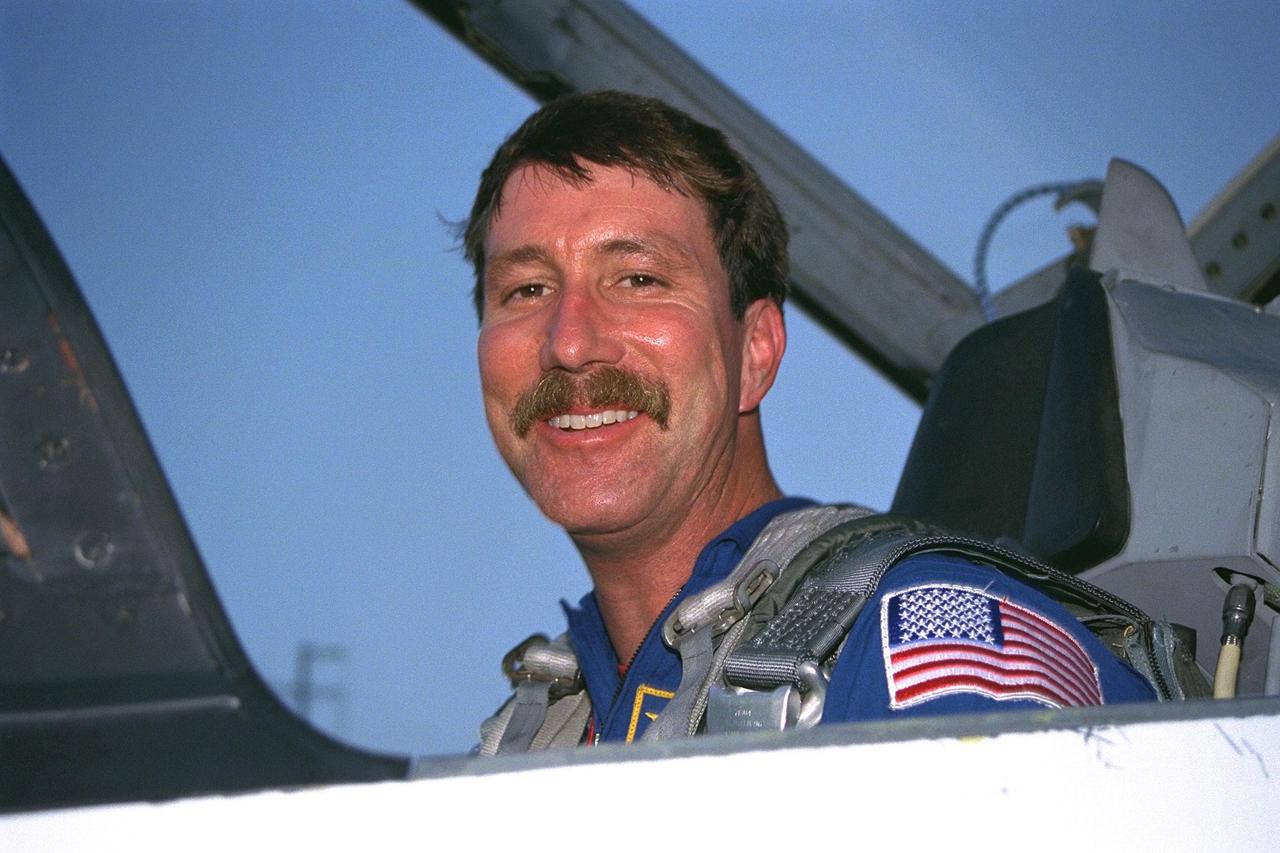
STS-85 Pilot Kent V. Rominger poses in his T-38 jet trainer after landing with other members of the flight crew at KSC’s Shuttle Landing Facility from NASA’s Johnson Space Center to begin Terminal Countdown Demonstration Test (TCDT) activities for that mission. The TCDT includes a dress rehearsal of the launch countdown. The STS-85 mission is now targeted for Aug. 7. The primary payload aboard the Space Shuttle orbiter Discovery is the Cryogenic Infrared Spectrometers and Telescopes for the Atmosphere-2 (CRISTA-SPAS-2). Other STS-85 payloads include the Manipulator Flight Demonstration (MFD), nd Technology Applications and Science-1 (TAS-1) and International Extreme Ultraviolet Hitchhiker-2 (IEH-2) experiments
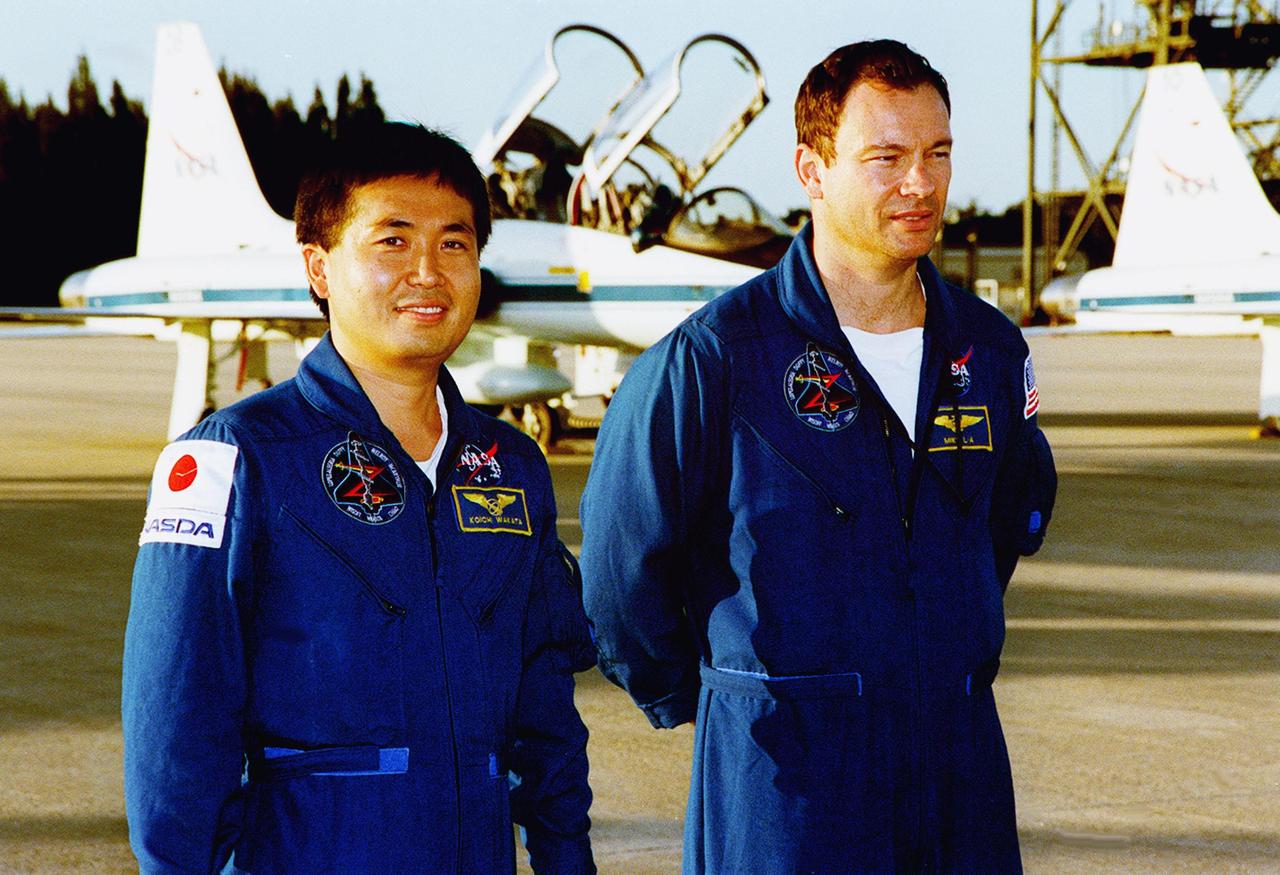
STS-92 Mission Specialists Koichi Wakata and Michael Lopez-Alegria pause on the tarmac after their arrival aboard the T-38 jet aircraft in the background. They and the rest of the crew are at KSC to take part in Terminal Countdown Demonstration Test (TCDT) activities. The TCDT includes emergency egress training from the orbiter and pad, plus a simulated countdown. The fifth mission to the International Space Station, STS-92 will carry the Integrated Truss Structure Z1, the first of the planned 10 trusses on the Space Station, and the third Pressurized Mating Adapter. The Z1 will allow the first U.S. solar arrays on a future flight to be temporarily installed on Unity for early power. PMA-3 will provide a Shuttle docking port for the solar array installation on the sixth ISS flight and Lab installation on the seventh ISS flight. STS-92 is scheduled to launch Oct. 5 from launch Pad 39A. It will be the 100th flight in the Shuttle program
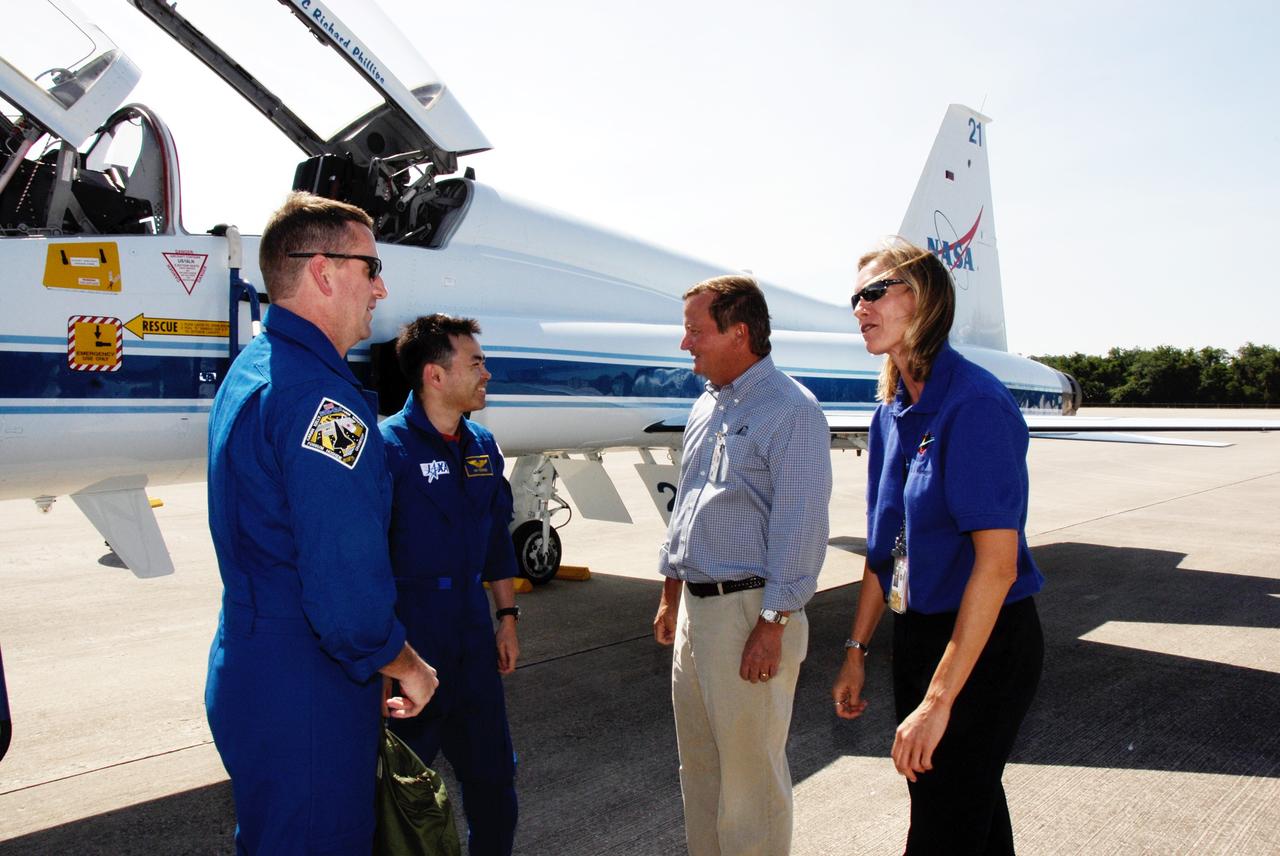
CAPE CANAVERAL, Fla. -- The crew of space shuttle Discovery's STS-124 mission arrive at NASA Kennedy Space Center's Shuttle Landing Facility to take part in the Terminal Countdown Demonstration Test, or TCDT. Next to the T-38 jet aircraft are Pilot Ken Ham (left) and Mission Specialist Akihiko Hoshide. They are greeted at right by Mike Leinbach, shuttle launch director, and Stephanie Stilson, NASA Flow Director for Discovery. TCDT is a rehearsal for launch that includes practicing emergency procedures, handling on-orbit equipment, and simulating a launch countdown. On the STS-124 mission, the crew will deliver and install the Japanese Experiment Module – Pressurized Module and Japanese Remote Manipulator System. Discovery's launch is targeted for May 31. Photo credit: NASA/Kim Shiflett
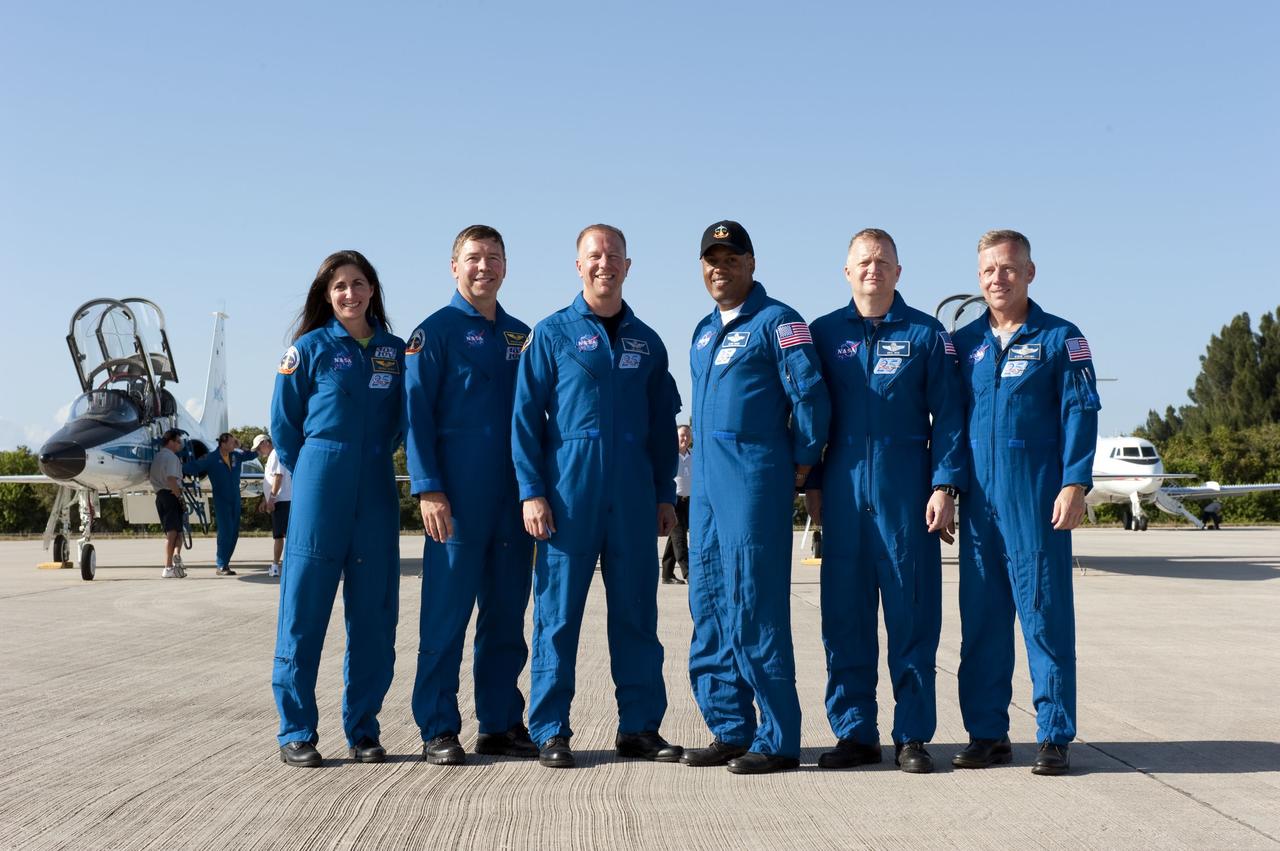
CAPE CANAVERAL, Fla. -- At NASA's Kennedy Space Center in Florida, space shuttle Discovery's STS-133 crew members pose for a group photo on the Shuttle Landing Facility runway following their arrival aboard T-38 training jets. From left, are Mission Specialists Nicole Stott, Michael Barratt, Tim Kopra and Alvin Drew, Pilot Eric Boe, and Commander Steve Lindsey. Scheduled to lift off Nov. 1 at 4:40 p.m., Discovery and crew will deliver the Permanent Multipurpose Module, packed with supplies and critical spare parts, as well as Robonaut 2, the dexterous humanoid astronaut helper, to the orbiting outpost. For more information on the STS-133 mission, visit www.nasa.gov/mission_pages/shuttle/shuttlemissions/sts133/. Photo credit: NASA/Kim Shiflett
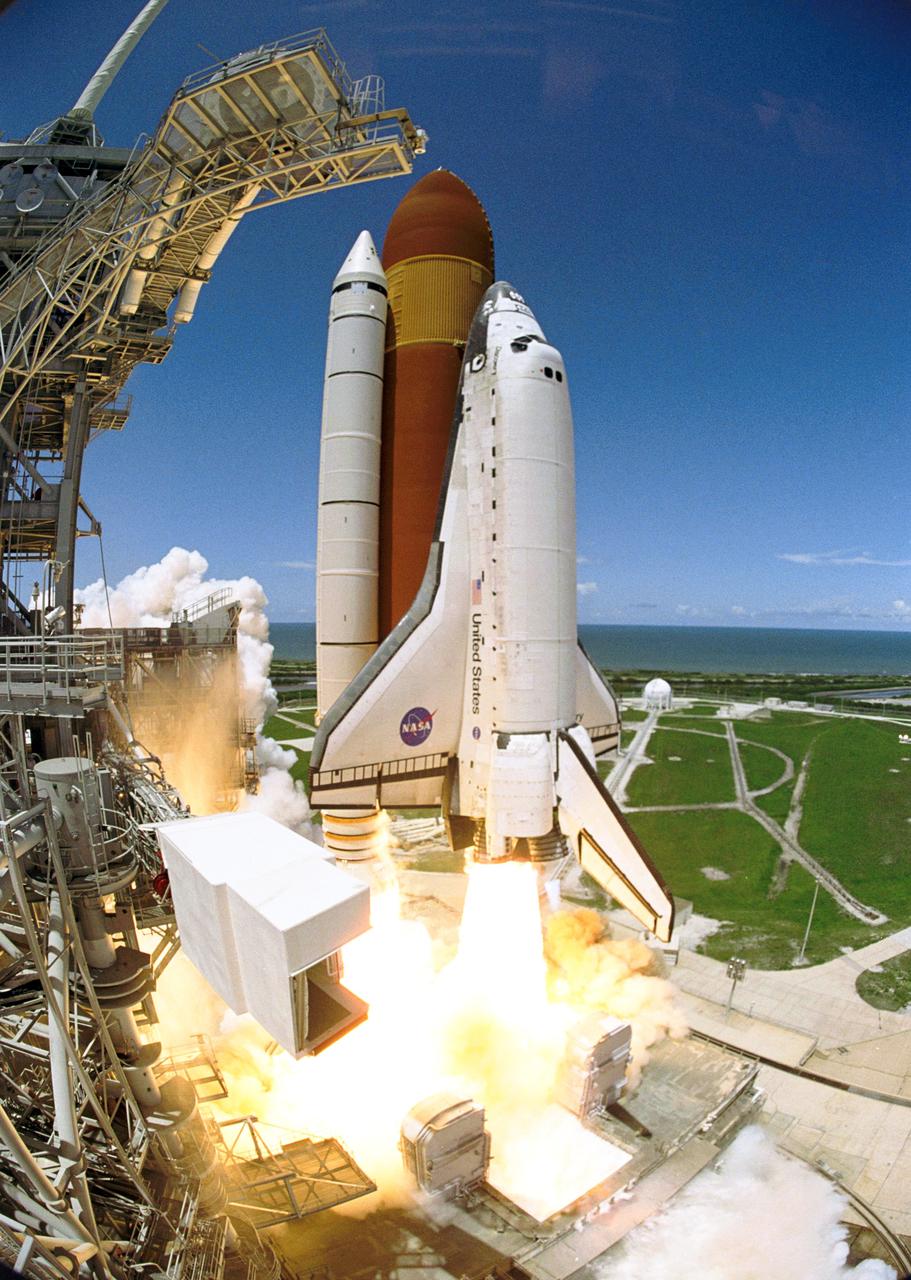
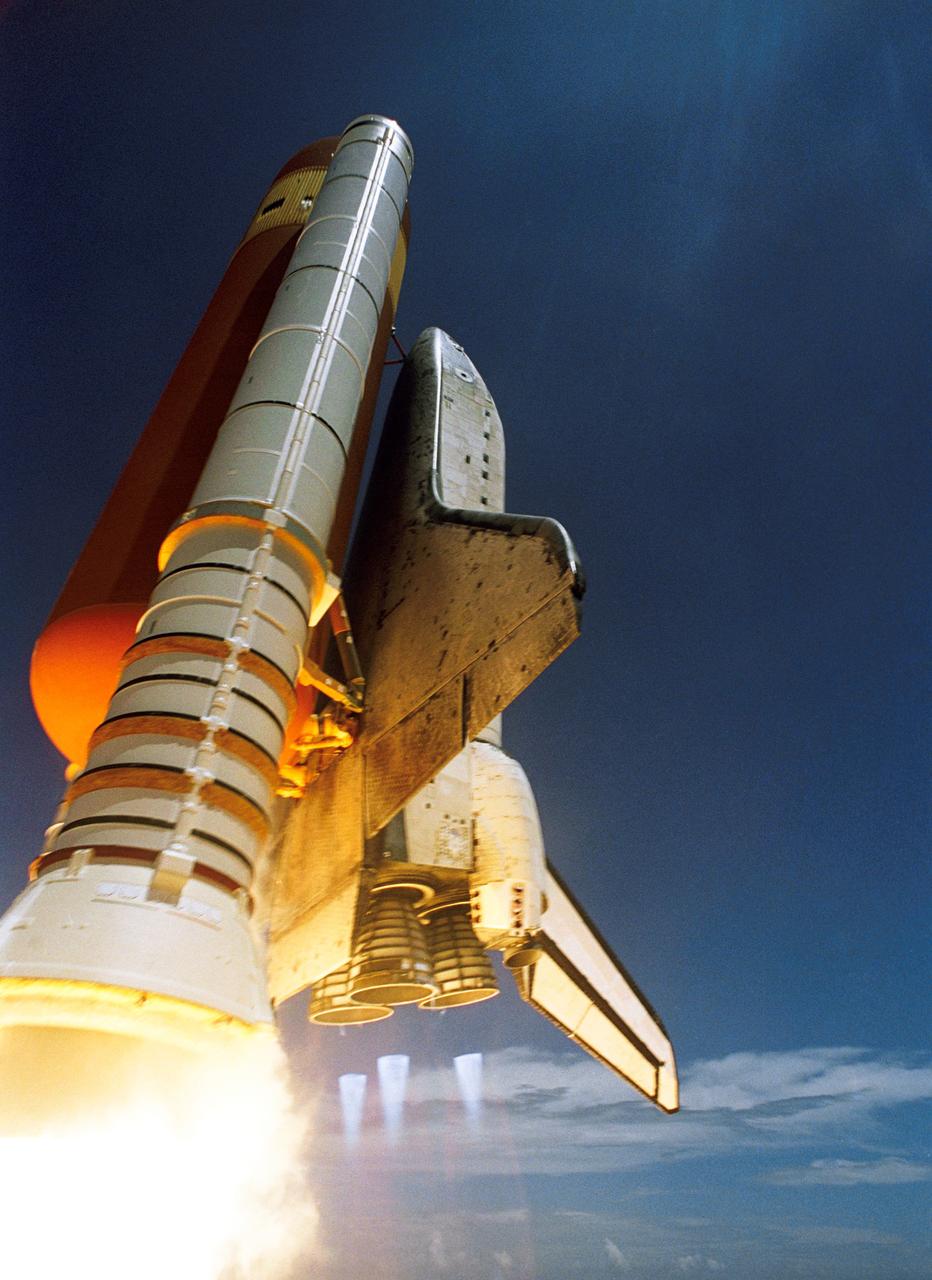
Space Shuttle Discovery and its seven-member crew launched at 2:38 p.m. (EDT) to begin the two-day journey to the International Space Station (ISS) on the historic Return to Flight STS-121 mission. The shuttle made history as it was the first human-occupying spacecraft to launch on Independence Day. During its 12-day mission, this utilization and logistics flight delivered a multipurpose logistics module (MPLM) to the ISS with several thousand pounds of new supplies and experiments. In addition, some new orbital replacement units (ORUs) were delivered and stowed externally on the ISS on a special pallet. These ORUs are spares for critical machinery located on the outside of the ISS. During this mission the crew also carried out testing of Shuttle inspection and repair hardware, as well as evaluated operational techniques and concepts for conducting on-orbit inspection and repair.
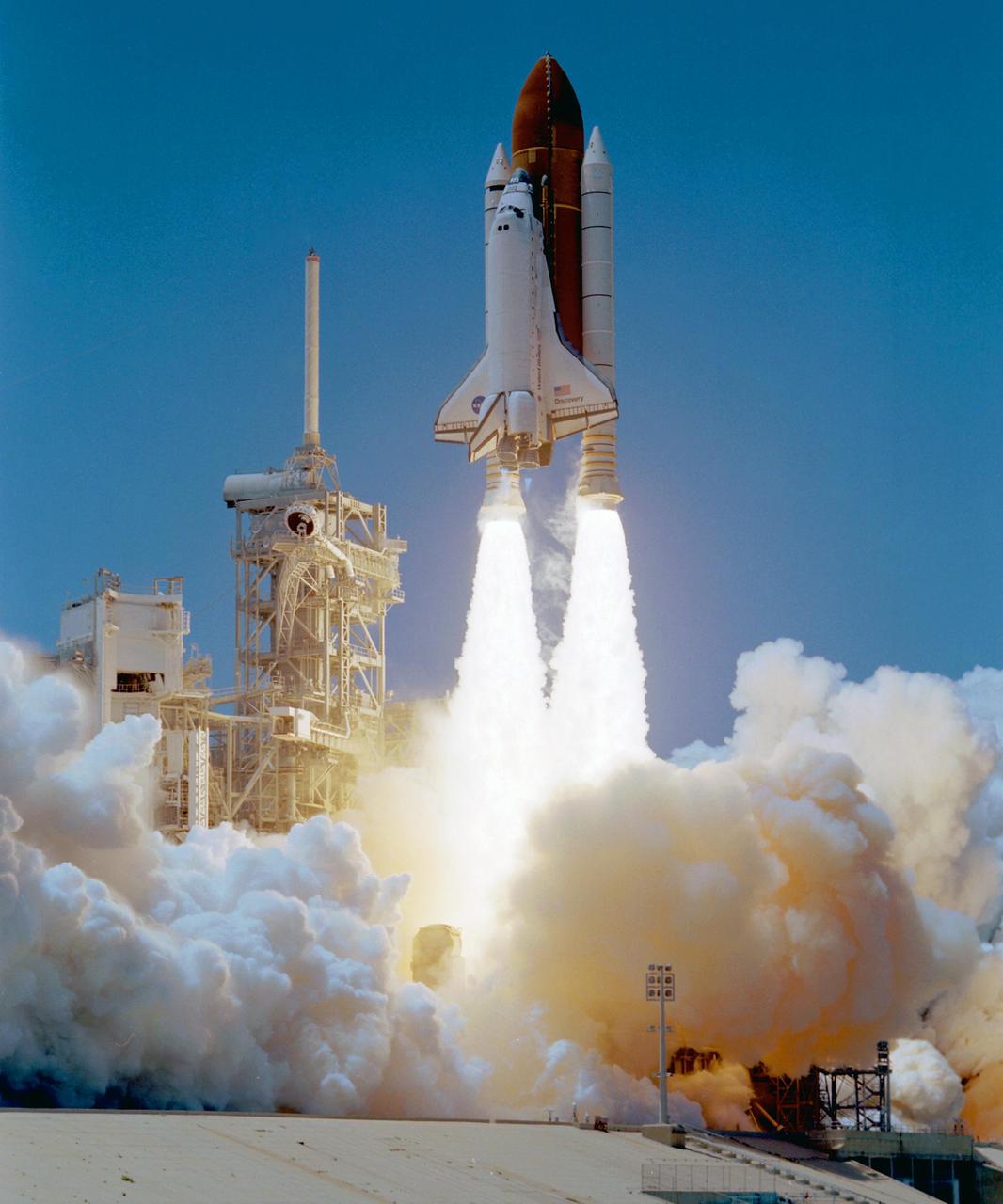
Space Shuttle Discovery and its seven-member crew launched at 2:38 p.m. (EDT) to begin the two-day journey to the International Space Station (ISS) on the historic Return to Flight STS-121 mission. The shuttle made history as it was the first human-occupying spacecraft to launch on Independence Day. During its 12-day mission, this utilization and logistics flight delivered a multipurpose logistics module (MPLM) to the ISS with several thousand pounds of new supplies and experiments. In addition, some new orbital replacement units (ORUs) were delivered and stowed externally on the ISS on a special pallet. These ORUs are spares for critical machinery located on the outside of the ISS. During this mission the crew also carried out testing of Shuttle inspection and repair hardware, as well as evaluated operational techniques and concepts for conducting on-orbit inspection and repair.
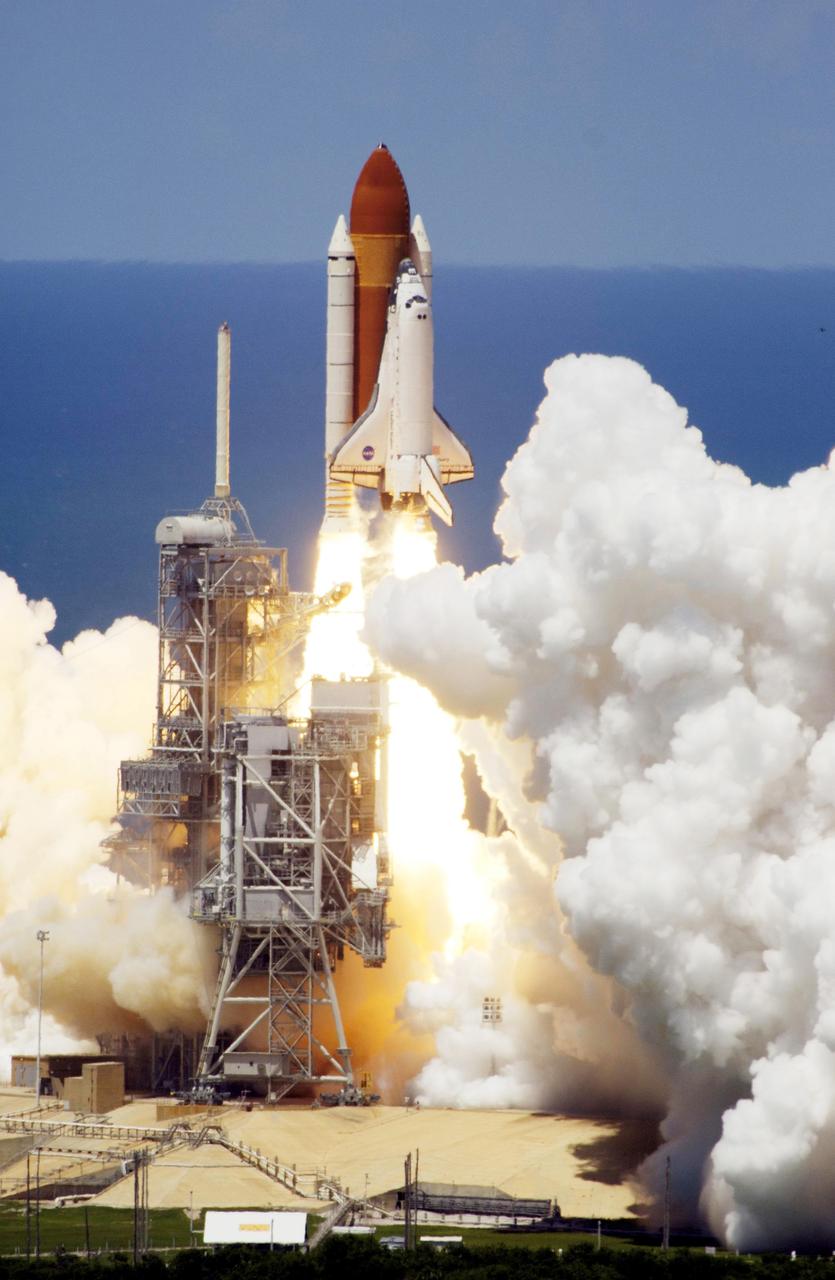
Space Shuttle Discovery and its seven-member crew launched at 2:38 p.m. (EDT) to begin the two-day journey to the International Space Station (ISS) on the historic Return to Flight STS-121 mission. The shuttle made history as it was the first human-occupying spacecraft to launch on Independence Day. During its 12-day mission, this utilization and logistics flight delivered a multipurpose logistics module (MPLM) to the ISS with several thousand pounds of new supplies and experiments. In addition, some new orbital replacement units (ORUs) were delivered and stowed externally on the ISS on a special pallet. These ORUs are spares for critical machinery located on the outside of the ISS. During this mission the crew also carried out testing of Shuttle inspection and repair hardware, as well as evaluated operational techniques and concepts for conducting on-orbit inspection and repair.
Space Shuttle Discovery and its seven-member crew launched at 2:38 p.m. (EDT) to begin the two-day journey to the International Space Station (ISS) on the historic Return to Flight STS-121 mission. The shuttle made history as it was the first human-occupying spacecraft to launch on Independence Day. During its 12-day mission, this utilization and logistics flight delivered a multipurpose logistics module (MPLM) to the ISS with several thousand pounds of new supplies and experiments. In addition, some new orbital replacement units (ORUs) were delivered and stowed externally on the ISS on a special pallet. These ORUs are spares for critical machinery located on the outside of the ISS. During this mission the crew also carried out testing of Shuttle inspection and repair hardware, as well as evaluated operational techniques and concepts for conducting on-orbit inspection and repair.
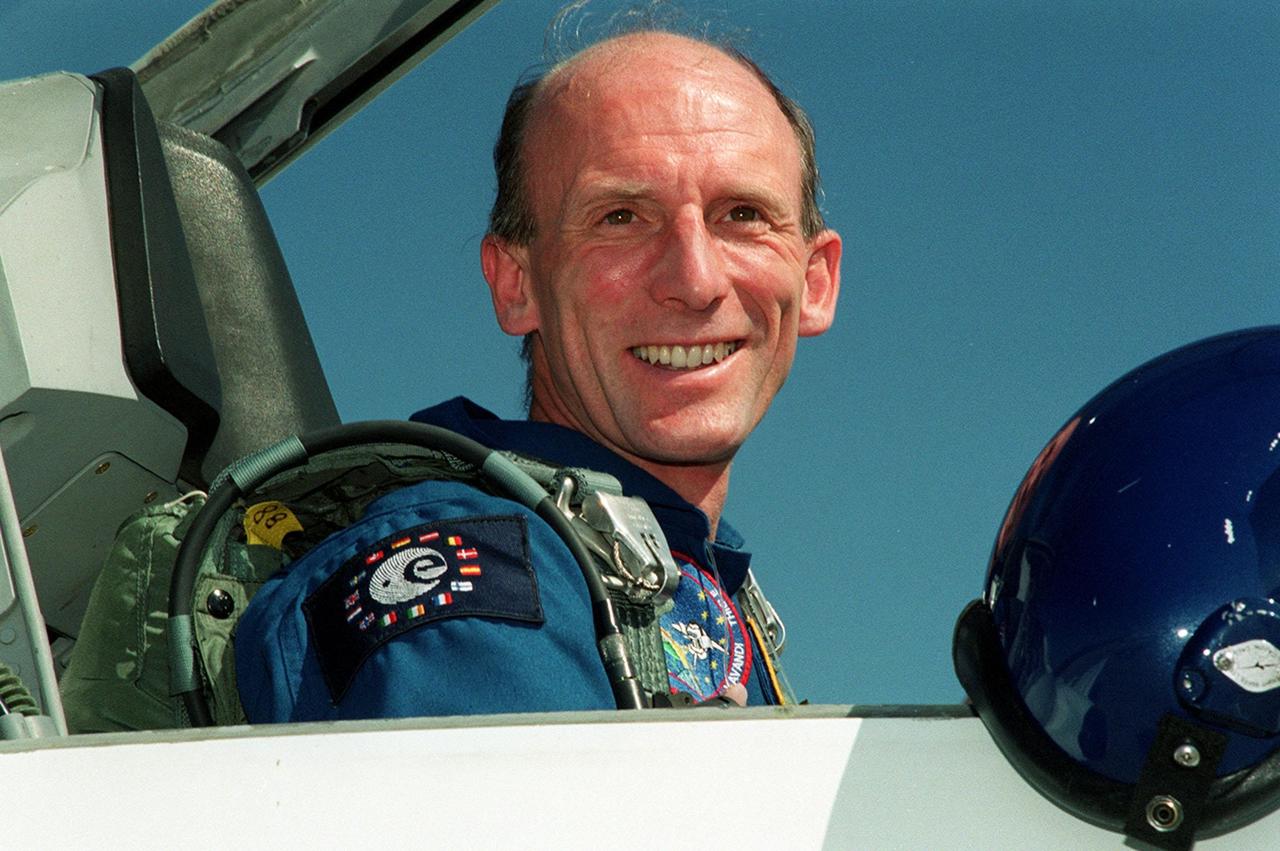
STS-99 Mission Specialist Gerhard P.J. Thiele of Germany arrives at KSC aboard a T-38 jet aircraft eager to prepare for the second launch attempt of Endeavour Feb. 11 at 12:30 p.m. EST from Launch Pad 39A. Thiele is with the European Space Agency. The earlier launch scheduled for Jan. 31 was scrubbed due to poor weather and a faulty Enhanced Master Events Controller in the orbiter's aft compartment. Over the next few days, the crew will review mission procedures, conduct test flights in the Shuttle Training Aircraft and undergo routine preflight medical exams. STS-99 is the Shuttle Radar Topography Mission, which will produce unrivaled 3-D images of the Earth's surface. The result of the Shuttle Radar Topography Mission could be close to 1 trillion measurements of the Earth's topography. Landing is expected at KSC on Feb. 22 at 4:36 p.m. EST
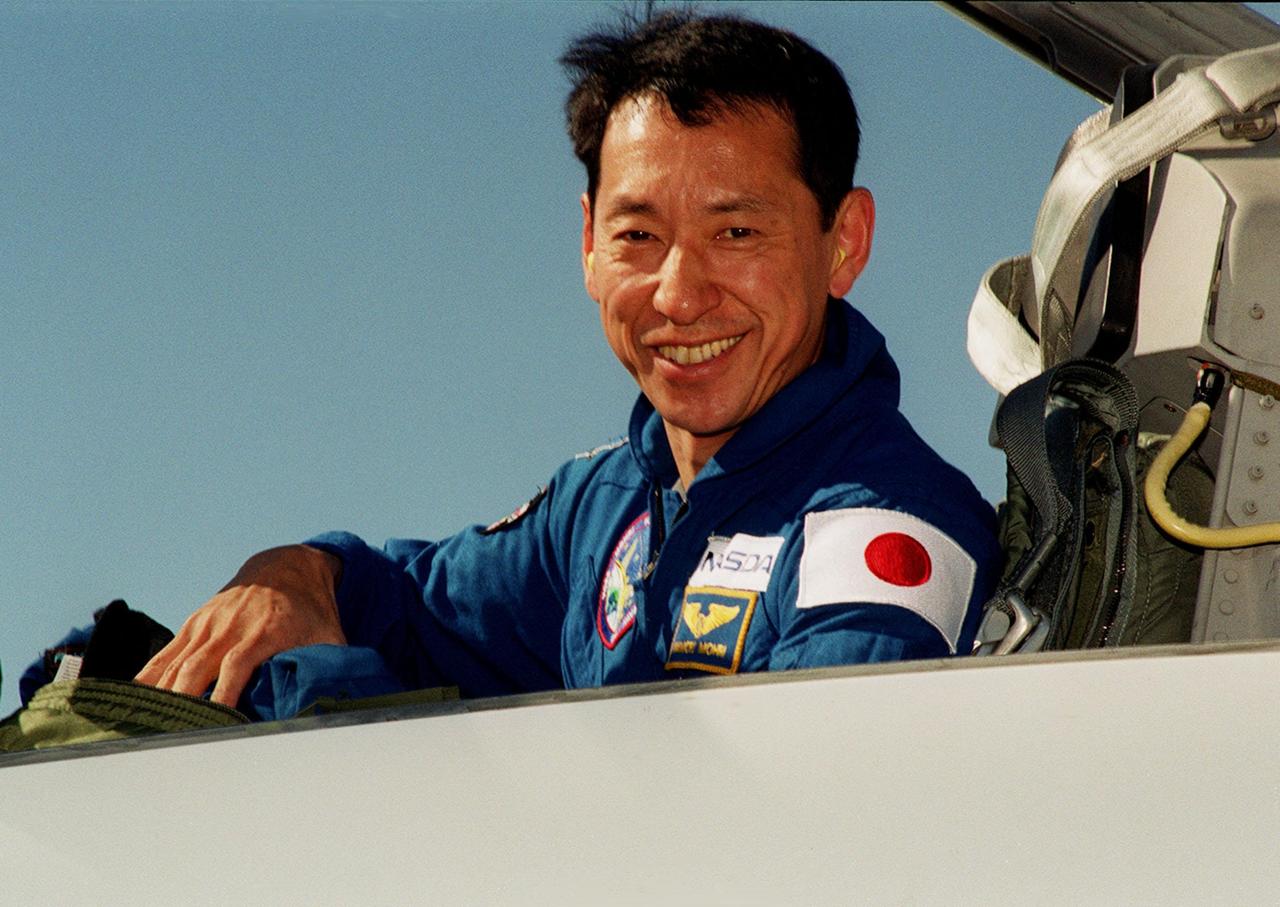
A smiling STS-99 Mission Specialist Mamoru Mohri of Japan arrives at KSC aboard a T-38 jet aircraft eager to prepare for the second launch attempt of Endeavour Feb. 11 at 12:30 p.m. EST from Launch Pad 39A. Mohri is with the Japanese National Space Development Agency (NASDA). The earlier launch scheduled for Jan. 31 was scrubbed due to poor weather and a faulty Enhanced Master Events Controller in the orbiter's aft compartment. Over the next few days, the crew will review mission procedures, conduct test flights in the Shuttle Training Aircraft and undergo routine preflight medical exams. STS-99 is the Shuttle Radar Topography Mission, which will produce unrivaled 3-D images of the Earth's surface. The result of the Shuttle Radar Topography Mission could be close to 1 trillion measurements of the Earth's topography. Landing is expected at KSC on Feb. 22 at 4:36 p.m. EST
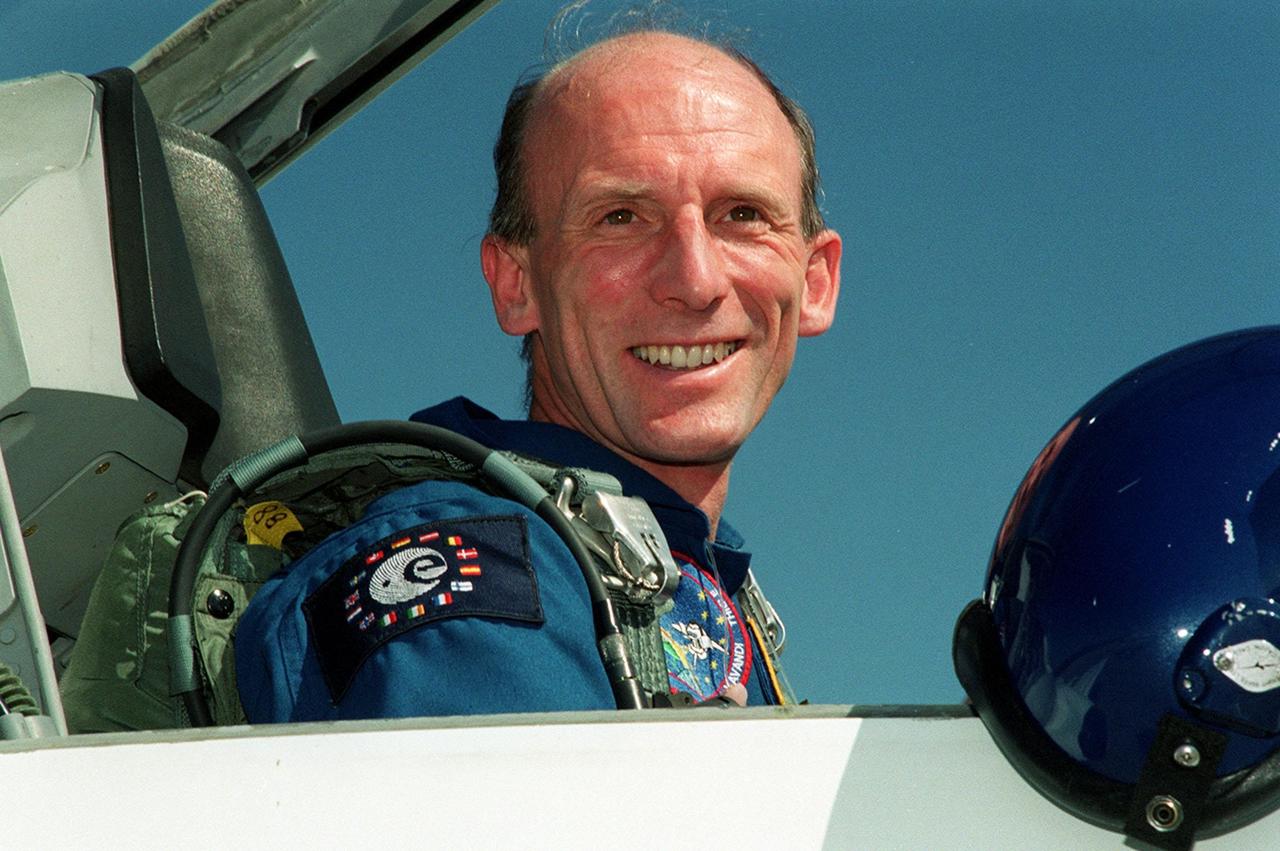
STS-99 Mission Specialist Gerhard P.J. Thiele of Germany arrives at KSC aboard a T-38 jet aircraft eager to prepare for the second launch attempt of Endeavour Feb. 11 at 12:30 p.m. EST from Launch Pad 39A. Thiele is with the European Space Agency. The earlier launch scheduled for Jan. 31 was scrubbed due to poor weather and a faulty Enhanced Master Events Controller in the orbiter's aft compartment. Over the next few days, the crew will review mission procedures, conduct test flights in the Shuttle Training Aircraft and undergo routine preflight medical exams. STS-99 is the Shuttle Radar Topography Mission, which will produce unrivaled 3-D images of the Earth's surface. The result of the Shuttle Radar Topography Mission could be close to 1 trillion measurements of the Earth's topography. Landing is expected at KSC on Feb. 22 at 4:36 p.m. EST
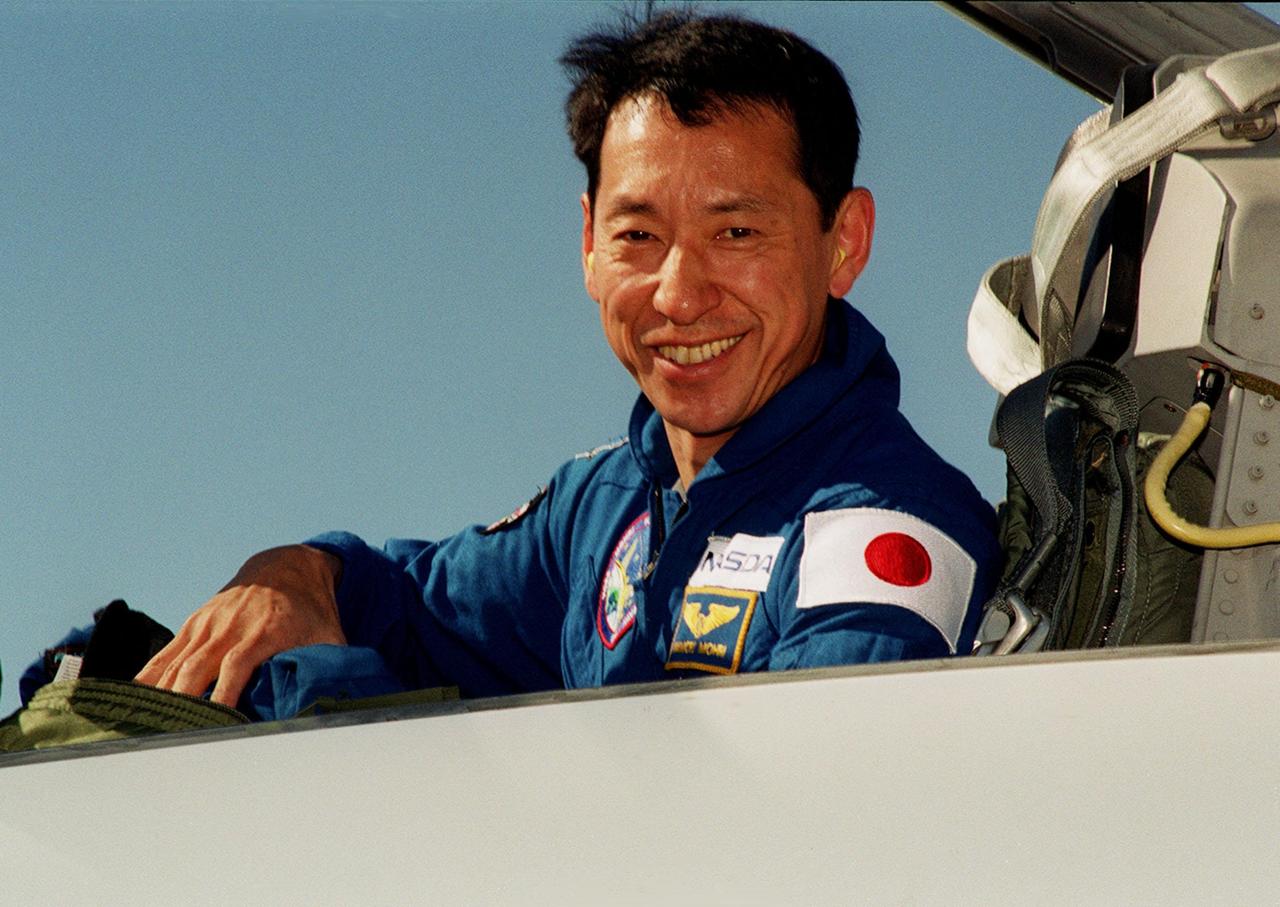
A smiling STS-99 Mission Specialist Mamoru Mohri of Japan arrives at KSC aboard a T-38 jet aircraft eager to prepare for the second launch attempt of Endeavour Feb. 11 at 12:30 p.m. EST from Launch Pad 39A. Mohri is with the Japanese National Space Development Agency (NASDA). The earlier launch scheduled for Jan. 31 was scrubbed due to poor weather and a faulty Enhanced Master Events Controller in the orbiter's aft compartment. Over the next few days, the crew will review mission procedures, conduct test flights in the Shuttle Training Aircraft and undergo routine preflight medical exams. STS-99 is the Shuttle Radar Topography Mission, which will produce unrivaled 3-D images of the Earth's surface. The result of the Shuttle Radar Topography Mission could be close to 1 trillion measurements of the Earth's topography. Landing is expected at KSC on Feb. 22 at 4:36 p.m. EST
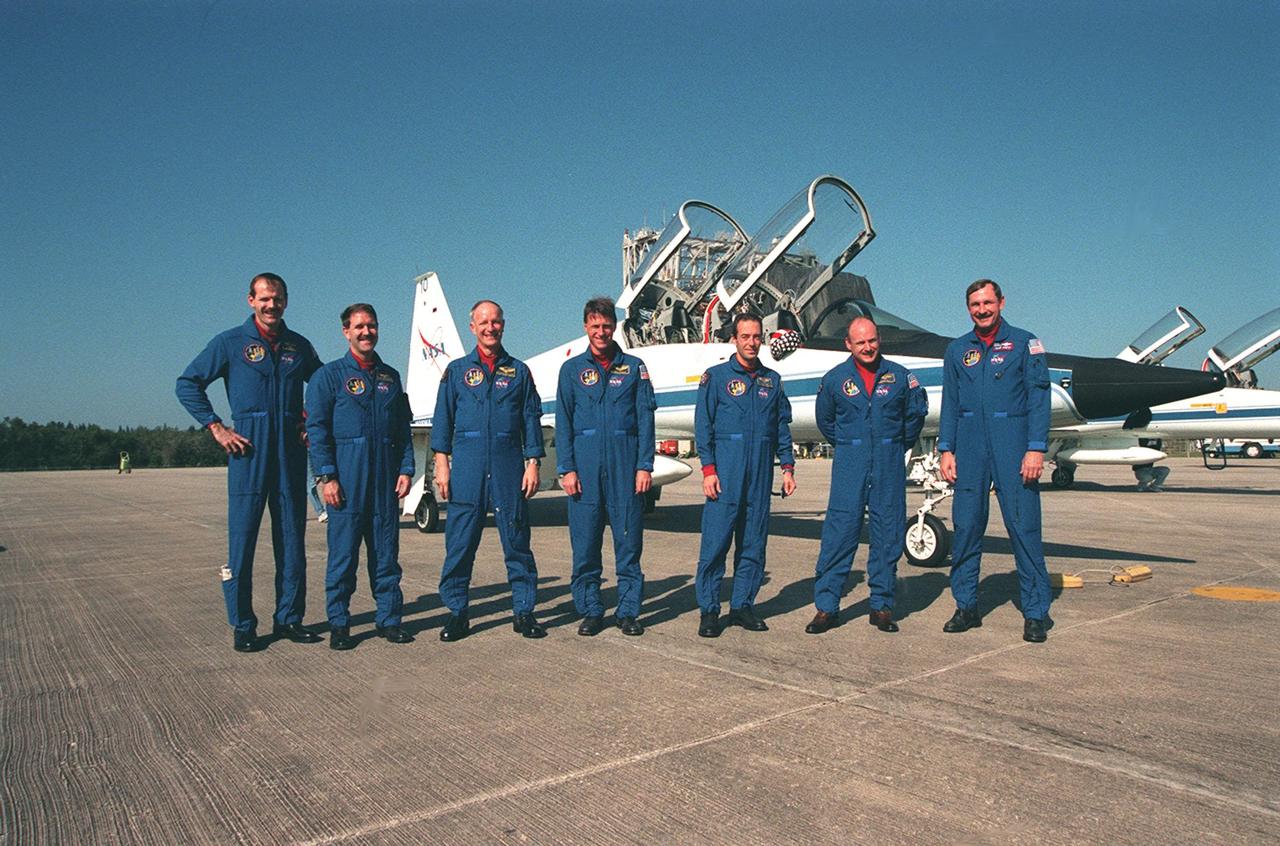
The STS-103 crew poses for photographers after landing at at Kennedy Space Center's Shuttle Landing Facility to begin Terminal Countdown Demonstration Test (TCDT) activities. Standing (left to right) in front of the T-38 jets that brought them are Mission Specialists Steven L. Smith, John M. Grunsfeld (Ph.D.), Claude Nicollier of Switzerland, with the European Space Agency, C. Michael Foale (Ph.D.), Jean-François Clervoy of France, also with the European Space Agency, Pilot Scott J. Kelly, and Commander Curtis L. Brown Jr. The TCDT provides the crew with emergency egress training, opportunities to inspect their mission payloads in the orbiter's payload bay, and simulated countdown exercises. The STS-103 mission, to service the Hubble Space Telescope, is targeted for launch Dec. 6 at 2:37 a.m. EST aboard Space Shuttle Discovery
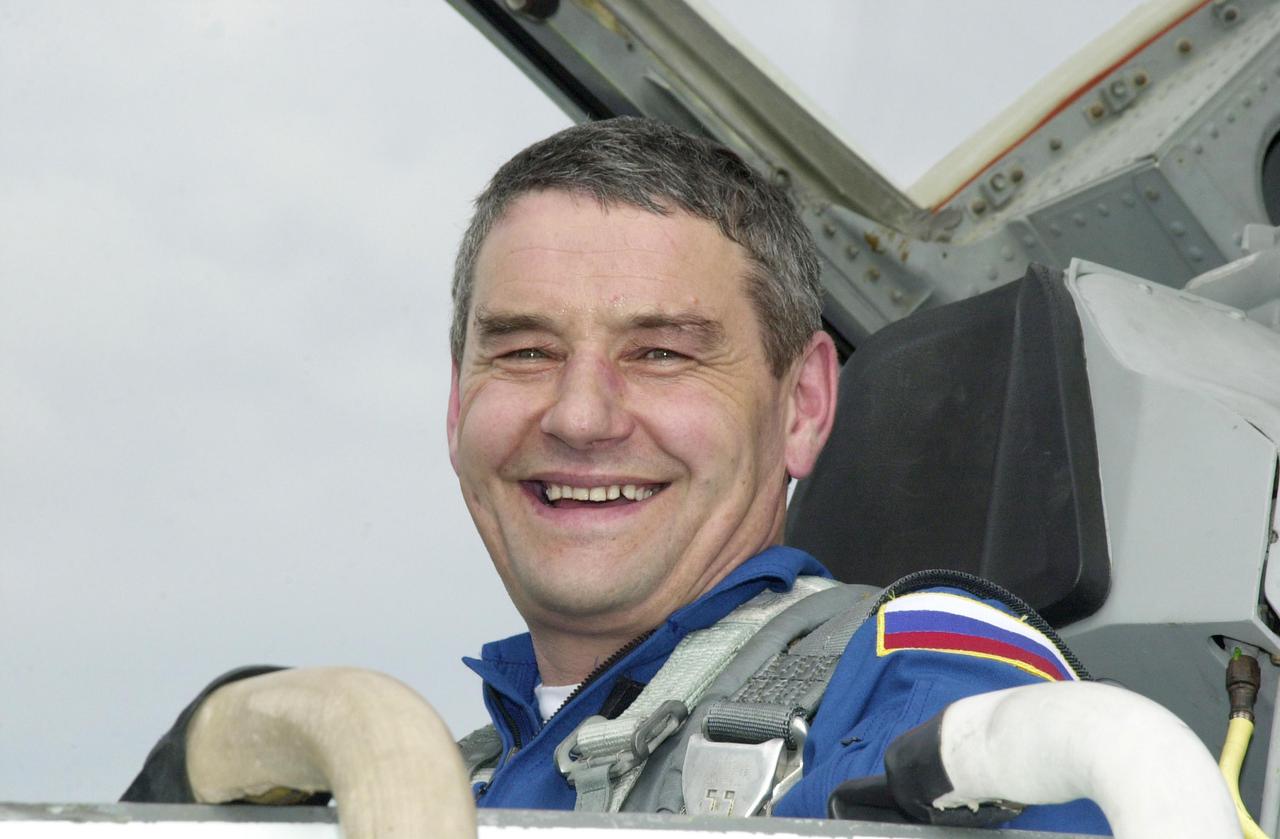
KENNEDY SPACE CENTER, FLA. -- Expedition 5 crew member Valerie G. Korzun, with the Russian Space Agency, arrives at KSC aboard a T-38 jet aircraft to take part in Terminal Countdown Demonstration Test (TCDT) activities, along with the Shuttle crew, for launch of mission STS-111. Expedition 5 will travel on Space Shuttle Endeavour to the International Space Station as a replacement crew for Expedition 4. The TCDT is a rehearsal for launch and includes emergency egress training, familiarization with payload and a simulated launch countdown. Mission STS-111 is a utilization flight that will deliver equipment and supplies to the Station. Along with the Multi-Purpose Logisitics Module Leonardo, the payload includes the Mobile Base System, part of the Canadian SSRMS and an Orbital Replacement Unit, the replacement wrist_roll joint for the SSRMS (Canadarm2). Launch of Endeavour is scheduled for May 30, 2002
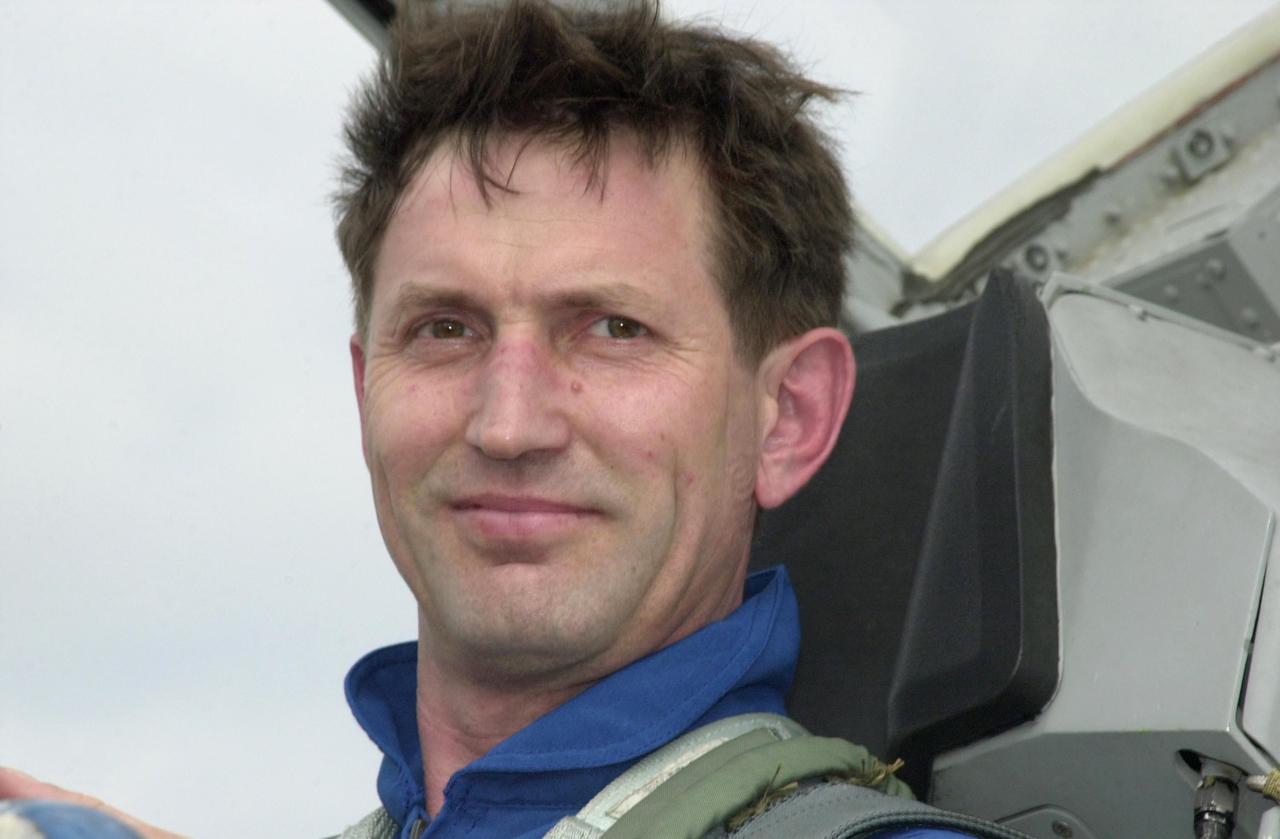
KENNEDY SPACE CENTER, FLA. - Expedition 5 crew member Sergei Y. Treschev, with the Russian Space Agency, arrives at KSC aboard a T-38 jet aircraft to take part in Terminal Countdown Demonstration Test (TCDT) activities, along with the Shuttle crew, for launch of mission STS-111. Expedition 5 will travel on Space Shuttle Endeavour to the International Space Station as a replacement crew for Expedition 4. The TCDT is a rehearsal for launch and includes emergency egress training, familiarization with payload and a simulated launch countdown. Mission STS-111 is a utilization flight that will deliver equipment and supplies to the Station. Along with the Multi-Purpose Logisitics Module Leonardo, the payload includes the Mobile Base System, part of the Canadian SSRMS and an Orbital Replacement Unit, the replacement wrist/roll joint for the SSRMS (Canadarm2). Launch of Endeavour is scheduled for May 30, 2002
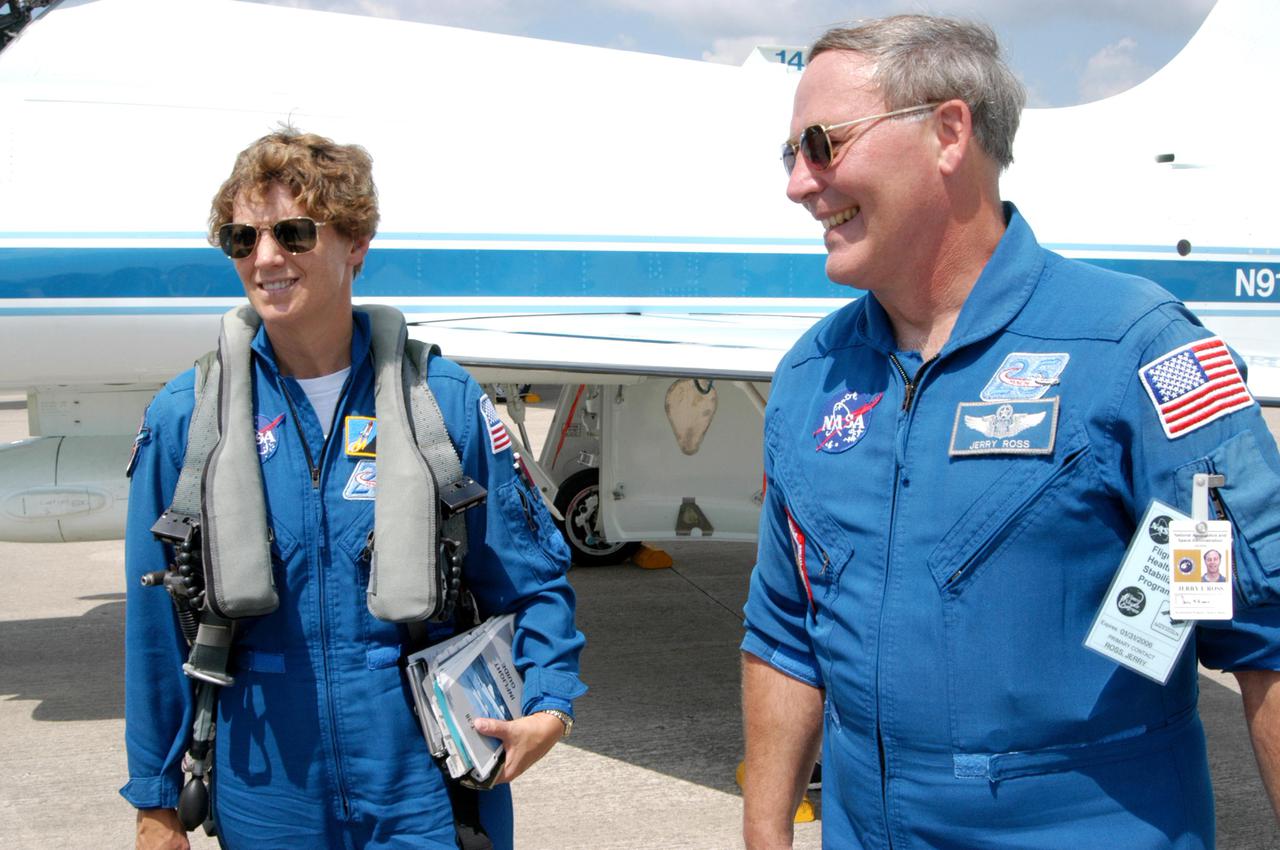
KENNEDY SPACE CENTER, FLA. - The Return to Flight STS-114 crew arrives at NASA Kennedy Space Center in T-38 training jets to get ready for a second launch attempt aboard Space Shuttle Discovery. Seen in the photo are Mission Commander Eileen Collins and astronaut Jerry Ross, who serves as chief of the Vehicle Integration Test Office at Johnson Space Center in Houston. Collins later told the media who waited nearby that since the scrub on July 13, the crew has focused on the on-orbit part of the mission and training for night landings using the Shuttle Training Aircraft. She praised the engineers and technicians who have been troubleshooting the elusive sensor problem and thanked them. STS-114 is scheduled to launch July 26 at 10:39 a.m. EDT from Launch Pad 39B.
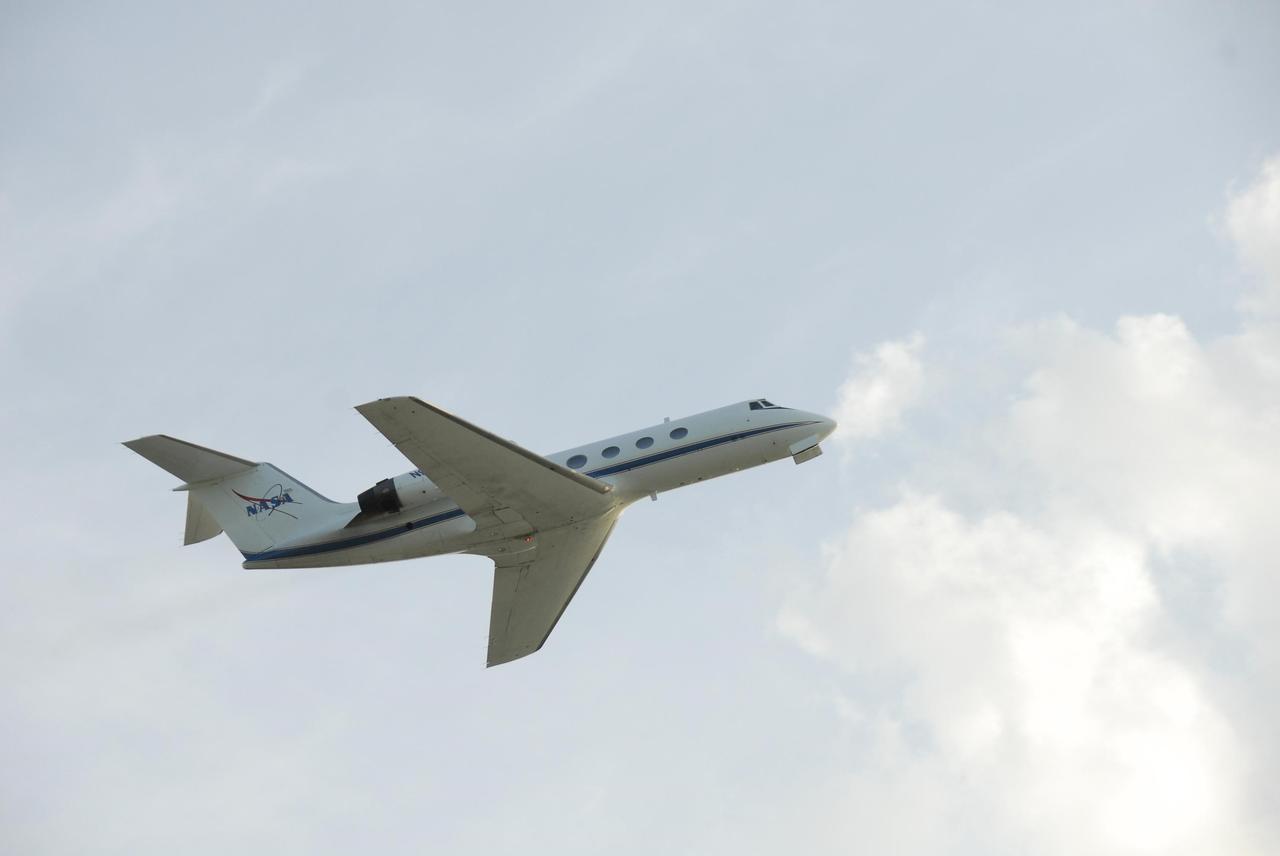
KENNEDY SPACE CENTER, FLA. -- STS-117 Commander Frederick Sturckow and Pilot Lee Archambault aim high to begin landing practice in the shuttle training aircraft (STA). The STA is a Grumman American Aviation-built Gulf Stream II jet that was modified to simulate an orbiter's cockpit, motion and visual cues, and handling qualities. In flight, the STA duplicates the orbiter's atmospheric descent trajectory from approximately 35,000 feet altitude to landing on a runway. STS-117 is scheduled to launch at 7:38 p.m. June 8. During the 11-day mission and three spacewalks, the crew will work with flight controllers at NASA's Johnson Space Center in Houston to install the 17-ton segment on the station's girder-like truss and deploy the set of solar arrays, S3/S4. The mission will increase the space station's power capability in preparation for the arrival of new science modules from the European and Japanese space agencies. Photo credit: NASA/Kim Shiflett
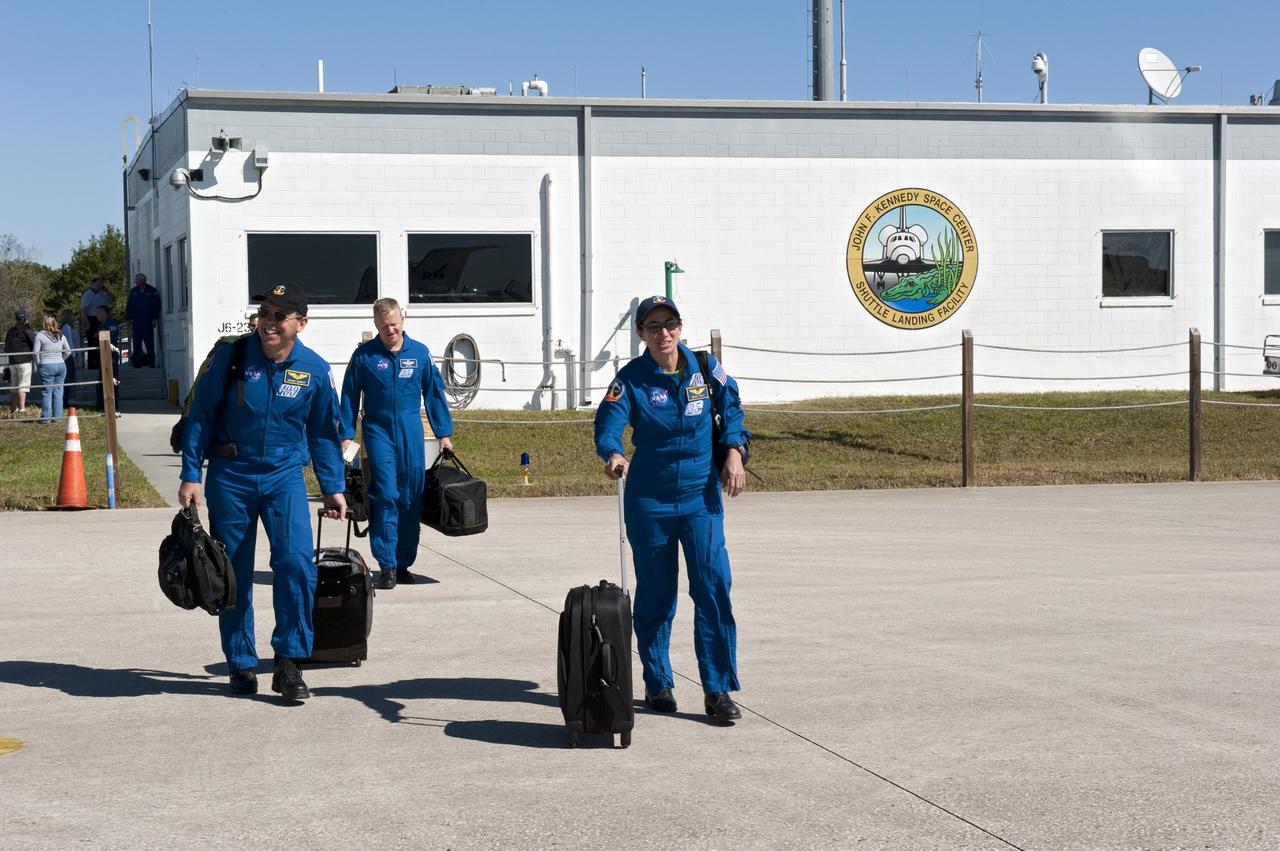
CAPE CANAVERAL, Fla. -- Space shuttle Discovery's STS-133 crew prepares to depart NASA's Kennedy Space Center in Florida in T-38 training jets. Mission Specialist Michael Barratt, left, Pilot Eric Boe and Mission Specialist Nicole Stott and their three crewmates will wait until at least Nov. 30 to launch to the International Space Station because a leak was detected at the Ground Umbilical Carrier Plate (GUCP) while Discovery's external fuel tank was being loaded for launch on Nov. 5. The GUCP is an attachment point between the external tank and a pipe that carries gaseous hydrogen safely away from the shuttle to the flare stack, where it is burned off. Engineers and managers also will evaluate a crack in the foam on the external tank. During the 11-day mission, STS-133 will deliver the Permanent Multipurpose Module, packed with supplies and critical spare parts, as well as Robonaut 2, to the orbiting laboratory. Discovery, which will fly its 39th mission, is scheduled to be retired following STS-133. This will be the 133rd Space Shuttle Program mission and the 35th shuttle voyage to the space station. For more information on STS-133, visit www.nasa.gov/mission_pages/shuttle/shuttlemissions/sts133/. Photo credit: NASA/Kim Shiflett
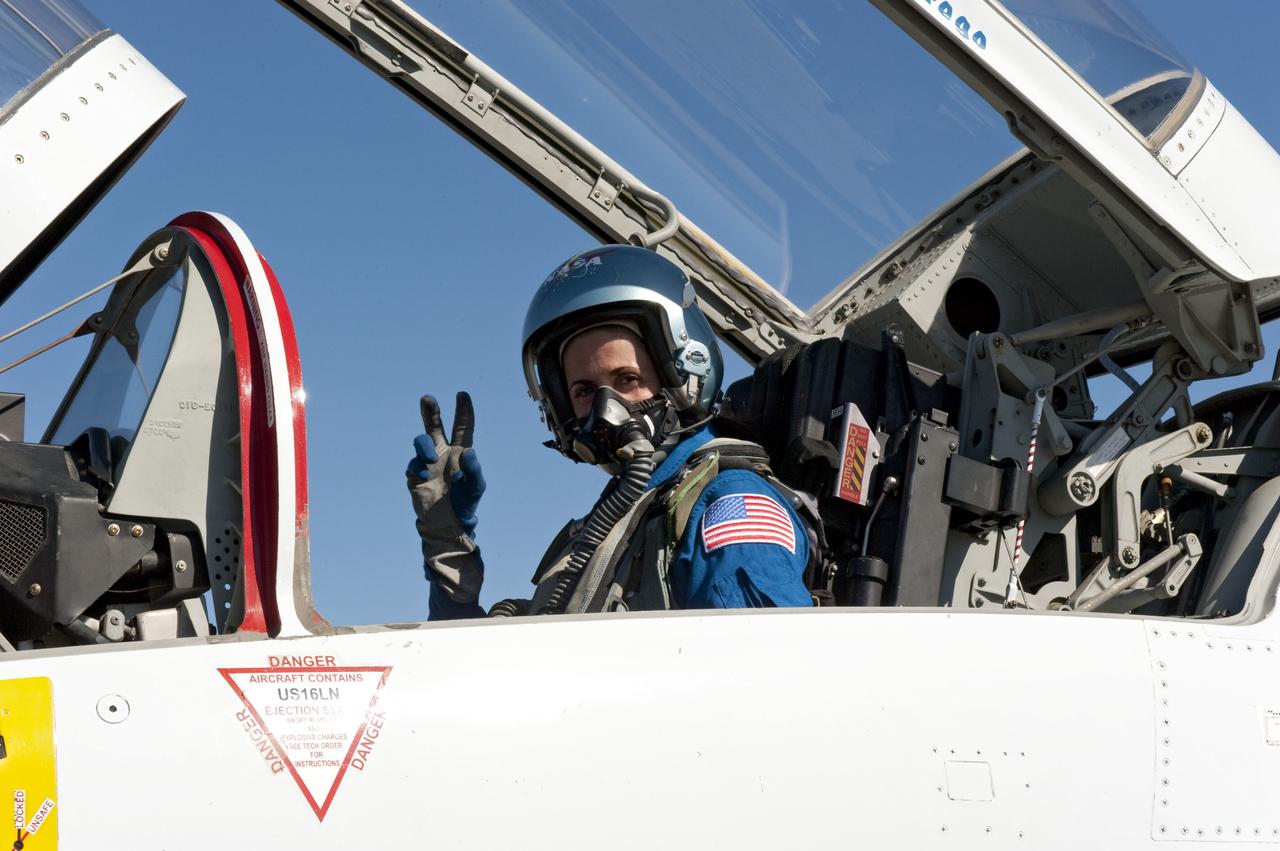
CAPE CANAVERAL, Fla. -- Space shuttle Discovery's STS-133 Mission Specialist Nicole Stott prepares to depart NASA's Kennedy Space Center in Florida in a T-38 training jet. Stott and her five crewmates will wait until at least Nov. 30 to launch to the International Space Station because a leak was detected at the Ground Umbilical Carrier Plate (GUCP) while Discovery's external fuel tank was being loaded for launch on Nov. 5. The GUCP is an attachment point between the external tank and a pipe that carries gaseous hydrogen safely away from the shuttle to the flare stack, where it is burned off. Engineers and managers also will evaluate a crack in the foam on the external tank. During the 11-day mission, STS-133 will deliver the Permanent Multipurpose Module, packed with supplies and critical spare parts, as well as Robonaut 2, to the orbiting laboratory. Discovery, which will fly its 39th mission, is scheduled to be retired following STS-133. This will be the 133rd Space Shuttle Program mission and the 35th shuttle voyage to the space station. For more information on STS-133, visit www.nasa.gov/mission_pages/shuttle/shuttlemissions/sts133/. Photo credit: NASA/Kim Shiflett
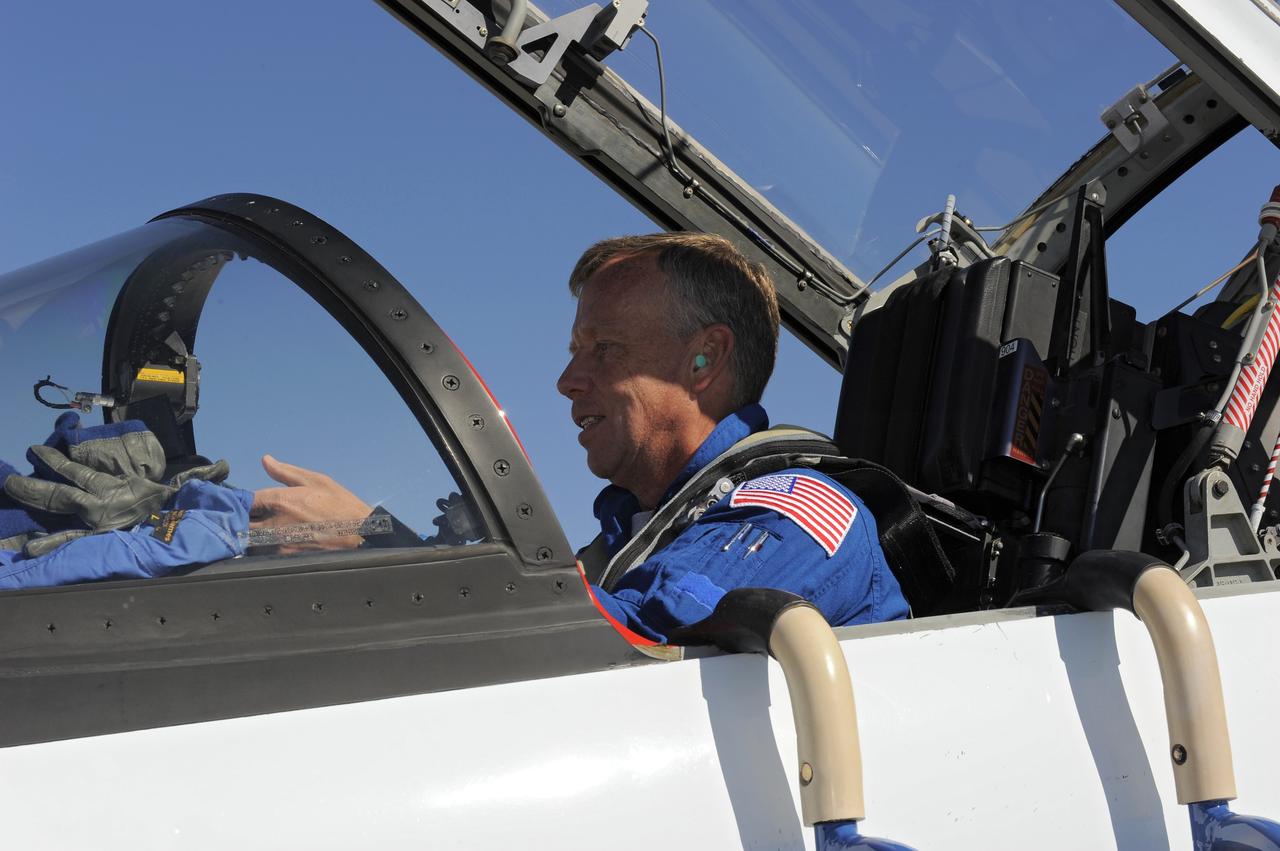
CAPE CANAVERAL, Fla. -- Space shuttle Discovery's STS-133 Commander Steve Lindsey prepares to depart NASA's Kennedy Space Center in Florida in a T-38 training jet. Lindsey and his five crewmates will wait until at least Nov. 30 to launch to the International Space Station because a leak was detected at the Ground Umbilical Carrier Plate (GUCP) while Discovery's external fuel tank was being loaded for launch on Nov. 5. The GUCP is an attachment point between the external tank and a pipe that carries gaseous hydrogen safely away from the shuttle to the flare stack, where it is burned off. Engineers and managers also will evaluate a crack in the foam on the external tank. During the 11-day mission, STS-133 will deliver the Permanent Multipurpose Module, packed with supplies and critical spare parts, as well as Robonaut 2, to the orbiting laboratory. Discovery, which will fly its 39th mission, is scheduled to be retired following STS-133. This will be the 133rd Space Shuttle Program mission and the 35th shuttle voyage to the space station. For more information on STS-133, visit www.nasa.gov/mission_pages/shuttle/shuttlemissions/sts133/. Photo credit: NASA/Kim Shiflett
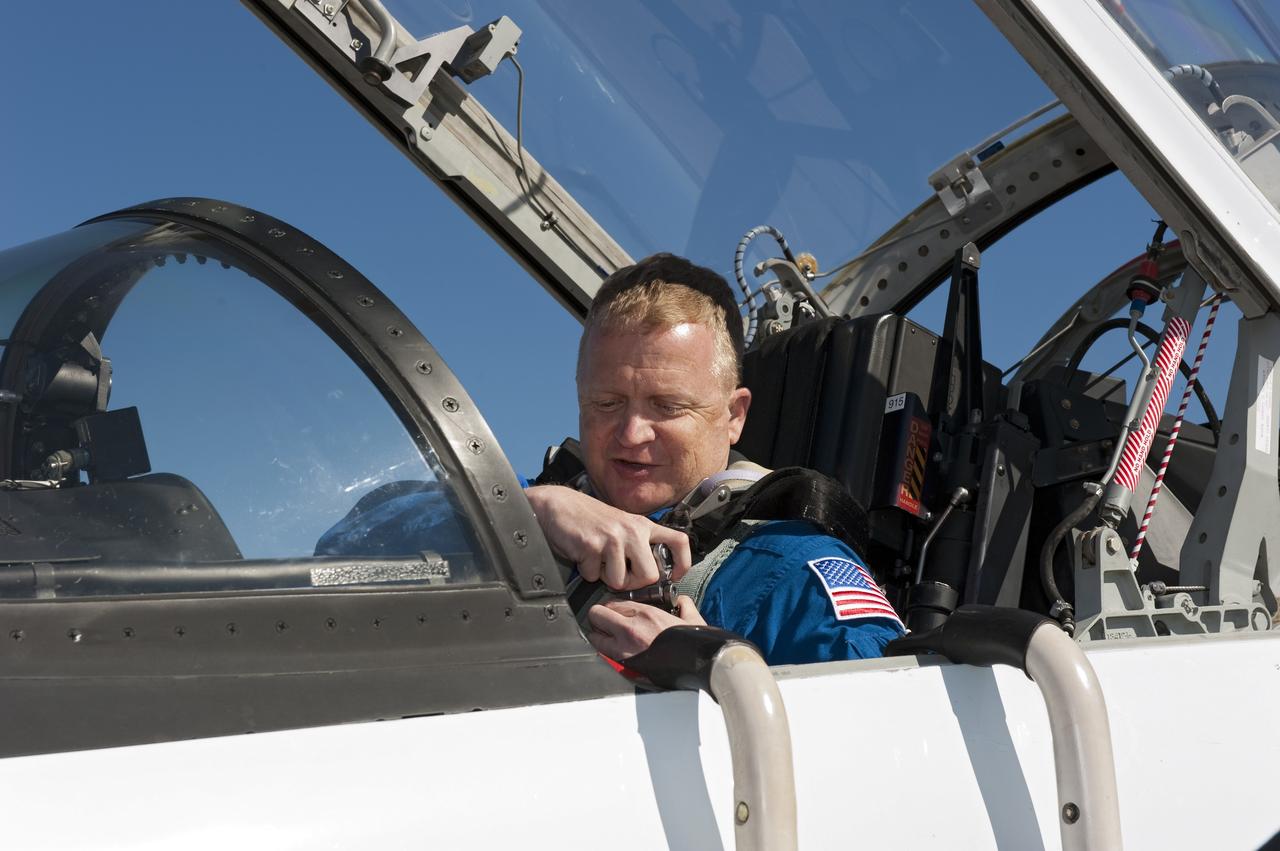
CAPE CANAVERAL, Fla. -- Space shuttle Discovery's STS-133 Pilot Eric Boe prepares to depart NASA's Kennedy Space Center in Florida in a T-38 training jet. Boe and his five crewmates will wait until at least Nov. 30 to launch to the International Space Station because a leak was detected at the Ground Umbilical Carrier Plate (GUCP) while Discovery's external fuel tank was being loaded for launch on Nov. 5. The GUCP is an attachment point between the external tank and a pipe that carries gaseous hydrogen safely away from the shuttle to the flare stack, where it is burned off. Engineers and managers also will evaluate a crack in the foam on the external tank. During the 11-day mission, STS-133 will deliver the Permanent Multipurpose Module, packed with supplies and critical spare parts, as well as Robonaut 2, to the orbiting laboratory. Discovery, which will fly its 39th mission, is scheduled to be retired following STS-133. This will be the 133rd Space Shuttle Program mission and the 35th shuttle voyage to the space station. For more information on STS-133, visit www.nasa.gov/mission_pages/shuttle/shuttlemissions/sts133/. Photo credit: NASA/Kim Shiflett
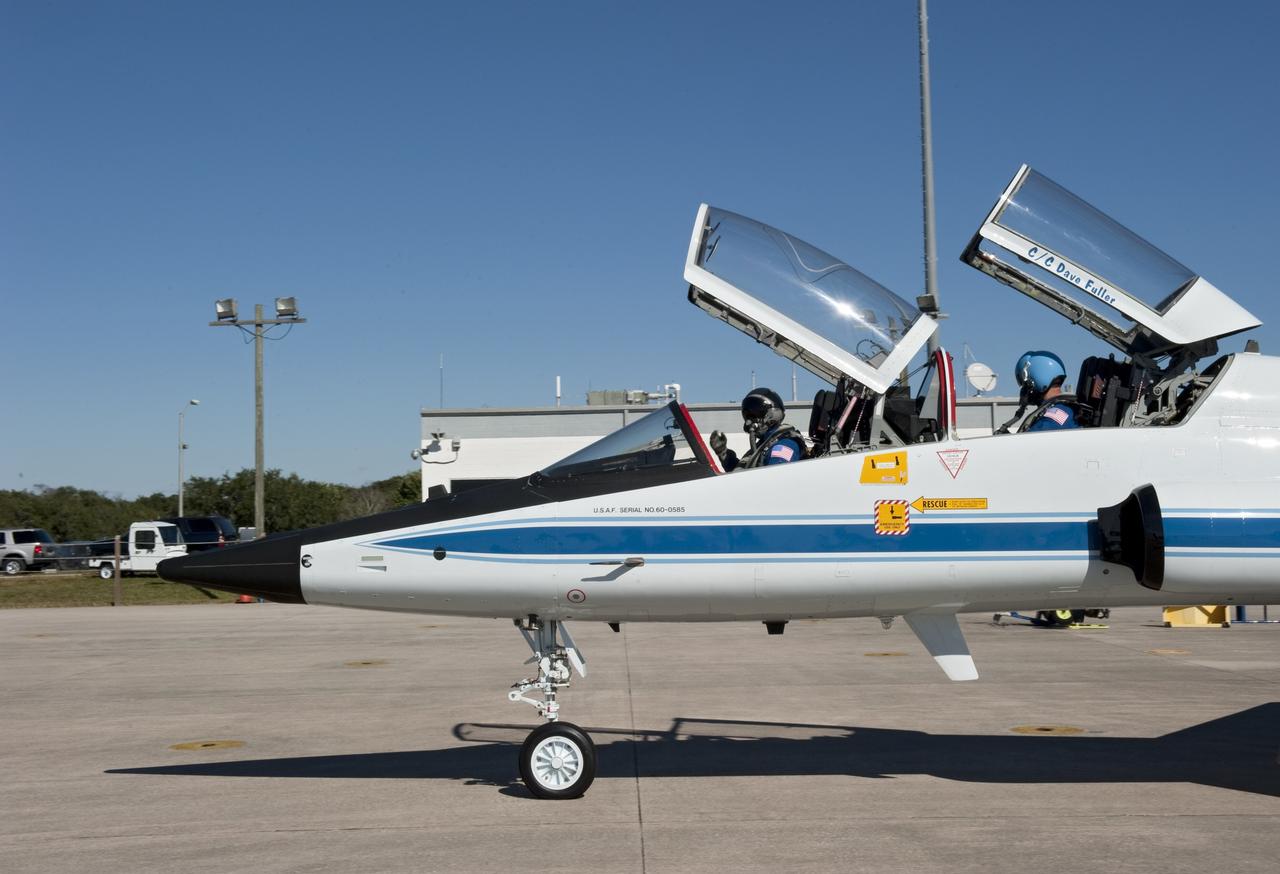
CAPE CANAVERAL, Fla. -- Space shuttle Discovery's STS-133 crew members depart NASA's Kennedy Space Center in Florida in a T-38 training jet. The six-member crew will wait until at least Nov. 30 to launch to the International Space Station because a leak was detected at the Ground Umbilical Carrier Plate (GUCP) while Discovery's external fuel tank was being loaded for launch on Nov. 5. The GUCP is an attachment point between the external tank and a pipe that carries gaseous hydrogen safely away from the shuttle to the flare stack, where it is burned off. Engineers and managers also will evaluate a crack in the foam on the external tank. During the 11-day mission, STS-133 will deliver the Permanent Multipurpose Module, packed with supplies and critical spare parts, as well as Robonaut 2, to the orbiting laboratory. Discovery, which will fly its 39th mission, is scheduled to be retired following STS-133. This will be the 133rd Space Shuttle Program mission and the 35th shuttle voyage to the space station. For more information on STS-133, visit www.nasa.gov/mission_pages/shuttle/shuttlemissions/sts133/. Photo credit: NASA/Kim Shiflett
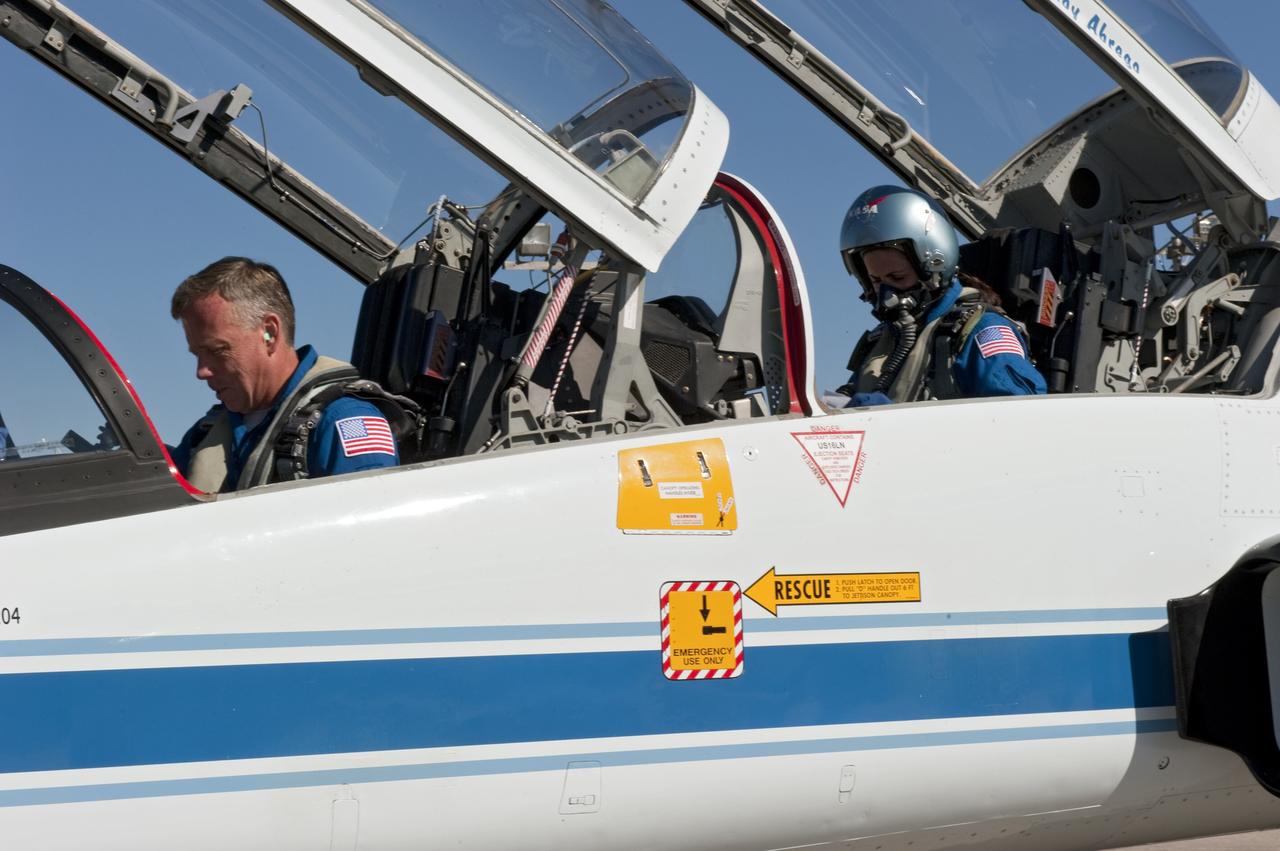
CAPE CANAVERAL, Fla. -- Space shuttle Discovery's STS-133 Commander Steve Lindsey, left, and Mission Specialist Nicole Stott prepare to depart NASA's Kennedy Space Center in Florida in a T-38 training jet. The six-member crew will wait until at least Nov. 30 to launch to the International Space Station because a leak was detected at the Ground Umbilical Carrier Plate (GUCP) while Discovery's external fuel tank was being loaded for launch on Nov. 5. The GUCP is an attachment point between the external tank and a pipe that carries gaseous hydrogen safely away from the shuttle to the flare stack, where it is burned off. Engineers and managers also will evaluate a crack in the foam on the external tank. During the 11-day mission, STS-133 will deliver the Permanent Multipurpose Module, packed with supplies and critical spare parts, as well as Robonaut 2, to the orbiting laboratory. Discovery, which will fly its 39th mission, is scheduled to be retired following STS-133. This will be the 133rd Space Shuttle Program mission and the 35th shuttle voyage to the space station. For more information on STS-133, visit www.nasa.gov/mission_pages/shuttle/shuttlemissions/sts133/. Photo credit: NASA/Kim Shiflett
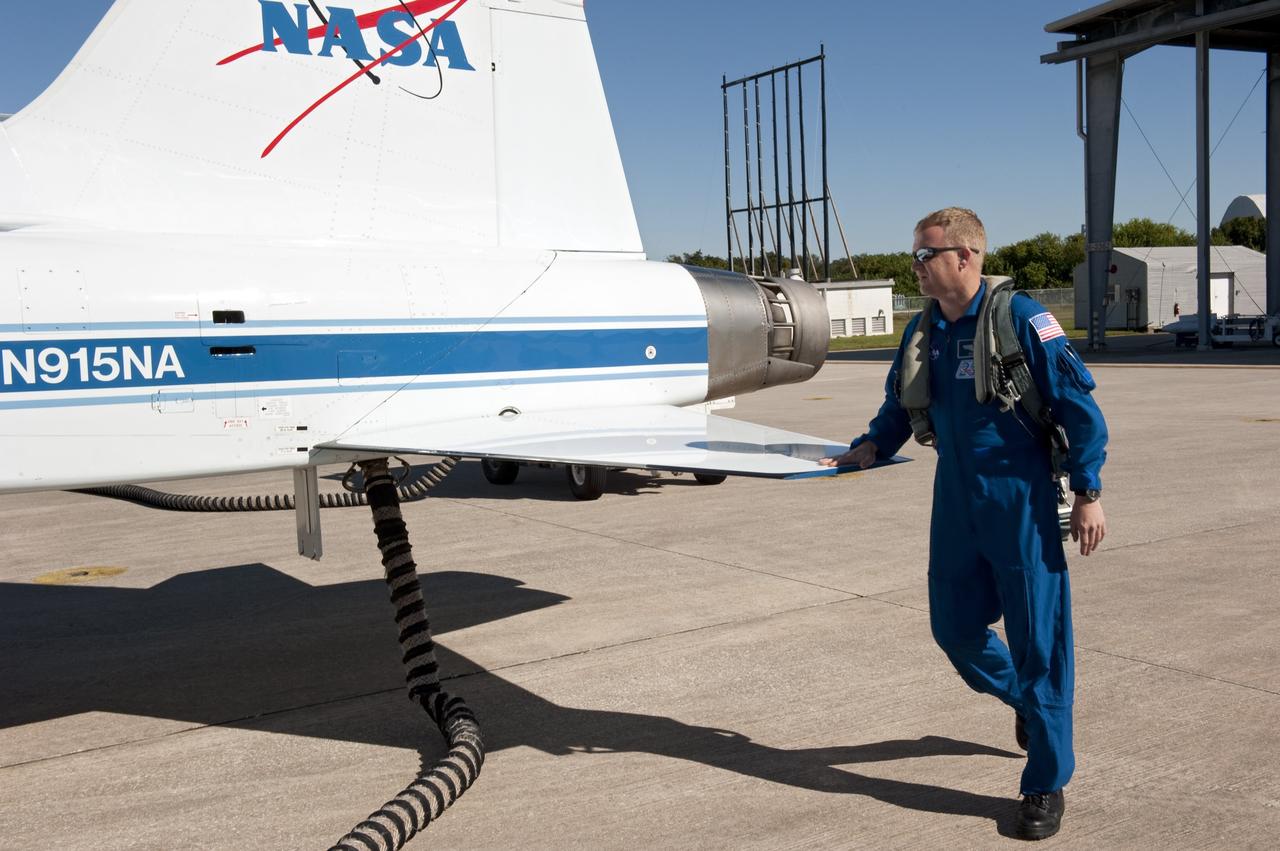
CAPE CANAVERAL, Fla. -- Space shuttle Discovery's STS-133 Pilot Eric Boe prepares to depart NASA's Kennedy Space Center in Florida in a T-38 training jet. Boe and his five crewmates will wait until at least Nov. 30 to launch to the International Space Station because a leak was detected at the Ground Umbilical Carrier Plate (GUCP) while Discovery's external fuel tank was being loaded for launch on Nov. 5. The GUCP is an attachment point between the external tank and a pipe that carries gaseous hydrogen safely away from the shuttle to the flare stack, where it is burned off. Engineers and managers also will evaluate a crack in the foam on the external tank. During the 11-day mission, STS-133 will deliver the Permanent Multipurpose Module, packed with supplies and critical spare parts, as well as Robonaut 2, to the orbiting laboratory. Discovery, which will fly its 39th mission, is scheduled to be retired following STS-133. This will be the 133rd Space Shuttle Program mission and the 35th shuttle voyage to the space station. For more information on STS-133, visit www.nasa.gov/mission_pages/shuttle/shuttlemissions/sts133/. Photo credit: NASA/Kim Shiflett
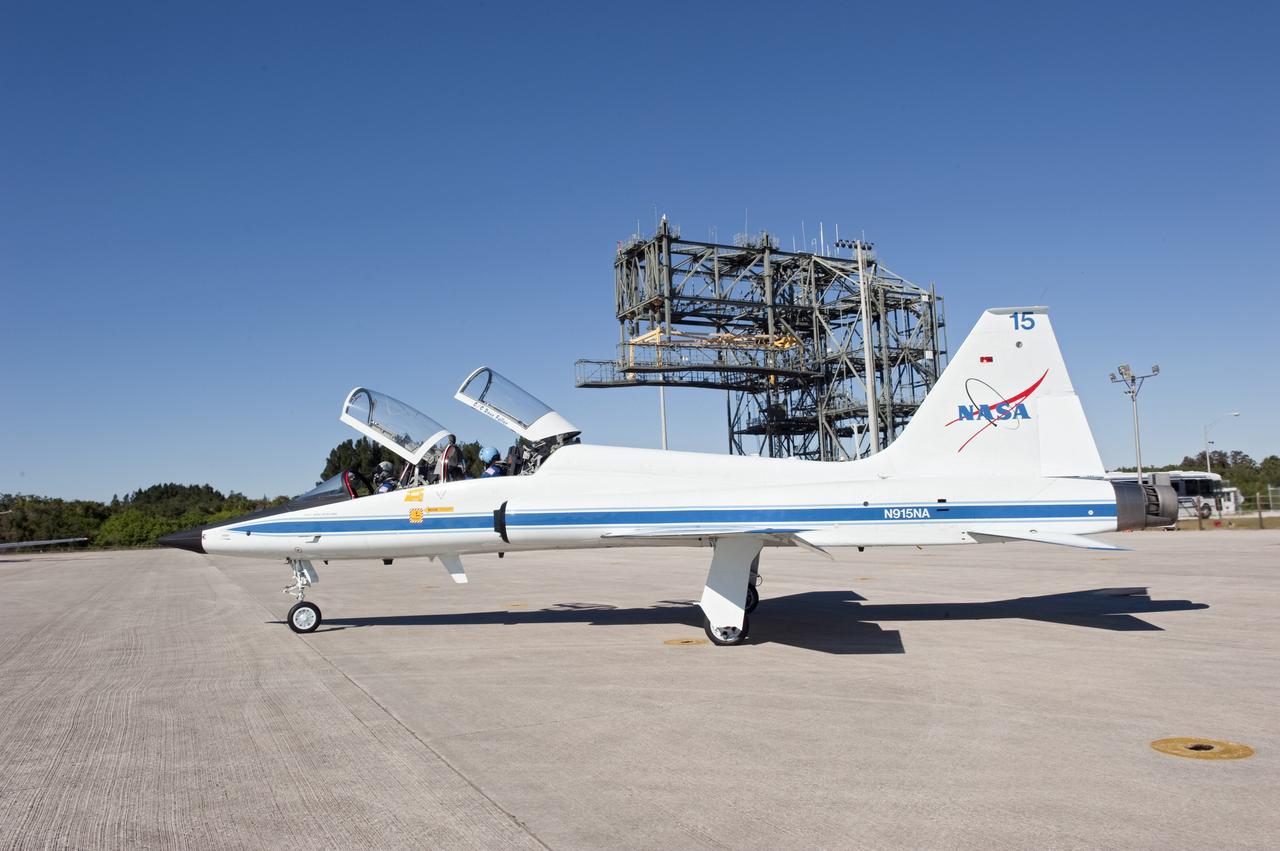
CAPE CANAVERAL, Fla. -- Space shuttle Discovery's STS-133 crew members depart NASA's Kennedy Space Center in Florida in a T-38 training jet. The six-member crew will wait until at least Nov. 30 to launch to the International Space Station because a leak was detected at the Ground Umbilical Carrier Plate (GUCP) while Discovery's external fuel tank was being loaded for launch on Nov. 5. The GUCP is an attachment point between the external tank and a pipe that carries gaseous hydrogen safely away from the shuttle to the flare stack, where it is burned off. Engineers and managers also will evaluate a crack in the foam on the external tank. During the 11-day mission, STS-133 will deliver the Permanent Multipurpose Module, packed with supplies and critical spare parts, as well as Robonaut 2, to the orbiting laboratory. Discovery, which will fly its 39th mission, is scheduled to be retired following STS-133. This will be the 133rd Space Shuttle Program mission and the 35th shuttle voyage to the space station. For more information on STS-133, visit www.nasa.gov/mission_pages/shuttle/shuttlemissions/sts133/. Photo credit: NASA/Kim Shiflett
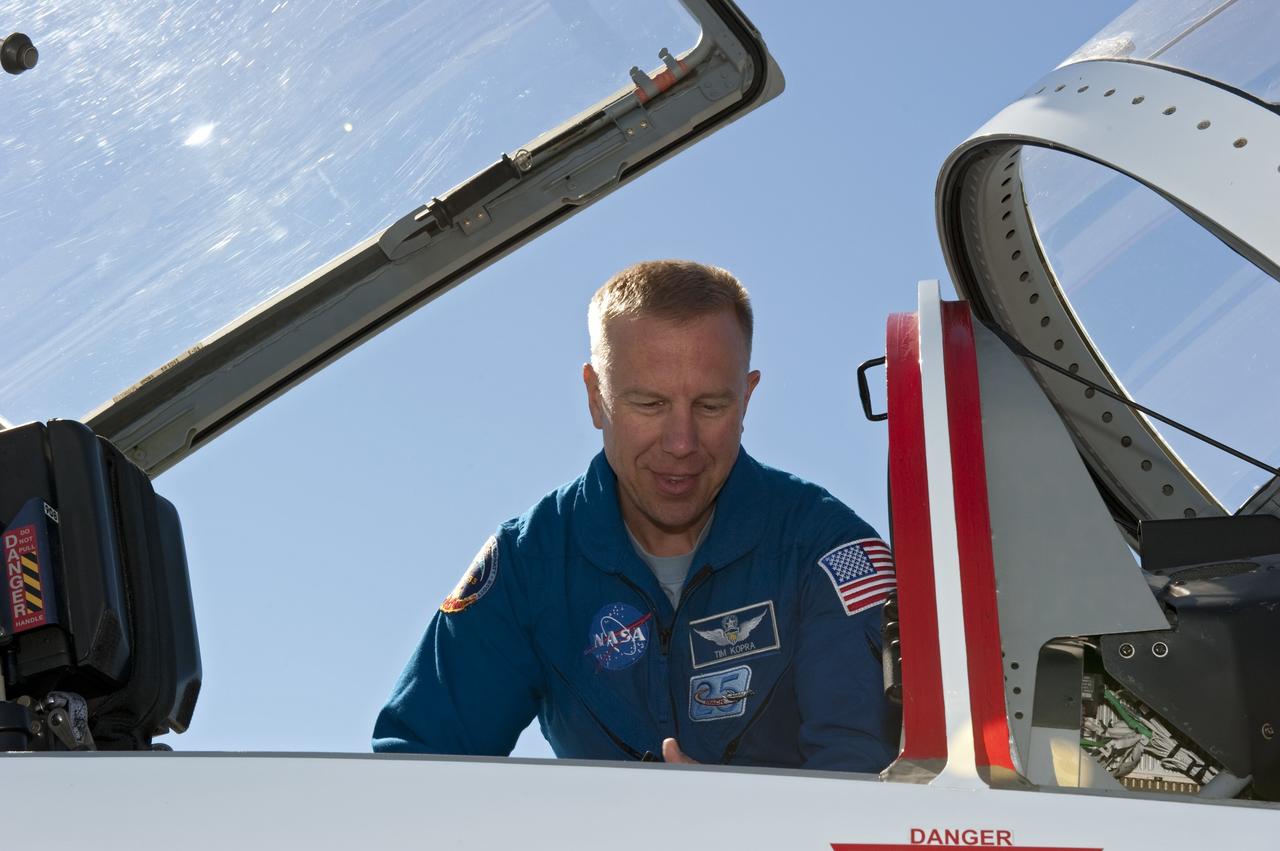
CAPE CANAVERAL, Fla. -- Space shuttle Discovery's STS-133 Mission Specialist Tim Kopra prepares to depart NASA's Kennedy Space Center in Florida in a T-38 training jet. Kopra and his five crewmates will wait until at least Nov. 30 to launch to the International Space Station because a leak was detected at the Ground Umbilical Carrier Plate (GUCP) while Discovery's external fuel tank was being loaded for launch on Nov. 5. The GUCP is an attachment point between the external tank and a pipe that carries gaseous hydrogen safely away from the shuttle to the flare stack, where it is burned off. Engineers and managers also will evaluate a crack in the foam on the external tank. During the 11-day mission, STS-133 will deliver the Permanent Multipurpose Module, packed with supplies and critical spare parts, as well as Robonaut 2, to the orbiting laboratory. Discovery, which will fly its 39th mission, is scheduled to be retired following STS-133. This will be the 133rd Space Shuttle Program mission and the 35th shuttle voyage to the space station. For more information on STS-133, visit www.nasa.gov/mission_pages/shuttle/shuttlemissions/sts133/. Photo credit: NASA/Kim Shiflett
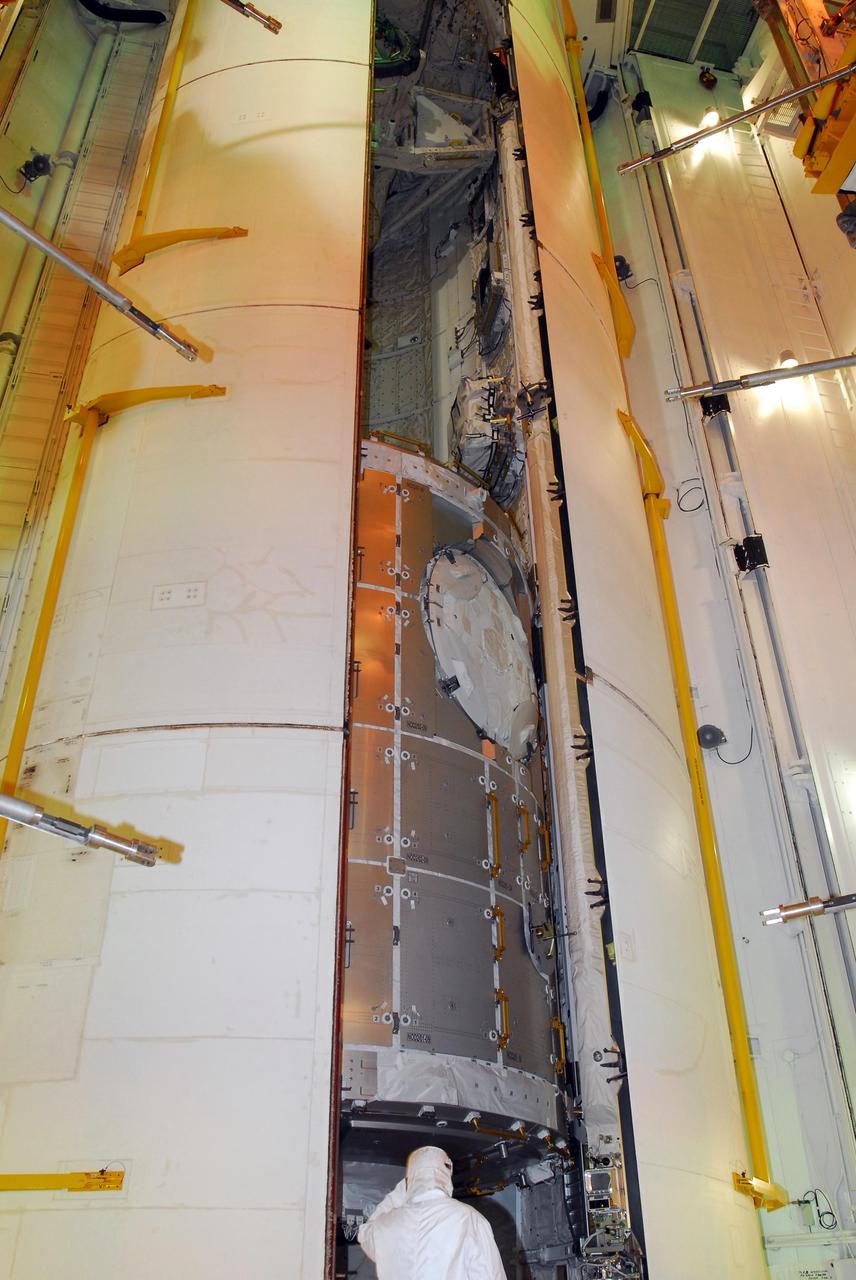
KENNEDY SPACE CENTER, FLA. -- At Launch Pad 39A, space shuttle Discovery's payload bay doors slowly enclose the U.S. Node 2 module, named Harmony. The name was chosen from an academic competition involving more than 2,200 U. S. students in kindergarten through high school. The module will be delivered to the International Space Station aboard Discovery on the 14-day STS-120 mission. An orbiter's payload bay door closure at the pad is a milestone signaling that the launch date is near. Discovery's launch is targeted for Oct. 23 at 11:38 a.m. EDT. Photo credit: NASA/George Shelton
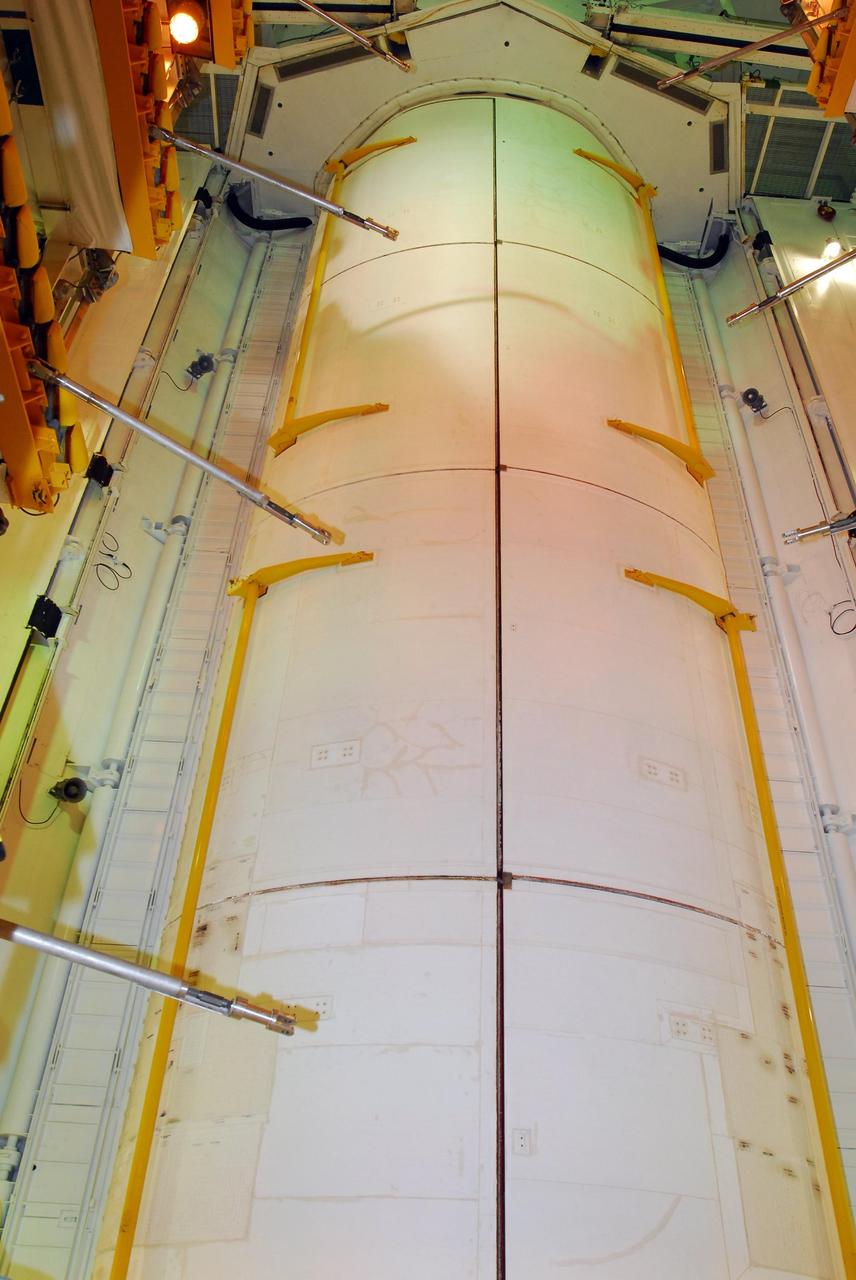
KENNEDY SPACE CENTER, FLA. -- At Launch Pad 39A, space shuttle Discovery's payload bay doors are closed around the U.S. Node 2 module, named Harmony. The name was chosen from an academic competition involving more than 2,200 U. S. students in kindergarten through high school. The module will be delivered to the International Space Station aboard Discovery on the 14-day STS-120 mission. An orbiter's payload bay door closure at the pad is a milestone signaling that the launch date is near. Discovery's launch is targeted for Oct. 23 at 11:38 a.m. EDT. Photo credit: NASA/George Shelton
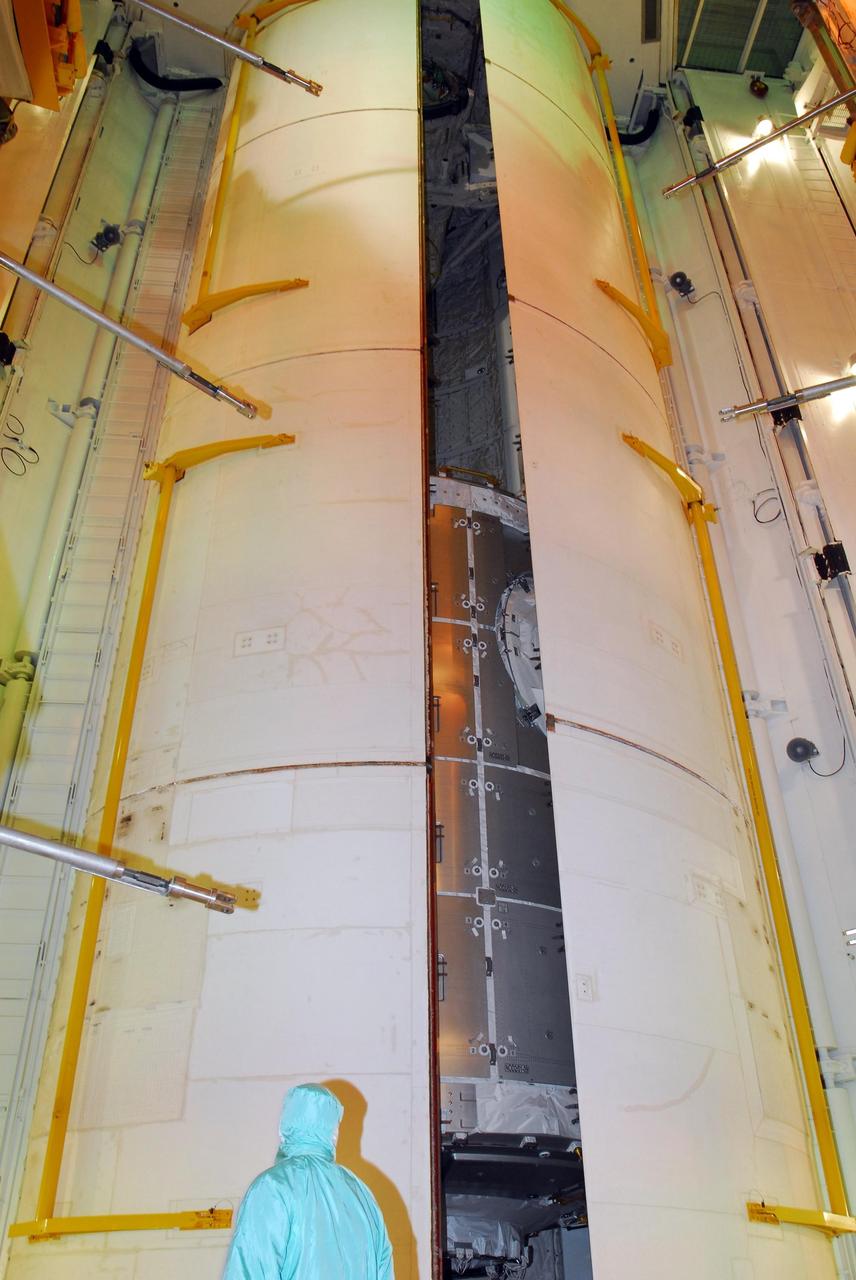
KENNEDY SPACE CENTER, FLA. -- At Launch Pad 39A, space shuttle Discovery's payload bay doors are nearly closed around the U.S. Node 2 module, named Harmony. The name was chosen from an academic competition involving more than 2,200 U. S. students in kindergarten through high school. The module will be delivered to the International Space Station aboard Discovery on the 14-day STS-120 mission. An orbiter's payload bay door closure at the pad is a milestone signaling that the launch date is near. Discovery's launch is targeted for Oct. 23 at 11:38 a.m. EDT. Photo credit: NASA/George Shelton
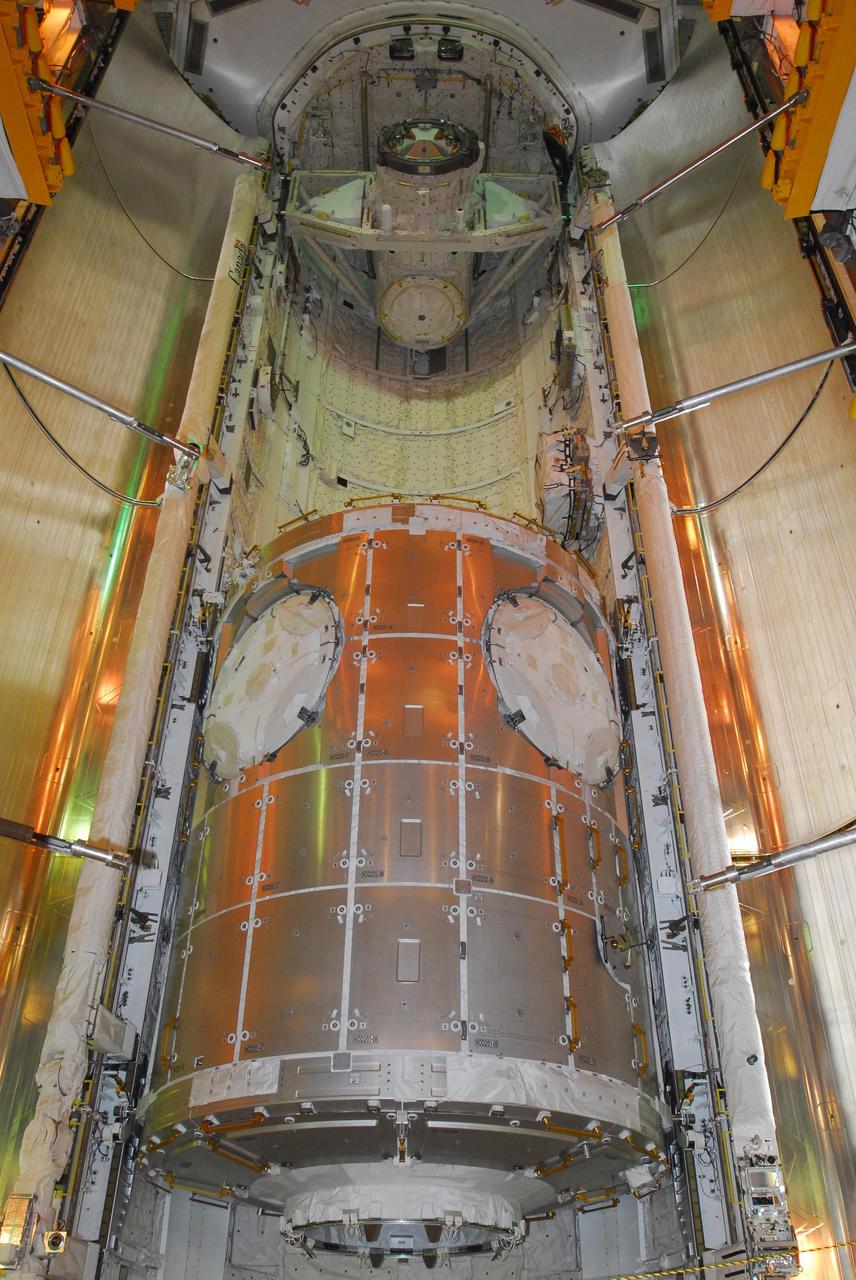
KENNEDY SPACE CENTER, FLA. -- At Launch Pad 39A, space shuttle Discovery's payload bay doors begin to close around the U.S. Node 2 module, named Harmony. The name was chosen from an academic competition involving more than 2,200 U. S. students in kindergarten through high school. The module will be delivered to the International Space Station aboard Discovery on the 14-day STS-120 mission. An orbiter's payload bay door closure at the pad is a milestone signaling that the launch date is near. Discovery's launch is targeted for Oct. 23 at 11:38 a.m. EDT. Photo credit: NASA/George Shelton
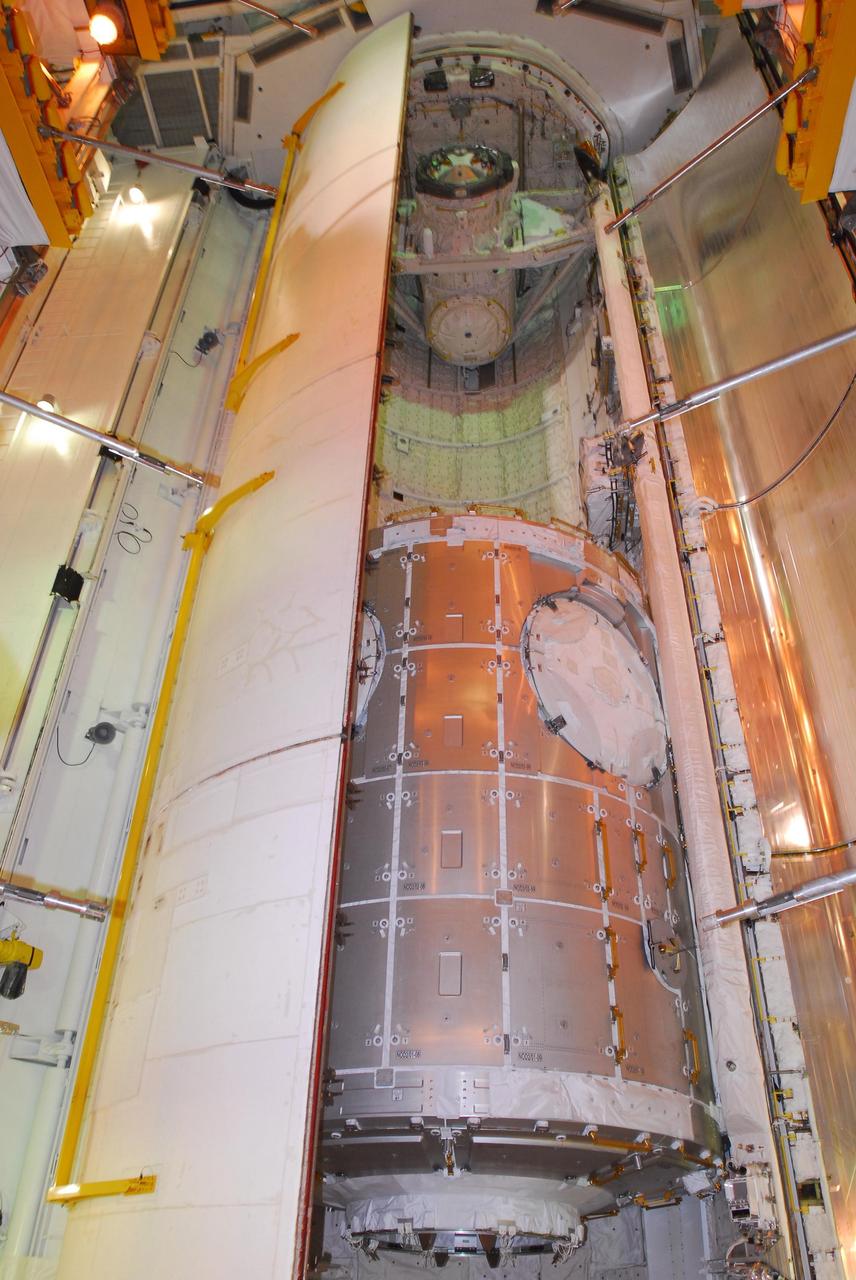
KENNEDY SPACE CENTER, FLA. -- At Launch Pad 39A, space shuttle Discovery's payload bay doors are partially closed around the U.S. Node 2 module, named Harmony. The name was chosen from an academic competition involving more than 2,200 U. S. students in kindergarten through high school. The module will be delivered to the International Space Station aboard Discovery on the 14-day STS-120 mission. An orbiter's payload bay door closure at the pad is a milestone signaling that the launch date is near. Discovery's launch is targeted for Oct. 23 at 11:38 a.m. EDT. Photo credit: NASA/George Shelton
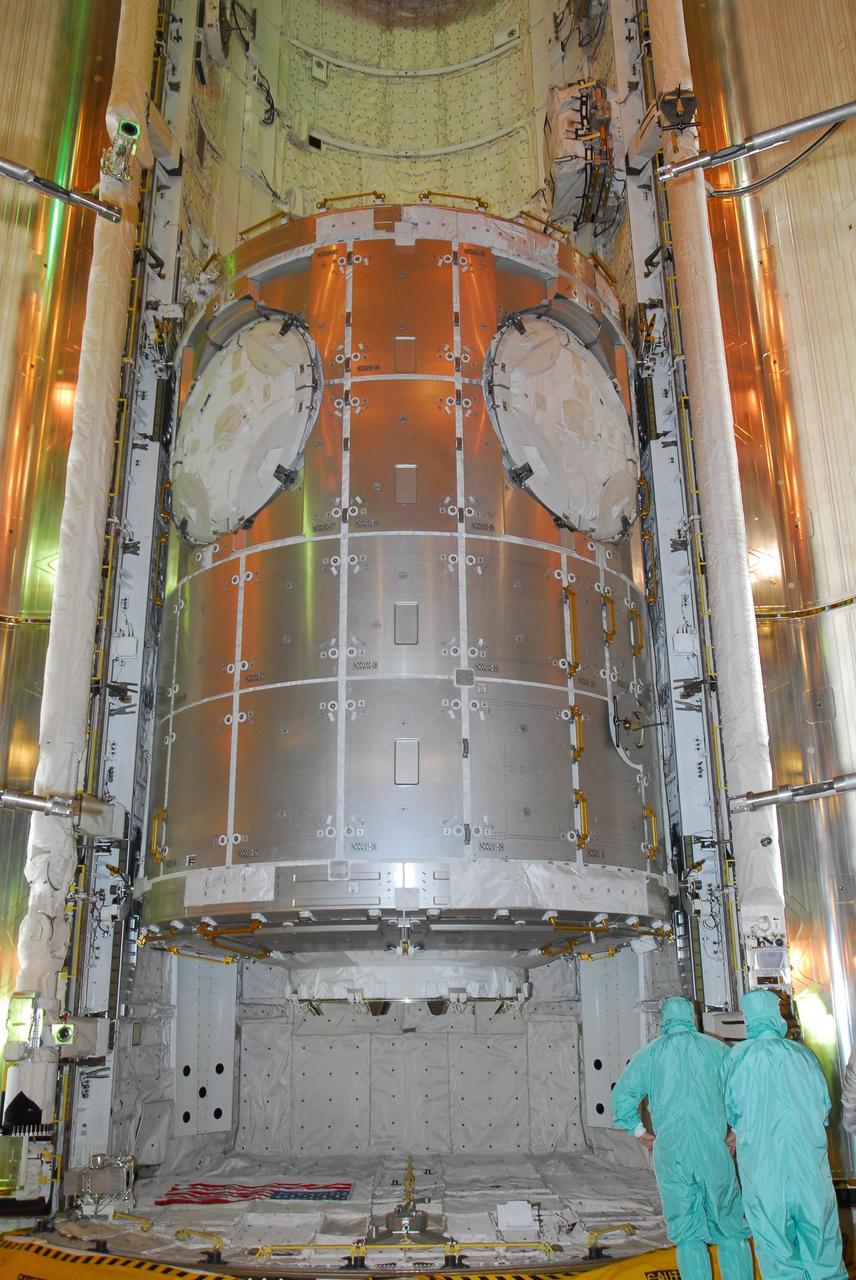
KENNEDY SPACE CENTER, FLA. -- At Launch Pad 39A, preparations are under way to close space shuttle Discovery's payload bay doors around the U.S. Node 2 module, named Harmony. The name was chosen from an academic competition involving more than 2,200 U. S. students in kindergarten through high school. The module will be delivered to the International Space Station aboard Discovery on the 14-day STS-120 mission. An orbiter's payload bay door closure at the pad is a milestone signaling that the launch date is near. Discovery's launch is targeted for Oct. 23 at 11:38 a.m. EDT. Photo credit: NASA/George Shelton
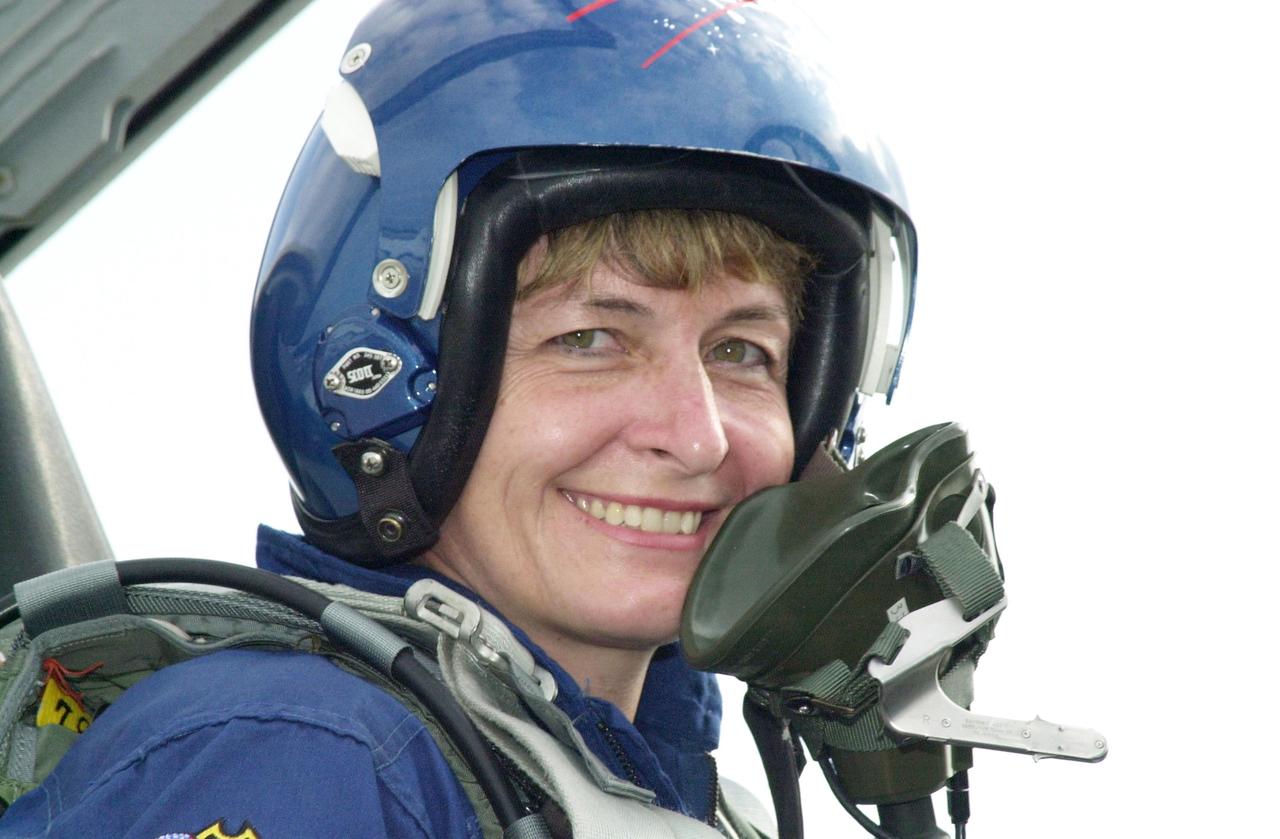
KENNEDY SPACE CENTER, FLA. -- Expedition 5 crew member Peggy Whitson arrives at KSC aboard a T-38 jet aircraft to take part in Terminal Countdown Demonstration Test (TCDT) activities, along with the Shuttle crew, for launch of mission STS-111. Expedition 5 will travel on Space Shuttle Endeavour to the International Space Station as a replacement crew for Expedition 4. The TCDT is a rehearsal for launch and includes emergency egress training, familiarization with payload and a simulated launch countdown. Mission STS-111 is a utilization flight that will deliver equipment and supplies to the Station. Along with the Multi-Purpose Logisitics Module Leonardo, the payload includes the Mobile Base System, part of the Canadian SSRMS and an Orbital Replacement Unit, the replacement wrist/roll joint for the SSRMS (Canadarm2). Launch of Endeavour is scheduled for May 30, 2002
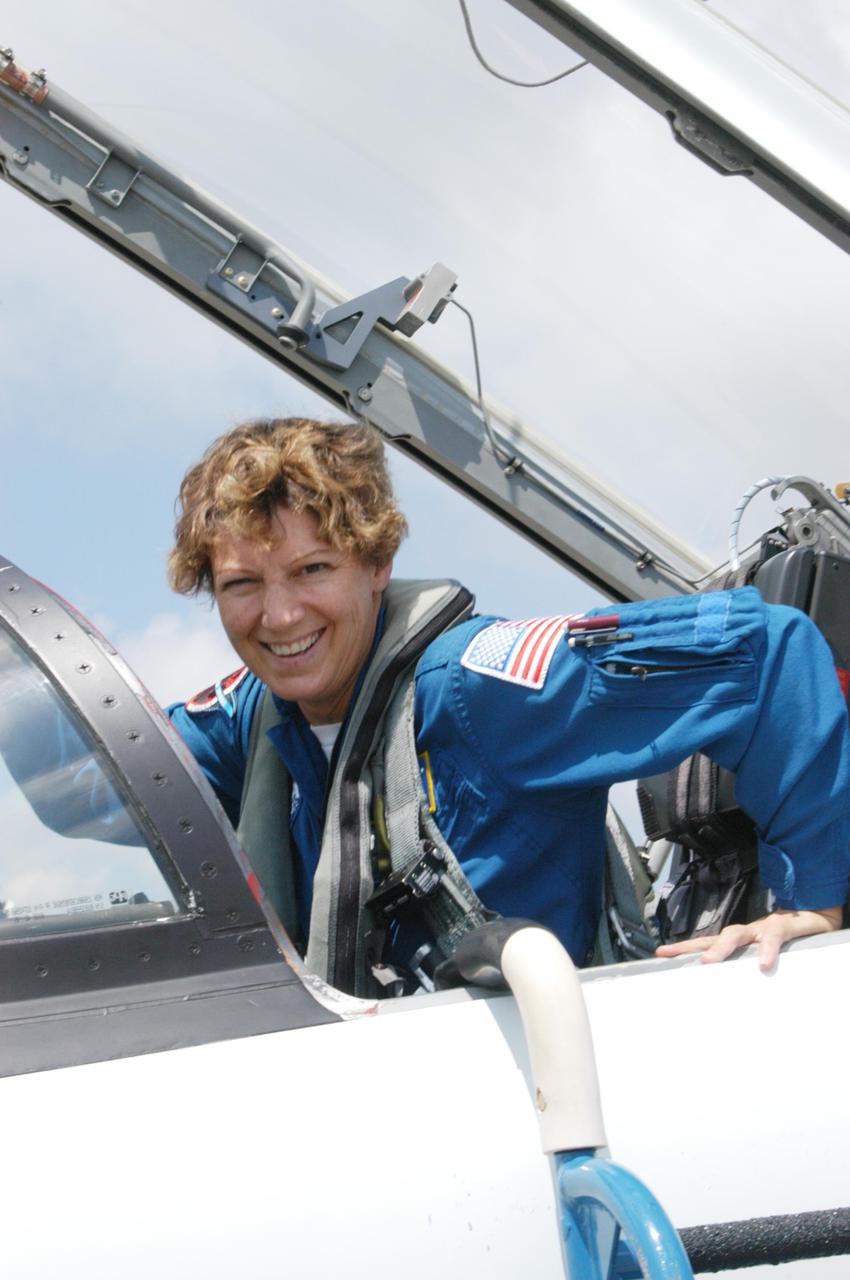
KENNEDY SPACE CENTER, FLA. - The Return to Flight STS-114 crew arrives at NASA Kennedy Space Center in T-38 training jets to get ready for a second launch attempt aboard Space Shuttle Discovery. Mission Commander Eileen Collins, climbing out of her jet, later told the media who waited nearby that since the scrub on July 13, the crew has focused on the on-orbit part of the mission and training for night landings using the Shuttle Training Aircraft. She praised the engineers and technicians who have been troubleshooting the elusive sensor problem and thanked them. STS-114 is scheduled to launch July 26 at 10:39 a.m. EDT from Launch Pad 39B.
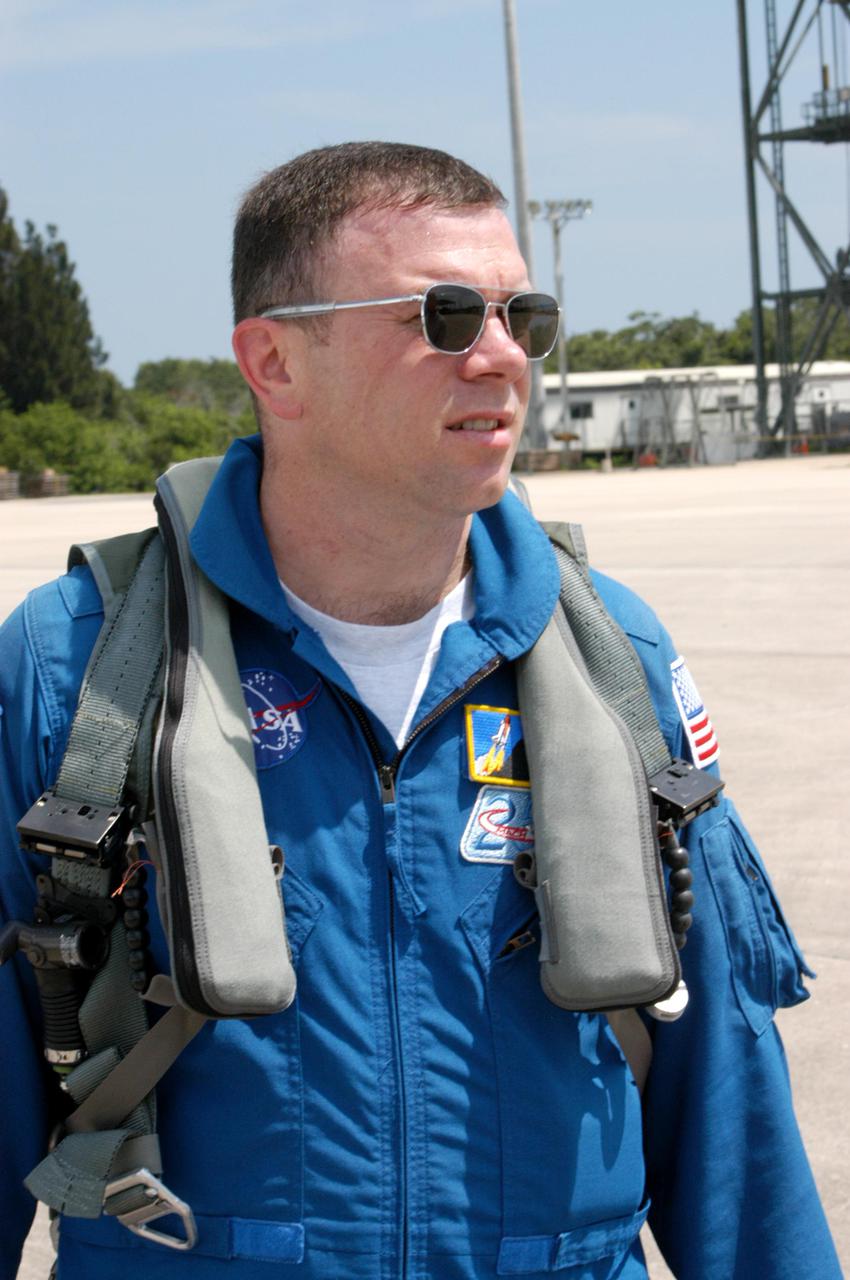
KENNEDY SPACE CENTER, FLA. - The Return to Flight STS-114 crew arrives at NASA Kennedy Space Center in T-38 training jets to get ready for a second launch attempt aboard Space Shuttle Discovery. Seen in the photo is Pilot James Kelly. Mission Commander Eileen Collins later told the media who waited nearby that since the scrub on July 13, the crew has focused on the on-orbit part of the mission and training for night landings using the Shuttle Training Aircraft. She praised the engineers and technicians who have been troubleshooting the elusive sensor problem and thanked them. STS-114 is scheduled to launch July 26 at 10:39 a.m. EDT from Launch Pad 39B.
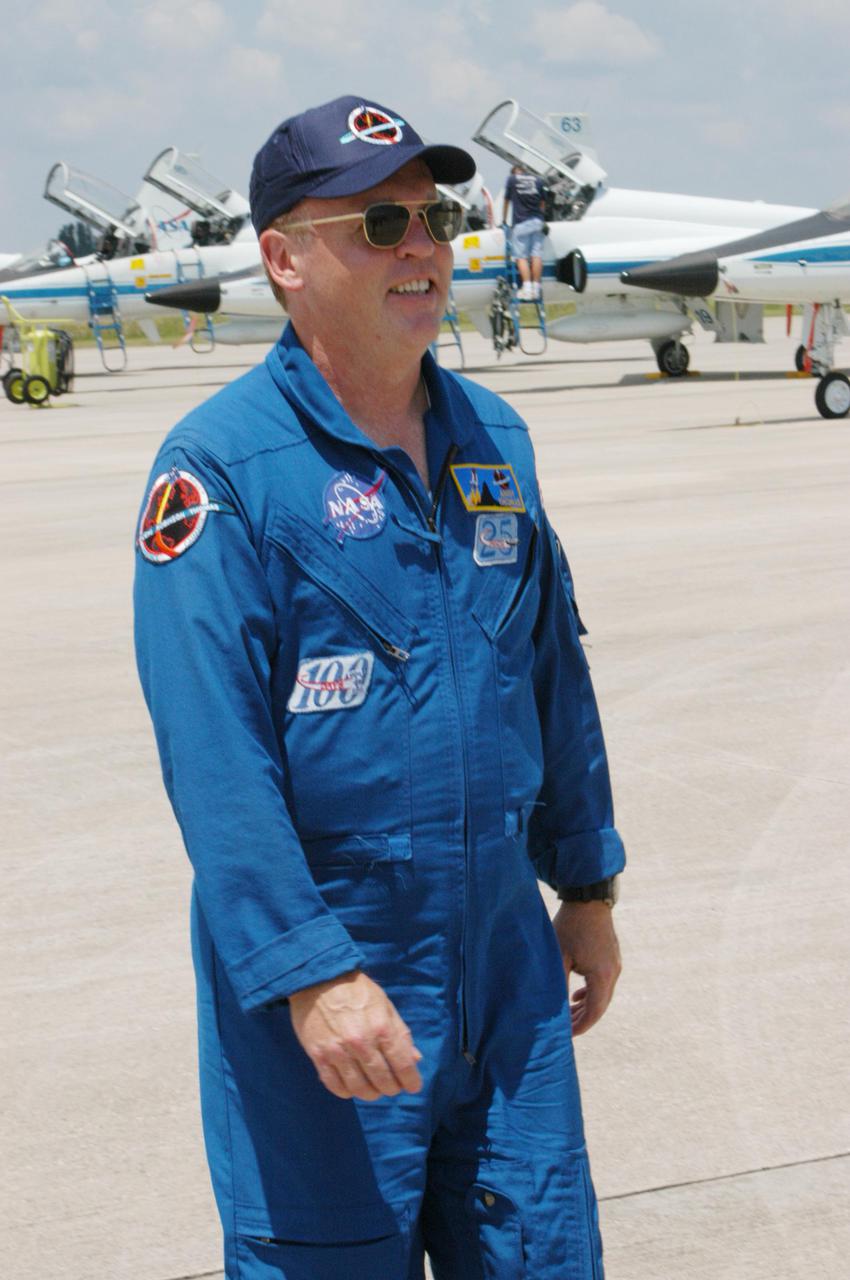
KENNEDY SPACE CENTER, FLA. - The Return to Flight STS-114 crew arrives at NASA Kennedy Space Center in T-38 training jets to get ready for a second launch attempt aboard Space Shuttle Discovery. Seen in the photo is Mission Specialist Andrew Thomas. Mission Commander Eileen Collins talked to the media waiting nearby stating that since the scrub on July 13, the crew has focused on the on-orbit part of the mission and training for night landings using the Shuttle Training Aircraft. She praised the engineers and technicians who have been troubleshooting the elusive sensor problem and thanked them. STS-114 is scheduled to launch July 26 at 10:39 a.m. EDT from Launch Pad 39B.
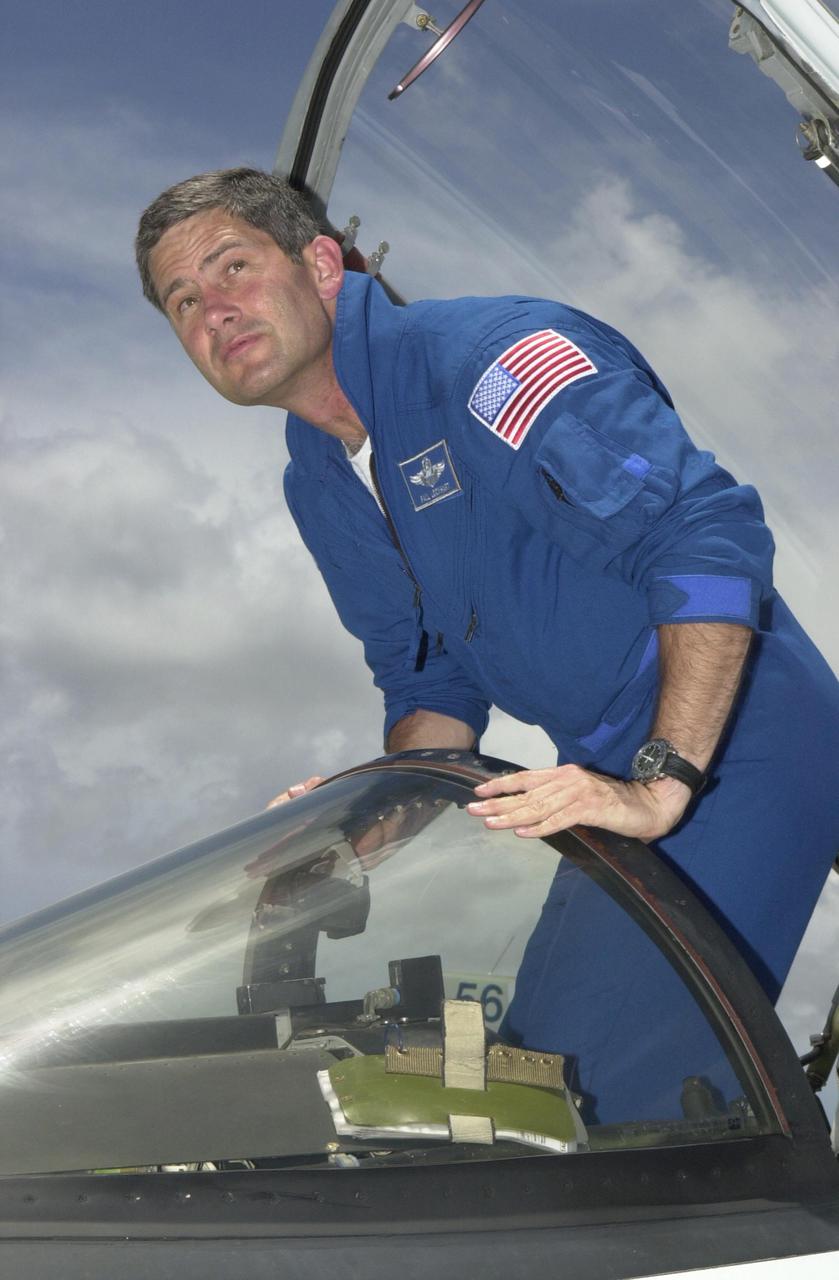
KENNEDY SPACE CENTER, FLA. - At the KSC Shuttle Landing Facility, STS-111 Pilot Paul Lockhart climbs out of the T-38 jet aircraft that he flew from Houston to prepare for launch. Mission STS-111, known as Utilization Flight 2, is carrying supplies and equipment to the International Space Station. The payload includes the Multi-Purpose Logistics Module Leonardo, the Mobile Base System, which will be installed on the Mobile Transporter to complete the Canadian Mobile Servicing System, or MSS, and a replacement wrist_roll joint for Canadarm 2. The mechanical arm will then have the capability to 'inchworm' from the U.S. Lab Destiny to the MSS and travel along the truss to work sites. Also on board will be Expedition 5, traveling to the Station on Space Shuttle Endeavour as the replacement crew for Expedition 4, who will return to Earth aboard the orbiter. Launch is scheduled for May 30, 2002

KENNEDY SPACE CENTER, FLA. - The Return to Flight STS-114 crew arrives at NASA Kennedy Space Center in T-38 training jets to get ready for a second launch attempt aboard Space Shuttle Discovery. Seen in the photo is Mission Specialist Charles Camarda. Mission Commander Eileen Collins later told the media who waited nearby that since the scrub on July 13, the crew has focused on the on-orbit part of the mission and training for night landings using the Shuttle Training Aircraft. She praised the engineers and technicians who have been troubleshooting the elusive sensor problem and thanked them. STS-114 is scheduled to launch July 26 at 10:39 a.m. EDT from Launch Pad 39B.
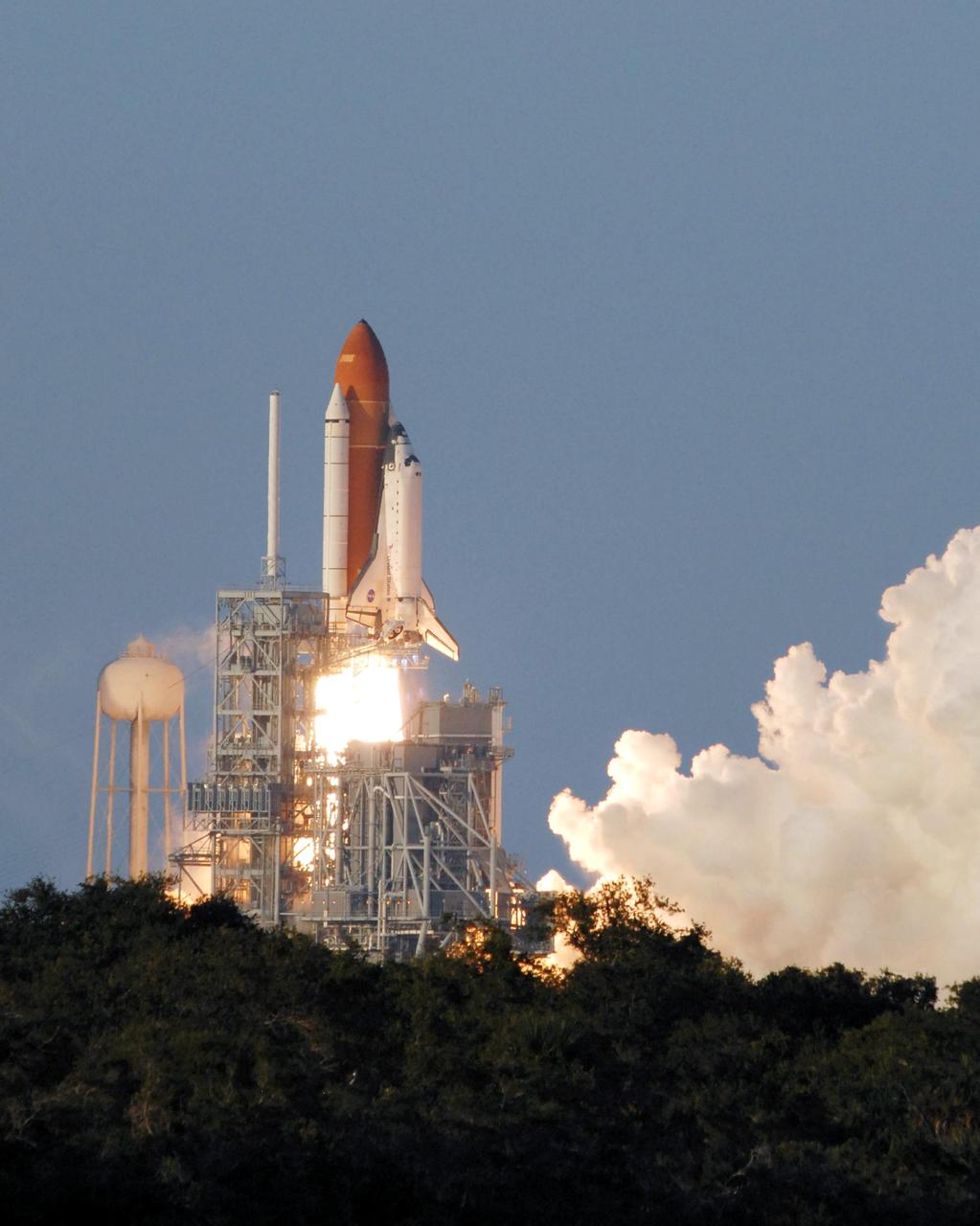
STS117-S-010 (8 June 2007) --- The Space Shuttle Atlantis and its seven-member STS-117 crew head toward Earth-orbit and a scheduled link-up with the International Space Station. Liftoff from Kennedy Space Center's launch pad 39A occurred at 7:38 p.m. (EDT) on June 8, 2007. Onboard are astronauts Rick Sturckow, commander; Lee Archambault, pilot; Jim Reilly, Patrick Forrester, John "Danny" Olivas, Steven Swanson and Clayton Anderson, all mission specialists. Anderson will join Expedition 15 in progress to serve as a flight engineer aboard the station. Atlantis will dock with the orbital outpost on Sunday, June 10, to begin a joint mission that will increase the complex's power generation capability. Using the shuttle and station robotic arms and conducting three scheduled spacewalks, the astronauts will install another set of giant solar array wings on the station and retract another array, preparing it for a future move.
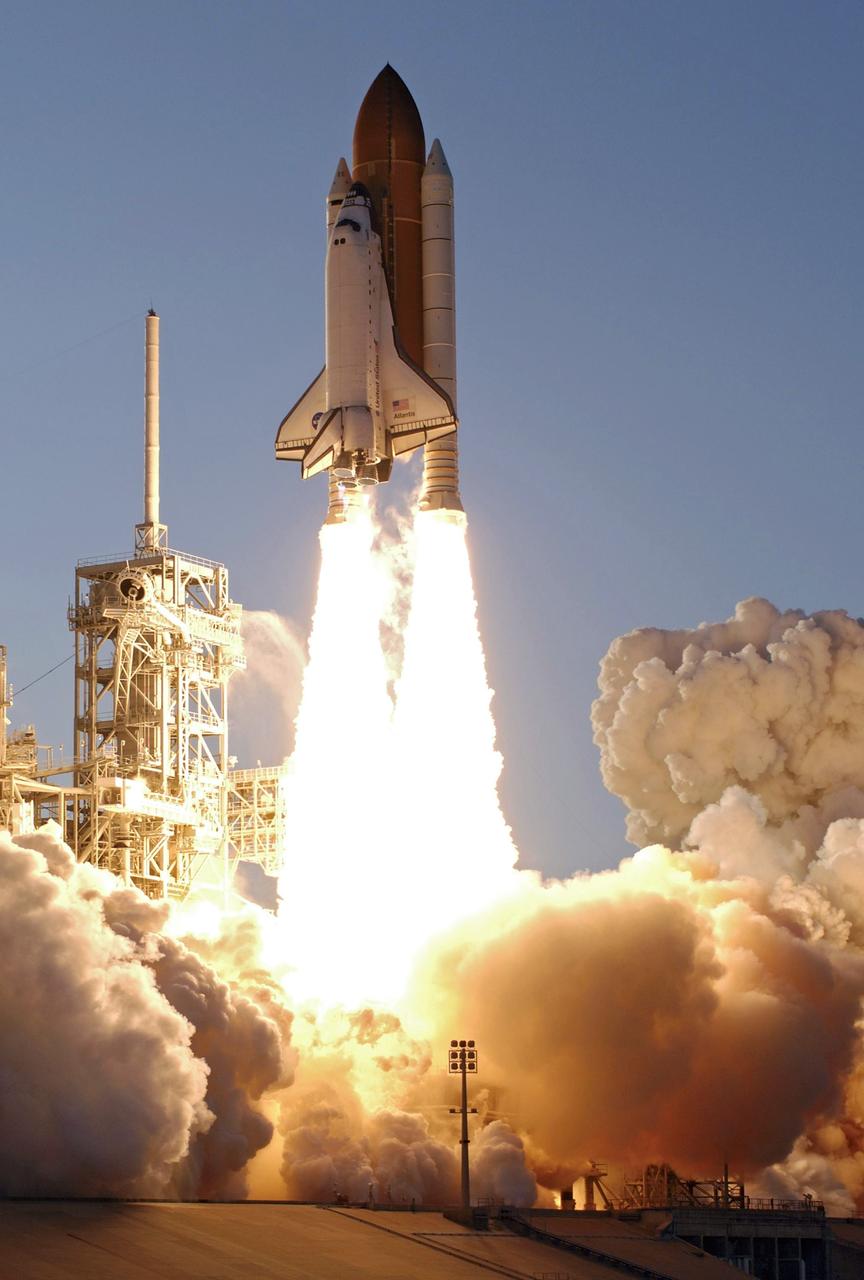
STS117-S-026 (8 June 2007) --- The Space Shuttle Atlantis and its seven-member STS-117 crew head toward Earth-orbit and a scheduled link-up with the International Space Station. Liftoff from Kennedy Space Center's launch pad 39A occurred at 7:38 p.m. (EDT) on June 8, 2007. Onboard are astronauts Rick Sturckow, commander; Lee Archambault, pilot; Jim Reilly, Patrick Forrester, John "Danny" Olivas, Steven Swanson and Clayton Anderson, all mission specialists. Anderson will join Expedition 15 in progress to serve as a flight engineer aboard the station. Atlantis will dock with the orbital outpost on Sunday, June 10, to begin a joint mission that will increase the complex's power generation capability. Using the shuttle and station robotic arms and conducting three scheduled spacewalks, the astronauts will install another set of giant solar array wings on the station and retract another array, preparing it for a future move.
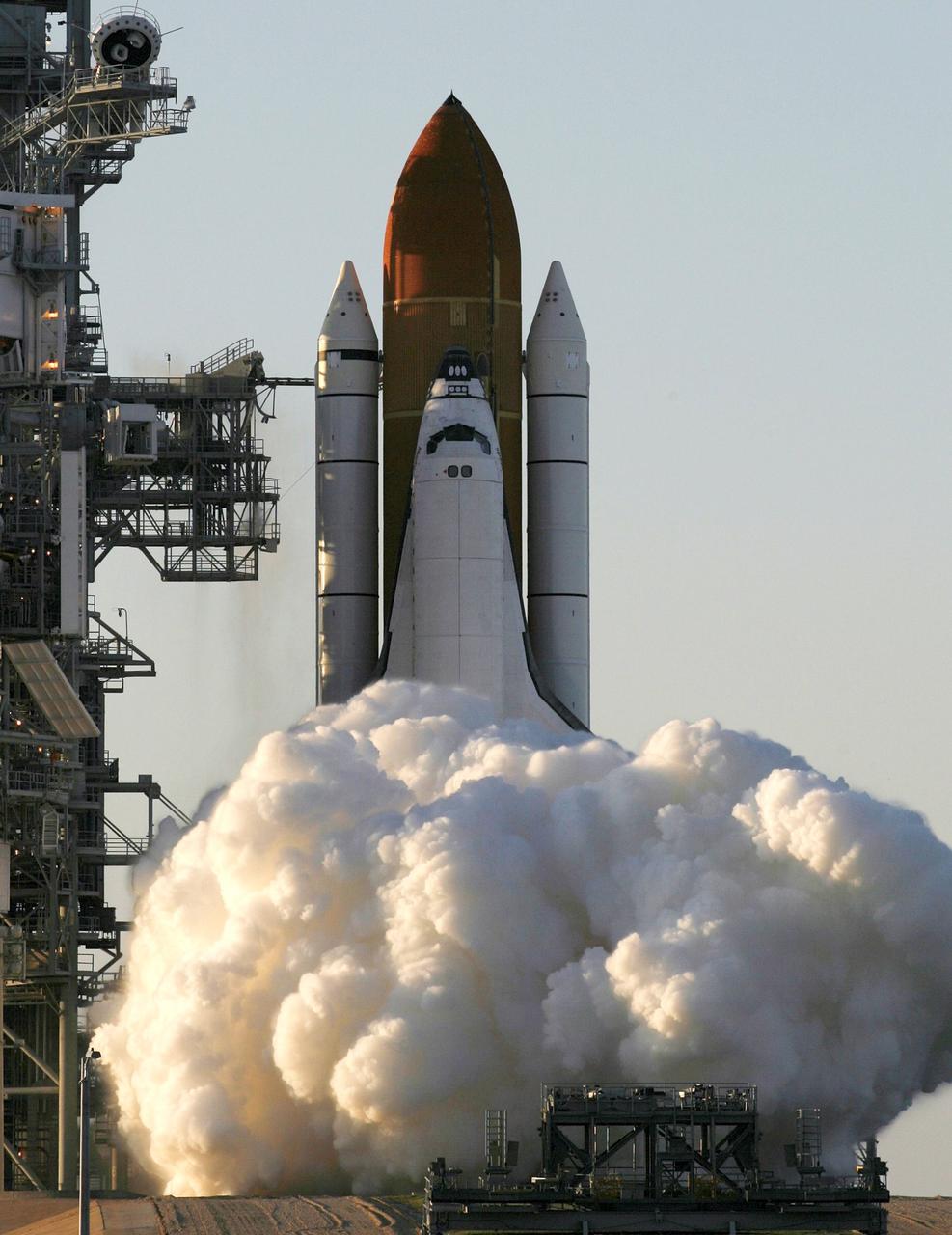
STS117-S-015 (8 June 2007) --- The Space Shuttle Atlantis and its seven-member STS-117 crew head toward Earth-orbit and a scheduled link-up with the International Space Station. Liftoff from Kennedy Space Center's launch pad 39A occurred at 7:38 p.m. (EDT) on June 8, 2007. Onboard are astronauts Rick Sturckow, commander; Lee Archambault, pilot; Jim Reilly, Patrick Forrester, John "Danny" Olivas, Steven Swanson and Clayton Anderson, all mission specialists. Anderson will join Expedition 15 in progress to serve as a flight engineer aboard the station. Atlantis will dock with the orbital outpost on Sunday, June 10, to begin a joint mission that will increase the complex's power generation capability. Using the shuttle and station robotic arms and conducting three scheduled spacewalks, the astronauts will install another set of giant solar array wings on the station and retract another array, preparing it for a future move.
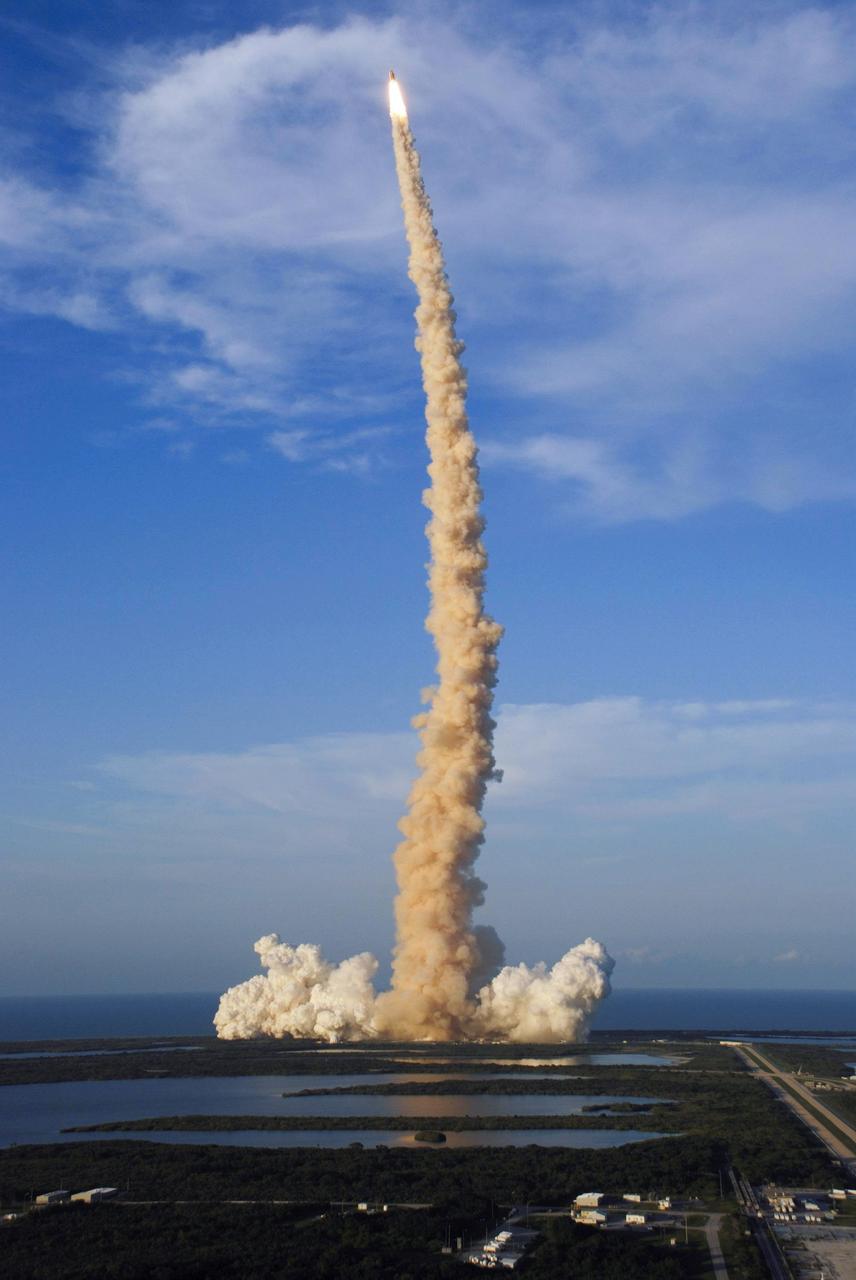
STS117-S-017 (8 June 2007) --- The Space Shuttle Atlantis and its seven-member STS-117 crew head toward Earth-orbit and a scheduled link-up with the International Space Station. Liftoff from Kennedy Space Center's launch pad 39A occurred at 7:38 p.m. (EDT) on June 8, 2007. Onboard are astronauts Rick Sturckow, commander; Lee Archambault, pilot; Jim Reilly, Patrick Forrester, John "Danny" Olivas, Steven Swanson and Clayton Anderson, all mission specialists. Anderson will join Expedition 15 in progress to serve as a flight engineer aboard the station. Atlantis will dock with the orbital outpost on Sunday, June 10, to begin a joint mission that will increase the complex's power generation capability. Using the shuttle and station robotic arms and conducting three scheduled spacewalks, the astronauts will install another set of giant solar array wings on the station and retract another array, preparing it for a future move.