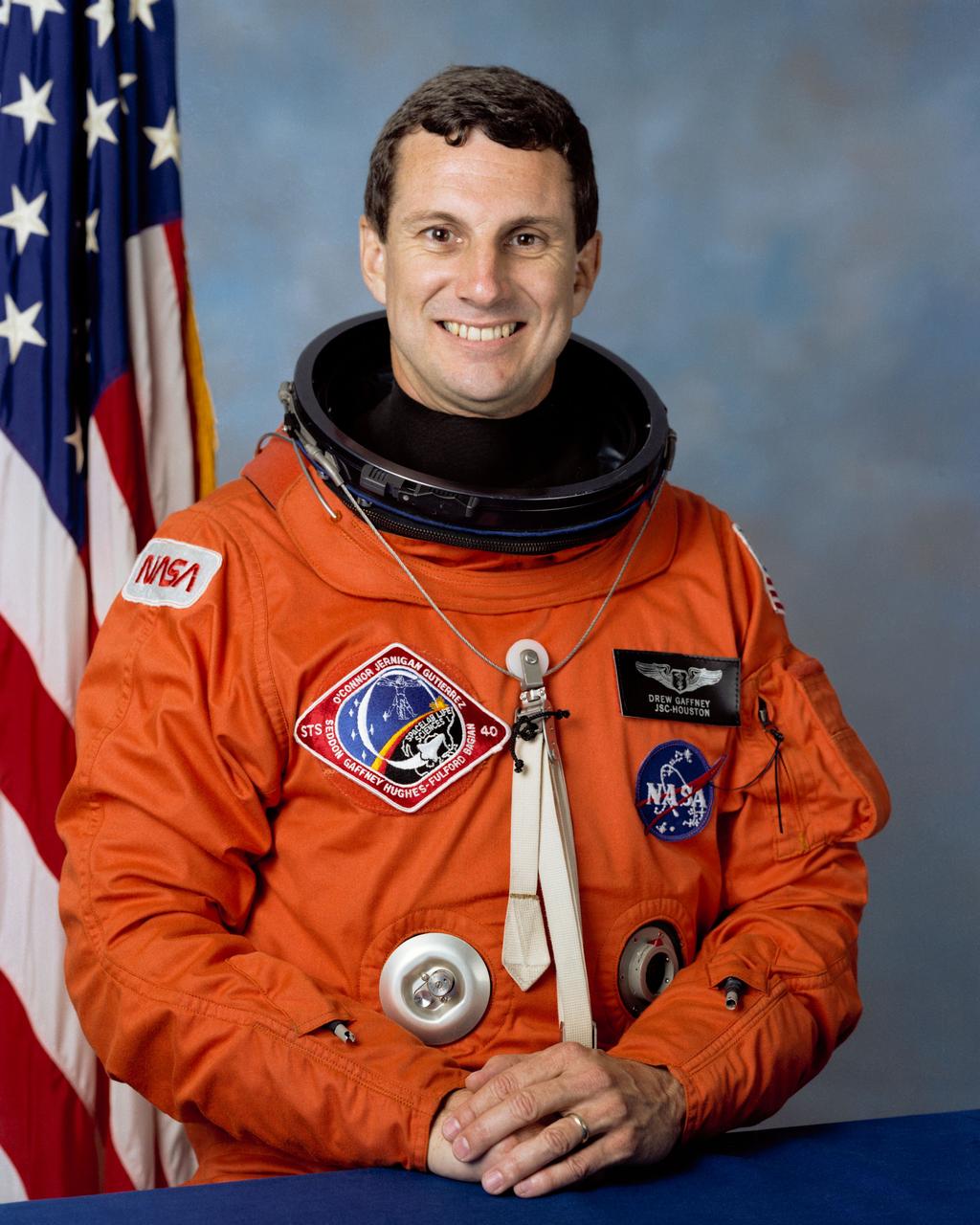
S90-41128 (October 1990) --- Astronaut Francis D. (Drew) Gaffney, Payload Specialist in training for SLS-1 (STS-40)
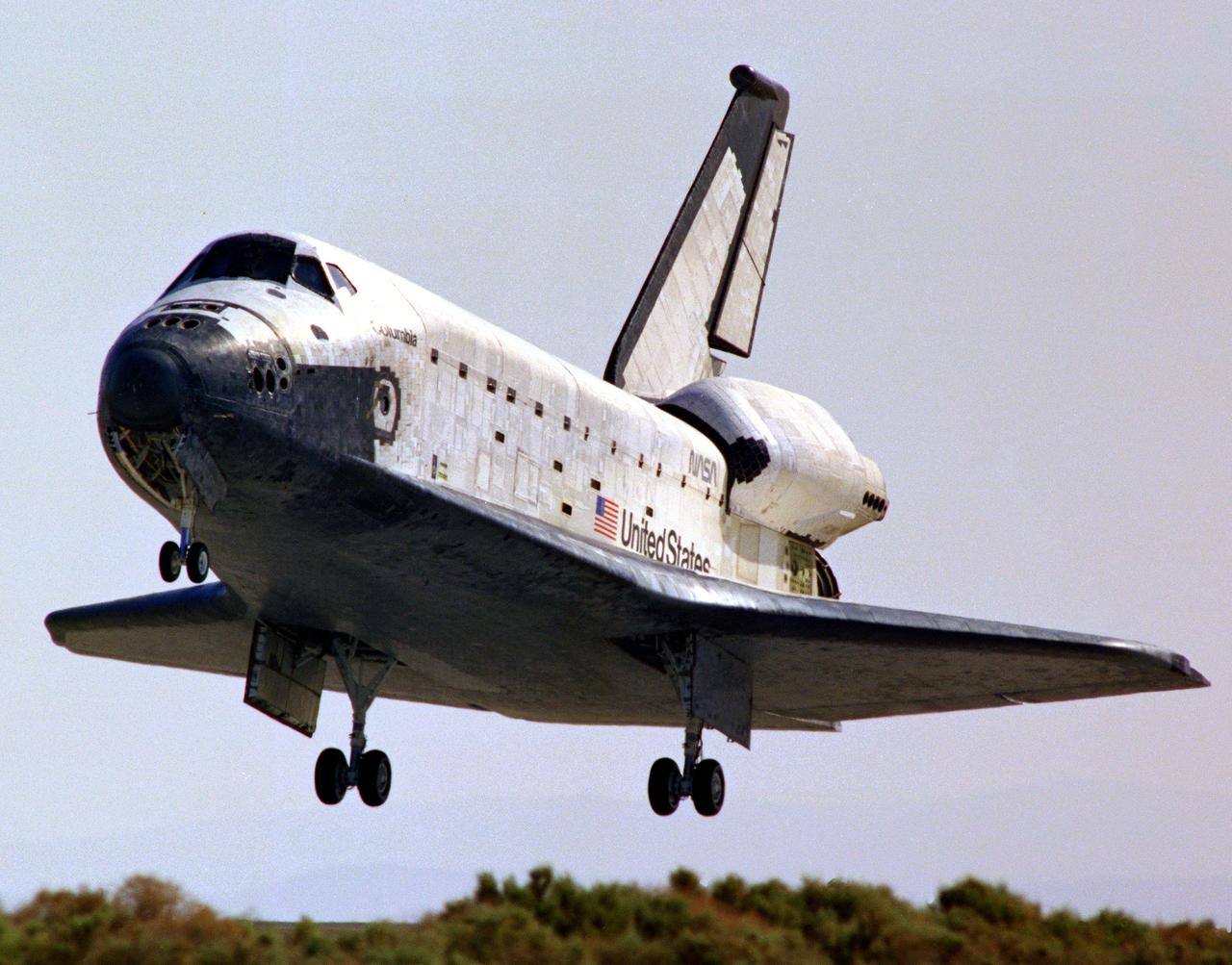
Space Shuttle Columbia nears its touchdown on Runway 22 at Edwards, California, at 8:39 a.m., 14 June 1991, as the STS-40 life sciences mission comes to an end at NASA's Ames-Dryden Flight Research Facility (later redesignated Dryden Flight Research Center) after nine days of orbital flight. Aboard Columbia during the extended mission were Bryan D. O'Connor, mission commander; Sidney M. Gutierrez, pilot; mission specialists James P. Bagian, Tamara E. Jernigan, and Margaret Rhea Seddon; and payload specialists Francis Andrew Gaffney and Millie Hughes-Fulford. STS-40 was the first space shuttle mission dedicated to life sciences research to explore how the body reacts to a weightless environment and how it readjusts to gravity on return to earth. Columbia was launched on the STS-40 mission 5 June 1991, from Kennedy Space Center in Florida.
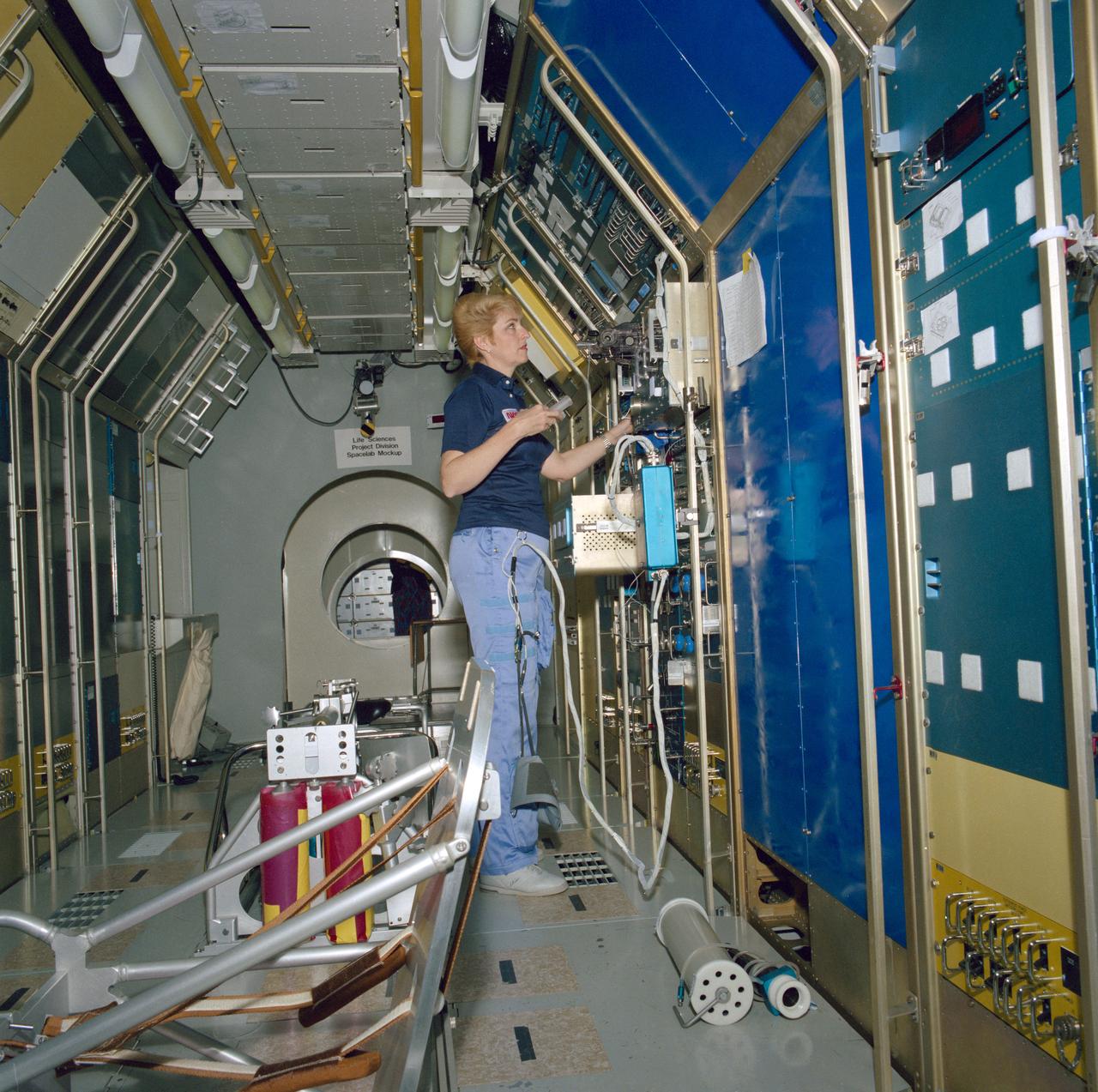
S87-28666 (March 1987) --- Millie Hughes-Fulford, STS-40/SLS-1 payload specialist, stands near the Echocardiograph on Rack 6 of the SLS-1 module, during a rehearsal of experimentation scheduled for her spaceflight.
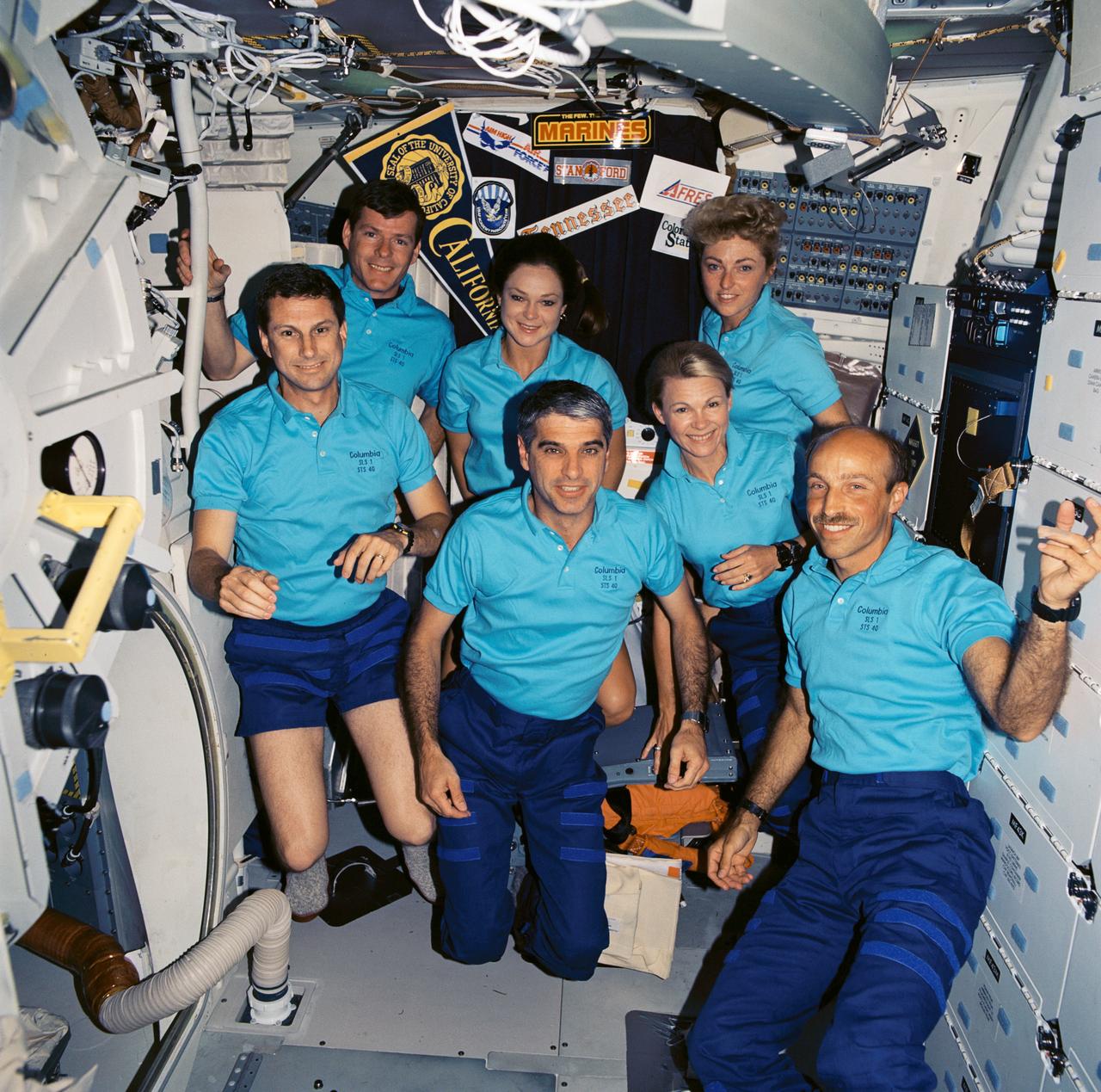
STS040-605-009 (5-14 June 1991) --- The seven crew members for STS-40 pose for an in-space portrait on the Space Shuttle Columbia's mid-deck. Left to right, in front are F. Andrew Gaffney, Sidney M. Gutierrez, Rhea Seddon and James P. Bagian; in back, Bryan D. O'Connor, Tamara E. Jernigan and Millie Hughes-Fulford. The five astronauts and two payload specialists are spending nine days in space in support of the Spacelab Life Sciences (SLS-1) mission. The image was one of 25 visuals used by the STS-40 crew at its Post Flight Press Conference (PFPC) on June 28, 1991.
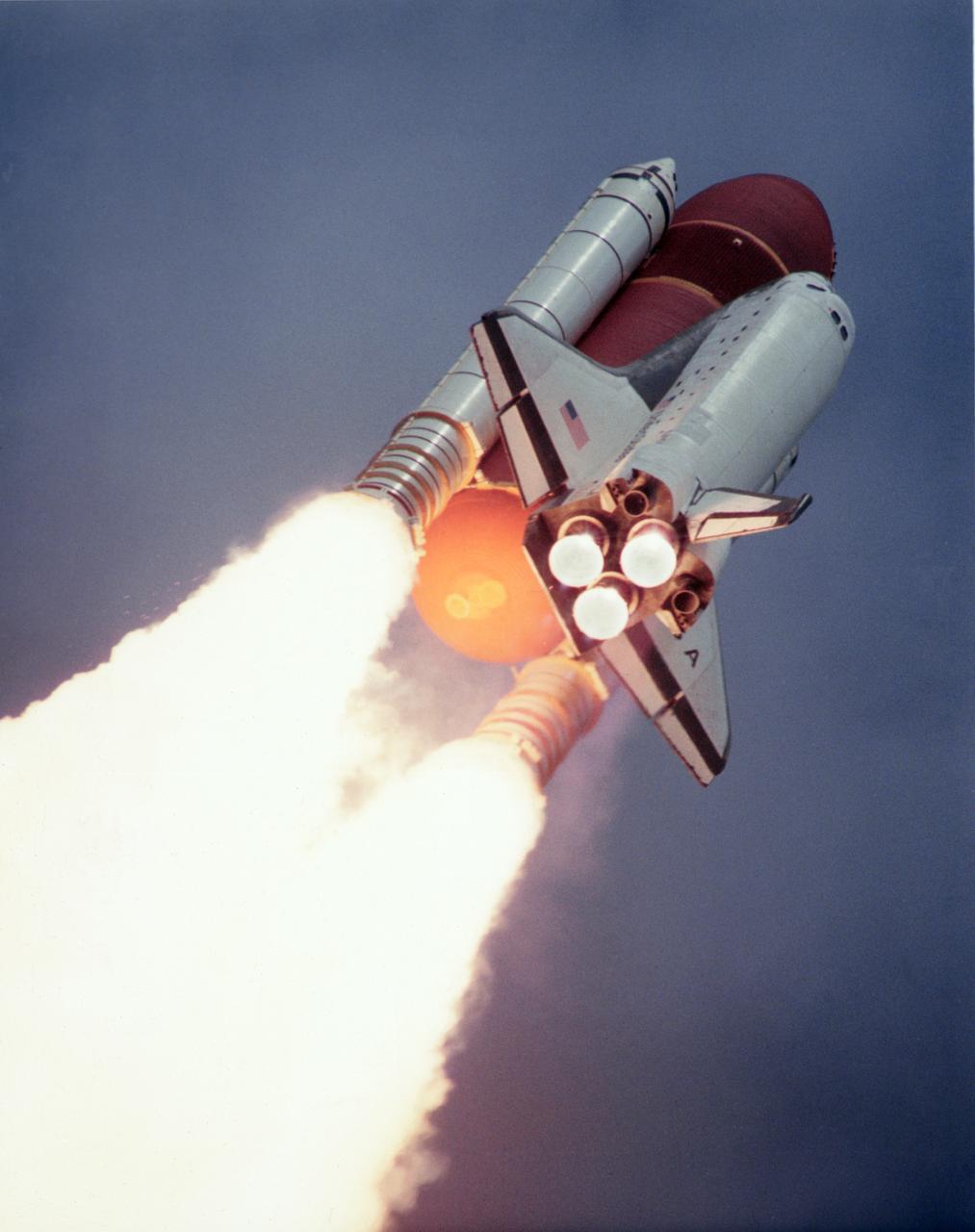
Launched aboard the Space Shuttle Columbia on June 5, 1991 at 9:24; am (EDT), the STS-40 mission was the fifth dedicated Spacelab Mission, Spacelab Life Sciences-1 (SLS-1), and the first mission dedicated solely to life sciences. The STS-40 crew included 7 astronauts: Bryan D. O’Connor, commander; Sidney M. Gutierrez, pilot; F. Drew Gaffney, payload specialist 1; Milli-Hughes Fulford, payload specialist 2; James P. Bagian, mission specialist 1; Tamara E. Jernigan, mission specialist 2; and M. Rhea Seddon, mission specialist 3.
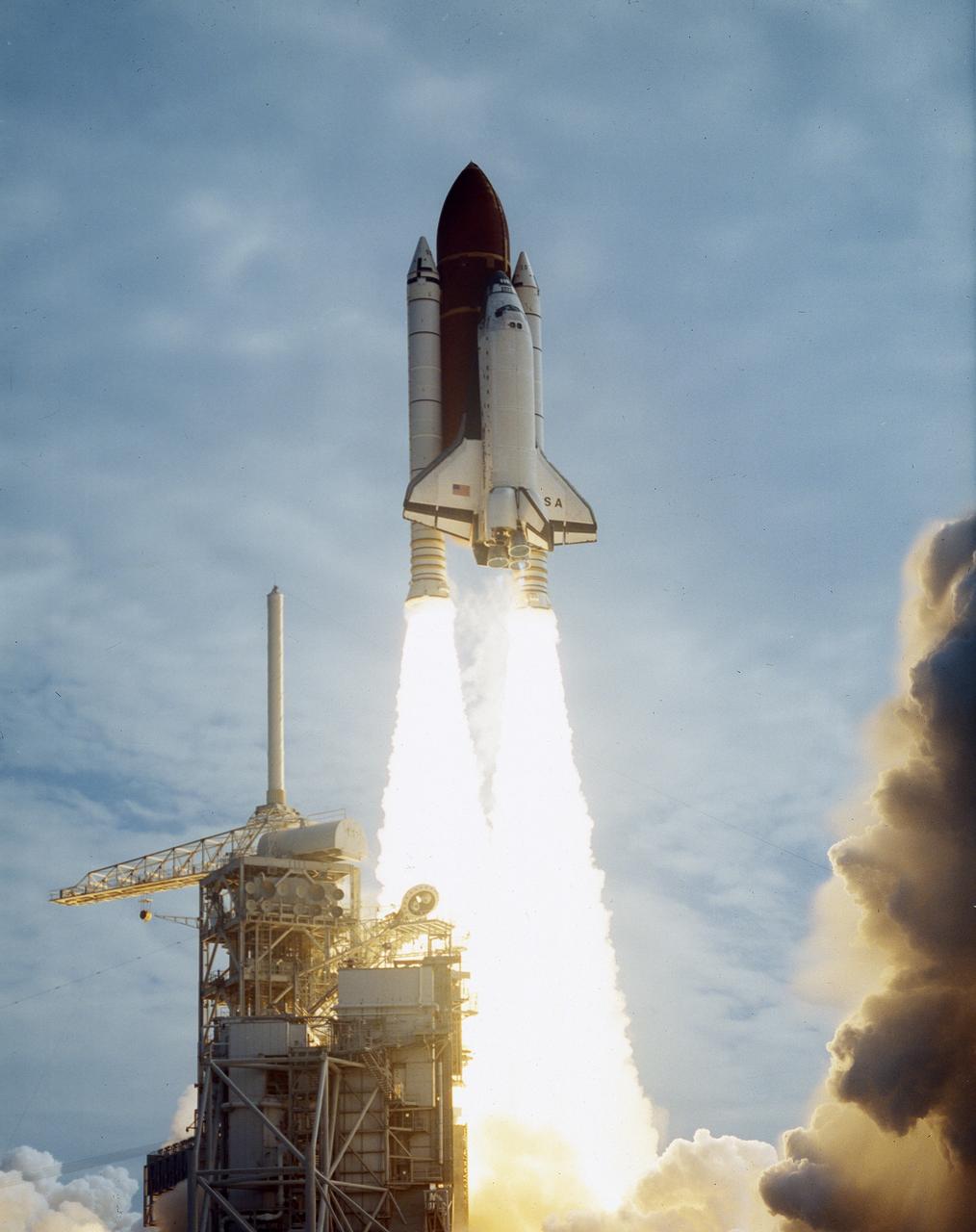
Launched aboard the Space Shuttle Columbia on June 5, 1991 at 9:24; am (EDT), the STS-40 mission was the fifth dedicated Spacelab Mission, Spacelab Life Sciences-1 (SLS-1), and the first mission dedicated solely to life sciences. The STS-40 crew included 7 astronauts: Bryan D. O’Connor, commander; Sidney M. Gutierrez, pilot; F. Drew Gaffney, payload specialist 1; Milli-Hughes Fulford, payload specialist 2; James P. Bagian, mission specialist 1; Tamara E. Jernigan, mission specialist 2; and M. Rhea Seddon, mission specialist 3.
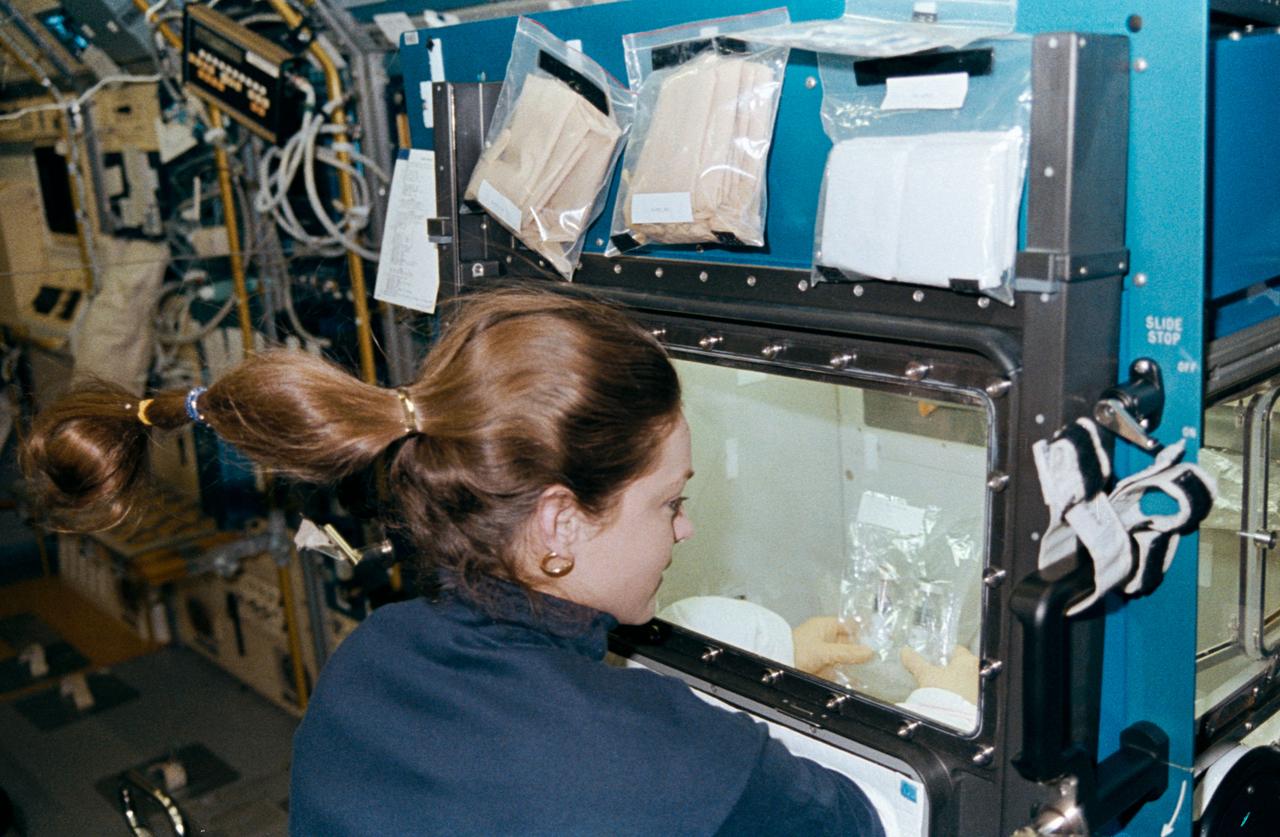
STS040-224-005 (5-14 June 1991) --- Astronaut Tamara E. Jernigan, STS-40 mission specialist, conducts an evaluation of the General Purpose Work Station (GPWS) in the Spacelab Life Sciences (SLS-1) module onboard the Earth-orbiting Space Shuttle Columbia. The photograph was taken with a 35mm camera.
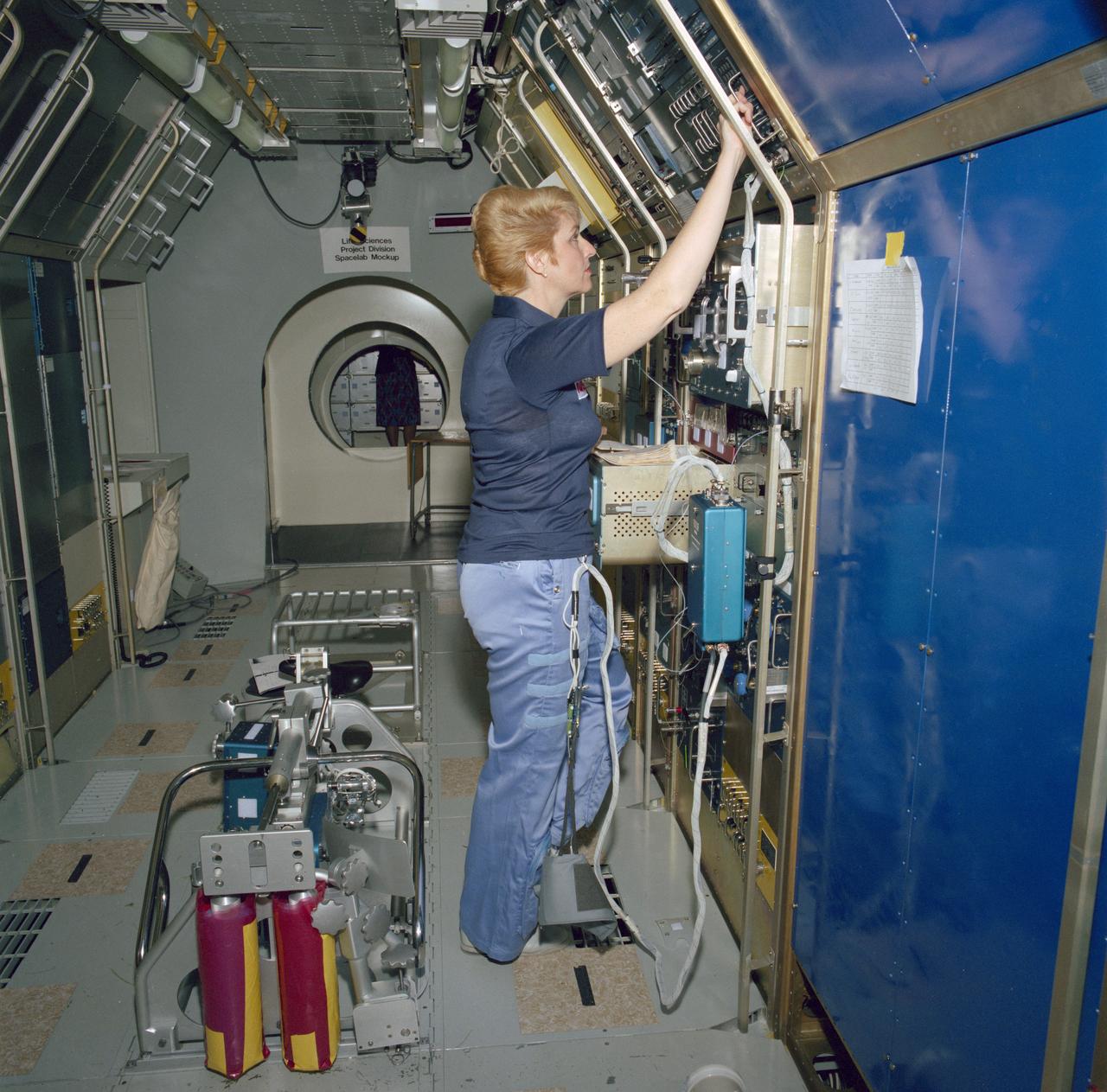
STS-40 Payload Specialist Millie Hughes-Fulford conducts Spacelab Life Sciences 1 (SLS-1) Experiment No. 198, Pulmonary Function During Weightlessness, in JSC's Life Sciences Project Division (LSPD) SLS mockup located in the Bioengineering and Test Support Facility Bldg 36. Hughes-Fulford sets switches on Rack 8. Behind her in the center aisle are the stowed bicycle ergometer (foreground) and the body restraint system.
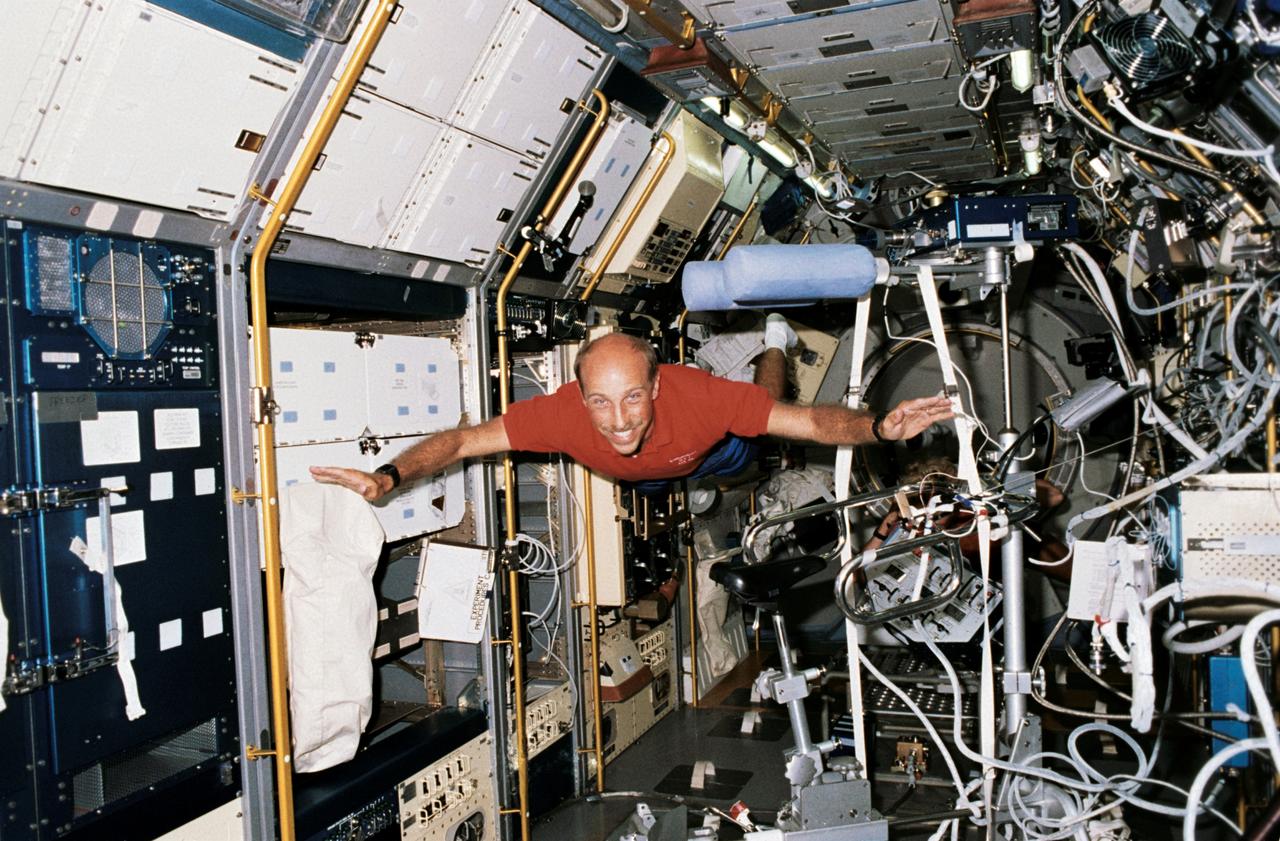
STS040-212-004 (5-14 June 1991) --- Astronaut James P. Bagian, STS-40 mission specialist, floats through the Spacelab Life Sciences (SLS-1) module aboard the Earth-orbiting Space Shuttle Columbia. Bagian and six other crew members spent over nine-days in space conducting life sciences research.
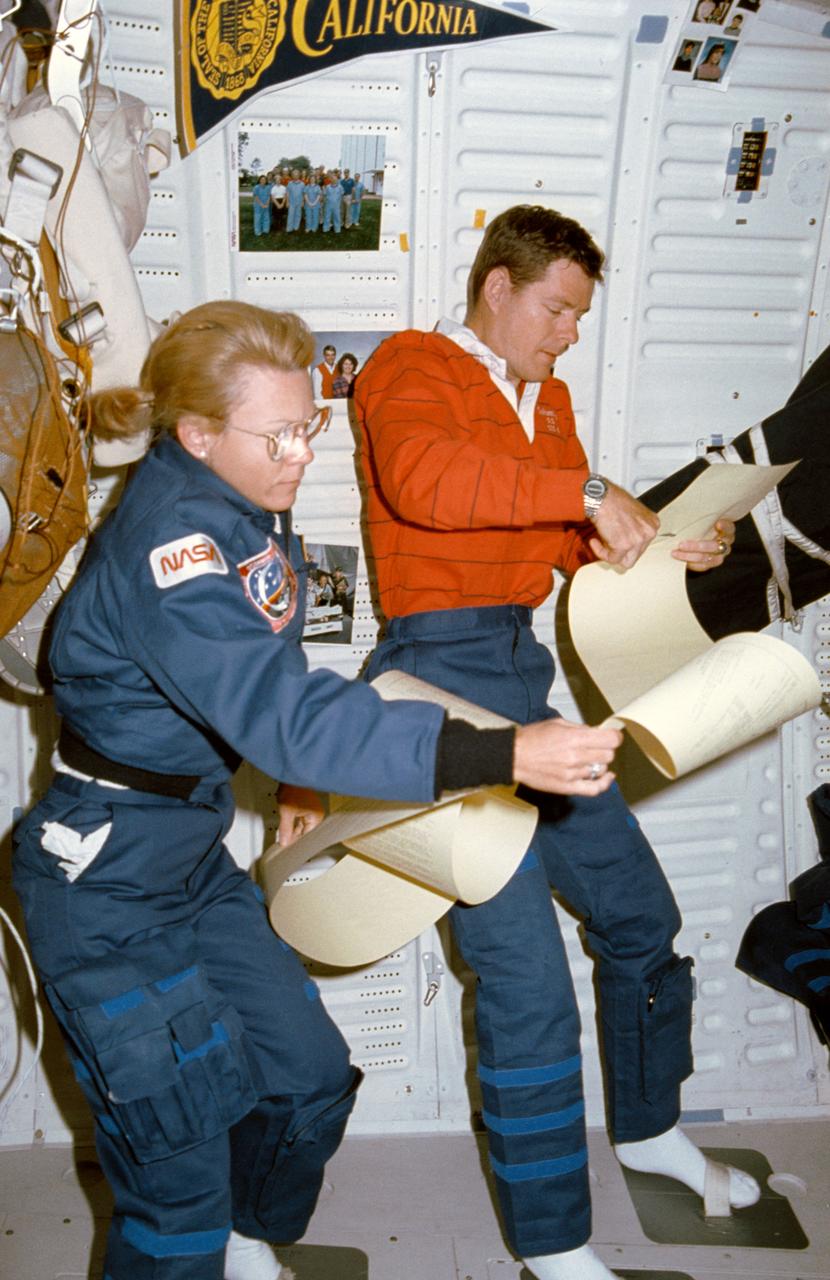
STS040-17-003 (5-14 June 1991) --- Astronauts Rhea Seddon and Bryan D. O'Connor share a 15 ft. length of teleprinter messages aboard Columbia. During the nine-day Spacelab Life Sciences (SLS-1) mission, the STS-40 crewmembers received a large volume of similar print-outs from ground controllers. Using foot restraints, the two obviously expect their perusing to take awhile. This middeck scene was photographed with a 35mm camera.
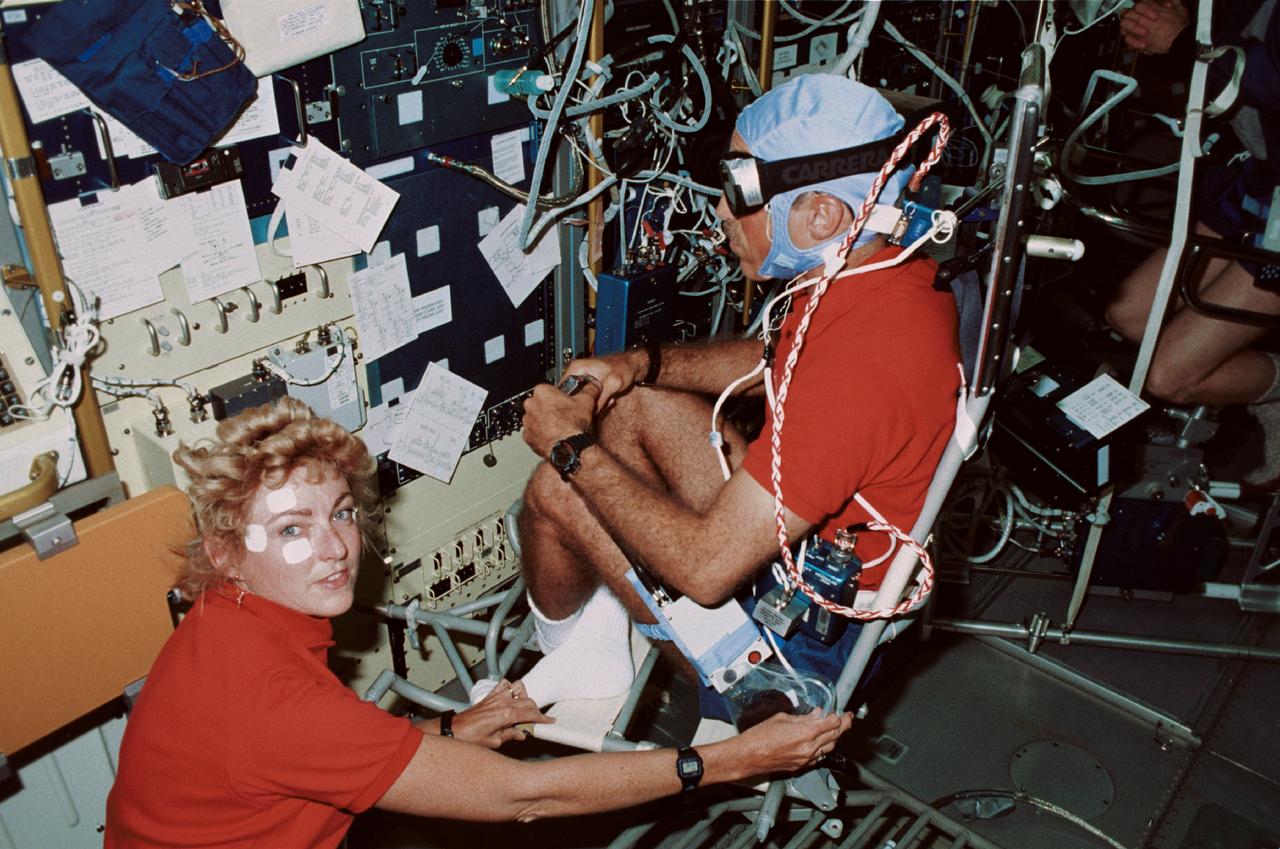
STS040-211-020 (5-14 June 1991) --- Vestibular experiment activities were captured onboard Columbia's Spacelab Life Sciences (SLS-1) module in this 35mm scene. Astronaut James P. Bagian, STS-40 mission specialist, is in a rotating chair while wearing an accelometer and electrodes to record head motion and horizontal and vertical eye movements during the rotations. Payload specialist Millie Hughes-Fulford, lower left, assists with the test.
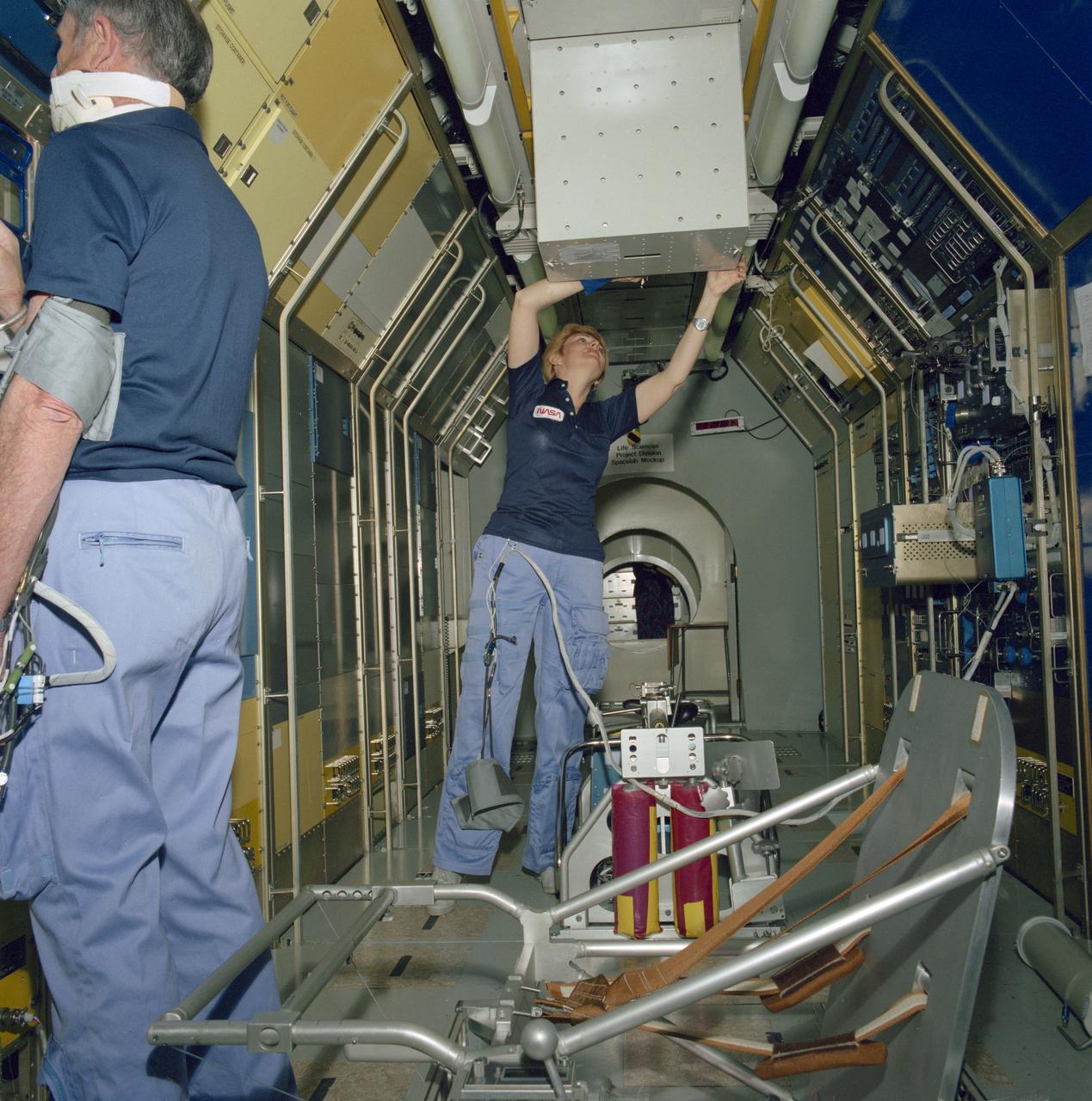
STS-40 Payload Specialist Millie Hughes-Fulford along with backup payload specialist Robert Ward Phillips familiarize themselves with Spacelab Life Sciences 1 (SLS-1) equipment. The two scientists are in JSC's Life Sciences Project Division (LSPD) SLS mockup located in the Bioengineering and Test Support Facility Bldg 36. Hughes-Fulford, in the center aisle, pulls equipment from an overhead stowage locker while Phillips, in the foreground, experiments with the baroreflex neck pressure chamber at Rack 11. The baroreflex collar will be used in conjuction with Experiment No. 022, Influence of Weightlessness Upon Human Autonomic Cardiovascular Control. Behind Phillips in the center aisle are body mass measurement device (BMMD) (foreground) and the stowed bicycle ergometer.
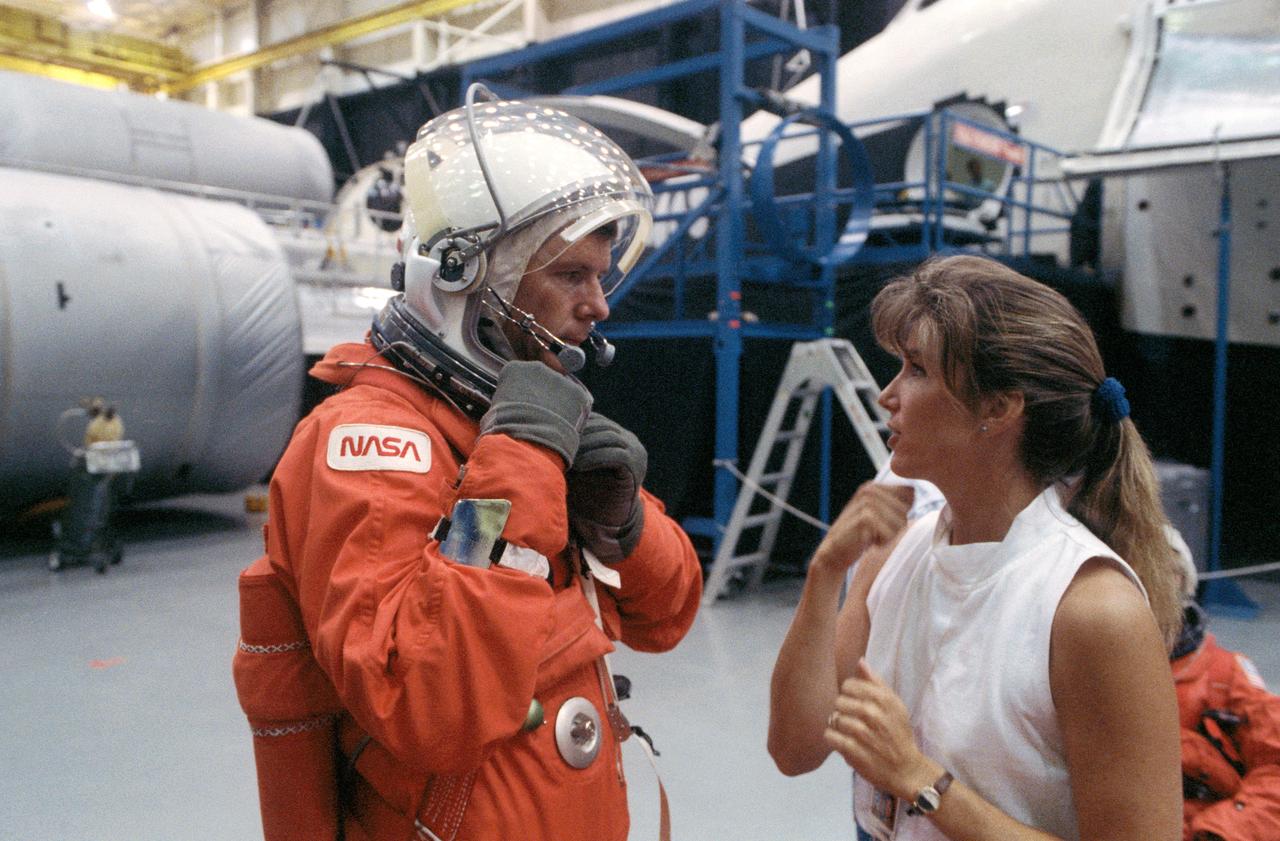
S90-41366 (11 June 1990) --- Astronaut Bryan D. O'Connor, STS-40 mission commander, talks with Elizabeth Youmans of the crew training staff at JSC, during a break in mission training. This exercise, in JSC's Shuttle mockup and integration laboratory, was designed to familiarize the astronauts with proper procedures and gear involved in emergency egress from the Space Shuttle. O'Connor is wearing the orange partial pressure ascent/entry suit. Primary payload of the STS-40 mission is Spacelab Life Sciences (SLS-1).
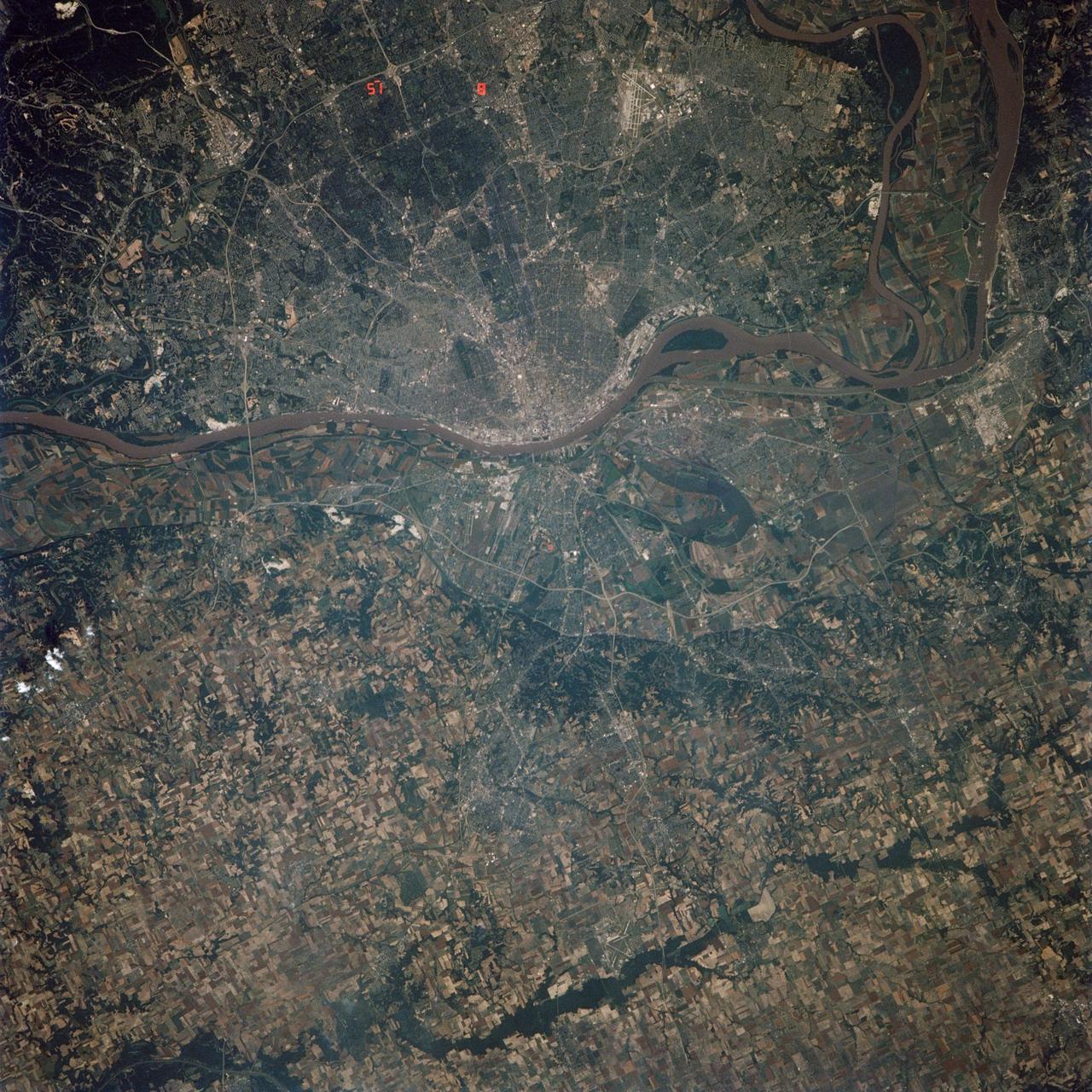
STS040-614-066 (5-14 June 1991) --- St. Louis, Missouri-East St. Louis, Illinois and surrounding area were photographed by the STS 40 crewmembers aboard the Space Shuttle Columbia. The winding Mississippi River serves as a reference point for finding features of the area. Busch Stadium is clearly seen. NASA photo experts studying the STS 40 imagery claim photographs of this type aid in following demographic changes and in planning for development. The ground track of STS-40 and the existence of exceptionally clear skies during much of the nine-day flight permitted photographic acquisition of several cities not generally seen from the space flights flying at 28-degree inclinations to the Equator.
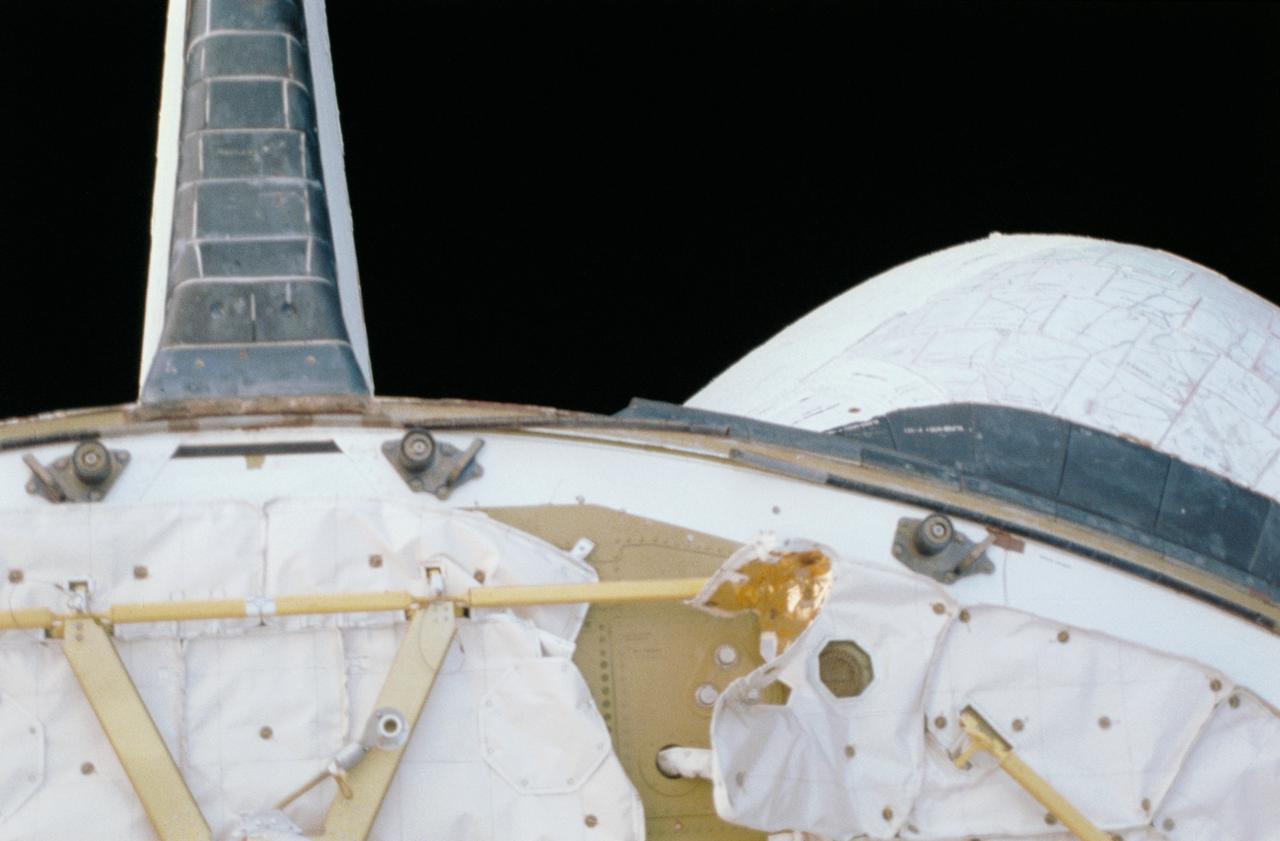
STS040-031-030 (5-14 June 1991) --- Early on the first day of STS-40, the crew noticed that some of the thermal material on the aft firewall had loosened. They shot this 35mm frame of the area, which proved to pose no problems for the flight.
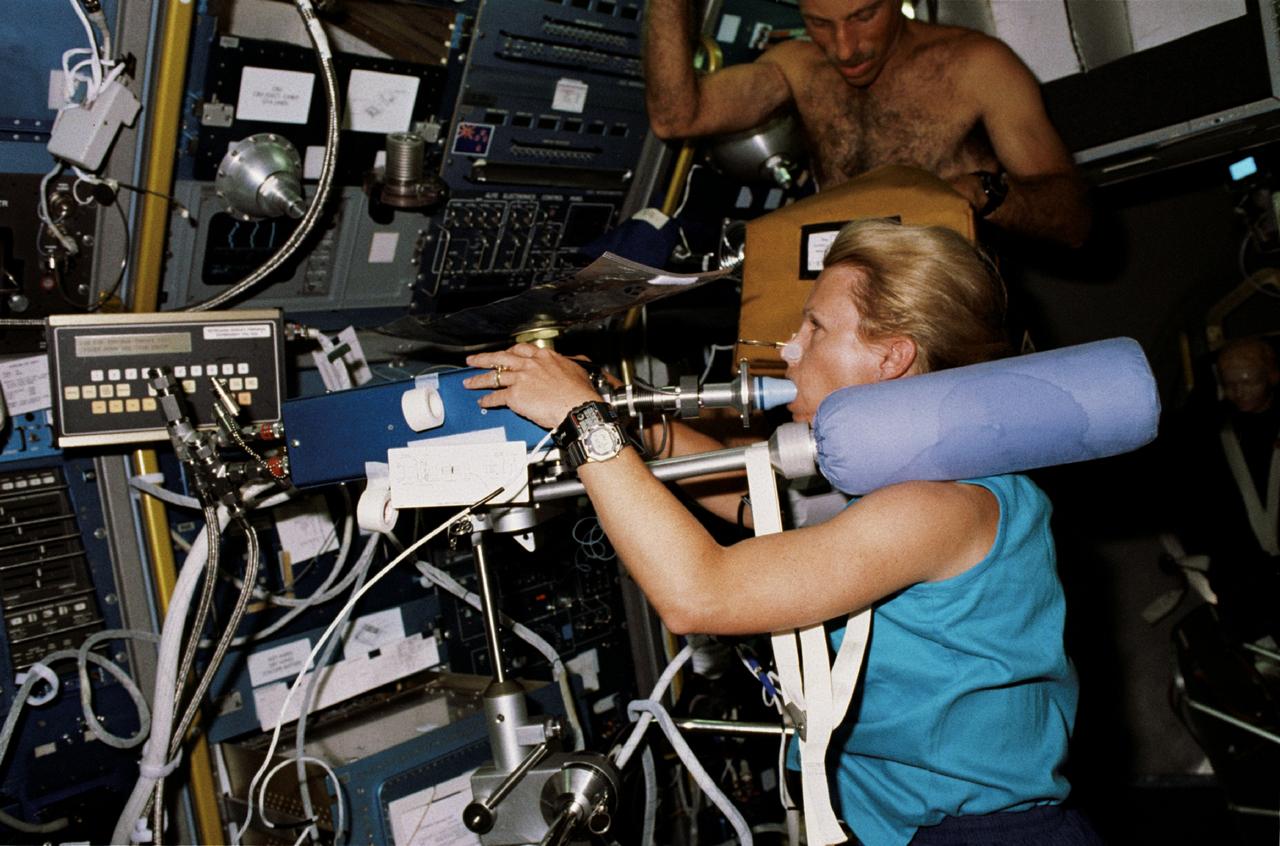
STS040-211-019 (5-14 June 1991) --- Astride the bicycle ergometer, astronaut Rhea Seddon, mission specialist, breathes into the cardiovascular re-breathing unit during the exercise phase of an experiment. The investigation, In-flight Study of Cardiovascular Deconditioning (Experiment 066), was developed by Dr. Leon E. Farhi of the State University of New York in Buffalo. It focuses on the deconditioning of the heart and lungs and changes in cardiopulmonary function that occur upon return to Earth. By using non-invasive techniques of prolonged expiration and re-breathing, investigators can determine the amount of blood pumped out of the heart (cardiac output), the ease with which blood flows through all the vessels (total peripheral resistance), oxygen used and carbon dioxide released by the body, and lung function and volume changes. Measurements are made both while crew members are resting and while they pedal the exercise bicycle, as Dr. Seddon is doing here. This scene was photographed with a 35mm camera.
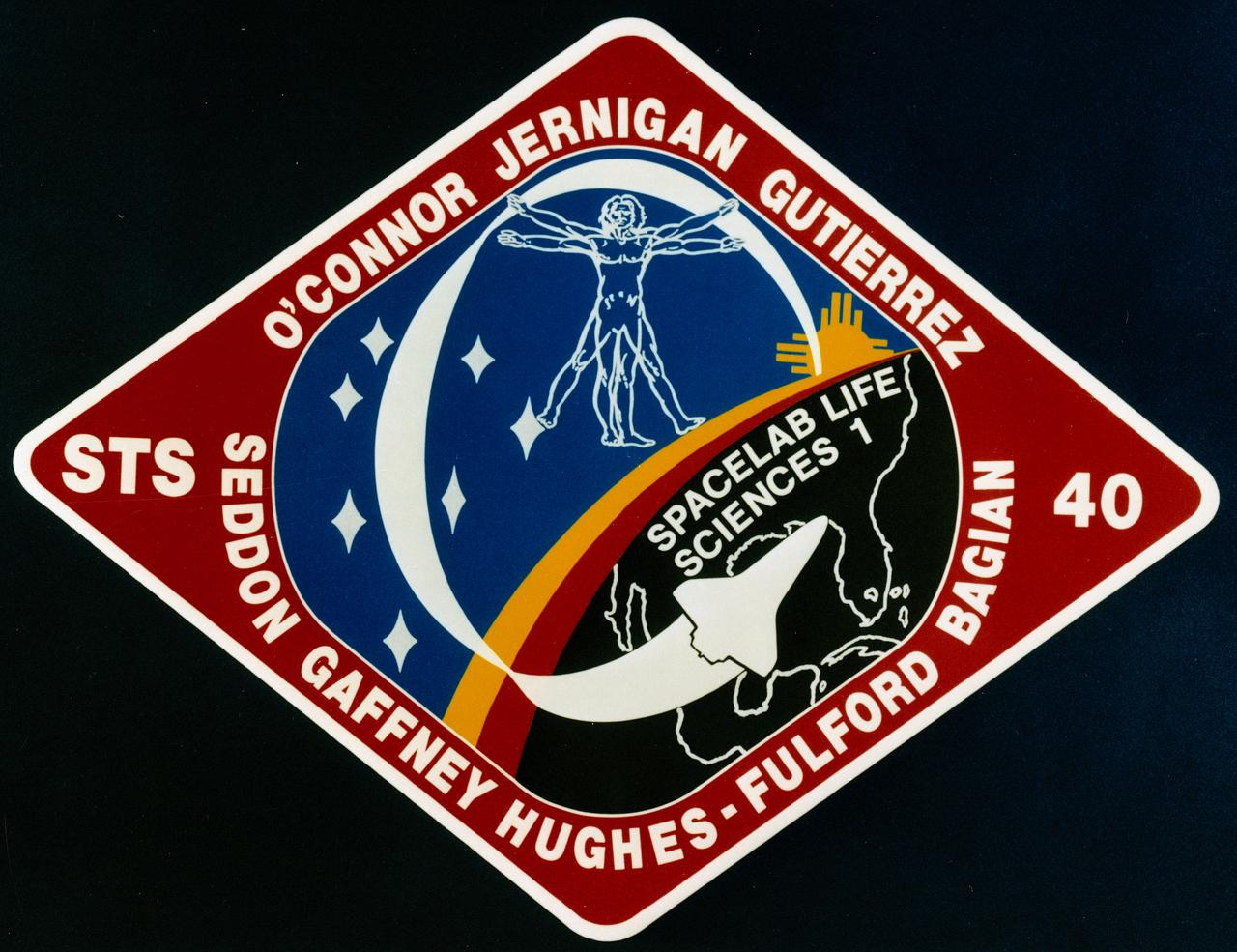
The STS-40 patch makes a contemporary statement focusing on human beings living and working in space. Against a background of the universe, seven silver stars, interspersed about the orbital path of Columbia, represent the seven crew members. The orbiter's flight path forms a double-helix, designed to represent the DNA molecule common to all living creatures. In the words of a crew spokesman, ...(the helix) affirms the ceaseless expansion of human life and American involvement in space while simultaneously emphasizing the medical and biological studies to which this flight is dedicated. Above Columbia, the phrase Spacelab Life Sciences 1 defines both the Shuttle mission and its payload. Leonardo Da Vinci's Vitruvian man, silhouetted against the blue darkness of the heavens, is in the upper center portion of the patch. With one foot on Earth and arms extended to touch Shuttle's orbit, the crew feels, he serves as a powerful embodiment of the extension of human inquiry from the boundaries of Earth to the limitless laboratory of space. Sturdily poised amid the stars, he serves to link scentists on Earth to the scientists in space asserting the harmony of efforts which produce meaningful scientific spaceflight missions. A brilliant red and yellow Earth limb (center) links Earth to space as it radiates from a native American symbol for the sun. At the frontier of space, the traditional symbol for the sun vividly links America's past to America's future, the crew states. Beneath the orbiting Shuttle, darkness of night rests peacefully over the United States. Drawn by artist Sean Collins, the STS 40 Space Shuttle patch was designed by the crewmembers for the flight.

S90-46492 (16 Aug 1990) --- Astronaut Tamara E. Jernigan, STS-40 mission specialist, is pictured in a training version of the extravehicular mobility unit (EMU) spacesuit. Dr. Jernigan was about to be submerged in the Johnson Space Center's 25-ft. deep weightless environment training facility (WET-F) pool to simulate a contingency extravehicular activity (EVA). There is no EVA scheduled for STS-40, the Spacelab Life Sciences (SLS-1) mission.
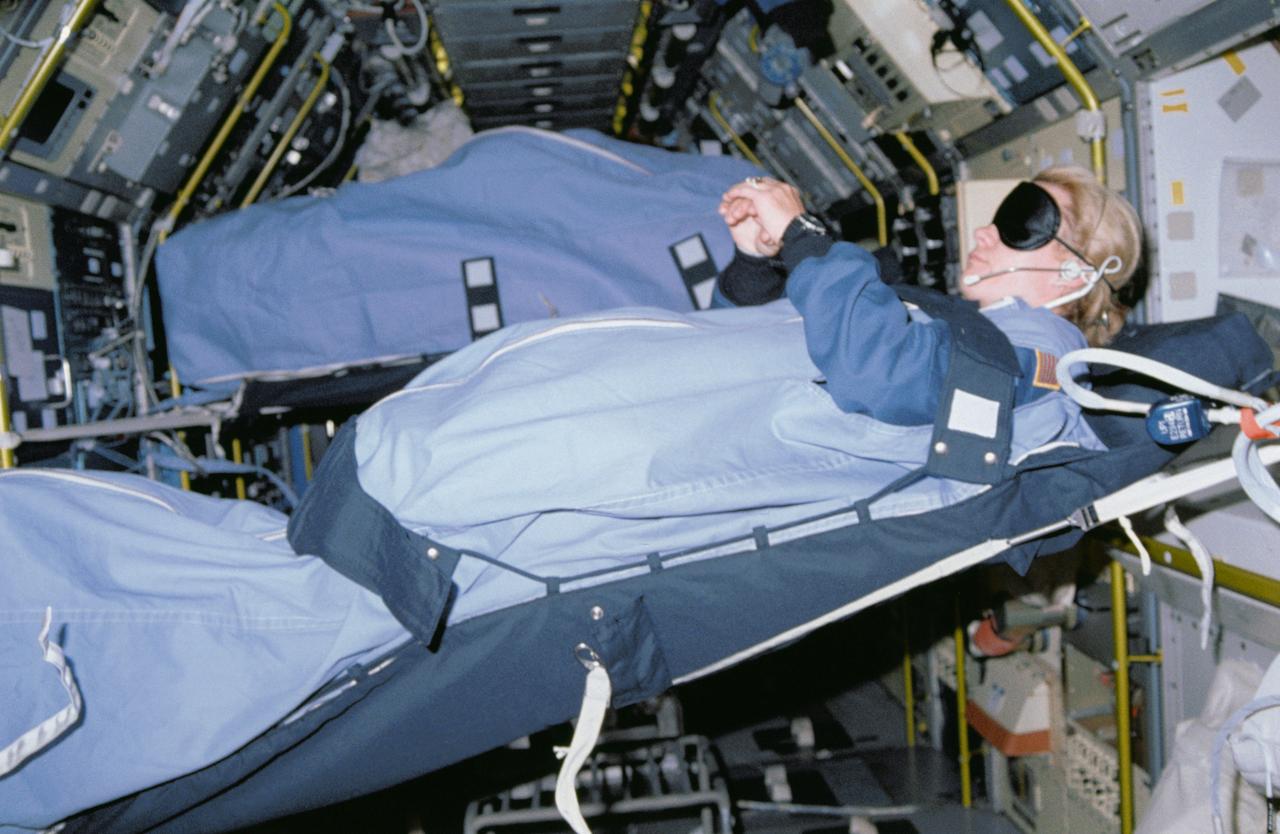
STS040-31-020 (5-14 June 1991) --- During the nine-day mission, some of the crew slept in the SLS-1 module. Astronaut Rhea Seddon, using various restraints, sleeps horizontally in this scene. The image was one of 25 visuals used by the STS-40 crew at its Post Flight Press Conference (PFPC) on June 28, 1991.
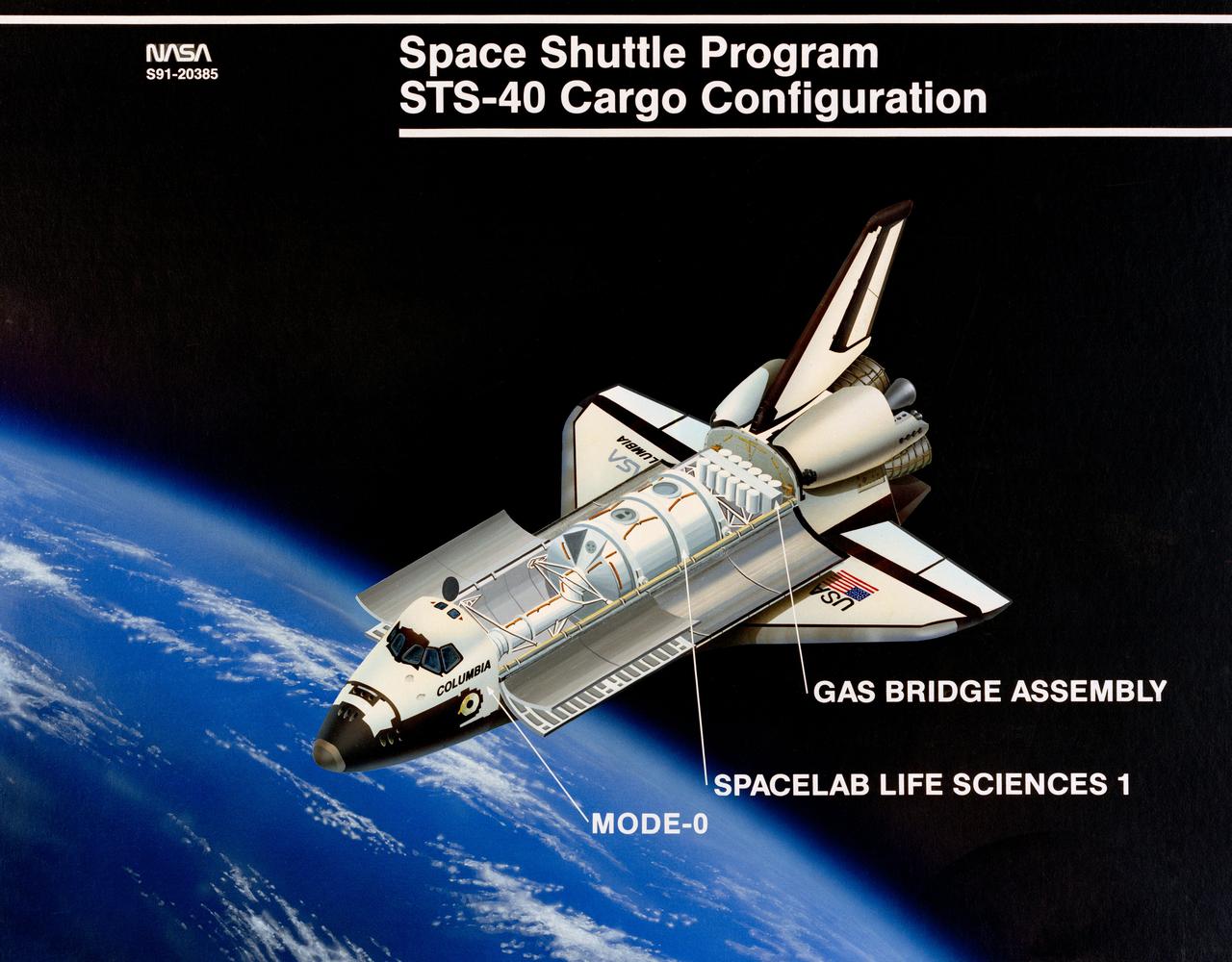
S91-20385 (Feb 1991) --- The Space Shuttle Columbia orbits Earth in this STS-40 art concept depicting the cargo bay arrangement for the Spacelab Life Sciences (SLS-1) mission. In the spring, three mission specialists and two payload specialists will join the commander and pilot for a scheduled nine-day mission, devoted to life sciences research, aboard Columbia.
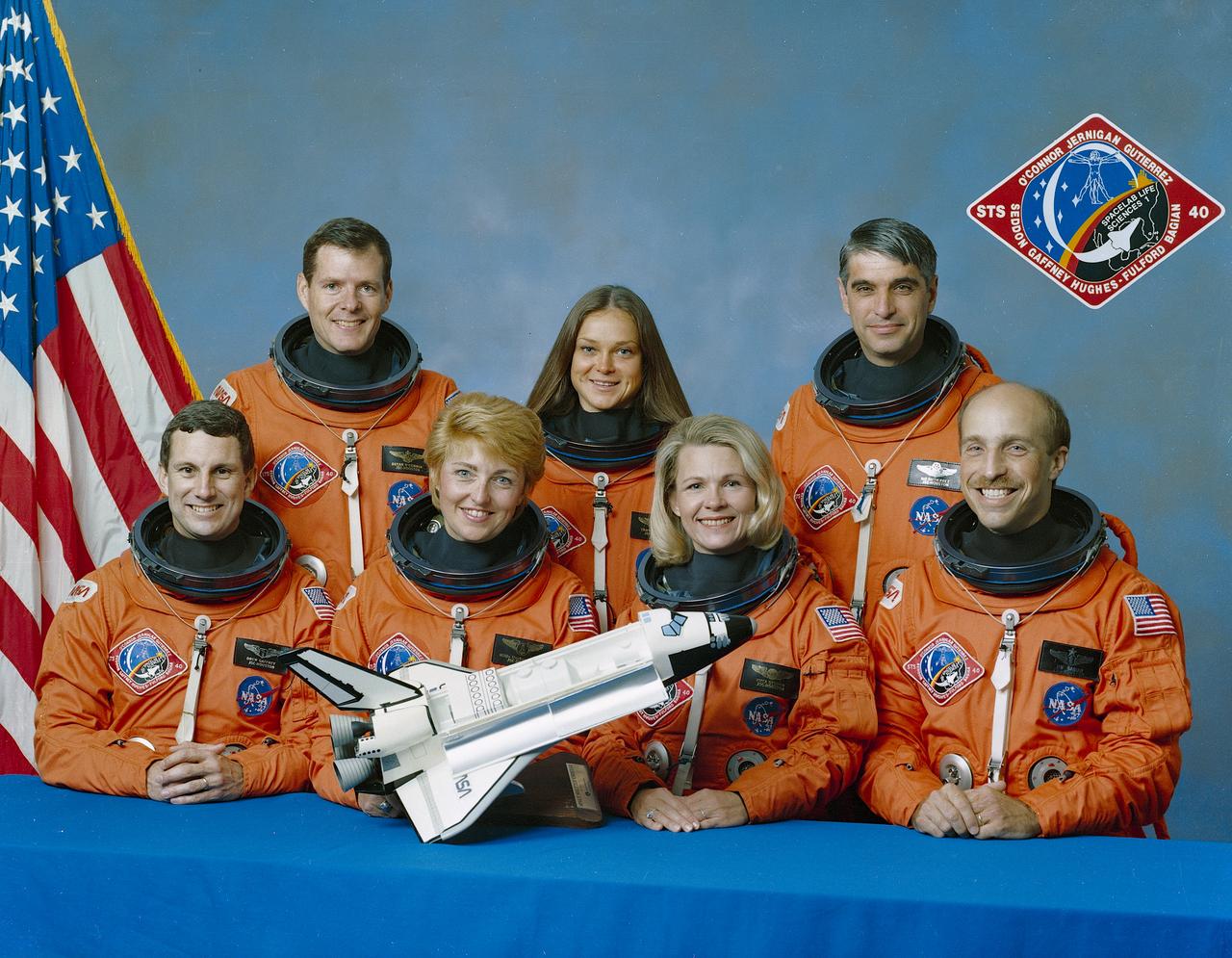
The STS-40 crew portrait includes 7 astronauts. Pictured on the front row from left to right are F. Drew Gaffney, payload specialist 1; Milli-Hughes Fulford, payload specialist 2; M. Rhea Seddon, mission specialist 3; and James P. Bagian, mission specialist 1. Standing in the rear, left to right, are Bryan D. O’Connor, commander; Tamara E. Jernigan, mission specialist 2; and Sidney M. Gutierrez, pilot. Launched aboard the Space Shuttle Columbia on June 5, 1991 at 9:24; am (EDT), the STS-40 mission was the fifth dedicated Spacelab Mission, Spacelab Life Sciences-1 (SLS-1), and the first mission dedicated solely to life sciences.
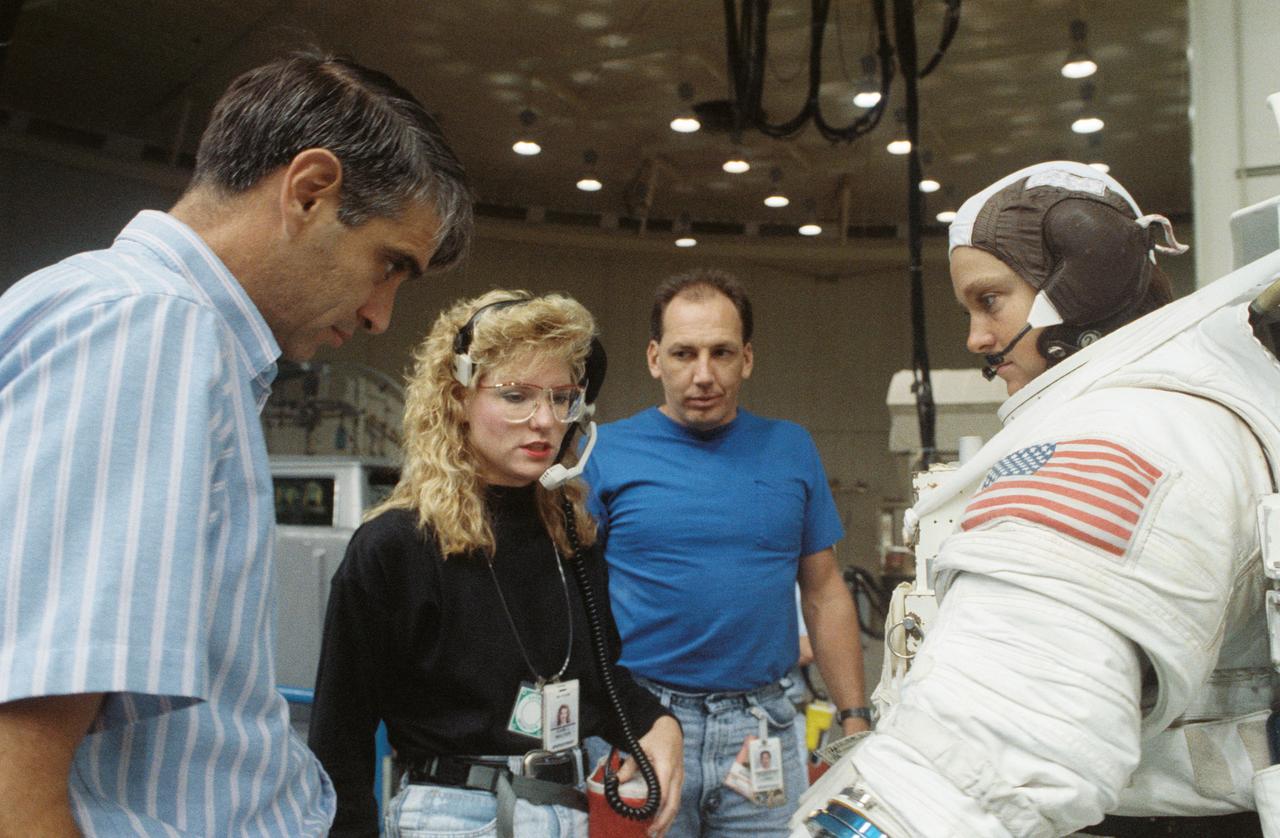
S90-45785 (16 Aug 1990) --- Astronaut Tamara E. Jernigan, STS-40 mission specialist, is pictured in a training version of the extravehicular mobility unit (EMU) spacesuit talking with a fellow crewmember and members of the crew training staff. At left is astronaut Sidney M. Gutierrez, pilot for the flight. Dr. Jernigan was about to be submerged in the Johnson Space Center's 25-ft. deep weightless environment training facility (WET-F) pool to simulate a contingency extravehicular activity (EVA). There is no EVA scheduled for STS-40, the Spacelab Life Sciences (SLS-1) mission.
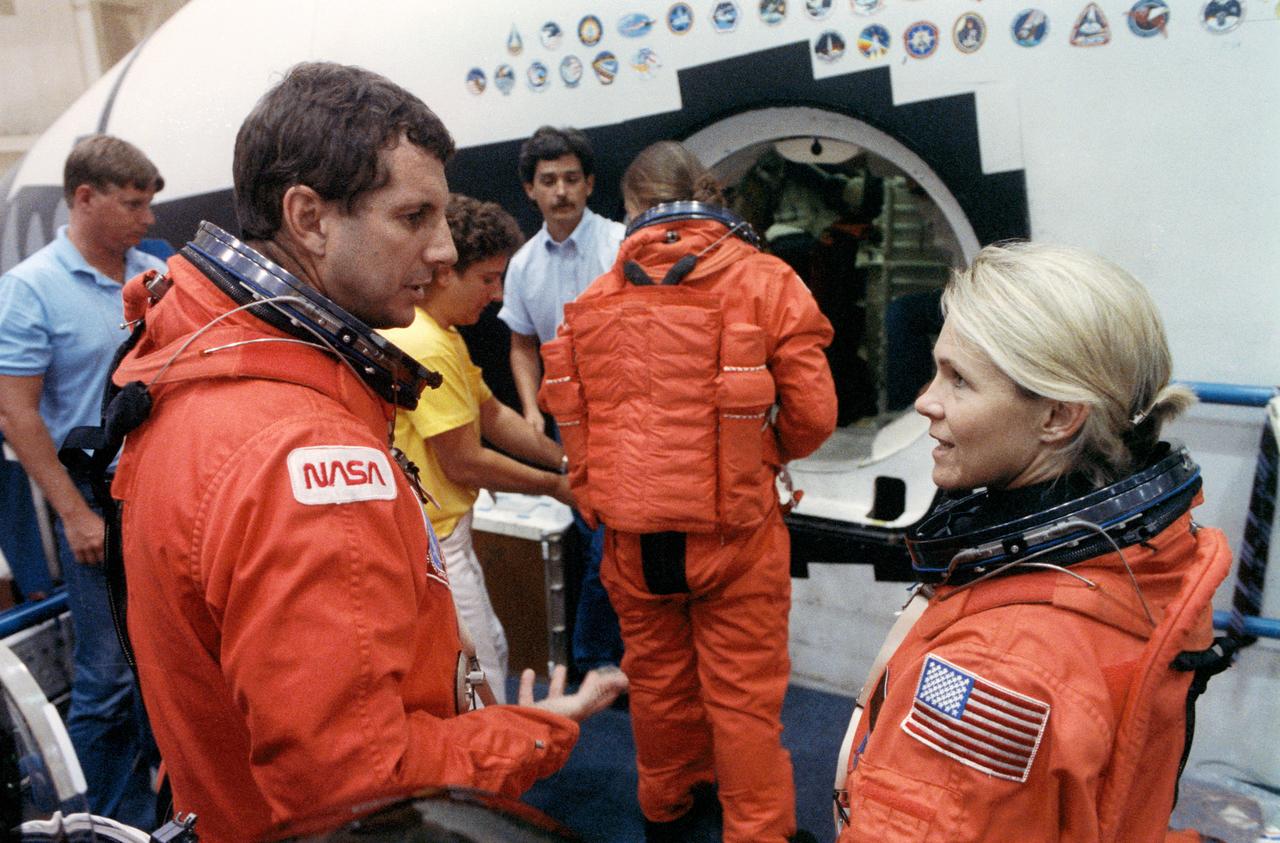
S90-41365 (11 June 1990) --- Crewmembers assigned to NASA's STS-40/Spacelab Life Sciences (SLS-1) mission take a brief break during emergency egress training in the Shuttle mockup and integration laboratory at the Johnson Space Center (JSC). In the foreground are astronauts Rhea Seddon and payload specialist F. Drew Gaffney. In the background, also wearing an orange partial pressure, ascent/entry suit is astronaut Tamara E. Jernigan, mission specialist. Not in the frame are astronauts Bryan D. O'Connor, mission commander; Sidney M. Gutierrez, pilot; James P. Bagian, mission specialist, and payload specialist Millie Fulford-Hughes.
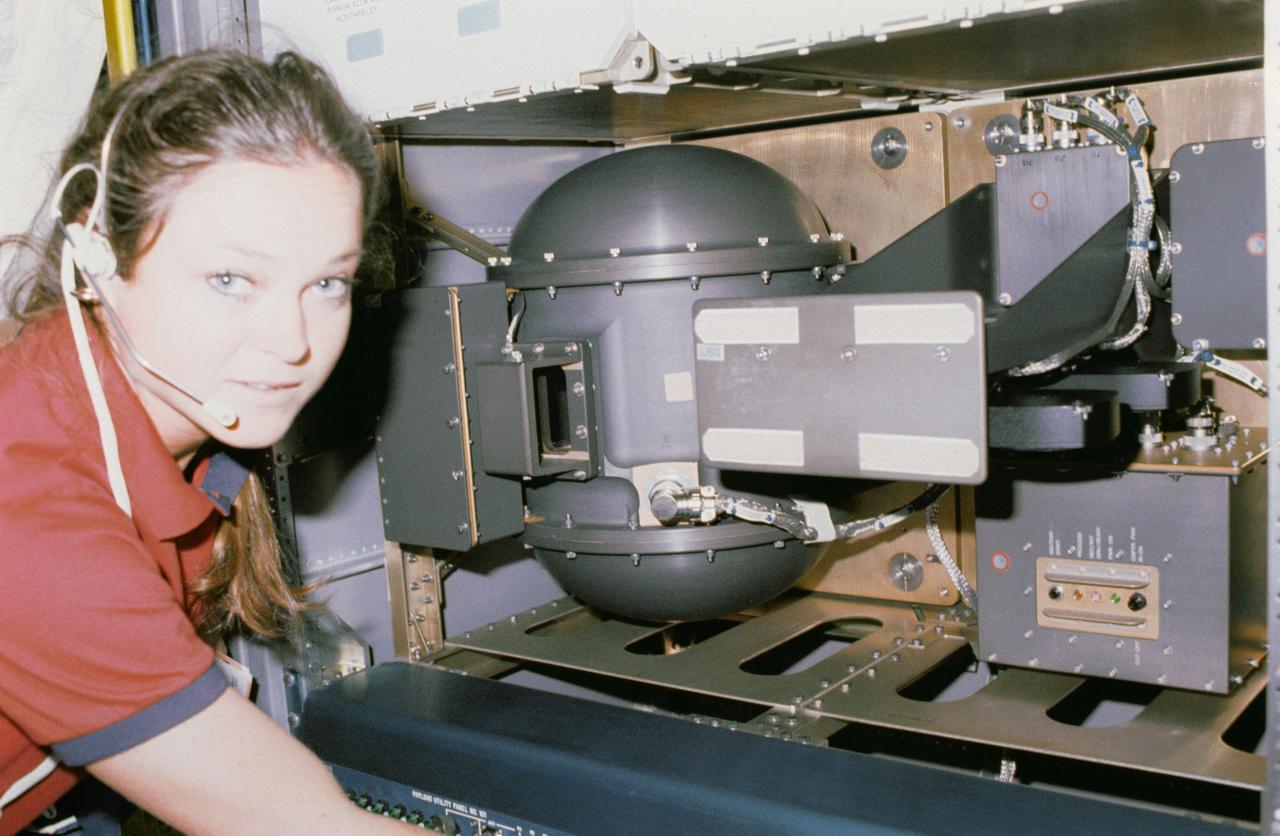
STS040-204-010 (5-14 June 1991) --- Astronaut Tamara E. Jernigan, STS 40 mission specialist, is pictured at the Solid Surface Combustion Experiment aboard the Earth orbiting Columbia. Dr. Jernigan is one of seven crewmembers spending nine days in space.
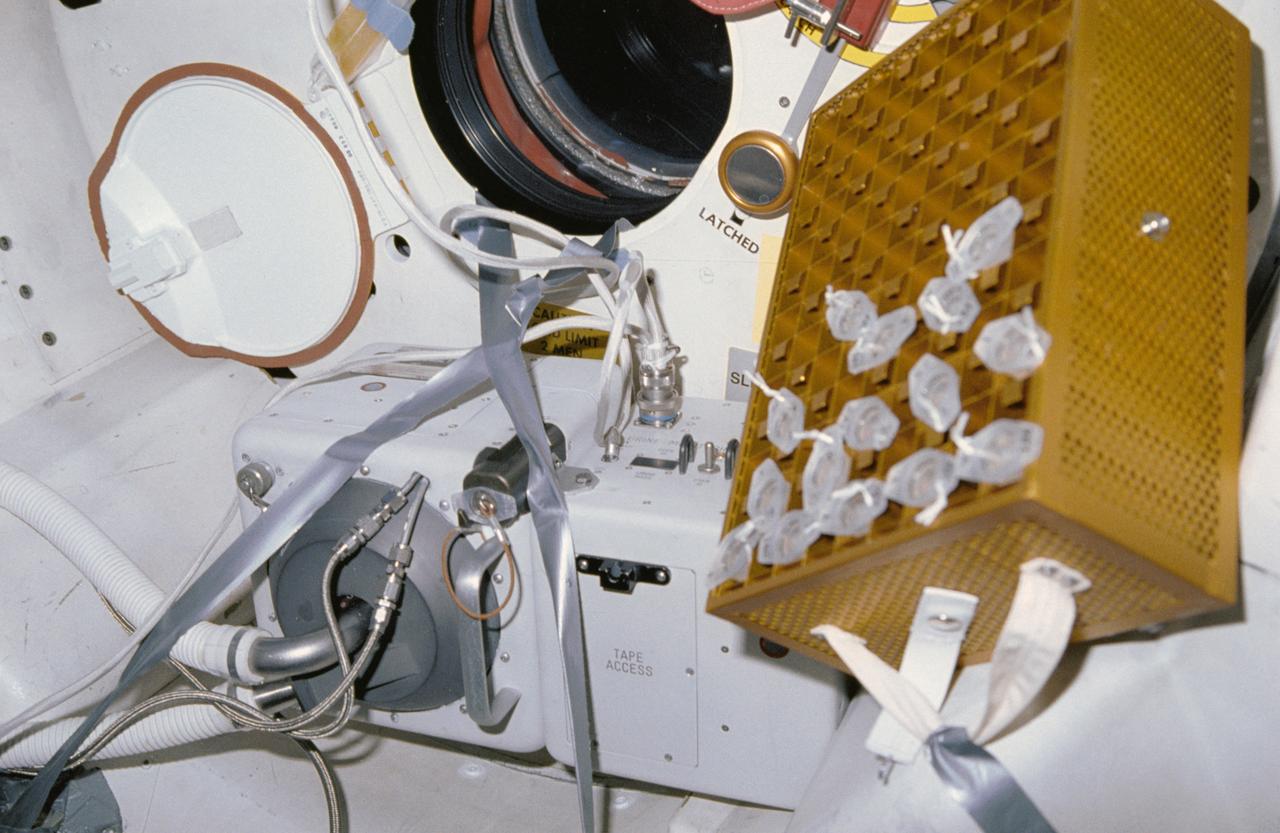
STS040-04-036 (5-14 June 1991) --- Closeup view of urine monitoring system and test samples, part of the busy schedule of life sciences testing on the nine-day STS-40/Spacelab Life Sciences (SLS-1) mission aboard the earth-orbiting Columbia.
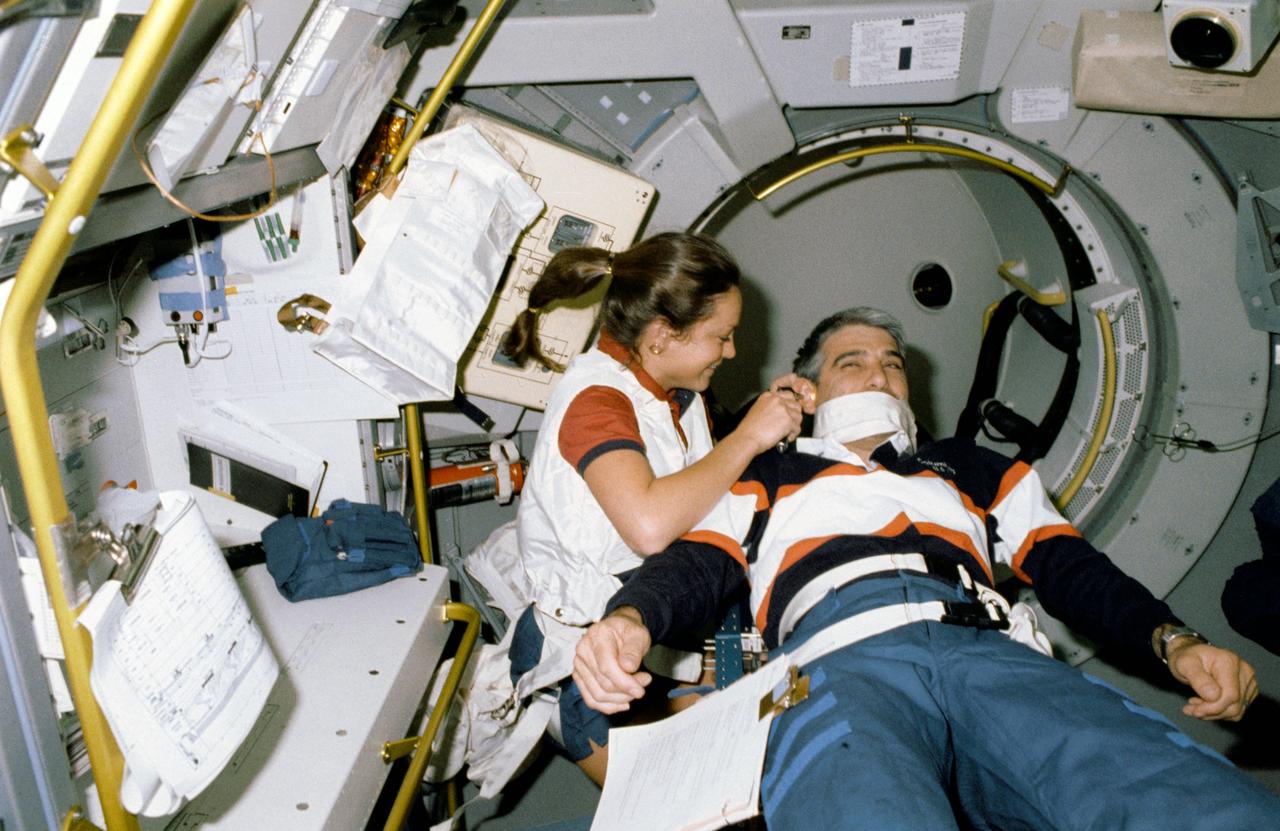
STS040-206-002 (5-14 June 1991) --- Held in place by the Spacelab Life Sciences (SLS-1) Medical Restraint System (MRS), astronaut Sidney M. Gutierrez, pilot, gets his ears checked by astronaut Tamara E. Jernigan, mission specialist. The two are in the SLS-1 module, onboard the Space Shuttle Columbia. The scene was photographed with a 35mm camera.
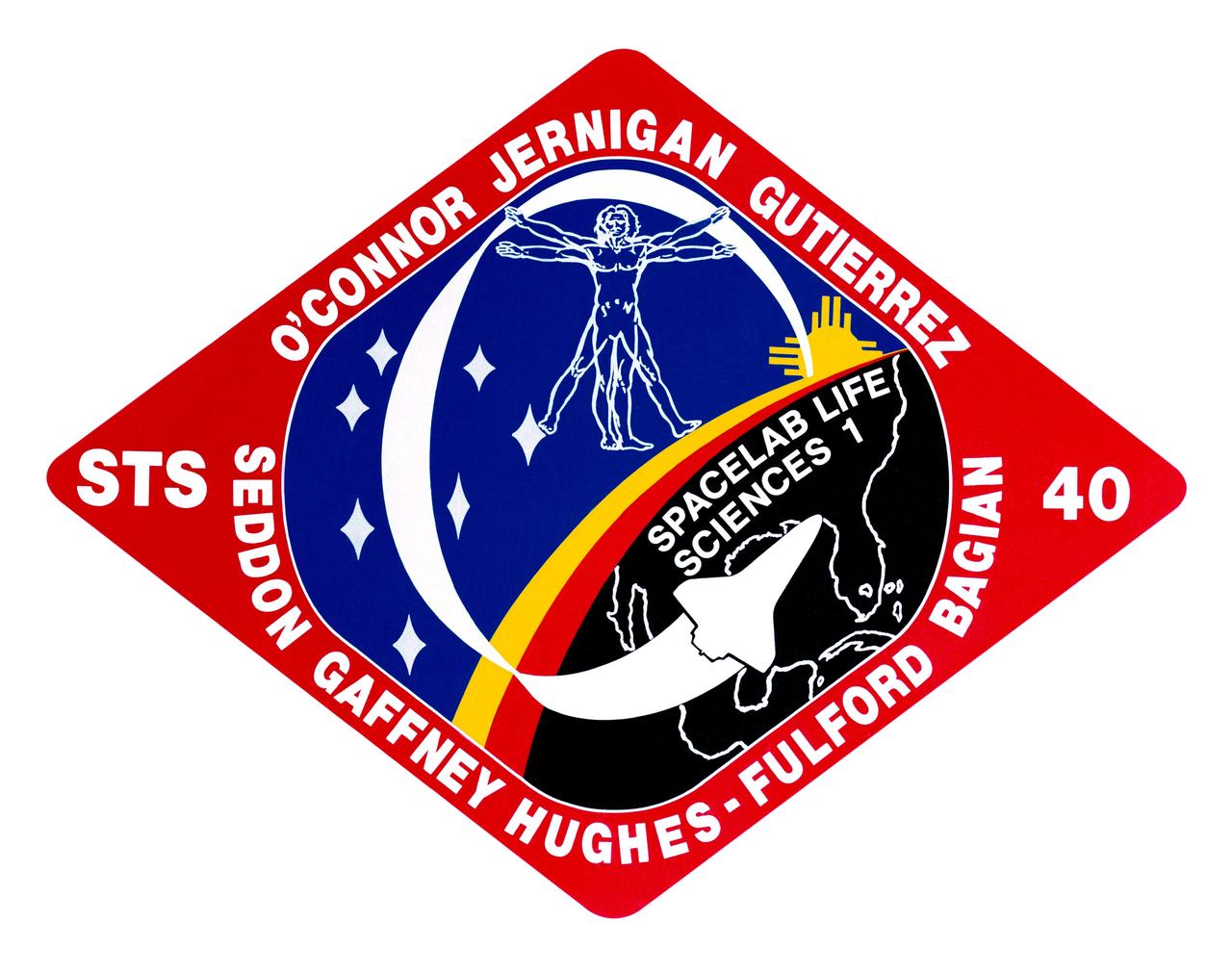
STS40-S-001 (May 1990) --- The STS-40 patch makes a contemporary statement focusing on human beings living and working in space. Against a background of the universe, seven silver stars, interspersed about the Orbital path of the space shuttle Columbia, represent the seven crew members. The orbiter's flight path forms a double-helix, designed to represent the DNA molecule common to all living creatures. In the words of a crew spokesman, "...(the helix) affirms the ceaseless expansion of human life and American involvement in space while simultaneously emphasizing the medical and biological studies to which this flight is dedicated." Above Columbia, the phrase "Spacelab Life Sciences 1" defines both the shuttle mission and its payload. Leonardo Da Vinci's Vitruvian man, silhouetted against the blue darkness of the heavens, is in the upper center portion of the patch. With one foot on Earth and arms extended to touch shuttle's orbit, the crew feels, he serves as a powerful embodiment of the extension of human inquiry from the boundaries of Earth to the limitless laboratory of space. Sturdily poised amid the stars, he serves to link scentists on Earth to the scientists in space asserting the harmony of efforts which produce meaningful scientific spaceflight missions. A brilliant red and yellow Earth limb (center) links Earth to space as it radiates from a native American symbol for the sun. At the frontier of space, the traditional symbol for the sun vividly links America's past to America's future, the crew states. Beneath the orbiting space shuttle, darkness of night rests peacefully over the United States. Drawn by artist Sean Collins, the STS-40 space shuttle patch was designed by the crew members for the flight. The NASA insignia design for space shuttle flights is reserved for use by the astronauts and for other official use as the NASA Administrator may authorize. Public availability has been approved only in the forms of illustrations by the various news media. When and if there is any change in this policy, which is not anticipated, the change will be publicly announced. Photo credit: NASA
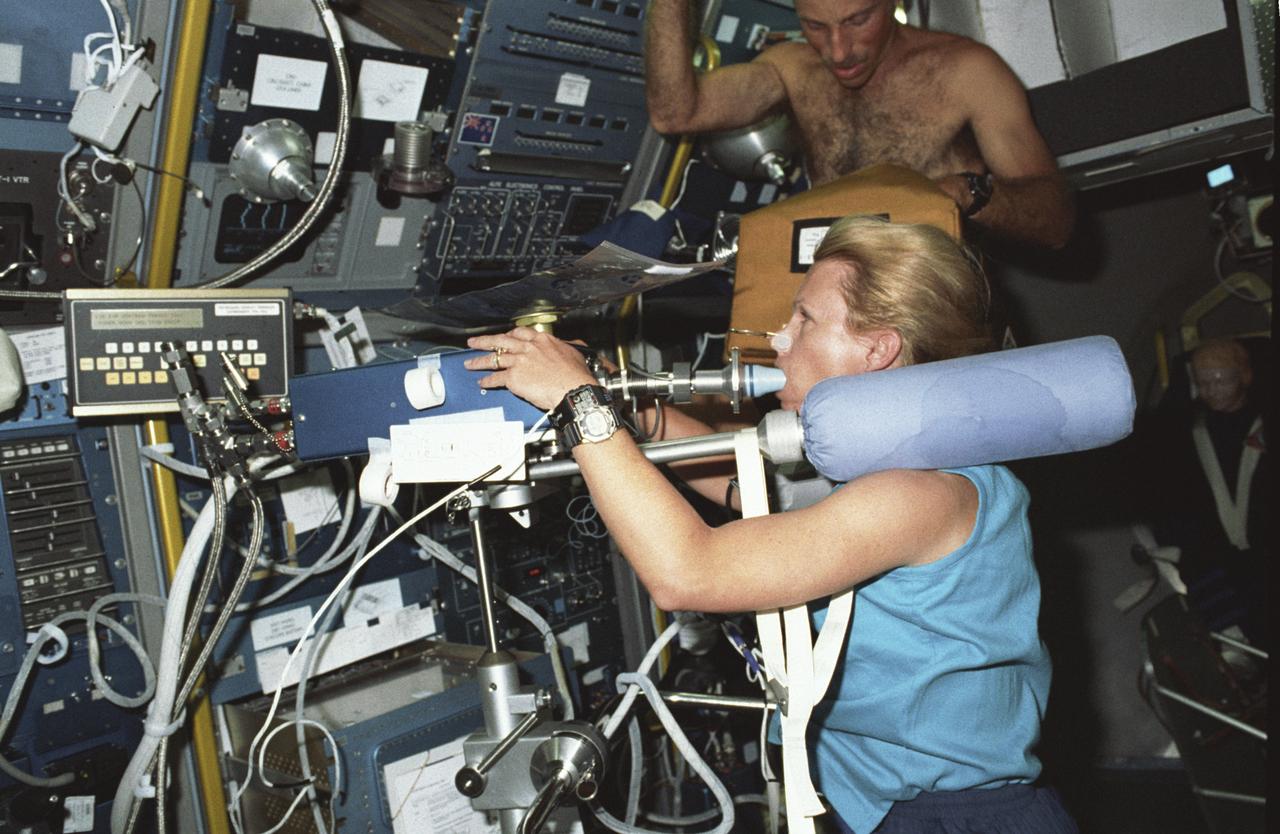
Spacelab Life Science -1 (SLS-1) was the first Spacelab mission dedicated solely to life sciences. The main purpose of the SLS-1 mission was to study the mechanisms, magnitudes, and time courses of certain physiological changes that occur during space flight, to investigate the consequences of the body's adaptation to microgravity and readjustment to Earth's gravity, and bring the benefits back home to Earth. The mission was designed to explore the responses of the heart, lungs, blood vessels, kidneys, and hormone-secreting glands to microgravity and related body fluid shifts; examine the causes of space motion sickness; and study changes in the muscles, bones, and cells. This photograph shows astronaut Rhea Seddon conducting an inflight study of the Cardiovascular Deconditioning experiment by breathing into the cardiovascular rebreathing unit. This experiment focused on the deconditioning of the heart and lungs and changes in cardiopulmonary function that occur upon return to Earth. By using noninvasive techniques of prolonged expiration and rebreathing, investigators can determine the amount of blood pumped out of the heart (cardiac output), the ease with which blood flows through all the vessels (total peripheral resistance), oxygen used and carbon dioxide released by the body, and lung function and volume changes. SLS-1 was launched aboard the Space Shuttle Orbiter Columbia (STS-40) on June 5, 1995.
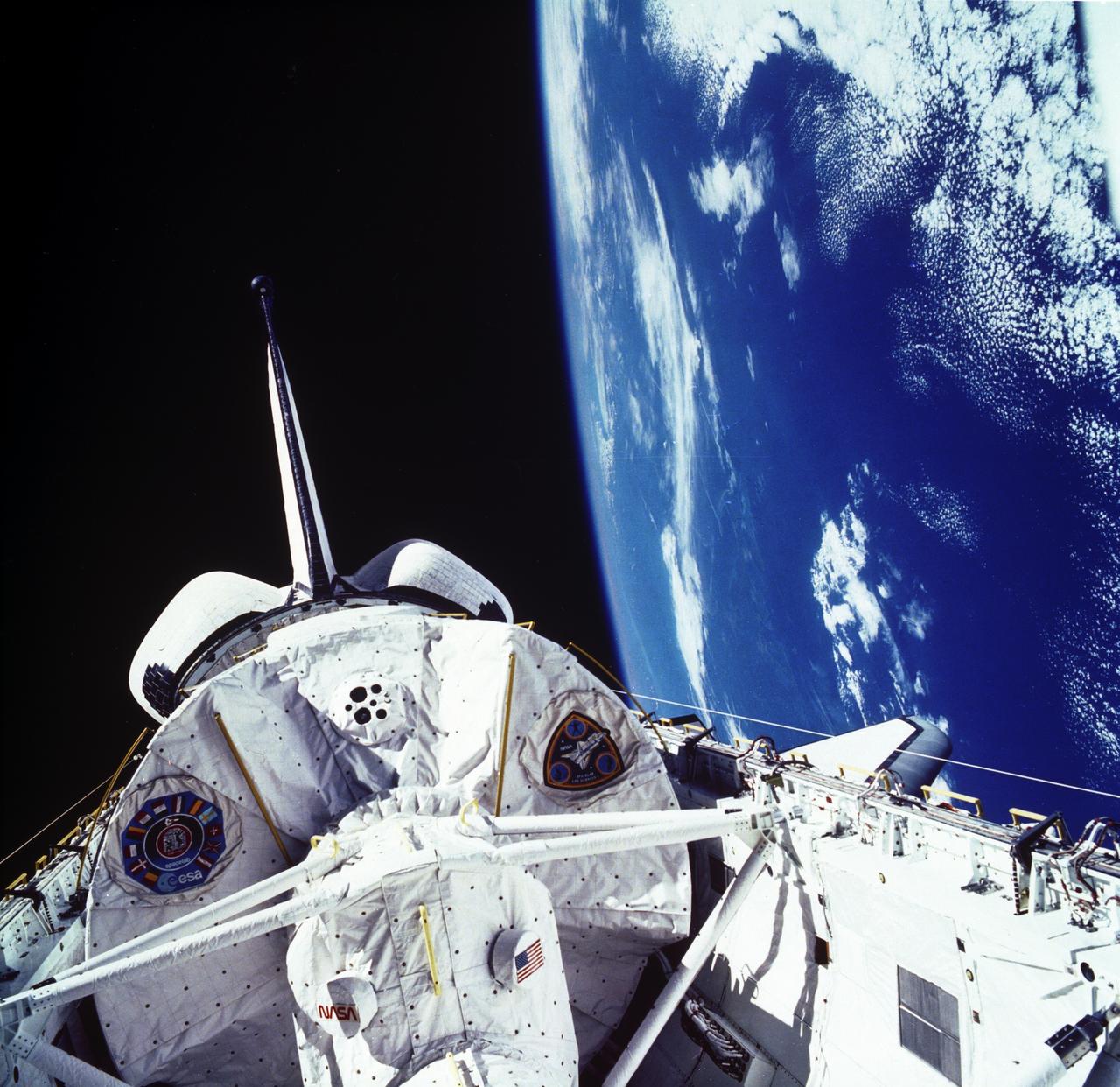
The laboratory module in the cargo bay of the Space Shuttle Orbiter Columbia was photographed during the Spacelab Life Science-1 (SLS-1) mission. SLS-1 was the first Spacelab mission dedicated solely to life sciences. The main purpose of the SLS-1 mission was to study the mechanisms, magnitudes, and time courses of certain physiological changes that occur during space flight, to investigate the consequences of the body's adaptation to microgravity and readjustment to Earth's gravity, and to bring the benefits back home to Earth. The mission was designed to explore the responses of the heart, lungs, blood vessels, kidneys, and hormone-secreting glands to microgravity and related body fluid shifts; examine the causes of space motion sickness; and study changes in the muscles, bones and cells. The five body systems being studied were: The Cardiovascular/Cardiopulmonary System (heart, lungs, and blood vessels), the Renal/Endocrine System (kidney and hormone-secreting organs), the Immune System (white blood cells), the Musculoskeletal System (muscles and bones), and the Neurovestibular System (brain and nerves, eyes, and irner ear). The SLS-1 was launched aboard the Space Shuttle Orbiter Columbia (STS-40) on June 5, 1995.
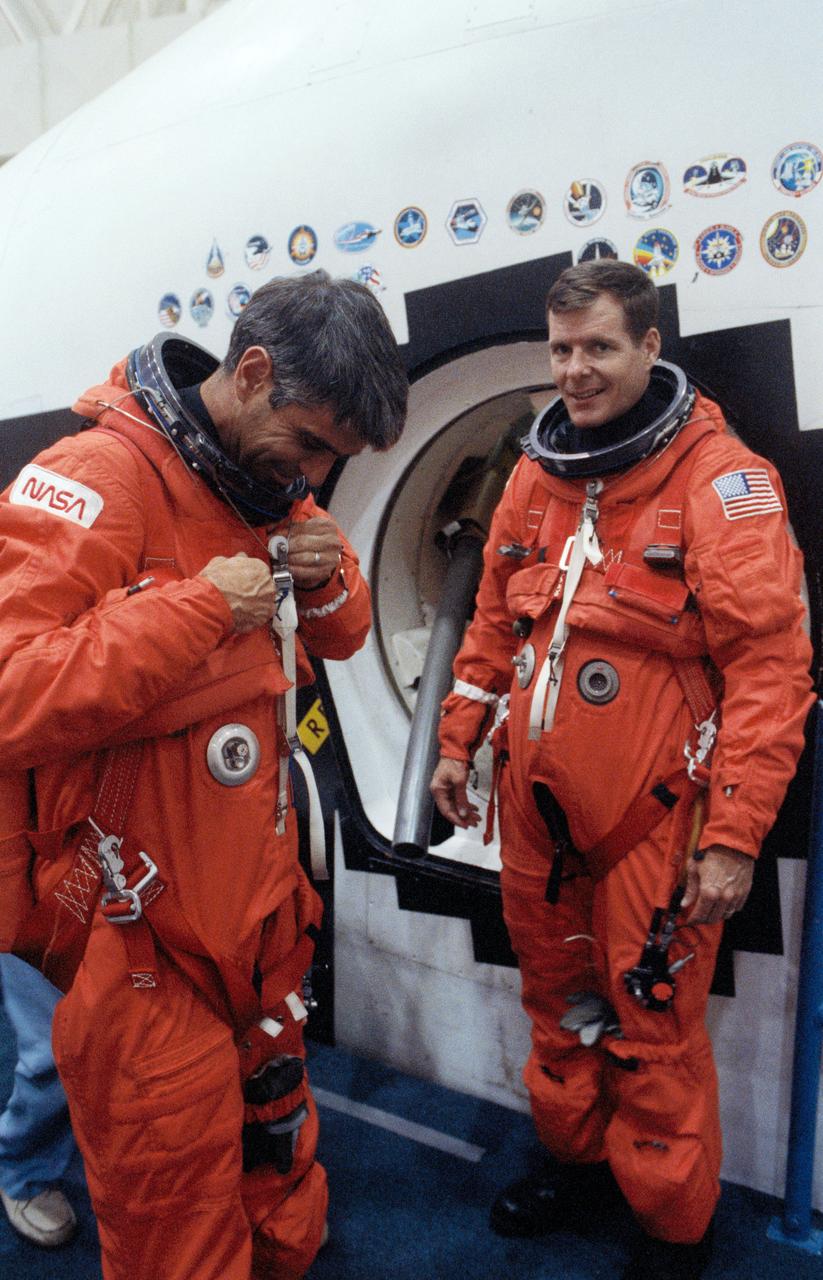
S90-41360 (11 June 1990) --- Two crewmembers assigned to NASA's Spacelab Life Sciences (SLS-1)/STS-40 mission are pictured during emergency egress training in the Shuttle mockup and integration laboratory at the Johnson Space Center (JSC). Seen are astronauts Sidney M. Gutierrez (left) pilot, and Bryan D. O'Connor, mission commander. Out of frame are astronauts Rhea Seddon, James P. Bagian, Tamara E. Jernigan, all mission specialists; and payload specialists Millie Hughes-Fulford and F. Drew Gaffney.
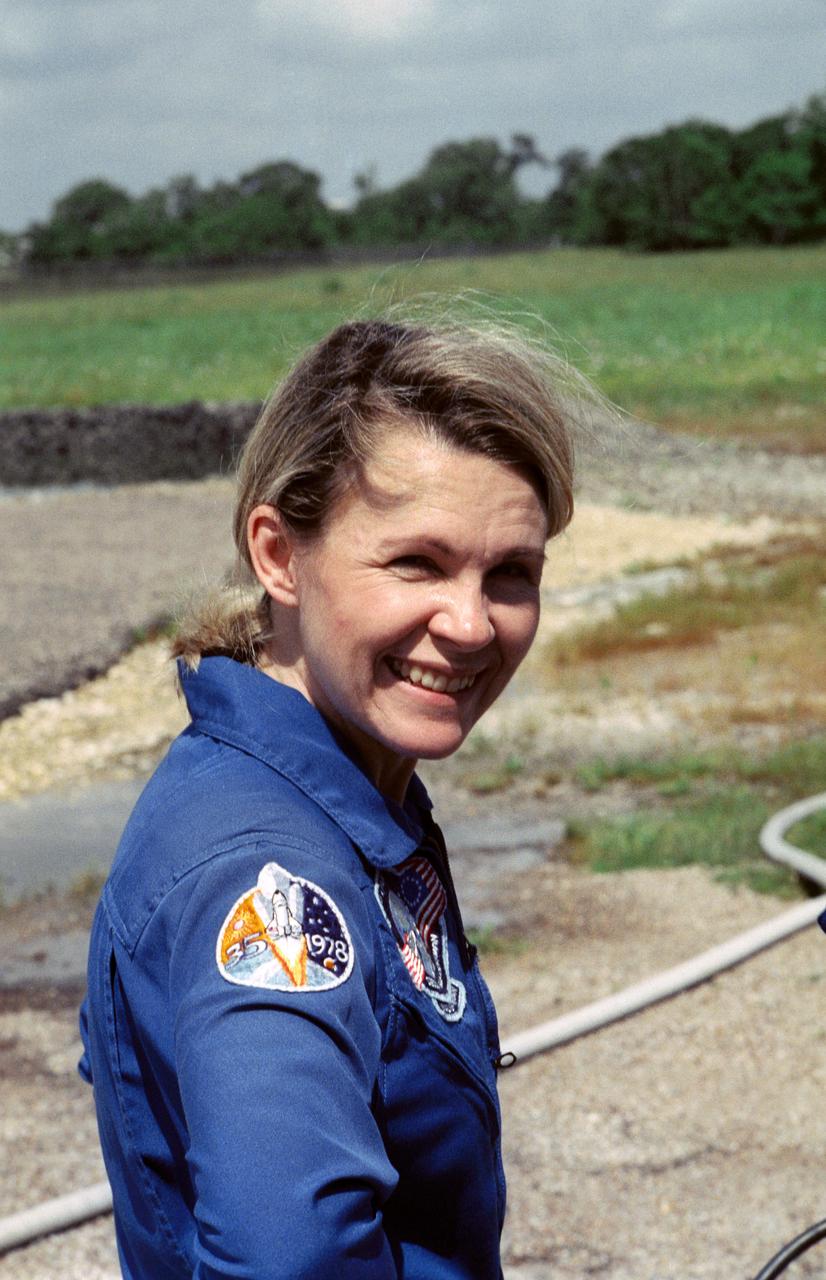
S90-46497 (18 Aug 1990) --- Astronaut Rhea Seddon, STS-40 mission specialist, takes a break from firefighting training at the Johnson Space Center (JSC). In less than a year Dr. Seddon will be joined by four NASA astronauts and two payload specialists for the Spacelab Life Sciences (SLS-1) mission aboard Columbia.
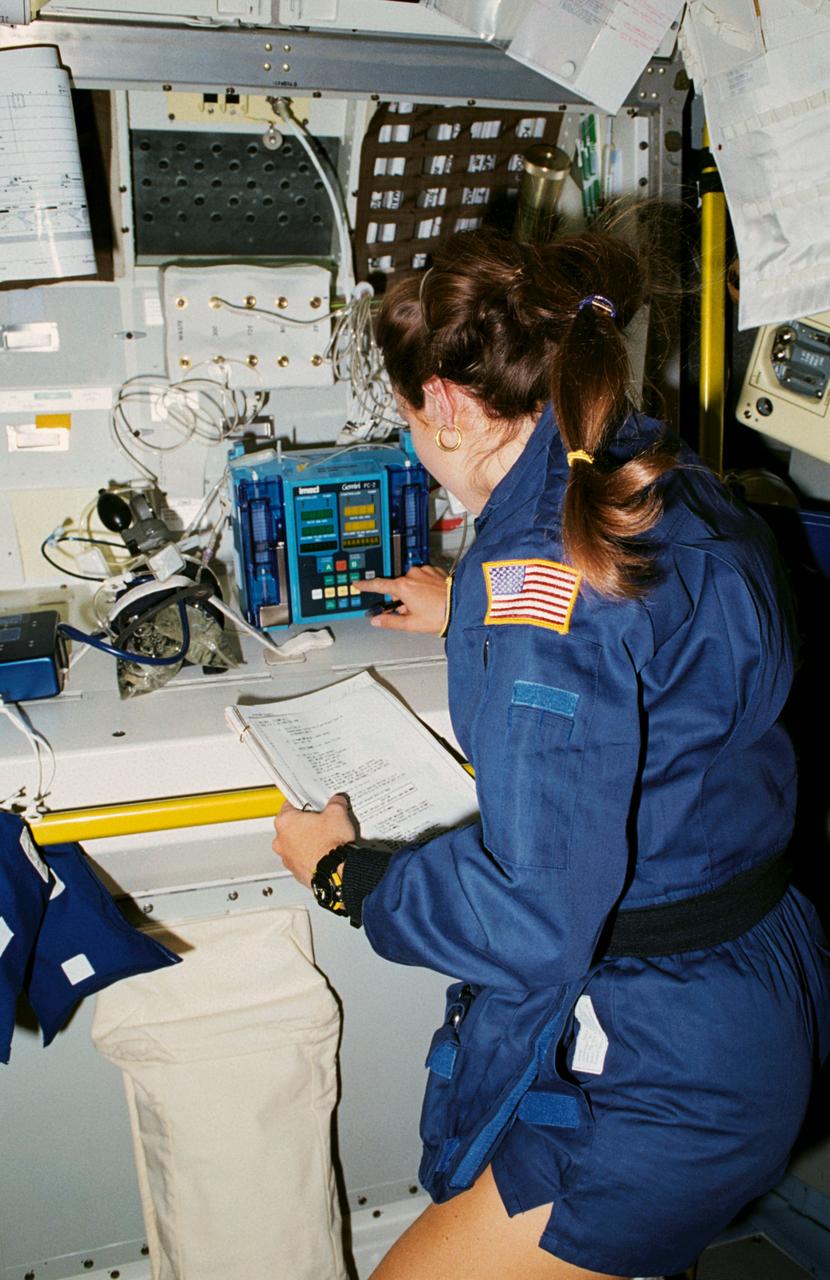
STS040-30-008 (5-14 June 1991) --- Astronaut Tamara E. Jernigan, after applying a blood pressure cuff to an experiment, watches it in operation. The experiment is the intravenous infusion pump. The device is being considered for use on Space Station Freedom's Health Maintenance Facility. Dr. Jernigan is one of seven crew members supporting the nine-day Spacelab Life Sciences (SLS-1) mission aboard the Earth-orbiting Space Shuttle Columbia.
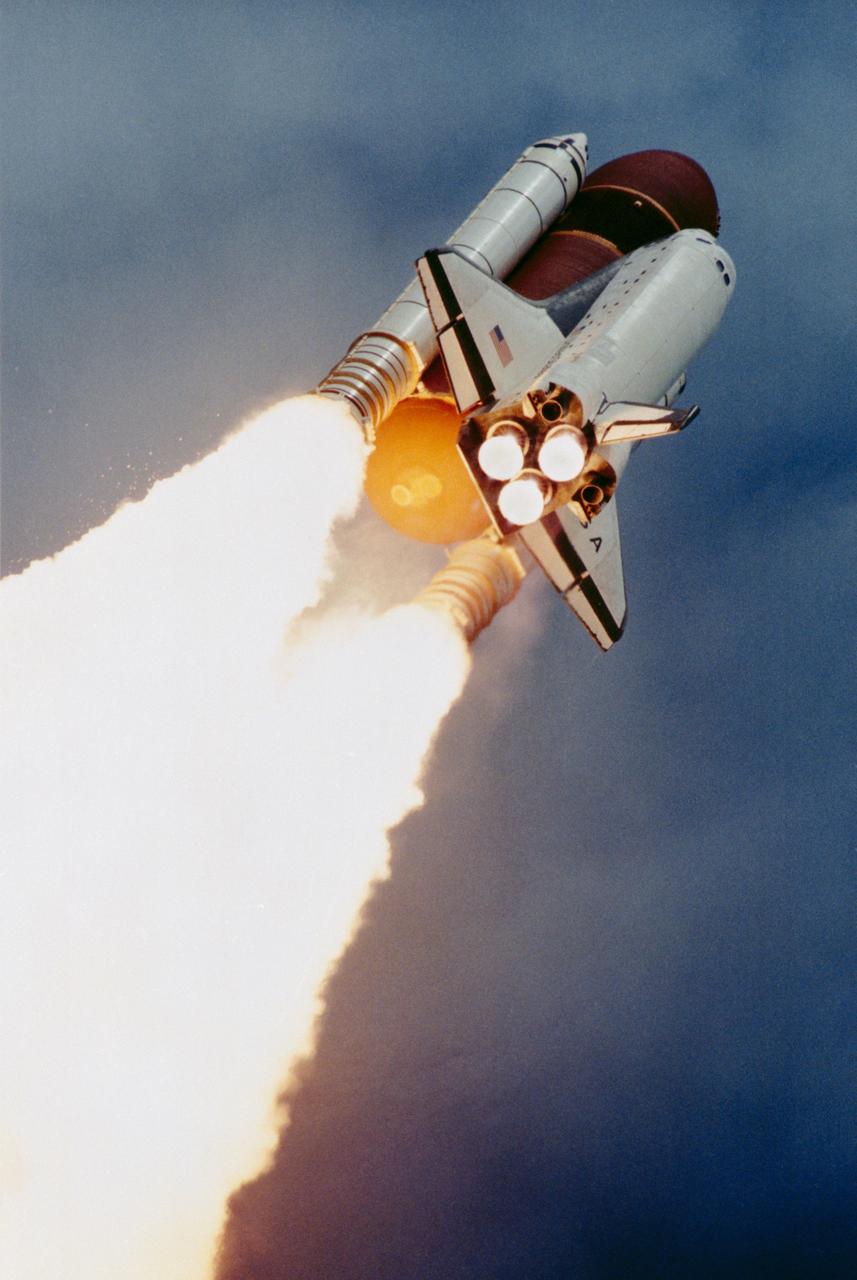
STS040-S-134 (5 June 1991) --- The space shuttle Columbia, with a seven-member crew aboard, soars toward a nine-day mission devoted to life sciences research. Launch was at 9:24:51 a.m. (EDT), June 5, 1991. This 35mm photo was taken by a remote control tracking device mounted 1600 feet from epicenter. Photo credit: NASA
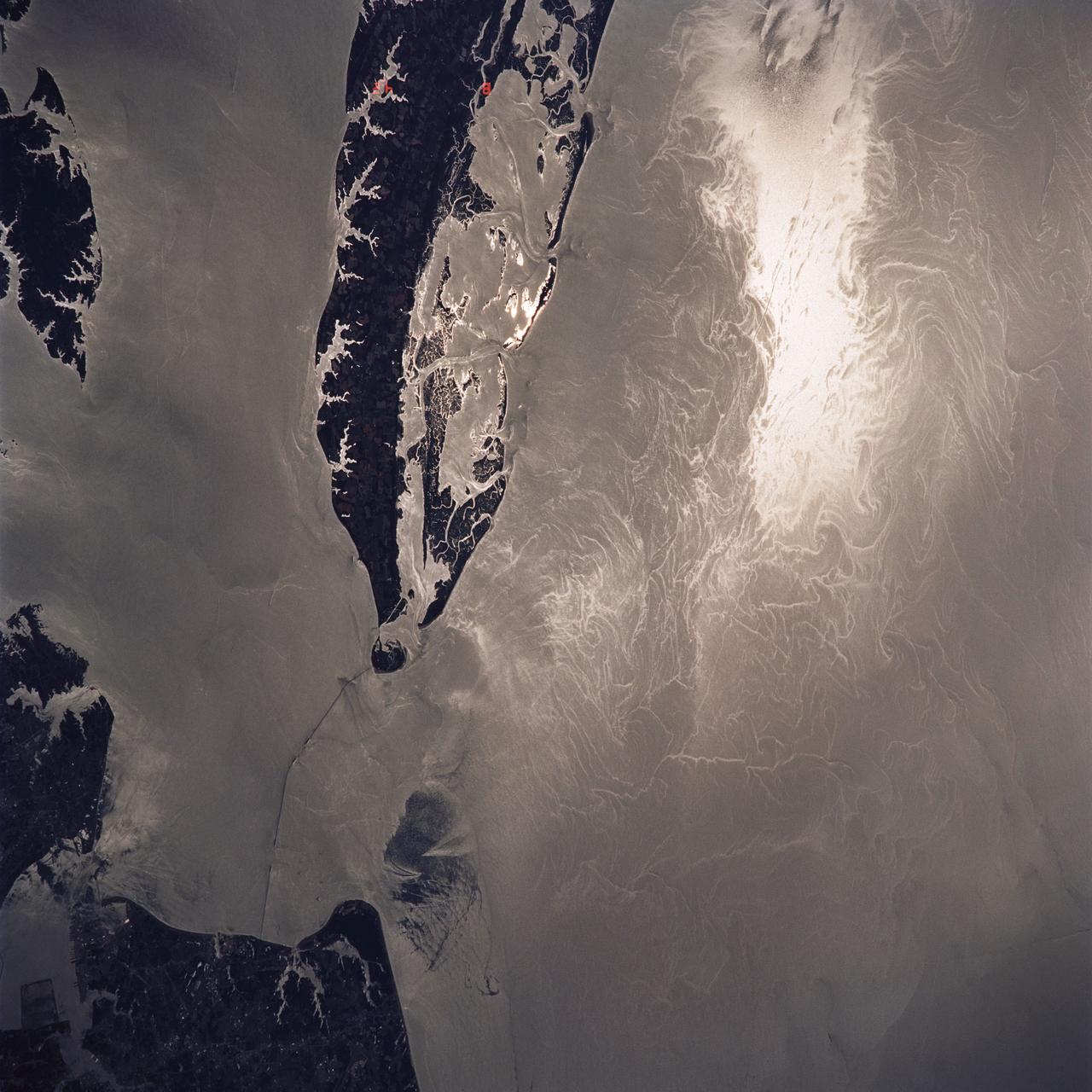
STS040-614-047 (5-14 June 1991) --- This image is of the Norfolk, Virginia -- Southern Delmarva Peninsula Southern Chesapeake Bay Area as seen in sunlight. The exposure is adjusted to emphasize the water patterns present. The outgoing tide generates considerable turbulence as it passes through the mouth of the bay. This is displayed by differences in reflective properties of the water surface due to differences in slope and turbidity. Ship wakes and the wakes of subsurface structures are seen clearly. The bridge tunnel system linking Norfolk with the peninsula and its effect on the system is quite apparent. Sunglint images over land areas were also acquired which emphasize land-water boundaries as demonstrated here in the small Delmarva inlets as a tool for wetland mapping, and river, lake and even pond description. During the first few days of the STS-40 mission the Eastern Seaboard of the United States was free of clouds and haze providing excellent photography of many of the major cities and the countryside of that area as well as the Gulf Stream.
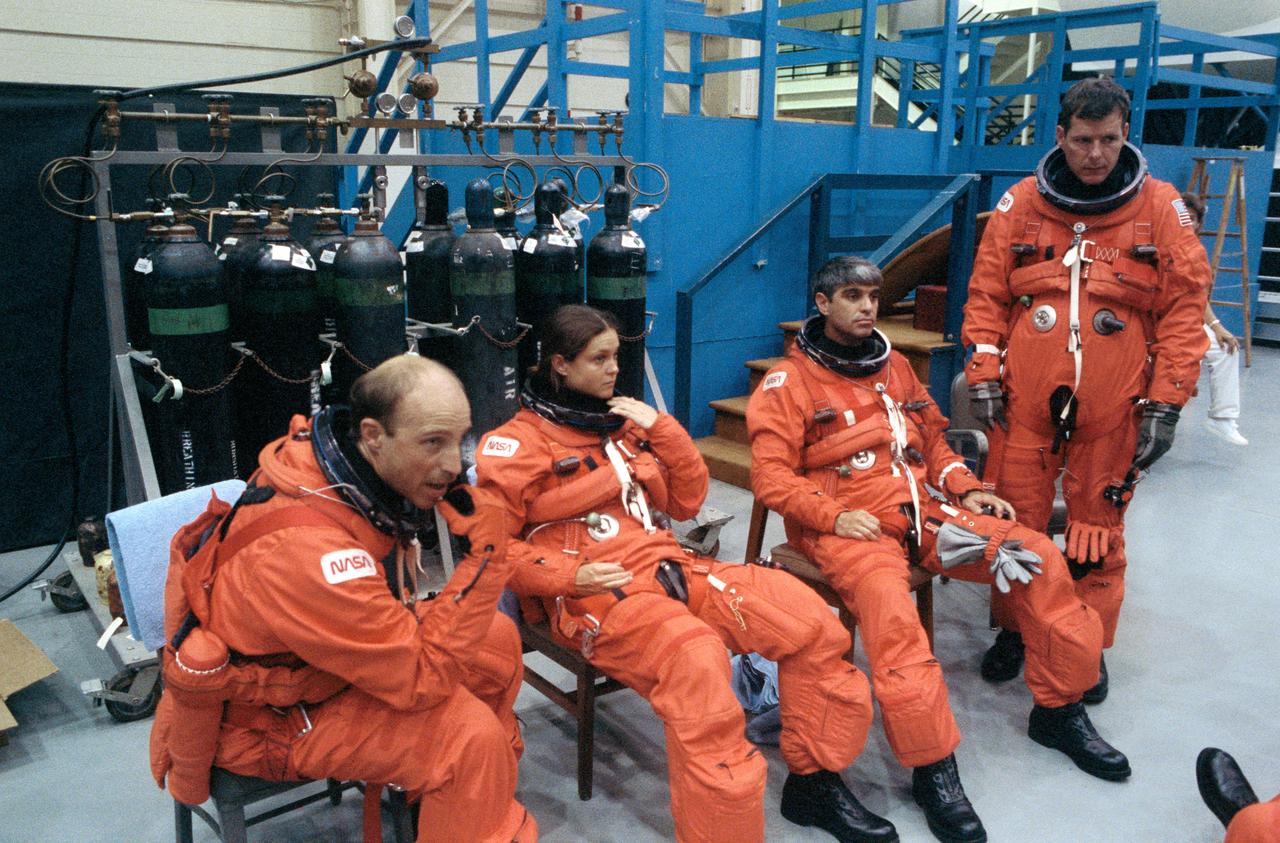
S90-41372 (11 June 1990) --- Crewmembers assigned to NASA's STS 40 Spacelab Life Sciences (SLS-1) mission take a brief break during emergency egress training in the Shuttle mockup and integration laboratory at the Johnson Space Center (JSC). Left to right are astronauts James P. Bagian, Tamara E. Jernigan, both mission specialists; and Sidney M. Gutierrez, pilot; and Bryan D. O'Connor, mission commander. Out of frame are astronaut Rhea Seddon, mission specialist, and payload specialists Millie Hughes-Fulford and Drew Gaffney.
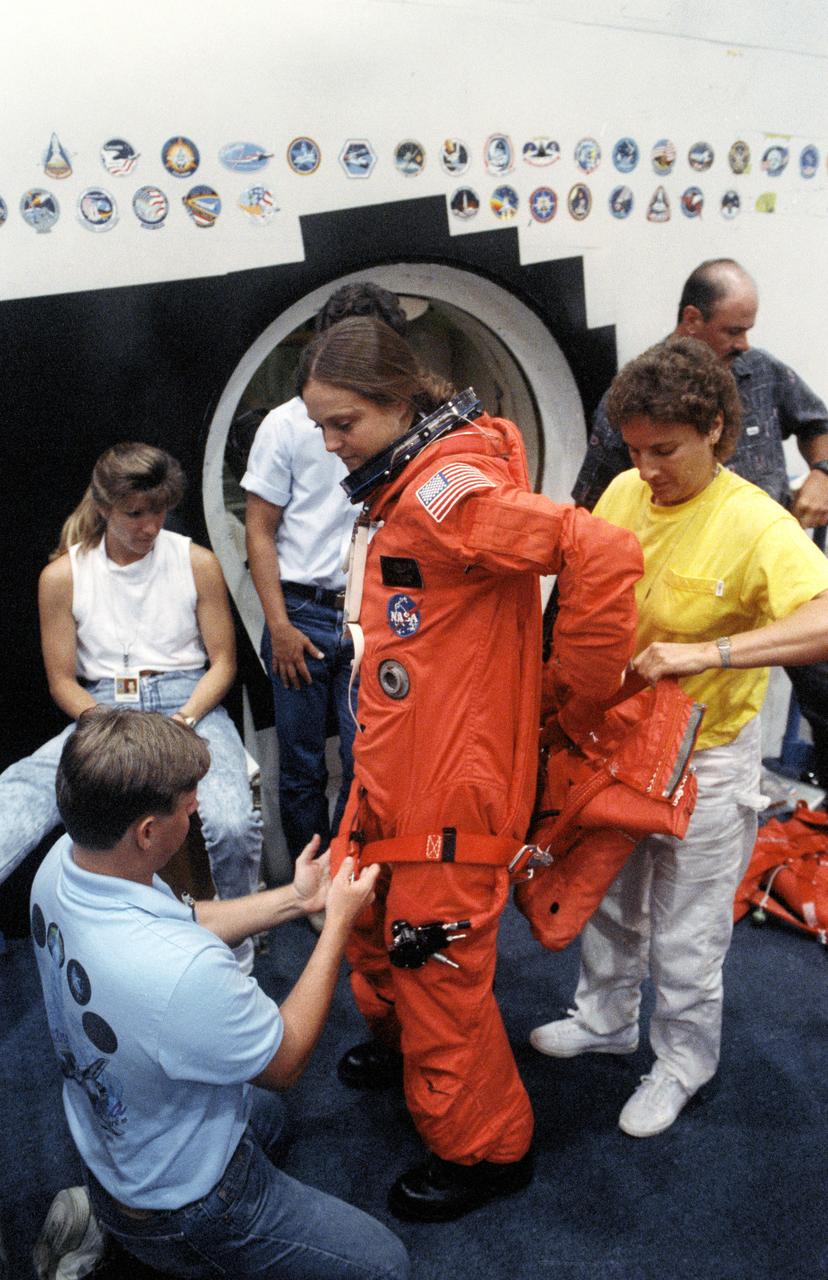
S90-41359 (11 June 1990) --- Astronaut James P. Bagian, STS-40 mission specialist, is seen in his partial pressure ascent/entry suit during a training exercise in the Johnson Space Center's Shuttle mockup and integration laboratory. Dr. Bagian will be joined on the Spacelab Life Sciences (SLS-1) mission, scheduled for launch in less than a year, by astronauts Bryan D. O'Connor, Sidney M. Gutierrez, Rhea Seddon and Tamara E. Jernigan, along with payload specialists F. Drew Gaffney and Millie Hughes-Fulford.
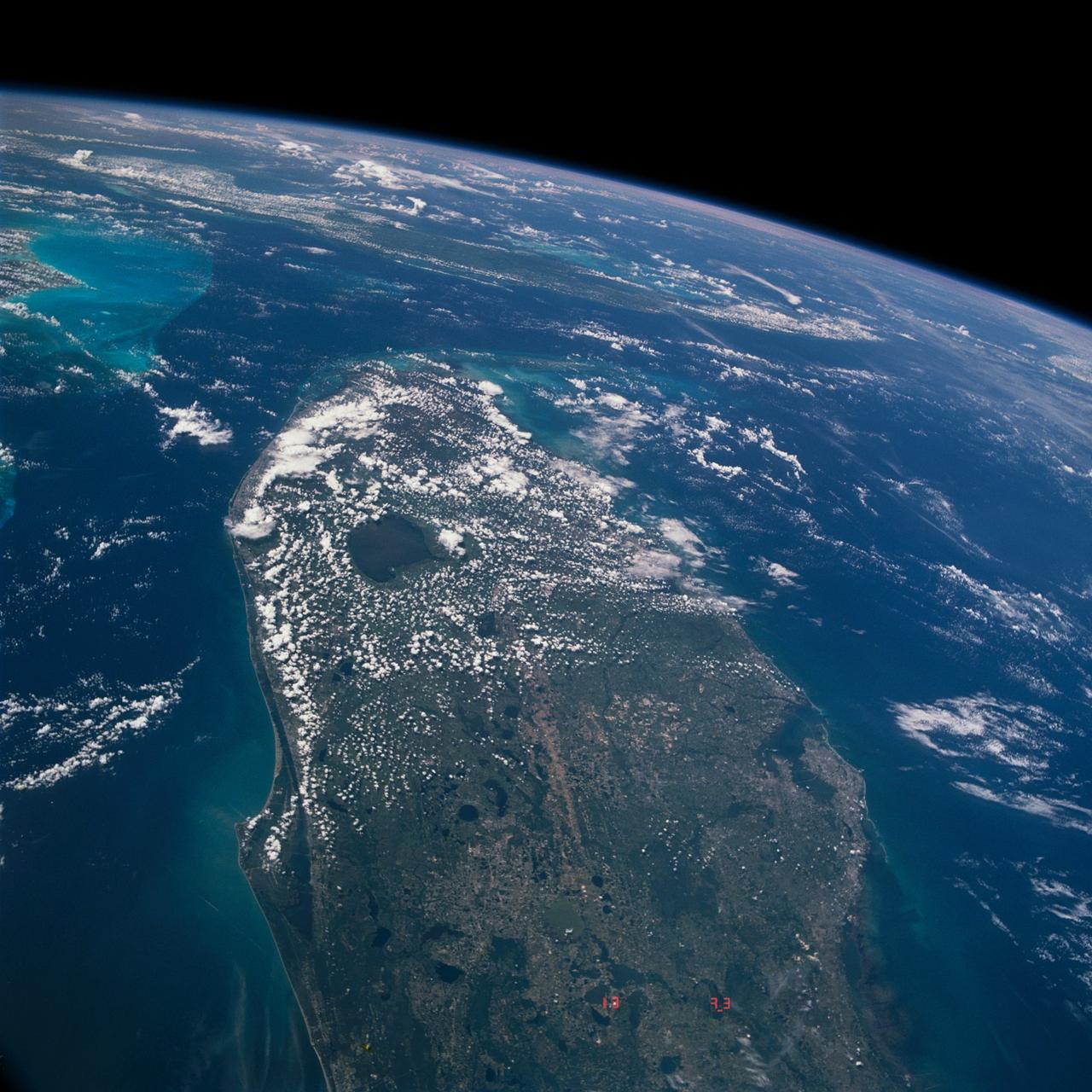
STS040-613-049 (5-14 June 1991) --- This oblique scene from the Earth-orbiting Space Shuttle Columbia shows southern Florida, several of the Bahama Islands and parts of the Atlantic Ocean, the Gulf of Mexico and the Caribbean Sea. The nine-day STS-40/Spacelab Life Sciences (SLS-1) mission started with launch from Kennedy Space Center (KSC), visible in lower left. Cuba can be seen at top center. The picture was photographed with a handheld Rolleiflex camera, aimed through Columbia's aft flight deck windows.
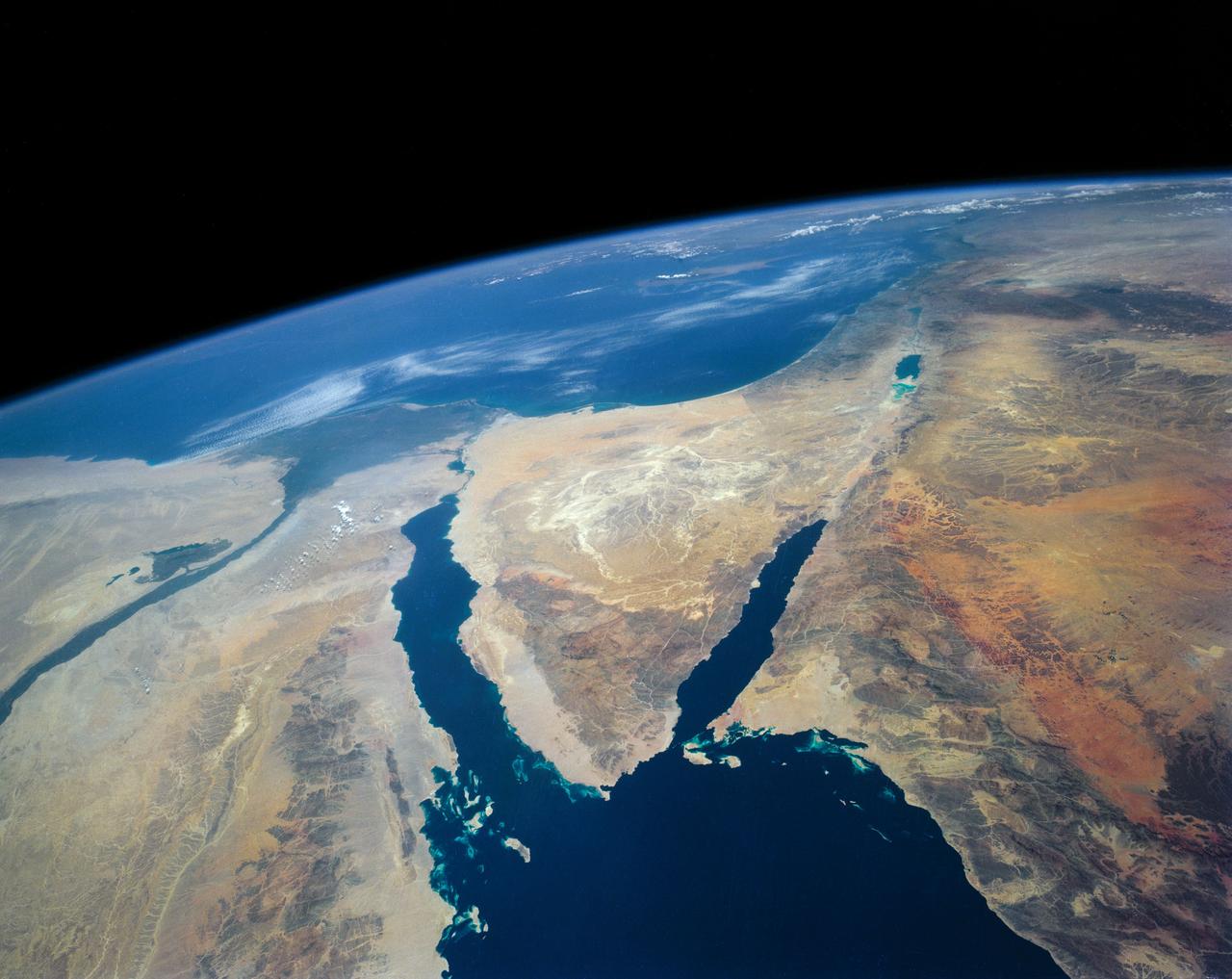
STS040-152-180 (5-24 June 1991) --- The Sinai Peninsula dominates this north-looking, oblique view. According to NASA photo experts studying the STS 40 imagery, the Red Sea in the foreground is clear of river sediment because of the prevailing dry climate of the Middle East. The great rift of the Gulf of Aqaba extends northward to Turkey (top right) through the Dead Sea. The international boundary between Israel and Egypt, reflecting different rural landscapes, stands out clearly. The Nile River runs through the frame. NASA photo experts believe the haze over the Mediterranean to be wind-borne dust. The photo was taken with an Aero-Linhof large format camera.
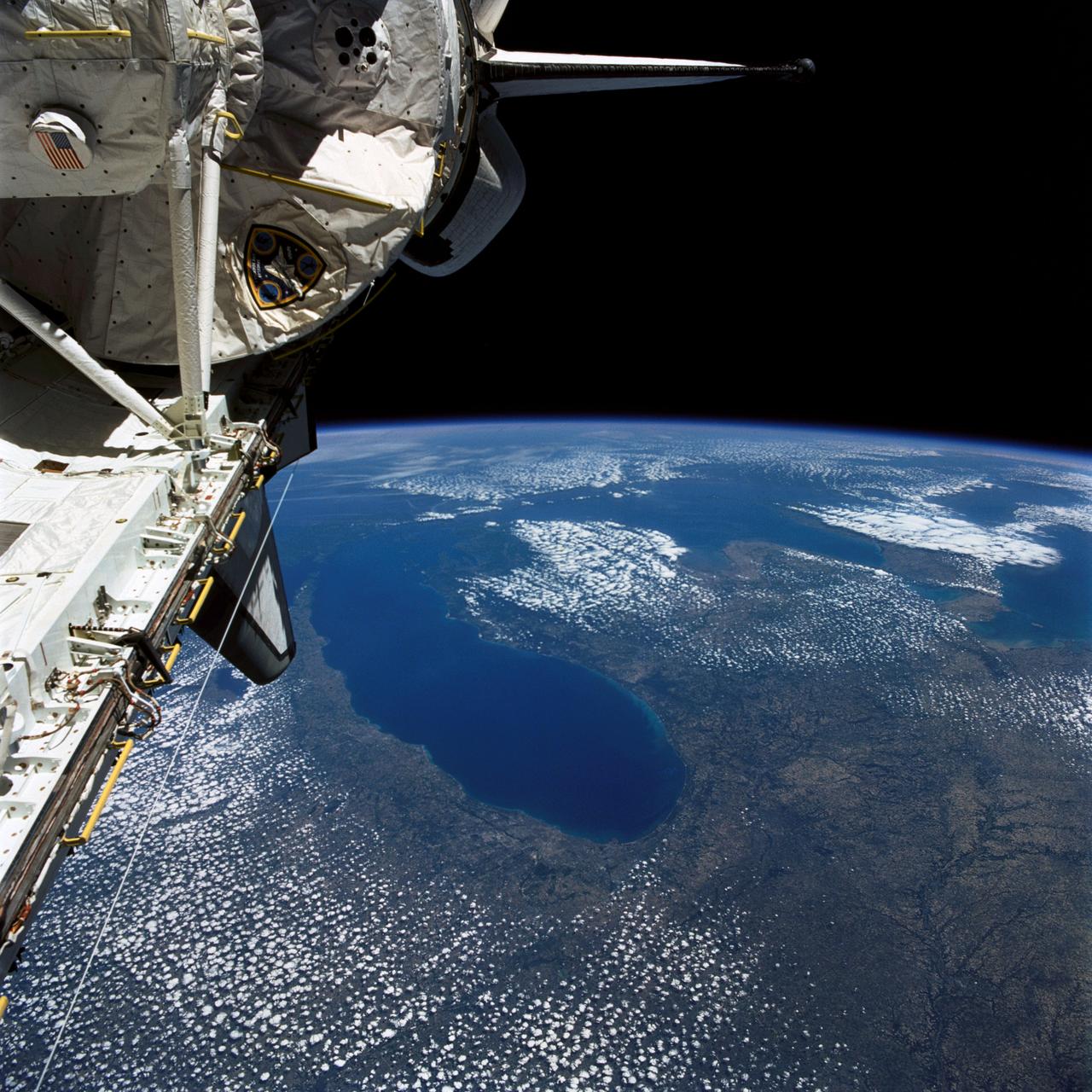
STS040-77-045 (6 June 1991) --- This image, photographed on June 6, 1991, is an oblique view looking north-northeast and shows most of the Great Lakes region. Part of Columbia's cargo bay and the Spacelab Life Sciences (SLS-1) module are in the foreground. In the center of the image is Lake Michigan with Chicago clearly visible along the southwest shore. According to NASA photo experts studying the STS-40 imagery, this image shows several interesting meteorological phenomena. The difference in temperature between the warming land and the cold lake waters is illustrated by the low level clouds. The warming land surface results in rising air and the formation of clouds, while the lake waters are cold and result in the lakes remaining cloud free. Also visible is evidence of lake breezes developing around several of the lakes. This phenomena is also driven by the difference in temperature between the land and the water. Winds blowing off the lakes must travel 25 - 30 miles inland before it warms sufficiently to create clouds.
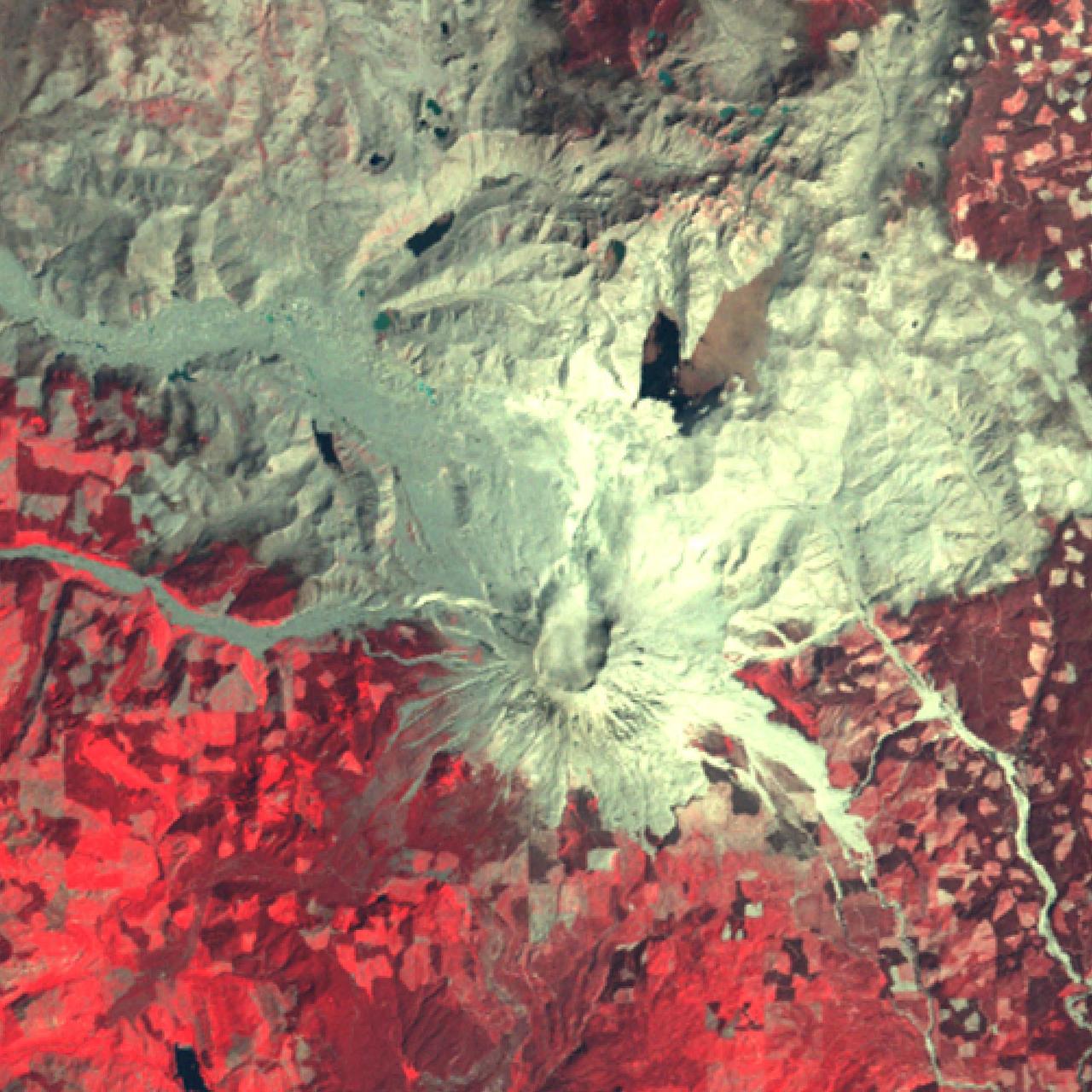
Mount St. Helens, Washington, erupted 40 years ago, on May 18, 1980. A massive debris avalanche, triggered by an earthquake of magnitude 5.1, caused a lateral eruption that reduced the elevation of the mountain's summit from 2,950 m to 2,549 m, leaving a 1.6 km wide horseshoe-shaped crater. The collapse of the northern flank resulted in massive volcanic mudflows. Since 1980, new lava built a dome in the crater, and occasional steam and ash plumes have been emitted. The Landsat MSS image was acquired July 31, 1980, and the ASTER image (Figure 1) on July 28, 2019. The images cover an area of 30 by 30 km, and are located at 46.2 degrees north, 122.2 degrees west. https://photojournal.jpl.nasa.gov/catalog/PIA23913
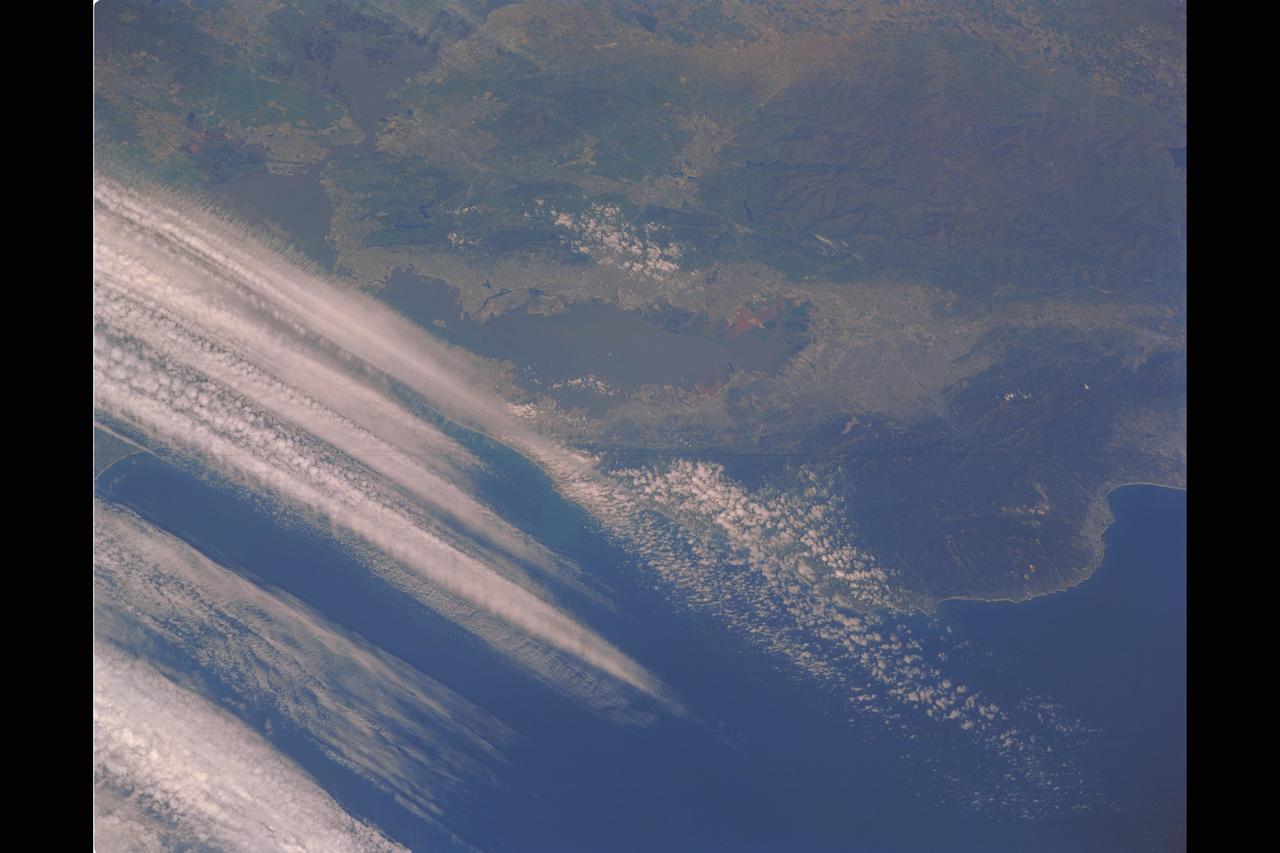
San Francisco Bay Area as seen from the Space Shuttle STS-40, SL-1 mission
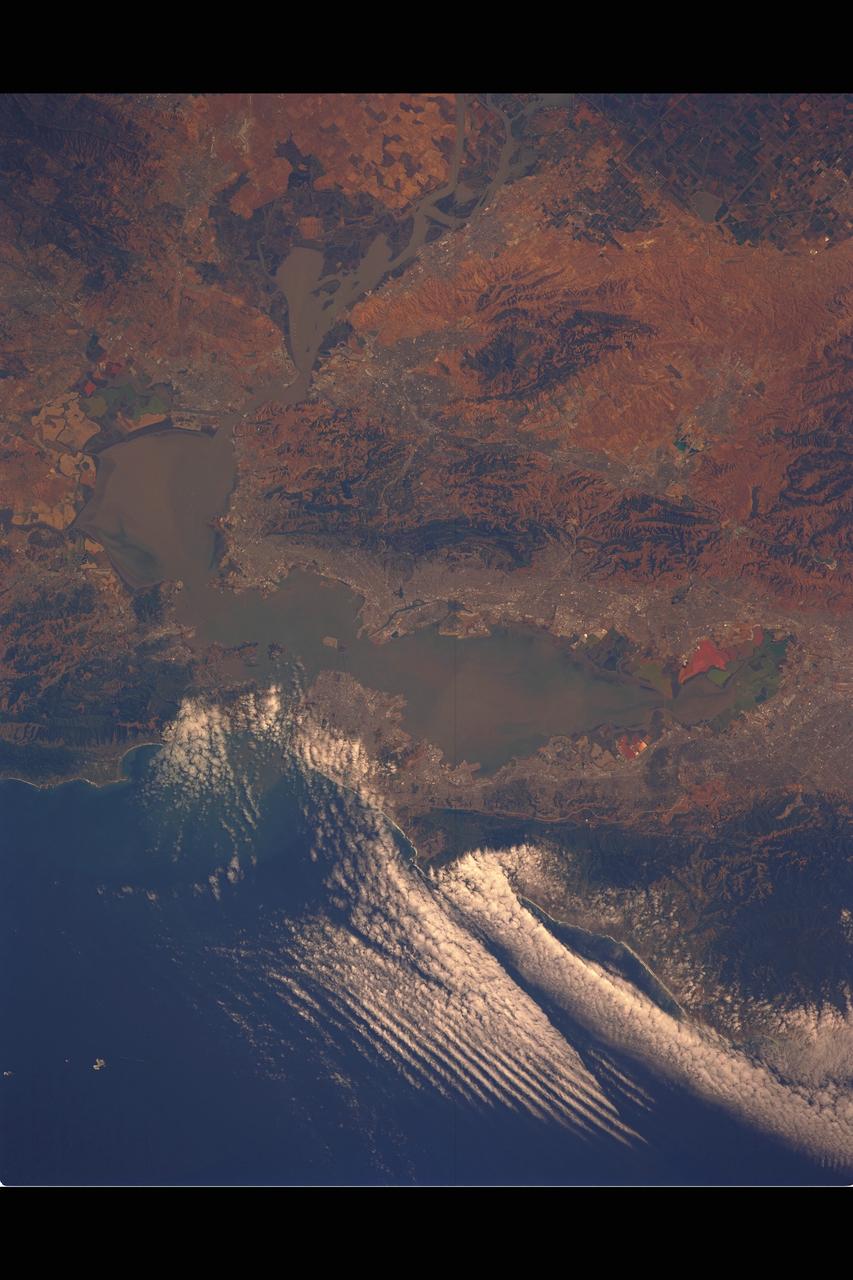
San Francisco Bay Area as seen from the Space Shuttle STS-40, SL-1 mission
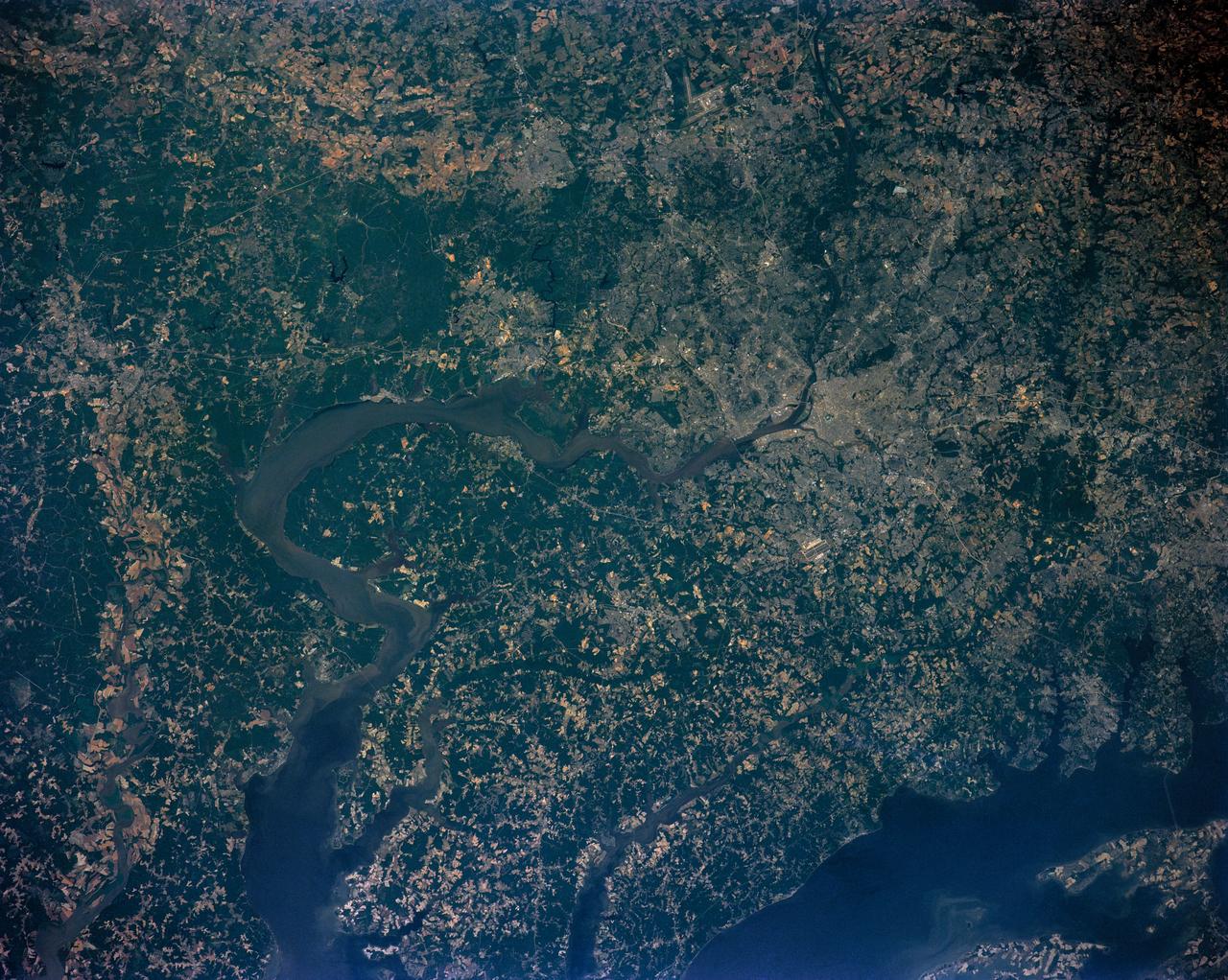
STS040-151-129 (5-14 June 1991) --- An image of a large format camera of Washington, D.C. and surrounding area. The Mall, the Capitol and the White House can be delineated.
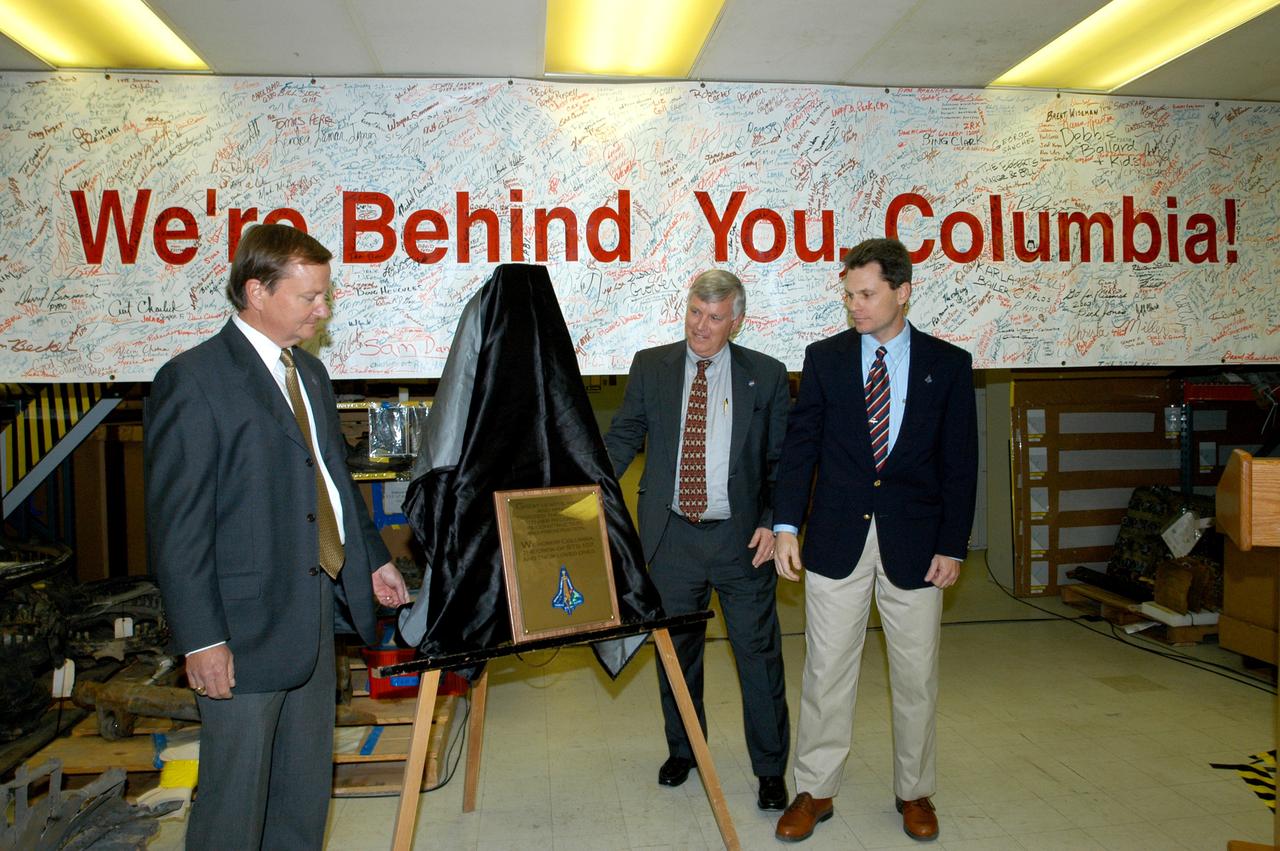
KENNEDY SPACE CENTER, FLA. - In the Vehicle Assembly Building, Shuttle Launch Director Mike Leinbach, Center Director Jim Kennedy and NASA Vehicle Manager Scott Thurston unveil a plaque honoring “Columbia, the crew of STS-107, and their loved ones.” The site is the “Columbia room,” a permanent repository of the debris collected in the aftermath of the tragic accident Feb. 1, 2003, that claimed the orbiter and lives of the seven-member crew. The dedication of the plaque was made in front of the 40-member preservation team.
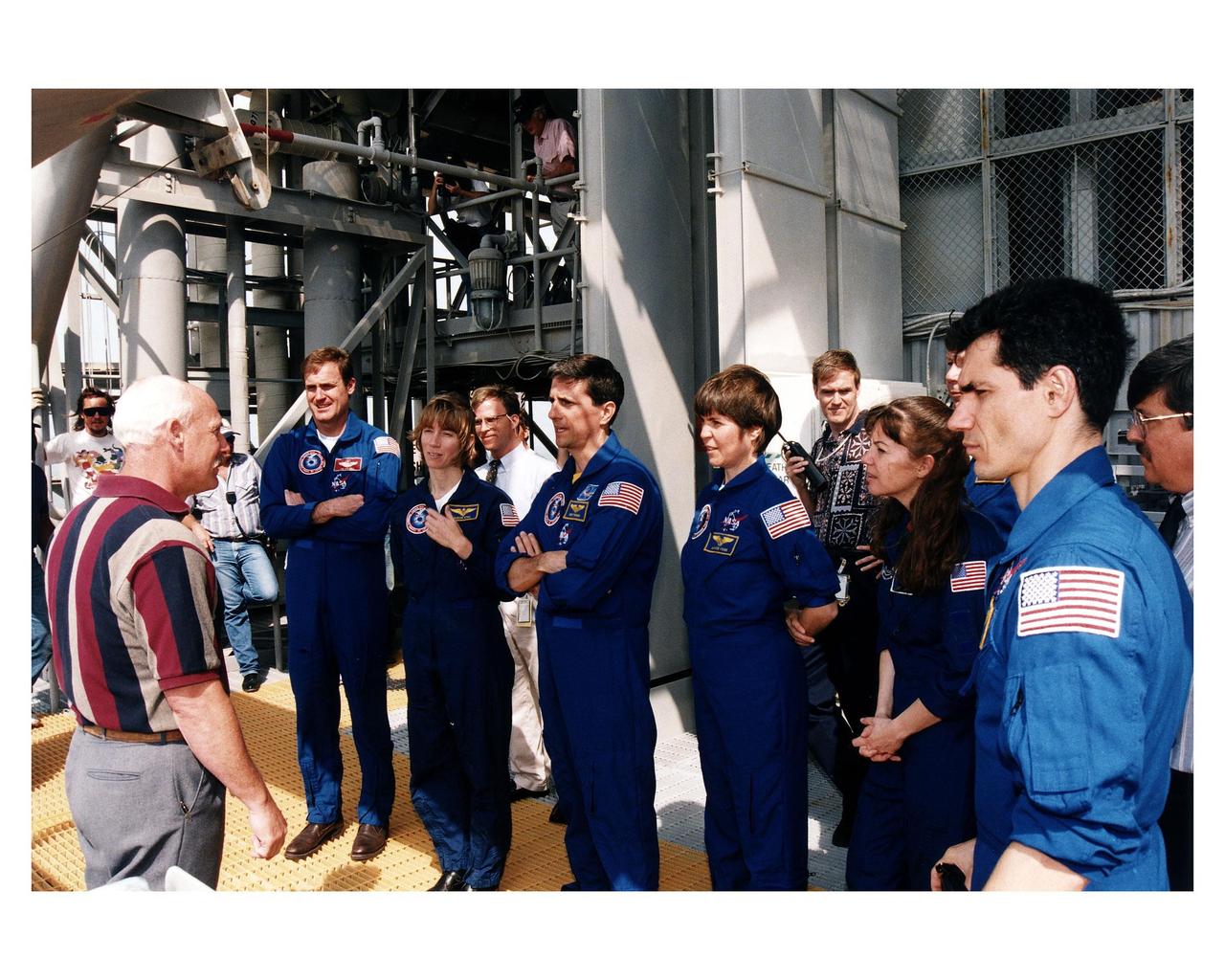
Members of the STS-83 crew receive instruction at Launch Complex 39A during the crew's <a href="http://www-pao.ksc.nasa.gov/kscpao/release/1997/40-97.htm">Terminal Countdown Demonstration Test (TCDT).</a

The STS-83 crew departs the Operations and Checkout Building on their way to Launch Complex 39A during the crew's <a href="http://www-pao.ksc.nasa.gov/kscpao/release/1997/40-97.htm">Terminal Countdown Demonstration Test (TCDT).</a
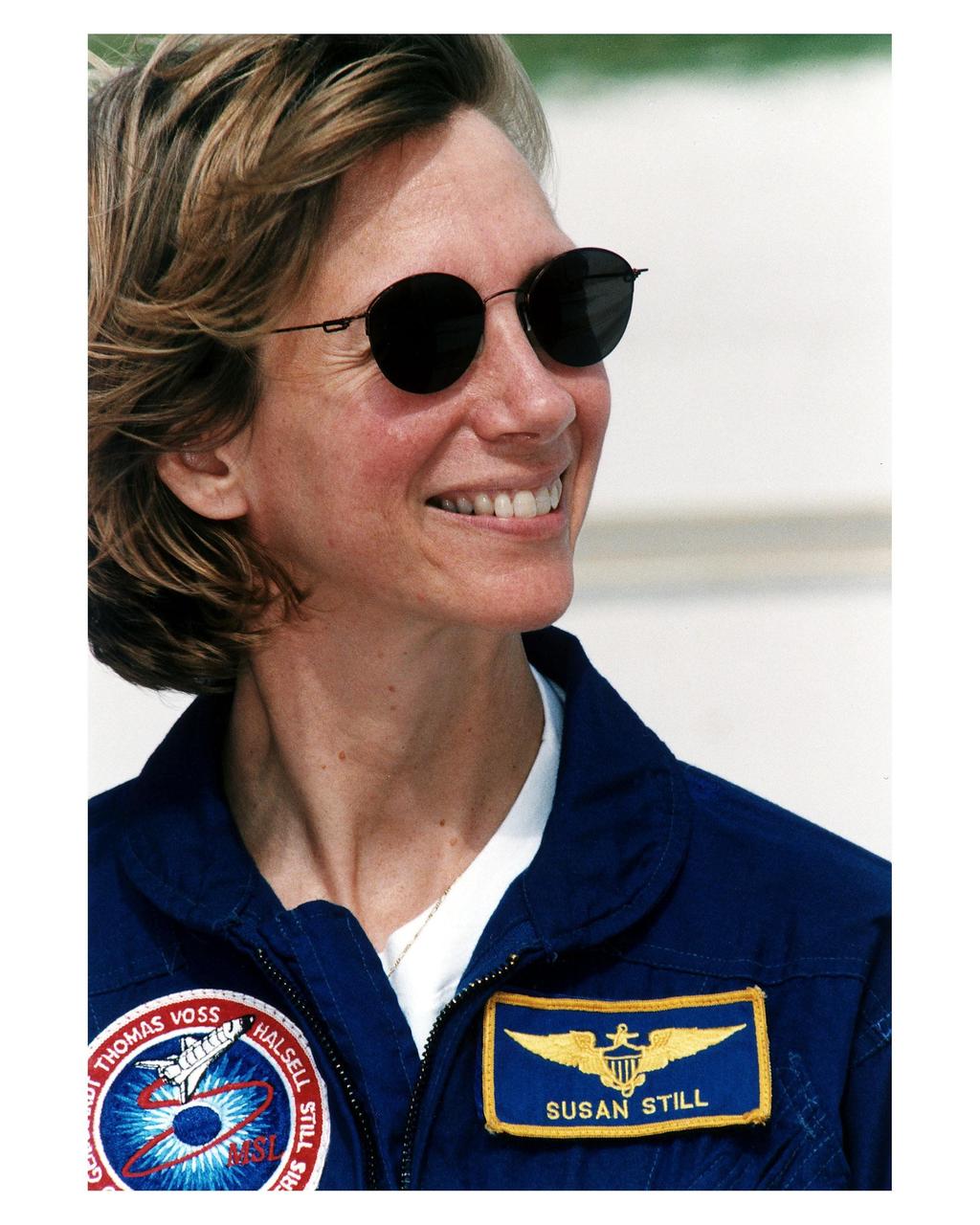
STS-83 Pilot Susan L. Still talks to the media at Launch Complex 39A during the crew's <a href="http://www-pao.ksc.nasa.gov/kscpao/release/1997/40-97.htm">Terminal Countdown Demonstration Test (TCDT).</a
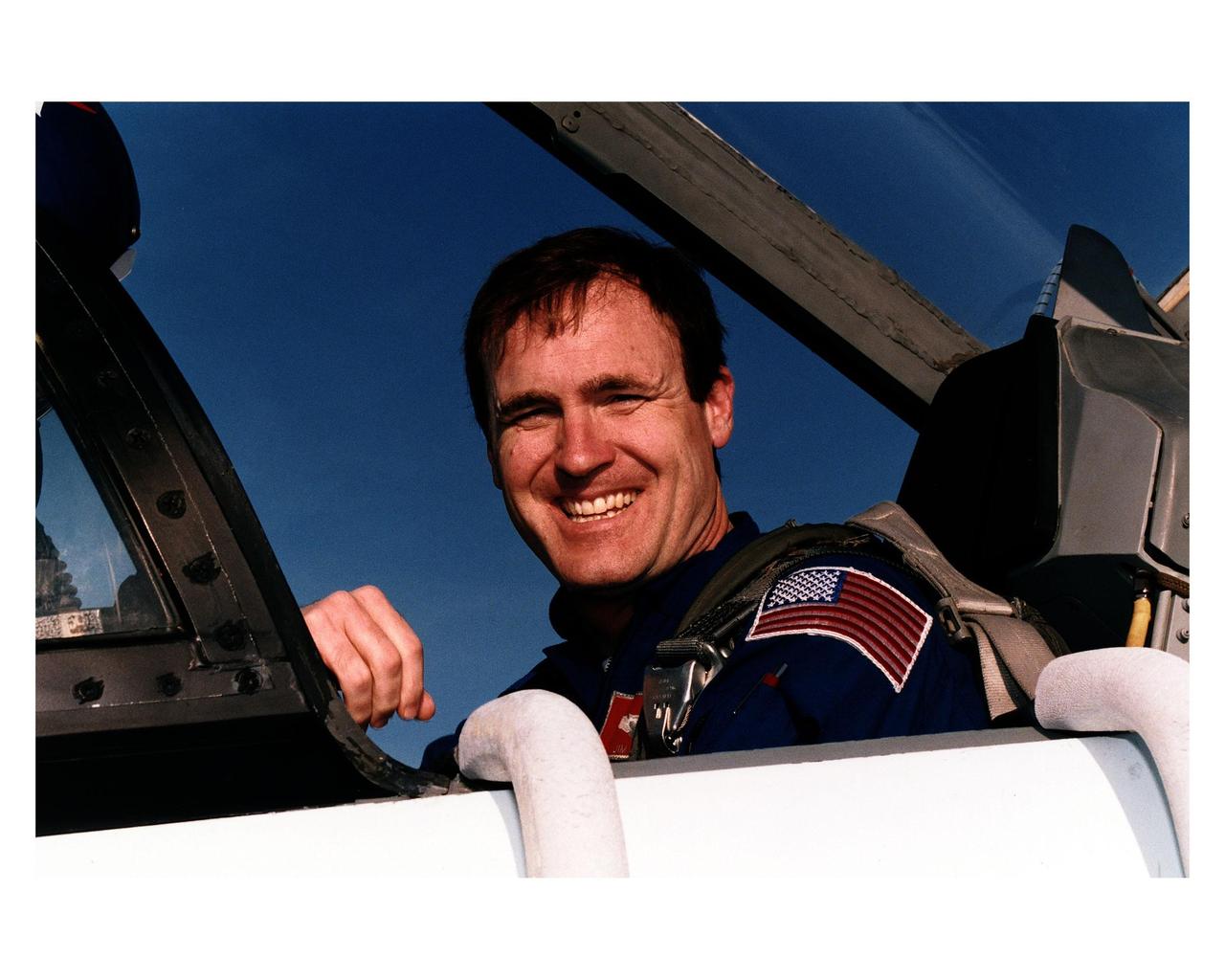
STS-83 Crew Commander James Halsell (in T-38 cockpit) and other members of the STS-83 crew arrive at Kennedy Space Center's Shuttle Landing Facility in preparation for their <a href="http://www-pao.ksc.nasa.gov/kscpao/release/1997/40-97.htm">Terminal Countdown Demonstration Test.</a
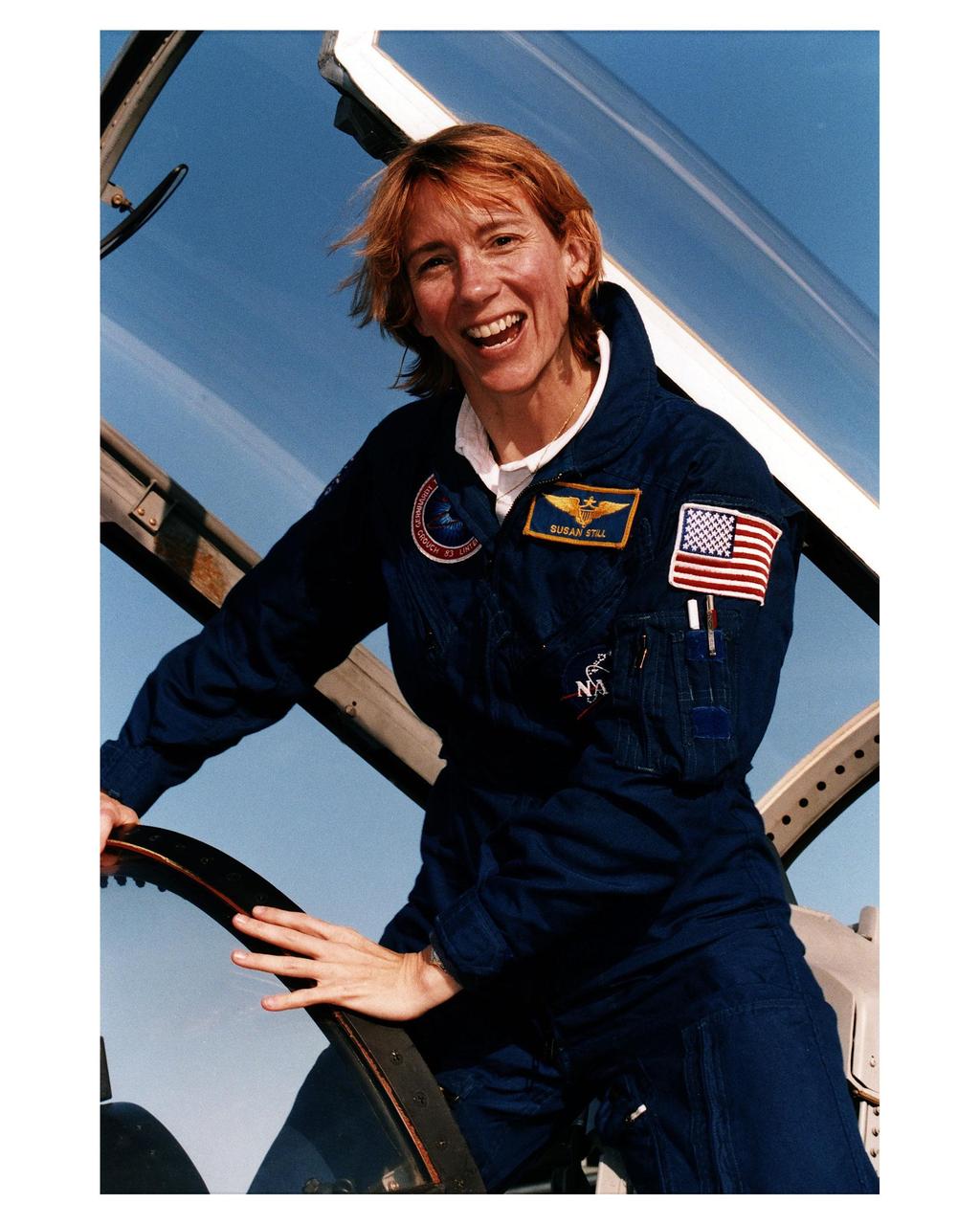
STS-83 Pilot Susan Still (emerging from T-38 cockpit) and other members of the STS-83 crew arrive at Kennedy Space Center's Shuttle Landing Facility in preparation for their <a href="http://www-pao.ksc.nasa.gov/kscpao/release/1997/40-97.htm">Terminal Countdown Demonstration Test.</a
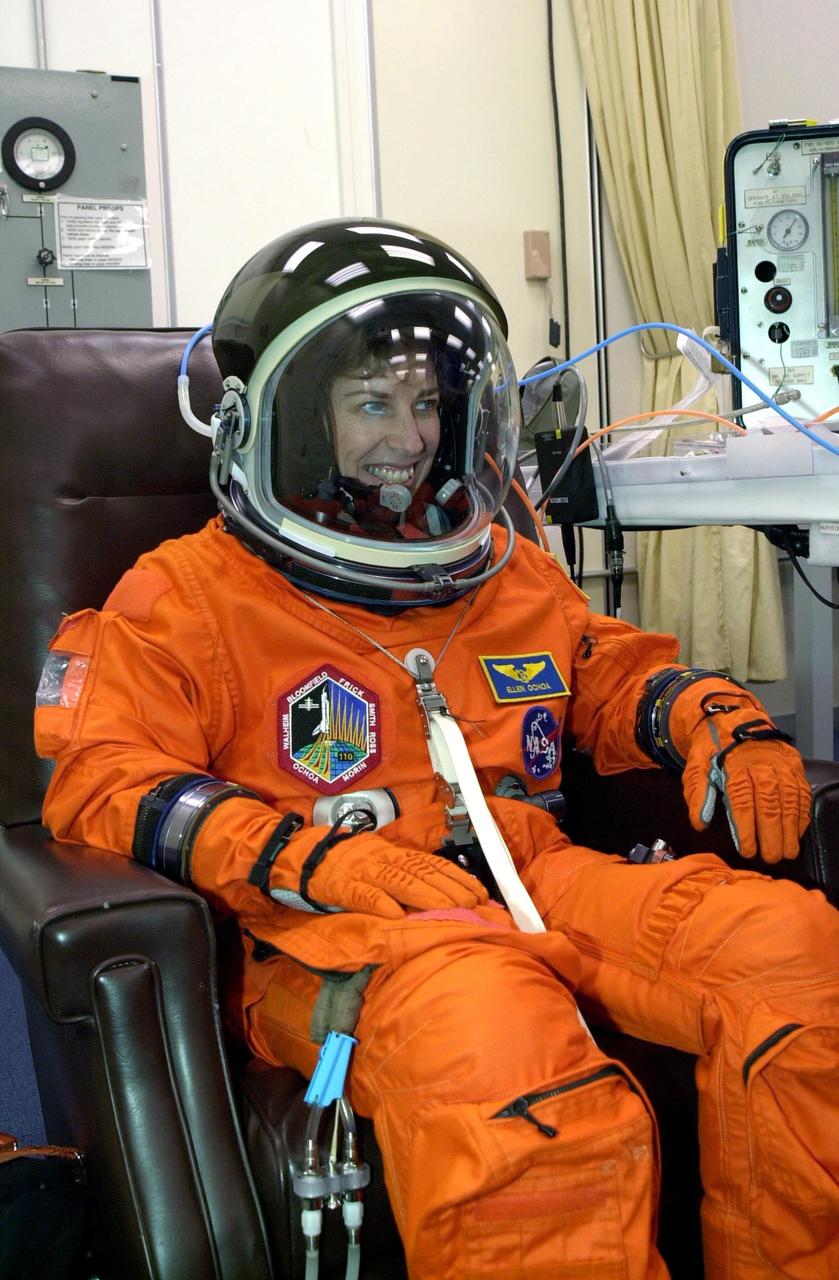
KENNEDY SPACE CENTER, FLA. -- STS-110 Mission Specialist Ellen Ochoa grins after suiting up for launch, scheduled for 4:40 p.m. EDT (20:40 GMT). Ochoa is making her fourth Shuttle flight. STS-110 is the 13th assembly flight to the International Space Station, carrying the S0 Integrated Truss Structure and Mobile Transporter (MT). On the 11-day mission, the mission features four spacewalks to attach the S0 truss, which will become the backbone of the Space Station, to the U.S. Lab, "Destiny." The MT, a space "railcar," is attached to the truss segment and will make its debut run during the flight
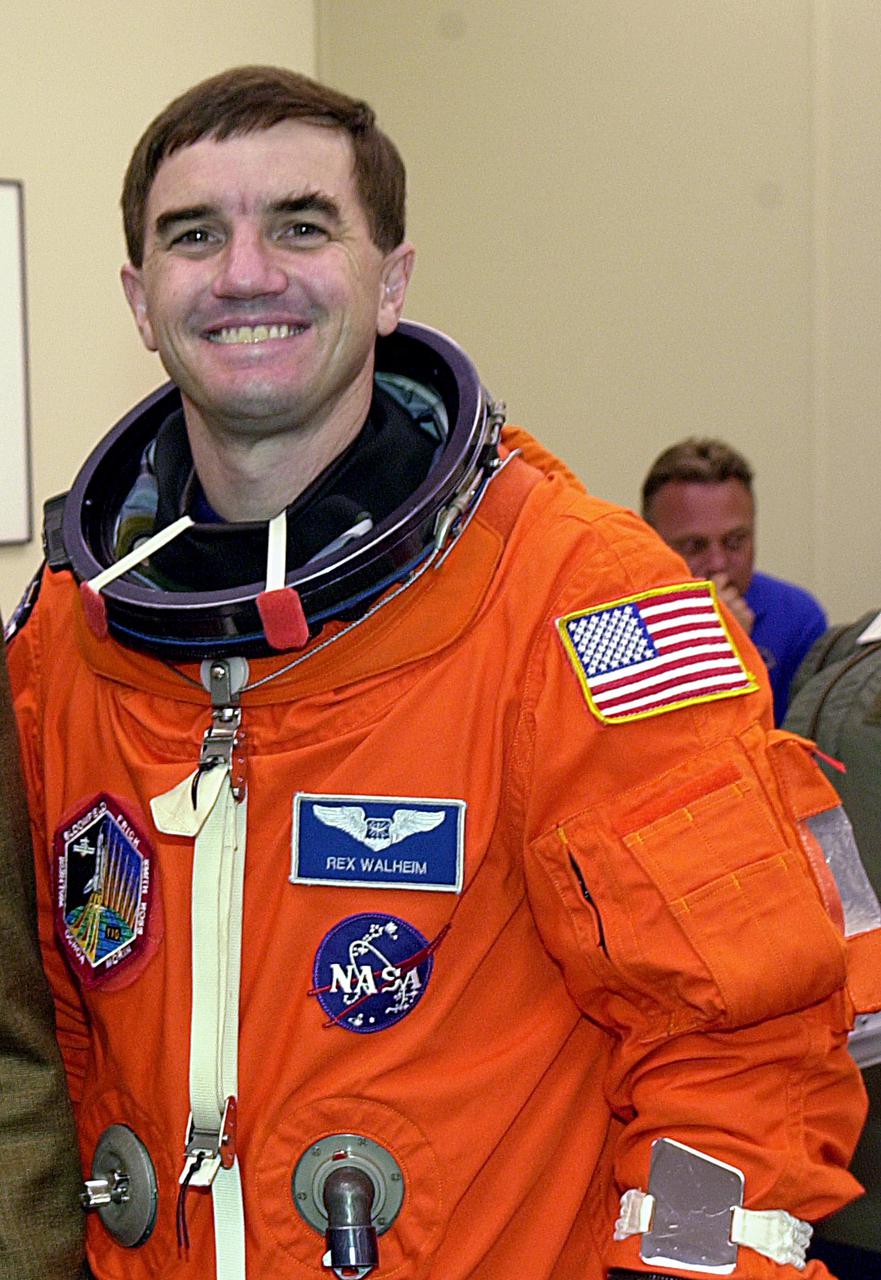
KENNEDY SPACE CENTER, FLA. -- During suitup for launch, STS-110 Mission Specialist Rex J. Walheim smiles in anticipation of his first Shuttle flight. STS-110 is the 13th assembly flight to the International Space Station, carrying the S0 Integrated Truss Structure and Mobile Transporter (MT). On the 11-day mission, the mission features four spacewalks to attach the S0 truss, which will become the backbone of the Space Station, to the U.S. Lab, 'Destiny.' The MT, a space 'railcar,' is attached to the truss segment and will make its debut run during the flight. Launch is scheduled for 4:40 p.m. EDT (20:40 GMT)
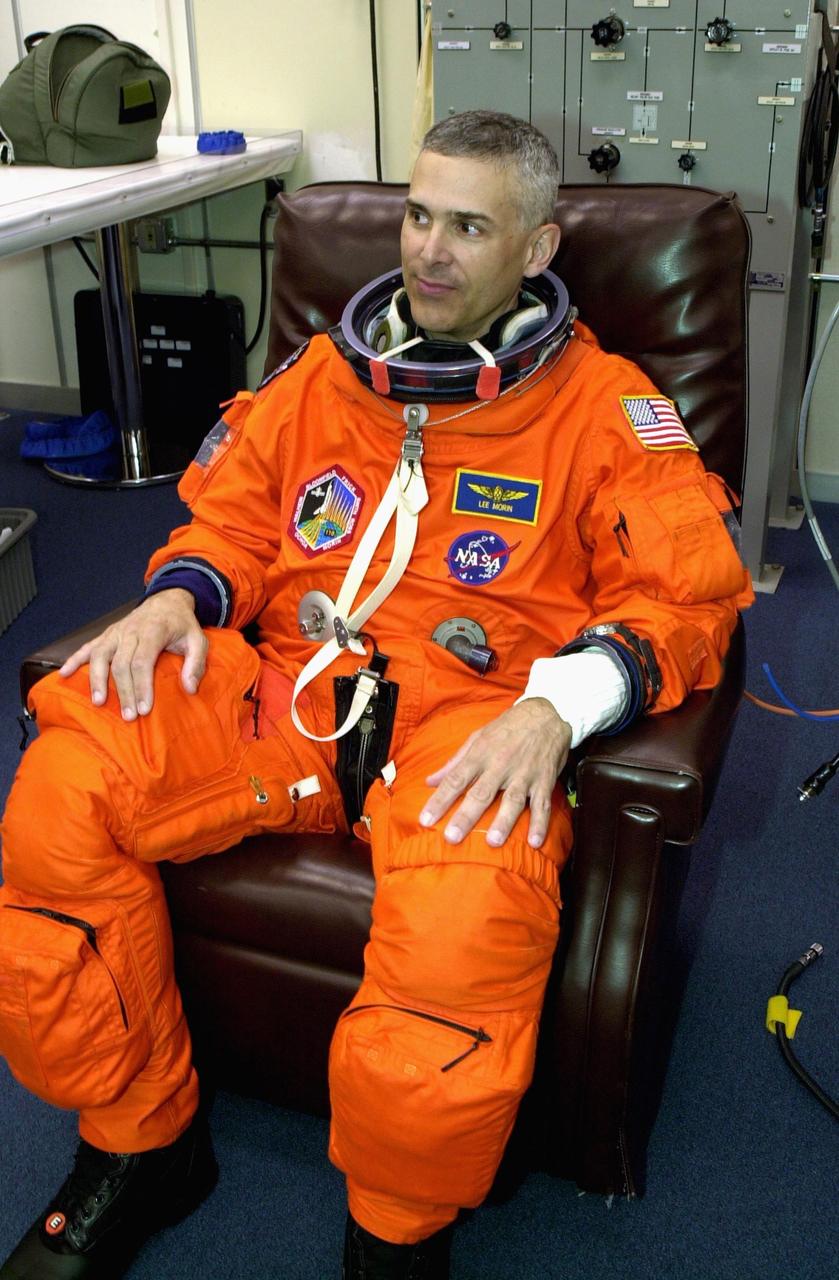
KENNEDY SPACE CENTER, FLA. -- Making his first Shuttle flight, STS-110 Mission Specialist Lee M.E. Morin waits to finish suiting up for launch, scheduled for 4:40 p.m. EDT (20:40 GMT). STS-110 is the 13th assembly flight to the International Space Station, carrying the S0 Integrated Truss Structure and Mobile Transporter (MT). On the 11-day mission, the mission features four spacewalks to attach the S0 truss, which will become the backbone of the Space Station, to the U.S. Lab, "Destiny." The MT, a space "railcar," is attached to the truss segment and will make its debut run during the flight
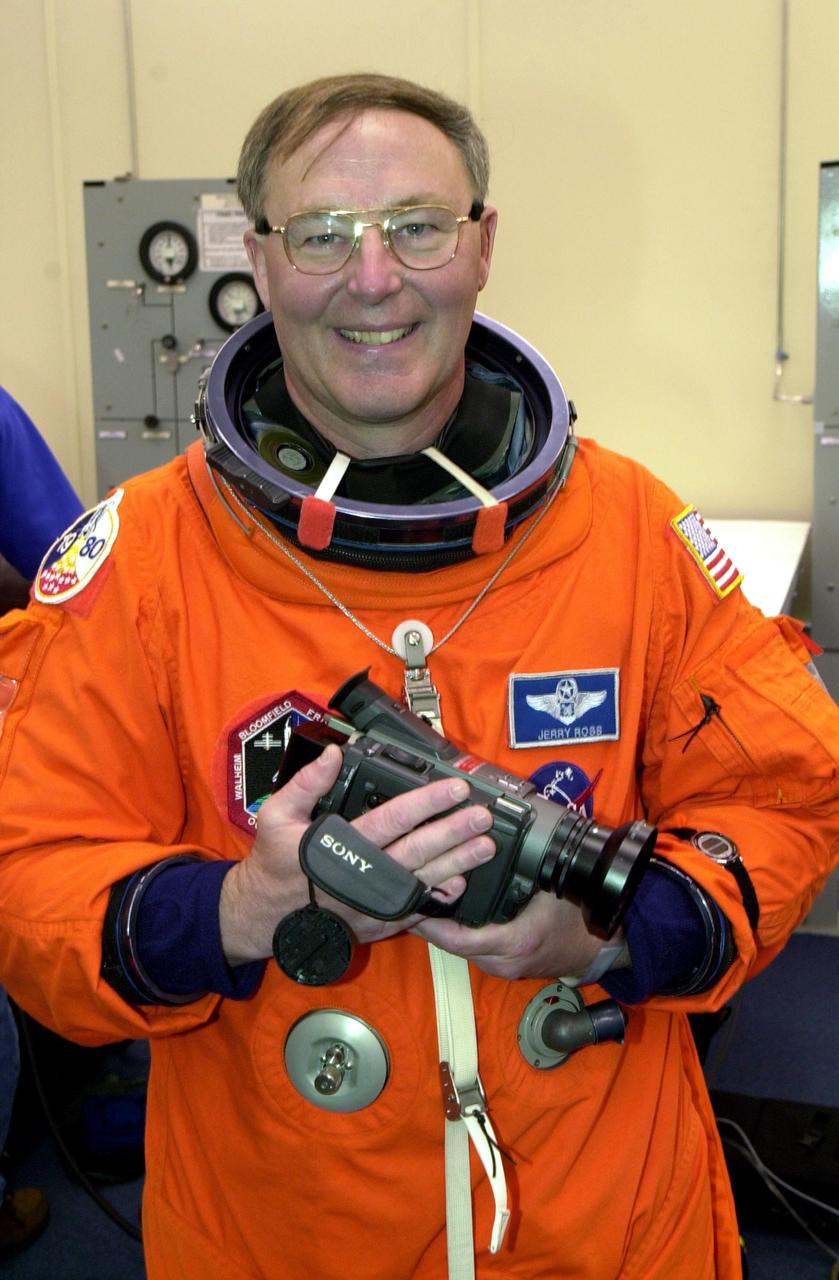
KENNEDY SPACE CENTER, FLA. -- During suitup for launch, STS-110 Mission Specialist Jerry L. Ross holds a camera he'll use on the mission. Ross is making a record-breaking seventh flight. STS-110 is the 13th assembly flight to the International Space Station, carrying the S0 Integrated Truss Structure and Mobile Transporter (MT). On the 11-day mission, the mission features four spacewalks to attach the S0 truss, which will become the backbone of the Space Station, to the U.S. Lab, "Destiny." The MT, a space "railcar," is attached to the truss segment and will make its debut run during the flight. Launch is scheduled for 4:40 p.m. EDT (20:40 GMT)
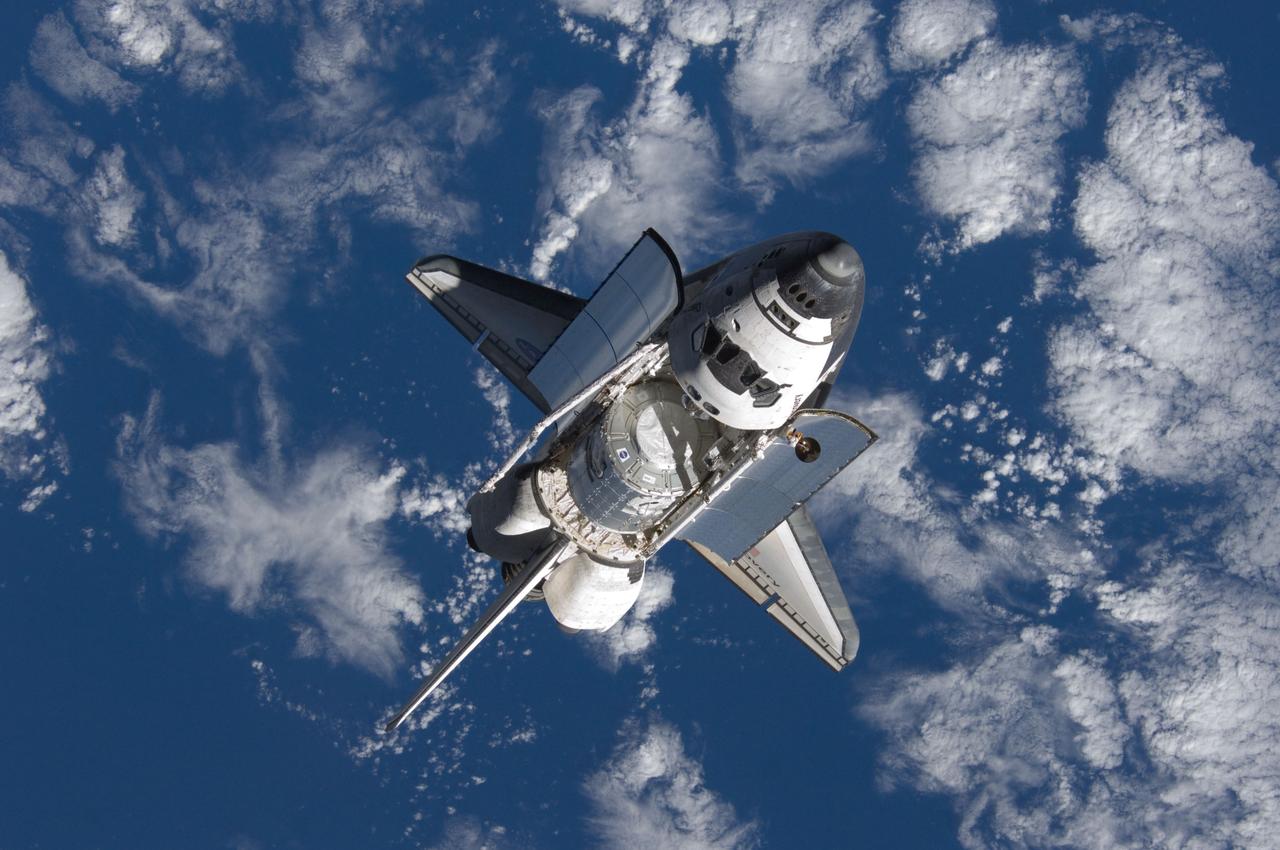
ISS016-E-006328 (25 Oct. 2007) --- Backdropped by a blue and white Earth, Space Shuttle Discovery approaches the International Space Station during STS-120 rendezvous and docking operations. Docking occurred at 7:40 a.m. (CDT) on Oct. 25, 2007. The Harmony node is visible in Discovery's cargo bay.
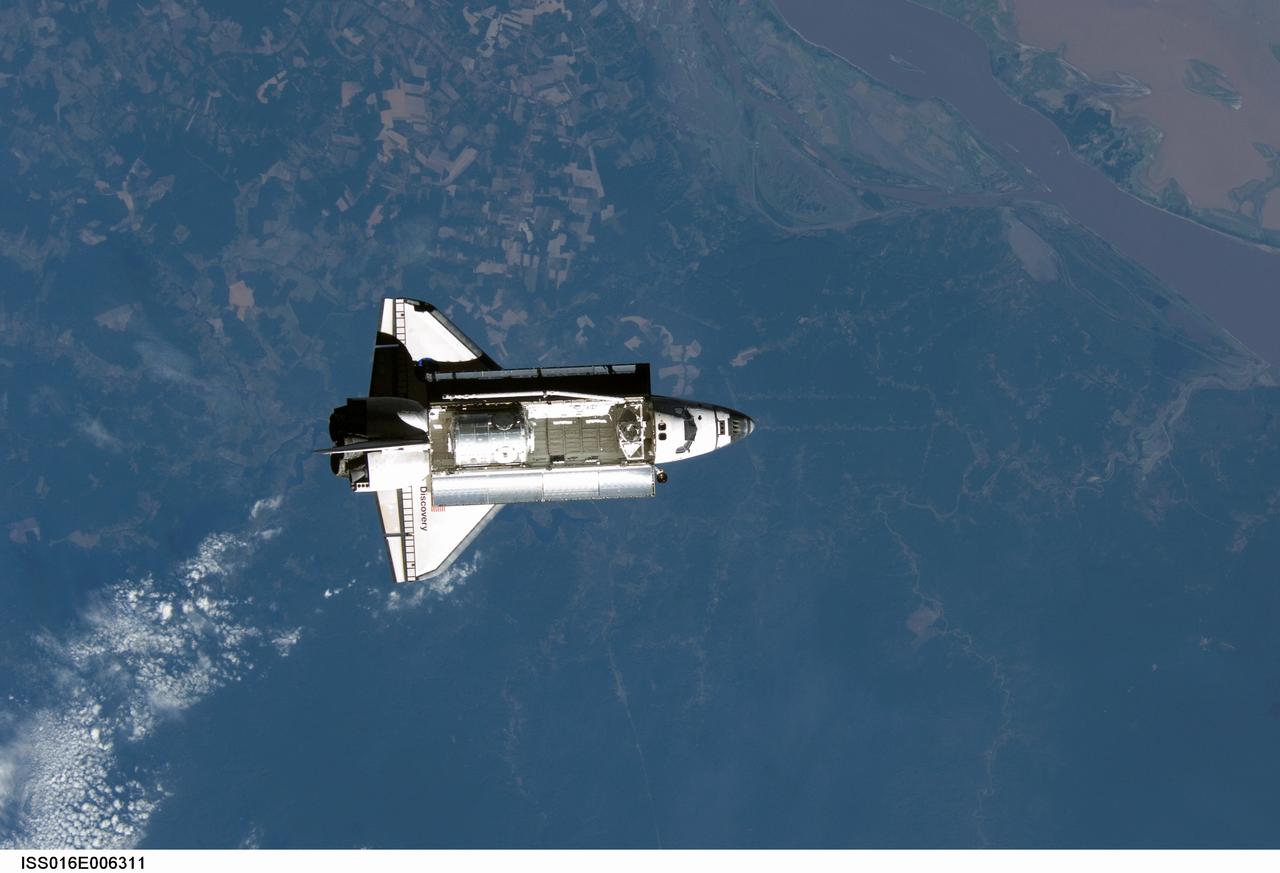
ISS016-E-006311 (25 Oct. 2007) --- Backdropped by a colorful Earth, Space Shuttle Discovery approaches the International Space Station during STS-120 rendezvous and docking operations. Docking occurred at 7:40 a.m. (CDT) on Oct. 25, 2007. The Harmony node is visible in Discovery's cargo bay.
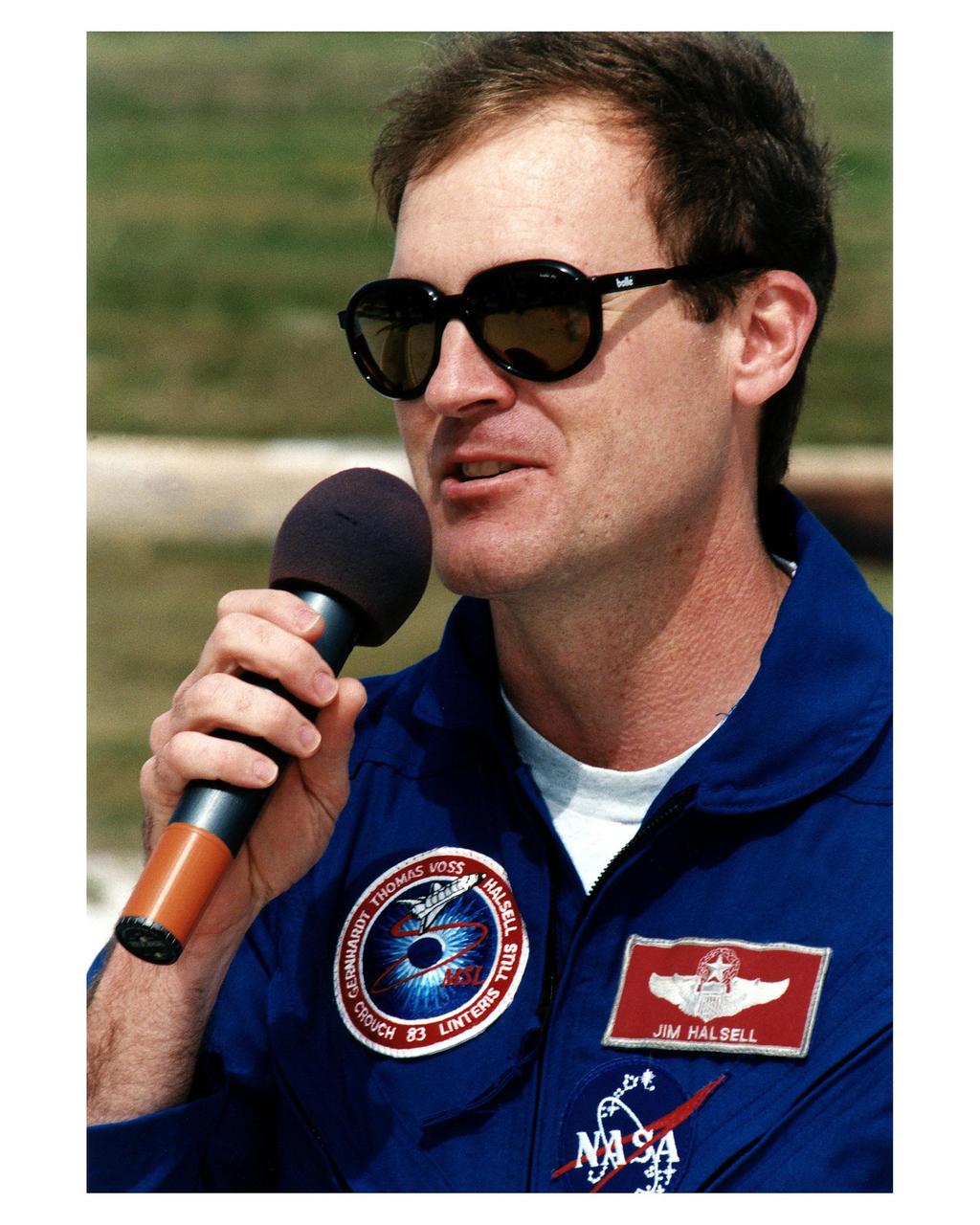
STS-83 Mission Commander James D. Halsell talks to the media at Launch Complex 39A during the crew's <a href="http://www-pao.ksc.nasa.gov/kscpao/release/1997/40-97.htm">Terminal Countdown Demonstration Test (TCDT).</a
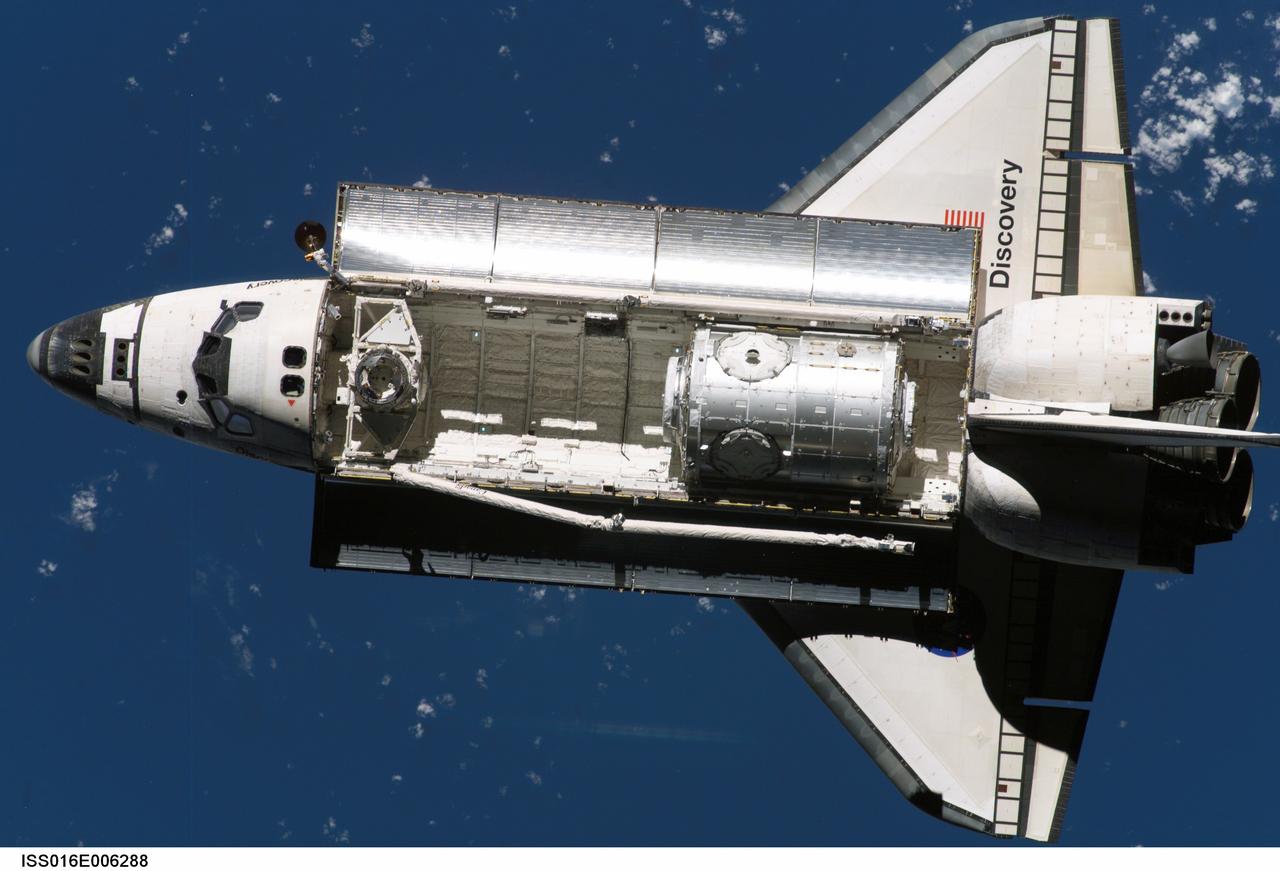
ISS016-E-006288 (25 Oct. 2007) --- Backdropped by a blue and white Earth, Space Shuttle Discovery approaches the International Space Station during STS-120 rendezvous and docking operations. Docking occurred at 7:40 a.m. (CDT) on Oct. 25, 2007. The Harmony node is visible in Discovery's cargo bay.
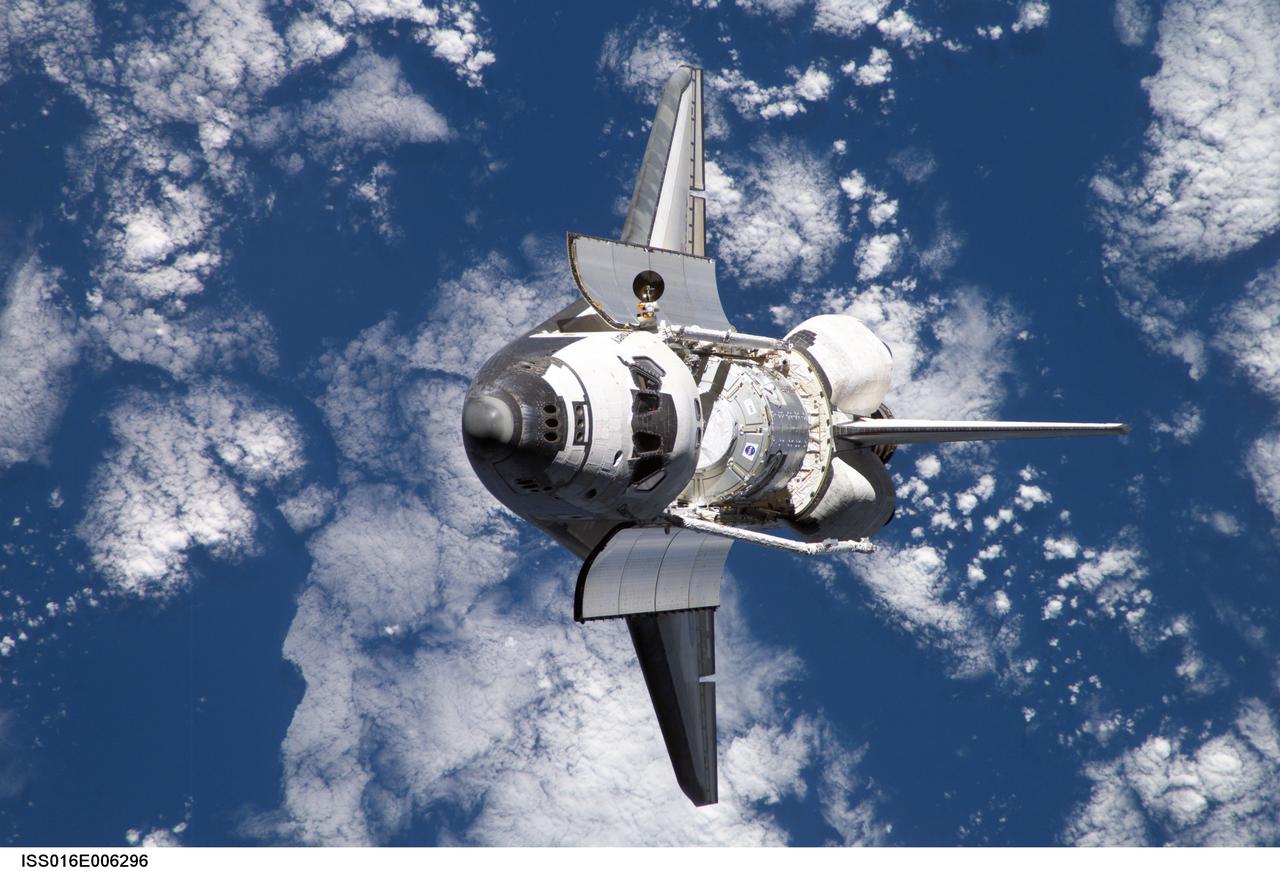
ISS016-E-006296 (25 Oct. 2007) --- Backdropped by a blue and white Earth, Space Shuttle Discovery approaches the International Space Station during STS-120 rendezvous and docking operations. Docking occurred at 7:40 a.m. (CDT) on Oct. 25, 2007. The Harmony node is visible in Discovery's cargo bay.
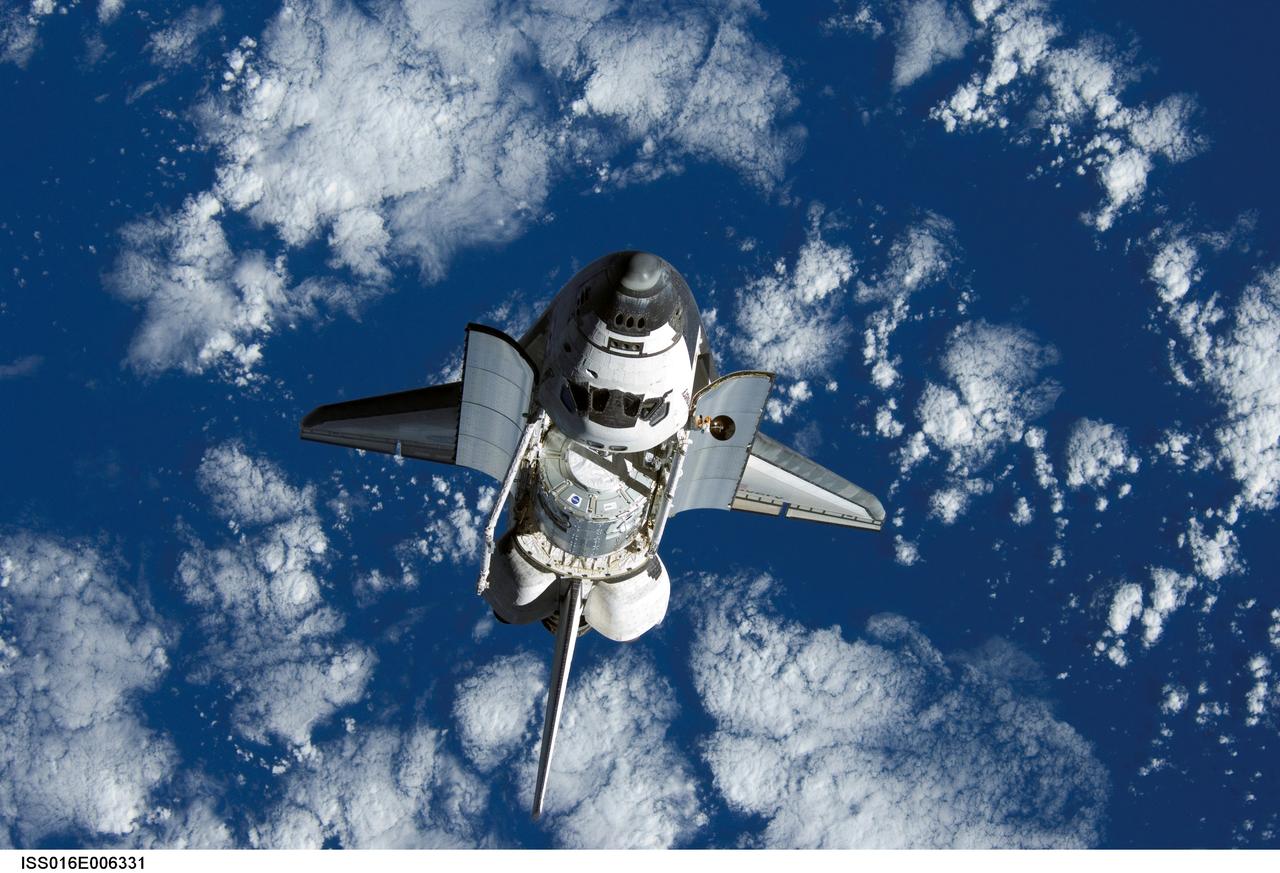
ISS016-E-006331 (25 Oct. 2007) --- Backdropped by a blue and white Earth, Space Shuttle Discovery approaches the International Space Station during STS-120 rendezvous and docking operations. Docking occurred at 7:40 a.m. (CDT) on Oct. 25, 2007. The Harmony node is visible in Discovery's cargo bay.
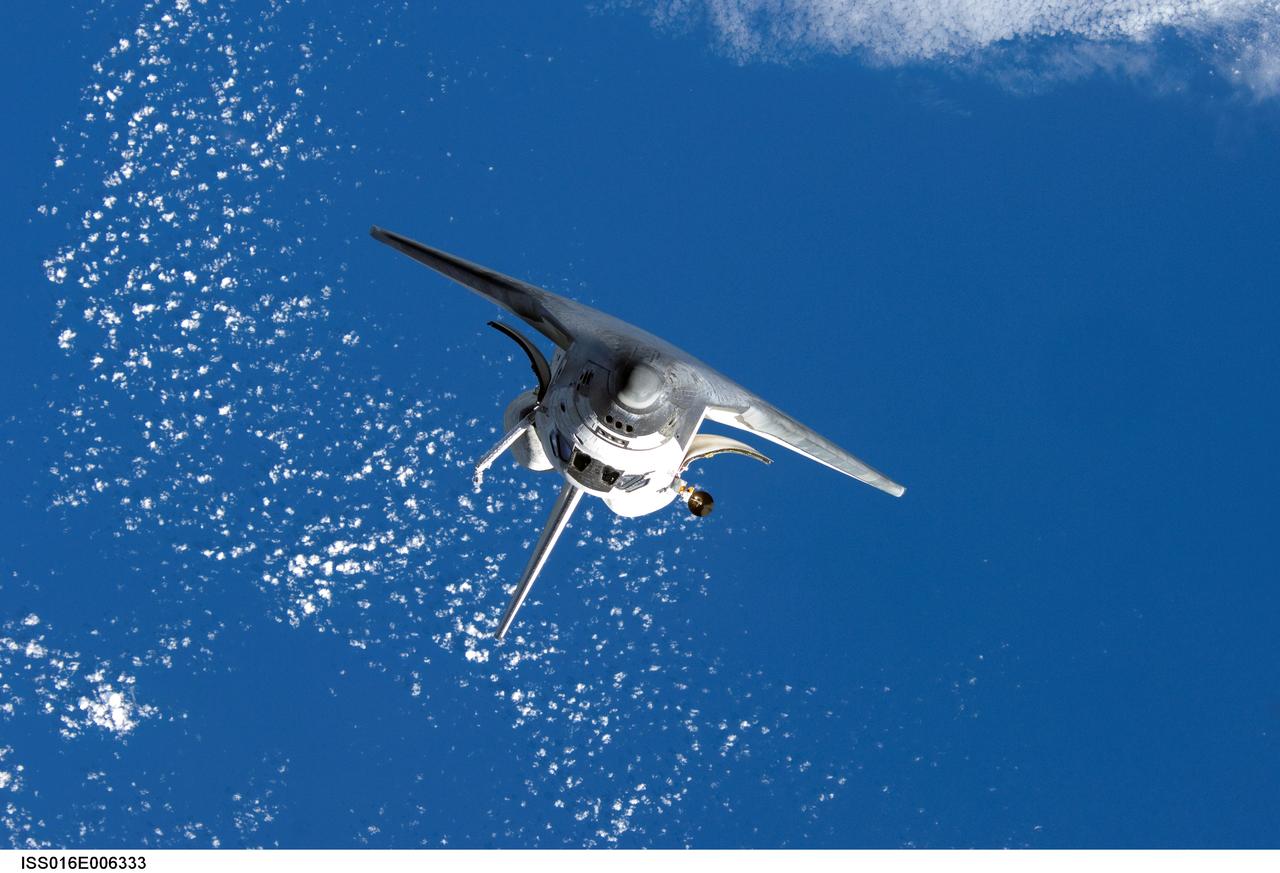
ISS016-E-006333 (25 Oct. 2007) --- Backdropped by a blue and white Earth, Space Shuttle Discovery approaches the International Space Station during STS-120 rendezvous and docking operations. Docking occurred at 7:40 a.m. (CDT) on Oct. 25, 2007. The Harmony node is visible in Discovery's cargo bay.
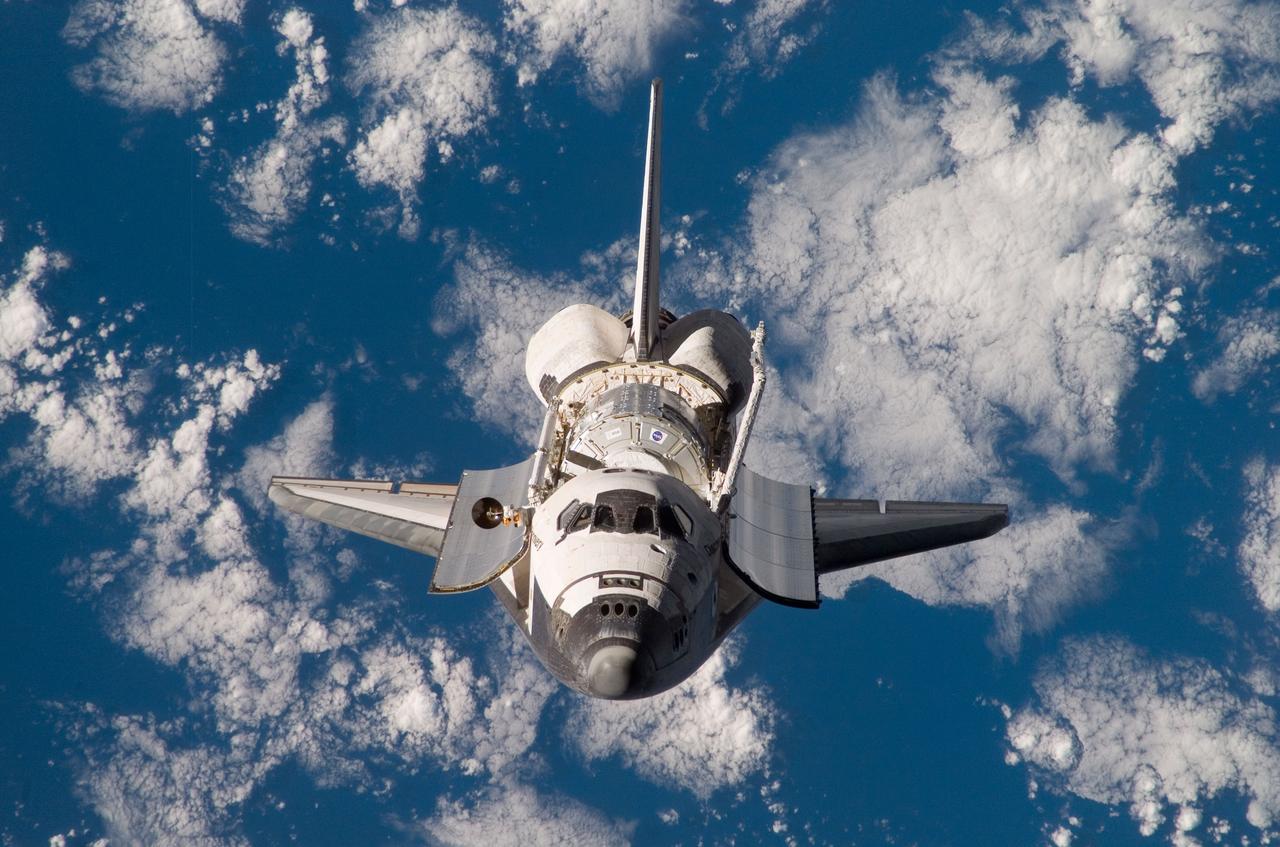
ISS016-E-006297 (25 Oct. 2007) --- Backdropped by a blue and white Earth, Space Shuttle Discovery approaches the International Space Station during STS-120 rendezvous and docking operations. Docking occurred at 7:40 a.m. (CDT) on Oct. 25, 2007. The Harmony node is visible in Discovery's cargo bay.

S81-26158 (Feb 1981) --- A close-up view of a training version of a STS-40/SLS-1 blood kit. Blood samples from crewmembers are critical to a number of Space Life Sciences-1 (SLS-1) investigations. One day's collection equipment, color coded for each crewmember, is neatly organized in the kit.
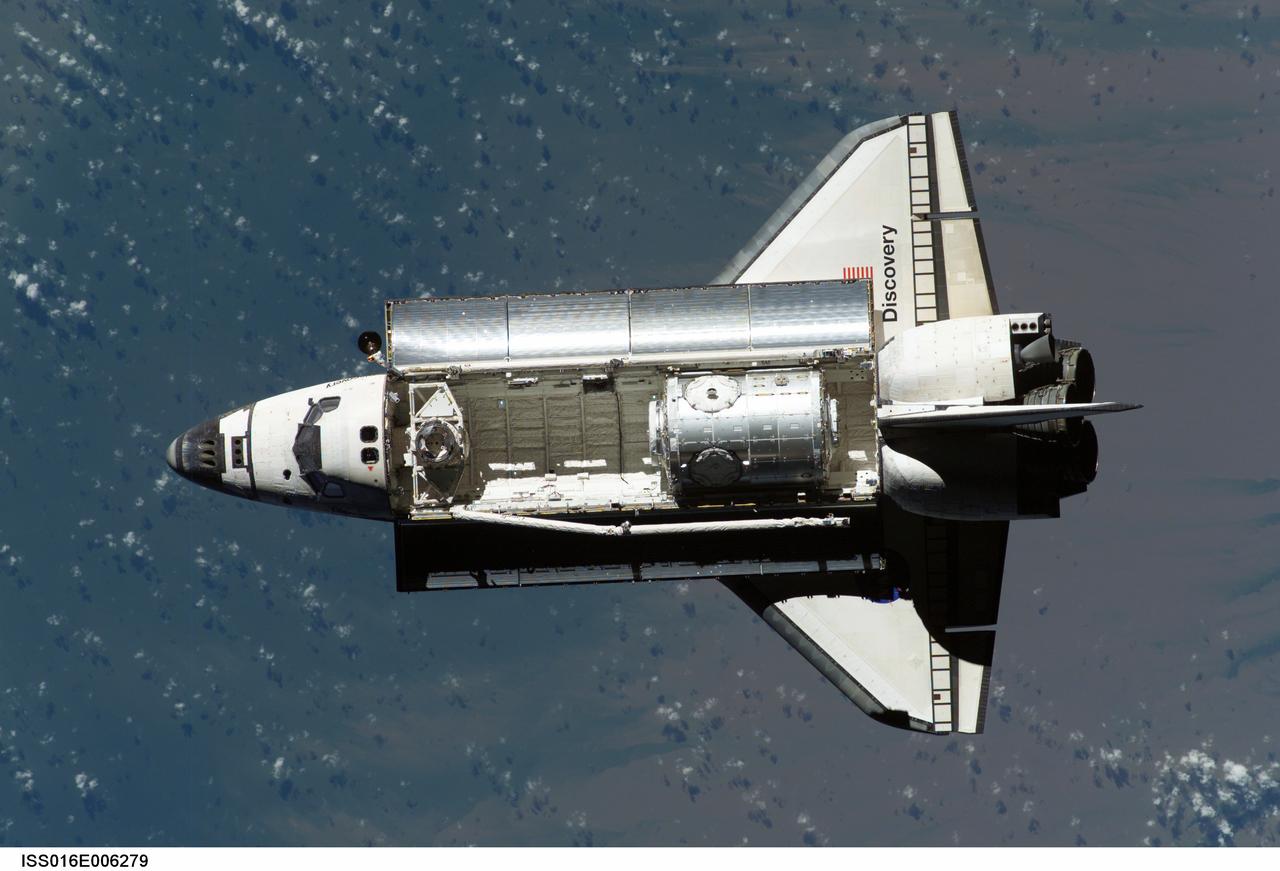
ISS016-E-006279 (25 Oct. 2007) --- Backdropped by a blue and white Earth, Space Shuttle Discovery approaches the International Space Station during STS-120 rendezvous and docking operations. Docking occurred at 7:40 a.m. (CDT) on Oct. 25, 2007. The Harmony node is visible in Discovery's cargo bay.
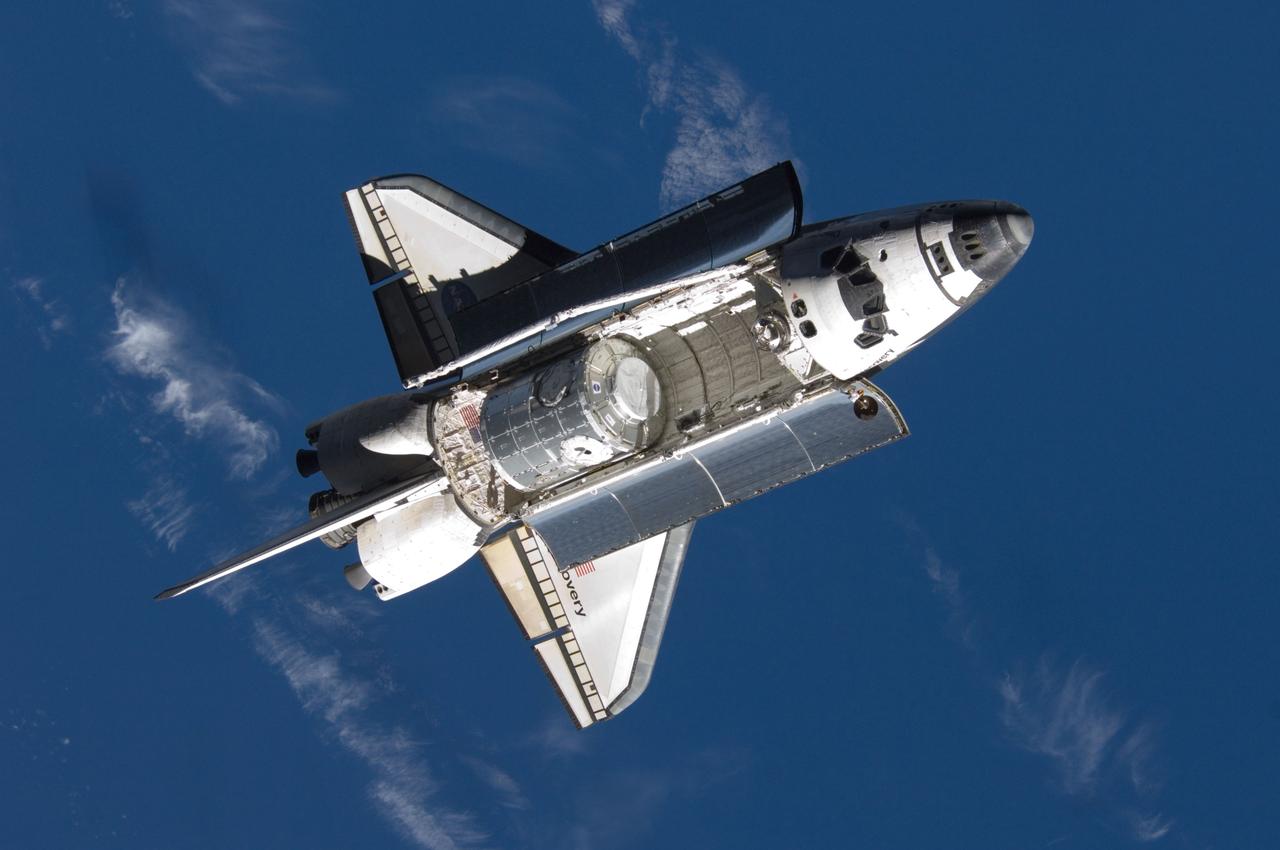
ISS016-E-006327 (25 Oct. 2007) --- Backdropped by a blue and white Earth, Space Shuttle Discovery approaches the International Space Station during STS-120 rendezvous and docking operations. Docking occurred at 7:40 a.m. (CDT) on Oct. 25, 2007. The Harmony node is visible in Discovery's cargo bay.
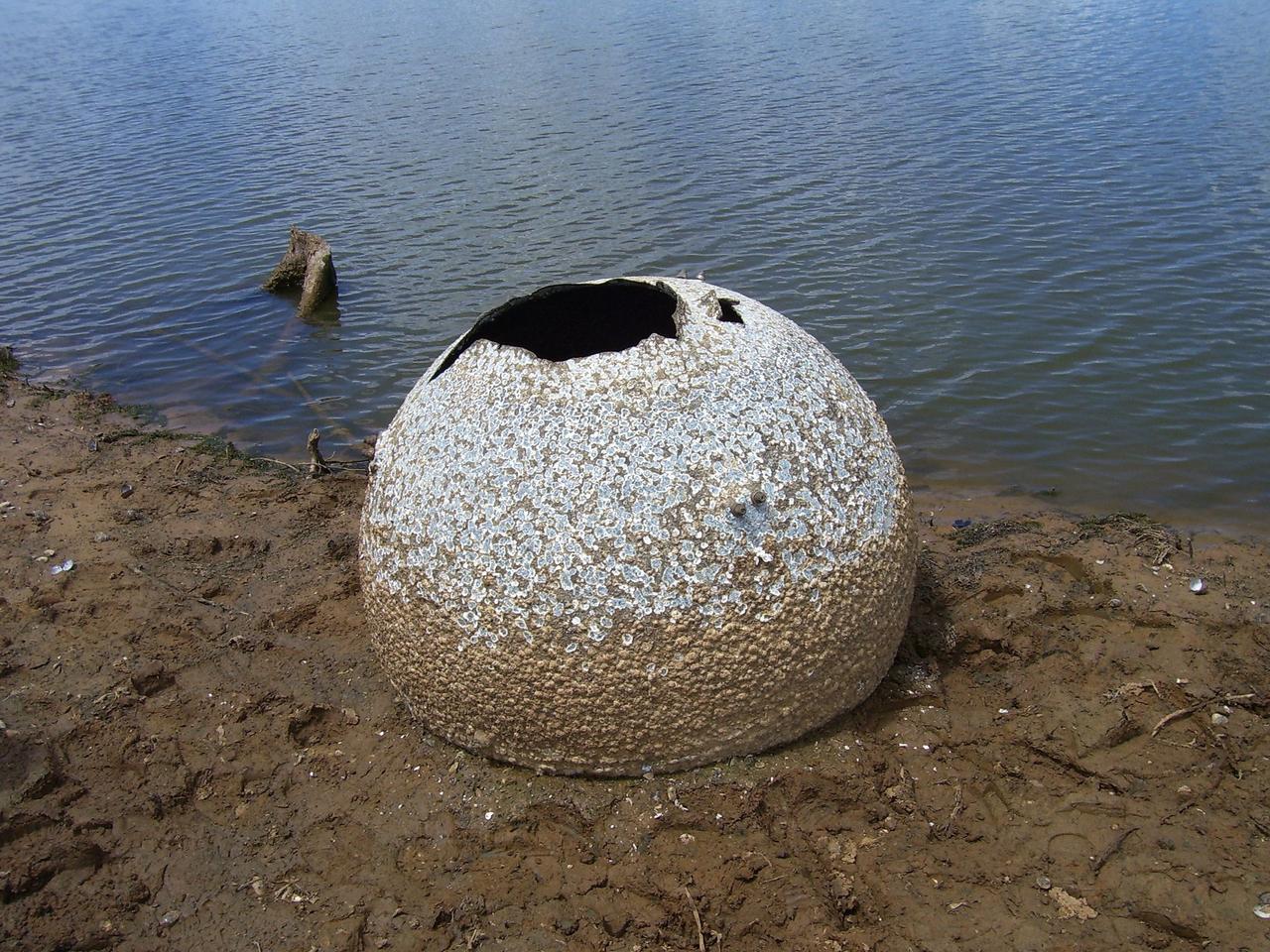
NACOGDOCHES, Texas -- A round 40-inch aluminum storage tank from space shuttle Columbia's Power Reactant and Storage Distribution System rests on the edge of Lake Nacogdoches in Texas. Lower lake water levels due to a local drought allowed the debris to become exposed. Columbia was destroyed during re-entry at the conclusion of the STS-107 mission in 2003. Approximately 38 to 40 percent of Columbia was recovered following the accident in a half-million-acre search area which extended from eastern Texas and to western Louisiana. This tank is one of 18 cryogenic liquid storage tanks that flew aboard Columbia. The tank is not hazardous to people or the environment and will be transported to NASA's Kennedy Space Center for storage inside the Vehicle Assembly Building with the rest of the recovered Columbia debris. For information on STS-107 and the Columbia accident, visit http://www.nasa.gov/columbia/home/index.html. Photo credit: Nacogdoches Police Dept.
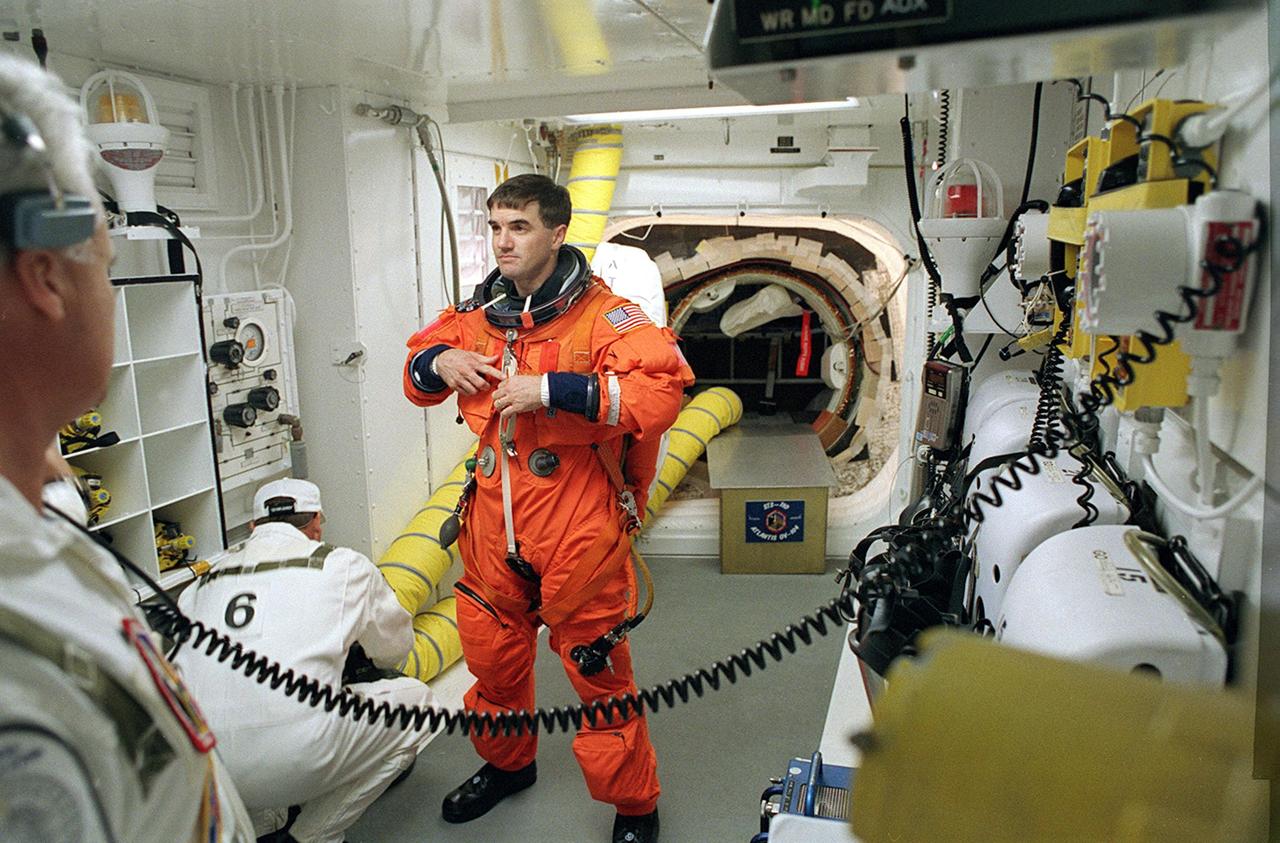
KENNEDY SPACE CENTER, FLA. - A member of the Closeout Crew helps STS-110 Mission Specialist Rex J. Walheim with his launch and entry suit before he enters Space Shuttle Atlantis. The White Room provides entry into the cockpit area of the orbiter. This is Walheim's first Shuttle flight. STS-110 is carrying the S0 Integrated Truss Structure and Mobile Transporter (MT) on this 13th assembly flight to the International Space Station. On the 11-day mission, astronauts, including Walheim, will make four spacewalks to attach the S0 truss, which will become the backbone of the Space Station, to the U.S. Lab, "Destiny." The MT, a space "railcar," is attached to the truss segment and will make its debut run during the flight. Launch is scheduled for 4:40 p.m. EDT (20:40 GMT)
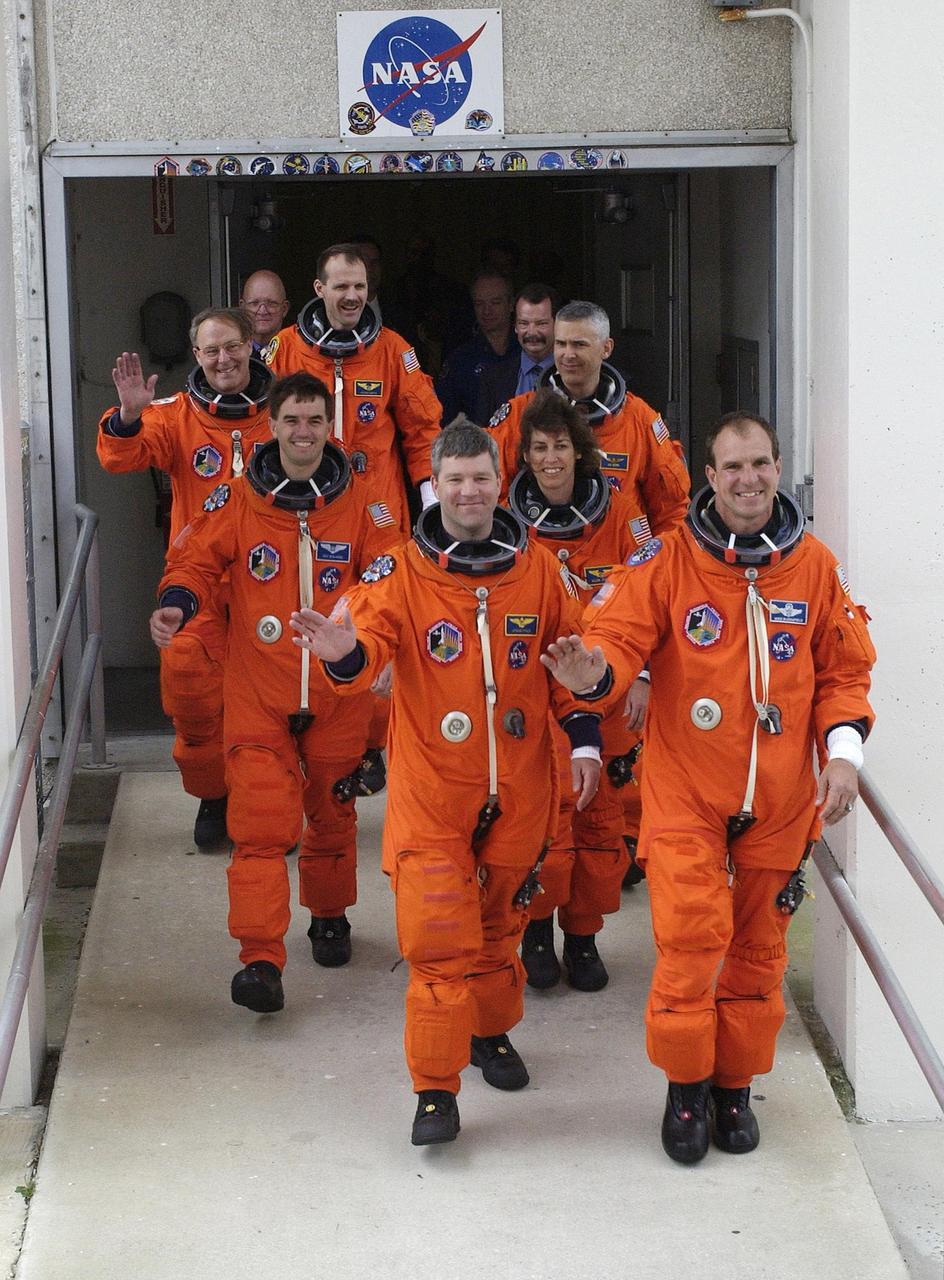
KENNEDY SPACE CENTER, FLA. - Showing their eagerness for launch, the STS-110 crew wave as they stride out of the Operations and Checkout Building. Leading the way in the front row are Pilot Stephen N. Frick (left) and Commander Michael J. Bloomfield (right); in the second row are Mission Specialists Rex J. Walheim and Ellen Ochoa; third row, Jerry L. Ross and Lee M.E. Morin; in the rear is Mission Specialist Steven L. Smith. STS-110 is the 13th assembly flight to the International Space Station, carrying the S0 Integrated Truss Structure and Mobile Transporter (MT). On the 11-day mission, the mission features four spacewalks to attach the S0 truss, which will become the backbone of the Space Station, to the U.S. Lab, "Destiny." The MT, a space "railcar," is attached to the truss segment and will make its debut run during the flight. Launch is scheduled for 4:40 p.m. EDT (20:40 GMT). Photo by Scott Andrews
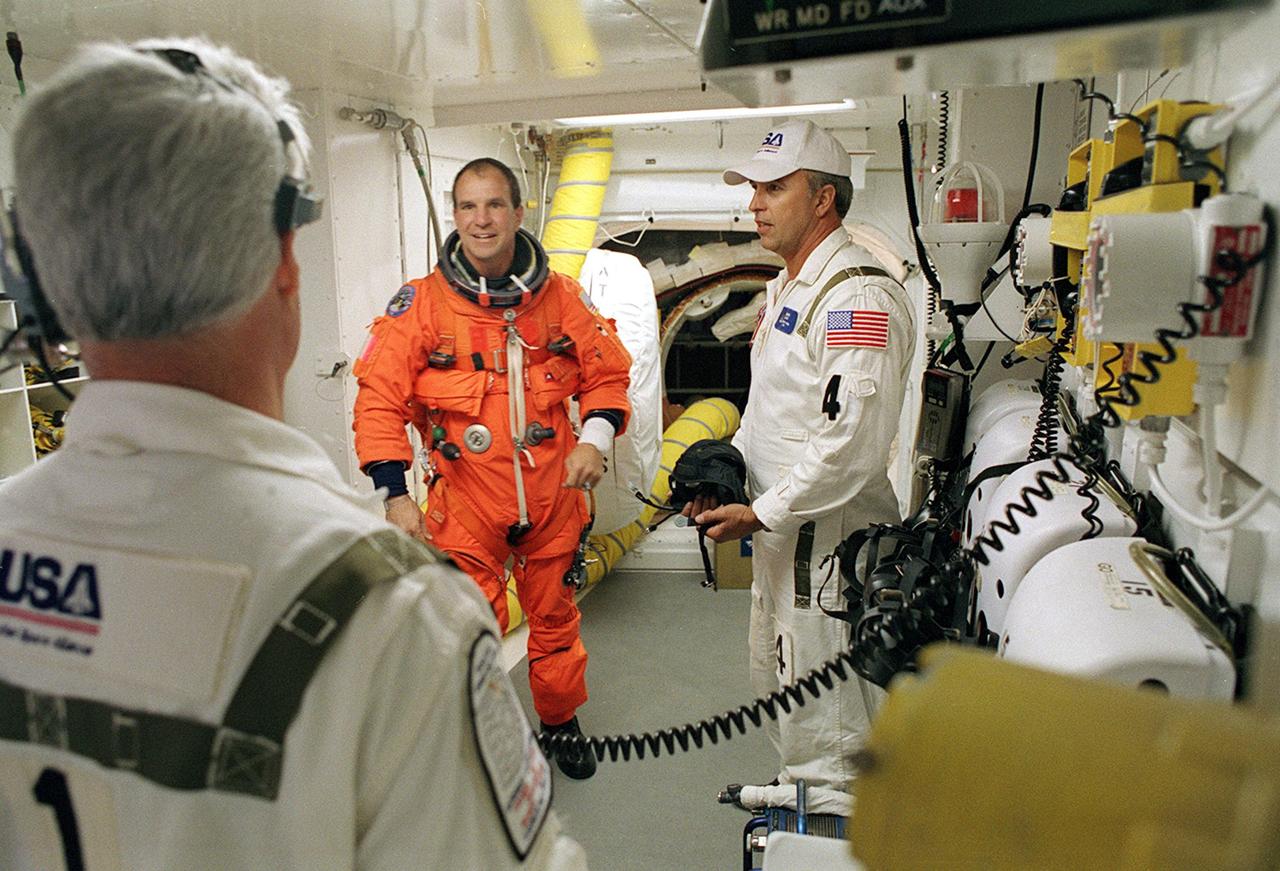
KENNEDY SPACE CENTER, FLA. - STS-110 Commander Michael Bloomfield talks to members of the Closeout Crew in the White Room before he enters entering Space Shuttle Atlantis for launch. The White Room provides entry into the cockpit area of the orbiter. This is Bloomfield's third Shuttle flight. STS-110 is carrying the S0 Integrated Truss Structure and Mobile Transporter (MT) on this 13th assembly flight to the International Space Station. On the 11-day mission, astronauts will make four spacewalks to attach the S0 truss, which will become the backbone of the Space Station, to the U.S. Lab, "Destiny." The MT, a space "railcar," is attached to the truss segment and will make its debut run during the flight. Launch is scheduled for 4:40 p.m. EDT (20:40 GMT)
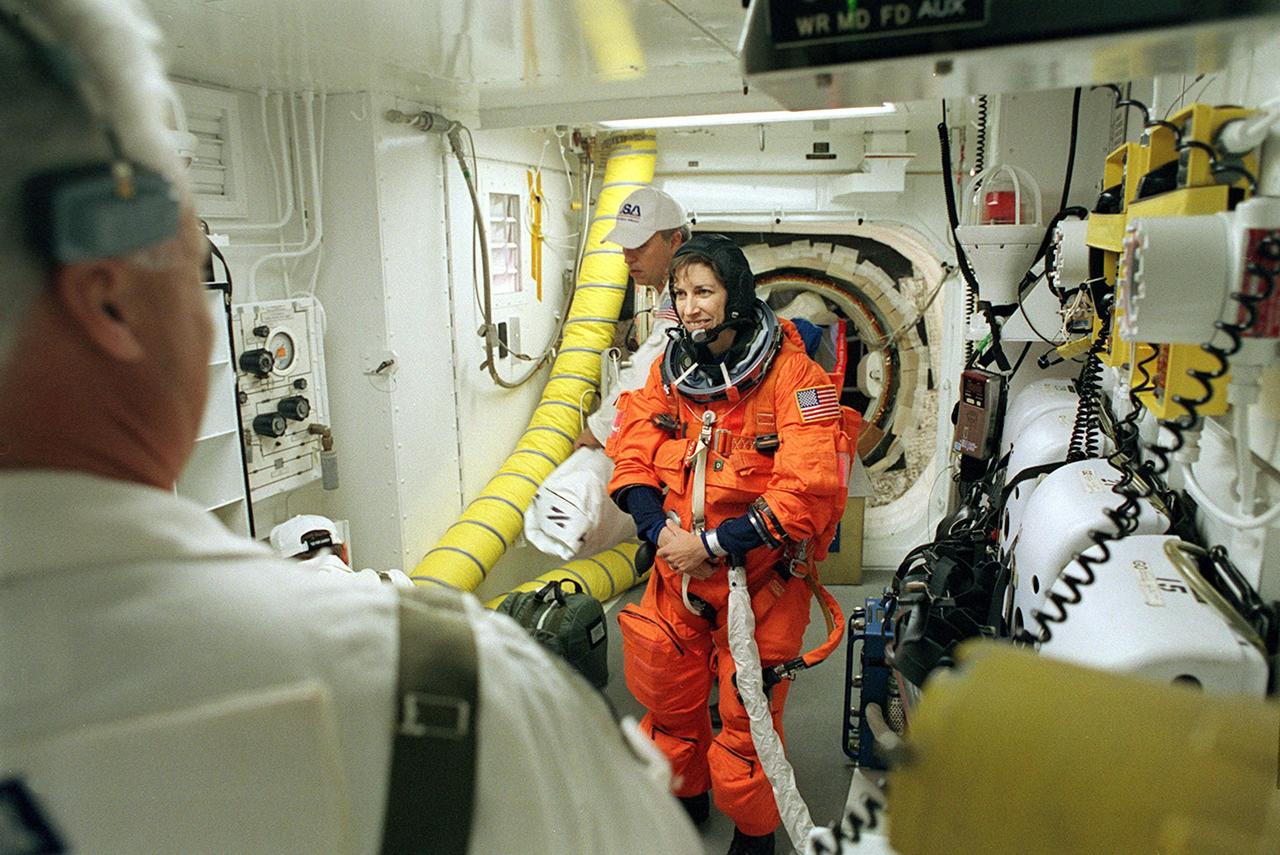
KENNEDY SPACE CENTER, FLA. -- STS-110 Mission Specialist Ellen Ochoa has final suit preparations - In the White Room before entering Space Shuttle Atlantis for launch. The White Room provides entry into the cockpit area of the orbiter. This is Ochoa's fourth Shuttle flight. On this 13th assembly flight to the International Space Station, STS-110 is carrying the S0 Integrated Truss Structure and Mobile Transporter (MT). During the 11-day mission, astronauts will make four spacewalks to attach the S0 truss, which will become the backbone of the Space Station, to the U.S. Lab, "Destiny." The MT, a space "railcar," is attached to the truss segment and will make its debut run during the flight. Launch is scheduled for 4:40 p.m. EDT (20:40 GMT).
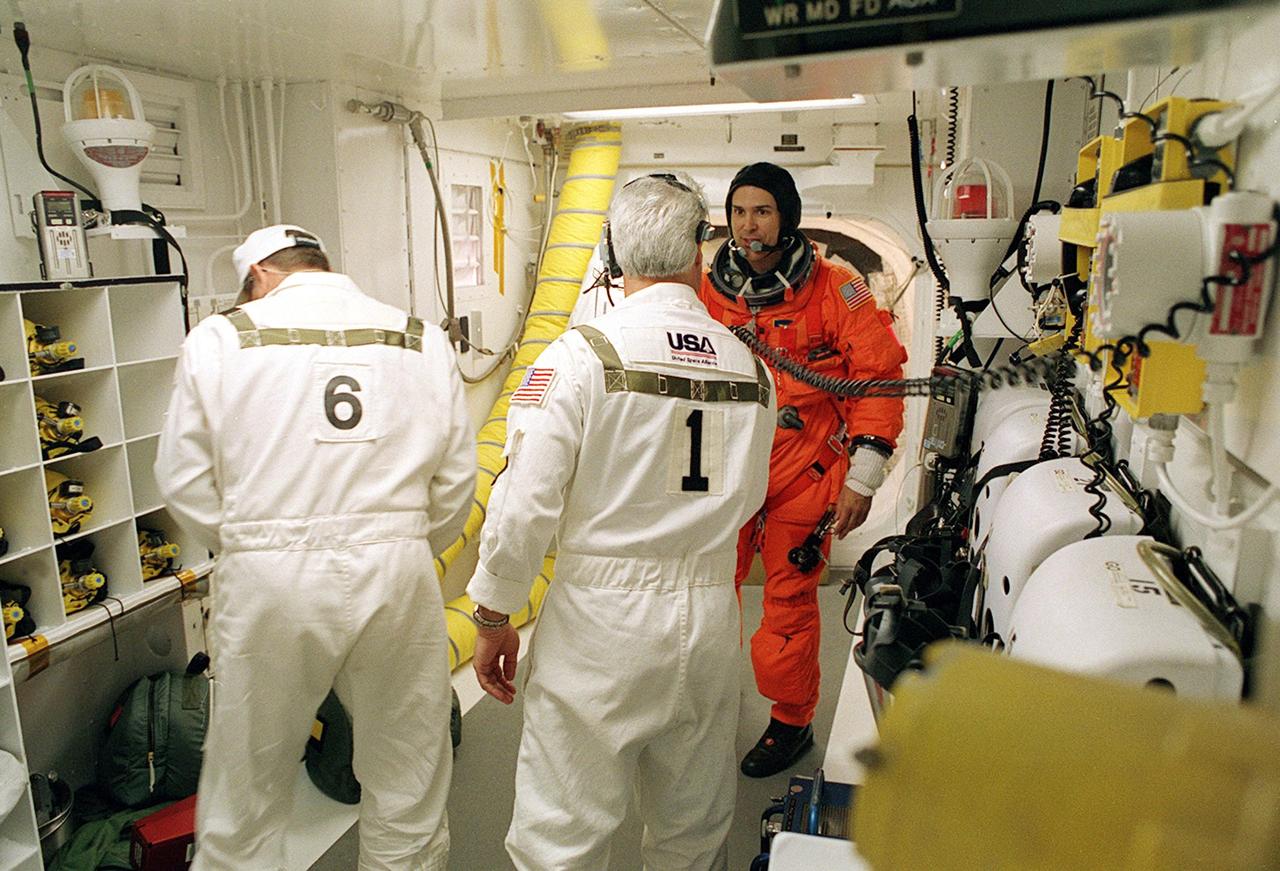
KENNEDY SPACE CENTER, FLA. - STS-110 Mission Specialist Lee M.E. Morin is wished good luck by a member of the Closeout Crew before entering Space Shuttle Atlantis for launch. The White Room provides entry into the cockpit area of the orbiter. This is Morin's first Shuttle flight. STS-110 is carrying the S0 Integrated Truss Structure and Mobile Transporter (MT) on this 13th assembly flight to the International Space Station. On the 11-day mission, astronauts, including Morin, will make four spacewalks to attach the S0 truss, which will become the backbone of the Space Station, to the U.S. Lab, "Destiny." The MT, a space "railcar," is attached to the truss segment and will make its debut run during the flight. Launch is scheduled for 4:40 p.m. EDT (20:40 GMT)

KENNEDY SPACE CENTER, FLA. - STS-110 Pilot Stephen Frick jokes with the Closeout Crew in the White Room as he makes final preparations to enter Space Shuttle Atlantis for launch. The White Room provides entry into the cockpit area of the orbiter. This is Frick's first Shuttle flight. STS-110 is carrying the S0 Integrated Truss Structure and Mobile Transporter (MT) on this 13th assembly flight to the International Space Station. On the 11-day mission, astronauts will make four spacewalks to attach the S0 truss, which will become the backbone of the Space Station, to the U.S. Lab, "Destiny." The MT, a space "railcar," is attached to the truss segment and will make its debut run during the flight. Launch is scheduled for 4:40 p.m. EDT (20:40 GMT)
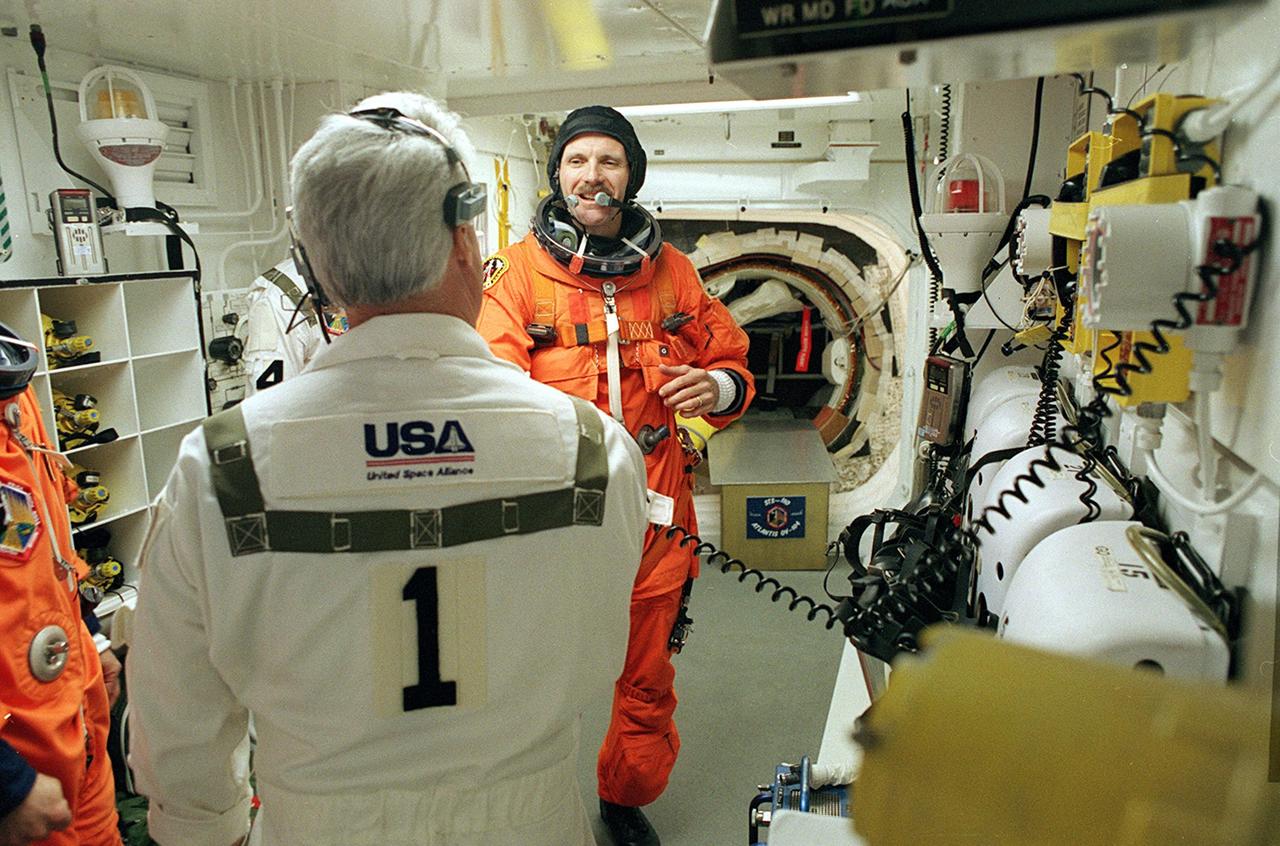
KENNEDY SPACE CENTER, FLA. - STS-110 Mission Specialist Steven Smith is wished good luck by a member of the Closeout Crew before entering Space Shuttle Atlantis for launch. The White Room provides entry into the cockpit area of the orbiter. This is Smith's fourth Shuttle flight. STS-110 is carrying the S0 Integrated Truss Structure and Mobile Transporter (MT) on this 13th assembly flight to the International Space Station. On the 11-day mission, astronauts, including Smith, will make four spacewalks to attach the S0 truss, which will become the backbone of the Space Station, to the U.S. Lab, "Destiny." The MT, a space "railcar," is attached to the truss segment and will make its debut run during the flight. Launch is scheduled for 4:40 p.m. EDT (20:40 GMT)
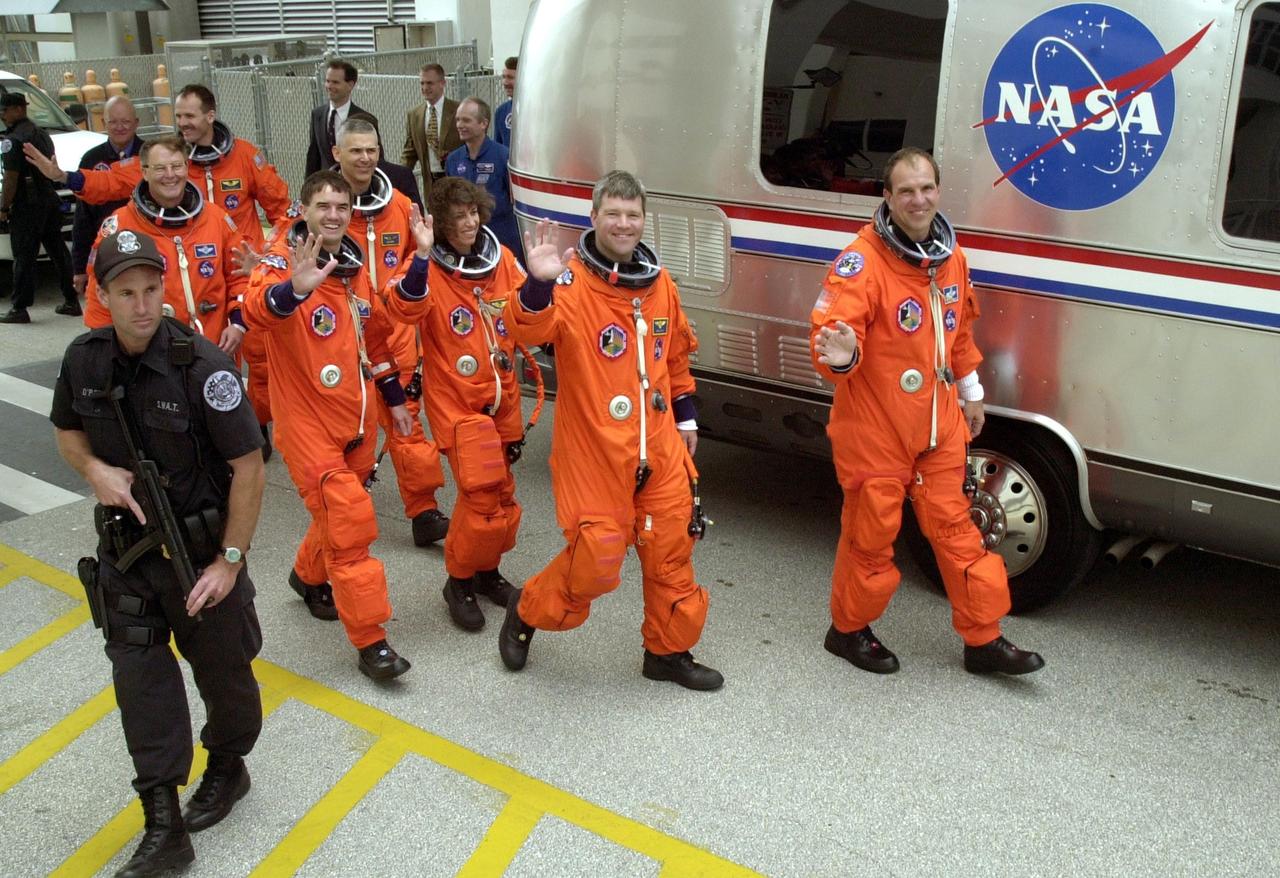
KENNEDY SPACE CENTER, FLA. -- The STS-110 crew heads for the Astrovan and a ride to Launch Pad 39B for the launch scheduled at 4:40 p.m. EDT (20:40 GMT). From left-foreground are Mission Specialists Jerry L. Ross and Rex J. Walheim; left, second row, are Mission Specialists Steven L. Smith, Lee M.E. Morin, Ellen Ochoa; Pilot Stephen N. Frick; and Commander Michael J. Bloomfield. STS-110 is the 13th assembly flight to the International Space Station, carrying the S0 Integrated Truss Structure and Mobile Transporter (MT). On the 11-day mission, the mission features four spacewalks to attach the S0 truss, which will become the backbone of the Space Station, to the U.S. Lab, "Destiny." The MT, a space "railcar," is attached to the truss segment and will make its debut run during the flight
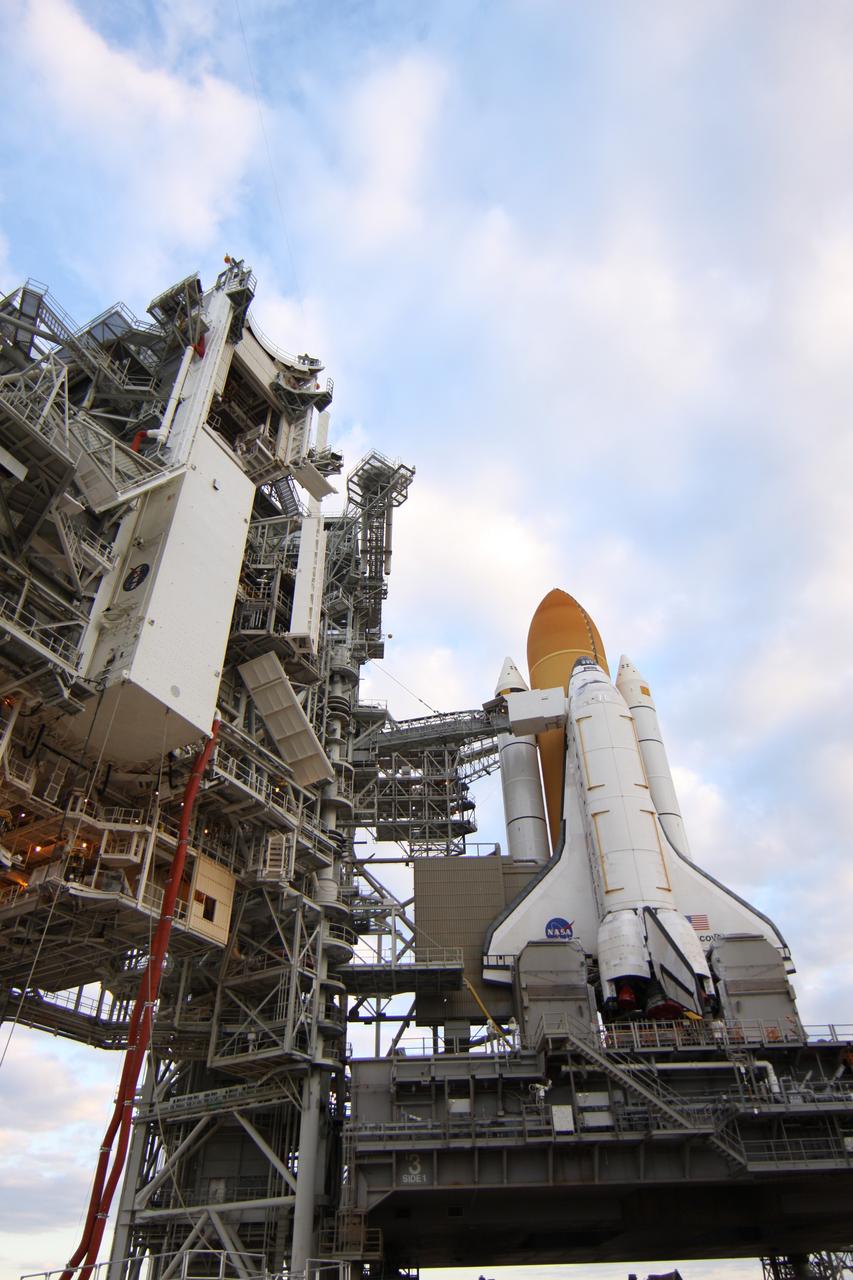
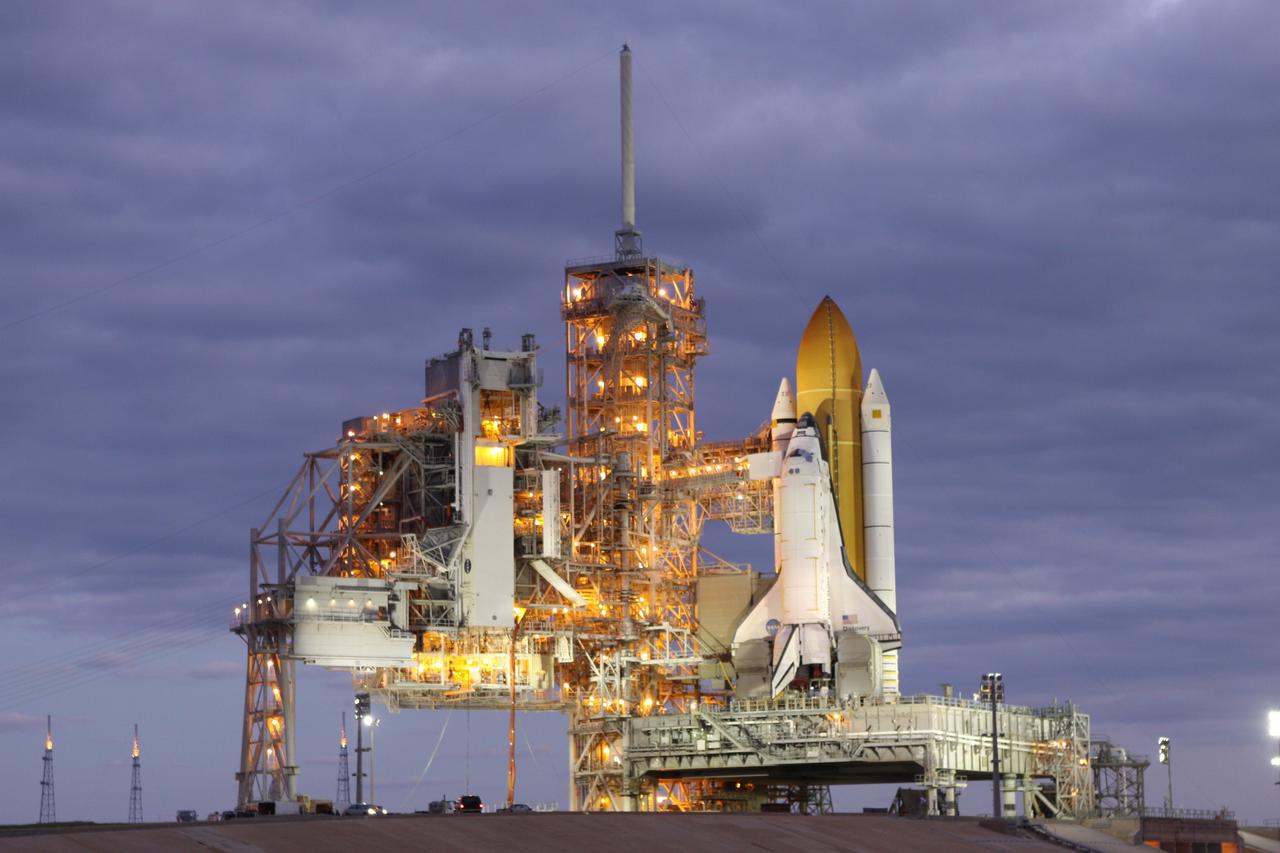
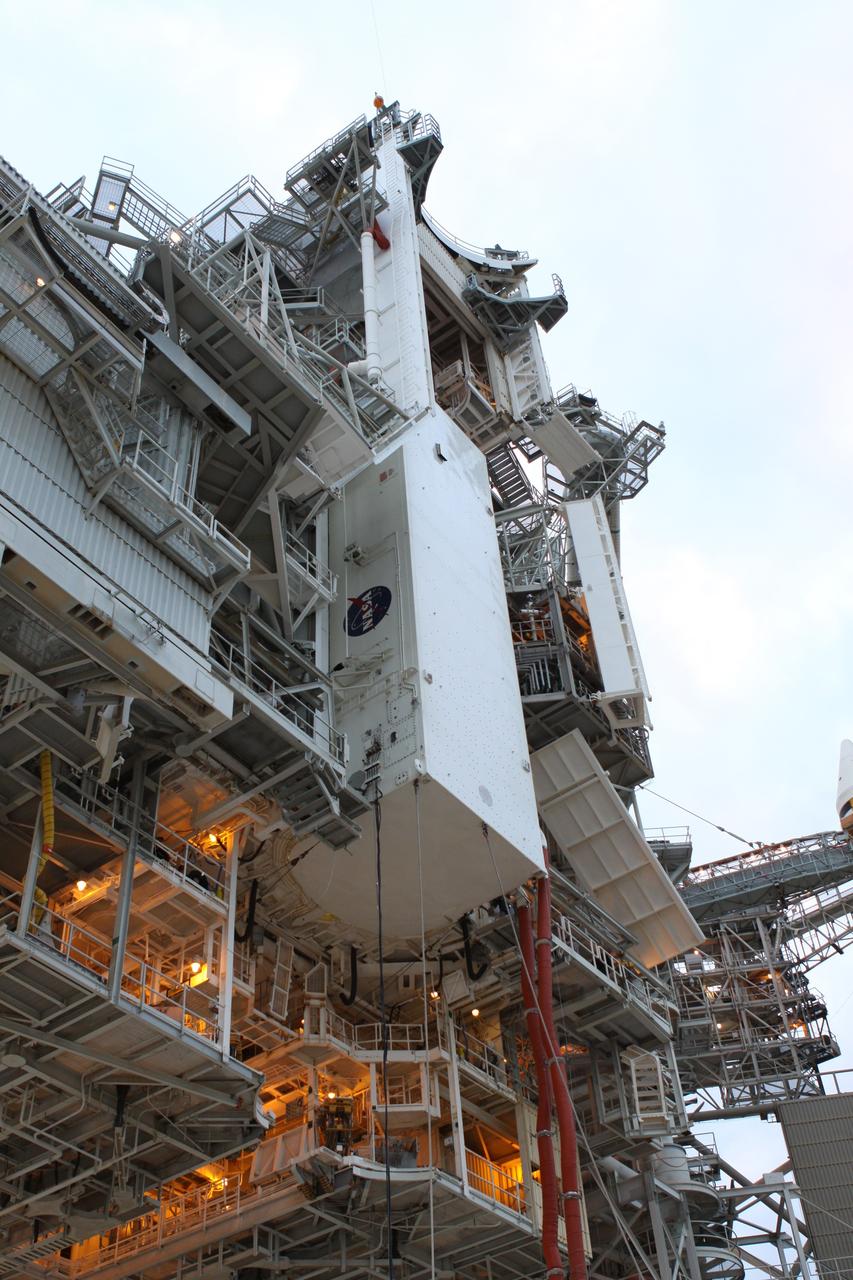
CAPE CANAVERAL, Fla. -- At NASA's Kennedy Space Center in Florida, the STS-133 payload canister now is in the rotating service structure on Launch Pad 39A. The payload then will be moved into space shuttle Discovery's payload bay. Discovery and its STS-133 crew will deliver the Permanent Multipurpose Module, packed with supplies and critical spare parts, as well as Robonaut 2, the dexterous humanoid astronaut helper, to the International Space Station. Launch is targeted for 4:40 p.m. EDT, Nov. 1. Photo credit: NASA/Troy Cryder
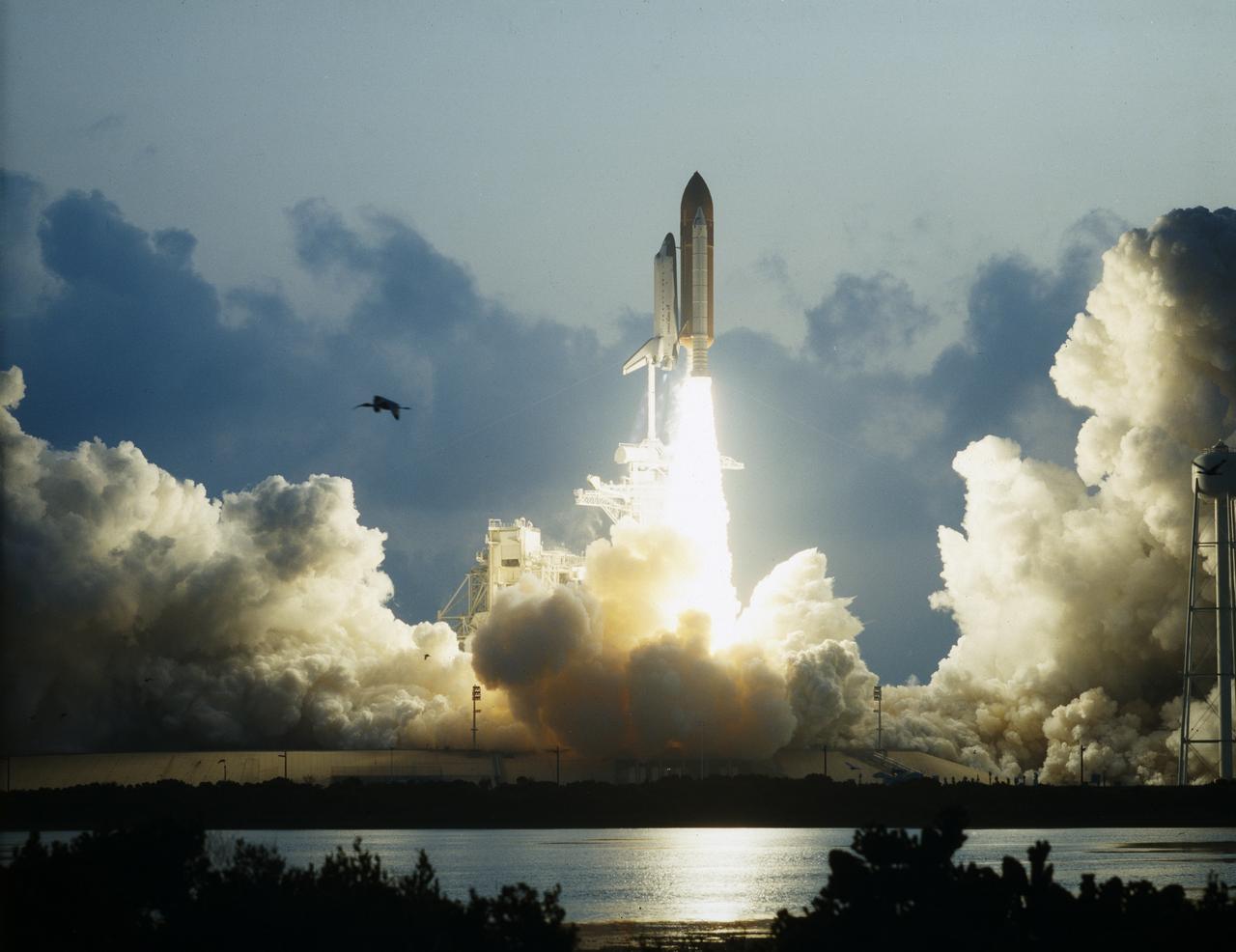
STS-49, the first flight of the Space Shuttle Orbiter Endeavour, lifted off from launch pad 39B on May 7, 1992 at 6:40 pm CDT. The STS-49 mission was the first U.S. orbital flight to feature 4 extravehicular activities (EVAs), and the first flight to involve 3 crew members working simultaneously outside of the spacecraft. The primary objective was the capture and redeployment of the INTELSAT VI (F-3) which was stranded in an unusable orbit since its launch aboard the Titan rocket in March 1990.
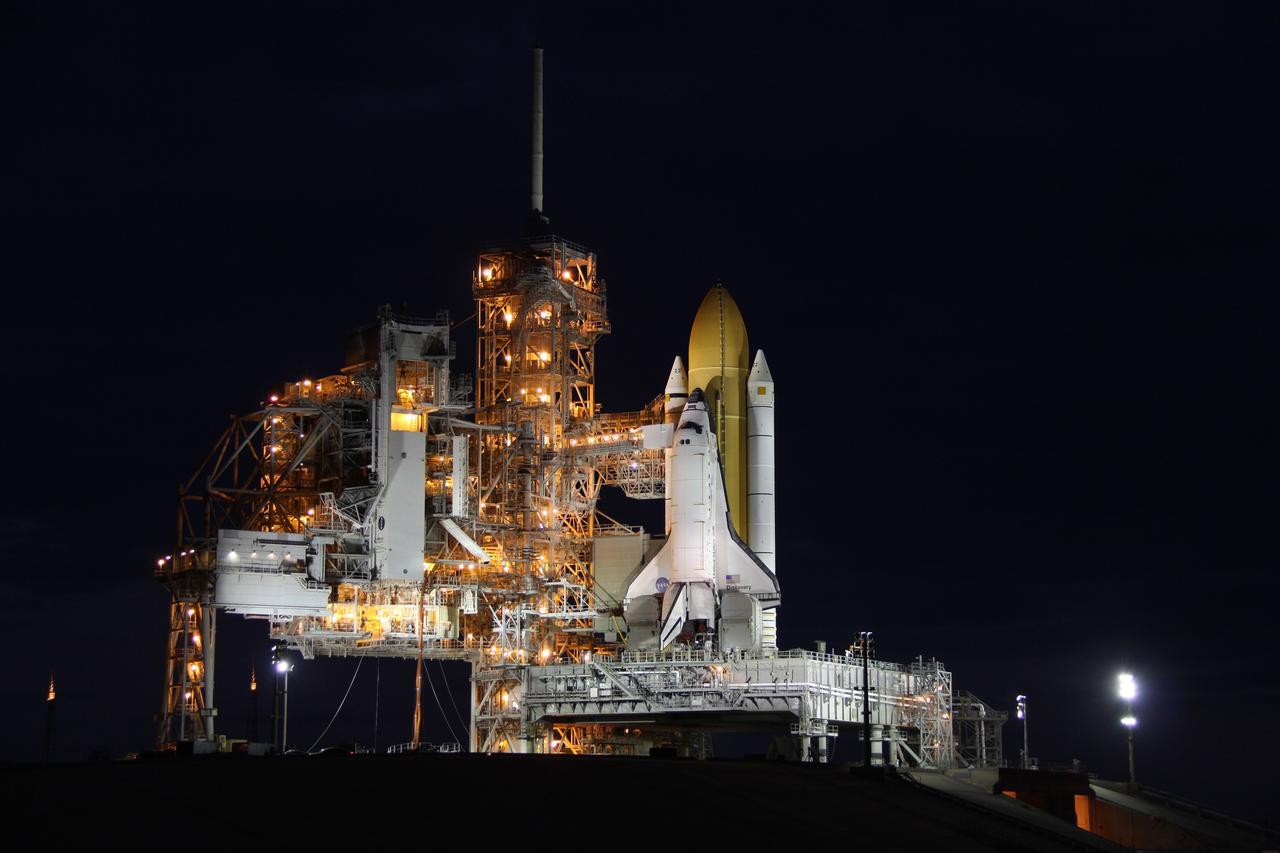
CAPE CANAVERAL, Fla. -- At NASA's Kennedy Space Center in Florida, the STS-133 payload canister is lifted into the rotating service structure on Launch Pad 39A. The payload then will be moved into space shuttle Discovery's payload bay. Discovery and its STS-133 crew will deliver the Permanent Multipurpose Module, packed with supplies and critical spare parts, as well as Robonaut 2, the dexterous humanoid astronaut helper, to the International Space Station. Launch is targeted for 4:40 p.m. EDT, Nov. 1. Photo credit: NASA/Troy Cryder
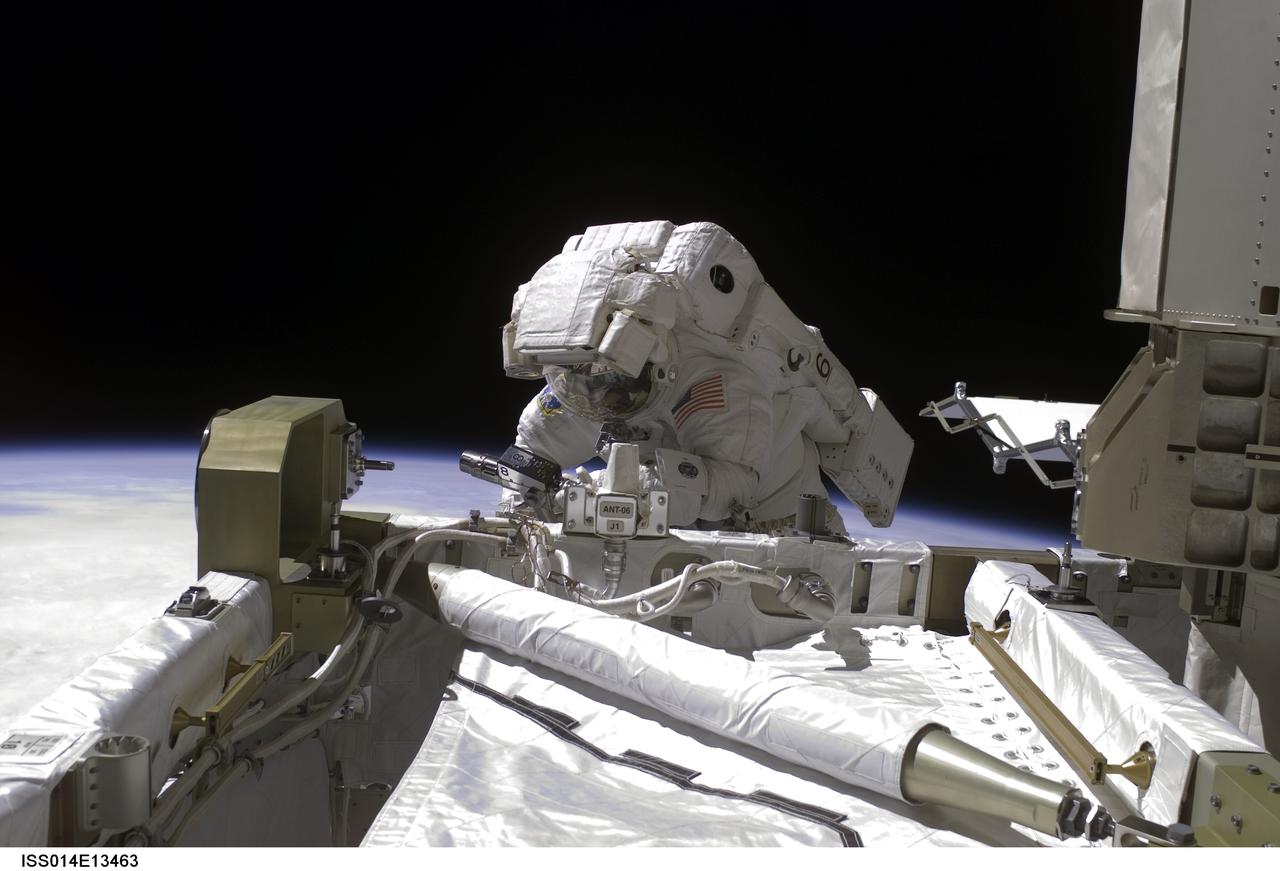
ISS014-E-13463 (8 Feb. 2007) --- Astronaut Sunita L. Williams, Expedition 14 flight engineer, participates in the final of three sessions of extravehicular activity (EVA) in nine days, as construction continues on the International Space Station. During the 6-hour, 40-minute spacewalk, Williams and Michael E. Lopez-Alegria (out of frame), commander, completed tasks that will allow for the attachment of a cargo platform during the STS-118 mission this summer and relocation of the P6 truss during STS-120 later this year.
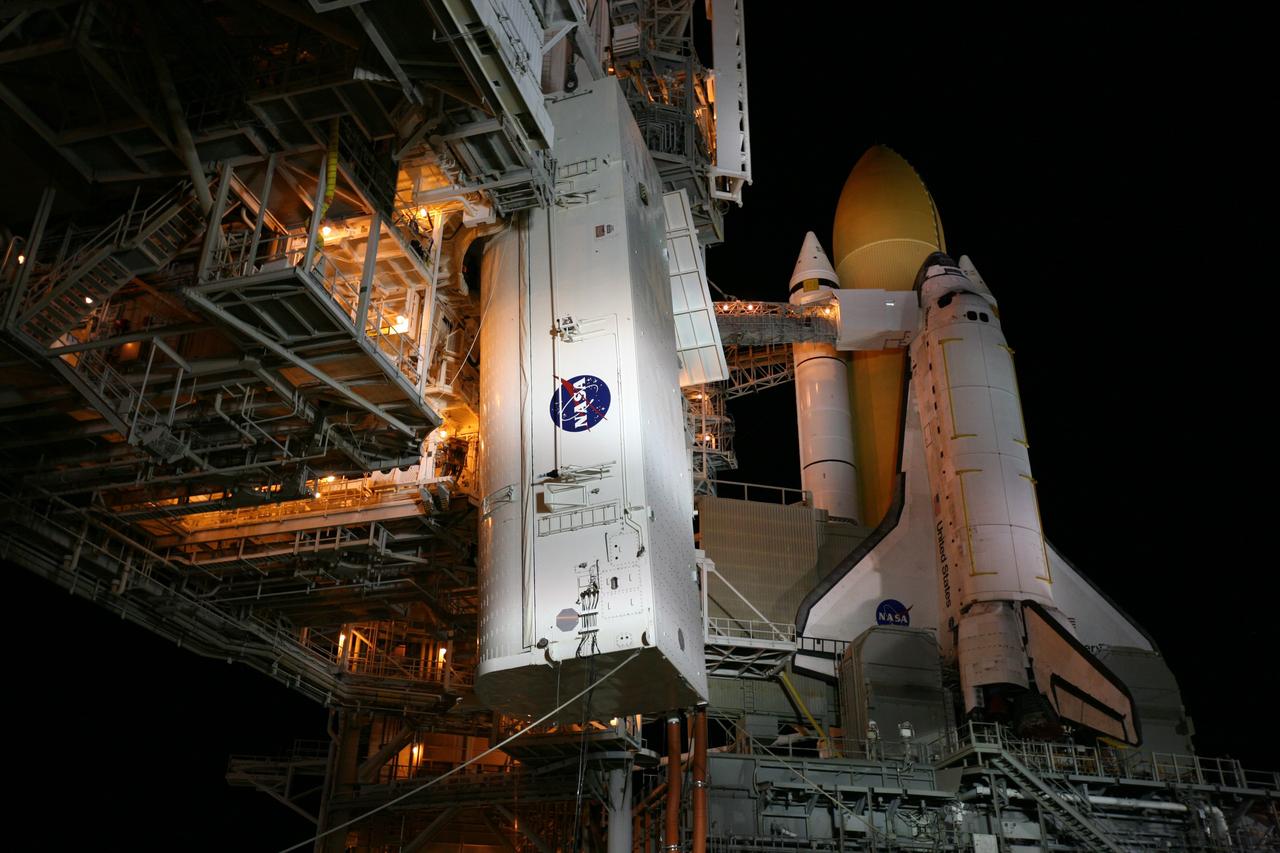
CAPE CANAVERAL, Fla. -- At NASA's Kennedy Space Center in Florida, the STS-133 payload canister is lifted into the rotating service structure on Launch Pad 39A. The payload then will be moved into space shuttle Discovery's payload bay. Discovery and its STS-133 crew will deliver the Permanent Multipurpose Module, packed with supplies and critical spare parts, as well as Robonaut 2, the dexterous humanoid astronaut helper, to the International Space Station. Launch is targeted for 4:40 p.m. EDT, Nov. 1. Photo credit: NASA/Amanda Diller
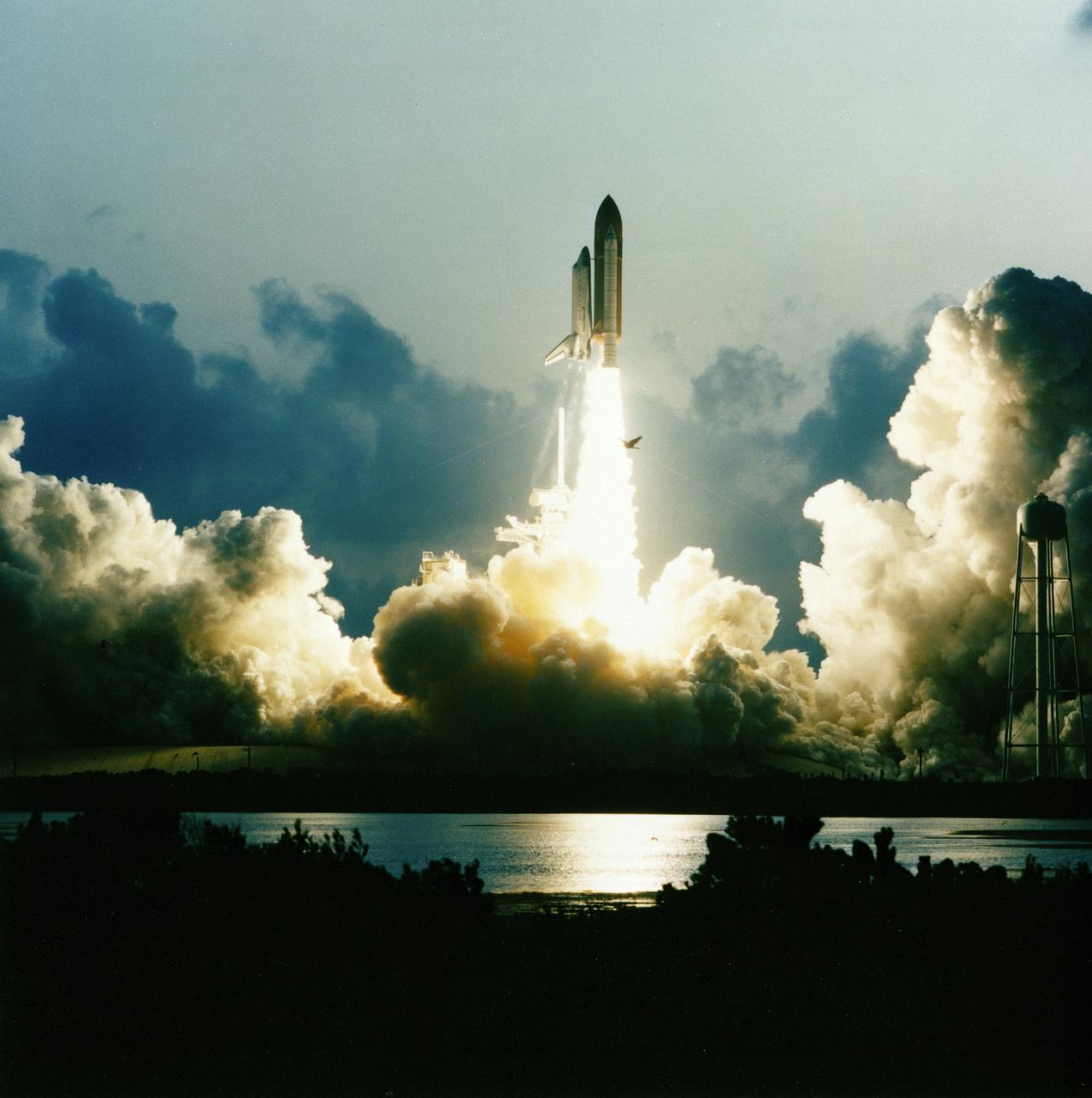
STS-49, the first flight of the Space Shuttle Orbiter Endeavour, lifted off from launch pad 39B on May 7, 1992 at 6:40 pm CDT. The STS-49 mission was the first U.S. orbital flight to feature 4 extravehicular activities (EVAs), and the first flight to involve 3 crew members working simultaneously outside of the spacecraft. The primary objective was the capture and redeployment of the INTELSAT VI (F-3) which was stranded in an unusable orbit since its launch aboard the Titan rocket in March 1990.
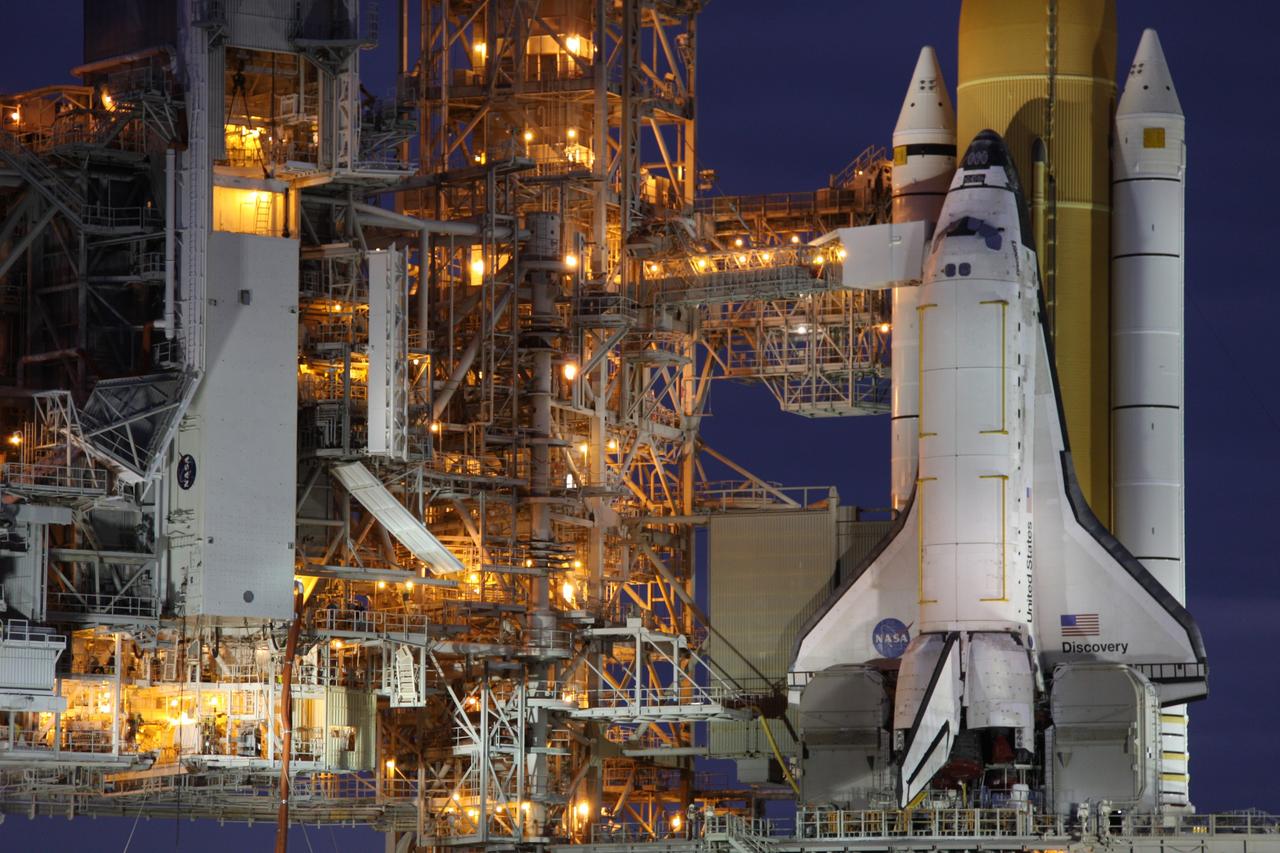
CAPE CANAVERAL, Fla. -- At NASA's Kennedy Space Center in Florida, the STS-133 payload canister is lifted into the rotating service structure on Launch Pad 39A. The payload then will be moved into space shuttle Discovery's payload bay. Discovery and its STS-133 crew will deliver the Permanent Multipurpose Module, packed with supplies and critical spare parts, as well as Robonaut 2, the dexterous humanoid astronaut helper, to the International Space Station. Launch is targeted for 4:40 p.m. EDT, Nov. 1. Photo credit: NASA/Troy Cryder
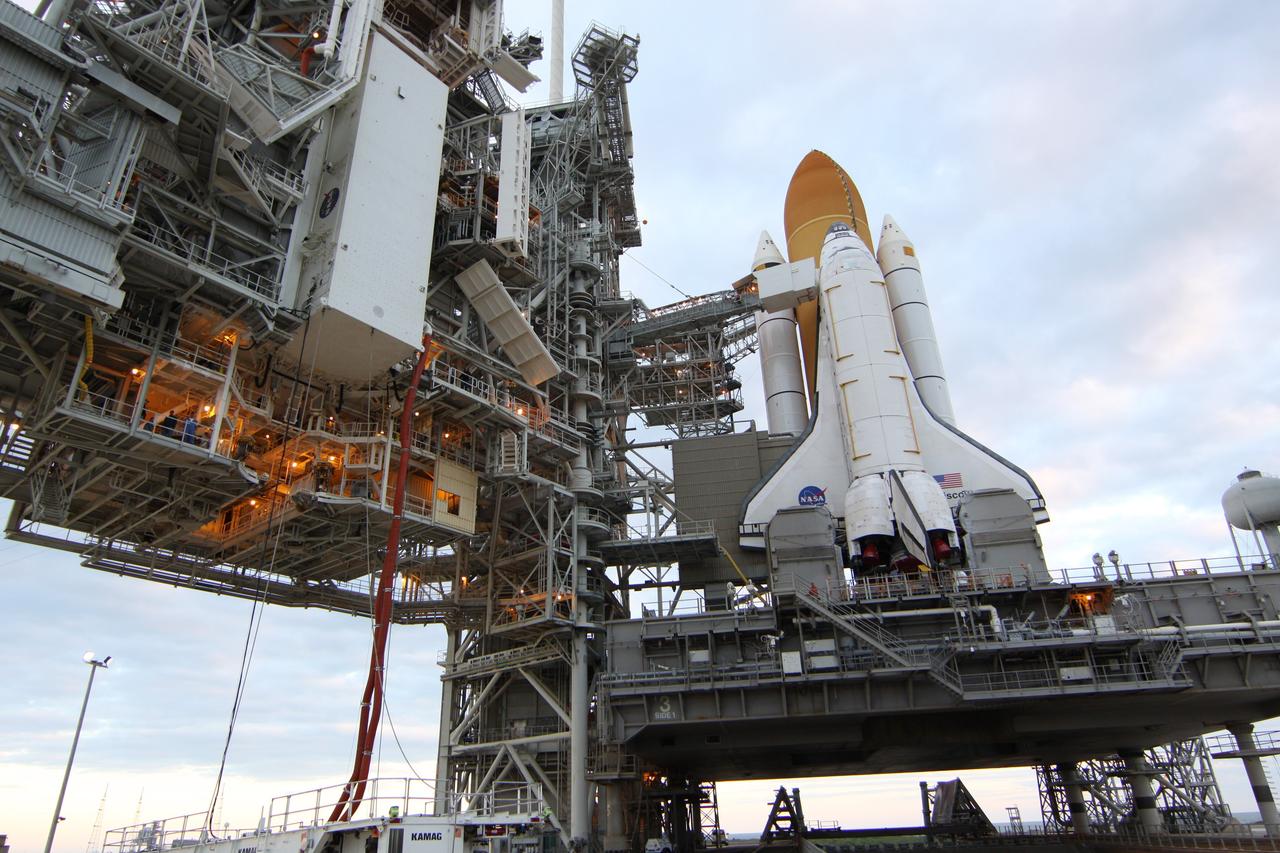
CAPE CANAVERAL, Fla. -- At NASA's Kennedy Space Center in Florida, the STS-133 payload canister now is in the rotating service structure on Launch Pad 39A. The payload then will be moved into space shuttle Discovery's payload bay. Discovery and its STS-133 crew will deliver the Permanent Multipurpose Module, packed with supplies and critical spare parts, as well as Robonaut 2, the dexterous humanoid astronaut helper, to the International Space Station. Launch is targeted for 4:40 p.m. EDT, Nov. 1. Photo credit: NASA/Troy Cryder
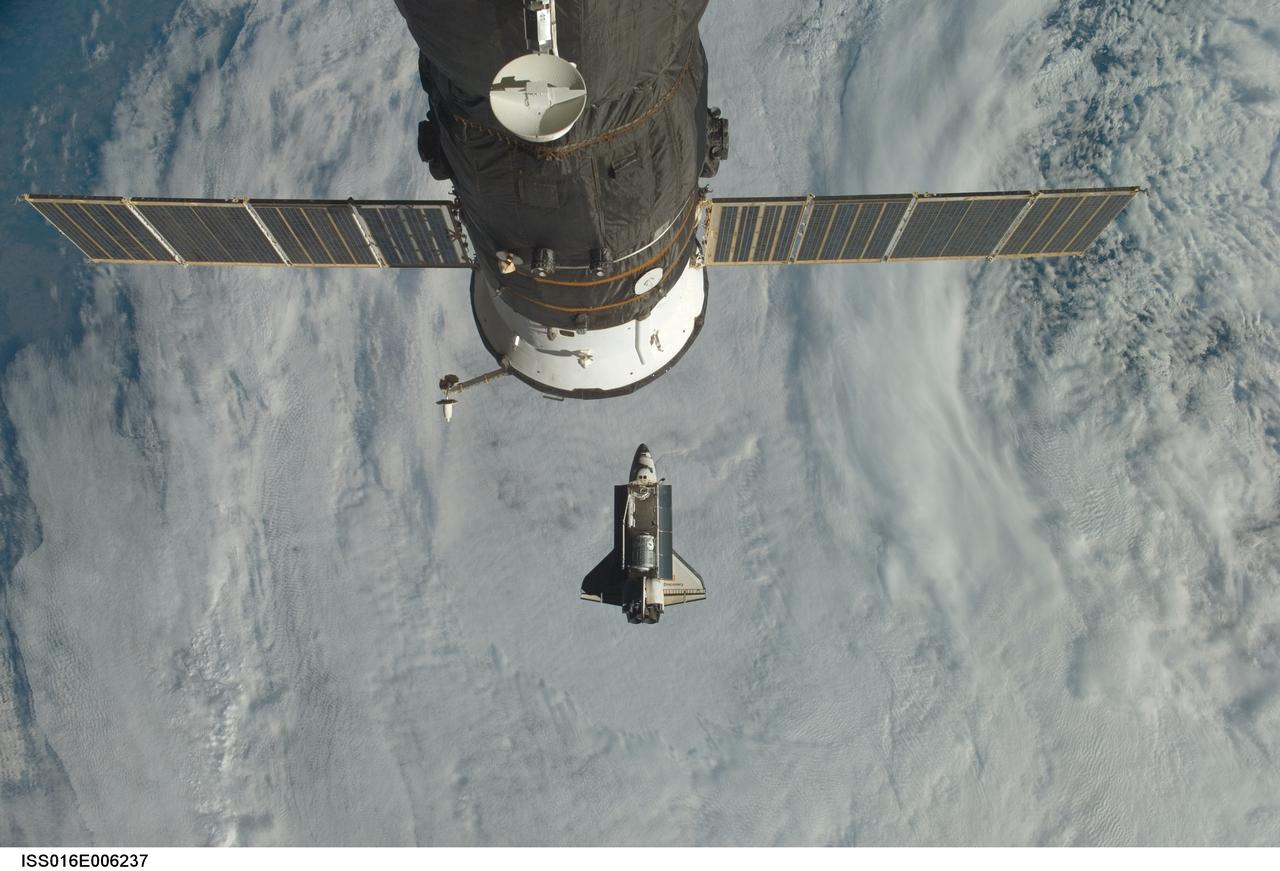
ISS016-E-006237 (25 Oct. 2007) --- Backdropped by a cloud-covered part of Earth, Space Shuttle Discovery (STS-120) approaches the International Space Station during STS-120 rendezvous and docking operations. Docking occurred at 7:40 a.m. (CDT) on Oct. 25, 2007, as the two spacecraft flew over the Atlantic Ocean just off the coast of North Carolina. The Harmony node is visible in Discovery's cargo bay. A Russian spacecraft, docked to the station, is visible in the foreground.
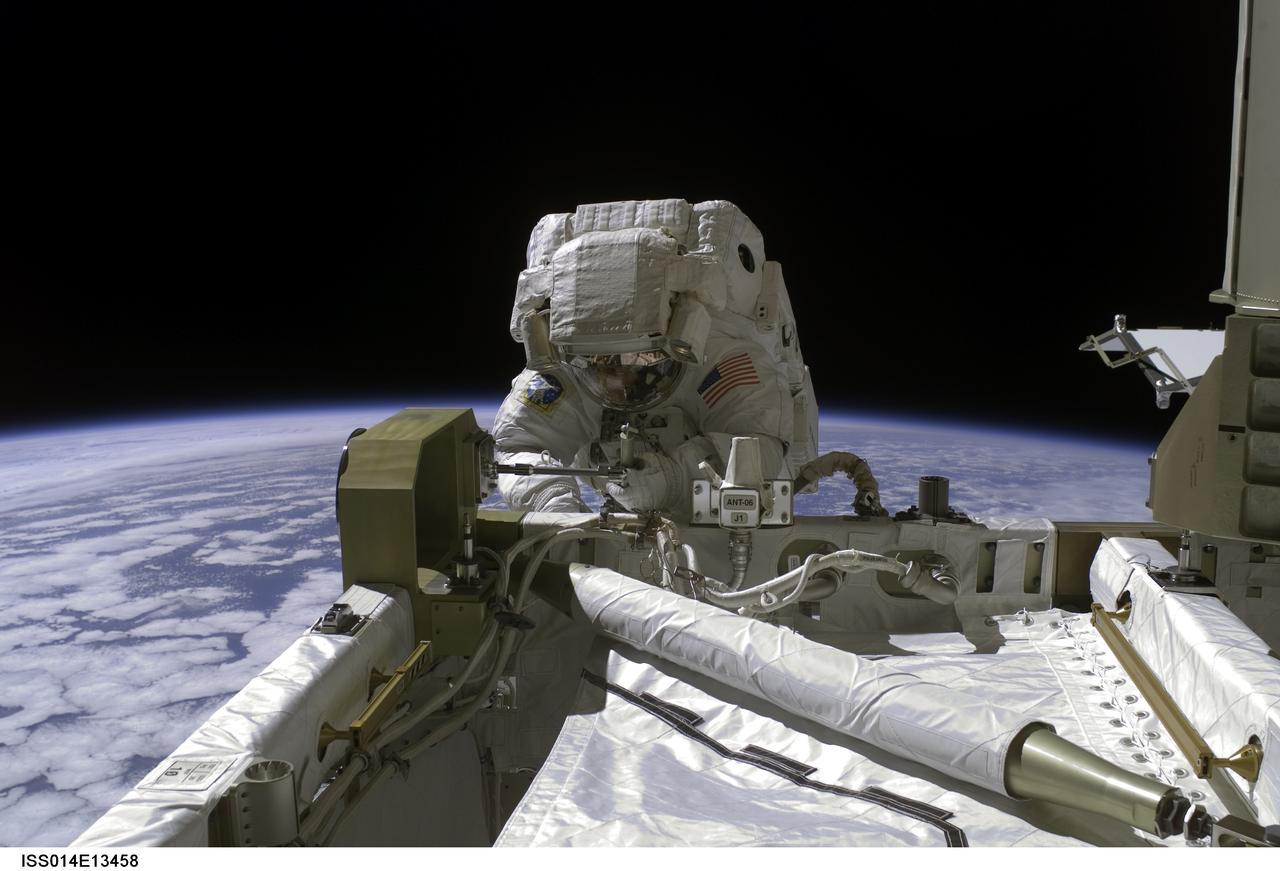
ISS014-E-13458 (8 Feb. 2007) --- Astronaut Sunita L. Williams, Expedition 14 flight engineer, participates in the final of three sessions of extravehicular activity (EVA) in nine days, as construction continues on the International Space Station. During the 6-hour, 40-minute spacewalk, Williams and Michael E. Lopez-Alegria (out of frame), commander, completed tasks that will allow for the attachment of a cargo platform during the STS-118 mission this summer and relocation of the P6 truss during STS-120 later this year.
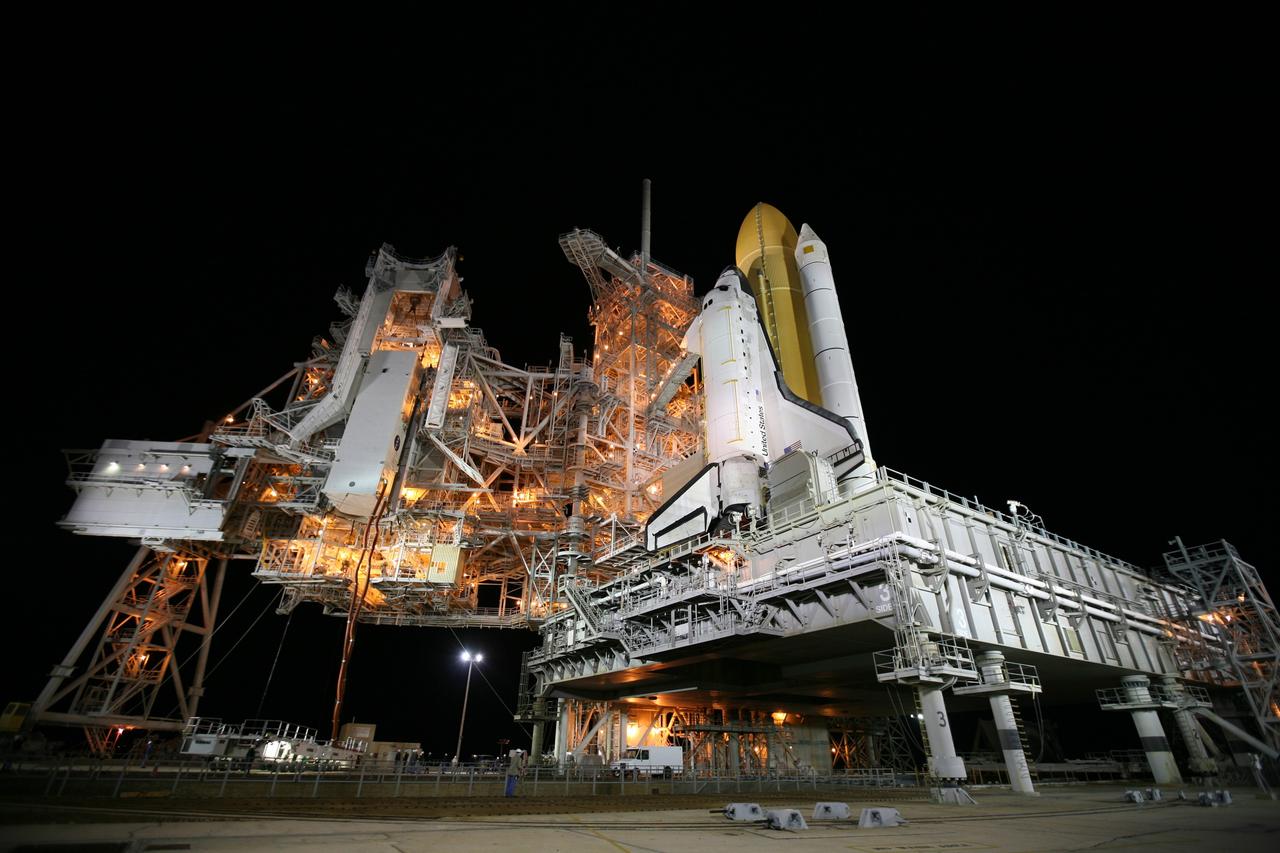
CAPE CANAVERAL, Fla. -- At NASA's Kennedy Space Center in Florida, the STS-133 payload canister is lifted into the rotating service structure on Launch Pad 39A. The payload then will be moved into space shuttle Discovery's payload bay. Discovery and its STS-133 crew will deliver the Permanent Multipurpose Module, packed with supplies and critical spare parts, as well as Robonaut 2, the dexterous humanoid astronaut helper, to the International Space Station. Launch is targeted for 4:40 p.m. EDT, Nov. 1. Photo credit: NASA/Amanda Diller
CAPE CANAVERAL, Fla. -- At NASA's Kennedy Space Center in Florida, the STS-133 payload canister is lifted into the rotating service structure on Launch Pad 39A. The payload then will be moved into space shuttle Discovery's payload bay. Discovery and its STS-133 crew will deliver the Permanent Multipurpose Module, packed with supplies and critical spare parts, as well as Robonaut 2, the dexterous humanoid astronaut helper, to the International Space Station. Launch is targeted for 4:40 p.m. EDT, Nov. 1. Photo credit: NASA/Troy Cryder
CAPE CANAVERAL, Fla. -- At NASA's Kennedy Space Center in Florida, the STS-133 payload canister now is in the rotating service structure on Launch Pad 39A. The payload then will be moved into space shuttle Discovery's payload bay. Discovery and its STS-133 crew will deliver the Permanent Multipurpose Module, packed with supplies and critical spare parts, as well as Robonaut 2, the dexterous humanoid astronaut helper, to the International Space Station. Launch is targeted for 4:40 p.m. EDT, Nov. 1. Photo credit: NASA/Troy Cryder
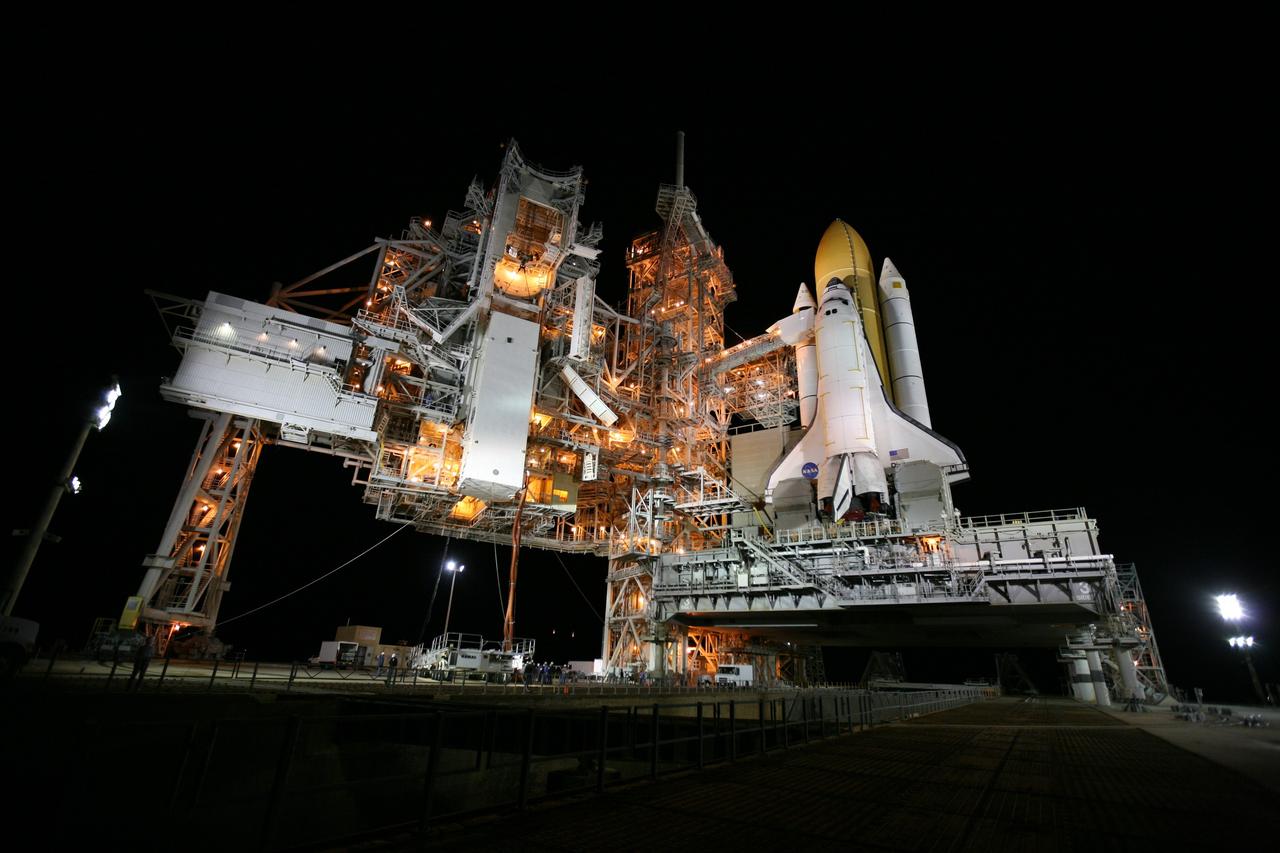
CAPE CANAVERAL, Fla. -- At NASA's Kennedy Space Center in Florida, the STS-133 payload canister is lifted into the rotating service structure on Launch Pad 39A. The payload then will be moved into space shuttle Discovery's payload bay. Discovery and its STS-133 crew will deliver the Permanent Multipurpose Module, packed with supplies and critical spare parts, as well as Robonaut 2, the dexterous humanoid astronaut helper, to the International Space Station. Launch is targeted for 4:40 p.m. EDT, Nov. 1. Photo credit: NASA/Amanda Diller
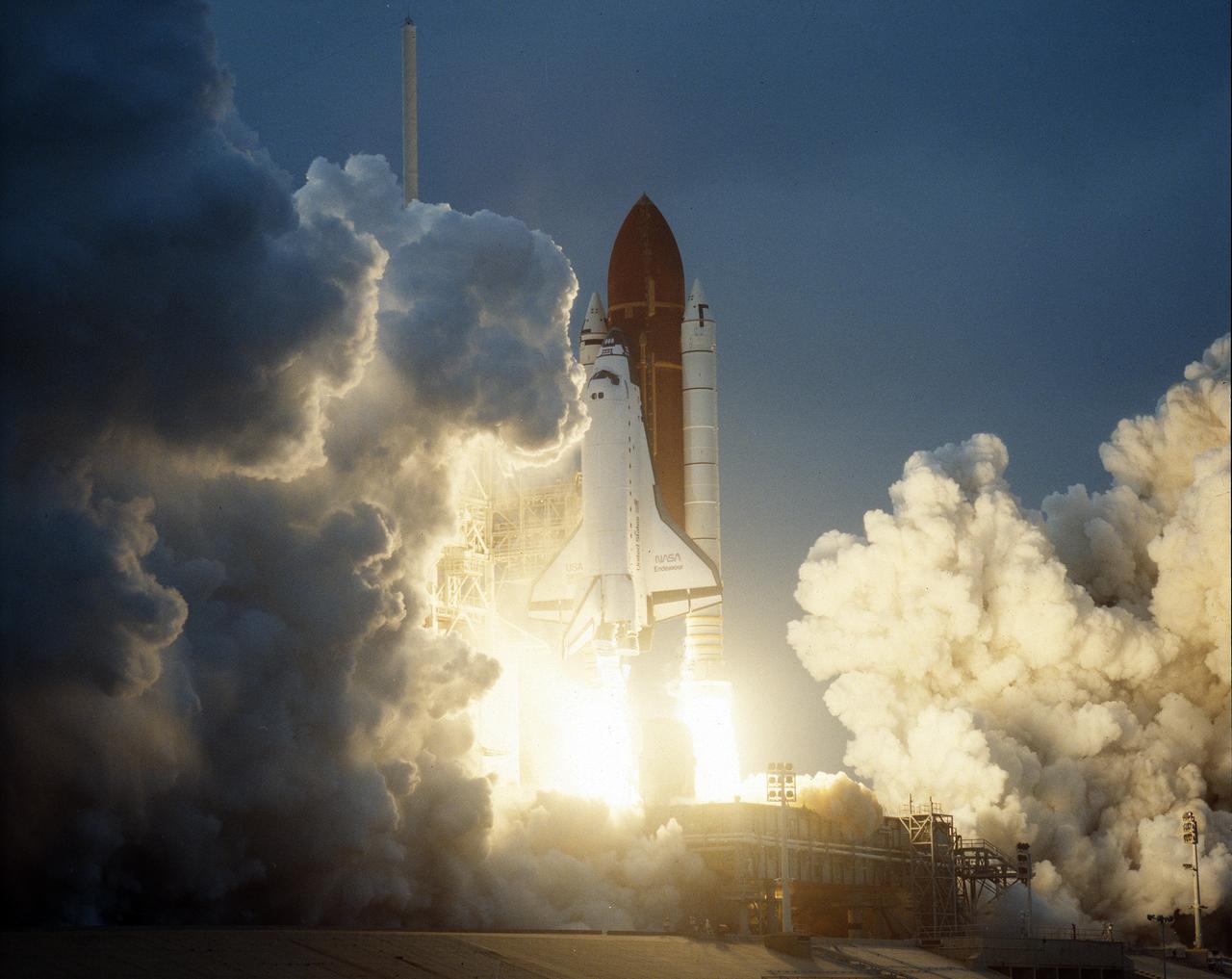
STS-49, the first flight of the Space Shuttle Orbiter Endeavour, lifted off from launch pad 39B on May 7, 1992 at 6:40 pm CDT. The STS-49 mission was the first U.S. orbital flight to feature 4 extravehicular activities (EVAs), and the first flight to involve 3 crew members working simultaneously outside of the spacecraft. The primary objective was the capture and redeployment of the INTELSAT VI (F-3) which was stranded in an unusable orbit since its launch aboard the Titan rocket in March 1990.
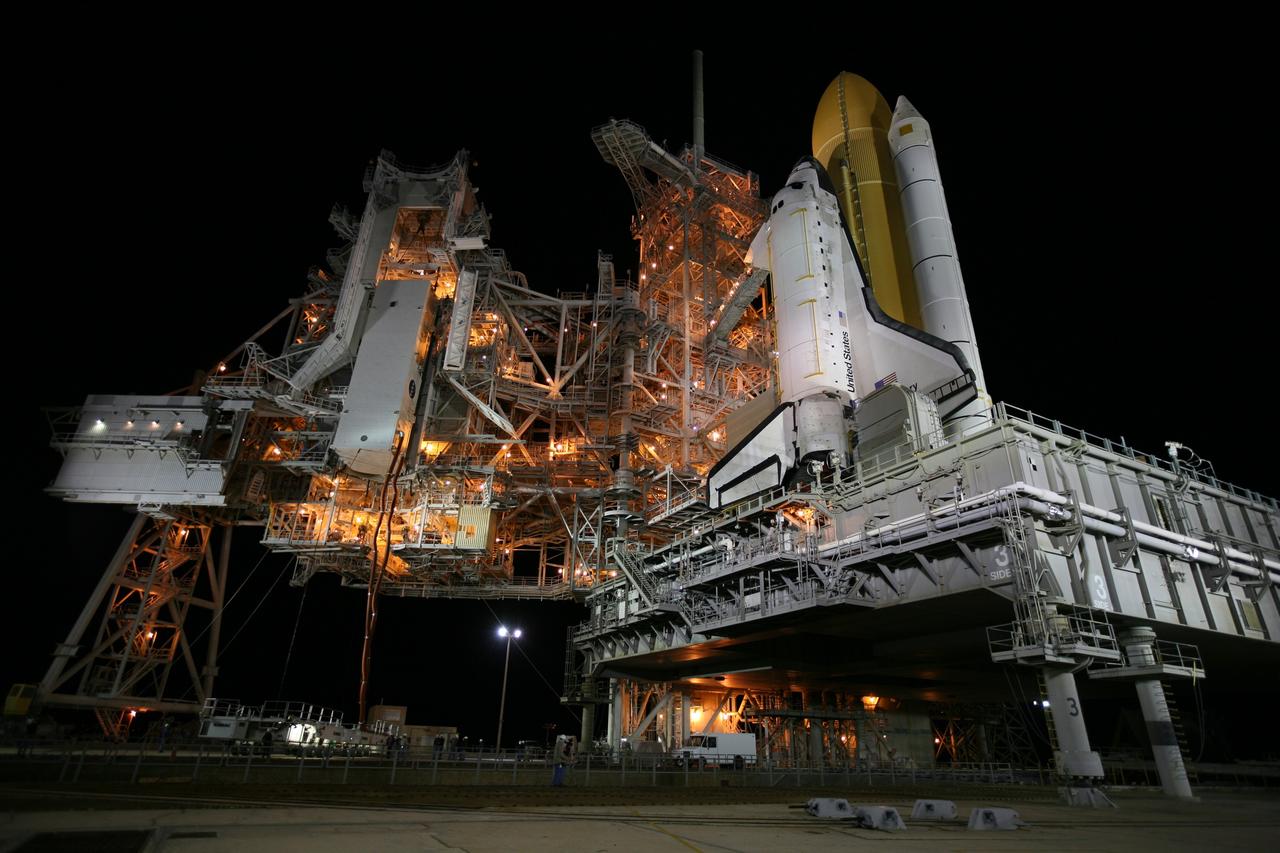
CAPE CANAVERAL, Fla. -- At NASA's Kennedy Space Center in Florida, the STS-133 payload canister is lifted into the rotating service structure on Launch Pad 39A. The payload then will be moved into space shuttle Discovery's payload bay. Discovery and its STS-133 crew will deliver the Permanent Multipurpose Module, packed with supplies and critical spare parts, as well as Robonaut 2, the dexterous humanoid astronaut helper, to the International Space Station. Launch is targeted for 4:40 p.m. EDT, Nov. 1. Photo credit: NASA/Amanda Diller
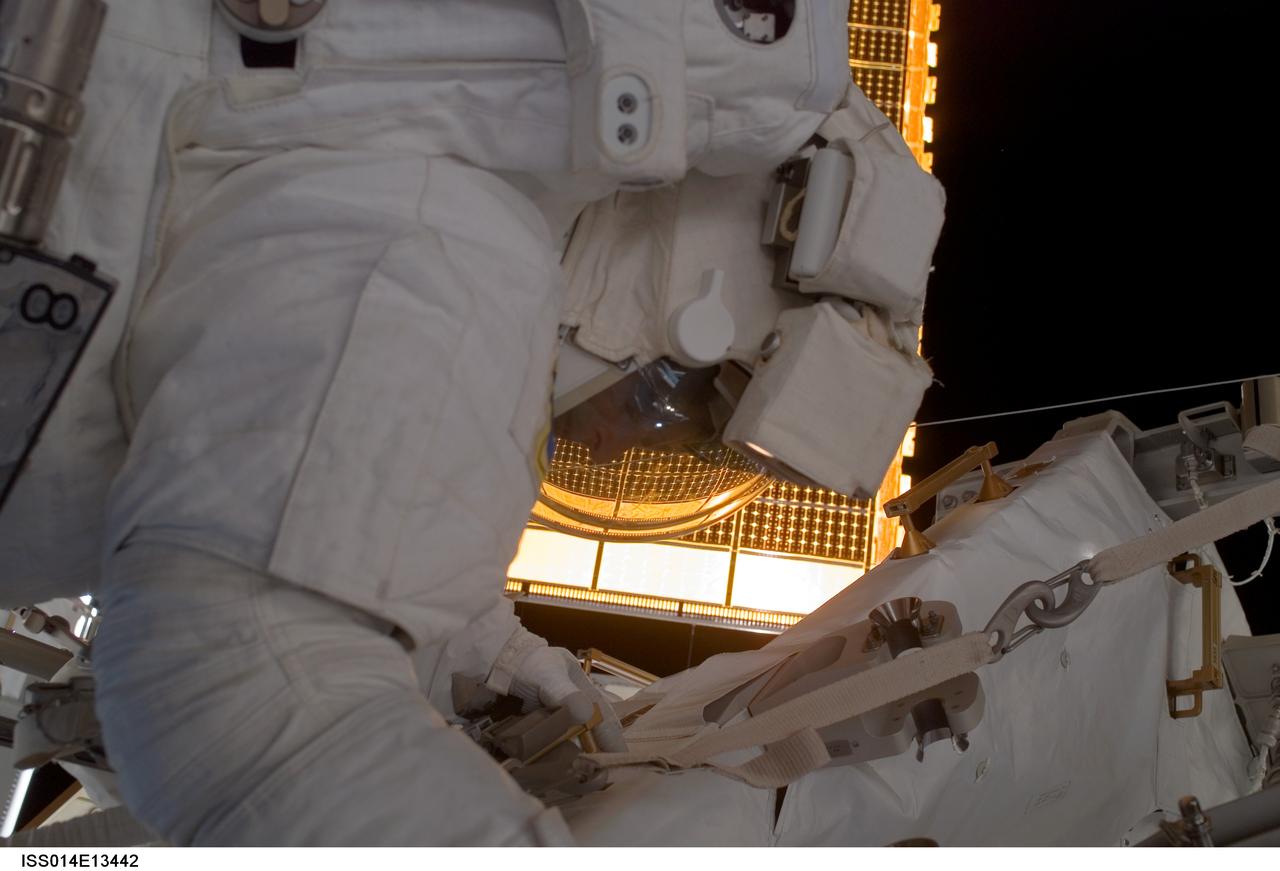
ISS014-E-13442 (8 Feb. 2007) --- Astronaut Sunita L. Williams, Expedition 14 flight engineer, participates in the final of three sessions of extravehicular activity (EVA) in nine days, as construction continues on the International Space Station. During the 6-hour, 40-minute spacewalk, Williams and Michael E. Lopez-Alegria (out of frame), commander, completed tasks that will allow for the attachment of a cargo platform during the STS-118 mission this summer and relocation of the P6 truss during STS-120 later this year.
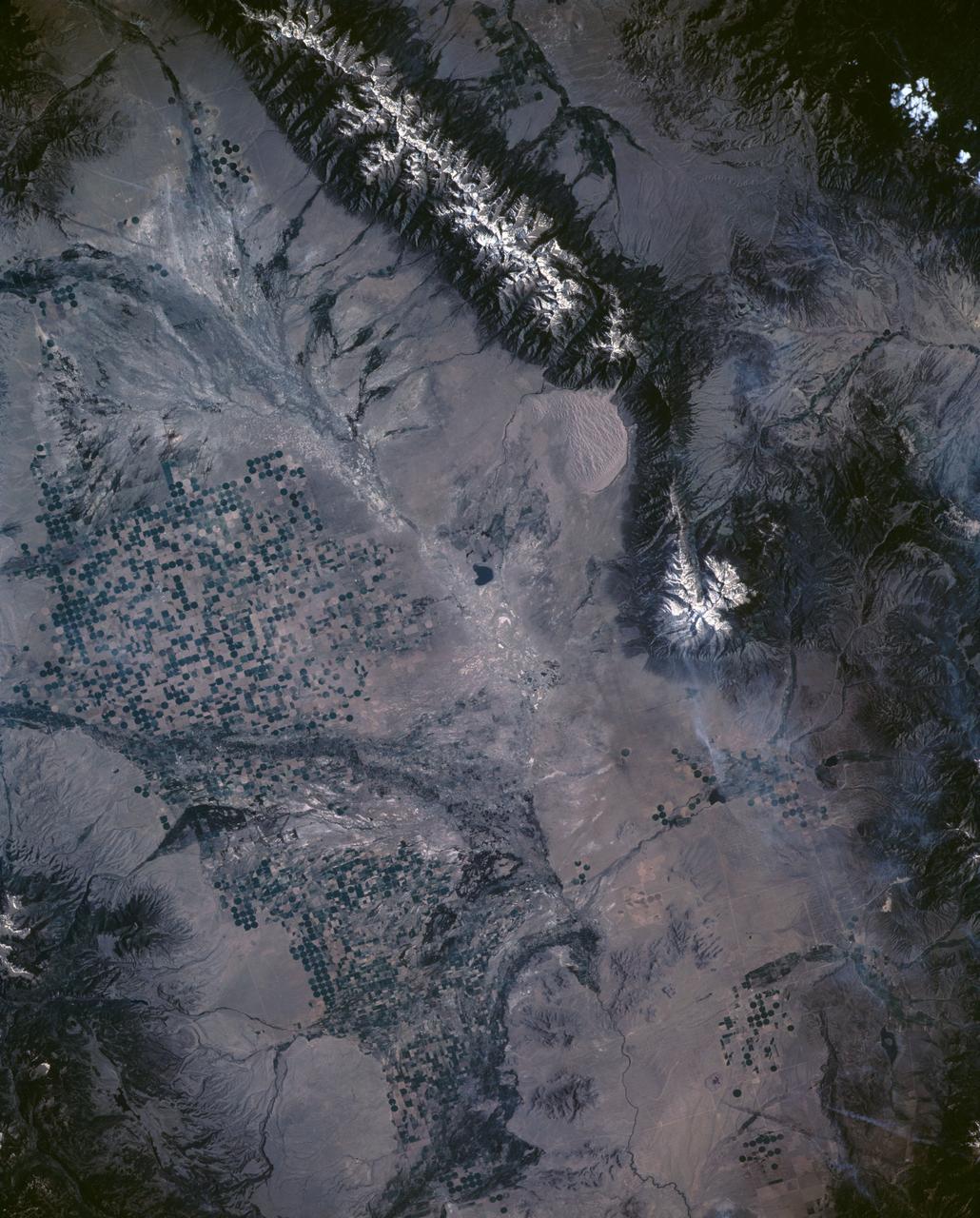
STS040-151-126 (5-14 June 1991) --- Croplands of the San Luis Valley stand out exceptionally clearly from low Earth orbit. The Rio Grande flows through the valley. Circular center pivot irrigation patterns have almost completely replaced the earlier rectangular grid pattern. Pinto beans are the specialty of the area. The Great Sand Dunes National Monument appears in fine detail near the center of the picture. The sands of these dunes have been blown from the valley floor by westerly winds in the course of the last few tens of thousands of years, now banked up against the foot of the Sangre de Christo Mountains (snowcapped peaks reach over 14000 feet). The town of Alamosa lies on the Rio Grande. The San Juan Mountains appear at the bottom left.
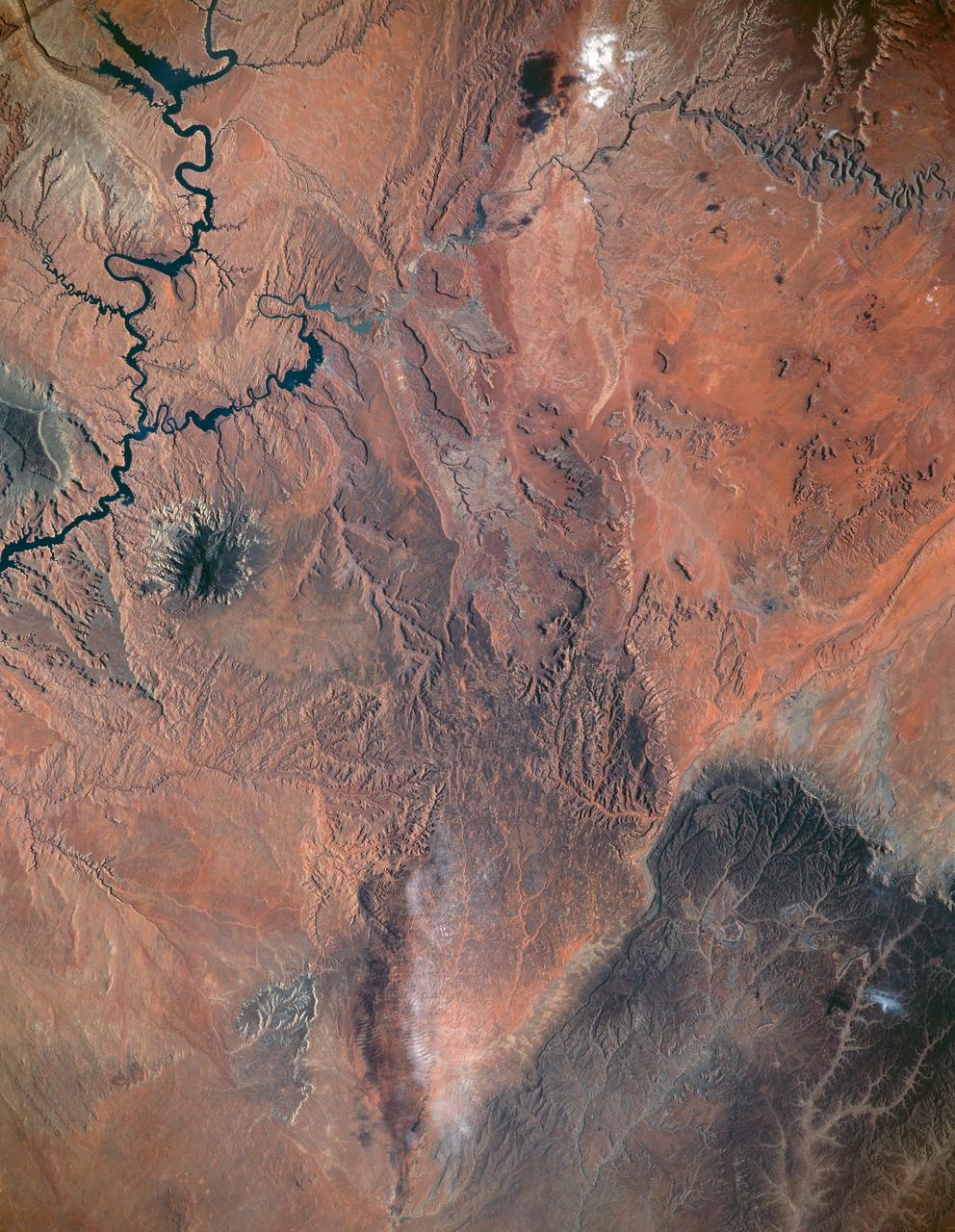
STS040-151-123 (5-14 June 1991) --- This large format view shows parts of northern Arizona and southern Utah. San Juan River, Lake Powell and Monument Valley are visible. Water of Lake Powell can be seen filling the valleys of the Colorado and San Juan Rivers at the top of the image. The darker green areas indicate high, forested country of the lone Navajo Mountain (center left) and Black Mesa (bottom right). Strip mines can be seen south of the rim of Black Mesa. Monument Valley lies between the San Juan River and Black Mesa. Shadows thrown by the individual steep-sided hills make them stand out in the scene.
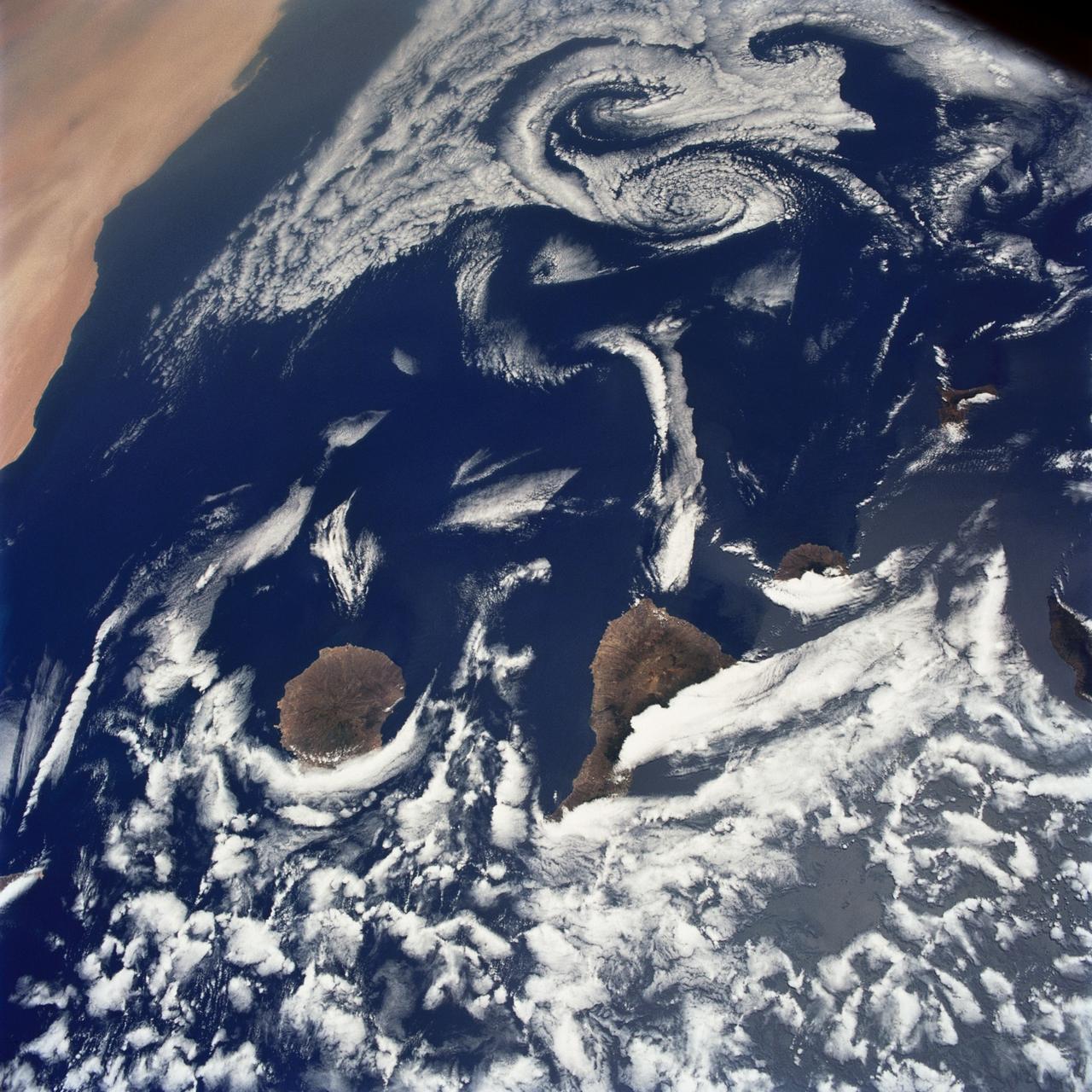
STS040-75-003 (5-14 June 1991) --- This image shows several of the Canary Islands, located in the North Atlantic Ocean just west of Africa. Low level stratus clouds often form here (and along the west coast of continents at these latitudes) are trapped in vertical movement due to an overlying atmospheric temperature inversion. The islands are generating disturbances in the low-level wind flow which is generally from the north-northeast or from top to bottom in the image. These disturbances travel downstream from the islands and manifest themselves as cloud swirls which are called von Karman vortices. The northern extent of a large dust storm moving off the coast of Africa is apparent at the lower right of the image. The dust, extended across the Atlantic Ocean as far west as the Dominican Republic later in the mission.
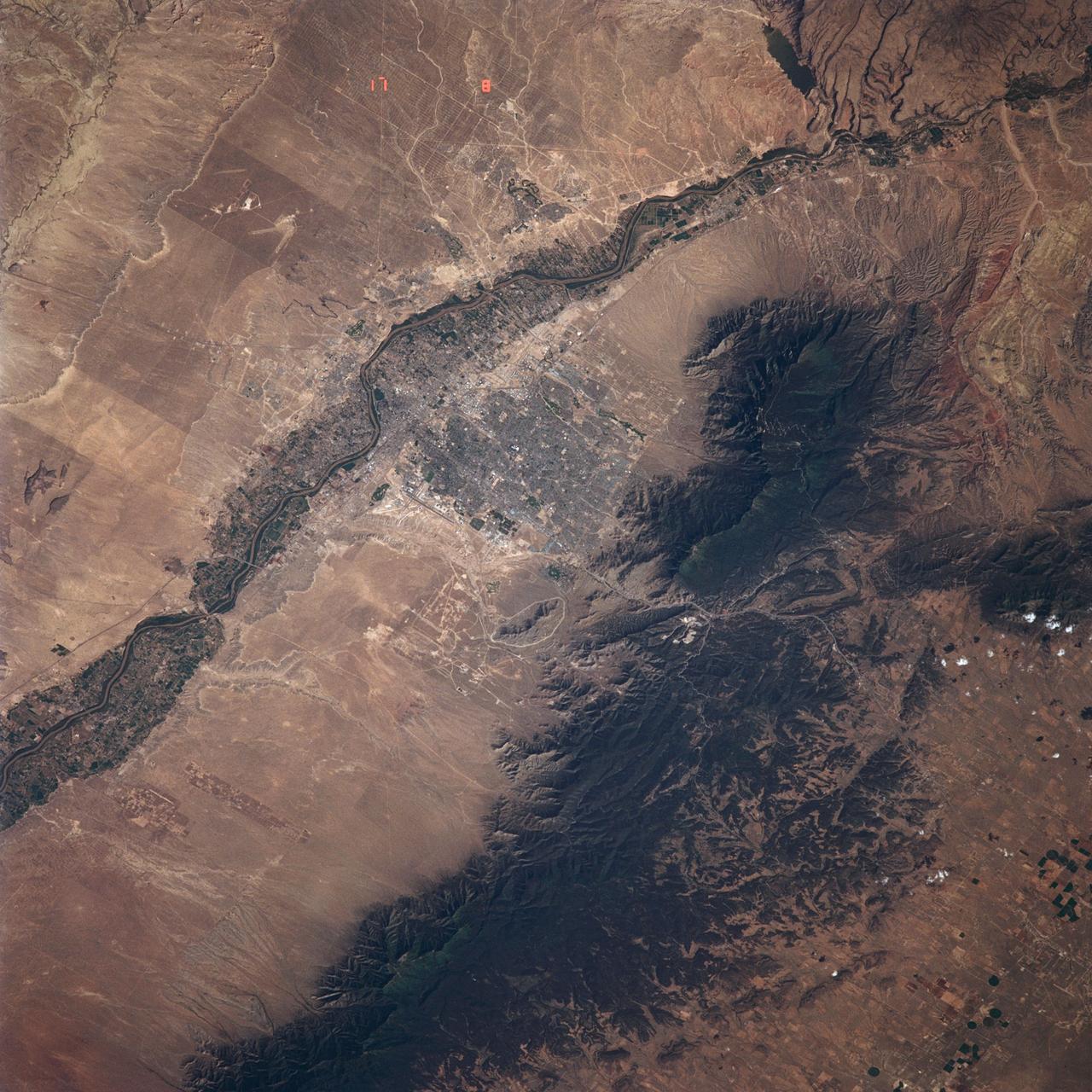
STS040-614-061 (5-14 June 1991) --- Albuquerque, New Mexico is perched on the edge of the Rio Grande floodplain, which crosses the photograph from upper left to center lower right. The reddish-brown surface of the Albuquerque Basin, a fault-bounded structural basin filled by alluvial fan and lake-bed sediments, is broken by an irregular light-toned rim River along both the Rio Grande and Rio Puerco (lower left). The rim marks the erosional edge of an ancient caliche soil that formed more than a half-million years ago, before the Rio Grande integrated its drainage from basin to basin. The upper right portion of the photograph is dominated by dark tones, representing pinyon/juniper and other timber growing on very old rocks of the Sandia Mountains. Interstate 40 can be seen passing through Sandia Pass which cuts the mountain mass.
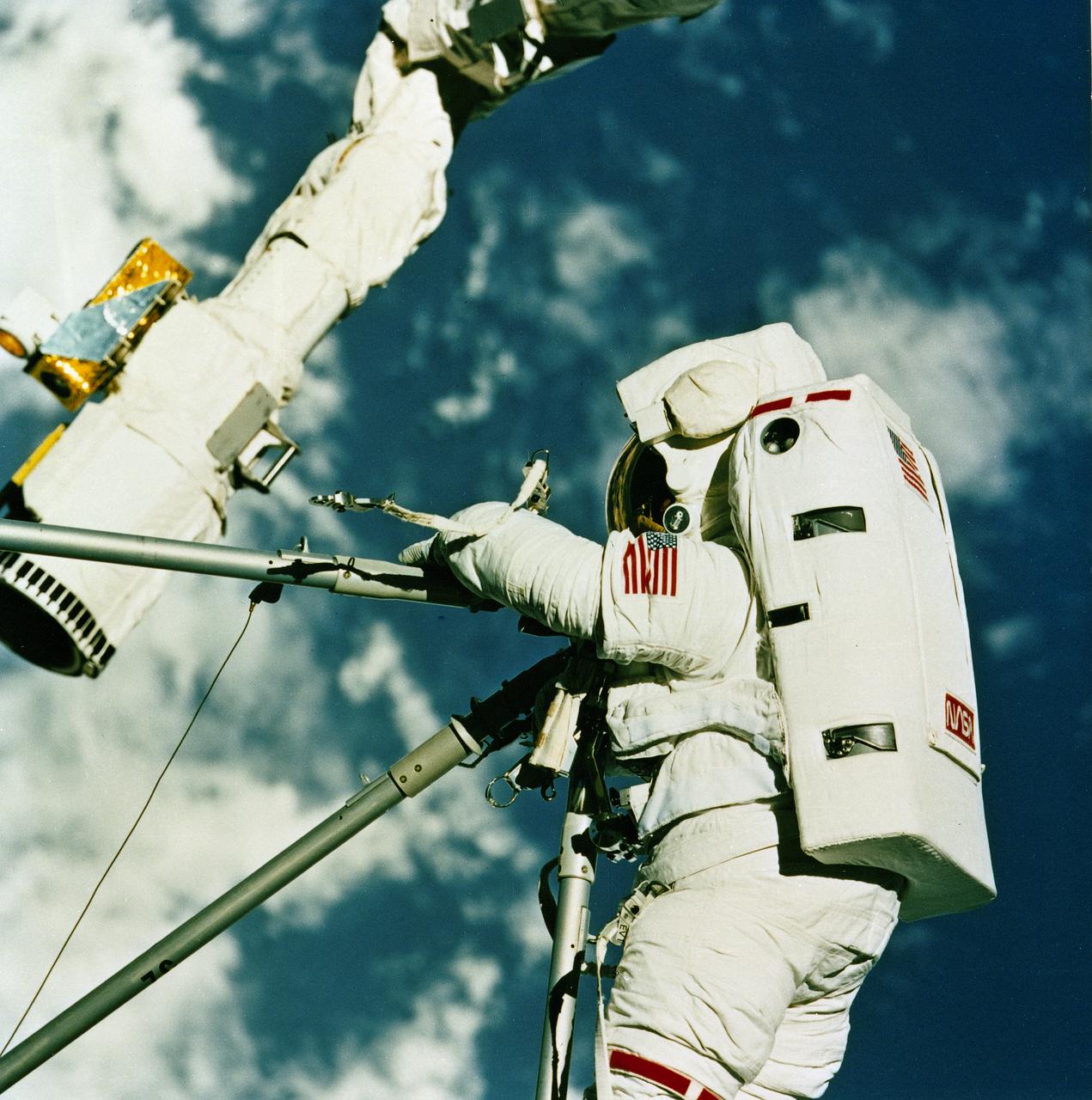
STS-49, the first flight of the Space Shuttle Orbiter Endeavour, lifted off from launch pad 39B on May 7, 1992 at 6:40 pm CDT. The STS-49 mission was the first U.S. orbital flight to feature 4 extravehicular activities (EVAs), and the first flight to involve 3 crew members working simultaneously outside of the spacecraft. The primary objective was the capture and redeployment of the INTELSAT VI (F-3) which was stranded in an unusable orbit since its launch aboard the Titan rocket in March 1990. In this STS-49 onboard photo, Astronaut Kathryn Thornton joins three struts together during her Extra Vehicular Activity (EVA).
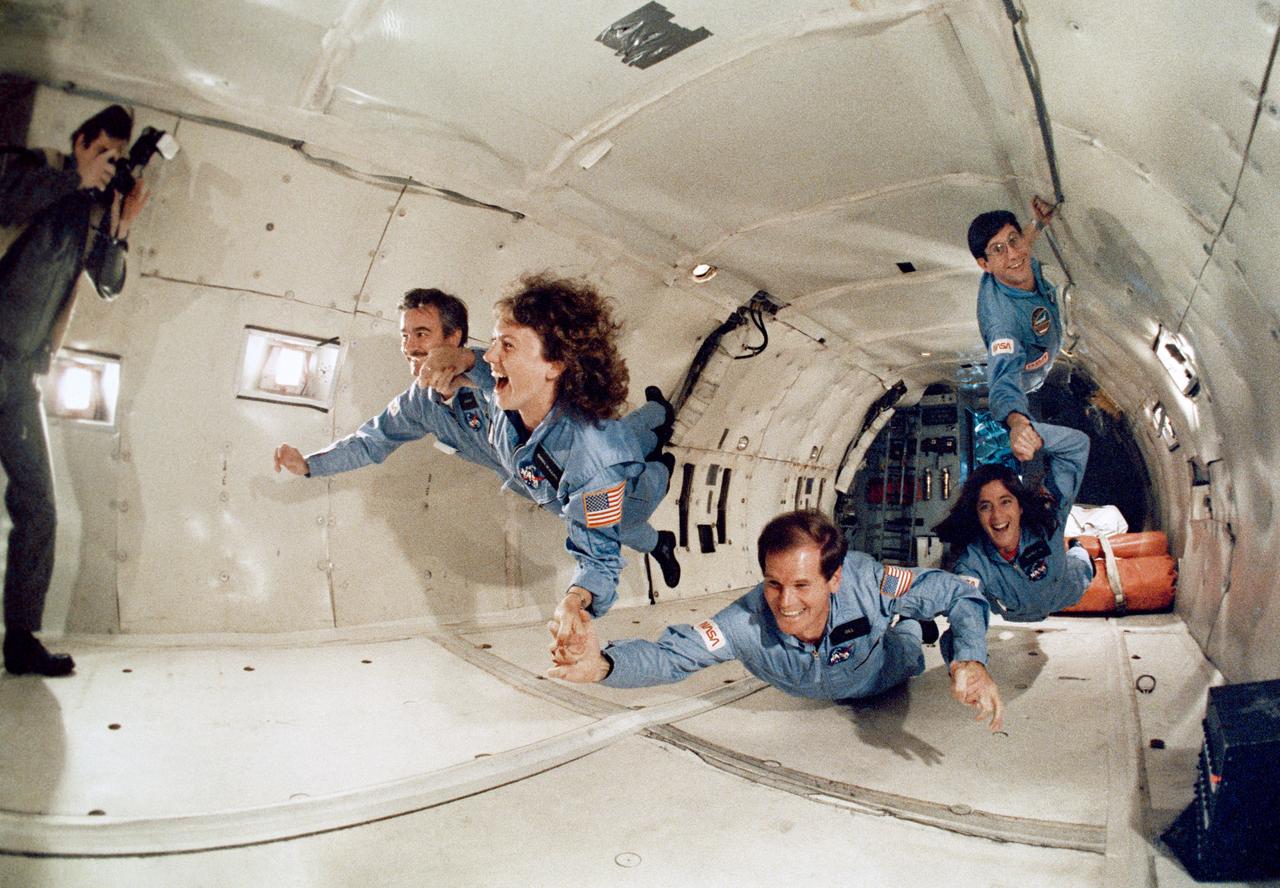
S85-44834 (20 Nov. 1985) --- This flying human chain represents prime and backup payload specialists for two upcoming STS missions. The group, representing trainees for STS-61C later this year and STS-51L early next year, shared some 40 parabolas in NASA?s KC-135, ?Zero-G? aircraft on Nov. 20, 1985. Left to right are Gerard Magilton, RCA backup payload specialist for STS-61C; Sharon Christa McAuliffe, payload specialist/teacher citizen observer for STS-51L; U.S. Representative Bill Nelson (D., Florida), scheduled for 61C; Barbara R. Morgan, backup to McAuliffe; and Robert J. Cenker, RCA payload specialist for 61C. The photo was taken by Otis Imboden. Photo credit: NASA
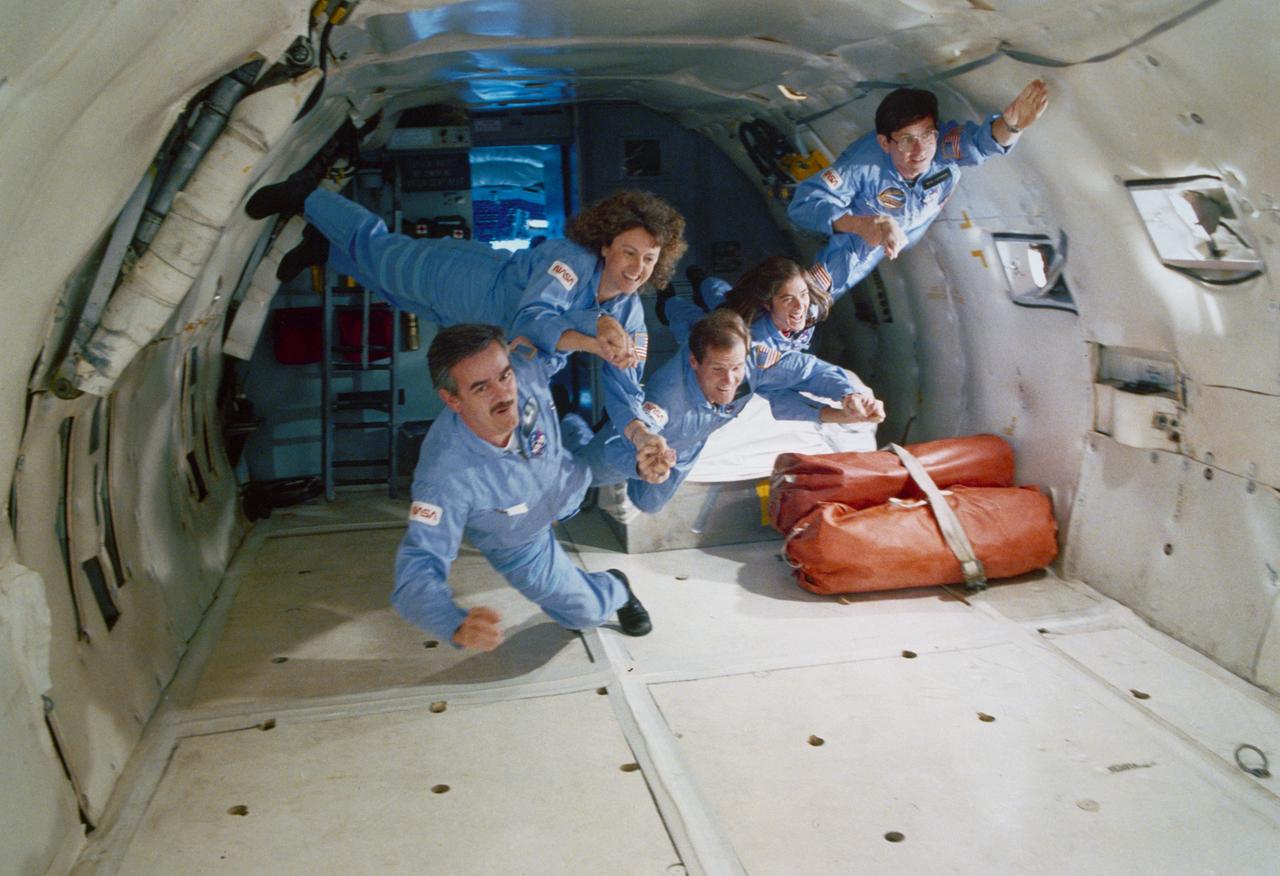
S85-44835 (20 Nov. 1985) --- This flying human chain represents prime and backup payload specialists for two upcoming STS missions. The group, representing trainees for STS-61C later this year and STS-51L early next year, shared some 40 parabolas in NASA?s KSC-135, ?Zero-G? aircraft on Nov. 20. Left to right are Gerard Magilton, RCA backup payload specialist for STS-61C; Sharon Christa McAuliffe, payload specialist/teacher citizen observer for STS-51L; U.S. Rep. Bill Nelson (D., Florida), scheduled for 61-C; Barbara R. Morgan, backup to McAuliffe; and Robert J. Cenker, RCA payload specialist for 61-C. The photo was taken by Keith Meyers, New York Times. Photo credit: NASA
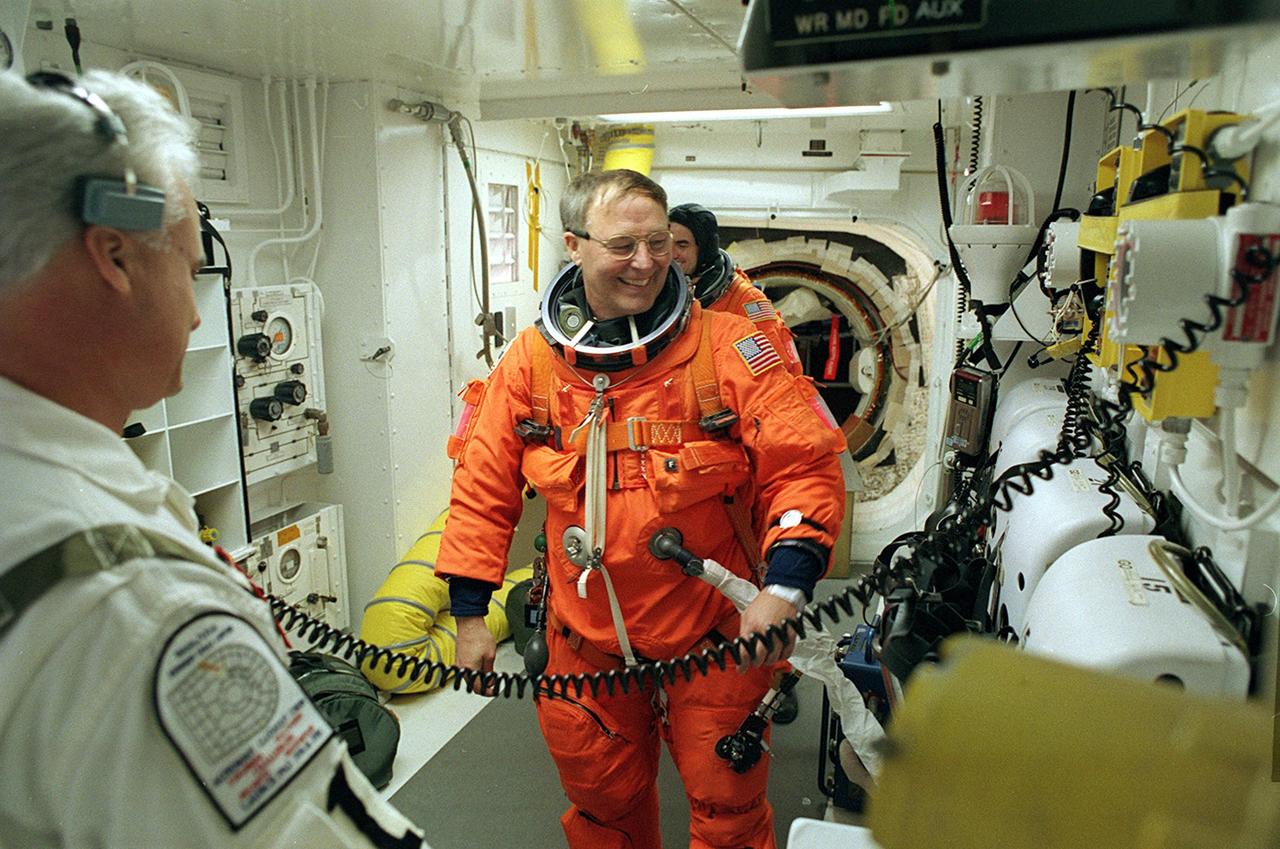
KENNEDY SPACE CENTER, FLA. - Jerry Ross jokes with the Closeout Crew in the White Room as he prepares to enter Space Shuttle Atlantis for launch. The White Room provides entry into the cockpit area of the orbiter. The 13th assembly flight to the International Space Station, STS-110 is carrying the S0 Integrated Truss Structure and Mobile Transporter (MT). On the 11-day mission, astronauts, including Ross, will make four spacewalks to attach the S0 truss, which will become the backbone of the Space Station, to the U.S. Lab, "Destiny." The MT, a space "railcar," is attached to the truss segment and will make its debut run during the flight. Ross is making his seventh Shuttle flight, a new record in the history of the Shuttle program, and will complete his ninth spacewalk, also a record. Launch is scheduled for 4:40 p.m. EDT (20:40 GMT)
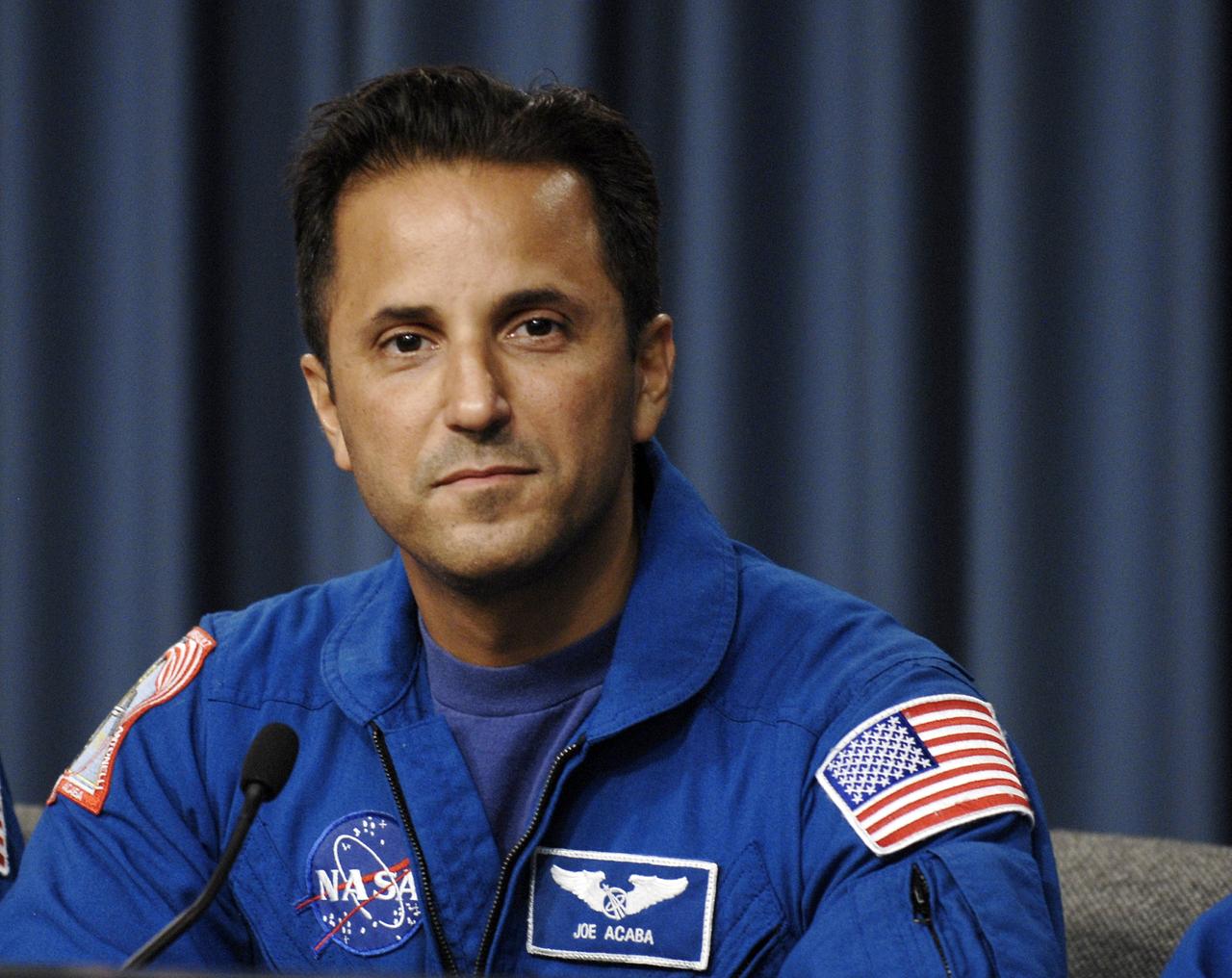
CAPE CANAVERAL, Fla. – At NASA's Kennedy Space Center in Florida, STS-119 Mission Specialist Joseph Acaba participates in a news conference following landing of the space shuttle Discovery STS-119 mission to the International Space Station. Main gear touchdown was at 3:13:17 p.m. EDT. Nose gear touchdown was at 3:13:40 p.m. and wheels stop was at 3:14:45 p.m. Discovery delivered the final pair of large power-generating solar array wings and the S6 truss segment. The mission was the 28th flight to the station, the 36th flight of Discovery and the 125th in the Space Shuttle Program, as well as the 70th landing at Kennedy. Photo credit: NASA/Kim Shiflett
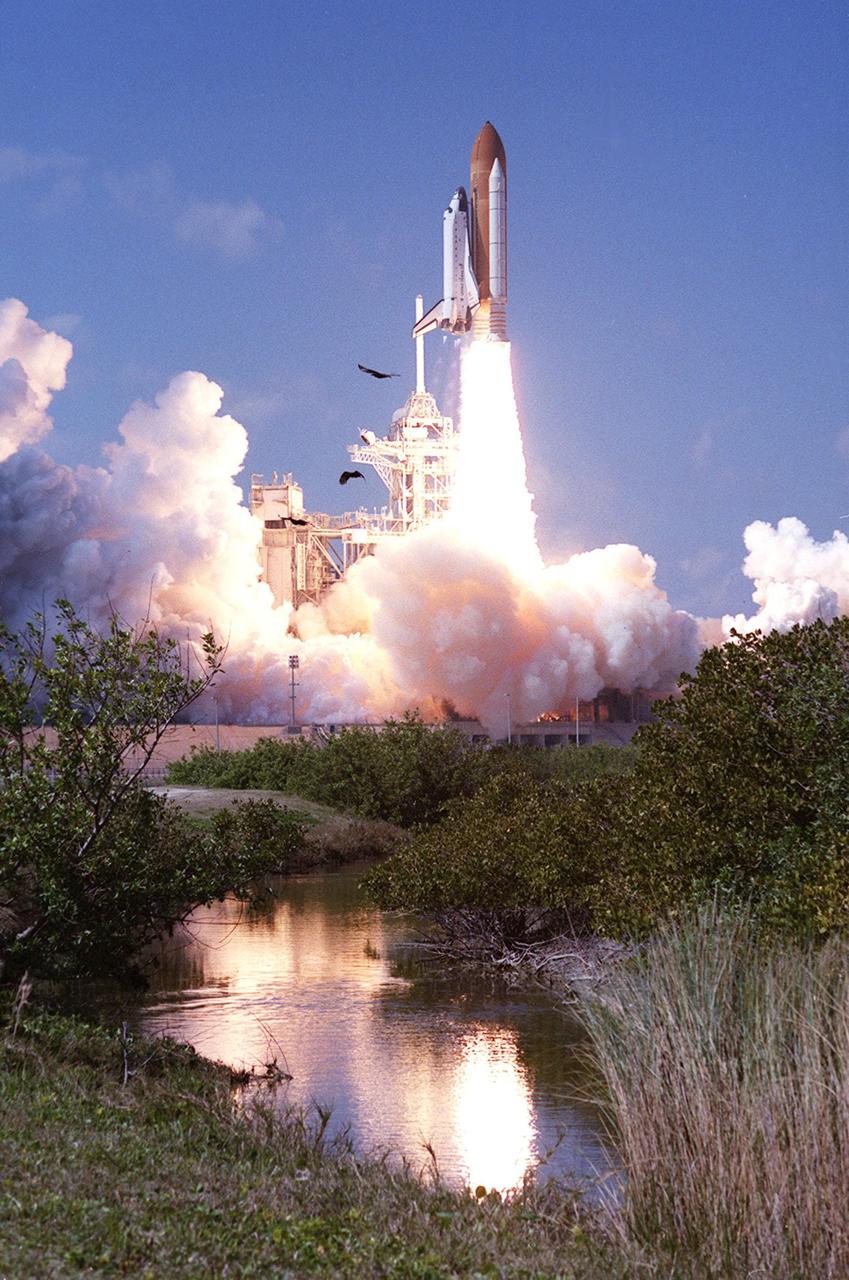
KENNEDY SPACE CENTER, Fla. -- After liftoff at 12:43:40 p.m. EST, the Space Shuttle Endeavour on mission STS-99 soars into a clear blue sky, trailed by flames and rolling billows of steam. The brilliant flames are reflected in the nearby waters. Known as the Shuttle Radar Topography Mission (SRTM), STS-99 will chart a new course to produce unrivaled 3-D images of the Earth's surface. The result of the SRTM could be close to 1 trillion measurements of the Earth's topography. The mission is expected to last 11days, with Endeavour landing at KSC Tuesday, Feb. 22, at 4:36 p.m. EST. This is the 97th Shuttle flight and 14th for Shuttle Endeavour