
CAPE CANAVERAL, Fla. - Space shuttle Endeavour begins to roll out of Orbiter Processing Facility 2 to head to the Vehicle Assembly Building at NASA's Kennedy Space Center. First motion was 7:01 a.m. EDT. In the VAB, Endeavour will be attached to its external fuel tank and twin solid rocket boosters. After additional preparations are made, the shuttle will be rolled out to Launch Pad 39B. Endeavour is the backup shuttle, if needed for rescue, for space shuttle Atlantis’ STS-125 mission to NASA’s Hubble Space Telescope targeted for October. Photo credit: NASA/Troy Cryder
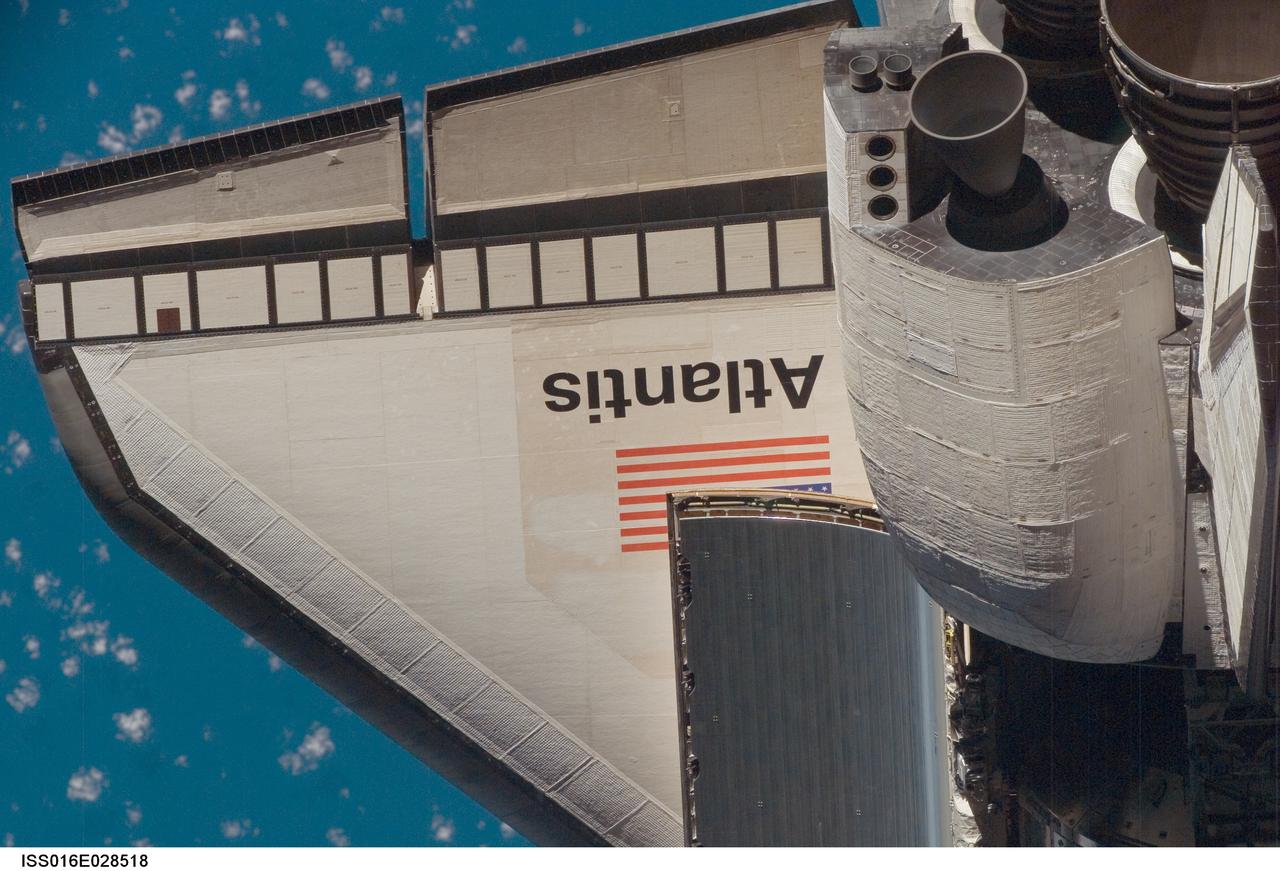
ISS016-E-028518 (9 Feb. 2008) --- An overhead view of part of the Space Shuttle Atlantis' starboard wing and part of its orbital maneuvering system pods was provided by Expedition 16 crewmembers. Before docking with the International Space Station, astronaut Steve Frick, STS-122 commander, flew the shuttle through a roll pitch maneuver or basically a backflip to allow the space station crew a good view of Atlantis' heat shield. Using digital still cameras equipped with both 400 and 800 millimeter lenses, the ISS crewmembers took a number of photos of the shuttle's thermal protection system and sent them down to teams on the ground for analysis. A 400 millimeter lens was used for this image.

ISS018-E-040837 (17 March 2009) --- A close-up view of the exterior of Space Shuttle Discovery's nose and underside was provided by Expedition 18 crewmembers on the International Space Station. Before docking with the station, astronaut Lee Archambault, STS-119 commander, flew the shuttle through a Rendezvous Pitch Maneuver or basically a backflip to allow the space station crew a good view of Discovery's heat shield. Using digital still cameras equipped with both 400 and 800 millimeter lenses, the ISS crewmembers took a number of photos of the shuttle's thermal protection system and sent them down to teams on the ground for analysis. A 400 millimeter lens was used for this image.
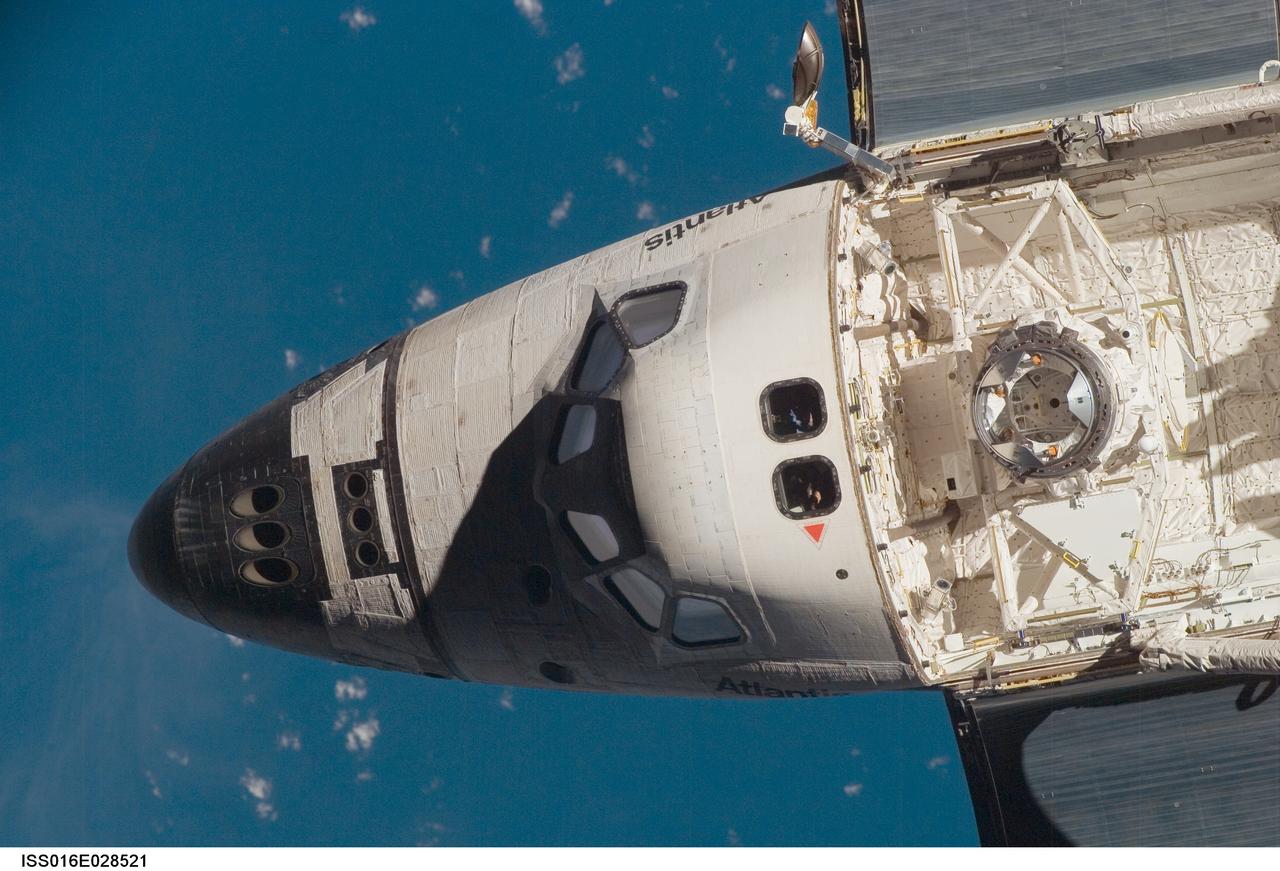
ISS016-E-028521 (9 Feb. 2008) --- An overhead view of the exterior of the Space Shuttle Atlantis' crew cabin and docking system was provided by Expedition 16 crewmembers. Before docking with the International Space Station, astronaut Steve Frick, STS-122 commander, flew the shuttle through a roll pitch maneuver or basically a backflip to allow the space station crew a good view of Atlantis' heat shield. Using digital still cameras equipped with both 400 and 800 millimeter lenses, the ISS crewmembers took a number of photos of the shuttle's thermal protection system and sent them down to teams on the ground for analysis. A 400 millimeter lens was used for this image.
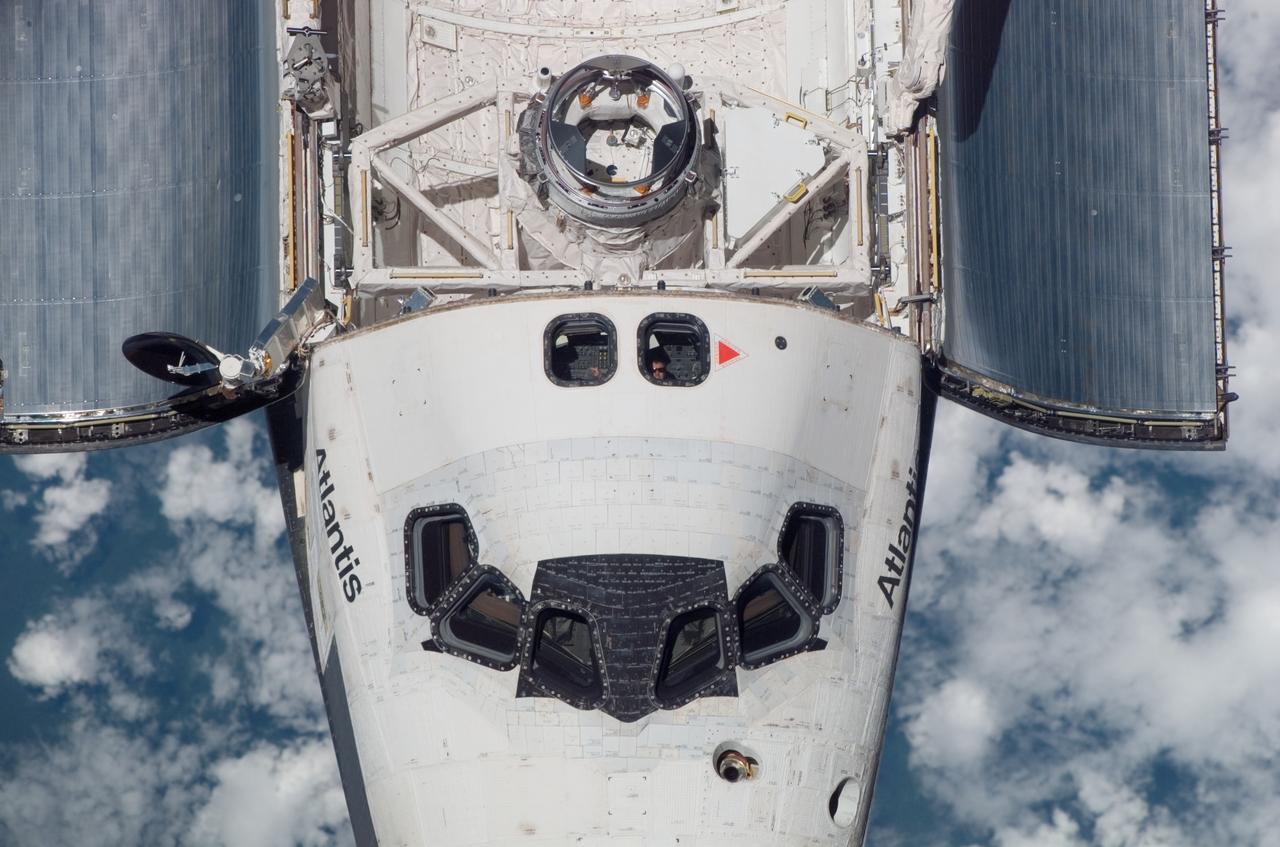
ISS016-E-028388 (9 Feb. 2008) --- An overhead view of the exterior of the Space Shuttle Atlantis' crew cabin, part of its payload bay doors and docking system was provided by Expedition 16 crewmembers. Before docking with the International Space Station, astronaut Steve Frick, STS-122 commander, flew the shuttle through a roll pitch maneuver or basically a backflip to allow the space station crew a good view of Atlantis' heat shield. Using digital still cameras equipped with both 400 and 800 millimeter lenses, the ISS crewmembers took a number of photos of the shuttle's thermal protection system and sent them down to teams on the ground for analysis. A 400 millimeter lens was used for this image.
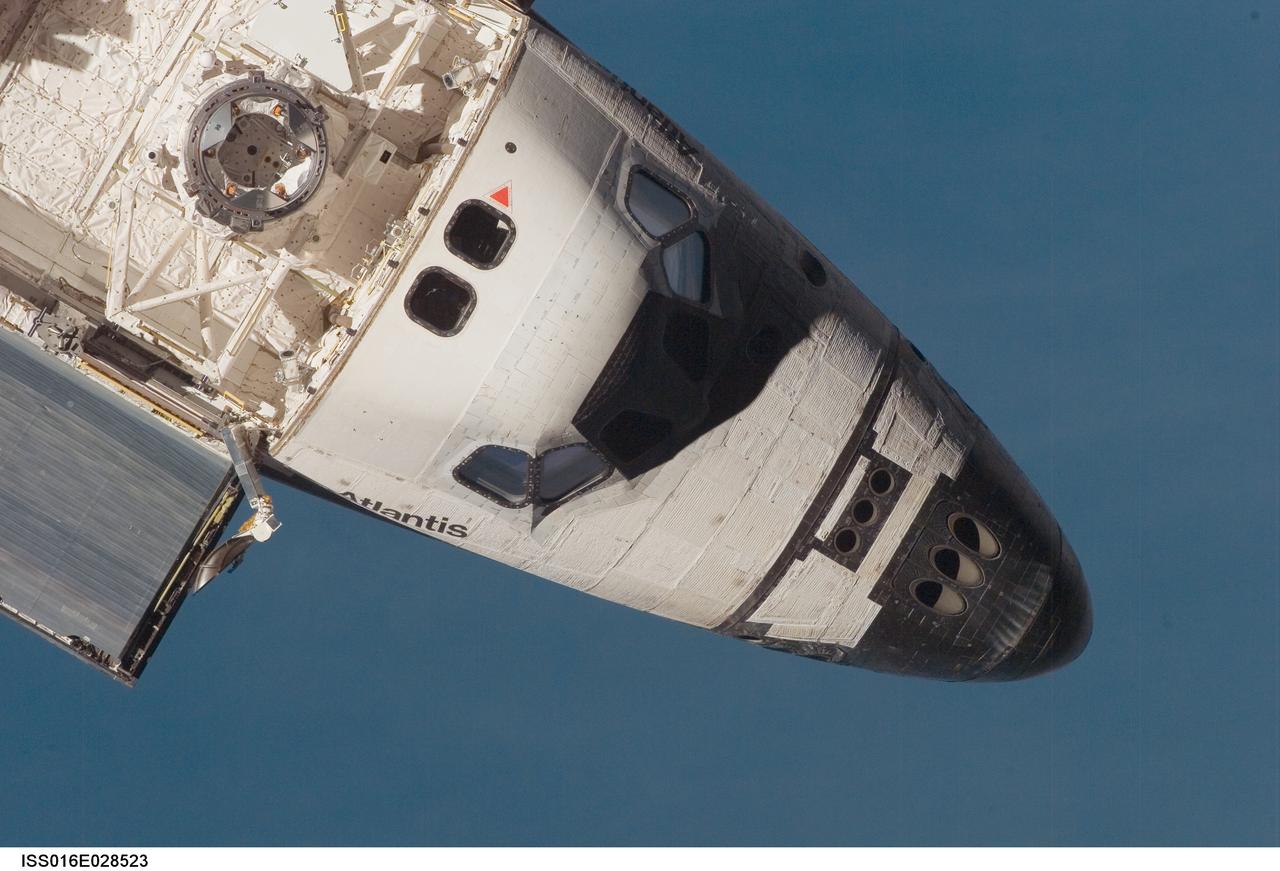
ISS016-E-028523 (9 Feb. 2008) --- An overhead view of the exterior of the Space Shuttle Atlantis' crew cabin and docking system was provided by Expedition 16 crewmembers. Before docking with the International Space Station, astronaut Steve Frick, STS-122 commander, flew the shuttle through a roll pitch maneuver or basically a backflip to allow the space station crew a good view of Atlantis' heat shield. Using digital still cameras equipped with both 400 and 800 millimeter lenses, the ISS crewmembers took a number of photos of the shuttle's thermal protection system and sent them down to teams on the ground for analysis. A 400 millimeter lens was used for this image.
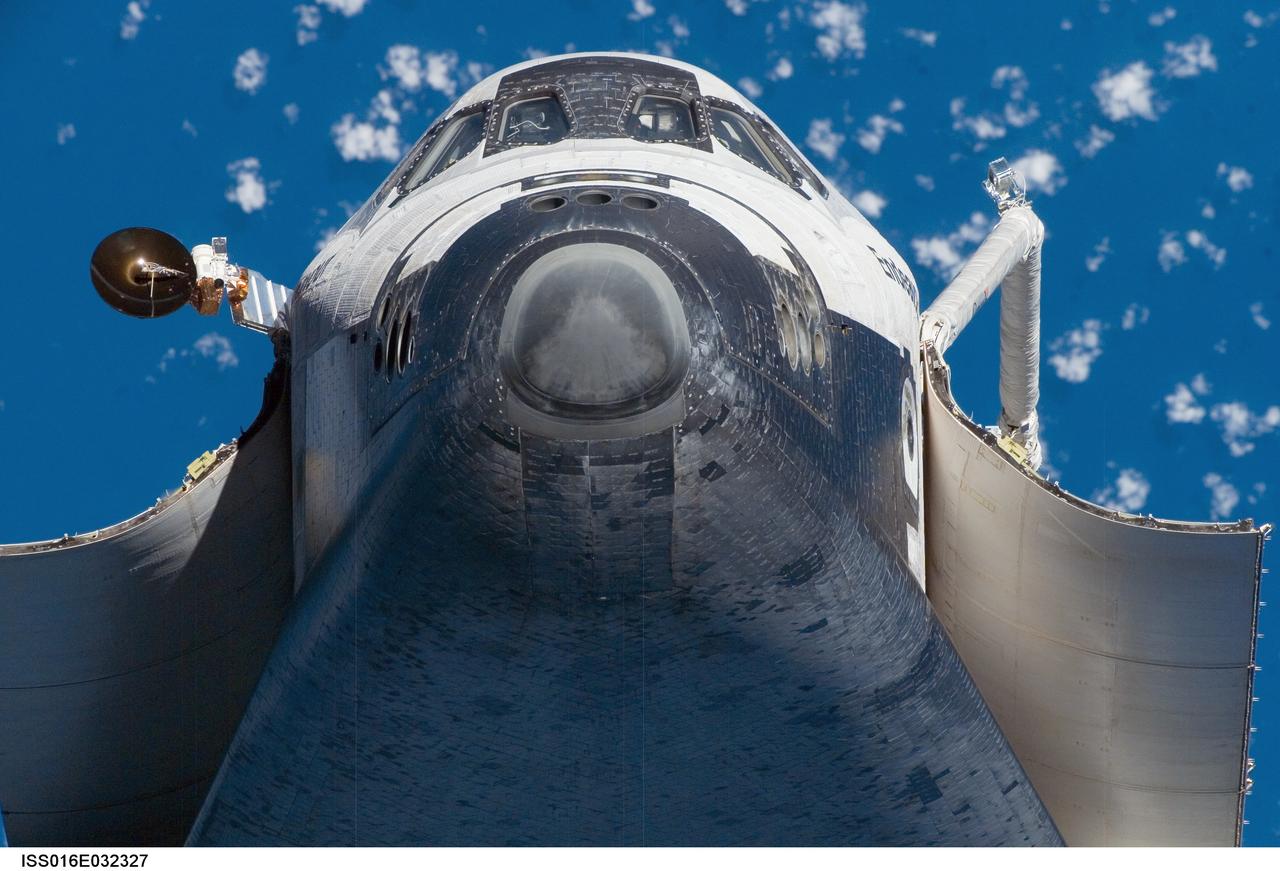
ISS016-E-032327 (12 March 2008) --- A low angle view of the nose and underside of Space Shuttle Endeavour's crew cabin was provided by Expedition 16 crewmembers on the International Space Station (ISS). Before docking with the station, astronaut Dominic Gorie, STS-123 commander, flew the shuttle through a roll pitch maneuver or basically a backflip to allow the space station crew a good view of Endeavour's heat shield. Using digital still cameras equipped with both 400 and 800 millimeter lenses, the ISS crewmembers took a number of photos of the shuttle's thermal protection system and sent them down to teams on the ground for analysis. A 400 millimeter lens was used for this image.
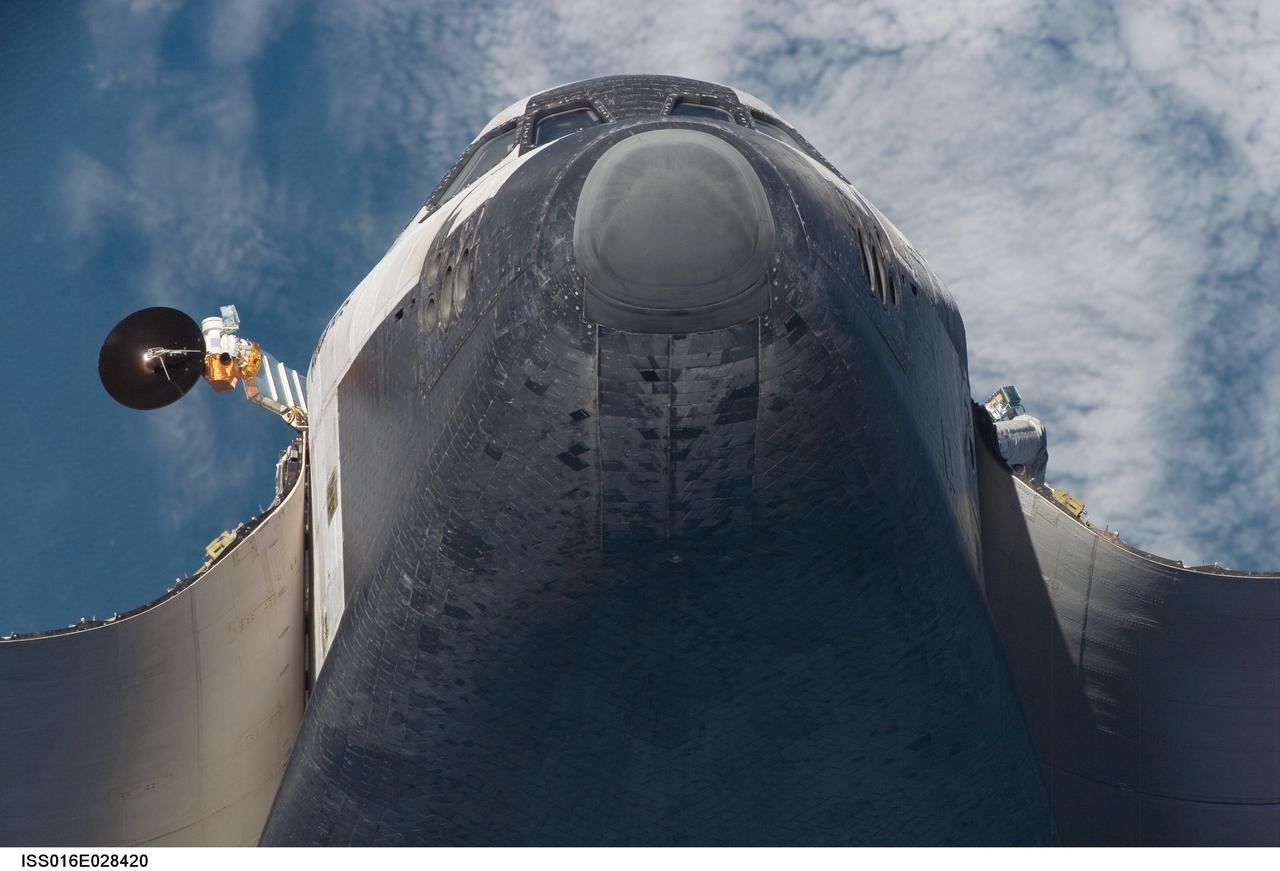
ISS016-E-028420 (9 Feb. 2008) --- A low angle view of the nose and underside of the Space Shuttle Atlantis' crew cabin was provided by Expedition 16 crewmembers. Before docking with the International Space Station, astronaut Steve Frick, STS-122 commander, flew the shuttle through a roll pitch maneuver or basically a backflip to allow the space station crew a good view of Atlantis' heat shield. Using digital still cameras equipped with both 400 and 800 millimeter lenses, the ISS crewmembers took a number of photos of the shuttle's thermal protection system and sent them down to teams on the ground for analysis. A 400 millimeter lens was used for this image.
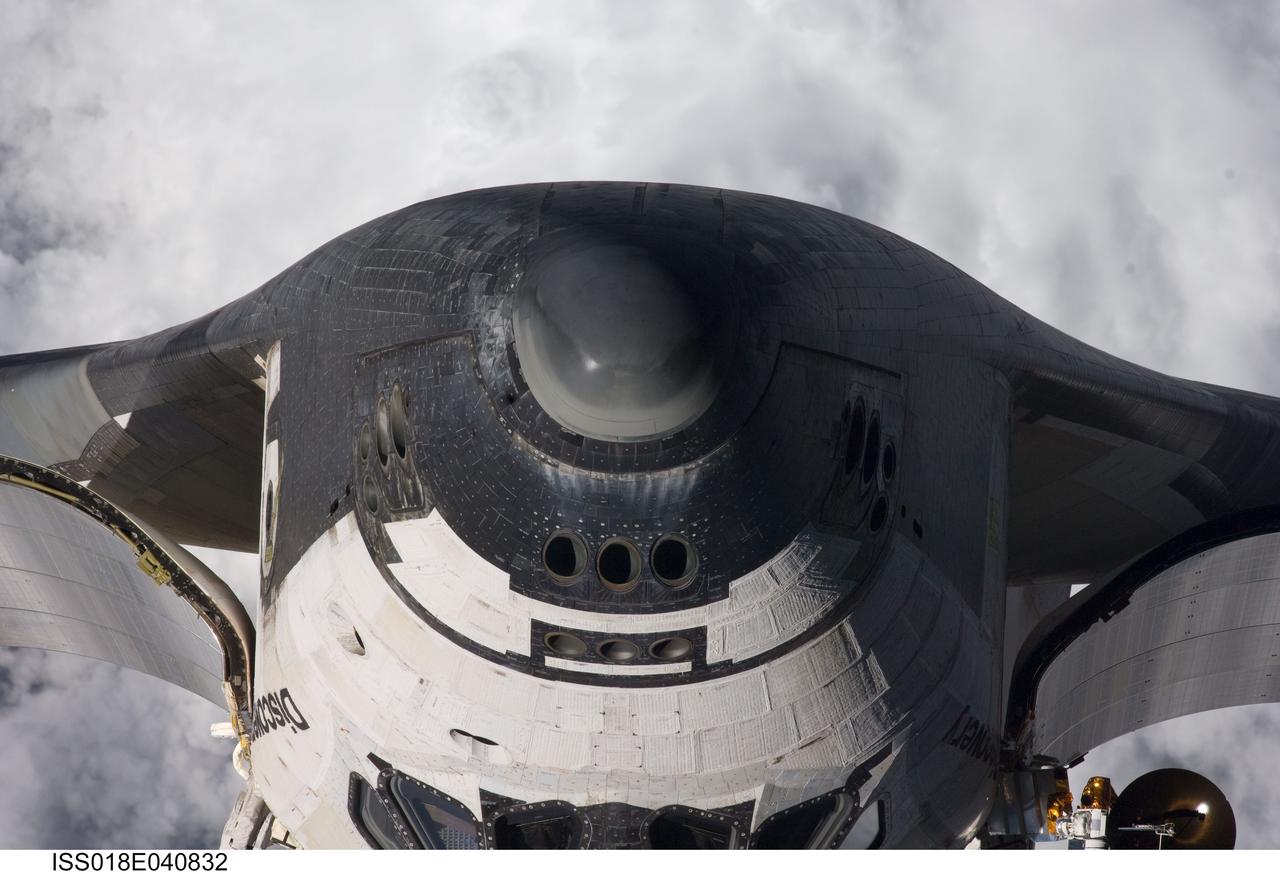
ISS018-E-040832 (17 March 2009) --- A close-up view of the exterior of Space Shuttle Discovery's nose was provided by Expedition 18 crewmembers on the International Space Station. Before docking with the station, astronaut Lee Archambault, STS-119 commander, flew the shuttle through a Rendezvous Pitch Maneuver or basically a backflip to allow the space station crew a good view of Discovery's heat shield. Using digital still cameras equipped with both 400 and 800 millimeter lenses, the ISS crewmembers took a number of photos of the shuttle's thermal protection system and sent them down to teams on the ground for analysis. A 400 millimeter lens was used for this image.
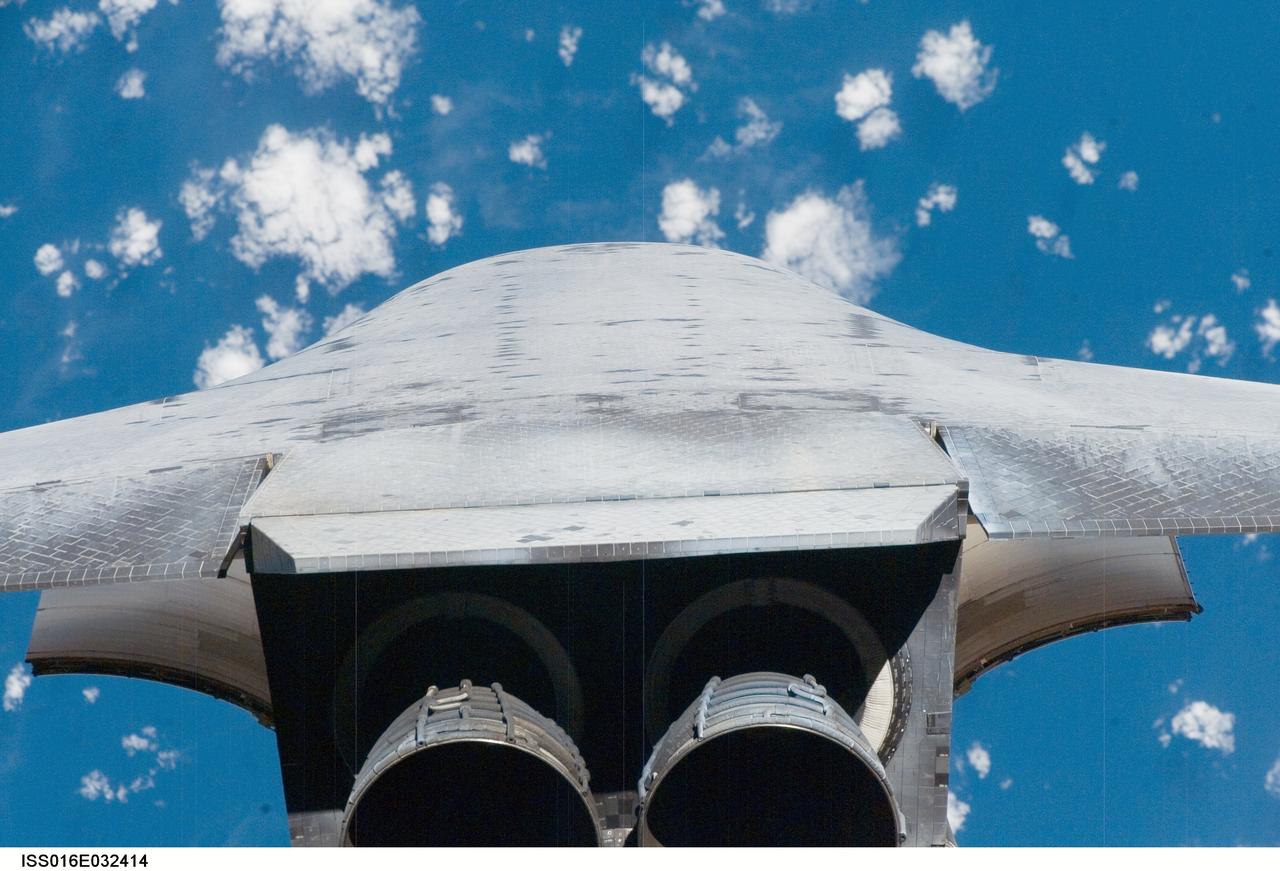
ISS016-E-032414 (12 March 2008) --- An underside view of the Space Shuttle Endeavour was provided by Expedition 16 crewmembers on the International Space Station (ISS). Before docking with the station, astronaut Dominic Gorie, STS-123 commander, flew the shuttle through a roll pitch maneuver or basically a backflip to allow the space station crew a good view of Endeavour's heat shield. Using digital still cameras equipped with both 400 and 800 millimeter lenses, the ISS crewmembers took a number of photos of the shuttle's thermal protection system and sent them down to teams on the ground for analysis. A 400 millimeter lens was used for this image.
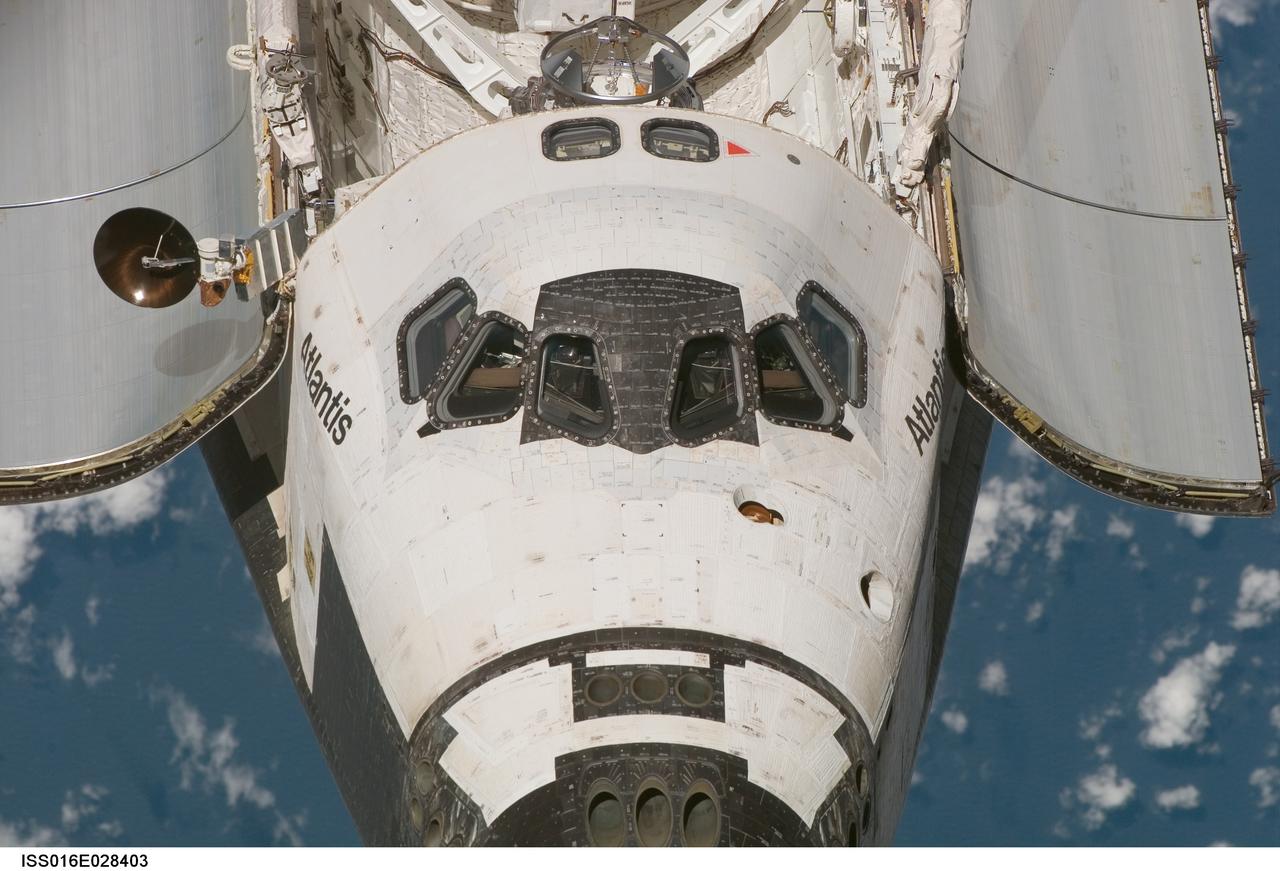
ISS016-E-028403 (9 Feb. 2008) --- An overhead view of the exterior of the Space Shuttle Atlantis' crew cabin, part of its payload bay doors and docking system was provided by Expedition 16 crewmembers. Before docking with the International Space Station, astronaut Steve Frick, STS-122 commander, flew the shuttle through a roll pitch maneuver or basically a backflip to allow the space station crew a good view of Atlantis' heat shield. Using digital still cameras equipped with both 400 and 800 millimeter lenses, the ISS crewmembers took a number of photos of the shuttle's thermal protection system and sent them down to teams on the ground for analysis. A 400 millimeter lens was used for this image.

ISS016-E-032323 (12 March 2008) --- A low angle view of the nose and underside of Space Shuttle Endeavour's crew cabin was provided by Expedition 16 crewmembers on the International Space Station (ISS). Before docking with the station, astronaut Dominic Gorie, STS-123 commander, flew the shuttle through a roll pitch maneuver or basically a backflip to allow the space station crew a good view of Endeavour's heat shield. Using digital still cameras equipped with both 400 and 800 millimeter lenses, the ISS crewmembers took a number of photos of the shuttle's thermal protection system and sent them down to teams on the ground for analysis. A 400 millimeter lens was used for this image.
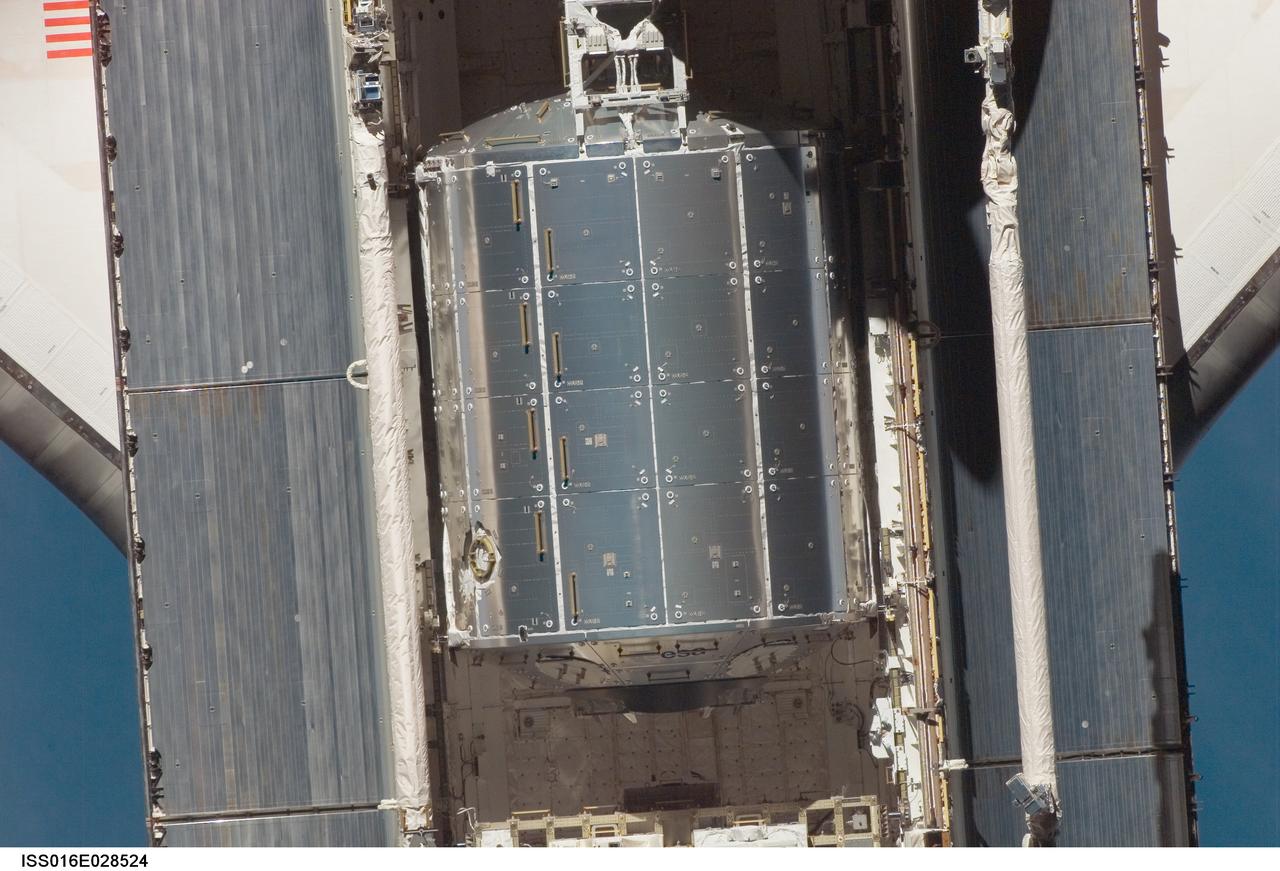
ISS016-E-028524 (9 Feb. 2008) --- An overhead view of the European Space Agency's Columbus laboratory in Space Shuttle Atlantis' cargo bay was provided by Expedition 16 crewmembers. Before docking with the International Space Station, astronaut Steve Frick, STS-122 commander, flew the shuttle through a roll pitch maneuver or basically a backflip to allow the space station crew a good view of Atlantis' heat shield. Using digital still cameras equipped with both 400 and 800 millimeter lenses, the ISS crewmembers took a number of photos of the shuttle's thermal protection system and sent them down to teams on the ground for analysis. A 400 millimeter lens was used for this image.
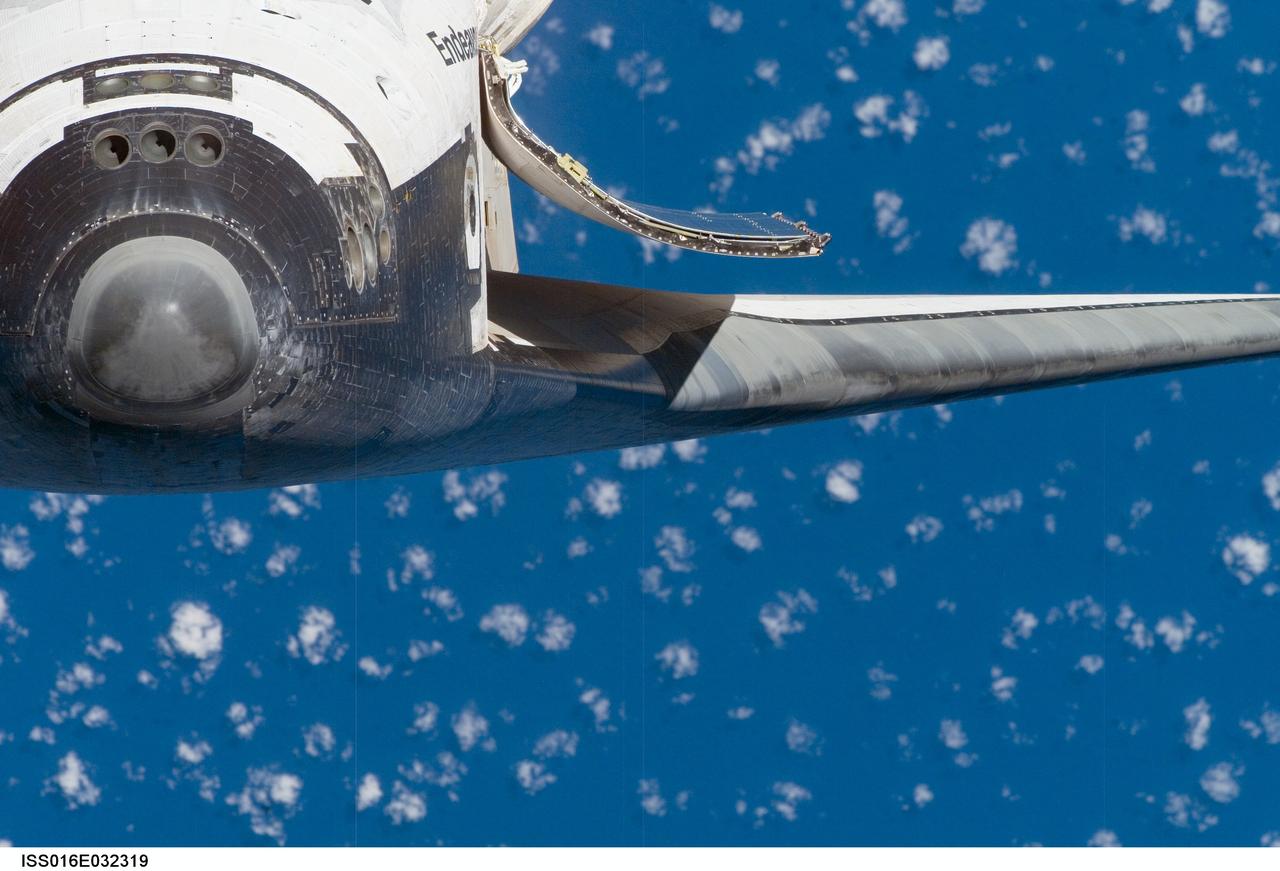
ISS016-E-032319 (12 March 2008) --- A close-up view of the exterior of Space Shuttle Endeavour's nose, port wing and payload bay door was provided by Expedition 16 crewmembers on the International Space Station (ISS). Before docking with the station, astronaut Dominic Gorie, STS-123 commander, flew the shuttle through a roll pitch maneuver or basically a backflip to allow the space station crew a good view of Endeavour's heat shield. Using digital still cameras equipped with both 400 and 800 millimeter lenses, the ISS crewmembers took a number of photos of the shuttle's thermal protection system and sent them down to teams on the ground for analysis. A 400 millimeter lens was used for this image.
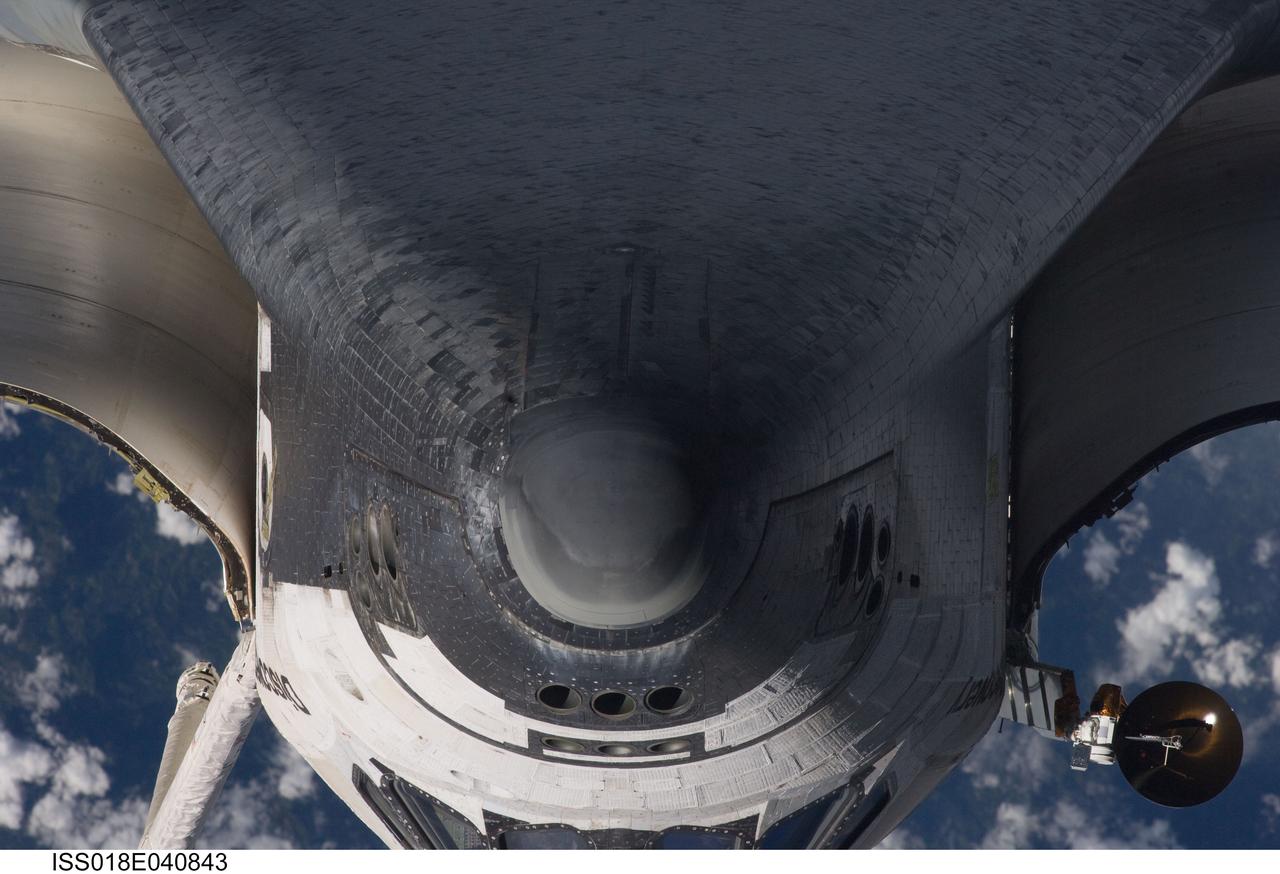
ISS018-E-040843 (17 March 2009) --- A close-up view of the exterior of Space Shuttle Discovery's nose and underside was provided by Expedition 18 crewmembers on the International Space Station. Before docking with the station, astronaut Lee Archambault, STS-119 commander, flew the shuttle through a Rendezvous Pitch Maneuver or basically a backflip to allow the space station crew a good view of Discovery's heat shield. Using digital still cameras equipped with both 400 and 800 millimeter lenses, the ISS crewmembers took a number of photos of the shuttle's thermal protection system and sent them down to teams on the ground for analysis. A 400 millimeter lens was used for this image.
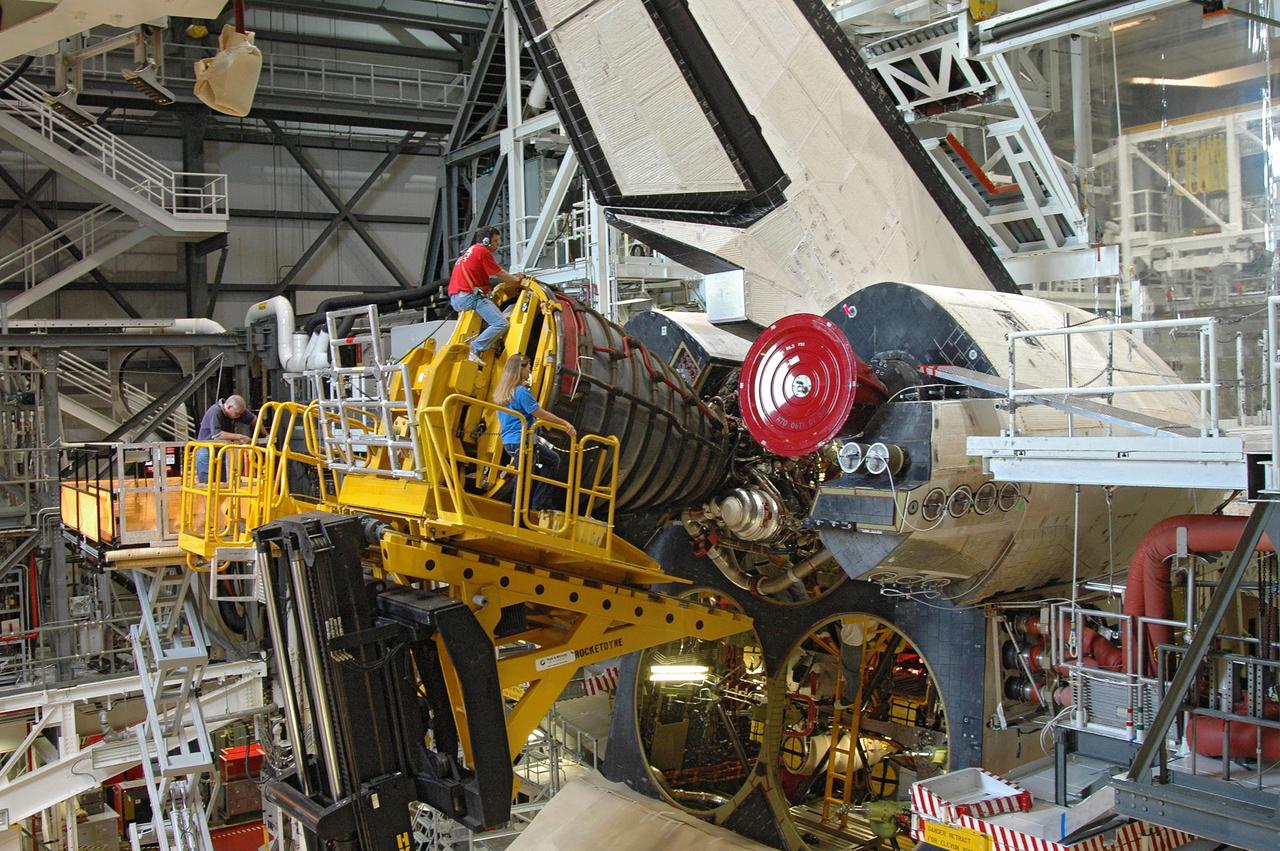
CAPE CANAVERAL, Fla. – In the Orbiter Processing Facility bay 2, technicians work the engine installer to maneuver main engine 1 into place on space shuttle Endeavour. The scheduled launch vehicle for the STS-126 mission, Endeavour will deliver a multi-purpose logistics module to the International Space Station. Launch is targeted for Nov. 10. Endeavour is also the backup shuttle, if needed for rescue, for the STS-125 mission in October that will make repairs on the Hubble Space Telescope. For that purpose, it is designated STS-400. Photo credit: NASA/Jim Grossmann
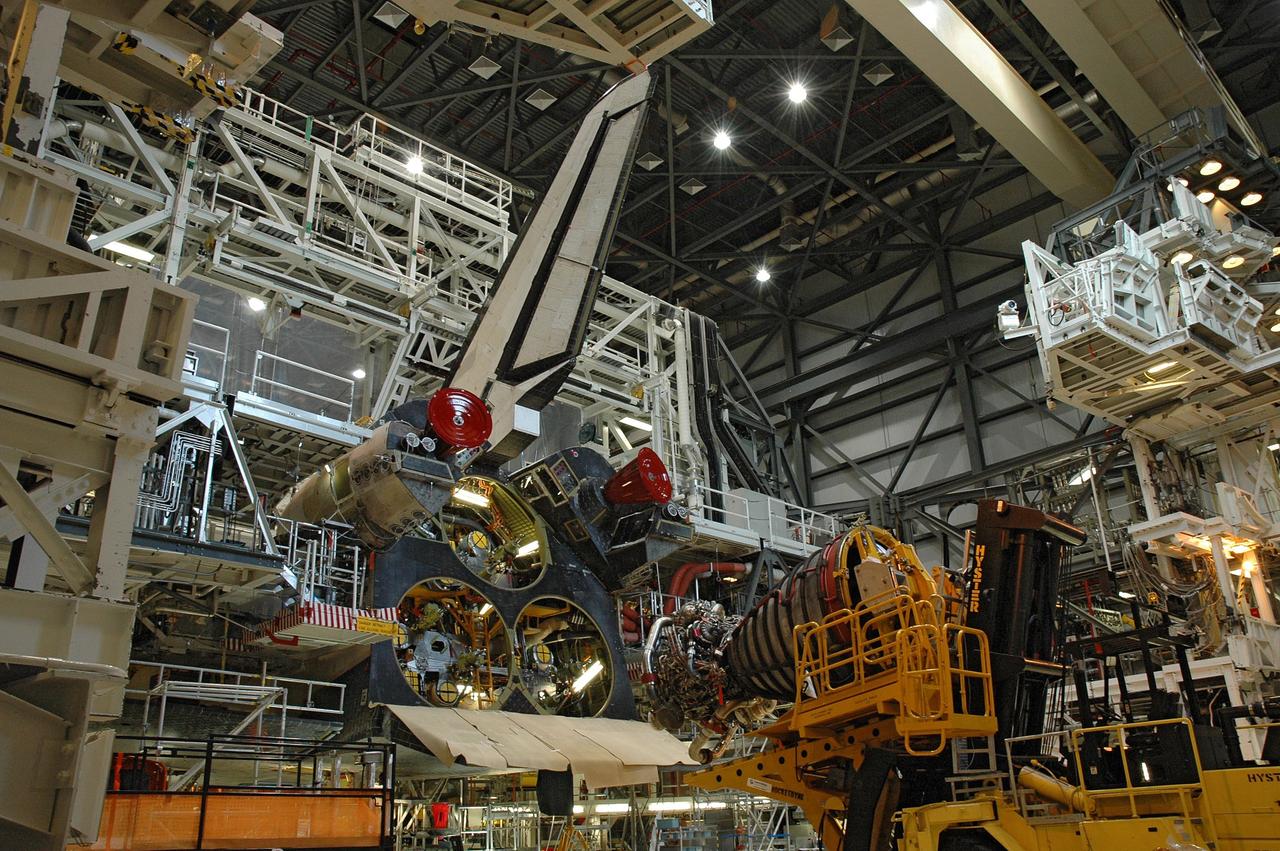
CAPE CANAVERAL, Fla. – In the Orbiter Processing Facility bay 2, technicians on the Hyster forklift maneuver main engine 1 for installation on space shuttle Endeavour. The scheduled launch vehicle for the STS-126 mission, Endeavour will deliver a multi-purpose logistics module to the International Space Station. Launch is targeted for Nov. 10. Endeavour is also the backup shuttle, if needed for rescue, for the STS-125 mission in October that will make repairs on the Hubble Space Telescope. For that purpose, it is designated STS-400. Photo credit: NASA/Jim Grossmann
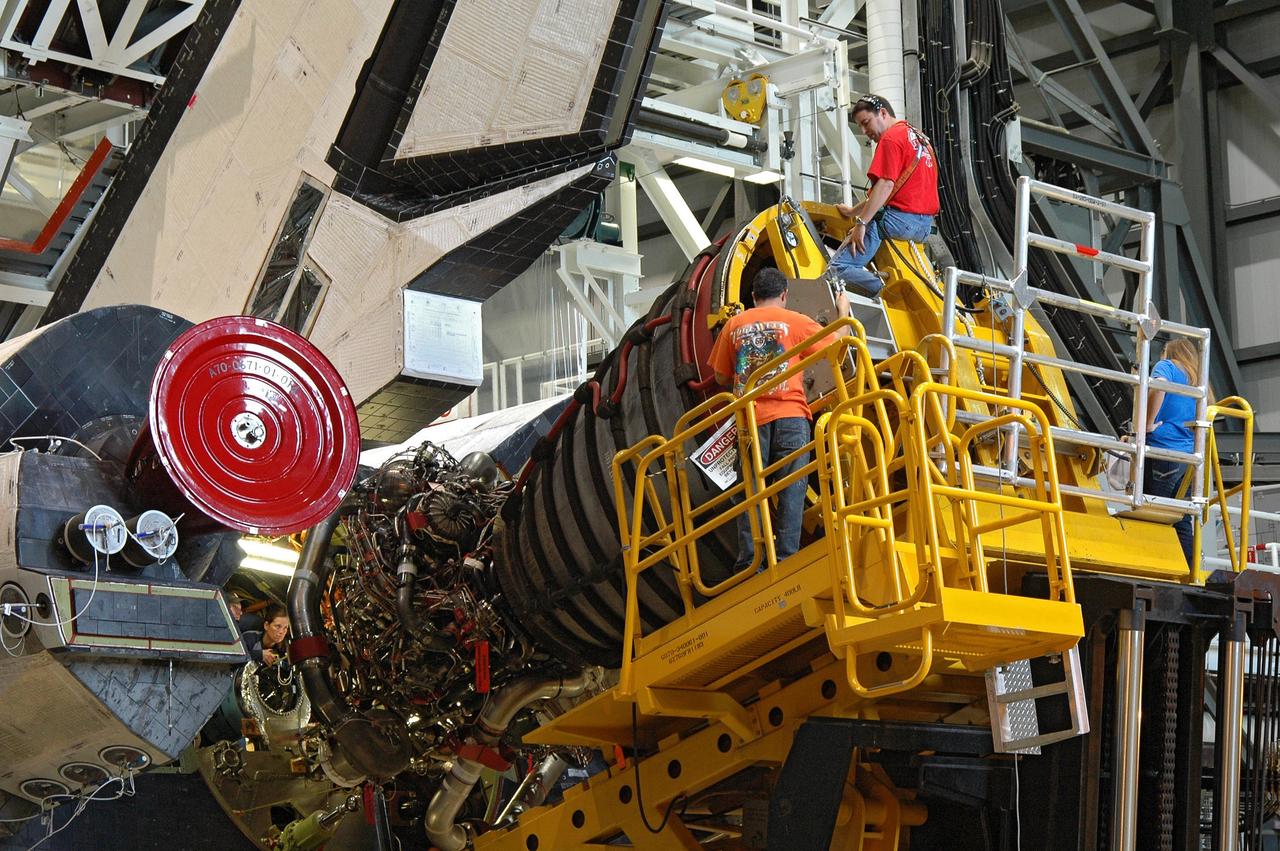
CAPE CANAVERAL, Fla. – In the Orbiter Processing Facility bay 2, technicians on the Hyster forklift maneuver main engine 1 for installation on space shuttle Endeavour. The scheduled launch vehicle for the STS-126 mission, Endeavour will deliver a multi-purpose logistics module to the International Space Station. Launch is targeted for Nov. 10. Endeavour is also the backup shuttle, if needed for rescue, for the STS-125 mission in October that will make repairs on the Hubble Space Telescope. For that purpose, it is designated STS-400. Photo credit: NASA/Jim Grossmann
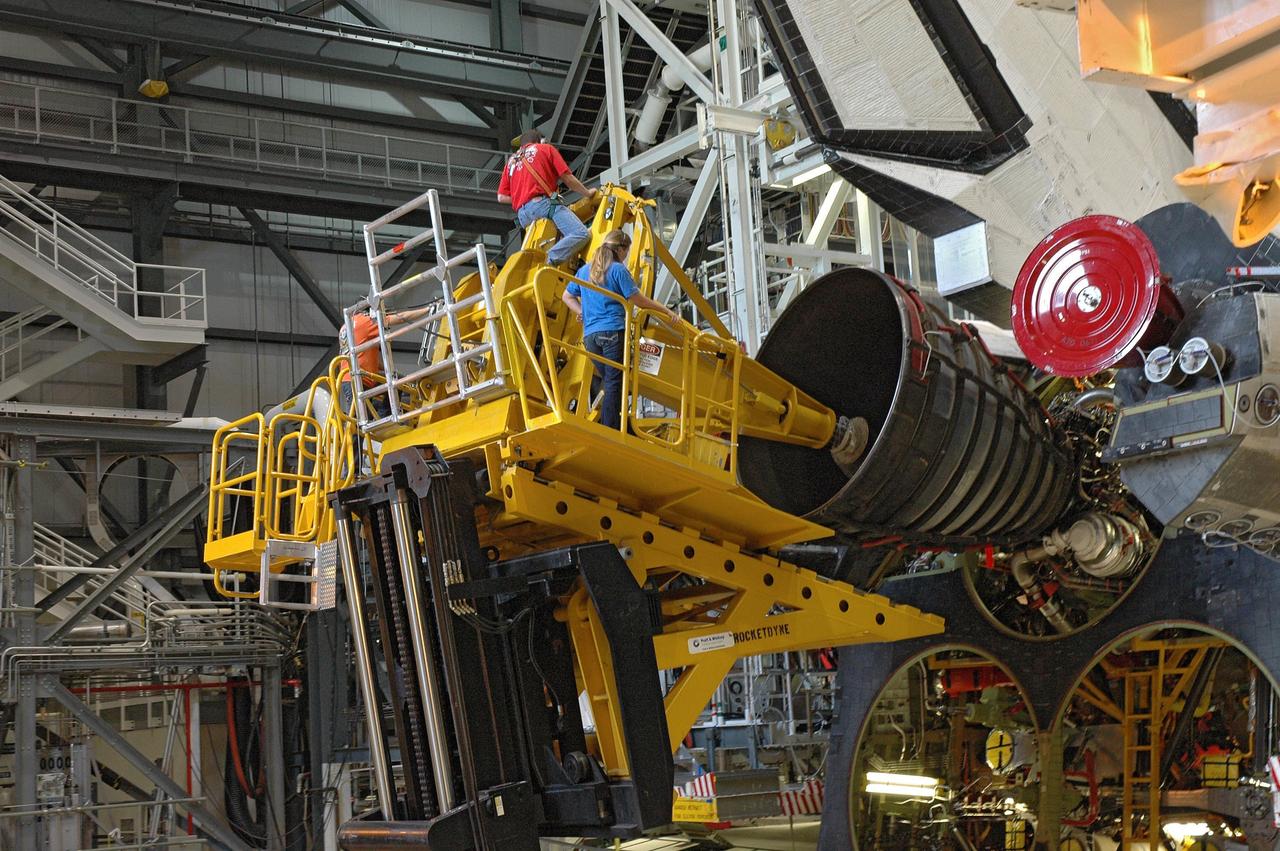
CAPE CANAVERAL, Fla. – In the Orbiter Processing Facility bay 2, technicians work the engine installer to maneuver main engine 1 into place on space shuttle Endeavour. The scheduled launch vehicle for the STS-126 mission, Endeavour will deliver a multi-purpose logistics module to the International Space Station. Launch is targeted for Nov. 10. Endeavour is also the backup shuttle, if needed for rescue, for the STS-125 mission in October that will make repairs on the Hubble Space Telescope. For that purpose, it is designated STS-400. Photo credit: NASA/Jim Grossmann
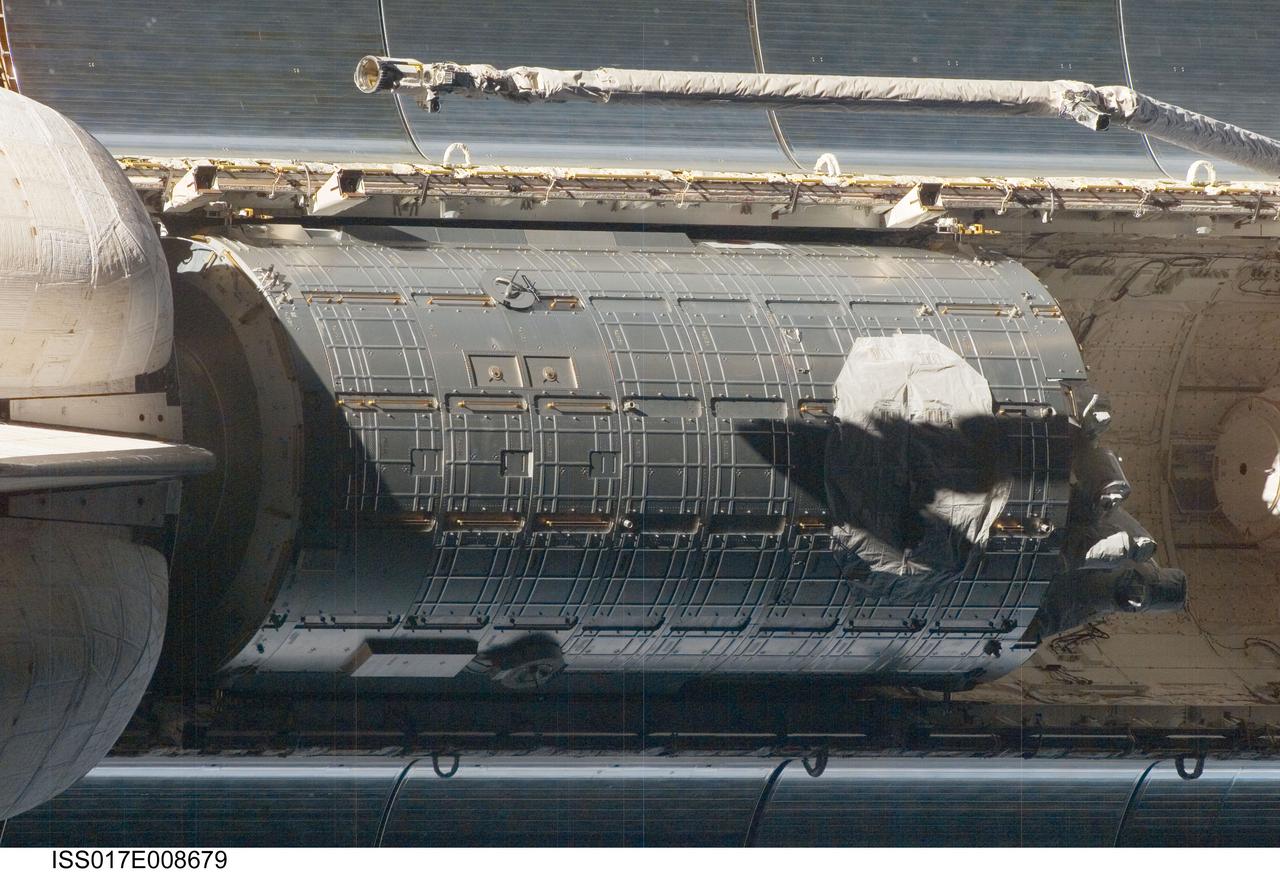
ISS017-E-008679 (2 June 2008) --- An overhead view of the second component of the Japan Aerospace Exploration Agency's Kibo laboratory, the Japanese Pressurized Module (JPM) in Space Shuttle Discovery's cargo bay was provided by Expedition 17 crewmembers. Before docking with the station, astronaut Mark Kelly, STS-124 commander, flew the shuttle through a roll pitch maneuver or basically a backflip to allow the space station crew a good view of Discovery's heat shield. Using digital still cameras equipped with both 400 and 800 millimeter lenses, the ISS crewmembers took a number of photos of the shuttle's thermal protection system and sent them down to teams on the ground for analysis. A 400 millimeter lens was used for this image.
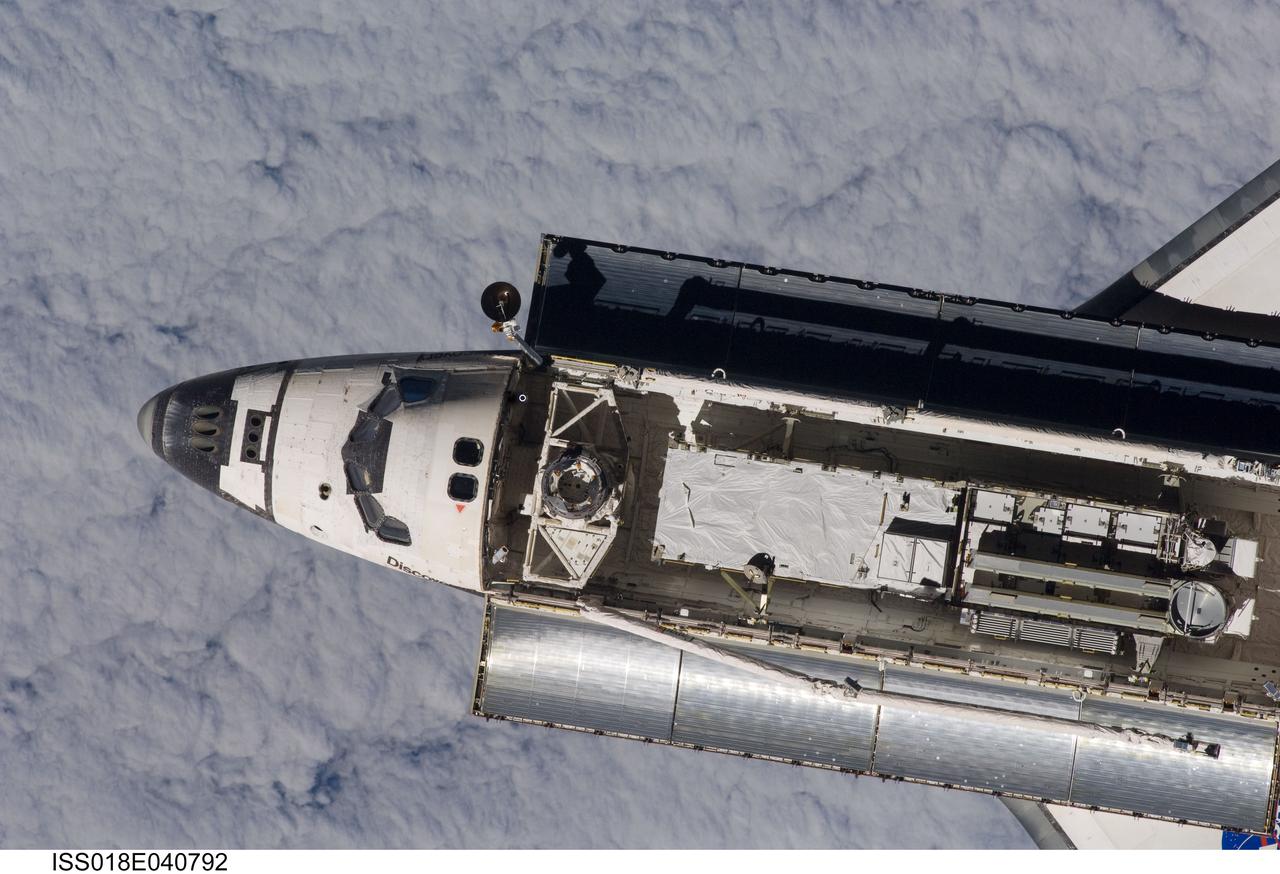
ISS018-E-040792 (17 March 2009) --- Backdropped by a blanket of clouds, Space Shuttle Discovery is featured in this image photographed by an Expedition 18 crewmember on the International Space Station during rendezvous and docking operations. Before docking with the station, astronaut Lee Archambault, STS-119 commander, flew the shuttle through a Rendezvous Pitch Maneuver or basically a backflip to allow the space station crew a good view of Discovery's heat shield. Using digital still cameras equipped with both 400 and 800 millimeter lenses, the ISS crewmembers took a number of photos of the shuttle's thermal protection system and sent them down to teams on the ground for analysis. A 400 millimeter lens was used for this image. Docking occurred at 4:20 p.m. (CDT) on March 17, 2009. The final pair of power-generating solar array wings and the S6 truss segment are visible in Discovery?s cargo bay.
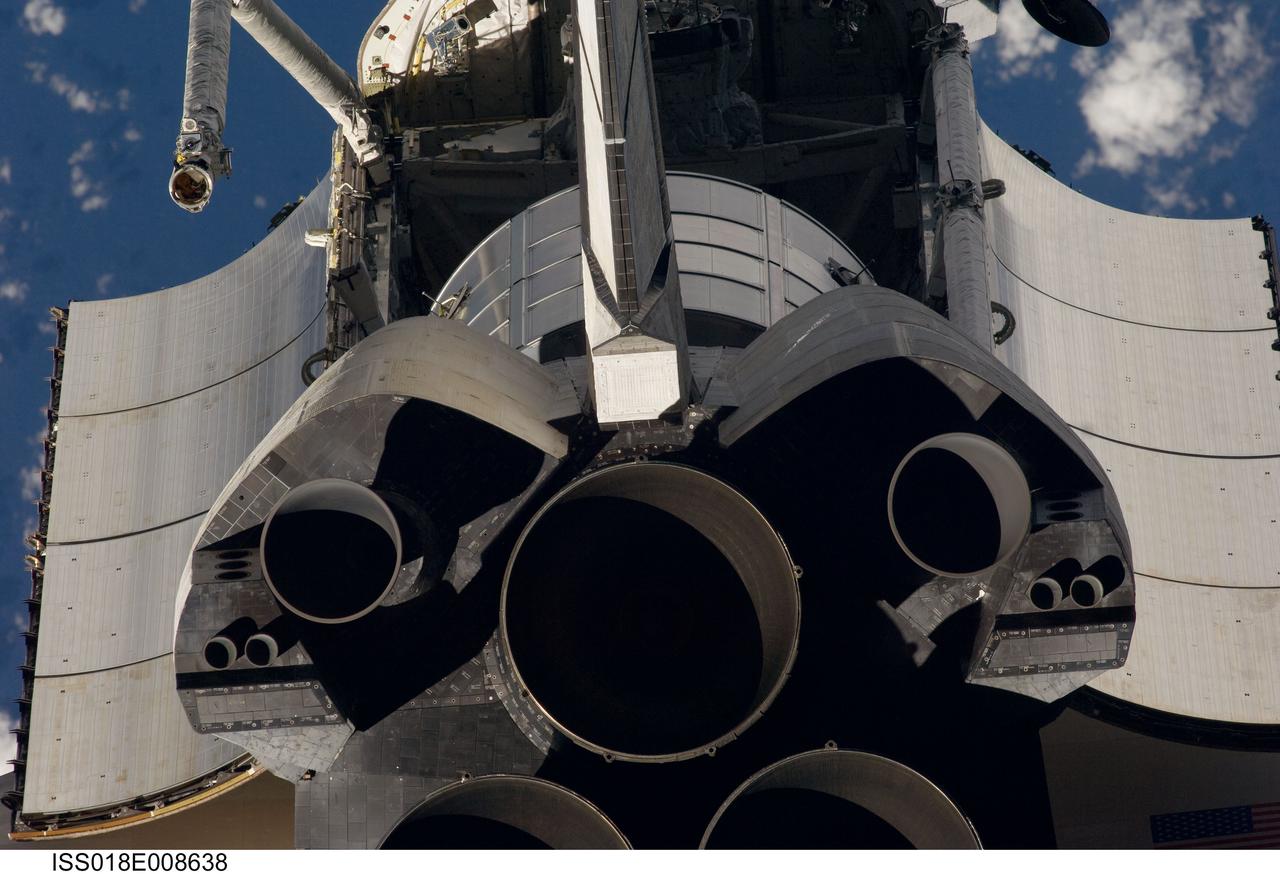
ISS018-E-008638 (16 Nov. 2008) --- A close-up view of Space Shuttle Endeavour's tail section was provided by Expedition 18 crewmembers on the International Space Station. The image provides partial views of the shuttle's main engines, orbital maneuvering system (OMS) pods, vertical stabilizer, the payload bay door panels and the Leonard Multi-Purpose Logistics Module located in the cargo bay. Before docking with the station, astronaut Chris Ferguson, STS-126 commander, flew the shuttle through a roll pitch maneuver or basically a backflip to allow the space station crew a good view of Endeavour's heat shield. Using digital still cameras equipped with both 400 and 800 millimeter lenses, the ISS crewmembers took a number of photos of the shuttle's thermal protection system and sent them down to teams on the ground for analysis. A 400 millimeter lens was used for this image.
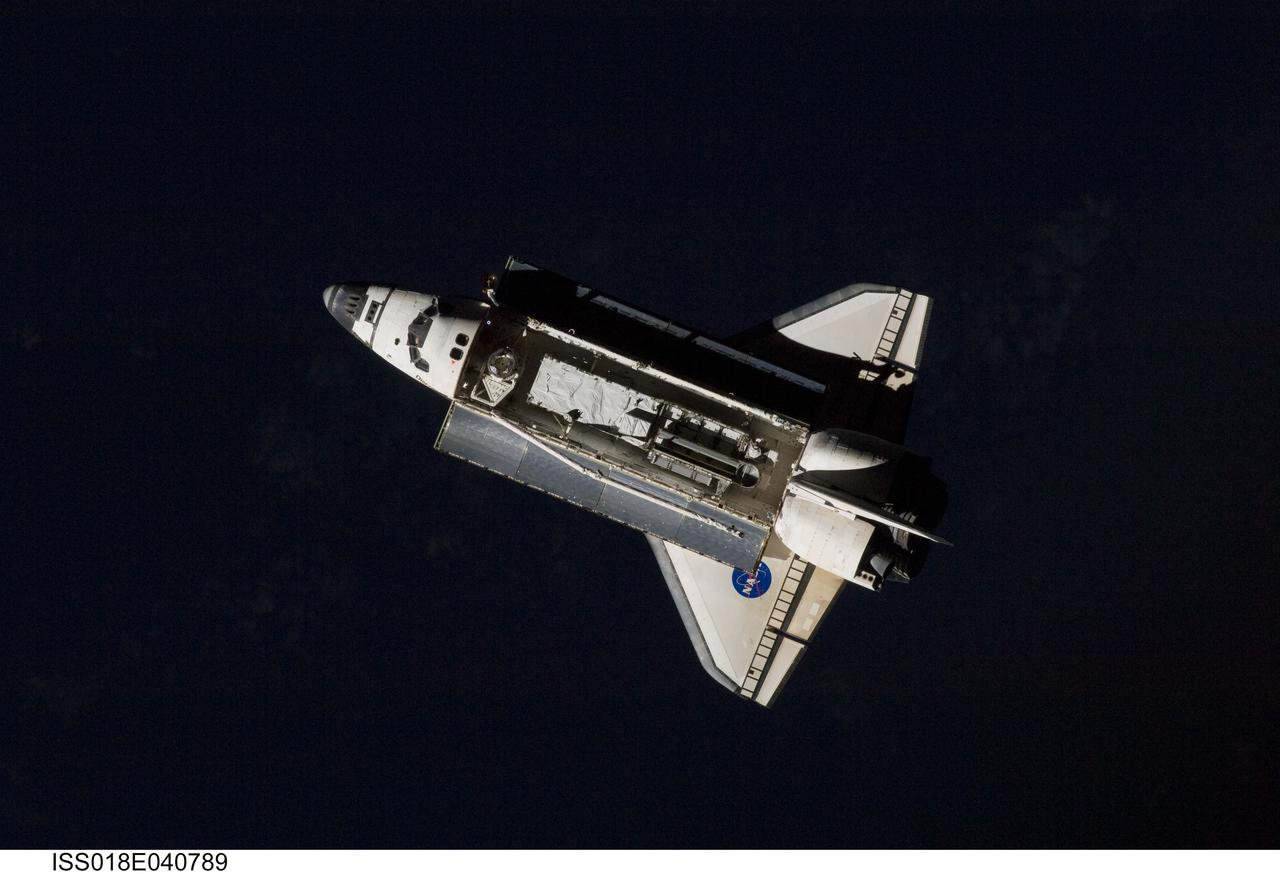
ISS018-E-040789 (17 March 2009) --- Backdropped by the blackness of space, Space Shuttle Discovery is featured in this image photographed by an Expedition 18 crewmember on the International Space Station during rendezvous and docking operations. Before docking with the station, astronaut Lee Archambault, STS-119 commander, flew the shuttle through a Rendezvous Pitch Maneuver or basically a backflip to allow the space station crew a good view of Discovery's heat shield. Using digital still cameras equipped with both 400 and 800 millimeter lenses, the ISS crewmembers took a number of photos of the shuttle's thermal protection system and sent them down to teams on the ground for analysis. A 400 millimeter lens was used for this image. Docking occurred at 4:20 p.m. (CDT) on March 17, 2009. The final pair of power-generating solar array wings and the S6 truss segment are visible in Discovery’s cargo bay.
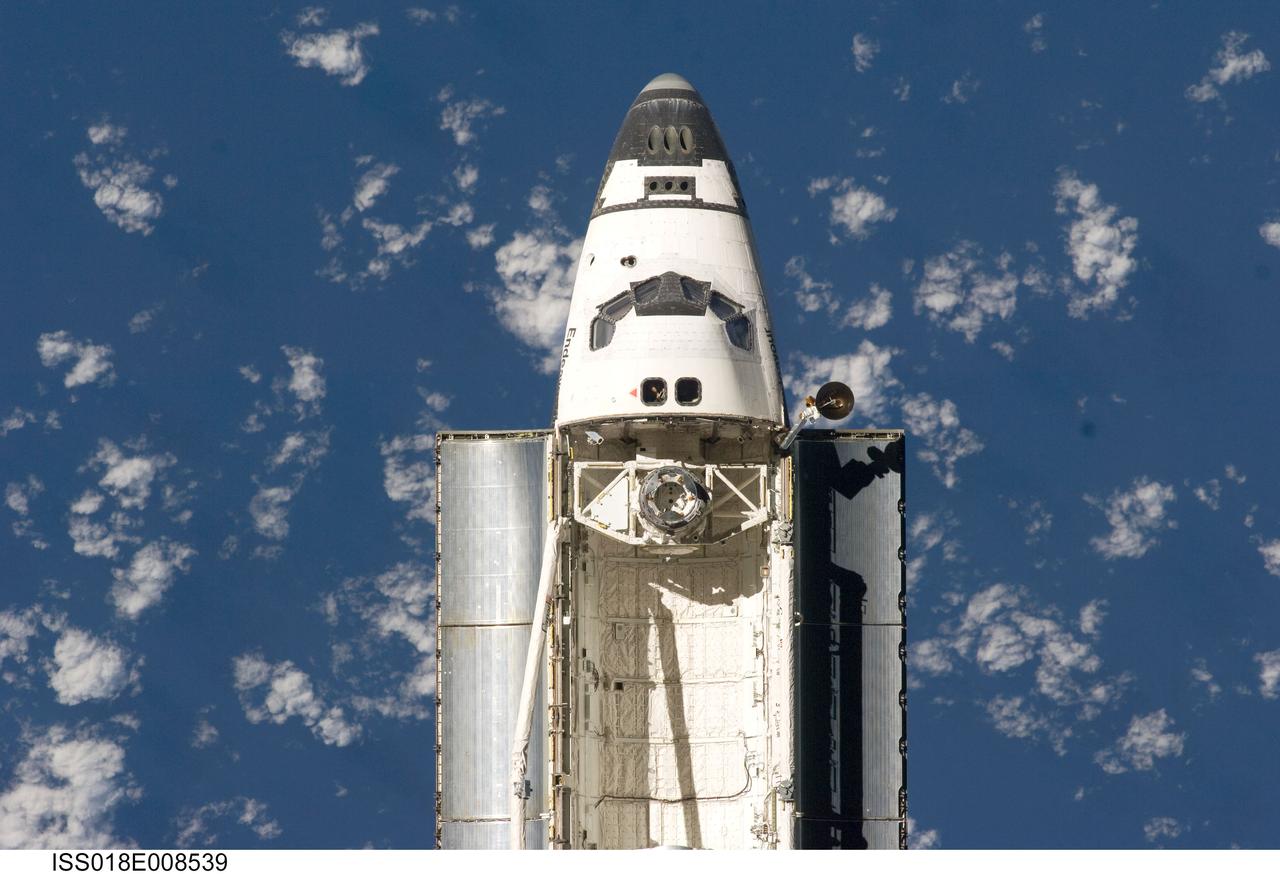
ISS018-E-008539 (16 Nov. 2008) --- An overhead view of the exterior of Space Shuttle Endeavour's crew cabin, part of its payload bay doors and docking system was provided by Expedition 18 crewmembers on the International Space Station. Before docking with the station, astronaut Chris Ferguson, STS-126 commander, flew the shuttle through a roll pitch maneuver or basically a backflip to allow the space station crew a good view of Endeavour's heat shield. Using digital still cameras equipped with both 400 and 800 millimeter lenses, the ISS crewmembers took a number of photos of the shuttle's thermal protection system and sent them down to teams on the ground for analysis. A 400 millimeter lens was used for this image.
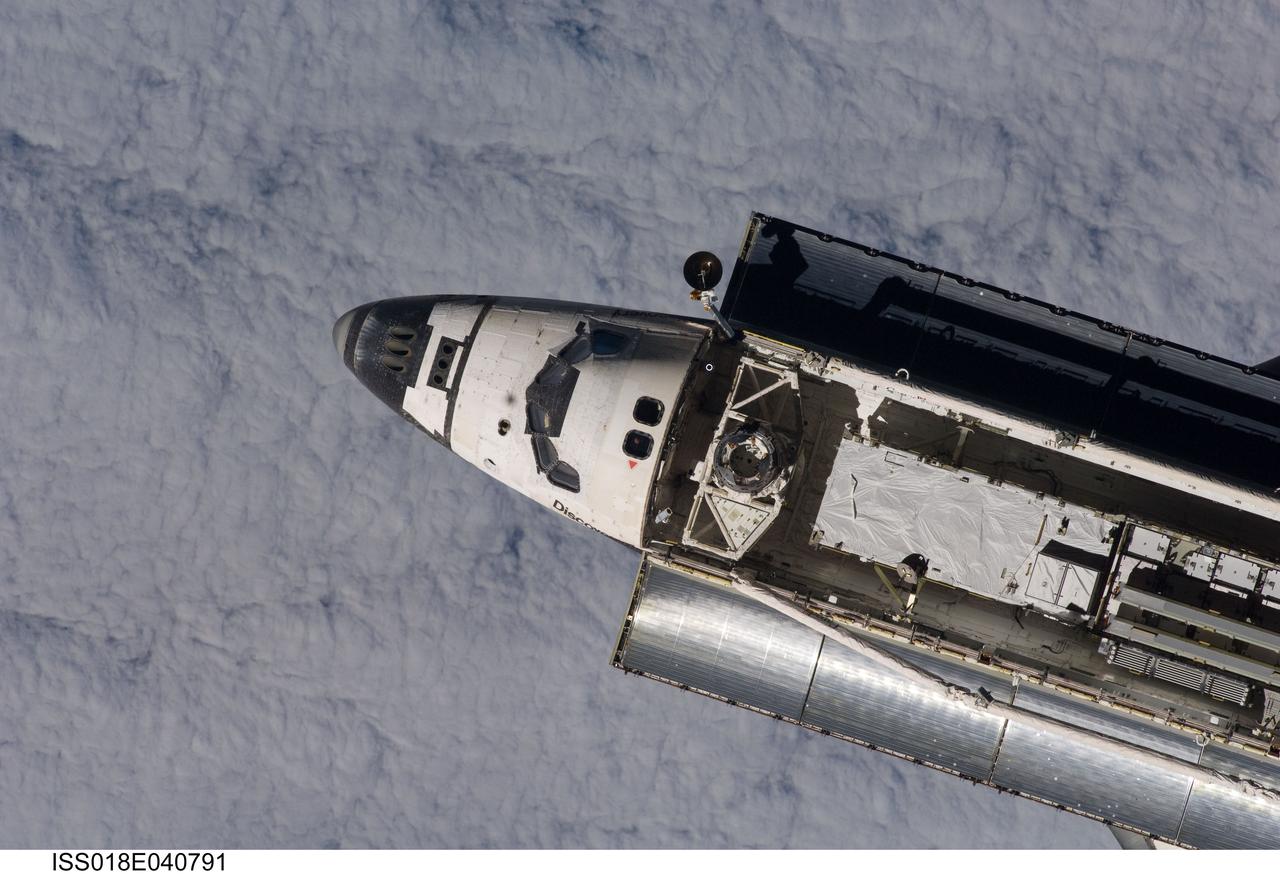
ISS018-E-040791 (17 March 2009) --- Backdropped by a blanket of clouds, Space Shuttle Discovery is featured in this image photographed by an Expedition 18 crewmember on the International Space Station during rendezvous and docking operations. Before docking with the station, astronaut Lee Archambault, STS-119 commander, flew the shuttle through a Rendezvous Pitch Maneuver or basically a backflip to allow the space station crew a good view of Discovery's heat shield. Using digital still cameras equipped with both 400 and 800 millimeter lenses, the ISS crewmembers took a number of photos of the shuttle's thermal protection system and sent them down to teams on the ground for analysis. A 400 millimeter lens was used for this image. Docking occurred at 4:20 p.m. (CDT) on March 17, 2009. The final pair of power-generating solar array wings and the S6 truss segment are visible in Discovery?s cargo bay.
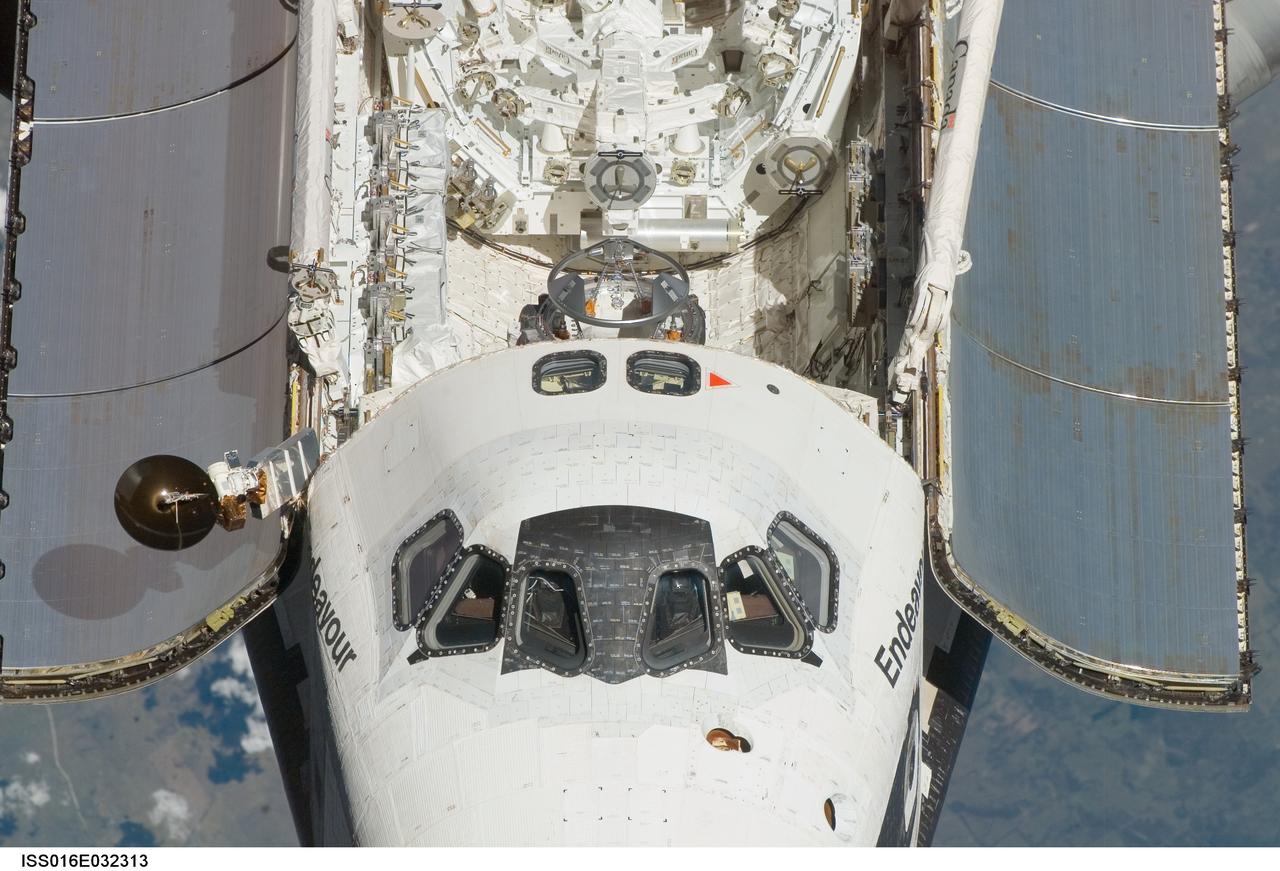
ISS016-E-032313 (12 March 2008) --- An overhead view of the exterior of Space Shuttle Endeavour's crew cabin, part of its payload bay doors, docking system and part of the Dextre robotic system was provided by Expedition 16 crewmembers on the International Space Station (ISS). Before docking with the station, astronaut Dominic Gorie, STS-123 commander, flew the shuttle through a roll pitch maneuver or basically a backflip to allow the space station crew a good view of Endeavour's heat shield. Using digital still cameras equipped with both 400 and 800 millimeter lenses, the ISS crewmembers took a number of photos of the shuttle's thermal protection system and sent them down to teams on the ground for analysis. A 400 millimeter lens was used for this image.
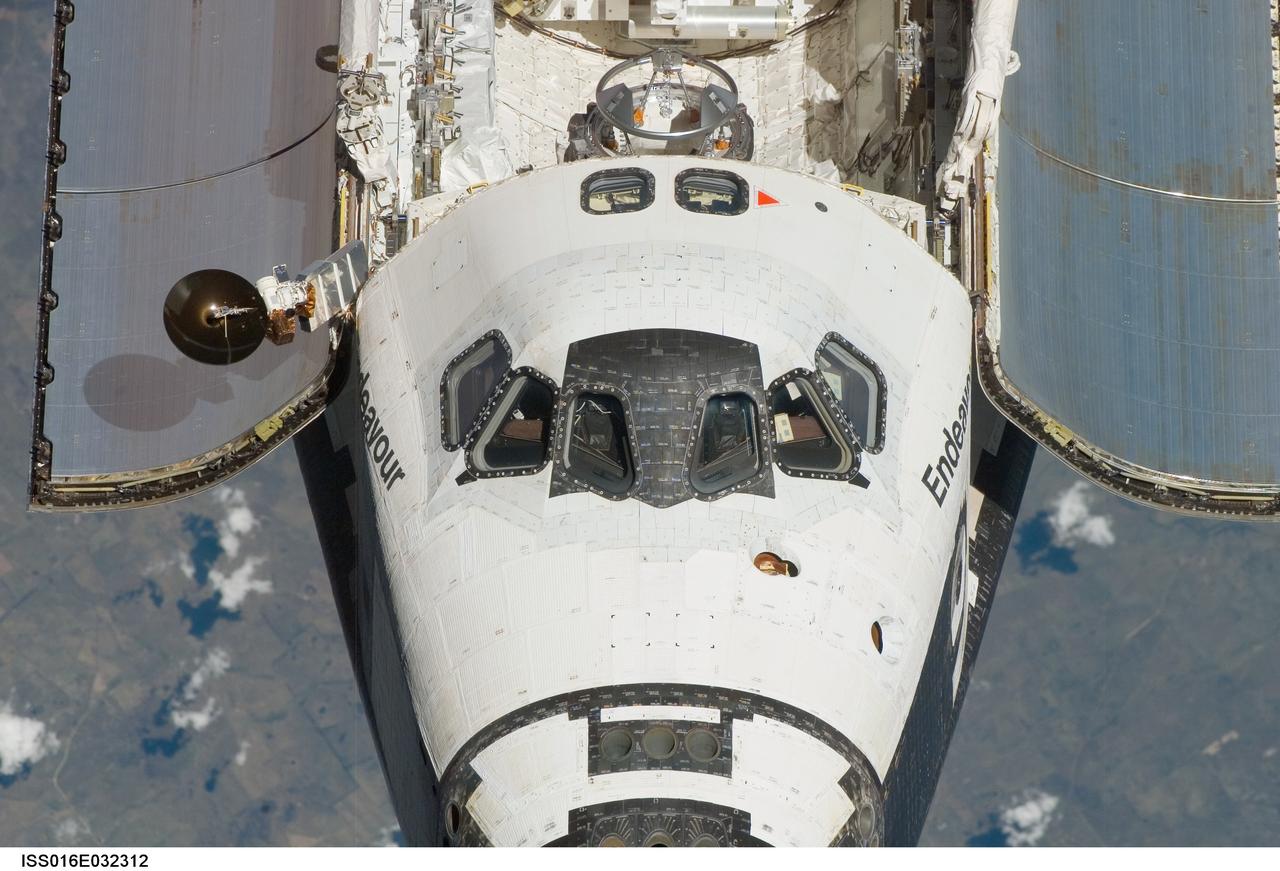
ISS016-E-032312 (12 March 2008) --- An overhead view of the exterior of Space Shuttle Endeavour's crew cabin, part of its payload bay doors and docking system was provided by Expedition 16 crewmembers on the International Space Station (ISS). Before docking with the station, astronaut Dominic Gorie, STS-123 commander, flew the shuttle through a roll pitch maneuver or basically a backflip to allow the space station crew a good view of Endeavour's heat shield. Using digital still cameras equipped with both 400 and 800 millimeter lenses, the ISS crewmembers took a number of photos of the shuttle's thermal protection system and sent them down to teams on the ground for analysis. A 400 millimeter lens was used for this image.
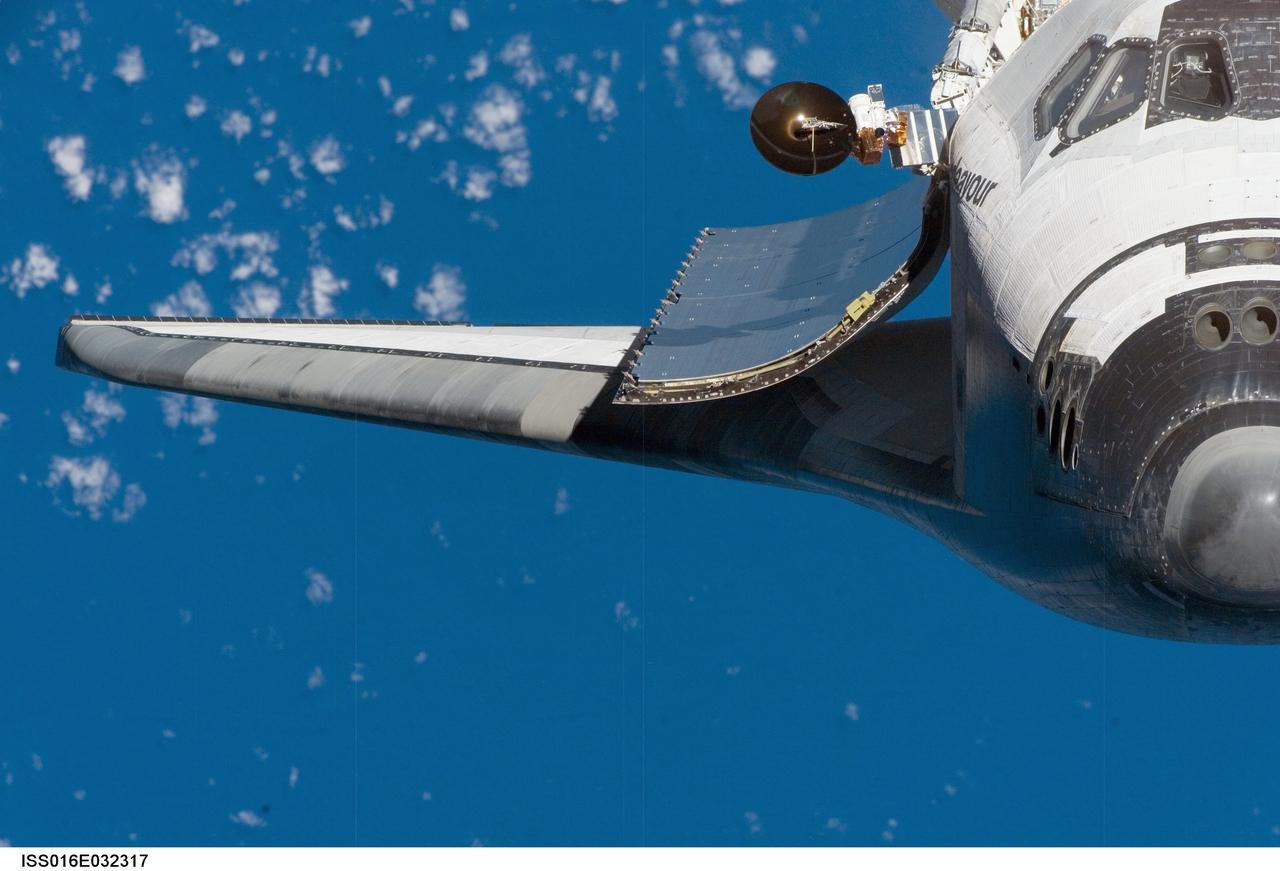
ISS016-E-032317 (12 March 2008) --- A close-up view of the exterior of Space Shuttle Endeavour's crew cabin, starboard wing and payload bay door was provided by Expedition 16 crewmembers on the International Space Station (ISS). Before docking with the station, astronaut Dominic Gorie, STS-123 commander, flew the shuttle through a roll pitch maneuver or basically a backflip to allow the space station crew a good view of Endeavour's heat shield. Using digital still cameras equipped with both 400 and 800 millimeter lenses, the ISS crewmembers took a number of photos of the shuttle's thermal protection system and sent them down to teams on the ground for analysis. A 400 millimeter lens was used for this image.

ISS018-E-040790 (17 March 2009) --- Backdropped by the blackness of space, Space Shuttle Discovery is featured in this image photographed by an Expedition 18 crewmember on the International Space Station during rendezvous and docking operations. Before docking with the station, astronaut Lee Archambault, STS-119 commander, flew the shuttle through a Rendezvous Pitch Maneuver or basically a backflip to allow the space station crew a good view of Discovery's heat shield. Using digital still cameras equipped with both 400 and 800 millimeter lenses, the ISS crewmembers took a number of photos of the shuttle's thermal protection system and sent them down to teams on the ground for analysis. A 400 millimeter lens was used for this image. Docking occurred at 4:20 p.m. (CDT) on March 17, 2009. The final pair of power-generating solar array wings and the S6 truss segment are visible in Discovery?s cargo bay.
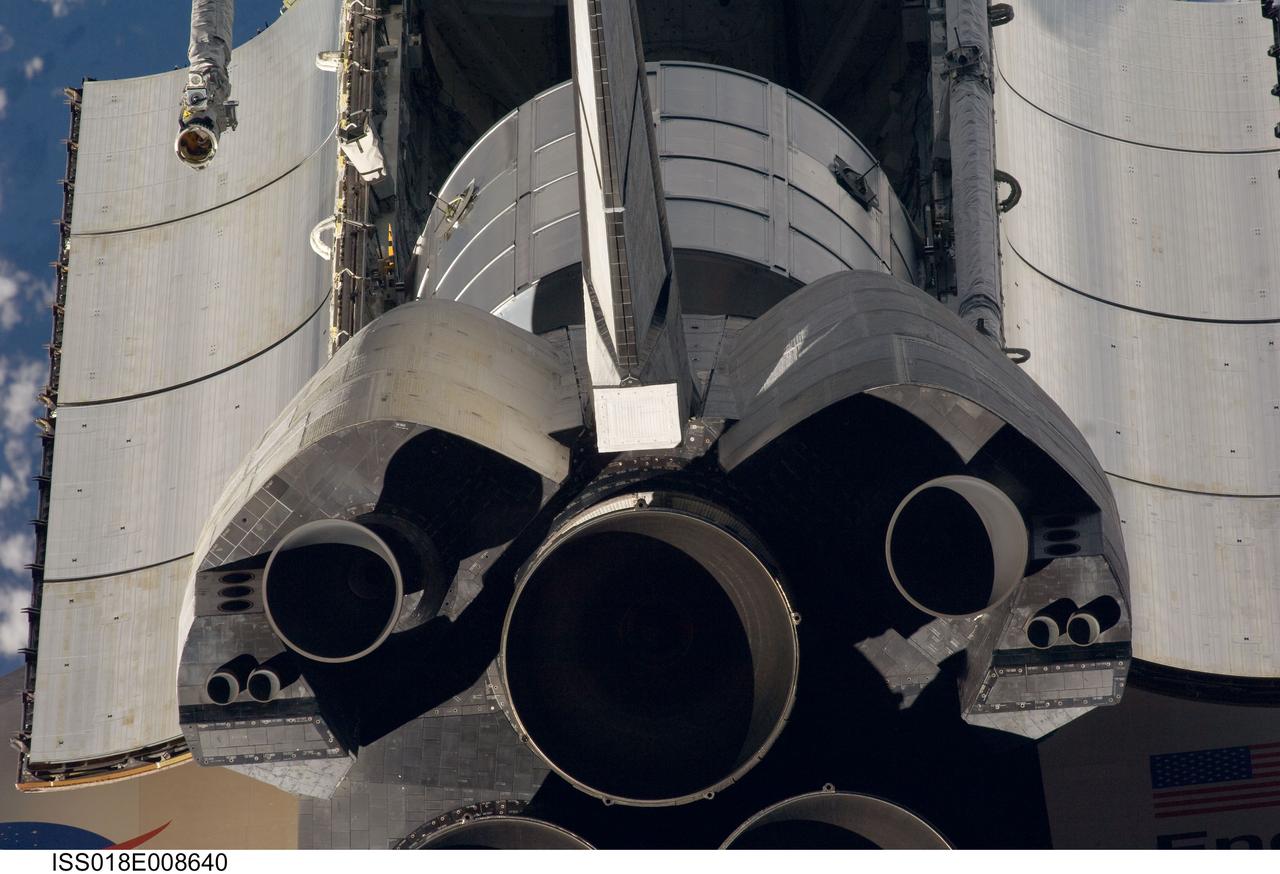
ISS018-E-008640 (16 Nov. 2008) --- A close-up view of Space Shuttle Endeavour's tail section was provided by Expedition 18 crewmembers on the International Space Station. The image provides partial views of the shuttle's main engines, orbital maneuvering system (OMS) pods, vertical stabilizer, the payload bay door panels and the Leonard Multi-Purpose Logistics Module located in the cargo bay. Before docking with the station, astronaut Chris Ferguson, STS-126 commander, flew the shuttle through a roll pitch maneuver or basically a backflip to allow the space station crew a good view of Endeavour's heat shield. Using digital still cameras equipped with both 400 and 800 millimeter lenses, the ISS crewmembers took a number of photos of the shuttle's thermal protection system and sent them down to teams on the ground for analysis. A 400 millimeter lens was used for this image.
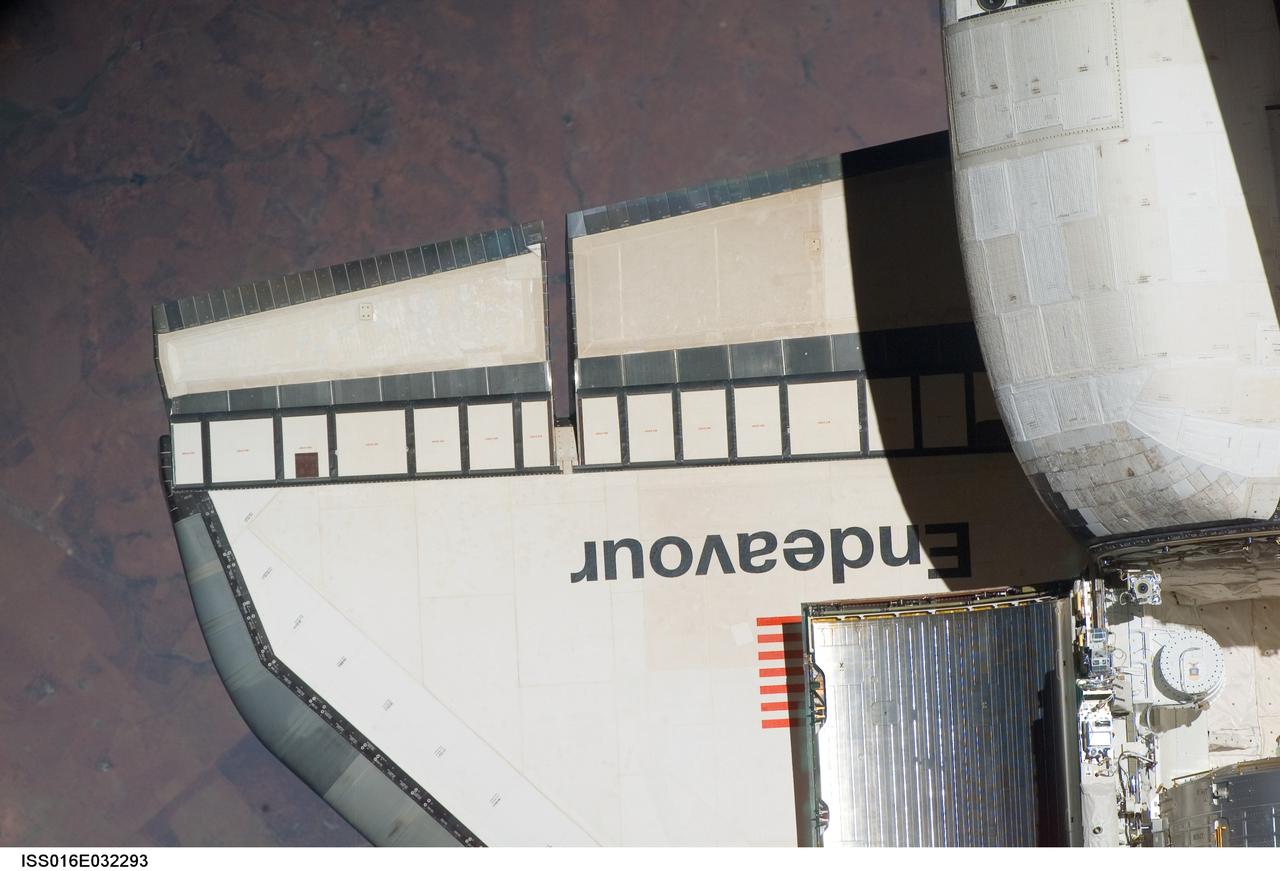
ISS016-E-032293 (12 March 2008) --- An overhead view of part of Space Shuttle Endeavour's starboard wing and part of its orbital maneuvering system (OMS) pods was provided by Expedition 16 crewmembers on the International Space Station (ISS). Before docking with the station, astronaut Dominic Gorie, STS-123 commander, flew the shuttle through a roll pitch maneuver or basically a backflip to allow the space station crew a good view of Endeavour's heat shield. Using digital still cameras equipped with both 400 and 800 millimeter lenses, the ISS crewmembers took a number of photos of the shuttle's thermal protection system and sent them down to teams on the ground for analysis. A 400 millimeter lens was used for this image.
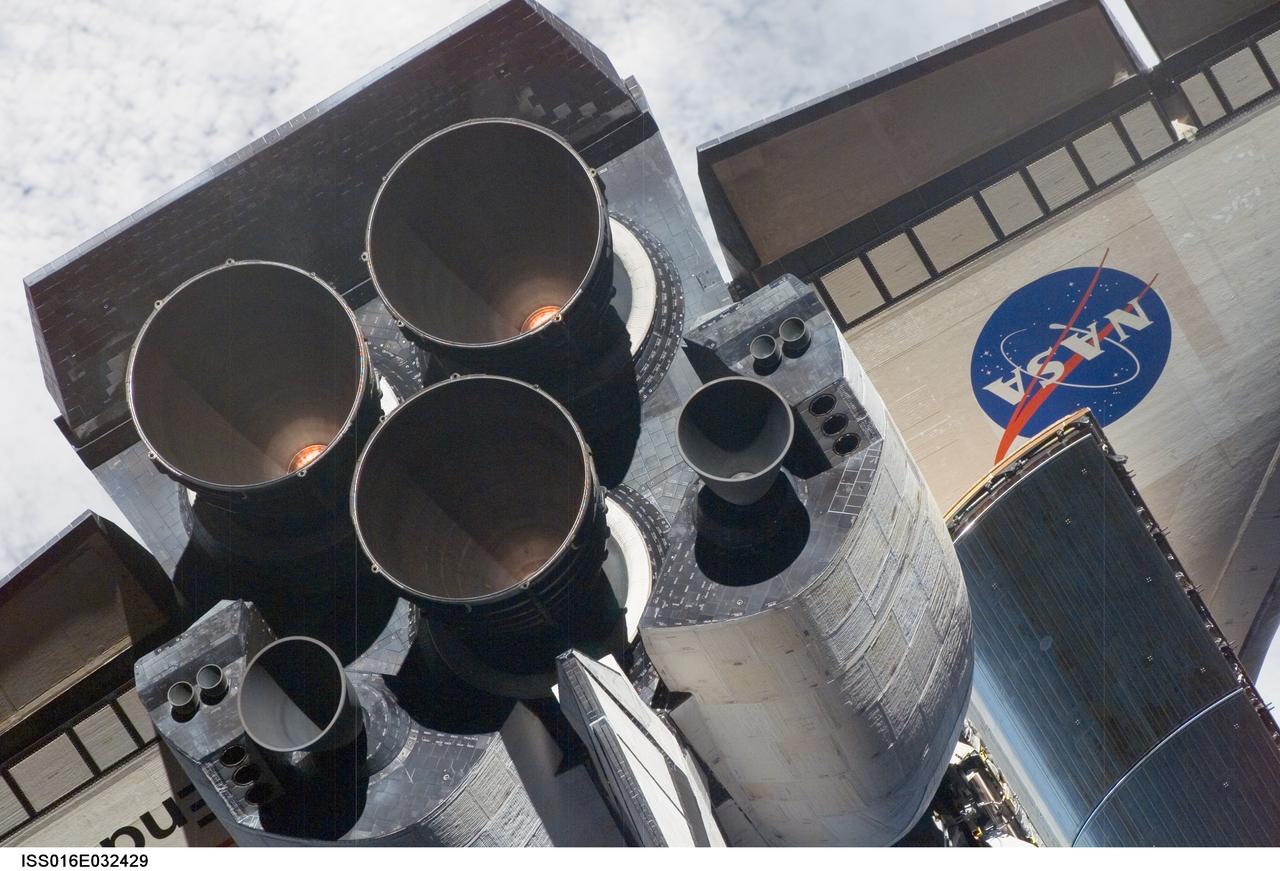
ISS016-E-032429 (12 March 2008) --- A close-up view of Space Shuttle Endeavour's tail section was provided by Expedition 16 crewmembers on the International Space Station (ISS). The image provides partial views of the shuttle's main engines, orbital maneuvering system (OMS) pods, a portion of the payload bay door panels and the shuttle's wings. Before docking with the station, astronaut Dominic Gorie, STS-123 commander, flew the shuttle through a roll pitch maneuver or basically a backflip to allow the space station crew a good view of Endeavour's heat shield. Using digital still cameras equipped with both 400 and 800 millimeter lenses, the ISS crewmembers took a number of photos of the shuttle's thermal protection system and sent them down to teams on the ground for analysis. A 400 millimeter lens was used for this image.
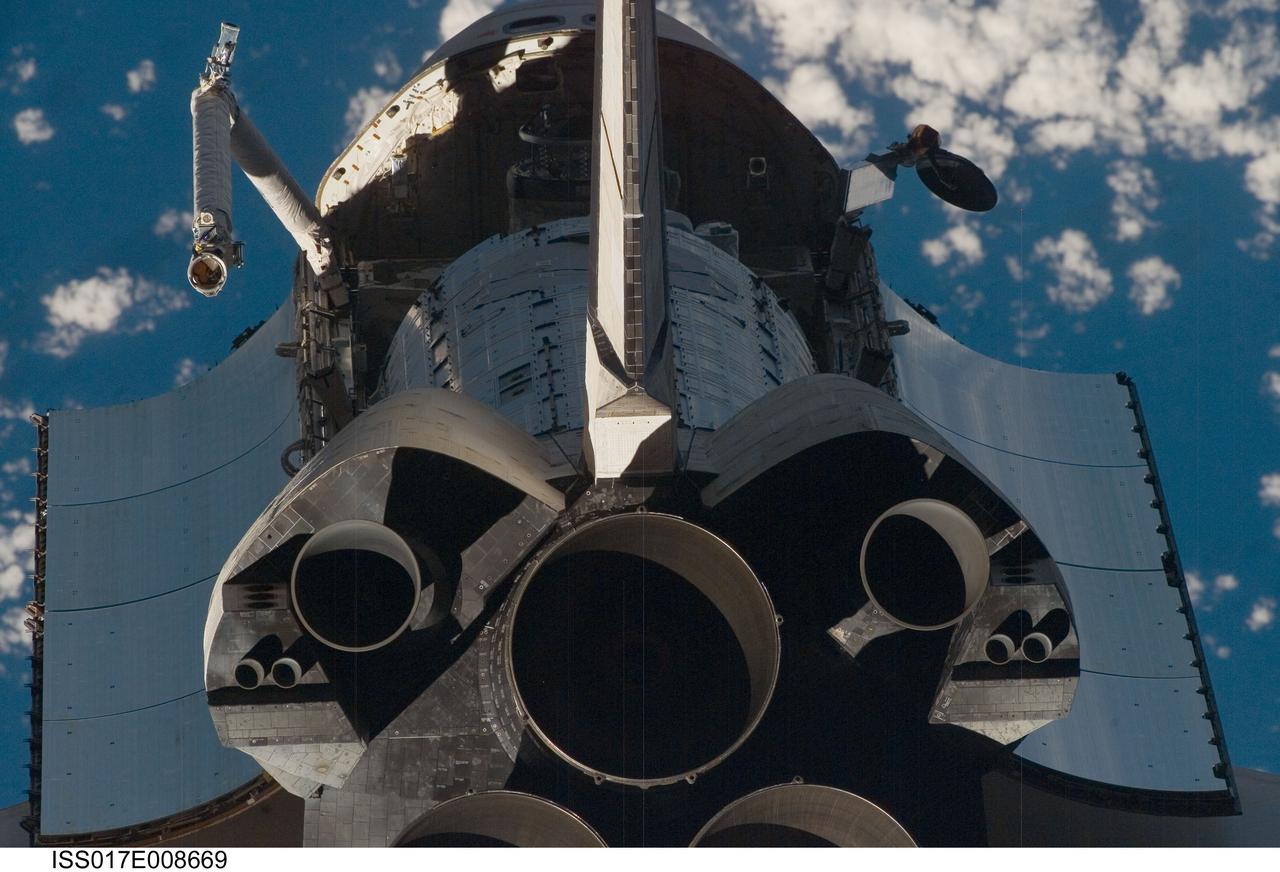
ISS017-E-008669 (2 June 2008) --- A close-up view of Space Shuttle Discovery's tail section was provided by Expedition 17 crewmembers on the International Space Station (ISS). The image provides partial views of the shuttle's main engines, orbital maneuvering system (OMS) pods, vertical stabilizer, the payload bay door panels and the second component of the Japan Aerospace Exploration Agency's Kibo laboratory, the Japanese Pressurized Module (JPM) located in the cargo bay. Before docking with the station, astronaut Mark Kelly, STS-124 commander, flew the shuttle through a roll pitch maneuver or basically a backflip to allow the space station crew a good view of Discovery's heat shield. Using digital still cameras equipped with both 400 and 800 millimeter lenses, the ISS crewmembers took a number of photos of the shuttle's thermal protection system and sent them down to teams on the ground for analysis. A 400 millimeter lens was used for this image.
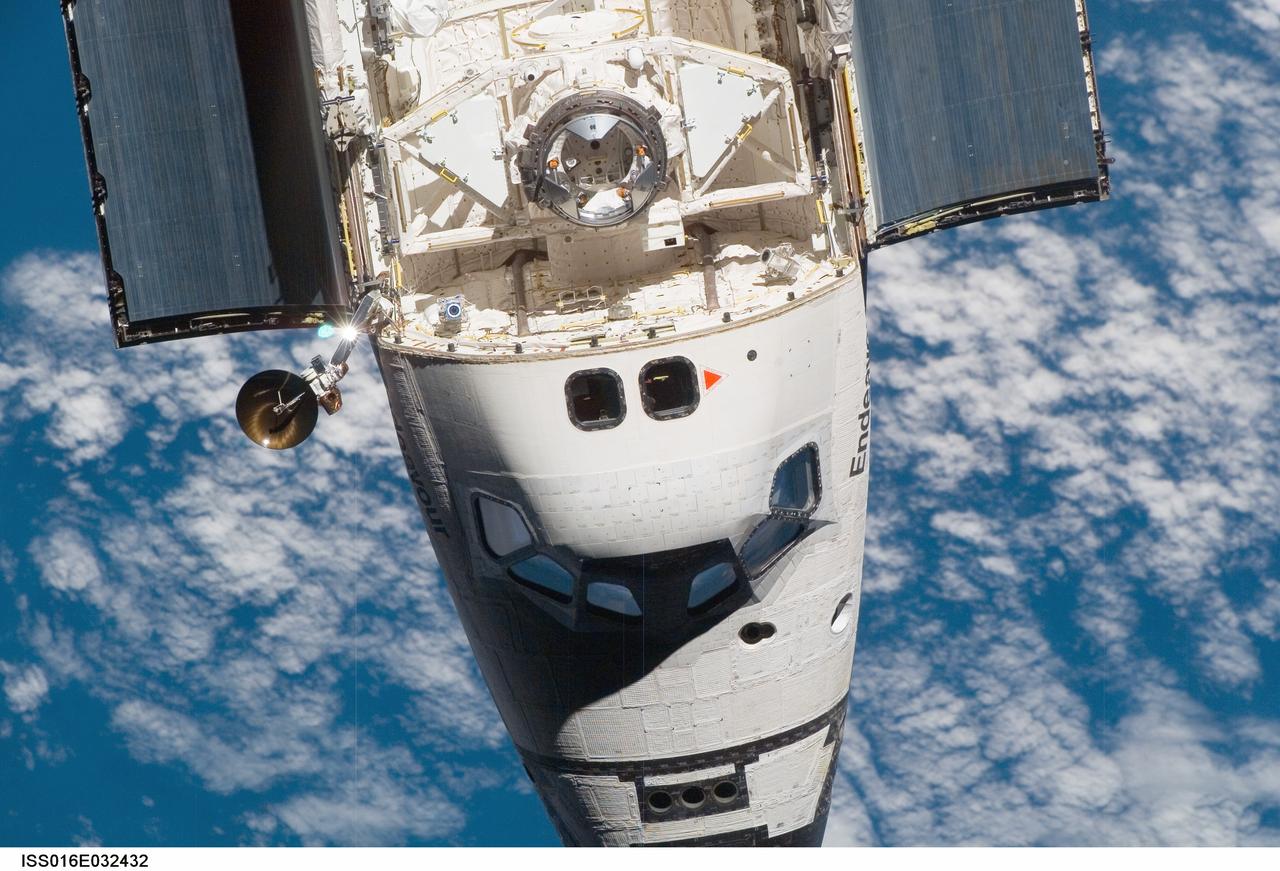
ISS016-E-032432 (12 March 2008) --- An overhead view of the exterior of Space Shuttle Endeavour's crew cabin, part of its payload bay doors and docking system was provided by Expedition 16 crewmembers on the International Space Station (ISS). Before docking with the station, astronaut Dominic Gorie, STS-123 commander, flew the shuttle through a roll pitch maneuver or basically a backflip to allow the space station crew a good view of Endeavour's heat shield. Using digital still cameras equipped with both 400 and 800 millimeter lenses, the ISS crewmembers took a number of photos of the shuttle's thermal protection system and sent them down to teams on the ground for analysis. A 400 millimeter lens was used for this image.
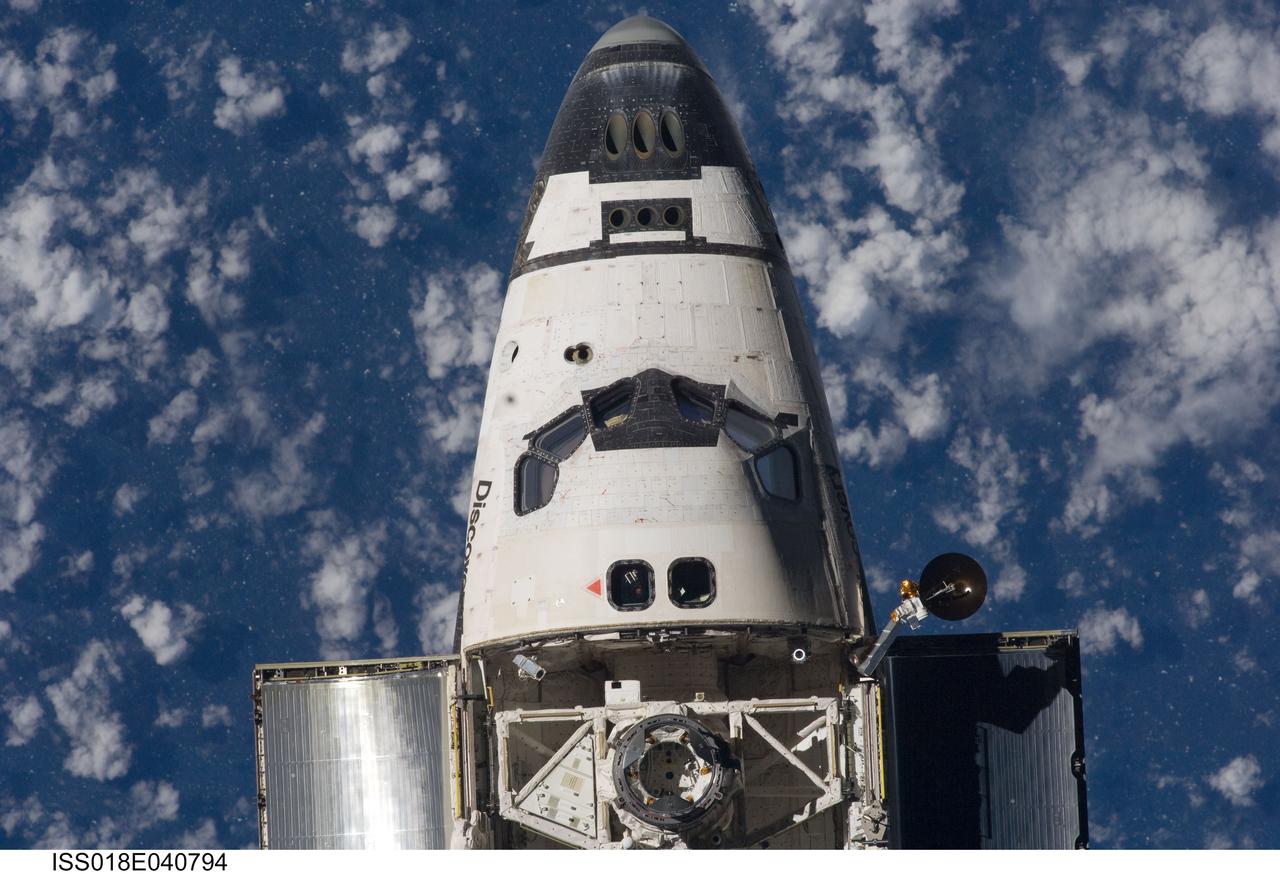
ISS018-E-040794 (17 March 2009) --- An overhead close-up view of the exterior of Space Shuttle Discovery's crew cabin, part of its payload bay and docking system was provided by Expedition 18 crewmembers on the International Space Station. Before docking with the station, astronaut Lee Archambault, STS-119 commander, flew the shuttle through a Rendezvous Pitch Maneuver or basically a backflip to allow the space station crew a good view of Discovery's heat shield. Using digital still cameras equipped with both 400 and 800 millimeter lenses, the ISS crewmembers took a number of photos of the shuttle's thermal protection system and sent them down to teams on the ground for analysis. A 400 millimeter lens was used for this image.
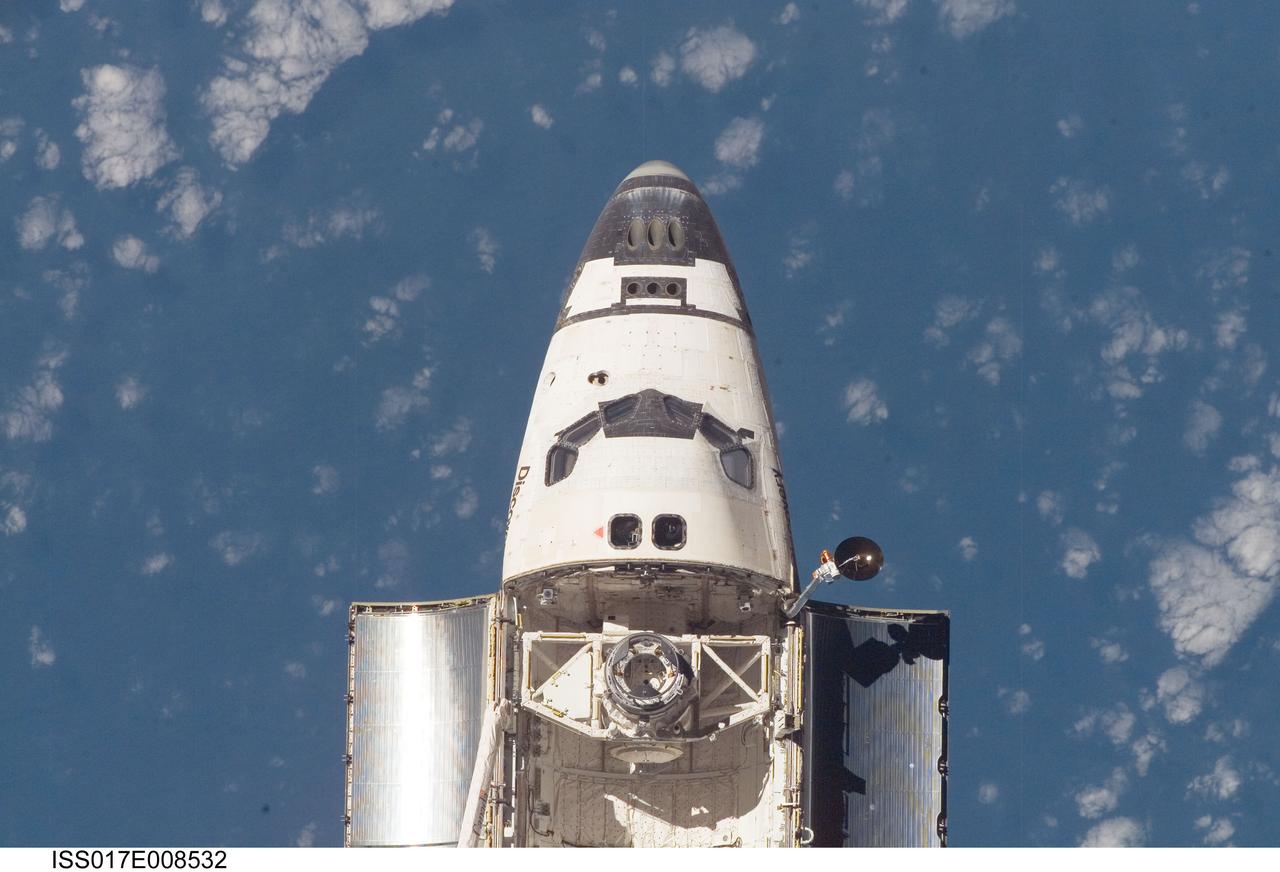
ISS017-E-008532 (2 June 2008) --- An overhead view of the exterior of Space Shuttle Discovery's crew cabin, part of its payload bay doors and docking system was provided by Expedition 17 crewmembers on the International Space Station (ISS). Before docking with the station, astronaut Mark Kelly, STS-124 commander, flew the shuttle through a roll pitch maneuver or basically a backflip to allow the space station crew a good view of Discovery's heat shield. Using digital still cameras equipped with both 400 and 800 millimeter lenses, the ISS crewmembers took a number of photos of the shuttle's thermal protection system and sent them down to teams on the ground for analysis. A 400 millimeter lens was used for this image.
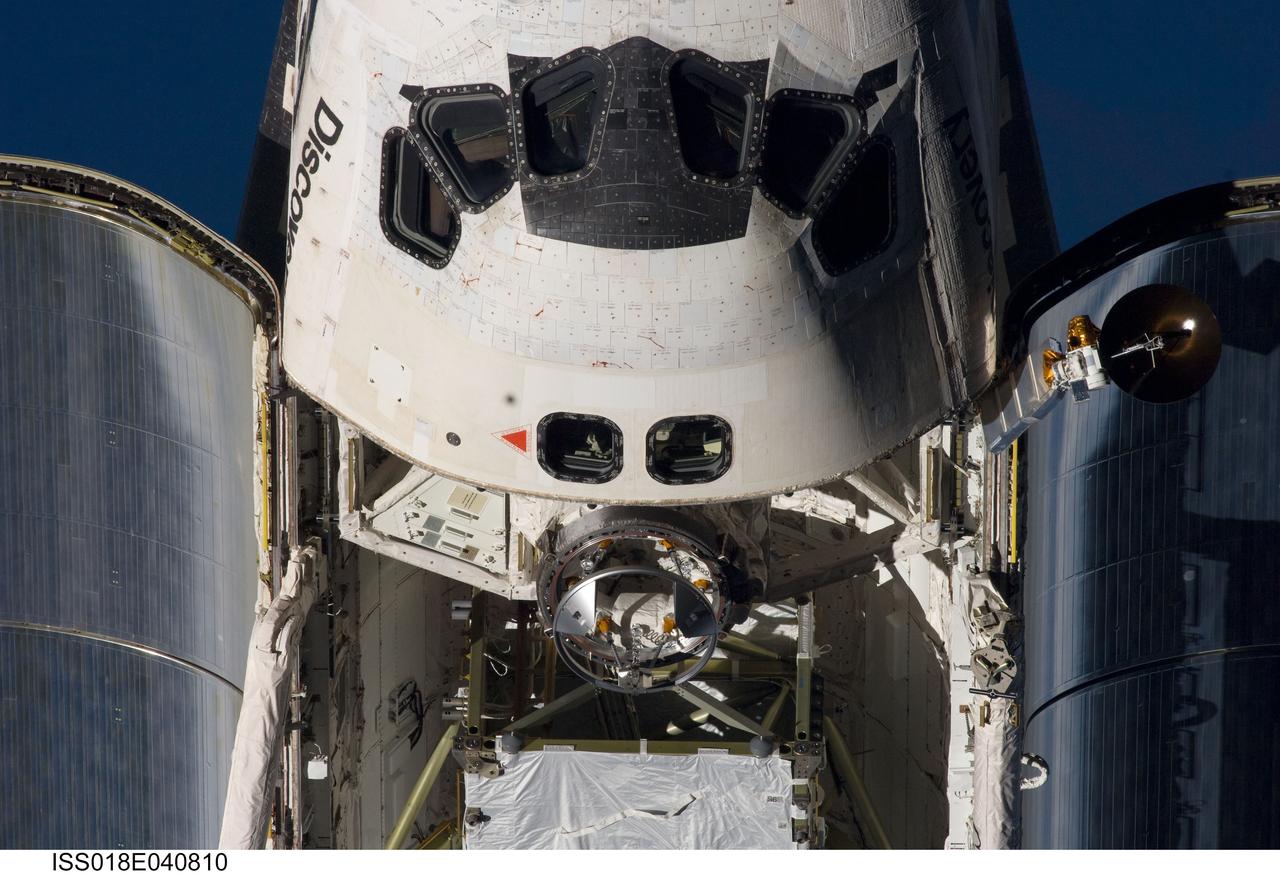
ISS018-E-040810 (17 March 2009) --- An overhead close-up view of the exterior of Space Shuttle Discovery's crew cabin, part of its payload bay and docking system was provided by Expedition 18 crewmembers on the International Space Station. Before docking with the station, astronaut Lee Archambault, STS-119 commander, flew the shuttle through a Rendezvous Pitch Maneuver or basically a backflip to allow the space station crew a good view of Discovery's heat shield. Using digital still cameras equipped with both 400 and 800 millimeter lenses, the ISS crewmembers took a number of photos of the shuttle's thermal protection system and sent them down to teams on the ground for analysis. A 400 millimeter lens was used for this image.
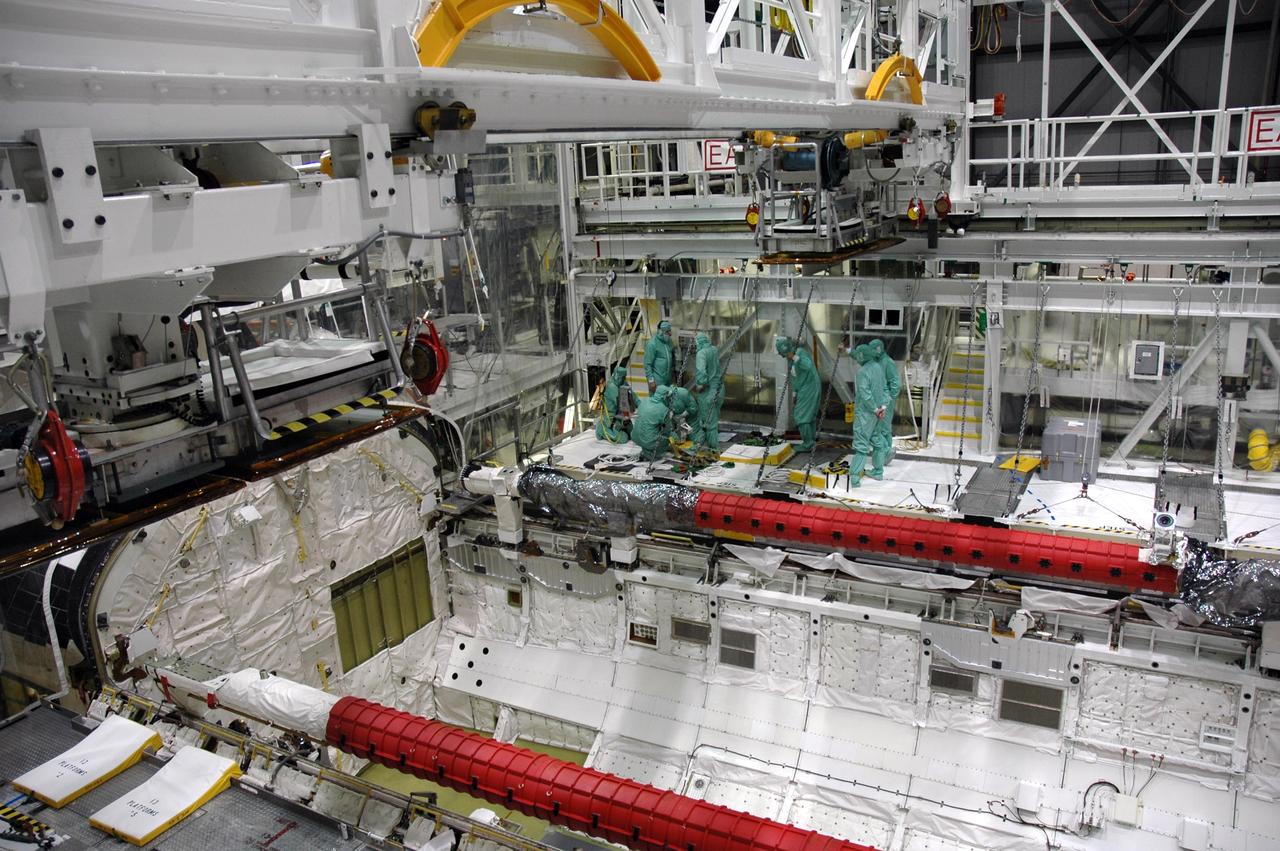
CAPE CANAVERAL, Fla. – In the Orbiter Processing Facility bay 2 at NASA's Kennedy Space Center, workers prepare to install a camera pack on the orbiter boom sensor system in space shuttle Endeavour's payload bay. The scheduled launch vehicle for the STS-126 missions, Endeavour will deliver a multi-purpose logistics module to the International Space Station. Launch is targeted for Nov. 10. Endeavour is also the backup shuttle, if needed for rescue, for the STS-125 mission in October that will make repairs on NASA's Hubble Space Telescope. For that purpose, it is designated STS-400. Photo credit: NASA/Jim Grossmann
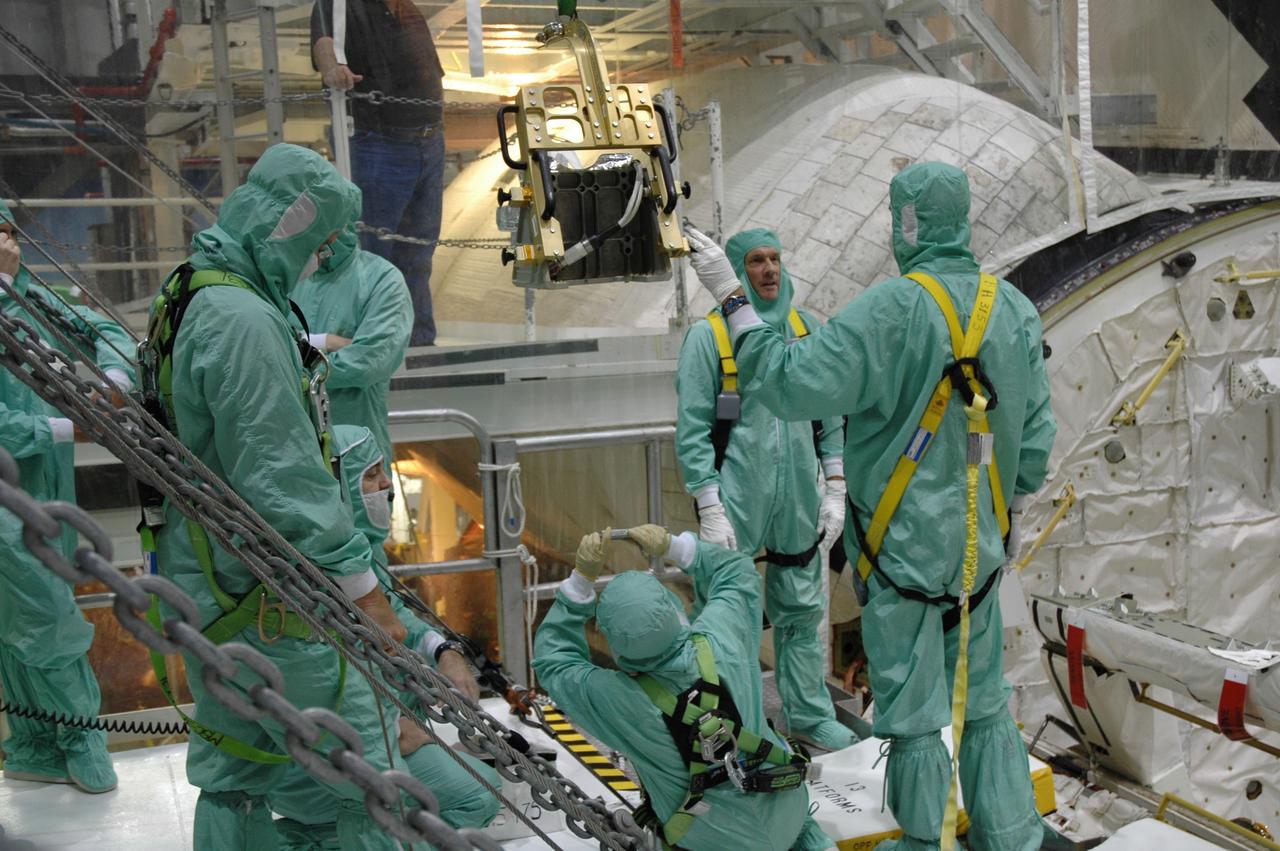
CAPE CANAVERAL, Fla. – In the Orbiter Processing Facility bay 2 at NASA's Kennedy Space Center, workers get ready to install a camera pack on the orbiter boom sensor system in space shuttle Endeavour's payload bay. The scheduled launch vehicle for the STS-126 missions, Endeavour will deliver a multi-purpose logistics module to the International Space Station. Launch is targeted for Nov. 10. Endeavour is also the backup shuttle, if needed for rescue, for the STS-125 mission in October that will make repairs on NASA's Hubble Space Telescope. For that purpose, it is designated STS-400. Photo credit: NASA/Jim Grossmann
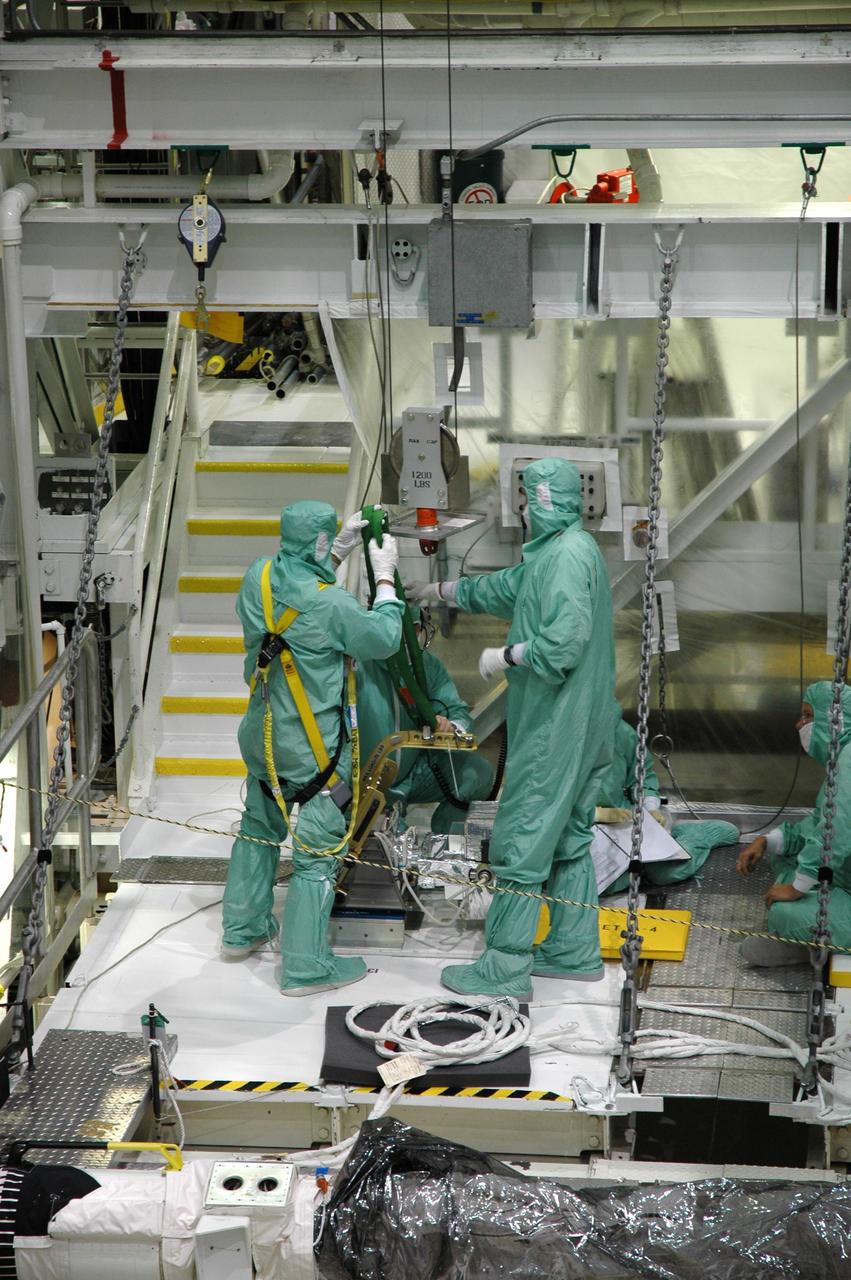
CAPE CANAVERAL, Fla. – In the Orbiter Processing Facility bay 2 at NASA's Kennedy Space Center, workers prepare to install a camera pack on the orbiter boom sensor system in space shuttle Endeavour's payload bay. The scheduled launch vehicle for the STS-126 missions, Endeavour will deliver a multi-purpose logistics module to the International Space Station. Launch is targeted for Nov. 10. Endeavour is also the backup shuttle, if needed for rescue, for the STS-125 mission in October that will make repairs on NASA's Hubble Space Telescope. For that purpose, it is designated STS-400. Photo credit: NASA/Jim Grossmann
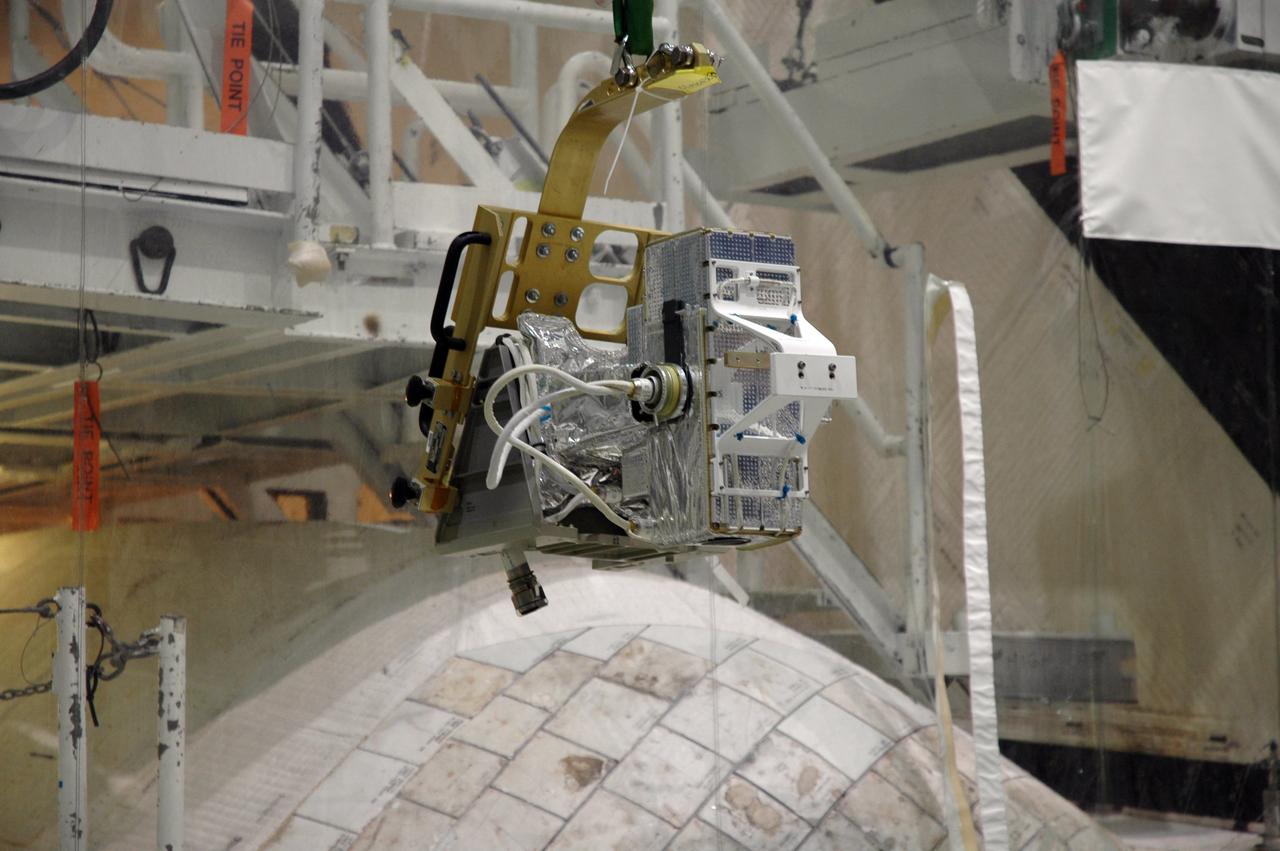
CAPE CANAVERAL, Fla. – A close-up of the camera pack to be installed on space shuttle Endeavour's orbiter boom sensor system. The work is being done in the Orbiter Processing Facility bay 2 at NASA's Kennedy Space Center. The scheduled launch vehicle for the STS-126 missions, Endeavour will deliver a multi-purpose logistics module to the International Space Station. Launch is targeted for Nov. 10. Endeavour is also the backup shuttle, if needed for rescue, for the STS-125 mission in October that will make repairs on NASA's Hubble Space Telescope. For that purpose, it is designated STS-400. Photo credit: NASA/Jim Grossmann
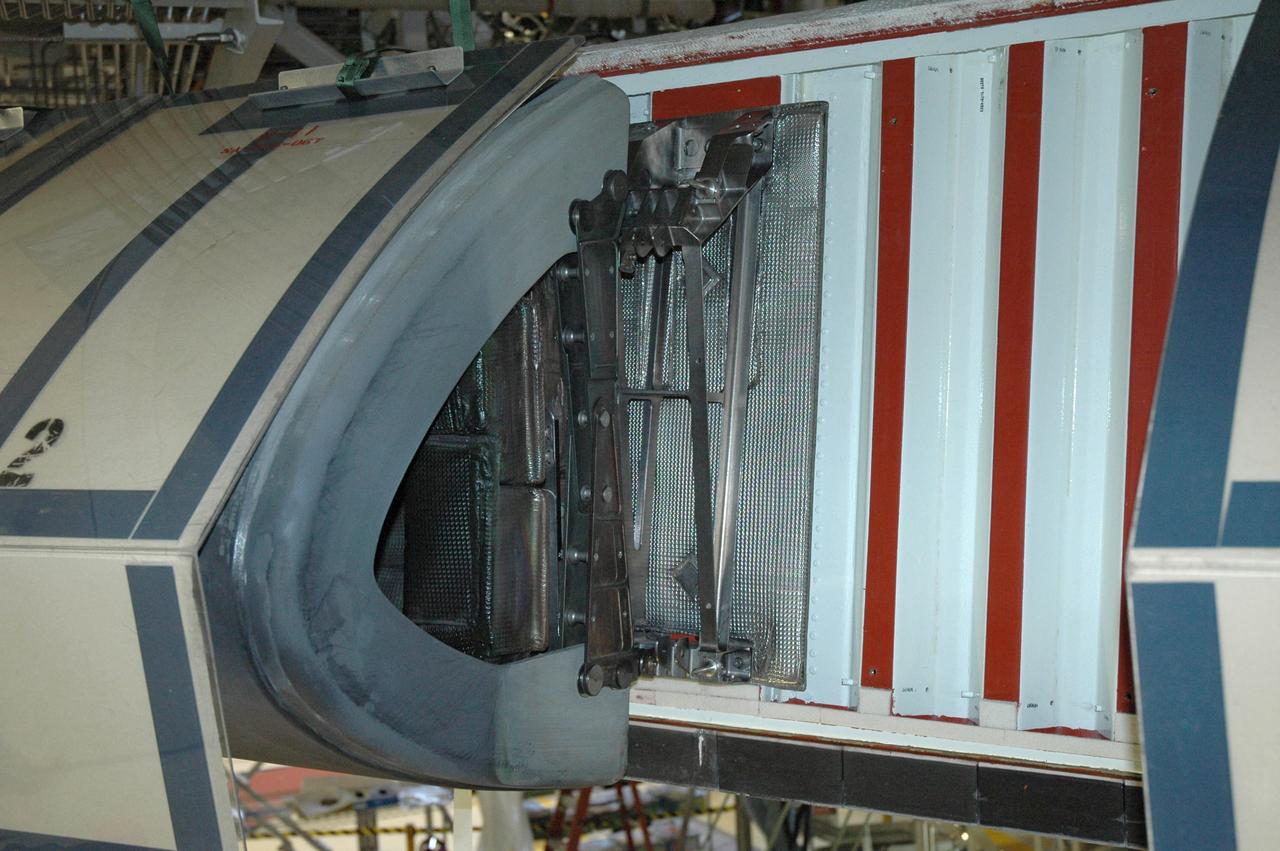
CAPE CANAVERAL, Fla. – This photo shows the leading edge of the wing on space shuttle Endeavour with an reinforced carbon-carbon panel and one insulator assembly removed. The silver assembly is the insulator. The panel is being replaced. Endeavour is the scheduled launch vehicle for the STS-126 mission and will deliver a multi-purpose logistics module to the International Space Station. Launch is targeted for Nov. 10. Endeavour is also the backup shuttle, if needed for rescue, for the STS-125 mission in October that will make repairs on the Hubble Space Telescope. For that purpose, it is designated STS-400. Photo credit: NASA/Jim Grossmann
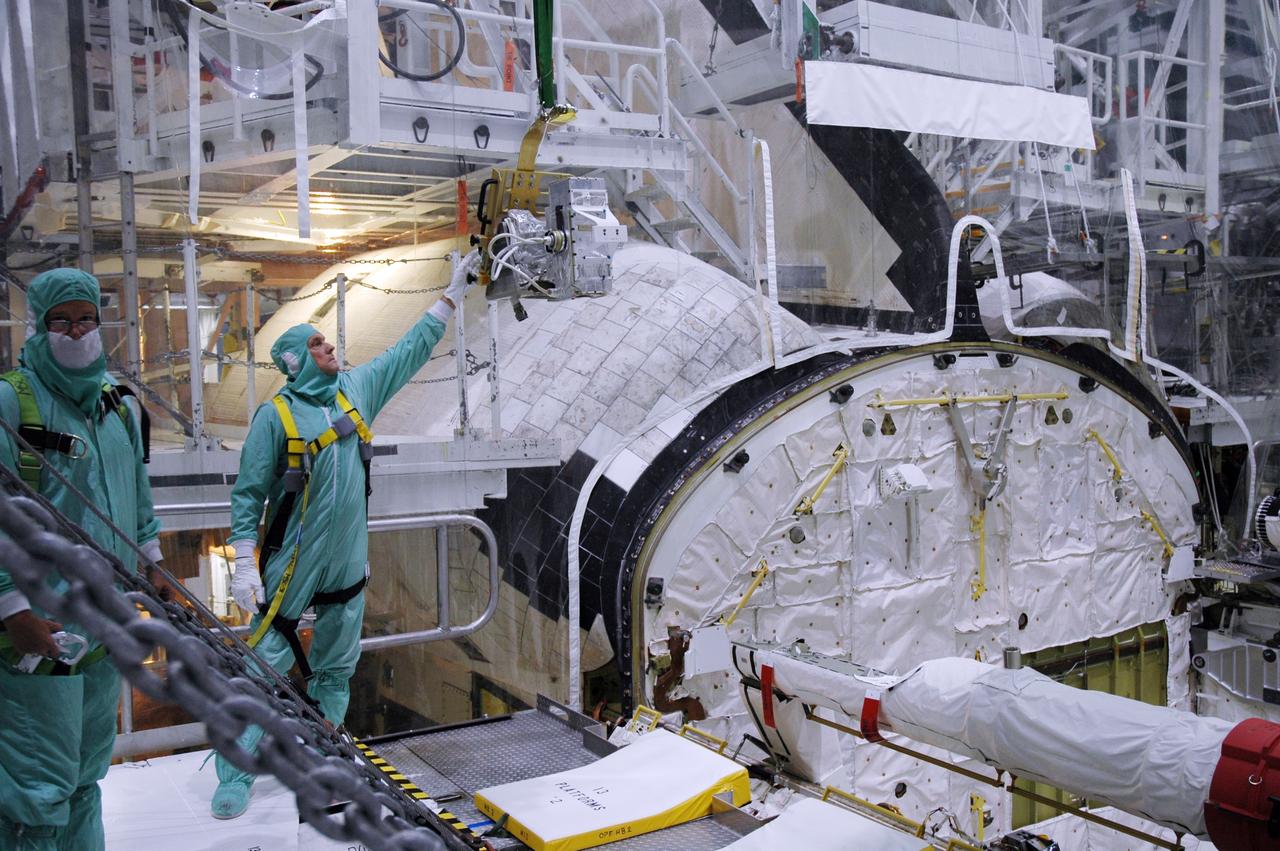
CAPE CANAVERAL, Fla. – In the Orbiter Processing Facility bay 2 at NASA's Kennedy Space Center, a worker reaches up to the camera pack to be installed on space shuttle Endeavour's orbiter boom sensor system. The scheduled launch vehicle for the STS-126 missions, Endeavour will deliver a multi-purpose logistics module to the International Space Station. Launch is targeted for Nov. 10. Endeavour is also the backup shuttle, if needed for rescue, for the STS-125 mission in October that will make repairs on NASA's Hubble Space Telescope. For that purpose, it is designated STS-400. Photo credit: NASA/Jim Grossmann
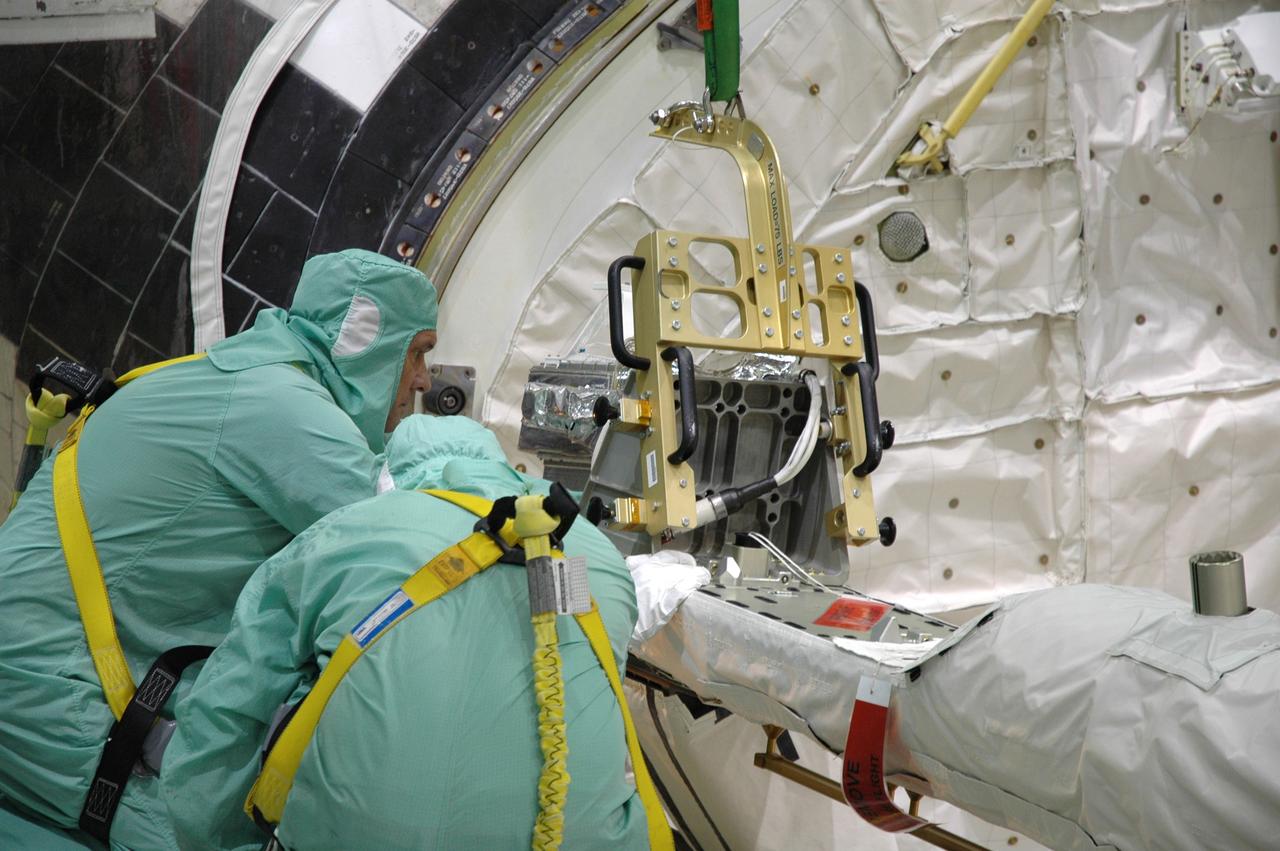
CAPE CANAVERAL, Fla. – In the Orbiter Processing Facility bay 2 at NASA's Kennedy Space Center, workers install a camera pack on the orbiter boom sensor system in space shuttle Endeavour's payload bay. The scheduled launch vehicle for the STS-126 missions, Endeavour will deliver a multi-purpose logistics module to the International Space Station. Launch is targeted for Nov. 10. Endeavour is also the backup shuttle, if needed for rescue, for the STS-125 mission in October that will make repairs on NASA's Hubble Space Telescope. For that purpose, it is designated STS-400. Photo credit: NASA/Jim Grossmann
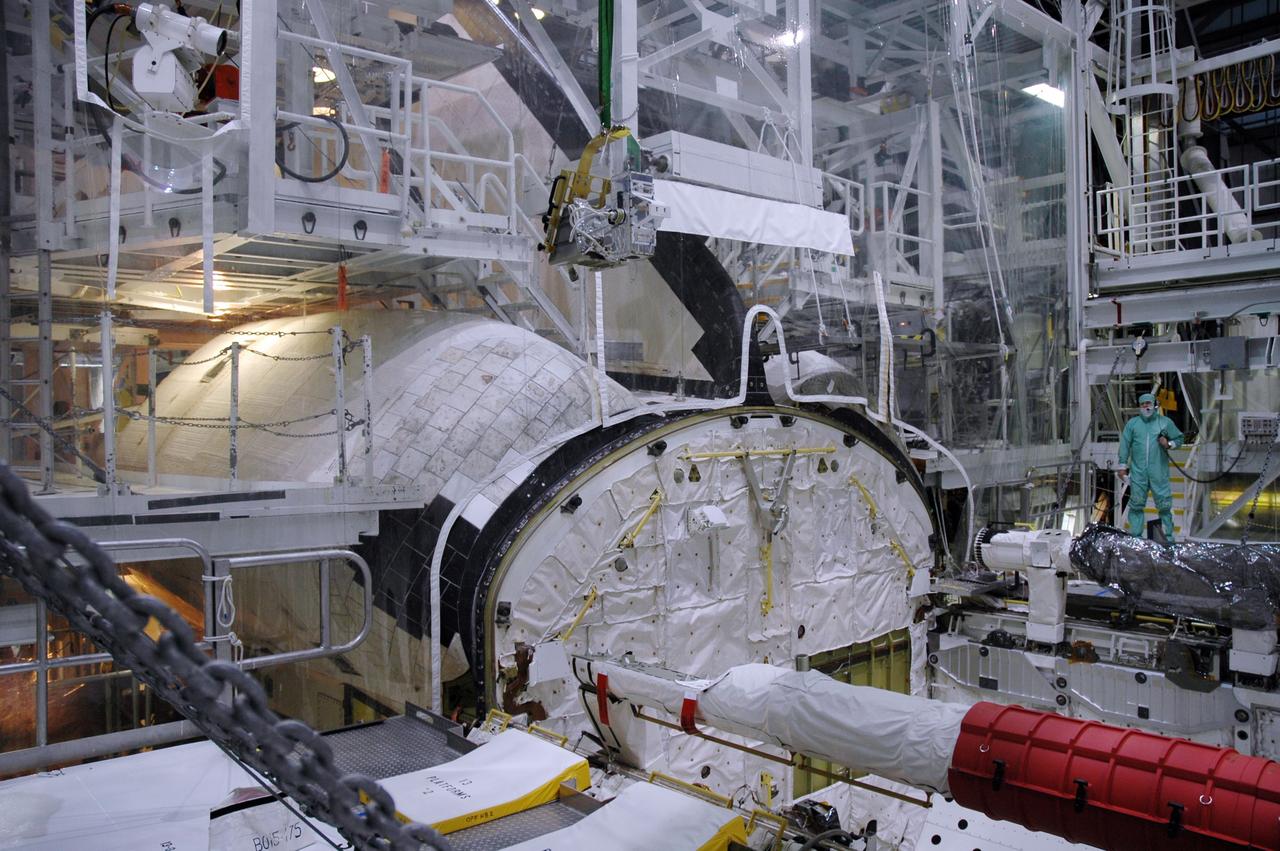
CAPE CANAVERAL, Fla. – In the Orbiter Processing Facility bay 2 at NASA's Kennedy Space Center, a camera pack is moved above space shuttle Endeavour's payload bay. The camera will be installed on the shuttle's orbiter boom sensor system. The scheduled launch vehicle for the STS-126 missions, Endeavour will deliver a multi-purpose logistics module to the International Space Station. Launch is targeted for Nov. 10. Endeavour is also the backup shuttle, if needed for rescue, for the STS-125 mission in October that will make repairs on NASA's Hubble Space Telescope. For that purpose, it is designated STS-400. Photo credit: NASA/Jim Grossmann

iss074e0334334 (Feb. 27, 2026) --- Quebec City, one of North America’s oldest cities at more than 400 years old, sits on the St. Lawrence River in Canada’s province of Quebec. This photograph was taken at approximately 1:21 a.m. local time from the International Space Station as it orbited 264 miles above North America. Credit: NASA/Chris Williams
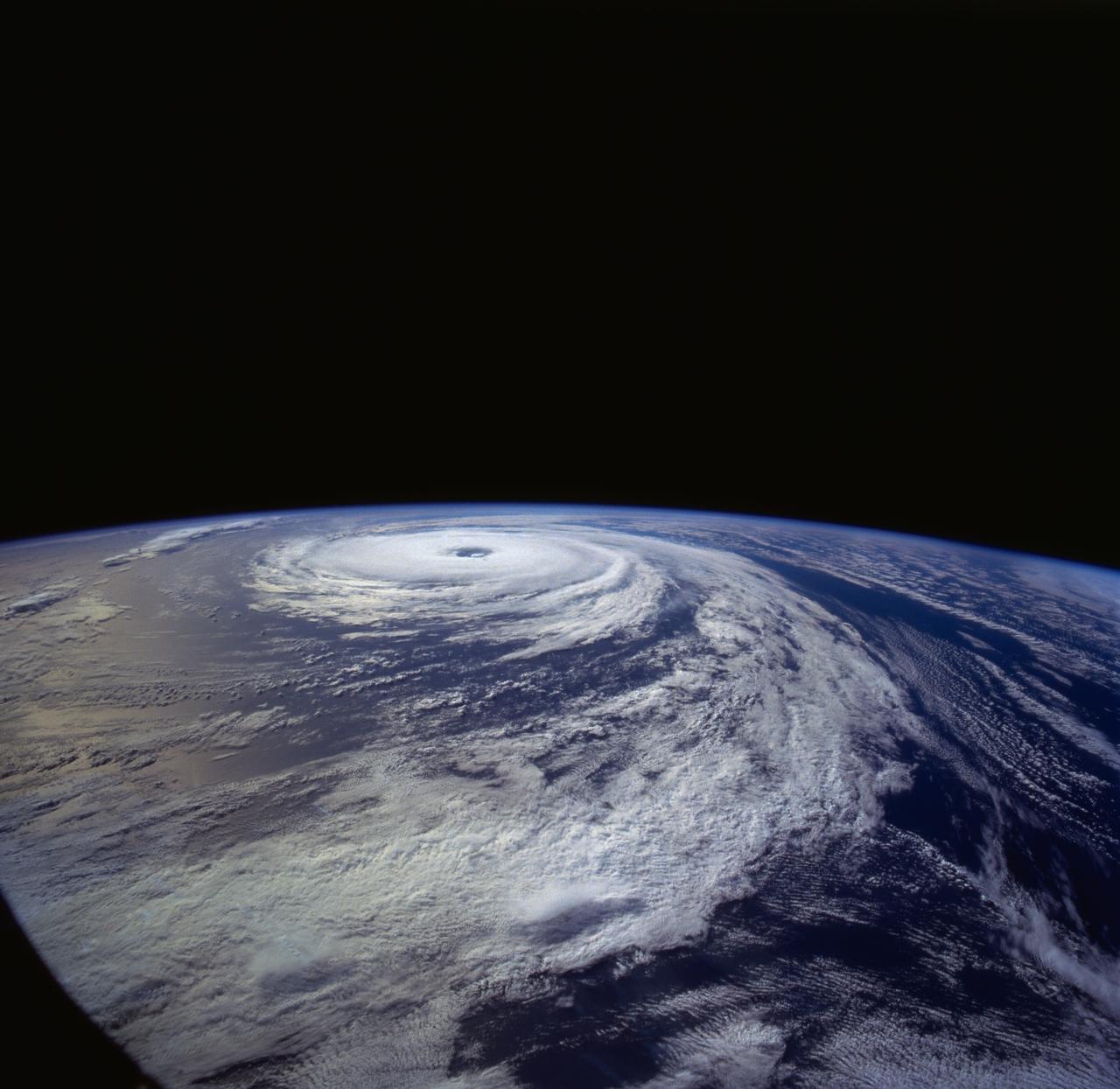
From 165 nautical miles above the earth, the STS-66 astronauts were able to capture detail in a number of storm systems around the globe during their 11-day stay in space aboard the Space Shuttle Atlantis. A 70mm handheld Hasselblad was used to photograph Hurricane Florence in the Atlantic Ocean, about 400 miles from Bermuda.
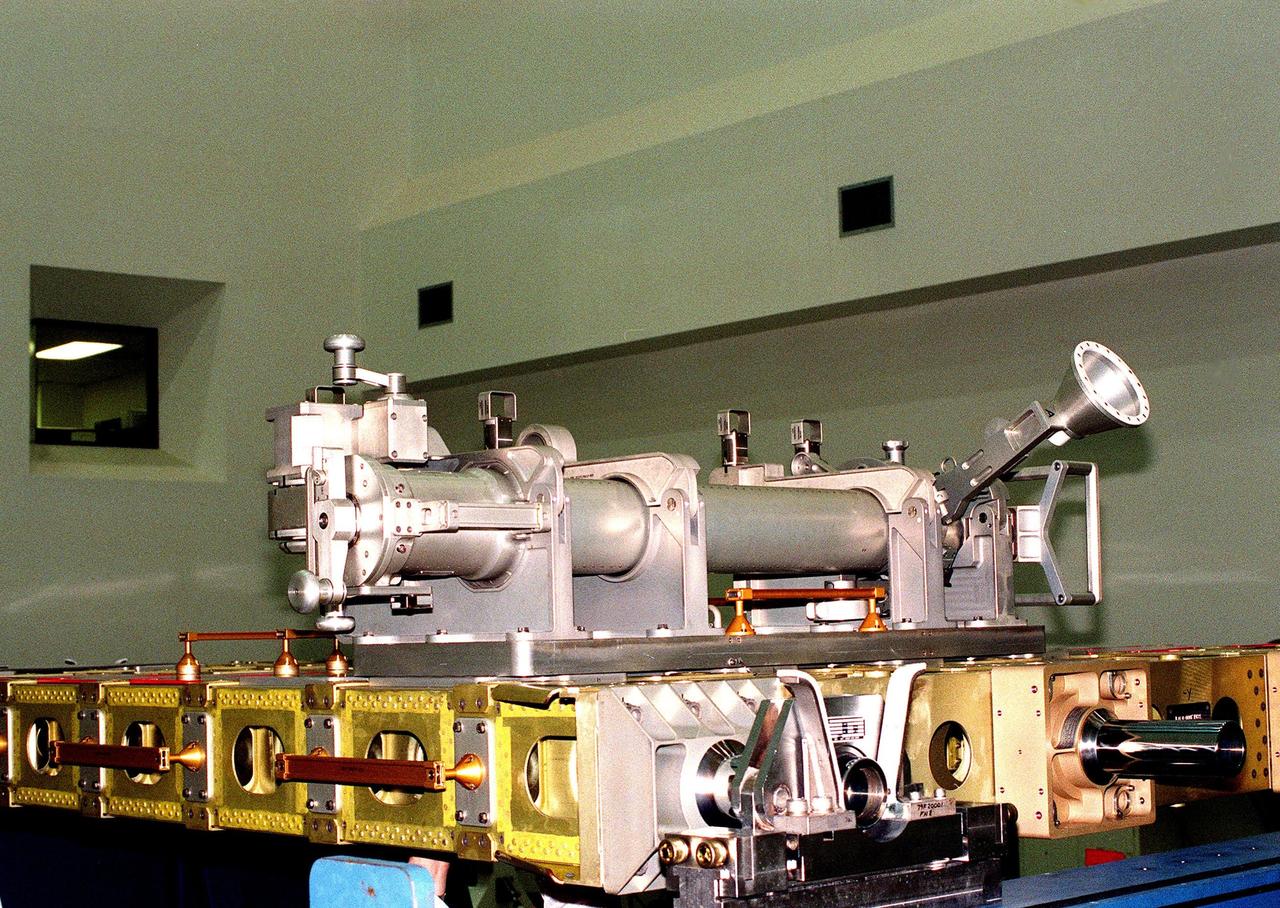
An ORU Transfer Device (OTD) sits secured on top of the International Cargo Carrier (ICC). The OTD is a U.S.-built crane that will be stowed on the International Space Station's Unity module for use during future ISS assembly missions. The nonpressurized ICC fits inside the payload bay of the orbiter. The ICC will also carry the SPACEHAB Oceaneering Space System Box (SHOSS), a logistics items carrier. SHOSS can hold a maximum of 400 pounds of equipment and will carry items to be used during STS-96 and future ISS assembly flights. The ICC will fly on mission STS-96, targeted for launch on May 20
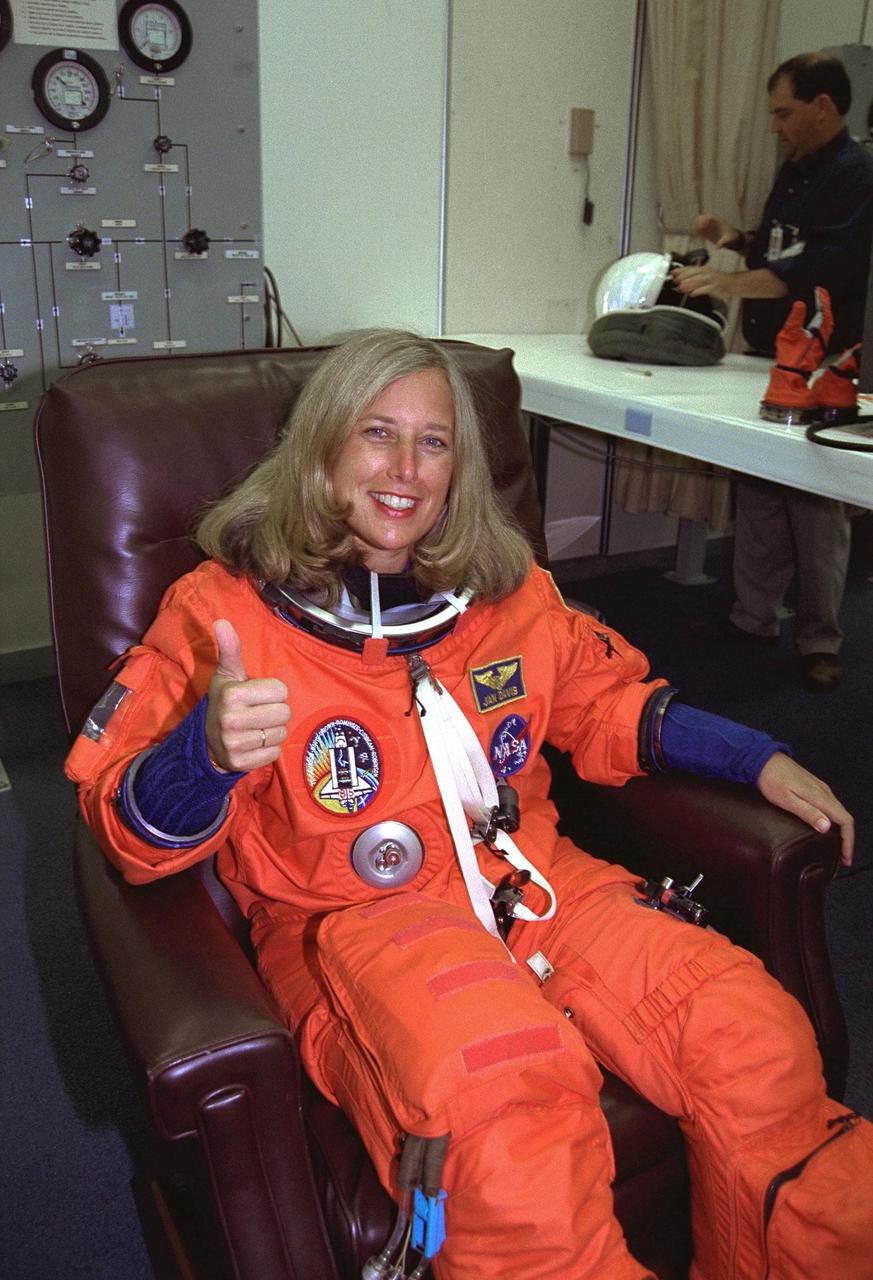
STS-85 Payload Commander N. Jan Davis gives a thumbs up as she is assisted with her ascent/reentry flight suit in the Operations and Checkout (O&C) Building. She has logged nearly 400 hours in space on the STS-47 and STS-60 missions and holds a doctorate in mechanical engineering. Davis will have overall responsibility for the experiments conducted on STS-85. She will also deploy and retrieve the Cryogenic Infrared Spectrometers and Telescopes for the AtmosphereShuttle Pallet Satellite-2 (CRISTA-SPAS-2) free-flyer and operate the prototype Japanese robotic arm. The primary payload aboard the Space Shuttle orbiter Discovery is the CRISTA-SPAS-2. Other payloads on the 11-day mission include the Manipulator Flight Demonstration (MFD), and Technology Applications and Science-1 (TAS-1) and International Extreme Ultraviolet Hitchhiker-2 (IEH-2) experiments
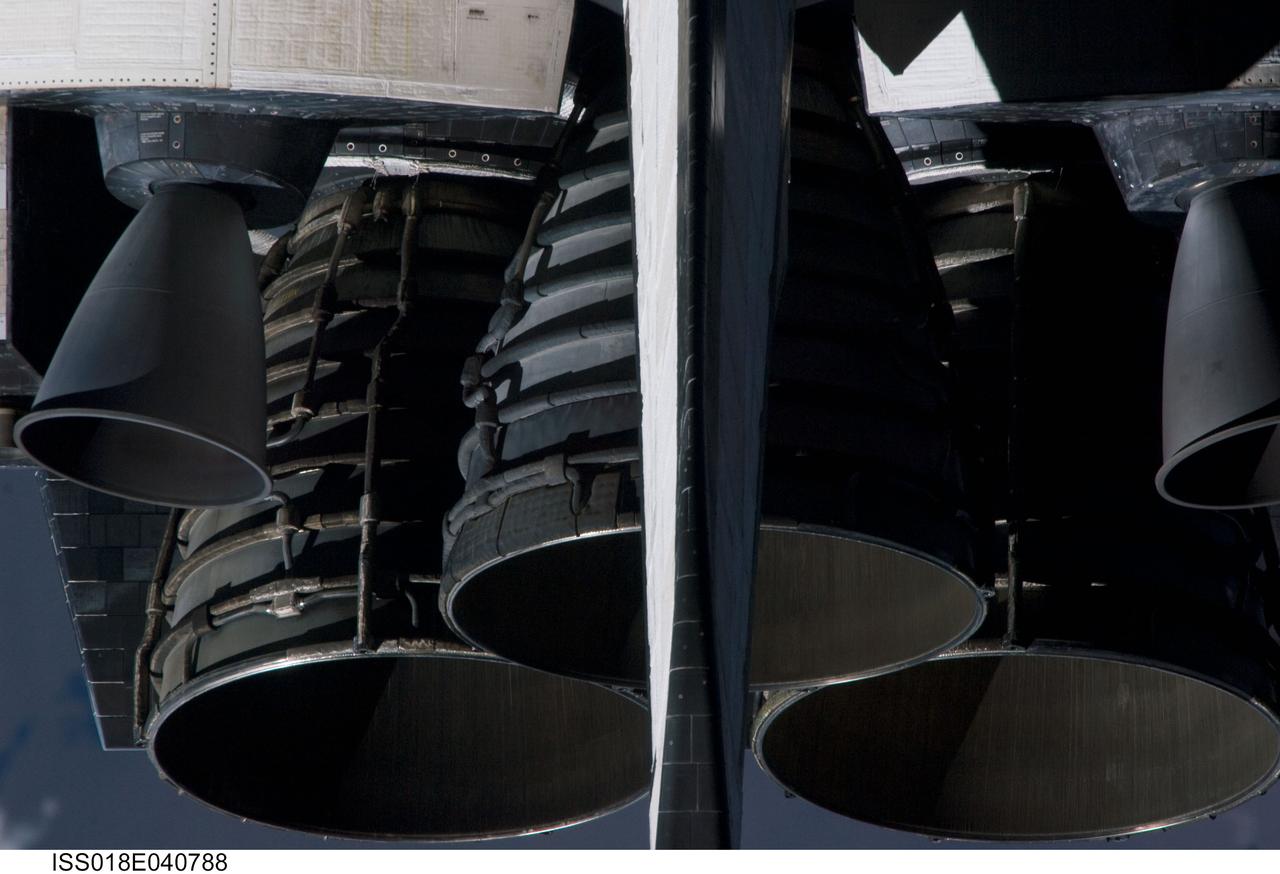
ISS018-E-040788 (17 March 2009) --- A close-up view of Space Shuttle Discovery?s main engines was provided by Expedition 18 crewmembers on the International Space Station. Before docking with the station, astronaut Lee Archambault, STS-119 commander, flew the shuttle through a Rendezvous Pitch Maneuver or basically a backflip to allow the space station crew a good view of Discovery's heat shield. Using digital still cameras equipped with both 400 and 800 millimeter lenses, the ISS crewmembers took a number of photos of the shuttle's thermal protection system and sent them down to teams on the ground for analysis. A 800 millimeter lens was used for this image.
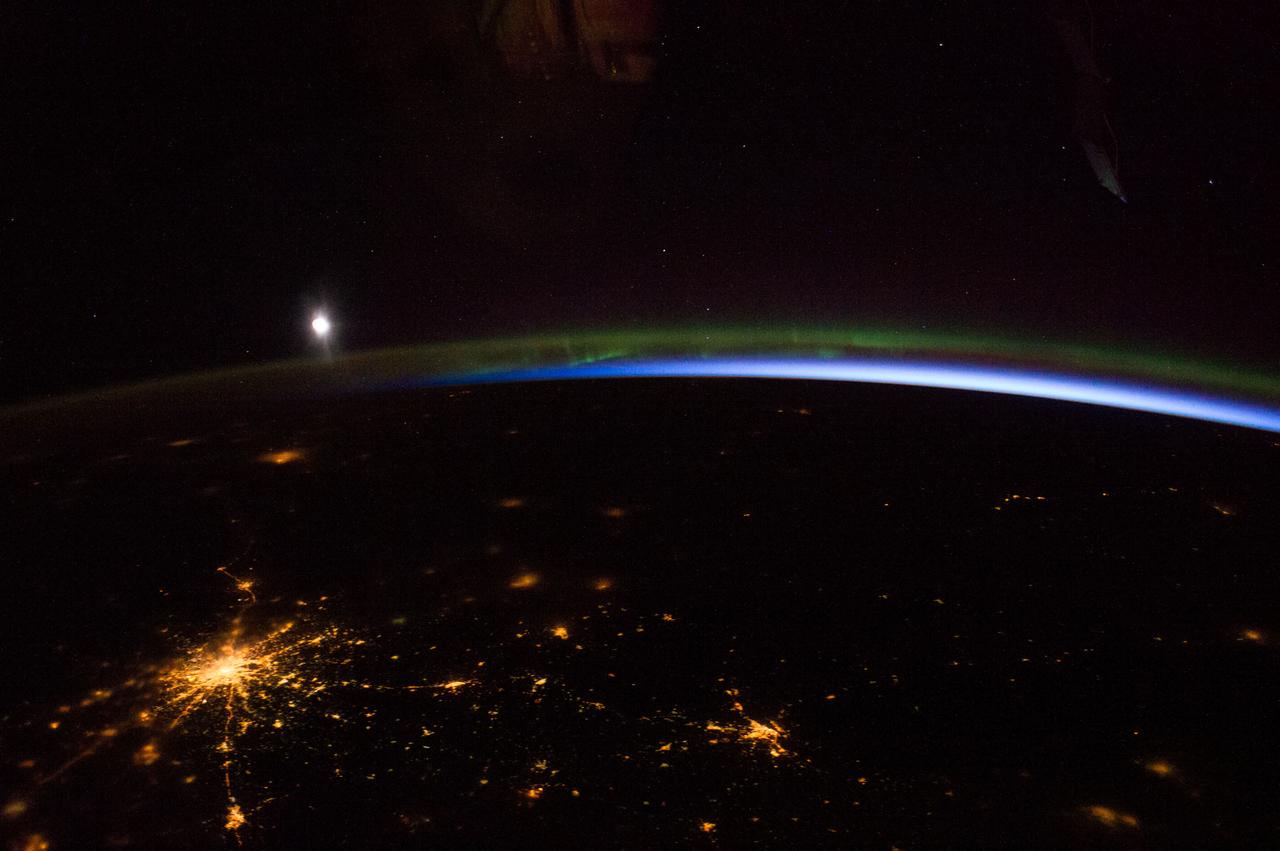
ISS039-E-009160 (2 April 2014) --- This nighttime view featuring the aurora borealis, the moon and Moscow was photographed by an Expedition 39 crew member on the International Space Station. A thin green line of the aurora borealis crosses the top of this image. The moon appears as a white disc just above the aurora. Airglow appears as a blue-white cusp on Earth's limb. Russia's capital city Moscow makes a splash of yellow (lower left), with its easily recognized radial pattern of highways. Other cities are Nizhni Novgorod (lower center) 400 kilometers from Moscow, St. Petersburg (left) 625 kilometers from Moscow, and Finland?s capital city Helsinki.
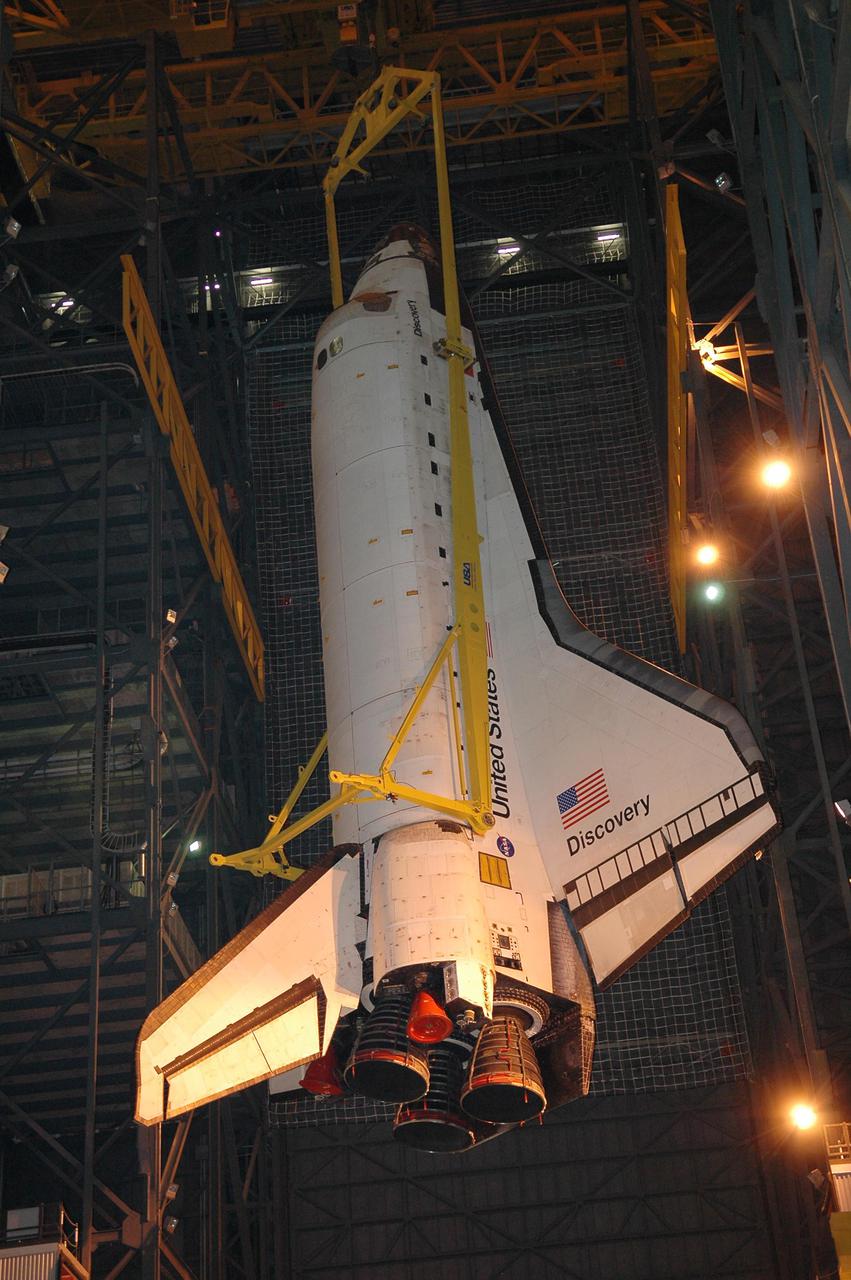
KENNEDY SPACE CENTER, FLA. - In high bay 1 of the Vehicle Assembly Building at NASA’s Kennedy Space Center, the 122-foot-long orbiter Discovery is suspended more than 400 feet above the floor after being lifted away from the 154-foot-high External Tank (below) and Solid Rocket Boosters. After demating from its External Tank (ET), the orbiter will be placed on a transporter in the transfer aisle and moved to high bay 3 for remating with another tank, ET-121. Discovery is expected to be rolled back to the launch pad in mid-June for Return to Flight mission STS-114. The launch window extends from July 13 to July 31.

ISS018-E-040602 (17 March 2009) --- An overhead view of the exterior of Space Shuttle Discovery's crew cabin, part of its payload bay and docking system was provided by Expedition 18 crewmembers on the International Space Station. Before docking with the station, astronaut Lee Archambault, STS-119 commander, flew the shuttle through a Rendezvous Pitch Maneuver or basically a backflip to allow the space station crew a good view of Discovery's heat shield. Using digital still cameras equipped with both 400 and 800 millimeter lenses, the ISS crewmembers took a number of photos of the shuttle's thermal protection system and sent them down to teams on the ground for analysis. A 800 millimeter lens was used for this image.
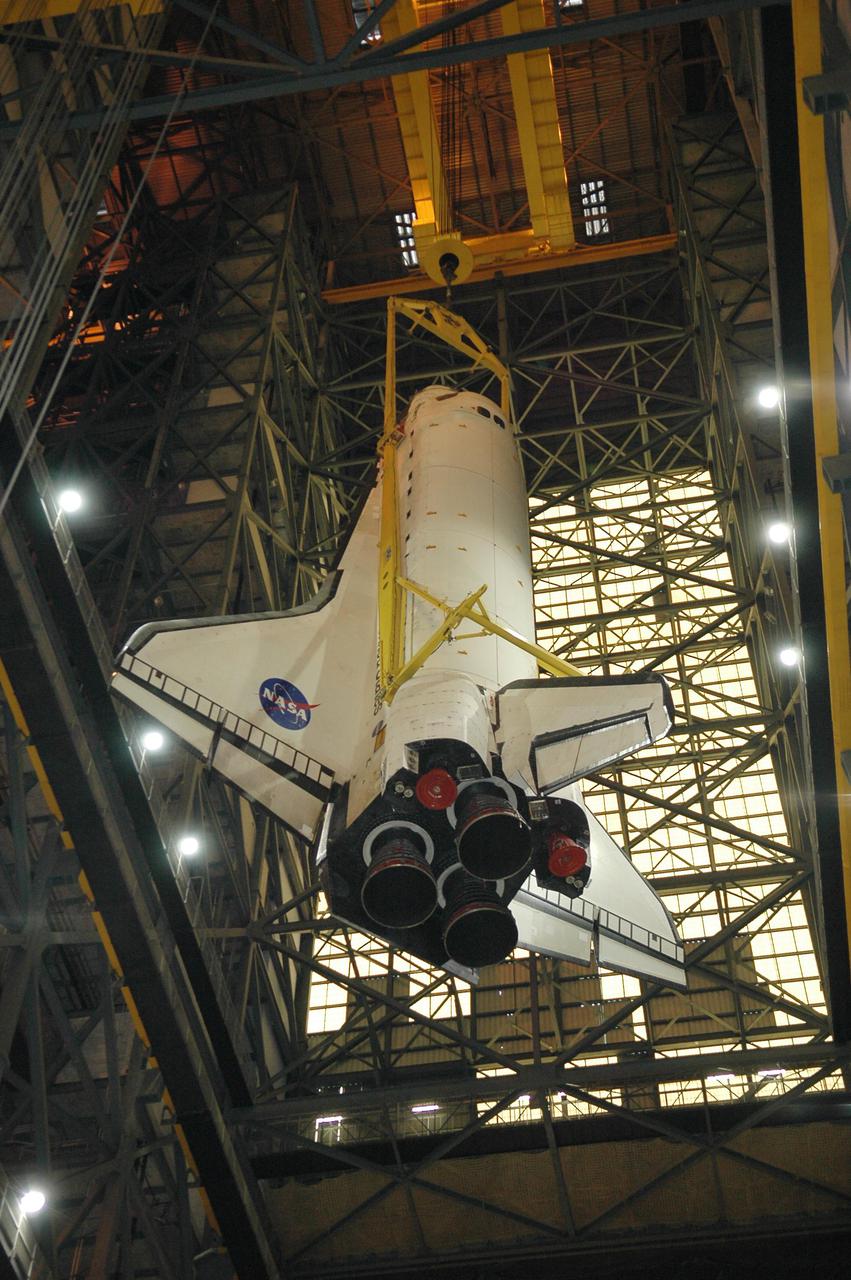
KENNEDY SPACE CENTER, FLA. - In high bay 1 of the Vehicle Assembly Building at NASA’s Kennedy Space Center, the 122-foot-long orbiter Discovery is suspended more than 400 feet above the floor after being lifted away from the 154-foot-high External Tank (below) and Solid Rocket Boosters. After demating from its External Tank (ET), the orbiter will be placed on a transporter in the transfer aisle and moved to high bay 3 for remating with another tank, ET-121. Discovery is expected to be rolled back to the launch pad in mid-June for Return to Flight mission STS-114. The launch window extends from July 13 to July 31.
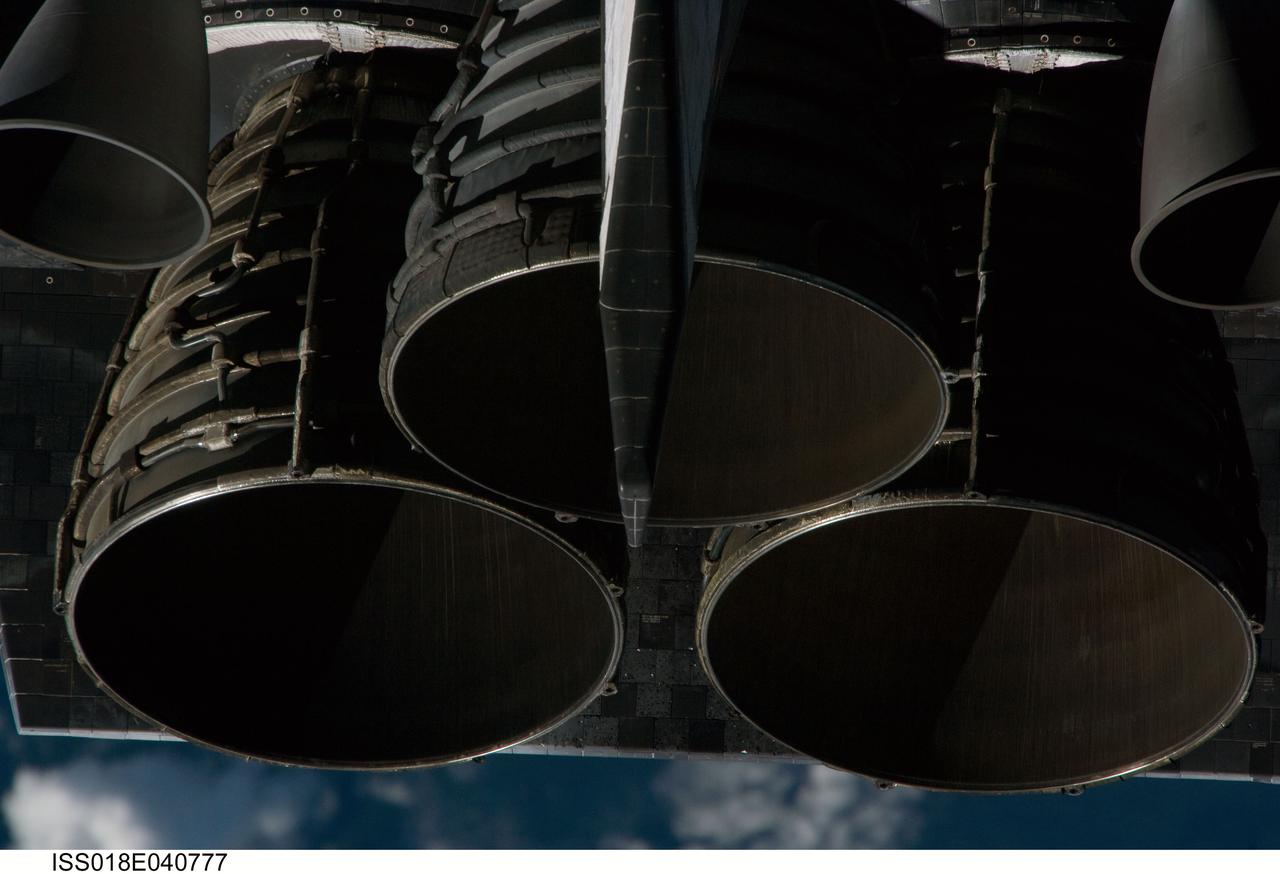
ISS018-E-040777 (17 March 2009) --- A close-up view of Space Shuttle Discovery?s main engines was provided by Expedition 18 crewmembers on the International Space Station. Before docking with the station, astronaut Lee Archambault, STS-119 commander, flew the shuttle through a Rendezvous Pitch Maneuver or basically a backflip to allow the space station crew a good view of Discovery's heat shield. Using digital still cameras equipped with both 400 and 800 millimeter lenses, the ISS crewmembers took a number of photos of the shuttle's thermal protection system and sent them down to teams on the ground for analysis. A 800 millimeter lens was used for this image.
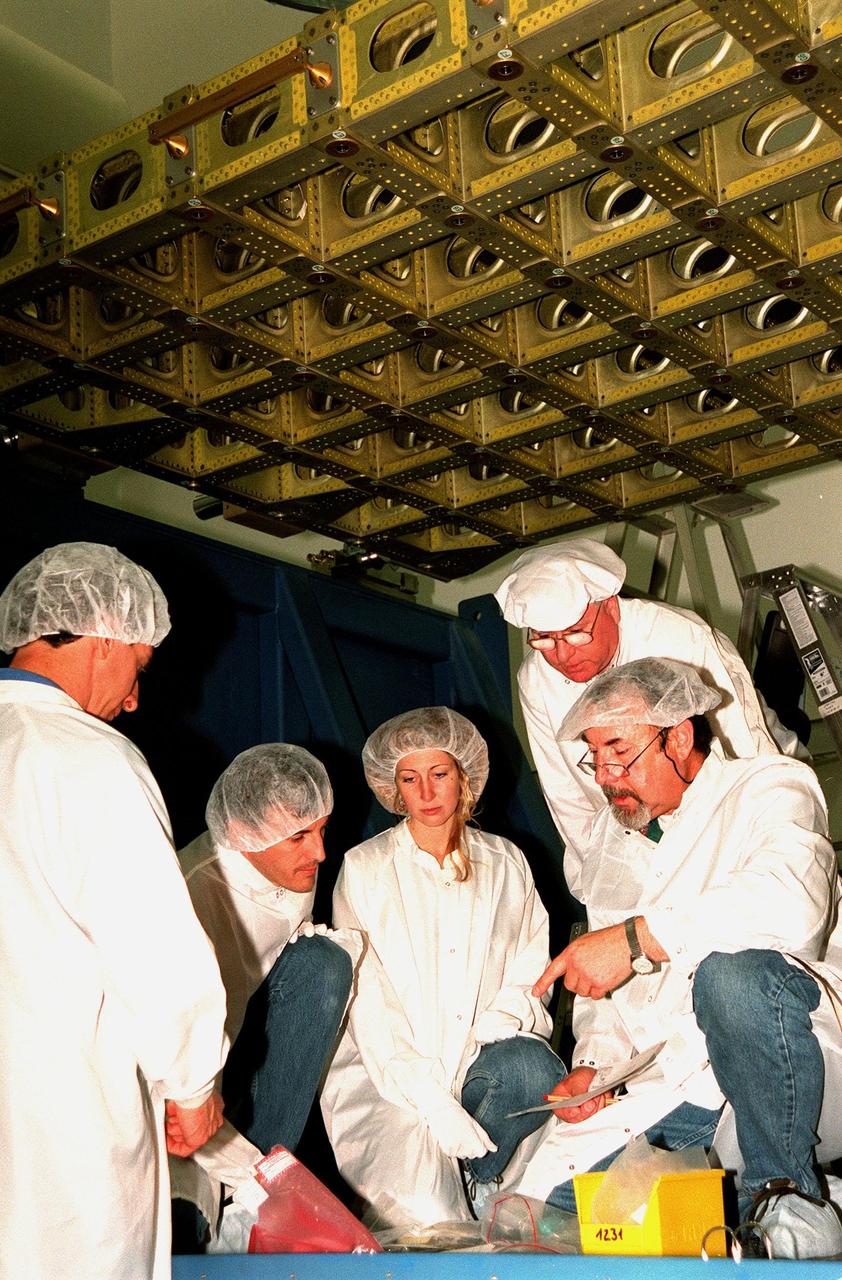
At Astrotech, Titusville, Fla., discussing the International Cargo Carrier (ICC) overhead are Charles Franca, with Johnson Space Center (JSC); Robert Wilkes, with Lockheed Martin; Lora Lawrence, with JSC; Carl Figiel and Harald Schnier, with Daimler-Chrysler Aerospace (DASA). The nonpressurized ICC fits inside the payload bay of the orbiter. The ICC will carry the SPACEHAB Oceaneering Space System Box (SHOSS), a logistics items carrier. SHOSS can hold a maximum of 400 pounds of equipment and will carry items to be used during STS-96 and future ISS assembly flights. Also aboard the ICC will be the ORU Transfer Device (OTD), a U.S.-built crane that will be stowed on Unity for use during future ISS assembly missions. The ICC will fly on mission STS-96, targeted for launch on May 20
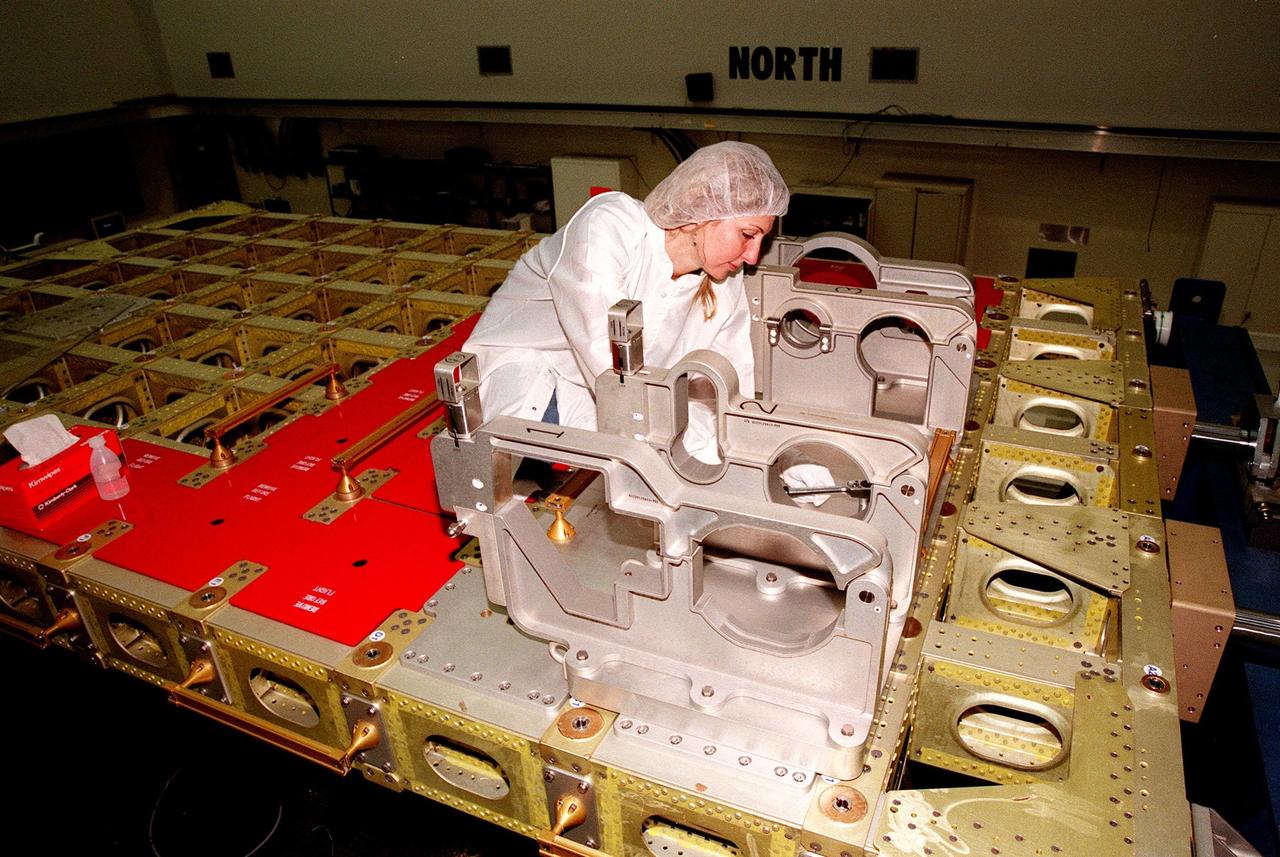
At Astrotech, Titusville, Fla., Lora Lawrence, with Johnson Space Center, makes a bonding check on the International Cargo Carrier that will be used during future International Space Station (ISS) assembly missions. The nonpressurized ICC fits inside the payload bay of the orbiter. The ICC will carry the SPACEHAB Oceaneering Space System Box (SHOSS), a logistics items carrier. SHOSS can hold a maximum of 400 pounds of equipment and will carry items to be used during STS-96 and future ISS assembly flights. Also aboard the ICC will be the ORU Transfer Device (OTD), a U.S.-built crane that will be stowed on Unity for use during future ISS assembly missions. The ICC will fly on mission STS-96, targeted for launch on May 20
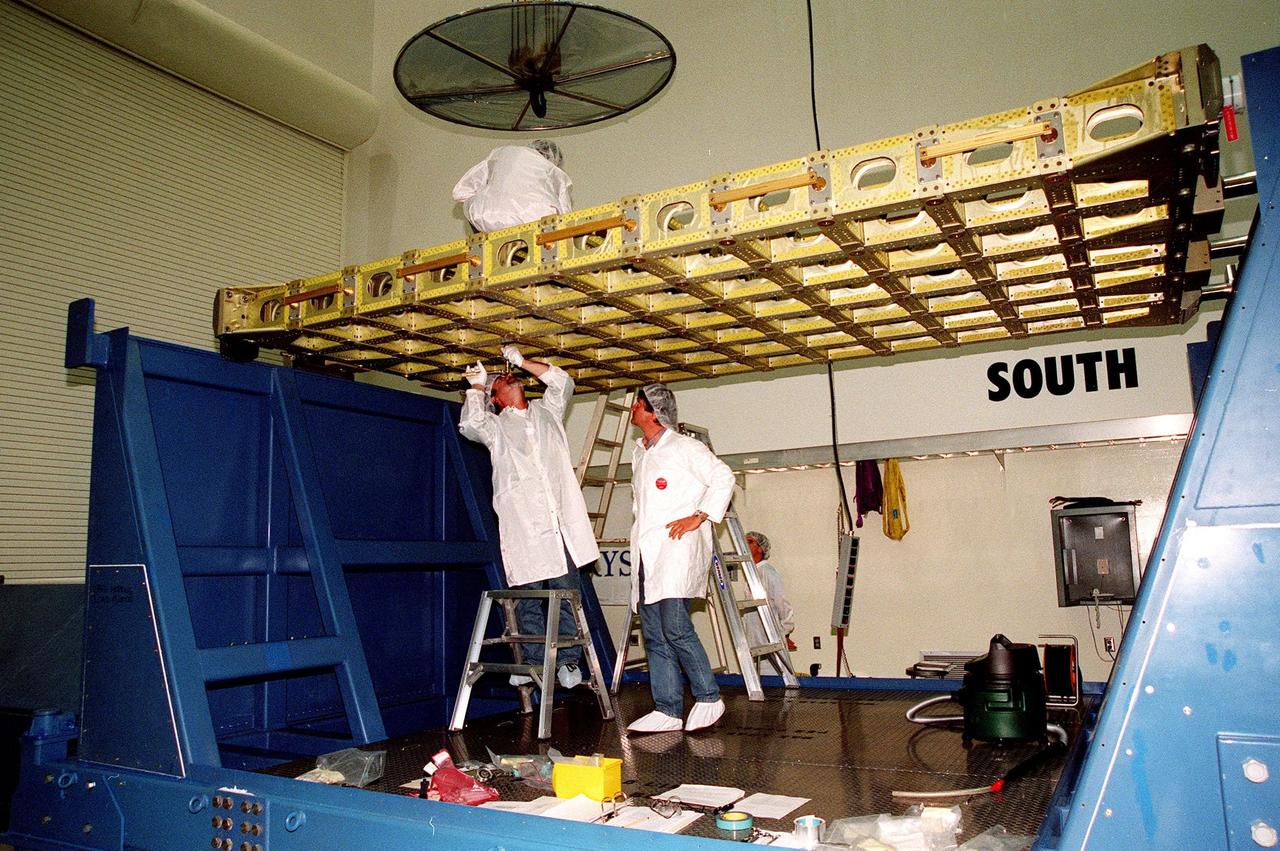
At Astrotech, Titusville, Fla., Harald Schnier and Manfred Nordhoff, with Daimler-Chrysler Aerospace (DASA), look over the International Cargo Carrier that will be used during future International Space Station (ISS) assembly missions. On top is Robert Wilkes, with Lockheed Martin. Behind the ladder in the background is Ben Greene, with Lockheed Martin. The nonpressurized ICC fits inside the payload bay of the orbiter. The ICC will carry the SPACEHAB Oceaneering Space System Box (SHOSS), a logistics items carrier. SHOSS can hold a maximum of 400 pounds of equipment and will carry items to be used during STS-96 and future ISS assembly flights. Also aboard the ICC will be the ORU Transfer Device (OTD), a U.S.-built crane that will be stowed on Unity for use during future ISS assembly missions. The ICC will fly on mission STS-96, targeted for launch on May 20
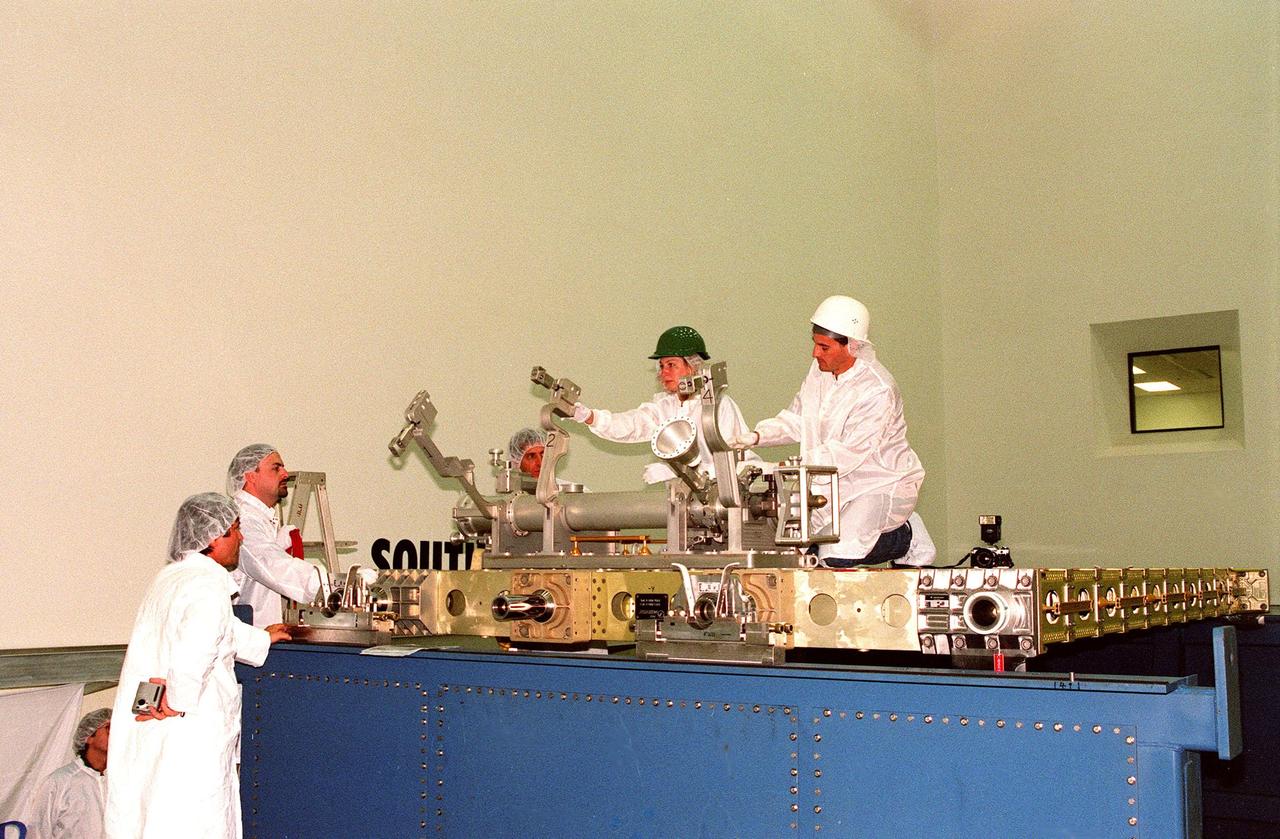
An ORU Transfer Device (OTD) on top of the International Cargo Carrier (ICC) is checked by Manfred Nordhoff, with Daimler-Chrysler Aerospace (DASA); Ben Greene, with Lockheed Martin; Robert Wilkes (behind arm number two), with Lockheed Martin; Lora Laurence and Charles Franca, with Johnson Space Center. The OTD is a U.S.-built crane that will be stowed on the International Space Station's Unity module for use during future ISS assembly missions. The nonpressurized ICC fits inside the payload bay of the orbiter. The ICC will also carry the SPACEHAB Oceaneering Space System Box (SHOSS), a logistics items carrier. SHOSS can hold a maximum of 400 pounds of equipment and will carry items to be used during STS-96 and future ISS assembly flights. The ICC will fly on mission STS-96, targeted for launch on May 20
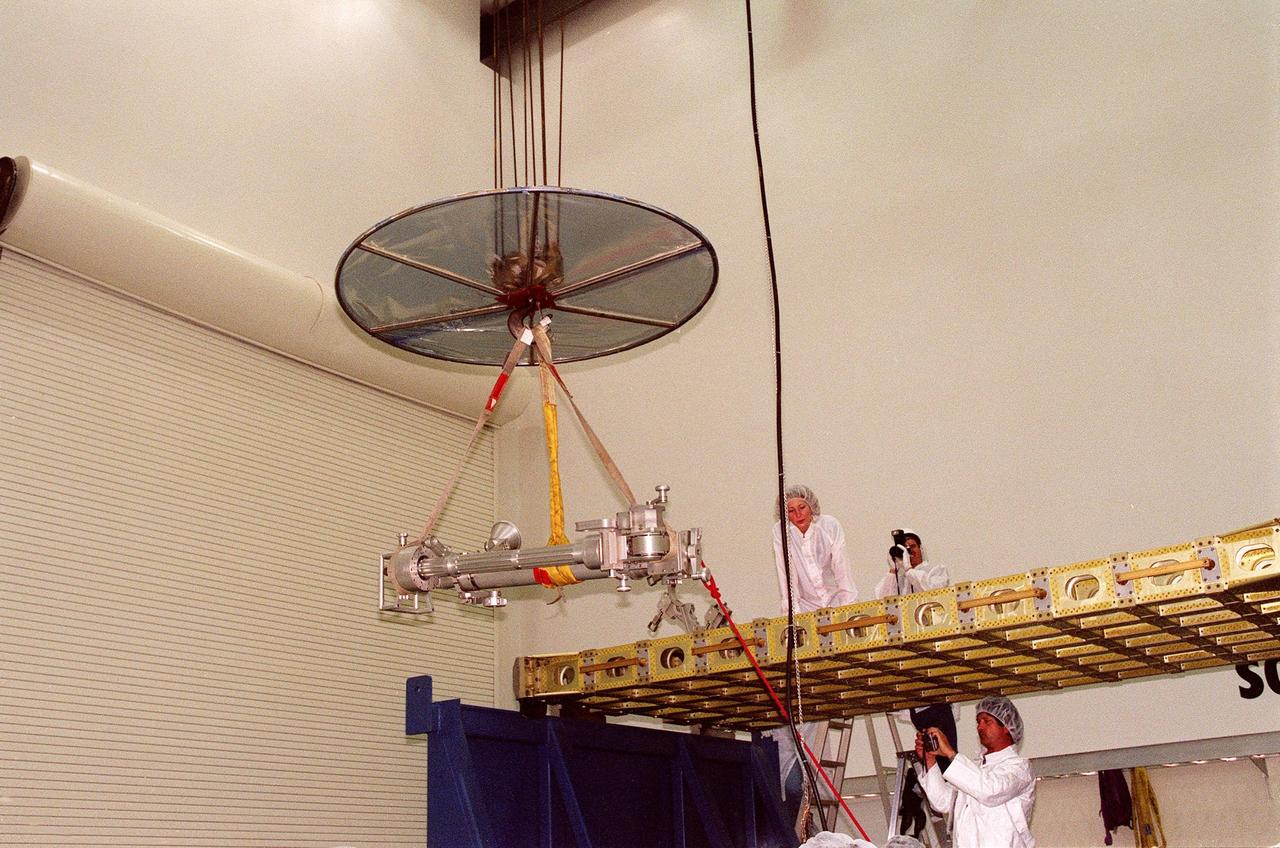
At Astrotech, Titusville, Fla., three workers watch as the overhead crane lifts and moves the ORU Transfer Device (OTD) to the top of the International Cargo Carrier (ICC). From left are Lora Laurence, with Johnson Space Center; Robert Wilkes, with Lockheed Martin; and Manfred Nordhoff, with Daimler-Chrysler Aerospace (DASA). The OTD is a U.S.-built crane that will be stowed on the International Space Station's Unity module for use during future ISS assembly missions. The nonpressurized ICC fits inside the payload bay of the orbiter. The ICC will also carry the SPACEHAB Oceaneering Space System Box (SHOSS), a logistics items carrier. SHOSS can hold a maximum of 400 pounds of equipment and will carry items to be used during STS-96 and future ISS assembly flights. The ICC will fly on mission STS-96, targeted for launch on May 20
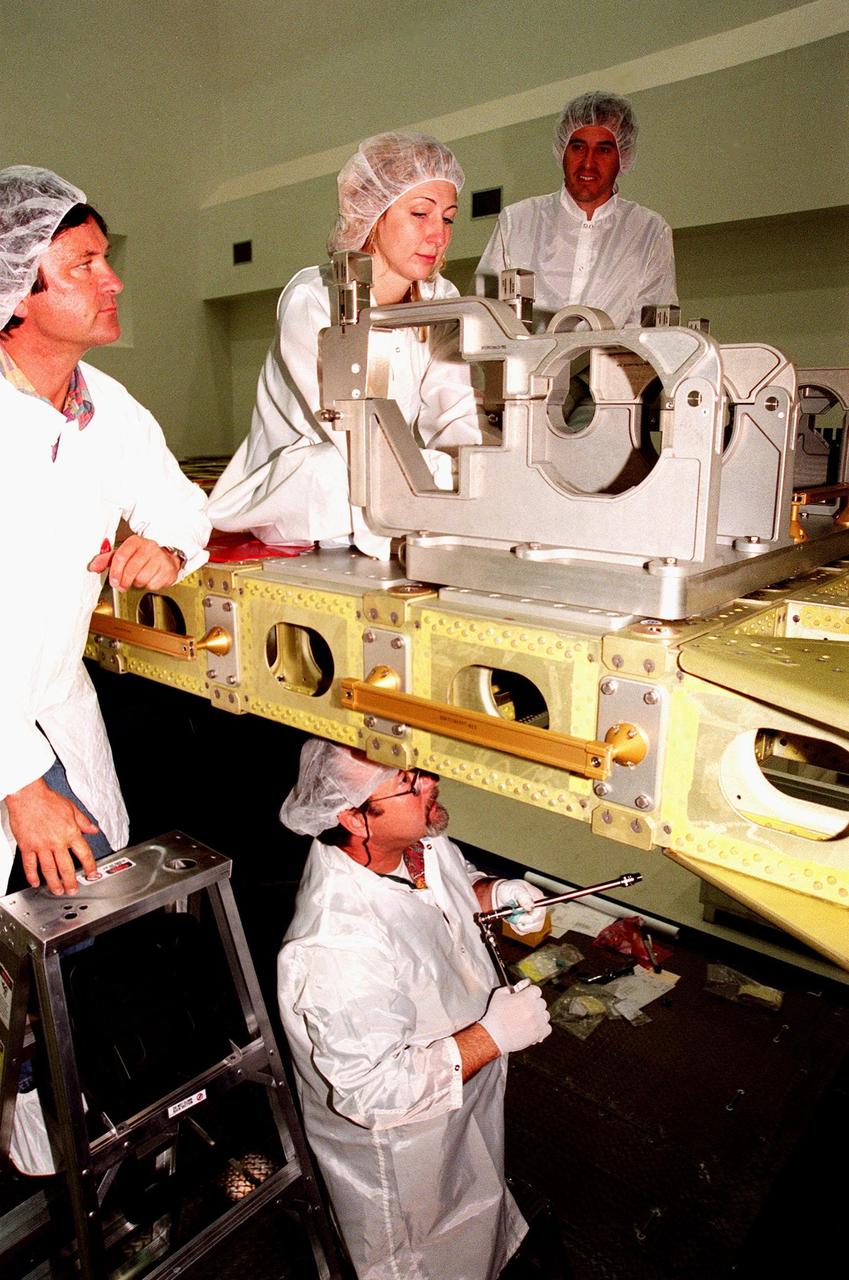
At Astrotech, Titusville, Fla., checking the International Cargo Carrier that will be used during future International Space Station (ISS) assembly missions are (left to right) Manfred Nordhoff, with Daimler-Chrysler Aerospace (DASA); Lora Lawrence, with Johnson Space Center; Robert Wilkes, with Lockheed Martin; and (below) Harald Schnier, with DASA. The ICC fits inside the payload bay of the orbiter. The ICC will carry the SPACEHAB Oceaneering Space System Box (SHOSS), a logistics items carrier. SHOSS can hold a maximum of 400 pounds of equipment and will carry items to be used during STS-96 and future ISS assembly flights. Also aboard the ICC will be the ORU Transfer Device (OTD), a U.S.-built crane that will be stowed on Unity for use during future ISS assembly missions. The ICC will fly on mission STS-96, targeted for launch on May 20
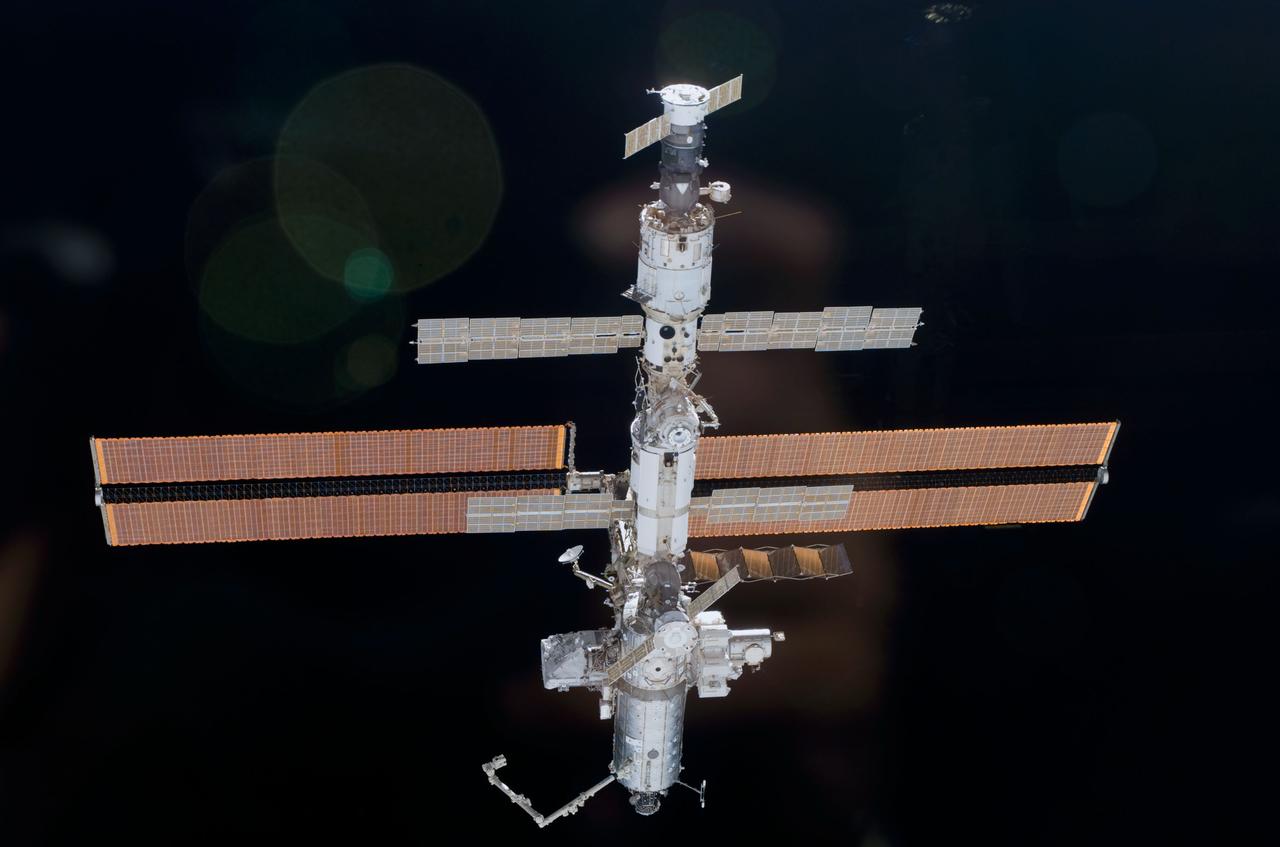
STS110-E-5918 (17 April 2002) --- This is one a series of digital still images of the International Space Station (ISS) recorded by the STS-110 crew members on board the Space Shuttle Atlantis following the undocking of the two spacecraft some 247 statute miles above the North Atlantic. Atlantis pulled away from the complex at 1:31 p.m. (CDT). After more than a week of joint operations between the shuttle and station crews, astronaut Stephen N. Frick, pilot, backed Atlantis away to a distance of about 400 feet in front of the station, where he began a 1 1/4 lap flyaround of the ISS, newly equipped with the 27,000 pound S0 (S-zero) truss, visible in this series of images. S0 is the first segment of a truss structure which will ultimately expand the station to the length of a football field.
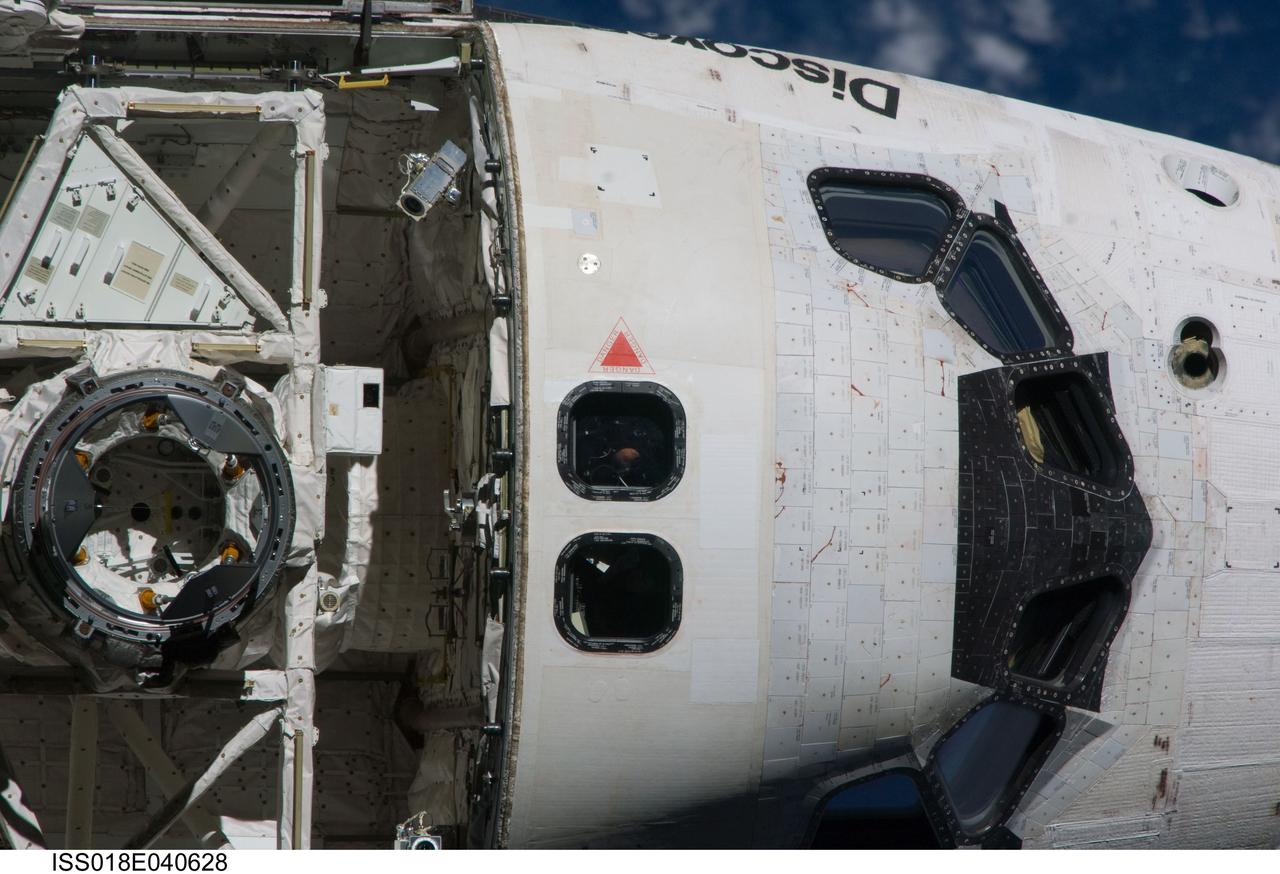
ISS018-E-040628 (17 March 2009) --- An overhead close-up view of the exterior of Space Shuttle Discovery's crew cabin, part of its payload bay and docking system was provided by Expedition 18 crewmembers on the International Space Station. Before docking with the station, astronaut Lee Archambault, STS-119 commander, flew the shuttle through a Rendezvous Pitch Maneuver or basically a backflip to allow the space station crew a good view of Discovery's heat shield. Using digital still cameras equipped with both 400 and 800 millimeter lenses, the ISS crewmembers took a number of photos of the shuttle's thermal protection system and sent them down to teams on the ground for analysis. A 800 millimeter lens was used for this image.
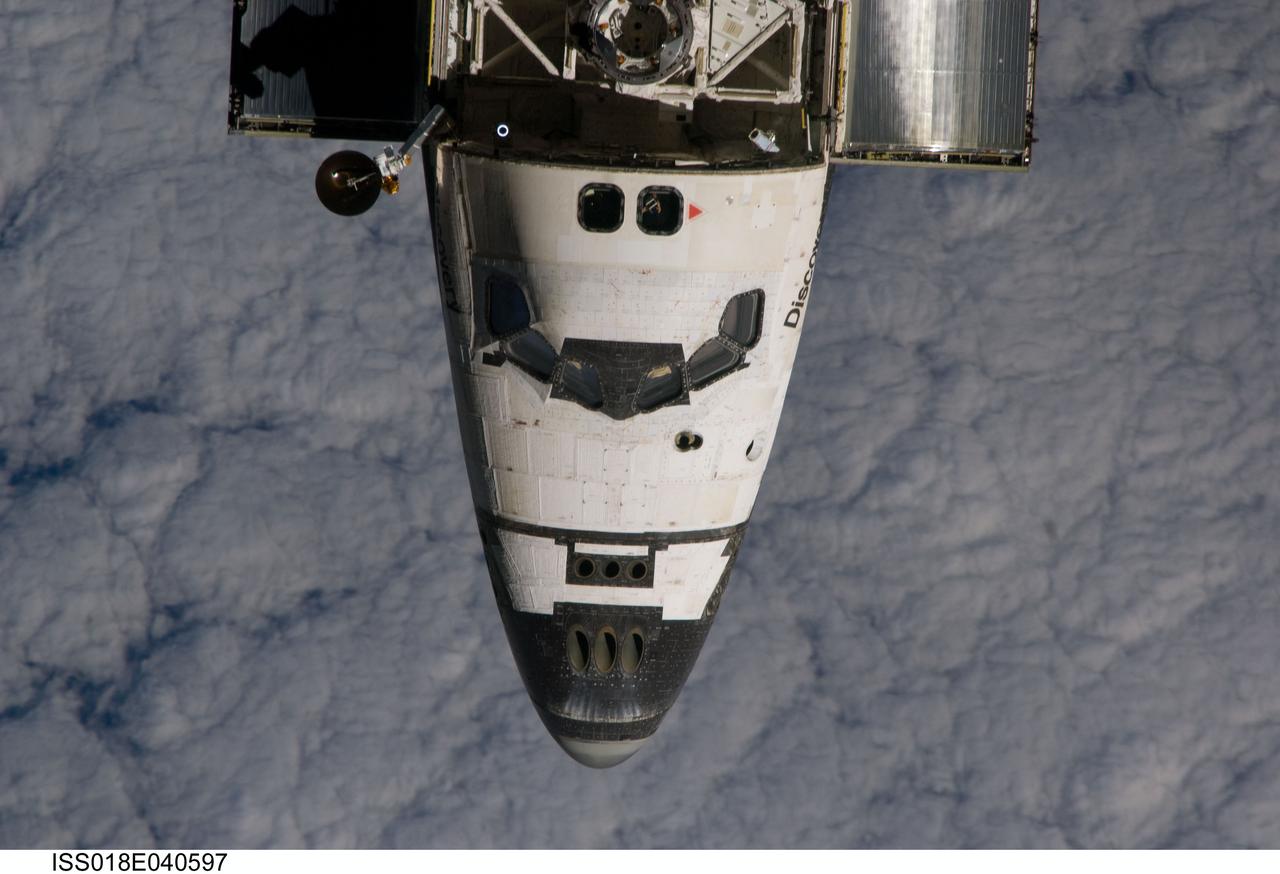
ISS018-E-040597 (17 March 2009) --- An overhead view of the exterior of Space Shuttle Discovery's crew cabin, part of its payload bay doors and docking system was provided by Expedition 18 crewmembers on the International Space Station. Before docking with the station, astronaut Lee Archambault, STS-119 commander, flew the shuttle through a Rendezvous Pitch Maneuver or basically a backflip to allow the space station crew a good view of Discovery's heat shield. Using digital still cameras equipped with both 400 and 800 millimeter lenses, the ISS crewmembers took a number of photos of the shuttle's thermal protection system and sent them down to teams on the ground for analysis. A 800 millimeter lens was used for this image.
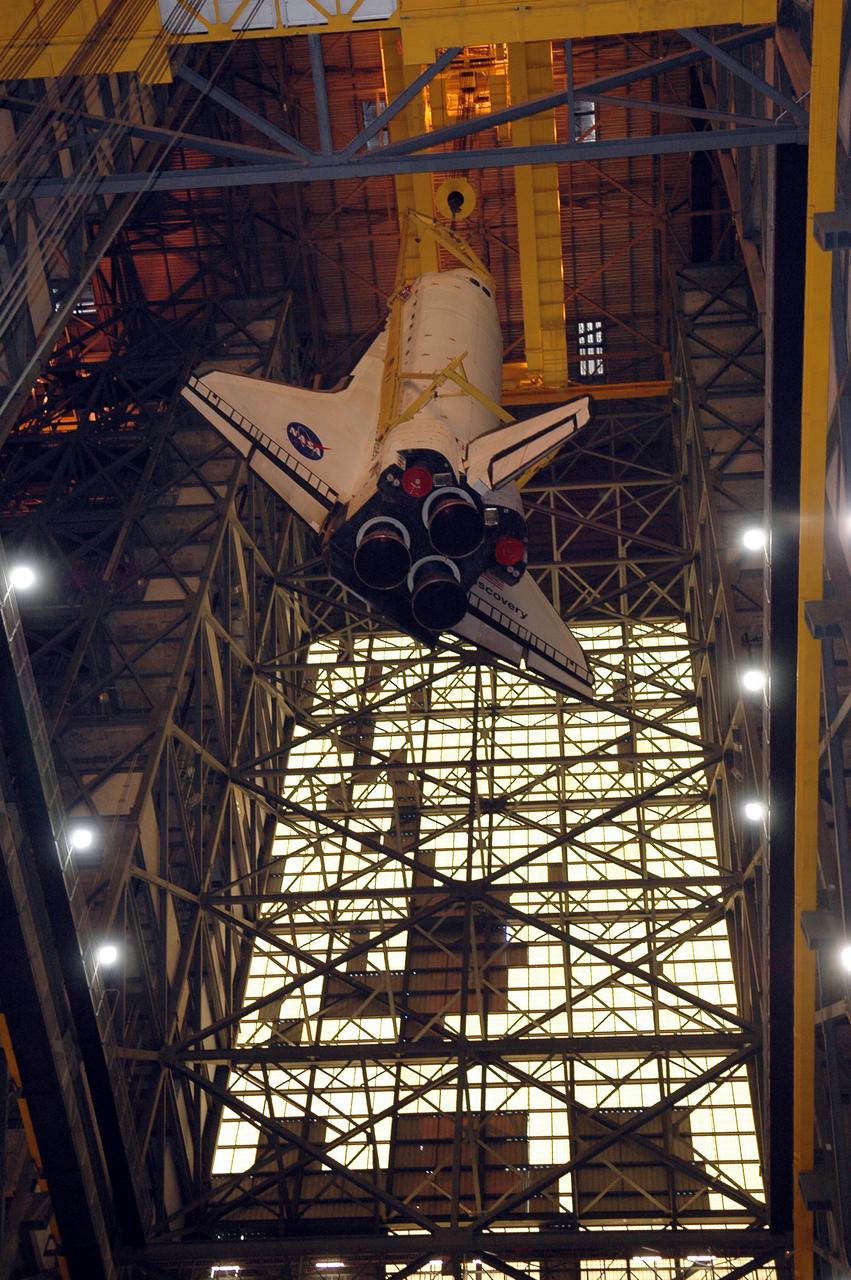
KENNEDY SPACE CENTER, FLA. - This view from high bay 1 of the Vehicle Assembly Building renders the 122-foot-long orbiter Discovery a dwarfed appearance as it hangs suspended more than 400 feet above the floor. Discovery has been lifted up and away from its 154-foot-high External Tank and Solid Rocket Boosters. After demating from its External Tank (ET), the orbiter will be placed on a transporter in the transfer aisle and moved to high bay 3 for remating with another tank, ET-121. Discovery is expected to be rolled back to the launch pad in mid-June for Return to Flight mission STS-114. The launch window extends from July 13 to July 31.
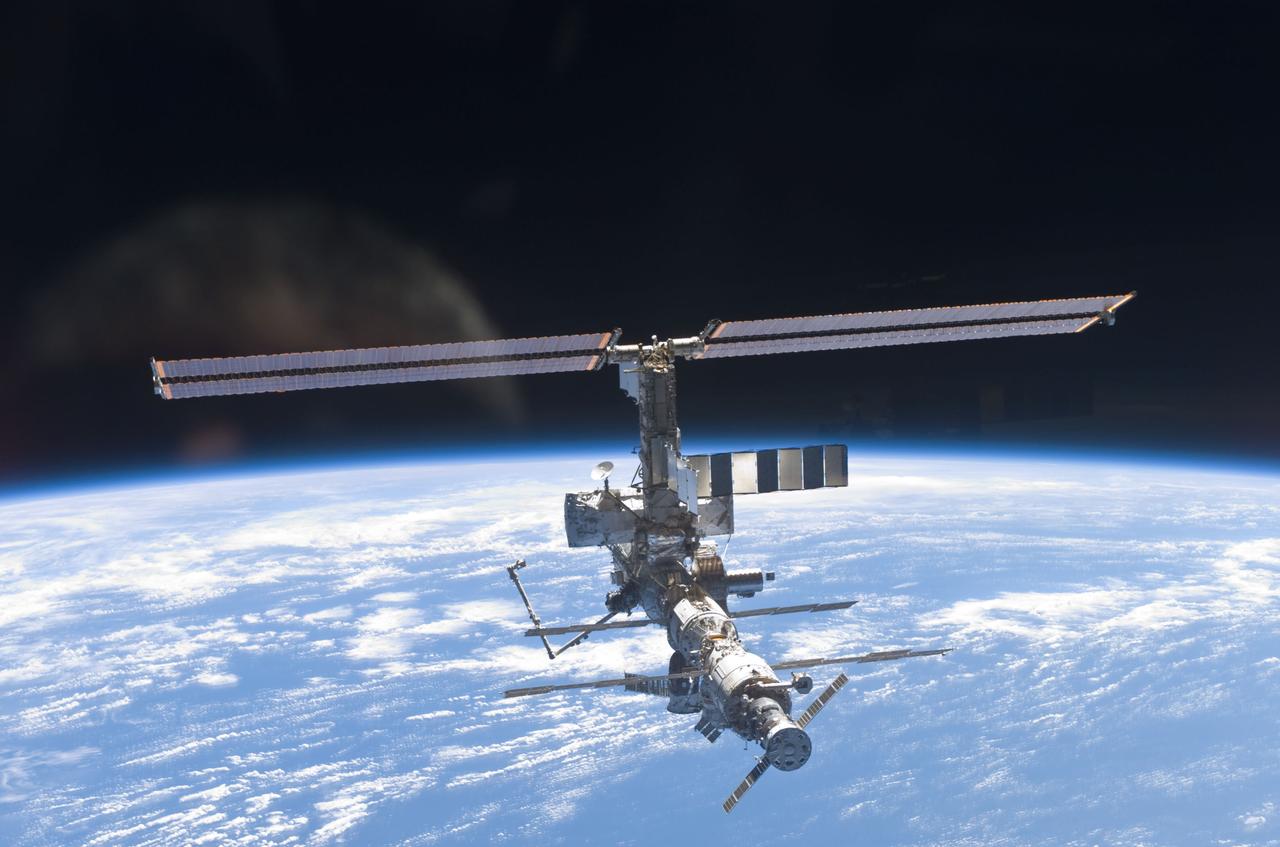
STS110-E-6058 (17 April 2002) --- This is one a series of digital still images of the International Space Station (ISS) recorded by the STS-110 crew members on board the Space Shuttle Atlantis following the undocking of the two spacecraft some 247 statute miles above the North Atlantic. Atlantis pulled away from the complex at 1:31 p.m. (CDT). After more than a week of joint operations between the shuttle and station crews, astronaut Stephen N. Frick, pilot, backed Atlantis away to a distance of about 400 feet in front of the station, where he began a 1 1/4 lap flyaround of the ISS, newly equipped with the 27,000 pound S0 (S-zero) truss, visible in this series of images. S0 is the first segment of a truss structure which will ultimately expand the station to the length of a football field.
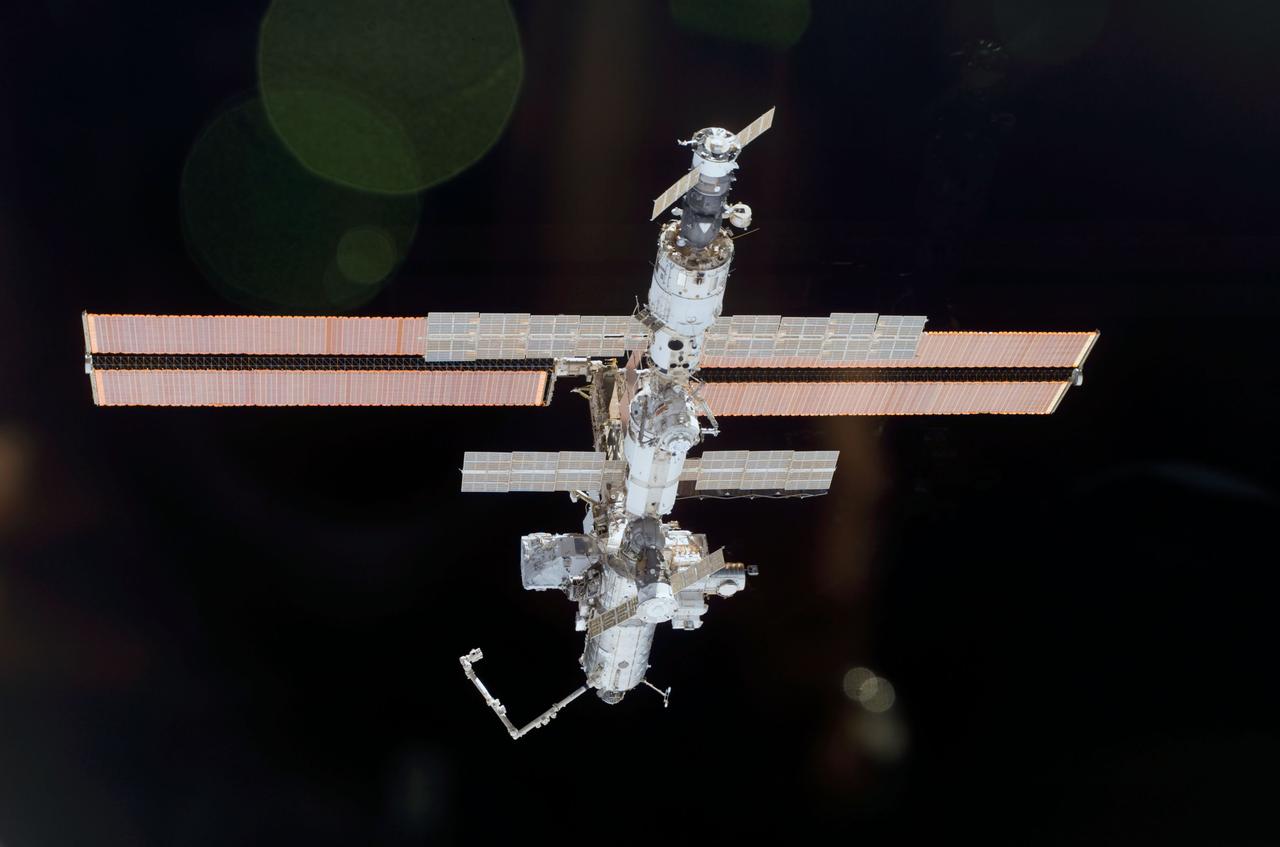
STS110-E-5912 (17 April 2002) --- This is one a series of digital still images of the International Space Station (ISS) recorded by the STS-110 crew members on board the Space Shuttle Atlantis following the undocking of the two spacecraft some 247 statute miles above the North Atlantic. Atlantis pulled away from the complex at 1:31 p.m. (CDT). After more than a week of joint operations between the shuttle and station crews, astronaut Stephen N. Frick, pilot, backed Atlantis away to a distance of about 400 feet in front of the station, where he began a 1 1/4 lap flyaround of the ISS, newly equipped with the 27,000 pound S0 (S-zero) truss, visible in this series of images. S0 is the first segment of a truss structure which will ultimately expand the station to the length of a football field.

At Astrotech, Titusville, Fla., an umbrella-topped crane is secured to an ORU Transfer Device (OTD), a U.S.-built crane that will be stowed on the International Space Station's Unity module for use during future ISS assembly missions. Gathered around the OTD and crane are (left to right) Ben Greene (kneeling), with Lockheed Martin; Michael Slataper, with Ratheon; Charles Franca, with Johnson Space Center; Robert Wilkes, with Lockheed Martin; Manfred Nordhoff (back to camera), with Daimler-Chrysler Aerospace (DASA); and Carl Figiel and Harald Schnier (far right), both with (DASA). The OTD will be attached to the nonpressurized International Cargo Carrier (ICC) in the background. The ICC fits inside the payload bay of the orbiter. The ICC will also carry the SPACEHAB Oceaneering Space System Box (SHOSS), a logistics items carrier. SHOSS can hold a maximum of 400 pounds of equipment and will carry items to be used during STS-96 and future ISS assembly flights. The ICC will fly on mission STS-96, targeted for launch on May 20

ISS011-E-12401 (10 July 2005) --- Gulf of Finland is featured in this image photographed by an Expedition 11 crew member on the international space station. This strongly oblique view shows the Gulf of Finland and Lake Ladoga in the sunglint of late afternoon. The image was taken from the station when the position of the craft lay north of the Caspian Sea, approximately 2,500 kilometers to the southeast on the Russia–Kazakhstan border. The Neva River appears in sunglint, connecting Lake Ladoga to the gulf. Although not visible, St. Petersburg—the home town of Sergei Krikalev, space station commander when this picture was taken—lies on the Neva River delta. In this view taken with a powerful 400 millimeter lens, sunglint even reveals the causeways to Kotlin Island in the gulf—including some of the details of their construction. Oblique views reveal marked layers of gray haze generated by air pollution, a common sight over Western Europe. Pollution also renders the bright glint areas a copper color.
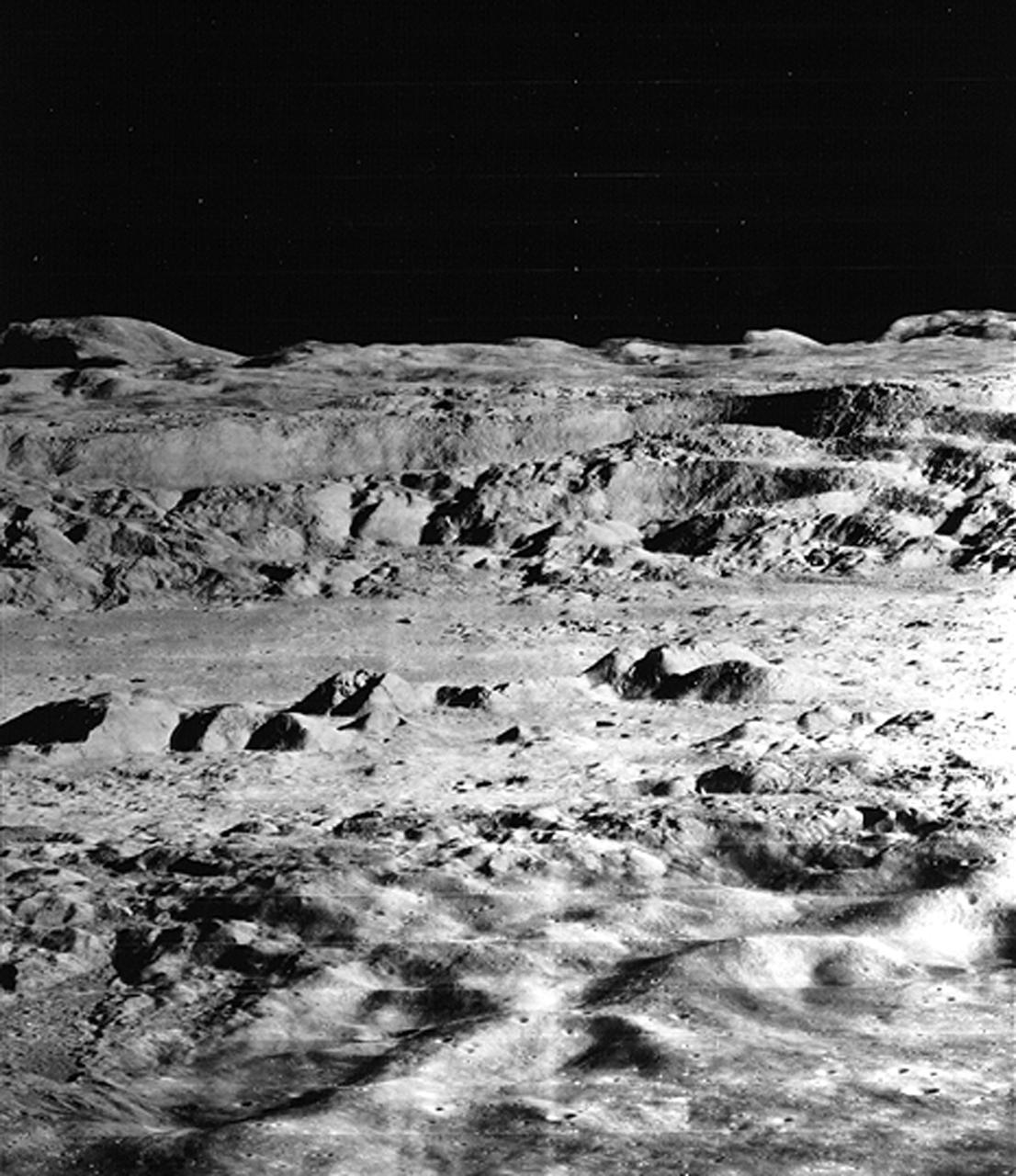
Lunar Orbiter 2 oblique northward view towards Copernicus crater on the Moon shows crater wall slumping caused by soil liquefaction following the impact that formed the crater. The crater is about 100 km in diameter. The central peaks are visible towards the top of the image, rising about 400 m above the crater floor, and stretching for about 15 km. The northern wall of the crater is in the background. Sand and soil grains have faces that can cause friction as they roll and slide against each other, or even cause sticking and form small voids between grains. This complex behavior can cause soil to behave like a liquid under certain conditions such as earthquakes or when powders are handled in industrial processes. MGM experiments aboard the Space Shuttle use the microgravity of space to simulate this behavior under conditions that carnot be achieved in laboratory tests on Earth. MGM is shedding light on the behavior of fine-grain materials under low effective stresses. Applications include earthquake engineering, granular flow technologies (such as powder feed systems for pharmaceuticals and fertilizers), and terrestrial and planetary geology. Nine MGM specimens have flown on two Space Shuttle flights. Another three are scheduled to fly on STS-107. The principal investigator is Stein Sture of the University of Colorado at Boulder. (Credit: University of Colorado at Boulder).
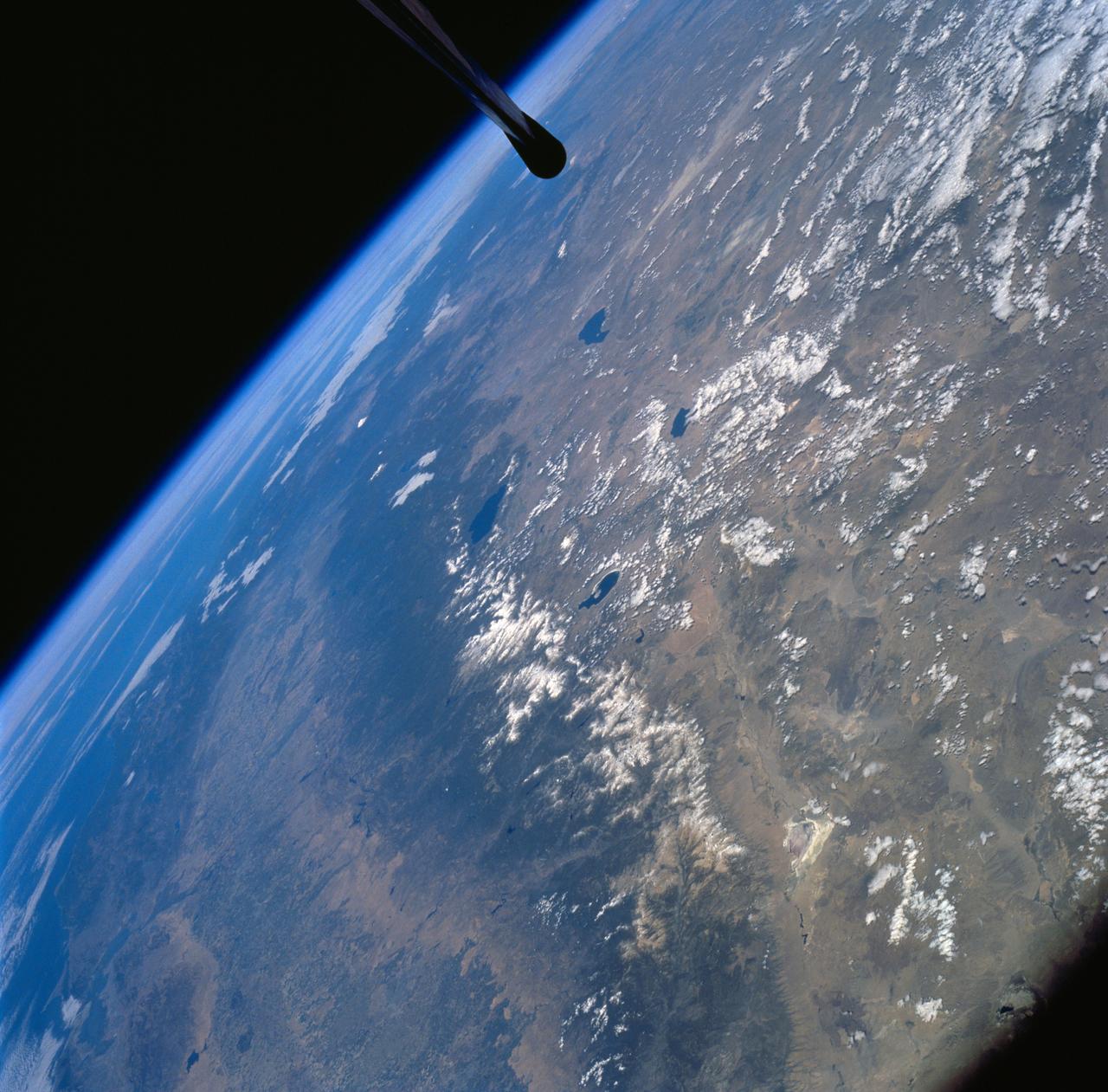
STS058-72-004 (18 Oct-1 Nov 1993) --- The Sierra Nevada Mountain Range can be seen in this north-looking high oblique view taken in October, 1993, by the STS-58 crew. Visible in the view to the west of the Sierra Nevada are the San Joaquin and Sacramento Valleys of central California. The San Francisco/Oakland Bay Area can be seen to the west of the valley at the extreme left of the photograph. To the east or right of the Sierra Nevada, the basin and Range Region of central and northern Nevada is visible. Mono Lake, Lake Tahoe and Pyramid Lake are also visible in this scene. The long northwest/southeast trending Walker Lane Shear Zone, which lies just to the east (right) of the Sierra Nevada is also visible. Near the top of the view (near the horizon), the snow covered volcanic peak Mount Shasta can be seen. Over 645 kilometers (400 miles) long and from 65 to 130 kilometers (40 to 80 miles) wide, the Sierra Nevada have many peaks in excess of 3,300 meters (11,000 feet) above sea level. A titled fault block in structure (the largest in the United States) and shaped by glaciers during the last ice age over 12,000 years ago, the Sierra Nevada eastern front rises sharply from the Great Basin of Nevada, while its western slope descends gradually to the hills bordering the Central Valley of California. Snow-fed streams supply much of the irrigation water to the Central Valley and to western Nevada and also generate hydroelectricity. Recent above normal precipitation (snowfall) of the last two years has helped in alleviating the drought conditions that had prevailed throughout most of California in the mid and late 1980's and early 1990's.
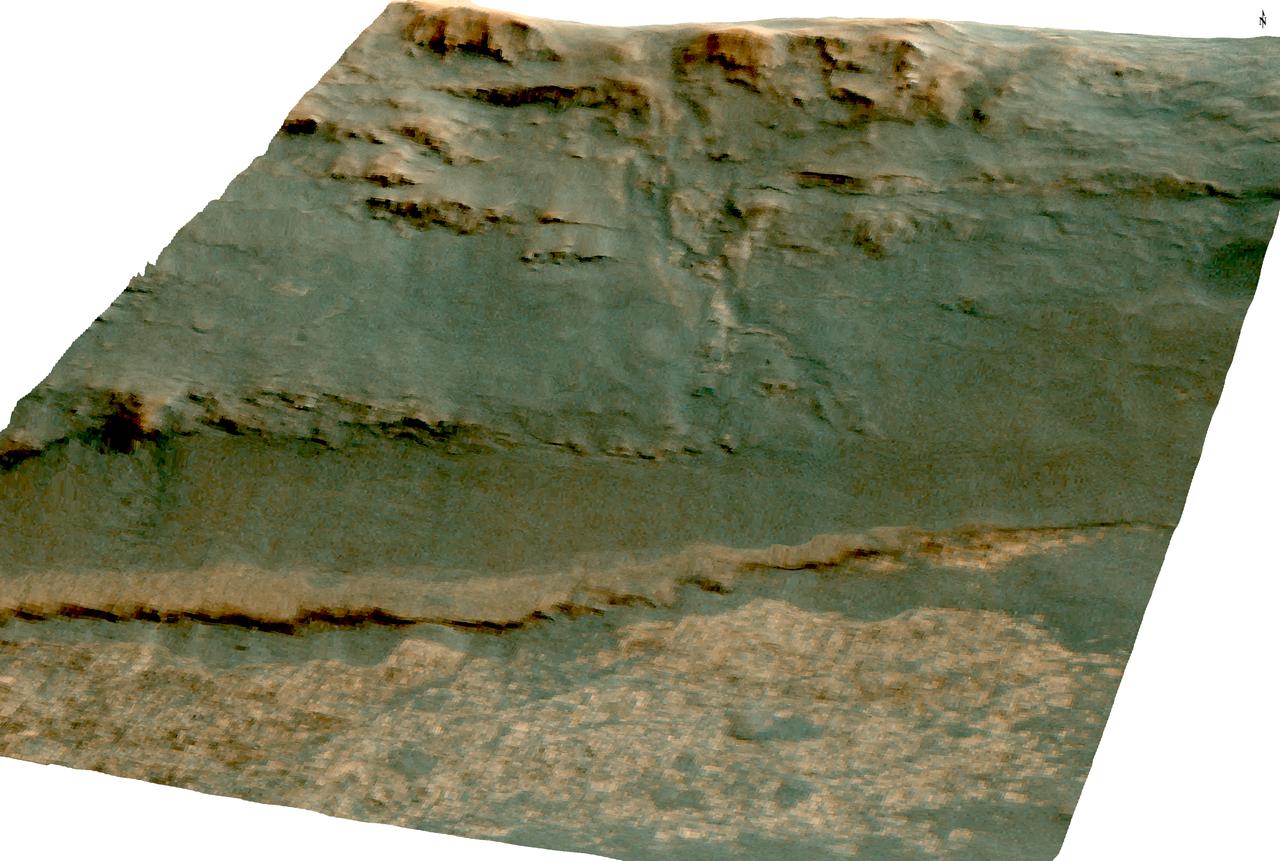
The channel descending a Martian slope in this perspective view is "Perseverance Valley," which is the study area of NASA's Mars Exploration Rover Opportunity as the rover passes its 5,000th sol, or Martian day, of its mission on the surface of Mars. The view was produced by overlaying an image take from orbit onto a topographic model with five-fold vertical exaggeration to emphasize the shapes on the rim of a large crater that have been cut by the valley on the inboard slope of the rim. The image used is from the High Resolution Imaging Science Experiment (HiRISE) camera on NASA's Mars Reconnaissance Orbiter, observation ESP_036753_1775. The crest of a portion of the western rim of Endeavour Crater is at the top of the view, and the floor of the crater is in the foreground, below an erosion-resistant bench perched beneath the valley. The crater is about 14 miles (22 kilometers) in diameter. This perspective view is from within the crater, looking westward. It spans an area about a quarter mile (400 meters) wide from left to right (south to north). The interior rim slopes about 15 to 20 degrees. Figure 1 is an annotated version indicating Perseverance Valley and the bench, plus Opportunity's locations on Sol 5,000 (Feb. 16, 2018) and on Sol 4,958 (Jan. 4, 2018). On Sol 4958, the rover took images with its Navigation Camera and its Hazard Avoidance Camera showing textures of possible stone stripes. The graphic was created at Washington University in St. Louis. A map of a slightly larger portion of the crater rim shows the location of Perseverance Valley and Opportunity's 2017 approach path. As of its Sol 5,000, Opportunity has driven 28 miles (45 kilometers) since its January 2004 landing, in what was planned as a 90-sol mission. https://photojournal.jpl.nasa.gov/catalog/PIA22216