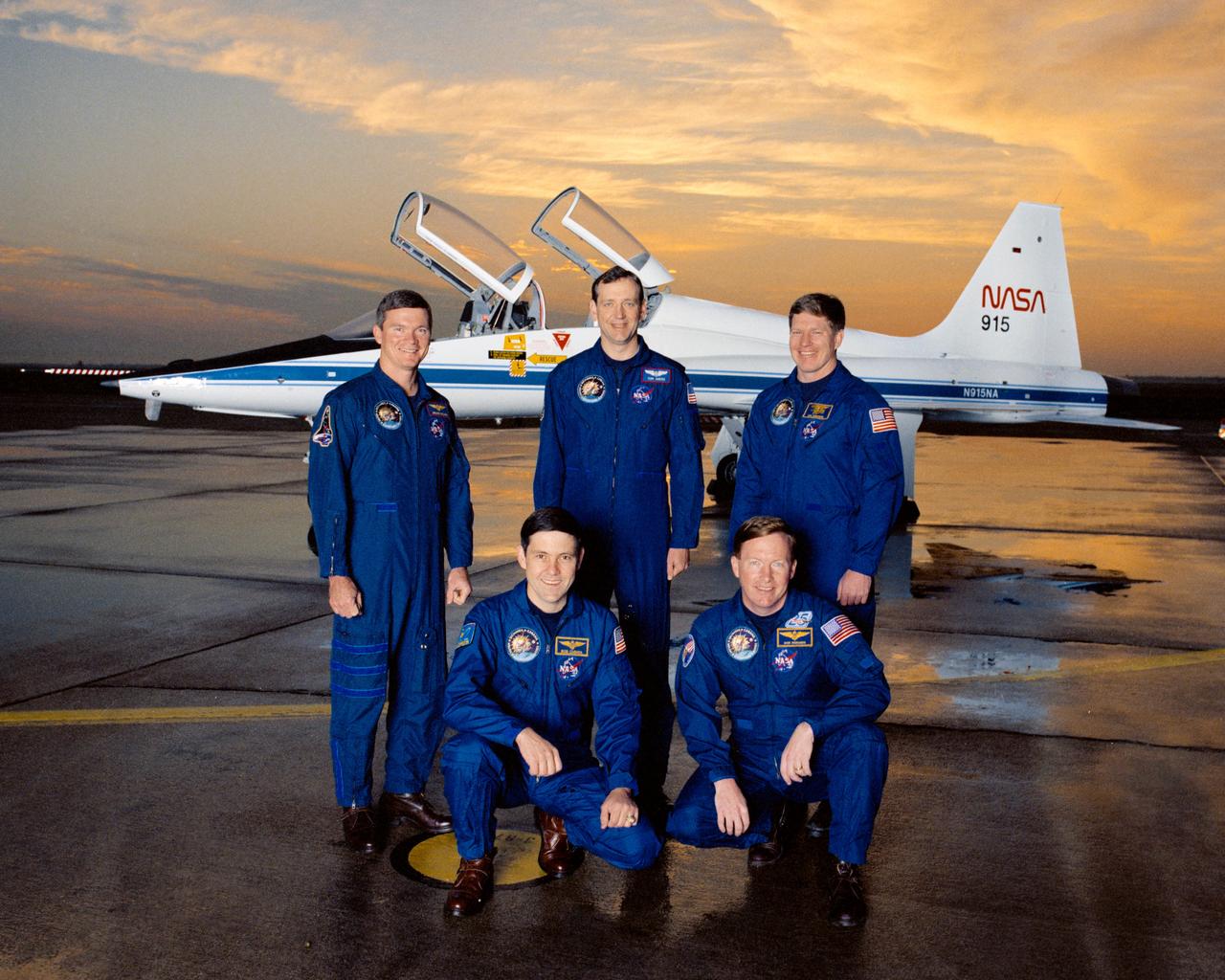
STS041-S-002 (7 May 1990) --- These five astronauts have been assigned to fly the STS-41 mission for the National Aeronautics and Space Administration (NASA). Pictured near the flight line at Ellington Field prior to an early morning flight in NASA T-38s are (kneeling, from the left) Robert D. Cabana, pilot; and Richard N. Richards, mission commander; and (standing, from left) Bruce E. Melnick, Thomas D. Akers and William M. Shepherd, all mission specialists. Primary payload for the Space Shuttle Discovery on the STS 41 mission is Ulysses.
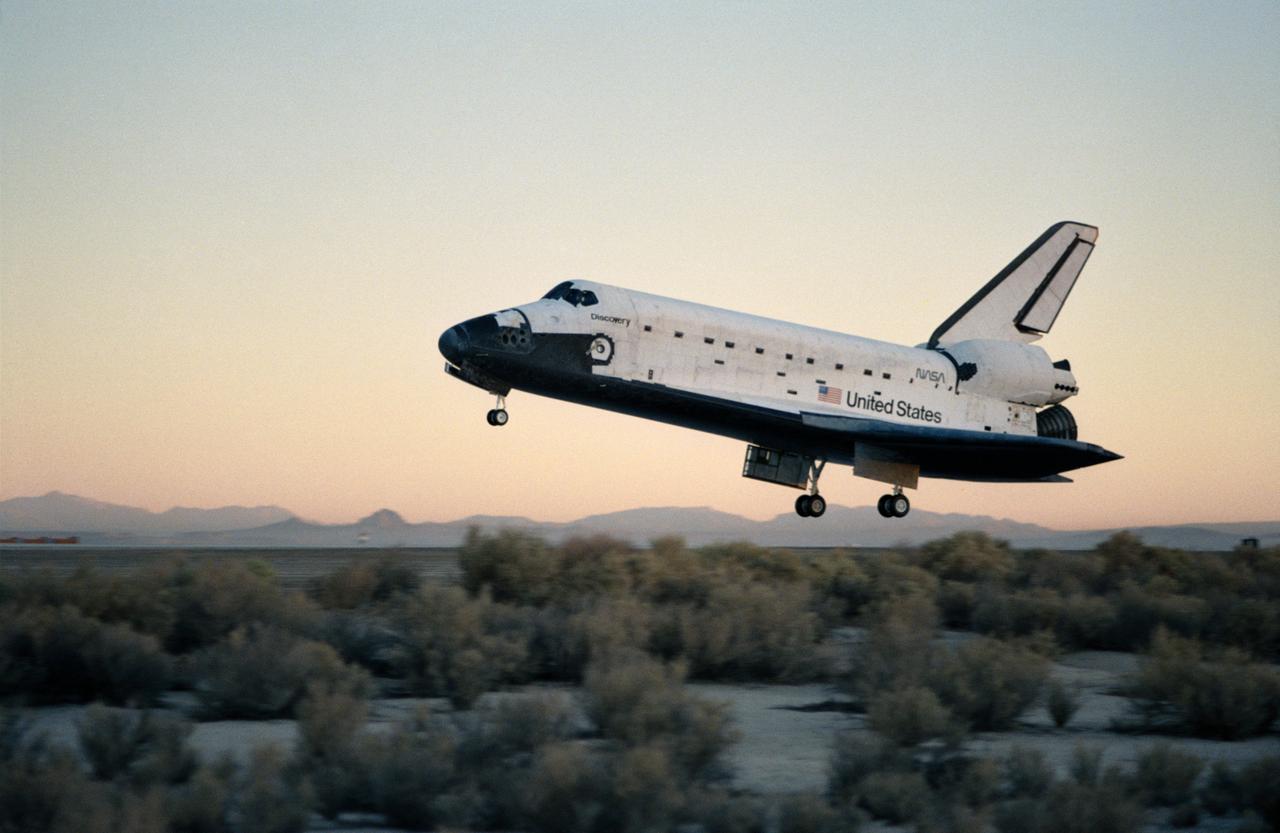
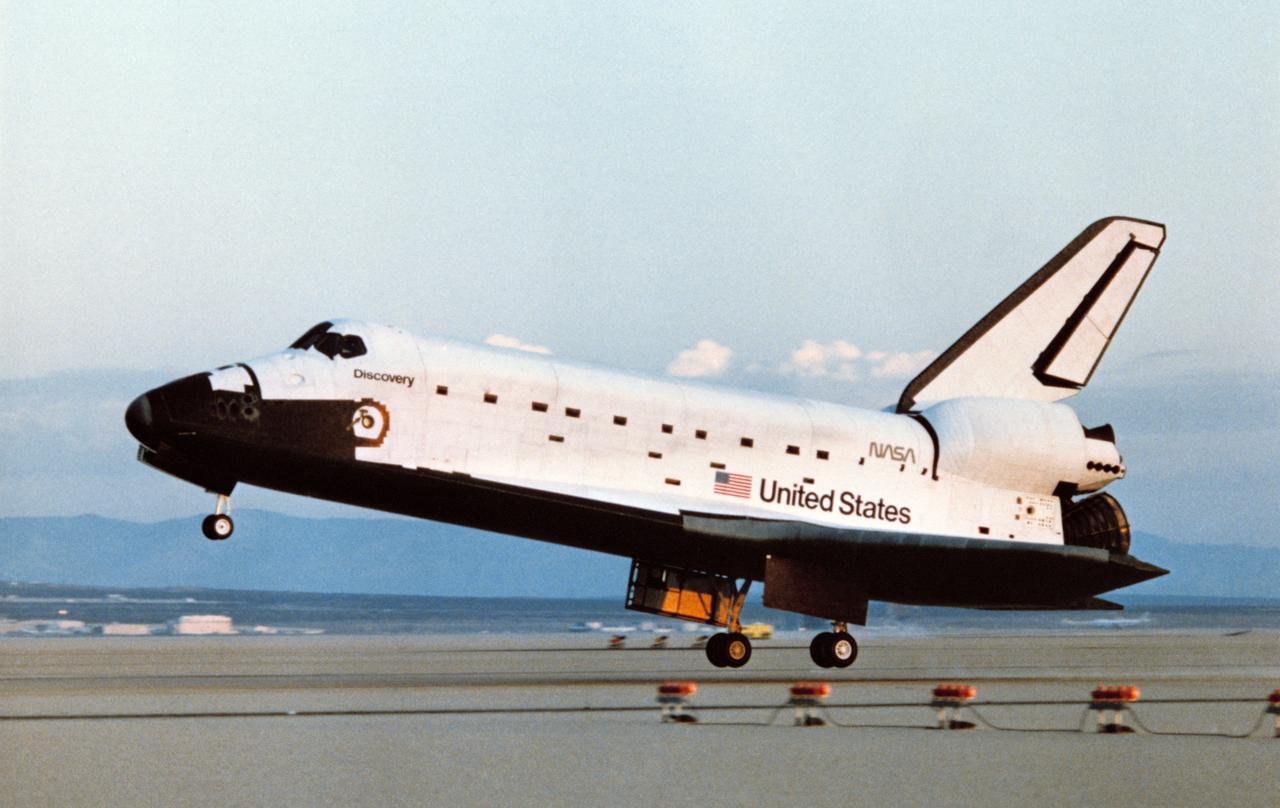
STS-41 Discovery, Orbiter Vehicle (OV) 103, with nose landing gear (NLG) and main landing gear (MLG) deployed, glides over concrete runway 22 at Edwards Air Force Base (EAFB), California, prior to touchdown.
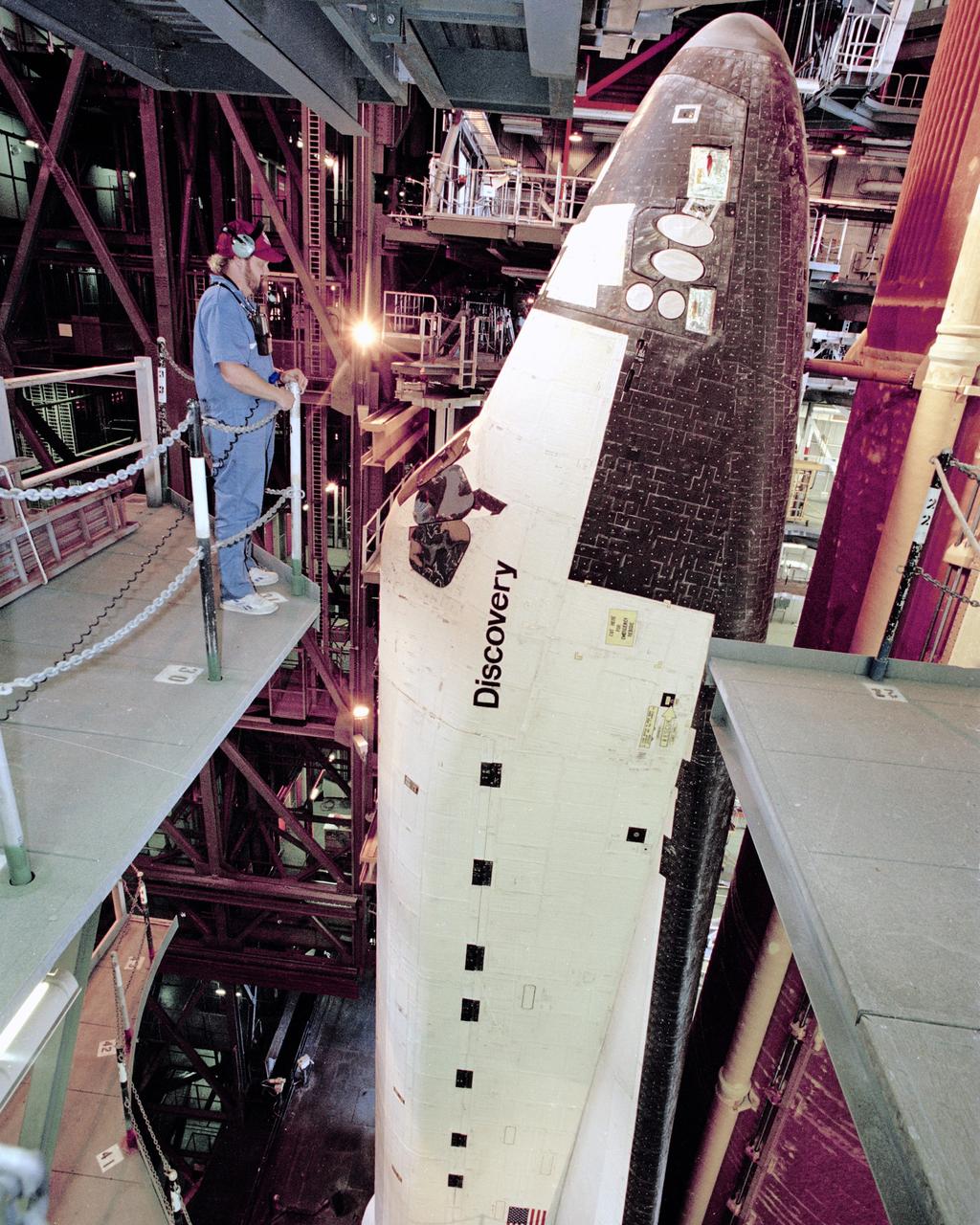
CAPE CANAVERAL, Fla. – The space shuttle Discovery heads out of the VAB to Launch Pad 39B. Discovery is set to leftoff on shuttle mission STS-41, carrying a five-member crew and the Ulysses solar explorer during a launch period extending from Oct. 5 through Oct. 23, 1990. Photo credit: NASA

STS-41 Discovery, Orbiter Vehicle (OV) 103, with nose landing gear (NLG) and main landing gear (MLG) deployed, glides over concrete runway 22 at Edwards Air Force Base (EAFB), California, prior to touchdown.
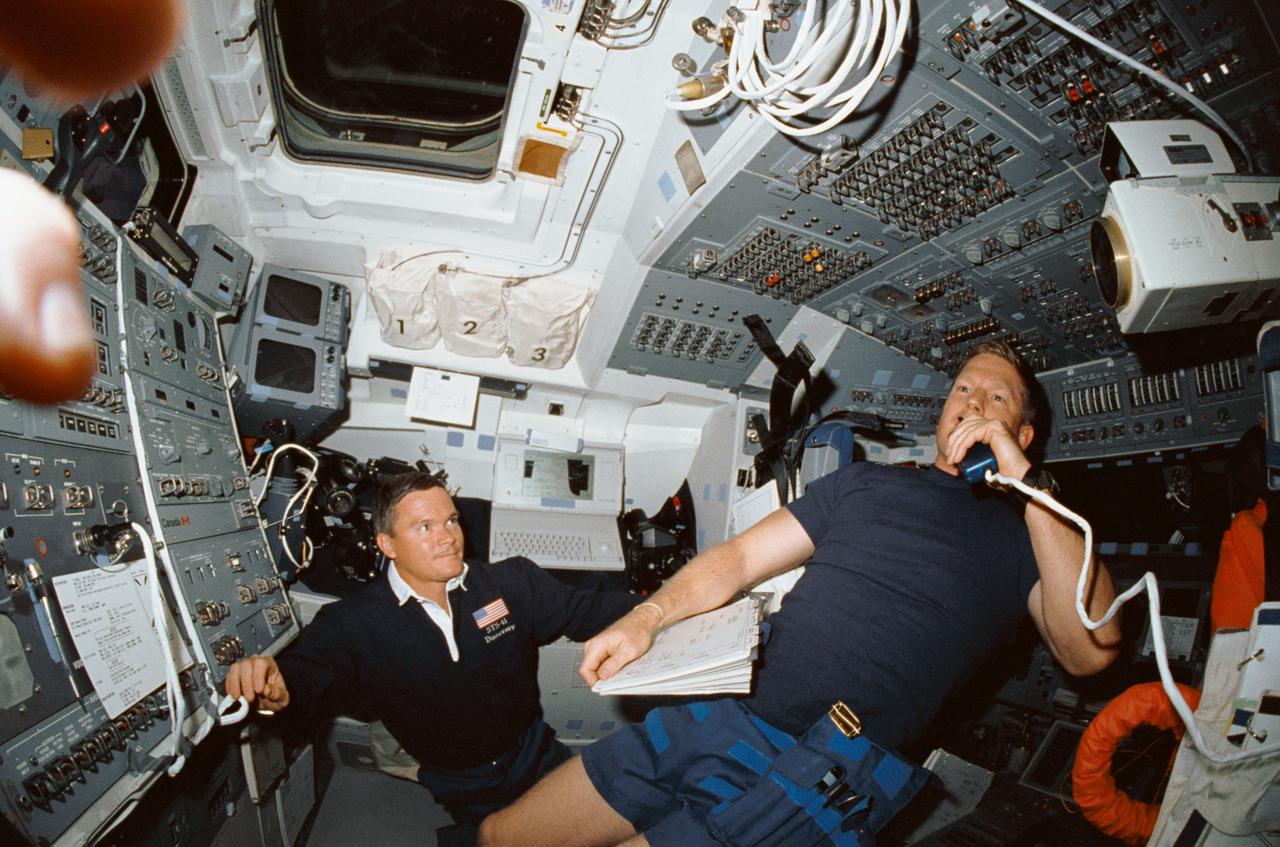
STS041-02-035 (6-10 Oct 1990) --- A fish-eye lens view shows two of STS-41's three mission specialists on the flight deck of Discovery. Astronaut William M. Shepherd, right, communicates with ground controllers as Astronaut Bruce E. Melnick looks on.
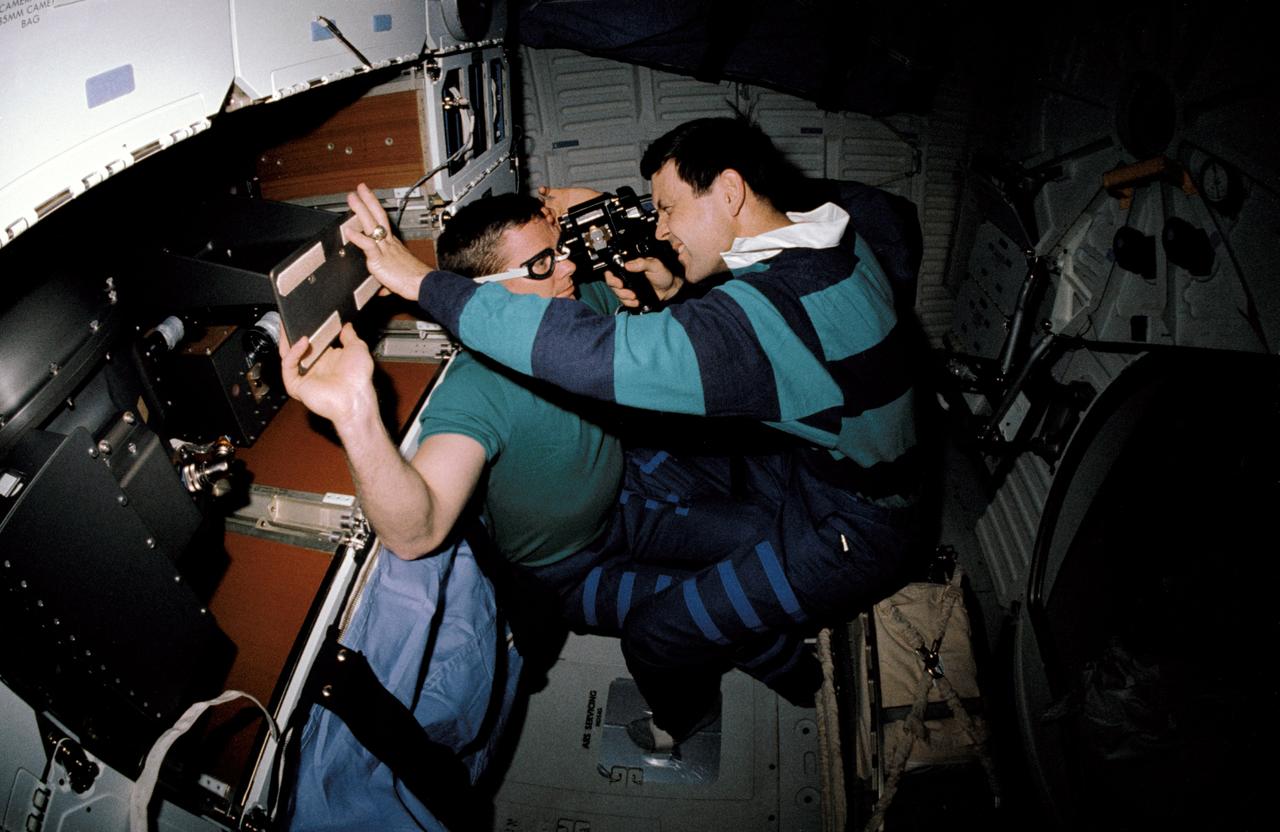
STS041-02-015 (6-10 Oct. 1990) --- A 35mm scene showing astronauts Robert D. Cabana (right), STS-41 pilot, and Bruce E. Melnick, mission specialist, participating in a detailed supplemental objective for STS-41 involving retinal photography. The hypothesis of this experiment is that retinal photographs taken on orbit will show evidence of increased intracranial pressure (ICP) and the evidence of increased ICP and the development of Space Adaptation Syndrome (SAS) will be correlated. SAS has been a subject of on-orbit analysis since the early days of space shuttle.
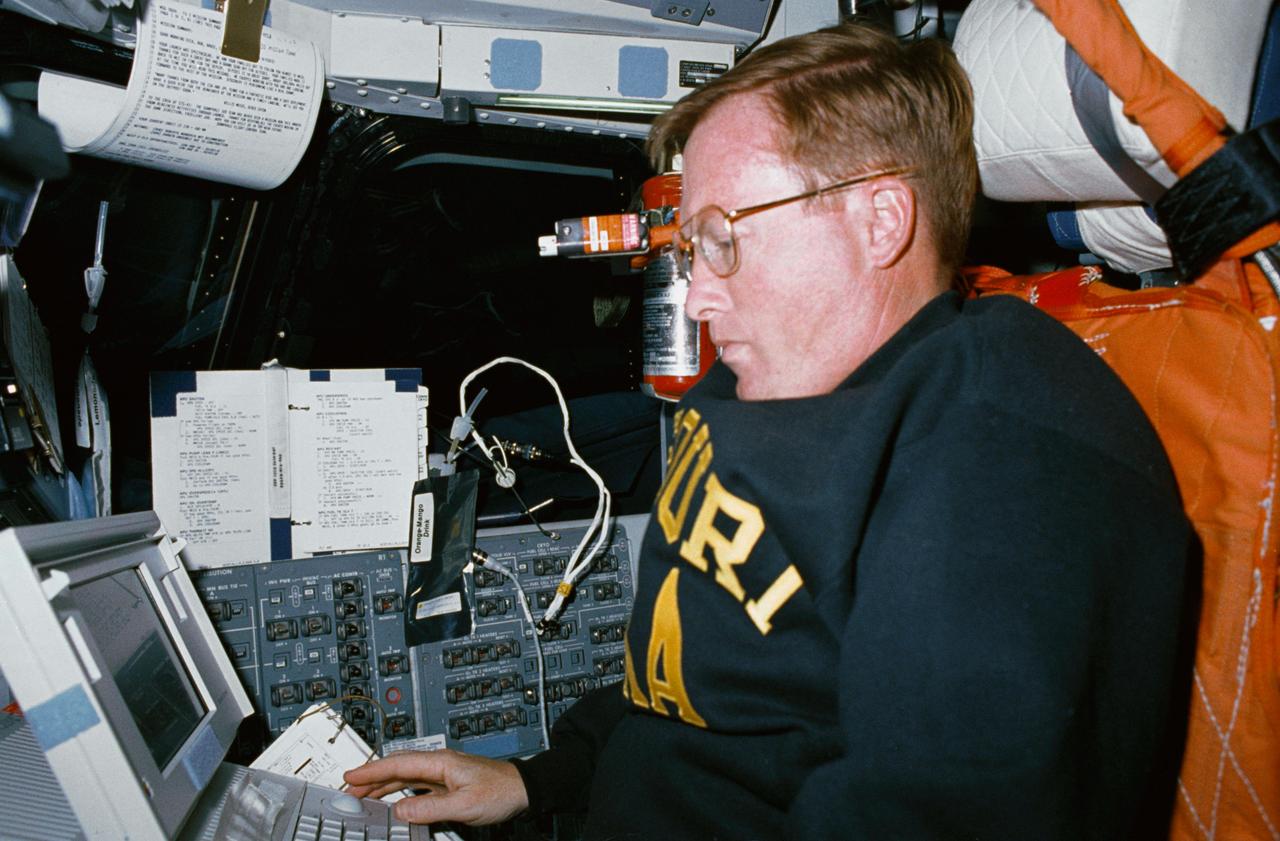
STS041-01-002 (6-10 Oct 1990) --- Astronaut Richard N. Richards, STS 41 mission commander, "borrows" the pilot's station to utilize a Shuttle portable onboard computer during the four-day flight. The photo was made with a 35mm camera.
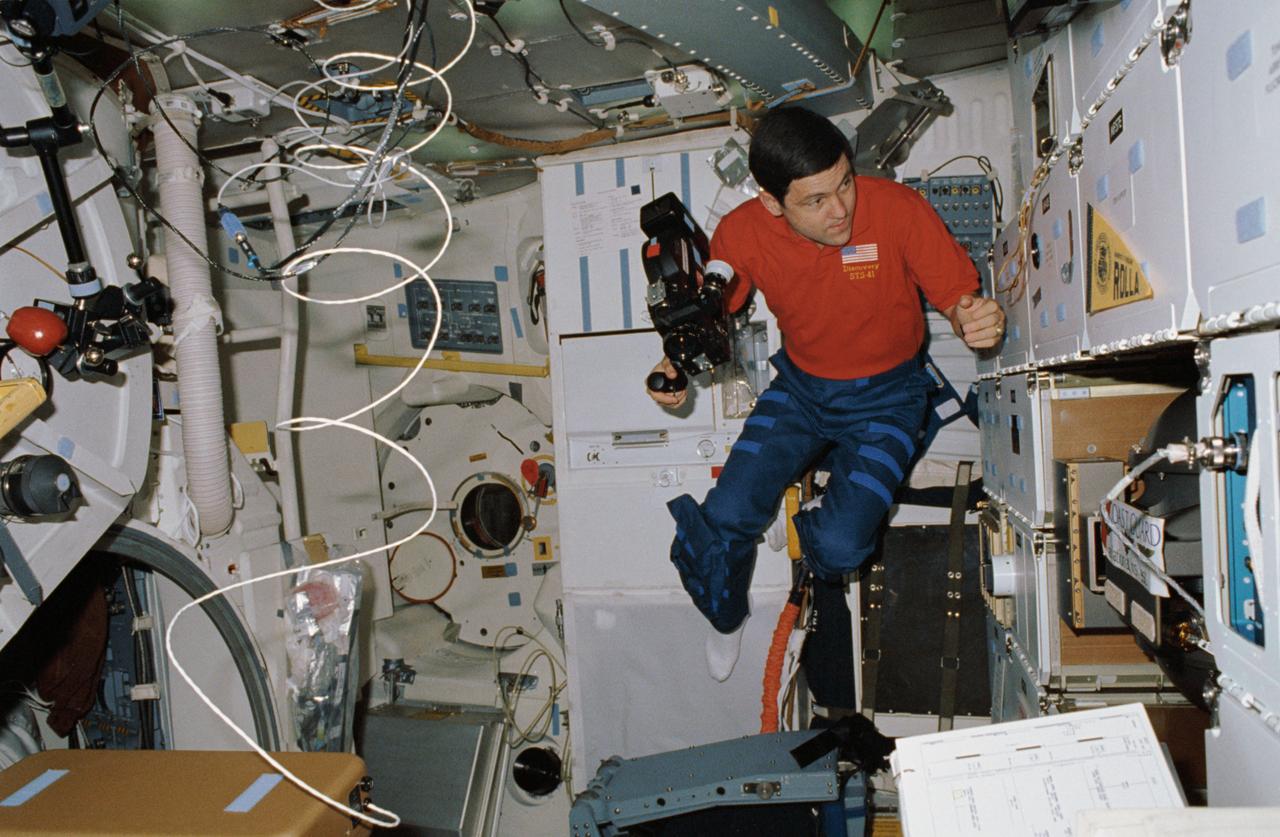
STS041-05-011 (6-10 Oct 1990) --- Astronaut Robert D. Cabana, STS-41 pilot, exhibits the weightlessness of space travel as he appears to "float" about on the middeck of Discovery. Careful inspection of the photo proves that, actually, his floating is limited, as he has anchored his left foot with a special restraint device. He apparently has chosen this vantage point to use the Arriflex motion picture camera in his right hand.
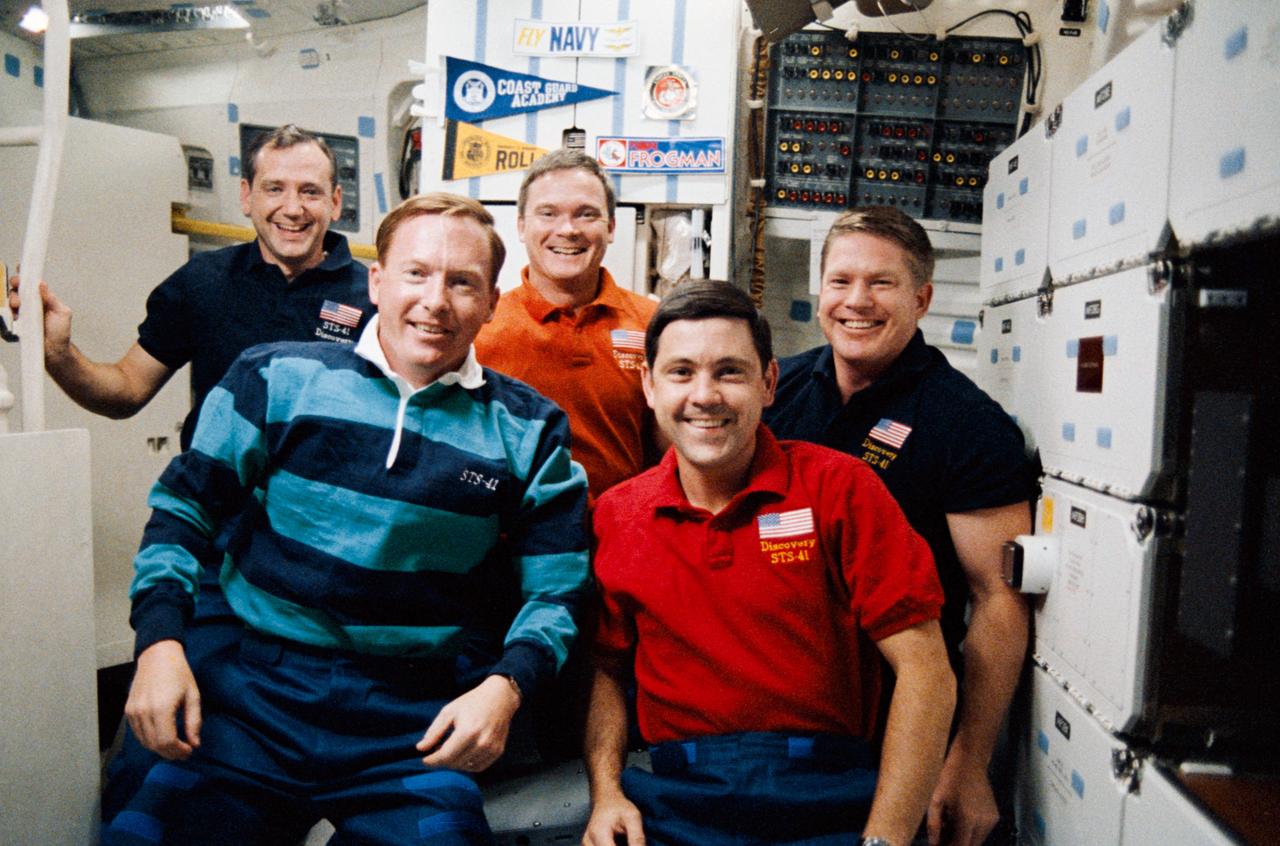
STS041-26-007 (6-10 Oct 1990) --- A 35mm preset camera on Discovery's middeck captures the traditional in-space portrait of the STS-41 crewmembers. In front are (l.-r.) Astronauts Richard N. Richards, mission commander; and Robert D. Cabana, pilot. In the rear are (l.-r.) Astronauts Thomas D. Akers, Bruce E. Melnick and William M. Shepherd.
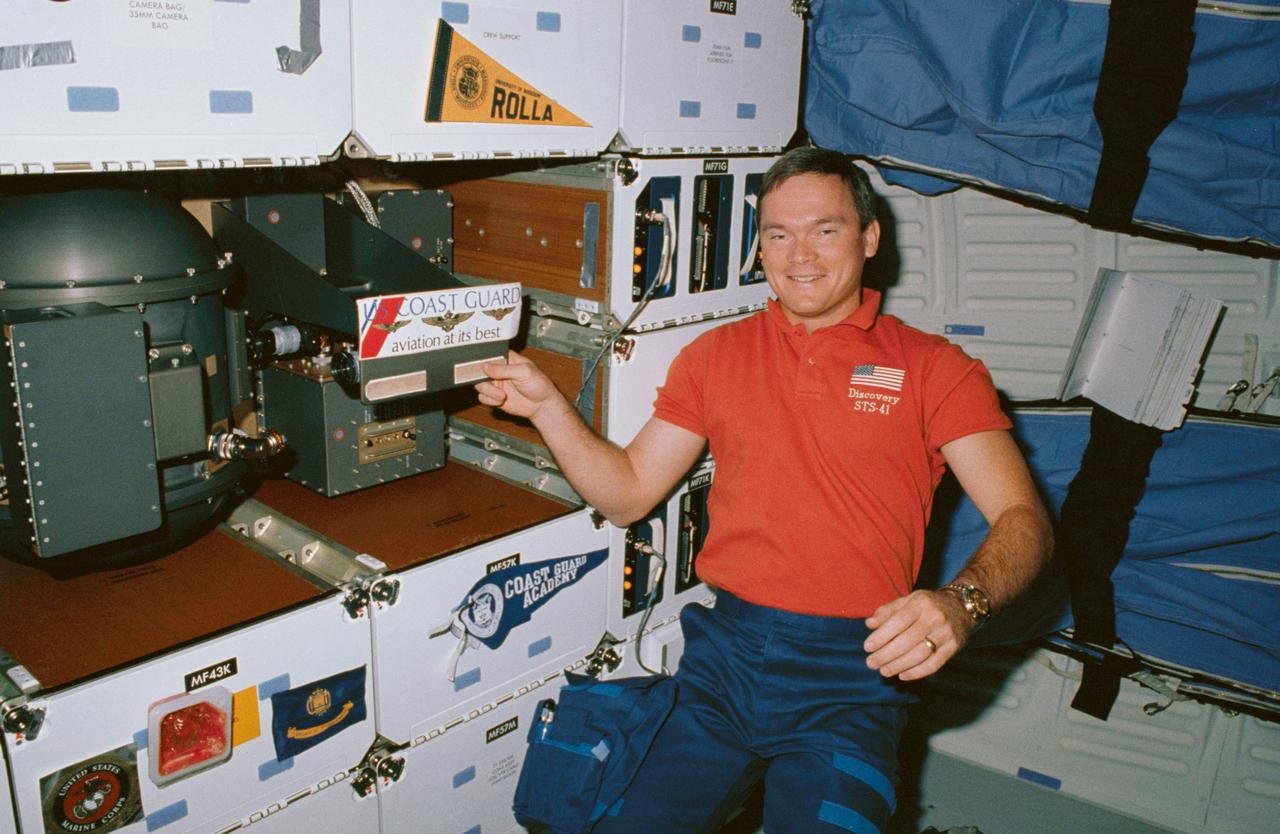
STS041-06-029 (10 Oct 1990) --- STS-41 Mission Specialist (MS) Bruce E. Melnick, who is a graduate of the Coast Guard Academy and the first ever active Coast Guardsman to fly in space, draws attention to his branch of the service, while posing next to a banner from his Alma Mater (on locker MF57K) and a United States (U.S.) Coast Guard decal (on the Solid Surface Combustion Experiment (SSCE)). Behind Melnick are the starboard wall-mounted sleep restraints. Insignias belonging to other crewmembers are displayed on the lockers including University of Missouri Rolla and U.S. Marine Corps.
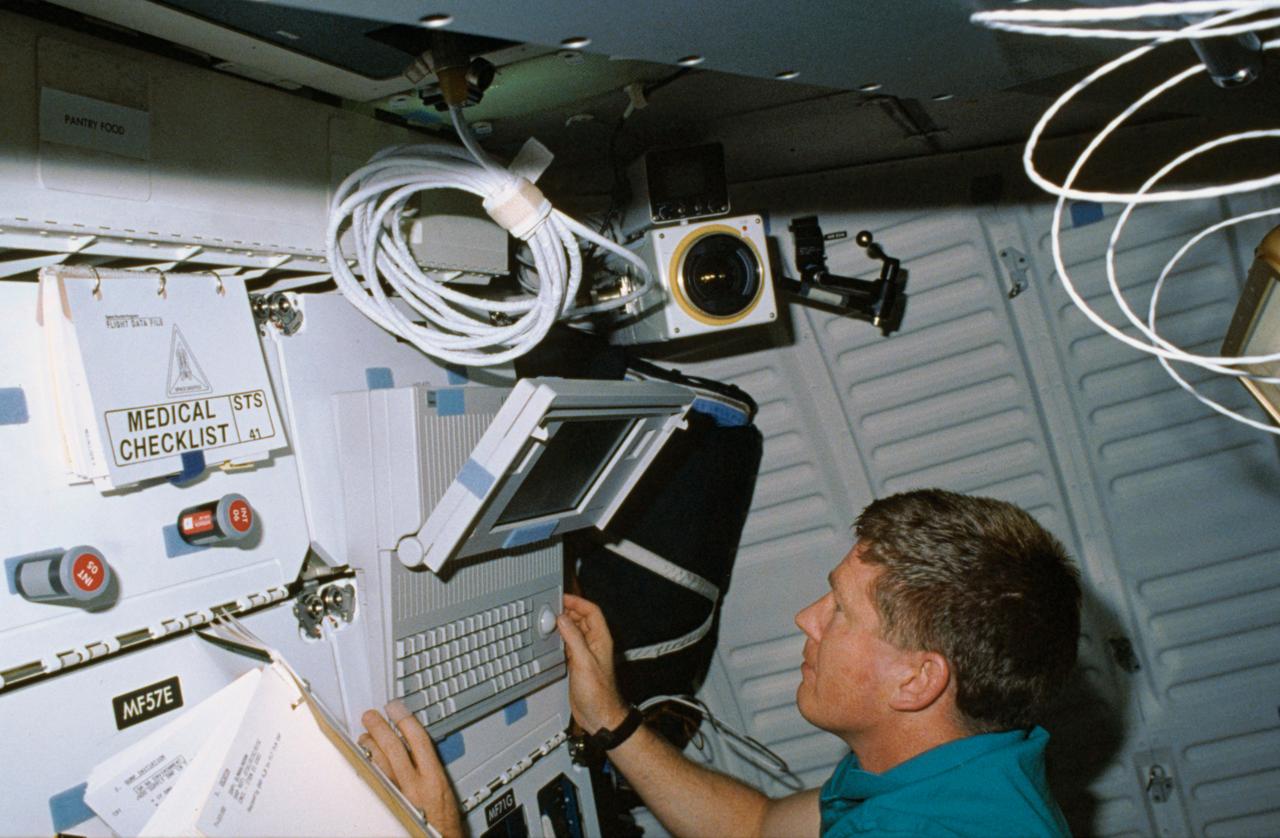
STS-41 Mission Specialist (MS) William M. Shepherd uses Detailed Test Objective (DTO) Space Station Cursor Control Device Evaluation MACINTOSH portable computer on the middeck of Discovery, Orbiter Vehicle (OV) 103. The computer is velcroed to forward lockers MF71C and MF71E. Surrounding Shepherd are checklists, the field sequential (FS) crew cabin camera, and a lighting fixture.
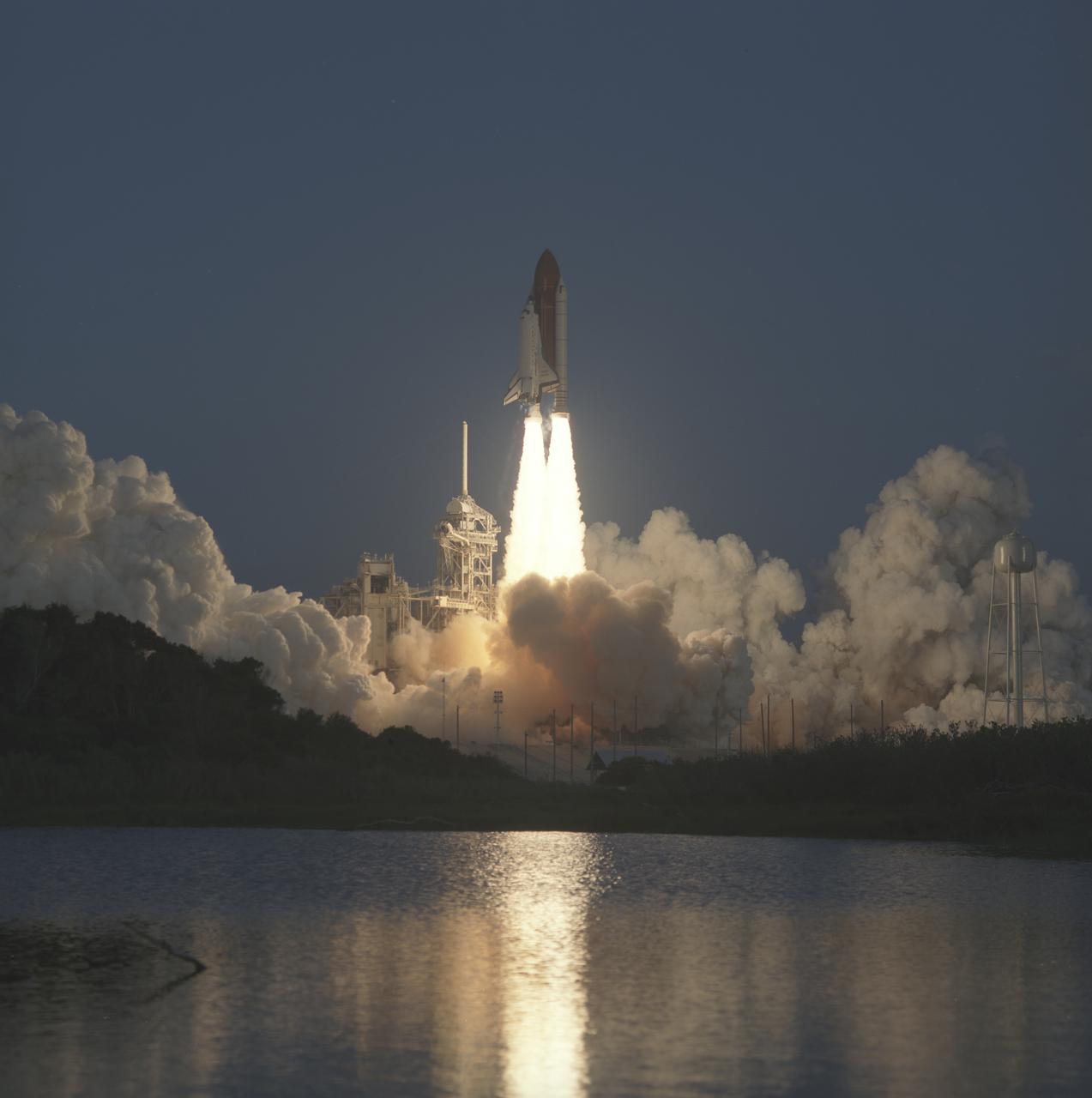
Launched aboard the Space Shuttle Discovery on October 6, 1990 at 7:47:15 am (EDT), the STS-41 mission consisted of 5 crew members. Included were Richard N. Richards, commander; Robert D. Cabana, pilot; and Bruce E. Melnick, Thomas D. Akers, and William M. Shepherd, all mission specialists. The primary payload for the mission was the European Space Agency (ESA) built Ulysses Space Craft made to explore the polar regions of the Sun. Other main payloads and experiments included the Shuttle Solar Backscatter Ultraviolet (SSBUV) experiment and the INTELSAT Solar Array Coupon (ISAC).
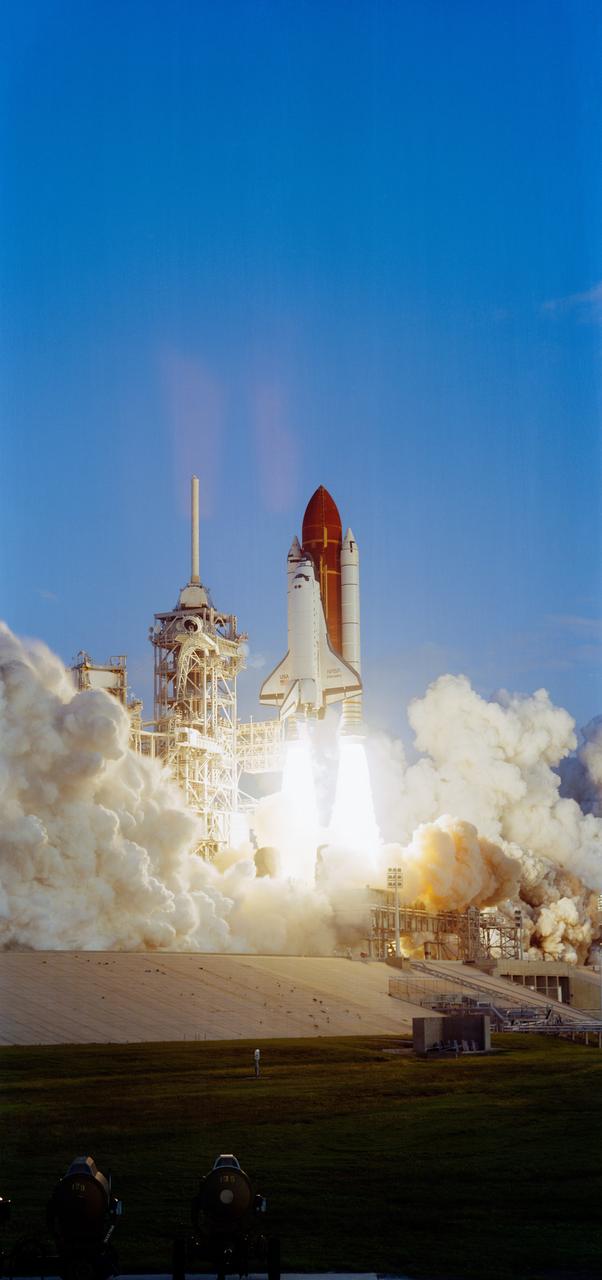
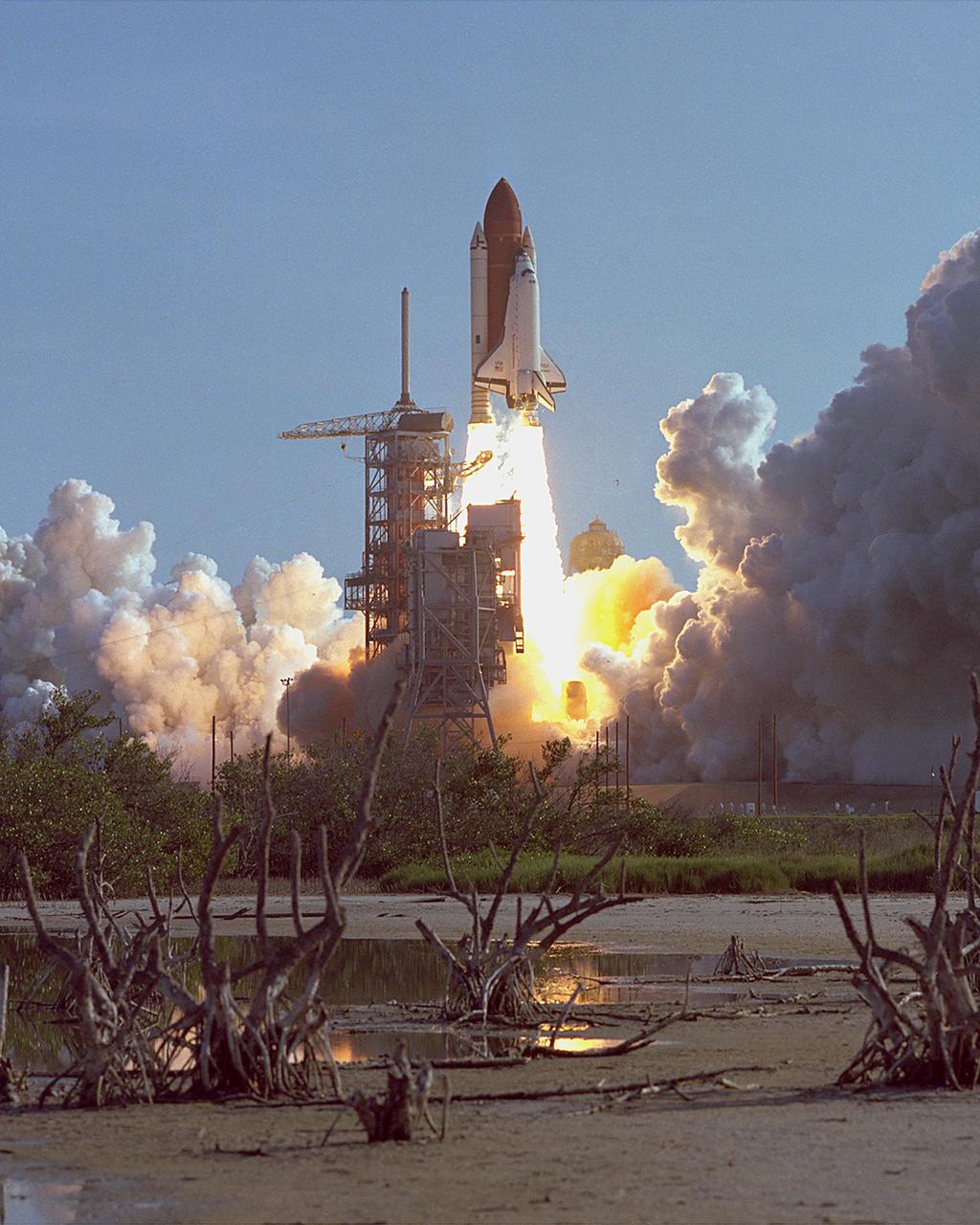
STS-41 Discovery, Orbiter Vehicle (OV) 103, lifts off from the Kennedy Space Center (KSC) Launch Complex (LC) Pad 39 mobile launcher platform at 7:47 am (Eastern Daylight Time (EDT)). OV-103 riding atop the external tank (ET) and flanked by two solid rocket boosters (SRBs), is captured just moments after liftoff. Not yet clear of the fixed service structure (FSS) tower, OV-103 is highlighted against the cloudless morning sky. Exhaust smoke billows from the SRBs and the space shuttle main engines (SSMEs) creating a cloud over the launch pad area.
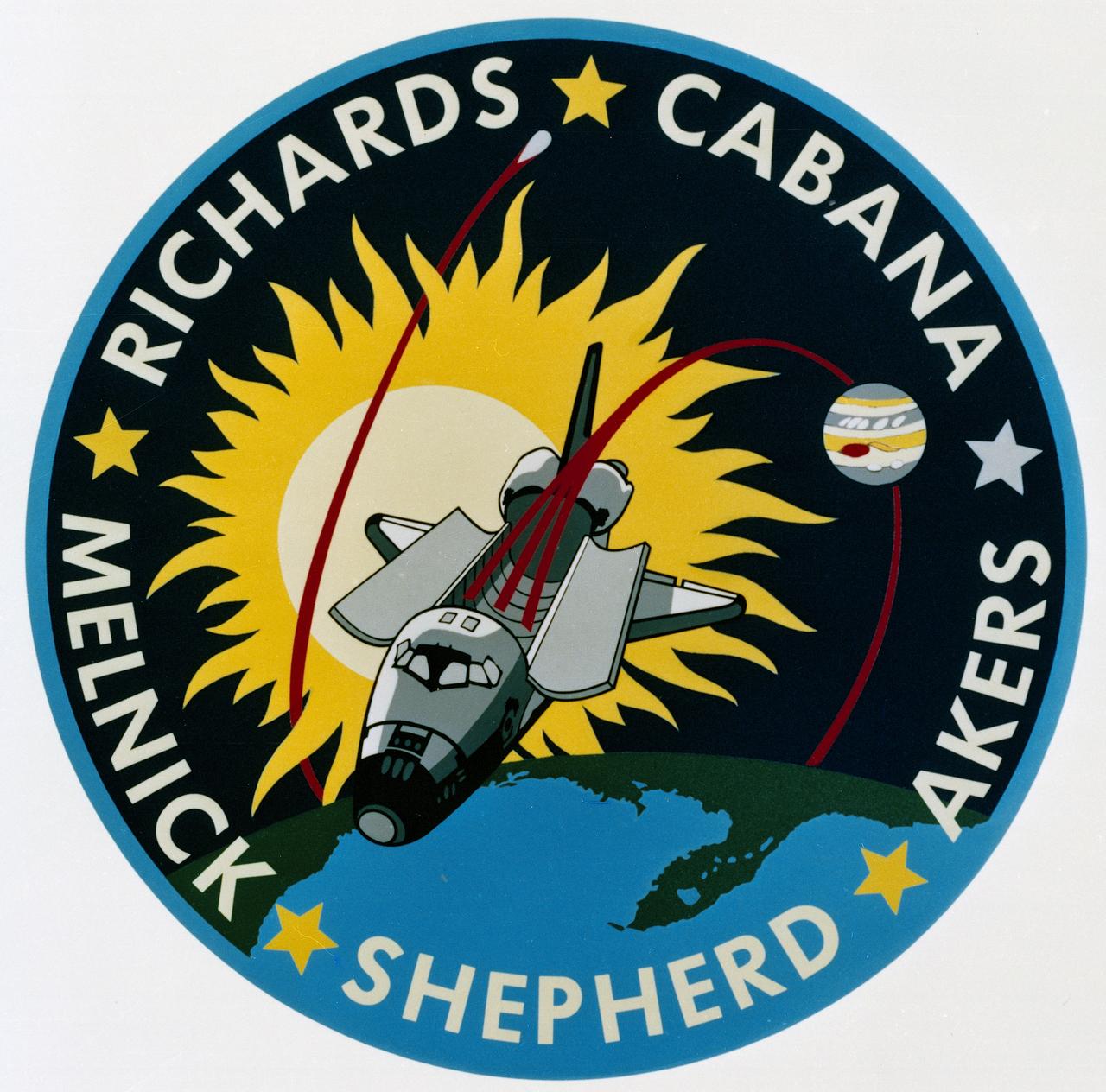
The STS-41 crew patch, designed by the five astronaut crewmembers, depicts the Space Shuttle orbiting Earth after deployment of its primary payload -- the Ulysses satellite. The orbiter is shown passing over the southeastern United States, representative of its 28-degree inclination orbit. Ulysses, the Solar Exploration Satellite, as the fastest man-made object in the universe, traveling at 30 miles per second (over 100,000 mph) is represented by the streaking silver teardrop passing over the sun. Ulysses' path is depicted by the bright red spiral originating from the Shuttle cargo bay. The three-legged trajectory, extending out the payload bay, is symbolic of the astronaut logo and is in honor of those who have given their lives in the conquest of space. The five stars, four gold and one silver, represent STS-41 and each of its crewmembers.
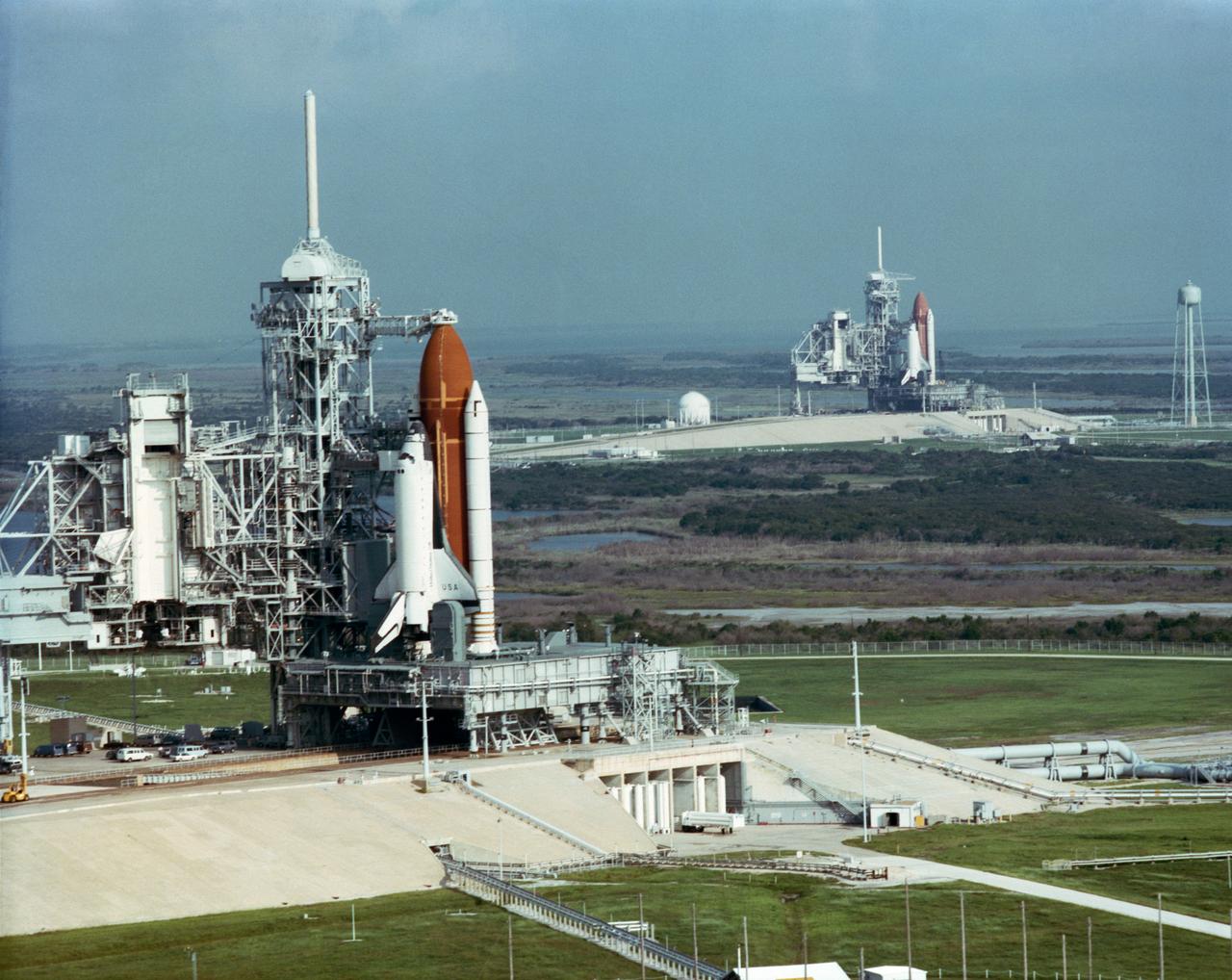
S90-48650 (5 Sept 1990) --- This rare view shows two space shuttles on adjacent pads at Launch Complex 39 with the Rotating Service Structures (RSR) retracted. Space Shuttle Columbia (foreground) is on Pad A where it awaits further processing for a September 6 early morning launch on STS-35. Discovery, its sister spacecraft, is set to begin preparations for an October liftoff on STS-41 when the Ulysses spacecraft is scheudled to be taxied into space. PLEASE NOTE: Following the taking of this photograph, STS-35 was postponed and STS-41's Discovery was successfully launched on Oct. 6.
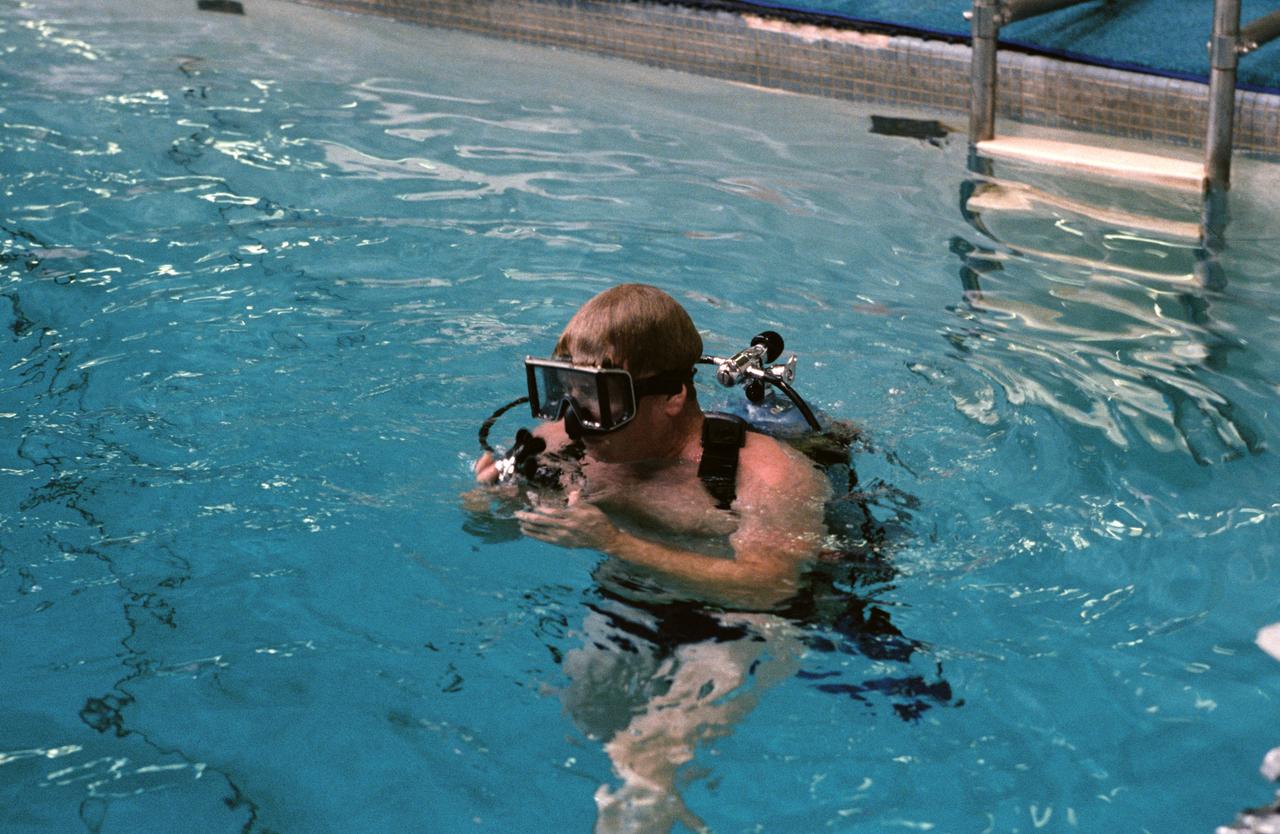
Preparations for Underwater EVA training for the STS 41-G crew. Divers prepare to don their scuba gear for the begining of EVA training.
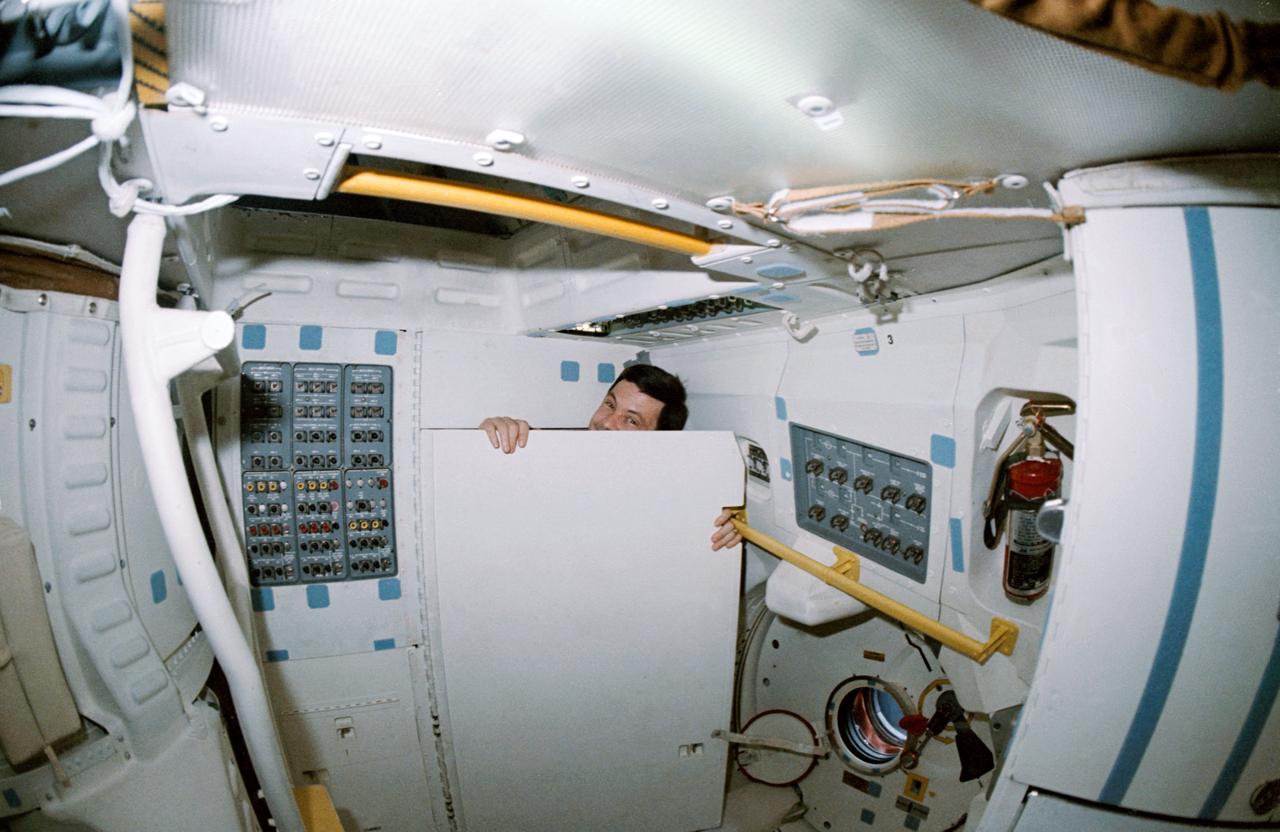
STS-41 crewmembers conduct Detailed Supplementary Objective (DSO) 0472 Intraocular Pressure on the middeck of Discovery, Orbiter Vehicle (OV) 103. Mission Specialist (MS) William M. Shepherd rests his head on the stowed treadmill while Pilot Robert D. Cabana, holding Shepherd's eye open, prepares to measure Shepherd's intraocular pressure using a tono pen (in his right hand). Objectives include: establishing a database of changes in intraocular pressures that can be used to evaluate crew health; validating ten degree head down bedrest as a model for cephalad fluid shifts in microgravity; facilitating the interpretation of data by providing a quantative measure of microgravity induced cephalad fluid shifts; and validating the tono pen as an effective tool for diagnostic and scientific data collection.
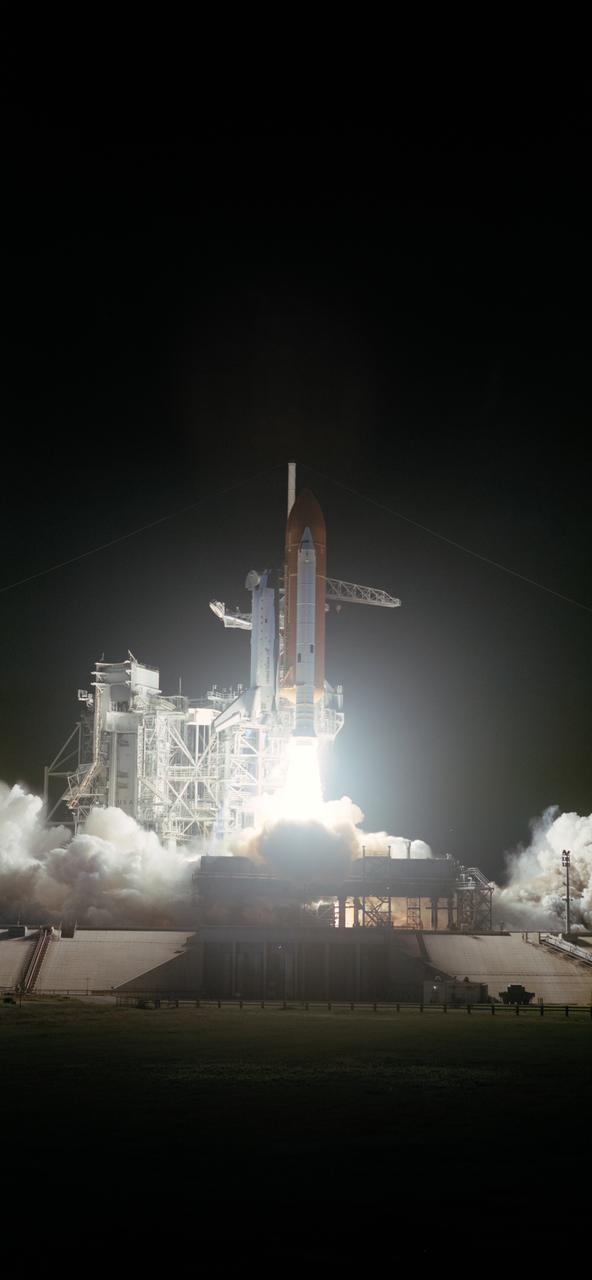
View of the early morning launch of STS 41-G Challenger. The dark launch complex is illuminated by spotlights as the orbiter begins its ascent from the pad.
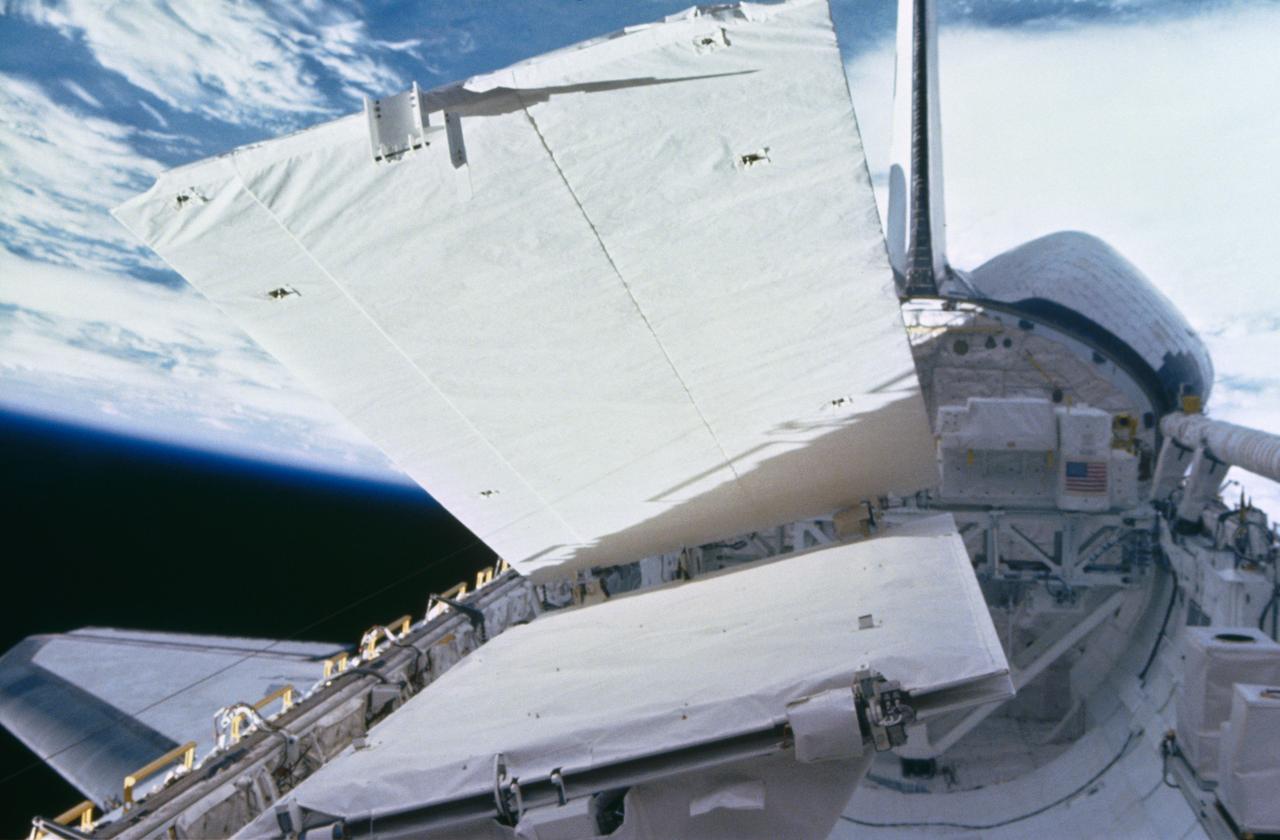
View of the SIR-B antenna being deployed during STS 41-G. The Challenger's payload bay is open and the remote manipulator system (RMS) arm is in the stowed position at the right of the view.
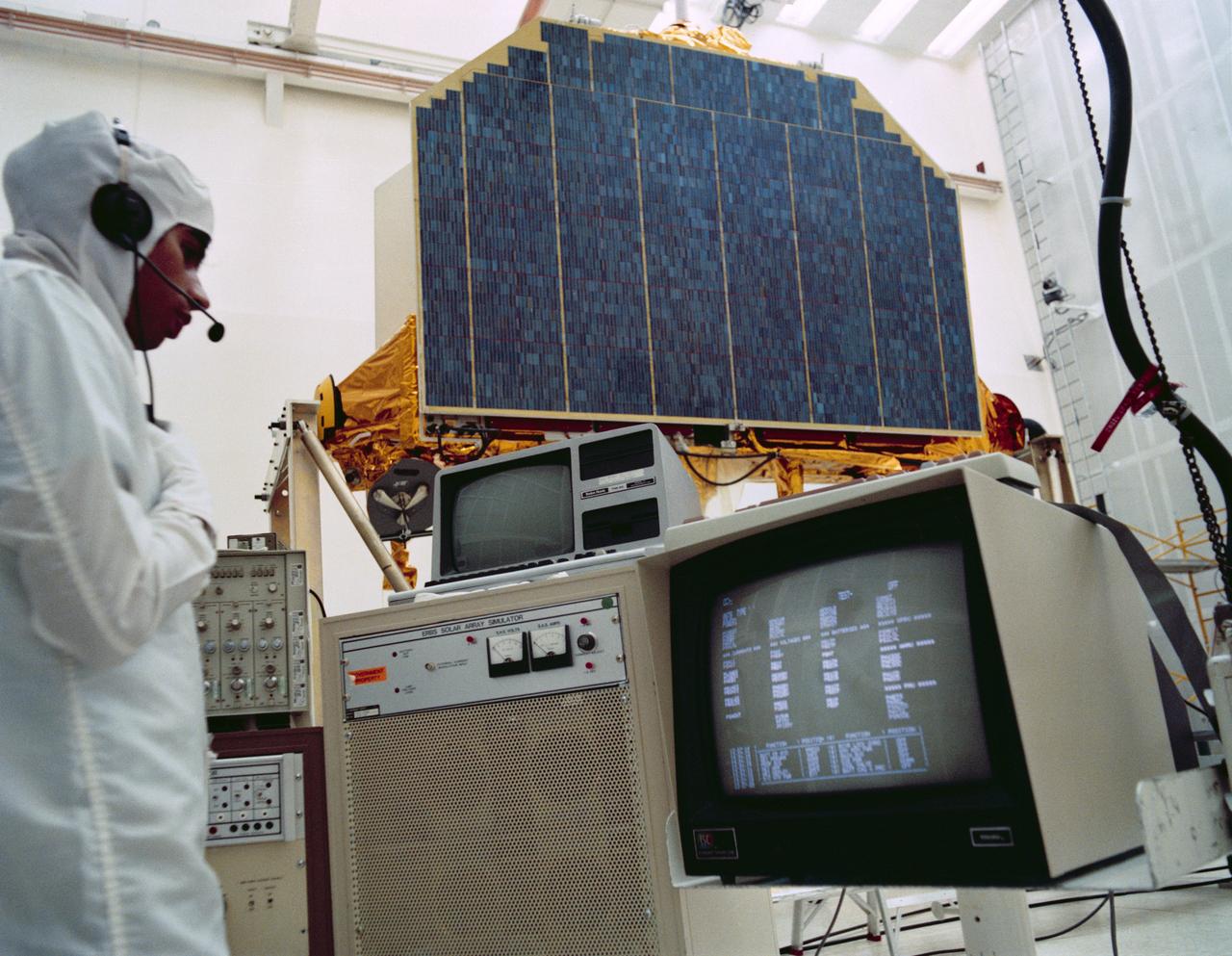
Documentation of STS 41-G payloads while in Hangar AE at Cape Canaveral. Views include documentation of the Earth Radiation Budget Satllite (ERBS) antenna (41266) and solar array panels (41265).
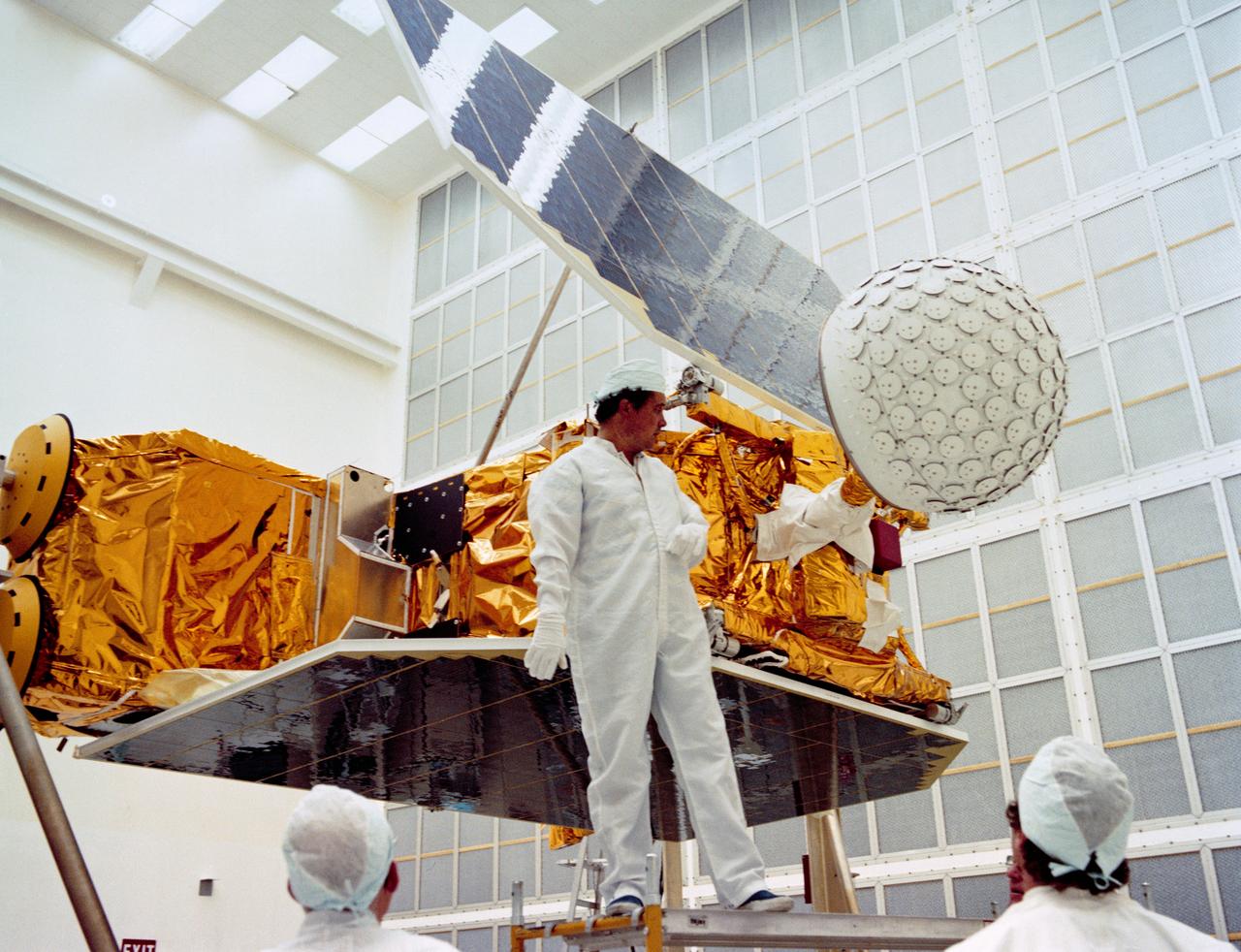
Documentation of STS 41-G payloads while in Hangar AE at Cape Canaveral. Views include documentation of the Earth Radiation Budget Satllite (ERBS) antenna (41266) and solar array panels (41265).
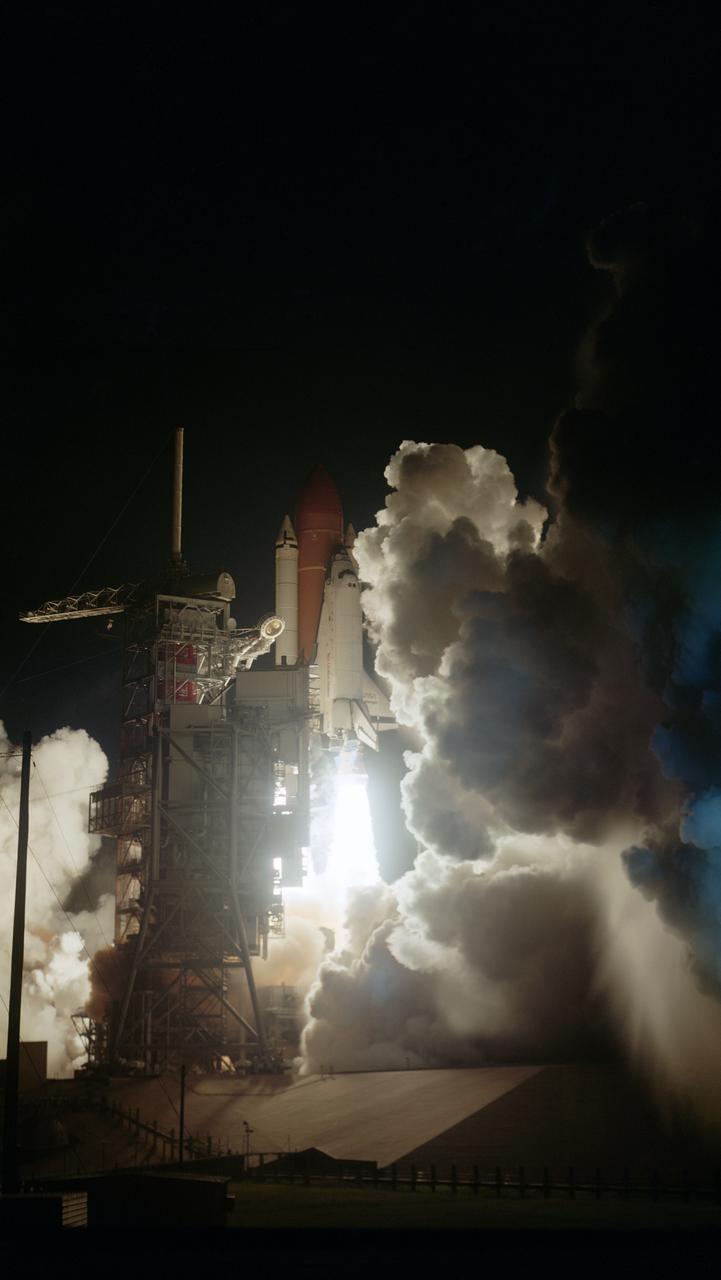
View of the early morning launch of STS 41-G Challenger. The dark launch complex is illuminated by spotlights as the orbiter begins its ascent from the pad. The light is reflected off the clouds of smoke from the orbiter's engines.
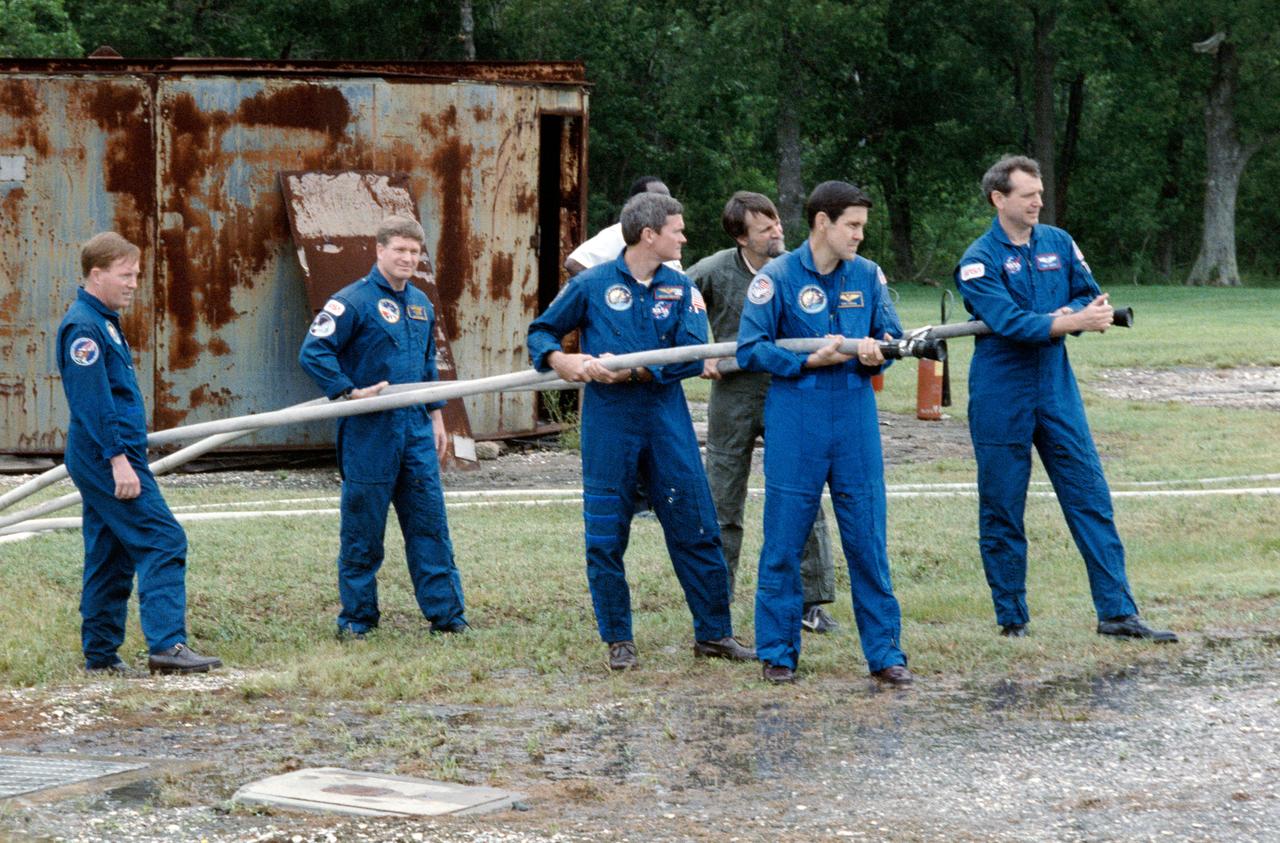
S90-38926 (4 May 1990) --- The STS-41 astronaut crew and a STS-35 backup payload specialist participate in fire control training exercises at the Johnson Space Center (JSC). Left to right are Richard N. Richards, William M. Shepherd, Bruce E. Melnick, Kenneth Nordsieck, Robert D. Cabana and Thomas D. Akers. Nordsieck is Astro-1 backup payload specialist in training for STS-35. This type training is provided all crewmembers assigned to seats aboard Space Shuttle.
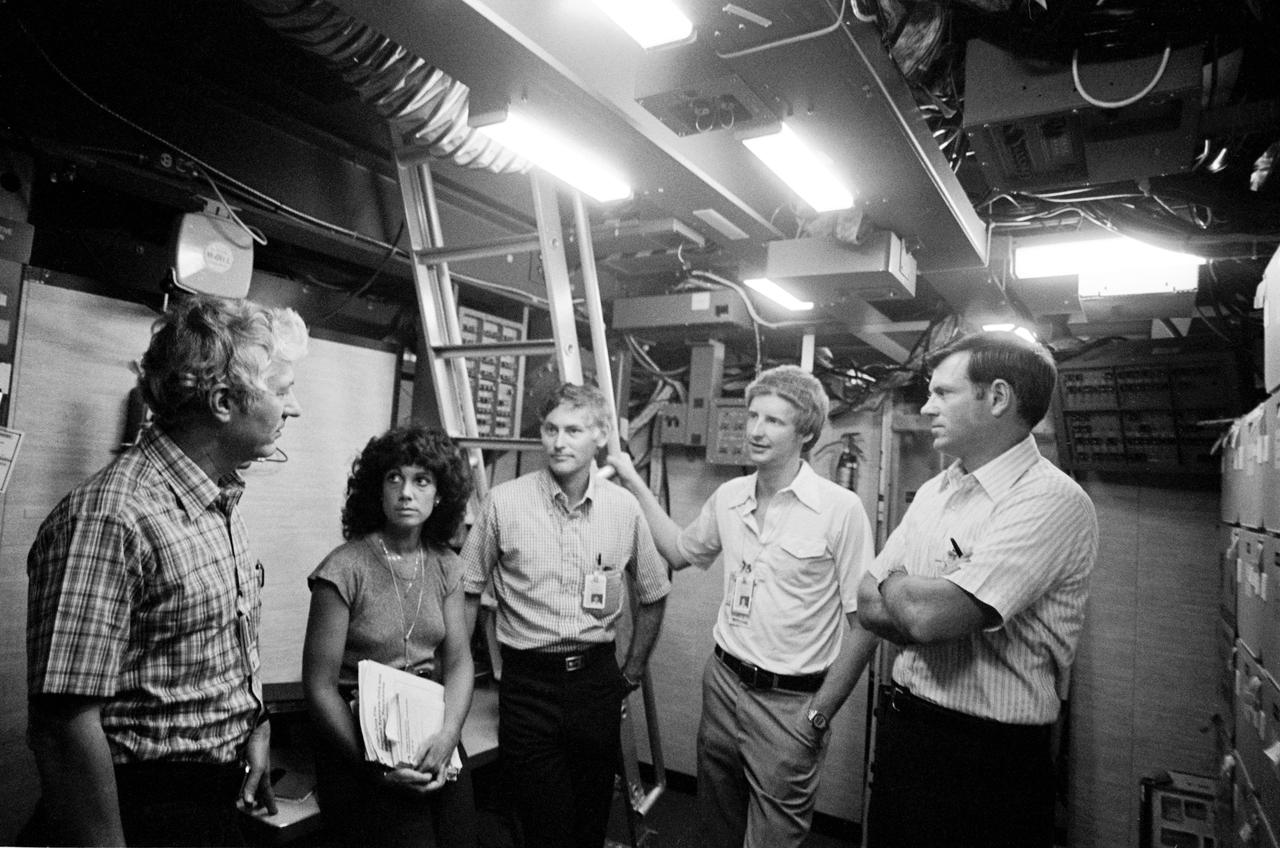
View of STS 41-D mission crew training in Shuttle Mission simulator. From left to right are Henry Hartsfield, Jr., commander; mission specialists Judith Resnik, Richard Mullane, and Steven Hawley; and Michael Coats, pilot. They appear to be standing in the middeck mockup, preparing for training.
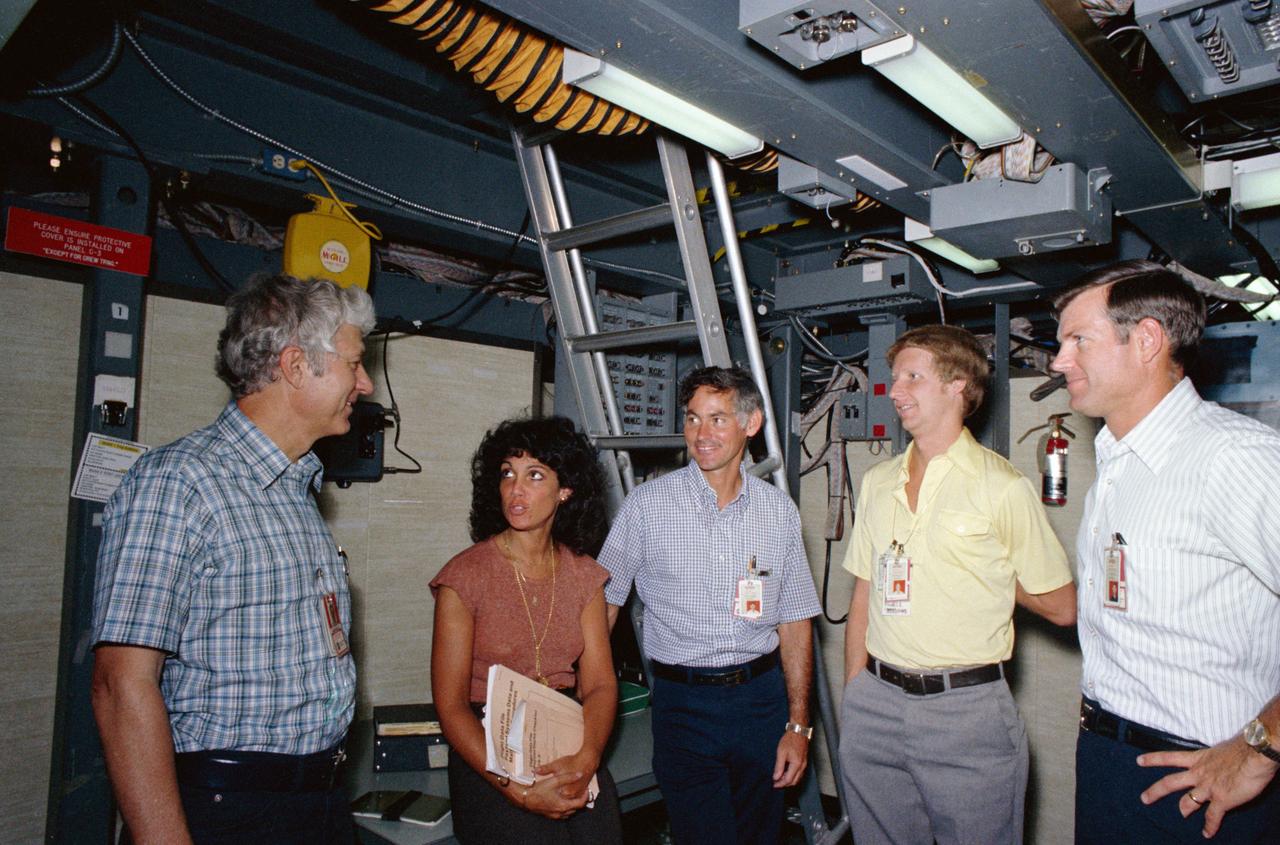
View of STS 41-D mission crew training in Shuttle Mission simulator. From left to right are Henry Hartsfield, Jr., commander; mission specialists Judith Resnik, Richard Mullane, and Steven Hawley; and Michael Coats, pilot. They appear to be standing in the middeck mockup, preparing for training.
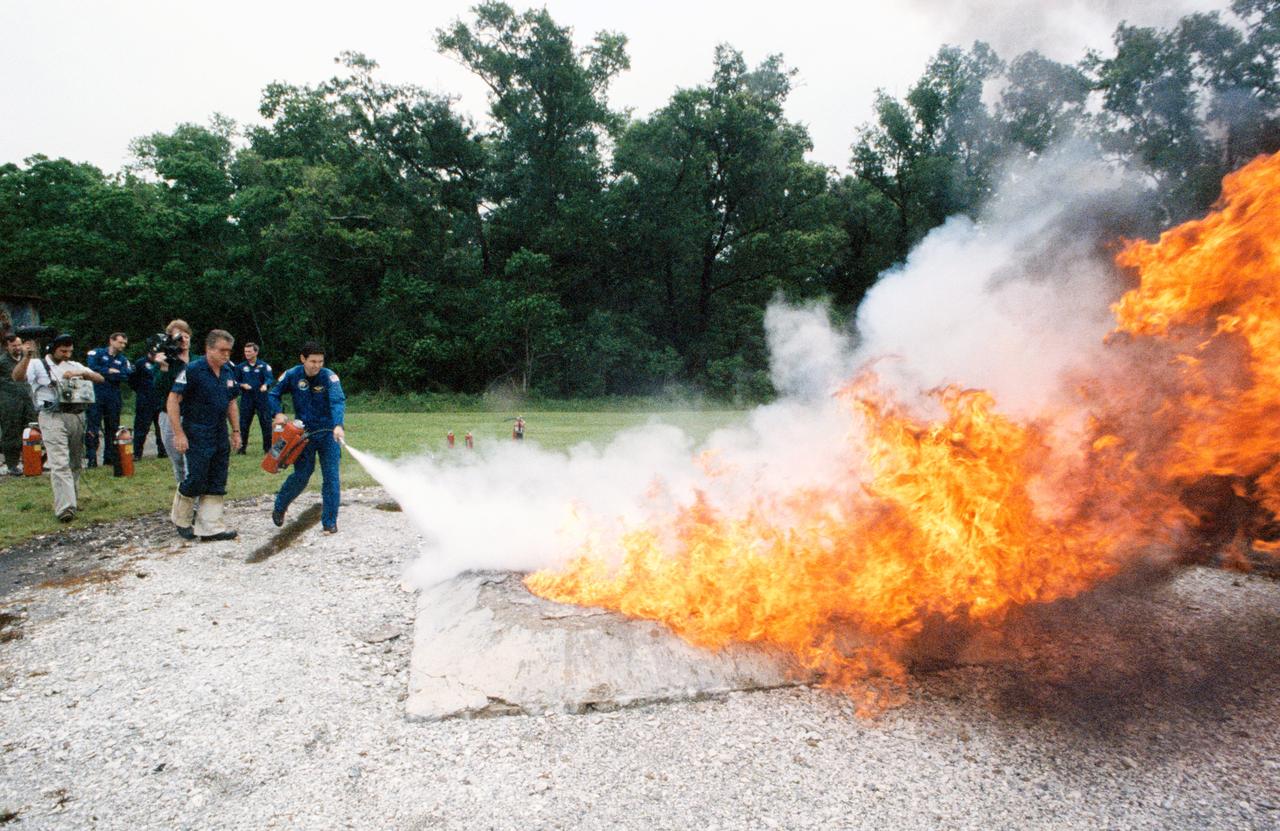
S90-38933 (4 May 1990) --- The STS-41 astronaut crew participates in fire control training exercises at the Johnson Space Center (JSC). Controlling the fire extinguisher at left frame is astronaut Robert D. Cabana, STS-41 pilot. Watching in the background are other STS-41 astronauts who participated in the session. They were Richard N. Richards, William M. Shepherd, Bruce E. Melnick and Thomas D. Akers. This type training is provided all crewmembers assigned to seats aboard Space Shuttle. Members of the both the Houston and Pasadena fire departments instruct the sessions.
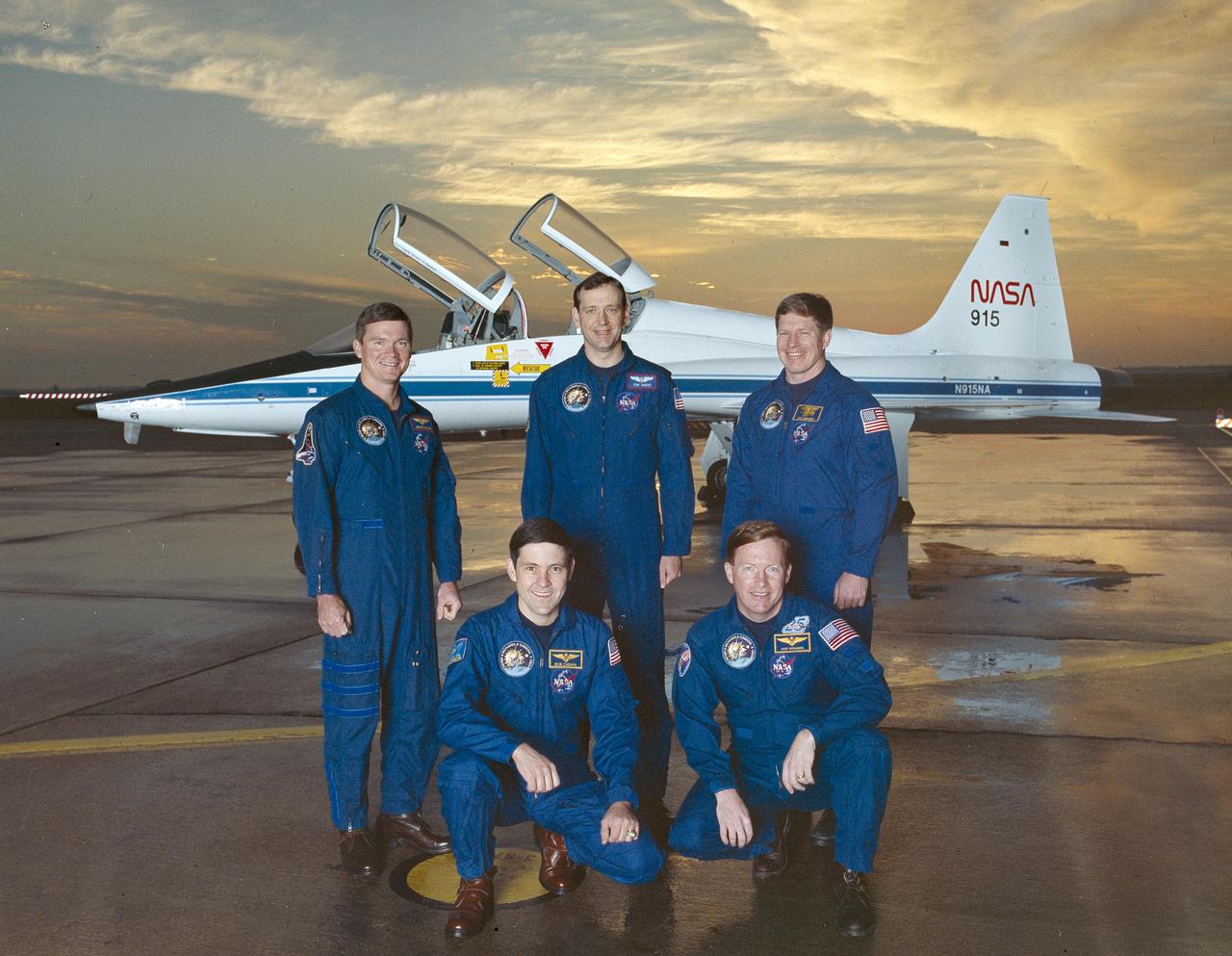
The 5 member crew of the STS-41 mission included (left to right): Bruce E. Melnick, mission specialist 2; Robert D. Cabana, pilot; Thomas D. Akers, mission specialist 3; Richard N. Richards, commander; and William M. Shepherd, mission specialist 1. Launched aboard the Space Shuttle Discovery on October 6, 1990 at 7:47:15 am (EDT), the primary payload for the mission was the ESA built Ulysses Space Craft made to explore the polar regions of the Sun. Other main payloads and experiments included the Shuttle Solar Backscatter Ultraviolet (SSBUV) experiment and the INTELSAT Solar Array Coupon (ISAC).
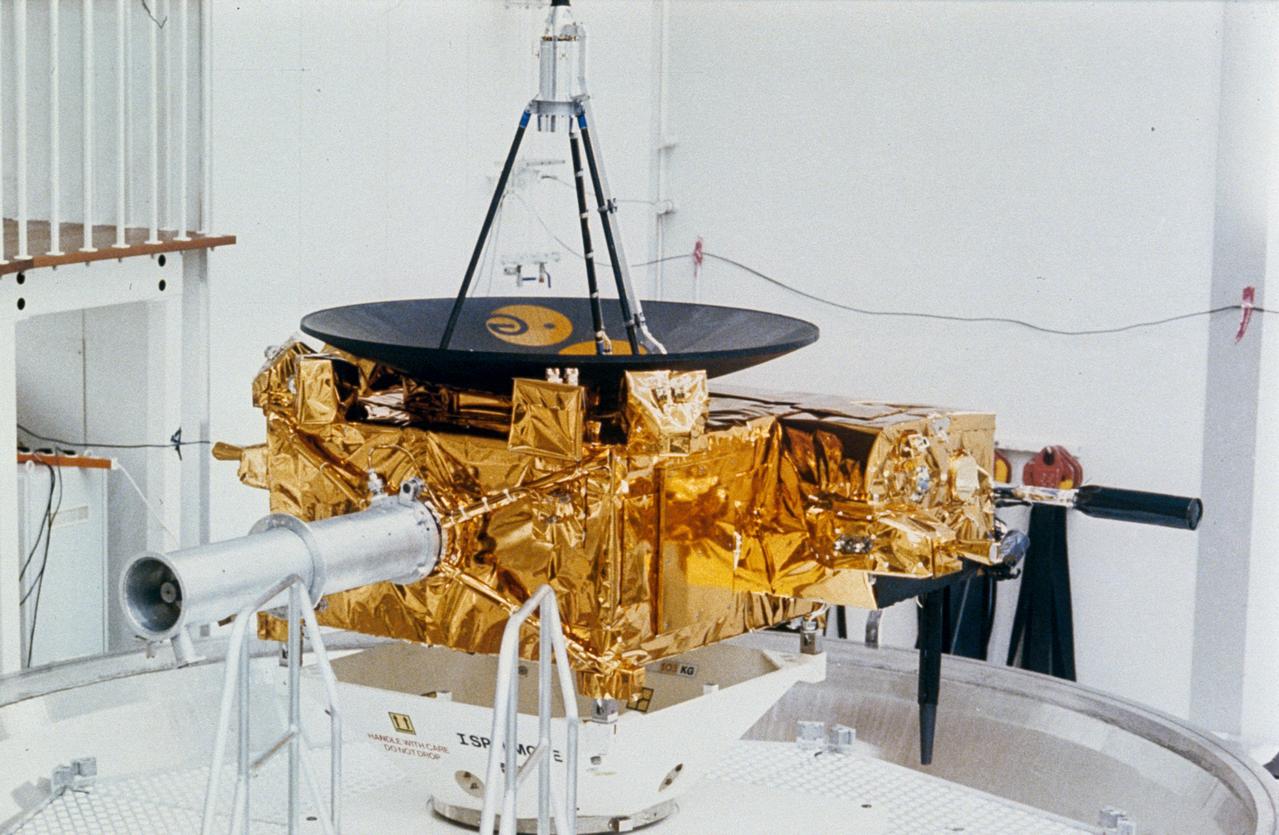
S90-45985 (May 1990) --- The Ulysses spacecraft undergoes testing at the vacuum spin-balancing facility in ESTEC. Careful balancing is required in order to ensure that the high gain antenna, which is aligned with the spacecraft spin axis, can be accurately pointed toward Earth throughout the mission. It will be flown to Kennedy Space Center (KSC) for further processing before being on loaded to Discovery's cargo bay. The Space Shuttle crew of STS-41 will send it off to its long-awaited mission.
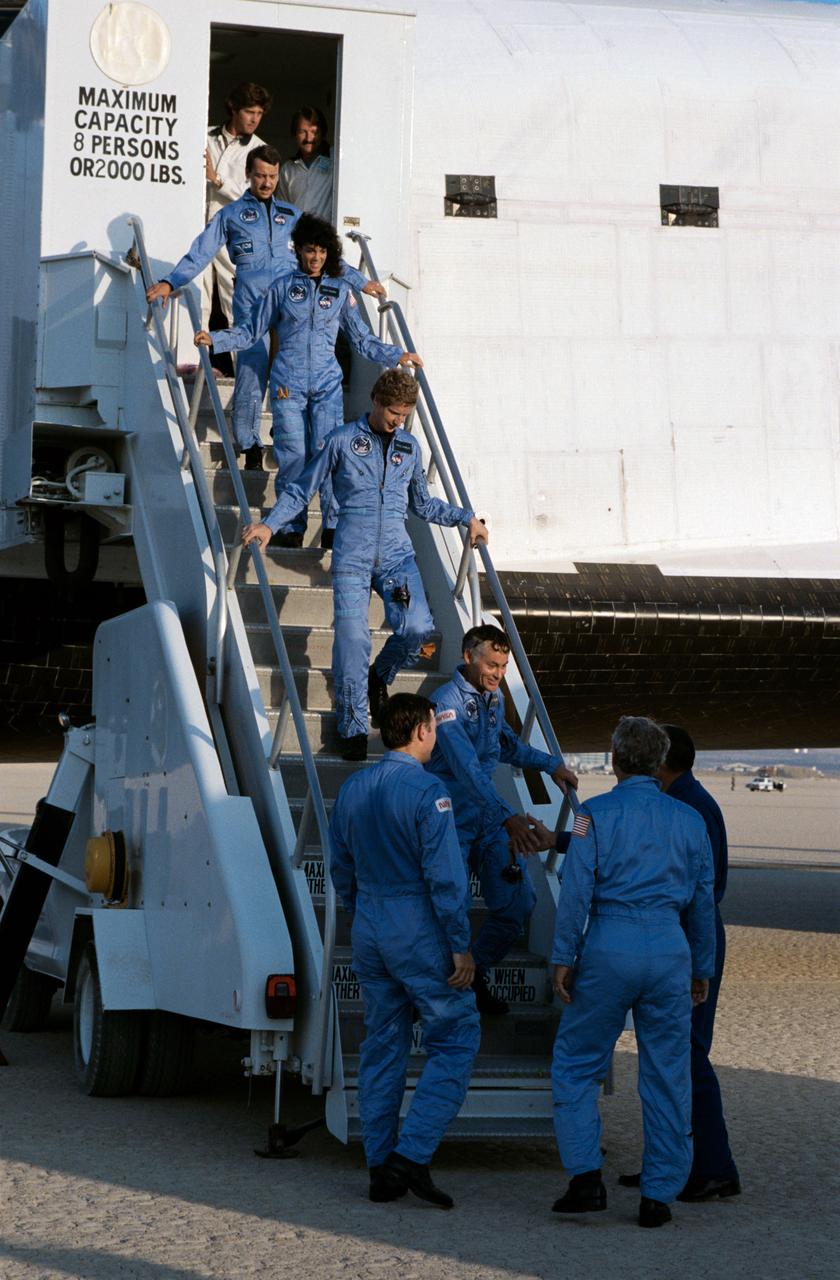
The crew of the STS 41-D mission exit the orbiter after landing at Edwards Air Force Base in California. Starting at the top of the ladder is Astronaut Charles D. Walker, payload specialist; Judith A. Resnik, mission specialist; Steven A. Hawley, mission specialist; and Richard M. Mike Mullane, mission specialist. Waiting at the bottom of the ramp are Astronaut Mike Coats (left), pilot and Henry W. Hartsfield, Jr. (center), crew commander.
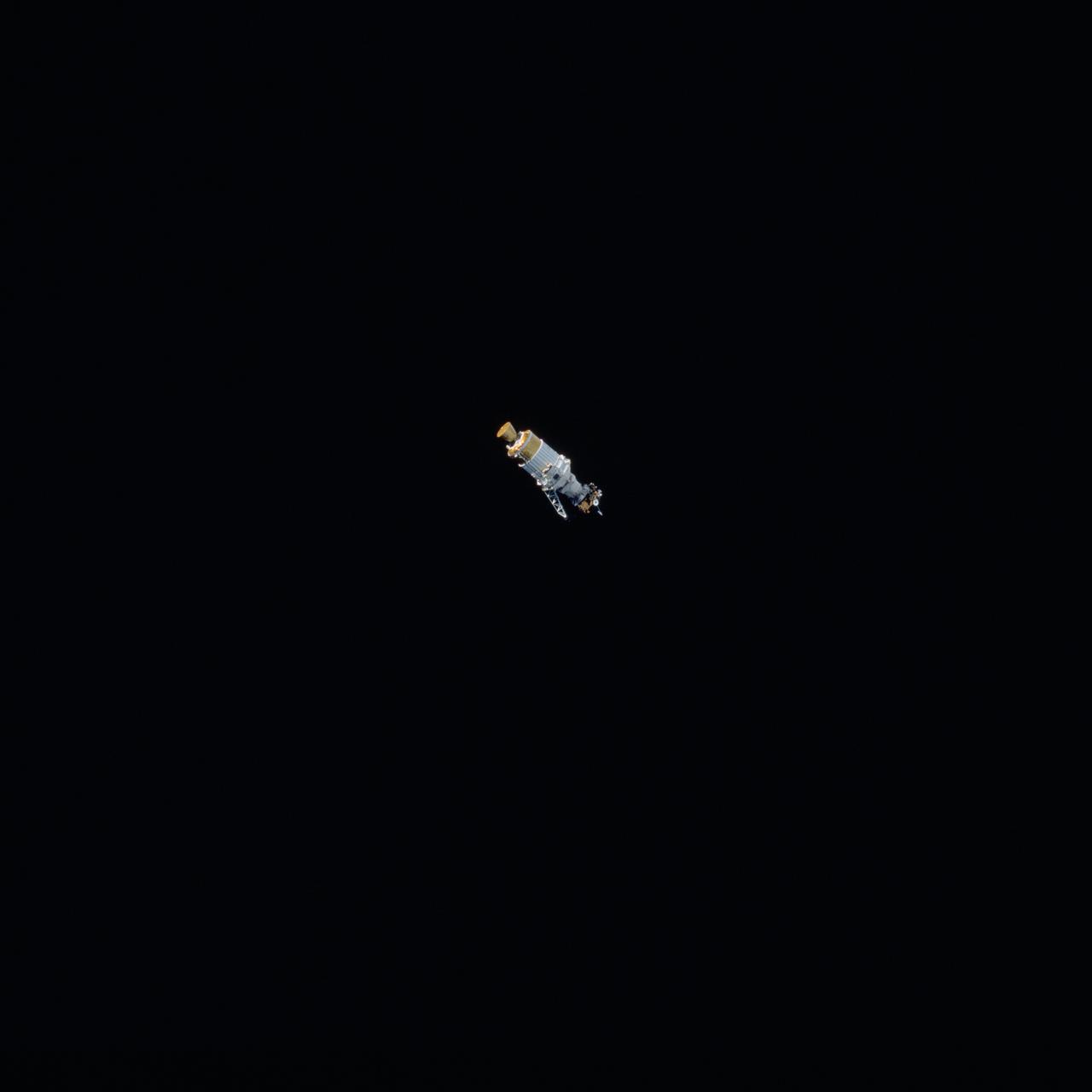
STS041-601-009 (6 Oct 1990) --- The Ulysses spacecraft, backdropped against the blackness of space, rapidly distances itself from Discovery and moves toward the beginning of its five-year mission to the Sun. The five STS-41 astronauts released the spacecraft only hours after achieving Earth orbit on Oct. 6, 1990. The photo was made with a handheld Roliflex camera using 120 film.
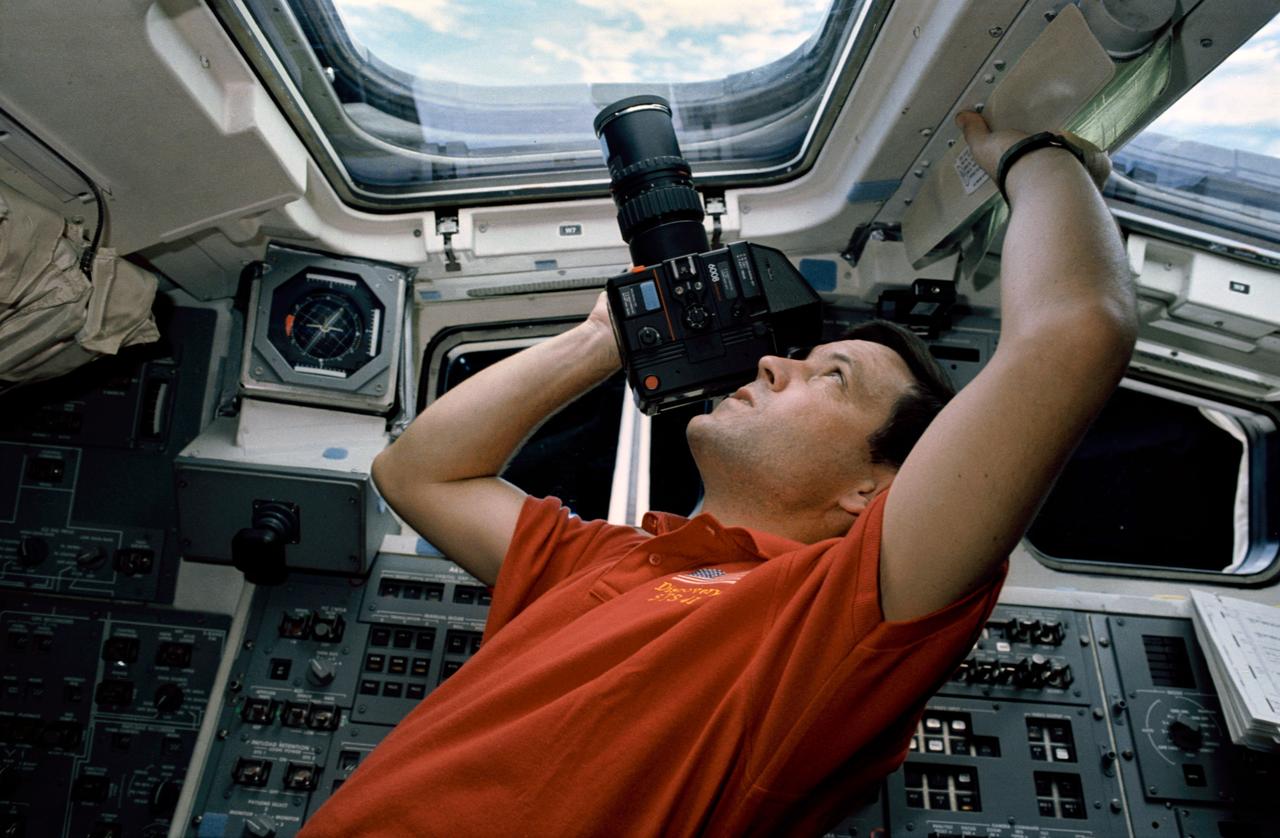
STS041-22-008 (6-10 Oct 1990) --- Astronaut Robert D. Cabana, STS-41 pilot, uses a handheld camera to record Earth scenes from the aft flight deck of Discovery.
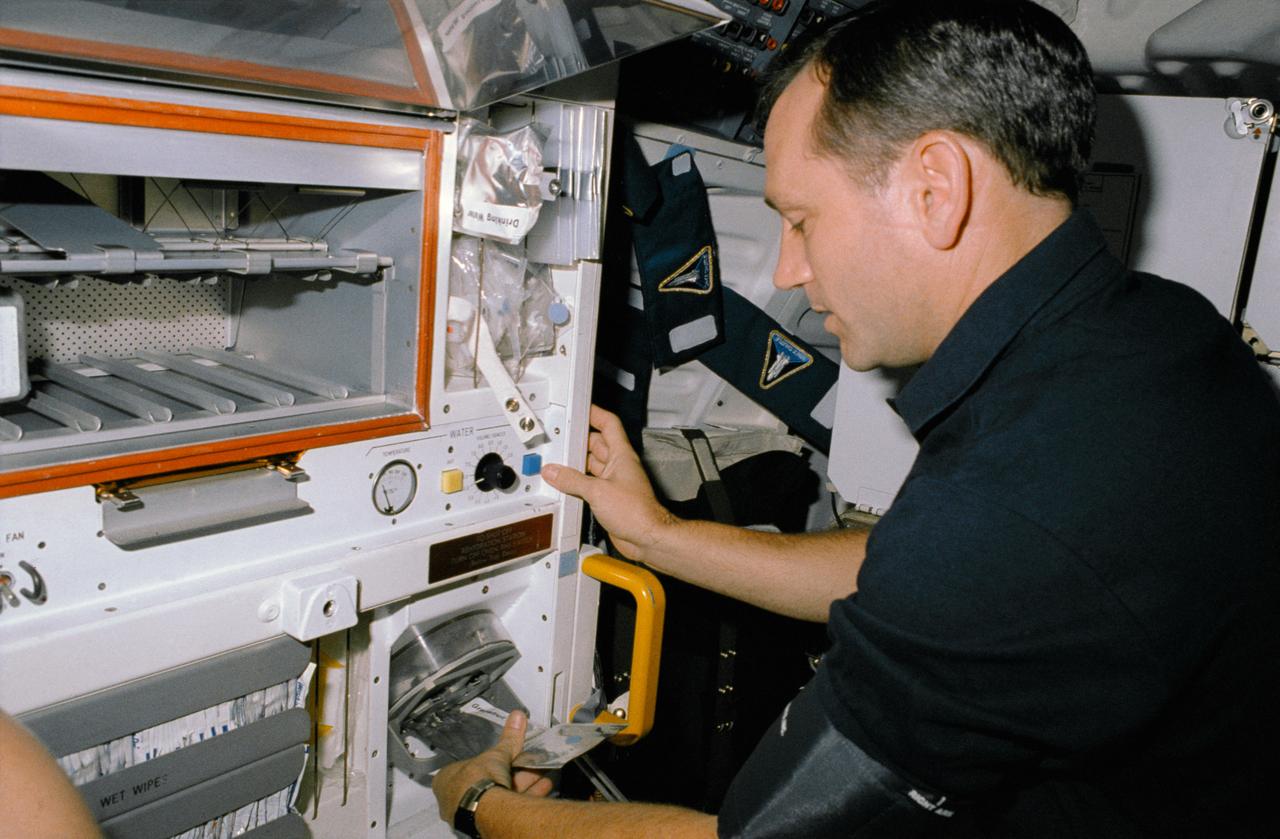
STS041-06-004 (6-10 Oct 1990) --- A 35mm scene of astronaut Thomas D. Akers, STS-41 mission specialist, using Space Shuttle Discovery?s galley water feed to rehydrate a package of food.
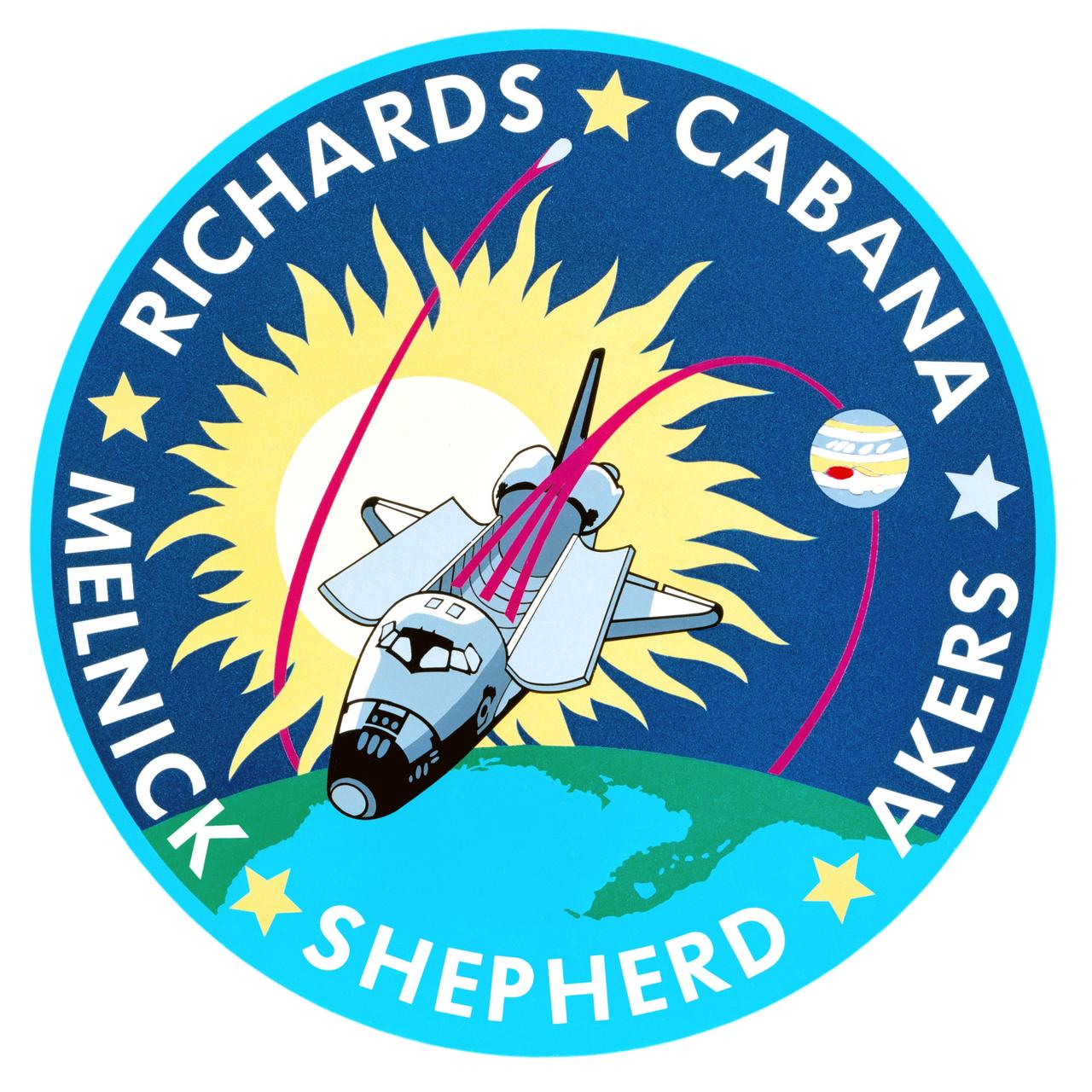
STS041-S-001 (May 1990) --- The STS-41 crew patch, designed by the five astronaut crew members, depicts the space shuttle orbiting Earth after deployment of its primary payload - the Ulysses satellite. The orbiter is shown passing over the southeastern United States, representative of its 28-degree inclination orbit. Ulysses, the Solar Exploration Satellite, will be the fastest man-made object in the universe, traveling at 30 miles per second (over 100,000 mph) and is represented by the streaking silver teardrop passing over the sun. Ulysses' path is depicted by the bright red spiral originating from the space shuttle cargo bay. The path will extend around Jupiter where Ulysses will receive a gravitational direction change that will put it in a polar trajectory around the sun. The three-legged trajectory, extending out the payload bay, is symbolic of the astronaut logo and is in honor of those who have given their lives in the conquest of space. The five stars, four gold and one silver, represent STS-41 and each of its crew members. The NASA insignia design for space shuttle flights is reserved for use by the astronauts and for other official use as the NASA Administrator may authorize. Public availability has been approved only in the forms of illustrations by the various news media. When and if there is any change in this policy, which is not anticipated, the change will be publicly announced. Photo credit: NASA
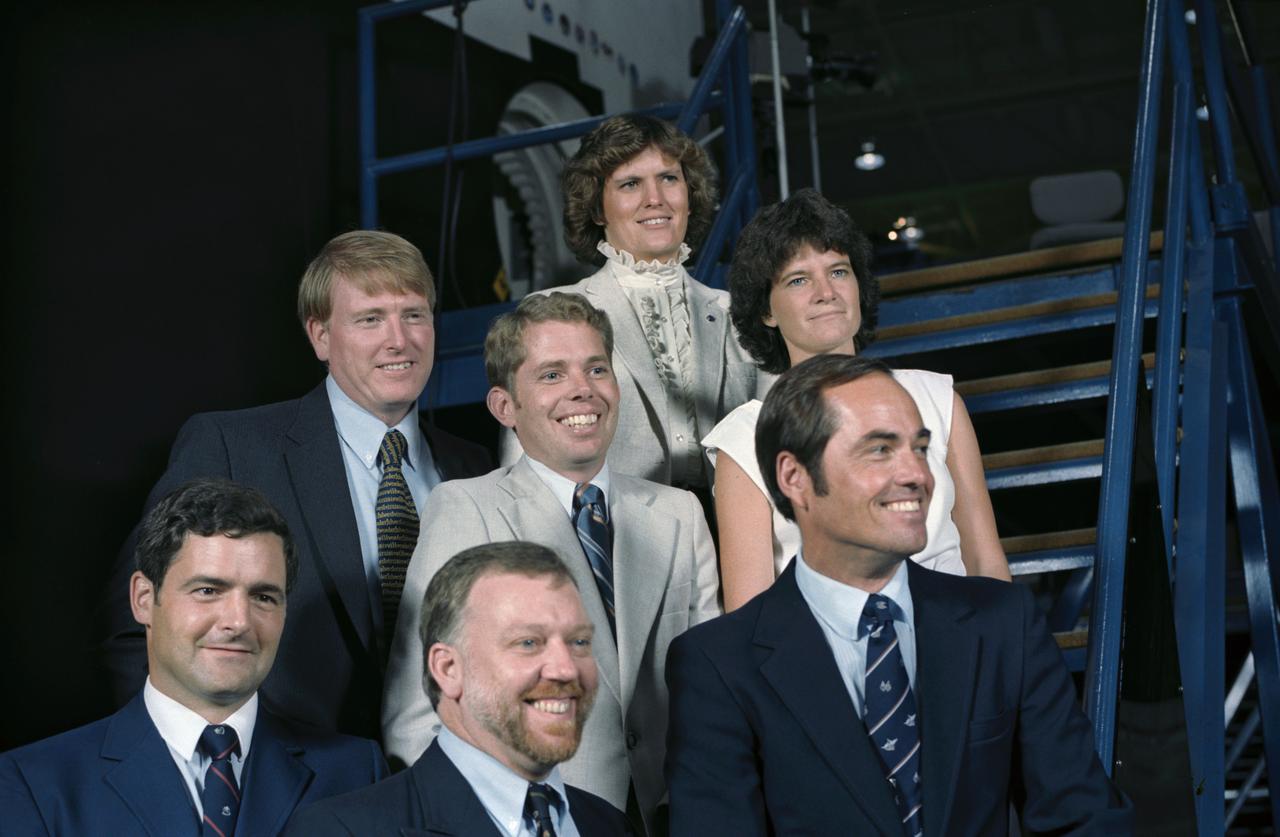
41D-3277 (S14-3277) (4 Sept 1984) --- Having met the press for the first time as a group, members of the STS 41-G crew pose for photographs in the Shuttle mockup and integration laboratory at the Johnson Space Center. They are (bottom row, left, to right) Marc Garneau and Paul D. Scully-Power, both payload specialists; and Robert L. Crippen, crew commander; (second row, l.-r.) Astronauts Jon A. McBride, pilot; David C. Leestma and Sally K. Ride, both mission specialists; and Kathryn D. Sullivan, mission specialist. They are scheduled for an October 5, 1984 launch aboard the Space Shuttle Challenger.
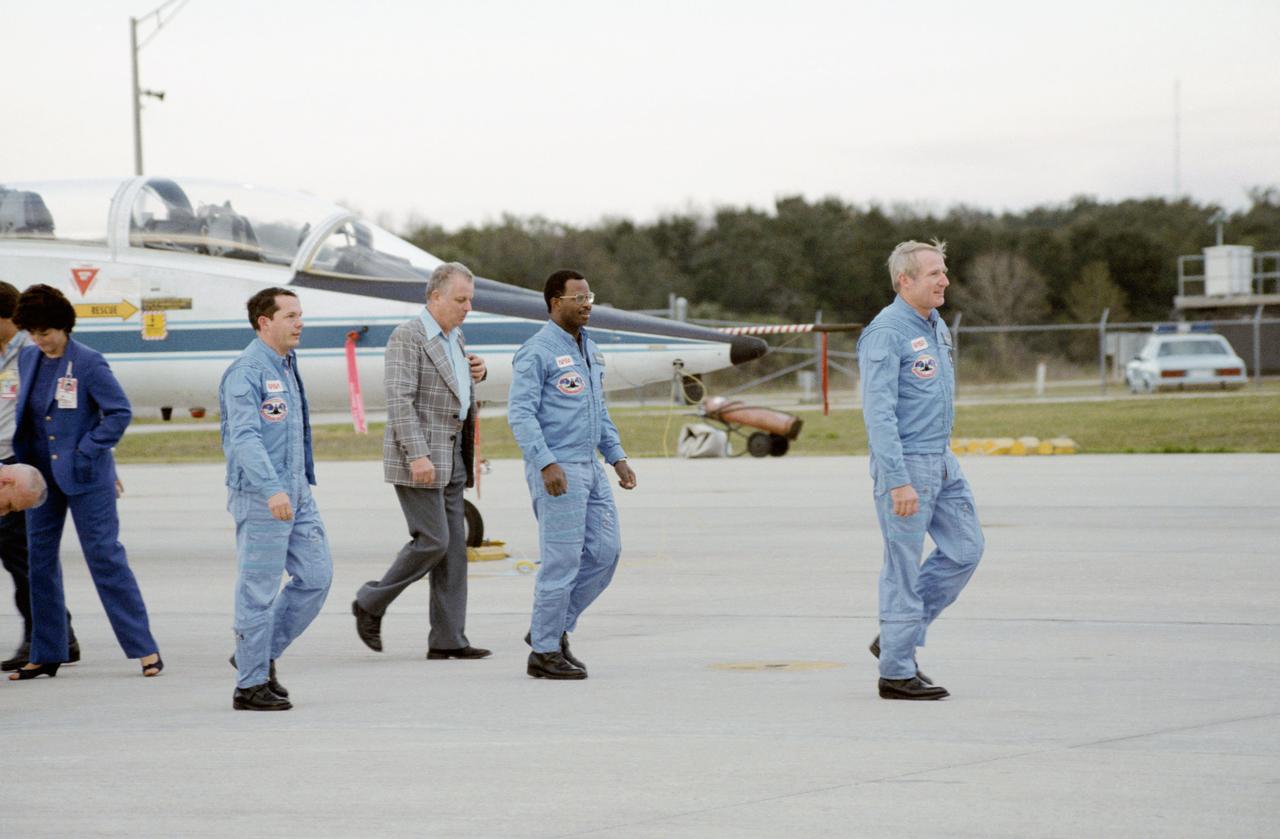
S84-26935 (31 Jan 1984) --- Three members of the STS 41-B astronaut crew arrive in Florida following a brief T-38 flight from Houston. Leading the crew from the flight line is Astronaut Vance D. Brand (right), crew commander. Following behind (in blue flight suits) are Astronauts Ronald E. McNair (center) and Robert L. Stewart (both mission specialists. They were met by Terry White (pictured), JSC public information industrial relations manager. Not pictured are Astronauts Robert L. Gibson, pilot; and Bruce McCandless II, mission specialist. Launch is scheduled for February 3, 1983.
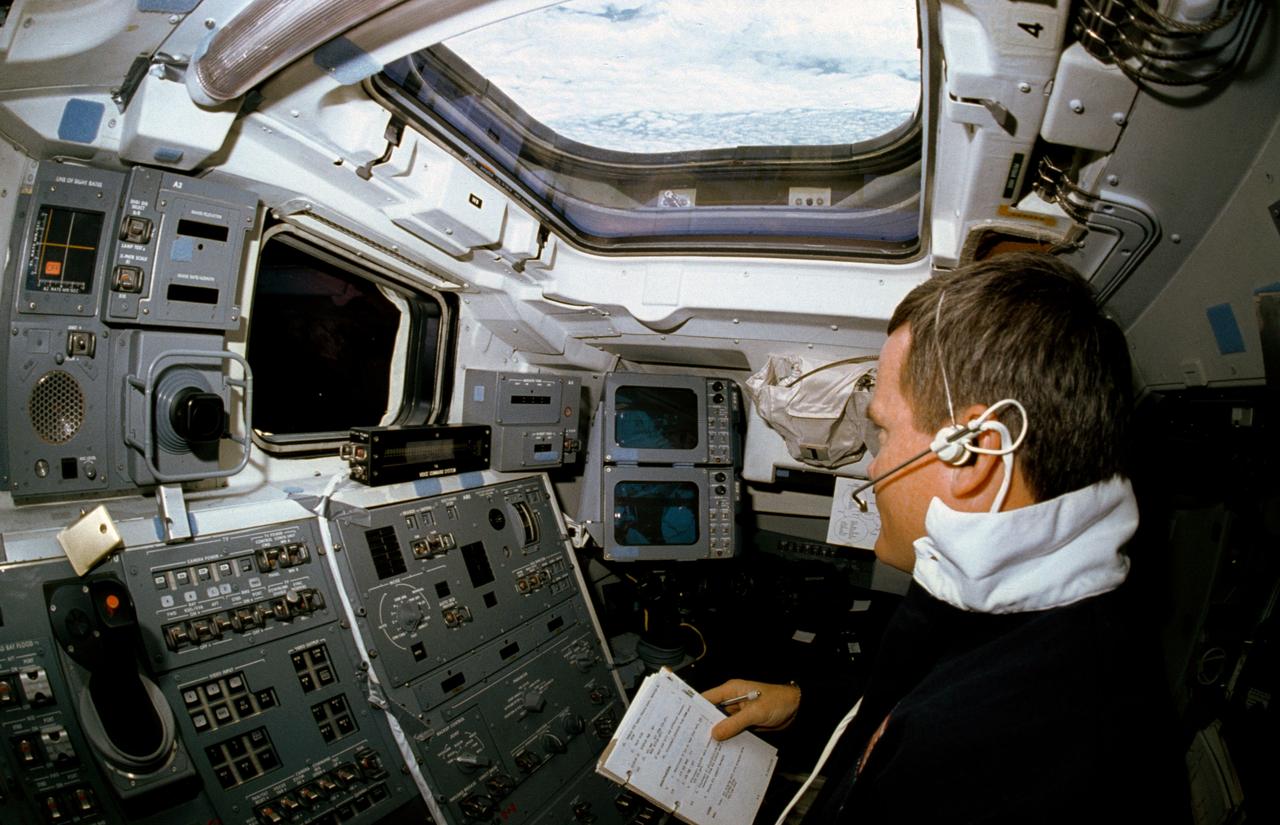
STS041-02-028 (6-20 Oct 1990) --- Astronaut Bruce E. Melnick, STS-41 mission specialist, participates in a voice command system (VCS) test on Discovery's aft flight deck. Melnick's voice is interpreted into a command that is able to control a video camera.
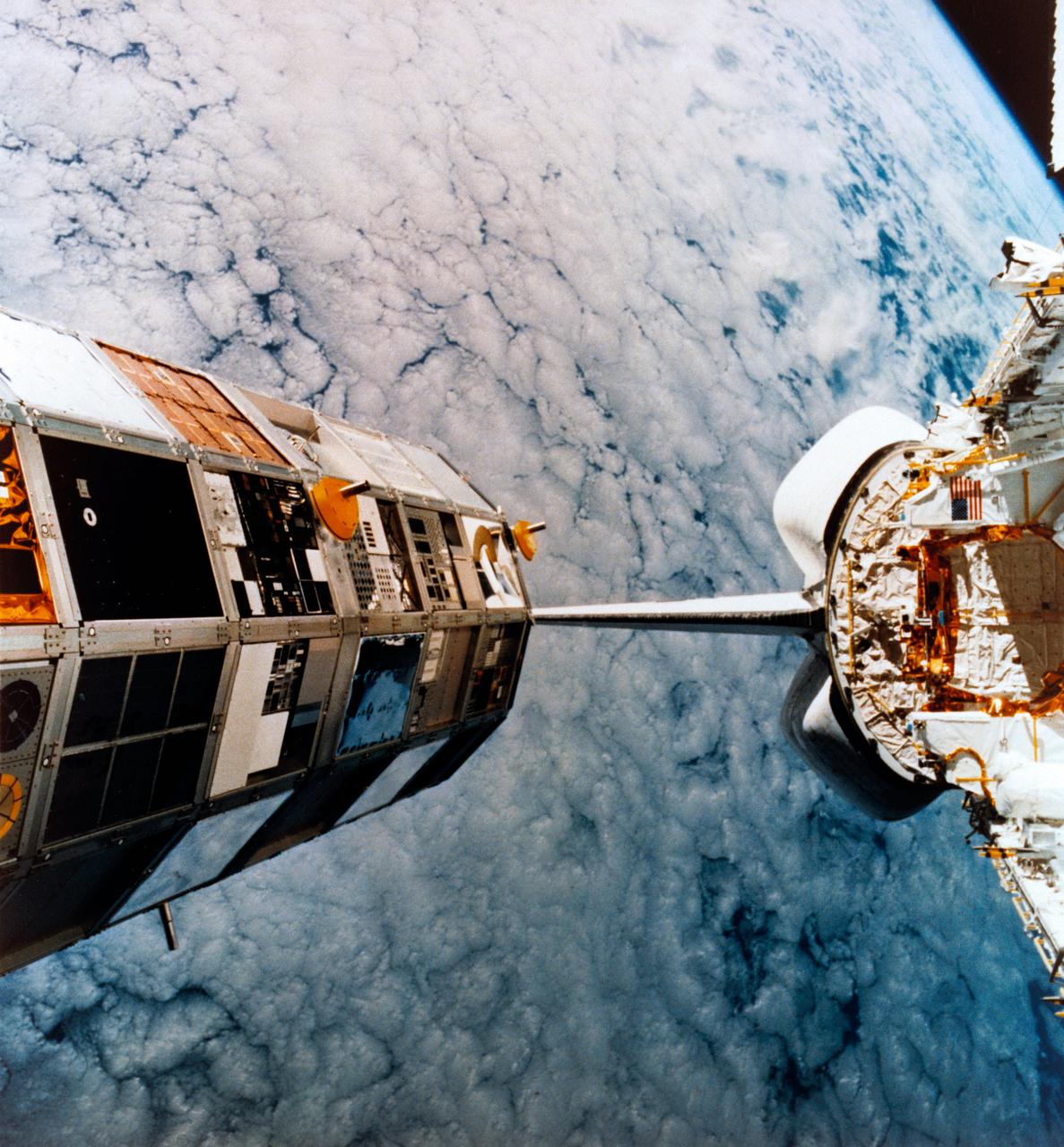
Photo from Space Shuttle Mission 41-C of the Long Duration Exposure Facility (LDEF) deploy by CHALLENGER and a Langley Research Center (LRC) supplied art concept of the LDEF recovery by COLUMBIA during Space Shuttle Mission STS-32. LRC # L-89-11-720 for JSC # S89-50779
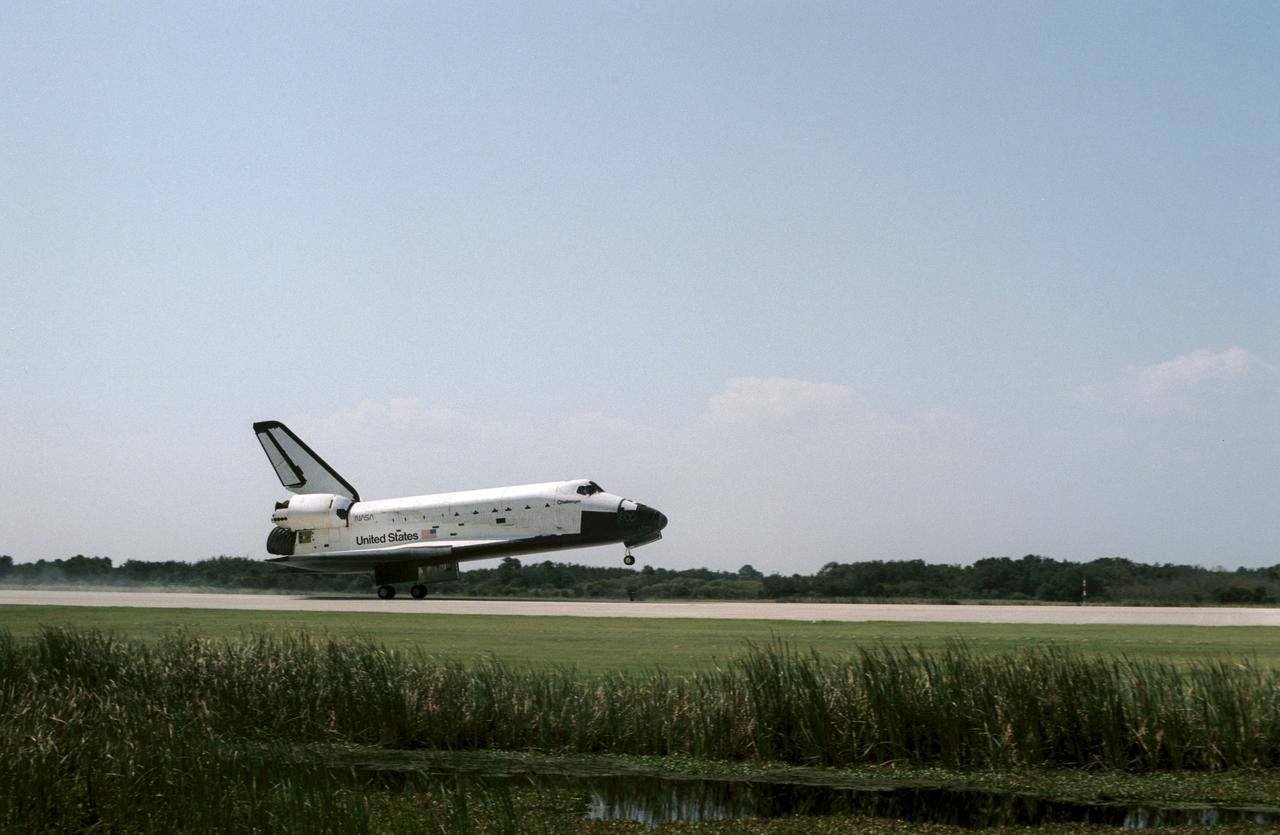
The Space Shuttle Challenger lands at Kennedy Space Center (KSC) at the end of the STS 41-G mission. The main landing gear has already touched down in this view, but the nose gear is still in the air (90232); Front view through tall grass of the Challenger making its landing at KSC (90233); Close-up side view of the Challenger making its landing at KSC (90234); Aerial view of the Challenger making its final approach to the runway to land at KSC (90235).
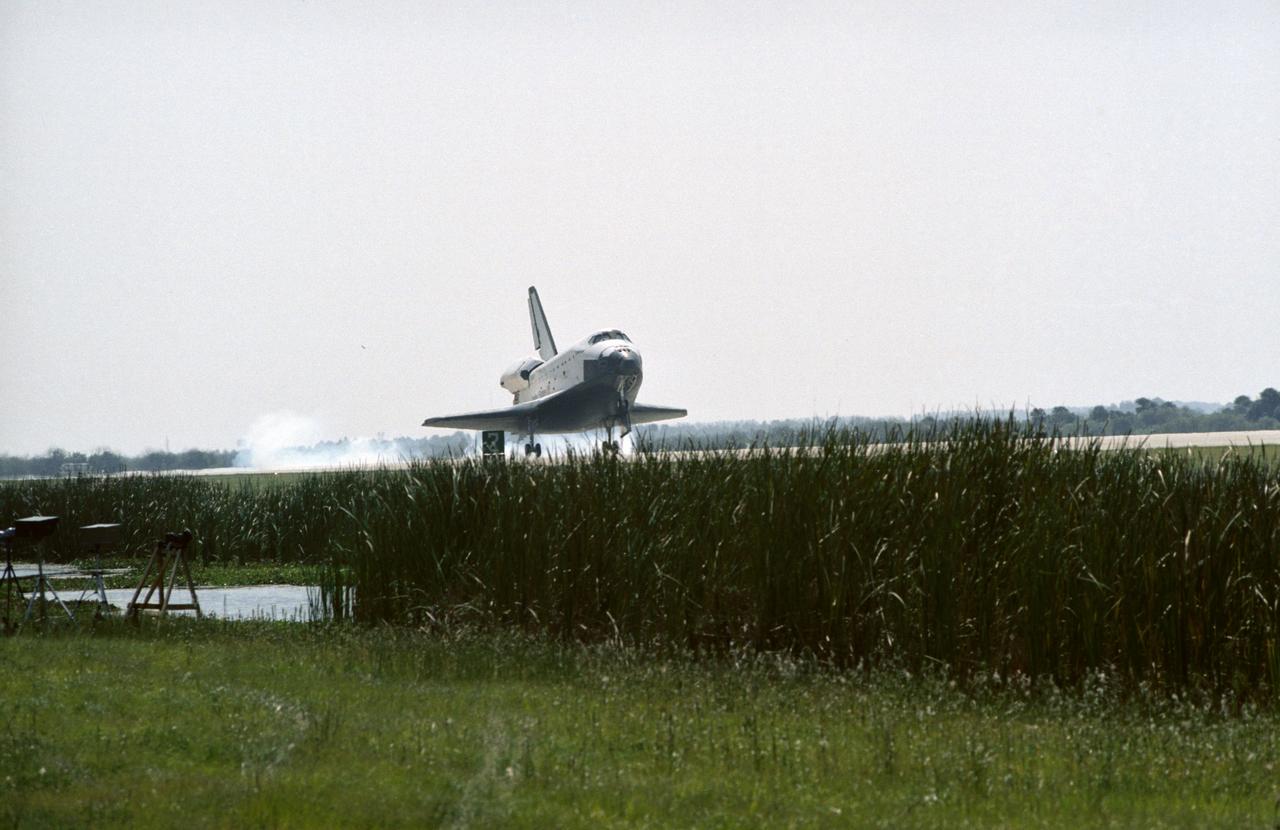
The Space Shuttle Challenger lands at Kennedy Space Center (KSC) at the end of the STS 41-G mission. The main landing gear has already touched down in this view, but the nose gear is still in the air (90232); Front view through tall grass of the Challenger making its landing at KSC (90233); Close-up side view of the Challenger making its landing at KSC (90234); Aerial view of the Challenger making its final approach to the runway to land at KSC (90235).
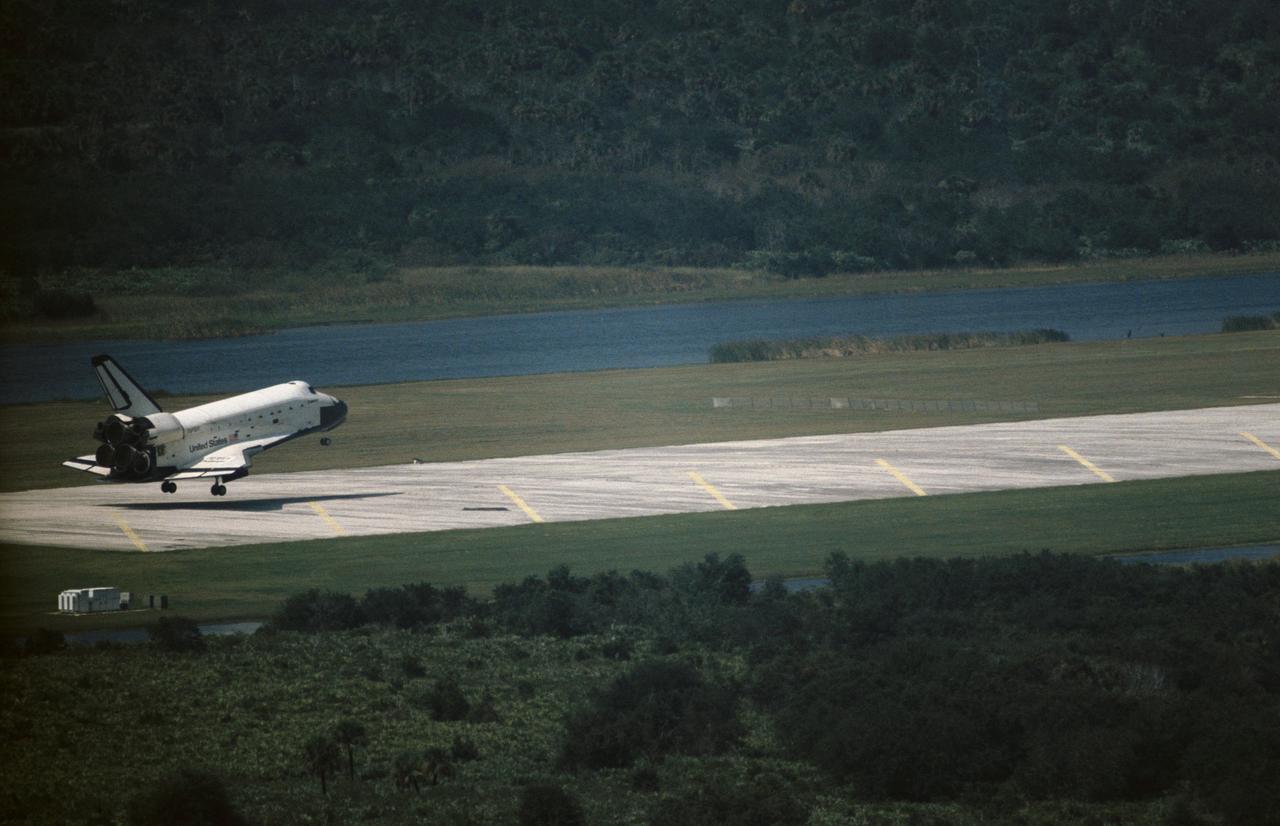
The Space Shuttle Challenger lands at Kennedy Space Center (KSC) at the end of the STS 41-G mission. The main landing gear has already touched down in this view, but the nose gear is still in the air (90232); Front view through tall grass of the Challenger making its landing at KSC (90233); Close-up side view of the Challenger making its landing at KSC (90234); Aerial view of the Challenger making its final approach to the runway to land at KSC (90235).
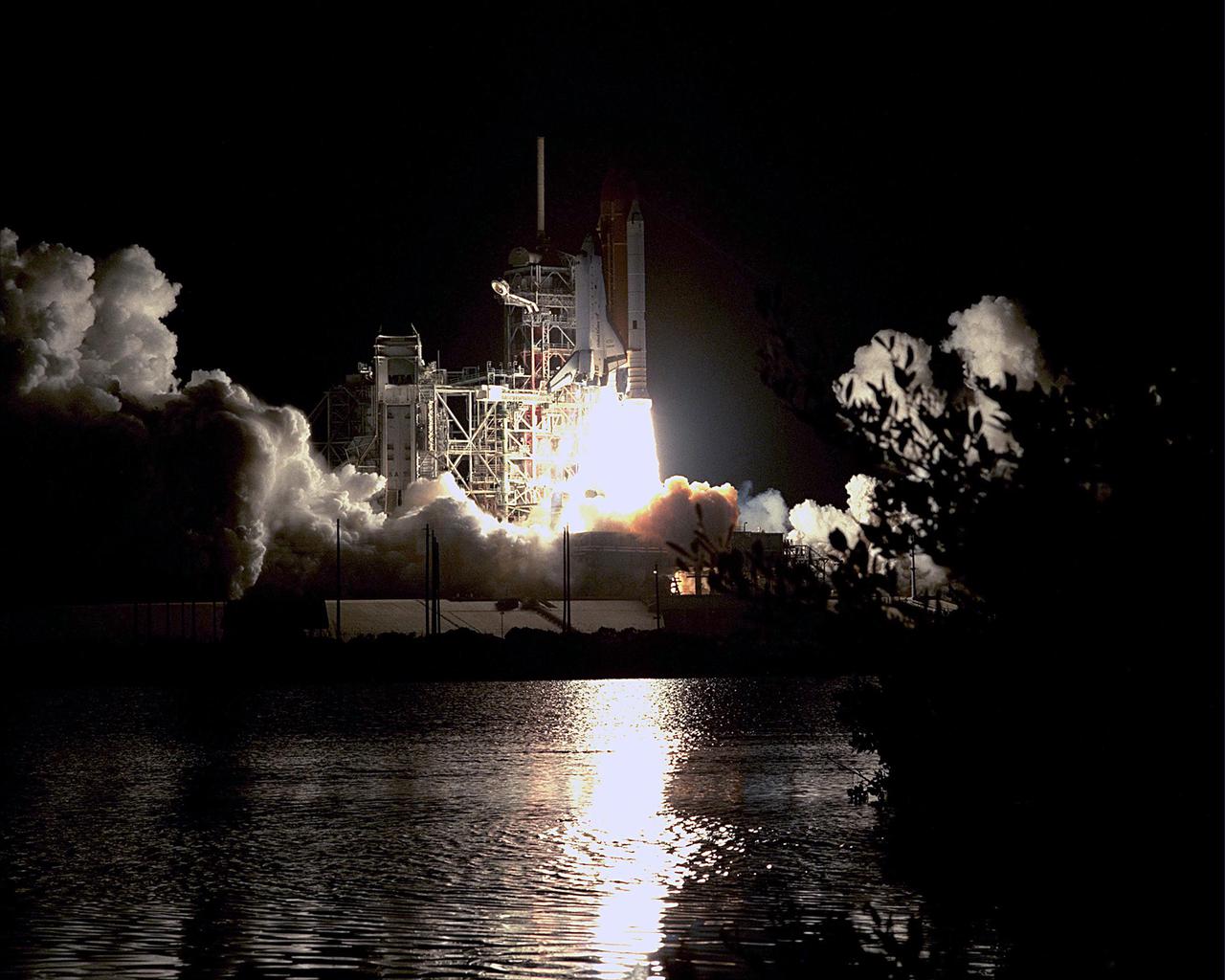
KENNEDY SPACE CENTER, FLA. -- STS-41-G: Challenger
KENNEDY SPACE CENTER, FLA. -- STS-41-C: Challenger
KENNEDY SPACE CENTER, FLA. -- STS-41-D: Discovery
KENNEDY SPACE CENTER, FLA. -- STS-41-B: Challenger
41D-3299 (5 Sept 1984) --- The Space Shuttle Discovery was captured on film just prior to touchdown on Runway 17 at Edwards Air Force Base to successfully complete a six-day mission in space. Inside were Henry W. Hartsfield, Jr., Michael L., Coats, Richard M. (Mike) Mullane, Steven A. Hawley, Judith A. Resnik and Charles D. Walker. Mission duration time was six days, 56 minutes and four seconds.
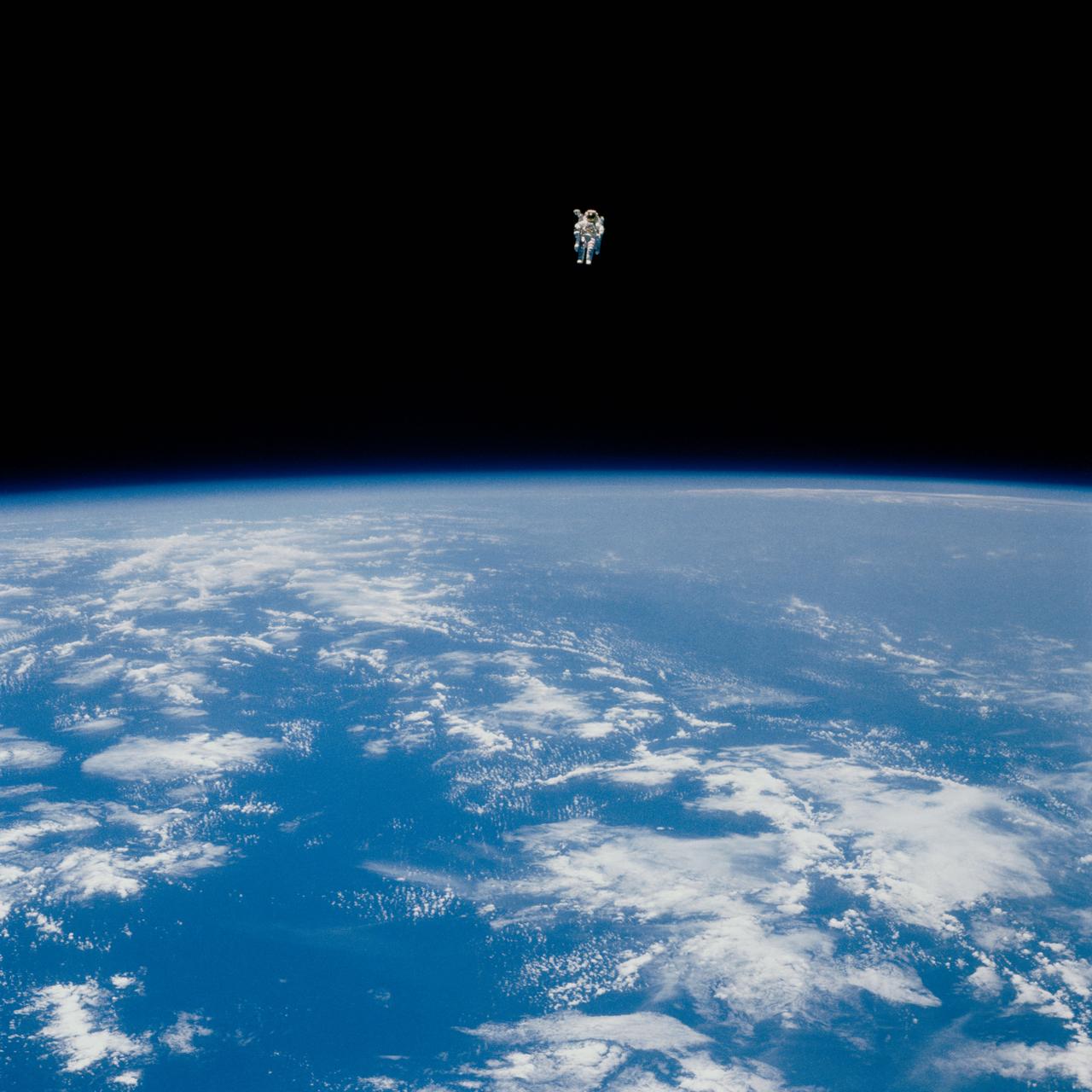
S84-27031 (7 Feb 1984) --- Astronaut Bruce McCandless II, 41-B mission specialist, reaches a maximum distance from the Challenger before reversing direction his manned maneuvering unit (MMU) and returning to the Challenger. A fellow crewmember inside the vehicle's cabin took this photograph with a 70mm camera. The untethered EVA marked the first such experience for astronauts.
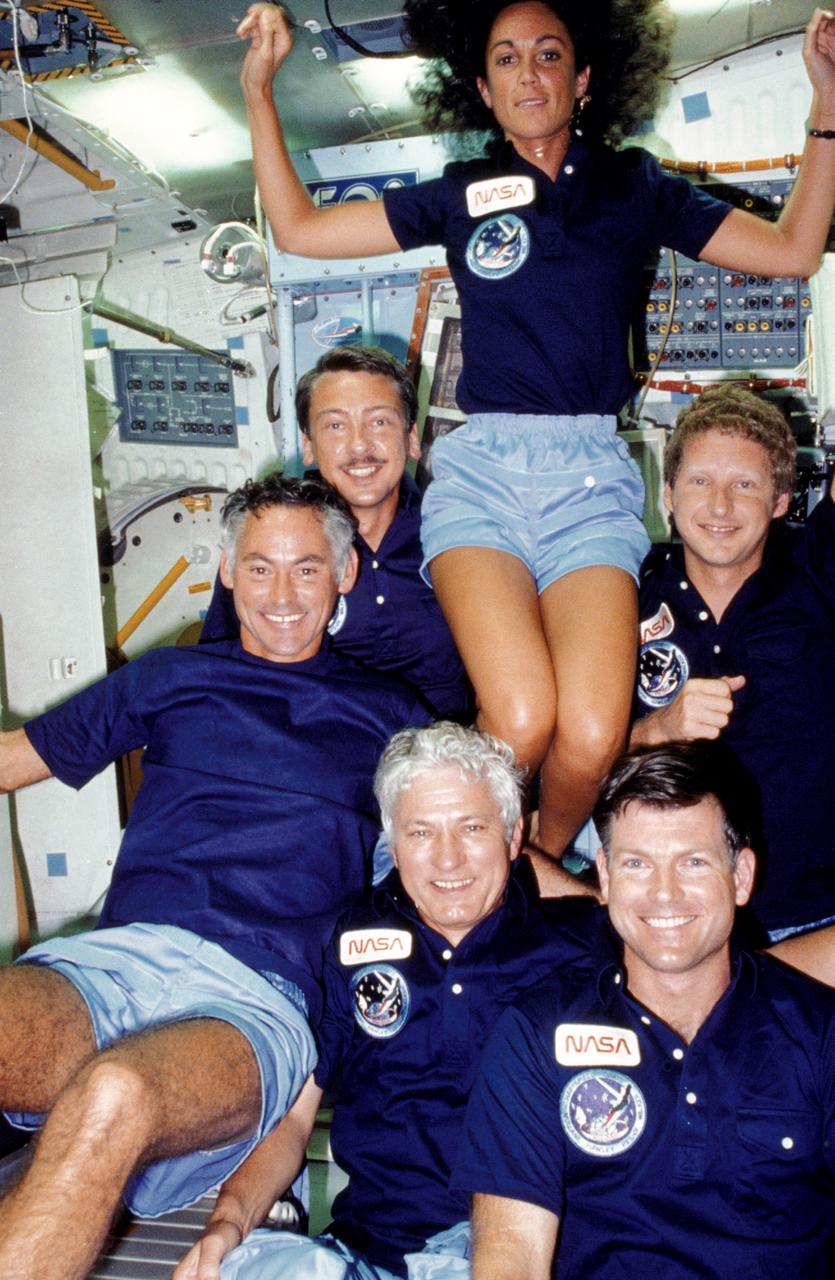
41D-12-034 (30 Aug.- 5 Sept. 1984) --- Following the completion of their six-day mission in space, the six crew members of NASA's 41-D mission mentioned that though a great deal of work was accomplished, there were "fun" moments too. From all appearance this group shot was one of the lighter moments aboard the Discovery. Crew members are (counter-clockwise from center) Henry W. Hartsfield Jr., crew commander; Michael L. Coats, pilot; Steven A. Hawley and Judith A. Resnik, both mission specialists; Charles D. Walker, payload specialist; and Richard M. (Mike) Mullane, mission specialist. A pre-set 35mm camera was used to expose the frame. Walker stands near the project that occupied the majority of his time onboard--the continuous flow electrophoresis systems (CFES) experiment. Photo credit: NASA
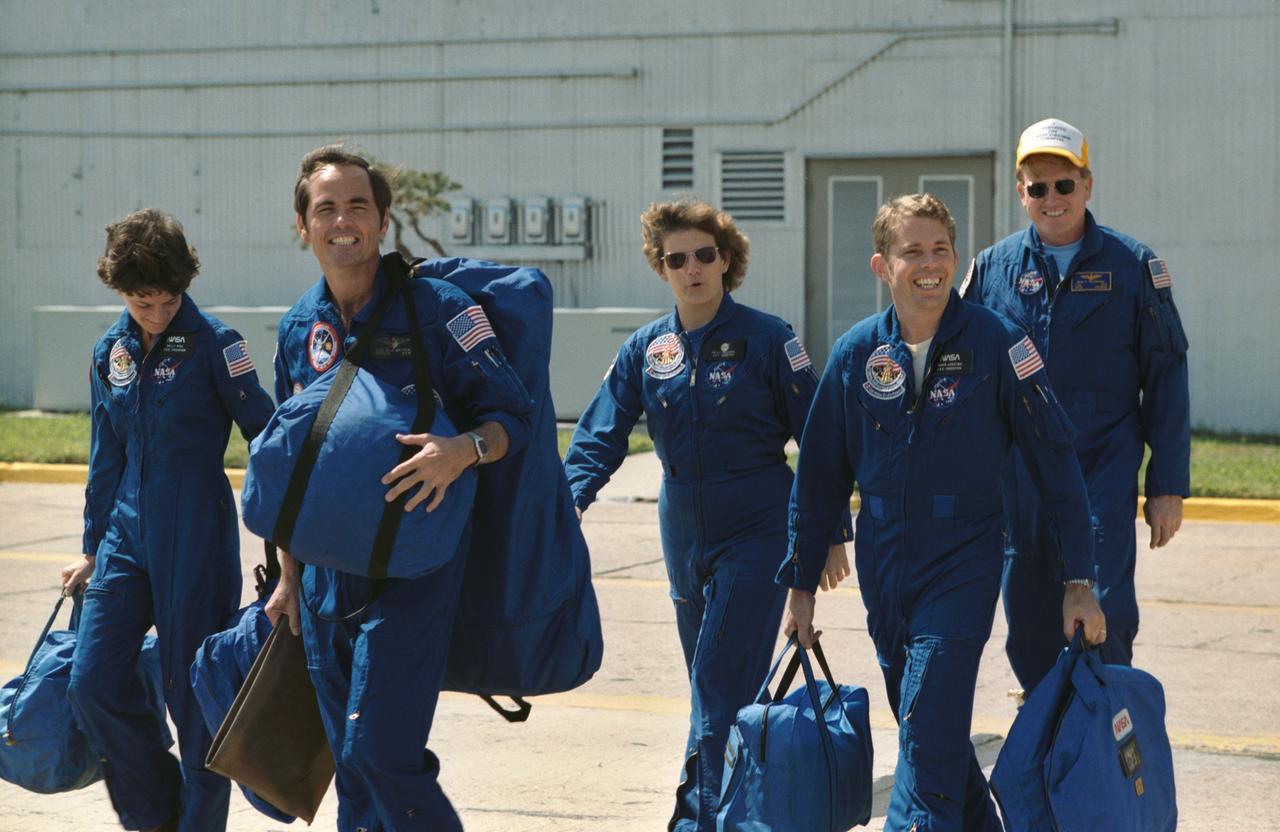
41G-90029 / S17-90029 (2 Oct 1984) --- These five astronauts prepare to board T-38 jet aircraft for a trip to Florida where they will begin preparations for a trip into space aboard the Challenger later this week. Astronaut Robert L. Crippen, left, leads the way. The crew commander is followed by (l.-r.) Sally K. Ride (extreme left edge), Kathryn D. Sullivan, David C. Leestma and Jon A. McBride, McBride is pilot and the others are mission specialists. Marc Garneau, representing the National Research Council of Canada and Paul D. Scully-Power, a civilian oceanographer with the U.S. Navy, are the payload specialists who will fly to Florida aboard a Gulfstream aircraft.
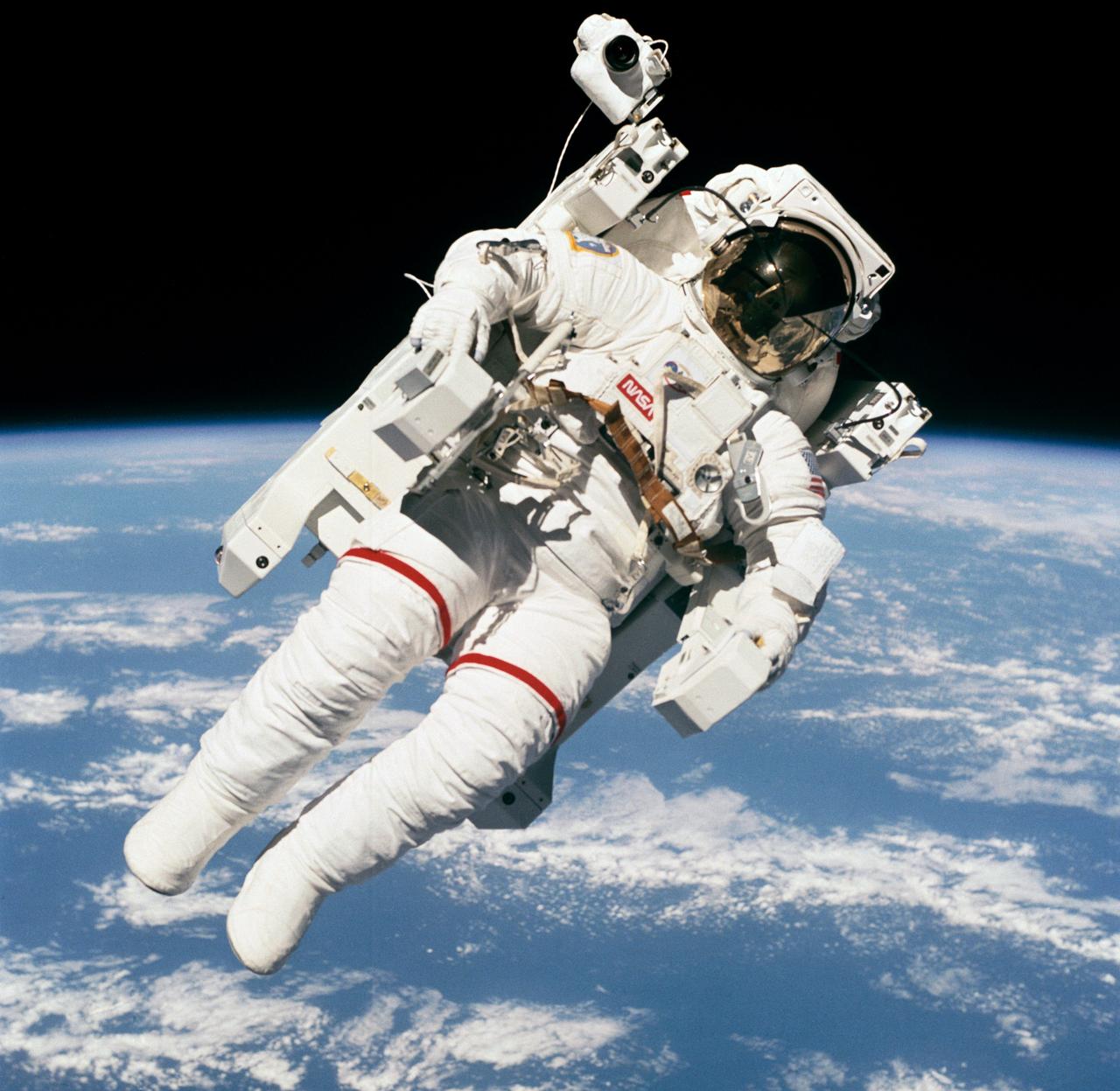
S84-27232 (& Feb 1984) --- Astronaut Bruce McCandless II, 41-B mission specialist, uses his hands to control his movement above the Earth - and just few meters away from the Challenger - during the first-ever extravehicular activity (EVA) which didn?t use restrictive tethers and umbilical?s. Fellow crewmembers aboard the Challenger used a 70mm camera to expose this frame through windows on the flight deck. McCandless was joined by Robert L. Stewart, one of two other mission specialists for this flight, on two sessions of EVA.
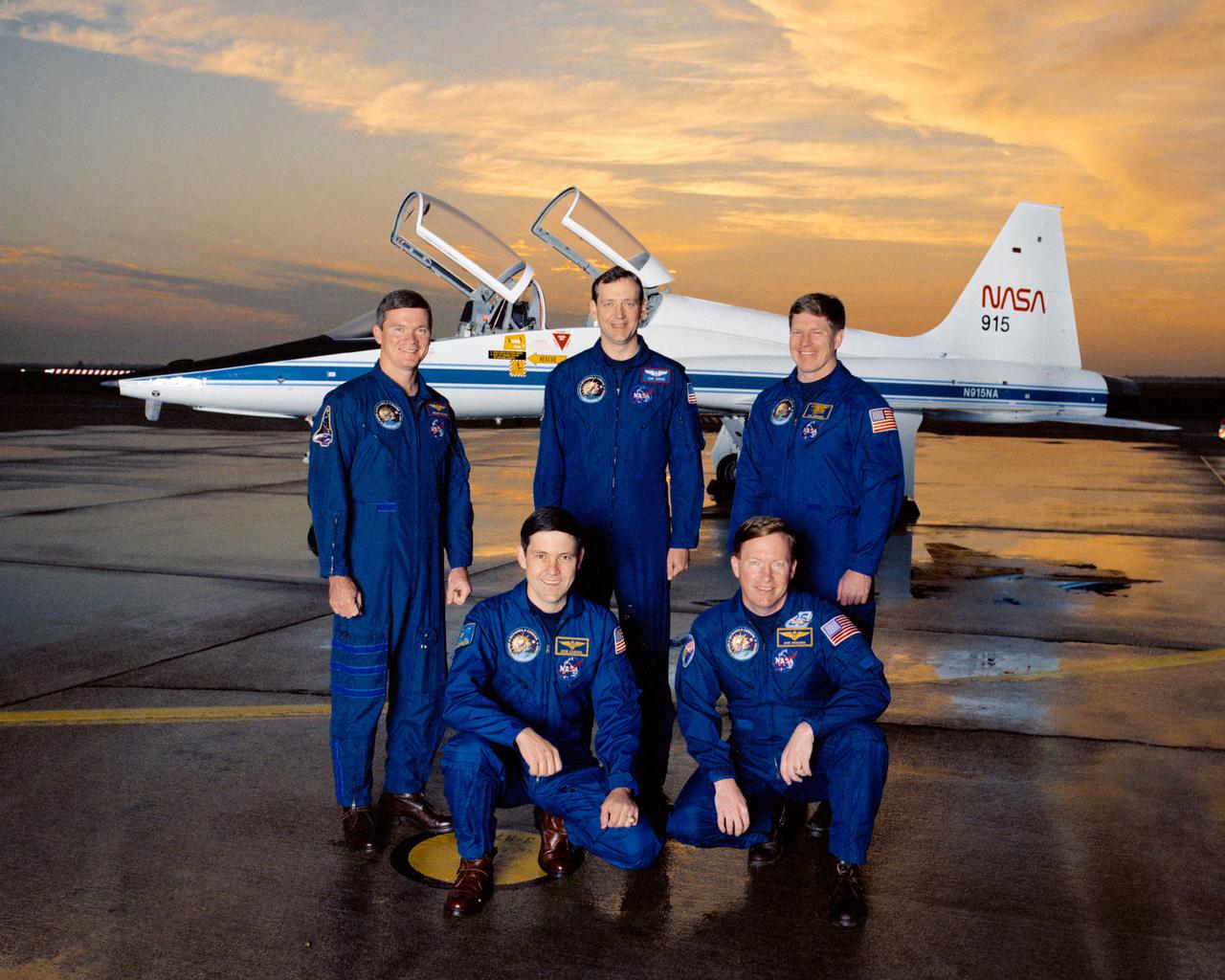
KENNEDY SPACE CENTER, Fla. – STS-41 crewmembers -- These five astronauts have been assigned to fly the STS-41 mission for NASA. Pictured are (kneeling, from the left) Robert D. Cabana, pilot, and Richard N. Richards, mission commander; and (standing from left) Bruce E. Melnick, Thomas D. Akers and William M. Shepard. All three are mission specialists.
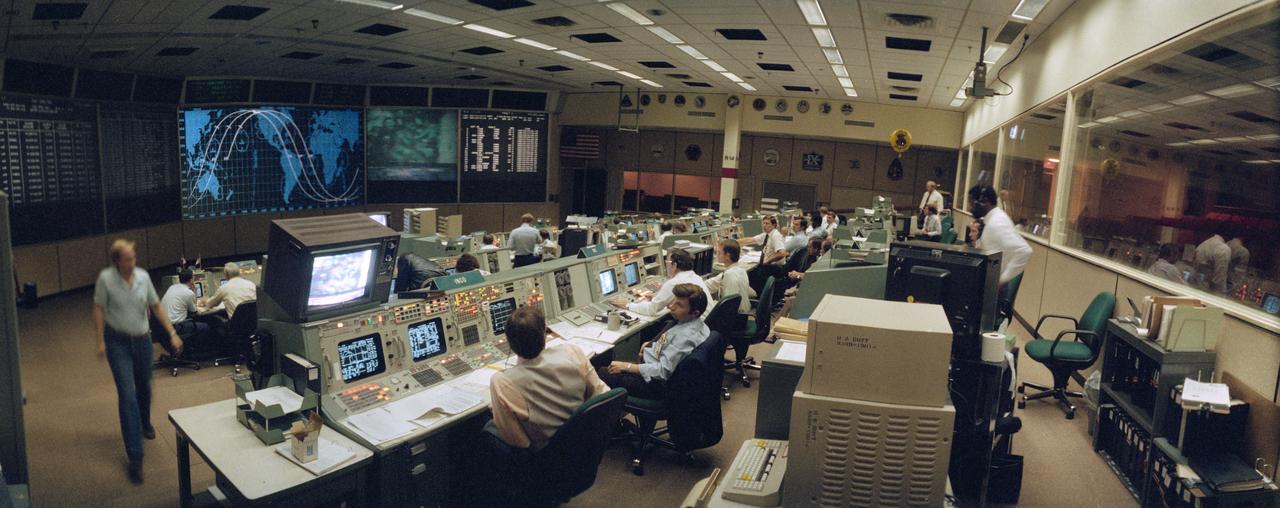
Wide angle view of the flight control room (FCR) of the Mission Control Center (MCC). Some of the STS 41-G crew can be seen on a large screen at the front of the MCC along with a map tracking the progress of the orbiter.
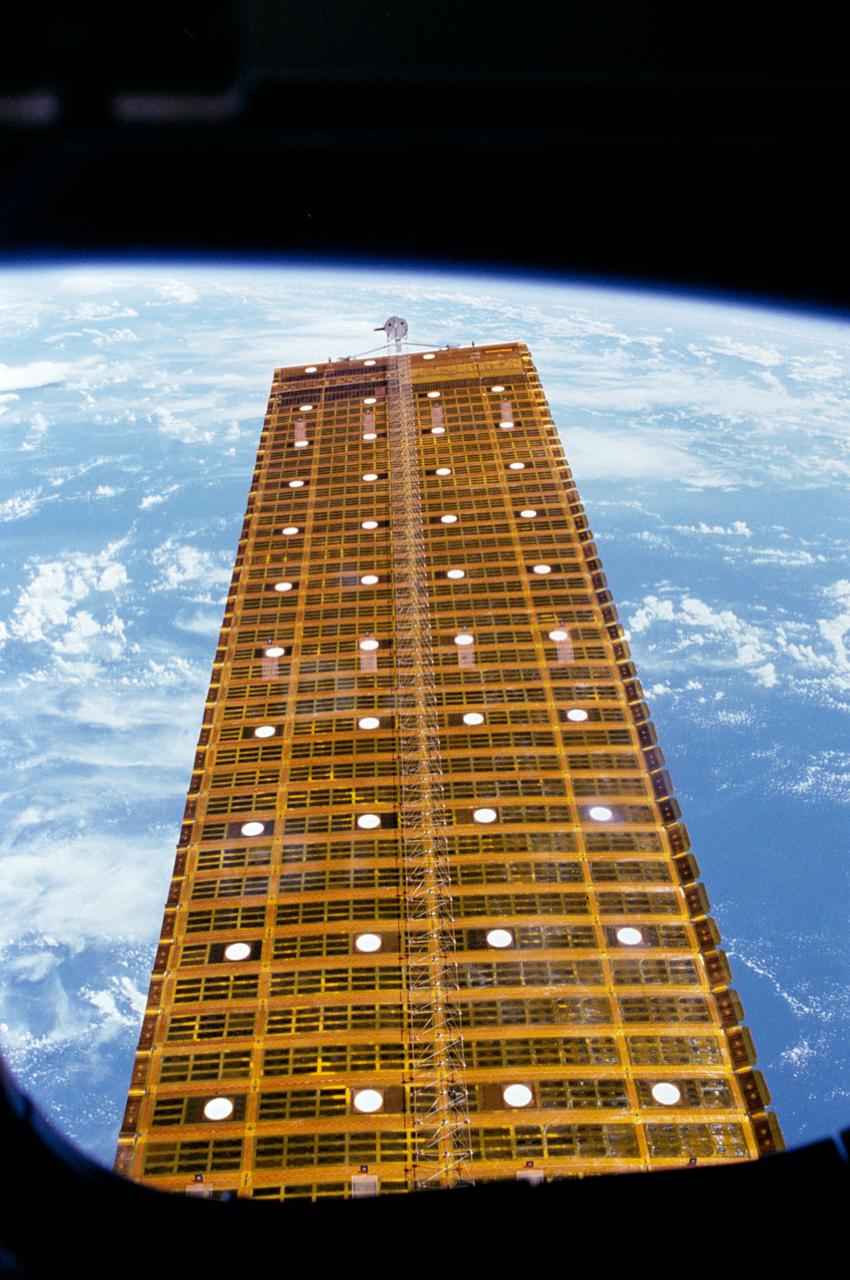
Scene of an extended solar array experiment (SAE) panel during the OAST-1 experiment. View was shot from the orbiter window by one of the STS 41-D crewmembers.
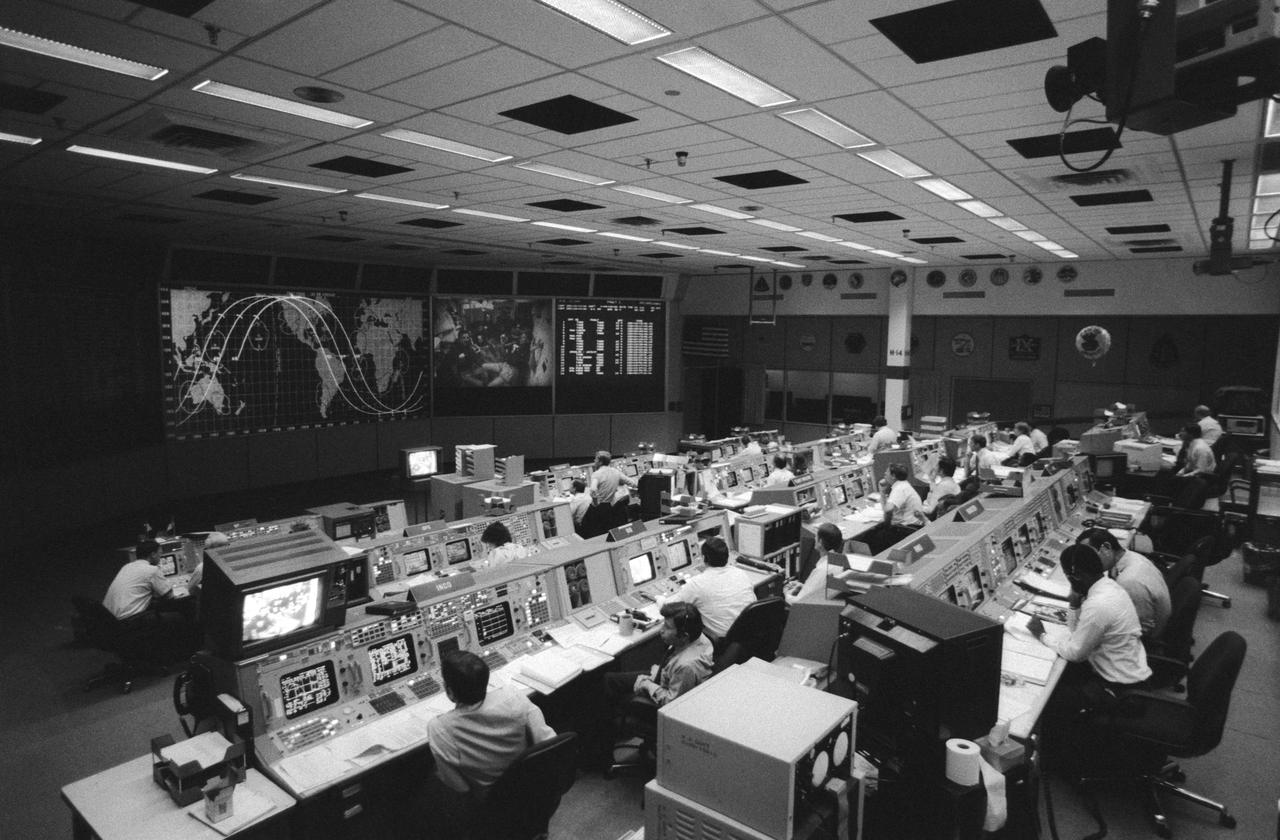
Wide angle view of the flight control room (FCR) of the Mission Control Center (MCC). Some of the STS 41-G crew can be seen on a large screen at the front of the MCC along with a map tracking the progress of the orbiter.
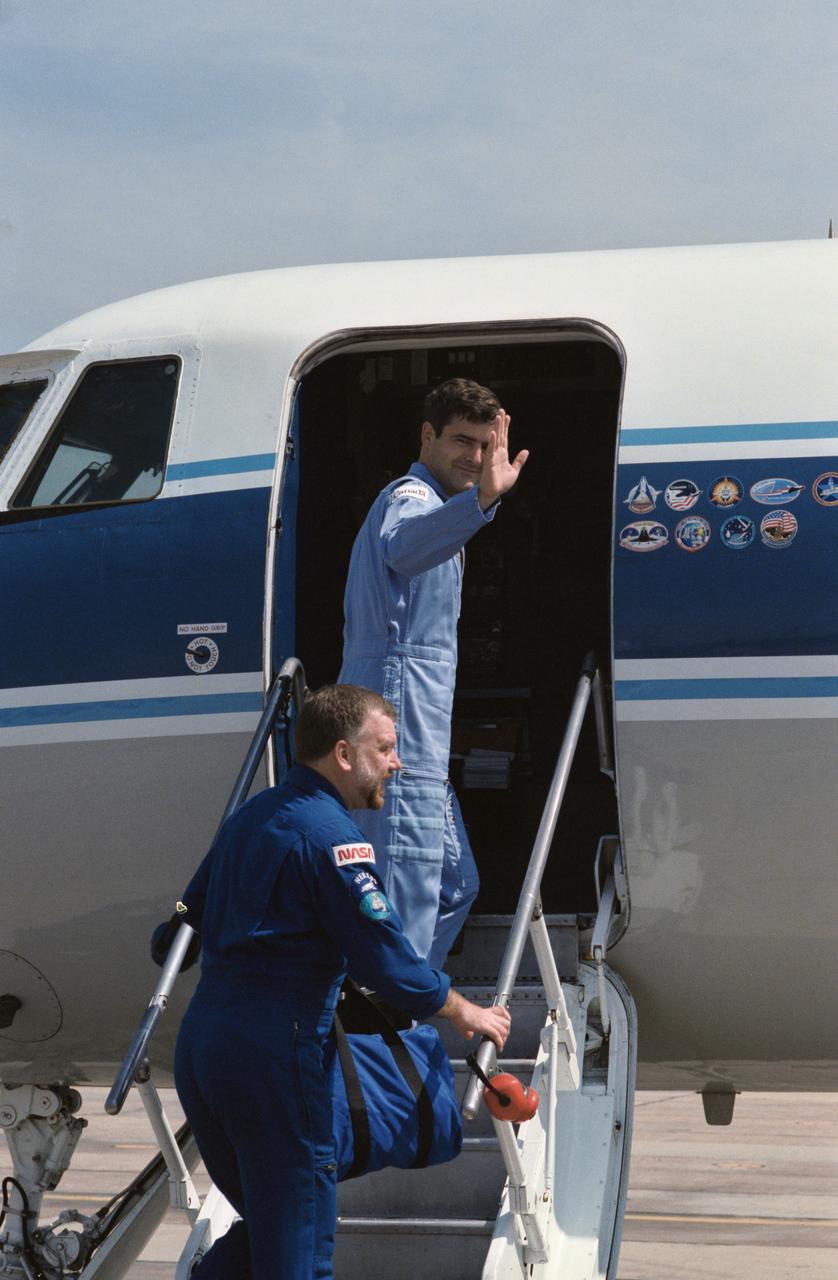
Payload Specialists Marc Garneau and Paul Scully-Power prepare to board the Shuttle Trainer aircraft to leave for the Kennedy Space Center (KSC) for the STS 41-G mission.
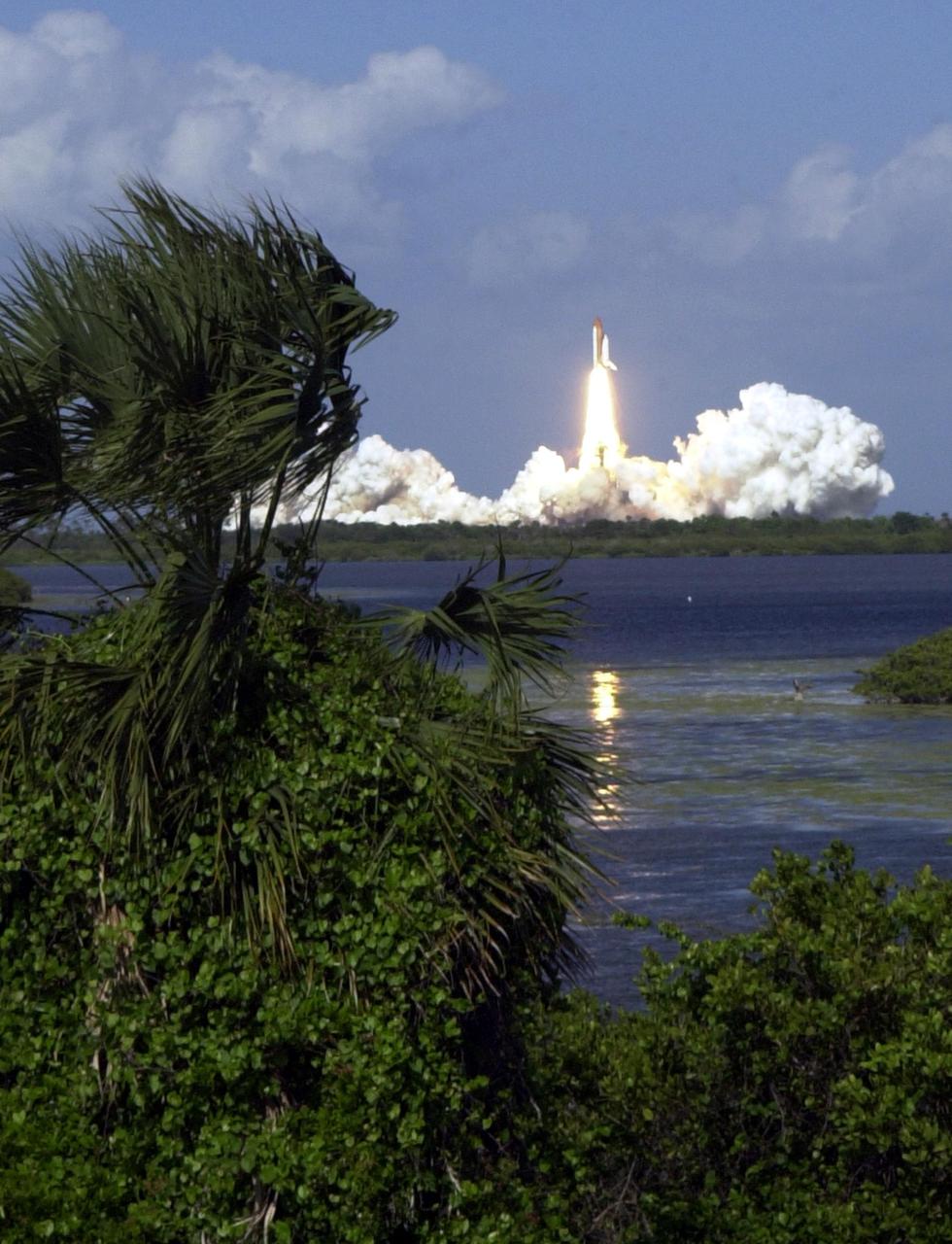
KENNEDY SPACE CENTER, FLA. - Gusty winds that blow the palmettos in the foreground don't deter the launch of Space Shuttle Atlantis, across the water, on mission STS-110. Liftoff occurred at 4:44:19 p.m. EDT (20:41:19 GMT). STS-110 is the 13th assembly flight to the International Space Station
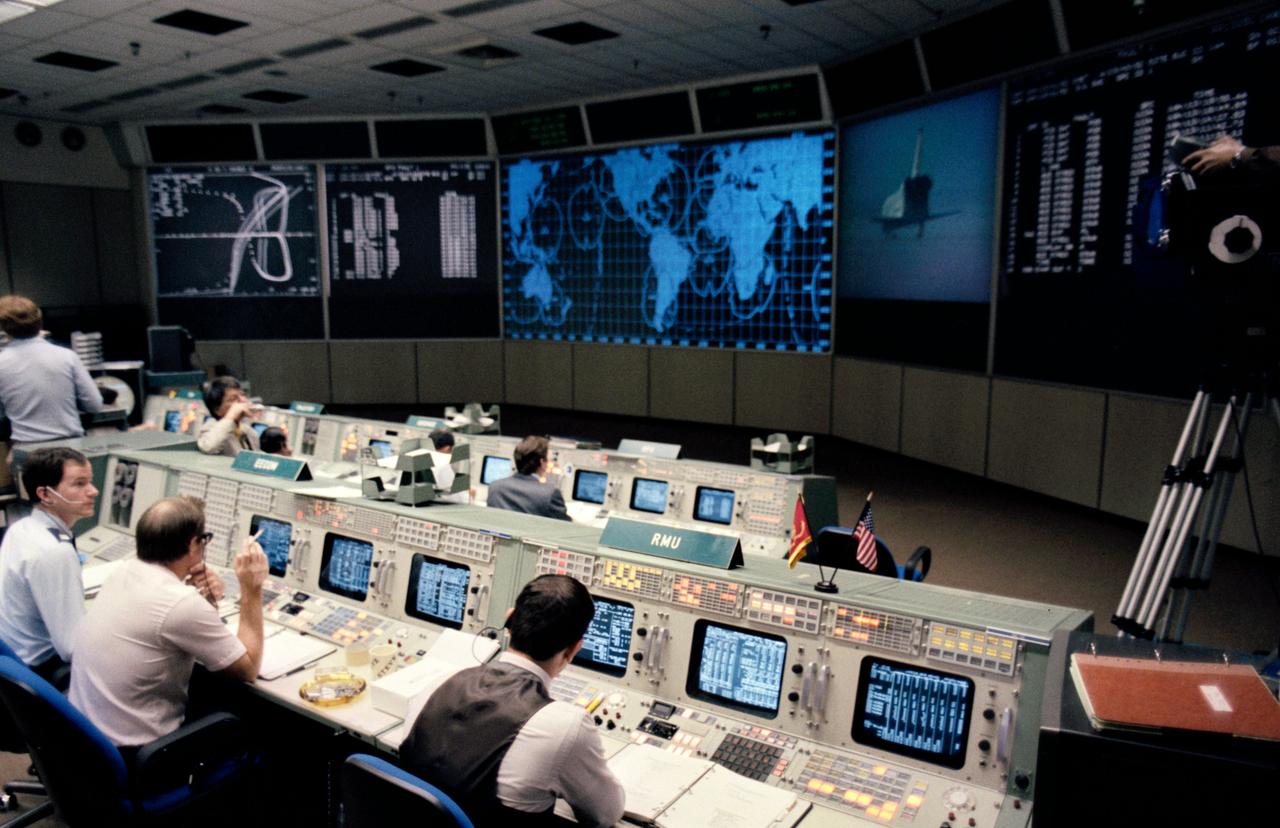
41C-03229 (13 April 1984) --- An overall view of activity in the Mission Operations Control Room (MOCR) of the Johnson Space Center (JSC) Mission Control Center (MCC) during post-landing activity at the Challenger's landing site at Edwards Air Force Base in California.
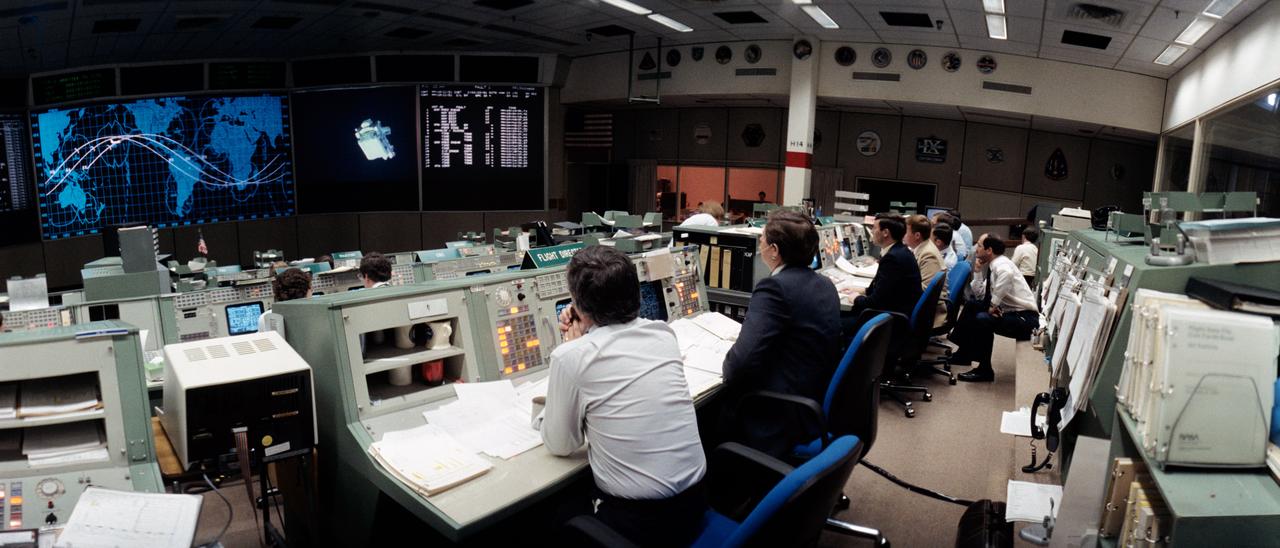
Astronaut George D. Nelson (see monitor at front of room) is viewed by flight controllers in the Mission Operations Control Room (MOCR) of JSC's Mission Control Center during 41-C extravehicular activity (EVA). In the foreground are Flight Directors Jay H. Greene and John T. Cox. Astronauts Jerry L. Ross and Richard H. Richards are seated at the CAPCOM or spacecraft communicators console at right background. Astronaut Guy S. Gardner is perched just behind them.
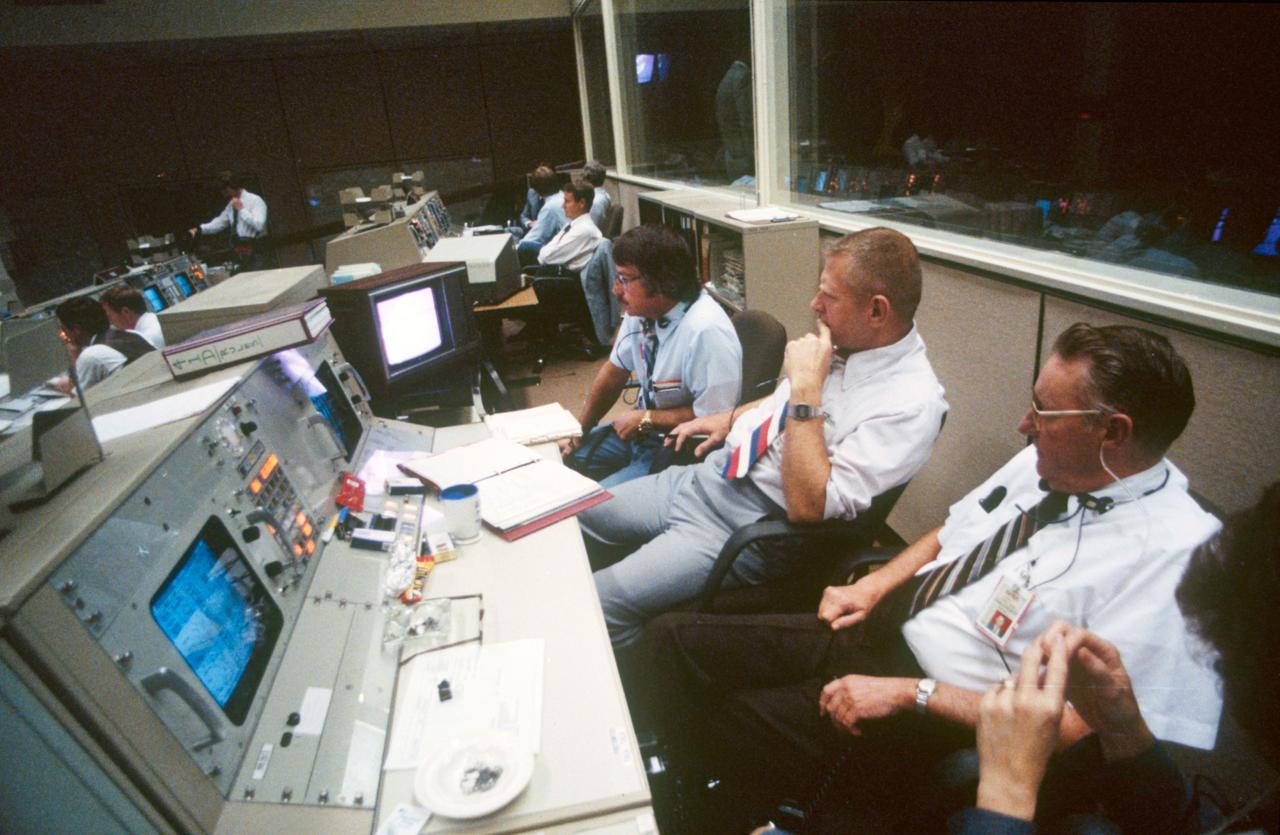
41D-3073 (30 Aug 1984) --- The beginning stages of a busy six-day mission are monitored by some NASA officials in the flight control room (FCR-1) of the Johnson Space Center's (JSC) mission control center (MCC). They are (l.-r., foreground) Daniel M. Germany, manager of the Shuttle flight equipment project offices; Eugene F. Kranz, director of mission operations; and Clifford E. Charlesworth, director of space operations.
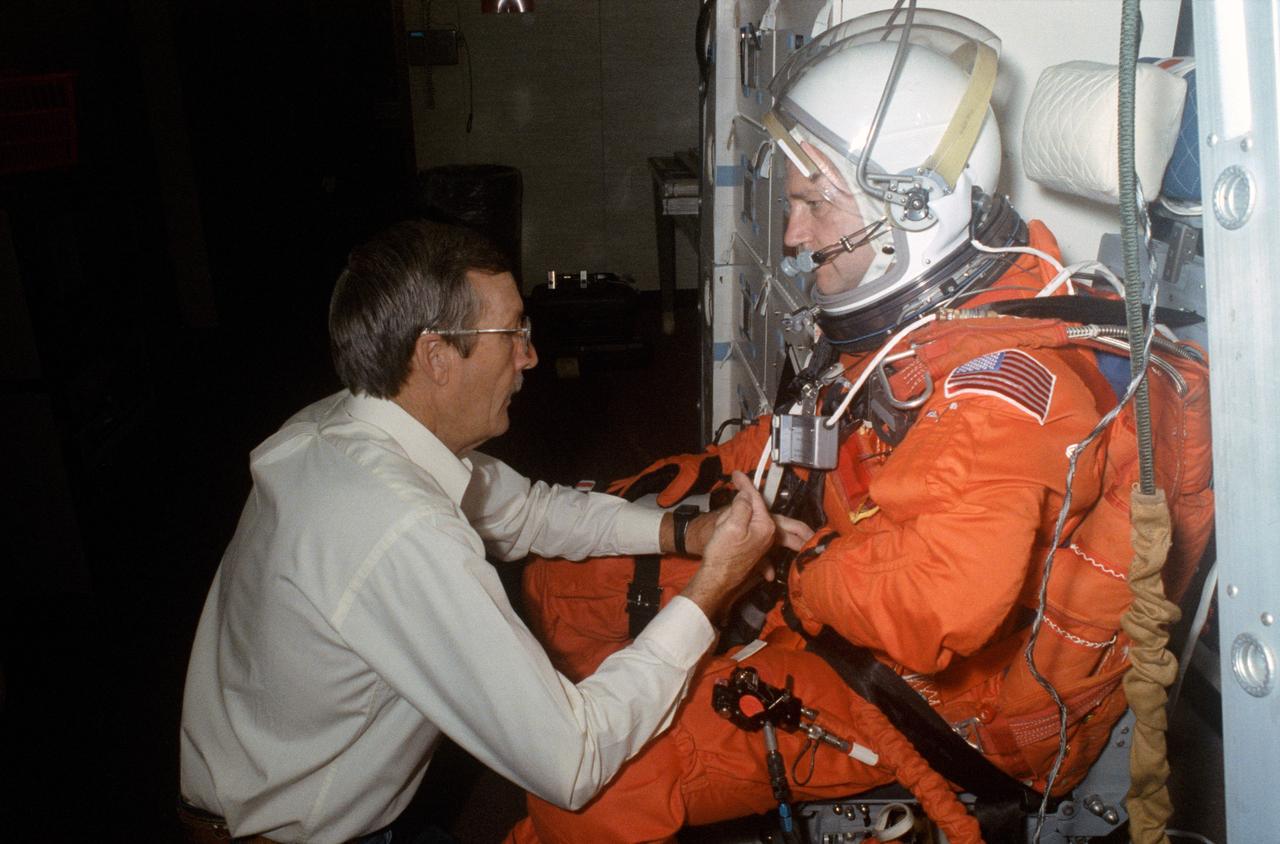
S90-47148 (21 Aug 1990) --- Astronaut Thomas D. Akers, STS-41mission specialist, is assisted by Troy M. Stewart of the Shuttle support branch in NASA's Crew and Thermal Systems Division. The astronaut was about to join his four crewmates in participating in a simulation of their scheduled flight in JSC's fixed-base Shuttle mission simulator (SMS).
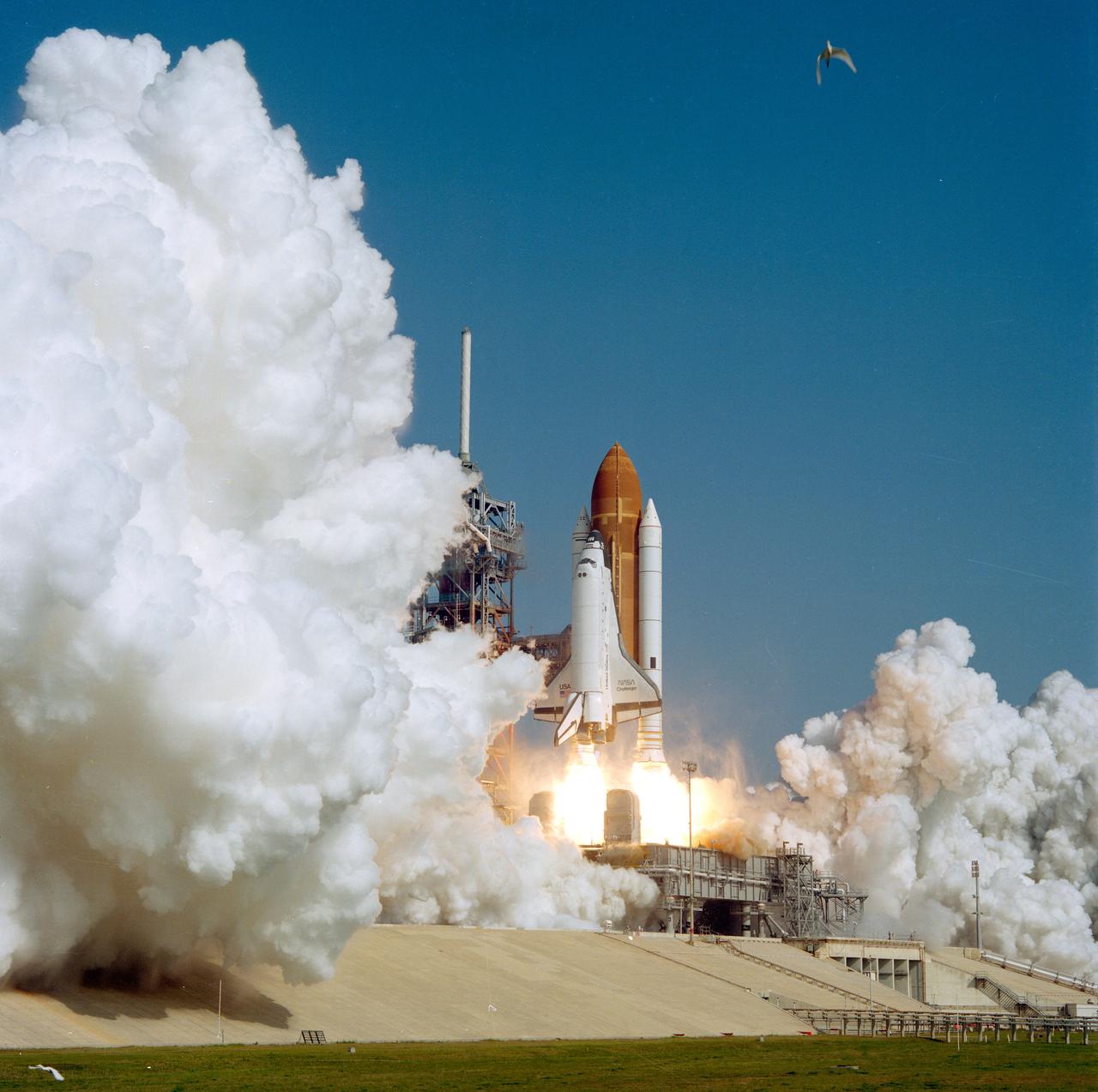
41C-3056 (6 April 1984) --- The Space Shuttle Challenger and its five-member astronaut crew leave the launch pad at the Kennedy Space Center (KSC) to begin a six-day stay in space. The launch occurred at 8:58:00:03 a.m. (EST), April 6, 1984. This photo was made with a 120 camera.
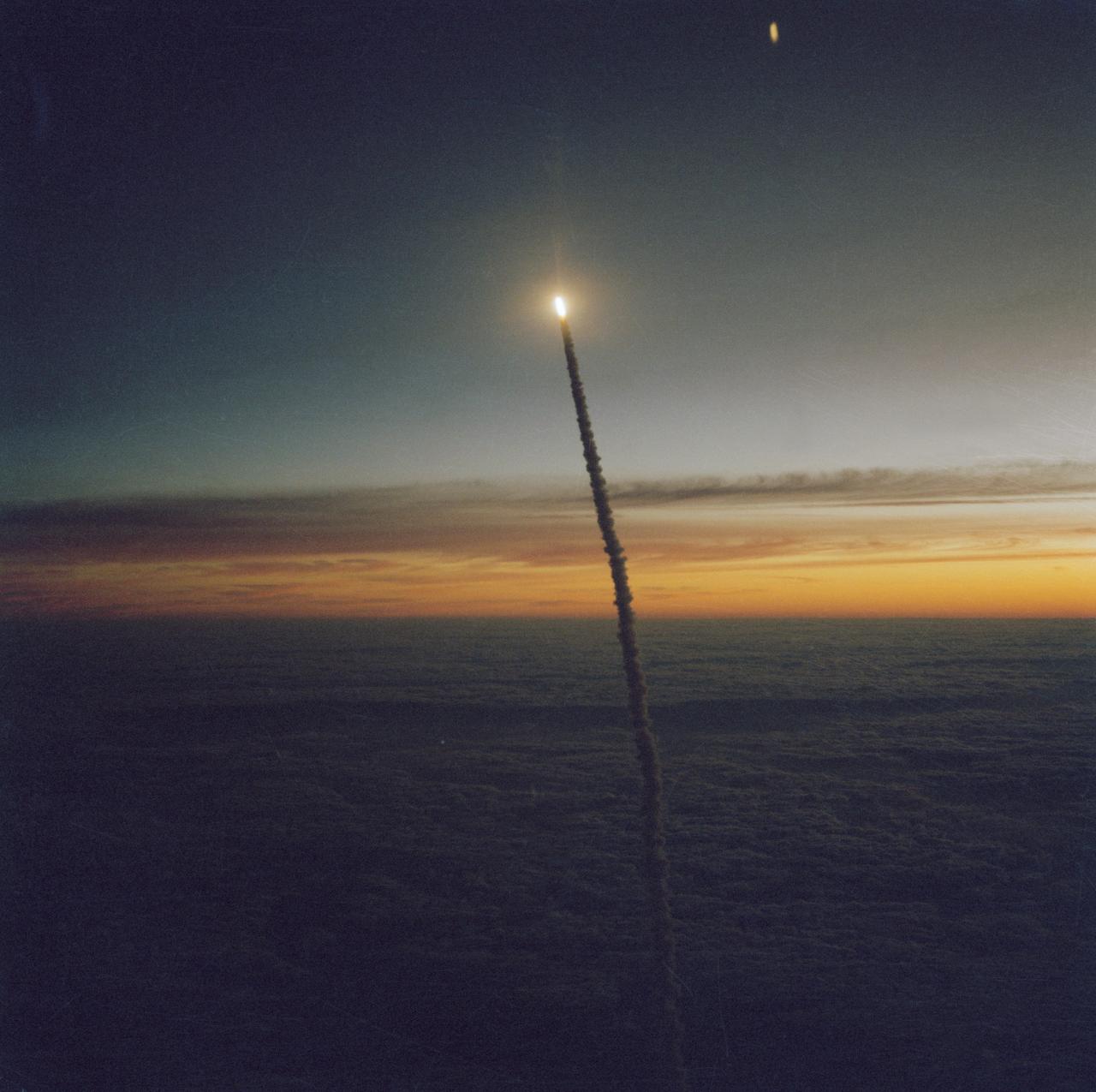
41G-90139 (5 October 1984) --- A Florida dawn scene forms the backdrop for the climbing Space Shuttle Challenger, its two solid rocket boosters and external fuel tank. Seven crewmembers, a space record, head for a busy eight-day stay in Earth orbit. The scene was photographed by astronaut Paul J. Weitz, who was piloting the Shuttle training aircraft (STA).
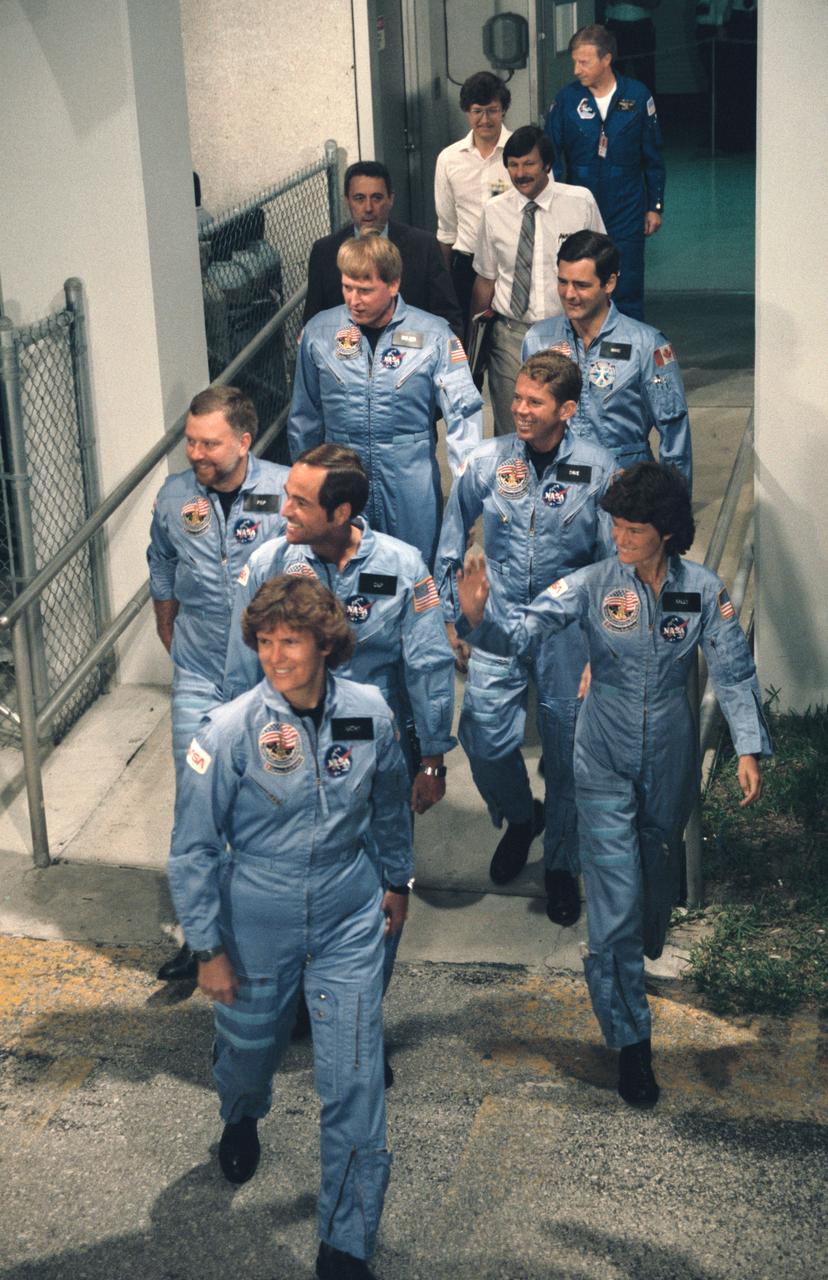
41G-90081 / S17-90081 (5 Oct 1984) --- The seven member crew leaves the Operations and Checkout Building (OCB) to take a van ride to the launch pad. Leading the way is Kathryn D. Sullivan followed in file by Robert L. Crippen, Paul D. Scully-Power and Jon A. McBride. On the right side are Sally K. Ride, David C. Leestma and Marc Garneau. Trailing the crew are George W. S. Abbey, Richard Nygren, Paul Bulver, and Paul J. Weitz.

41G-102-047 (13 Oct. 1984) --- An unusual picture, photographed by astronaut Kathryn D. Sullivan, shows the beginning and ending location of her eight-day mission in space with six other 41-G crew members aboard the space shuttle Challenger. The picture was made moments before touchdown at the KSC landing facility. Dr. Sullivan aimed a 35mm camera through the port hole in Challenger's hatch. The five ground features represented as circles or pentagonals are launch areas. Photo credit: NASA
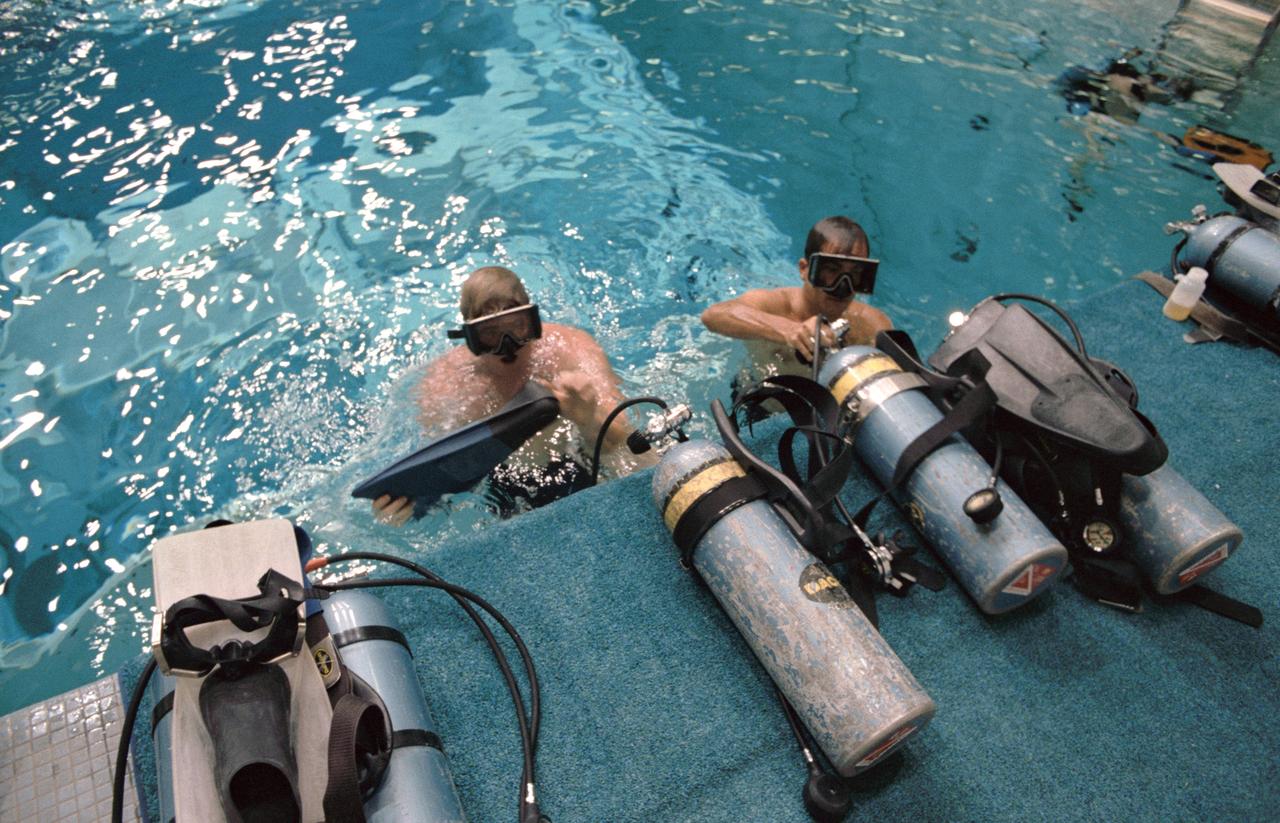
S84-36900 (29 June 1984) ---Astronauts Robert L. Crippen (right) and Jon A. McBride, crew commander and pilot, respectively, for NASA's 41-G Space Shuttle mission, don self contained underwater breathing apparatus (SCUBA) gear prior to their underwater to observe a simulation of an extravehicular activity (EVA) to be performed on their mission. Astronauts Kathryn D. Sullivan and David C. Leestma, two of three mission specialists on the seven-member crew, are scheduled for the EVA. The underwater training took place in the Johnson Space Center's weightless environment training facility (WET-F).
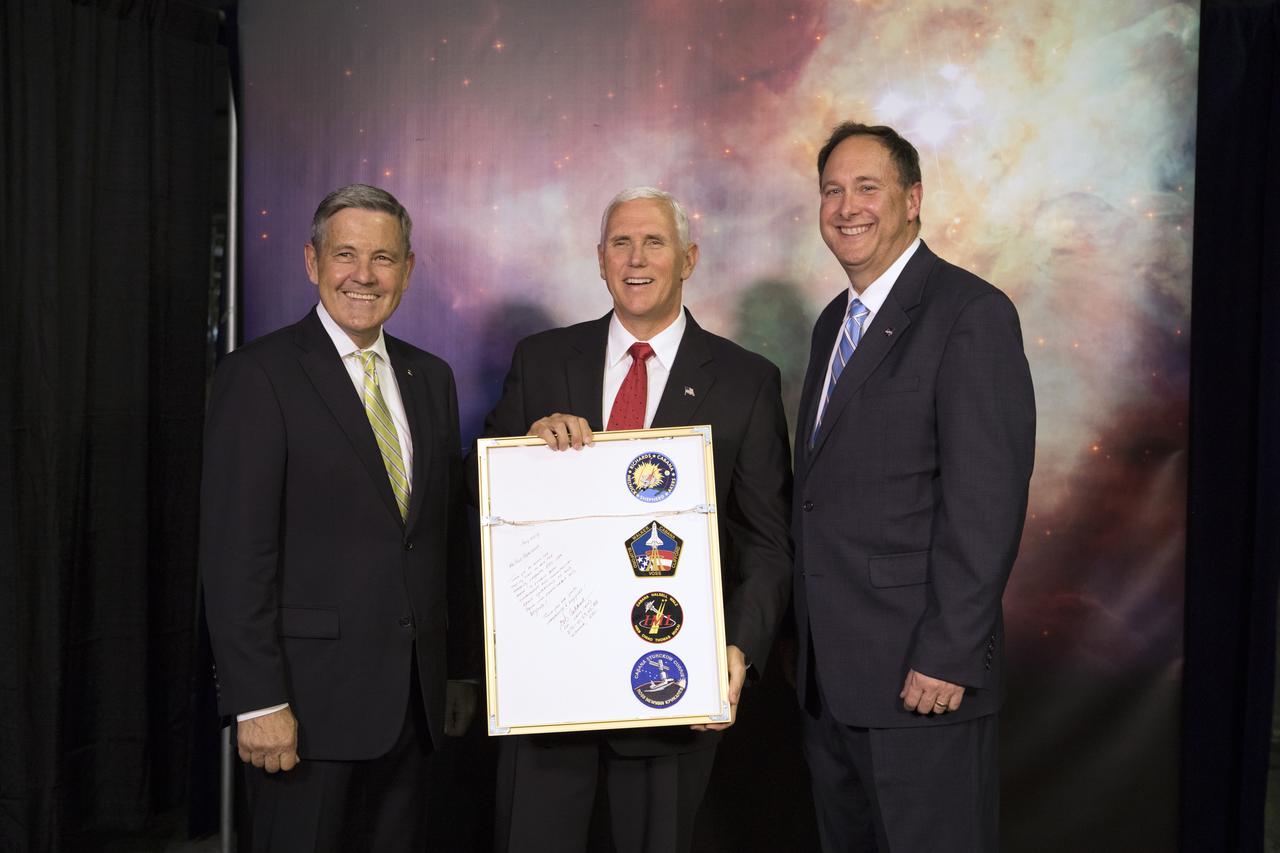
Kennedy Space Center Bob Cabana, left, and NASA's Acting Administrator Robert Lightfoot, right present Vice President Mike Pence with a framed plaque. On the back of the plaque are patches from each of Cabana's four space shuttle mission, STS-88, STS-53, STS-65, STS-41, and an inscription thanking the Vice President for his support of NASA. During his visit to Kennedy, the Vice President spoke inside the iconic Vehicle Assembly Building, where he thanked employees for advancing American leadership in space.
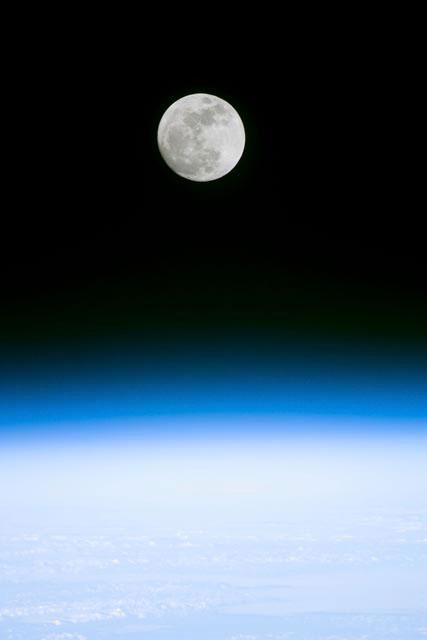
STS103-E-5040 (21 December 1999) --- This photo of the Moon over the airglow of Earth's atmosphere was taken by the STS-103 crew members aboard Discovery. Time of the electronic still camera's (ESC) image was 15:15:41 GMT, Dec. 21, 1999.
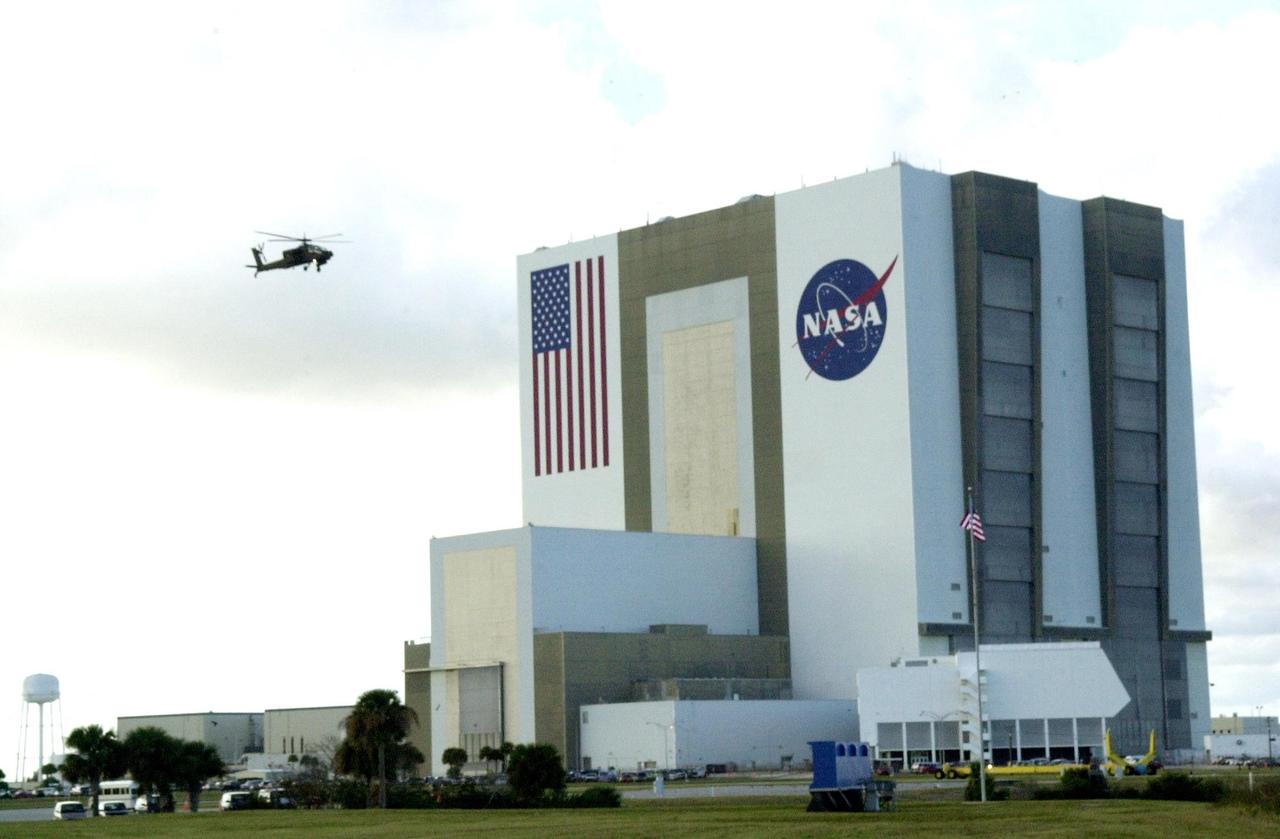
KENNEDY SPACE CENTER, FLA. -- A United States military Apache H64A helicopter patrols Kennedy Space Center airspace near the Vehicle Assembly Building as the launch of Space Shuttle Endeavour on mission STS-108 to the International Space Station approaches. Launch is scheduled for 7:41 p.m. EST on Nov. 29
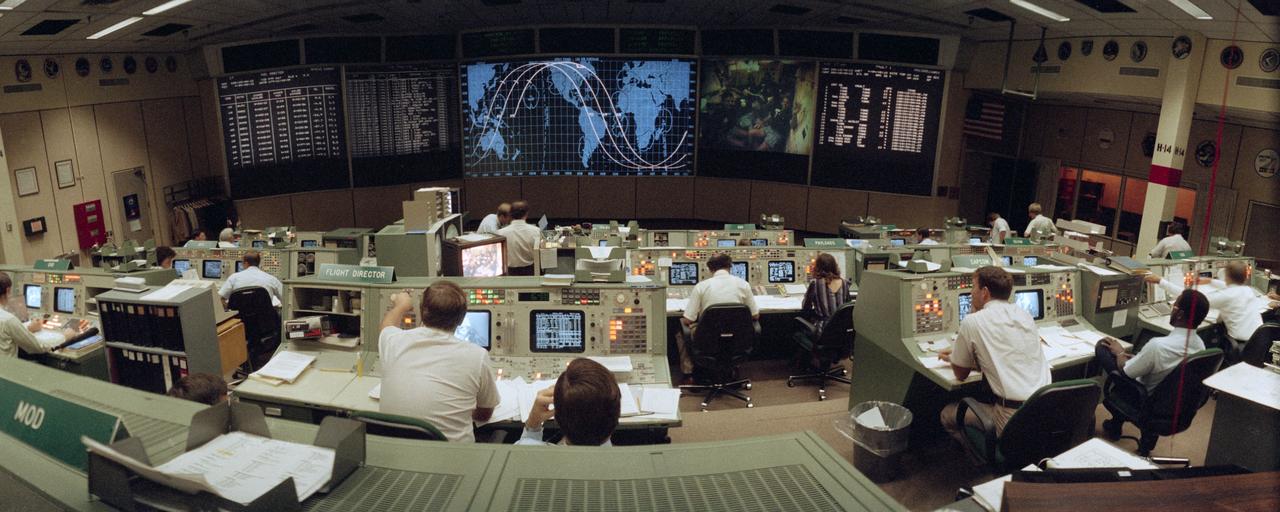
Fisheye view from the back of the Flight Control Room (FCR) of the Mission Control Center (MCC). Visible are the Flight Directors console (left front), the CAPCOM console (right front) and the Payloads console. Some of the STS 41-G crew can be seen on a large screen at the front of the MCC along with a map tracking the progress of the orbiter.
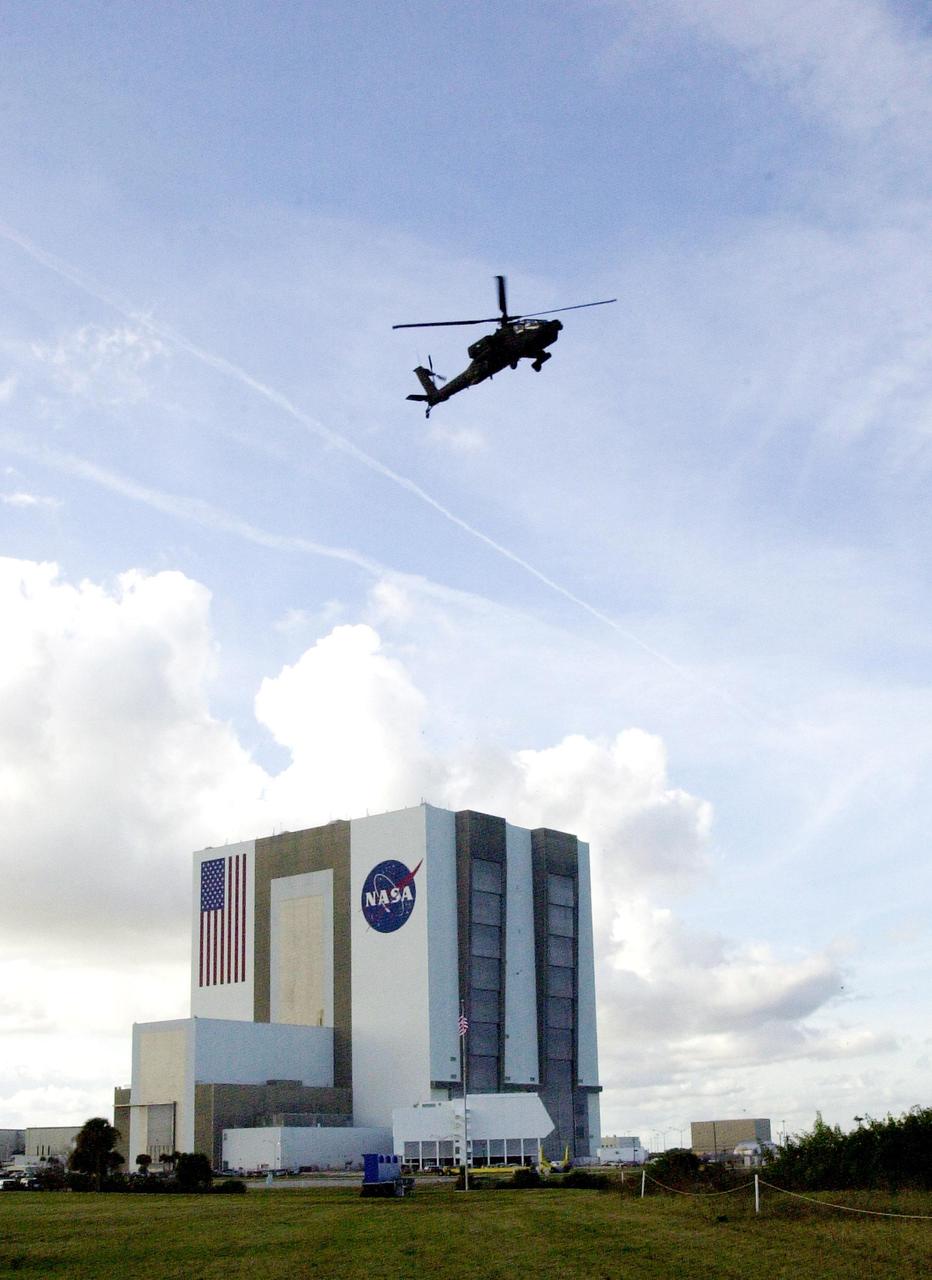
KENNEDY SPACE CENTER, FLA. -- A United States military Apache H64A helicopter patrols Kennedy Space Center airspace near the Vehicle Assembly Building as the launch of Space Shuttle Endeavour on mission STS-108 to the International Space Station approaches. Launch is scheduled for 7:41 p.m. EST on Nov. 29
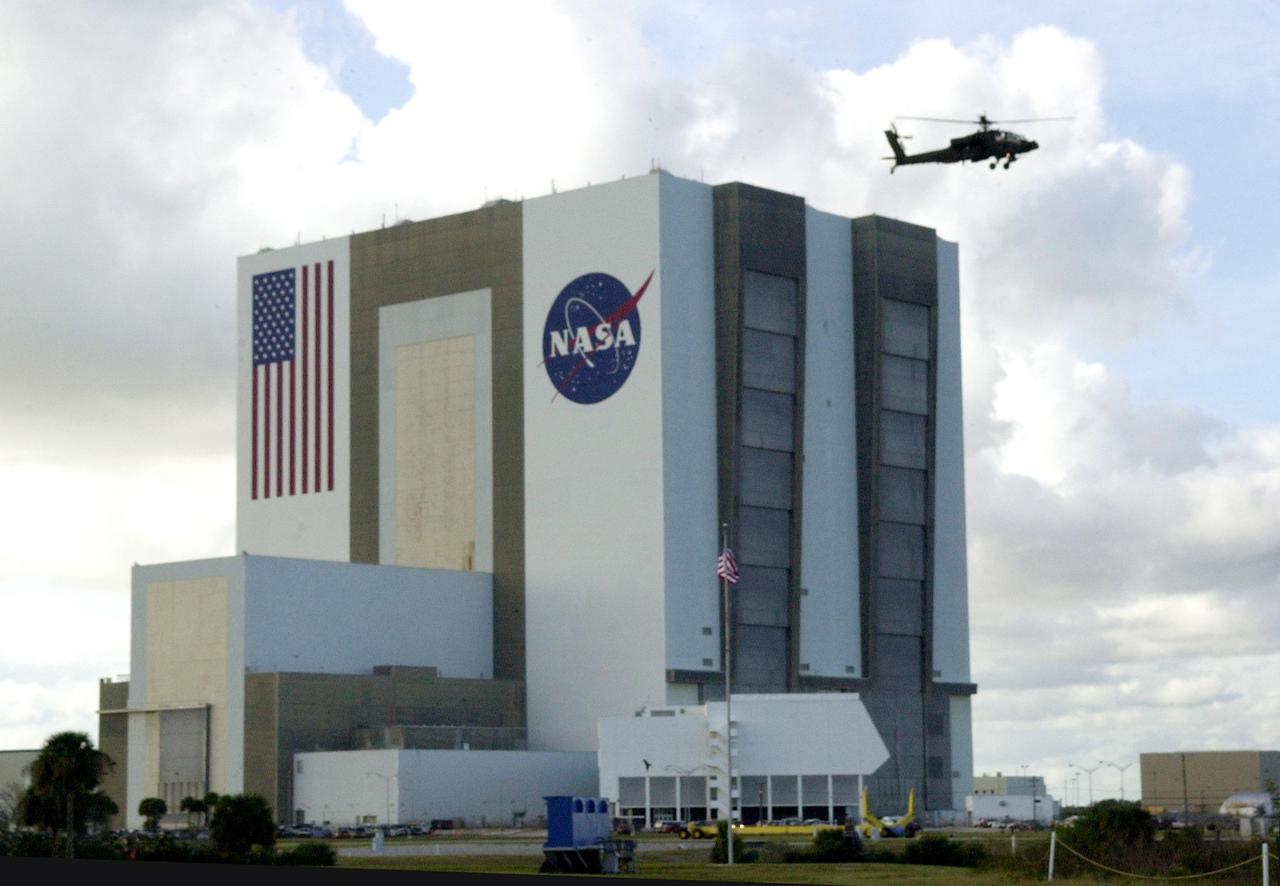
KENNEDY SPACE CENTER, FLA. -- A United States military Apache H64A helicopter patrols Kennedy Space Center airspace near the Vehicle Assembly Building as the launch of Space Shuttle Endeavour on mission STS-108 to the International Space Station approaches. Launch is scheduled for 7:41 p.m. EST on Nov. 29
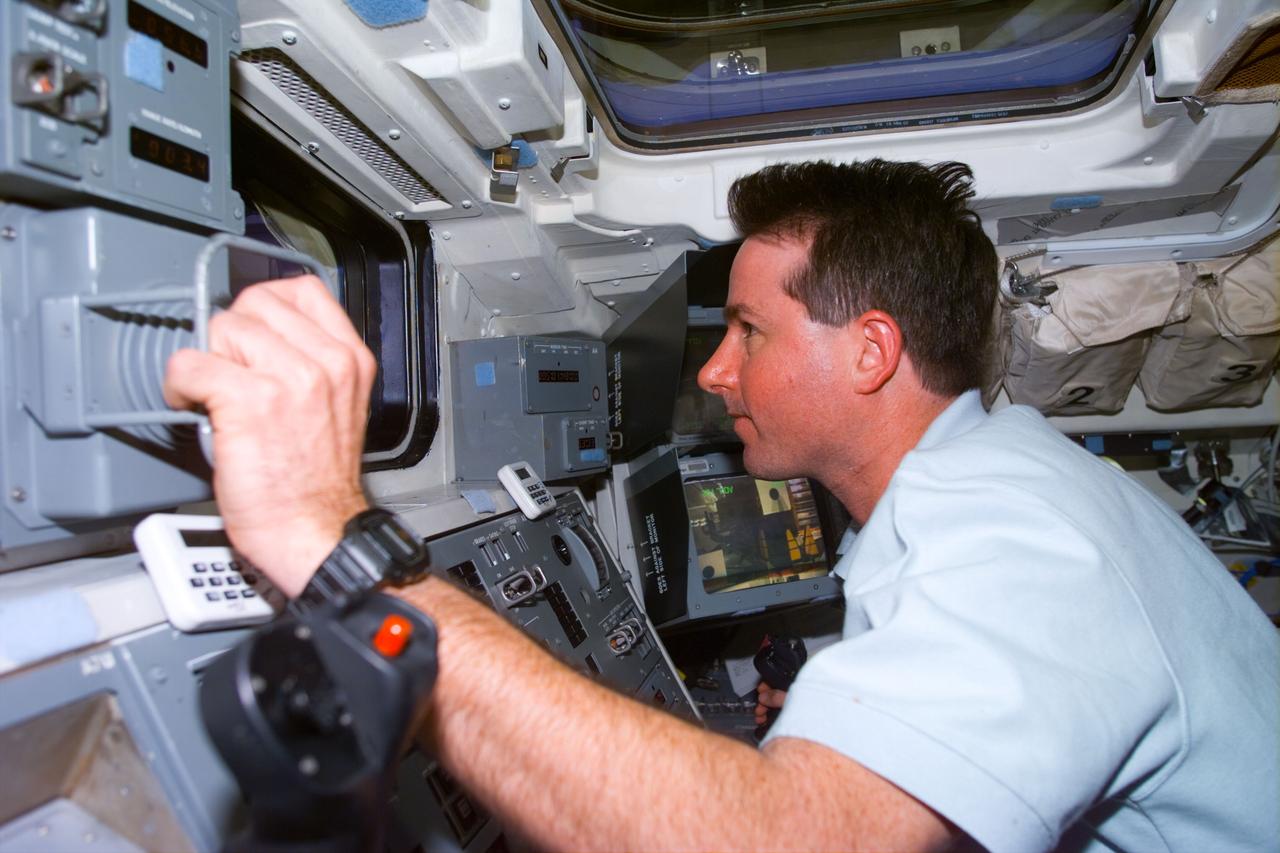
STS095-E-5131 (3 Nov. 1998) --- Astronaut Stephen K. Robinson, STS-95 mission specialist, is busy on Discovery's aft flight deck during operations to retrieve the free-flying Spartan 201-05 satellite. The photograph was taken with an electronic still camera (ESC) at 04:11:41 GMT, Nov. 3.
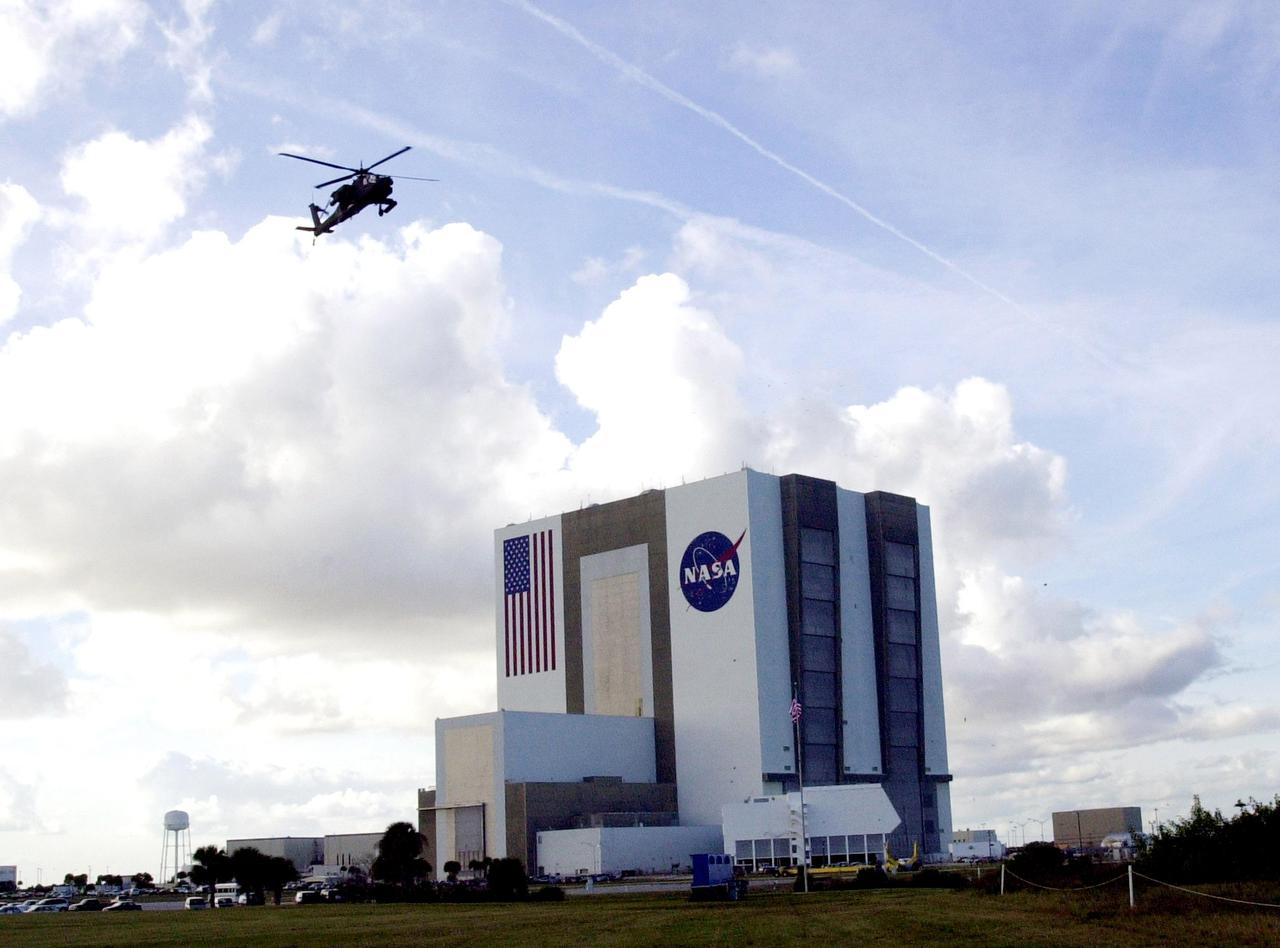
KENNEDY SPACE CENTER, FLA. -- A United States military Apache H64A helicopter patrols Kennedy Space Center airspace near the Vehicle Assembly Building as the launch of Space Shuttle Endeavour on mission STS-108 to the International Space Station approaches. Launch is scheduled for 7:41 p.m. EST on Nov. 29
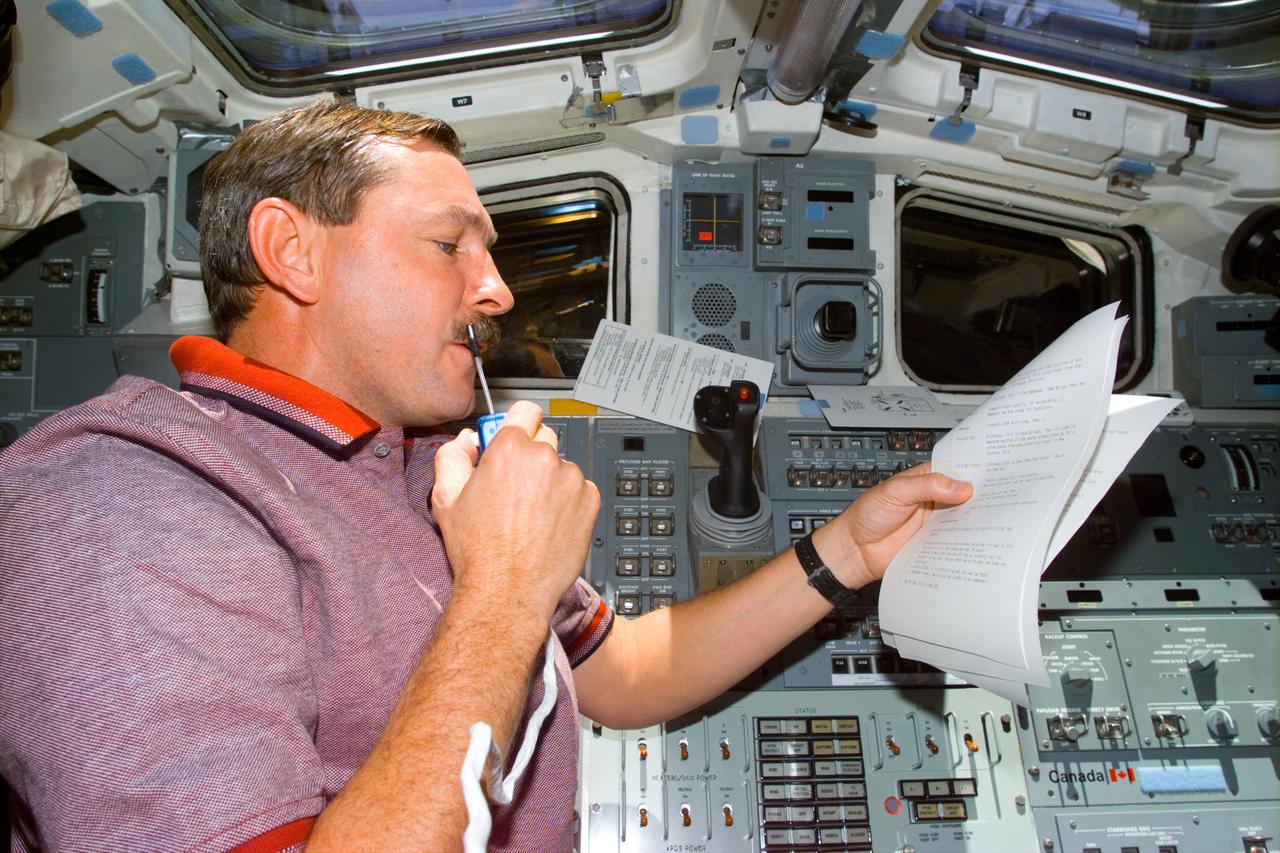
STS095-E-5177 (31 Oct. 1998) --- On Discovery's aft flight deck, astronaut Curtis L. Brown Jr., STS-95 commander, checks over notes with ground controllers in Houston. The photo was taken with an electronic still camera (ESC) at 00:41:51 GMT, Oct. 31.
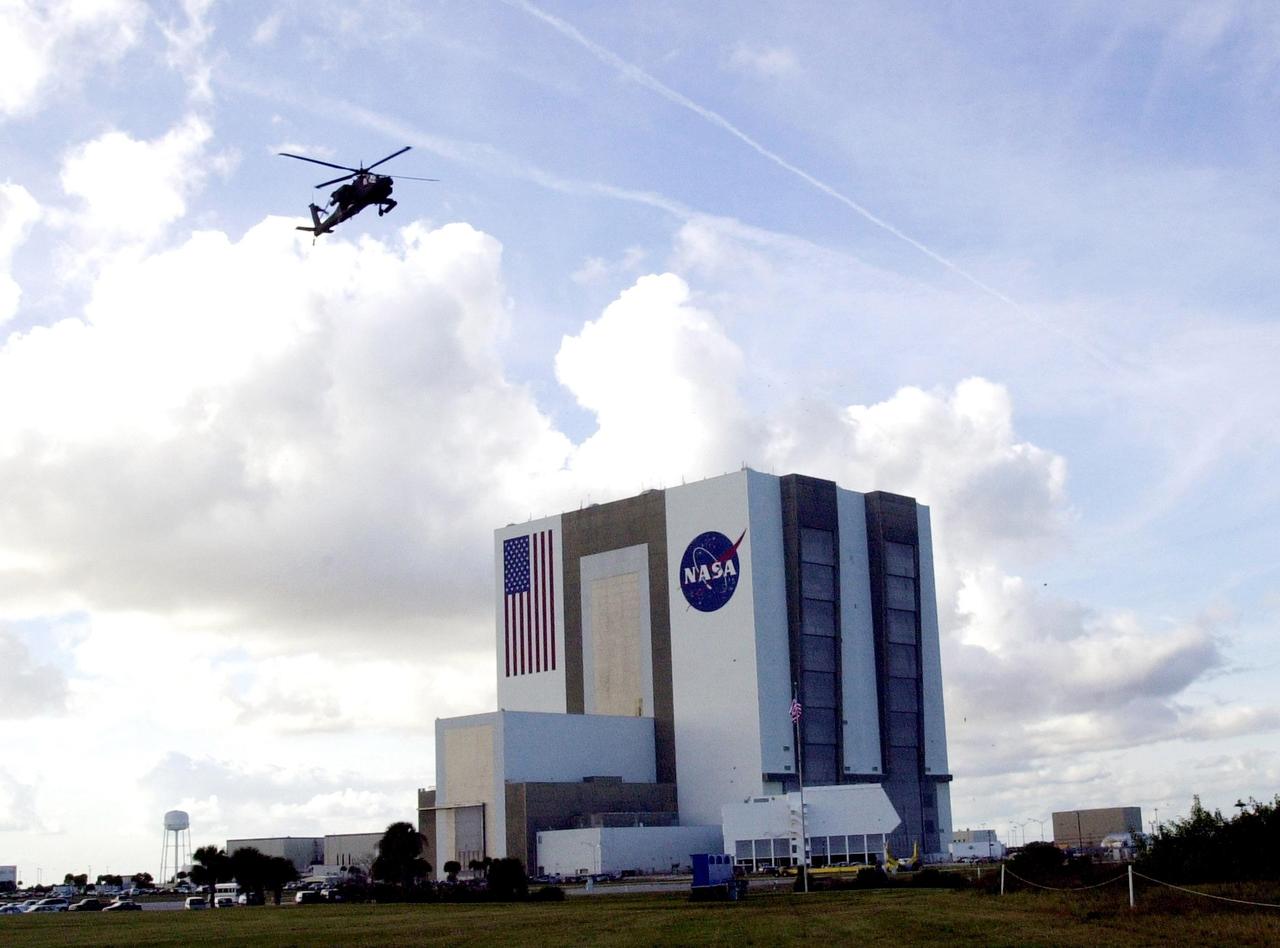
KENNEDY SPACE CENTER, FLA. -- A United States military Apache H64A helicopter patrols Kennedy Space Center airspace near the Vehicle Assembly Building as the launch of Space Shuttle Endeavour on mission STS-108 to the International Space Station approaches. Launch is scheduled for 7:41 p.m. EST on Nov. 29
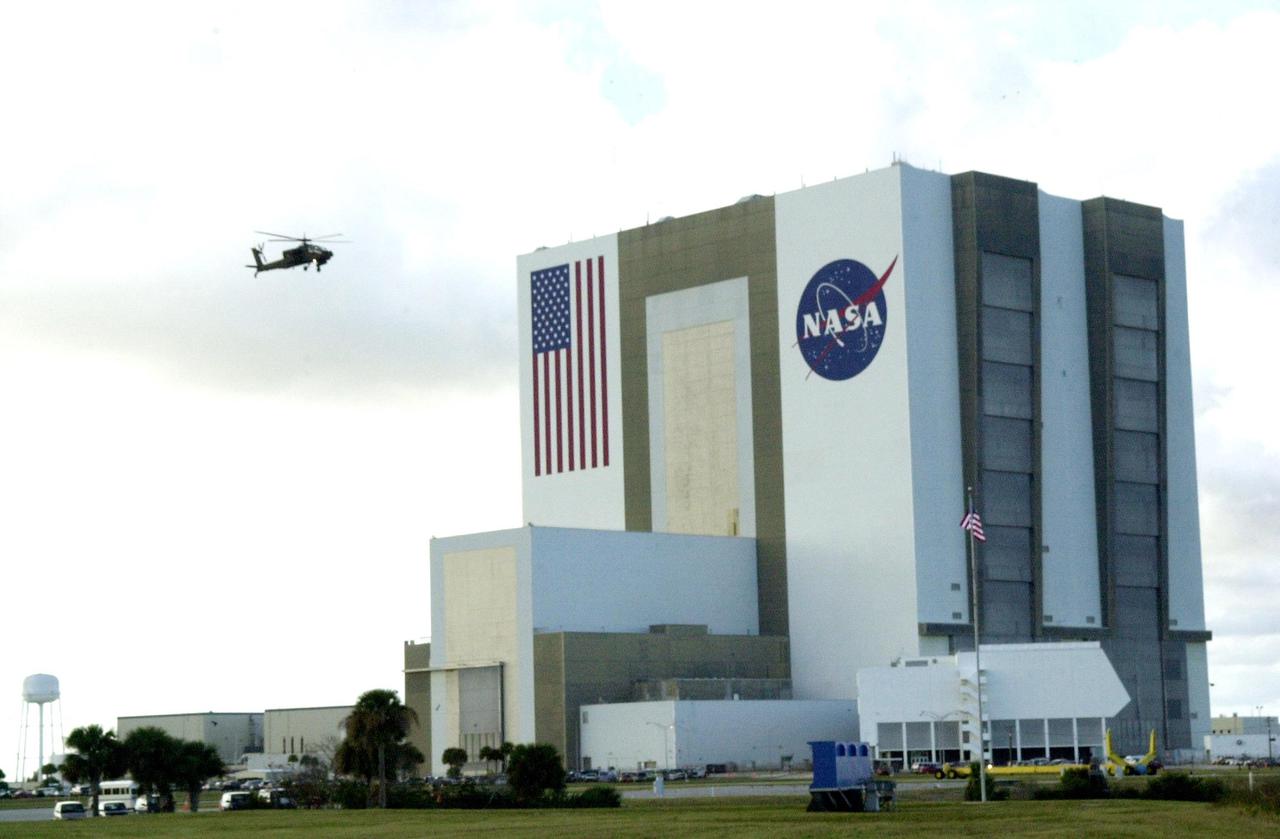
KENNEDY SPACE CENTER, FLA. -- A United States military Apache H64A helicopter patrols Kennedy Space Center airspace near the Vehicle Assembly Building as the launch of Space Shuttle Endeavour on mission STS-108 to the International Space Station approaches. Launch is scheduled for 7:41 p.m. EST on Nov. 29
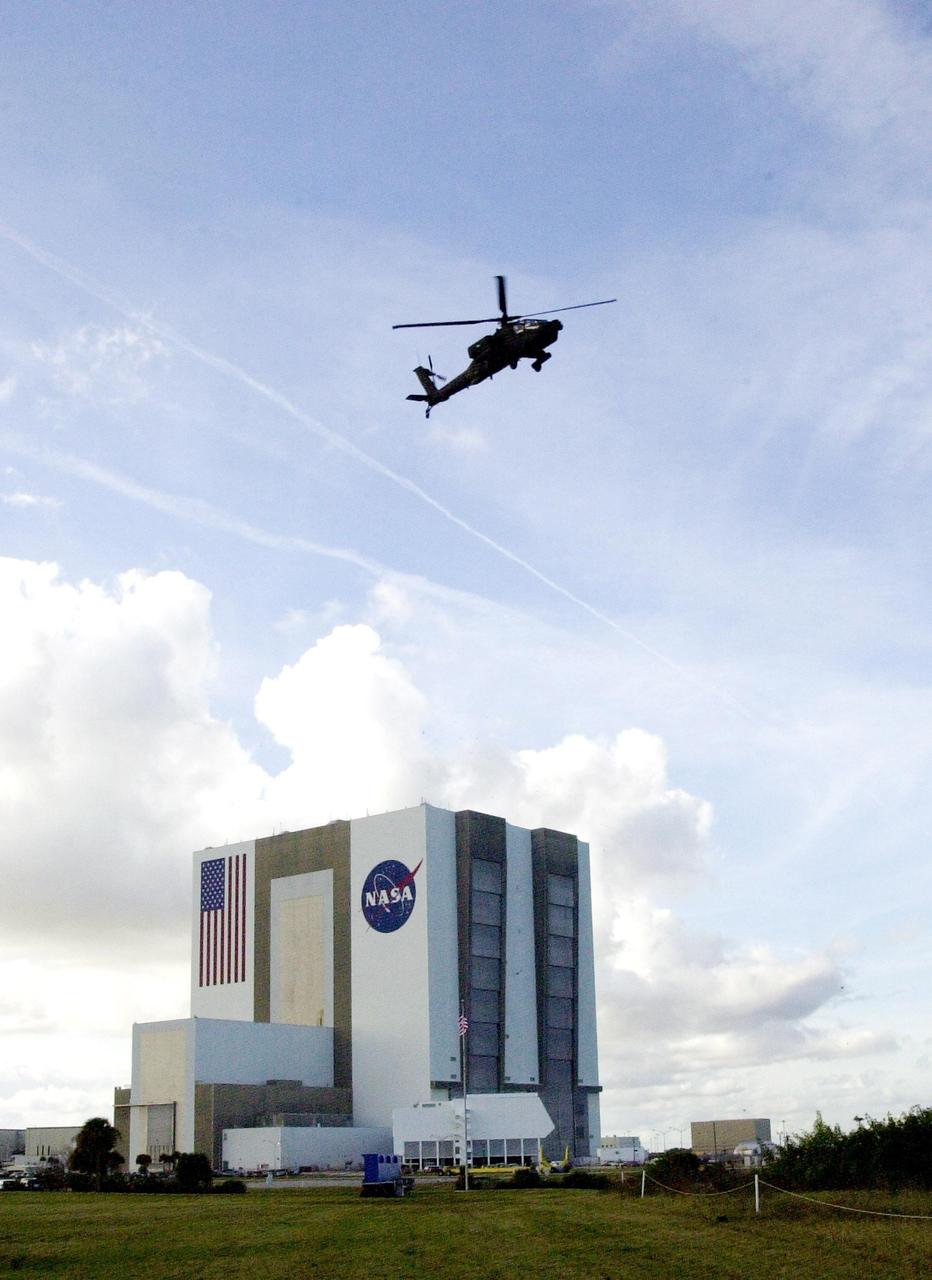
KENNEDY SPACE CENTER, FLA. -- A United States military Apache H64A helicopter patrols Kennedy Space Center airspace near the Vehicle Assembly Building as the launch of Space Shuttle Endeavour on mission STS-108 to the International Space Station approaches. Launch is scheduled for 7:41 p.m. EST on Nov. 29
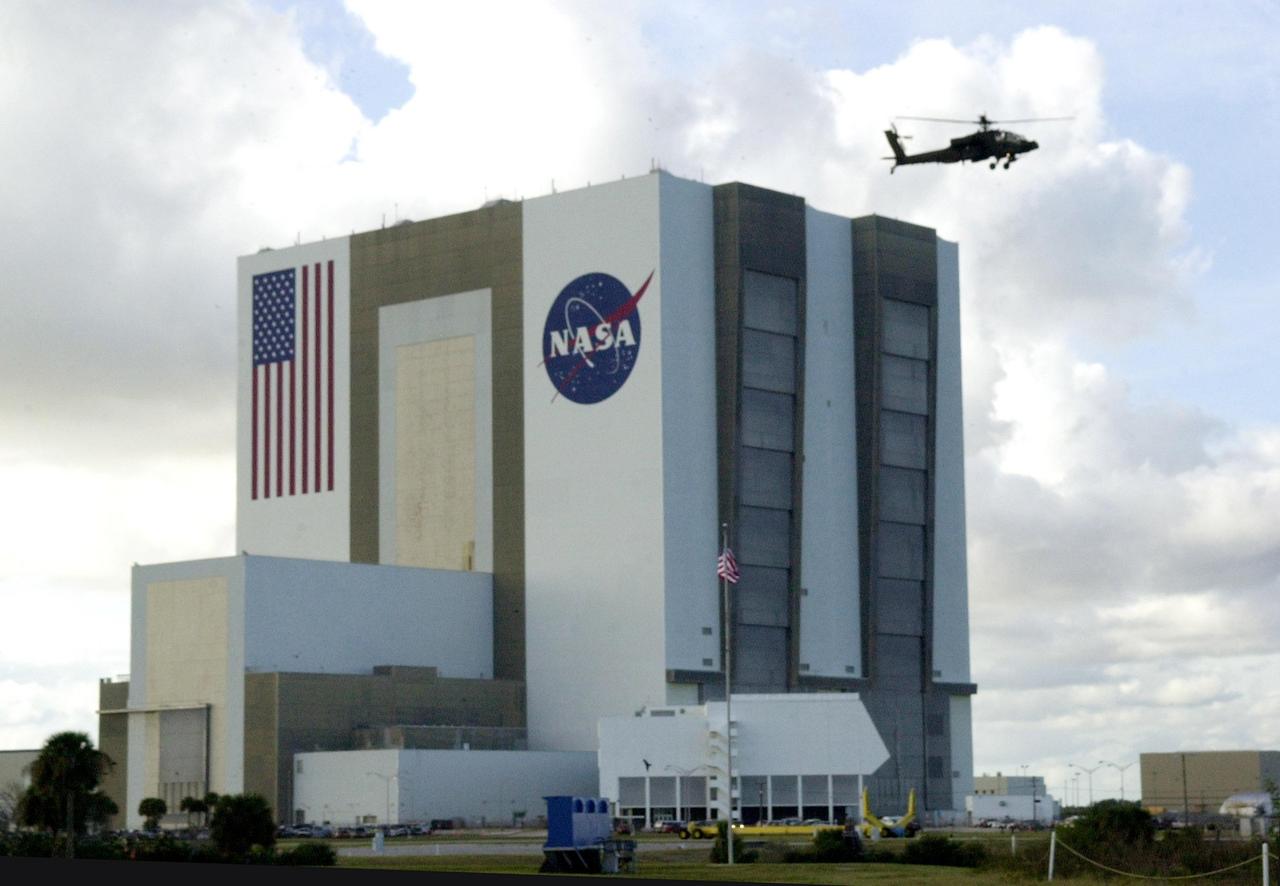
KENNEDY SPACE CENTER, FLA. -- A United States military Apache H64A helicopter patrols Kennedy Space Center airspace near the Vehicle Assembly Building as the launch of Space Shuttle Endeavour on mission STS-108 to the International Space Station approaches. Launch is scheduled for 7:41 p.m. EST on Nov. 29
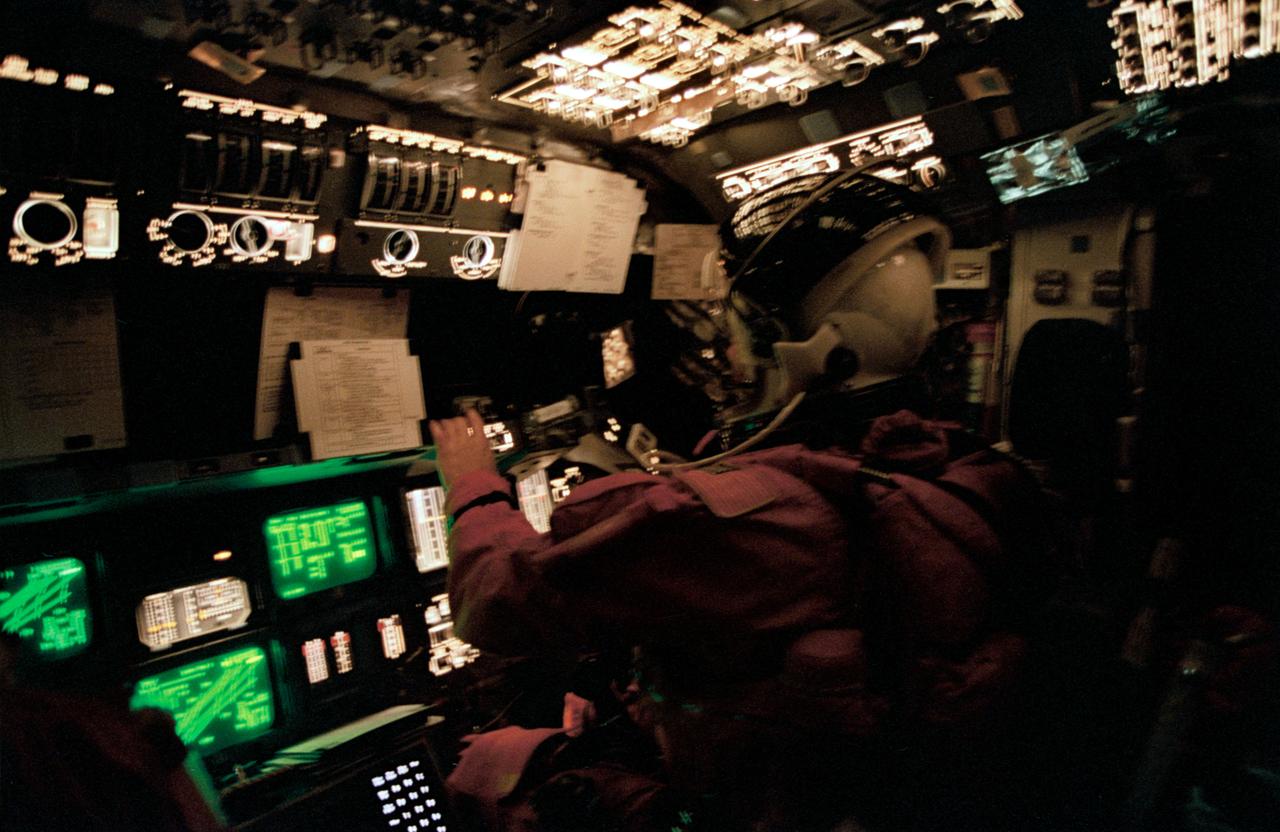
STS062-41-025 (18 March 1994) --- Astronaut Andrew M. Allen monitors Columbia's systems from the pilot's station during the entry phase of the STS-62 mission. The fast-speed 35mm film highlights the many controls and displays and the cathode ray tubes on the forward flight deck.
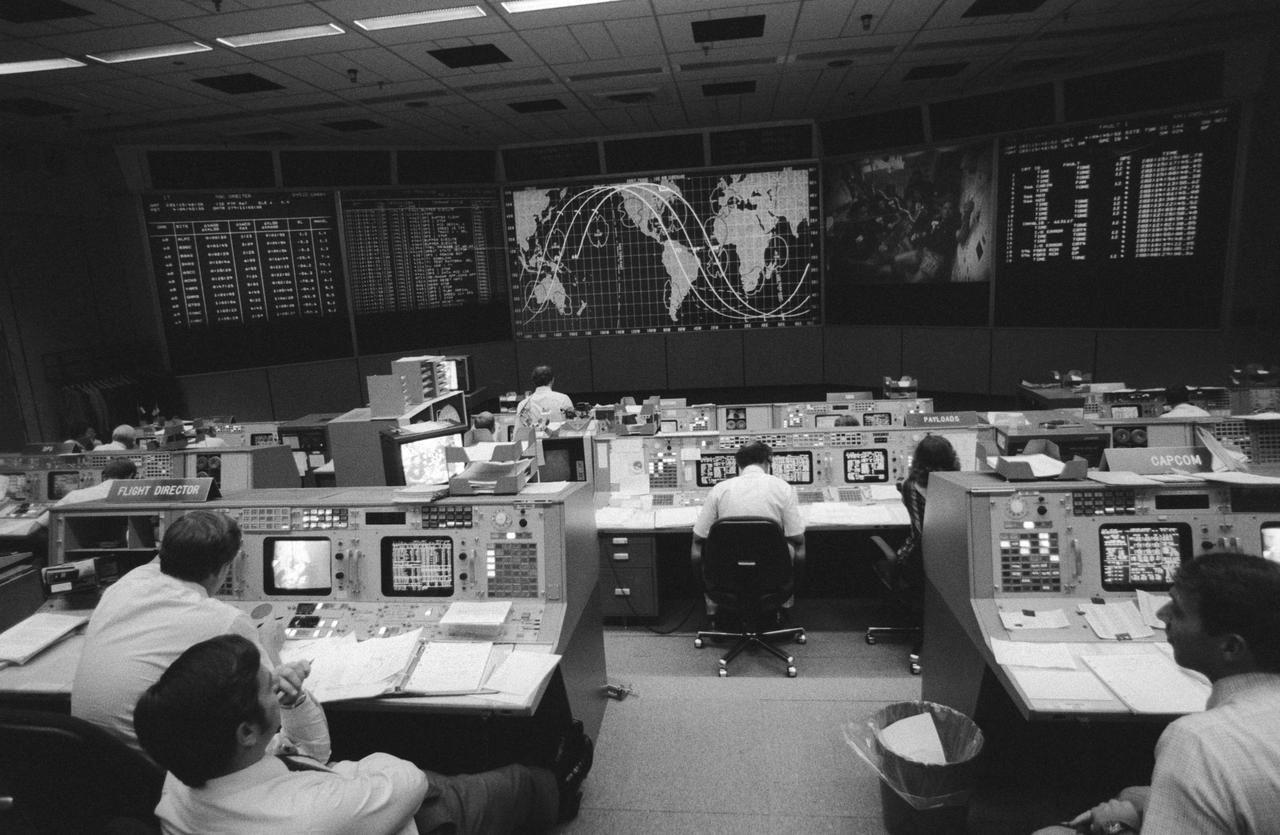
View from the back of the Mission Control Center (MCC). Visible are the Flight Directors console (left front), the CAPCOM console (right front) and the Payloads console. Some of the STS 41-G crew can be seen on a large screen at the front of the MCC along with a map tracking the progress of the orbiter.
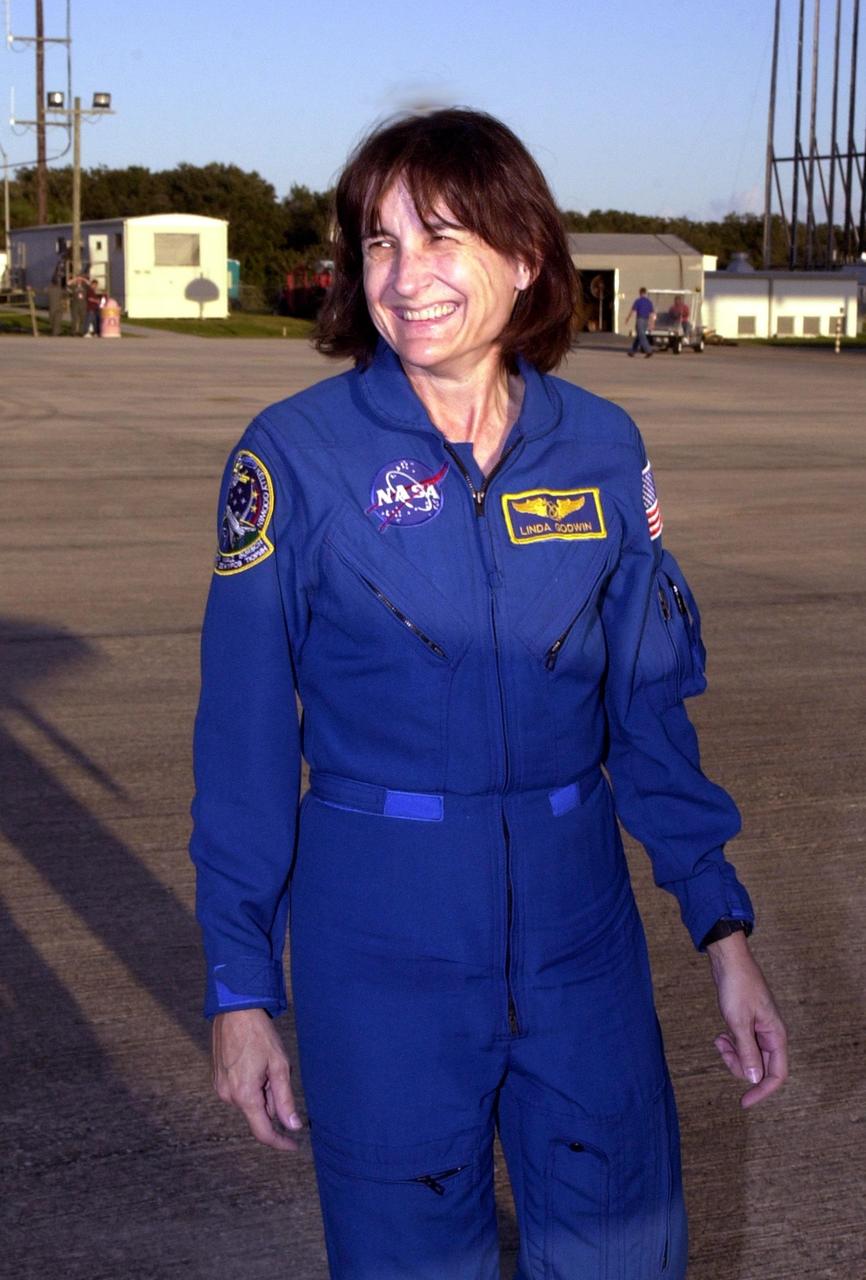
KENNEDY SPACE CENTER, Fla. -- STS-108 Mission Specialist Linda A. Godwin pauses after her arrival at KSC. She and the rest of the crew will be preparing for launch Nov. 29 on Space Shuttle Endeavour. Liftoff is scheduled for <A HREF="javascript:convertit(7:41:00pm','ED')" TITLE="Convert to alternate measure">7:41 p.m.</a> EST. Top priorities for the STS-108 (UF-1) mission of Endeavour are rotation of the International Space Station Expedition Three and Expedition Four crews, bringing water, equipment and supplies to the station in the Multi-Purpose Logistics Module Raffaello, and completion of spacewalk and robotics tasks. Mission Specialists Daniel M. Tani and Godwin will take part in the spacewalk to install thermal blankets over two pieces of equipment at the bases of the Space Station's solar wings. Other crew members are Commander Dominic L. Gorie and Pilot Mark E. Kelly
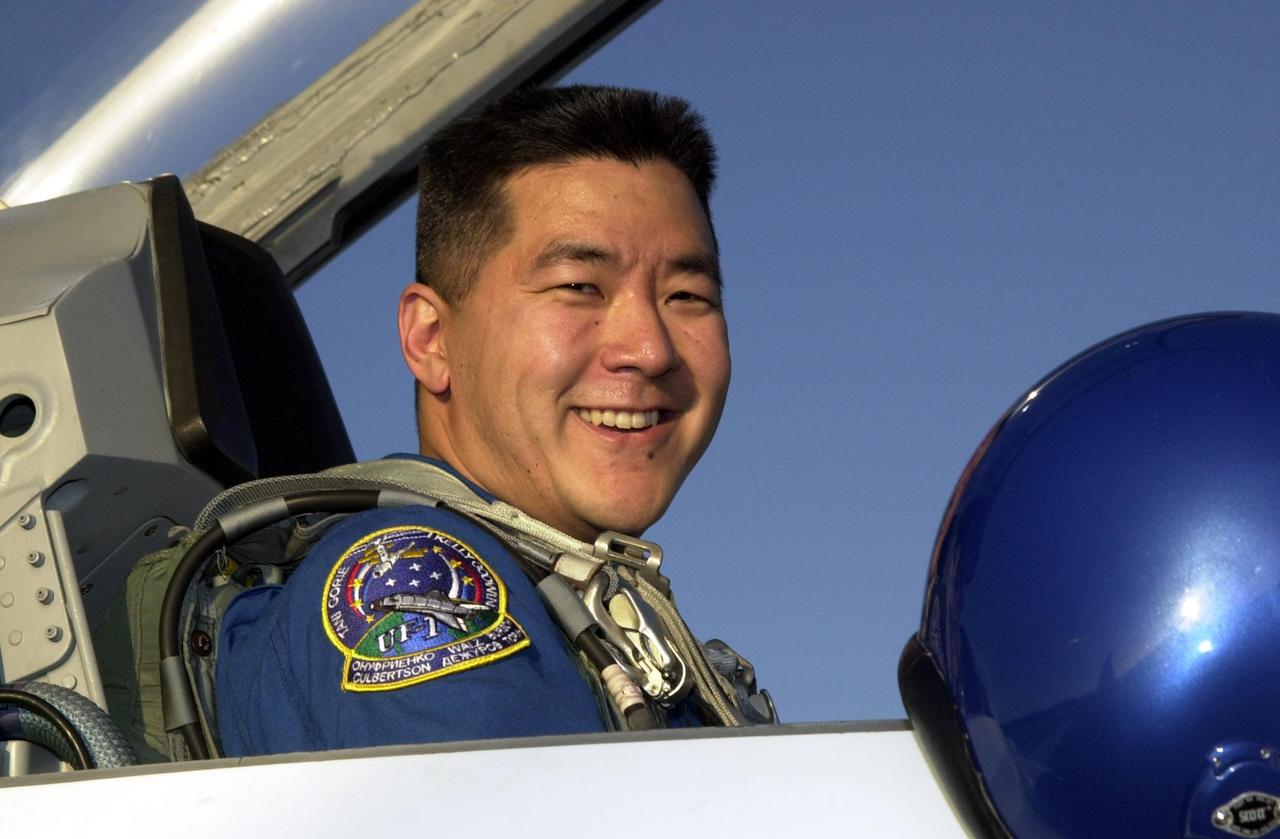
KENNEDY SPACE CENTER, Fla. -- STS-108 Mission Specialist Daniel M. Tani arrives at KSC in a T-38 jet trainer. He and the rest of the crew will be preparing for launch Nov. 29 on Space Shuttle Endeavour. Liftoff is scheduled for <A HREF="javascript:convertit(7:41:00pm','ED')" TITLE="Convert to alternate measure">7:41 p.m.</a> EST. Top priorities for the STS-108 (UF-1) mission of Endeavour are rotation of the International Space Station Expedition Three and Expedition Four crews, bringing water, equipment and supplies to the station in the Multi-Purpose Logistics Module Raffaello, and completion of spacewalk and robotics tasks. Mission Specialists Linda A. Godwin and Tani will take part in the spacewalk to install thermal blankets over two pieces of equipment at the bases of the Space Station's solar wings. Other crew members are Commander Dominic L. Gorie and Pilot Mark E. Kelly
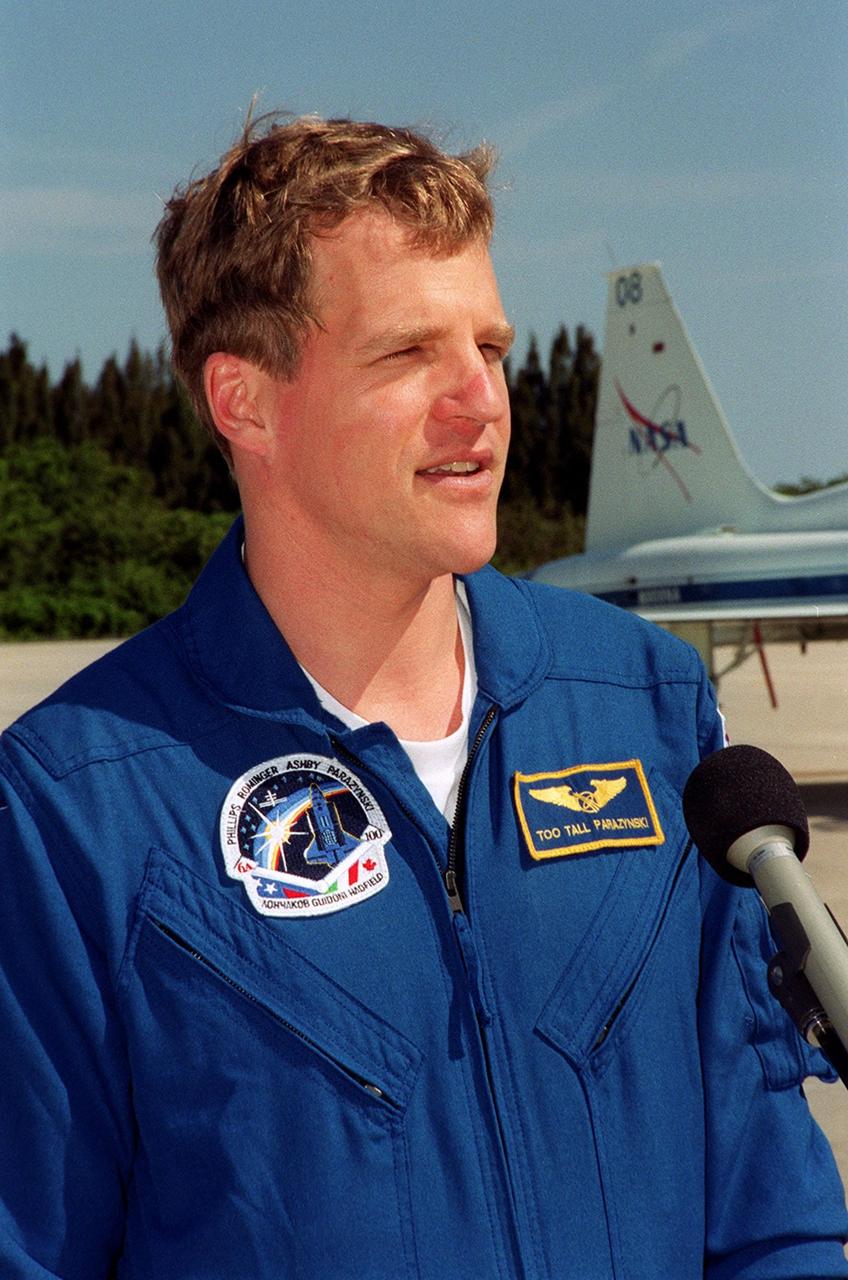
STS-100 Mission Specialist Scott E. Parazynski talks to the media after crew arrival at the Shuttle Landing Facility. The crew is getting ready for launch April 19. The 11-day mission to the International Space Station will deliver and integrate the Spacelab Logistics Pallet/Launch Deployment Assembly, which includes the Space Station Remote Manipulator system and the UHF Antenna, and the Multi-Purpose Logistics Module Raffaello. Liftoff on mission STS-100 is scheduled at 2:41 p.m. EDT
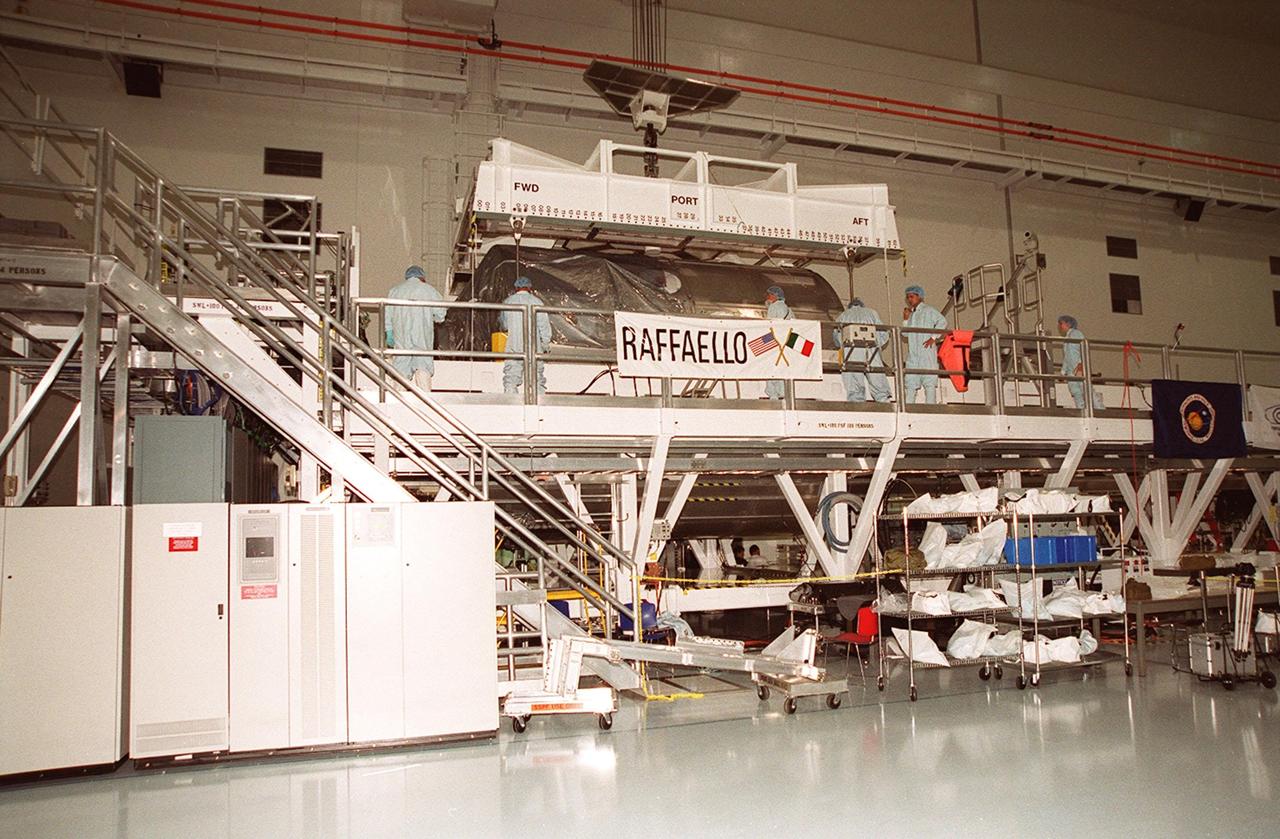
In the Space Station Processing Facility, an overhead crane is attached to the Multi-Purpose Logistics Module Raffaello in order to move the MPLM to the payload canister. Part of the payload on mission STS-100 to the International Space Station, Raffaello carries six system racks and two storage racks for the U.S. Lab. Launch of STS-100 is scheduled for April 19, 2001 at 2:41 p.m. EDT from Launch Pad 39A
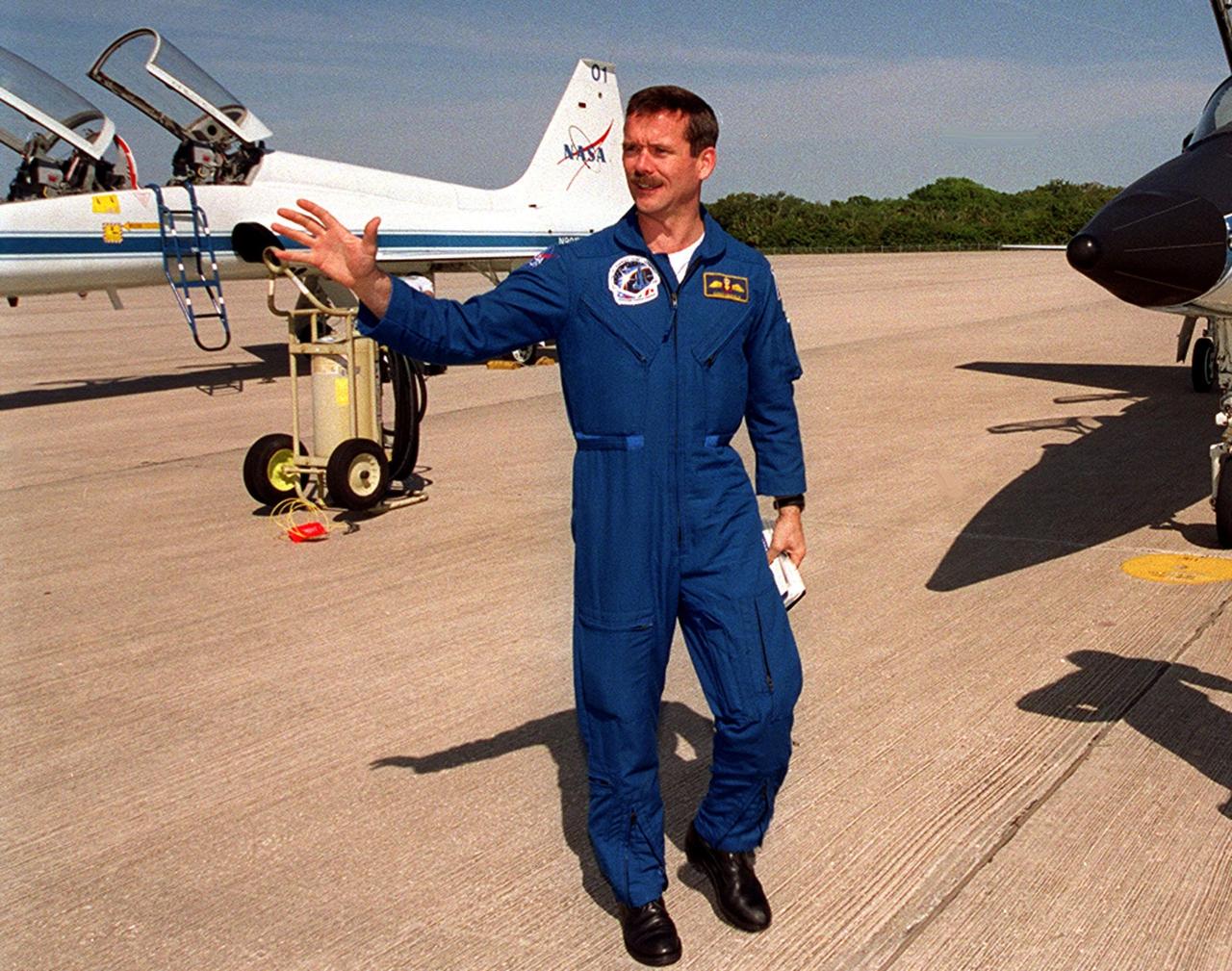
STS-100 Mission Specialist Chris A. Hadfield, who is with the Canadian Space Agency, waves to media after arriving at the KSC Shuttle Landing Facility for launch April 19. The 11-day mission to the International Space Station will deliver and integrate the Spacelab Logistics Pallet/Launch Deployment Assembly, which includes the Space Station Remote Manipulator system and the UHF Antenna, and the Multi-Purpose Logistics Module Raffaello. Liftoff on mission STS-100 is scheduled at 2:41 p.m. EDT April 19
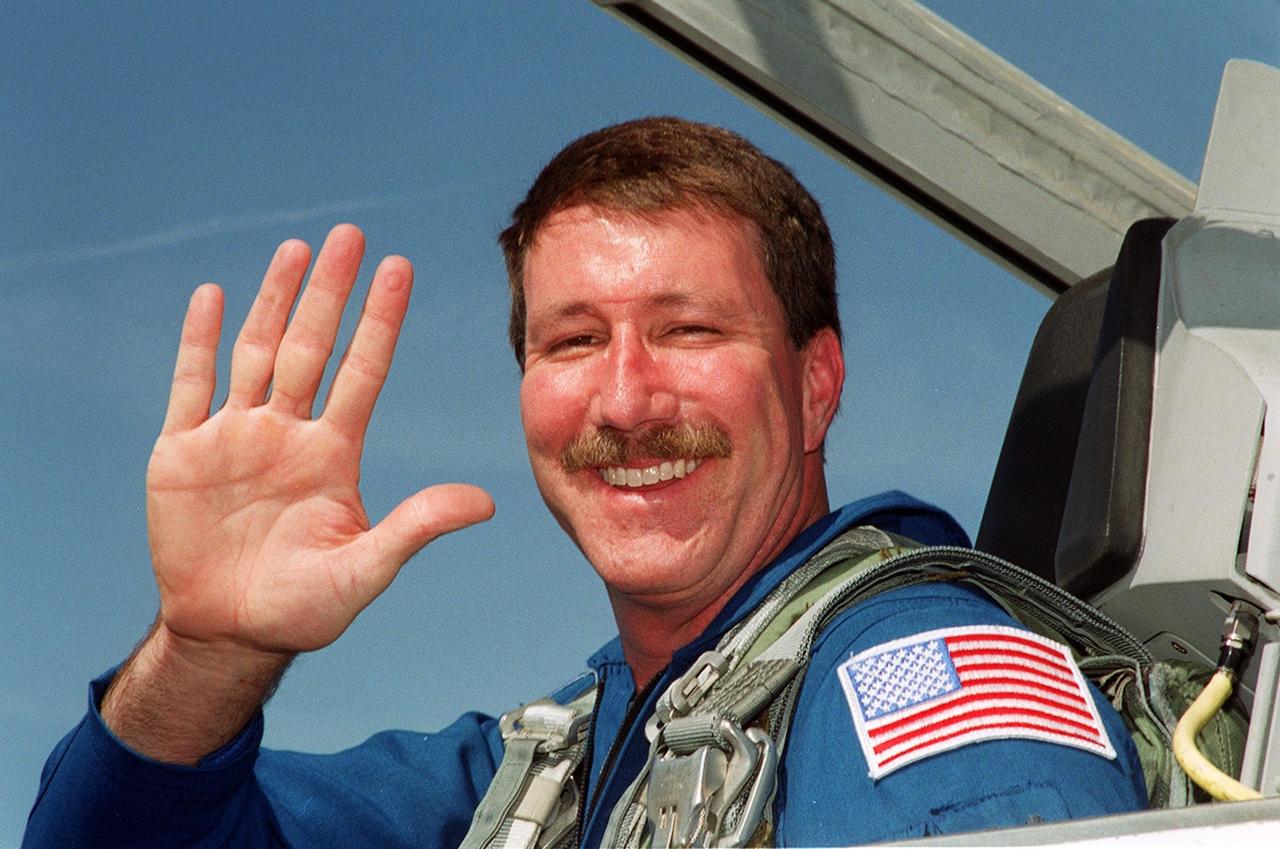
STS-100 Commander Kent V. Rominger arrives at the KSC Shuttle Landing Facility aboard a T-38 jet aircraft to get ready for launch. The 11-day mission to the International Space Station will deliver and integrate the Spacelab Logistics Pallet/Launch Deployment Assembly, which includes the Space Station Remote Manipulator system and the UHF Antenna, and the Multi-Purpose Logistics Module Raffaello. Liftoff on mission STS-100 is scheduled at 2:41 p.m. EDT April 19
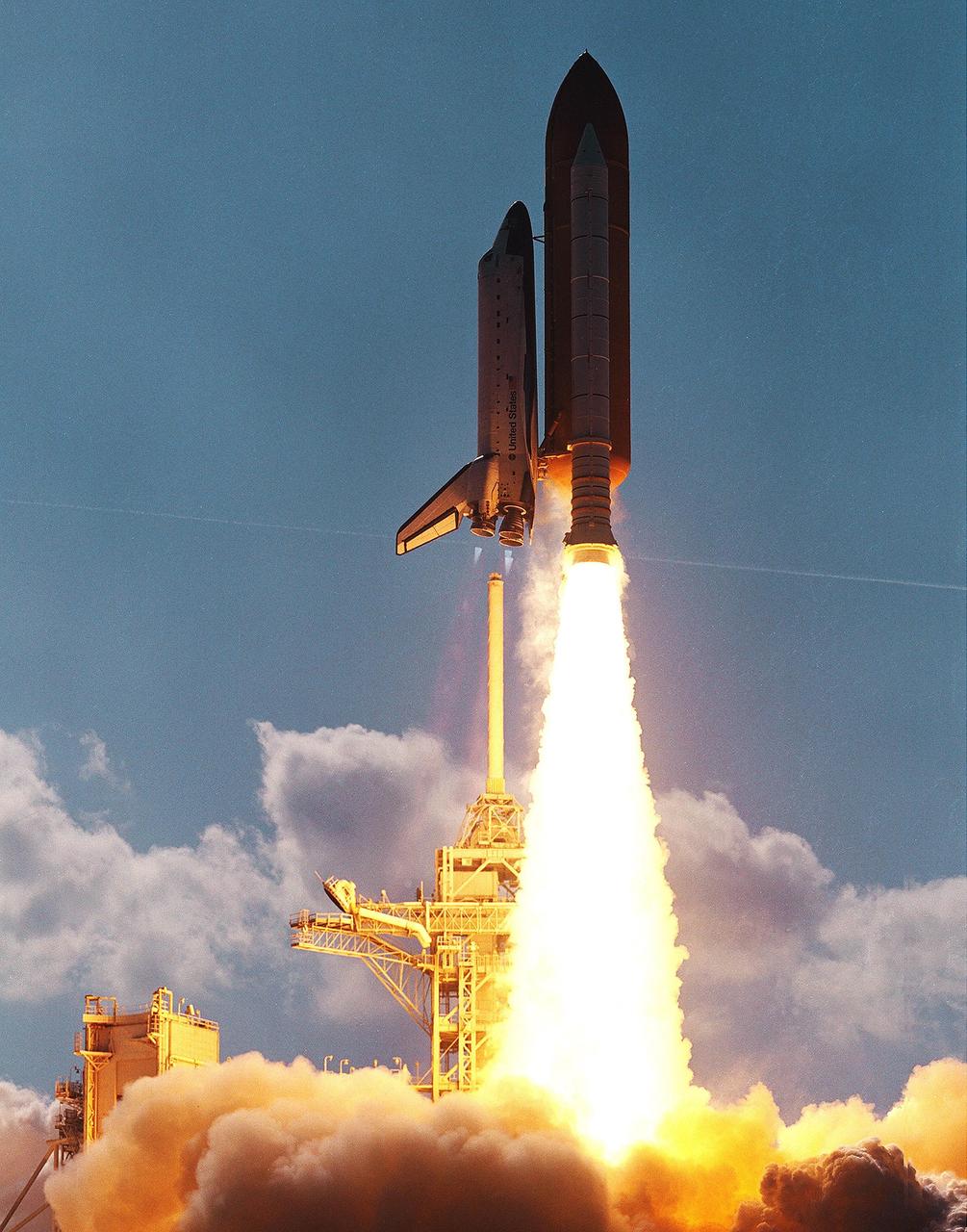
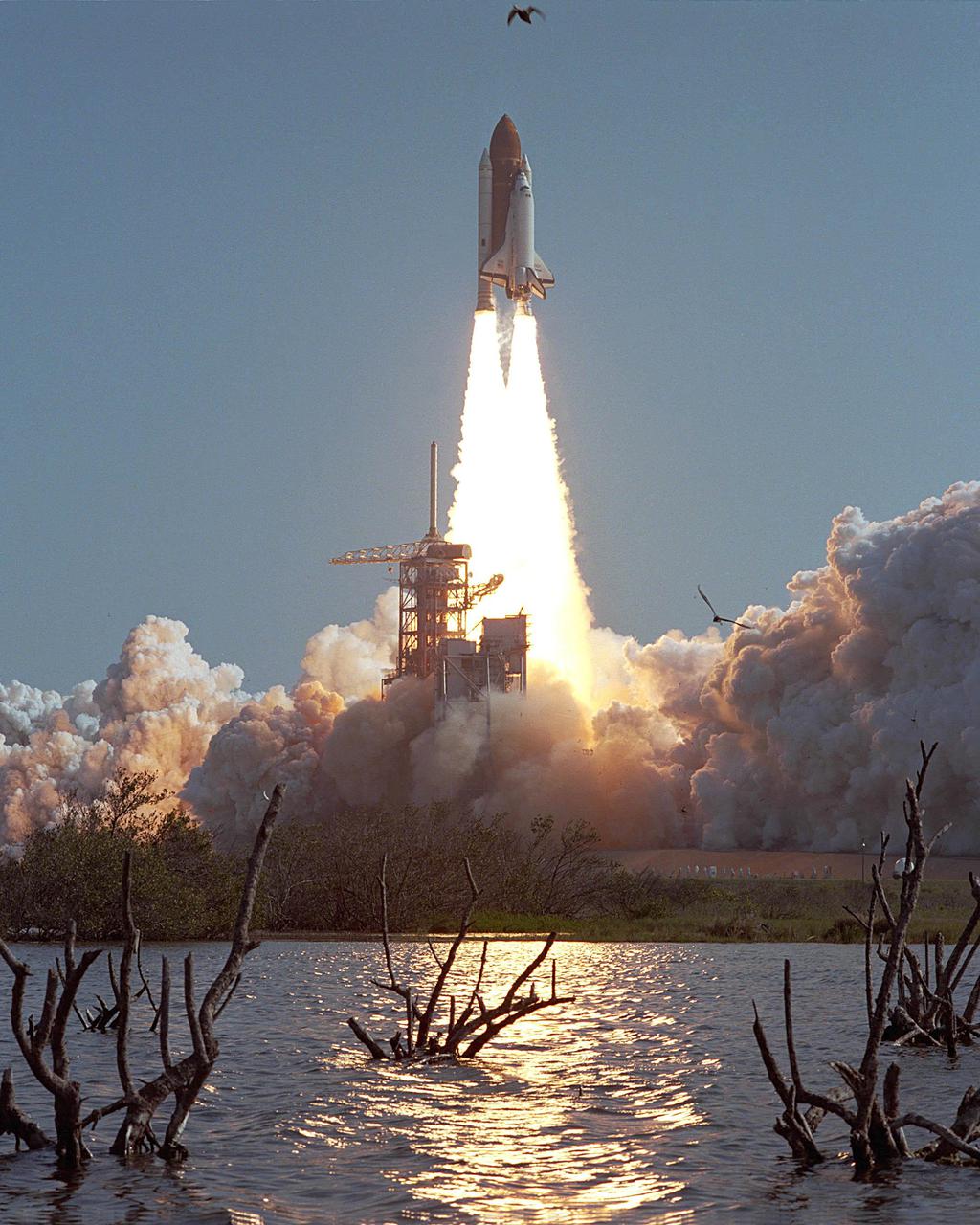
KENNEDY SPACE CENTER, FLA. - Space Shuttle Atlantis clears the lightning mast as it hurtles into the afternoon sky from Launch Pad 39B on mission STS-110. The mast is on the top of the Fixed Service Structure. Flames from the solid rocket booster look like an inverted torch. Liftoff occurred at 4:44:19 p.m. EDT (20:41:19 GMT). Carrying the S0 Integrated Truss Structure and Mobile Transporter, STS-110 is the 13th assembly flight to the International Space Station
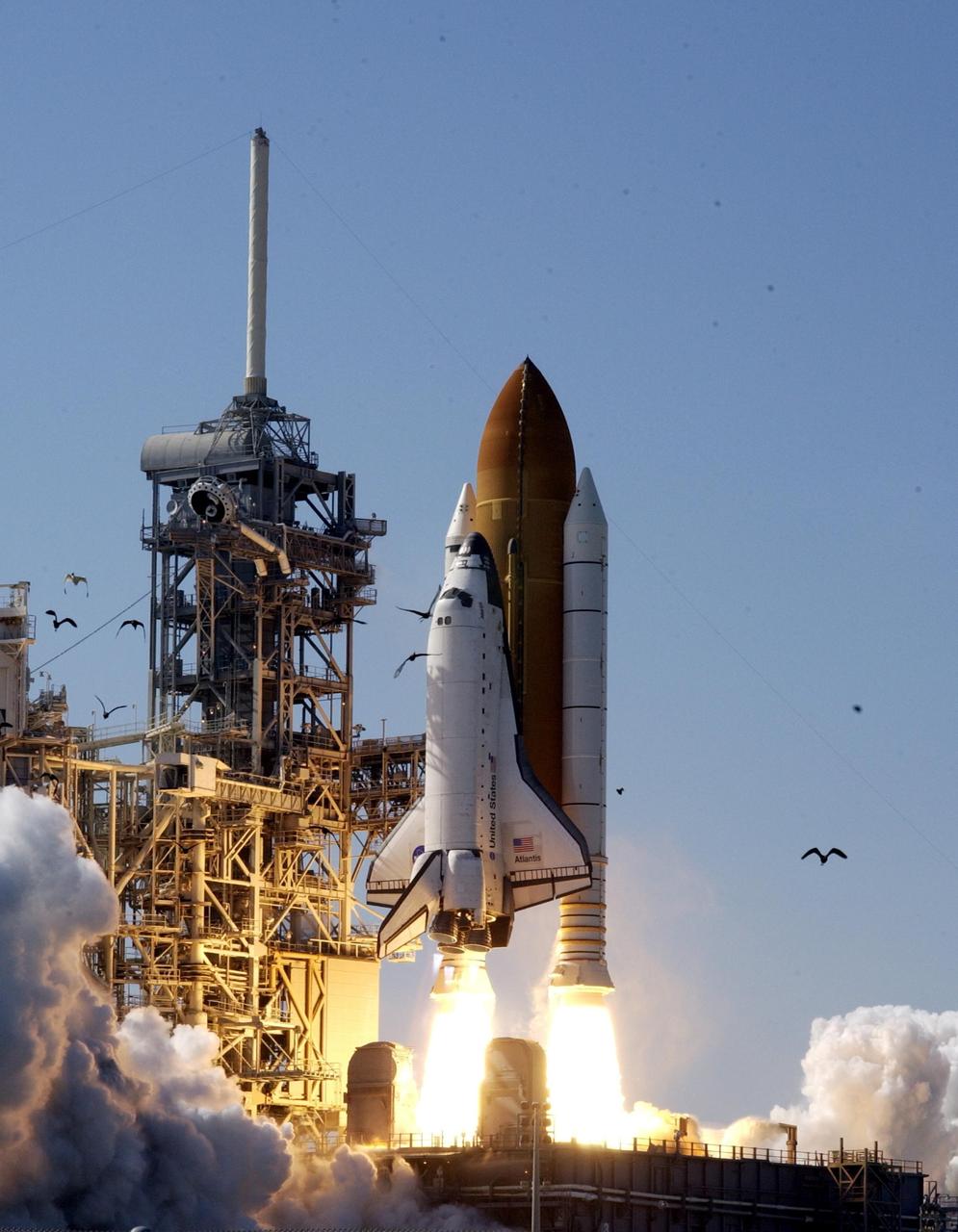
KENNEDY SPACE CENTER, FLA. - Birds scatter around Launch Pad 39B as Space Shuttle Atlantis lifts off on mission STS-110. Liftoff occurred at 4:44:19 p.m. EDT (20:41:19 GMT). Carrying the S0 Integrated Truss Structure and Mobile Transporter, STS-110 is the 13th assembly flight to the International Space Station
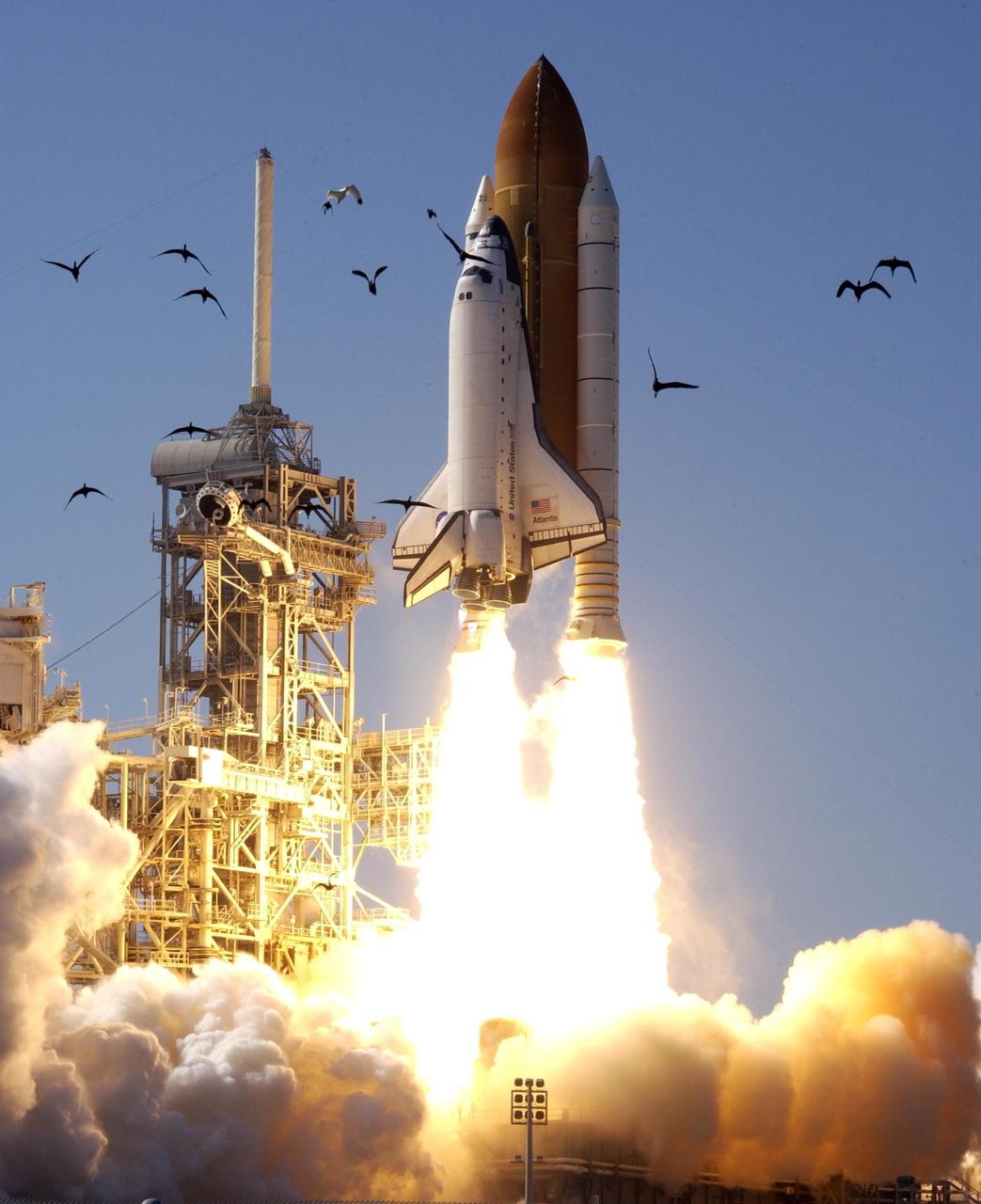
KENNEDY SPACE CENTER, FLA. - Space Shuttle Atlantis seems surrounded by birds - most likely pelicans - as it roars into the clear blue sky on mission STS-110. Liftoff occurred at 4:44:19 p.m. EDT (20:41:19 GMT). Carrying the S0 Integrated Truss Structure and Mobile Transporter, STS-110 is the 13th assembly flight to the International Space Station

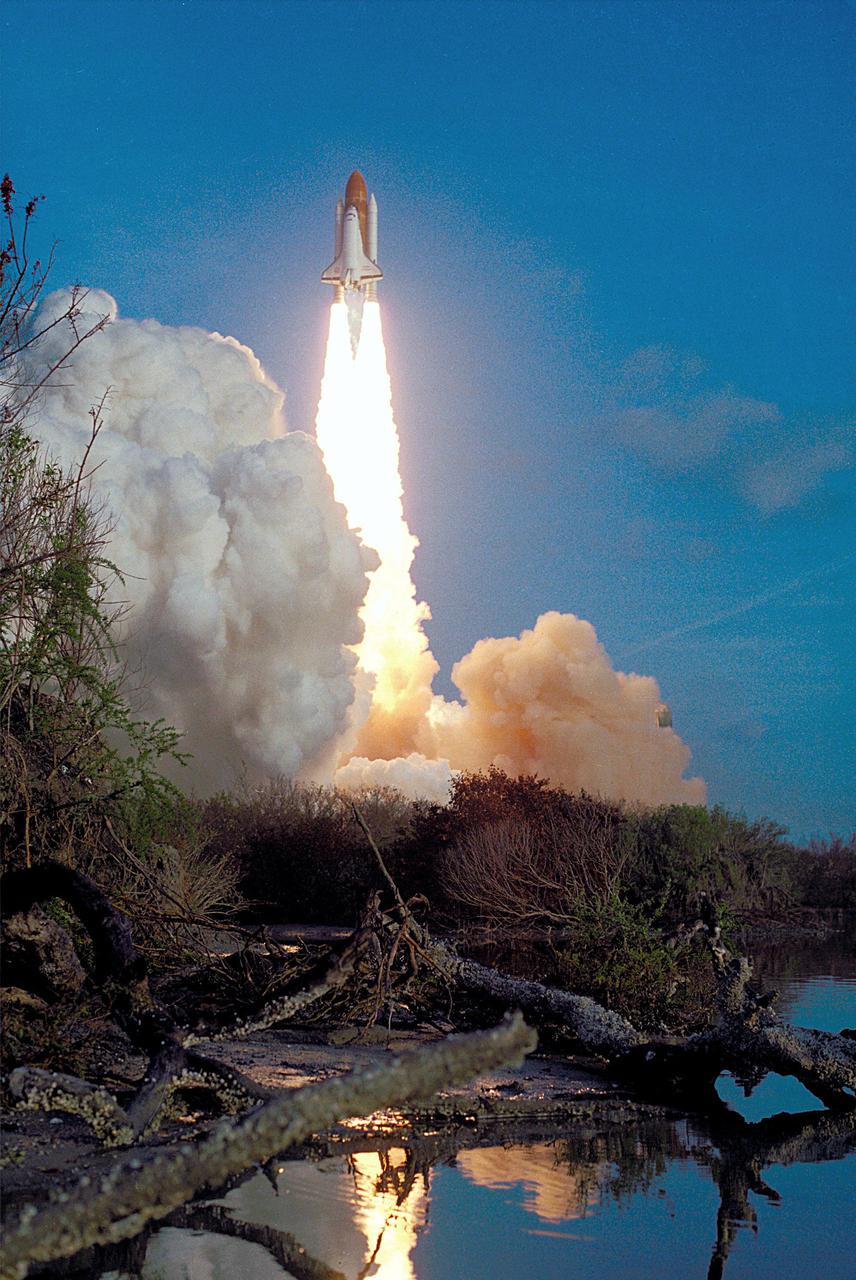
KENNEDY SPACE CENTER, FLA. -- Space Shuttle Atlantis leaves Earth behind as it roars from Launch Pad 39B into the sky on mission STS-110. The brilliance of the flames from the solid rocket boosters is captured in the nearby water. Liftoff occurred at 4:44:19 p.m. EDT (20:41:19 GMT). Carrying the S0 Integrated Truss Structure and Mobile Transporter, STS-110 is the 13th assembly flight to the International Space Station
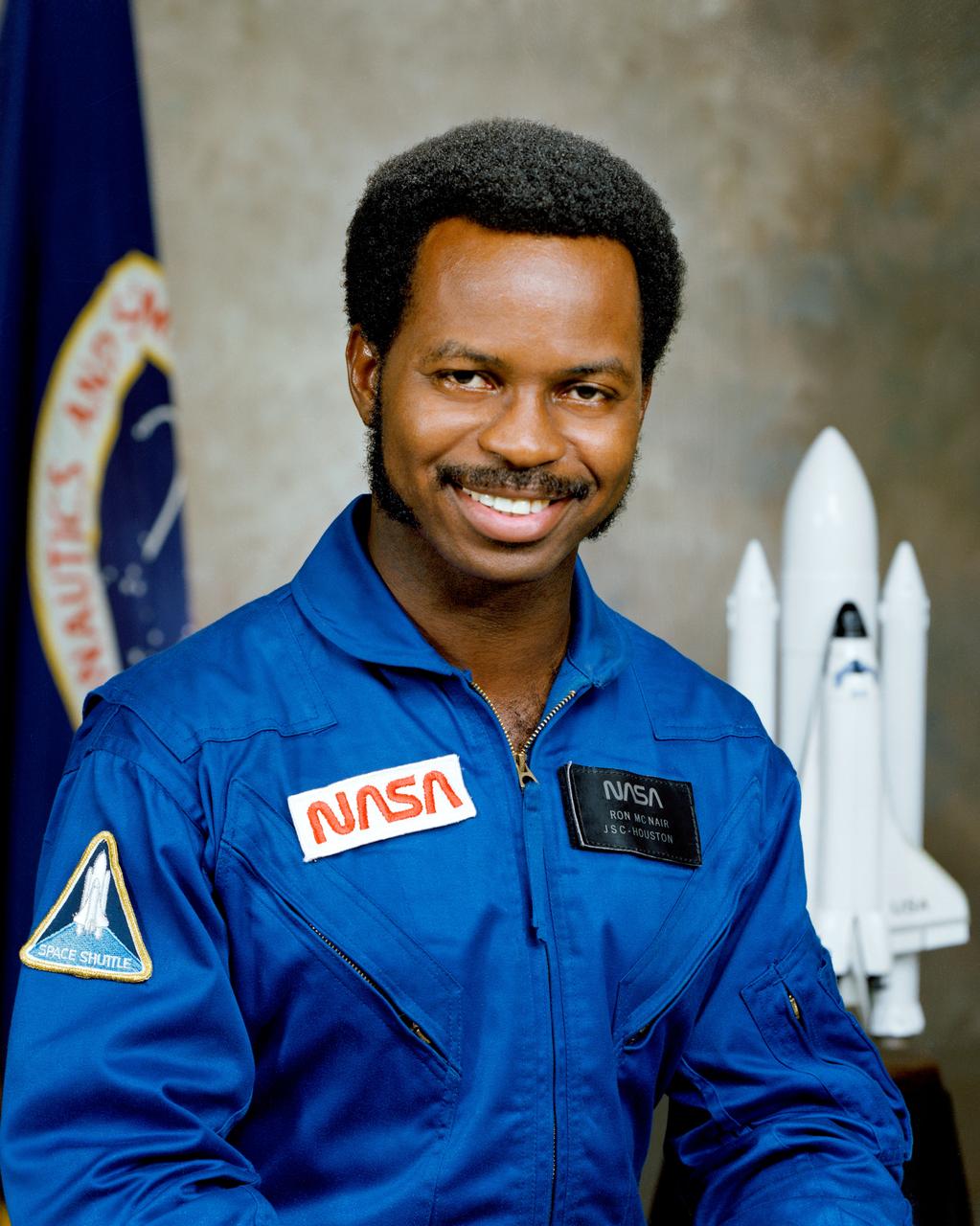
S78-35300 (31 Jan 1978) -- NASA Astronaut Dr. Ronald E. McNair (PH.D.) was assigned as a mission specialist and was a crewmember on two Space Shuttle Missions. He first flew on STS 41-B in 1984 where he performed numerous science experiments. On his second flight, STS 51-L, Dr. McNair died on January 28, 1986 when the Space Shuttle Challenger exploded after launch from the Kennedy Space Center, Florida. NASA Photograph
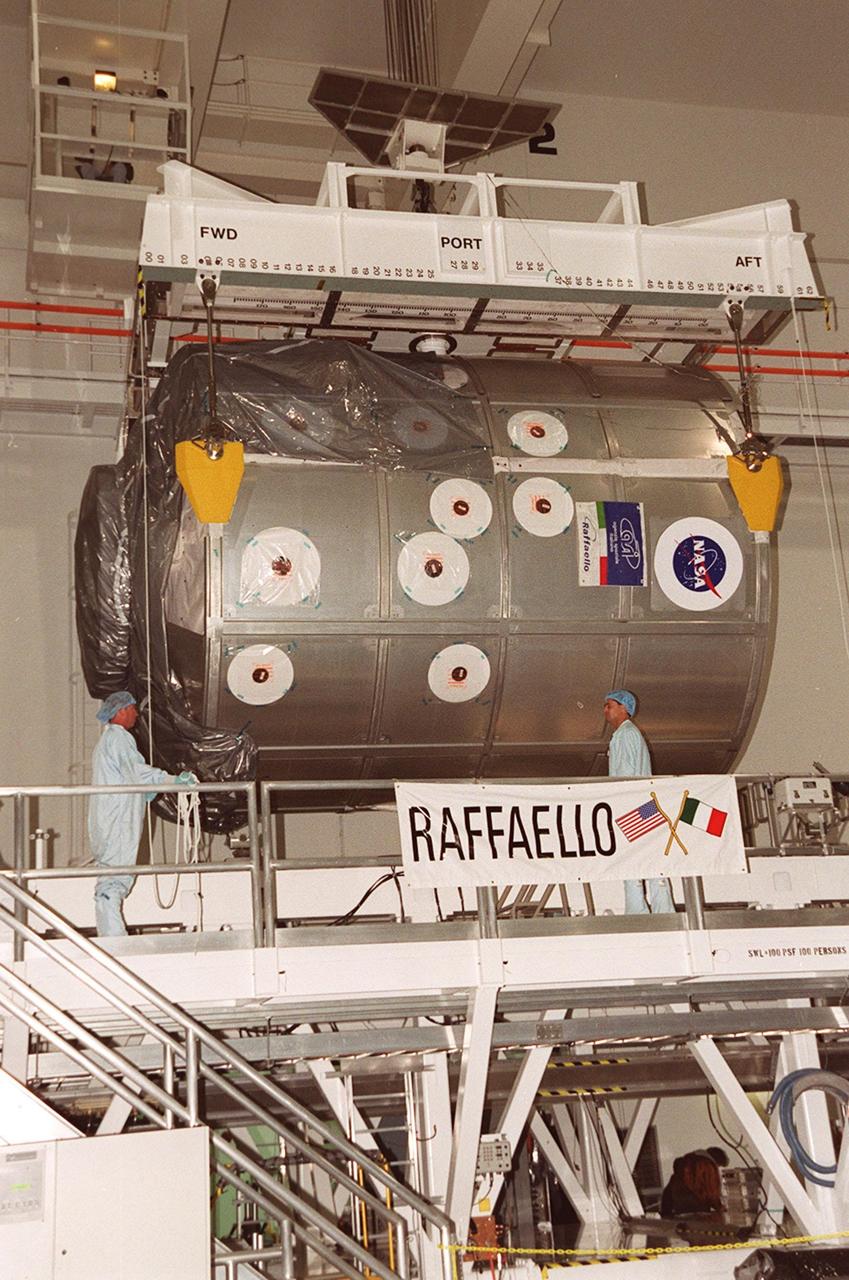
In the Space Station Processing Facility, the Multi-Purpose Logistics Module Raffaello rises off the workstand via an overhead crane that will move it to the payload canister. Part of the payload on mission STS-100 to the International Space Station, Raffaello carries six system racks and two storage racks for the U.S. Lab. Launch of STS-100 is scheduled for April 19, 2001 at 2:41 p.m. EDT from Launch Pad 39A
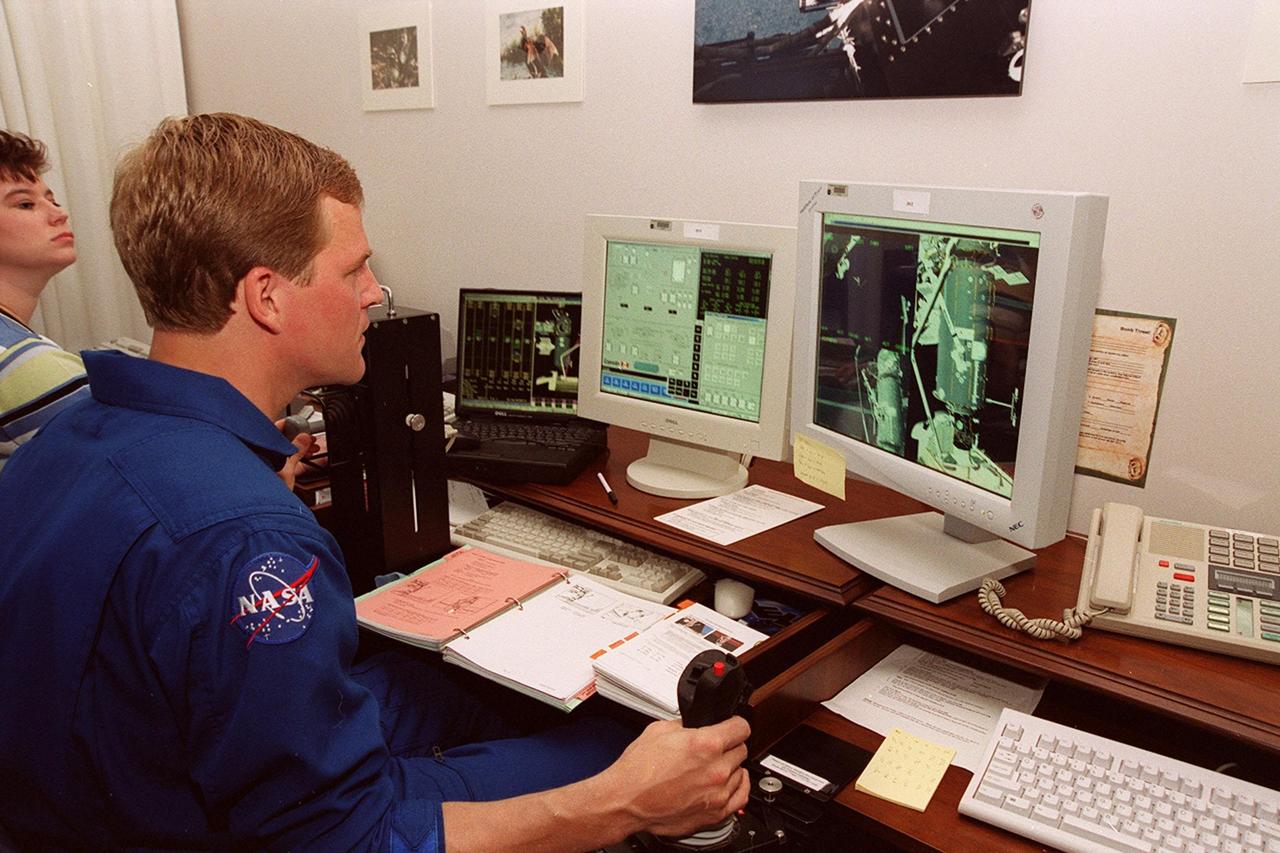
STS-100 Mission Specialist Scott E. Parazynski practices maneuvers on a simulator for installing the Canadian-built Space Station Remote Manipulator System (SSRMS). He and Mission Specialist Chris A. Hadfield will undertake two spacewalks to install the SSRMS. The 11-day mission to the International Space Station will also deliver the Multi-Purpose Logistics Module Raffaello, carrying six system racks and two storage racks for the U.S. Lab. Liftoff on mission STS-100 is scheduled at 2:41 p.m. EDT April 19

In the Space Station Processing Facility, workers on the floor walk along with the suspended Multi-Purpose Logistics Module Raffaello traveling overhead to the payload canister at right. Part of the payload on mission STS-100 to the International Space Station, Raffaello carries six system racks and two storage racks for the U.S. Lab. Launch of STS-100 is scheduled for April 19, 2001 at 2:41 p.m. EDT from Launch Pad 39A
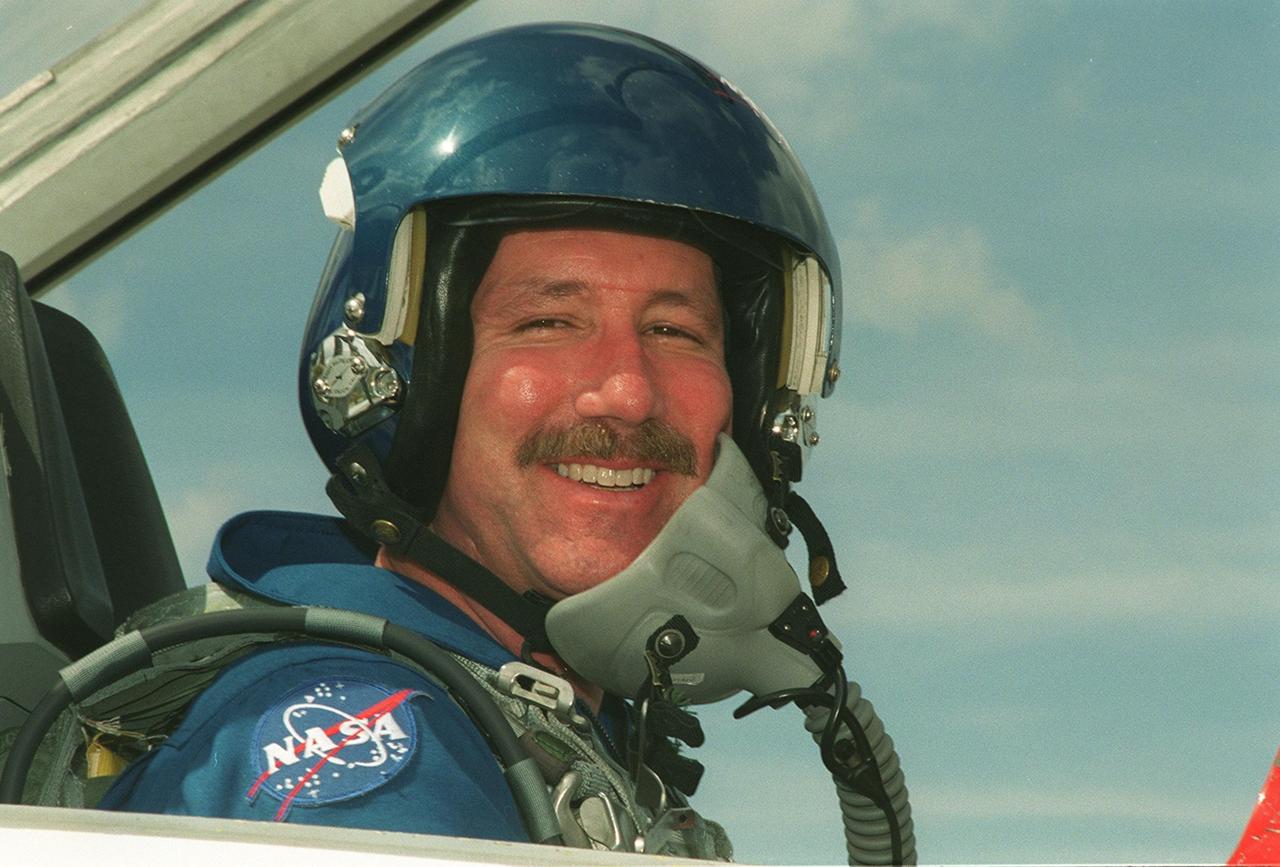
STS-100 Commander Kent V. Rominger returns to KSC to complete Terminal Countdown Demonstration Test activities that were postponed earlier. The TCDT includes emergency escape training, payload bay walkdown, and a simulated launch countdown. The primary payload comprises the Canadian robotic arm, SSRMS, and Multi-Purpose Logistics Module, Raffaello. Launch of Space Shuttle Endeavour on mission STS-100 is targeted for April 19 at 2:41 p.m. EDT from Launch Pad 39A
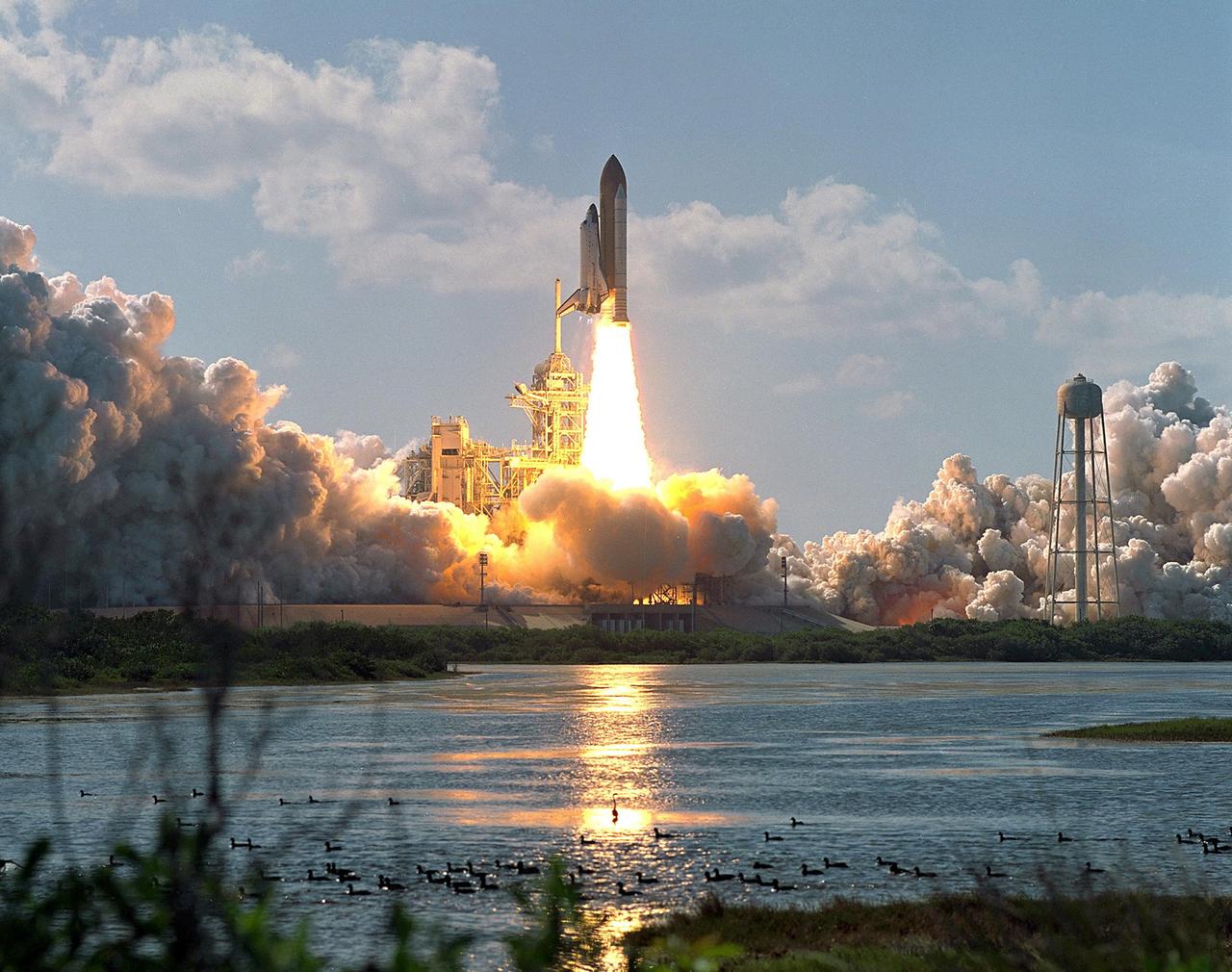
KENNEDY SPACE CENTER, FLA. -- Launch! Birds in the foreground seem oblivious to the fire and smoke as Space Shuttle Atlantis roars into the sky on mission STS-110. Liftoff occurred at 4:44:19 p.m. EDT (20:41:19 GMT). Carrying the S0 Integrated Truss Structure and Mobile Transporter, STS-110 is the 13th assembly flight to the International Space Station
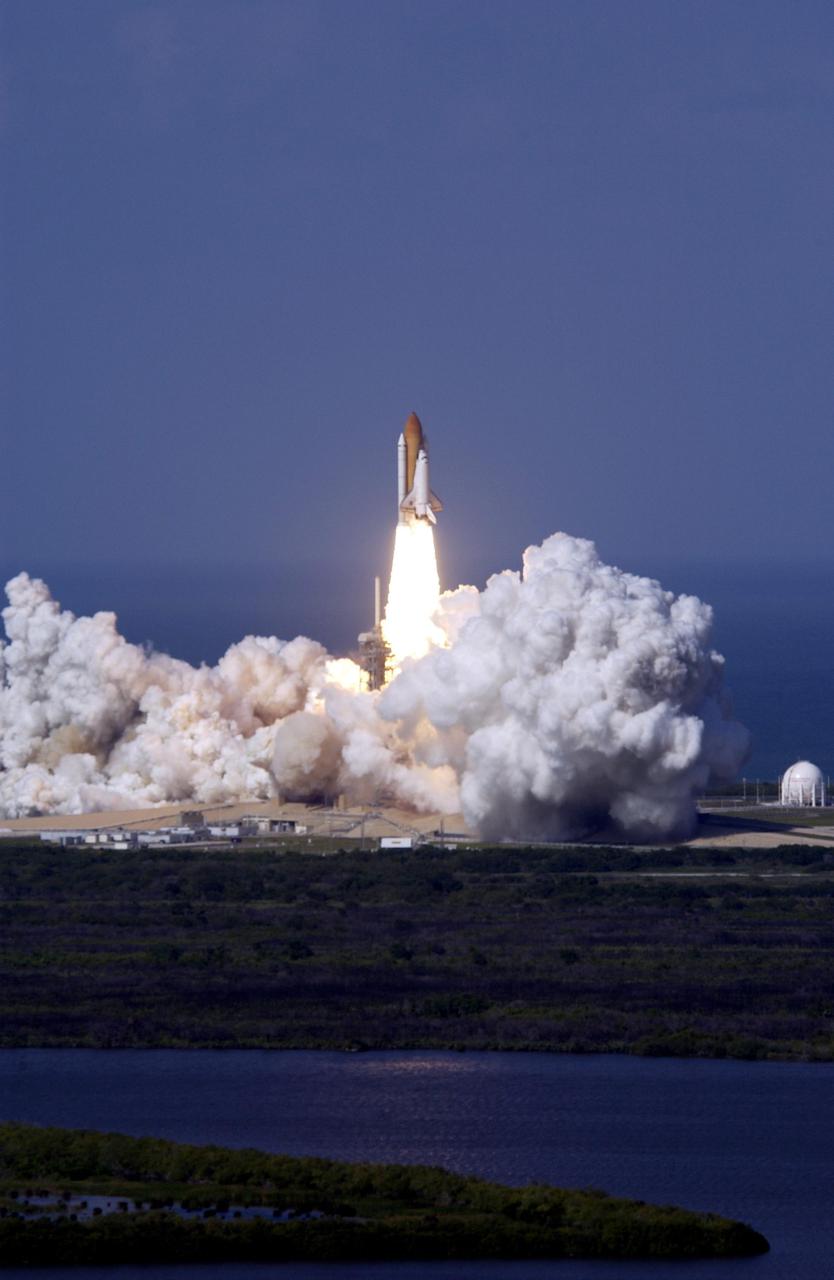
KENNEDY SPACE CENTER, FLA. -- Billows of smoke and steam roll across Launch Pad 39B as Space Shuttle Atlantis roars into the sky on mission STS-110. Liftoff occurred at 4:44:19 p.m. EDT (20:41:19 GMT). STS-110 is the 13th assembly flight to the International Space Station, carrying the S0 Integrated Truss Structure and Mobile Transporter
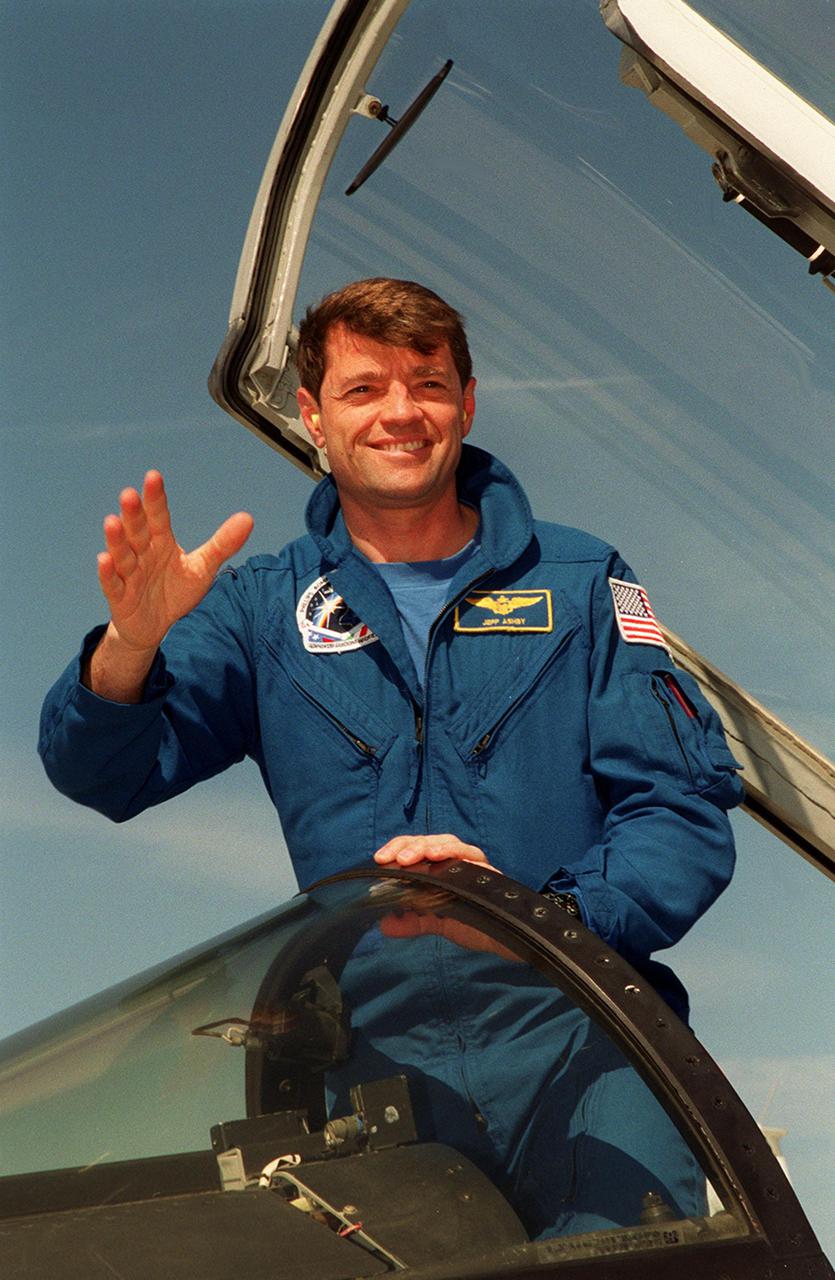
STS-100 Pilot Jeffrey S. Ashby arrives at the KSC Shuttle Landing Facility aboard a T-38 jet aircraft to get ready for launch. The 11-day mission to the International Space Station will deliver and integrate the Spacelab Logistics Pallet_Launch Deployment Assembly, which includes the Space Station Remote Manipulator system and the UHF Antenna, and the Multi-Purpose Logistics Module Raffaello. Liftoff on mission STS-100 is scheduled at 2:41 p.m. EDT April 19
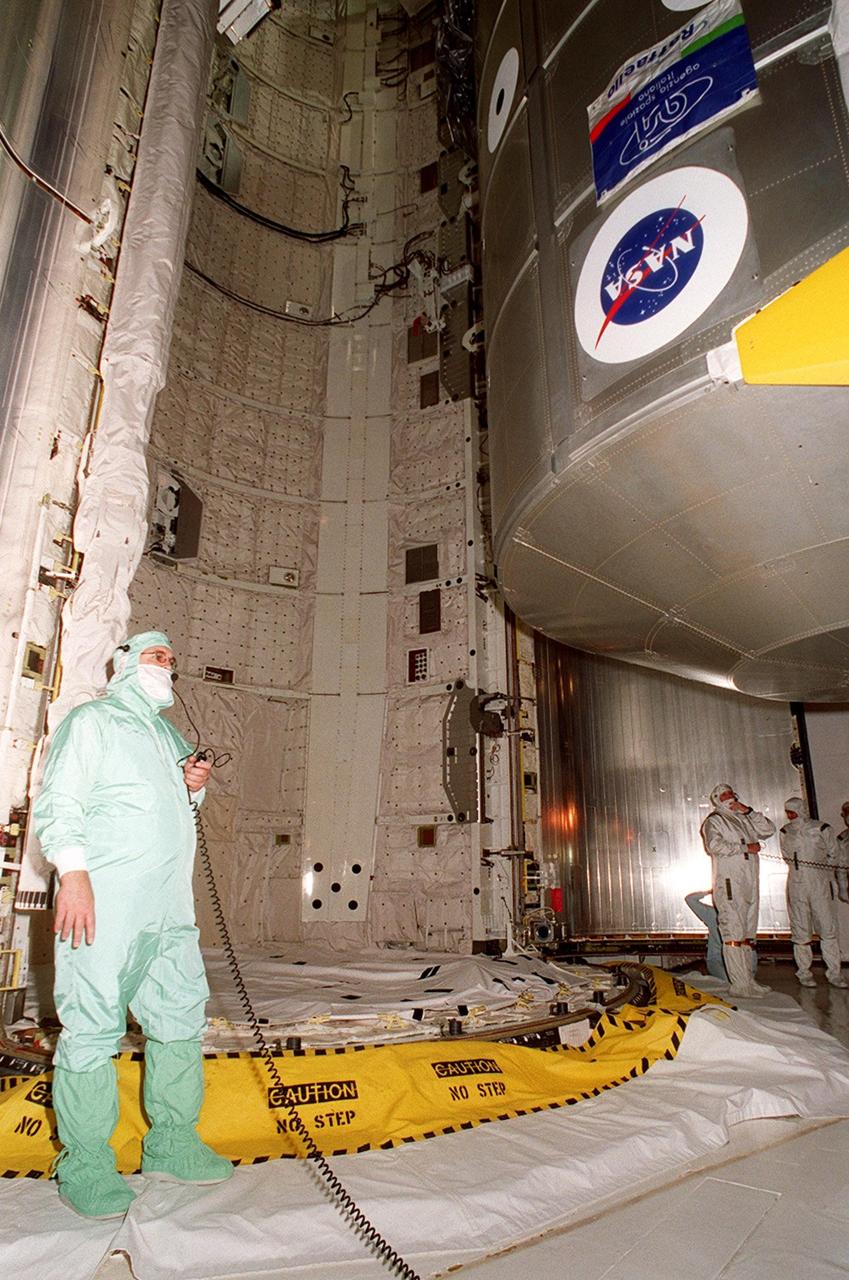
At Launch Pad 39A, the payload on mission STS-100 is in the payload changeout room, from which it will be transferred to the Endeavour’s payload bay. Visible is the Multi-Purpose Logistics Module Raffaello. Above it, but not visible, is the Canadian robotic arm, the SSRMS. Raffaello carries six system racks and two storage racks for the U.S. Lab. The SSRMS is capable of handling large payloads and assisting with docking the Space Shuttle. It is crucial to the continued assembly of the International Space Station. Launch of mission STS-100 is scheduled for April 19 at 2:41 p.m. EDT
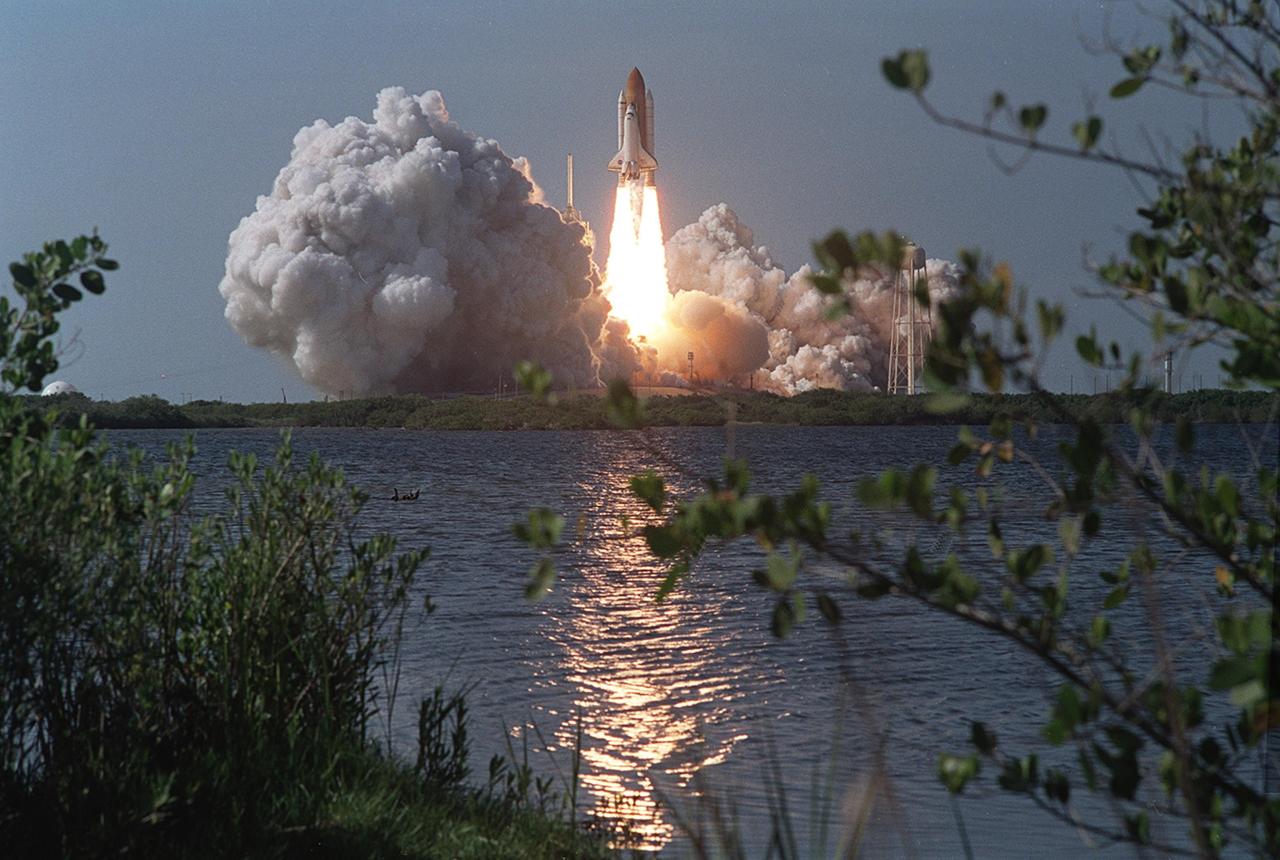
KENNEDY SPACE CENTER, FLA. - As Space Shuttle Atlantis roars into the sky on mission STS-110, flames from the solid rocket boosters light up the water near Launch Pad 39B. Liftoff occurred at 4:44:19 p.m. EDT (20:41:19 GMT). Carrying the S0 Integrated Truss Structure and Mobile Transporter, STS-110 is the 13th assembly flight to the International Space Station
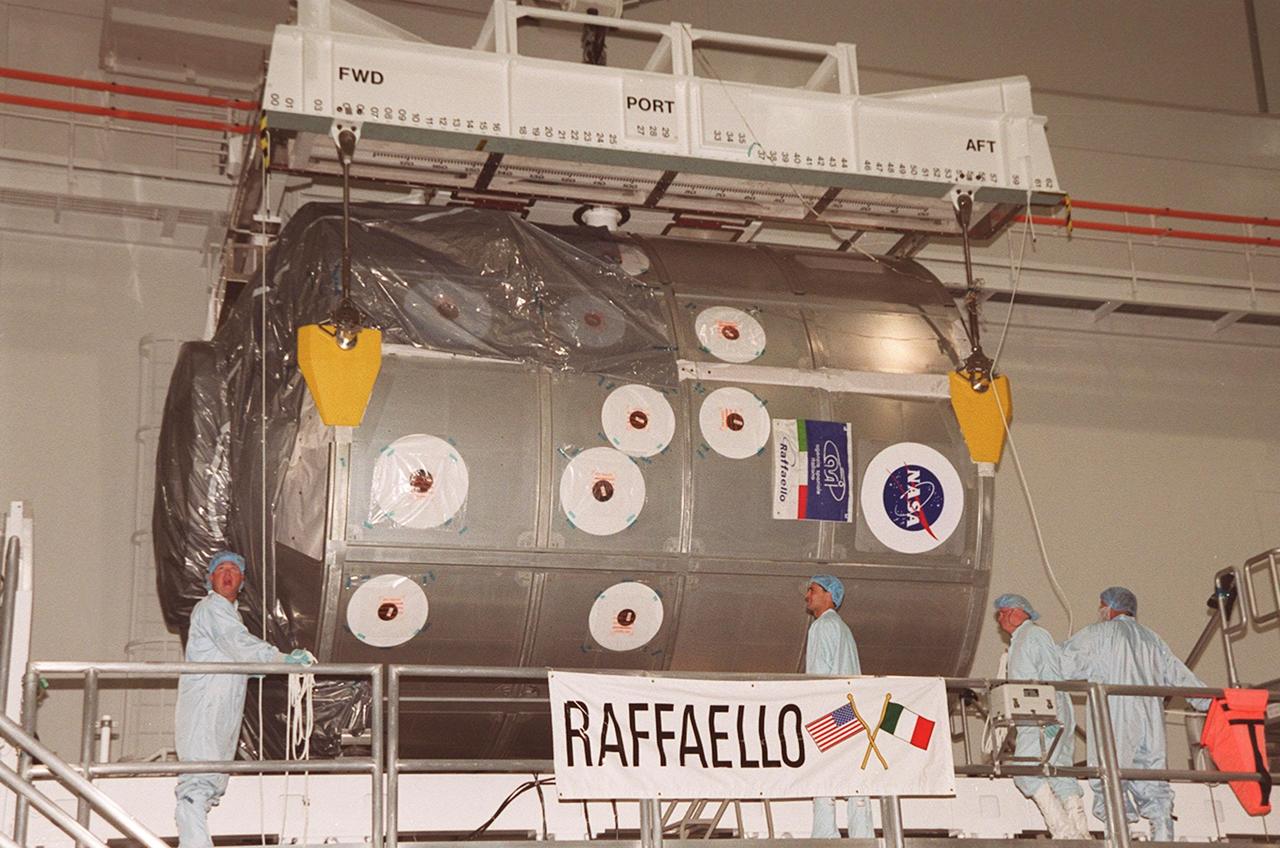
In the Space Station Processing Facility, an overhead crane is ready to lift the Multi-Purpose Logistics Module Raffaello in order to move it to the payload canister. Part of the payload on mission STS-100 to the International Space Station, Raffaello carries six system racks and two storage racks for the U.S. Lab. Launch of STS-100 is scheduled for April 19, 2001 at 2:41 p.m. EDT from Launch Pad 39A