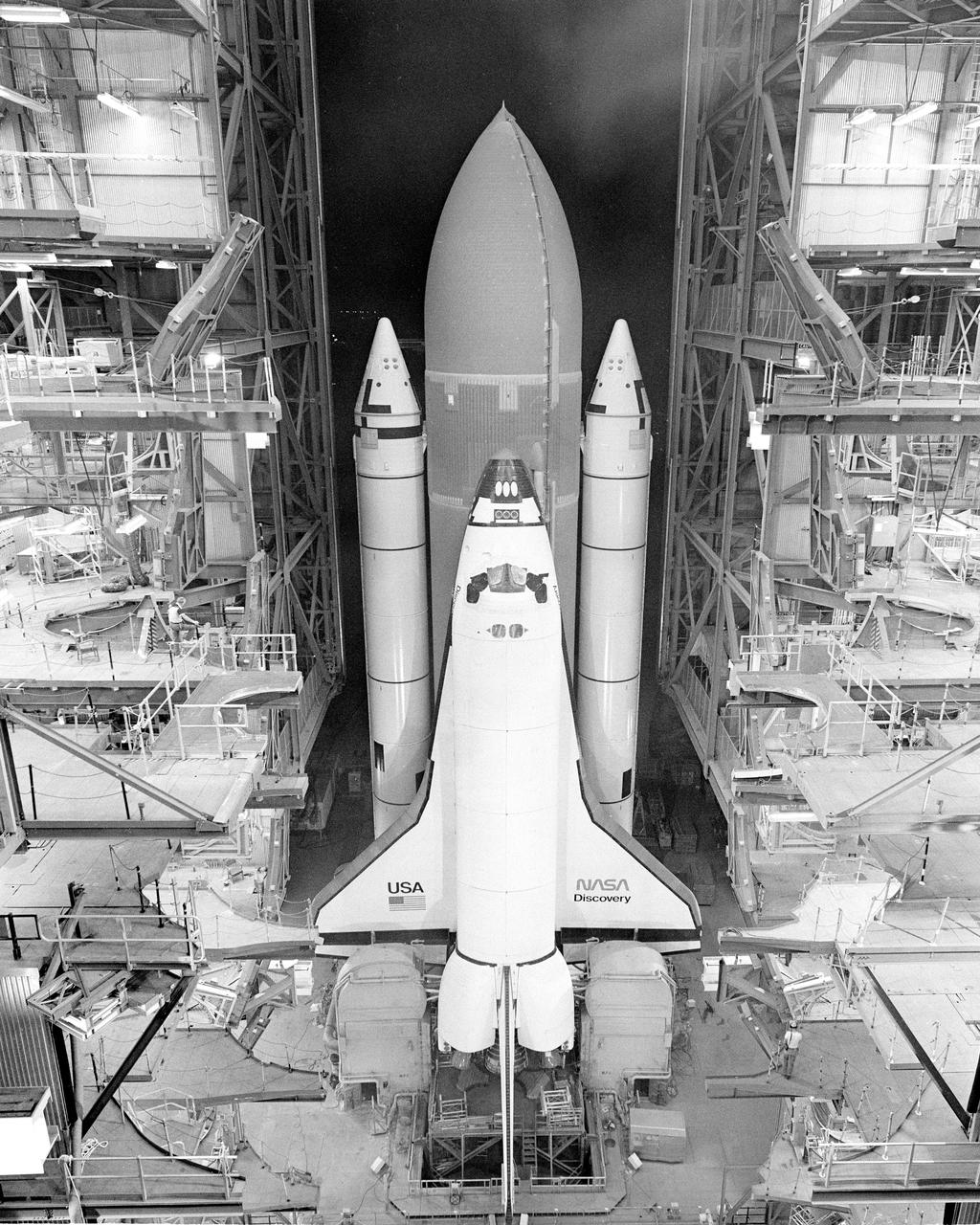
Orbiter Discovery - STS-41D rollout.
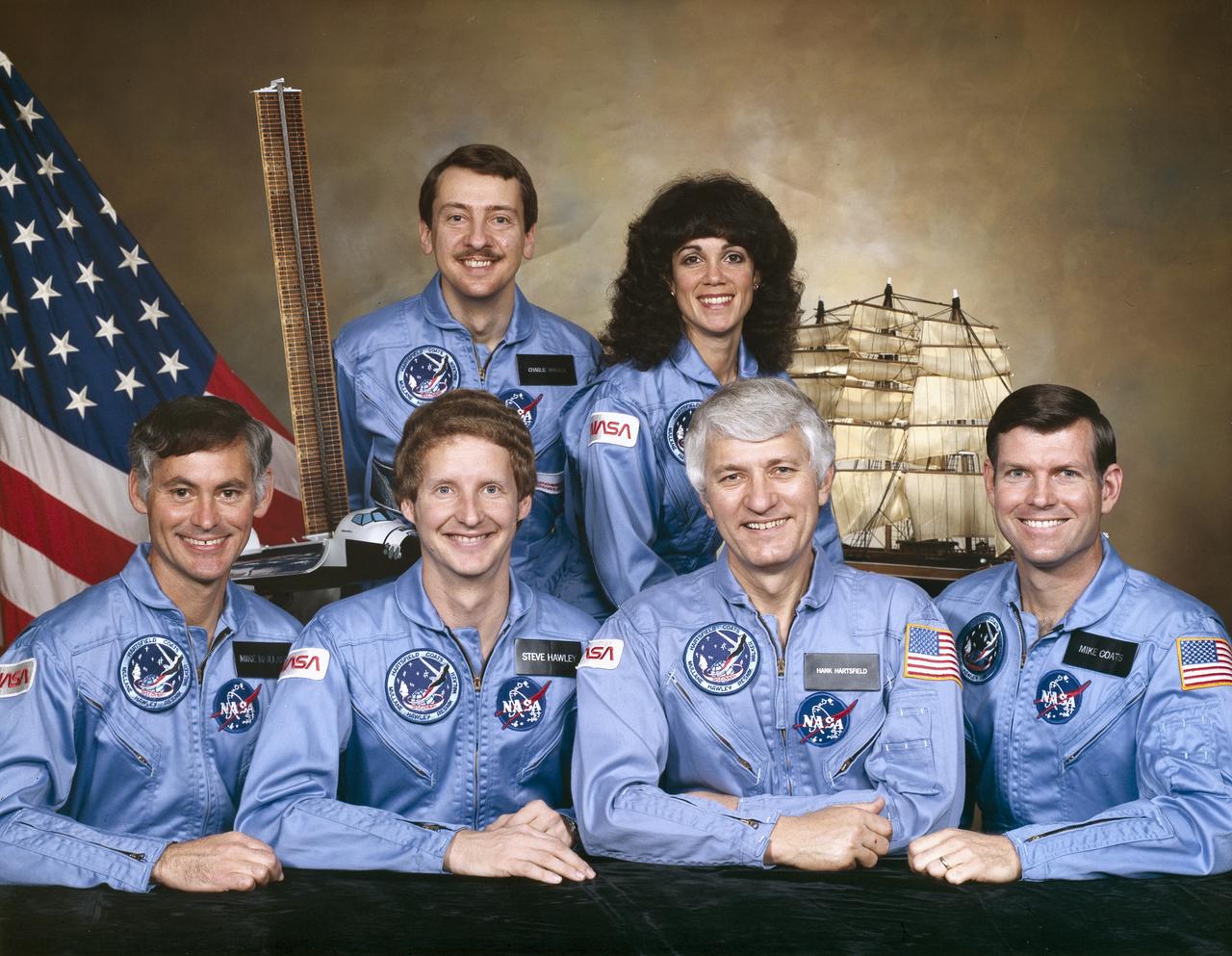
The crew assigned to the STS-41D mission included (seated left to right) Richard M. (Mike) Mullane, mission specialist; Steven A. Hawley, mission specialist; Henry W. Hartsfield, commander; and Michael L. (Mike) Coats, pilot. Standing in the rear are Charles D. Walker, payload specialist; and Judith A. (Judy) Resnik, mission specialist. Launched aboard the Space Shuttle Discovery August 30, 1984 at 8:41:50 am (EDT), the STS-41D mission deployed three satellites: the Satellite Business System SBS-D; the SYCOM IV-2 (also known as LEASAT-2); and the TELSTAR.
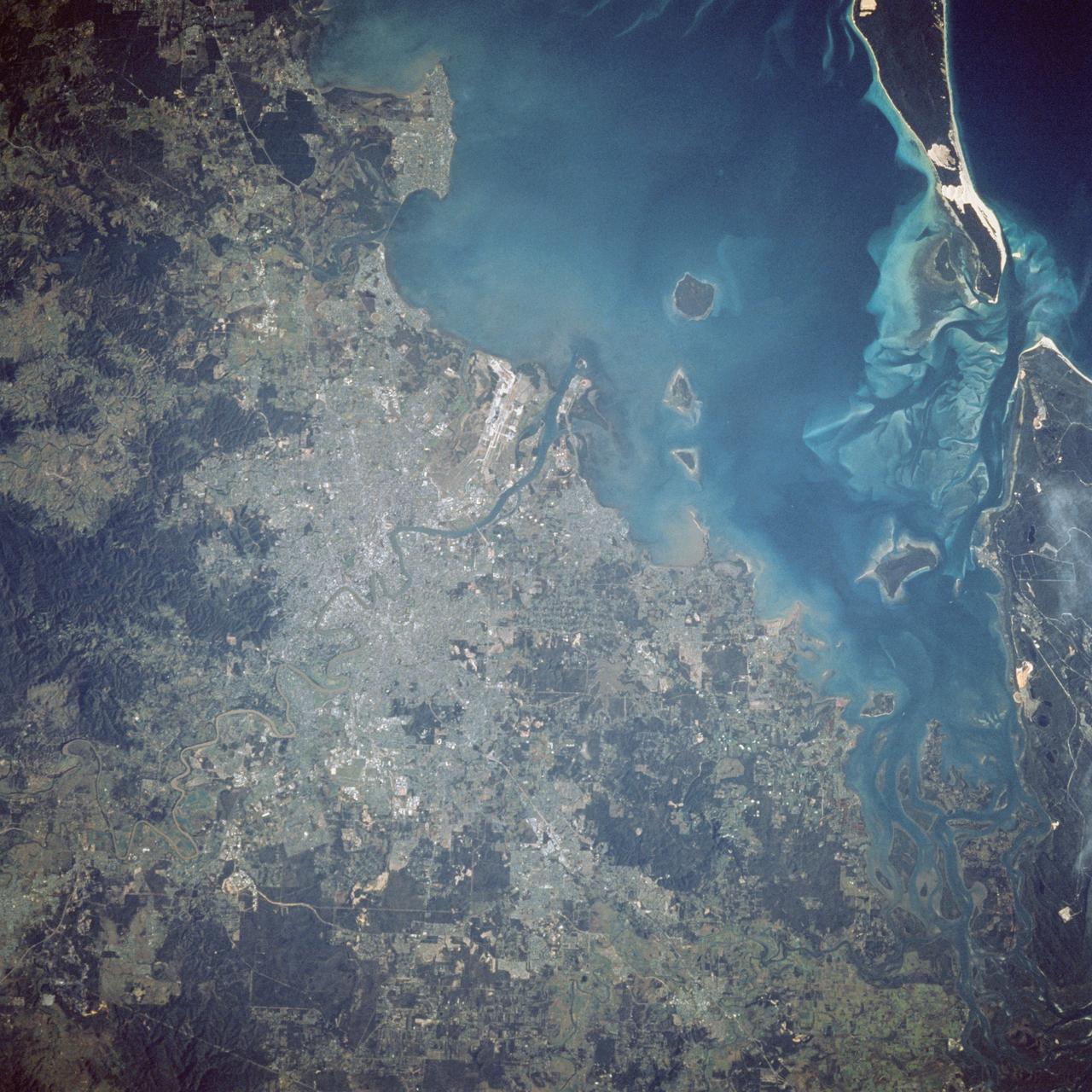
41D-41-062 (30 Aug-5 Sept 1984) --- An example of the surface details on the Earth seen by orbiting astronauts is provided by this Hasselblad 500 EL/M photograph made with a 250mm lens over Brisbane, Australia. Urban areas and the airport complex lie along the Brisbane River which empties into Moreton Bay. The photograph was shown during the STS-41D postflight press conference held on September 12, 1984.
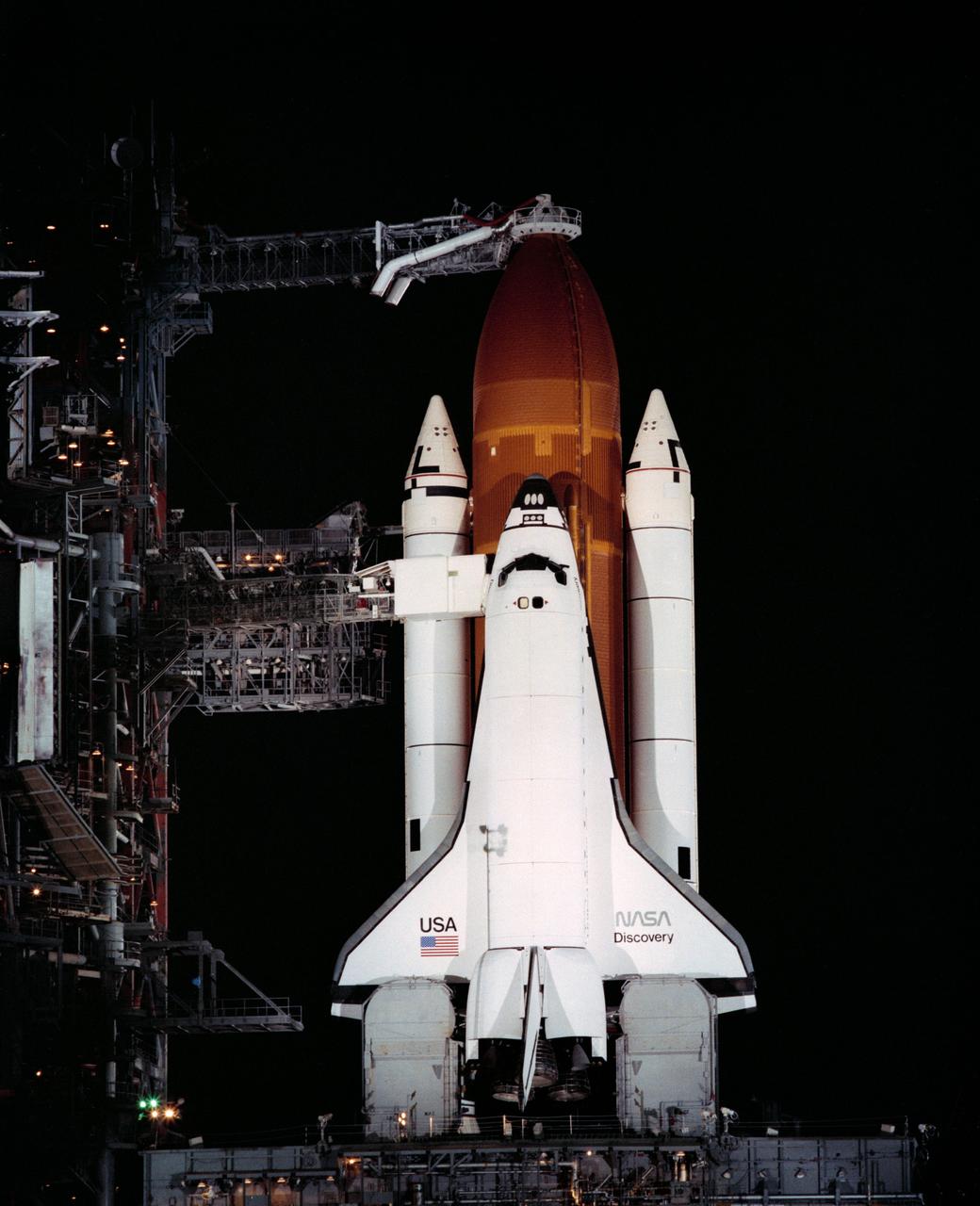
The Space Shuttle Discovery moves towards Pad "A" on the crawler transporter for its maiden flight. The Shuttle Discovery is poised atop Pad "A" at Complex 39 prior ot the STS-41D mission. KSC, FL
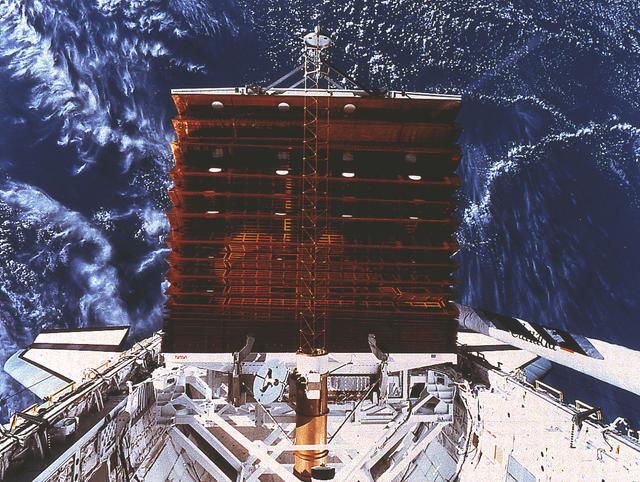
An STS-41D onboard photo shows the Solar Array Experiment (SAE) panel deployment for the Office of Aeronautics and space Technology-1 (OAST-1). OAST-1 is several advanced space technology experiments utilizing a common data system and is mounted on a platform in the Shuttle cargo bay.
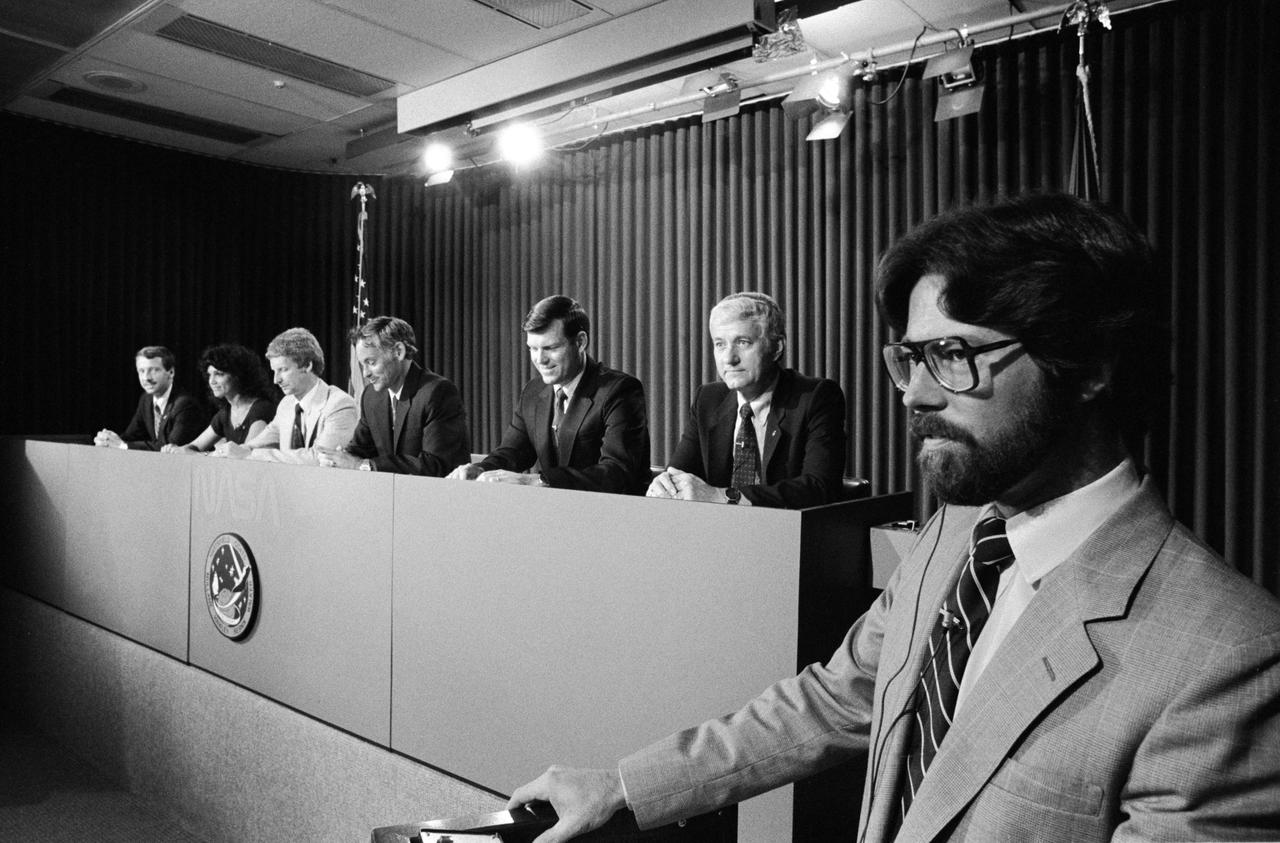
S84-40185 (08/21/1984) --- stronaut preflight Press Conference with the STS-41D Crew with Public Affairs Office (PAO) Reprentative Steve Nesbitt in the foreground in the Bldg 2 Briefing Room on 08/17/1984. Crewmembers visible (R-L) are: Henry W. Hartsfield, Jr., Crew Commander; Michael L. Coats, Pilot: Richard M. (Mike) Mullane, Steven A. Hawley, Judith A. Resnik - all Mission Specialists: and, Charlie D. Walker, Payload Specialist. JSC, Houston, TX
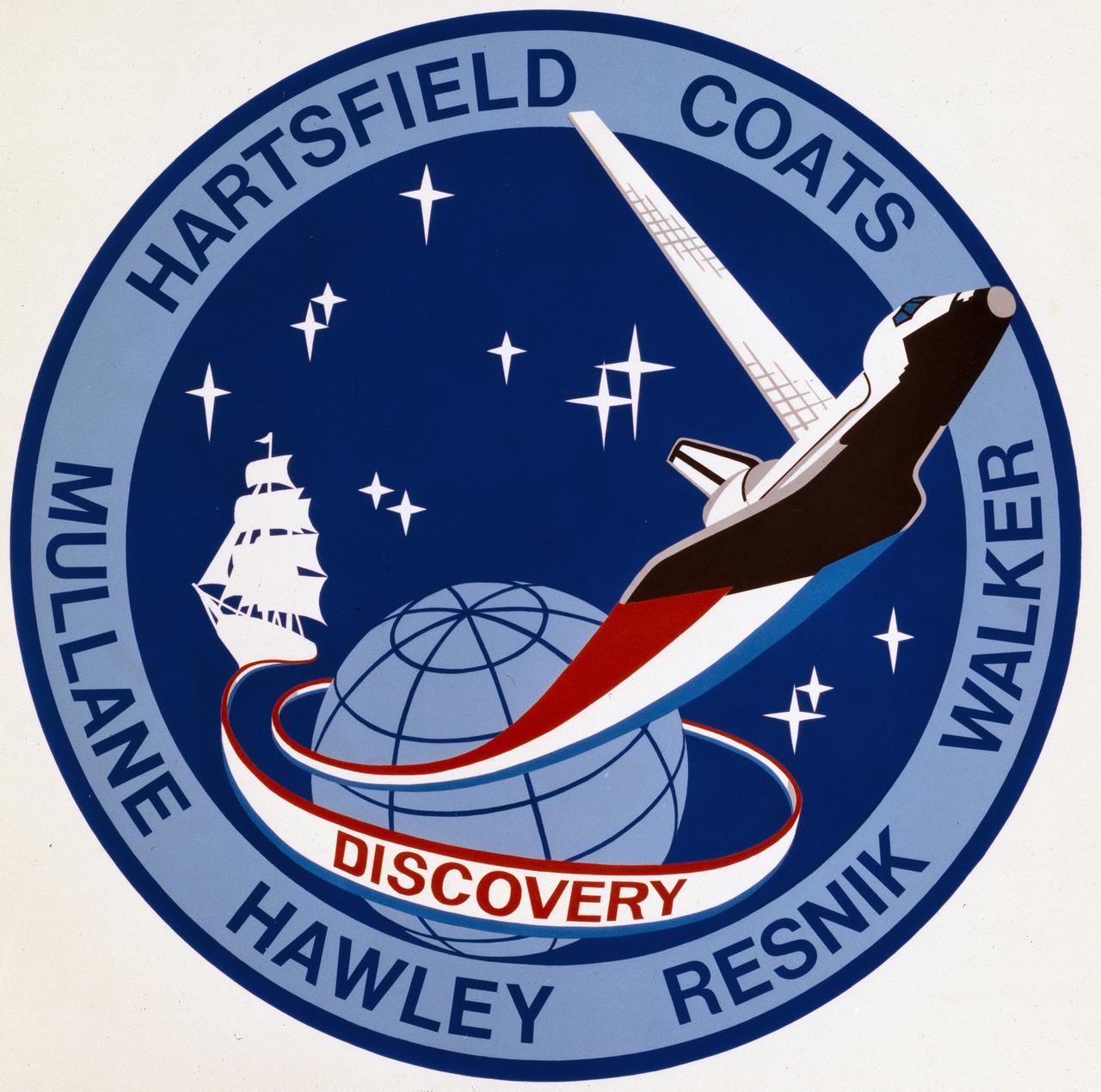
The official mission insignia for the 41-D Space Shuttle flight features the Discovery - NASA's third orbital vehicle - as it makes its maiden voyage. The ghost ship represents the orbiter's namesakes which have figured prominently in the history of exploration. The Space Shuttle Discovery heads for new horizons to extend that proud tradition. Surnames for the crewmembers of NASA's eleventh Space Shuttle mission encircle the red, white, and blue scene.

41D-09-028 (30 Aug-5 Sept 1984) --- Astronaut Judith A. Resnik, mission specialist, rests in a Shuttle zip-up bag in the mid-deck of the Earth-orbiting Space Shuttle Discovery. A package of rehydratable food is fastened to a nearby stowage locker door.
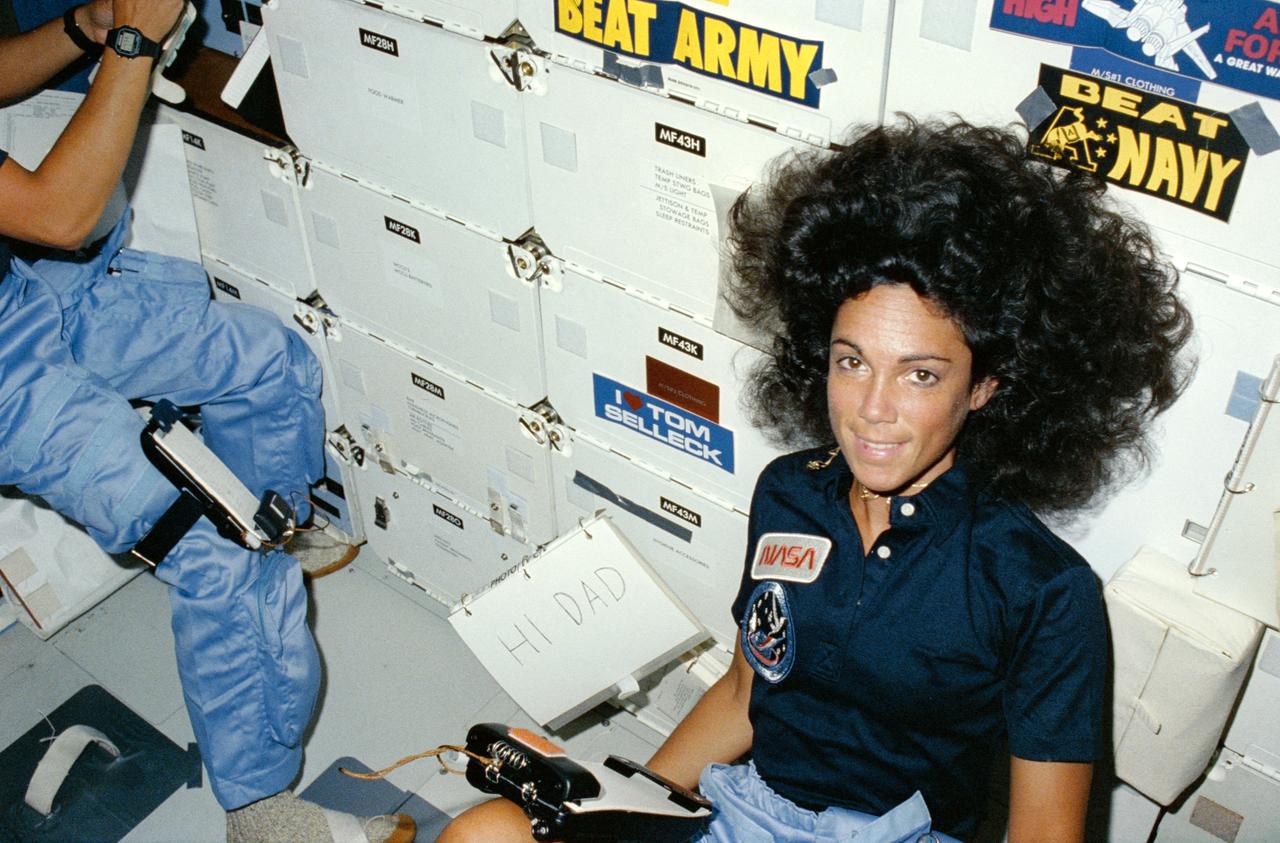
41D-13-025 (30 Aug 1984) --- Astronaut Judith A. Resnik, one of three mission specialists, positions herself on the floor of the Space Shuttle Discovery's mid-deck to note some items on a clipboard pad. Nearby, Charles D. Walker, payload specialist (partially out of frame at left), anchors himself with a foot restraint while working at a stowage locker. Between the two is a sign fashioned by Dr. Resnik and held up to a nearby TV camera during early STS-41D downlinked television. This is a 35mm frame.
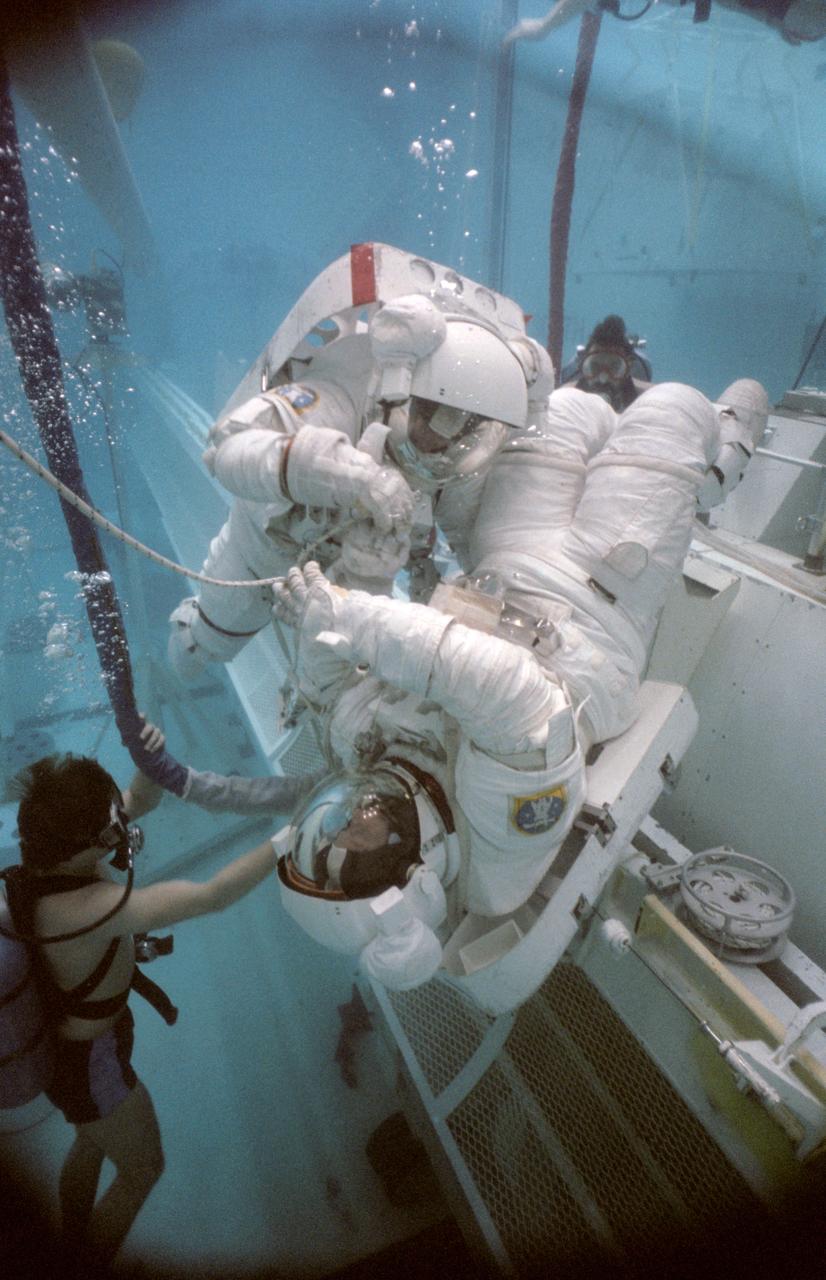
S84-28206 (26 Feb 1984) --- Astronauts Richard M. (Mike) Mullane (with striped suit and PLSS) and Steven A. Hawley participate in and underwater simulation of a 41-D contingency extravehicular activity (EVA) in the Johnson Space Center's weightless environment training facility (WET-F). All Shuttle crews, many of which are not scheduled for definite EVAs, possess team members trained to perform in space certain tasks normally done remotely in the event of systems failures. Among those contingent tasks is the manual closing of the payload bay doors. Mullane and Hawley are two of three mission specialists assigned duty on the seven-day 41-D flight. This photograph was taken by Otis Imboden.
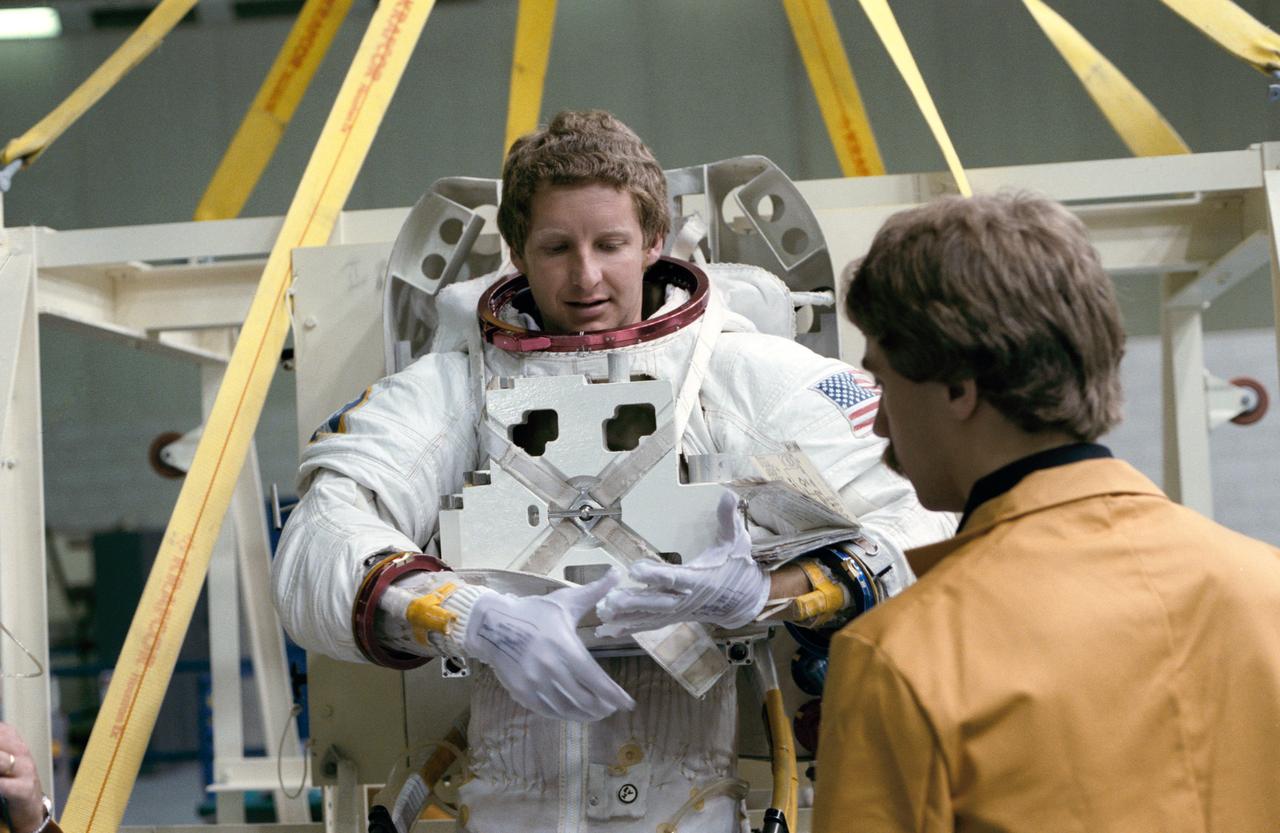
S84-28203 (24 Feb 1984) --- Astronaut Steven A. Hawley, 41-D mission specialists, completes suiting up procedures before being submerged in the Johnson Space Center's (JSC) 25 ft. deep weightless environment training facility (WET-F). Obscured behind Dr. Hawley is astronaut Richard M. (Mike) Mullane, 41-D mission specialist. later the pair were lowered into the facility for an underwater simulation of a contingent extravehicular activity for the week-long flight.
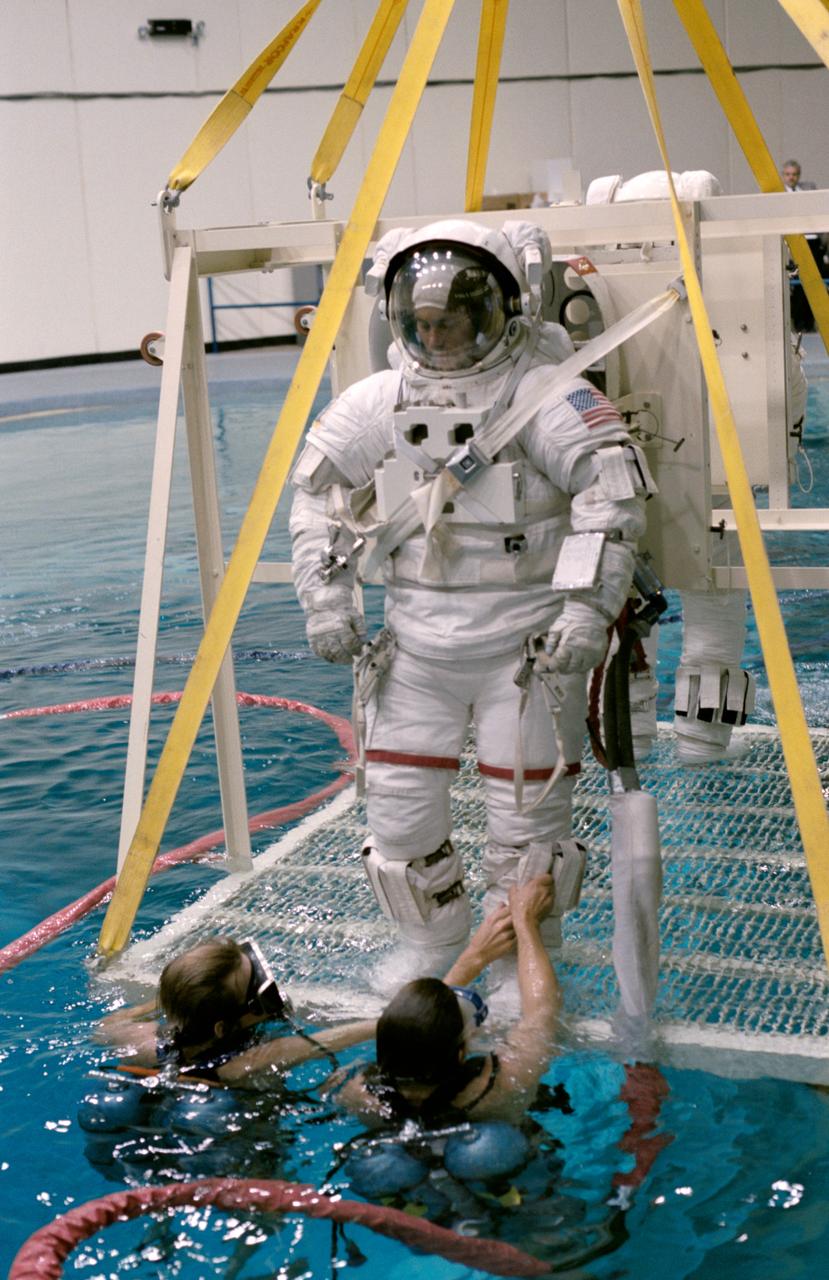
S84-28204 (26 Feb 1984) --- Astronaut Richard M. (Mike) Mullane, one of three 41-D mission specialists, is almost ready for submerging in the 25 ft. deep facility used to simulate space tasks on earth. Moments later, the 41-D crewmember was floating around a submerged Shuttle mockup simulating a contignency EVA for his seven-day flight. Partially pictured in the background is Astronaut Steven A. Hawley, who would share EVA duties with Mullane in the event an EVA was deemed necessary. All Shuttle crews, many of which are not scheduled for definite EVAs, possess team members trained to perform in space certain tasks normally done remotely in the event of systems failures. Among those contingent tasks is the manual closing of the Shuttle's cargo bay doors. This photograph was taken by Otis Imboden.
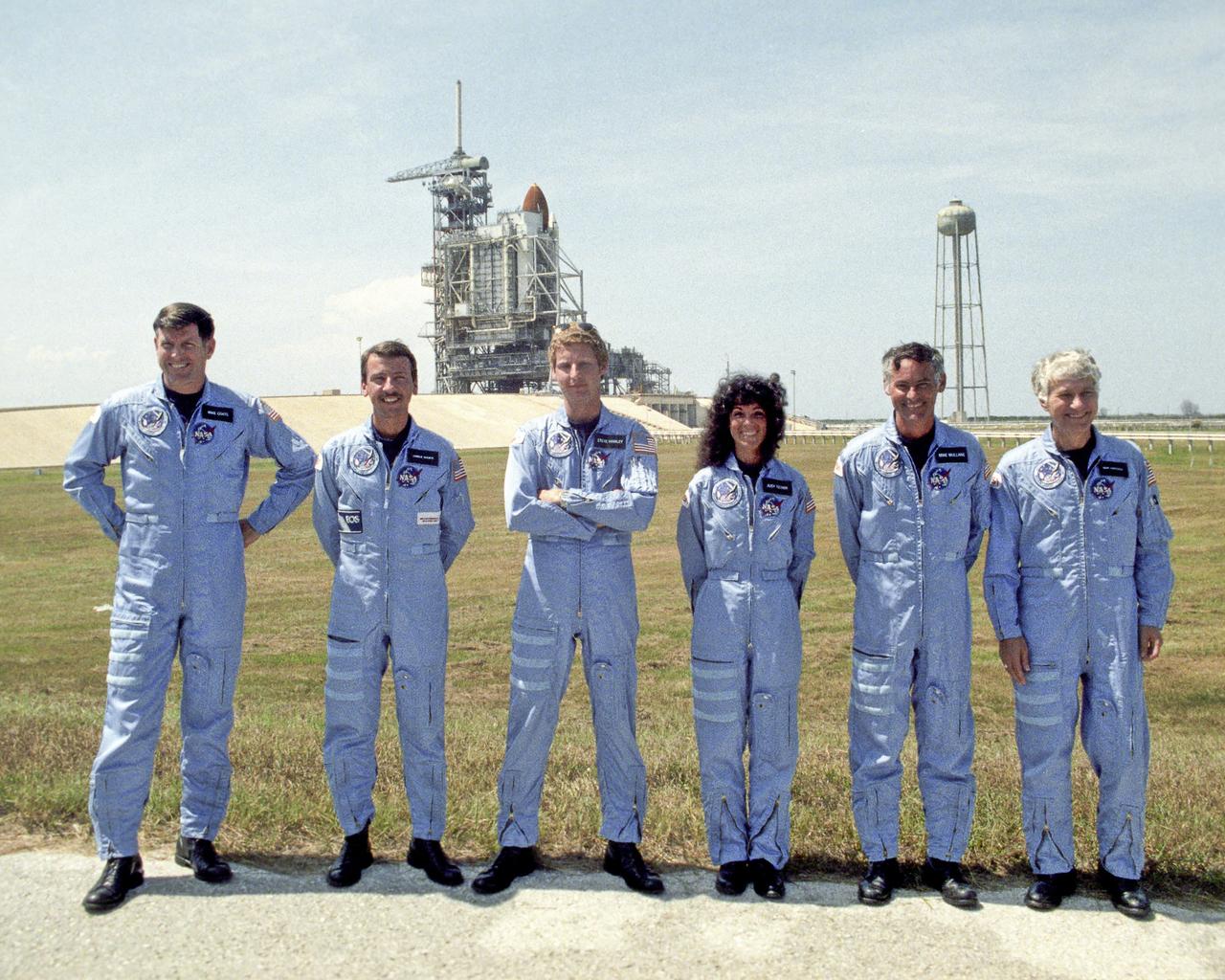
CAPE CANAVERAL, Fla. -- Members of the STS-41D flight crew are, from left to right, Michael L. Coats, Charles D. Walker, Steven A. Hawley, Judith A. Resnik, Richard M. Mullane, and Henry Hartsfield. Photo credit: NASA
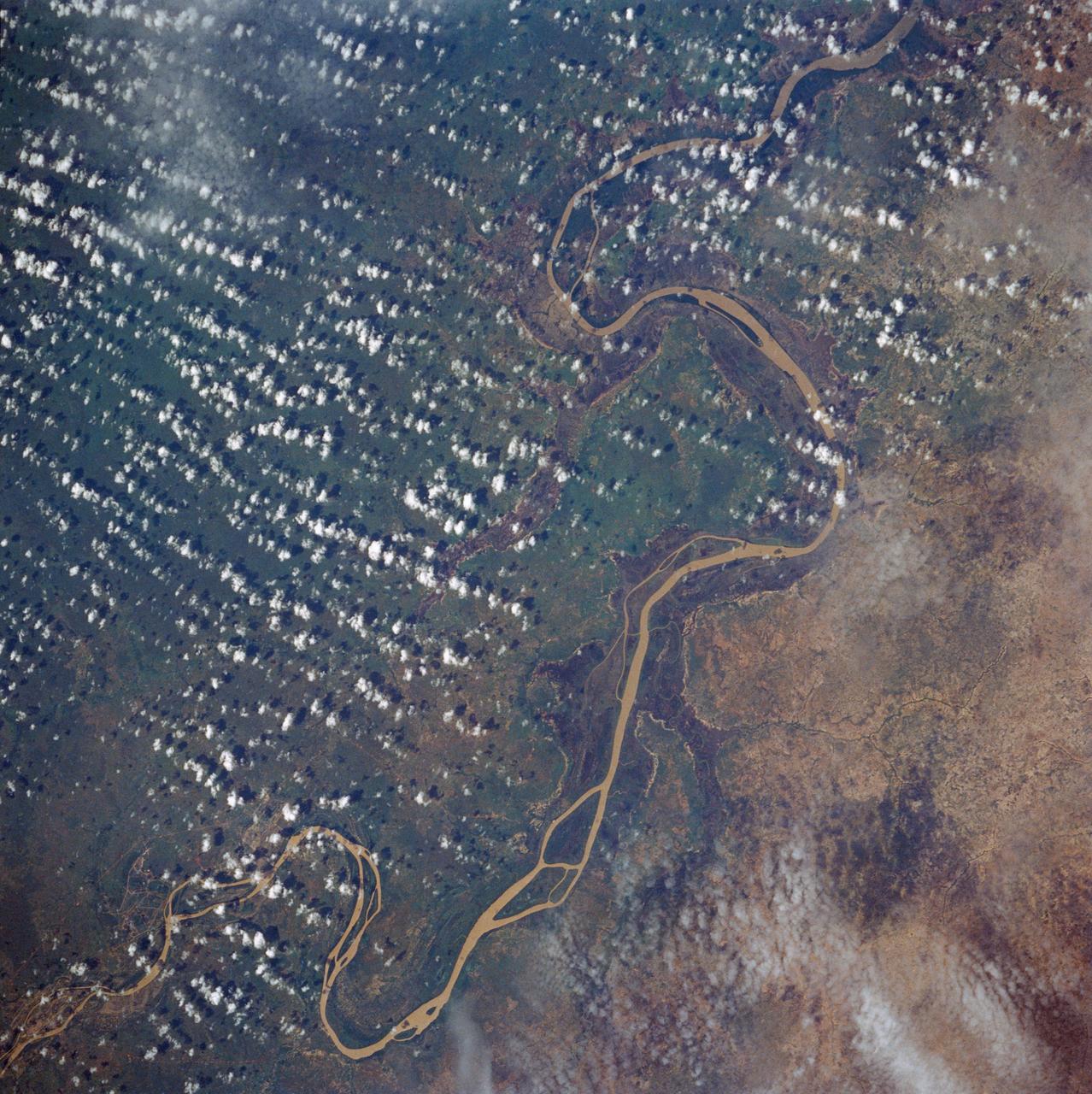
41D-34-099 (30 Aug-5 Sept 1984) --- The Gambia River, from Georgetown in the upper right corner of the photograph downstream to Mansa Konko, where it becomes an estuary about 60 miles above Banjul, the capital of The Gambia. The river is heavily silted from rain originating in the highlands of Guinea. This accounts for its bronze color as it passes from forest to drier savannah en route to the Sahara and across the nation of Senegal in west Africa. The Gambia itself is a long, narrow nation which follows the river for about 200 miles.
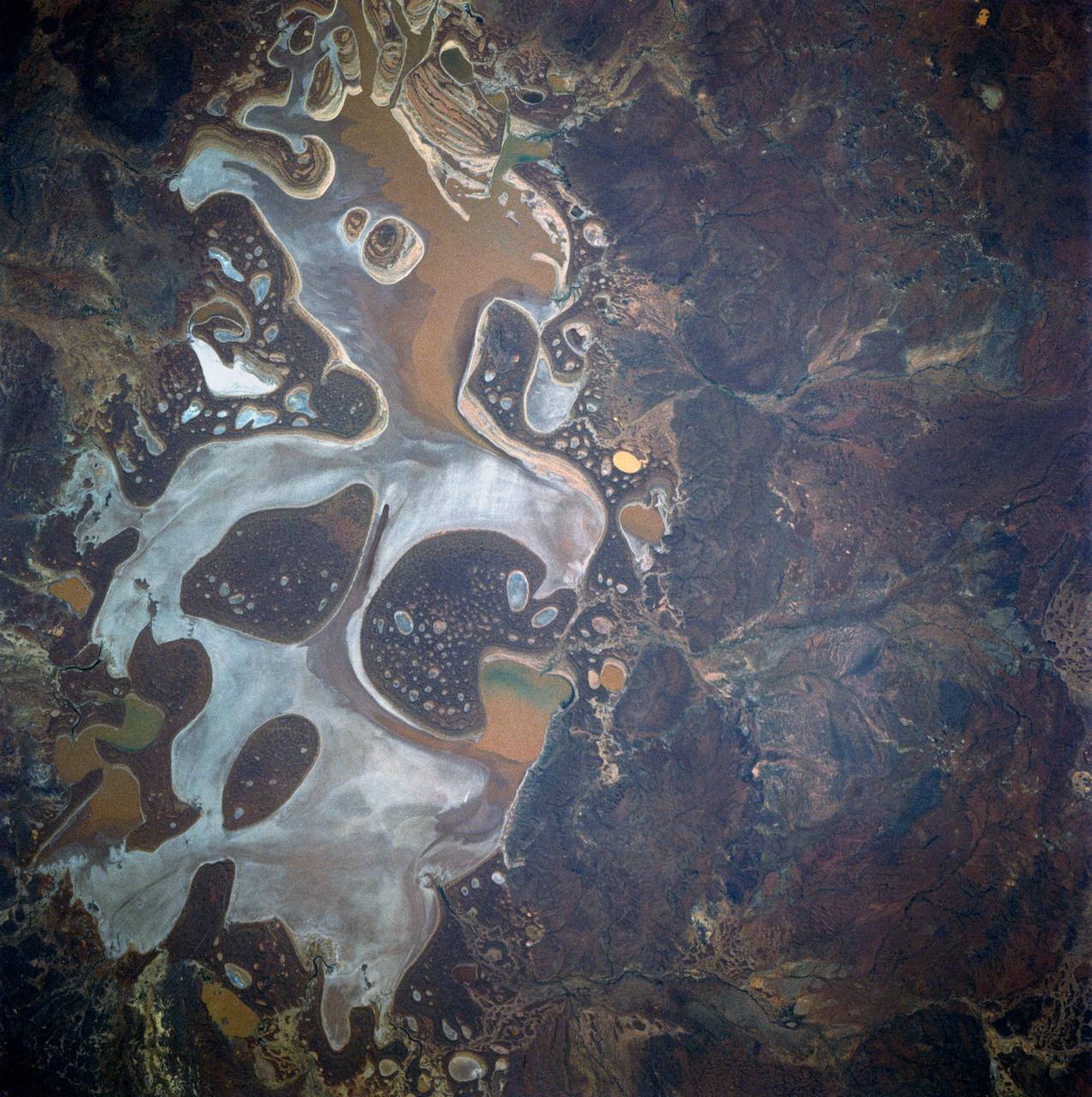
41D-42-045 (30 Aug-5 Sept 1984) --- Lake Carnegie in western Australia, 600 miles northeast of Perth. This is an island basin dotted with numerous salt lakes, ponds, flats, benches, and dunes.
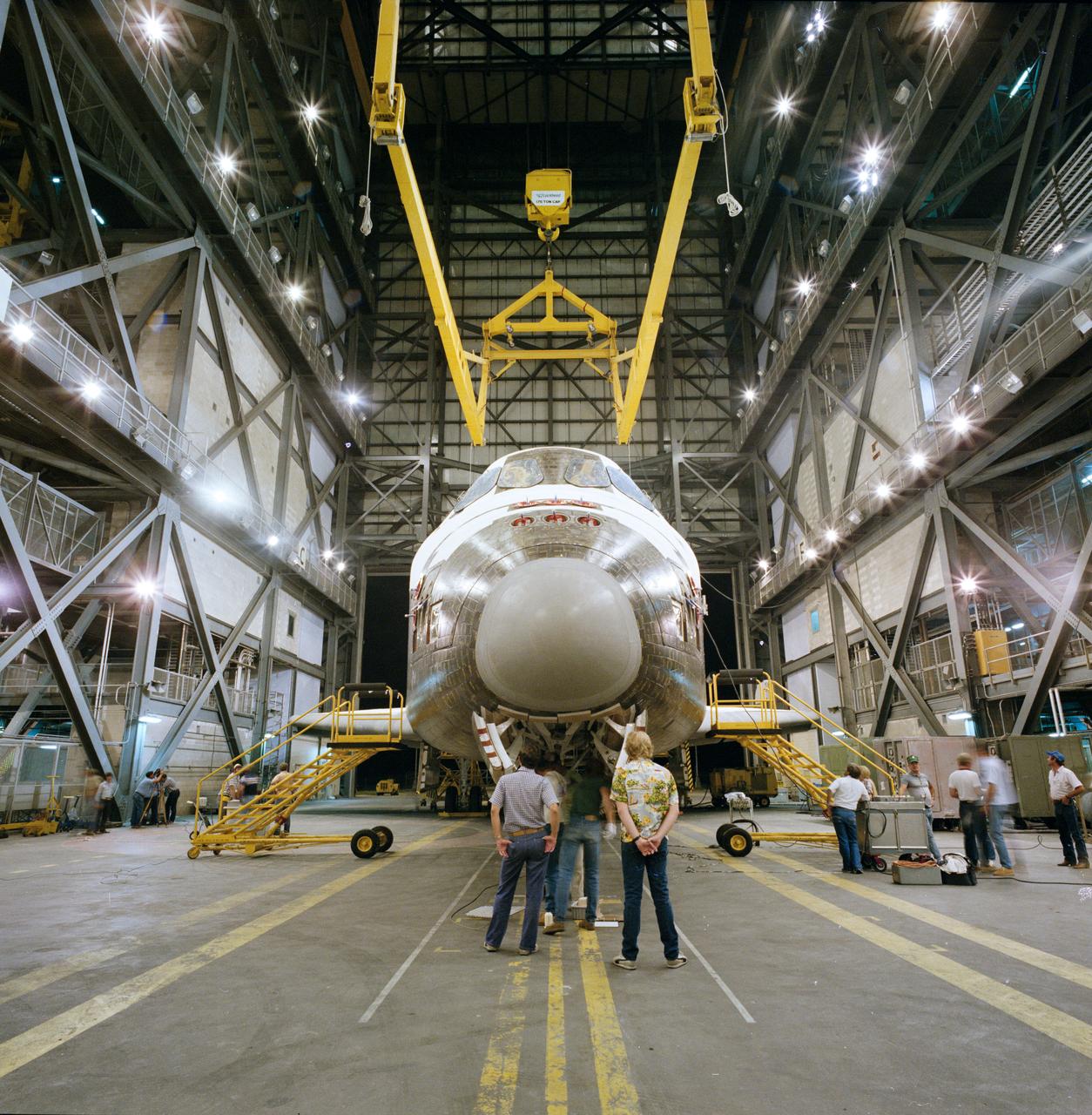
S84-35097 (May 1984) --- The Space Shuttle Orbiter 103 is about to be hoisted into a tail-toward-ground mode for mating to its two solid rocket boosters (SRB) and an external tank (ET) (awaiting the maneuver high out of frame) in the Kennedy Space Center's (KSC) huge vehicle assembly building (VAB). After its arrival here from the manufacturer in Palmdale, California, Discovery underwent extensive pre-launch preparations in the nearby processing facility (OPF).
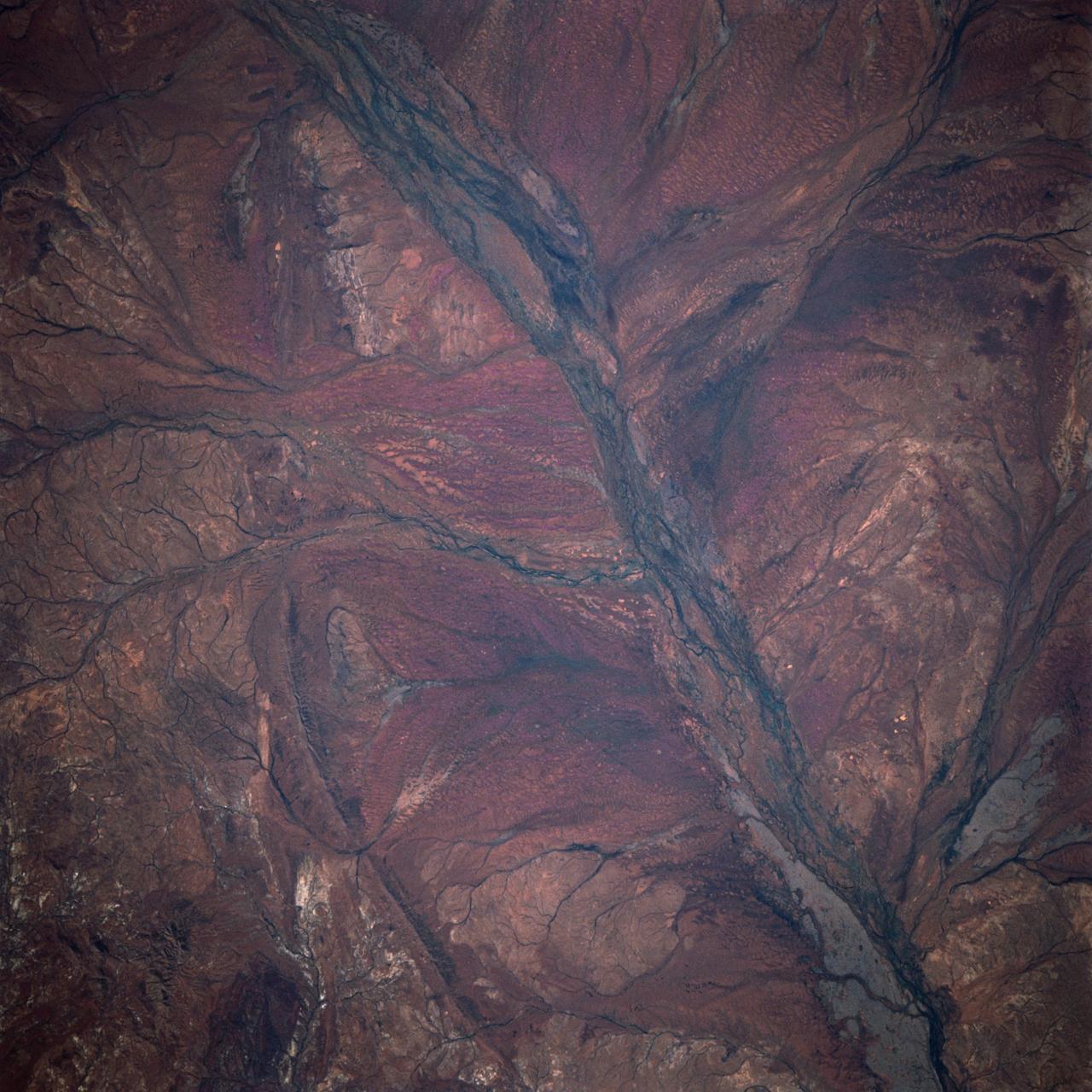
41D-42-023 (30 Aug-5 Sept 1984) --- The Gascoyne River, an intermittent large wash 500 miles north of Perth, Australia, which flows for nearly a thousand miles across the Macadam Plains. The scant water available in this area either is absorbed in the sands and gravel of the watercourse or quickly evaporates. Most water flows beneath the surface, then, giving support to plant root systems and sustaining green vegetation along the watercourses.
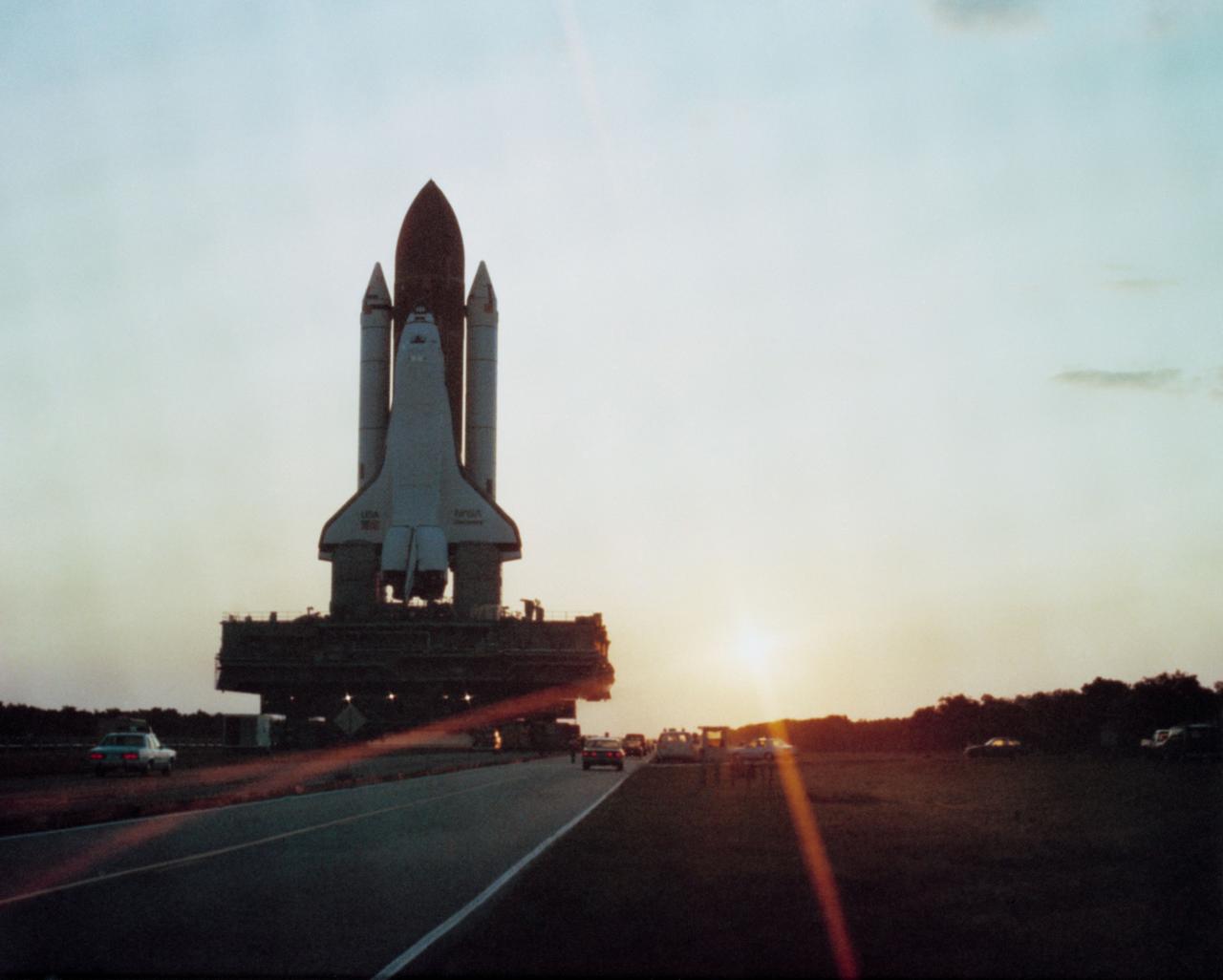
S86-41700 (19 May 1984) --- The Space Shuttle Discovery moves towards Pad A on the crawler transporter for its maiden flight. Discovery will be launched on its first mission no earlier than June 19, 1984. Flight 41-D will carry a crew of six; Commander Henry Hartsfield, Pilot Mike Coats, Mission Specialists Dr. Judith Resnik, Dr. Steven Hawley and Richard Mullane and Payload Specialist Charles Walker. Walker is the first payload specialist to fly aboard a space shuttle. He will be running the materials processing device developed by McDonnell Douglas as part of its Electrophoresis Operations in Space project. Mission 41-D is scheduled to be a seven-day flight and to land at Edwards Air Force Base in California. The Syncom IV-1 (LEASAT) will be deployed from Discovery's cargo bay and the OAST-1, Large Format Camera, IMAX and Cinema 360 cameras will be aboard.
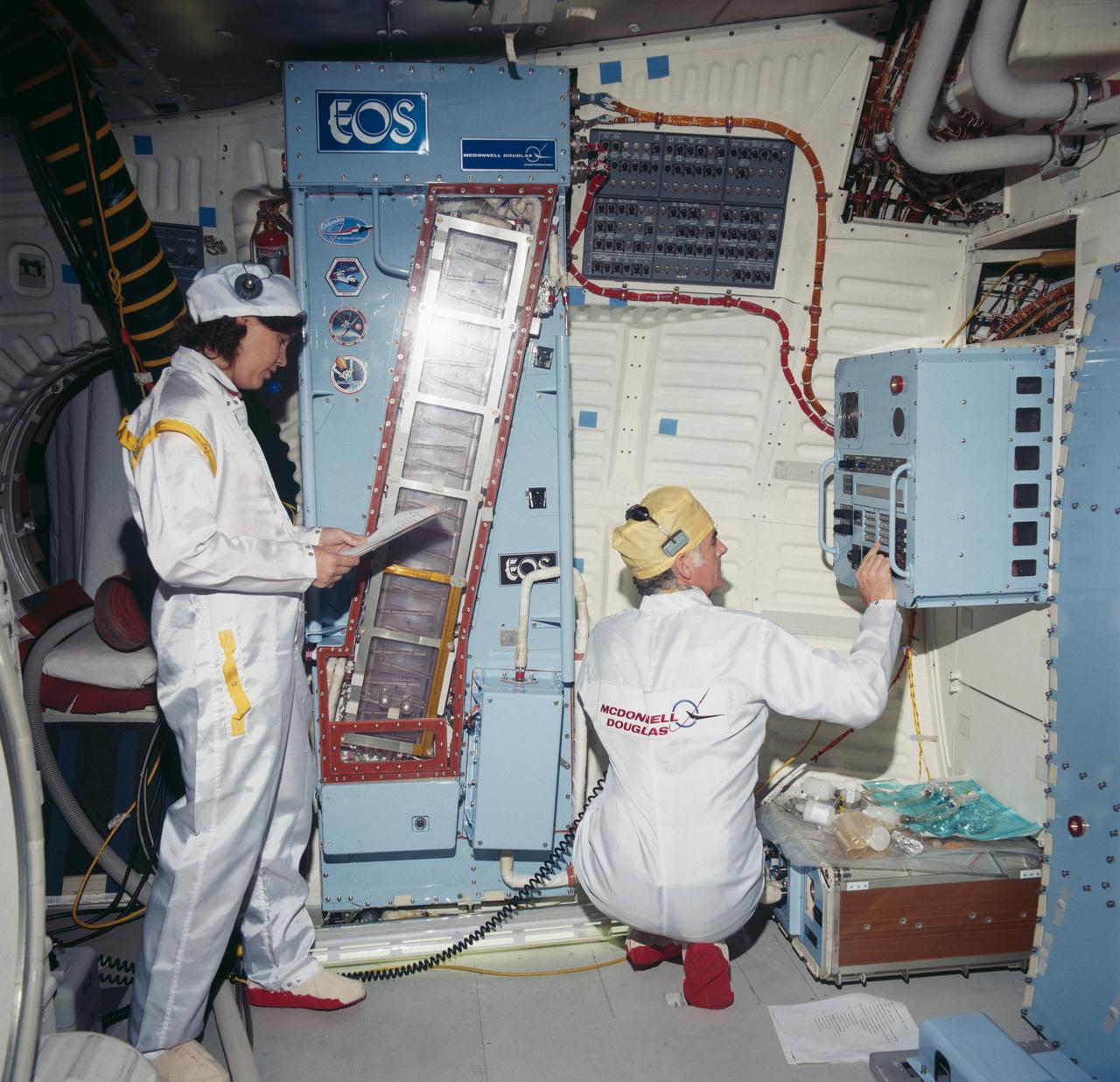
KSC-84PC-248 (For release Aug. 27, 1984) --- The Continuous Flow Electrophoresis System (CFES) is being installed in the middeck of the Orbiter Discovery in preparation for the flight of mission STS-41D in June. The CFES, originating from the McDonnell Douglas Astronautics Co. includes a fluid systems module, and experiment control and monitoring module, a sample storage module and a pump/accumulator package along with miscellaneous equipment stored in a middeck locker. Photo credit: NASA
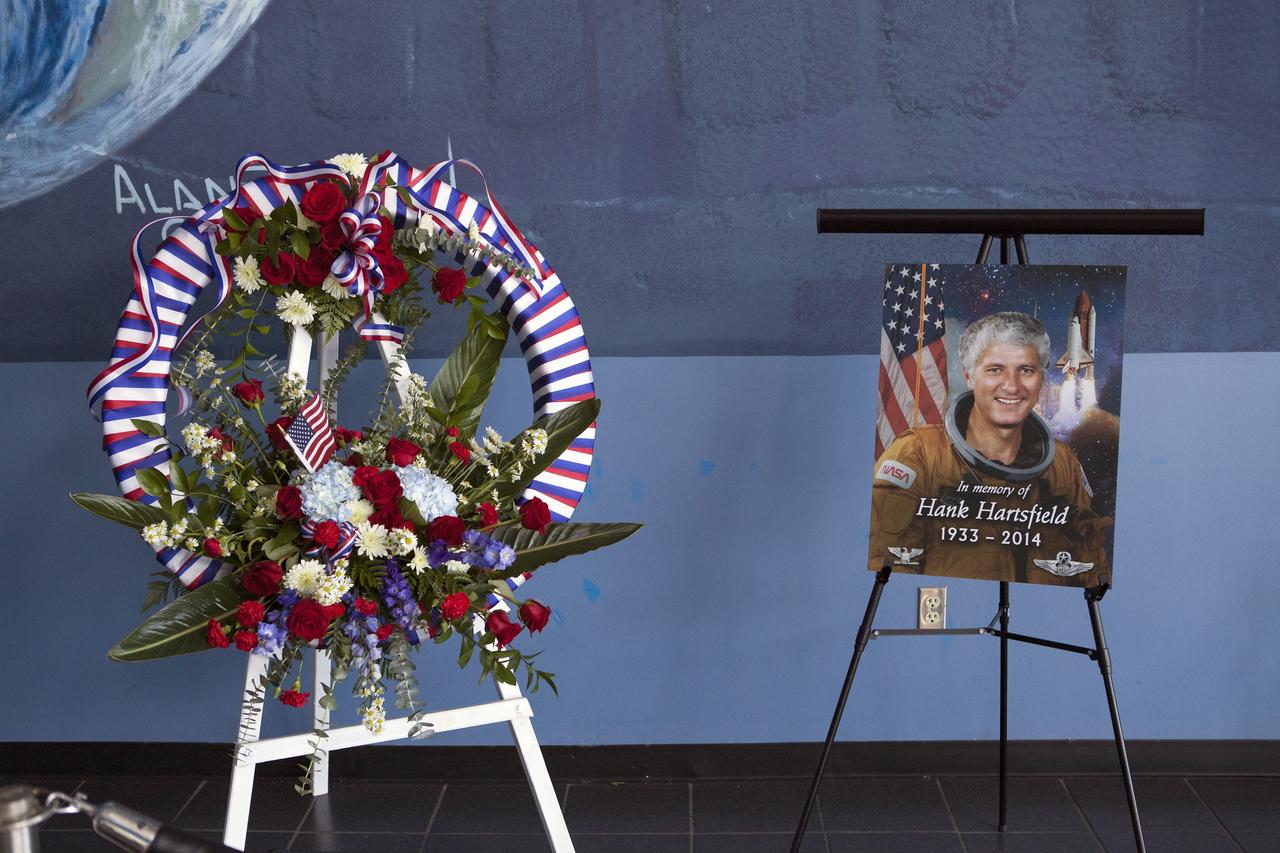
CAPE CANAVERAL, Fla. -- A wreath honoring Henry W. "Hank" Hartsfield is displayed beside his photo at the U.S. Astronaut Hall of Fame. Hartsfield commanded space shuttle Discovery's maiden mission and was a veteran of three shuttle flights. He died July 17 after an illness. He was 80 years old. Hartsfield joined NASA in 1969 and was part of the astronaut support crew for Apollo 16 and the Skylab 2, 3 and 4 missions. He logged 483 hours in space during missions STS-4, on which he served as pilot, as well as STS-41D and STS-61A, both of which he commanded. Photo credit: NASA/Dimitri Gerondidakis
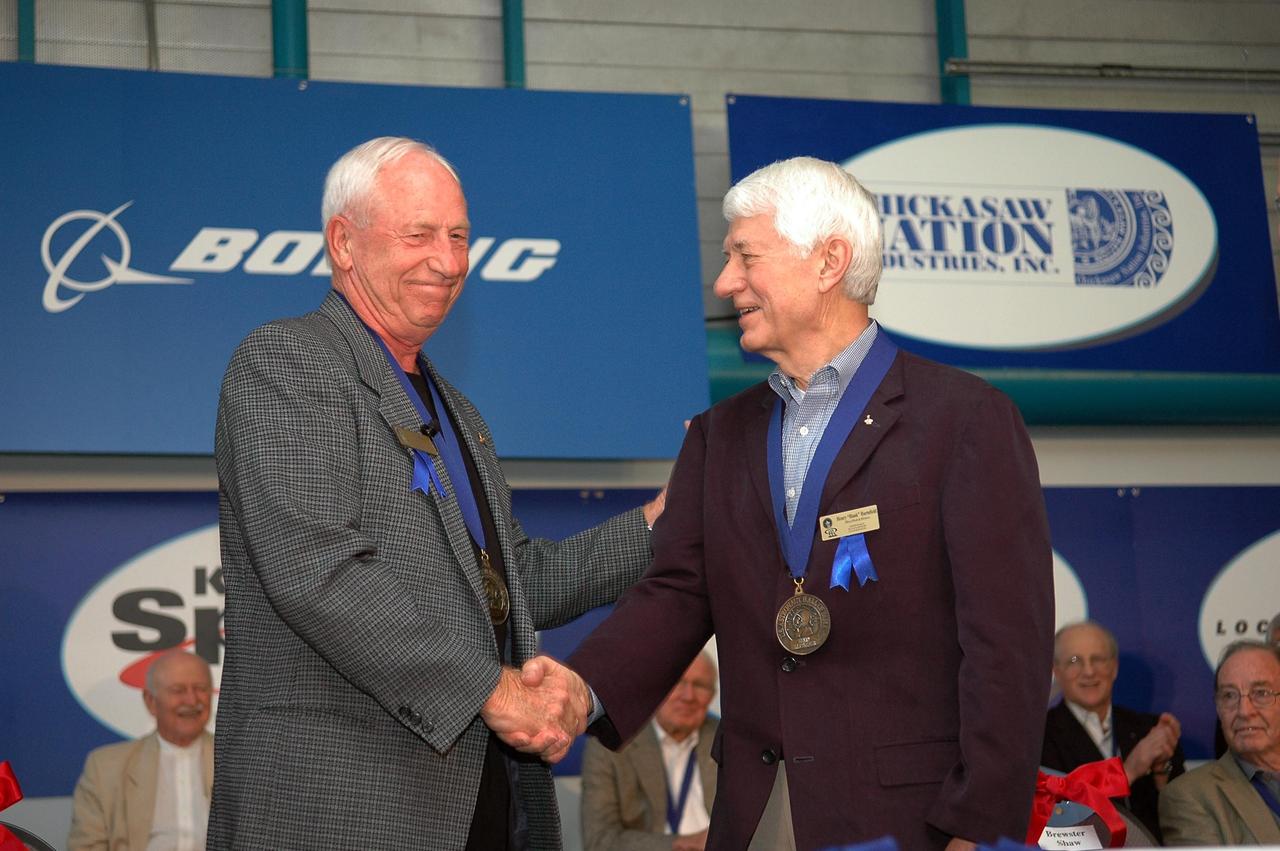
KENNEDY SPACE CENTER, FLA. - Henry "Hank" Hartsfield Jr. (right) accepts congratulations from Al Worden, U.S. Astronaut Hall of Fame member and chairman of the Astronaut Scholarship Foundation. The occasion is the 2006 induction ceremony for the U.S. Astronaut Hall of Fame, held in the Apollo/Saturn V Center. The inductees for 2006 are former NASA astronauts Hartsfield, Brewster H. Shaw Jr. and Charles F. Bolden Jr. Hartsfield flew on three space shuttle missions including STS-4, STS-41D and STS-61A, logging 482 hours in space. The U.S. Astronaut Hall of Fame now includes 63 space explorers. Photo credit: NASA/Kim Shiflett
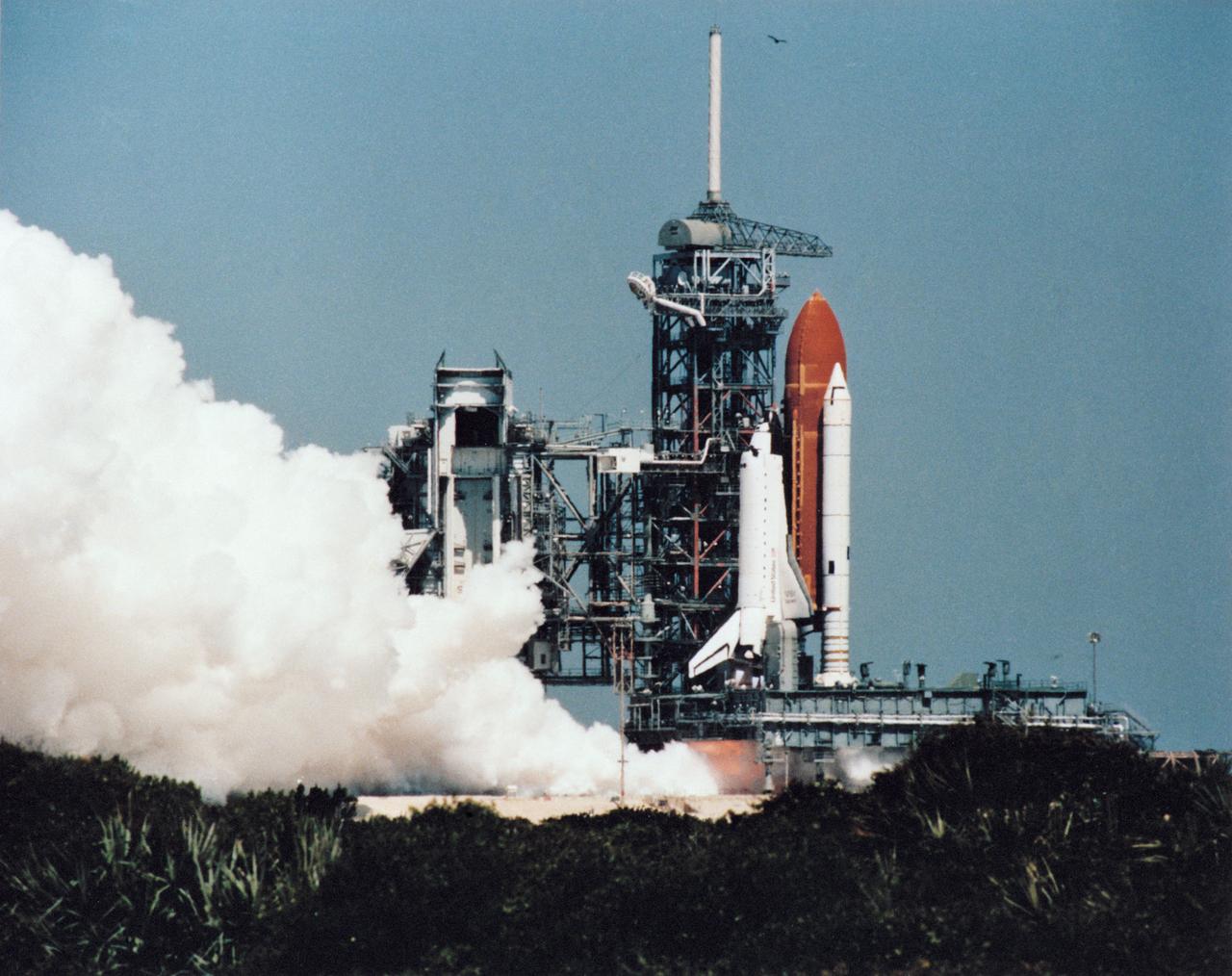
S84-35325 (2 June 1984) --- The Flight Readiness Firing (FRF) for NASA's 41-D spaceflight was completed on June 2, 1984 to pave the way for launch of the Discovery's seven-day mission later this month. Making its first flight, the orbiter will be mated to the same two solid rocket boosters (SRB) and external tank (ET) seen here.
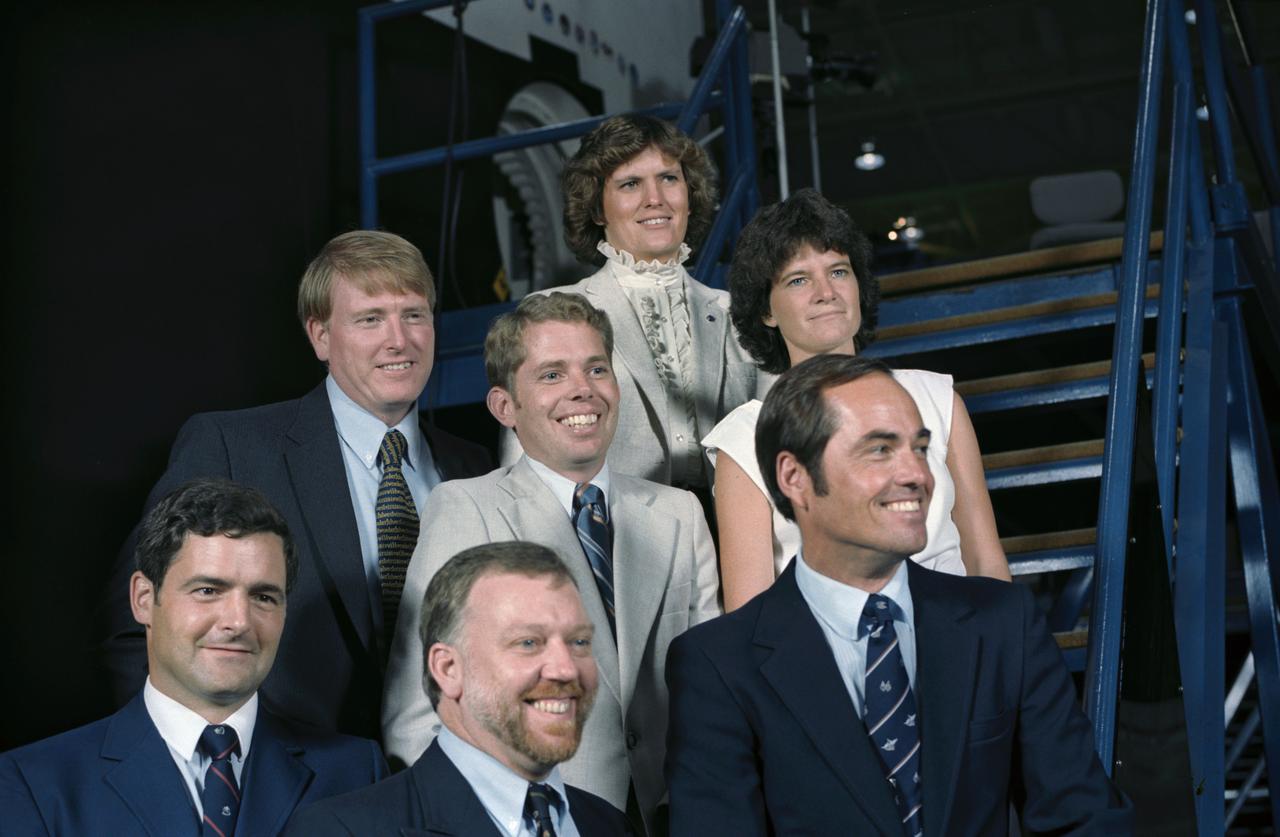
41D-3277 (S14-3277) (4 Sept 1984) --- Having met the press for the first time as a group, members of the STS 41-G crew pose for photographs in the Shuttle mockup and integration laboratory at the Johnson Space Center. They are (bottom row, left, to right) Marc Garneau and Paul D. Scully-Power, both payload specialists; and Robert L. Crippen, crew commander; (second row, l.-r.) Astronauts Jon A. McBride, pilot; David C. Leestma and Sally K. Ride, both mission specialists; and Kathryn D. Sullivan, mission specialist. They are scheduled for an October 5, 1984 launch aboard the Space Shuttle Challenger.
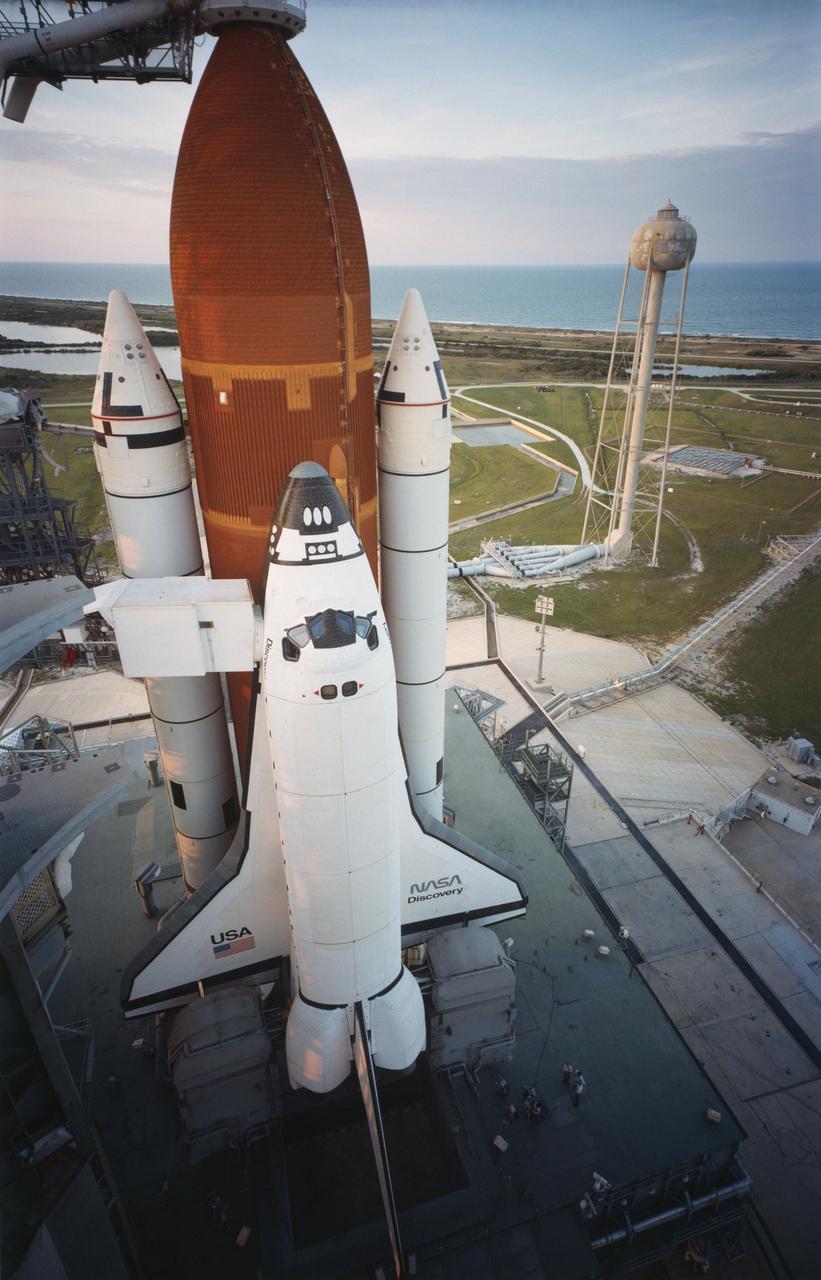
KSC-84PC-476 (For release Aug. 29, 1984) --- Orbiter Discovery is poised on Launch Pad 39A as the sun sets the evening prior to its maiden launch. Space shuttle Discovery (STS-41D) was successfully launched at 8:41 a.m. Aug. 30, 1984, after two failed attempts in June. Carrying a crew of six astronauts and three satellites, Discovery is the third in NASA?s stable of four Space Transportation System orbiters. The six-person crew includes Commander Henry Hartsfield, Pilot Michael Coats, Mission Specialists Judith Resnik, Mike Mullane and Steve Hawley and the first commercial payload specialist, Charles Walker of McDonnell Douglas. Photo credit: NASA
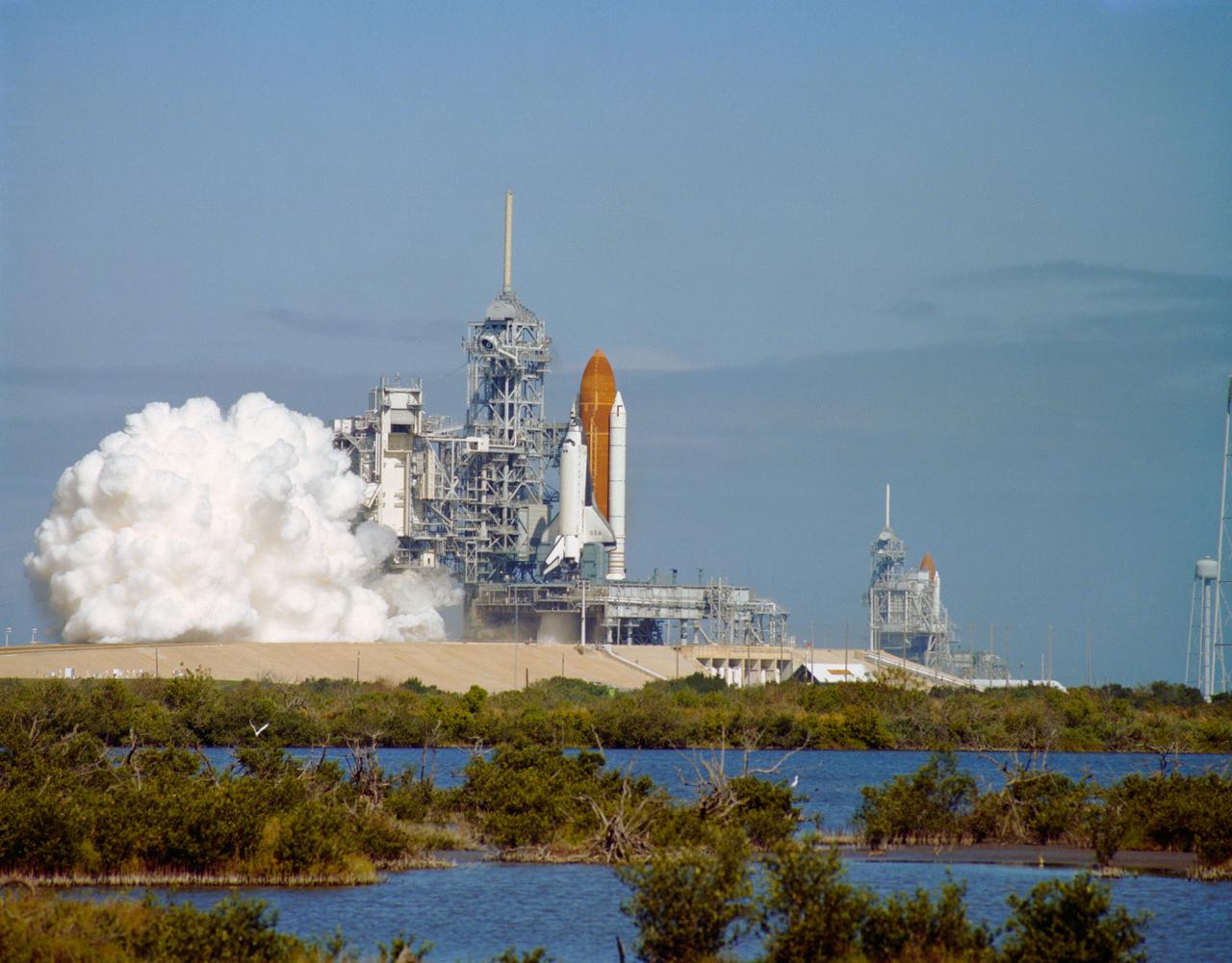
S93-31601 (March 1993) --- The second Space Shuttle launch attempt of 1993 comes to an abrupt halt when one of the three main engines on the orbiter Columbia shuts down at T -3 seconds, resulting in an on-the-pad abort of Mission STS-55. This was the first time in the post-Challenger era that a main engine shutdown has halted a Shuttle launch countdown, and only the third time in the history of the program. In 1984, STS-41D was scrubbed at T -4 seconds when the orbiter General Purpose Computer detected an anomaly in a main engine, and in 1985, STS-51F was halted at T -3 seconds due to a main engine malfunction that caused shutdown of all three engines. Columbia had been scheduled to lift off from Launch Pad 39B is the Space Shuttle Discovery, undergoing preparations for lift off on Mission STS-56.
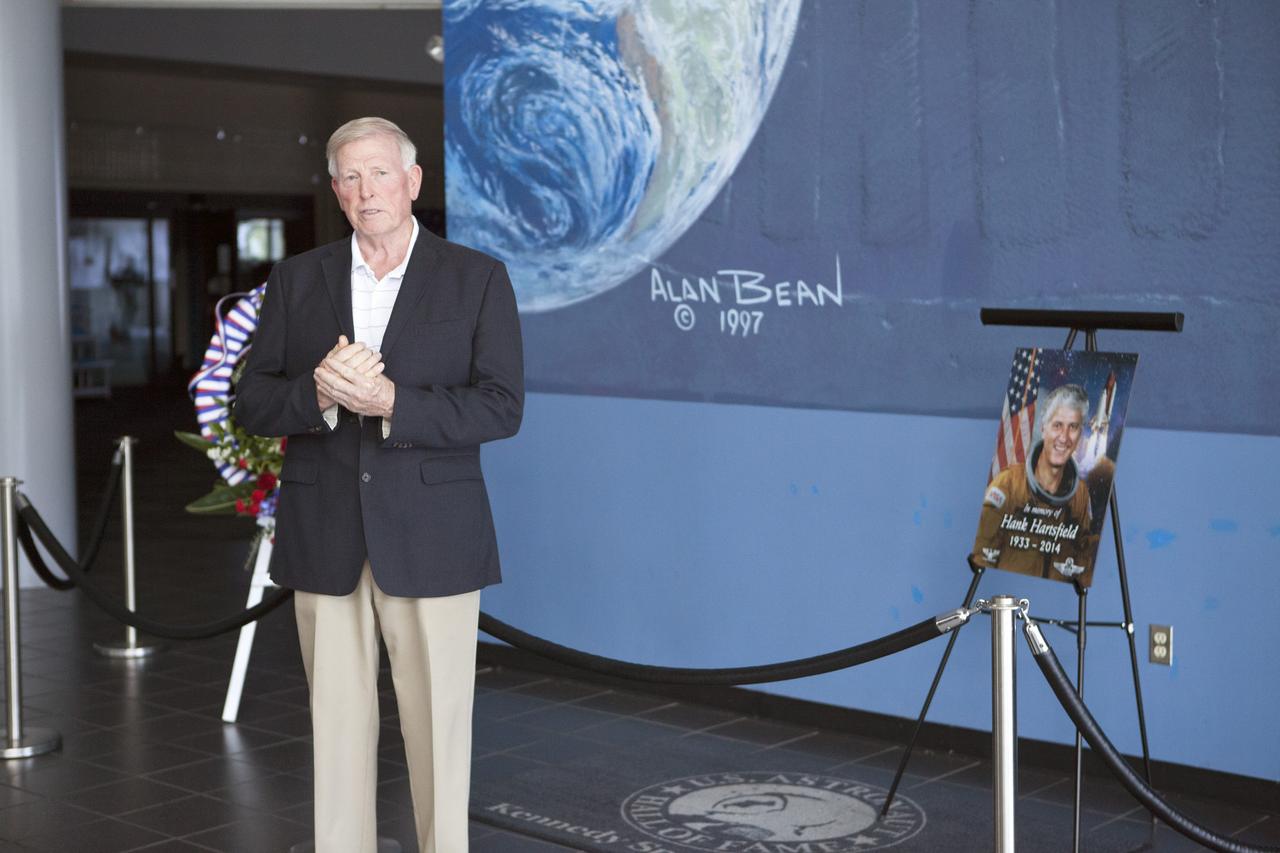
CAPE CANAVERAL, Fla. -- Former NASA astronaut Jon McBride shares his thoughts at a wreath-laying ceremony honoring Henry W. "Hank" Hartsfield at the U.S. Astronaut Hall of Fame. Hartsfield commanded space shuttle Discovery's maiden mission and was a veteran of three shuttle flights. He died July 17 after an illness. He was 80 years old. Hartsfield joined NASA in 1969 and was part of the astronaut support crew for Apollo 16 and the Skylab 2, 3 and 4 missions. He logged 483 hours in space during missions STS-4, on which he served as pilot, as well as STS-41D and STS-61A, both of which he commanded. Photo credit: NASA/Dimitri Gerondidakis
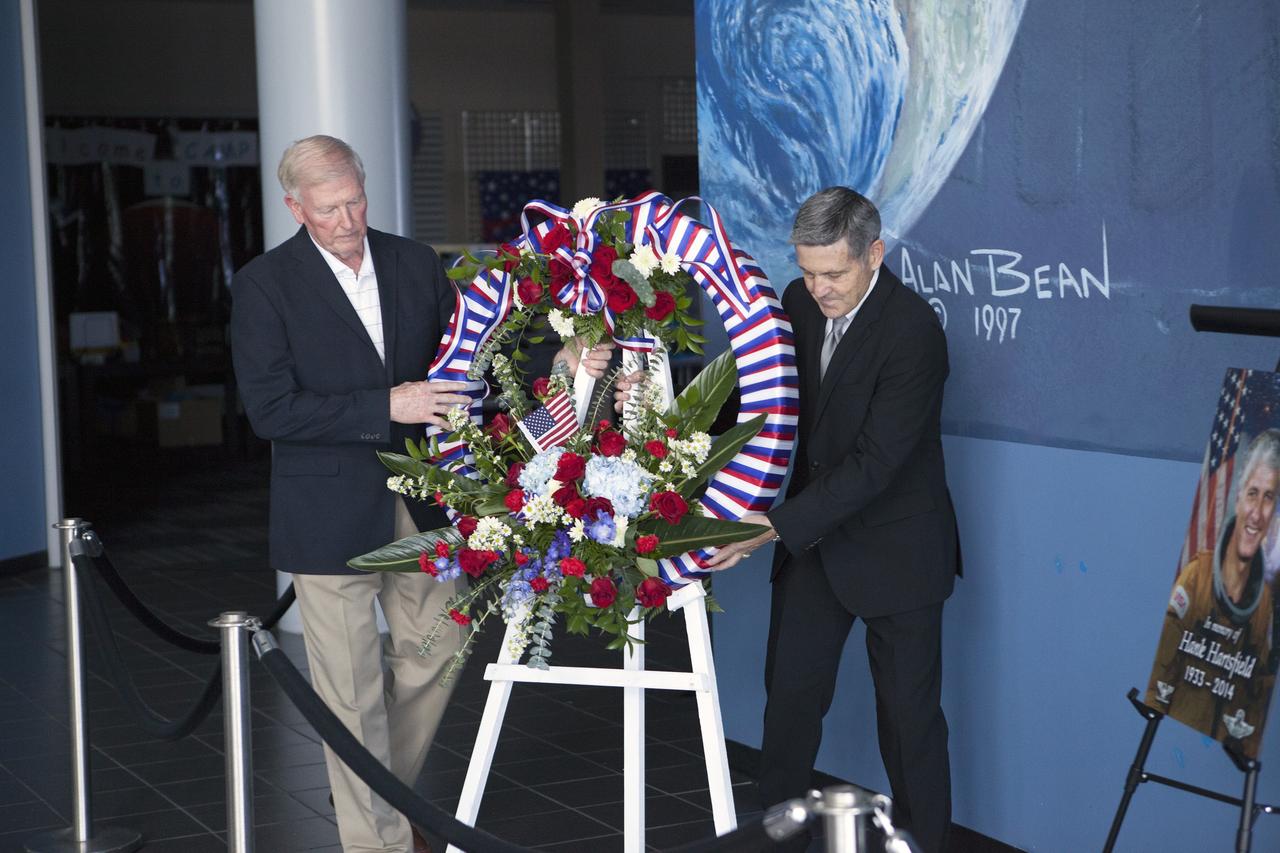
CAPE CANAVERAL, Fla. -- Former NASA astronaut Jon McBride, left, and Kennedy Space Center Director Bob Cabana place a wreath honoring Henry W. "Hank" Hartsfield at the U.S. Astronaut Hall of Fame. Hartsfield commanded space shuttle Discovery's maiden mission and was a veteran of three shuttle flights. He died July 17 after an illness. He was 80 years old. Hartsfield joined NASA in 1969 and was part of the astronaut support crew for Apollo 16 and the Skylab 2, 3 and 4 missions. He logged 483 hours in space during missions STS-4, on which he served as pilot, as well as STS-41D and STS-61A, both of which he commanded. Photo credit: NASA/Dimitri Gerondidakis
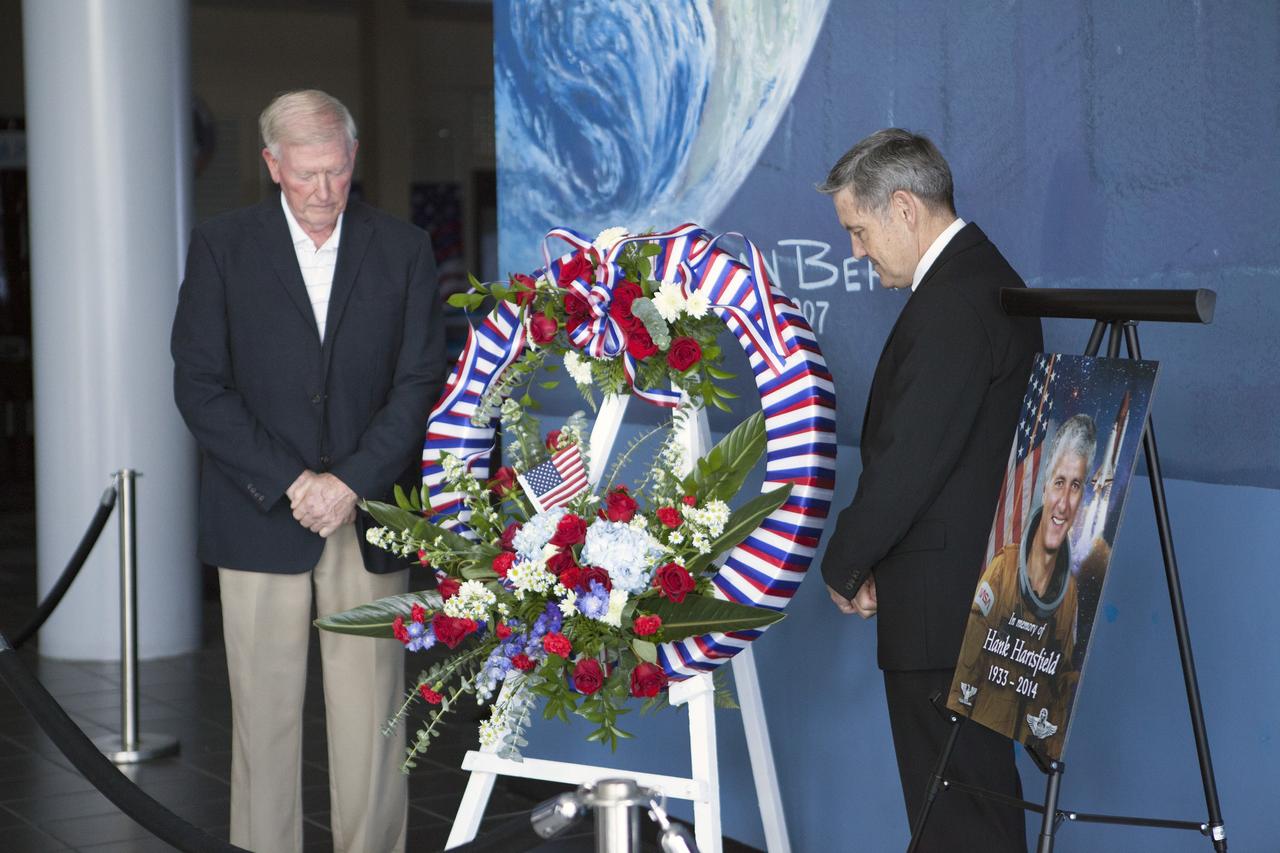
CAPE CANAVERAL, Fla. -- Former NASA astronaut Jon McBride, left, and Kennedy Space Center Director Bob Cabana pause for reflection after placing a wreath honoring Henry W. "Hank" Hartsfield at the U.S. Astronaut Hall of Fame. Hartsfield commanded space shuttle Discovery's maiden mission and was a veteran of three shuttle flights. He died July 17 after an illness. He was 80 years old. Hartsfield joined NASA in 1969 and was part of the astronaut support crew for Apollo 16 and the Skylab 2, 3 and 4 missions. He logged 483 hours in space during missions STS-4, on which he served as pilot, as well as STS-41D and STS-61A, both of which he commanded. Photo credit: NASA/Dimitri Gerondidakis
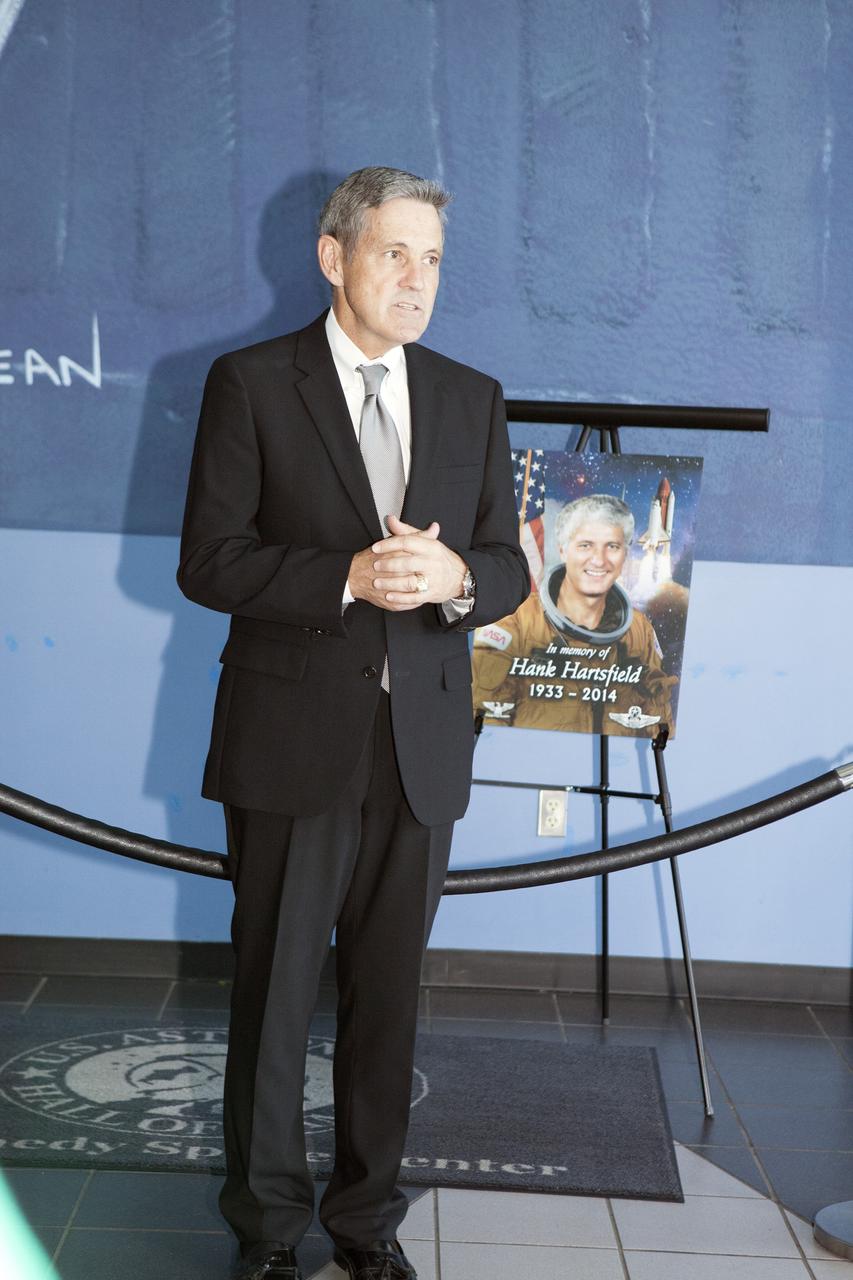
CAPE CANAVERAL, Fla. -- Kennedy Space Center Director Bob Cabana speaks at a wreath-laying ceremony honoring Henry W. "Hank" Hartsfield at the U.S. Astronaut Hall of Fame. Hartsfield commanded space shuttle Discovery's maiden mission and was a veteran of three shuttle flights. He died July 17 after an illness. He was 80 years old. Hartsfield joined NASA in 1969 and was part of the astronaut support crew for Apollo 16 and the Skylab 2, 3 and 4 missions. He logged 483 hours in space during missions STS-4, on which he served as pilot, as well as STS-41D and STS-61A, both of which he commanded. Photo credit: NASA/Dimitri Gerondidakis
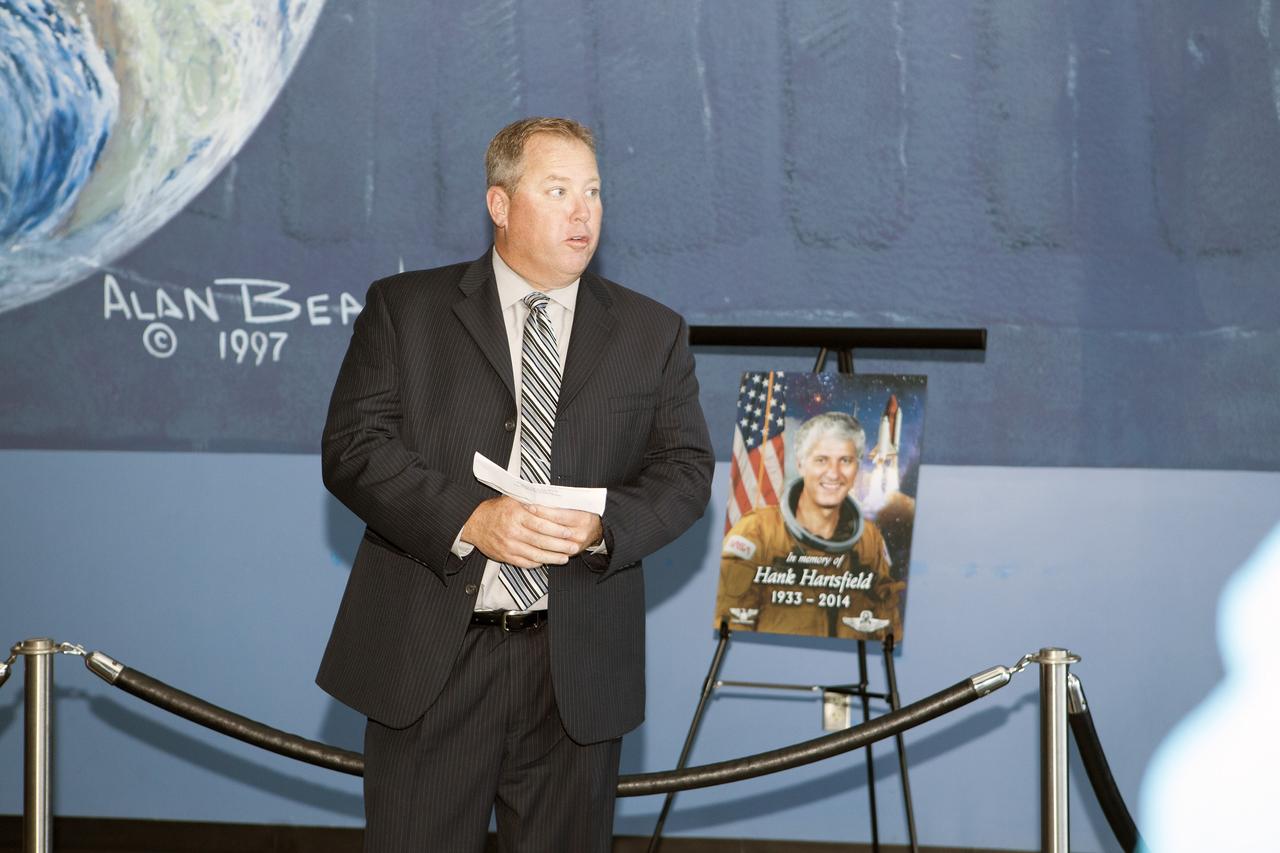
CAPE CANAVERAL, Fla. -- Therrin Protze, chief operating officer for Delaware North Parks Services at Kennedy Space Center Visitor Complex, speaks at a wreath-laying ceremony honoring Henry W. "Hank" Hartsfield at the U.S. Astronaut Hall of Fame. Hartsfield commanded space shuttle Discovery's maiden mission and was a veteran of three shuttle flights. He died July 17 after an illness. He was 80 years old. Hartsfield joined NASA in 1969 and was part of the astronaut support crew for Apollo 16 and the Skylab 2, 3 and 4 missions. He logged 483 hours in space during missions STS-4, on which he served as pilot, as well as STS-41D and STS-61A, both of which he commanded. Photo credit: NASA/Dimitri Gerondidakis
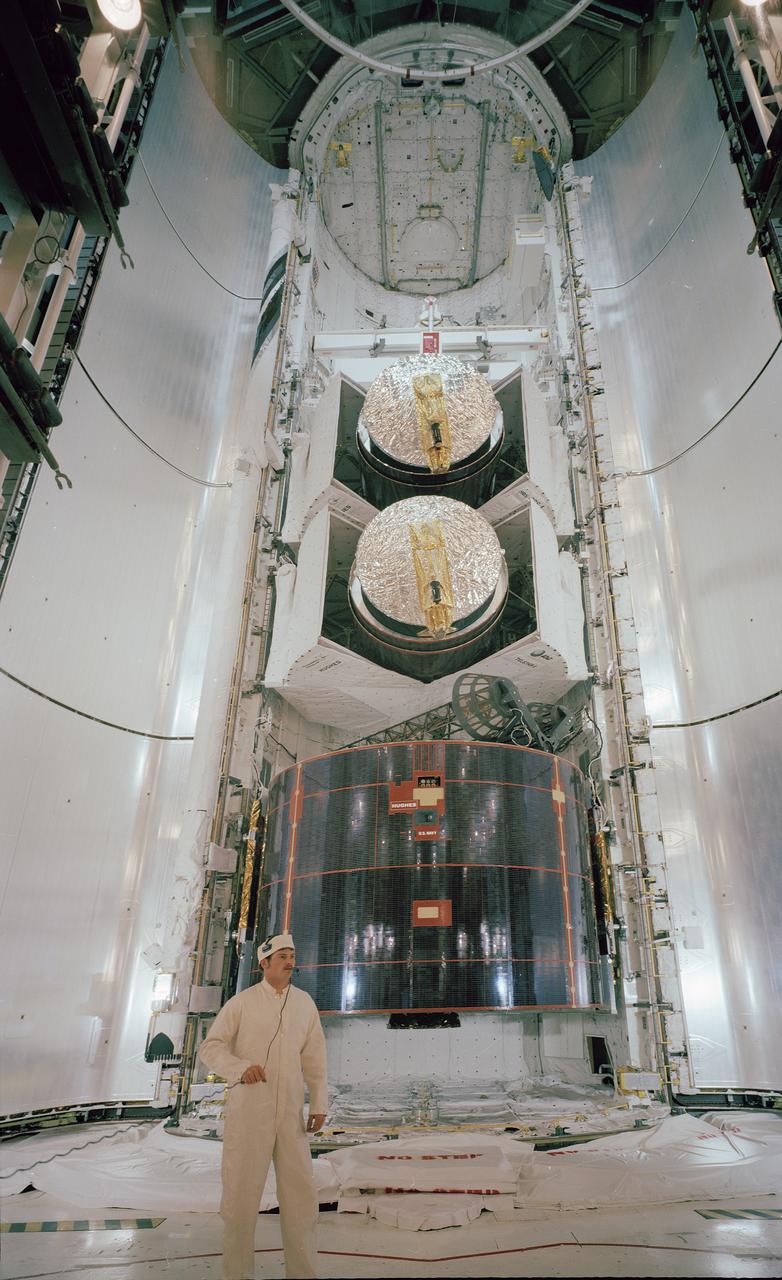
CAPE CANAVERAL, Fla. -- At the Kennedy Space Center in Florida, the payloads for the STS-41D space shuttle flight are shown loaded in Discovery’s cargo bay. With the orbiter in the vertical position at Launch Pad 39A, the payloads are, from top to bottom, OAST-1 a 102-foot-tall, 13-foot-wide Office of Application and Space Technology solar panel), the Satellite Business System SBS-D , Telstar 3-C, and Syncom IV-2. The six day mission is scheduled for launch on Aug. 29, 1984. The six crew members are Commander Henry W. Hartsfield Jr., Pilot Michael L. Coats, Mission Specialists Judith A. Resnik, Steven A. Hawley, Richard M. Mullane, and Payload Specialist Charles D. Walker. Photo Credit: NASA
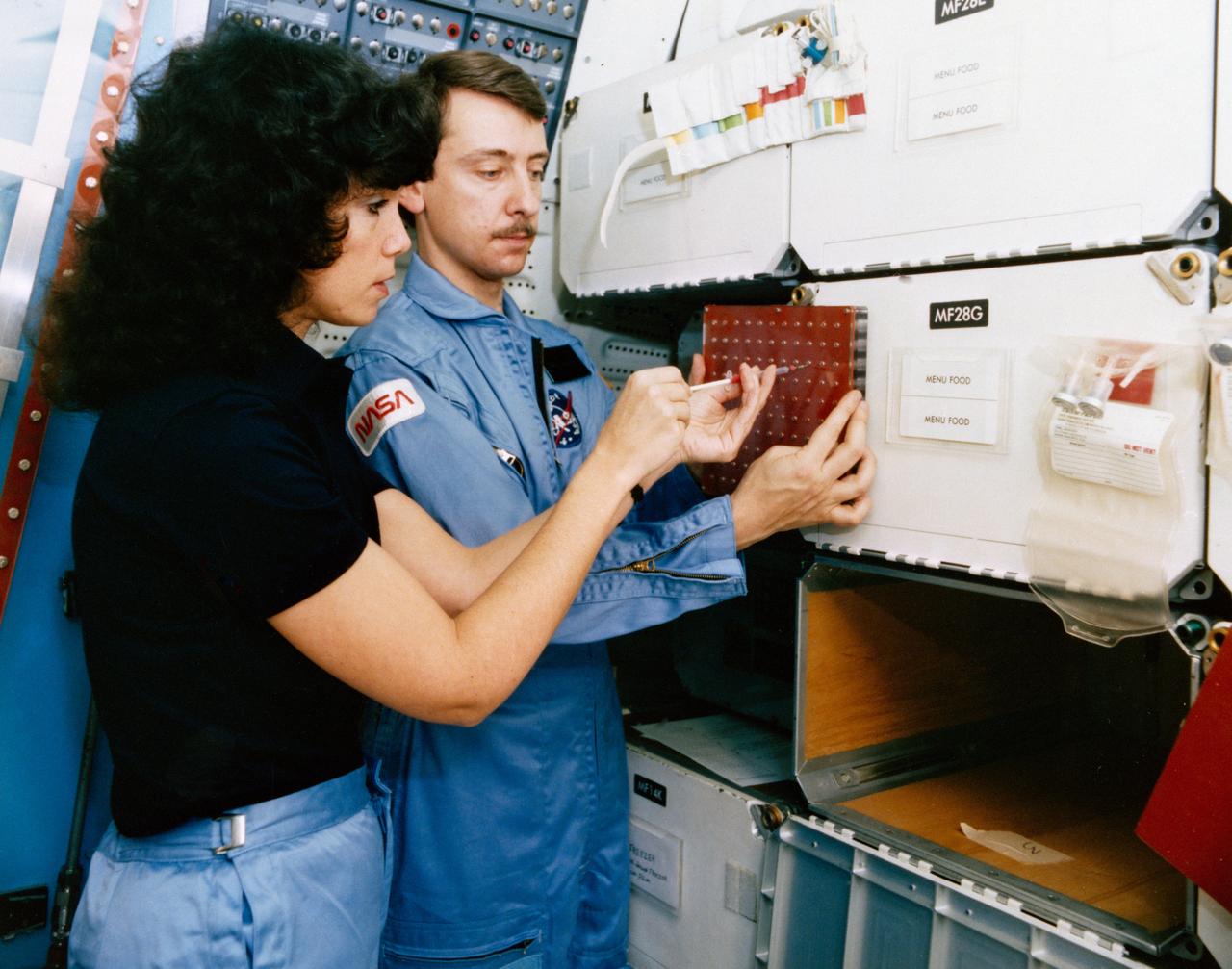
S84-35757 (May 1984) --- Astronaut Judith A. Resnik, 41-D mission specialist, and Charles Walker, payload specialist for that June 1984 flight, prepare for some scheduled intravehicular activity involving the continuous flow electrophoresis systems (CFES) experiment. CFES will join the six-member crew aboard the Earth-orbiting Discovery for a seven day mission. The two share in preparing a sample to be processed by the CFES. In the background are stowage lockers and a CFES trainer-- part of the Shuttle one-g trainer at NASA's Johnson Space Center (JSC). Walker, an engineer at McDonnell Douglas Astronautics Co. in St. Louis, Missouri, will be the first Shuttle payload specialist to represent a project designed for commercial purposes. As payload specialist, his job will be to run the materials electrophoresis-operations-in-space project. The project is aimed at separating large quantities of biological materials in space for ultimate use in new pharmaceuticals. The photo was taken by a McDonnell Douglas photographer.
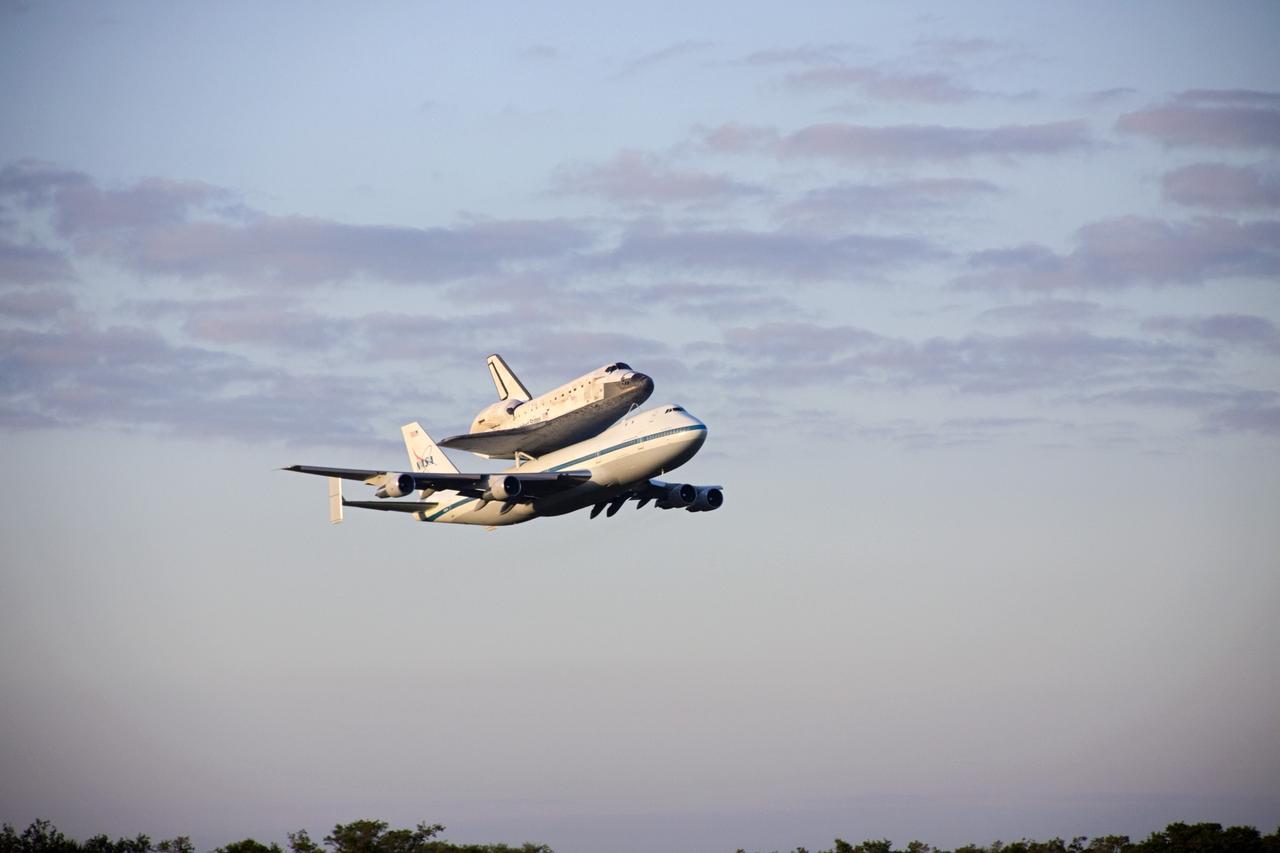
CAPE CANAVERAL, Fla. – Space shuttle Discovery, mounted to a Shuttle Carrier Aircraft, takes off from the Shuttle Landing Facility at NASA's Kennedy Space Center in Florida. The duo is beginning their 3 1/2 hour ferry flight to the Washington Dulles International Airport in Virginia. Discovery is leaving Kennedy after more than 28 years of service beginning with its arrival on the space coast Nov. 9, 1983. Discovery first launched to space Aug. 30, 1984, on the STS-41D mission. Discovery is the agency's most-flown shuttle with 39 missions, more than 148 million miles and a total of one year in space. Discovery is set to move to the Smithsonian's National Air and Space Museum Steven F. Udvar-Hazy Center on April 19 where it will be placed on public display. For more information on the SCA, visit http://www.nasa.gov/centers/dryden/news/FactSheets/FS-013-DFRC.html. For more information on shuttle transition and retirement activities, visit http://www.nasa.gov/transition. Photo credit: NASA/Jim Grossmann
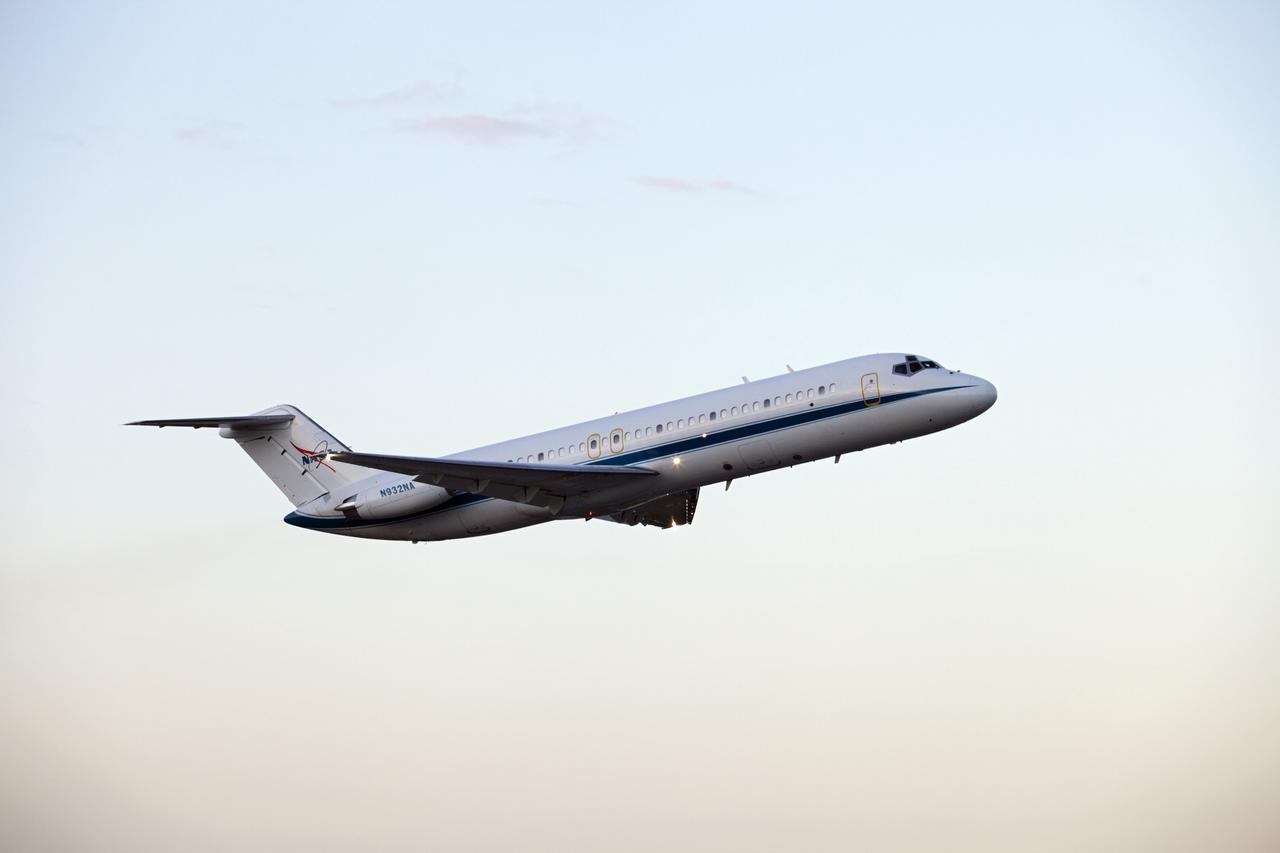
CAPE CANAVERAL, Fla. – A NASA C-9 “Pathfinder” DC-9 takes off from the Shuttle Landing Facility at NASA's Kennedy Space Center in Florida ahead of space shuttle Discovery, which is bolted to the top of a Shuttle Carrier Aircraft. The craft are set to begin their 3 1/2 hour ferry flight to the Washington Dulles International Airport in Virginia at about 7 a.m. EDT. The Pathfinder will fly about 100 miles ahead of the attached pair, making sure the flight path is free of harmful weather or hazardous conditions. Discovery is leaving Kennedy after more than 28 years of service beginning with its arrival on the space coast Nov. 9, 1983. Discovery first launched to space Aug. 30, 1984, on the STS-41D mission. Discovery is the agency's most-flown shuttle with 39 missions, more than 148 million miles and a total of one year in space. Discovery is set to move to the Smithsonian's National Air and Space Museum Steven F. Udvar-Hazy Center on April 19 where it will be placed on public display. For more information on the SCA, visit http://www.nasa.gov/centers/dryden/news/FactSheets/FS-013-DFRC.html. For more information on shuttle transition and retirement activities, visit http://www.nasa.gov/transition. Photo credit: NASA/Frankie Martin
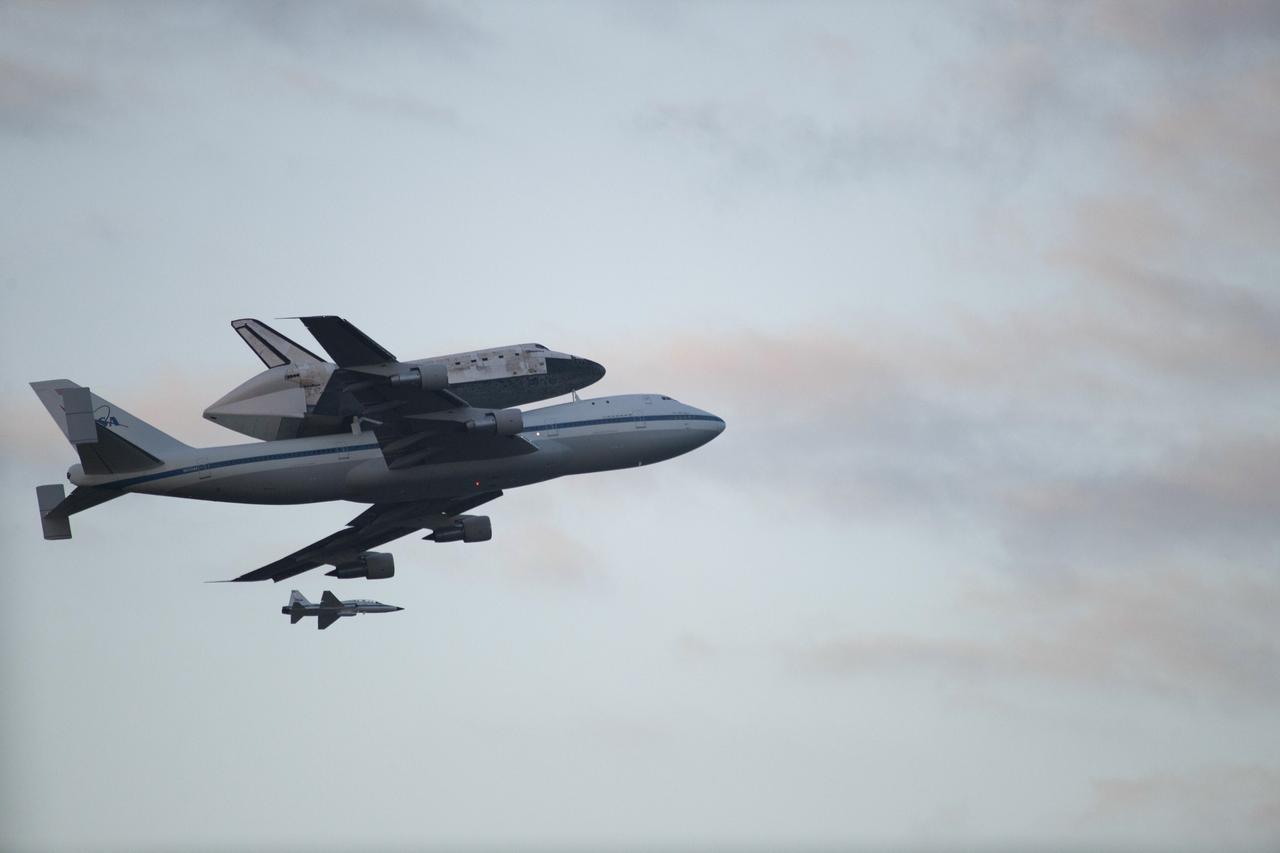
CAPE CANAVERAL, Fla. – Space shuttle Discovery, mounted to a Shuttle Carrier Aircraft, flies over the Shuttle Landing Facility at NASA's Kennedy Space Center in Florida after making a flyby of Cocoa Beach and Patrick Air Force Base. The duo is beginning its ferry flight to the Washington Dulles International Airport in Virginia that also includes a flyby of the Space Coast and Washington, D.C. Also flying along with the pair is a T-38 training jet. Discovery is leaving Kennedy after more than 28 years of service beginning with its arrival on the space coast Nov. 9, 1983. Discovery first launched to space Aug. 30, 1984, on the STS-41D mission. Discovery is the agency's most-flown shuttle with 39 missions, more than 148 million miles and a total of one year in space. Discovery is set to move to the Smithsonian's National Air and Space Museum Steven F. Udvar-Hazy Center on April 19 where it will be placed on public display. For more information on the SCA, visit http://www.nasa.gov/centers/dryden/news/FactSheets/FS-013-DFRC.html. For more information on shuttle transition and retirement activities, visit http://www.nasa.gov/transition. Photo credit: NASA/Kenny Allen
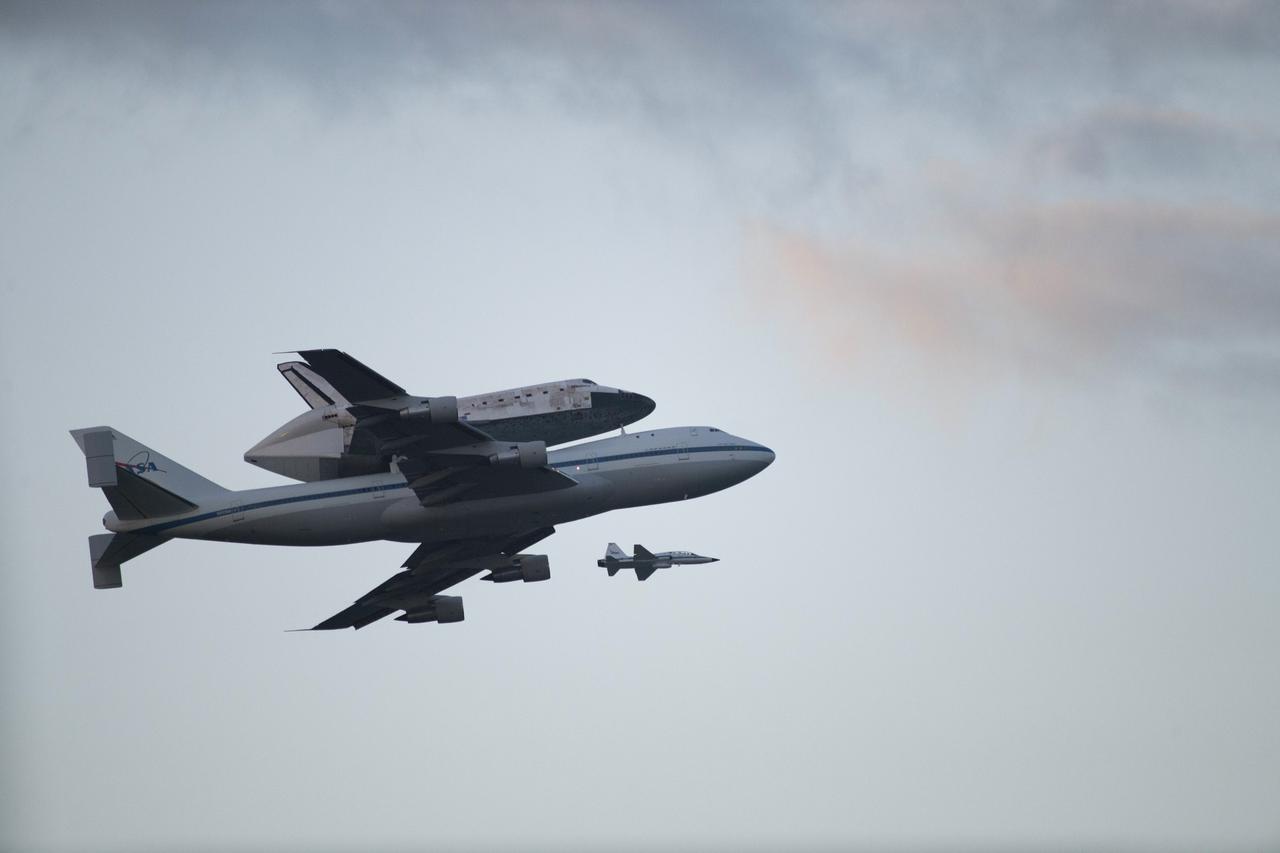
CAPE CANAVERAL, Fla. – Space shuttle Discovery, mounted to a Shuttle Carrier Aircraft, flies over the Shuttle Landing Facility at NASA's Kennedy Space Center in Florida after making a flyby of Cocoa Beach and Patrick Air Force Base. The duo is beginning its ferry flight to the Washington Dulles International Airport in Virginia that also includes a flyby of the Space Coast and Washington, D.C. Also flying along with the pair is a T-38 training jet. Discovery is leaving Kennedy after more than 28 years of service beginning with its arrival on the space coast Nov. 9, 1983. Discovery first launched to space Aug. 30, 1984, on the STS-41D mission. Discovery is the agency's most-flown shuttle with 39 missions, more than 148 million miles and a total of one year in space. Discovery is set to move to the Smithsonian's National Air and Space Museum Steven F. Udvar-Hazy Center on April 19 where it will be placed on public display. For more information on the SCA, visit http://www.nasa.gov/centers/dryden/news/FactSheets/FS-013-DFRC.html. For more information on shuttle transition and retirement activities, visit http://www.nasa.gov/transition. Photo credit: NASA/Kenny Allen
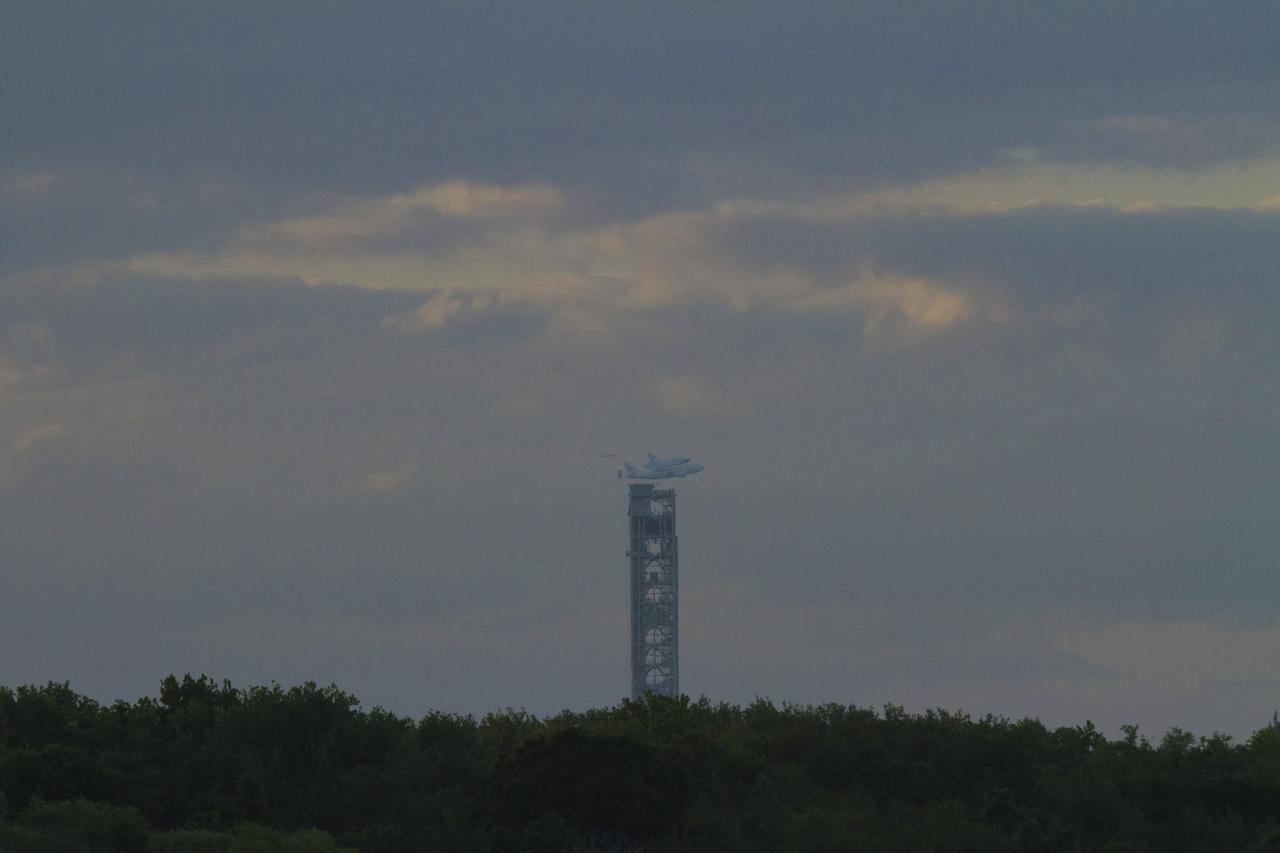
CAPE CANAVERAL, Fla. – Space shuttle Discovery, mounted to a Shuttle Carrier Aircraft, or SCA, takes off from NASA Kennedy Space Center’s Shuttle Landing Facility runway 15 in Florida at 7 a.m. EDT. The duo is beginning its ferry flight to the Washington Dulles International Airport in Virginia that also includes a flyby of the Space Coast and Washington, D.C. Also flying along with the pair is a T-38 training jet. Discovery is leaving Kennedy after more than 28 years of service beginning with its arrival on the space coast Nov. 9, 1983. Discovery first launched to space Aug. 30, 1984, on the STS-41D mission. Discovery is the agency’s most-flown shuttle with 39 missions, more than 148 million miles and a total of one year in space. Discovery is set to move to the Smithsonian’s National Air and Space Museum, Steven F. Udvar-Hazy Center in Chantilly, Va., on April 19 where it will be place on public display. For more information on the SCA, visit http://www.nasa.gov/centers/dryden/news/FactSheets/FS-013-DFRC.html. For more information on shuttle transition and retirement activities, visit http://www.nasa.gov/transition. Photo credit: NASA/Tim Powers and Rick Wetherington
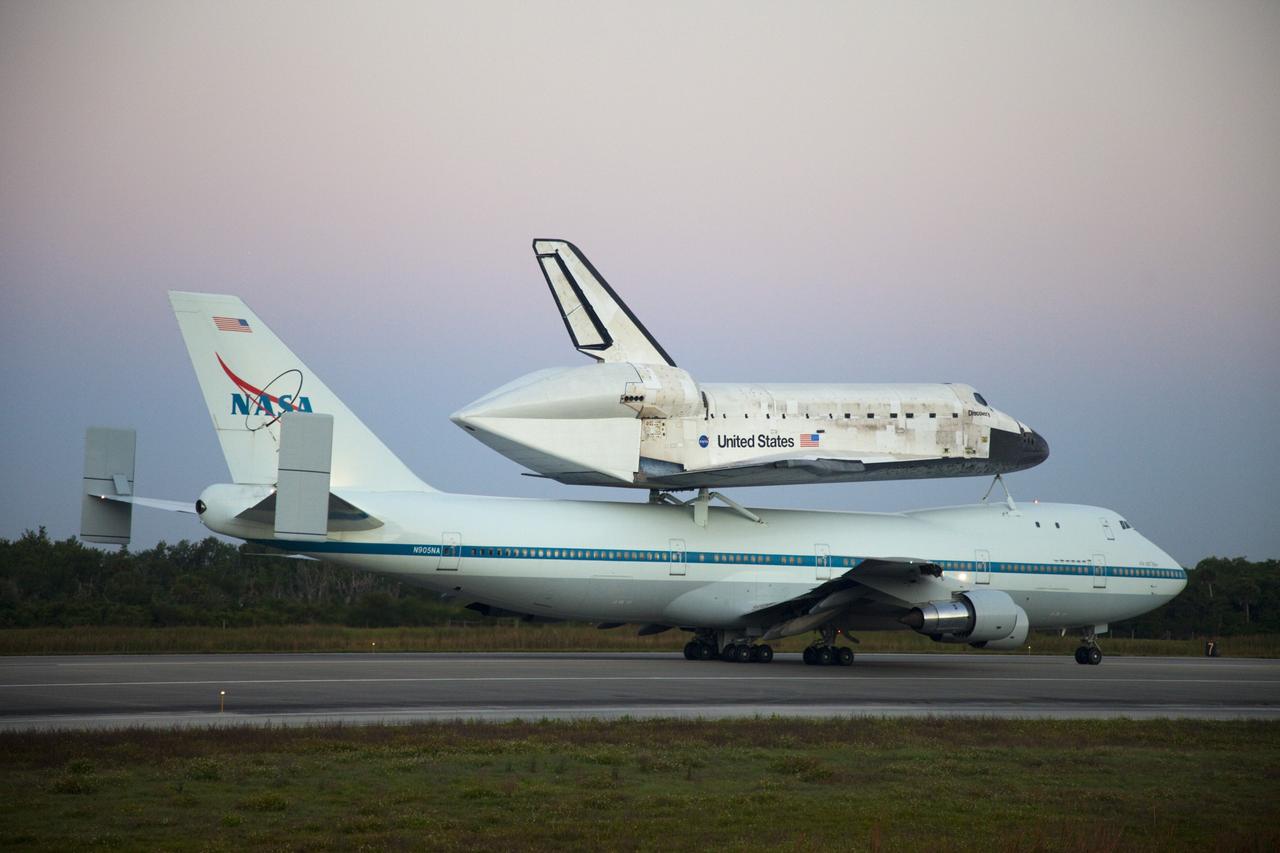
CAPE CANAVERAL, Fla. – Space shuttle Discovery, mounted to a Shuttle Carrier Aircraft, slowly rolls along the runway of the Shuttle Landing Facility at NASA's Kennedy Space Center in Florida. The duo is set to begin their 3 1/2 hour ferry flight to the Washington Dulles International Airport in Virginia at about 7 a.m. EDT. Above the two craft is a NASA helicopter covering the departure. Discovery is leaving Kennedy after more than 28 years of service beginning with its arrival on the space coast Nov. 9, 1983. Discovery first launched to space Aug. 30, 1984, on the STS-41D mission. Discovery is the agency's most-flown shuttle with 39 missions, more than 148 million miles and a total of one year in space. Discovery is set to move to the Smithsonian's National Air and Space Museum Steven F. Udvar-Hazy Center on April 19 where it will be placed on public display. For more information on the SCA, visit http://www.nasa.gov/centers/dryden/news/FactSheets/FS-013-DFRC.html. For more information on shuttle transition and retirement activities, visit http://www.nasa.gov/transition. Photo credit: NASA/Frankie Martin
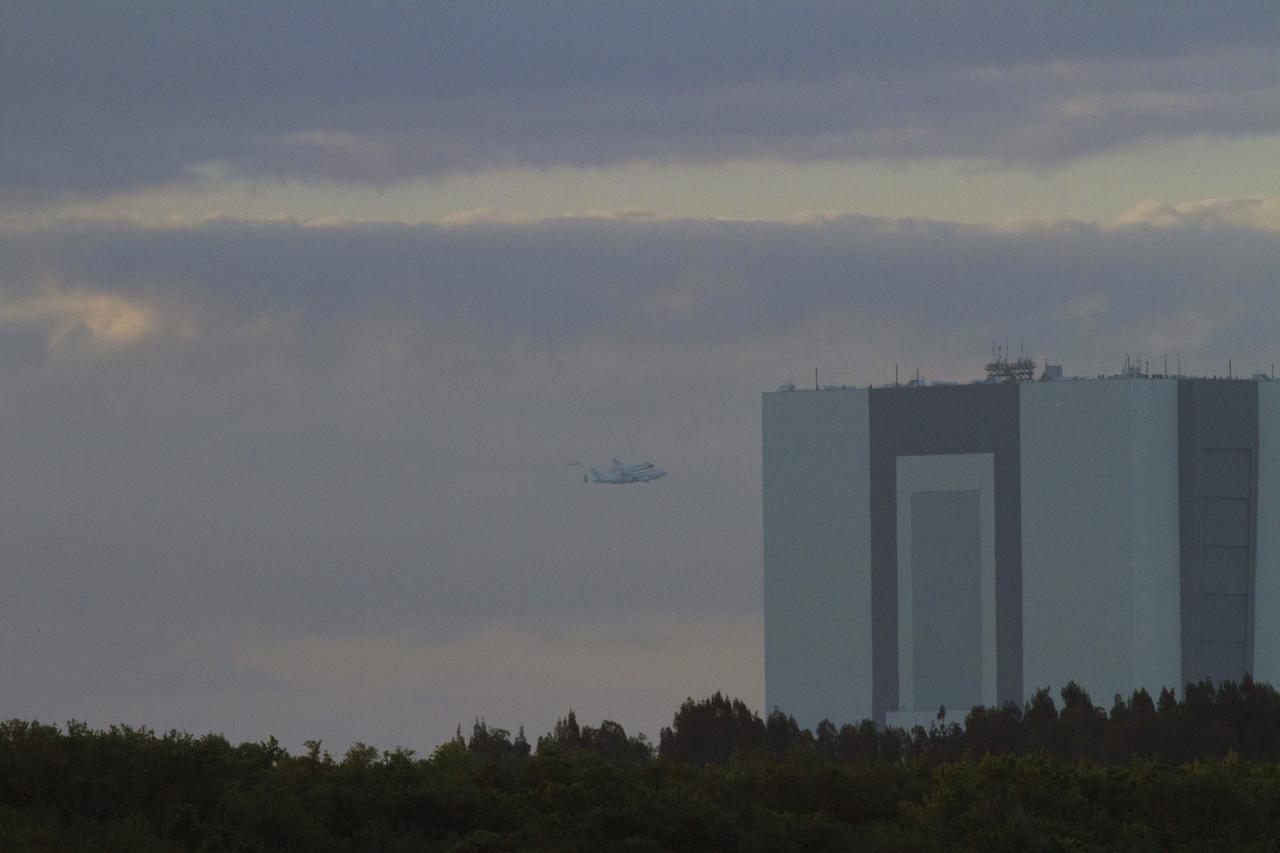
CAPE CANAVERAL, Fla. – Space shuttle Discovery, mounted to a Shuttle Carrier Aircraft, or SCA, takes off from NASA Kennedy Space Center’s Shuttle Landing Facility runway 15 in Florida at 7 a.m. EDT and makes a flyby near the 525-foot-tall Vehicle Assembly Building. The duo is beginning its ferry flight to the Washington Dulles International Airport in Virginia that also includes a flyby of the Space Coast and Washington, D.C. Also flying along with the pair is a T-38 training jet. Discovery is leaving Kennedy after more than 28 years of service beginning with its arrival on the space coast Nov. 9, 1983. Discovery first launched to space Aug. 30, 1984, on the STS-41D mission. Discovery is the agency’s most-flown shuttle with 39 missions, more than 148 million miles and a total of one year in space. Discovery is set to move to the Smithsonian’s National Air and Space Museum, Steven F. Udvar-Hazy Center in Chantilly, Va., on April 19 where it will be place on public display. For more information on the SCA, visit http://www.nasa.gov/centers/dryden/news/FactSheets/FS-013-DFRC.html. For more information on shuttle transition and retirement activities, visit http://www.nasa.gov/transition. Photo credit: NASA/Tim Powers and Rick Wetherington
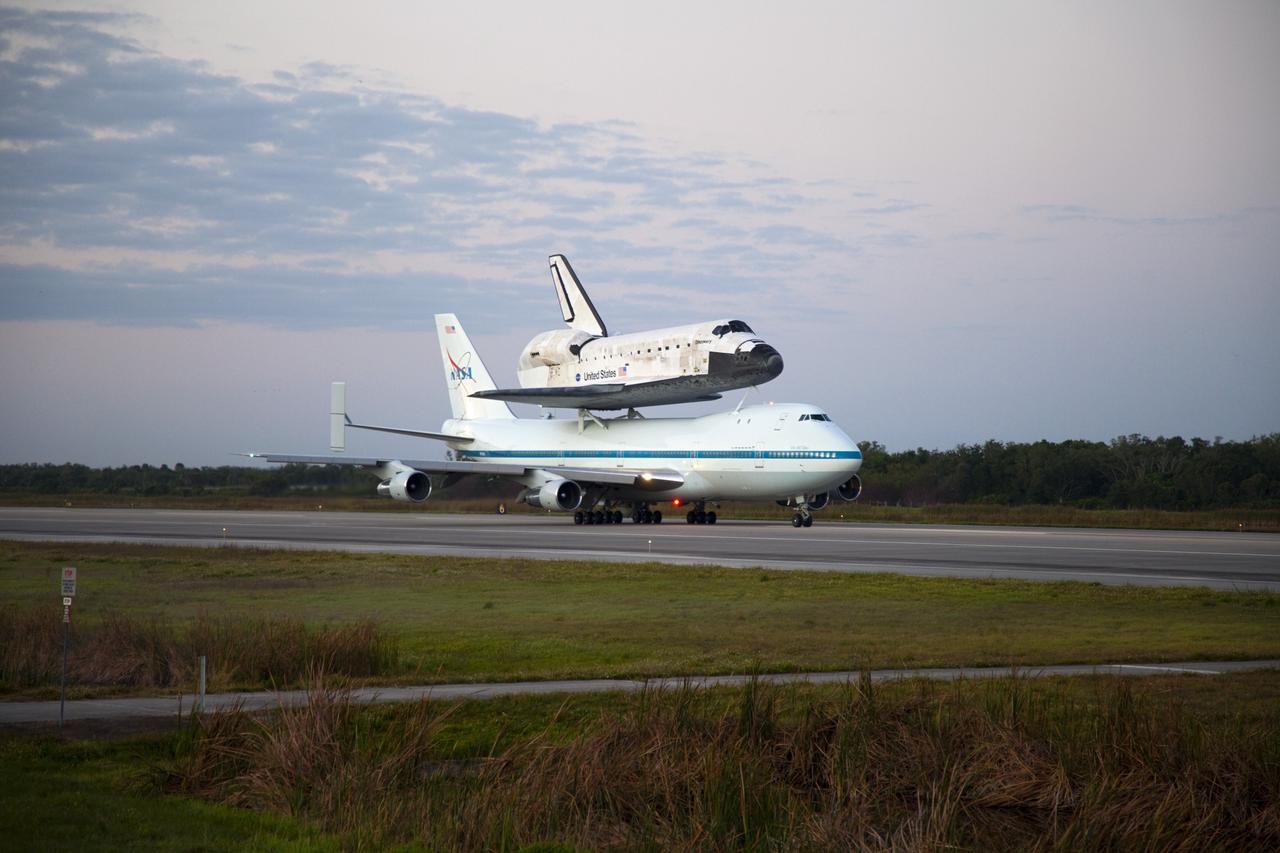
CAPE CANAVERAL, Fla. – Space shuttle Discovery, mounted to a Shuttle Carrier Aircraft, slowly rolls along the runway of the Shuttle Landing Facility at NASA's Kennedy Space Center in Florida. The duo is set to begin their 3 1/2 hour ferry flight to the Washington Dulles International Airport in Virginia at about 7 a.m. EDT. Above the two craft is a NASA helicopter covering the departure. Discovery is leaving Kennedy after more than 28 years of service beginning with its arrival on the space coast Nov. 9, 1983. Discovery first launched to space Aug. 30, 1984, on the STS-41D mission. Discovery is the agency's most-flown shuttle with 39 missions, more than 148 million miles and a total of one year in space. Discovery is set to move to the Smithsonian's National Air and Space Museum Steven F. Udvar-Hazy Center on April 19 where it will be placed on public display. For more information on the SCA, visit http://www.nasa.gov/centers/dryden/news/FactSheets/FS-013-DFRC.html. For more information on shuttle transition and retirement activities, visit http://www.nasa.gov/transition. Photo credit: NASA/Frankie Martin
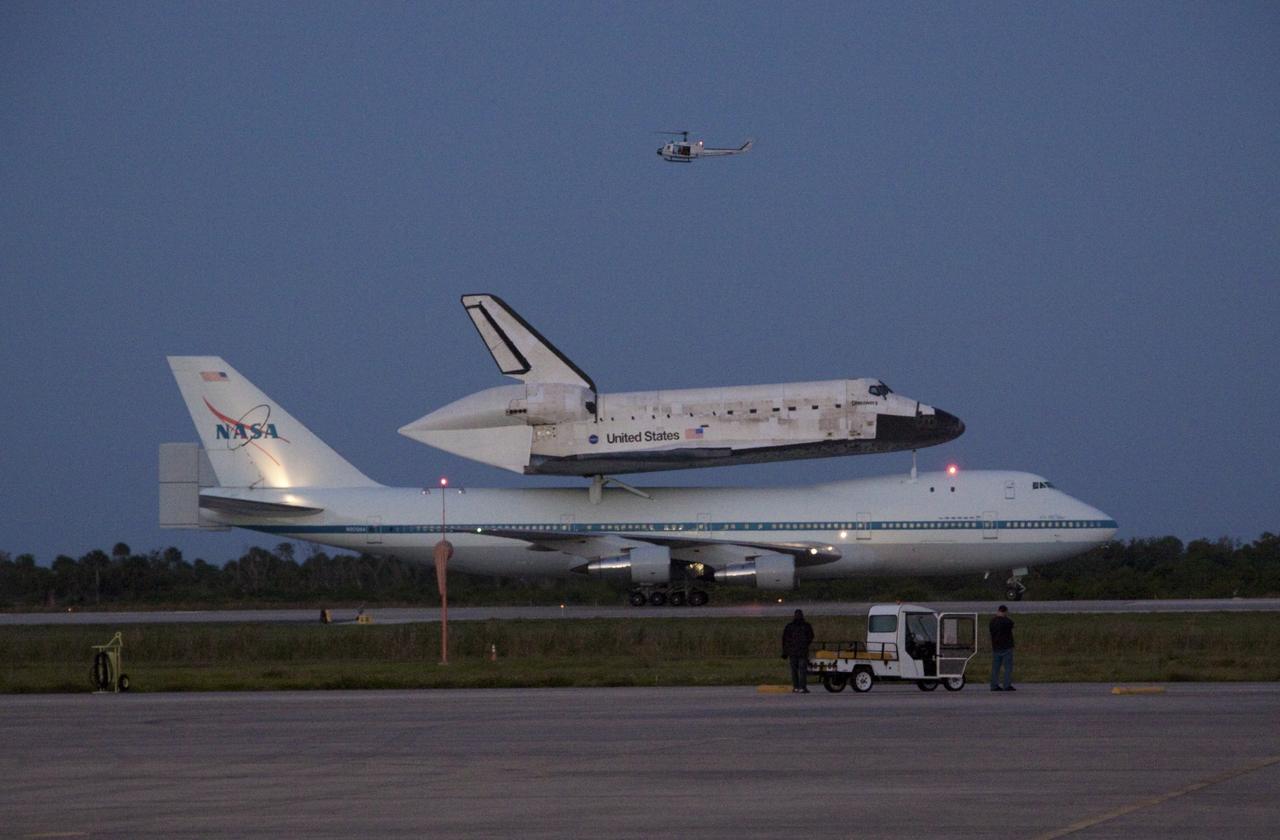
CAPE CANAVERAL, Fla. – Space shuttle Discovery, mounted to a Shuttle Carrier Aircraft, slowly rolls along the runway of the Shuttle Landing Facility at NASA's Kennedy Space Center in Florida. The duo is set to begin their 3 1/2 hour ferry flight to the Washington Dulles International Airport in Virginia at about 7 a.m. EDT. Above the two craft is a NASA helicopter covering the departure. Discovery is leaving Kennedy after more than 28 years of service beginning with its arrival on the space coast Nov. 9, 1983. Discovery first launched to space Aug. 30, 1984, on the STS-41D mission. Discovery is the agency's most-flown shuttle with 39 missions, more than 148 million miles and a total of one year in space. Discovery is set to move to the Smithsonian's National Air and Space Museum Steven F. Udvar-Hazy Center on April 19 where it will be placed on public display. For more information on the SCA, visit http://www.nasa.gov/centers/dryden/news/FactSheets/FS-013-DFRC.html. For more information on shuttle transition and retirement activities, visit http://www.nasa.gov/transition. Photo credit: NASA/Jim Grossmann

CAPE CANAVERAL, Fla. – A NASA C-9 “Pathfinder” DC-9 prepares for takeoff from the Shuttle Landing Facility at NASA's Kennedy Space Center in Florida ahead of space shuttle Discovery, which is bolted to the top of a Shuttle Carrier Aircraft. The craft are set to begin their 3 1/2 hour ferry flight to the Washington Dulles International Airport in Virginia at about 7 a.m. EDT. The Pathfinder will fly about 100 miles ahead of the attached pair, making sure the flight path is free of harmful weather or hazardous conditions. Discovery is leaving Kennedy after more than 28 years of service beginning with its arrival on the space coast Nov. 9, 1983. Discovery first launched to space Aug. 30, 1984, on the STS-41D mission. Discovery is the agency's most-flown shuttle with 39 missions, more than 148 million miles and a total of one year in space. Discovery is set to move to the Smithsonian's National Air and Space Museum Steven F. Udvar-Hazy Center on April 19 where it will be placed on public display. For more information on the SCA, visit http://www.nasa.gov/centers/dryden/news/FactSheets/FS-013-DFRC.html. For more information on shuttle transition and retirement activities, visit http://www.nasa.gov/transition. Photo credit: NASA/Jim Grossmann

CAPE CANAVERAL, Fla. – Space shuttle Discovery, mounted to a Shuttle Carrier Aircraft, soars over the Merritt Island National Wildlife Refuge and NASA's Kennedy Space Center in Florida. The duo is beginning their 3 1/2 hour ferry flight to the Washington Dulles International Airport in Virginia. Also flying along with the pair is a T-38 training jet. Discovery is leaving Kennedy after more than 28 years of service beginning with its arrival on the space coast Nov. 9, 1983. Discovery first launched to space Aug. 30, 1984, on the STS-41D mission. Discovery is the agency's most-flown shuttle with 39 missions, more than 148 million miles and a total of one year in space. Discovery is set to move to the Smithsonian's National Air and Space Museum Steven F. Udvar-Hazy Center on April 19 where it will be placed on public display. For more information on the SCA, visit http://www.nasa.gov/centers/dryden/news/FactSheets/FS-013-DFRC.html. For more information on shuttle transition and retirement activities, visit http://www.nasa.gov/transition. Photo credit: NASA/Frankie Martin
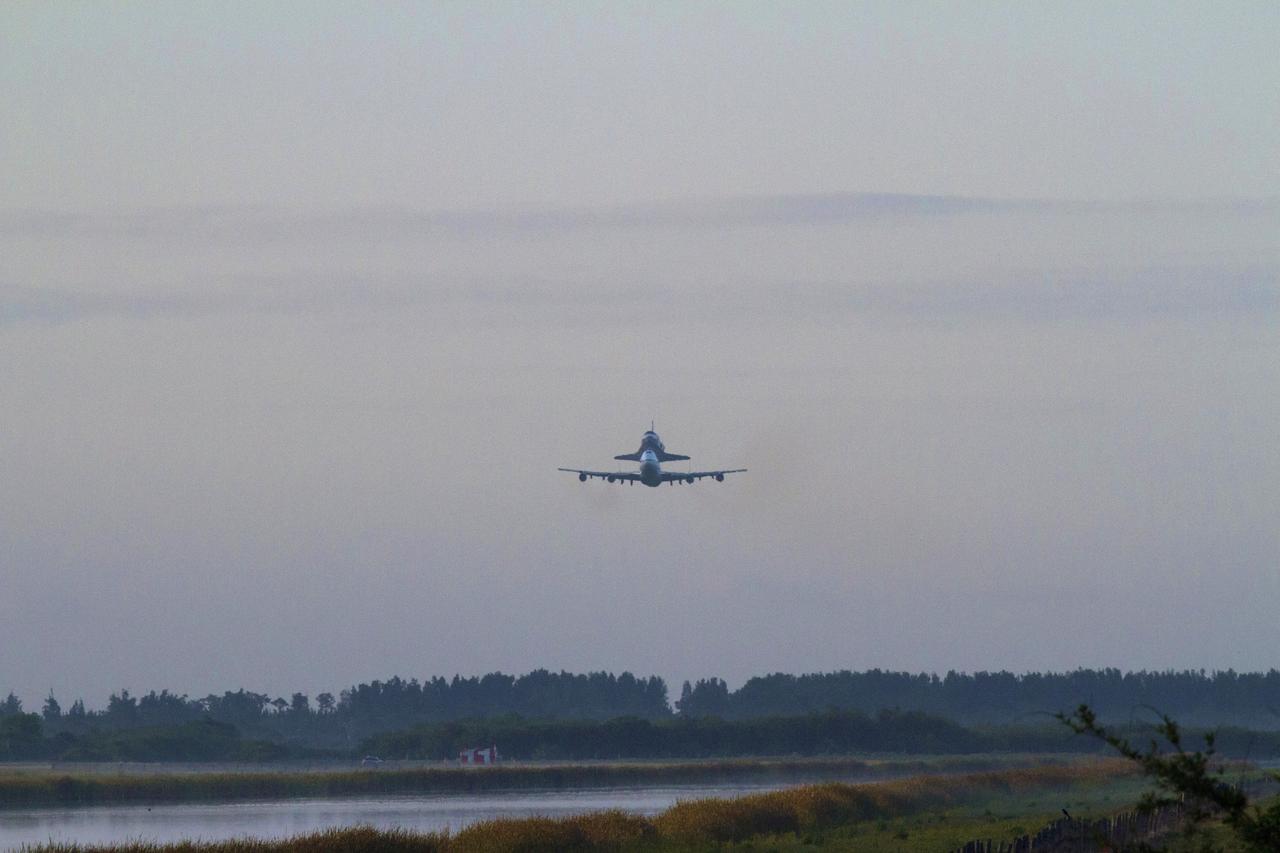
CAPE CANAVERAL, Fla. – Space shuttle Discovery, mounted to a Shuttle Carrier Aircraft, or SCA, takes off from NASA Kennedy Space Center’s Shuttle Landing Facility runway 15 in Florida at 7 a.m. EDT. The duo is beginning its ferry flight to the Washington Dulles International Airport in Virginia that also includes a flyby of the Space Coast and Washington, D.C. Discovery is leaving Kennedy after more than 28 years of service beginning with its arrival on the space coast Nov. 9, 1983. Discovery first launched to space Aug. 30, 1984, on the STS-41D mission. Discovery is the agency’s most-flown shuttle with 39 missions, more than 148 million miles and a total of one year in space. Discovery is set to move to the Smithsonian’s National Air and Space Museum, Steven F. Udvar-Hazy Center in Chantilly, Va., on April 19 where it will be place on public display. For more information on the SCA, visit http://www.nasa.gov/centers/dryden/news/FactSheets/FS-013-DFRC.html. For more information on shuttle transition and retirement activities, visit http://www.nasa.gov/transition. Photo credit: NASA/Tim Powers and Rick Wetherington
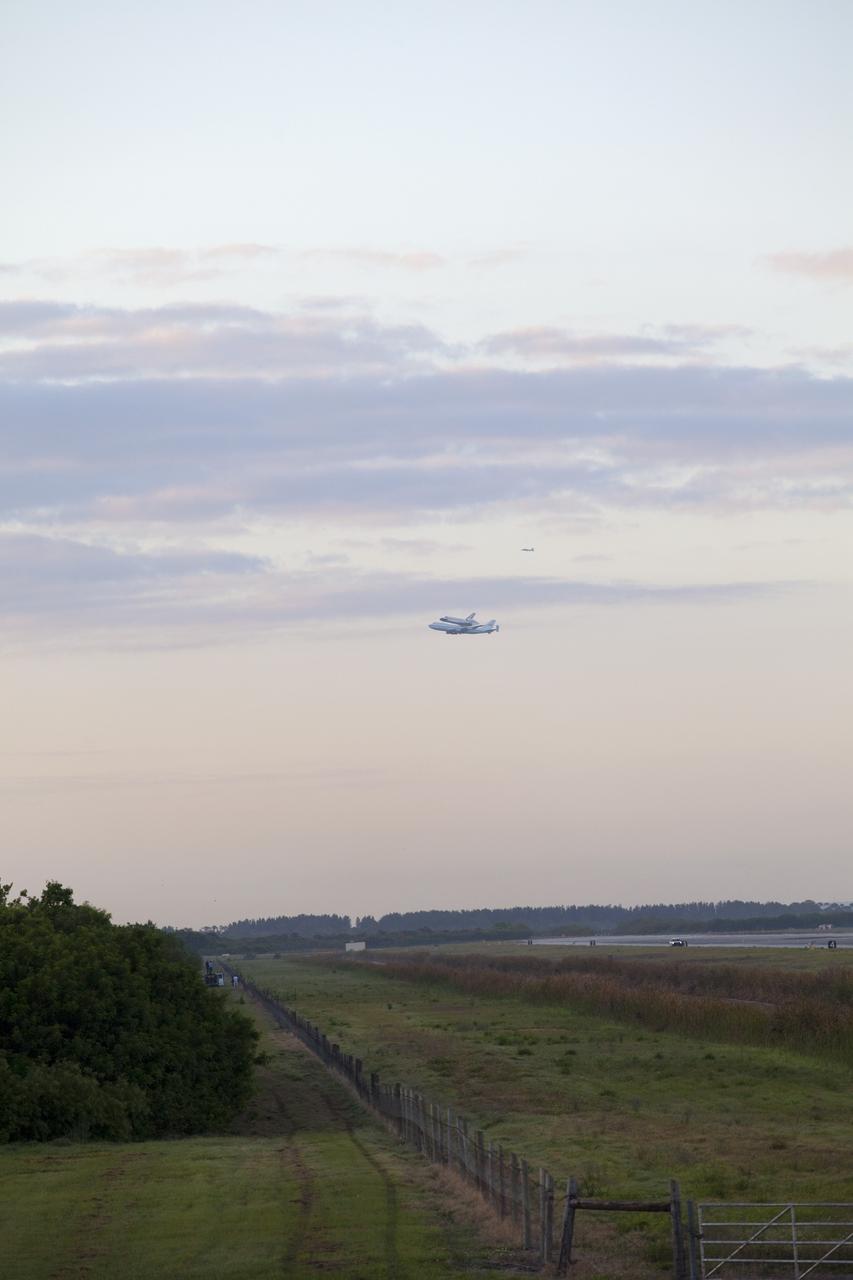
CAPE CANAVERAL, Fla. – Space shuttle Discovery, mounted to a Shuttle Carrier Aircraft, takes off from the Shuttle Landing Facility at NASA's Kennedy Space Center in Florida. The duo is beginning their 3 1/2 hour ferry flight to the Washington Dulles International Airport in Virginia. Also flying along with the pair is a T-38 training jet. Discovery is leaving Kennedy after more than 28 years of service beginning with its arrival on the space coast Nov. 9, 1983. Discovery first launched to space Aug. 30, 1984, on the STS-41D mission. Discovery is the agency's most-flown shuttle with 39 missions, more than 148 million miles and a total of one year in space. Discovery is set to move to the Smithsonian's National Air and Space Museum Steven F. Udvar-Hazy Center on April 19 where it will be placed on public display. For more information on the SCA, visit http://www.nasa.gov/centers/dryden/news/FactSheets/FS-013-DFRC.html. For more information on shuttle transition and retirement activities, visit http://www.nasa.gov/transition. Photo credit: NASA/Frankie Martin

CAPE CANAVERAL, Fla. – Space shuttle Discovery, mounted to a Shuttle Carrier Aircraft, or SCA, takes off from NASA Kennedy Space Center’s Shuttle Landing Facility runway 15 in Florida at 7 a.m. EDT. The duo is beginning its ferry flight to the Washington Dulles International Airport in Virginia that also includes a flyby of the Space Coast and Washington, D.C. Also flying along with the pair is a T-38 training jet. Discovery is leaving Kennedy after more than 28 years of service beginning with its arrival on the space coast Nov. 9, 1983. Discovery first launched to space Aug. 30, 1984, on the STS-41D mission. Discovery is the agency’s most-flown shuttle with 39 missions, more than 148 million miles and a total of one year in space. Discovery is set to move to the Smithsonian’s National Air and Space Museum, Steven F. Udvar-Hazy Center in Chantilly, Va., on April 19 where it will be place on public display. For more information on the SCA, visit http://www.nasa.gov/centers/dryden/news/FactSheets/FS-013-DFRC.html. For more information on shuttle transition and retirement activities, visit http://www.nasa.gov/transition. Photo credit: NASA/Tim Powers and Rick Wetherington
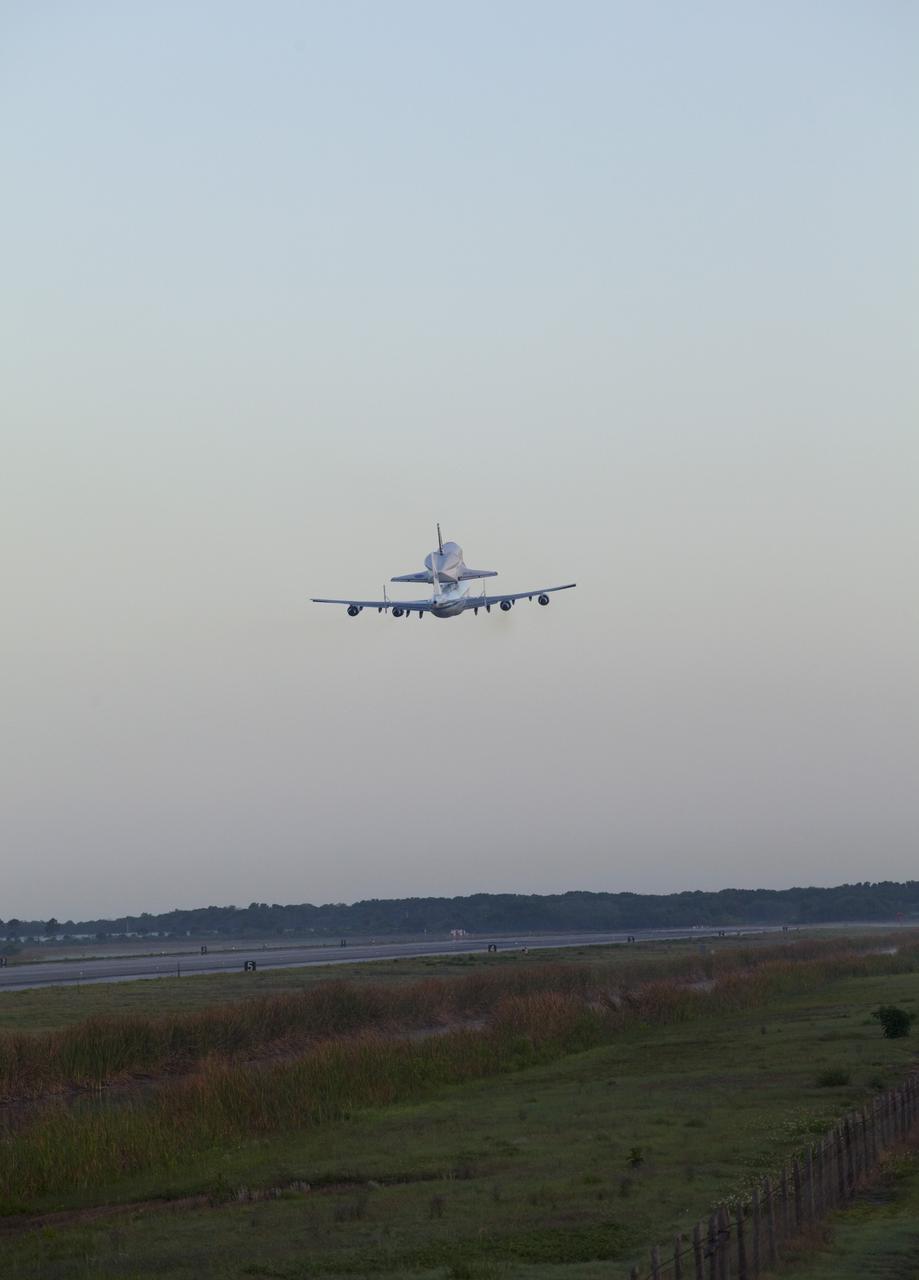
CAPE CANAVERAL, Fla. – Space shuttle Discovery, mounted to a Shuttle Carrier Aircraft, soars over the Shuttle Landing Facility at NASA's Kennedy Space Center in Florida. The duo is beginning their 3 1/2 hour ferry flight to the Washington Dulles International Airport in Virginia. Also flying along with the pair is a T-38 training jet. Discovery is leaving Kennedy after more than 28 years of service beginning with its arrival on the space coast Nov. 9, 1983. Discovery first launched to space Aug. 30, 1984, on the STS-41D mission. Discovery is the agency's most-flown shuttle with 39 missions, more than 148 million miles and a total of one year in space. Discovery is set to move to the Smithsonian's National Air and Space Museum Steven F. Udvar-Hazy Center on April 19 where it will be placed on public display. For more information on the SCA, visit http://www.nasa.gov/centers/dryden/news/FactSheets/FS-013-DFRC.html. For more information on shuttle transition and retirement activities, visit http://www.nasa.gov/transition. Photo credit: NASA/Frankie Martin
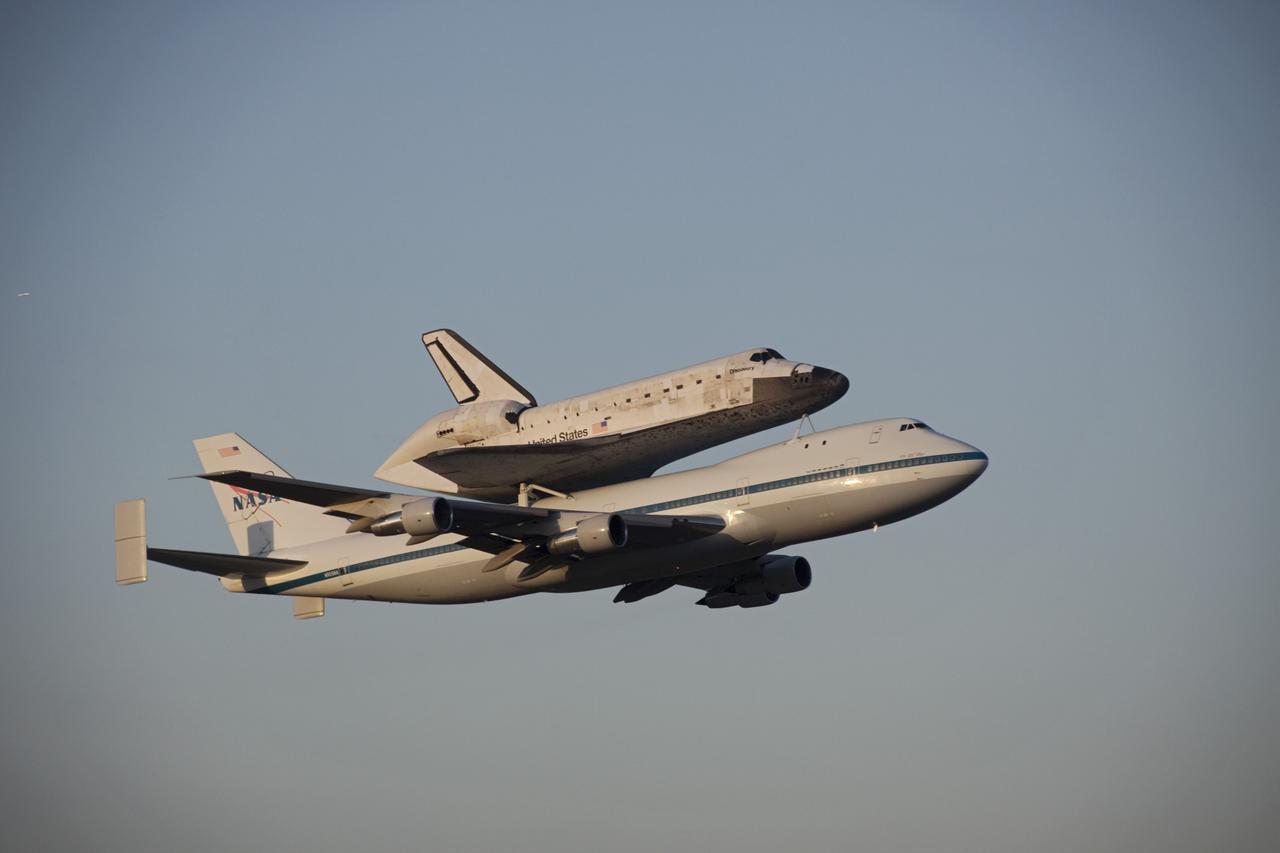
CAPE CANAVERAL, Fla. – Space shuttle Discovery, mounted to a Shuttle Carrier Aircraft, takes off from the Shuttle Landing Facility at NASA's Kennedy Space Center in Florida. The duo is beginning their 3 1/2 hour ferry flight to the Washington Dulles International Airport in Virginia. Discovery is leaving Kennedy after more than 28 years of service beginning with its arrival on the space coast Nov. 9, 1983. Discovery first launched to space Aug. 30, 1984, on the STS-41D mission. Discovery is the agency's most-flown shuttle with 39 missions, more than 148 million miles and a total of one year in space. Discovery is set to move to the Smithsonian's National Air and Space Museum Steven F. Udvar-Hazy Center on April 19 where it will be placed on public display. For more information on the SCA, visit http://www.nasa.gov/centers/dryden/news/FactSheets/FS-013-DFRC.html. For more information on shuttle transition and retirement activities, visit http://www.nasa.gov/transition. Photo credit: NASA/Jim Grossmann

CAPE CANAVERAL, Fla. – Space shuttle Discovery, mounted to a Shuttle Carrier Aircraft, prepares for takeoff on the runway of the Shuttle Landing Facility at NASA's Kennedy Space Center in Florida. The duo is set to begin their 3 1/2 hour ferry flight to the Washington Dulles International Airport in Virginia at about 7 a.m. EDT. Above the two craft is a NASA helicopter covering the departure. Discovery is leaving Kennedy after more than 28 years of service beginning with its arrival on the space coast Nov. 9, 1983. Discovery first launched to space Aug. 30, 1984, on the STS-41D mission. Discovery is the agency's most-flown shuttle with 39 missions, more than 148 million miles and a total of one year in space. Discovery is set to move to the Smithsonian's National Air and Space Museum Steven F. Udvar-Hazy Center on April 19 where it will be placed on public display. For more information on the SCA, visit http://www.nasa.gov/centers/dryden/news/FactSheets/FS-013-DFRC.html. For more information on shuttle transition and retirement activities, visit http://www.nasa.gov/transition. Photo credit: NASA/Frankie Martin
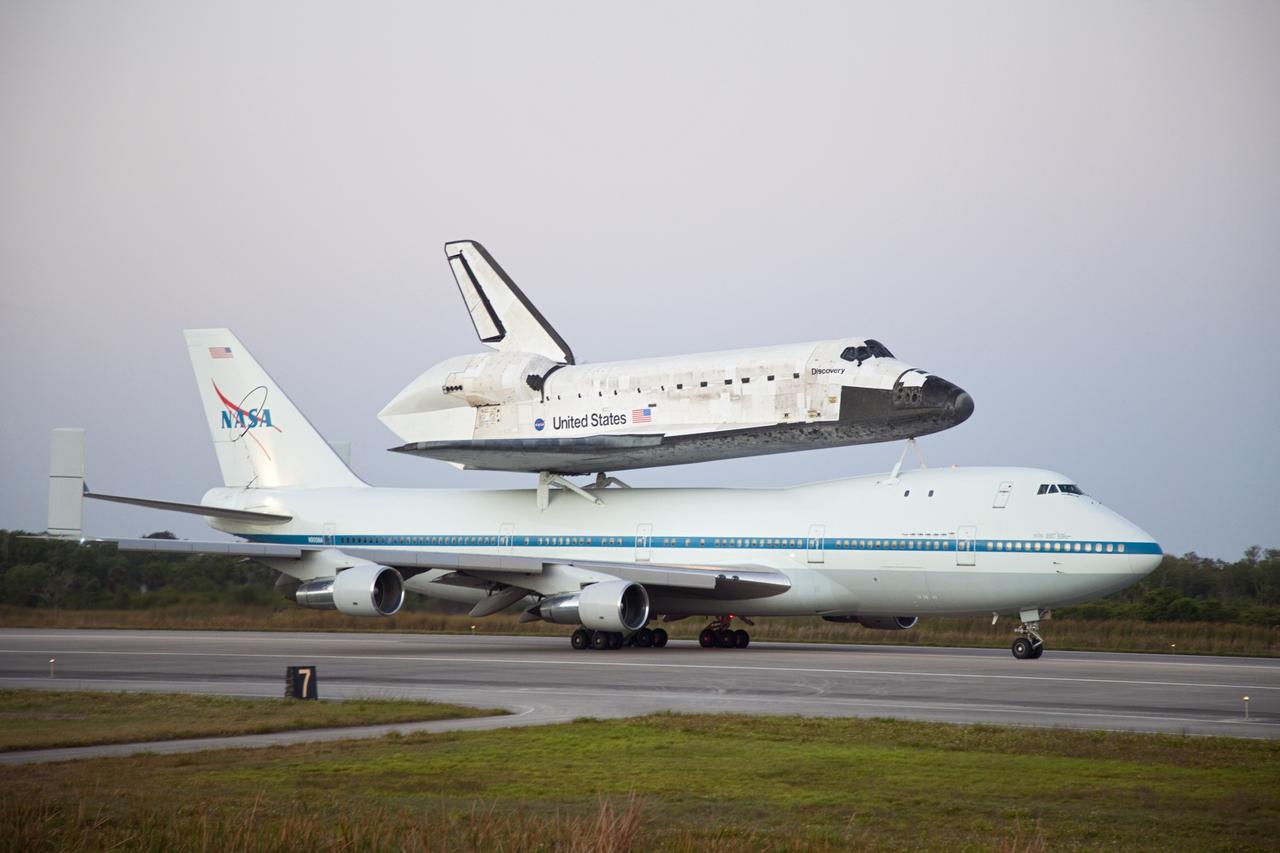
CAPE CANAVERAL, Fla. – Space shuttle Discovery, mounted to a Shuttle Carrier Aircraft, slowly rolls along the runway of the Shuttle Landing Facility at NASA's Kennedy Space Center in Florida. The duo is set to begin their 3 1/2 hour ferry flight to the Washington Dulles International Airport in Virginia at about 7 a.m. EDT. Above the two craft is a NASA helicopter covering the departure. Discovery is leaving Kennedy after more than 28 years of service beginning with its arrival on the space coast Nov. 9, 1983. Discovery first launched to space Aug. 30, 1984, on the STS-41D mission. Discovery is the agency's most-flown shuttle with 39 missions, more than 148 million miles and a total of one year in space. Discovery is set to move to the Smithsonian's National Air and Space Museum Steven F. Udvar-Hazy Center on April 19 where it will be placed on public display. For more information on the SCA, visit http://www.nasa.gov/centers/dryden/news/FactSheets/FS-013-DFRC.html. For more information on shuttle transition and retirement activities, visit http://www.nasa.gov/transition. Photo credit: NASA/Frankie Martin

CAPE CANAVERAL, Fla. – Media snap photos as space shuttle Discovery, mounted to a Shuttle Carrier Aircraft, slowly rolls along the runway of the Shuttle Landing Facility at NASA's Kennedy Space Center in Florida. The duo is set to begin their 3 1/2 hour ferry flight to the Washington Dulles International Airport in Virginia at about 7 a.m. EDT. Above the two craft is a NASA helicopter covering the departure. Discovery is leaving Kennedy after more than 28 years of service beginning with its arrival on the space coast Nov. 9, 1983. Discovery first launched to space Aug. 30, 1984, on the STS-41D mission. Discovery is the agency's most-flown shuttle with 39 missions, more than 148 million miles and a total of one year in space. Discovery is set to move to the Smithsonian's National Air and Space Museum Steven F. Udvar-Hazy Center on April 19 where it will be placed on public display. For more information on the SCA, visit http://www.nasa.gov/centers/dryden/news/FactSheets/FS-013-DFRC.html. For more information on shuttle transition and retirement activities, visit http://www.nasa.gov/transition. Photo credit: NASA/Frankie Martin
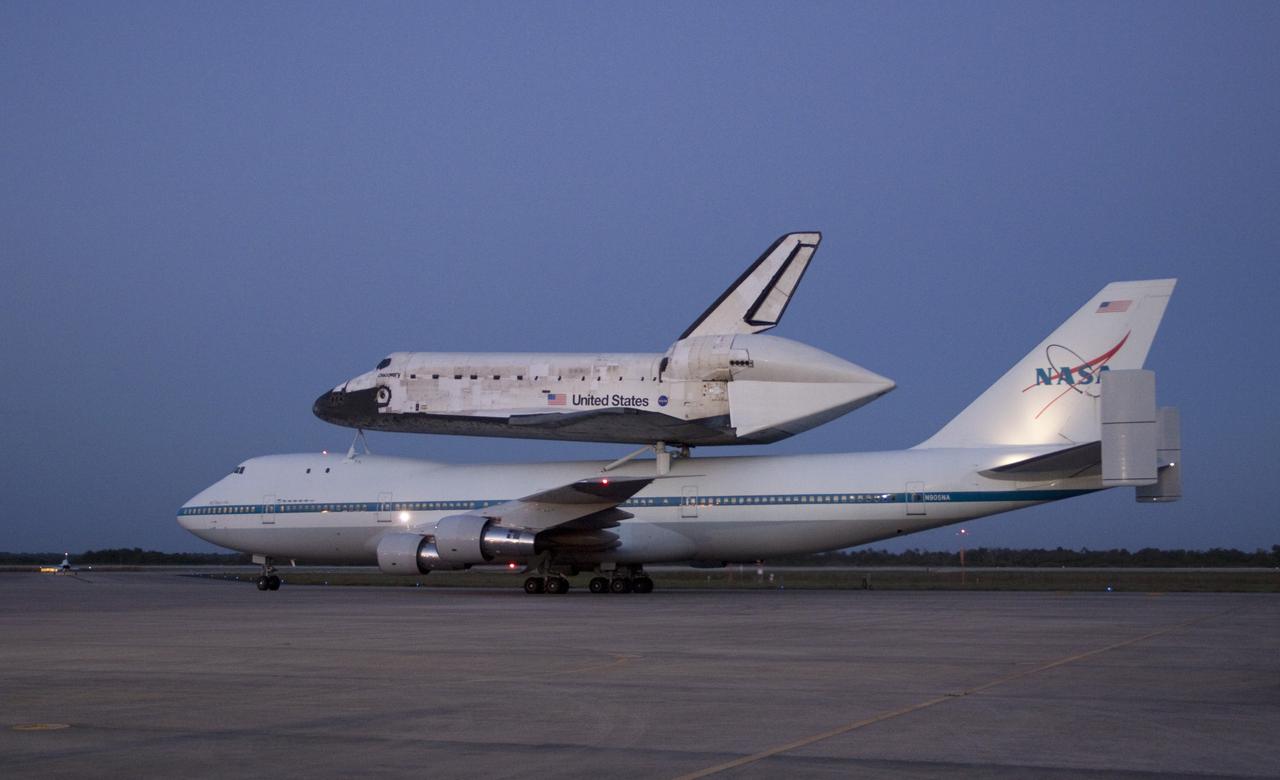
CAPE CANAVERAL, Fla. – Space shuttle Discovery, mounted to a Shuttle Carrier Aircraft, slowly rolls out to the runway of the Shuttle Landing Facility at NASA's Kennedy Space Center in Florida. The duo is set to begin their 3 1/2 hour ferry flight to the Washington Dulles International Airport in Virginia at about 7 a.m. EDT. Discovery is leaving Kennedy after more than 28 years of service beginning with its arrival on the space coast Nov. 9, 1983. Discovery first launched to space Aug. 30, 1984, on the STS-41D mission. Discovery is the agency's most-flown shuttle with 39 missions, more than 148 million miles and a total of one year in space. Discovery is set to move to the Smithsonian's National Air and Space Museum Steven F. Udvar-Hazy Center on April 19 where it will be placed on public display. For more information on the SCA, visit http://www.nasa.gov/centers/dryden/news/FactSheets/FS-013-DFRC.html. For more information on shuttle transition and retirement activities, visit http://www.nasa.gov/transition. Photo credit: NASA/Jim Grossmann
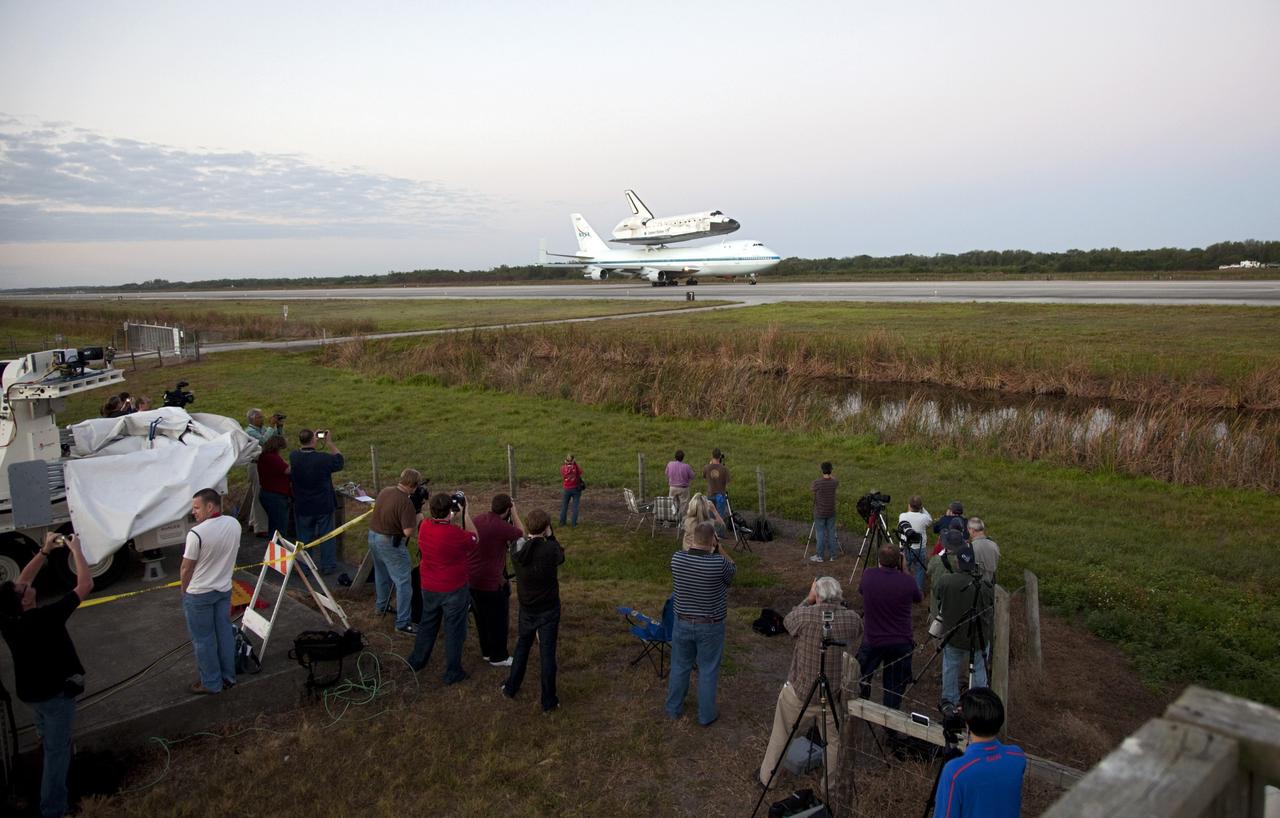
CAPE CANAVERAL, Fla. – Media snap photos as space shuttle Discovery, mounted to a Shuttle Carrier Aircraft, slowly rolls along the runway of the Shuttle Landing Facility at NASA's Kennedy Space Center in Florida. The duo is set to begin their 3 1/2 hour ferry flight to the Washington Dulles International Airport in Virginia at about 7 a.m. EDT. Above the two craft is a NASA helicopter covering the departure. Discovery is leaving Kennedy after more than 28 years of service beginning with its arrival on the space coast Nov. 9, 1983. Discovery first launched to space Aug. 30, 1984, on the STS-41D mission. Discovery is the agency's most-flown shuttle with 39 missions, more than 148 million miles and a total of one year in space. Discovery is set to move to the Smithsonian's National Air and Space Museum Steven F. Udvar-Hazy Center on April 19 where it will be placed on public display. For more information on the SCA, visit http://www.nasa.gov/centers/dryden/news/FactSheets/FS-013-DFRC.html. For more information on shuttle transition and retirement activities, visit http://www.nasa.gov/transition. Photo credit: NASA/Frankie Martin
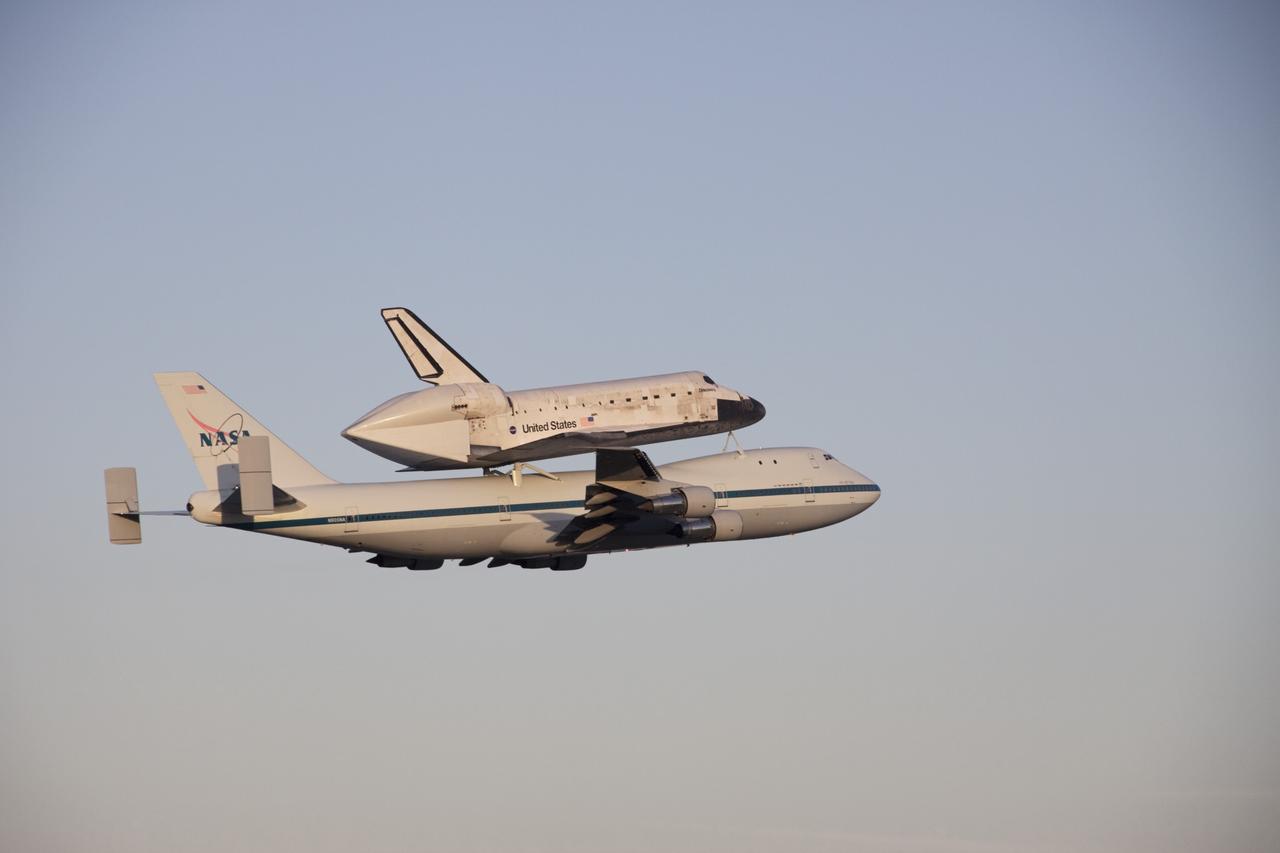
CAPE CANAVERAL, Fla. – Space shuttle Discovery, mounted to a Shuttle Carrier Aircraft, takes off from the Shuttle Landing Facility at NASA's Kennedy Space Center in Florida. The duo is beginning their 3 1/2 hour ferry flight to the Washington Dulles International Airport in Virginia. Discovery is leaving Kennedy after more than 28 years of service beginning with its arrival on the space coast Nov. 9, 1983. Discovery first launched to space Aug. 30, 1984, on the STS-41D mission. Discovery is the agency's most-flown shuttle with 39 missions, more than 148 million miles and a total of one year in space. Discovery is set to move to the Smithsonian's National Air and Space Museum Steven F. Udvar-Hazy Center on April 19 where it will be placed on public display. For more information on the SCA, visit http://www.nasa.gov/centers/dryden/news/FactSheets/FS-013-DFRC.html. For more information on shuttle transition and retirement activities, visit http://www.nasa.gov/transition. Photo credit: NASA/Jim Grossmann
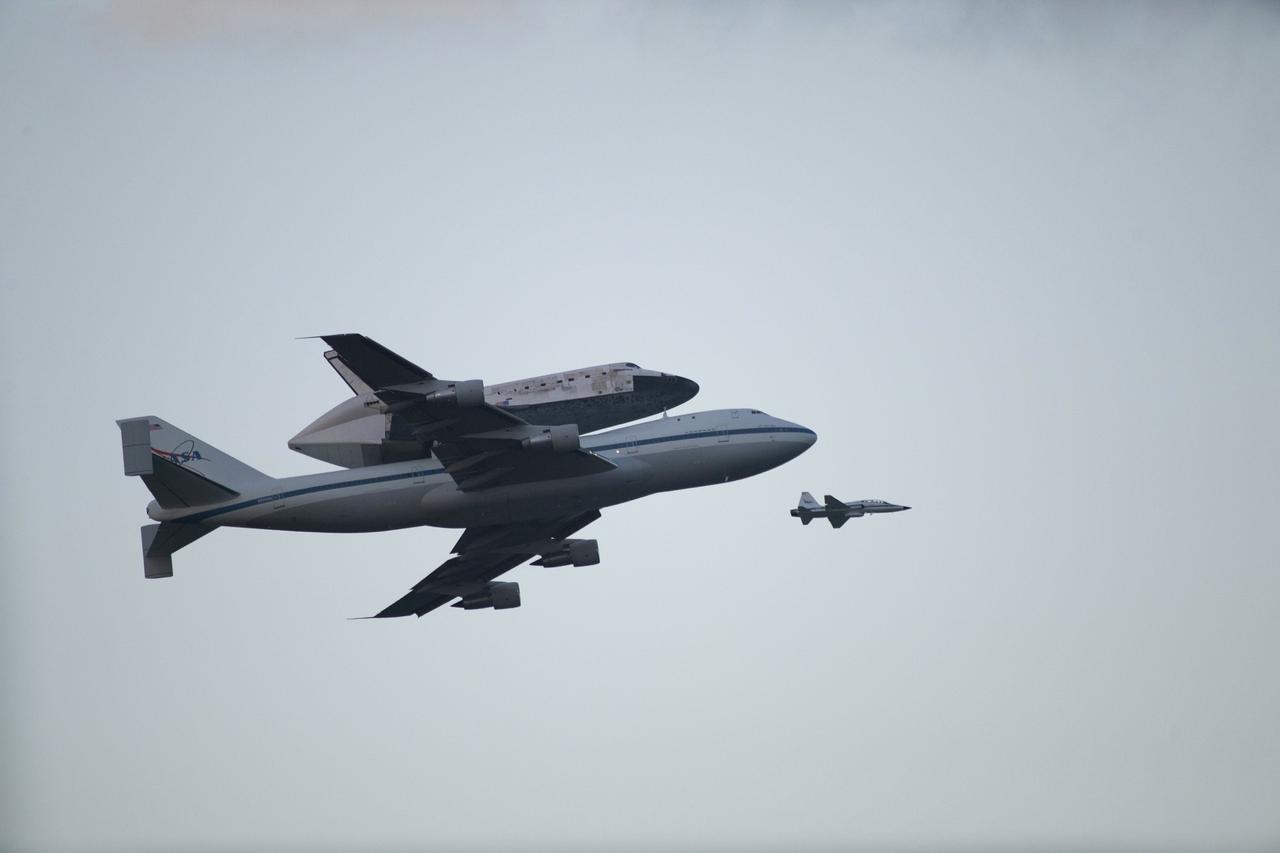
CAPE CANAVERAL, Fla. – Space shuttle Discovery, mounted to a Shuttle Carrier Aircraft, flies over the Shuttle Landing Facility at NASA's Kennedy Space Center in Florida after making a flyby of Cocoa Beach and Patrick Air Force Base. The duo is beginning its ferry flight to the Washington Dulles International Airport in Virginia that also includes a flyby of the Space Coast and Washington, D.C. Also flying along with the pair is a T-38 training jet. Discovery is leaving Kennedy after more than 28 years of service beginning with its arrival on the space coast Nov. 9, 1983. Discovery first launched to space Aug. 30, 1984, on the STS-41D mission. Discovery is the agency's most-flown shuttle with 39 missions, more than 148 million miles and a total of one year in space. Discovery is set to move to the Smithsonian's National Air and Space Museum Steven F. Udvar-Hazy Center on April 19 where it will be placed on public display. For more information on the SCA, visit http://www.nasa.gov/centers/dryden/news/FactSheets/FS-013-DFRC.html. For more information on shuttle transition and retirement activities, visit http://www.nasa.gov/transition. Photo credit: NASA/Kenny Allen
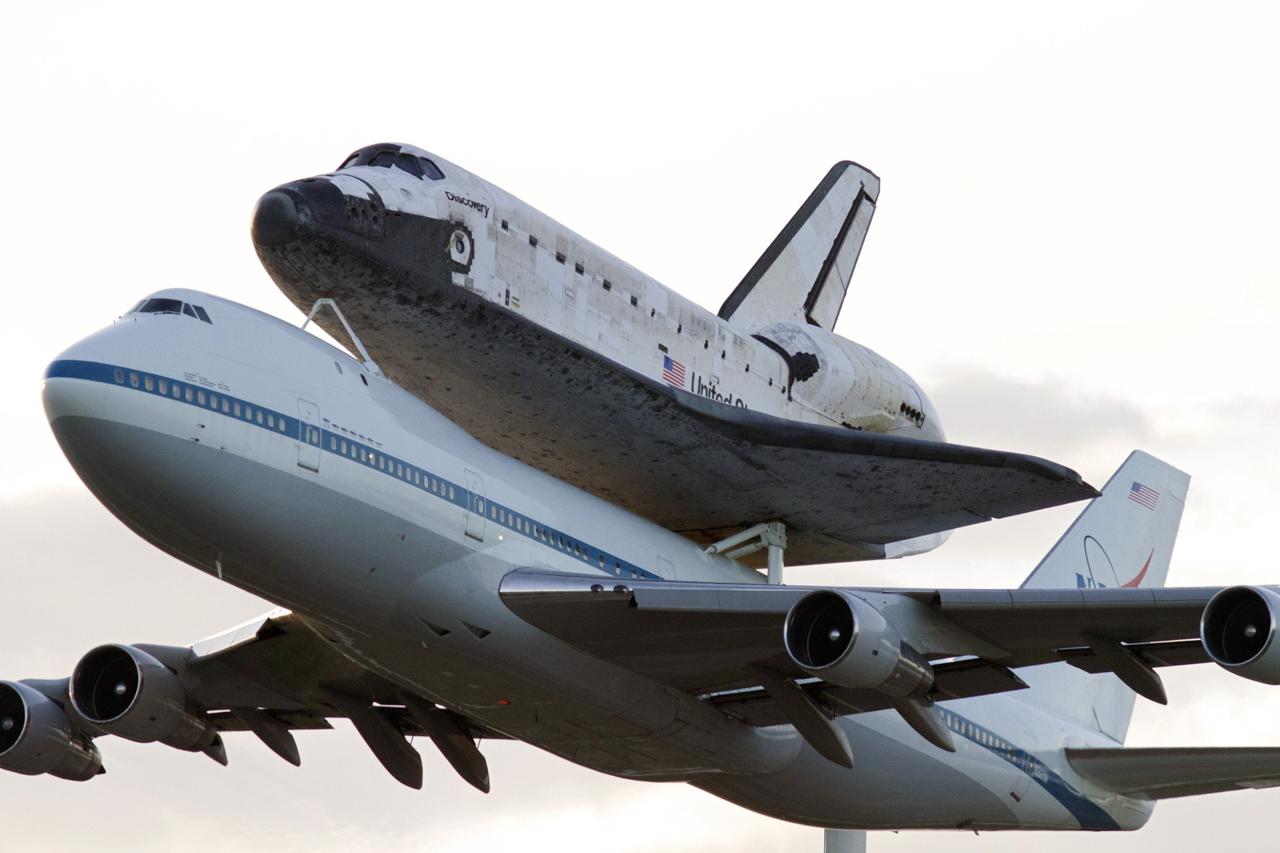
CAPE CANAVERAL, Fla. – A spectacular close up view of space shuttle Discovery, mounted to a Shuttle Carrier Aircraft, or SCA, after it takes off from NASA Kennedy Space Center’s Shuttle Landing Facility runway 15 in Florida at 7 a.m. EDT. The duo is beginning its ferry flight to the Washington Dulles International Airport in Virginia that also includes a flyby of the Space Coast and Washington, D.C. Discovery is leaving Kennedy after more than 28 years of service beginning with its arrival on the space coast Nov. 9, 1983. Discovery first launched to space Aug. 30, 1984, on the STS-41D mission. Discovery is the agency’s most-flown shuttle with 39 missions, more than 148 million miles and a total of one year in space. Discovery is set to move to the Smithsonian’s National Air and Space Museum, Steven F. Udvar-Hazy Center in Chantilly, Va., on April 19 where it will be place on public display. For more information on the SCA, visit http://www.nasa.gov/centers/dryden/news/FactSheets/FS-013-DFRC.html. For more information on shuttle transition and retirement activities, visit http://www.nasa.gov/transition. Photo credit: NASA/Tim Powers and Rick Wetherington
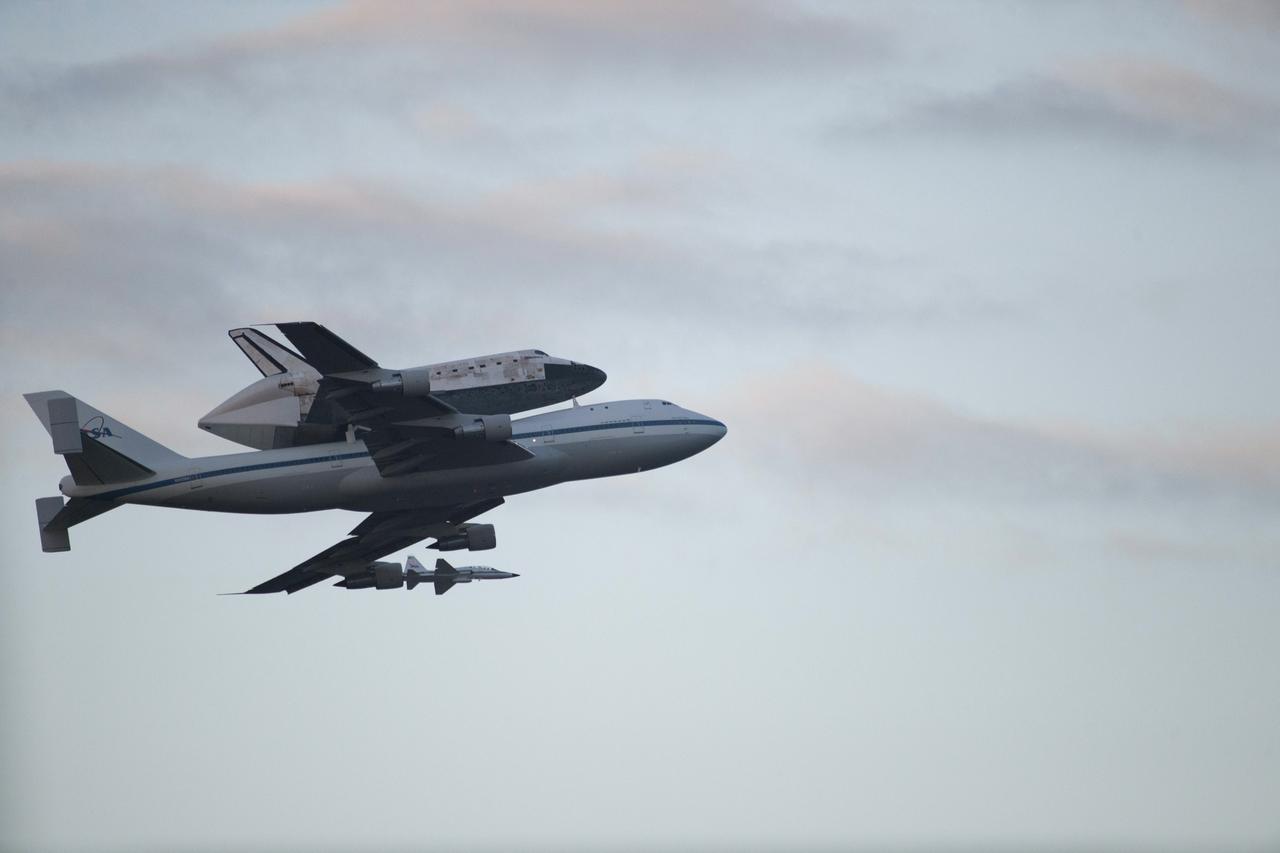
CAPE CANAVERAL, Fla. – Space shuttle Discovery, mounted to a Shuttle Carrier Aircraft, flies over the Shuttle Landing Facility at NASA's Kennedy Space Center in Florida after making a flyby of Cocoa Beach and Patrick Air Force Base. The duo is beginning its ferry flight to the Washington Dulles International Airport in Virginia that also includes a flyby of the Space Coast and Washington, D.C. Also flying along with the pair is a T-38 training jet. Discovery is leaving Kennedy after more than 28 years of service beginning with its arrival on the space coast Nov. 9, 1983. Discovery first launched to space Aug. 30, 1984, on the STS-41D mission. Discovery is the agency's most-flown shuttle with 39 missions, more than 148 million miles and a total of one year in space. Discovery is set to move to the Smithsonian's National Air and Space Museum Steven F. Udvar-Hazy Center on April 19 where it will be placed on public display. For more information on the SCA, visit http://www.nasa.gov/centers/dryden/news/FactSheets/FS-013-DFRC.html. For more information on shuttle transition and retirement activities, visit http://www.nasa.gov/transition. Photo credit: NASA/Kenny Allen
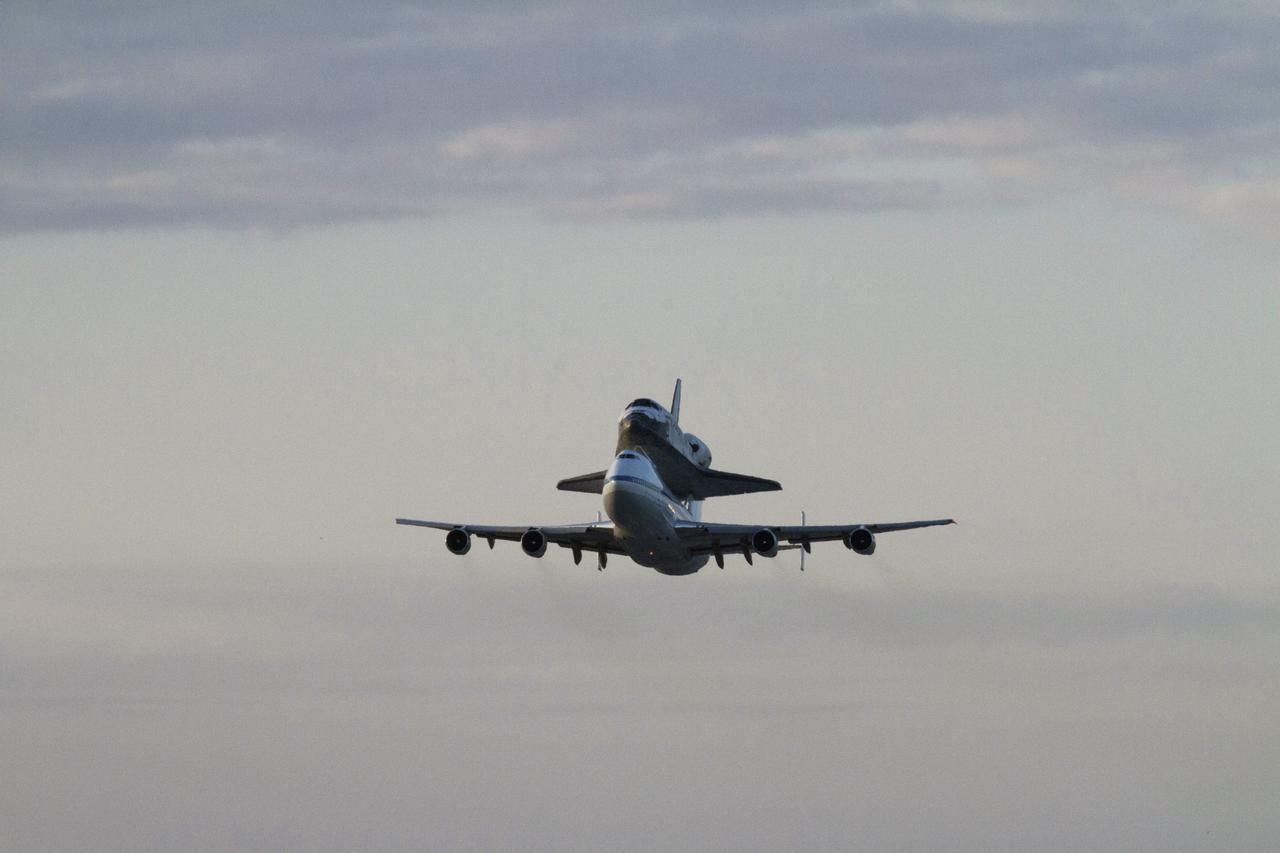
CAPE CANAVERAL, Fla. – Space shuttle Discovery, mounted to a Shuttle Carrier Aircraft, or SCA, takes off from NASA Kennedy Space Center’s Shuttle Landing Facility runway 15 in Florida at 7 a.m. EDT. The duo is beginning its ferry flight to the Washington Dulles International Airport in Virginia that also includes a flyby of the Space Coast and Washington, D.C. Discovery is leaving Kennedy after more than 28 years of service beginning with its arrival on the space coast Nov. 9, 1983. Discovery first launched to space Aug. 30, 1984, on the STS-41D mission. Discovery is the agency’s most-flown shuttle with 39 missions, more than 148 million miles and a total of one year in space. Discovery is set to move to the Smithsonian’s National Air and Space Museum, Steven F. Udvar-Hazy Center in Chantilly, Va., on April 19 where it will be place on public display. For more information on the SCA, visit http://www.nasa.gov/centers/dryden/news/FactSheets/FS-013-DFRC.html. For more information on shuttle transition and retirement activities, visit http://www.nasa.gov/transition. Photo credit: NASA/Tim Powers and Rick Wetherington

CAPE CANAVERAL, Fla. – Space shuttle Discovery, mounted to a Shuttle Carrier Aircraft, or SCA, takes off from NASA Kennedy Space Center’s Shuttle Landing Facility runway 15 in Florida at 7 a.m. EDT and makes a flyby near the mate/demate device. The duo is beginning its ferry flight to the Washington Dulles International Airport in Virginia that also includes a flyby of the Space Coast and Washington, D.C. Also flying along with the pair are a T-38 training jet and a helicopter. Discovery is leaving Kennedy after more than 28 years of service beginning with its arrival on the space coast Nov. 9, 1983. Discovery first launched to space Aug. 30, 1984, on the STS-41D mission. Discovery is the agency’s most-flown shuttle with 39 missions, more than 148 million miles and a total of one year in space. Discovery is set to move to the Smithsonian’s National Air and Space Museum, Steven F. Udvar-Hazy Center in Chantilly, Va., on April 19 where it will be place on public display. For more information on the SCA, visit http://www.nasa.gov/centers/dryden/news/FactSheets/FS-013-DFRC.html. For more information on shuttle transition and retirement activities, visit http://www.nasa.gov/transition. Photo credit: NASA/Tim Powers and Rick Wetherington
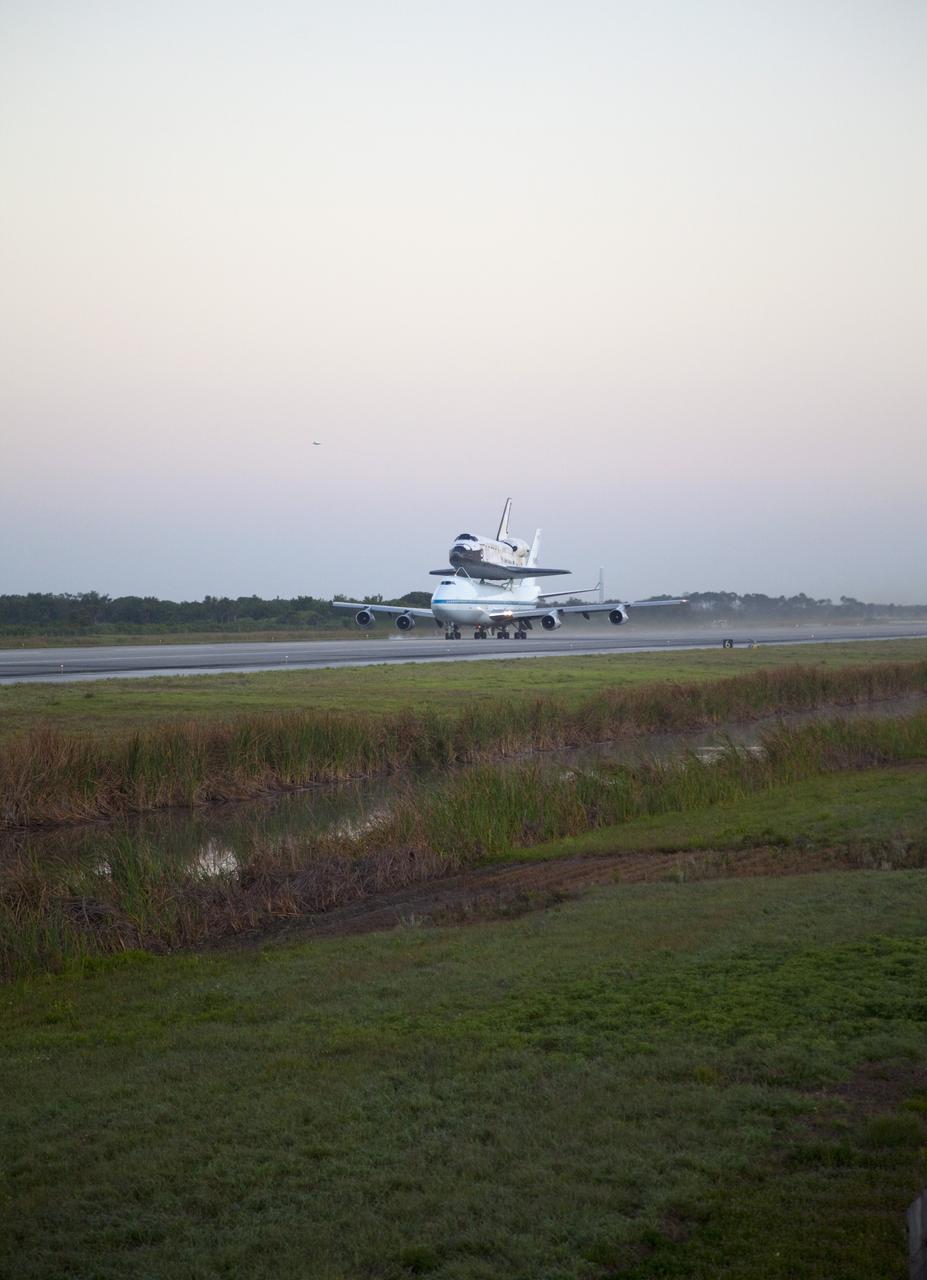
CAPE CANAVERAL, Fla. – Space shuttle Discovery, mounted to a Shuttle Carrier Aircraft, prepares for takeoff on the runway of the Shuttle Landing Facility at NASA's Kennedy Space Center in Florida. The duo is set to begin their 3 1/2 hour ferry flight to the Washington Dulles International Airport in Virginia at about 7 a.m. EDT. Above the two craft is a NASA helicopter covering the departure. Discovery is leaving Kennedy after more than 28 years of service beginning with its arrival on the space coast Nov. 9, 1983. Discovery first launched to space Aug. 30, 1984, on the STS-41D mission. Discovery is the agency's most-flown shuttle with 39 missions, more than 148 million miles and a total of one year in space. Discovery is set to move to the Smithsonian's National Air and Space Museum Steven F. Udvar-Hazy Center on April 19 where it will be placed on public display. For more information on the SCA, visit http://www.nasa.gov/centers/dryden/news/FactSheets/FS-013-DFRC.html. For more information on shuttle transition and retirement activities, visit http://www.nasa.gov/transition. Photo credit: NASA/Frankie Martin
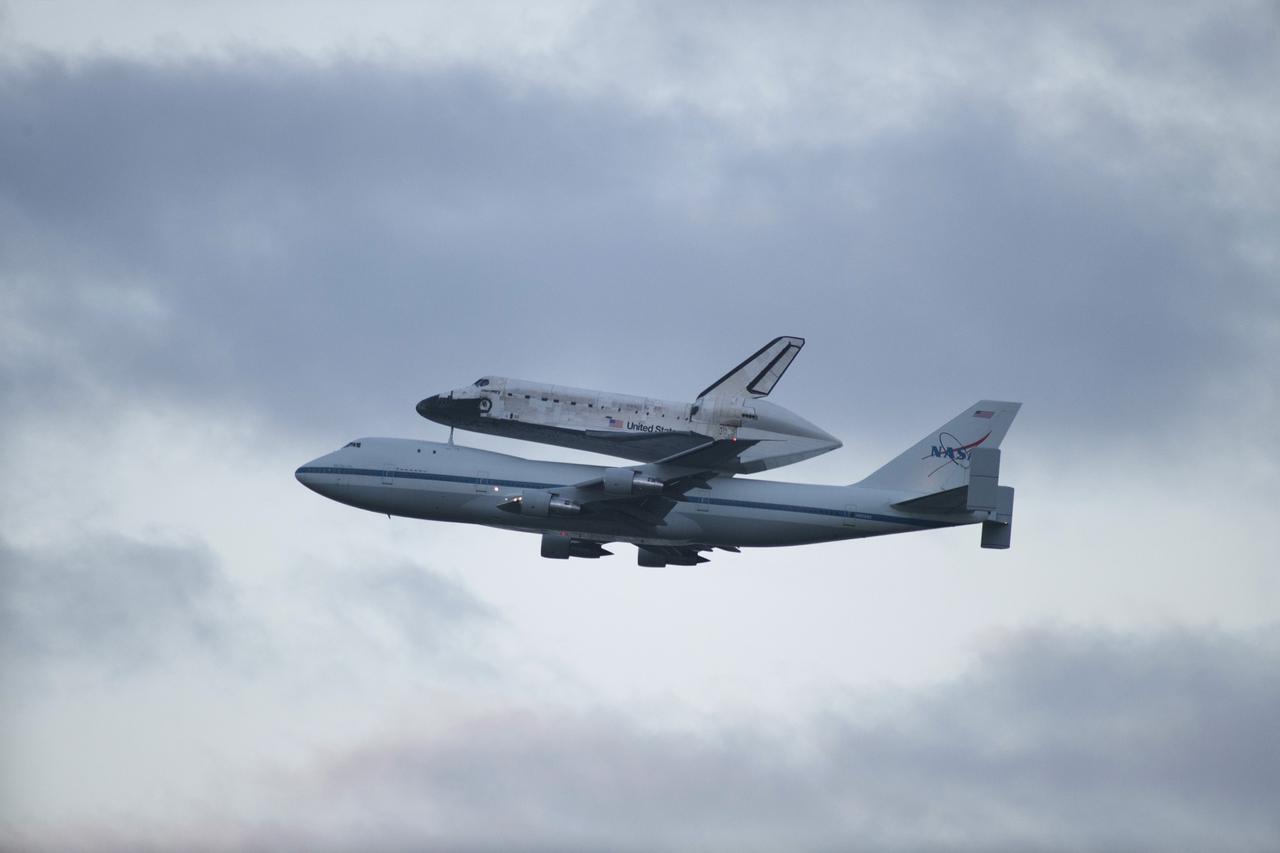
CAPE CANAVERAL, Fla. – Space shuttle Discovery, mounted to a Shuttle Carrier Aircraft, flies toward Cocoa Beach and Patrick Air Force Base after taking off from the Shuttle Landing Facility at NASA's Kennedy Space Center in Florida. The duo is beginning its ferry flight to the Washington Dulles International Airport in Virginia that also includes a flyby of the Space Coast and Washington, D.C. Discovery is leaving Kennedy after more than 28 years of service beginning with its arrival on the space coast Nov. 9, 1983. Discovery first launched to space Aug. 30, 1984, on the STS-41D mission. Discovery is the agency's most-flown shuttle with 39 missions, more than 148 million miles and a total of one year in space. Discovery is set to move to the Smithsonian's National Air and Space Museum Steven F. Udvar-Hazy Center on April 19 where it will be placed on public display. For more information on the SCA, visit http://www.nasa.gov/centers/dryden/news/FactSheets/FS-013-DFRC.html. For more information on shuttle transition and retirement activities, visit http://www.nasa.gov/transition. Photo credit: NASA/Kenny Allen
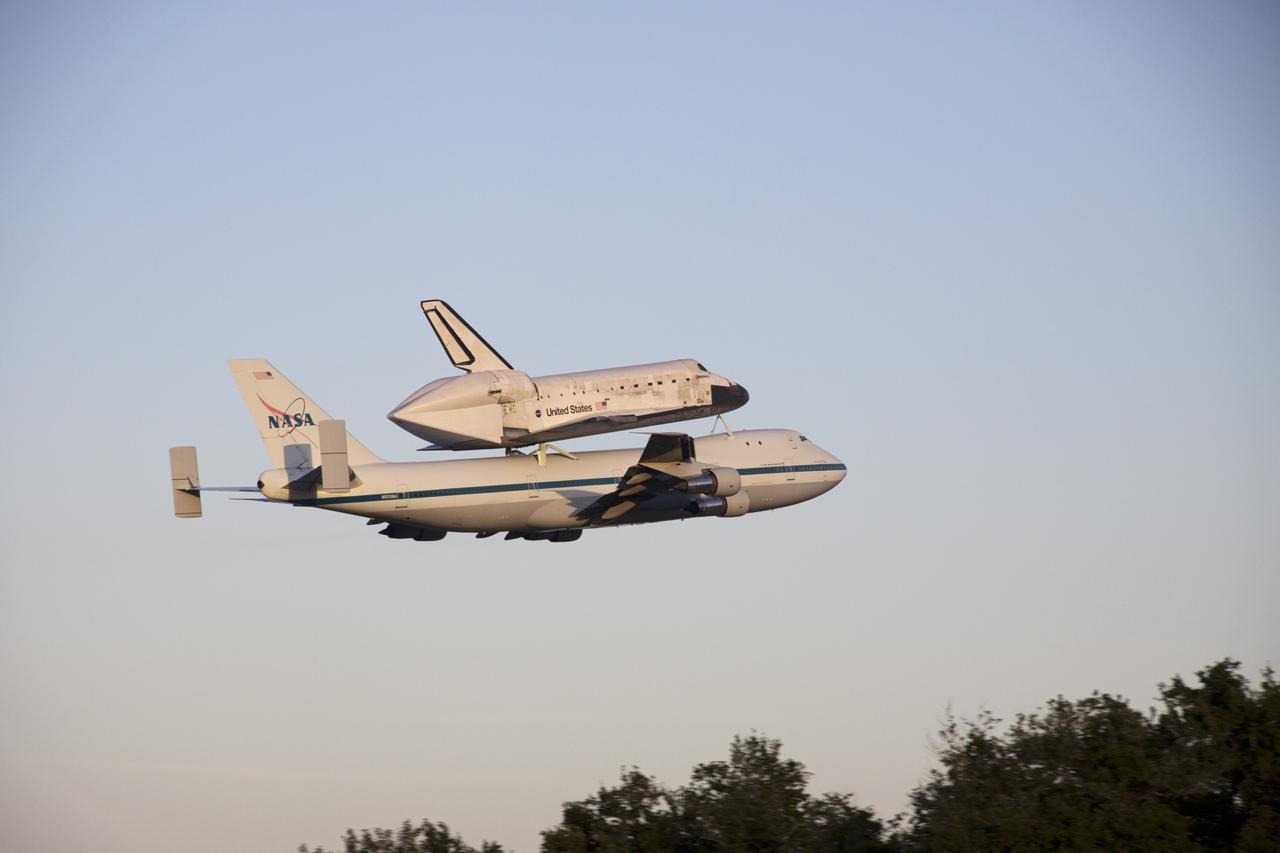
CAPE CANAVERAL, Fla. – Space shuttle Discovery, mounted to a Shuttle Carrier Aircraft, takes off from the Shuttle Landing Facility at NASA's Kennedy Space Center in Florida. The duo is beginning their 3 1/2 hour ferry flight to the Washington Dulles International Airport in Virginia. Discovery is leaving Kennedy after more than 28 years of service beginning with its arrival on the space coast Nov. 9, 1983. Discovery first launched to space Aug. 30, 1984, on the STS-41D mission. Discovery is the agency's most-flown shuttle with 39 missions, more than 148 million miles and a total of one year in space. Discovery is set to move to the Smithsonian's National Air and Space Museum Steven F. Udvar-Hazy Center on April 19 where it will be placed on public display. For more information on the SCA, visit http://www.nasa.gov/centers/dryden/news/FactSheets/FS-013-DFRC.html. For more information on shuttle transition and retirement activities, visit http://www.nasa.gov/transition. Photo credit: NASA/Jim Grossmann
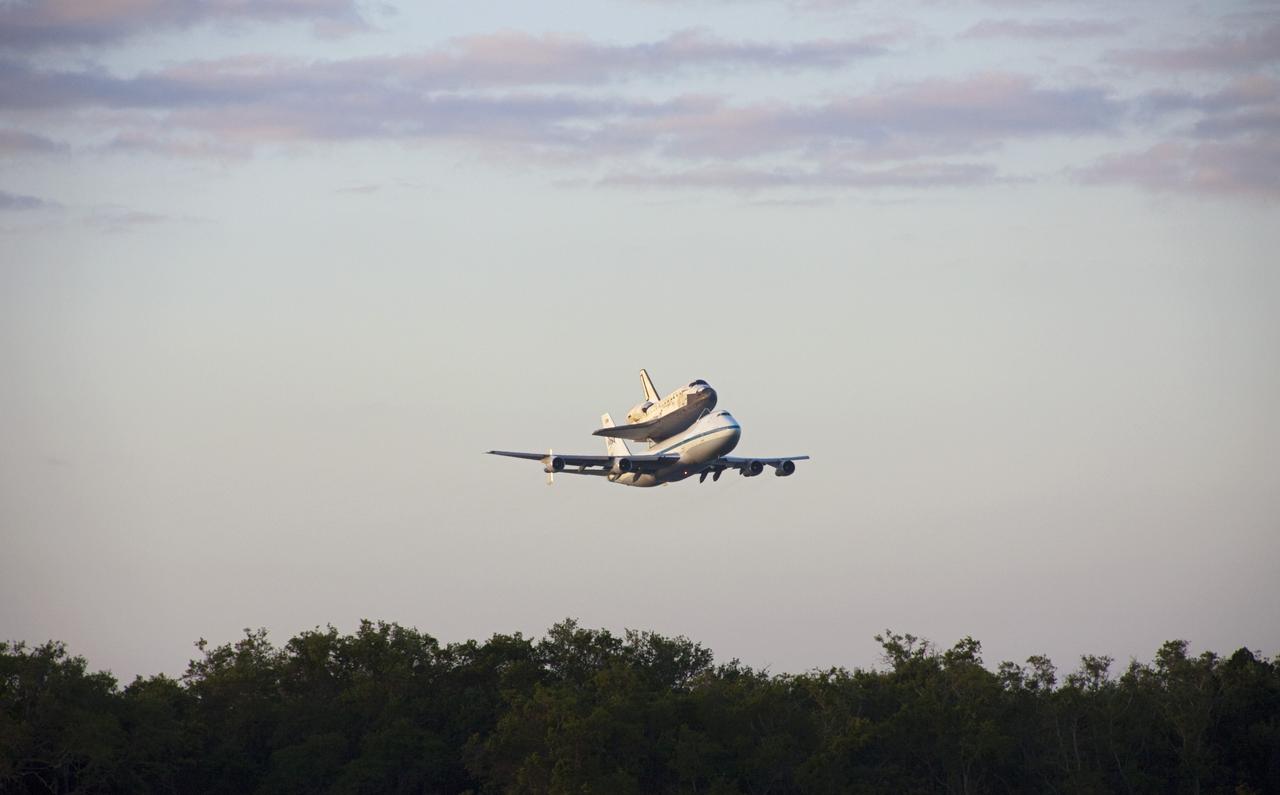
CAPE CANAVERAL, Fla. – Space shuttle Discovery, mounted to a Shuttle Carrier Aircraft, rises just after 7 a.m. EDT from the Shuttle Landing Facility at NASA's Kennedy Space Center in Florida. The duo is beginning their 3 1/2 hour ferry flight to the Washington Dulles International Airport in Virginia. Discovery is leaving Kennedy after more than 28 years of service beginning with its arrival on the space coast Nov. 9, 1983. Discovery first launched to space Aug. 30, 1984, on the STS-41D mission. Discovery is the agency's most-flown shuttle with 39 missions, more than 148 million miles and a total of one year in space. Discovery is set to move to the Smithsonian's National Air and Space Museum Steven F. Udvar-Hazy Center on April 19 where it will be placed on public display. For more information on the SCA, visit http://www.nasa.gov/centers/dryden/news/FactSheets/FS-013-DFRC.html. For more information on shuttle transition and retirement activities, visit http://www.nasa.gov/transition. Photo credit: NASA/Jim Grossmann
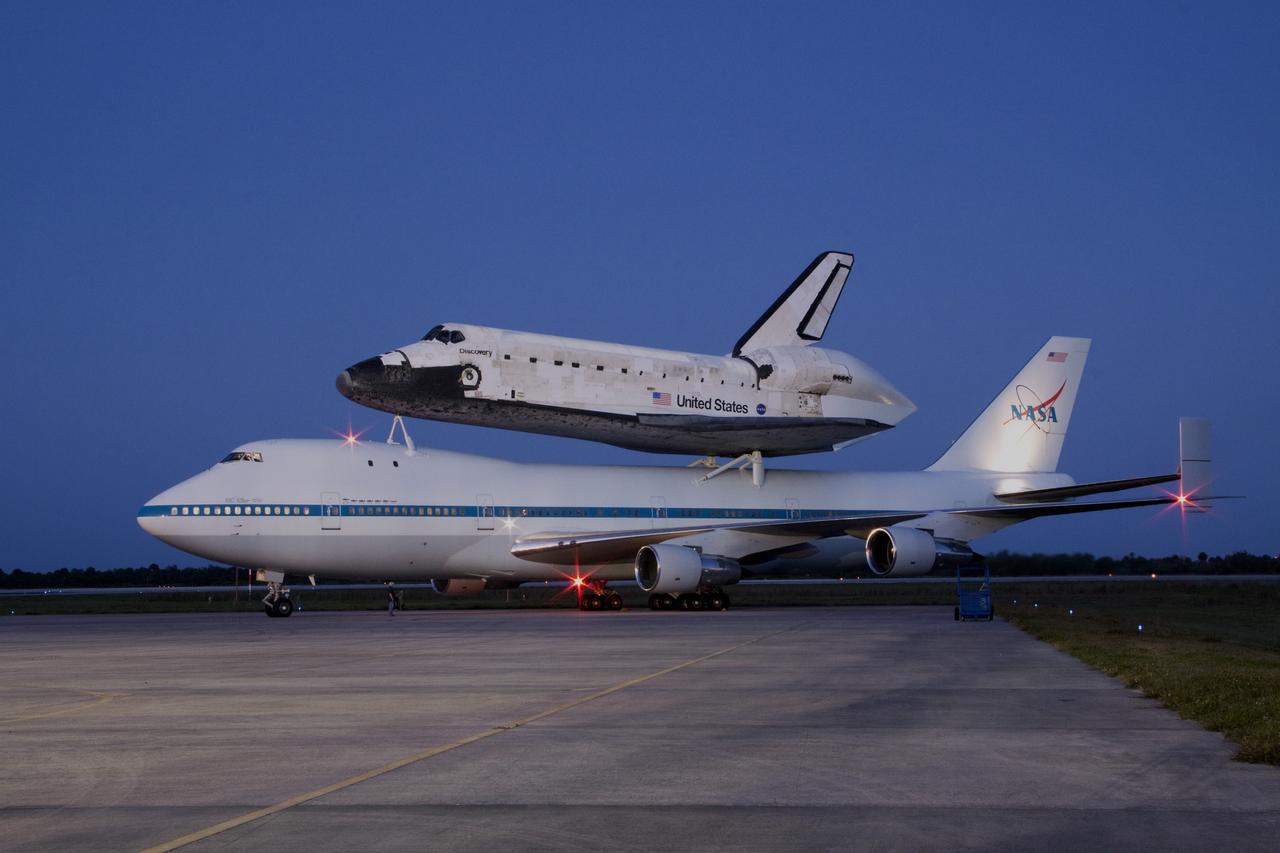
CAPE CANAVERAL, Fla. – Space shuttle Discovery, mounted to a Shuttle Carrier Aircraft, is illumined just before dawn on the ramp of the Shuttle Landing Facility at NASA's Kennedy Space Center in Florida. The duo is set to begin their 3 1/2 hour ferry flight to the Washington Dulles International Airport in Virginia at about 7 a.m. EDT. Discovery is leaving Kennedy after more than 28 years of service beginning with its arrival on the space coast Nov. 9, 1983. Discovery first launched to space Aug. 30, 1984, on the STS-41D mission. Discovery is the agency's most-flown shuttle with 39 missions, more than 148 million miles and a total of one year in space. Discovery is set to move to the Smithsonian's National Air and Space Museum Steven F. Udvar-Hazy Center on April 19 where it will be placed on public display. For more information on the SCA, visit http://www.nasa.gov/centers/dryden/news/FactSheets/FS-013-DFRC.html. For more information on shuttle transition and retirement activities, visit http://www.nasa.gov/transition. Photo credit: NASA/Jim Grossmann
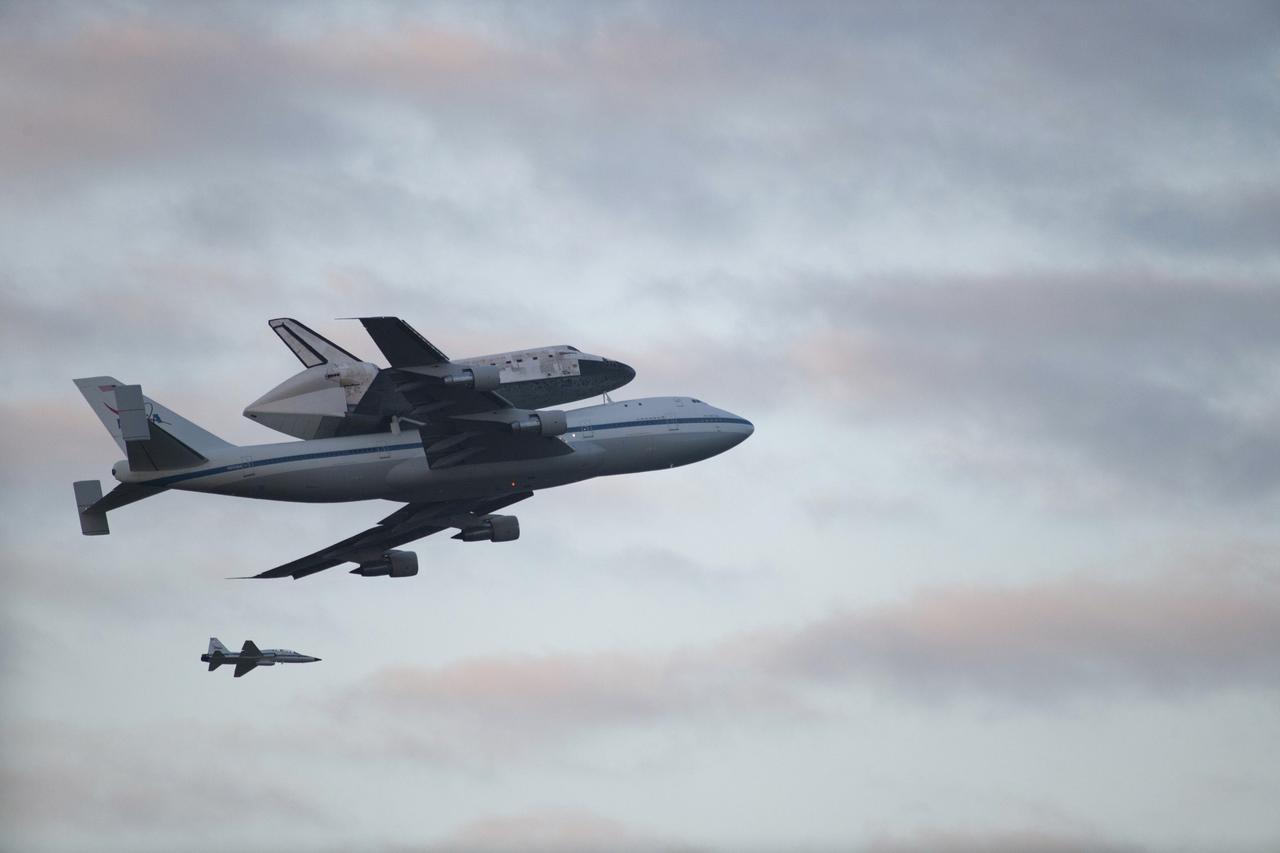
CAPE CANAVERAL, Fla. – Space shuttle Discovery, mounted to a Shuttle Carrier Aircraft, flies over the Shuttle Landing Facility at NASA's Kennedy Space Center in Florida after making a flyby of Cocoa Beach and Patrick Air Force Base. The duo is beginning its ferry flight to the Washington Dulles International Airport in Virginia that also includes a flyby of the Space Coast and Washington, D.C. Also flying along with the pair is a T-38 training jet. Discovery is leaving Kennedy after more than 28 years of service beginning with its arrival on the space coast Nov. 9, 1983. Discovery first launched to space Aug. 30, 1984, on the STS-41D mission. Discovery is the agency's most-flown shuttle with 39 missions, more than 148 million miles and a total of one year in space. Discovery is set to move to the Smithsonian's National Air and Space Museum Steven F. Udvar-Hazy Center on April 19 where it will be placed on public display. For more information on the SCA, visit http://www.nasa.gov/centers/dryden/news/FactSheets/FS-013-DFRC.html. For more information on shuttle transition and retirement activities, visit http://www.nasa.gov/transition. Photo credit: NASA/Kenny Allen
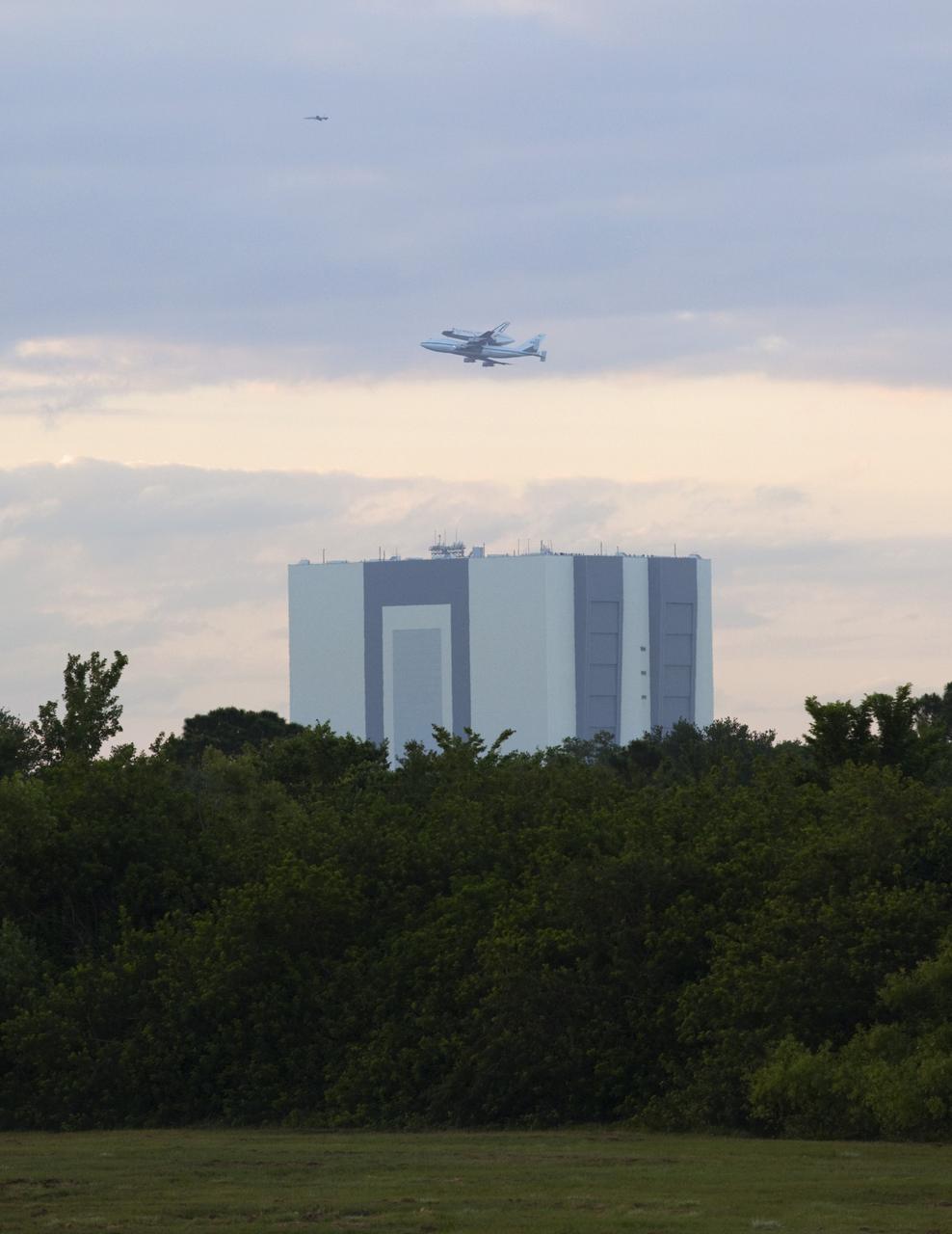
CAPE CANAVERAL, Fla. – Space shuttle Discovery, mounted to a Shuttle Carrier Aircraft, soars past the Vehicle Assembly Building at NASA's Kennedy Space Center in Florida. The duo is beginning their 3 1/2 hour ferry flight to the Washington Dulles International Airport in Virginia. Also flying along with the pair is a T-38 training jet. Discovery is leaving Kennedy after more than 28 years of service beginning with its arrival on the space coast Nov. 9, 1983. Discovery first launched to space Aug. 30, 1984, on the STS-41D mission. Discovery is the agency's most-flown shuttle with 39 missions, more than 148 million miles and a total of one year in space. Discovery is set to move to the Smithsonian's National Air and Space Museum Steven F. Udvar-Hazy Center on April 19 where it will be placed on public display. For more information on the SCA, visit http://www.nasa.gov/centers/dryden/news/FactSheets/FS-013-DFRC.html. For more information on shuttle transition and retirement activities, visit http://www.nasa.gov/transition. Photo credit: NASA/Frankie Martin
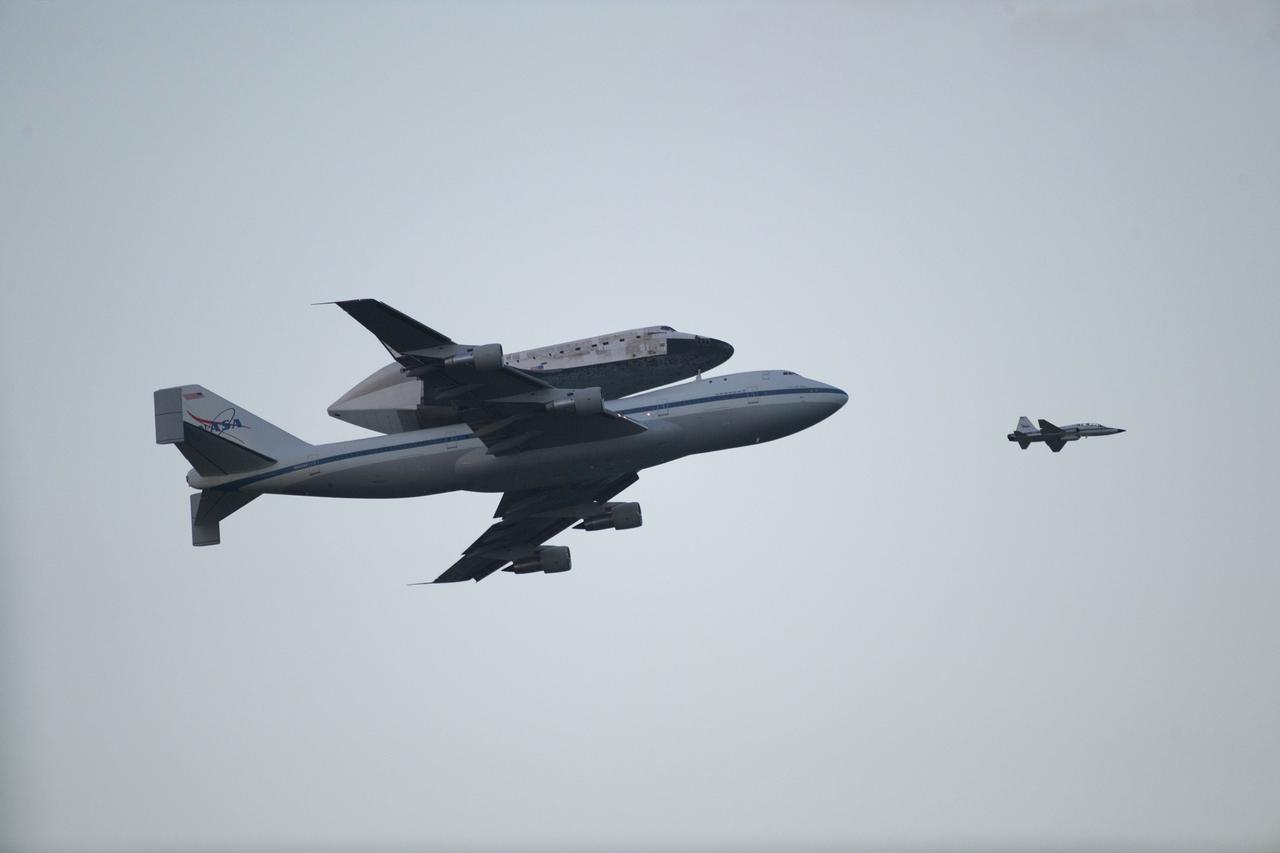
CAPE CANAVERAL, Fla. – Space shuttle Discovery, mounted to a Shuttle Carrier Aircraft, flies over the Shuttle Landing Facility at NASA's Kennedy Space Center in Florida after making a flyby of Cocoa Beach and Patrick Air Force Base. The duo is beginning its ferry flight to the Washington Dulles International Airport in Virginia that also includes a flyby of the Space Coast and Washington, D.C. Also flying along with the pair is a T-38 training jet. Discovery is leaving Kennedy after more than 28 years of service beginning with its arrival on the space coast Nov. 9, 1983. Discovery first launched to space Aug. 30, 1984, on the STS-41D mission. Discovery is the agency's most-flown shuttle with 39 missions, more than 148 million miles and a total of one year in space. Discovery is set to move to the Smithsonian's National Air and Space Museum Steven F. Udvar-Hazy Center on April 19 where it will be placed on public display. For more information on the SCA, visit http://www.nasa.gov/centers/dryden/news/FactSheets/FS-013-DFRC.html. For more information on shuttle transition and retirement activities, visit http://www.nasa.gov/transition. Photo credit: NASA/Kenny Allen
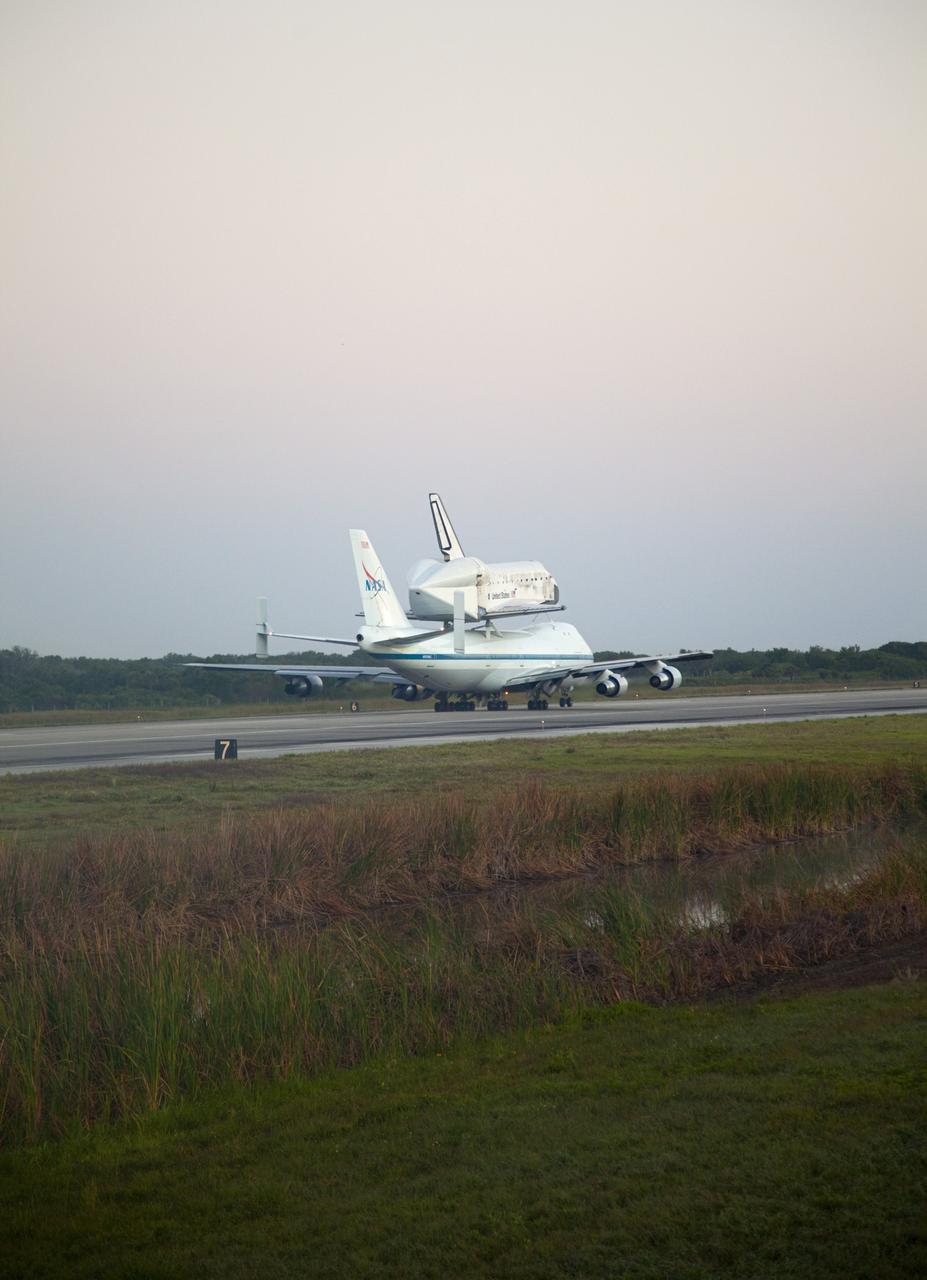
CAPE CANAVERAL, Fla. – Space shuttle Discovery, mounted to a Shuttle Carrier Aircraft, prepares for takeoff on the runway of the Shuttle Landing Facility at NASA's Kennedy Space Center in Florida. The duo is set to begin their 3 1/2 hour ferry flight to the Washington Dulles International Airport in Virginia at about 7 a.m. EDT. Above the two craft is a NASA helicopter covering the departure. Discovery is leaving Kennedy after more than 28 years of service beginning with its arrival on the space coast Nov. 9, 1983. Discovery first launched to space Aug. 30, 1984, on the STS-41D mission. Discovery is the agency's most-flown shuttle with 39 missions, more than 148 million miles and a total of one year in space. Discovery is set to move to the Smithsonian's National Air and Space Museum Steven F. Udvar-Hazy Center on April 19 where it will be placed on public display. For more information on the SCA, visit http://www.nasa.gov/centers/dryden/news/FactSheets/FS-013-DFRC.html. For more information on shuttle transition and retirement activities, visit http://www.nasa.gov/transition. Photo credit: NASA/Frankie Martin