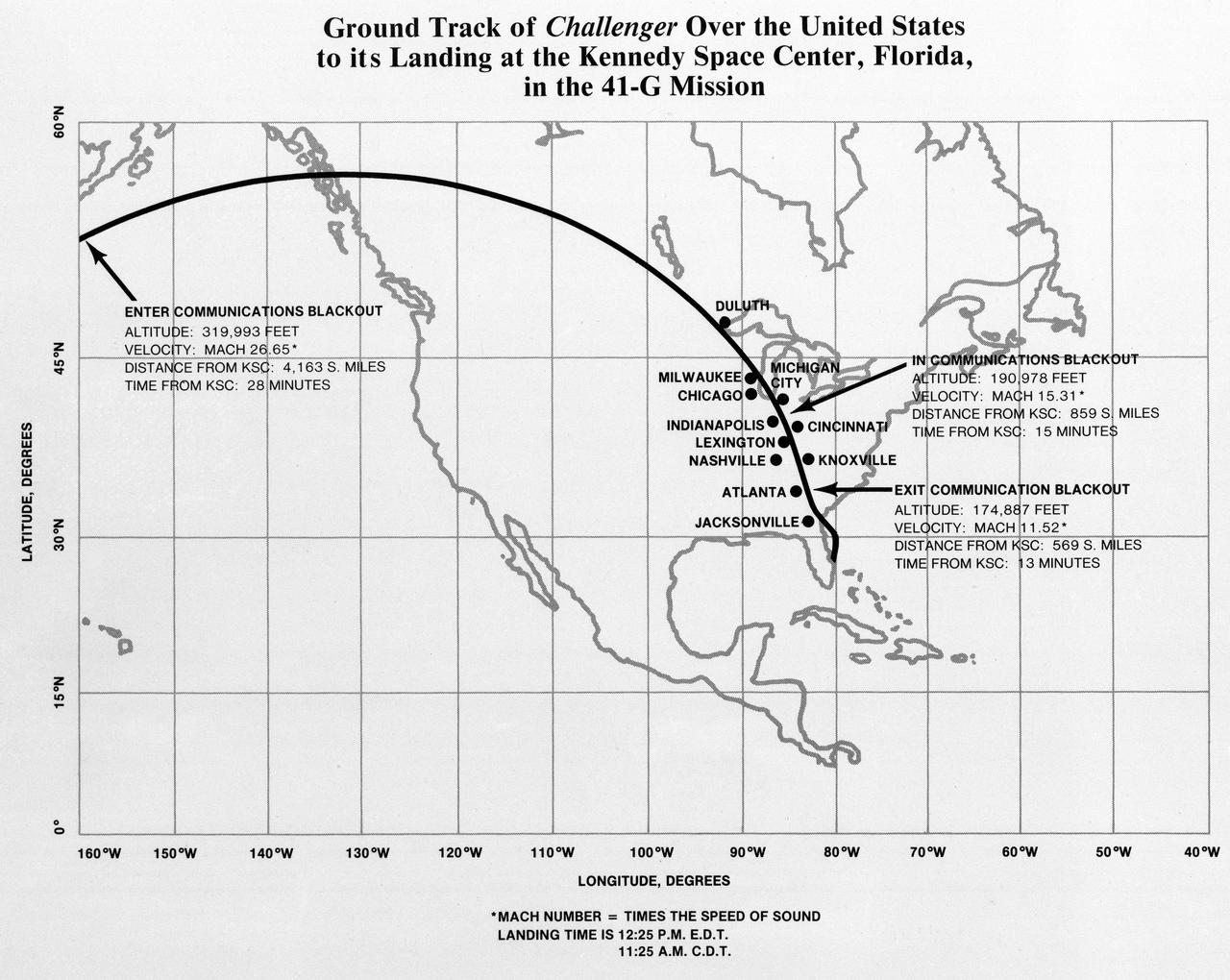
Art drawing of ground track over U.S. of landing for STS-41G. 1. ART CONCEPTS - STS-41G MAP (LANDING) KSC, FL
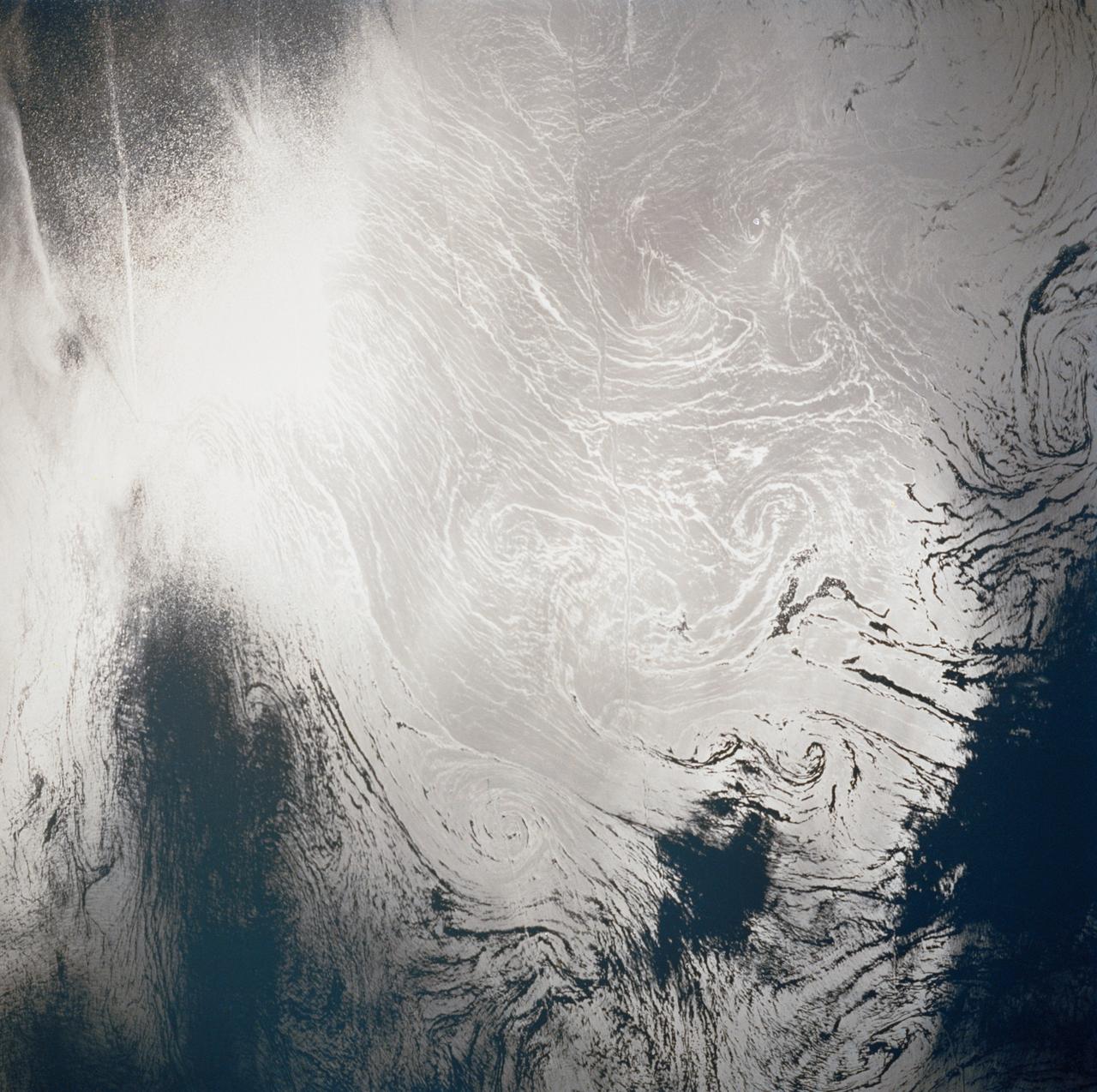
41G-38-060 (5-13 Oct 1984) --- A large ship wake in the central Mediterranean Sea is highlighted by sunglint in this handheld camera's view from STS-41G. According to NASA and U.S. Navy scientists studying the STS-41G film, the depicted reflectance is similar to oil slicks seen in the various oceans of the world. They note that it is apparent that a ship is pumping a mixture of bilge water and oil overboard. The crew consisted of astronauts Robert L. Crippen, commander; Jon A. McBride, pilot; mission specialist's Kathryn D. Sullivan, Sally K. Ride, and David D. Leestma; Canadian astronaut Marc Garneau; and Paul D. Scully-Power, payload specialist. EDITOR'S NOTE: The STS-41G mission had the first American female EVA (Sullivan); first seven-person crew; first orbital fuel transfer; and the first Canadian (Garneau).
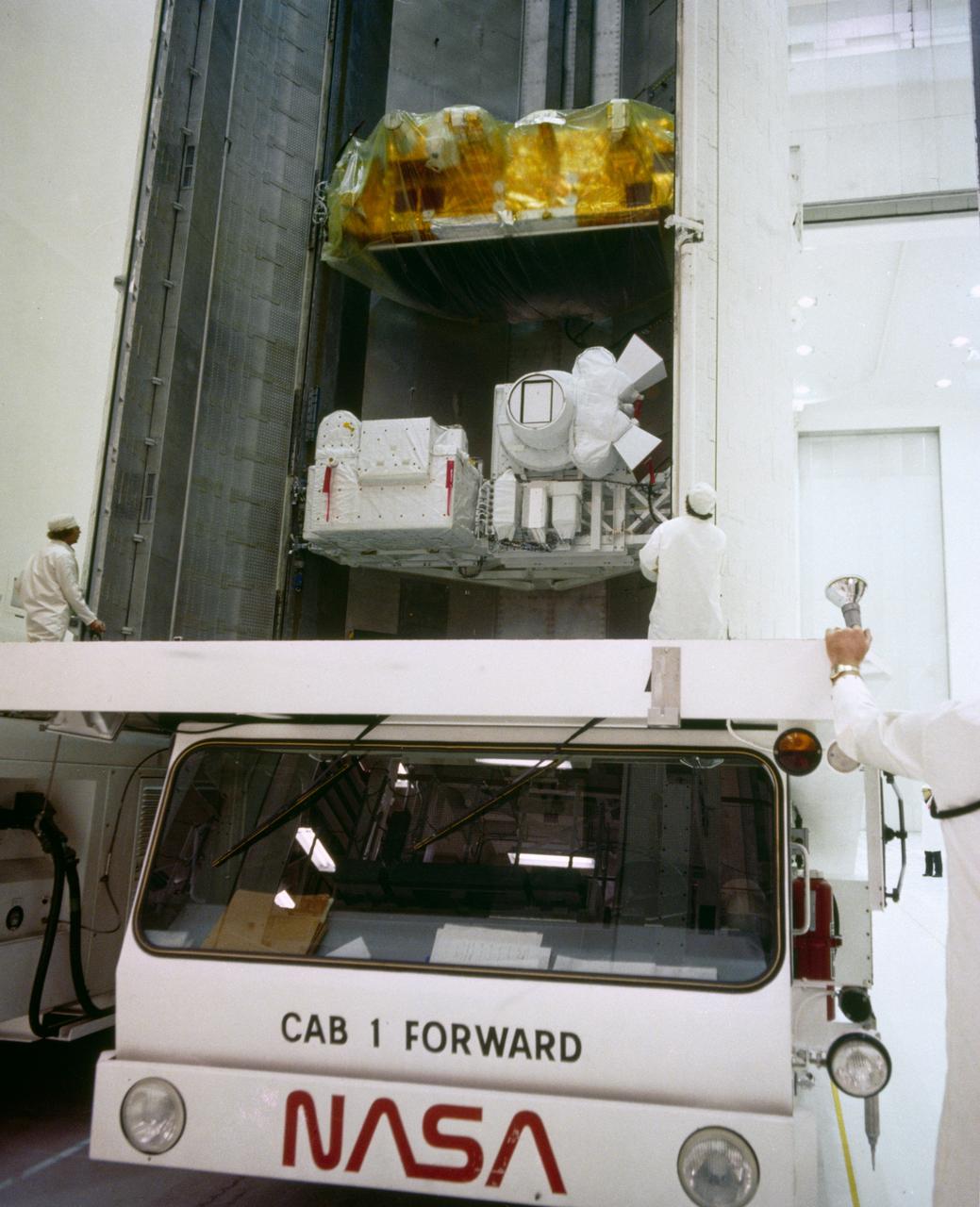
Payload canister transporter in Vertical Processing Facility Clean Room loaded with Earth Radiation Budget Experiment (ERBS), Large Format Camera (LFC), and Orbital Reservicing System (ORS) for STS-41G Mission. 1. STS-41G - EXPERIMENTS 2. CAMERAS - LFC KSC, FL Also available in 4x5 CN
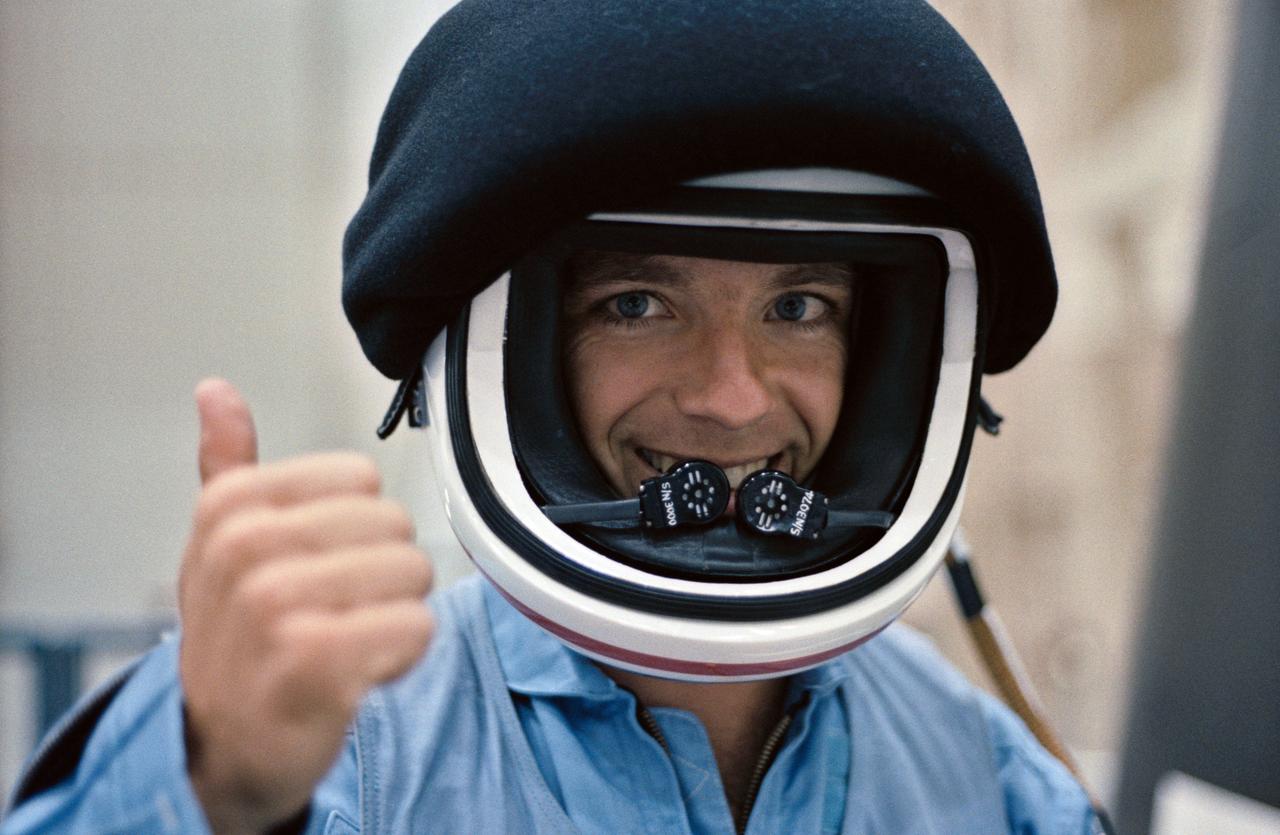
Views of the STS-41G Crew, Bldg. 9A, 1-G Training Facility. JSC, HOUSTON, TX
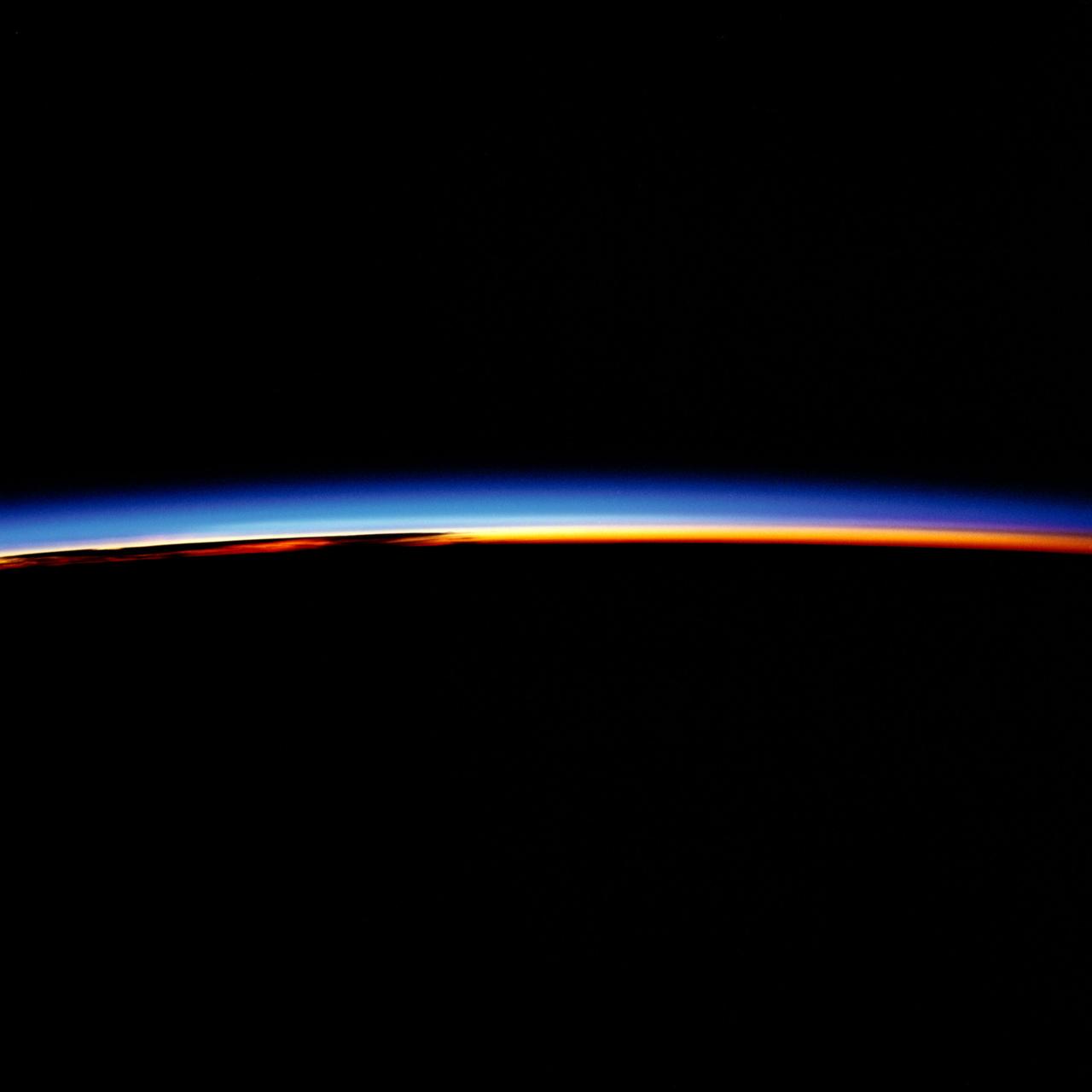
41G-34-036 (5-13 Oct 1984) --- When in space, Space Shuttle astronauts experience 18-dawns to every one on terra firma. The crew of NASA's STS-41G mission captured these spectacular colors just prior to passing through one of those orbital dawns in October of 1984. The scene is over the Pacific Ocean, approximately 2,000 miles from Tokyo. The bands of color represent the various layers of aerosol which surround the planet. The brilliant red is the atmosphere; the overlap between red and blue is the stratosphere; the blue layer is the ionosphere. With increased altitude, the electrons and ions are reduced in number, leaving the vast blackness of space.
![View of the STS-41G OSTA-3 (Space Radiation Laboratory [SRL]) Payload in its workstand. 1. SHUTTLE - PAYLOADS (OSTA-3)](https://images-assets.nasa.gov/image/s84-36853/s84-36853~medium.jpg)
View of the STS-41G OSTA-3 (Space Radiation Laboratory [SRL]) Payload in its workstand. 1. SHUTTLE - PAYLOADS (OSTA-3)
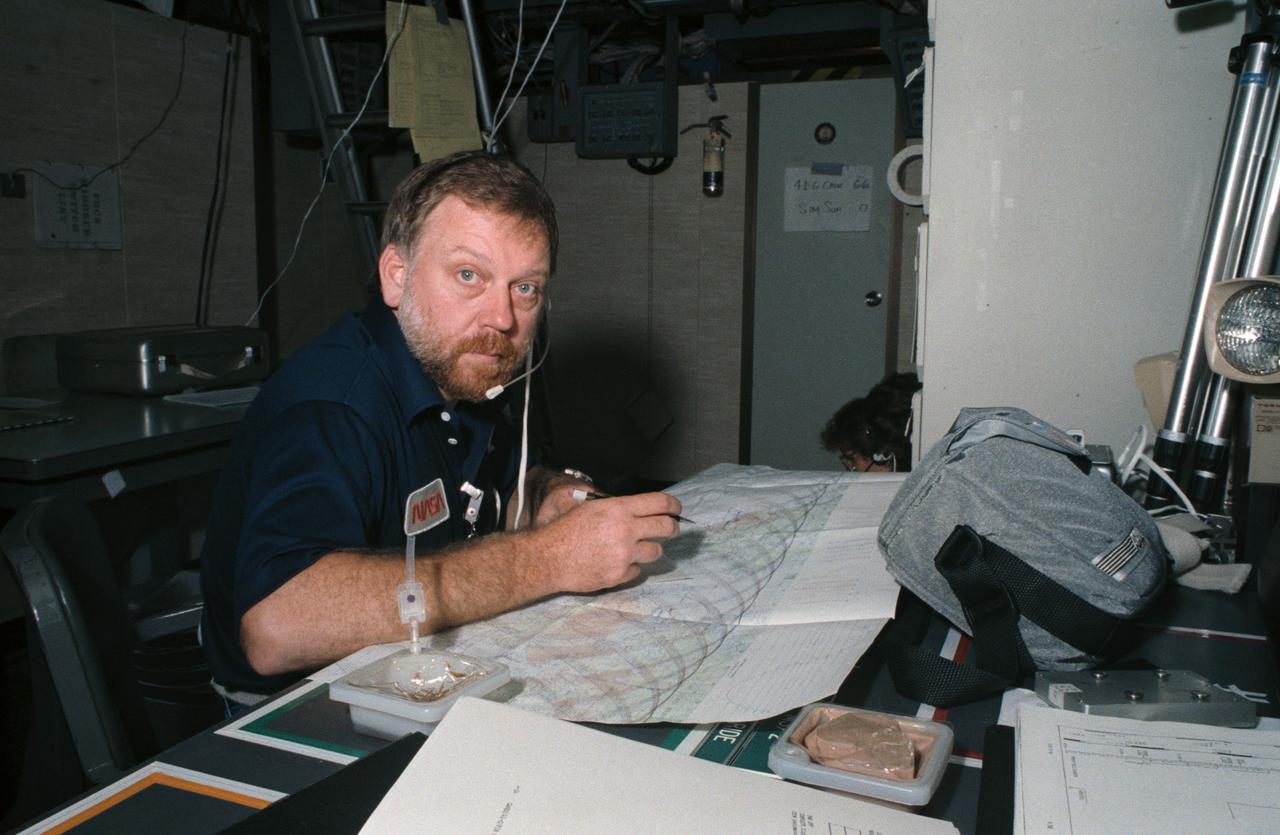
Views of STS-41G Crew member Paul Sculley-Powers during mission experiment training, Fixed Base Simulator, Bldg. 5, 09/09/1984. 1. SHUTTLE - SIMUALTOR (1-G) JSC, HOUSTON, TX
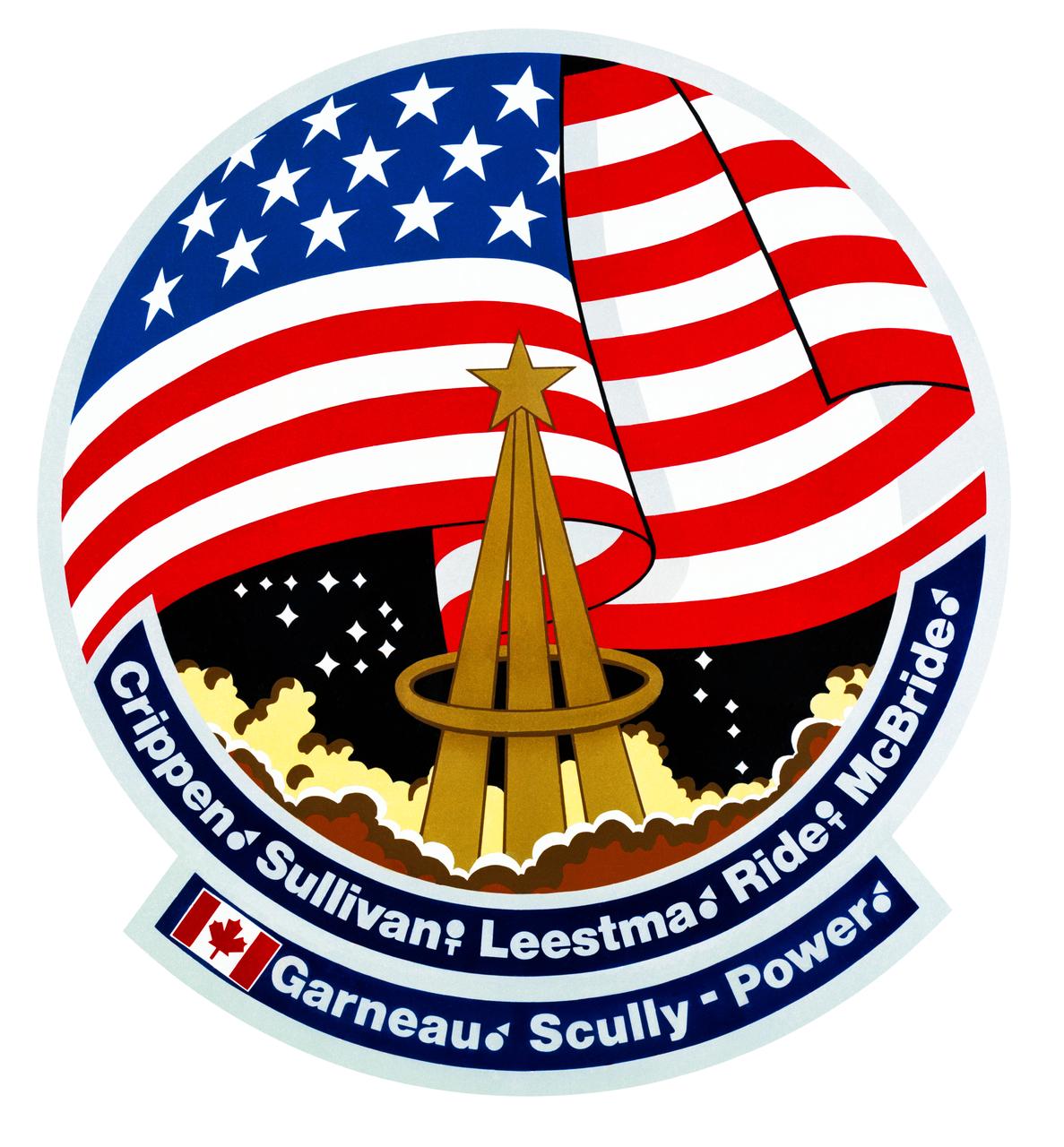
S84-36158 (June 1984) --- The STS-41G Challenger mission insignia focuses on its seven crew members (first to exceed six), the United States flag and the Unity symbol known as the astronaut pin. The pin design in center shows a trio of trajectories merging in infinite space, capped by a bright shining star and encircled by an elliptical wreath denoting orbital flight. Crew members for the (originally-scheduled 17th STS) mission include astronauts Robert L. Crippen and Jon A. McBride, commander and pilot, respectively, whose surnames flank those of the NASA mission specialists - astronauts Kathryn D. Sullivan, David C. Leestma and Sally K. Ride. Paul Scully-Power, a United States Navy oceanographer, and Marc Garneau, a Canadian, join the crew as payload specialists. The artwork was done for NASA by Patrick Rawlings. The NASA insignia design for space shuttle flights is reserved for use by the astronauts and for other official use as the NASA Administrator may authorize. Public availability has been approved only in the forms of illustrations by the various news media. When and if there is any change in this policy, which is not anticipated, the change will be publicly announced. Photo credit: NASA
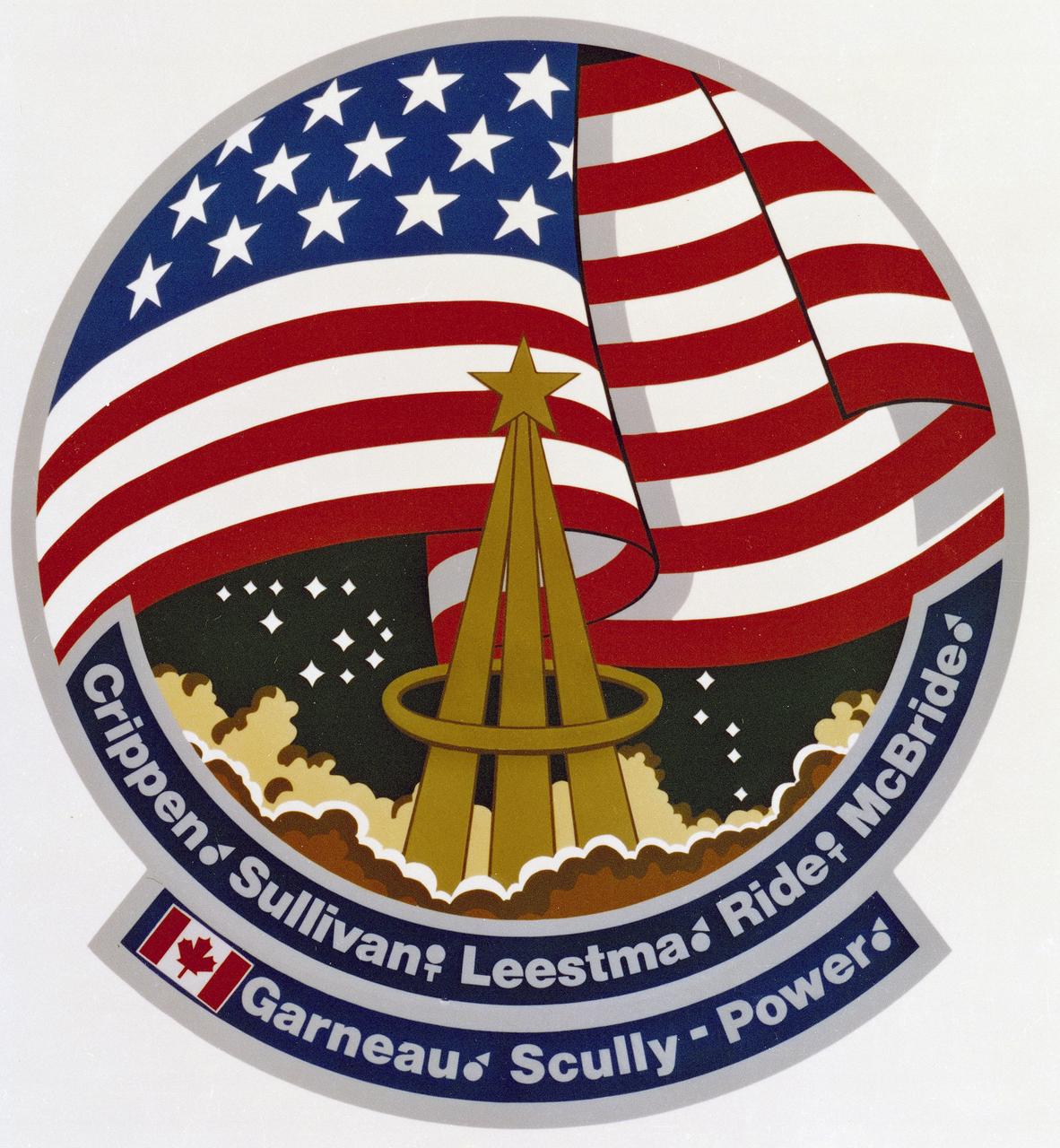
The 41-G mission insignia focuses on its seven crew members (first to exceed six), the U.S. Flag and the Unity symbol known as the astronaut pin. The pin design in center shows a trio of trajectories merging in infinite space, capped by a bright shining star and encircled by an elliptical wreath denoting orbital flight.
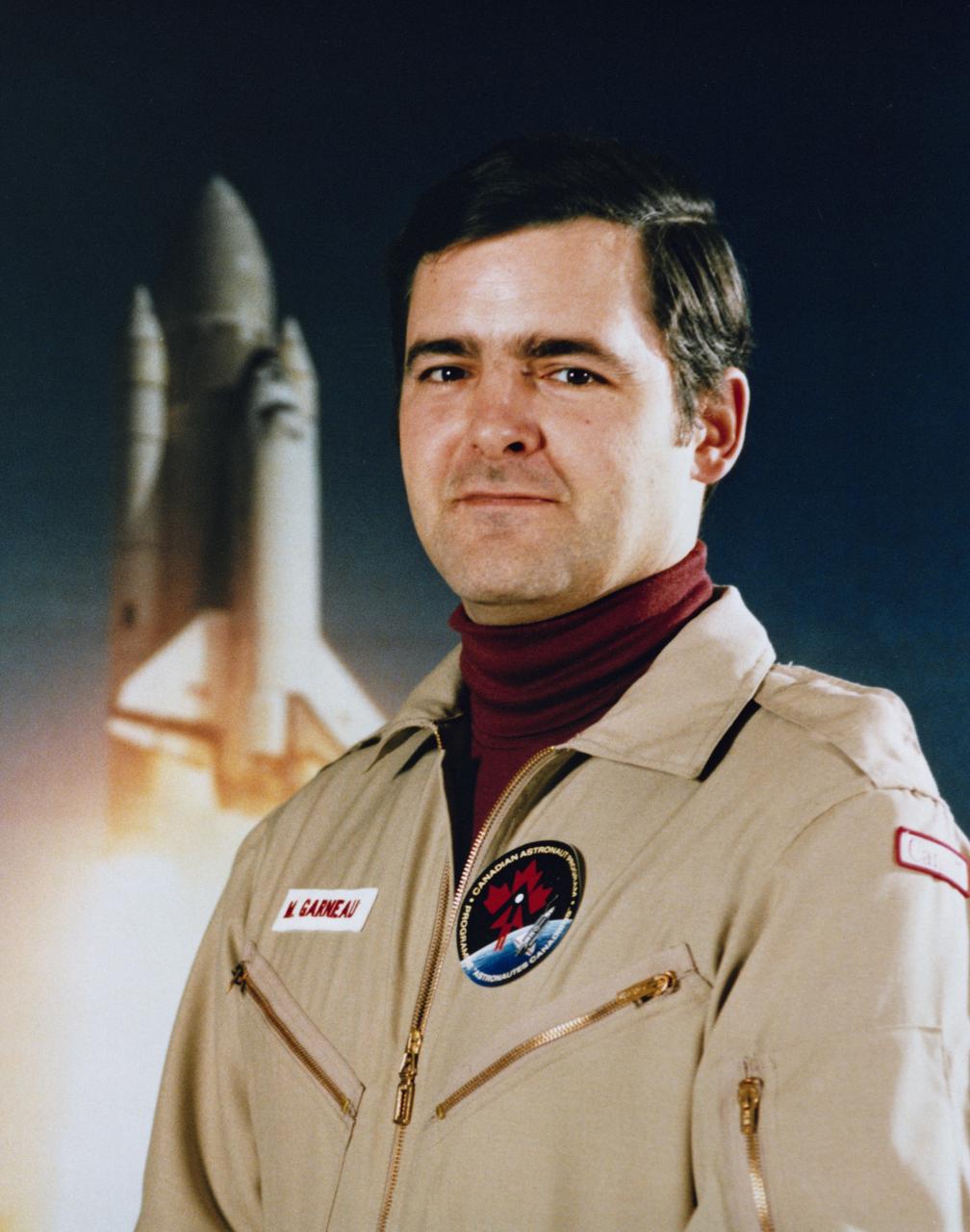
Portrait photograph, Canadian Payload Specialist Mark Garneau, assigned to the STS-16/41G Mission. Also available in 4x5 B&W
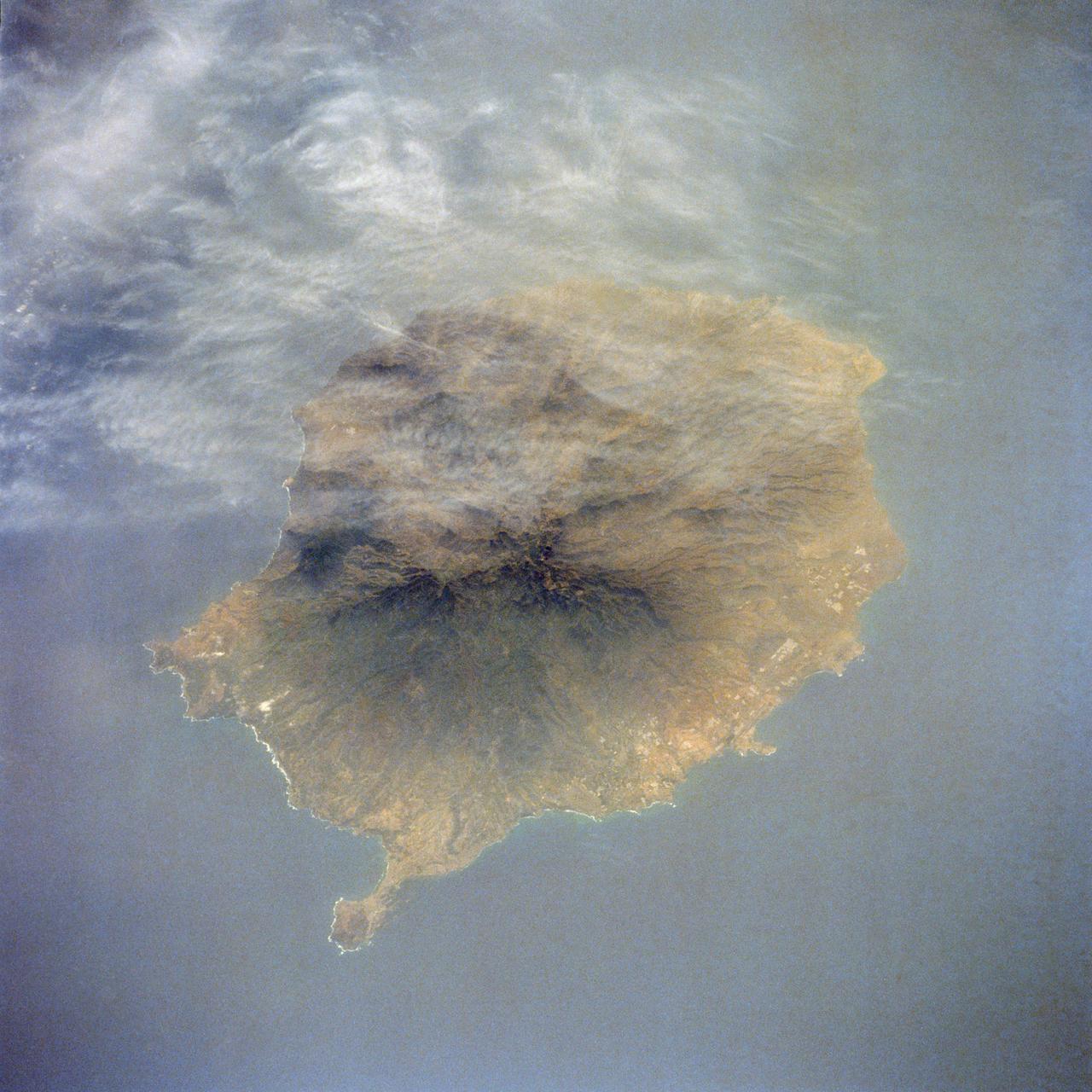
41G-38-084 (5-13 Oct 1984) --- A light, thin cirrus cloud layer partially obscures the island of Gran Canaria in the Canary Islands (15.5 degrees west, 28 degrees north).
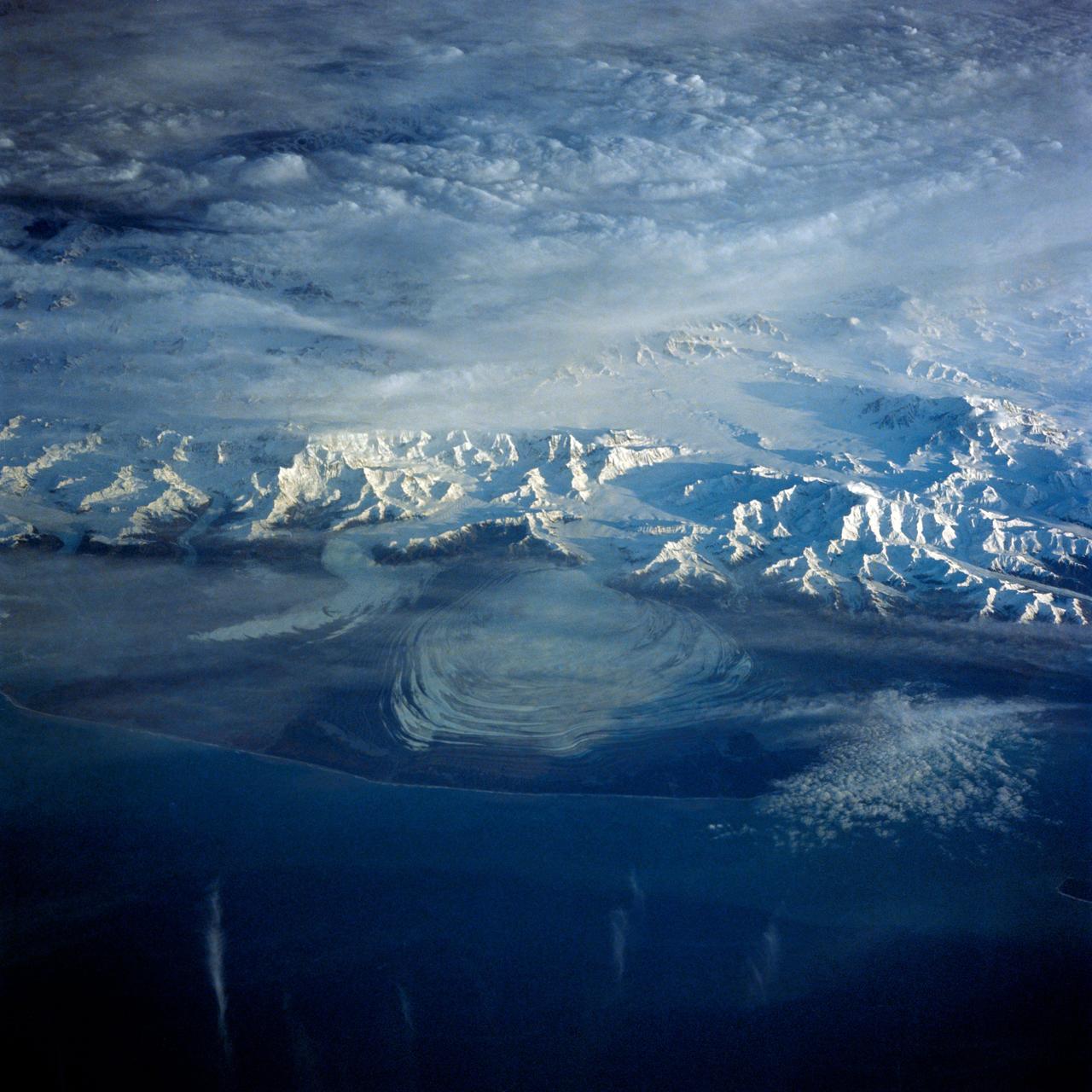
41G-43-016 (5-13 Oct 1984) --- The Gulf of Alaska, with the great peaks of the Saint Elias Range of Alaska, Yukon, and British Columbia. Mount Logan, Canada's highest mountain peak at 19,850 feet, is to the left of the center of the photograph. Between Saint Elias Peak and Mount Vancouver, right of center, flows the great Malaspina Glacier in a great lobe of ice shaped like a human ear.
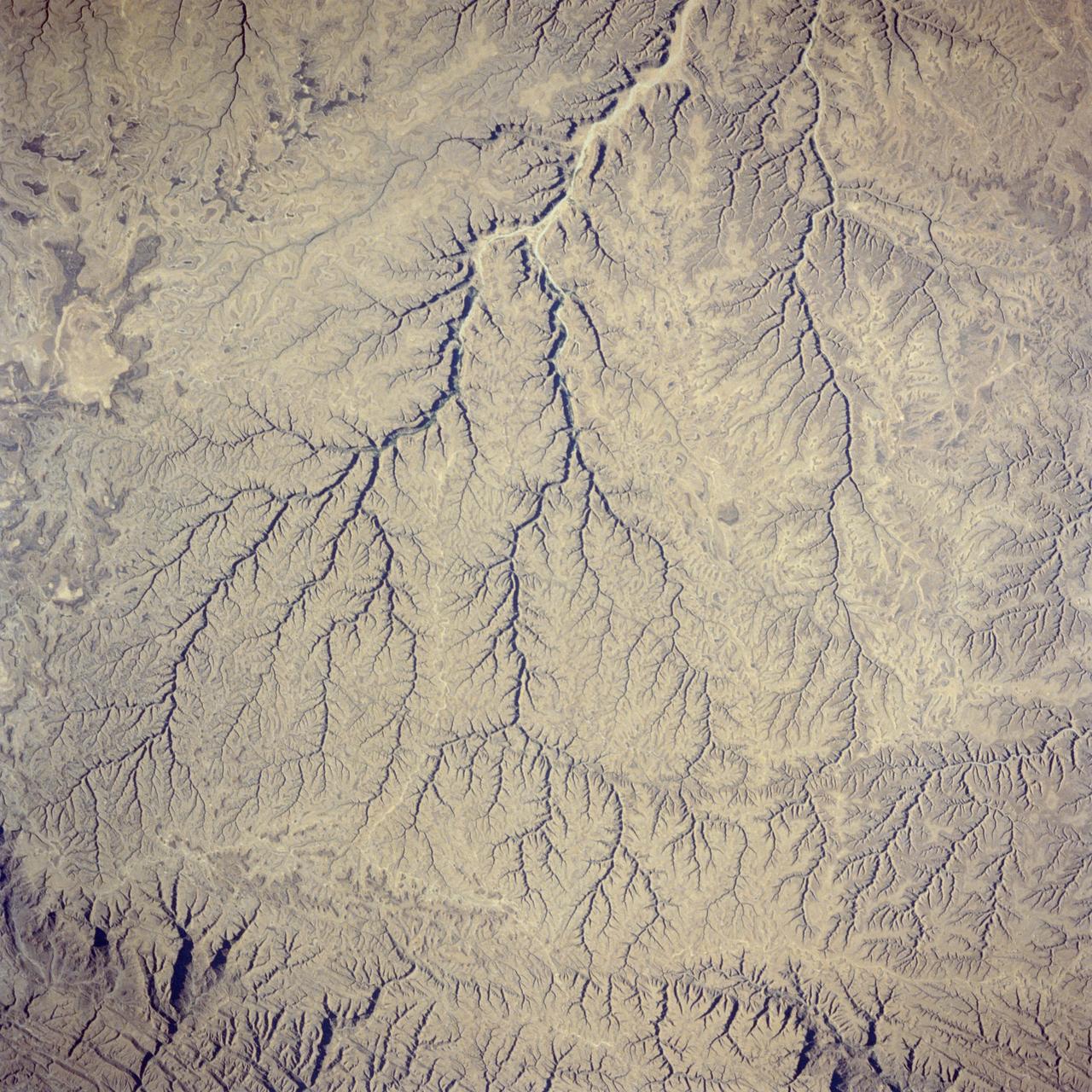
41G-36-036 (5-13 Oct 1984) --- The deeply etched patterns of intermittent streams in the Hadhramaut Plateau of south Yemen. These stream beds, which now rarely carry water, are deeply entrenched, owing to the geologically recent uplift of the plateau. nonetheless, a very distinct watercourse appears along the top and bottom edges of the photograph. In the photograph's upper portion, available water will flow into the vast emptiness of the Rub al Khali (Empty Quarter). In the lower portion, water will flow to the Gulf of Aden.
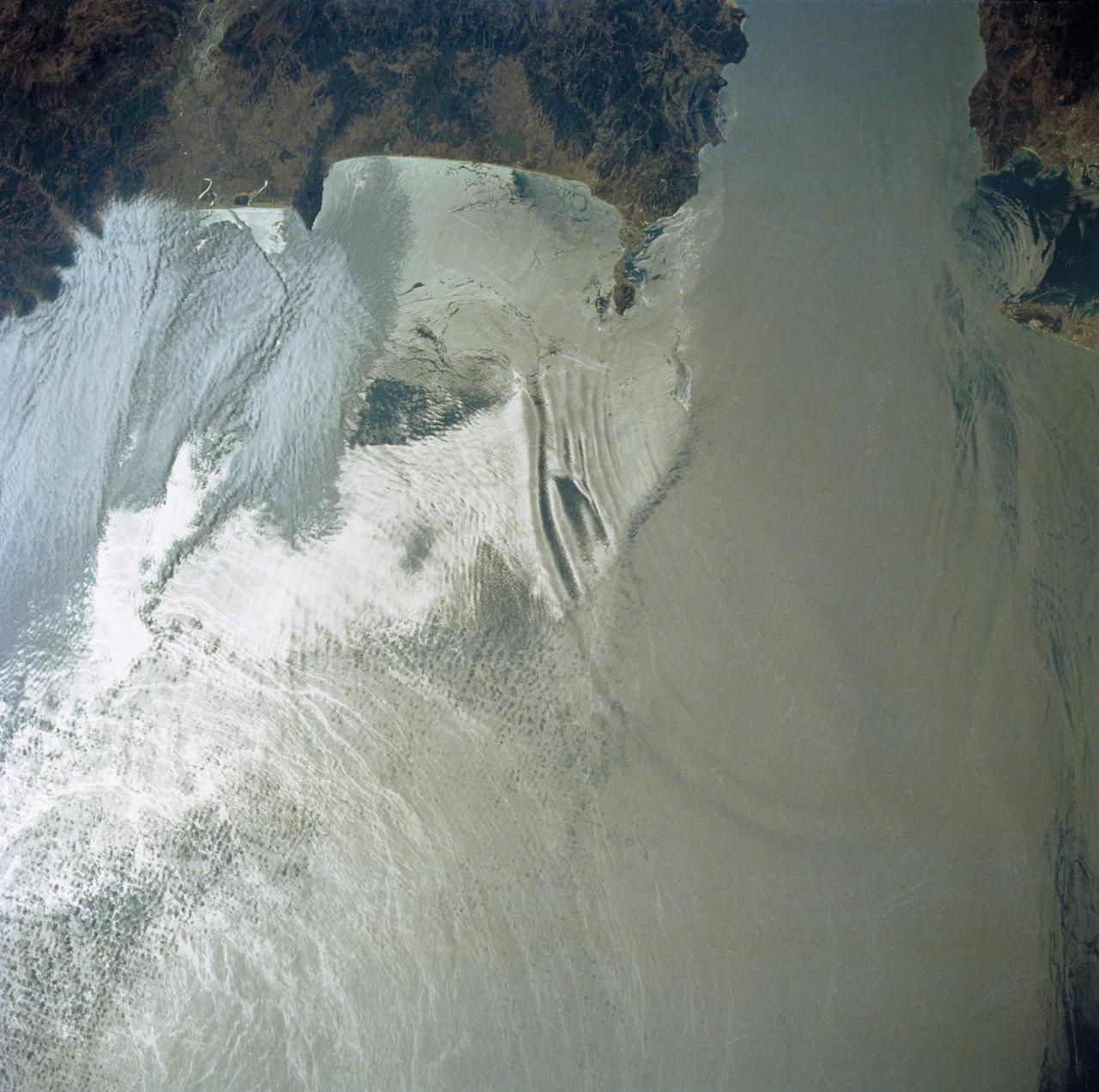
41G-34-098 (5-13 Oct 1984) --- Strait of Gibraltar and western Mediterranean photographed sunglint. Sun reflection on water delineates surface texture, which corresponds to the ocean's dynamics. The large group of waves connecting Gibraltar with the Moroccan coast is the response of the ocean to a tidal pulse moving into the Mediterranean. The low level wing shear line extending out from the Moroccan coastline into the Mediterranean for approximately 40 miles is the southern extremity of the wind funneling through the strait. This is the first high resolution photograph ever taken of this phenomenon permitting detailed delineation of individual waves which comprise the wave packet.
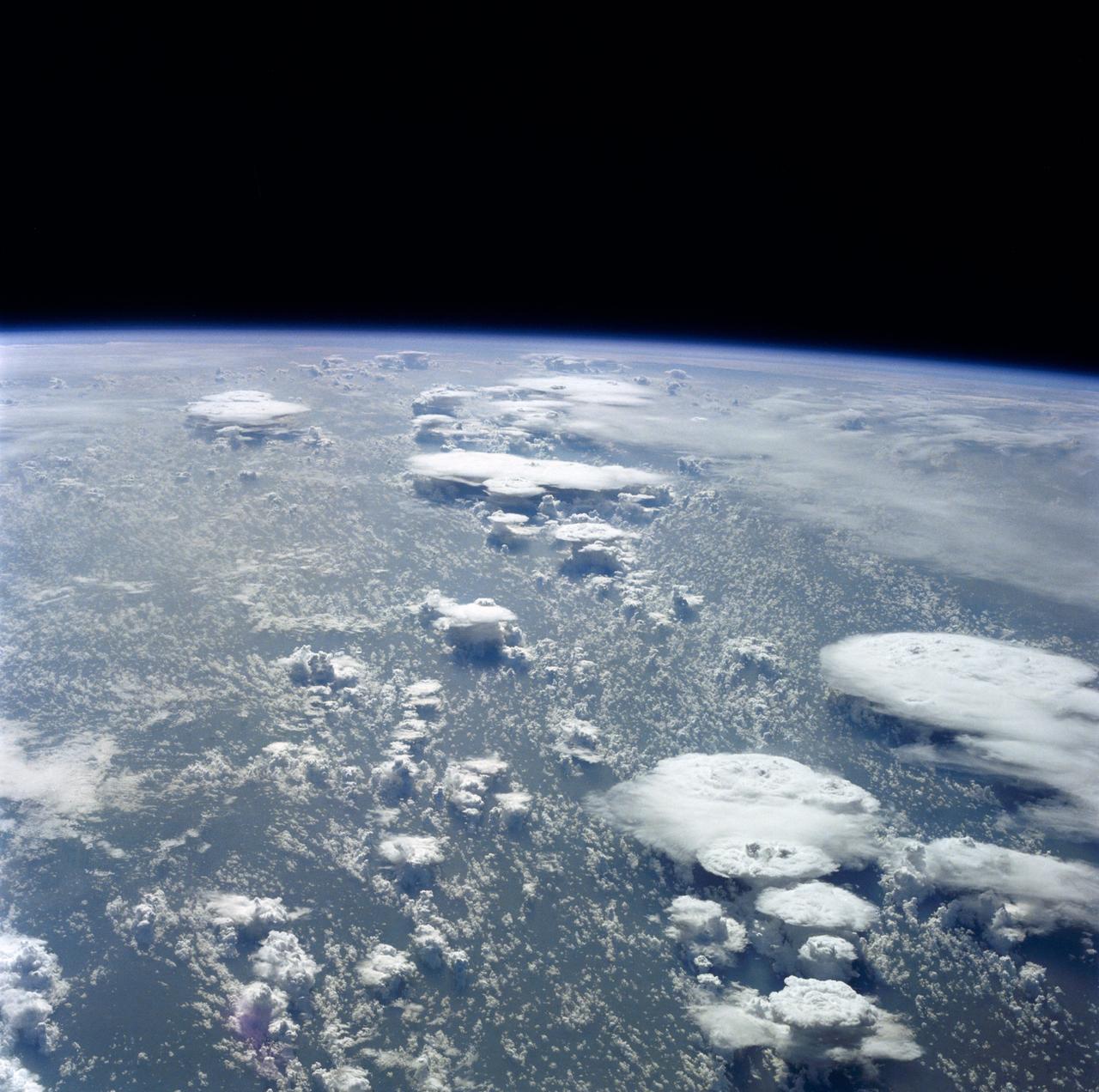
41G-39-044 (5-13 Oct 1984) --- "Flatirons", cumulonimbus clouds that have flattened out at a high altitude, the result of rapidly rising moist air. At a given altitude, depending on the temperature, wind, and humidity, the cloud mass can no longer rise and the wind aloft shears the cloud. Central Nigeria, an area in which tropical rain forest gives way to dryer savannah lands, lies beneath a layer a heavy haze and smoke. The crew consisted of astronauts Robert L. Crippen, commander; Jon A. McBride, pilot; mission specialist's Kathryn D. Sullivan, Sally K. Ride, and David D. Leestma; Canadian astronaut Marc Garneau, and Paul D. Scully-Power, payload specialist's.
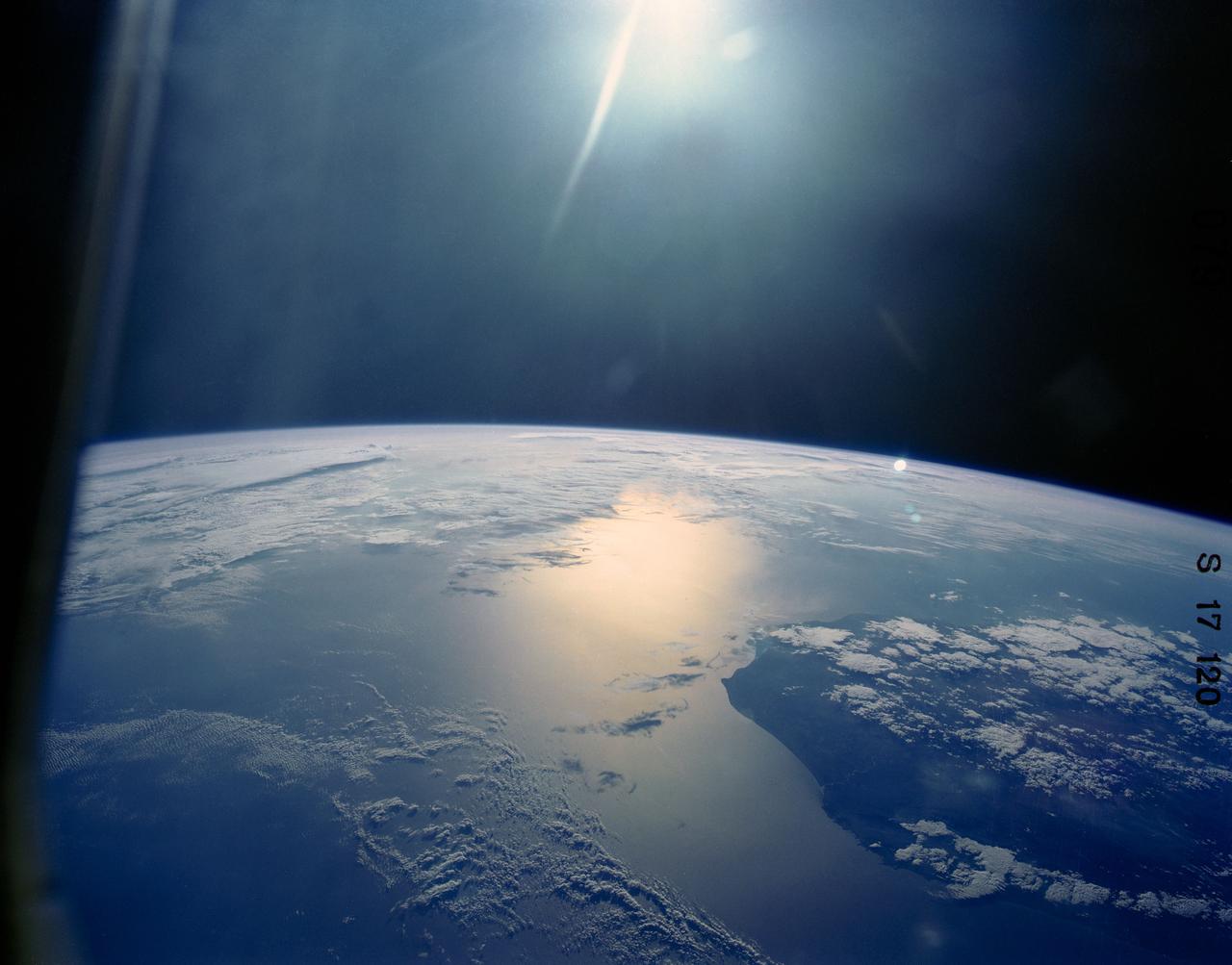
41G-120-079 (5-13 Oct 1984) --- This oblique view, photographed from the Space Shuttle Challenger, shows the south tip of the island of Madagascar. Sunglint reflects on the surface of the Mozambique Channel. The crew consisted of astronauts Robert L. Crippen, commander; Jon A. McBride, pilot; mission specialist's Kathryn D. Sullivan, Sally K. Ride, and David D. Leestma; Canadian astronaut Marc Garneau; and Paul D. Scully-Power, payload specialist. EDITOR'S NOTE: The STS-41G mission had the first American female EVA (Sullivan); first seven-person crew; first orbital fuel transfer; and the first Canadian (Garneau).

S84-43433 (11 Oct 1984) --- Photographed through aft flight deck windows, this 70mm frame shows Astronauts David C. Leestma, left, and Kathryn D. Sullivan at the orbital refueling system (ORS) in the aft cargo bay. A wrist camera on the remote manipulator system (RMS) is perched to record the historic extravehicular activity (EVA). Dr. Sullivan's part of the EVA represented the first such feat for an American woman.
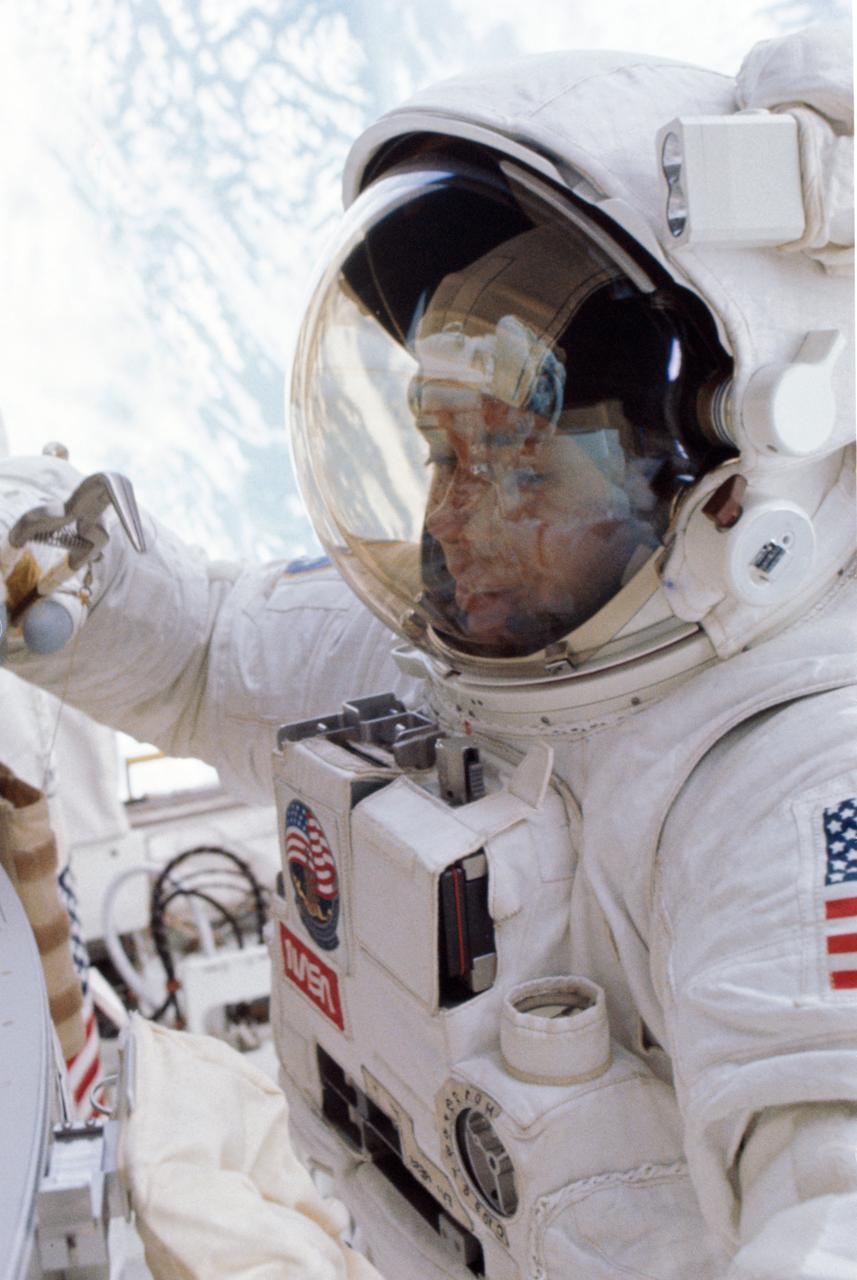
41G-101-013 (14 Oct 1984) --- Astronaut David C. Leestma works at the Orbital Refueling System (ORS) on the Mission Peculiar Support Structure (MPESS) in the aft end of the cargo bay of the Space Shuttle Challenger. Astronaut Kathryn D. Sullivan, America's first woman to perform an extravehicular activity (EVA) with the logging of this busy day, exposed this frame witha 35mm camera. The crew consisted of astronauts Robert L. Crippen, commander; Jon A. McBride, pilot; mission specialist's Kathryn D. Sullivan, Sally K. Ride, and David D. Leestma; Canadian astronaut Marc Garneau; and Paul D. Scully-Power, payload specialist. EDITOR'S NOTE: The STS-41G mission had the first American female EVA (Sullivan); first seven-person crew; first orbital fuel transfer; and the first Canadian (Garneau).
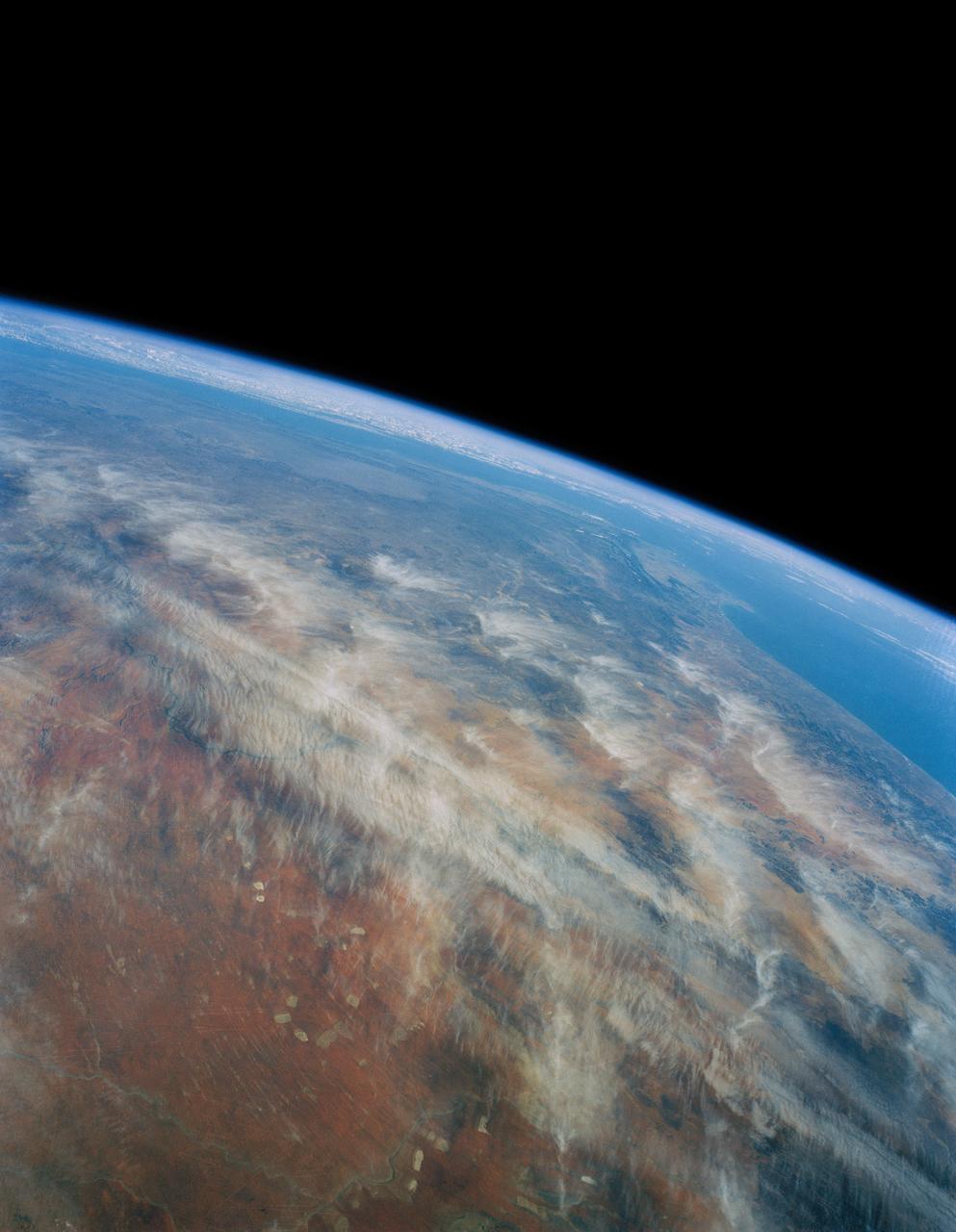
41G-121-189 (5-13 Oct 1984) --- The Kalihari Desert is visible in the foreground of this photograph covering three African nations. The desert is a classic red to orange-red, with small depressions and salt encrustation's which appear as lakes. Visible are Cape Town, the Cape of Good Hope and Cape Agulhas. The crew consisted of astronauts Robert L. Crippen, commander; Jon A. McBride, pilot; mission specialist's Kathryn D. Sullivan, Sally K. Ride, and David D. Leestma; Canadian astronaut Marc Garneau; and Paul D. Scully-Power, payload specialist. EDITOR'S NOTE: The STS-41G mission had the first American female EVA (Sullivan); first seven-person crew; first orbital fuel transfer; and the first Canadian (Garneau).
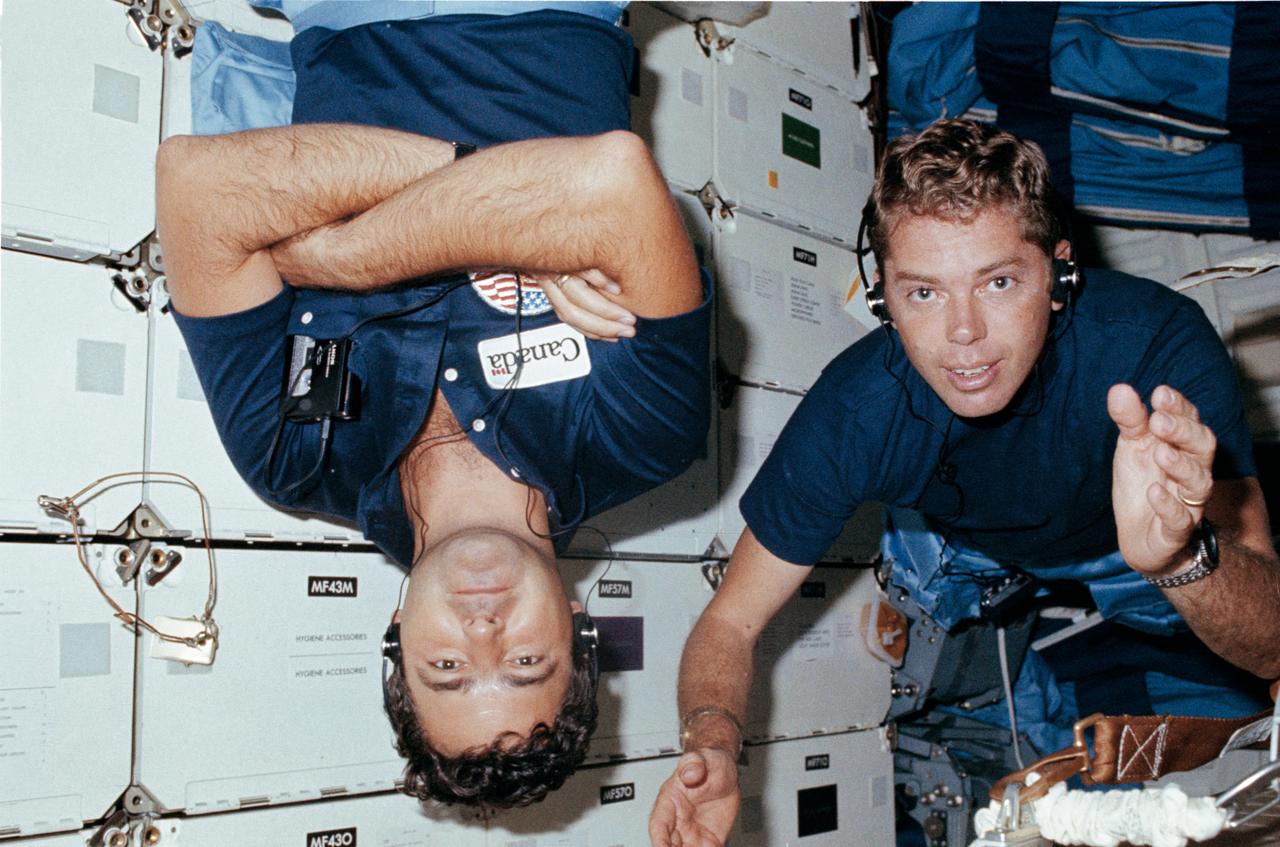
41G-101-039 (5-13 Oct 1984) --- Two members of a record seven-person crew are pictured during Intravehicular Activity (IVA) aboard the Earth-orbiting Space Shuttle Challenger. Hold picture with open hand at right center edge. Astronaut David C. Leestma, mission specialist, is at right observing a test by payload specialist Marc Garneau, representing the National Research Council (NRC) of Canada. Garneau spent much of his on-duty time conducting a series of experiments for the NRC. The crew consisted of astronauts Robert L. Crippen, commander; Jon A. McBride, pilot; mission specialist's Kathryn D. Sullivan, Sally K. Ride, and David D. Leestma; Canadian astronaut Marc Garneau, and Paul D. Scully-Power, payload specialist's. EDITOR'S NOTE: The STS-41G mission had the first American female EVA (Sullivan); first seven-person crew; first orbital fuel transfer; and the first Canadian (Garneau).
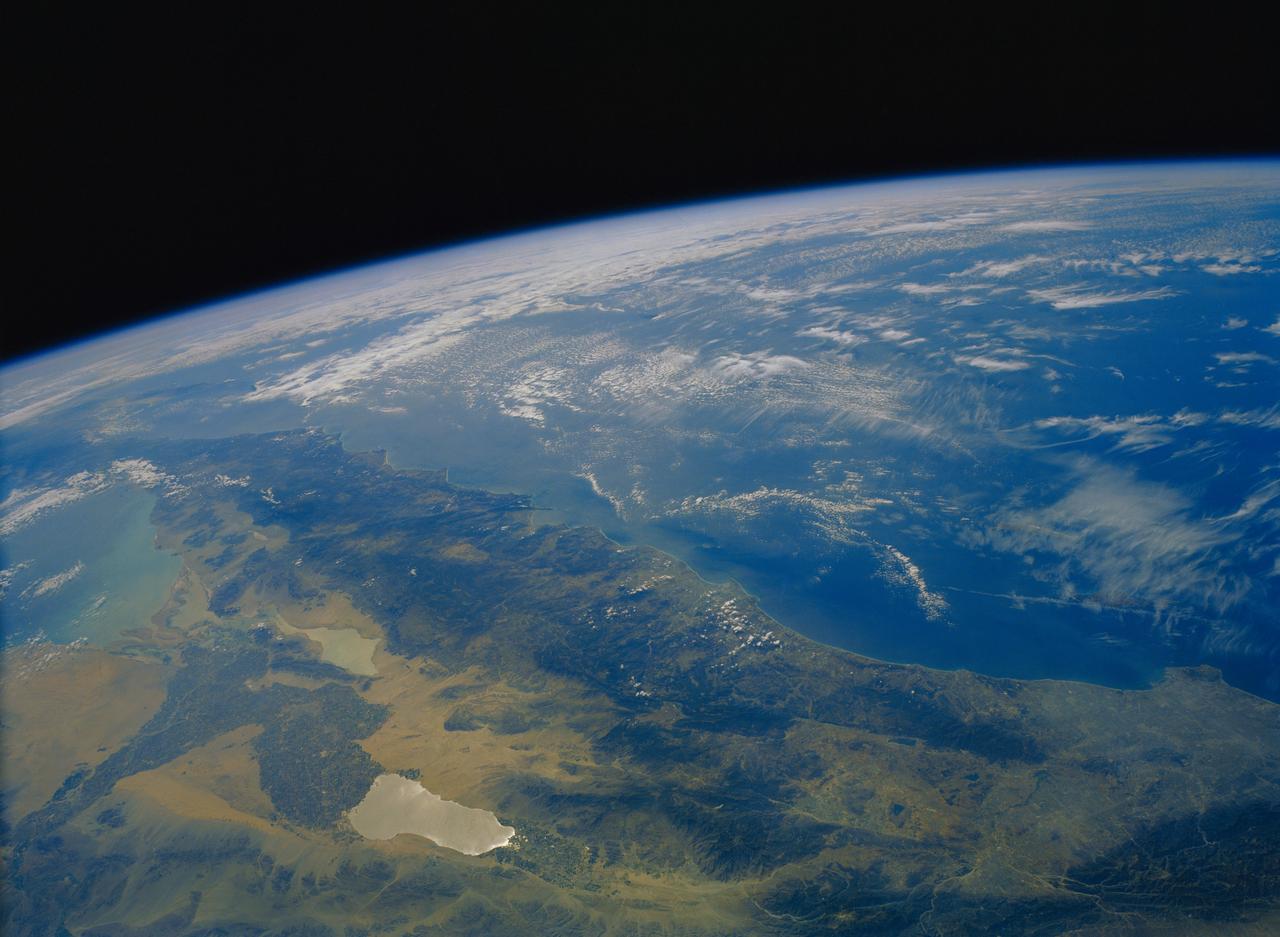
41G-121-057 (5-13 Oct 1984) --- South-looking view of southern California and Baja California. Los Angeles area at lower right. Part of the Imperial Valley, Salton Sea at lower center. Baja is at upper left.
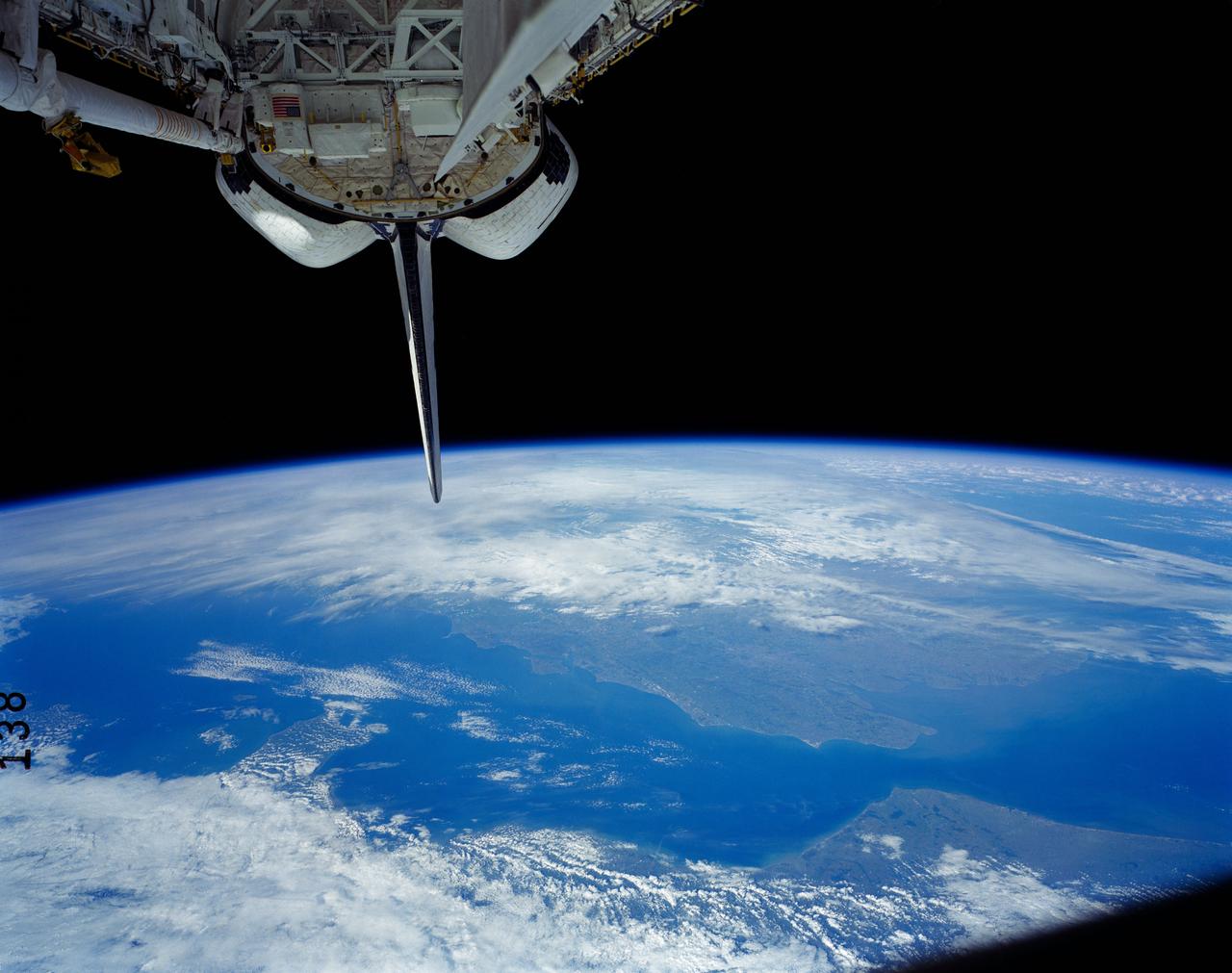
41G-121-138 (5-13 Oct 1984) --- A view of the Earth's horizon featuring France and England. The Strait of Dover and the English channel are visible behind the tail (vertical stabilizer) of Challenger. The remote manipulator system (RMS arm rests in its "stow" position at upper left corner.
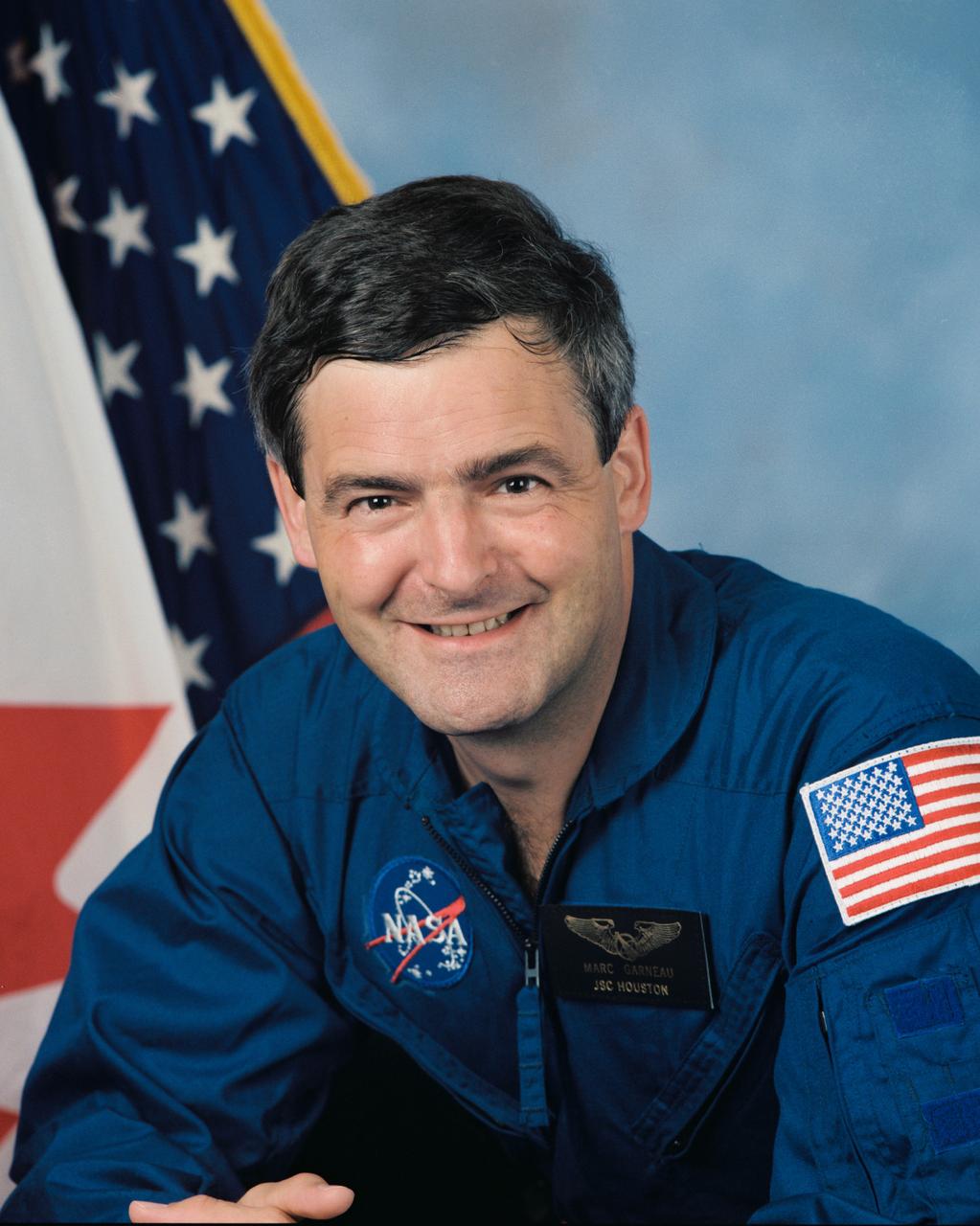
S92-44959 (September 1992) --- Astronaut Marc Garneau, mission specialist representing the Canadian Space Agency. Note: Garneau, who flew as a Canadian payload specialist aboard Challenger for the STS-41G mission in October of 1984, returned to the Johnson Space Center in August of 1992 to begin training as a mission specialist representing his native country. He is one of five international mission specialists currently in training with 19 NASA astronaut candidates selected in March of this year.
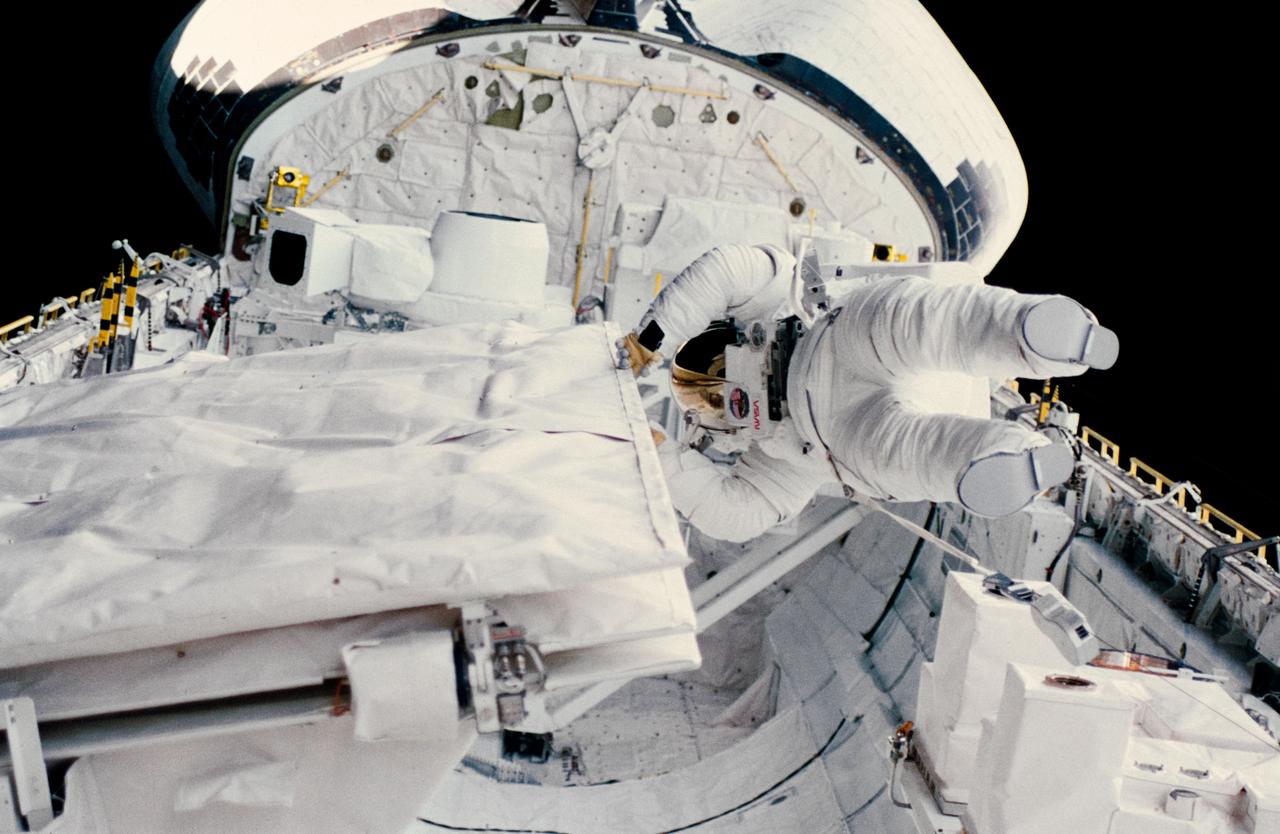
41G-13-032 (11 Oct. 1984) --- Astronaut Kathryn D. Sullivan checks the latch of the SIR-B antenna in the space shuttle Challenger's open cargo bay during her historic extravehicular activity (EVA) on Oct. 11, 1984. Earlier, America's first woman to perform an EVA and astronaut David C. Leestma, participated in an in-space simulation of refueling a spacecraft in orbit. The Orbital Refueling System (ORS) is just beyond the astronaut mission specialist's helmet. To the left is the Large Format Camera (LFC). The LFC and ORS are stationed on a device called the Mission Peculiar Support Structure (MPESS). Crew members consisted of astronauts Robert L. Crippen, commander; Jon A. McBride, pilot; along with Kathryn D. Sullivan, Sally K. Ride, and David D. Leestma, all mission specialists; and Canadian astronaut Marc Garneau and Paul D. Scully-Power, both payload specialist. EDITOR'S NOTE: The STS-41G mission had the first American female EVA (Sullivan); first seven-person crew; first orbital fuel transfer; and the first Canadian (Garneau).
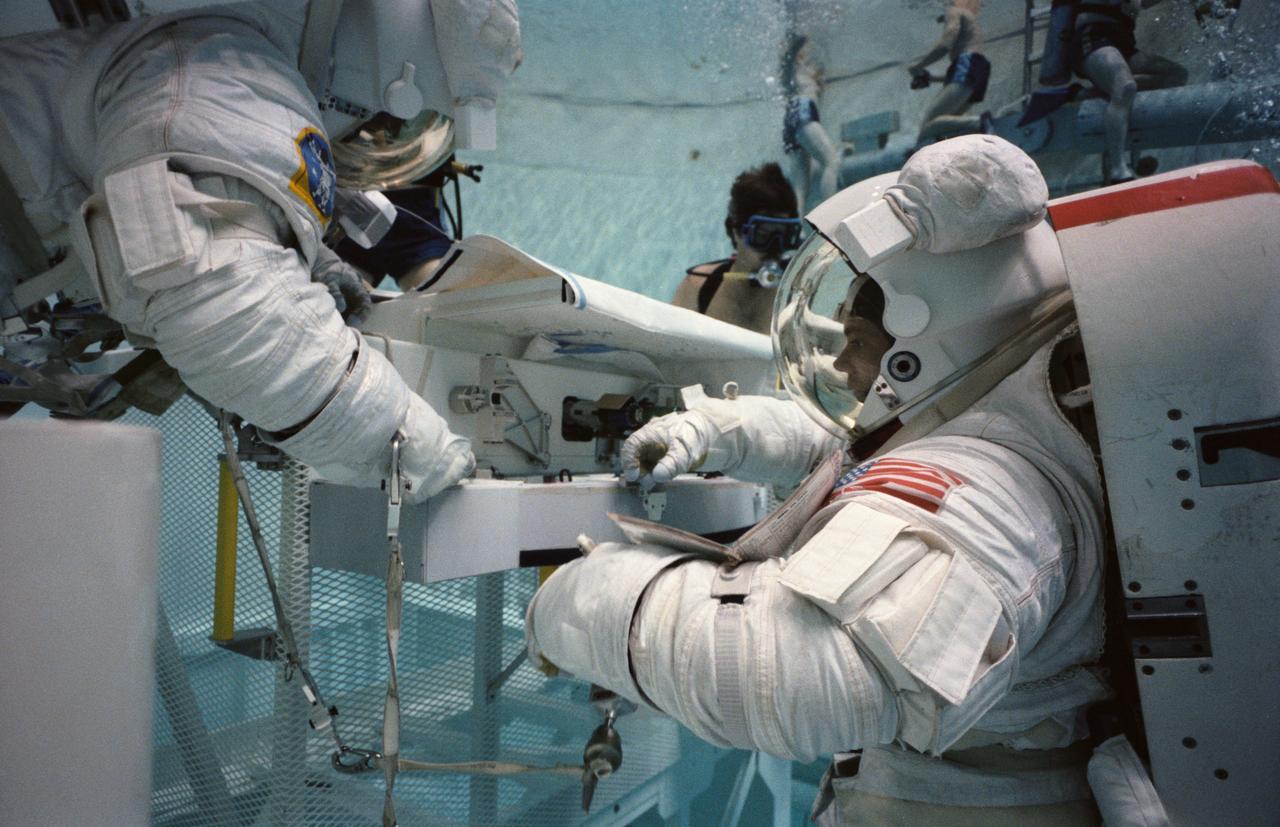
S84-36960 (5 July 1984) --- Astronauts Kathryn D. Sullivan, left, and David C. Leestma, Mission 41-G crewmembers, simulate the transfer of cryogenics in space during an Earth-bound underwater session in the Johnson Space Center's weightless environment training facility (WET-F). The two mission specialists will be joined by three NASA astronauts and two payload specialists for a flight aboard the Columbia later this year. The photograph was taken by Otis Imboden.
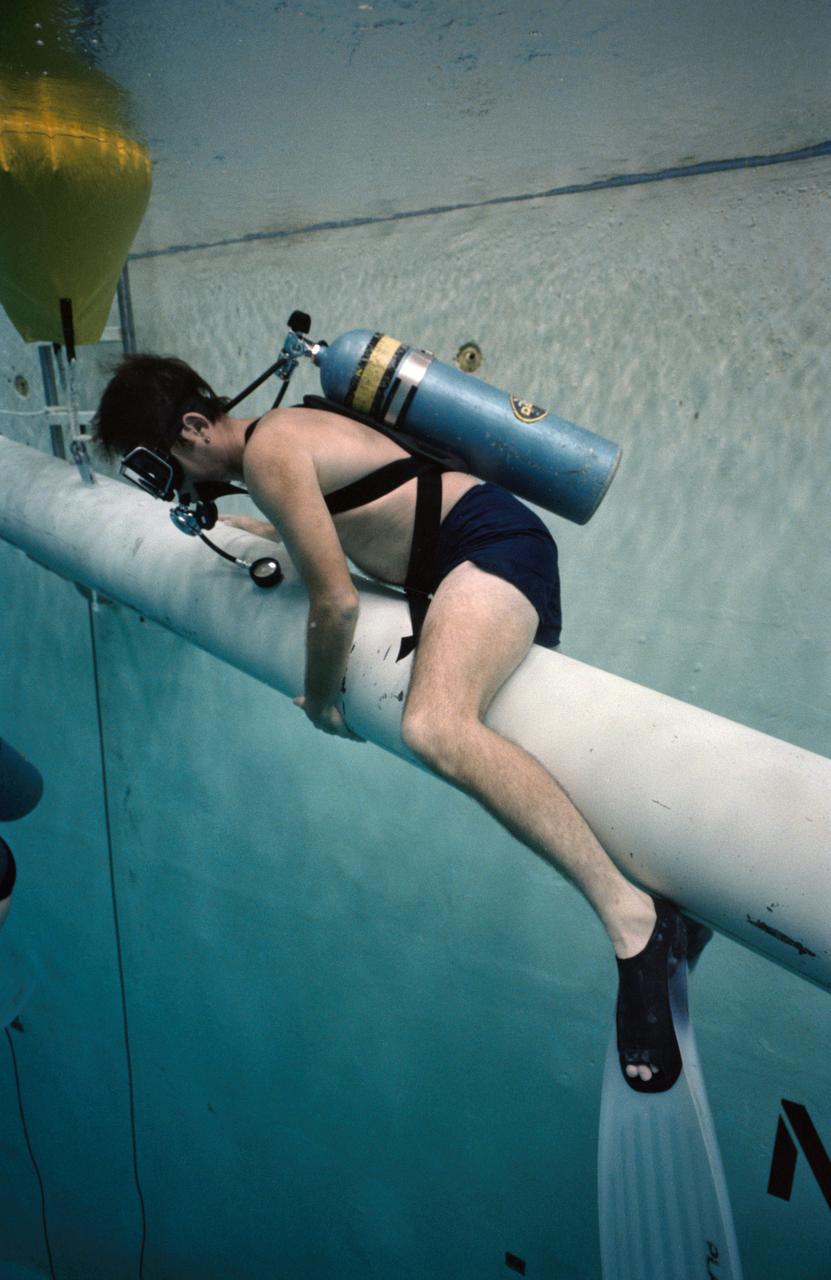
S84-36958 (29 June 1984) --- Astronaut Robert L. Crippen, 41-G crew commander, perches nearby an underwater simulation scene in the Johnson Space Center's weightless environment training facility (WET-F). Purpose of the rehearsal was to train two of the 41-G crew's mission specialists for a scheduled extravehicular activity (EVA). Out of frame are Astronauts Kathryn D. Sullivan, Jon A. McBride and David Leestma. Dr. Sullivan and Leestma donned extravehicular mobility units (EMU) for the simulation while Crippen and McBride monitored the activity. This photograph was taken by Otis Imboden.
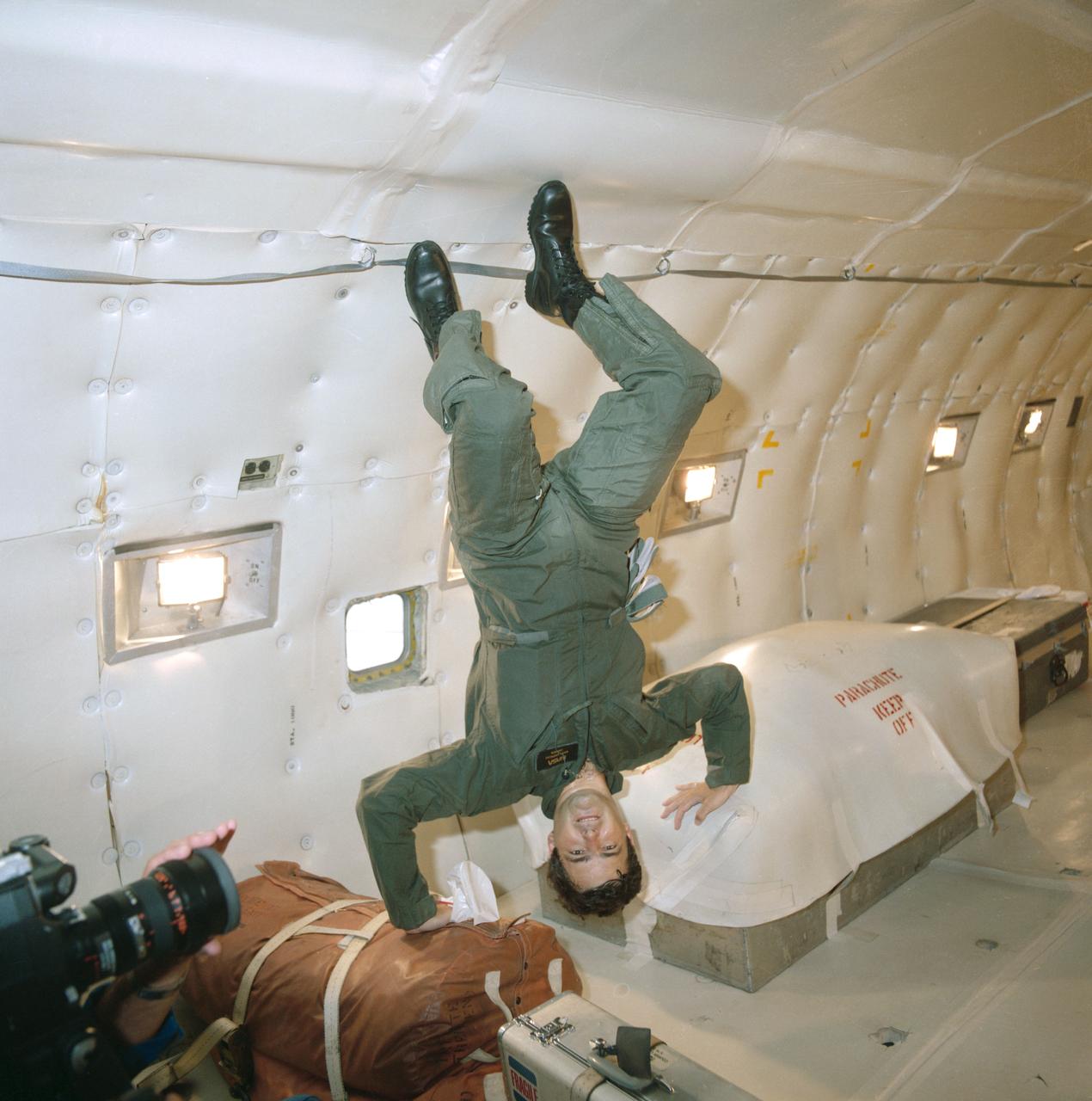
S84-37514 (18 July 1984) --- Marc Garneau, representing Canada's National Research Council as one of two 41-G payload specialists, gets the "feel" of zero gravity aboard a special NASA aircraft designed to create brief periods of weightlessness. Five astronauts and an oceanographer from the U.S. Dept. of the Navy will join Canada's first representative in space for the trip aboard Challenger later this year. This KC-135 aircraft is used extensively for evaluation of equipment and experiments scheduled for future missions.
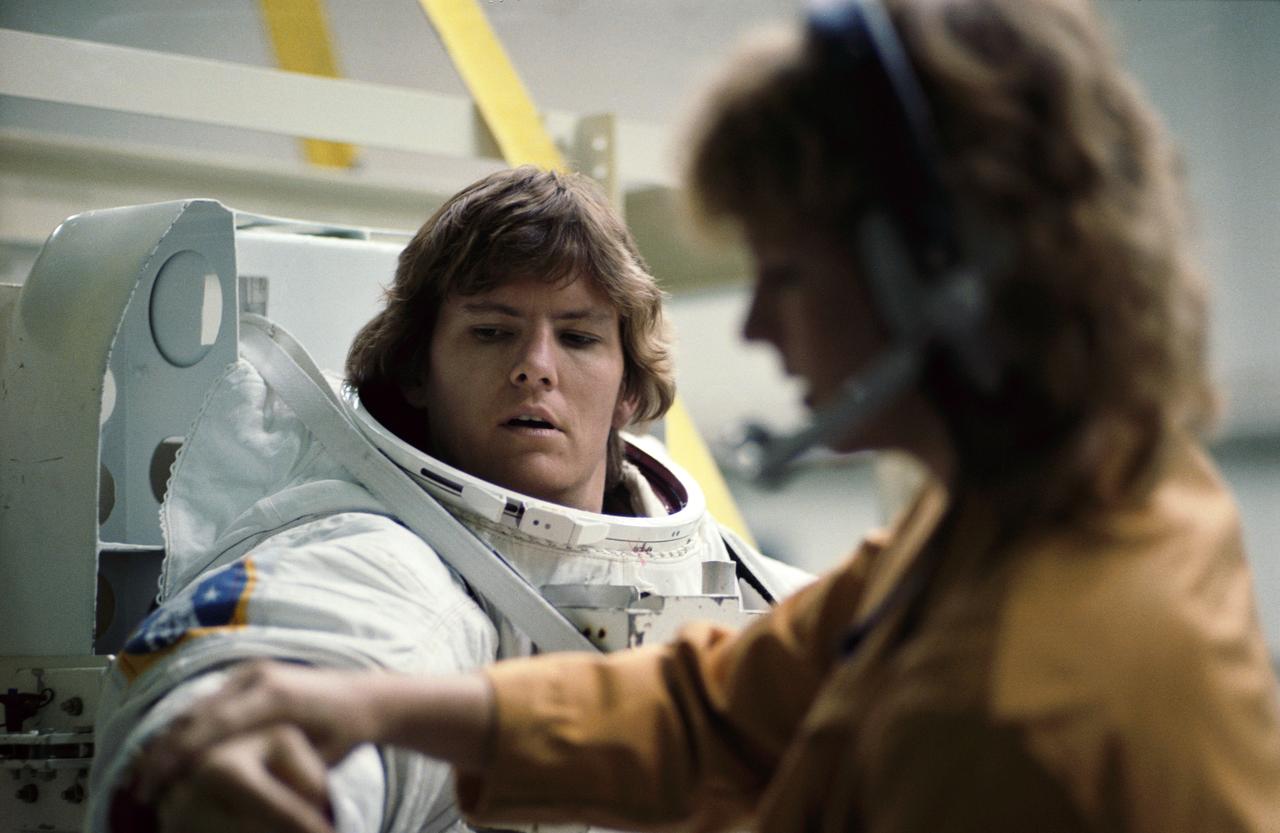
S84-36954 (5 July 1984) --- Astronaut Kathryn D.Sullivan, 41-G mission specialist, gets some help with her extravehicular mobility unit (EMU) prior to participating in an underwater simultion of an extrvehicular activity (EVA) scheduled for her flight aboard the Columbia later this year. Dr. Sullivan and David C. Leestma (out of frame) participated in the rehearsal in NASA's weightless environment training facility (WET-F) at the Johnson Space Center.
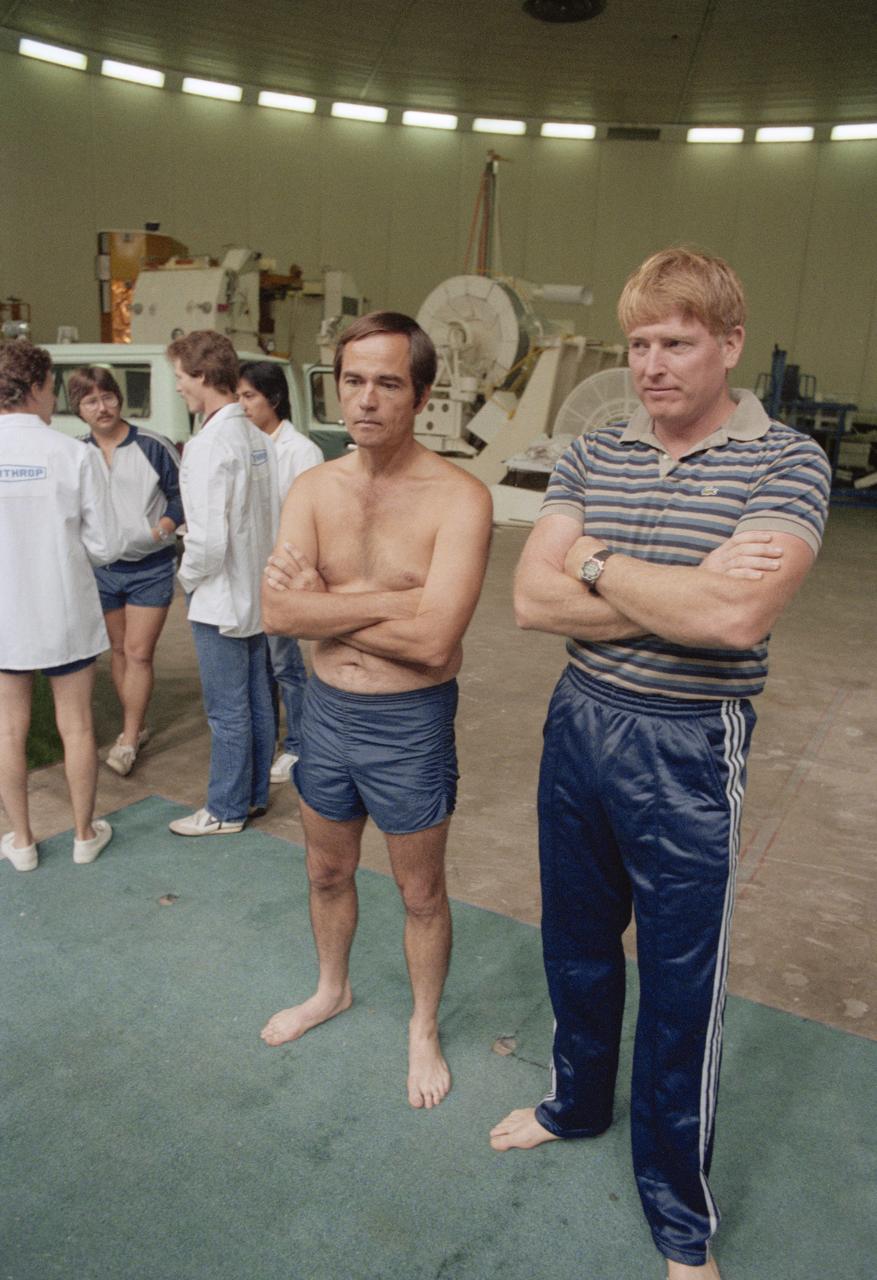
S84-36898 (29 June 1984) --- Astronauts Robert L. Crippen (left) and Jon A. McBride, crew commander and pilot, respectively for NASA's 41-G Space Shuttle mission, await the delivery of self contained underwater breathing apparatus (SCUBA) gear prior to their going underwater to observe a simulation of an extravehicular activity (EVA) scheduled for their mission. The EVA will be performed by Astronauts Kathryn D. Sullivan and David C. Leestma, two of three mission specialists named for the seven-member crew. The underwater training took place in the Johnson Space Center's weightless environment training facility (WET-F).
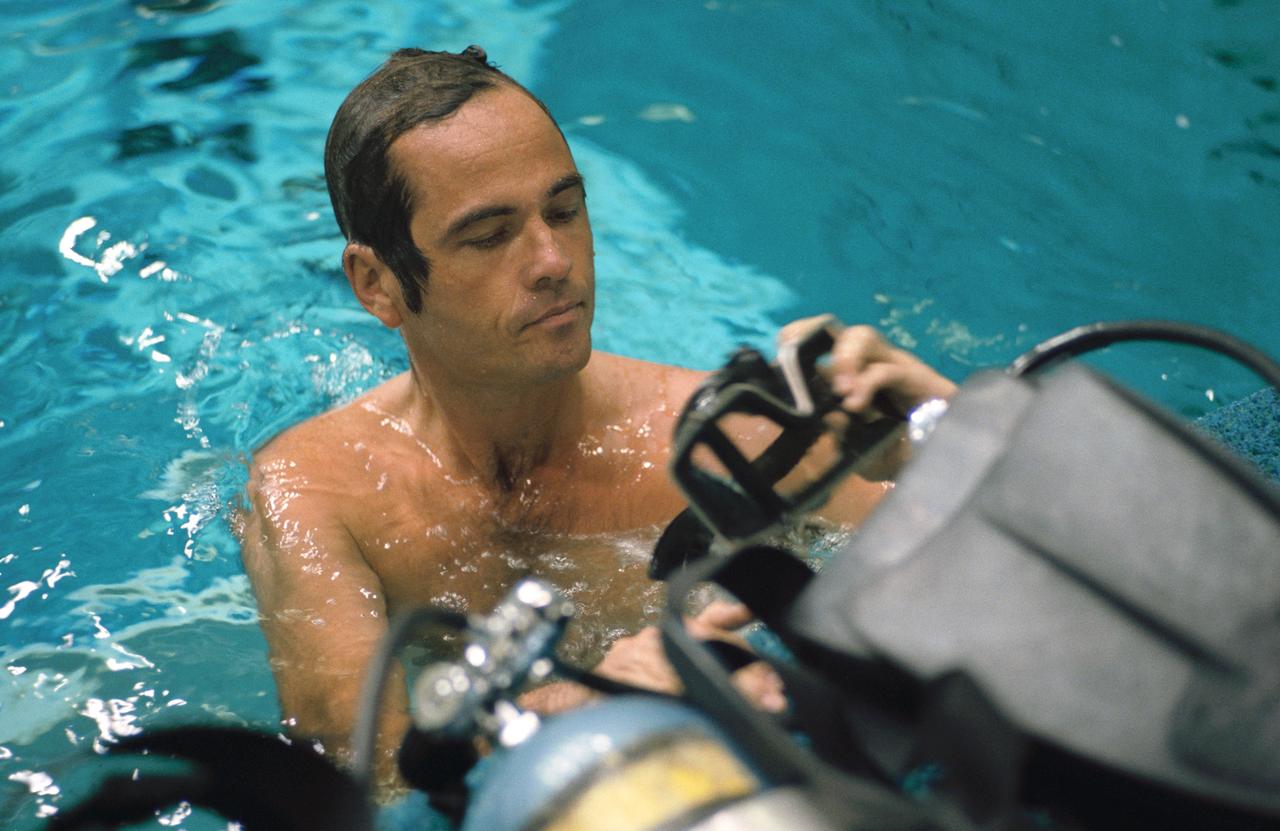
S84-36956 (1 July 1984) --- Astronaut Robert L. Crippen, 41-G crew commander, prepares his SCUBA mask prior to submerging into the weightless environment training facility's 25 ft. deep pool to observe a simulation exercise for two fellow 41-G crewmembers assigned to an extravehicular activity (EVA) in space. Not pictured are Astronauts Kathryn D. Sullivan and David C. Leestma, mission specialists who will perform the EVA during the eight-day mission scheduled for October of this year.
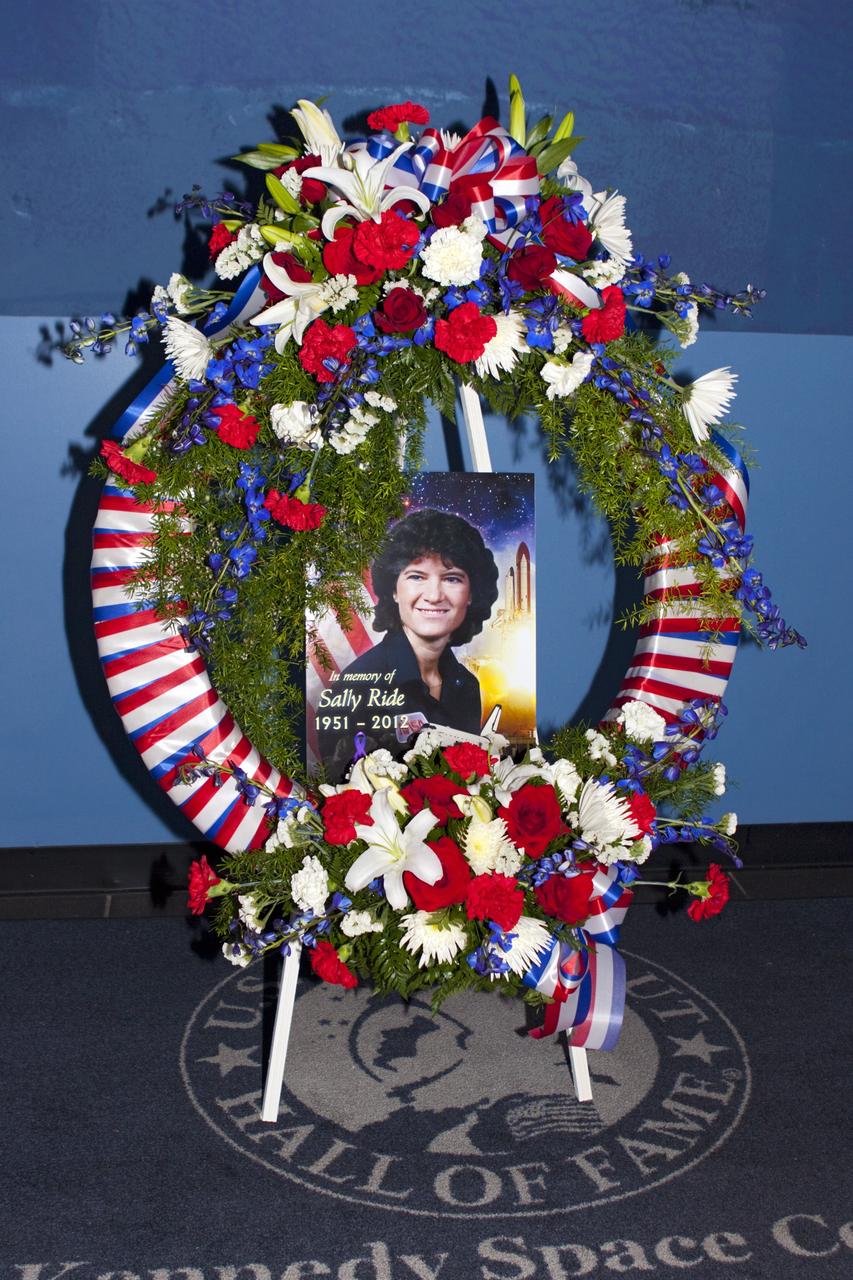
TITUSVILLE, Fla. - A wreath was laid at the U. S. Astronaut Hall of Fame honoring Sally K. Ride, who became America's first woman in space in 1983. Following her death on July 23, 2012, Ride is being remembered for her service to NASA and for her efforts to encourage children to study math, science and technology. A California-born physicist, she broke the gender barrier 29 years ago when she rode to orbit aboard space shuttle Challenger on STS-7. Ride subsequently served, again as a mission specialist, on STS-41G in 1984. Following her career with NASA, in 2001 Ride founded her own company, Sally Ride Science, to pursue her long-time passion of motivating youth -- especially girls and young women -- to pursue careers in technical fields. Photo credit: NASA/Jim Grossmann
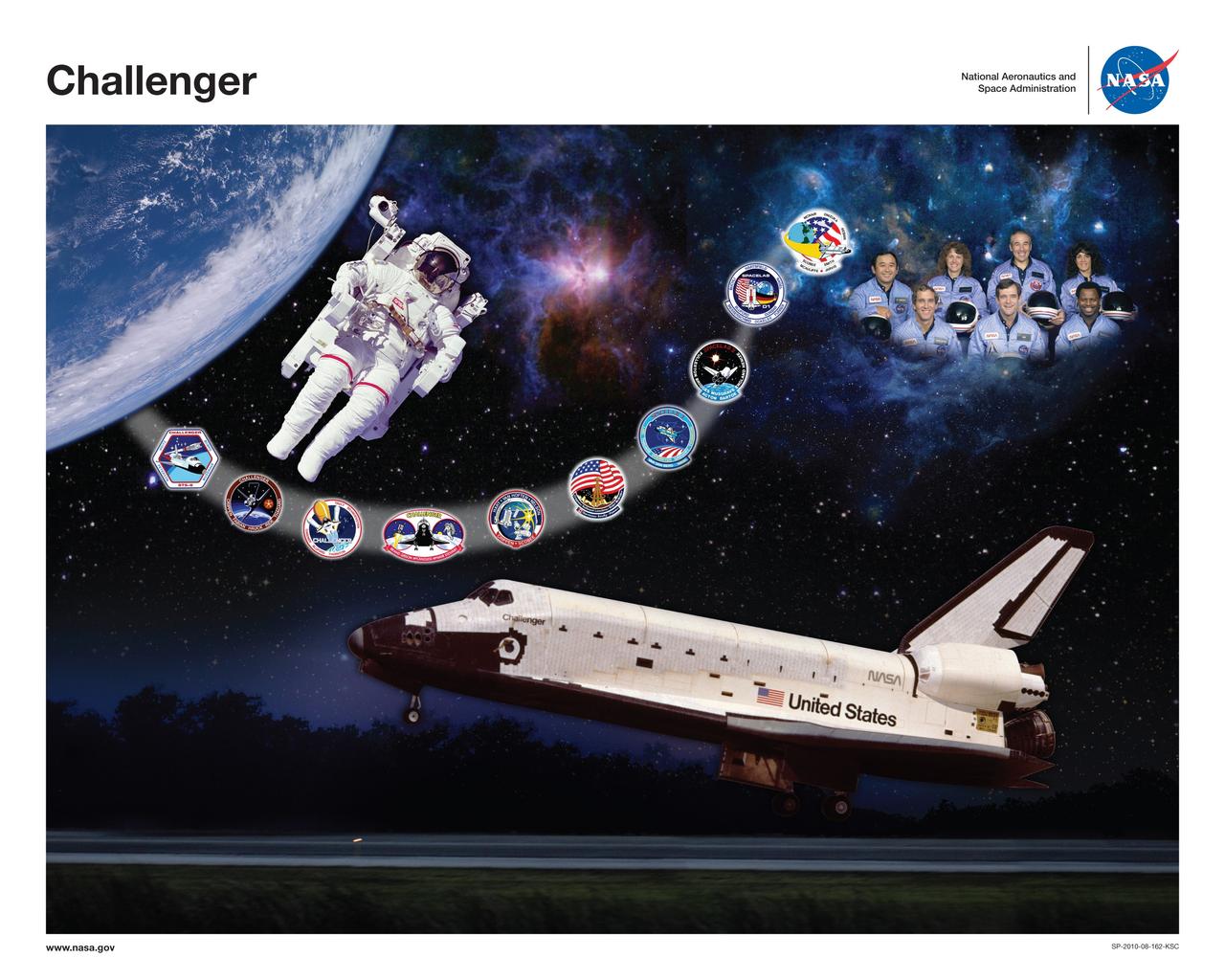
CAPE CANAVERAL, Fla. -- This is a version of space shuttle Challenger's orbiter tribute, or OV-099, which hangs in Firing Room 4 of the Launch Control Center at NASA's Kennedy Space Center in Florida. Challenger's accomplishments include the first night launch and first African-American in space, Guion Bluford, on STS-8, the first in-flight capture, repair and redeployment of an orbiting satellite during STS-41C, the first American woman in space, Sally Ride, on STS-7, and the first American woman to walk in space, Kathryn Sullivan, during STS-41G. Challenger is credited with blazing a trail for NASA's other orbiters with the first night landing at Edwards Air Force Base in California on STS-8 and the first landing at Kennedy on STS-41B. The spacewalker in the tribute represents Challenger’s role in the first spacewalk during STS-6 and the first untethered spacewalk on STS-41B. Crew-designed patches for each of Challenger’s missions lead from Earth toward a remembrance of the STS-51L crew, which was lost 73 seconds after liftoff on Jan. 28, 1986. Five orbiter tributes are on display in the firing room, representing Atlantis, Challenger, Columbia, Endeavour and Discovery. Graphic design credit: NASA/Lynda Brammer. NASA publication number: SP-2010-08-162-KSC
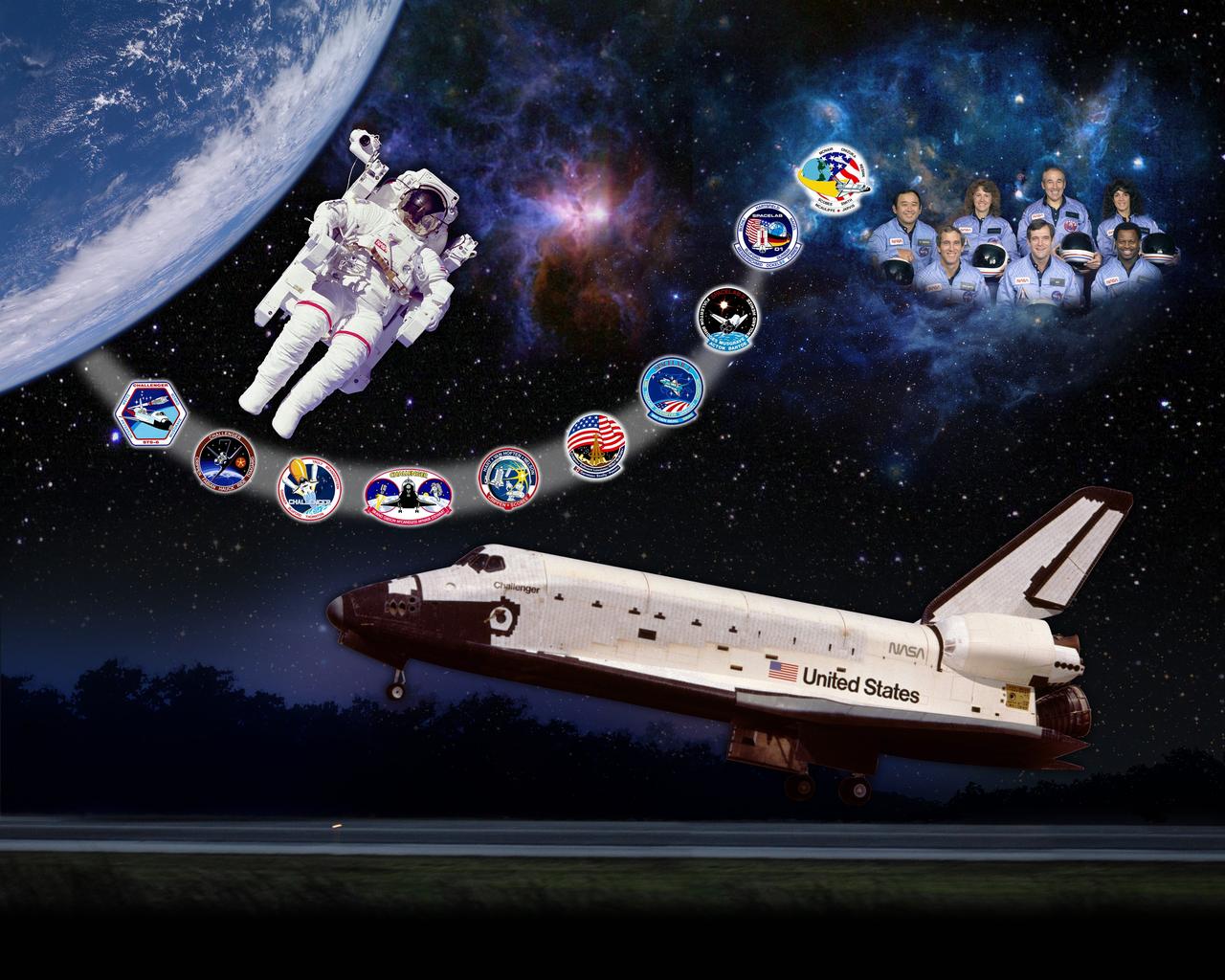
CAPE CANAVERAL, Fla. -- This orbiter tribute of space shuttle Challenger, or OV-099, hangs in Firing Room 4 of the Launch Control Center at NASA's Kennedy Space Center in Florida. Challenger's accomplishments include the first night launch and first African-American in space, Guion Bluford, on STS-8, the first in-flight capture, repair and redeployment of an orbiting satellite during STS-41C, the first American woman in space, Sally Ride, on STS-7, and the first American woman to walk in space, Kathryn Sullivan, during STS-41G. Challenger is credited with blazing a trail for NASA's other orbiters with the first night landing at Edwards Air Force Base in California on STS-8 and the first landing at Kennedy on STS-41B. The spacewalker in the tribute represents Challenger’s role in the first spacewalk during STS-6 and the first untethered spacewalk on STS-41B. Crew-designed patches for each of Challenger’s missions lead from Earth toward a remembrance of the STS-51L crew, which was lost 73 seconds after liftoff on Jan. 28, 1986. Five orbiter tributes are on display in the firing room, representing Atlantis, Challenger, Columbia, Endeavour and Discovery. Graphic design credit: NASA/Lynda Brammer
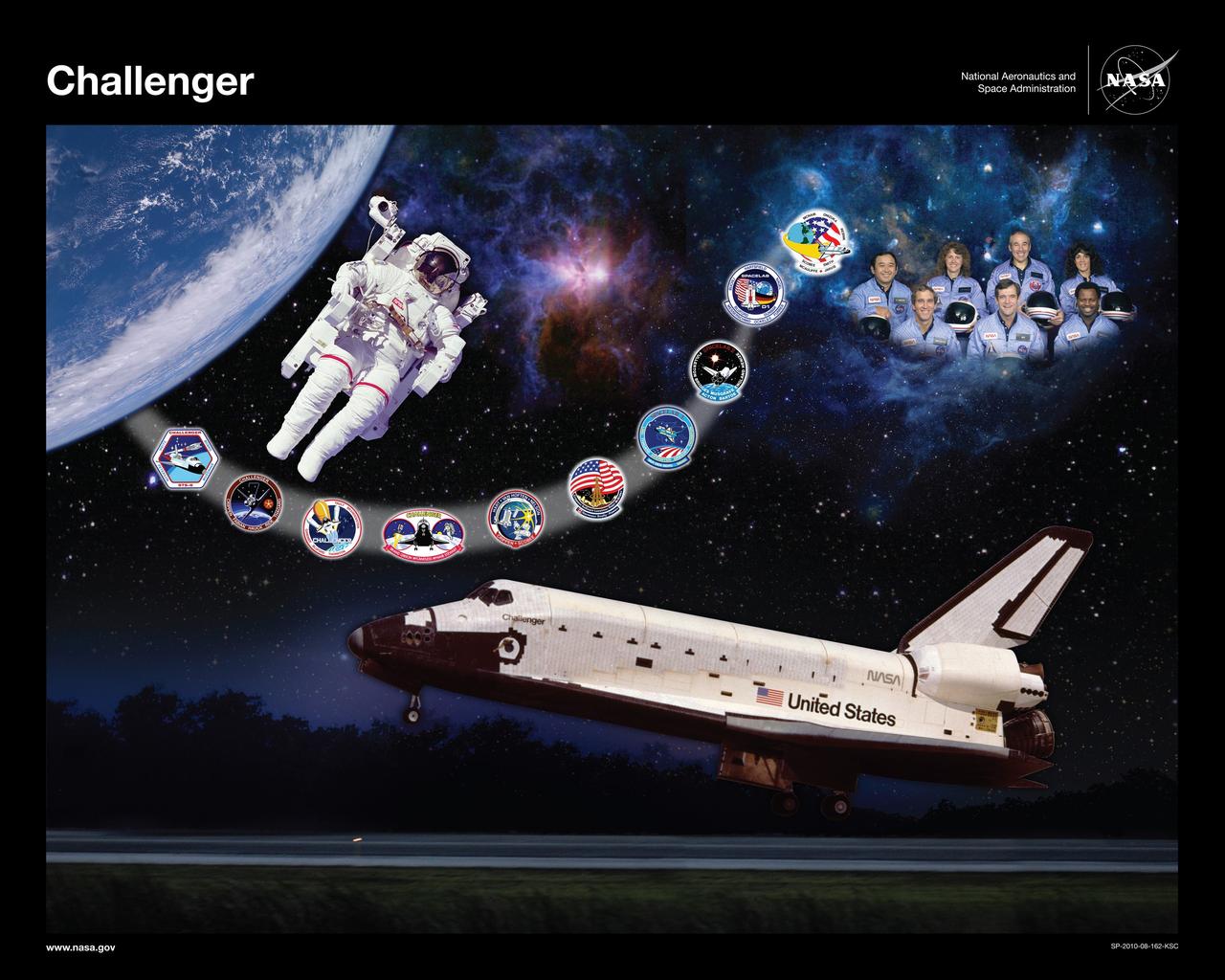
CAPE CANAVERAL, Fla. -- This is a printable version of space shuttle Challenger's orbiter tribute, or OV-099, which hangs in Firing Room 4 of the Launch Control Center at NASA's Kennedy Space Center in Florida. Challenger's accomplishments include the first night launch and first African-American in space, Guion Bluford, on STS-8, the first in-flight capture, repair and redeployment of an orbiting satellite during STS-41C, the first American woman in space, Sally Ride, on STS-7, and the first American woman to walk in space, Kathryn Sullivan, during STS-41G. Challenger is credited with blazing a trail for NASA's other orbiters with the first night landing at Edwards Air Force Base in California on STS-8 and the first landing at Kennedy on STS-41B. The spacewalker in the tribute represents Challenger’s role in the first spacewalk during STS-6 and the first untethered spacewalk on STS-41B. Crew-designed patches for each of Challenger’s missions lead from Earth toward a remembrance of the STS-51L crew, which was lost 73 seconds after liftoff on Jan. 28, 1986. Five orbiter tributes are on display in the firing room, representing Atlantis, Challenger, Columbia, Endeavour and Discovery. Graphic design credit: NASA/Lynda Brammer. NASA publication number: SP-2010-08-162-KSC
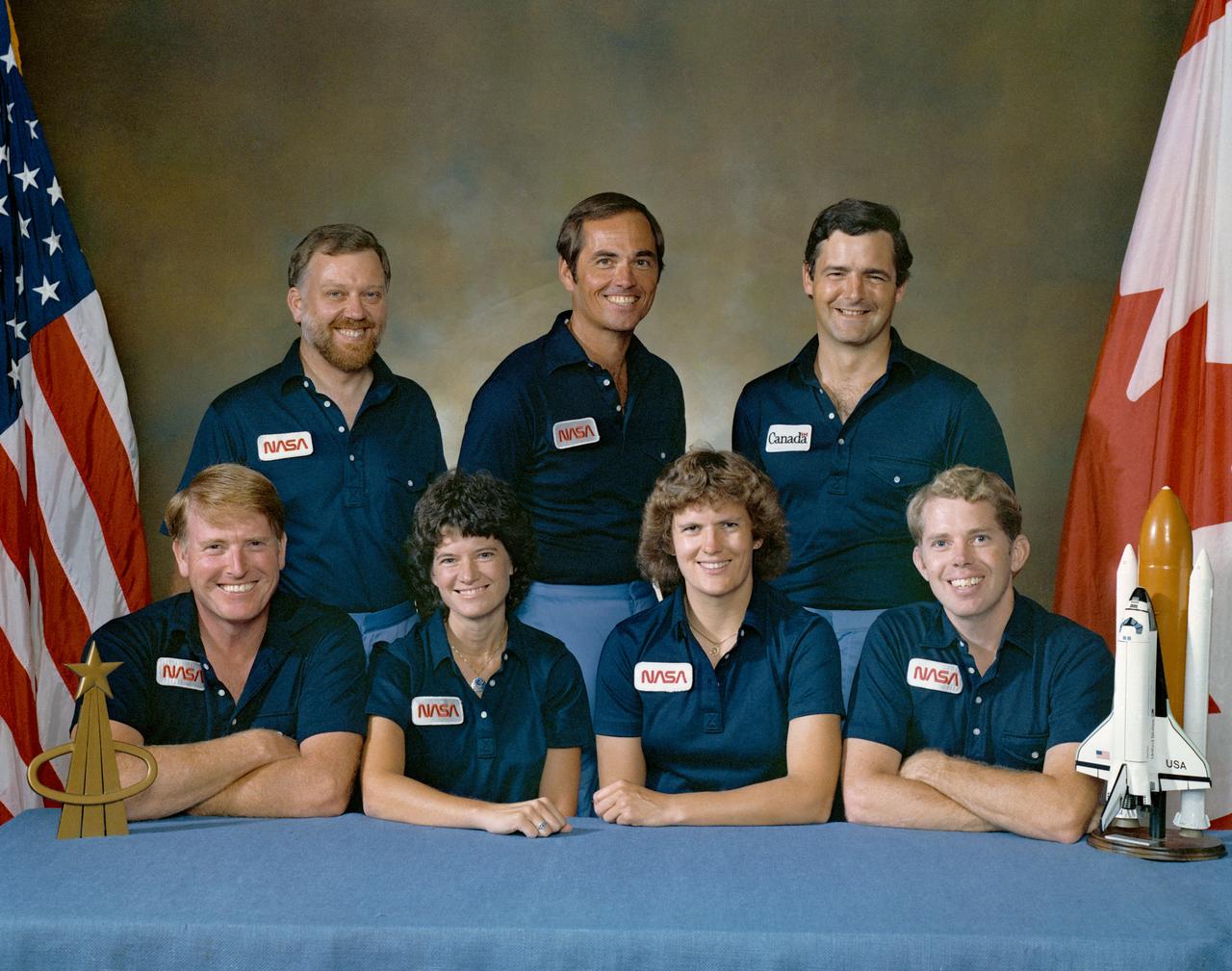
S84-37981 (20 July 1984) --- The space shuttle Challenger will carry these seven persons into space for NASA's STS-41G mission scheduled for October 1984. They are (bottom row, left to right) astronauts Jon A. McBride, pilot; and Sally K. Ride, Kathryn D. Sullivan and David C. Leestma -- all mission specialists. Astronaut Robert L. Crippen crew commander, is flanked by Paul D. Scully-Power and Marc Garneau, both payload specialists. Scully-Power is an oceanographer for the U.S. Navy and Garneau represents the National Research Council (Canada). The replica of a gold astronaut pin near McBride signifies unity. The group represents the largest space shuttle crew thus far. Photo credit: NASA
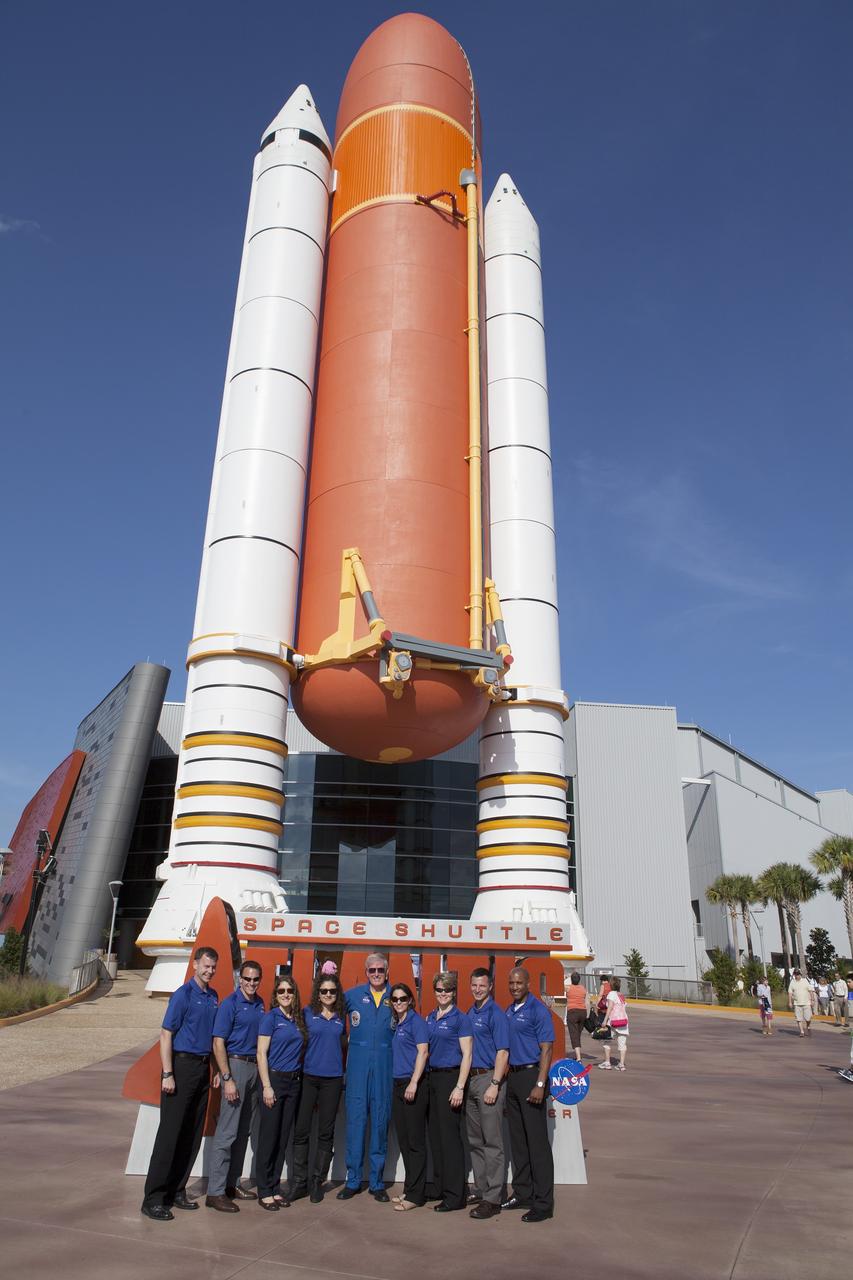
CAPE CANAVERAL, Fla. – Astronaut candidates Tyler "Nick" Hague, Josh Cassada, Christina Hamock, Jessica Meir, STS-41G astronaut Jon McBride, astronaut candidates Nicole Mann, Anne McClain, Andrew Morgan and Victor Glover pose in front of the Space Shuttle Atlantis exhibit and its full-scale external tank and solid rocket booster stack at the Kennedy Space Center Visitor Complex in Florida. The astronaut class of 2013 was selected by NASA after an extensive year-and-a-half search. The new group will help the agency push the boundaries of exploration and travel to new destinations in the solar system. To learn more about the astronaut class of 2013, visit: http://www.nasa.gov/astronauts/2013astroclass.html Photo credit: NASA/Daniel Casper
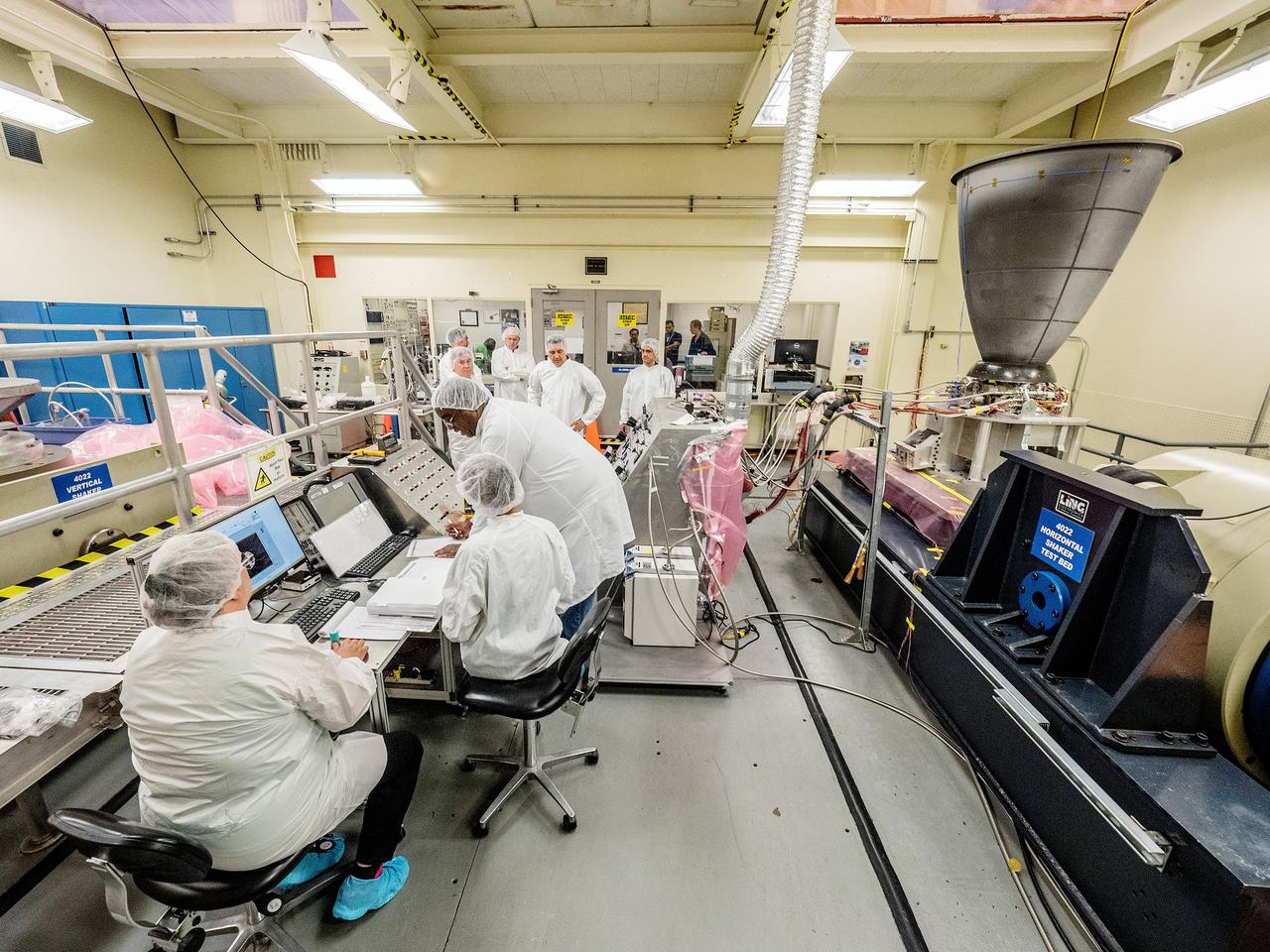
An Orbital Maneuvering System engine is vibration tested at NASA’s Johnson Space Center in Houston on June 16, 2016, before shipment to the agency’s White Sands Test Facility in New Mexico, where it will be fired to qualify the engine for use on Orion’s service module. The vibration testing will help ensure the engine can withstand the loads induced by launch on the agency’s Space Launch System rocket. This summer, another Orbital Maneuvering System engine will be tested at Johnson before it is supplied to ESA (European Space Agency) to integrate into Orion's service module, which will power, propel and cool Orion in space, and also provide consumables like air and water for future crews. ..ESA and its contractor Airbus Defence and Space are providing the service module for Artemis I. This Orbital Maneuvering System engine was used on the space shuttle to provide the thrust for orbital insertion, orbit circularization, orbit transfer, rendezvous, deorbit and abort situations and flew on 31 shuttle flights. The engine flying on Artemis I flew on 19 space shuttle flights, beginning with STS-41G in October 1984 and ending with STS-112 in October 2002.
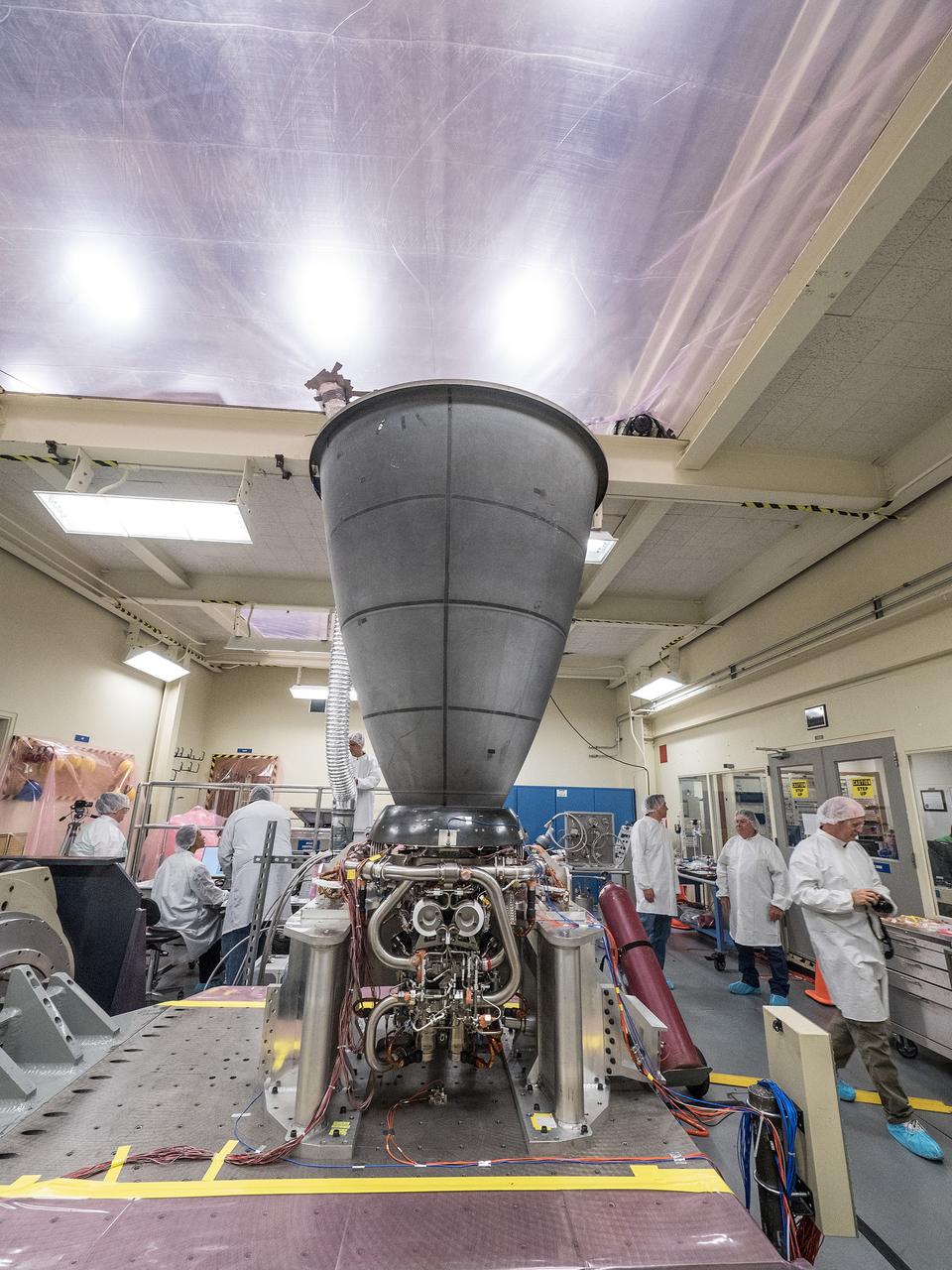
An Orbital Maneuvering System engine is vibration tested at NASA’s Johnson Space Center in Houston on June 16, 2016, before shipment to the agency’s White Sands Test Facility in New Mexico, where it will be fired to qualify the engine for use on Orion’s service module. The vibration testing will help ensure the engine can withstand the loads induced by launch on the agency’s Space Launch System rocket. This summer, another Orbital Maneuvering System engine will be tested at Johnson before it is supplied to ESA (European Space Agency) to integrate into Orion's service module, which will power, propel and cool Orion in space, and also provide consumables like air and water for future crews. ..ESA and its contractor Airbus Defence and Space are providing the service module for Artemis I. This Orbital Maneuvering System engine was used on the space shuttle to provide the thrust for orbital insertion, orbit circularization, orbit transfer, rendezvous, deorbit and abort situations and flew on 31 shuttle flights. The engine flying on Artemis I flew on 19 space shuttle flights, beginning with STS-41G in October 1984 and ending with STS-112 in October 2002.
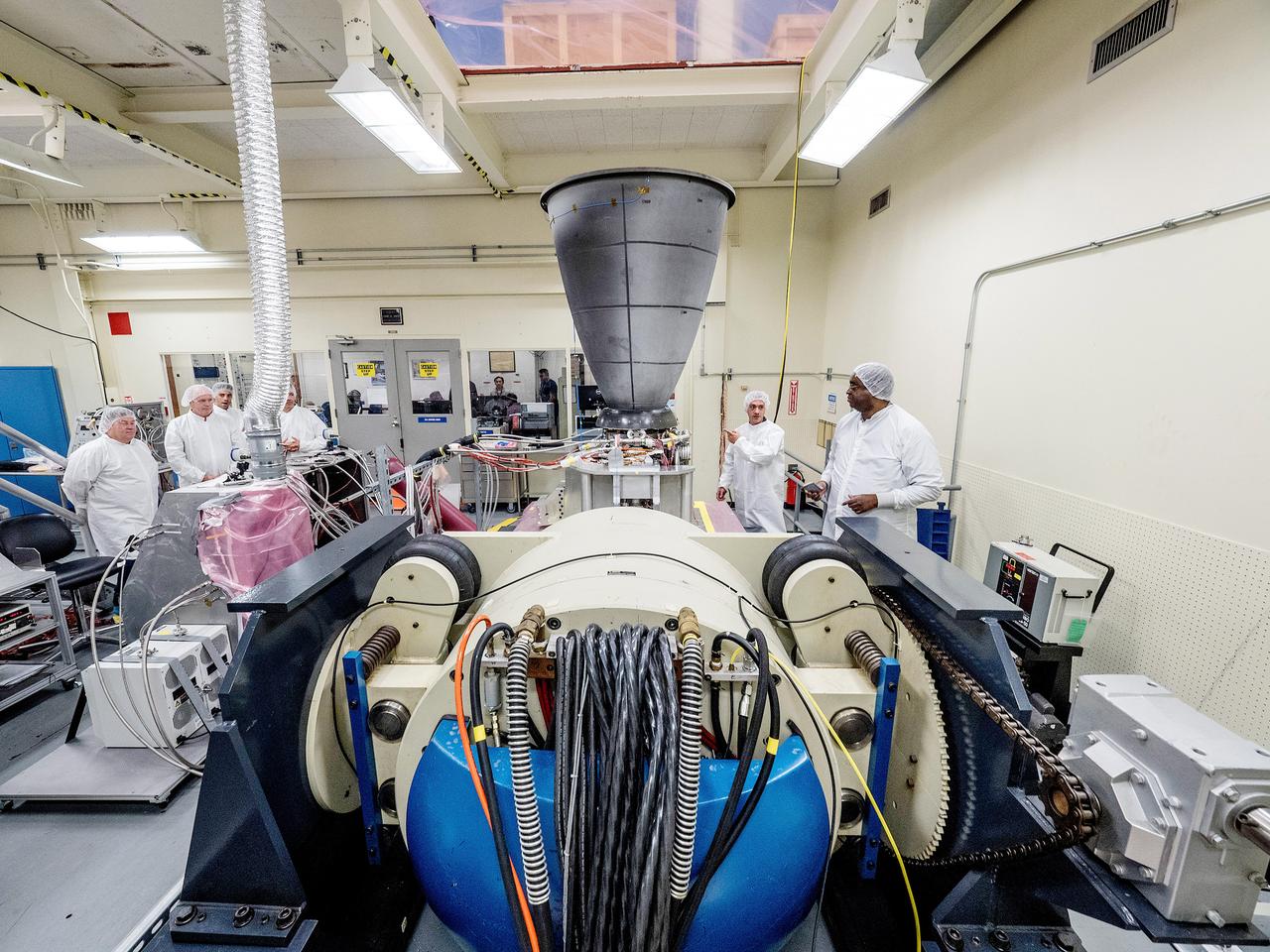
An Orbital Maneuvering System engine is vibration tested at NASA’s Johnson Space Center in Houston on June 16, 2016, before shipment to the agency’s White Sands Test Facility in New Mexico, where it will be fired to qualify the engine for use on Orion’s service module. The vibration testing will help ensure the engine can withstand the loads induced by launch on the agency’s Space Launch System rocket. This summer, another Orbital Maneuvering System engine will be tested at Johnson before it is supplied to ESA (European Space Agency) to integrate into Orion's service module, which will power, propel and cool Orion in space, and also provide consumables like air and water for future crews. ..ESA and its contractor Airbus Defence and Space are providing the service module for Artemis I. This Orbital Maneuvering System engine was used on the space shuttle to provide the thrust for orbital insertion, orbit circularization, orbit transfer, rendezvous, deorbit and abort situations and flew on 31 shuttle flights. The engine flying on Artemis I flew on 19 space shuttle flights, beginning with STS-41G in October 1984 and ending with STS-112 in October 2002.
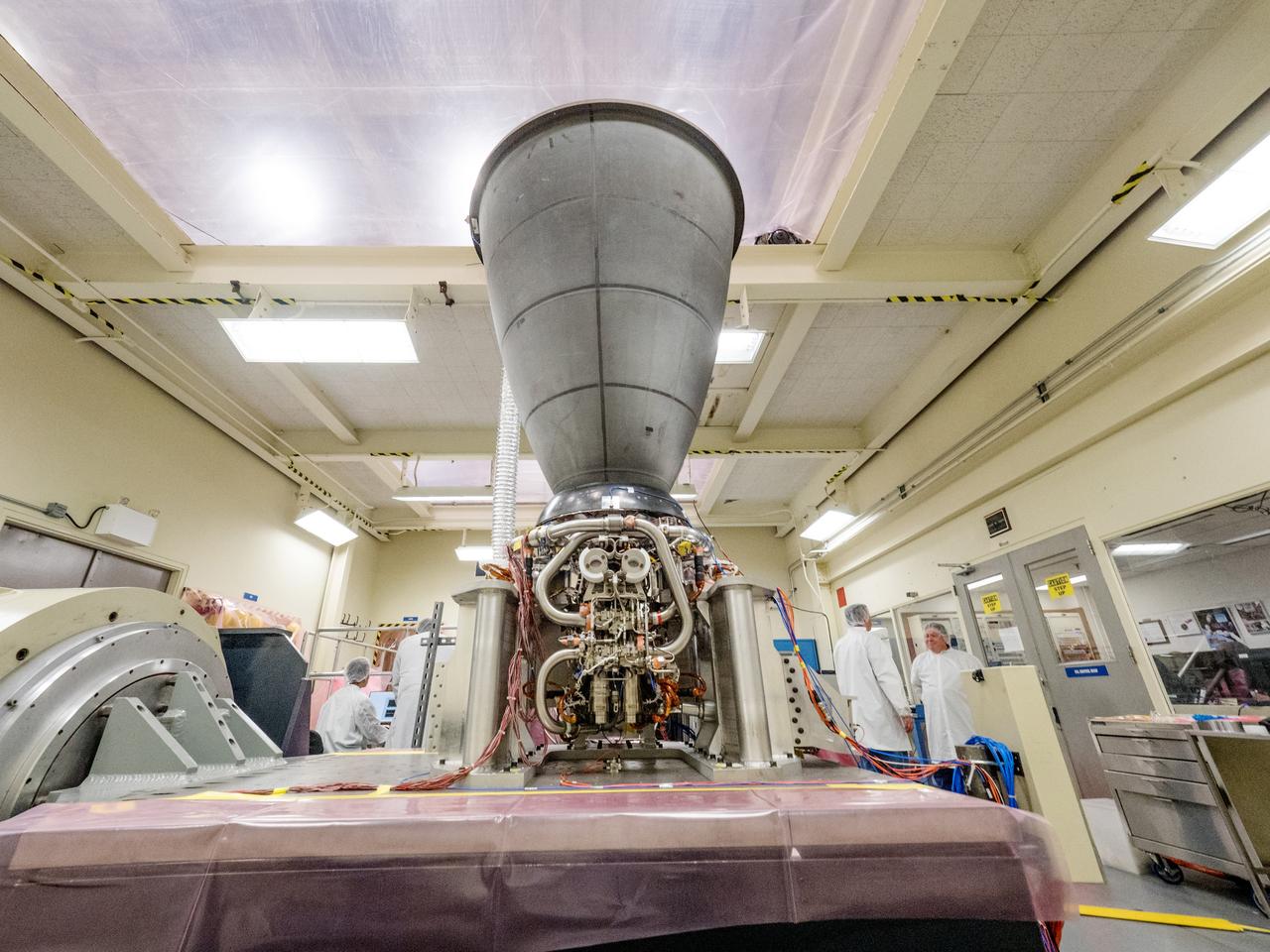
An Orbital Maneuvering System engine is vibration tested at NASA’s Johnson Space Center in Houston on June 16, 2016, before shipment to the agency’s White Sands Test Facility in New Mexico, where it will be fired to qualify the engine for use on Orion’s service module. The vibration testing will help ensure the engine can withstand the loads induced by launch on the agency’s Space Launch System rocket. This summer, another Orbital Maneuvering System engine will be tested at Johnson before it is supplied to ESA (European Space Agency) to integrate into Orion's service module, which will power, propel and cool Orion in space, and also provide consumables like air and water for future crews. ..ESA and its contractor Airbus Defence and Space are providing the service module for Artemis I. This Orbital Maneuvering System engine was used on the space shuttle to provide the thrust for orbital insertion, orbit circularization, orbit transfer, rendezvous, deorbit and abort situations and flew on 31 shuttle flights. The engine flying on Artemis I flew on 19 space shuttle flights, beginning with STS-41G in October 1984 and ending with STS-112 in October 2002.
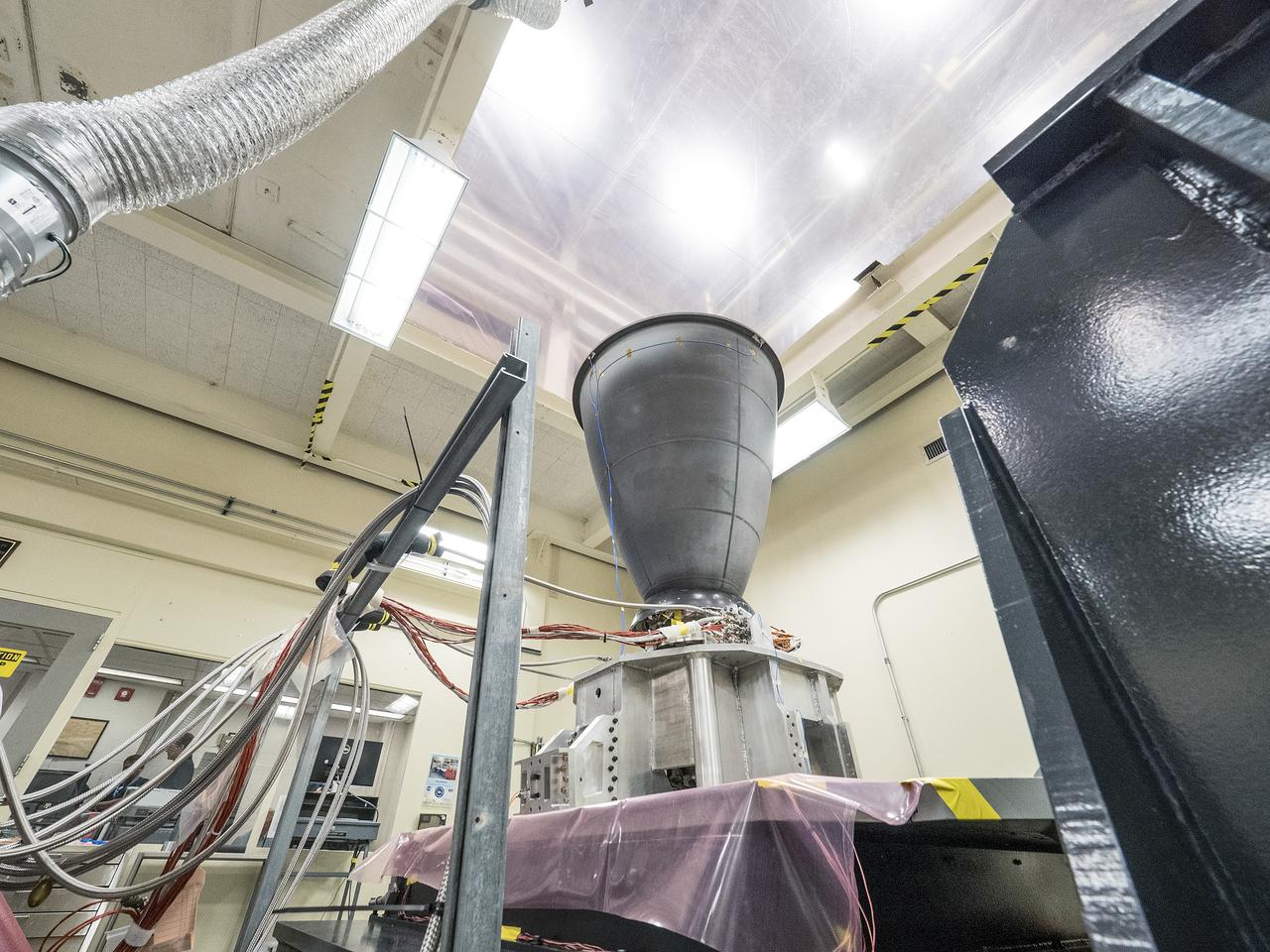
An Orbital Maneuvering System engine is vibration tested at NASA’s Johnson Space Center in Houston on June 16, 2016, before shipment to the agency’s White Sands Test Facility in New Mexico, where it will be fired to qualify the engine for use on Orion’s service module. The vibration testing will help ensure the engine can withstand the loads induced by launch on the agency’s Space Launch System rocket. This summer, another Orbital Maneuvering System engine will be tested at Johnson before it is supplied to ESA (European Space Agency) to integrate into Orion's service module, which will power, propel and cool Orion in space, and also provide consumables like air and water for future crews. ..ESA and its contractor Airbus Defence and Space are providing the service module for Artemis I. This Orbital Maneuvering System engine was used on the space shuttle to provide the thrust for orbital insertion, orbit circularization, orbit transfer, rendezvous, deorbit and abort situations and flew on 31 shuttle flights. The engine flying on Artemis I flew on 19 space shuttle flights, beginning with STS-41G in October 1984 and ending with STS-112 in October 2002.
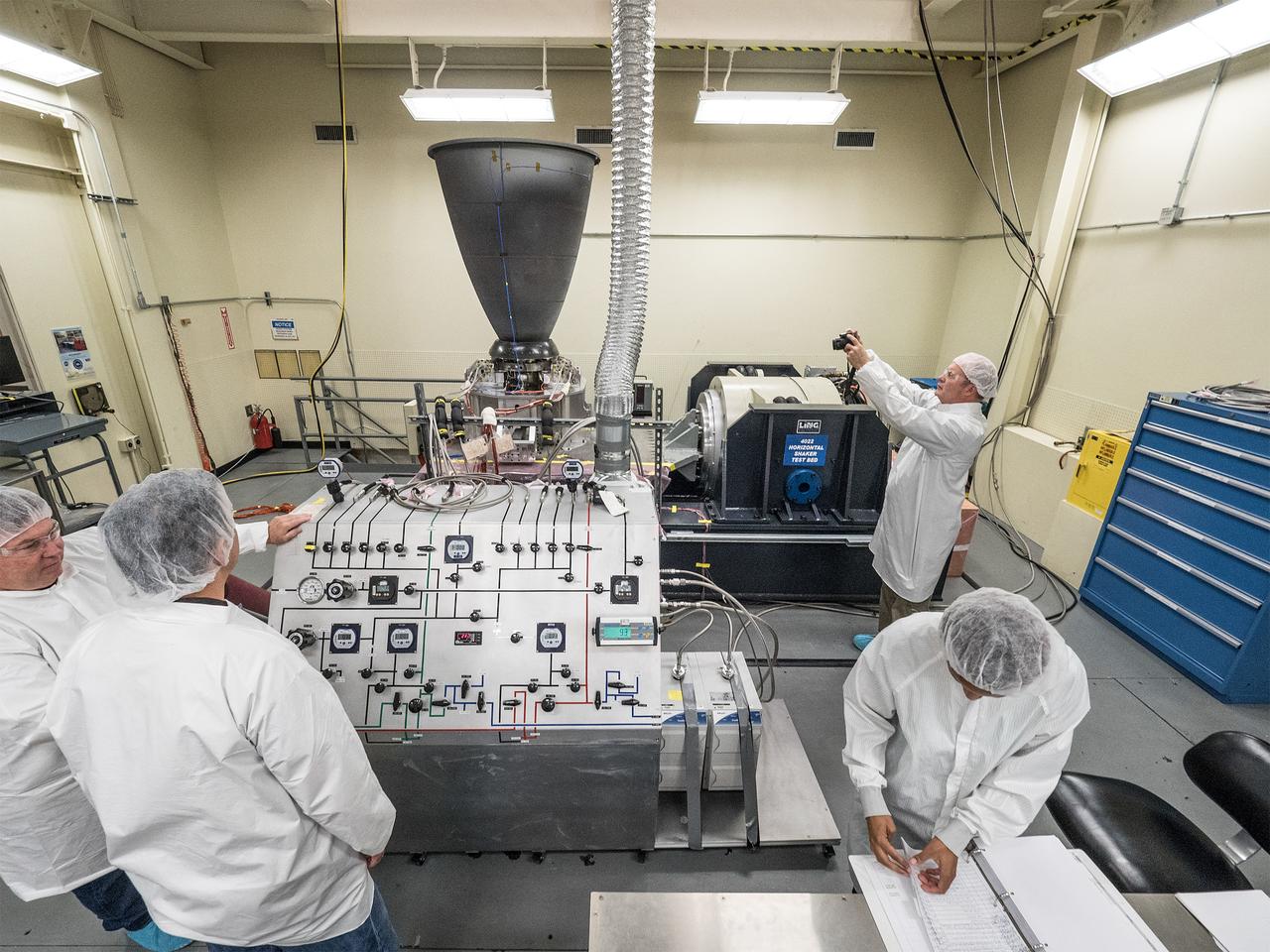
An Orbital Maneuvering System engine is vibration tested at NASA’s Johnson Space Center in Houston on June 16, 2016, before shipment to the agency’s White Sands Test Facility in New Mexico, where it will be fired to qualify the engine for use on Orion’s service module. The vibration testing will help ensure the engine can withstand the loads induced by launch on the agency’s Space Launch System rocket. This summer, another Orbital Maneuvering System engine will be tested at Johnson before it is supplied to ESA (European Space Agency) to integrate into Orion's service module, which will power, propel and cool Orion in space, and also provide consumables like air and water for future crews. ..ESA and its contractor Airbus Defence and Space are providing the service module for Artemis I. This Orbital Maneuvering System engine was used on the space shuttle to provide the thrust for orbital insertion, orbit circularization, orbit transfer, rendezvous, deorbit and abort situations and flew on 31 shuttle flights. The engine flying on Artemis I flew on 19 space shuttle flights, beginning with STS-41G in October 1984 and ending with STS-112 in October 2002.
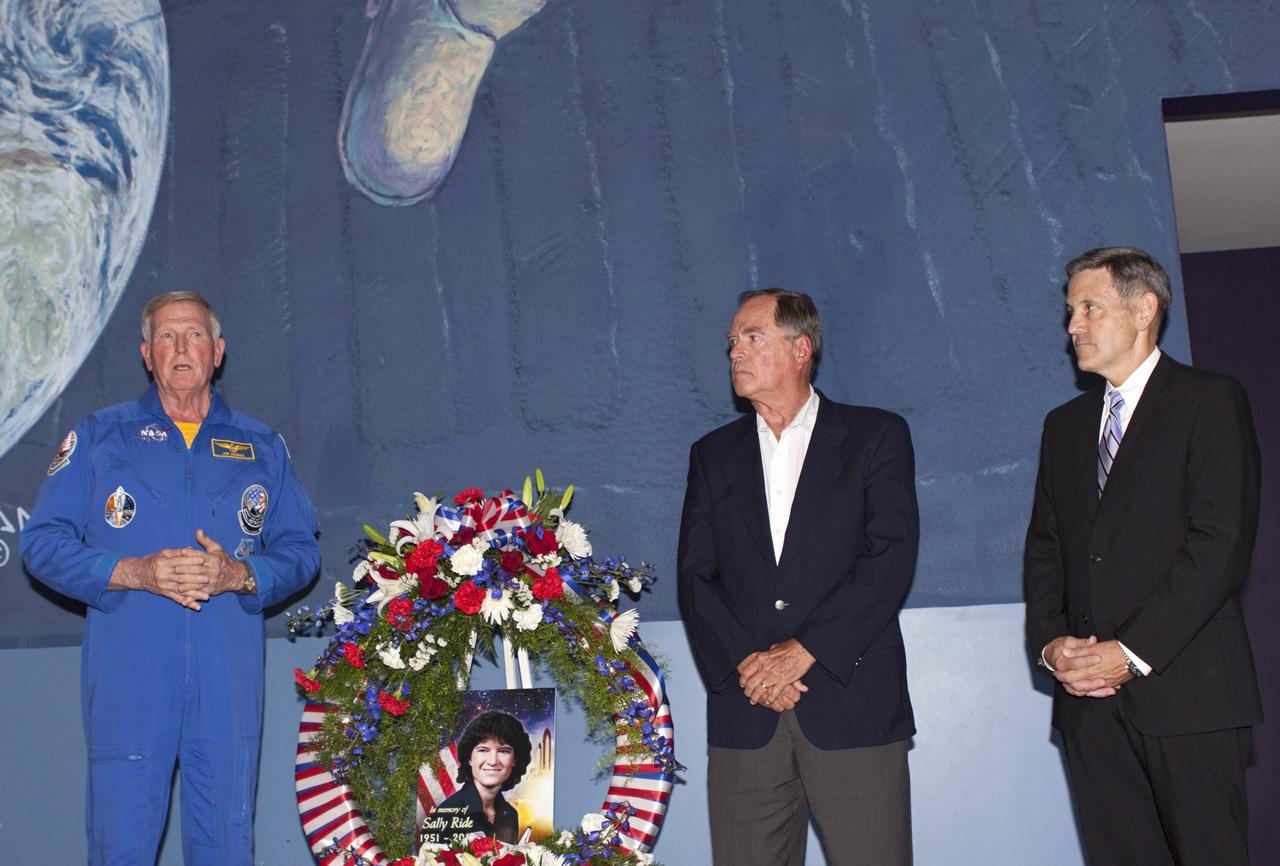
TITUSVILLE, Fla. - Former astronauts Jon McBride, left, and Bob Crippen, center, along with Kennedy Space Center director Bob Cabana, also a former astronaut, laid a wreath at the U. S. Astronaut Hall of Fame honoring Sally K. Ride, who became America's first woman in space in 1983. Following her death on July 23, 2012, Ride is being remembered for her service to NASA and for her efforts to encourage children to study math, science and technology. Crippen was commander on both of Ride's space shuttle missions. McBride was pilot on her second flight. Ride was inducted into the Astronaut Hall of Fame in 2003. A California-born physicist, she broke the gender barrier 29 years ago when she rode to orbit aboard space shuttle Challenger on STS-7. Ride subsequently served, again as a mission specialist, on STS-41G in 1984. Following her career with NASA, in 2001 Ride founded her own company, Sally Ride Science, to pursue her long-time passion of motivating youth -- especially girls and young women -- to pursue careers in technical fields. Photo credit: NASA/Jim Grossmann