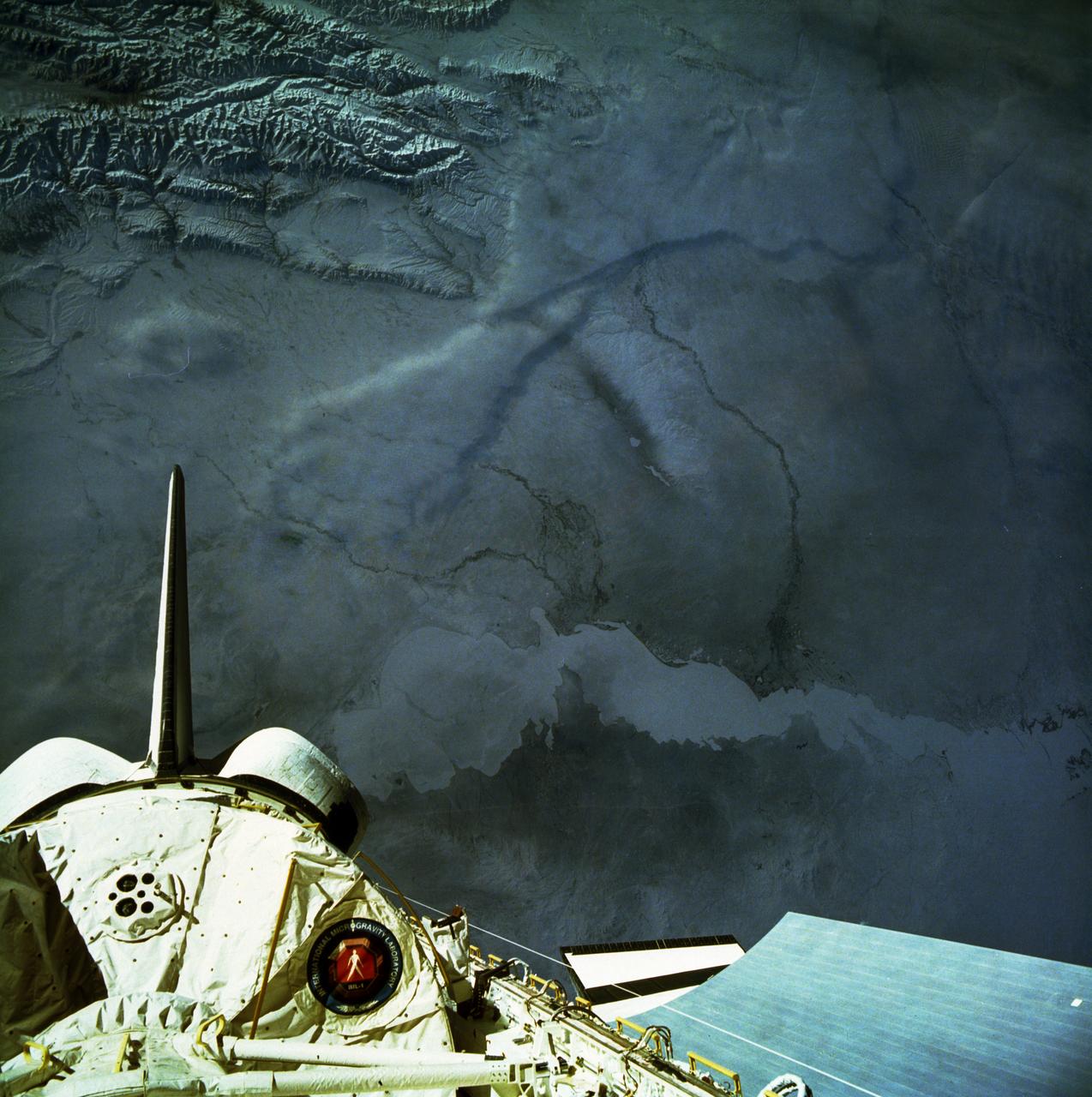
STS-42, Viewing earth with lots of snow, partial view of IML-1 (International Microgravity Laboratory) in cargo bay.
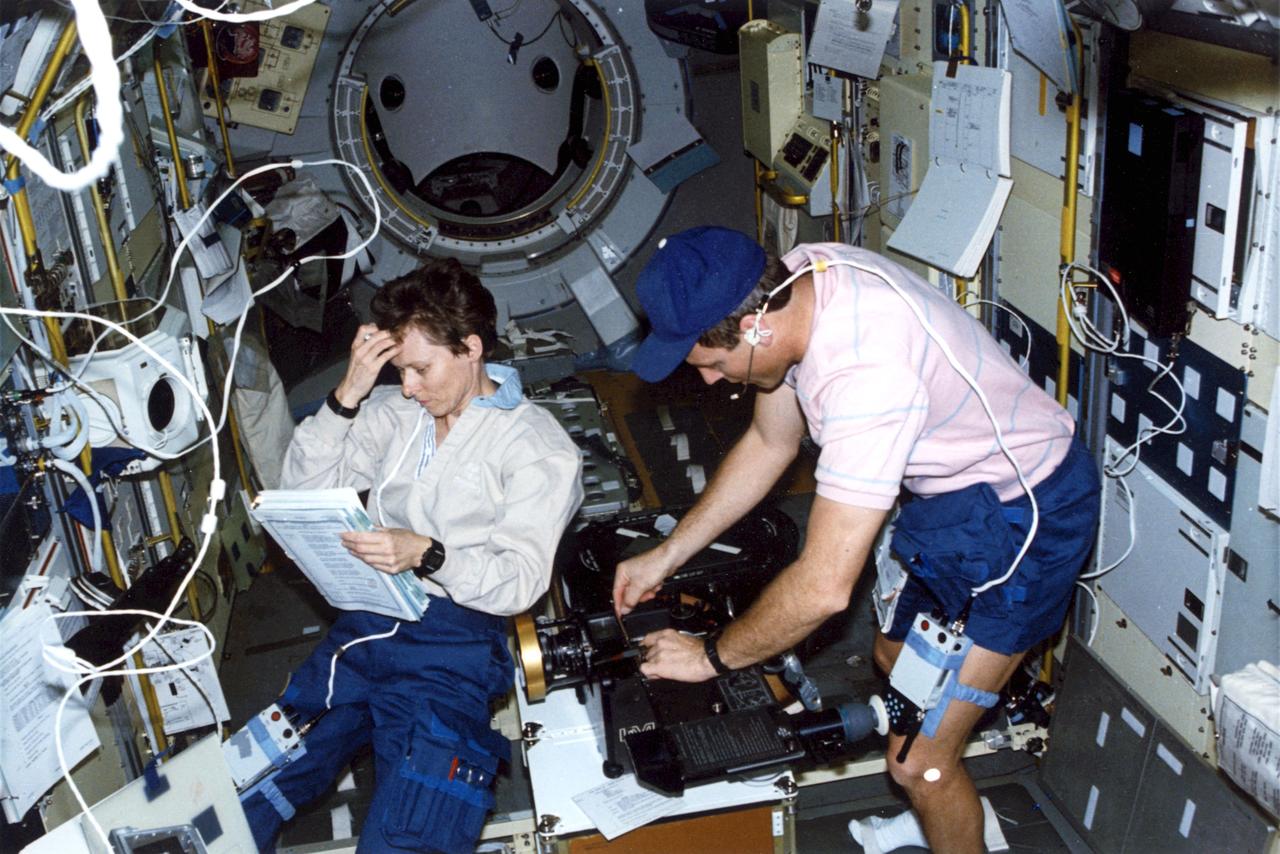
STS-42, Astronauts Steve Oswald and Canadian Roberta Bondar working in IML-1 (International Microgravity Laboratory).
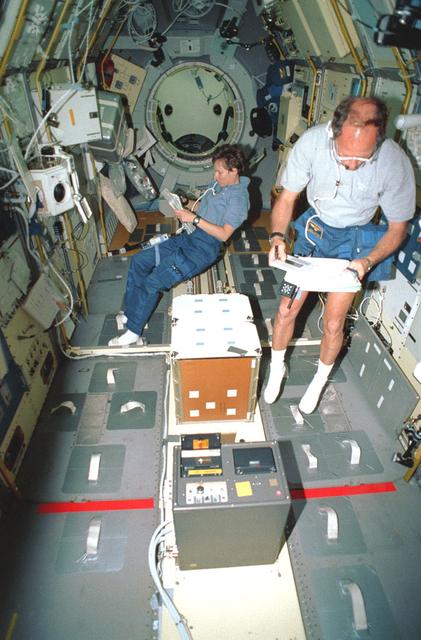
Onboard Space Shuttle Discovery (STS-42) Astronaut Norman E. Thagard, payload commander, and Canadian payload specialist Roberta L. Bondar are busily engaged with experiments in the International Microgravity Laboratory (IML-1) science module. Bondar reads a checklist near the Biorack while Thagard performs a VCR tape change-out. The two, along with four other NASA astronauts and a second IML-1 payload specialist spent more than eight days conducting experiments in Earth orbit. Part of the Space Acceleration Measurement System is in center foreground.
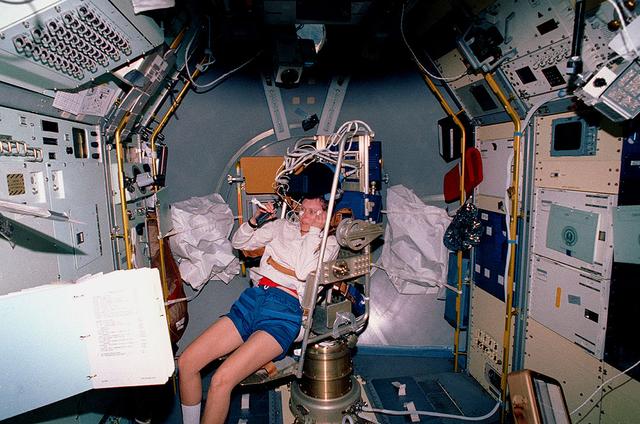
This Space Shuttle Orbiter Discovery (STS-42) onboard photo shows Canadian Payload Specialist Roberta Bondar getting into the Microgravity Vestibular Investigation (MVI) chair to begin an experiment in the International Microgravity Lab-1 (IML-1) Science Module. The (MVI) chair was designed to test the crew member's visual and vestibular responses to head and body movements.
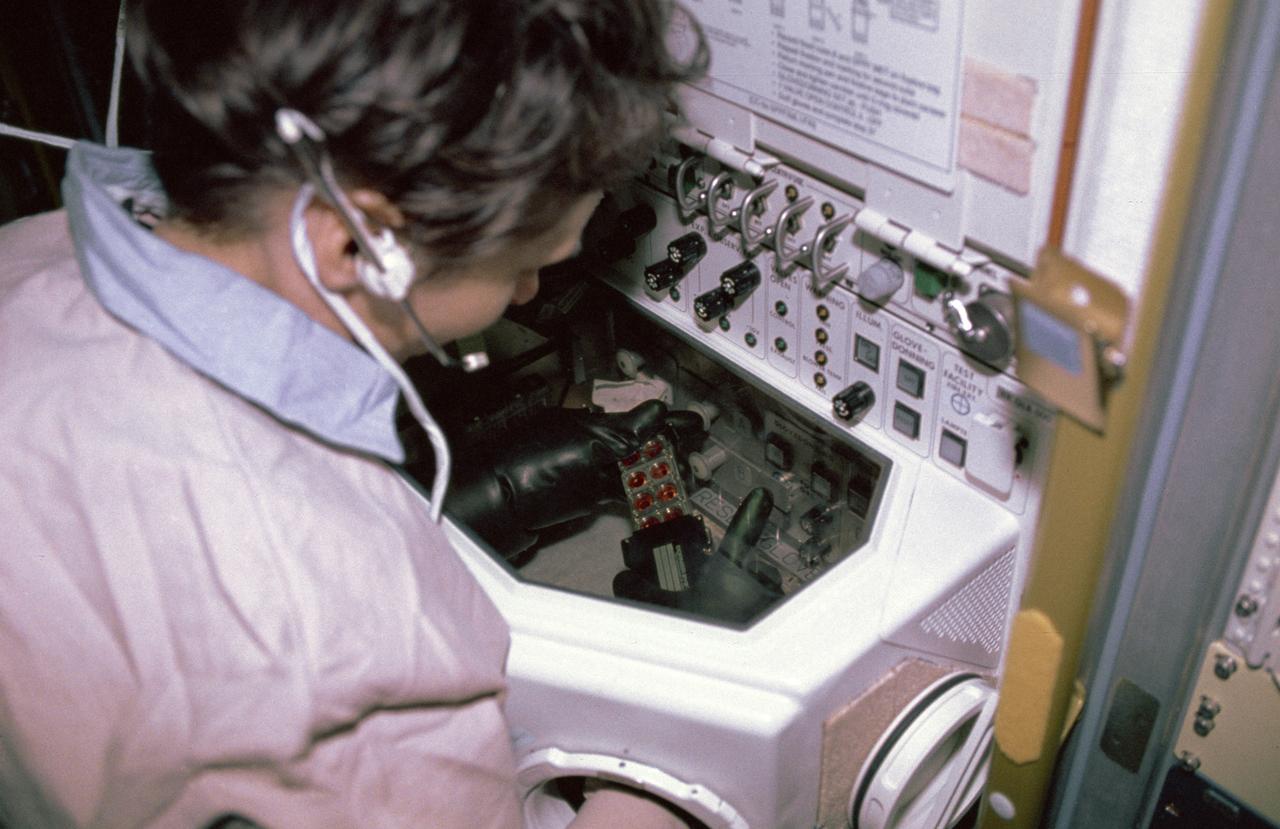
In this photograph, astronaut Roberta Bondar conducts a life science experiment by using the Biorack Glovebox (GBX) during the International Microgravity Laboratory-1 (IML-1) mission. The Biorack was a large multipurpose facility designed for studying the effects of microgravity and cosmic radiation on numerous small life forms such as cells, tissues, small organisms, and plants. Located at the Biorack, the GBX was an enclosed environment that protected samples from contamination and prevented liquid from escaping. Crewmembers handled the specimens with their hands inside gloves that extended into the sealed work area. A microscope and video camera mounted on the GBX door were used to observe and document experiments. Managed by the Marshall Space Flight Center, the IML-1 mission was the first in a series of Shuttle flights dedicated to fundamental materials and life sciences research and was launched aboard the Shuttle Orbiter Discovery (STS-42) on January 22, 1992.

S91-52649 (Nov 1991) ---- Astronaut Ulf Merbold, PhD, European Space Agency (ESA) Payload Specialist for STS-42, International Microgravity Laboratory (IML-1).
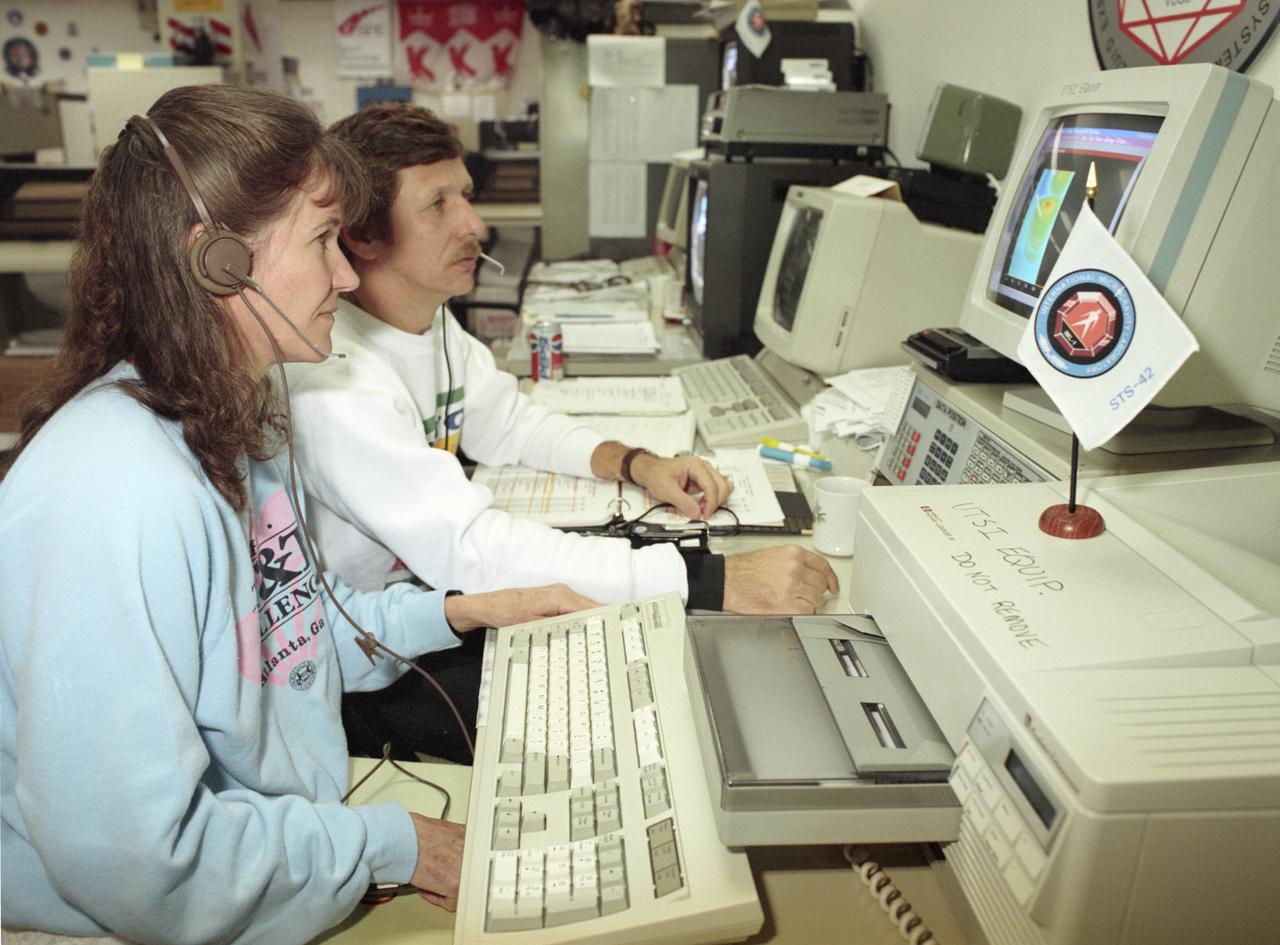
The primary payload for Space Shuttle Mission STS-42, launched January 22, 1992, was the International Microgravity Laboratory-1 (IML-1), a pressurized manned Spacelab module. The goal of IML-1 was to explore in depth the complex effects of weightlessness of living organisms and materials processing. Around-the-clock research was performed on the human nervous system's adaptation to low gravity and effects of microgravity on other life forms such as shrimp eggs, lentil seedlings, fruit fly eggs, and bacteria. Materials processing experiments were also conducted, including crystal growth from a variety of substances such as enzymes, mercury iodide, and a virus. The Huntsville Operations Support Center (HOSC) Spacelab Payload Operations Control Center (SL POCC) at the Marshall Space Flight Center (MSFC) was the air/ground communication channel used between the astronauts and ground control teams during the Spacelab missions. Featured are activities in the SL POCC during STS-42, IML-1 mission.
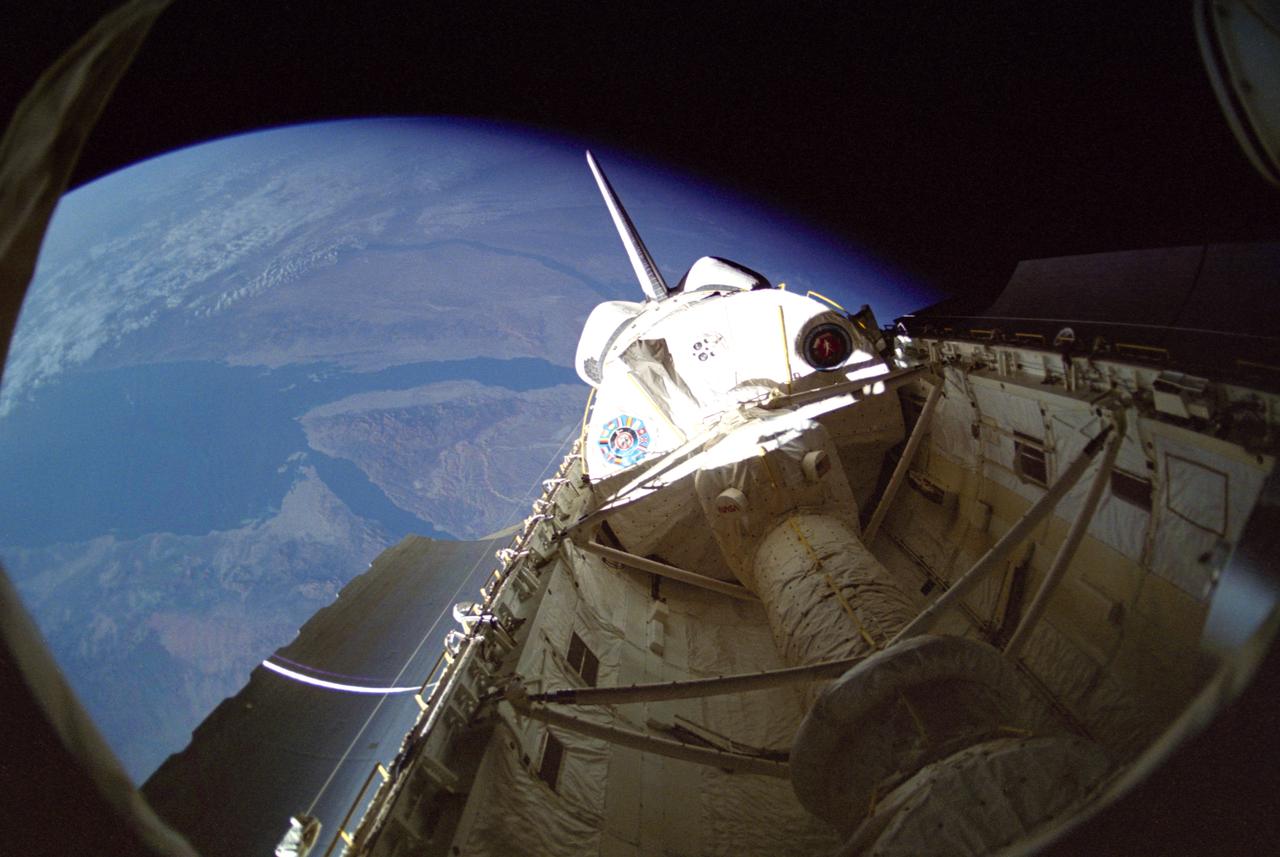
STS042-25-027 (30 Jan 1992) --- STS-42 International Microgravity Laboratory 1 (IML-1) Spacelab module and Spacelab tunnel (foreground) exteriors are documented in the payload bay (PLB) of Discovery, Orbiter Vehicle (OV) 103, and backdropped against the Red Sea and part of the Sinai Peninsula.
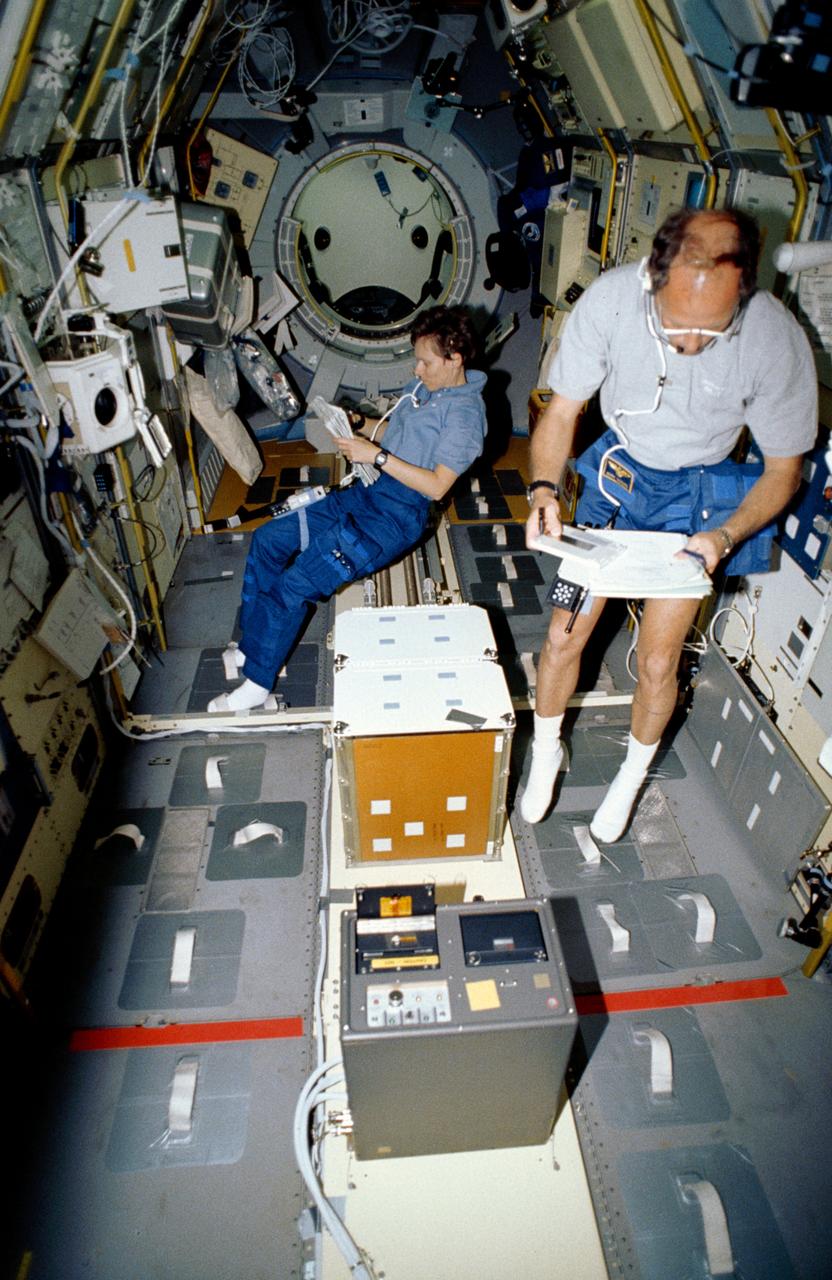
STS042-11-016 (30 Jan 1992) --- Astronaut Norman E. Thagard, STS-42 missions specialist and payload commander, and payload specialist Roberta L. Bondar are busily engaged with experiments in the International Microgravity Laboratory 1 (IML-1) Spacelab module. Bondar reads a checklist near the Rack 5 Biorack and glovebox while Thagard performs a VCR tape change-out. The Space Acceleration Measurement System (SAMS) (foreground) and shuttle middeck lockers are secured in IML-1's center aisle. In the background the open hatch and Spacelab tunnel interior are visible. Crewmembers enter and exit the IML-1 module via the Spacelab tunnel which connects to Discovery's, Orbiter Vehicle (OV) 103's, airlock.
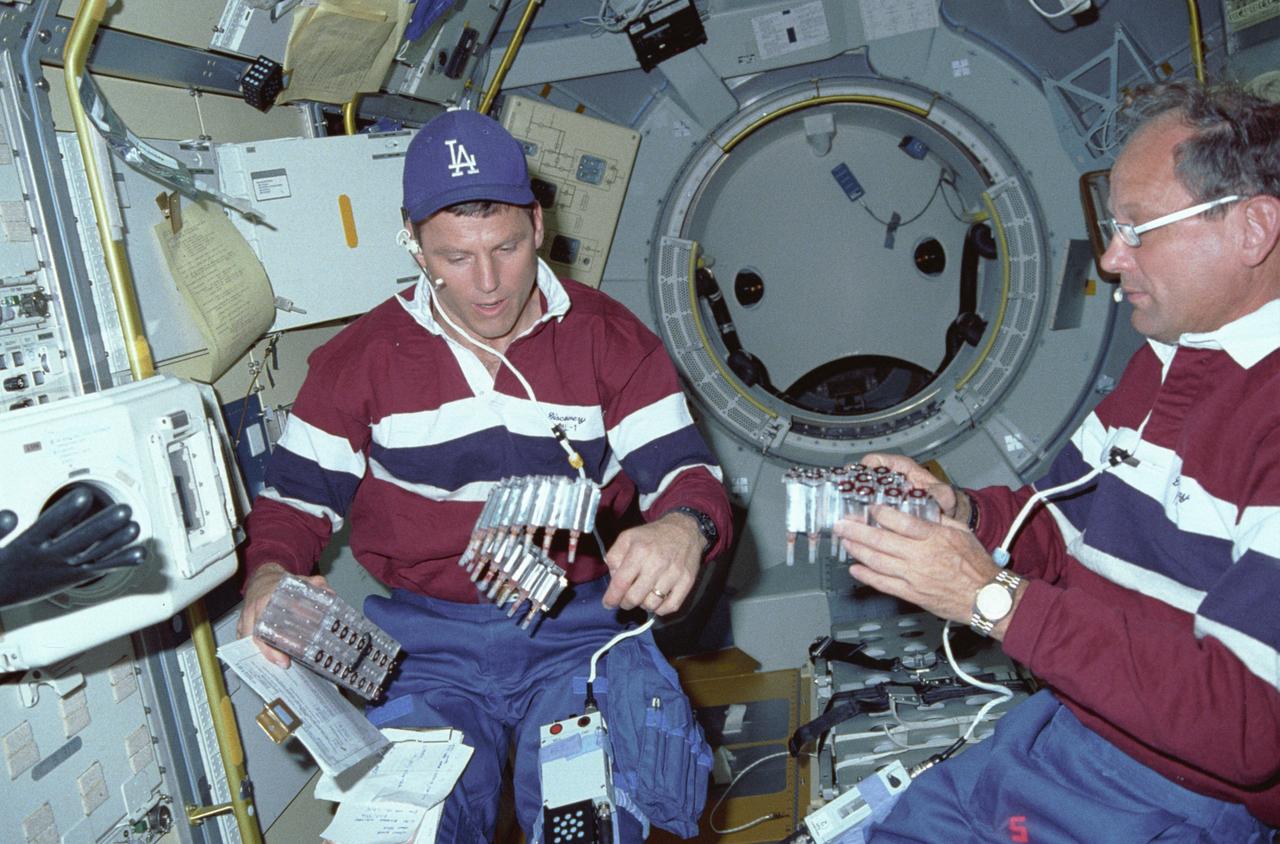
International Microgravity Laboratory-1 (IML-1) was the first in a series of Shuttle flights dedicated to fundamental materials and life sciences research with the international partners. The participating space agencies included: NASA, the 14-nation European Space Agency (ESA), the Canadian Space Agency (CSA), the French National Center of Space Studies (CNES), the German Space Agency and the German Aerospace Research Establishment (DAR/DLR), and the National Space Development Agency of Japan (NASDA). Dedicated to the study of life and materials sciences in microgravity, the IML missions explored how life forms adapt to weightlessness and investigated how materials behave when processed in space. Both life and materials sciences benefited from the extended periods of microgravity available inside the Spacelab science module in the cargo bay of the Space Shuttle Orbiter. In this photograph, Astronauts Stephen S. Oswald and Norman E. Thagard handle ampoules used in the Mercuric Iodide Crystal Growth (MICG) experiment. Mercury Iodide crystals have practical uses as sensitive x-ray and gamma-ray detectors. In addition to their exceptional electronic properties, these crystals can operate at room temperature rather than at the extremely low temperatures usually required by other materials. Because a bulky cooling system is urnecessary, these crystals could be useful in portable detector devices for nuclear power plant monitoring, natural resource prospecting, biomedical applications in diagnosis and therapy, and astronomical observation. Managed by the Marshall Space Flight Center, IML-1 was launched on January 22, 1992 aboard the Space Shuttle Orbiter Discovery (STS-42 mission).
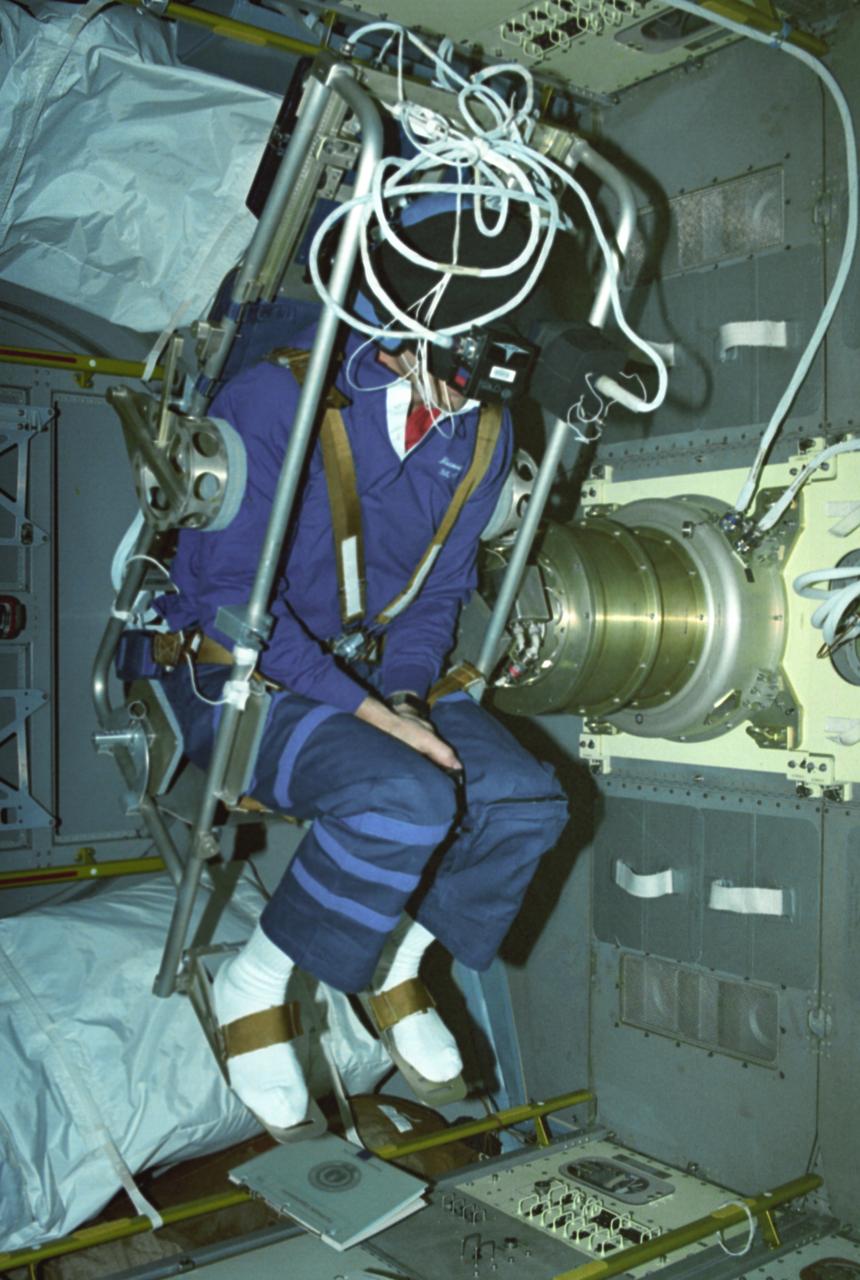
Astronaut David C. Hilmers conducts the Microgravity Vestibular Investigations (MVI) sitting in its rotator chair inside the IML-1 science module. When environmental conditions change so that the body receives new stimuli, the nervous system responds by interpreting the incoming sensory information differently. In space, the free-fall environment of an orbiting spacecraft requires that the body adapts to the virtual absence of gravity. Early in flights, crewmembers may feel disoriented or experience space motion sickness. MVI examined the effects of orbital flight on the human orientation system to obtain a better understanding of the mechanisms of adaptation to weightlessness. By provoking interactions among the vestibular, visual, and proprioceptive systems and then measuring the perceptual and sensorimotor reactions, scientists can study changes that are integral to the adaptive process. The IML-1 mission was the first in a series of Shuttle flights dedicated to fundamental materials and life sciences research with the international partners. The participating space agencies included: NASA, the 14-nation European Space Agency (ESA), the Canadian Space Agency (CSA), the French National Center of Space Studies (CNES), the German Space Agency and the German Aerospace Research Establishment (DAR/DLR), and the National Space Development Agency of Japan (NASDA). Both life and materials sciences benefited from the extended periods of microgravity available inside the Spacelab science module in the cargo bay of the Space Shuttle Orbiter. Managed by the Marshall Space Flight Center, IML-1 was launched on January 22, 1992 aboard the Space Shuttle Orbiter Discovery (STS-42 mission).
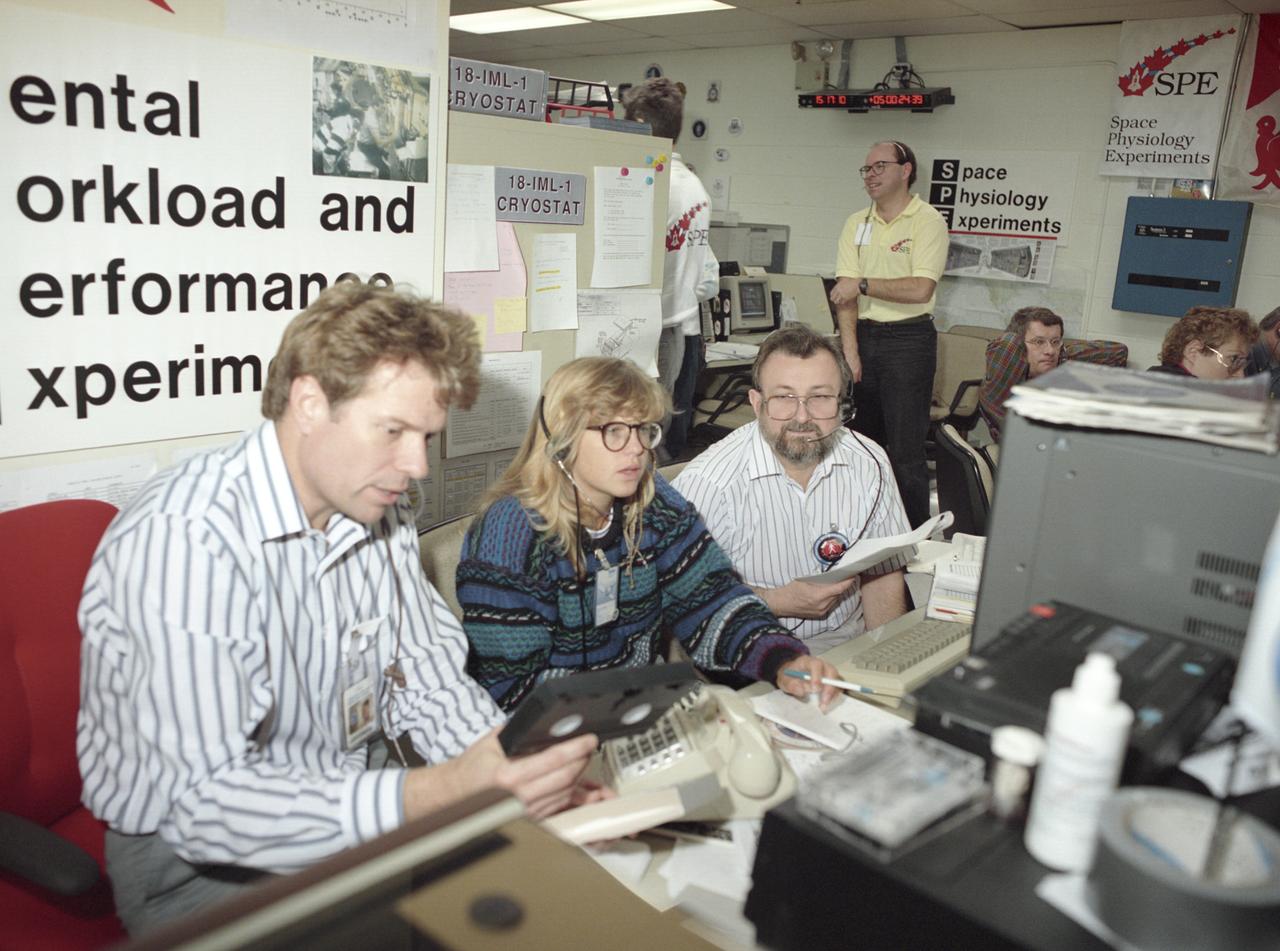
The primary payload for Space Shuttle Mission STS-42, launched January 22, 1992, was the International Microgravity Laboratory-1 (IML-1), a pressurized manned Spacelab module. The goal of IML-1 was to explore in depth the complex effects of weightlessness of living organisms and materials processing. Around-the-clock research was performed on the human nervous system's adaptation to low gravity and effects of microgravity on other life forms such as shrimp eggs, lentil seedlings, fruit fly eggs, and bacteria. Materials processing experiments were also conducted, including crystal growth from a variety of substances such as enzymes, mercury iodide, and a virus. The Huntsville Operations Support Center (HOSC) Spacelab Payload Operations Control Center (SL POCC) at the Marshall Space Flight Center (MSFC) was the air/ground communication channel used between the astronauts and ground control teams during the Spacelab missions. Featured activities are of the Mental Workload and Performance Experiment (MWPE) team in the SL POCC during the IML-1 mission.
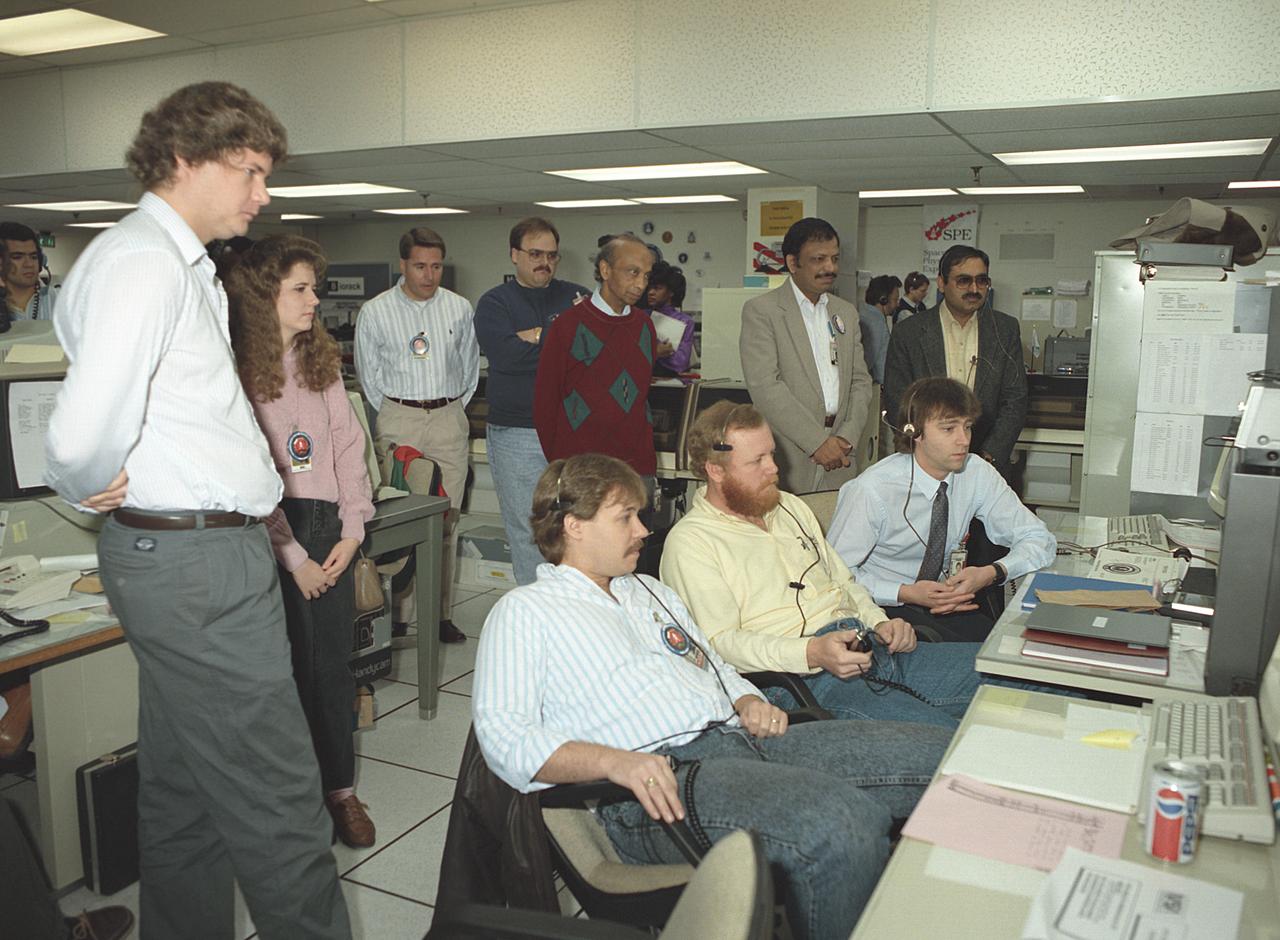
The primary payload for Space Shuttle Mission STS-42, launched January 22, 1992, was the International Microgravity Laboratory-1 (IML-1), a pressurized manned Spacelab module. The goal of IML-1 was to explore in depth the complex effects of weightlessness of living organisms and materials processing. Around-the-clock research was performed on the human nervous system's adaptation to low gravity and effects of microgravity on other life forms such as shrimp eggs, lentil seedlings, fruit fly eggs, and bacteria. Materials processing experiments were also conducted, including crystal growth from a variety of substances such as enzymes, mercury iodide, and a virus. The Huntsville Operations Support Center (HOSC) Spacelab Payload Operations Control Center (SL POCC) at the Marshall Space Flight Center (MSFC) was the air/ground communication channel used between the astronauts and ground control teams during the Spacelab missions. Featured is the Crystal Growth team in the SL POCC during STS-42, IML-1 mission.
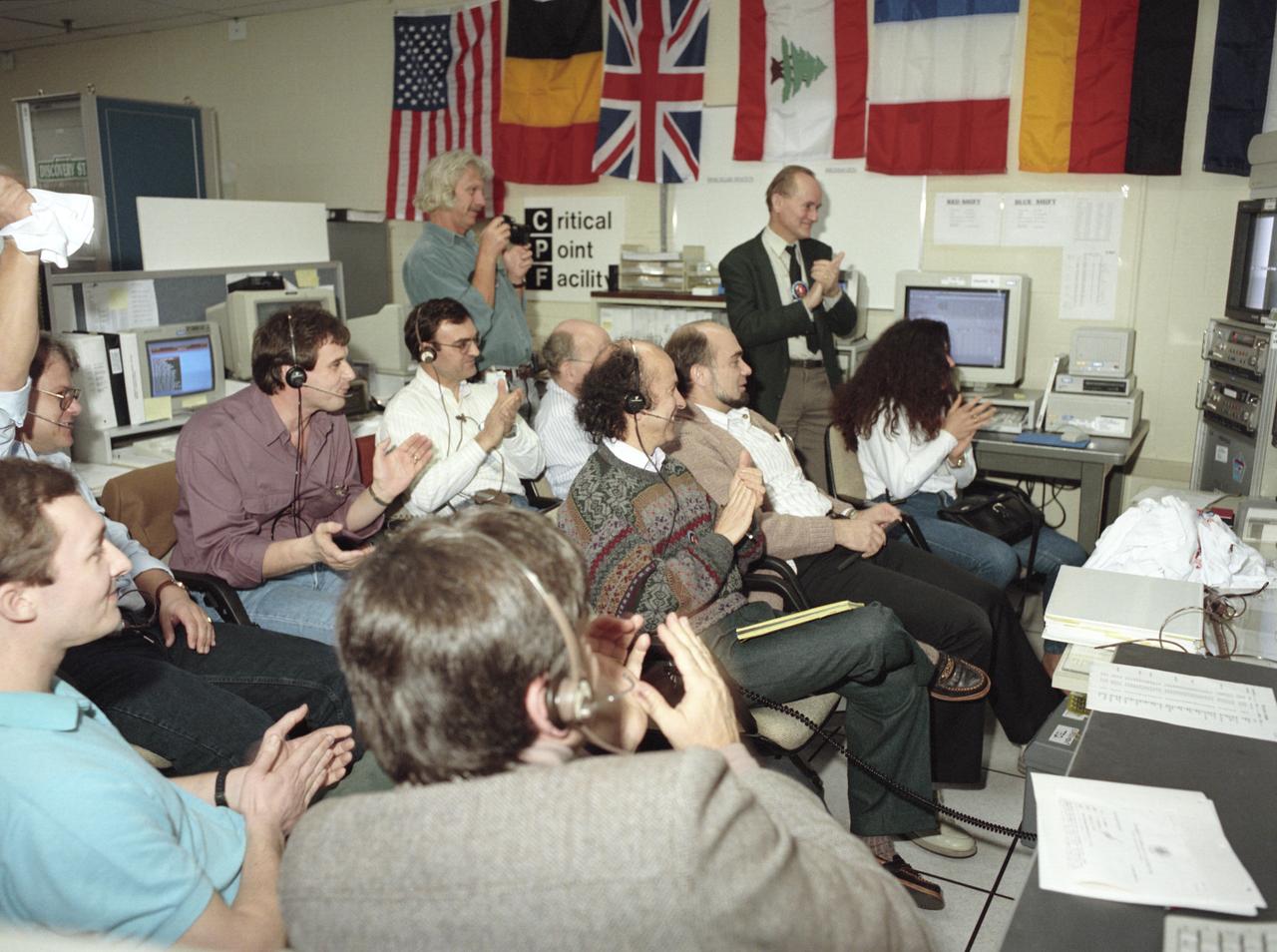
The primary payload for Space Shuttle Mission STS-42, launched January 22, 1992, was the International Microgravity Laboratory-1 (IML-1), a pressurized manned Spacelab module. The goal of IML-1 was to explore in depth the complex effects of weightlessness of living organisms and materials processing. Around-the-clock research was performed on the human nervous system's adaptation to low gravity and effects of microgravity on other life forms such as shrimp eggs, lentil seedlings, fruit fly eggs, and bacteria. Materials processing experiments were also conducted, including crystal growth from a variety of substances such as enzymes, mercury iodide, and a virus. The Huntsville Operations Support Center (HOSC) Spacelab Payload Operations Control Center (SL POCC) at the Marshall Space Flight Center (MSFC) was the air/ground communication channel used between the astronauts and ground control teams during the Spacelab missions. Featured is the Critical Point Facility (CPE) group in the SL POCC during STS-42, IML-1 mission.
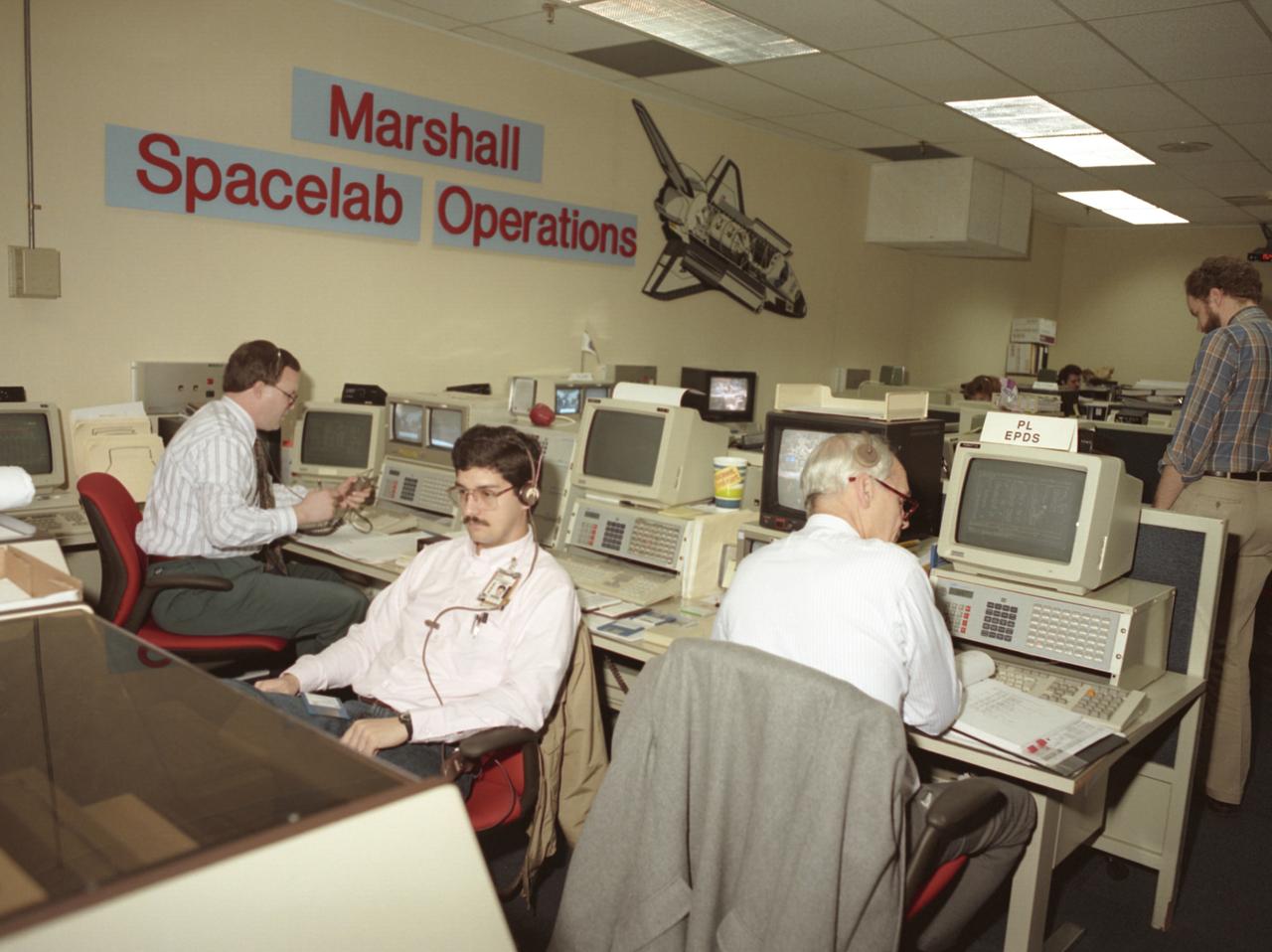
The primary payload for Space Shuttle Mission STS-42, launched January 22, 1992, was the International Microgravity Laboratory-1 (IML-1), a pressurized manned Spacelab module. The goal of IML-1 was to explore in depth the complex effects of weightlessness of living organisms and materials processing. Around-the-clock research was performed on the human nervous system's adaptation to low gravity and effects of microgravity on other life forms such as shrimp eggs, lentil seedlings, fruit fly eggs, and bacteria. Materials processing experiments were also conducted, including crystal growth from a variety of substances such as enzymes, mercury iodide, and a virus. The Huntsville Operations Support Center (HOSC) Spacelab Payload Operations Control Center (SL POCC) at the Marshall Space Flight Center (MSFC) was the air/ground communication channel used between the astronauts and ground control teams during the Spacelab missions. Featured is the Spacelab Operations Support Room Space Engineering Support team in the SL POCC during STS-42, IML-1 mission.
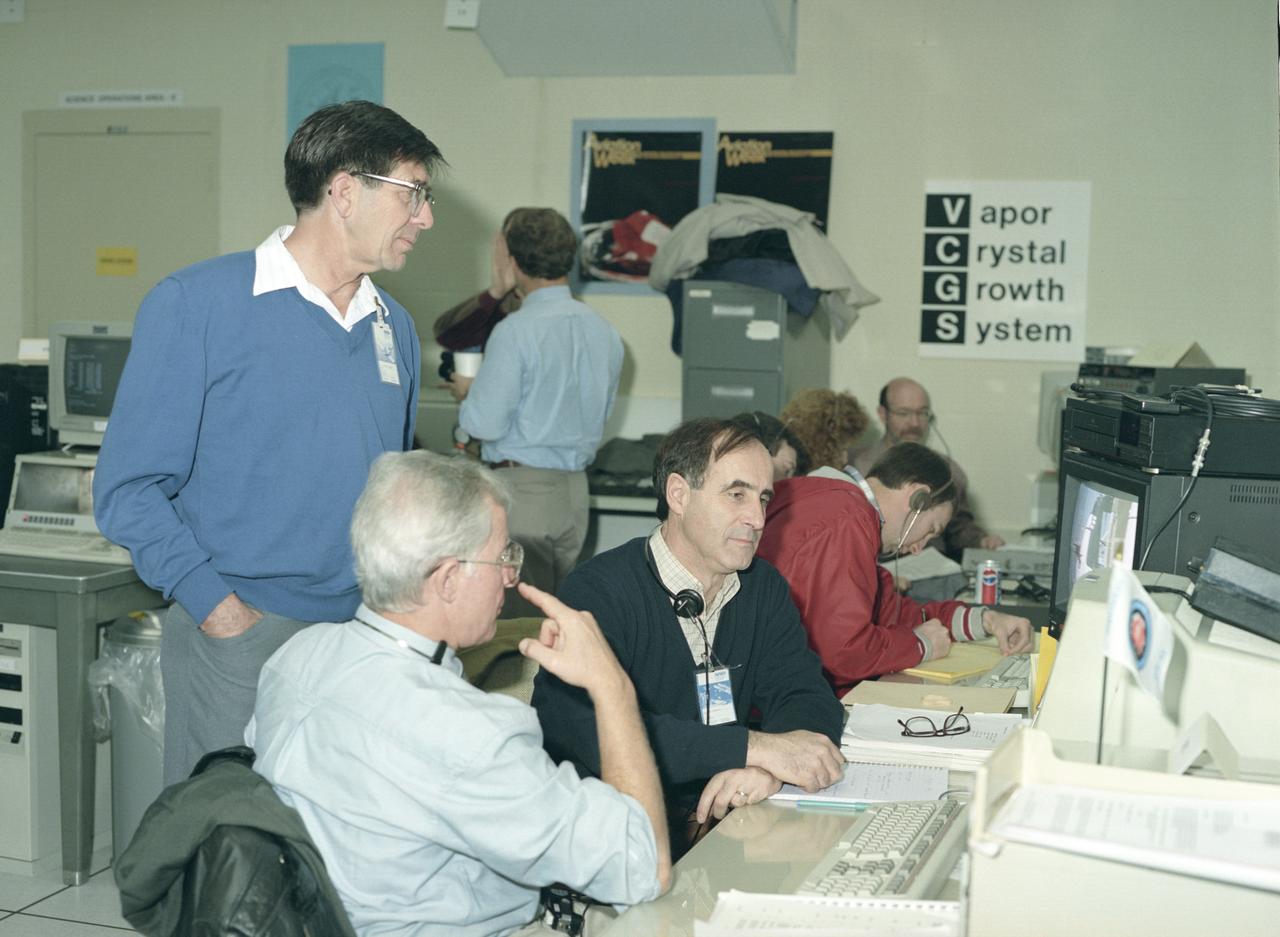
The primary payload for Space Shuttle Mission STS-42, launched January 22, 1992, was the International Microgravity Laboratory-1 (IML-1), a pressurized manned Spacelab module. The goal of IML-1 was to explore in depth the complex effects of weightlessness of living organisms and materials processing. Around-the-clock research was performed on the human nervous system's adaptation to low gravity and effects of microgravity on other life forms such as shrimp eggs, lentil seedlings, fruit fly eggs, and bacteria. Materials processing experiments were also conducted, including crystal growth from a variety of substances such as enzymes, mercury iodide, and a virus. The Huntsville Operations Support Center (HOSC) Spacelab Payload Operations Control Center (SL POCC) at the Marshall Space Flight Center (MSFC) was the air/ground communication channel used between the astronauts and ground control teams during the Spacelab missions. Featured is the Vapor Crystal Growth System (VCGS) team in SL POCC), during STS-42, IML-1 mission.
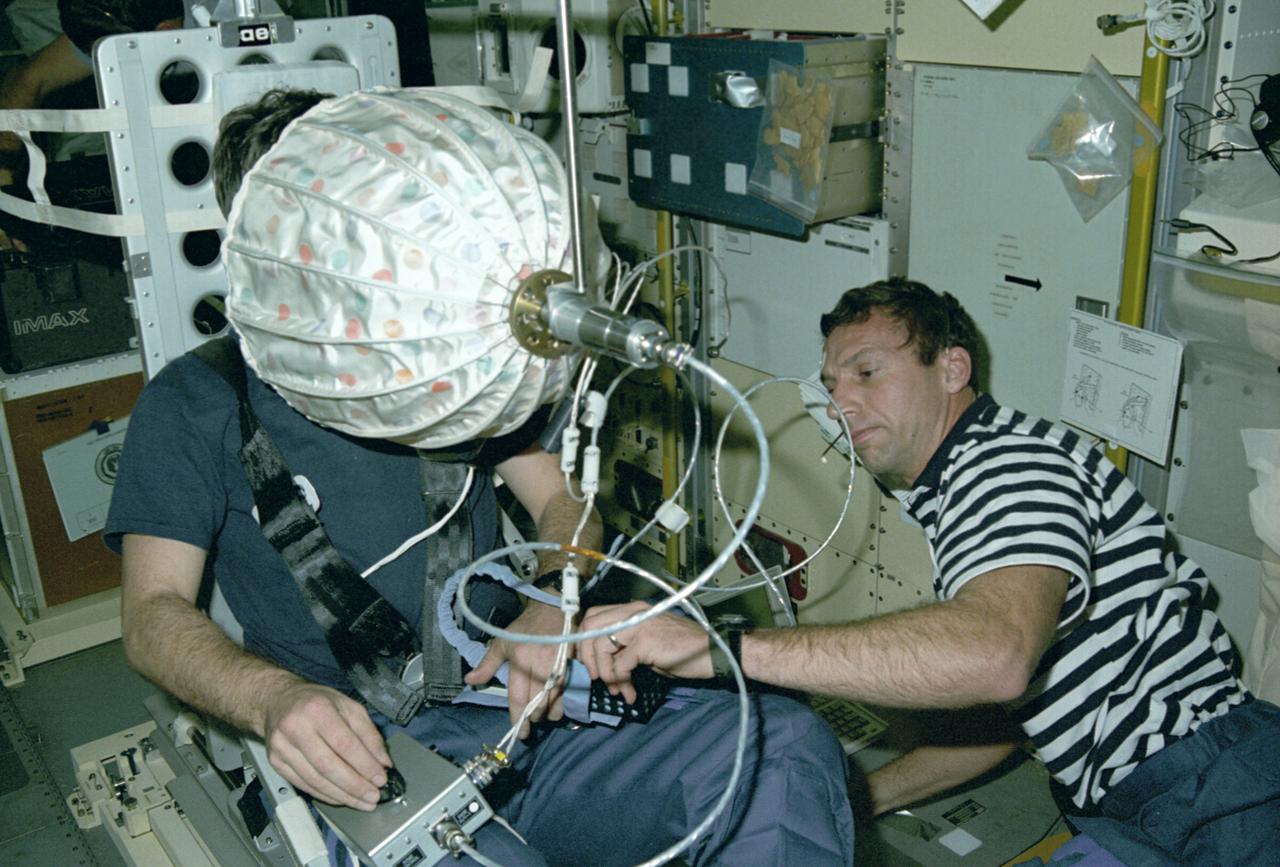
Astronaut Ulf Merbold on the stationary seat of the mini-sled, stares into an umbrella-shaped rotating dome with colored dots. Astronaut Merbold, assisted by astronaut David Hilmer, are conducting the Visual Simulator Experiment, a space physiology experiment. The Visual Stimulator Experiment measures the relative importance of visual and vestibular information in determining body orientation. When a person looks at a rotating visual field, a false sensation of self-rotation, called circularvection, results. In weightlessness, circularvection should increase immediately and may continue to increase as the nervous system comes to rely more on visual than vestibular cues. As Astronaut Merbold stares into the rotating dome with a pattern of colored dots and its interior, he turns a knob to indicate his perception of body rotation. The strength of circularvection is calculated by comparing signals from the dome and the knob. The greater the false sense of circularvection, the more the subject is relying on visual information instead of otolith information. The IML-1 mission was the first in a series of Shuttle flights dedicated to fundamental materials and life sciences research with the international partners. The participating space agencies included: NASA, the 14-nation European Space Agency (ESA), the Canadian Space Agency (CSA), the French National Center of Space Studies (CNES), the German Space Agency and the German Aerospace Research Establishment (DAR/DLR), and the National Space Development Agency of Japan (NASDA). Managed by the Marshall Space Flight Center, IML-1 was launched on January 22, 1992 aboard the Space Shuttle Orbiter Discovery (STS-42 mission).
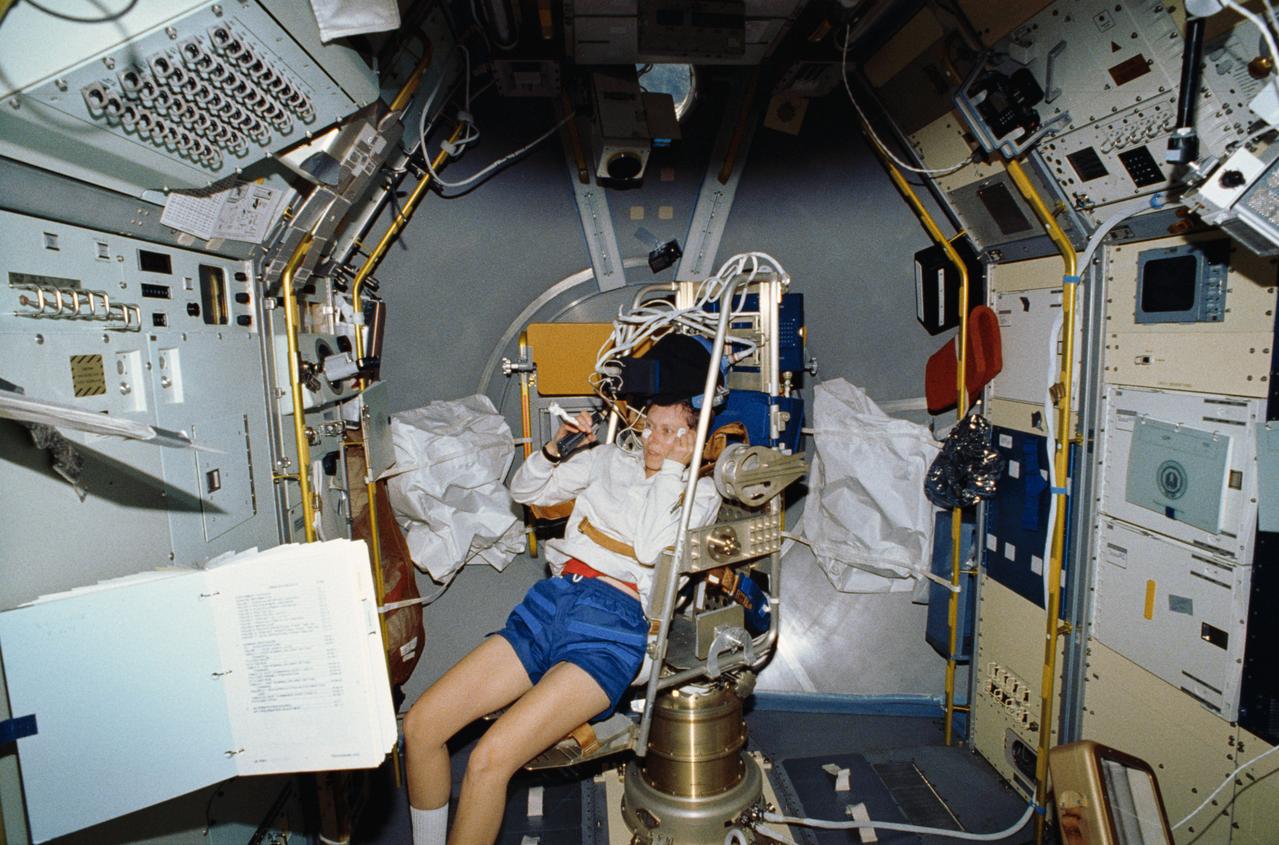
STS042-06-031 (30 Jan 1992) - - - STS-42 Payload Specialist Roberta L. Bondar gets into the Microgravity Vestibular Investigations (MVI) rotator chair to begin an experiment. The chair is mounted in the center aisle of the International Microgravity Laboratory 1 (IML-1) Spacelab (SL) module. Just above Bondar's head is the helmet assembly which is outfitted with accelerometers to measure head movements and visors that fit over each eye independently to provide visual stimuli. The chair system has three movement patterns: "sinusoidal" or traveling predictably back and forth over the same distance at a constant speed; "pseudorandom" or moving back and forth over varying distances; and "stepped" or varying speeds beginning and stopping suddenly.
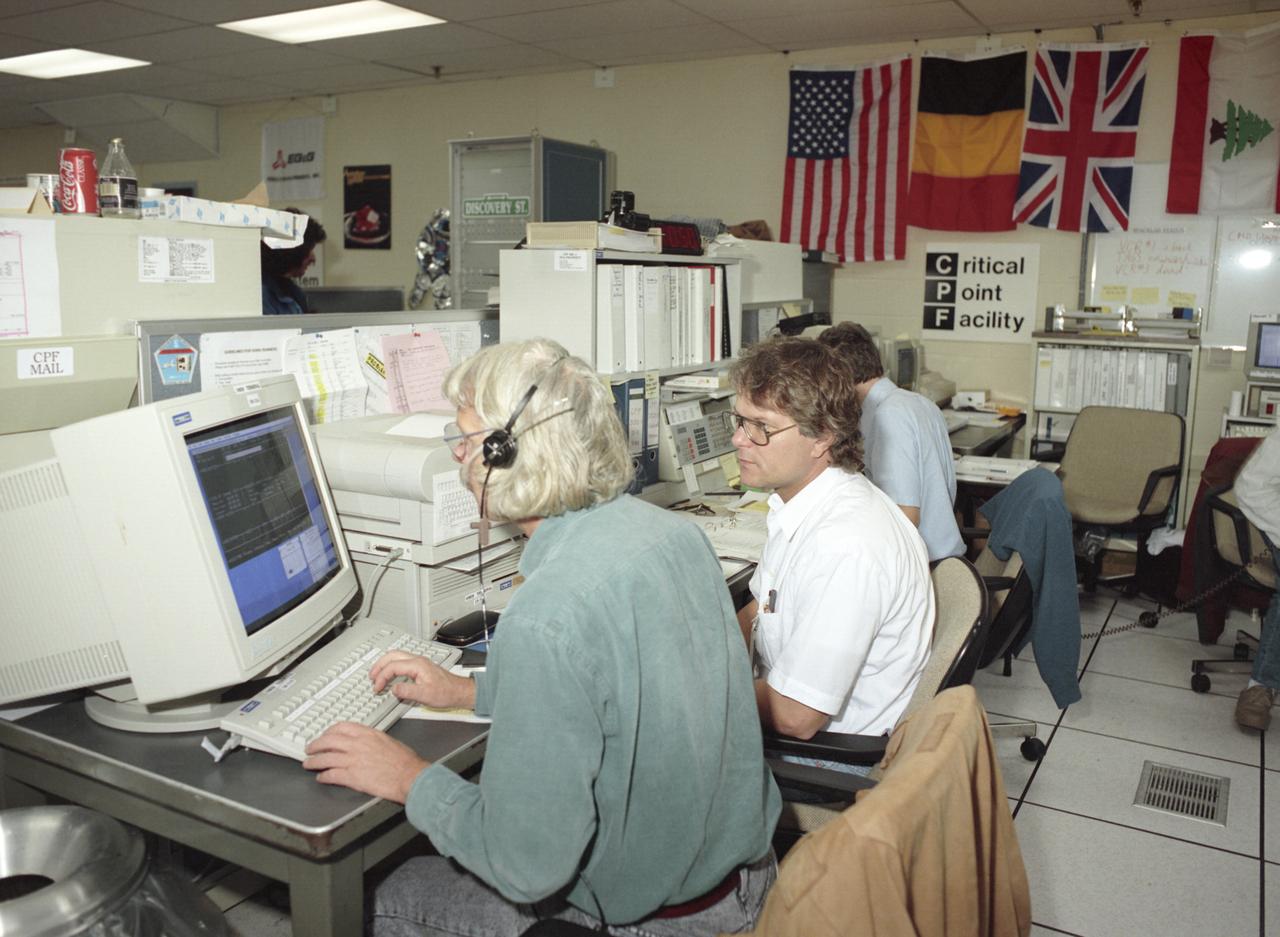
The primary payload for Space Shuttle Mission STS-42, launched January 22, 1992, was the International Microgravity Laboratory-1 (IML-1), a pressurized manned Spacelab module. The goal of IML-1 was to explore in depth the complex effects of weightlessness of living organisms and materials processing. Around-the-clock research was performed on the human nervous system's adaptation to low gravity and effects of microgravity on other life forms such as shrimp eggs, lentil seedlings, fruit fly eggs, and bacteria. Materials processing experiments were also conducted, including crystal growth from a variety of substances such as enzymes, mercury iodide, and a virus. The Huntsville Operations Support Center (HOSC) Spacelab Payload Operations Control Center (SL POCC) at the Marshall Space Flight Center (MSFC) was the air/ground communication channel used between the astronauts and ground control teams during the Spacelab missions. Featured is the Critical Point Facility (CPF) team in the SL POCC during the IML-1 mission.
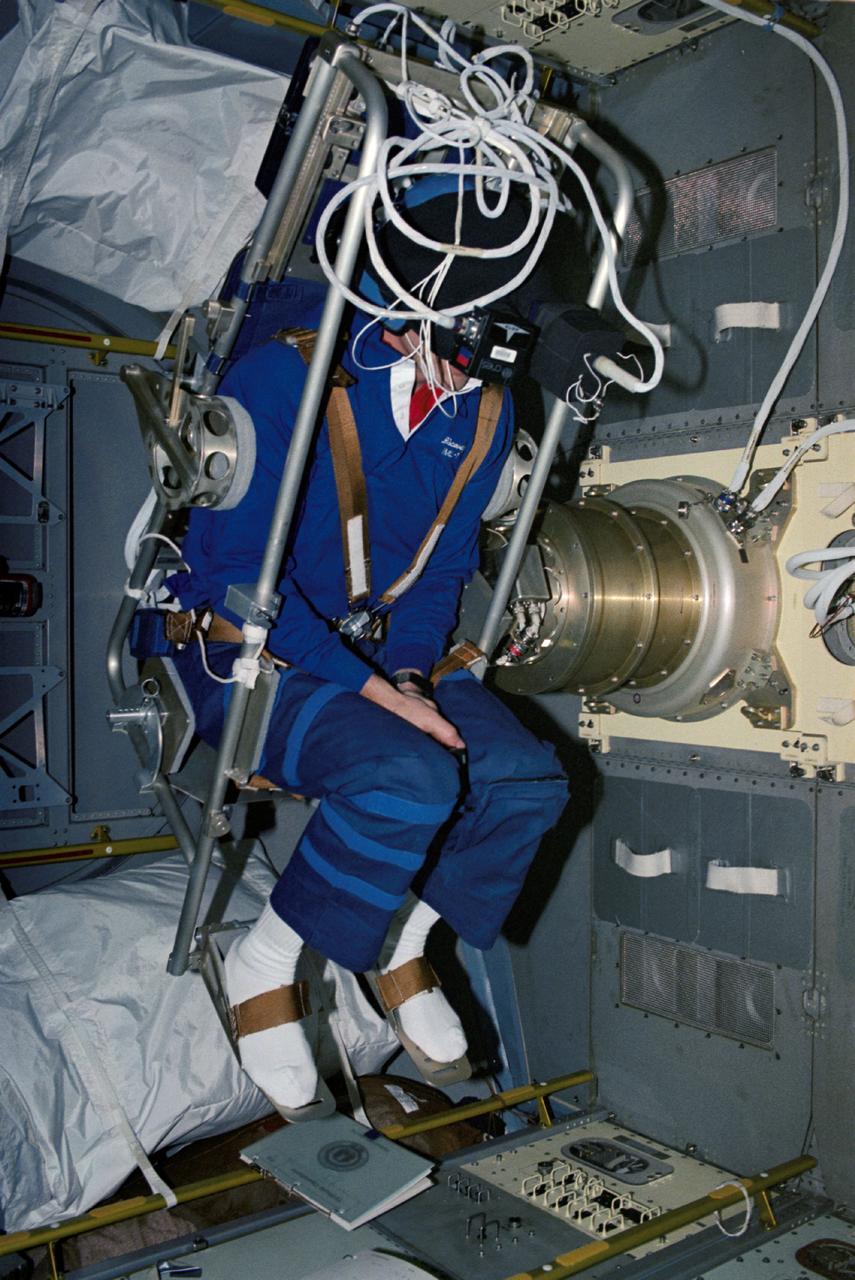
STS042-27-037 (22-30 Jan. 1992) --- Astronaut David C. Hilmers, STS-42 mission specialist, wearing a helmet assembly, sits in the Microgravity Vestibular Investigation (MVI) rotating chair. The scene is in the International Microgravity Laboratory (IML-1) science module aboard Discovery. Hilmers, a mission specialist, and six other crewmembers spent more than eight days in Earth-orbit conducting experiments. Hilmer's helmet assembly is outfitted with accelerometers to measure head movements and visors that fit over each eye independently to provide visual stimuli. The chair system has three movement patterns: "sinusoidal" or traveling predictably back and forth over the same distance at a constant speed; "pseudorandom" or moving back and forth over the varying distances; and "stepped" or varying speeds beginning and stopping suddenly.
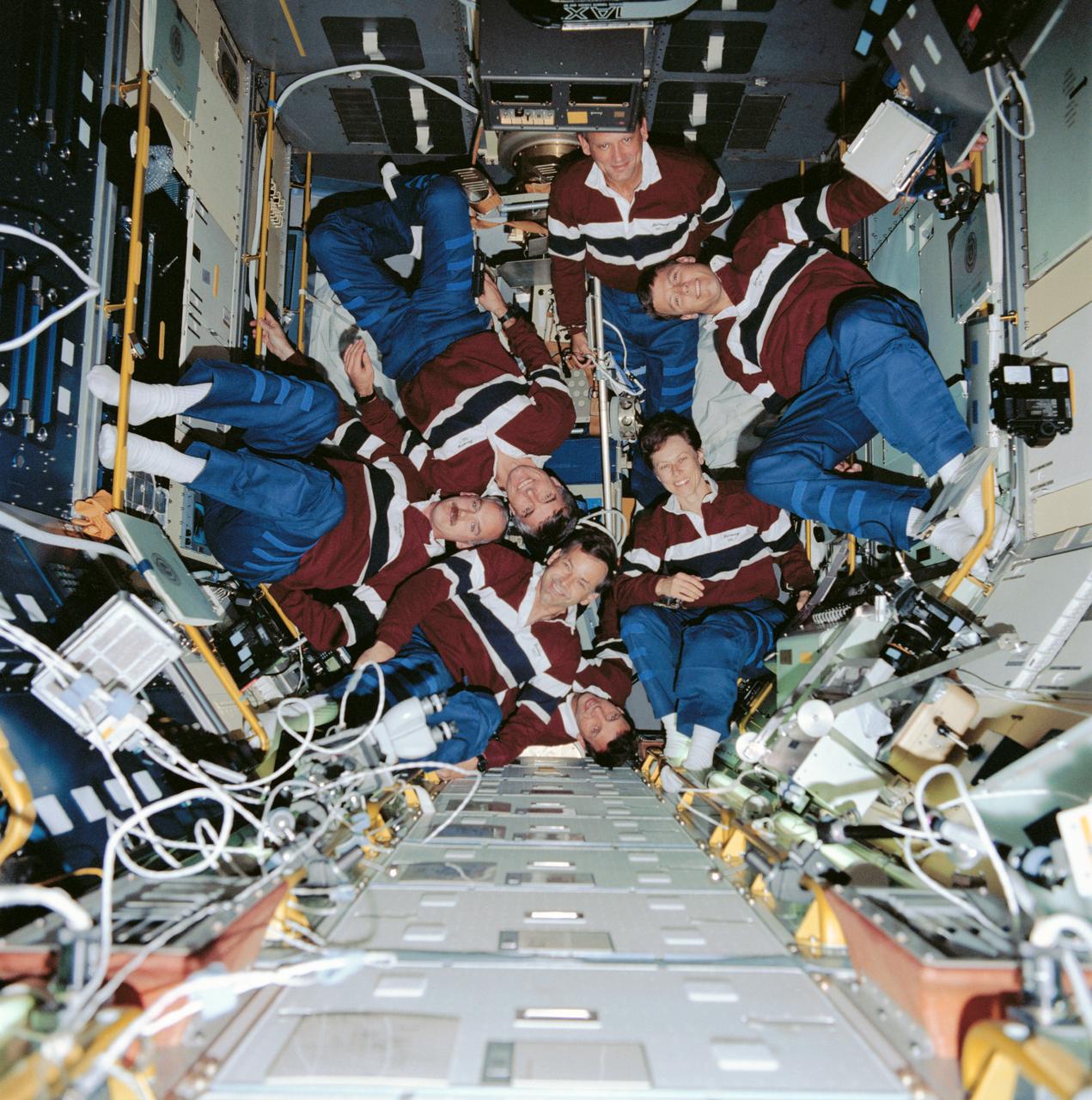
STS042-78-061 (22-30 Jan. 1992) --- The seven STS-42 crewmembers pose for a traditional in-space portrait in the shirt-sleeve environment of the International Microgravity Laboratory (IML-1) science module in the shuttle's cargo bay. (Hold picture with index numbers at top.) David C. Hilmers, mission specialist, is at top center of the 70mm image. Others pictured are (clockwise) Ronald J. Grabe, mission commander; William F. Readdy; mission specialist; Ulf Merbold, European Space Agency (ESA) payload specialist; Norman E. Thagard, payload commander; Stephen S. Oswald, pilot; and Roberta L. Bondar, Canadian payload specialist. The rotating chair, used often in biomedical tests on the eight-day flight, is (partially obscured) in center frame.
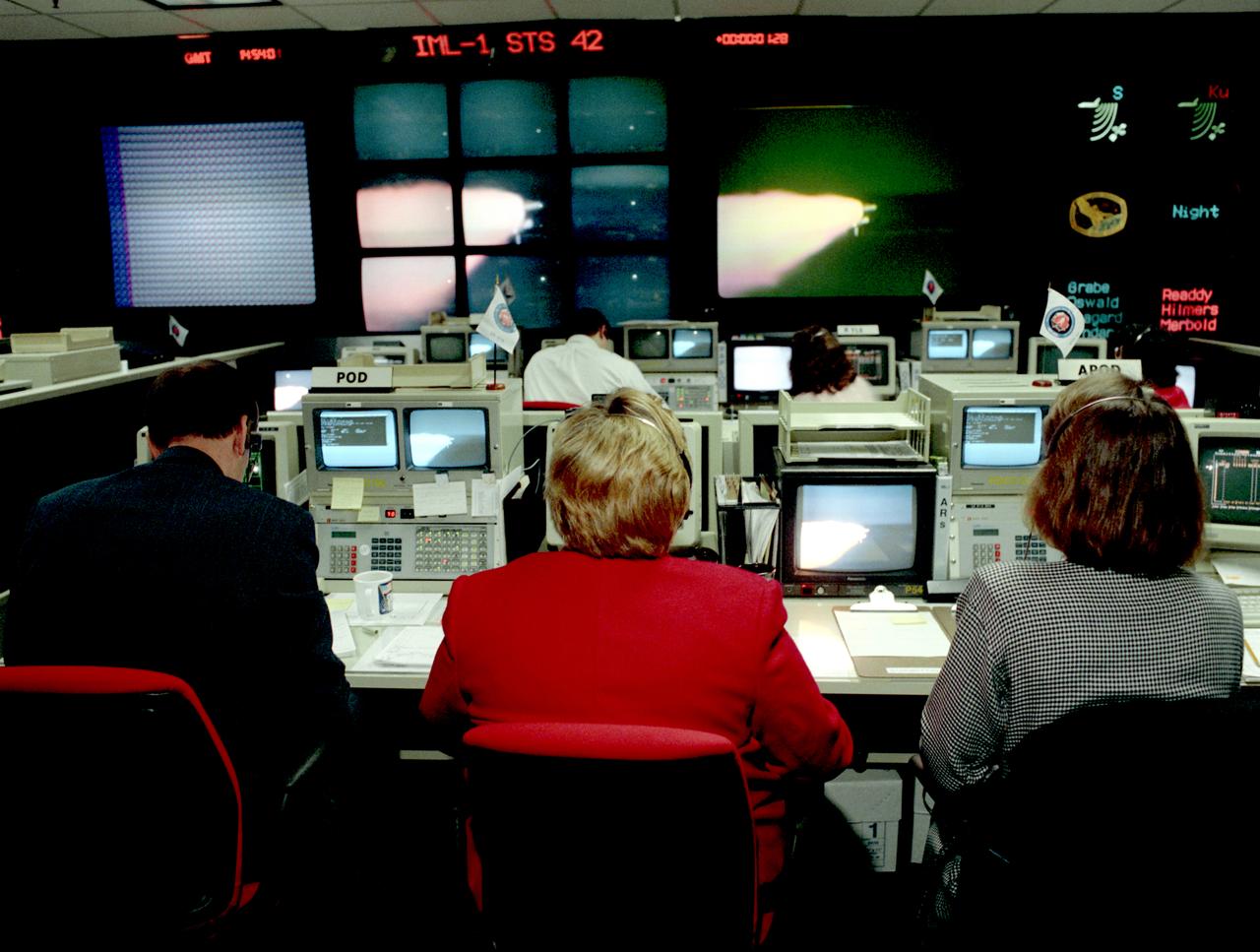
The primary payload for Space Shuttle Mission STS-42, launched January 22, 1992, was the International Microgravity Laboratory-1 (IML-1), a pressurized manned Spacelab module. The goal of IML-1 was to explore in depth the complex effects of weightlessness of living organisms and materials processing. Around-the-clock research was performed on the human nervous system's adaptation to low gravity and effects of microgravity on other life forms such as shrimp eggs, lentil seedlings, fruit fly eggs, and bacteria. Materials processing experiments were also conducted, including crystal growth from a variety of substances such as enzymes, mercury iodide and a virus. The Huntsville Operations Support Center (HOSC) Spacelab Payload Operations Control Center (SL POCC) at the Marshall Space Flight Center (MSFC) was the air/ground communication channel used between the astronauts aboard the Spacelab and scientists, researchers, and ground control teams during the Spacelab missions. The facility made instantaneous video and audio communications possible for scientists on the ground to follow the progress and to send direct commands of their research almost as if they were in space with the crew. Teams of controllers and researchers directed on-orbit science operations, sent commands to the spacecraft, received data from experiments aboard the Space Shuttle, adjusted mission schedules to take advantage of unexpected science opportunities or unexpected results, and worked with crew members to resolve problems with their experiments. In this photograph the Payload Operations Director (POD) views the launch.
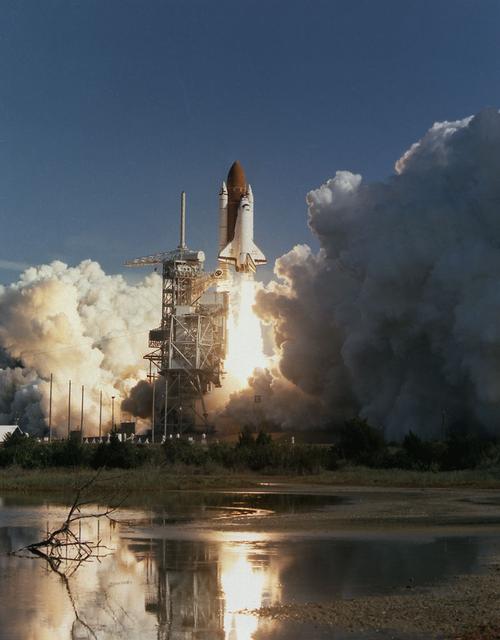
Space Shuttle Discovery (STS-42) lifted off from Kennedy Space Center (KSC) with International Microgravity Laboratory (IML-1) aboard the orbiter's cargo bay. IML missions were devoted to material and life sciences studies using the Spacelab Long Module.
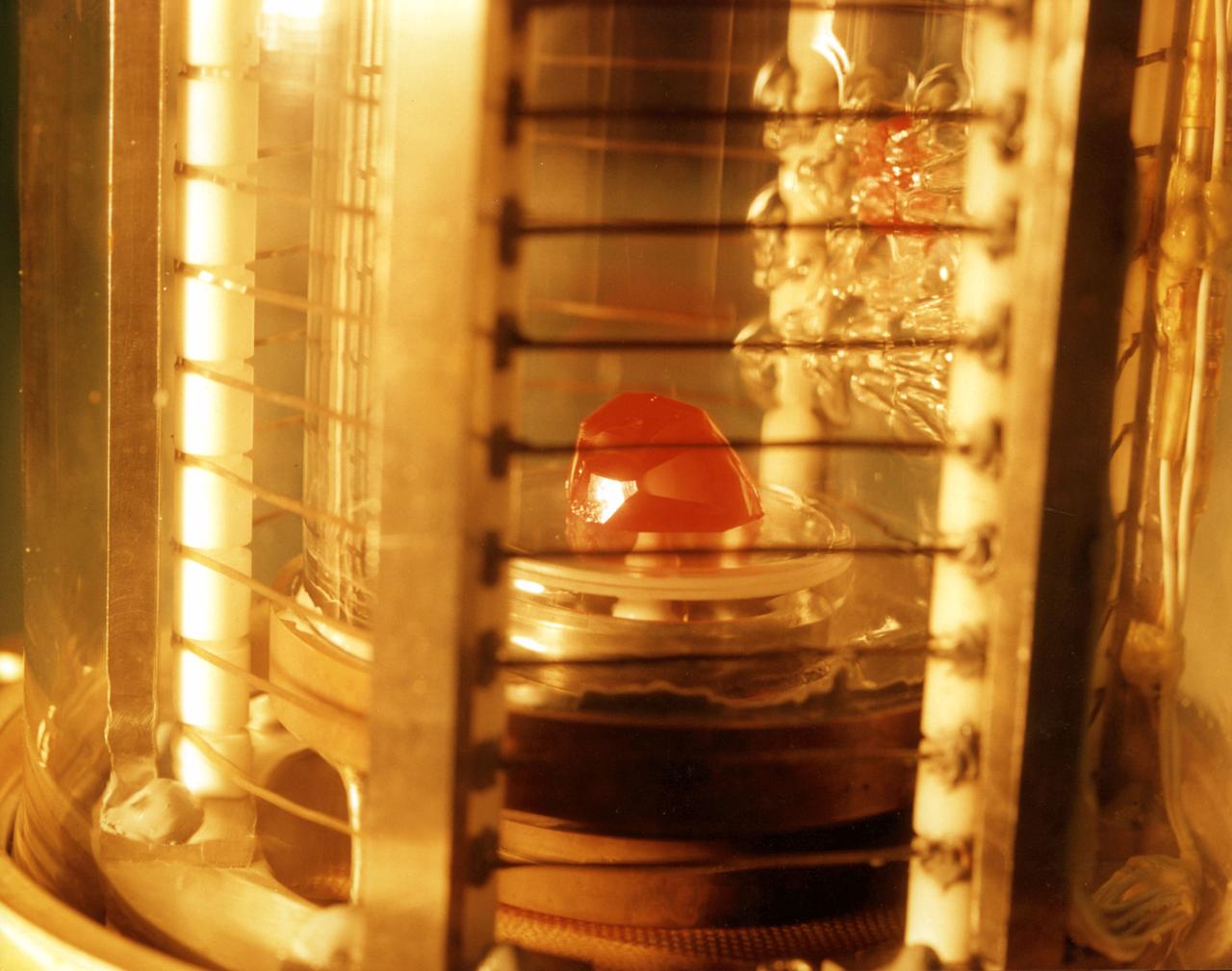
The image shows a test cell of Crystal Growth experiment inside the Vapor Crystal Growth System (VCGS) furnace aboard the STS-42, International Microgravity Laboratory-1 (IML-1), mission. The goal of IML-1, a pressurized marned Spacelab module, was to explore in depth the complex effects of weightlessness of living organisms and materials processing. More than 200 scientists from 16 countires participated in the investigations.
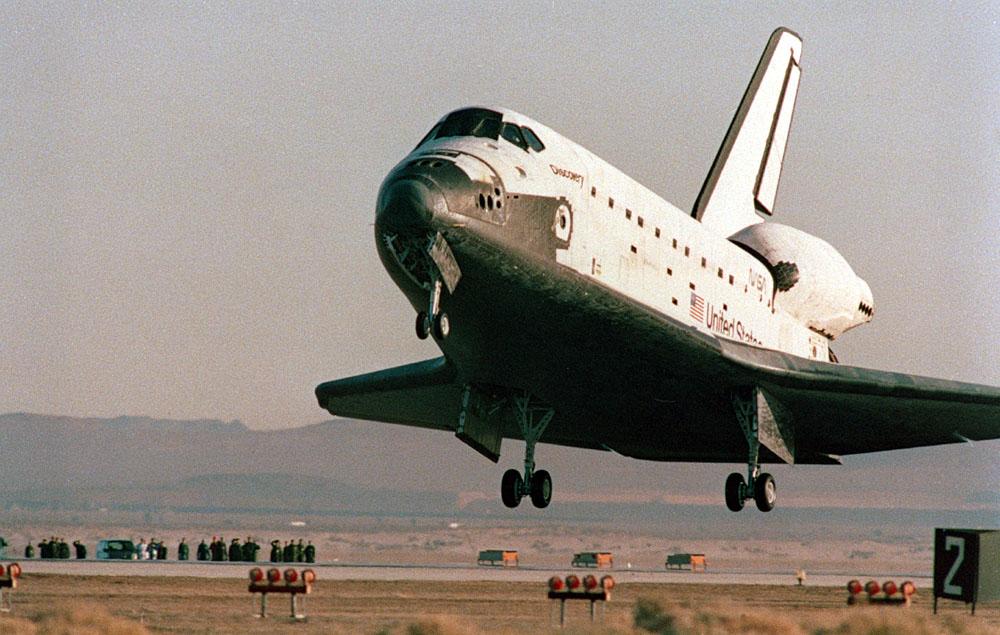
Space Shuttle Discovery STS-42) is just about to ease down its main gear on Runway 22 at Edwards Air Force Base in southern California. The successful landing completed an eight-day mission for five NASA astronauts and two payload specialists supporting the first International Microgravity Laboratory (IML-1) mission.

The primary payload for Space Shuttle Mission STS-42, launched January 22, 1992, was the International Microgravity Laboratory-1 (IML-1), a pressurized manned Spacelab module. The goal of IML-1 was to explore in depth the complex effects of weightlessness of living organisms and materials processing. Around-the-clock research was performed on the human nervous system's adaptation to low gravity and effects of microgravity on other life forms such as shrimp eggs, lentil seedlings, fruit fly eggs, and bacteria. Materials processing experiments were also conducted, including crystal growth from a variety of substances such as enzymes, mercury iodide and a virus. More than 200 scientists from 16 countries participated in the investigations. This is the logo or emblem that was designed to represent the IML-1 payload.
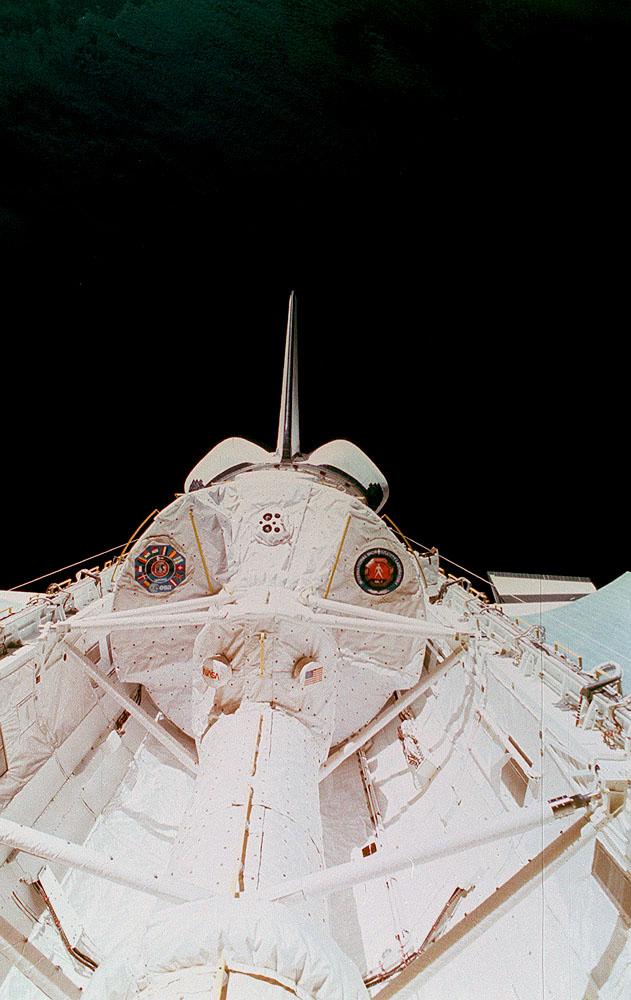
This is the Space Shuttle Orbiter Discovery, STS-42 mission, with the First International Microgravity Laboratory (IML-1) module shown in the cargo bay. IML-1, the first in a series of Shuttle flights, was dedicated to study the fundamental materials and life sciences in the microgravity environment inside Spacelab, a laboratory carried aloft by the Shuttle. The mission explored how life forms adapt to weightlessness and investigated how materials behave when processed in space. The IML program gave a team of scientists from around the world access to a unique environment, one that is free from most of Earth's gravity. The 14-nation European Space Agency (ESA), the Canadian Space Agency (SCA), the French National Center for Space Studies (CNES), the German Space Agency and the German Aerospace Research Establishment (DARA/DLR), and the National Space Development Agency of Japan (NASDA) participated in developing hardware and experiments for the IML missions. The missions were managed by NASA's Marshall Space Flight Center. The Orbiter Discovery was launched on January 22, 1992 for the IML-1 mission.
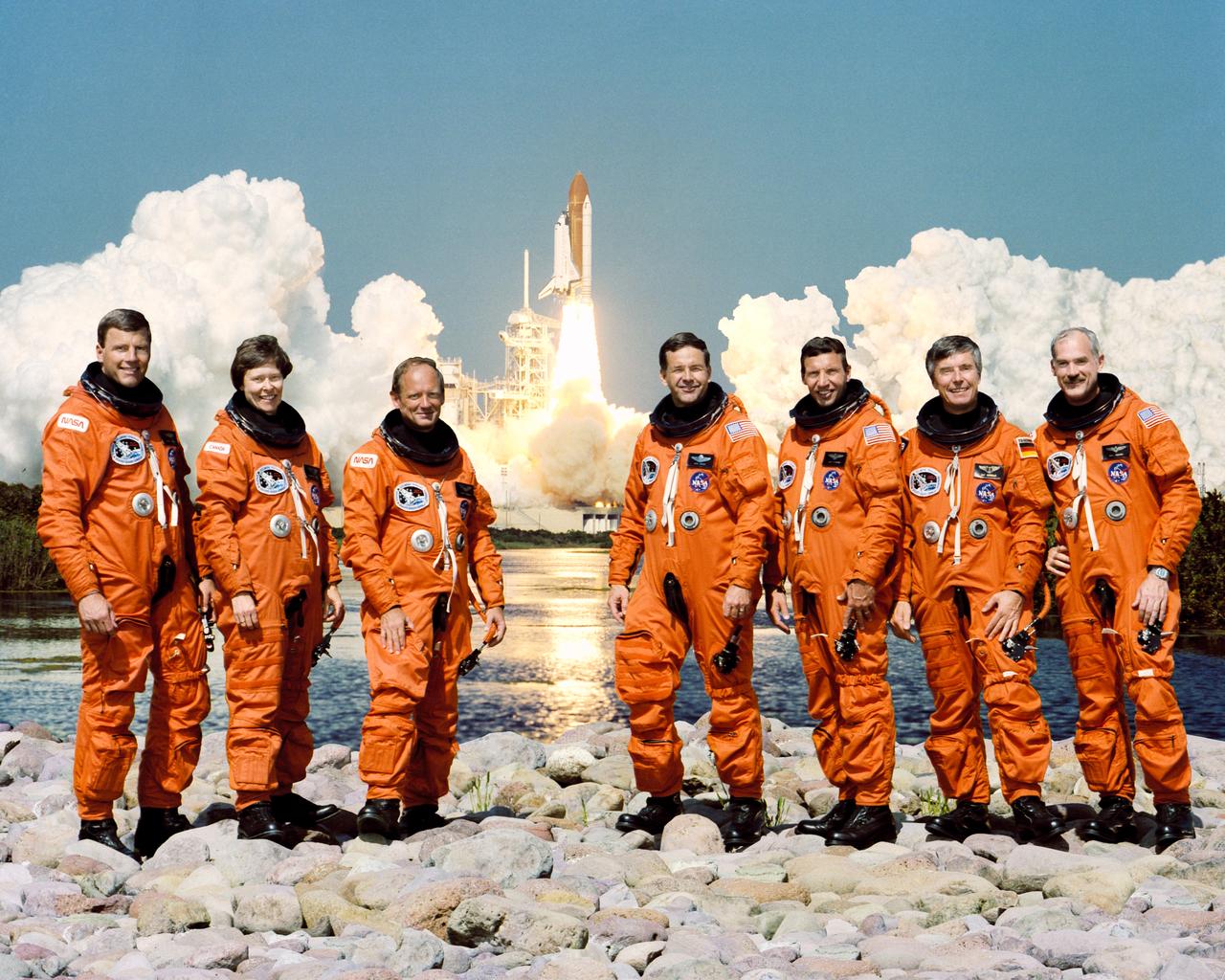
STS042-S-002 (November 1991) --- Payload specialists representing Canada and the European Space Agency (CSA - ESA) join five NASA astronauts for the January 1992 scheduled STS-42 mission. Left to right are astronauts Stephen S. Oswald, pilot; Roberta L. Bondar, payload specialist; Norman E. Thagard, payload commander; Ronald J. Grabe, mission commander; David C. Hilmers, mission specialist; Ulf Merbold, payload specialist; and William F. Readdy, mission specialist. The STS-42 mission will utilize the Space Shuttle Discovery to carry out experiments for the International Microgravity Laboratory (IML-1).
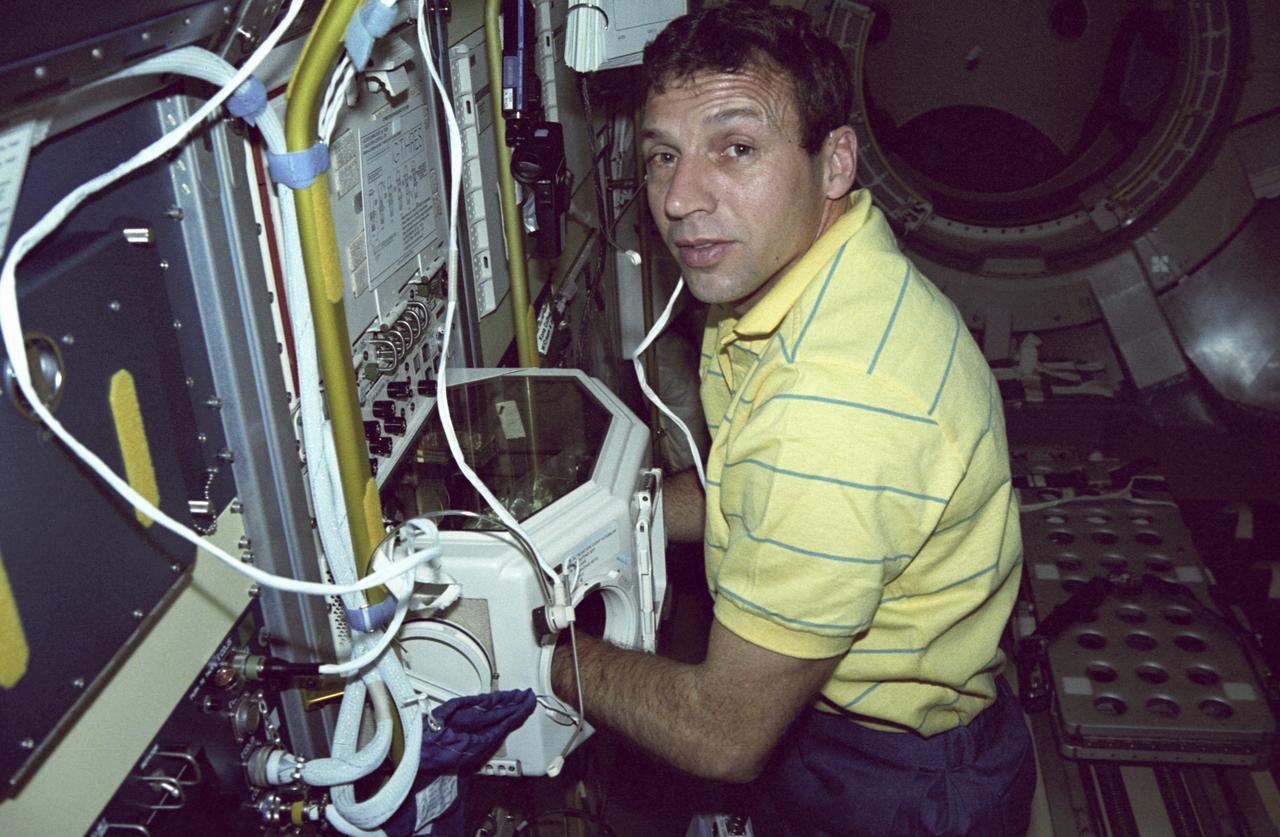
In this photograph, astronaut David Hilmers conducts a life science experiment by using the Biorack Glovebox (GBX) during the International Microgravity Laboratory-1 (IML-1) mission. The Biorack was a large multipurpose facility designed for studying the effects of microgravity and cosmic radiation on numerous small life forms such as cells, tissues, small organisms, and plants. Located at the Biorack, the GBX was an enclosed environment that protected samples from contamination and prevented liquid from escaping. Crewmembers handled the specimens with their hands inside gloves that extended into the sealed work area. A microscope and video camera mounted on the GBX door were used to observe and document experiments. Managed by the Marshall Space Flight Center, the IML-1 mission was the first in a series of Shuttle flights dedicated to fundamental materials and life sciences research and was launched aboard the Shuttle Orbiter Discovery (STS-42) on January 22, 1992.
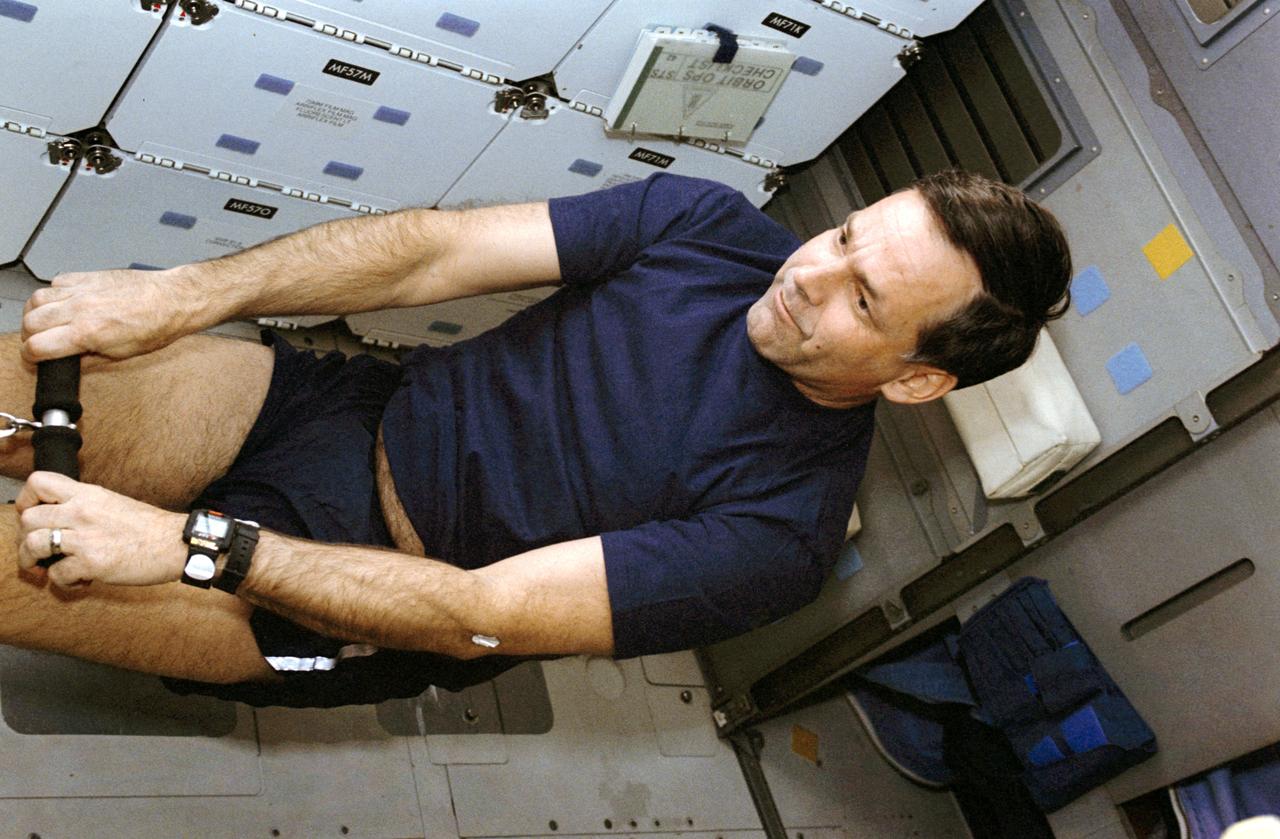
STS042-209-002 (22-30 Jan 1992) --- Astronaut Ronald J. Grabe, STS-42 mission commander, exercises on Discovery's middeck. Grabe, along with four other NASA astronauts and two International Microgravity Laboratory (IML-1) payload specialists spent more than eight days conducting experiments in Earth orbit.
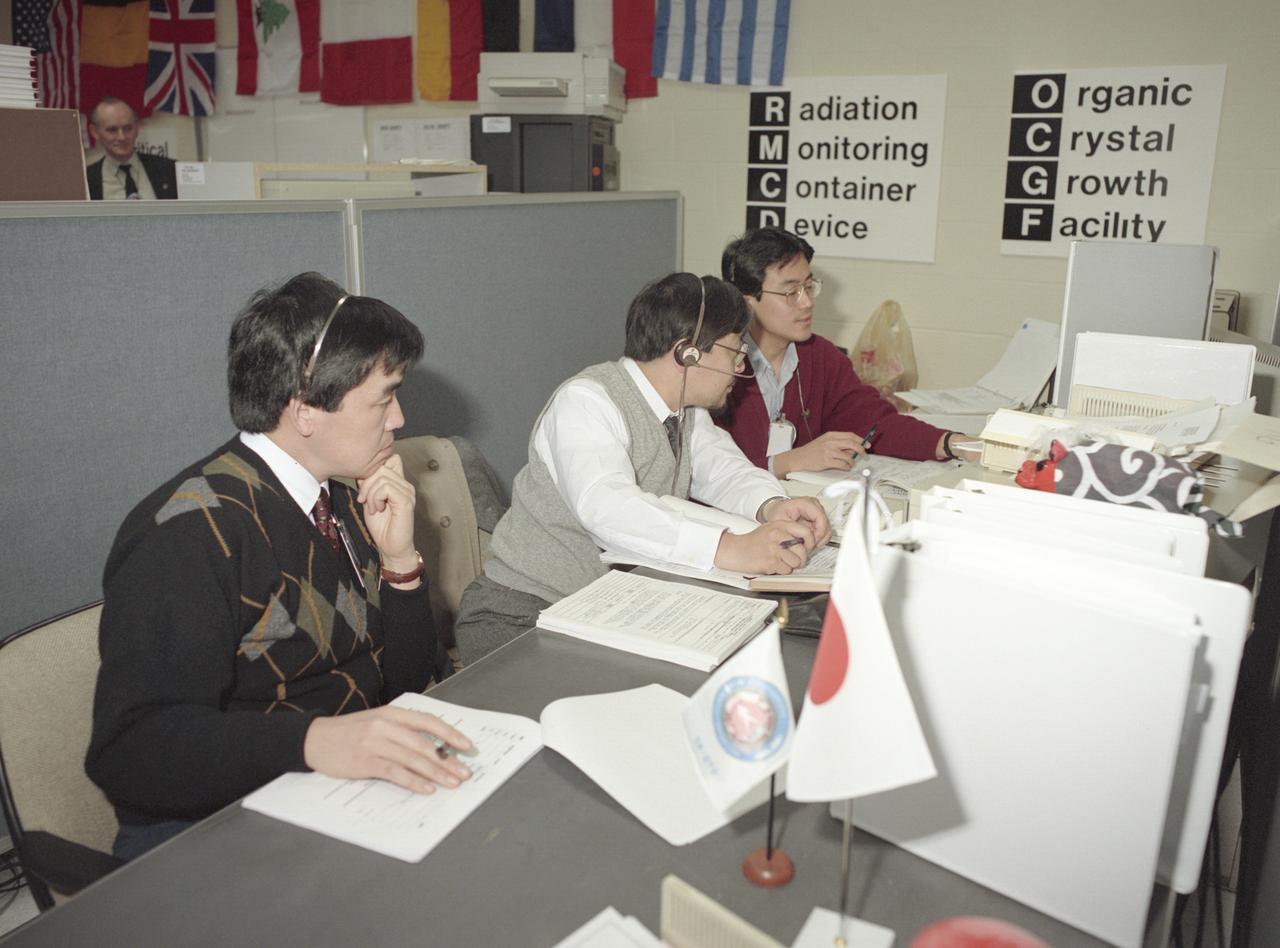
The primary payload for Space Shuttle Mission STS-42, launched January 22, 1992, was the International Microgravity Laboratory-1 (IML-1), a pressurized manned Spacelab module. The goal of IML-1 was to explore in depth the complex effects of weightlessness of living organisms and materials processing. Around-the-clock research was performed on the human nervous system's adaptation to low gravity and effects of microgravity on other life forms such as shrimp eggs, lentil seedlings, fruit fly eggs, and bacteria. Materials processing experiments were also conducted, including crystal growth from a variety of substances such as enzymes, mercury iodide, and a virus. The Huntsville Operations Support Center (HOSC) Spacelab Payload Operations Control Center (SL POCC) at the Marshall Space Flight Center (MSFC) was the air/ground communication channel used between the astronauts and ground control teams during the Spacelab missions. Featured are activities of the Organic Crystal Growth Facility (OCGF) and Radiation Monitoring Container Device (RMCD) groups in the SL POCC during the IML-1 mission.
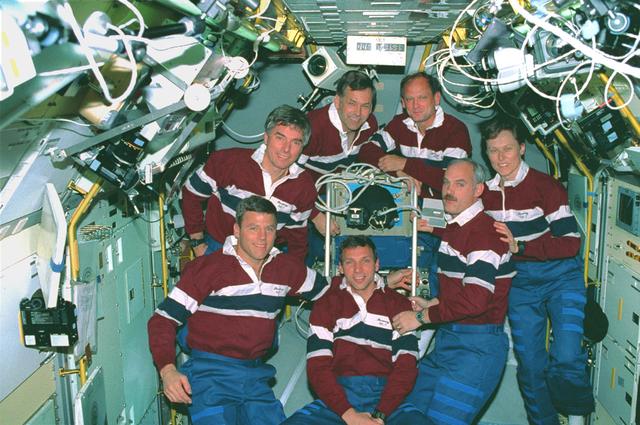
Onboard Space Shuttle Discovery (STS-42) the seven crewmembers pose for a traditional in-space portrait in the shirt-sleeve environment of the International Microgravity Laboratory (IML-1) science module in the Shuttle's cargo bay. Pictured are (clockwise from top),Commander Ronald J. Grabe, payload commander Norman E. Thagard, payload specialist Roberta L. Bondar; mission specialists William F. Readdy and David C. Hilmers; pilot Stephen S. Oswald and payload specialist Ulf Merbold. The rotating chair, used often in biomedical tests on the eight-day flight, is in center frame.
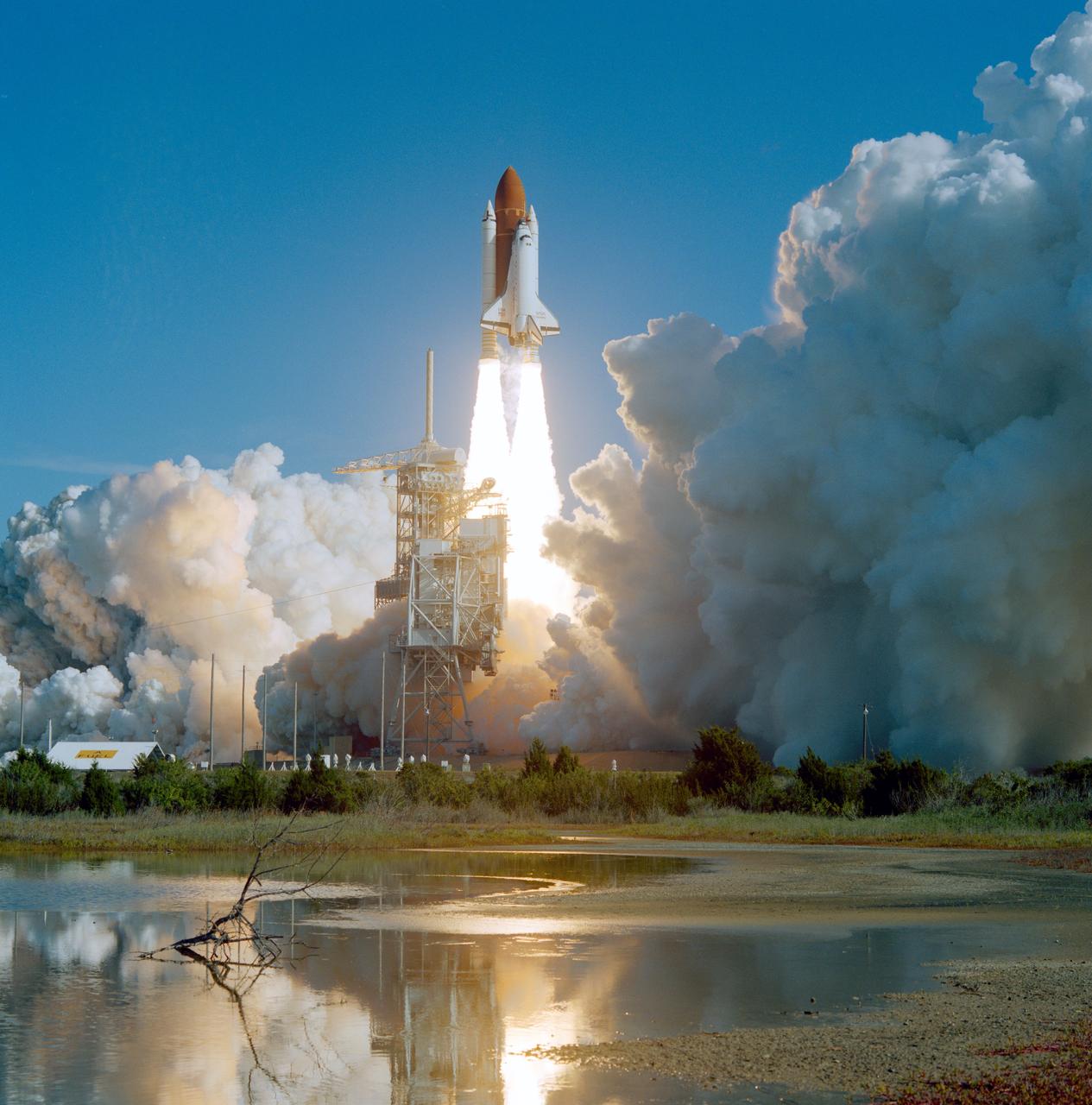
STS042-S-064 (22 Jan 1992) --- A horizontal image of liftoff of STS-42, with a crew of seven and the International Microgravity Laboratory (IML-1) onboard. Crewmembers are astronauts Ronald J. Grabe, mission commander; Stephen S. Oswald, pilot; Norman E. Thagard, payload commander; David C. Hilmers and William F. Readdy, both mission specialists; and payload specialists Roberta L. Bondar of Canada and Ulf Merbold, representing the European Space Agency (ESA). Liftoff occurred at 9:52:33 a.m. (EST), Jan. 22, 1992.
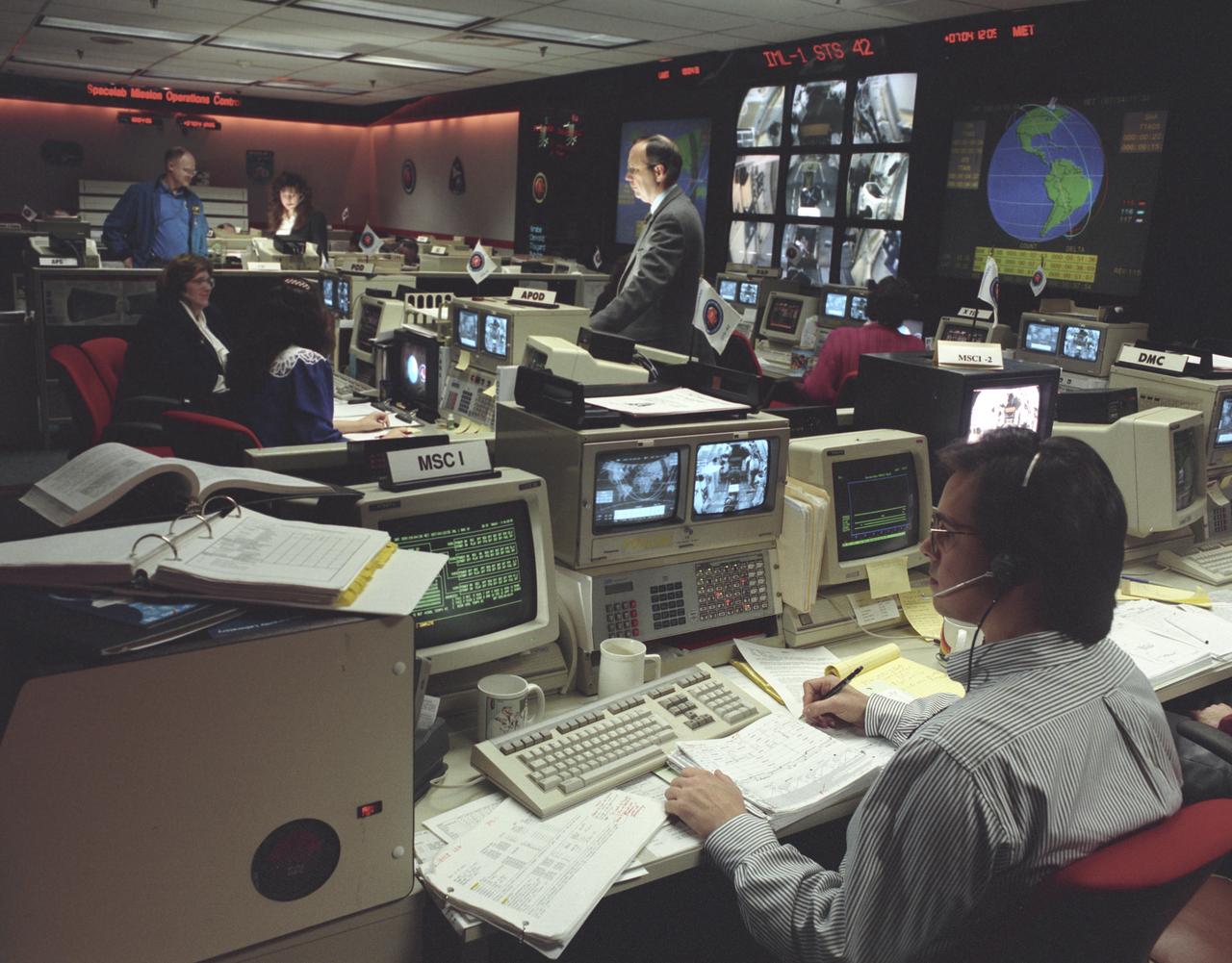
This photograph shows activities during the International Microgravity Laboratory-1 (IML-1) mission (STS-42) in the Payload Operations Control Center (POCC) at the Marshall Space Flight Center. The IML-1 mission was the first in a series of Shuttle flights dedicated to fundamental materials and life sciences research. The mission was to explore, in depth, the complex effects of weightlessness on living organisms and materials processing. The crew conducted experiments on the human nervous system's adaptation to low gravity and the effects on other life forms such as shrimp eggs, lentil seedlings, fruit fly eggs, and bacteria. Low gravity materials processing experiments included crystal growth from a variety of substances such as enzymes, mercury, iodine, and virus. The International space science research organizations that participated in this mission were: The U.S. National Aeronautics and Space Administration, the European Space Agency, the Canadian Space Agency, the French National Center for Space Studies, the German Space Agency, and the National Space Development Agency of Japan. The POCC was the air/ground communication charnel used between the astronauts aboard the Spacelab and scientists, researchers, and ground control teams during the Spacelab missions. The facility made instantaneous video and audio communications possible for scientists on the ground to follow the progress and to send direct commands of their research almost as if they were in space with the crew.
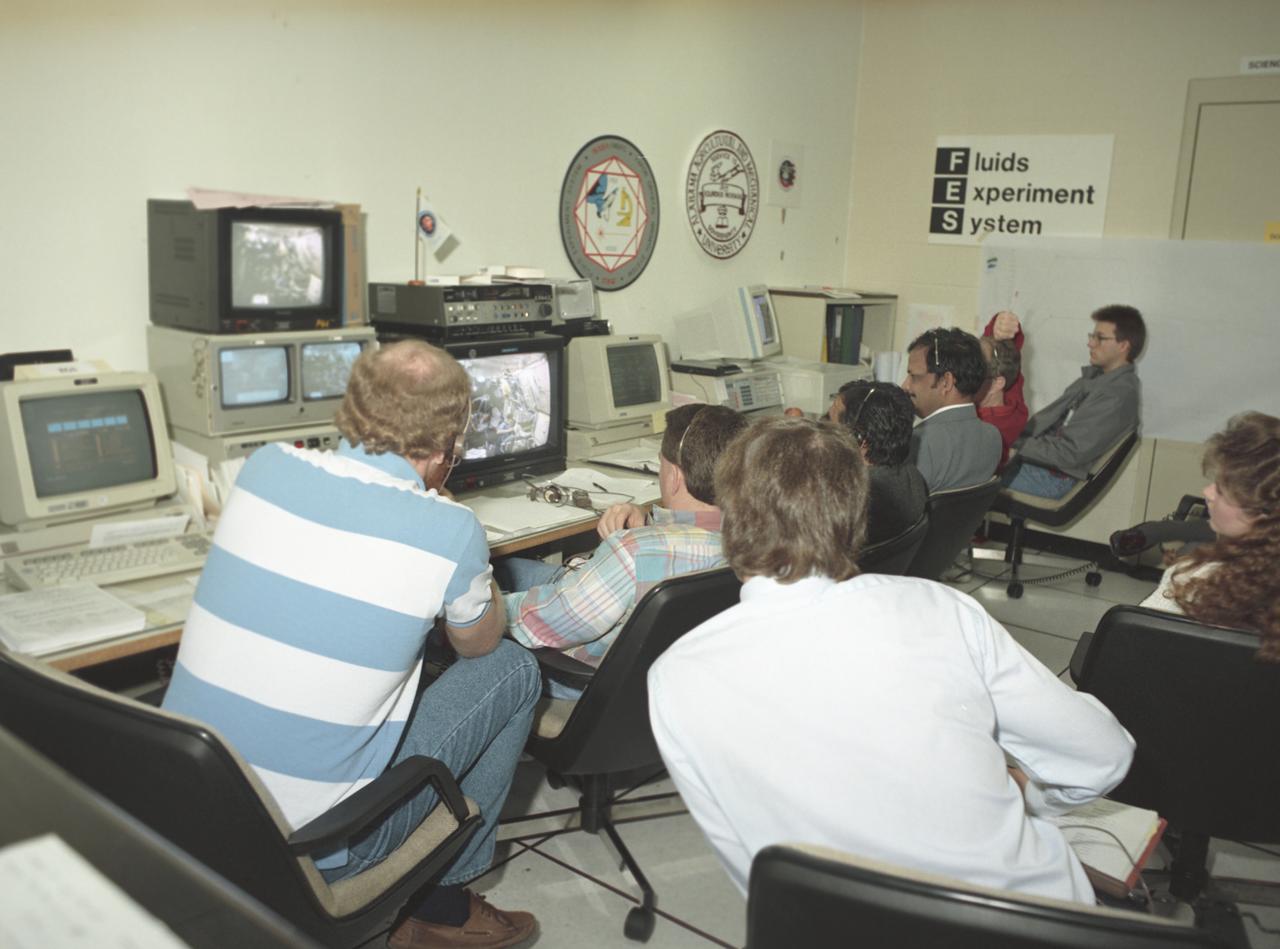
This photograph shows activities during the International Microgravity Laboratory-1 (IML-1) mission (STS-42) in the Payload Operations Control Center (POCC) at the Marshall Space Flight Center. Members of the Fluid Experiment System (FES) group monitor the progress of their experiment through video at the POCC. The IML-1 mission was the first in a series of Shuttle flights dedicated to fundamental materials and life sciences research. The mission was to explore, in depth, the complex effects of weightlessness on living organisms and materials processing. The crew conducted experiments on the human nervous system's adaptation to low gravity and the effects on other life forms such as shrimp eggs, lentil seedlings, fruit fly eggs, and bacteria. Low gravity materials processing experiments included crystal growth from a variety of substances such as enzymes, mercury, iodine, and virus. The International space science research organizations that participated in this mission were: The U.S. National Aeronautics and Space Administion, the European Space Agency, the Canadian Space Agency, the French National Center for Space Studies, the German Space Agency, and the National Space Development Agency of Japan. The POCC was the air/ground communication charnel used between astronauts aboard the Spacelab and scientists, researchers, and ground control teams during the Spacelab missions. The facility made instantaneous video and audio communications possible for scientists on the ground to follow the progress and to send direct commands of their research almost as if they were in space with the crew.
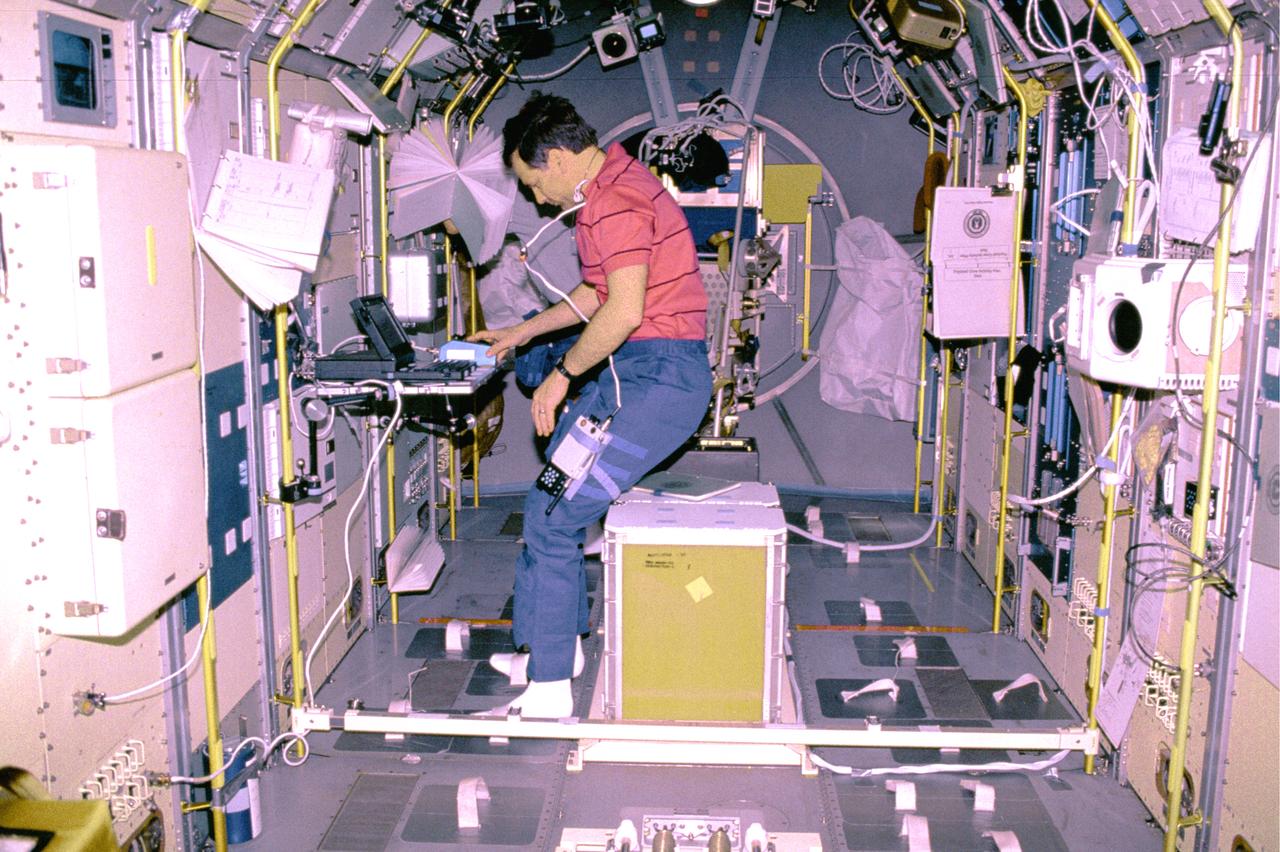
The IML-1 mission was the first in a series of Shuttle flights dedicated to fundamental materials and life sciences research with the international partners. The participating space agencies included: NASA, the 14-nation European Space Agency (ESA), the Canadian Space Agency (CSA), the French National Center of Space Studies (CNES), the German Space Agency and the German Aerospace Research Establishment (DAR/DLR), and the National Space Development Agency of Japan (NASDA). Dedicated to the study of life and materials sciences in microgravity, the IML missions explored how life forms adapt to weightlessness and investigated how materials behave when processed in space. Both life and materials sciences benefited from the extended periods of microgravity available inside the Spacelab science module in the cargo bay of the Space Shuttle Orbiter. In this photograph, Commander Ronald J. Grabe works with the Mental Workload and Performance Evaluation Experiment (MWPE) in the IML-1 module. This experiment was designed as a result of difficulty experienced by crewmembers working at a computer station on a previous Space Shuttle mission. The problem was due to the workstation's design being based on Earthbound conditions with the operator in a typical one-G standing position. Information gained from this experiment was used to design workstations for future Spacelab missions and the International Space Station. Managed by the Marshall Space Flight Center, IML-1 was launched on January 22, 1992 aboard the Space Shuttle Orbiter Discovery (STS-42 mission).
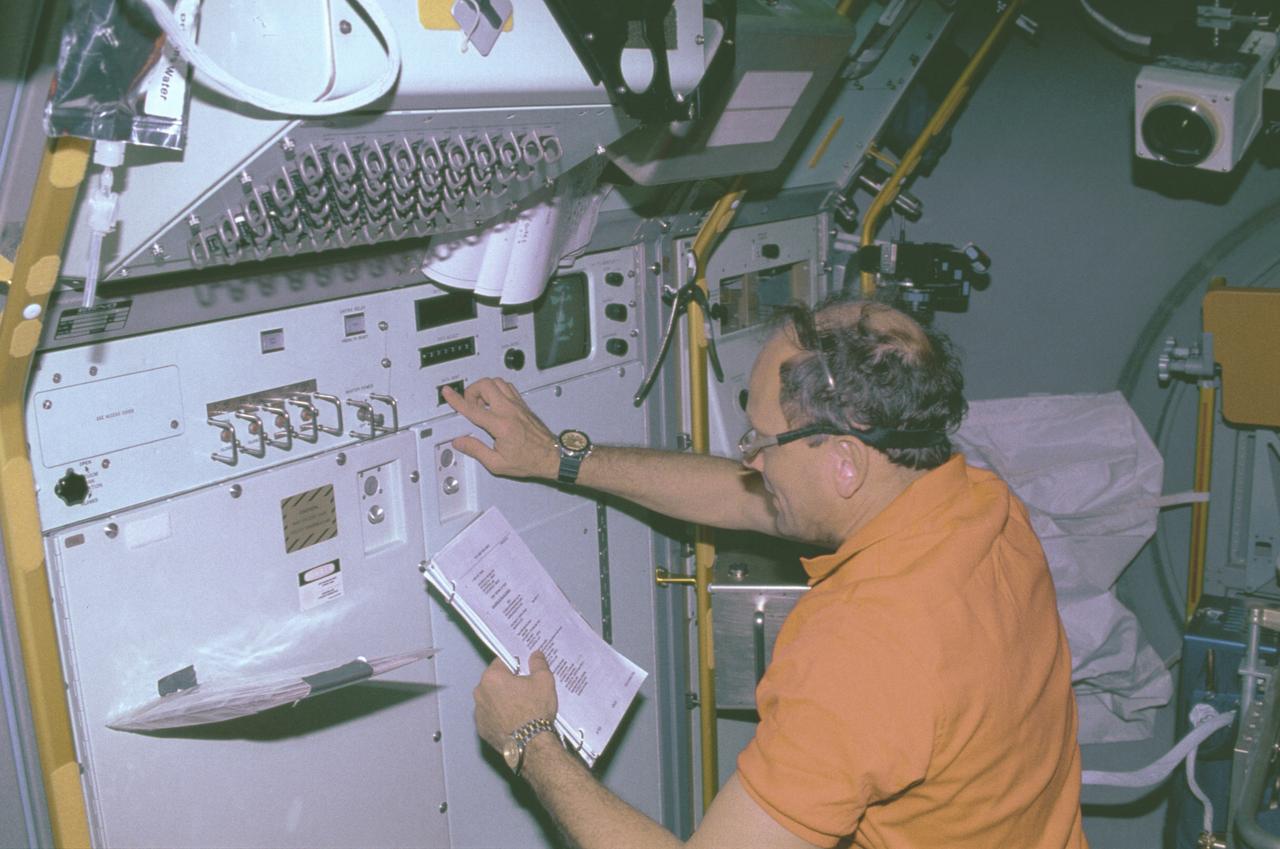
The IML-1 mission was the first in a series of Shuttle flights dedicated to fundamental materials and life sciences research with the international partners. The participating space agencies included: NASA, the 14-nation European Space Agency (ESA), the Canadian Space Agency (CSA), The French National Center of Space Studies (CNES), the German Space Agency and the German Aerospace Research Establishment (DAR/DLR), and the National Space Development Agency of Japan (NASDA). Dedicated to the study of life and materials sciences in microgravity, the IML missions explored how life forms adapt to weightlessness and investigated how materials behave when processed in space. Both life and materials sciences benefited from the extended periods of microgravity available inside the Spacelab science module in the cargo bay of the Space Shuttle Orbiter. This photograph shows Astronaut Norman Thagard performing the fluid experiment at the Fluid Experiment System (FES) facility inside the laboratory module. The FES facility had sophisticated optical systems for imaging fluid flows during materials processing, such as experiments to grow crystals from solution and solidify metal-modeling salts. A special laser diagnostic technique recorded the experiments, holograms were made for post-flight analysis, and video was used to view the samples in space and on the ground. Managed by the Marshall Space Flight Center (MSFC), the IML-1 mission was launched on January 22, 1992 aboard the Shuttle Orbiter Discovery (STS-42).

S91-51633 (November 1991) --- Astronaut Roberta L. Bondar, Canadian payload specialist.
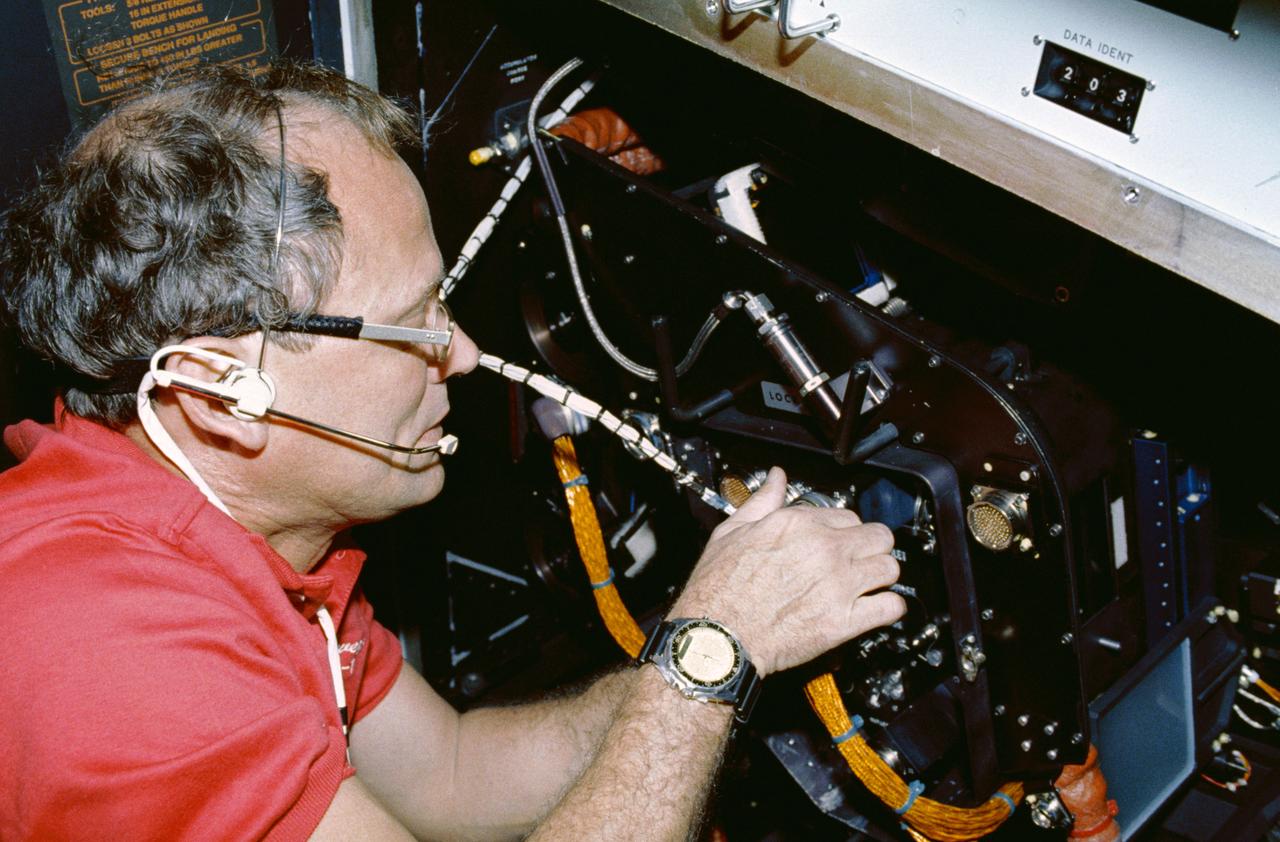
STS042-05-006 (22-30 Jan 1992) --- Astronaut Norman E. Thagard, payload commander, performs the Fluids Experiment System (FES) in the International Microgravity Laboratory (IML-1) science module. The FES is a NASA-developed facility that produces optical images of fluid flows during the processing of materials in space. The system's sophisticated optics consist of a laser to make holograms of samples and a video camera to record images of flows in and around samples. Thagard was joined by six fellow crewmembers for eight days of scientific research aboard Discovery in Earth-orbit. Most of their on-duty time was spent in this IML-1 science module, positioned in the cargo bay and attached via a tunnel to Discovery's airlock.
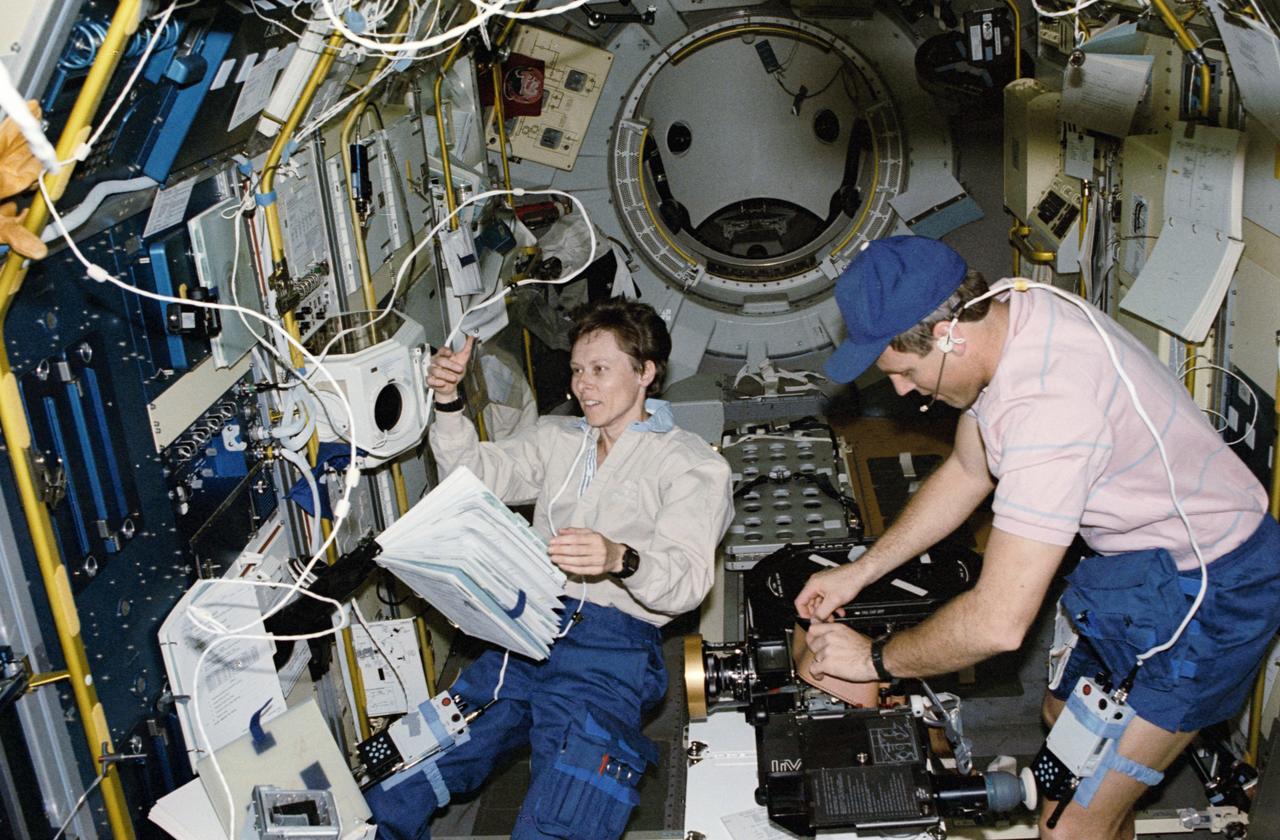
STS042-201-009 (22-30 Jan 1992) --- Canadian Roberta L. Bondar, payload specialist representing the Canadian Space Agency (CSA), works at the International Microgravity Laboratory's (IML-1) biorack while astronaut Stephen S. Oswald, pilot, changes a film magazine on the IMAX camera. The two were joined by five fellow crew members for eight-days of scientific research aboard the Space Shuttle Discovery in Earth-orbit. Most of their on-duty time was spent in this IML-1 Science Module, positioned in the cargo bay and attached via a tunnel to Discovery's airlock.
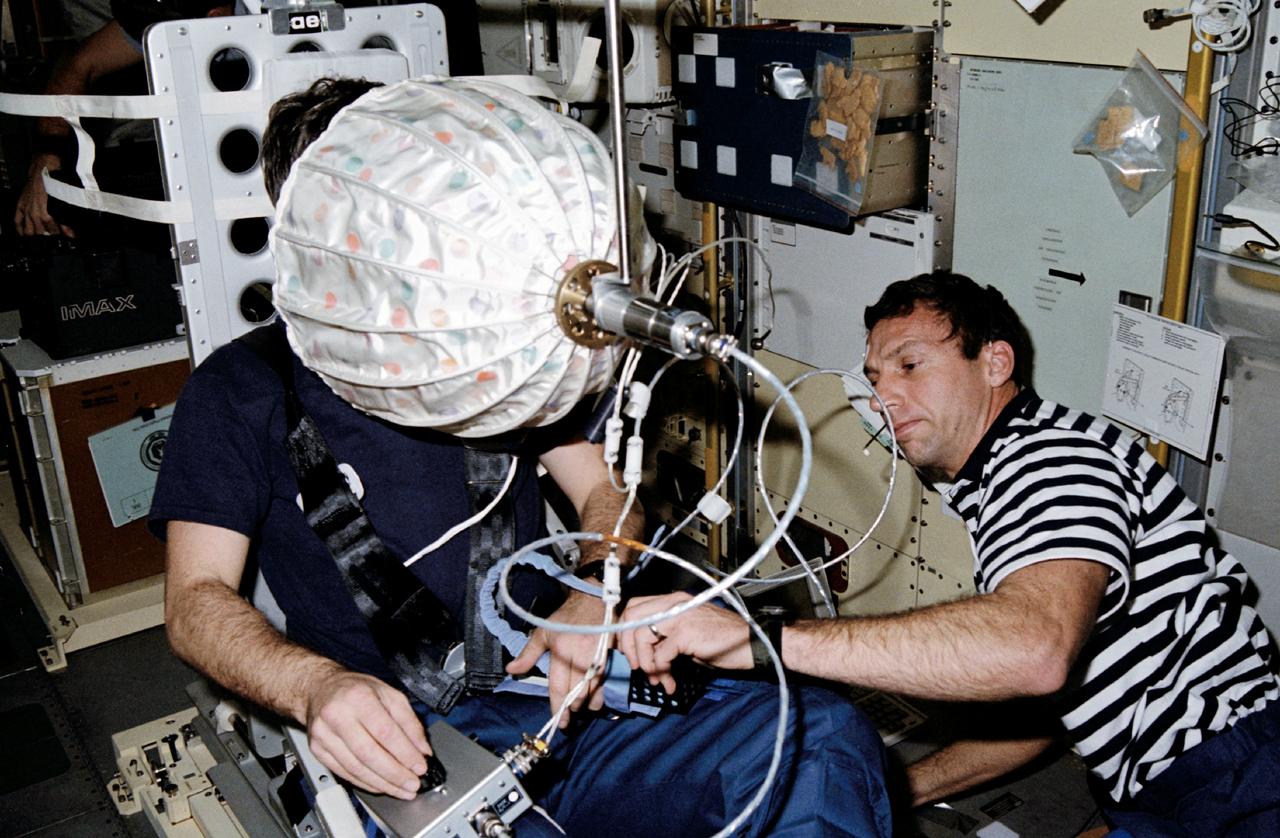
STS042-203-024 (22-30 Jan. 1992) --- Astronaut David C. Hilmers (right), STS-42 mission specialist, assists European Space Agency (ESA) payload specialist Ulf Merbold with the visual stimulator experiment on the Space Shuttle Discovery's middeck. This particular test is part of an ongoing study of the Space Adaptation Syndrome (SAS). Seated in a stationary mini-sled, Merbold (or any other subject for this test) stares at an umbrella-shaped rotating dome with a pattern of colored dots on its interior. While observing the rotating dome, the subject turns a knob to indicate his perception of body rotation. The strength of circular vection is calculated by comparing the signals from the dome and the knob. The greater the false sense of circular vection, the more the subject is relying on visual information instead of otolith information.
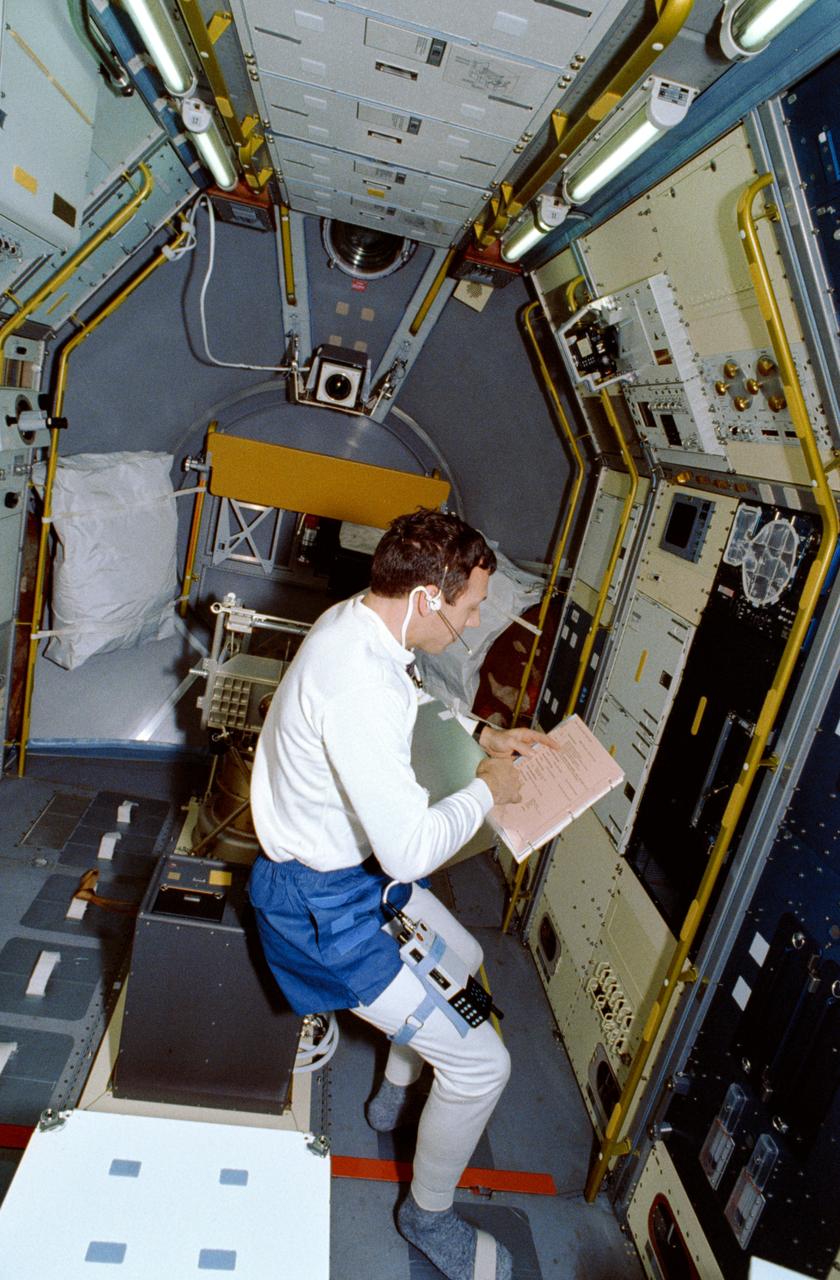
STS042-17-001 (22 Jan 1992) --- Astronaut David C. Hilmers, mission specialist, looks over a checklist at the Johnson Space Center refrigerator/freezer, in which perishable samples are stowed. The view gives an overall perspective of the science module -- heavily utilized for eight-days of scientific research supporting the International Microgravity Laboratory (IML-1) -- in Discovery's cargo bay.