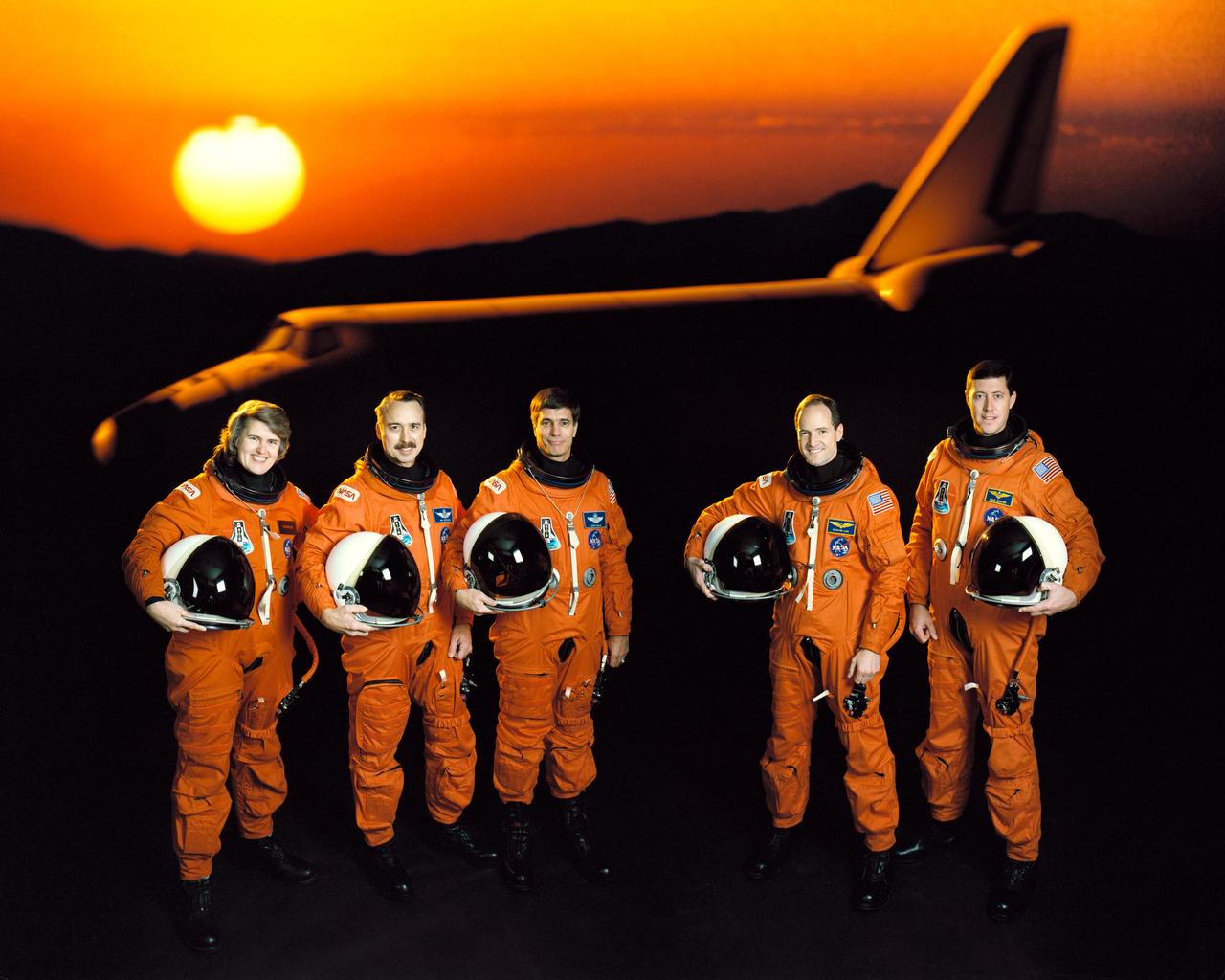
STS043-S-002 (May 1991) --- These five astronauts have been assigned to fly aboard the Space Shuttle Atlantis for NASA's STS-43 mission. Astronaut John E. Blaha (center) is mission commander. Other crew members are, left to right, astronauts Shannon W. Lucid, James C. Adamson and G. David Low, all mission specialists; and Michael A. Baker, pilot.
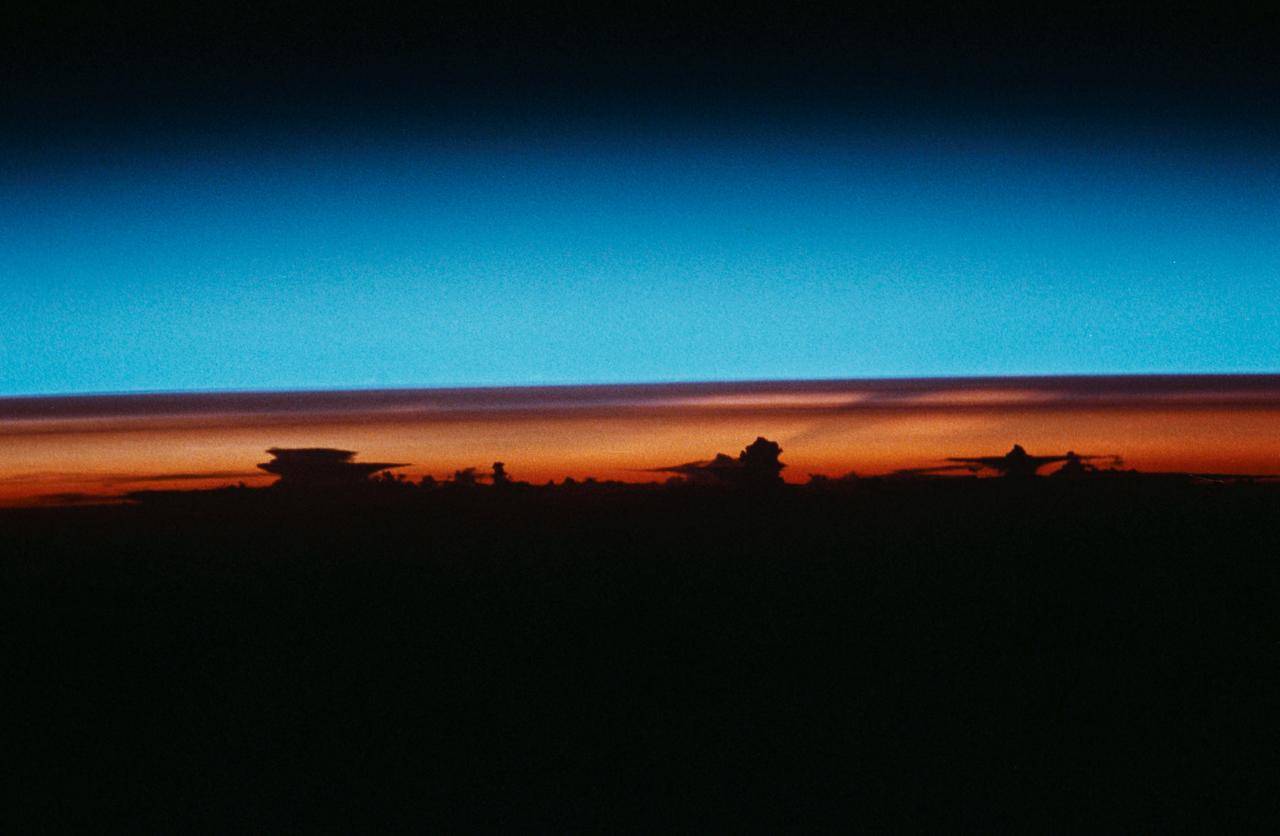
STS-43 Earth observation taken aboard Atlantis, Orbiter Vehicle (OV) 104, captures the Earth's limb at sunrise with unusual cloud patterns silhouetted by the sunlight and rising into the terminator lines.
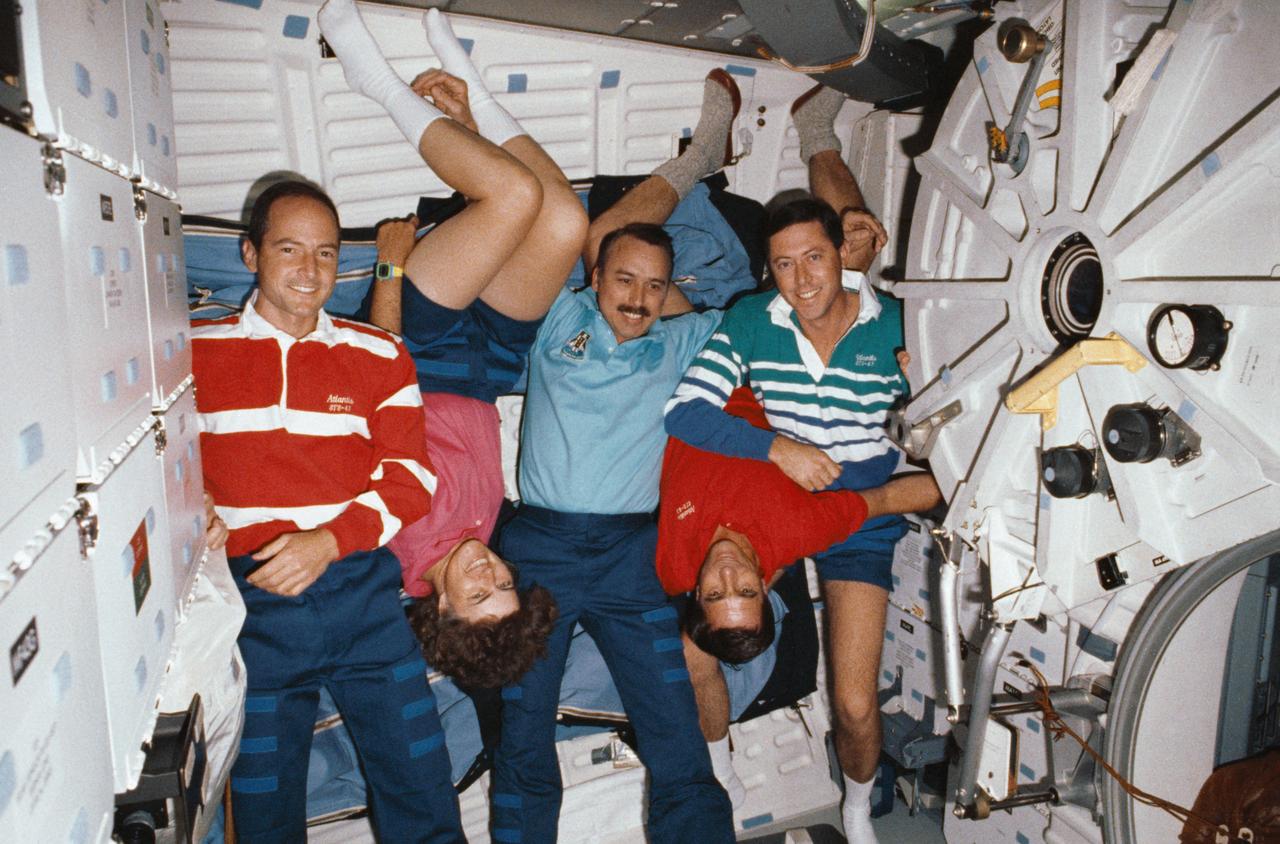
STS043-40-029 (2-11 Aug 1991) --- The five crewmembers on NASA's STS-43 mission pose for the traditional in-flight crew portrait. The photo should be oriented with Atlantis' middeck hatch on the right. Left to right are astronauts G. David Low, Shannon W. Lucid and James C. Adamson, all mission specialists; John E. Blaha, mission commander; and Michael A. Baker, pilot.
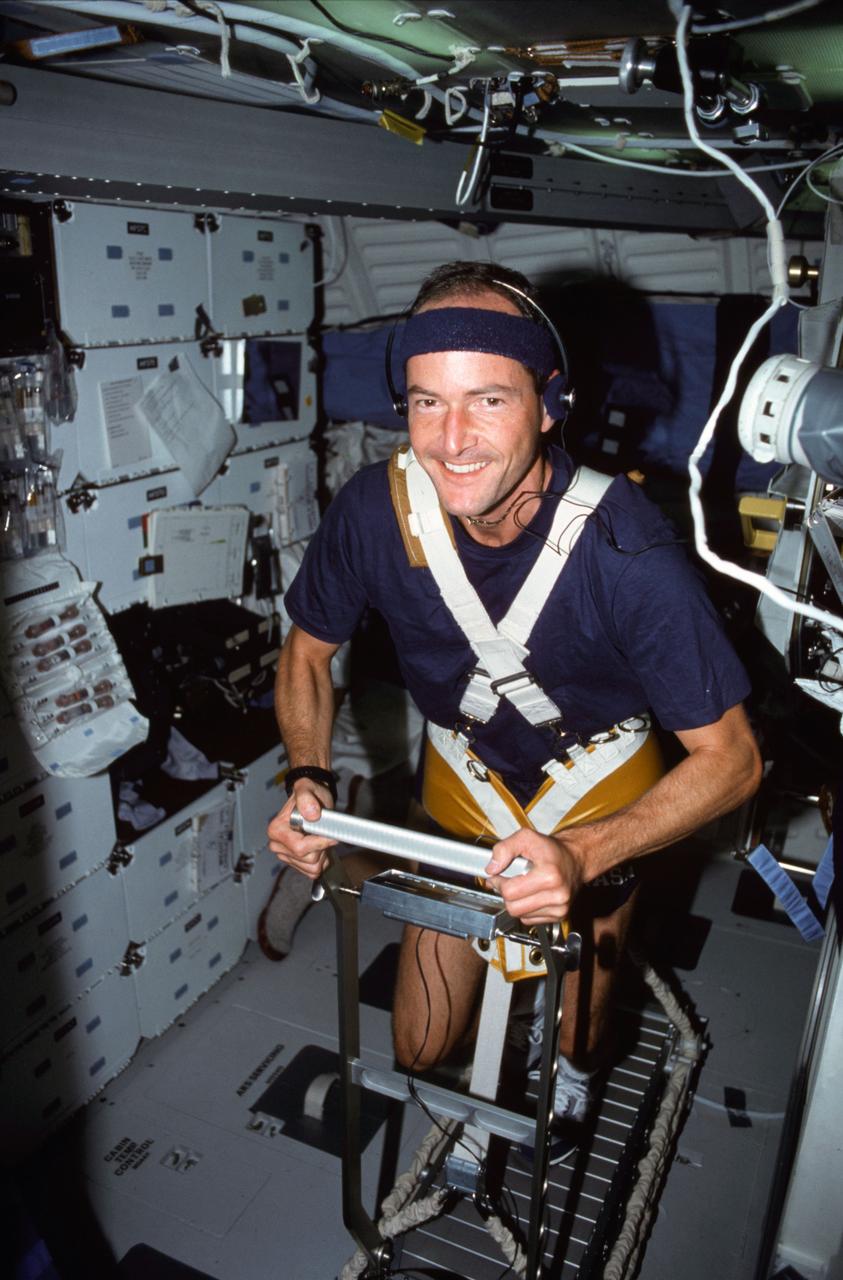
STS043-04-016 (2-11 Aug 1991) --- Astronaut G. David Low, STS-43 mission specialist, works out on a treadmill device which was used for medical testing on the nine-day flight. The scene, photographed with a 35mm camera, is on Atlantis? flight deck.
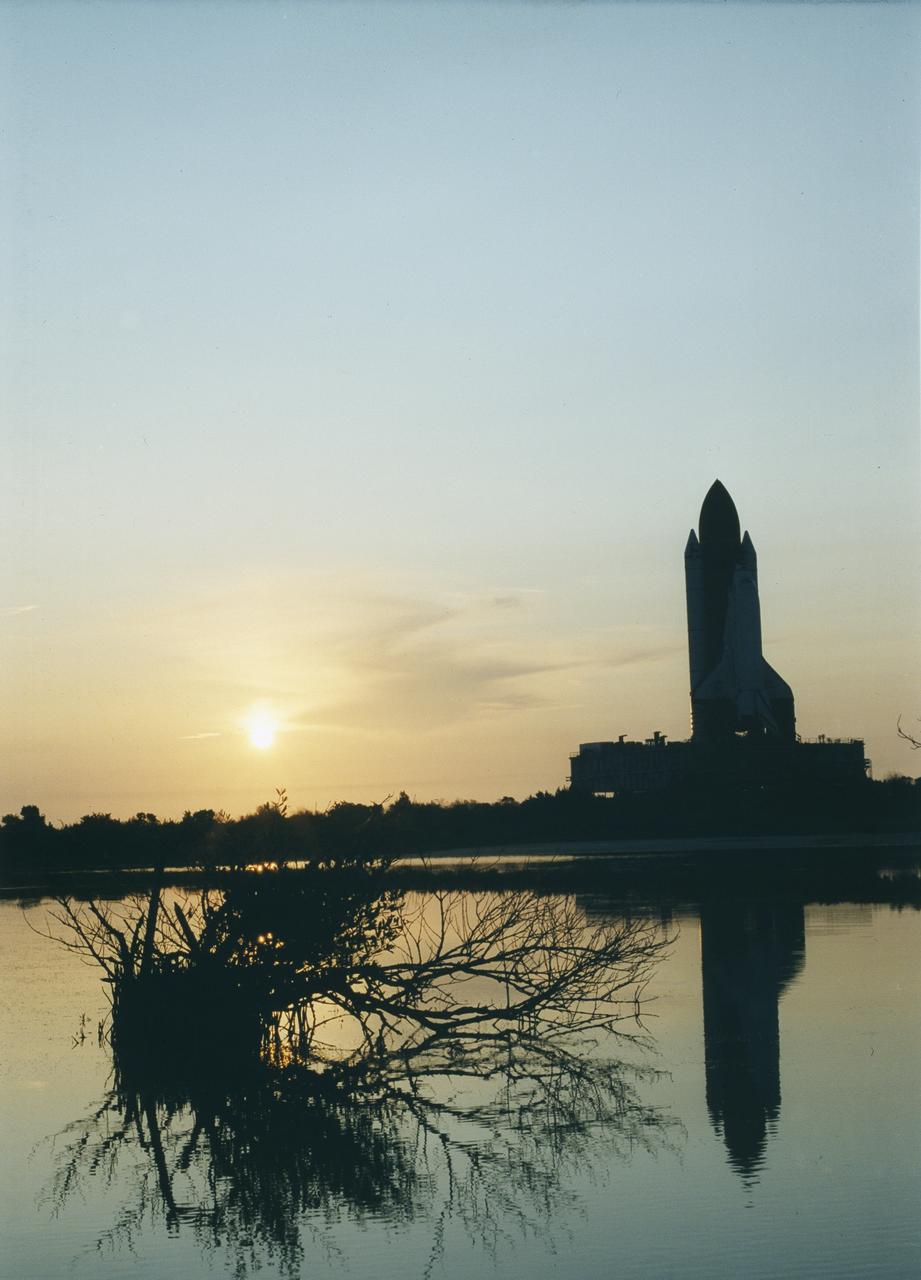
Launched aboard the Space Shuttle Atlantis on August 2, 1991, the STS-43 mission’s primary payload was the Tracking and Data Relay Satellite 5 (TDRS-5) attached to an Inertial Upper Stage (IUS), which became the 4th member of an orbiting TDRS cluster. The flight crew consisted of five astronauts: John E. Blaha, commander; Michael A. Baker, pilot; Shannon W. Lucid, mission specialist 1; James C. Adamson, mission specialist 2; and G. David Low, mission specialist 3.
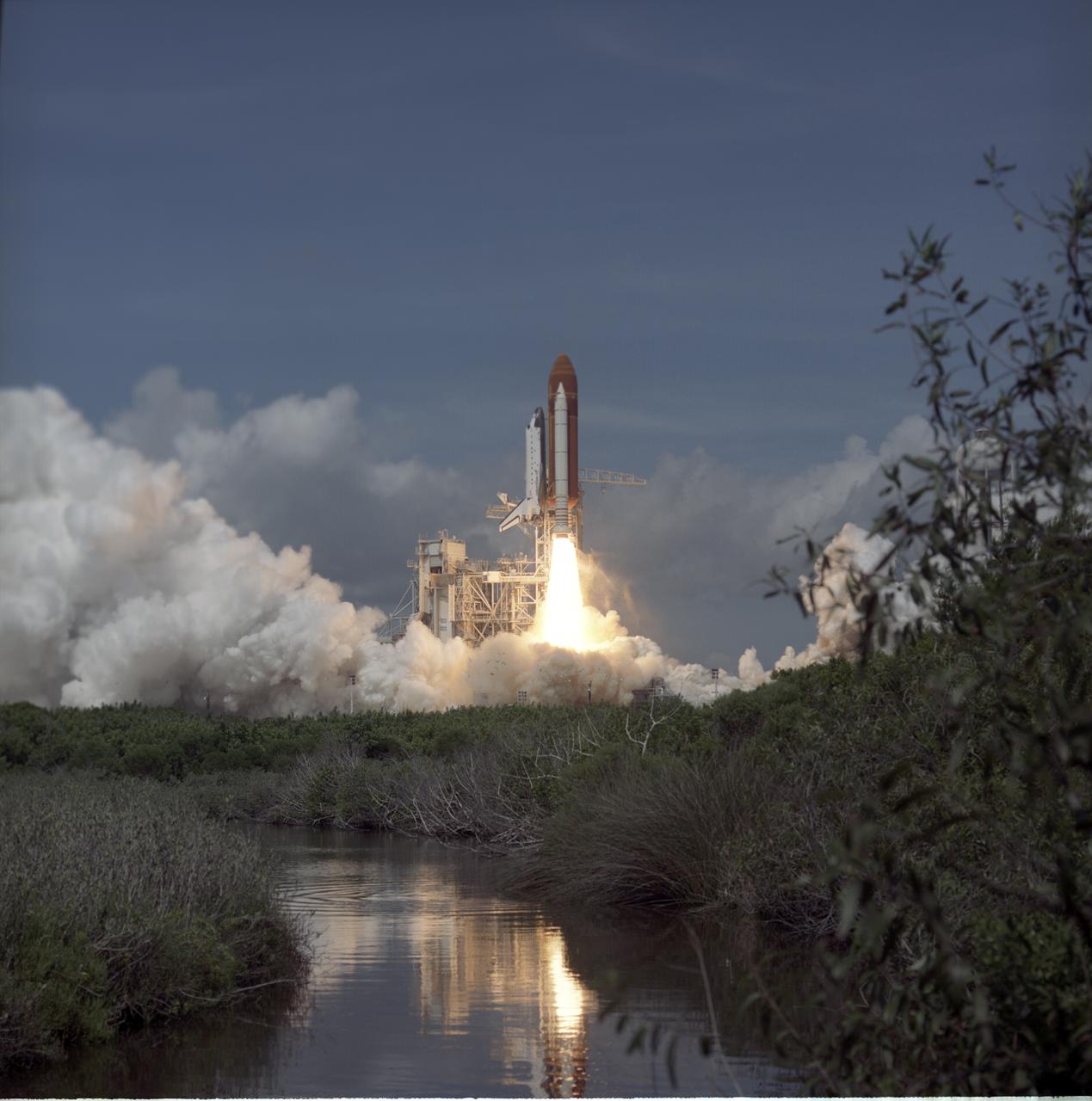
Launched aboard the Space Shuttle Atlantis on August 2, 1991, the STS-43 mission’s primary payload was the Tracking and Data Relay Satellite 5 (TDRS-5) attached to an Inertial Upper Stage (IUS), which became the 4th member of an orbiting TDRS cluster. The flight crew consisted of 5 astronauts: John E. Blaha, commander; Michael A. Baker, pilot; Shannon W. Lucid, mission specialist 1; James C. Adamson, mission specialist 2; and G. David Low, mission specialist 3.
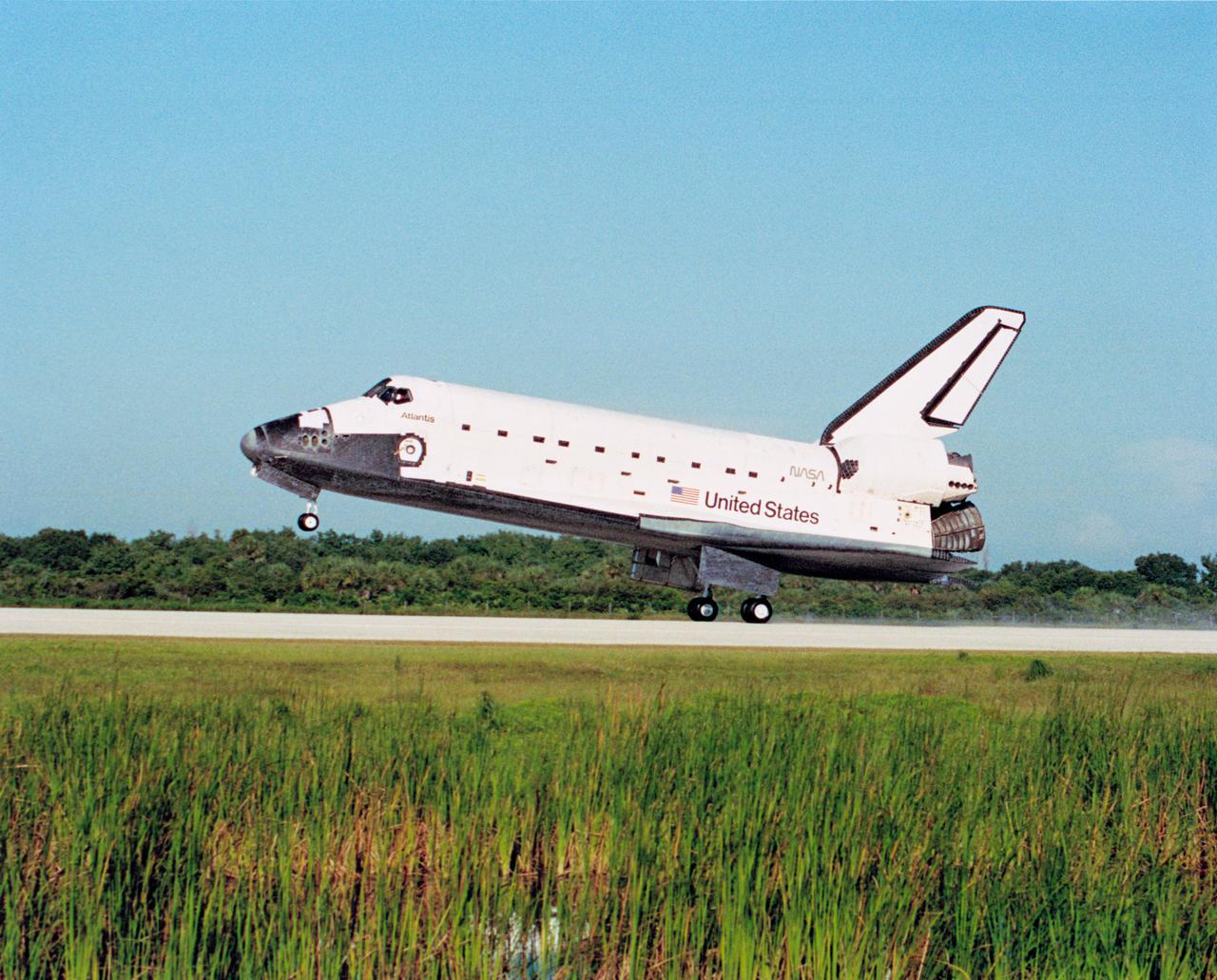
STS-43 Atlantis, Orbiter Vehicle (OV) 104, lands on runway 15 at the Kennedy Space Center's (KSC's) Shuttle Landing Facility (SLF). The main landing gear (MLG) touched down at 8:23:25 am (Eastern Daylight Time (EDT)). OV-104 glides toward wheel stop as the nose landing gear (NLG) rides above the runway.
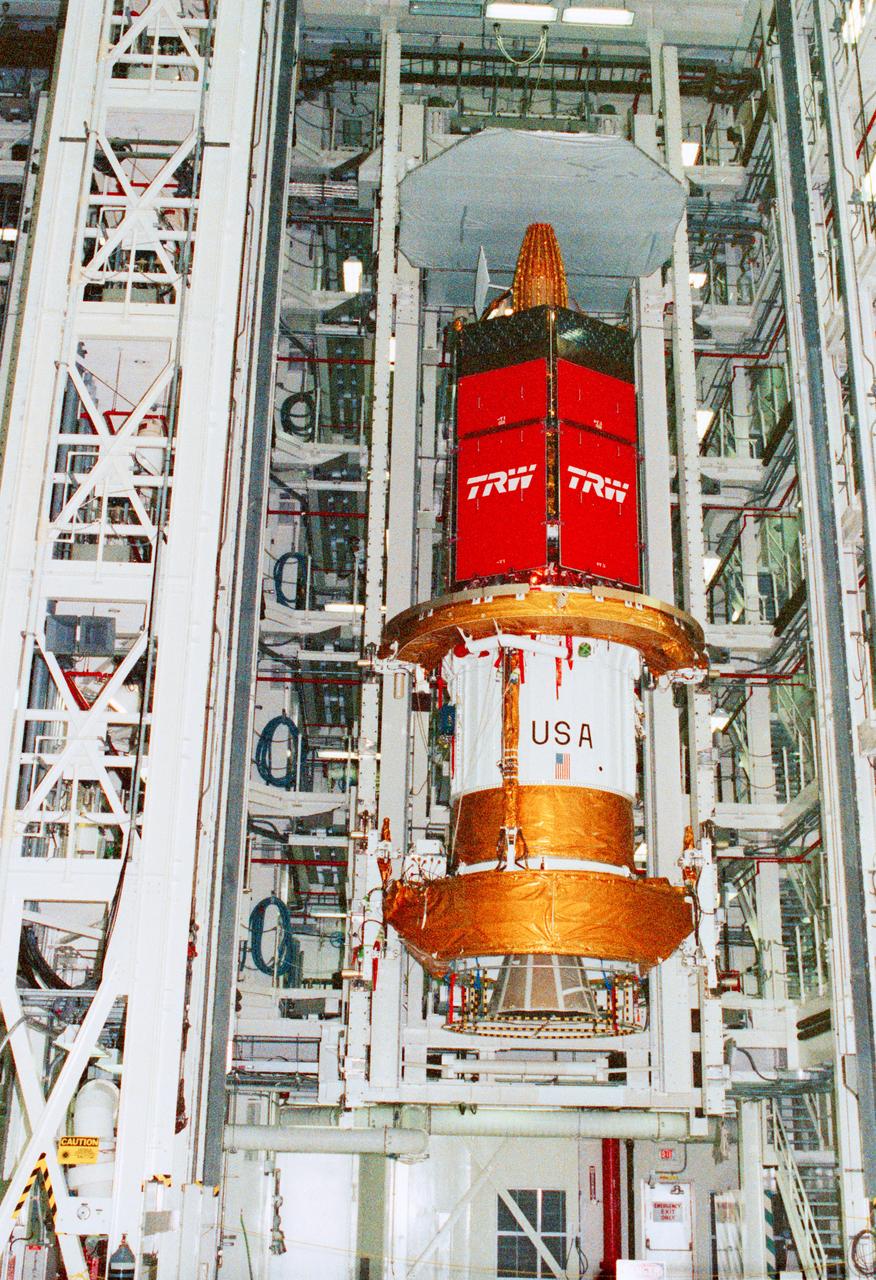
STS-43 Tracking and Data Relay Satellite E (TDRS-E) undergoes preflight processing in the Kennedy Space Center's (KSC's) Vertical Processing Facility (VPF) before being loaded into a payload canister for transfer to the launch pad and eventually into Atlantis', Orbiter Vehicle (OV) 104's, payload bay (PLB). This side of the TDRS-E will rest at the bottom of the PLB therefore the airborne support equipment (ASE) forward frame keel pin (at center of spacecraft) and the umbilical boom running between the two ASE frames are visible. The solar array panels are covered with protective TRW shields. Above the shields the stowed antenna and solar sail are visible. The inertial upper stage (IUS) booster is the white portion of the spacecraft and rests in the ASE forward frame and ASE aft frame tilt actuator (AFTA) frame (at the bottom of the IUS). The IUS booster nozzle extends beyond the AFTA frame. View provided by KSC with alternate number KSC-91PC-1079.
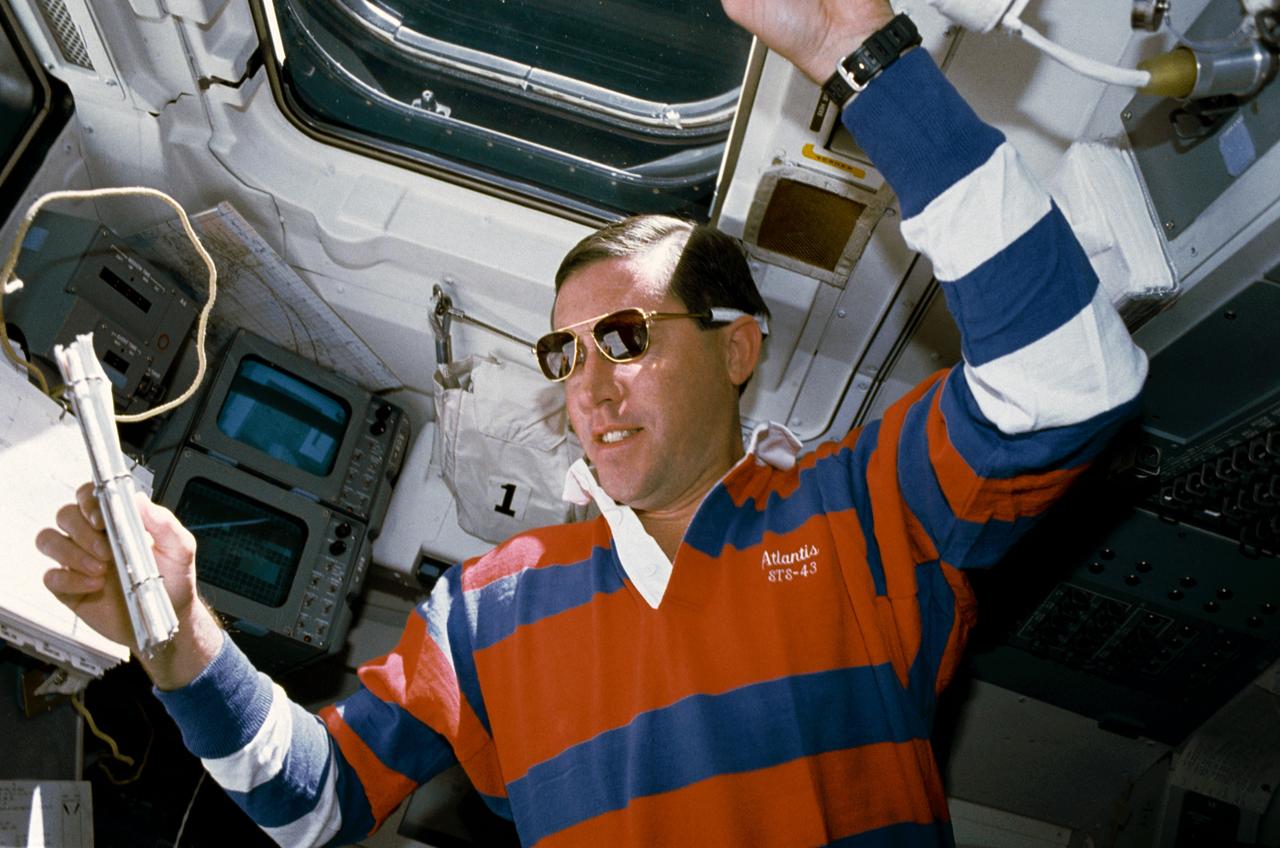
STS043-04-032 (11 Aug 1991) --- STS-43 Pilot Michael A. Baker, wearing sunglasses, reviews a checklist on the aft flight deck of Atlantis, Orbiter Vehicle (OV) 104. He is monitoring data associated with the Space Station Heat Pipe Advanced Radiator Element II (SHARE-II) located in OV-104's payload bay (PLB) from his position in front of the aft flight deck viewing windows. Behind Baker are the closed circuit television (CCTV) monitors and above his head is overhead window W8.
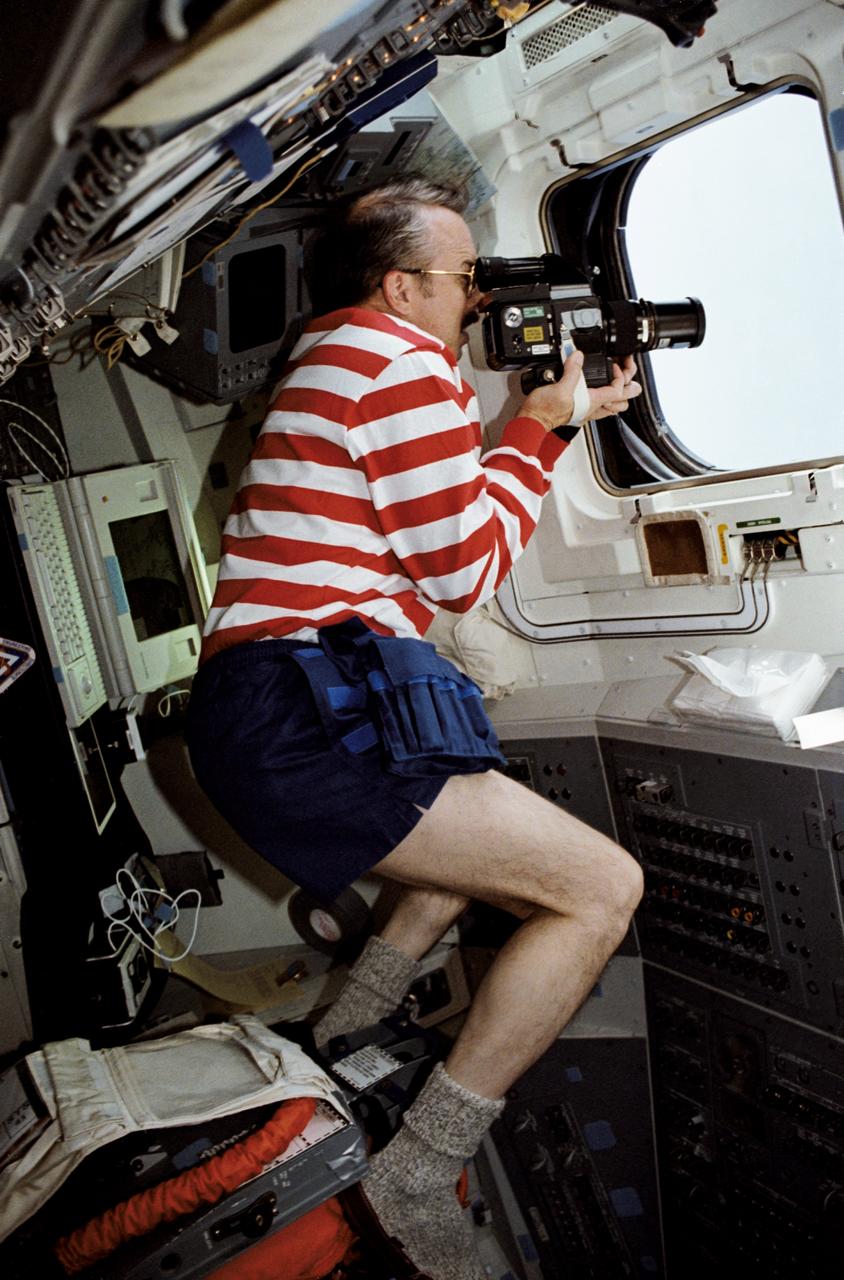
STS043-21-013 (2-11 August 1991) --- As on previous missions, Earth observations/photography played an important role on NASA’s STS-43 mission. That role is depicted in this scene showing astronaut James C. Adamson, mission specialist, aiming a still camera toward Earth through an overhead window on Space Shuttle Atlantis’ aft flight deck. The scene was recorded by a fellow crewmember using a 35mm camera.
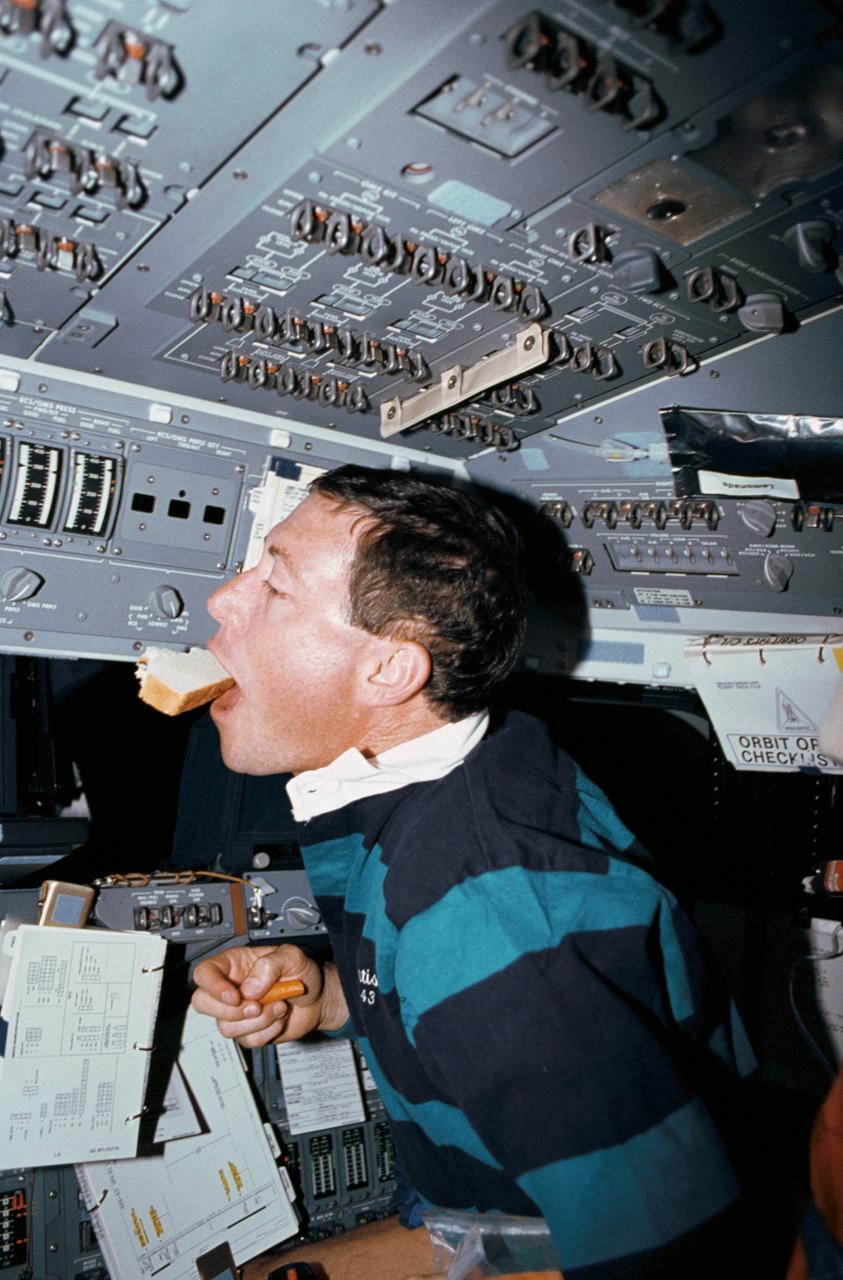
STS043-02-020 (2-11 Aug. 1991) --- Astronaut Michael A. Baker, STS-43 pilot, seated at the forward flight deck pilot station controls of the Space Shuttle Atlantis, eats a free-floating peanut butter and jelly sandwich while holding a carrot. Surrounding Baker are procedural checklists, control panels, and windows. A lemonade drink bag is velcroed to overhead panel.
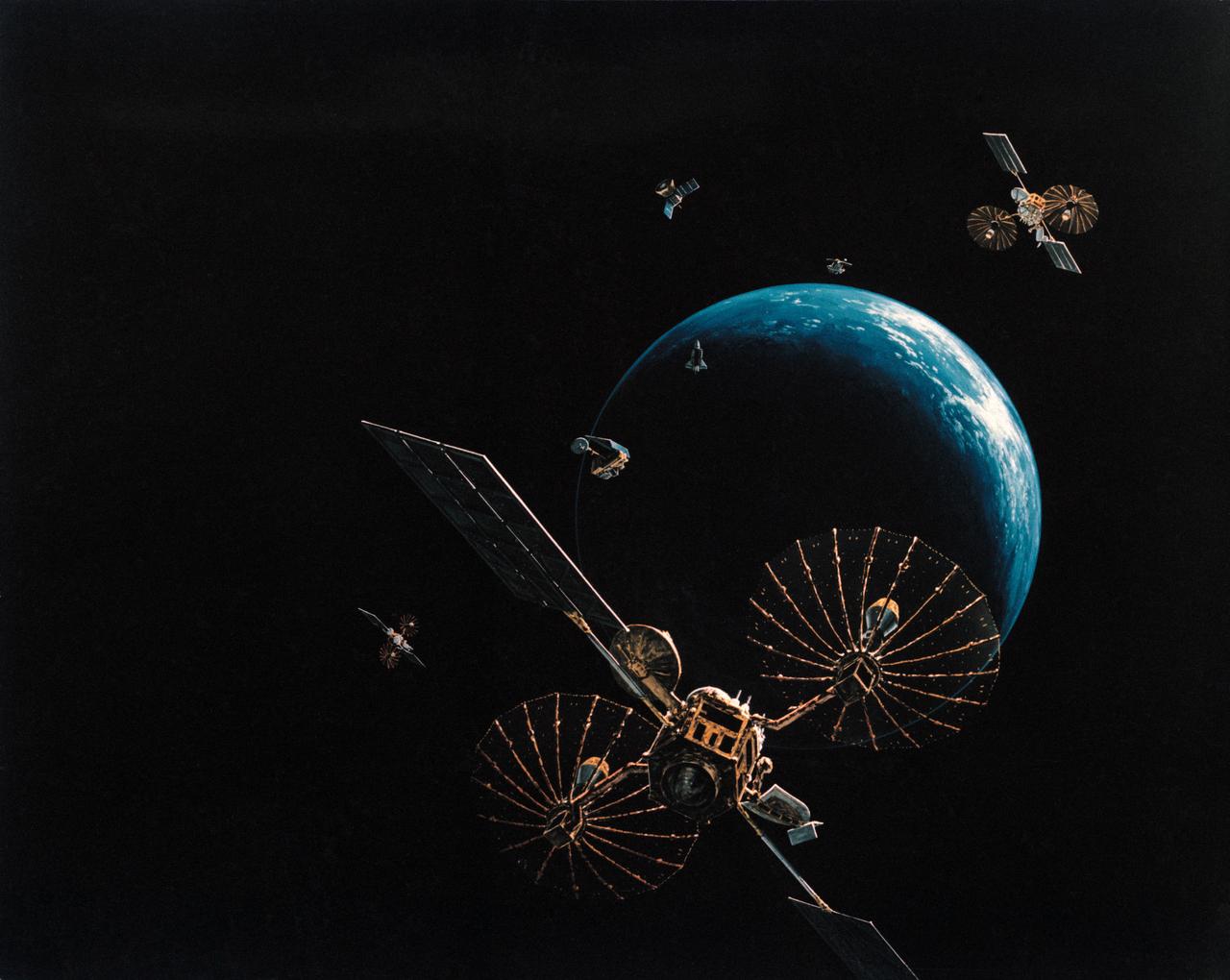
Artist concept shows the Tracking and Data Relay Satellite E (TDRS-E) augmenting a sophisticated TDRS system (TDRSS) communications network after deployment during STS-43 from Atlantis, Orbiter Vehicle (OV) 104. TDRS, built by TRW, will be placed in a geosynchronous orbit and after onorbit testing, which requires several weeks, will be designated TDRS-5. The communications satellite will replace TDRS-3 at 174 degrees West longitude. The backbone of NASA's space-to-ground communications, the TDRSs have increased NASA's ability to send and receive data to spacecraft in low-earth orbit to more than 85 percent of the time. Before TDRS, NASA relied solely on a system of ground stations that permitted communications only 15 percent of the time. Increased coverage has allowed onorbit repairs, live television broadcast from space and continuous dialogues between astronaut crews and ground control during critical periods such as Space Shuttle landings.
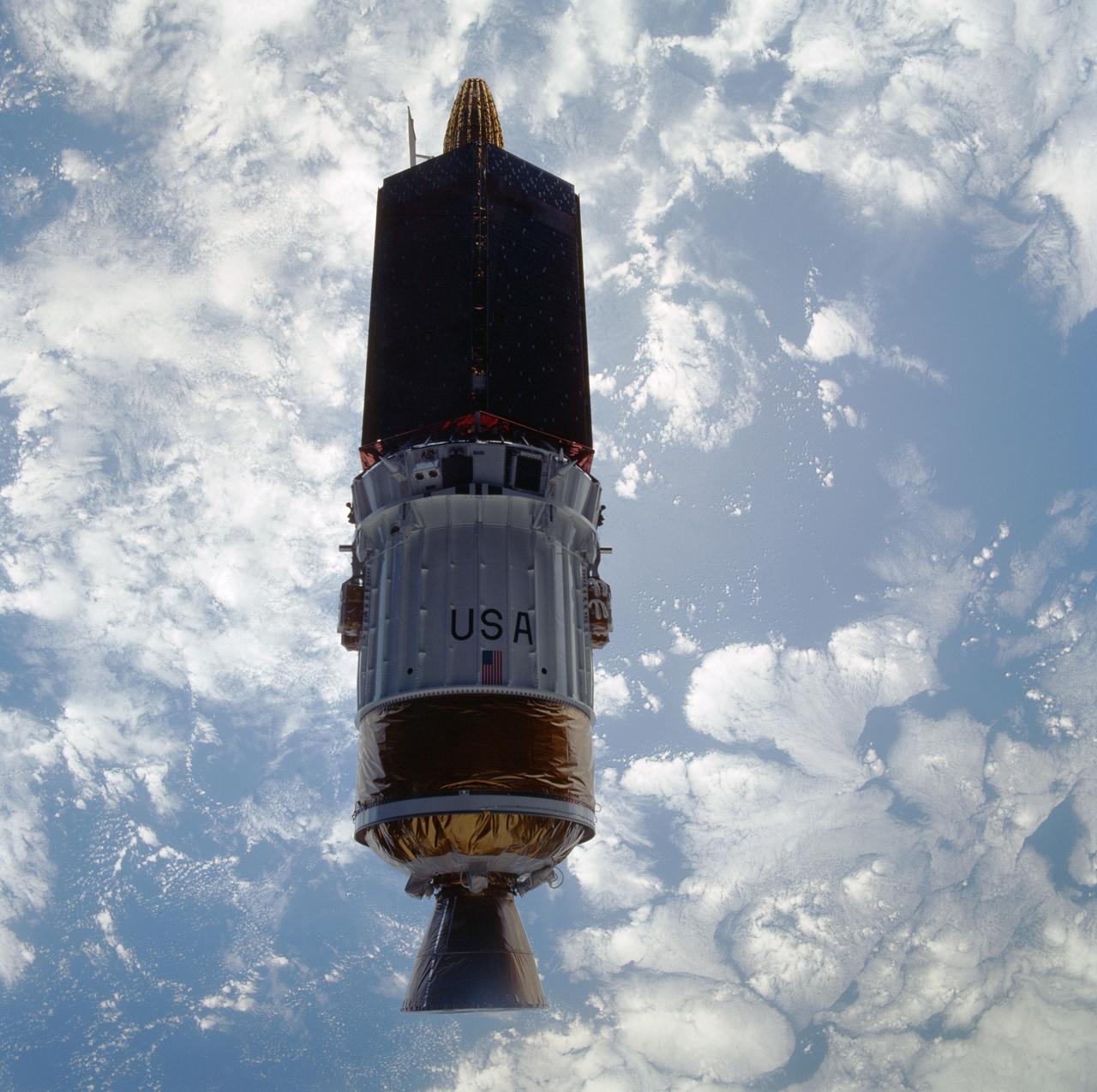
STS043-601-033 (2 Aug 1991) --- The Tracking and Data Relay Satellite (TDRS-E), is seen almost as a silhouette in this 70mm image. The TDRS spacecraft was captured on film as it moved away from the earth-orbiting Atlantis a mere six hours after the shuttle was launched from Pad 39A at Kennedy Space Center, Florida. TDRS, built by TRW, will be placed in a geosynchronous orbit and after on-orbit testing, which requires several weeks, will be designated TDRS-5. The communications satellite will replace TDRS-3 at 174 degrees west longitude. The backbone of NASA's space-to-ground communications, the Tracking and Data Relay Satellites have increased NASA's ability to send and receive data to spacecraft in low-earth orbit to more than 85 percent of the time. Before TDRS, NASA relied solely on a system of ground stations that permitted communications only 15 percent of the time. Increased coverage has allowed on-orbit repairs, live television broadcast from space and continuous dialogues between astronaut crews and ground control during critical periods such as space shuttle landings. The five astronauts of the STS-43 are John E. Blaha, mission commander, Michael a. Baker, pilot, and mission specialists Shannon W. Lucid, G. David Low and James C. Adamson.
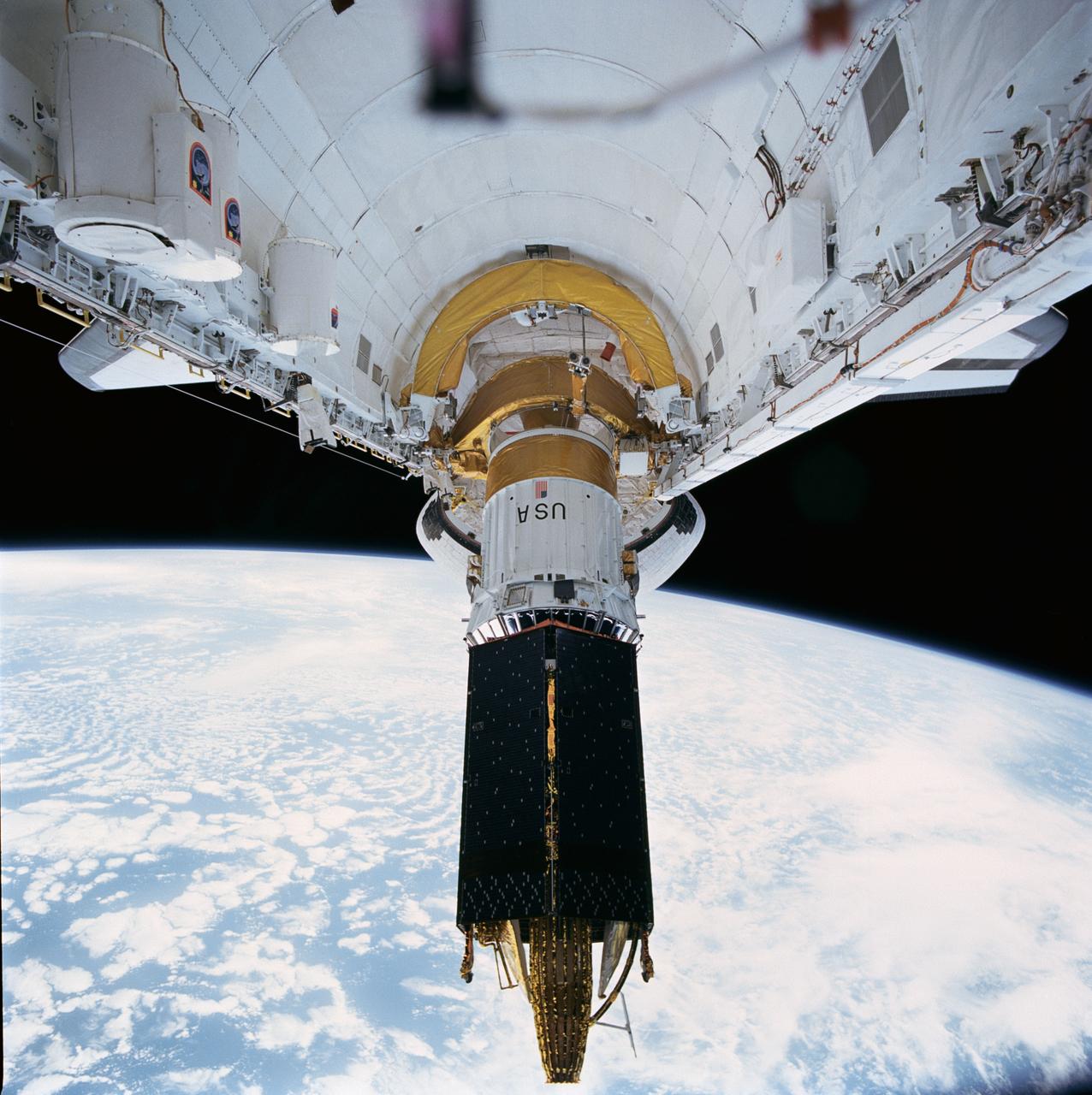
STS043-72-059 (2 Aug 1991) --- The Tracking and Data Relay Satellite (TDRS-E), leaves the payload bay of the earth-orbiting Atlantis a mere six hours after the Space Shuttle was launched from Pad 39A at Kennedy Space Center, Florida. TDRS, built by TRW, will be placed in a geosynchronous orbit and after on-orbit testing, which requires several weeks, will be designated TDRS-5. The communications satellite will replace TDRS-3 at 174 degrees West longitude. The backbone of NASA's space-to-ground communications, the Tracking and Data Relay satellites have increased NASA's ability to send and receive data to spacecraft in low-earth orbit to more than 85 percent of the time. The five astronauts of the STS 43 mission are John E. Blaha, mission commander, Michael A. Baker, pilot, and Shannon W. Lucid, G. David Low, and James C. Adamson, all mission specialists.
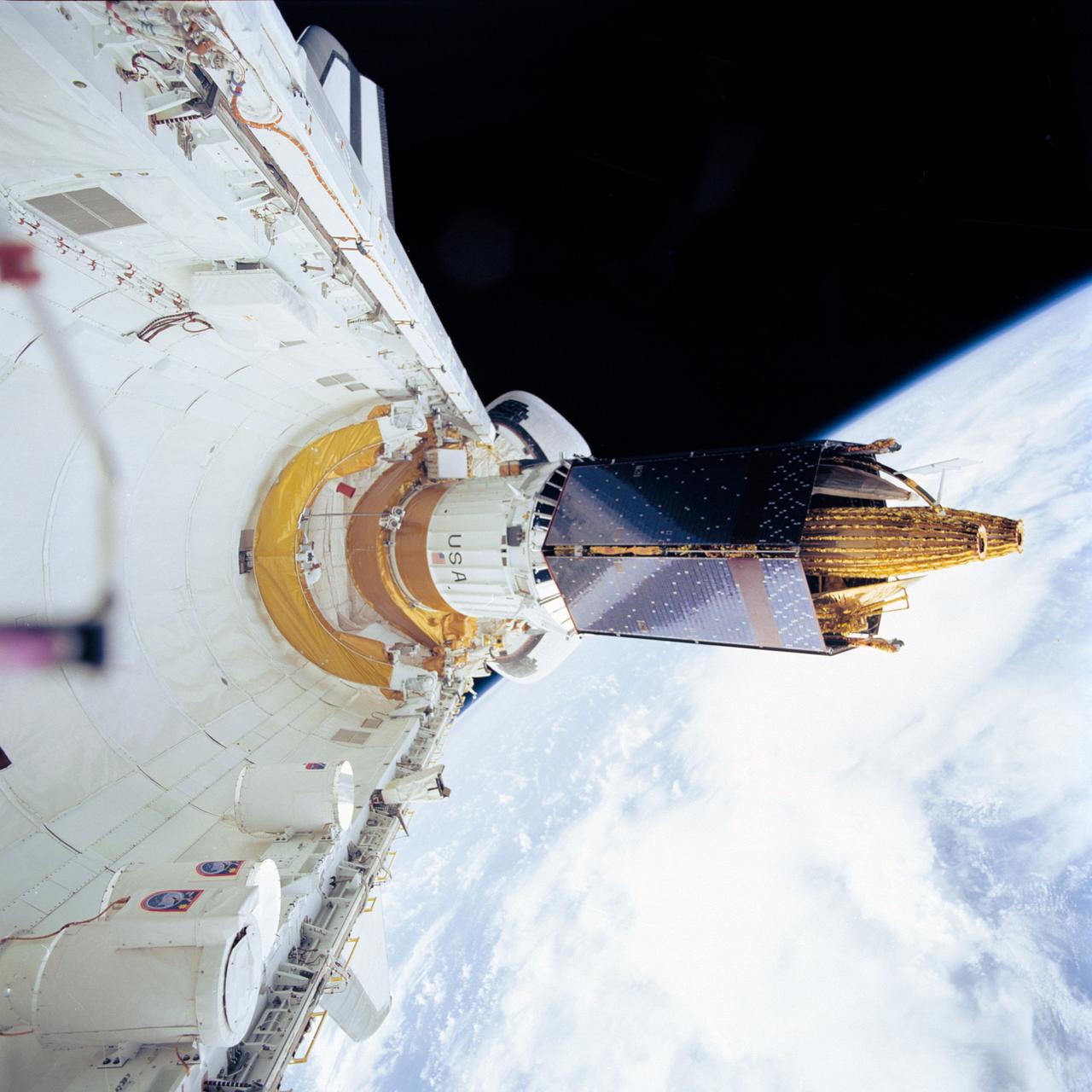
STS043-72-002 (2 Aug 1991) --- The Tracking and Data Relay Satellite (TDRS-E), leaves the payload bay of the earth-orbiting Atlantis a mere six hours after the Space Shuttle was launched from Pad 39A at Kennedy Space Center, Florida. TDRS, built by TRW, will be placed in a geosynchronous orbit and after on-orbit testing, which requires several weeks, will be designated TDRS-5. The communications satellite will replace TDRS-3 at 174 degrees West longitude. The backbone of NASA's space-to-ground communications, the Tracking and Data Relay satellites have increased NASA's ability to send and receive data to spacecraft in low-earth orbit to more than 85 percent of the time. The five astronauts of the STS 43 mission are John E. Blaha, mission commander, Michael A. Baker, pilot, and Shannon W. Lucid, G. David Low, and James C. Adamson, all mission specialists.
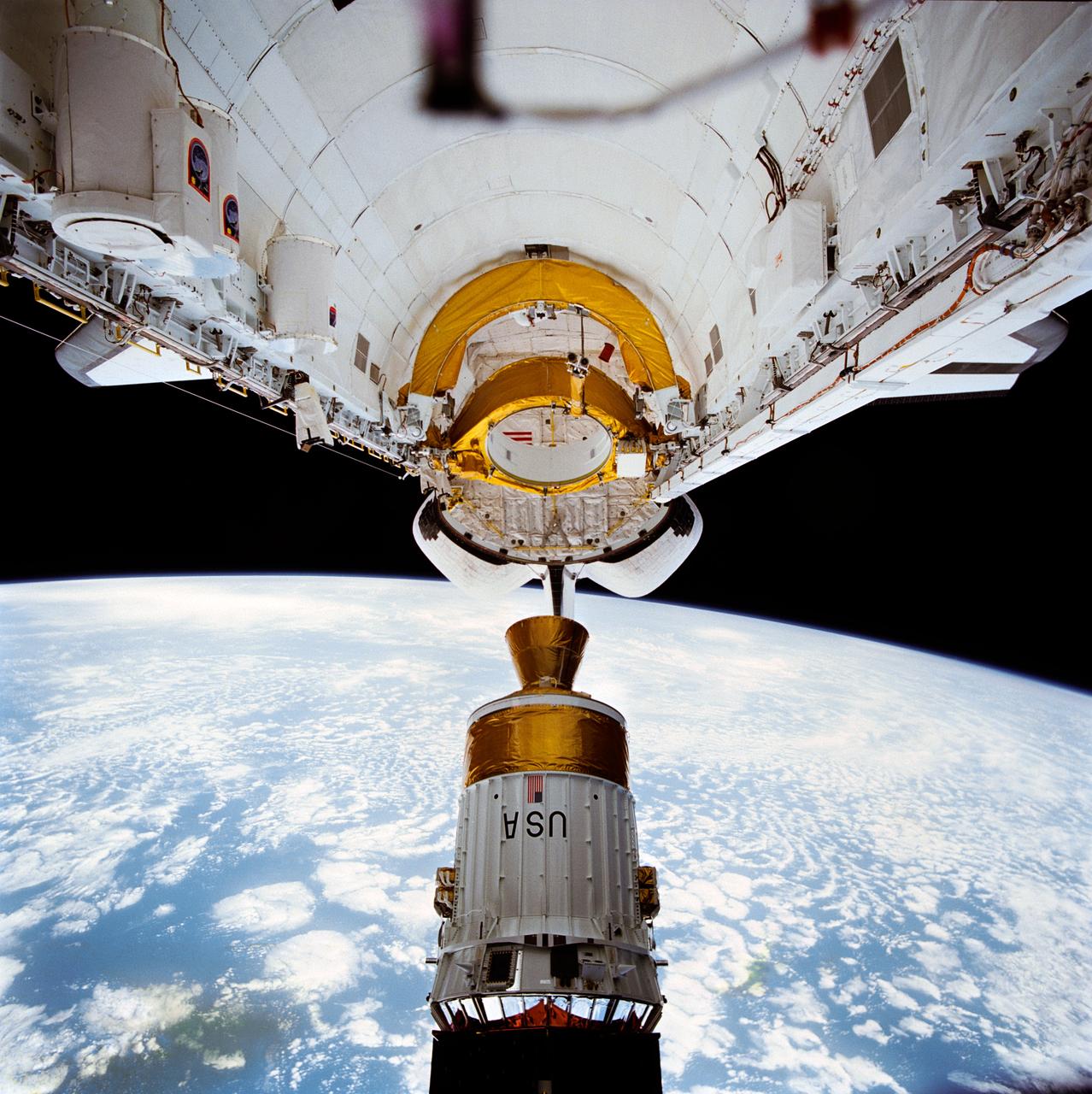
STS043-72-020 (2 Aug 1991) --- The Tracking and Data Relay Satellite (TDRS-E), is loosened from its restraint device and begins to leave the payload bay of the earth-orbiting Atlantis. The deployment came a mere six hours after the Space Shuttle was launched from Pad 39A at Kennedy Space Center, Florida. TDRS, built by TRW, will be placed in a geosynchronous orbit and after on-orbit testing, which requires several weeks, will be designated TDRS-5. The communications satellite will replace TDRS-3 at 174 degrees West longitude. The backbone of NASA's space-to-ground communications, the Tracking and Data Relay satellites have increased NASA's ability to send and receive data to spacecraft in low-earth orbit to more than 85 percent of the time. The five astronauts of the STS 43 mission are John E. Blaha, mission commander, Michael A. Baker, pilot, and Shannon W. Lucid, G. David Low, and James C. Adamson, all mission specialists.
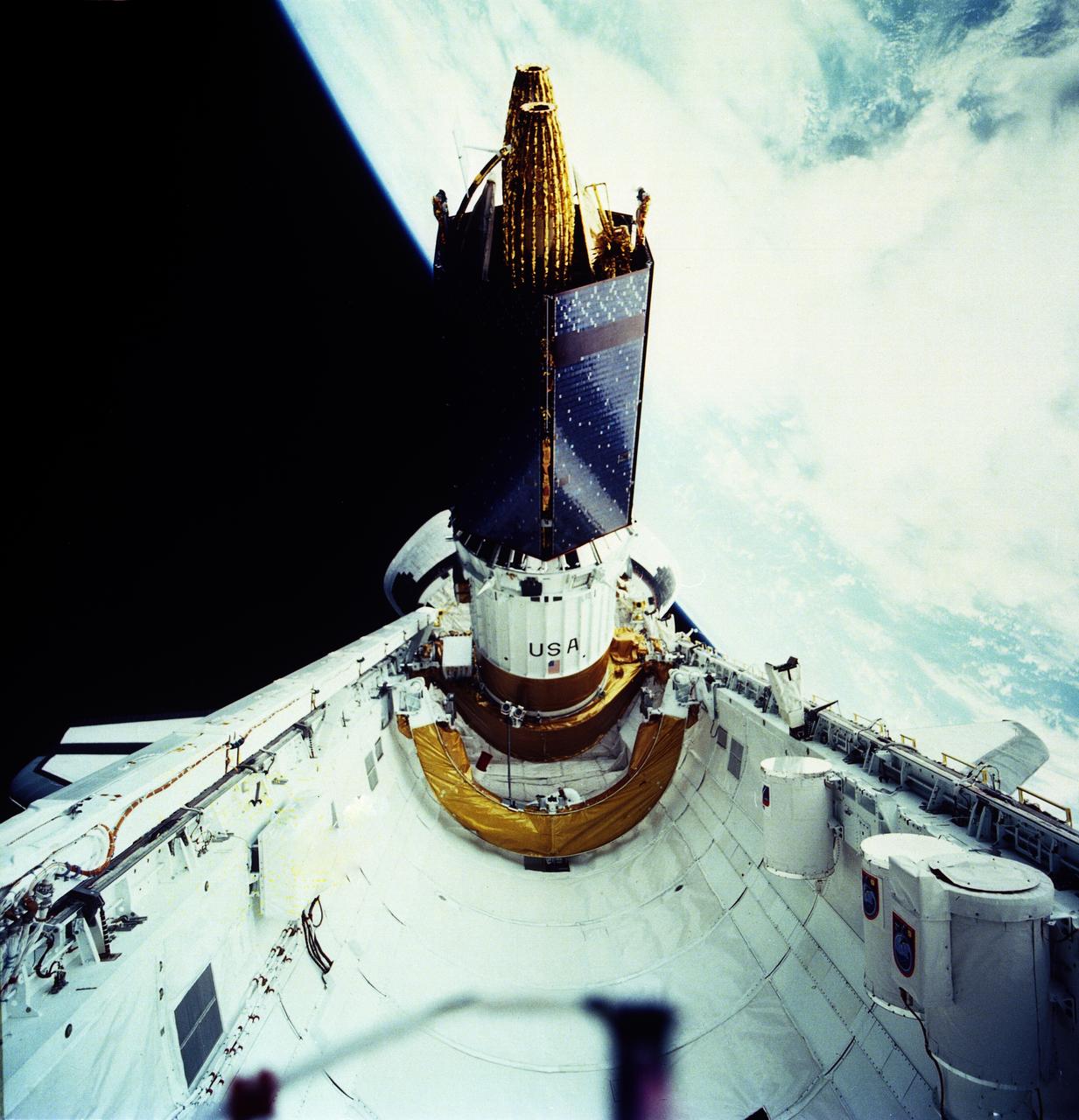
The primary payload of the STS-43 mission, Tracking and Data Relay Satellite-E (TDRS-E) attached to an Inertial Upper Stage (IUS) was photographed at the moment of its release from the cargo bay of the Space Shuttle Orbiter Atlantis. The TDRS-E was boosted by the IUS into geosynchronous orbit and positioned to remain stationary 22,400 miles above the Pacific Ocean southwest of Hawaii. The TDRS system provides almost uninterrupted communications with Earth-orbiting Shuttles and satellites, and had replaced the intermittent coverage provided by globe-encircling ground tracking stations used during the early space program. The TDRS can transmit and receive data, and track a user spacecraft in a low Earth orbit. The IUS is an unmarned transportation system designed to ferry payloads from low Earth orbit to higher orbits that are unattainable by the Shuttle. The launch of STS-43 occurred on August 2, 1991.

The free-flying Tracking and Data Relay Satellite-E (TDRS-E), still attached to an Inertial Upper Stage (IUS), was photographed by one of the crewmembers during the STS-43 mission. The TDRS-E was boosted by the IUS into geosynchronous orbit and positioned to remain stationary 22,400 miles above the Pacific Ocean southwest of Hawaii. The TDRS system provides almost uninterrupted communications with Earth-orbiting Shuttles and satellites, and had replaced the intermittent coverage provided by globe-encircling ground tracking stations used during the early space program. The TDRS can transmit and receive data, and track a user spacecraft in a low Earth orbit. The IUS is an unmarned transportation system designed to ferry payloads from low Earth orbit to higher orbits that are unattainable by the Shuttle. The Space Shuttle Orbiter Atlantis for the STS-43 mission was launched on August 2, 1991.
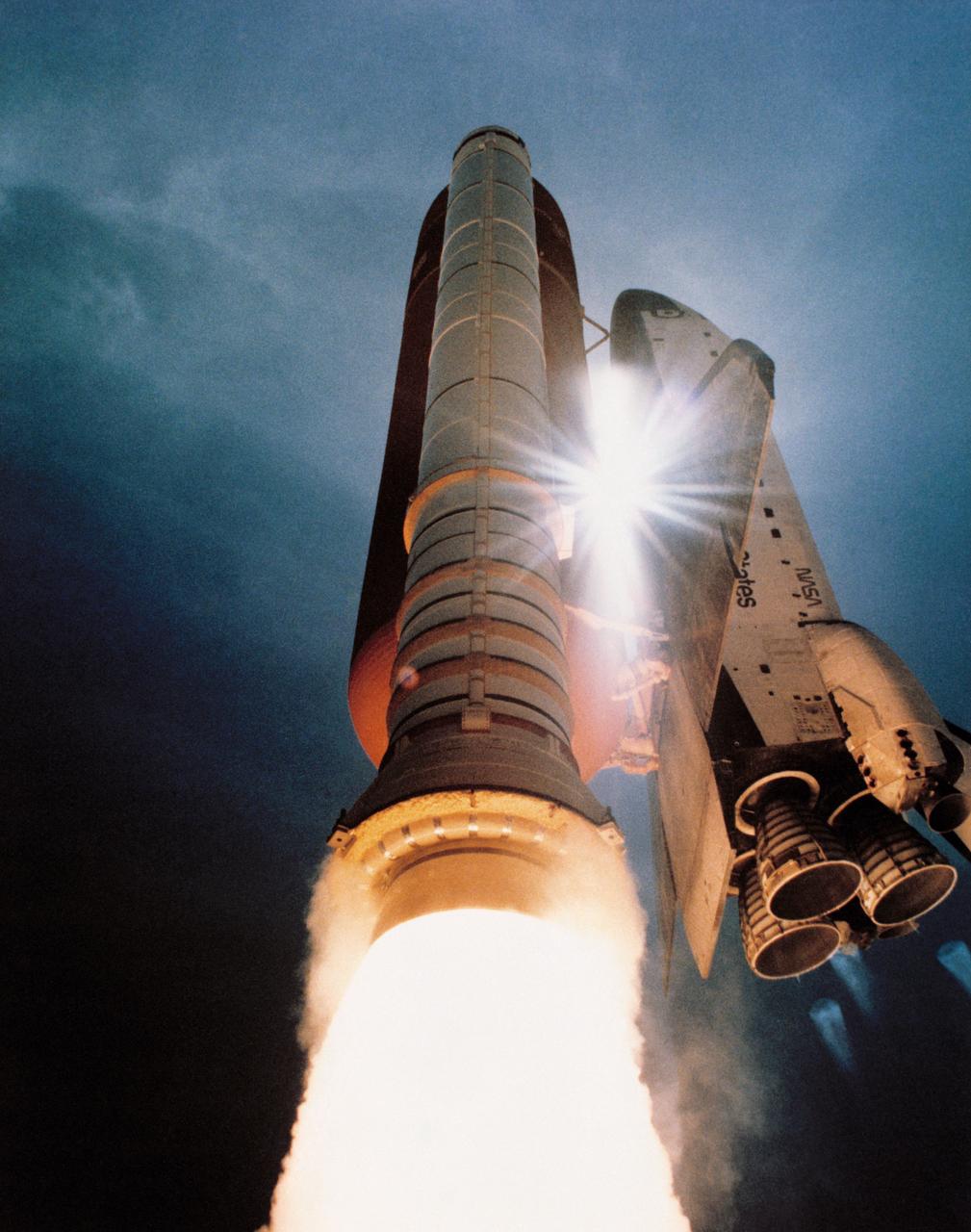
STS-43 Atlantis, Orbiter Vehicle (OV) 104, soars toward space after liftoff from Kennedy Space Center (KSC) Launch Complex (LC) Pad 39A at 11:02: 00 am (Eastern Daylight Time (EDT)). This low angle view captures OV-104 as it begins its roll maneuver. A burst of sunlight shines through the mated hardware elements supporting the Space Shuttle Atlantis for the STS-43 mission's launch phase. Exhaust plumes billow from the solid rocket booster (SRB) skirts. All three space shuttle main engines (SSMEs) glow as they power OV-104 into orbit. The bottom of external tank (ET) is highlighted by the SRB/SSME firings. This image was selected by the Public Affairs Office (PAO) for public release.
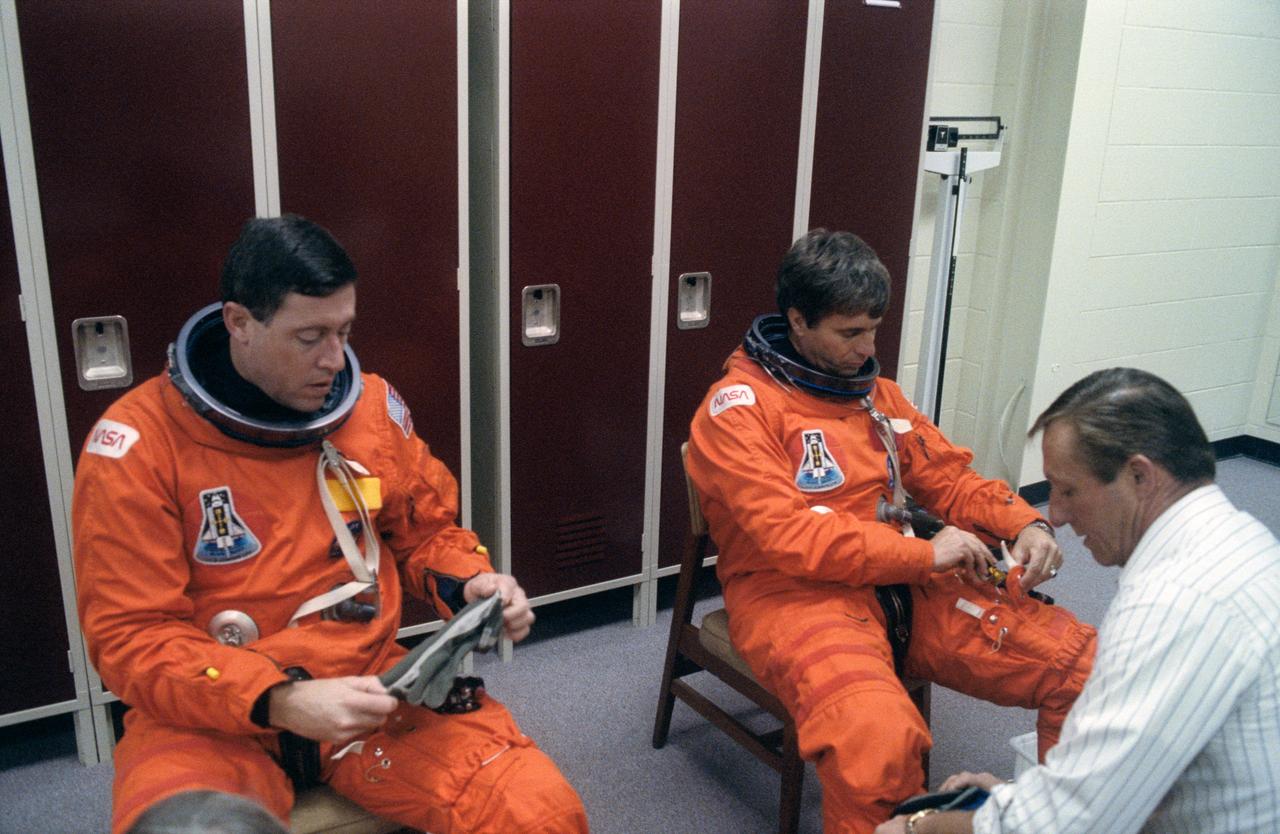
S91-37294 (May 1991) --- Astronauts Michael A. Baker, left, and John E. Blaha, STS-43 pilot and mission commander, respectively, suit up for a session of emergency egress training at the Johnson Space Center's Shuttle Mockup and Integration Laboratory. Bill Todd, a crew escape equipment suit technician for Boeing, assits them. The two astronauts are wearing the orange partial pressure suits which are used by Shuttle crewmembers during launch and entry phases of their flights.
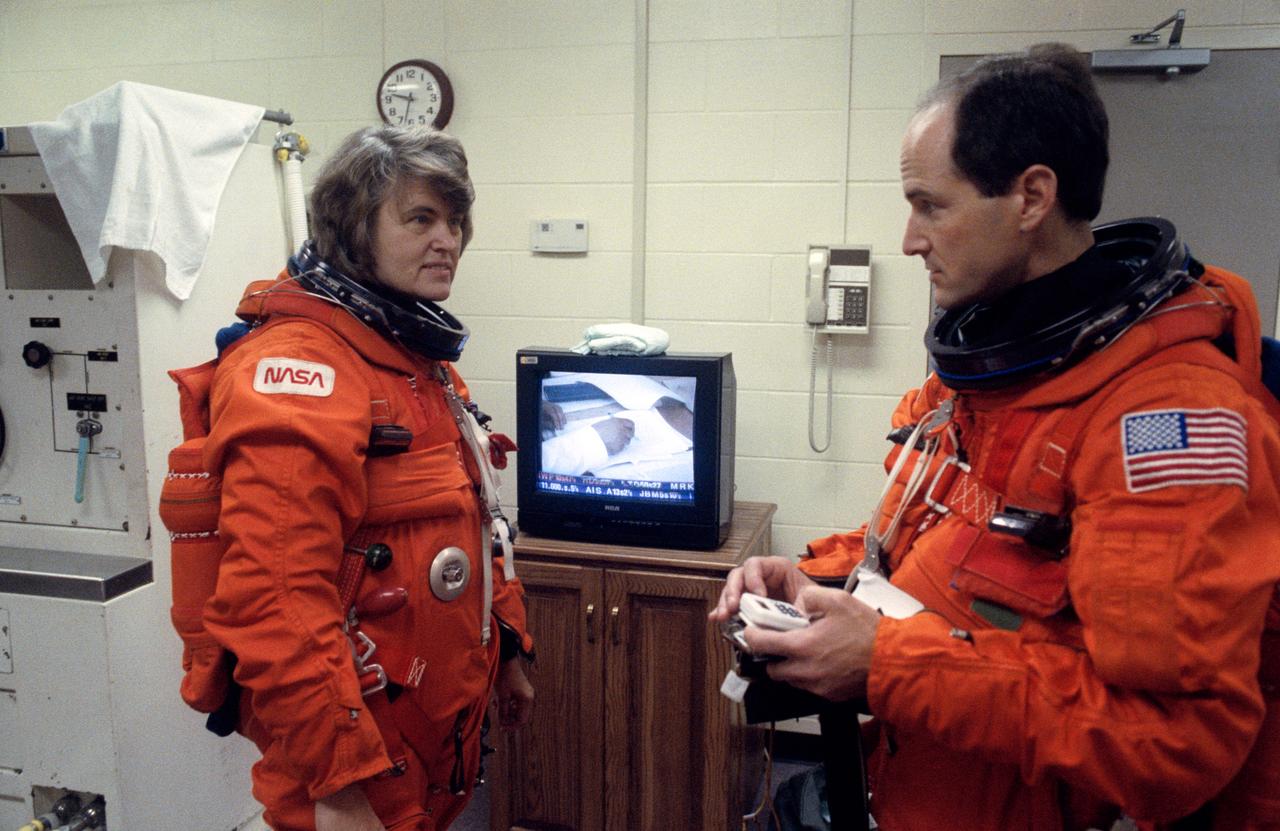
S91-37288 (May 1991) --- Astronauts Shannon W. Lucid and G. David Low, STS-43 mission specialists, take a break from emergency egress training at the Johnson Space Center's Shuttle Mockup and Integration Laboratory. The two are wearing the orange partial pressure suits which are used by Shuttle crewmembers during launch and entry phases of their flights.
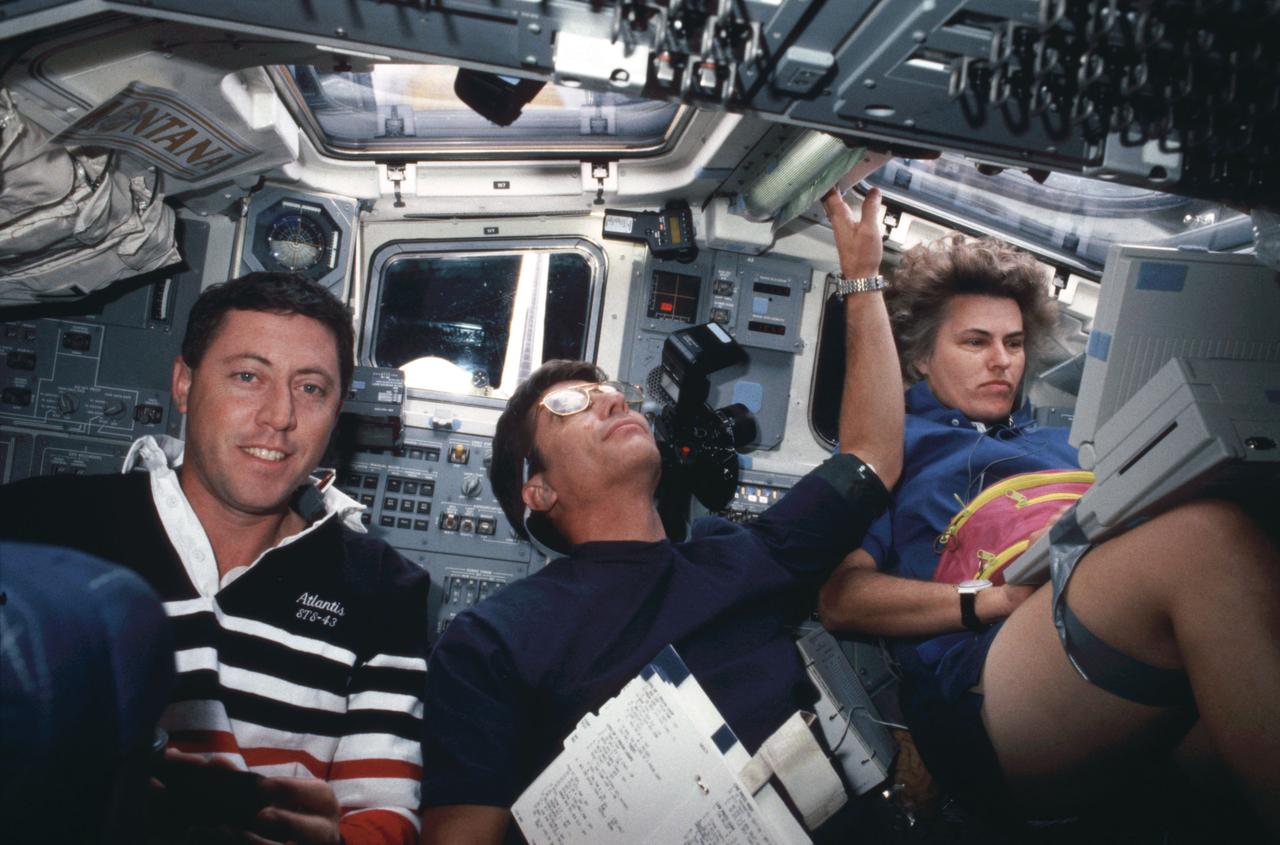
STS043-37-012 (2-11 Aug 1991) --- Three STS-43 astronauts are busy at work onboard the earth-orbiting space shuttle Atlantis. Astronaut Shannon W. Lucid is pictured performing one of several tests on Computer hardware with space station applications in mind. Sharing the aft flight deck with Lucid are Michael A. Baker (left), pilot and John E. Blaha, mission commander.
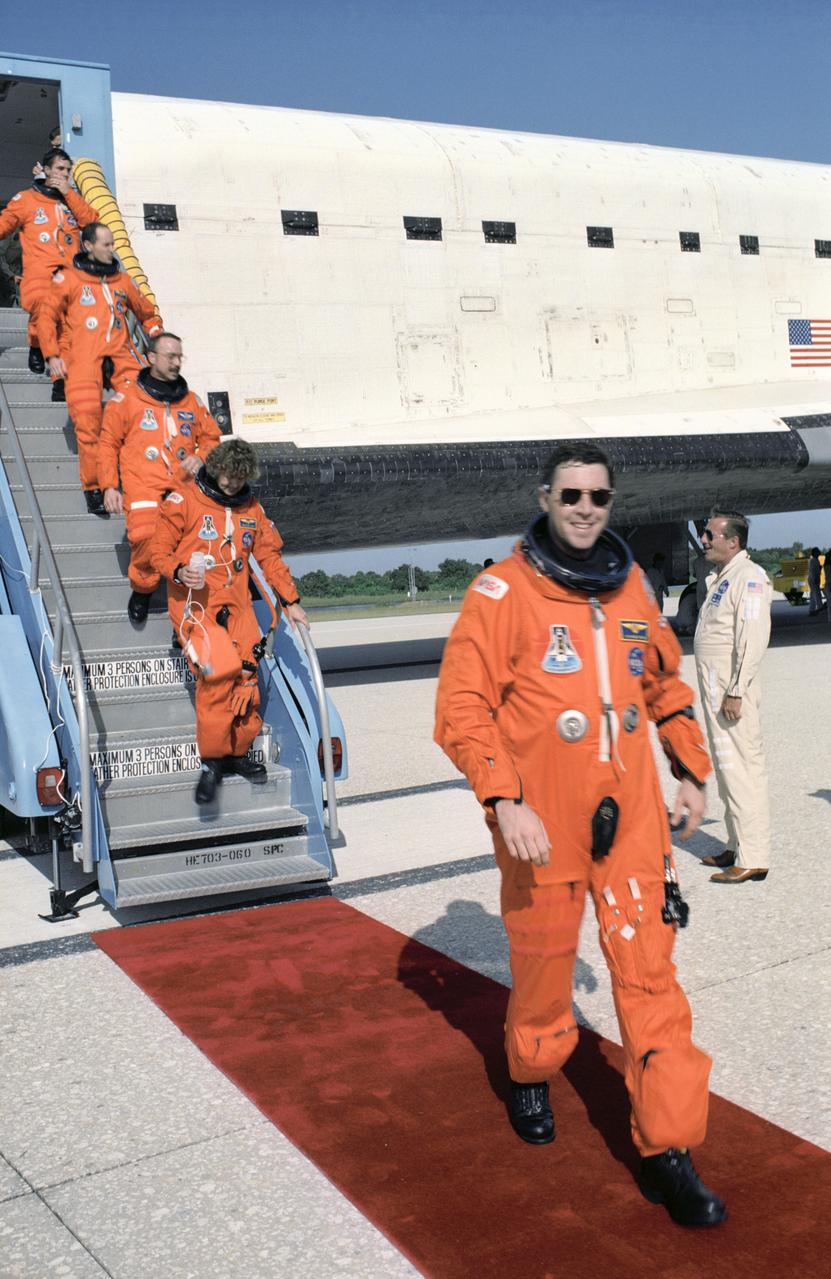
STS043-S-145 (11 Aug 1991) --- STS-43 crewmembers, wearing launch and entry suits (LESs), egress Atlantis, Orbiter Vehicle (OV) 104, via mobile stairway after landing on runway 15 at the Kennedy Space Center (KSC) Shuttle Landing Facility (SLF). Leading the crew and the first to step onto the red carpet is Pilot Michael A. Baker. He is followed by Mission Specialist (MS) Shannon W. Lucid, MS James C. Adamson, MS G. David Low, and Commander John E. Blaha. OV-104's fuselage is visible in the background.
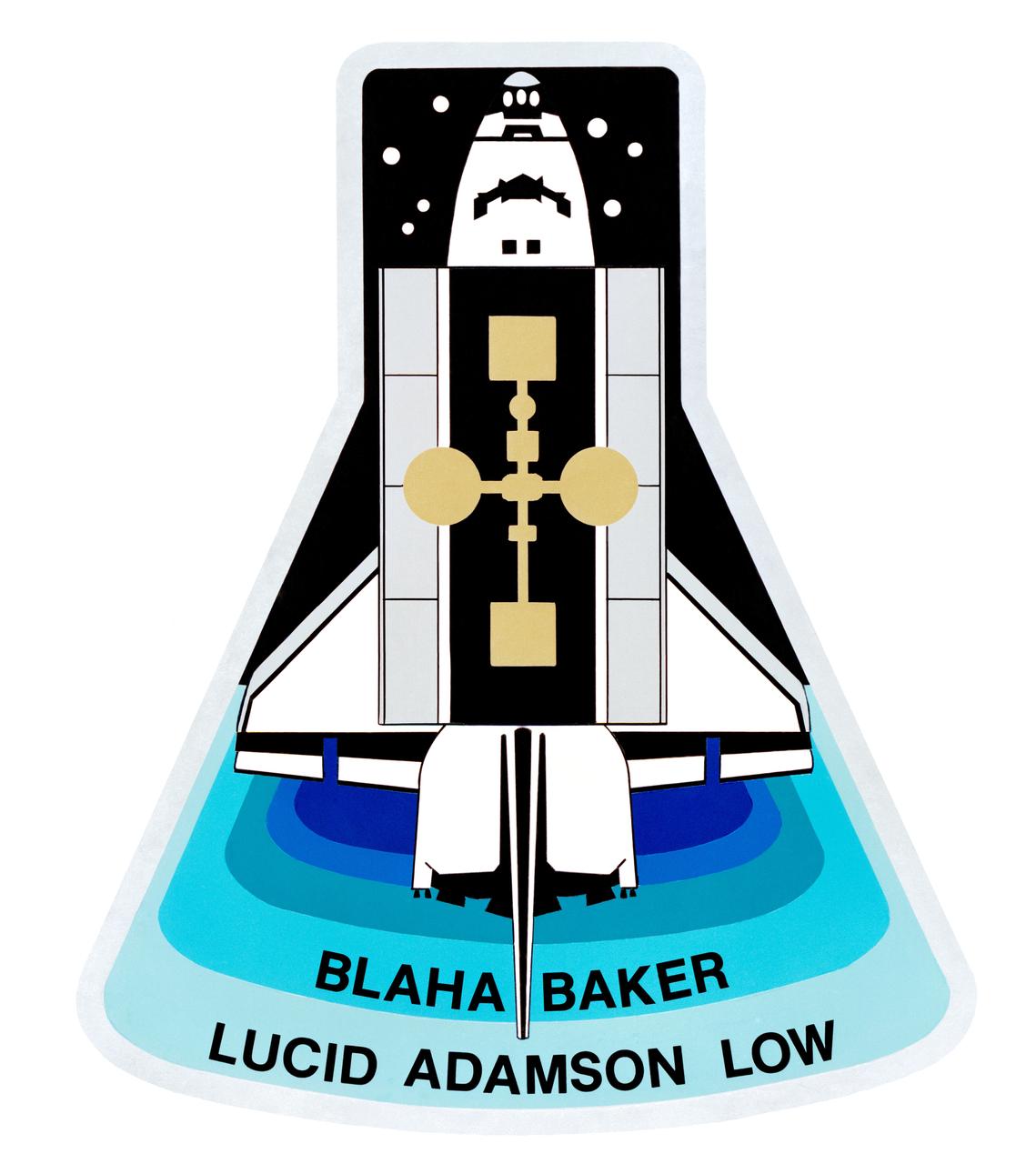
STS043-S-001 (6 Feb. 1991) --- Designed by the astronauts assigned to fly on the mission, the STS-43 patch portrays the evolution and continuity of the United States of America's space program by highlighting 30 years of American manned space flight experience - from Mercury to the space shuttle. The emergence of the space shuttle Atlantis from the outlined configuration of the Mercury space capsule commemorates this special relationship. The energy and momentum of launch are conveyed by the gradations of blue which mark the space shuttle's ascent from Earth to space. Once in Earth orbit, Atlantis' cargo bay opens to reveal the Tracking and Data Relay Satellite (TDRS) which appears in gold emphasis against the white wings of the space shuttle Atlantis and the stark blackness of space. A primary mission objective, the Tracking and Data Relay Satellite System (TDRSS) will enable almost continuous communication from Earth to space for future space shuttle missions. The stars on the patch are arranged to suggest this mission's numerical designation, with four stars left of Atlantis and three to the right. The NASA insignia design for space shuttle flights is reserved for use by the astronauts and for other official use as the NASA Administrator may authorize. Public availability has been approved only in the forms of illustrations by the various news media. When and if there is any change in this policy, which is not anticipated, the change will be publicly announced. Photo credit: NASA
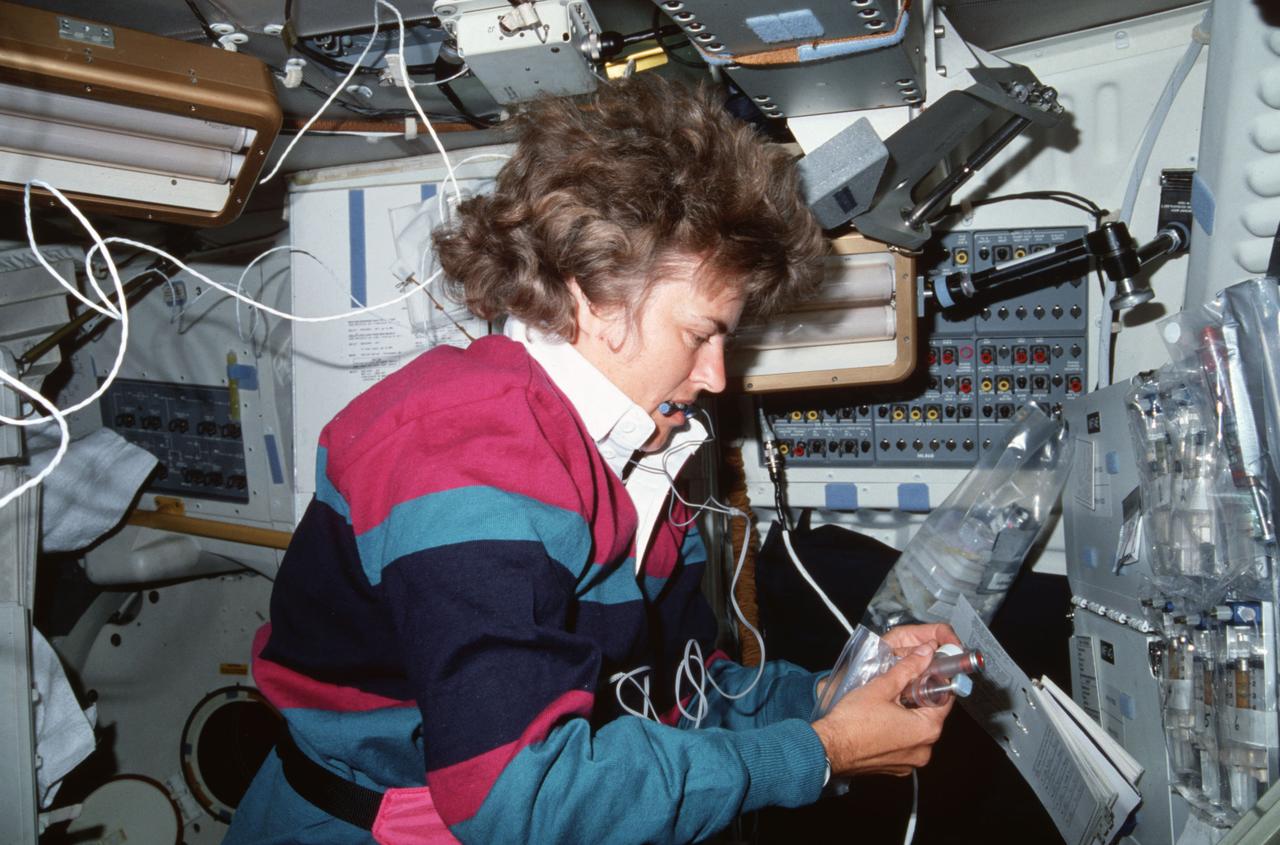
STS043-03-001 (2-11 Aug 1991) --- Astronaut Shannon W. Lucid, STS-43 mission specialist, is pictured with a sample from the Bio-serve Instrumentation Technology Associates Materials Dispersion Apparatus (BIMDA). BIMDA is designed to obtain data on scientific methods and commercial potential for growing large high quality protein crystals in microgravity. The experimental focus is on both synthetic and natural biological processes that provide the foundation of the assembly of large structures from macromolecules. In addition, cell processes and membrane (cell and artificial) processes are being evaluated. BIMDA experiments are stored and operated on the middeck in a refrigerator/incubator module (R/IM). During this flight, the R/IM maintains a constant internal temperature of 20 degrees Celsius. This experiment also flew on NASA?s STS-37 mission.
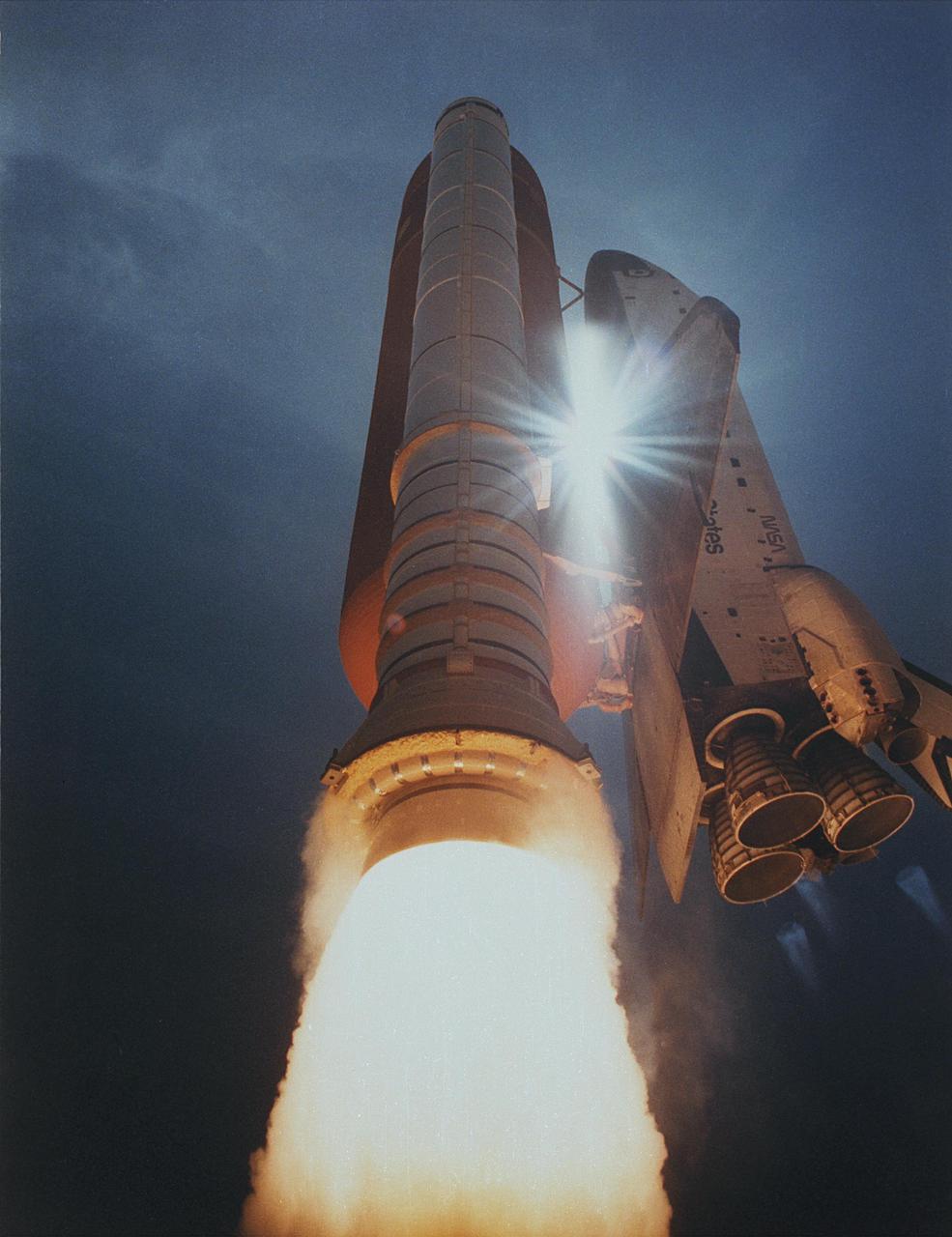
KENNEDY SPACE CENTER, FLA. -- STS-43: Atlantis
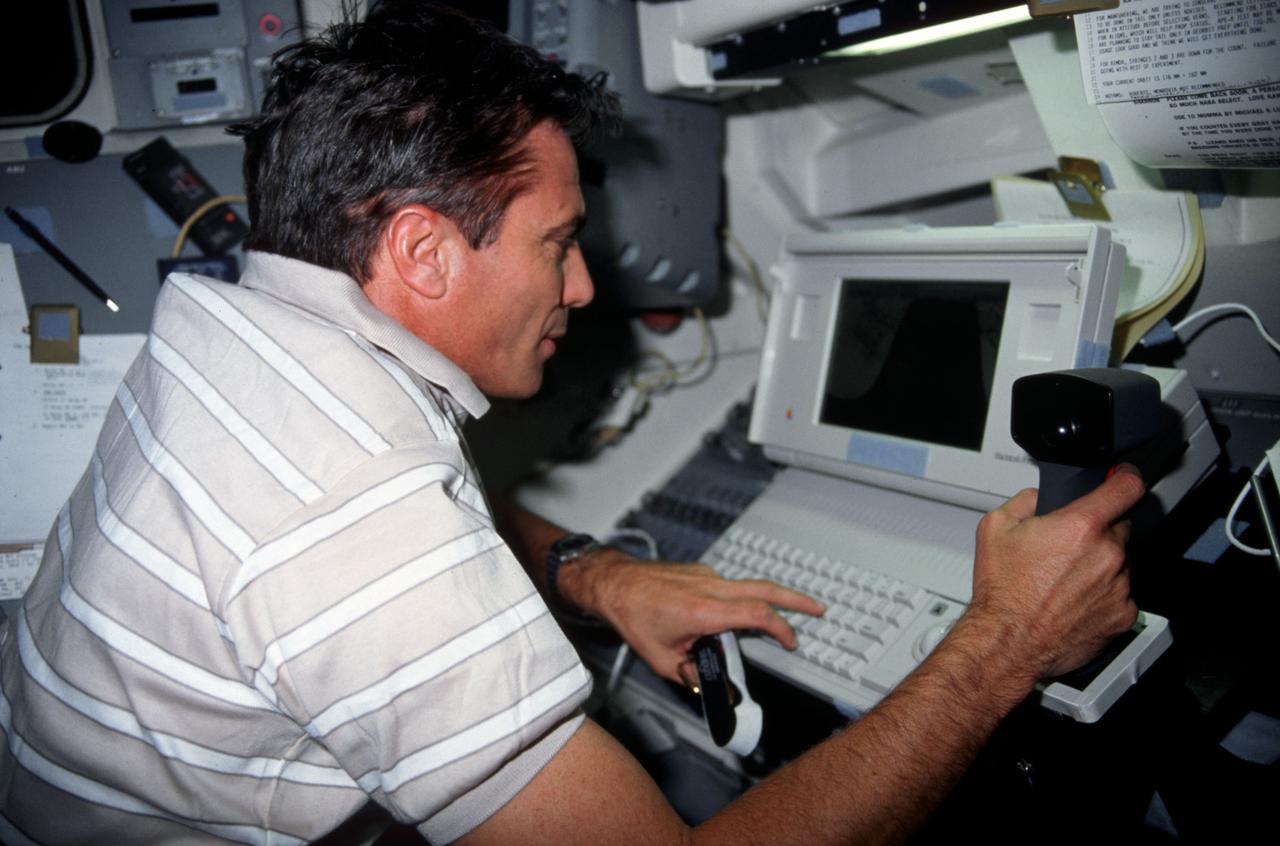
STS043-03-009 (5 Aug 1991) ---- Astronaut John E. Blaha is pictured executing development test objective (DTO) 1208, Space Station Cursor Control Device Evaluation II and advanced applications. The purpose of the Cursor Control Device Experiment is to evaluate human performance under space flight conditions of cursor control devices which are similar to the devices under consideration for use onboard Space Station computers. Here, the mission commander uses a thumbball/handgrip control device. Each crewmember evaluated the different types of cursor control devices during the nine-day STS-43 mission. Other methods of cursor control evaluated were the built-in trackball, a side mounted trackball with restraints and an optical pad with mouse.
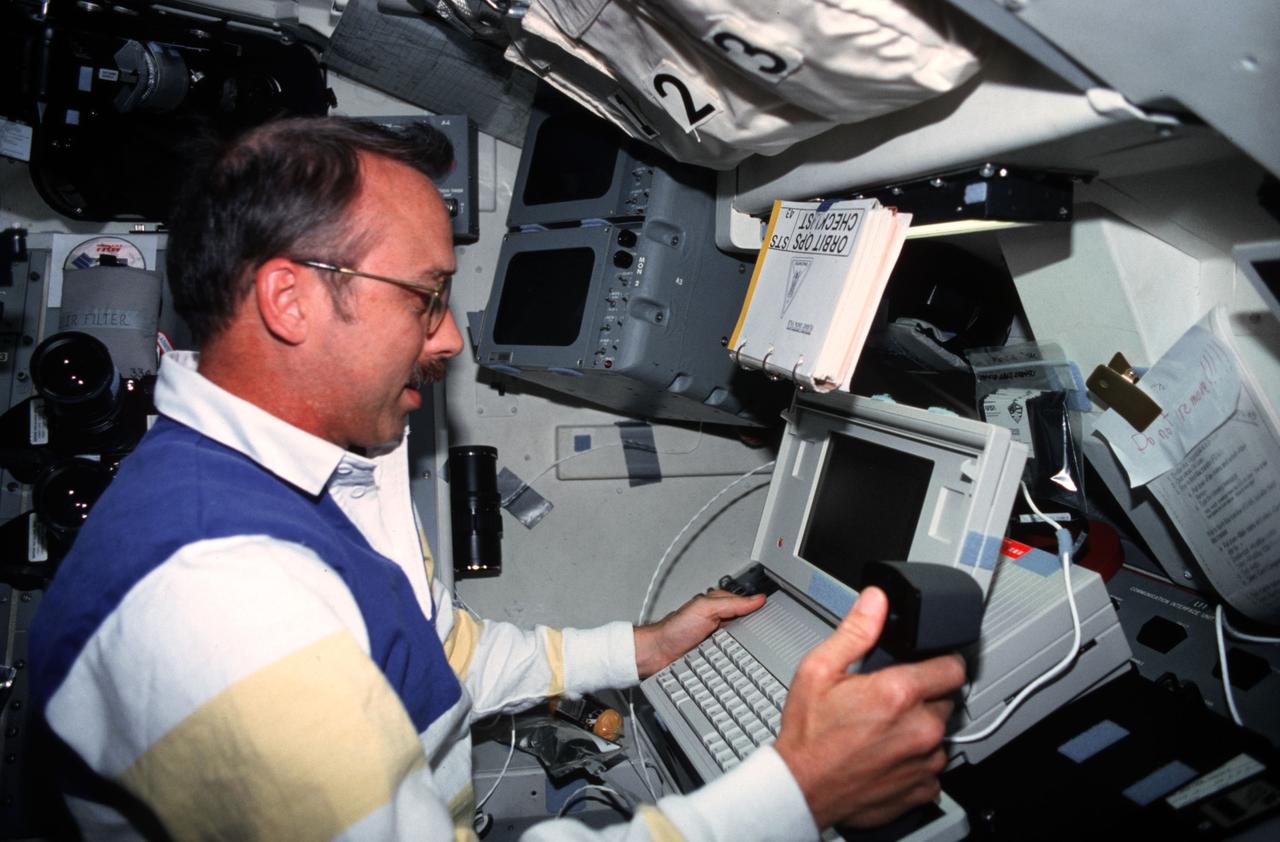
STS043-14-034 (2-11 Aug 1991) --- Astronaut James C. Adamson is pictured executing Development Test Objective (DTO) 1208, Space Station Cursor Control Device Evaluation II and Advanced Applications. The purpose of the Cursor Control Device Experiment is to evaluate human performance under space flight conditions of cursor control devices which are similar to the devices under consideration for use onboard space station computers. Here, the mission specialists uses a thumbball/handgrip control device. Each crewmember evaluated the different types of cursor control devices during the nine-day STS-43 mission. Other methods of cursor control evaluated were the built-in trackball, a side mounted trackball with restraints and an optical pad with mouse.
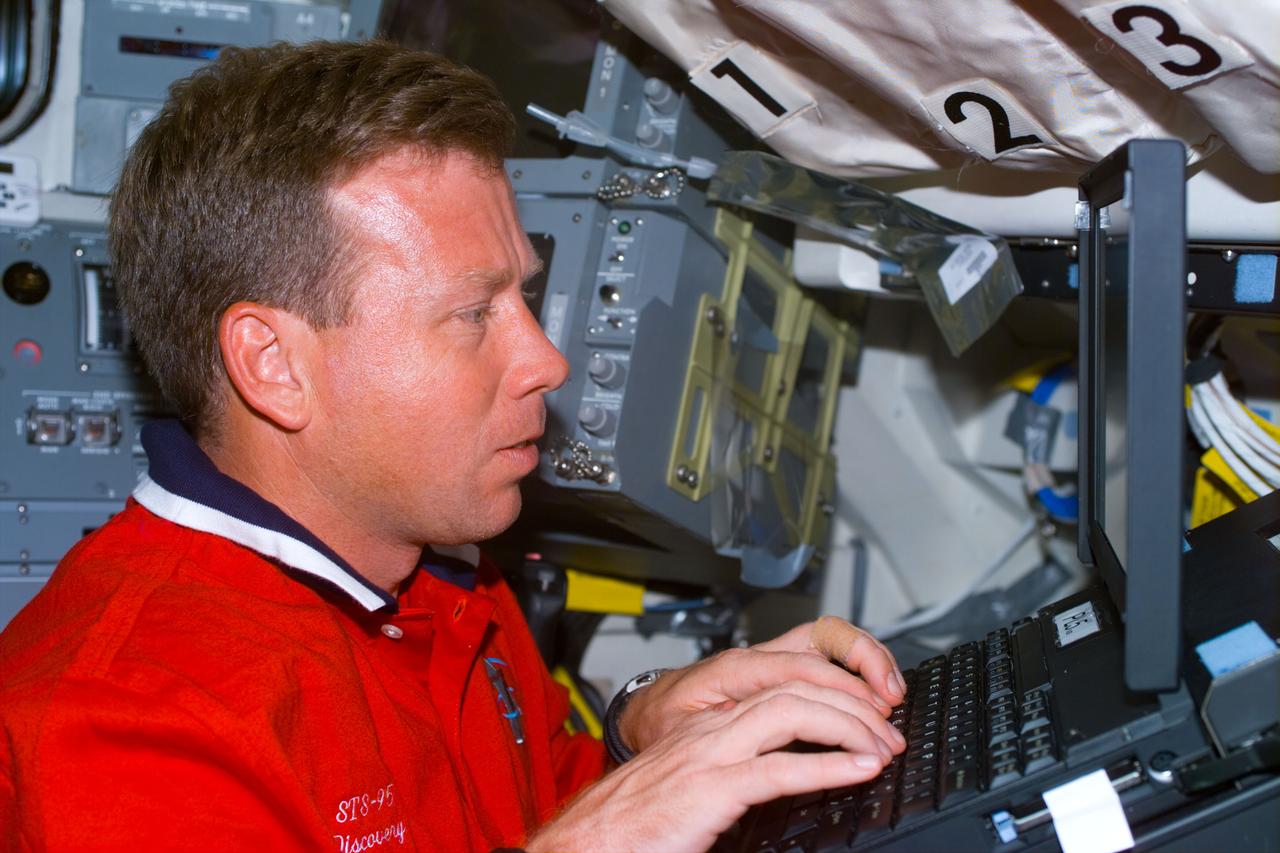
STS095-E-5056 (30 Oct. 1998) --- Astronaut Steven W. Lindsey, STS-95 pilot, works on a lap top computer during Flight Day 2 activity onboard the Space Shuttle Discovery. The photo was taken with an electronic still camera (ESC) at 10:43:43 GMT, Oct. 30.
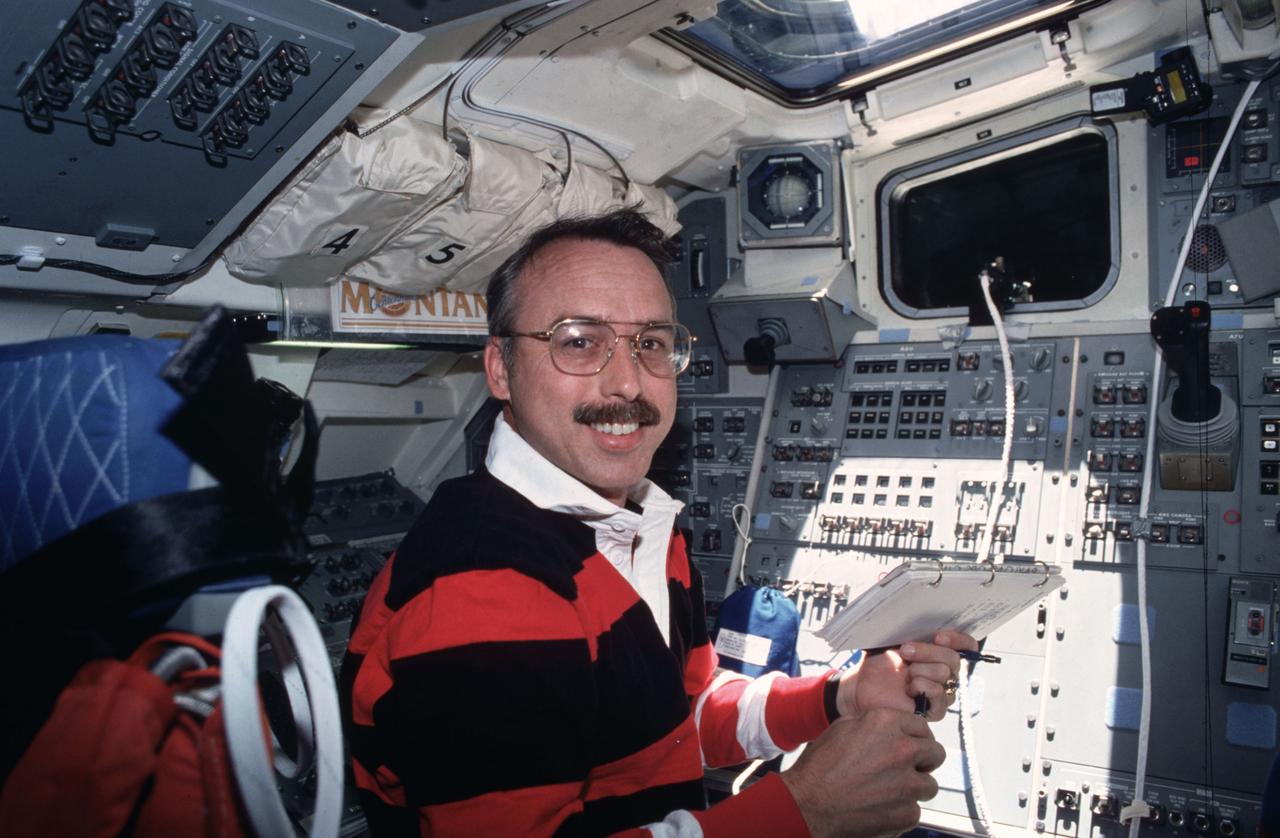
STS043-04-038 (2-11 Aug 1991) --- Astronaut James C. Adamson, STS-43 mission specialist, checks on an experiment on Atlantis? flight deck. Part of the experiment, Optical Communications Through the Shuttle Window (OCTW), can be seen mounted in upper right. The OCTW system consists of two modules, one inside the orbiter crew cabin (as pictured here) and one in the payload bay. The crew compartment version houses an optoelectronic transmitter/receiver pair for video and digital subsystems, test circuitry and interface circuitry. The payload bay module serves as a repeater station. During operation a signal is transmitted through the shuttle window to a bundle of optical fiber cables mounted in the payload bay near an aft window. The cables carry optical signals from the crew compartment equipment to the OCTW payload bay module. The signals are returned via optical fiber cable to the aft flight deck window, retransmitted through the window, and received by the crew compartment equipment.
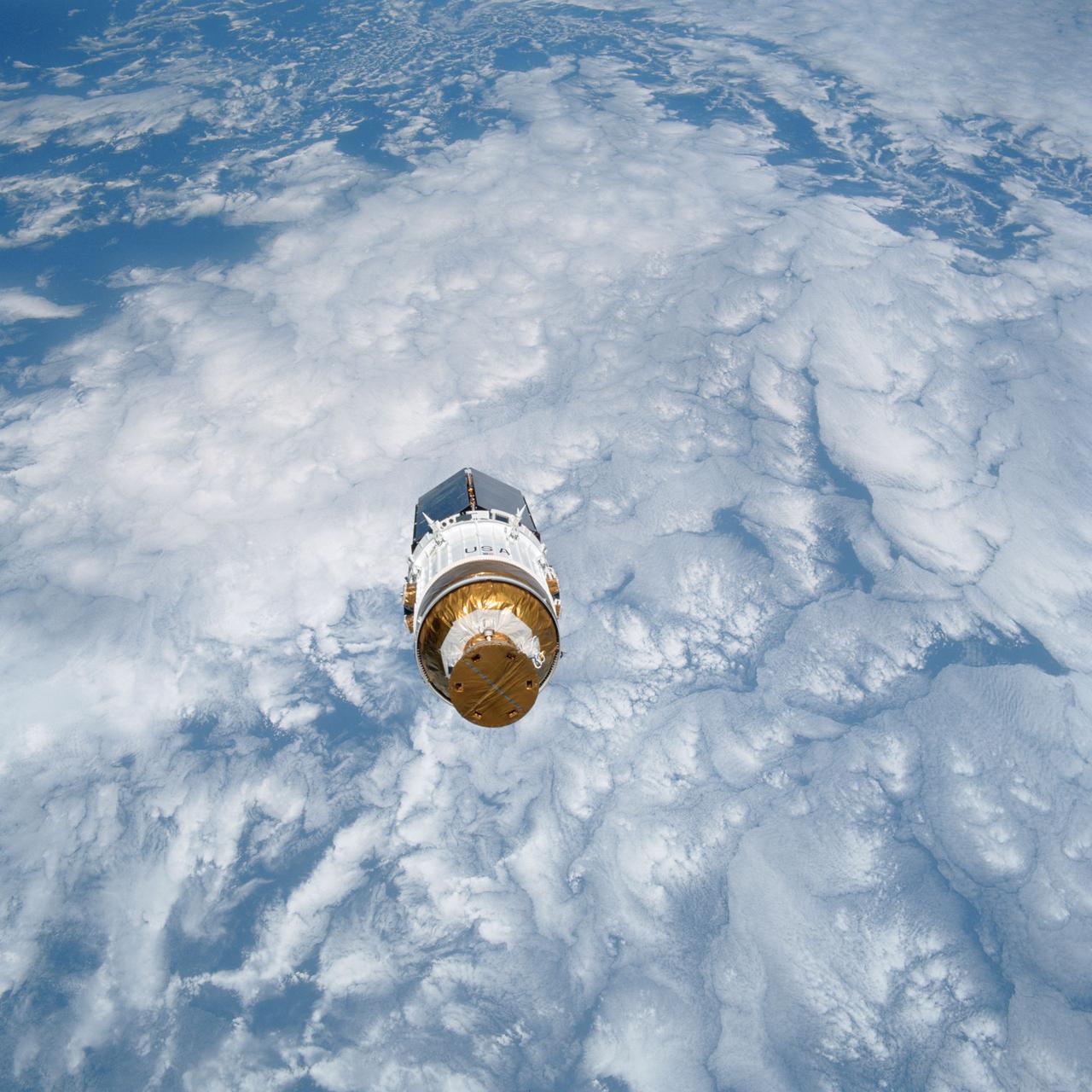
STS043-601-042 (2 Aug 1991) --- The Tracking and Data Relay Satellite (TDRS-E), is backdropped against an interesting cloud pattern over blue water soon after leaving the payload bay of the Earth-orbiting Space Shuttle Atlantis. The deployment came a mere six hours after the Space Shuttle was launched from Pad 39A at Kennedy Space Center (KSC), Florida. TDRS, built by TRW, will be placed in a geosynchronous-orbit and after on orbit testing, which requires several weeks, will be designated TDRS-5. The communications satellite will replace TDRS-3 at 174 degrees west longitude. The backbone of NASA's space-to-ground communications, the Tracking and Data Relay satellites have increased NASA's ability to send and receive data to spacecraft in low-Earth orbit to more than 85 percent of the time. The five astronauts of the STS-43 mission are John E. Blaha, mission commander, Michael A. Baker, pilot, and Shannon W. Lucid, G. David Low, and James C. Adamson, all mission specialists.
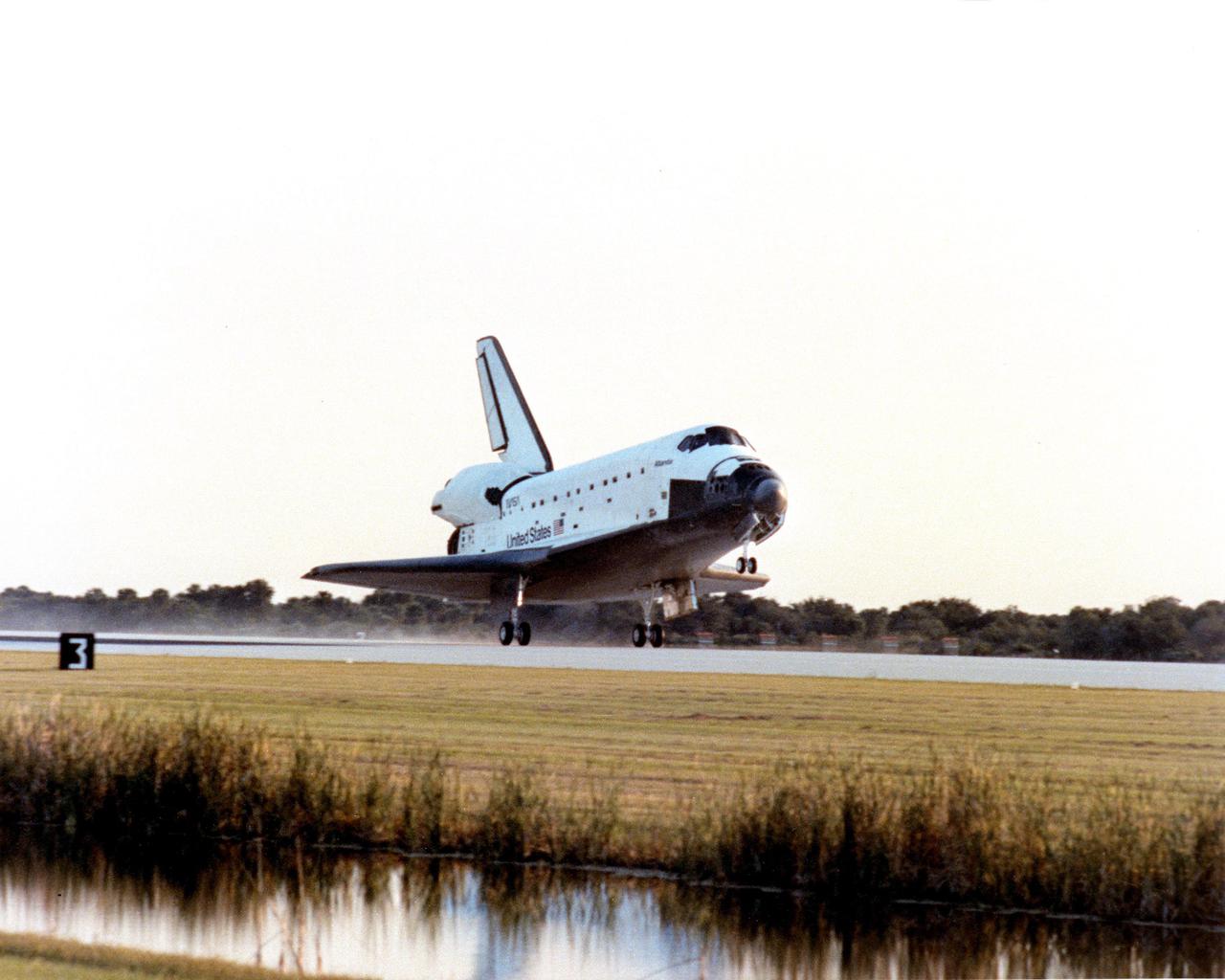
KENNEDY SPACE CENTER, FLA. -- The Shuttle Atlantis and Space Shuttle Mission STS-38 lands at Kennedy Space Center's Shuttle Landing Facility at 4:43 p.m. EST. This is the first Shuttle landing at KSC since 1985.
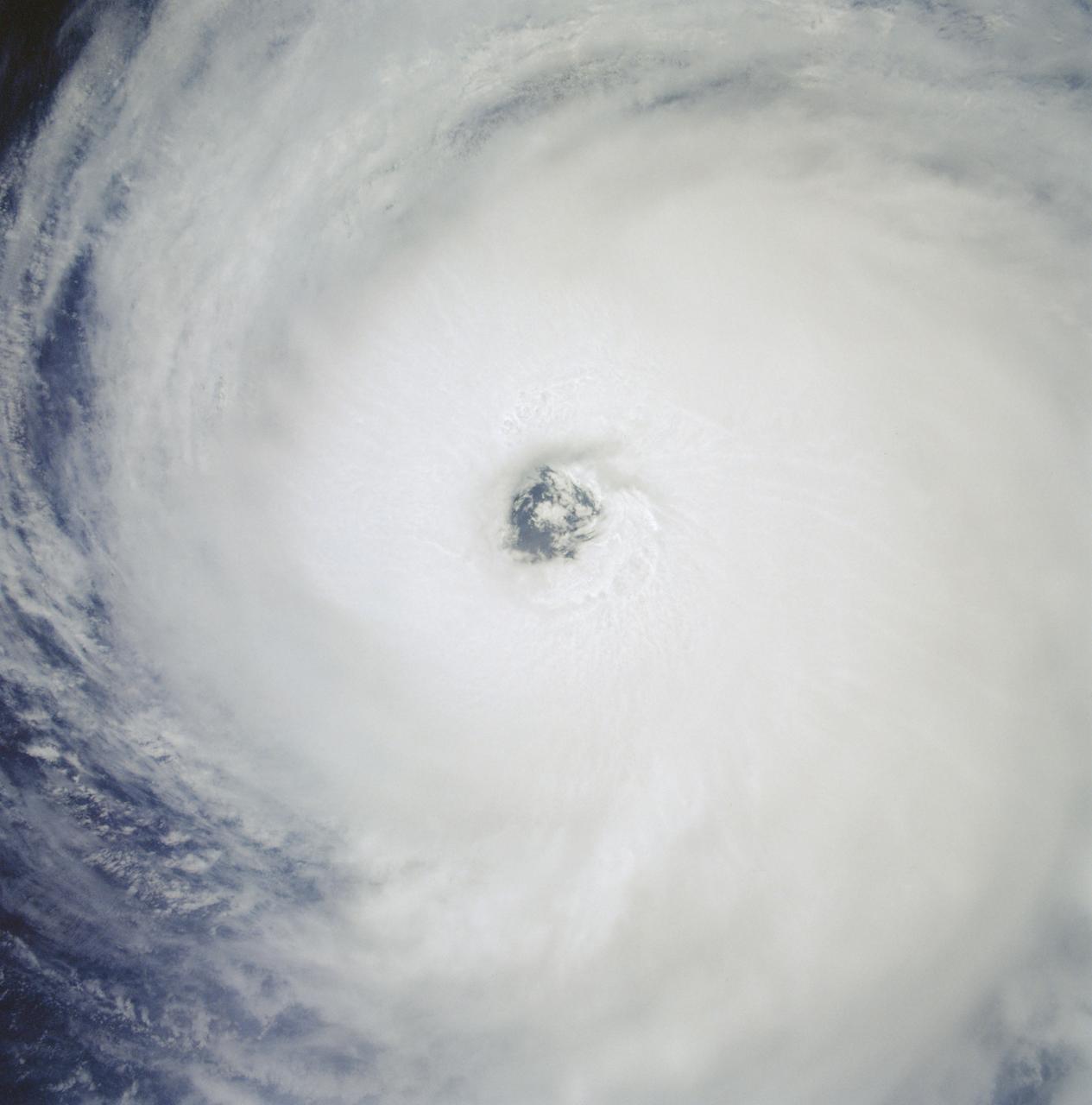
STS043-73-099 (2-11 Aug 1991) --- This view featuring the eye of Hurricane Fefa in the Pacific Ocean was captured on film by one of the STS 43 crewmembers using a 70mm handheld camera.
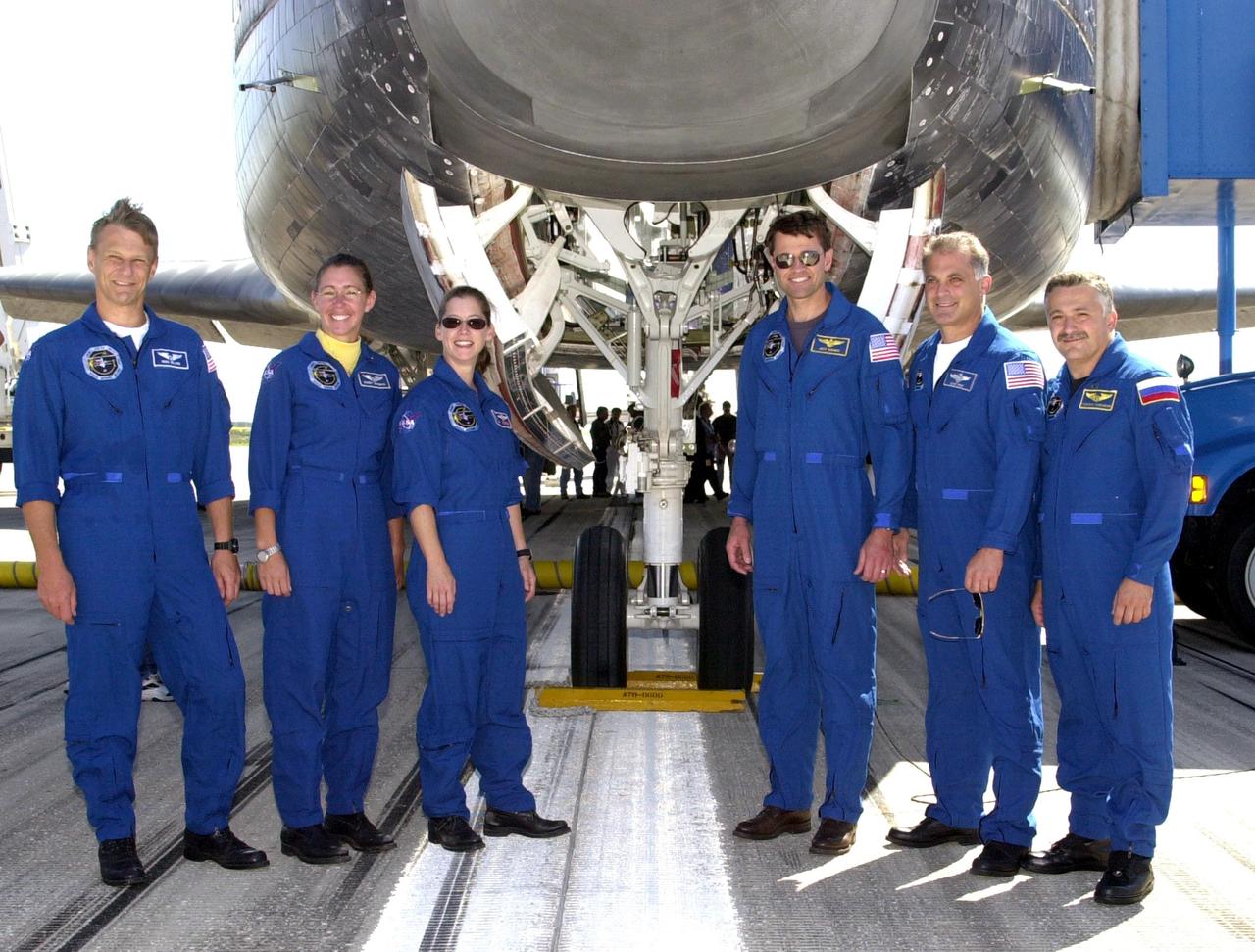
KENNEDY SPACE CENTER, FLA. -- After a flawless landing on runway 33 of the Shuttle Landing Facility, the STS-112 crew poses in front of Atlantis. From left are Mission Specialists Piers Sellers and Sandra Magnus, Pilot Pamela Melroy, Commander Jeffrey Ashby, and Mission Specialists David Wolf and Fyodor Yurchikhin, who represents the Russian Space Agency. Main gear touchdown occurred at 11:43:40 a.m. EDT; nose gear touchdown at 11:43:48 a.m.; and wheel stop at 11:44:35 a.m. Mission elapsed time was 10:19:58:44. STS-112 expanded the size of the Station with the addition of the S1 truss segment.

This view shows the area around Northeastern Sumatra, Indonesia (1.0N, 104.0E). The city of Singapore and the Singapore Strait is in the center at the southern tip of the Malay Peninsula. The Singapore Strait is the eastern extension of the Strait of Malacca and separates the Malay Peninsula from Sumatra. Large sediment plumes from the rivers attest to the local soil erosion and industrial dumping ofd wastes.

Expedition 43 prime and backup crews pose for a photograph together in front of St. Basil's Cathedral in Moscow as part of traditional pre-launch ceremonies, from left, Expedition 43 backup crew members; NASA Astronaut Jeff Williams, Russian cosmonaut Sergei Volkov of the Russian Federal Space Agency (Roscosmos), Russian cosmonaut Alexei Ovchinin of Roscosmos, Expedition 43 prime crew members; NASA Astronaut Scott Kelly, Russian cosmonaut Gennady Padalka of Roscosmos, and Russian cosmonaut Mikhail Kornienko of Roscosmos, Friday, March 6, 2015. Kelly, Padalka, and Kornienko are preparing for launch to the International Space Station in their Soyuz TMA-16M spacecraft from the Baikonur Cosmodrome in Kazakhstan March 28, Kazakh time. As the one-year crew, Kelly and Kornienko will return to Earth on Soyuz TMA-18M in March 2016. Photo Credit: (NASA/Bill Ingalls)
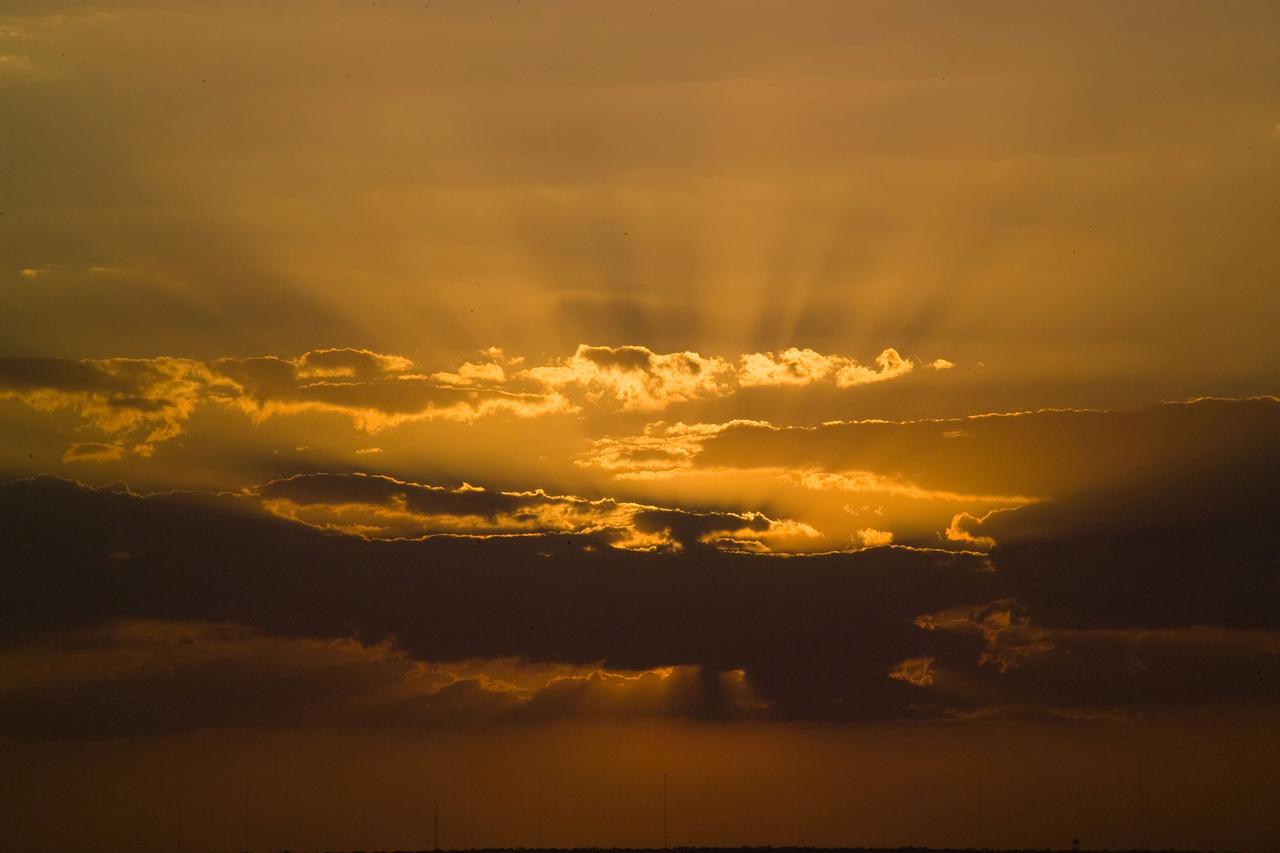
STS119-S-025 (15 March 2009) --- The setting sun paints the clouds over NASA's Kennedy Space Center in Florida before the launch of Space Shuttle Discovery on the STS-119 mission. Liftoff is scheduled for 7:43 p.m. (EDT) on March 15, 2009.
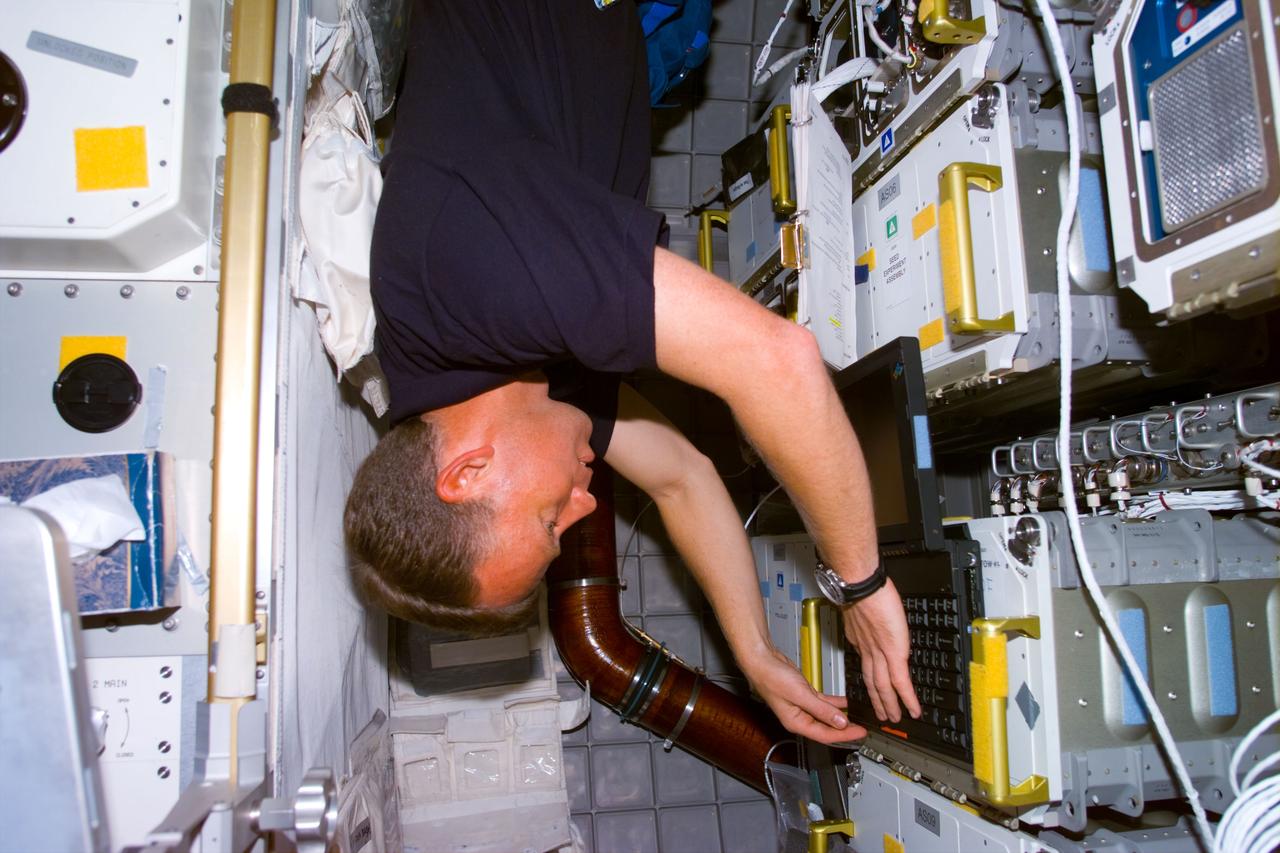
STS095-E-5218 (4 Nov. 1998) --- Astronaut Steven W. Lindsey, STS-95 pilot, inputs data on a lap top computer in the Spacehab facility onboard the Space Shuttle Discovery. The photo was taken with an electronic still camera (ESC) at 02:58:43 GMT, Nov. 4.
KENNEDY SPACE CENTER, FLA. - Atlantis kicks up dust as it touches down on runway 33 at the KSC Shuttle Landing Facility after completing its 11-day mission to the International Space Station. Aboard is the STS-112 crew comprising Commander Jeffrey Ashby, Pilot Pamela Melroy and Mission Specialists David Wolf, Sandra Magnus, Piers Sellers and Fyodor Yurchikhin. Main gear touchdown occurred at 11:43:40 a.m. EDT; nose gear touchdown at 11:43:48 a.m.; and wheel stop at 11:44:35 a.m. Mission elapsed time was 10:19:58:44. STS-112 expanded the size of the Station with the addition of the S1 truss segment. This was the 60th landing at KSC in the history of the Shuttle program.
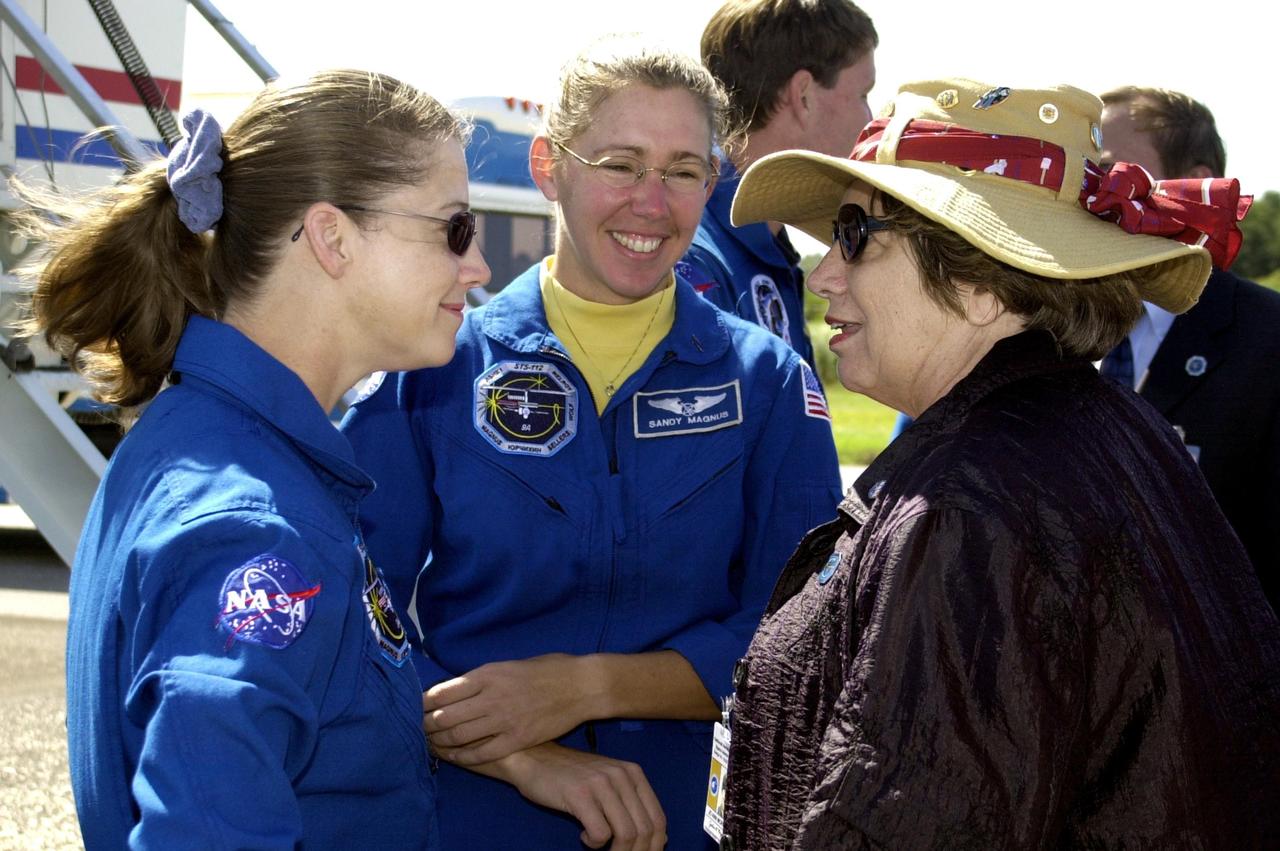
KENNEDY SPACE CENTER, FLA. -- STS-112 Pilot Pamela Melroy (left) and Mission Specialist Sandra Magnus (center) talk to Acting Deputy Director JoAnn Morgan (right) after the crew's return to KSC. A flawless landing of Space Shuttle Atlantis completed a 4.5-million-mile journey to the International Space Station. Other crew members are Commander Jeffrey Ashby and Mission Specialists David Wolf, Fyodor Yurchikhin and Piers Sellers. Main gear touchdown occurred at 11:43:40 a.m. EDT; nose gear touchdown at 11:43:48 a.m.; and wheel stop at 11:44:35 a.m. Mission elapsed time was 10:19:58:44. Mission STS-112 expanded the size of the Station with the addition of the S1 truss segment.
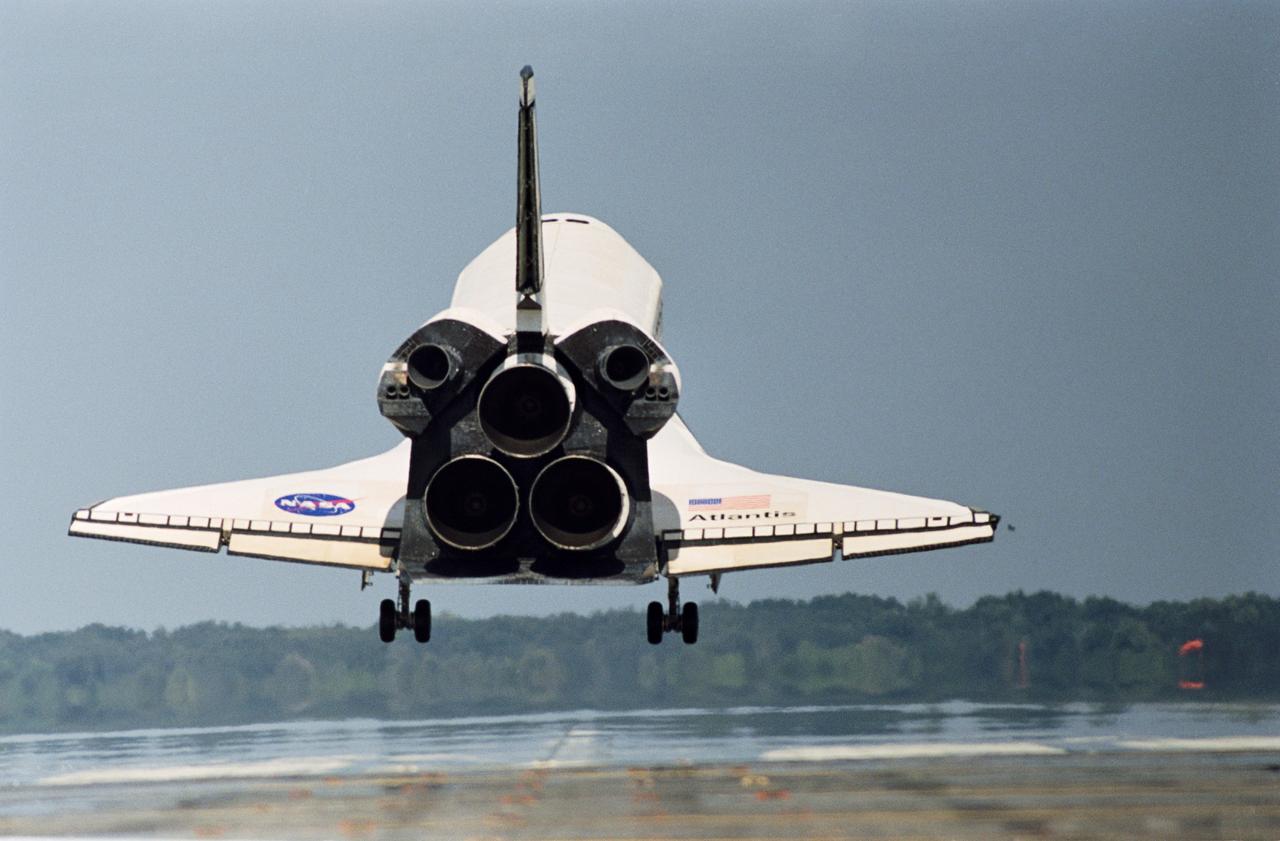
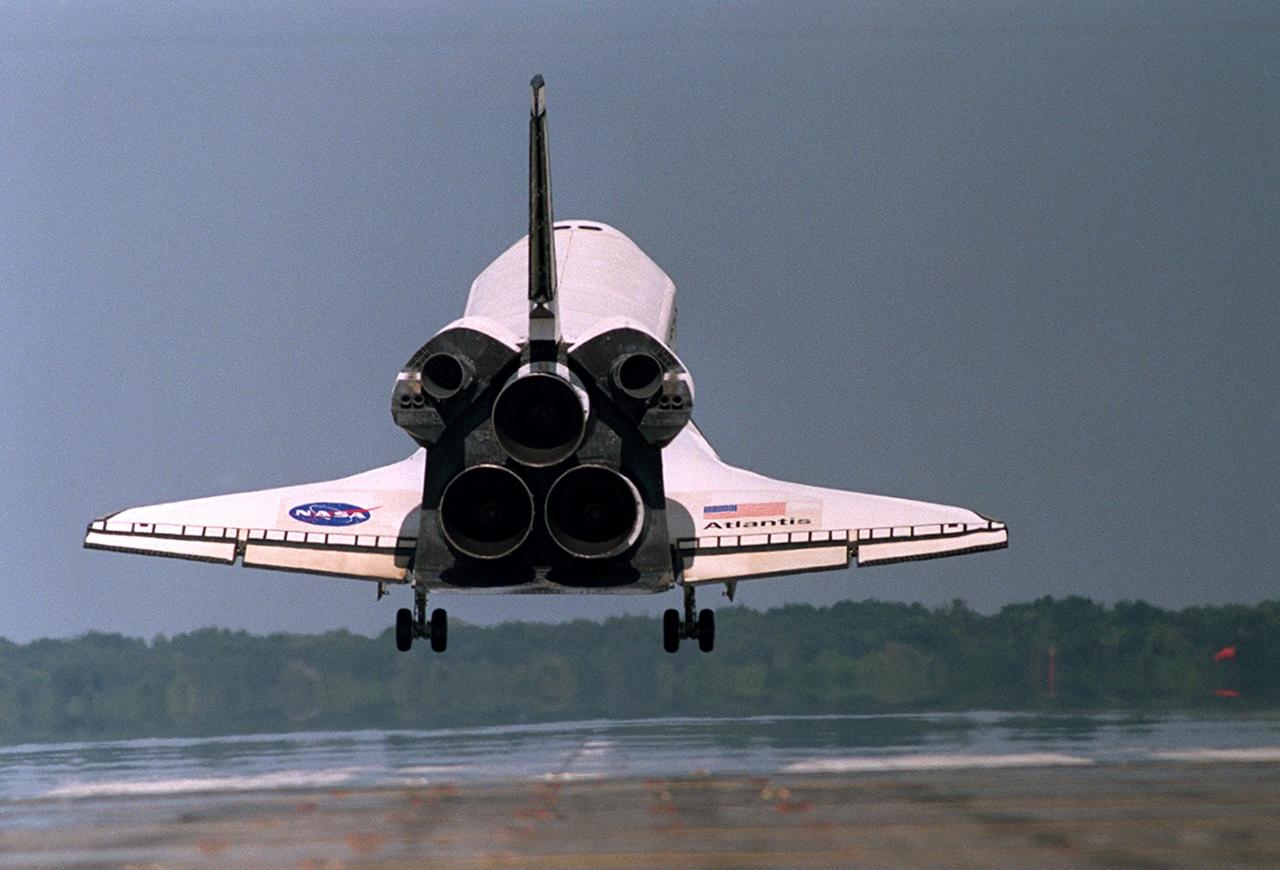
STS112-S-038 (18 October 2002) --- An aft view shows the Space Shuttle Atlantis just prior to touchdown of its main landing gear at the Shuttle Landing Facility. The touchdown completed the 4.5-million-mile STS-112 journey to the International Space Station. Main gear touchdown occurred at 11:43:40 a.m. EDT nose gear touchdown at 11:43:48 a.m.; and wheel stop at 11:44:35 a.m. Mission elapsed time was 10:19:58:44. Mission STS-112 expanded the size of the Station with the addition of the S1 truss segment. The returning crew of Atlantis are Jeffrey S. Ashby, commander; Pamela A. Melroy, pilot; and David A. Wolf, Piers J. Sellers, Sandra H. Magnus and Rosaviakosmos' Fyodor N. Yurchikhin, all mission specialists. This landing is the 60th at KSC in the 21-year history of the Shuttle program.
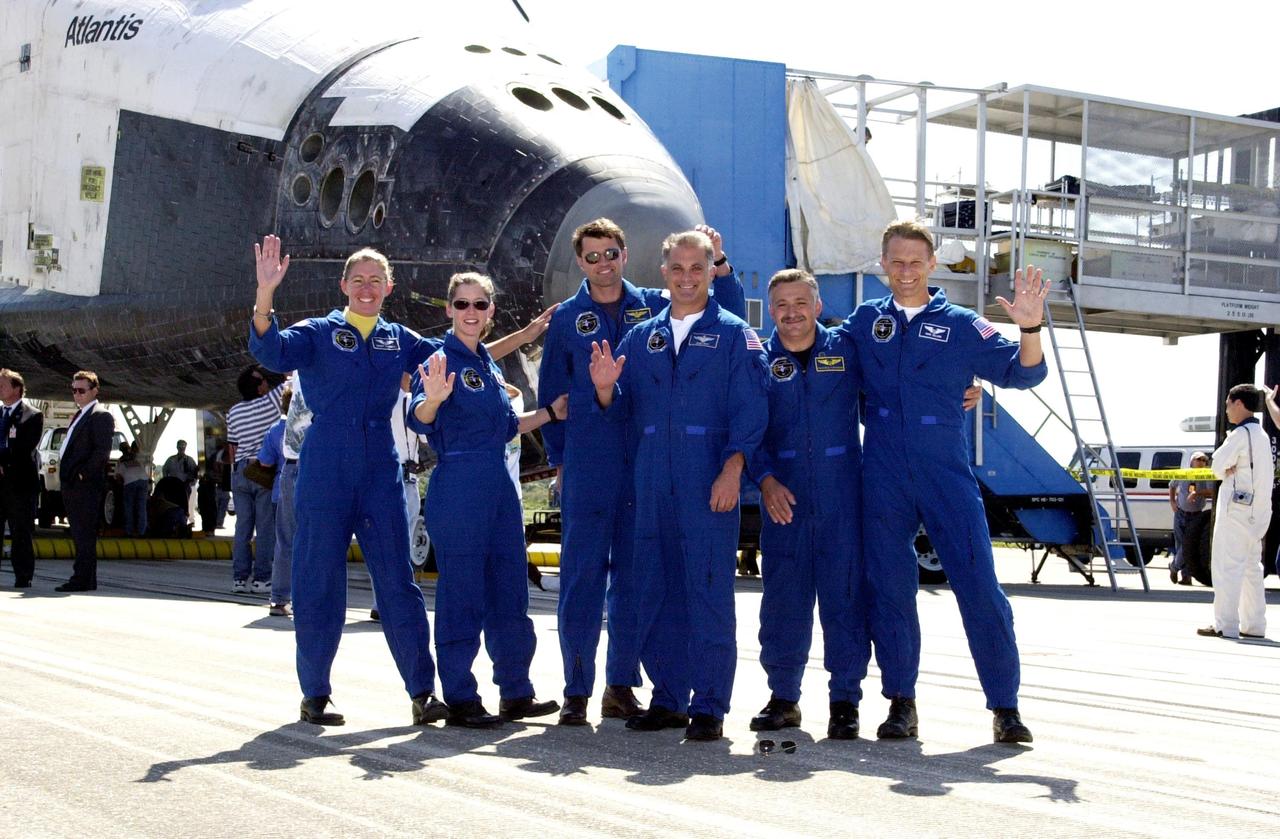
KENNEDY SPACE CENTER, FLA. -- The STS-112 crew clown for the camera in front of Atlantis after saying a few words about their 4.5-million-mile journey to the International Space Station. From left are Mission Specialist Sandra Magnus, Pilot Pamela Melroy, Commander Jeffrey Ashby, and Mission Specialists David Wolf, Fyodor Yurchikhin and Piers Sellers. The flawless landing of Space Shuttle Atlantis on Runway 33 at KSC completed the 10 day, 19 hour, 58 minute, 44 second- long mission. Main gear touchdown occurred at 11:43:40 a.m. EDT; nose gear touchdown at 11:43:48 a.m.; and wheel stop at 11:44:35 a.m. Mission STS-112 expanded the size of the Station with the addition of the S1 truss segment.
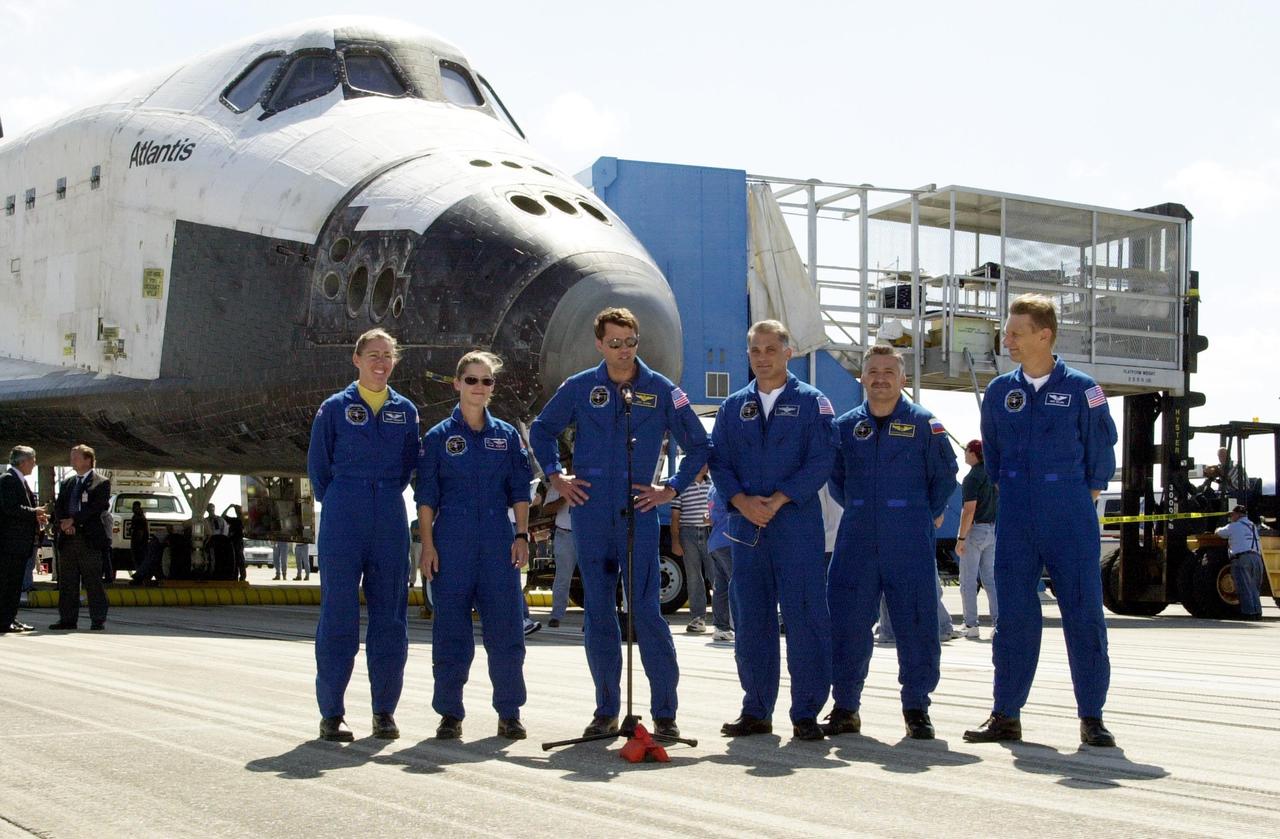
KENNEDY SPACE CENTER, FLA. - The STS-112 crew pauses at the microphone in front of Atlantis after exiting the crew transport vehicle. From left are Mission Specialist Sandra Magnus, Pilot Pamela Melroy, Commander Jeffrey Ashby, and Mission Specialists David Wolf, Fyodor Yurchikhin and Piers Sellers. The flawless landing of Space Shuttle Atlantis on Runway 33 at KSC completed a 4.5-million-mile journey to the International Space Station. Main gear touchdown occurred at 11:43:40 a.m. EDT; nose gear touchdown at 11:43:48 a.m.; and wheel stop at 11:44:35 a.m. Mission elapsed time was 10:19:58:44. Mission STS-112 expanded the size of the Station with the addition of the S1 truss segment.
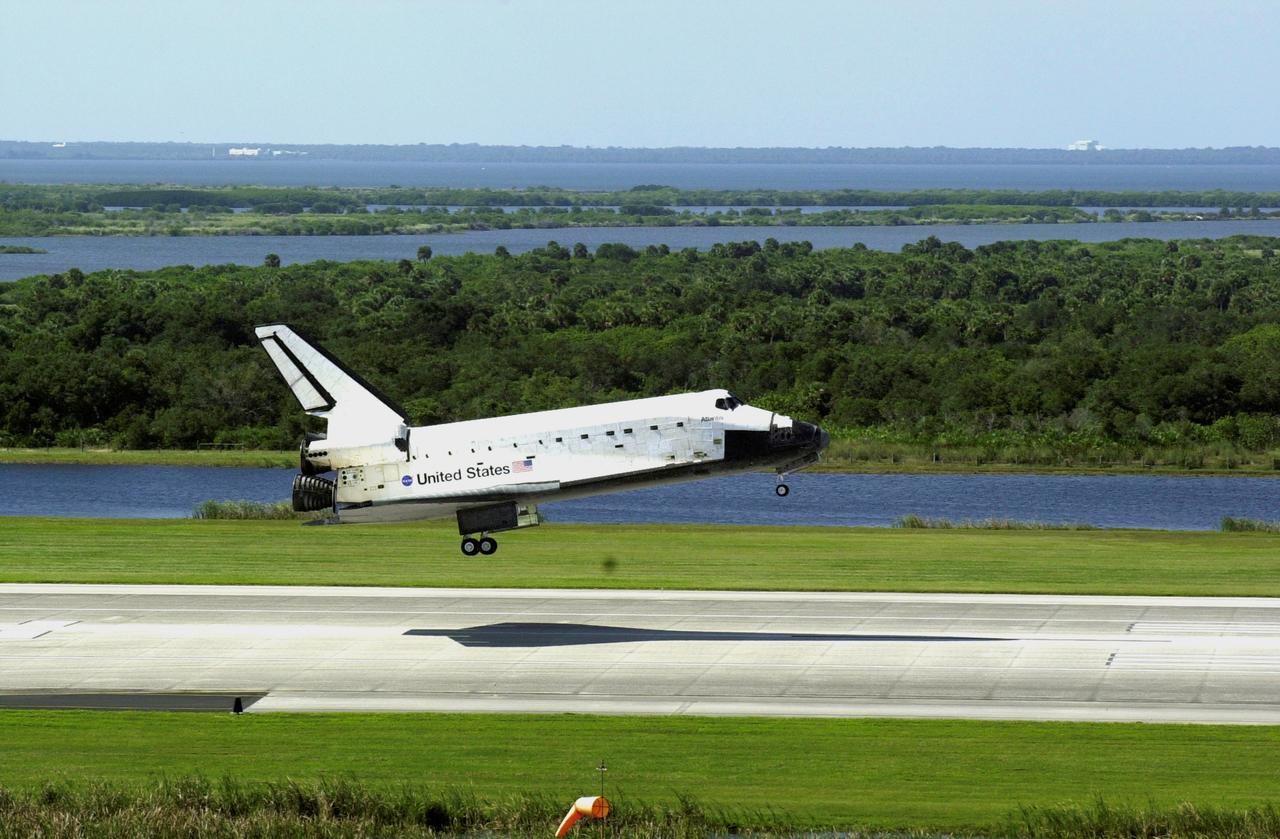
STS112-S-028 (18 October 2002) --- The main landing gear of the Space Shuttle Atlantis is seconds away from touchdown at the Shuttle Landing Facility, completing the 4.5-million-mile journey that included a week of work with the International Space Station. Main gear touchdown occurred at 11:43:40 a.m. (EDT), October 18, 2002; nose gear touchdown at 11:43:48 a.m.; and wheel stop at 11:44:35 a.m. Mission elapsed time was 10:19:58:44. Mission STS-112 expanded the size of the Station with the addition of the S1 truss segment. The STS-112 crew members of Atlantis are Jeffrey S. Ashby, commander; Pamela A. Melroy, pilot; and David A. Wolf, Piers J. Sellers, Sandra H. Magnus and Rosaviakosmos' Fyodor N. Yurchikhin, all mission specialists.
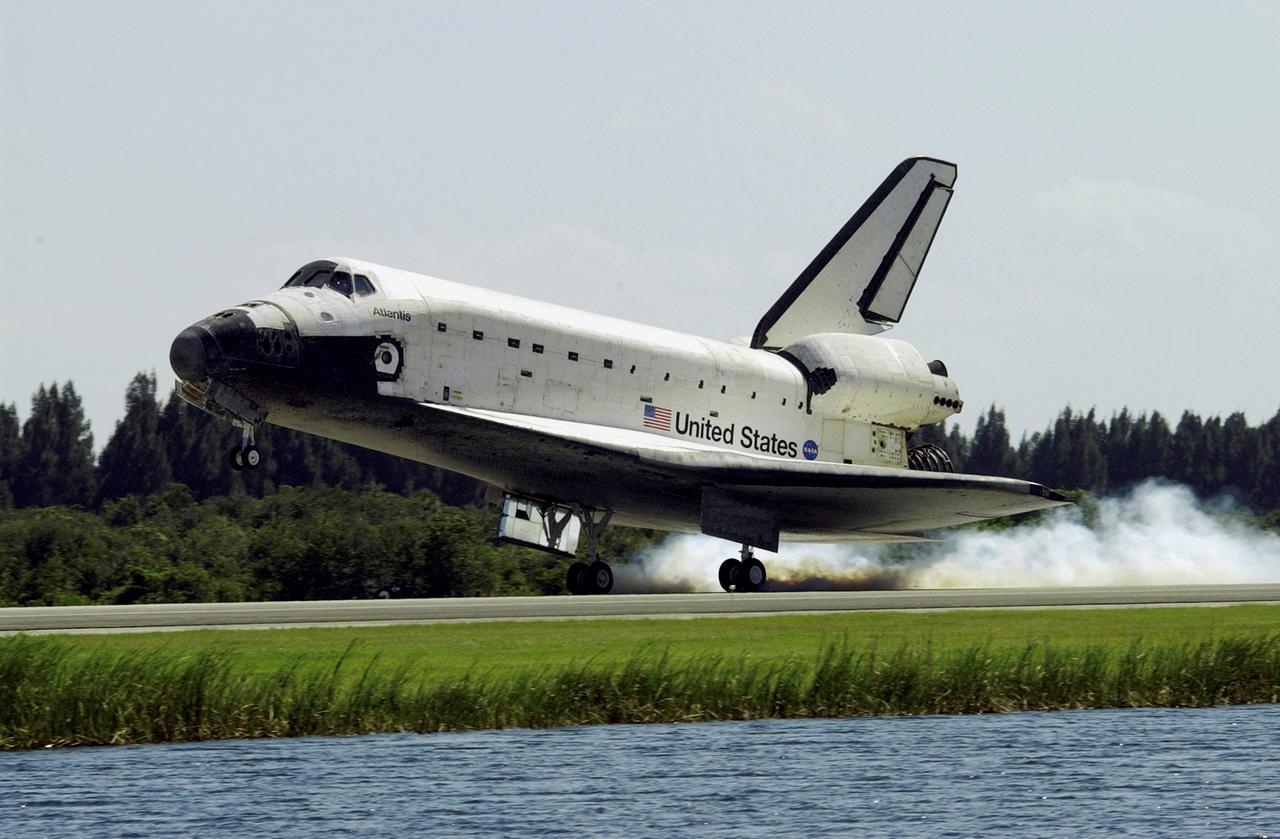
STS112-S-024 (18 October 2002) --- Space Shuttle Atlantis kicks up dust as it touches down at the Shuttle Landing Facility, completing the 4.5-million-mile journey that included a week of work with the International Space Station. Main gear touchdown occurred at 11:43:40 a.m. (EDT), October 18, 2002; nose gear touchdown at 11:43:48 a.m.; and wheel stop at 11:44:35 a.m. Mission elapsed time was 10:19:58:44. Mission STS-112 expanded the size of the Station with the addition of the S1 truss segment. The STS-112 crew members of Atlantis are Jeffrey S. Ashby, commander; Pamela A. Melroy, pilot; and David A. Wolf, Piers J. Sellers, Sandra H. Magnus and Rosaviakosmos' Fyodor N. Yurchikhin, all mission specialists.
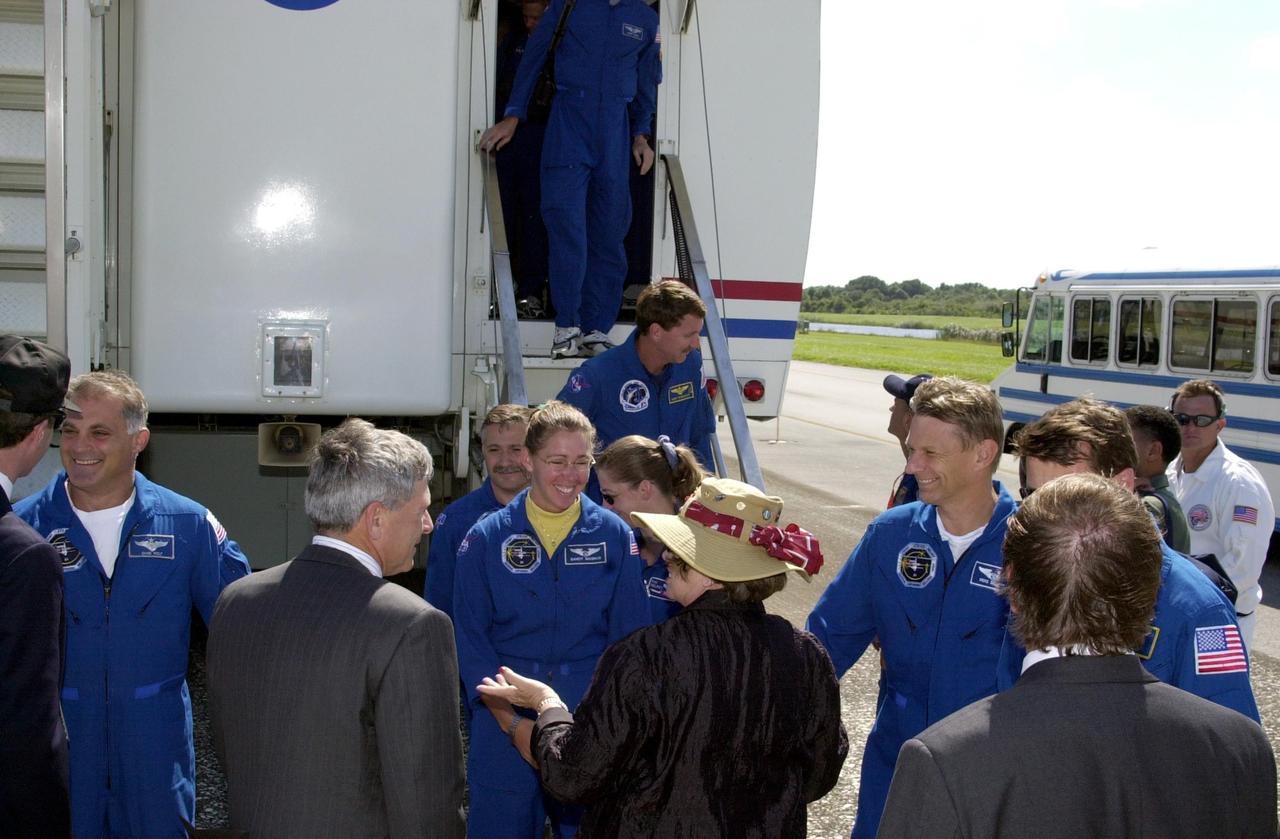
KENNEDY SPACE CENTER, FLA. -- As the STS-112 crew leaves the crew transport vehicle, they are greeted by mission managers and guests. The crew, from left, are Mission Specialists David Wolf, Fyodor Yurchikhin and Sandra Magnus; Pilot Pamela Melroy; Piers Sellers (talking to Acting Deputy Director JoAnn Morgan) and Commander Jeffrey Ashby (talking to Launch Director Mike Leinbach). Morgan is also Director of External Relations and Business Development. The crew returned to KSC after completing a 4.5-million-mile journey to the International Space Station. Main gear touchdown occurred at 11:43:40 a.m. EDT; nose gear touchdown at 11:43:48 a.m.; and wheel stop at 11:44:35 a.m. Mission elapsed time was 10:19:58:44. Mission STS-112 expanded the size of the Station with the addition of the S1 truss segment. .
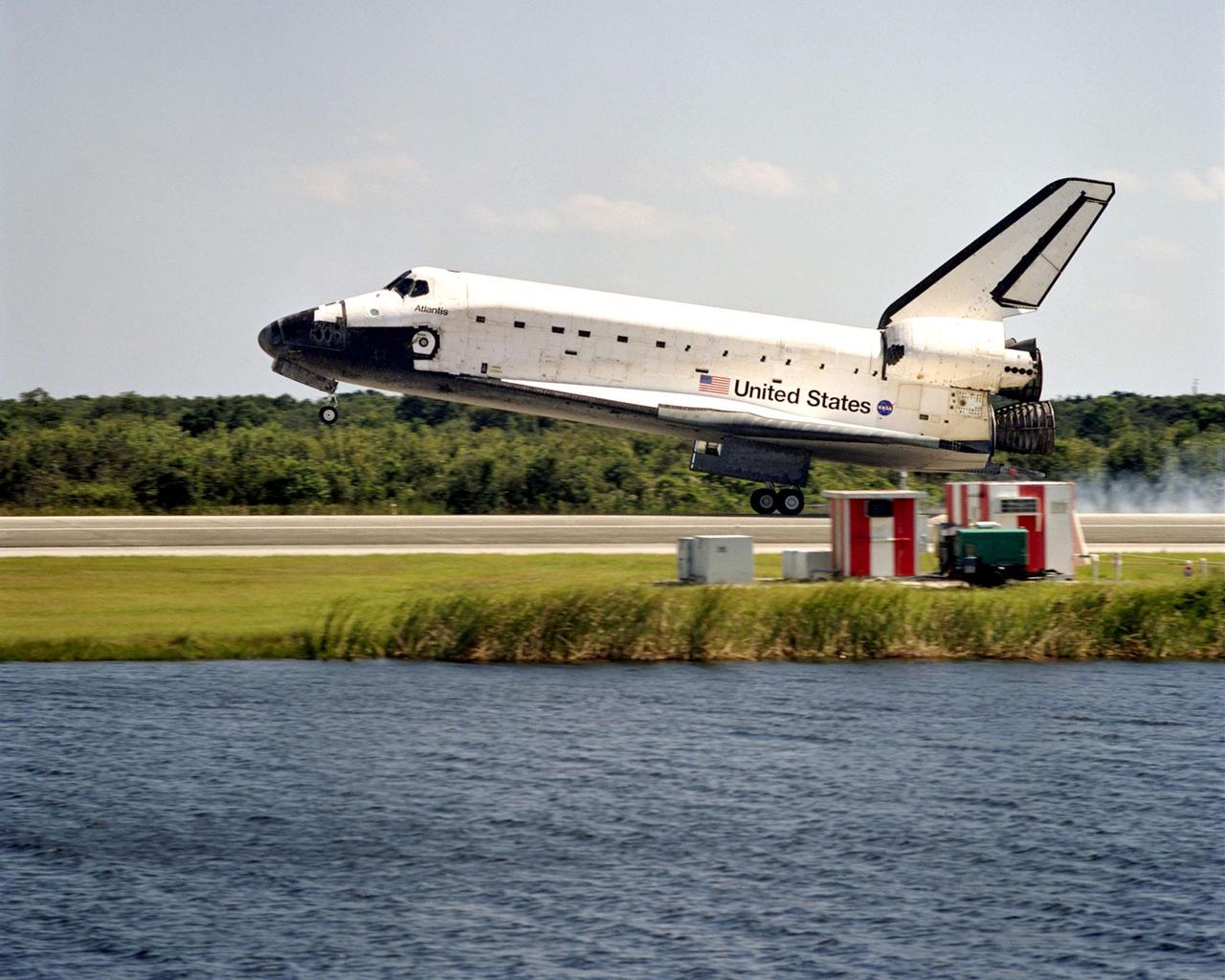
KENNEDY SPACE CENTER, FLA. -- Atlantis kicks up dust as it touches down on runway 33 at the KSC Shuttle Landing Facility after completing its 11-day mission to the International Space Station. Aboard is the STS-112 crew comprising Commander Jeffrey Ashby, Pilot Pamela Melroy and Mission Specialists David Wolf, Sandra Magnus, Piers Sellers and Fyodor Yurchikhin. Main gear touchdown occurred at 11:43:40 a.m. EDT; nose gear touchdown at 11:43:48 a.m.; and wheel stop at 11:44:35 a.m. Mission elapsed time was 10:19:58:44. STS-112 expanded the size of the Station with the addition of the S1 truss segment. This was the 60th landing at KSC in the history of the Shuttle program.
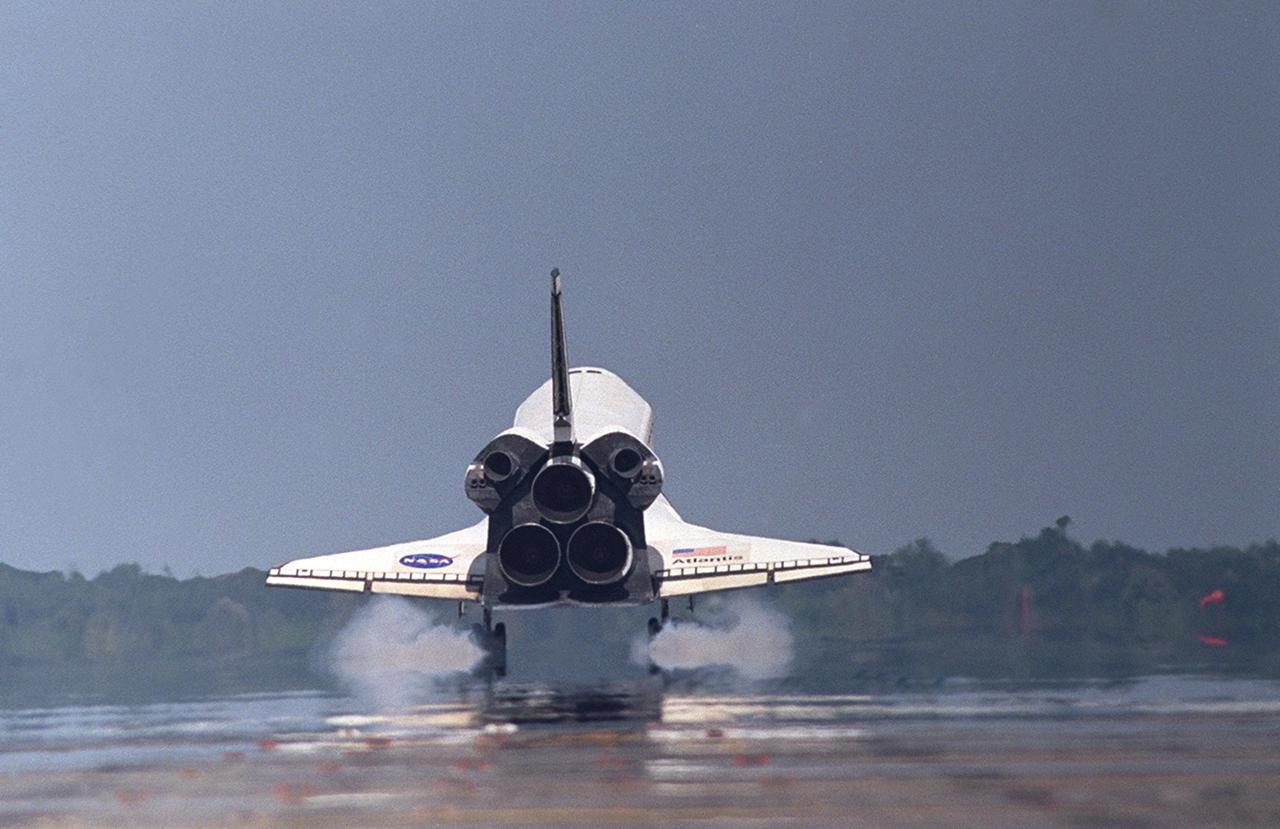
KENNEDY SPACE CENTER, FLA. - Atlantis kicks up dust as it touches down on runway 33 at the KSC Shuttle Landing Facility after completing its 11-day mission to the International Space Station. Aboard is the STS-112 crew comprising Commander Jeffrey Ashby, Pilot Pamela Melroy and Mission Specialists David Wolf, Sandra Magnus, Piers Sellers and Fyodor Yurchikhin. Main gear touchdown occurred at 11:43:40 a.m. EDT; nose gear touchdown at 11:43:48 a.m.; and wheel stop at 11:44:35 a.m. Mission elapsed time was 10:19:58:44. STS-112 expanded the size of the Station with the addition of the S1 truss segment. This was the 60th landing at KSC in the history of the Shuttle program.
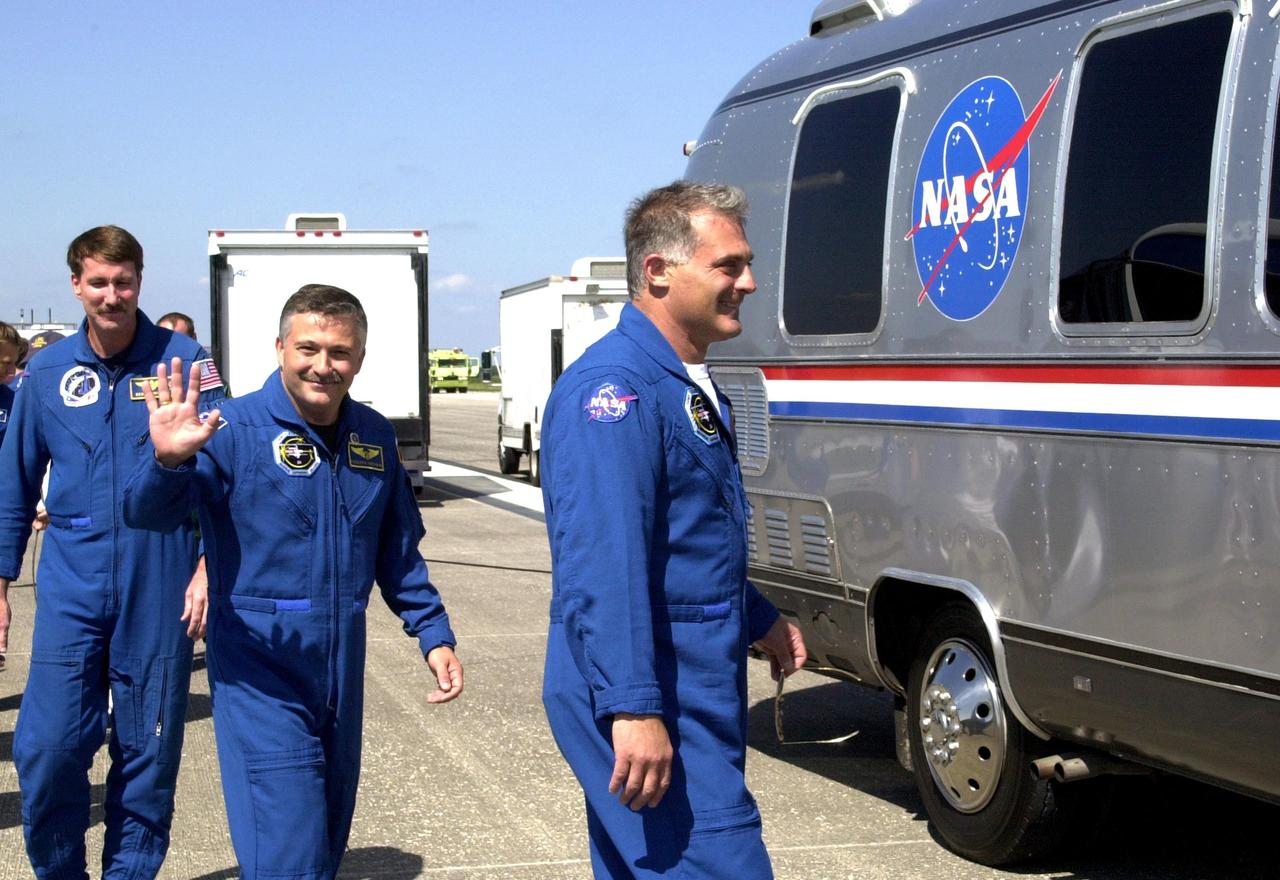
KENNEDY SPACE CENTER, FLA. - Accompanied by astronaut Kent Rominger (far left), STS-112 crew members head for the Astrovan after exiting the crew transport vehicle and greeting the spectators. In the center is Mission Specialist Fyodor Yurchikhin; at right is Mission Specialist David Wolf. The flawless landing of Atlantis on Runway 33 at KSC completed a 4.5-million-mile journey to the International Space Station. Main gear touchdown occurred at 11:43:40 a.m. EDT; nose gear touchdown at 11:43:48 a.m.; and wheel stop at 11:44:35 a.m. Mission elapsed time was 10:19:58:44. Mission STS-112 expanded the size of the Station with the addition of the S1 truss segment.
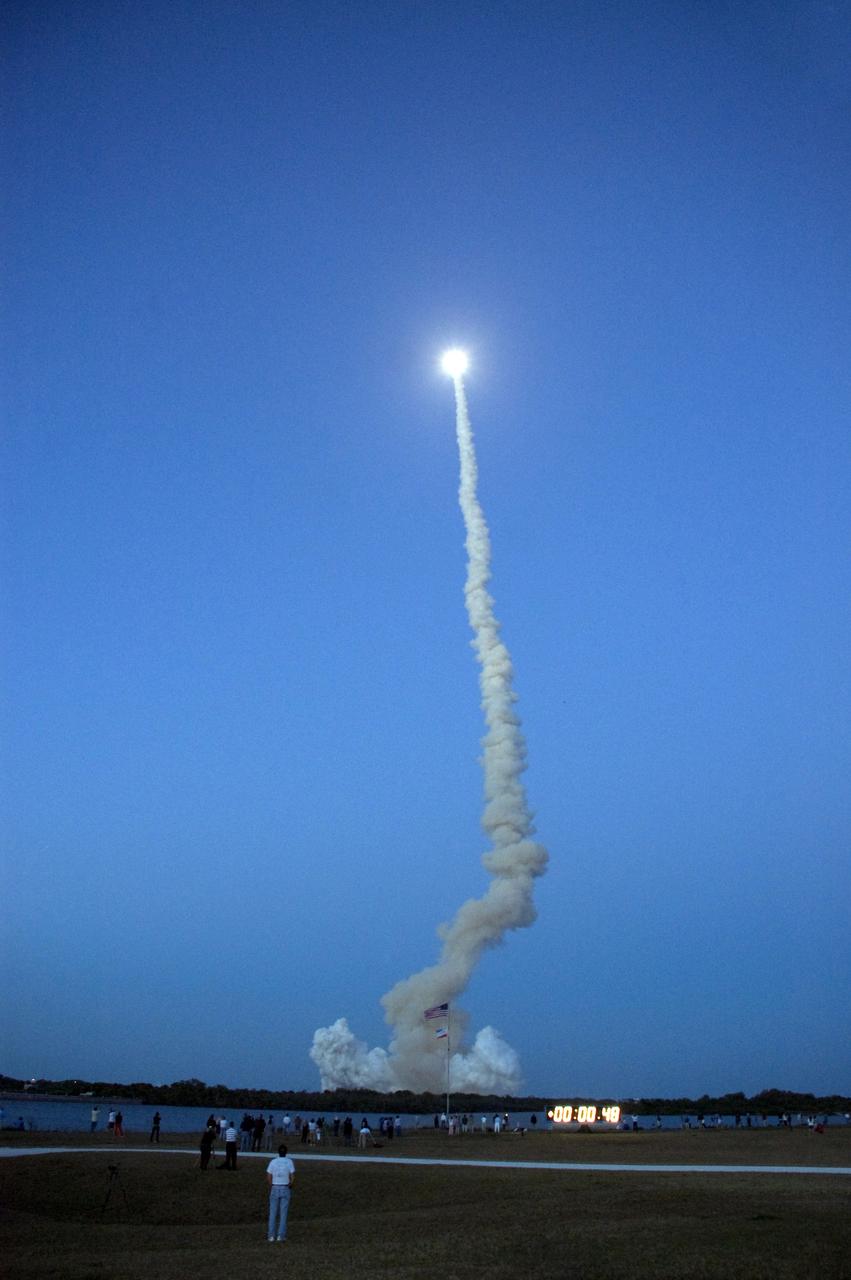
CAPE CANAVERAL, Fla. – Looking like a sun riding a column of smoke, space shuttle Discovery hurtles into the evening sky on the STS-119 mission. Liftoff was on time at 7:43 p.m. EDT. The STS-119 mission is the 28th to the International Space Station and the 125th space shuttle flight. Discovery will deliver the final pair of power-generating solar array wings and the S6 truss segment. Installation of S6 will signal the station's readiness to house a six-member crew for conducting increased science. Photo credit: NASA/Fletch Hildreth
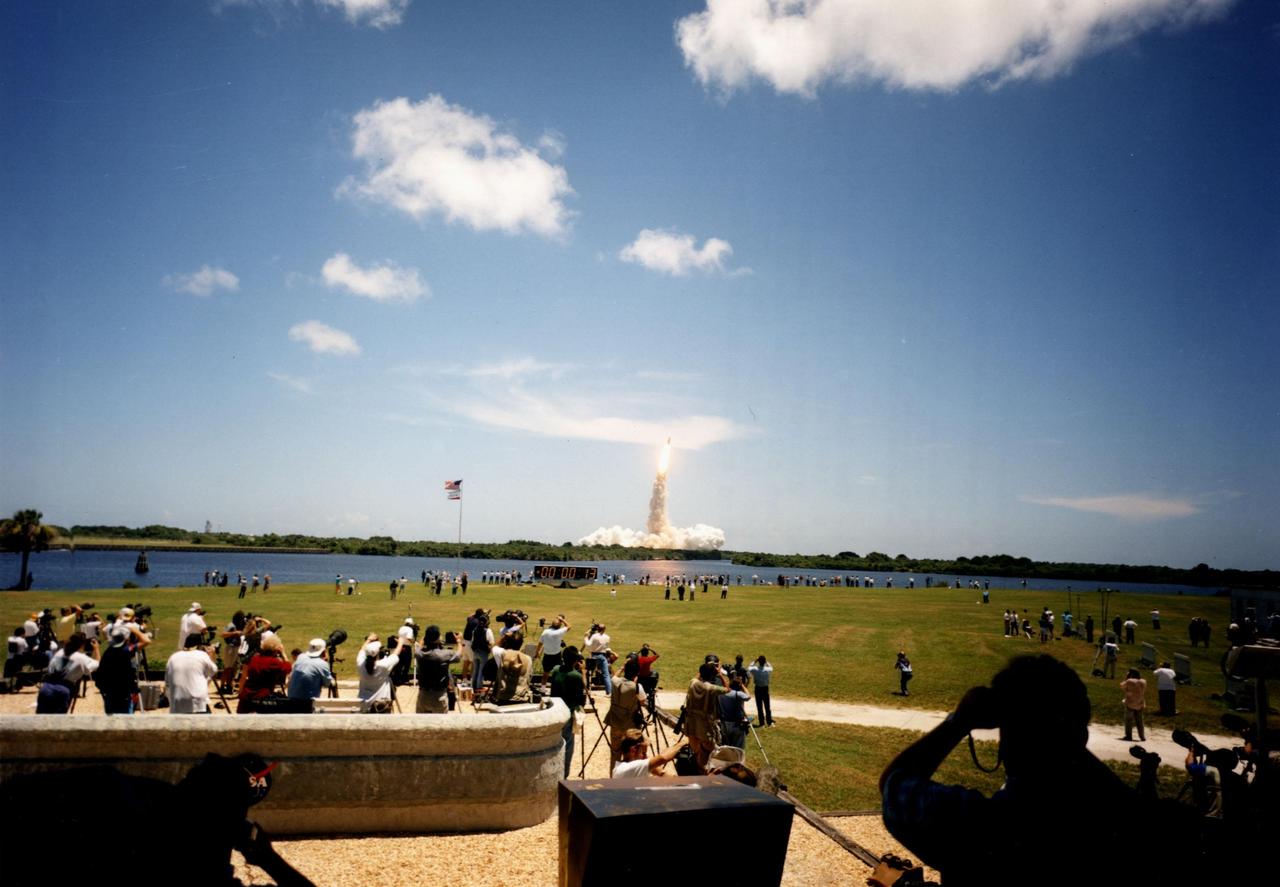
KENNEDY SPACE CENTER, FLA. -- The Space Shuttle Columbia lifts off from Launch Pad 39A on July 8, 1994 at 12:43 p.m. EDT to begin the 14-day STS-65/Internatinal Microgravity Laboratory-2 (IML-2) mission. The mission countdown clock also can be seen, giving the time into the mission after liftoff. The STS-65 mission is scheduled to end with a landing at KSC's Shuttle Landing Facility
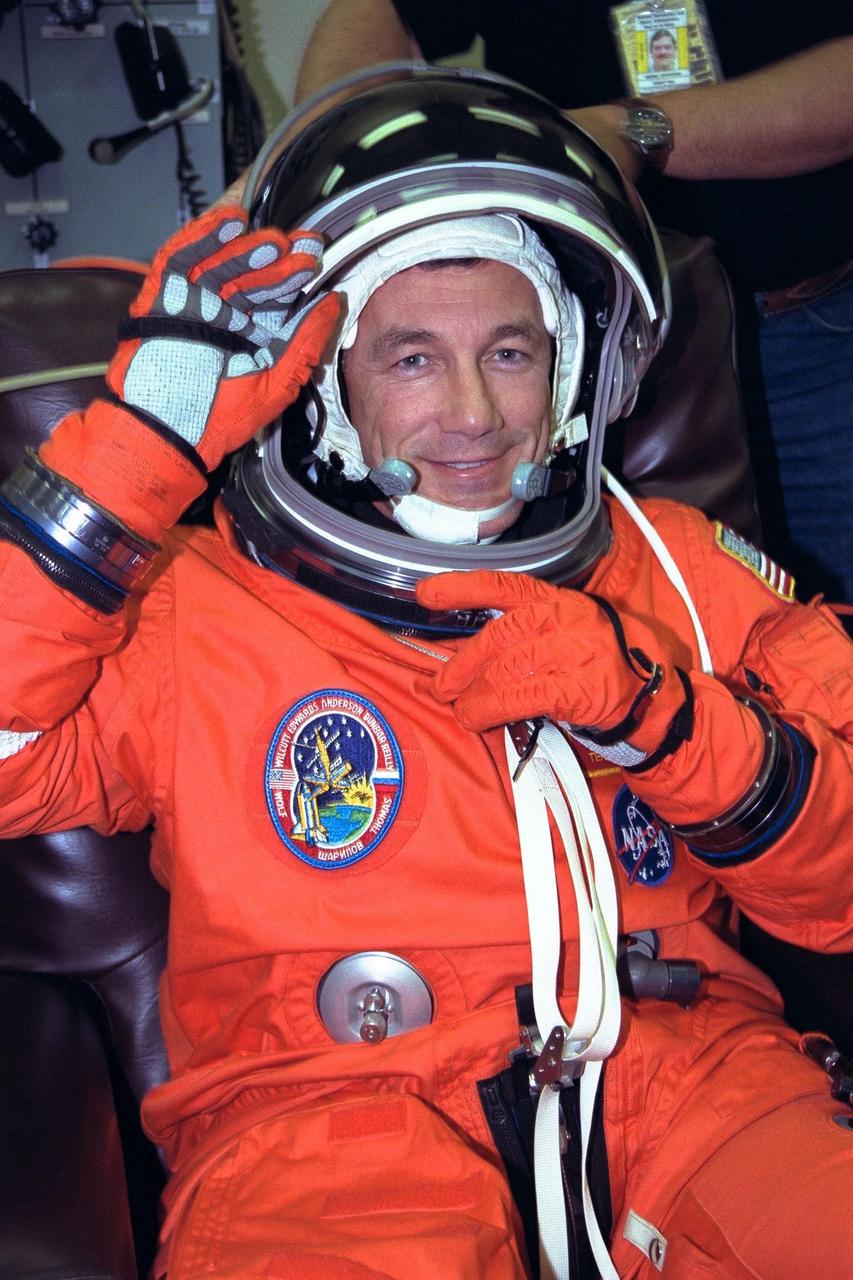
STS-89 Commander Terrence Wilcutt smiles as he completes the donning of his launch/entry suit in the Operations and Checkout (O&C) Building. A veteran of two space flights, he has logged more than 512 hours in space. He served as pilot on STS-68 and STS-79. He and six fellow crew members will soon depart the O&C and head for Launch Pad 39A, where the Space Shuttle Endeavour will lift off during a launch window that opens at 9:43 p.m. EST, Jan. 22. STS-89 is the eighth of nine planned missions to dock the Space Shuttle with Russia's Mir space station
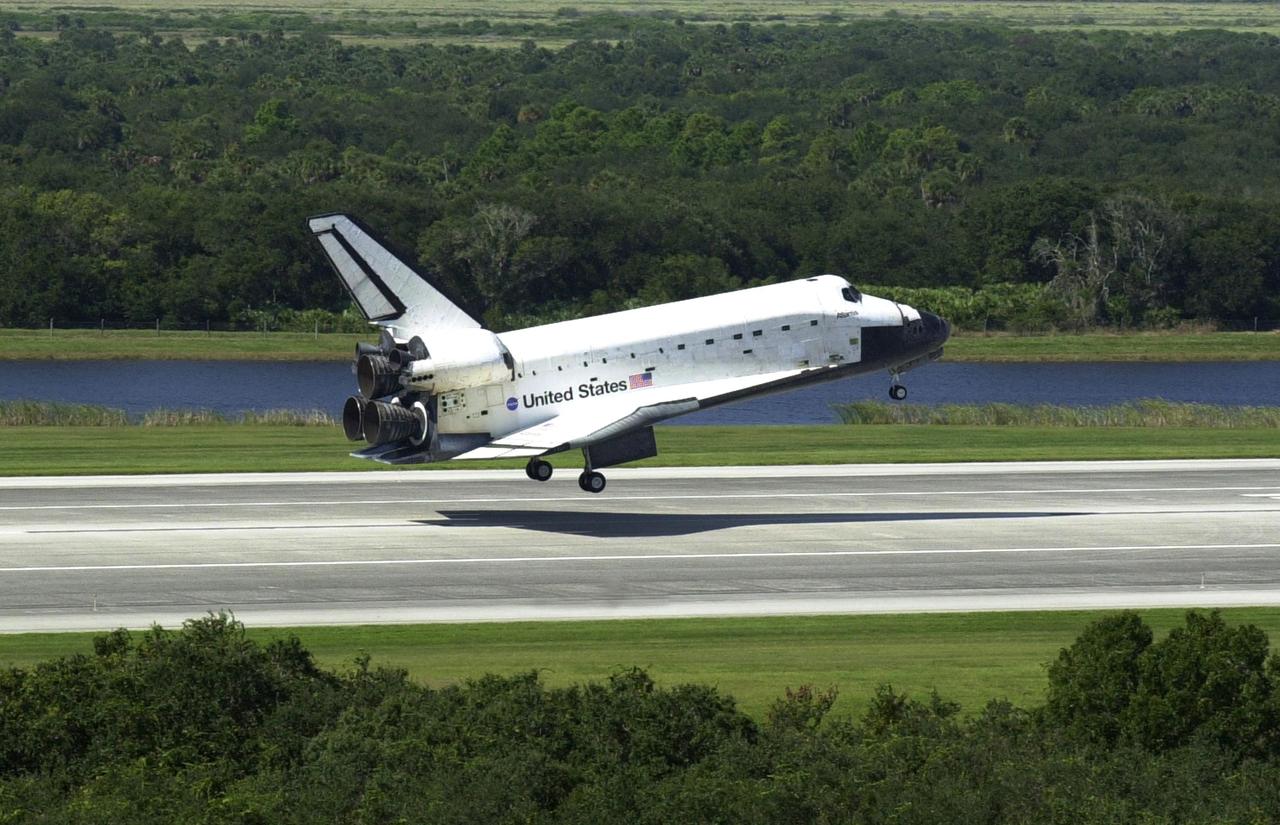
KENNEDY SPACE CENTER, FLA. - Its shadow precedes it as Space Shuttle Atlantis drops to the runway at the Shuttle Landing Facility, completing the 4.5-million-mile journey to the International Space Station. Main gear touchdown occurred at 11:43:40 a.m. EDT; nose gear touchdown at 11:43:48 a.m.; and wheel stop at 11:44:35 a.m. Mission elapsed time was 10:19:58:44. Mission STS-112 expanded the size of the Station with the addition of the S1 truss segment. The returning crew of Atlantis are Commander Jeffrey Ashby, Pilot Pamela Melroy, and Mission Specialists David Wolf, Piers Sellers, Sandra Magnus and Fyodor Yurchikhin. This landing is the 60th at KSC in the history of the Shuttle program. .
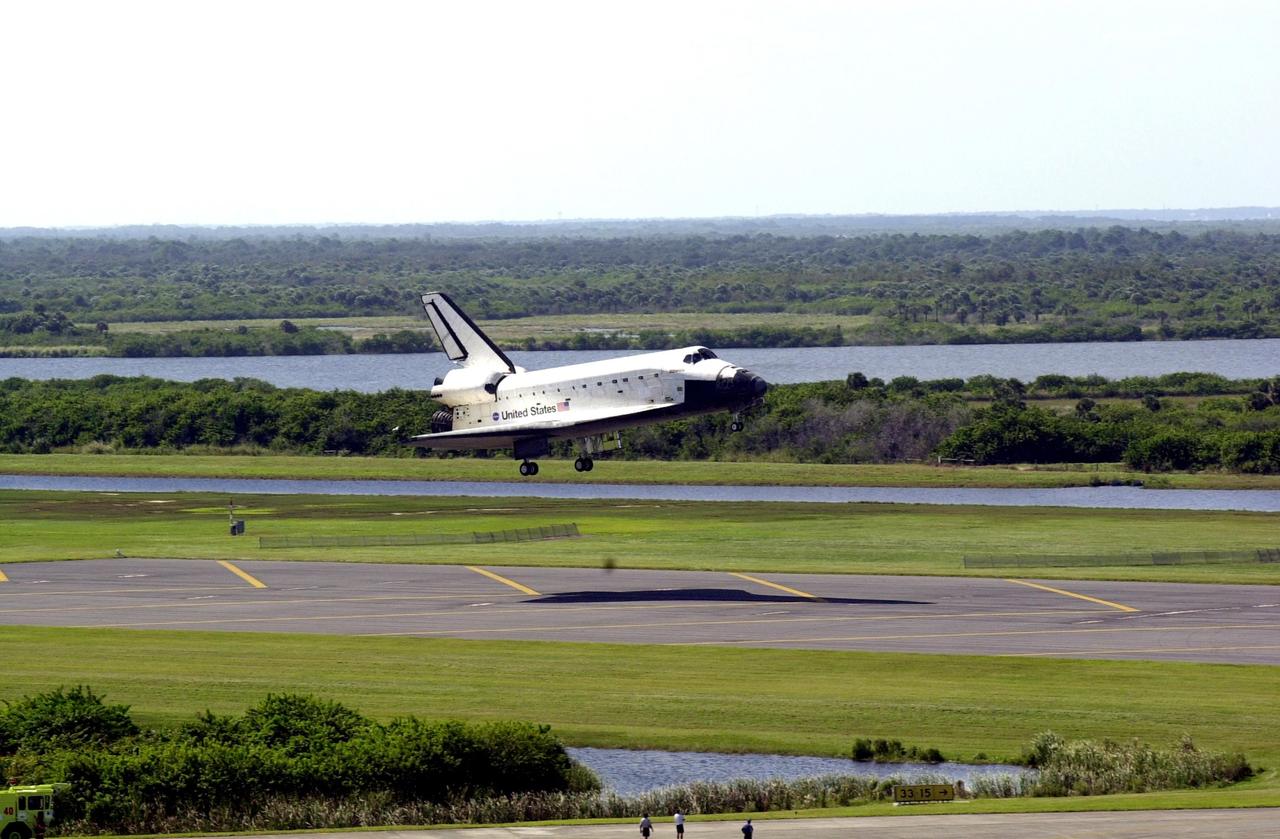
KENNEDY SPACE CENTER, FLA. - Space Shuttle Atlantis drops to the runway at the Shuttle Landing Facility, completing the 4.5-million-mile journey to the International Space Station. Main gear touchdown occurred at 11:43:40 a.m. EDT; nose gear touchdown at 11:43:48 a.m.; and wheel stop at 11:44:35 a.m. Mission elapsed time was 10:19:58:44. Mission STS-112 expanded the size of the Station with the addition of the S1 truss segment. The returning crew of Atlantis are Commander Jeffrey Ashby, Pilot Pamela Melroy, and Mission Specialists David Wolf, Piers Sellers, Sandra Magnus and Fyodor Yurchikhin. This landing is the 60th at KSC in the history of the Shuttle program.
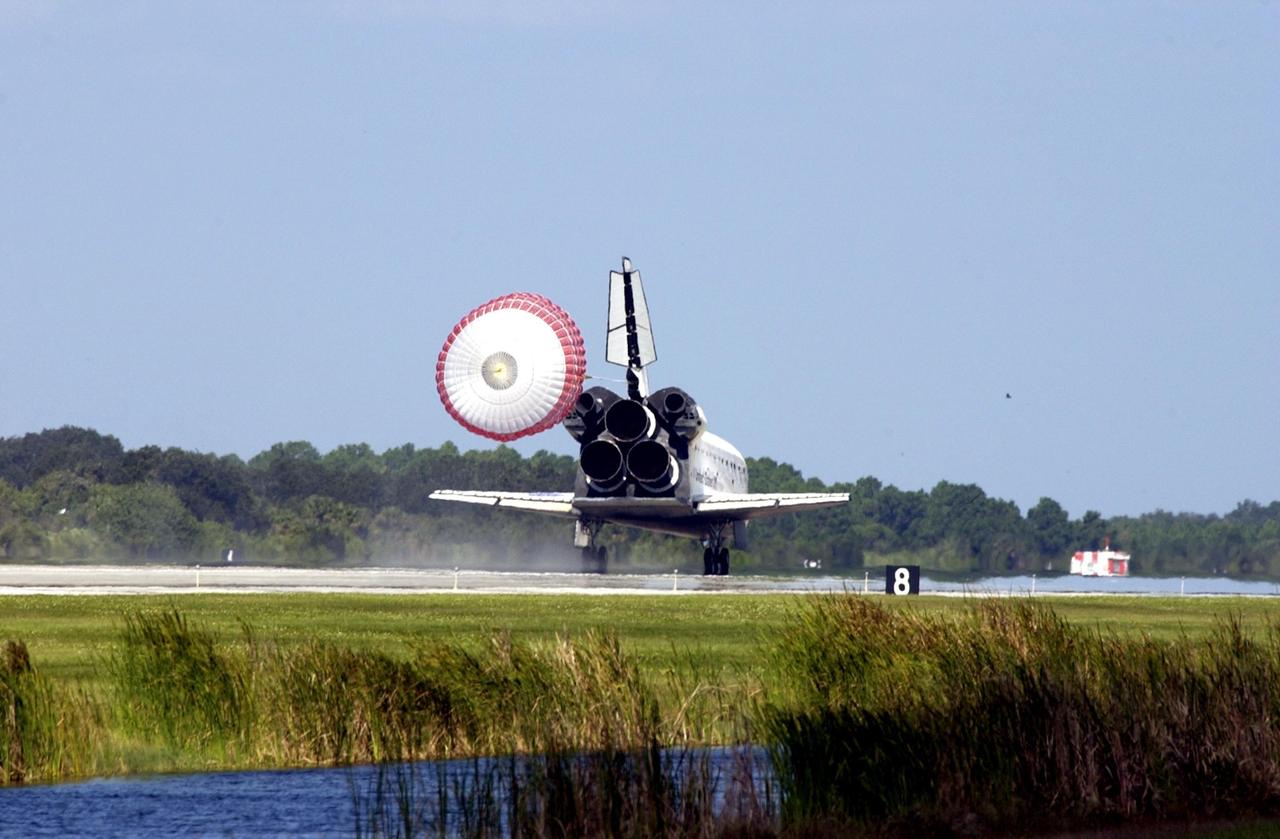
KENNEDY SPACE CENTER, FLA. -- Its drag chute deployed, Space Shuttle Atlantis slows to a stop after touchdown on Runway 33 at the Shuttle Landing Facility, completing the 4.5-million-mile journey to the International Space Station. Main gear touchdown occurred at 11:43:40 a.m. EDT; nose gear touchdown at 11:43:48 a.m.; and wheel stop at 11:44:35 a.m. Mission elapsed time was 10:19:58:44. Mission STS-112 expanded the size of the Station with the addition of the S1 truss segment. The returning crew of Atlantis are Commander Jeffrey Ashby, Pilot Pamela Melroy, and Mission Specialists David Wolf, Piers Sellers, Sandra Magnus and Fyodor Yurchikhin. This landing is the 60th at KSC in the history of the Shuttle program. .
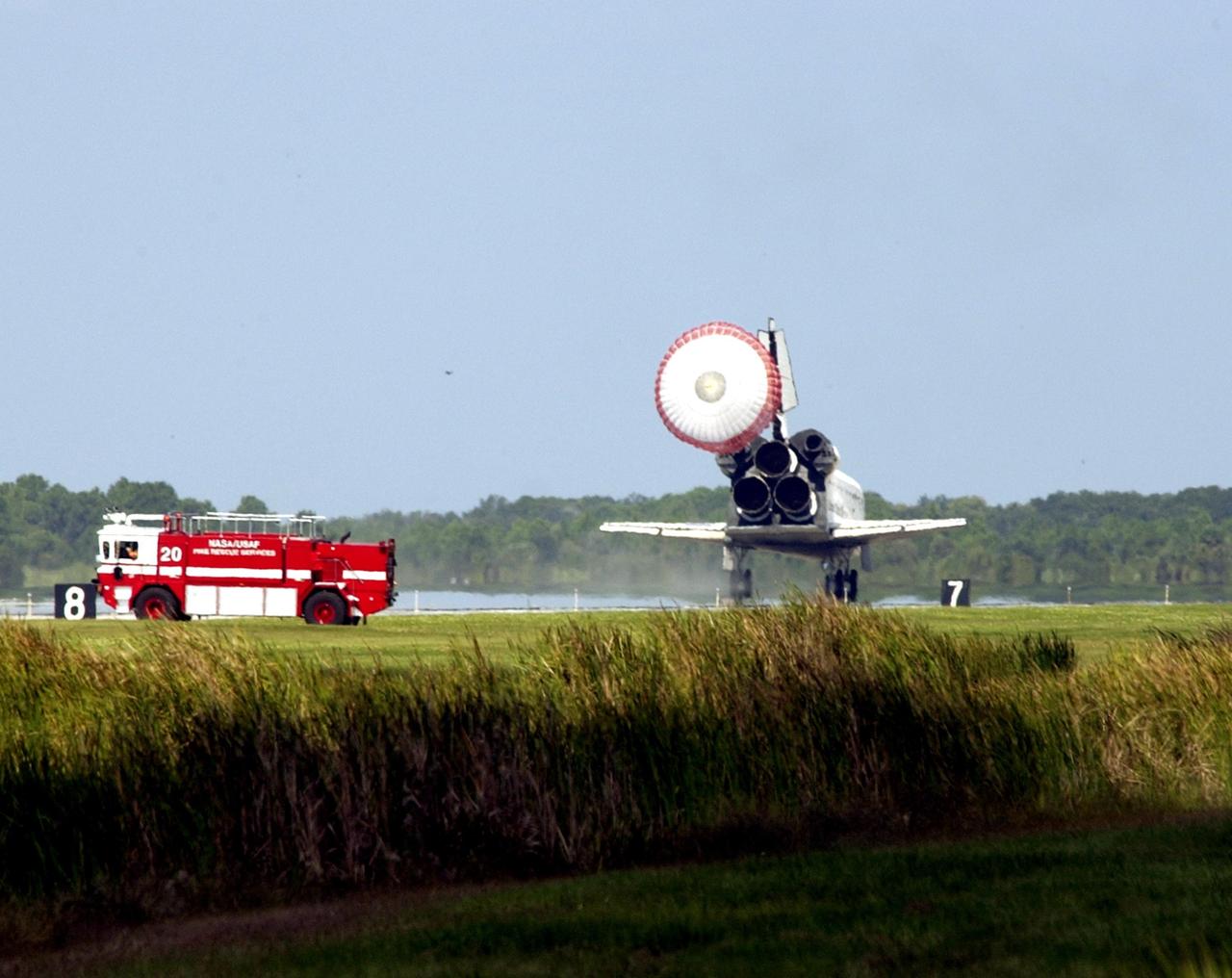
KENNEDY SPACE CENTER, FLA. - A fire rescue truck stands by for safety reasons as Space Shuttle Atlantis slows to a stop on Runway 33 at the Shuttle Landing Facility, completing the 4.5-million-mile journey to the International Space Station. Main gear touchdown occurred at 11:43:40 a.m. EDT; nose gear touchdown at 11:43:48 a.m.; and wheel stop at 11:44:35 a.m. Mission elapsed time was 10:19:58:44. Mission STS-112 expanded the size of the Station with the addition of the S1 truss segment. The returning crew of Atlantis are Commander Jeffrey Ashby, Pilot Pamela Melroy, and Mission Specialists David Wolf, Piers Sellers, Sandra Magnus and Fyodor Yurchikhin. This landing is the 60th at KSC in the history of the Shuttle program. .
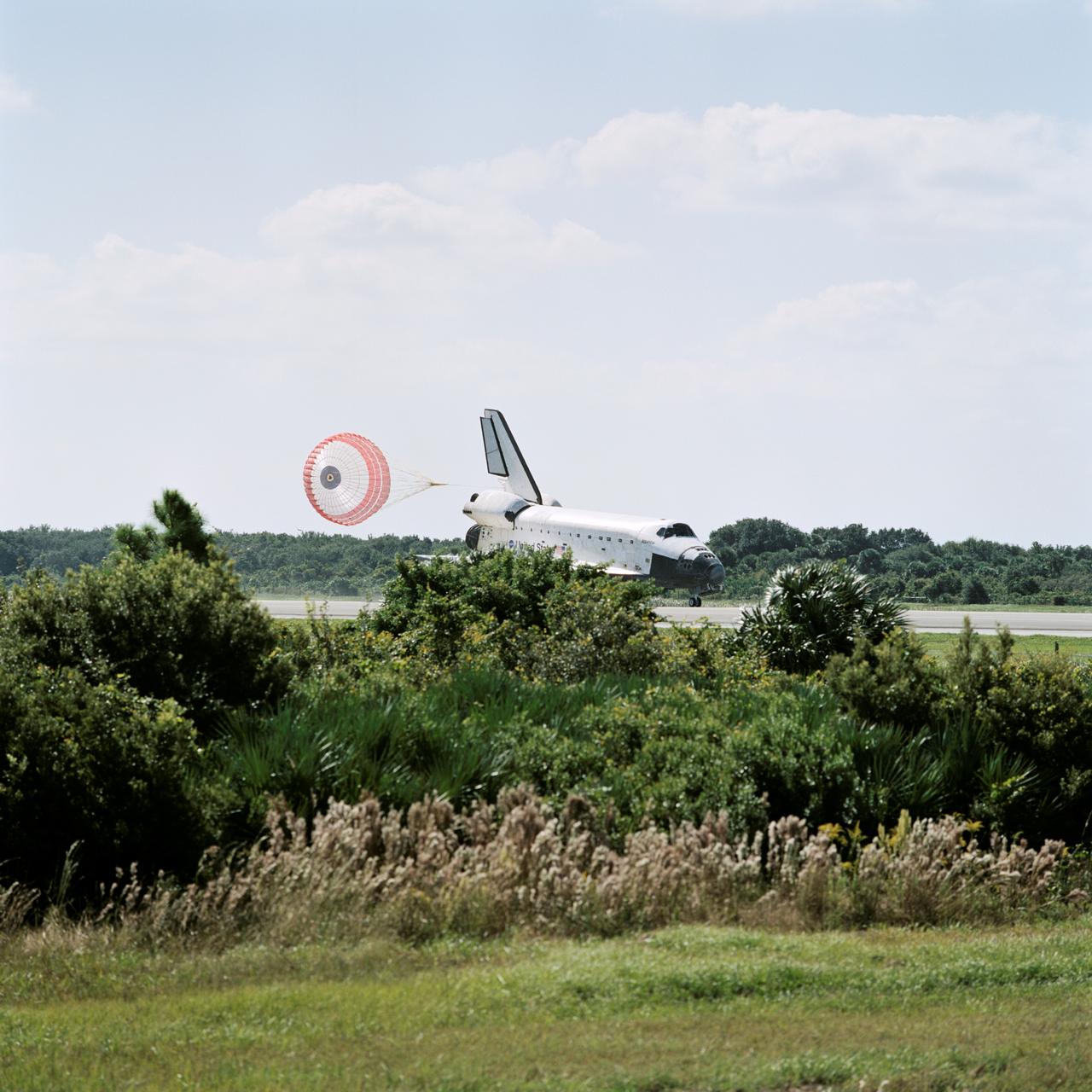
STS112-S-039 (18 October 2002) --- The drag chute of the Space Shuttle Atlantis helps to slow the vehicle following its touchdown at the Shuttle Landing Facility, completing the 4.5-million-mile journey to the International Space Station. Main gear touchdown occurred at 11:43:40 a.m. EDT; nose gear touchdown at 11:43:48 a.m.; and wheel stop at 11:44:35 a.m. Mission elapsed time was 10:19:58:44. Mission STS-112 expanded the size of the Station with the addition of the S1 truss segment. The returning crew of Atlantis are Jeffrey S. Ashby, commander; Pamela A. Melroy, pilot; and David A. Wolf, Piers J. Sellers, Sandra H. Magnus and Rosaviakosmos' Fyodor N. Yurchikhin, all mission specialists. This landing is the 60th at KSC in the 21-year history of the Shuttle program.
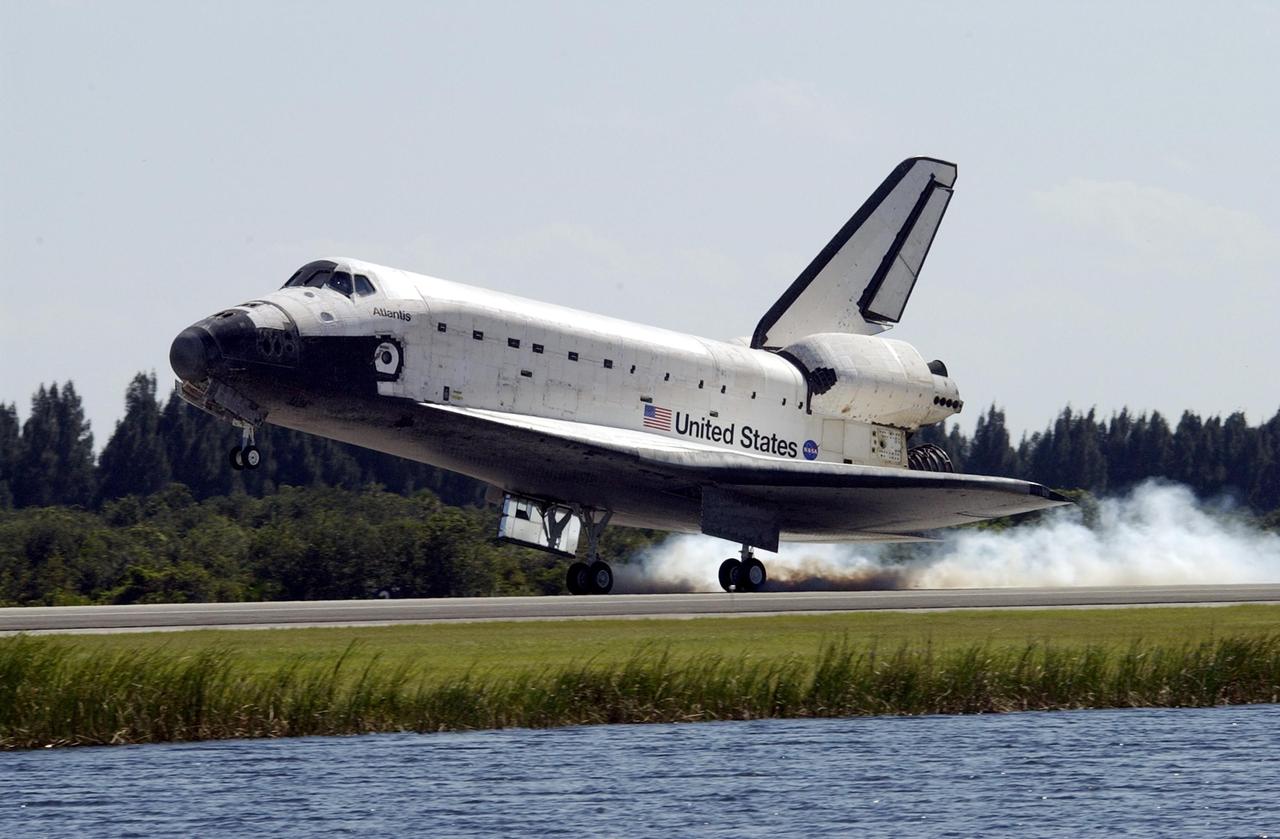
KENNEDY SPACE CENTER, FLA. -- Space Shuttle Atlantis kicks up dust as it touches down at the Shuttle Landing Facility, completing the 4.5-million-mile journey to the International Space Station. Main gear touchdown occurred at 11:43:40 a.m. EDT; nose gear touchdown at 11:43:48 a.m.; and wheel stop at 11:44:35 a.m. Mission elapsed time was 10:19:58:44. Mission STS-112 expanded the size of the Station with the addition of the S1 truss segment. The returning crew of Atlantis are Commander Jeffrey Ashby, Pilot Pamela Melroy, and Mission Specialists David Wolf, Piers Sellers, Sandra Magnus and Fyodor Yurchikhin. This landing is the 60th at KSC in the history of the Shuttle program.
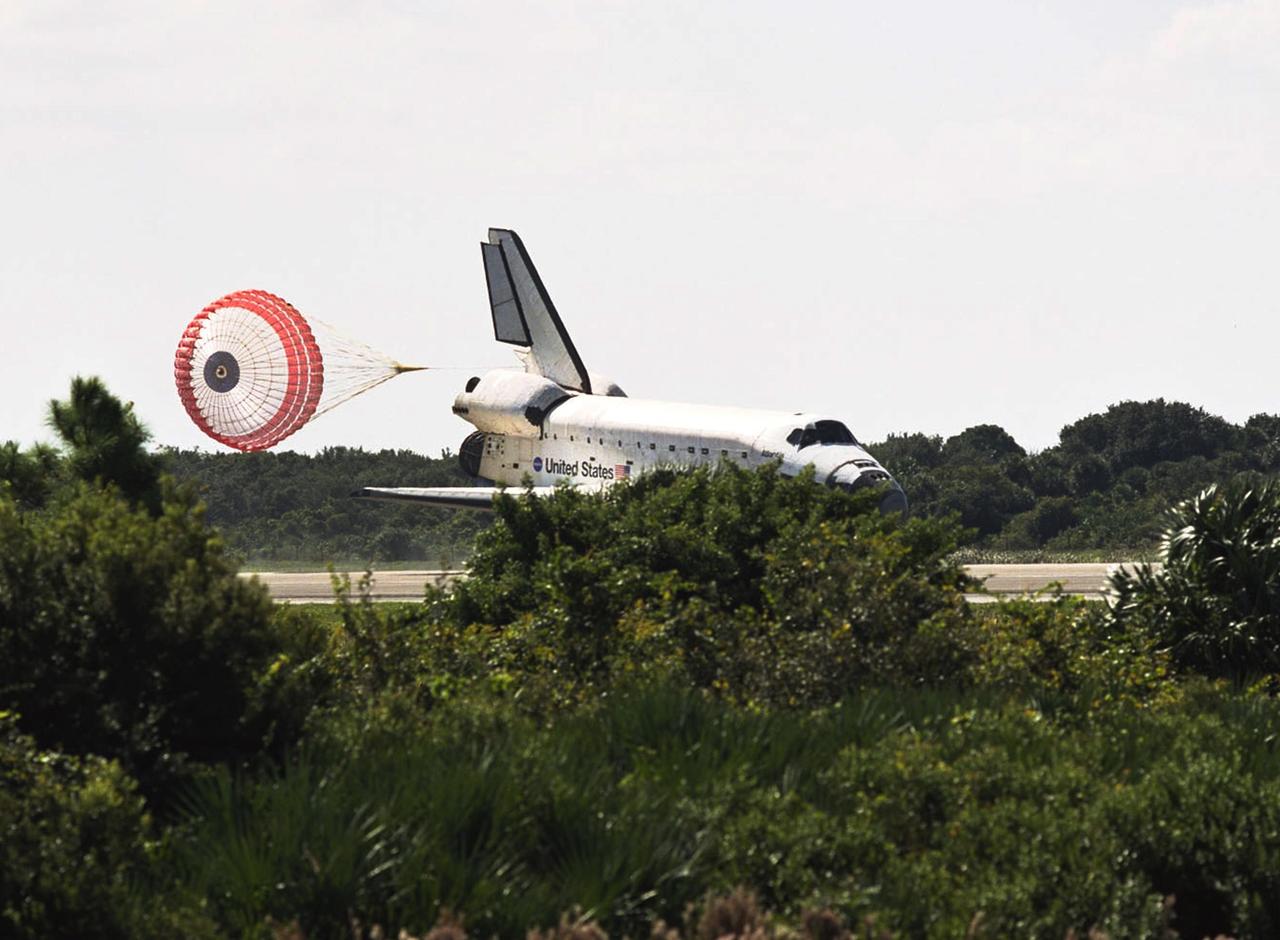
KENNEDY SPACE CENTER, FLA. - A drag chute slows Atlantis after touchdown on Runway 33 at the Shuttle Landing Facility, completing the 4.5-million-mile journey to the International Space Station. Main gear touchdown occurred at 11:43:40 a.m. EDT; nose gear touchdown at 11:43:48 a.m.; and wheel stop at 11:44:35 a.m. Mission elapsed time was 10:19:58:44. Mission STS-112 expanded the size of the Station with the addition of the S1 truss segment. The returning crew of Atlantis are Commander Jeffrey Ashby, Pilot Pamela Melroy, and Mission Specialists David Wolf, Piers Sellers, Sandra Magnus and Fyodor Yurchikhin. This landing is the 60th at KSC in the history of the Shuttle program.
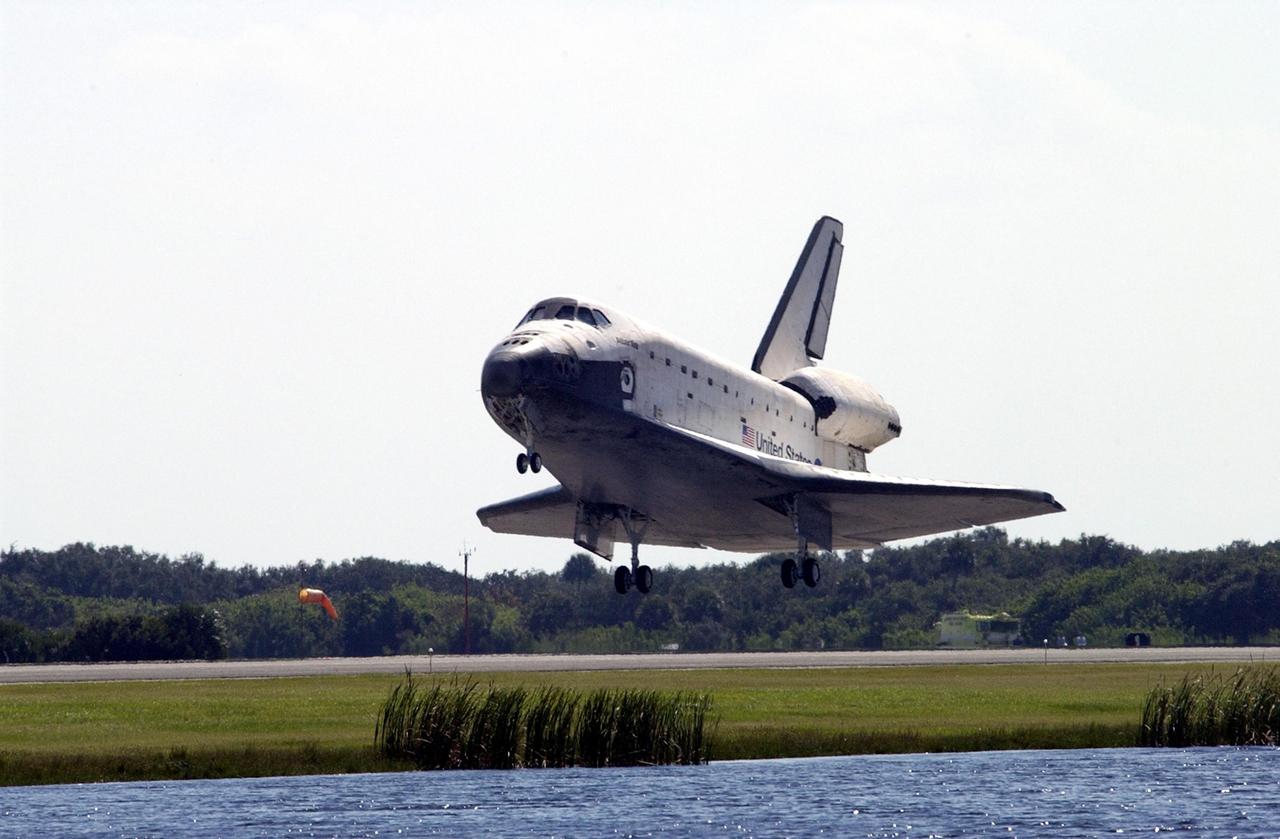
KENNEDY SPACE CENTER, FLA. - Space Shuttle Atlantis approaches the runway at the Shuttle Landing Facility, completing the 4.5-million-mile journey to the International Space Station. Main gear touchdown occurred at 11:43:40 a.m. EDT; nose gear touchdown at 11:43:48 a.m.; and wheel stop at 11:44:35 a.m. Mission elapsed time was 10:19:58:44. Mission STS-112 expanded the size of the Station with the addition of the S1 truss segment. The returning crew of Atlantis are Commander Jeffrey Ashby, Pilot Pamela Melroy, and Mission Specialists David Wolf, Piers Sellers, Sandra Magnus and Fyodor Yurchikhin. This landing is the 60th at KSC in the history of the Shuttle program.

KENNEDY SPACE CENTER, FLA. - Space Shuttle Atlantis is close to touchdown at the Shuttle Landing Facility, completing the 4.5-million-mile journey to the International Space Station. Main gear touchdown occurred at 11:43:40 a.m. EDT; nose gear touchdown at 11:43:48 a.m.; and wheel stop at 11:44:35 a.m. Mission elapsed time was 10:19:58:44. Mission STS-112 expanded the size of the Station with the addition of the S1 truss segment. The returning crew of Atlantis are Commander Jeffrey Ashby, Pilot Pamela Melroy, and Mission Specialists David Wolf, Piers Sellers, Sandra Magnus and Fyodor Yurchikhin. This landing is the 60th at KSC in the history of the Shuttle program.
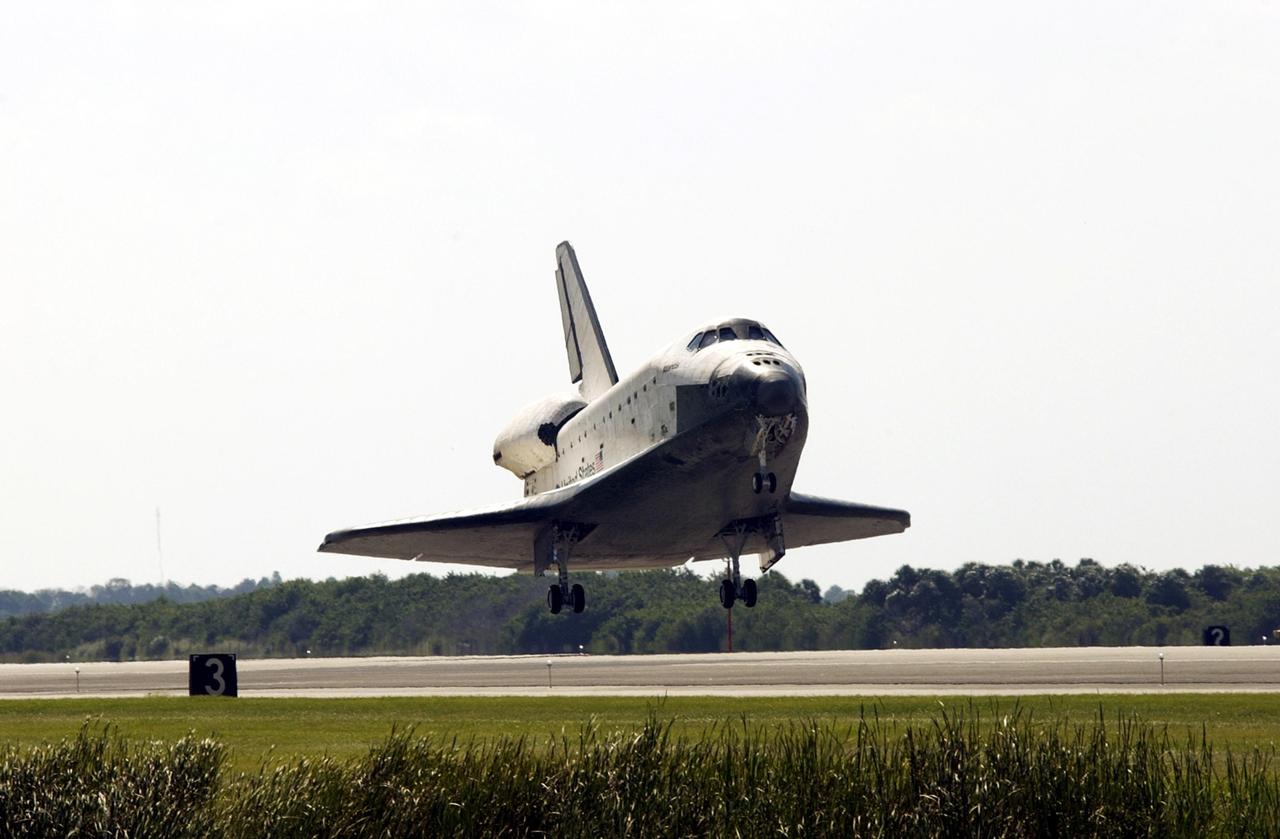
KENNEDY SPACE CENTER, FLA. -- Space Shuttle Atlantis approaches the runway at the Shuttle Landing Facility, completing the 4.5-million-mile journey to the International Space Station. Main gear touchdown occurred at 11:43:40 a.m. EDT; nose gear touchdown at 11:43:48 a.m.; and wheel stop at 11:44:35 a.m. Mission elapsed time was 10:19:58:44. Mission STS-112 expanded the size of the Station with the addition of the S1 truss segment. The returning crew of Atlantis are Commander Jeffrey Ashby, Pilot Pamela Melroy, and Mission Specialists David Wolf, Piers Sellers, Sandra Magnus and Fyodor Yurchikhin. This landing is the 60th at KSC in the history of the Shuttle program. .
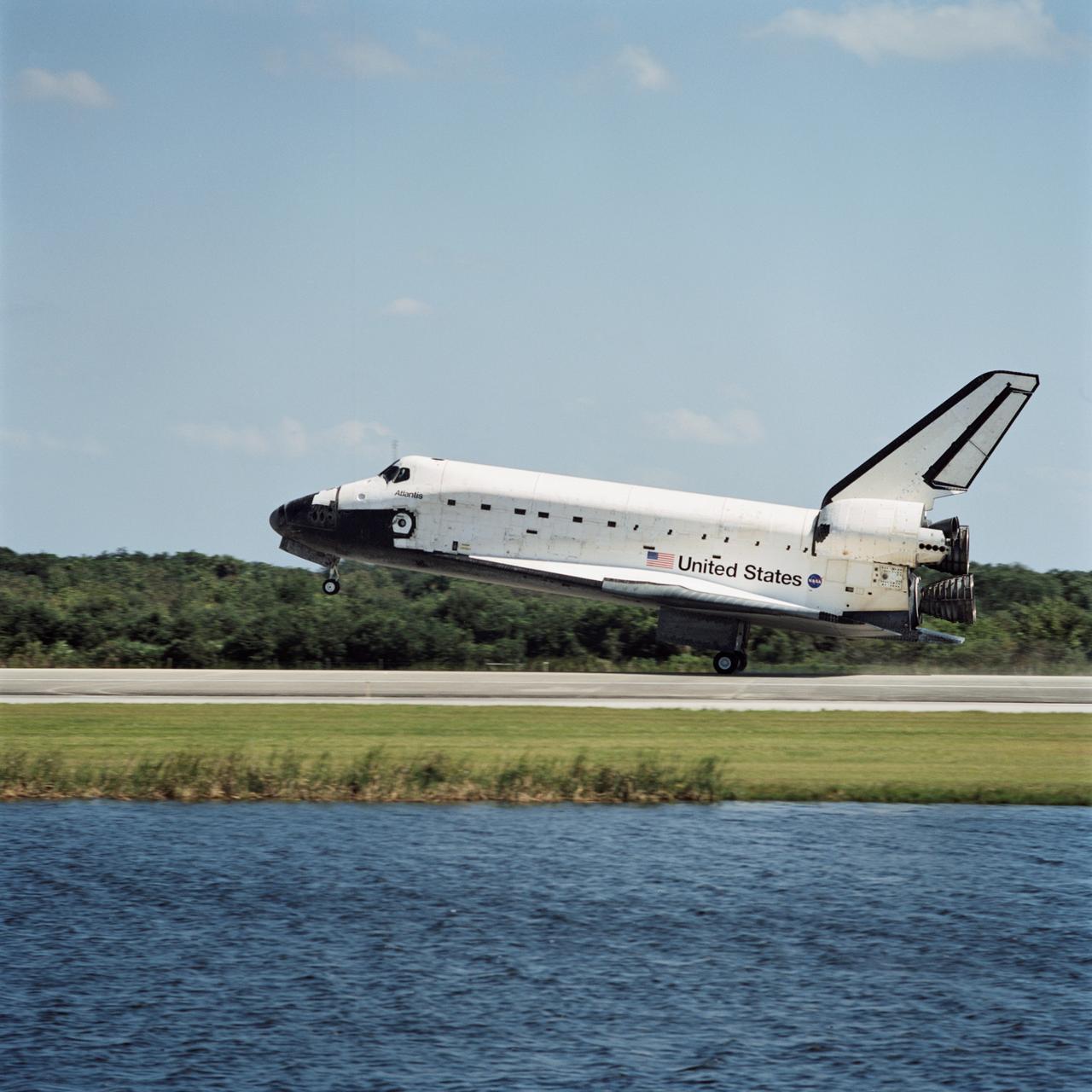
STS112-S-040 (18 October 2002) --- The main landing gear of the Space Shuttle Atlantis is just about to touch down at the Shuttle Landing Facility, completing the 4.5-million-mile journey to the International Space Station. Main gear touchdown occurred at 11:43:40 a.m. (EDT); nose gear touchdown at 11:43:48 a.m.; and wheel stop at 11:44:35 a.m. Mission elapsed time was 10:19:58:44. Mission STS-112 expanded the size of the Station with the addition of the S1 truss segment. The returning crew of Atlantis are Jeffrey S. Ashby, commander; Pamela A. Melroy, pilot; and David A. Wolf, Piers J. Sellers, Sandra H. Magnus and Rosaviakosmos' Fyodor N. Yurchikhin, all mission specialists. This landing is the 60th at KSC in the 21-year history of the Shuttle program.
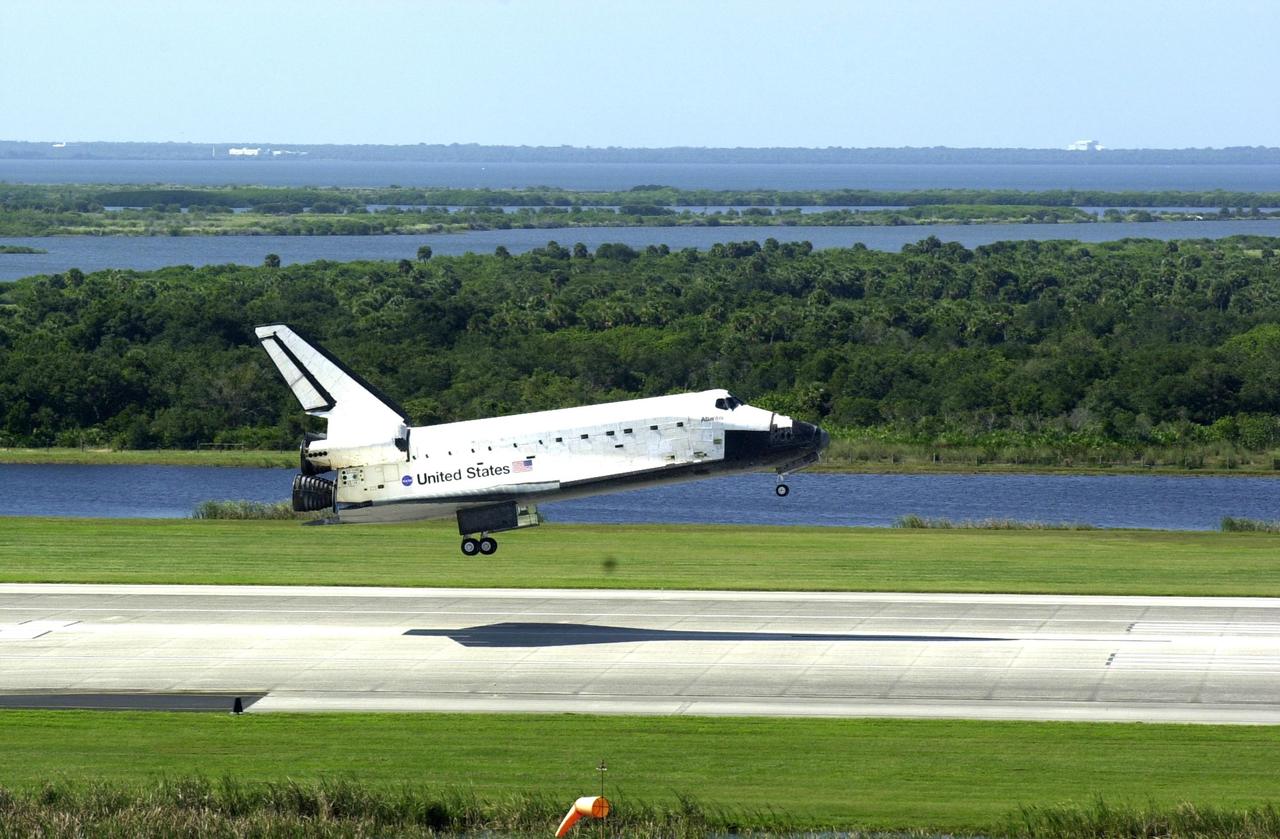
KENNEDY SPACE CENTER, FLA. -- Space Shuttle Atlantis casts a needle-shaped shadow as it drops to the runway at the Shuttle Landing Facility, completing the 4.5-million-mile journey to the International Space Station. Main gear touchdown occurred at 11:43:40 a.m. EDT; nose gear touchdown at 11:43:48 a.m.; and wheel stop at 11:44:35 a.m. Mission elapsed time was 10:19:58:44. Mission STS-112 expanded the size of the Station with the addition of the S1 truss segment. The returning crew of Atlantis are Commander Jeffrey Ashby, Pilot Pamela Melroy, and Mission Specialists David Wolf, Piers Sellers, Sandra Magnus and Fyodor Yurchikhin. This landing is the 60th at KSC in the history of the Shuttle program.
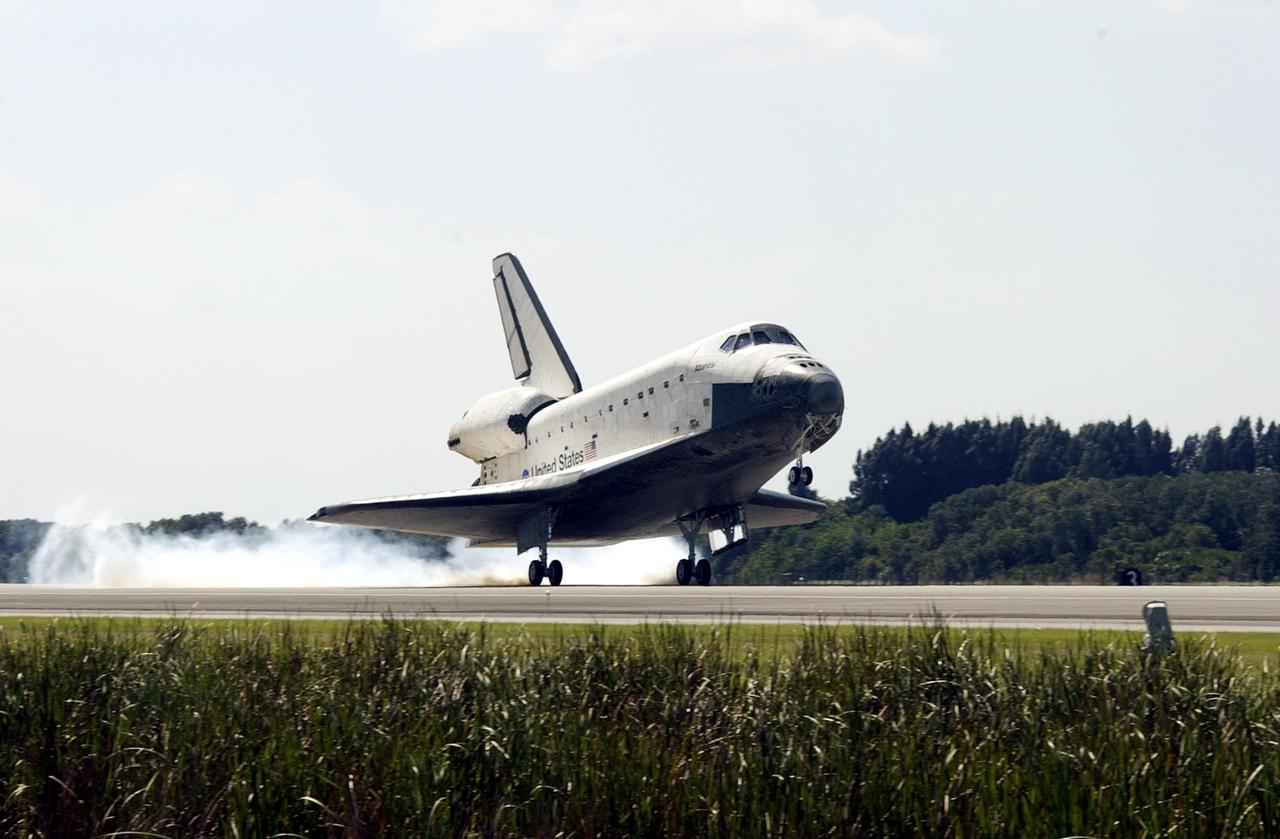
KENNEDY SPACE CENTER, FLA. -- Space Shuttle Atlantis stirs up dust as it touches down on Runway 33 at the Shuttle Landing Facility, completing the 4.5-million-mile journey to the International Space Station. Main gear touchdown occurred at 11:43:40 a.m. EDT; nose gear touchdown at 11:43:48 a.m.; and wheel stop at 11:44:35 a.m. Mission elapsed time was 10:19:58:44. Mission STS-112 expanded the size of the Station with the addition of the S1 truss segment. The returning crew of Atlantis are Commander Jeffrey Ashby, Pilot Pamela Melroy, and Mission Specialists David Wolf, Piers Sellers, Sandra Magnus and Fyodor Yurchikhin. This landing is the 60th at KSC in the history of the Shuttle program. .

STS038-S-041 (20 Nov 1990) --- STS-38 Atlantis, Orbiter Vehicle (OV) 104, lands on runway 33 at Kennedy Space Center (KSC) Shuttle Landing Facility (SLF). The main landing gear (MLG) has just touched down on the runway surface as the nose landing gear (NLG) glides above it. The Department of Defense (DOD)-devoted mission came to an end (with complete wheel stop) at 4:43:37 pm (Eastern Standard Time (EST)).
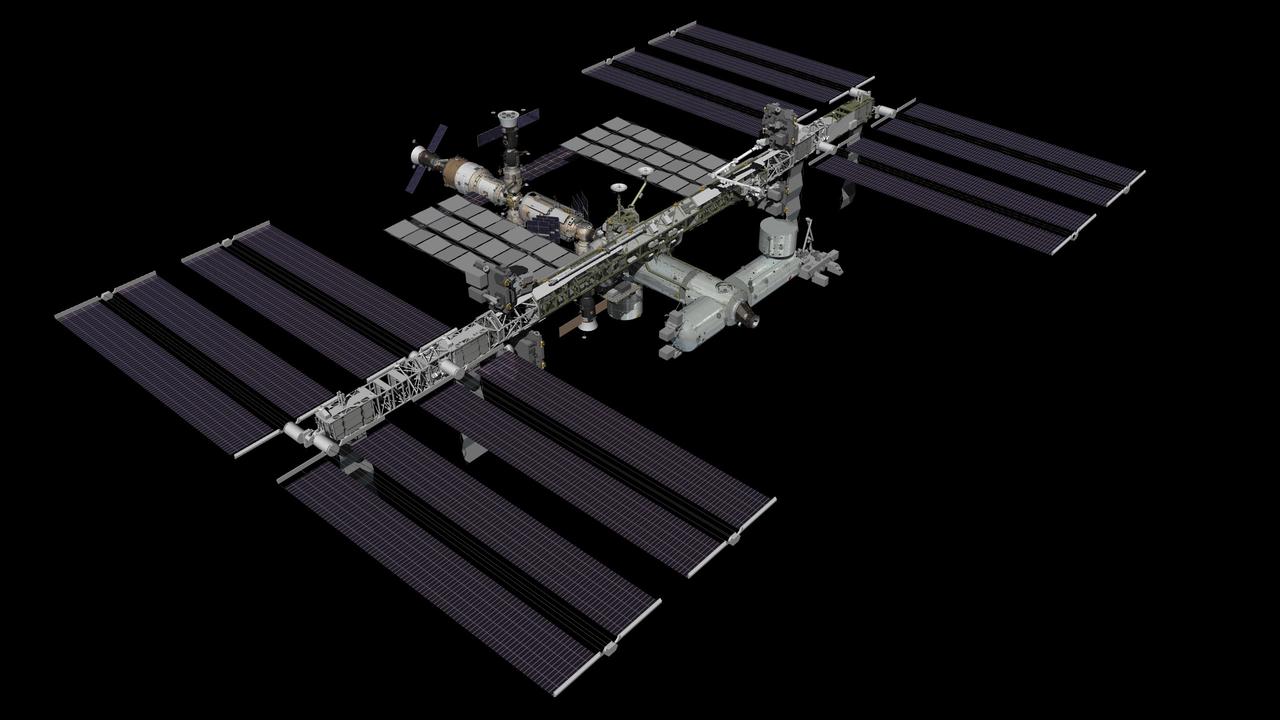
JSC2011-E-072139 (July 2011) --- Computer-generated artist?s rendering of the starboard view of the complete configuration of the International Space Station as of July 18, 2011, following the STS-135 mission. Progress 43 is linked to the aft port of the Zvezda Service Module. Soyuz 27 (TMA-02M) is docked to the Rassvet Mini-Research Module 1 (MRM1). Progress 42 is attached to the Pirs Docking Compartment and Soyuz 26 (TMA-21) is docked to the Poisk Mini-Research Module 2 (MRM2). Photo credit: NASA
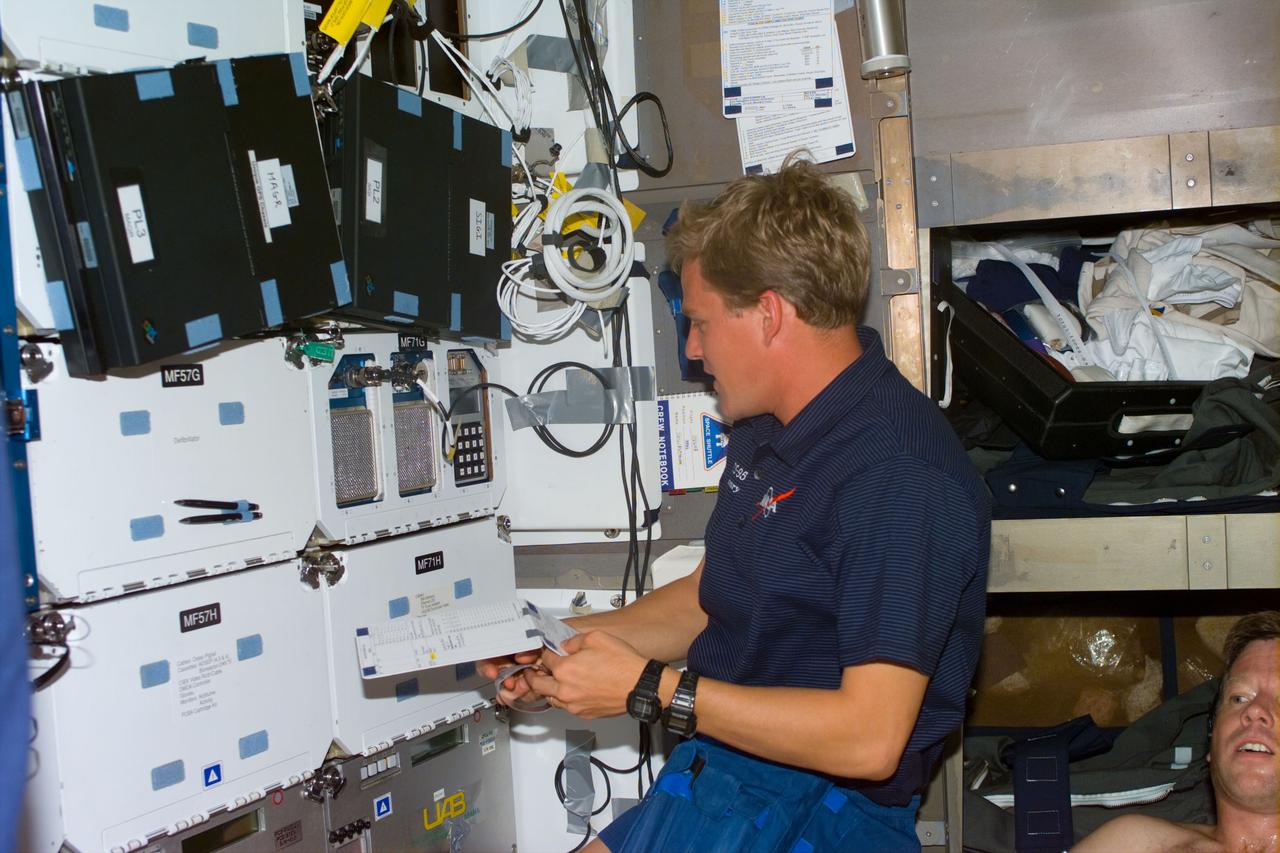
STS095-E-5176 (30 Oct. 1998) --- Astronaut Scott E. Parazynski (left), STS-95 mission specialist, checks a note attached to one of the stowage lockers on Discovery's middeck. Nearby is astronaut Steven W. Lindsey, pilot, seated on one of the bunk beds. The photo was taken with an electronic still camera (ESC) at 23:43:51 GMT, Oct. 30.
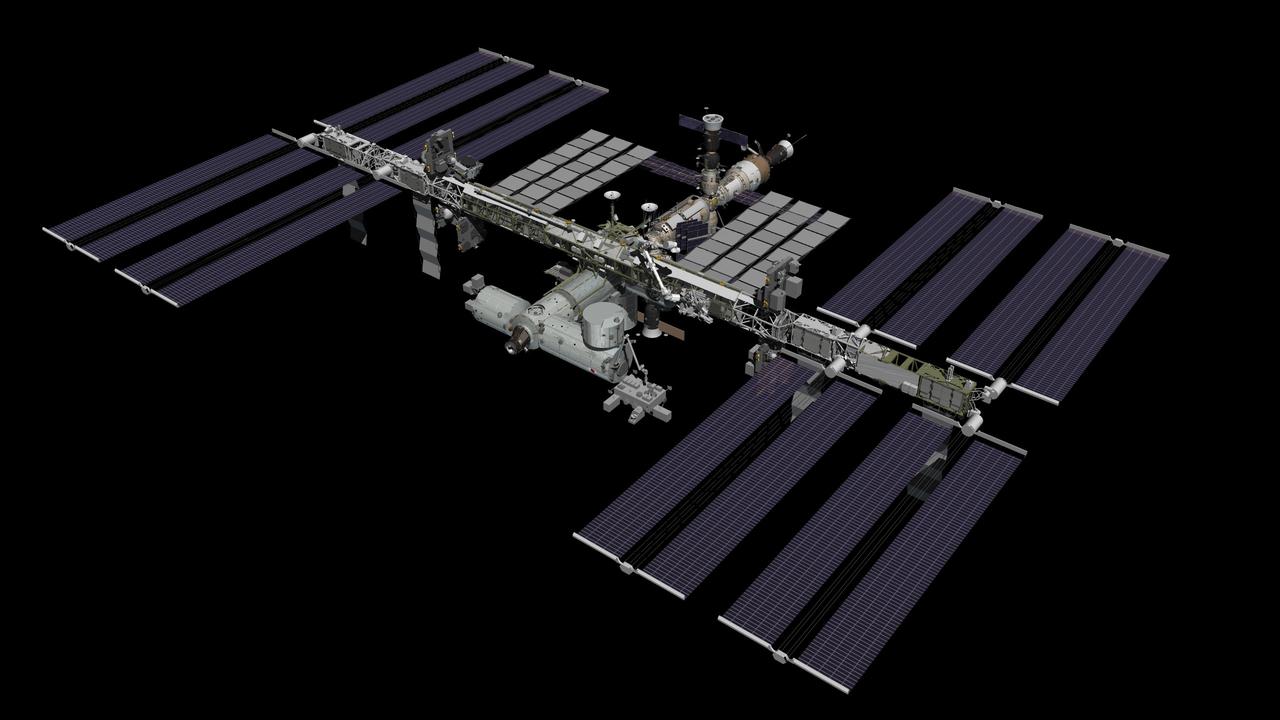
JSC2011-E-072138 (July 2011) --- Computer-generated artist?s rendering of the port view of the complete configuration of the International Space Station as of July 18, 2011, following the STS-135 mission. Progress 43 is linked to the aft port of the Zvezda Service Module. Soyuz 27 (TMA-02M) is docked to the Rassvet Mini-Research Module 1 (MRM1). Progress 42 is attached to the Pirs Docking Compartment and Soyuz 26 (TMA-21) is docked to the Poisk Mini-Research Module 2 (MRM2). Photo credit: NASA

S90-27594 (November 1989) --- Manley L. "Sonny" Carter Jr., STS-33 mission specialist, wearing a Launch and Entry Suit (LES), poses in front of the space shuttle Discovery, Orbiter Vehicle (OV) 103 at the Kennedy Space Center (KSC) Launch Complex Pad 39B, at the 195 feet level elevator entrance at Pad 39B. Visible in the background is the catwalk to OV-103's side hatch and the Atlantic Ocean. Note: Carter died April 5, 1991 at age 43, in a civil aviation accident.

S88-E-5143 (12-12-98) --- Astronaut James H. Newman, mission specialist, works at the edge of the U.S.-built Unity connecting module during the STS-88 mission's third and final space walk, on Flight Day 10. The solar array panel on the Russian-built Zarya module is at right. The photo was taken with an electronic still camera (ESC) at 21:59:43 GMT, Dec. 12.
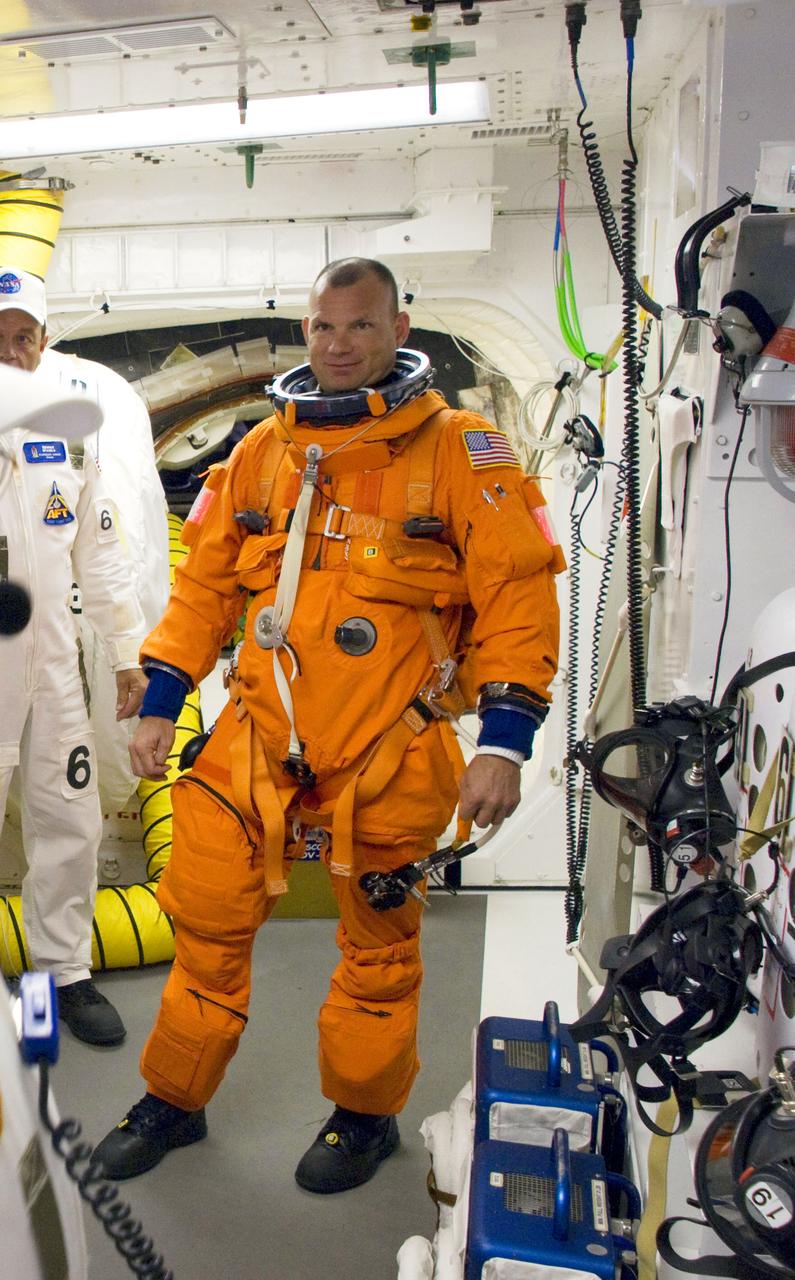
STS119-S-012 (15 March 2009) --- Astronaut Tony Antonelli, STS-119 pilot, attired in his shuttle launch and entry suit (with harness and parachute pack), is pictured in the White Room on launch pad 39A at NASA's Kennedy Space Center in Florida, before crawling through the open hatch into Space Shuttle Discovery. The White Room is at the end of the orbiter access arm on the fixed service structure and provides access into the shuttle. Liftoff is scheduled for 7:43 p.m. (EDT) on March 15, 2009.
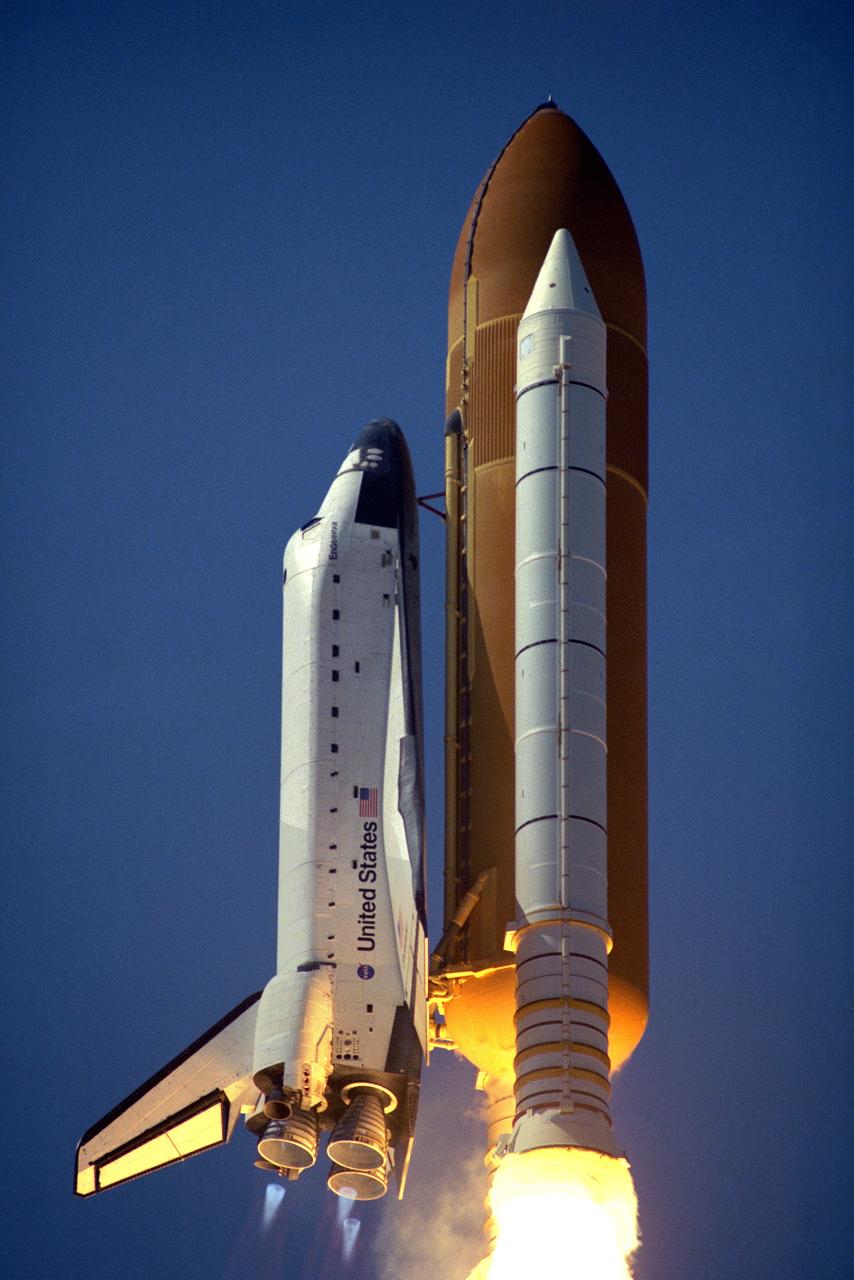
STS099-S-021 (11 February 2000) --- The Space Shuttle Endeavour is backdropped against a clear blue sky as its launches toward space. Launch of the STS-99 mission occurred at 12:43:40 p.m. (EST), February 11, 2000 from Launch Pad 39A with a crew of six aboard. This is the 97th shuttle flight and the 14th for Space Shuttle Endeavour.
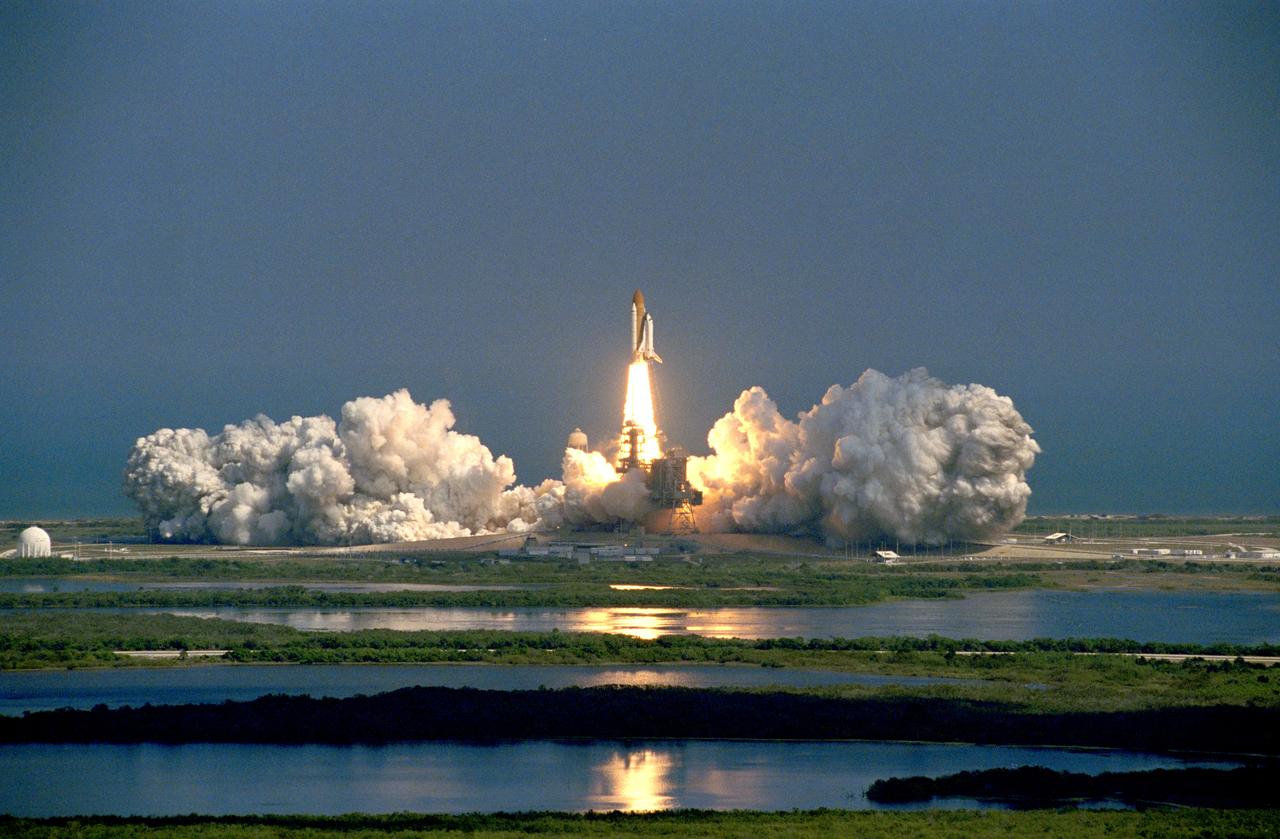
STS099-S-019 (11 February 2000) --- The Space Shuttle Endeavour is backdropped in the distance against a clear blue sky as its launches toward space. Launch of the STS-99 mission occurred at 12:43:40 p.m. (EST), February 11, 2000 from Launch Pad 39A with a crew of six aboard. This is the 97th shuttle flight and the 14th for Space Shuttle Endeavour.
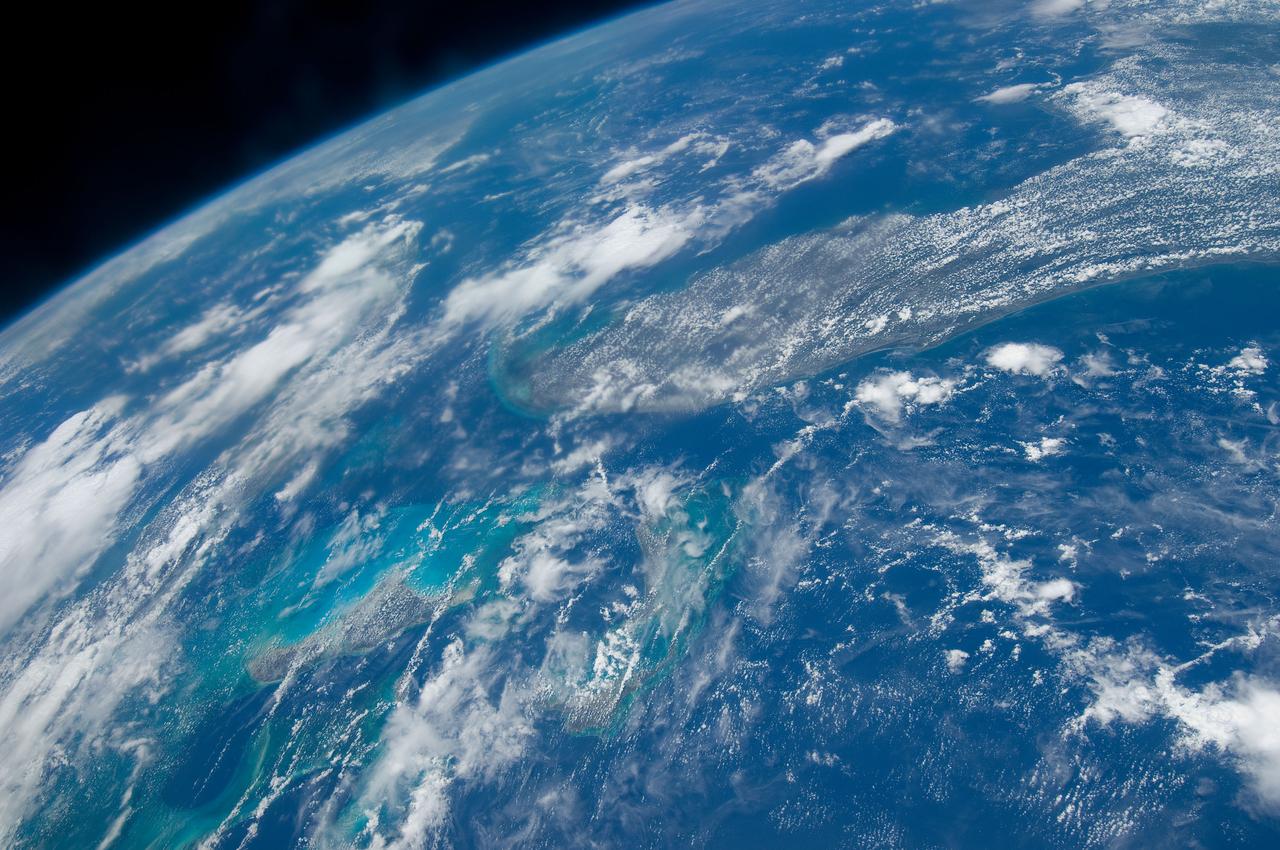
S125-E-007951 (16 May 2009) --- This high oblique Earth scene from the STS-125 crew is reminiscent of Gemini 11 photos 43 years ago, because of similar altitudes, approximately 350 statute miles. The Florida peninsula and its neighboring geographic features are easily recognizable beneath the clouds along with the tell-tale change in water color associated with the ?Tongue of the Ocean.?
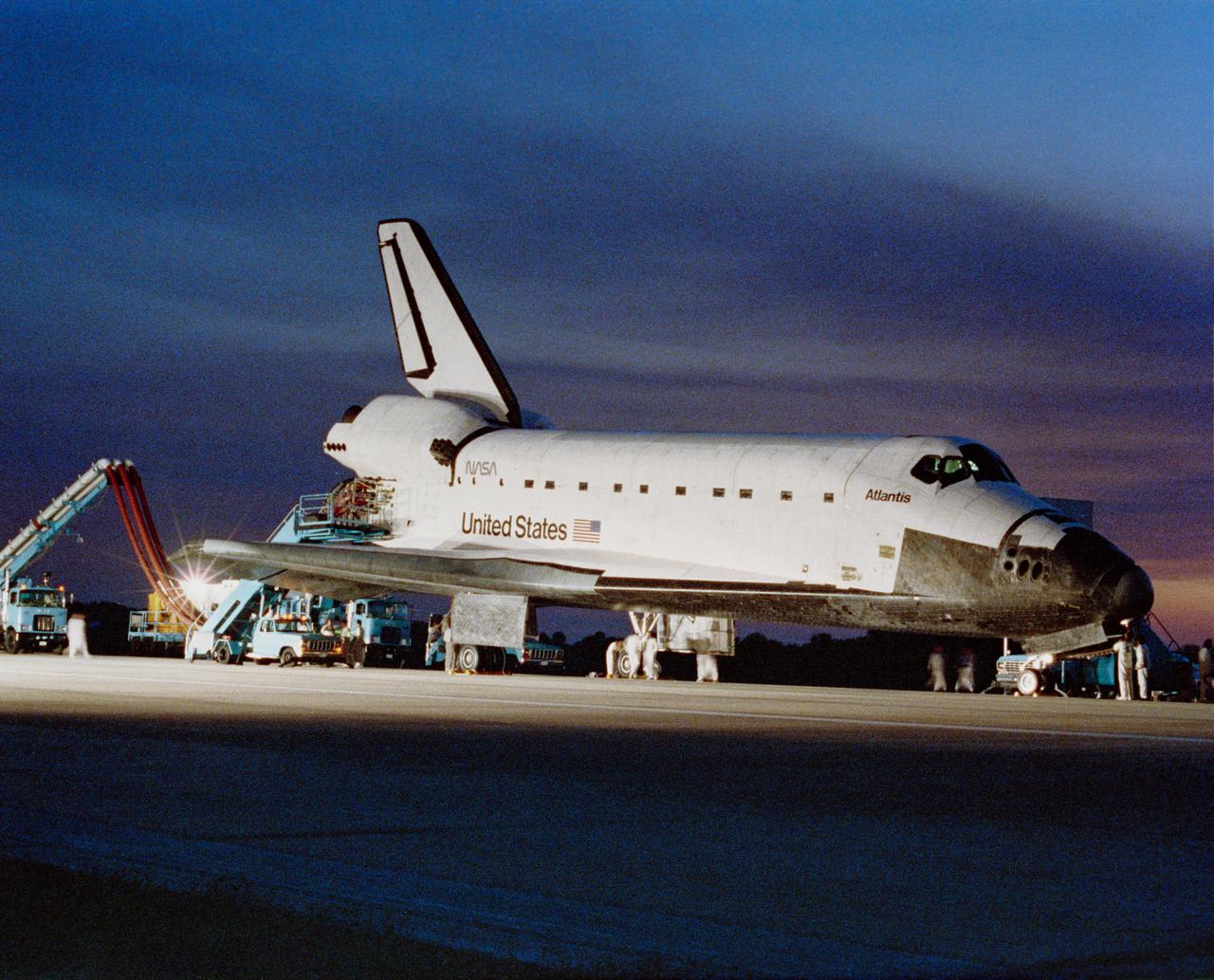
Spotlights illuminate Atlantis, Orbiter Vehicle (OV) 104, during safing operations at the Kennedy Space Center's (KSC's) Shuttle Landing Facility (SLF). OV-104 parked on runway 33 is serviced by KSC ground crews. STS-38, a Department of Defense (DOD)-devoted mission, came to an end (with complete wheel stop) at 4:43:37 pm (Eastern Standard Time (EST)).
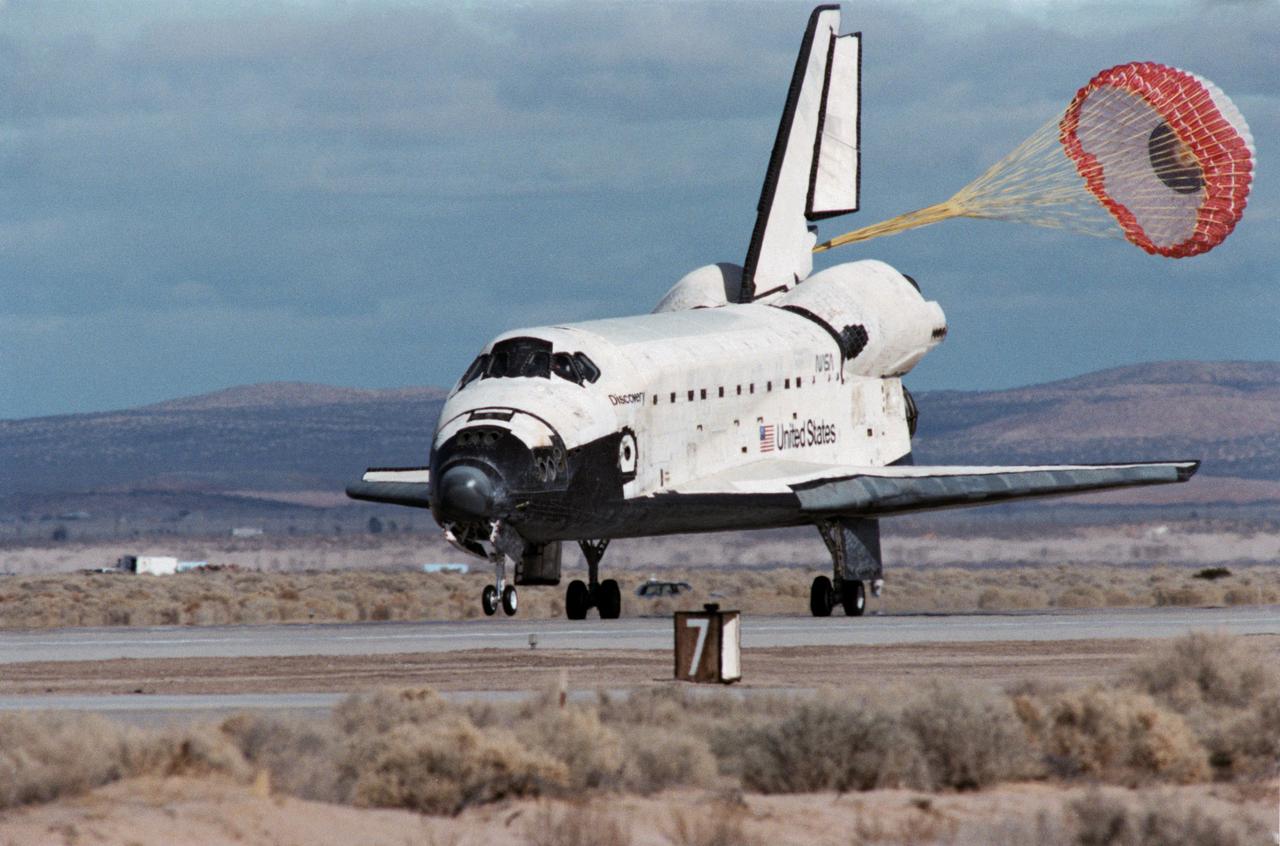
STS053-S-085 (9 Dec. 1992) --- The drag chute on the space shuttle Discovery is partially deployed during landing on Runway 22 at Edwards Air Force Base. The landing ended an eight-day space mission for the STS-53 crew. Main gear touchdown occurred at 12:43:17 p.m. (PST) on Dec. 9, 1992. Onboard were astronauts David M. Walker, Robert D. Cabana, Guion S. Bluford Jr., James S. Voss and Michael R.U. (Rich) Clifford.
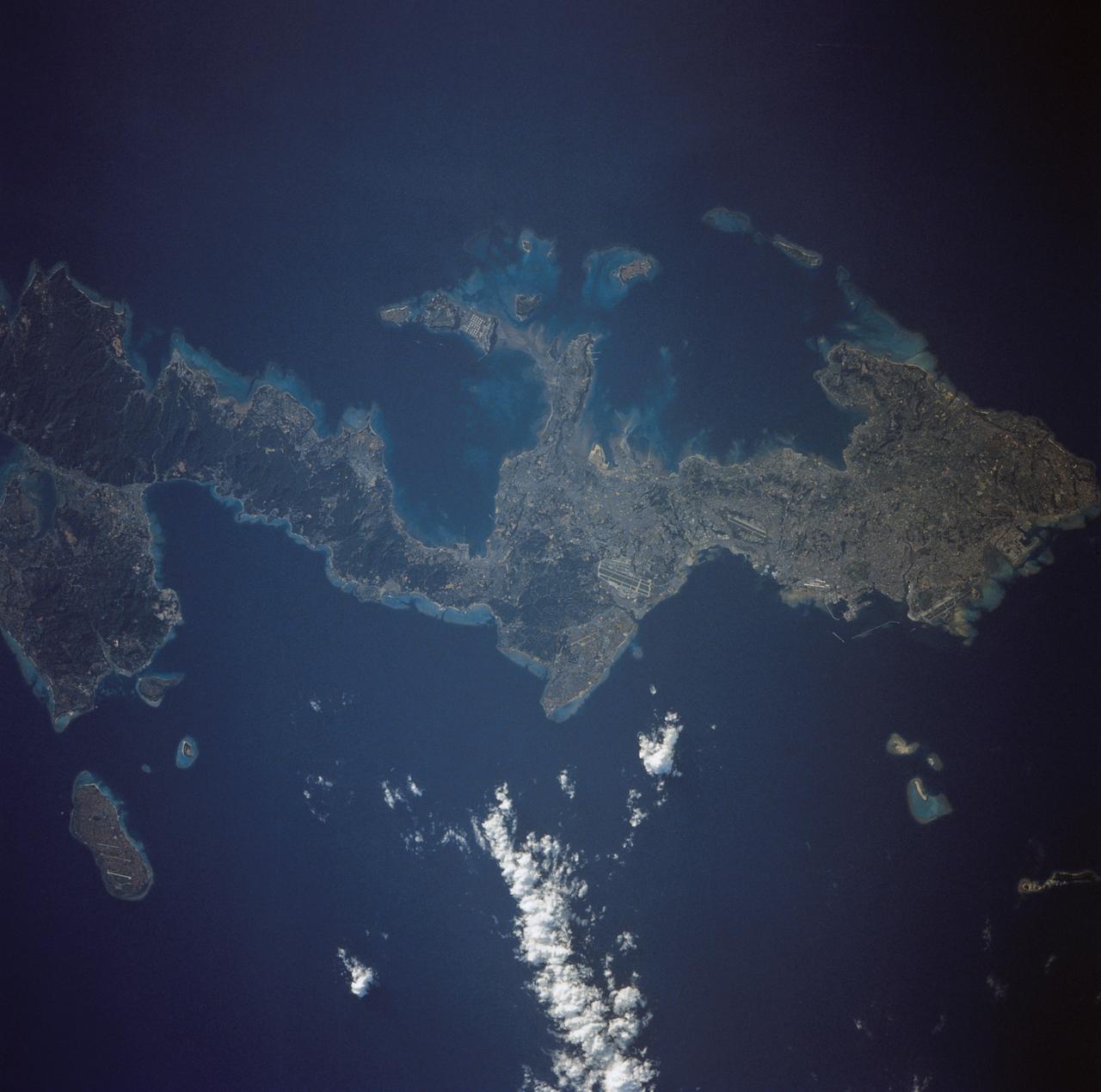
The southern half of the island of Okinawa, Japan (26.5N, 128.0E) can be seen in this nearly cloud free view. Okinawa is part of the Ryuku Islands which extend from Taiwan northeastward to Kyushu, southernmost of the Japanese Home Islands. The large military base at Kadena, with large runways, is visible near the center of the scene. Kadena is one of several emergency landing sites around the world for the space shuttle.
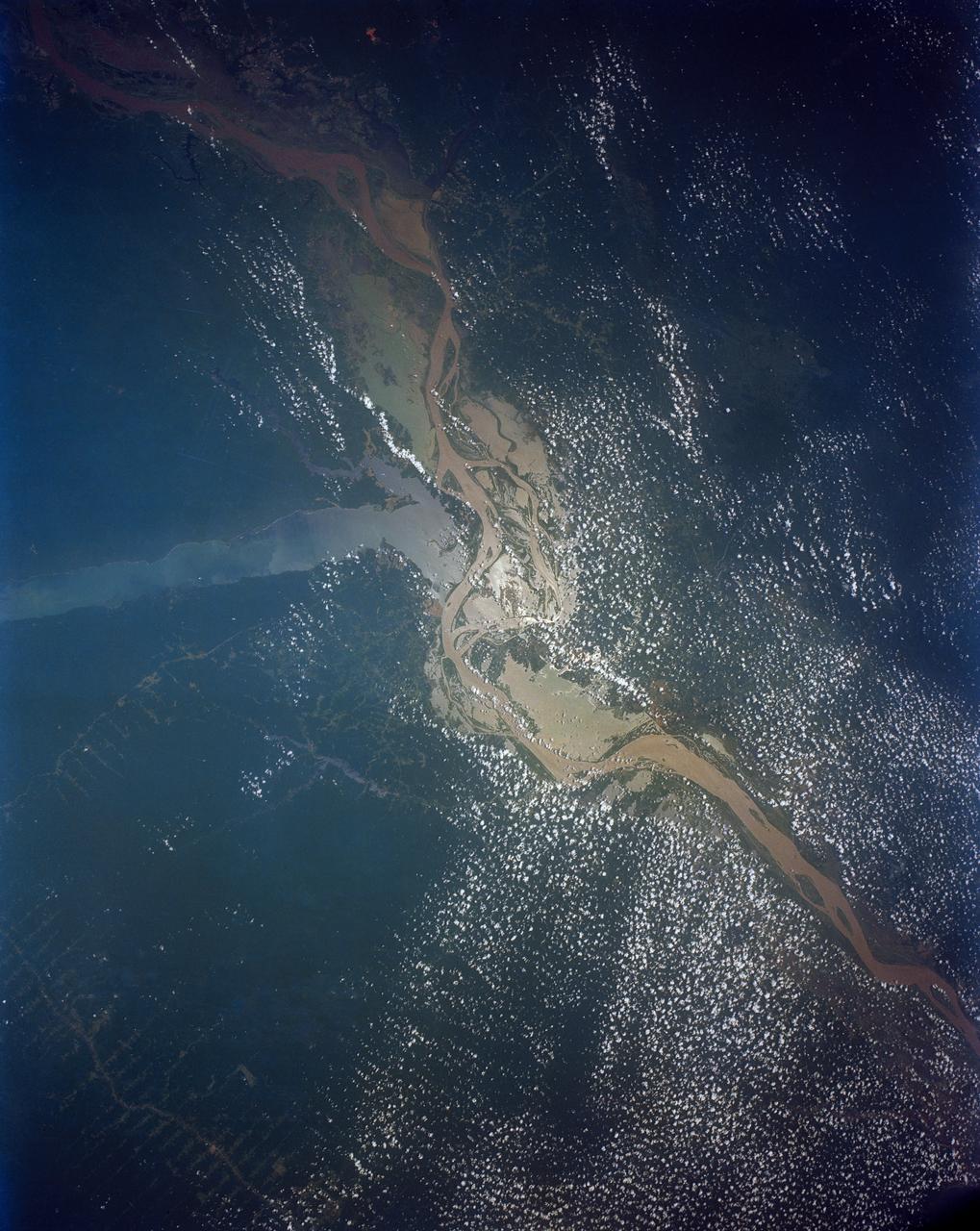
This view shows the confluence of the Amazon and the Topajos Rivers at Santarem, Brazil (2.0S, 55.0W). The Am,azon flows from lower left to upper right of the photo. Below the river juncture of the Amazon and Tapajos, there is considerable deforestation activity along the Trans-Amazon Highway.
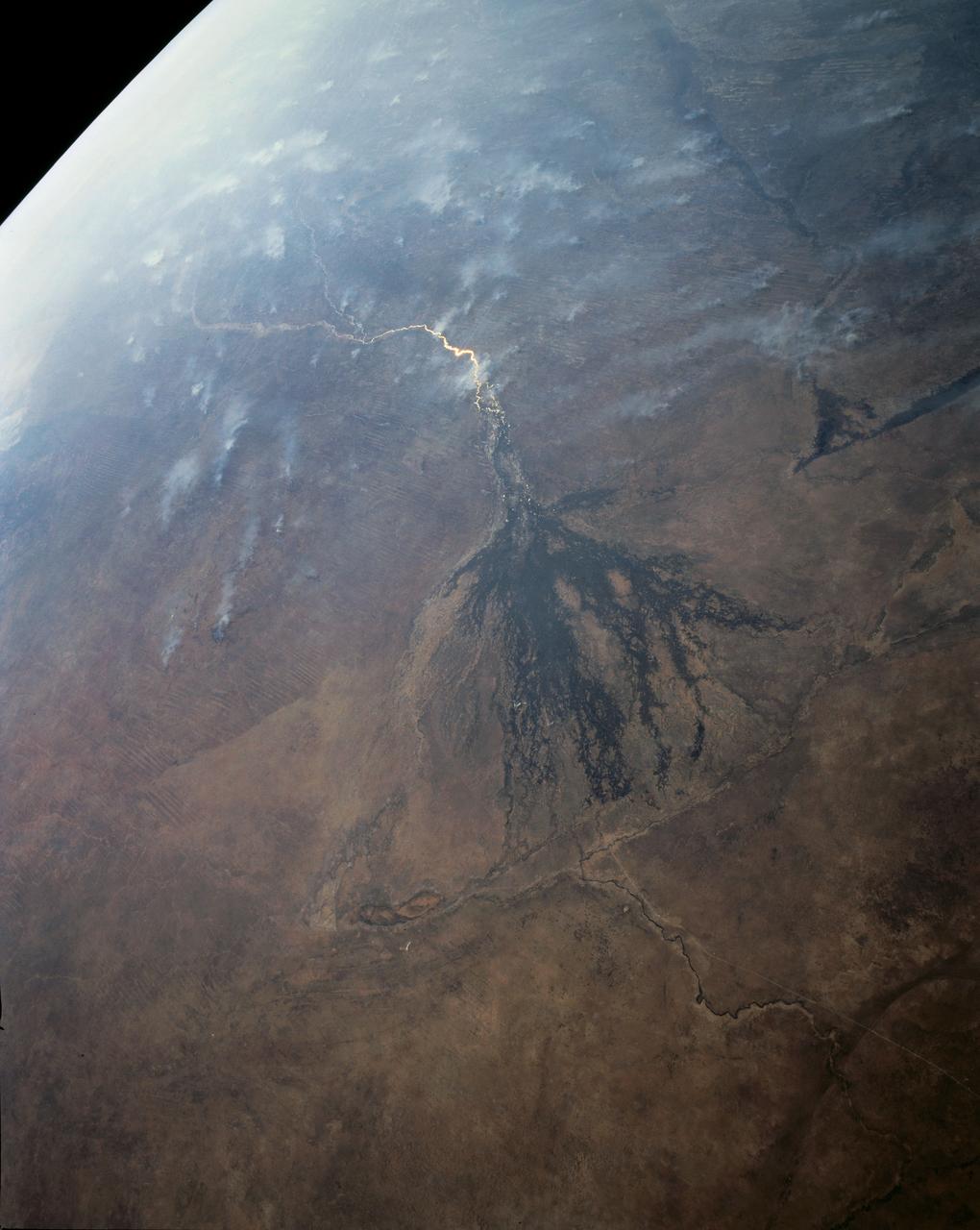
In this panoramic view of the Okavango Swamp, Botswana, (19.0S, 22.0E), the Okavango River, seen in sunglint, flows into a topographic trough to form an inland delta. Water, trapped in the meandering delta distributaries is evaporated or transpired by vegetation. In Angola to the north, the many fires of the seasonal burning of savannah vegetation for land clearing, in preparation for agriculture, has filled the atmosphere with haze and smoke.
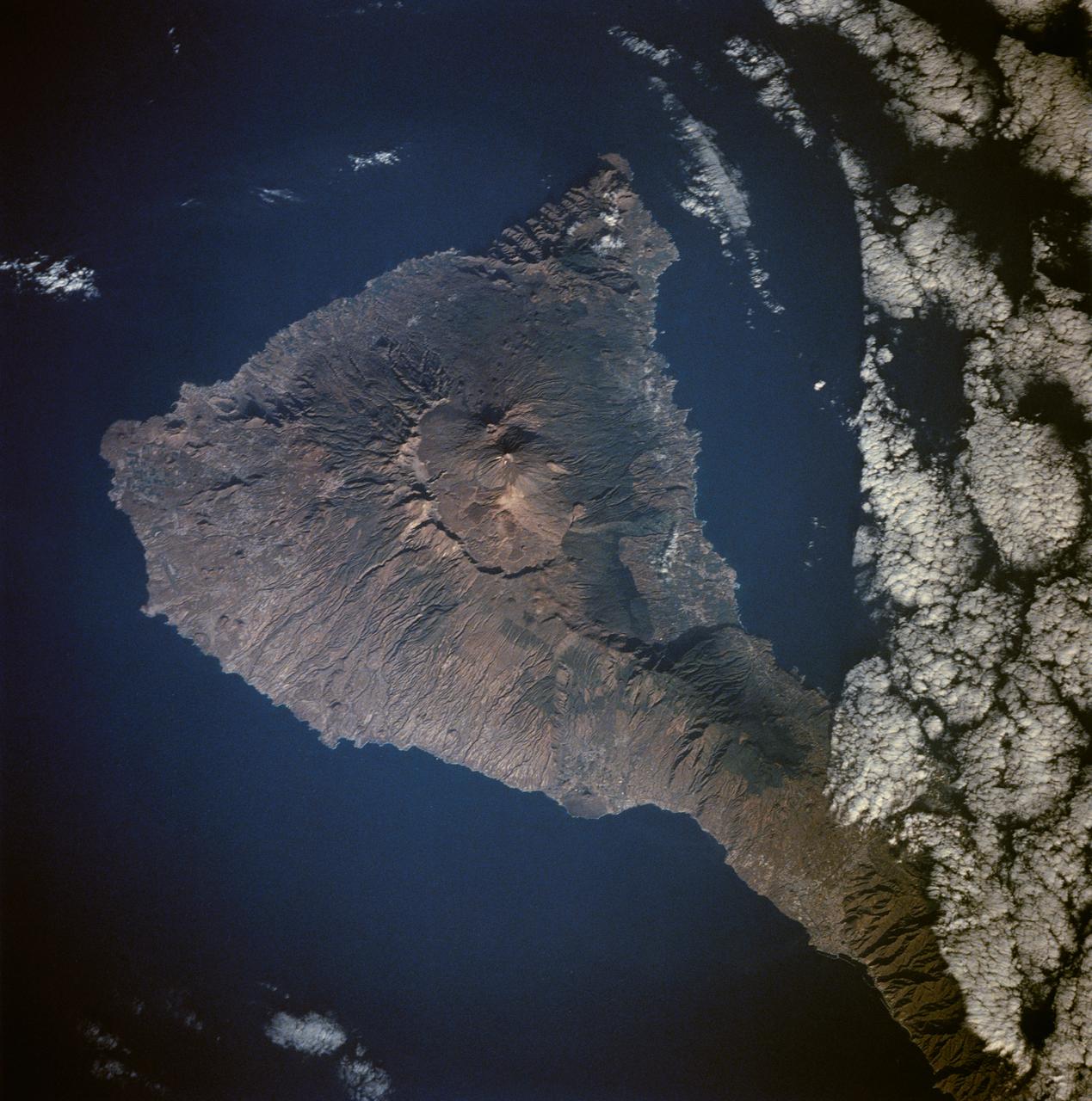
Tenarife Island is one of the most volcanically active of the Canary Island archipelago, Atlantic Ocean, just off the NW coast of Africa, (28.5N, 16.5W). The old central caldera, nearly filled in by successive volcanic activity culminating in two stratocones. From those two peaks, a line of smaller cinder cones extend to the point of the island. Extensive gullies dissect the west side of the island and some forests still remain on the east side.
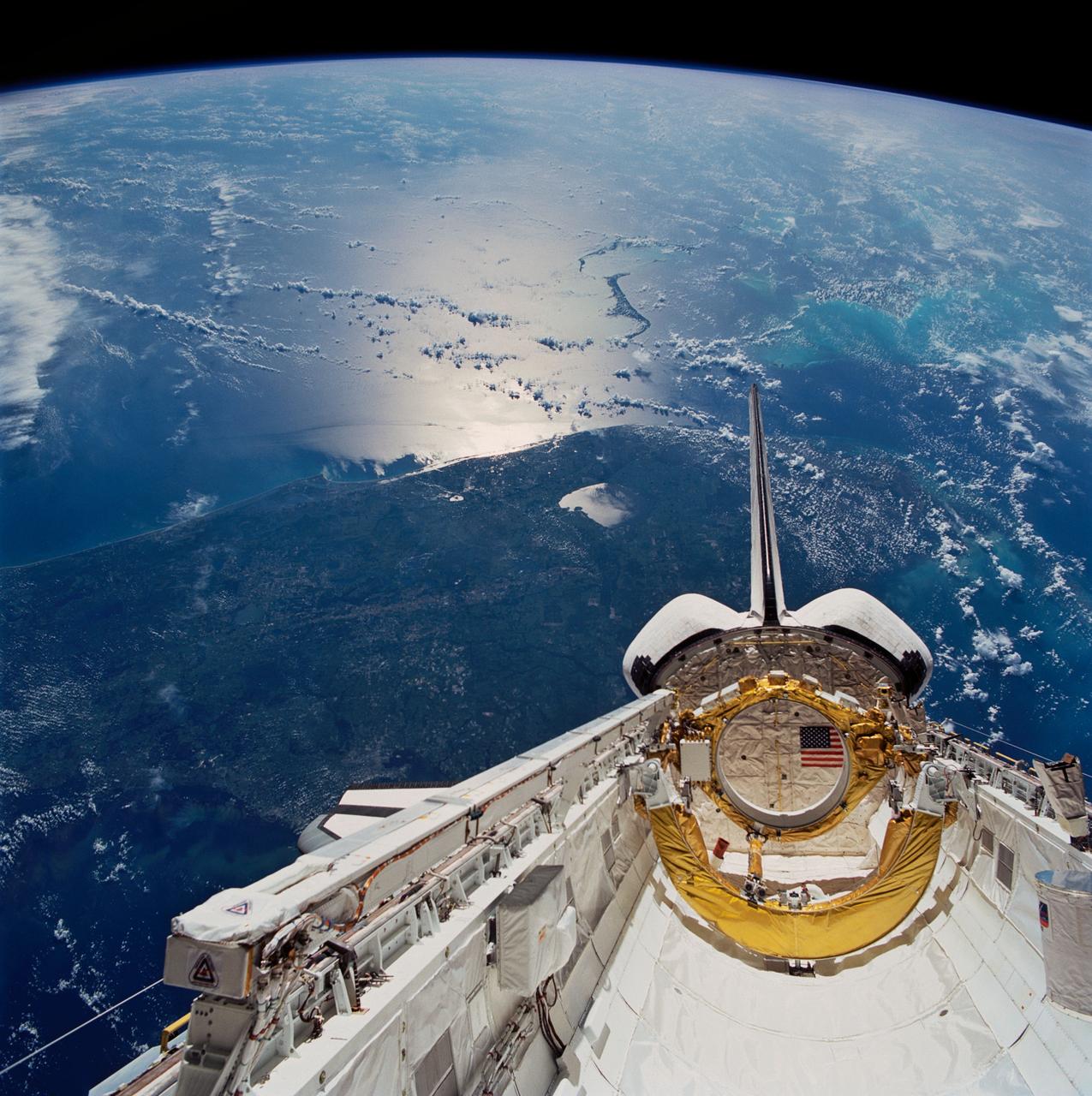
STS043-83-082 (2-11 Aug 1991) --- Having bade farewell to its Tracking and Data Relay Satellite/IUS payload, Atlantis' cargo bay appears somewhat vacant in this scene, backdropped over the southern two-thirds of the Florida peninsula. Important activity in the payload bay continues, however, with the operation of Space Station Heat Pipe Advanced Radiator Element (SHARE II), an experiment carried on the starboard side (lower left quadrant of frame). Purpose of the SHARE experiment is to demonstrate microgravity thermal vacuum performance of a heat pipe radiator for heat rejection as a prelude to development of a Space Station heat rejection system. The foil covered ring and horseshoe shaped objects aft in the payload bay served as restraint devices for the TDRS-E prior to its deployment six hours after Atlantis lifted off from Kennedy Space Center's Launch Pad 39A.
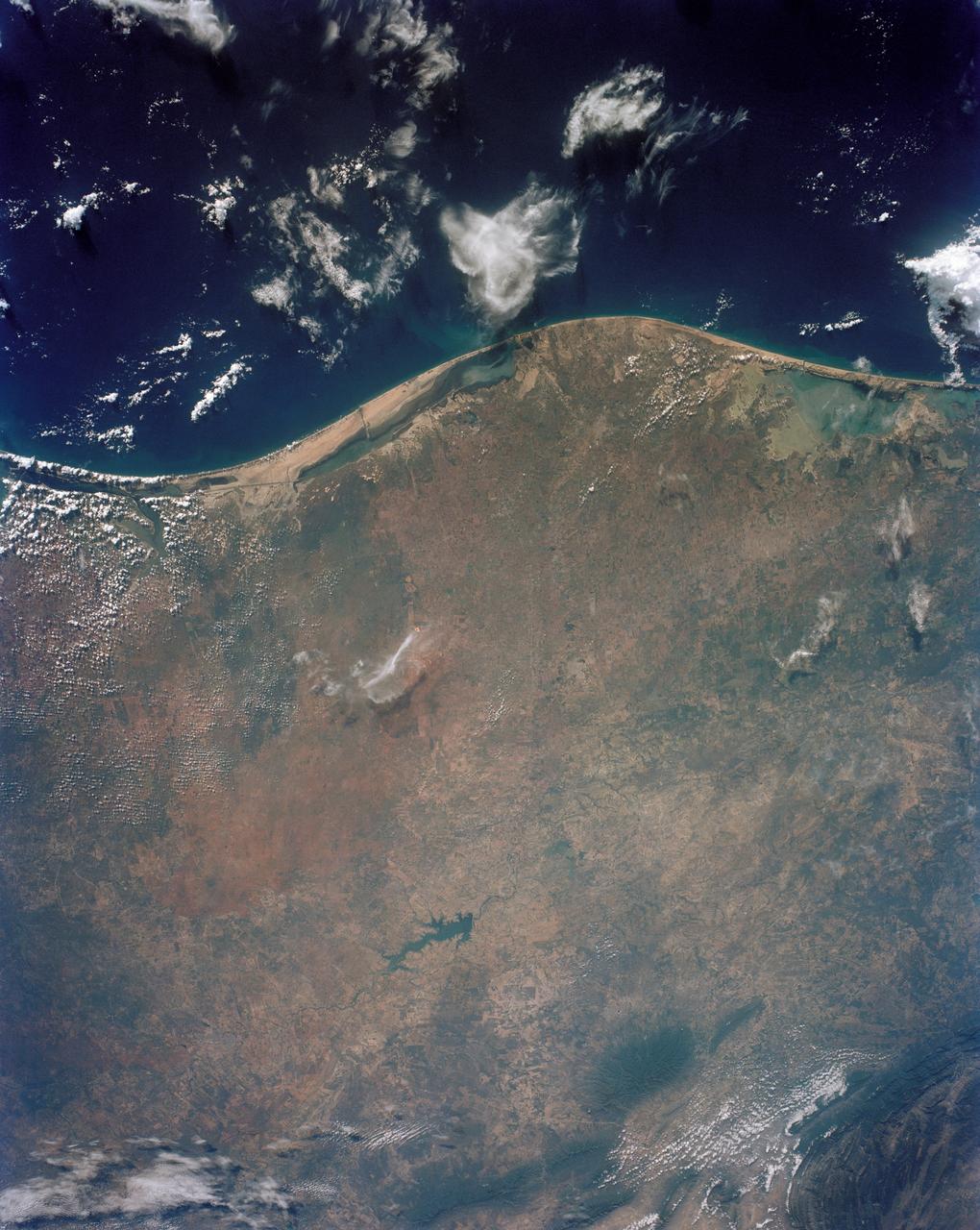
STS043-151-043 (8 August 1991) --- The Rio Grande extends across the center of this photograph from Falcon Reservoir to its bulging delta, joining the Gulf of Mexico. Sediment brought down by the river is spread northward and southward by alongshore currents to form the barrier chain of Padre Island and its protected Laguna Madre Speckled agricultural land use patterns in the river valley contrast with range land northward from the white cloud, and with closed canopy forest on hills in Mexico. A Linhof camera with a 90mm lens, was used to expose the frame at 14:43 GMT, Aug. 8, 1991.
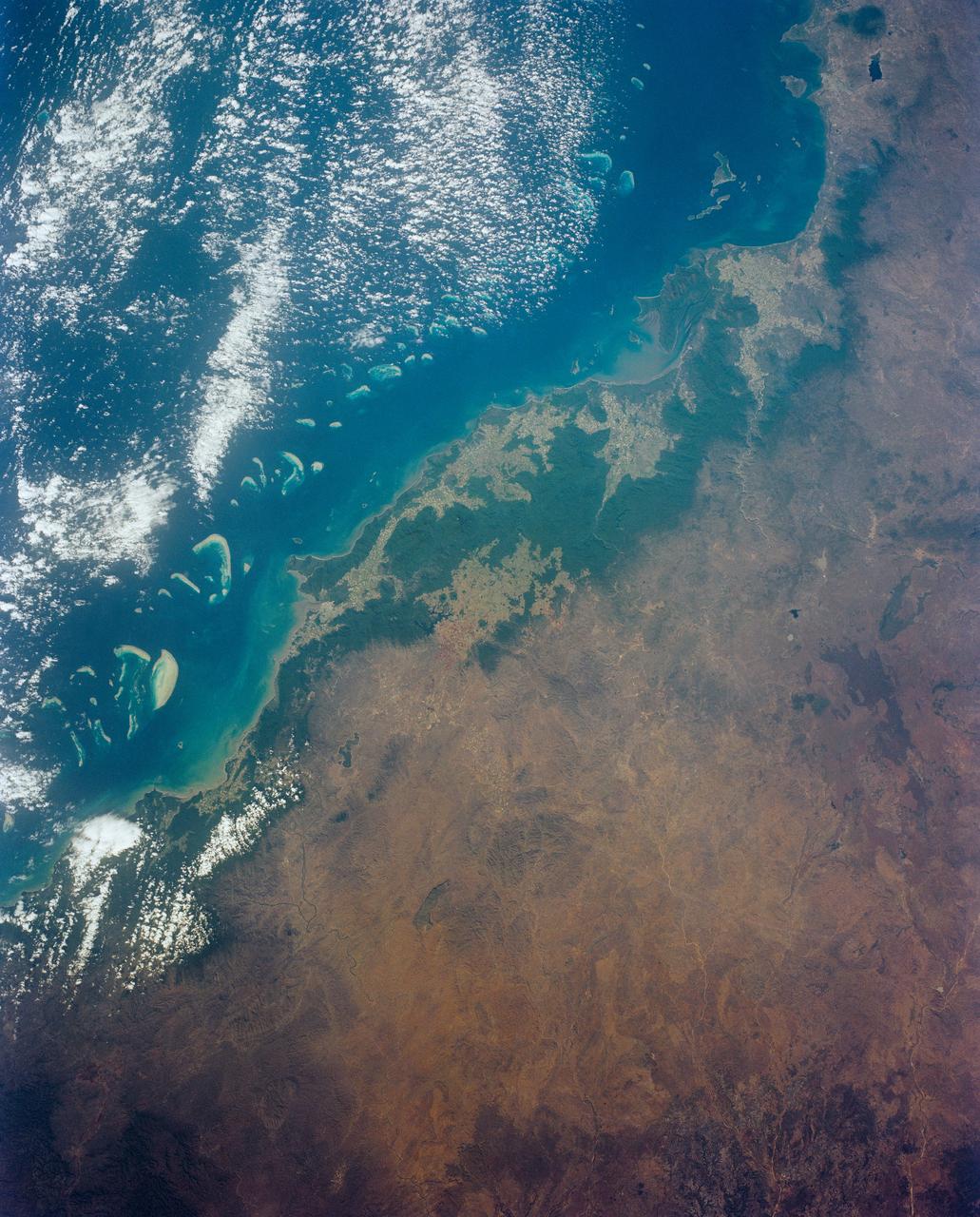
Cairns and Townsville area, on the northeast coast of Queensland, Australia (17.0S, 146.0E) is one of the best sport diving localities in the world where divers can explore the rich and varied flora and fauna of the nearby Great Barrier Reef. Onshore, the timbered foothills of the Great Dividing Range, seen as dark green areas, separate the semi arid interior of Queensland.

Huge sediment loads from the interior of the country flow through the Mouths of the Amazon River, Brazil (0.5S, 50.0W). The river current carries hundreds of tons of sediment through the multiple outlets of the great river over 100 miles from shore before it is carried northward by oceanic currents. The characteristic "fair weather cumulus" pattern of low clouds over the land but not over water may be observed in this scene.
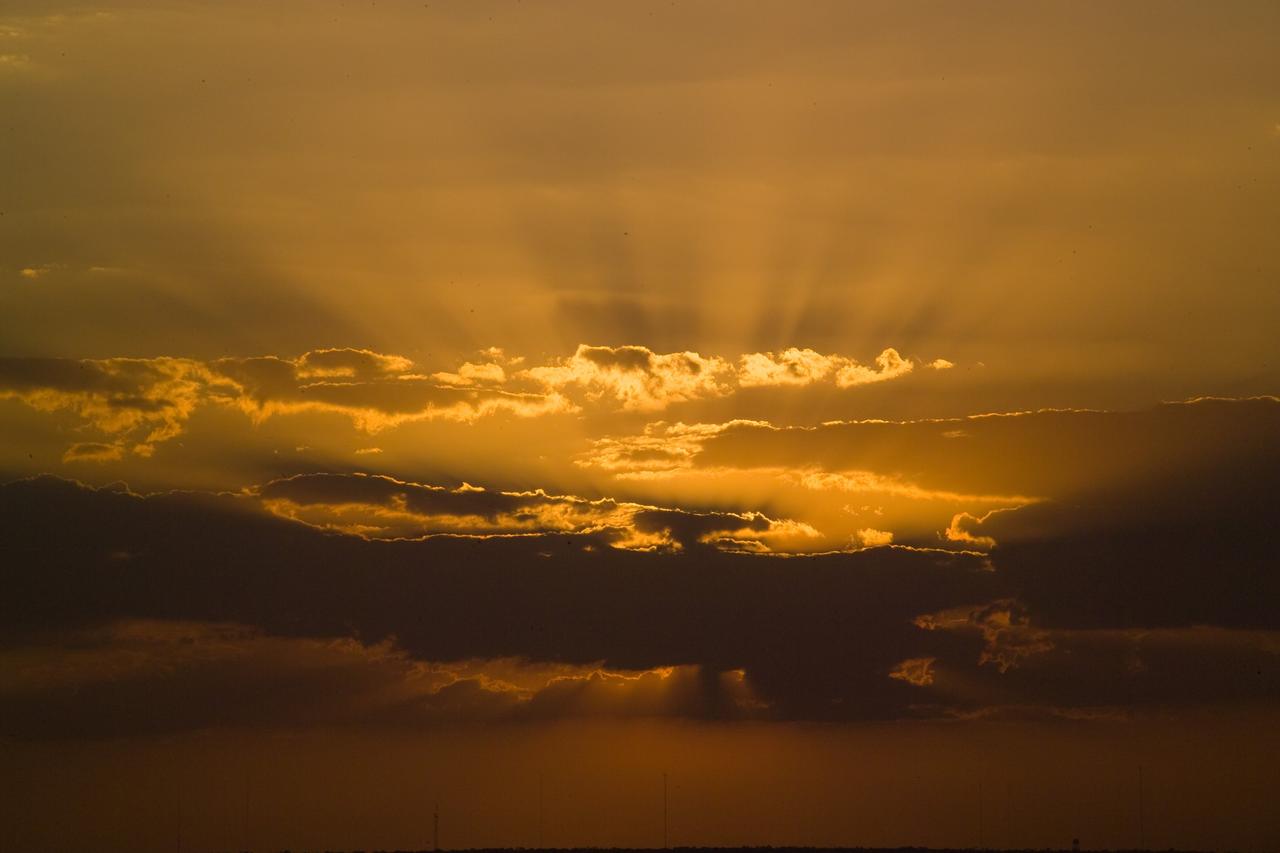
CAPE CANAVERAL, Fla. – The setting sun paints the clouds over NASA's Kennedy Space Center in Florida before the launch of space shuttle Discovery on the STS-119 mission. Liftoff of Discovery was on time at 7:43 p.m. EDT. The STS-119 mission is the 28th to the International Space Station and the 125th space shuttle flight. Discovery will deliver the final pair of power-generating solar array wings and the S6 truss segment. Installation of S6 will signal the station's readiness to house a six-member crew for conducting increased science. Photo credit: NASA/Jeff Wolfe

KENNEDY SPACE CENTER, FLA. -- NASA Administrator Dan Goldin (right) joins other spectators at the Banana Creek viewing site in cheering the successful launch of Space Shuttle Endeavour on mission STS-99. The perfect liftoff occurred at 12:43:40 p.m. EST. Known as the Shuttle Radar Topography Mission (SRTM), STS-99 will chart a new course to produce unrivaled 3-D images of the Earth's surface. The result of the SRTM could be close to 1 trillion measurements of the Earth's topography. The mission is expected to last 11days, with Endeavour landing at KSC Tuesday, Feb. 22, at 4:36 p.m. EST. This is the 97th Shuttle flight and 14th for Shuttle Endeavour
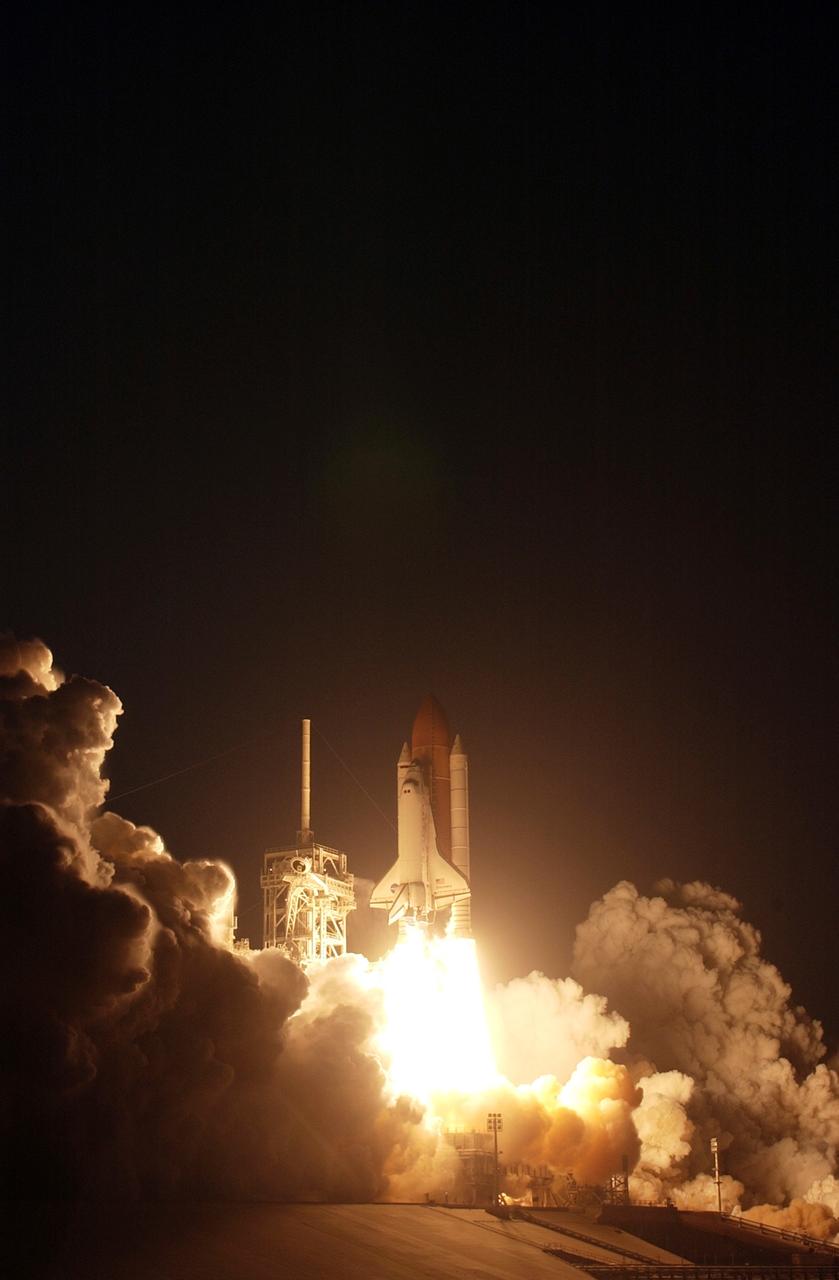
CAPE CANAVERAL, Fla. – Clouds of smoke and steam roll across Launch Pad 39A at NASA's Kennedy Space Center in Florida as space shuttle Discovery races toward space on mission STS-119. Launch was on time at 7:43 p.m. EDT. The STS-119 mission is the 28th to the International Space Station and the 125th space shuttle flight. Discovery will deliver the final pair of power-generating solar array wings and the S6 truss segment. Installation of S6 will signal the station's readiness to house a six-member crew for conducting increased science. Photo credit: NASA/Sandra Joseph, Kevin O'Connell
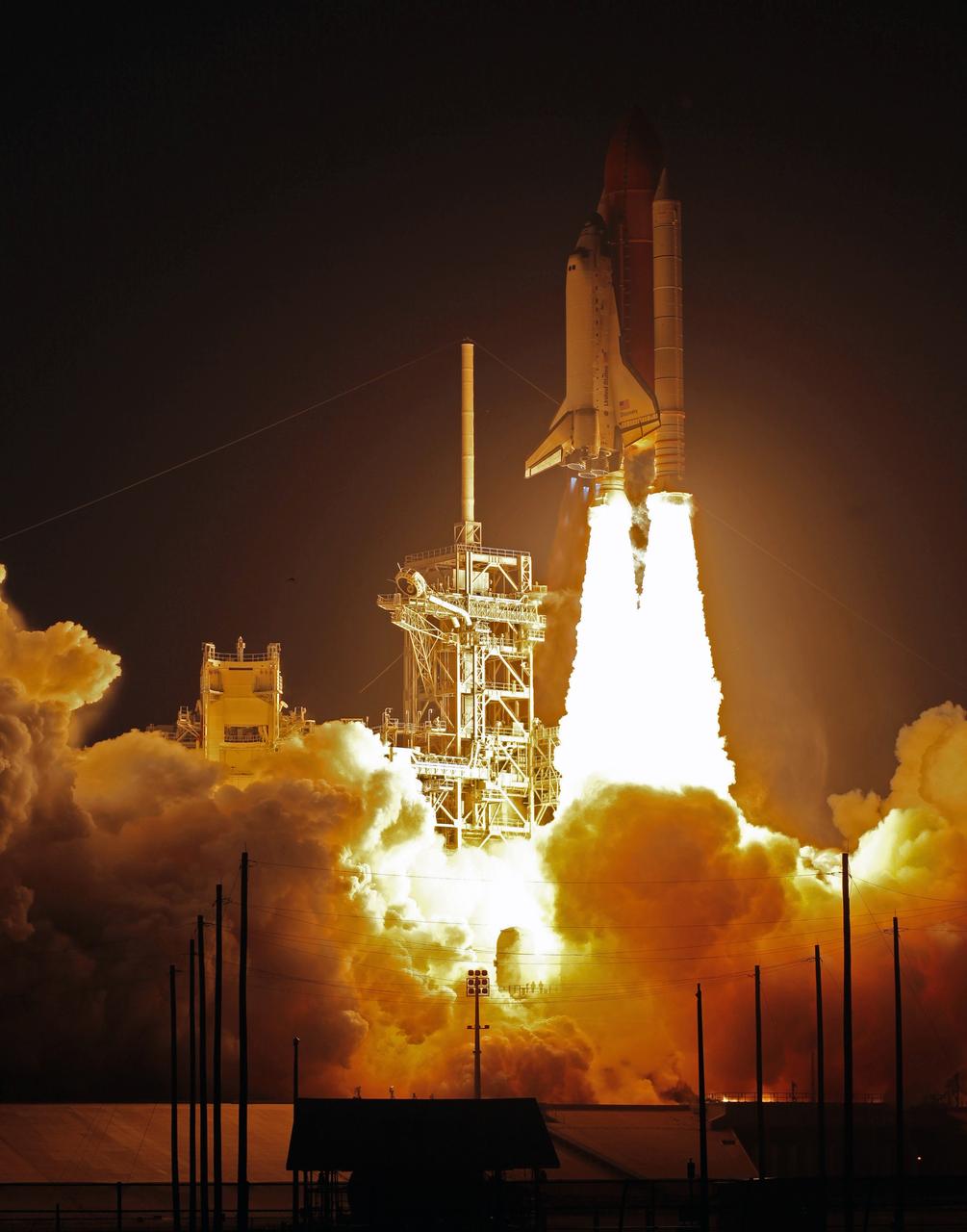
CAPE CANAVERAL, Fla. – Space shuttle Discovery roars off Launch Pad 39A on the STS-119 mission atop twin towers of fire that light up the sky after sunset at NASA's Kennedy Space Center in Florida. Liftoff was on time at 7:43 p.m. EDT. The STS-119 mission is the 28th to the International Space Station and the 125th space shuttle flight. Discovery will deliver the final pair of power-generating solar array wings and the S6 truss segment. Installation of S6 will signal the station's readiness to house a six-member crew for conducting increased science. Photo courtesy of Scott Andrews
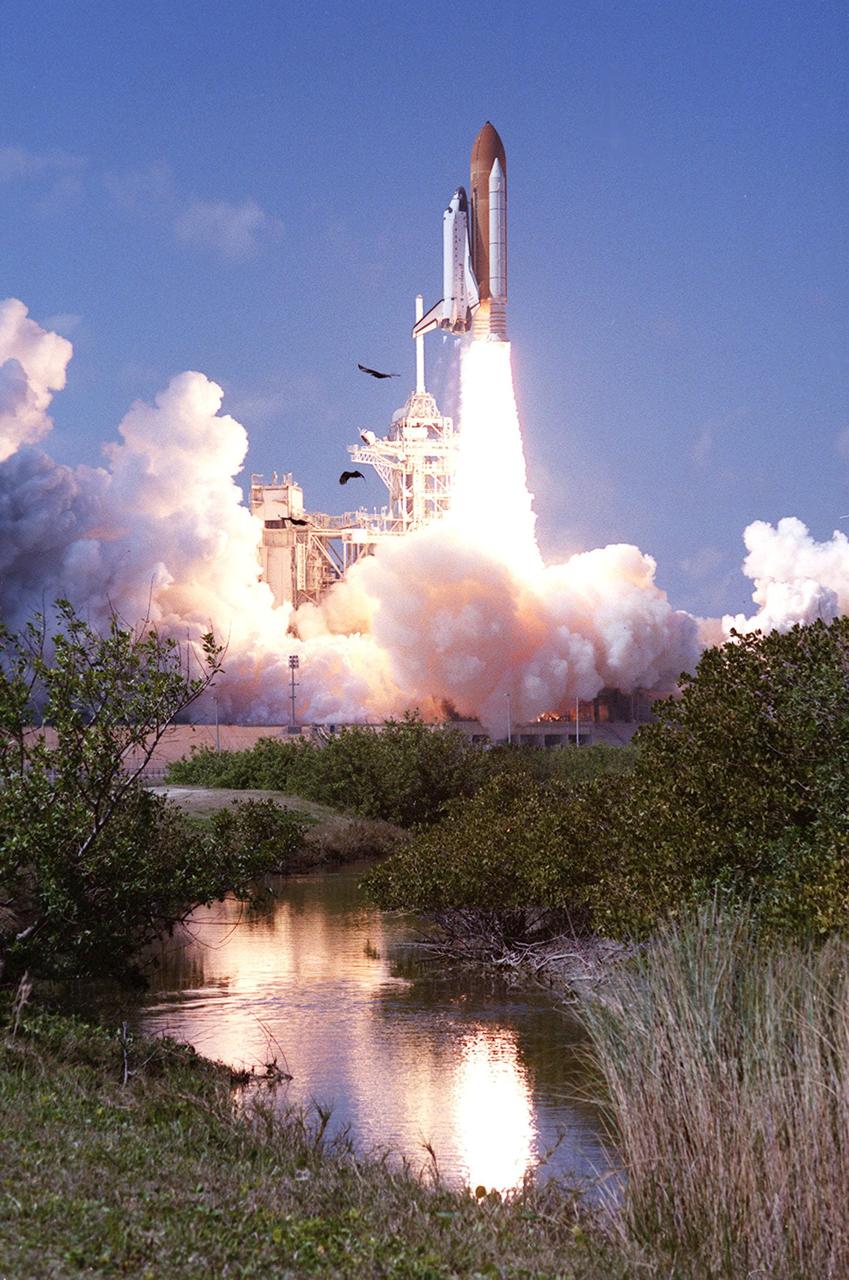
KENNEDY SPACE CENTER, Fla. -- After liftoff at 12:43:40 p.m. EST, the Space Shuttle Endeavour on mission STS-99 soars into a clear blue sky, trailed by flames and rolling billows of steam. The brilliant flames are reflected in the nearby waters. Known as the Shuttle Radar Topography Mission (SRTM), STS-99 will chart a new course to produce unrivaled 3-D images of the Earth's surface. The result of the SRTM could be close to 1 trillion measurements of the Earth's topography. The mission is expected to last 11days, with Endeavour landing at KSC Tuesday, Feb. 22, at 4:36 p.m. EST. This is the 97th Shuttle flight and 14th for Shuttle Endeavour
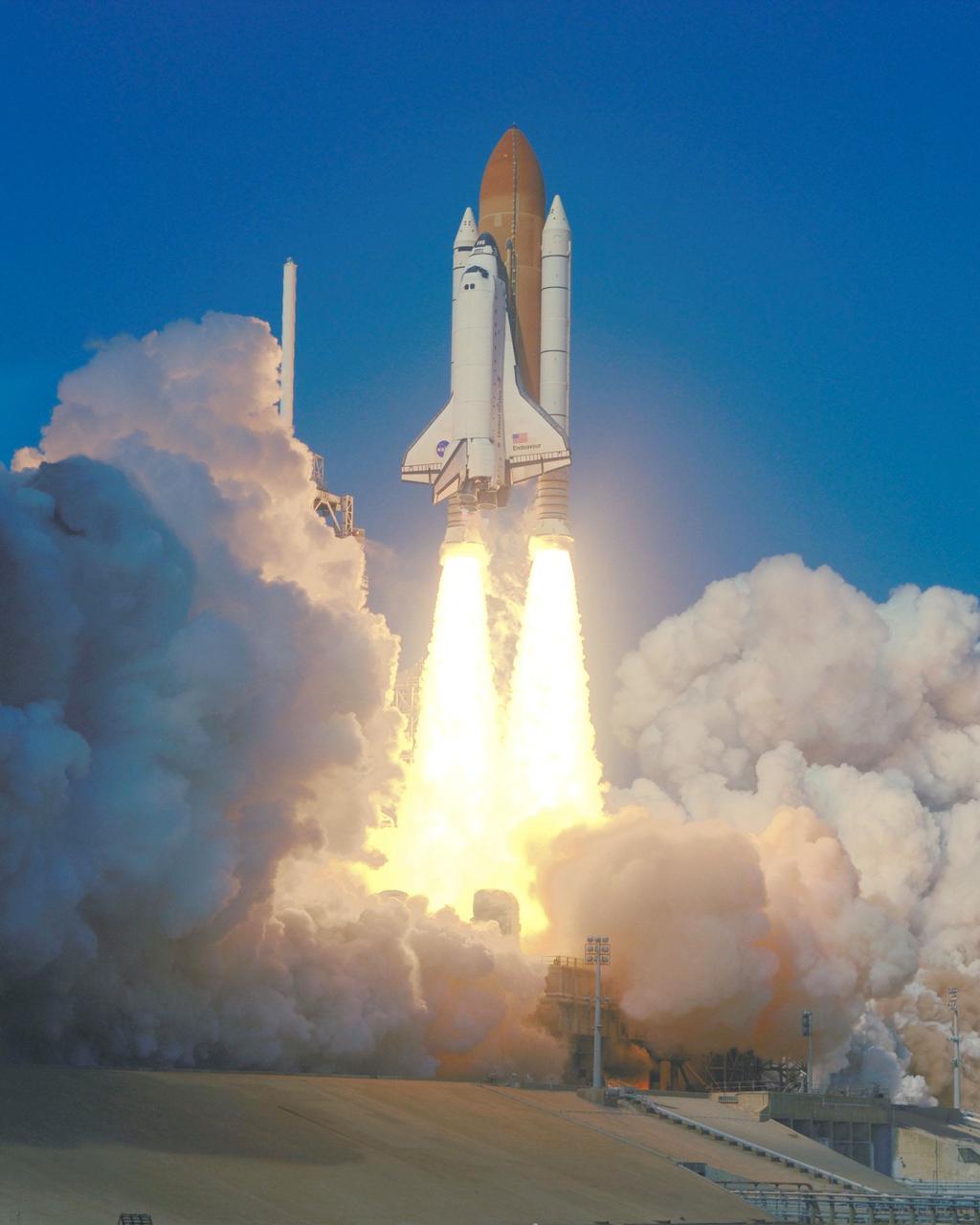
KENNEDY SPACE CENTER, Fla. -- Twin columns of flame flow from the solid rocket boosters, lighting the billows of steam behind them with an orange glow, as Space Shuttle Endeavour roars into space on mission STS-99. Liftoff occurred at 12:43:40 p.m. EST. Known as the Shuttle Radar Topography Mission (SRTM), STS-99 will chart a new course to produce unrivaled 3-D images of the Earth's surface. The result of the SRTM could be close to 1 trillion measurements of the Earth's topography. The mission is expected to last 11days, with Endeavour landing at KSC Tuesday, Feb. 22, at 4:36 p.m. EST. This is the 97th Shuttle flight and 14th for Shuttle Endeavour
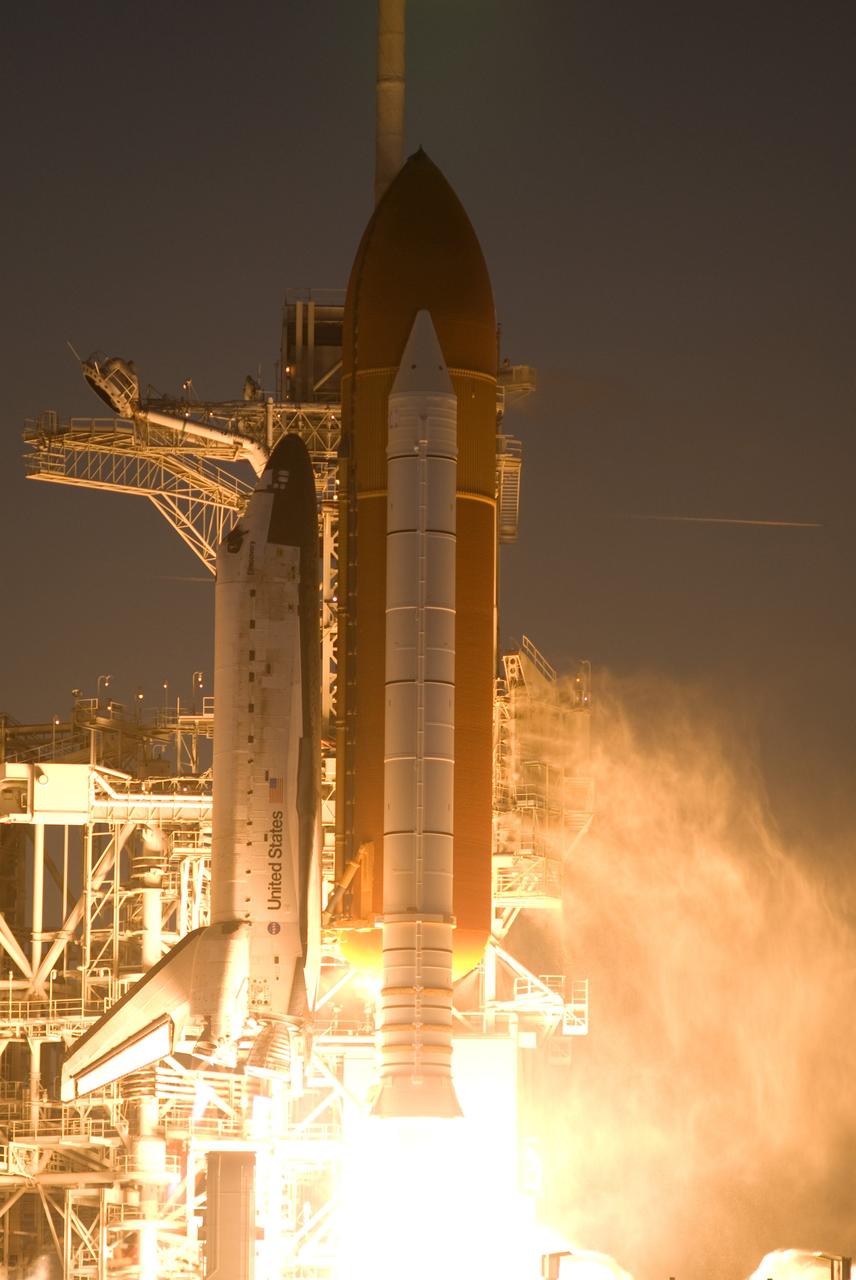
CAPE CANAVERAL, Fla. – Steam rises from Launch Pad 39A at NASA's Kennedy Space Center in Florida as space shuttle Discovery lifts off on mission STS-119. Launch was on time at 7:43 p.m. EDT. The STS-119 mission is the 28th to the International Space Station and the 125th space shuttle flight. Discovery will deliver the final pair of power-generating solar array wings and the S6 truss segment. Installation of S6 will signal the station's readiness to house a six-member crew for conducting increased science. Photo credit: NASA/Rusty Backer, George Roberts
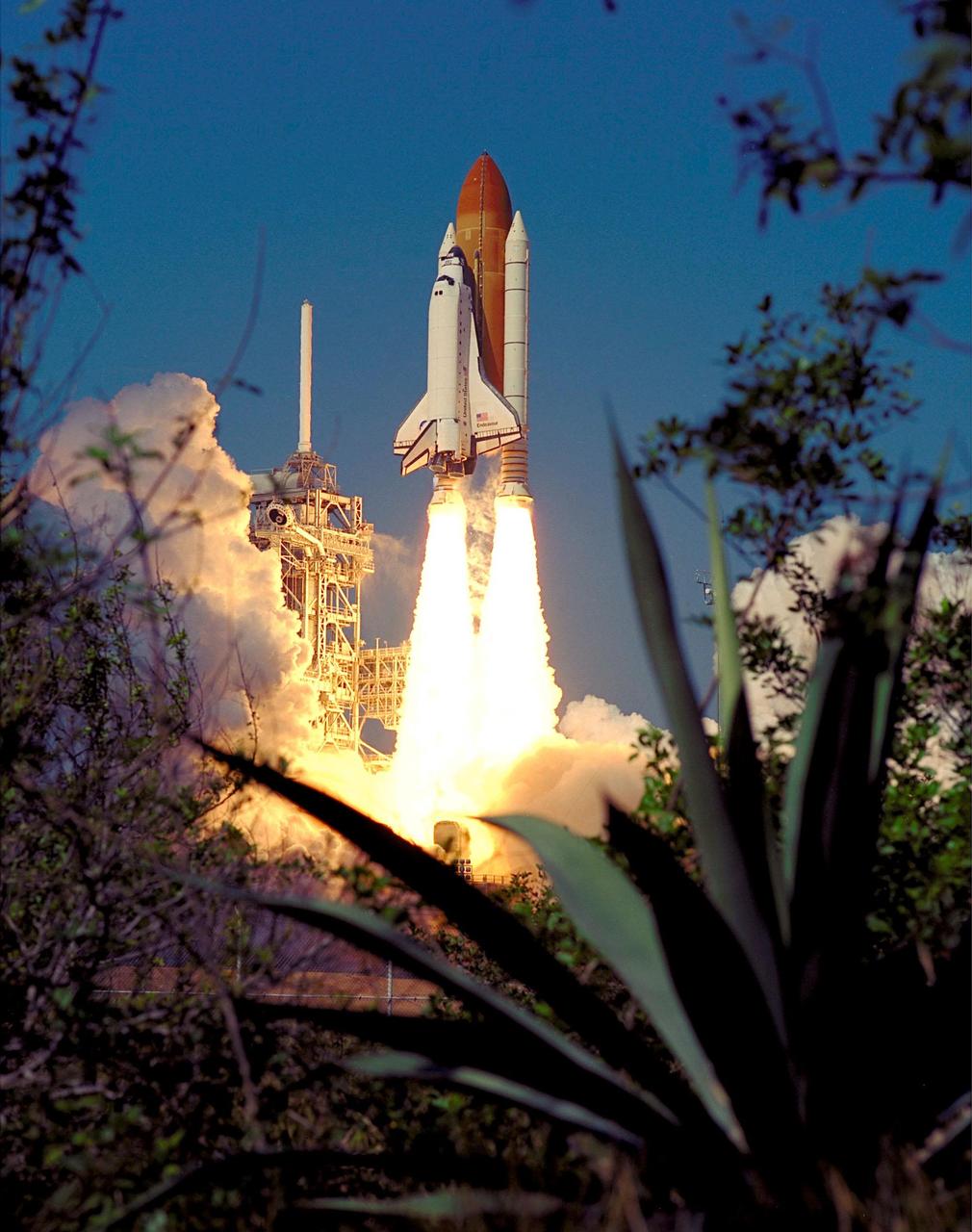
KENNEDY SPACE CENTER, Fla. -- Space Shuttle Endeavour seems to leap from the among the palmettos on its launch into the clear blue Florida sky. Launch of Endeavour on mission STS-99 occurred at 12:43:40 p.m. EST. Known as the Shuttle Radar Topography Mission (SRTM), STS-99 will chart a new course to produce unrivaled 3-D images of the Earth's surface. The result of the SRTM could be close to 1 trillion measurements of the Earth's topography. The mission is expected to last 11days, with Endeavour landing at KSC Tuesday, Feb. 22, at 4:36 p.m. EST. This is the 97th Shuttle flight and 14th for Shuttle Endeavour
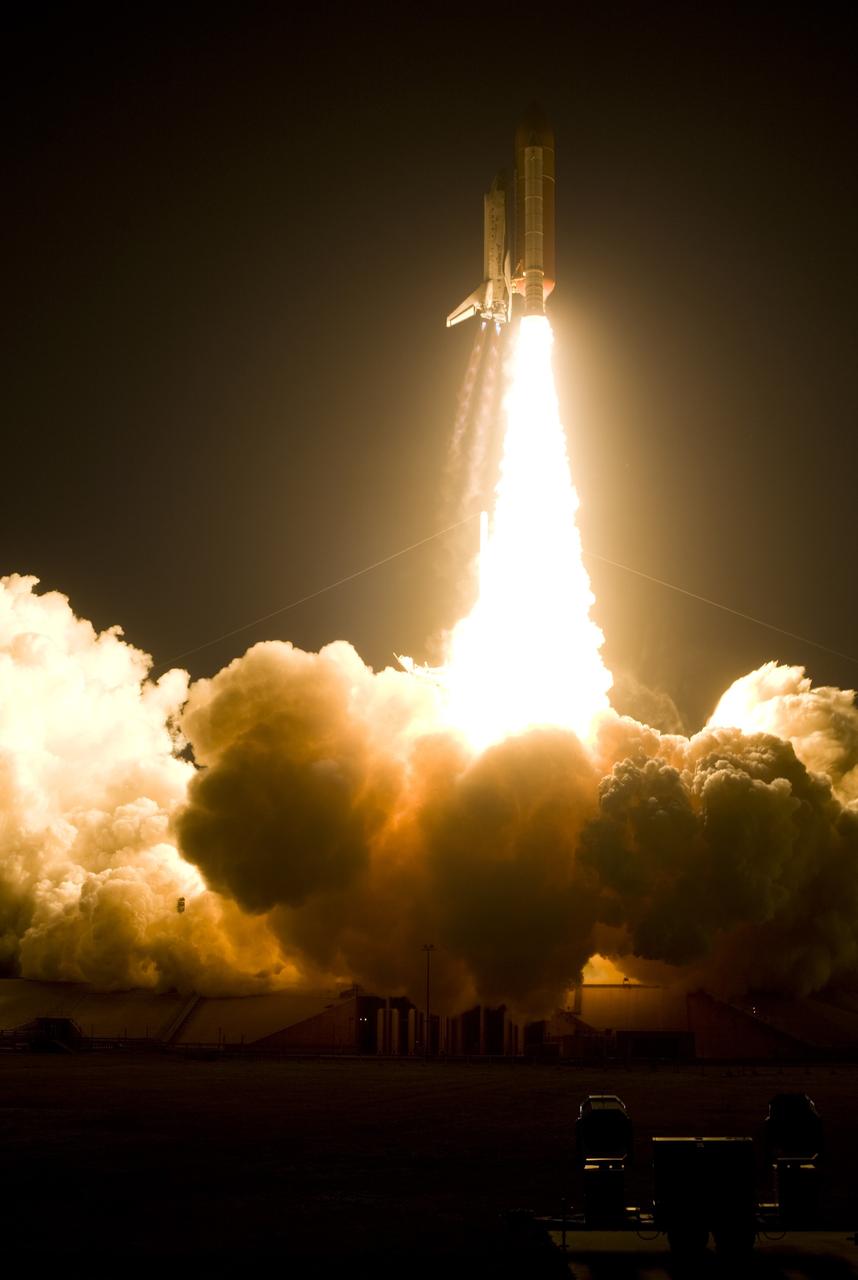
CAPE CANAVERAL, Fla. – Propelled by a column of fire, space shuttle Discovery races toward space on the STS-119 mission after liftoff from Launch Pad 39A at NASA's Kennedy Space Center in Florida. Launch was on time at 7:43 p.m. EDT. The STS-119 mission is the 28th to the International Space Station and the 125th space shuttle flight. Discovery will deliver the final pair of power-generating solar array wings and the S6 truss segment. Installation of S6 will signal the station's readiness to house a six-member crew for conducting increased science. Photo courtesy of Scott Andrews
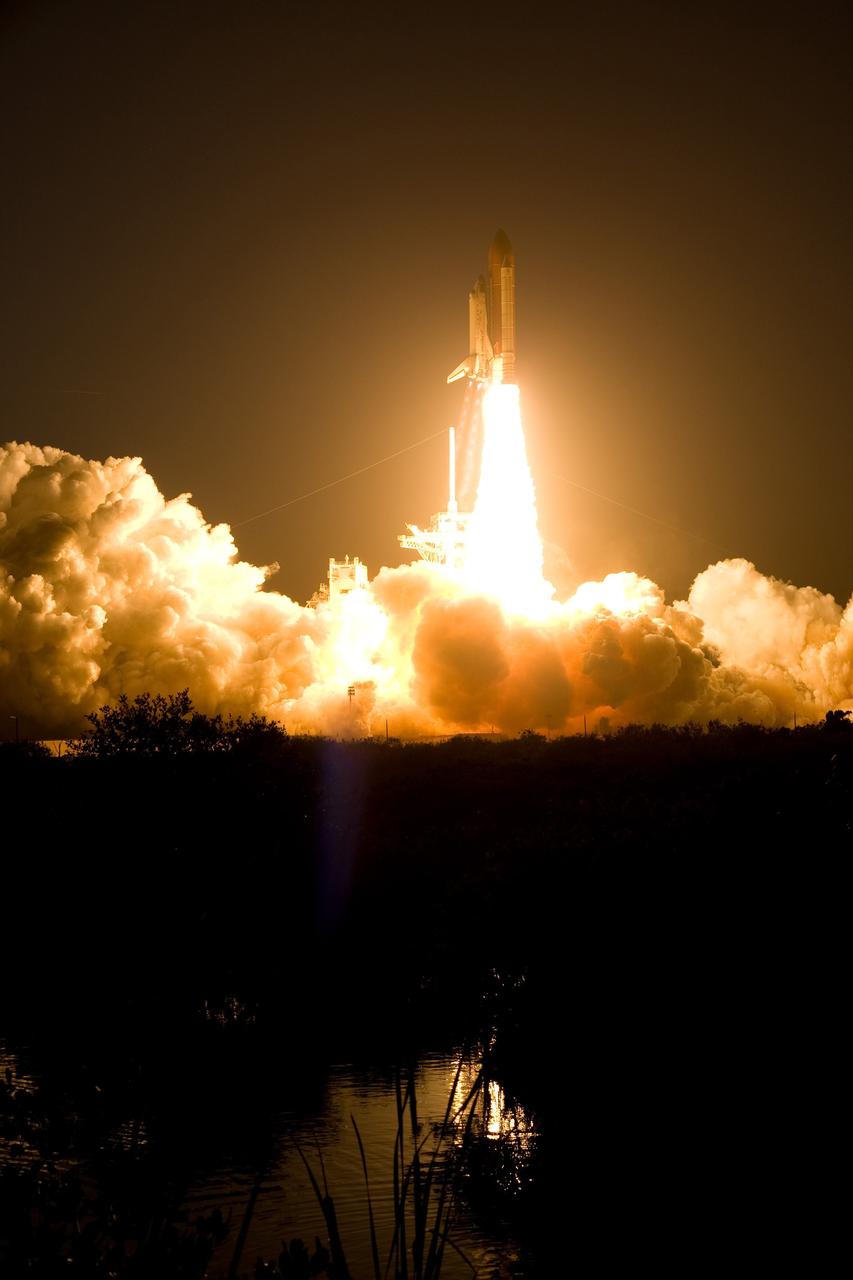
CAPE CANAVERAL, Fla. – Brilliant flames ignite the sky over Launch Pad 39A at NASA's Kennedy Space Center in Florida as space shuttle Discovery roars toward space on the STS-119 mission. Liftoff was on time at 7:43 p.m. EDT. The STS-119 mission is the 28th to the International Space Station and the 125th space shuttle flight. Discovery will deliver the final pair of power-generating solar array wings and the S6 truss segment. Installation of S6 will signal the station's readiness to house a six-member crew for conducting increased science. Photo credit: NASA/Sandra Joseph, Kevin O'Connell
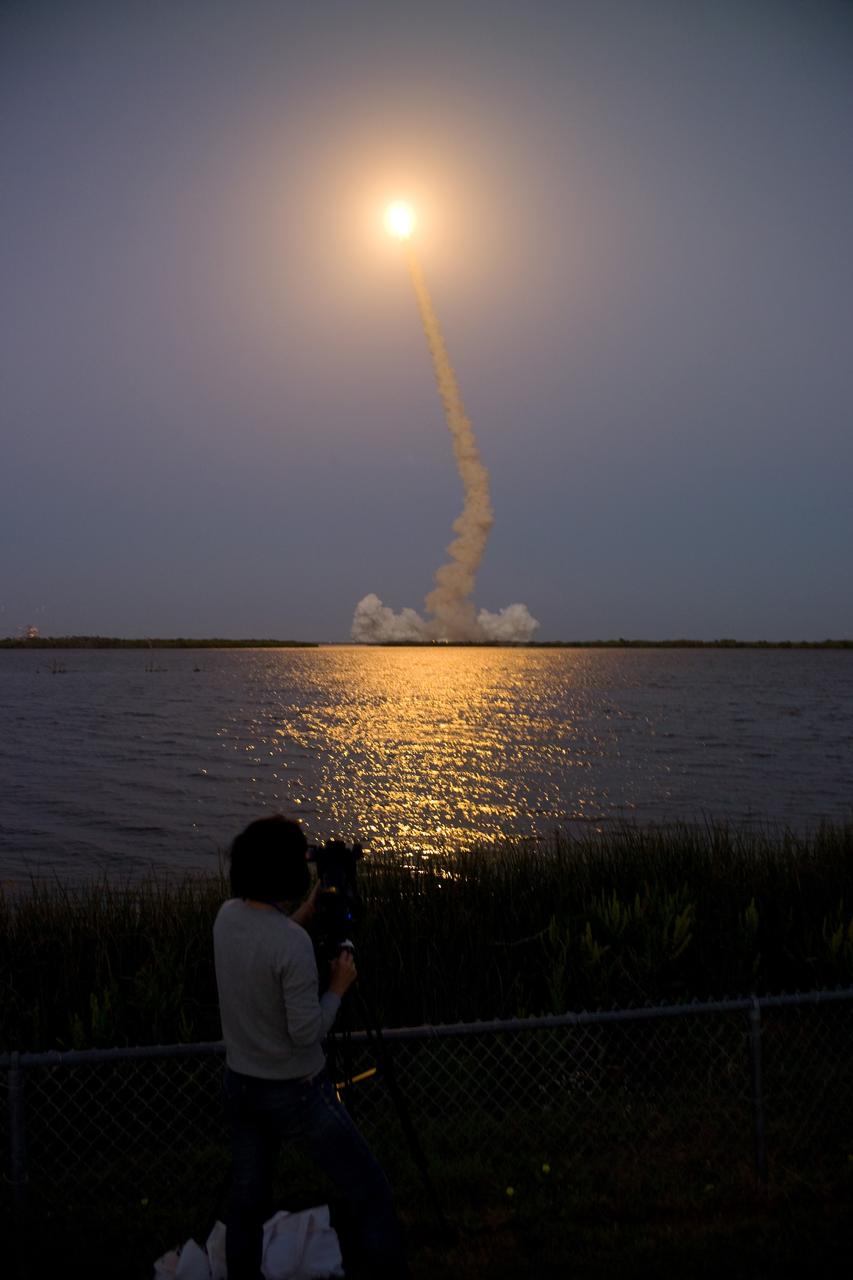
CAPE CANAVERAL, Fla. – Seen from the Banana River Viewing Site at NASA's Kennedy Space Center in Florida, space shuttle Discovery emulates a rising sun as it heads for space on the STS-119 mission. Liftoff from Launch Pad 39A was on time at 7:43 p.m. EDT. The STS-119 mission is the 28th to the space station and Discovery's 36th flight. Discovery will deliver the final pair of power-generating solar array wings and the S6 truss segment. Installation of S6 will signal the station's readiness to house a six-member crew for conducting increased science. Photo credit: NASA/Chris Lynch
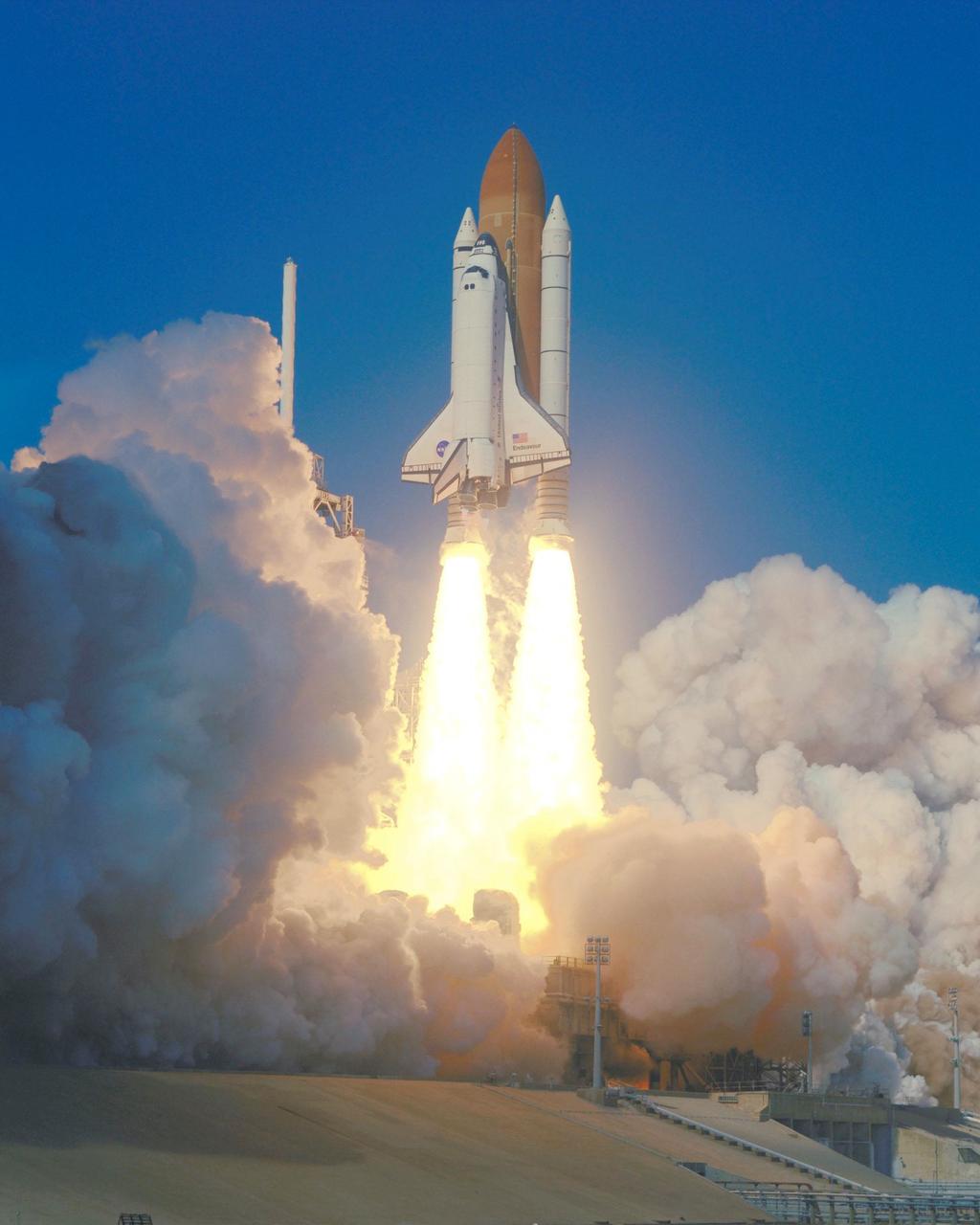
KENNEDY SPACE CENTER, Fla. -- Twin columns of flame flow from the solid rocket boosters, lighting the billows of steam behind them with an orange glow, as Space Shuttle Endeavour roars into space on mission STS-99. Liftoff occurred at 12:43:40 p.m. EST. Known as the Shuttle Radar Topography Mission (SRTM), STS-99 will chart a new course to produce unrivaled 3-D images of the Earth's surface. The result of the SRTM could be close to 1 trillion measurements of the Earth's topography. The mission is expected to last 11days, with Endeavour landing at KSC Tuesday, Feb. 22, at 4:36 p.m. EST. This is the 97th Shuttle flight and 14th for Shuttle Endeavour
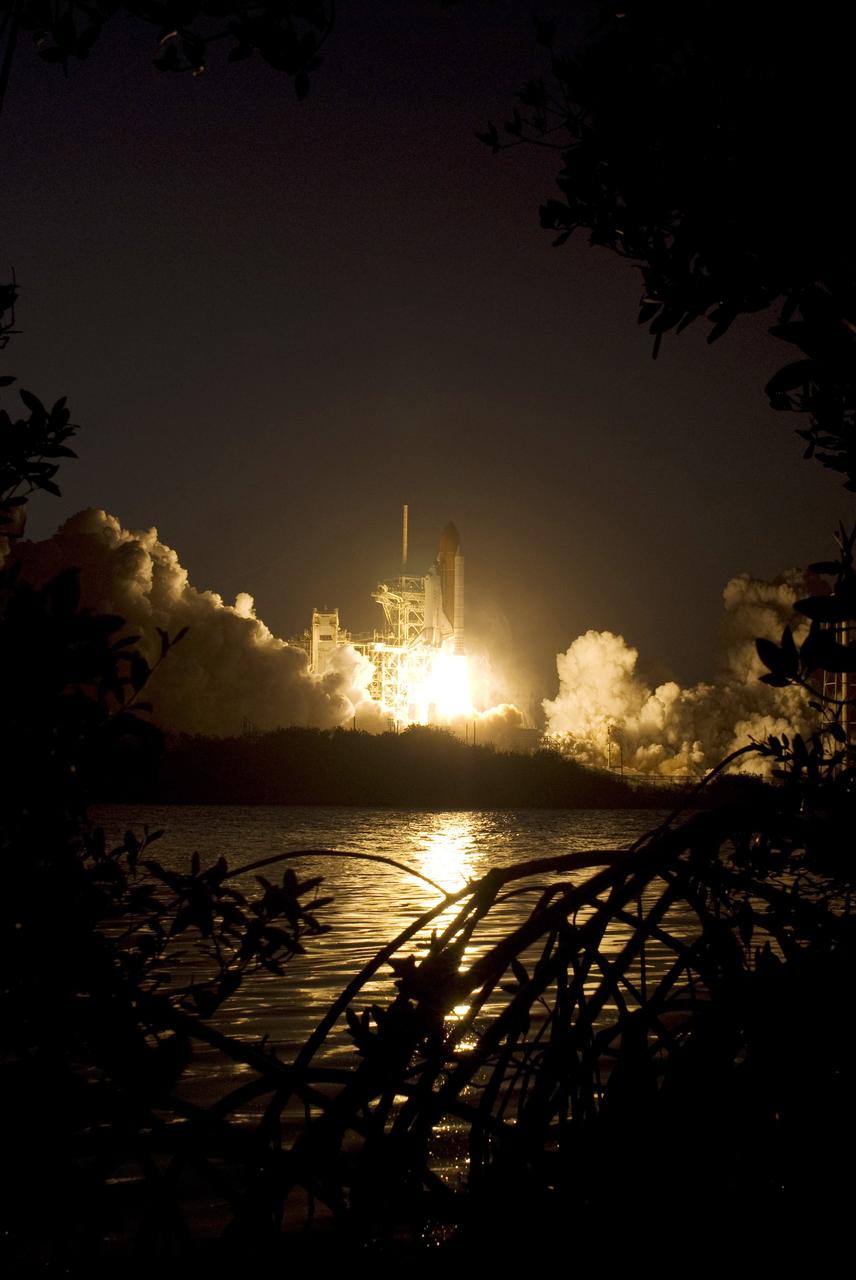
CAPE CANAVERAL, Fla. – Viewed across the water near Launch Pad 39A at NASA's Kennedy Space Center in Florida, launch of space shuttle Discovery on the STS-119 mission spews fire into the night. The launch was on time at 7:43 p.m. EDT. The STS-119 mission is the 28th to the International Space Station and the 125th space shuttle flight. Discovery will deliver the final pair of power-generating solar array wings and the S6 truss segment. Installation of S6 will signal the station's readiness to house a six-member crew for conducting increased science. Photo credit: NASA/Sandra Joseph, Kevin O'Connell
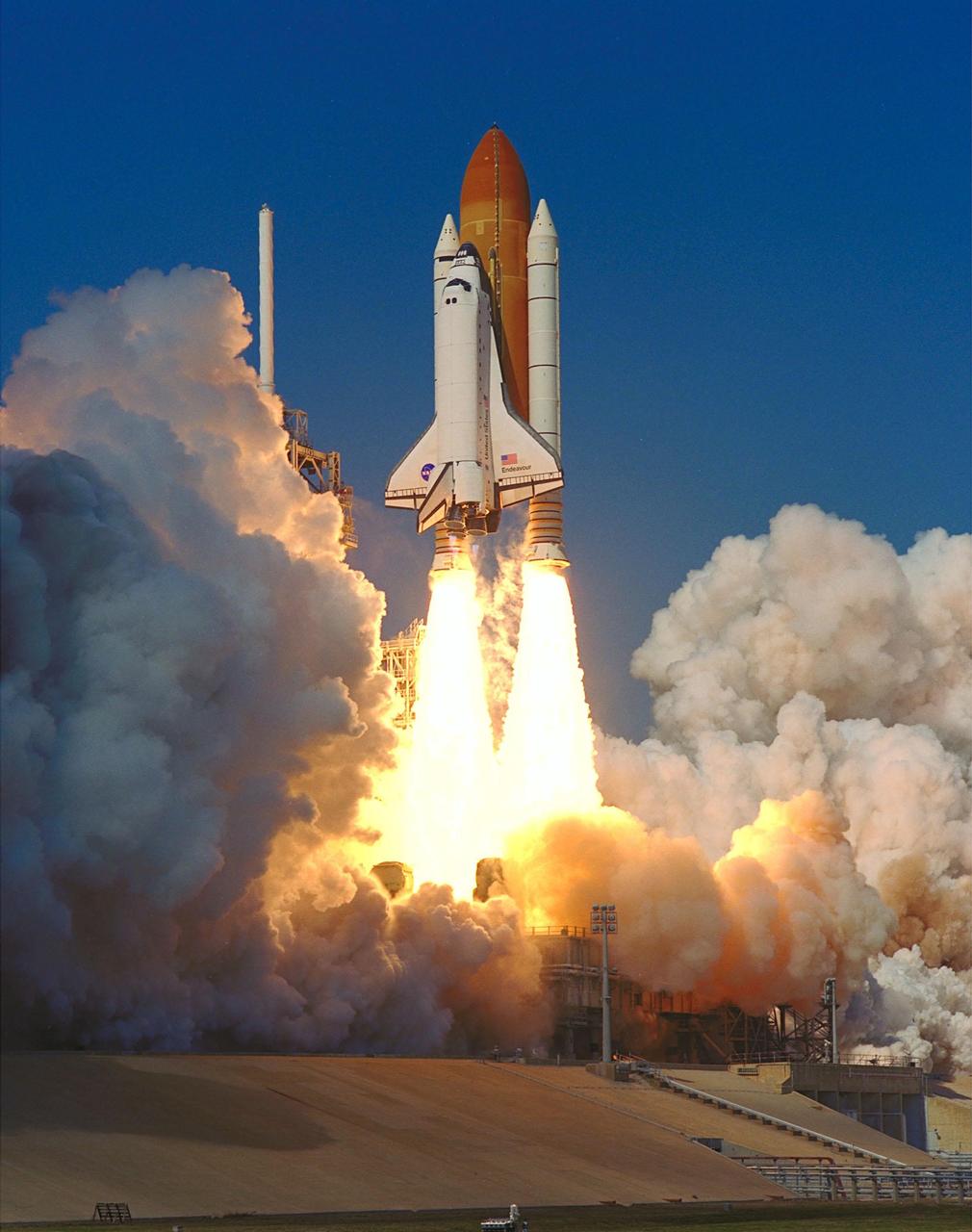
KENNEDY SPACE CENTER, Fla. -- Twin columns of flame flow from the solid rocket boosters, lighting the billows of steam behind them with an orange glow, as Space Shuttle Endeavour roars into space on mission STS-99. Liftoff occurred at 12:43:40 p.m. EST. Known as the Shuttle Radar Topography Mission (SRTM), STS-99 will chart a new course to produce unrivaled 3-D images of the Earth's surface. The result of the SRTM could be close to 1 trillion measurements of the Earth's topography. The mission is expected to last 11days, with Endeavour landing at KSC Tuesday, Feb. 22, at 4:36 p.m. EST. This is the 97th Shuttle flight and 14th for Shuttle Endeavour
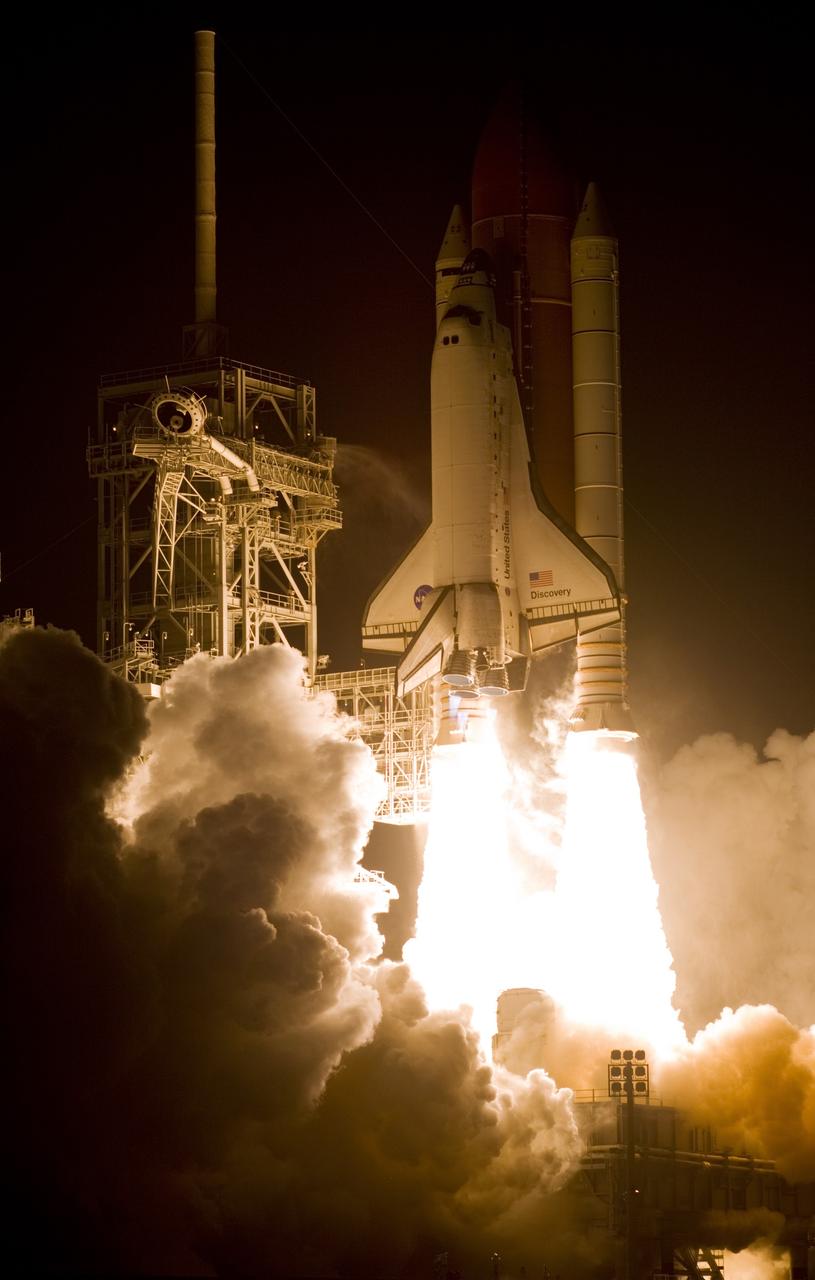
CAPE CANAVERAL, Fla. – At NASA's Kennedy Space Center in Florida, twin columns of fire propel space shuttle Discovery from Launch Pad 39A toward space on mission STS-119. Launch was on time at 7:43 p.m. EDT. The STS-119 mission is the 28th to the International Space Station and the 125th space shuttle flight. Discovery will deliver the final pair of power-generating solar array wings and the S6 truss segment. Installation of S6 will signal the station's readiness to house a six-member crew for conducting increased science. Photo courtesy of Scott Andrews