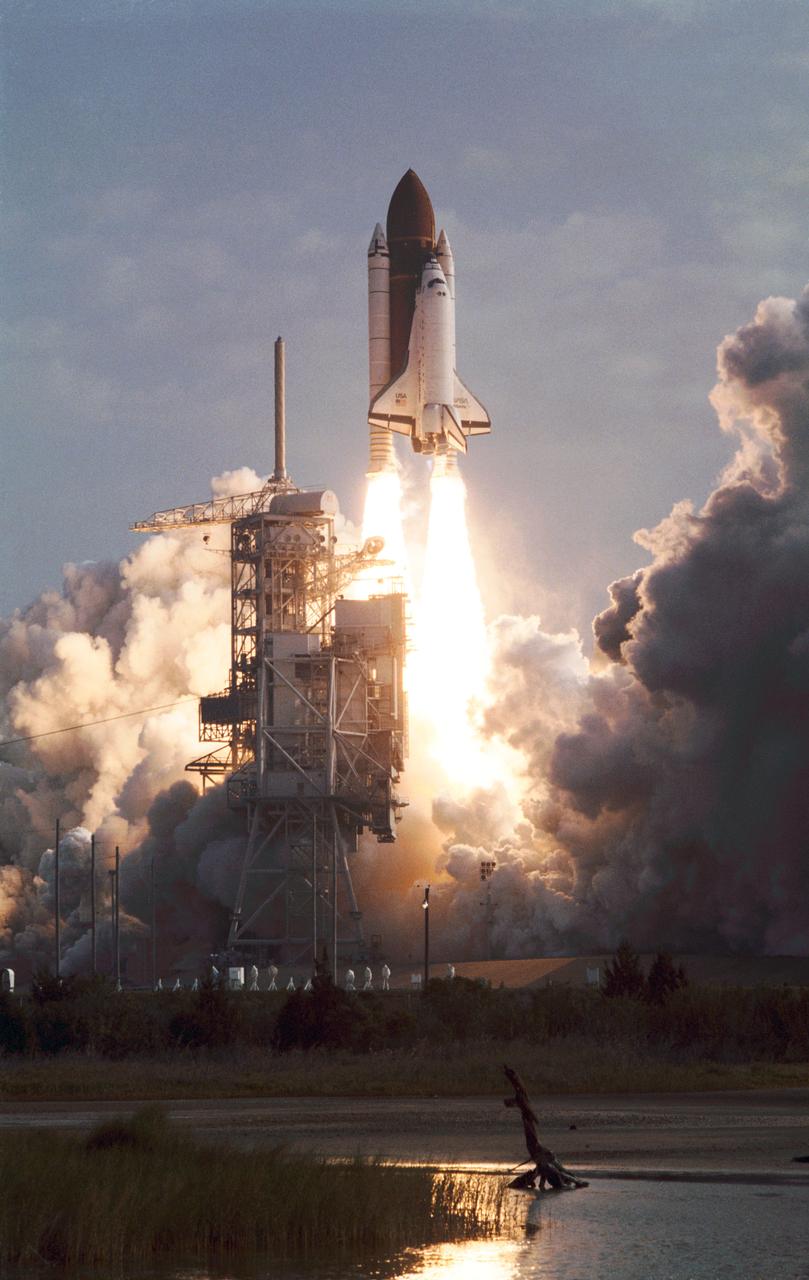
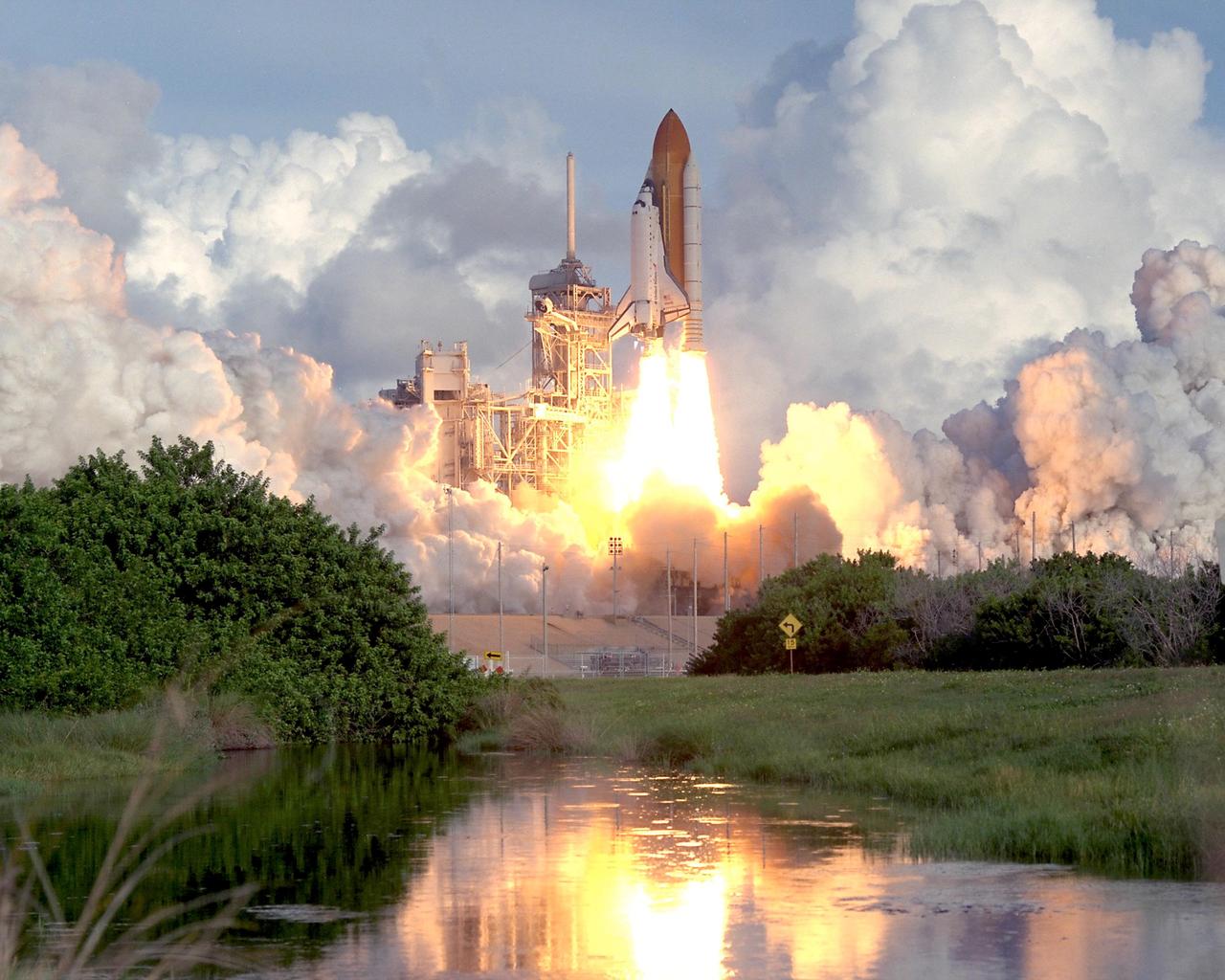
STS-45 Atlantis, Orbiter Vehicle (OV) 104, lifts off from a Kennedy Space Center (KSC) Launch Complex (LC) Pad at 8:13:40:048 am (Eastern Standard Time (EST)). Exhaust billows out the solid rocket boosters (SRBs) as OV-104 atop its external tank (ET) soars above the mobile launcher platform and is nearly clear of the fixed service structure (FSS) tower. The diamond shock effect produced by the space shuttle main engines (SSMEs) is visible. The glow of the SRB/SSME firings is reflected in a nearby waterway. An exhaust cloud covers the launch pad area.
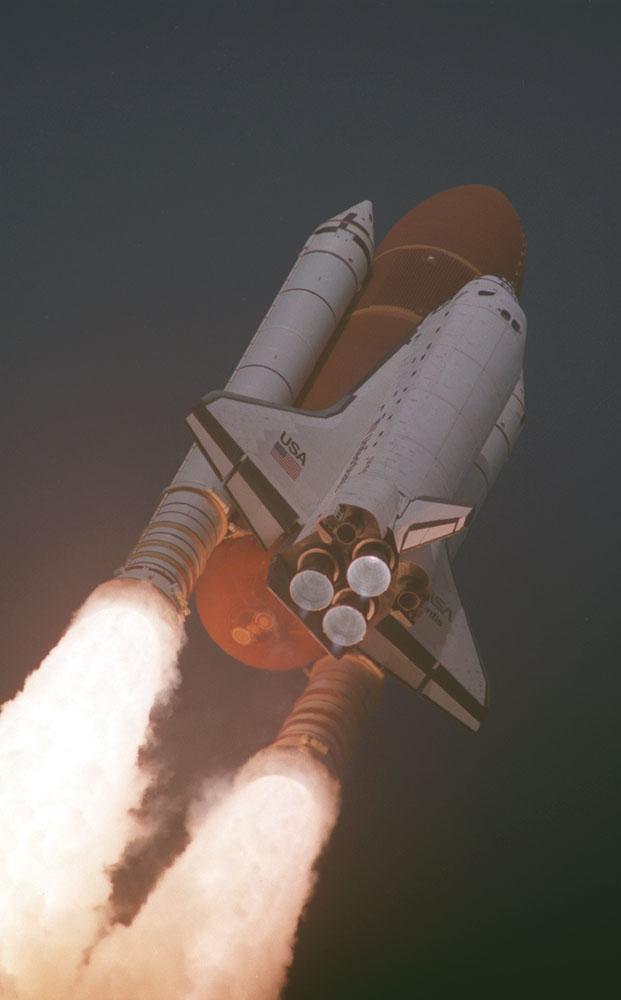
The Space Shuttle Atlantis (STS-45) roars into space in this photo showing a close-up of the Solid Rocket Boosters (SRBs) and the external tank. Atlantis' mission included experiments on the Atmospheric Lab for Applications and Sciences (ATLAS). ATLAS-1 measures long-term variability in the total energy radiated by the sun and determines the variability in the solar spectrum.
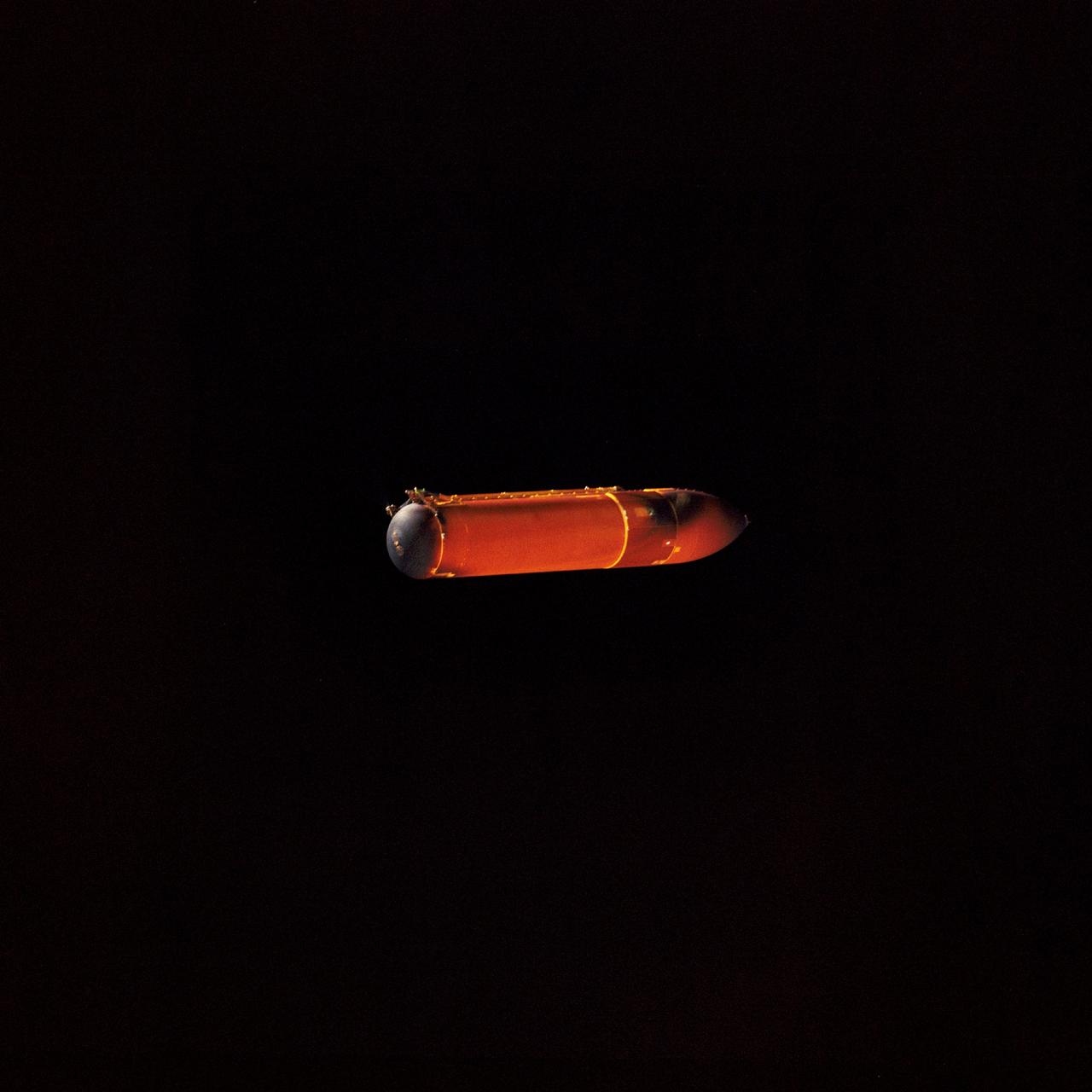
STS045-71-001 (24 March 1992) --- This 70mm photograph of the external fuel tank (ET) for STS-45 was photographed 4 1/2 minutes after having been jettisoned from Space Shuttle Atlantis. The excellent view of the starboard side of the ET shows both top and bottom attach points to the two solid rocket boosters (SRB). NASA engineers studying the STS-45 onboard photography deem the visible burn scars, caused by the SRBs, to be normal. The long thin pipe visible is the liquid oxygen line. At the bottom end of the large tank, both the liquid oxygen (nearest camera) and liquid hydrogen orbiter-to-ET attach hardware can be seen.
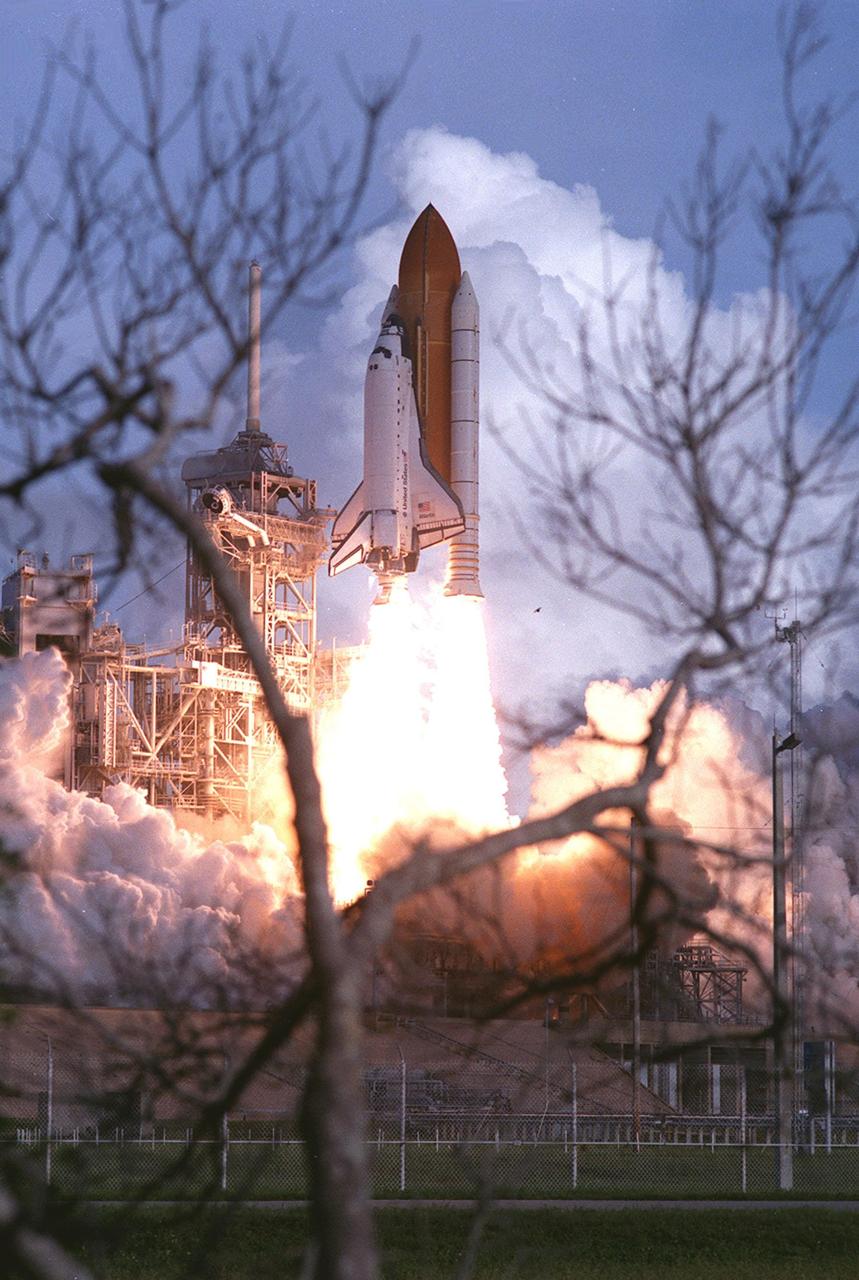
KENNEDY SPACE CENTER, Fla. -- Bare branches frame the liftoff of Space Shuttle Atlantis on mission STS-106 to the International Space Station. Billows of smoke and steam are illuminated by the flames of the solid rocket boosters. The perfect on-time liftoff of Atlantis occurred at 8:45:47 a.m. EDT. On the 11-day mission to the International Space Station, the seven-member crew will perform support tasks on orbit, transfer supplies and prepare the living quarters in the newly arrived Zvezda Service Module. The first long-duration crew, dubbed “Expedition One,” is due to arrive at the Station in late fall. Landing of Atlantis is targeted for 4:45 a.m. EDT on Sept. 19

KENNEDY SPACE CENTER, Fla. -- Bare branches frame the liftoff of Space Shuttle Atlantis on mission STS-106 to the International Space Station. Billows of smoke and steam are illuminated by the flames of the solid rocket boosters. The perfect on-time liftoff of Atlantis occurred at 8:45:47 a.m. EDT. On the 11-day mission to the International Space Station, the seven-member crew will perform support tasks on orbit, transfer supplies and prepare the living quarters in the newly arrived Zvezda Service Module. The first long-duration crew, dubbed “Expedition One,” is due to arrive at the Station in late fall. Landing of Atlantis is targeted for 4:45 a.m. EDT on Sept. 19
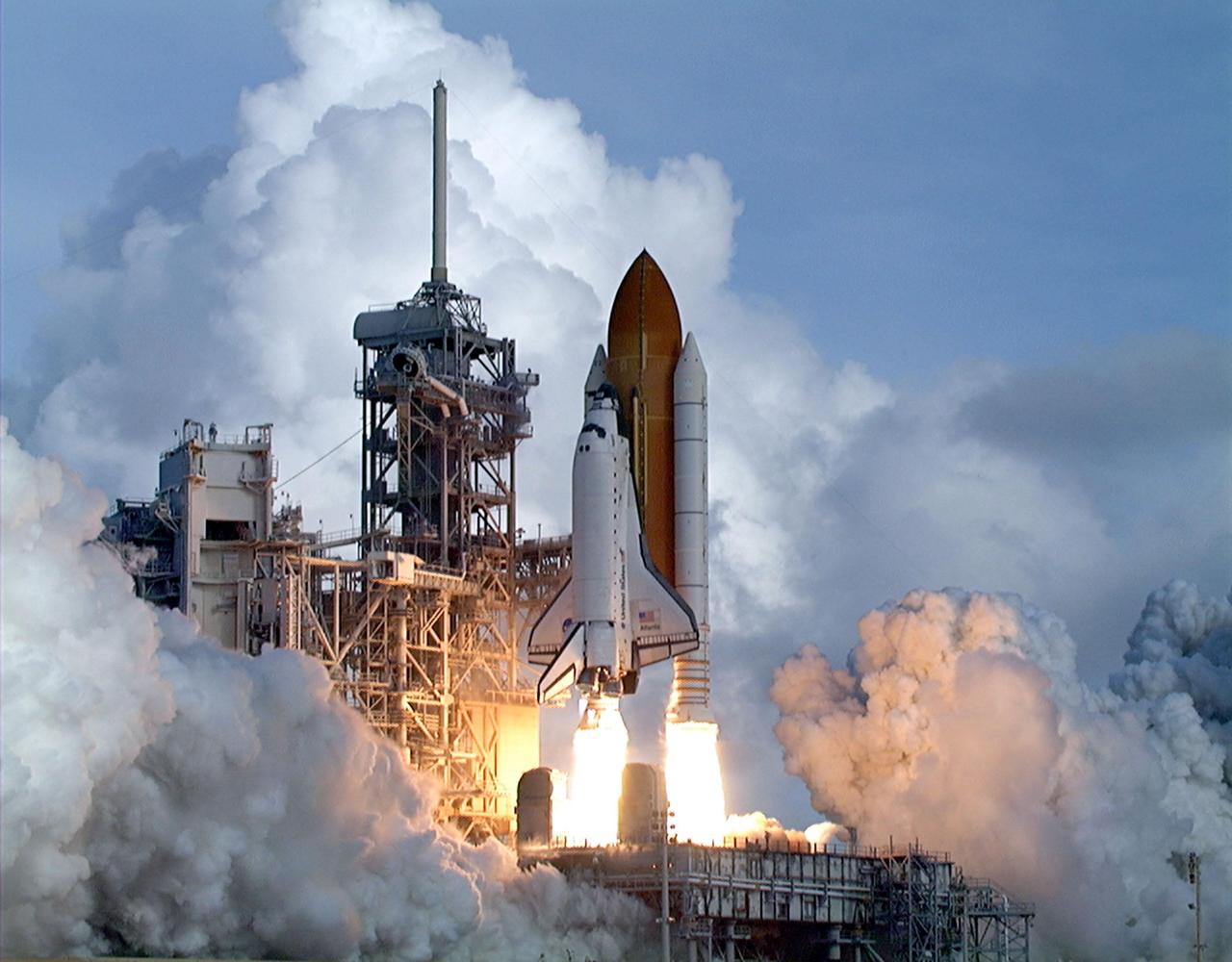
KENNEDY SPACE CENTER, Fla. -- Columns of flame spew from the solid rocket boosters hurling Space Shuttle Atlantis toward space on mission STS-106. The on-time liftoff occurred at 8:45:47 a.m. EDT for the start of an 11-day mission to the International Space Station. While on board, the seven-member crew will perform support tasks, transfer supplies and prepare the living quarters in the newly arrived Zvezda Service Module. The first long-duration crew, dubbed “Expedition One,” is due to arrive at the Station in late fall. Landing of Atlantis is targeted for 4:45 a.m. EDT on Sept. 19

KENNEDY SPACE CENTER, Fla. -- Columns of flame spew from the solid rocket boosters hurling Space Shuttle Atlantis toward space on mission STS-106. The on-time liftoff occurred at 8:45:47 a.m. EDT for the start of an 11-day mission to the International Space Station. While on board, the seven-member crew will perform support tasks, transfer supplies and prepare the living quarters in the newly arrived Zvezda Service Module. The first long-duration crew, dubbed “Expedition One,” is due to arrive at the Station in late fall. Landing of Atlantis is targeted for 4:45 a.m. EDT on Sept. 19
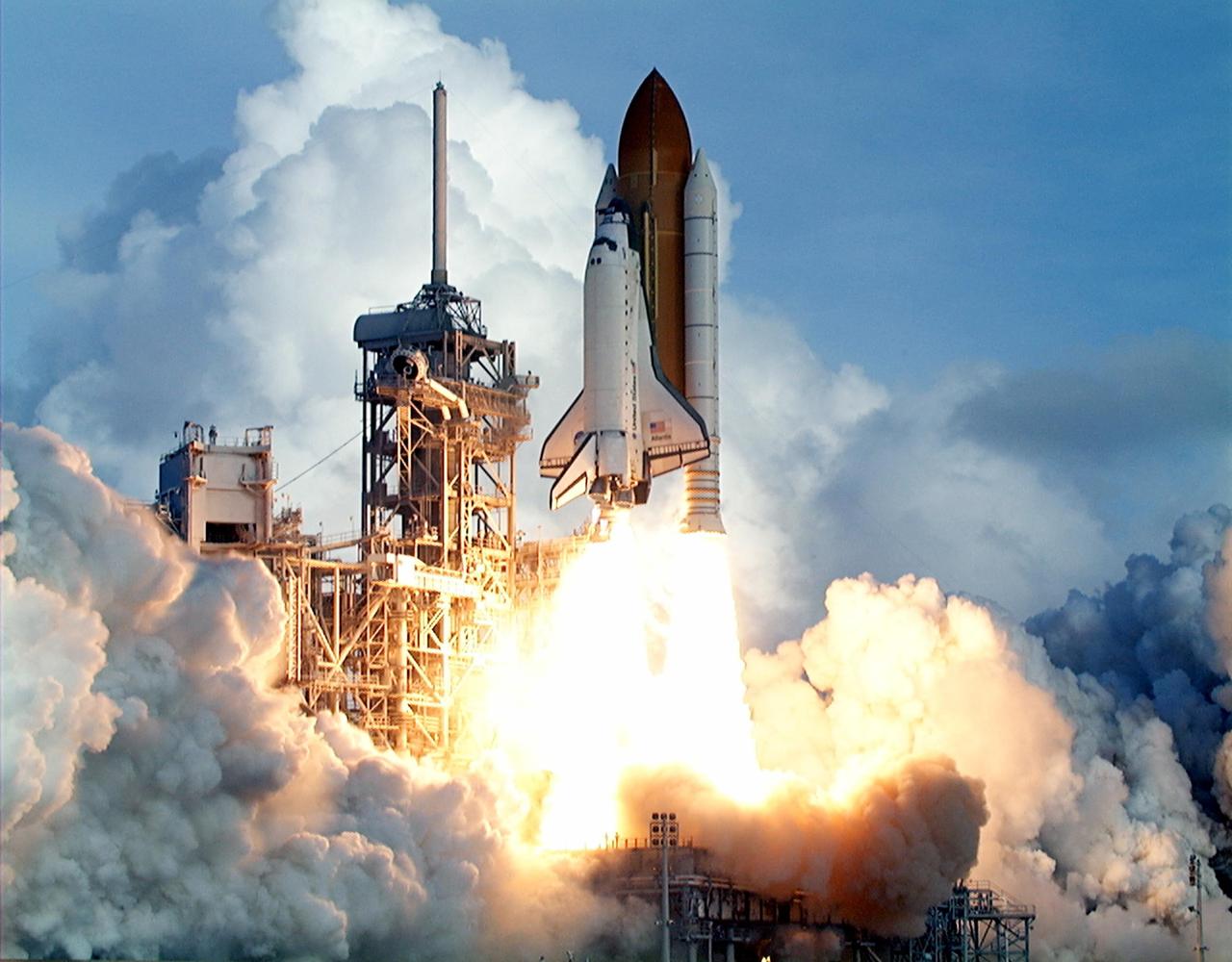
KENNEDY SPACE CENTER, Fla. -- Filling the ground with billows of smoke and steam created by the flaming solid rocket boosters, Space Shuttle Atlantis speeds toward space on mission STS-106. The perfect on-time liftoff occurred at 8:45:47 a.m. EDT. On the 11-day mission to the International Space Station, the seven-member crew will perform support tasks on orbit, transfer supplies and prepare the living quarters in the newly arrived Zvezda Service Module. The first long-duration crew, dubbed “Expedition One,” is due to arrive at the Station in late fall. Landing of Atlantis is targeted for 4:45 a.m. EDT on Sept. 19
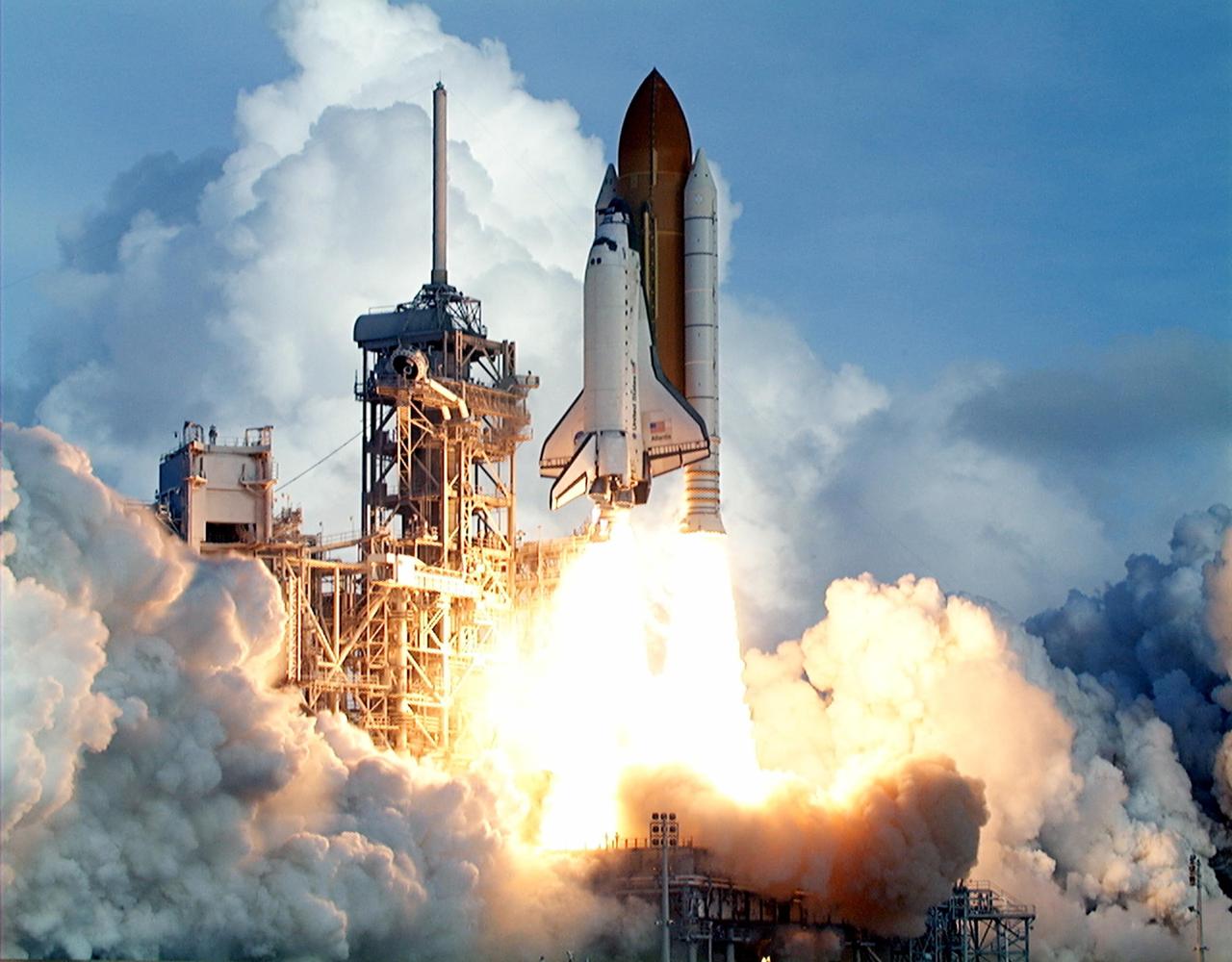
KENNEDY SPACE CENTER, Fla. -- Filling the ground with billows of smoke and steam created by the flaming solid rocket boosters, Space Shuttle Atlantis speeds toward space on mission STS-106. The perfect on-time liftoff occurred at 8:45:47 a.m. EDT. On the 11-day mission to the International Space Station, the seven-member crew will perform support tasks on orbit, transfer supplies and prepare the living quarters in the newly arrived Zvezda Service Module. The first long-duration crew, dubbed “Expedition One,” is due to arrive at the Station in late fall. Landing of Atlantis is targeted for 4:45 a.m. EDT on Sept. 19
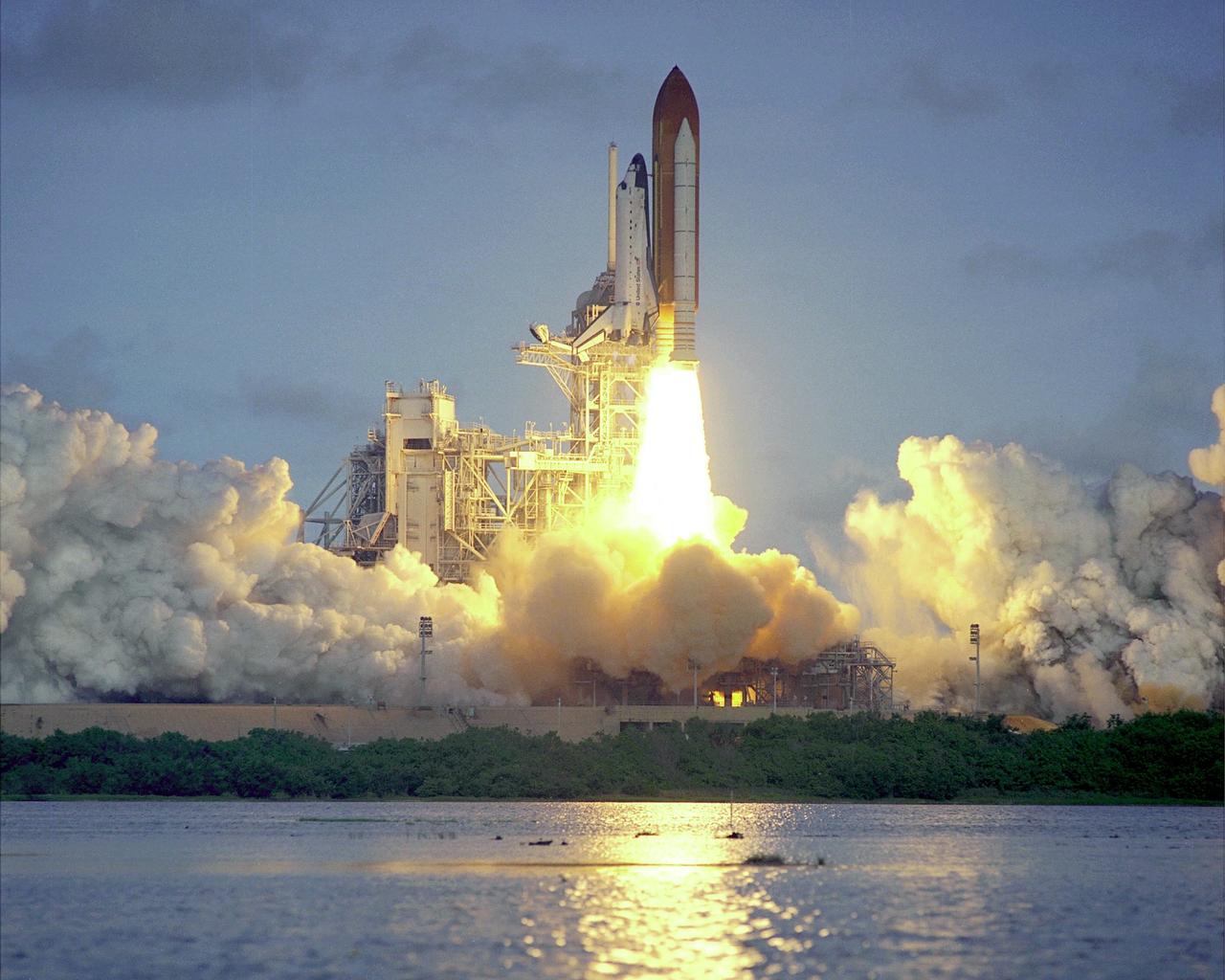
KENNEDY SPACE CENTER, Fla. -- Space Shuttle Atlantis’s solid rocket boosters trail brilliant flames that light up the clouds of smoke and steam and reflect in the waters Launch Pad 39B at launch. The perfect on-time liftoff of Atlantis on mission STS-106 occurred at 8:45:47 a.m. EDT. On the 11-day mission to the International Space Station, the seven-member crew will perform support tasks on orbit, transfer supplies and prepare the living quarters in the newly arrived Zvezda Service Module. The first long-duration crew, dubbed “Expedition One,” is due to arrive at the Station in late fall. Landing of Atlantis is targeted for 4:45 a.m. EDT on Sept. 19
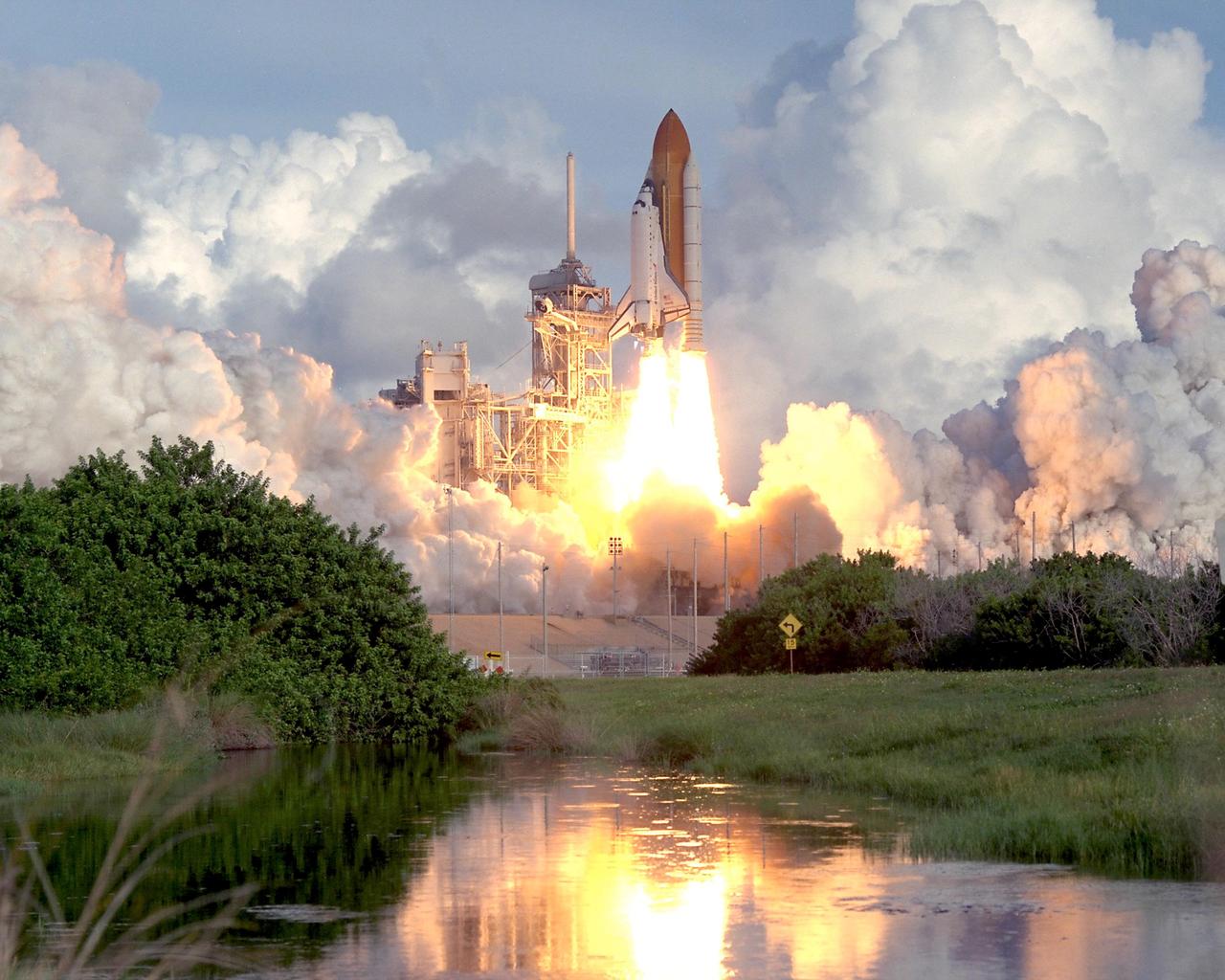
KENNEDY SPACE CENTER, Fla. -- The waters near Launch Pad 39B reflect the brilliant red-orange flames from the solid rocket boosters as Space Shuttle Atlantis lifts off on mission STS-106 to the International Space Station. The perfect on-time launch occurred at 8:45:47 a.m. EDT. On the 11-day mission to the Station, the seven-member crew will perform support tasks on orbit, transfer supplies and prepare the living quarters in the newly arrived Zvezda Service Module. The first long-duration crew, dubbed “Expedition One,” is due to arrive at the Station in late fall. Landing of Atlantis is targeted for 4:45 a.m. EDT on Sept. 19.
KENNEDY SPACE CENTER, Fla. -- The waters near Launch Pad 39B reflect the brilliant red-orange flames from the solid rocket boosters as Space Shuttle Atlantis lifts off on mission STS-106 to the International Space Station. The perfect on-time launch occurred at 8:45:47 a.m. EDT. On the 11-day mission to the Station, the seven-member crew will perform support tasks on orbit, transfer supplies and prepare the living quarters in the newly arrived Zvezda Service Module. The first long-duration crew, dubbed “Expedition One,” is due to arrive at the Station in late fall. Landing of Atlantis is targeted for 4:45 a.m. EDT on Sept. 19.
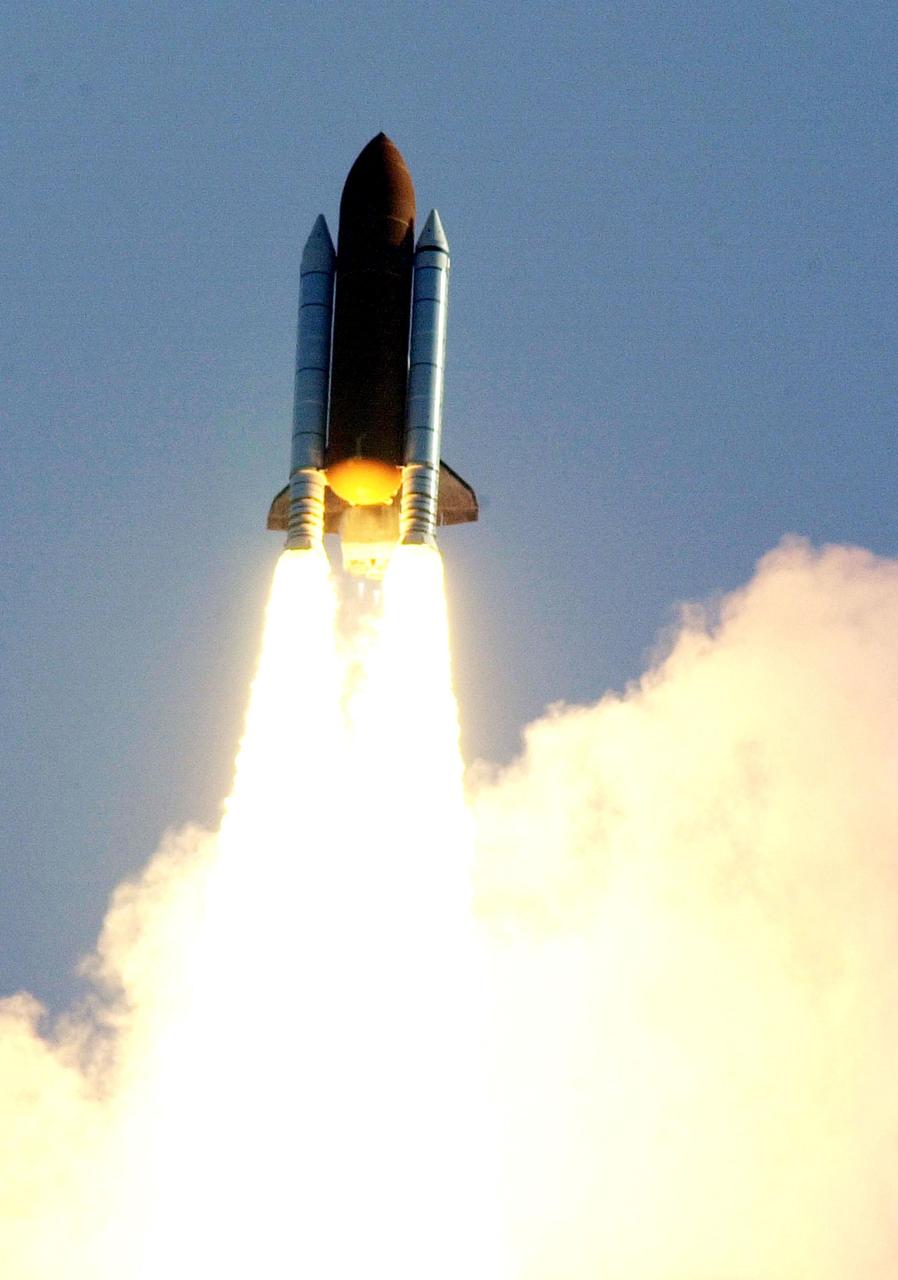
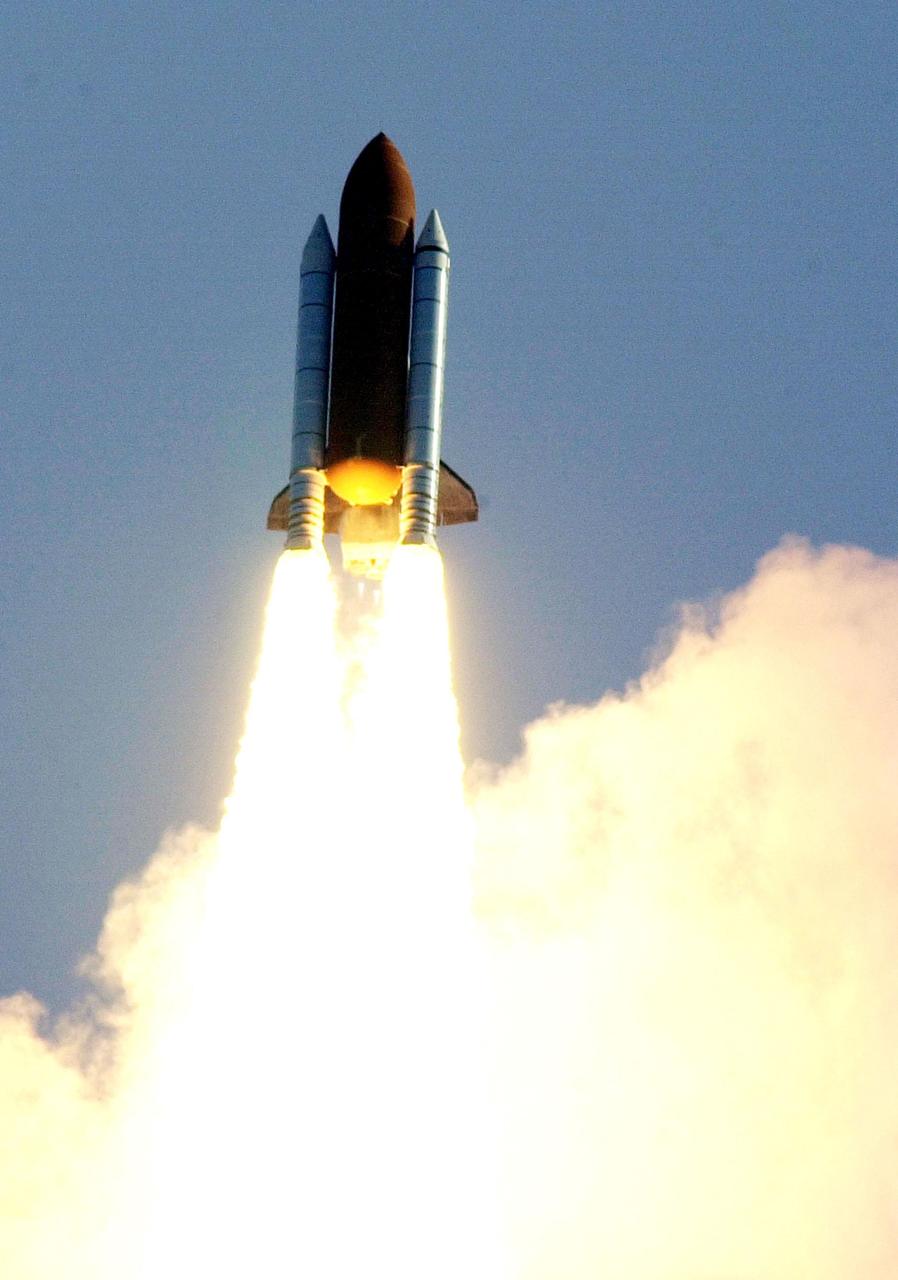
KENNEDY SPACE CENTER, Fla. -- After a perfect on-time launch on mission STS-106 at 8:45:47 a.m. EDT, Space Shuttle Atlantis rolls and displays its external tank and solid rocket boosters. On the 11-day mission to the International Space Station, the seven-member crew will perform support tasks on orbit, transfer supplies and prepare the living quarters in the newly arrived Zvezda Service Module. The first long-duration crew, dubbed “Expedition One,” is due to arrive at the Station in late fall. Landing of Atlantis is targeted for 4:45 a.m. EDT on Sept. 19
KENNEDY SPACE CENTER, Fla. -- After a perfect on-time launch on mission STS-106 at 8:45:47 a.m. EDT, Space Shuttle Atlantis rolls and displays its external tank and solid rocket boosters. On the 11-day mission to the International Space Station, the seven-member crew will perform support tasks on orbit, transfer supplies and prepare the living quarters in the newly arrived Zvezda Service Module. The first long-duration crew, dubbed “Expedition One,” is due to arrive at the Station in late fall. Landing of Atlantis is targeted for 4:45 a.m. EDT on Sept. 19
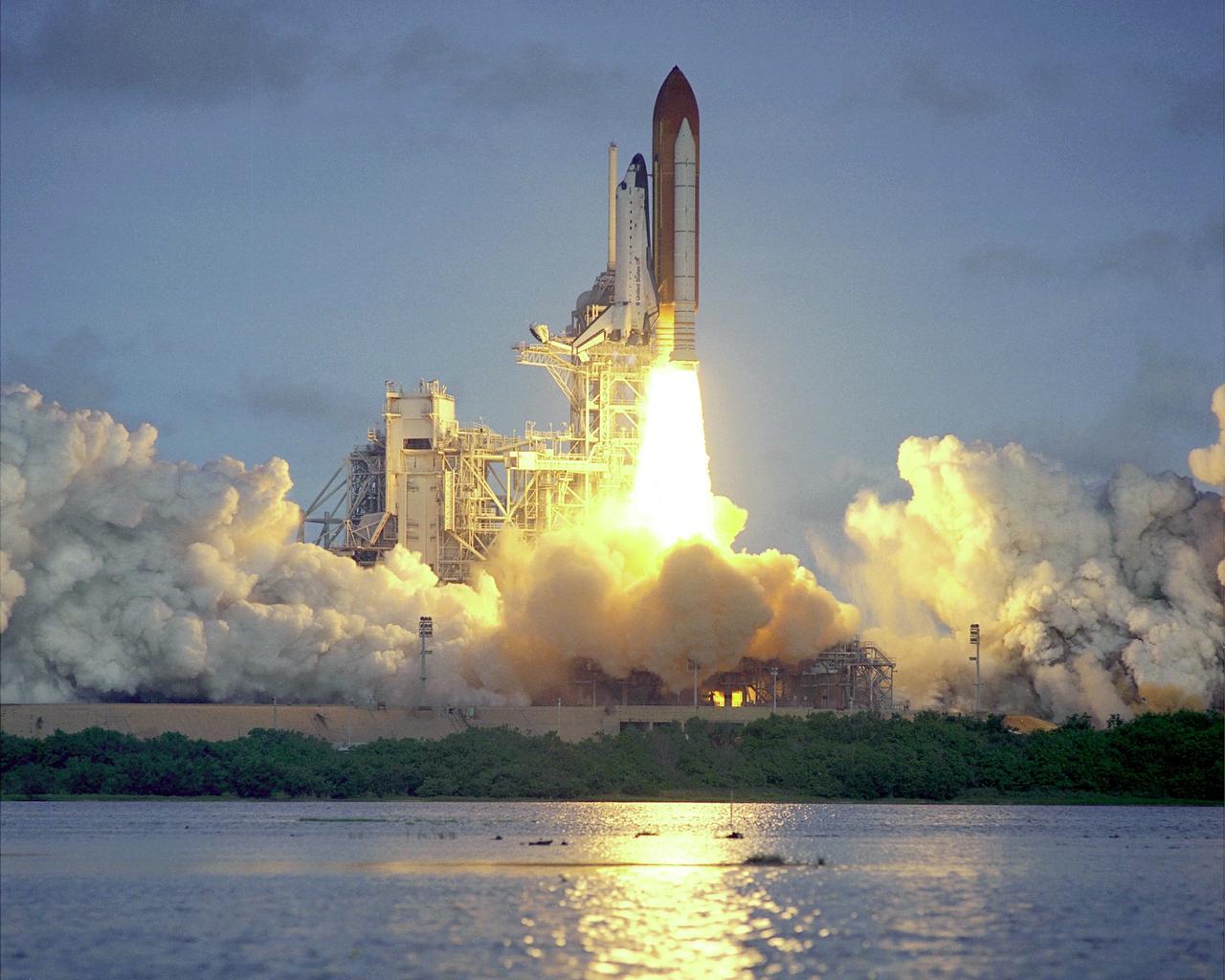
KENNEDY SPACE CENTER, Fla. -- Space Shuttle Atlantis’s solid rocket boosters trail brilliant flames that light up the clouds of smoke and steam and reflect in the waters Launch Pad 39B at launch. The perfect on-time liftoff of Atlantis on mission STS-106 occurred at 8:45:47 a.m. EDT. On the 11-day mission to the International Space Station, the seven-member crew will perform support tasks on orbit, transfer supplies and prepare the living quarters in the newly arrived Zvezda Service Module. The first long-duration crew, dubbed “Expedition One,” is due to arrive at the Station in late fall. Landing of Atlantis is targeted for 4:45 a.m. EDT on Sept. 19
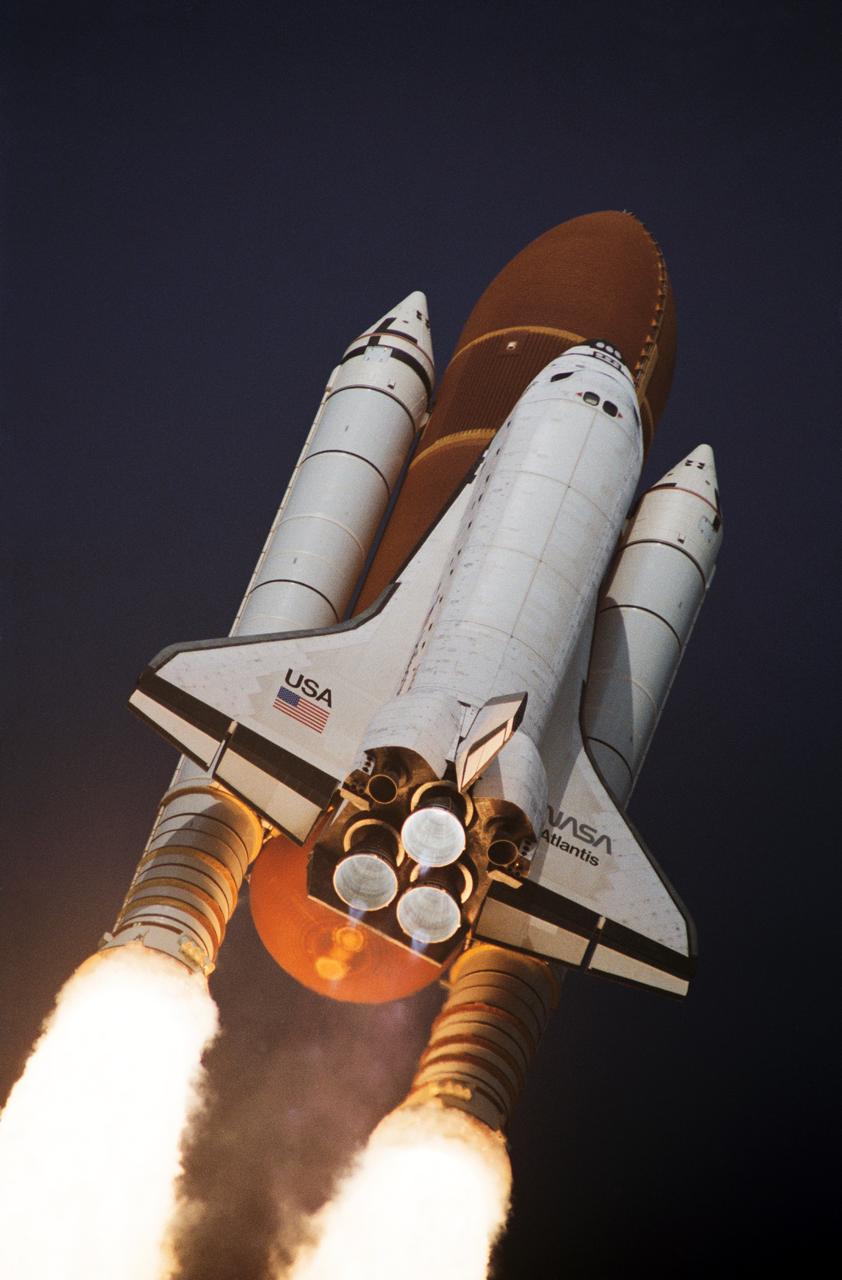
STS045-S-053 (24 March 1992) --- A low-angle view of the Space Shuttle Atlantis as it soars off the launch pad and heads toward Earth orbit with a crew of seven and the Atmospheric Laboratory for Applications and Science (ATLAS) aboard. Launch occurred at 8:13:40:048 a.m. (EST), March 24, 1992. Onboard were astronauts Charles F. Bolden, STS-45 commander; Brian Duffy, pilot; Kathryn D. Sullivan, payload commander; David C. Leestma and C. Michael Foale, mission specialists; and Dirk Frimout of the European Space Agency and Byron K. Lichtenberg, payload specialists.
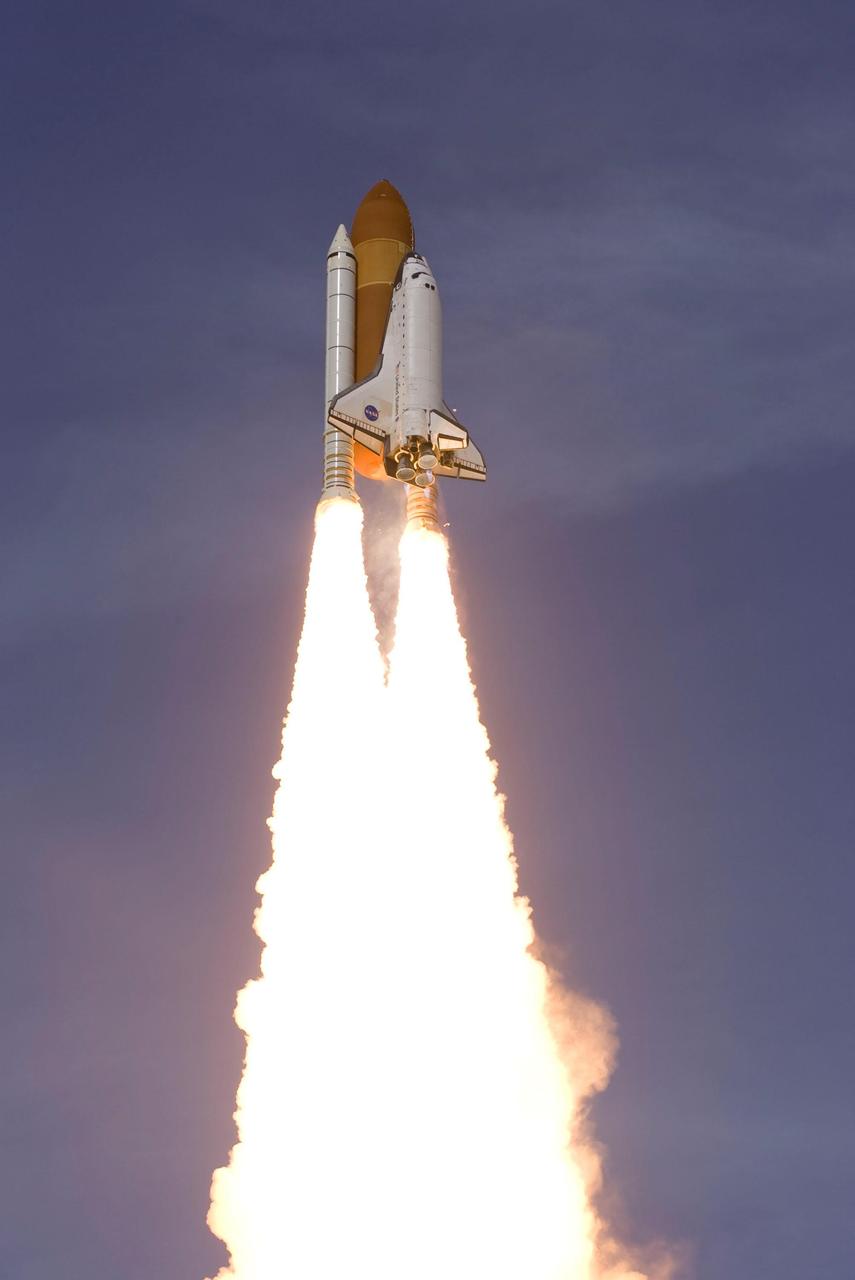
KENNEDY SPACE CENTER, FLA. -- Boosted by the columns of flame from the solid rocket boosters, space shuttle Atlantis hurtles into space for a rendezvous with the International Space Station on mission STS-122. Liftoff was on time at 2:45 p.m. EST. This is the third launch attempt for Atlantis since December 2007 to carry the European Space Agency's Columbus laboratory to the station. During the 11-day mission, the crew's prime objective is to attach the laboratory to the Harmony module, adding to the station's size and capabilities. Photo credit: Scott Andrews
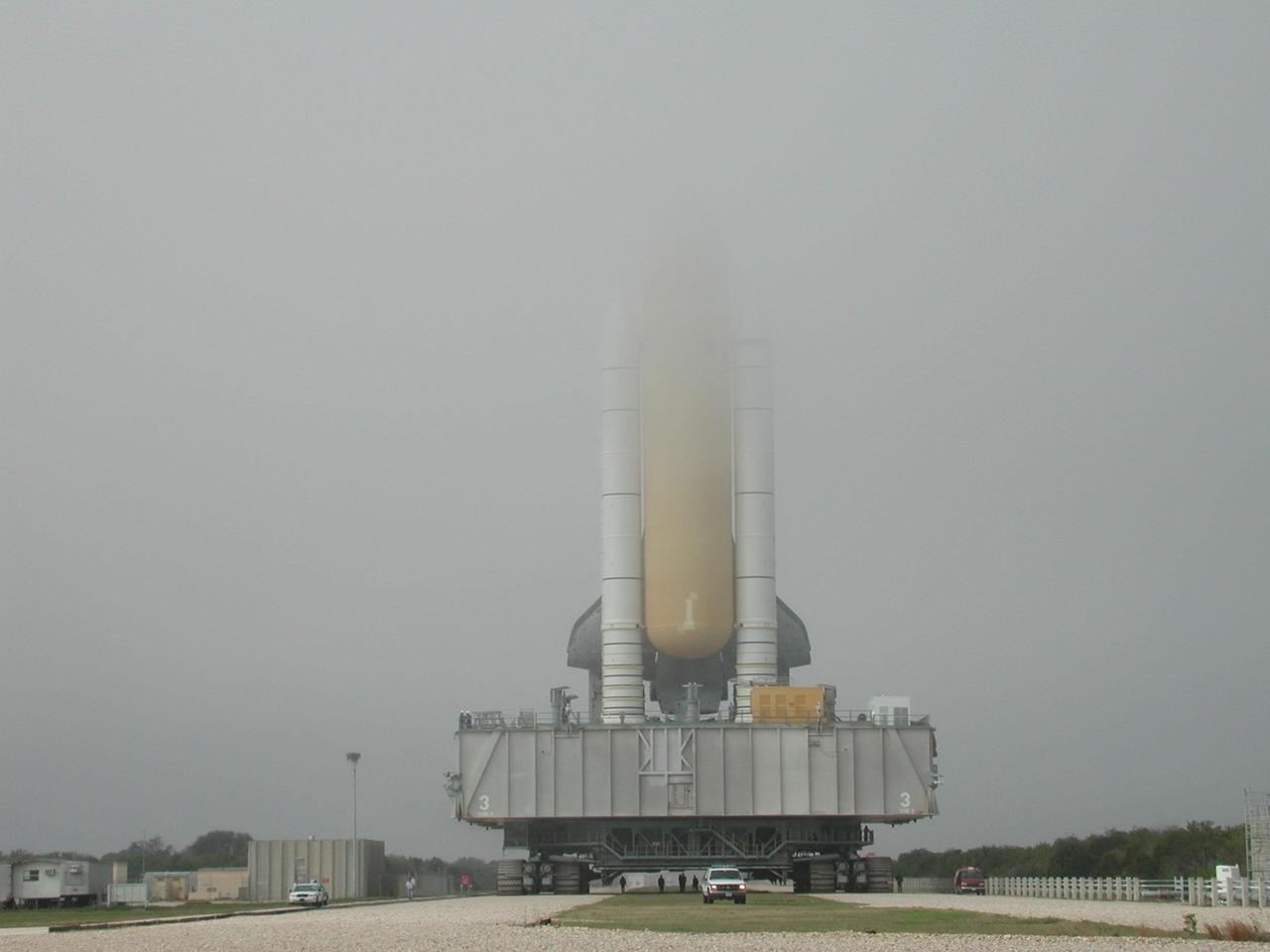
KENNEDY SPACE CENTER, Fla. -- As Space Shuttle Discovery, on its Mobile Launcher Platform, nears Launch Pad 39B, fog rolls over the top of the external tank and solid rocket boosters. Discovery will be flying on mission STS-102 to the International Space Station. Its payload is the Multi-Purpose Logistics Module Leonardo, a “moving van,” to carry laboratory racks filled with equipment, experiments and supplies to and from the Space Station aboard the Space Shuttle. The flight will also carry the Expedition Two crew up to the Space Station, replacing Expedition One, who will return to Earth on Discovery. Launch is scheduled for March 8 at 6:45 a.m. EST
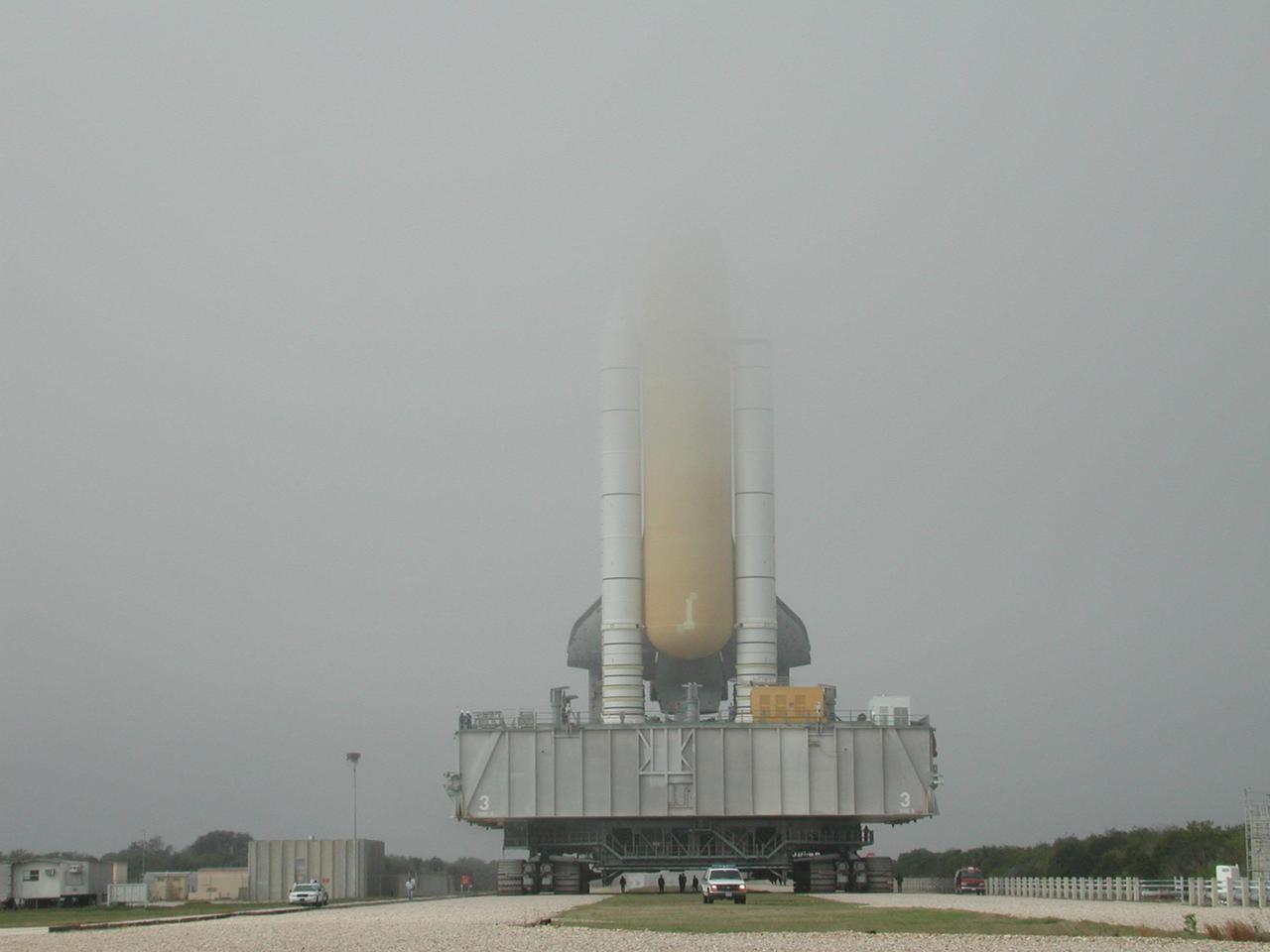
KENNEDY SPACE CENTER, Fla. -- As Space Shuttle Discovery, on its Mobile Launcher Platform, nears Launch Pad 39B, fog rolls over the top of the external tank and solid rocket boosters. Discovery will be flying on mission STS-102 to the International Space Station. Its payload is the Multi-Purpose Logistics Module Leonardo, a “moving van,” to carry laboratory racks filled with equipment, experiments and supplies to and from the Space Station aboard the Space Shuttle. The flight will also carry the Expedition Two crew up to the Space Station, replacing Expedition One, who will return to Earth on Discovery. Launch is scheduled for March 8 at 6:45 a.m. EST
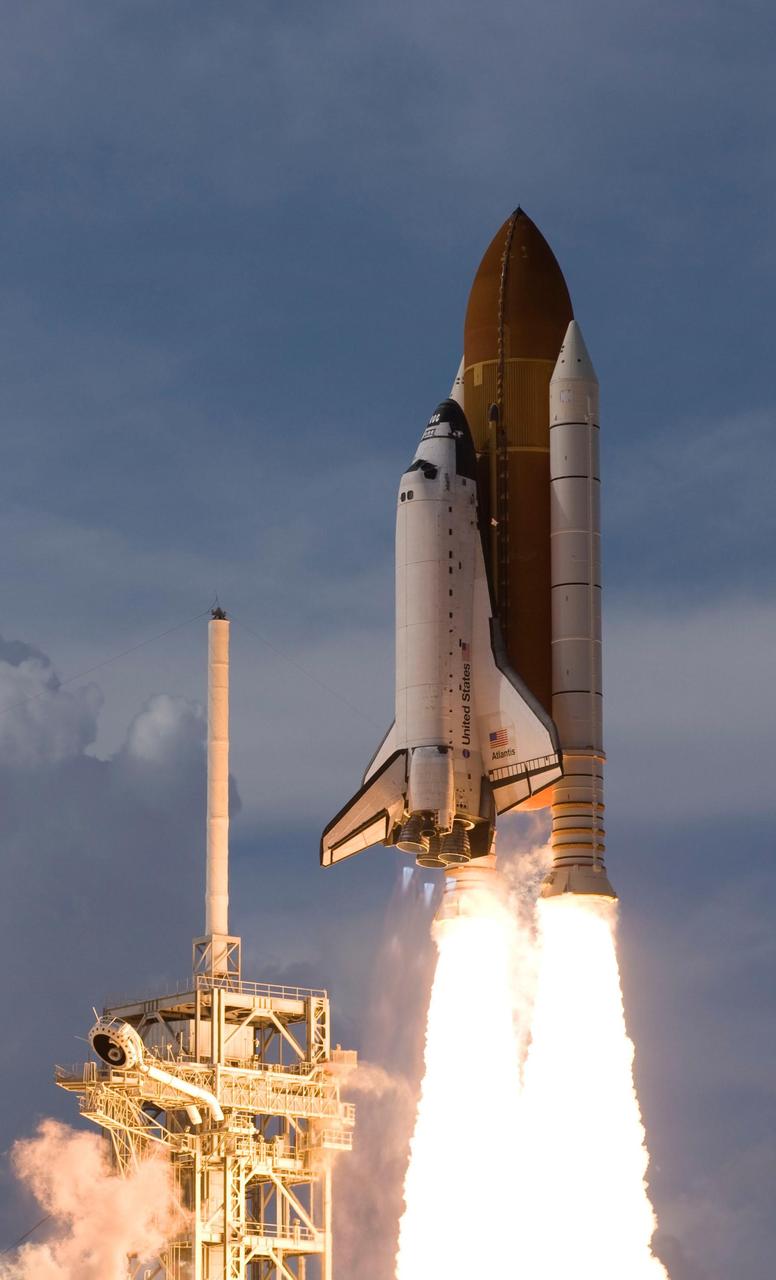
KENNEDY SPACE CENTER, FLA. -- Boosted by the columns of flame from the solid rocket boosters, space shuttle Atlantis passes the lightning tower on the fixed service structure as it roars into space and a rendezvous with the International Space Station on mission STS-122. Liftoff was on time at 2:45 p.m. EST. This is the third launch attempt for Atlantis since December 2007 to carry the European Space Agency's Columbus laboratory to the station. During the 11-day mission, the crew's prime objective is to attach the laboratory to the Harmony module, adding to the station's size and capabilities. Photo credit: Scott Andrews
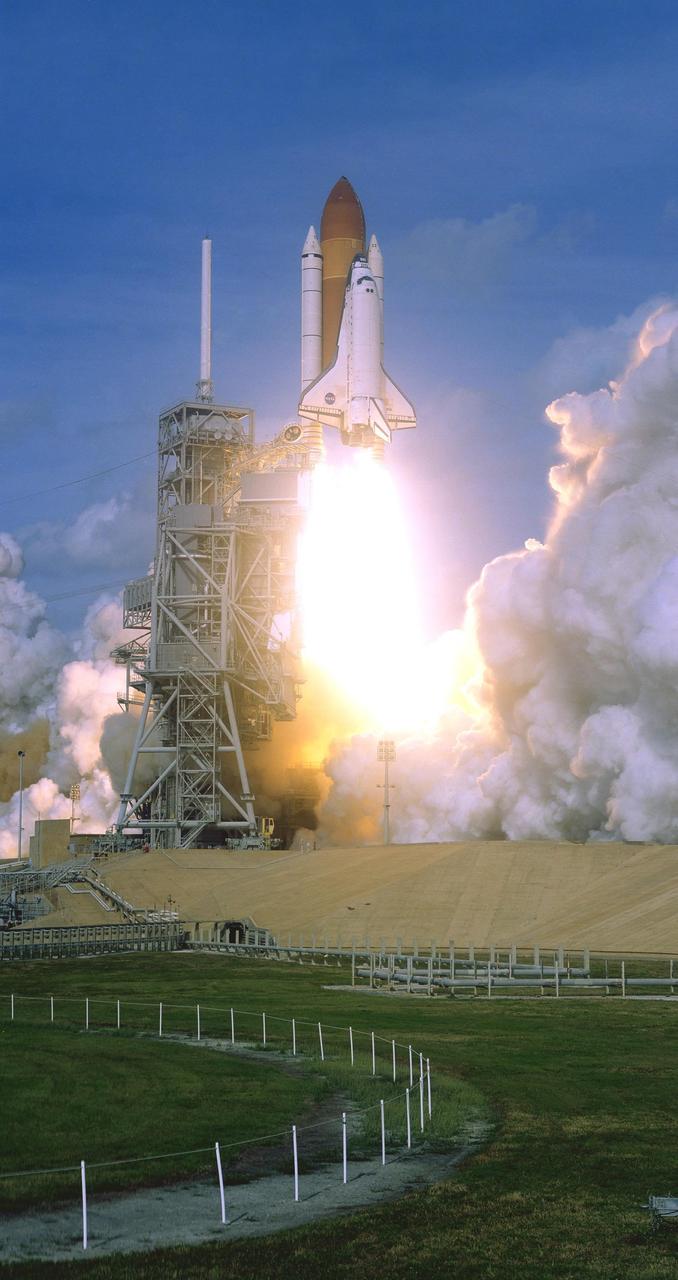
KENNEDY SPACE CENTER, FLA. -- Trailing fire from its engines and solid rocket boosters, space shuttle Atlantis passes the fixed service structure as it races toward the sky on mission STS-122. Liftoff was on time at 2:45 p.m. EST. This is the third launch attempt for Atlantis since December 2007 to carry the European Space Agency's Columbus laboratory to the International Space Station. During the 11-day mission, the crew's prime objective is to attach the laboratory to the Harmony module, adding to the station's size and capabilities. Photo credit: NASA/NASA/Rick Wetherington, Tim Terry, Tim Powers
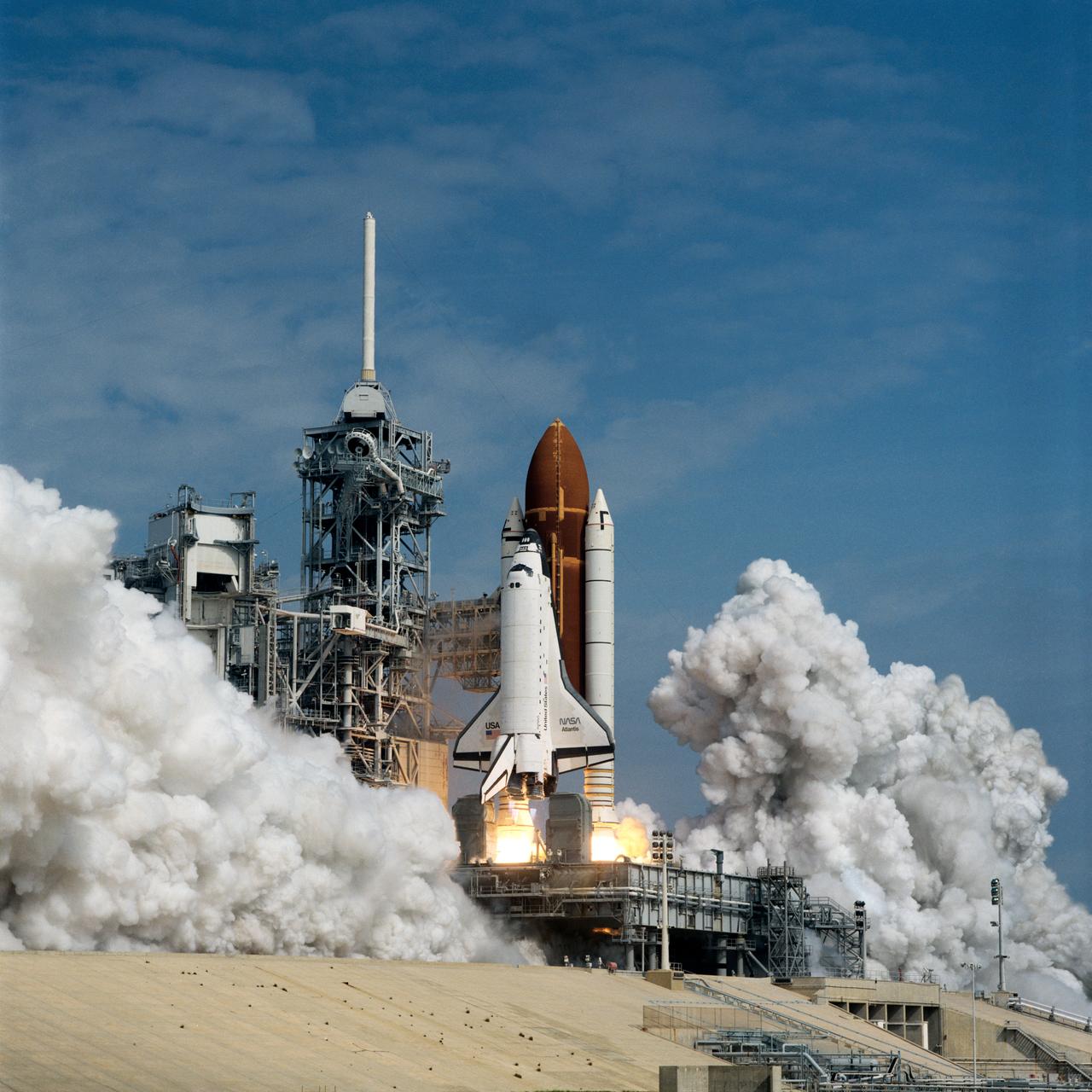
STS-37 Atlantis, Orbiter Vehicle (OV) 104, lifts off from Kennedy Space Center (KSC) Launch Complex (LC) Pad at 9:22:45:0439 (Eastern Standard Time (EST)). OV-104, atop its external tank (ET) and flanked by its two solid rocket boosters (SRBs), is captured just after space shuttle main engine (SSME) firing and as it rises above the mobile launcher platform. The fixed service structure (FSS) and retracted rotating service structure (RSS) appear along side OV-104. Clouds of exhaust smoke begin to fill the launch pad area.
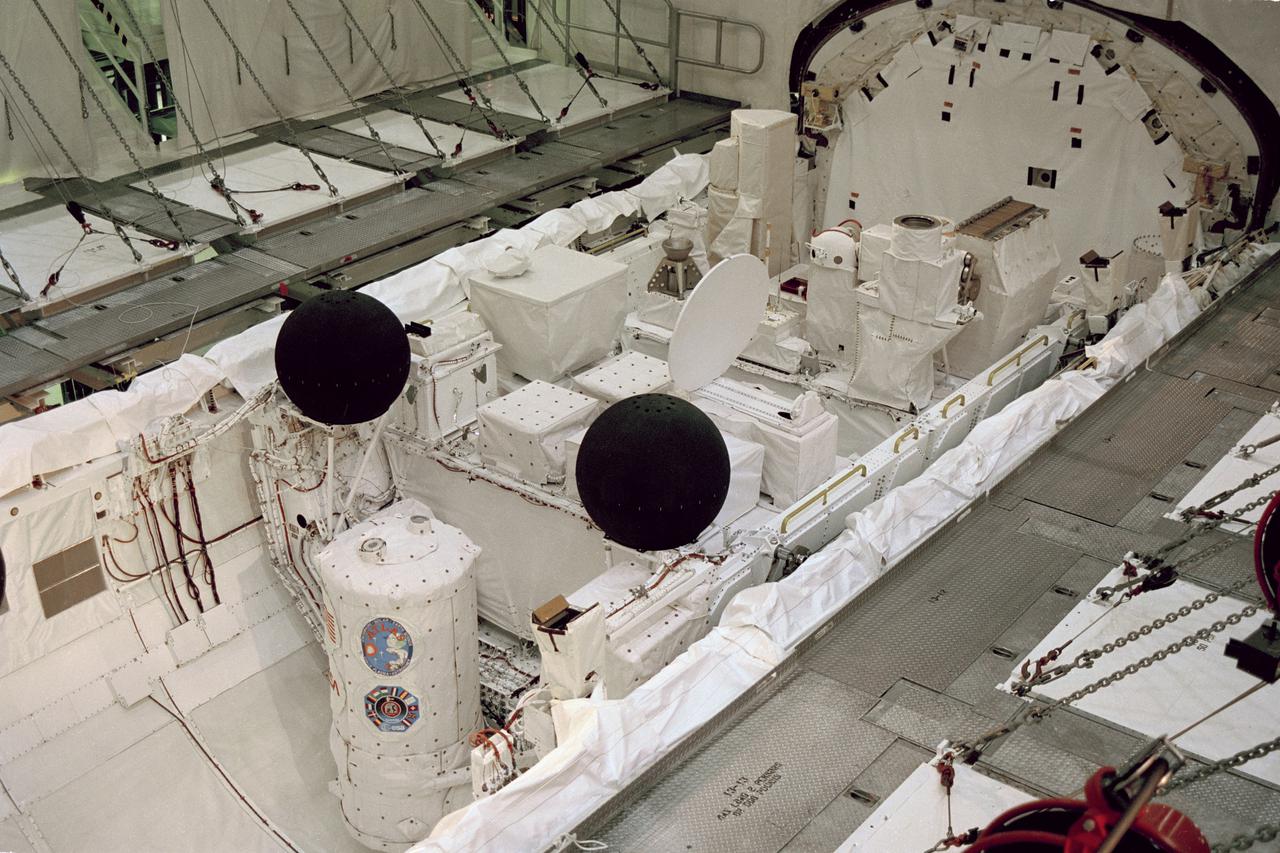
CAPE CANAVERAL, Fla. -- In bay 2 of the Orbiter processing Facility at the Kennedy Space Center in Florida, the payload bay doors are about to be closed on the space shuttle Atlantis, locking in the primary payload for its upcoming flight -- the Atmospheric Laboratory for Applications and Science-1. The payload features many elements of the spacelab modular laboratory system designed for the space shuttle program by the European Space Agency. The pallets are outfitted with an array of experiments spanning four disciplines: solar physics, atmospheric science, space plasma physics and astronomy. Atlantis is nearly ready for transfer to the Vehicle Assembly Building for mating with the external tank and solid rocket boosters. Liftoff on STS-45 is targeted for spring of 1992 from Launch Pad 39A. Photo Credit: NASA
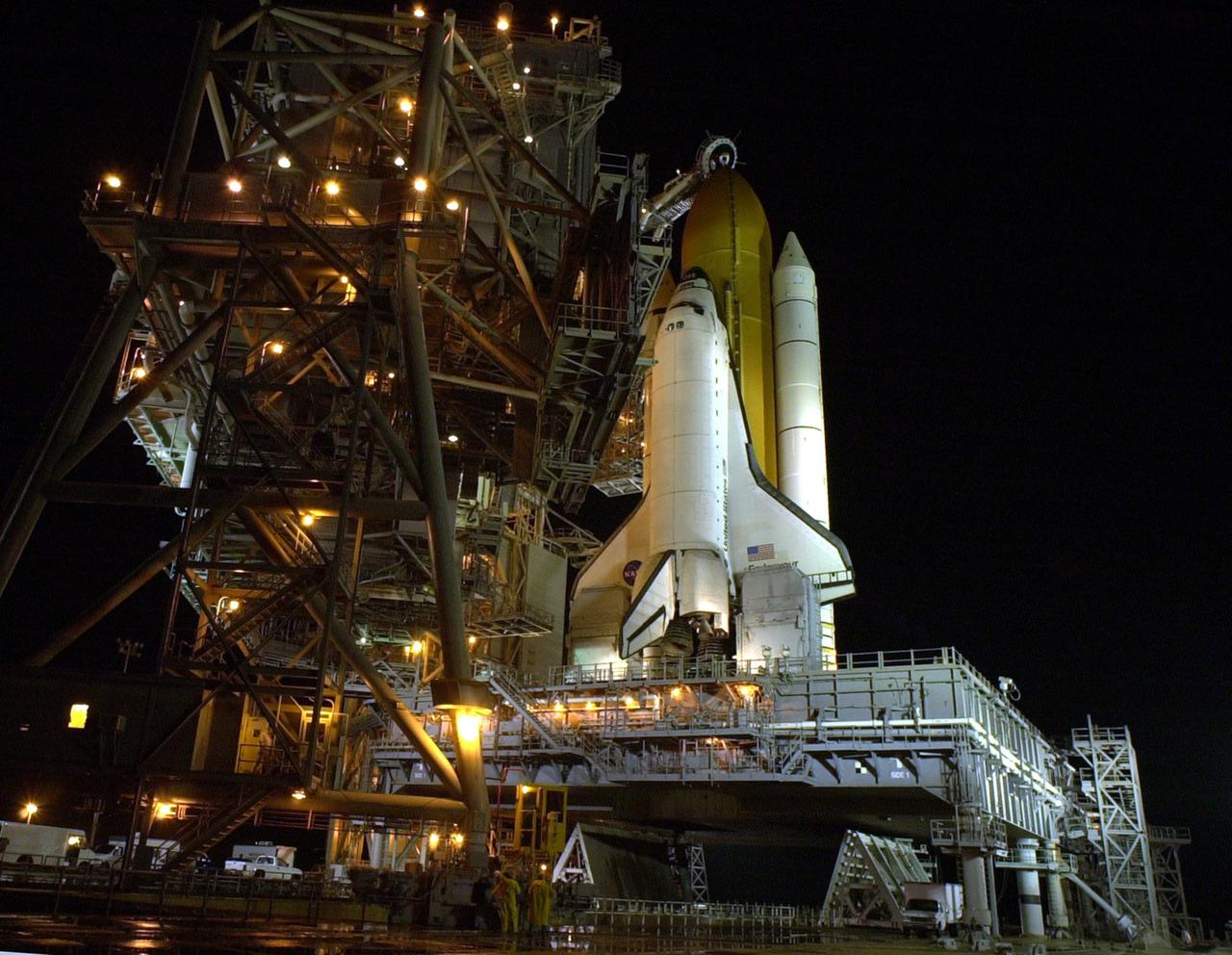
KENNEDY SPACE CENTER, Fla. -- The Rotating Service Structure on Launch Pad 39B rolls away from Space Shuttle Endeavour atop the Mobile Launcher Platform. The Space Shuttle comprises the orbiter and an external tank flanked by twin solid rocket boosters. Above the external tank is the Gaseous Oxygen Vent Arm that vents gaseous oxygen vapors away from the Shuttle. The vent hood assembly at the end is often referred to as the "beanie cap." On either side of the orbiter's tail and main engines are two tail masts that support the fluid, gas and electrical requirements of the orbiter's liquid oxygen and liquid hydrogen aft T-0 umbilicals. . Each tail mast is 31 feet (9.4 meters) high, 15 feet (4.6 meters) long and 9 feet (3.1 meters) wide. Endeavour is scheduled to launch on mission STS-108 Dec. 4 at 5:45 p.m. EST. On this 12th flight to the International Space Station, known as a Utilization Flight, Endeavour will carry a crew of four plus the Expedition 4 crew, who will replace Expedition 3 aboard the ISS. The payload includes the Multi-Purpose Logistics Module Raffaello, filled with supplies, equipment and experiments
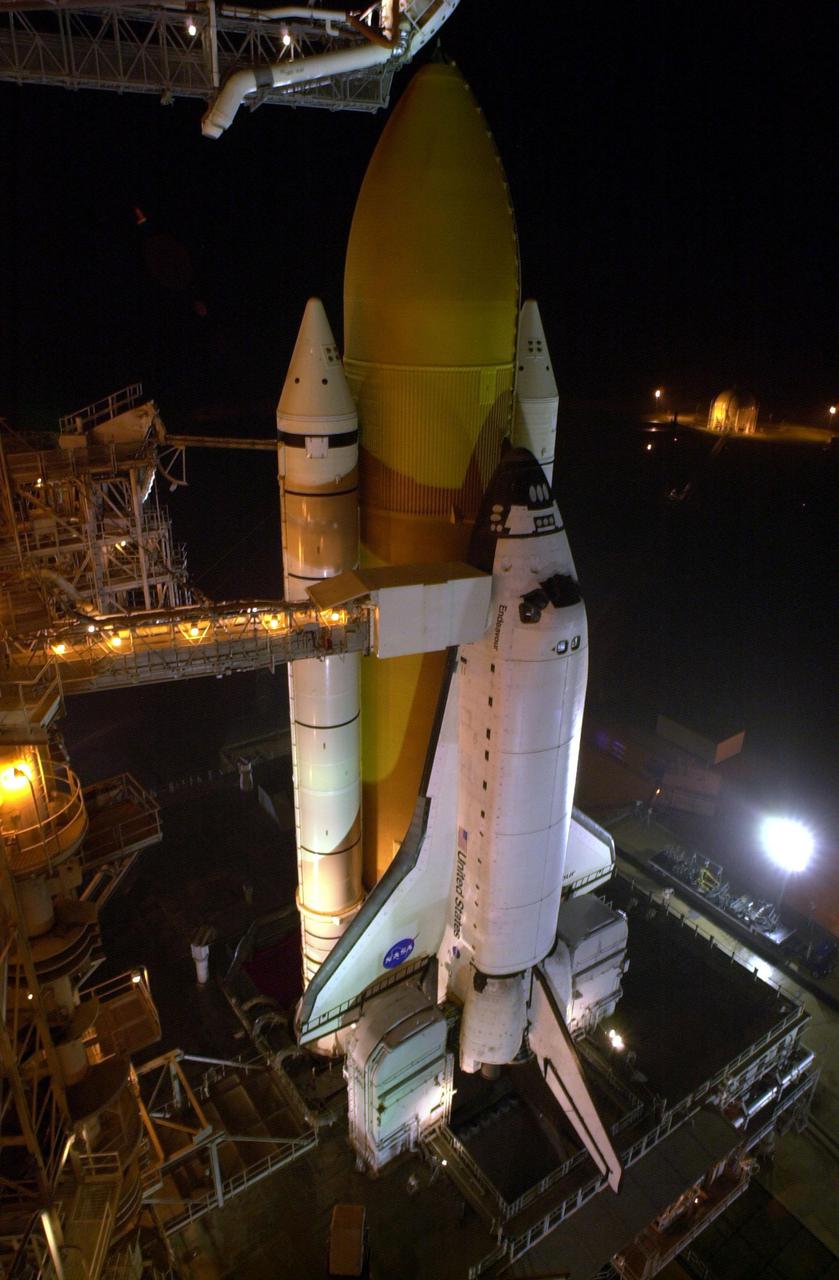
KENNEDY SPACE CENTER, Fla. -- After rollback of the Rotating Service Structure on Launch Pad 39B, Space Shuttle Endeavour is bathed in light. Twin solid rocket boosters flank the orange external tank behind Endeavour. Above the external tank is the Gaseous Oxygen Vent Arm that vents gaseous oxygen vapors away from the Shuttle. The vent hood assembly at the end is often referred to as the 'beanie cap.' Stretching to the crew hatch on the side of Endeavour is the Orbiter Access Arm with its environmentally controlled White Room at the end, through which the crew enters the vehicle. The Shuttle sits on the Mobile Launcher Platform with the two service tail masts on either side of the main engines. The tail masts support the fluid, gas and electrical requirements of the orbiter's liquid oxygen and liquid hydrogen aft T-0 umbilicals. Each tail mast is 31 feet (9.4 meters) high, 15 feet (4.6 meters) long and 9 feet (3.1 meters) wide. Endeavour is scheduled to launch on mission STS-108 Dec. 4 at 5:45 p.m. EST. On this 12th flight to the International Space Station, known as a Utilization Flight, Endeavour will carry a crew of four plus the Expedition 4 crew, who will replace Expedition 3 aboard the ISS. The payload includes the Multi-Purpose Logistics Module Raffaello, filled with supplies, equipment and experiments

KENNEDY SPACE CENTER, Fla. -- After rollback of the Rotating Service Structure on Launch Pad 39B, Space Shuttle Endeavour is bathed in light. Twin solid rocket boosters flank the orange external tank behind Endeavour. Above the external tank is the Gaseous Oxygen Vent Arm that vents gaseous oxygen vapors away from the Shuttle. The vent hood assembly at the end is often referred to as the "beanie cap." Stretching to the crew hatch on the side of Endeavour is the Orbiter Access Arm with its environmentally controlled White Room at the end, through which the crew enters the vehicle. The Shuttle sits on the Mobile Launcher Platform with the two service tail masts on either side of the main engines. The tail masts support the fluid, gas and electrical requirements of the orbiter's liquid oxygen and liquid hydrogen aft T-0 umbilicals. Each tail mast is 31 feet (9.4 meters) high, 15 feet (4.6 meters) long and 9 feet (3.1 meters) wide. Endeavour is scheduled to launch on mission STS-108 Dec. 4 at 5:45 p.m. EST. On this 12th flight to the International Space Station, known as a Utilization Flight, Endeavour will carry a crew of four plus the Expedition 4 crew, who will replace Expedition 3 aboard the ISS. The payload includes the Multi-Purpose Logistics Module Raffaello, filled with supplies, equipment and experiments
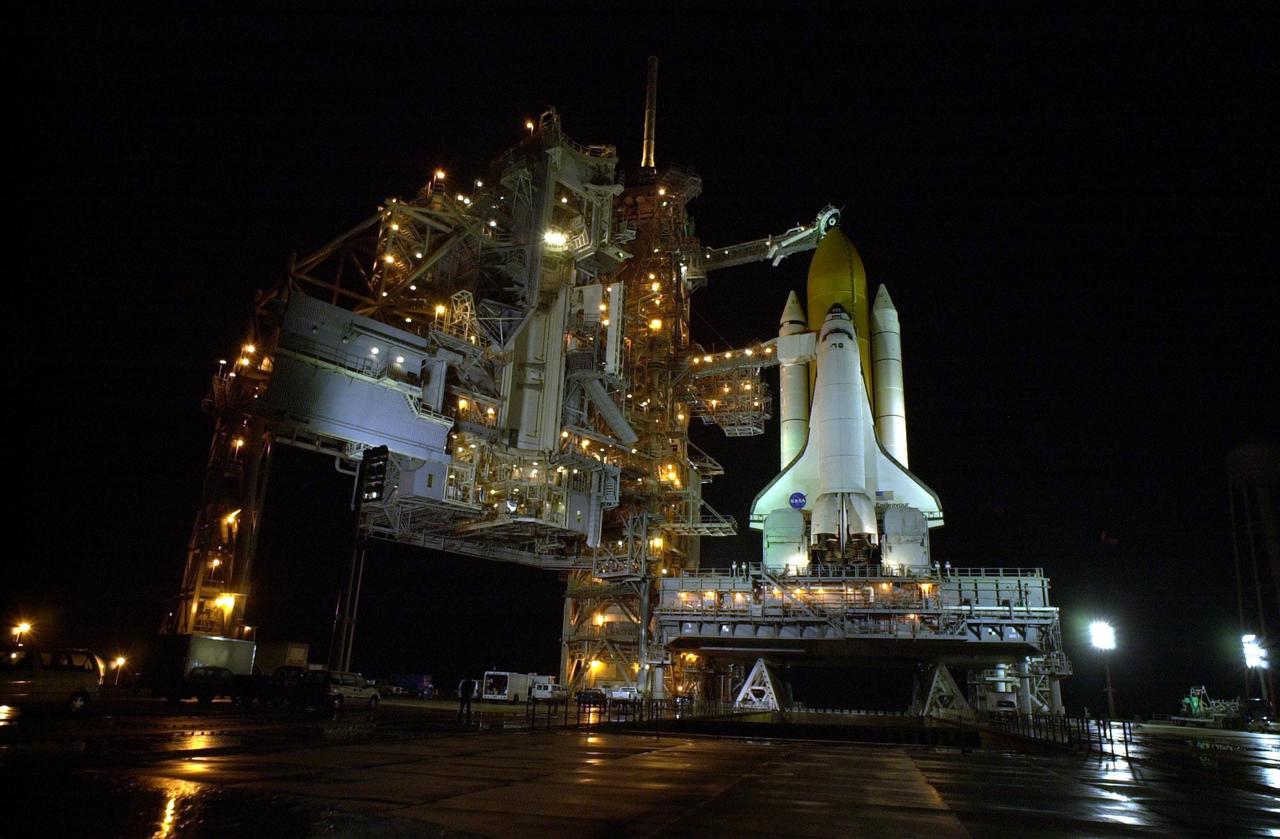
KENNEDY SPACE CENTER, Fla. -- Rain on the ground around Space Shuttle Endeavour on Launch Pad 39B reflects the many lights illluminating the Rotating Service Structure (at left), Fixed Service Structure and Shuttle. Twin solid rocket boosters flank the orange external tank behind Endeavour. Above the external tank is the Gaseous Oxygen Vent Arm that vents gaseous oxygen vapors away from the Shuttle. The vent hood assembly at the end is often referred to as the "beanie cap." Stretching from the FSS to the crew hatch on the side of Endeavour is the Orbiter Access Arm with its environmentally controlled White Room at the end, through which the crew enters the vehicle. The Shuttle sits on the Mobile Launcher Platform with the two service tail masts on either side of the main engines. The tail masts support the fluid, gas and electrical requirements of the orbiter's liquid oxygen and liquid hydrogen aft T-0 umbilicals. Each tail mast is 31 feet (9.4 meters) high, 15 feet (4.6 meters) long and 9 feet (3.1 meters) wide. Endeavour is scheduled to launch on mission STS-108 Dec. 4 at 5:45 p.m. EST. On this 12th flight to the International Space Station, known as a Utilization Flight, Endeavour will carry a crew of four plus the Expedition 4 crew, who will replace Expedition 3 aboard the ISS. The payload includes the Multi-Purpose Logistics Module Raffaello, filled with supplies, equipment and experiments
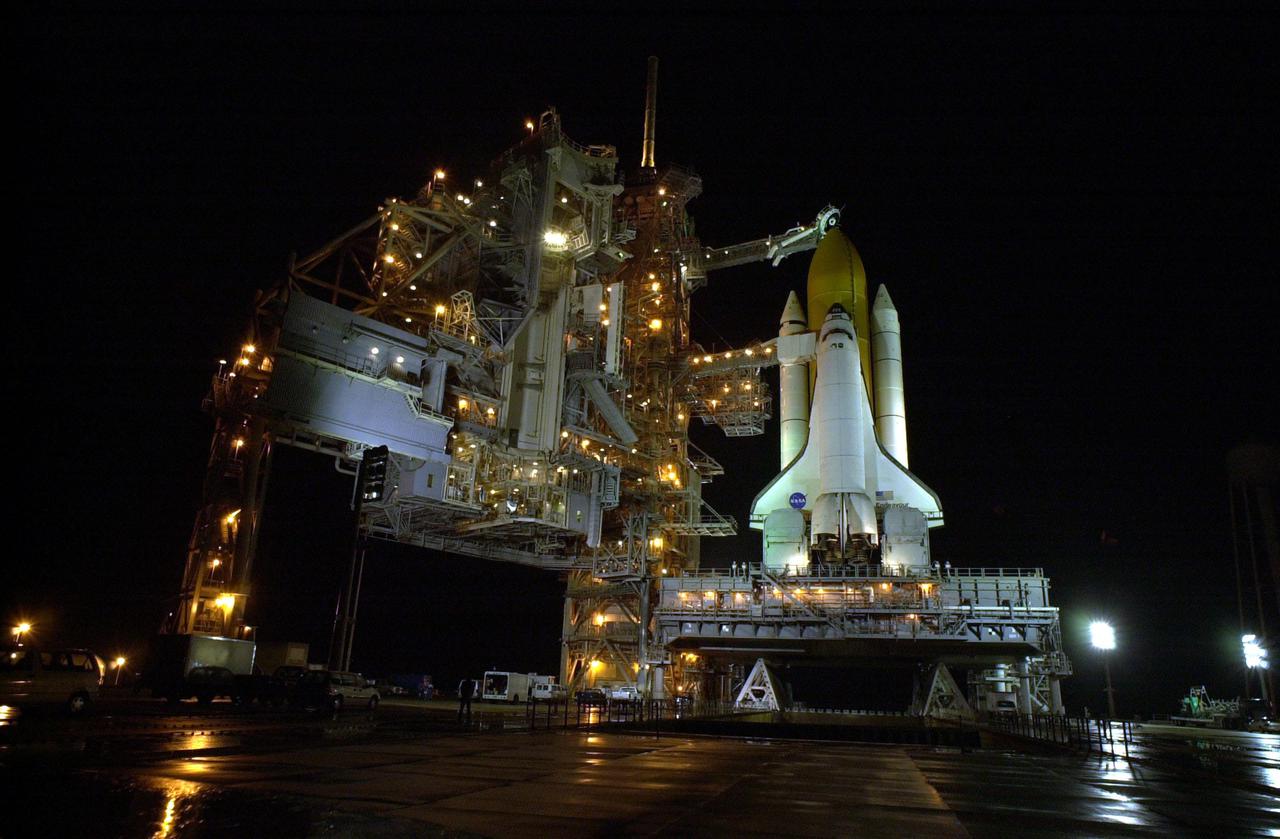
KENNEDY SPACE CENTER, Fla. -- Rain on the ground around Space Shuttle Endeavour on Launch Pad 39B reflects the many lights illluminating the Rotating Service Structure (at left), Fixed Service Structure and Shuttle. Twin solid rocket boosters flank the orange external tank behind Endeavour. Above the external tank is the Gaseous Oxygen Vent Arm that vents gaseous oxygen vapors away from the Shuttle. The vent hood assembly at the end is often referred to as the 'beanie cap.' Stretching from the FSS to the crew hatch on the side of Endeavour is the Orbiter Access Arm with its environmentally controlled White Room at the end, through which the crew enters the vehicle. The Shuttle sits on the Mobile Launcher Platform with the two service tail masts on either side of the main engines. The tail masts support the fluid, gas and electrical requirements of the orbiter's liquid oxygen and liquid hydrogen aft T-0 umbilicals. Each tail mast is 31 feet (9.4 meters) high, 15 feet (4.6 meters) long and 9 feet (3.1 meters) wide. Endeavour is scheduled to launch on mission STS-108 Dec. 4 at 5:45 p.m. EST. On this 12th flight to the International Space Station, known as a Utilization Flight, Endeavour will carry a crew of four plus the Expedition 4 crew, who will replace Expedition 3 aboard the ISS. The payload includes the Multi-Purpose Logistics Module Raffaello, filled with supplies, equipment and experiments