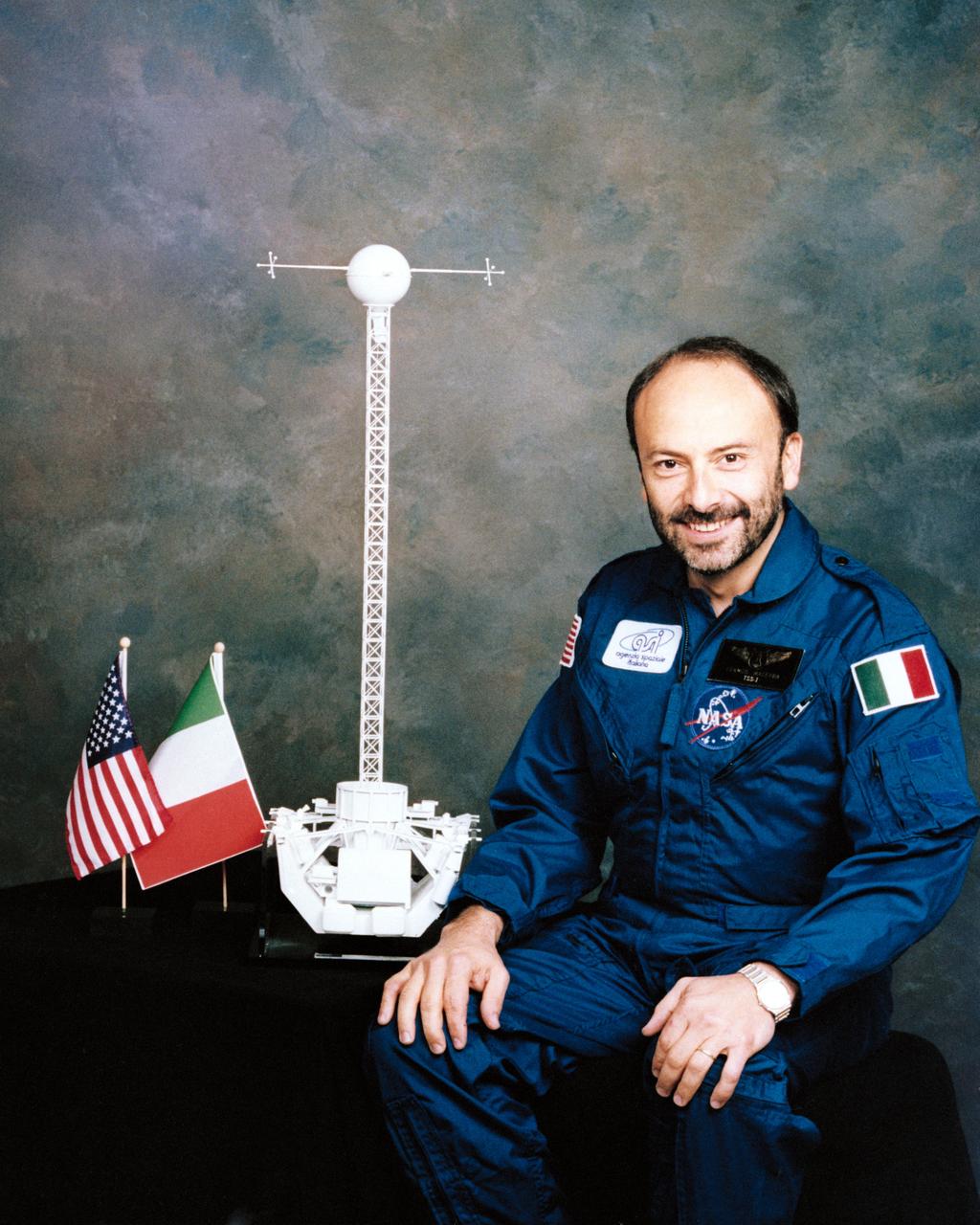
S92-30926 (12 March 1992) --- Astronaut Franco Malerba, STS-46 Italian Payload Specialist.
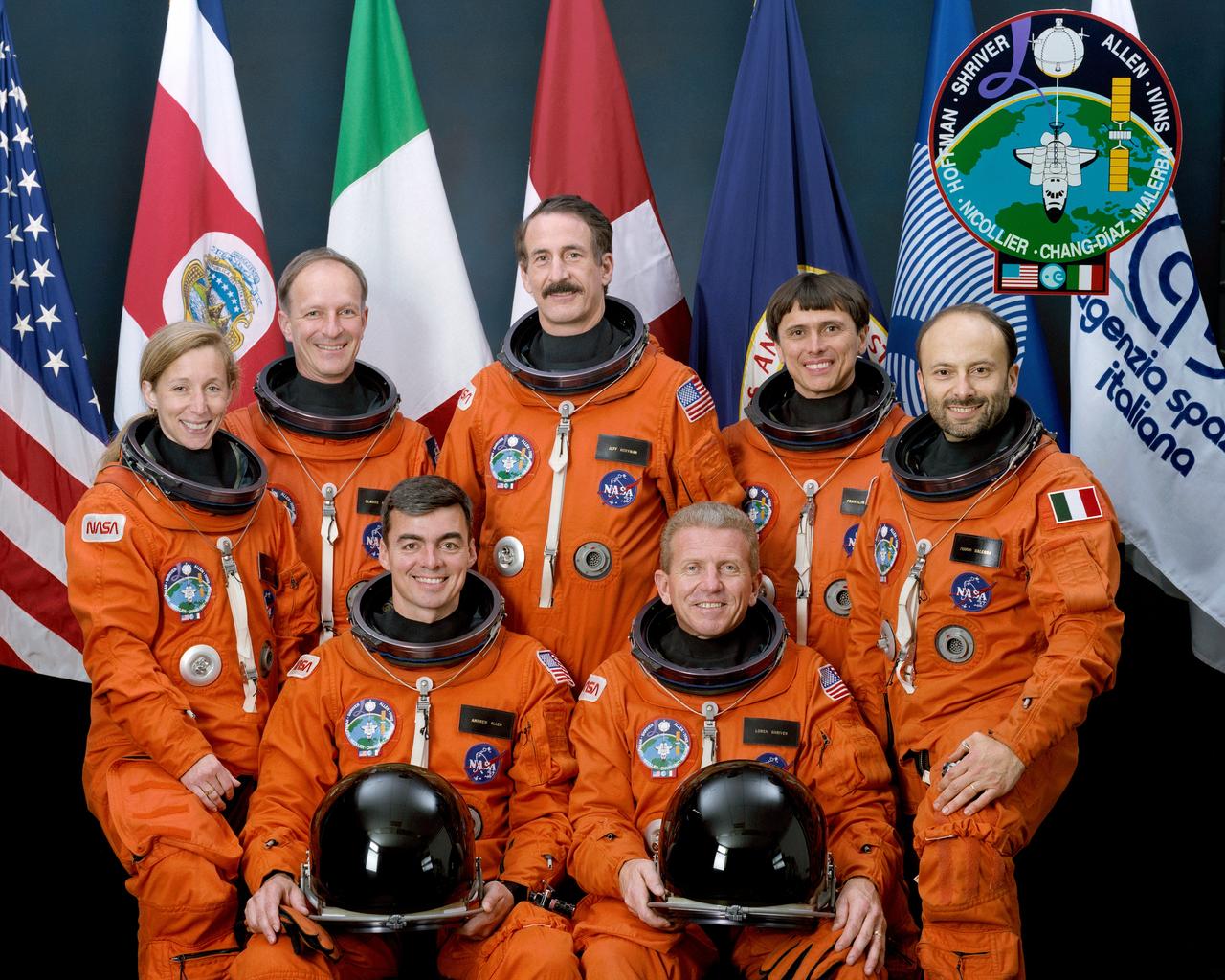
STS046-S-002 (May 1992) --- The crew members assigned to the STS-46 mission pose with seven flags that represent participation on the flight. Loren J. Shriver (right front) is mission commander; Andrew M. Allen (left front) is pilot. Others are (left to right) Marsha S. Ivins, mission specialist; Claude Nicollier, mission specialist representing the European Space Agency (ESA); Jeffrey A. Hoffman, payload commander; Franklin R. Chang-Diaz, mission specialist; and Franco Malerba, flying for the Italian Space Agency (ASI). The flags, left to right, represent the United States of America, Costa Rica (Chang's native country), Italy, Switzerland (Nicollier's homeland), NASA, ESA and ASI.

The European Retrievable Carrier 1L (EURECA-1L) spacecraft, with solar array panels extended, drifts above the Earth after deployment from the payload bay of Atlantis, Orbiter Vehicle (OV) 104, during STS-46. EURECA's onboard propulsion unit will boost it to an operational altitude of 270 nautical miles.
Launched aboard the Space Shuttle Atlantis on July 31, 1992 at 9:56:48 am (EDT), the STS-46 mission’s primary objectives included the deployment of the European Space Agency’s European Retrievable Carrier (EURECA) and operation of the joint NASA/Italian Space Agency Tethered Satellite System (TSS). The STS-46 crew of seven included: Loren J. Shriver, commander; Andrew M. Allen, pilot; Jeffrey A. Hoffman, mission specialist 1; Franklin R. Chang-Diaz, mission specialist 2; Claude Nicollier, mission specialist 3; Marsha S. Ivins, mission specialist 4; and Franco Malerba, payload specialist 1.
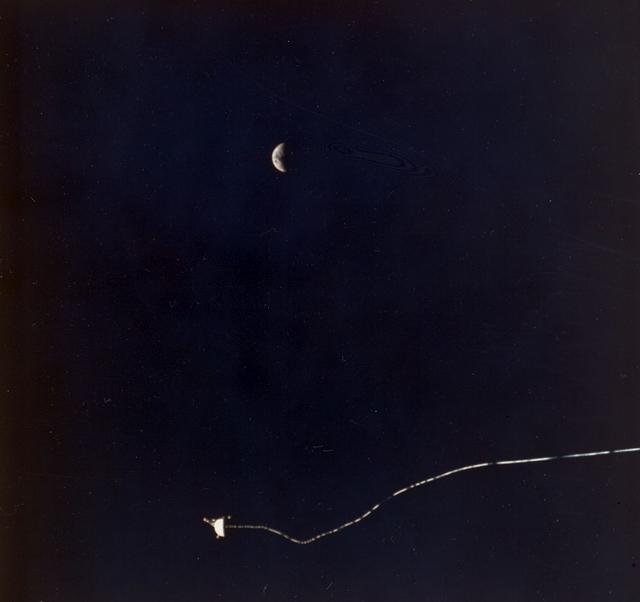
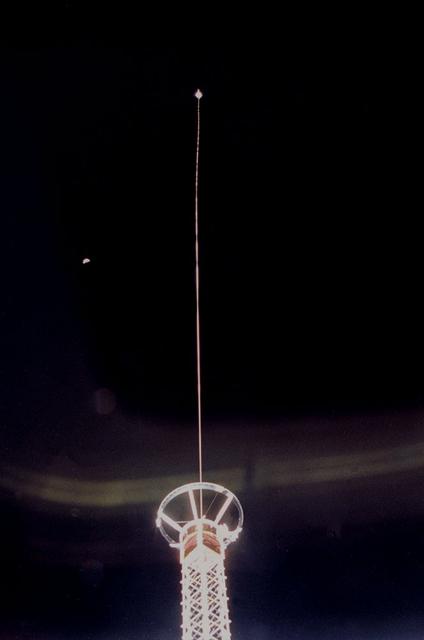
Sharing this scene with a half-moon is the Tethered Satellite System (TSS), in a photo captured onboard the STS-46. Circling Earth at an altitude of 296 kilometers (184 miles), the TSS-1 will be well within the tenuous, electrically charged layer of the atmosphere known as the ionosphere. There, a satellite attached to the orbiter by a thin conducting cord, or tether, will be reeled from the Shuttle payload bay. On this mission the satellite was plarned to be deployed 20 kilometers (12.5 miles) above the Shuttle. The conducting tether will generate high voltage and electrical currents as it moves through the atmosphere allowing scientists to examine the electrodynamics of a conducting tether system. These studies will not only increase our understanding of physical processes in the near-Earth space environment, but will also help provide an explanation for events witnessed elsewhere in the solar system. The crew of the STS-46 mission were unable to reel the satellite as planned. After several unsuccessful attempts, they were only able to extend the satellite 9.8 kilometers (6.1 miles). The TSS was a cooperative development effort by the Italian Space Agency (ASI), and NASA.
This STS-46 onboard photo is of the Tethered Satellite System-1 (TSS-1) being deployed from its boom as it is perched above the cargo bay of the Earth-orbiting Space Shuttle Atlantis. Circling the Earth at an altitude of 296 kilometers (184 miles), the TSS-1 will be well within the tenuous, electrically charged layer of the atmosphere known as the ionosphere. There, a satellite attached to the orbiter by a thin conducting cord, or tether, will be reeled from the Shuttle payload bay. On this mission the satellite was plarned to be deployed 20 kilometers (12.5 miles) above the Shuttle. The conducting tether will generate high voltage and electrical currents as it moves through the atmosphere allowing scientists to examine the electrodynamics of a conducting tether system. These studies will not only increase our understanding of physical processes in the near-Earth space environment, but will also help provide an explanation for events witnessed elsewhere in the solar system. The crew of the STS-46 mission were unable to reel the satellite as planned. After several unsuccessful attempts, they were only able to extend the satellite 9.8 kilometers (6.1 miles). The TSS was a cooperative development effort by the Italian Space Agency (ASI), and NASA.
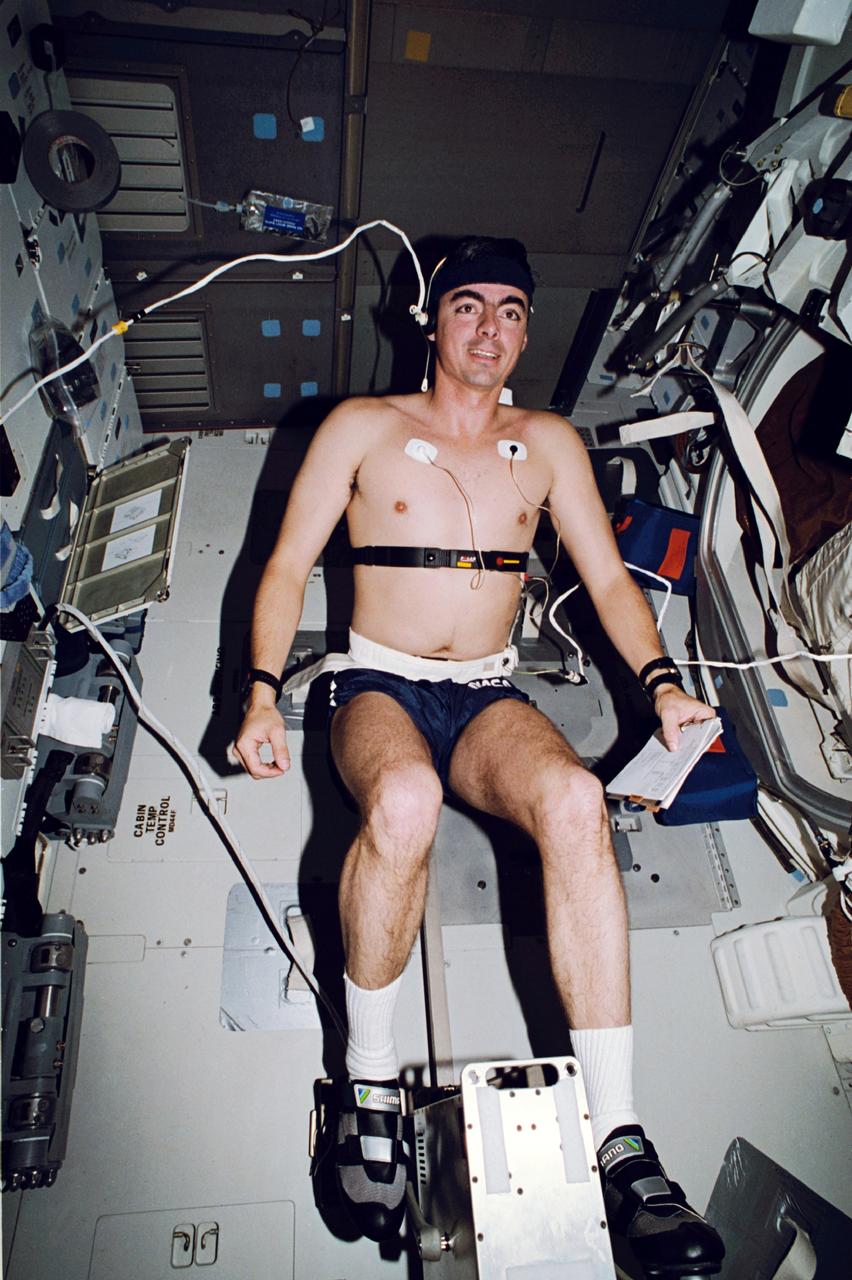
STS046-24-025 (31 July-8 Aug. 1992) --- Astronaut Andrew M. Allen, STS-46 pilot, exercises on the bicycle ergometer device on the flight deck of the Space Shuttle Atlantis as it makes one of its 127 total orbits for the eight-day mission. Allen, equipped with sensors for monitoring his biological systems during the run, was joined by four other NASA astronauts and two European scientists on the mission.
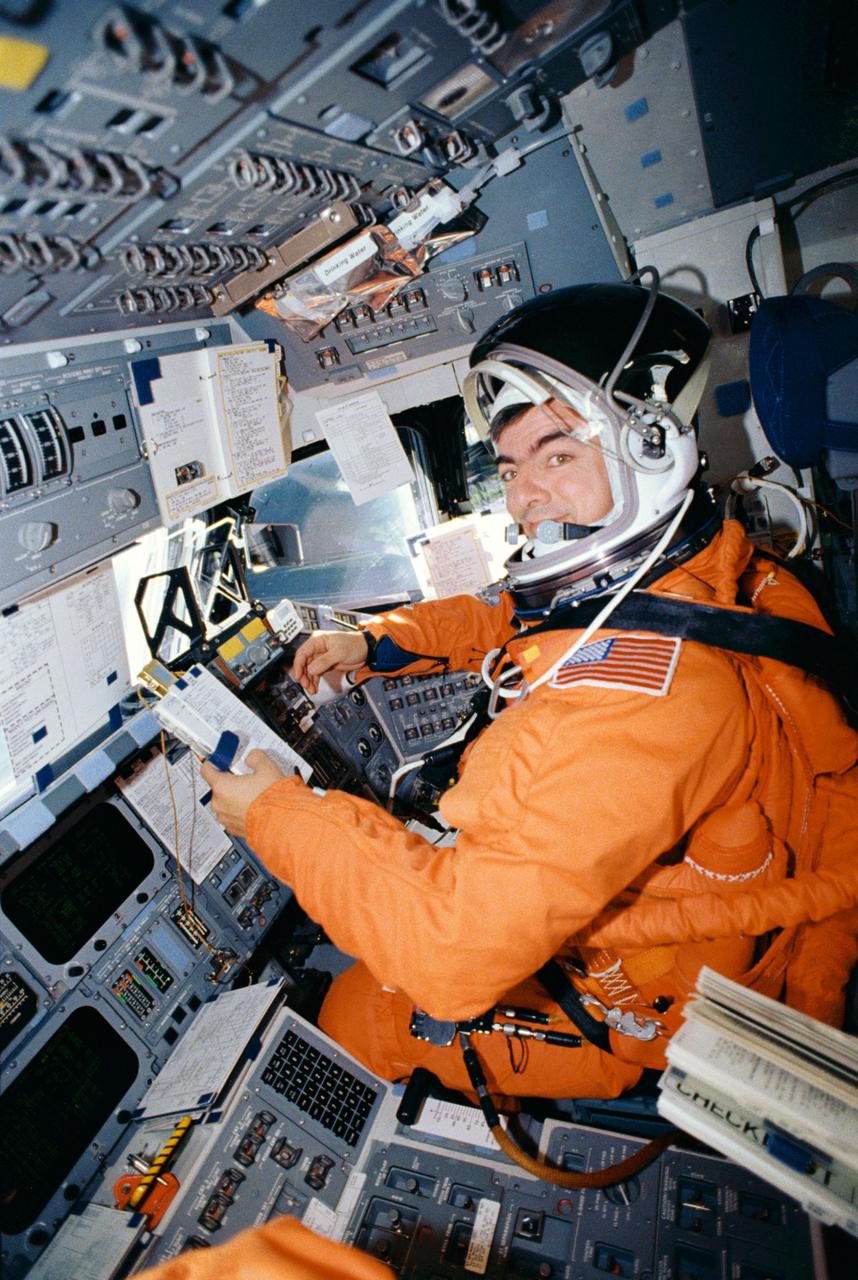
STS046-10-003 (8 Aug. 1992) --- Astronaut Andrew M. Allen, STS-46 pilot, positioned in the pilot's station and wearing a partial pressure launch and entry suit, prepares for the final leg of the mission. Allen and six fellow crew members had just shared a busy eight-day stay in Earth-orbit aboard the Space Shuttle Atlantis.
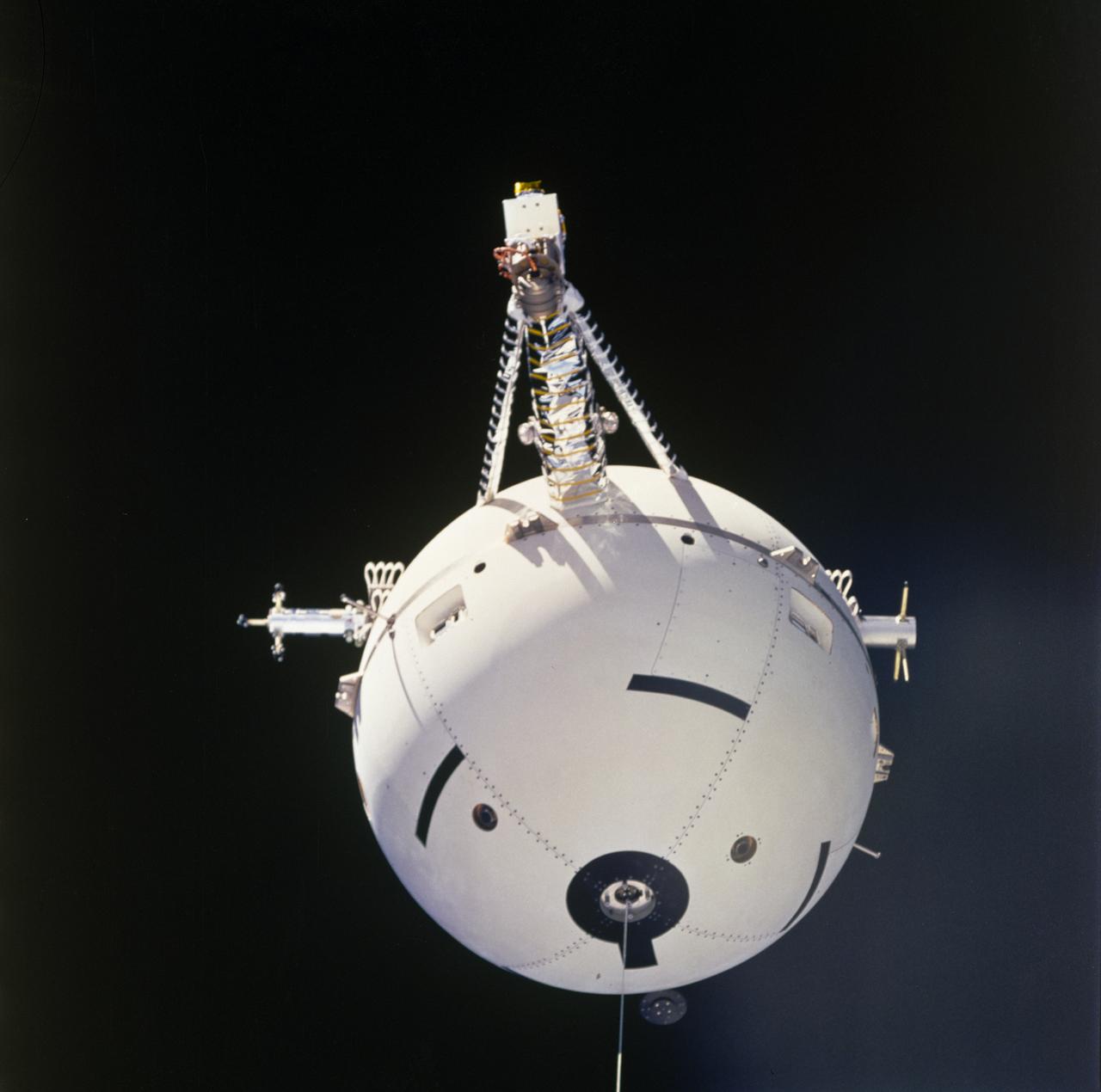
This Space Shuttle Orbiter Atlantis (STS-46) onboard photo is a close-up view of the Tethered Satellite System (TSS-1) in orbit above the Shuttle. A cooperative development effort by the Italian Space Agency (ASI) and NASA, the Tethered Satellite System (TSS) made capable the deployment and retrieval of a satellite which is attached by a wire tether from distances up to 100 km from the Orbiter. These free-flying satellites are used as observation platforms outside of the Orbiter.
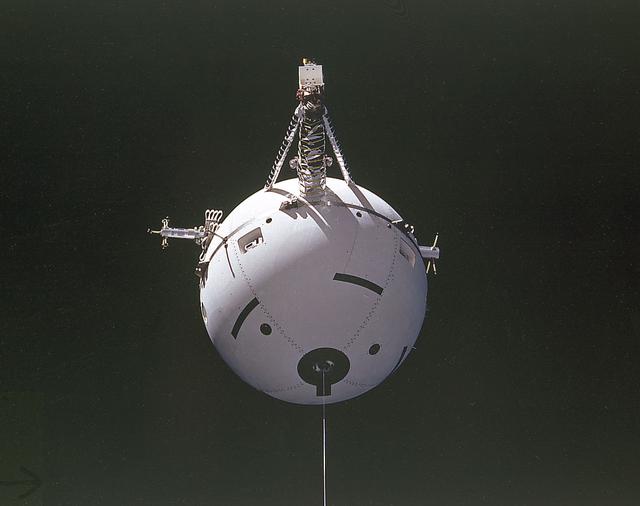
Space Shuttle Atlantis (STS-46) onboard photo of the Tethered Satellite System (TSS-1) deployment. A cooperative development effort by the Italian Space Agency (ASI) and NASA, the Tethered Satellite System (TSS) made capable the deployment and retrieval of a satellite which is attached by a wire tether from distances up to 100 km from the Orbiter. These free-flying satellites are used as observation platforms outside of the Orbiter.
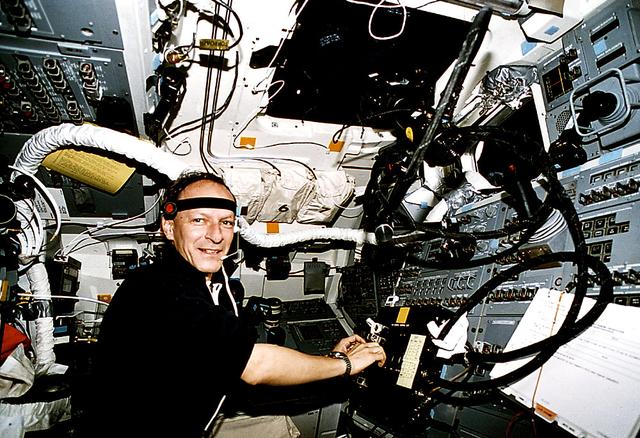
This Space Shuttle Orbiter Atlantis (STS-46) onboard photo shows Swiss scientist Claude Nicollier of the European Space Agency (ESA) supporting the Tether Opitical Phenomena (TOP) activities on the flight deck. The Tethered Satellite System (TSS) was a cooperative development effort by the Italian Space Agency (ASI) and NASA made capable of deploying and retrieving a satellite which is attached by a wire tether from distances up to 100 km from the Orbiter. These free-flying satellites are used as observation platforms outside of the Orbiter.
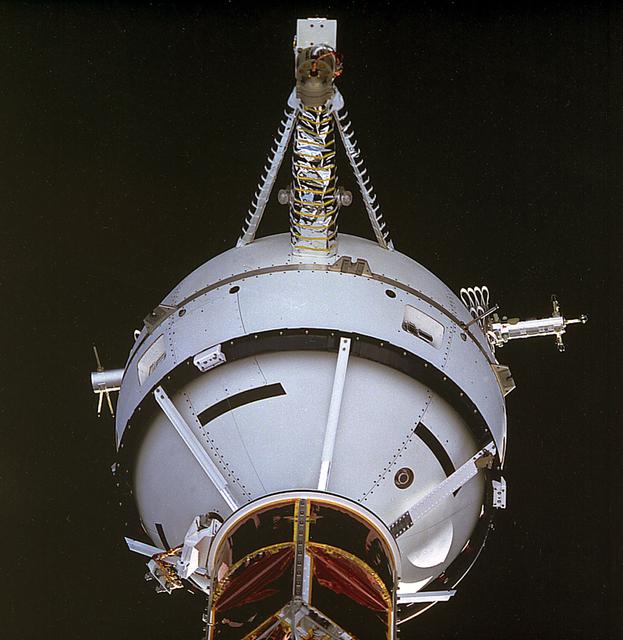
Pictured here is a Space Shuttle Atlantis (STS-46) onboard photo of the Tethered Satellite System (TSS-1) deployment. The Tethered Satellite System (TSS) was a cooperative development effort by the Italian Space Agency (ASI) and NASA. Combined efforts resulted in the capability of deploying and retrieving a satellite which is attached by a wire tether from distances up to 100-km from the Orbiter. These free-flying satellites are used as observation platforms outside of the Orbiter.
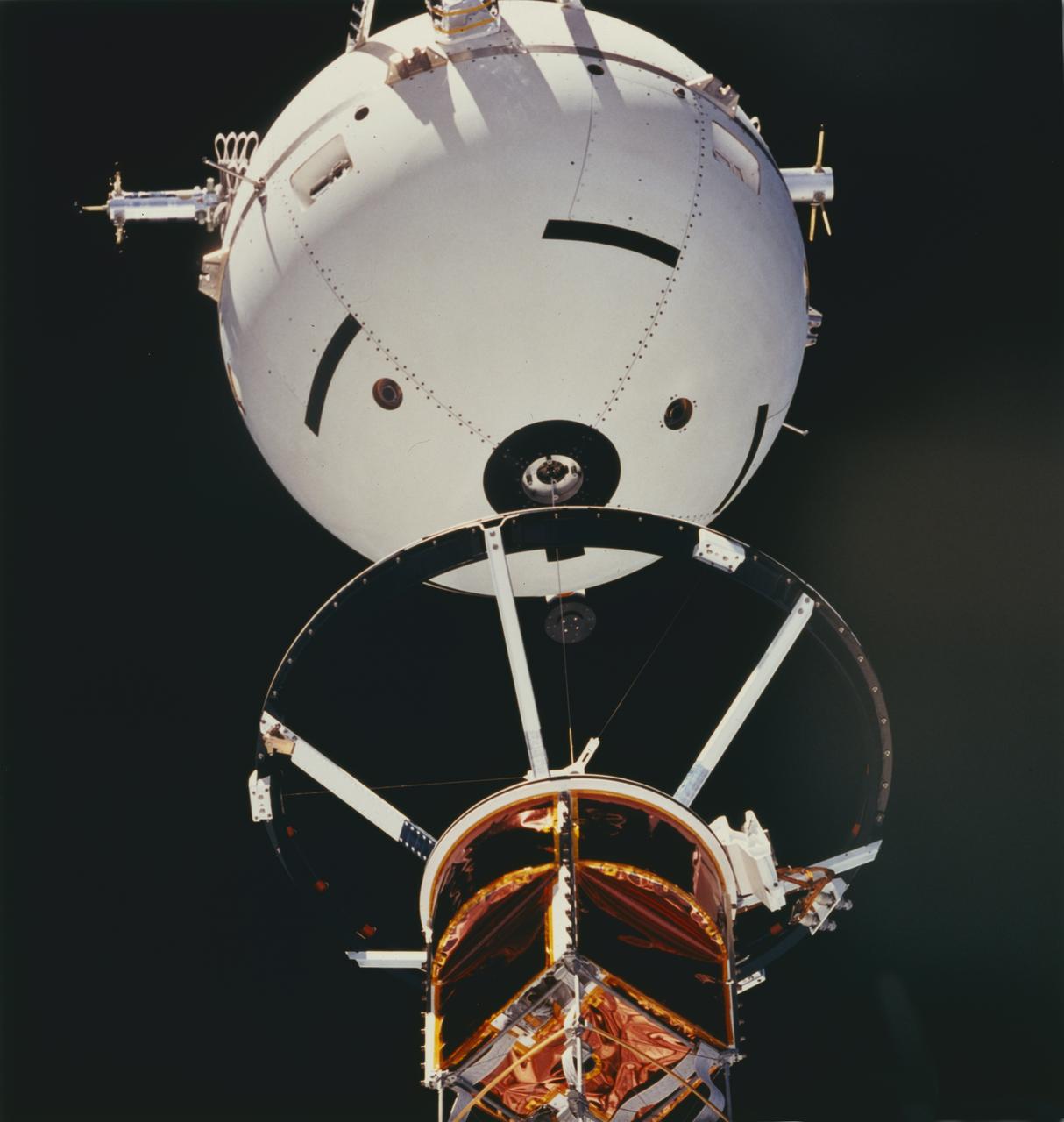
A crewmember aboard the Space Shuttle Orbiter Atlantis (STS-46) used a 70mm handheld camera to capture this medium closeup view of early operations with the Tethered Satellite System (TSS). TSS-1 is being deployed from its boom as it is perched above the cargo bay of the Earth-orbiting Shuttle circling the Earth at an altitude of 296 kilometers (184 miles), the TSS-1 will be well within the tenuous, electrically charged layer of the atmosphere known as the ionosphere. There, a satellite attached to the orbiter by a thin conducting cord, or tether, will be reeled from the Shuttle payload bay. On this mission the satellite was plarned to be deployed 20 kilometers (12.5 miles) above the Shuttle. The conducting tether will generate high voltage and electrical currents as it moves through the atmosphere allowing scientists to examine the electrodynamics of a conducting tether system. These studies will not only increase our understanding of physical processes in the near-Earth space environment, but will also help provide an explanation for events witnessed elsewhere in the solar system. The crew of the STS-46 mission were unable to reel the satellite as planned. After several unsuccessful attempts, they were only able to extend the satellite 9.8 kilometers (6.1 miles). The TSS was a cooperative development effort by the Italian Space Agency (ASI), and NASA.
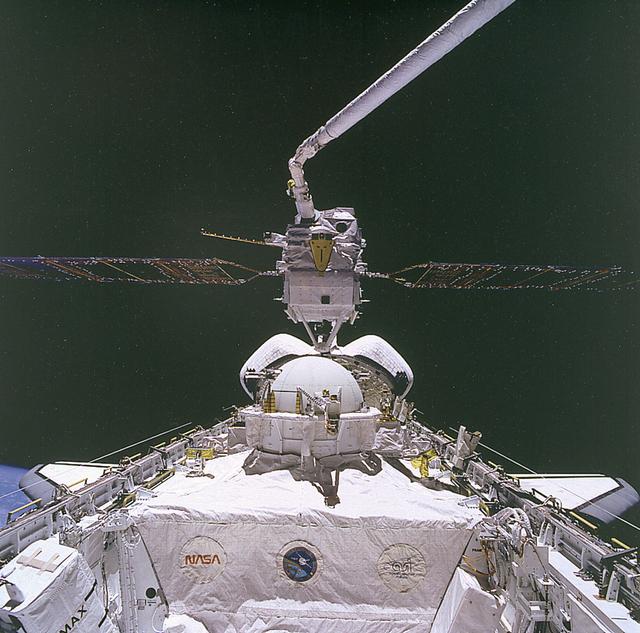
Space Shuttle Atlantis (STS-46) onboard photo of the Tethered Satellite System (TSS-1) on deployer boom. The Tethered Satellite System (TSS) was a cooperative development effort by the Italian Space Agency (ASI) and NASA made capable of deploying and retrieving a satellite which is attached by a wire tether from distances up to 100 km from the Orbiter. These free-flying satellites are used as observation platforms outside of the Orbiter.
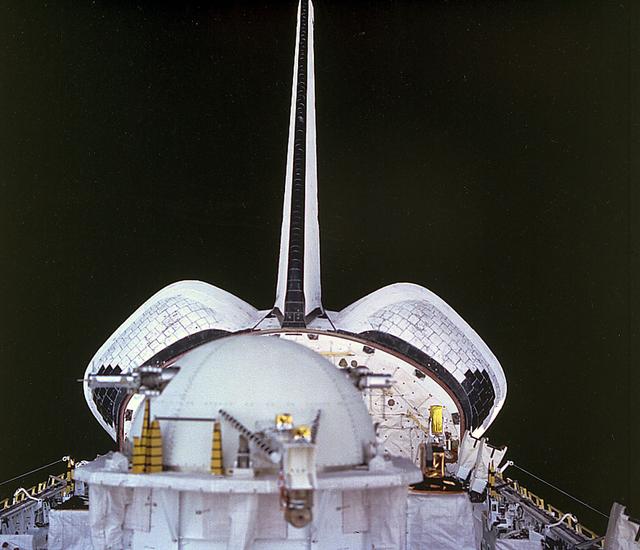
Space Shuttle Atlantis (STS-46) onboard photo of the Tethered Satellite System (TSS-1) in Orbiter's cargo bay. The Tethered Satellite System (TSS) was a cooperative development effort by the Italian Space Agency (ASI) and NASA made capable of deploying and retrieving a satellite which is attached by a wire tether from distances up to 100 km from the Orbiter. These free-flying satellites are used as observation platforms outside of the Orbiter.
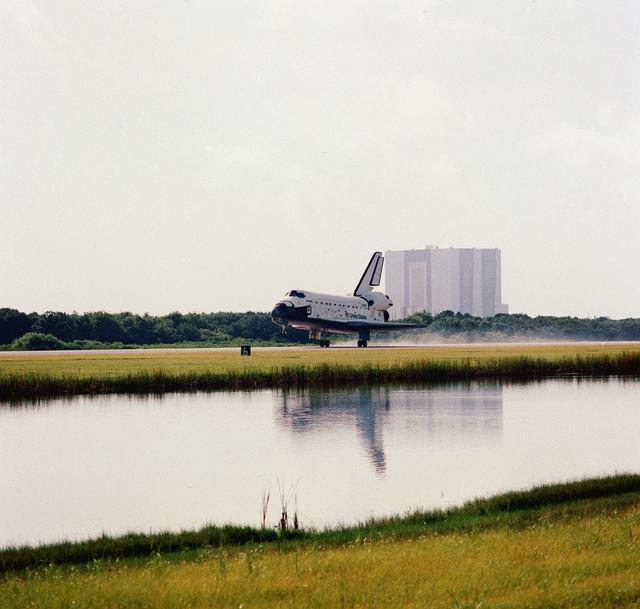
The Space Shuttle Orbiter Atlantis (STS-46) touched down at Kennedy Space Center's (KSC) Shuttle Landing Facility completing an eight day mission of five NASA astronauts and two Europeans. The vehicle assembly building (VAB) can be seen in the background. The STS-46 mission carried and deployed the European Retrievable Carrier (Eureca), and the NASA/ISA Tethered Satellite System (TSS-1), allowing for a new capability for probing the space environment.
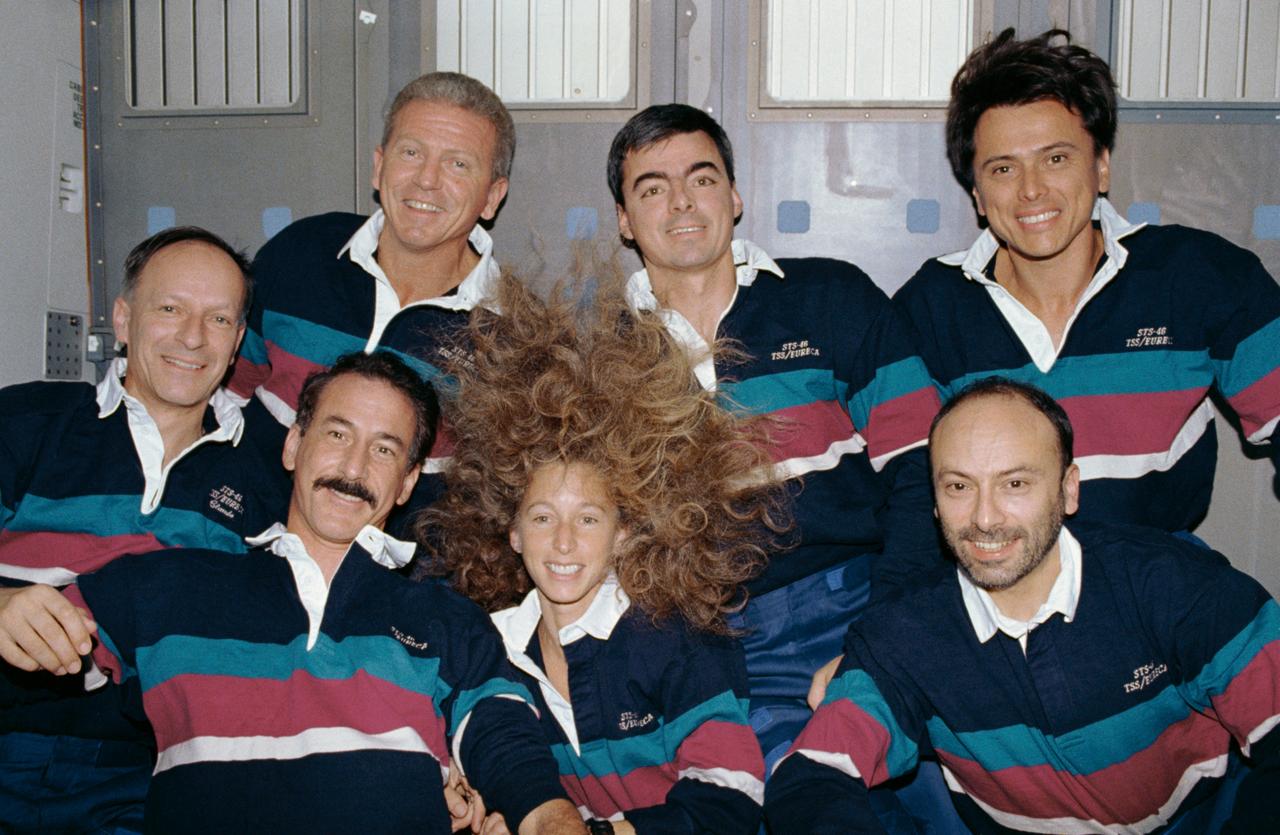
STS046-12-009 (31 July-8 Aug. 1992) --- The seven crew members for the STS-46 mission pose for the traditional in-flight portrait onboard the Earth-orbiting space shuttle Atlantis. In the rear are, left to right, astronauts Loren J. Shriver, commander; Andrew M. Allen, pilot; and Franklin R. Chang-Diaz, mission specialist. In front are, left to right, Swiss scientist Claude Nicollier, mission specialist representing the European Space Agency (ESA); astronaut Jeffrey A. Hoffman, payload commander; astronaut Marsha S. Ivins, mission specialist; and Franco Malerba, payload specialist representing the Italian Space Agency (ASI).
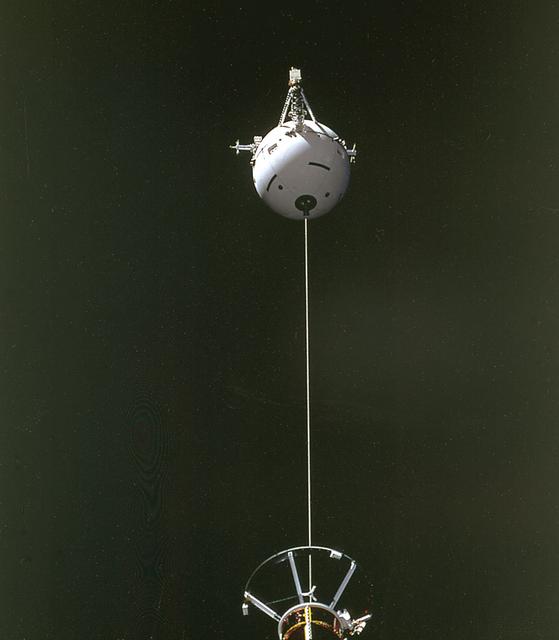
This is a Space Shuttle Orbiter Atlantis (STS-46) onboard photo of the Tethered Satellite System (TSS-1) deployment. A cooperative development effort by the Italian Space Agency (ASI) and NASA, the Tethered Satellite System (TSS) made capable the deployment and retrieval of a satellite which is attached by a wire tether from distances up to 100 km from the Orbiter. These free-flying satellites are used as observation platforms outside of the Orbiter.
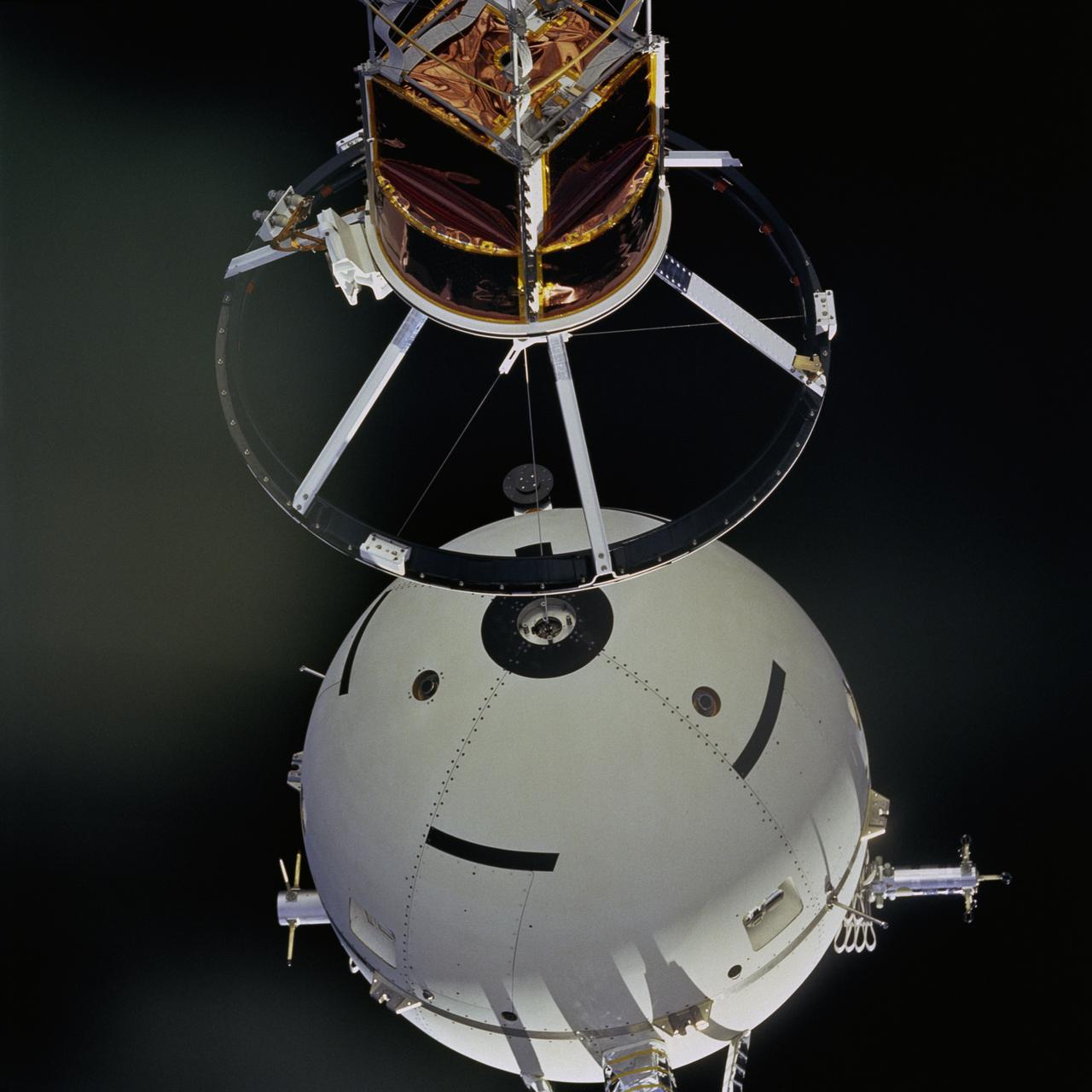
STS046-73-052 (4 Aug 1992) --- A 70mm handheld camera was used by the crew members to capture this medium close-up view of early operations with the Tethered Satellite System (TSS). The sphere can be seen moving away from the ring structure on the boom device in the Space Shuttle Atlantis' cargo bay.
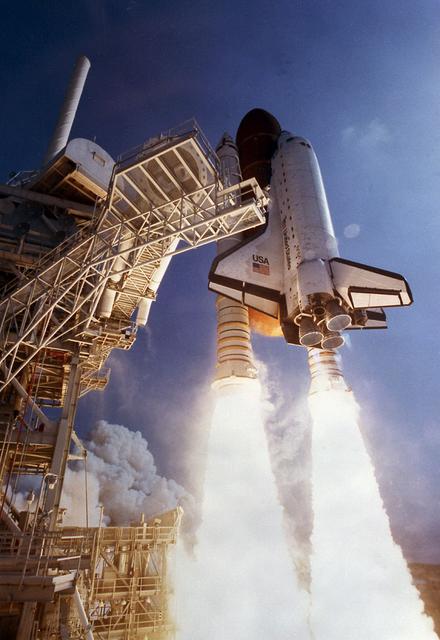
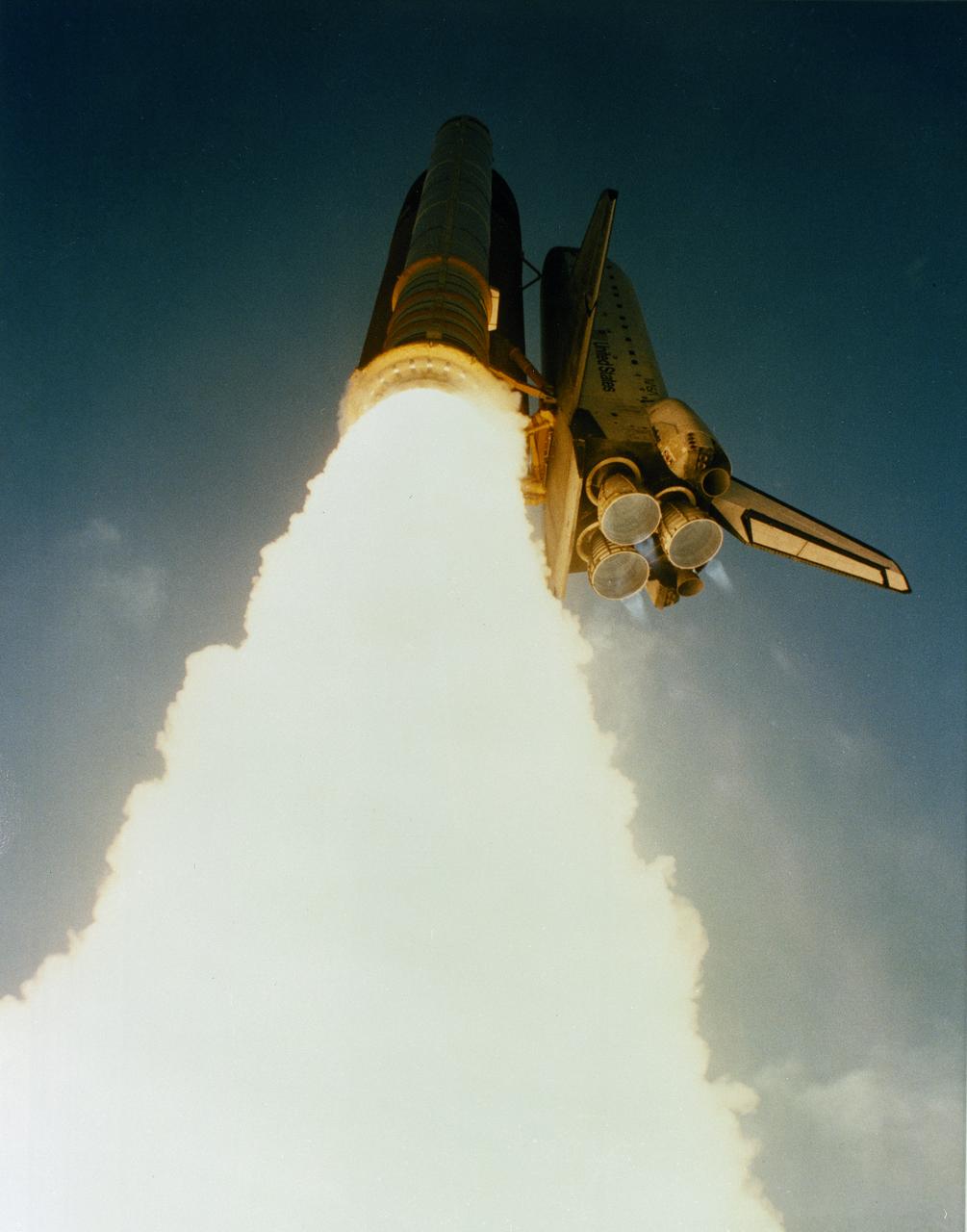
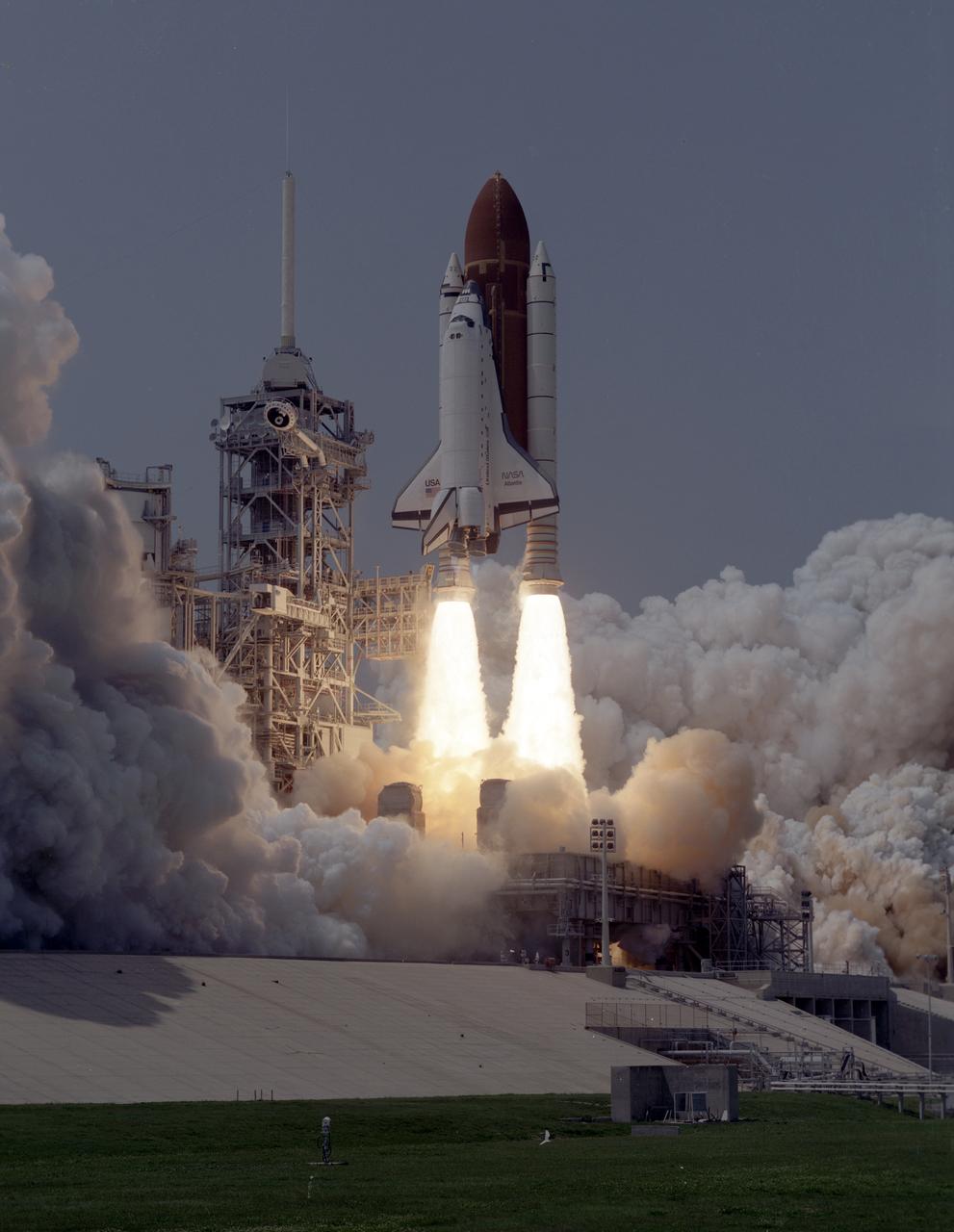
The Space Shuttle Orbiter Atlantis (STS-46) breaks free of all earthly constraints and hurdles past the Fixed Service Structure (FSS) and beanie cap which only moments before had been in place above the external tank. The Shuttle Atlantis carried and deployed the European Retrievable Carrier (Eureca). The NASA/ISA Tethered Satellite System (TSS-1) was also deployed for the first time, allowing for a new capability for probing the space environment.
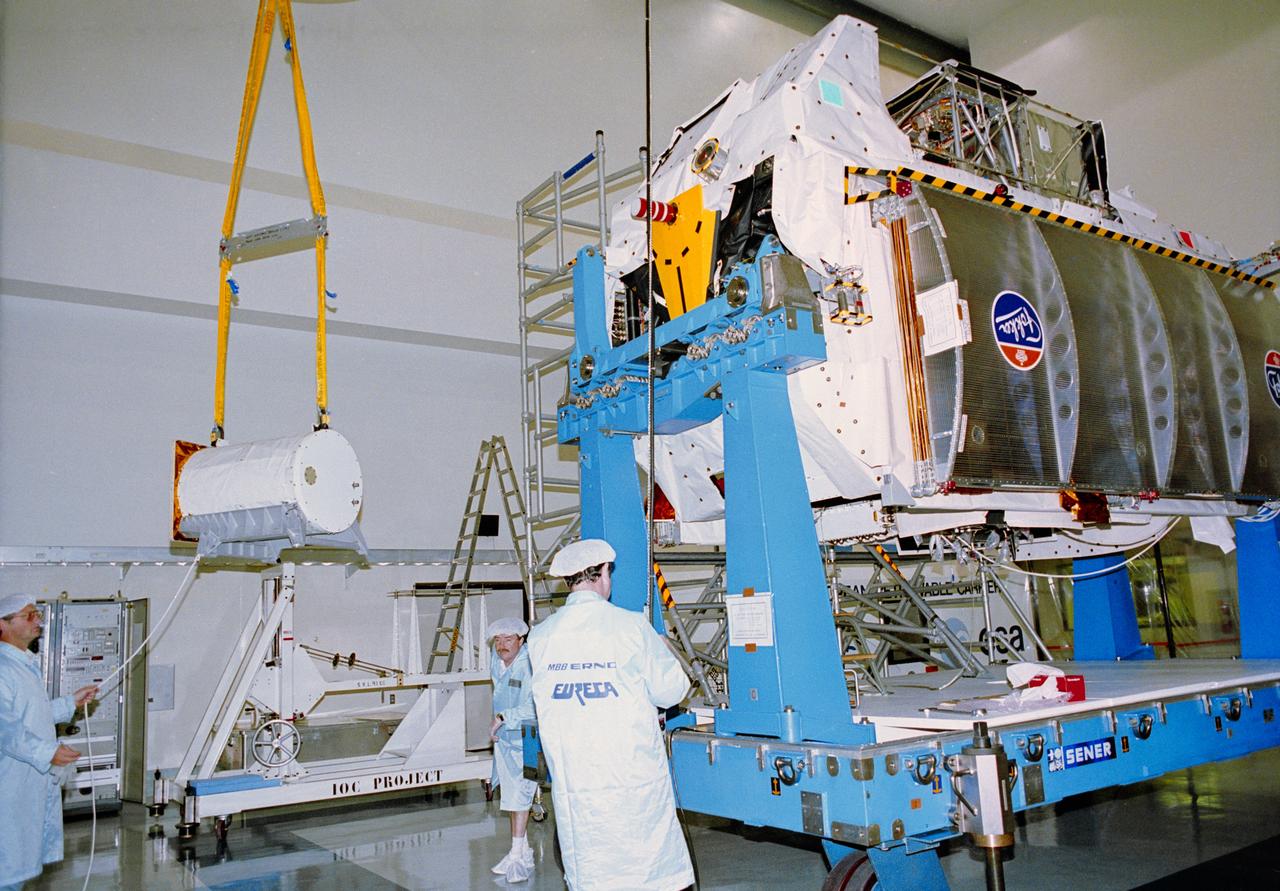
S92-41442 (3 Dec 1991) --- At the Astrotech Space Operations spacecraft processing facility in Titusville, German aerospace workers check out the European Retrievable Carrier (EURECA) after removing it from the shipping container. The approximately 10,000-pound spacecraft is scheduled to return to KSC next April to undergo final preparations for launch on the STS-46 mission. Sponsored by the European Space Agency, EURECA is a free-flying reusable research platform that will be deployed during the flight and retrieved at a later date by another Shuttle crew.
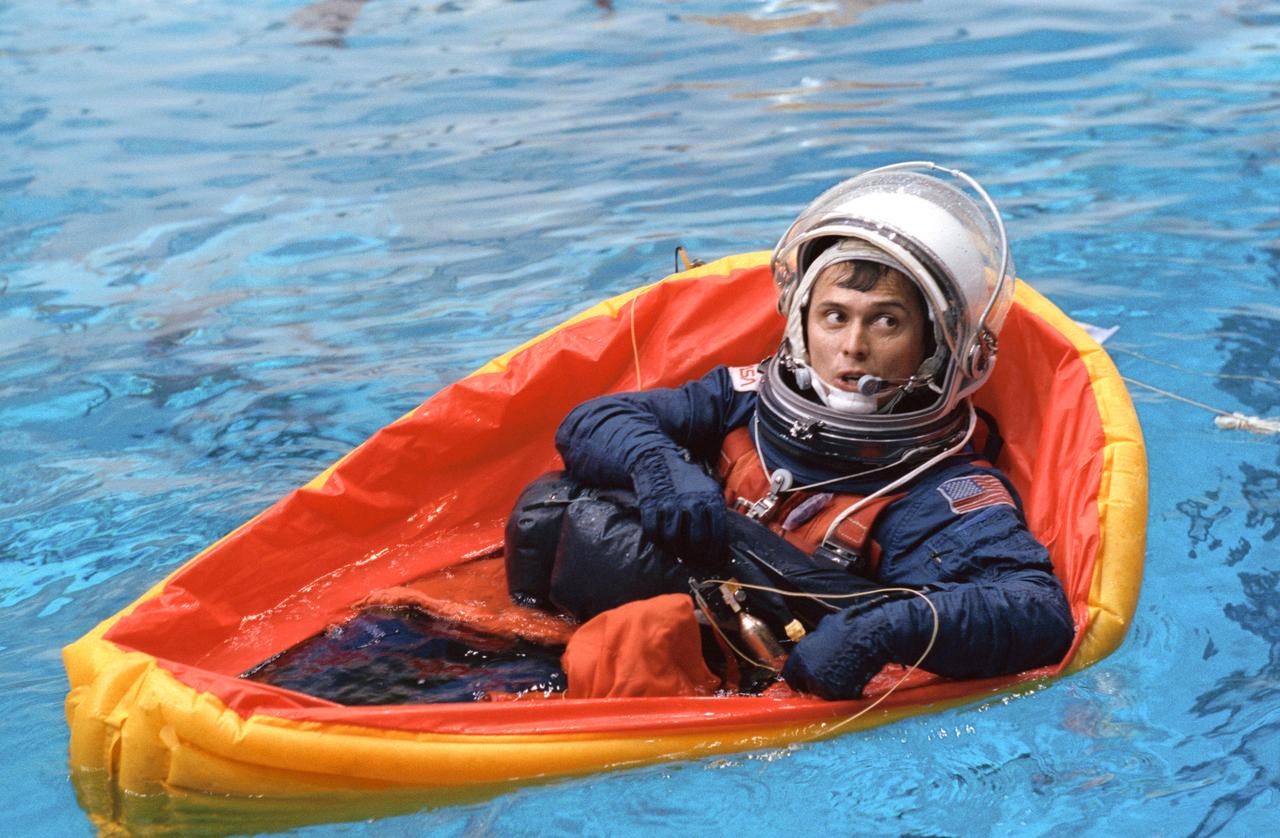
S92-33478 (12 March 1992) --- Astronaut Franklin R. Chang-Diaz, mission specialist, relies on a one-person life raft to get him to "safety" during a STS-46 bailout simulation exercise. The training took place in the Johnson Space Center's weightless environment training facility.
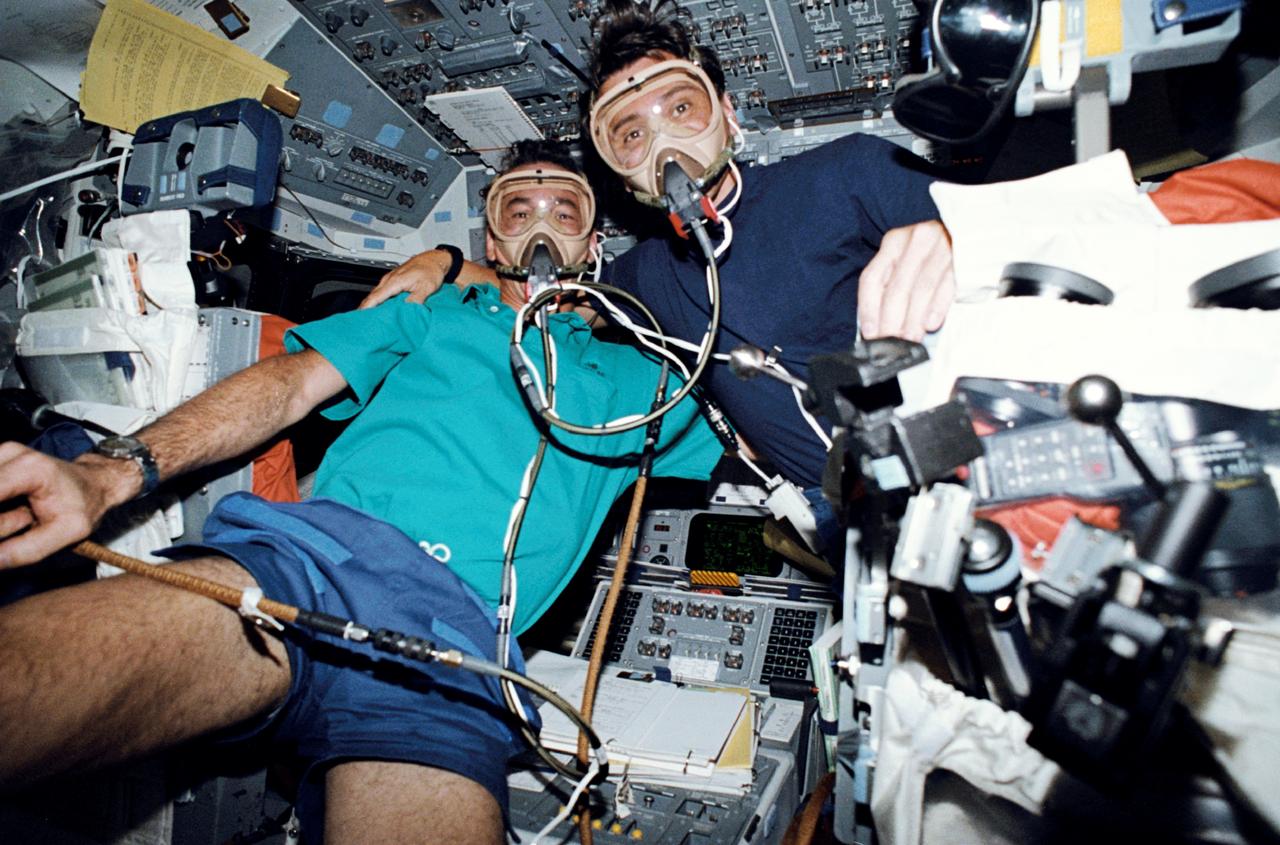
STS046-33-028 (4 Aug. 1992) --- With the possibility of an extravehicular activity (EVA) being added to the agenda, the two EVA-trained crew members begin their "pre-breathe" period on the space shuttle Atlantis' flight deck. Astronauts Jeffrey A. Hoffman (left), payload commander, and Franklin R. Chang-Diaz, mission specialist, reported to this station and began the "pre-breathe" process when problems developed during the extension of the Tethered Satellite System (TSS). When the human body is exposed to a sudden decrease in atmospheric pressure (for instance, from the 10.2 ppsi in the crew cabin to the 4.5 ppsi of the Extravehicular Mobility Unit (EMU) spacesuit), nitrogen traces in the bloodstream will expand. This expansion can create tiny bubbles and potential for the "bends". In order to lessen the effect, an astronaut must "pre-breathe" pure oxygen (the same pure oxygen that he will breathe in the suit) to help "purge" nitrogen from his/her bloodstream before exerting him/herself in the low-pressure environment of the suit. The "pre-breathe" exercise and the EVA turned out to be not needed as the TSS operations were resumed by remote operations.
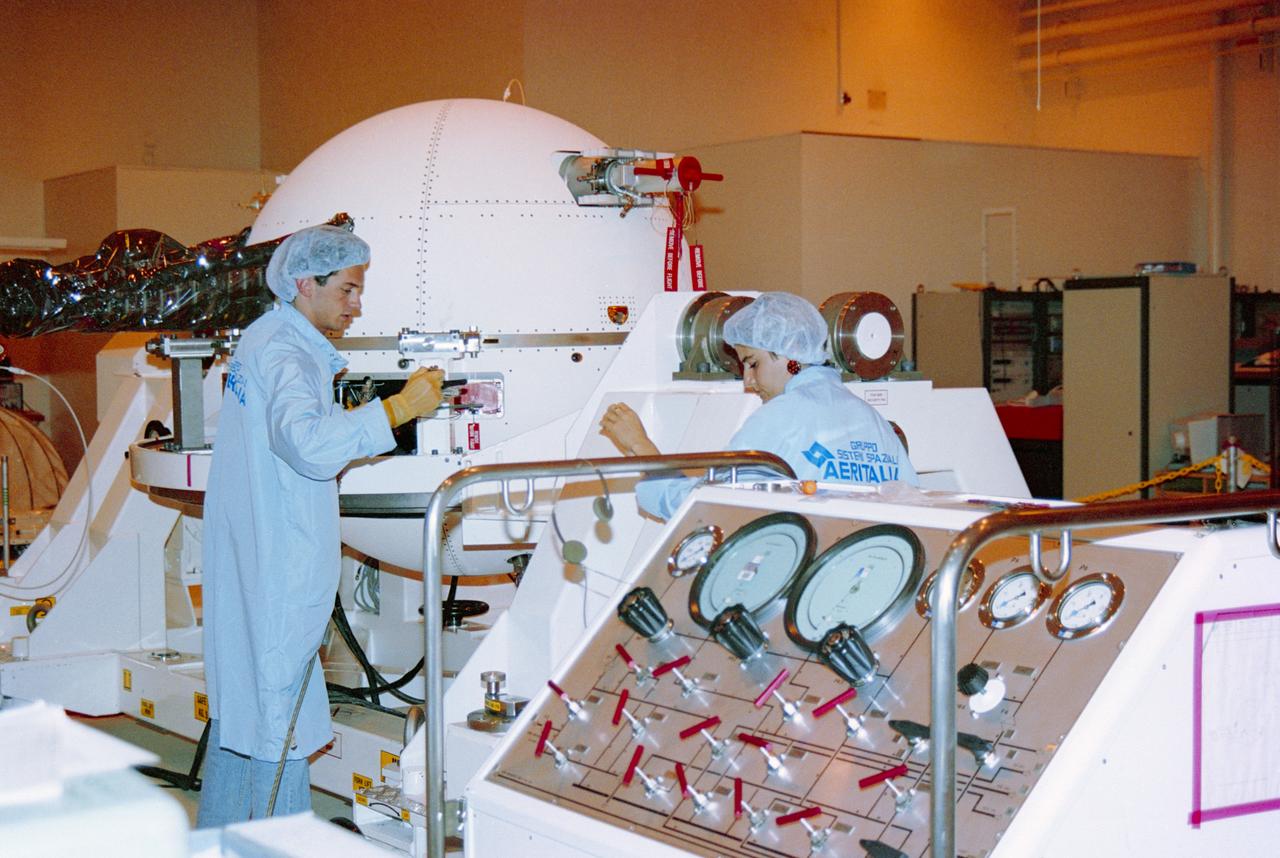
S92-41073 (31 oct 1991) --- In the Operations and Checkout Building high bay, preflight processing continues on the Tethered Satellite System (TSS) which is scheduled to fly on Space Shuttle Mission STS-46. Italian firm Aeritalia built the research satellite under contract to the Italian Space Agency (ASI). A joint endeavor between Italy and the United States, the TSS will release a satellite tethered to a reel in the orbiter cargo bay, and experiments will be conducted while the spacecraft is positioned some 12 miles above the orbiter.
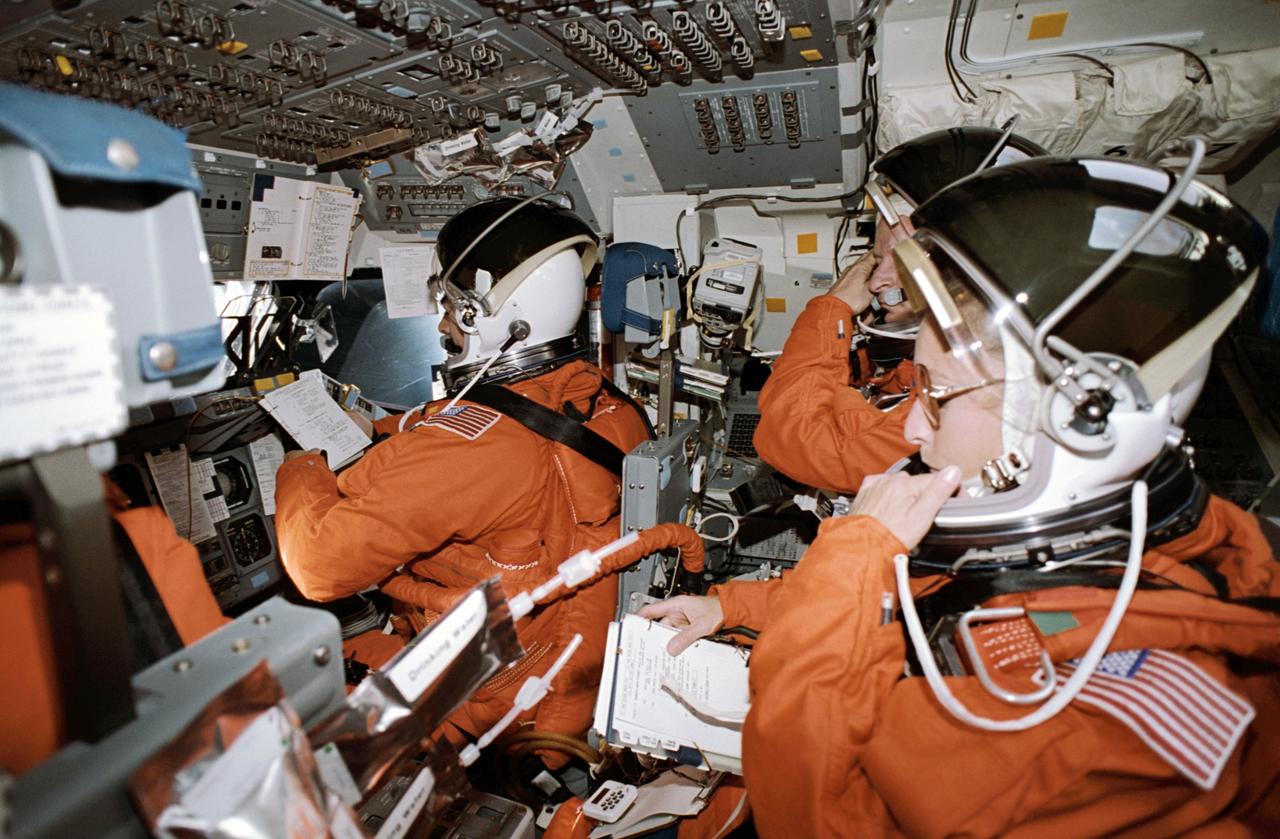
STS046-19-037 (8 Aug 1992) --- Having completed eight days in Earth-orbit, the crew members prepare for their brief journey home. Left to right are Andrew M. Allen, pilot; Claude Nicollier, mission specialist representing the European Space Agency (ESA); and Marsha S. Ivins, mission specialist. Just out of frame, at left, is Loren J. Shriver, mission commander, who guided the Space Shuttle Atlantis in for its Kennedy Space Center (KSC), Florida landing.
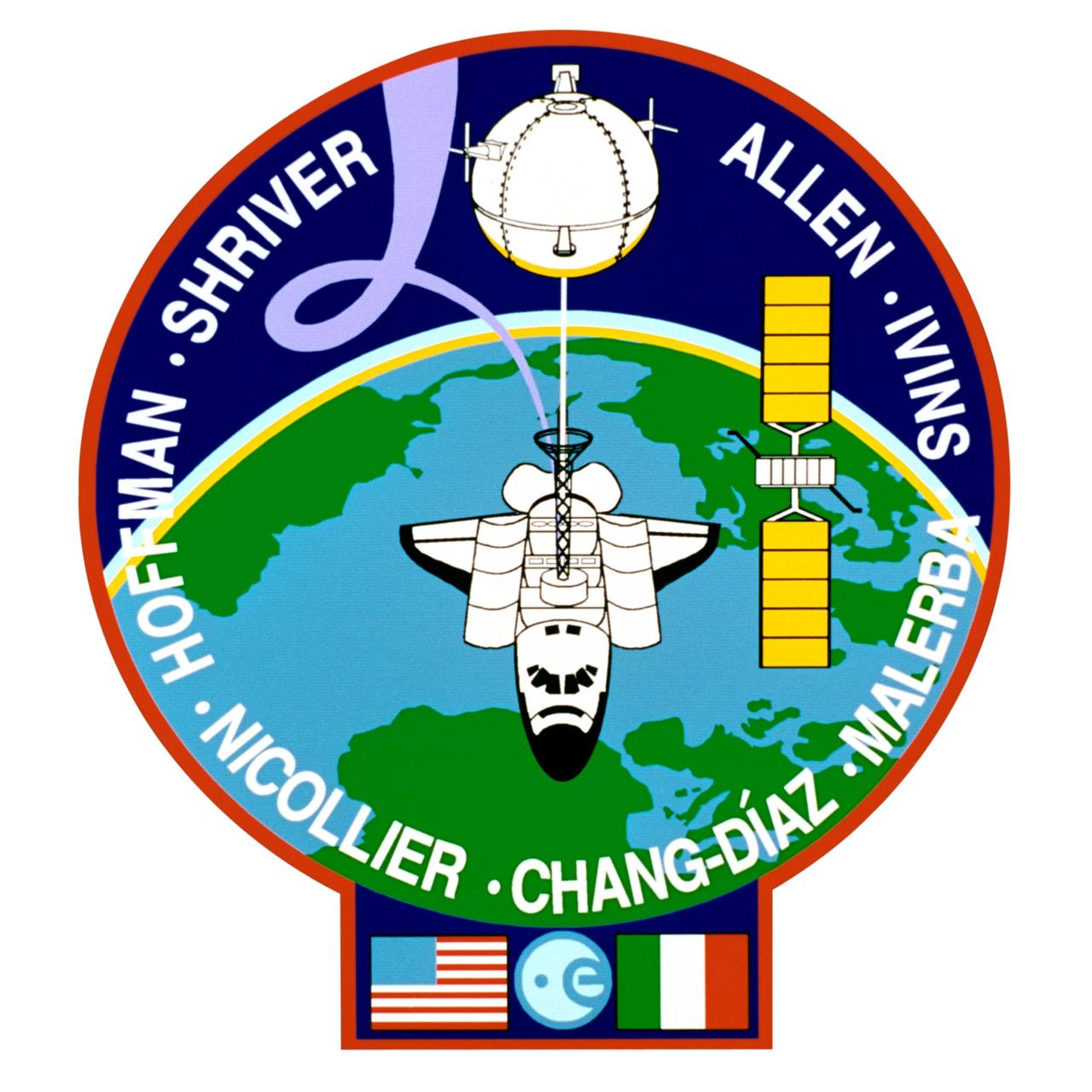
STS046-S-001 (May 1992) --- Designed by the crew members assigned to the flight, the crew patch depicts the space shuttle Atlantis in orbit around Earth, accompanied by major payloads: the European Retrievable Carrier (EURECA) and the Tethered Satellite System (TSS-1). In the depiction, EURECA has been activated and released, its antennae and solar arrays deployed, and it is about to start its ten-month scientific mission. The tethered satellite is linked to the orbiter by a 20-kilometer tether. The purple beam emanating from an electron generator in the payload bay spirals around Earth's magnetic field. The TSS mission will study the dynamics and electrodynamics of tethered systems in space and the physics of Earth's ionosphere. Visible on Earth's surface are the United States of America and the thirteen-member countries of the European Space Agency (ESA), in particular, Italy - partner with the United States in the TSS program. The American and Italian flags, as well as the ESA logo, further serve to illustrate the international character of STS-46. The NASA insignia design for space shuttle flights is reserved for use by the astronauts and for other official use as the NASA Administrator may authorize. Public availability has been approved only in the forms of illustrations by the various news media. When and if there is any change in this policy, which is not anticipated, the change will be publicly announced. Photo credit: NASA
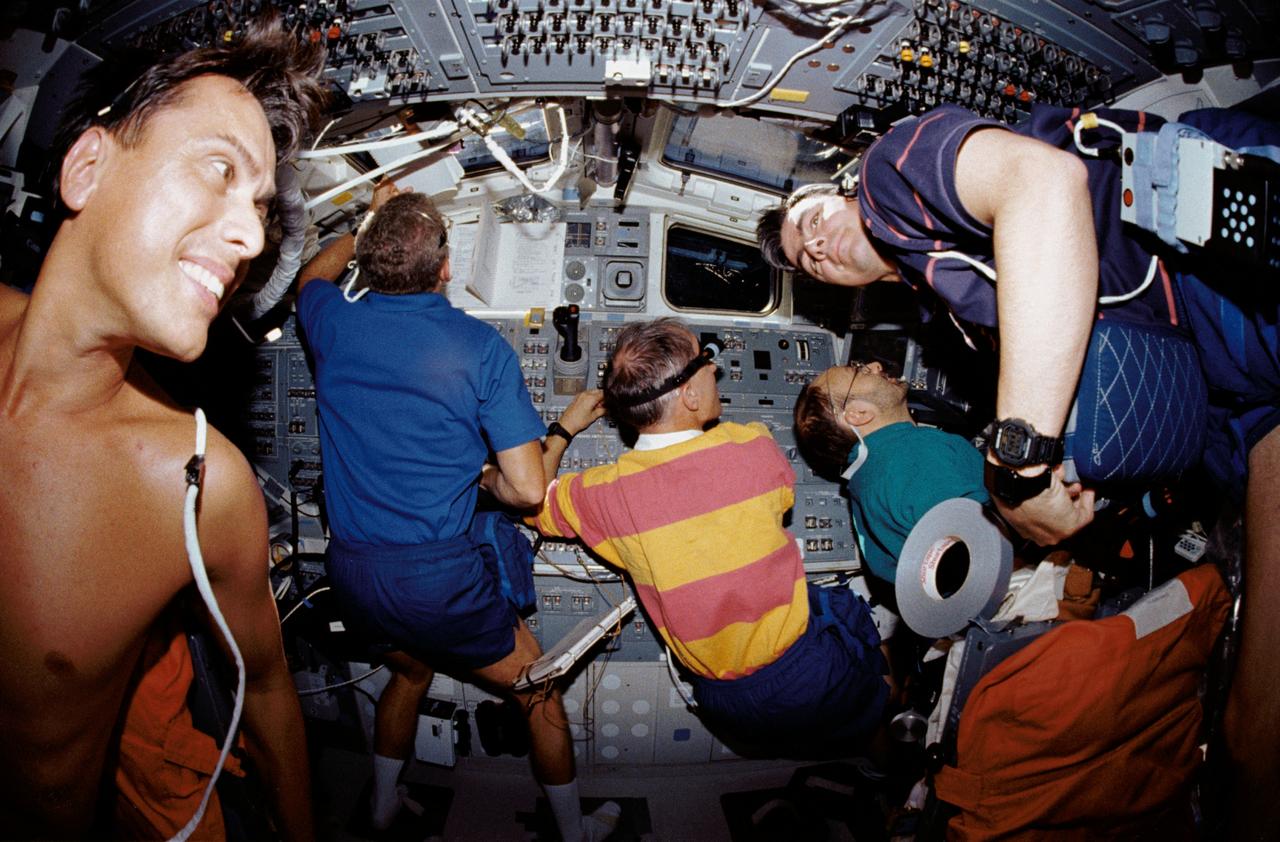
STS046-14-013 (4 Aug. 1992) --- Five of the seven crew members squeezed into this busy scene on the Space Shuttle Atlantis' flight deck during operations with the Tethered Satellite System (TSS). Pictured are, left to right, Franklin R. Chang-Diaz, Loren J. Shriver, Claude Nicollier, Franco Malerba and Andrew M. Allen. Not pictured are astronauts Jeffrey A. Hoffman and Marsha S. Ivins. Mission specialist Ivins used a 35mm camera with a 16mm lens to take this picture.
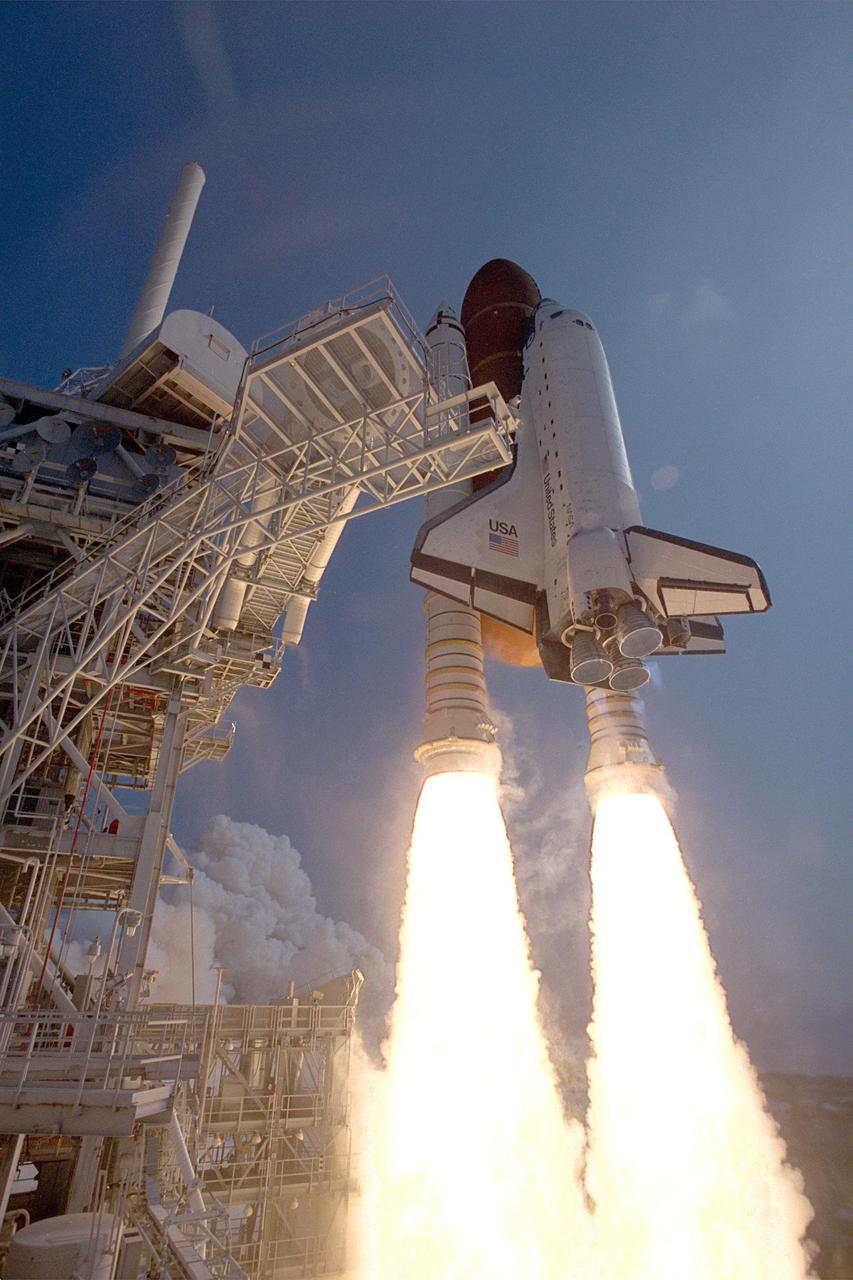
KENNEDY SPACE CENTER, FLA. -- The Space Shuttle Atlantis breaks free of all earthly constraints and hurtles past the Fixed Service Structure and 'beanie cap,' which only moments before had been in place above the external tank. STS-46 lifted off at 9:56:48 a.m. EDT, July 31. The Shuttle Atlantis carries Eureca, the European Retrievable Carrier, which is to be put into orbit during this mission. The NASA_Italian Space Agency Tethered Satellite System (TSS-1) will also be deployed for the first time during the STS-46 flight allowing a new capability for probing the space environment.
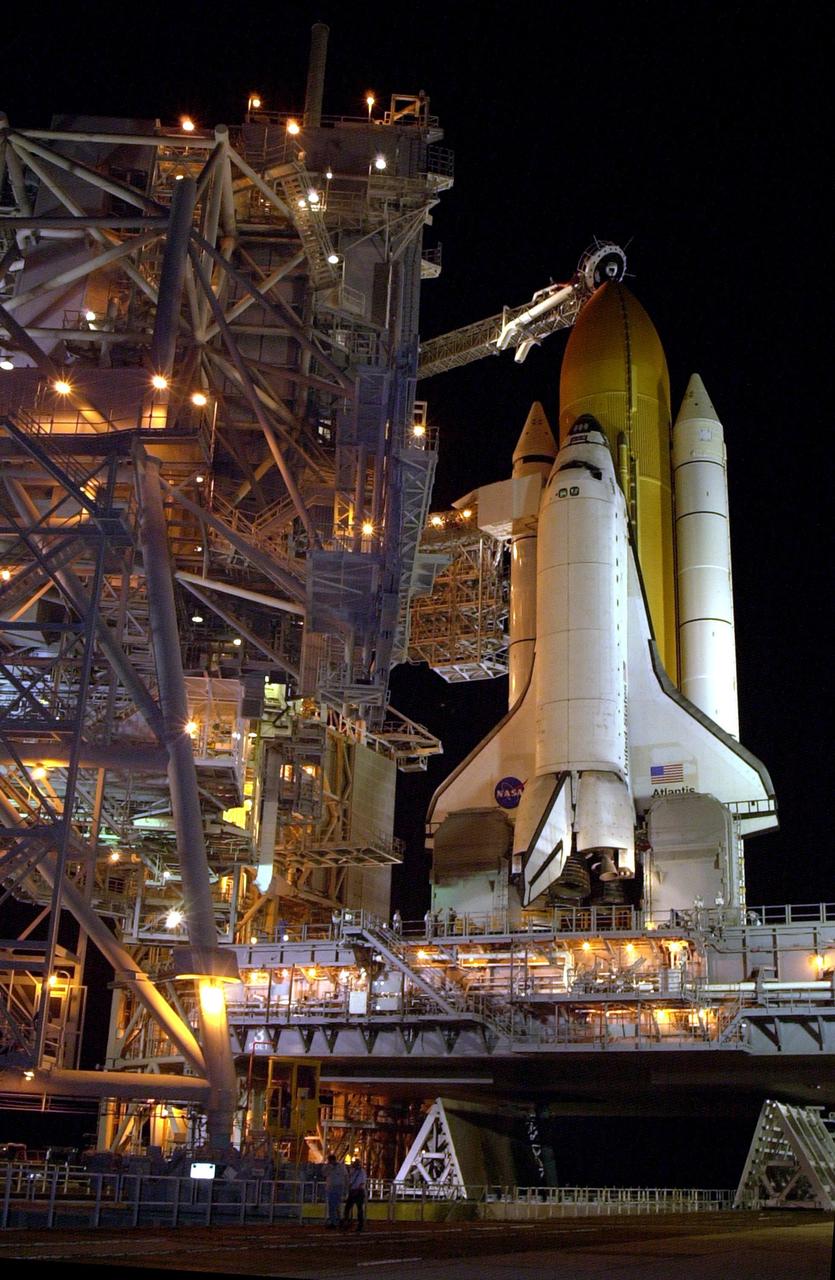
KENNEDY SPACE CENTER, FLA. -- The Rotating Service Structure rolls back to reveal Space Shuttle Atlantis on pad 39B prior to launch. The Shuttle is scheduled for launch Oct. 7 at 3:46 p.m. EDT on mission STS-112.
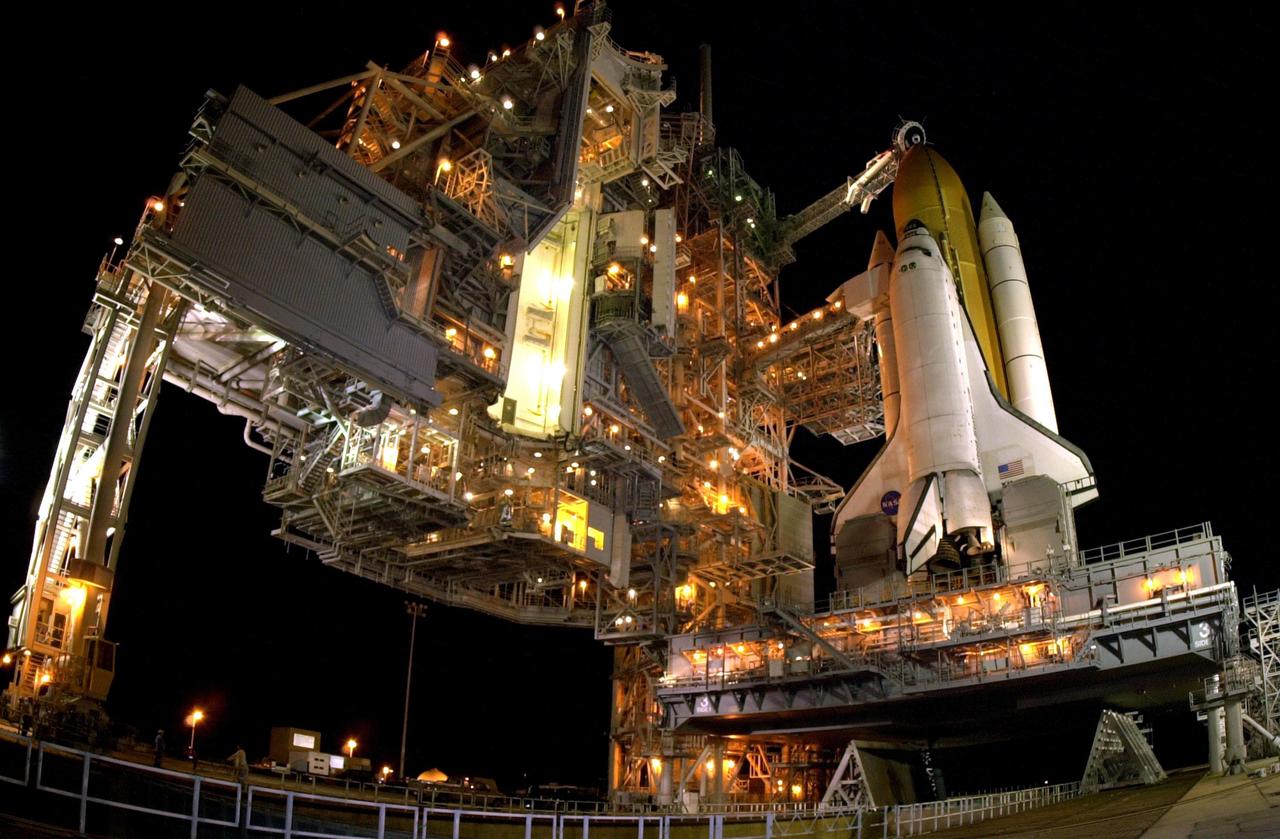
KENNEDY SPACE CENTER, FLA. -- The Rotating Service Structure is rolled back to reveal Space Shuttle Atlantis on pad 39B prior to launch. The Shuttle is scheduled for launch Oct. 7 at 3:46 p.m. EDT on mission STS-112.
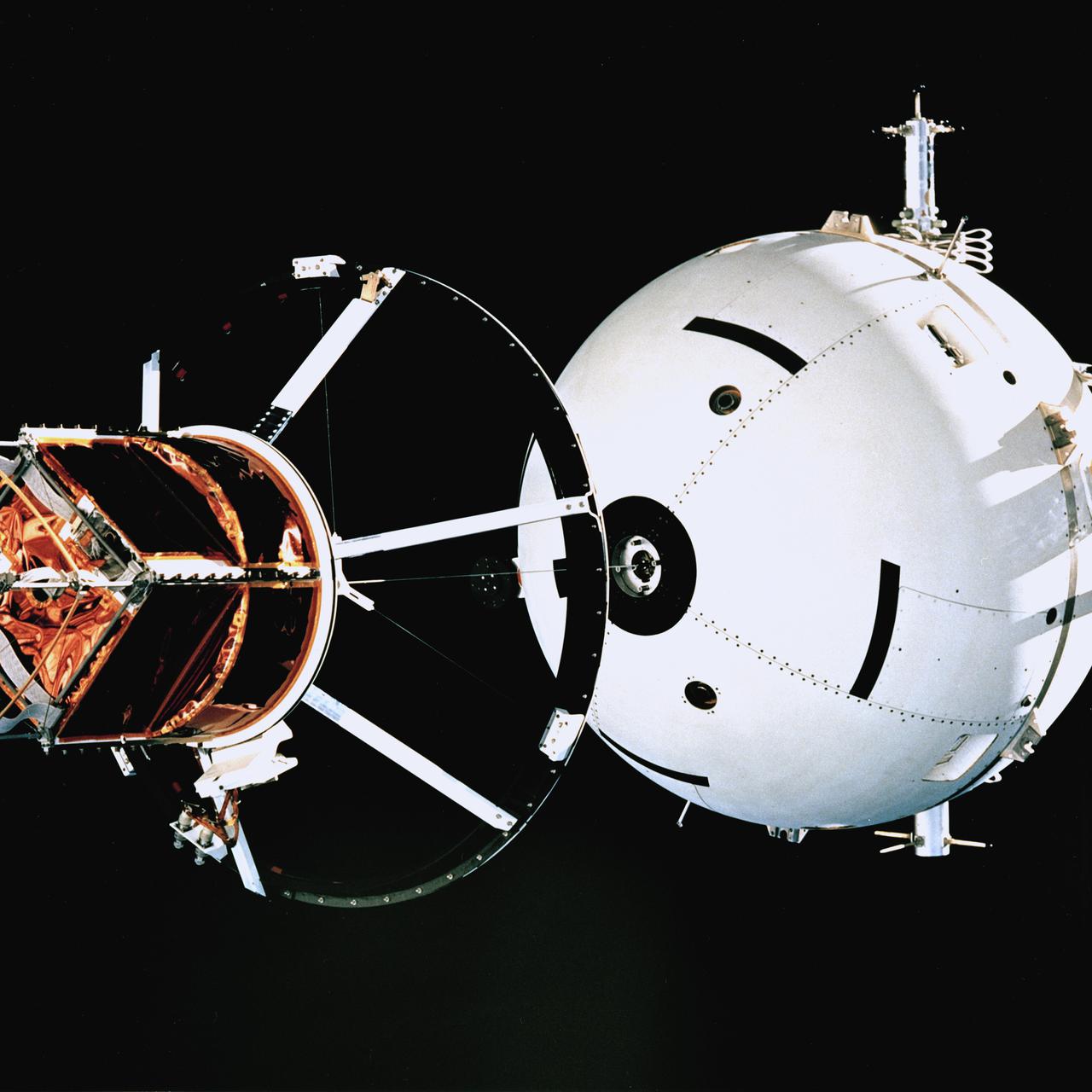
ONBOARD ATLANTIS -- A 70mm handheld camera was used by the STS-46 crewmembers to capture this medium closeup view of early operations with the Tethered Satellite System. The sphere can be seen moving away from the ring structure on the boom device in Atlantis’ cargo bay. Photo Credit: NASA
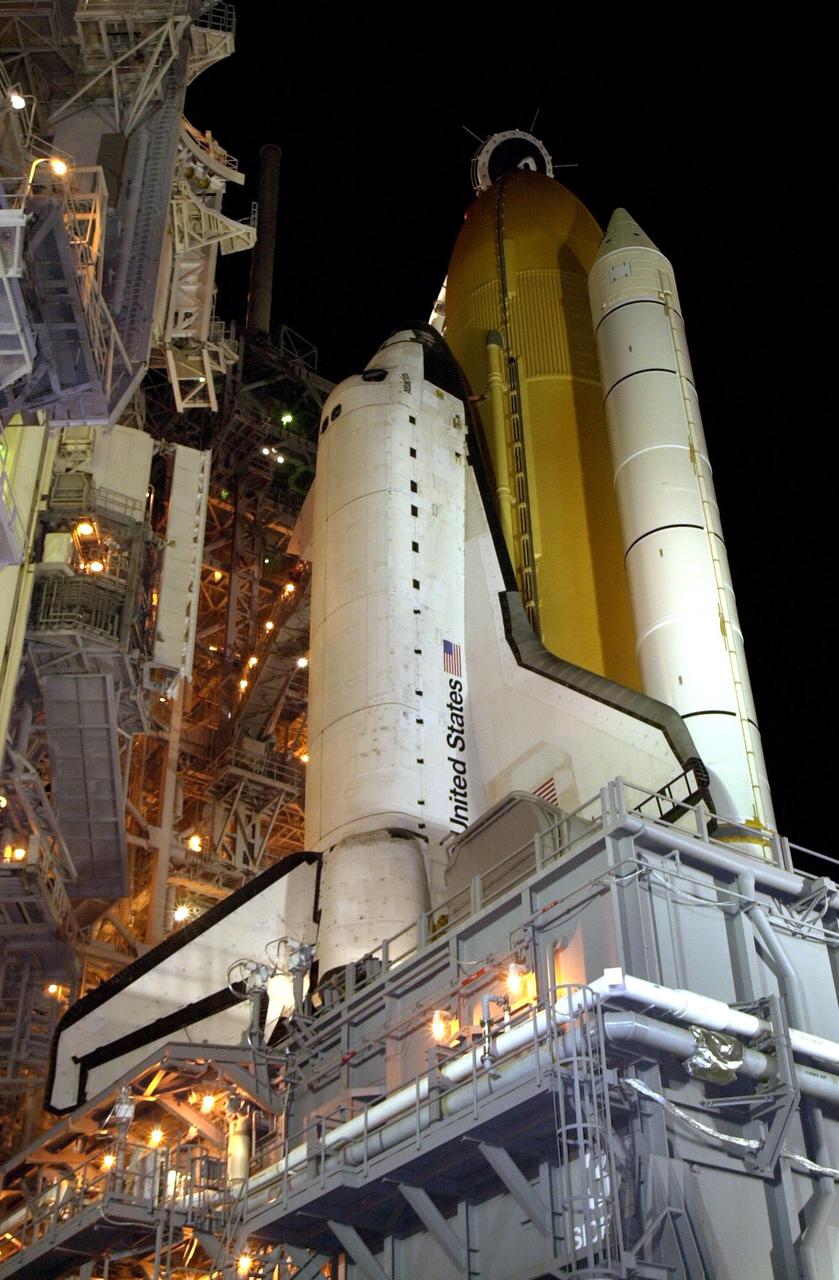
KENNEDY SPACE CENTER, FLA. -- Space Shuttle Atlantis is revealed on pad 39B after rollback of the Rotating Service Structure prior to launch. The Shuttle is scheduled for launch Oct. 7 at 3:46 p.m. EDT on mission STS-112.
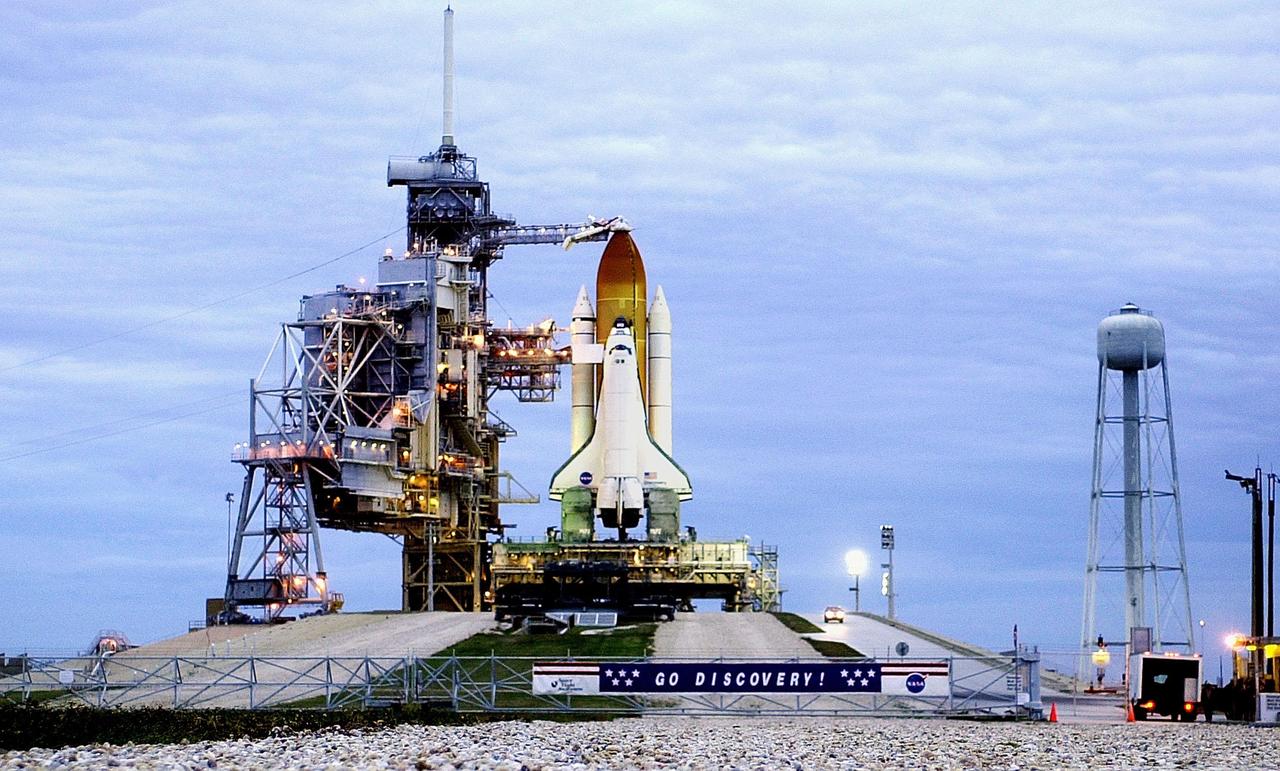
In the pre-dawn hours at Launch Pad 39B under a cloud-filled sky on the east coast of Florida, the Rotating Service Structure is rolled back to reveal the Space Shuttle Discovery poised for flight on mission STS-103. The rollback of the structure was complete at 4:46 a.m. EST. STS-103 is scheduled for launch Dec. 16 at 9:18 p.m. EST. The mission is expected to last about 9 days and 21 hours with a landing at KSC Sunday, Dec. 26, at 6:56 p.m. EST
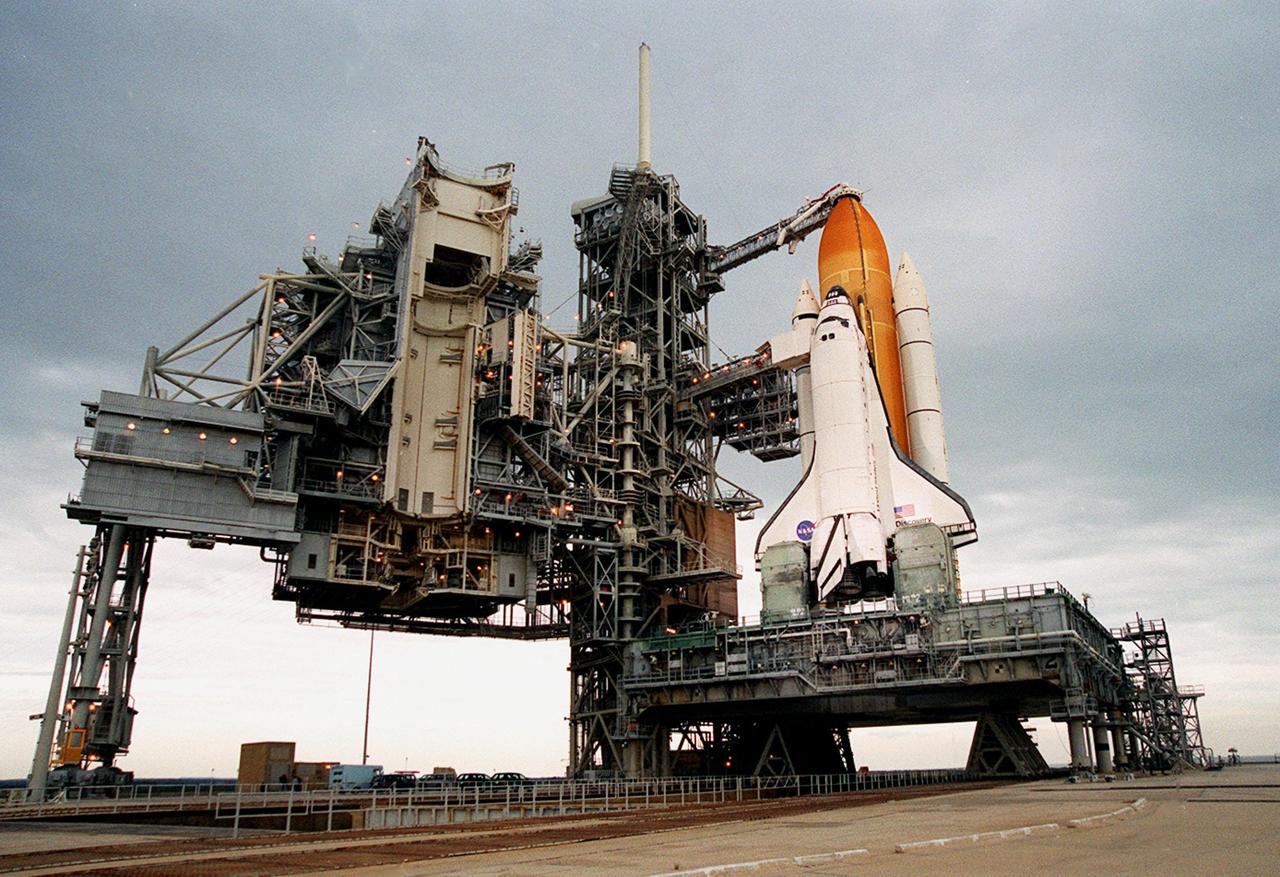
After rollback of the Rotating Service Structure at Launch Pad 39B (left) before dawn, the Space Shuttle Discovery is revealed poised for flight on mission STS-103. The rollback of the structure was complete at 4:46 a.m. EST. STS-103 is scheduled for launch Dec. 16 at 9:18 p.m. EST. The mission is expected to last about 9 days and 21 hours with a landing at KSC Sunday, Dec. 26, at 6:56 p.m. EST
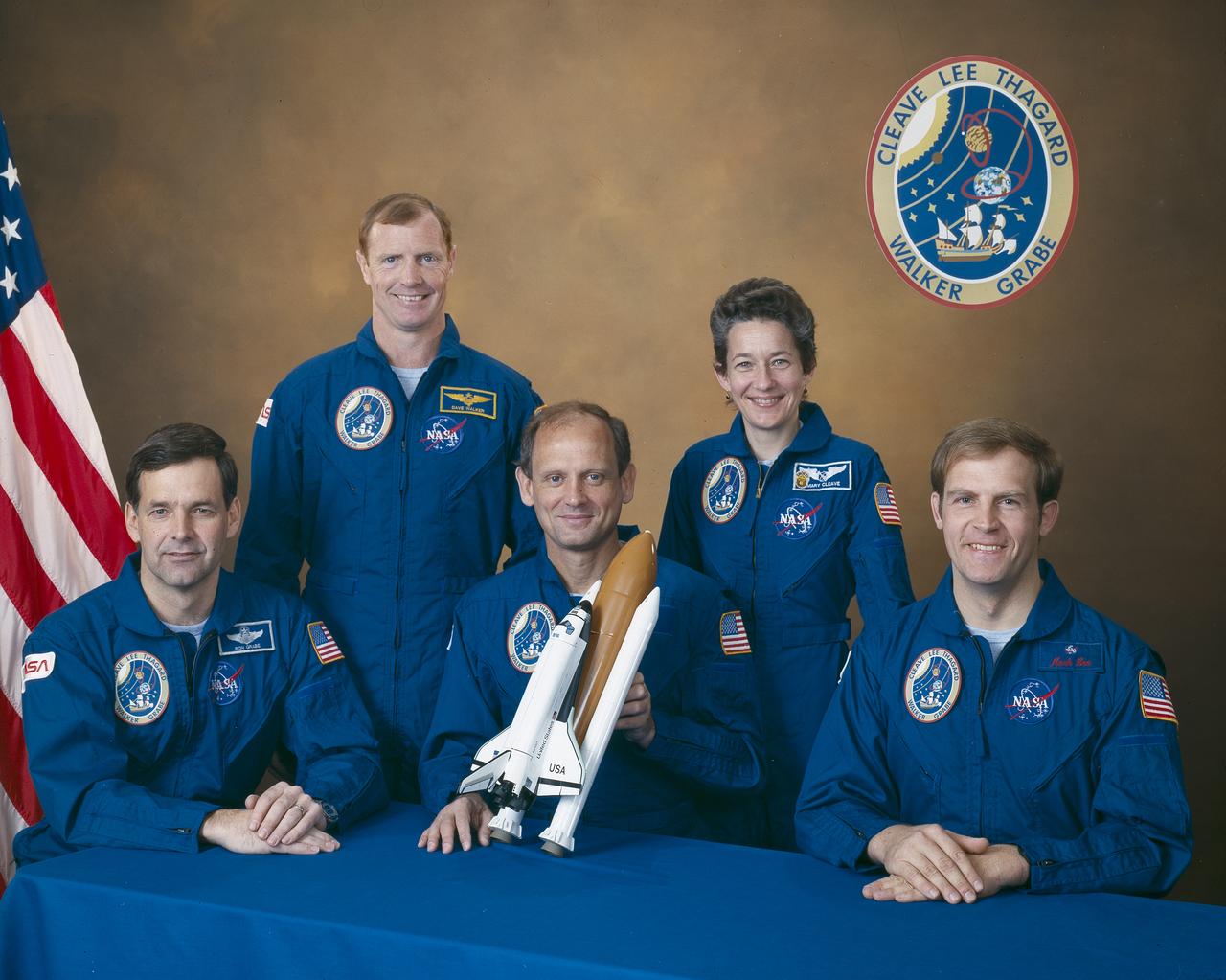
Five astronauts composed the STS-30 crew. Pictured (left to right) are Ronald J. Grabe, pilot; David M. Walker, commander; and mission specialists Norman E. Thagard, Mary L. Cleave, and Mark C. Lee. The STS-30 mission launched aboard the Space Shuttle Atlantis on May 4, 1989 at 2:46:59pm (EDT). The primary payload was the Magellan/Venus Radar mapper spacecraft and attached Inertial Upper Stage (IUS).
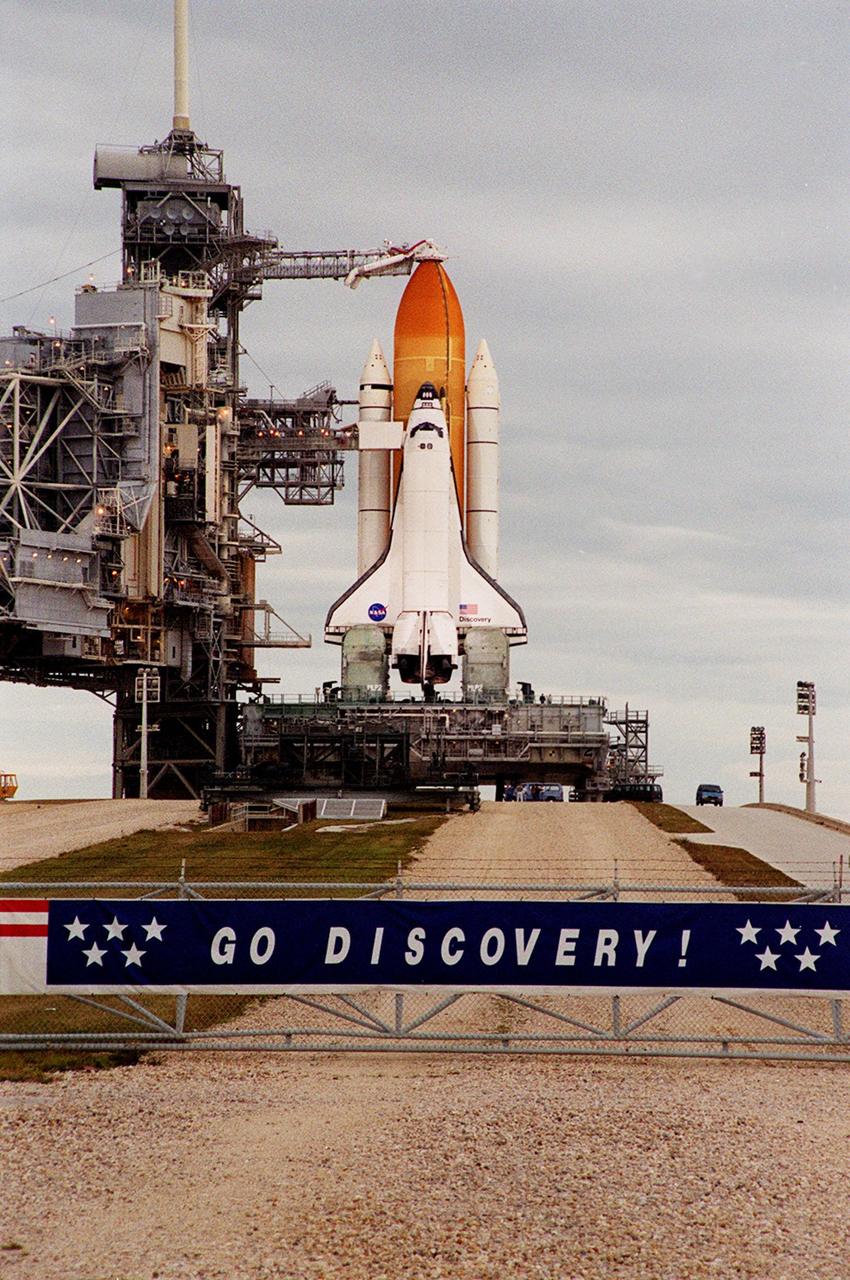
As dawn breaks at Launch Pad 39B on the east coast of Florida, the Space Shuttle Discovery is revealed poised for flight on mission STS-103. The rollback of the Rotating Service Structure (left) was complete at 4:46 a.m. EST. STS-103 is scheduled for launch Dec. 16 at 9:18 p.m. EST. The mission is expected to last about 9 days and 21 hours with a landing at KSC Sunday, Dec. 26, at 6:56 p.m. EST
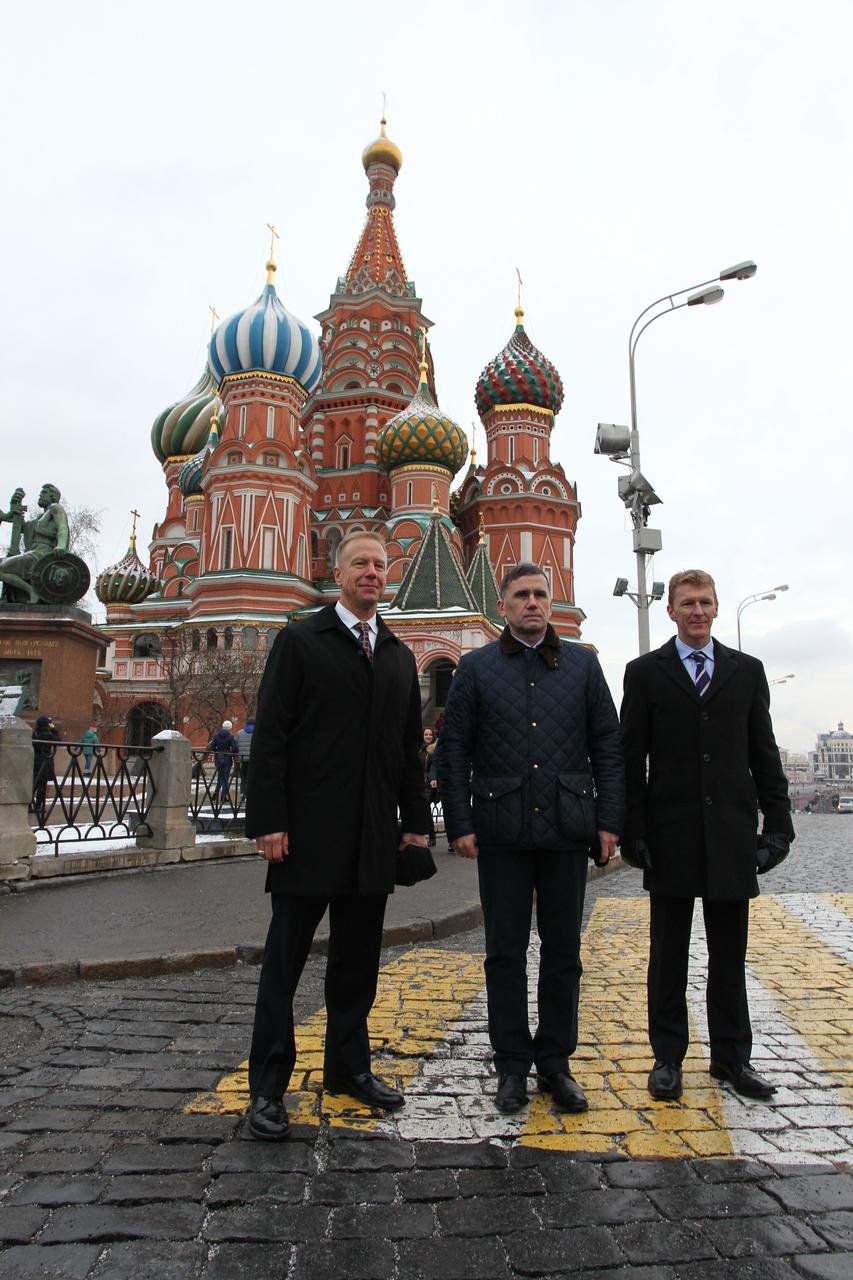
With St. Basil’s Cathedral in Red Square in Moscow serving as a backdrop, Expedition 46-47 crewmembers Tim Kopra of NASA (left), Yuri Malenchenko of the Russian Federal Space Agency (Roscosmos, center) and Tim Peake of the European Space Agency (right) pose for pictures Nov. 23 after laying flowers at the Kremlin Wall where Russian space icons are interred. Peake, Malenchenko and Kopra will launch on Dec. 15 on the Soyuz TMA-19M spacecraft from the Baikonur Cosmodrome in Kazakhstan for a six-month mission on the International Space Station. NASA/Seth Marcantel
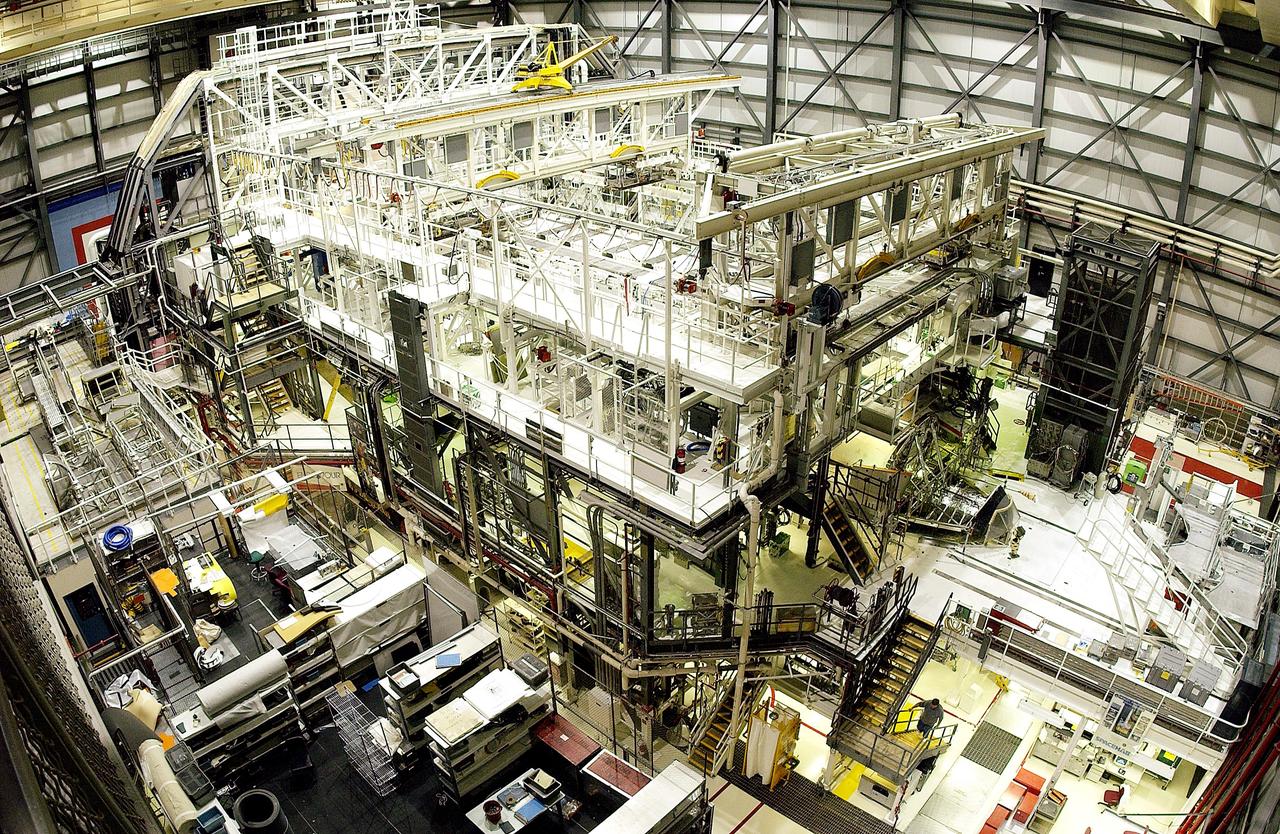
KENNEDY SPACE CENTER, FLA. - This bird's-eye view of a high bay in the Orbiter Processing Facility (OPF) shows Space Shuttle Atlantis surrounded by the standard platforms and equipment required to process a Space Shuttle orbiter for flight. The high bay is 197 feet (60 meters) long, 150 feet (46 meters) wide, 95 feet (29 meters) high, and encompasses a 29,000-square-foot (2,694-meter) area. Platforms, a main access bridge, and two rolling bridges with trucks provide access to various parts of the orbiter. The next mission scheduled for Atlantis is STS-114, a utilization and logistics flight to the International Space Station.
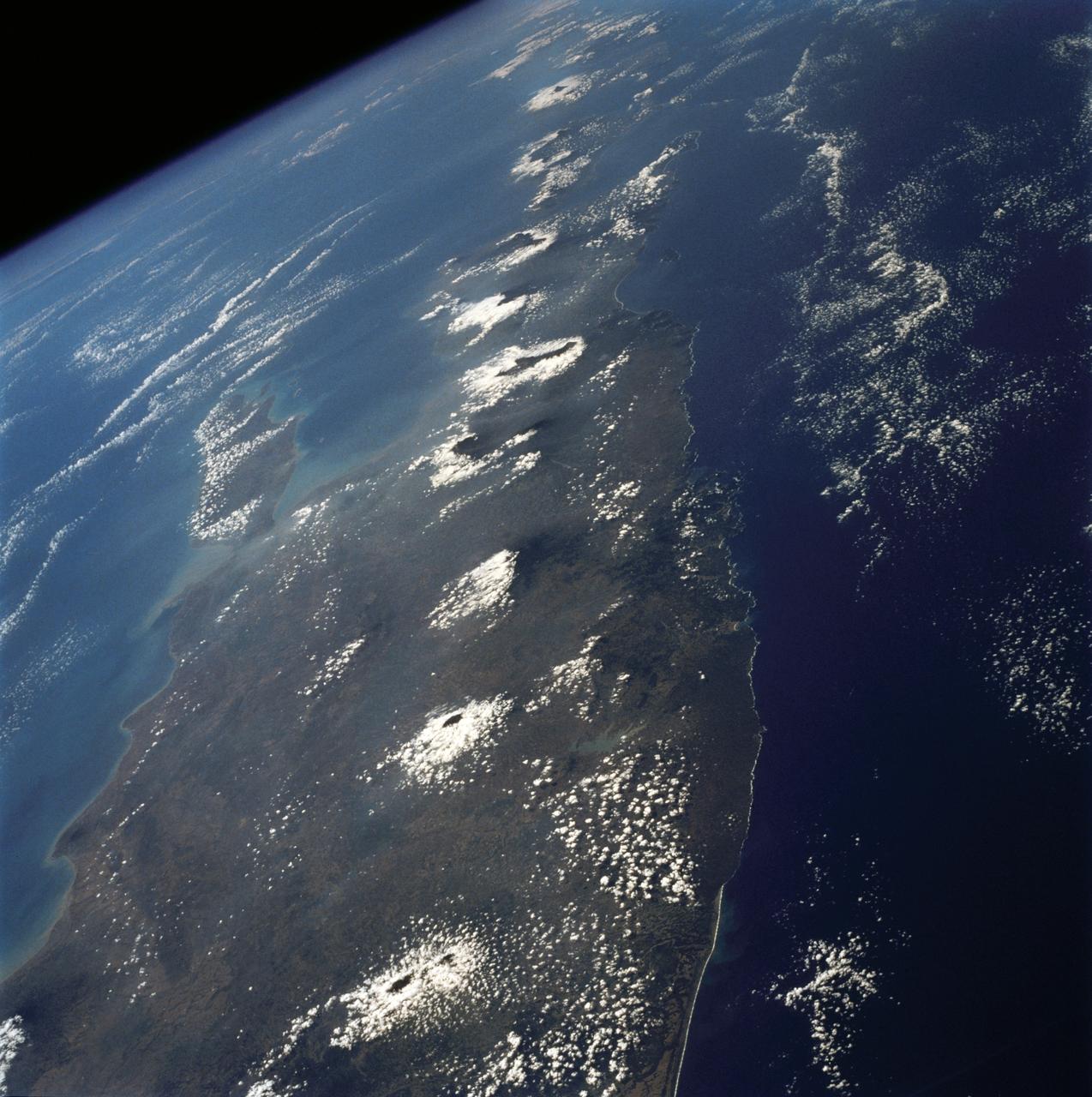
The island of Java (8.0S, 112.0E), perhaps better than any other, illustrates the volcanic origin of Pacific Island groups. Seen in this single view are at least a dozen once active volcano craters. Alignment of the craters even defines the linear fault line of Java as well as the other some 1500 islands of the Indonesian Archipelago. Deep blue water of the Indian Ocean to the south contrasts to the sediment laden waters of the Java Sea to the north.

This view of deforestation in Rondonia, far western Brazil, (10.0S, 63.0W) is part of an agricultural resettlement project which ultimately covers an area about 80% the size of France. The patterns of deforestation in this part of the Amazon River Basin are usually aligned adjacent to highways, secondary roads, and streams for ease of access and transportation. Compare this view with the earlier 51G-37-062 for a comparison of deforestation in the region.
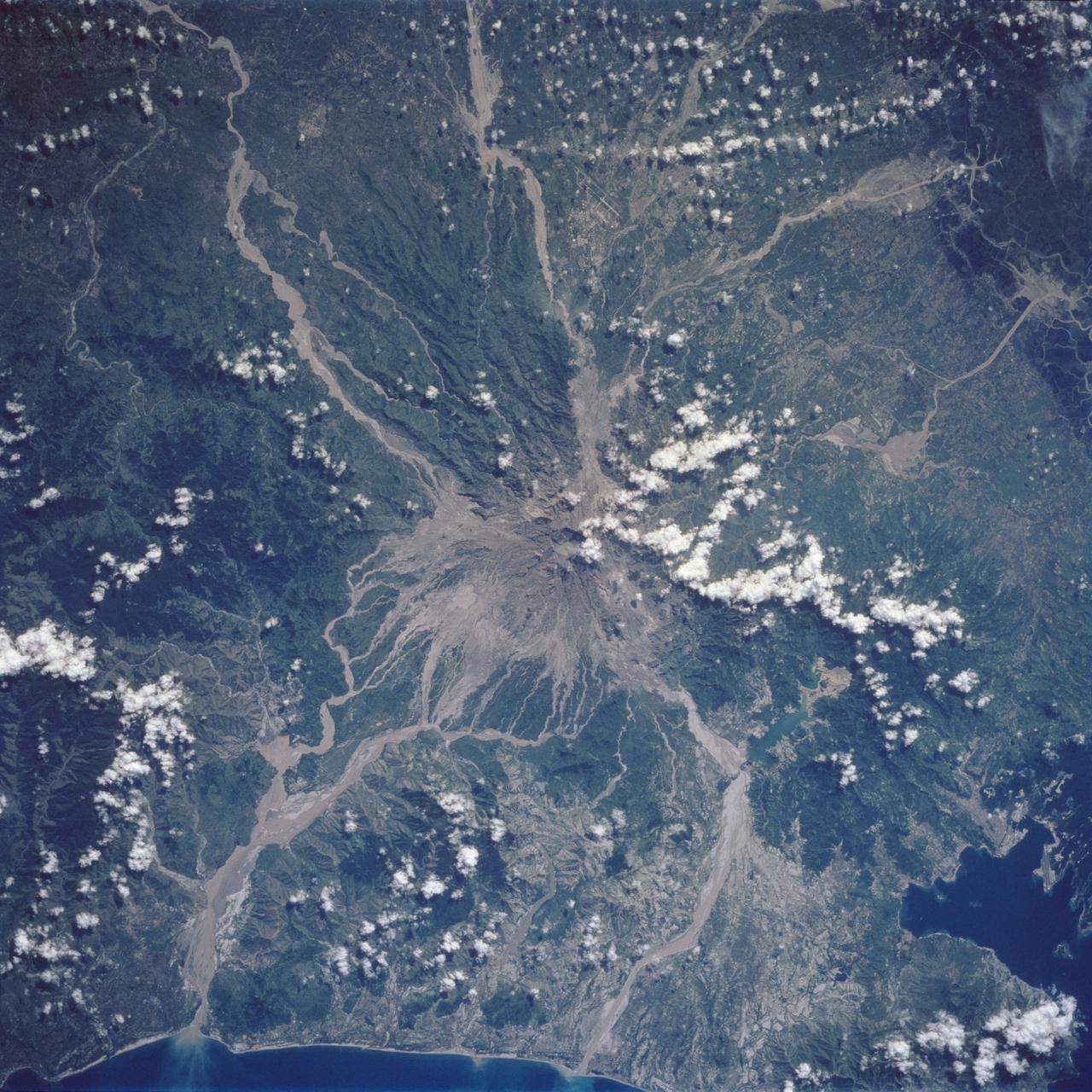
Mt. Pinatubo on the island of Luzon (15.0N, 120.0E) erupted catastrophically in June 1991 after over 600 years of inactivity. In this vertical view, the full extent of the eruption is obvious. Thick layers of ash completely surrounds the crater and the effect of mudflows in this previously heavily forested and agricultural region can be traced as ribbons flowing downhill. Clark AFB, once the crossroads of the SW Pacific can only partially be seen.
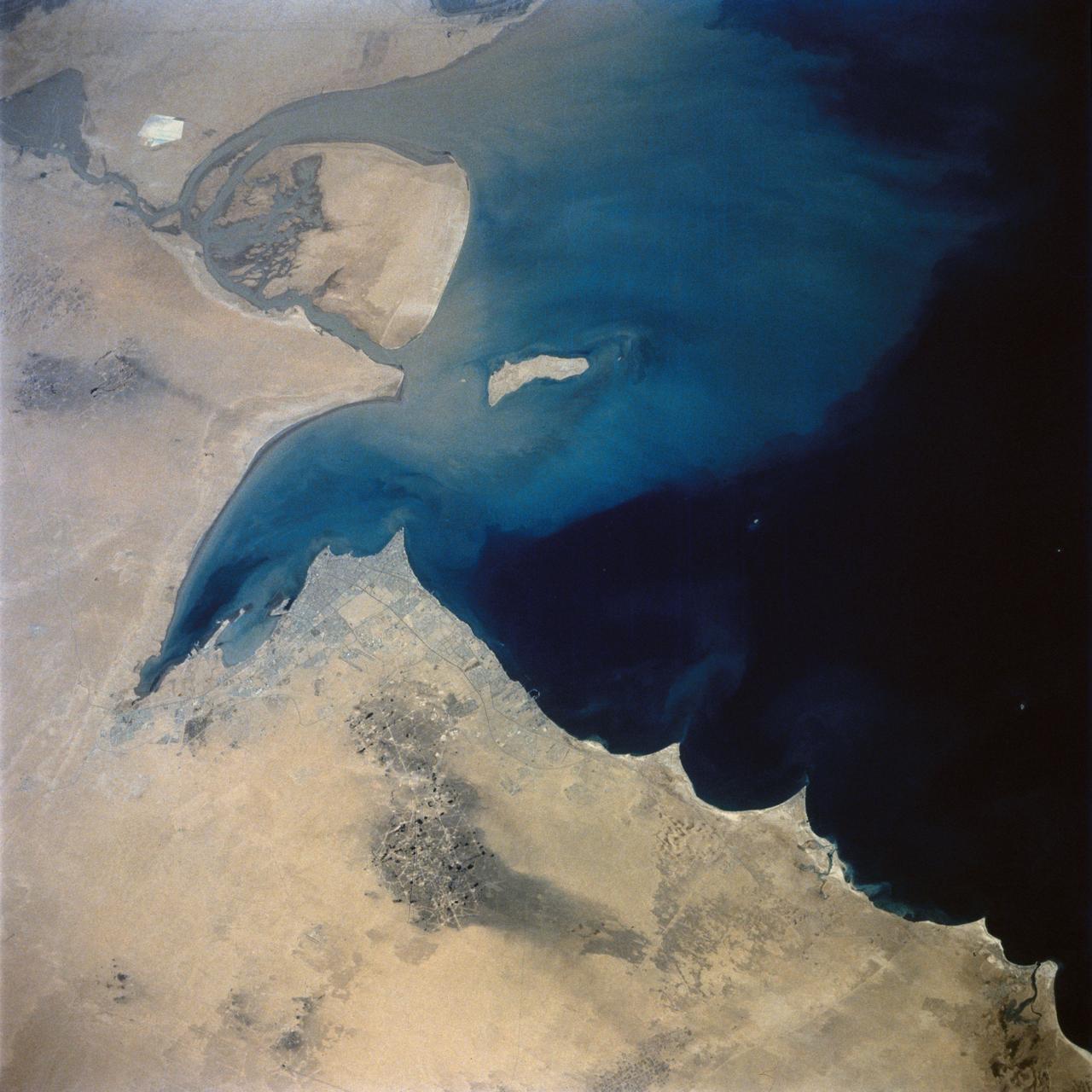
This view of the northern Persian Gulf shows Kuwait City and the Tigris and Euphrates River Deltas (29.5N, 48.5E). The oil laden sands and oil lakes of the Kuwait Oil Fields to the north and south of the city are clearly visible as dark patches surrounded by oil free desert sands. Comparison with earlier photos indicate that the oil laden sands are slowly being covered with clean sand carried by strong NW winds called Shmals.
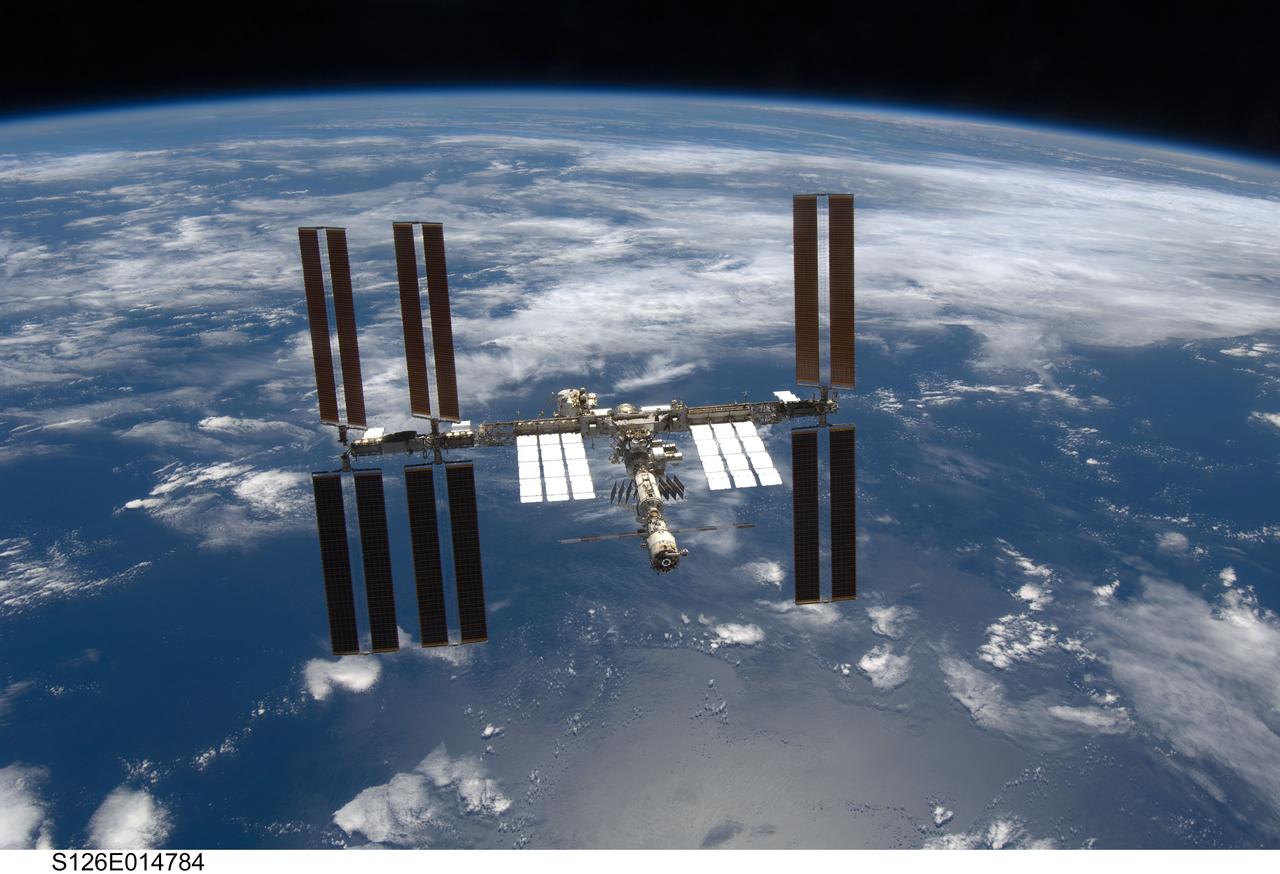
S126-E-014784 (28 Nov. 2008) --- Backdropped by a blue and white Earth and the blackness of space, the International Space Station is seen from Space Shuttle Endeavour as the two spacecraft begin their relative separation. Earlier the STS-126 and Expedition 18 crews concluded 11 days, 16 hours and 46 minutes of cooperative work onboard the shuttle and station. Undocking of the two spacecraft occurred at 8:47 a.m. (CST) on Nov. 28, 2008.
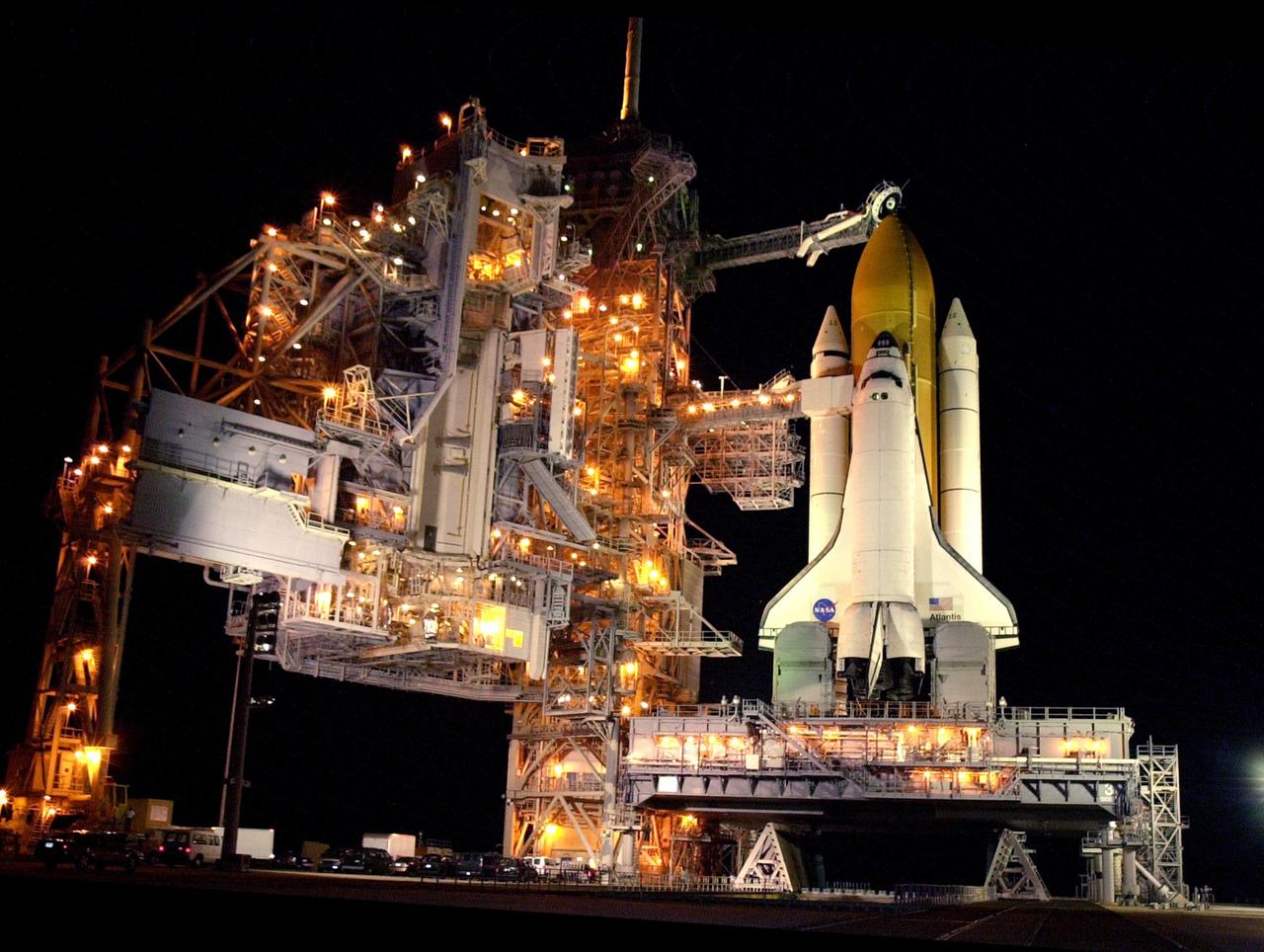
KENNEDY SPACE CENTER, FLA. -- After rollback of the Rotating Service Structure, Space Shuttle Atlantis is revealed on pad 39B prior to launch. The orbiter access arm with the White Room at the end can be seen extending toward the cockpit. The White Room provides entry into the Shuttle for the crew. Above the orange external tank is the vent hood, called the "beanie cap." The Shuttle is scheduled for launch Oct. 7 at 3:46 p.m. EDT on mission STS-112.
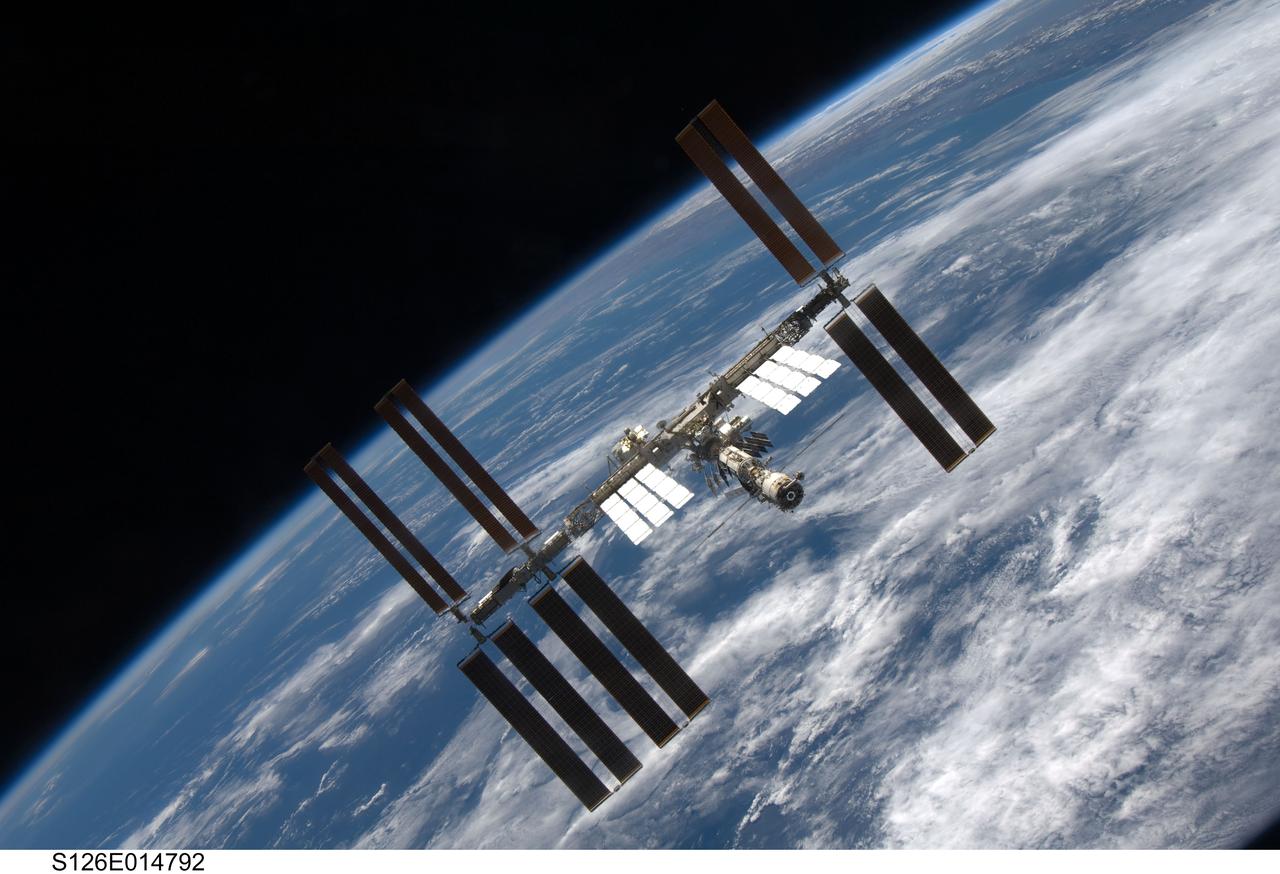
S126-E-014792 (28 Nov. 2008) --- Backdropped by a blue and white Earth and the blackness of space, the International Space Station is seen from Space Shuttle Endeavour as the two spacecraft begin their relative separation. Earlier the STS-126 and Expedition 18 crews concluded 11 days, 16 hours and 46 minutes of cooperative work onboard the shuttle and station. Undocking of the two spacecraft occurred at 8:47 a.m. (CST) on Nov. 28, 2008.
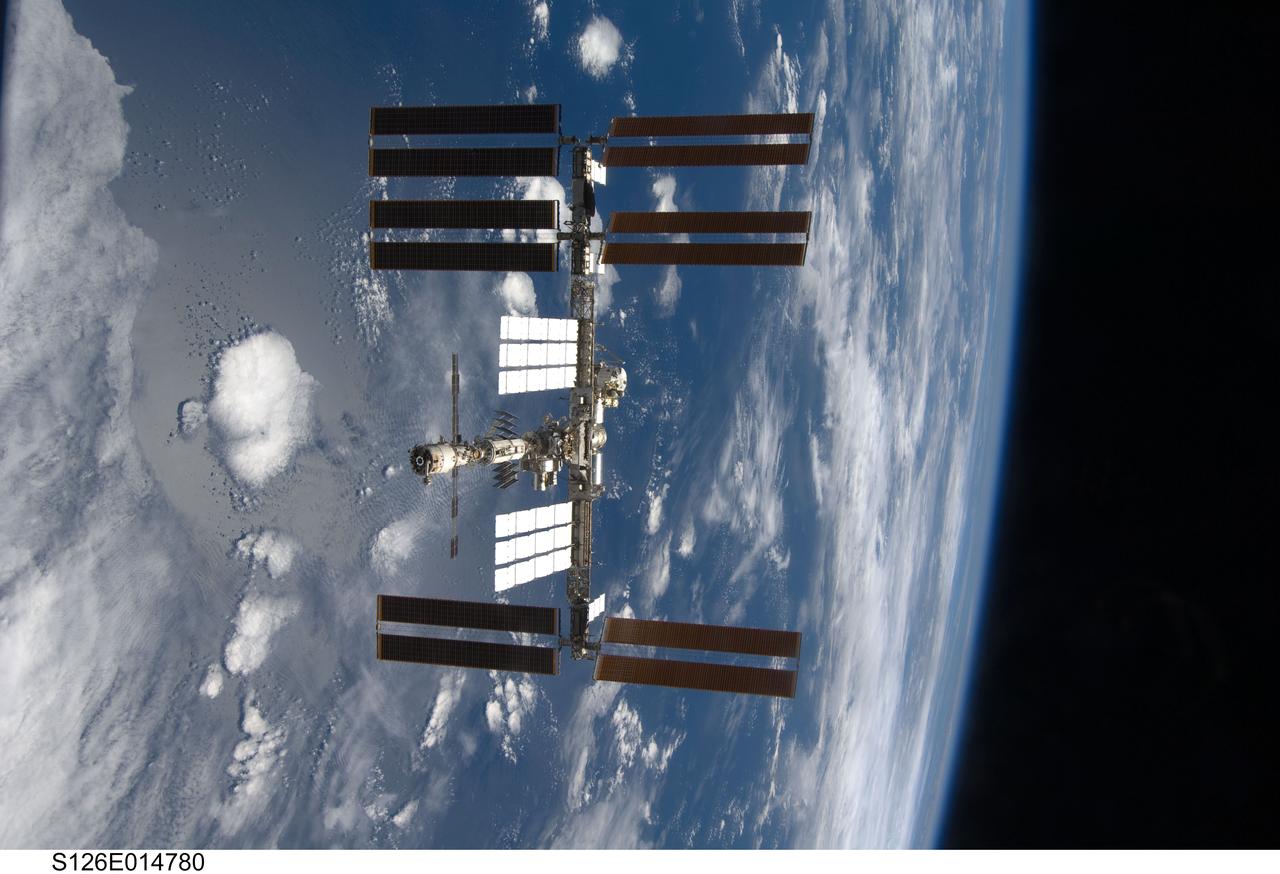
S126-E-014780 (28 Nov. 2008) --- Backdropped by a blue and white Earth and the blackness of space, the International Space Station is seen from Space Shuttle Endeavour as the two spacecraft begin their relative separation. Earlier the STS-126 and Expedition 18 crews concluded 11 days, 16 hours and 46 minutes of cooperative work onboard the shuttle and station. Undocking of the two spacecraft occurred at 8:47 a.m. (CST) on Nov. 28, 2008.
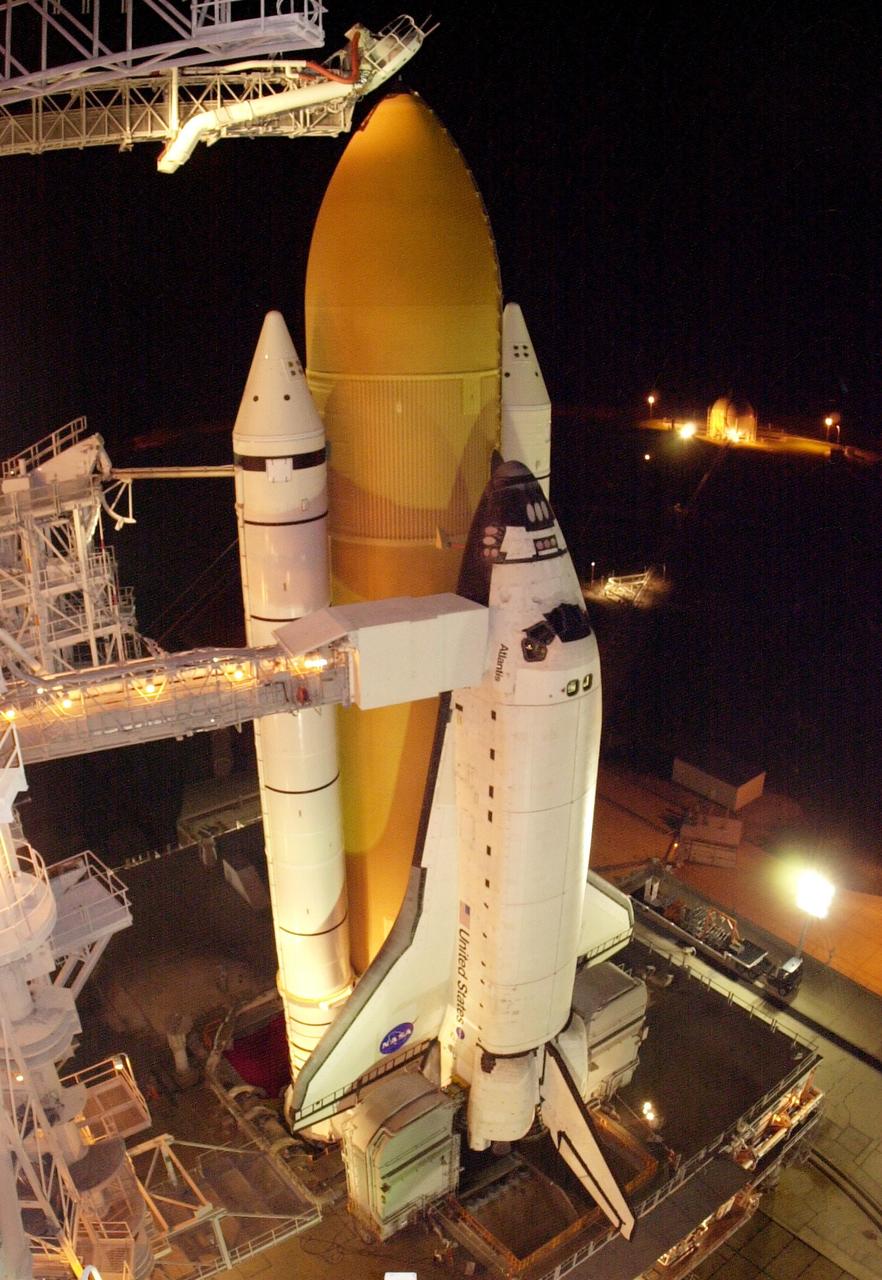
KENNEDY SPACE CENTER, FLA. -- After rollback of the Rotating Service Structure, Space Shuttle Atlantis is revealed on pad 39B prior to launch. The orbiter access arm with the White Room at the end can be seen extending toward the cockpit. The White Room provides entry into the Shuttle for the crew. Above the orange external tank is the vent hood, called the "beanie cap." The Shuttle is scheduled for launch Oct. 7 at 3:46 p.m. EDT on mission STS-112.
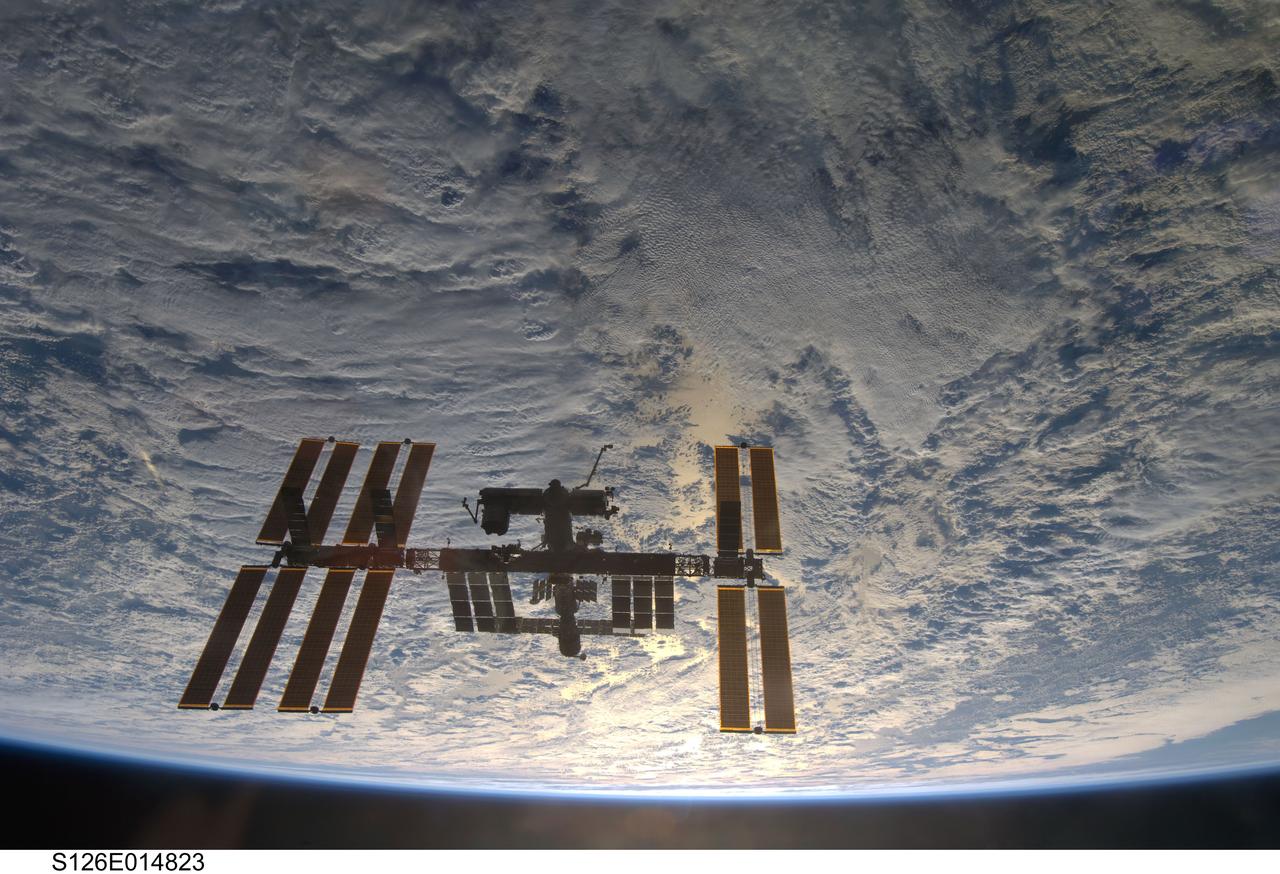
S126-E-014823 (28 Nov. 2008) --- Backdropped by a cloud-covered part of Earth, the International Space Station is seen from Space Shuttle Endeavour as the two spacecraft begin their relative separation. Earlier the STS-126 and Expedition 18 crews concluded 11 days, 16 hours and 46 minutes of cooperative work onboard the shuttle and station. Undocking of the two spacecraft occurred at 8:47 a.m. (CST) on Nov. 28, 2008.

The STS-30 mission launched aboard the Space Shuttle Atlantis on May 4, 1989 at 2:46:59pm (EDT) carrying a crew of five. Aboard were Ronald J. Grabe, pilot; David M. Walker, commander; and mission specialists Norman E. Thagard, Mary L. Cleave, and Mark C. Lee. The primary payload for the mission was the Magellan/Venus Radar mapper spacecraft and attached Inertial Upper Stage (IUS).
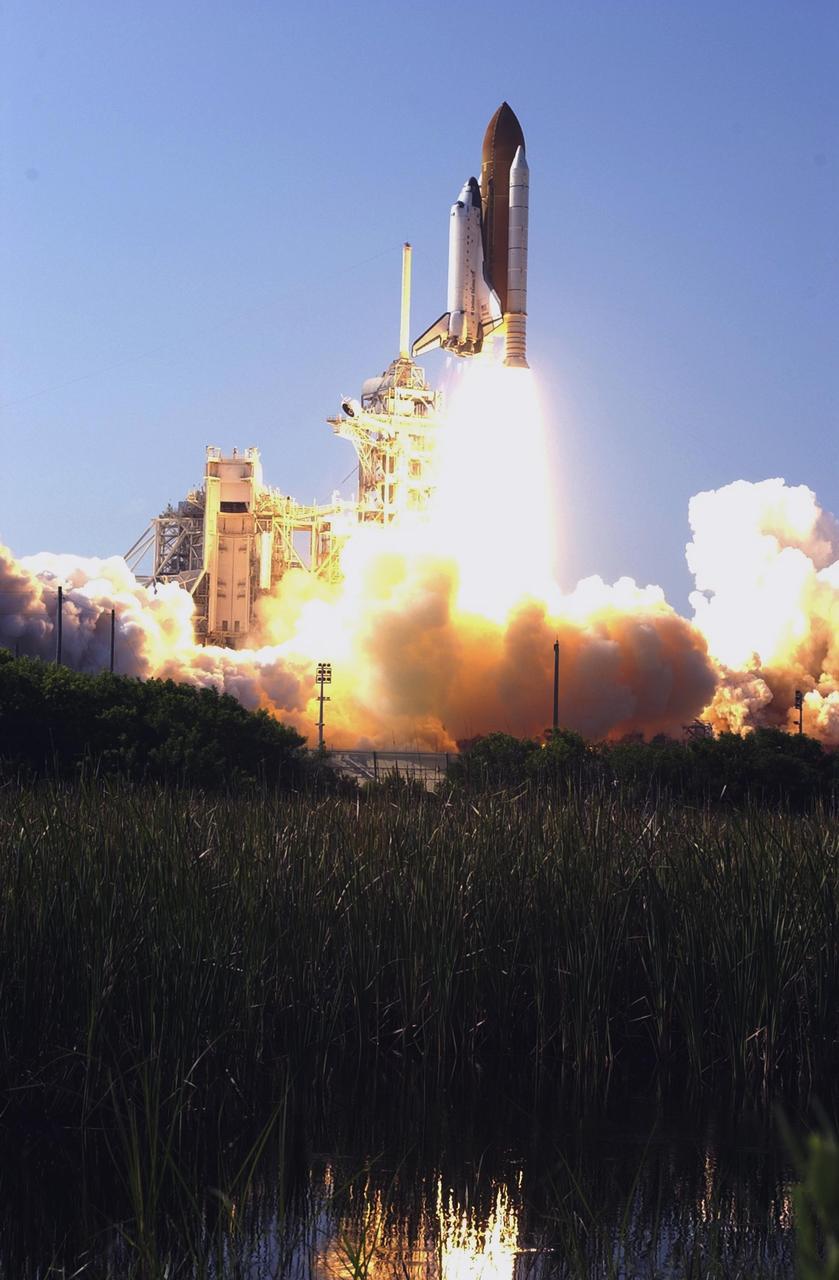
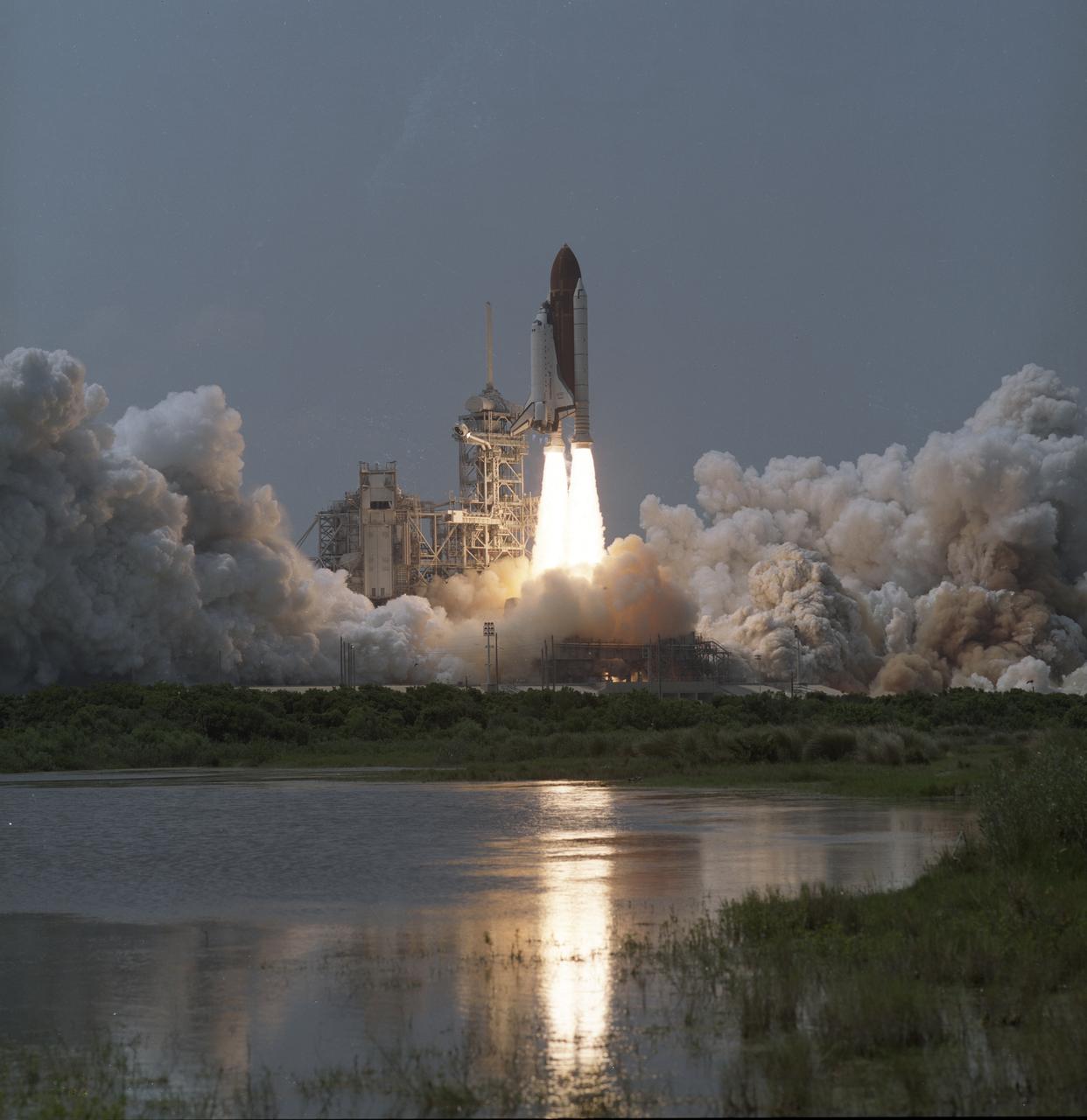
KENNEDY SPACE CENTER, FLA. -- The brilliance of the launch of Space Shuttle Atlantis is reflected in nearby waters. Liftoff of the Shuttle on mission STS-112 occurred on time at 3:46 p.m. EDT. Along with a crew of six, Atlantis carries the S1 Integrated Truss Structure and the Crew and Equipment Translation Aid (CETA) Cart A. The CETA is the first of two human-powered carts that will ride along the ISS railway, providing mobile work platforms for future spacewalking astronauts. On the 11-day mission, three spacewalks are planned to attach the S1 truss.
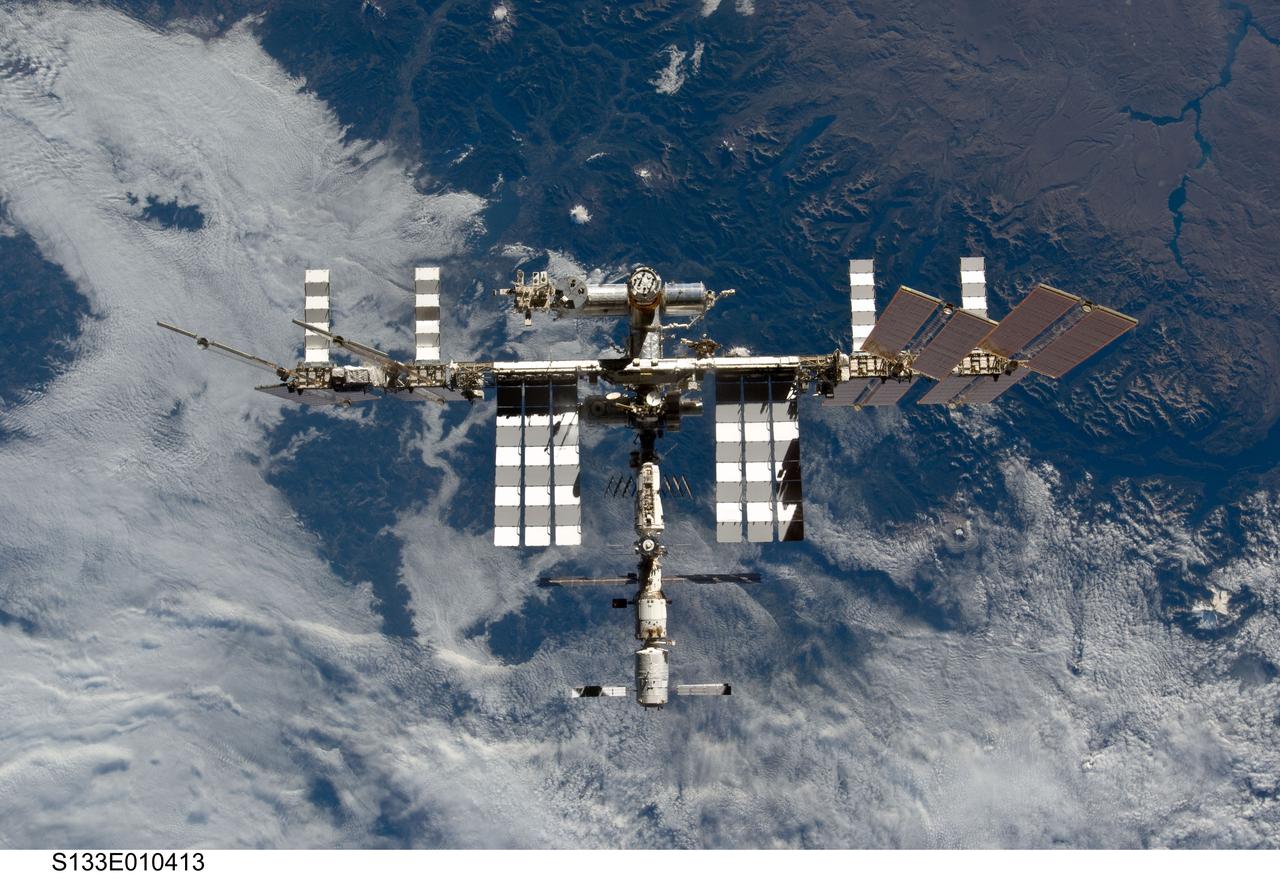
S133-E-010413 (7 March 2011) --- The International Space Station is featured in this image photographed by an STS-133 crew member on space shuttle Discovery after the station and shuttle began their post-undocking relative separation. Undocking of the two spacecraft occurred at 7 a.m. (EST) on March 7, 2011. Discovery spent eight days, 16 hours, and 46 minutes attached to the orbiting laboratory. Photo credit: NASA or National Aeronautics and Space Administration

S133-E-010350 (7 March 2011) --- The International Space Station is featured in this image photographed by an STS-133 crew member on space shuttle Discovery after the station and shuttle began their post-undocking relative separation. Undocking of the two spacecraft occurred at 7 a.m. (EST) on March 7, 2011. Discovery spent eight days, 16 hours, and 46 minutes attached to the orbiting laboratory. Photo credit: NASA or National Aeronautics and Space Administration
The STS-30 mission launched aboard the Space Shuttle Atlantis on May 4, 1989 at 2:46:59pm (EDT) carrying a crew of five. Aboard were Ronald J. Grabe, pilot; David M. Walker, commander; and mission specialists Norman E. Thagard, Mary L. Cleave, and Mark C. Lee. The primary payload for the mission was the Magellan/Venus Radar mapper spacecraft and attached Inertial Upper Stage (IUS).
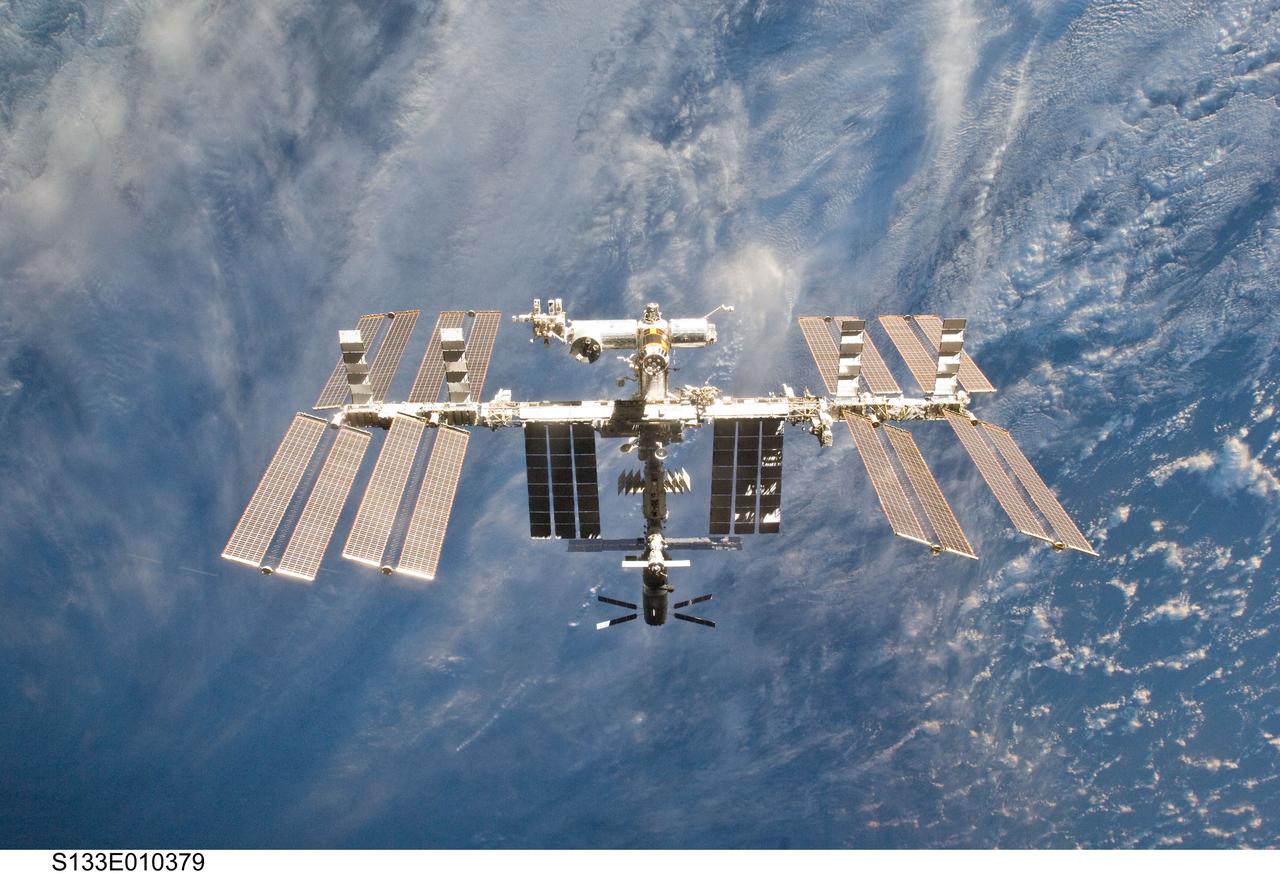
S133-E-010379 (7 March 2011) --- The International Space Station is featured in this image photographed by an STS-133 crew member on space shuttle Discovery after the station and shuttle began their post-undocking relative separation. Undocking of the two spacecraft occurred at 7 a.m. (EST) on March 7, 2011. Discovery spent eight days, 16 hours, and 46 minutes attached to the orbiting laboratory. Photo credit: NASA or National Aeronautics and Space Administration
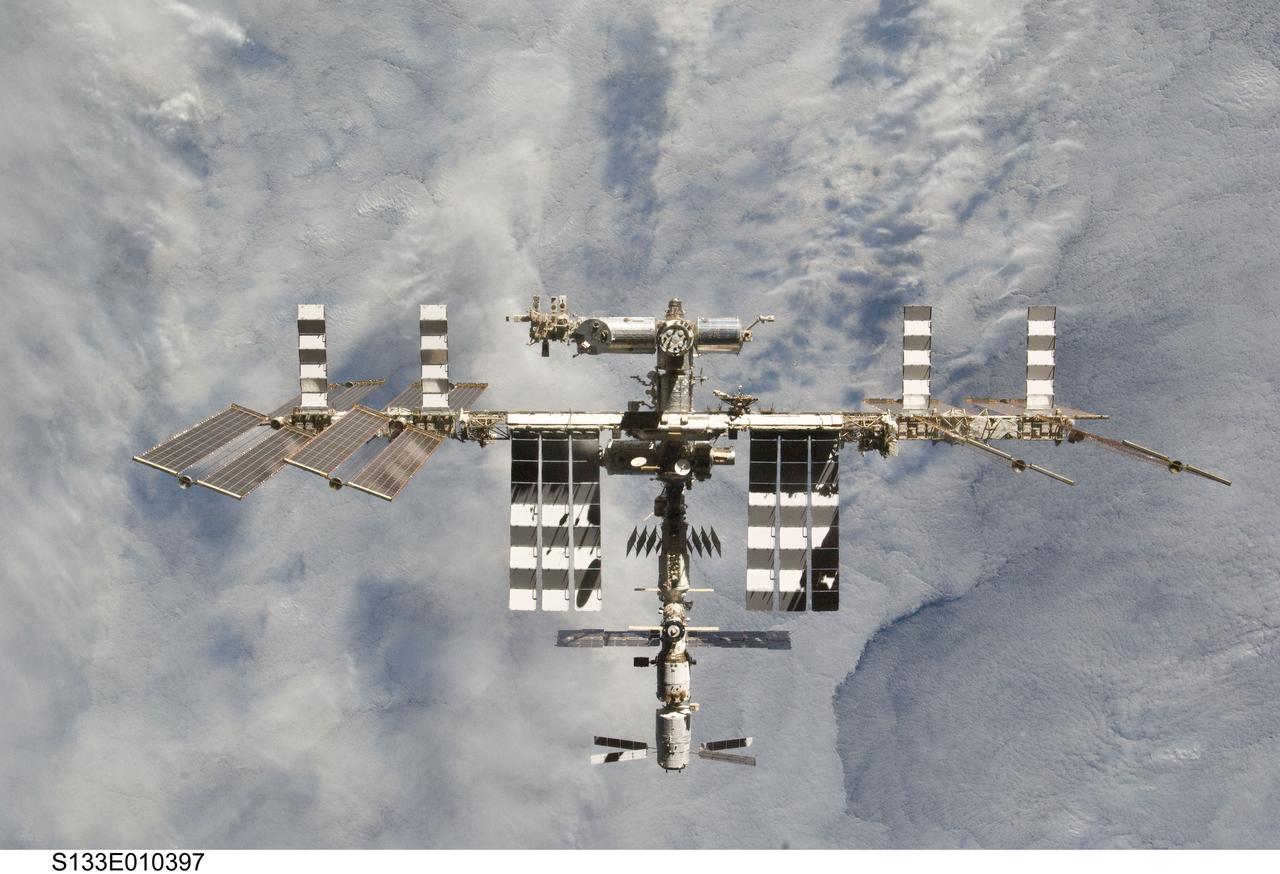
S133-E-010397 (7 March 2011) --- The International Space Station is featured in this image photographed by an STS-133 crew member on space shuttle Discovery after the station and shuttle began their post-undocking relative separation. Undocking of the two spacecraft occurred at 7 a.m. (EST) on March 7, 2011. Discovery spent eight days, 16 hours, and 46 minutes attached to the orbiting laboratory. Photo credit: NASA or National Aeronautics and Space Administration
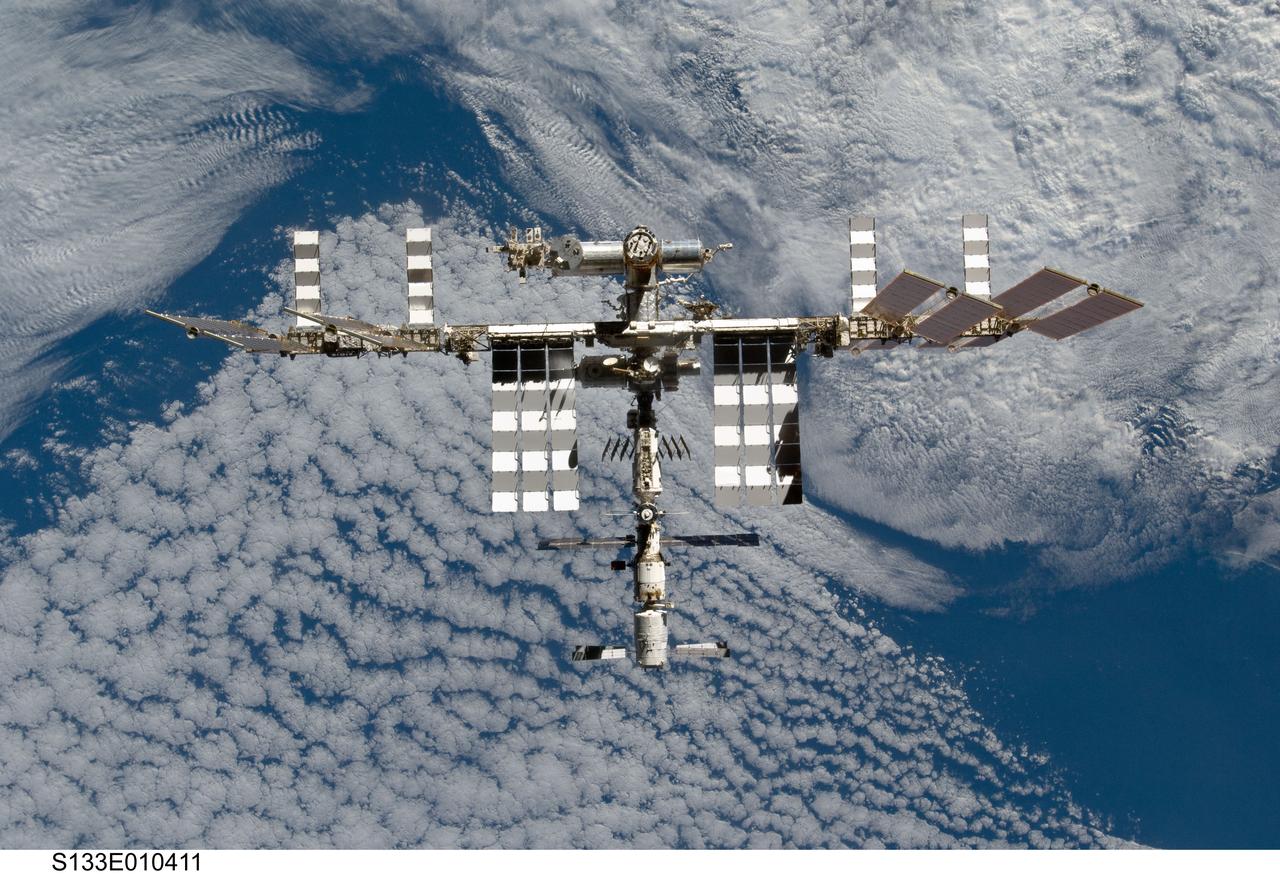
S133-E-010411 (7 March 2011) --- The International Space Station is featured in this image photographed by an STS-133 crew member on space shuttle Discovery after the station and shuttle began their post-undocking relative separation. Undocking of the two spacecraft occurred at 7 a.m. (EST) on March 7, 2011. Discovery spent eight days, 16 hours, and 46 minutes attached to the orbiting laboratory. Photo credit: NASA or National Aeronautics and Space Administration
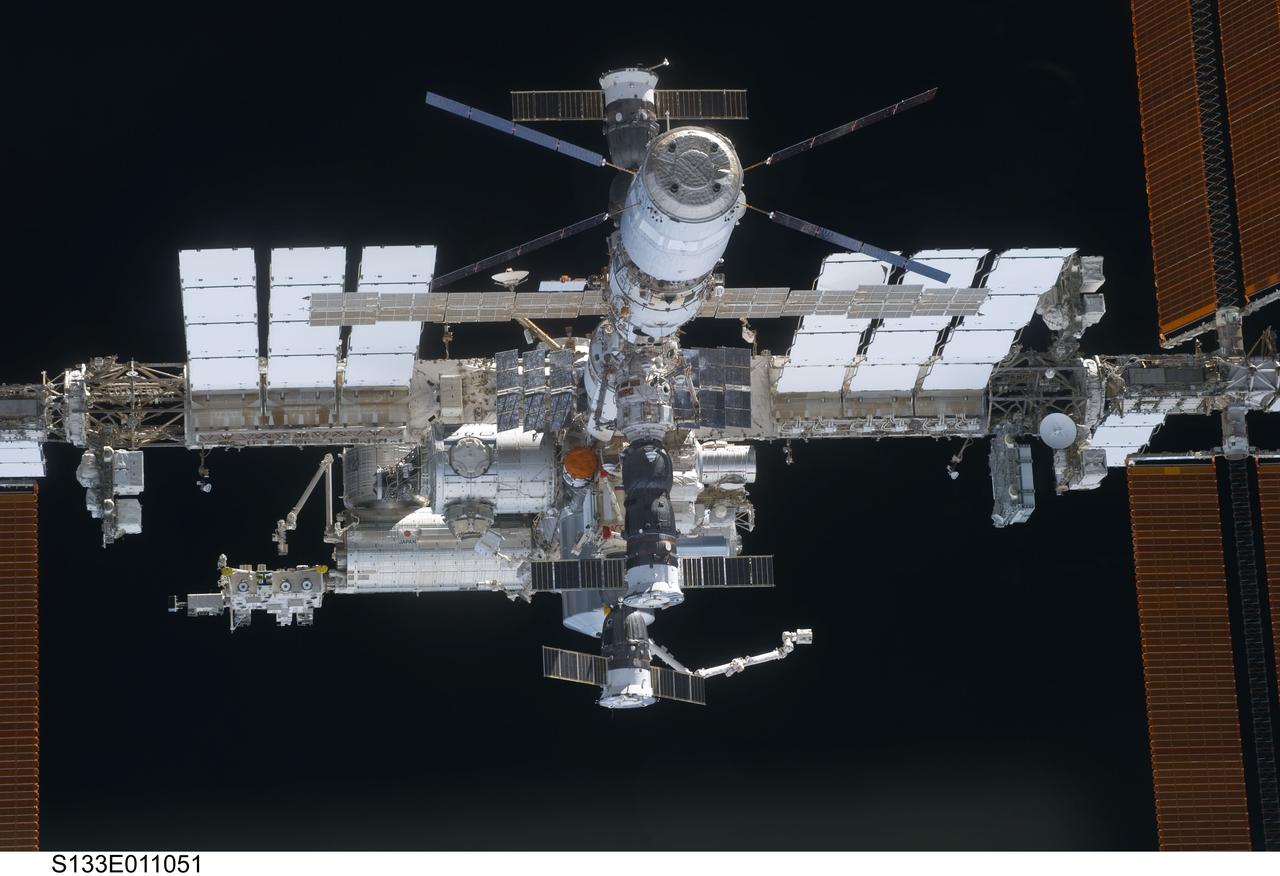
S133-E-011051 (7 March 2011) --- A close-up view of the International Space Station is featured in this image photographed by an STS-133 crew member on space shuttle Discovery after the station and shuttle began their post-undocking relative separation. Undocking of the two spacecraft occurred at 7 a.m. (EST) on March 7, 2011. Discovery spent eight days, 16 hours, and 46 minutes attached to the orbiting laboratory. Photo credit: NASA or National Aeronautics and Space Administration
The STS-30 mission launched aboard the Space Shuttle Atlantis on May 4, 1989 at 2:46:59pm (EDT) carrying a crew of five. Aboard were Ronald J. Grabe, pilot; David M. Walker, commander; and mission specialists Norman E. Thagard, Mary L. Cleave, and Mark C. Lee. The primary payload for the mission was the Magellan/Venus Radar mapper spacecraft and attached Inertial Upper Stage (IUS).

S133-E-010467 (7 March 2011) --- The International Space Station is featured in this image photographed by an STS-133 crew member on space shuttle Discovery after the station and shuttle began their post-undocking relative separation. Undocking of the two spacecraft occurred at 7 a.m. (EST) on March 7, 2011. Discovery spent eight days, 16 hours, and 46 minutes attached to the orbiting laboratory. Photo credit: NASA or National Aeronautics and Space Administration
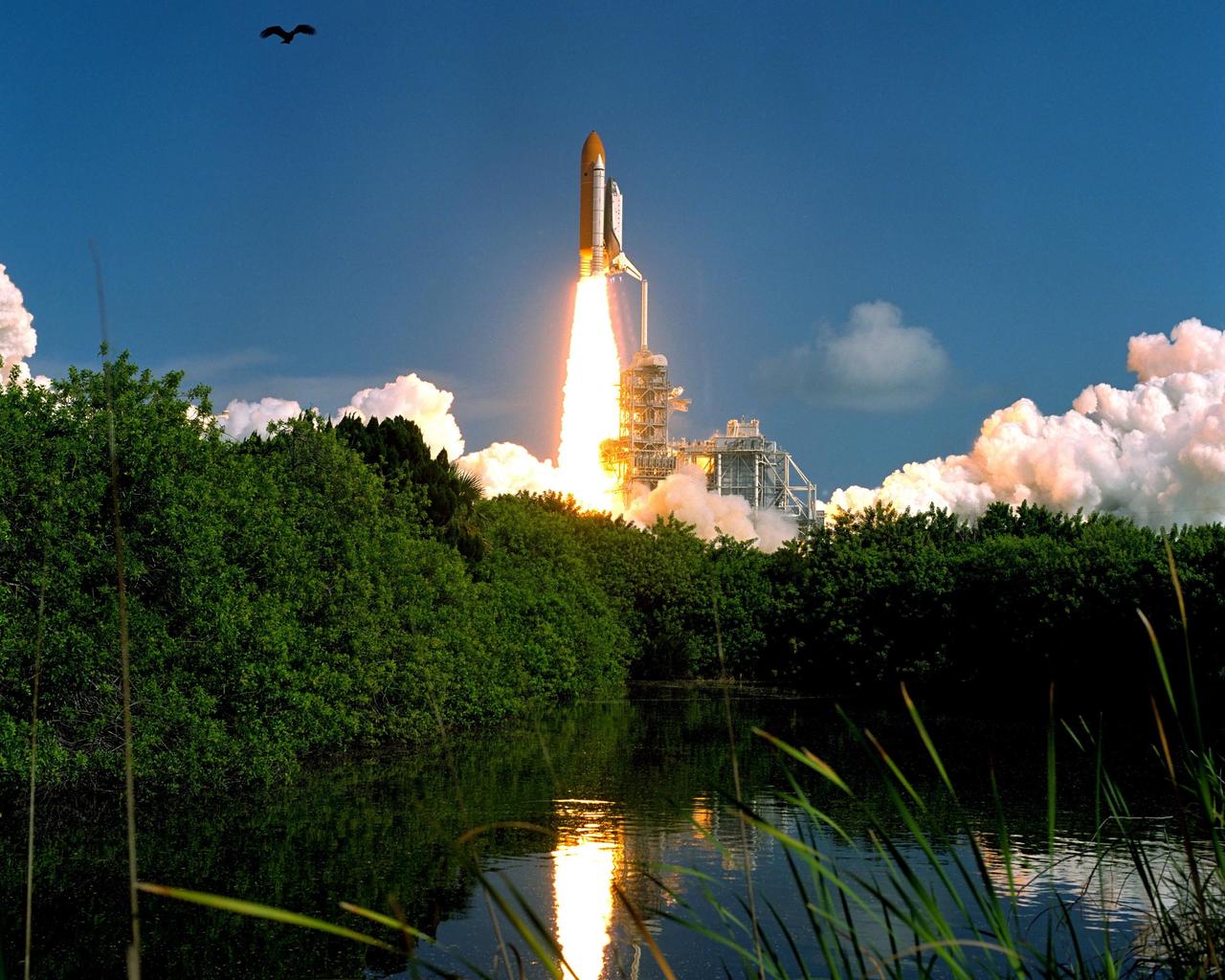
KENNEDY SPACE CENTER, FLA. -- The brilliance of the launch of Space Shuttle Atlantis is reflected in nearby waters. Liftoff of the Shuttle on mission STS-112 occurred on time at 3:46 p.m. EDT. Along with a crew of six, Atlantis carries the S1 Integrated Truss Structure and the Crew and Equipment Translation Aid (CETA) Cart A. The CETA is the first of two human-powered carts that will ride along the ISS railway, providing mobile work platforms for future spacewalking astronauts. On the 11-day mission, three spacewalks are planned to attach the S1 truss.
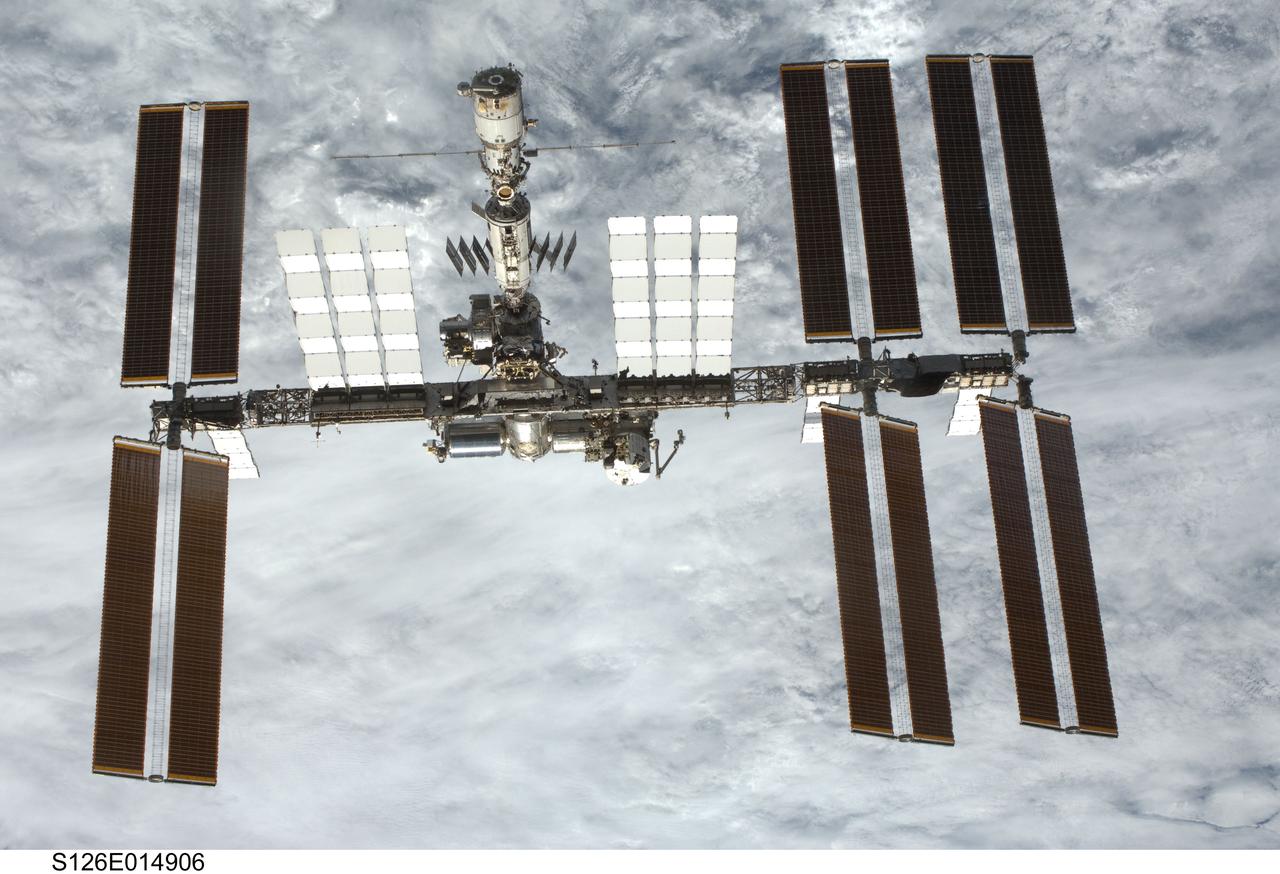
S126-E-014906 (28 Nov. 2008) --- Backdropped by a cloud-covered part of Earth, the International Space Station is seen from Space Shuttle Endeavour as the two spacecraft begin their relative separation. Earlier the STS-126 and Expedition 18 crews concluded 11 days, 16 hours and 46 minutes of cooperative work onboard the shuttle and station. Undocking of the two spacecraft occurred at 8:47 a.m. (CST) on Nov. 28, 2008.
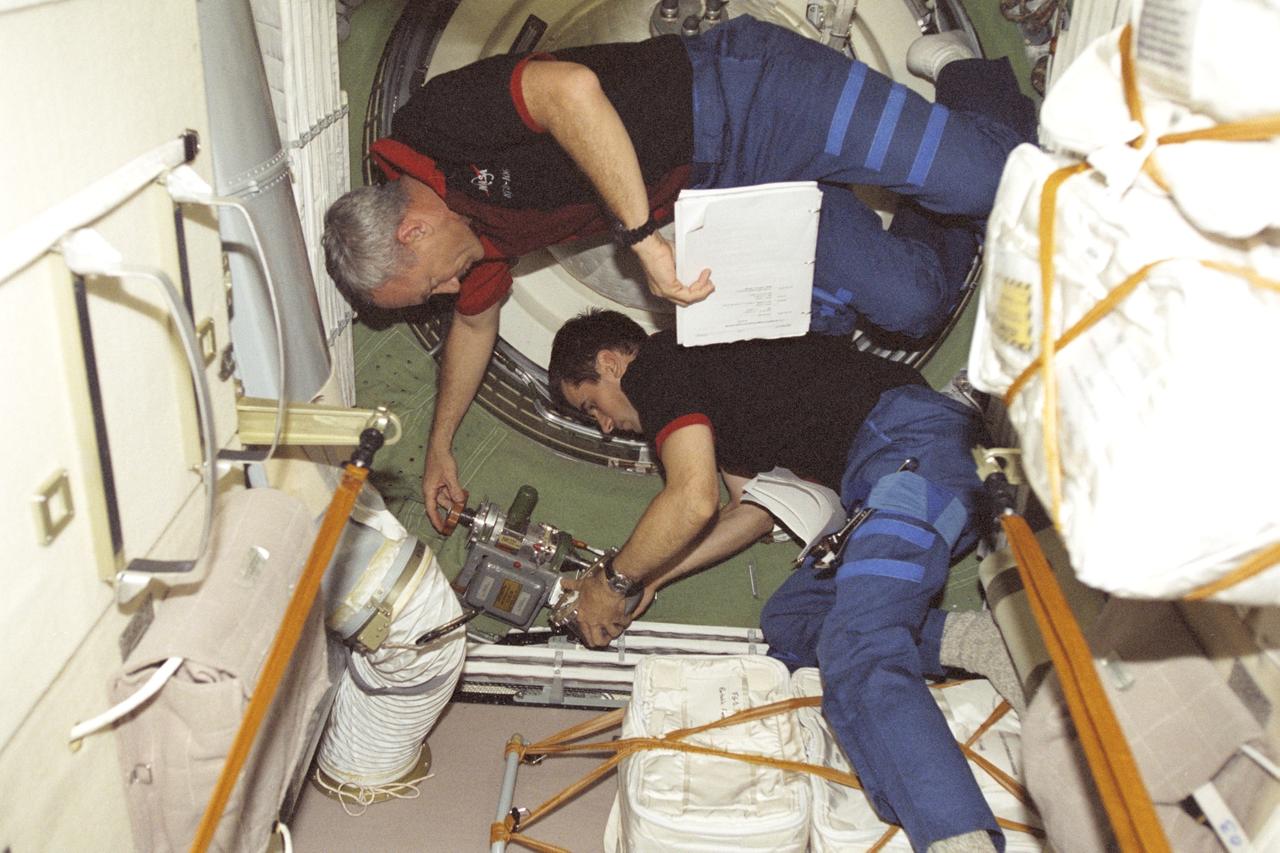
STS106-322-026 (17 September 2000) --- Astronaut Terrence W. Wilcutt (right), STS-106 mission commander, and cosmonaut Yuri I. Malenchenko, mission specialist, in the functional cargo block (FGB) or Zarya on the International Space Station (ISS), work on preparations for undocking between the Space Shuttle Atlantis and the station. Separation took place on September 17, 2000 at 10:46 p.m. (CDT). Malenchenko represents Rosaviakosmos.

S133-E-010426 (7 March 2011) --- The International Space Station is featured in this image photographed by an STS-133 crew member on space shuttle Discovery after the station and shuttle began their post-undocking relative separation. Undocking of the two spacecraft occurred at 7 a.m. (EST) on March 7, 2011. Discovery spent eight days, 16 hours, and 46 minutes attached to the orbiting laboratory. Photo credit: NASA or National Aeronautics and Space Administration

S133-E-010451 (7 March 2011) --- The International Space Station is featured in this image photographed by an STS-133 crew member on space shuttle Discovery after the station and shuttle began their post-undocking relative separation. Undocking of the two spacecraft occurred at 7 a.m. (EST) on March 7, 2011. Discovery spent eight days, 16 hours, and 46 minutes attached to the orbiting laboratory. Photo credit: NASA or National Aeronautics and Space Administration
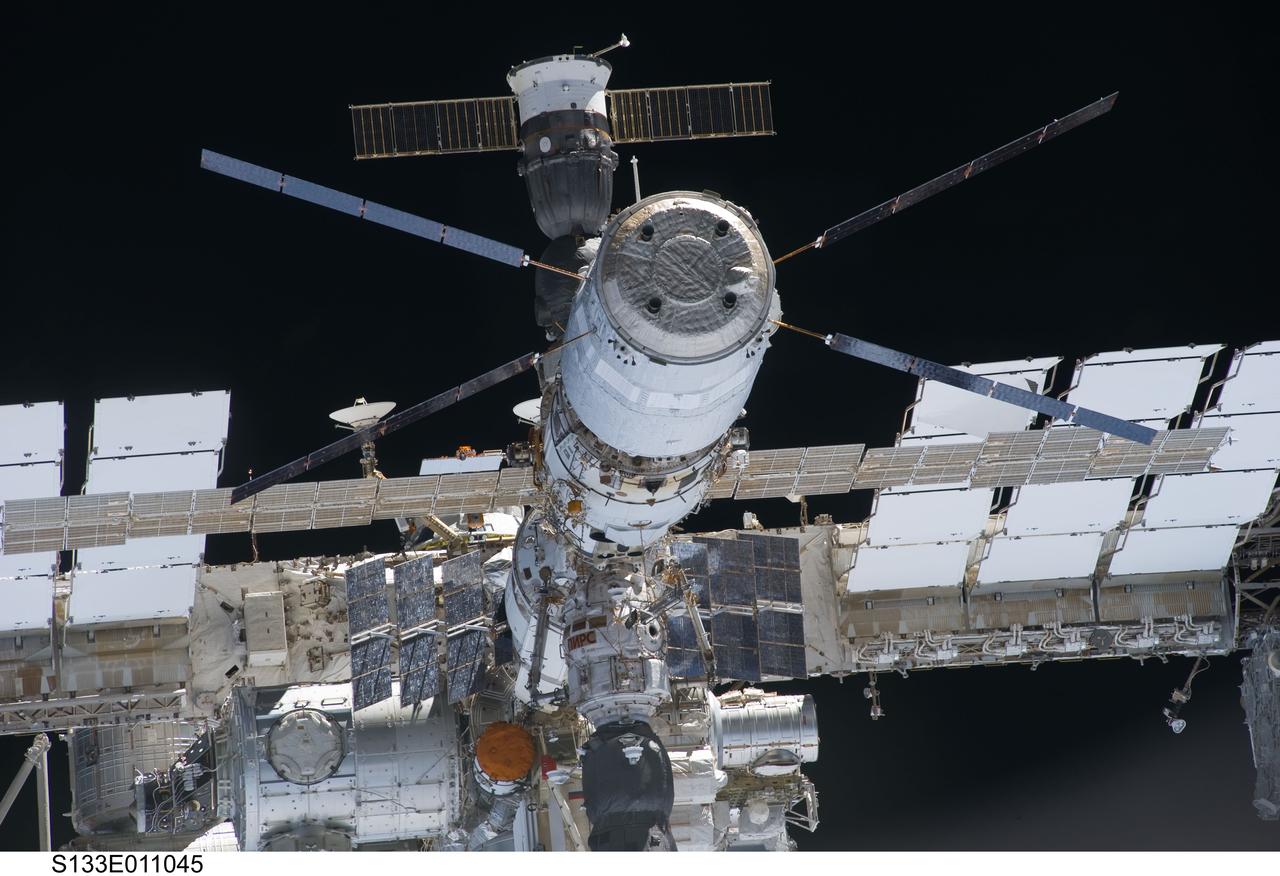
S133-E-011045 (7 March 2011) --- A close-up view of the aft section of the International Space Station is featured in this image photographed by an STS-133 crew member on space shuttle Discovery after the station and shuttle began their post-undocking relative separation. Undocking of the two spacecraft occurred at 7 a.m. (EST) on March 7, 2011. Discovery spent eight days, 16 hours, and 46 minutes attached to the orbiting laboratory. Photo credit: NASA or National Aeronautics and Space Administration
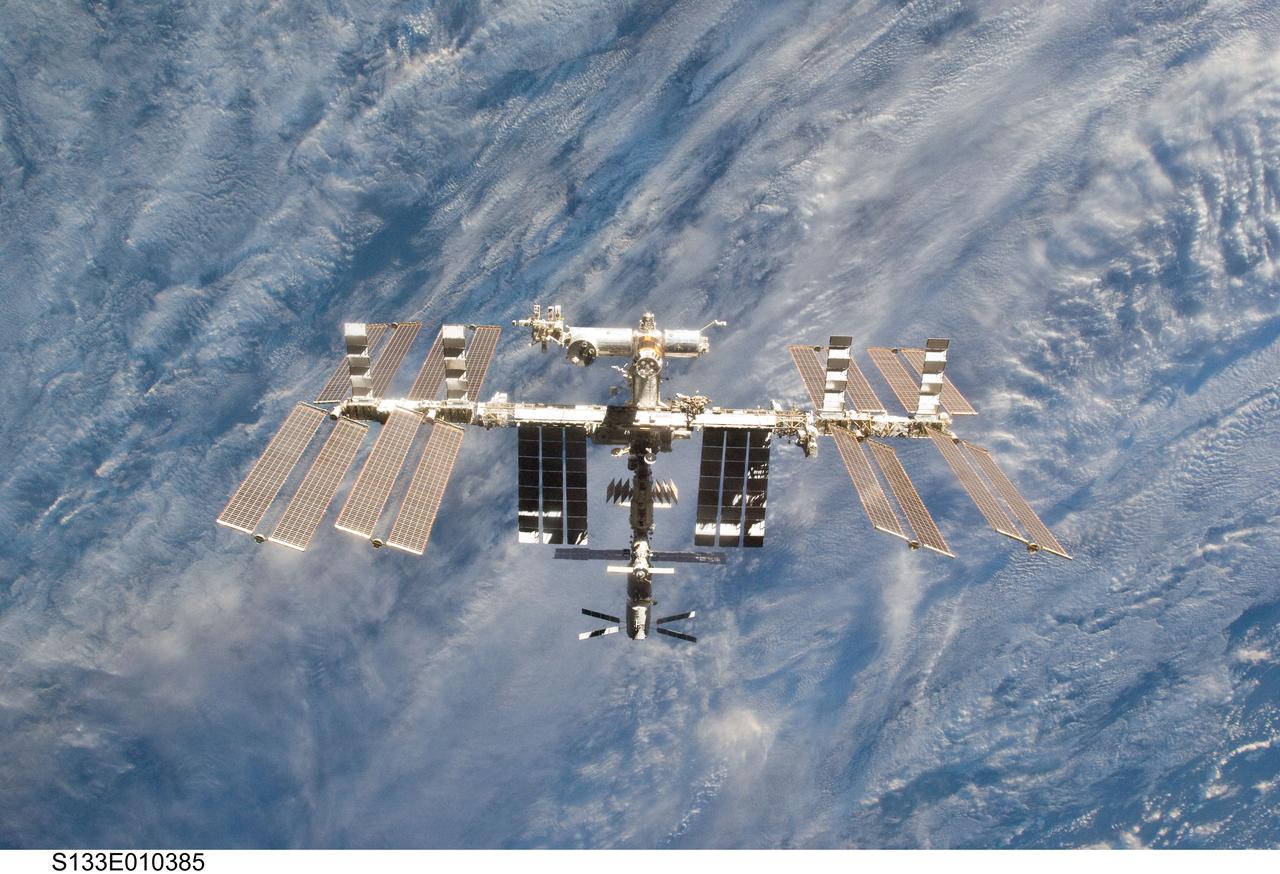
S133-E-010385 (7 March 2011) --- The International Space Station is featured in this image photographed by an STS-133 crew member on space shuttle Discovery after the station and shuttle began their post-undocking relative separation. Undocking of the two spacecraft occurred at 7 a.m. (EST) on March 7, 2011. Discovery spent eight days, 16 hours, and 46 minutes attached to the orbiting laboratory. Photo credit: NASA or National Aeronautics and Space Administration
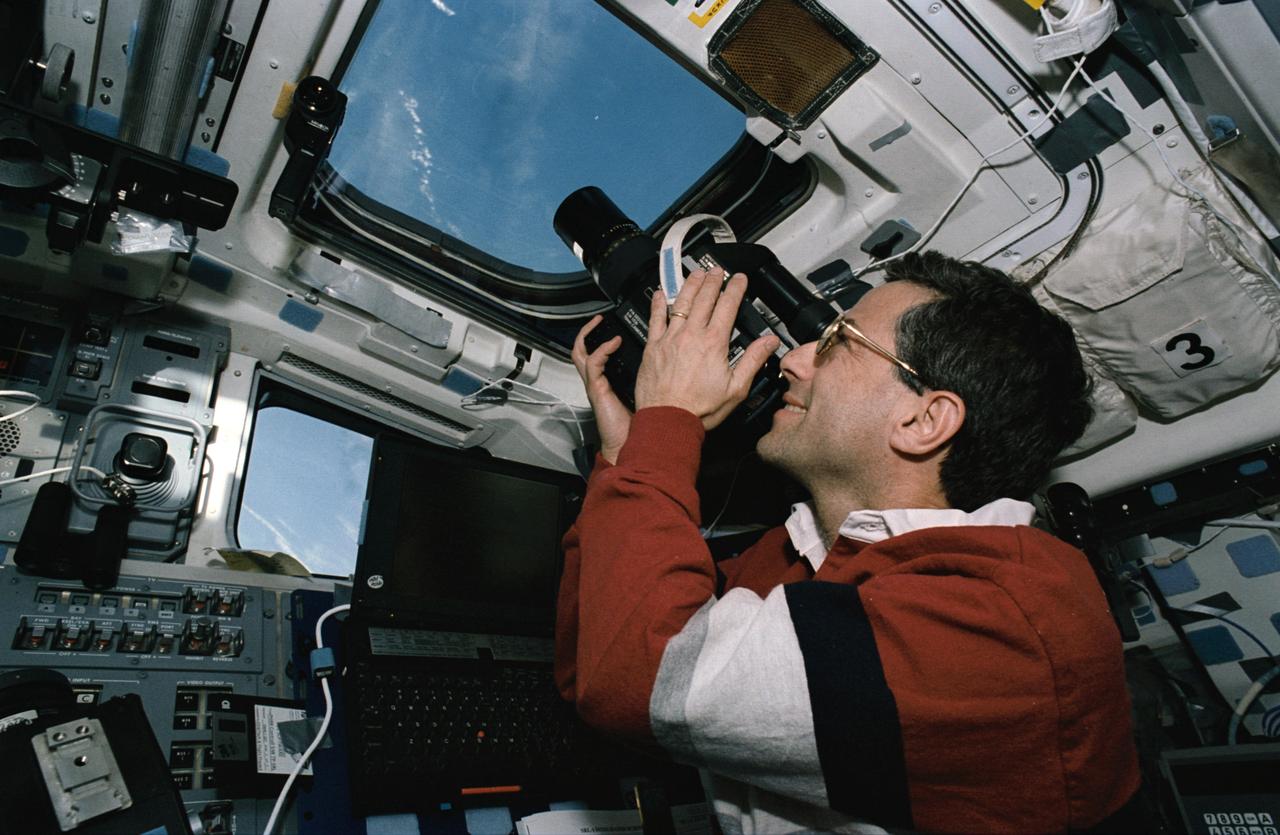
STS059-46-025 (9-20 April 1994) --- On the Space Shuttle Endeavour's aft flight deck astronaut Jerome (Jay) Apt, mission specialist, uses a handheld 70mm Hasselblad camera to record still scenes of Earth. Apt, the commander of Endeavour's Blue Shift, joined five other NASA astronauts for a week and a half in space in support of the Space Radar Laboratory/STS-59 mission.
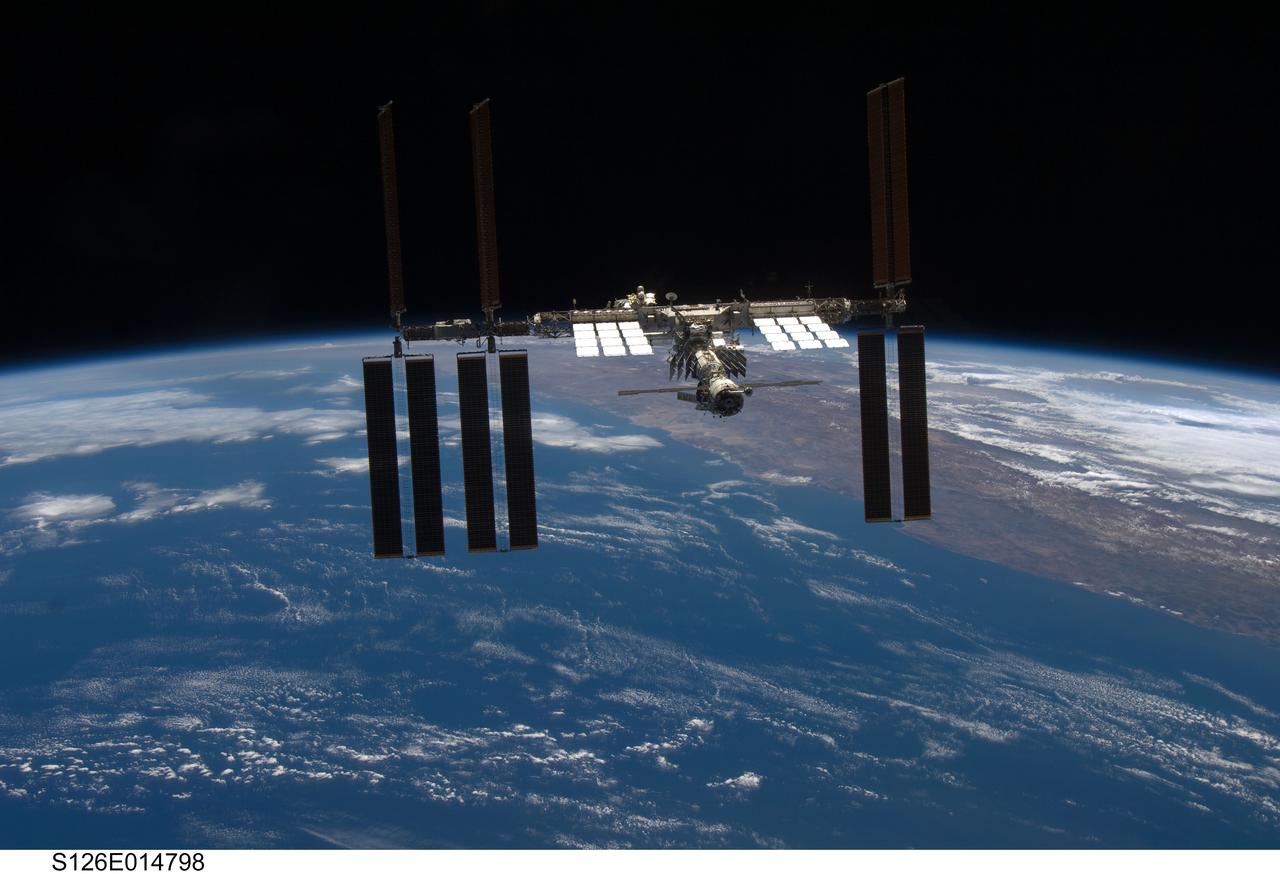
S126-E-014798 (28 Nov. 2008) --- Backdropped by a colorful Earth and the blackness of space, the International Space Station is seen from Space Shuttle Endeavour as the two spacecraft begin their relative separation. Earlier the STS-126 and Expedition 18 crews concluded 11 days, 16 hours and 46 minutes of cooperative work onboard the shuttle and station. Undocking of the two spacecraft occurred at 8:47 a.m. (CST) on Nov. 28, 2008.

S133-E-010422 (7 March 2011) --- The International Space Station is featured in this image photographed by an STS-133 crew member on space shuttle Discovery after the station and shuttle began their post-undocking relative separation. Undocking of the two spacecraft occurred at 7 a.m. (EST) on March 7, 2011. Discovery spent eight days, 16 hours, and 46 minutes attached to the orbiting laboratory. Photo credit: NASA or National Aeronautics and Space Administration
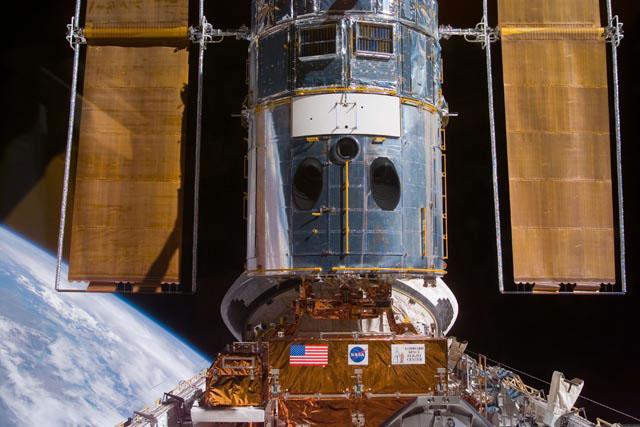
S103-E-5156 (21 December 1999) --- This electronic still camera's view and others in this series showing the Hubble Space Telescope (HST) being berthed in Discovery's bay were recorded during and soon after capture; and they were downlinked at the completion of the mission's first space walk on the following day by the busy STS-103 astronauts. The image was recorded at 19:46:15 GMT, Dec. 21, 1999.
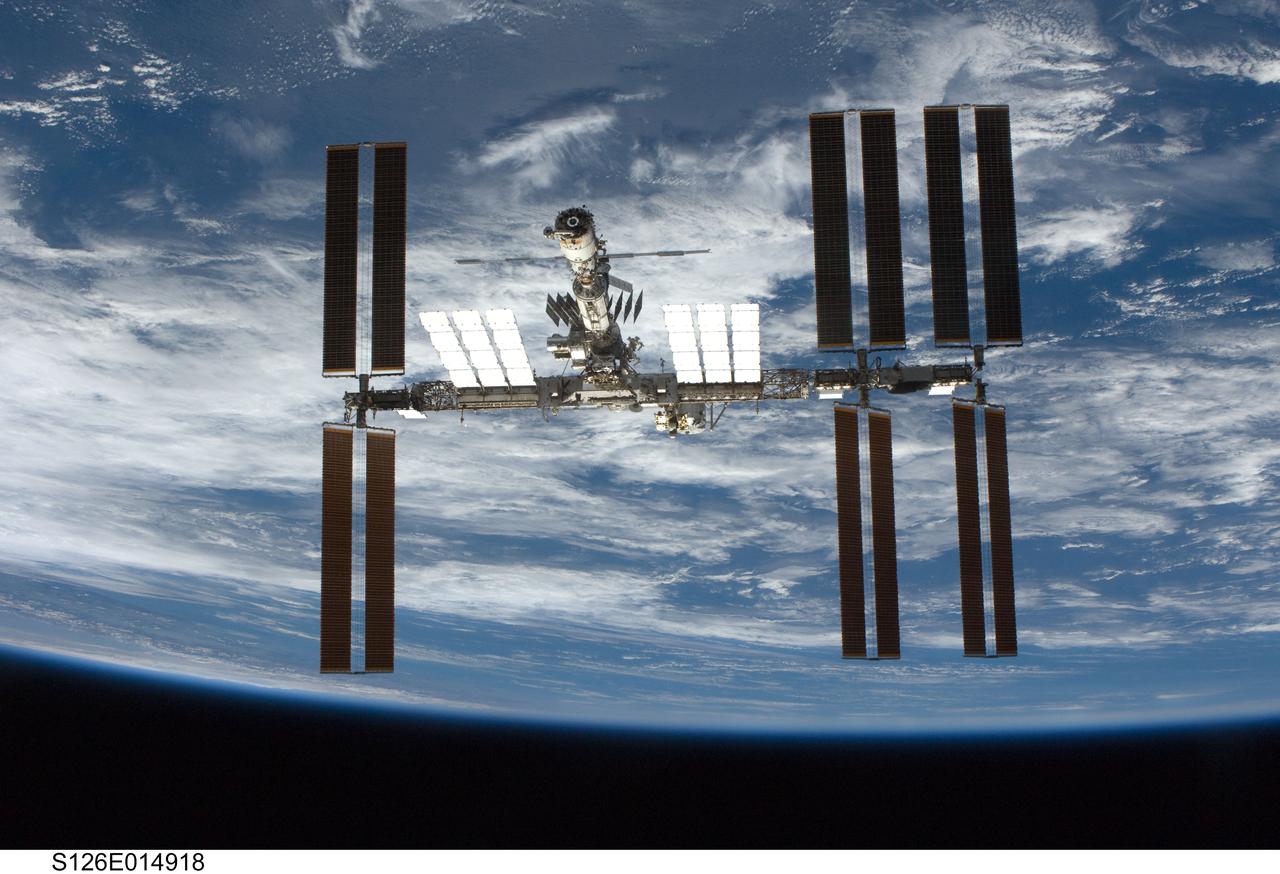
S126-E-014918 (28 Nov. 2008) --- Backdropped by a blue and white Earth and the blackness of space, the International Space Station is seen from Space Shuttle Endeavour as the two spacecraft begin their relative separation. Earlier the STS-126 and Expedition 18 crews concluded 11 days, 16 hours and 46 minutes of cooperative work onboard the shuttle and station. Undocking of the two spacecraft occurred at 8:47 a.m. (CST) on Nov. 28, 2008.
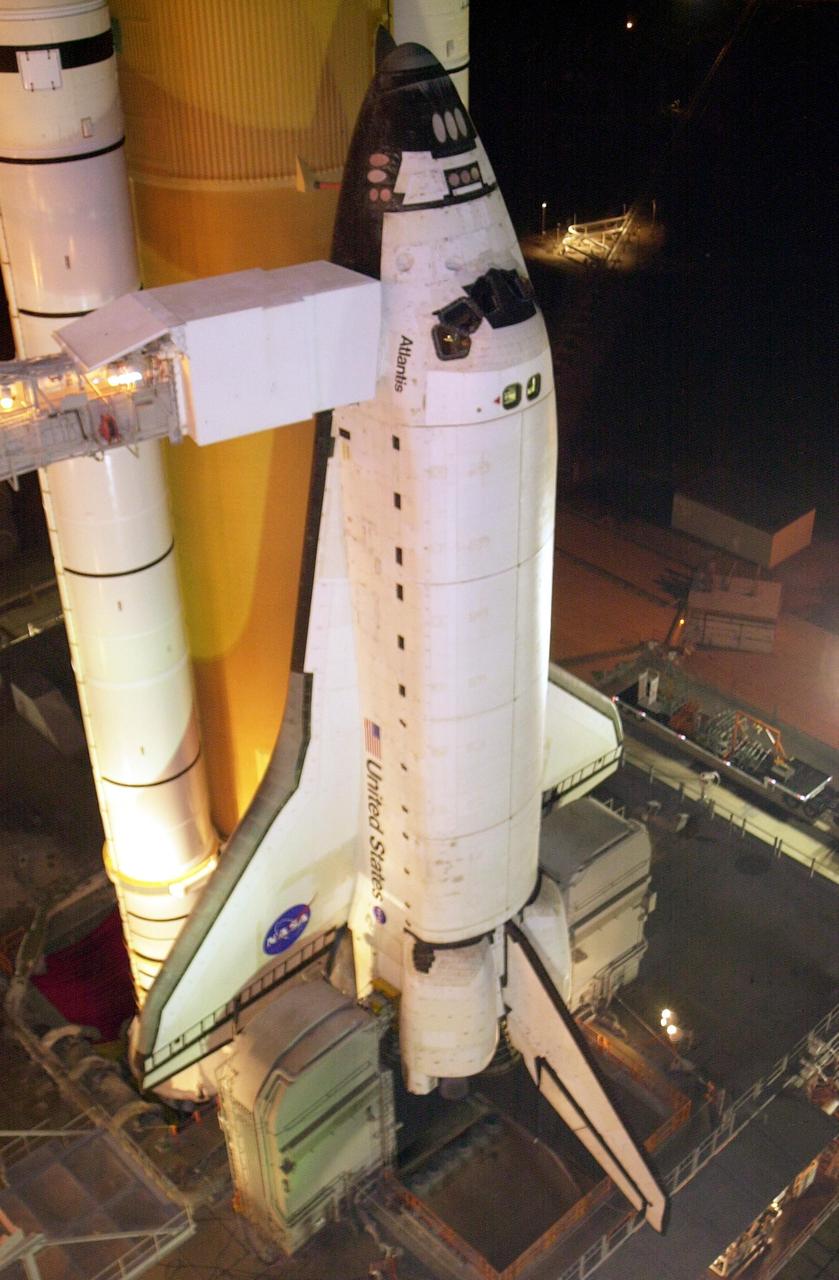
KENNEDY SPACE CENTER, FLA. -- After rollback of the Rotating Service Structure, Space Shuttle Atlantis is revealed on pad 39B prior to launch. The orbiter access arm with the White Room at the end can be seen extending toward the cockpit. The White Room provides entry into the Shuttle for the crew. The Shuttle is scheduled for launch Oct. 7 at 3:46 p.m. EDT on mission STS-112.
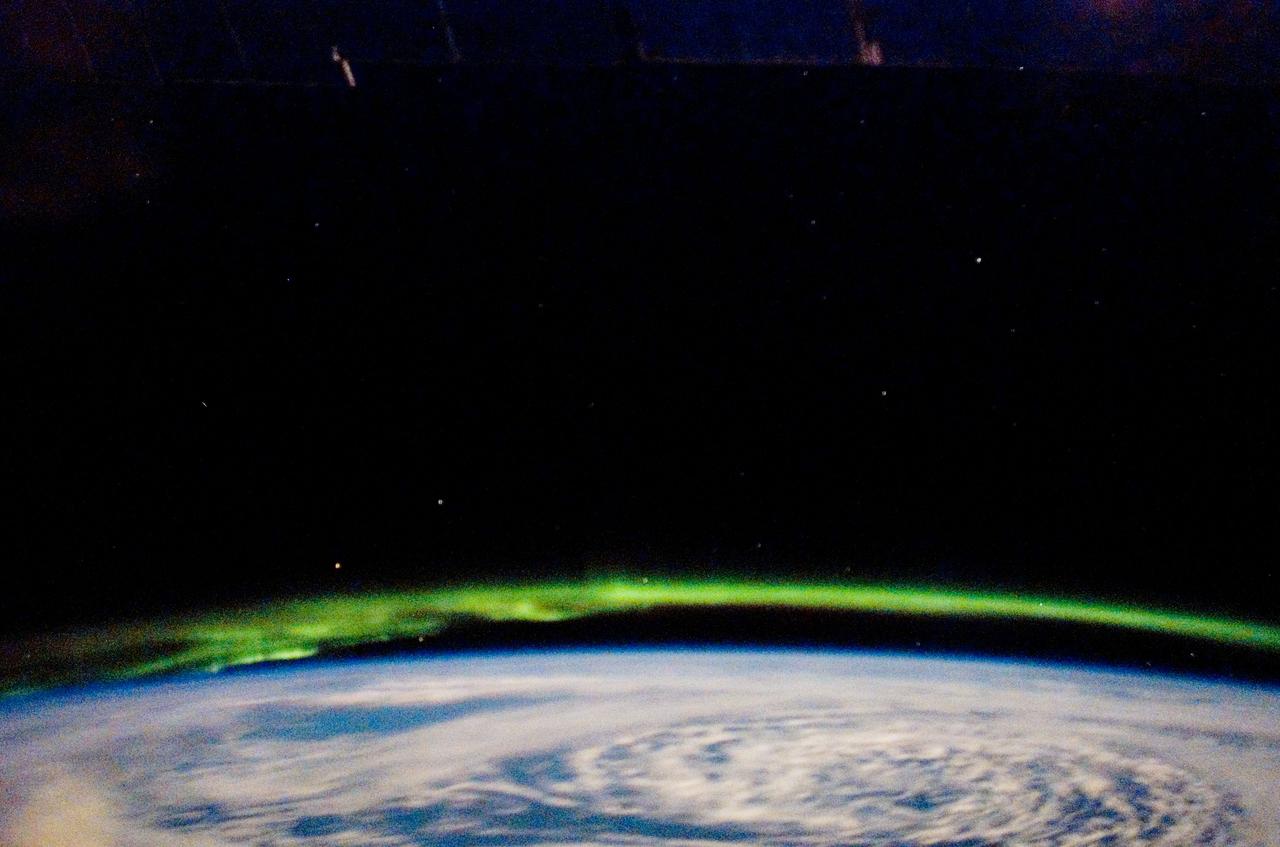
S123-E-008018 (21 March 2008) --- While docked and onboard the International Space Station, a STS-123 Endeavour crewmember captured the glowing green beauty of the Aurora Borealis. Looking northward across the Gulf of Alaska, over a low pressure area (cloud vortex), the aurora brightens the night sky. This image was taken on March 21, 2008 at 09:08:46 (GMT) with a 28 mm lens from the nadir point of 47.9 degrees north latitude and 146.8 degrees west longitude.
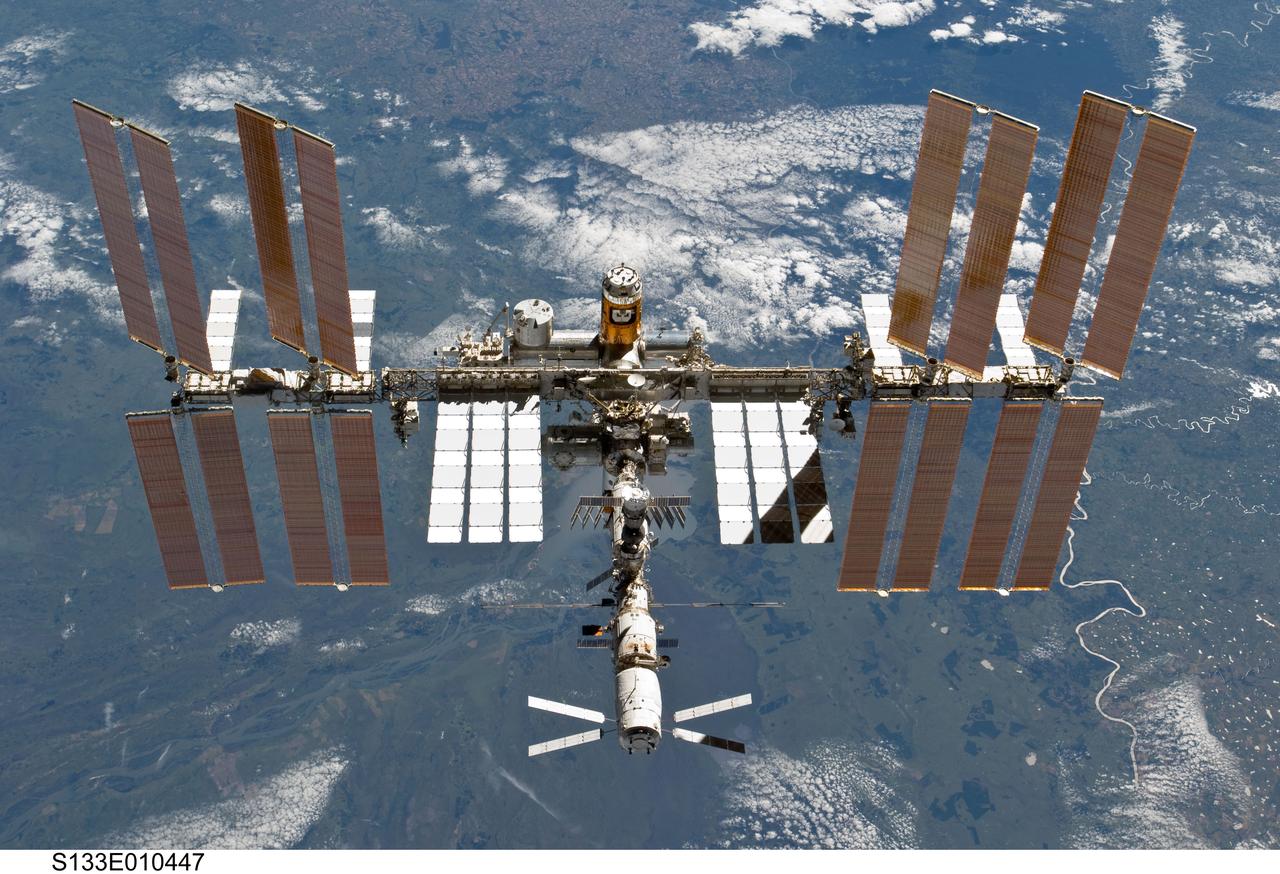
S133-E-010447 (7 March 2011) --- The International Space Station is featured in this image photographed by an STS-133 crew member on space shuttle Discovery after the station and shuttle began their post-undocking relative separation. Undocking of the two spacecraft occurred at 7 a.m. (EST) on March 7, 2011. Discovery spent eight days, 16 hours, and 46 minutes attached to the orbiting laboratory. Photo credit: NASA or National Aeronautics and Space Administration
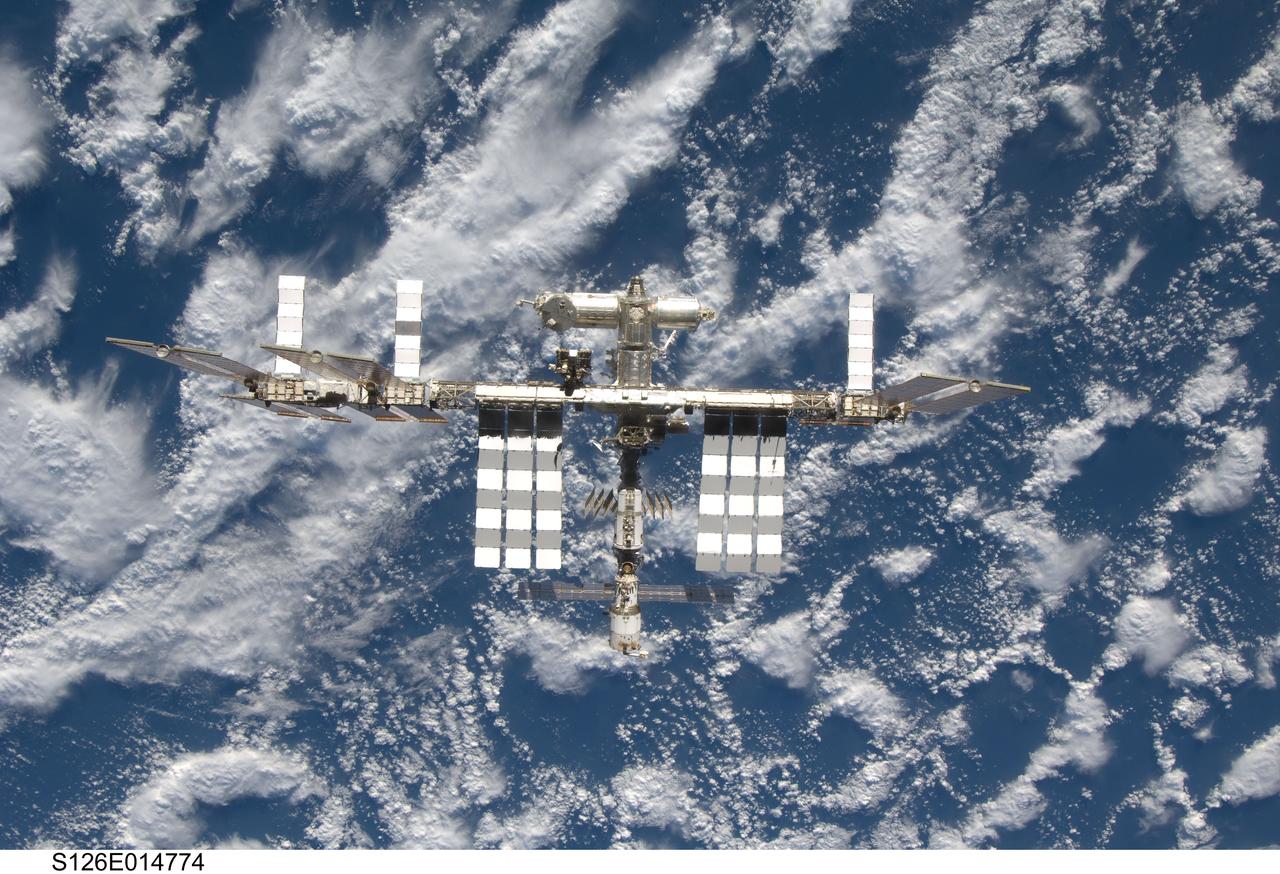
S126-E-014774 (28 Nov. 2008) --- Backdropped by a blue and white Earth, the International Space Station is seen from Space Shuttle Endeavour as the two spacecraft begin their relative separation. Earlier the STS-126 and Expedition 18 crews concluded 11 days, 16 hours and 46 minutes of cooperative work onboard the shuttle and station. Undocking of the two spacecraft occurred at 8:47 a.m. (CST) on Nov. 28, 2008.
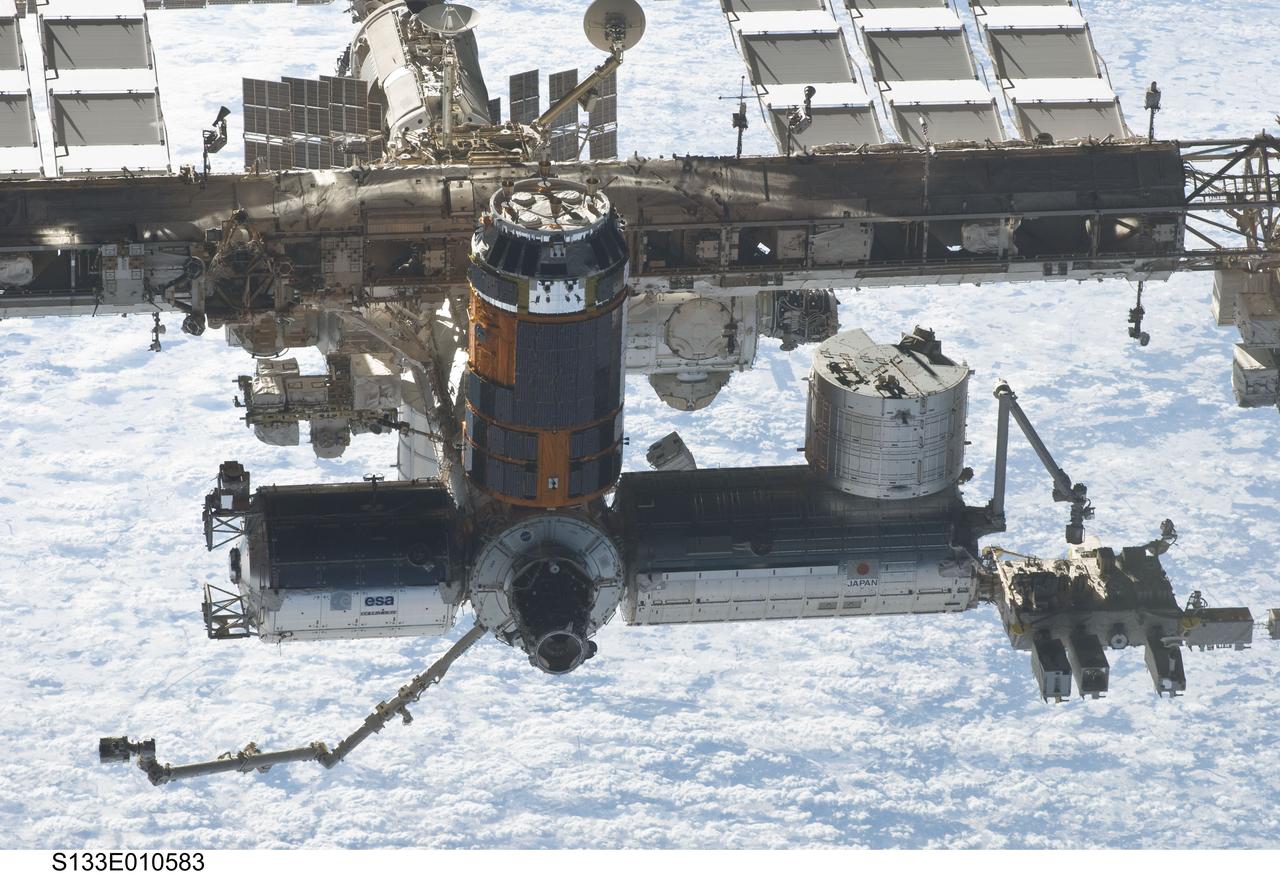
S133-E-010583 (7 March 2011) --- A close-up view of the International Space Station is featured in this image photographed by an STS-133 crew member on space shuttle Discovery after the station and shuttle began their post-undocking relative separation. Undocking of the two spacecraft occurred at 7 a.m. (EST) on March 7, 2011. Discovery spent eight days, 16 hours, and 46 minutes attached to the orbiting laboratory. Photo credit: NASA or National Aeronautics and Space Administration
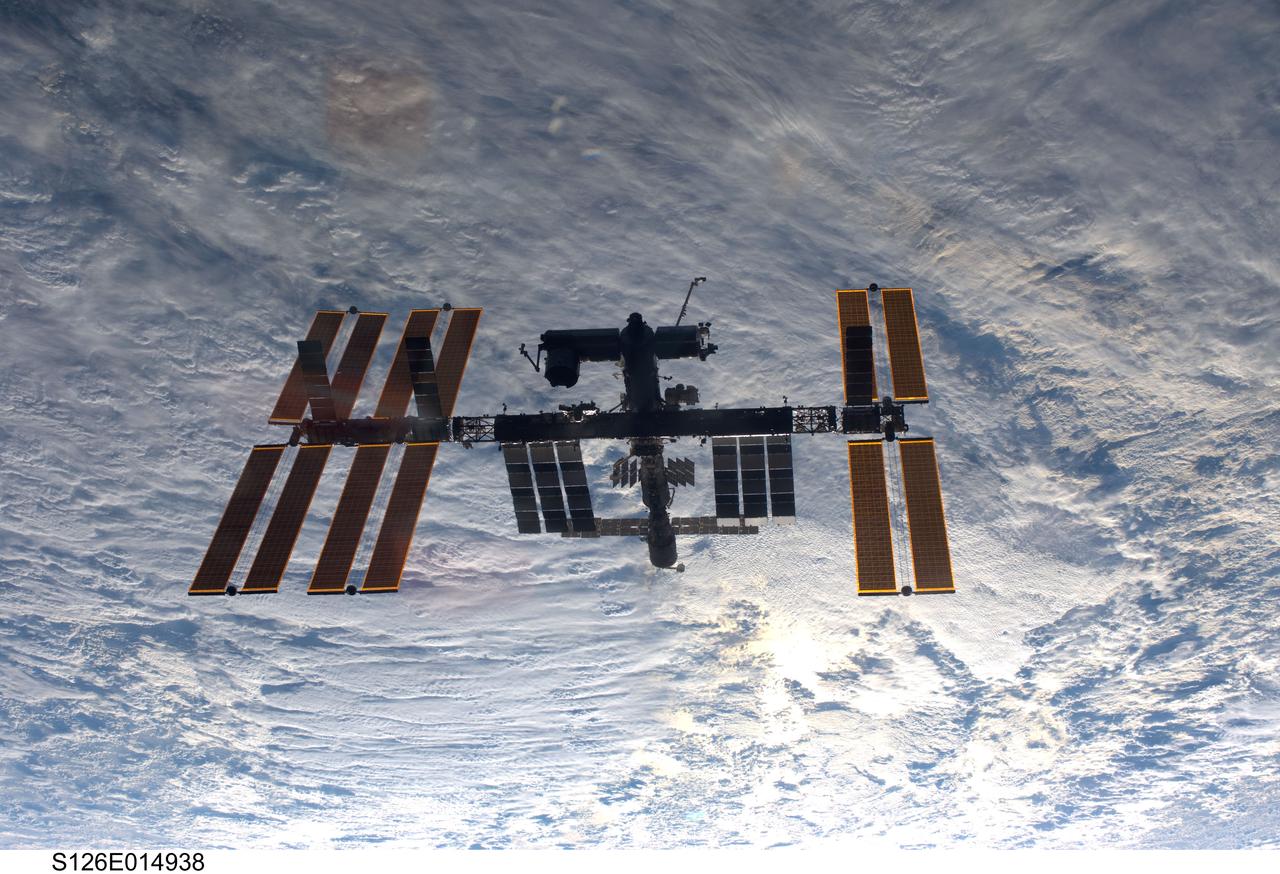
S126-E-014938 (28 Nov. 2008) --- Backdropped by a cloud-covered part of Earth, the International Space Station is seen from Space Shuttle Endeavour as the two spacecraft begin their relative separation. Earlier the STS-126 and Expedition 18 crews concluded 11 days, 16 hours and 46 minutes of cooperative work onboard the shuttle and station. Undocking of the two spacecraft occurred at 8:47 a.m. (CST) on Nov. 28, 2008.
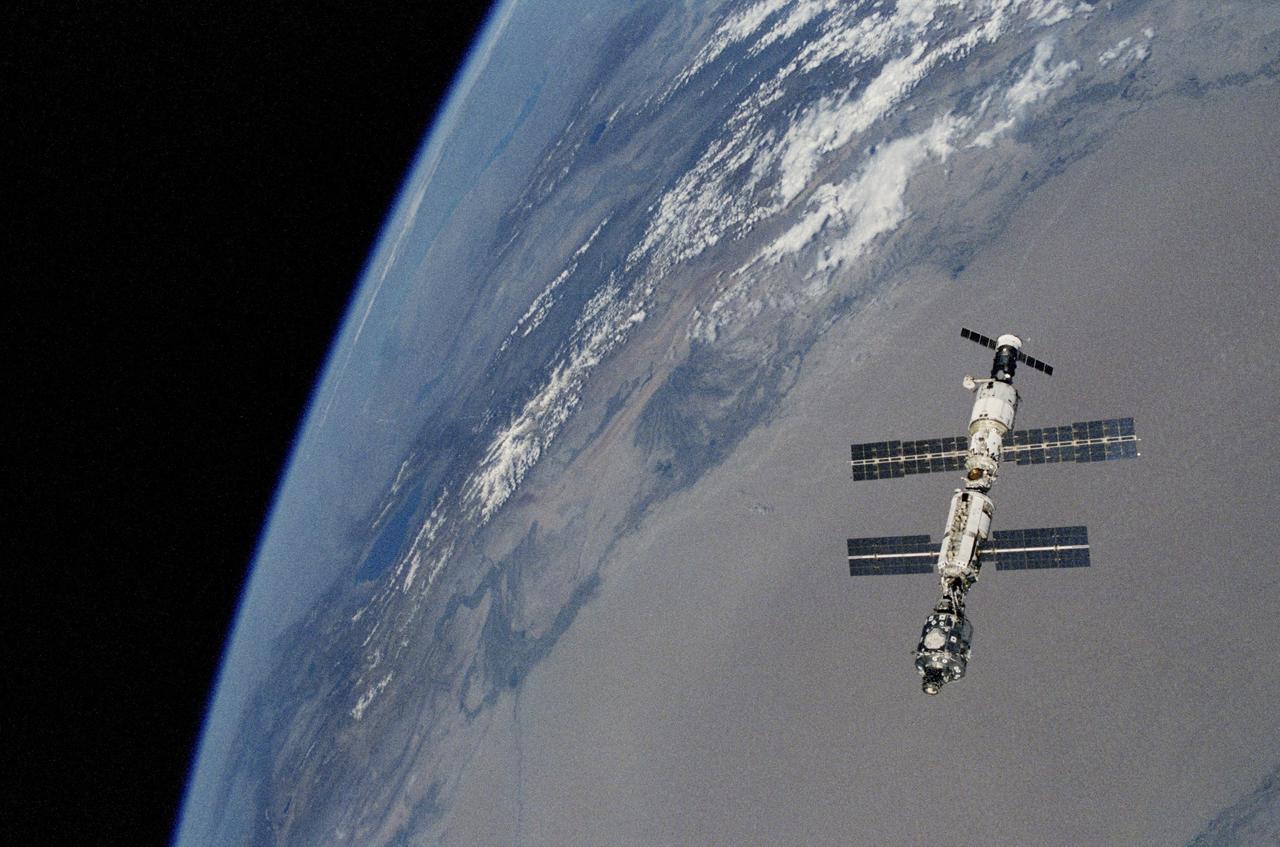
STS106-314-023 (17 September 2000) --- The International Space Station (ISS), backdropped over China’s Takla Makan desert and Earth’s horizon, is photographed after undocking with the Space Shuttle Atlantis. The 35mm frame was exposed by one of the STS-106 crew members onboard the shuttle. The undocking took place on September 17, 2000 at 10:46 p.m. (CDT).
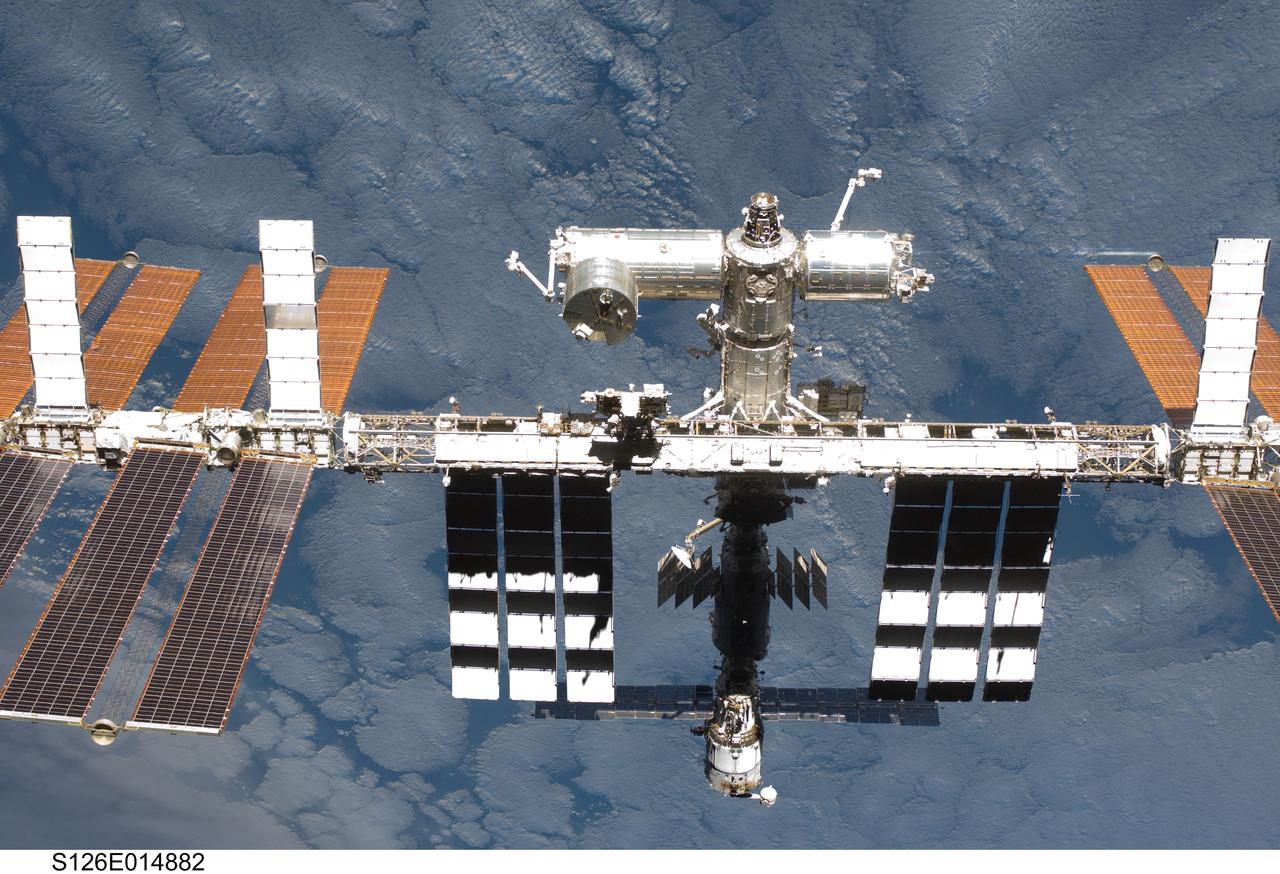
S126-E-014882 (28 Nov. 2008) --- Backdropped by a cloud-covered part of Earth, the International Space Station is seen from Space Shuttle Endeavour as the two spacecraft begin their relative separation. Earlier the STS-126 and Expedition 18 crews concluded 11 days, 16 hours and 46 minutes of cooperative work onboard the shuttle and station. Undocking of the two spacecraft occurred at 8:47 a.m. (CST) on Nov. 28, 2008.
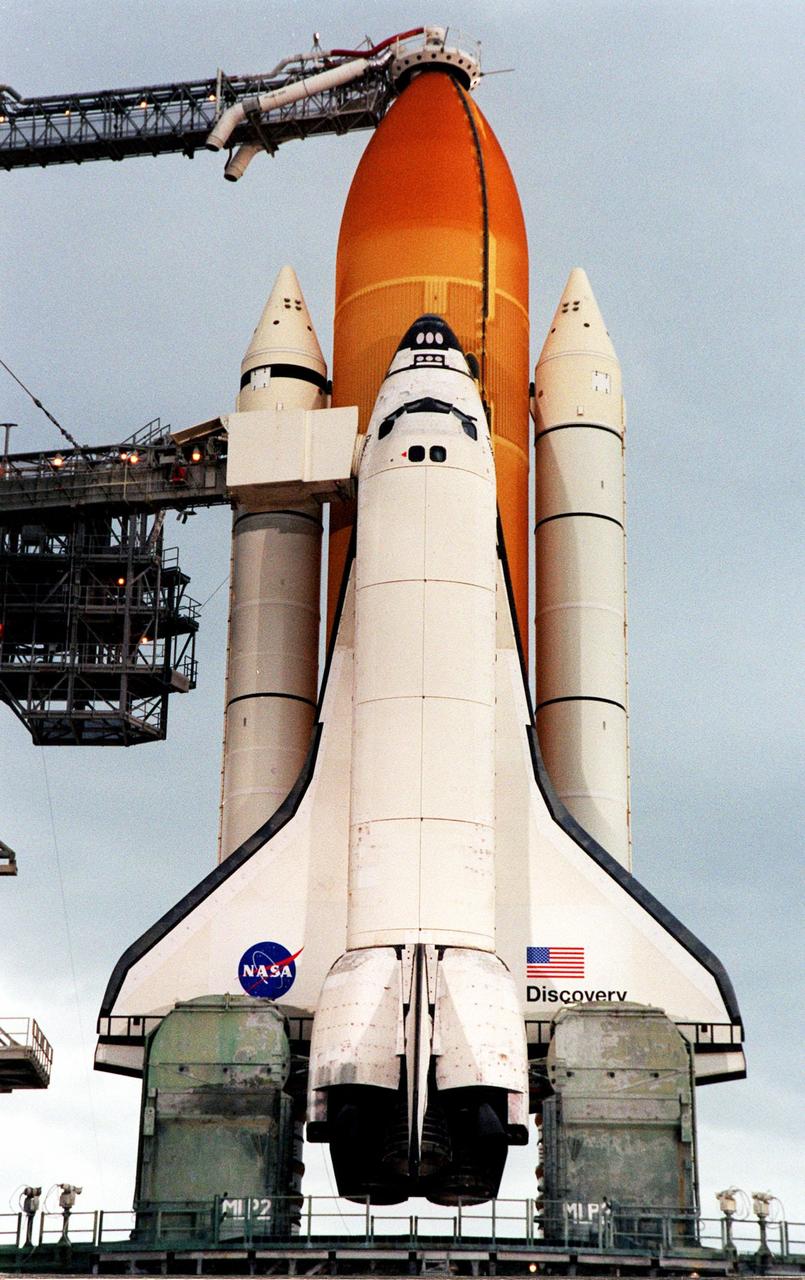
As dawn breaks at Launch Pad 39B on the east coast of Florida, the Space Shuttle Discovery is revealed after rollback of the Rotating Service Structure. The rollback of the structure was complete at 4:46 a.m. EST. Poised for flight on mission STS-103, Discovery is scheduled for launch Dec. 16 at 9:18 p.m. EST. The mission is expected to last about 9 days and 21 hours with a landing at KSC Sunday, Dec. 26, at 6:56 p.m. EST
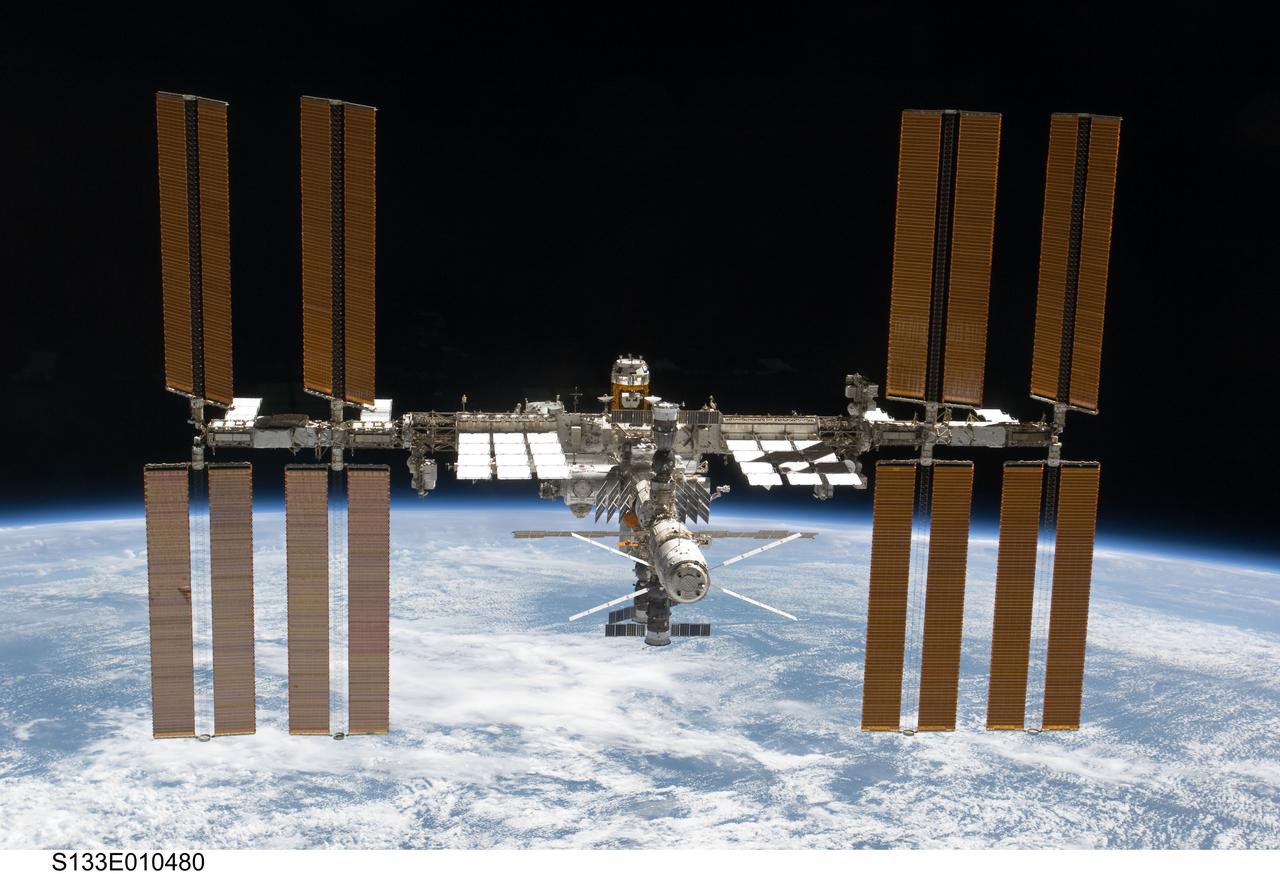
S133-E-010480 (7 March 2011) --- The International Space Station is featured in this image photographed by an STS-133 crew member on space shuttle Discovery after the station and shuttle began their post-undocking relative separation. Undocking of the two spacecraft occurred at 7 a.m. (EST) on March 7, 2011. Discovery spent eight days, 16 hours, and 46 minutes attached to the orbiting laboratory. Photo credit: NASA or National Aeronautics and Space Administration
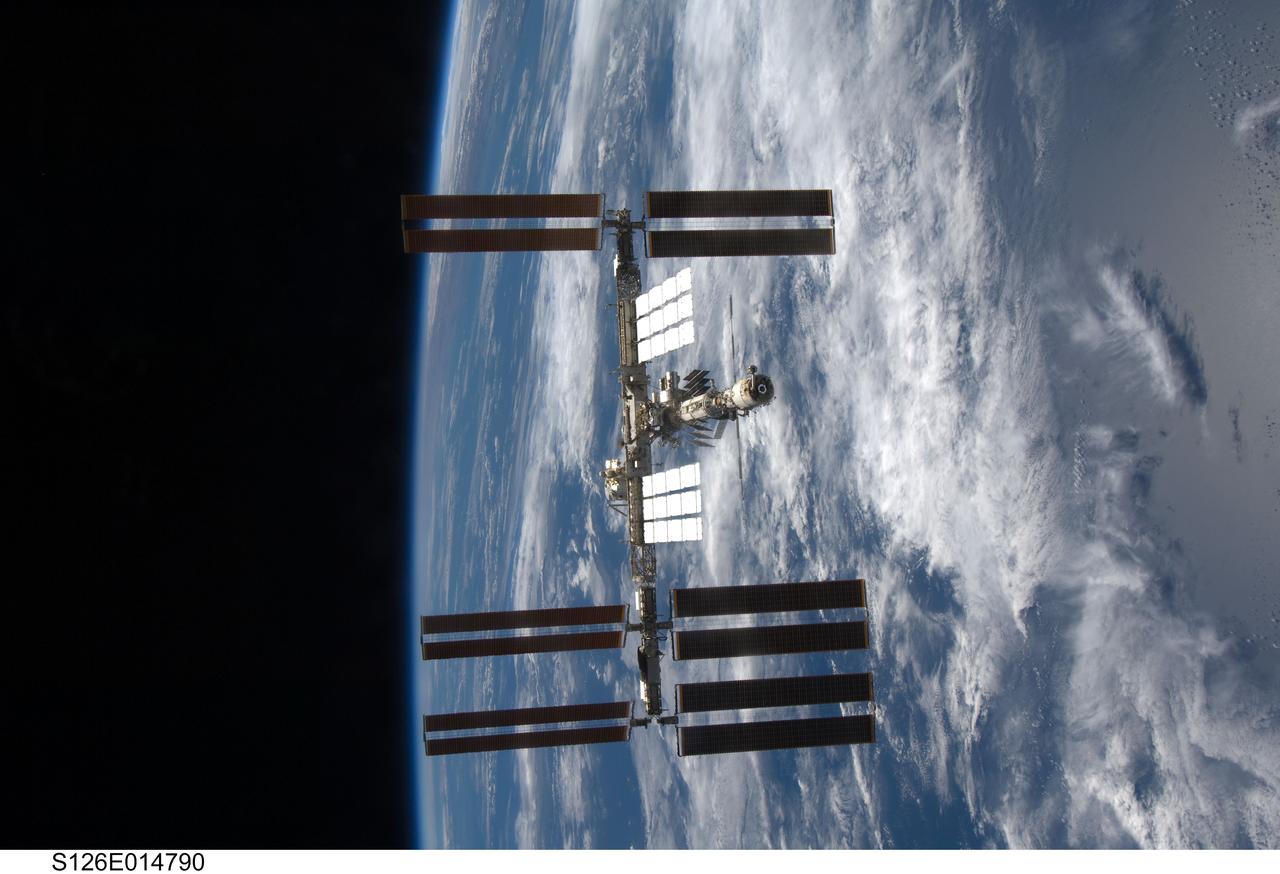
S126-E-014790 (28 Nov. 2008) --- Backdropped by a blue and white Earth and the blackness of space, the International Space Station is seen from Space Shuttle Endeavour as the two spacecraft begin their relative separation. Earlier the STS-126 and Expedition 18 crews concluded 11 days, 16 hours and 46 minutes of cooperative work onboard the shuttle and station. Undocking of the two spacecraft occurred at 8:47 a.m. (CST) on Nov. 28, 2008.
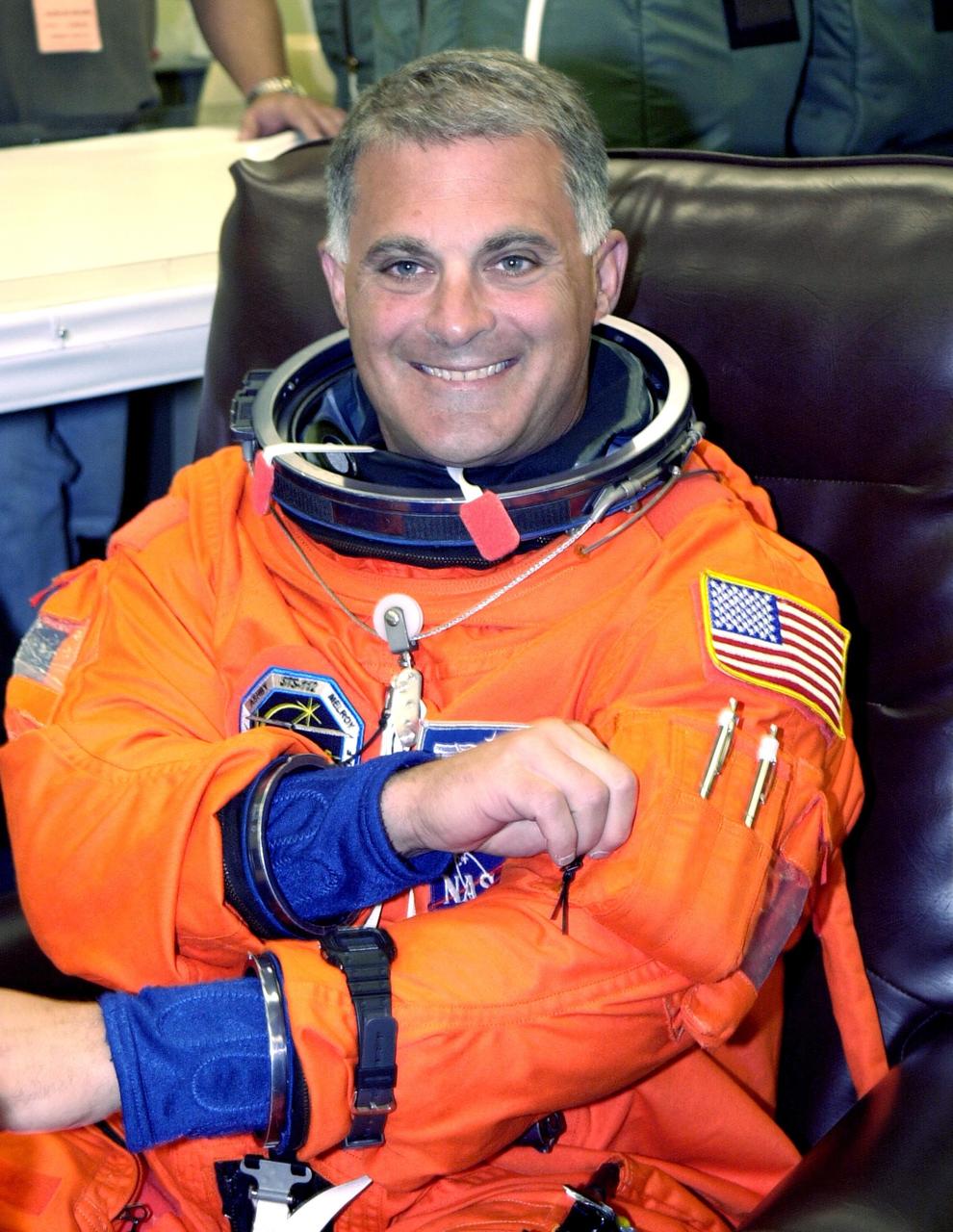
KENNEDY SPACE CENTER, FLA. -- STS-112 Mission Specialist David Wolf suits up for launch, just hours away. STS-112 is the 15th assembly flight to the International Space Station, carrying the S1 Integrated Truss Structure and the Crew and Equipment Translation Aid (CETA) Cart A. The CETA is the first of two human-powered carts that will ride along the ISS railway, providing mobile work platforms for future spacewalking astronauts. On the 11-day mission, three spacewalks are planned to attach the S1 truss to the Station. Launch is scheduled for 3:46 p.m. EDT from Launch Pad 39B. .
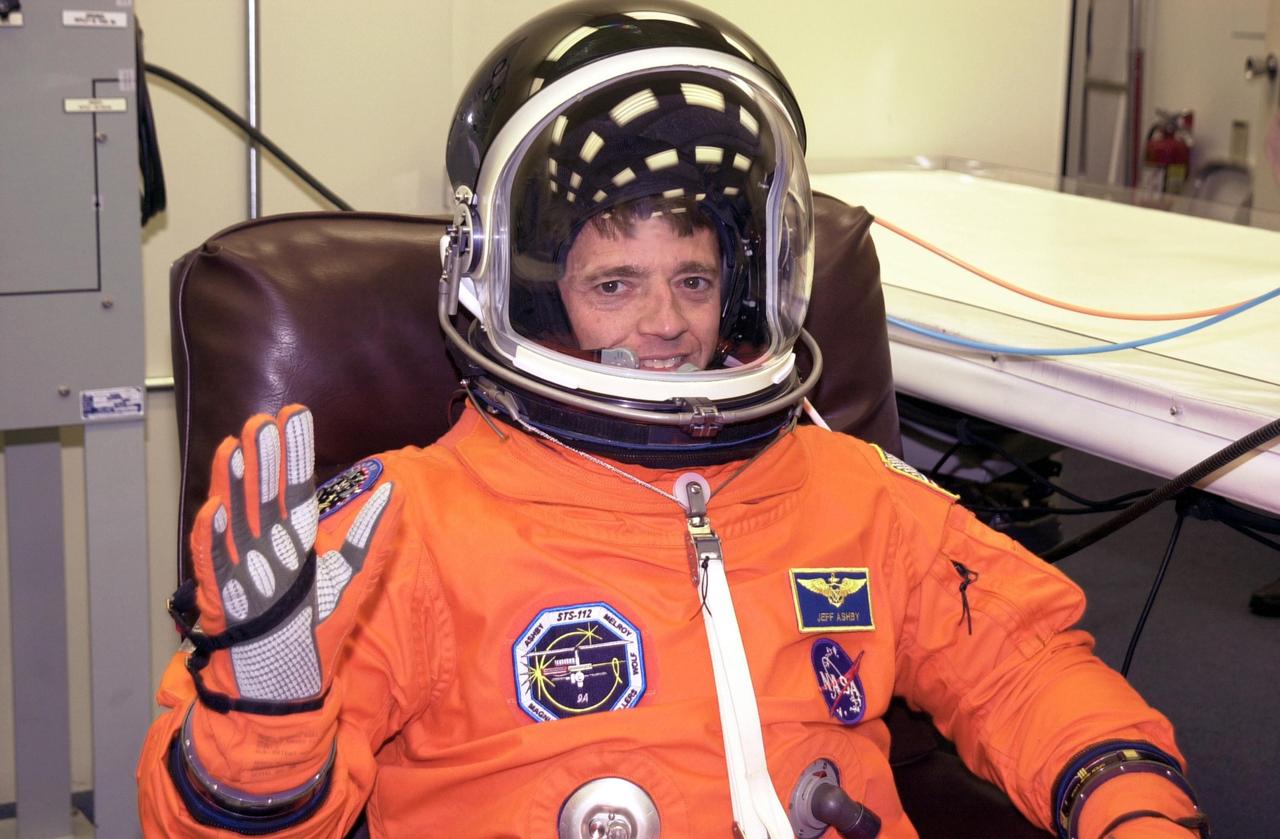
KENNEDY SPACE CENTER, FLA. -- STS-112 Commander Jeffrey Ashby finishes suiting up for launch. STS-112 is the 15th assembly flight to the International Space Station, carrying the S1 Integrated Truss Structure and the Crew and Equipment Translation Aid (CETA) Cart A. The CETA is the first of two human-powered carts that will ride along the ISS railway, providing mobile work platforms for future spacewalking astronauts. On the 11-day mission, three spacewalks are planned to attach the S1 truss to the Station. Launch is scheduled for 3:46 p.m. EDT from Launch Pad 39B.
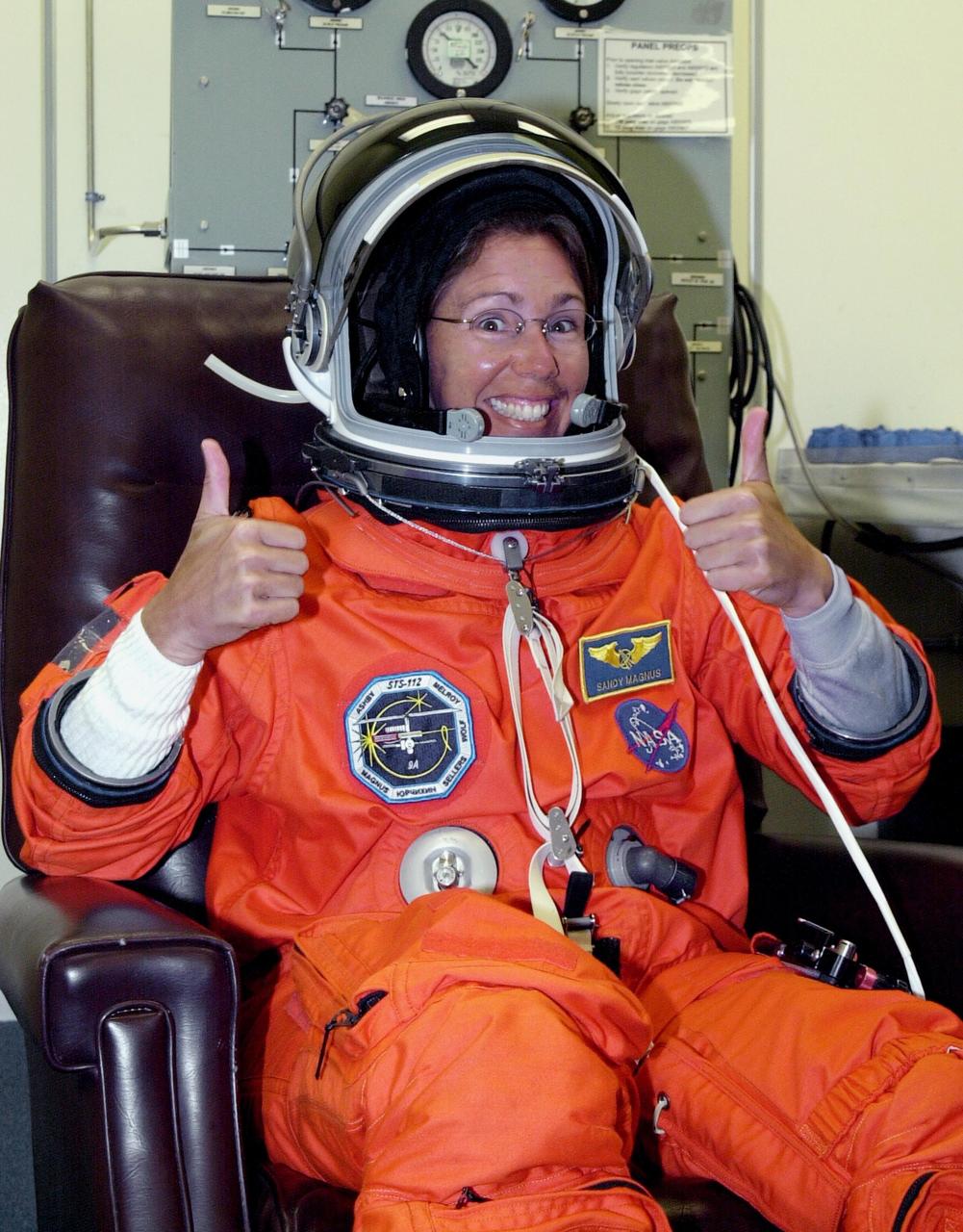
KENNEDY SPACE CENTER, FLA. - STS-112 Mission Specialist Sandra Magnus finishes suiting up before launch. STS-112 is the 15th assembly flight to the International Space Station, carrying the S1 Integrated Truss Structure and the Crew and Equipment Translation Aid (CETA) Cart A. The CETA is the first of two human-powered carts that will ride along the ISS railway, providing mobile work platforms for future spacewalking astronauts. On the 11-day mission, three spacewalks are planned to attach the S1 truss to the Station. Launch is scheduled for 3:46 p.m. EDT from Launch Pad 39B.
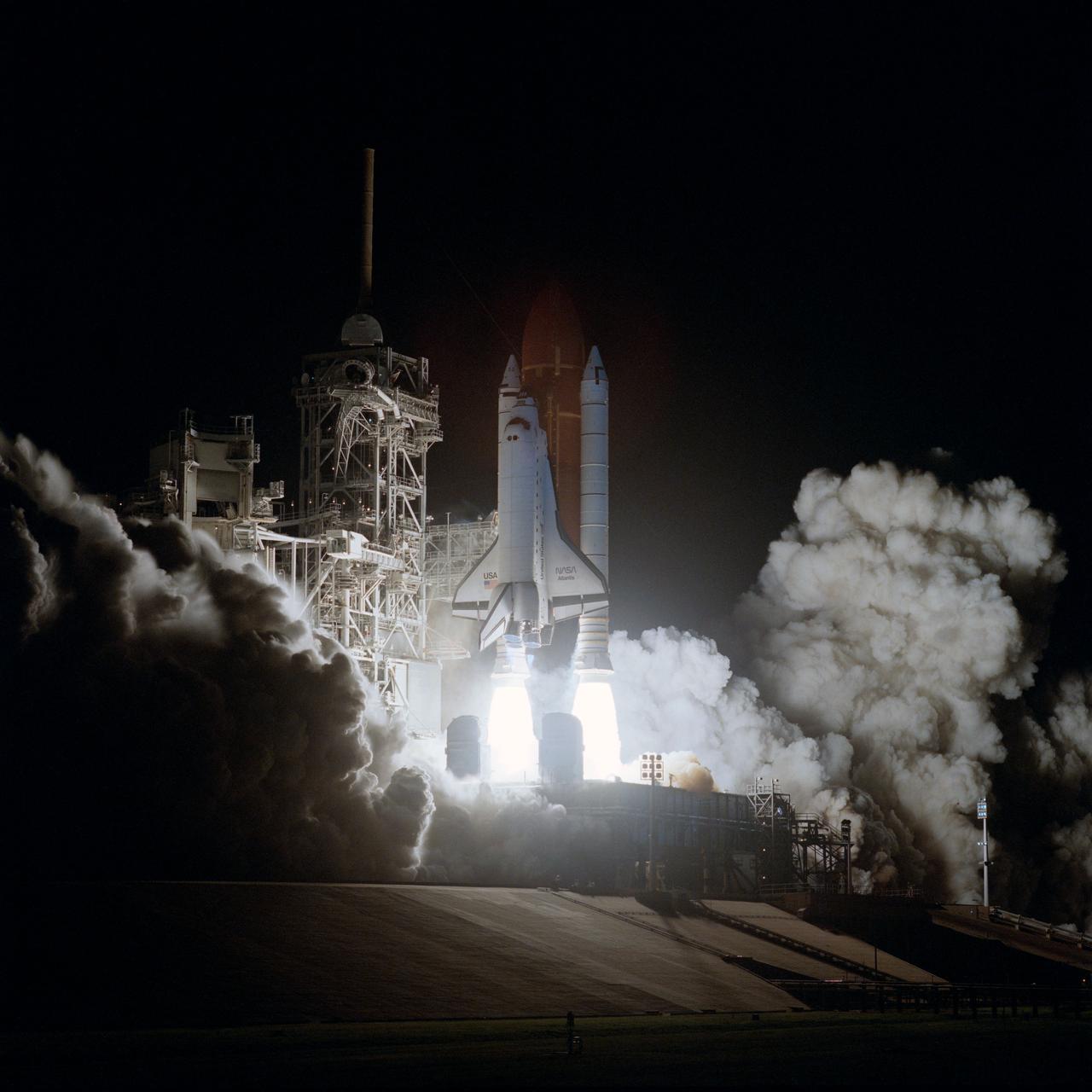
STS-38 Atlantis, Orbiter Vehicle (OV) 104, lifts off from Kennedy Space Center (KSC) Launch Complex Pad at 6:46:15:0639 pm (Eastern Standard Time (EST)). As OV-104, atop the external tank (ET) and flanked by two solid rocket boosters (SRBs), rises above the mobile launcher platform, exhaust smoke fills the area surrounding the launch pad. SRB and space shuttle main engine (SSME) firings glow against the night darkness and light up the fixed service structure (FSS) and retracted rotating service structure (RSS). STS-38 is a Department of Defense (DOD) devoted mission.
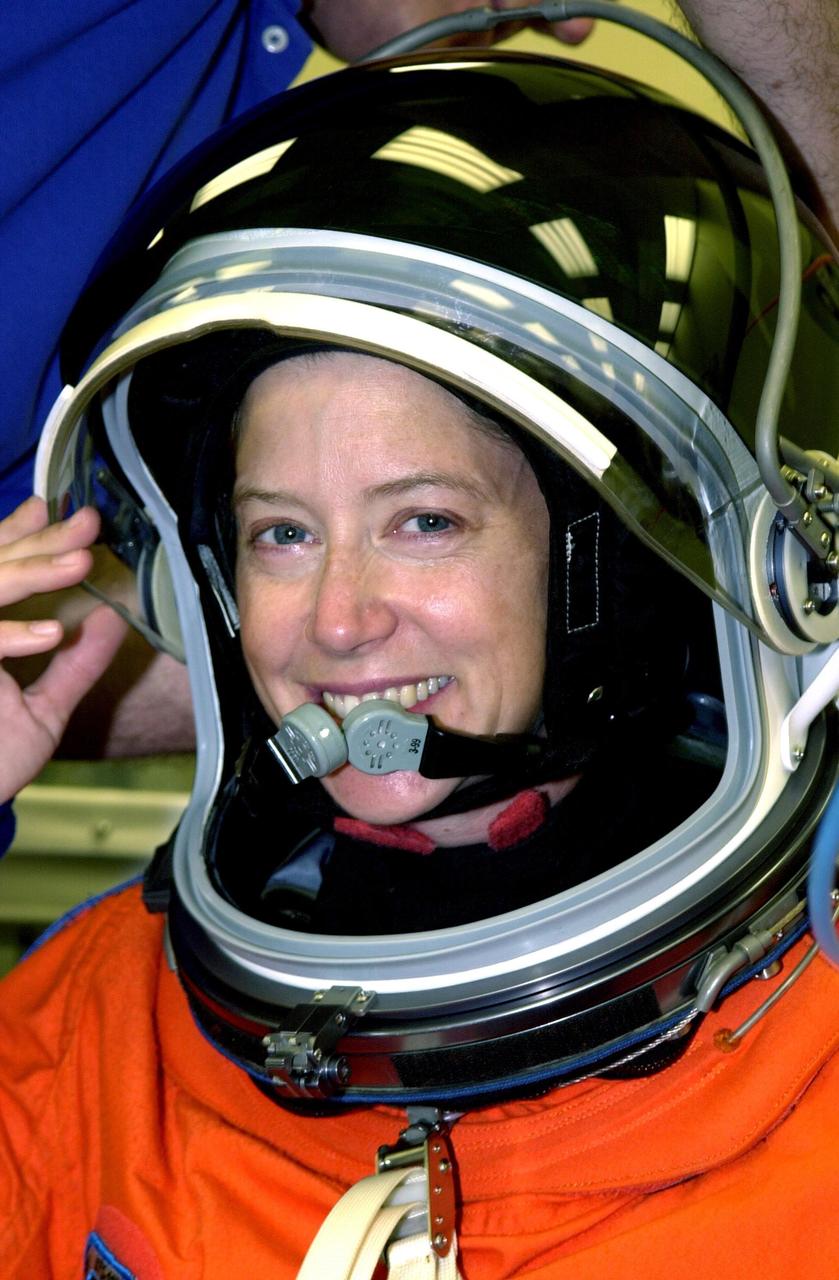
KENNEDY SPACE CENTER, FLA. -- STS-112 Pilot Pamela Melroy finishes suiting up for launch. STS-112 is the 15th assembly flight to the International Space Station, carrying the S1 Integrated Truss Structure and the Crew and Equipment Translation Aid (CETA) Cart A. The CETA is the first of two human-powered carts that will ride along the ISS railway, providing mobile work platforms for future spacewalking astronauts. On the 11-day mission, three spacewalks are planned to attach the S1 truss to the Station. Launch is scheduled for 3:46 p.m. EDT from Launch Pad 39B. .
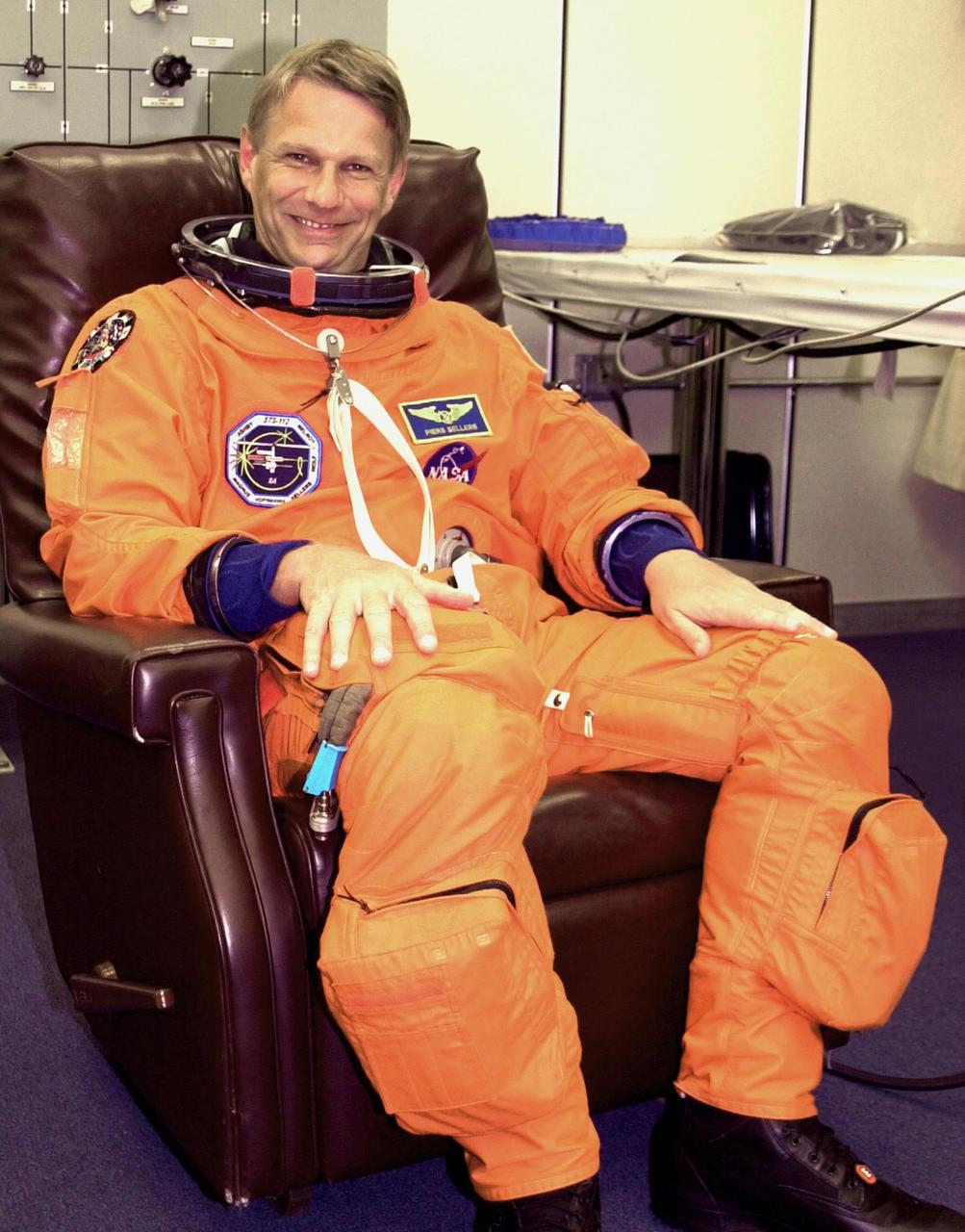
KENNEDY SPACE CENTER, FLA. - During suitup for launch, STS-112 Mission Specialist Piers Sellers smiles in anticipation of his first Shuttle flight. STS-112 is the 15th assembly flight to the International Space Station, carrying the S1 Integrated Truss Structure and the Crew and Equipment Translation Aid (CETA) Cart A. The CETA is the first of two human-powered carts that will ride along the ISS railway, providing mobile work platforms for future spacewalking astronauts. On the 11-day mission, three spacewalks are planned to attach the S1 truss to the Station. Launch is scheduled for 3:46 p.m. EDT from Launch Pad 39B.
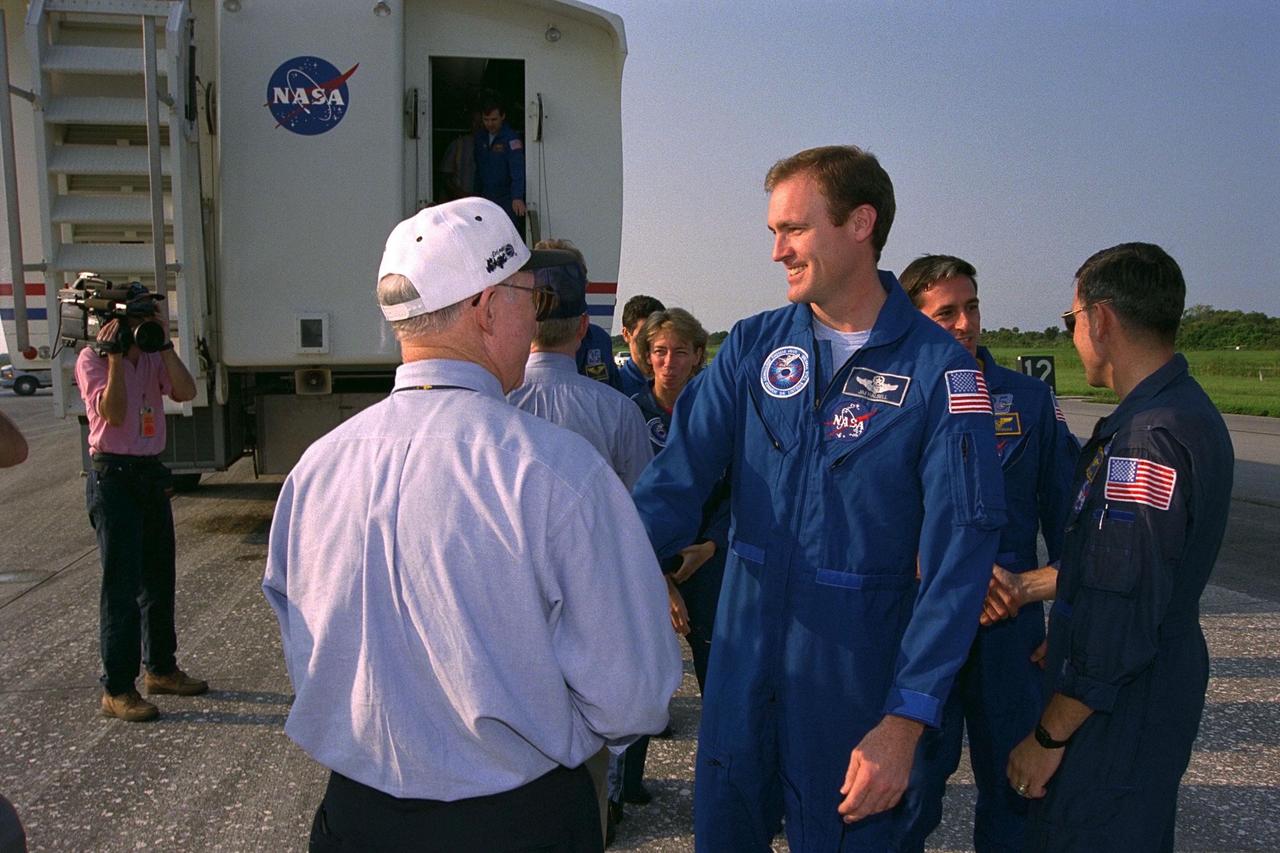
STS-94 Mission Commander James D. Halsell Jr. (center) shakes hands with KSC Shuttle Launch Director James F. Harrington (in white cap) after an end-of-mission landing on Runway 33 of KSC’s Shuttle Landing Facility July 17 to complete the Microgravity Science Laboratory-1 (MSL-1) mission. Main gear touchdown occurred at 6:46:34 a.m. EDT, July 17. At right, STS-88 Mission Commander and Shuttle Training Aircraft (STA) pilot Robert D. Cabana greets STS-94 Mission Specialist Donald A. Thomas. In the background, KSC Center Director Roy D. Bridges Jr. meets with other members of the STS-94 crew
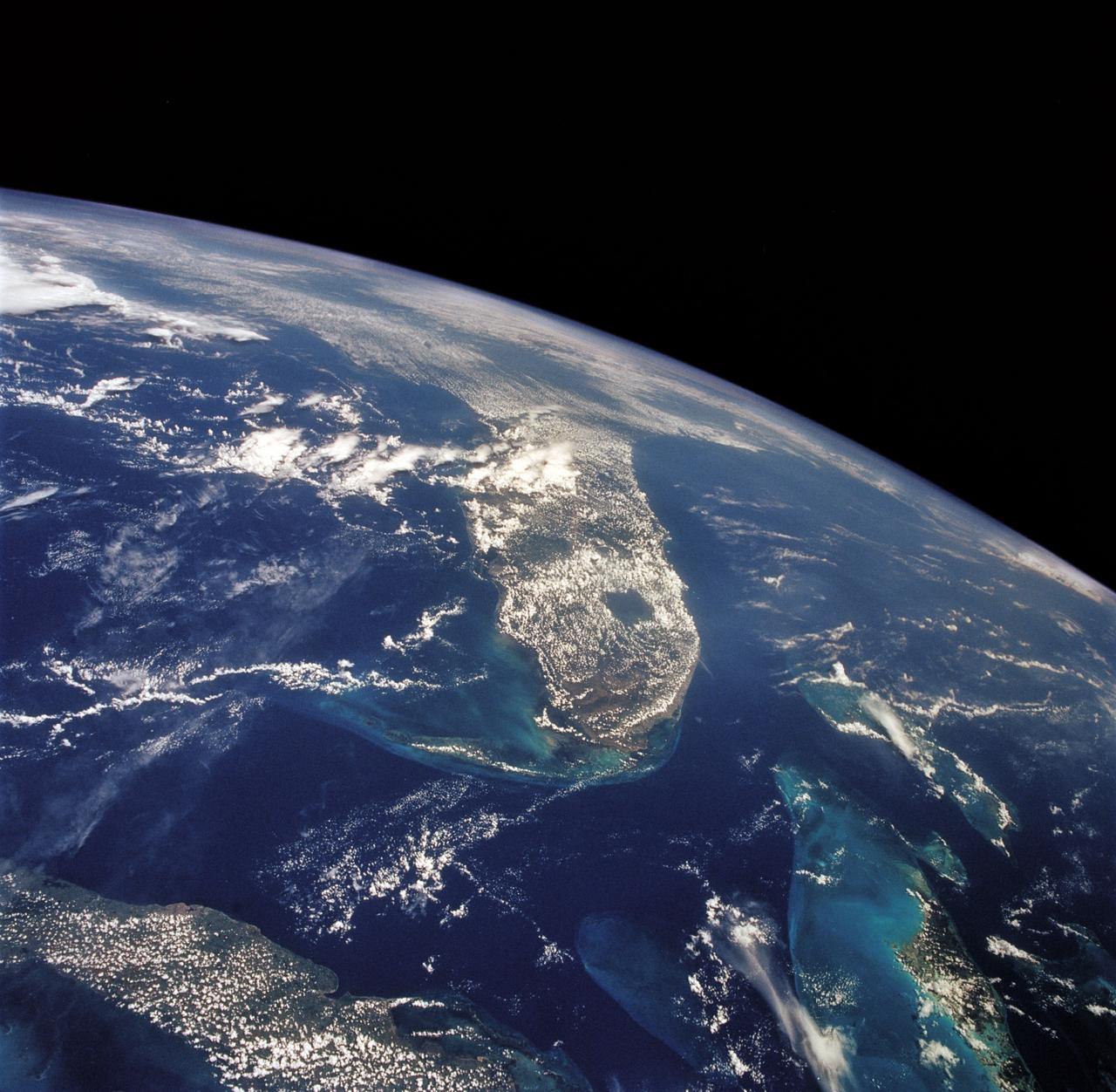
This unique photo offers a view of the Florida peninsula, western Bahamas, north central Cuba and the deep blue waters of the Gulf Stream, that hugs the east coast of Florida (27.0N, 82.0W). In addition to being an excellent photograph for showing the geographical relationships between the variety of landforms in this scene, the typical effect of the land-sea breeze is very much in evidence as few clouds over water, cumulus build up over landmass.
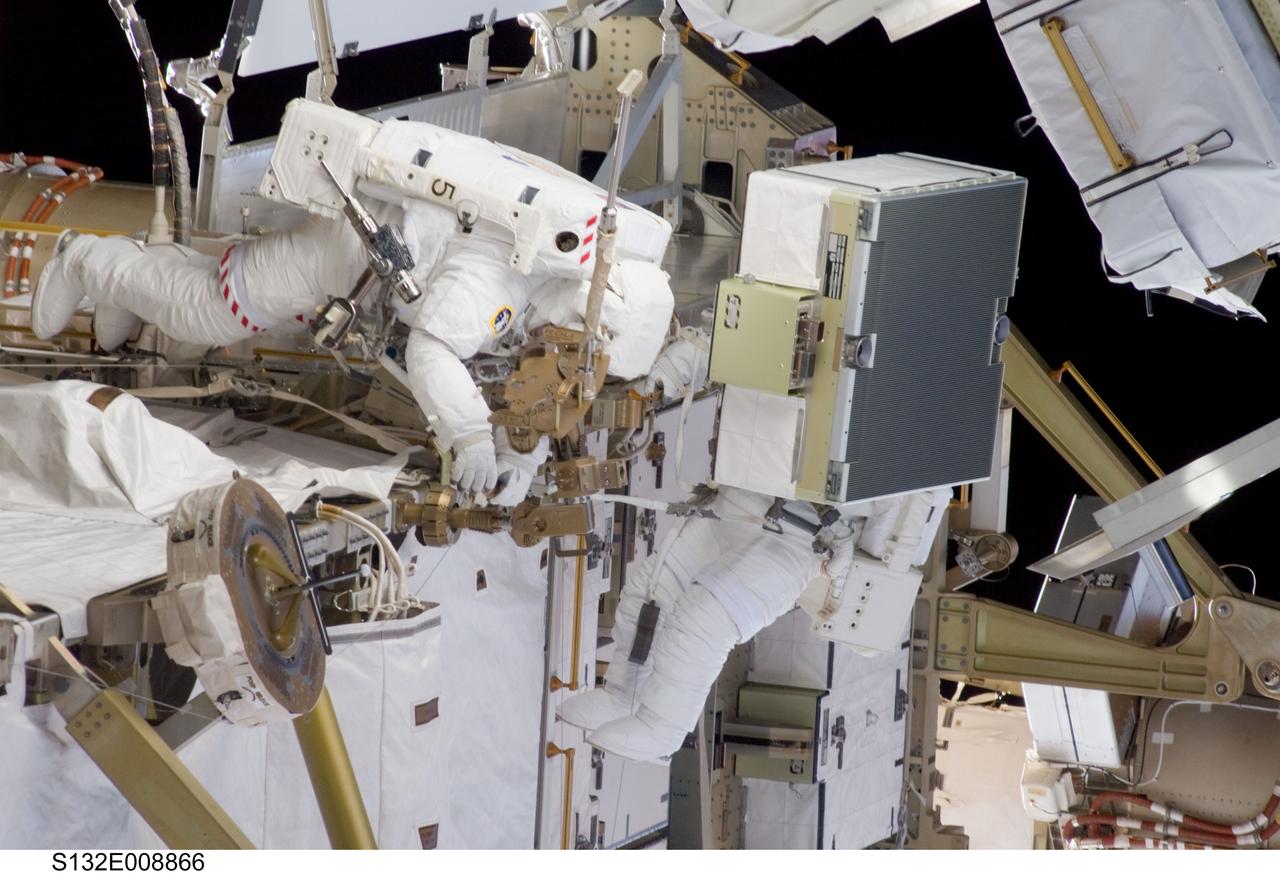
S132-E-008866 (21 May 2010) --- NASA astronauts Michael Good and Garrett Reisman (partially obscured), both STS-132 mission specialists, participate in the mission’s third and final session of extravehicular activity (EVA) as construction and maintenance continue on the International Space Station. During the six-hour, 46-minute spacewalk, Good and Reisman completed the installation of the final two of the six new batteries for the B side of the port 6 solar array. In addition, the astronauts installed a backup ammonia jumper cable between the port 4 and 5 trusses of the station, transferred a Power and Data Grapple Fixture from the shuttle to the station, and reconfigured some tools.
![KENNEDY SPACE CENTER, FLA. -- Twin columns of white flames from the solid rocket boosters propel Space Shuttle Atlantis toward space after an on-time liftoff of 3:46 p.m. EDT on mission STS-112. Along with a crew of six, Atlantis carries the S1 Integrated Truss Structure and the Crew and Equipment Translation Aid (CETA) Cart A. The CETA is the first of two human-powered carts that will ride along the ISS railway, providing mobile work platforms for future spacewalking astronauts. On the 11-day mission, three spacewalks are planned to attach the S1 truss. [Photo courtesy of Scott Andrews]](https://images-assets.nasa.gov/image/KSC-02pd1463/KSC-02pd1463~medium.jpg)
KENNEDY SPACE CENTER, FLA. -- Twin columns of white flames from the solid rocket boosters propel Space Shuttle Atlantis toward space after an on-time liftoff of 3:46 p.m. EDT on mission STS-112. Along with a crew of six, Atlantis carries the S1 Integrated Truss Structure and the Crew and Equipment Translation Aid (CETA) Cart A. The CETA is the first of two human-powered carts that will ride along the ISS railway, providing mobile work platforms for future spacewalking astronauts. On the 11-day mission, three spacewalks are planned to attach the S1 truss. [Photo courtesy of Scott Andrews]
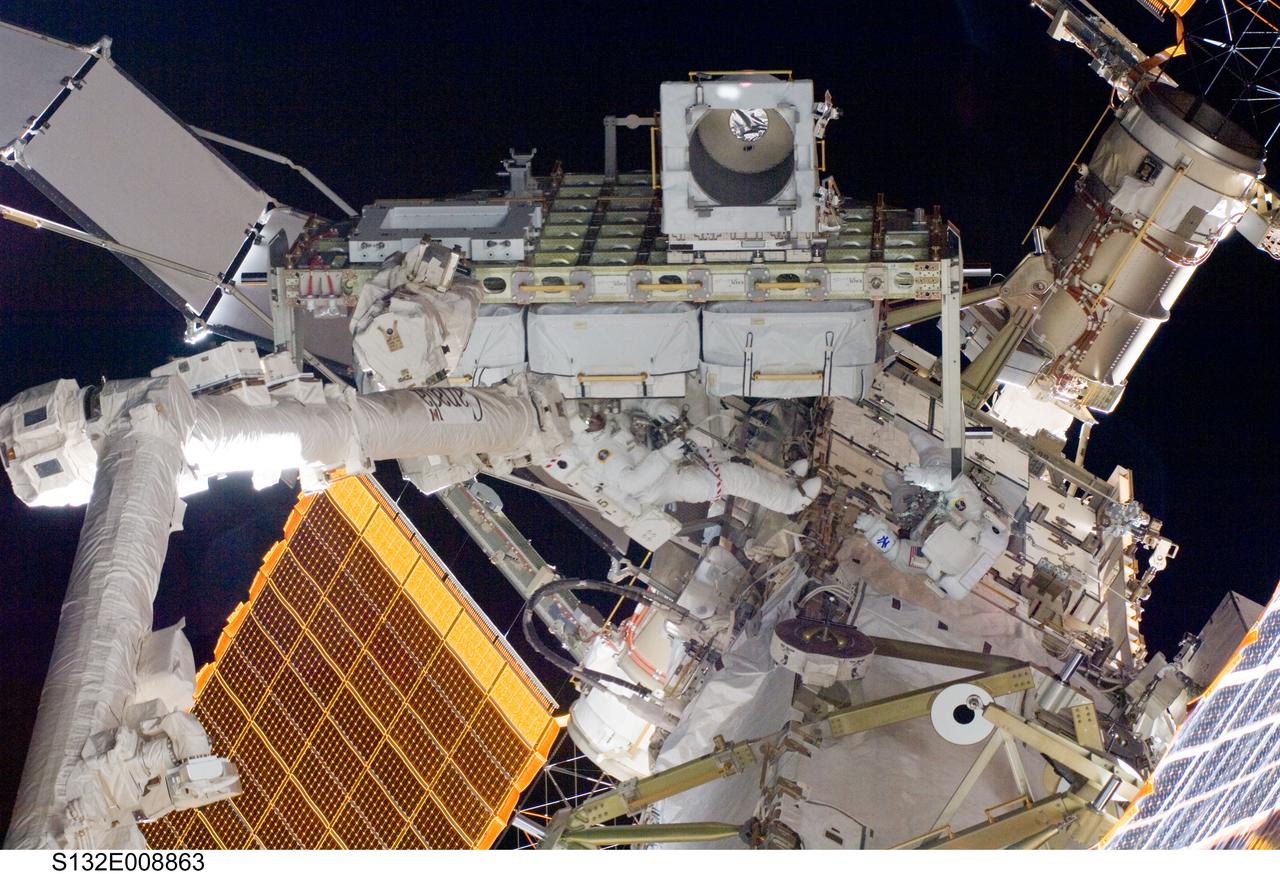
S132-E-008863 (21 May 2010) --- NASA astronauts Garrett Reisman (right) and Michael Good, both STS-132 mission specialists, participate in the mission’s third and final session of extravehicular activity (EVA) as construction and maintenance continue on the International Space Station. During the six-hour, 46-minute spacewalk, Good and Reisman completed the installation of the final two of the six new batteries for the B side of the port 6 solar array. In addition, the astronauts installed a backup ammonia jumper cable between the port 4 and 5 trusses of the station, transferred a Power and Data Grapple Fixture from the shuttle to the station, and reconfigured some tools.
![KENNEDY SPACE CENTER, FLA. -- The brilliance of the launch of Space Shuttle Atlantis is reflected in nearby waters. Liftoff of the Shuttle on mission STS-112 occurred on time at 3:46 p.m. EDT. Along with a crew of six, Atlantis carries the S1 Integrated Truss Structure and the Crew and Equipment Translation Aid (CETA) Cart A. The CETA is the first of two human-powered carts that will ride along the ISS railway, providing mobile work platforms for future spacewalking astronauts. On the 11-day mission, three spacewalks are planned to attach the S1 truss. [Photo courtesy of Scott Andrews]](https://images-assets.nasa.gov/image/KSC-02pd1464/KSC-02pd1464~medium.jpg)
KENNEDY SPACE CENTER, FLA. -- The brilliance of the launch of Space Shuttle Atlantis is reflected in nearby waters. Liftoff of the Shuttle on mission STS-112 occurred on time at 3:46 p.m. EDT. Along with a crew of six, Atlantis carries the S1 Integrated Truss Structure and the Crew and Equipment Translation Aid (CETA) Cart A. The CETA is the first of two human-powered carts that will ride along the ISS railway, providing mobile work platforms for future spacewalking astronauts. On the 11-day mission, three spacewalks are planned to attach the S1 truss. [Photo courtesy of Scott Andrews]
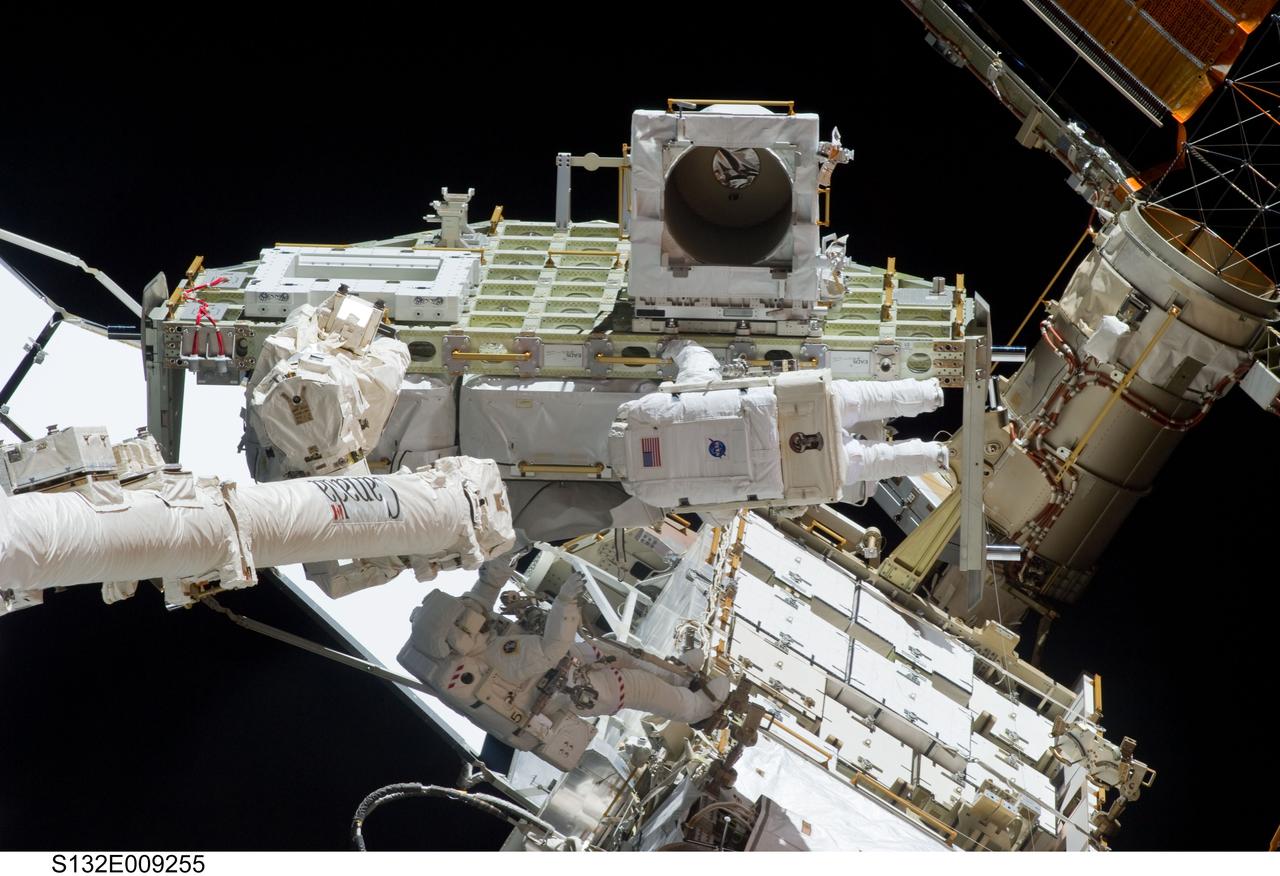
S132-E-009255 (21 May 2010) --- NASA astronauts Michael Good (bottom center) and Garrett Reisman, both STS-132 mission specialists, participate in the mission’s third and final session of extravehicular activity (EVA) as construction and maintenance continue on the International Space Station. During the six-hour, 46-minute spacewalk, Good and Reisman completed the installation of the final two of the six new batteries for the B side of the port 6 solar array. In addition, the astronauts installed a backup ammonia jumper cable between the port 4 and 5 trusses of the station, transferred a Power and Data Grapple Fixture from the shuttle to the station, and reconfigured some tools.
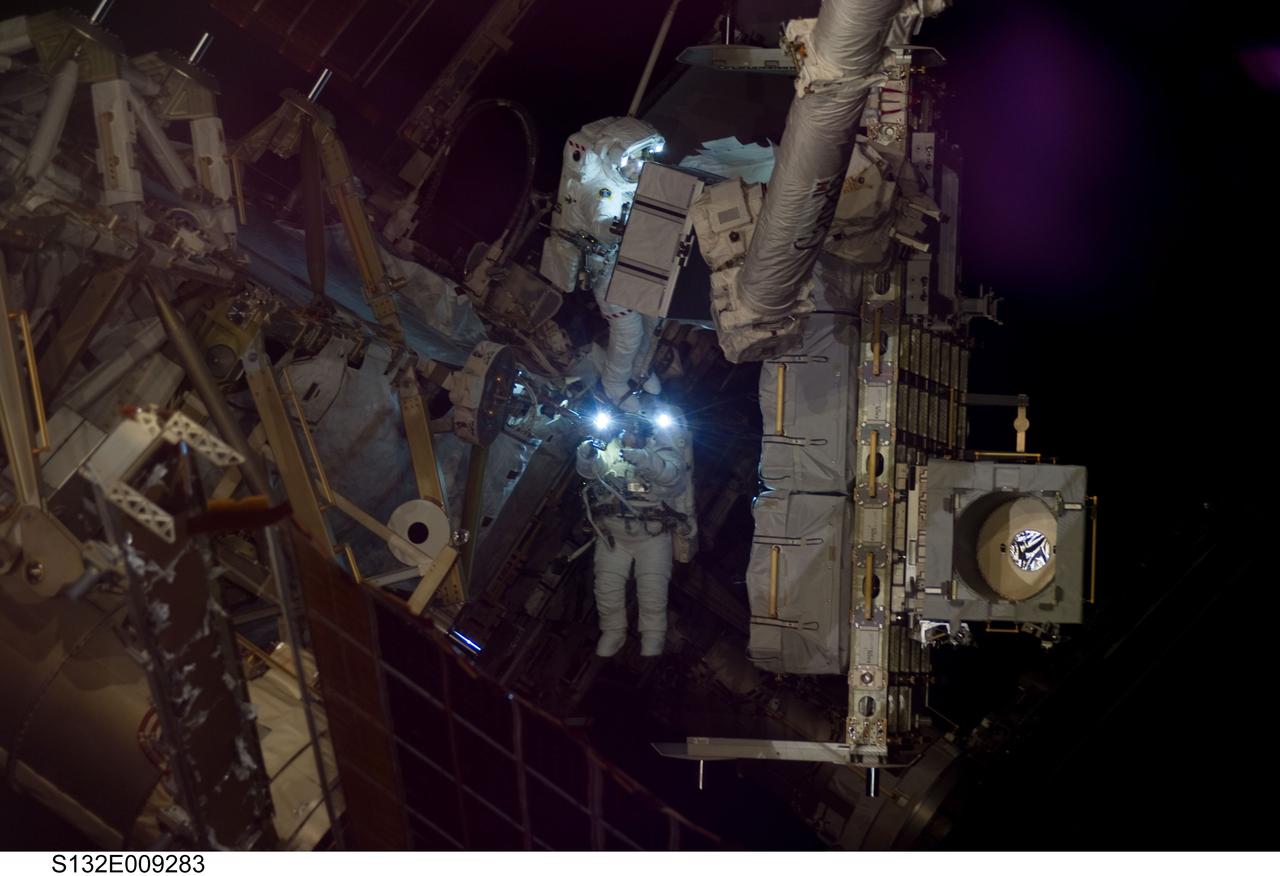
S132-E-009283 (21 May 2010) --- NASA astronauts Michael Good (top center) and Garrett Reisman, both STS-132 mission specialists, participate in the mission’s third and final session of extravehicular activity (EVA) as construction and maintenance continue on the International Space Station. During the six-hour, 46-minute spacewalk, Good and Reisman completed the installation of the final two of the six new batteries for the B side of the port 6 solar array. In addition, the astronauts installed a backup ammonia jumper cable between the port 4 and 5 trusses of the station, transferred a Power and Data Grapple Fixture from the shuttle to the station, and reconfigured some tools.

KENNEDY SPACE CENTER, FLA. - -- Space Shuttle Atlantis leaves a billowingclouds of smoke and steam behind just after liftoff from Launch Pad 39B on mission STS-112. Liftoff occurred on time at 3:46 p.m. EDT. Along with a crew of six, Atlantis carries the S1 Integrated Truss Structure and the Crew and Equipment Translation Aid (CETA) Cart A to the International Space Station (ISS). The CETA is the first of two human-powered carts that will ride along the ISS railway, providing mobile work platforms for future spacewalking astronauts. On the 11-day mission, three spacewalks are planned to attach the S1 truss.
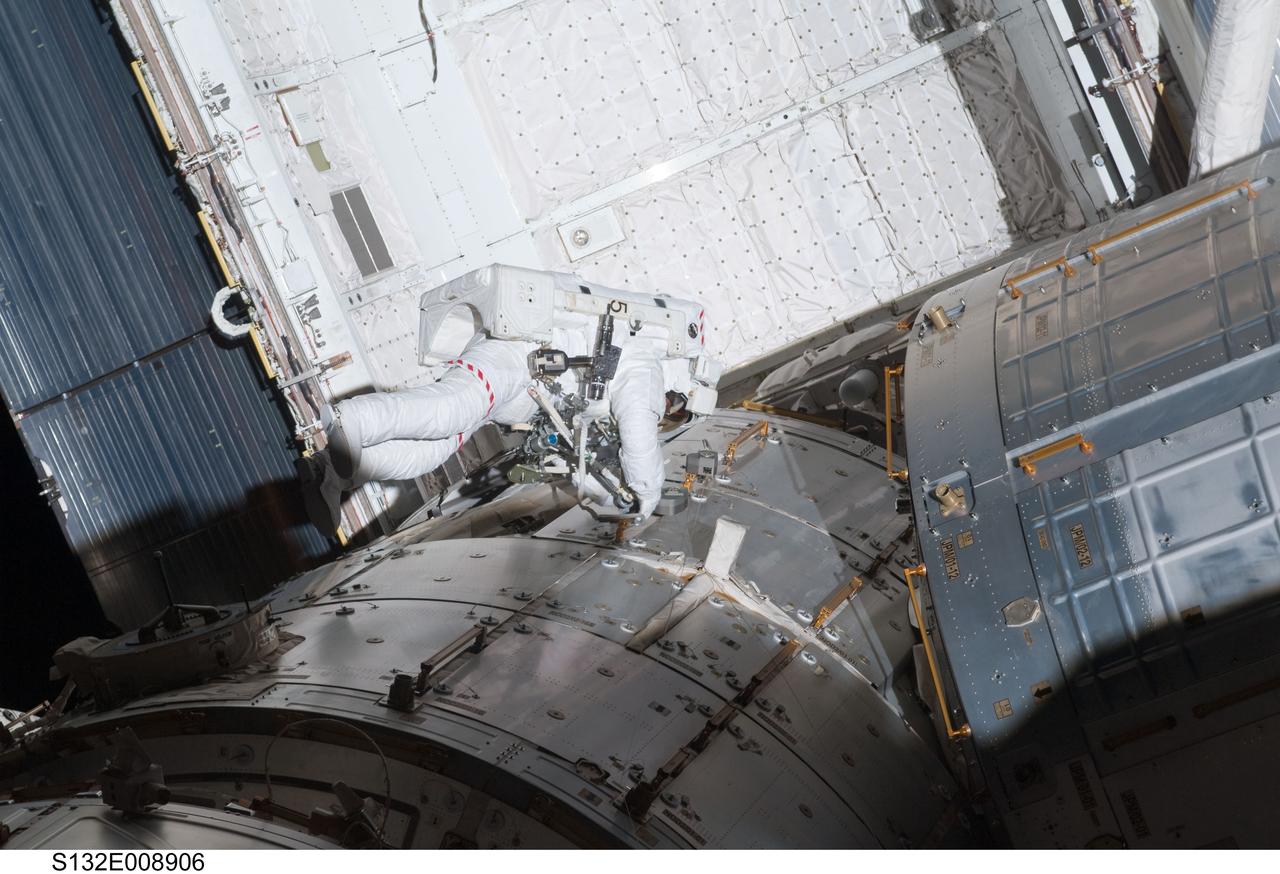
S132-E-008906 (21 May 2010) --- NASA astronaut Michael Good, STS-132 mission specialist, participates in the mission’s third and final session of extravehicular activity (EVA) as construction and maintenance continue on the International Space Station. During the six-hour, 46-minute spacewalk, Good and NASA astronaut Garrett Reisman (out of frame), mission specialist, completed the installation of the final two of the six new batteries for the B side of the port 6 solar array. In addition, the astronauts installed a backup ammonia jumper cable between the port 4 and 5 trusses of the station, transferred a Power and Data Grapple Fixture from the shuttle to the station, and reconfigured some tools.
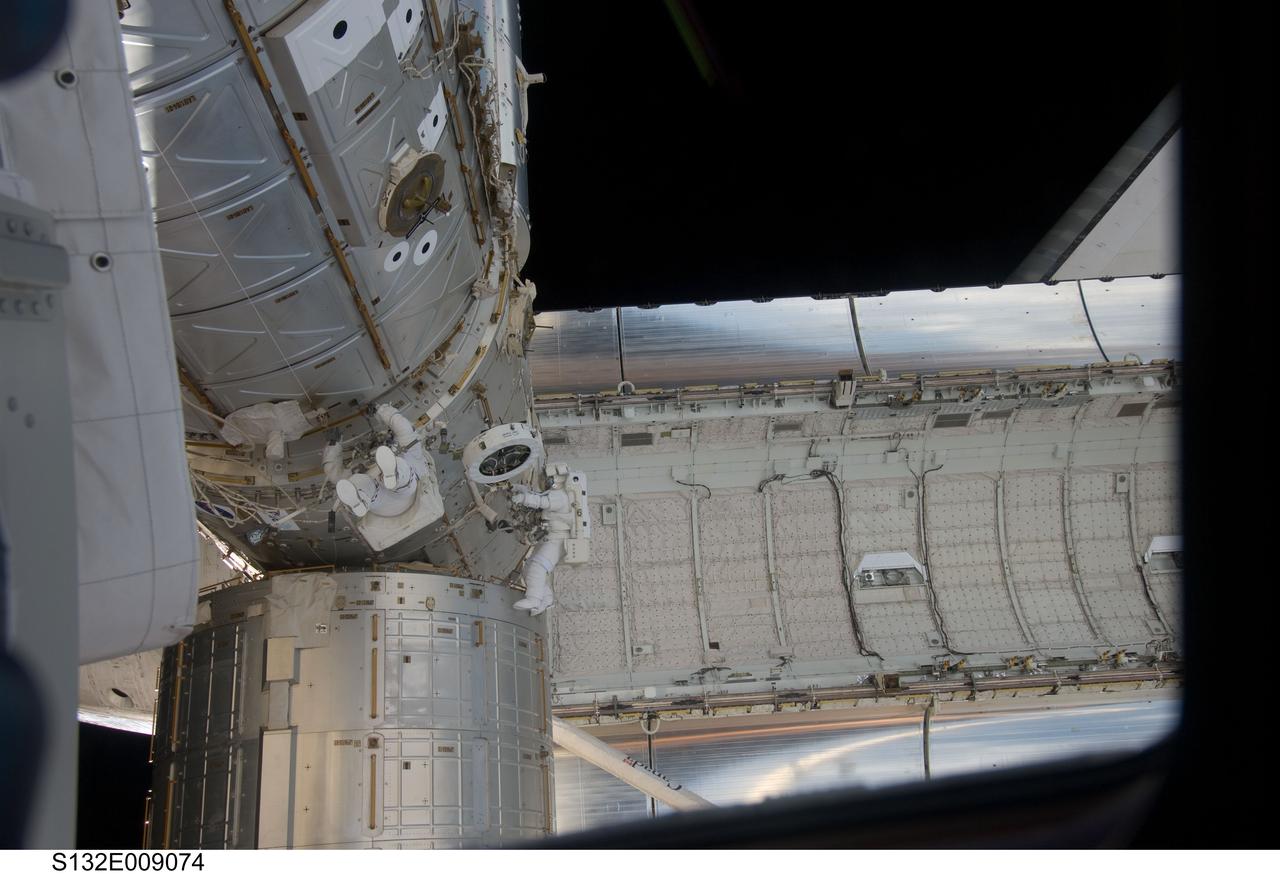
S132-E-009074 (21 May 2010) --- NASA astronauts Michael Good (left) and Garrett Reisman, both STS-132 mission specialists, participate in the mission’s third and final session of extravehicular activity (EVA) as construction and maintenance continue on the International Space Station. During the six-hour, 46-minute spacewalk, Good and Reisman completed the installation of the final two of the six new batteries for the B side of the port 6 solar array. In addition, the astronauts installed a backup ammonia jumper cable between the port 4 and 5 trusses of the station, transferred a Power and Data Grapple Fixture from the shuttle to the station, and reconfigured some tools.
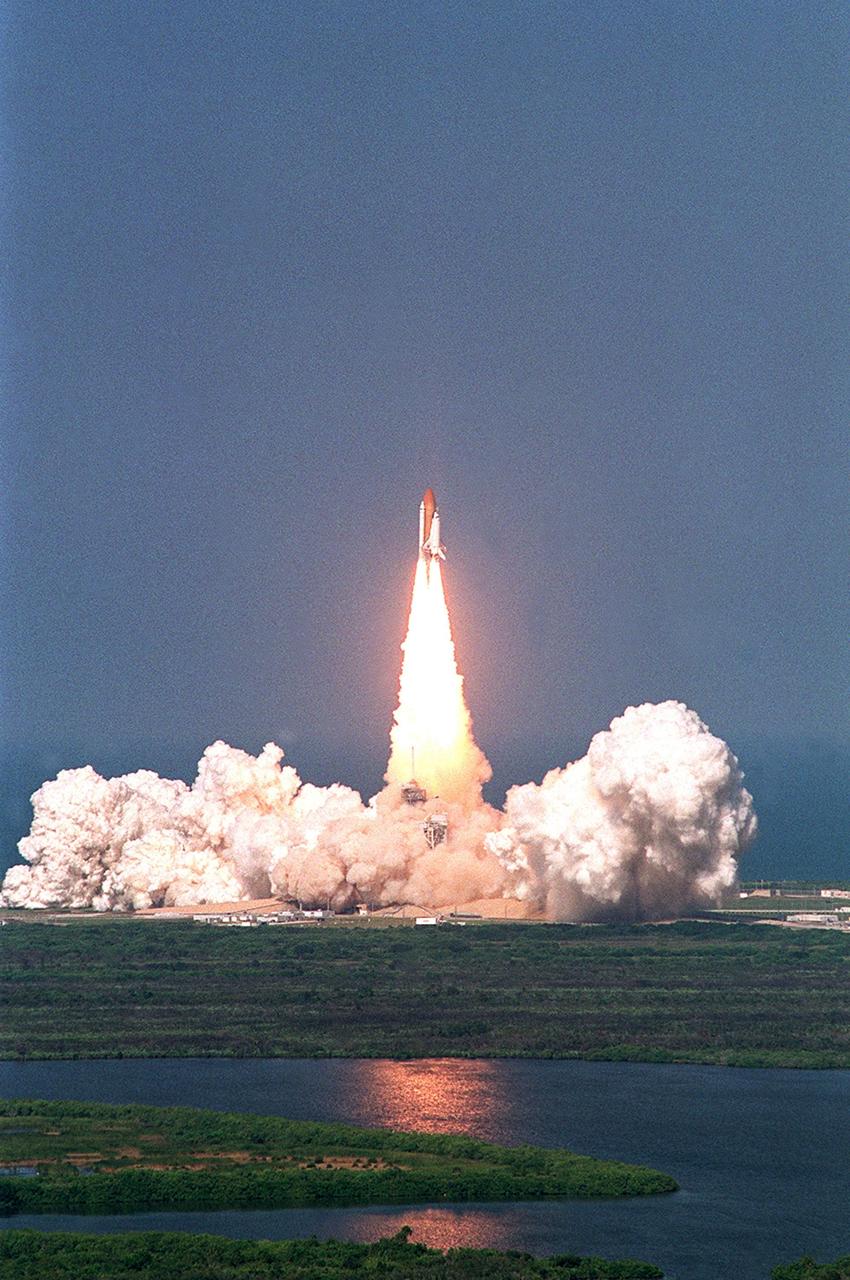
KENNEDY SPACE CENTER, FLA. - Space Shuttle Atlantis leaps clear of the billowing steam and smoke on Launch Pad 39B after an on-time liftoff of 3:46 p.m. EDT on mission STS-112. Along with a crew of six, Atlantis carries the S1 Integrated Truss Structure and the Crew and Equipment Translation Aid (CETA) Cart A. The CETA is the first of two human-powered carts that will ride along the ISS railway, providing mobile work platforms for future spacewalking astronauts. On the 11-day mission, three spacewalks are planned to attach the S1 truss.