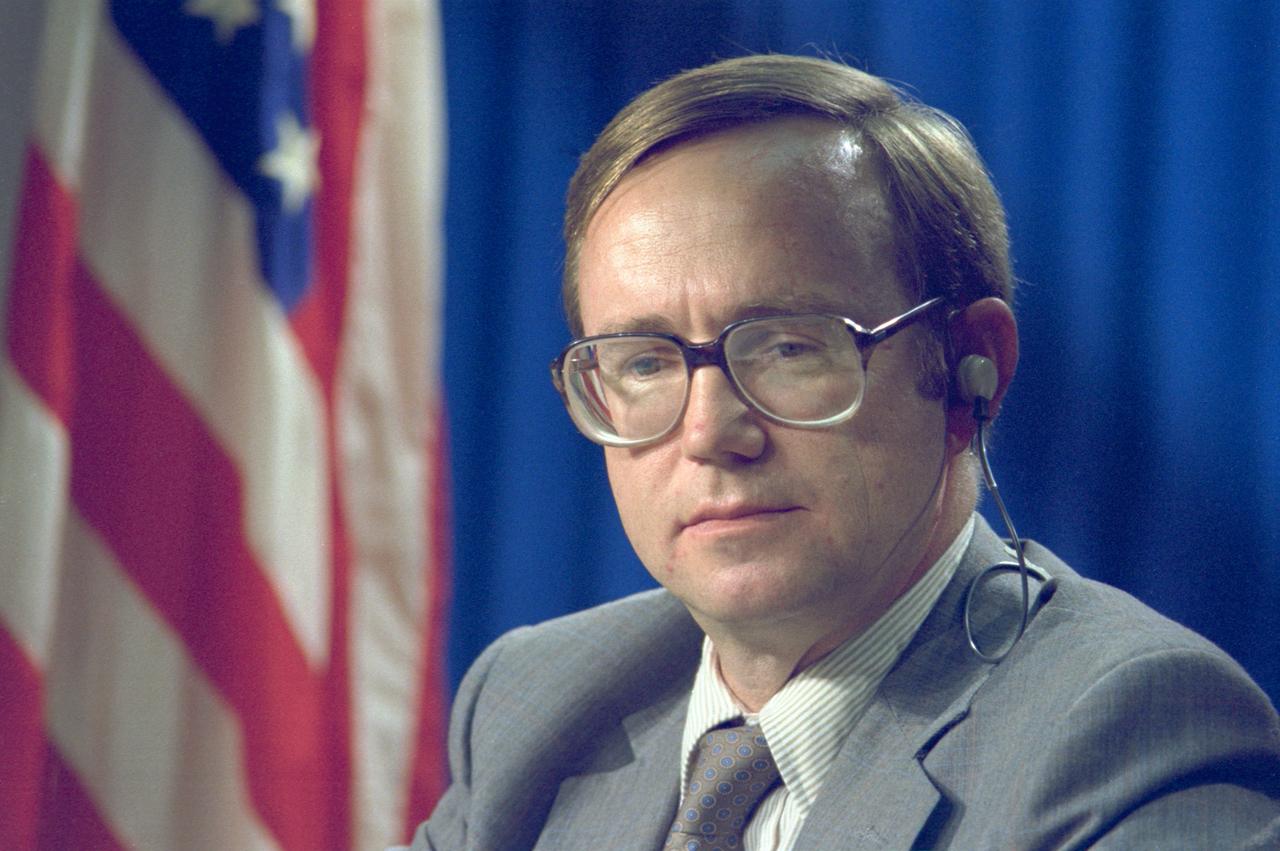
Flight Director Tommy Holloway listens to a question from a news media representative during a STS-5 pre-flight press briefing.
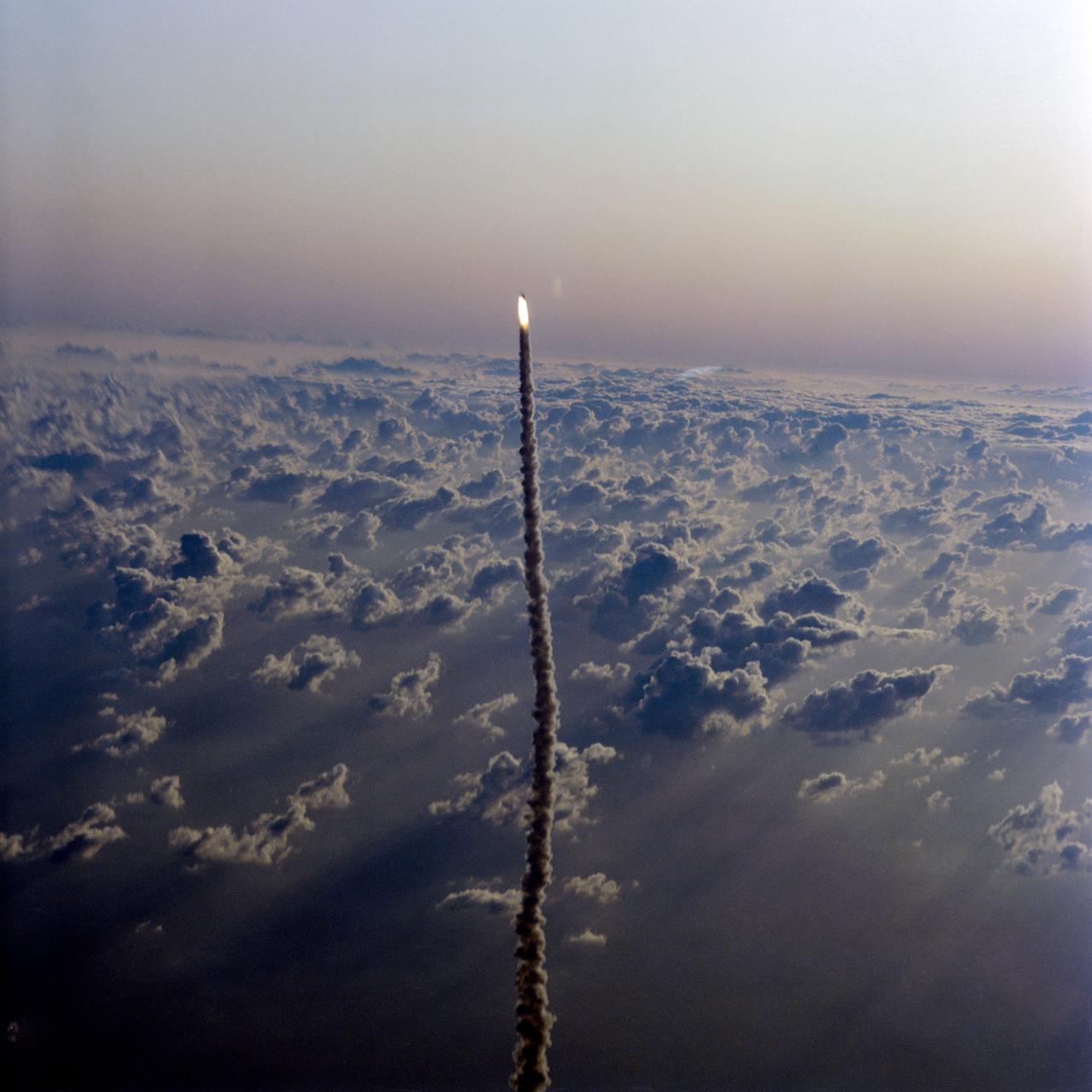
Aerial views of the STS-5 launch from T-38 chase aircraft Nov. 11, 1982. Shuttle Columbia can be seen as a small figure trailed by a line of smoke.
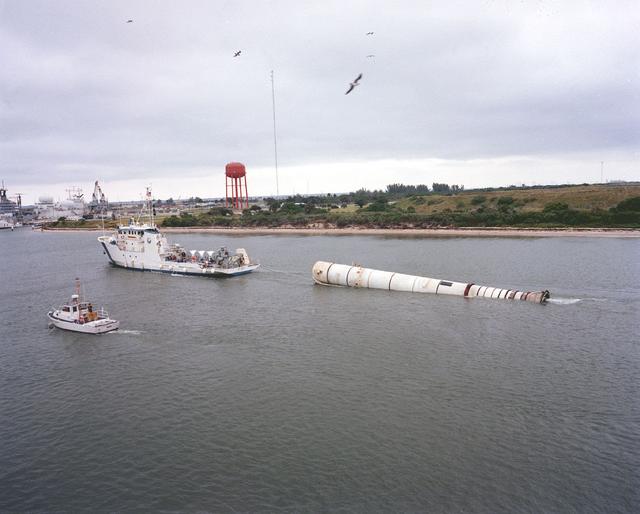
This is a photo of the recovery ship, UTC Liberty, towing the left booster of the STS-5 flight vehicle into Port Canaveral.
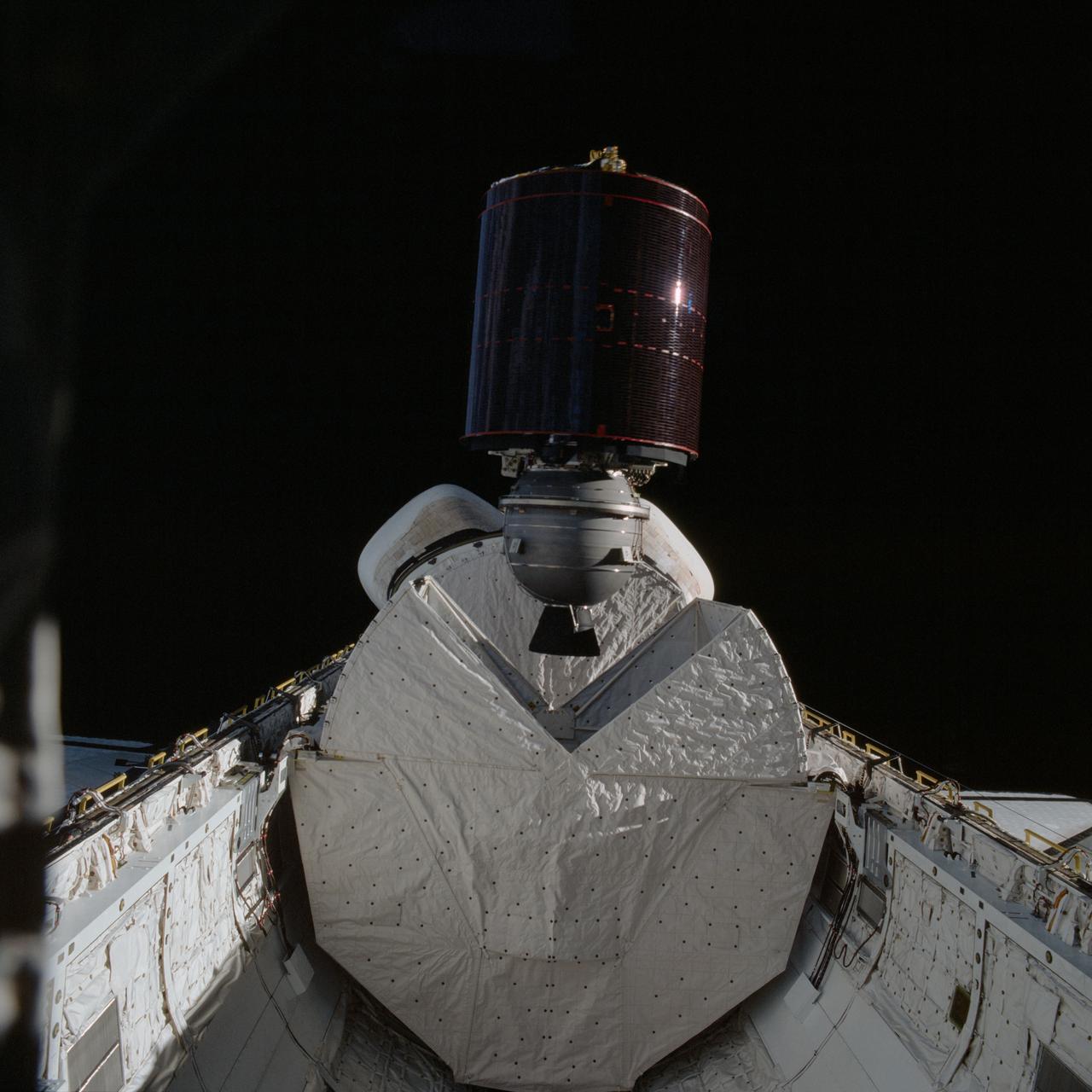
STS005-38-943 (17 Nov. 1982) --- The Satellite Business Systems (SBS-3) satellte is deployed from its protective cradle in the cargo bay of the space shuttle Columbia. Part of Columbia's wings can be seen on both the port and starboard sides. Part of both orbital maneuvering system (OMS) pods are seen at center. The vertical stabilizer is obscured by the satellite. Photo credit: NASA
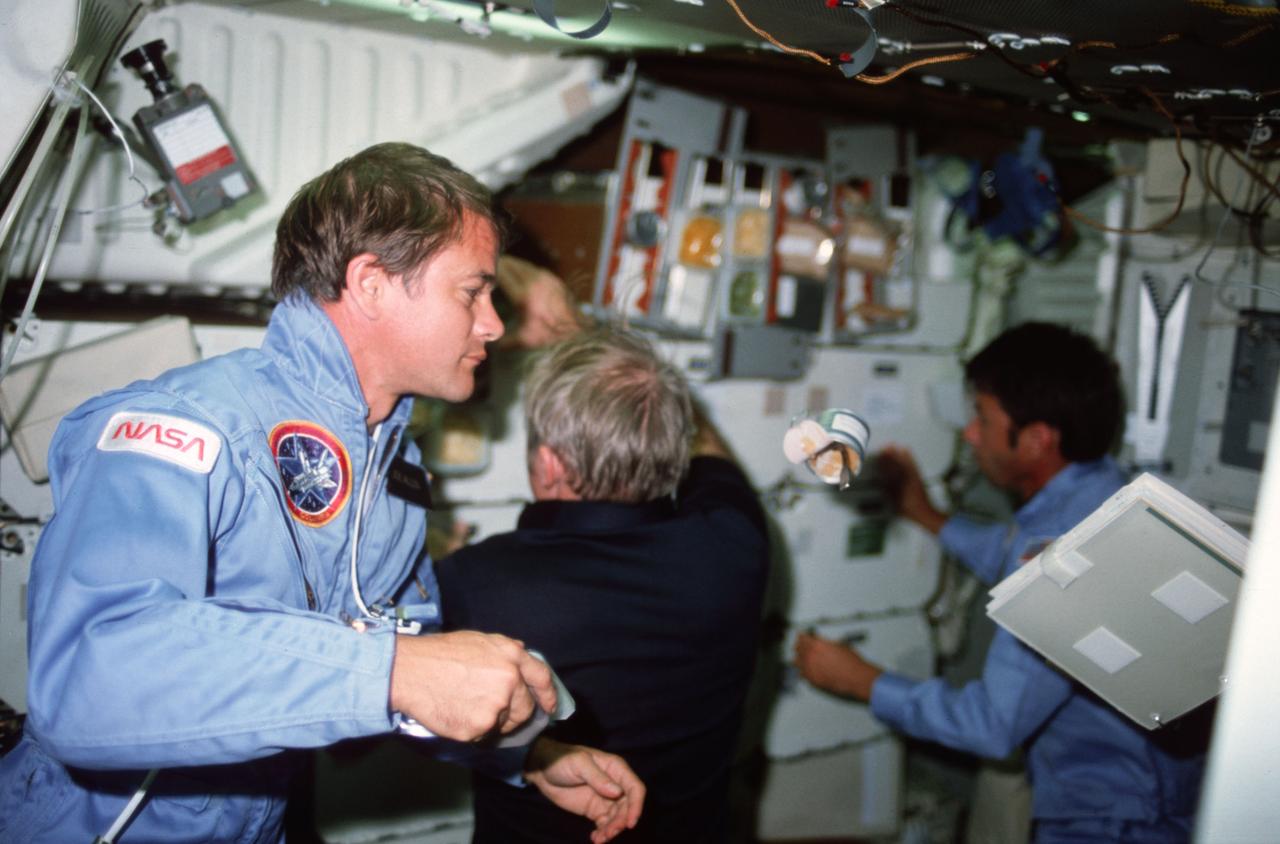
STS005-06-206 (11-16 Nov. 1982) --- Astronaut Joseph P. Allen, STS-5 mission specialist, watches a can of food and a notebook drift on the middeck as Vance C. Brand, commander, (left) and William B. Lenoir, mission specialist, (far left) work at forward middeck lockers. Photo credit: NASA
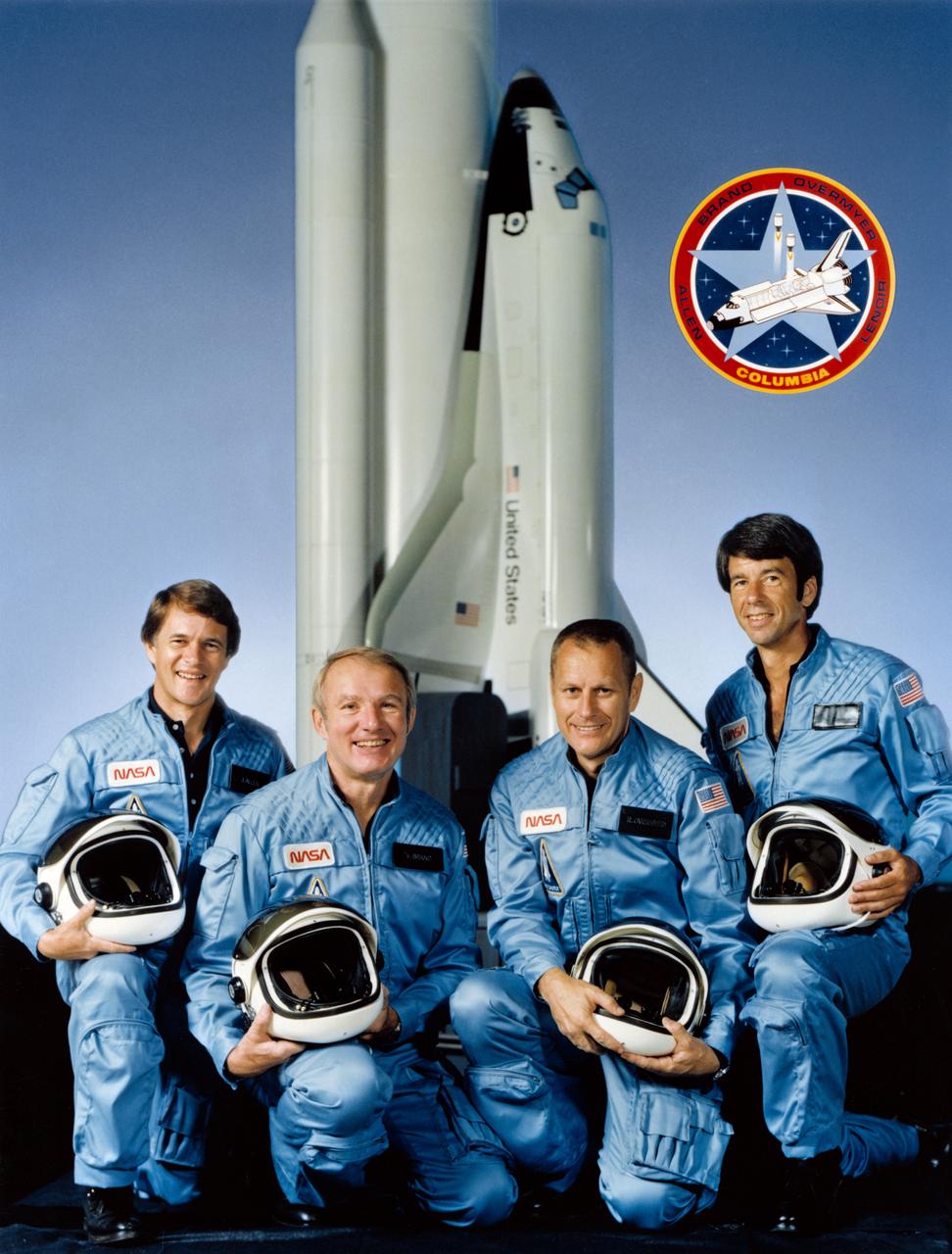
S82-36286 (15 Aug. 1982) --- These four men will be aboard the space shuttle Columbia for NASA's first operational Space Transportation System (STS) mission. They are astronauts Vance D. Brand (second left), STS-5 commander; Robert F. Overmyer (second right), pilot; and Joseph P. Allen (left) and William B. Lenoir, both mission specialists. They pose with a space shuttle model and the official insignia for STS-5. Their flight is scheduled for November of this year. Photo credit: NASA
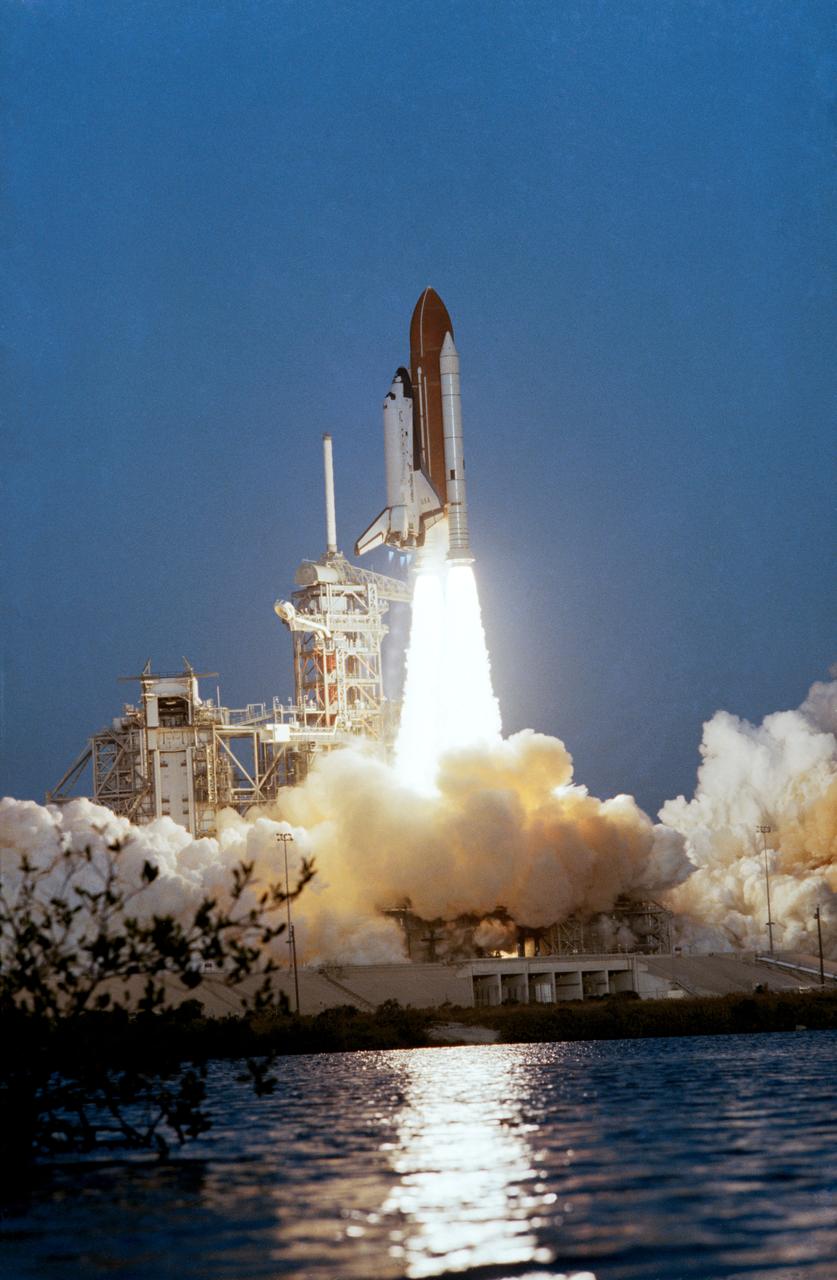
S82-39532 (11 Nov. 1982) --- Having completed its four-mission test program, the space shuttle Columbia begins a new era of operational flights as it clears the launch tower and heads for Earth orbit. Launch occurred at 7:19 a.m. (EST), November 11, 1982. Aboard the orbiter, mated here to its two solid rocket boosters and external fuel tank, were astronauts Vance D. Brand, STS-5 commander; Robert F. Overmyer, pilot; William B. Lenoir, mission specialist; and Joseph P. Allen, mission specialist. Photo credit: NASA
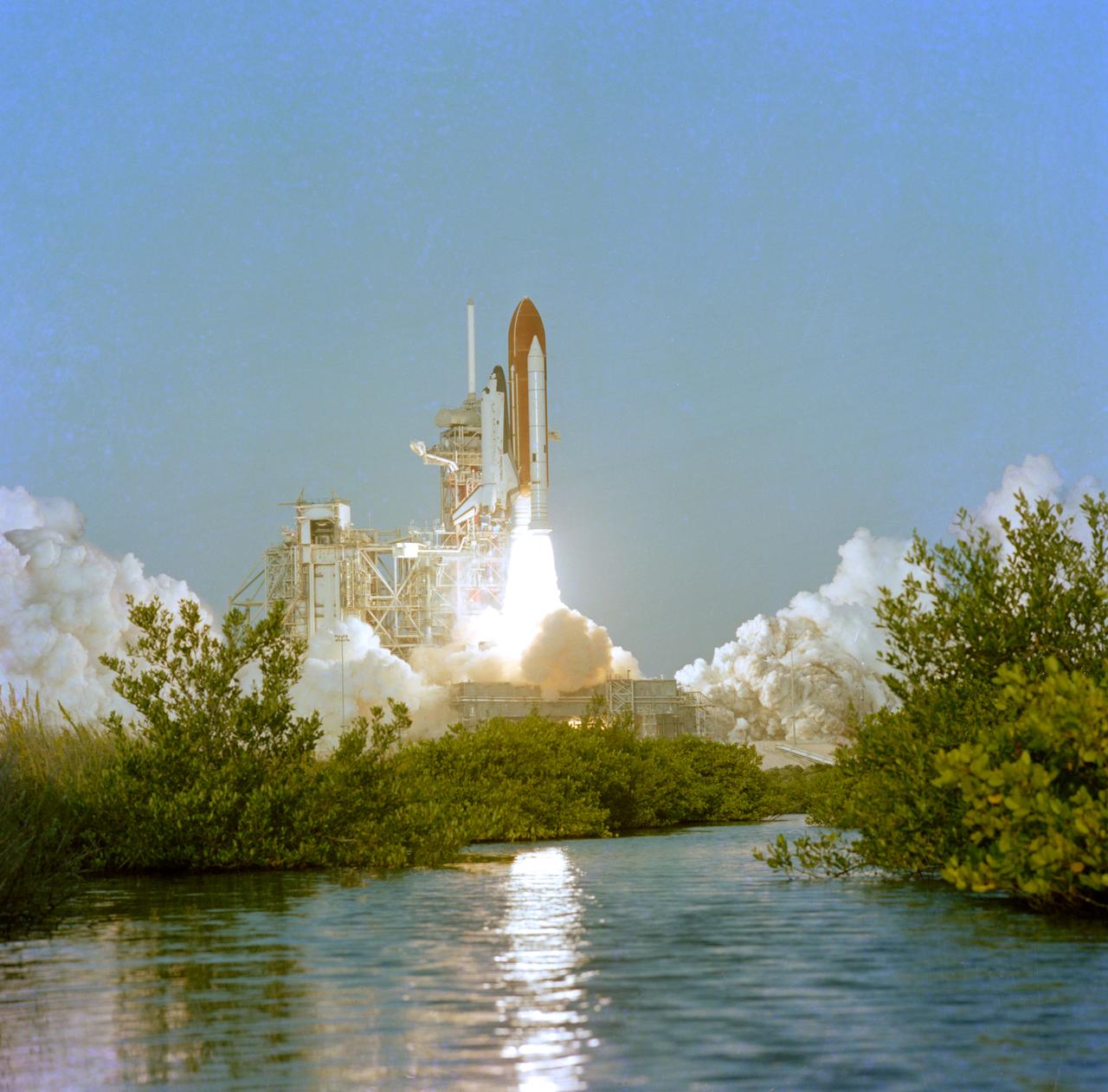
S82-39532 (11 Nov. 1982) --- Having completed its four-mission test program, the space shuttle Columbia begins a new era of operational flights as it clears the launch tower and heads for Earth orbit. Launch occurred at 7:19 a.m. (EST), November 11, 1982. Aboard the orbiter, mated here to its two solid rocket boosters and external fuel tank, were astronauts Vance D. Brand, STS-5 commander; Robert F. Overmyer, pilot; William B. Lenoir, mission specialist; and Joseph P. Allen, mission specialist. Photo credit: NASA
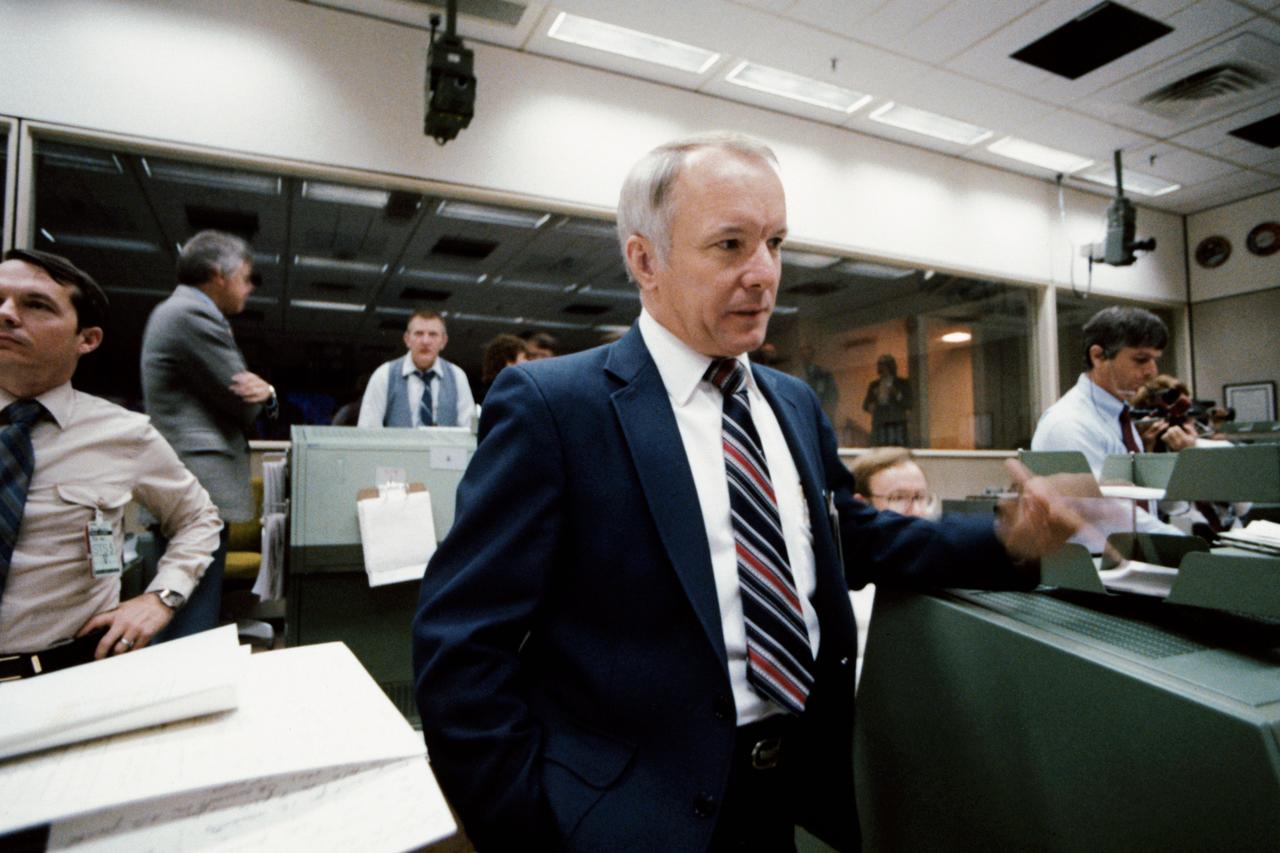
Views of MOCR activity during the STS-5 Mission (11/11-16/1982) of Dr. Hans Mark, NASA Deputy Administrator; Gerald Griffin; portrait of the STS-5 Flight Directors, Flight Director (FD) Cox and Lt. Gen. James A. Abrahamson, Associate Administrator for Space Flight, in the MOCR during the STS-5 Mission. 1. Abrahamson, J. T., Gen,.- STS-5 MOCR 2. Flight Directors - STS-5 MOCR 3. STS-5 - Inflight MOCR 4. Mark, Hans Dr. - STS-5 MOCR 5. Dir. Griffin, Gerald- STS-5 MOCR JSC, Houston, TX. S83-27153 thru S83-27158
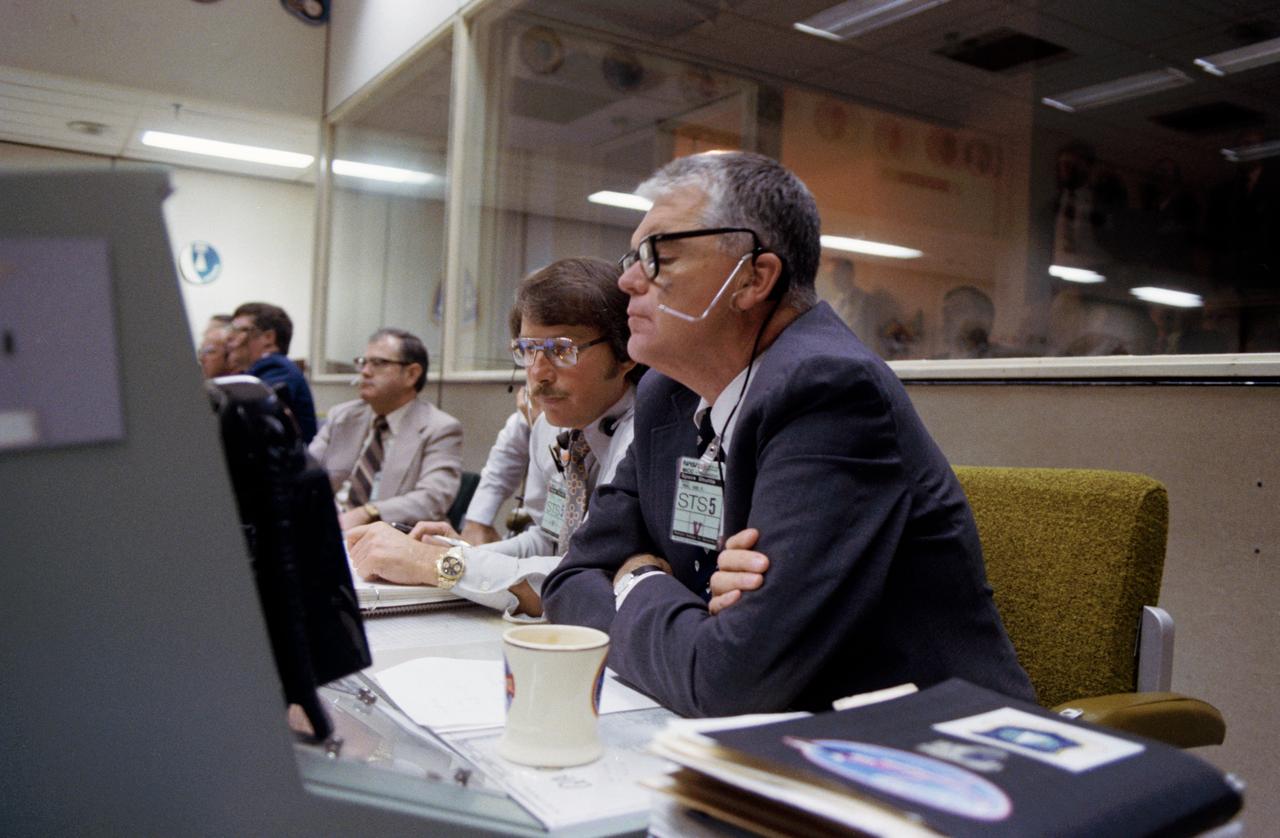
Views of MOCR activity during the STS-5 Mission (11/11-16/1982) of Dr. Hans Mark, NASA Deputy Administrator; Gerald Griffin; portrait of the STS-5 Flight Directors, Flight Director (FD) Cox and Lt. Gen. James A. Abrahamson, Associate Administrator for Space Flight, in the MOCR during the STS-5 Mission. 1. Abrahamson, J. T., Gen,.- STS-5 MOCR 2. Flight Directors - STS-5 MOCR 3. STS-5 - Inflight MOCR 4. Mark, Hans Dr. - STS-5 MOCR 5. Dir. Griffin, Gerald- STS-5 MOCR JSC, Houston, TX. S83-27153 thru S83-27158
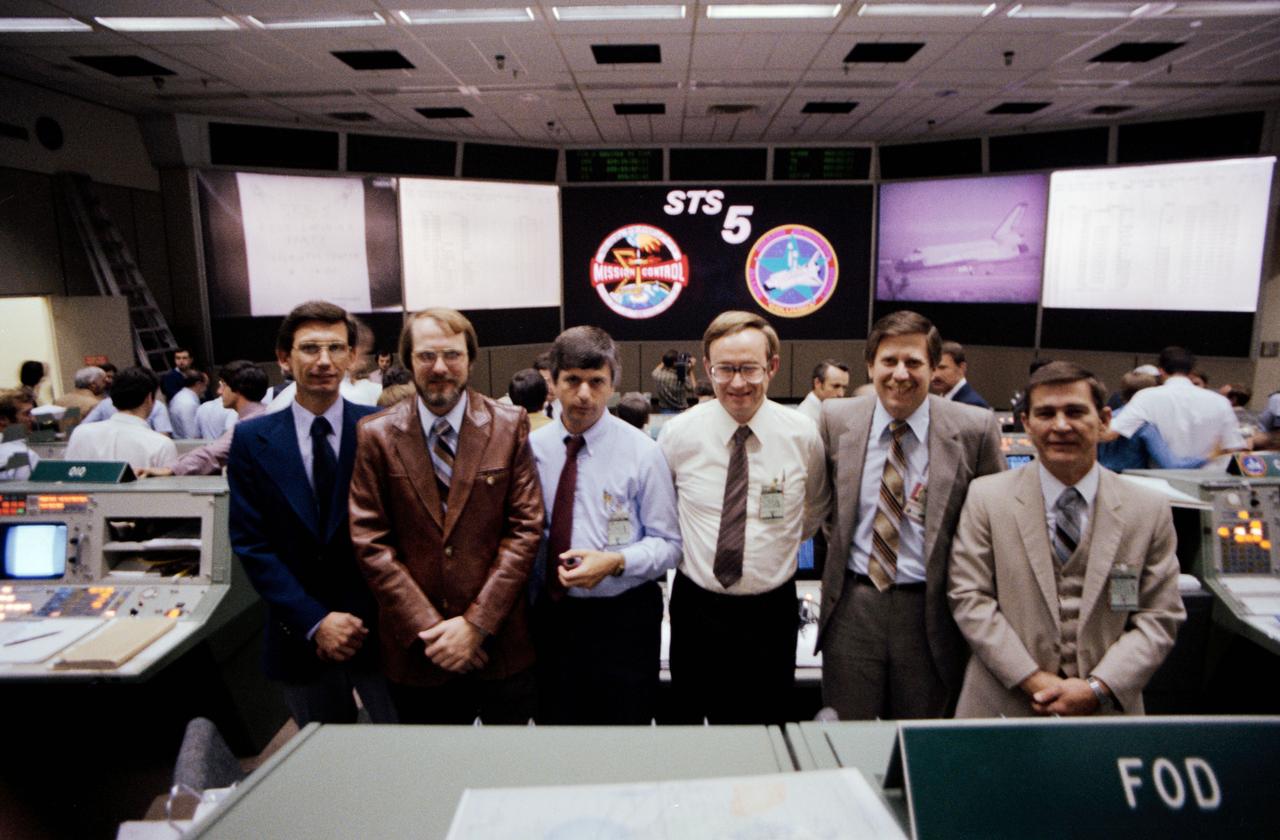
Views of MOCR activity during the STS-5 Mission (11/11-16/1982) of Dr. Hans Mark, NASA Deputy Administrator; Gerald Griffin; portrait of the STS-5 Flight Directors, Flight Director (FD) Cox and Lt. Gen. James A. Abrahamson, Associate Administrator for Space Flight, in the MOCR during the STS-5 Mission. 1. Abrahamson, J. T., Gen,.- STS-5 MOCR 2. Flight Directors - STS-5 MOCR 3. STS-5 - Inflight MOCR 4. Mark, Hans Dr. - STS-5 MOCR 5. Dir. Griffin, Gerald- STS-5 MOCR JSC, Houston, TX. S83-27153 thru S83-27158
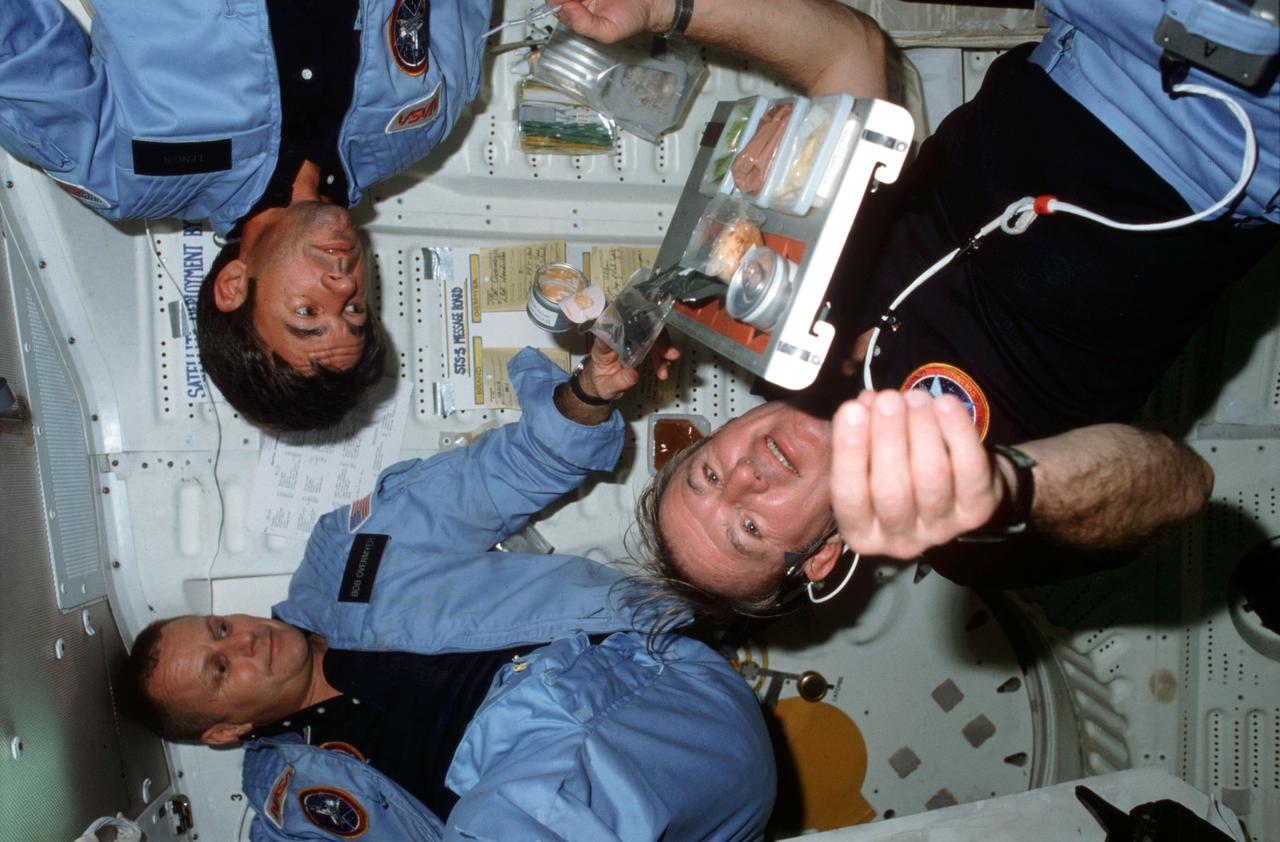
STS005-06-210 (16 Nov. 1982) --- Astronaut Vance D. Brand (in dark blue shirt), STS-5 commander; Robert F. Overmyer (left), pilot; and William B. Lenoir, mission specialist, conduct microgravity experiments with food containers and meal tray assemblies in front of middeck port side wall and side hatch. Brand prepares to eat as meal tray assembly floats above his chest and Overmeyer and Lenoir look on. Sign on port side wall is labeled STS-5 message board. Photo credit: NASA
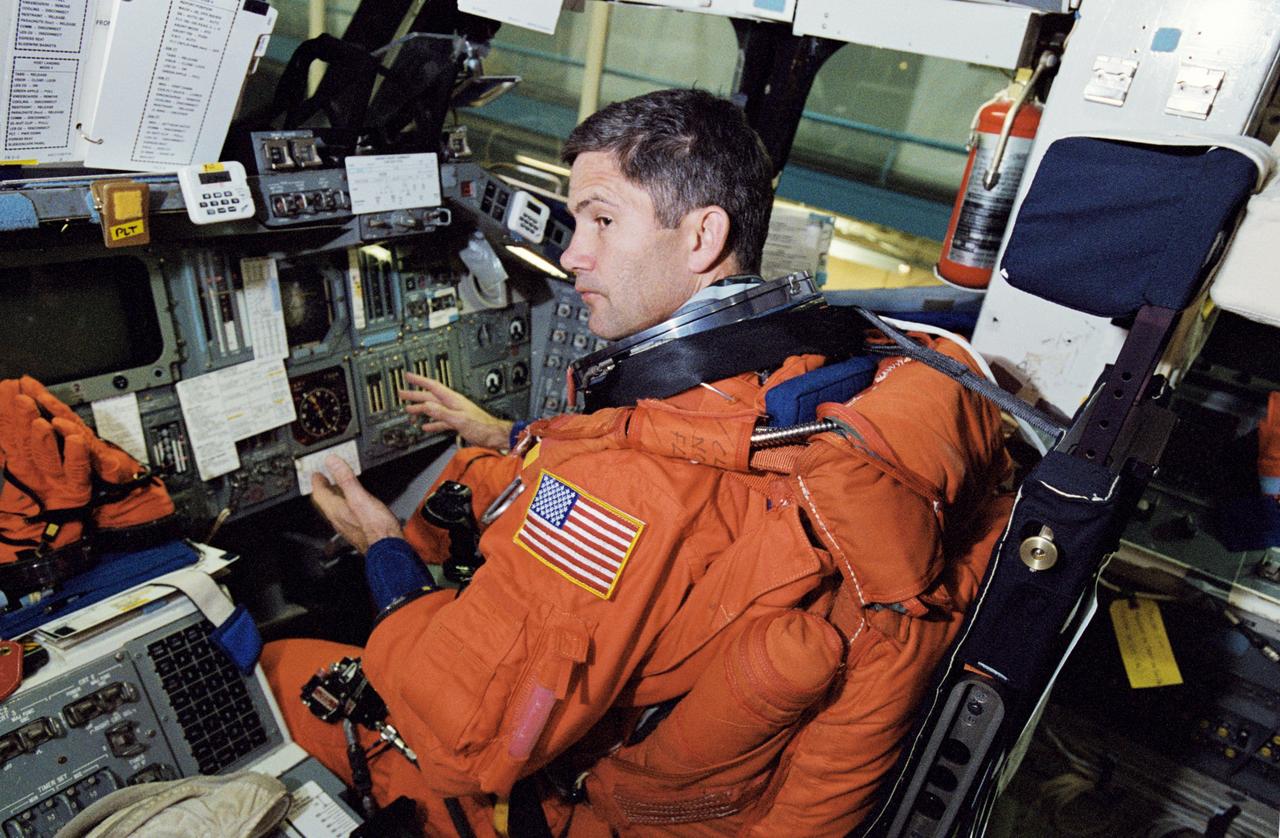
JSC2001-02990 (5 December 2001) --- Astronaut Paul S. Lockhart, STS-111 pilot, occupies the pilot’s station during a mission training session in the Space Vehicle Mockup Facility at the Johnson Space Center (JSC). Lockhart is attired in a training version of the shuttle launch and entry garment. STS-111 will be the 14th shuttle mission to visit the International Space Station (ISS).
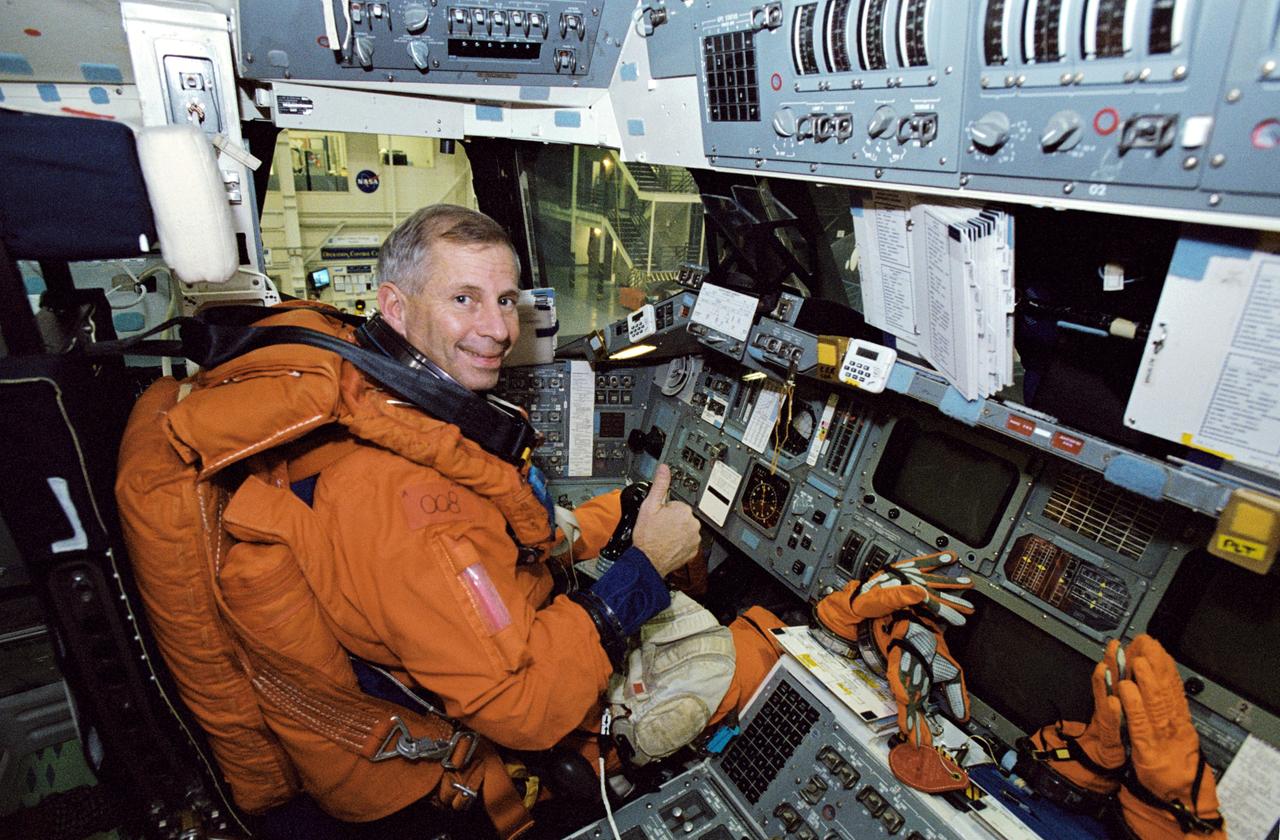
JSC2001-02992 (5 December 2001) --- Astronaut Kenneth D. Cockrell, STS-111 mission commander, occupies the commander’s station during a mission training session in the Space Vehicle Mockup Facility at the Johnson Space Center (JSC). Cockrell is attired in a training version of the shuttle launch and entry garment. STS-111 will be the 14th shuttle mission to visit the International Space Station (ISS).
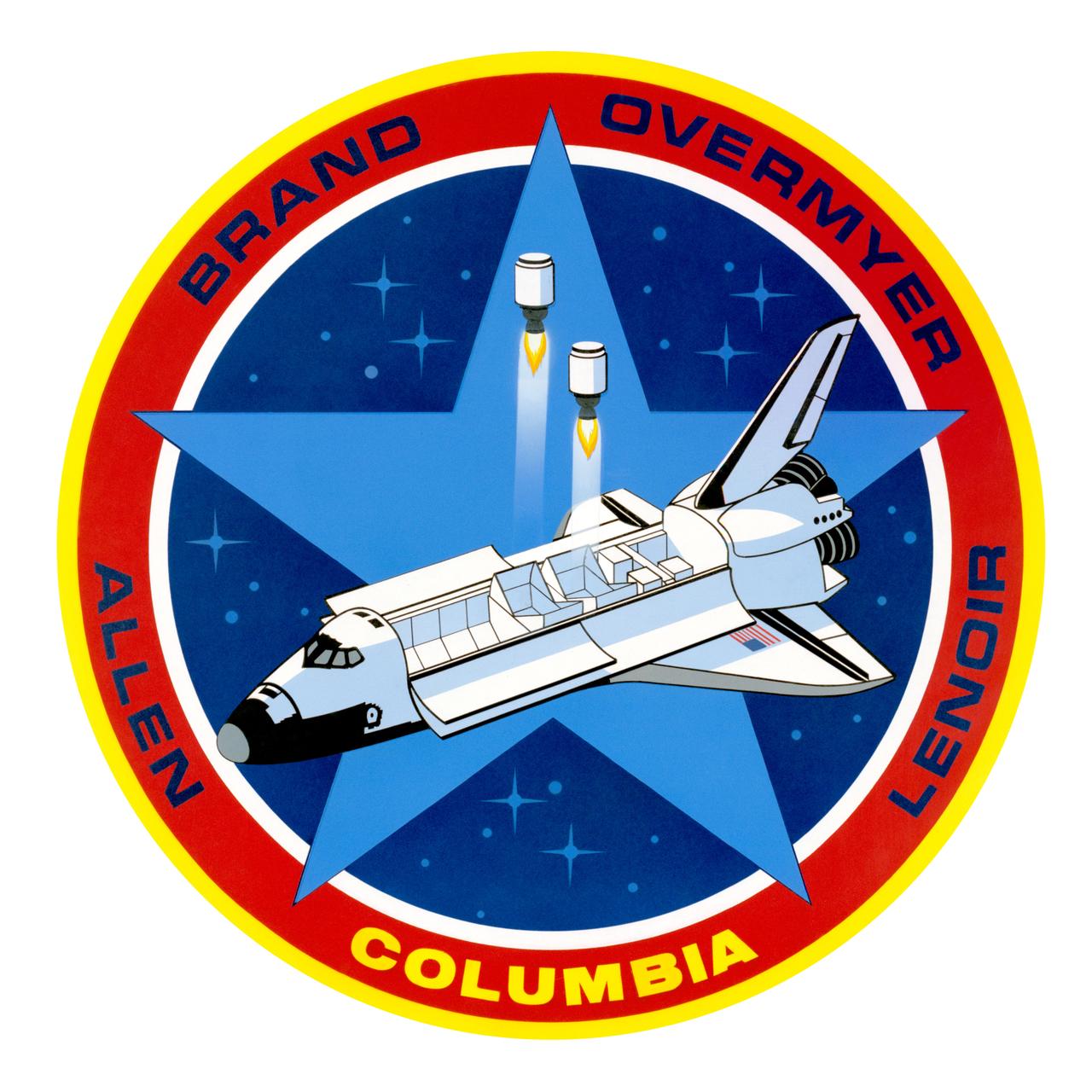
S82-35627 (20 Aug. 1982) --- This is the official crew patch for the fifth (note five points of the star) NASA Space Transportation System (STS-5) flight, scheduled for November of this year. The STS-5 flight following four successful test flights. It will call for the Columbia to be manned by four astronauts ? a space agency first. Crew members for the flights are Vance D. Brand, commander; Robert F. Overmyer, pilot; and William B. Lenoir and Joseph P. Allen, mission specialists. The NASA insignia design for space shuttle flights is reserved for use by the astronauts and for other official use as the NASA Administrator may authorize. Public availability has been approved only in the forms of illustrations by the various news media. When and if there is any change in this policy, which is not anticipated, the change will be publicly announced. Photo credit: NASA
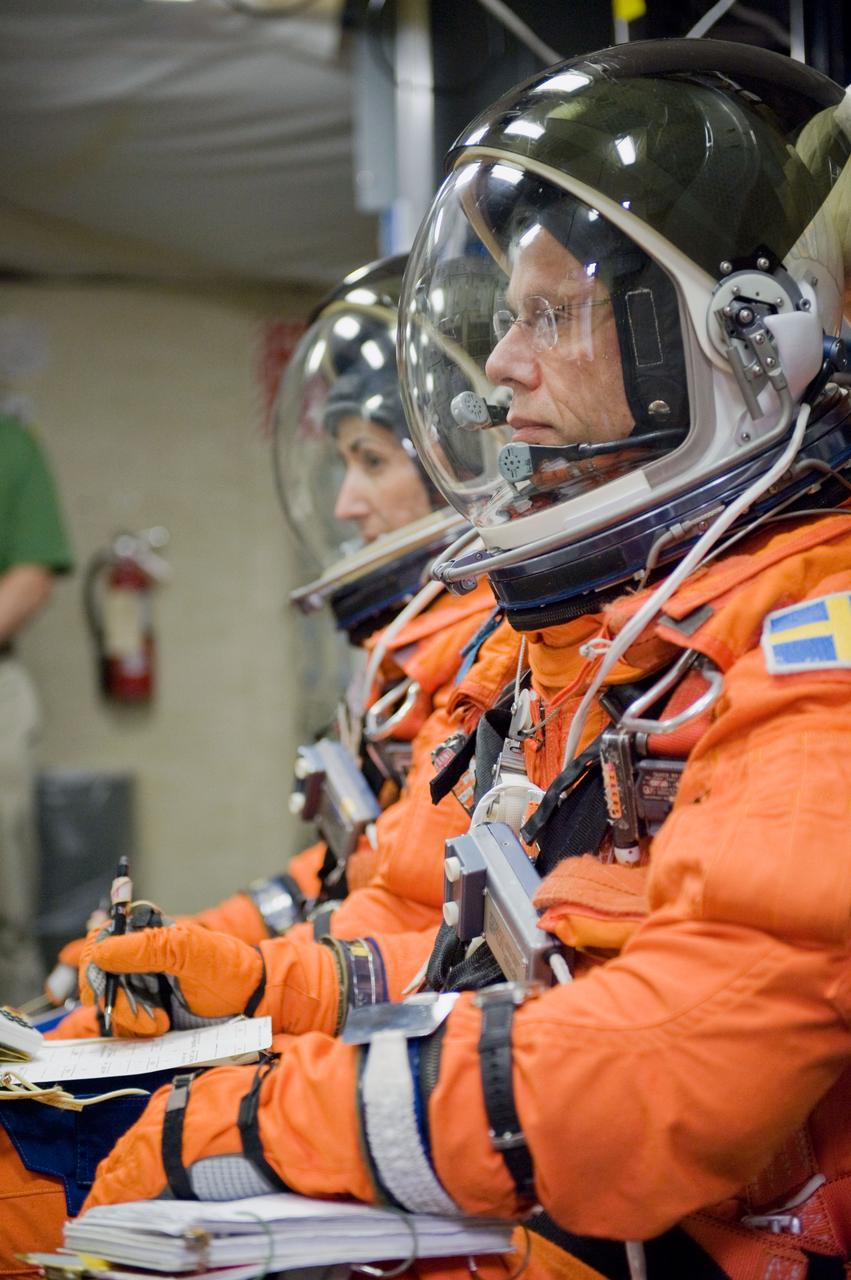
PHOTO DATE: 05-20-09 LOCATION: Bldg 5, Fixed Based Simulator SUBJECT: STS-128 Preflight Training PHOTOGRAPHER: BLAIR

PHOTO DATE: 05-20-09 LOCATION: Bldg 5, Fixed Based Simulator SUBJECT: STS-128 Preflight Training PHOTOGRAPHER: BLAIR
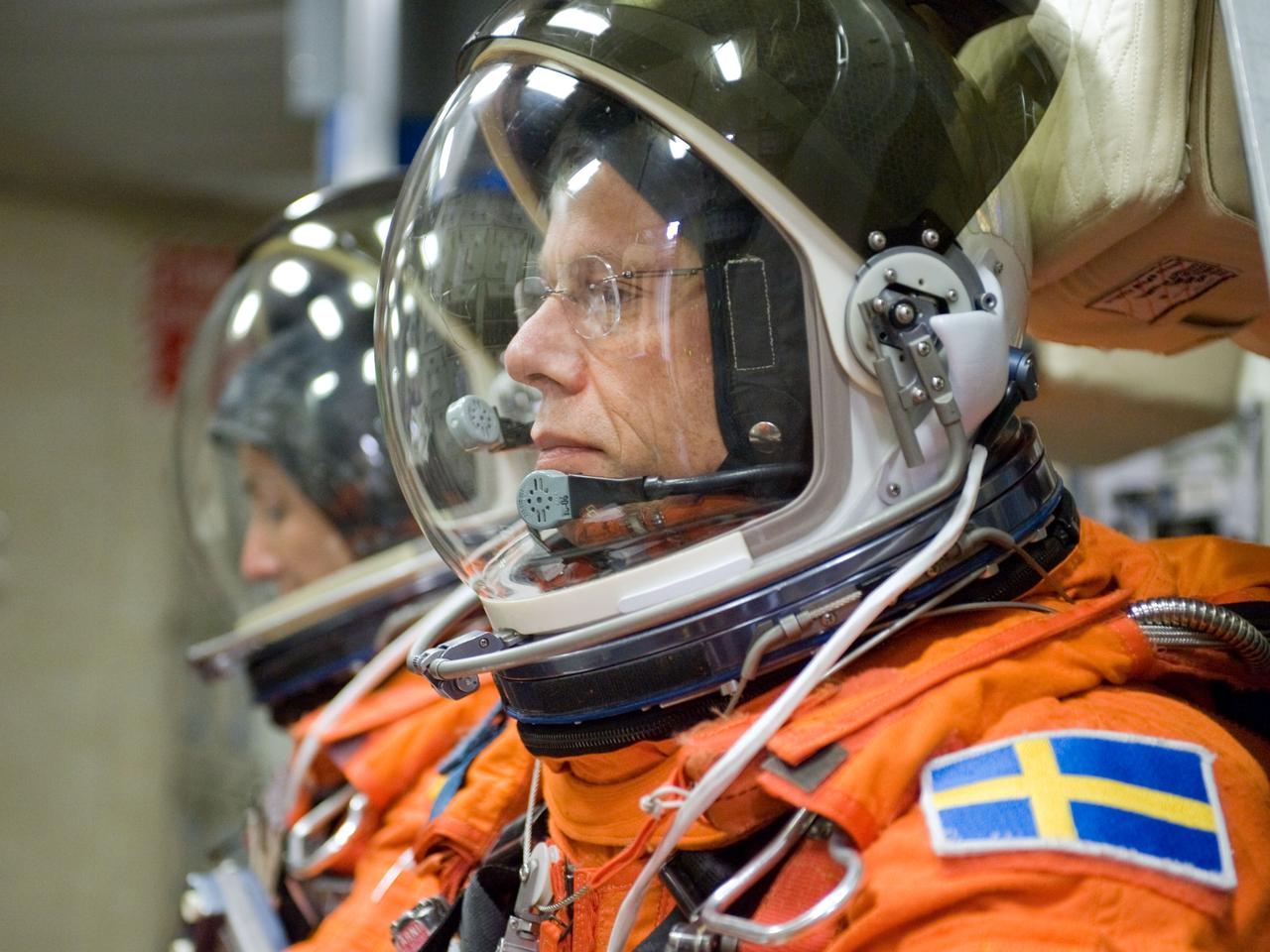
PHOTO DATE: 05-20-09 LOCATION: Bldg 5, Fixed Based Simulator SUBJECT: STS-128 Preflight Training PHOTOGRAPHER: BLAIR
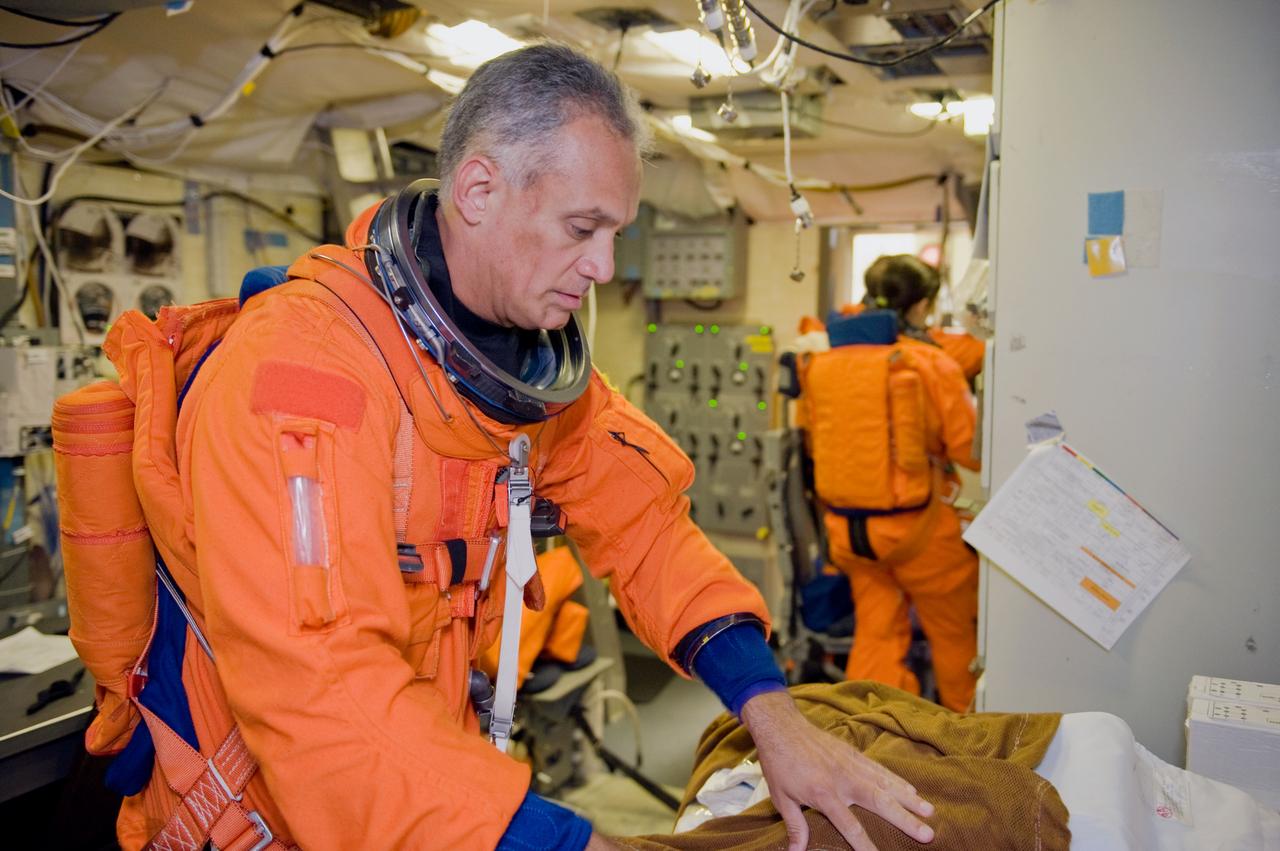
PHOTO DATE: 05-20-09 LOCATION: Bldg 5, Fixed Based Simulator SUBJECT: STS-128 Preflight Training PHOTOGRAPHER: BLAIR
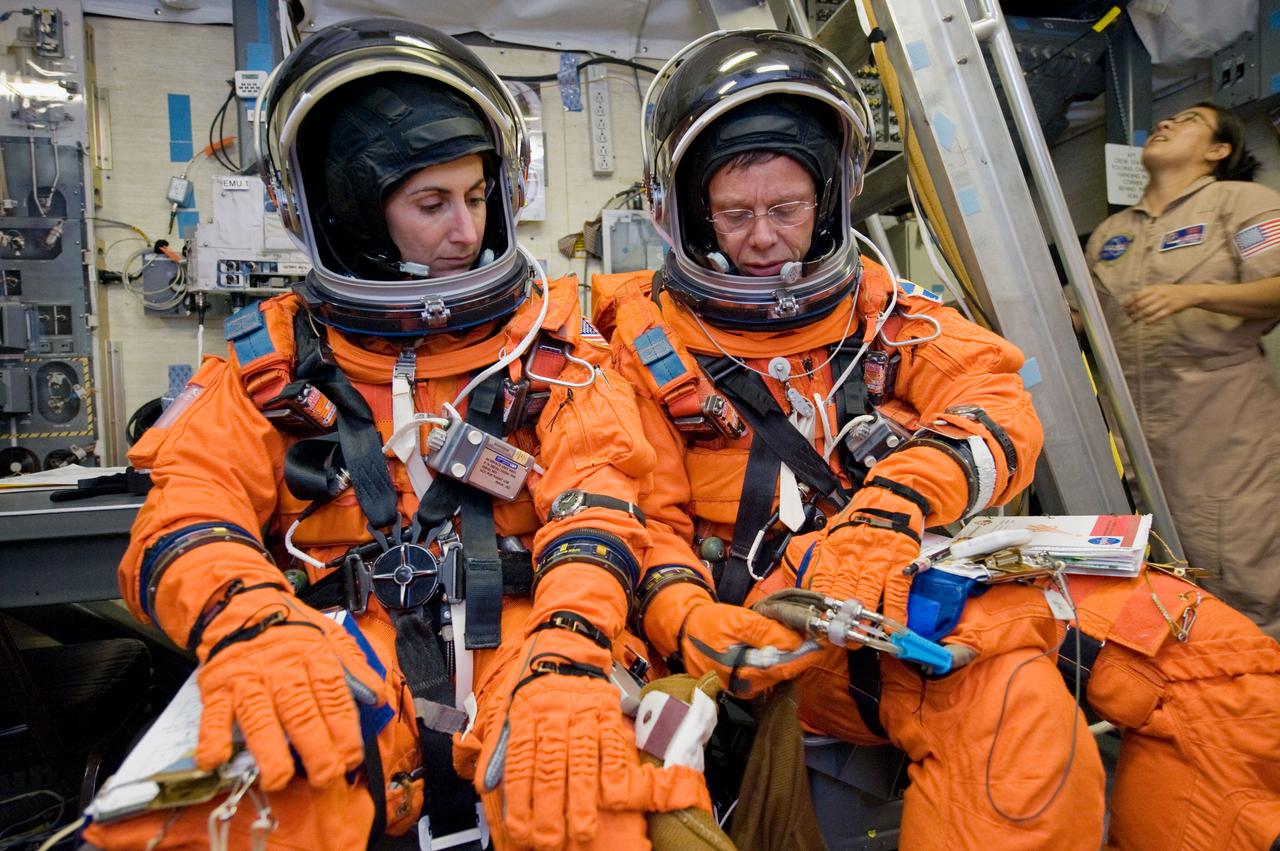
PHOTO DATE: 05-20-09 LOCATION: Bldg 5, Fixed Based Simulator SUBJECT: STS-128 Preflight Training PHOTOGRAPHER: BLAIR
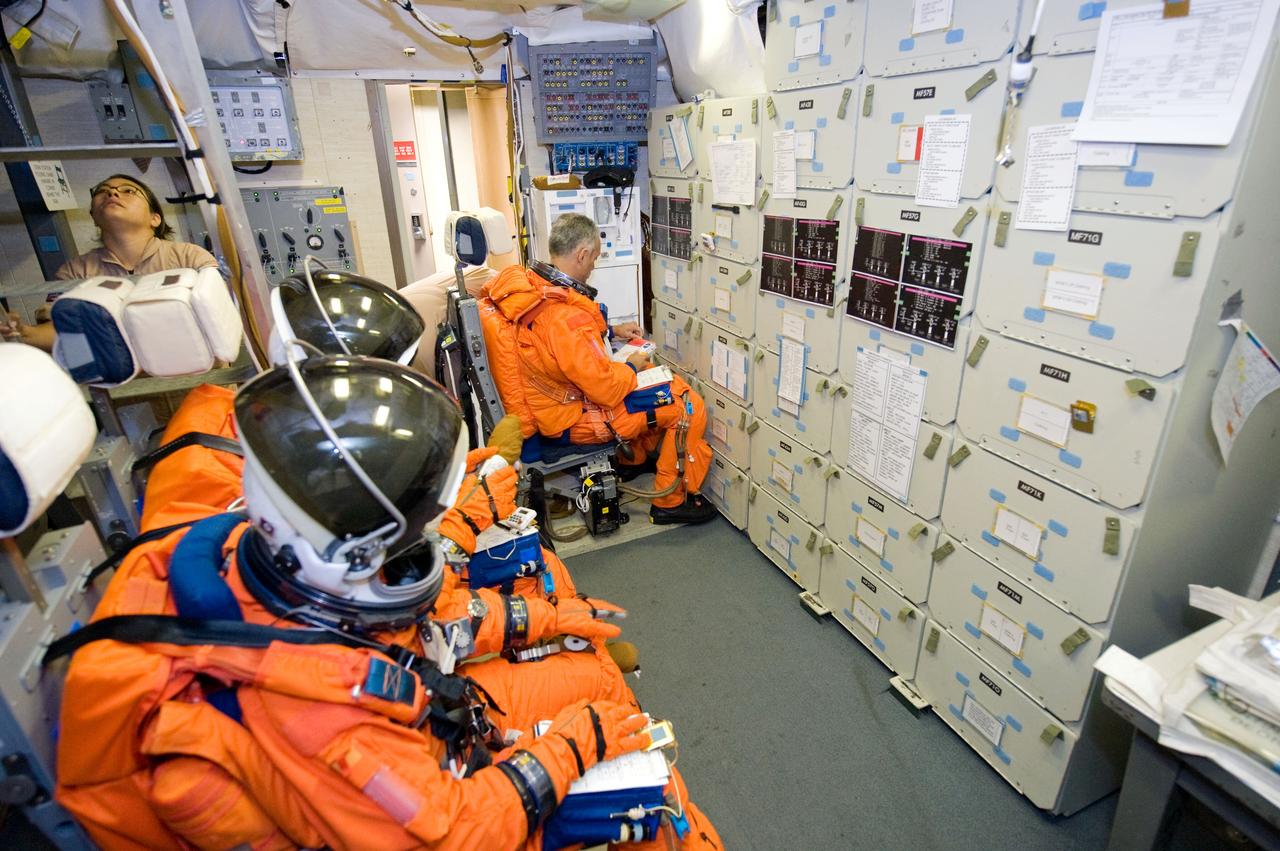
PHOTO DATE: 05-20-09 LOCATION: Bldg 5, Fixed Based Simulator SUBJECT: STS-128 Preflight Training PHOTOGRAPHER: BLAIR

PHOTO DATE: 05-20-09 LOCATION: Bldg 5, Fixed Based Simulator SUBJECT: STS-128 Preflight Training PHOTOGRAPHER: BLAIR
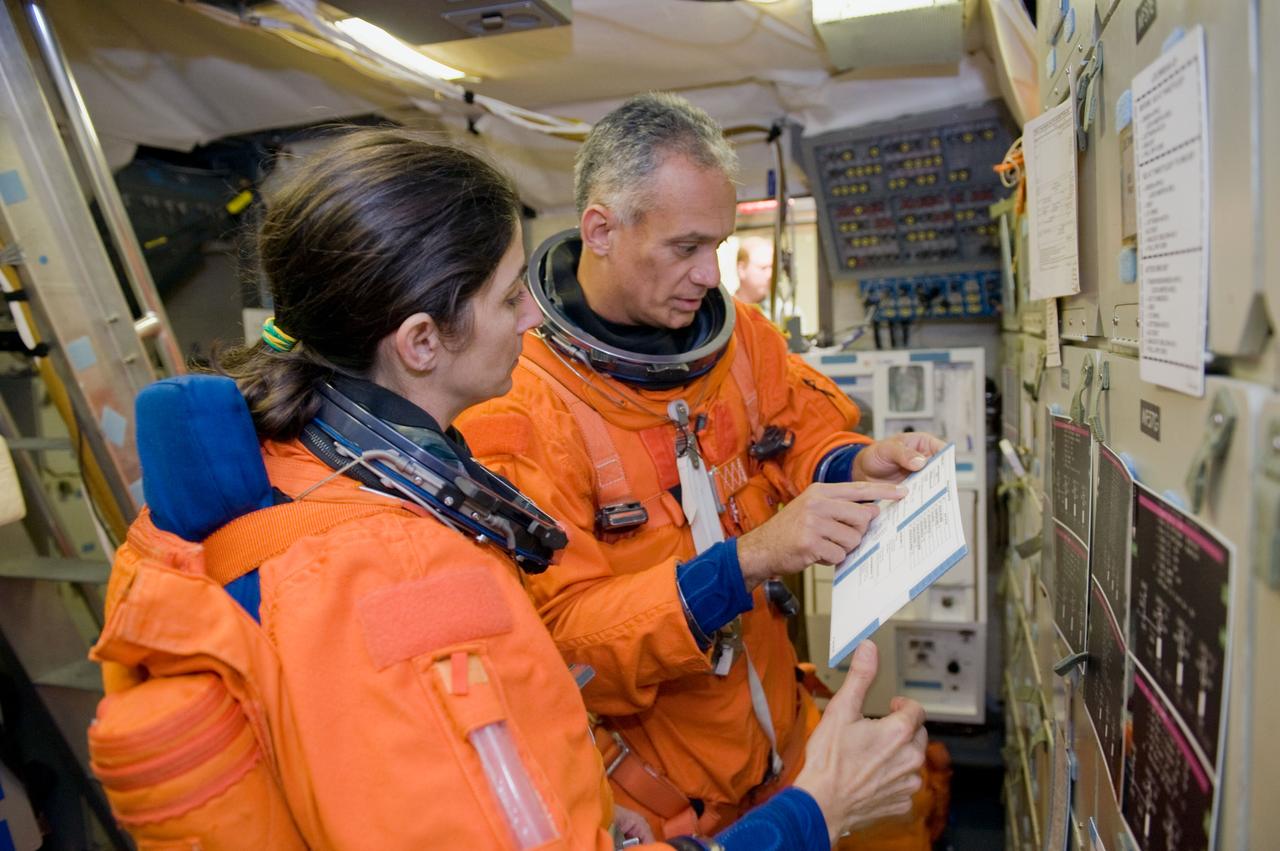
PHOTO DATE: 05-20-09 LOCATION: Bldg 5, Fixed Based Simulator SUBJECT: STS-128 Preflight Training PHOTOGRAPHER: BLAIR
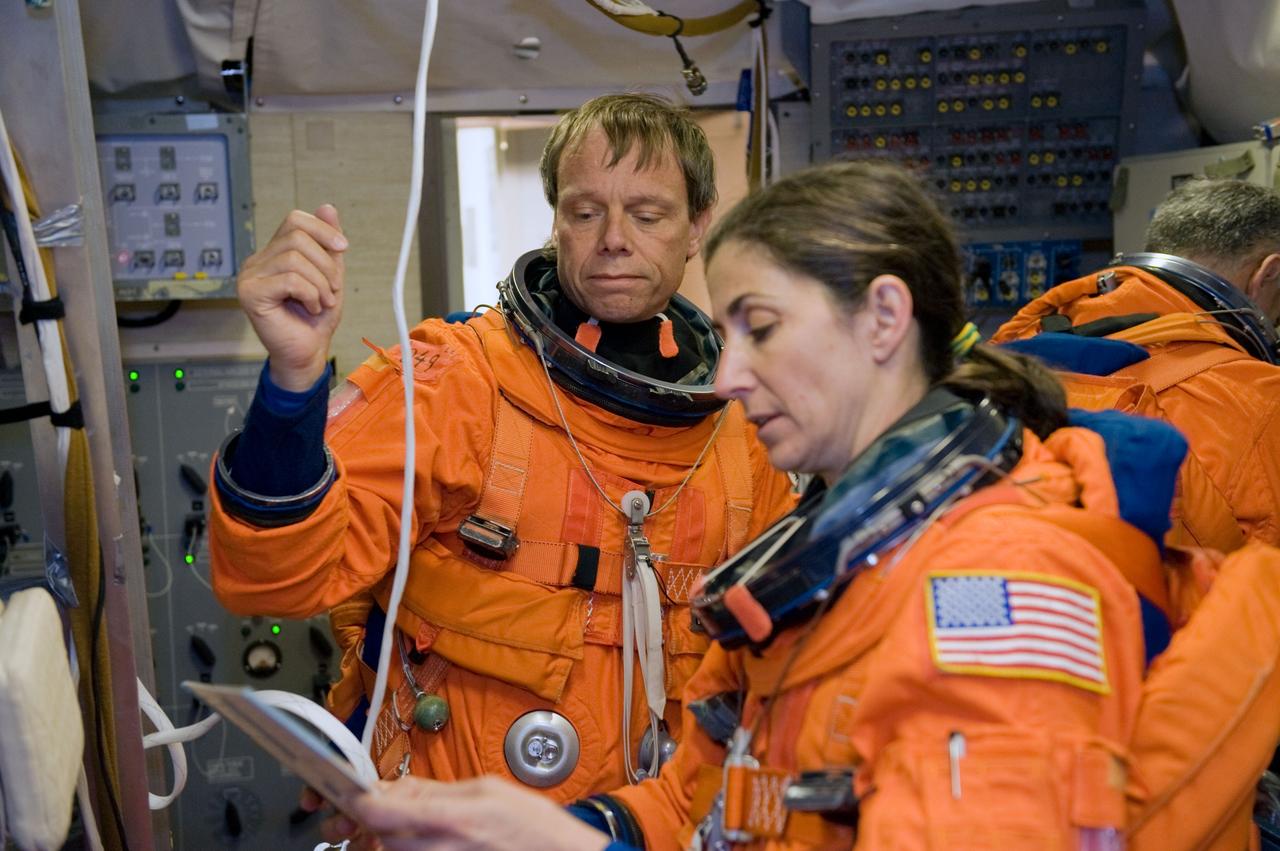
PHOTO DATE: 05-20-09 LOCATION: Bldg 5, Fixed Based Simulator SUBJECT: STS-128 Preflight Training PHOTOGRAPHER: BLAIR
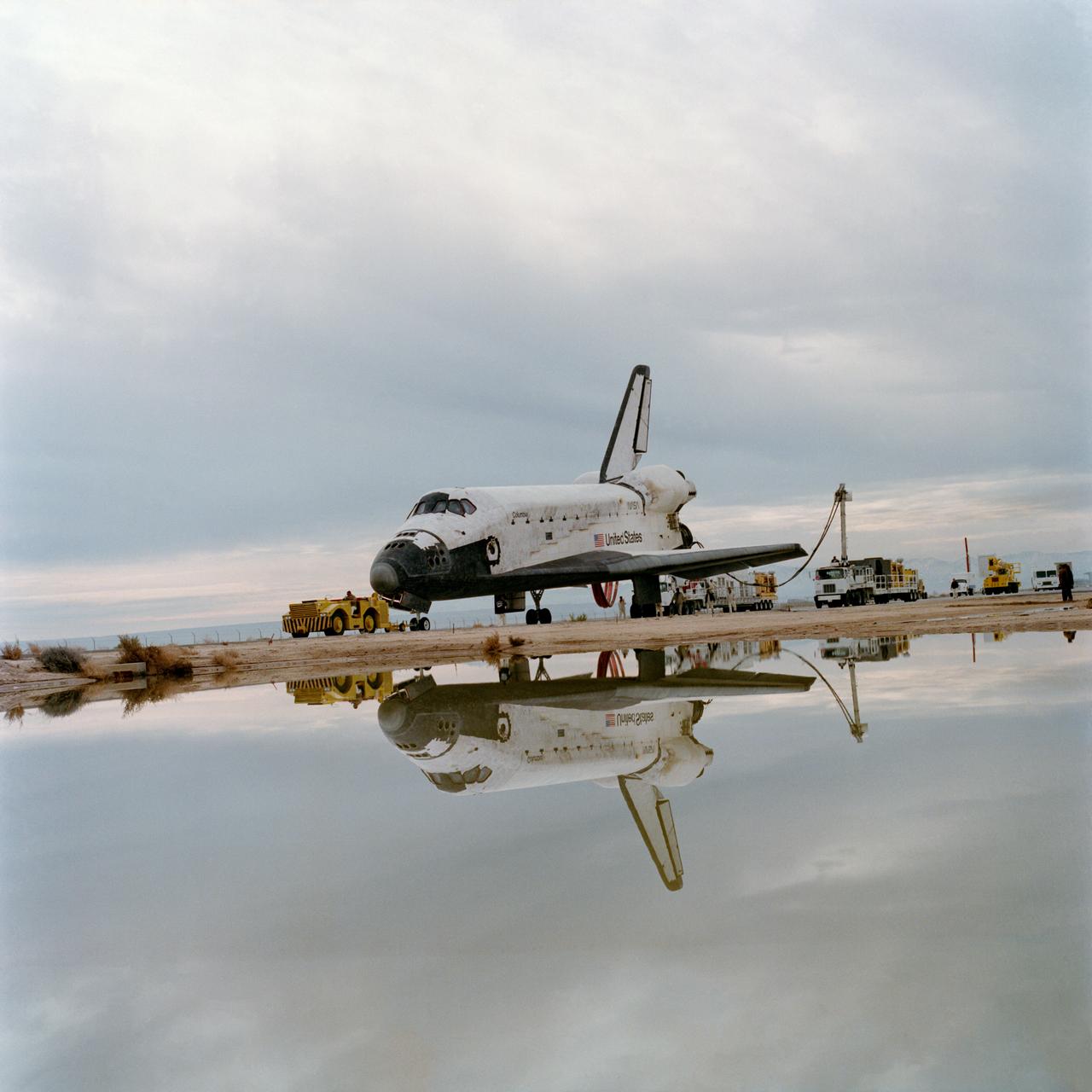
S82-39888 (16 Nov. 1982) --- Post-landing processing of the space shuttle Columbia is seen in double in this rare scene at the Dryden Flight Research Facility (DFRF) in southern California. Uncommon rainwater has given a mirror effect to the normally dry lakebed. Columbia, with its first four-member crew aboard, touched down earlier today to complete a successful five-day, two-hour mission. The runway used was Number 22 at Edwards Air Force Base. Photo credit: NASA
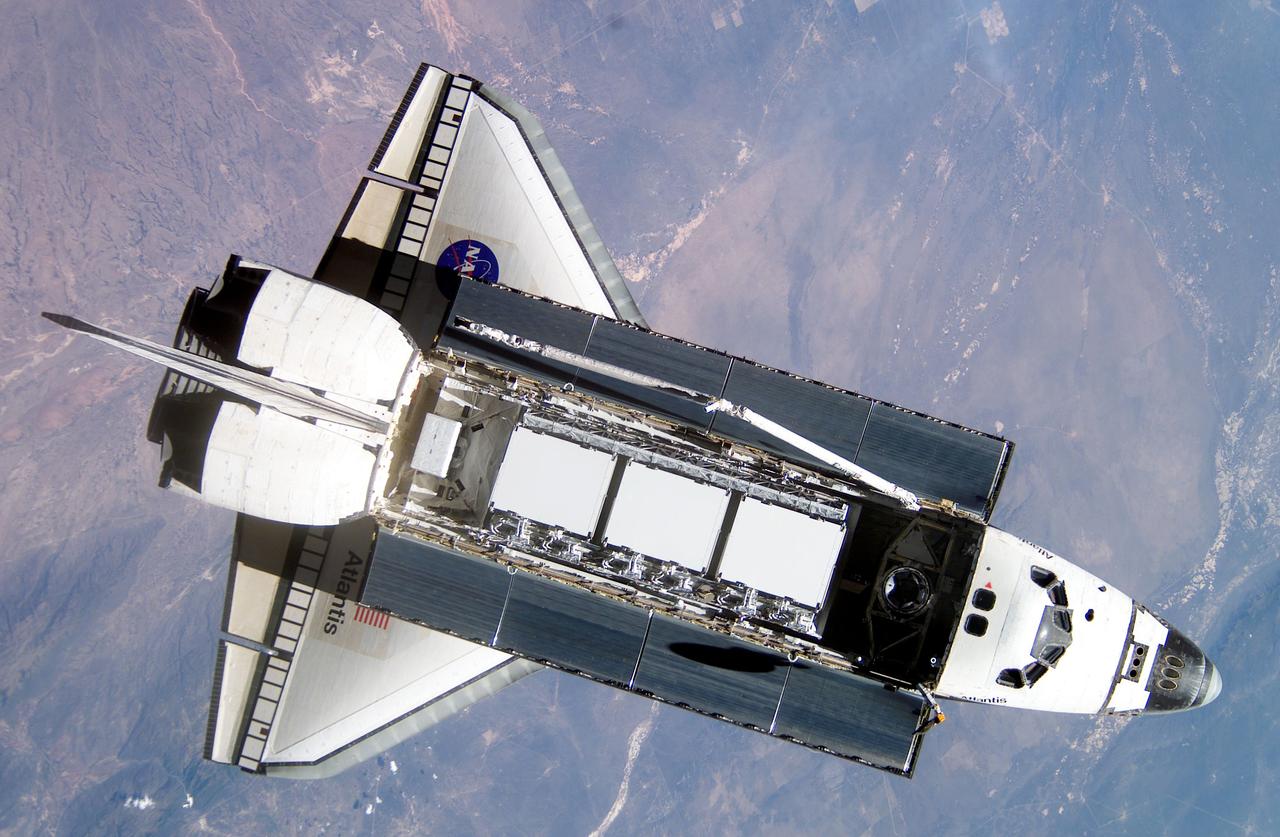
Back dropped against a blue and white Earth, the Space Shuttle Orbiter Atlantis was photographed by an Expedition 5 crew member onboard the International Space Station (ISS) during rendezvous and docking operations. Docking occurred at 10:17 am on October 9, 2002. The Starboard 1 (S1) Integrated Truss Structure, the primary payload of the STS-112 mission, can be seen in Atlantis' cargo bay. Installed and outfitted within 3 sessions of Extravehicular Activity (EVA) during the 11 day mission, the S1 truss provides structural support for the orbiting research facility's radiator panels, which use ammonia to cool the Station's complex power system. The S1 truss, attached to the S0 (S Zero) truss installed by the previous STS-110 mission, flows 637 pounds of anhydrous ammonia through three heat rejection radiators.
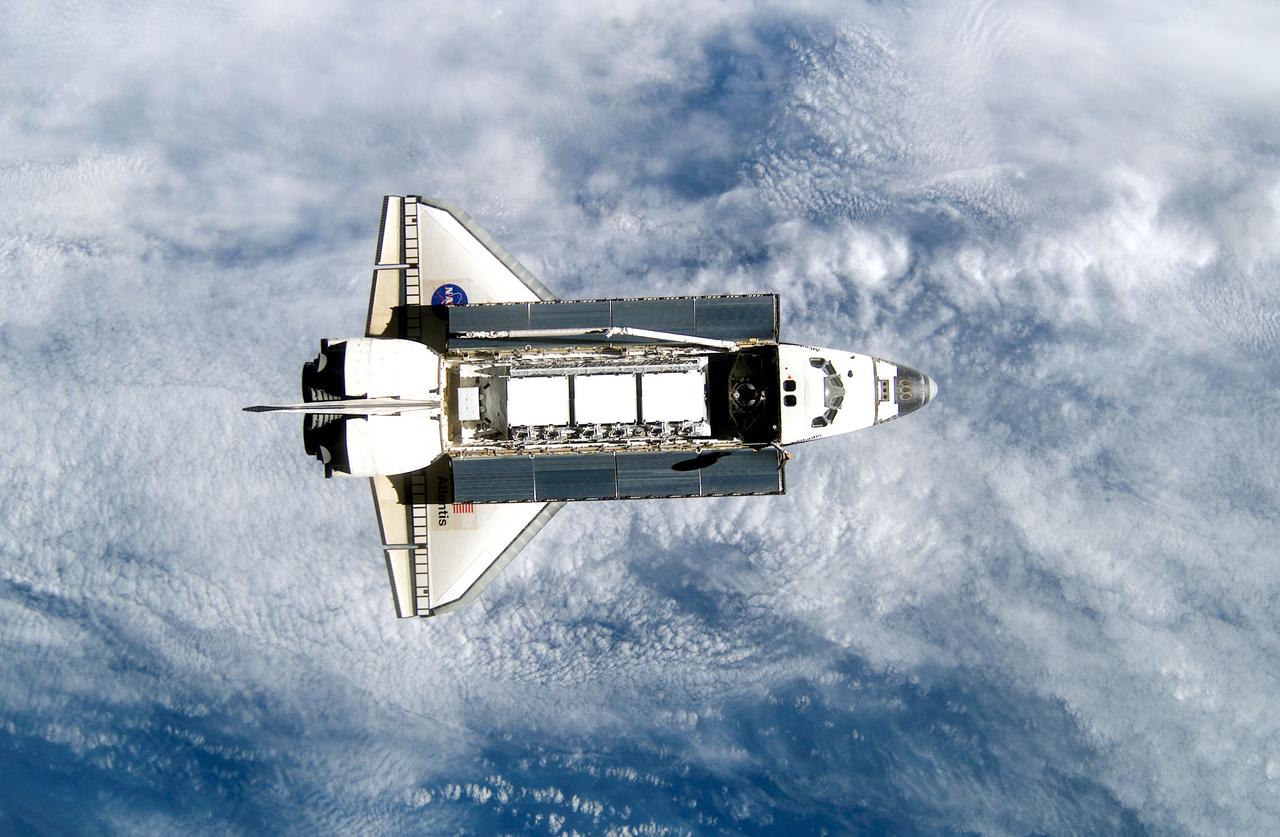
Back dropped against a blue and white Earth, the Space Shuttle Orbiter Atlantis was photographed by an Expedition 5 crew member onboard the International Space Station (ISS) during rendezvous and docking operations. Docking occurred at 10:17 am on October 9, 2002. The Starboard 1 (S1) Integrated Truss Structure, the primary payload of the STS-112 mission, can be seen in Atlantis' cargo bay. Installed and outfitted within 3 sessions of Extravehicular Activity (EVA) during the 11 day mission, the S1 truss provides structural support for the orbiting research facility's radiator panels, which use ammonia to cool the Station's complex power system. The S1 truss, attached to the S0 (S Zero) truss installed by the previous STS-110 mission, flows 637 pounds of anhydrous ammonia through three heat rejection radiators.
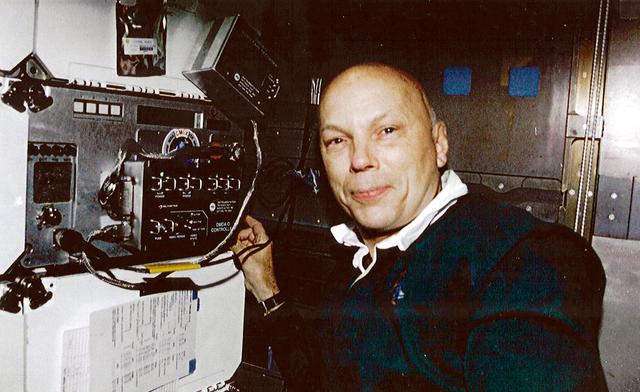
Experiments to seek solutions for a range of biomedical issues are at the heart of several investigations that will be hosted by the Commercial Instrumentation Technology Associates (ITA), Inc. The biomedical experiments CIBX-2 payload is unique, encompassing more than 20 separate experiments including cancer research, commercial experiments, and student hands-on experiments from 10 schools as part of ITA's ongoing University Among the stars program. Here, Astronaut Story Musgrave activates the CMIX-5 (Commercial MDA ITA experiment) payload in the Space Shuttle mid deck during the STS-80 mission in 1996 which is similar to CIBX-2. The experiments are sponsored by NASA's Space Product Development Program (SPD).
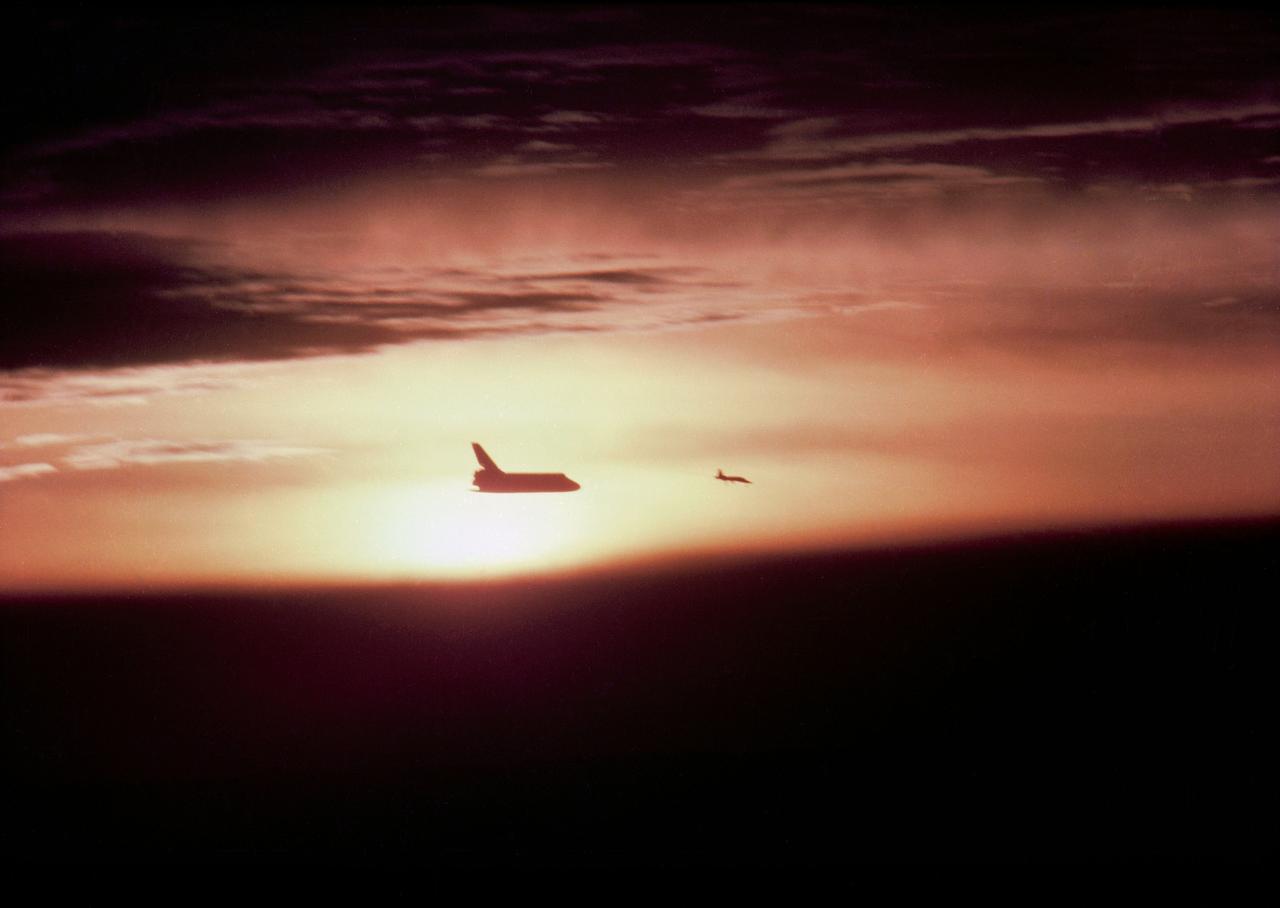
Aerial view of Orbiter "Columbia" as you look into the Sun, taken by Erik Simonsen, Rockwell International, 11/16/1982. 1. STS-5 - LANDING (INTO THE SUN) EAFB, CA
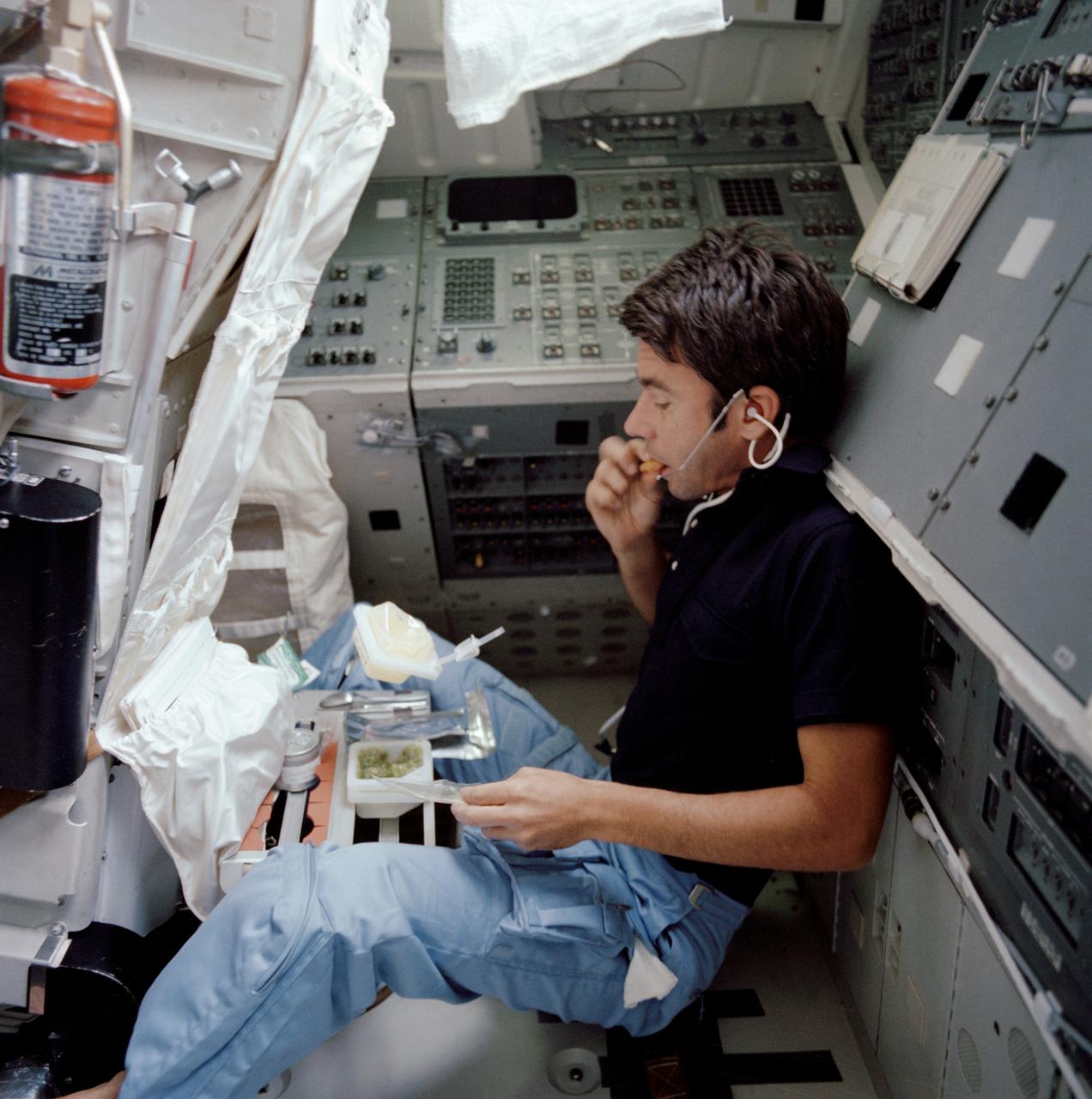
STS005-45-1821 (11-16 Nov. 1982) --- Astronaut William B. Lenoir, STS-5 mission specialist, takes a break to eat his meal on the space shuttle Columbia. Wet trash stowage bags float freely around him and a fire extinguisher hangs on the wall in front of him. Photo credit: NASA
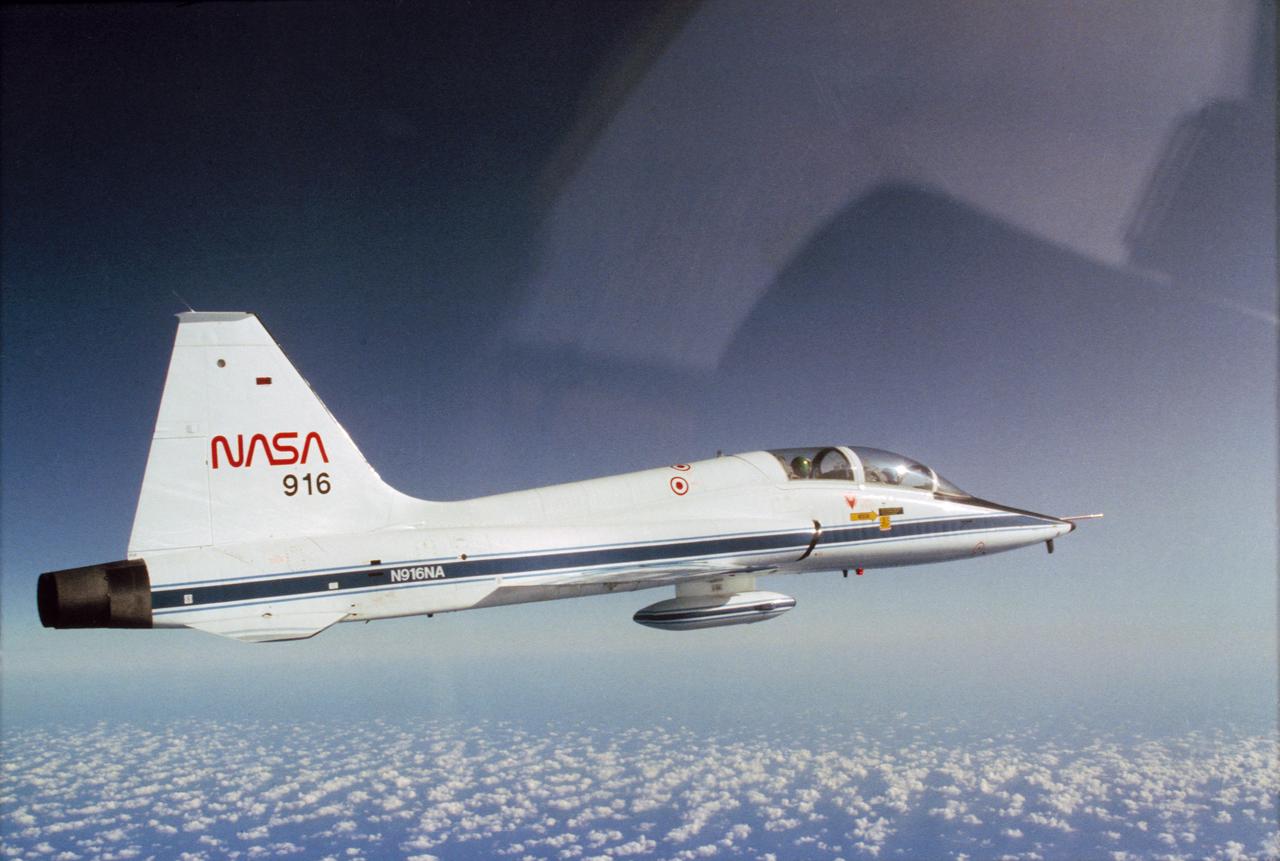
NASA 916, a T-38 jet aircraft, carrying astronauts Vance D. Brand (front station) and Robert F. Overmyer, heads for Kennedy Space Center in Florida. 1. STS-5 - PREFLIGHT KSC, FL Also available in 4x5 CN
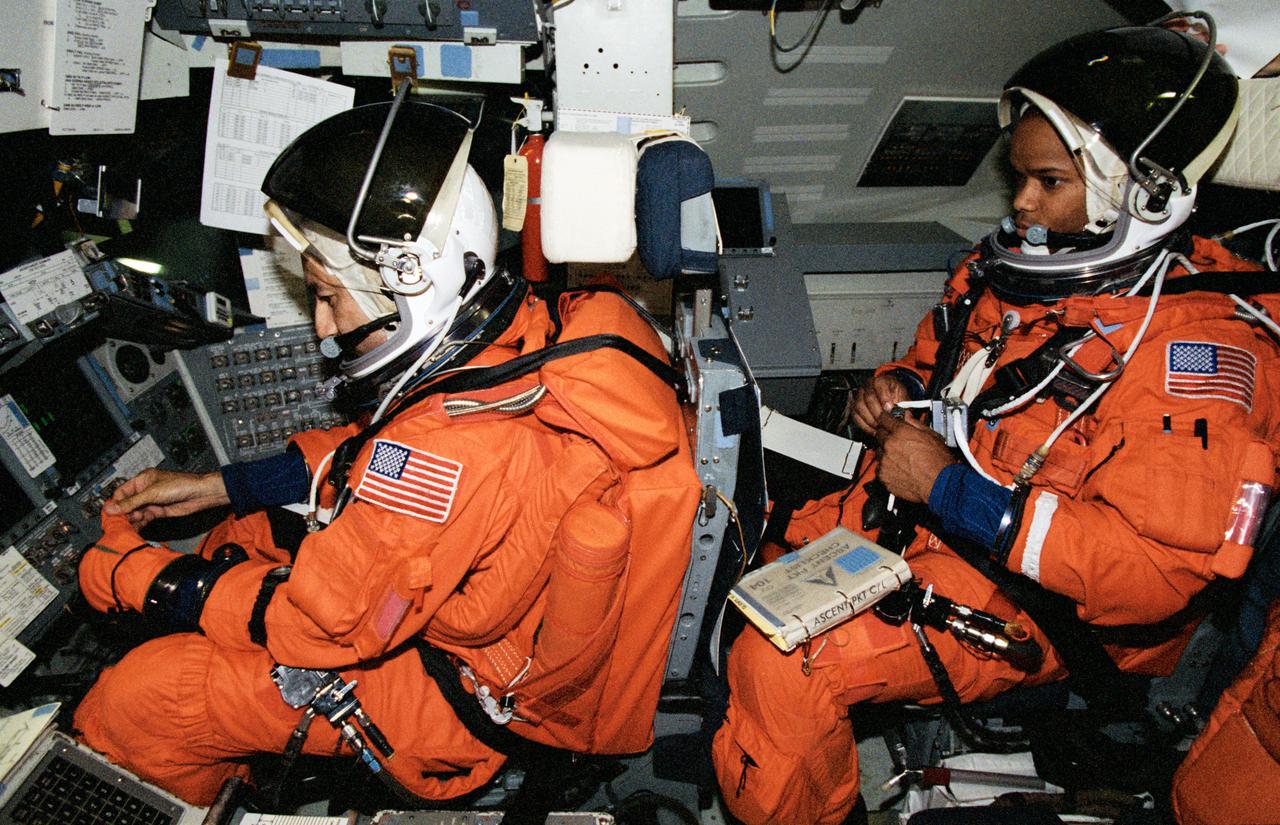
Photographic documentation showing STS-98 crewmembers engaging in preflight training in bldg. 5. Views include: STS-98 mission commander Kenneth D. Cockrell, wearing a Launch Entry Suit (LES) and a helmet, sits in the commanders station on the flight deck of the mobile-based Shuttle Mission Simulator (SMS) (04774); STS-98 pilot Mark L. Polansky, wearing LES and helmet, sits in the pilots station, with STS-98 Mission Specialist (MS) Robert L. Curbeam seated behind him on the flight deck (04775); Polansky in the pilots station (04776); Curbeam in a LES and wearing a Communications Carrier Assembly (CCA) (04777); Polansky and Curbeam pose, wearing LES and no helmets, in bldg. 5 (04778); Polansky, wearing a LES, fastens his CCA (04779); Cockrell, Polansky, Curbeam and STS-98 MS Marsha S. Ivins, wearing LES, sit in locker room (04780); Ivins and suit techs (04781); suit techs and Polansky (04782); suit techs and Cockrell (04783).
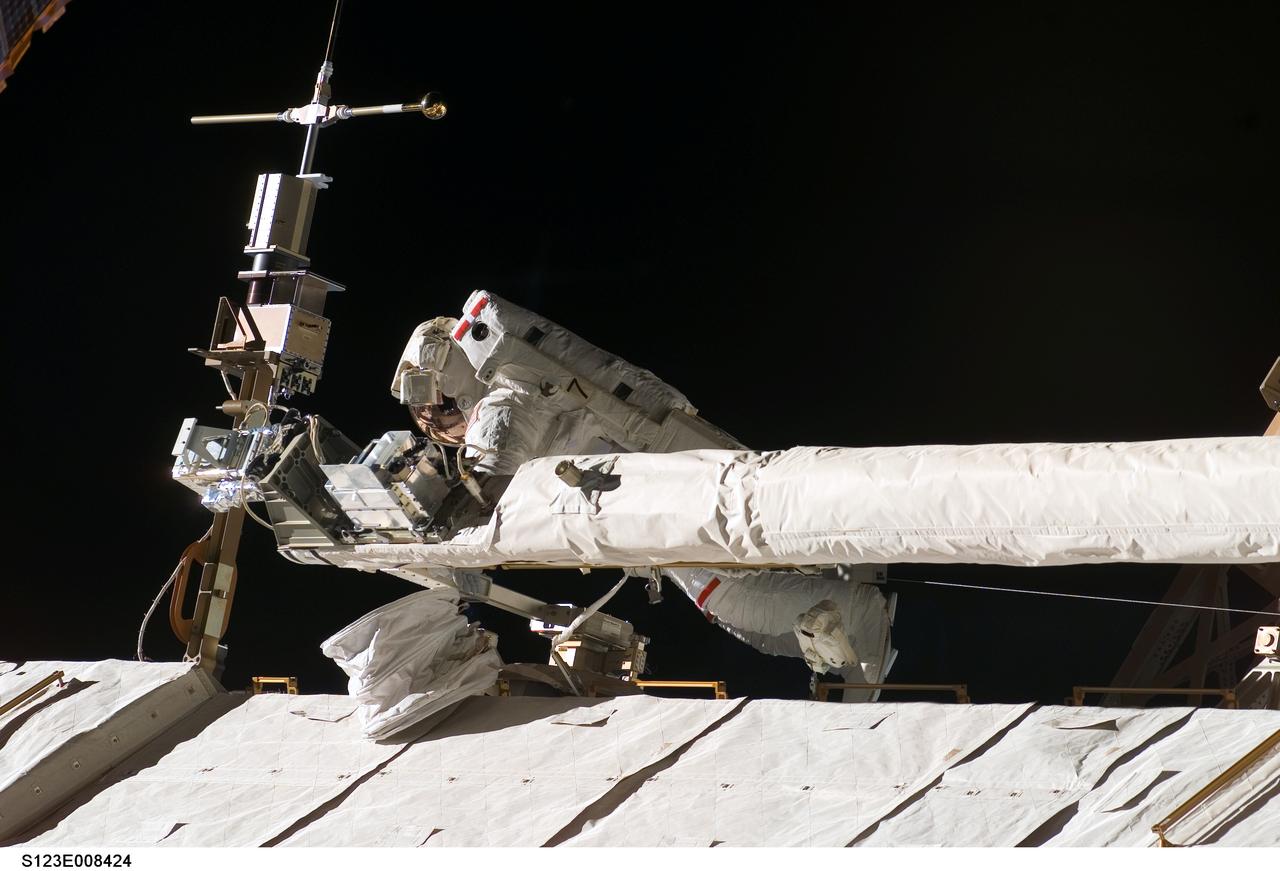
S123-E-008424 (23 March 2008) --- Astronaut Mike Foreman, STS-123 mission specialist, helps to tie down the Orbiter Boom Sensor System on the International Space Station's S1 truss during EVA 5 on March 22. The structure at the end of the boom is a transmission device for laser imagery from the laser devices used for scanning the thermal protection system.
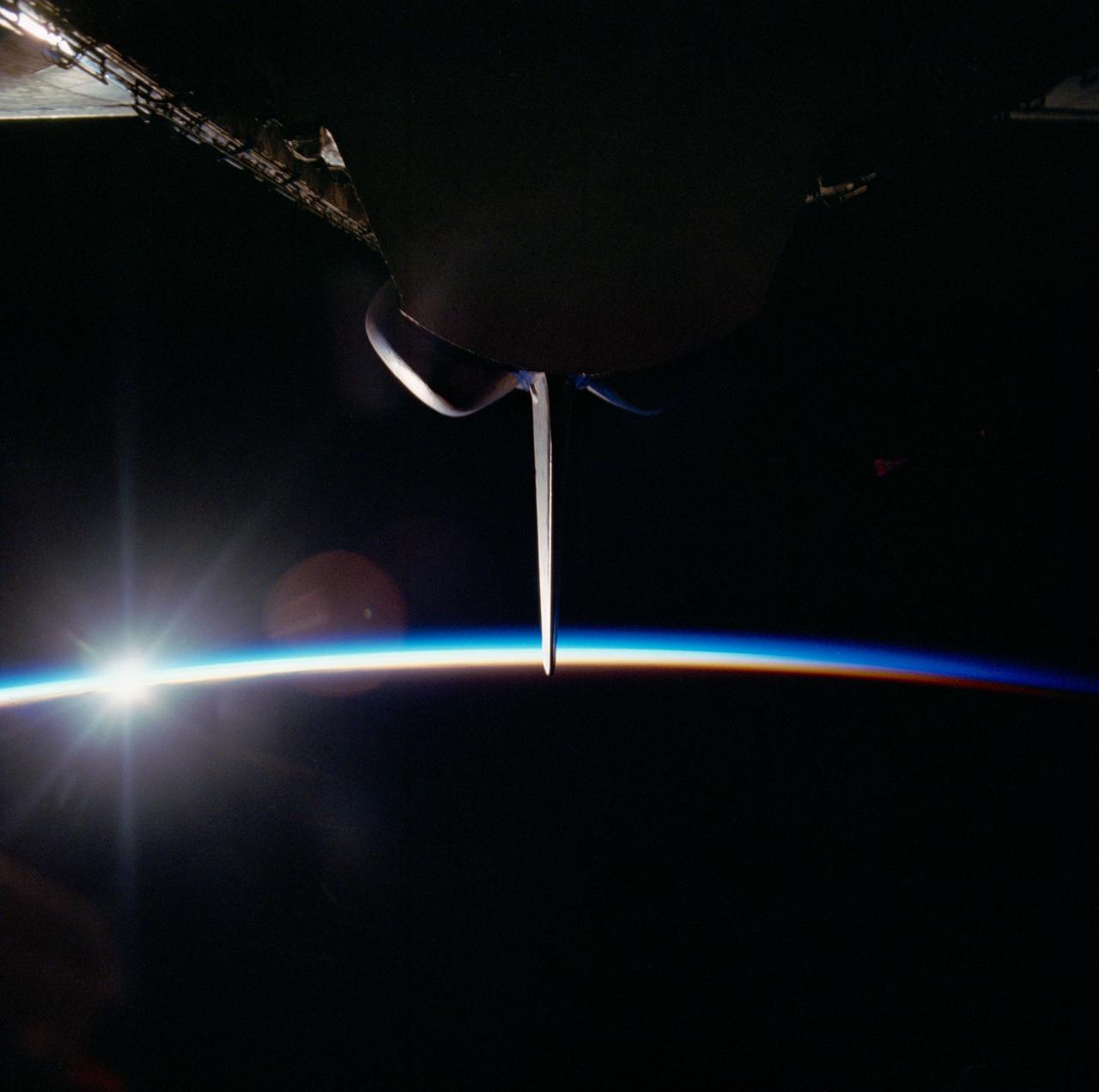
S82-39796 (11-16 Nov. 1982) --- A ?night? scene of the STS-5 space shuttle Columbia in orbit over Earth?s glowing horizon was captured by an astronaut crew member aiming a 70mm handheld camera through the aft windows of the flight deck. The aft section of the cargo bay contains two closed protective shields for satellites which were deployed on the flight. The nearest ?cradle? or shield houses the Satellite Business System?s (SBS-3) spacecraft and is visible in this frame while the Telesta Canada ANIK C-3 shield is out of view. The vertical stabilizer, illuminated by the sun, is flanked by two orbital maneuvering system (OMS) pods. Photo credit: NASA
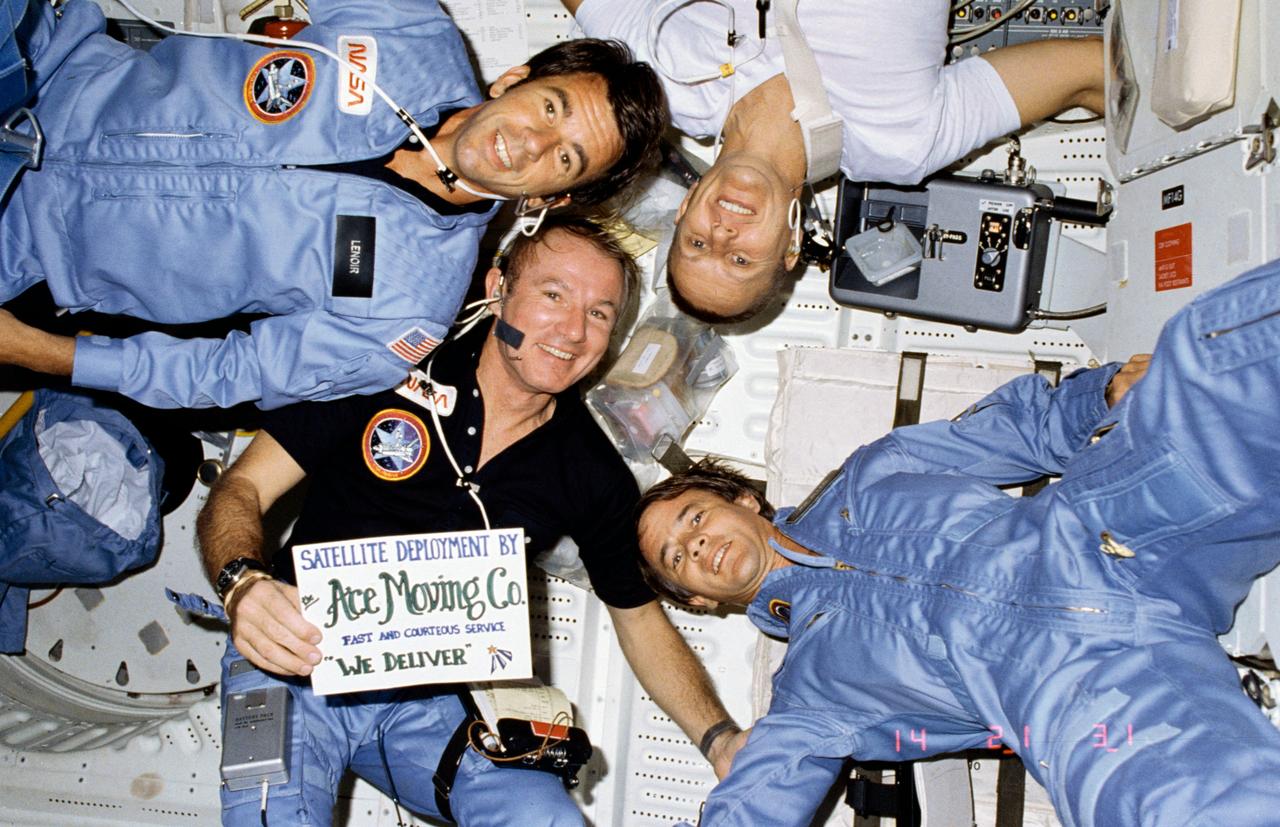
STS005-07-267 (12 Nov. 1982) --- A pre-set 35mm camera?s exposure of all four STS-5 astronaut crew members reveals a bit of their humorous side. The sign held by astronaut Vance D. Brand, crew commander, refers to the successful deployment of two commercial communications satellites on the flight's first two days. Brand is surrounded by, clockwise, left to right, astronauts William B. Lenoir, mission specialist, Robert F. Overmyer, pilot, and Joseph O. Allen IV, mission specialist, in the middeck area of the Earth-orbiting space shuttle Columbia. Photo credit: NASA
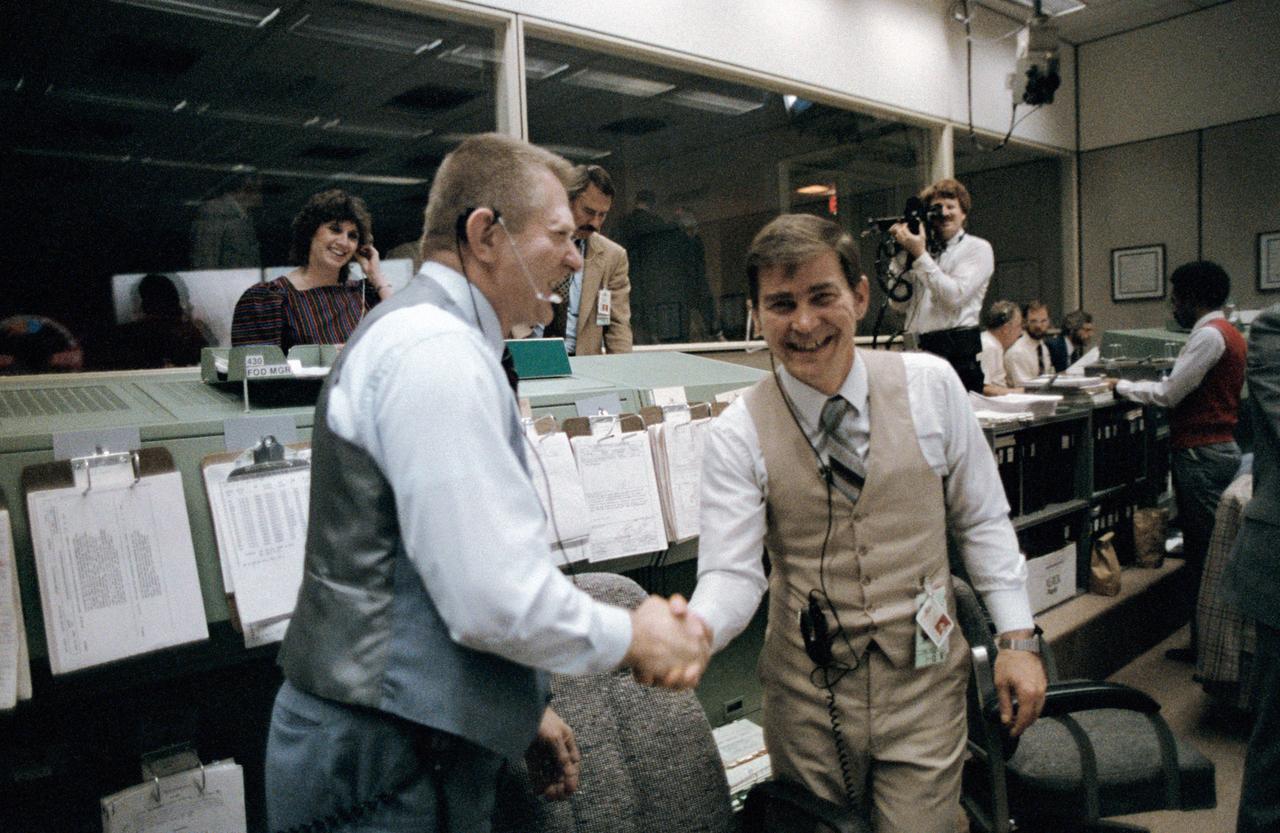
Various views of STS-6 MOCR activities during Day-5 with Vice-Pres. George Bush, Cap Communicator Bridges, JSC Director Gerald Griffin, Eugene F. Kranz, NASA Admin. James M. Beggs, Cap Com Astronaut O'Connor, Flight Directors Jay H. Greene, Gary E. Coen, and Harold Draughon. 1. BUSH, GEORGE, VICE-PRES. - STS-6 MOCR 2. DIR. GRIFFIN, GERALD D. - STS-6 MOCR 3. ADMIN. BEGGS, JAMES M. - STS-6 MOCR 4. FLT. DIRECTORS - STS-6 JSC, HOUSTON, TX Also available in 35 CN
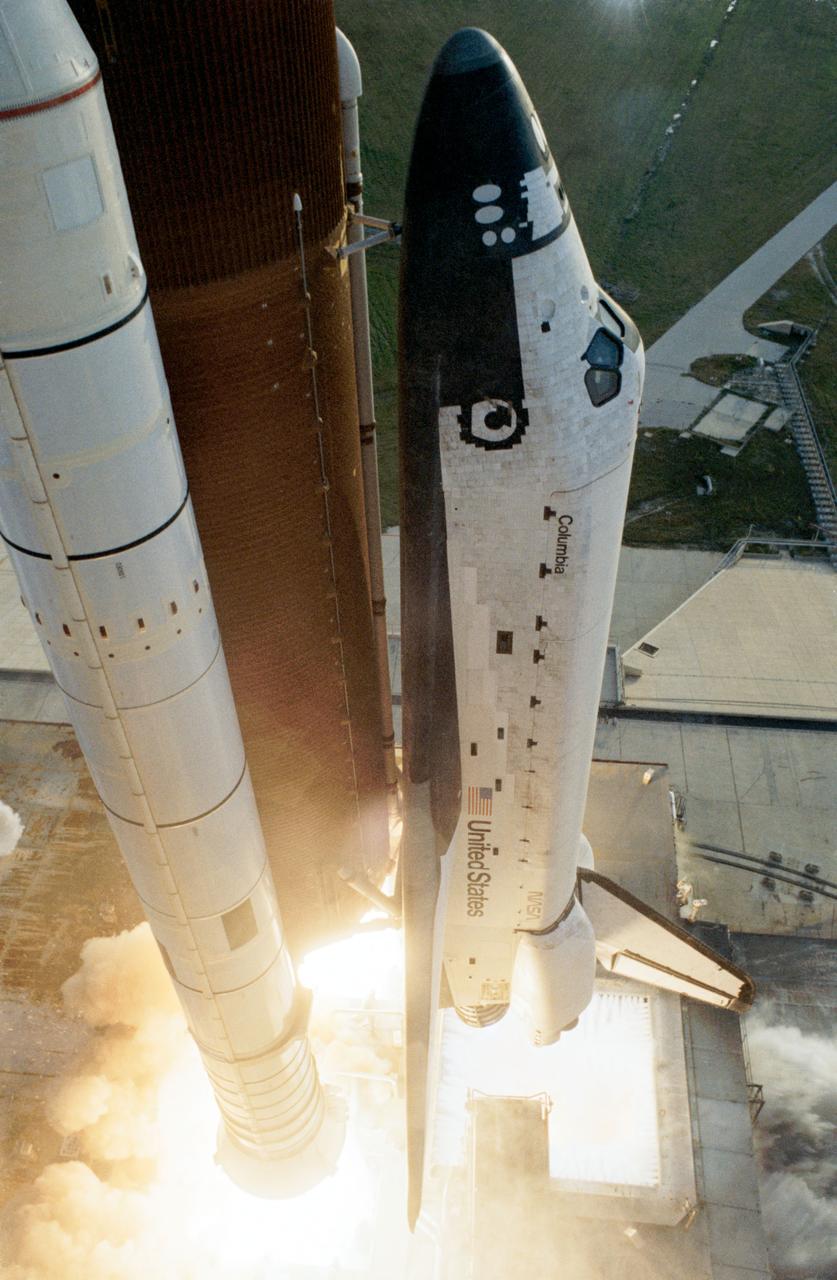
Views of the External Tank (ET) Beanie Cap in place just prior to Final Count, and another looking down from the Service Structure, with engines and rockets firing, just as it left the Pad deck, 11/11/1982. KSC, FL
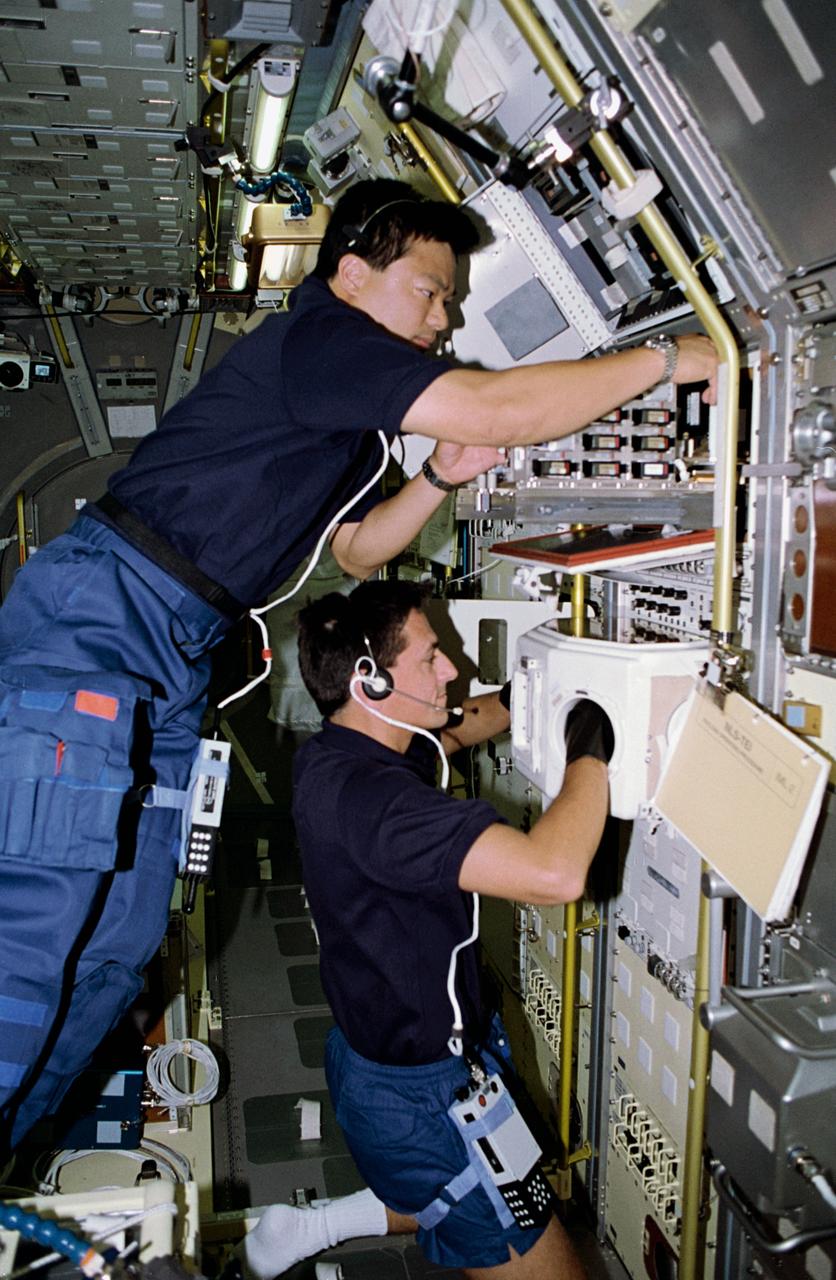
STS-65 Mission Specialist (MS) Leroy Chiao (top) and MS Donald A. Thomas are seen at work in the International Microgravity Laboratory 2 (IML-2) spacelab science module aboard the Space Shuttle Columbia, Orbiter Vehicle (OV) 102. The two crewmembers are conducting experiments at the IML-2 Rack 5 Biorack (BR). Chiao places a sample in the BR incubator as Thomas handles another sample inside the BR glovebox. The glovebox is used to prepare samples for BR and slow rotating centrifuge microscope (NIZEMI) experiments.
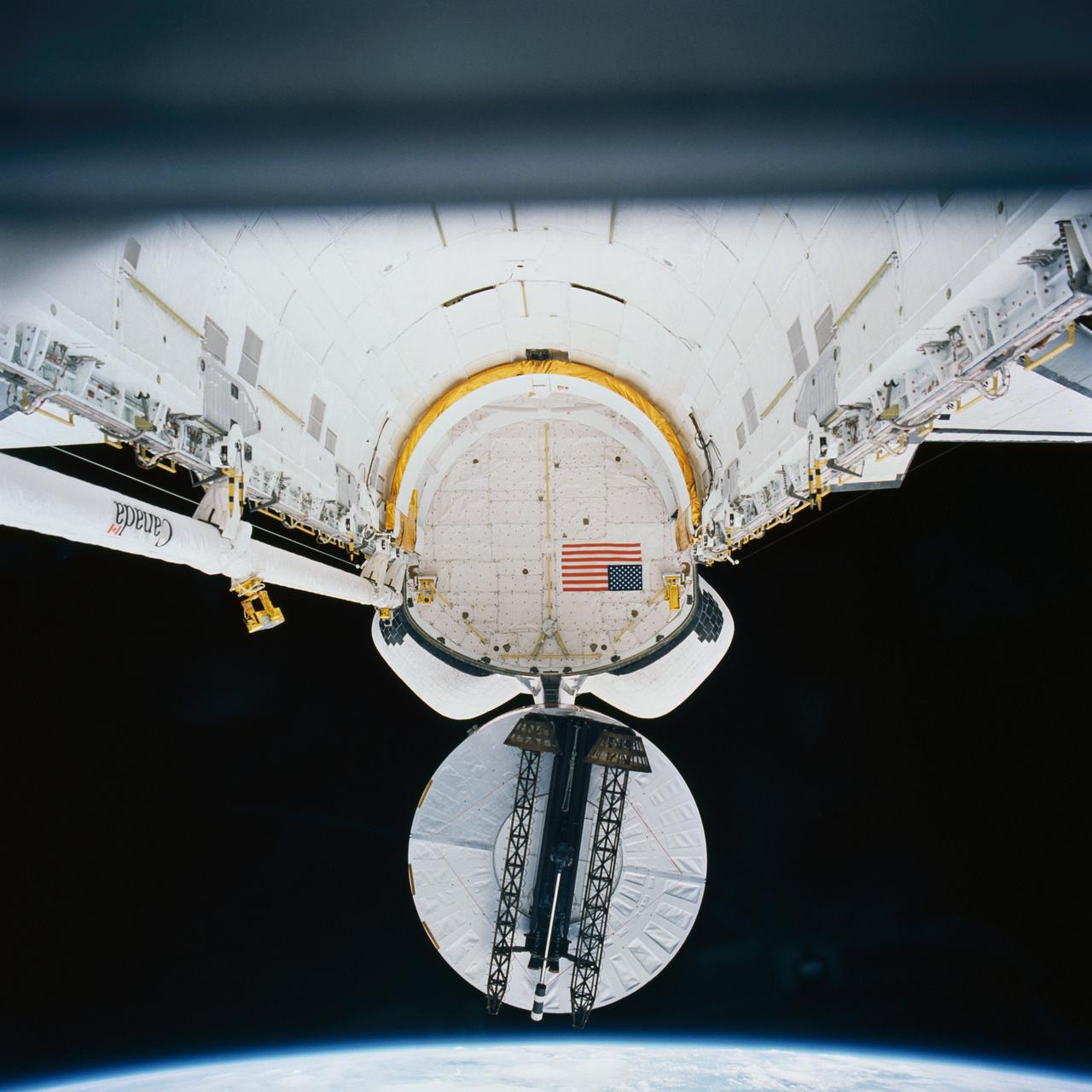
STS032-87-030 (10 Jan 1990) --- The Syncom IV-5 communications satellite leaves the cargo bay of Columbia, as crewmembers aboard the record-setting Space Shuttle successfully complete the first of two major tasks for STS-32. Two days later, the five astronauts successfully captured the Long Duration Exposure Facility (LDEF). The Syncom satellite, also called Leasat, is to be leased to the U.S. Navy by Hughes Aircraft Co. The crew went on to spend 11 days aboard Columbia before a successful landing at Edwards Air Force Base.

Space Shuttle Discovery landed safely at NASA's Dryden Flight Research Center at Edwards Air Force Base in Calif. at 5:11 a.m. this morning, following the very successful 14-day STS-114 return to flight mission.
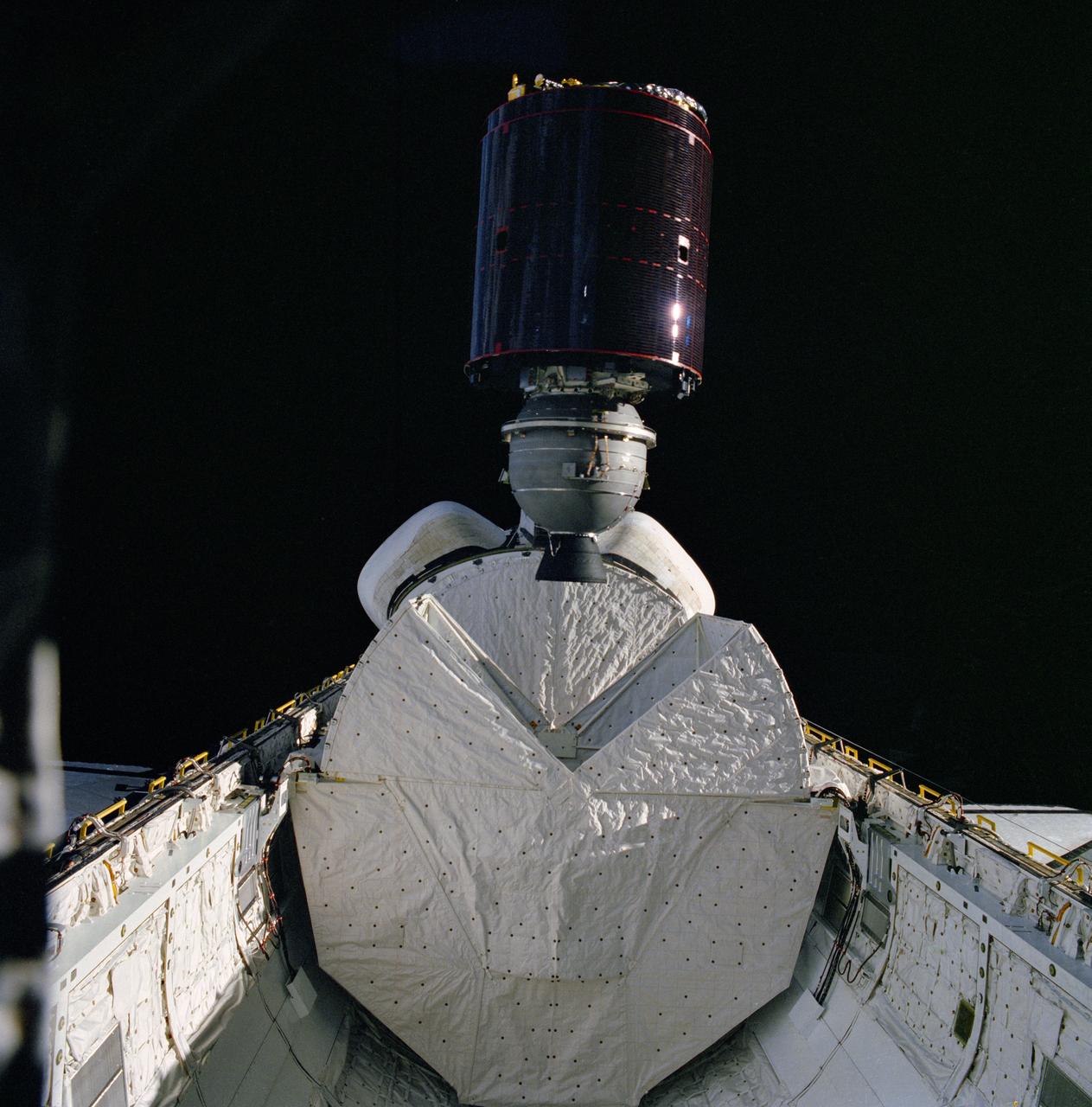
S82-39793 (11 Nov. 1982) --- The Satellite Business Systems (SBS-3) spacecraft springs from its protective ?cradle? in the cargo bay of the Earth-orbiting space shuttle Columbia and head toward a series of maneuvers that will eventually place it in a geosynchronous orbit. This moment marks a milestone for the Space Transportation System (STS) program, as the placement of the communications satellites represents the first deployment of a commercial satellite from an orbiting space vehicle. Part of Columbia?s wings can be seen on both the port and starboard sides. Also both orbital maneuvering system (OMS) pods are seen at center. The vertical stabilizer is obscured by the satellite. The closed protective cradle device shielding Telesat Canada?s ANIK C-3 spacecraft is seen between the other shield and the OMS pod. ANIK is to be launched on the mission?s second day. This photograph was exposed through the aft windows of the flight deck. Photo credit: NASA
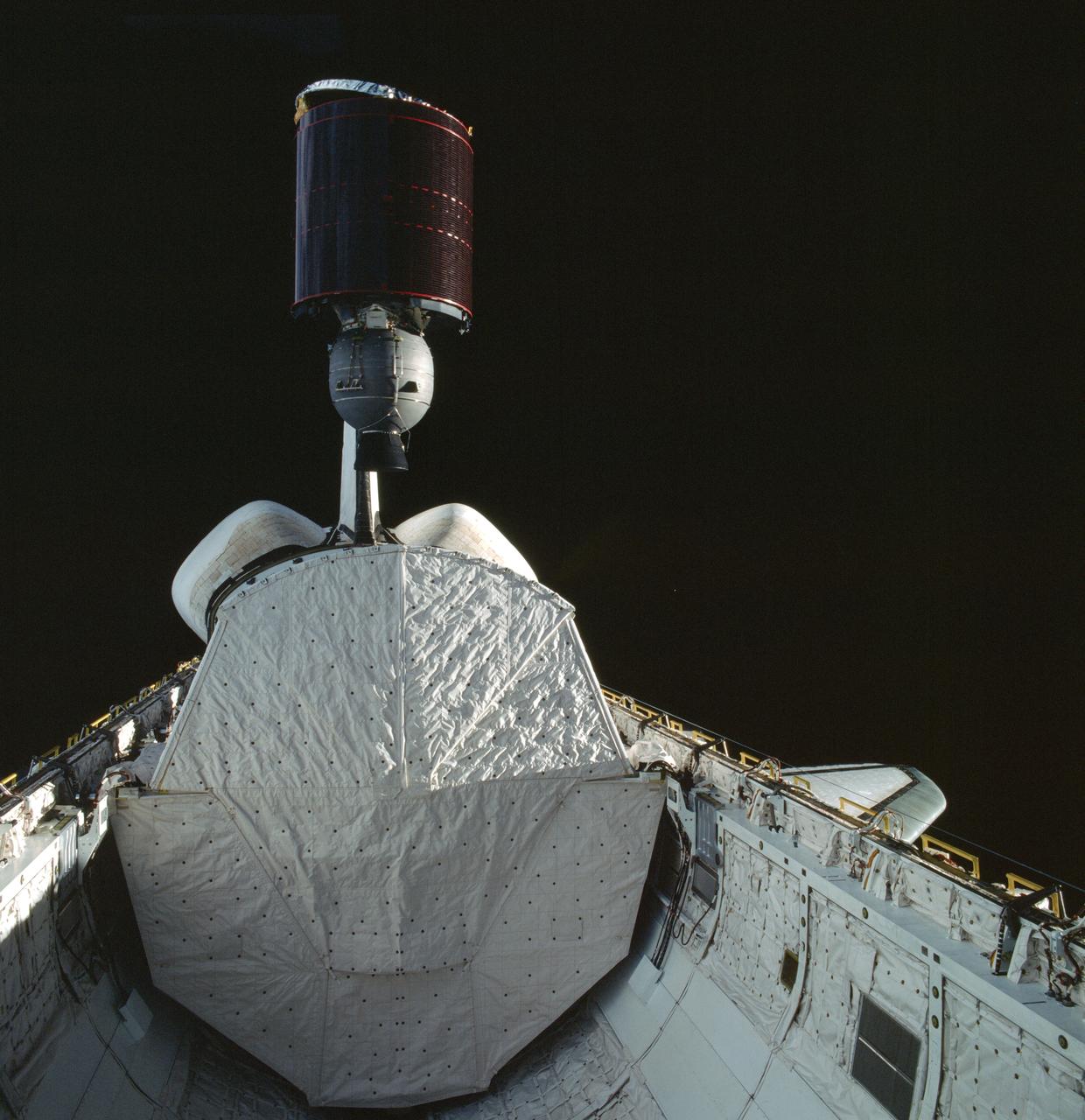
STS005-41-1311 (17 Nov. 1982) --- The Telesat Canada's ANIK C-3 satellite is deployed from its protective cradle in the cargo bay of the space shuttle Columbia. Part of Columbia's wings can be seen on both the port and starboard sides. Part of both orbital maneuvering system (OMS) pods are seen at center. The vertical stabilizer is obscured by the satellite. Photo credit: NASA
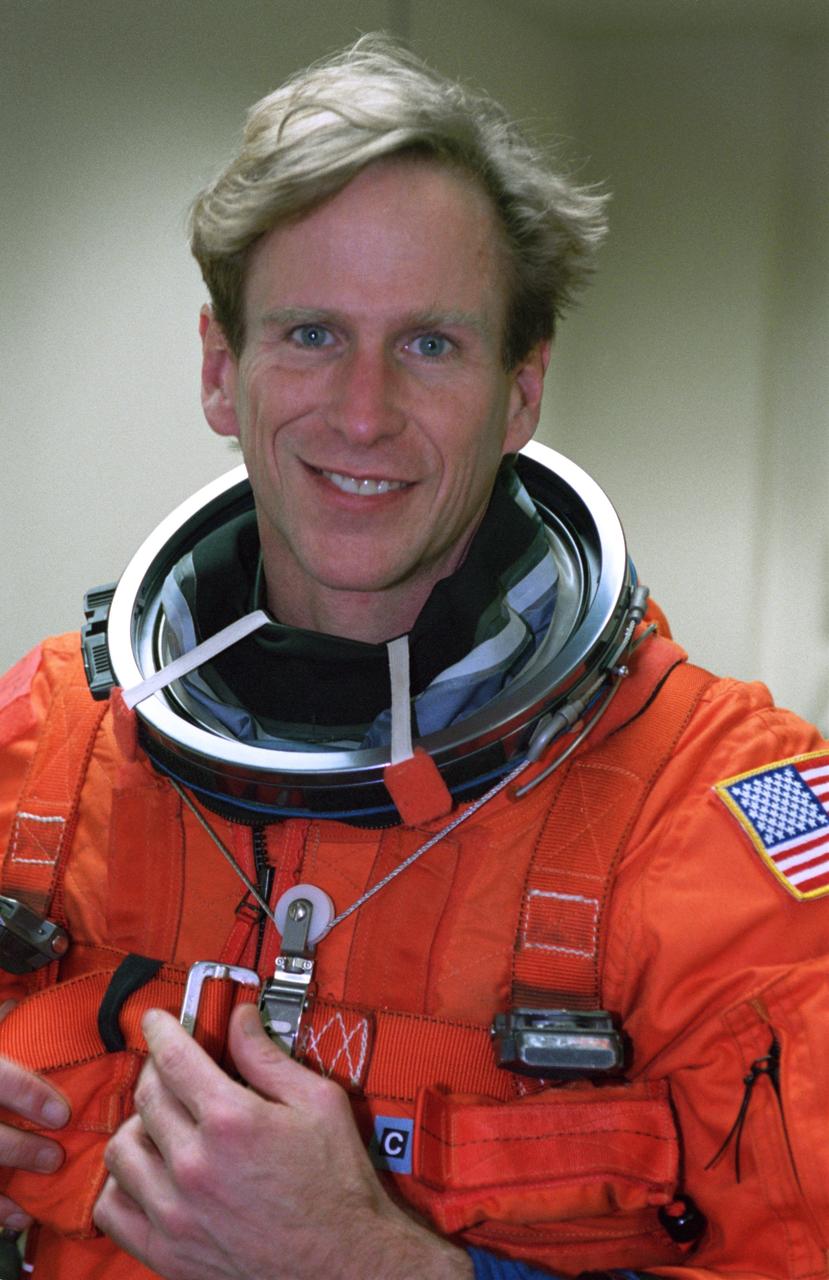
JSC2000-07284 (17 November 2000) --- Astronaut Michael L. Gernhardt, STS-104 mission specialist, attired in a training version of the shuttle launch and entry garment at the Jake Garn Simulation and Training Facility at Johnson Space Center (JSC). Gernhardt will join four other astronauts for a June mission with the International Space Station (ISS).
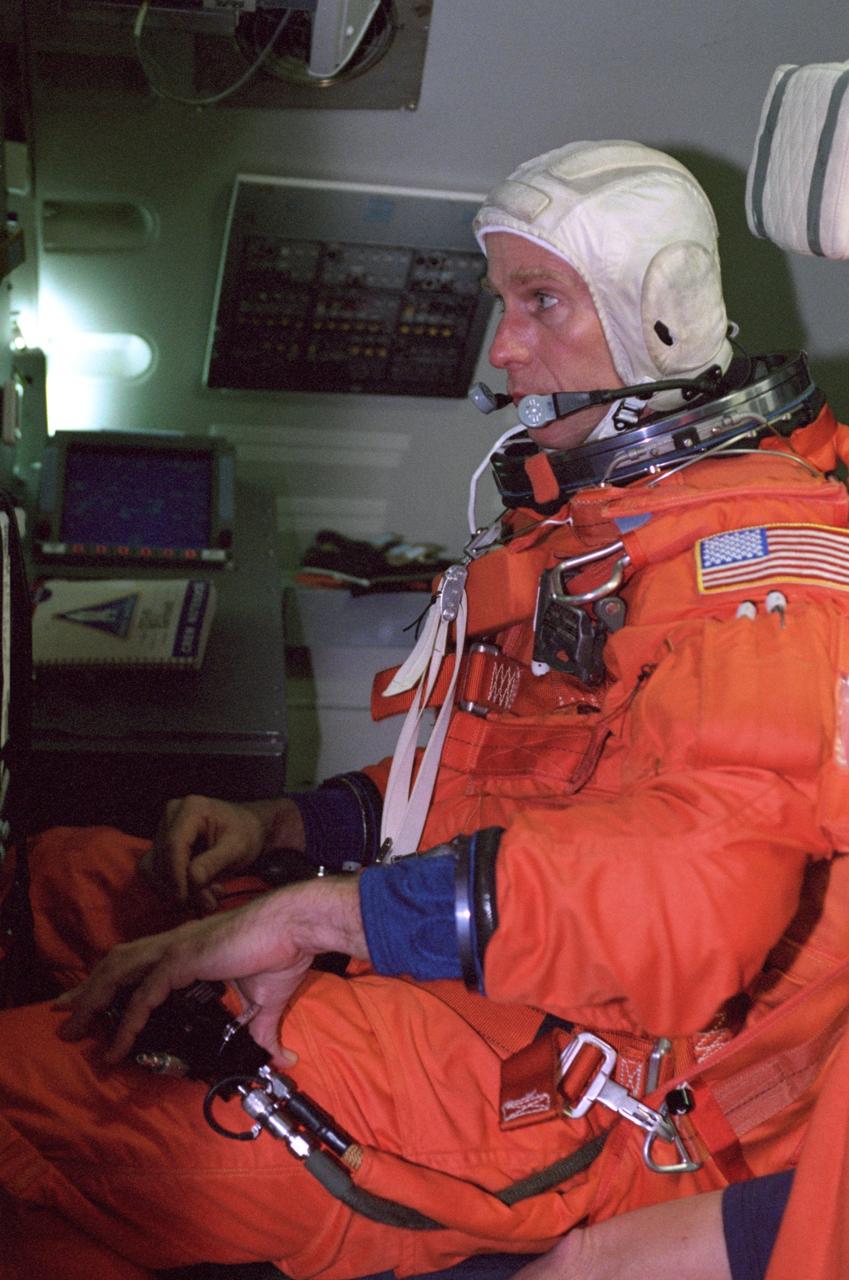
JSC2000-07291 (17 November 2000) --- Astronaut Michael L. Gernhardt, STS-104 mission specialist, participates in a simulation of pre-launch procedures on the flight deck of one of the high fidelity trainers/mockups in the Systems Integration Facility at Johnson Space Center (JSC). Gernhardt will join four other astronauts for a June mission with the International Space Station (ISS).
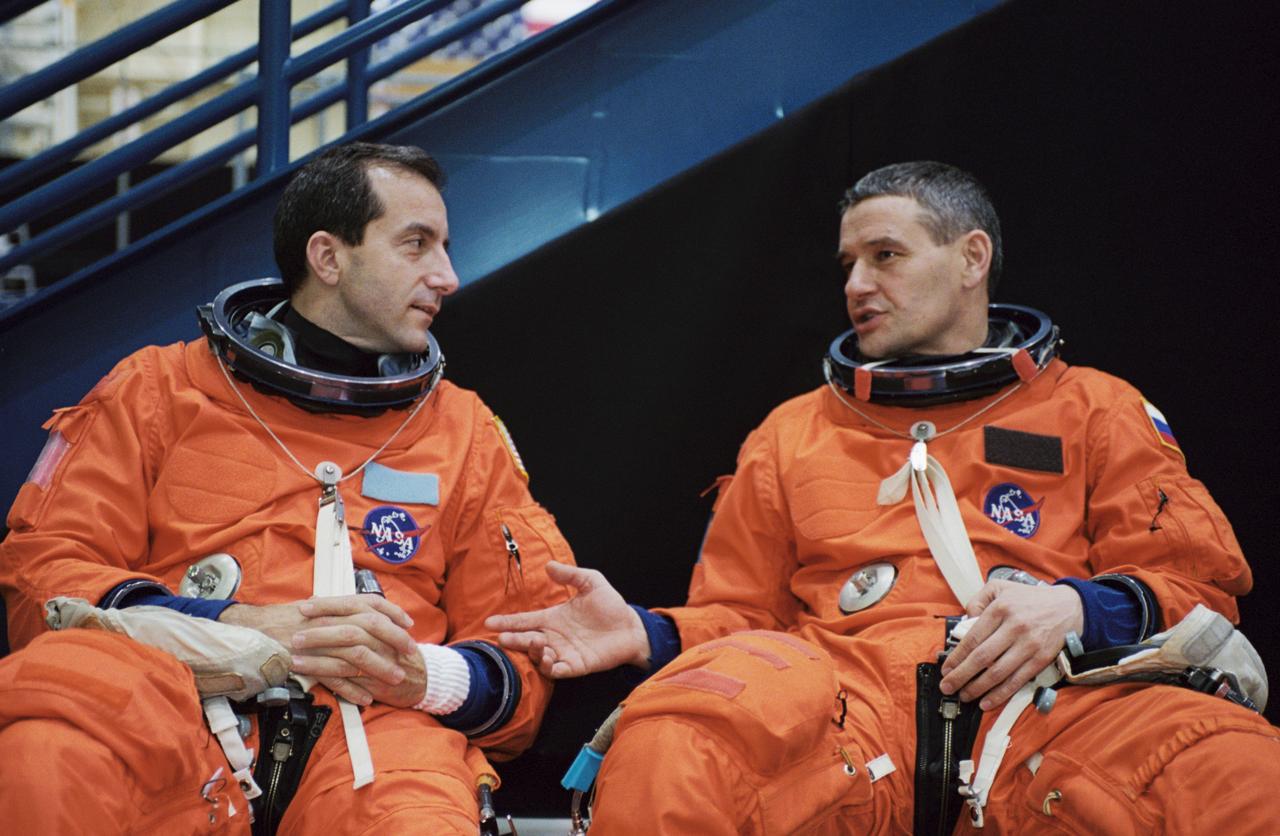
JSC2002-00721 (29 March 2002) --- Astronaut Philippe Perrin (left) and cosmonaut Valeri G. Korzun, STS-111 mission specialist and Expedition Five mission commander, respectively, attired in training versions of the shuttle launch and entry suit, await a mission training session in the Space Vehicle Mockup Facility at the Johnson Space Center (JSC). Perrin represents CNES, the French Space Agency, and Korzun represents Rosaviakosmos.
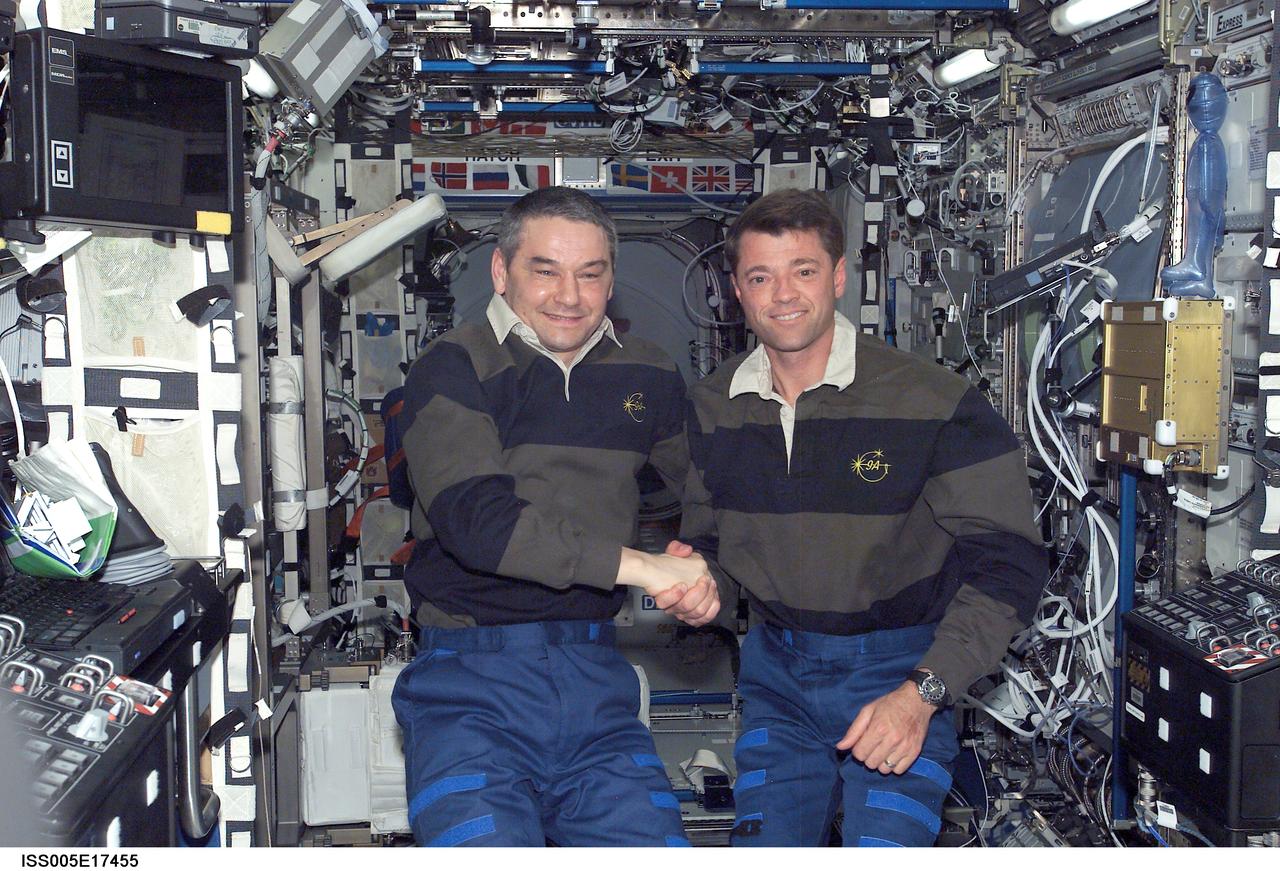
ISS005-E-17455 (13 October 2002) --- Cosmonaut Valery G. Korzun (left), Expedition Five mission commander, and astronaut Jeffrey S. Ashby, STS-112 mission commander, pose for a photo in the Destiny laboratory on the International Space Station (ISS). Korzun represents Rosaviakosmos.
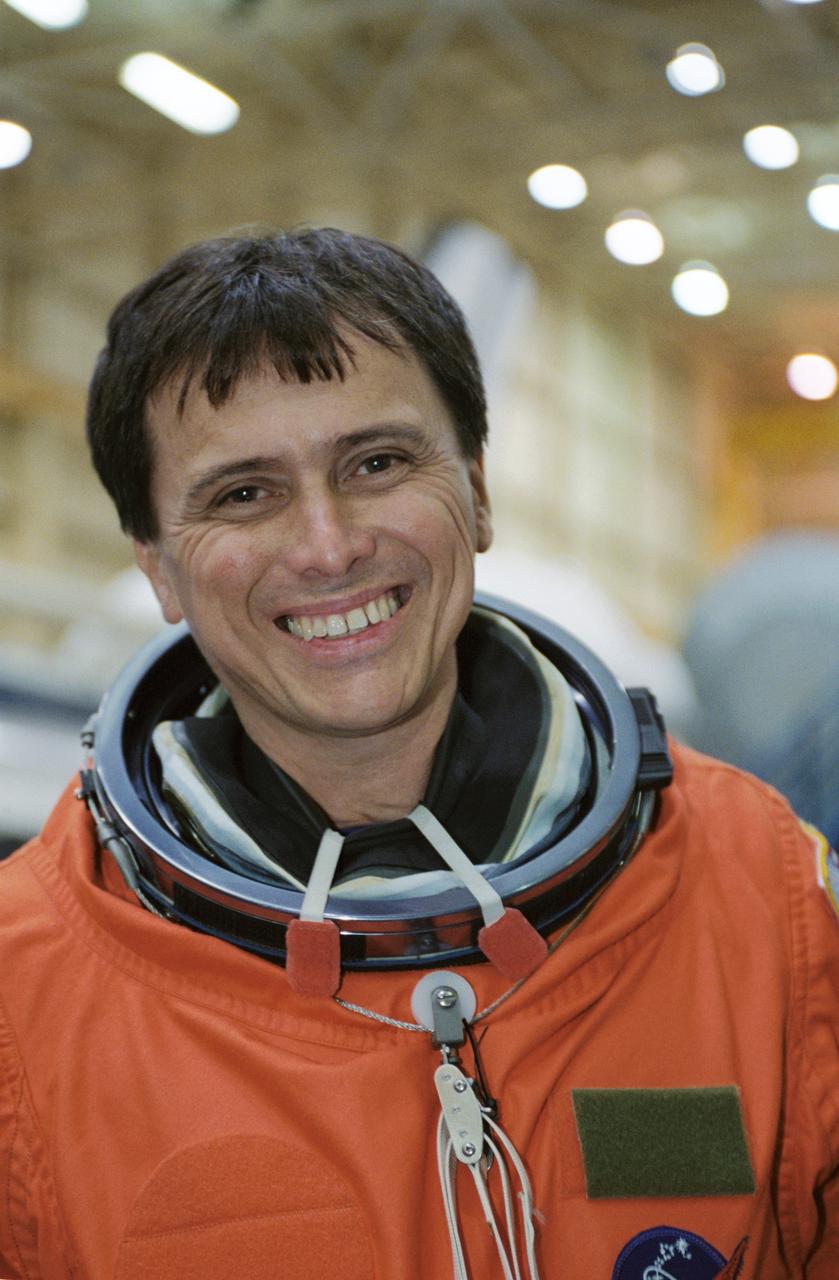
JSC2002-00722 (29 March 2002) --- Astronaut Franklin R. Chang-Diaz, STS-111 mission specialist, attired in a training version of the shuttle launch and entry suit, waits for a mission training session in the Space Vehicle Mockup Facility at the Johnson Space Center (JSC).

JSC2000-07285 (17 November 2000) --- Astronaut Steven W. Lindsey, STS-104 mission commander, attired in a training version of the shuttle launch and entry garment, awaits a training session at the Jake Garn Simulation and Training Facility at Johnson Space Center (JSC). Lindsey will join four other astronauts for a June mission with the International Space Station (ISS).
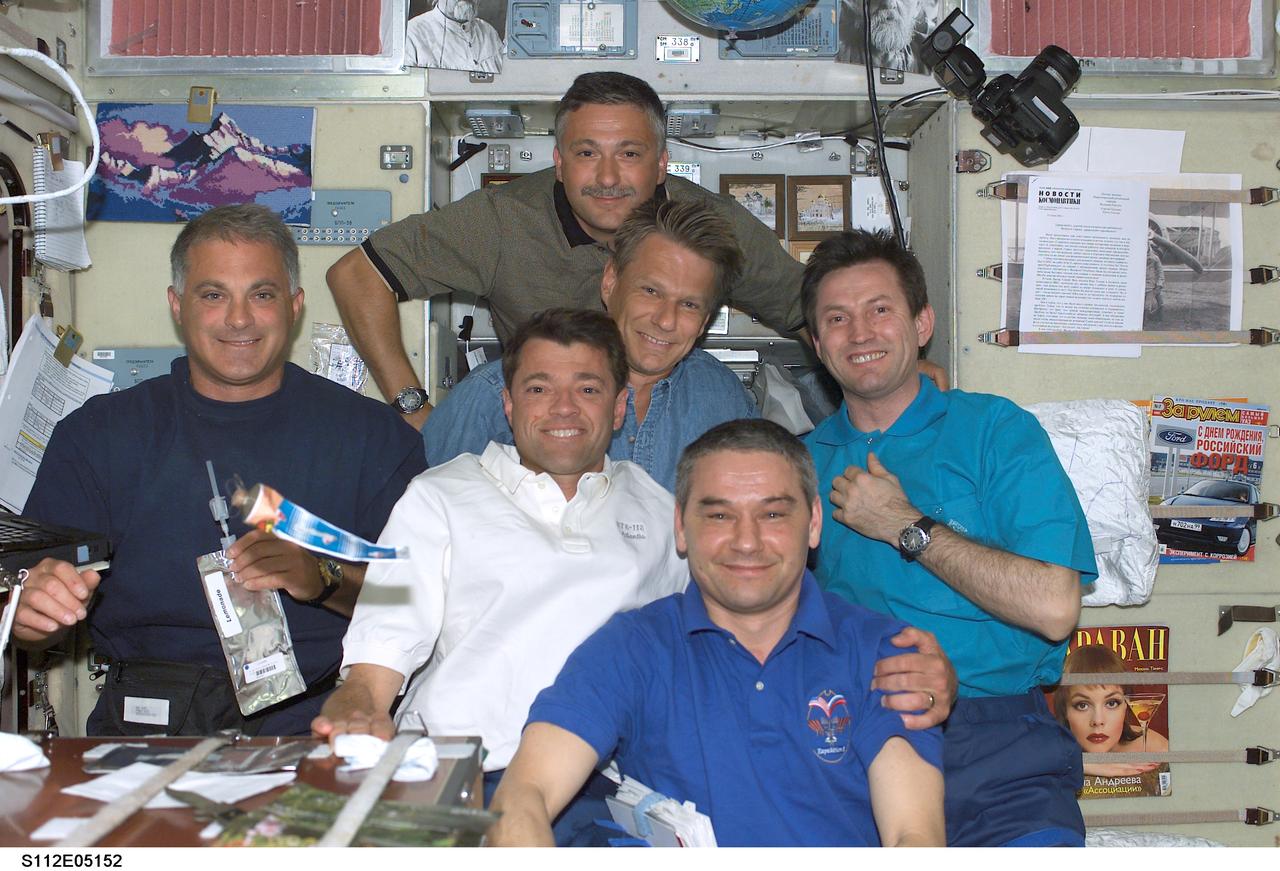
STS112-E-05152 (11 October 2002) --- The STS-112 and Expedition Five crewmembers share a meal in the Zvezda Service Module on the International Space Station (ISS). Pictured, from the left (foreground), are astronauts David A. Wolf, STS-112 mission specialist; Jeffrey S. Ashby, STS-112 mission commander; and cosmonaut Valery G. Korzun, Expedition Five mission commander. Pictured, from the left (back row), are cosmonaut Fyodor N. Yurchikhin; astronaut Piers J. Sellers, both STS-112 mission specialists; and cosmonaut Sergei Y. Treschev, Expedition Five flight engineer. Korzun, Treschev and Yurchikhin represent Rosaviakosmos.
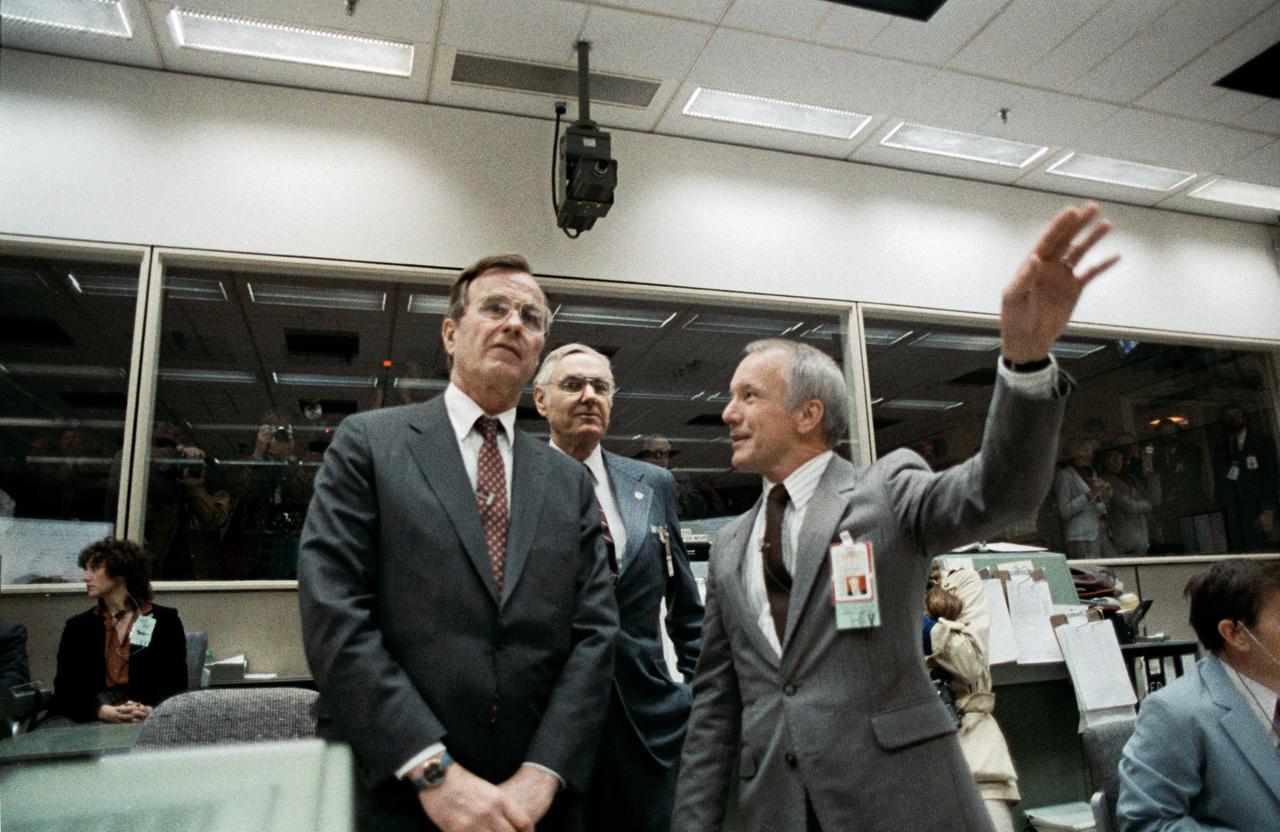
S83-30193 (8 April 1983) --- Vice President George Bush, left, is briefed by JSC Director Gerald D. Griffin, right, during a visit to the mission operations control room (MOCR) in the Johnson Space Center?s mission control center. James Beggs, NASA administrator, center, accompanied the Vice President on his visit. Flight Director Gary E. Coen is partial visible at right edge of frame, The photograph was taken by Otis Imboden.
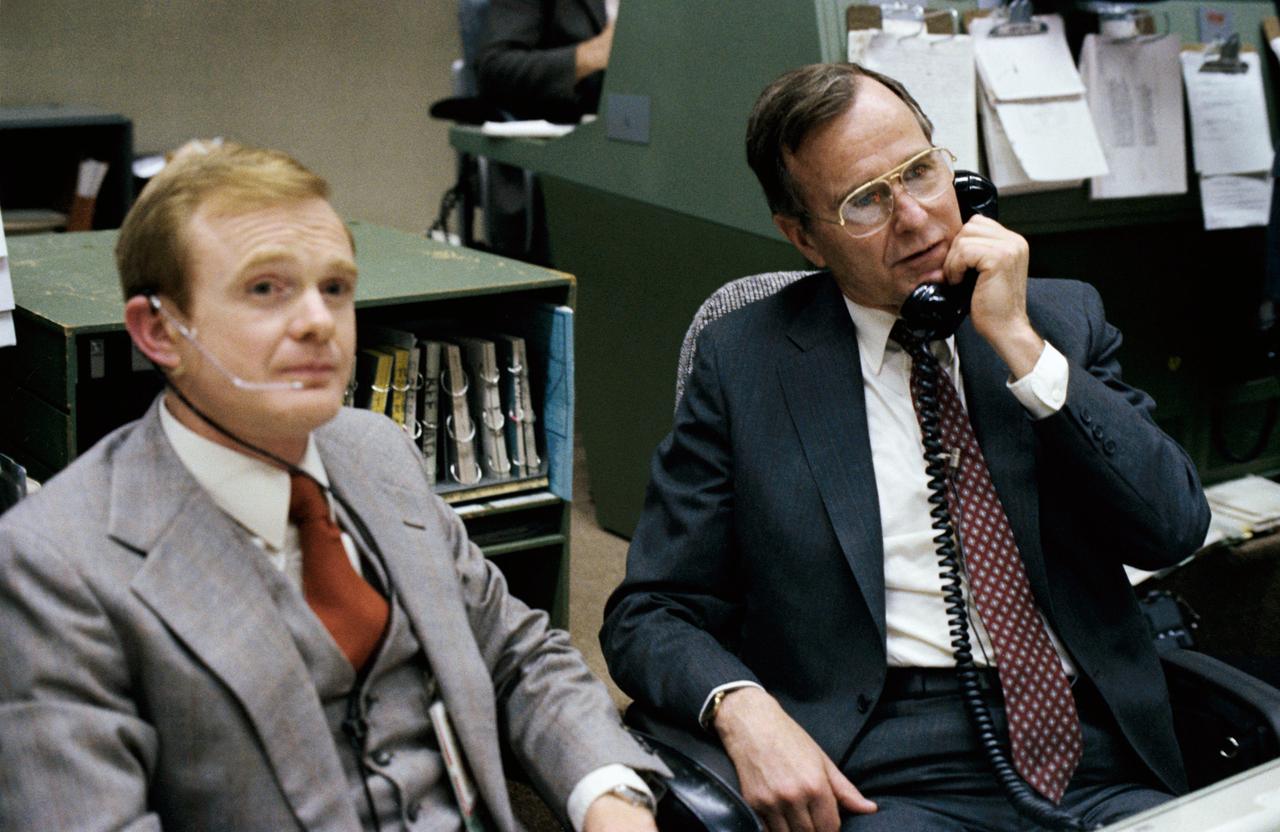
S83-30190 (8 April 1983) --- Vice President George Bush talks to the Earth-orbiting STS-6 astronauts from the spacecraft communicators; (CAPCOM) console in the mission operations control room (MOCR) of the Johnson Space Center?s mission control center. Astronaut Roy D. Bridges, left, is one of the CAPCOM personnel on duty.
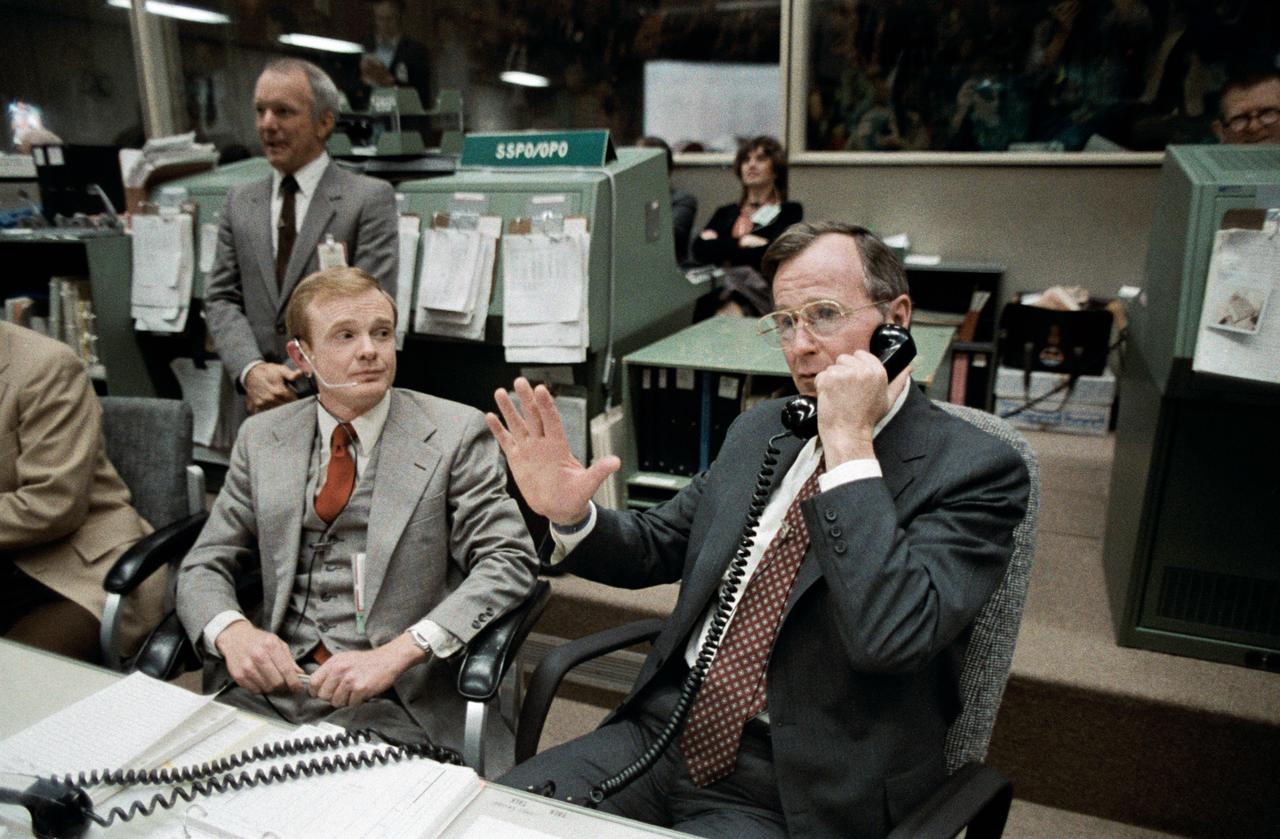
S83-30192 (8 April 1983) --- Vice President George Bush talks to the Earth-orbiting STS-6 astronauts from the spacecraft communicators; (CAPCOM) console in the mission operations control room (MOCR) of the Johnson Space Center?s mission control center. Astronaut Roy D. Bridges, is one of the CAPCOM personnel on duty. JSC Director Gerald D. Griffin, left, watches a large monitor (out of frame) on which the TV scene of the four-member Challenger crew is visible. This photo was made by Otis Imboden.
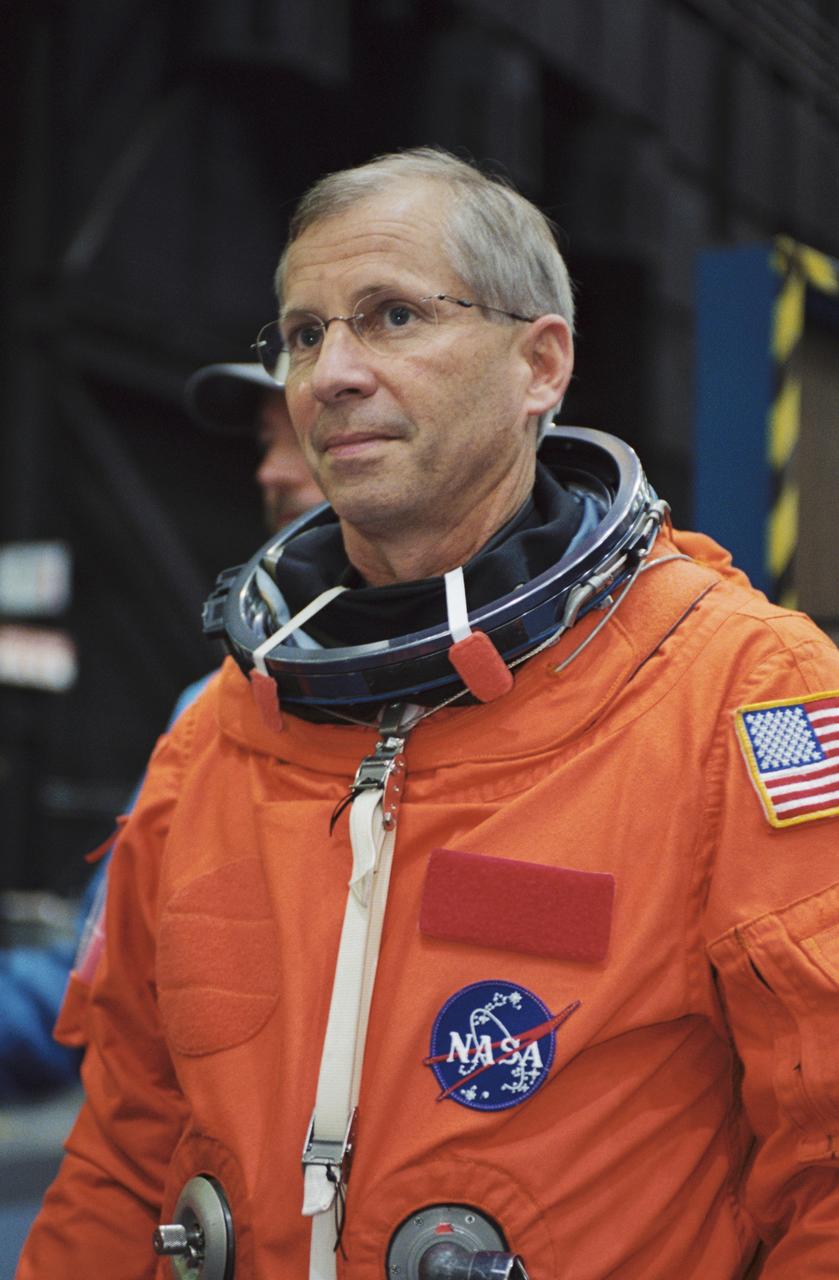
JSC2002-00725 (29 March 2002) --- Astronaut Kenneth D. Cockrell, STS-111 mission commander, attired in a training version of the shuttle launch and entry suit, awaits a mission training session in the Space Vehicle Mockup Facility at Johnson Space Center (JSC).
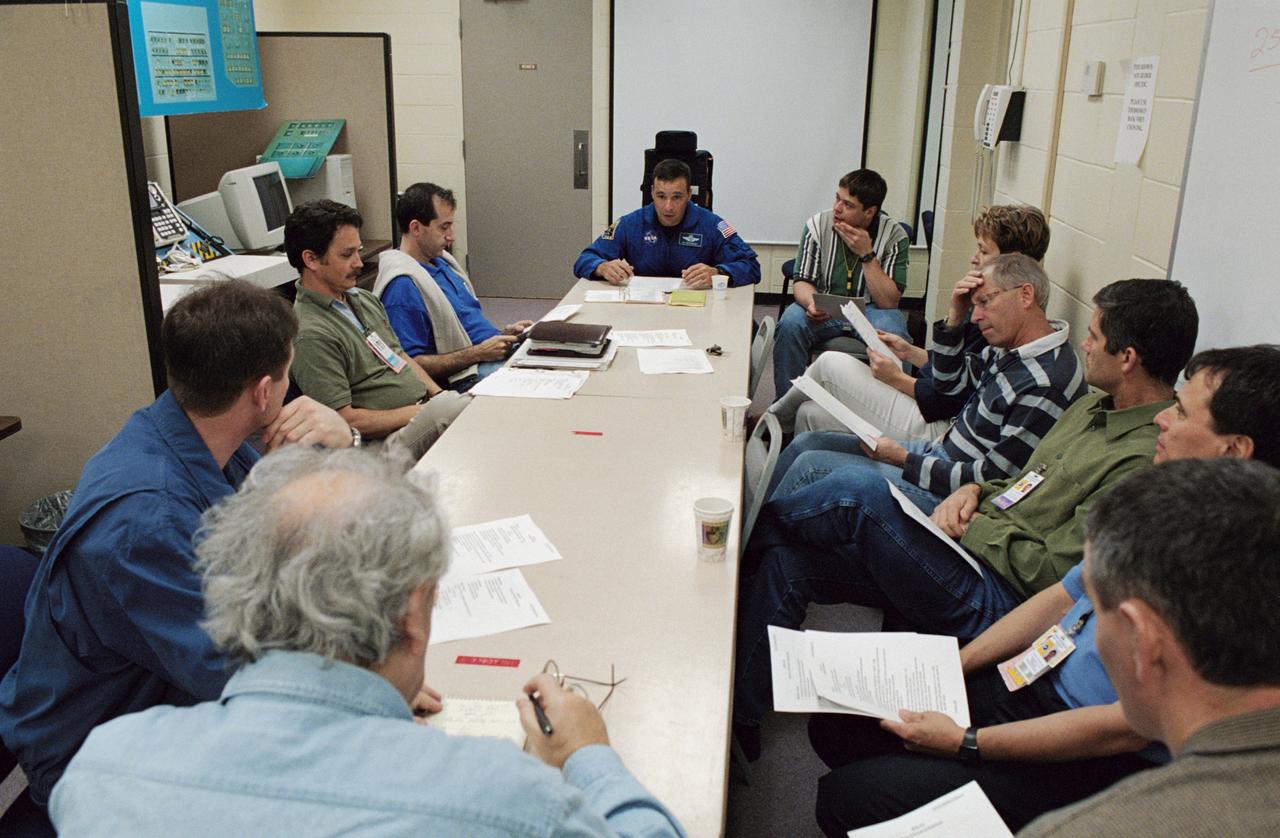
JSC2002-00723 (29 March 2002) --- The STS-111 crewmembers and the Expedition Five crewmembers share a joint planning session in the Space Vehicle Mockup Facility at Johnson Space Center (JSC). Seated on the right side of the conference table are cosmonaut Valeri G. Korzun (foreground), Expedition Five mission commander, astronauts Franklin R. Chang-Diaz, STS-111 mission specialist, Paul S. Lockhart, STS-111 pilot, Kenneth D. Cockrell, STS-111 mission commander, and Peggy A. Whitson, Expedition Five flight engineer. Seated on the left side of the conference table are cosmonaut Sergei Y. Treschev (foreground), Expedition Five flight engineer, and astronaut Philippe Perrin (far end), STS-111 mission specialist. Korzun and Treschev represent Rosaviakosmos and Perrin represents CNES, the French Space Agency.
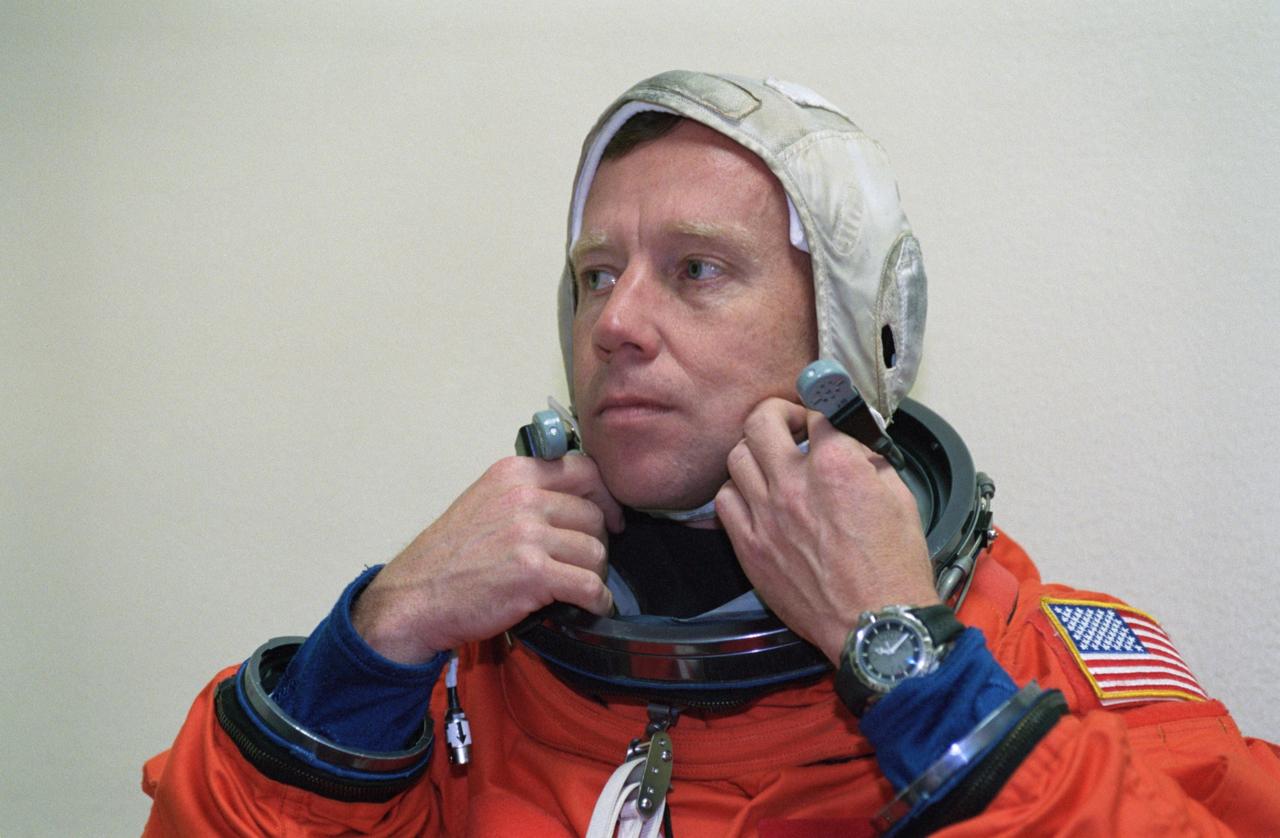
JSC2000-07289 (17 November 2000) --- Astronaut Steven W. Lindsey, STS-104 mission commander, attired in a training version of the shuttle launch and entry garment, prepares for a training session at the Jake Garn Simulation and Training Facility at Johnson Space Center (JSC). Lindsey will join four other astronauts for a June mission with the International Space Station (ISS).
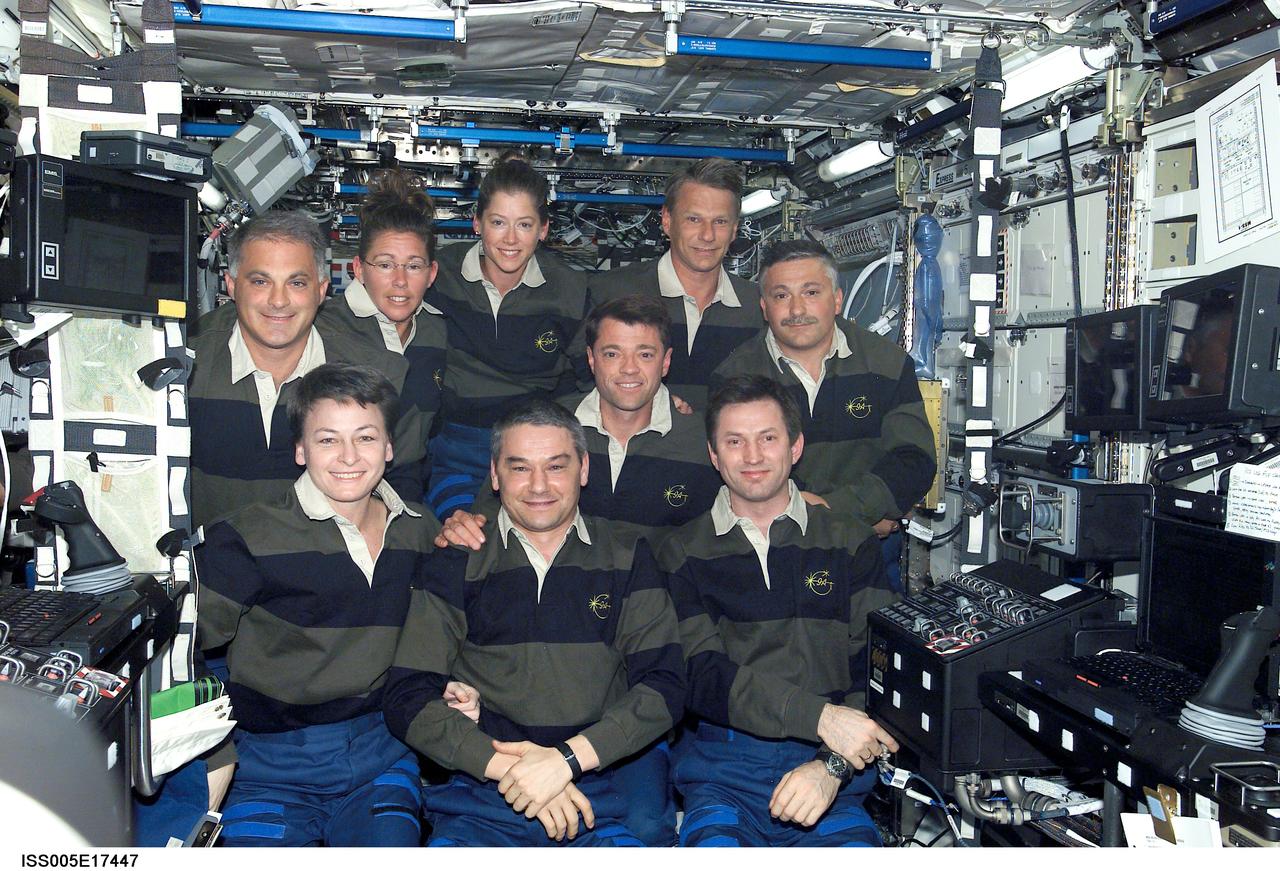
ISS005-E-17447 (13 October 2002) --- The Expedition Five and STS-112 crews assemble for a group photo in the Destiny laboratory on the International Space Station (ISS). From the left, front row, are astronaut Peggy A. Whitson, Expedition Five flight engineer; cosmonauts Valery G. Korzun and Sergei Y. Treschev, Expedition Five mission commander and flight engineer, respectively. From the left, back row, are astronauts David A. Wolf, Sandra H. Magnus, both STS-112 mission specialists; Pamela A. Melroy, Jeffrey S. Ashby, STS-112 pilot and mission commander, respectively; Piers J. Sellers and cosmonaut Fyodor N. Yurchikhin, both STS-112 mission specialists. Korzun, Treschev and Yurchikhin represent Rosaviakosmos.
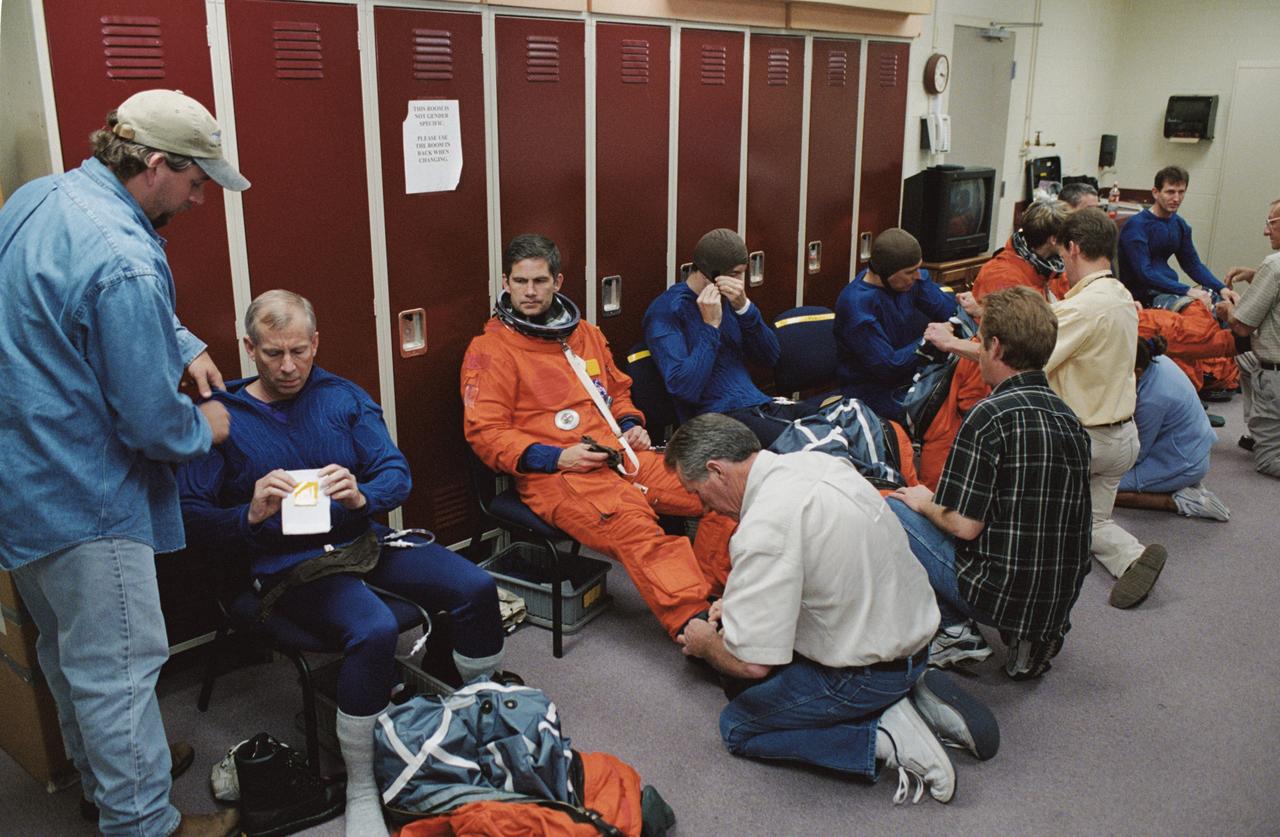
JSC2002-00724 (29 March 2002) --- The STS-111 crewmembers and the Expedition Five crewmembers don training versions of the shuttle launch and entry suit prior to a mission training session in one of the trainer/mockups (out of frame) in the Space Vehicle Mockup Facility at Johnson Space Center (JSC). Seated from the left, the STS-111 crewmembers are astronauts Kenneth D. Cockrell and Paul S. Lockhart, mission commander and pilot, respectively, Philippe Perrin and Franklin R. Chang-Diaz, both mission specialists; along with the Expedition Five crewmembers--astronaut Peggy A. Whitson, flight engineer, and cosmonauts Valeri G. Korzun and Sergei Y. Treschev, mission commander and flight engineer, respectively. Korzun and Treschev represent Rosaviakosmos and Perrin represents CNES, the French Space Agency.
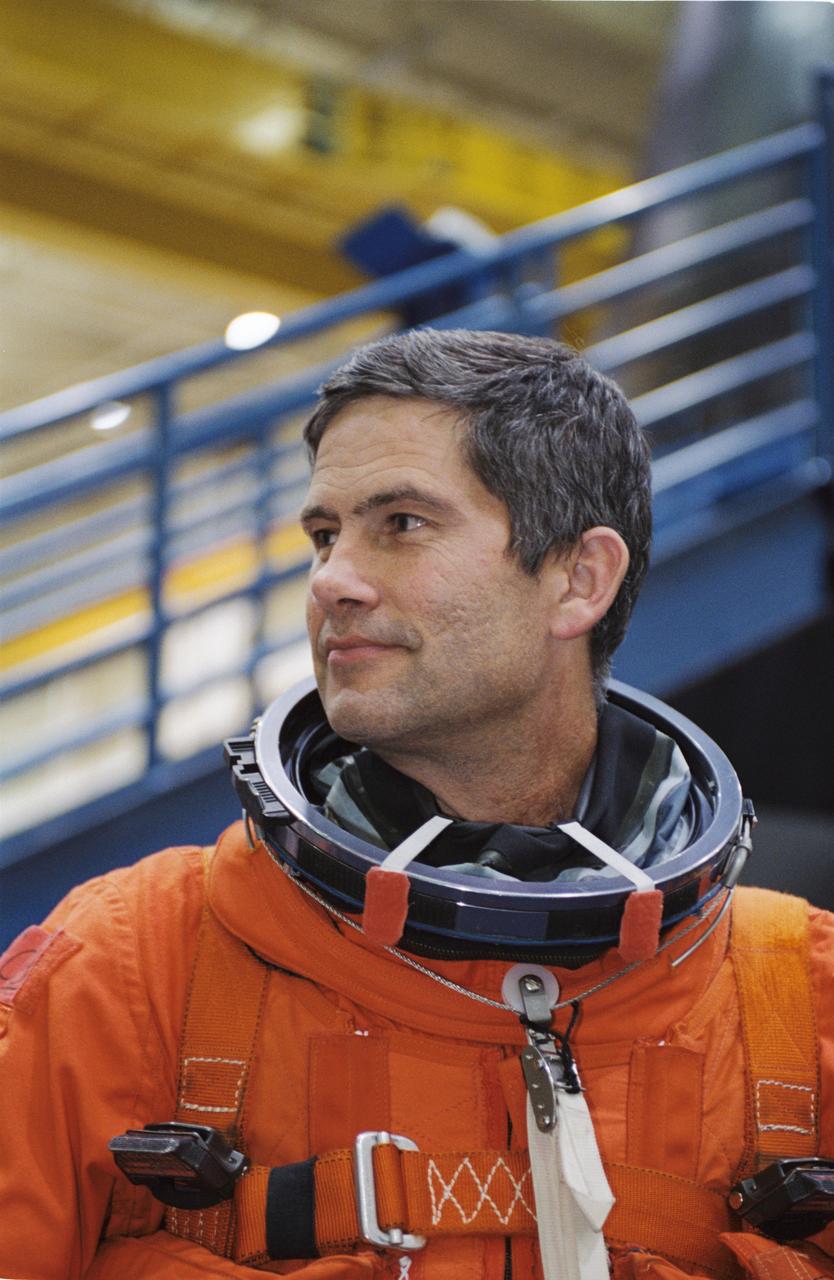
JSC2002-00726 (29 March 2002) --- Astronaut Paul S. Lockhart, STS-111 pilot, attired in a training version of the shuttle launch and entry suit, awaits a mission training session in the Space Vehicle Mockup Facility at Johnson Space Center (JSC).
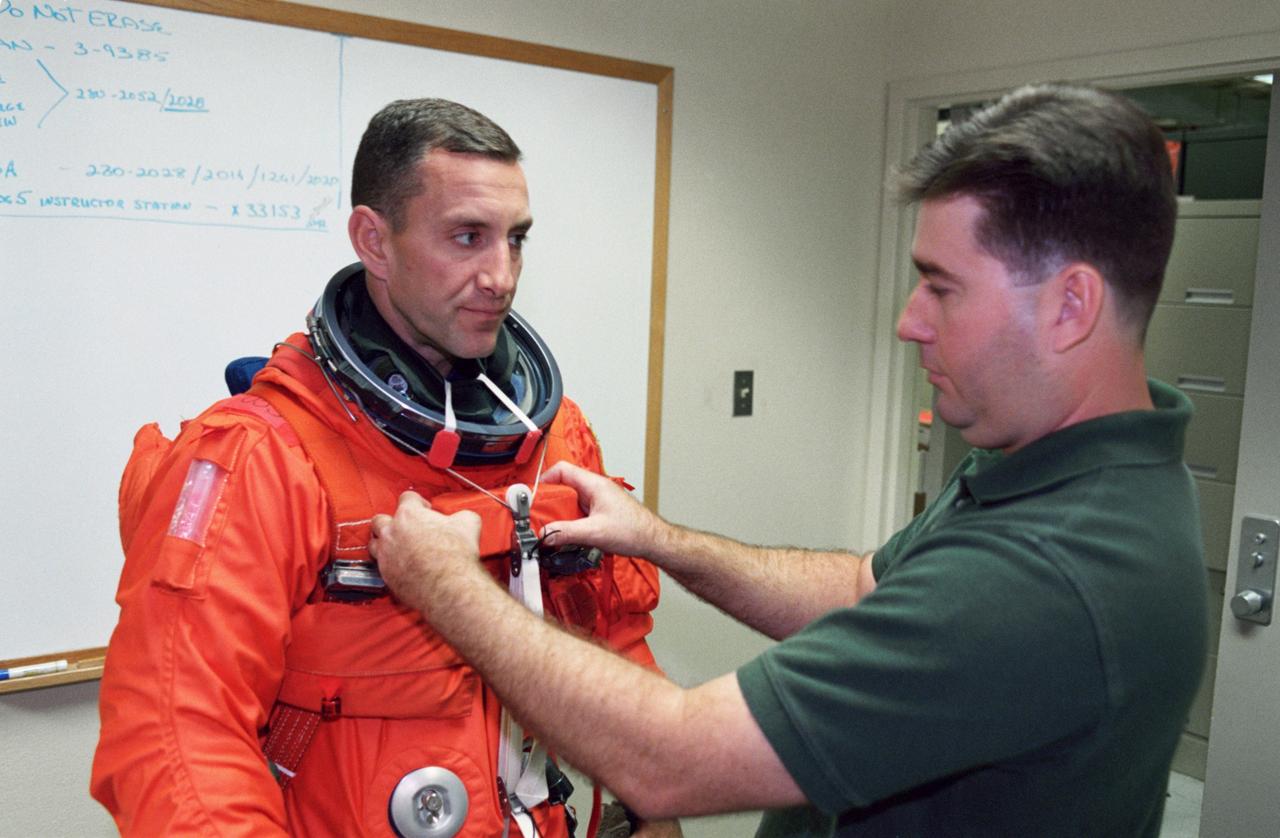
JSC2000-07282 (17 November 2000)--- Astronaut Charles O. Hobaugh, STS-104 pilot, is assisted by suit technician Mike Thompson with a training version of the shuttle launch and entry garment at the Jake Garn Simulation and Training Facility at Johnson Space Center (JSC). Hobaugh, who will join four other astronauts for a June mission with the International Space Station (ISS), shared nearby mockups (out of frame) with his crew mates for a training session dealing with launch and pre-launch issues.
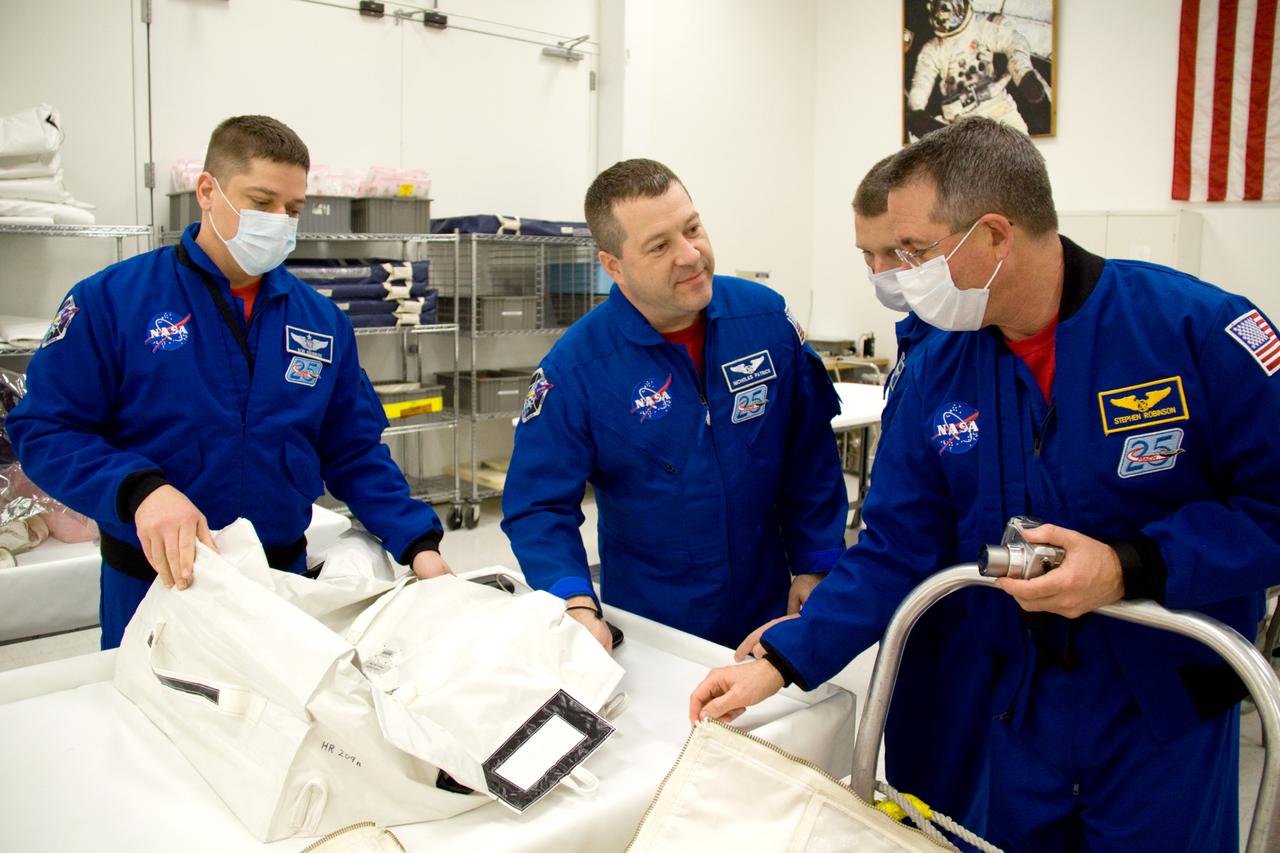
STS-130 LAUNCH L-5 CREW INSPECTS NEW AMMONIA LINES
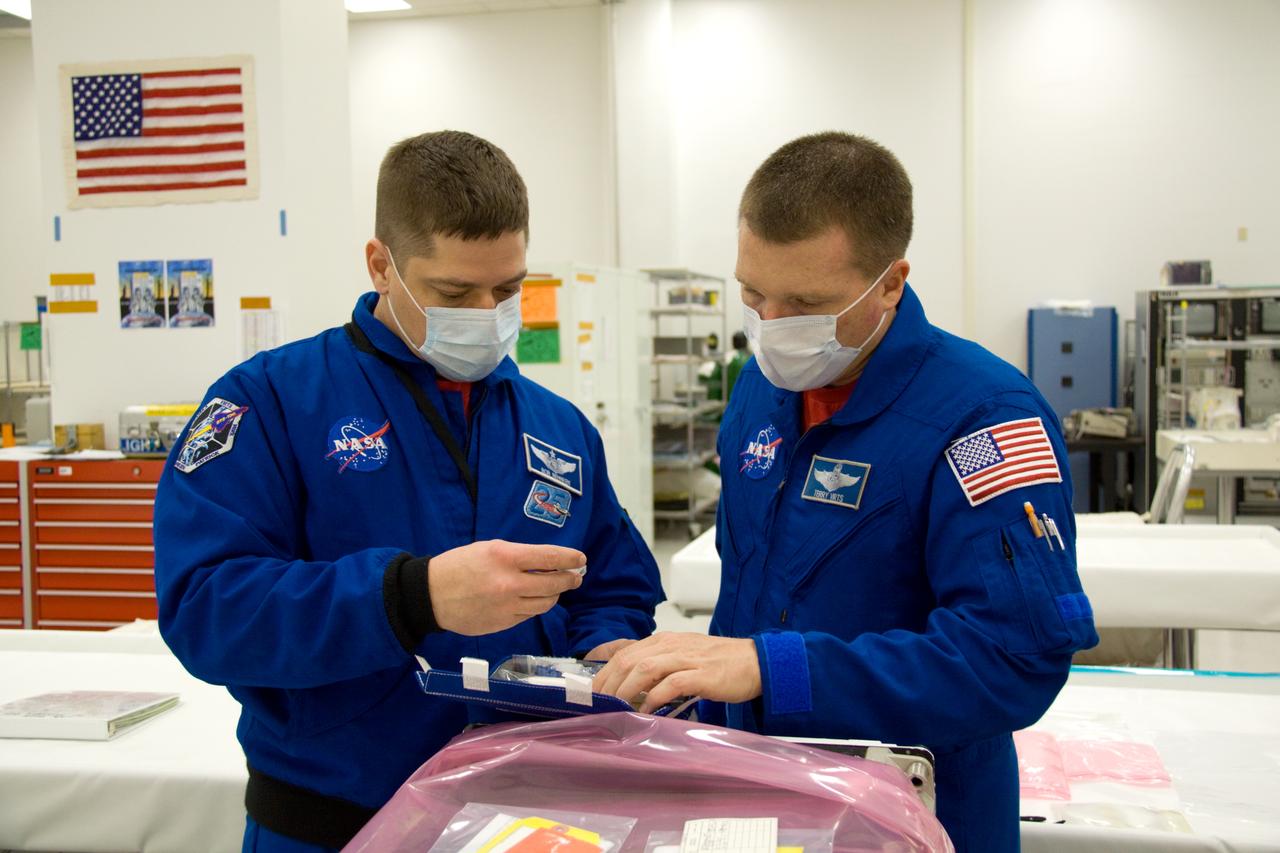
STS-130 LAUNCH L-5 CREW INSPECTS NEW AMMONIA LINES
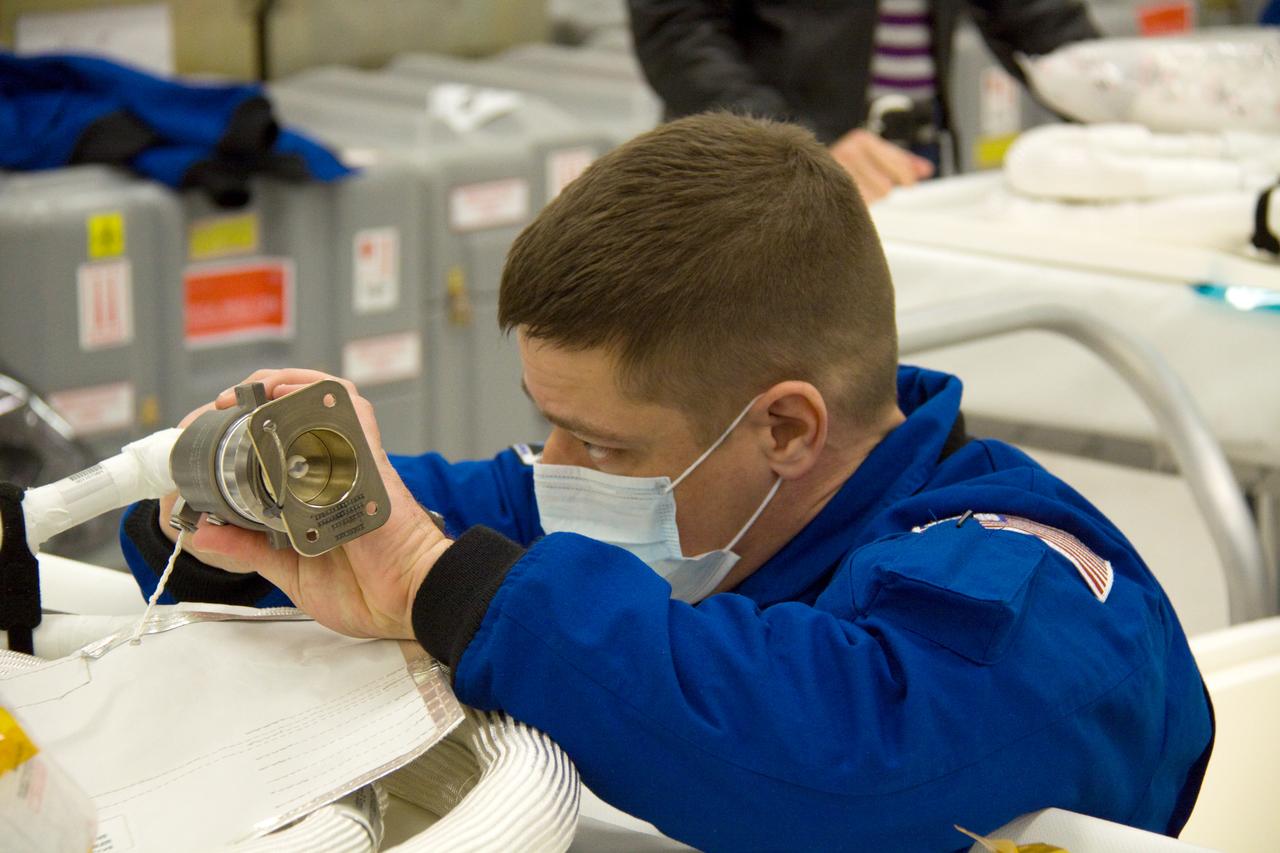
STS-130 LAUNCH L-5 CREW INSPECTS NEW AMMONIA LINES
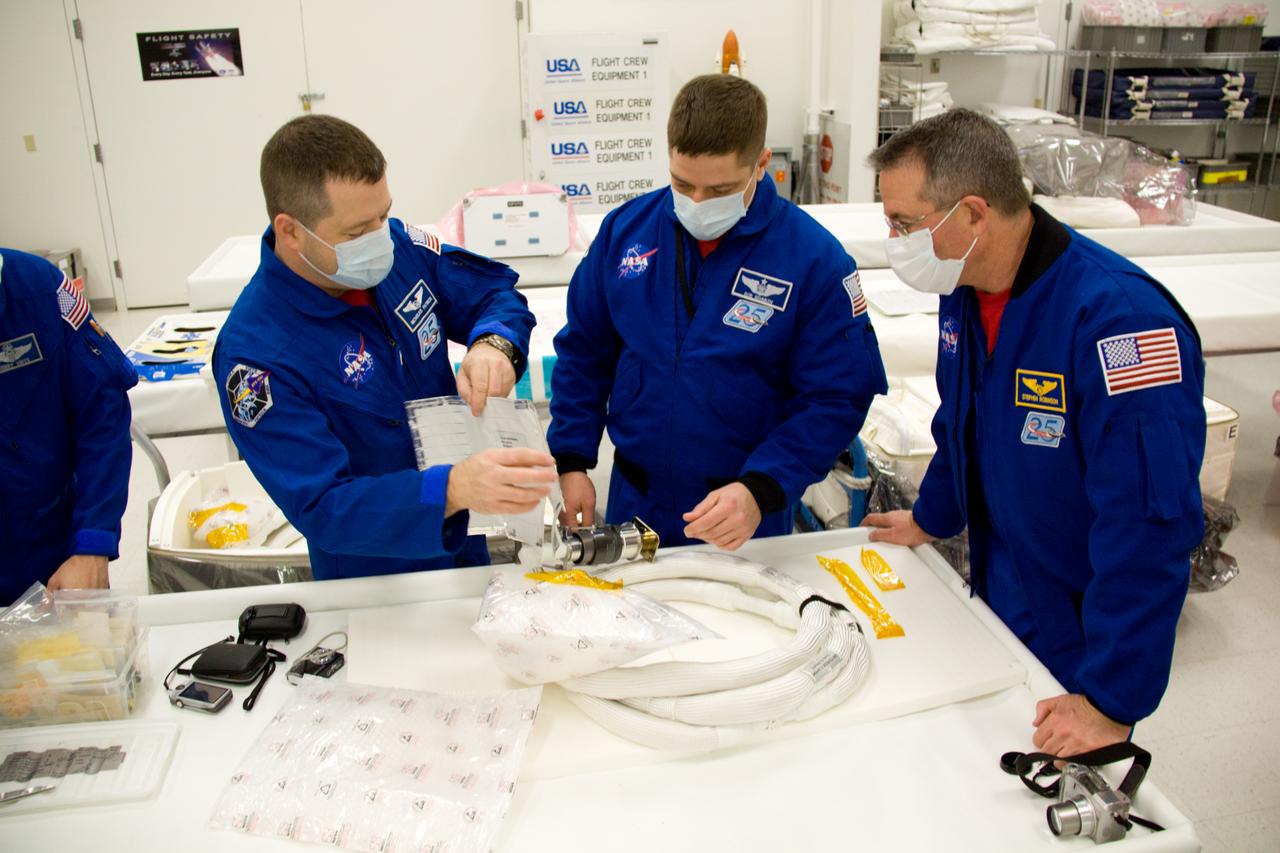
STS-130 LAUNCH L-5 CREW INSPECTS NEW AMMONIA LINES
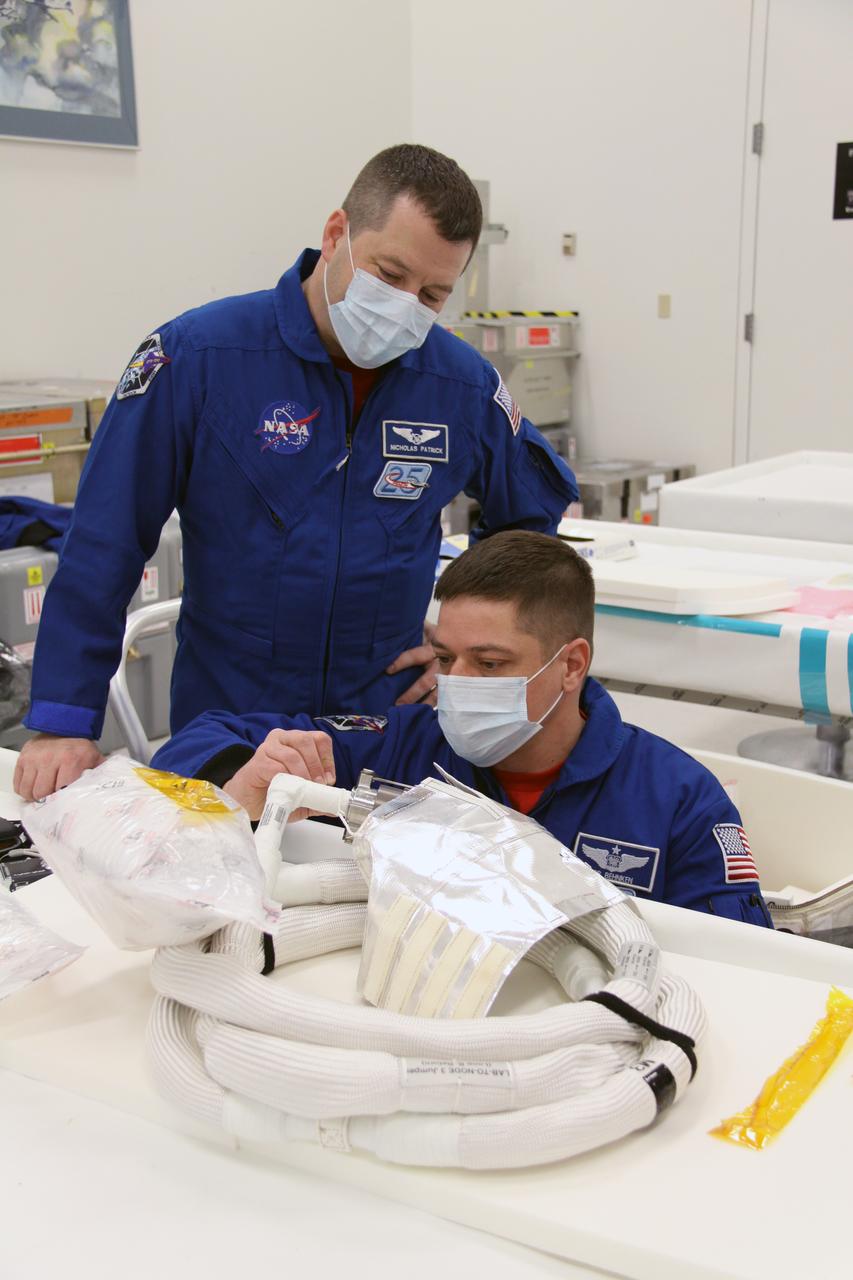
STS-130 LAUNCH L-5 CREW INSPECTS NEW AMMONIA LINES
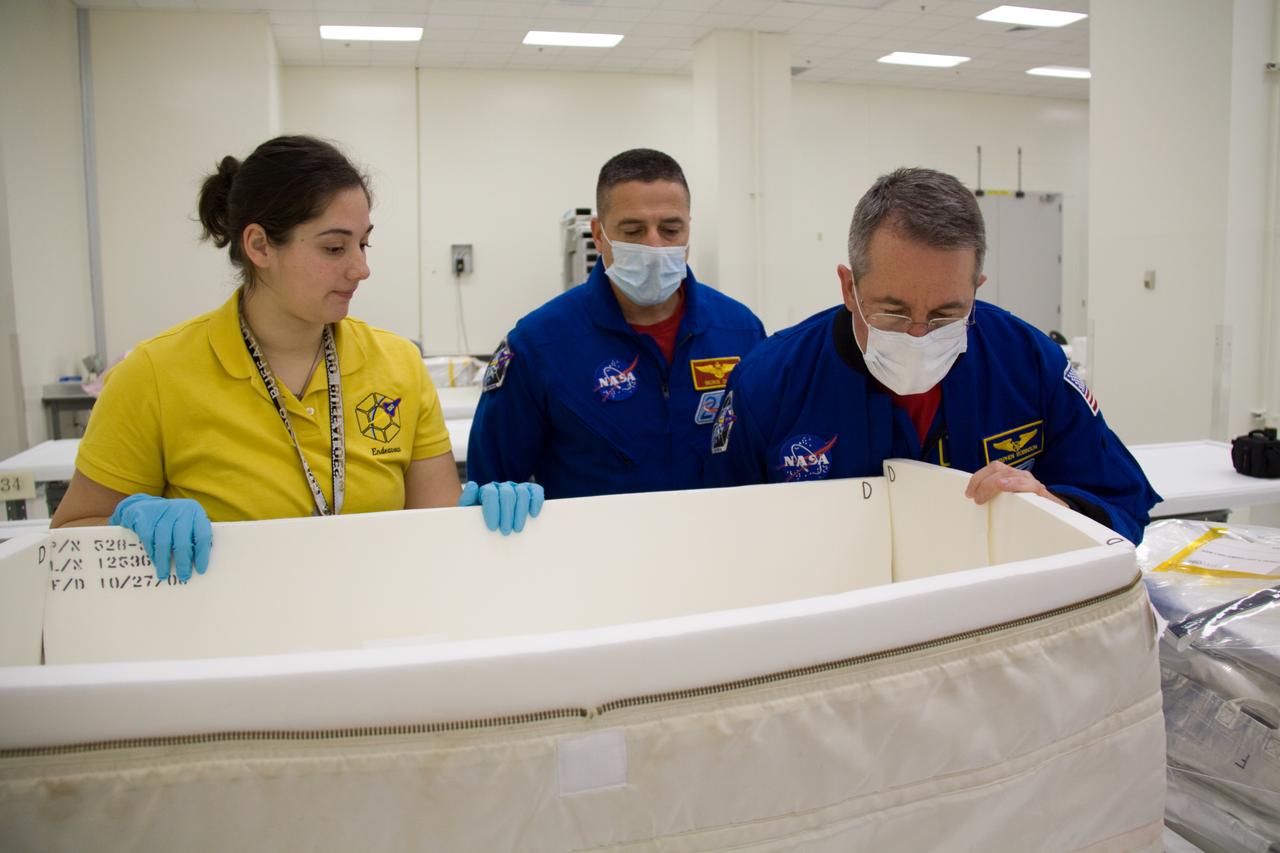
STS-130 LAUNCH L-5 CREW INSPECTS NEW AMMONIA LINES
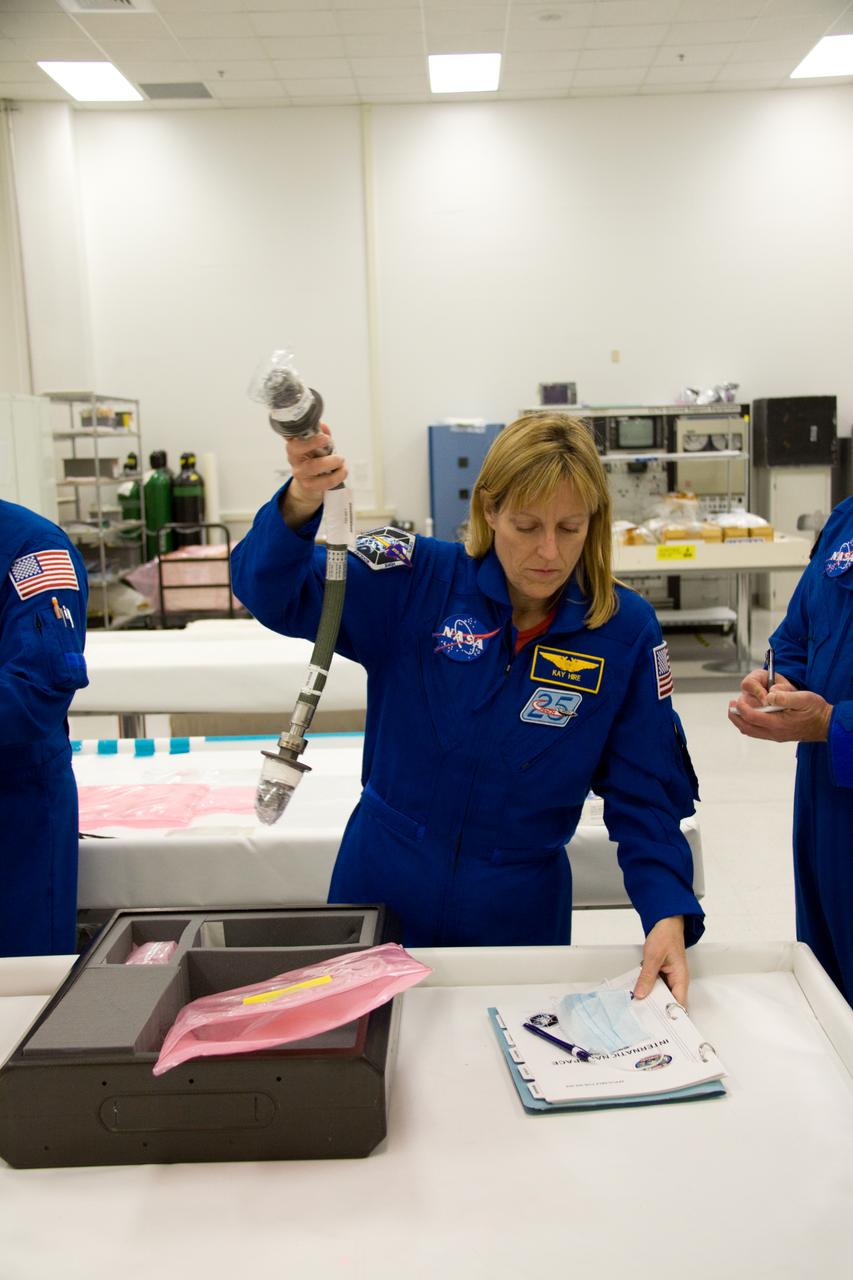
STS-130 LAUNCH L-5 CREW INSPECTS NEW AMMONIA LINES
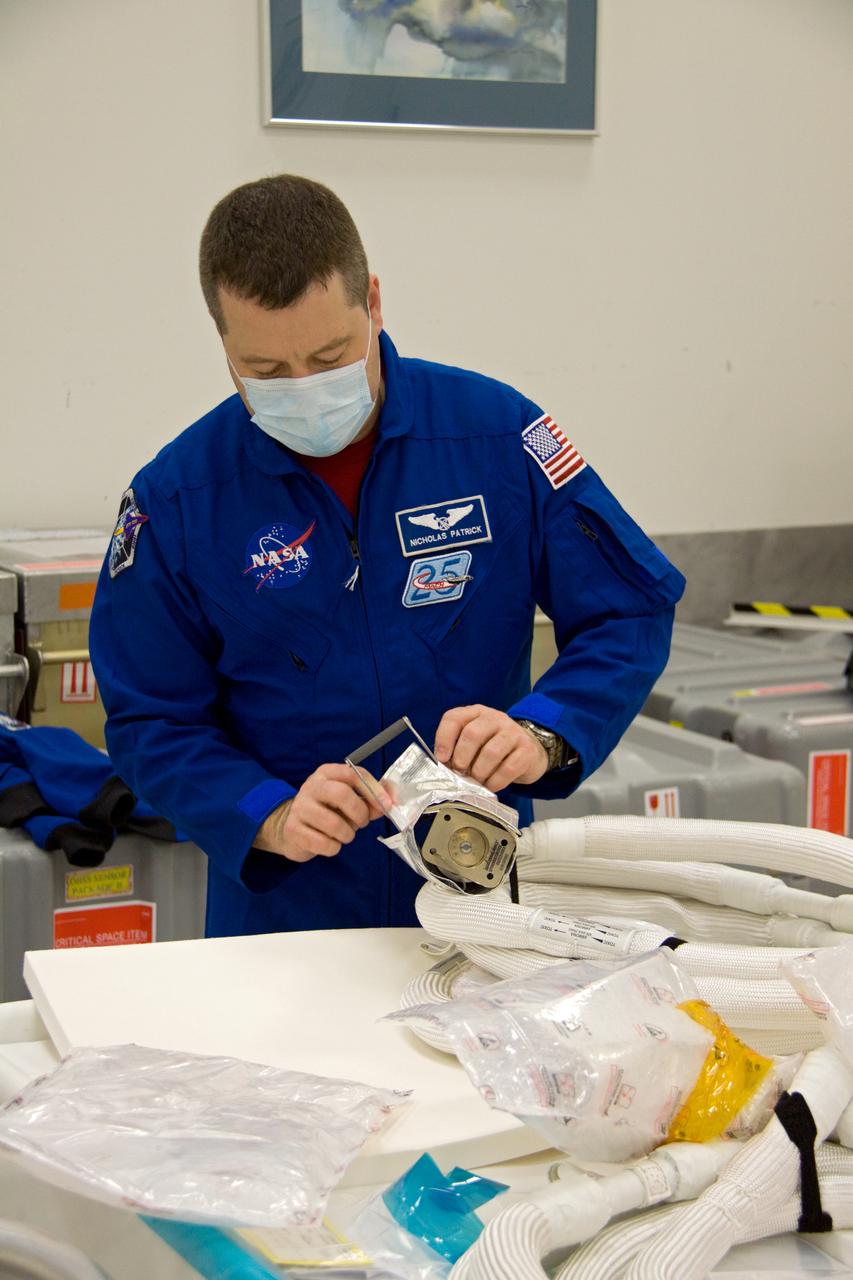
STS-130 LAUNCH L-5 CREW INSPECTS NEW AMMONIA LINES
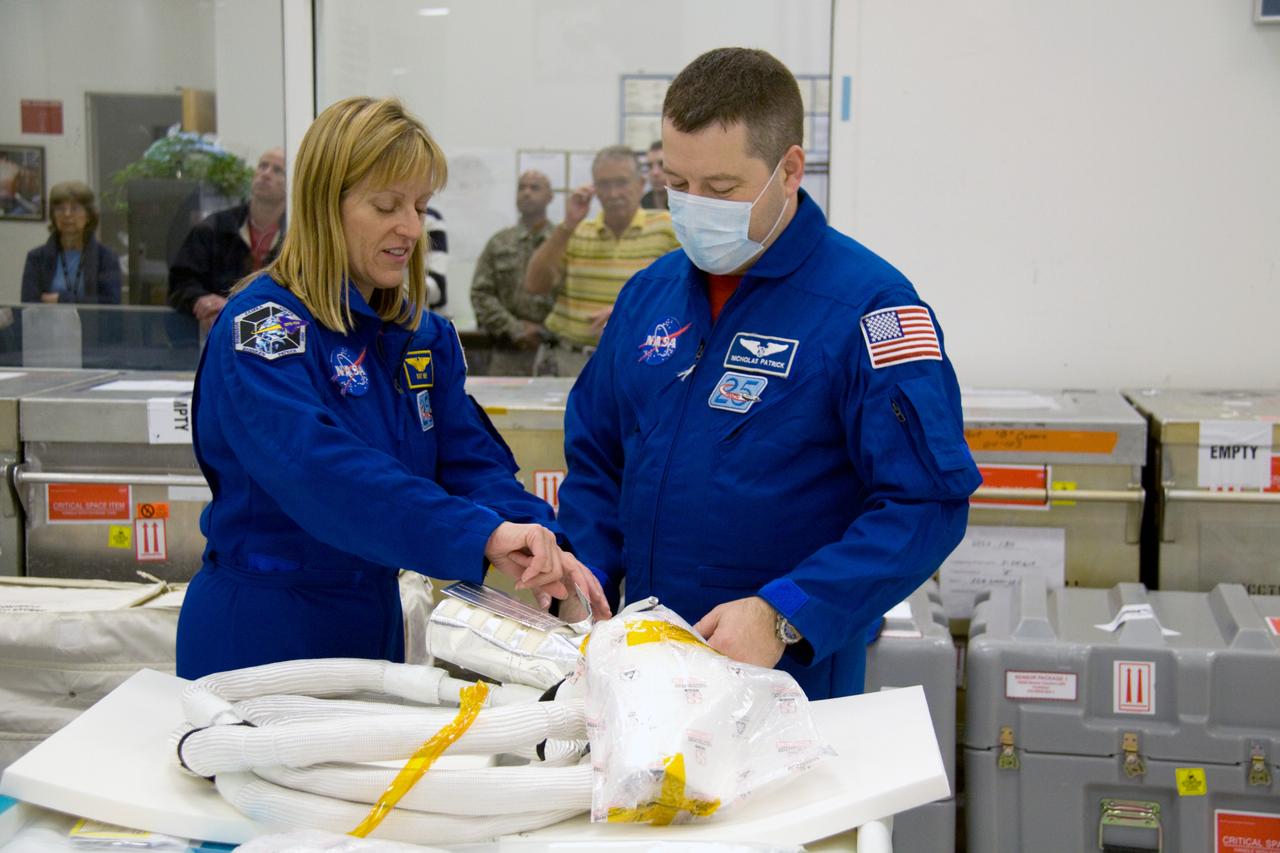
STS-130 LAUNCH L-5 CREW INSPECTS NEW AMMONIA LINES
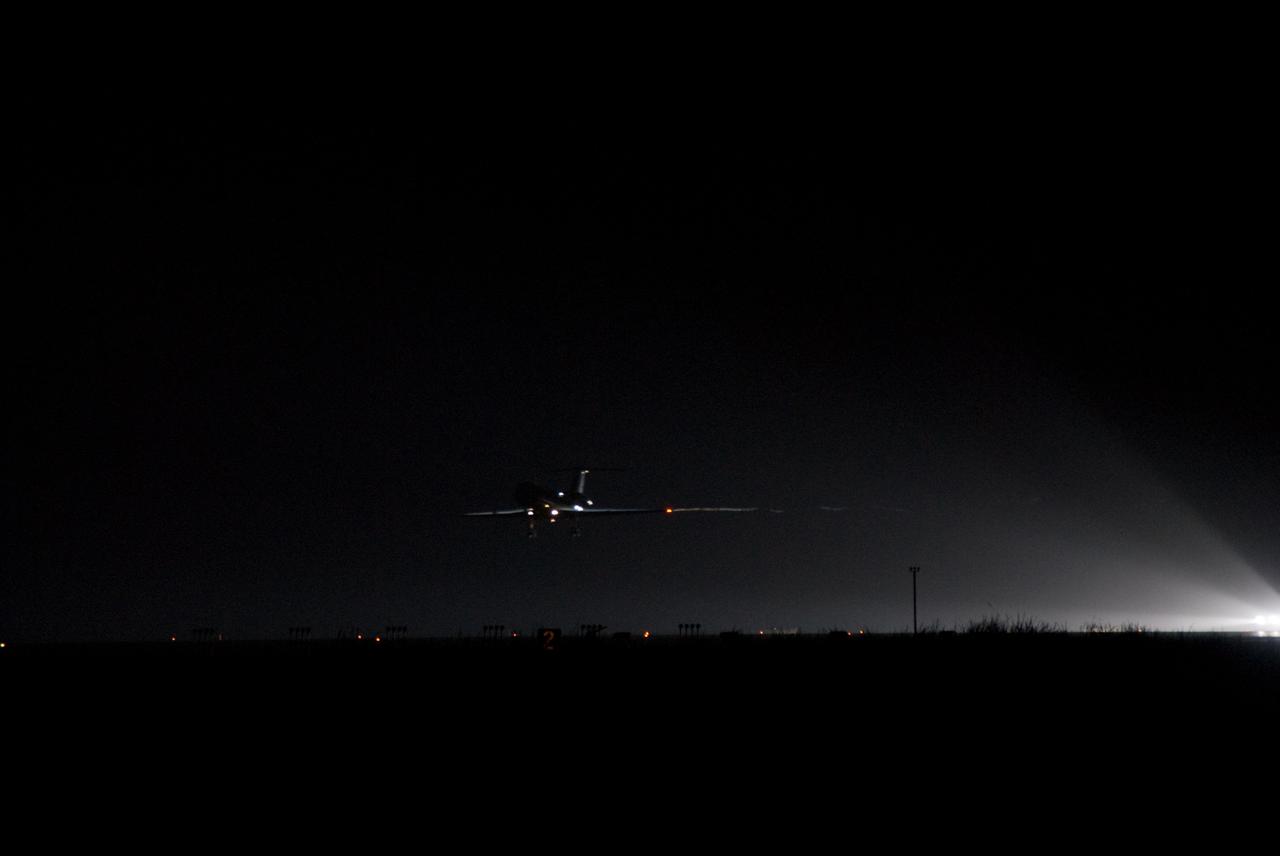
STS-130 LAUNCH L-5 SUITED STA'S W/COMMANDER GEORGE ZAMKA & PILOT TERRY VIRTS
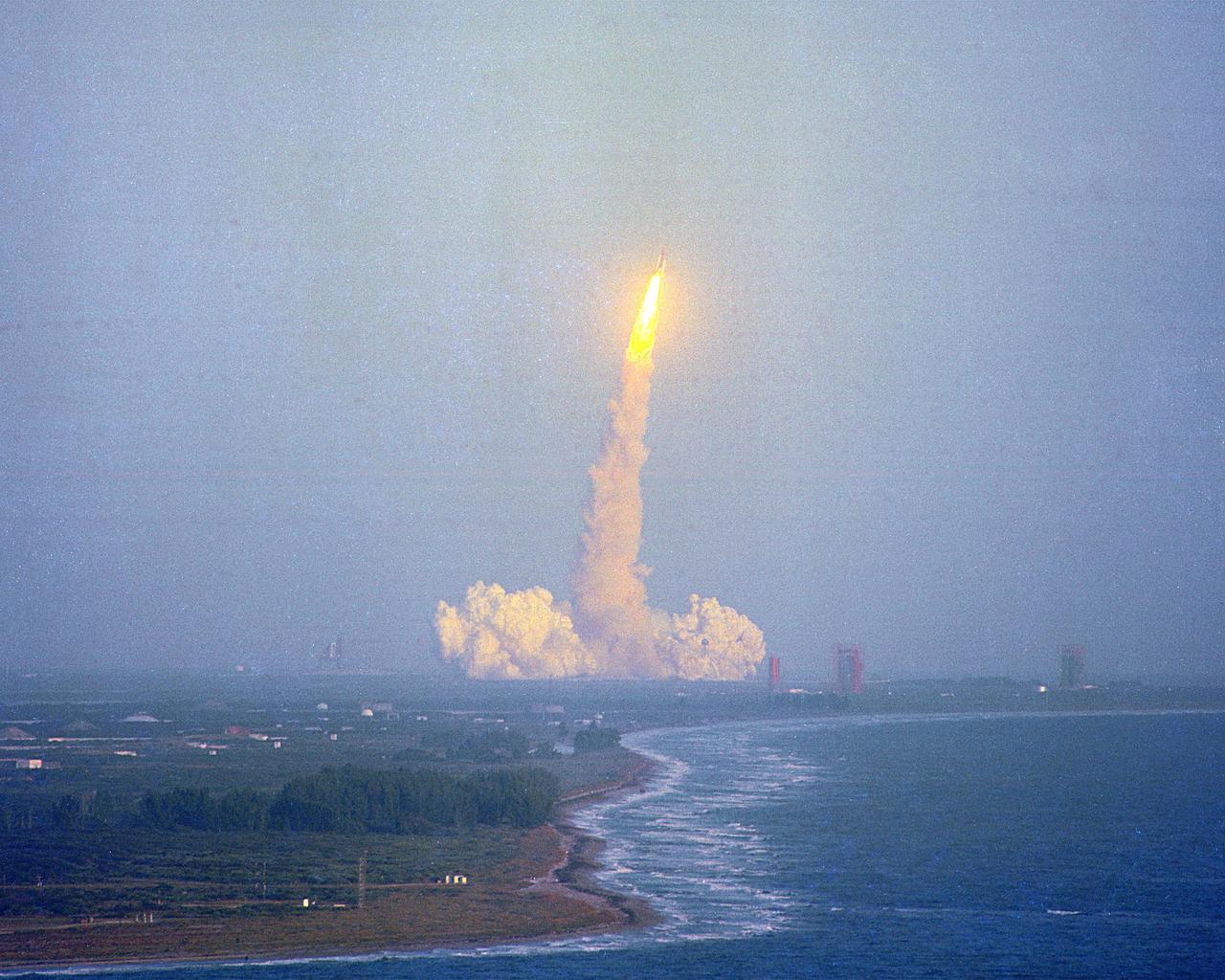
KENNEDY SPACE CENTER, FLA. -- Columbia launches from Launch Pad 39A on mission STS-5.

Canister open in VPF. Payload for STS-5, SBS-3, & Anik C-3, being loaded into the canister
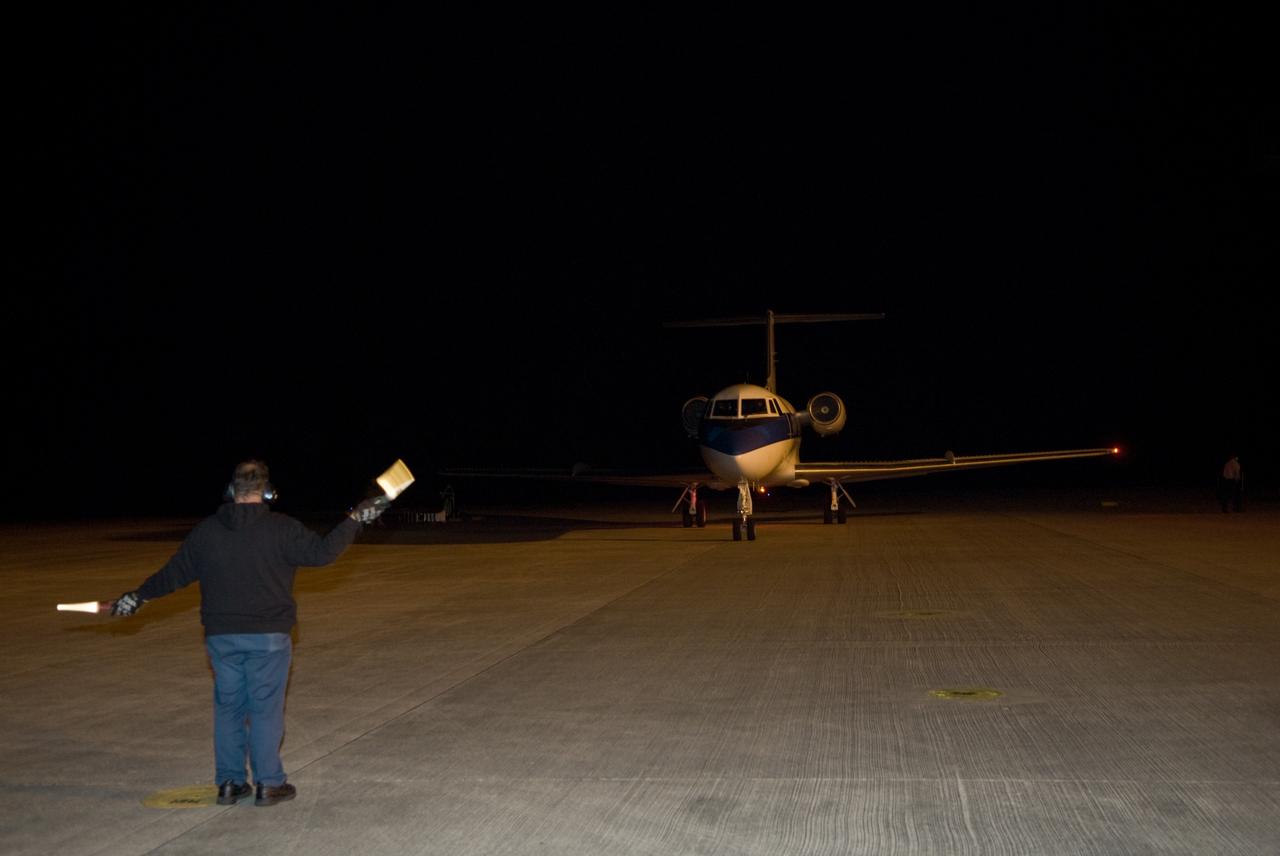
STS-130 LAUNCH L-5 SUITED STA'S W/COMMANDER GEORGE ZAMKA & PILOT TERRY VIRTS
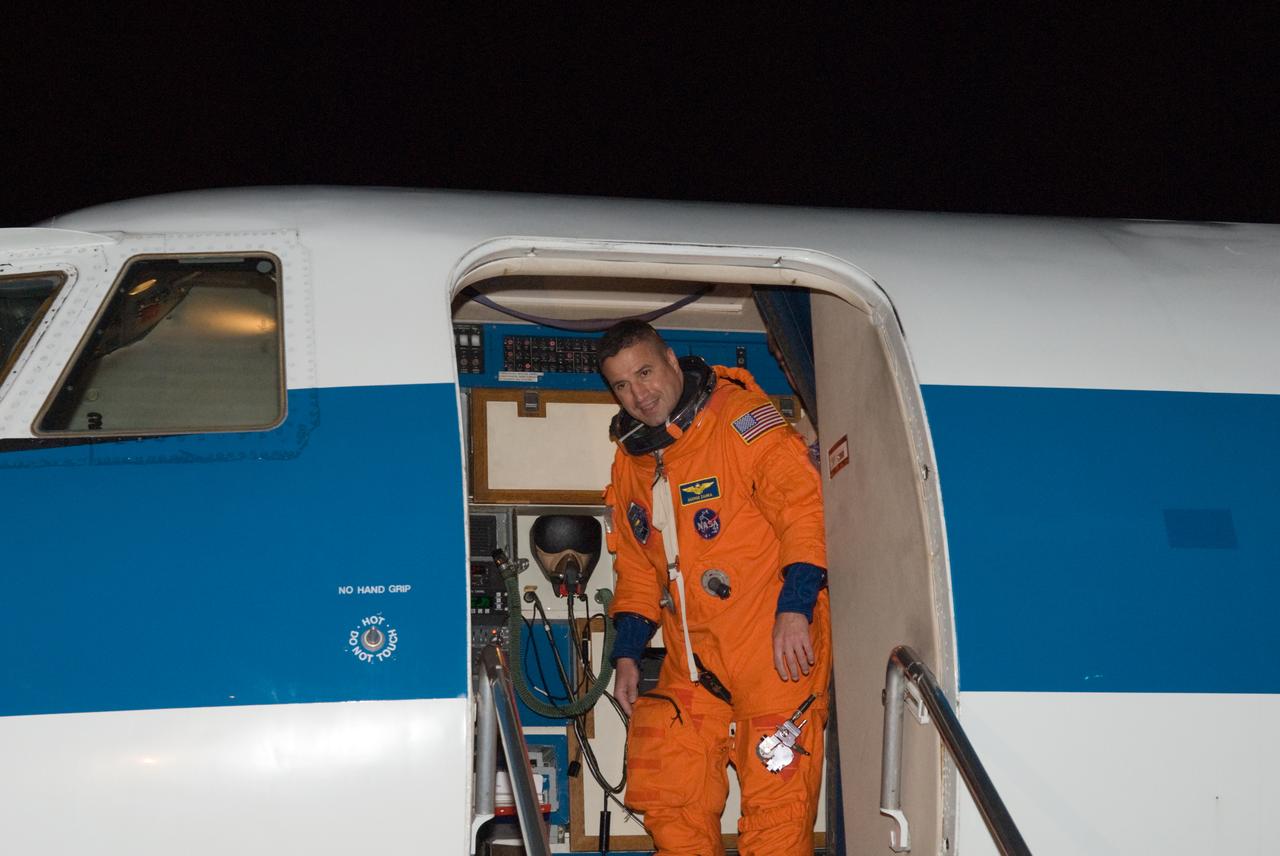
STS-130 LAUNCH L-5 SUITED STA'S W/COMMANDER GEORGE ZAMKA & PILOT TERRY VIRTS
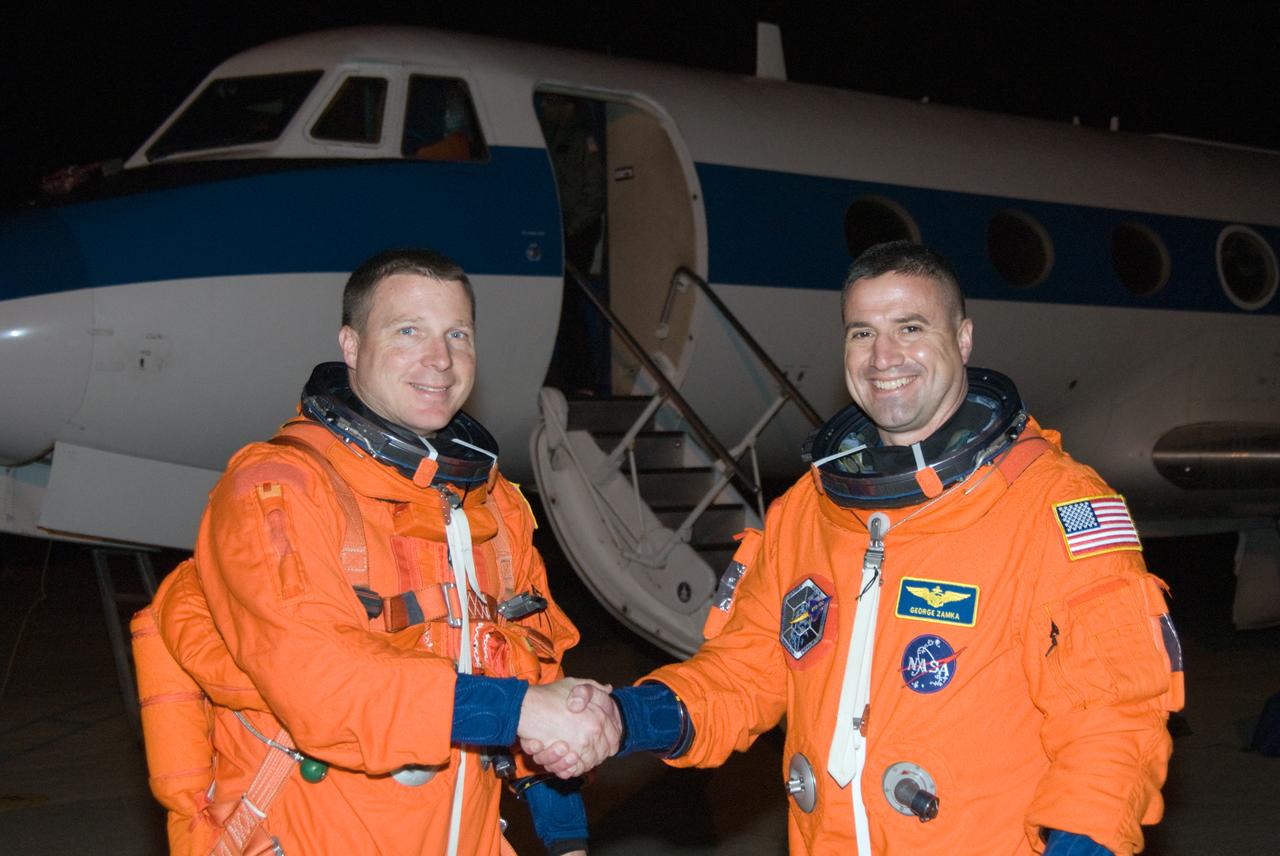
STS-130 LAUNCH L-5 SUITED STA'S W/COMMANDER GEORGE ZAMKA & PILOT TERRY VIRTS
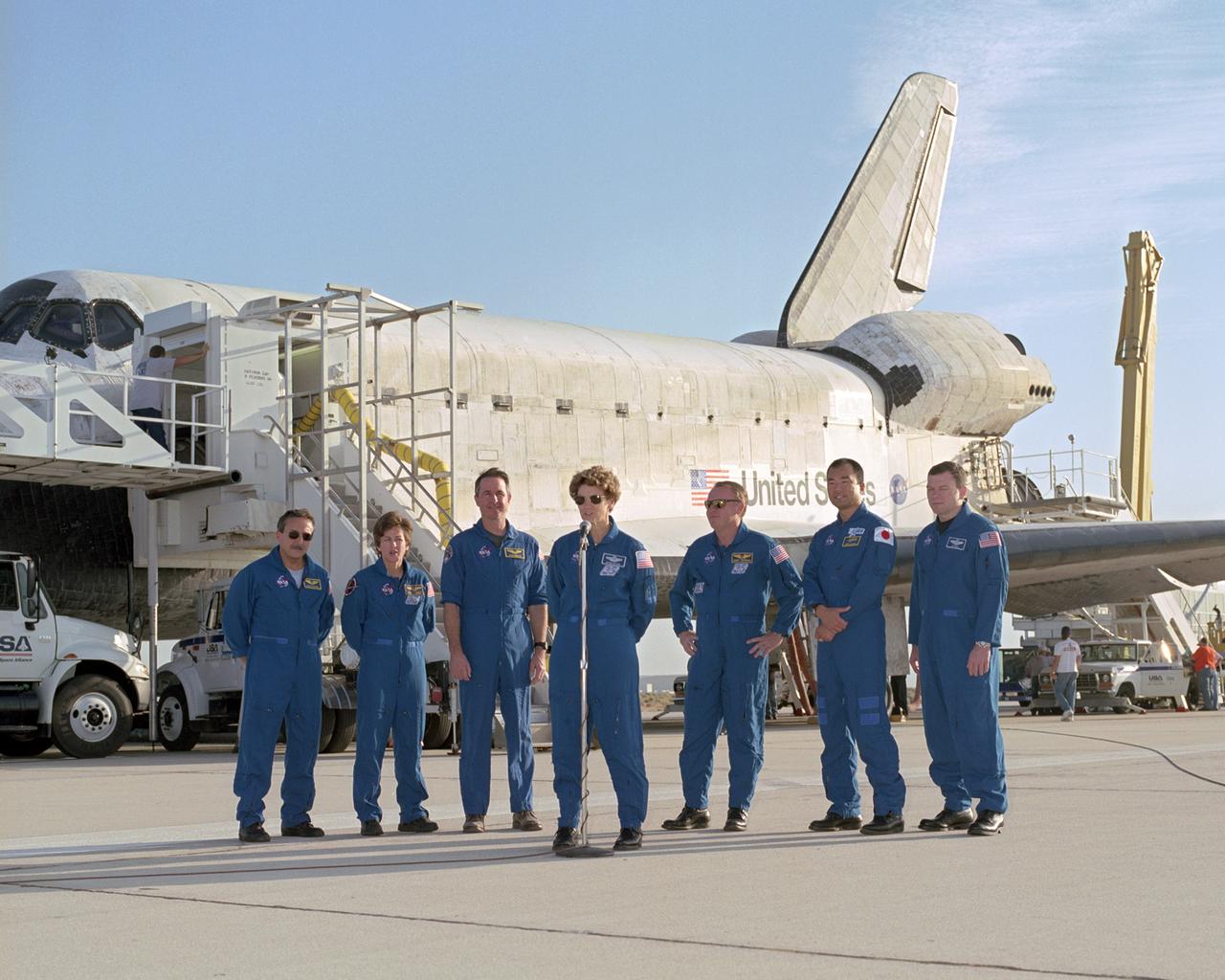
The crew of Space Shuttle mission STS-114 gathered for a press brief following landing at Edwards Air Force Base, California, 5:11 am, August 9, 2005. Left to right: Mission Specialists Charles Camarda, Wendy Lawrence and Stephen Robinson, Commander Eileen Collins at microphone, Mission Specialists Andrew Thomas and Soichi Noguchi, and Pilot James Kelly. Space Shuttle Discovery landed safely at NASA's Dryden Flight Research Center at Edwards Air Force Base in California at 5:11:22 a.m. PDT this morning, following the very successful 14-day STS-114 return to flight mission. During their two weeks in space, Commander Eileen Collins and her six crewmates tested out new safety procedures and delivered supplies and equipment the International Space Station. Discovery spent two weeks in space, where the crew demonstrated new methods to inspect and repair the Shuttle in orbit. The crew also delivered supplies, outfitted and performed maintenance on the International Space Station. A number of these tasks were conducted during three spacewalks. In an unprecedented event, spacewalkers were called upon to remove protruding gap fillers from the heat shield on Discovery's underbelly. In other spacewalk activities, astronauts installed an external platform onto the Station's Quest Airlock and replaced one of the orbital outpost's Control Moment Gyroscopes. Inside the Station, the STS-114 crew conducted joint operations with the Expedition 11 crew. They unloaded fresh supplies from the Shuttle and the Raffaello Multi-Purpose Logistics Module. Before Discovery undocked, the crews filled Raffeallo with unneeded items and returned to Shuttle payload bay. Discovery launched on July 26 and spent almost 14 days on orbit.
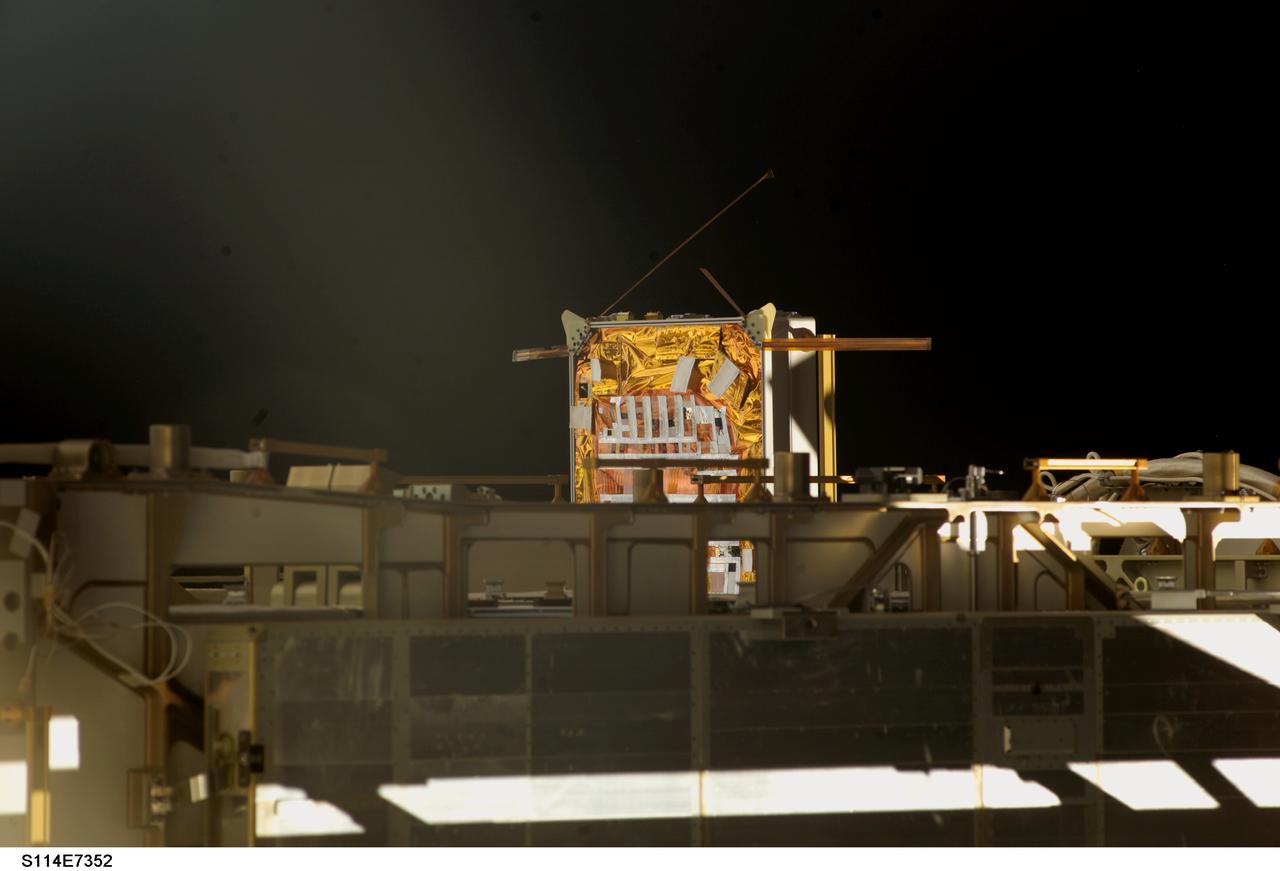
s114e7352 (8/6/2005) --- A view of the Materials International Space Station Experiment (MISSE) 5 Passive Experiment Containter (PEC) mounted on the P6 Truss during one of the STS-114 missions Extravehicular Activities (EVAs). The Materials International Space Station Experiment-5 (MISSE-5) was an external payload that flew on-board the ISS from August 2005 until September 2006. MISSE-5 provided an opportunity for researchers to test a wide range of samples in the Low Earth Orbit (LEO) environment.
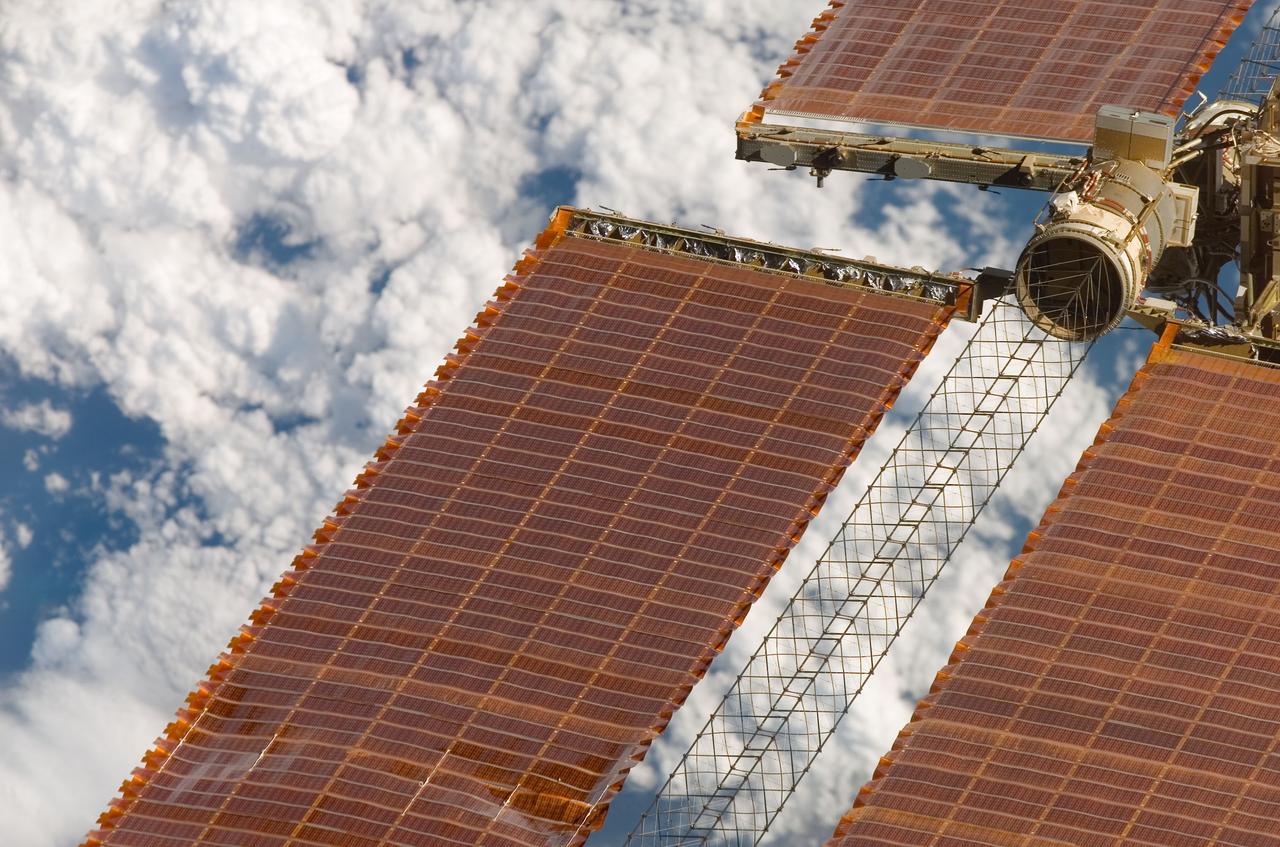
S120-E-008602 (5 Nov. 2007) --- A repaired solar array is featured in this image photographed by a STS-120 crewmember onboard the Space Shuttle Discovery as it moves away from the International Space Station. Undocking of the two spacecraft occurred at 4:32 a.m. (CST) on Nov. 5, 2007.
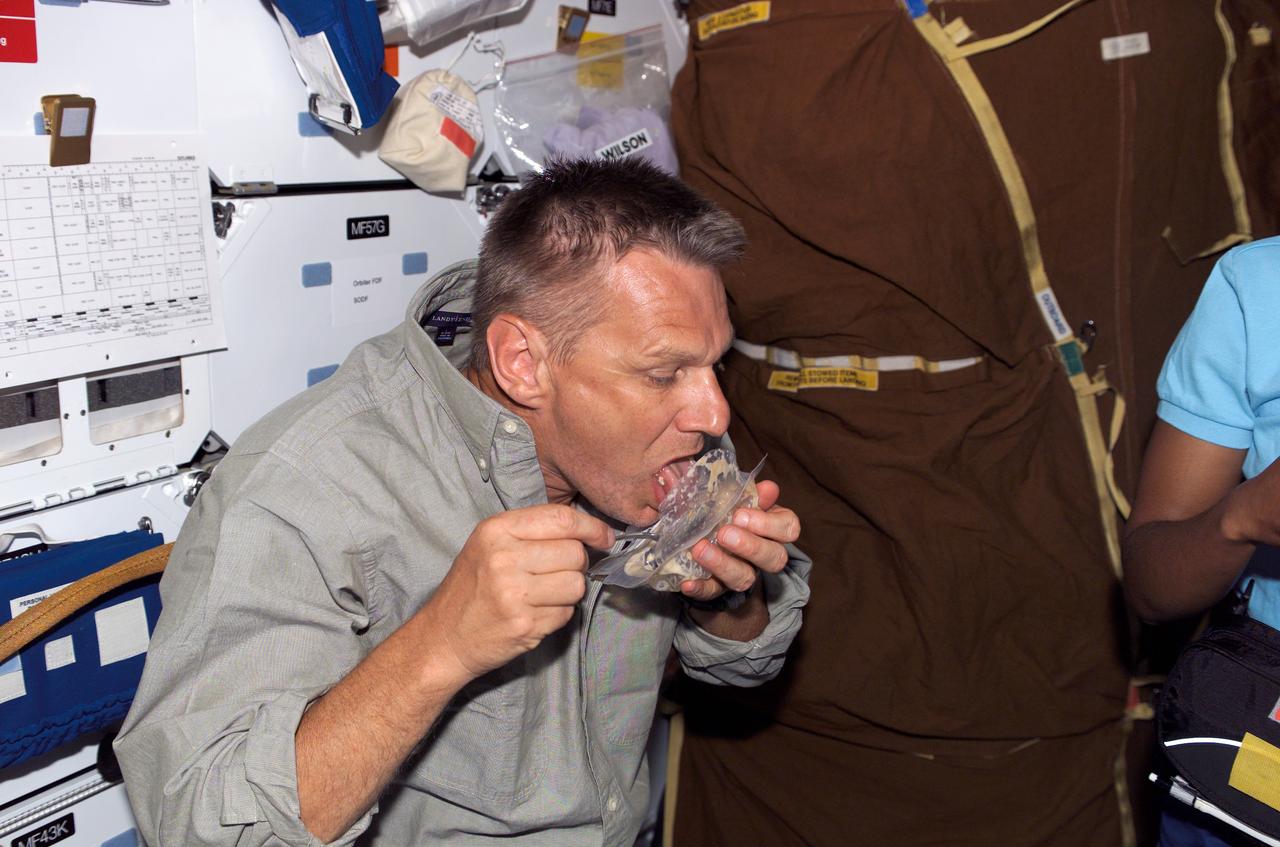
S121-E-05208 (5 July 2006) --- Astronaut Piers J. Sellers, STS-121 mission specialist, eats breakfast on the middeck of the Space Shuttle Discovery.
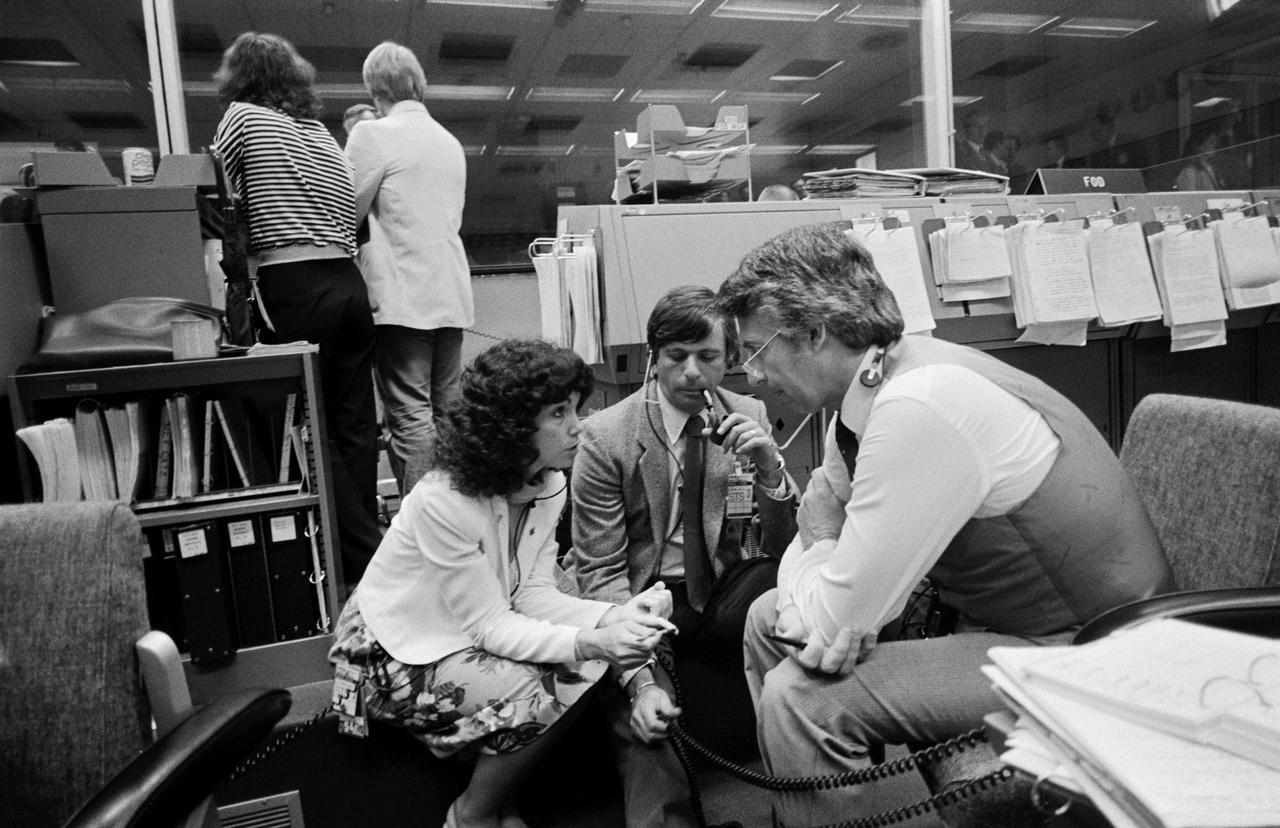
Day-5 Mission Control Room activities, STS-3 Mission of: Alan Briscoe, at the Instrumentation and Communications Officer (INCO) Console; Astronaut Richard Truly and Briscoe; Astronaut Judy Resnik, Flight Director (FD) Jay Greene, and On-Duty FD Harold Draughon. 1. Flight Directors - STS 3 2. Astronaut Judy Resnik 3. Alan Briscoe 4. Jay Greene 5. Harold Draughon
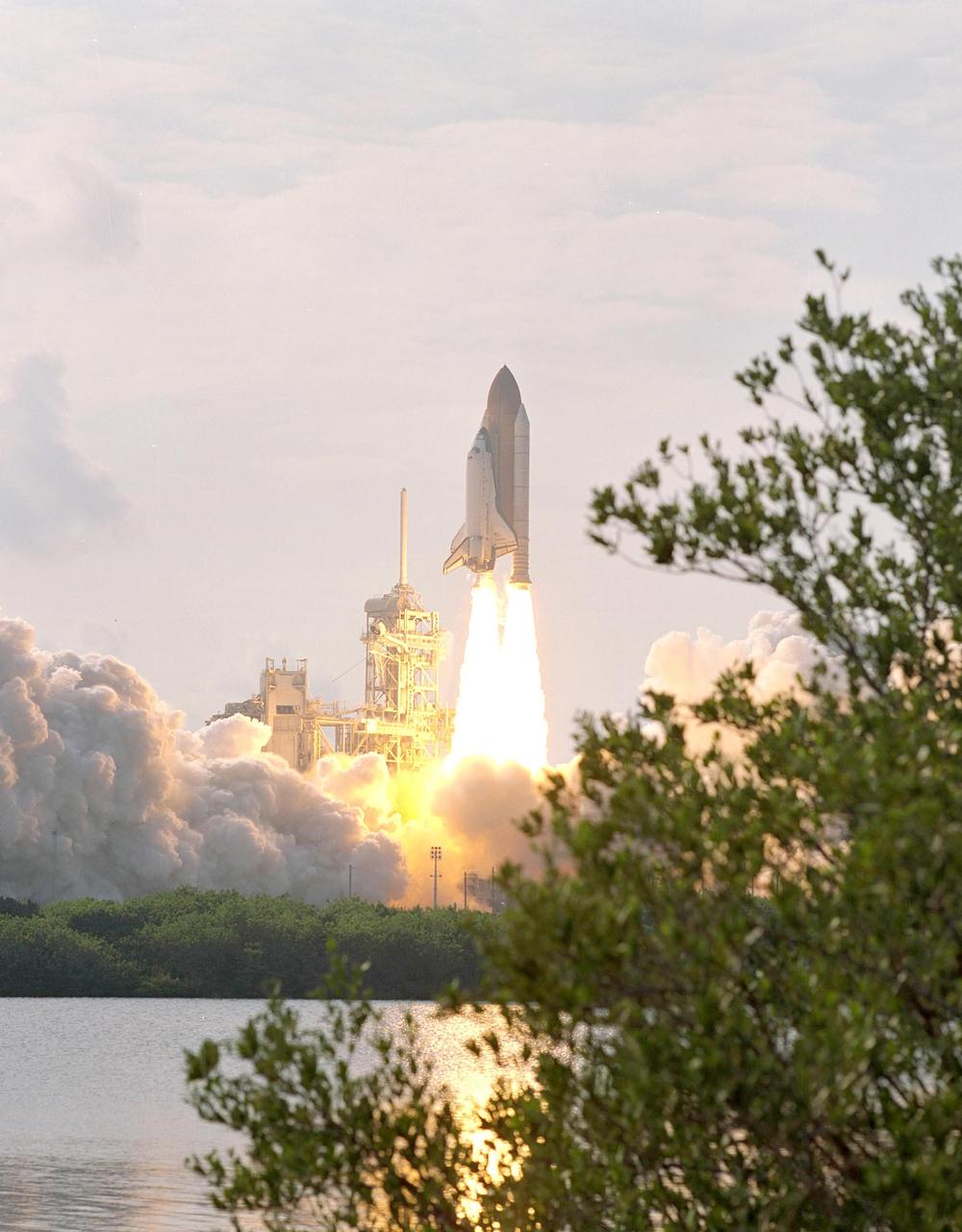
KENNEDY SPACE CENTER, FLA. - Viewed from across the nearby water, the launch of Space Shuttle Endeavour fills the horizon. Liftoff at 5:22:49 p.m. EDT sent Endeavour and its crew of four, plus the Expedition 5 crew, on its way to the International space Station on mission STS-111. This mission marks the 14th Shuttle flight to the International Space Station and the third Shuttle mission this year. Mission STS-111 is the 18th flight of Endeavour and the 110th flight overall in NASA's Space Shuttle program

Day-5 Mission Control Room activities, STS-3 Mission of: Alan Briscoe, at the Instrumentation and Communications Officer (INCO) Console; Astronaut Richard Truly and Briscoe; Astronaut Judy Resnik, Flight Director (FD) Jay Greene, and On-Duty FD Harold Draughon. 1. Flight Directors - STS 3 2. Astronaut Judy Resnik 3. Alan Briscoe 4. Jay Greene 5. Harold Draughon
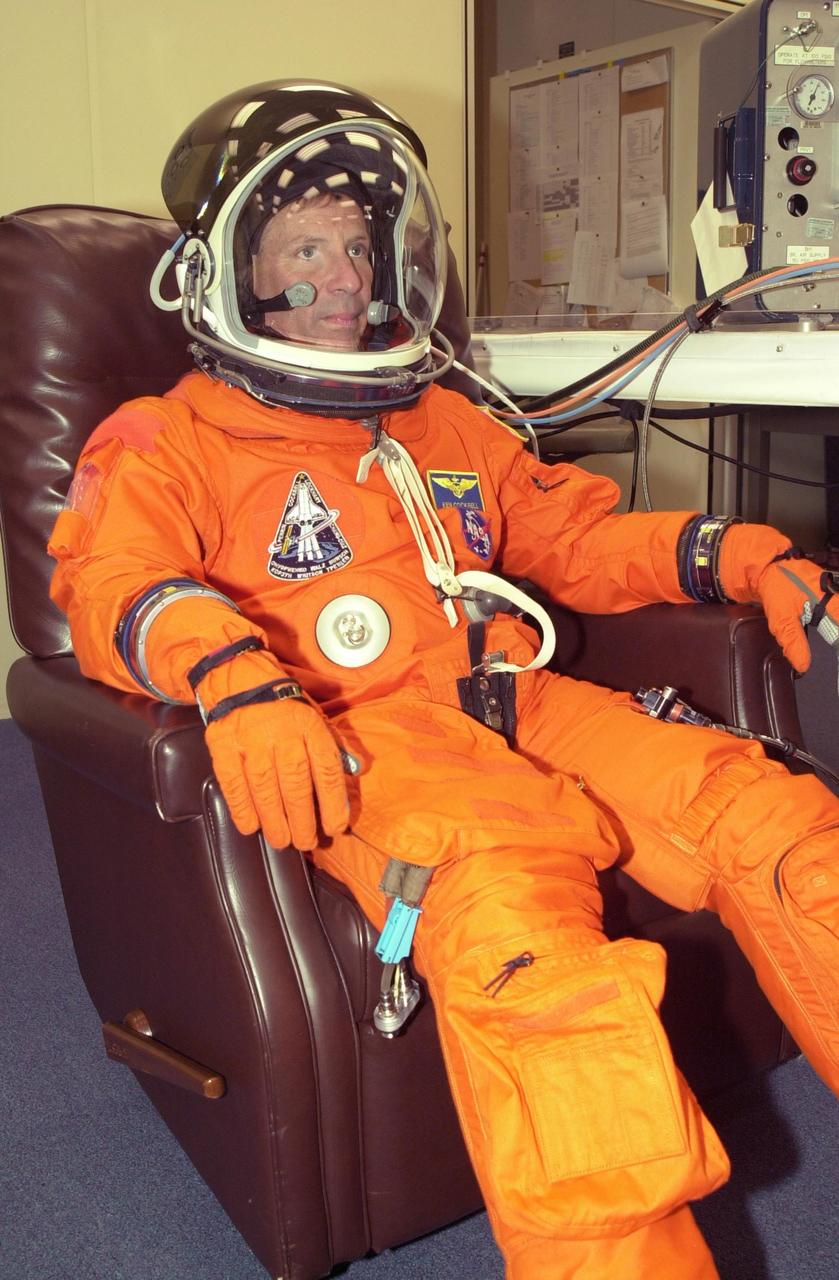
KENNEDY SPACE CENTER, FLA. - STS-111 Commander Kenneth Cockrell has suited up in preparation for a simulated launch countdown at the pad. The simulation is part of STS-111 Terminal Countdown Demonstration Test activities for the crew and Expedition 5. The payload on the mission to the International Space Station includes the Mobile Base System, an Orbital Replacement Unit and Multi-Purpose Logistics Module Leonardo. The Expedition 5 crew is traveling on Endeavour to replace the Expedition 4 crew on the Station. Launch of Endeavour is scheduled for May 30, 2002
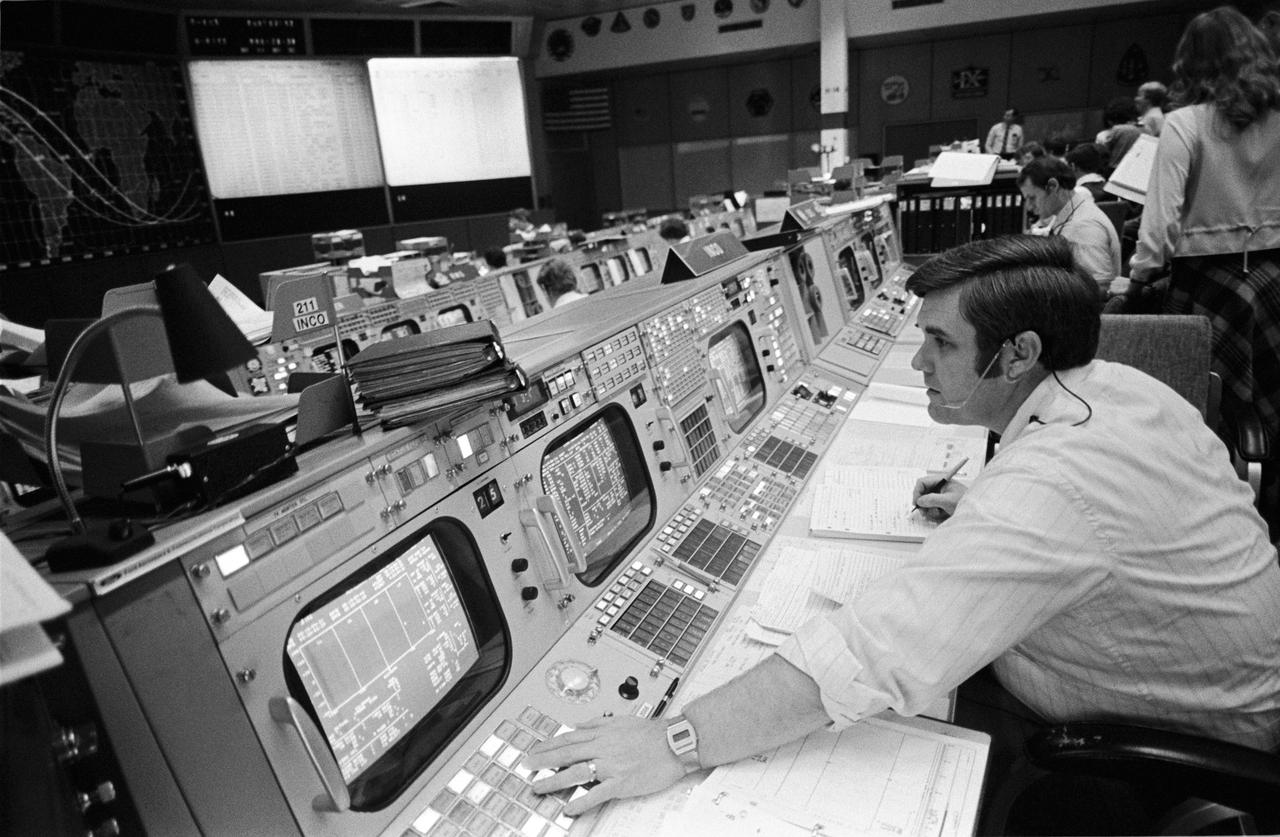
Day-5 Mission Control Room activities, STS-3 Mission of: Alan Briscoe, at the Instrumentation and Communications Officer (INCO) Console; Astronaut Richard Truly and Briscoe; Astronaut Judy Resnik, Flight Director (FD) Jay Greene, and On-Duty FD Harold Draughon. 1. Flight Directors - STS 3 2. Astronaut Judy Resnik 3. Alan Briscoe 4. Jay Greene 5. Harold Draughon
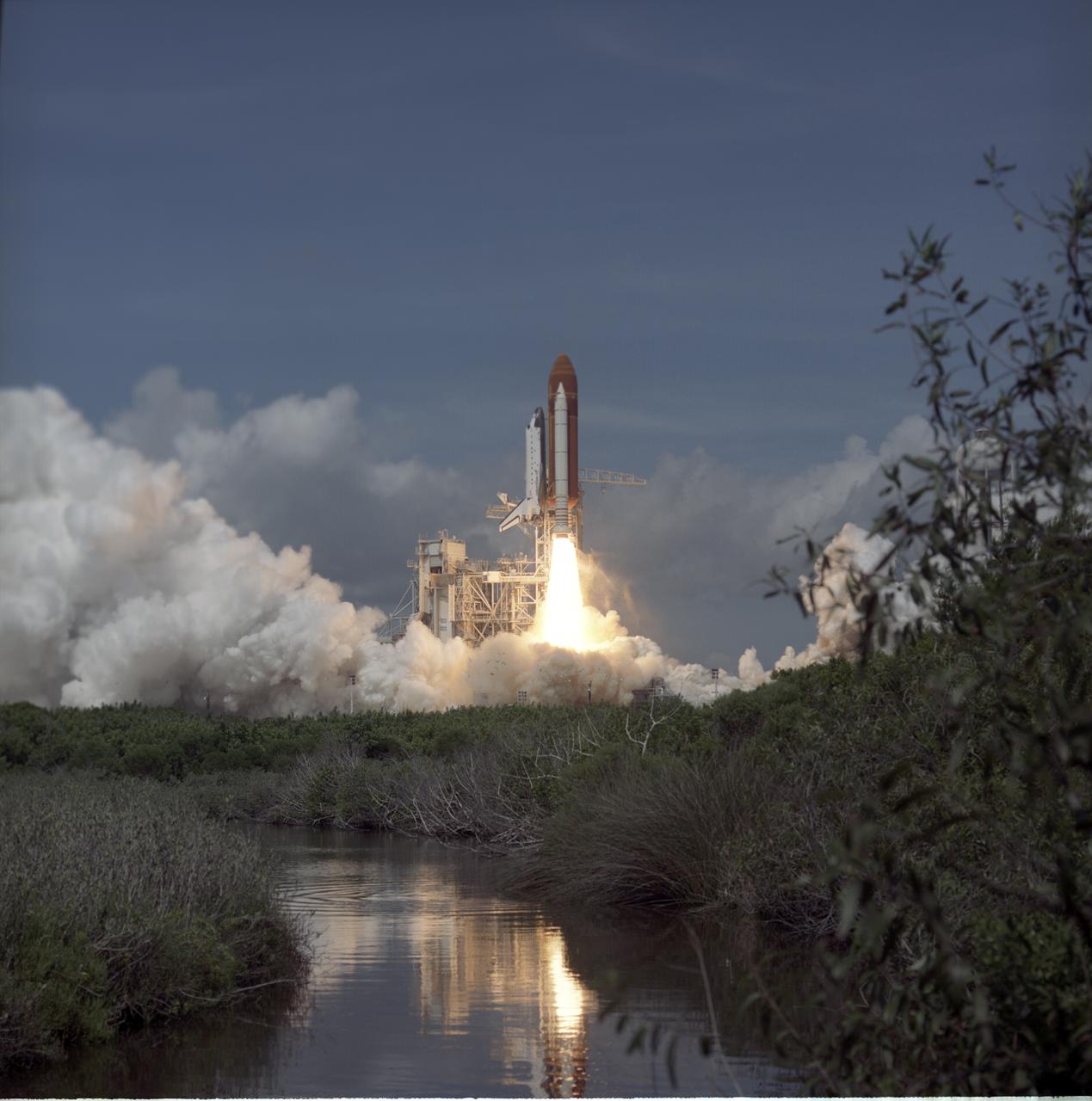
Launched aboard the Space Shuttle Atlantis on August 2, 1991, the STS-43 mission’s primary payload was the Tracking and Data Relay Satellite 5 (TDRS-5) attached to an Inertial Upper Stage (IUS), which became the 4th member of an orbiting TDRS cluster. The flight crew consisted of 5 astronauts: John E. Blaha, commander; Michael A. Baker, pilot; Shannon W. Lucid, mission specialist 1; James C. Adamson, mission specialist 2; and G. David Low, mission specialist 3.
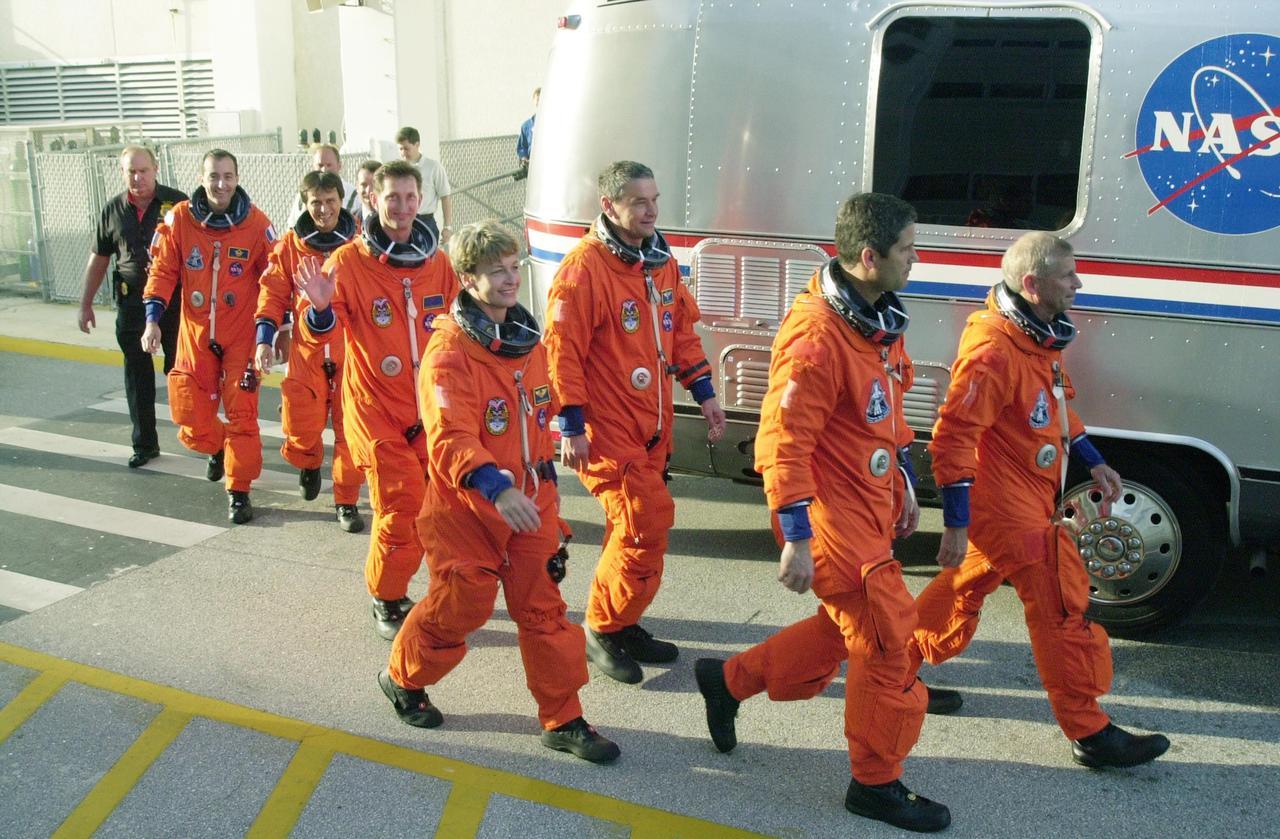
KENNEDY SPACE CENTER, FLA. -- The STS-111 crew and Expedition 5 walk eagerly to the Astrovan that will take them to Launch Pad 39A for a simulated countdown. From left are Mission Specialists Philippe Perrin and Franklin Chang-Diaz; the Expedition 5 crew, Sergei Treschev, Peggy Whitson and Valeri Korzun; Pilot Paul Lockhart; and Commander Kenneth Cockrell. The simulation is part of STS-111 Terminal Countdown Demonstration Test activities for the crew and Expedition 5. The payload on the mission to the International Space Station includes the Mobile Base System (MBS), an Orbital Replacement Unit and Multi-Purpose Logistics Module Leonardo. The MBS will be installed on the Mobile Transporter to complete the Canadian Mobile Servicing System, or MSS, enabling Canadarm 2 to "inchworm" from the U.S. Lab Destiny to the MSS and travel along the truss to work sites. The Expedition 5 crew is traveling on Endeavour to replace the Expedition 4 crew on the Station. Launch of Endeavour is scheduled for May 30, 2002
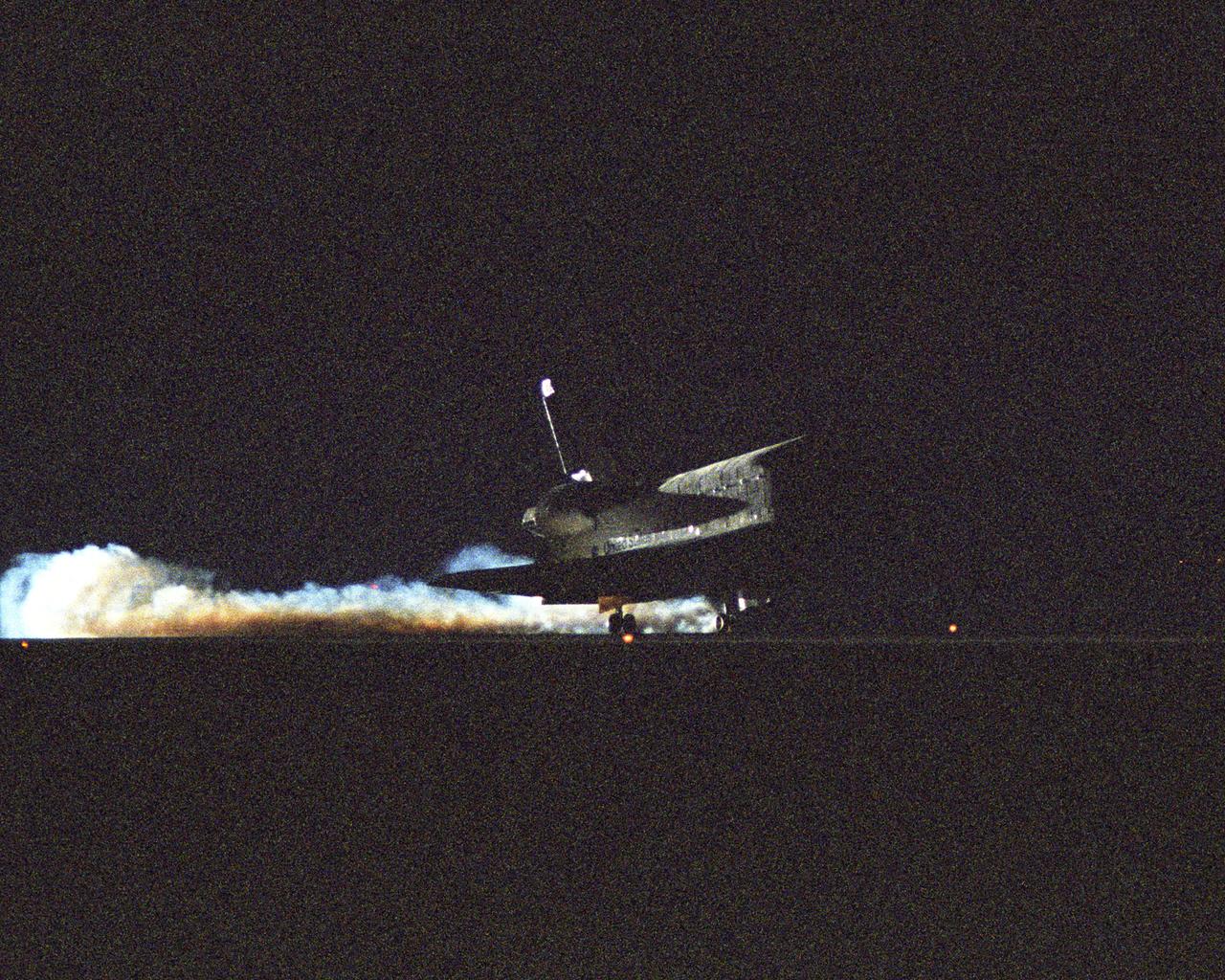
Space Shuttle Discovery landed safely at NASA's Dryden Flight Research Center at Edwards Air Force Base in Calif. at 5:11:22 a.m. PDT this morning, following the very successful 14-day STS-114 return to flight mission. During their two weeks in space, Commander Eileen Collins and her six crewmates tested out new safety procedures and delivered supplies and equipment the International Space Station. Discovery spent two weeks in space, where the crew demonstrated new methods to inspect and repair the Shuttle in orbit. The crew also delivered supplies, outfitted and performed maintenance on the International Space Station. A number of these tasks were conducted during three spacewalks. In an unprecedented event, spacewalkers were called upon to remove protruding gap fillers from the heat shield on Discovery's underbelly. In other spacewalk activities, astronauts installed an external platform onto the Station's Quest Airlock and replaced one of the orbital outpost's Control Moment Gyroscopes. Inside the Station, the STS-114 crew conducted joint operations with the Expedition 11 crew. They unloaded fresh supplies from the Shuttle and the Raffaello Multi-Purpose Logistics Module. Before Discovery undocked, the crews filled Raffeallo with unneeded items and returned to Shuttle payload bay. Discovery launched on July 26 and spent almost 14 days on orbit.

Space Shuttle Discovery landed safely at NASA's Dryden Flight Research Center at Edwards Air Force Base in Calif. at 5:11:22 a.m. PDT this morning, following the very successful 14-day STS-114 return to flight mission. During their two weeks in space, Commander Eileen Collins and her six crewmates tested out new safety procedures and delivered supplies and equipment the International Space Station. Discovery spent two weeks in space, where the crew demonstrated new methods to inspect and repair the Shuttle in orbit. The crew also delivered supplies, outfitted and performed maintenance on the International Space Station. A number of these tasks were conducted during three spacewalks. In an unprecedented event, spacewalkers were called upon to remove protruding gap fillers from the heat shield on Discovery's underbelly. In other spacewalk activities, astronauts installed an external platform onto the Station's Quest Airlock and replaced one of the orbital outpost's Control Moment Gyroscopes. Inside the Station, the STS-114 crew conducted joint operations with the Expedition 11 crew. They unloaded fresh supplies from the Shuttle and the Raffaello Multi-Purpose Logistics Module. Before Discovery undocked, the crews filled Raffeallo with unneeded items and returned to Shuttle payload bay. Discovery launched on July 26 and spent almost 14 days on orbit.
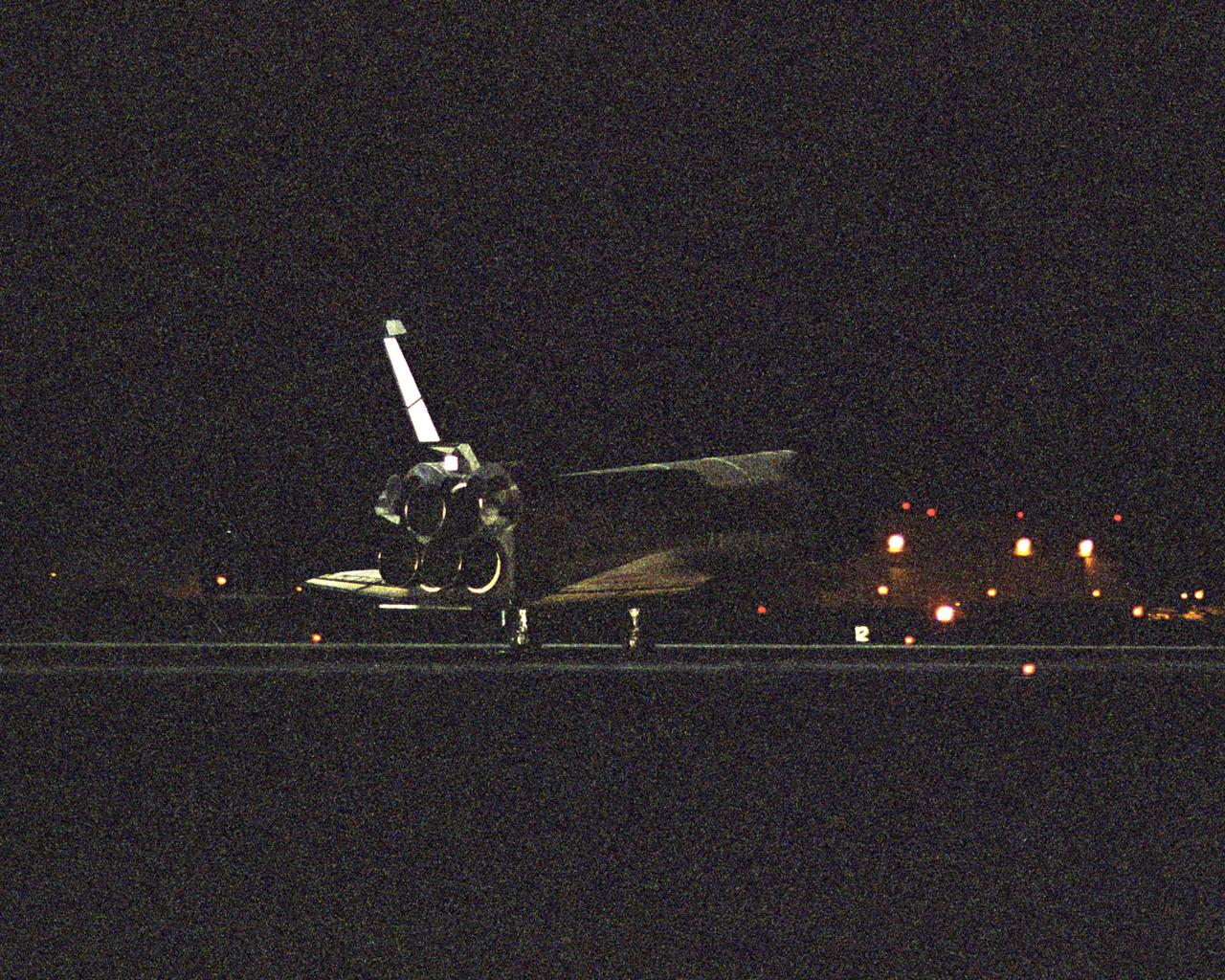
Space Shuttle Discovery landed safely at NASA's Dryden Flight Research Center at Edwards Air Force Base in Calif. at 5:11:22 a.m. PDT this morning, following the very successful 14-day STS-114 return to flight mission. During their two weeks in space, Commander Eileen Collins and her six crewmates tested out new safety procedures and delivered supplies and equipment the International Space Station. Discovery spent two weeks in space, where the crew demonstrated new methods to inspect and repair the Shuttle in orbit. The crew also delivered supplies, outfitted and performed maintenance on the International Space Station. A number of these tasks were conducted during three spacewalks. In an unprecedented event, spacewalkers were called upon to remove protruding gap fillers from the heat shield on Discovery's underbelly. In other spacewalk activities, astronauts installed an external platform onto the Station's Quest Airlock and replaced one of the orbital outpost's Control Moment Gyroscopes. Inside the Station, the STS-114 crew conducted joint operations with the Expedition 11 crew. They unloaded fresh supplies from the Shuttle and the Raffaello Multi-Purpose Logistics Module. Before Discovery undocked, the crews filled Raffeallo with unneeded items and returned to Shuttle payload bay. Discovery launched on July 26 and spent almost 14 days on orbit.
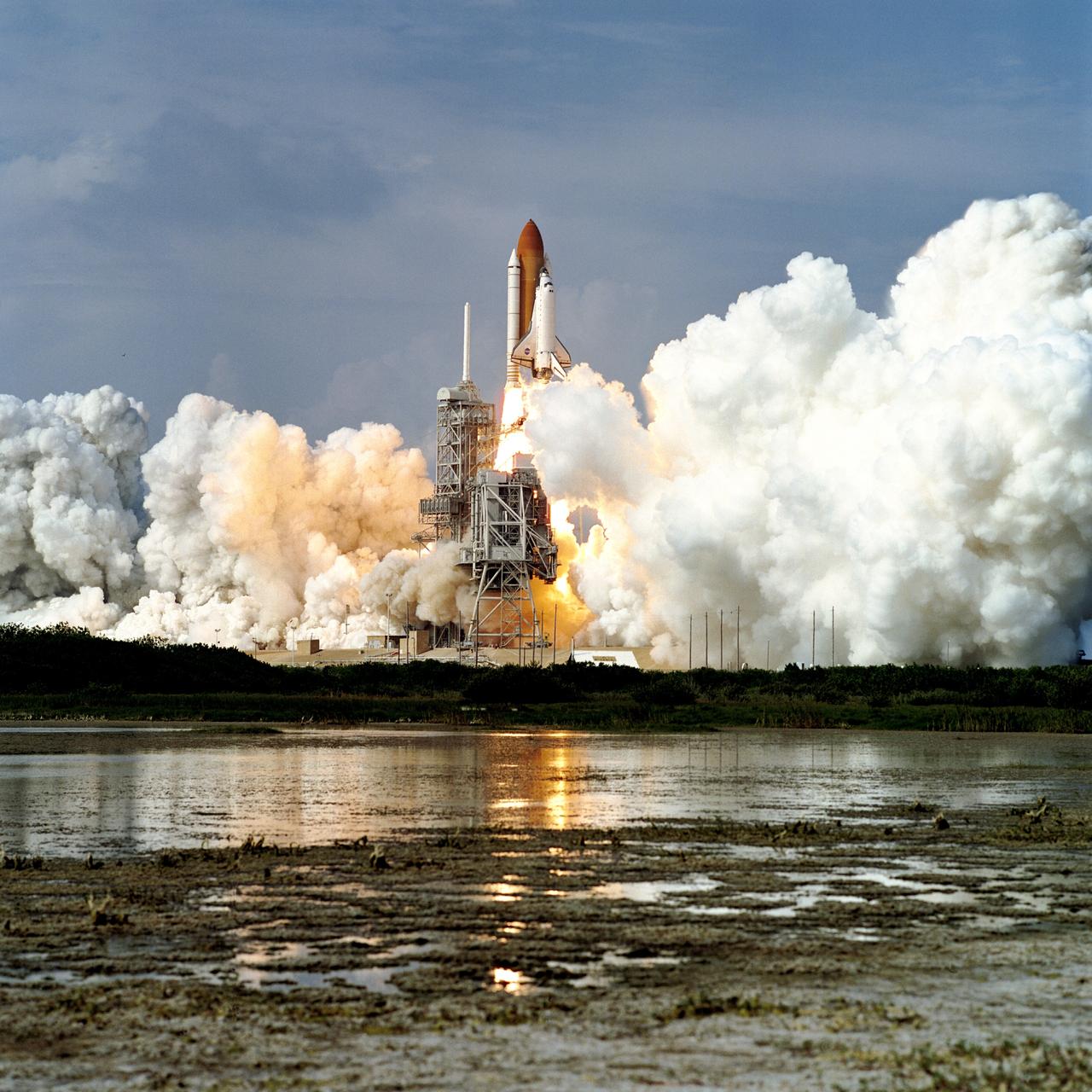
STS111-S-008 (5 June 2002) --- The Space Shuttle Endeavour leaves the launch pad, headed into space for mission STS-111 to the International Space Station (ISS). Liftoff occurred at 5:22:49 p.m. (EDT), June 5, 2002. The STS-111 crew includes astronauts Kenneth D. Cockrell, commander; Paul S. Lockhart, pilot, and Franklin R. Chang-Diaz and Philippe Perrin, mission specialists. Also onboard were the Expedition Five crew members including cosmonaut Valery G. Korzun, commander, along with astronaut Peggy A. Whitson and cosmonaut Sergei Y. Treschev, flight engineers. Perrin represents CNES, the French space agency, and Korzun and Treschev are with the Russian Aviation and Space Agency (Rosaviakosmos). This mission marks the 14th Shuttle flight to the International Space Station and the third Shuttle mission this year. Mission STS-111 is the 18th flight of Endeavour and the 110th flight overall in NASA's Space Shuttle program.
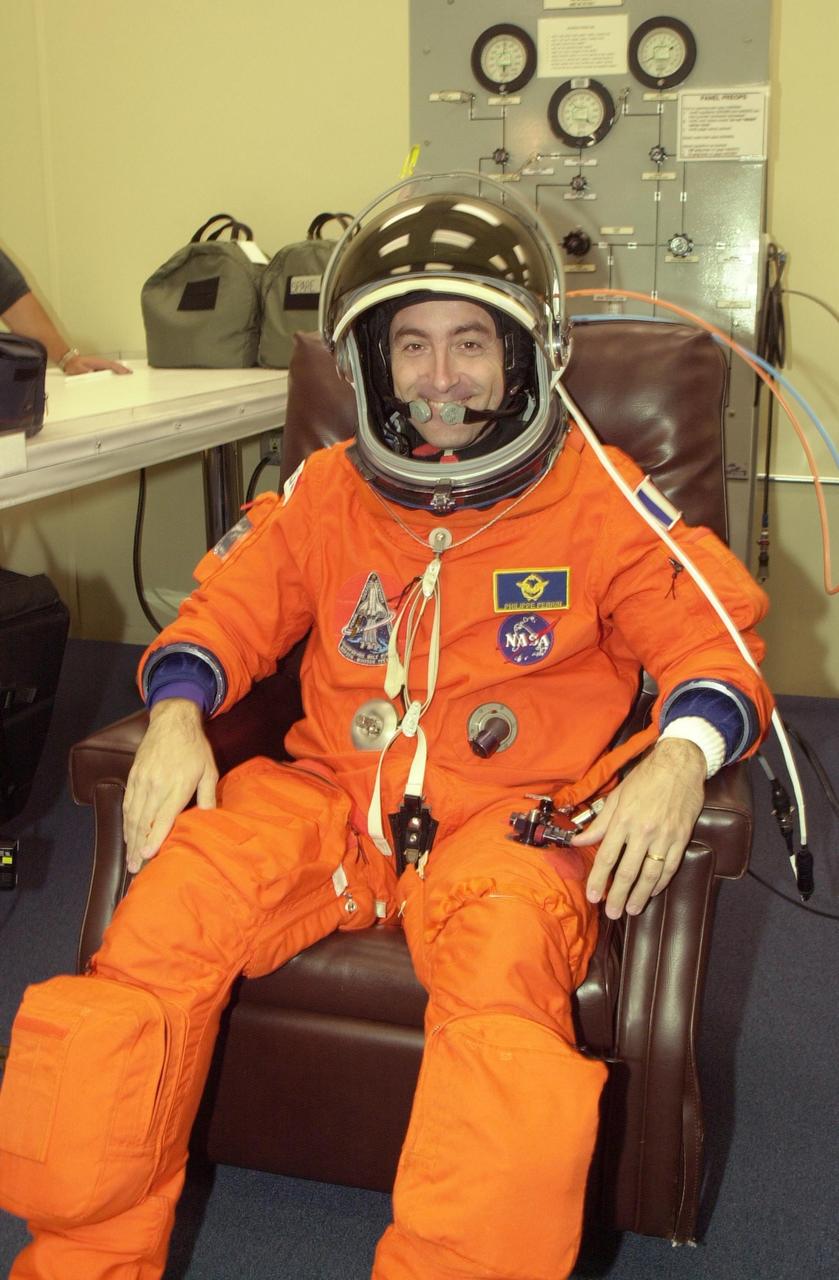
KENNEDY SPACE CENTER, FLA. -- STS-111 Mission Specialist Philippe Perrin gets ready in his launch and entry suit for a simulated launch countdown at the pad. Perrin is with the French Space Agency. The simulation is part of STS-111 Terminal Countdown Demonstration Test activities for the STS-111 crew and Expedition 5. The payload on the mission to the International Space Station includes the Mobile Base System, an Orbital Replacement Unit and Multi-Purpose Logistics Module Leonardo. The Expedition 5 crew is traveling on Endeavour to replace the Expedition 4 crew on the Station. Launch of Endeavour is scheduled for May 30, 2002.
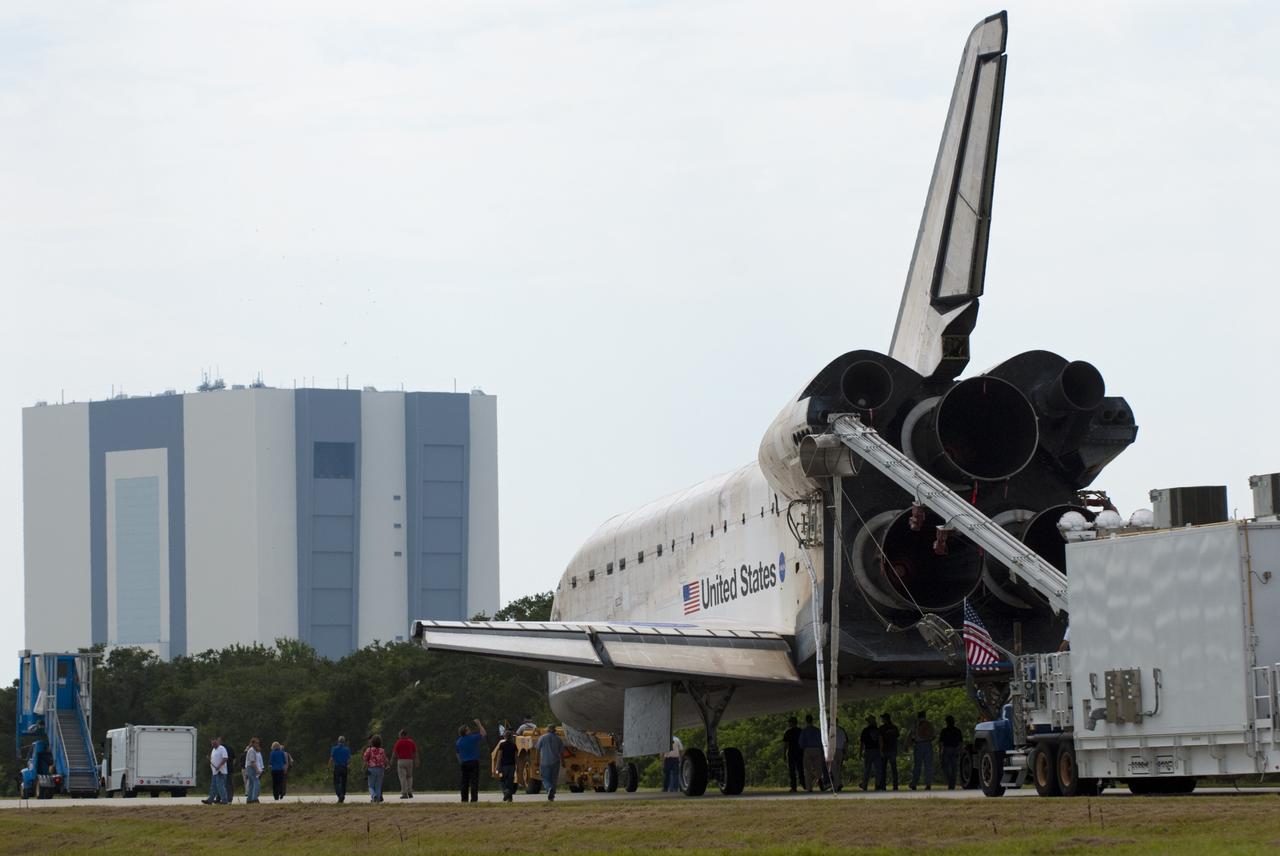
CAPE CANAVERAL, Fla. -- Employees accompany space shuttle Atlantis as it is slowly towed from the Shuttle Landing Facility to an orbiter processing facility at NASA's Kennedy Space Center in Florida. Looming in the background is the 525-foot-tall Vehicle Assembly Building. Atlantis' final return from space at 5:57 a.m. EDT concluded the STS-135 mission, secured the space shuttle fleet's place in history and brought a close to America's Space Shuttle Program. Main gear touchdown was at 5:57:00 a.m. EDT, followed by nose gear touchdown at 5:57:20 a.m., and wheelstop at 5:57:54 a.m. On board were STS-135 Commander Chris Ferguson, Pilot Doug Hurley, and Mission Specialists Sandra Magnus and Rex Walheim. On the 37th shuttle mission to the International Space Station, STS-135 delivered the Raffaello multi-purpose logistics module filled with more than 9,400 pounds of spare parts, equipment and supplies that will sustain station operations for the next year. STS-135 was the 33rd and final flight for Atlantis, which has spent 307 days in space, orbited Earth 4,848 times and traveled 125,935,769 miles, and also the final mission of the Space Shuttle Program. For more information, visit www.nasa.gov/mission_pages/shuttle/shuttlemissions/sts135/index.html. Photo credit: NASA/Kim Shiflett
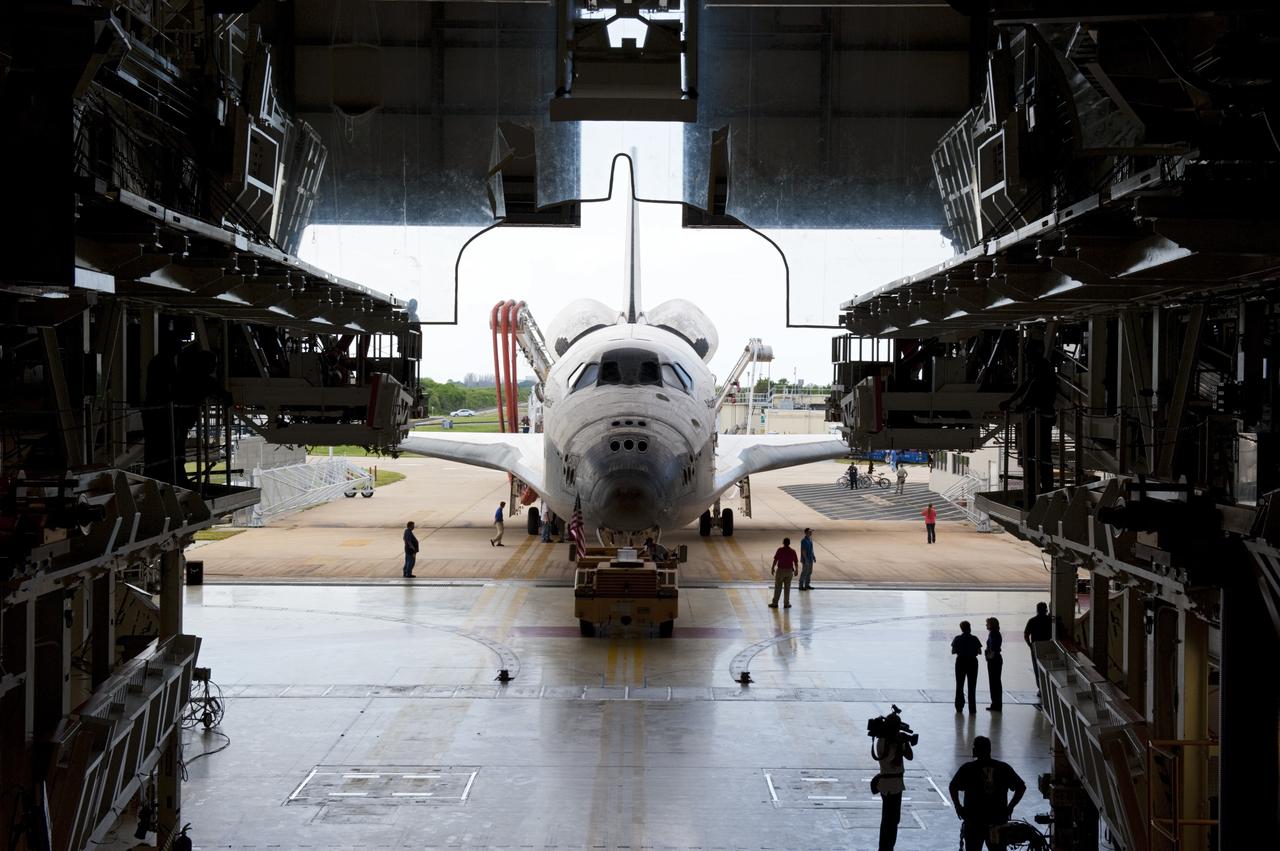
CAPE CANAVERAL, Fla. -- Slowly and carefully, a "towback" vehicle pulls space shuttle Atlantis into the empty bay of Orbiter Processing Facility-2 at NASA's Kennedy Space Center in Florida. Once inside the processing facility, Atlantis will be prepared for future public display at Kennedy's Visitor Complex. Atlantis' final return from space at 5:57 a.m. EDT concluded the STS-135 mission, secured the space shuttle fleet's place in history and brought a close to America's Space Shuttle Program. Main gear touchdown was at 5:57:00 a.m. EDT, followed by nose gear touchdown at 5:57:20 a.m., and wheelstop at 5:57:54 a.m. On board were STS-135 Commander Chris Ferguson, Pilot Doug Hurley, and Mission Specialists Sandra Magnus and Rex Walheim. On the 37th shuttle mission to the International Space Station, STS-135 delivered the Raffaello multi-purpose logistics module filled with more than 9,400 pounds of spare parts, equipment and supplies that will sustain station operations for the next year. STS-135 was the 33rd and final flight for Atlantis, which has spent 307 days in space, orbited Earth 4,848 times and traveled 125,935,769 miles, and also the final mission of the Space Shuttle Program. For more information, visit www.nasa.gov/mission_pages/shuttle/shuttlemissions/sts135/index.html. Photo credit: NASA/Kim Shiflett
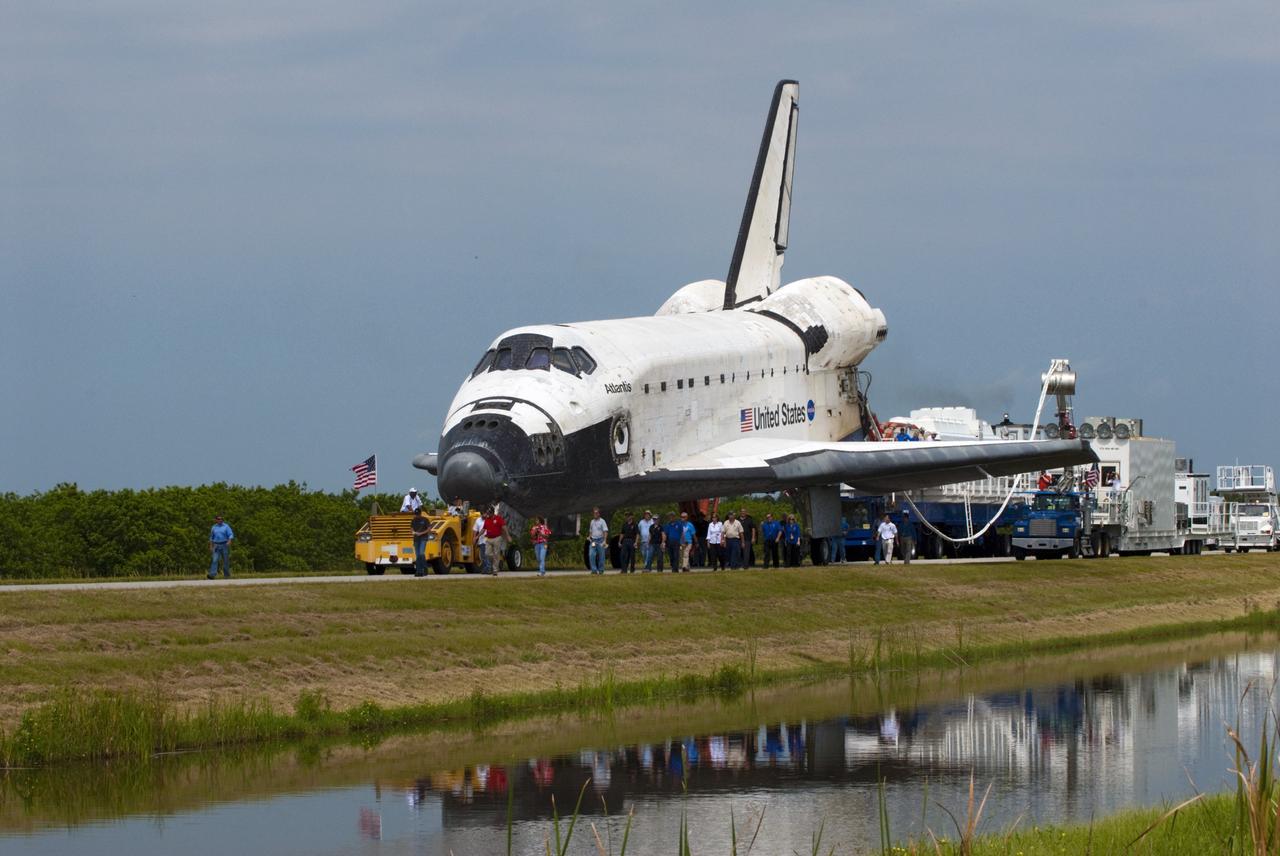
CAPE CANAVERAL, Fla. -- It is time for reflection at NASA's Kennedy Space Center in Florida as employees accompany space shuttle Atlantis as it is slowly towed from the Shuttle Landing Facility to an orbiter processing facility. Atlantis' final return from space at 5:57 a.m. EDT concluded the STS-135 mission, secured the space shuttle fleet's place in history and brought a close to America's Space Shuttle Program. Main gear touchdown was at 5:57:00 a.m. EDT, followed by nose gear touchdown at 5:57:20 a.m., and wheelstop at 5:57:54 a.m. On board were STS-135 Commander Chris Ferguson, Pilot Doug Hurley, and Mission Specialists Sandra Magnus and Rex Walheim. On the 37th shuttle mission to the International Space Station, STS-135 delivered the Raffaello multi-purpose logistics module filled with more than 9,400 pounds of spare parts, equipment and supplies that will sustain station operations for the next year. STS-135 was the 33rd and final flight for Atlantis, which has spent 307 days in space, orbited Earth 4,848 times and traveled 125,935,769 miles, and also the final mission of the Space Shuttle Program. For more information, visit www.nasa.gov/mission_pages/shuttle/shuttlemissions/sts135/index.html. Photo credit: NASA/Kim Shiflett
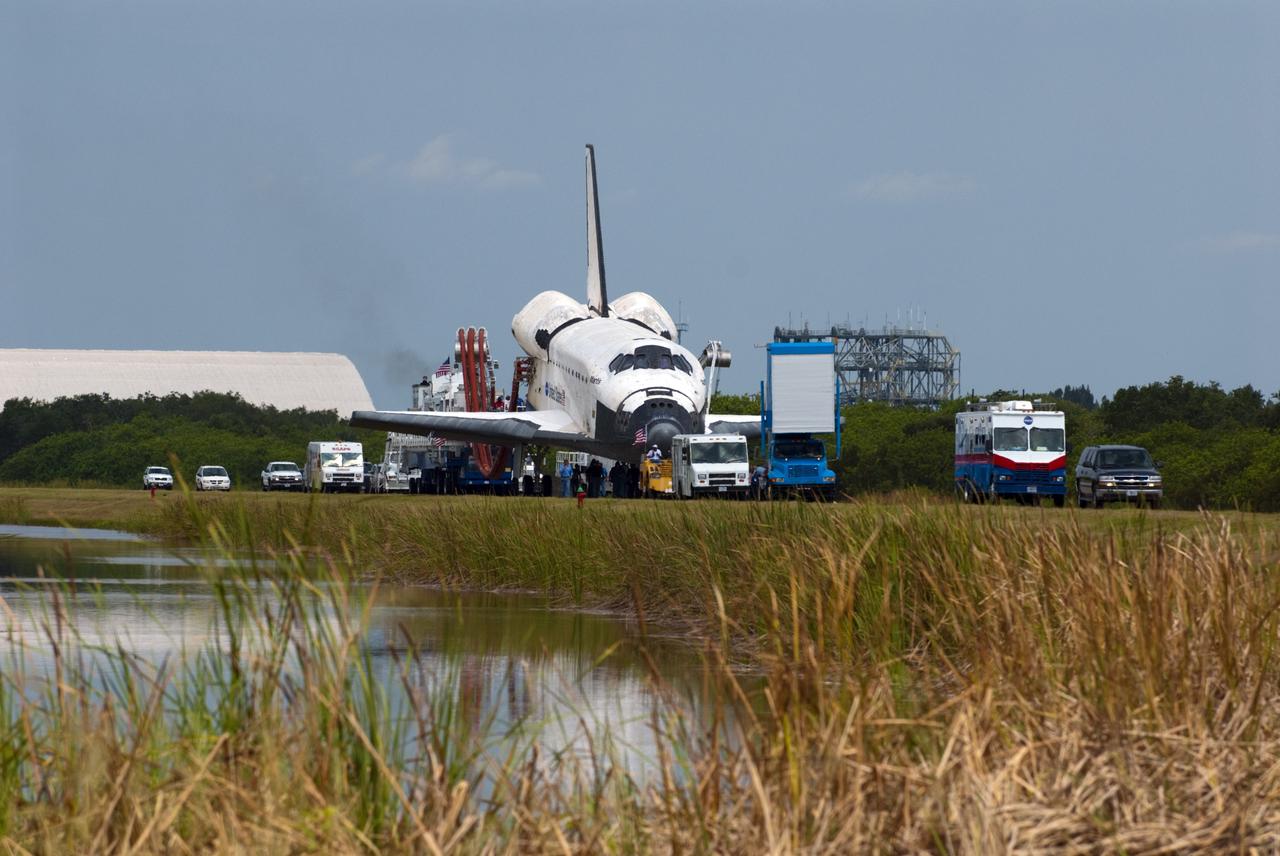
CAPE CANAVERAL, Fla. -- At NASA's Kennedy Space Center in Florida, the landing convoy vehicles accompany space shuttle Atlantis as it is slowly towed from the Shuttle Landing Facility to an orbiter processing facility. Atlantis' final return from space at 5:57 a.m. EDT concluded the STS-135 mission, secured the space shuttle fleet's place in history and brought a close to America's Space Shuttle Program. Main gear touchdown was at 5:57:00 a.m. EDT, followed by nose gear touchdown at 5:57:20 a.m., and wheelstop at 5:57:54 a.m. On board were STS-135 Commander Chris Ferguson, Pilot Doug Hurley, and Mission Specialists Sandra Magnus and Rex Walheim. On the 37th shuttle mission to the International Space Station, STS-135 delivered the Raffaello multi-purpose logistics module filled with more than 9,400 pounds of spare parts, equipment and supplies that will sustain station operations for the next year. STS-135 was the 33rd and final flight for Atlantis, which has spent 307 days in space, orbited Earth 4,848 times and traveled 125,935,769 miles, and also the final mission of the Space Shuttle Program. For more information, visit www.nasa.gov/mission_pages/shuttle/shuttlemissions/sts135/index.html. Photo credit: NASA/Kim Shiflett
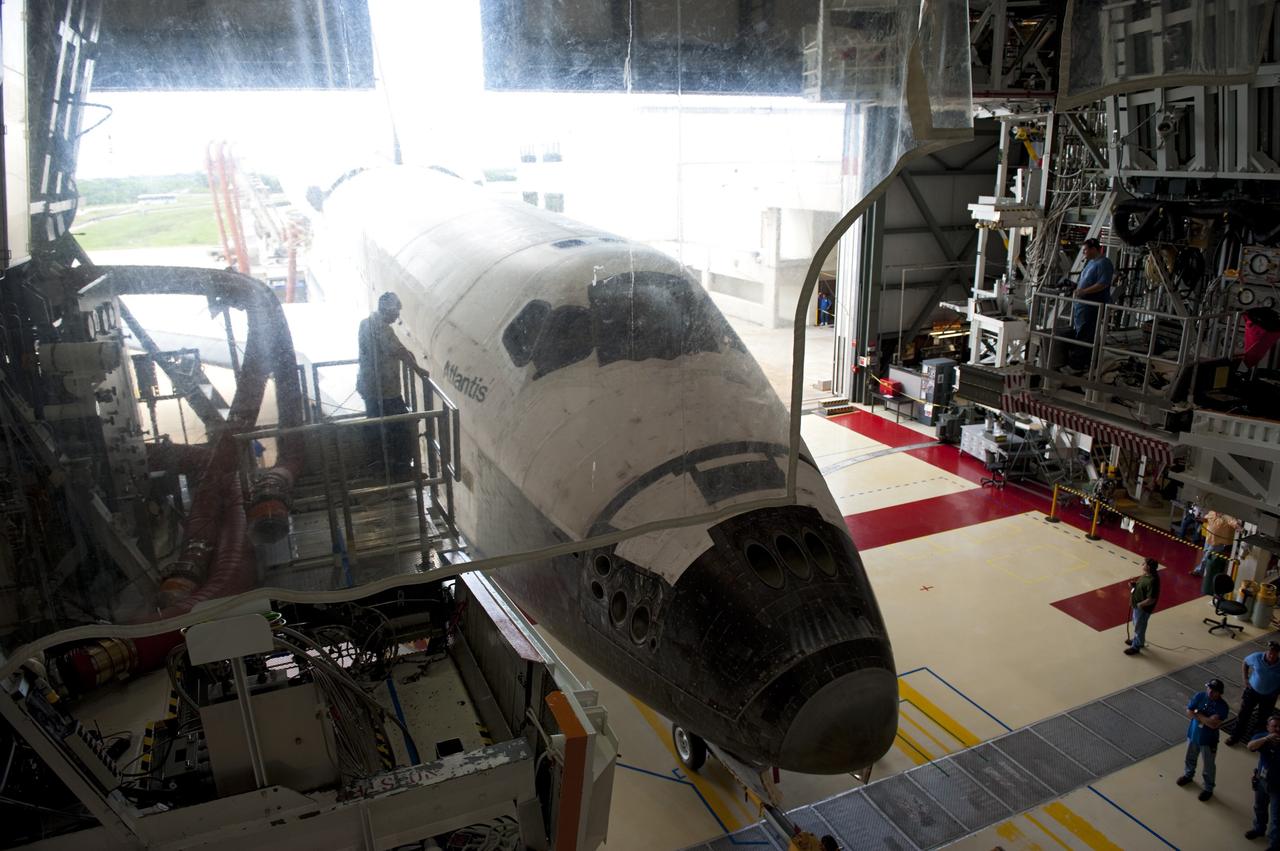
CAPE CANAVERAL, Fla. -- At NASA's Kennedy Space Center in Florida, employees in Orbiter Processing Facility-2 monitor the alignment of space shuttle Atlantis as it is towed into the empty bay. Once inside the processing facility, Atlantis will be prepared for future public display at Kennedy's Visitor Complex. Atlantis' final return from space at 5:57 a.m. EDT concluded the STS-135 mission, secured the space shuttle fleet's place in history and brought a close to America's Space Shuttle Program. Main gear touchdown was at 5:57:00 a.m. EDT, followed by nose gear touchdown at 5:57:20 a.m., and wheelstop at 5:57:54 a.m. On board were STS-135 Commander Chris Ferguson, Pilot Doug Hurley, and Mission Specialists Sandra Magnus and Rex Walheim. On the 37th shuttle mission to the International Space Station, STS-135 delivered the Raffaello multi-purpose logistics module filled with more than 9,400 pounds of spare parts, equipment and supplies that will sustain station operations for the next year. STS-135 was the 33rd and final flight for Atlantis, which has spent 307 days in space, orbited Earth 4,848 times and traveled 125,935,769 miles, and also the final mission of the Space Shuttle Program. For more information, visit www.nasa.gov/mission_pages/shuttle/shuttlemissions/sts135/index.html. Photo credit: NASA/Kim Shiflett
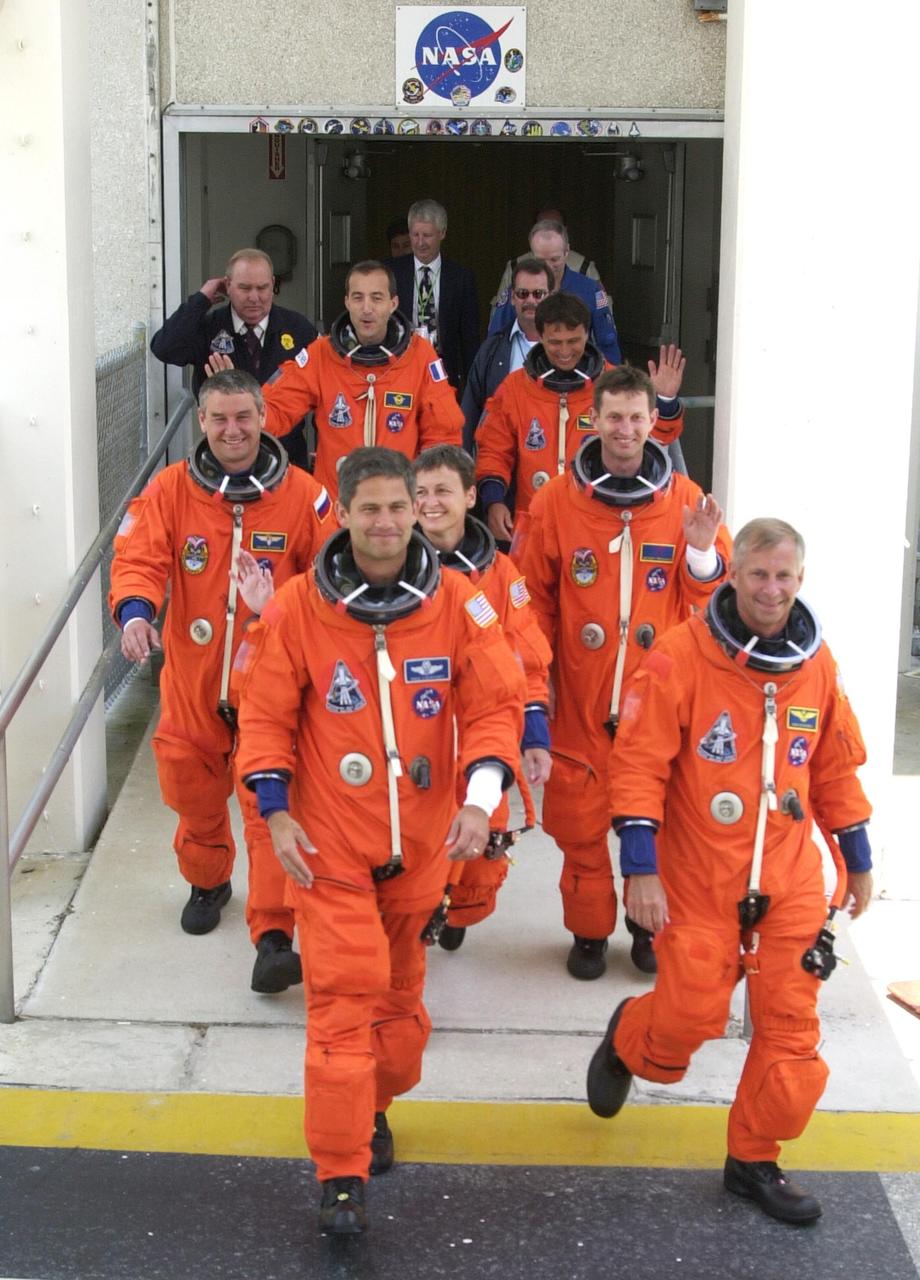
KENNEDY SPACE CENTER, FLA. -- The STS-111 and Expedition 5 crews hurry from the Operations and Checkout Building for a second launch attempt aboard Space Shuttle Endeavour. From front to back are Pilot Paul Lockhart and Commander Kenneth Cockrell; astronaut Peggy Whitson; Expedition 5 Commander Valeri Korzun (RSA) and cosmonaut Sergei Treschev (RSA); and Mission Specialists Philippe Perrin (CNES) and Franklin Chang-Diaz. This mission marks the 14th Shuttle flight to the Space Station and the third Shuttle mission this year. Mission STS-111 is the 18th flight of Endeavour and the 110th flight overall in NASA's Space Shuttle program. On mission STS-111, astronauts will deliver the Leonardo Multi-Purpose Logistics Module, the Mobile Base System (MBS), and the Expedition Five crew to the Space Station. During the seven days Endeavour will be docked to the Station, three spacewalks will be performed dedicated to installing MBS and the replacement wrist-roll joint on the Station's Canadarm2 robotic arm. Endeavour will also carry the Expedition 5 crew, who will replace Expedition 4 on board the Station. Expedition 4 crew members will return to Earth with the STS-111 crew. Liftoff is scheduled for 5:22 p.m. EDT from Launch Pad 39A
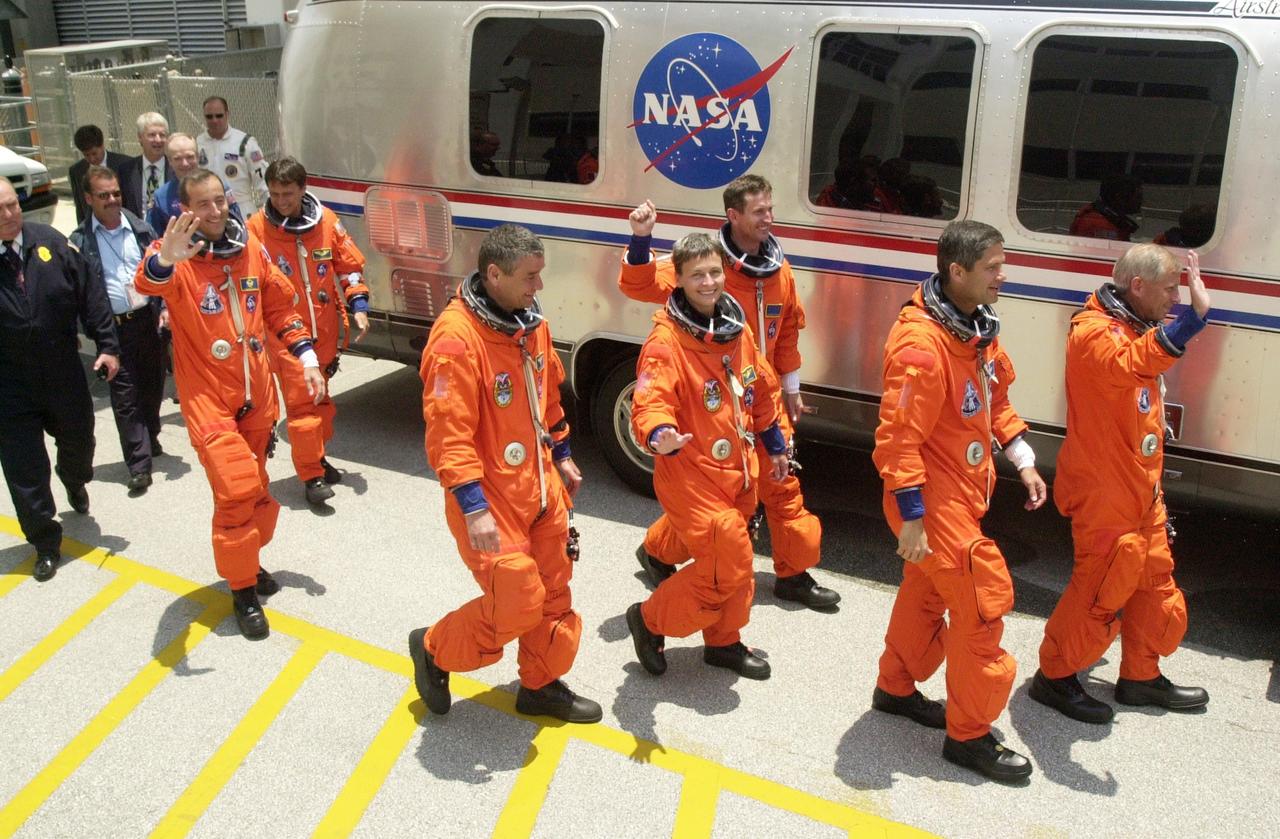
KENNEDY SPACE CENTER, FLA. -- The STS-111 and Expedition 5 crews head for the Astrovan to take them to Launch Pad 39A and the second launch attempt aboard Space Shuttle Endeavour. From left to right, front to back, are Mission Specialists Philippe Perrin (CNES) and Franklin Chang-Diaz; Expedition 5 Commander Valeri Korzun, astronaut Peggy Whitson and cosmonaut Sergei Treschev; Pilot Paul Lockhart and Commander Kenneth Cockrell. This mission marks the 14th Shuttle flight to the Space Station and the third Shuttle mission this year. Mission STS-111 is the 18th flight of Endeavour and the 110th flight overall in NASA's Space Shuttle program. On mission STS-111, astronauts will deliver the Leonardo Multi-Purpose Logistics Module, the Mobile Base System (MBS), and the Expedition Five crew to the Space Station. During the seven days Endeavour will be docked to the Station, three spacewalks will be performed dedicated to installing MBS and the replacement wrist-roll joint on the Station's Canadarm2 robotic arm. Endeavour will also carry the Expedition 5 crew, who will replace Expedition 4 on board the Station. Expedition 4 crew members will return to Earth with the STS-111 crew. Liftoff is scheduled for 5:22 p.m. EDT from Launch Pad 39A
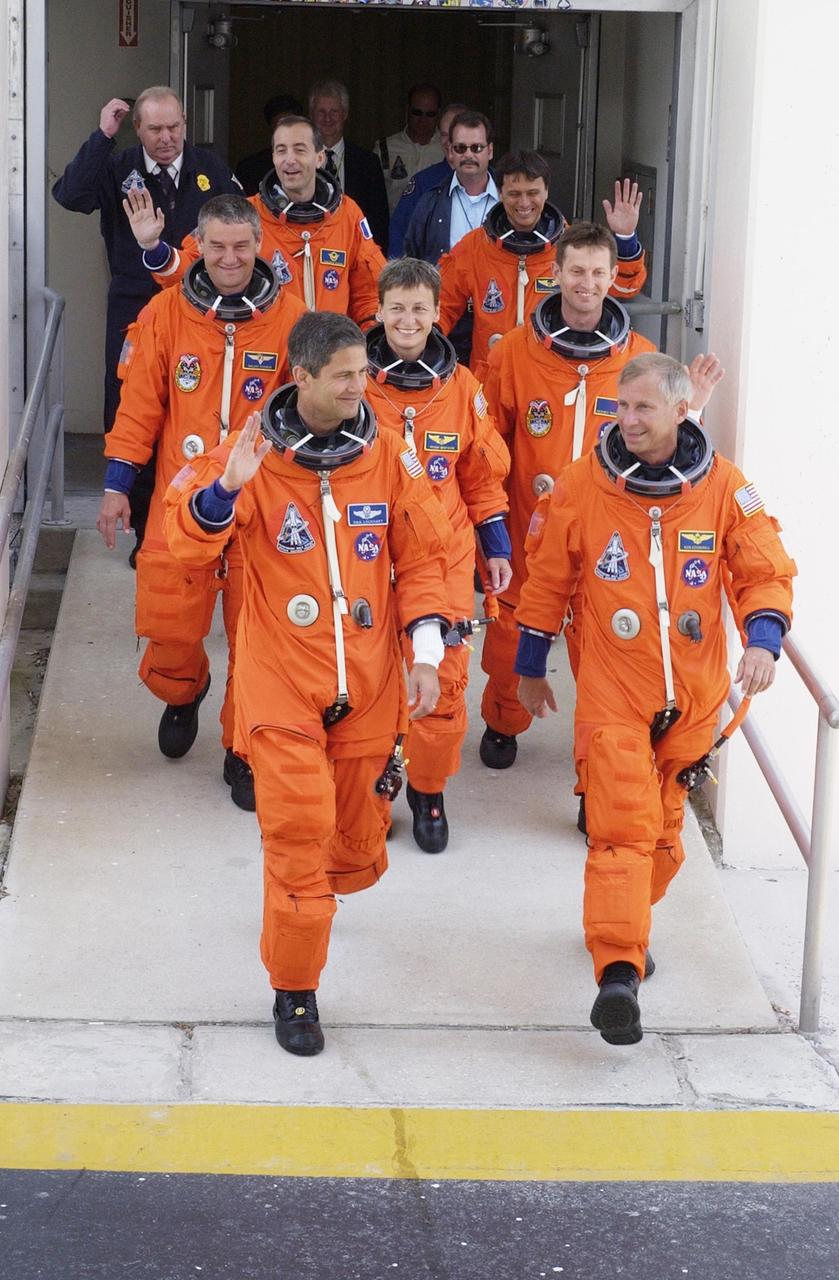
KENNEDY SPACE CENTER, FLA. - The STS-111 and Expedition 5 crews eagerly exit from the Operations and Checkout Building for launch aboard Space Shuttle Endeavour. It is the second launch attempt in six days. From front to back are Pilot Paul Lockhart and Commander Kenneth Cockrell; astronaut Peggy Whitson; Expedition 5 Commander Valeri Korzun (RSA) and cosmonaut Sergei Treschev (RSA); and Mission Specialists Philippe Perrin (CNES) and Franklin Chang-Diaz. This mission marks the 14th Shuttle flight to the Space Station and the third Shuttle mission this year. Mission STS-111 is the 18th flight of Endeavour and the 110th flight overall in NASA's Space Shuttle program. On mission STS-111, astronauts will deliver the Leonardo Multi-Purpose Logistics Module, the Mobile Base System (MBS), and the Expedition Five crew to the Space Station. During the seven days Endeavour will be docked to the Station, three spacewalks will be performed dedicated to installing MBS and the replacement wrist-roll joint on the Station's Canadarm2 robotic arm. Endeavour will also carry the Expedition 5 crew, who will replace Expedition 4 on board the Station. Expedition 4 crew members will return to Earth with the STS-111 crew. Liftoff is scheduled for 5:22 p.m. EDT from Launch Pad 39A
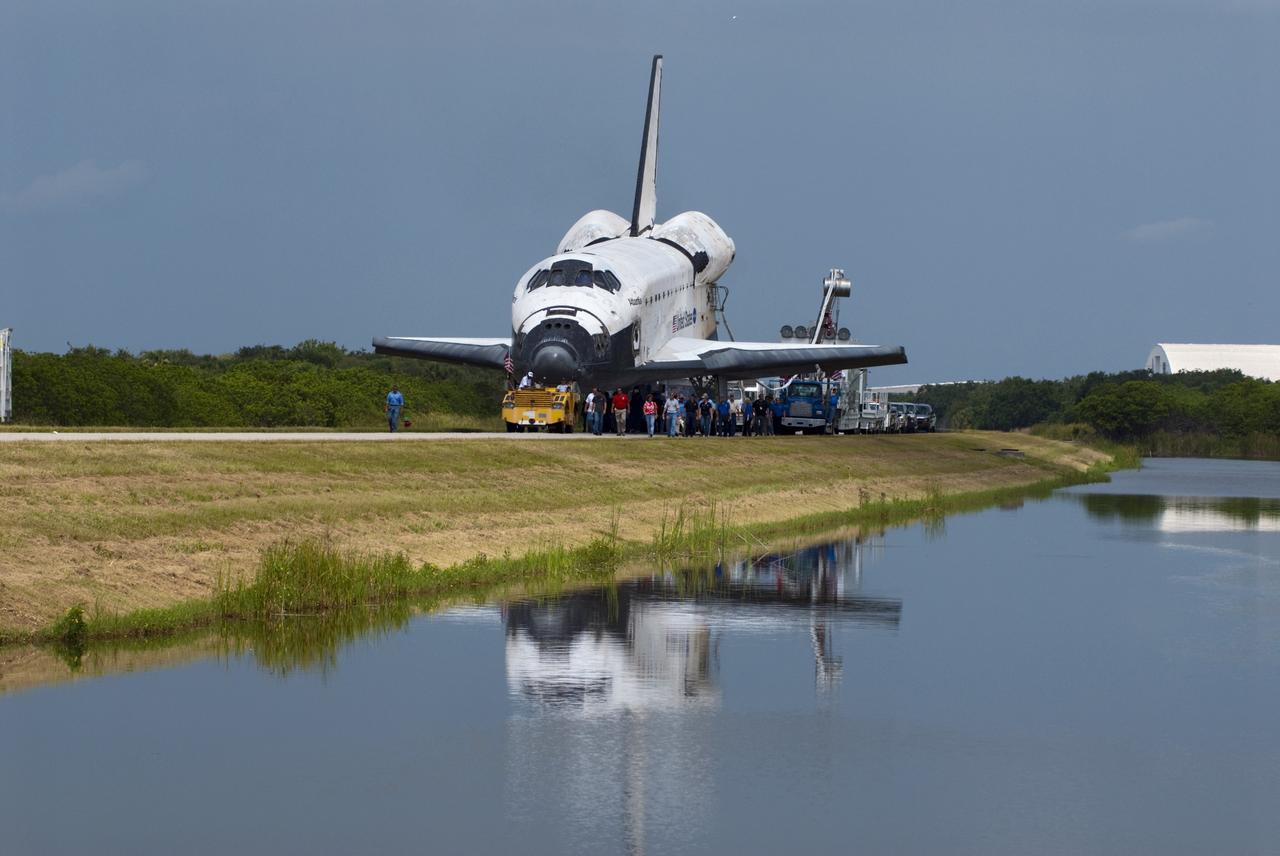
CAPE CANAVERAL, Fla. -- Space shuttle Atlantis is reflected in the water along the towway from the Shuttle Landing Facility to the Orbiter Processing Facility at NASA's Kennedy Space Center in Florida. Atlantis' final return from space at 5:57 a.m. EDT concluded the STS-135 mission, secured the space shuttle fleet's place in history and brought a close to America's Space Shuttle Program. Main gear touchdown was at 5:57:00 a.m. EDT, followed by nose gear touchdown at 5:57:20 a.m., and wheelstop at 5:57:54 a.m. On board were STS-135 Commander Chris Ferguson, Pilot Doug Hurley, and Mission Specialists Sandra Magnus and Rex Walheim. On the 37th shuttle mission to the International Space Station, STS-135 delivered the Raffaello multi-purpose logistics module filled with more than 9,400 pounds of spare parts, equipment and supplies that will sustain station operations for the next year. STS-135 was the 33rd and final flight for Atlantis, which has spent 307 days in space, orbited Earth 4,848 times and traveled 125,935,769 miles, and also the final mission of the Space Shuttle Program. For more information, visit www.nasa.gov/mission_pages/shuttle/shuttlemissions/sts135/index.html. Photo credit: NASA/Kim Shiflett
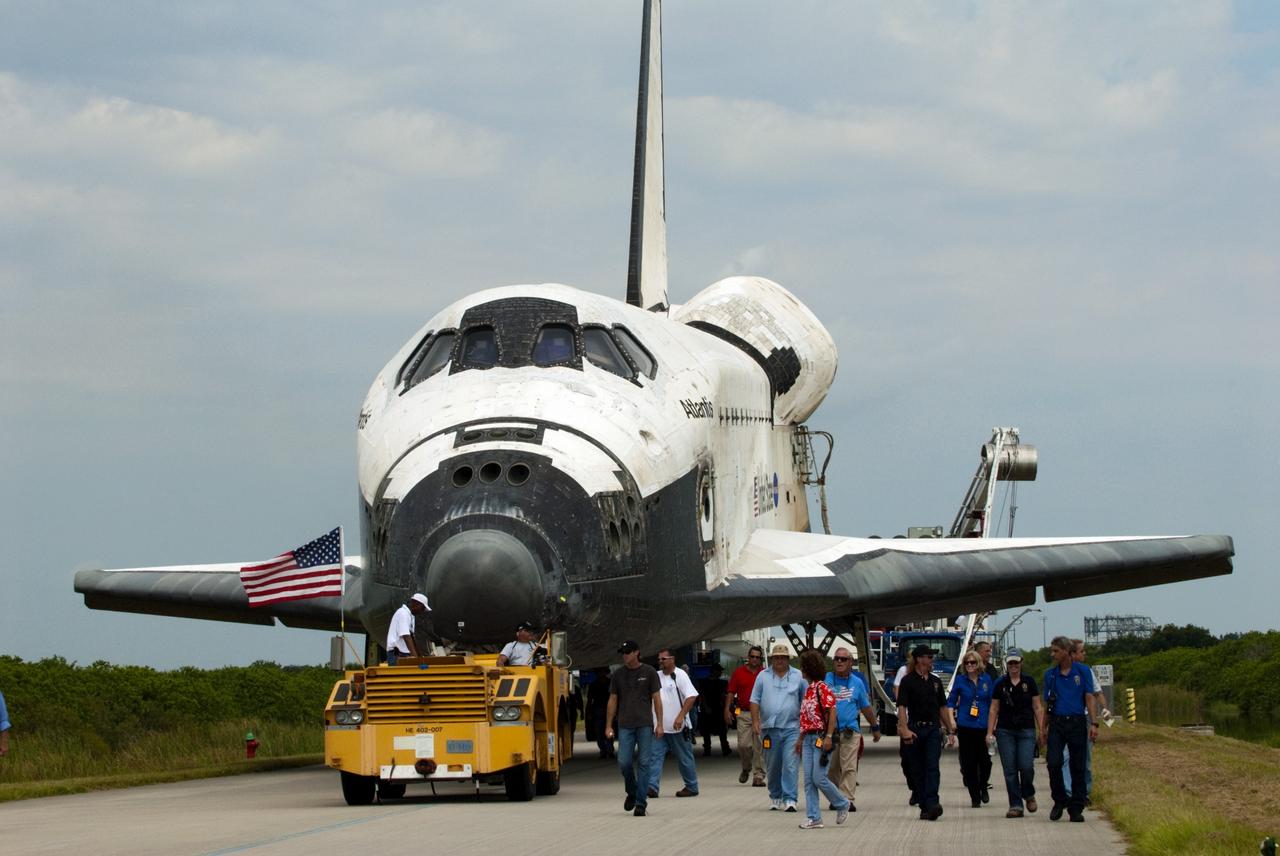
CAPE CANAVERAL, Fla. -- Space shuttle Atlantis and its employee entourage saunter along the towway from the Shuttle Landing Facility to the Orbiter Processing Facility at NASA's Kennedy Space Center in Florida. Atlantis' final return from space at 5:57 a.m. EDT concluded the STS-135 mission, secured the space shuttle fleet's place in history and brought a close to America's Space Shuttle Program. Main gear touchdown was at 5:57:00 a.m. EDT, followed by nose gear touchdown at 5:57:20 a.m., and wheelstop at 5:57:54 a.m. On board were STS-135 Commander Chris Ferguson, Pilot Doug Hurley, and Mission Specialists Sandra Magnus and Rex Walheim. On the 37th shuttle mission to the International Space Station, STS-135 delivered the Raffaello multi-purpose logistics module filled with more than 9,400 pounds of spare parts, equipment and supplies that will sustain station operations for the next year. STS-135 was the 33rd and final flight for Atlantis, which has spent 307 days in space, orbited Earth 4,848 times and traveled 125,935,769 miles, and also the final mission of the Space Shuttle Program. For more information, visit www.nasa.gov/mission_pages/shuttle/shuttlemissions/sts135/index.html. Photo credit: NASA/Kim Shiflett