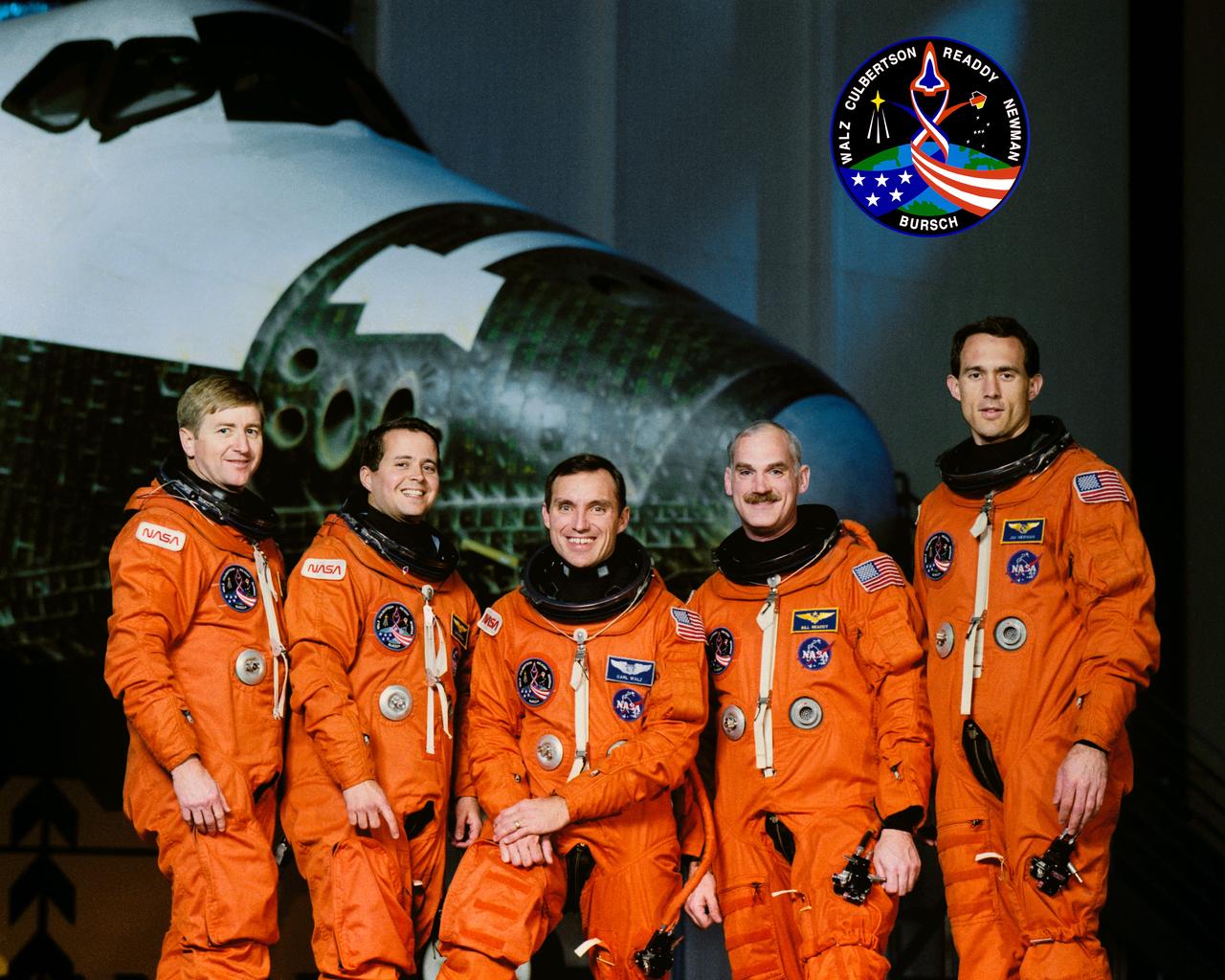
STS051-S-002 (June 1993) --- These five NASA astronauts have been assigned to fly aboard the Space Shuttle Discovery for the STS-51 mission, scheduled for July, 1993. Left to right are astronauts Frank L. Culbertson, Jr., mission commander; Daniel W. Bursch and Carl E. Walz, mission specialists; William F. Readdy, pilot; and James H. Newman, mission specialist.
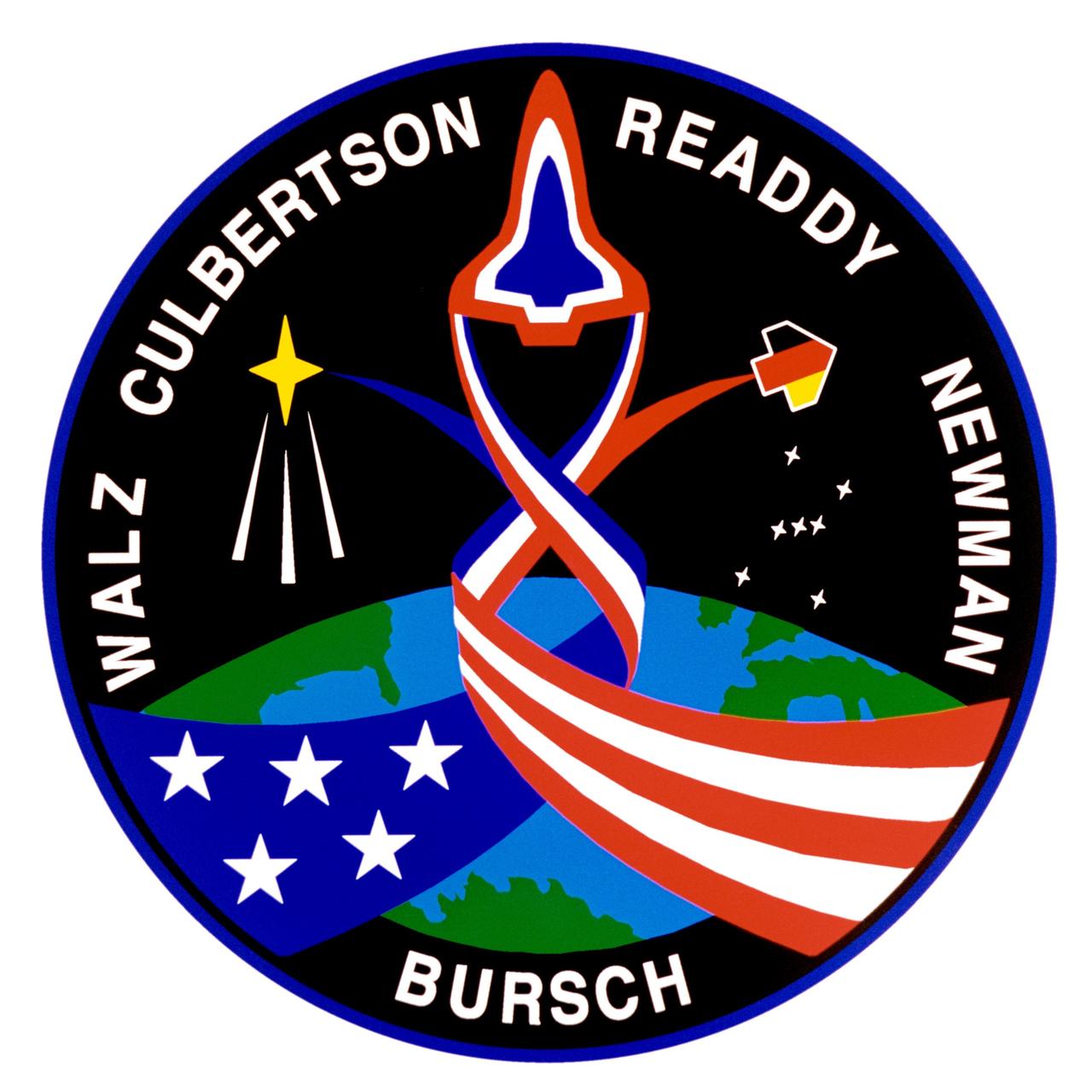
STS051-S-001 (January 1993) --- Designed by the crew members, the crew patch honors all who have contributed to mission success. It symbolizes NASA's continuing quest to increase mankind's knowledge and use of space through this multi-faceted mission. The gold star represents the United States Advanced Communications Technology Satellite (ACTS) boosted by the Transfer Orbit Stage (TOS). The rays below the ACT\TOS represent the innovative communication technologies to be tested by this experiment. The stylized Shuttle Pallet Satellite (SPAS) represents the German-sponsored ASTRO\SPAS mission. The constellation Orion below SPAS is representative of the types of stellar objects to be studied by its experimenters. The stars in Orion also commemorate the astronauts who have sacrificed their lives for the space program. The ascending spiral, symbolizing America's continuing commitment to leadership in space exploration and development, originates with the thousands of persons who ensure the success of each space shuttle flight. The five large white stars, representing the five crew members, along with the single gold star, form the mission's numerical designation. The NASA insignia design for space shuttle flights is reserved for use by the astronauts and for other official use as the NASA Administrator may authorize. Public availability has been approved only in the form of illustrations by the various news media. When and if there is any change in this policy, which we do not anticipate, it will be publicly announced. Photo credit: NASA
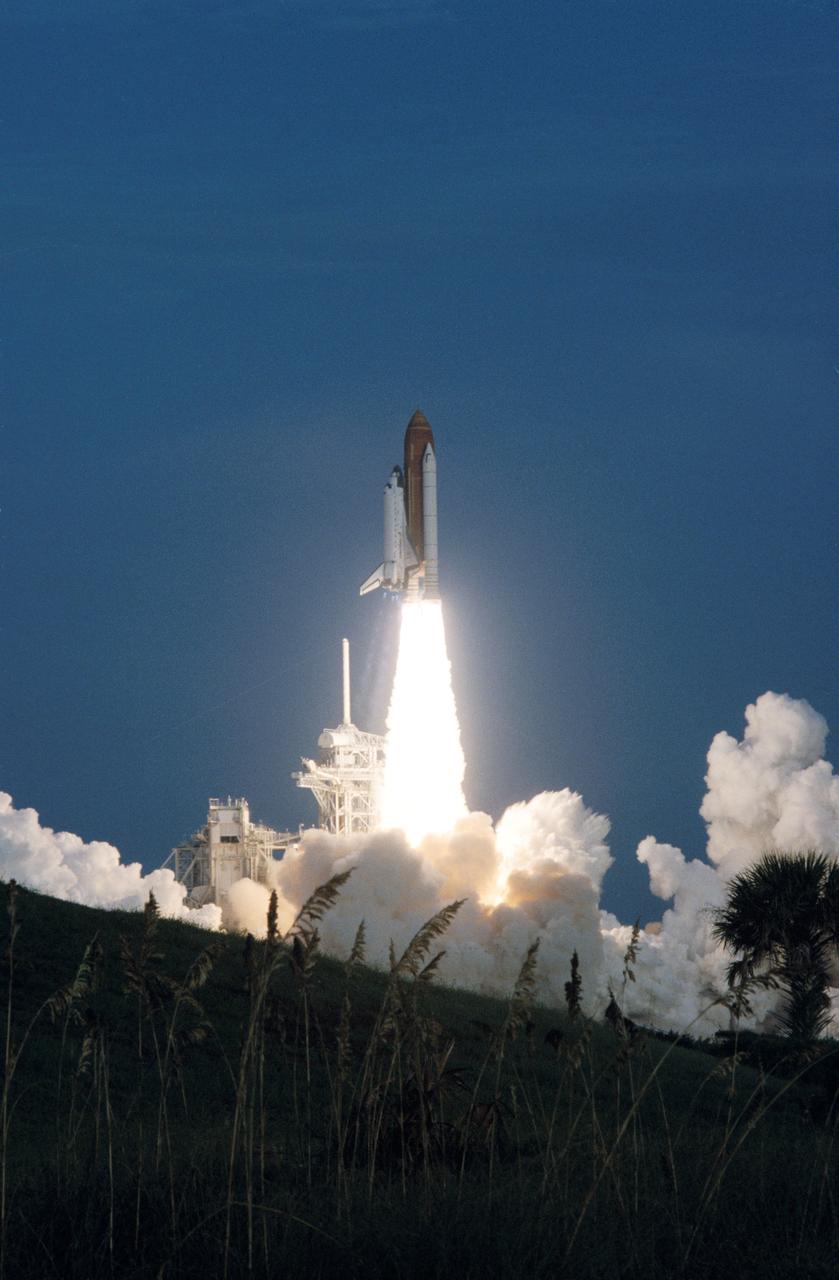
STS051-S-108 (12 Sept. 1993) --- The Space Shuttle Discovery soars toward a nine-day stay in Earth-orbit to support the mission. Launch occurred at 7:45 a.m. (EDT) September 12, 1993. Note the diamond shock effect coming from the thrust of the three main engines. Onboard the shuttle were astronauts Frank L. Culbertson, Jr., William F. Readdy, Daniel W. Bursch, James H. Newman and Carl E. Walz, along with a number of payloads. The payloads included the Advanced Communications Technology Satellite (ACTS) with its Transfer Orbit Stage (TOS), the Orbiting Retrievable Far and Extreme Ultraviolet Spectrometer (ORFEUS) and its Shuttle Pallet Satellite (SPAS) carrier. This photograph was taken with a 35mm camera.
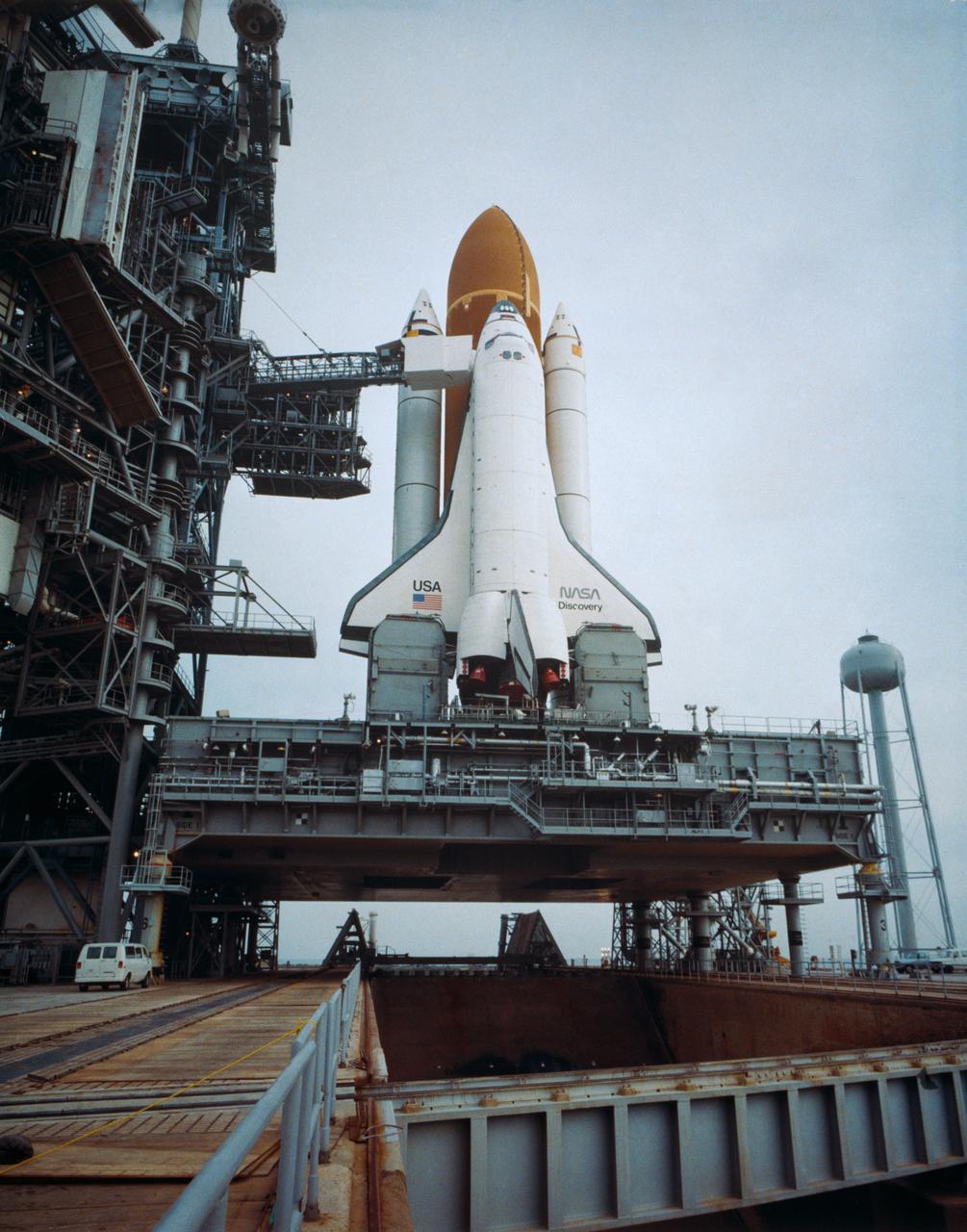
Shuttle Discovery on the launch pad for the STS 51-D mission.
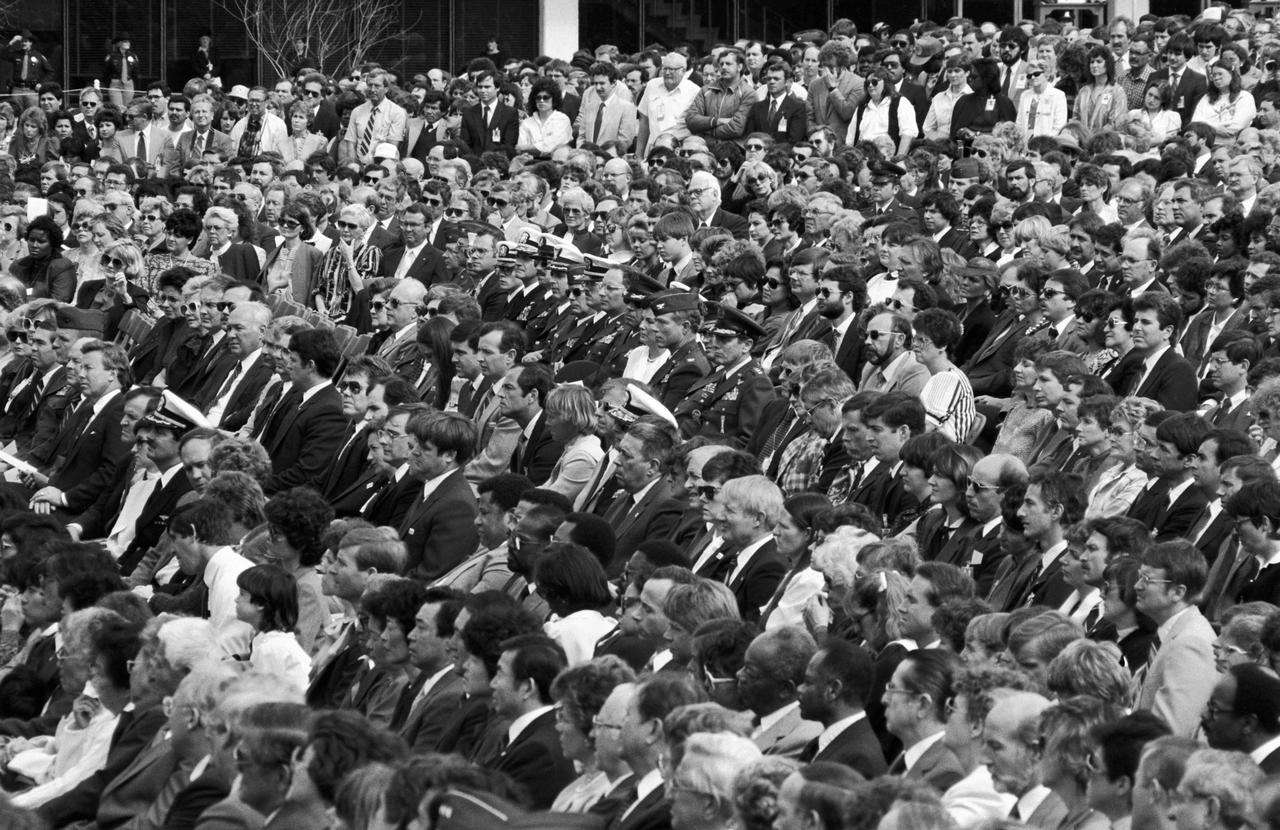
Overall view of the audience at the memorial service at JSC for the Crew of STS 51-L.
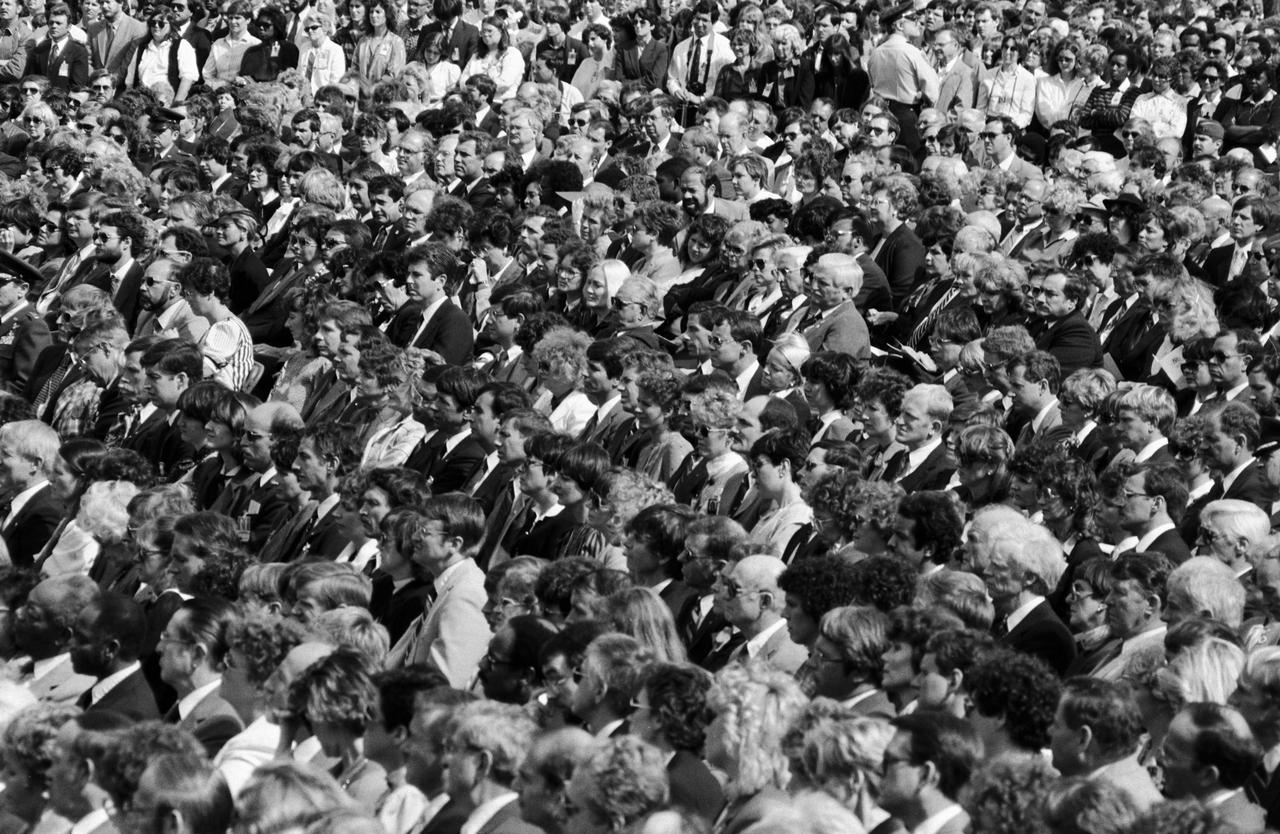
Overall view of the audience at the memorial service at JSC for the Crew of STS 51-L.
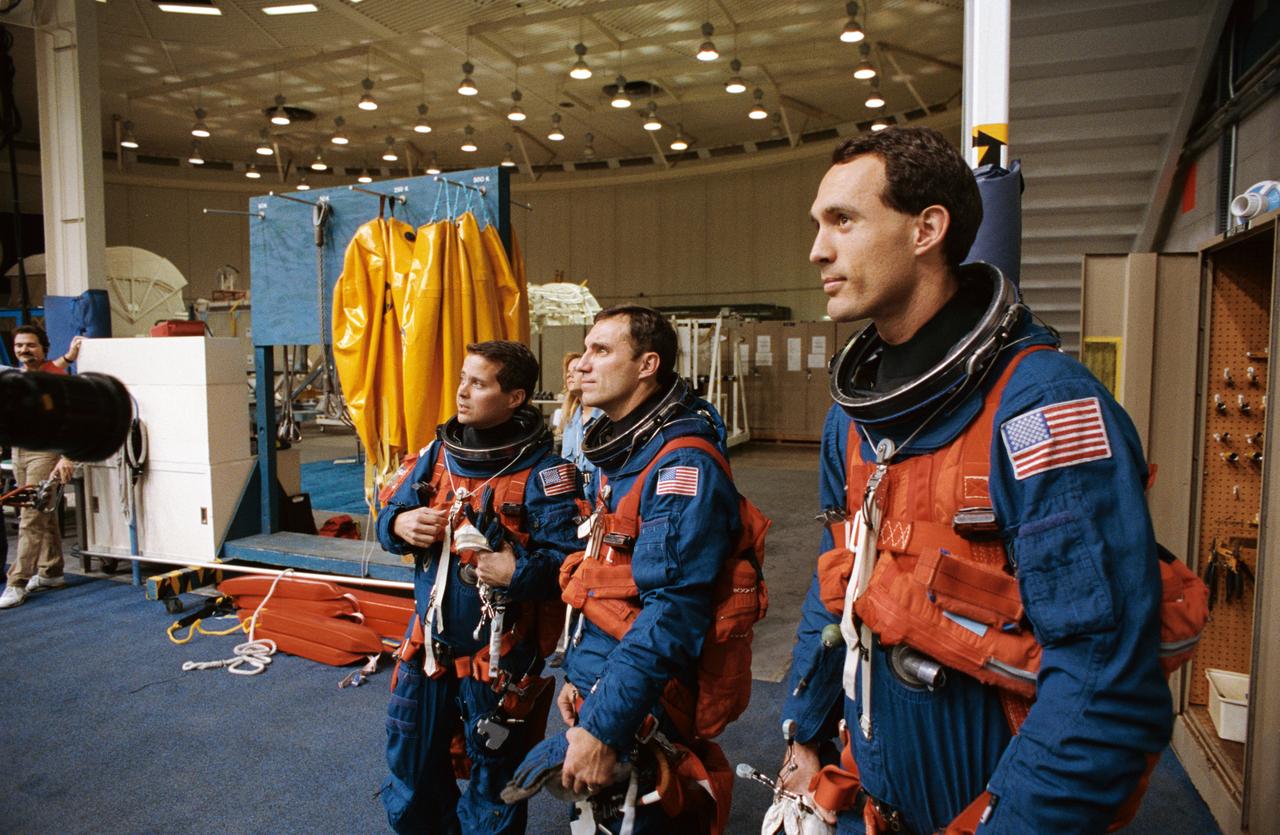
S93-31929 (24 March 1993) --- The three mission specialists for NASA's STS-51 mission watch as a crewmate (out of frame) simulates a parachute jump into water during emergency bailout training exercises at the Johnson Space Center's Weightless Environment Training Facility (WET-F). Left to right are astronauts Daniel W. Bursch, Carl E. Walz and James H. Newman. Out of frame are astronauts Frank L. Culbertson and William F. Readdy, commander and pilot, respectively.
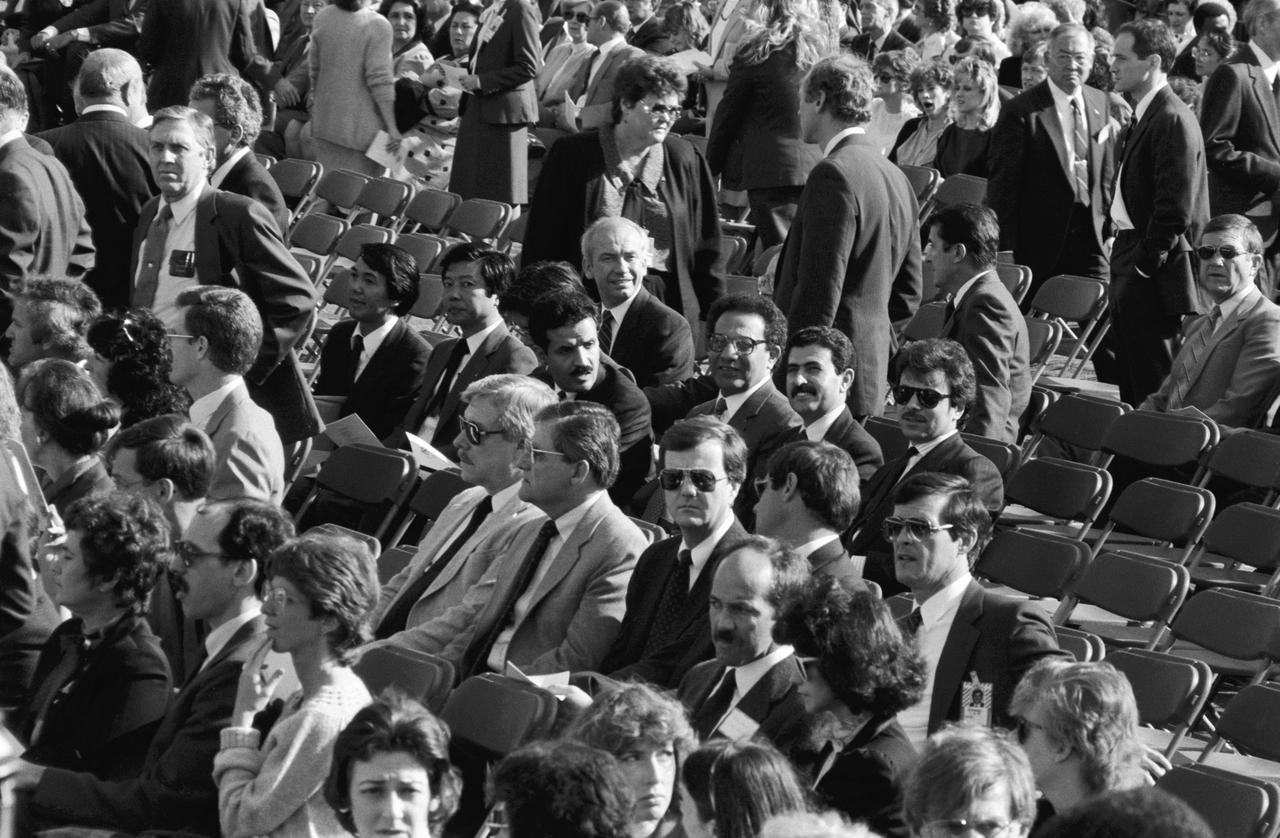
View of the audience at the memorial service at JSC for the Crew of STS 51-L. Sultan Salman Abdelazize Al-Saud of Saudi Arabia is seen in the center of the view.
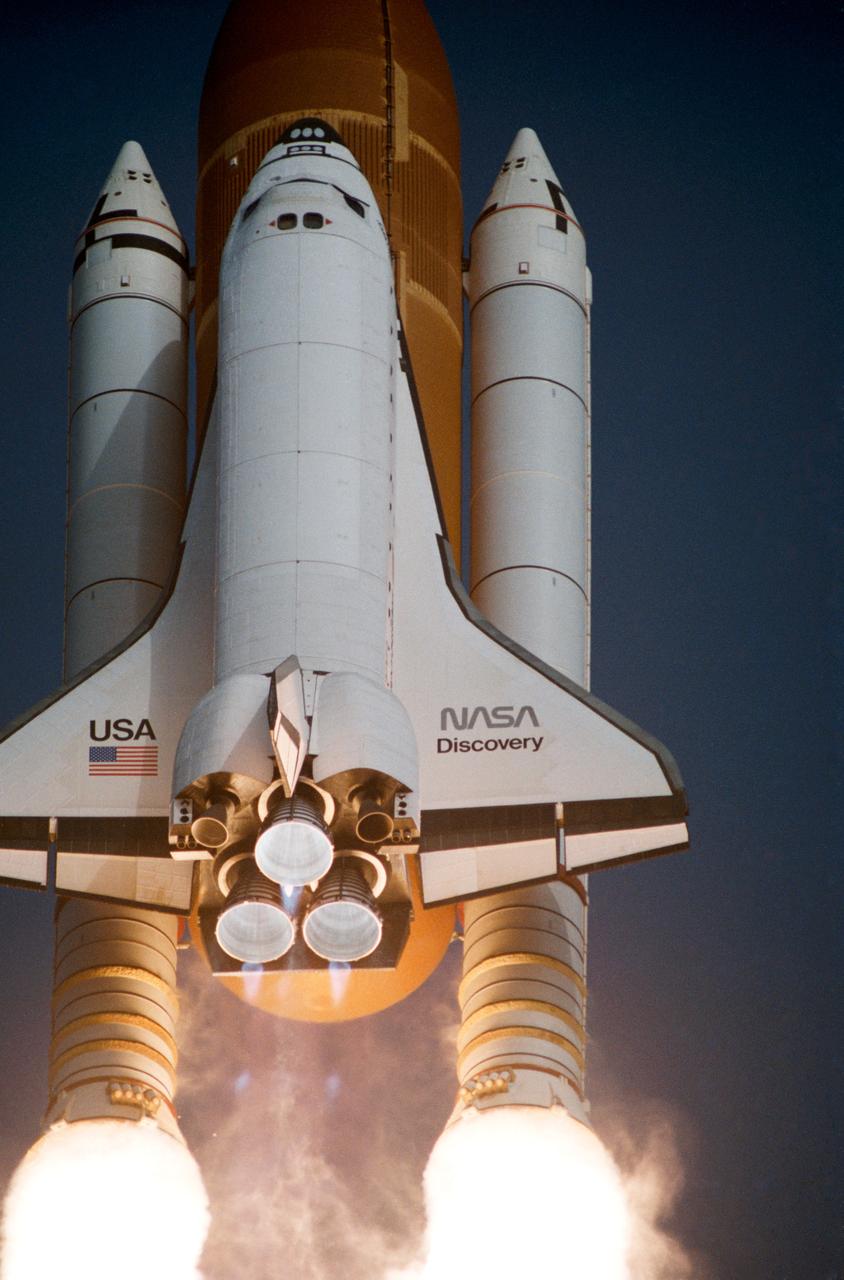
51G-S-100 (17 June 1985) --- A low-angle 35mm tracking view of the Space Shuttle Discovery, its external tank and two solid rocket boosters speeding from the KSC launch facility to begin NASA STS 51-G. The camera has captured the diamond shock effect associated with the launch phase or orbiter vehicles. Inside the Discovery are seven crewmembers and a variety of payloads representing international interests. Liftoff for 51-G occurred at 7:33:043 a.m. (EDT), June 17, 1985.
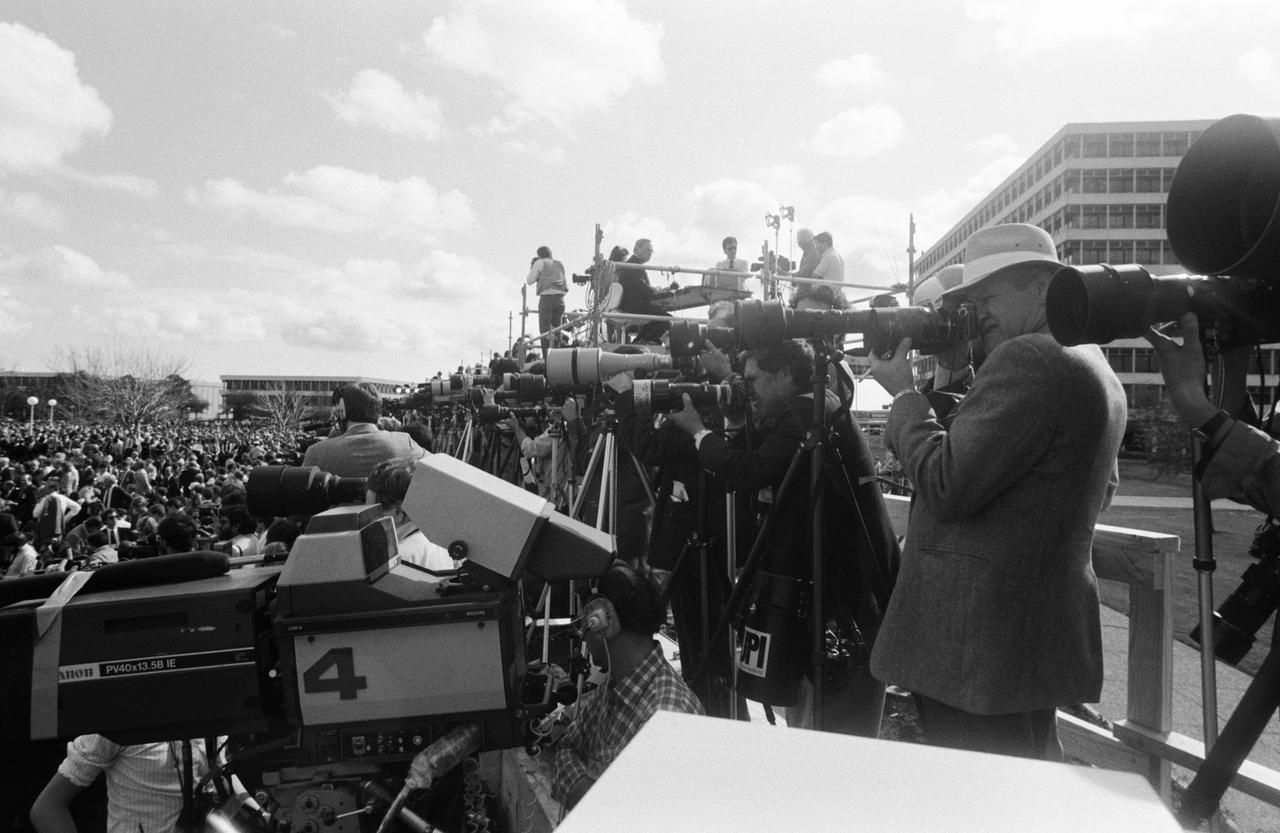
Overall view of the news media at the memorial service at JSC for the Crew of STS 51-L.
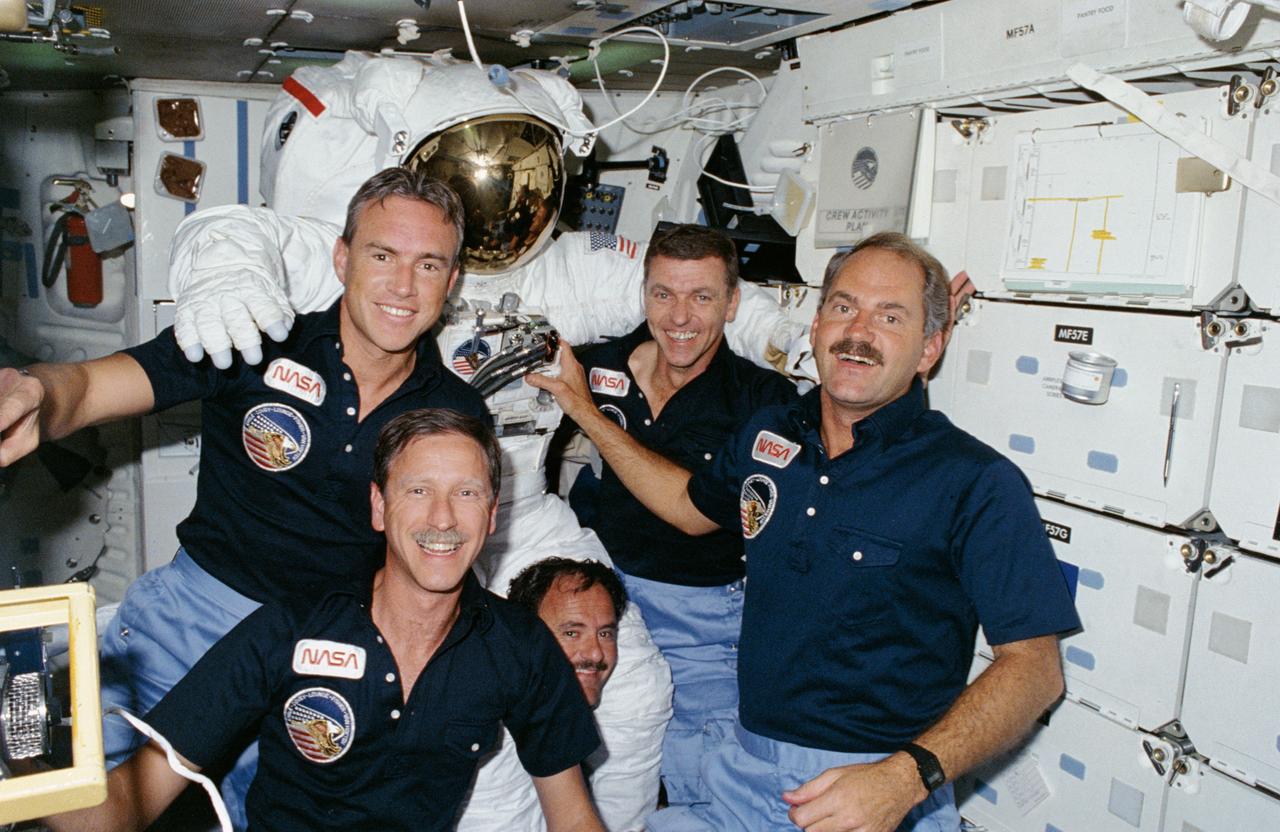
51I-07-015 (4-5 Sept 1985) --- All five STS 51-I crewmembers pose with one of two extravehicular mobility unit (EMU) spacesuits used by Astronauts van Hoften and Fisher on their two-day EVA.

S93-38577 (1 June 1993) --- The orbiter Discovery is rolled into the Vehicle Assembly Building (VAB) for mating with the external tank and twin solid rocket boosters. Discovery is being prepared for mission STS-51, targeted for a mid-July liftoff.

Four STS 51-G crewmembers huddle in a corner of the Discovery's middeck area. Daniel C. Brandenstein, mission commander, assists Steven R. Nagel with the treadmill device while John O. Creighton and Shannon W. Lucid look on.
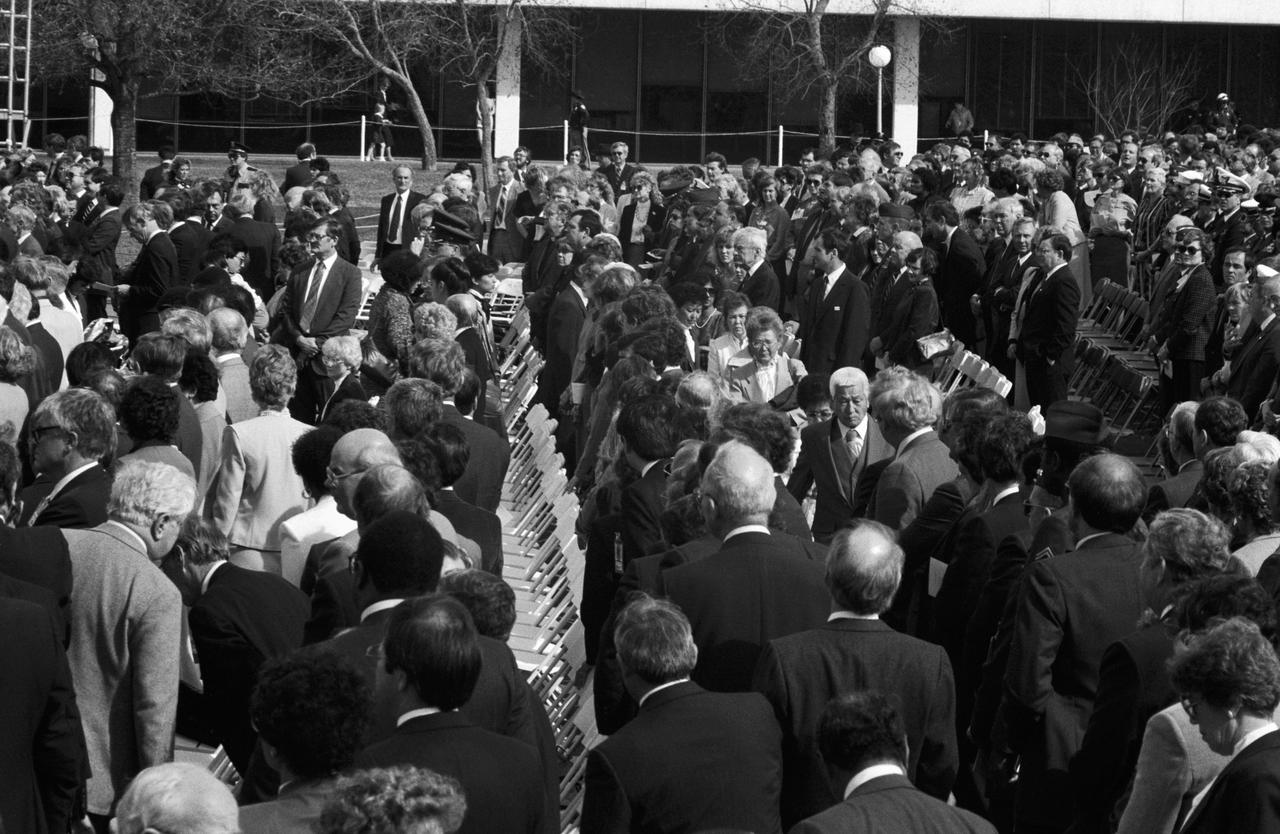
Family and friends of the STS 51-L crew prepare to be seated at the Memorial service at JSC. In the center of the view appears to be the family of Astronaut Ellison Onizuka.
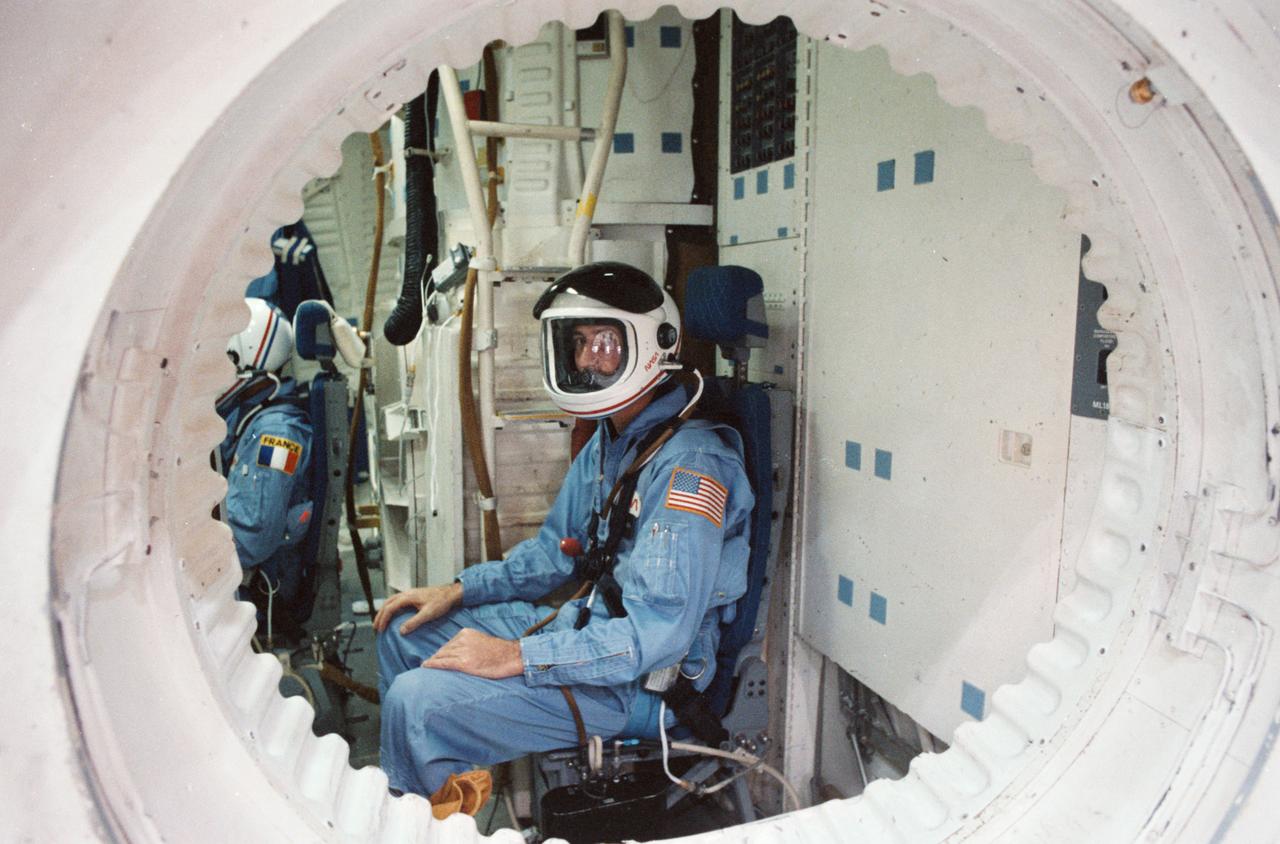
STS 51-E crew is briefed on the Shuttle full fuselage trainer. View of the crewmembers seated at stations inside the cabin was taken from the side hatch.
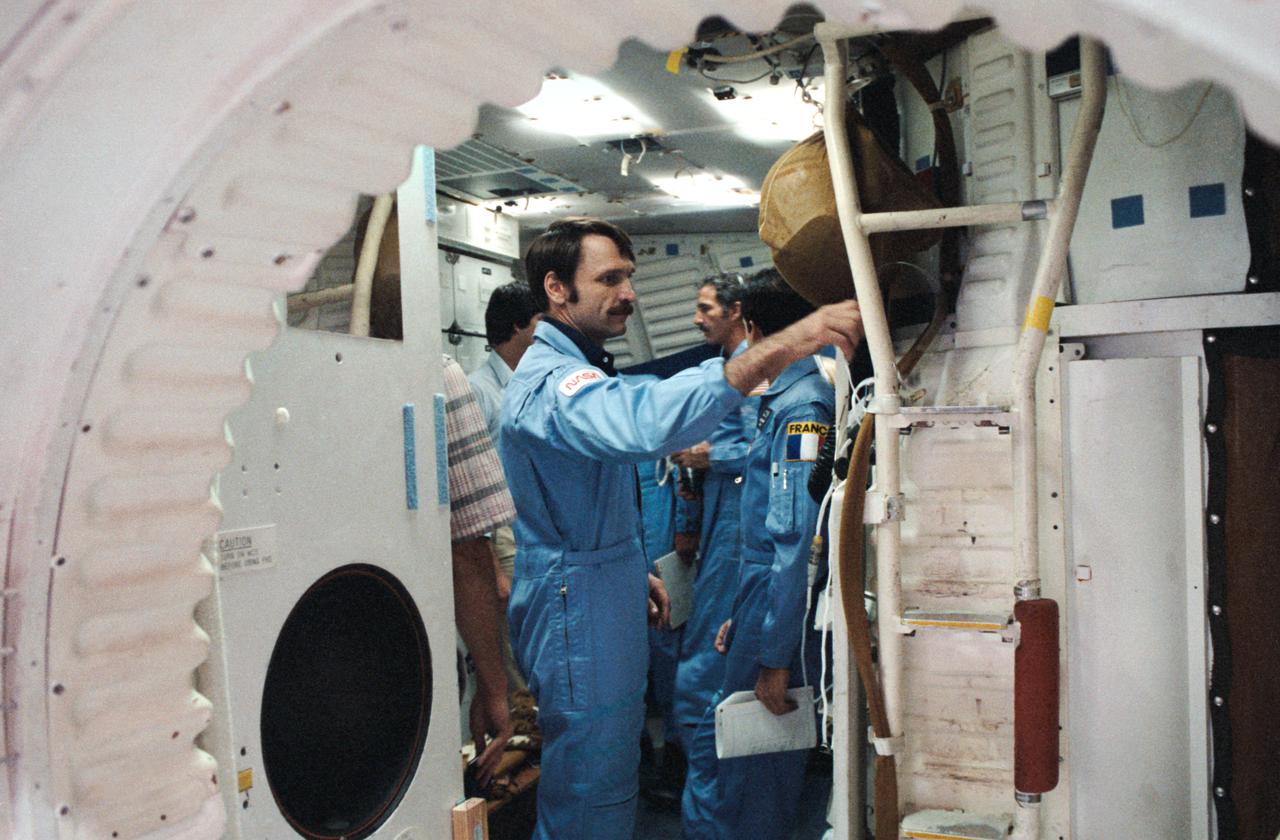
STS 51-E crew is briefed on the Shuttle full fuselage trainer. Astronauts Dave Griggs (foreground), Jean Loup Chretien (behind Griggs) and Jeff Hoffman are being shown the workings of the trainer by flight instructors.
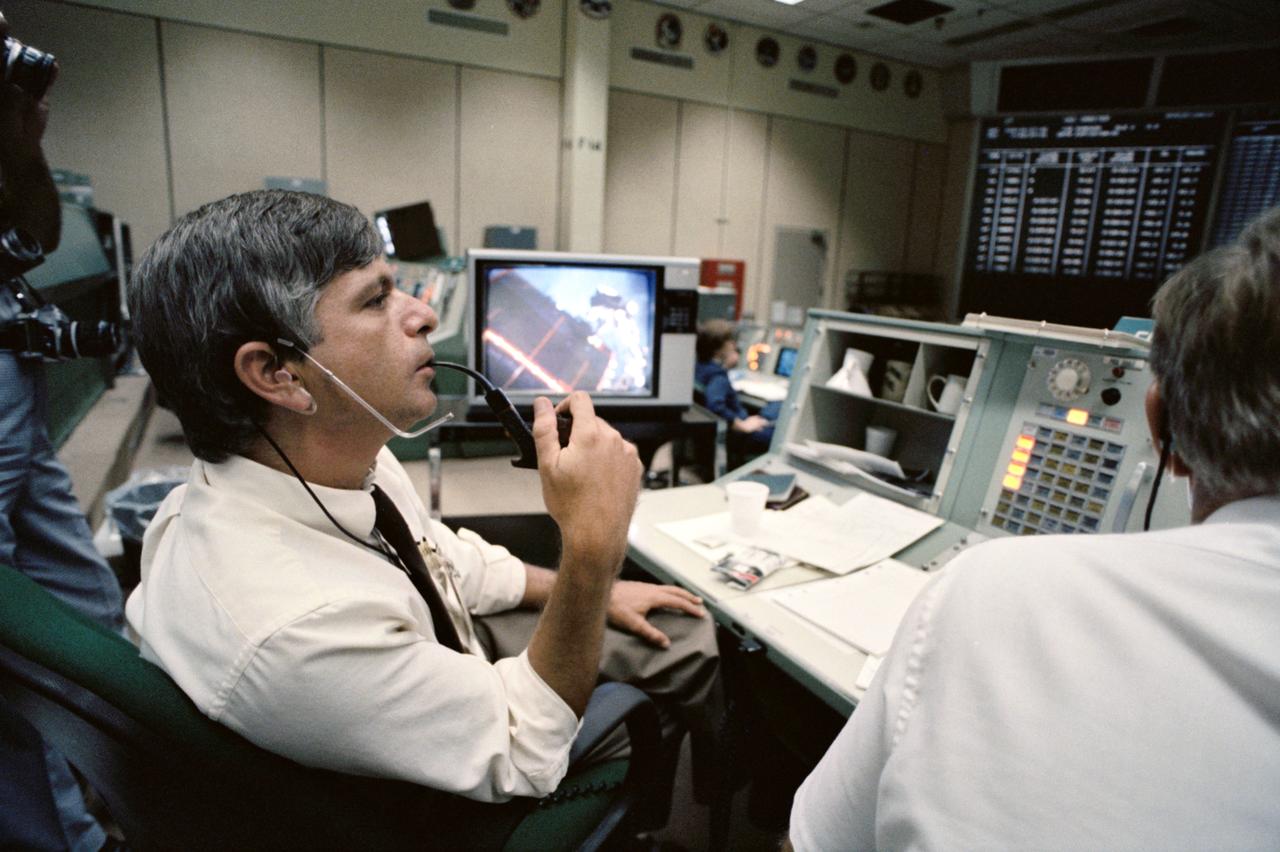
51I-S-189 (27 Aug 1985) --- View of the mission control center (MCC) during STS 51-I as flight controllers watch monitors at consoles to follow the extravehicular activity of two of the Discovery's astronauts.
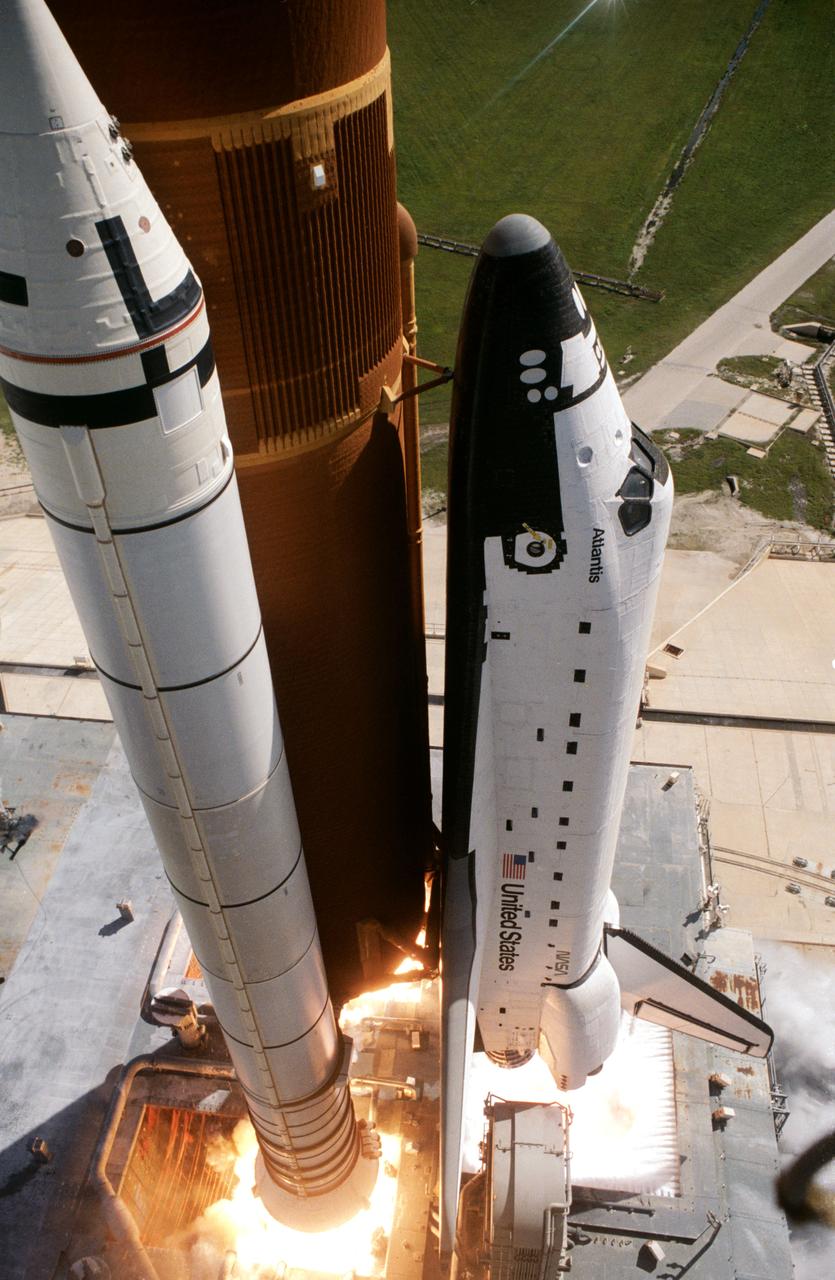
Liftoff of first flight of Atlantis and the STS 51-J mission. Mid-day skies of Florida form the backdrop for this smokey scene of the 51-J launch (001); This photograph, taken from the support structure at Launch Pad 39A, captures the first moments of the initial blastoff of the shuttle Atlantis (002); This frame was taken moments after the Atlantis cleared the launch tower. The view is from the below the orbiter and show its solid rocket boosters firing (003).
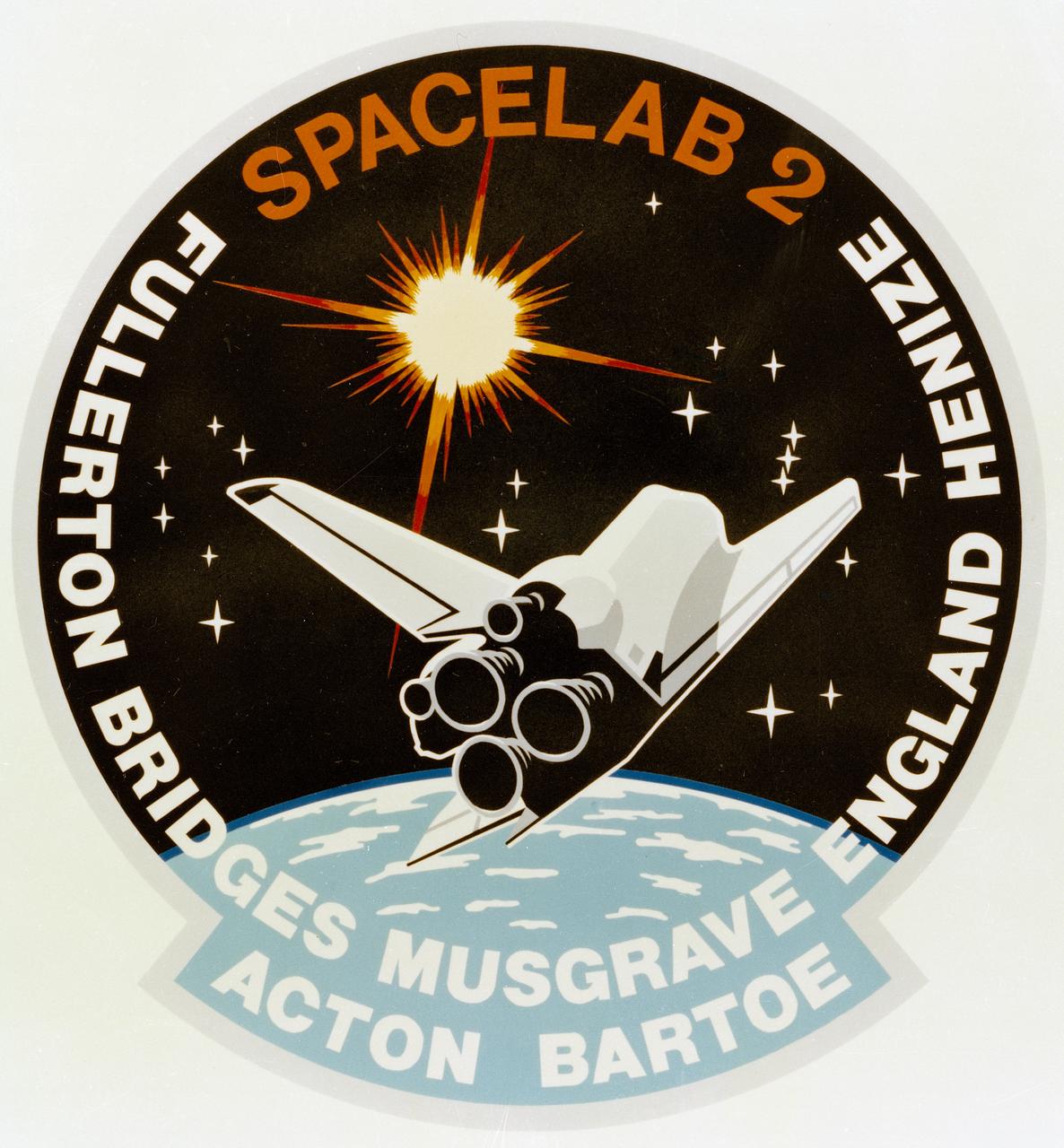
The crewmembers of Space Shuttle mission 51-F have chosen as their insignia this design by Houston artist Skip Bradley. The Space Shuttle Challenger is depicted ascending toward the heavens in search of new knowledge in the field of solar and steallar astronomy, with its Spacelab 2 payload. The constellations Leo and Orion are in the positions they will be in, relative to the sun during the flight. The nineteen stars signify that this will be the 19th STS flight.
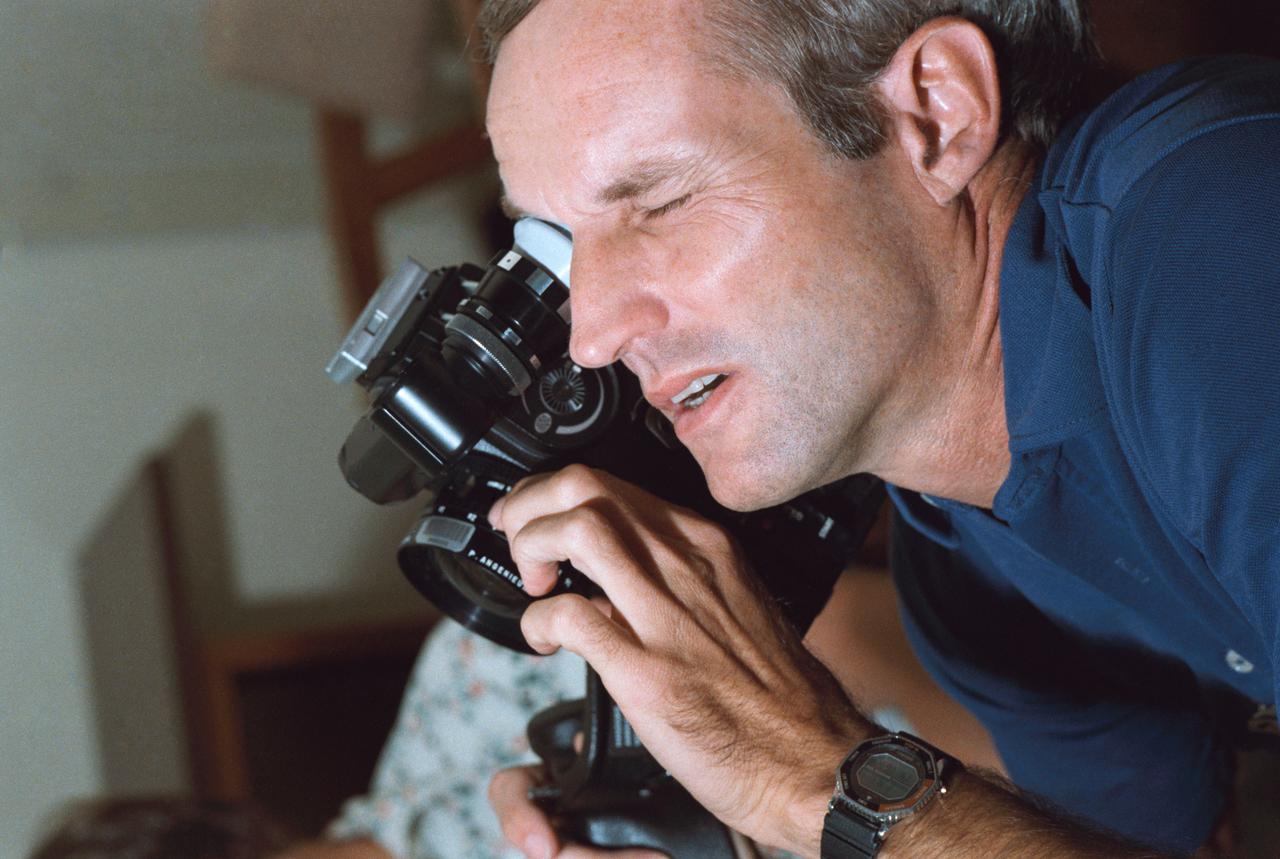
View of STS 51-D crew commander Karol Bobko training with the Arriflex 16mm camera.
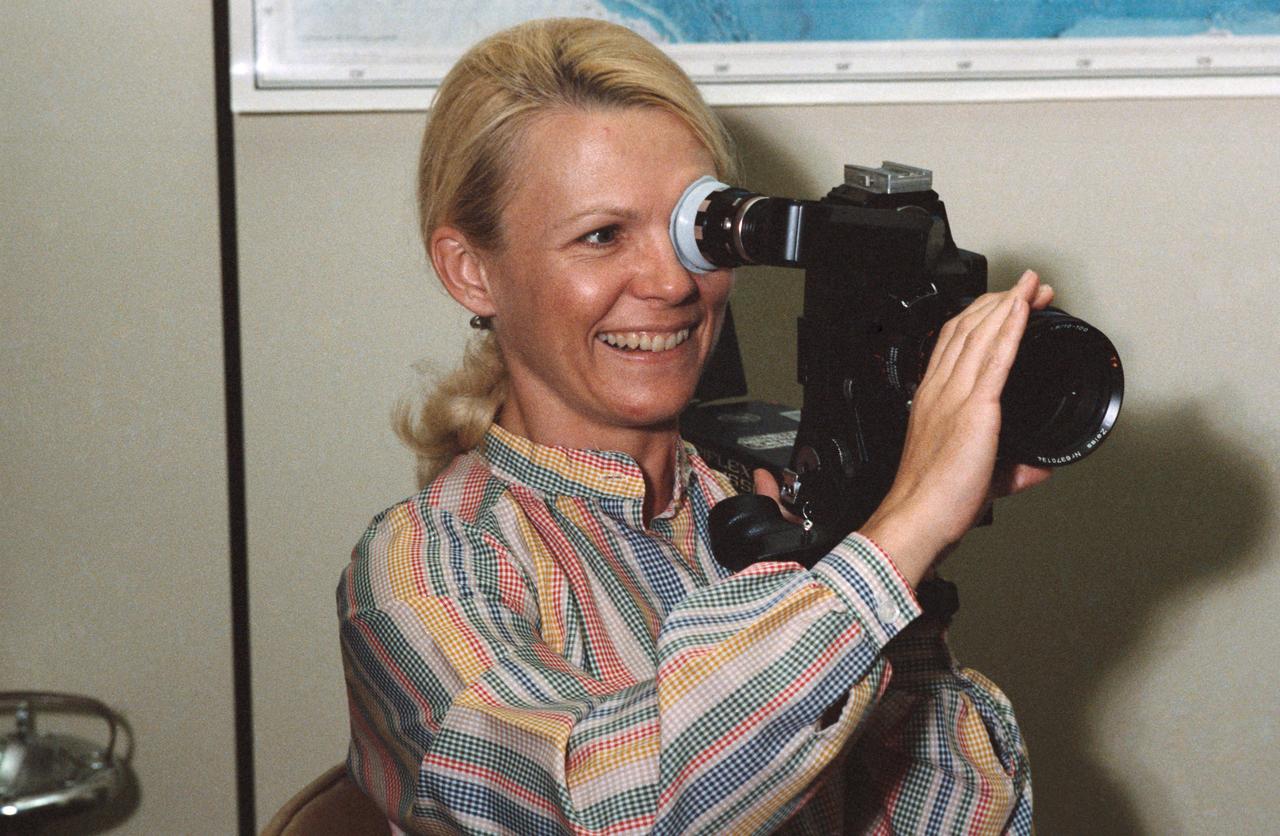
View of STS 51-D mission specialist Rhea Seddon training with the Arriflex 16mm camera.
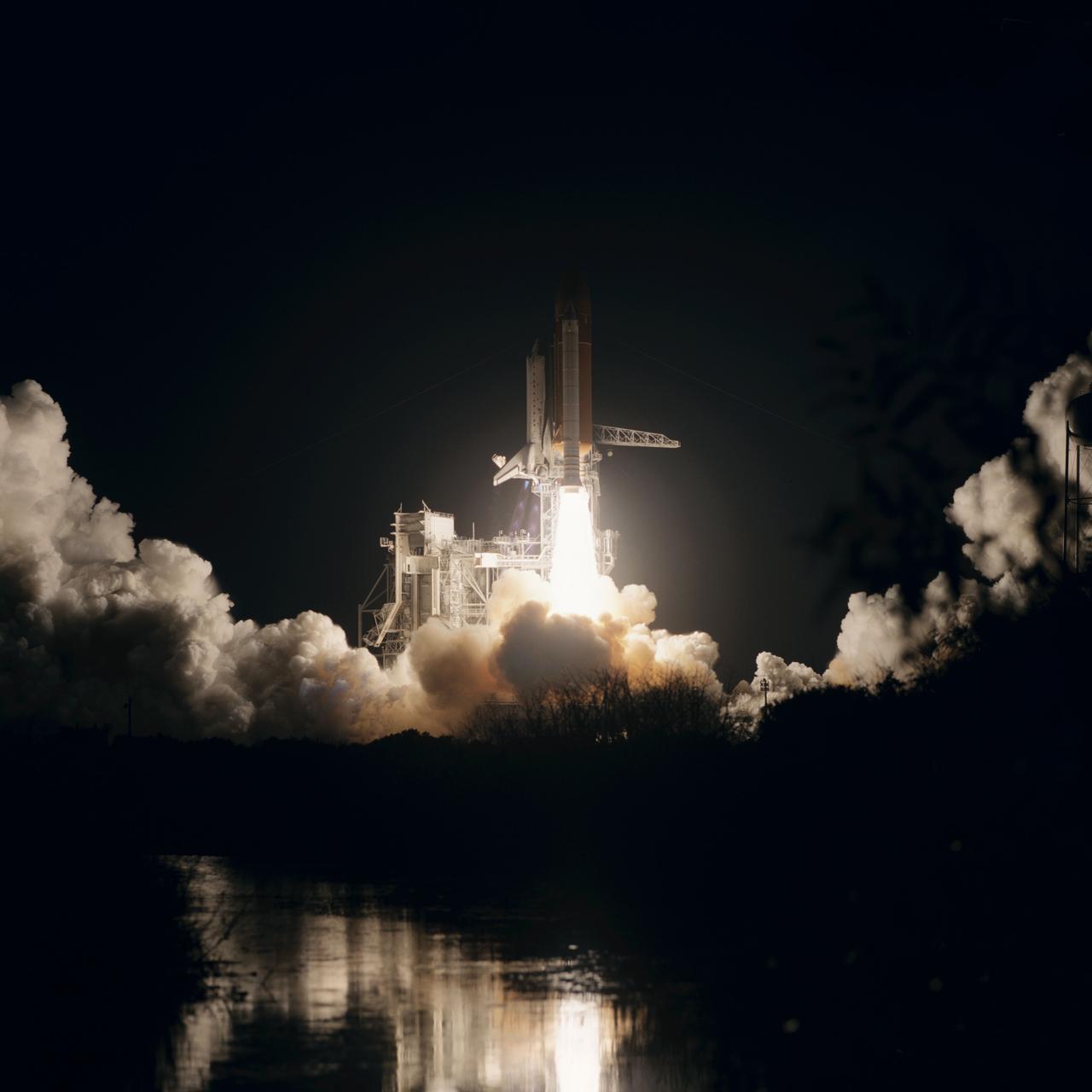
Launch of the Shuttle Discovery and begining of STS 51-I mission. View of the pre-dawn launch shows a reflection of the ignition in the river across from the launch complex (223); Clouds of smoke from the launch reflect the light of the ignited engines in this view of the pre-dawn launch (224).
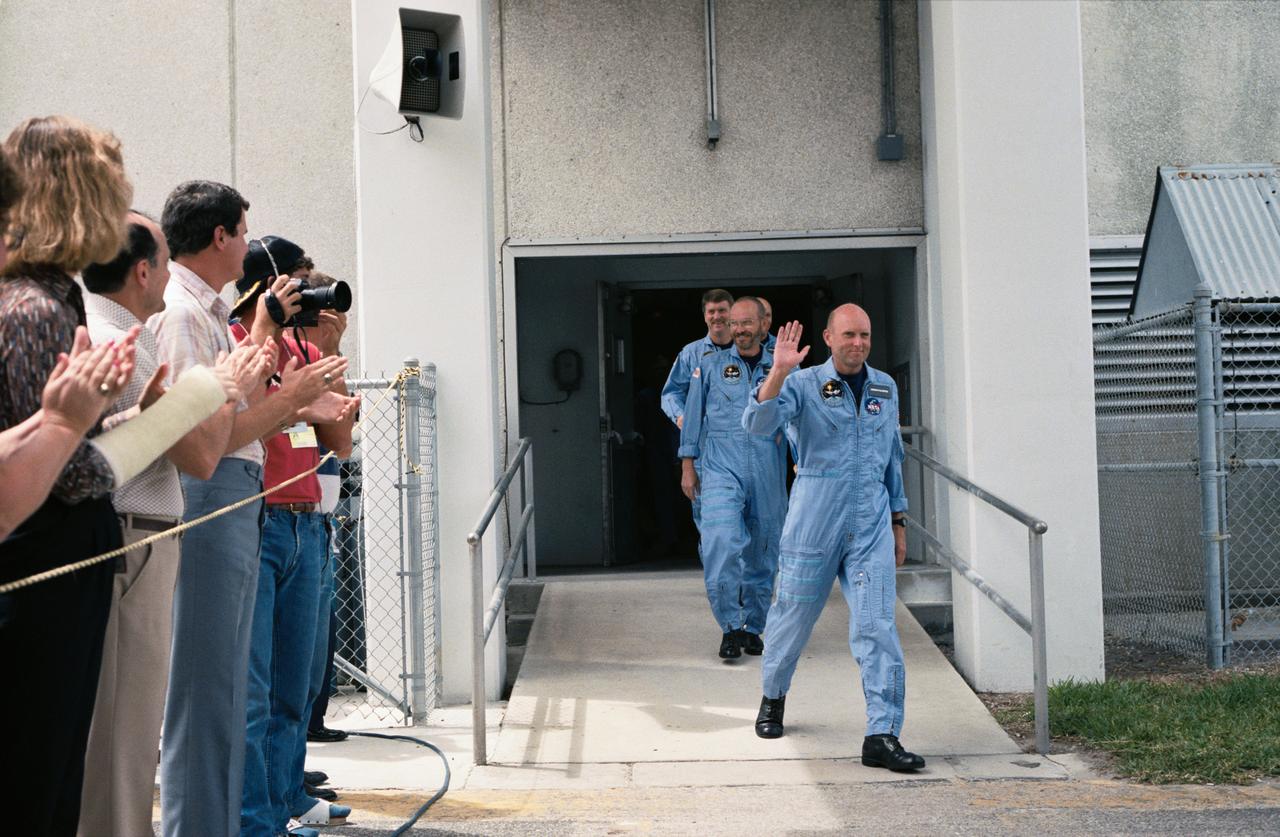
STS 51-F crewmembers depart the Kennedy Space Center's operations and checkout building on their way to the launch pad for the launch of the Discovery. Leading the way are Gordon Fullerton, commander; Loren Acton, payload specialist, and Anthony England, mission specialist. The other crewmembers are not visible in this frame.
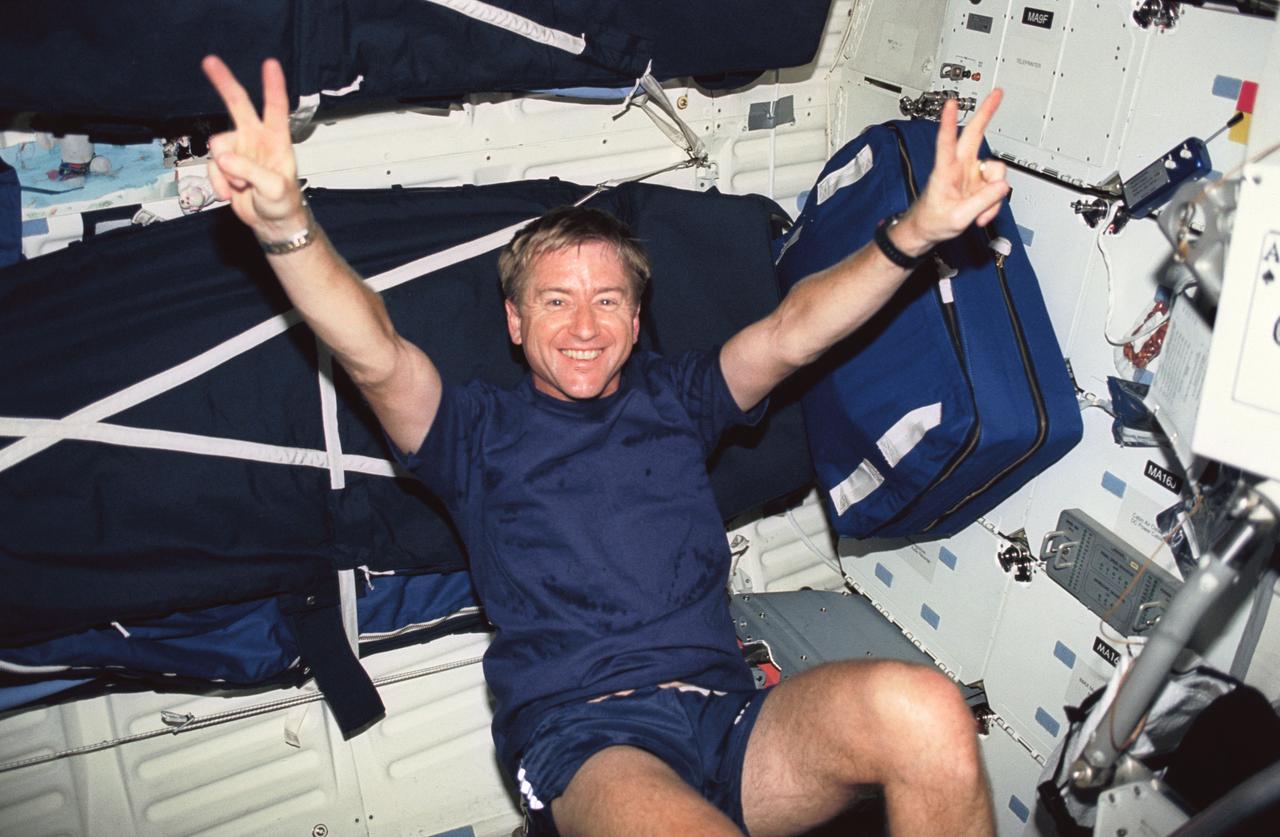
STS051-02-007 (12-22 Sept 1993) --- Astronaut Frank L. Culbertson Jr., STS-51 mission commander, appears to be enjoying a session on the ergometer, temporarily deployed on Discovery's middeck. Culbertson was joined by four other NASA astronauts for almost ten full days in Earth orbit.
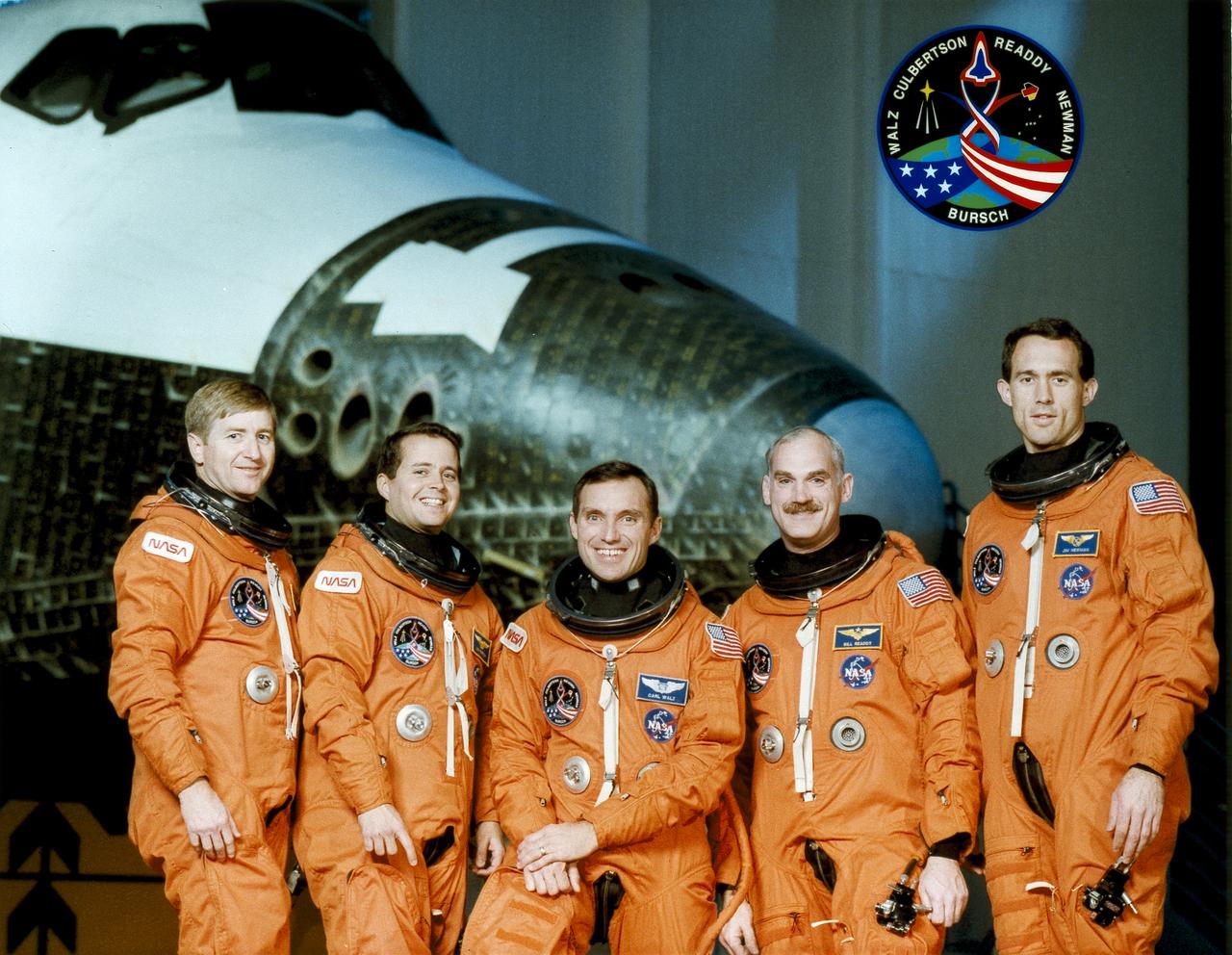
The STS-51 crew portrait features (left to right): Frank L. Culbertson, commander; Daniel W. Bursch, mission specialist; Carl E. Walz, mission specialist; William F. Readdy, pilot; and James H. Newman, mission specialist. The crew of five launched aboard the Space Shuttle Discovery on September 12, 1993 at 7:45:00 am (EDT). Two primary payloads included the Advanced Communications Technology Satellite (ACTS), and the Orbiting and Retrievable Far and Extreme Ultraviolet Spectrograph Shuttle Pallet Satellite (OERFEUS-SPAS).
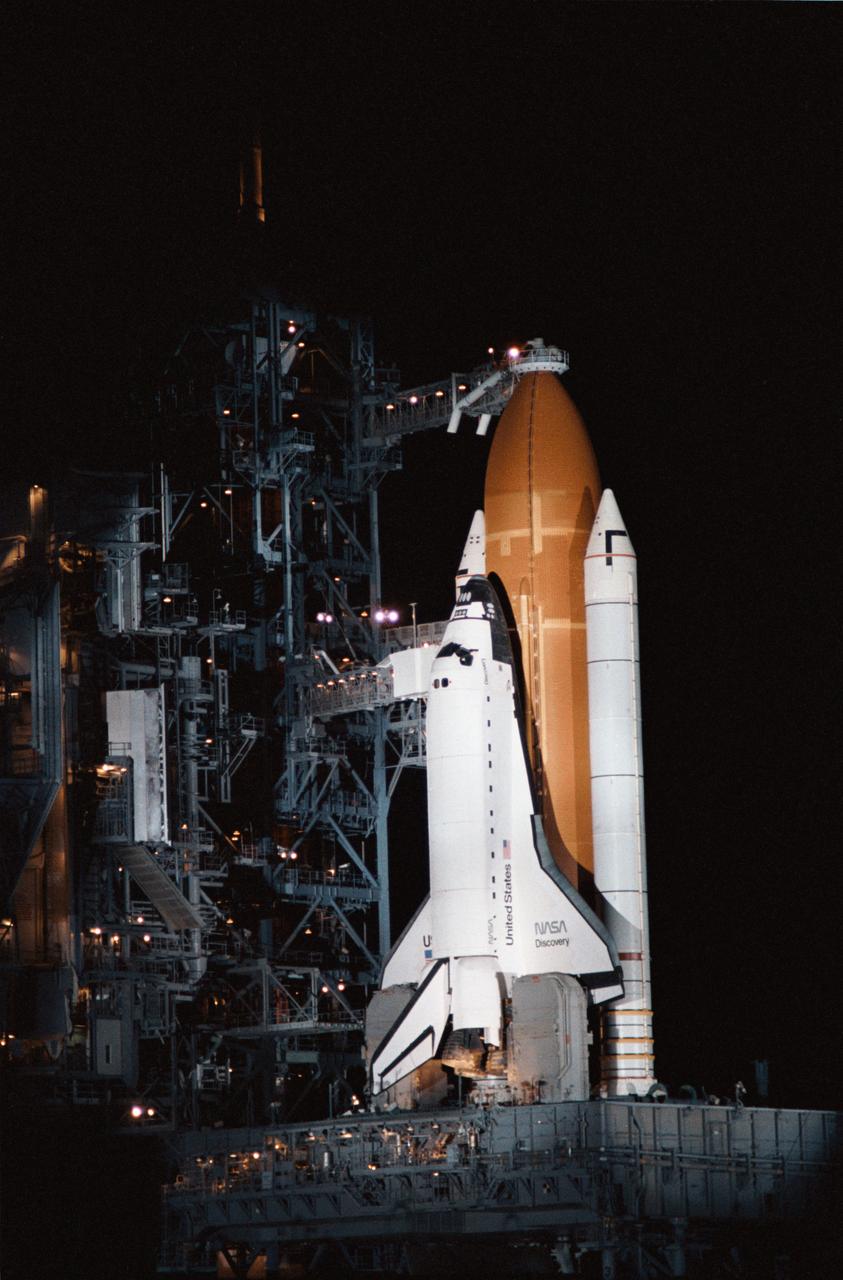
View of the shuttle Discovery on the launch pad just prior to STS 51-D launch. The surrounding area is dark, with the launch complex accented by spotlights.
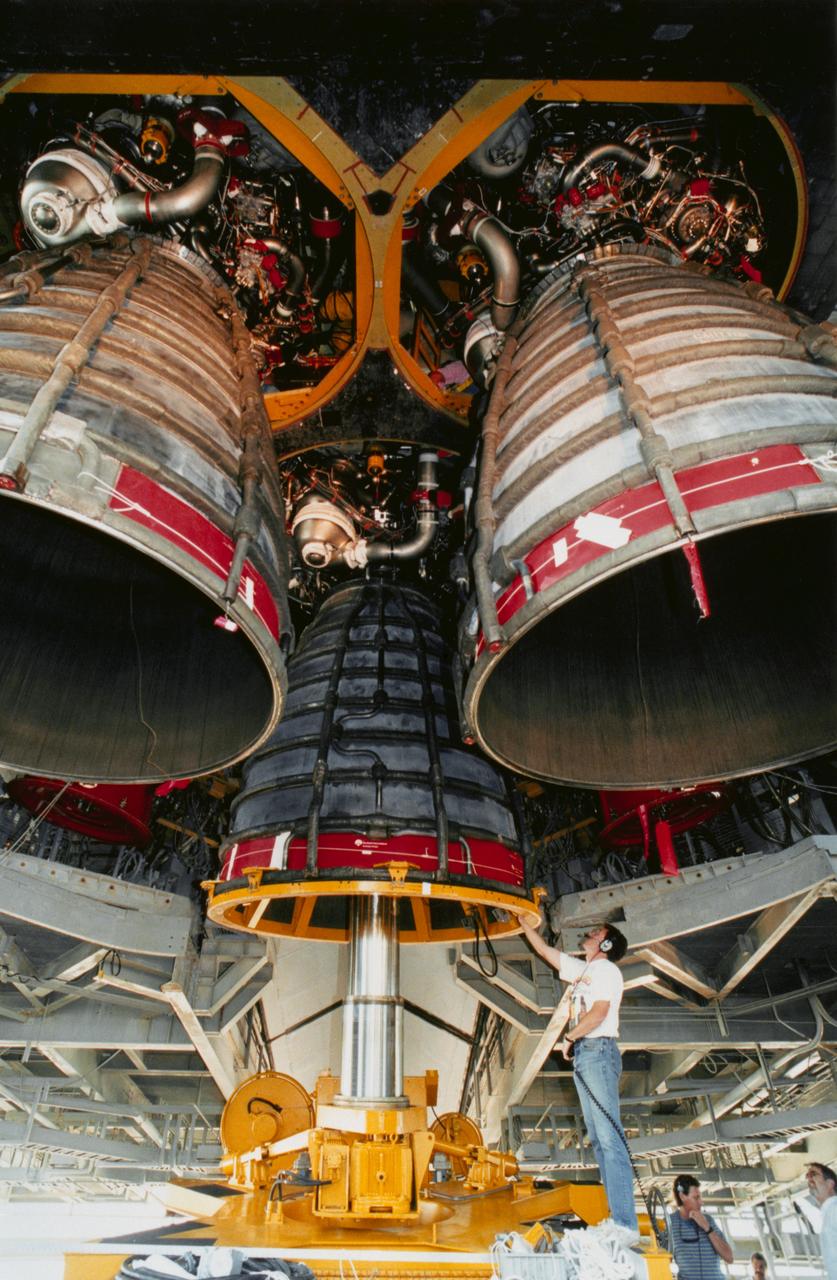
S93-43619 (18 Aug 1993) --- At Launch Pad 39B, work is under way to remove and replace the three main engines on the Space Shuttle Discovery. Here, Rocketdyne workers Jim Tibble (left), John Mooney and Ken Bair are assisting with the removal of the first engine, main engine no. 1, using the engine vertical installer. A failed sensor in main engine no. 2 led to the shutdown of all three engines three seconds before liftoff of mission STS-51 on August 12, 1993. Because it is difficult to perform the necessary inspections, refurbishment, and retesting of a fired engine on a vehicle at the pad, NASA opted to install a fresh set of engines on Discovery.
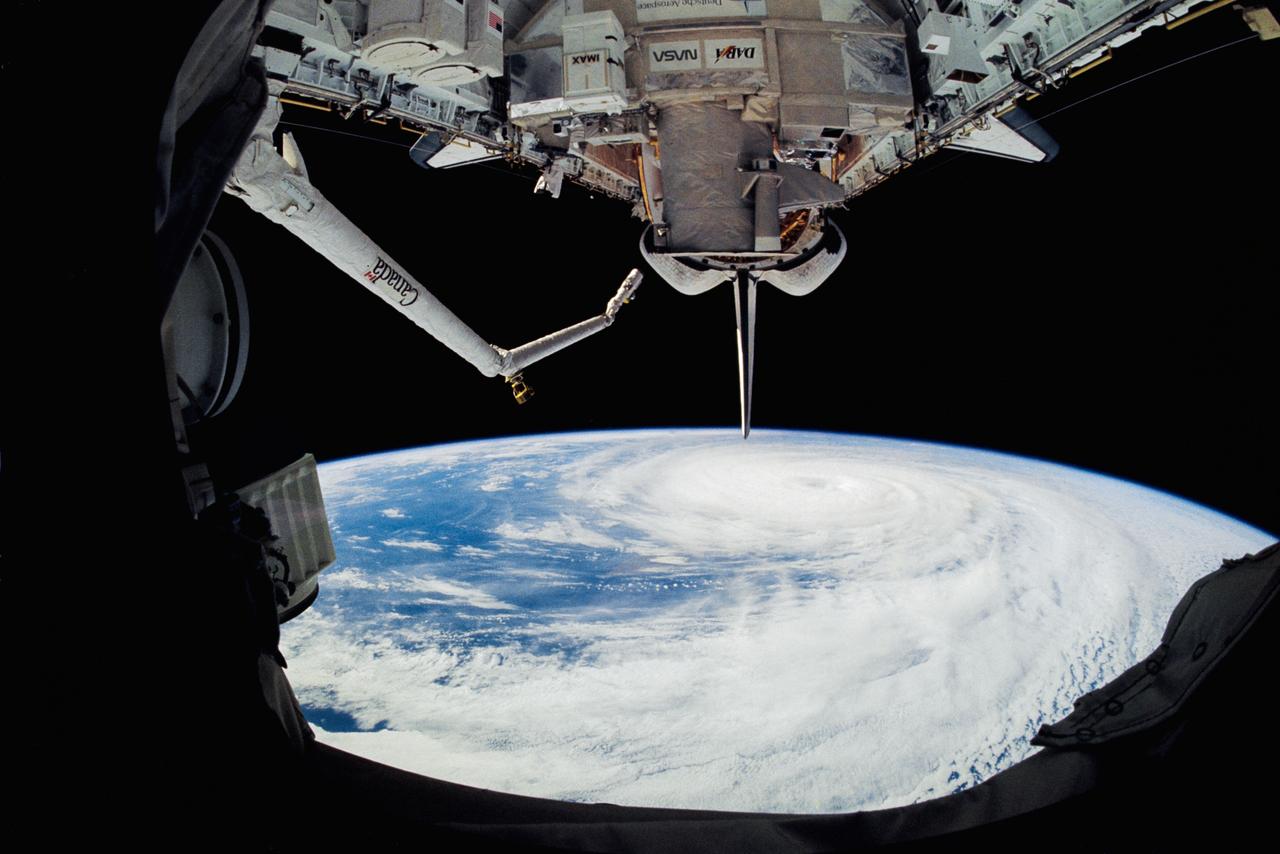
One of the STS-51 astronauts used a "fish-eye" lens on a 35mm cmaera to photograph this view of Hurricane Kenneth in the Pacific Ocean. The Orbiting Retrievable Far and Extreme Ultraviolet Spectrometer/Shuttle Pallet Satellite (ORFEUS/SPAS) is still in the cargo bay. The Remote Manipulator System (RMS) is extended towards the open payload bay.
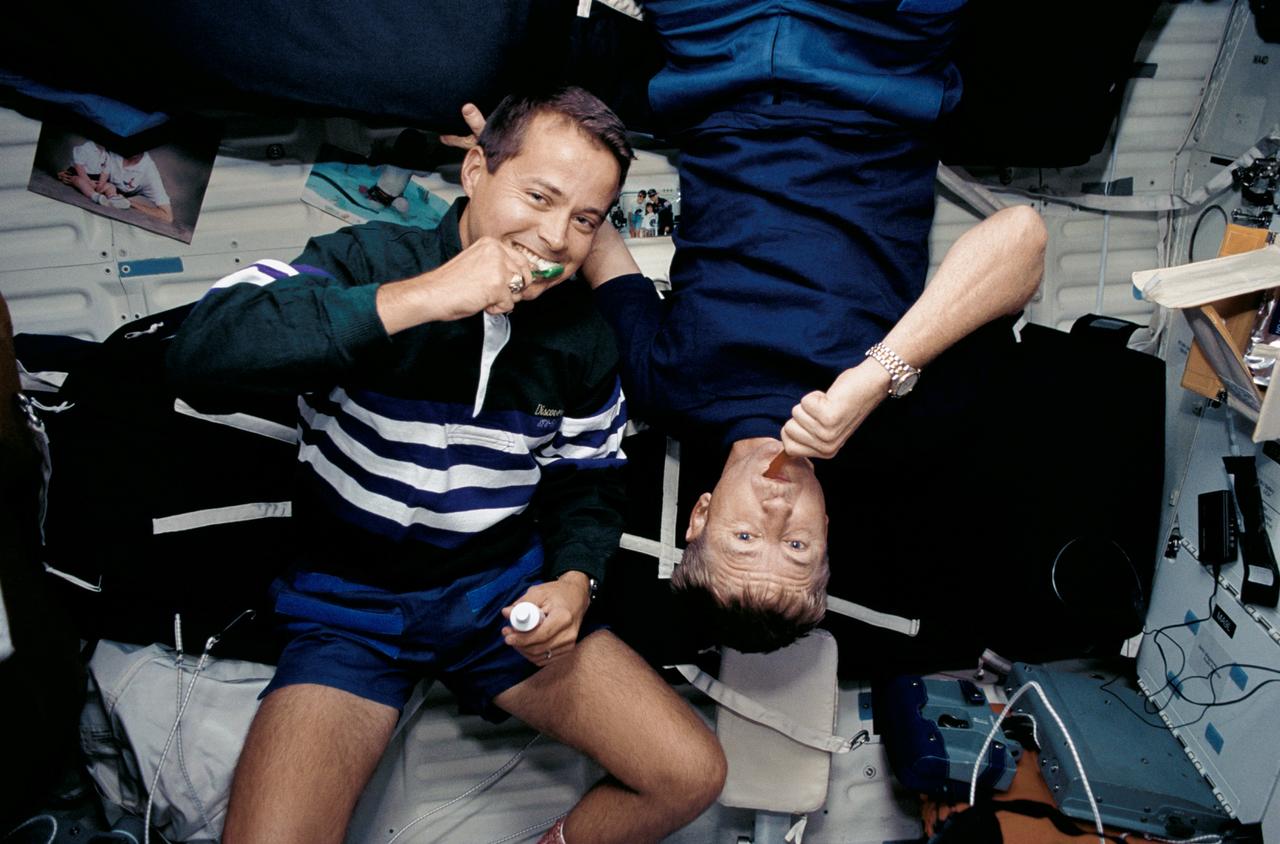
STS051-10-025 (12-22 Sept. 1993) --- (Orient Photo With Hygiene Kit At Right Center). Astronauts Frank L. Culbertson (right), mission commander, and Daniel W. Bursch, mission specialist, brush their teeth on Space Shuttle Discovery's middeck. Two sleep restraints form part of the backdrop for the photograph. The two were joined by three other NASA astronauts for almost ten full days in space for the STS-51 mission.
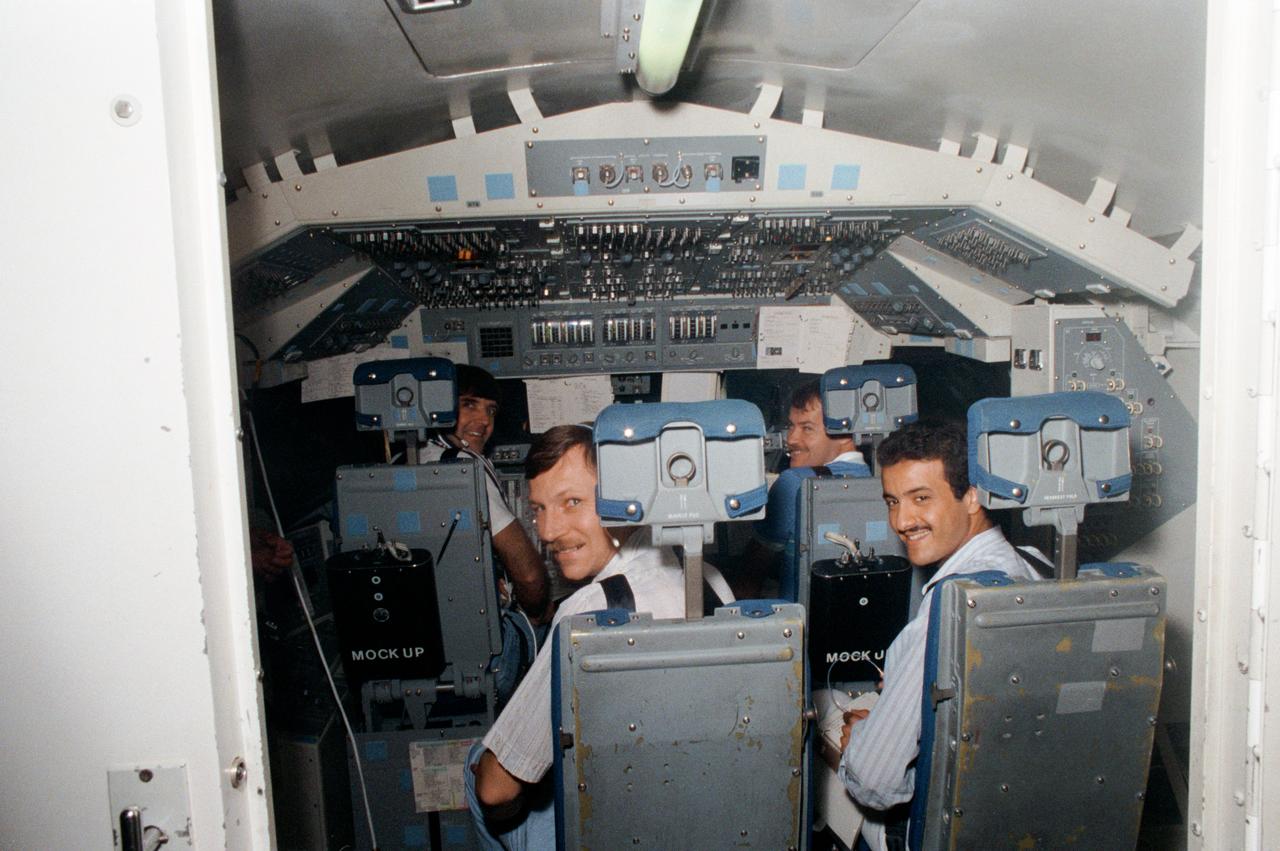
S85-31933 (17 May 1985) --- Four members of the STS 51-G crew participate in a training exercise in the shuttle mission simulation and training facility at the Johnson Space Center. Steven R. Nagel, left foreground, is a mission specialist for the flight, while Sultan Salman Abdelazize Al-Saud (right foreground) is a payload specialist. In the background are astronauts Daniel C. Brandenstein (left) in the commander's station and John O. Creighton in the pilot's position. Photo credit: NASA/ Otis Imboden of National Geographic
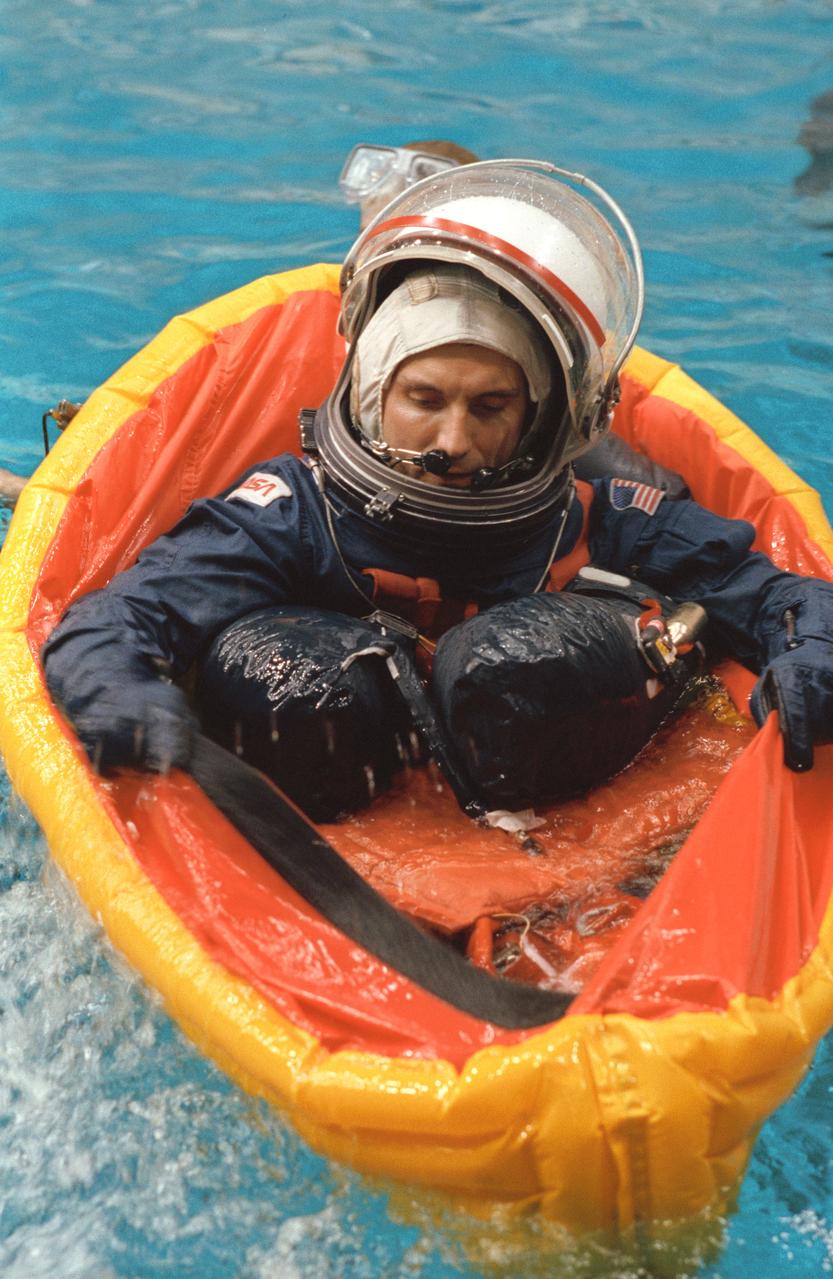
S93-31928 (24 March 1993) --- Astronaut Carl E. Walz, mission specialist, navigates a one-person life raft during emergency bailout training exercises at the Johnson Space Center's Weightless Environment Training Facility (WET-F). Walz was joined in the training session by the four other NASA astronauts assigned to the STS-51 flight.
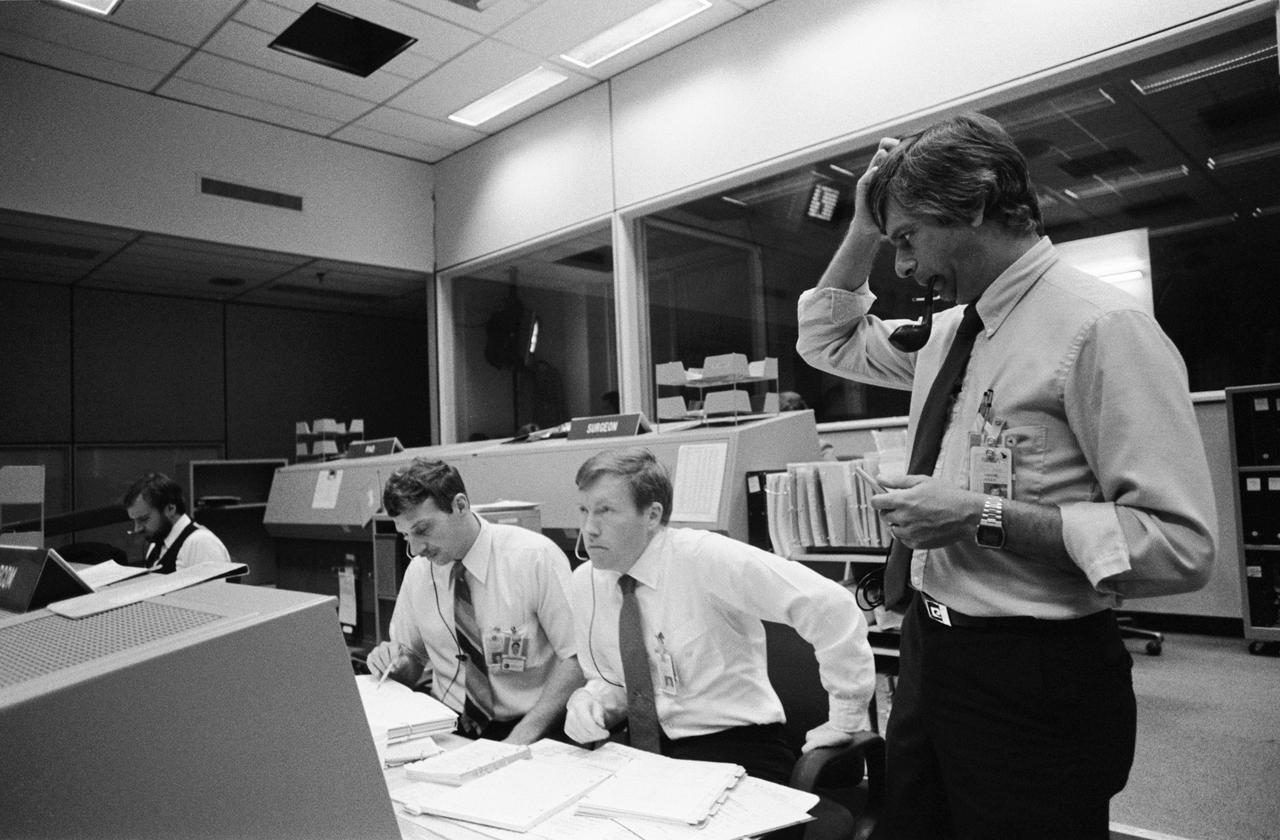
Jay H. Greene, right, ascent flight director for STS 51-A, monitors pre-launch activity at the Kennedy Space Center (KSC) via a screen at the spacecraft communicators console in the second floor flight control room (FCR) of JSC's mission control center. Astronauts David C. Hilmers, left, and Richard N. Richards are the on-duty spacecraft communicators.
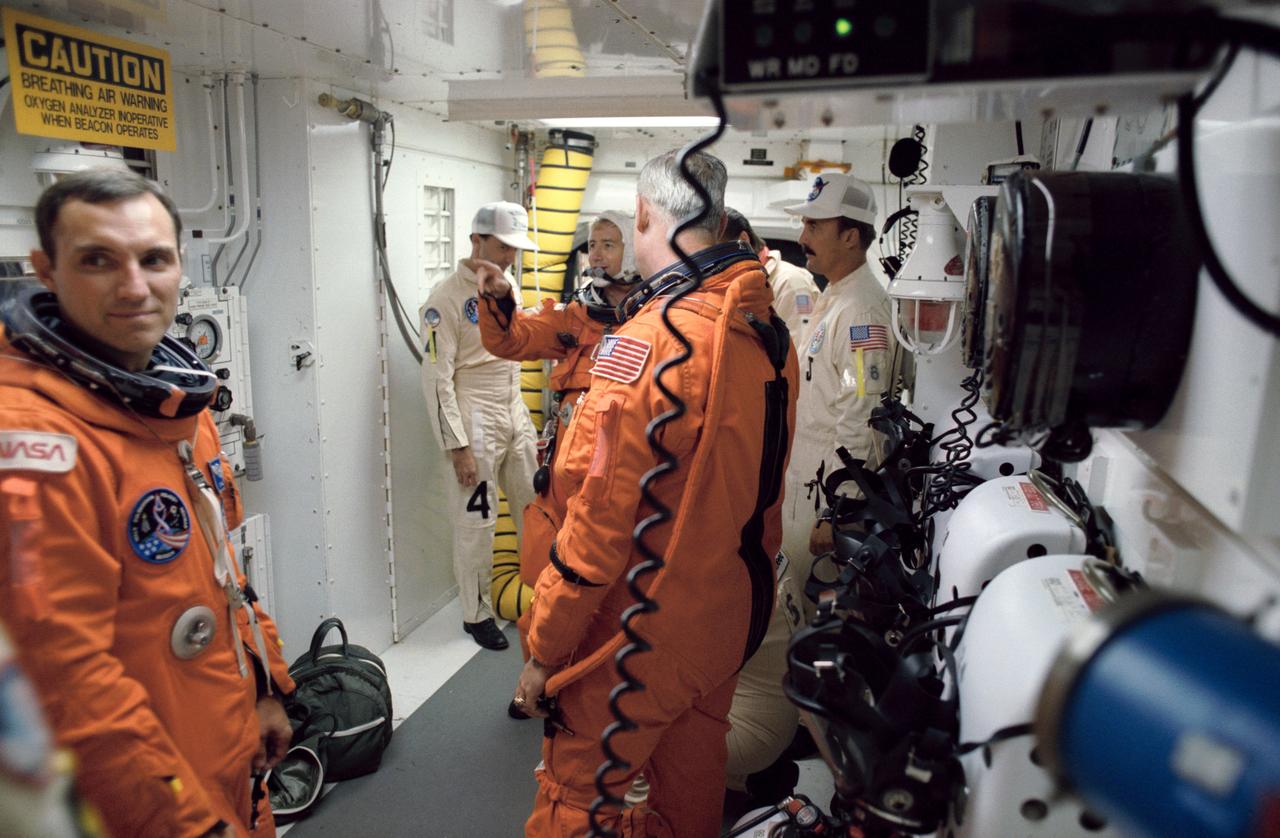
STS051-S-109 (12 Sept 1993) --- Inside the White Room, three astronaut crew members for the STS-51 flight await their queues to ingress the Space Shuttle Discovery. Wearing the partial pressure launch and entry suits are, left to right, Carl E. Walz, mission specialist; Frank L. Culbertson Jr., mission commander; and William F. Readdy, pilot. Not pictured are astronauts James H. Newman and Daniel W. Bursch. Launch occurred at 7:45 a.m. (EDT), September 12, 1993.
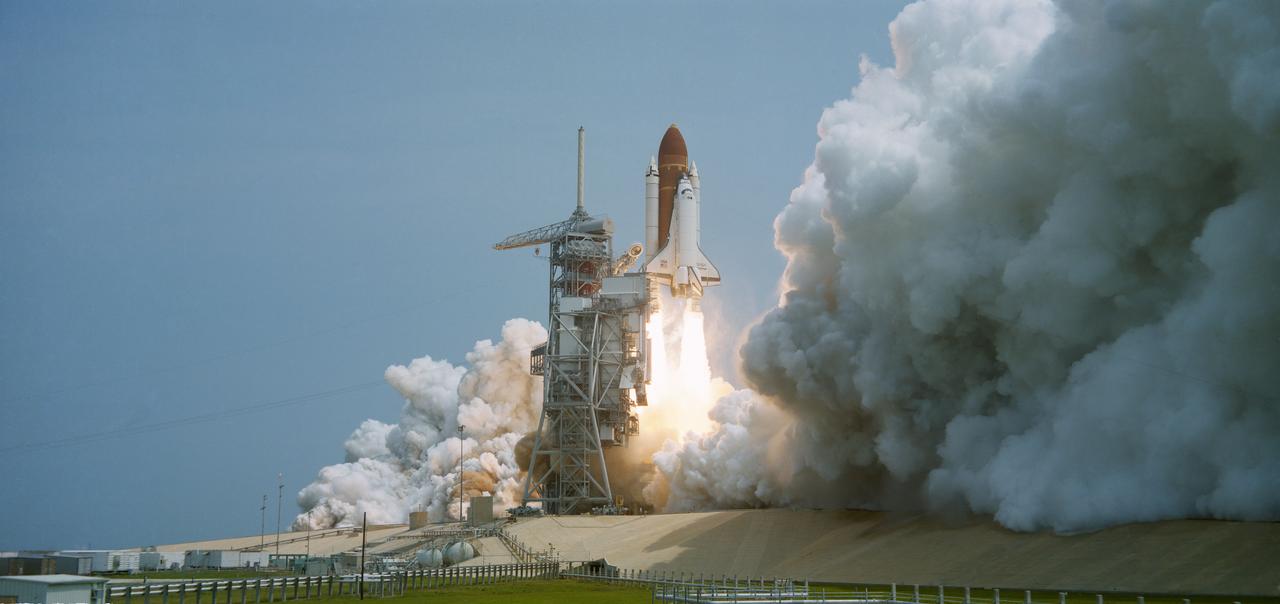
51B-S-052 (20 April 1985) --- The STS 51-B Spacelab 3 mission begins with the liftoff of the Challenger from Pad 39A at 12:02 p.m. (EDT). The Spacelab-3 configuration consists of a long module and a Mission Experiment Support Structure (MPESS). The object of the mission is to conduct applications, science and technology-oriented experimentation requiring the low-gravity of Earth orbit and extended duration stable vehicle attitude. Mission emphasis will be on materials processing. The seven-member crew consists of astronauts Robert F Overmyer, commander; Frederick D. Gregory, pilot; Don L. Lind, Norman E. Thagard and William E. Thornton; all mission specialists and payload specialists Taylor G. Wang and Lodewijk van den Berg. The mission is planned for 7 days with a landing at Dryden Flight Research Facility, Edwards California scheduled for May 6.
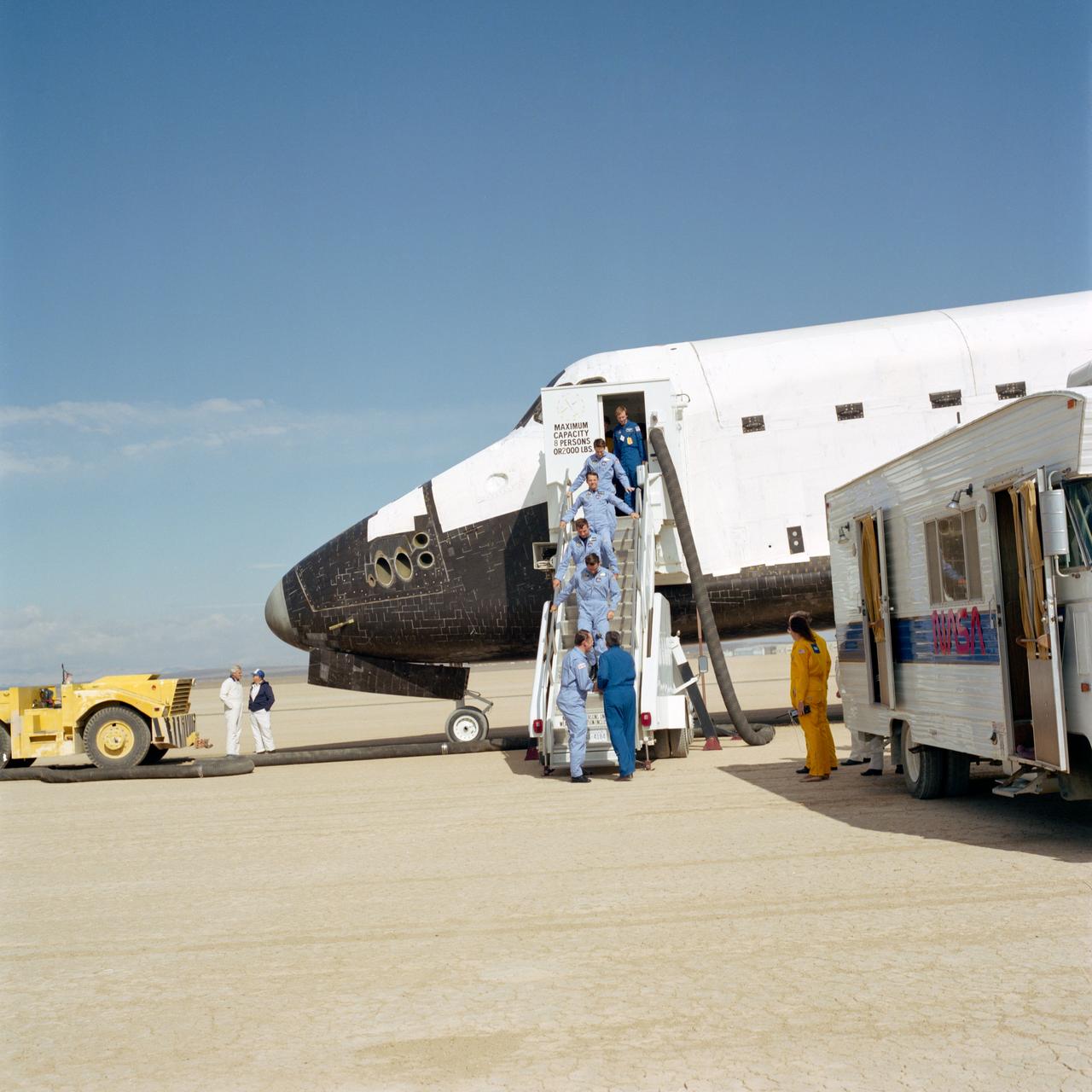
S85-41803 (7 Sept 1985) --- George W.S. Abbey, bottom right, greets the five members of the STS 51-J crew as they egress the Atlantis following the successful completion of a mission in Earth orbit. Astronaut Karol J. Bobko, who led the five down the steps, shakes hands with the JSC director of flight crew operations. He is followed (bottom to top) By Astronauts Ronald J. Grabe, pilot; David C. Hilmers and Robert L. Stewart, both mission specialists; and USAF Maj. William A. Pailes, payload specialist.
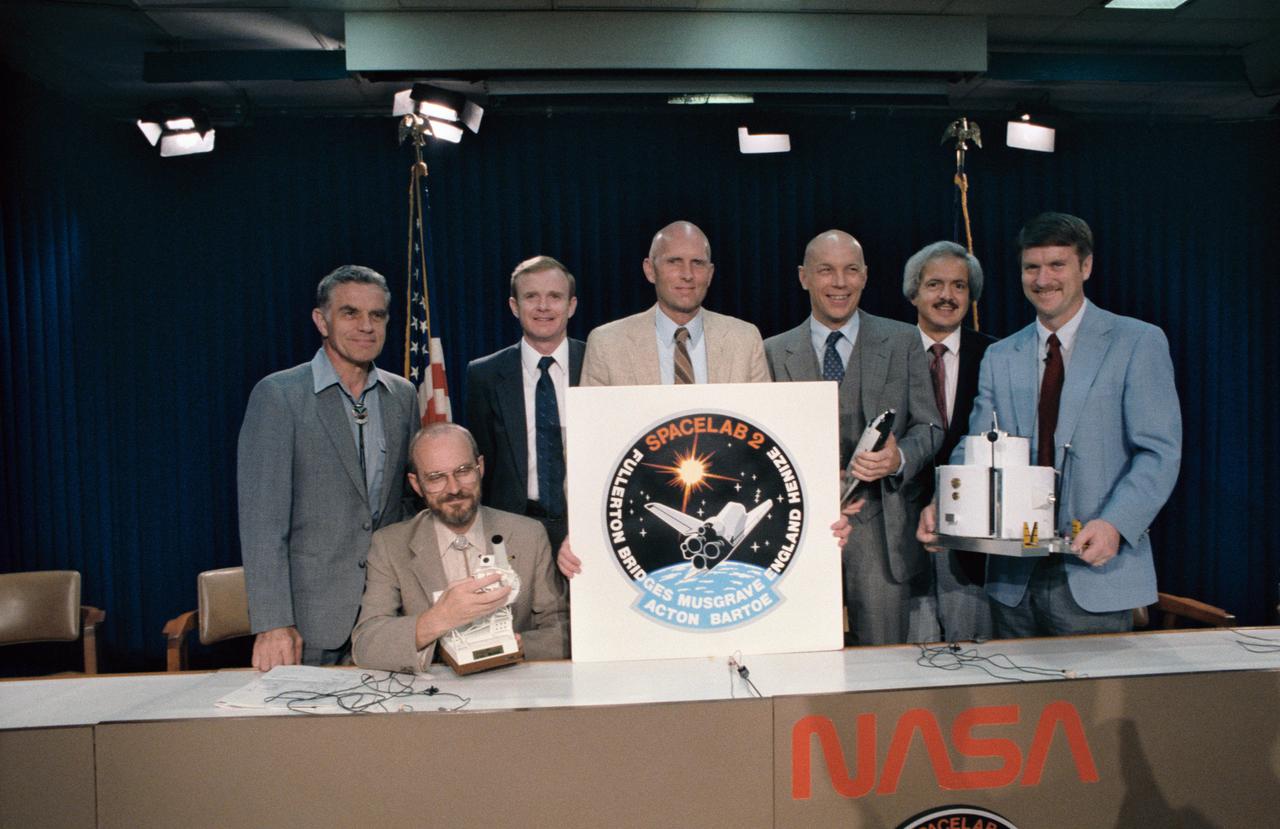
S85-36655 (24 June 1985) --- The seven crewmembers for STS 51-F/Spacelab 2 pose for photographers following their pre-flight press conference in the Johnson Space Center's public affairs facility. Standing, l.-r., are Karl J. Henize, mission specialist; Roy D. Bridges, pilot; C. Gordon Fullerton, mission commander; F. Story Musgrave, mission specialist; John-David Bartoe, payload specialist; and Anthony W. England, mission specialist. Loren W. Acton, payload specialist, is seated. Launch is scheduled for July of this year.
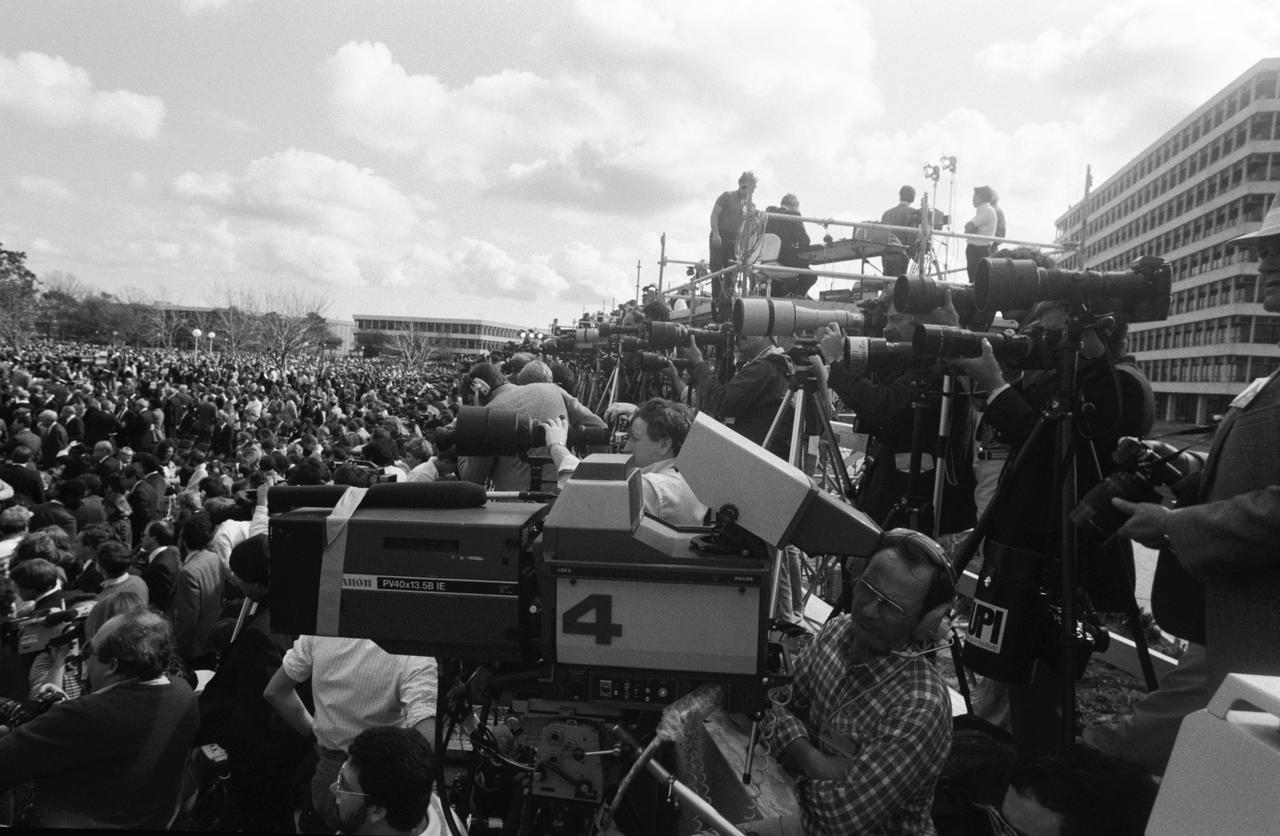
S86-26428 (31 Jan. 1986) --- Dozens of cameras and thousands of eyes focus on President Ronald Reagan (out of frame at left) during the 51-L memorial services Jan. 31 on the mall at the Johnson Space Center (JSC). The photograph was taken from special bleachers quickly erected to accommodate hundreds of members of the news media. The audience of thousands was largely made up of JSC employees and family and friends of the Challenger crew members who perished four days earlier in the attempted launch of NASA’s 25th STS mission. Photo credit: NASA
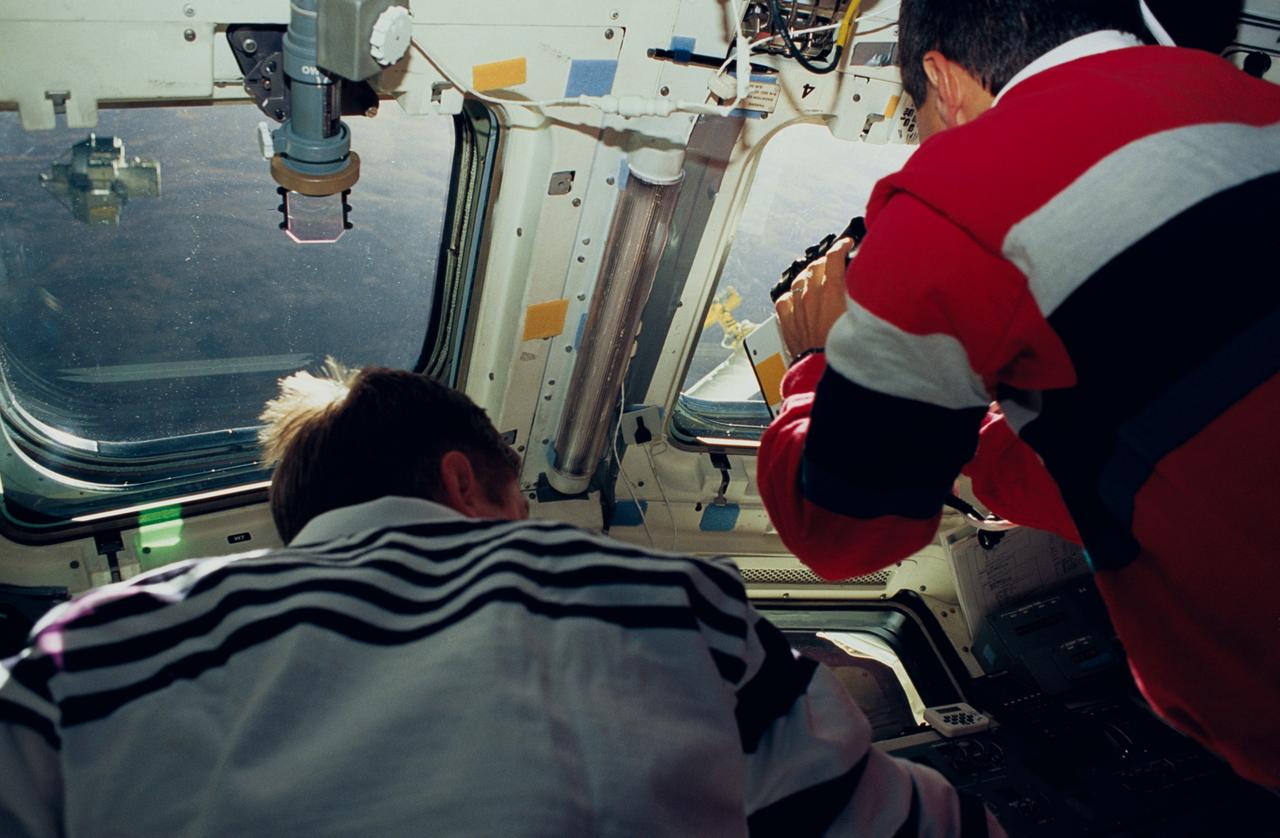
Astronauts Frank L. Culbertson Jr., STS-51 mission commander, and Daniel W. Bursch, mission specialist, are seen on Discovery's flight deck. The two were supporting operations free-flying Orbiting and Retrievable Far and Extreme Ultraviolet Spectrometer (ORFEUS) and its Shuttle Pallet Satellite (SPAS), pictured through the left window.
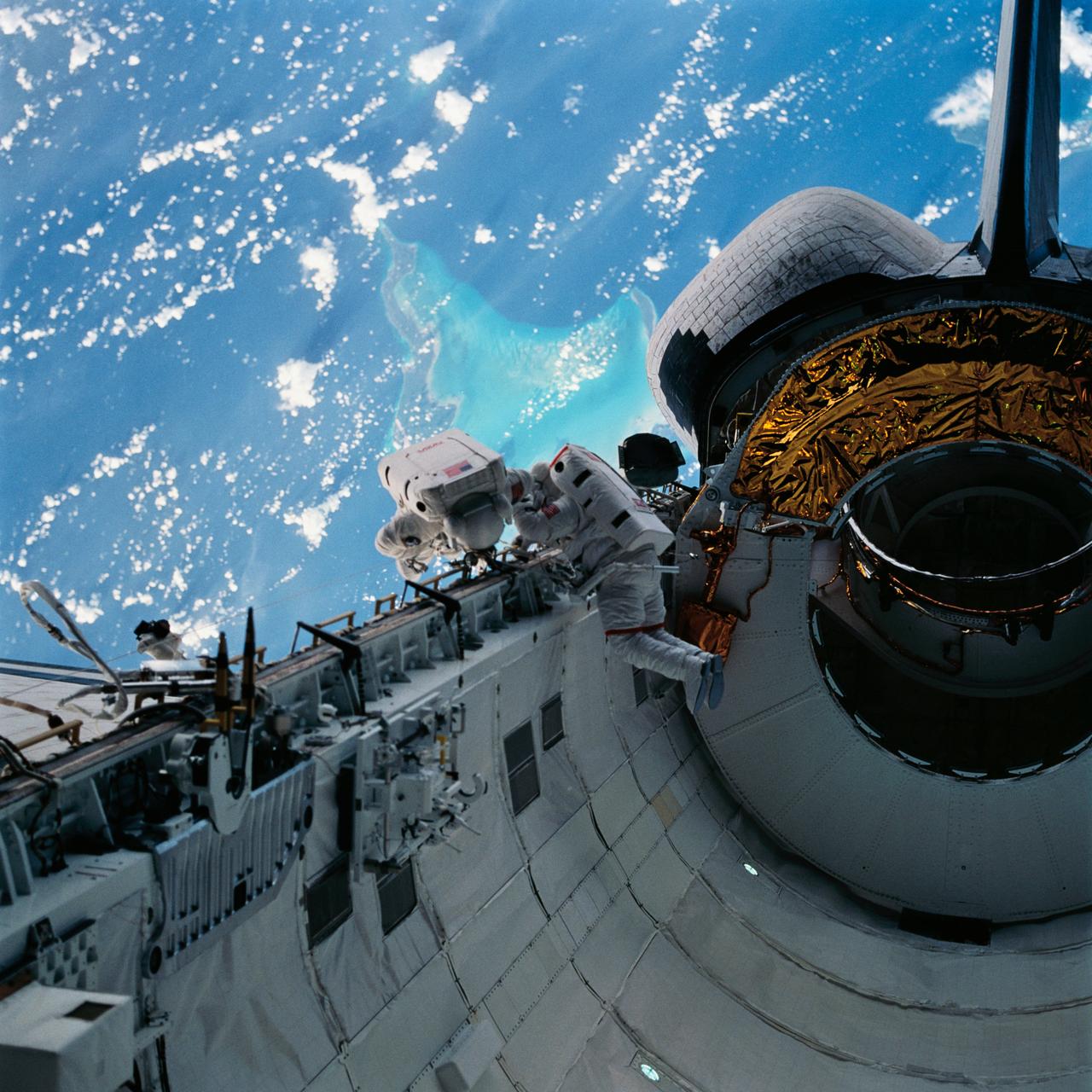
With the Caribbean Sea and part of the Bahama Islands chain as a backdrop, two STS-51 crewmembers evaluate procedures and gear to be used on the upcoming Hubble Space Telescope (HST)-servicing mission. Sharing the lengthy extravehicular activity in and around Discovery's cargo bay were astronauts James H. Newman (left), and Carl E. Walz, mission specialists.
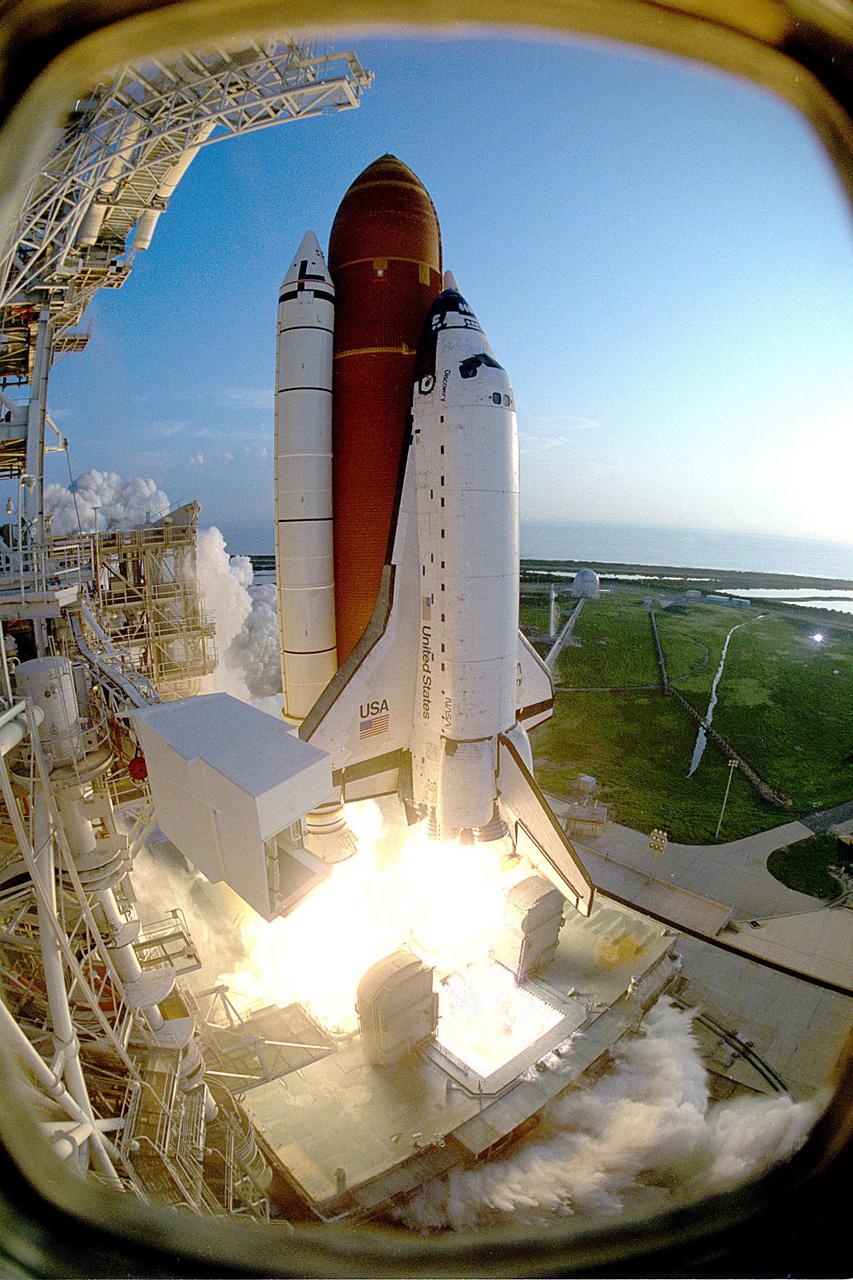
KENNEDY SPACE CENTER, FLA. -- STS-51: Discovery
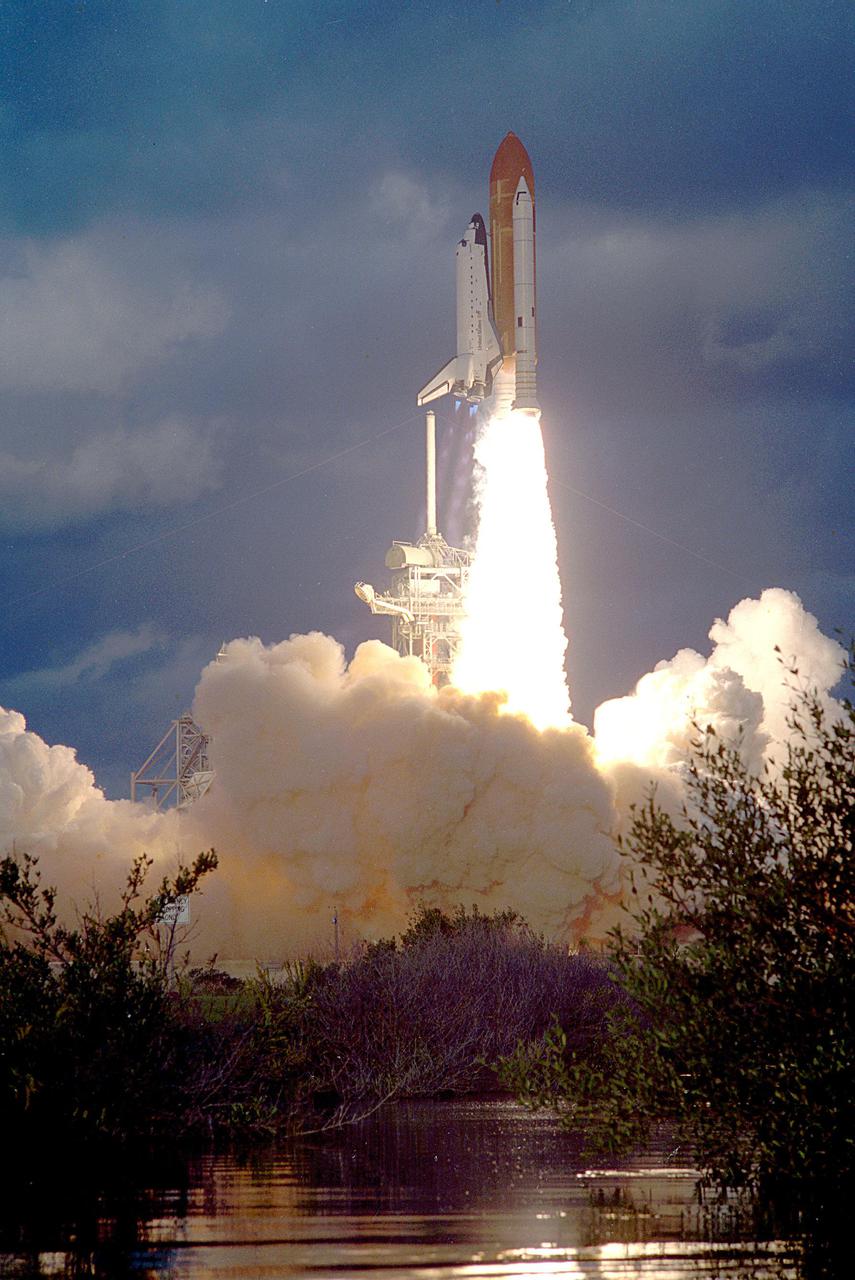
KENNEDY SPACE CENTER, FLA. -- STS-51-A: Discovery
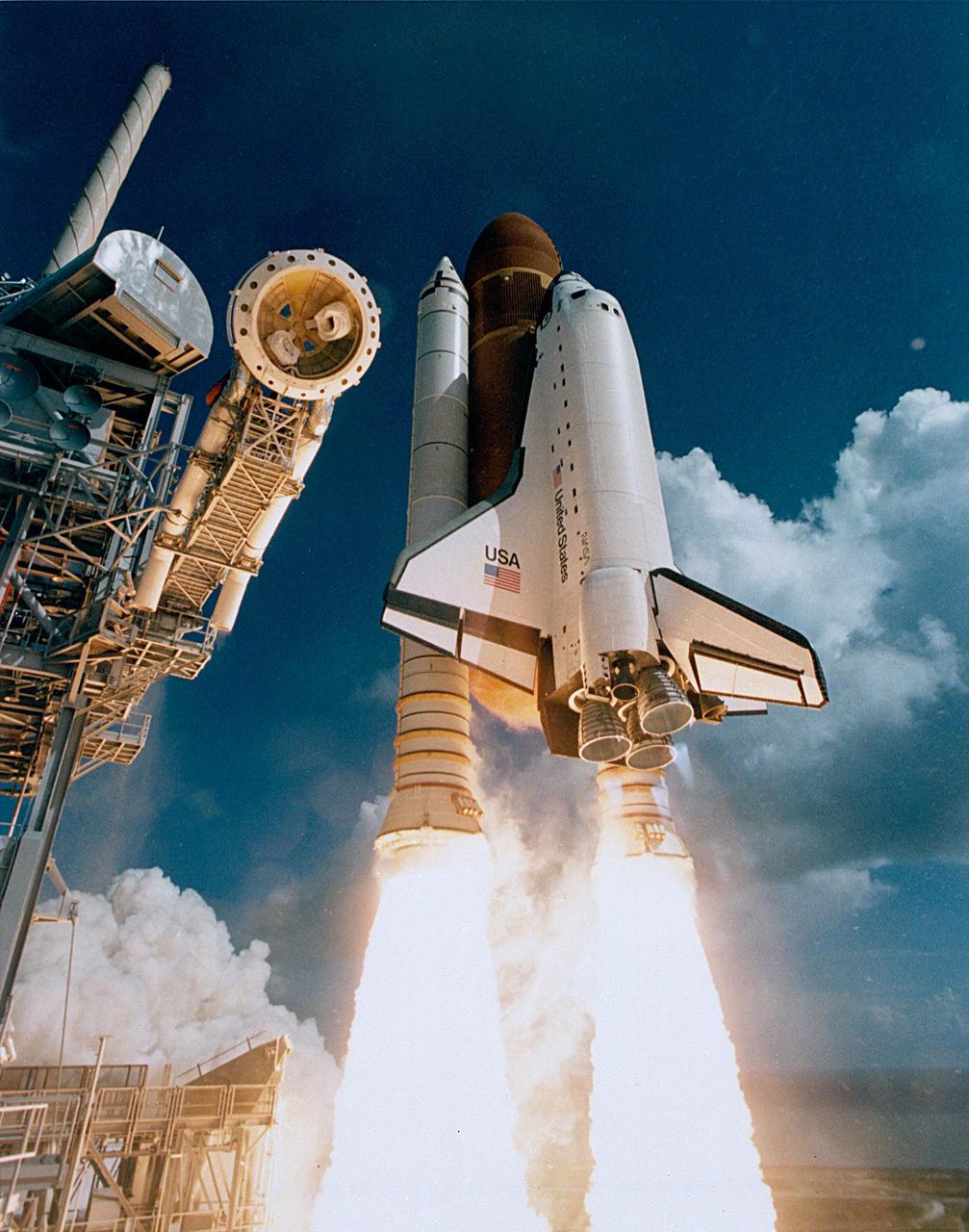
KENNEDY SPACE CENTER, FLA. -- STS-51-J: Atlantis
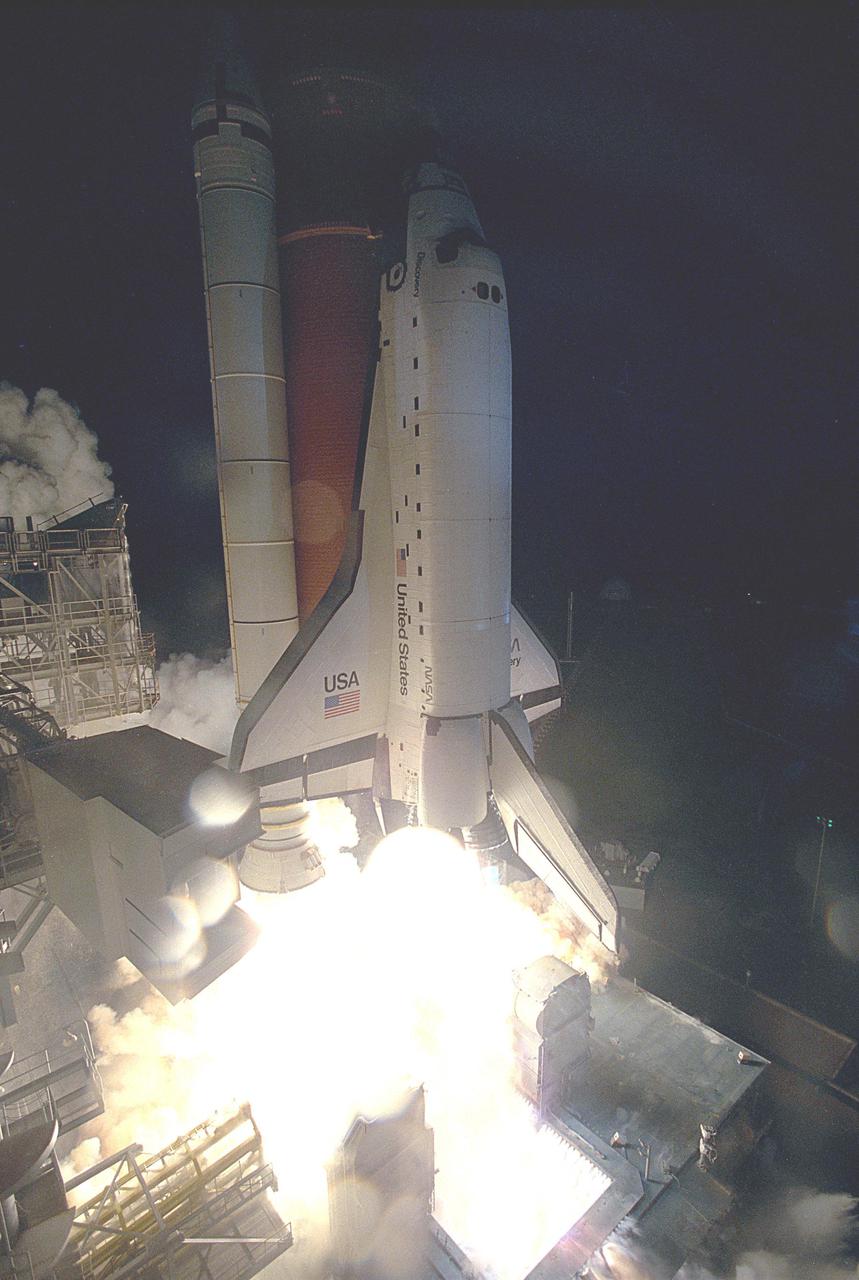
KENNEDY SPACE CENTER, FLA. -- STS-51-I: Discovery
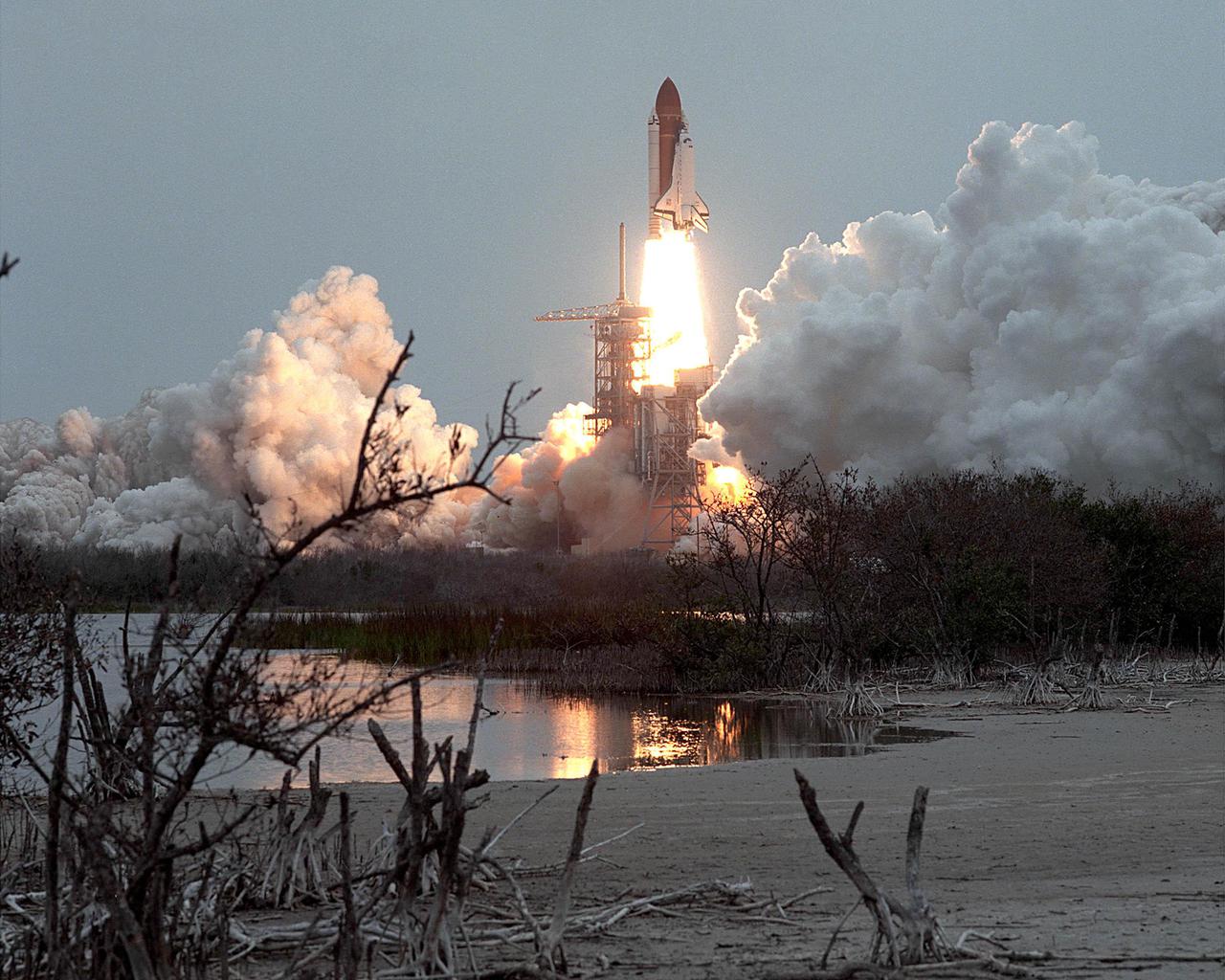
KENNEDY SPACE CENTER, FLA. -- STS-51-D: Discovery
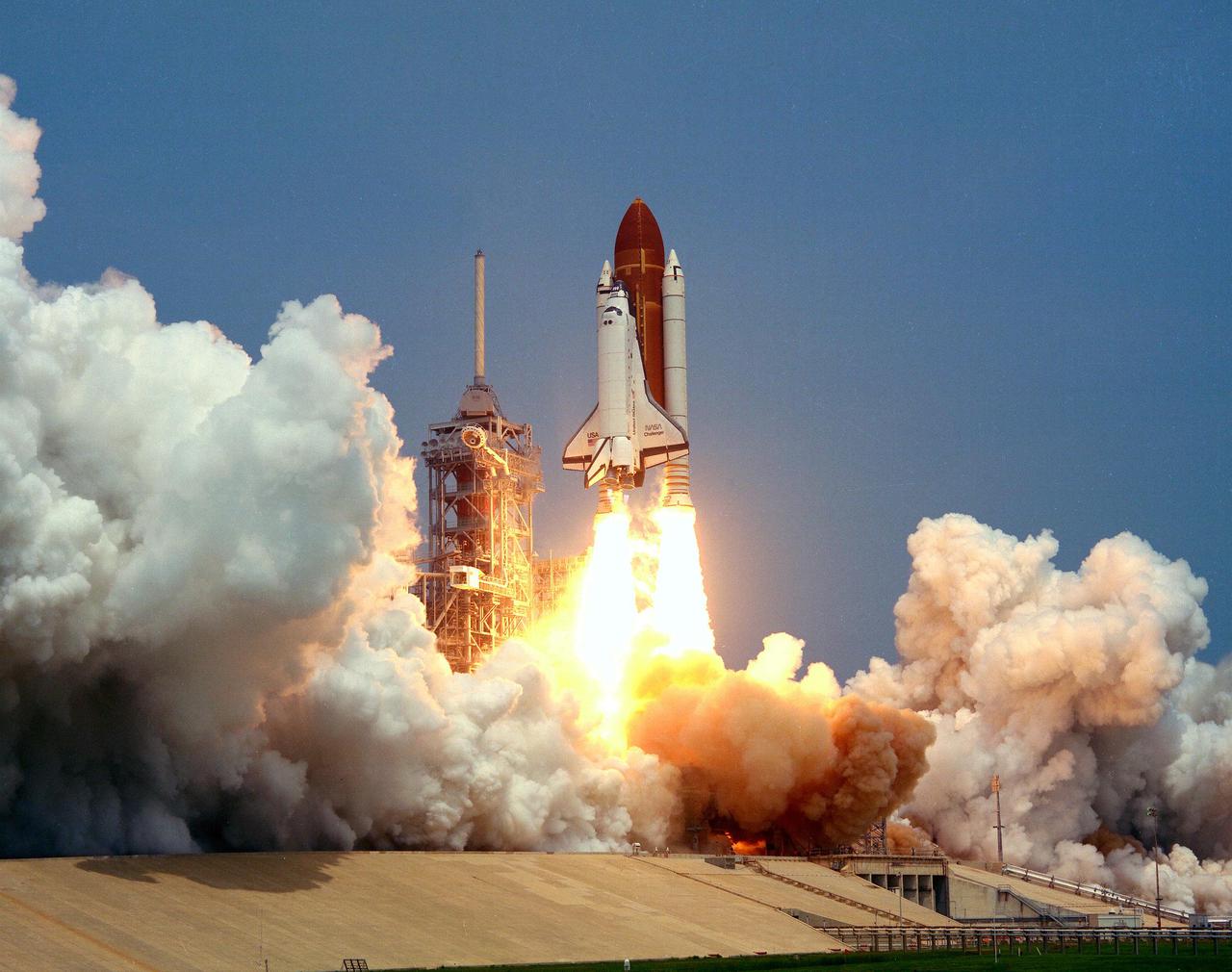
KENNEDY SPACE CENTER, FLA. -- STS-51-B: Challenger
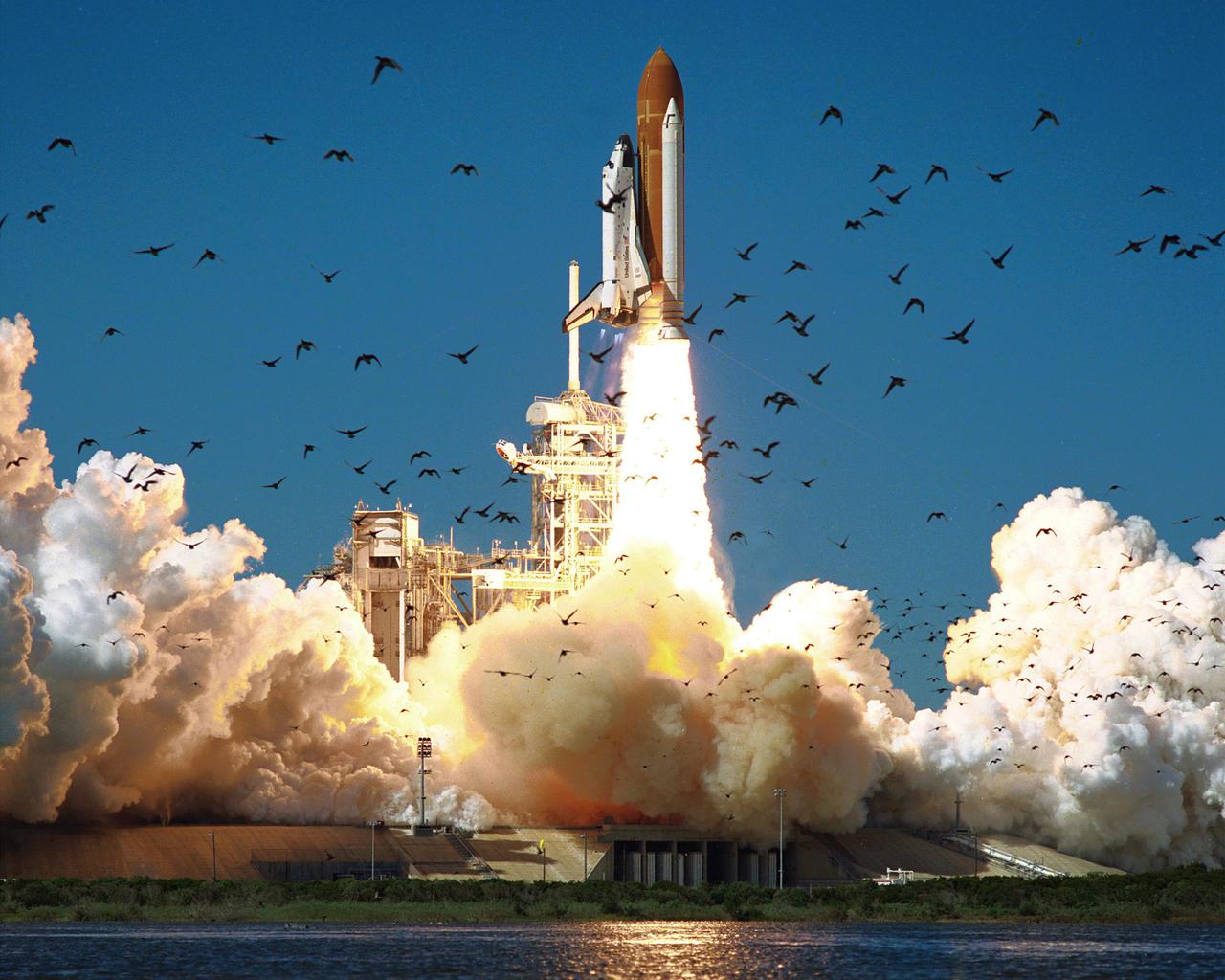
KENNEDY SPACE CENTER, FLA. -- STS-51-L: Challenger
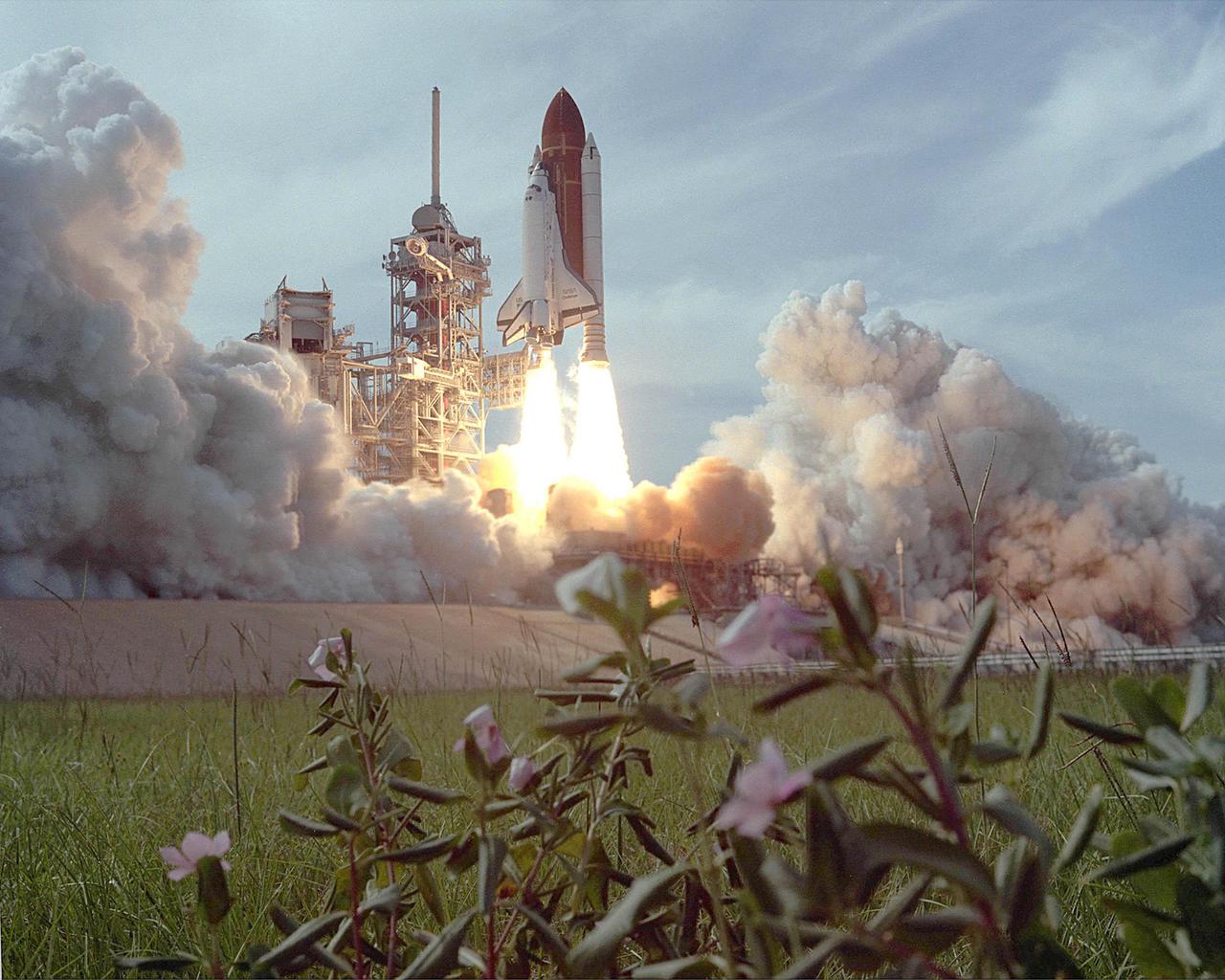
KENNEDY SPACE CENTER, FLA. -- STS-51-F: Challenger

KENNEDY SPACE CENTER, FLA. -- STS-51-C: Discovery

KENNEDY SPACE CENTER, FLA. -- STS-51-G: Discovery
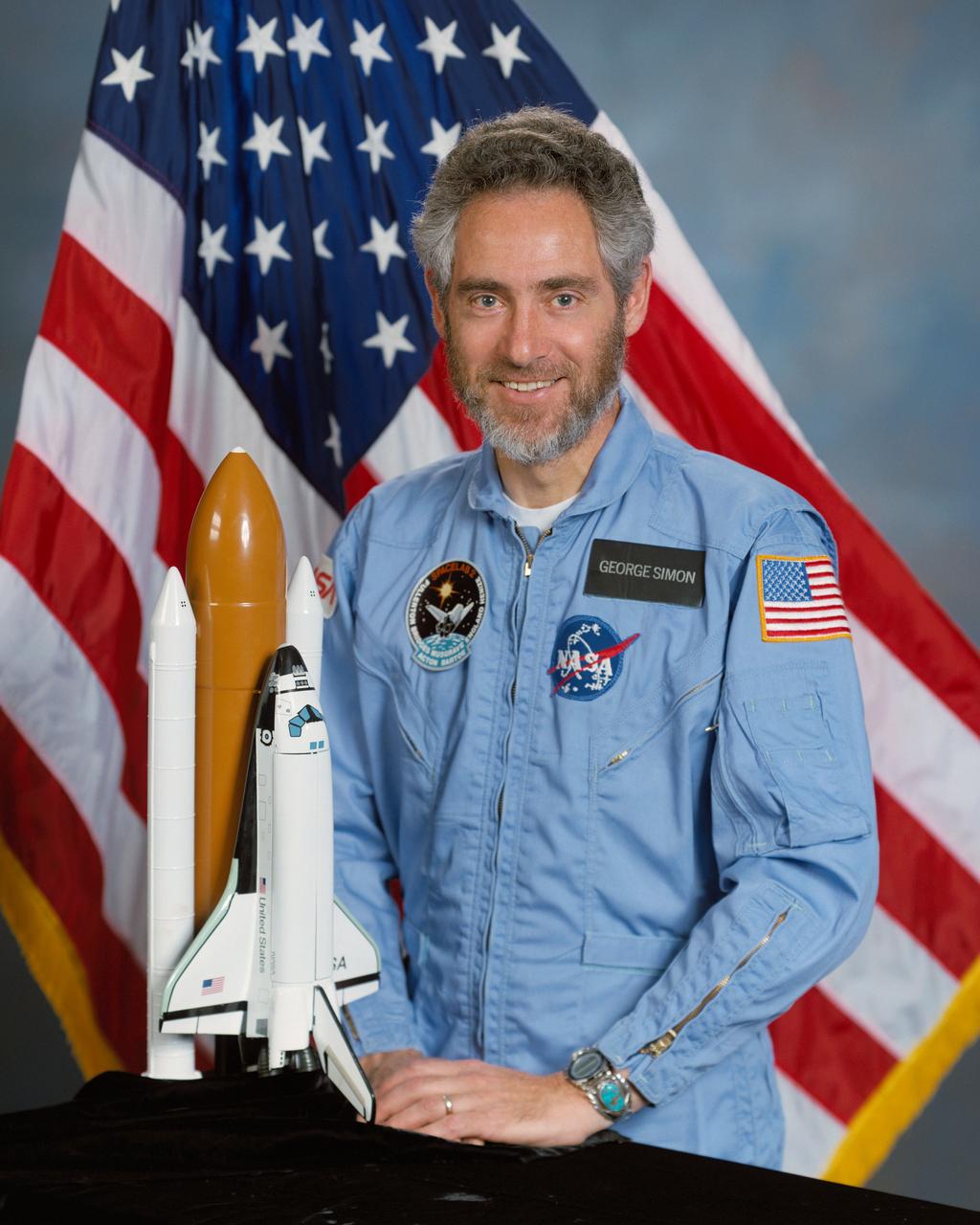
Portrait of STS 51-F Spacelab backup payload specialist George Simon, in blue flight suit
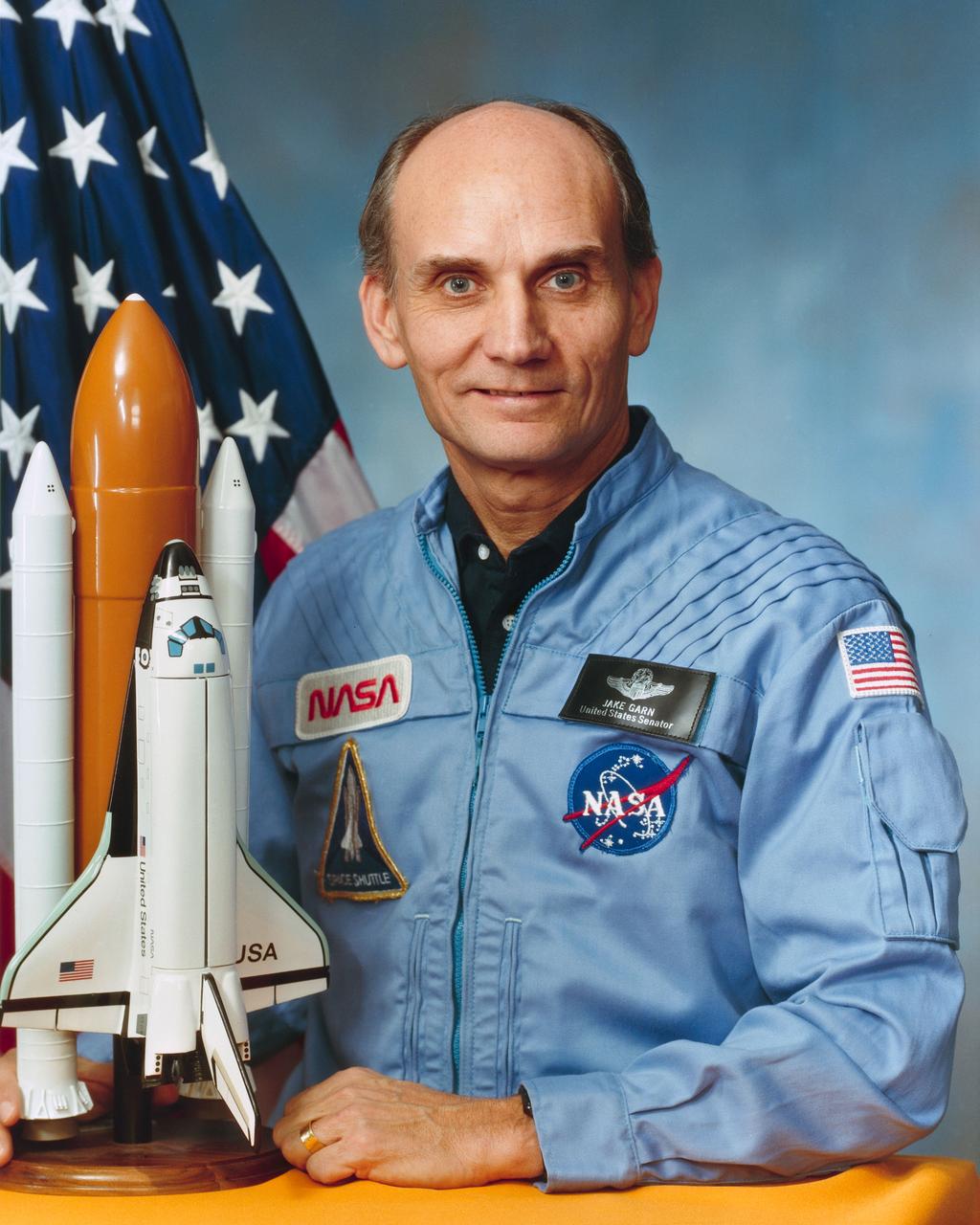
S85-25500 (1985) --- Senator E. J. "Jake" Garn, STS 51-D payload specialist.

S91-32691 (3 Mar 1991) --- Astronaut Carl E. Walz.
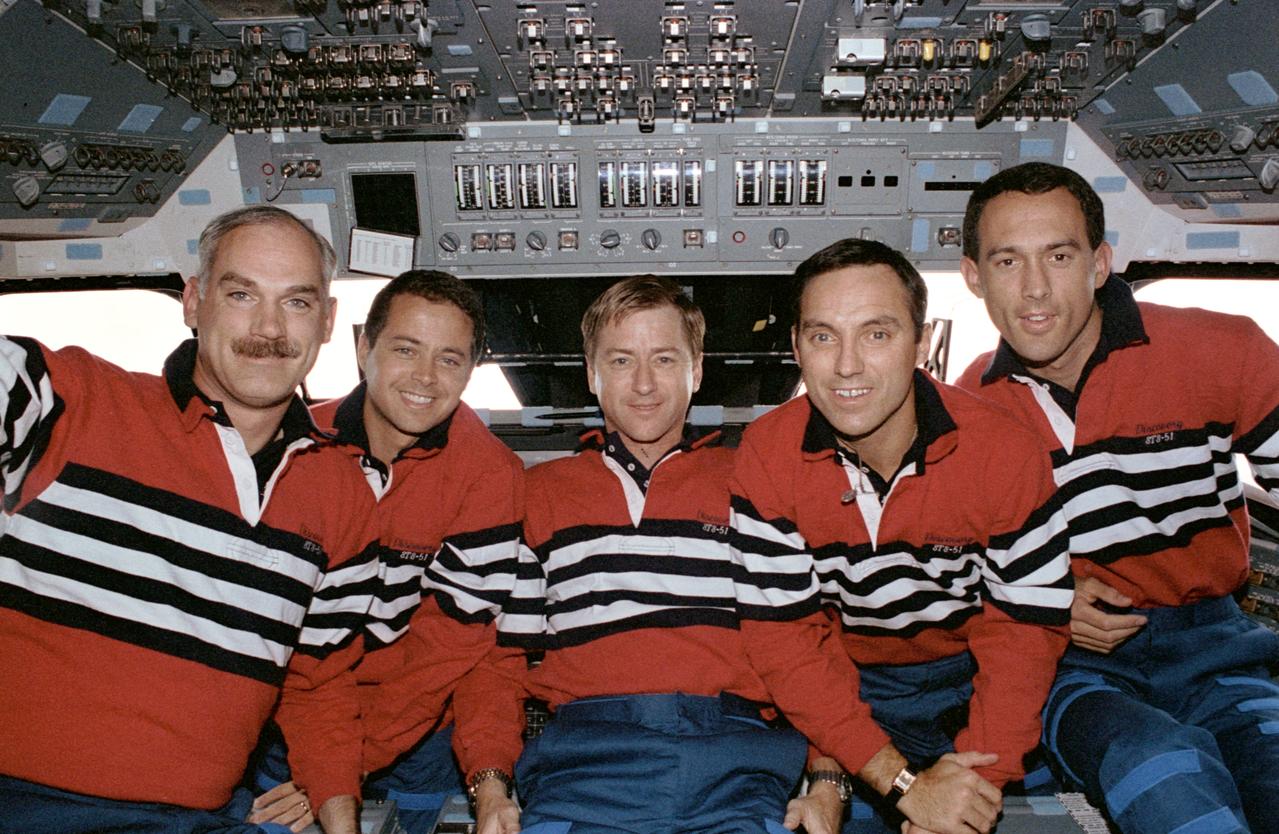
STS051-44-005 (12-22 sept 1993) --- The five crew members pose for the traditional inflight crew portrait on the Space Shuttle Discovery's flight deck. Left to right are astronauts William F. Readdy, Daniel W. Bursch, Frank L. Culbertson, Jr., Carl E. Walz and James H. Newman. Culbertson is mission commander, with Readdy serving as pilot and the others are mission specialists.
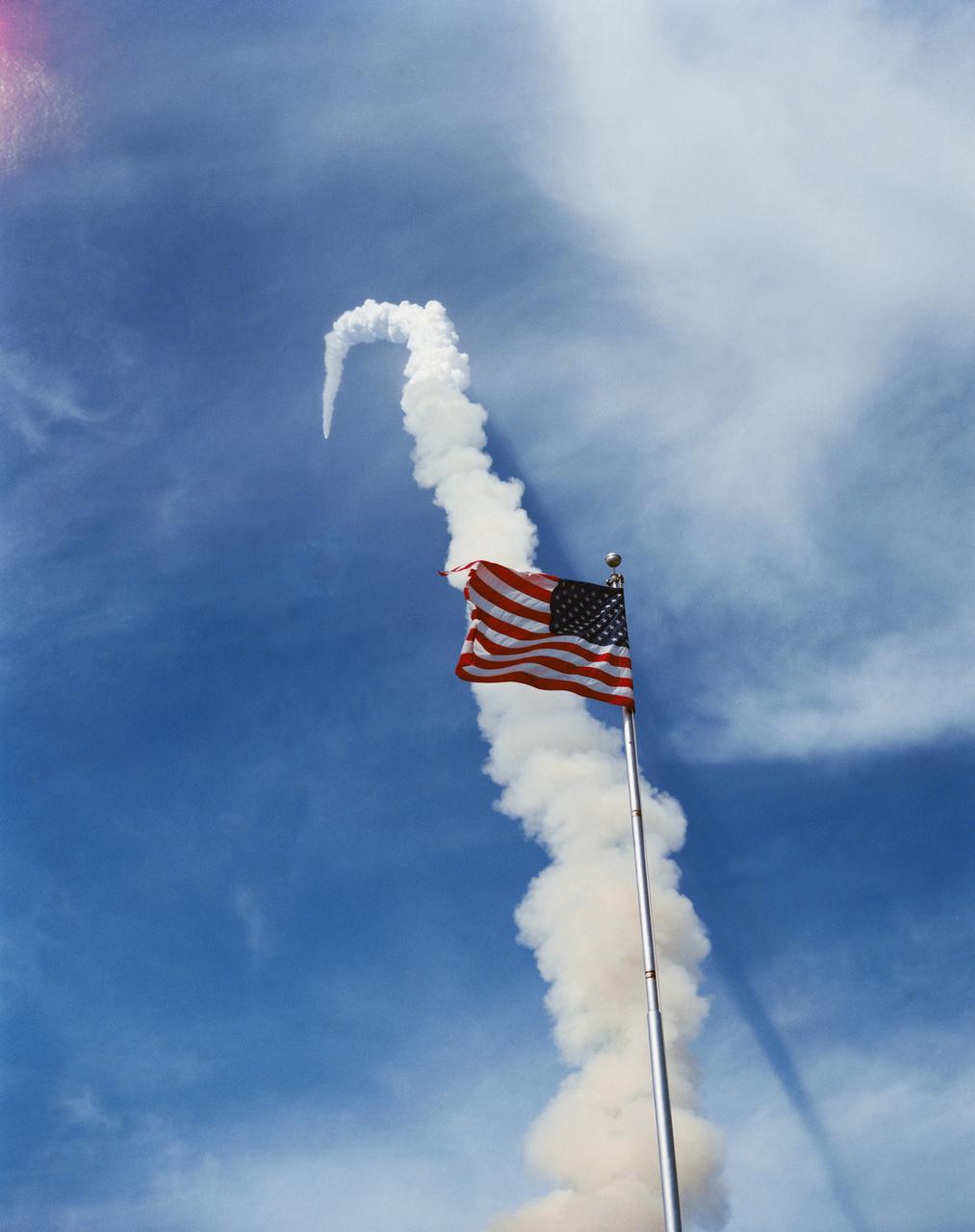
51F-S-068 (29 July 1985) --- The Space Shuttle Challenger heads toward Earth-orbit with the Spacelab-2 experiment pallet and a team of astronauts and scientists onboard. This photograph was taken by Otis Imboden of the National Geographic Society for NASA from the press site at Kennedy Space Center (KSC).
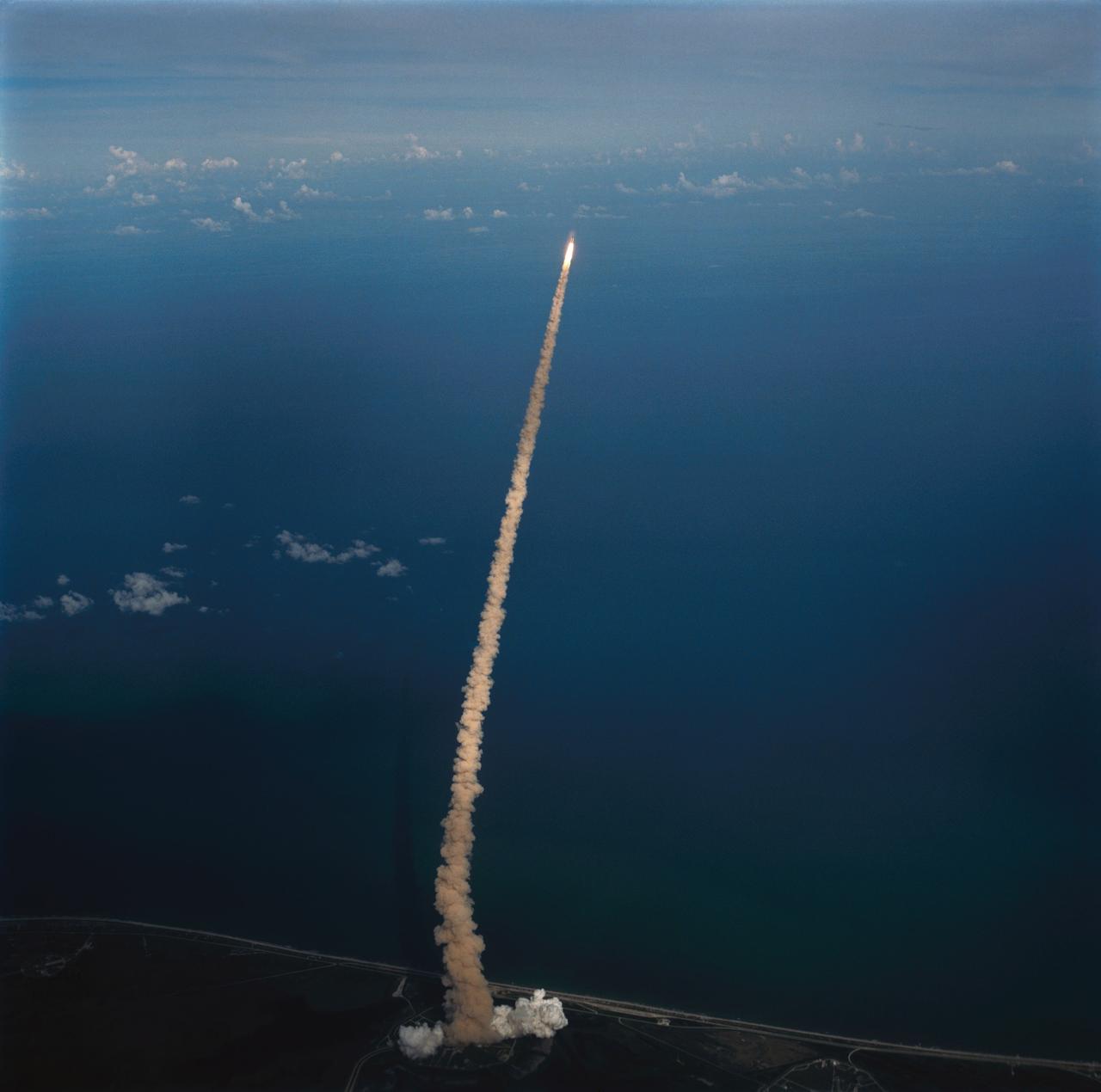
51F-S-038 (29 July 1985) ---An air-to-air view of the Space Shuttle orbiter Challenger, its two solid rocket boosters and external fuel tank moments after launch from Pad 39A at Kennedy Space Center (KSC). Astronaut John W. Young, veteran of two Shuttle flights and four other NASA missions, took the photograph with a handheld camera while piloting the Shuttle training aircraft. Launch occured at 5:00:00:423 p.m. (EDT), July 29, 1985.

51F-S-061 (29 July 1985) --- The 19th Space Shuttle mission gets off to a beginning as the Challenger soars toward earth orbit where it is scheduled to spend a week for a series of mostly scientific tasks. Challenger carries seven crewmembers and Spacelab 2 science pallets. A number of photographers record the event on camera. Launch occurred at 5:00 p.m. (EDT), July 29, 1985. The photo was taken by Otis Imboden.
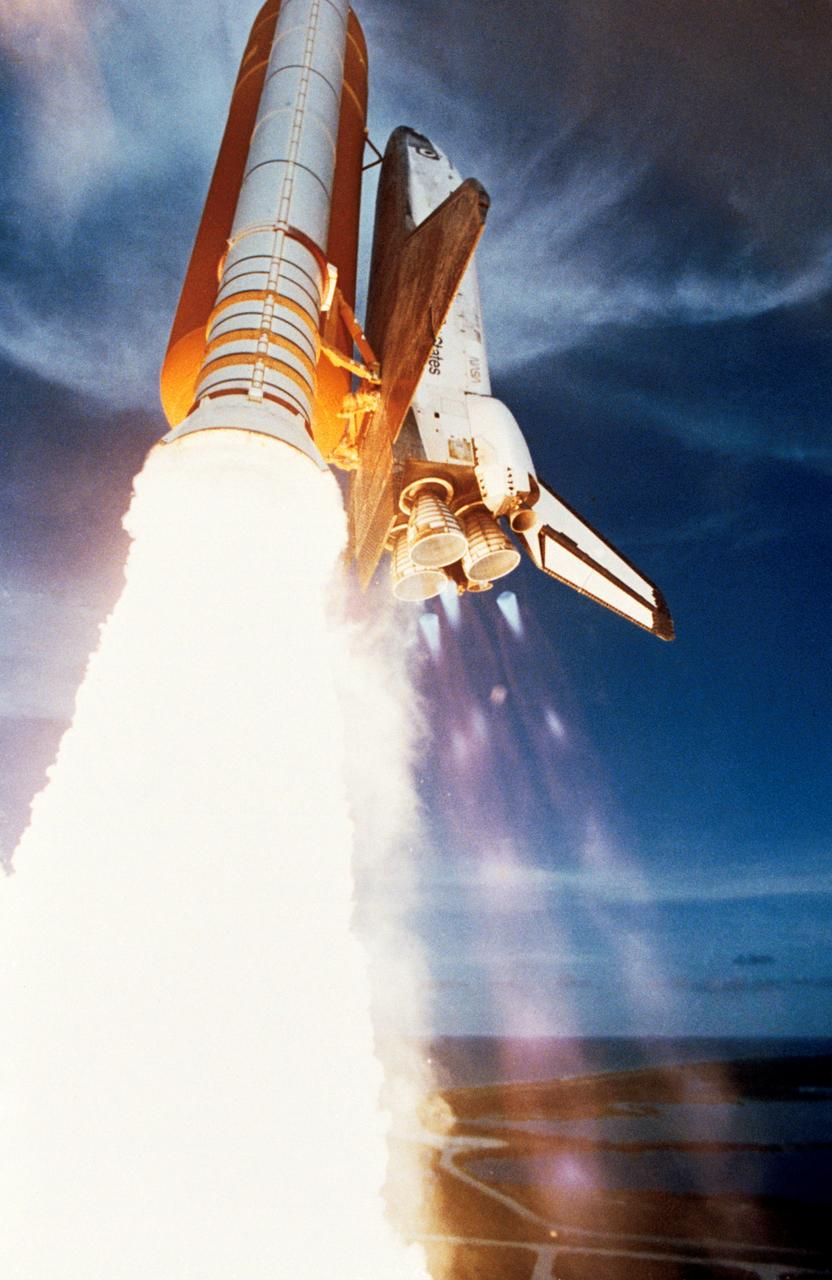
51F-S-157 (29 July 1985) --- Just moments following ignition, the Space Shuttle Challenger, mated to its two solid rocket boosters and an external fuel tank, soars toward a week-long mission in Earth orbit. Note the diamond shock effect in the vicinity of the three main engines. Launch occurred at 5:00 p.m. (EDT), July 29, 1985.
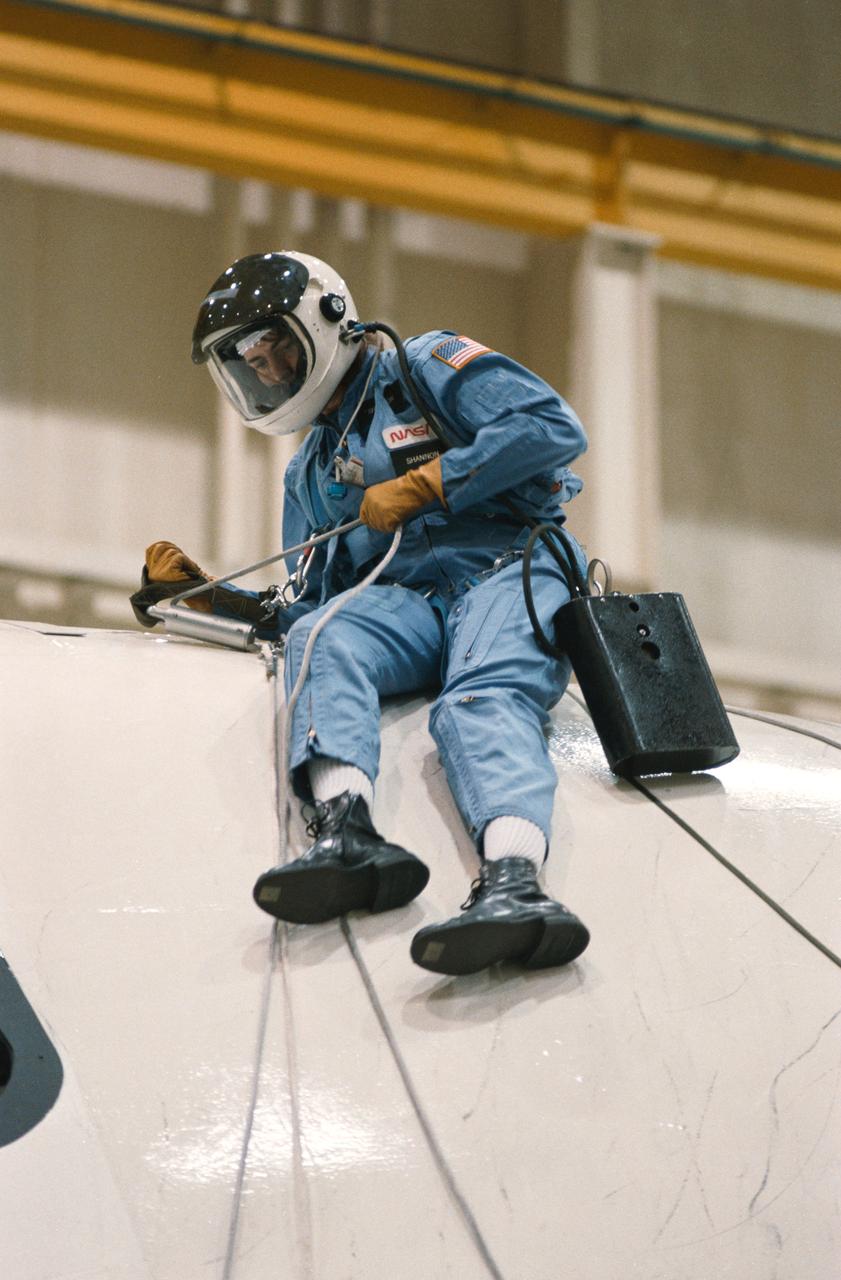
Mission Specialist Shannon W. Lucid, STS 51-G, descends from the top of the crew compartment trainer in bldg 9A, the mockup and integration laboratory, during emergency egress training.
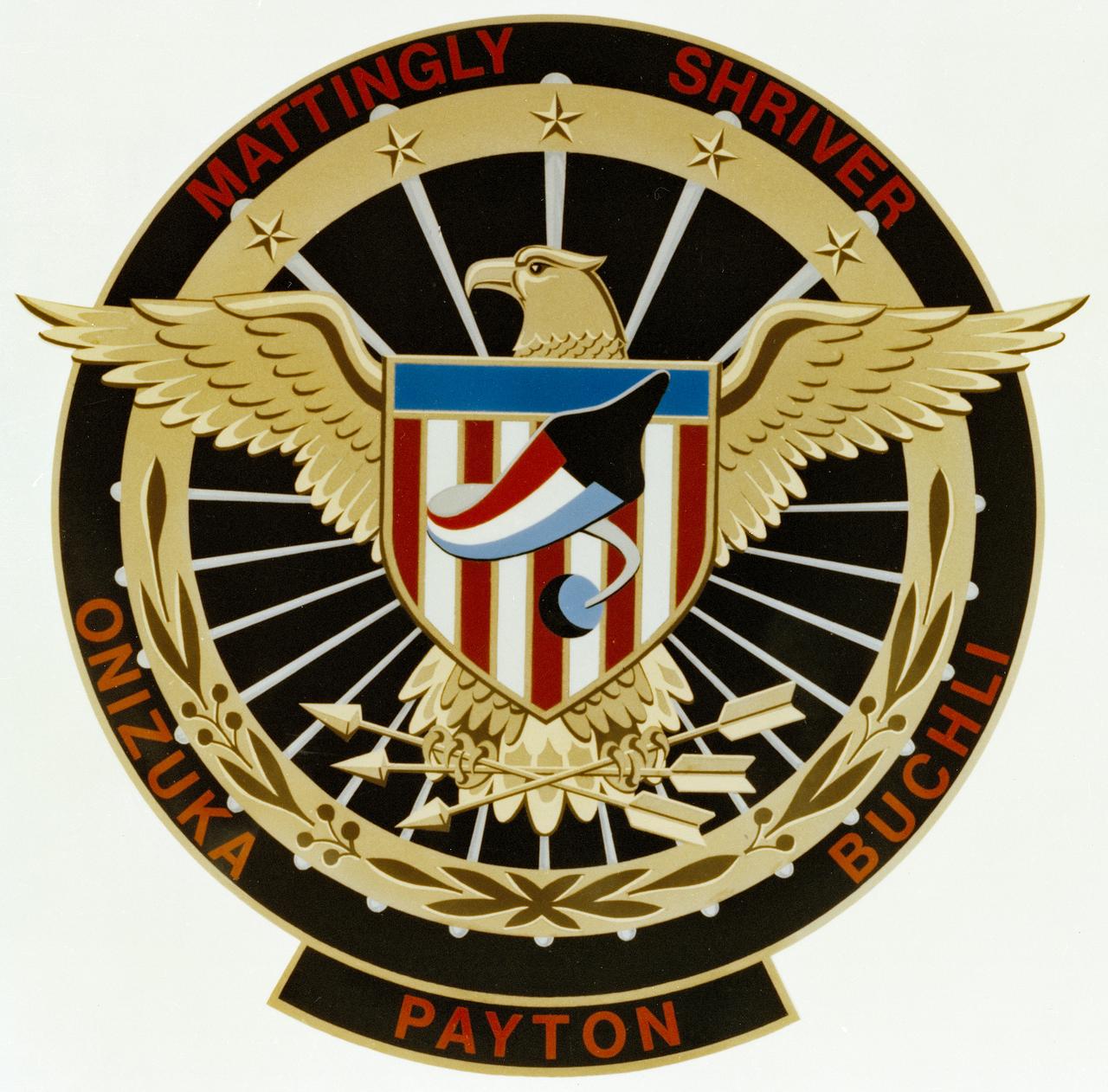
The crew insignia for STS Flight 51-C includes the names of its five crewmembers. The STS 51-C mission marked the third trip of the Space Shuttle Discovery into space. It was the first Space Shuttle mission totally dedicated to the Department of Defense. The U. S. Air Force Inertial Upper Stage Booster Rocket was successfully deployed. Due to the nature of the mission, few additional details of the flight were made available. Landing was made at the Kennedy Space Center, FL on January 27 at 4:23 PM EST. Mission duration was three days, one hour and 33 minutes.

S85-31767 (1985) --- Astronaut Richard O. Covey NOTE: Covey, pilot for STS 51-I, was named on Jan. 9, 1987 for the same position on NASA?s first planned STS mission since the January 1986 Challenger accident. The flight is tentatively scheduled for February 1988.
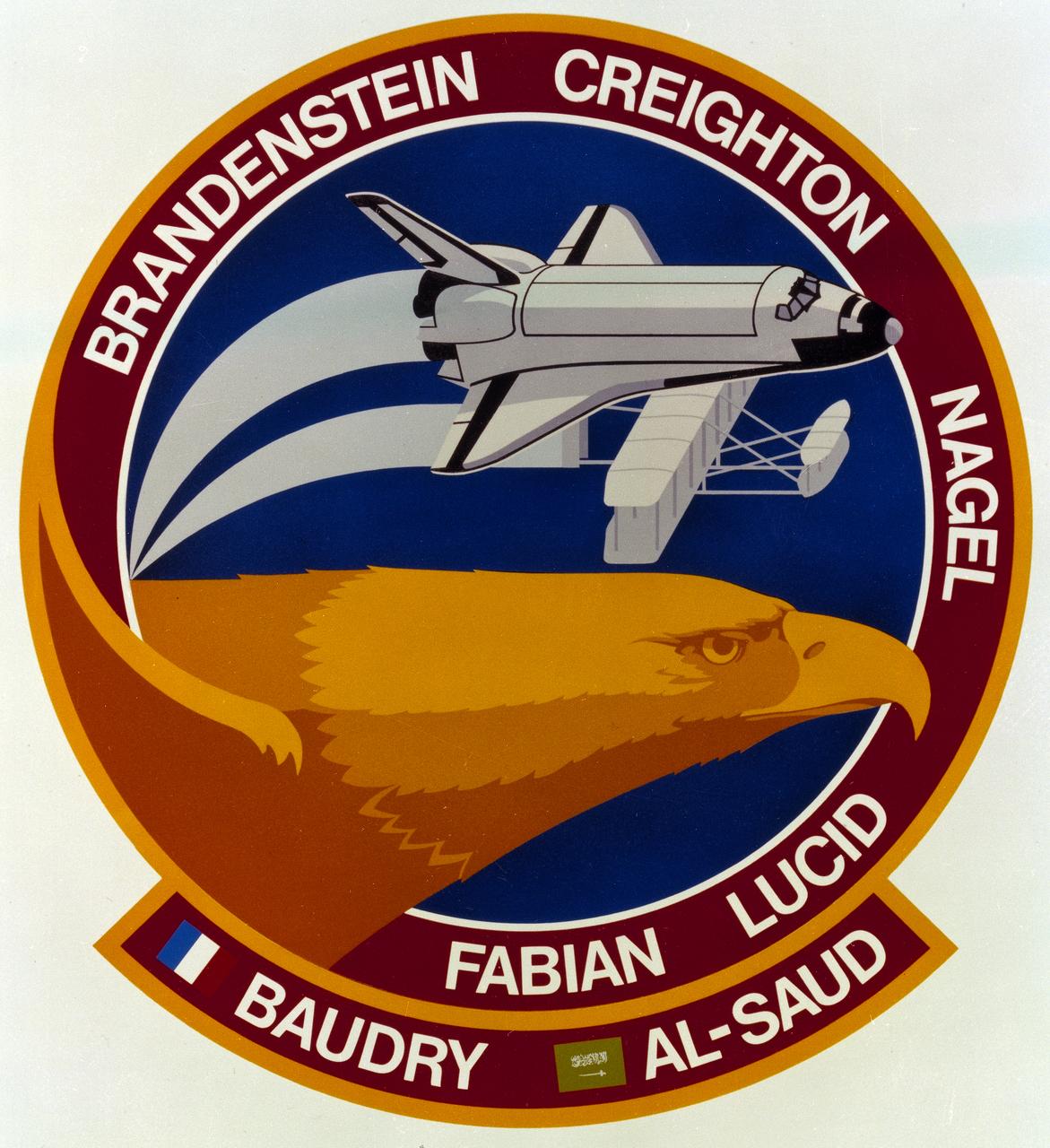
The STS-51G insignia illustrates the advances in aviation technology in the United States within a relatively short span of the twentieth century. The surnames of the crewmembers for the Discovery's mission appear near the center edge of the circular design.
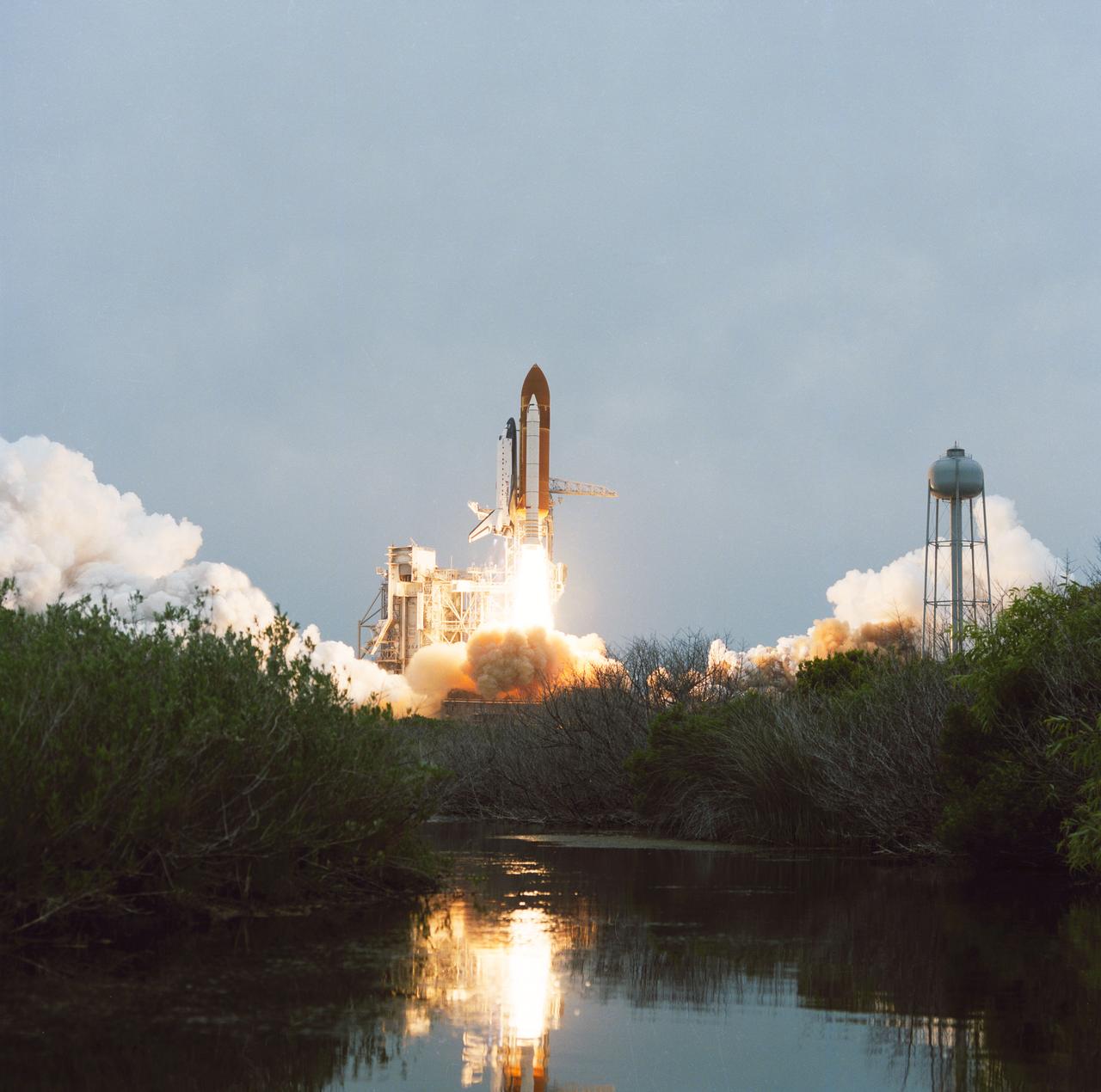
51D-9093 (12 April 1985) --- A 70mm frame of the Space Shuttle Discovery's 51-D launch at 8:59 a.m. (EST), April 12, 1985. Onboard are seven crewmembers and two communications satellites and a variety of medical and other experiments.
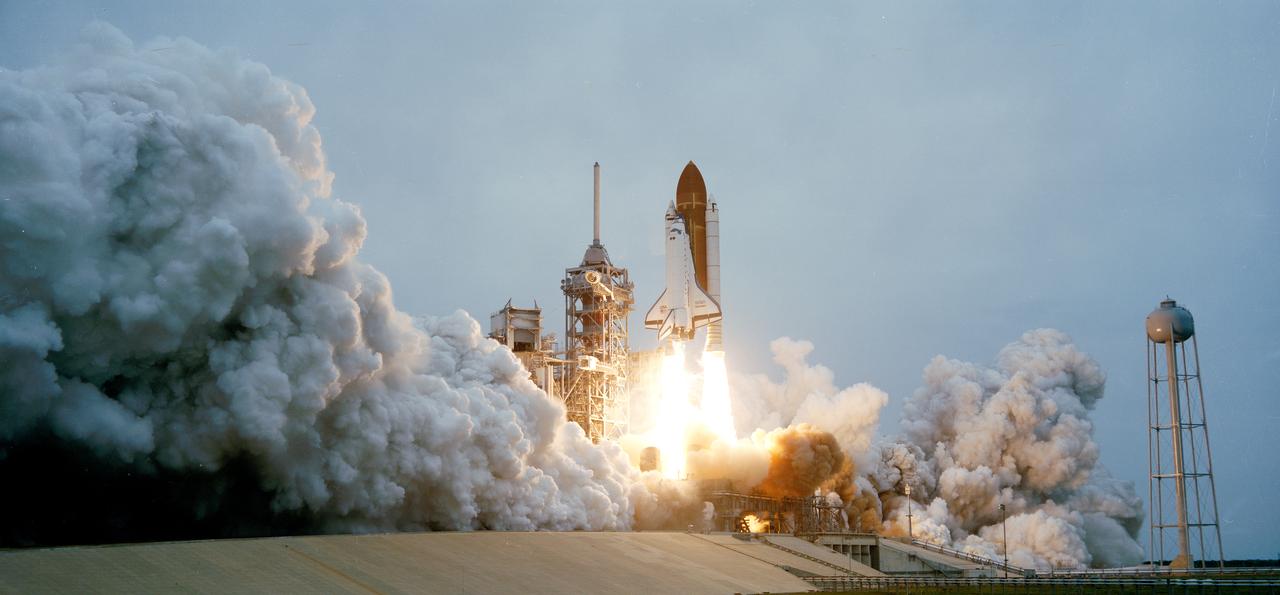
51D-9094 (12 April 1985) --- A 70mm frame of the Space Shuttle Discovery's 51-D launch at 8:59 a.m. (EST), April 12, 1985. Onboard are seven crewmembers and two communications satellites and a variety of medical and other experiments.
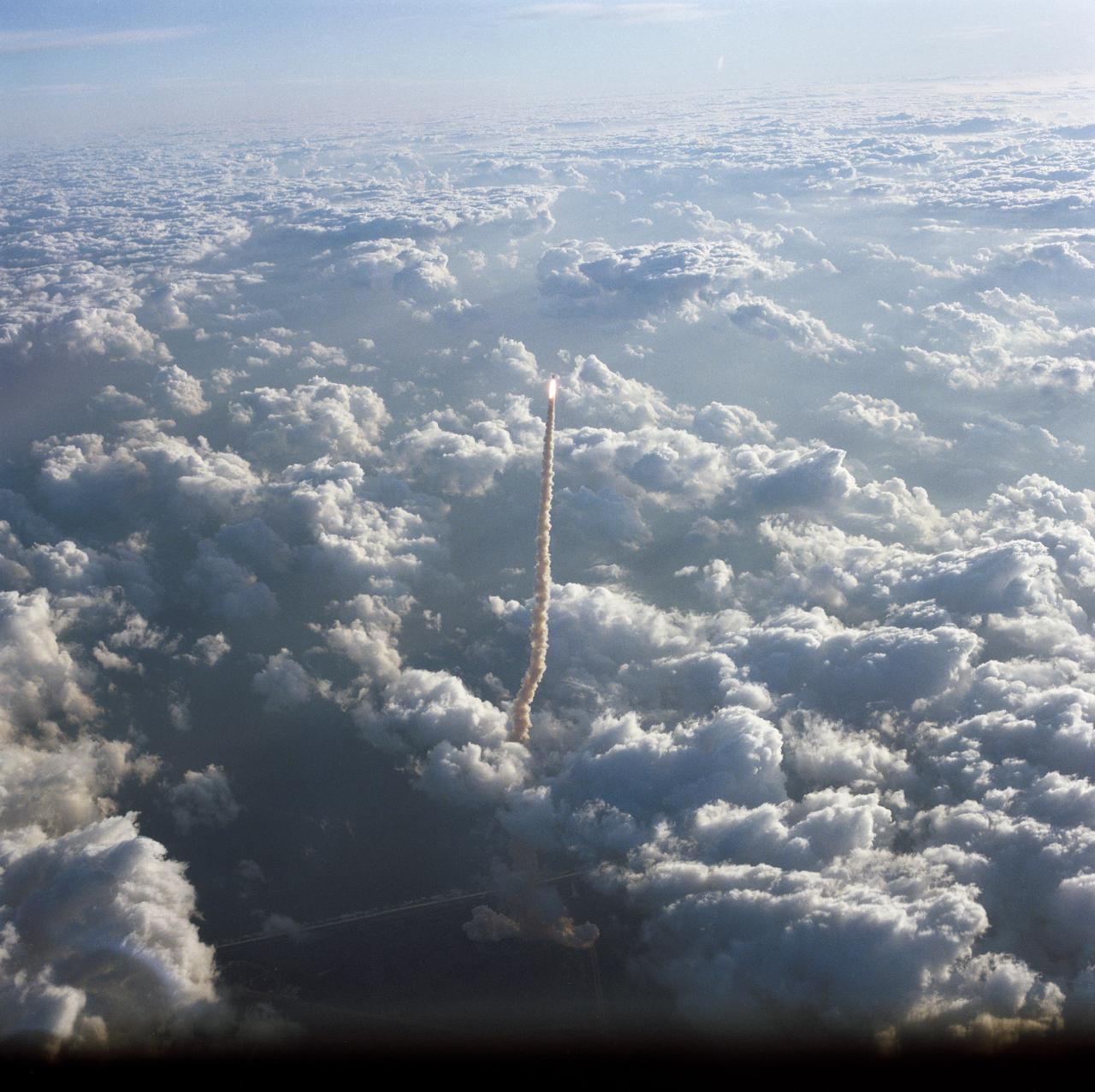
51A-90015 (8 Nov. 1984) --- John W. Young, who has seen many launches from various angles, used a handheld camera to record this scene of the very early phase of launch for NASA's space shuttle Discovery. Young was flying the NASA shuttle training aircraft (STA). Shuttle Discovery (51A) is seen as a spot of light at the top of a column of smoke outlined among the dense cloud cover. Photo credit: NASA
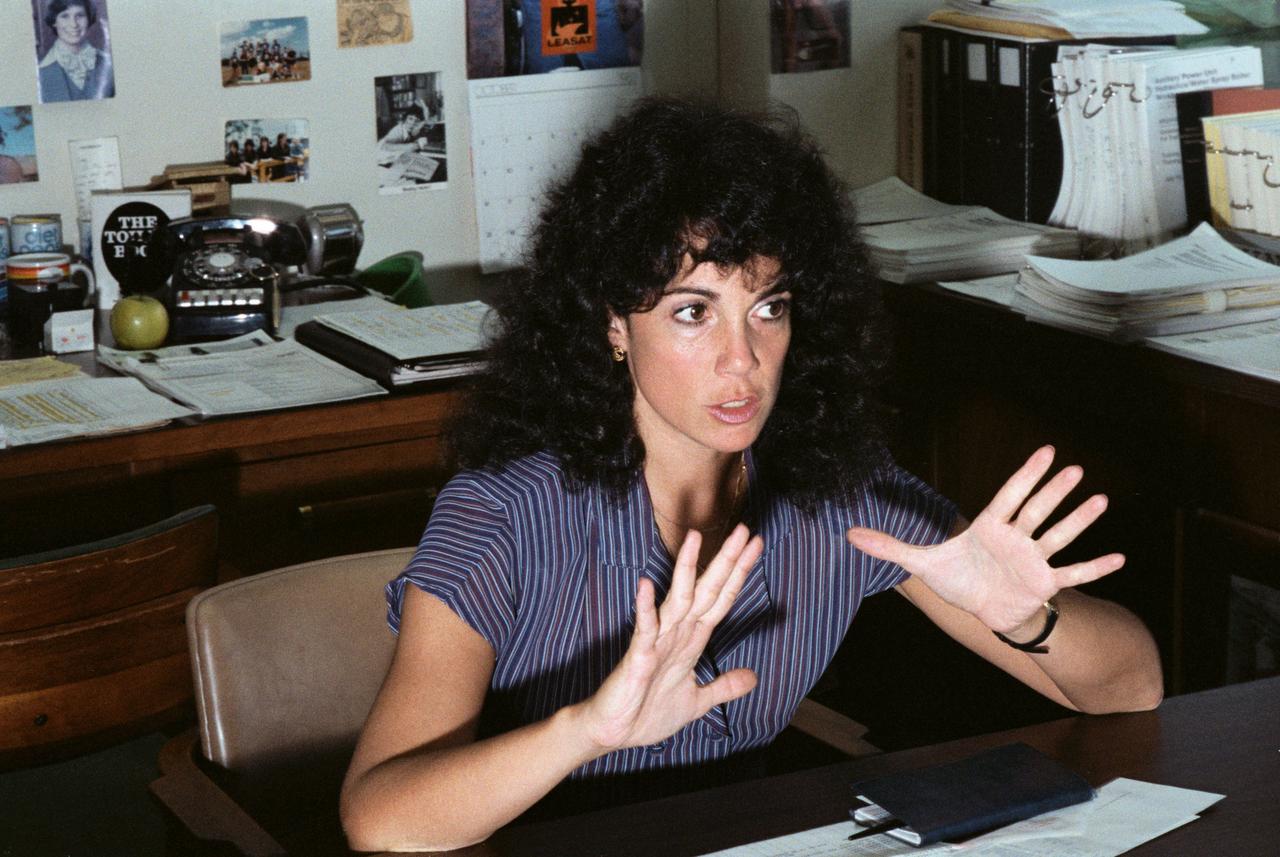
S85-40171 (5 Sept. 1985) --- Astronaut Judith A. Resnik, in her office, at the Johnson Space Center (JSC). Resnik is taking a break from training for her upcoming space mission. EDITOR’S NOTE: The STS-51L crew members lost their lives in the space shuttle Challenger accident moments after launch on Jan. 28, 1986 from the Kennedy Space Center (KSC). Photo credit: NASA
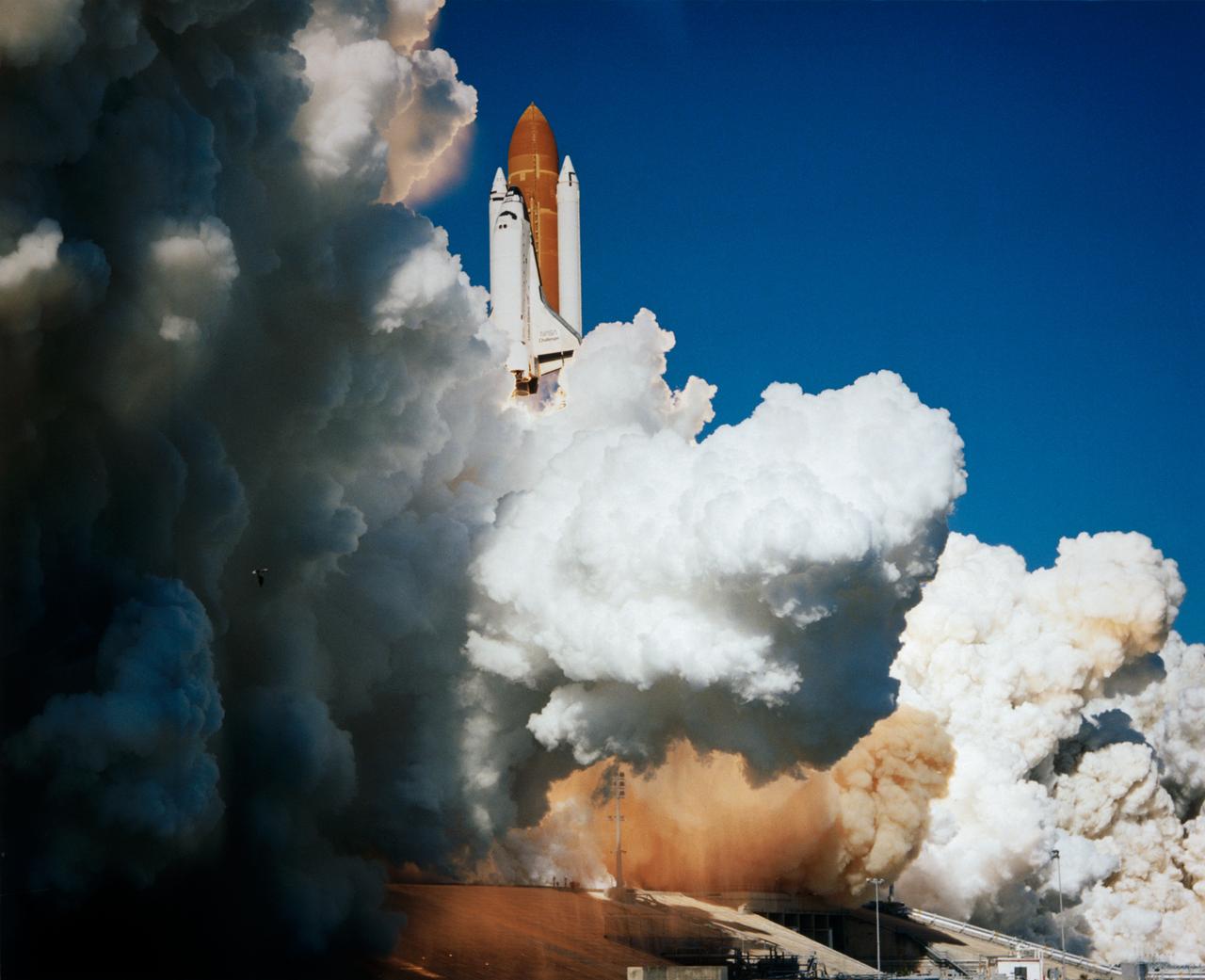
51L-S-157 (28 Jan. 1986) --- The space shuttle Challenger lifted off from Pad 39B Jan. 28, 1986 at 11:38 a.m. (EST) with a crew of seven astronauts and the Tracking and Data Relay Satellite (TDRS). An accident 73 seconds after liftoff claimed both crew and vehicle. Photo credit: NASA
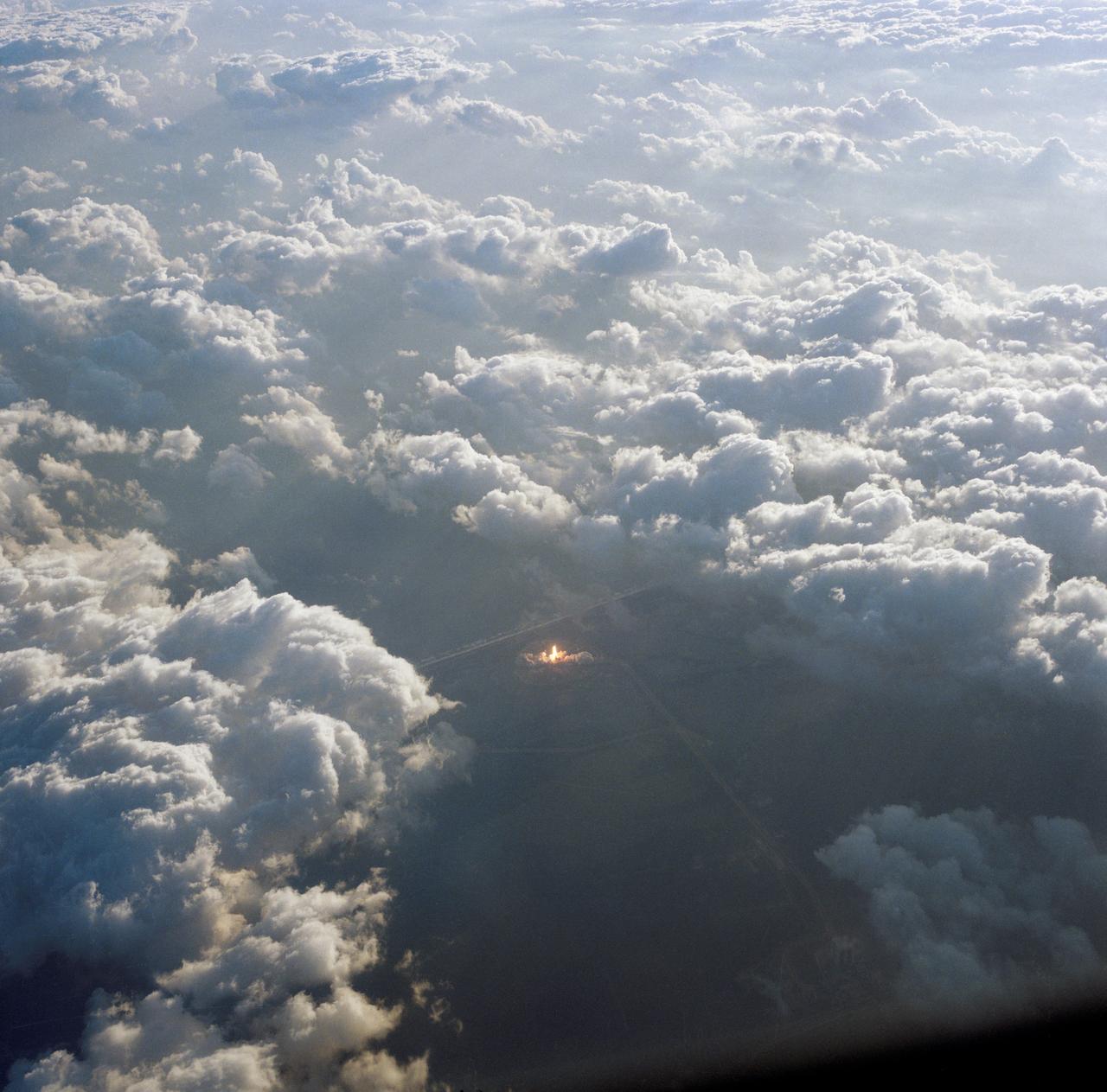
51A-90014 (8 Nov. 1984) --- John W. Young, who has seen many launches from various angles, used a handheld camera to record this scene of the very early phase of launch for NASA's space shuttle Discovery. Young was flying the NASA shuttle training aircraft (STA). The launch pad can be seen as a bright spot in the center of a mass of clouds. Photo credit: NASA
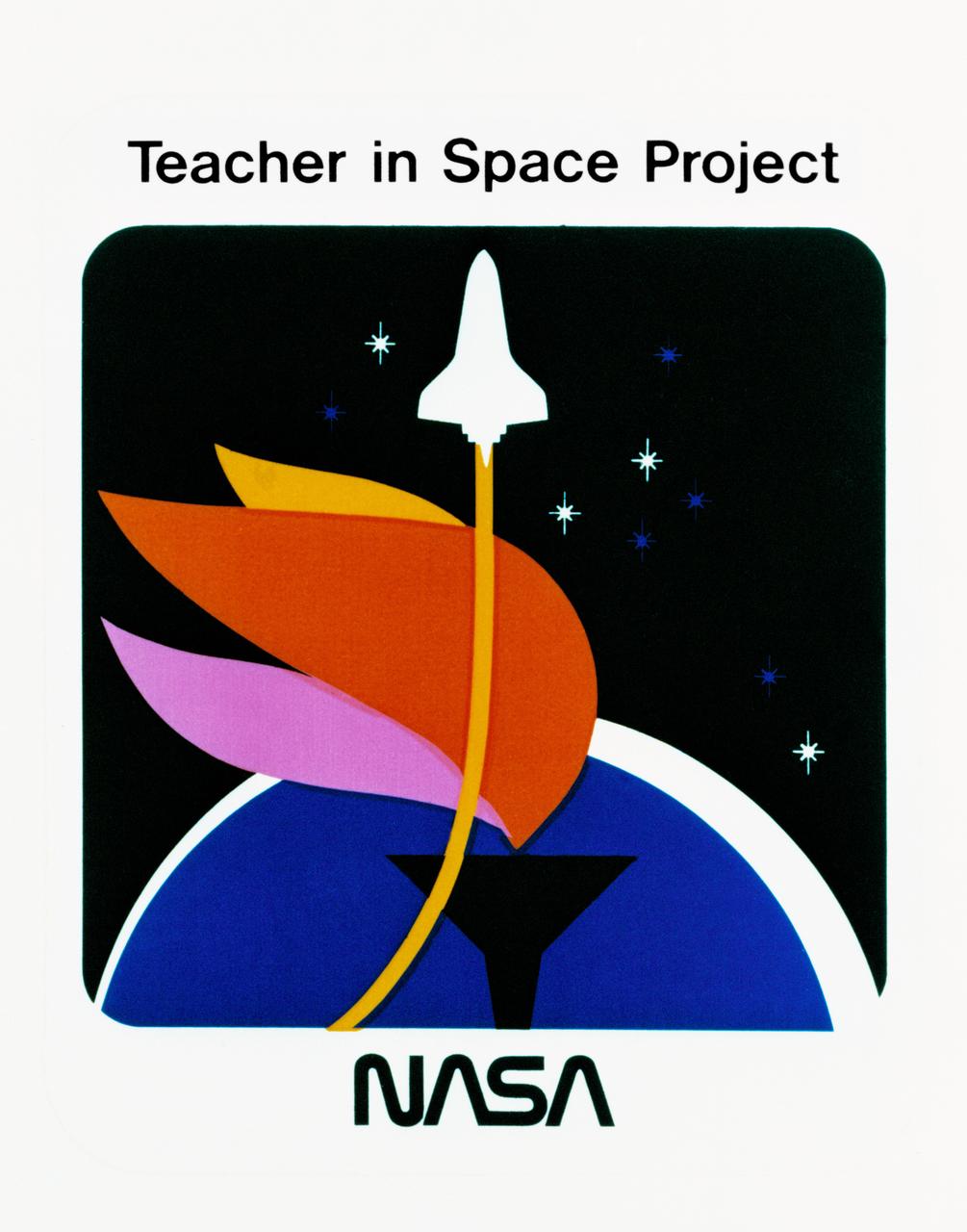
S85-38312 (September 1985) --- Logo designed for use by the 10 finalists in NASA’s Teacher in Space Project, who were at JSC for training and orientation the week of July 8–12, 1985. They are David M. Marquart, Boise High, Boise, Idaho; Michael W. Metcalf, Hazen Union School, Hardwick, Vermont; Judith Marie Garcia, Thomas Jefferson School for Science and Technology, Alexandria, Virginia; Peggy J. Lathlaen, Westwood Elementary, Friendswood, Texas; Niki Mason Wenger, Vandevender Junior High, Parkersburg, West Virginia; Barbara R. Morgan, McCall-Donnelly Elementary, McCall, Idaho; Kathleen Anne Beres, Kenwood High, Baltimore, Maryland; Richard A. Methia, New Bedford High, New Bedford, Mass.; Sharon Christa McAuliffe, Concord High, Concord, New Hampshire; and Robert S. Foerster, Cumberland Elementary School, West Lafayette, Indiana. Photo credit: NASA

51G-21-011 (17-24 June 1985) --- Group portrait on flight deck of all seven STS-51G crew members. Left to right (front) are John O. Creighton, Shannon W. Lucid, Daniel C. Brandenstein; and (back row) are Sultan Salman Abdelazize Al-Saud, Steven R. Nagel, John M. Fabian and Patrick Baudry. Photo credit: NASA

51D-09-034 (12-19 April 1985) --- The seven crew members of STS-51D take time, during a busy full week in space, to pose for a "star-burst" type in-space portrait. Hold picture with astronaut Rhea Seddon at bottom center. Counter-clockwise from the bottom left are Jeffrey A. Hoffman, mission specialist; Dr. Seddon, mission specialist; Charles D. Walker, payload specialist; U. S. Senator E. J. (Jake) Garn, payload specialist; S. David Griggs, mission specialist; Karol J. Bobko, mission commander; and Donald W. Williams, pilot. A pre-set 35mm camera exposed the frame in the mid-deck of the Earth-orbiting Space Shuttle Discovery. The crew launched at 8:59 a.m. (EST), April 12, 1985 and landed at 8:54 a.m. (EST), April 19, 1985 spending five minutes less than a full week on the busy mission.
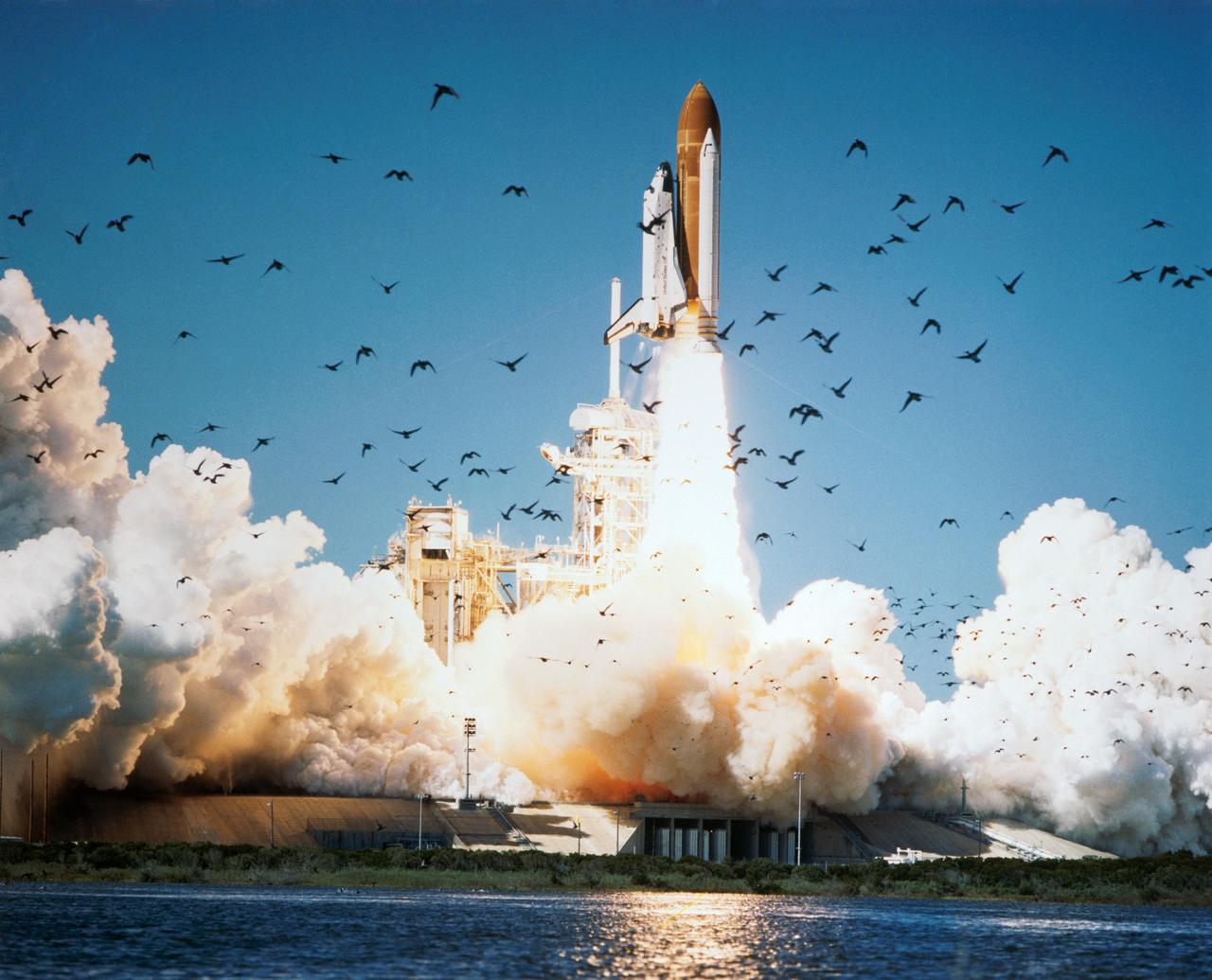
51L-S-156 (28 Jan. 1986) --- The space shuttle Challenger lifted off from Pad 39B Jan. 28, 1986 at 11:38 a.m. (EST) with a crew of seven astronauts and the Tracking and Data Relay Satellite (TDRS). An accident 73 seconds after liftoff claimed both crew and vehicle. Photo credit: NASA
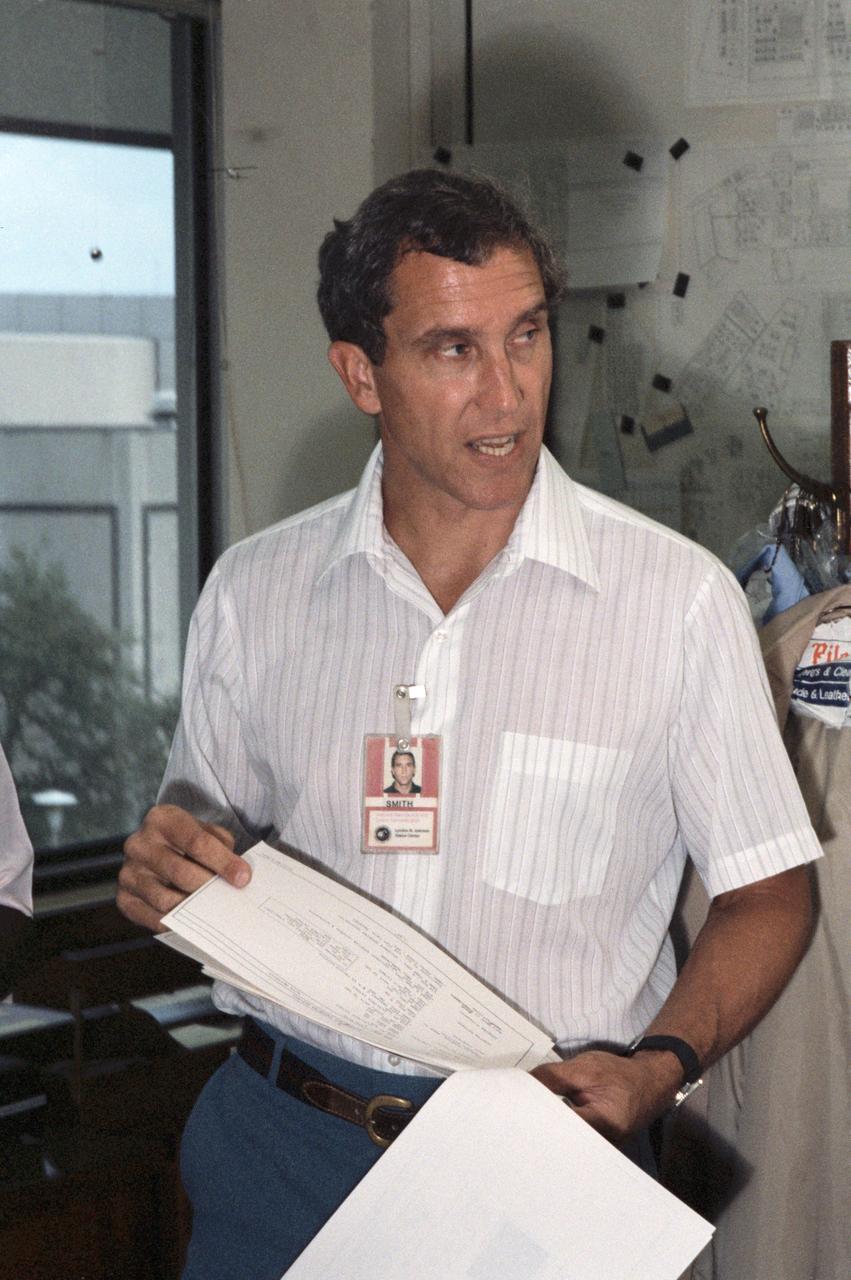
S85-40174 (5 Sept. 1985) --- In Johnson Space Center’s (JSC) Astronaut Office, astronaut Michael J. Smith, STS-51L pilot, looks over part of the flight plan for his upcoming space mission. EDITOR’S NOTE: The STS-51L crew members lost their lives in the space shuttle Challenger accident moments after launch on January 28, 1986 from the Kennedy Space Center (KSC). Photo credit: NASA
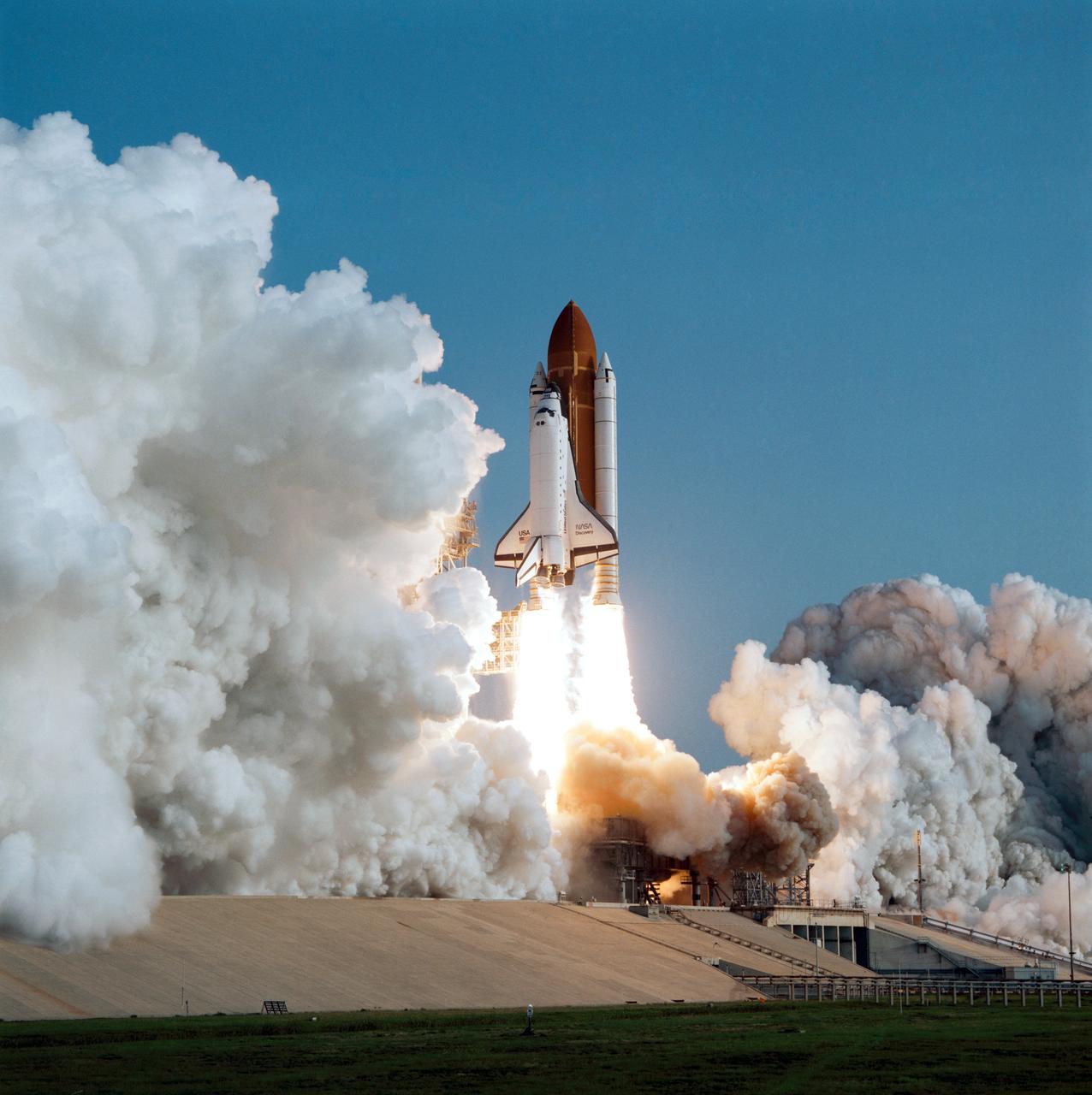
51G-S-098 (17 June 1985) --- With seven crewmembers and a variety of international payloads onboard, the Space Shuttle Discovery, attached to two solid rocket boosters and an external fuel tank, gets off the launch pad at 7:33:042 a.m. (EDT), June 17, 1985.

51A-90032 (8 Nov 1984) --- Space Shuttle Discovery blasts off from launch pad 39A to begin its second space trip. Five crewmembers inside head toward a scheduled eight-day stay in earth orbit, during which two satellites will be deployed and two more will be retrieved for eventual re-deployment. Onboard Discovery are astronauts Frederick H. (Rick) Hauck, David M. Walker, Joseph P. Allen, Dale A. Gardenter and Anna L. Fisher.
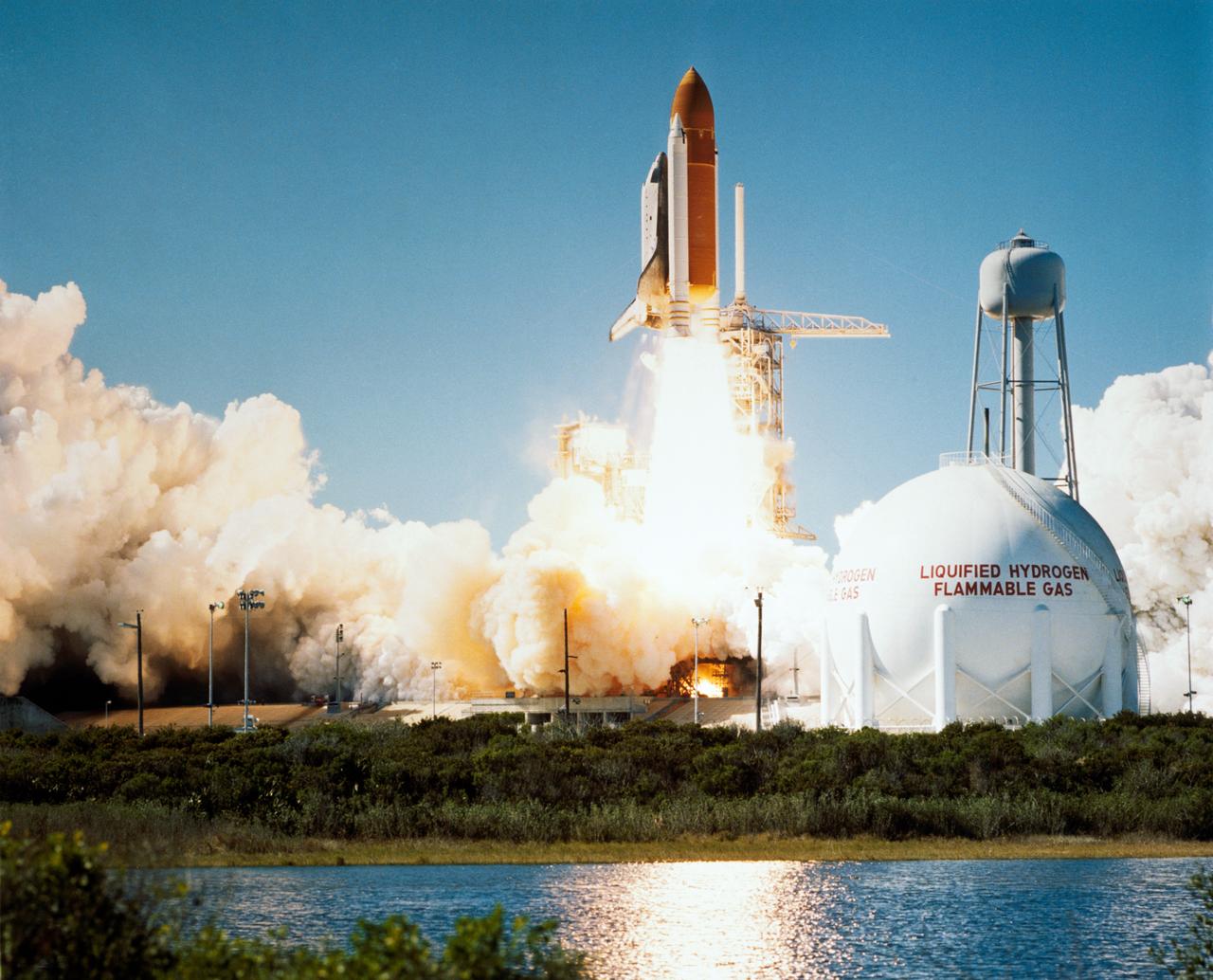
51L-S-155 (28 Jan. 1986) --- The space shuttle Challenger lifted off from Pad 39B Jan. 28, 1986 at 11:38 a.m. (EST) with a crew of seven astronauts and the Tracking and Data Relay Satellite (TDRS). An accident 73 seconds after liftoff claimed both crew and vehicle. Photo credit: NASA
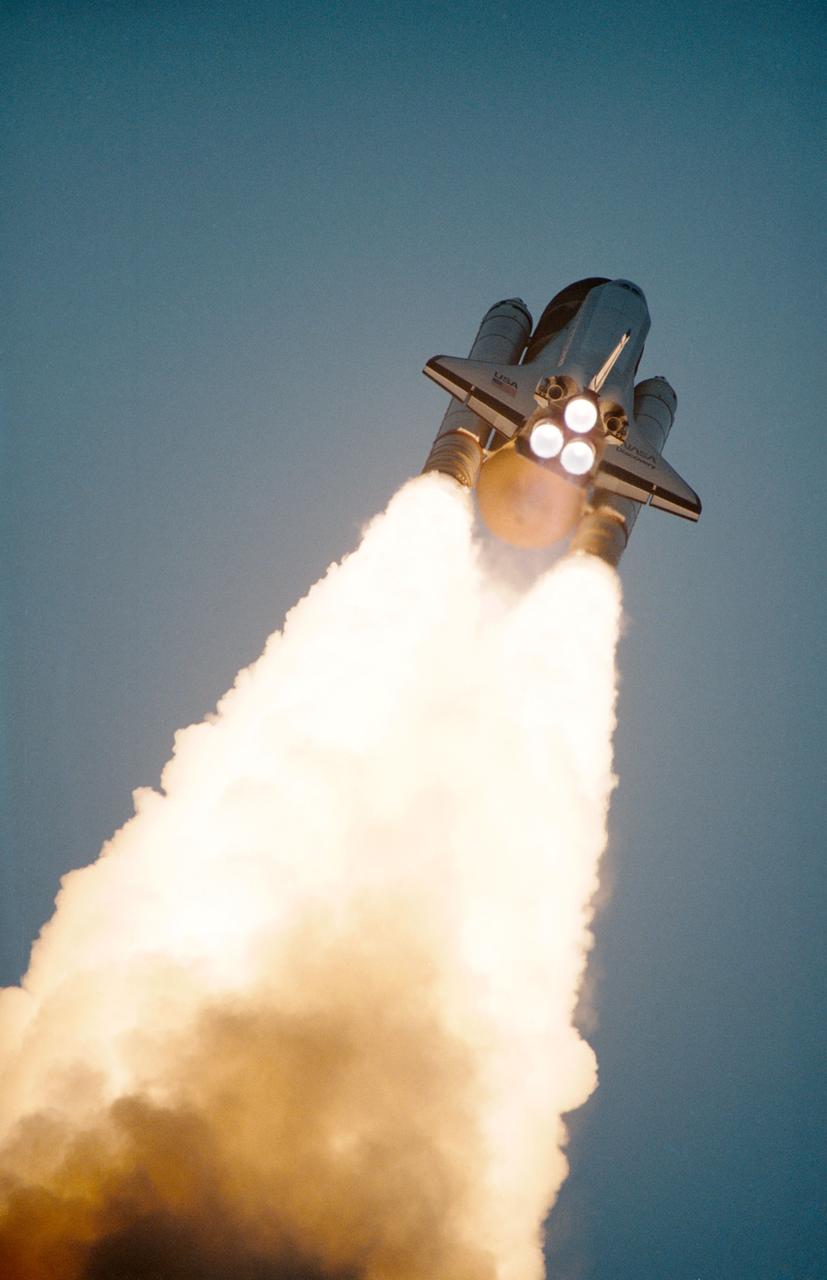
51D-9092 (12 April 1985) --- The Space Shuttle Discovery ascends the launch complex in Florida and heads through Atlantic skies toward its 51-D mission. The seven member crew lifted off at 8:59 a.m. (EST), April 12, 1985. This picture was made with a 35mm camera.
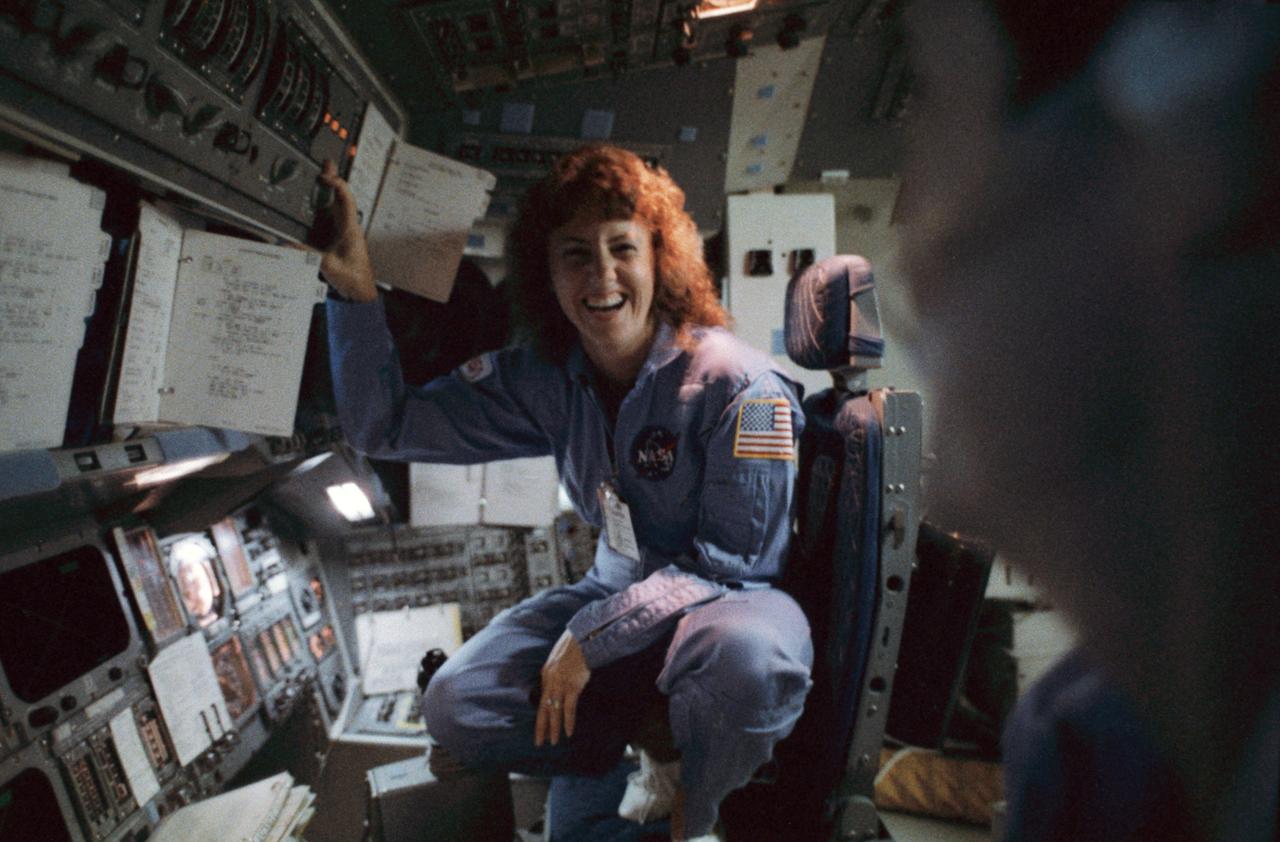
S85-44507 (October 1985) --- Sharon Christa McAuliffe, a teacher from Concord, New Hampshire, trains for the January 1986 mission of the space shuttle Challenger in the Johnson Space Center’s shuttle mission simulator (SMS). Learning about the overall spacecraft systems, McAuliffe is pictured here in the pilot’s station. For actual launch and landing phases, the Teacher-in-Space Project payload specialist would sit on the middeck. The photograph was taken by Michael O’Brien of Life Magazine. Photo credit: NASA
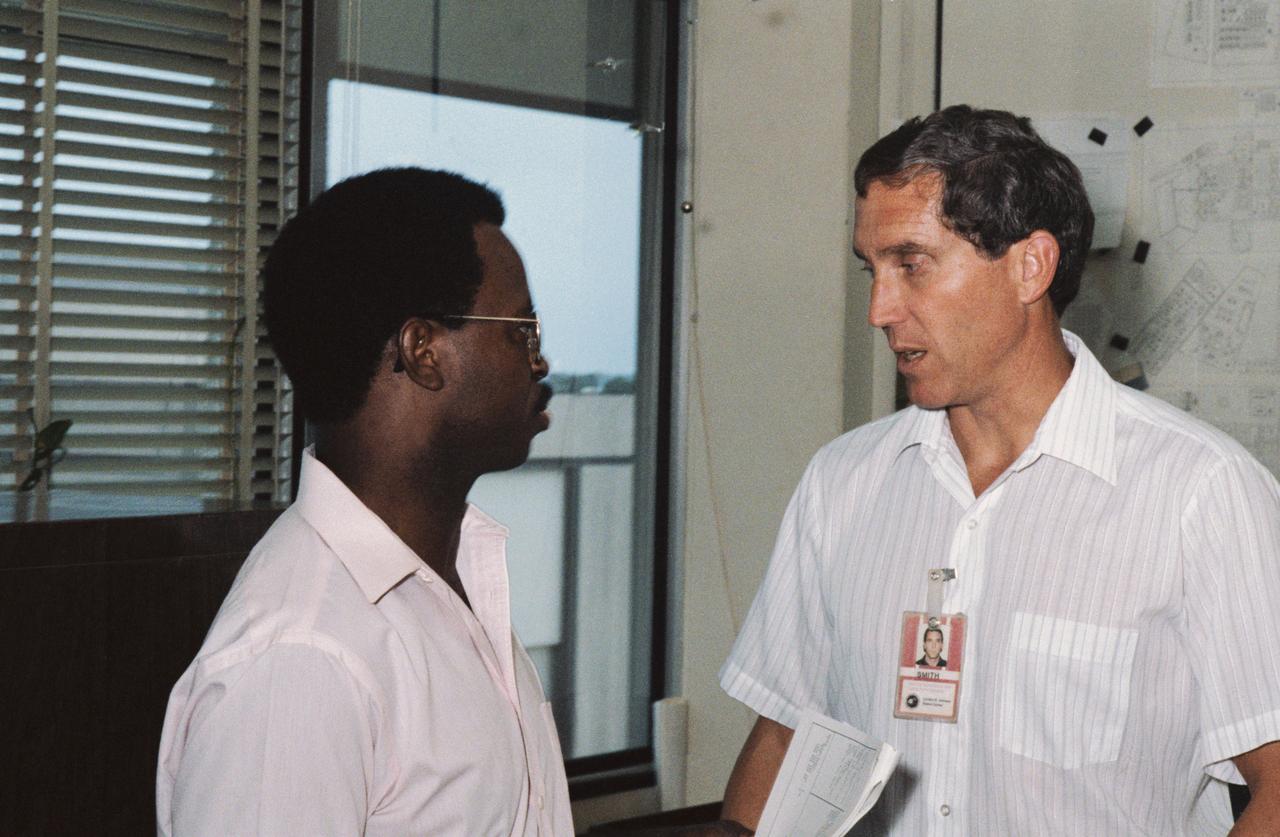
S85-40172 (5 Sept. 1985) --- Astronauts Ronald E. McNair (left), mission specialist, and Michael J. Smith, pilot, talk about their upcoming space mission in JSC's astronaut office. SINCE THIS PHOTOGRAPH WAS MADE: McNair, Smith and five other crew members lost their lives in the Challenger accident on Jan. 28, 1986. Photo credit: NASA
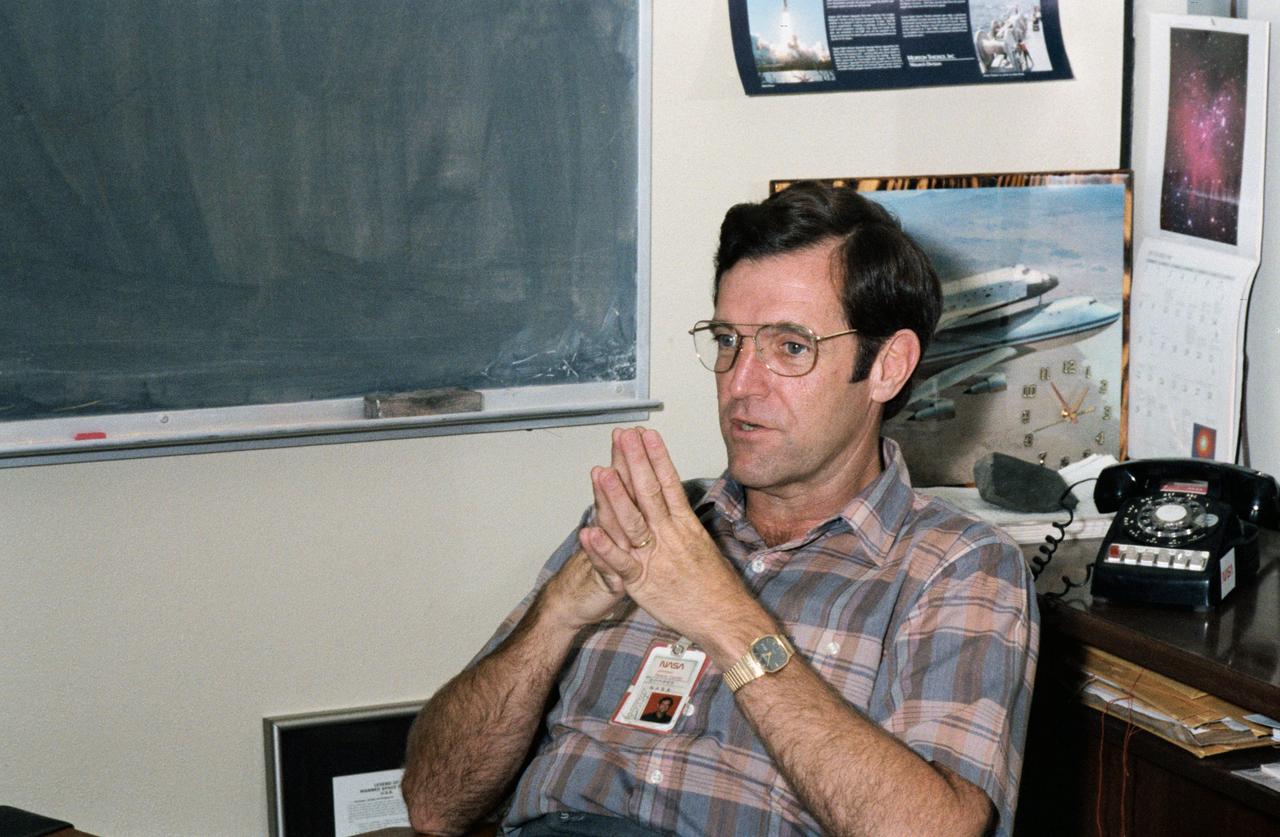
S85-40173 (5 Sept. 1985) --- In Johnson Space Center’s (JSC) Astronaut Office, astronaut F. Richard (Dick) Scobee, STS-51L mission commander, takes a break from training for his upcoming space mission. EDITOR’S NOTE: The STS-51L crew members lost their lives in the space shuttle Challenger accident moments after launch on Jan. 28, 1986 from the Kennedy Space Center (KSC). Photo credit: NASA
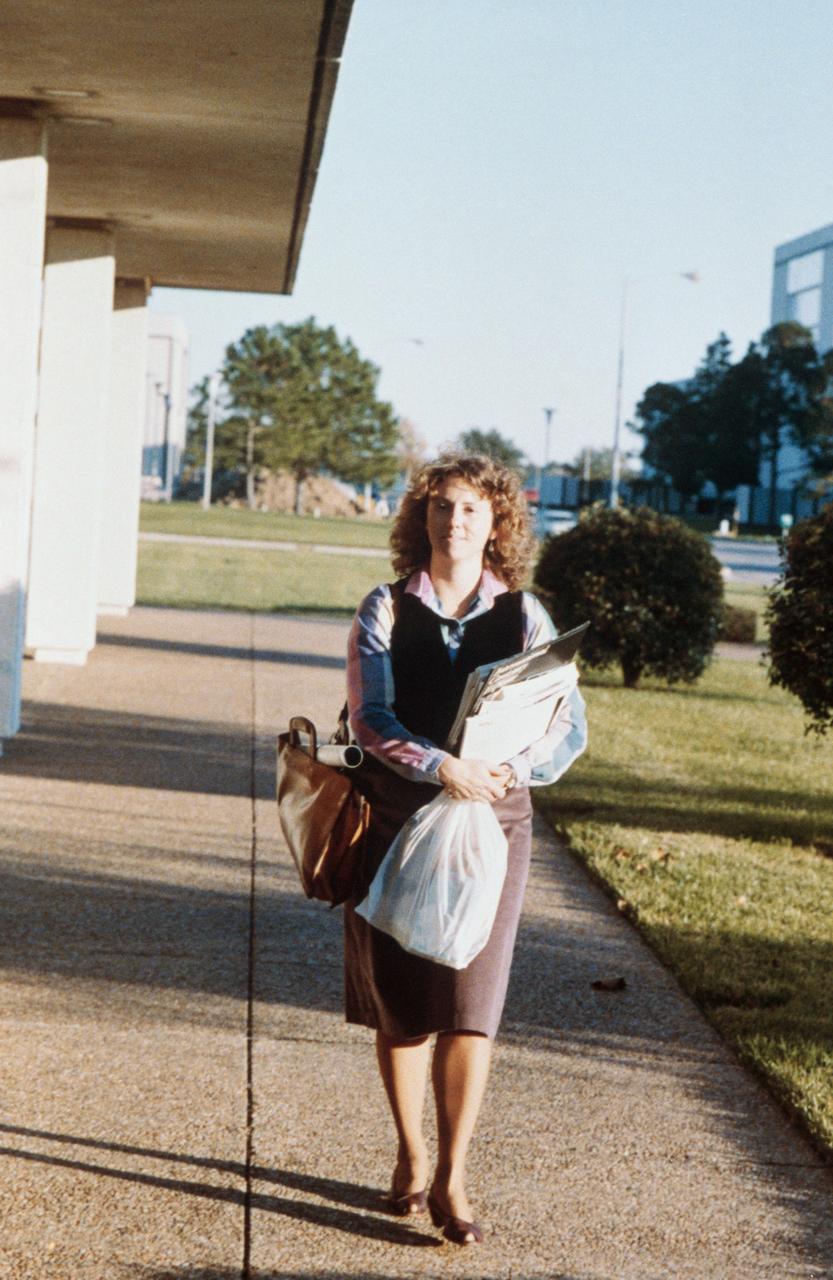
S86-25279 (November 1985) --- Sharon Christa McAuliffe, STS-51L payload specialist, has homework of her own to do as she prepares for a January 1986 flight. Photo by Keith Meyers of the New York Times. Photo credit: NASA
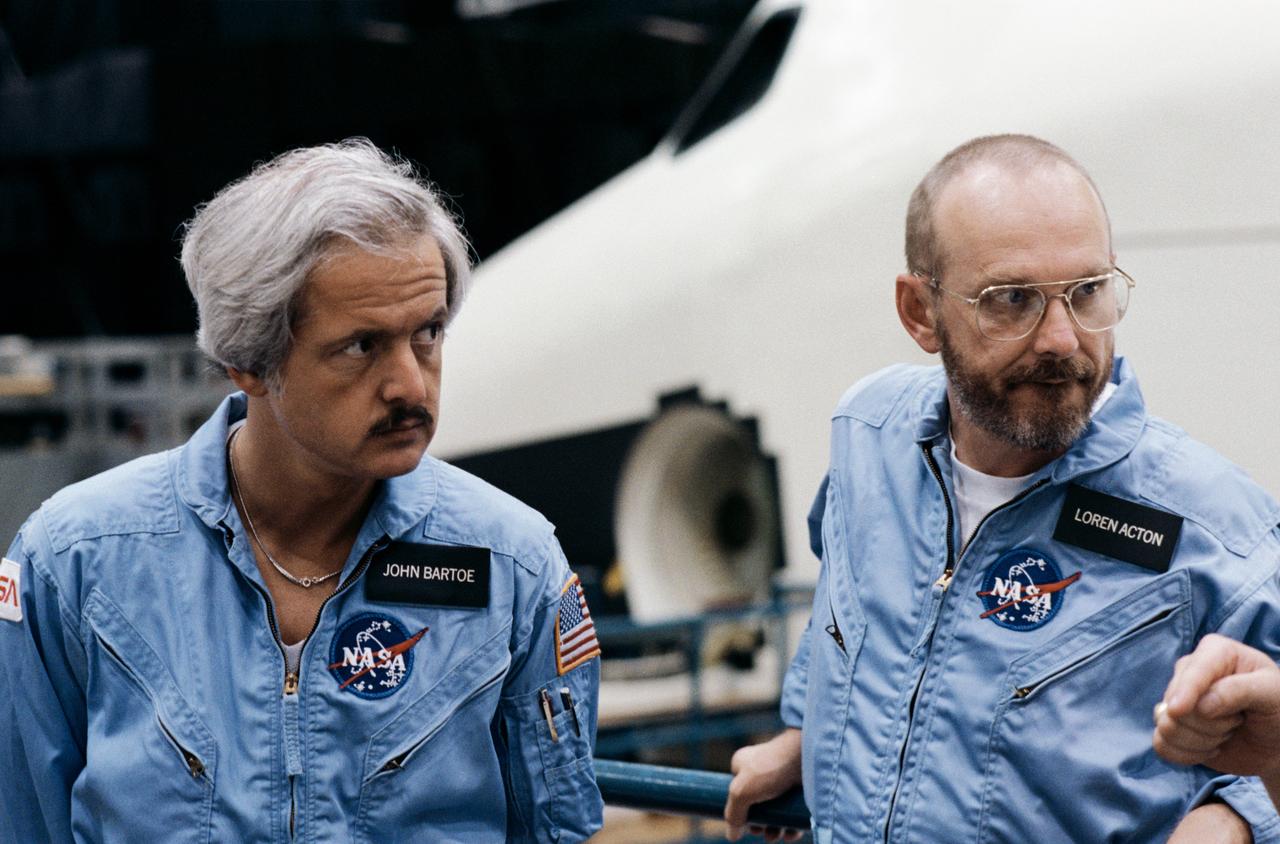
S85-34378 (4 June 1985) --- Payload specialists John-David Bartoe, left, and Loren W. Acton listen to a briefing by a crew trainer (out of frame) during emergency egress training for members of the Challenger's next crew. Later, the seven crewmembers used sky-genies to practice quick egress from a potentially troubled Space Shuttle craft. They are standing near the crew compartment trainer in the Shuttle mockup and integration lab at JSC.
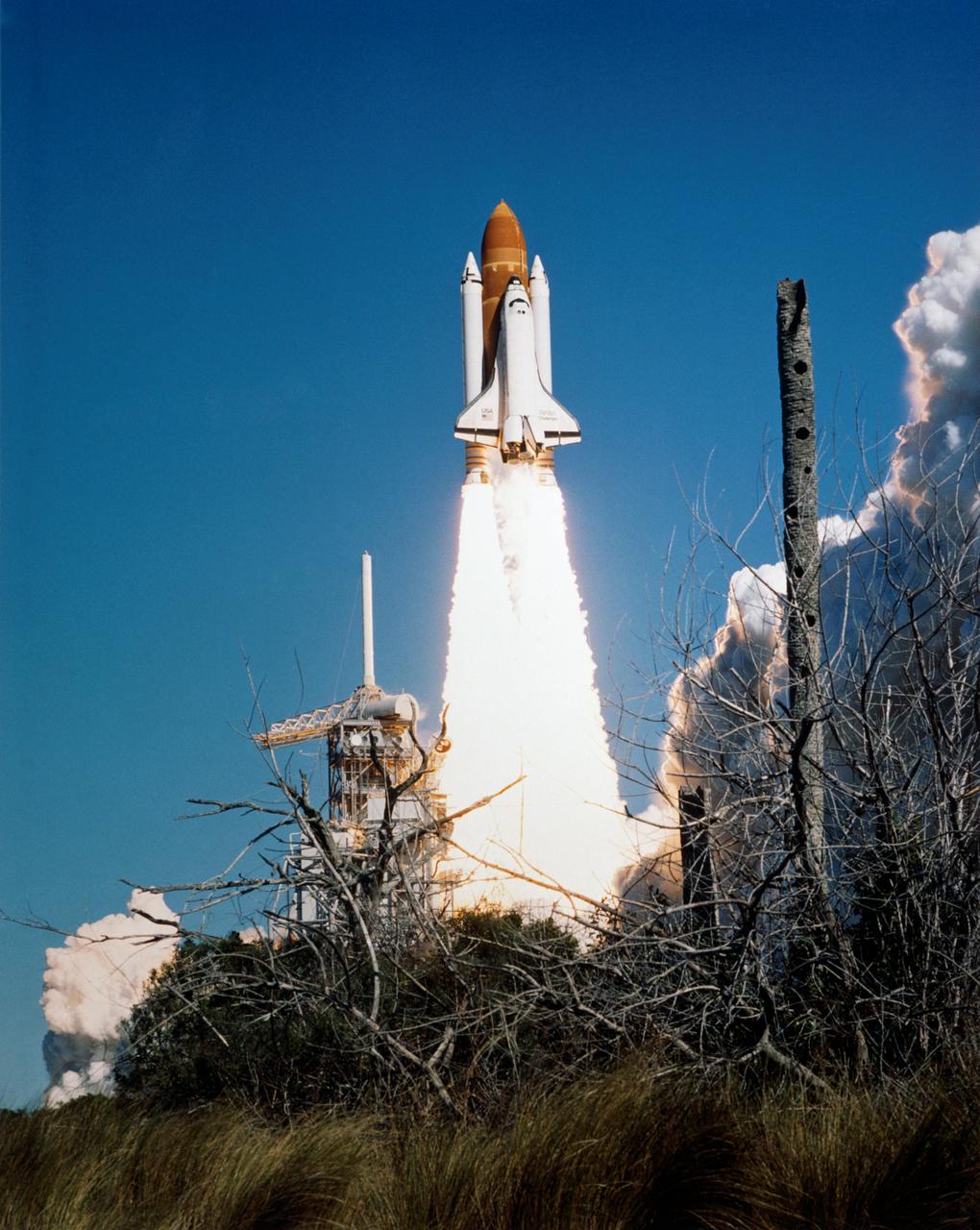
51L-S-154 (28 Jan. 1986) --- The space shuttle Challenger lifted off from Pad 39B Jan. 28, 1986 at 11:38 a.m. (EST) with a crew of seven astronauts and the Tracking and Data Relay Satellite (TDRS). An accident 73 seconds after liftoff claimed both crew and vehicle. Photo credit: NASA

51D-9089 (S23-9089) (12 April 1985) --- The Space Shuttle mission 51-D crewmembers gather to eat breakfast prior to leaving for the launch pad to climb aboard Discovery for liftoff. From left to right Rhea Seddon, Donald E. Williams, Charles D. Walker, Karol J. Bobko, Jeffrey A. Hoffman, S. David Griggs and U.S. Sen. E.J. (Jake) Garn discuss phases of the upcoming flight. Desert for the yet-to-be served breakfast is the pictured decorate 51-D cake.
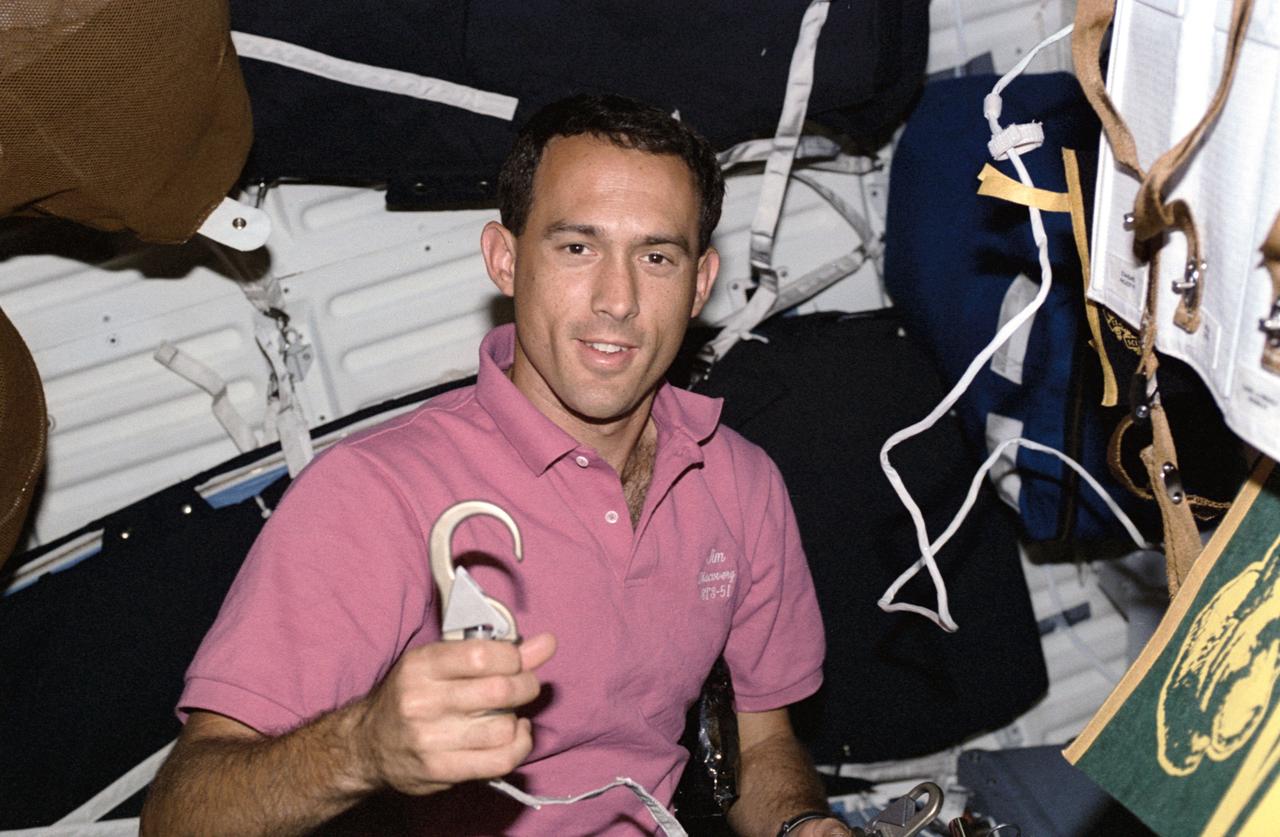
STS051-26-002 (12-22 Sept 1993) --- Astronaut James H. Newman, mission specialist, shows off a latch hook for a tether device used during the STS-51 extravehicular activity (EVA) on September 16, 1993. Newman, on Discovery's middeck, appears surrounded by sleep restraints.
ISS021-E-029794 (18 Nov. 2009) --- Surrounded by the blackness of space, the Space Shuttle Atlantis appears very small from the point of view of the International Space Station as the shuttle approaches the station during STS-129 rendezvous and docking operations. Docking occurred at 10:51 a.m. (CST) on Nov. 18, 2009.
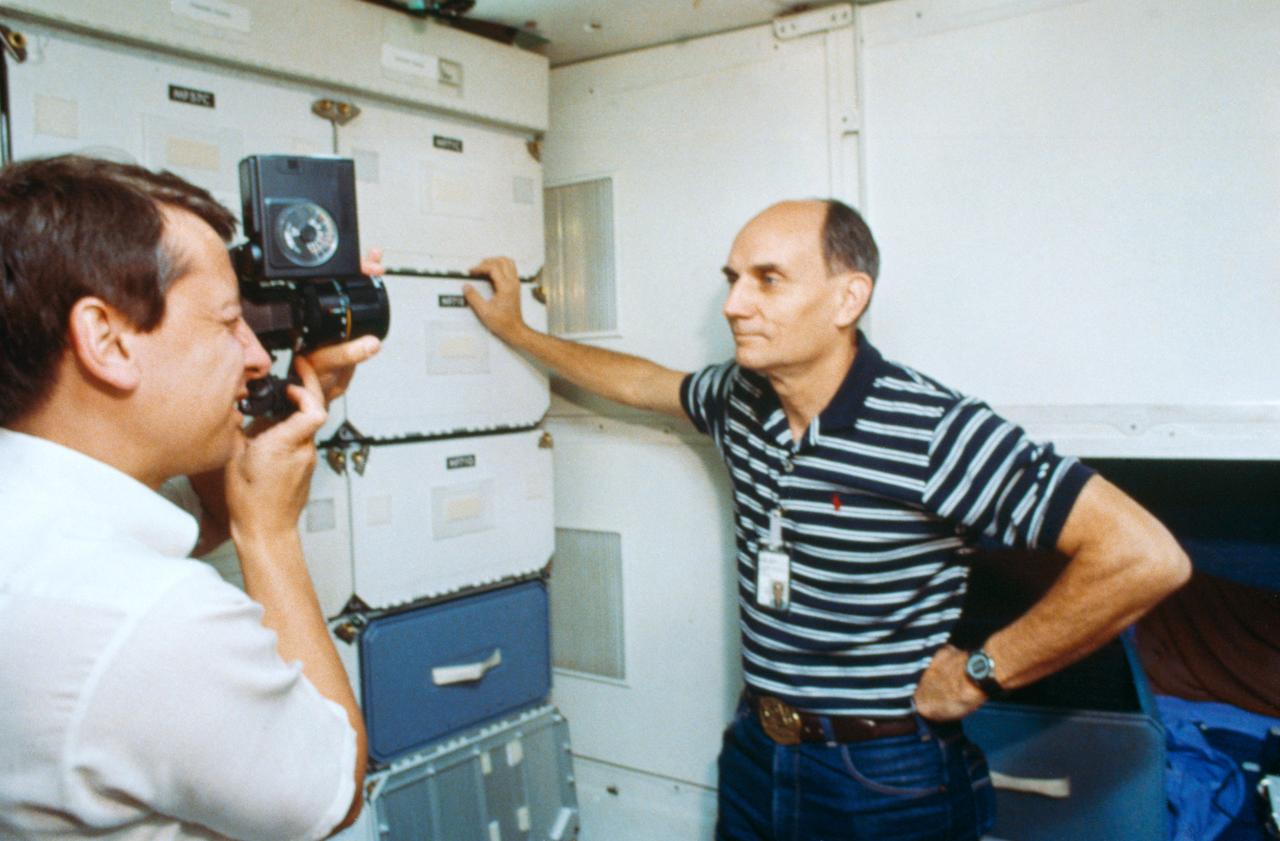
Two payload specialists for the STS 51-D mission get in some training time in the crew compartment trainerat JSC. Charles D. Walker, left, rehearses photography of U.S. Senator E.J. (Jake) Garn in the middeck section of the trainer.
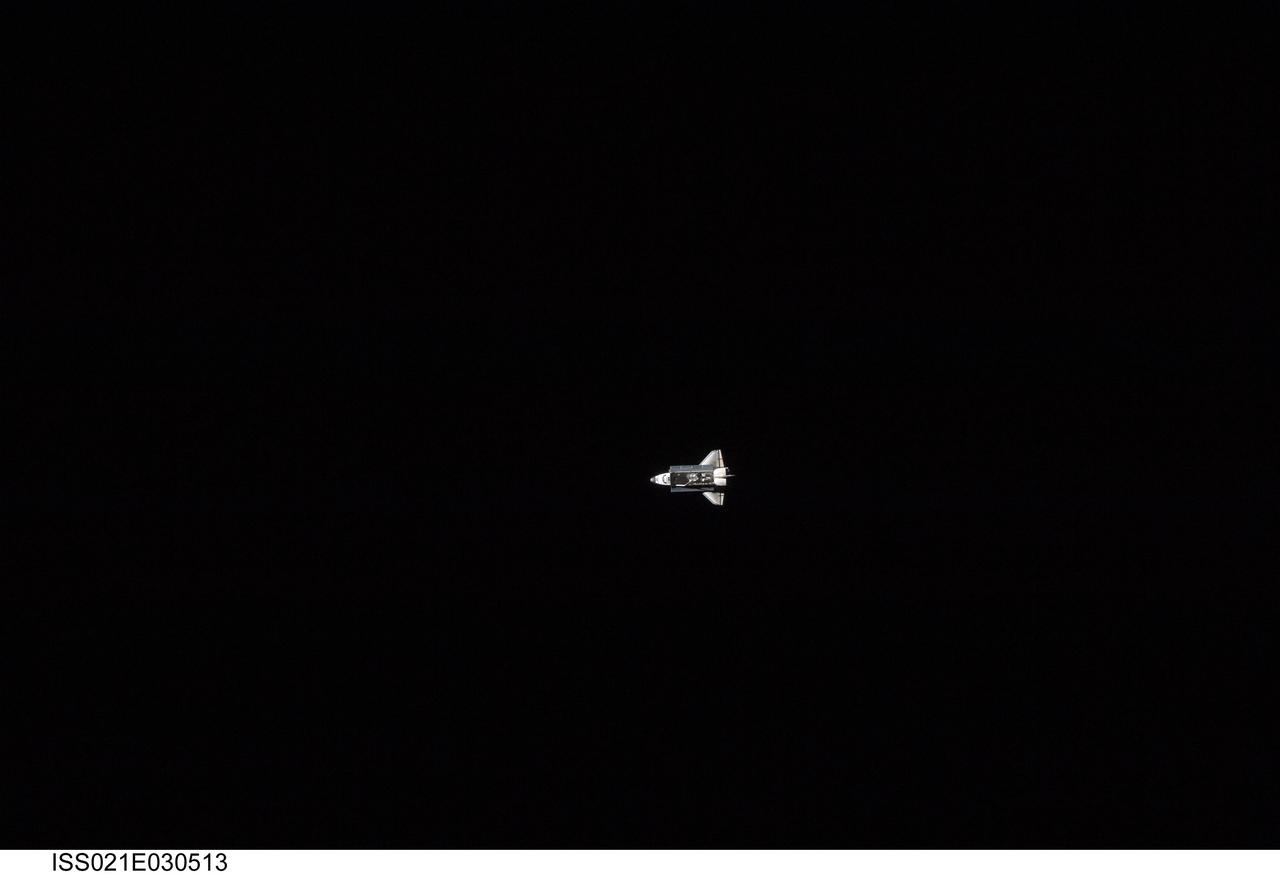
ISS021-E-030513 (18 Nov. 2009) --- Surrounded by the blackness of space, the Space Shuttle Atlantis appears very small from the point of view of the International Space Station as the shuttle approaches the station during STS-129 rendezvous and docking operations. Docking occurred at 10:51 a.m. (CST) on Nov. 18, 2009.
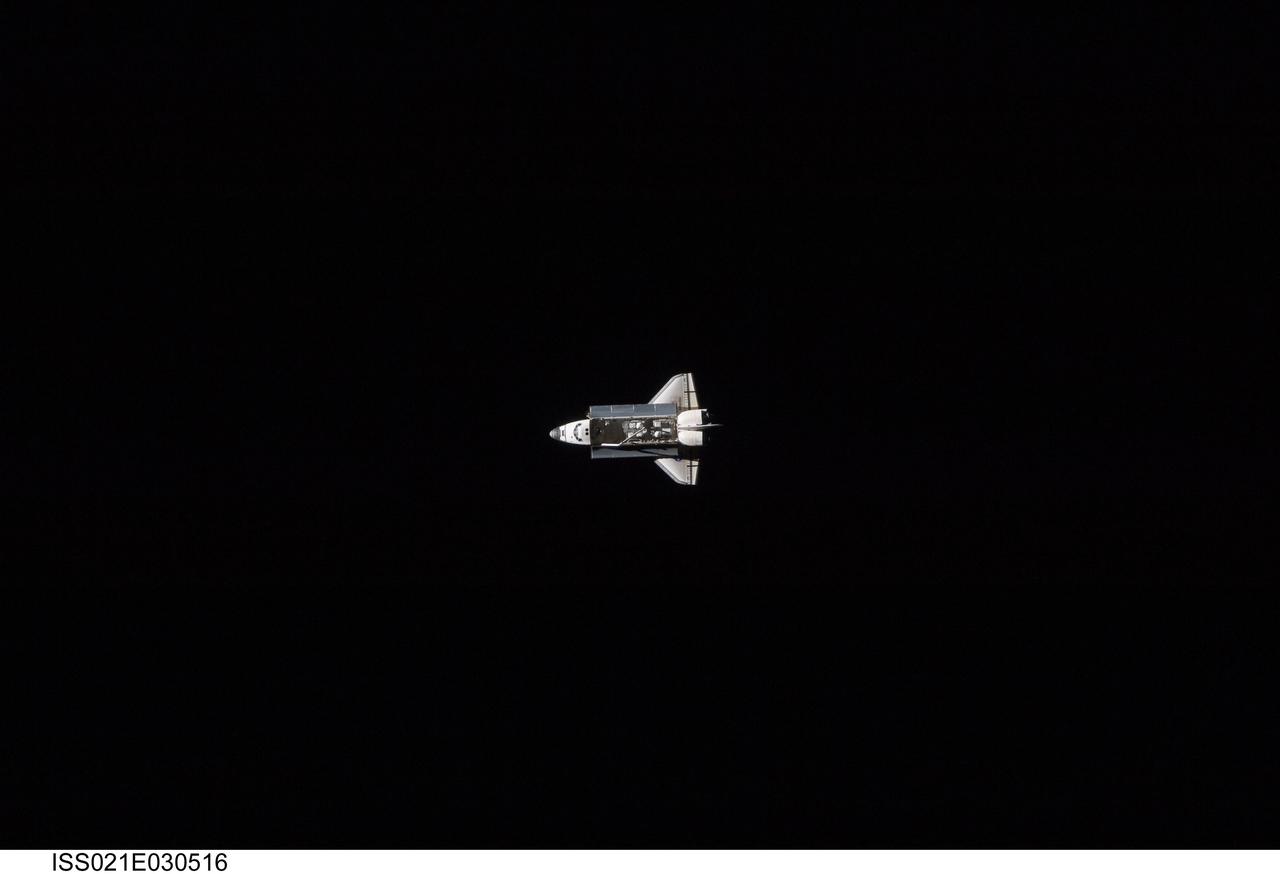
ISS021-E-030516 (18 Nov. 2009) --- Surrounded by the blackness of space, the Space Shuttle Atlantis appears very small from the point of view of the International Space Station as the shuttle approaches the station during STS-129 rendezvous and docking operations. Docking occurred at 10:51 a.m. (CST) on Nov. 18, 2009.
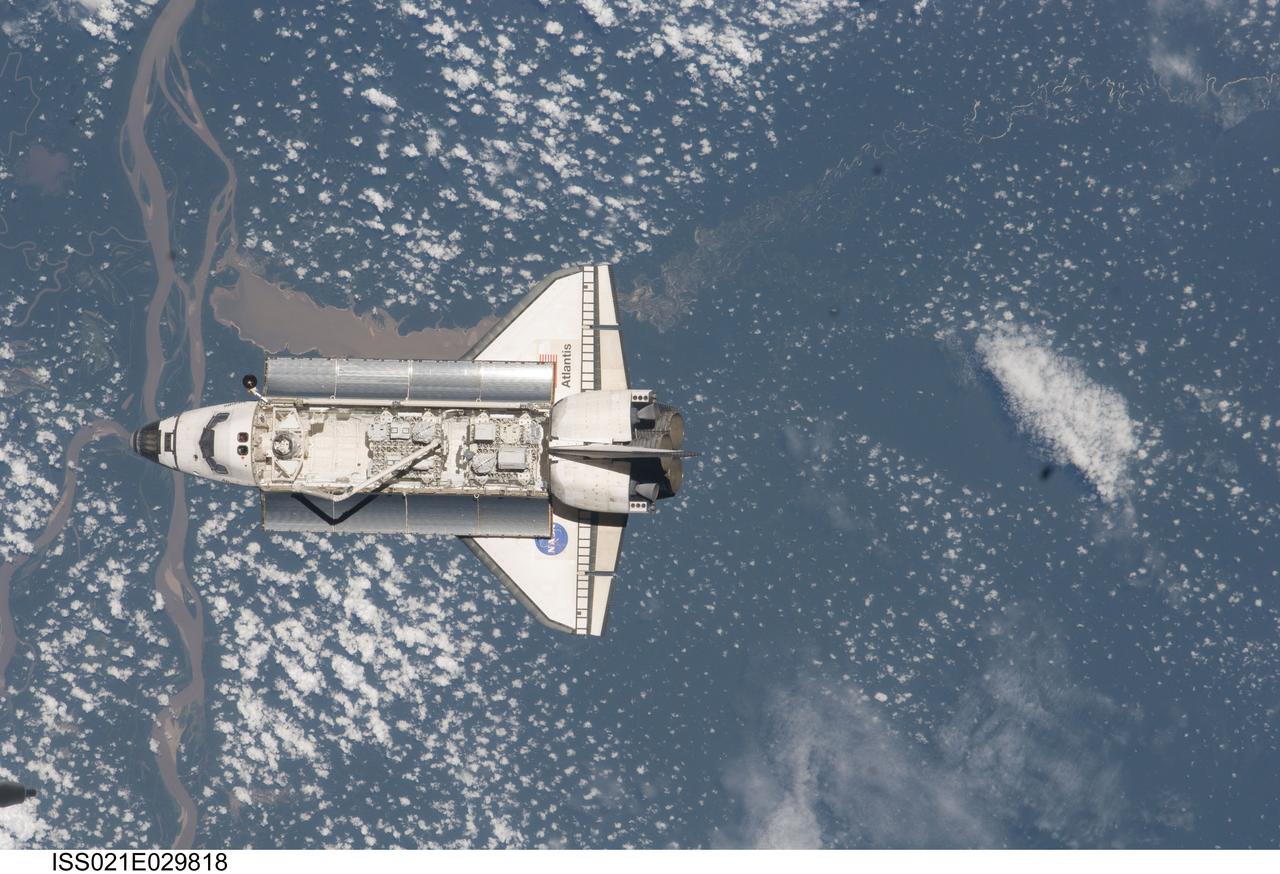
ISS021-E-029818 (18 Nov. 2009) --- Backdropped by a colorful part of Earth, Space Shuttle Atlantis is featured in this image photographed by an Expedition 21 crew member as the shuttle approaches the International Space Station during STS-129 rendezvous and docking operations. Docking occurred at 10:51 a.m. (CST) on Nov. 18, 2009.
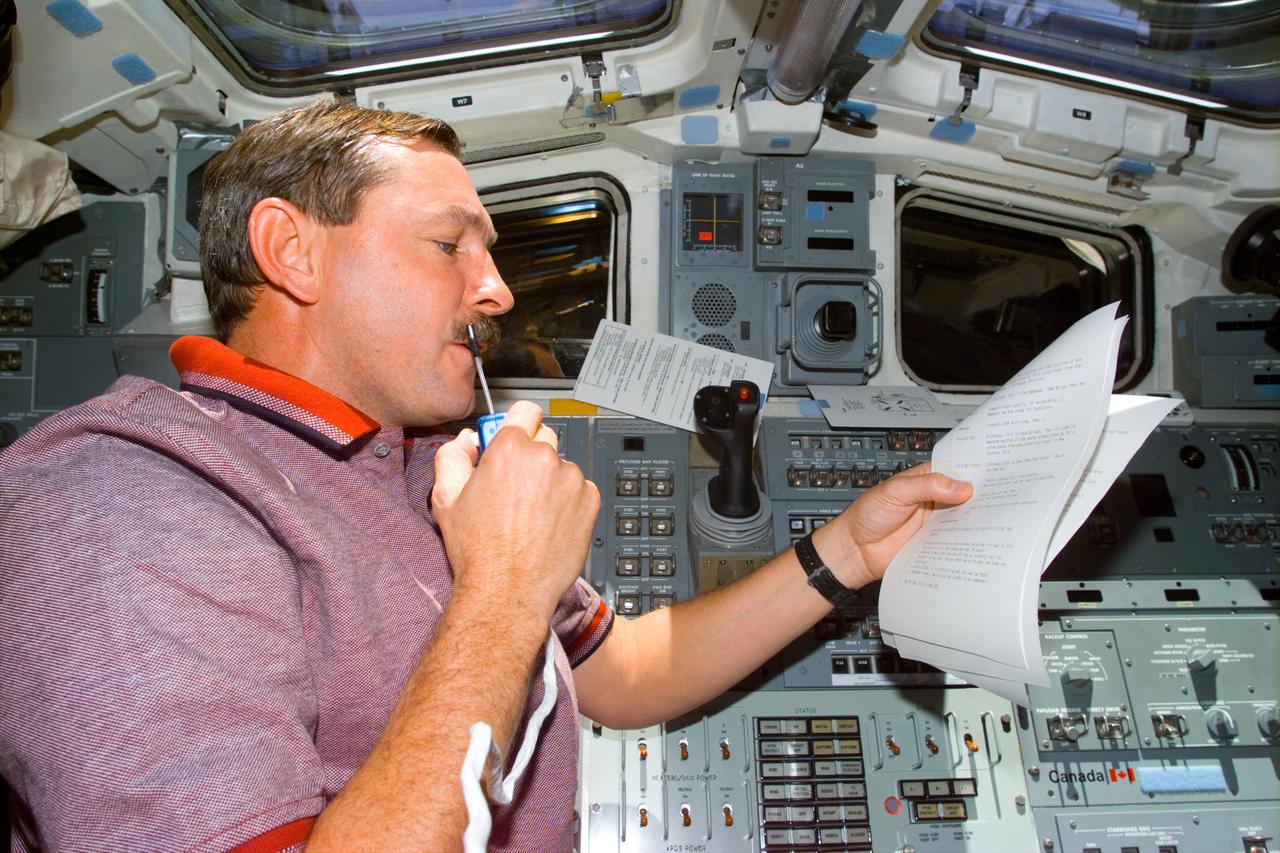
STS095-E-5177 (31 Oct. 1998) --- On Discovery's aft flight deck, astronaut Curtis L. Brown Jr., STS-95 commander, checks over notes with ground controllers in Houston. The photo was taken with an electronic still camera (ESC) at 00:41:51 GMT, Oct. 31.
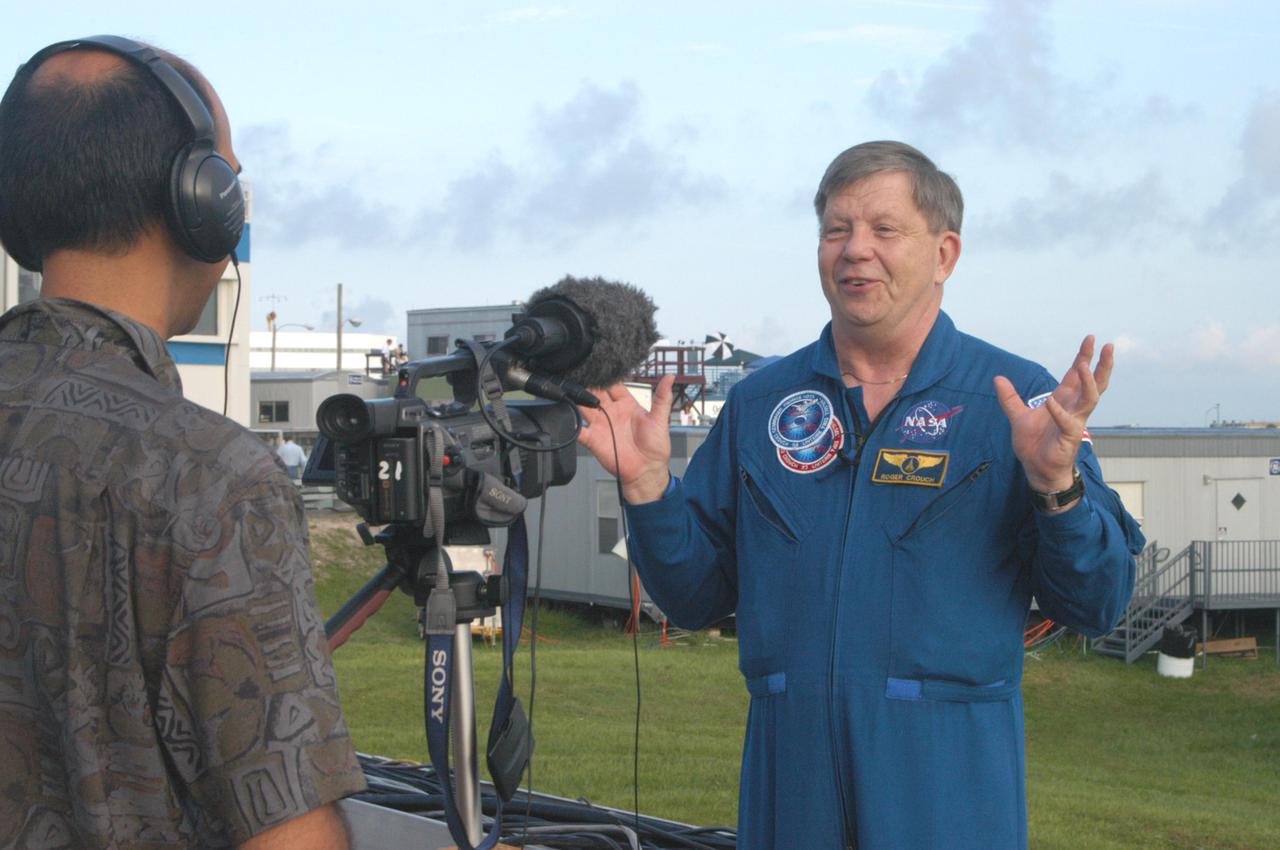
KENNEDY SPACE CENTER, FLA. - Roger Crouch, a payload specialist, talks to the media prior to the launch at 3:51 p.m. of Space Shuttle Discovery on the historic Return to Flight mission STS-114. He has flown on two Shuttle missions, STS-83 and STS-94. STS-114 is the 114th Space Shuttle flight and the 31st for Discovery. The 12-day mission is expected to end with touchdown at the Shuttle Landing Facility at 11:06 a.m. July 25.
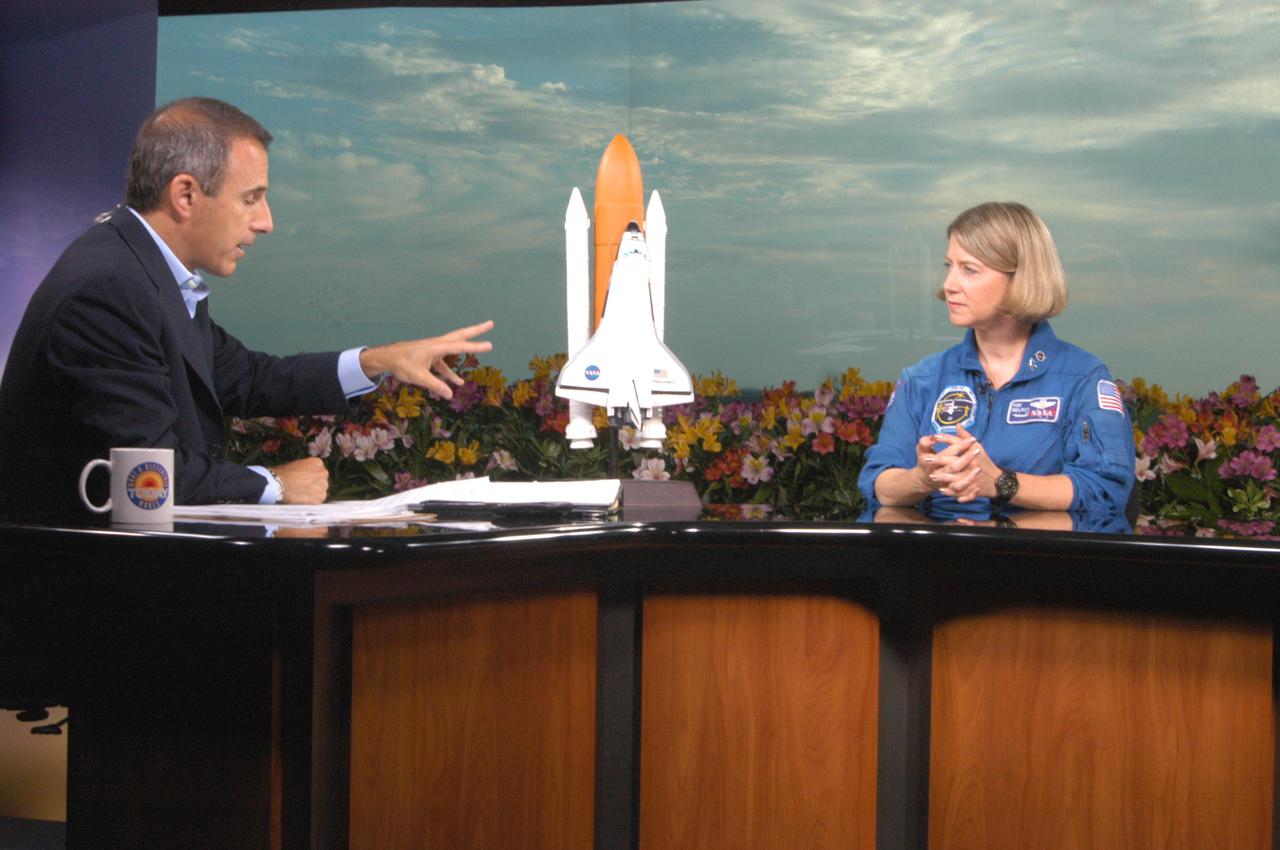
KENNEDY SPACE CENTER, FLA. - Matt Lauer, co-anchor of NBC News’ Today, talks with astronaut Pam Melroy about the pending launch at 3:51 p.m. of Space Shuttle Discovery on the historic Return to Flight mission STS-114. Melroy has flown on two missions, STS-92 and STS-112. STS-114 is the 114th Space Shuttle flight and the 31st for Discovery. The 12-day mission is expected to end with touchdown at the Shuttle Landing Facility at 11:06 a.m. July 25.
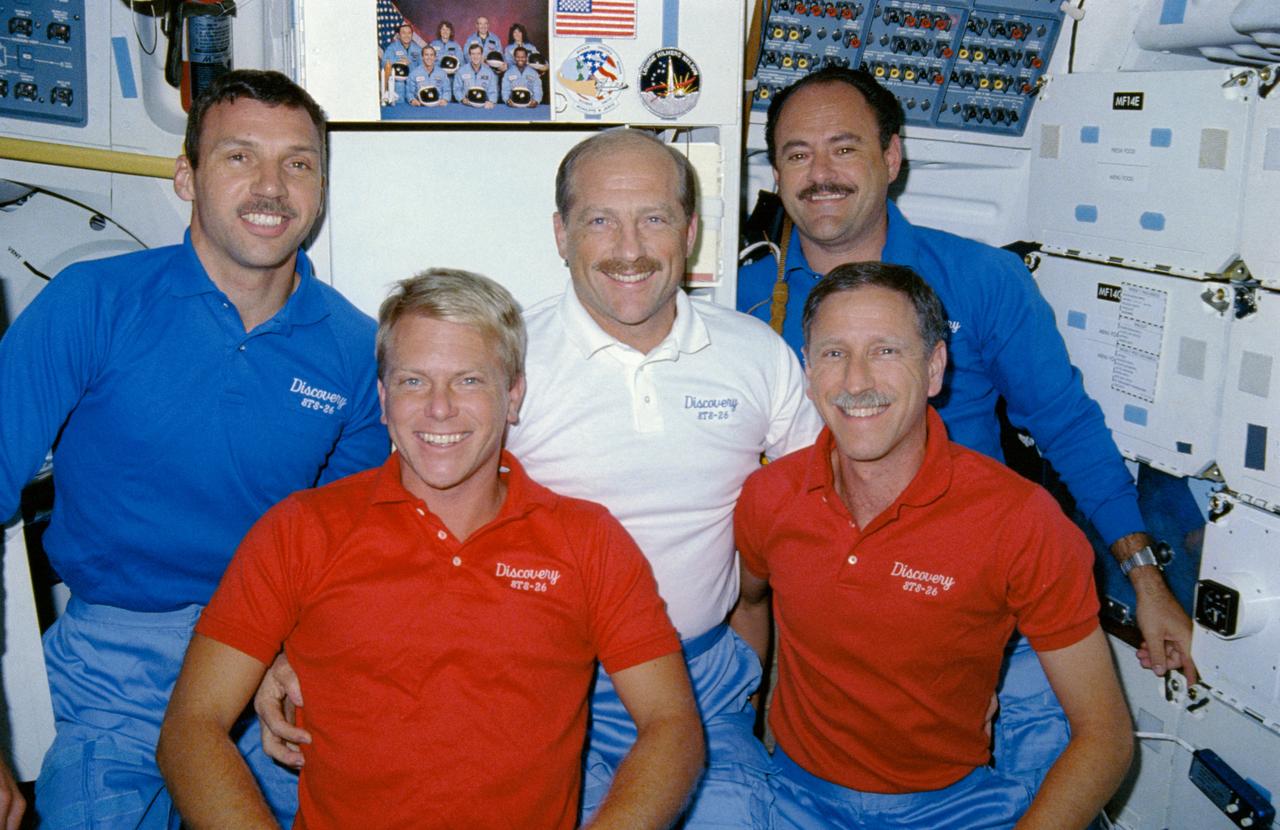
STS026-08-007 (29 Sept-3 Oct 1988) --- An in-space crew portrait on the middeck of Discovery. Left to right are Astronauts David C. Hilmers, George D. Nelson, Frederick H. (Rick) Hauck, John M. (Mike) Lounge and Richard O. Covey (front). The crew portrait for STS 51-L, its flight insignia and the STS 26 flight insignia are at top edge of the frame. This photo was shown by the STS 26 astronaut crew during its Oct. 11, l988 post-flight press conference.
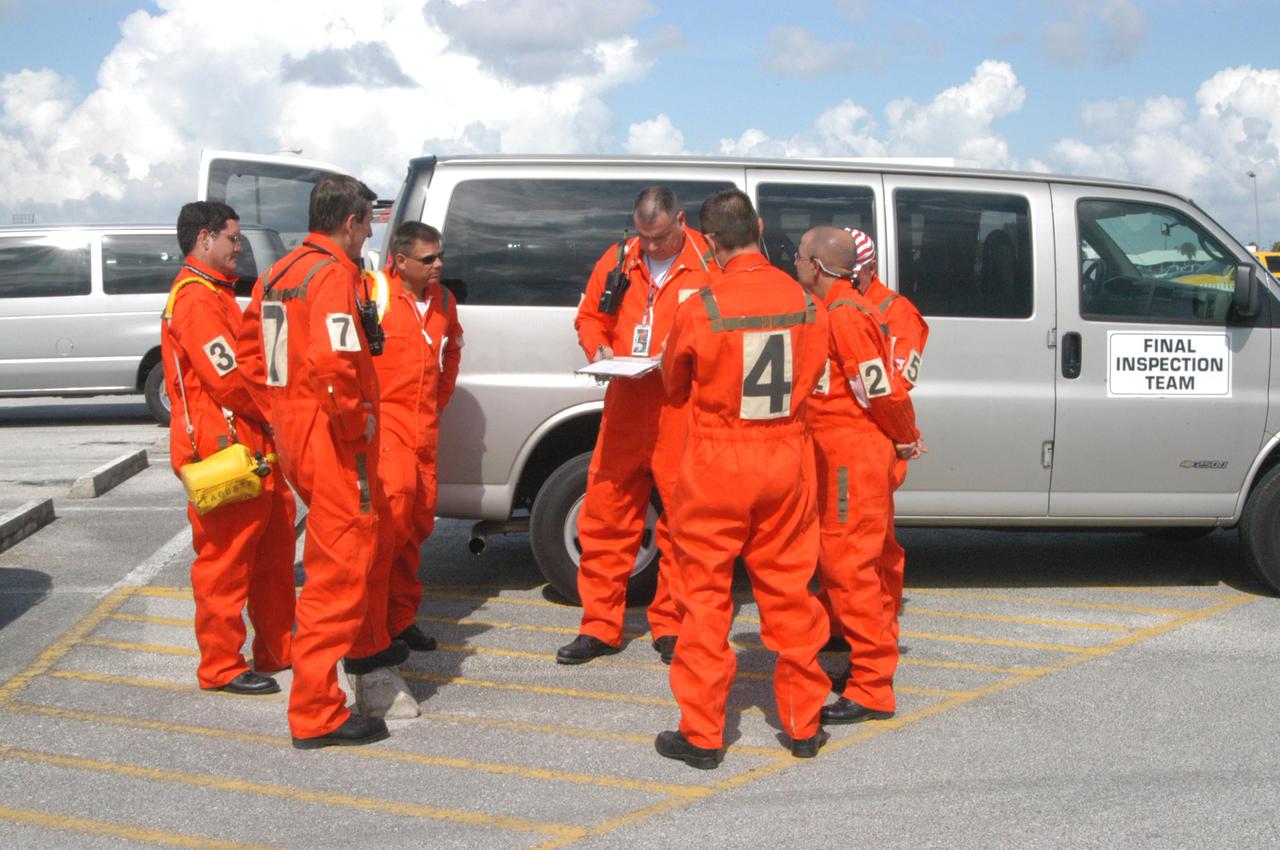
KENNEDY SPACE CENTER, FLA. - Members of the ice team review final details before heading to Launch Pad 39B and their part in the launch of Space Shuttle Discovery on Return to Flight mission STS-114. After the fuel tanking, they will be scanning and inspecting the fuel tank and other hardware on the Space Shuttle for any evidence of ice or debris. Discovery is scheduled to launch on the historic Return to Flight mission STS-114 at 3:51 p.m. July 13 with a crew of seven.
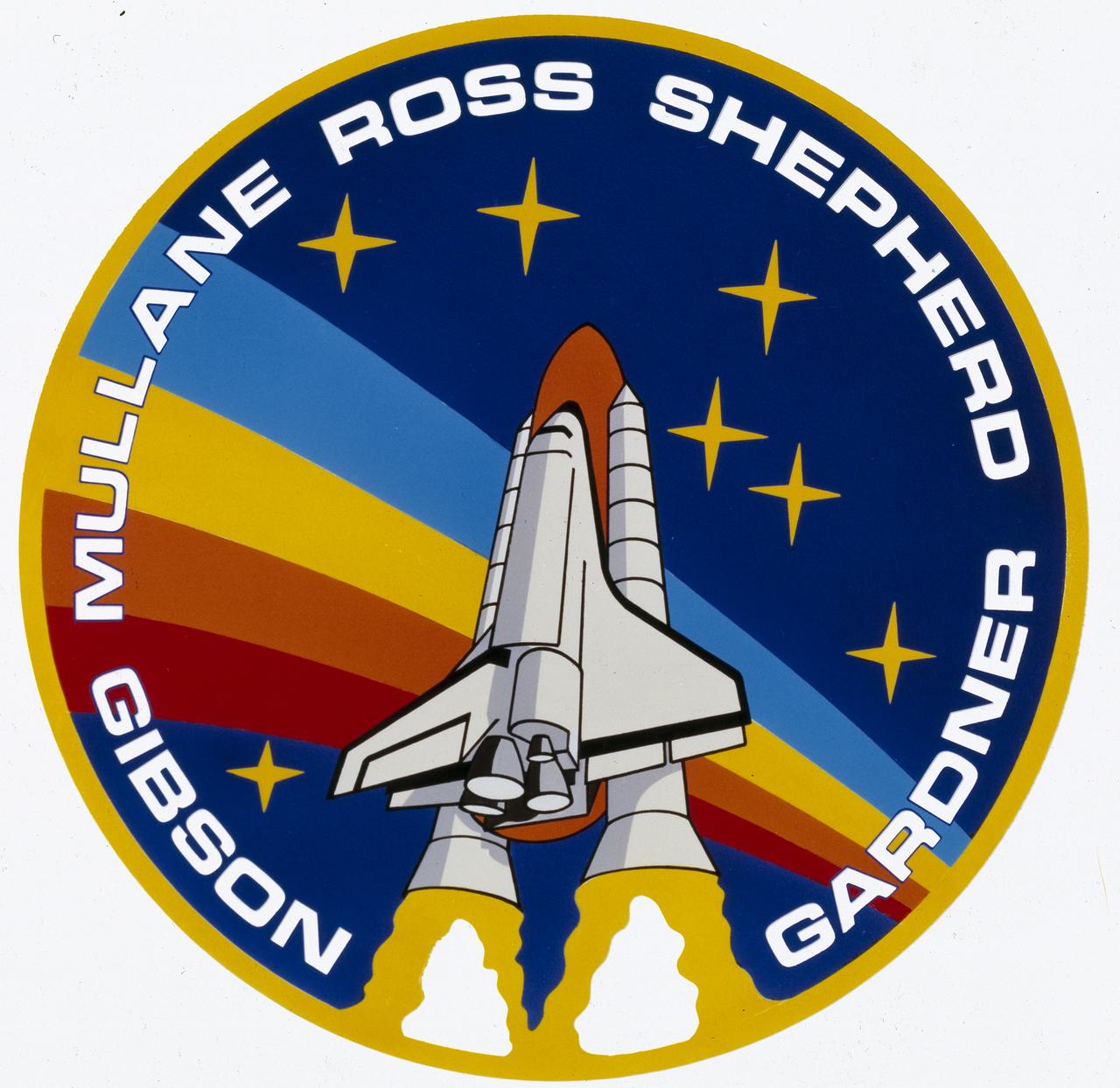
The patch depicts the Space Shuttle lifting off against the multi-colored backdrop of a rainbow, symbolizing the triumphal return to flight of our nation's manned space program. The design also commemorates the memory of the crew of Challenger mission STS-51-L, represented by the seven stars. The names of the flight crewmembers of STS-27 are located along the border of the patch.
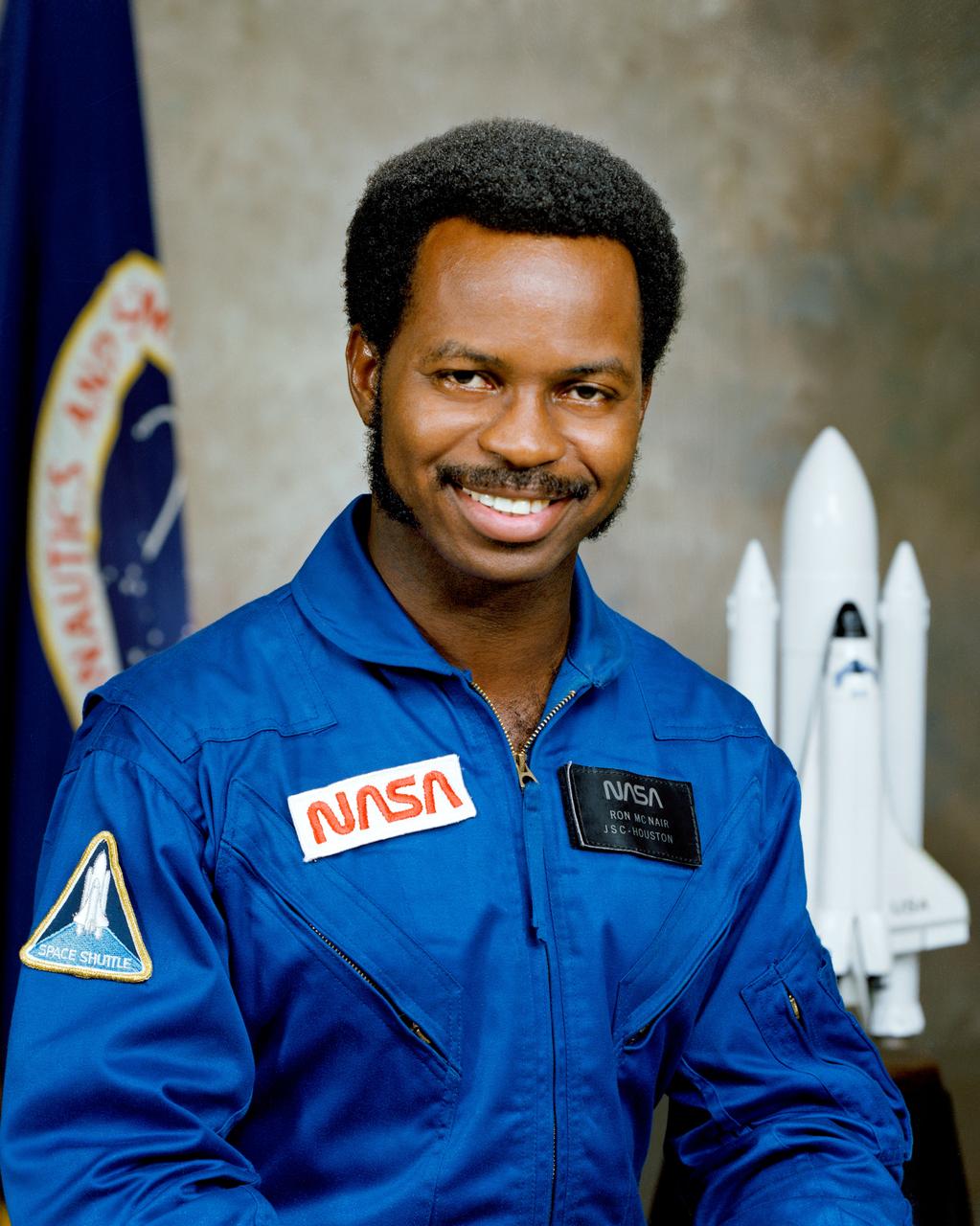
S78-35300 (31 Jan 1978) -- NASA Astronaut Dr. Ronald E. McNair (PH.D.) was assigned as a mission specialist and was a crewmember on two Space Shuttle Missions. He first flew on STS 41-B in 1984 where he performed numerous science experiments. On his second flight, STS 51-L, Dr. McNair died on January 28, 1986 when the Space Shuttle Challenger exploded after launch from the Kennedy Space Center, Florida. NASA Photograph

Karol Bobko, who commanded STS-51, the first flight of space shuttle Atlantis, background, speaks at the signing ceremony, Friday, Nov. 2, 2012, in Cape Canaveral, Fla. The spacecraft traveled 125,935,769 miles during 33 spaceflights, including 12 missions to the International Space Station. Its final flight, STS-135, closed out the Space Shuttle Program era with a landing on July 21, 2011. Photo Credit: (NASA/Bill Ingalls)
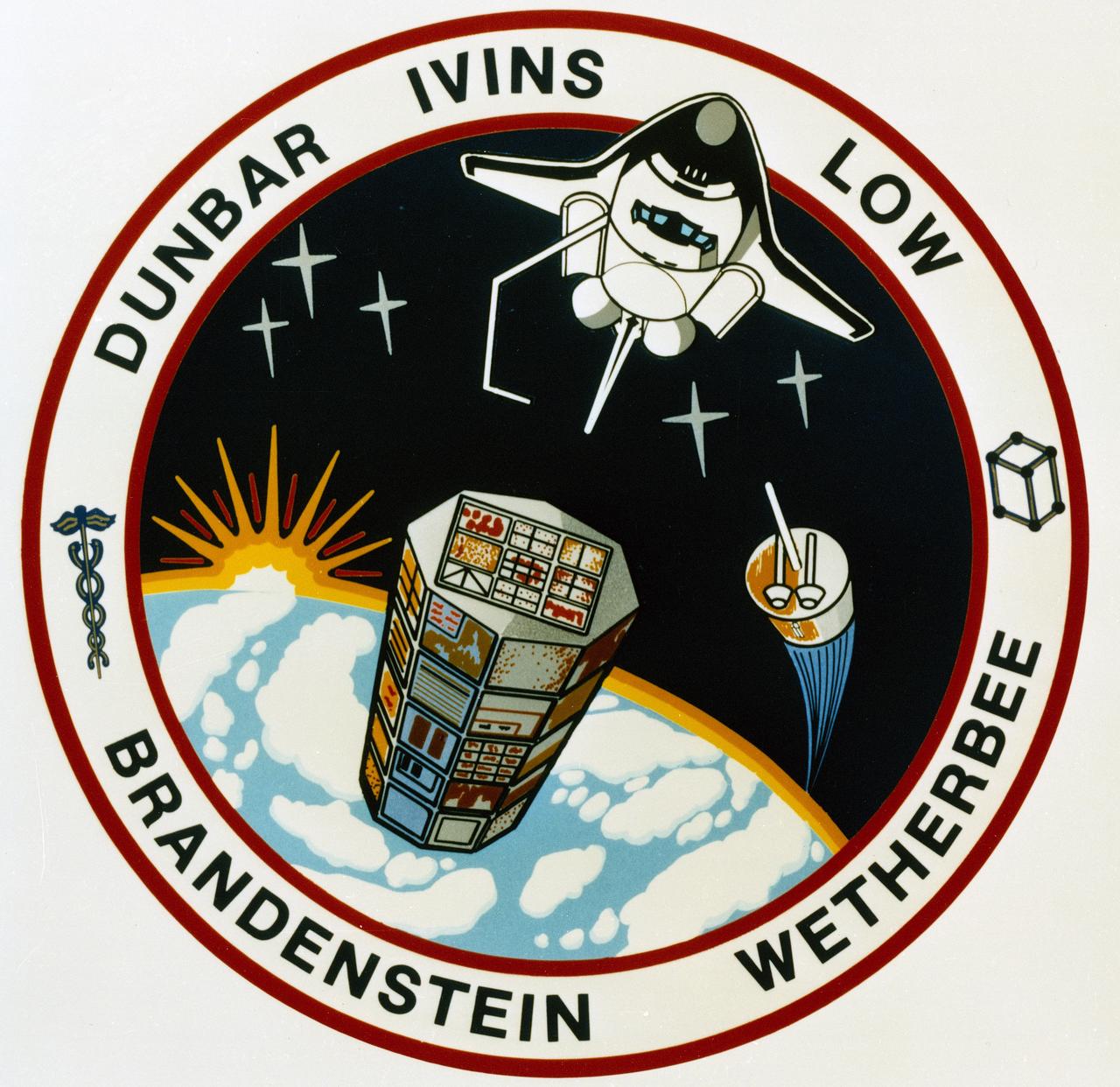
The STS-32 patch, designed by the five crewmembers for the scheduled December 1989 space mission, depicts the Space Shuttle orbiter rendezvousing with the Long Duration Exposure Facility (LDEF) satellite from above. The Syncom satellite is successfully deployed and on its way to geosynchronous orbit. Five stars have been arranged so that three are one side of the orbiter and two on the other to form the number 32. The seven major rays of the sun are in remembrance of the crewmembers for STS 51-L.
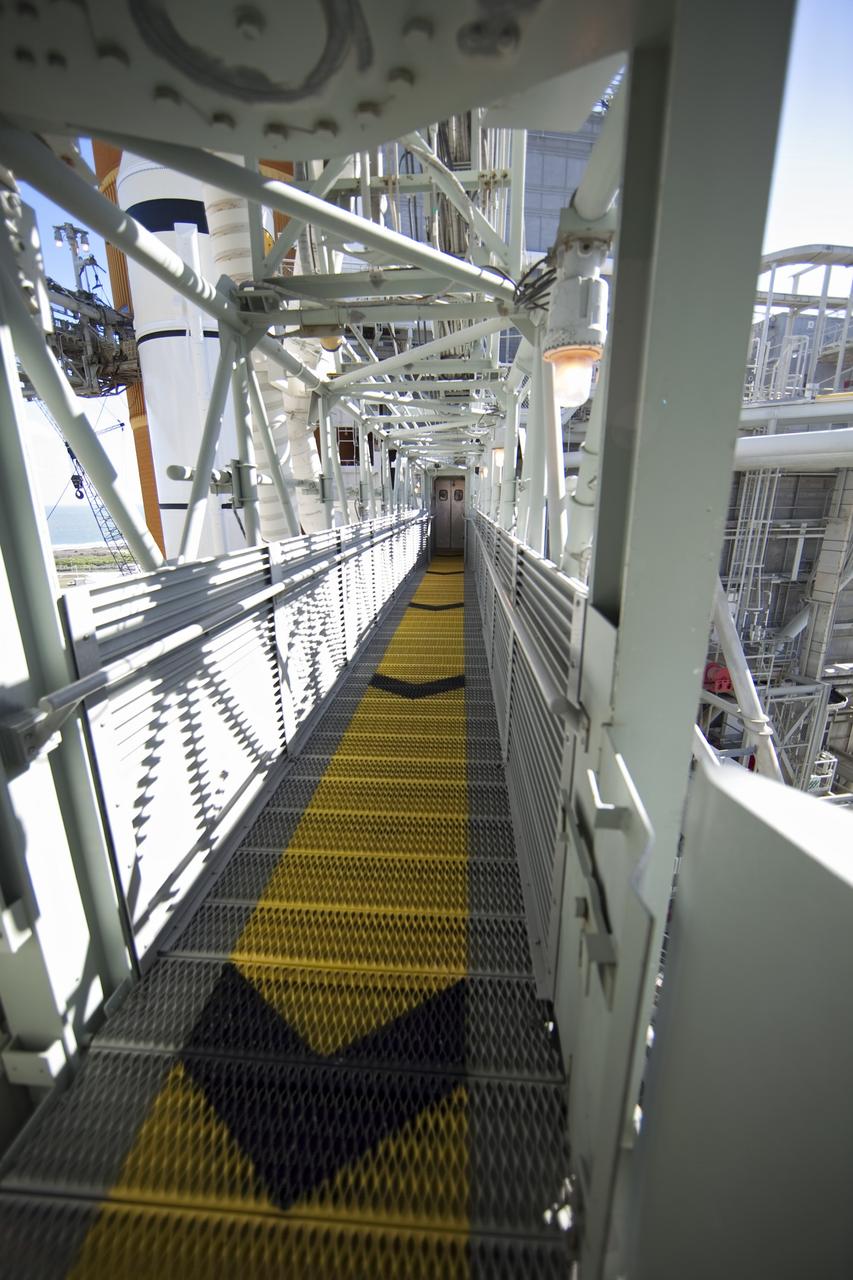
CAPE CANAVERAL, Fla. -- The orbiter access arm extends toward the White Room on Launch Pad 39A at NASA's Kennedy Space Center in Florida. From the White Room, the STS-133 crew members will board space shuttle Discovery for their launch to the International Space Station. Launch is no earlier than Dec. 17 at 8:51 p.m. EST. For more information on STS-133, visit www.nasa.gov/mission_pages/shuttle/shuttlemissions/sts133/. Photo credit: NASA/Frank Michaux
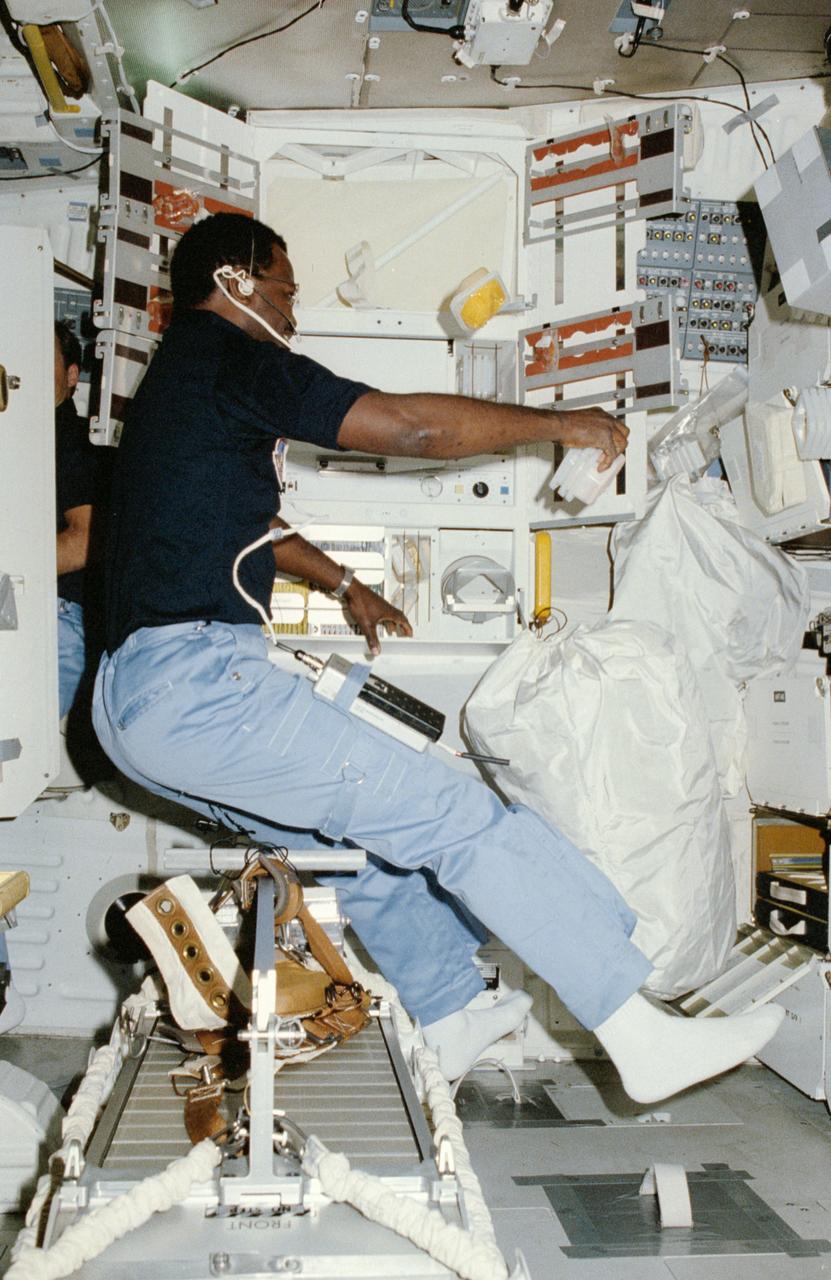
S84-27204 (3-11 Feb 1984) --- Astronaut Ronald E. McNair, STS 41-B mission specialist, prepares to assemble meal items aboard the Earth-orbiting Space Shuttle Challenger. The galley is located in the mid deck. The number of items in the area signals how busy it is. Later Dr. McNair died on January 28, 1986 on his next space flight STS 51-L when the Space Shuttle Challenger exploded after launch from the Kennedy Space Center, Florida.