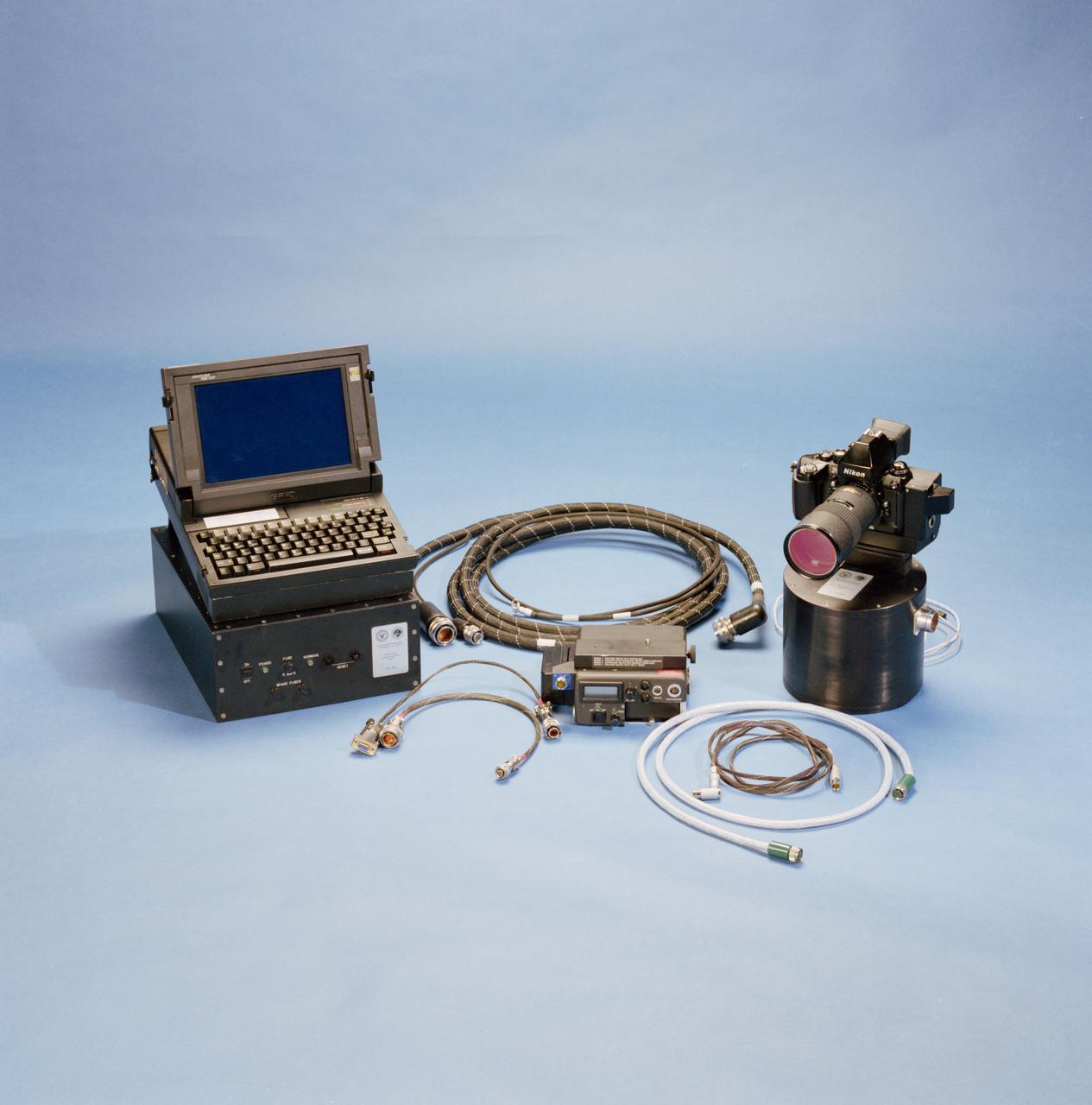
STS-53 Discovery, Orbiter Vehicle (OV) 103, Department of Defense (DOD) mission Hand-held Earth-oriented Real-time Cooperative, User-friendly, Location, targeting, and Environmental System (Hercules) spaceborne experiment equipment is documented in this table top view. HERCULES is a joint NAVY-NASA-ARMY payload designed to provide real-time high resolution digital electronic imagery and geolocation (latitude and longitude determination) of earth surface targets of interest. HERCULES system consists of (from left to right): a specially modified GRID Systems portable computer mounted atop NASA developed Playback-Downlink Unit (PDU) and the Naval Research Laboratory (NRL) developed HERCULES Attitude Processor (HAP); the NASA-developed Electronic Still Camera (ESC) Electronics Box (ESCEB) including removable imagery data storage disks and various connecting cables; the ESC (a NASA modified Nikon F-4 camera) mounted atop the NRL HERCULES Inertial Measurement Unit (HIMU) containing the three-axis ring-laser gyro.

S96-E-5146 (03 June 1999) --- The International Space Station (ISS) is seen from the Space Shuttle Discovery shortly after the two spacecraft began their relative separation. The seven STS-96 crew members had spent the previous few days working on the station. The photo was taken with an electronic still camera (ESC) at 22:53:18 GMT, June 3, 1999.
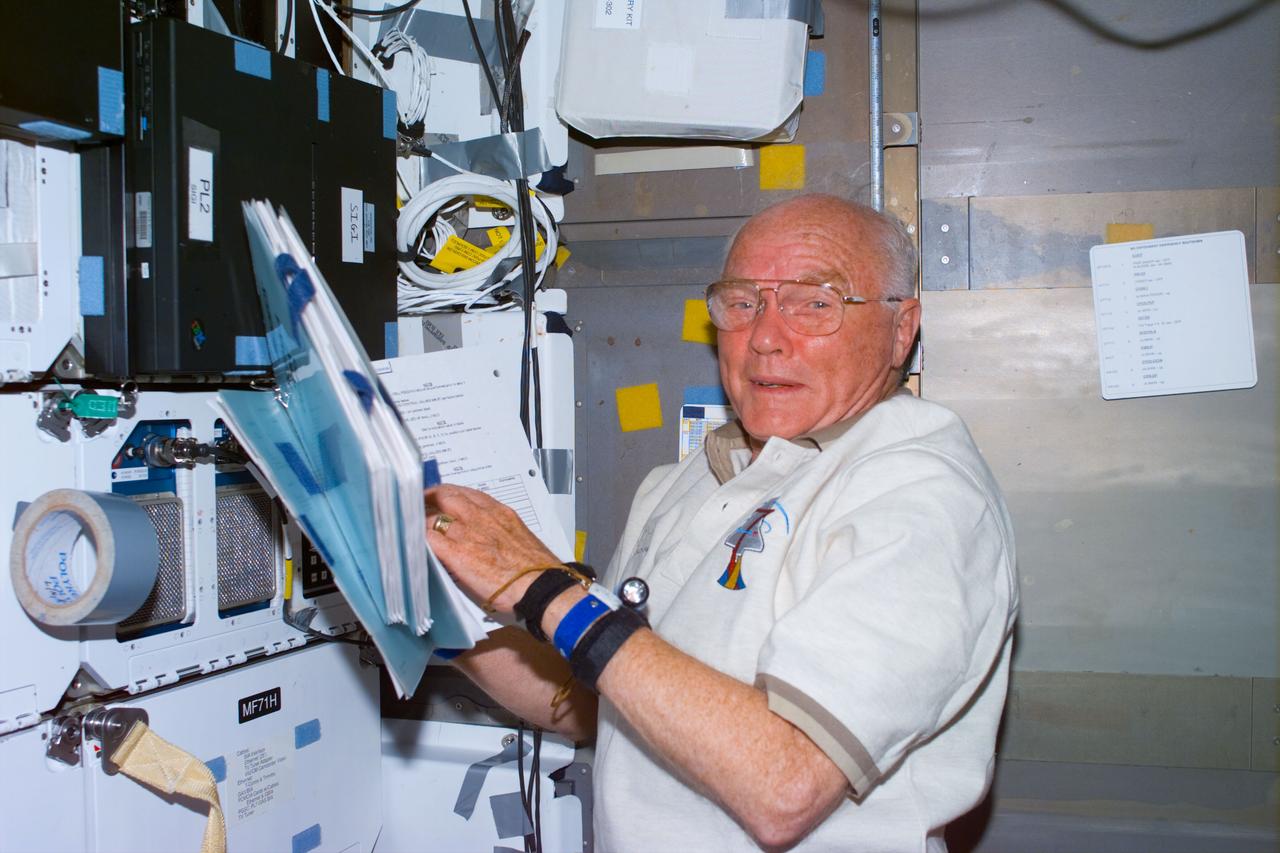
STS095-E-5258 (4 Nov. 1998) --- U.S. Sen. John H. Glenn Jr. (D.-Ohio), STS-95 payload specialist, checks over a notebook during Flight Day 7 activity aboard the Space Shuttle Discovery. The photo was taken with an electronic still camera (ESC) at 22:53:28 GMT, Nov. 4.