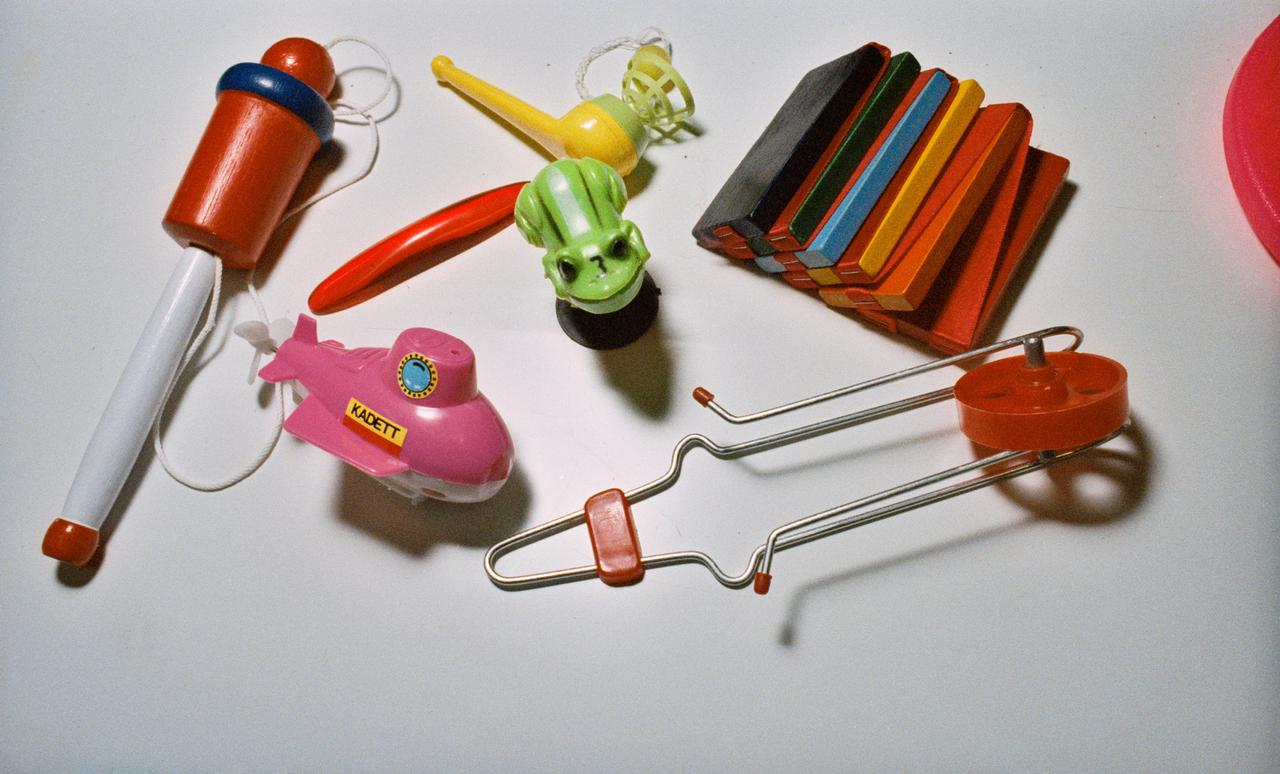
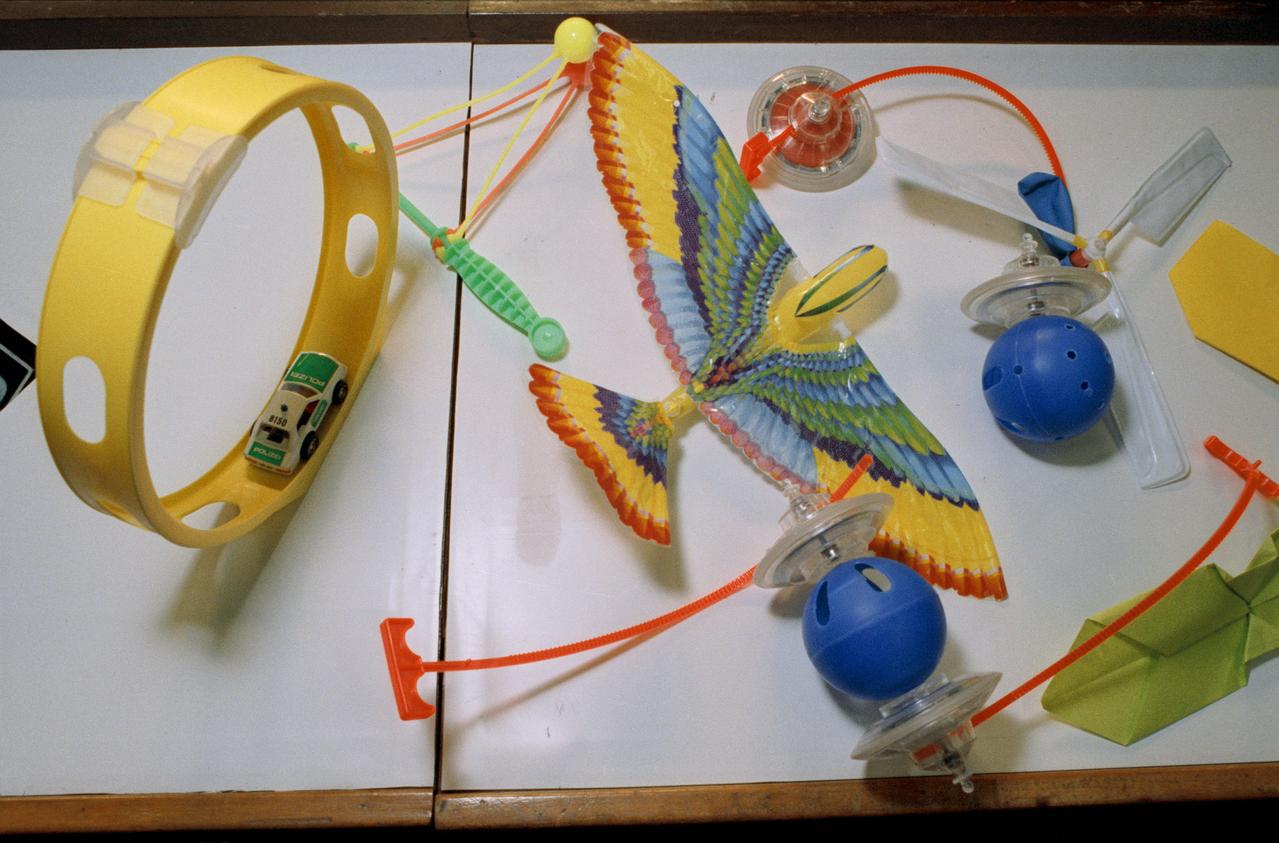
S93-25647 (6 Jan 1993) --- Part of the educational activities onboard the Space Shuttle Endeavour for STS-54 will include several experiments with various toys, some of which are depicted here.  The detailed supplementary objective (DSO-802) will allow the Shuttle crewmembers to experiment with the various types of toys in a microgravity environment while talking to pupils who will be able to monitor (via classroom TV sets) the activities at a number of schools. Among toys seen here are a friction car and loop track, paper eagle, and a balloon helicopter.
STS-54 toys in space experiment
STS054-97-018 (13-19 Jan 1993) --- The STS-54 crew used a handheld 70mm camera to record this view of the constellation Orion. Five astronauts spent six days aboard the Space Shuttle Endeavour in Earth orbit.
STS-54 astronomical observation of the constellation Orion
S93-25648 (Jan 1993) --- Part of the educational activities onboard the Space Shuttle Endeavour for STS-54 will include several experiments with various toys, some of which are depicted here.  The detailed supplementary objective (DSO-802) will allow the Shuttle crewmembers to experiment with the various types of toys in a microgravity environment while talking to pupils who will be able to monitor (via classroom TV sets) the activities at a number of schools.
STS-54 DSO 802, Educational activities "Physics of Toys", equipment
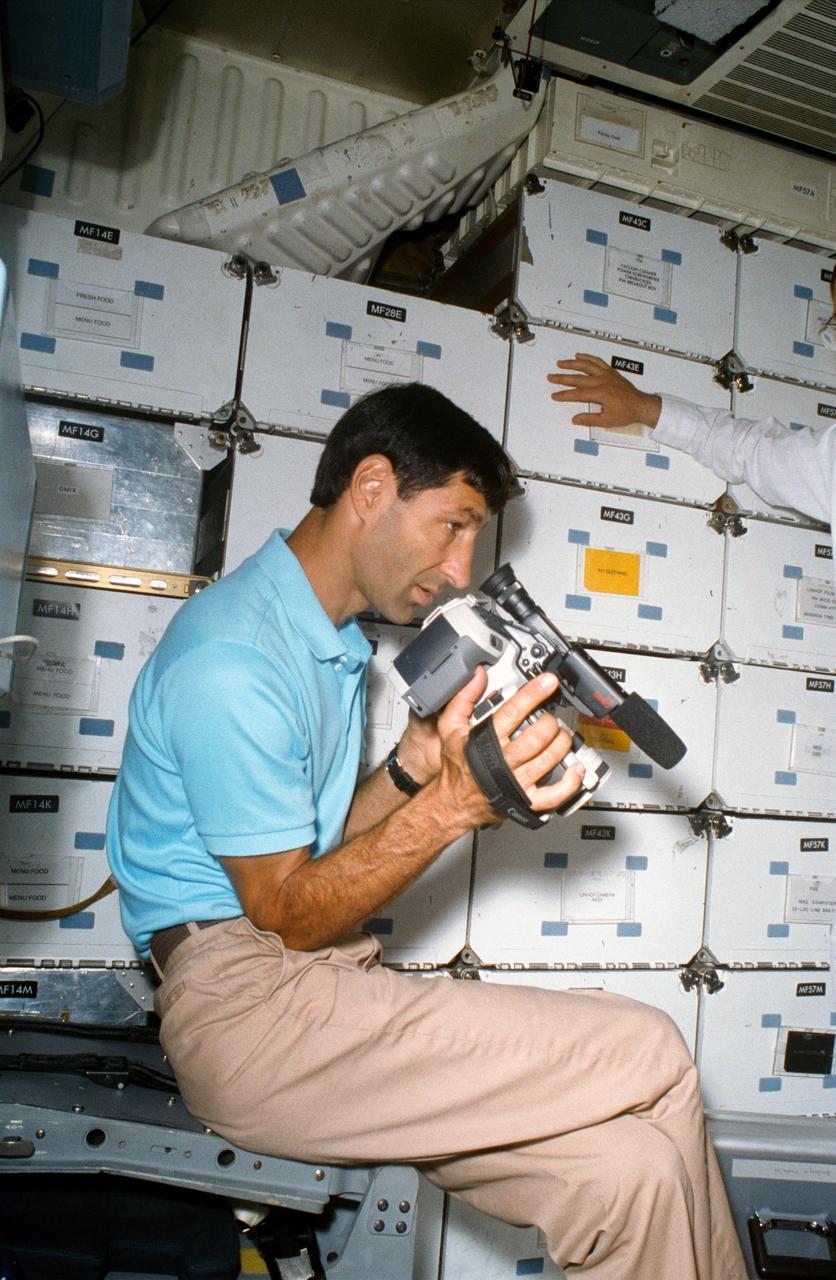
S92-45751 (1 Sept 1992) --- Astronaut Mario Runco Jr., mission specialist assigned to fly aboard the Space Shuttle Endeavour for the STS-54 mission, gets in some rehearsal time with a camcorder.  He is on the middeck of a Shuttle trainer.
STS-54 MS1 Runco participates in camera familiarization in JSC's CCT
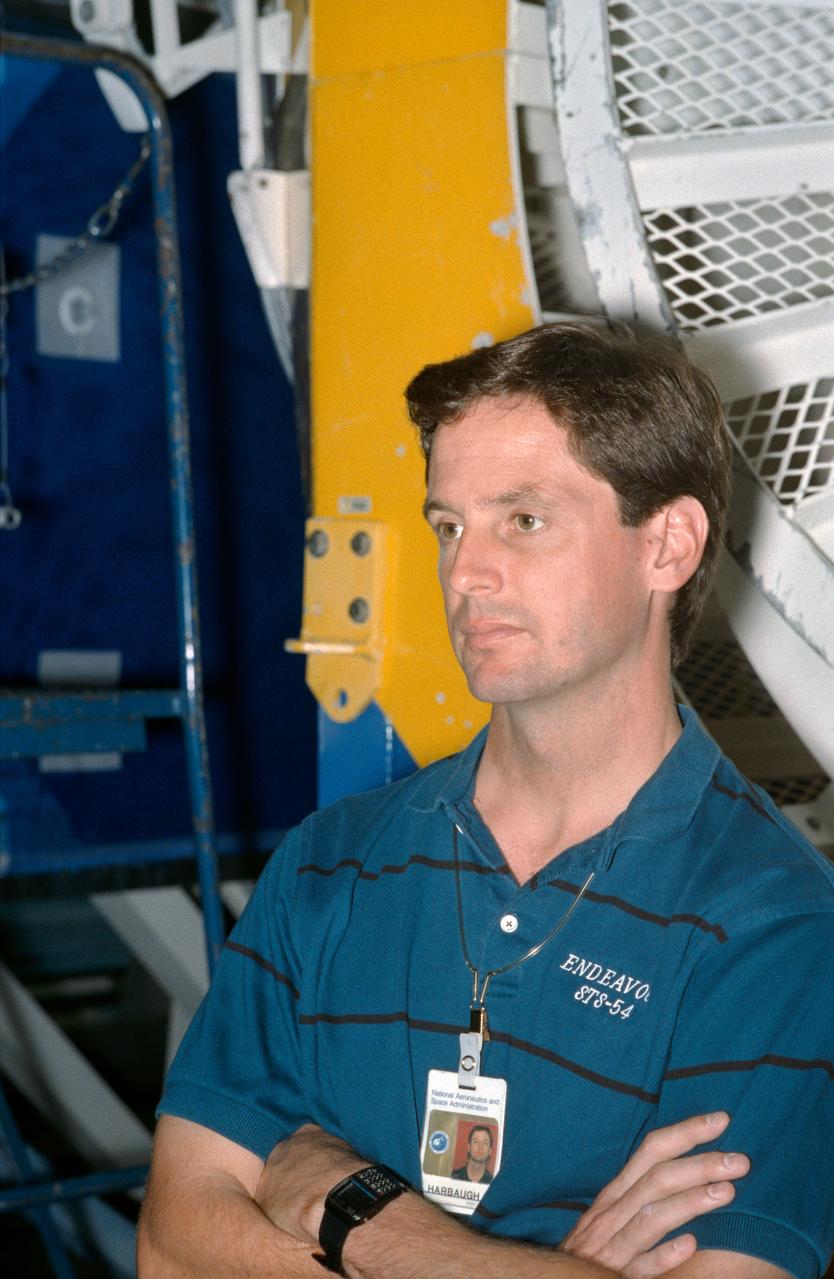
S92-40569 (Aug 1992) --- Gregory J. Harbaugh, one of five astronaut crewmembers assigned to fly aboard the Space Shuttle Endeavour for the STS-54 mission, pauses for a break during training and preparations for the six-day mission.  Harbaugh will be joined by John H. Casper, mission Donald R. McMonagle, pilot; along with Mario Runco Jr. and Susan J. Helms, mission specialists. Harbaugh is in the weightless environment training facility (WET-F) at the Johnson Space Center (JSC).
STS-54 MS2 Harbaugh listens to instructions in JSC's WETF Bldg 29
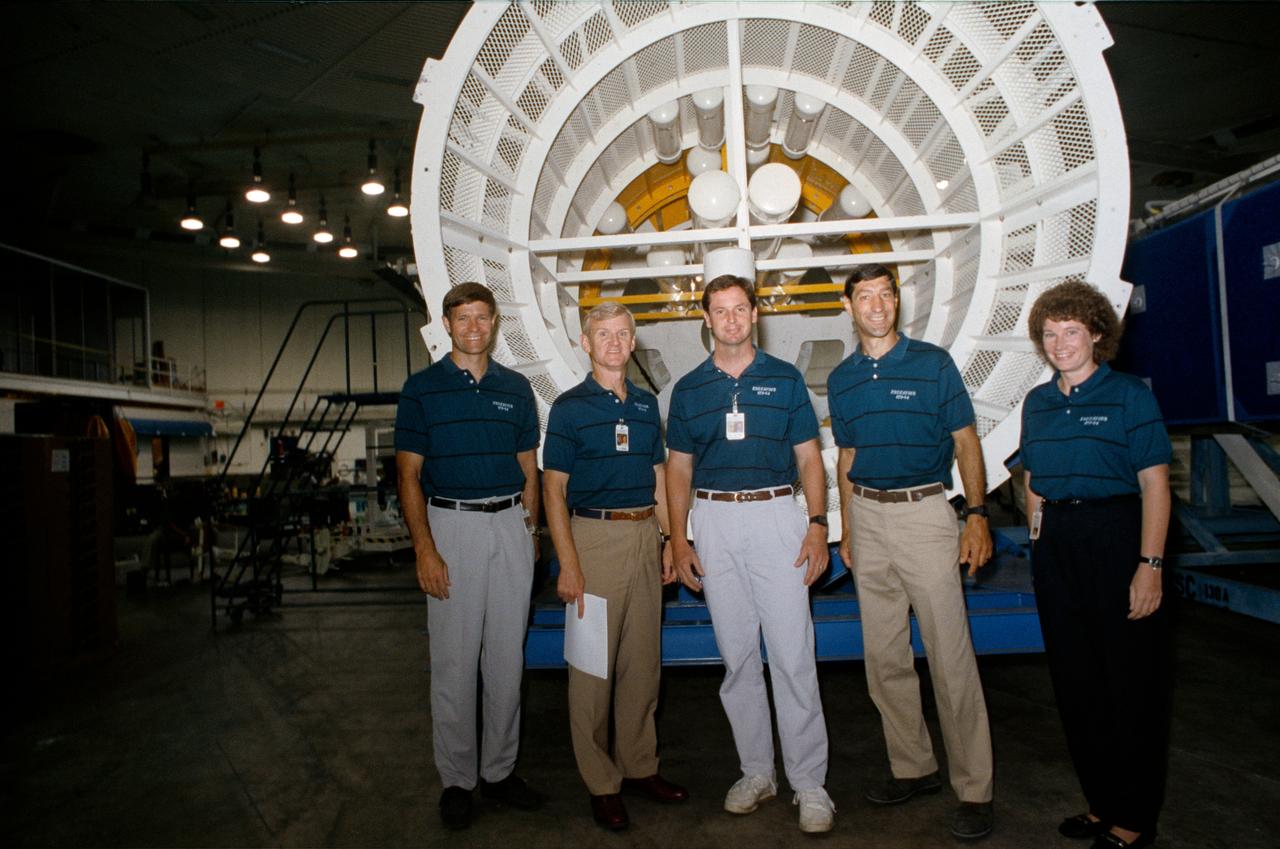
S92-40571 (August 1992) --- The five astronaut crewmembers assigned to fly aboard the Space Shuttle Endeavour for the STS-54 mission, pause for a break during training and preparations for the six-day mission.  Left to right are Donald R. McMonagle, pilot; John H. Casper, mission commander; Gregory J. Harbaugh, Mario Runco Jr. and Susan J. Helms, mission specialists. The five are in the weightless environment training facility (WET-F) at the Johnson Space Center (JSC).
STS-54 Endeavour, OV-105, crewmembers participate in WETF briefing at JSC
S92-45750 (1 Sept 1992) --- Astronaut John H. Casper, mission commander, assigned to fly aboard the Space Shuttle Endeavour for the STS-54 mission, gets in some rehearsal time at JSC's Shuttle mockup and integration facility.  Part of a spacesuit is visible at lower right.  Two STS-54 crewmembers will spend four-plus hours wearing extravehicular mobility units (EMU) for a planned spacewalk in a continuing evaluation program for EVA techniques and gear for Space Station Freedom.
STS-54 Commander Casper at airlock hatch on CCT middeck during JSC training
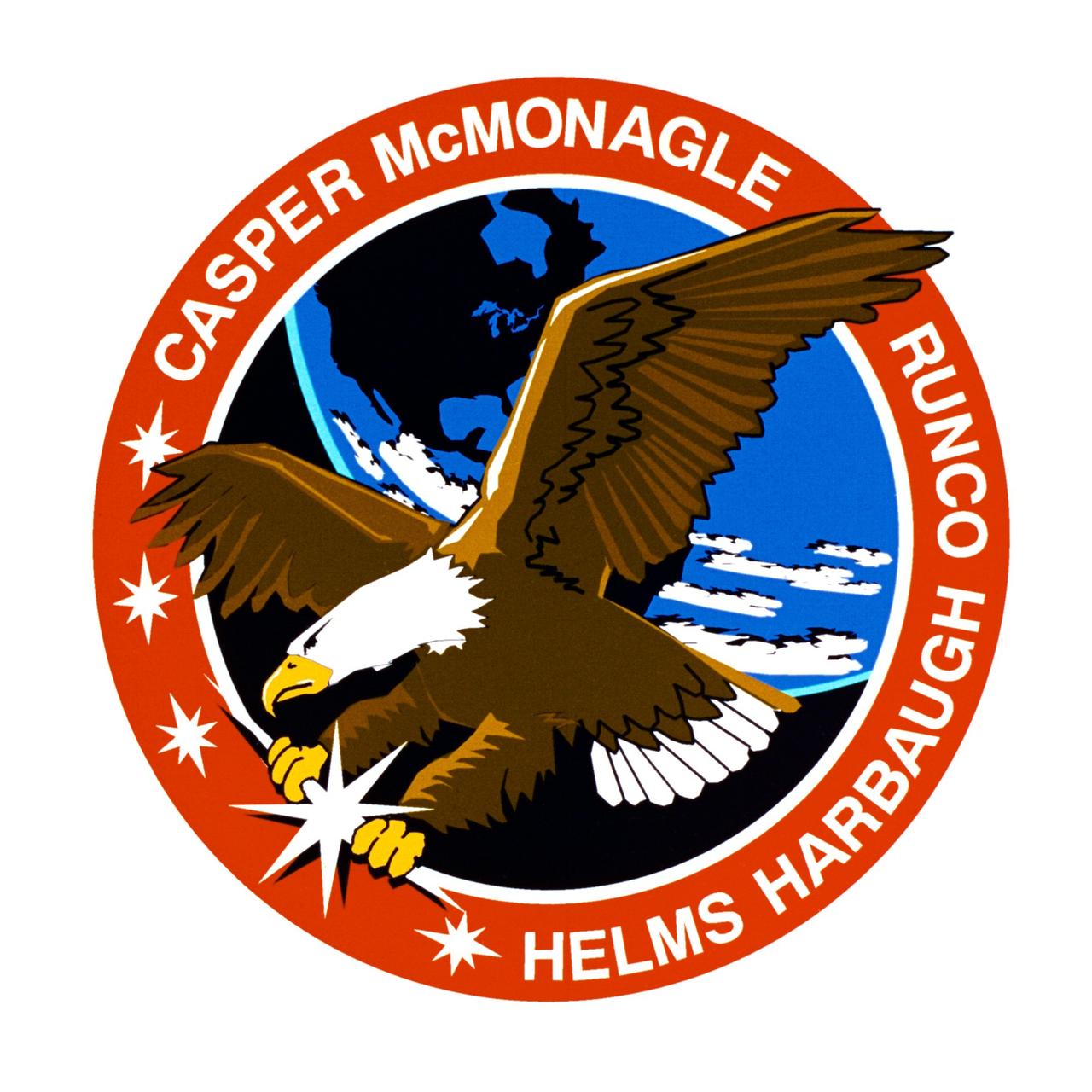
STS054-S-001 (July 1992) --- Designed by the crew members, the STS-54 crew patch depicts our national symbol, the American bald eagle, soaring above the Earth; and represents the United States Space Shuttle as a national asset in service to America and the world.  The eagle is clutching an eight pointed star in its talons and is placing this larger star among a constellation of four others representing the placement of the fifth Tracking and Data Relay Satellite (TDRS) into orbit among the four already in service.  The blackness of space with stars conspicuously absent represents the mission?s other   primary objective in carrying the Diffuse X-ray Spectrometer into orbit to conduct astronomical observations of x-ray sources within the galaxy and throughout the universe.  The depiction of our planet showing the crew?s home continent of North America is an expression of their and NASA?s intention that the medical and scientific experiments conducted onboard are for the benefit of all mankind.  The clouds and blue of the Earth represent the crew?s part in NASA?s Mission to Planet Earth in conducting Earth observation photography. The NASA insignia design for space shuttle flights is reserved for use by the astronauts and for other official use as the NASA Administrator may authorize. Public availability has been approved only in the form of illustrations by the various news media. When and if there is any change in this policy, which we do not anticipate, it will be publicly announced. Photo   credit: NASA
STS-54 Endeavour, Orbiter Vehicle (OV) 105, crew insignia
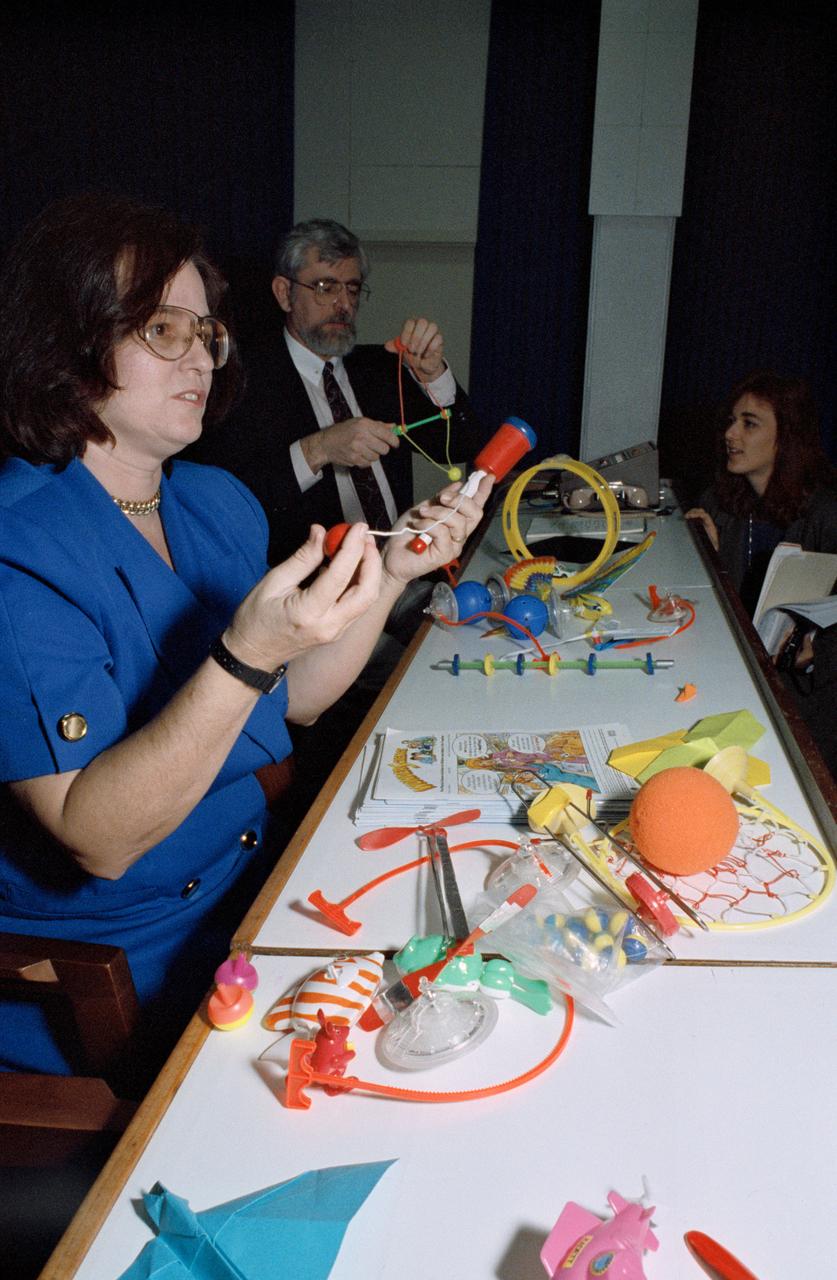
S93-25649 (6 Jan 1993) --- Carolyn Sumners, Ed.D., project director for Toys in Space, demonstrates some of the toys to be carried aboard the Space Shuttle Endeavour for the STS-54 mission later this month.  Gregory Vogt, Ed.D., NASA education specialist, is seen showing another of the toys to news media representatives here for the pre-flight press briefing.  The detailed supplementary objective (DSO-802) will allow the Shuttle crewmembers to experiment with the various types of toys in a microgravity environment while talking to pupils who will be able to monitor (via classroom TV sets) the activities at a number of schools.
Education instructors explain and demonstrate STS-54 DSO 802 toys at JSC
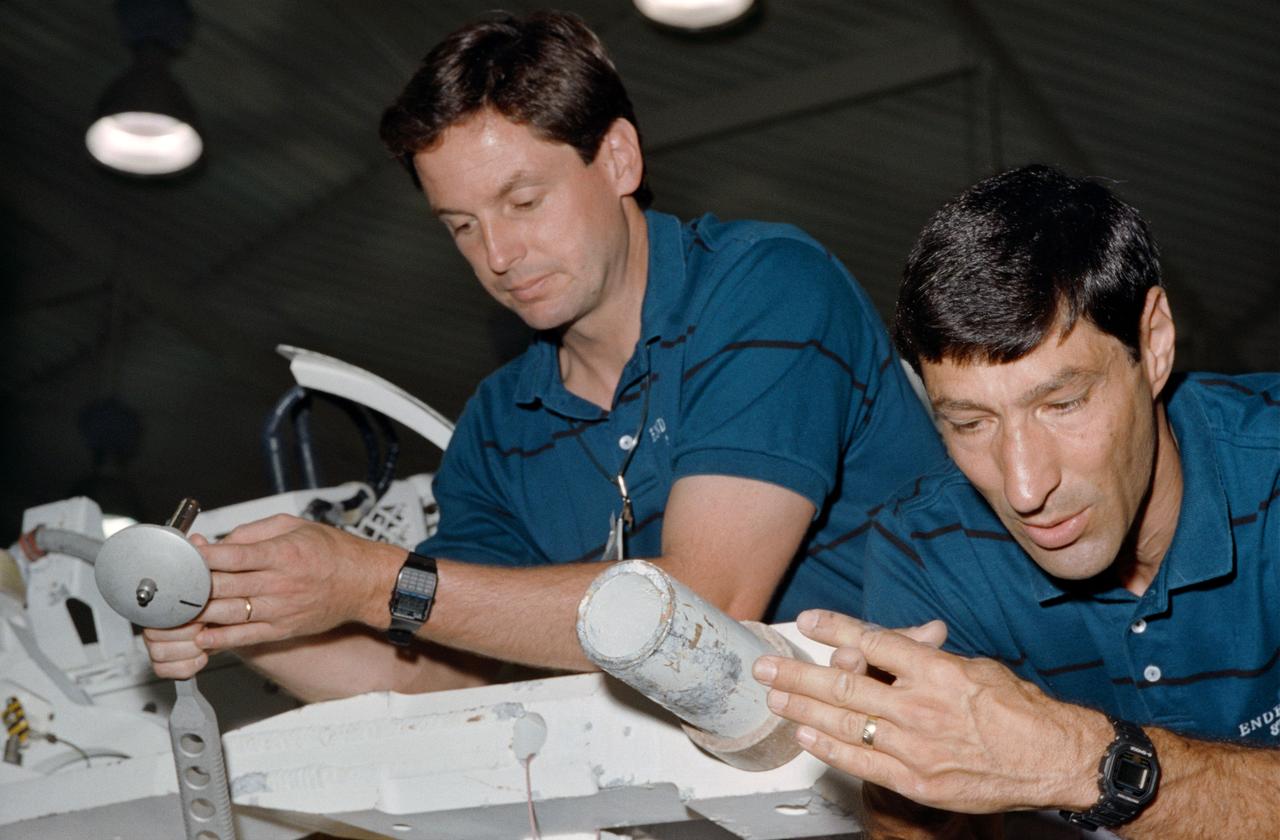
STS-54 Endeavour, Orbiter Vehicle (OV) 105, Mission Specialist 1 (MS1) Mario Runco, Jr (right) and MS2 Gregory J. Harbaugh, holding an ESSEX wrench, examine mockup and tools prior to an underwater simulation in JSC's Weightless Environment Training Facility (WETF) Bldg 29 pool. Runco and Harbaugh discuss the trunnion / payload retention latch assembly (PRLA) configuration.
STS-54 MS Runco and MS Harbaugh participate in briefing at JSC's WETF
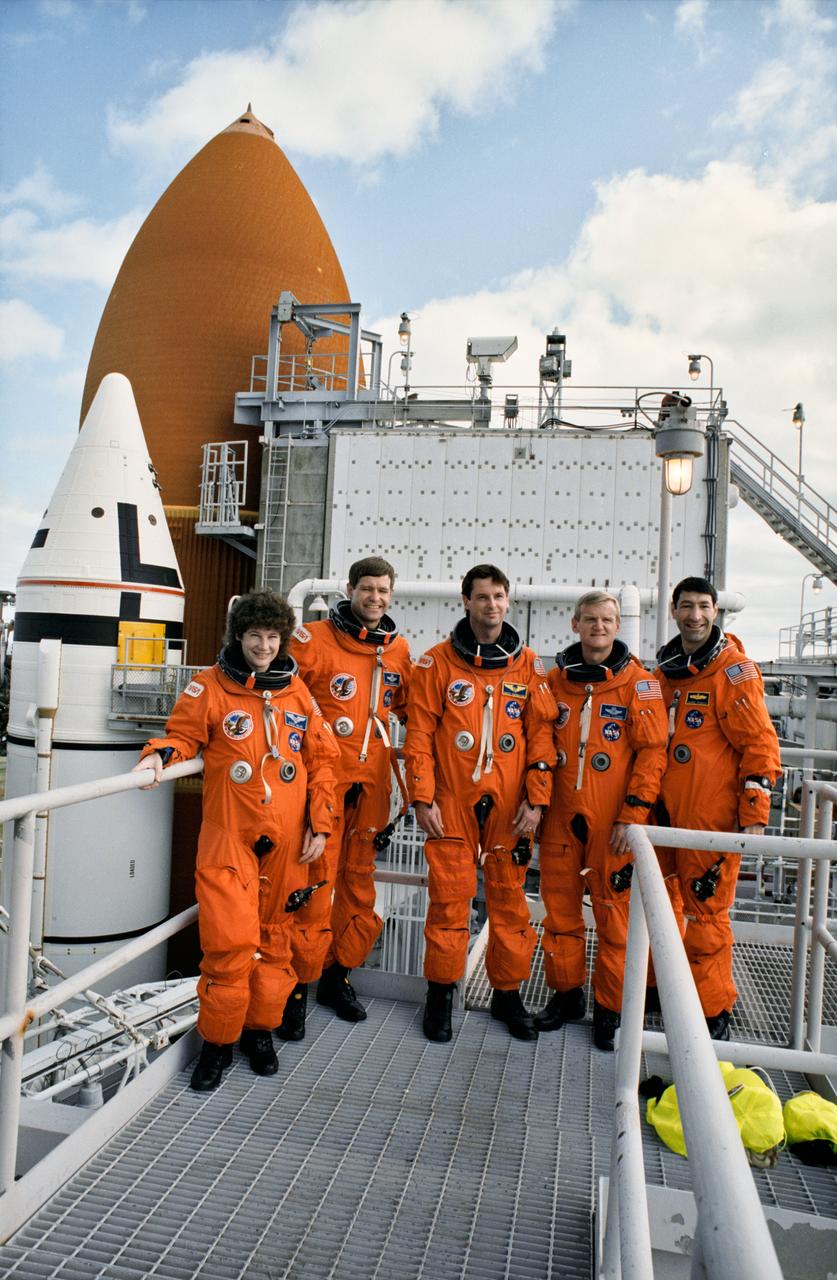
S93-25028 (15 Dec 1992) --- Astronauts assigned to fly aboard Endeavour pose near the Shuttle during a break in countdown demonstration tests.  Left to right are Susan J. Helms, Donald R. McMonagle, Gregory J. Harbaugh, John H. Casper and Mario Runco Jr.
STS-54 related views
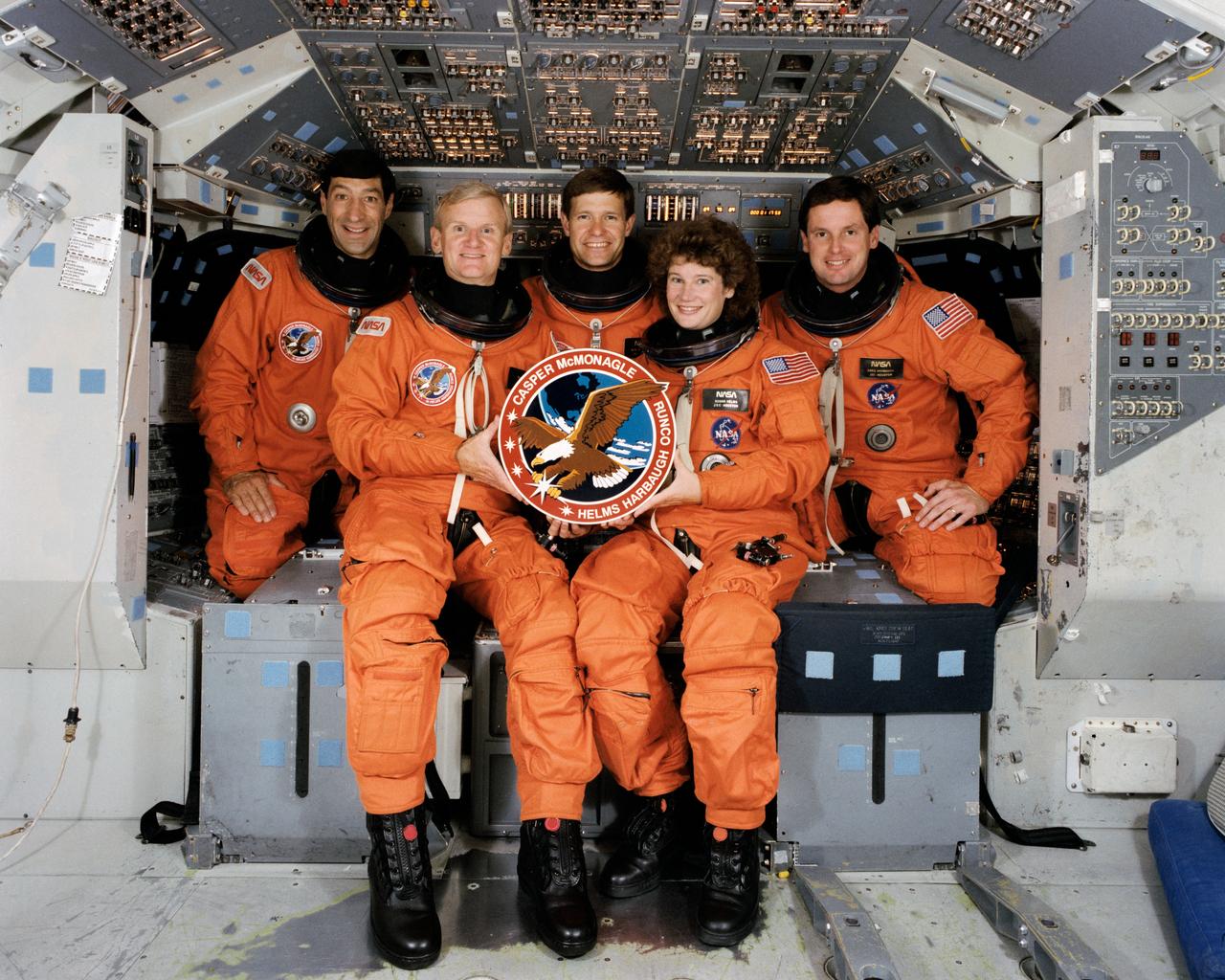
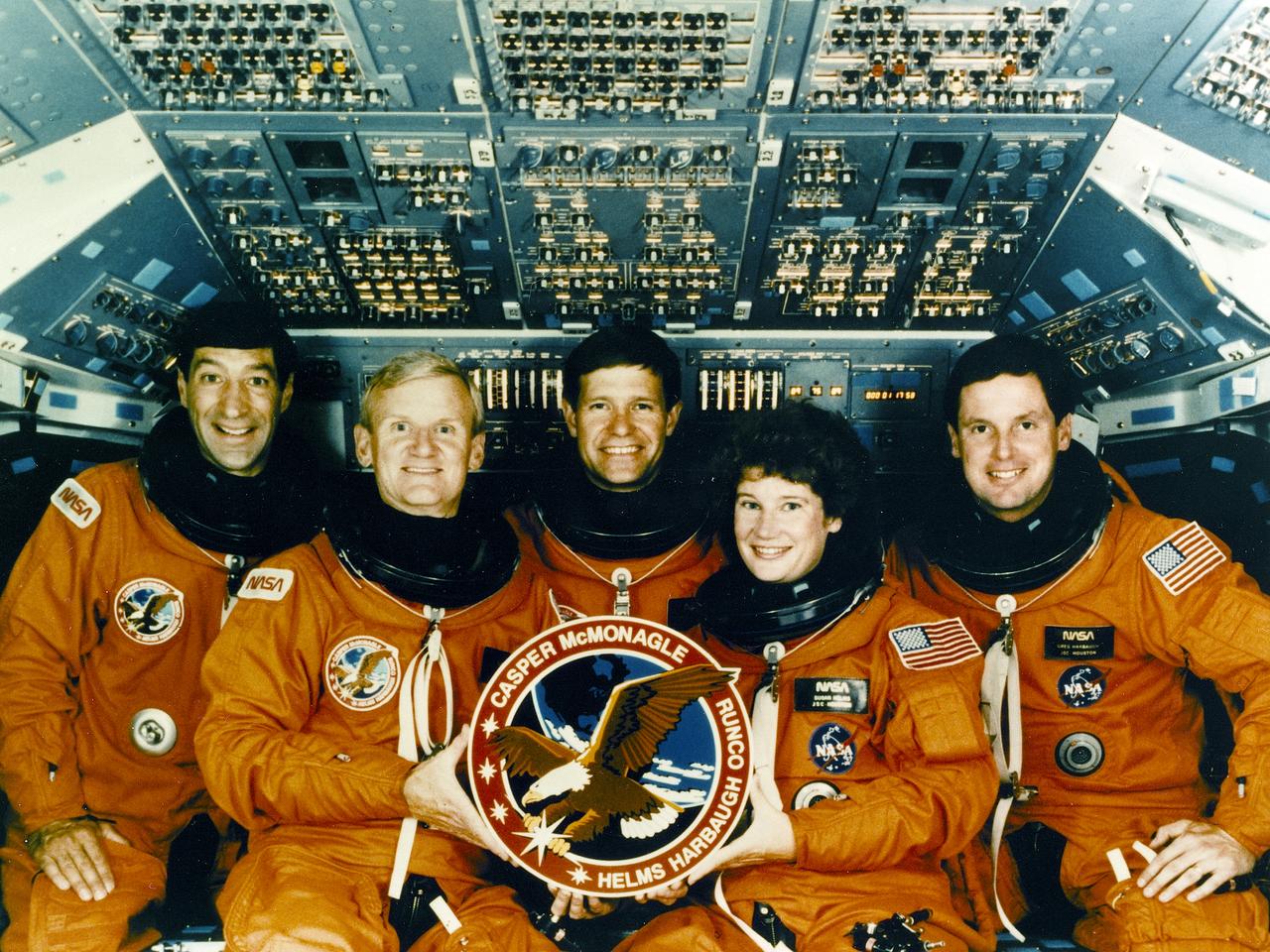
STS054-S-002 (August 1992) --- The five NASA astronauts assigned to fly aboard the space shuttle Endeavour for the mission pose for a crew portrait on the flight deck. Left to right are astronauts Mario Runco, mission specialist; John H. Casper, commander; Donald R. McMonagle, pilot; and mission specialists Susan J. Helms and Gregory J. Harbaugh.
STS-54 Endeavour, Orbiter Vehicle (OV) 105, official crew portrait
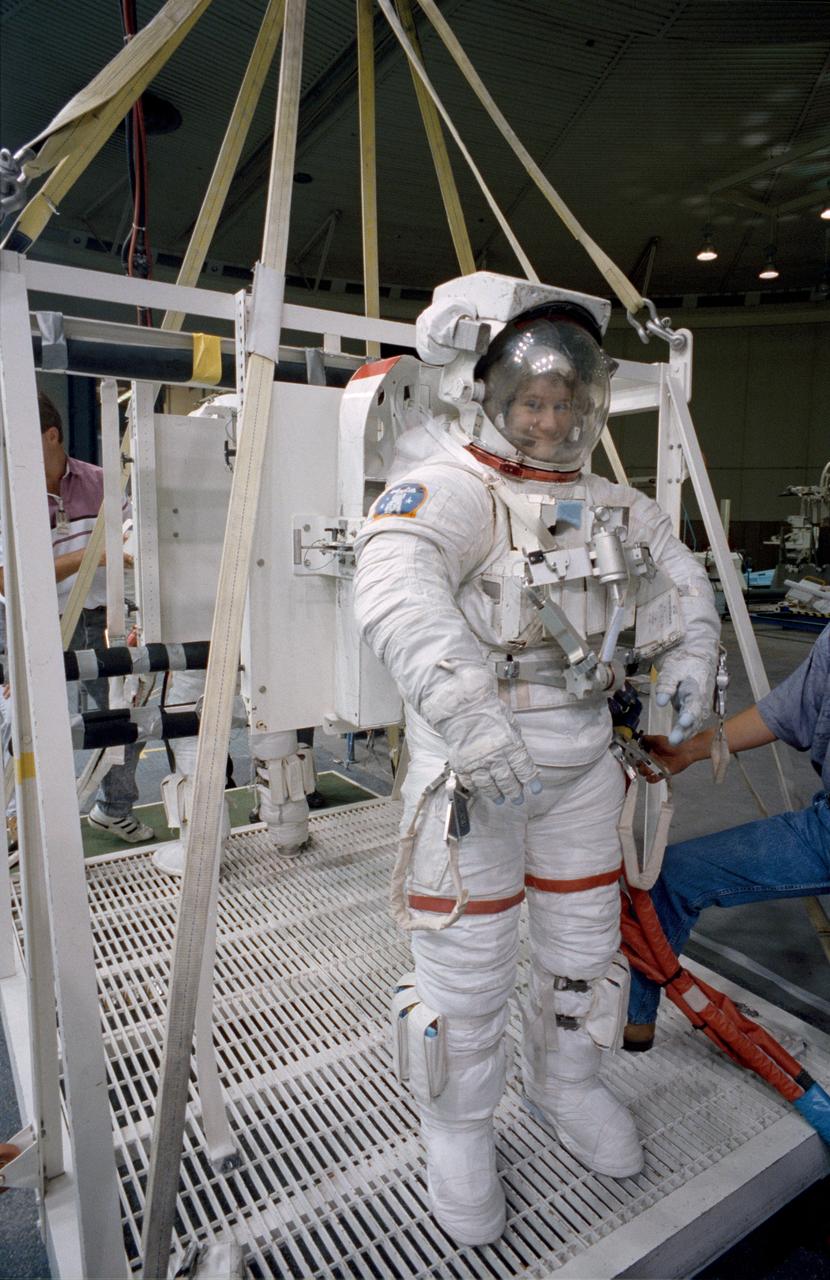
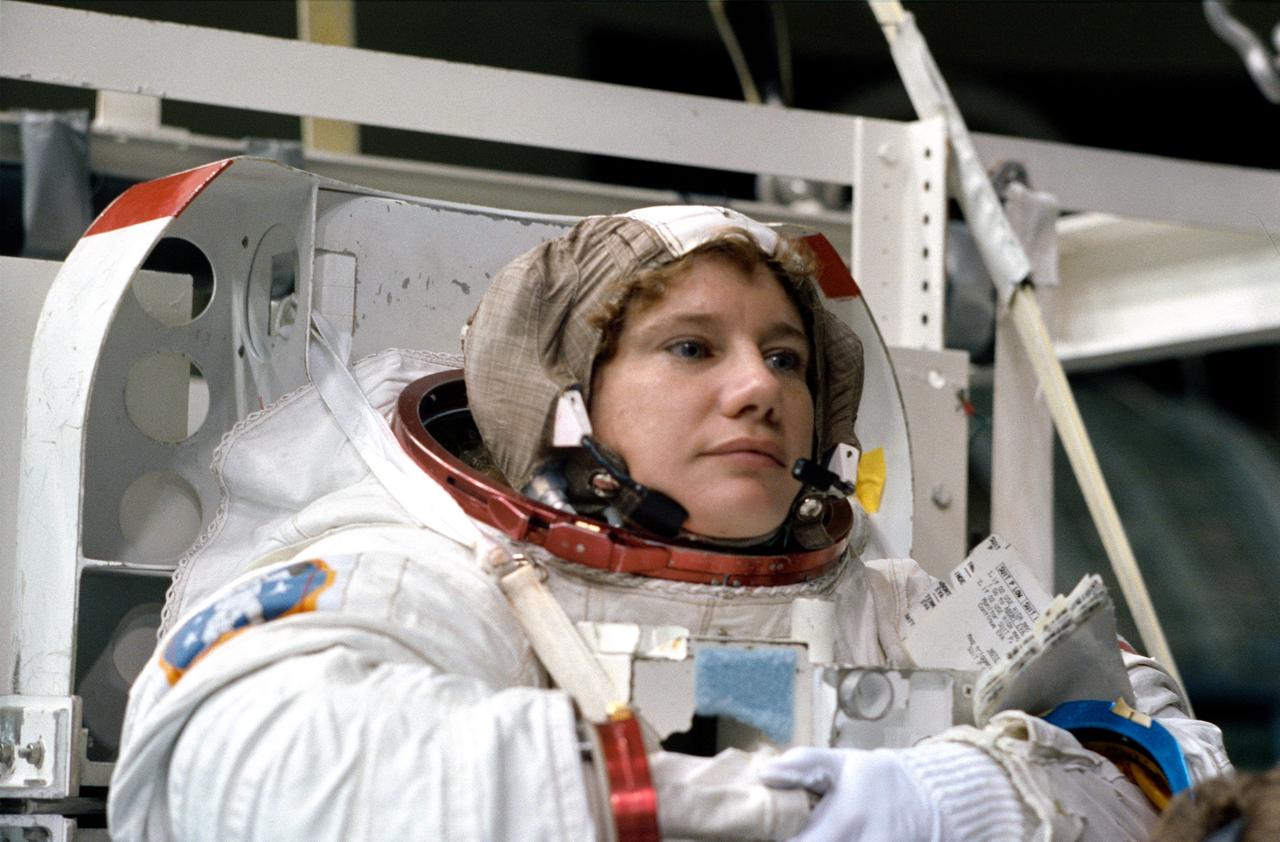
S92-42754 (31 July 1992) --- Astronaut Susan J. Helms, mission specialist assigned to fly aboard the Space Shuttle Endeavour for the STS-54 mission, gets assistance to complete the donning of her spacesuit.  Though not assigned to the scheduled extravehicular activity (EVA), Helms is trained in the weightless environment training facility (WET-F).  She will aid astronauts Gregory J. Harbaugh and Mario Runco Jr. in their planned EVA, scheduled for January of next year, and serve a backup role.  Wearing this high fidelity training version of the extravehicular mobility unit (EMU), Helms was later lowered into the 25-ft. deep WET-F pool.  The pressurized suit is weighted so as to allow Helms to achieve neutral buoyancy and simulate the various chores of the spacewalk.
STS-54 MS3 Helms, in EMU, on platform prior to underwater simulation at JSC
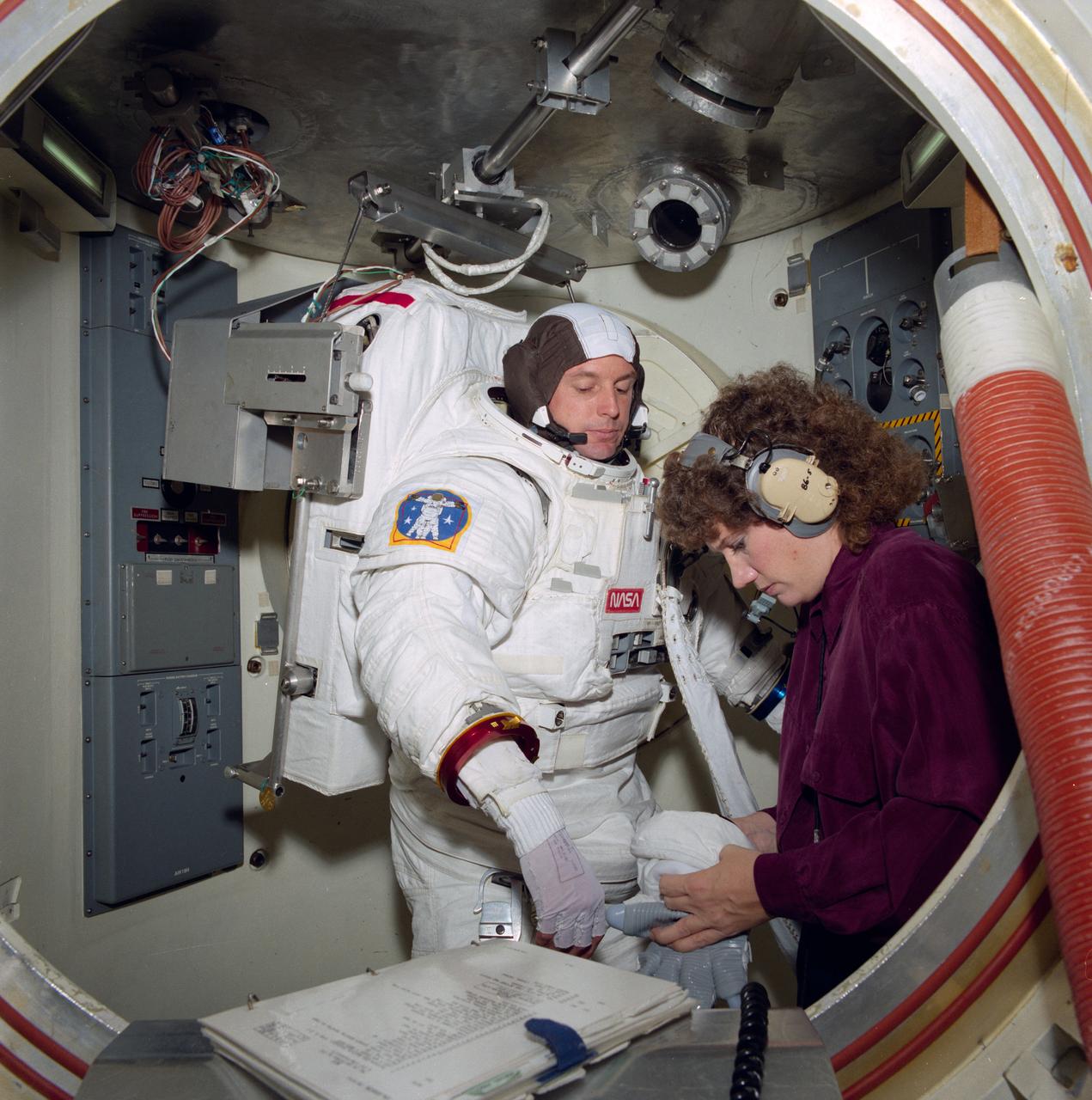
S92-49812 (11 Nov 1992) --- Astronauts Gregory J. Harbaugh and Susan J. Helms, mission specialists assigned to fly aboard the Space Shuttle Endeavour for the STS-54 mission, rehearse for the upcoming flight.  The two are in the airlock of a trainer at the Johnson Space Center's crew systems laboratory.  Harbaugh and Mario Runco Jr., also a mission specialist, have been assigned to perform a four-hour-plus extravehicular activity (EVA).  Helms is to assist the pair of spacewalkers during the mission as well as in this training exercise.
STS-54 MS2 Harbaugh and MS3 Helms during training in JSC's ETA / airlock
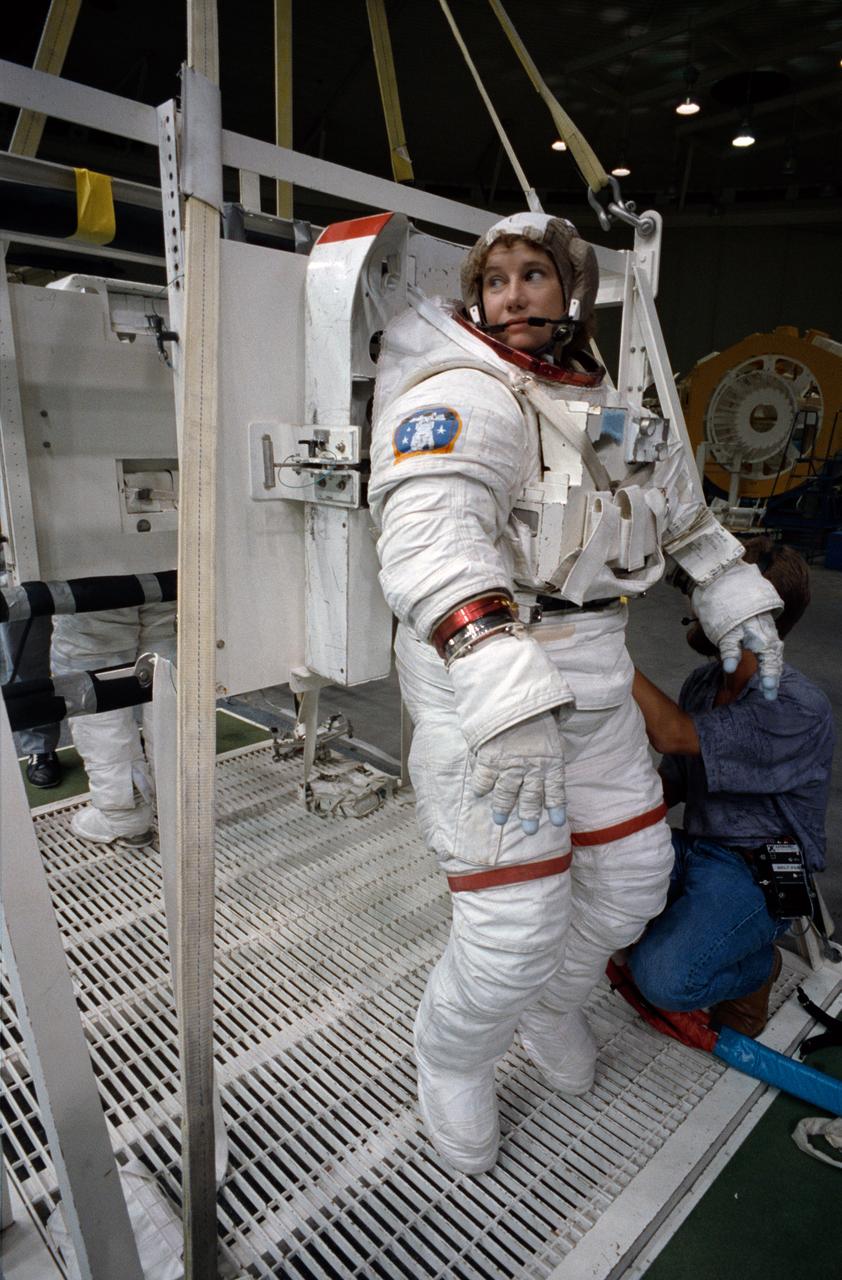
S92-42753 (31 July 1992) --- Astronaut Susan J. Helms, mission specialist assigned to fly aboard the Space Shuttle Endeavour for the STS-54 mission, gets assistance to complete the donning of her spacesuit.  Though not assigned to the scheduled extravehicular activity (EVA), Helms is trained in the weightless environment training facility (WET-F).  She will aid astronauts Gregory J. Harbaugh and Mario Runco Jr. in their planned EVA, scheduled for January of next year, and serve a backup role.  Wearing this high fidelity training version of the extravehicular mobility unit (EMU), Helms was later lowered into the 25-ft. deep WET-F pool.  The pressurized suit is weighted so as to allow Helms to achieve neutral buoyancy and simulate the various chores of the spacewalk.
STS-54 MS3 Susan J. Helms dons EMU for underwater simulation in JSC's WETF
S92-42755 (31 July 1992) --- Astronaut Susan J. Helms, mission specialist assigned to fly aboard the Space Shuttle Endeavour for the STS-54 mission, completes the donning of her spacesuit before a training exercise. Though not assigned to the scheduled extravehicular activity (EVA), Helms is trained in the weightless environment training facility (WET-F).  She will aid astronauts Gregory J. Harbaugh and Mario Runco Jr. in their planned EVA, scheduled for January of next year, and serve a backup role.  Wearing this high fidelity training version of the extravehicular mobility unit (EMU), Helms was later lowered into the 25-ft. deep WET-F pool.  The pressurized suit is weighted so as to allow Helms to achieve neutral buoyancy and simulate the various chores of the spacewalk.
STS-54 MS3 Helms tests CCA equipment prior to an underwater simulation at JSC
Astronauts pictured in the STS-54 crew portrait from left to right are: Mario Runco, Jr., mission specialist; John H. Casper, commander; Donald R. McMonagle, pilot; and mission specialists Susan J. Helms, and Gregory J. Harbaugh.  Launched aboard the Space Shuttle Endeavour on January 13, 1993 at 8:59:30 am (EST), the crew deployed the fifth Tracking and Data Relay Satellite (TDRS-6).
Space Shuttle Projects
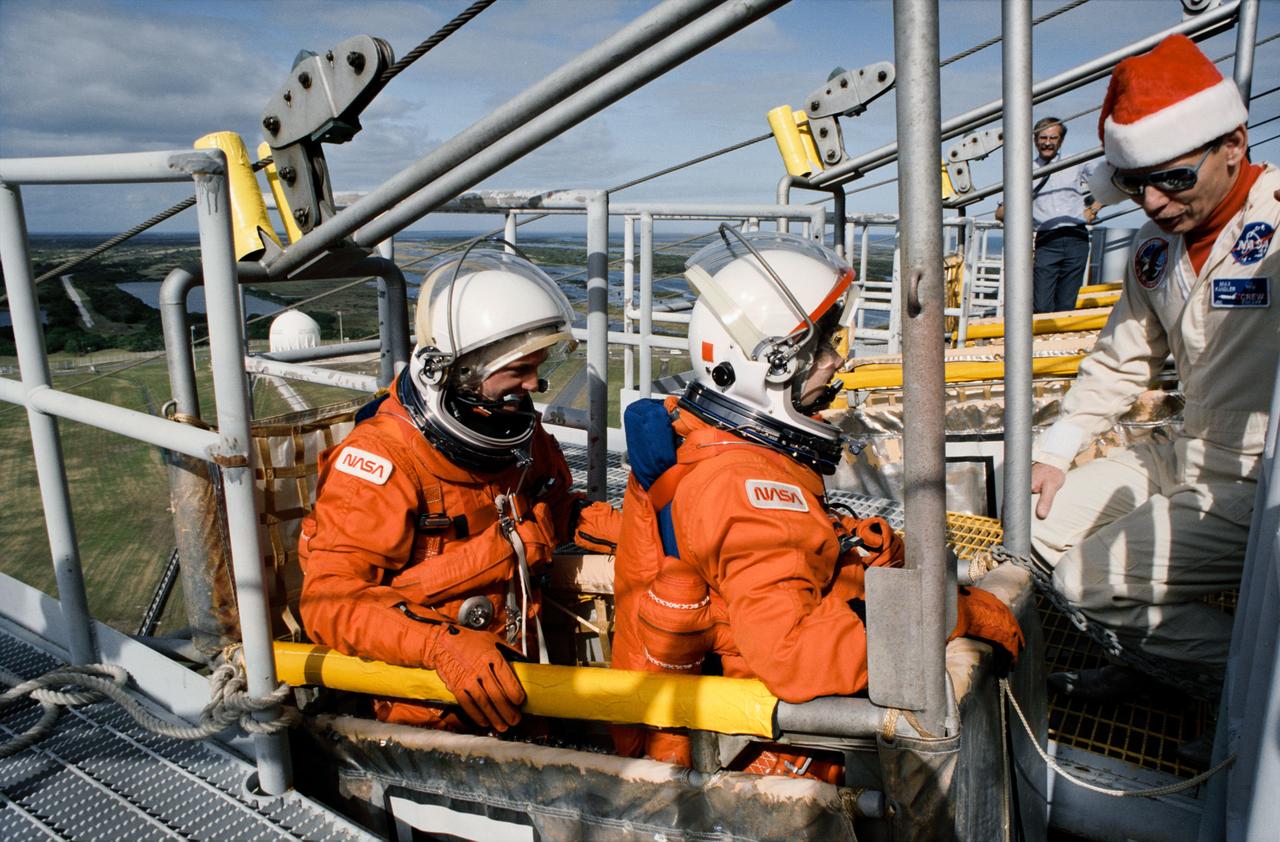
S93-25030 (15 Dec 1992) --- Two astronauts assigned to fly aboard Endeavour for the STS-54 mission are briefed on the slidewire escape system at the launch pad.  Pictured in the slidewire litter are astronauts Gregory J. Harbaugh (left) and Susan J. Helms, mission specialists.  They are assisted by Max Kandler of Lockheed, Houston.  All five crewmembers are in Florida this week to participate in countdown demonstration tests.
STS-54 MS2 Harbaugh and MS3 Helms during slidewire egress training at KSC
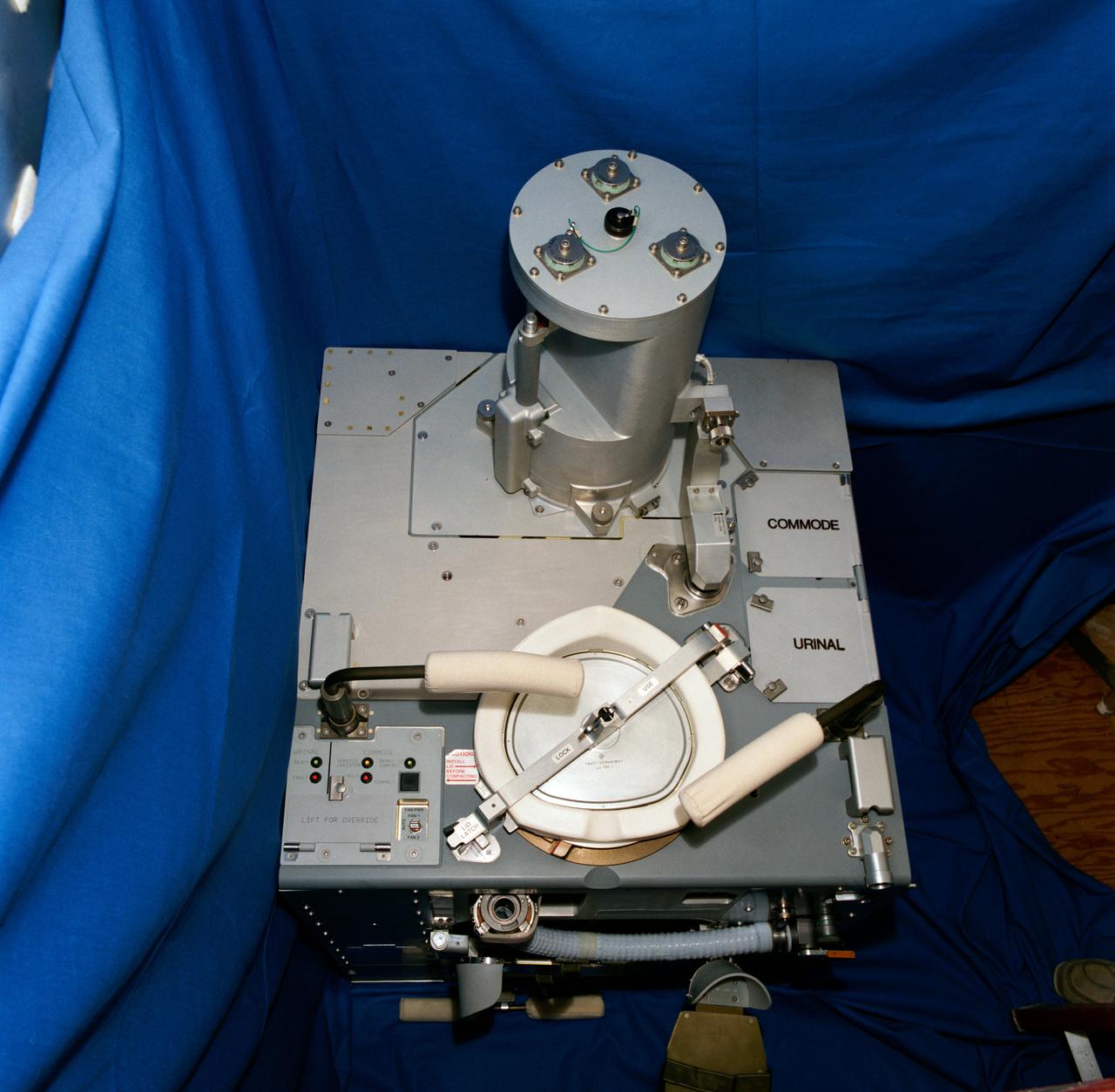
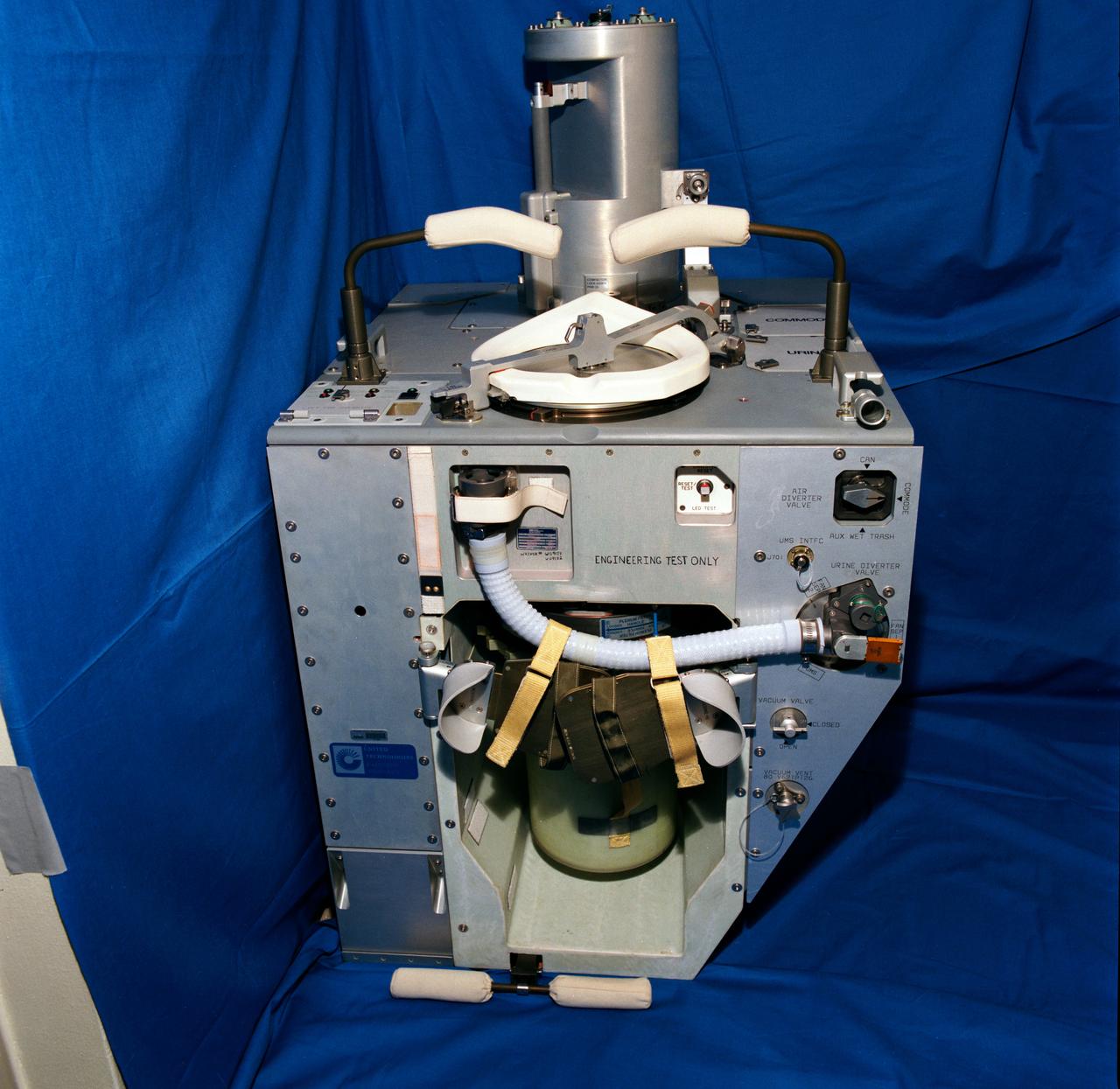
S92-46726 (November 1992) --- A high angle view of the Improved Waste Collection System (IWCS) scheduled to fly aboard NASA's Space Shuttle Endeavour for the STS-54 mission.  Among the advantages the new IWCS is hoped to have over the current WCS are greater dependability, better hygiene, virtually unlimited capacity and more efficient preparation between Shuttle missions.  Unlike the previous WCS, the improved version will not have to be removed from the spacecraft to be readied for the next flight.
Extended Duration Orbiter (EDO) Improved Waste Collection System (IWCS)
S92-46717 (November 1992) --- A front view of the improved waste collection system (IWCS) scheduled to fly aboard NASA's Space Shuttle Endeavour for the STS-54 mission.  Among the advantages the new IWCS is hoped to have over the current WCS are greater dependability, better hygiene, virtually unlimited capacity and more efficient preparation between Shuttle missions.  Unlike the previous WCS, the improved version will not have to be removed from the spacecraft to be readied for the next flight.
Extended Duration Orbiter (EDO) Improved Waste Collection System (IWCS)
STS054-72-056 (13-19 Jan 1993) --- A ship wake in the Bay of Bengal is noticeable in this 70mm frame.  The sun glint pattern on the ocean reveals many patterns of sea surface roughness related to currents, waves, wind roughening, and biology that and are not apparent when the ocean is viewed away from the Sun's reflection.  In this view of the Bay of Bengal, southeast of Madras, India, sun glint highlights convergence zones between ocean currents (bright, linear features), a eddy, and the wake of a ship.  In several locations where the ship has passed areas of current shear, the ship wake is distorted, indicating the relative current direction.
STS-54 Earth observation of a ship wake in the Bay of Bengal
KENNEDY SPACE CENTER, FLA. --  STS-54: Endeavour
KSC-93PC-0147
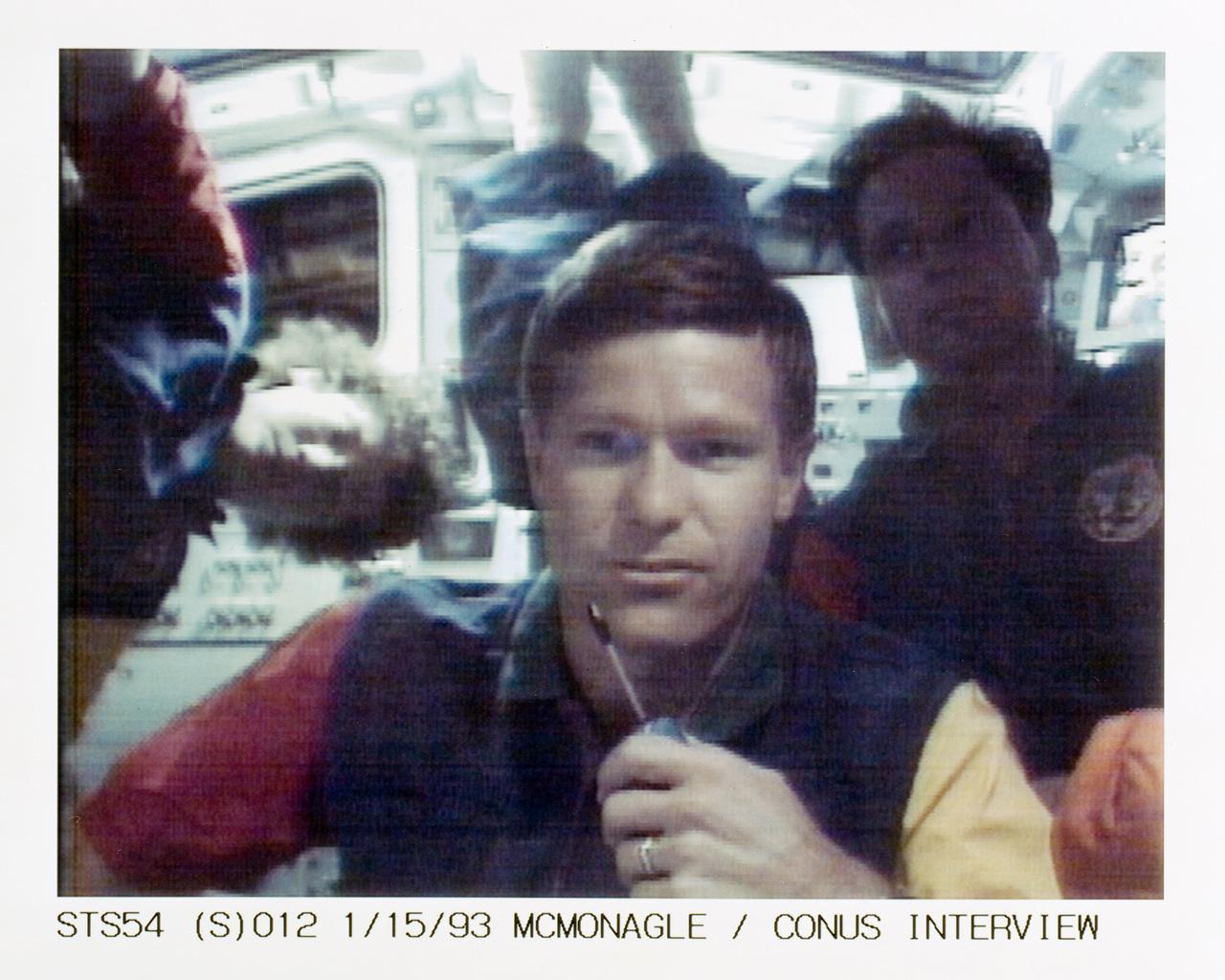
STS054-S-012 (15 Jan 1993) --- McMonagle talks to a radio station from the flight deck of Endeavour while, in the background, several crewmates await their turns to communicate with other stations. The scene was recorded at 13:54:14:13 GMT, Jan. 15, 1993.
STS-54 Pilot McMonagle talks to radio station from OV-105's aft flight deck
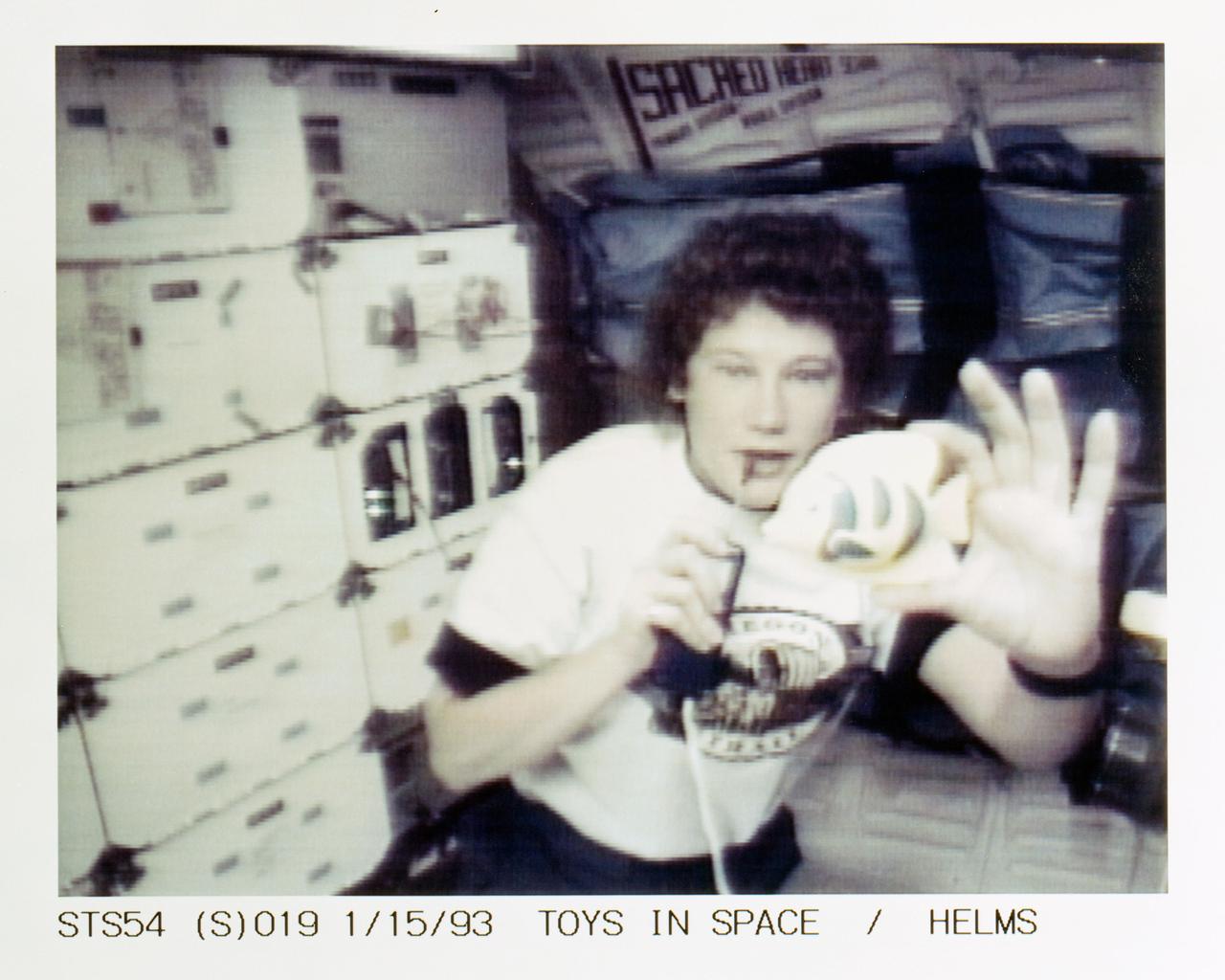
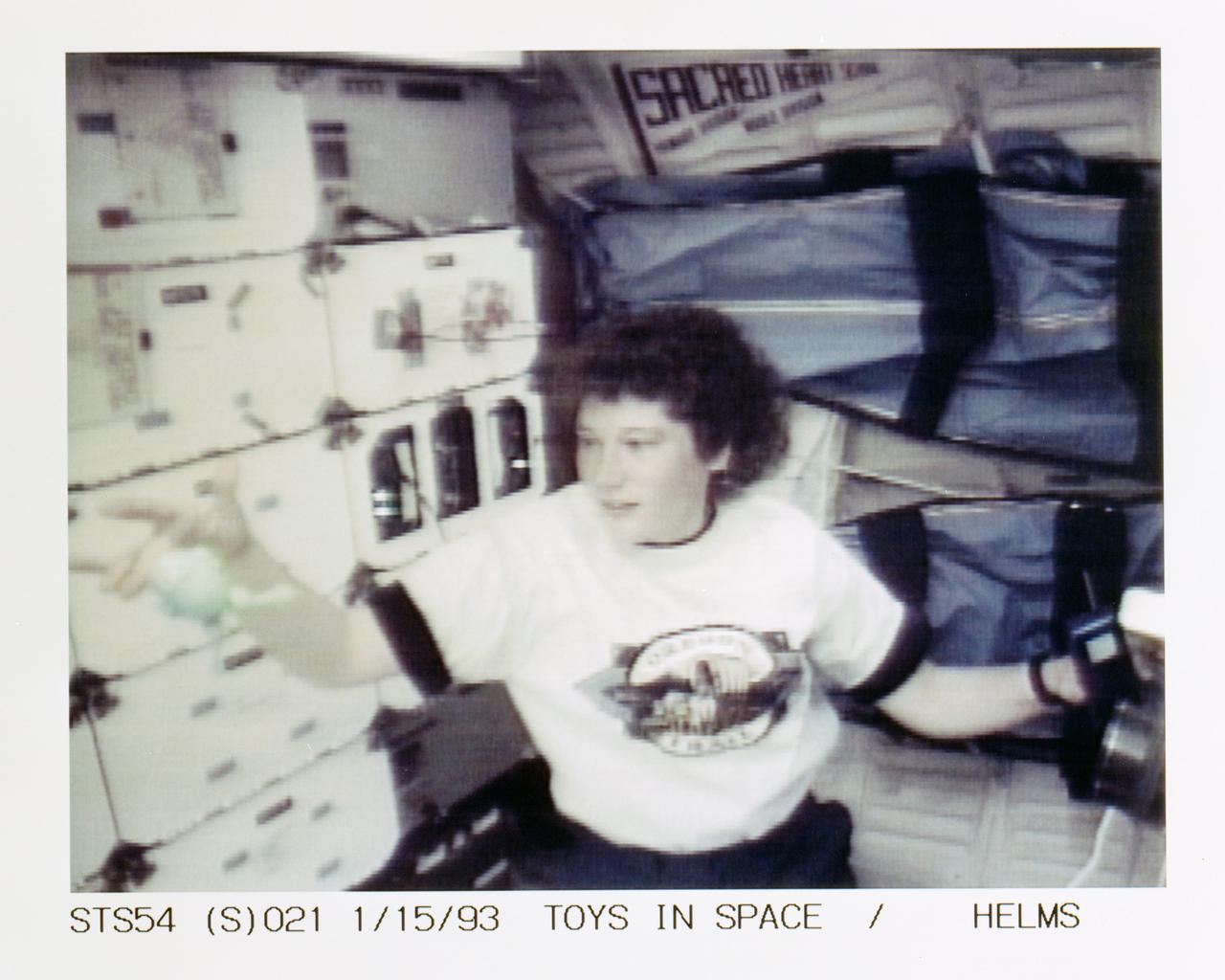
STS054-S-019 (15 Jan 1993) --- Helms with a fish toy on the middeck demonstrates some of the physics of toys to students watching on television.  Four schools were chosen to ask questions of the astronauts during the lengthy program.  Helms fielded questions from students at Shaver Elementary School in Portland, Oregon.  The fish was used to demonstrate Newton's third law of motion and the conservation of angular momentum.  The entire collection of toys will be videotaped for an educational program to be distributed to schools in the fall of this year.  The scene was recorded at 17:50:08:27 GMT, Jan. 15, 1993.
STS-54 MS3 Helms uses DSO 802 & Physics of Toys fish toy on OV-105's middeck
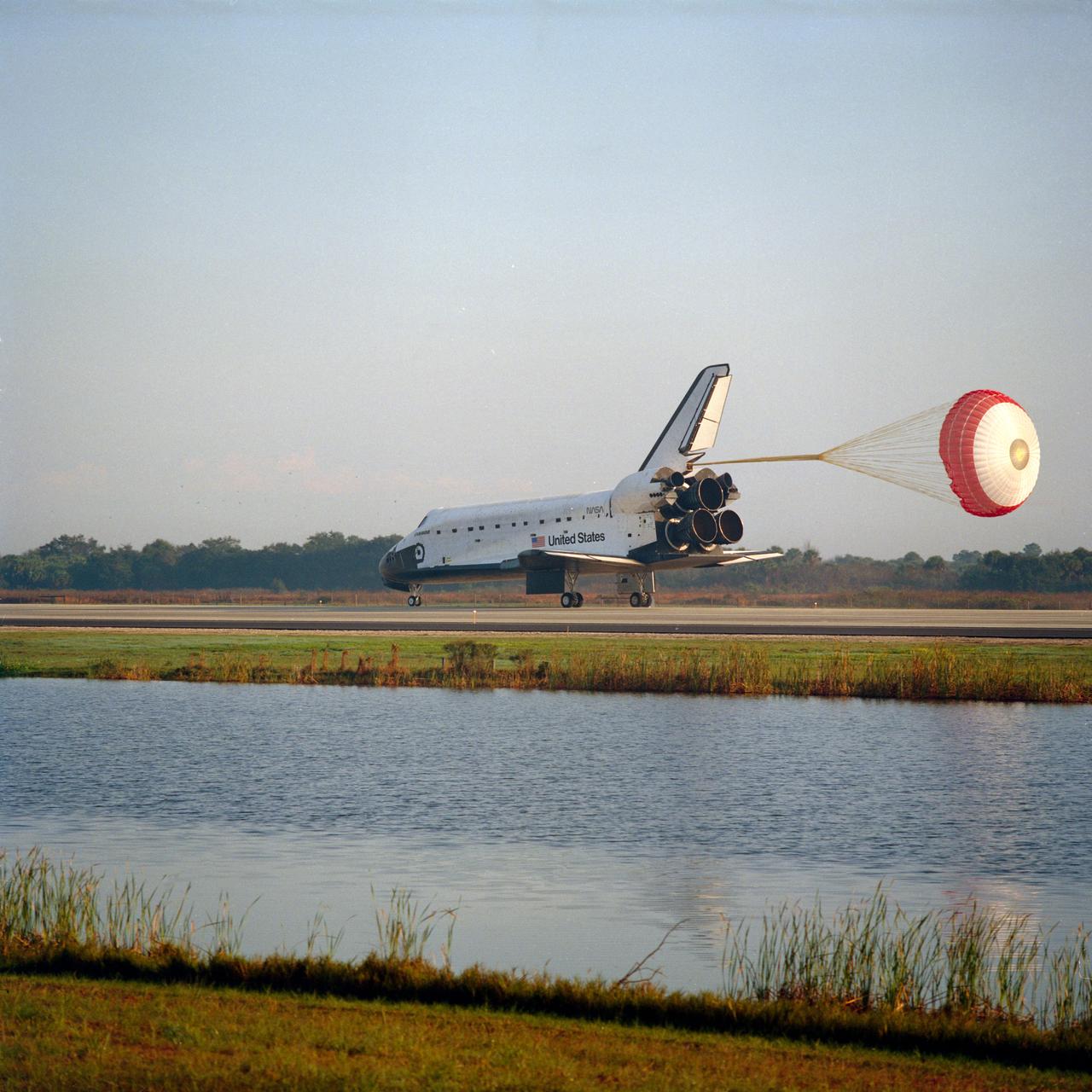
STS054-S-100 (19 Jan 1993) --- The drag chute is fully deployed as the Space Shuttle Endeavour rolls toward wheelstop at KSC's Shuttle landing facility. Landing occurred at 8:38 a.m. (EST), Jan. 19, 1993.  Onboard for the six-day mission were astronauts John H. Casper, mission commander, Donald R. McMonagle, pilot, Gregory J. Harbaugh, Mario Runco Jr. and Susan J. Helms, mission specialists.
STS-54 Endeavour, Orbiter Vehicle (OV) 105, lands on runway 33 at KSC's SLF
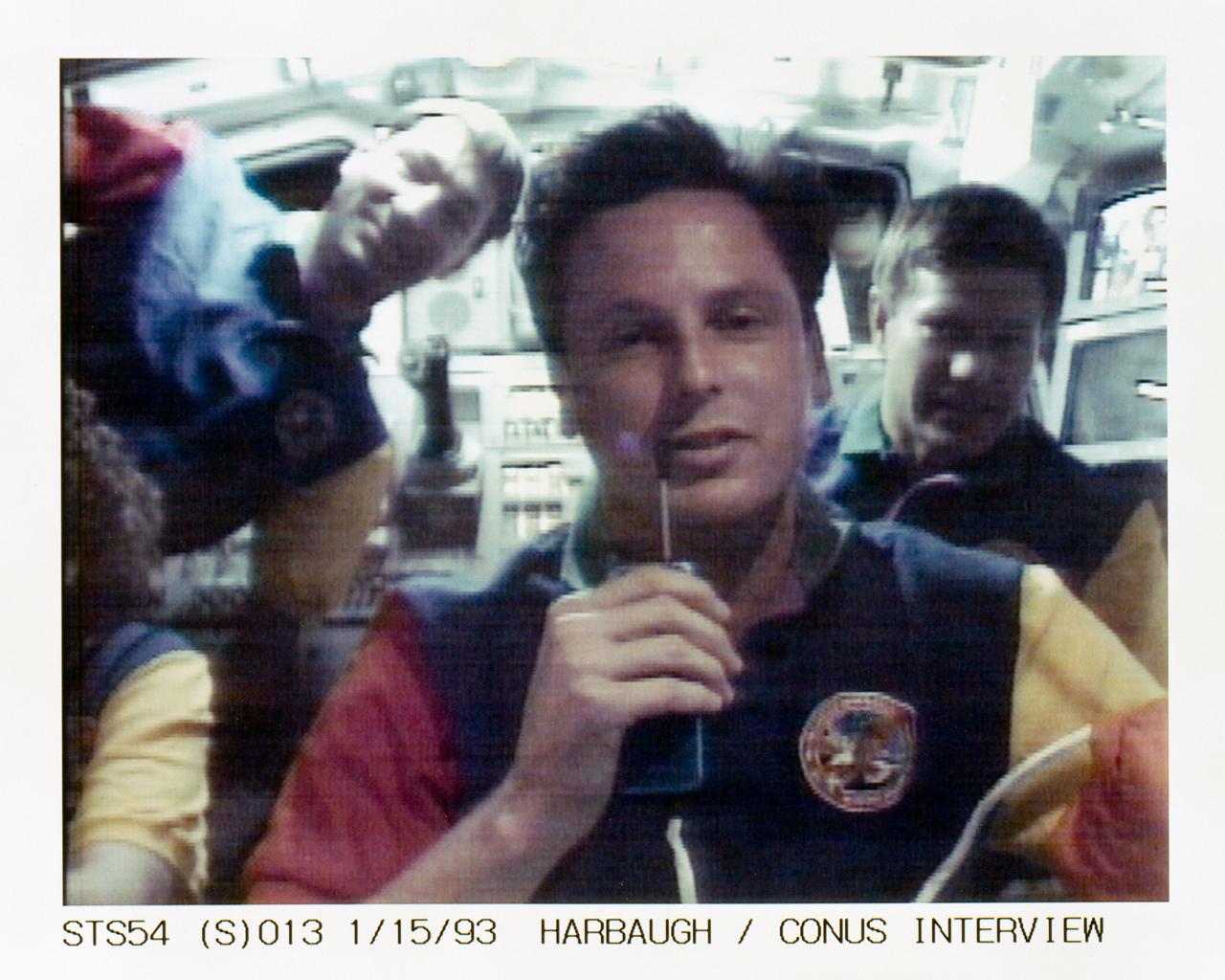
STS054-S-013 (15 Jan 1993) --- Harbaugh talks to a radio station from the flight deck of Endeavour while, in the background, several crewmates await their turns to communicate with other stations. The scene was recorded at 13:57:20:20 GMT, Jan. 15, 1993.
STS-54 MS2 Harbaugh talks to radio station from OV-105's aft flight deck
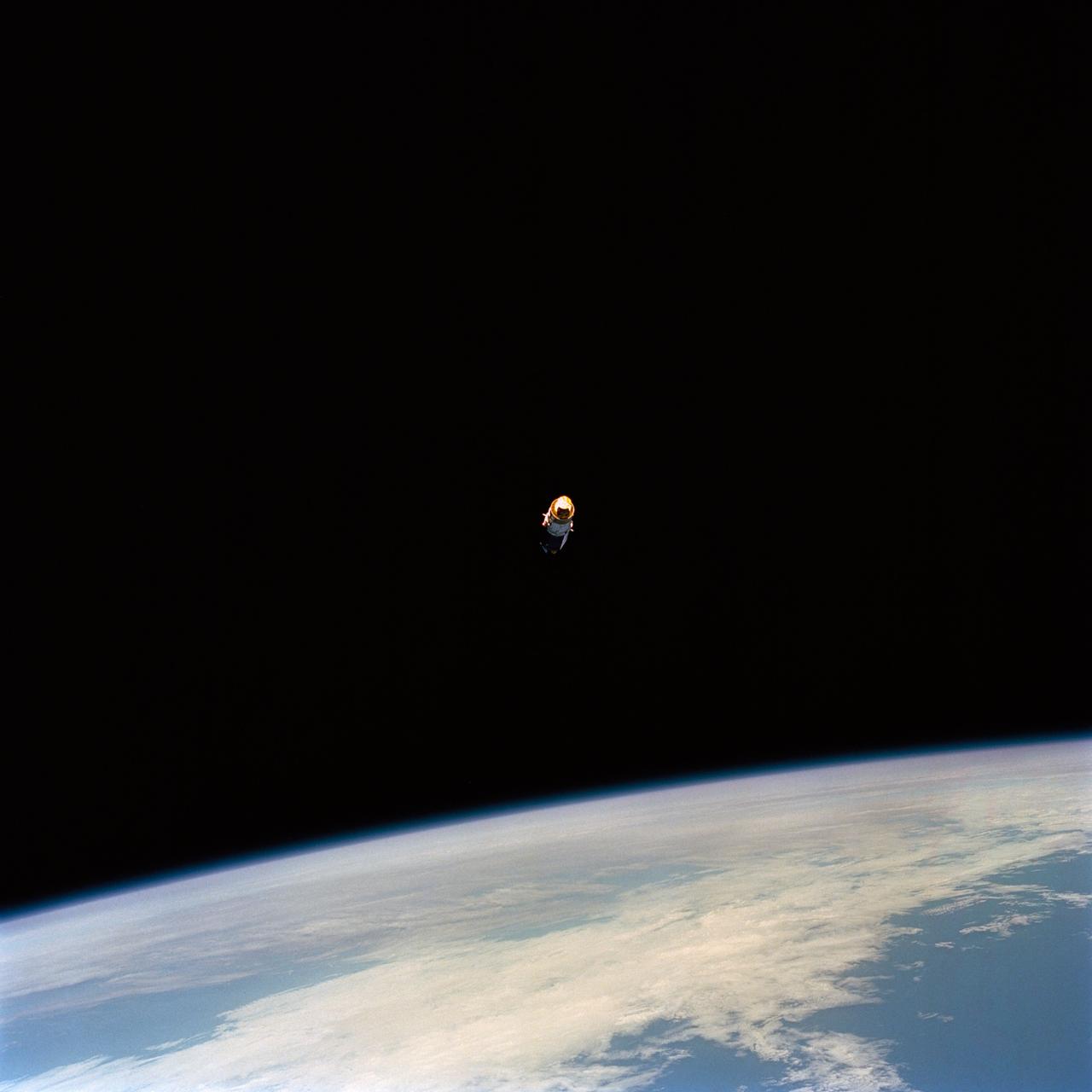
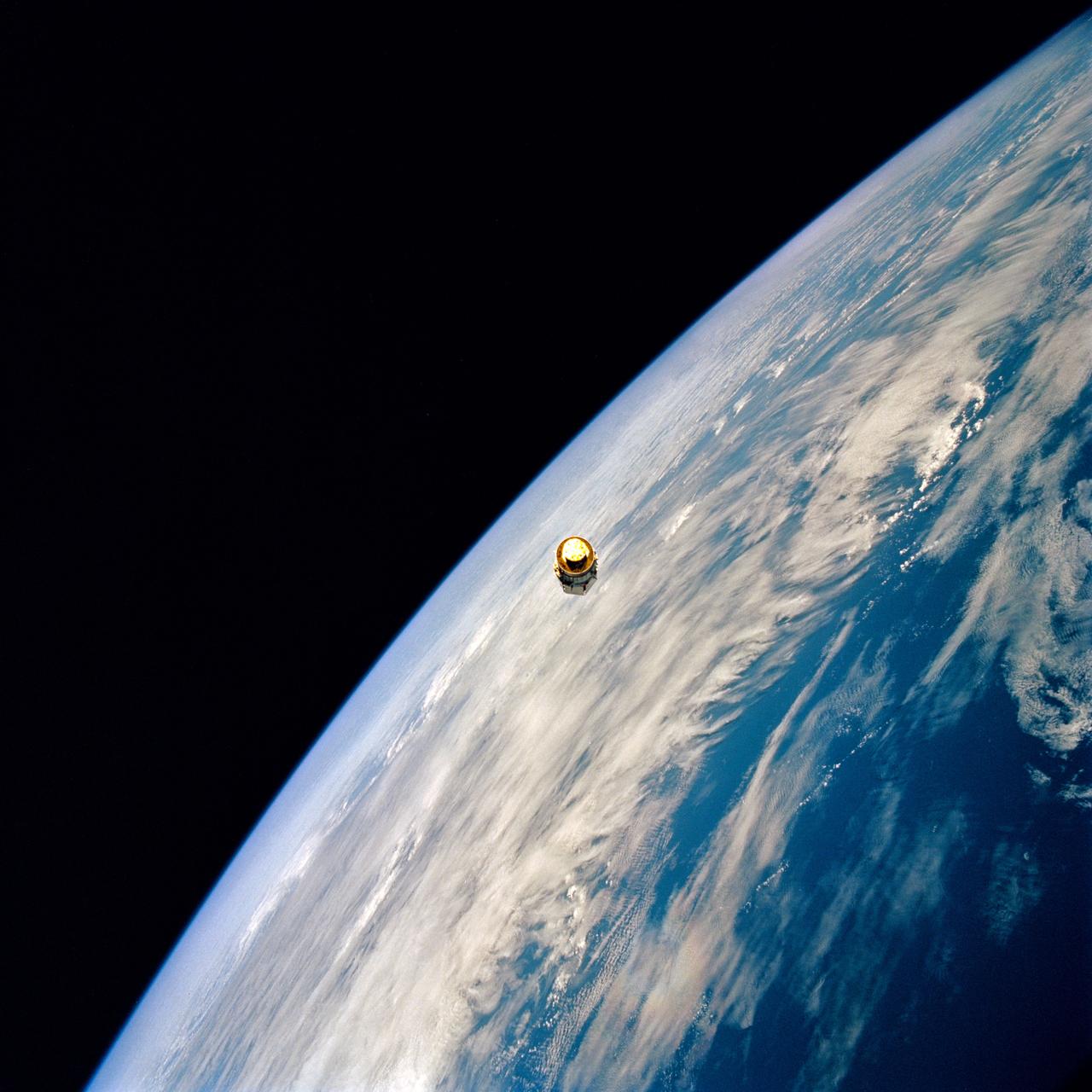
STS054-71-087 (13 Jan 1993) --- The Tracking and Data Relay Satellite (TDRS) is backdropped against the blackness of space, minutes after its release from the Space Shuttle Endeavour.  Onboard NASA's newest Shuttle for the six-day mission are astronauts John H. Casper, mission commander; Donald R. McMonagle, pilot; and Mario Runco Jr., Gregory J. Harbaugh and Susan J. Helms, mission specialists.  The photograph was taken with a 70mm camera.
IUS / TDRS-F drifts above the Earth's surface after STS-54 deployment
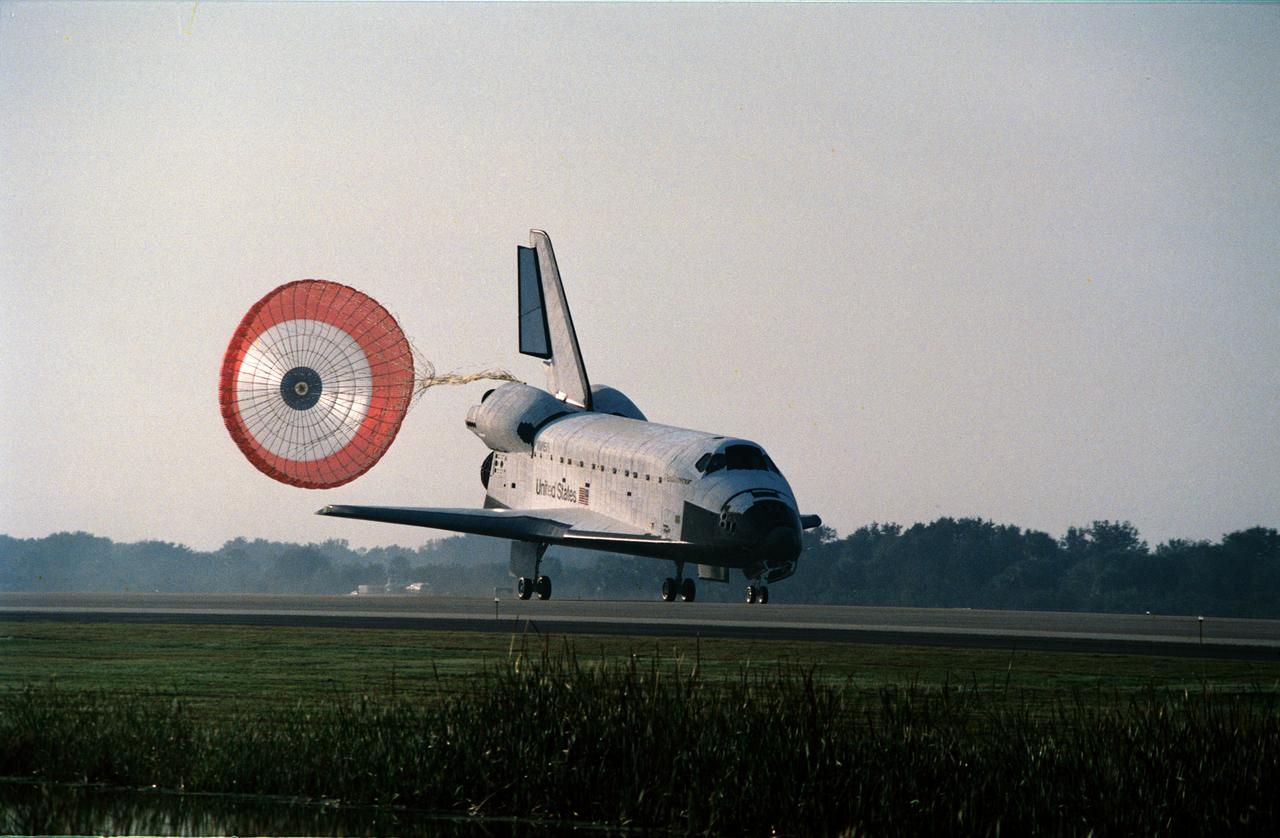
STS054-S-101 (19 Jan 1993) --- The drag chute is just about to be released as the Space Shuttle Endeavour rolls toward wheelstop at KSC's Shuttle landing facility. Landing occurred at 8:38 a.m. (EST), Jan. 19, 1993.  Onboard for the six-day mission were astronauts John H. Casper, mission commander, Donald R. McMonagle, pilot, Gregory J. Harbaugh, Mario Runco Jr. and Susan J. Helms, mission specialists.
STS-54 Endeavour, Orbiter Vehicle (OV) 105, lands on runway 33 at KSC's SLF
STS054-71-077 (13 Jan 1993) --- The Tracking and Data Relay Satellite (TDRS) quickly moves away from the Space Shuttle Endeavour following deployment on the first day of the six-day mission.  Onboard NASA's newest Shuttle for the six-day mission are astronauts John H. Casper, mission commander; Donald R. McMonagle, pilot; and Mario Runco Jr., Gregory J. Harbaugh and Susan J. Helms, mission specialists.  The photograph was taken with a 70mm camera.
IUS / TDRS-F drifts above the Earth's surface after STS-54 deployment
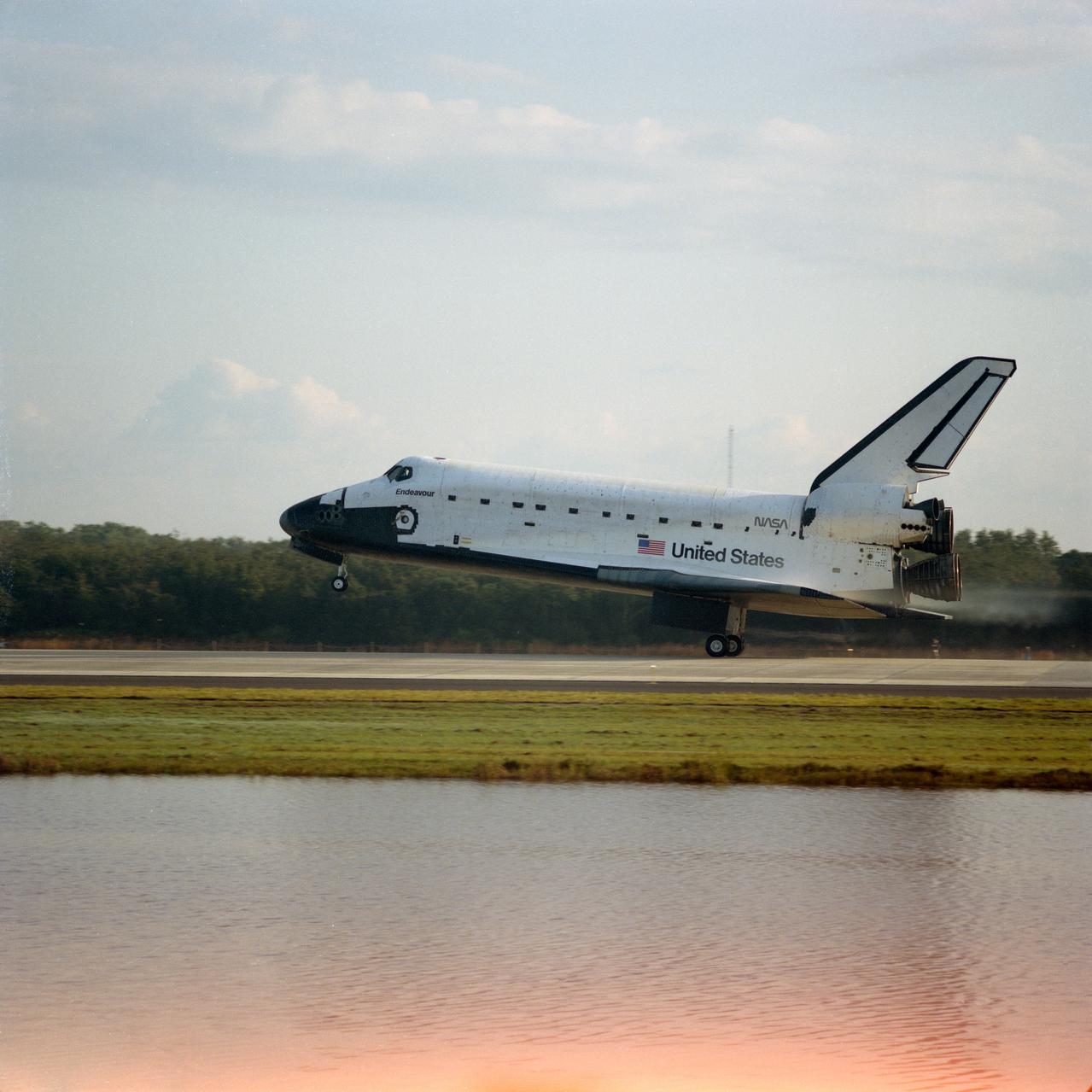
STS054-S-098 (19 Jan 1993) --- This ground-level side view shows the Space Shuttle Endeavour during main landing gear touchdown at KSC's Shuttle Landing Facility to successfully complete a six day Earth-orbital mission.  Landing occurred at 8:38 a.m. (EST), Jan. 19, 1993.  Onboard were astronauts John H. Casper, mission commander; Donald R. McMonagle, pilot; Gregory J. Harbaugh, Mario Runco Jr. and Susan J. Helms, mission specialists.
STS-54 Endeavour, Orbiter Vehicle (OV) 105, lands on runway 33 at KSC's SLF
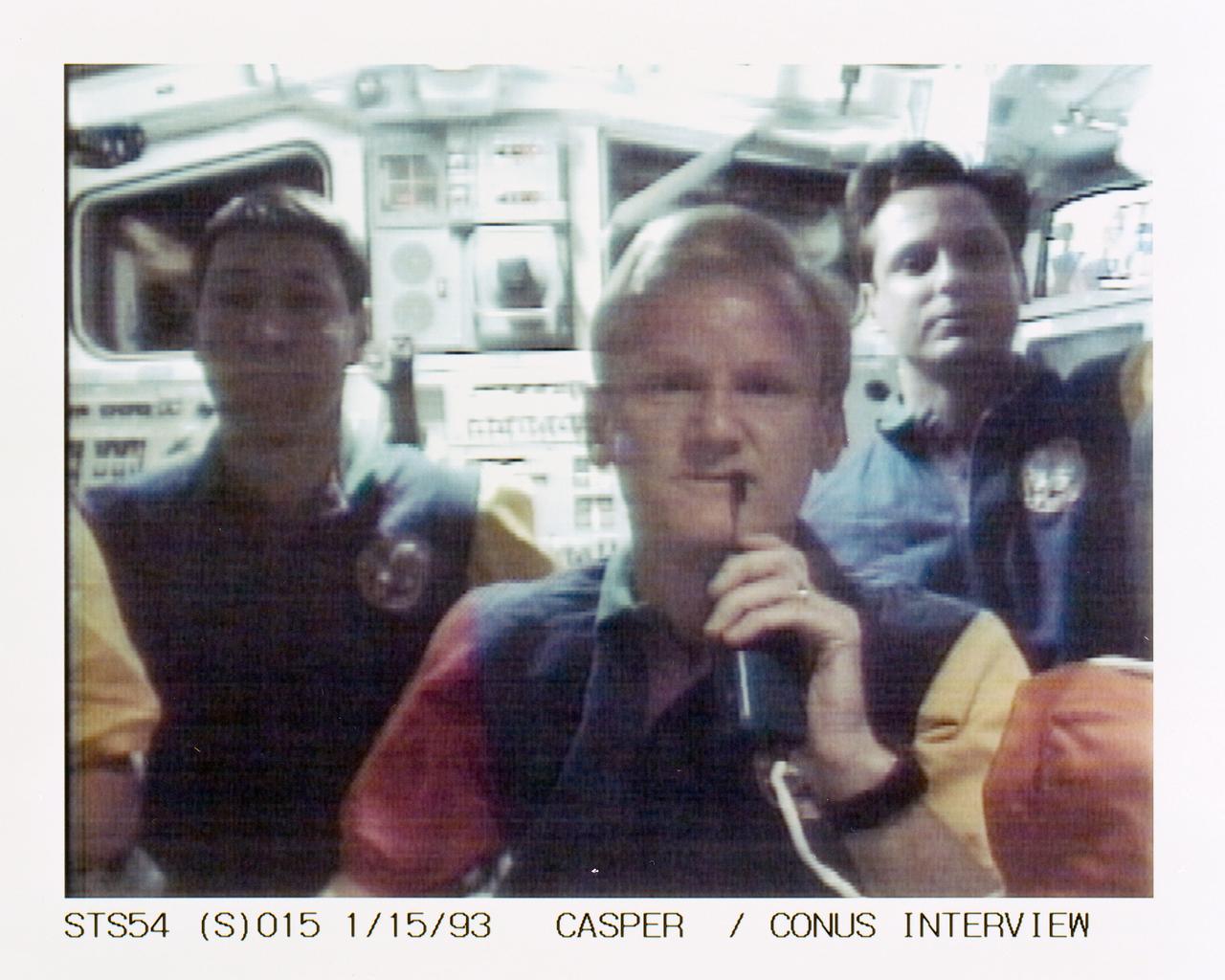
STS054-S-015 (15 Jan 1993) --- Casper talks to a radio station from the flight deck of Endeavour while, in the background, Runco, left, and Harbaugh await their turns to communicate with other stations. The scene was recorded at 13:45:54:05 GMT, Jan. 15, 1993.
STS-54 Commander Casper talks to radio station from OV-105's aft flight deck
STS054-S-021 (15 Jan 1993) --- Helms with a frog swimmer toy on the middeck demonstrates some of the physics of toys to students watching on television.  Four schools were chosen to ask questions of the astronauts during the lengthy program.  Helms fielded questions from students at Shaver Elementary School in Portland, Oregon.  The swimmer frog was used to demonstrate Newton's third law of motion and the conservation of angular momentum. The entire collection of toys will be videotaped for an educational program to be distributed to schools in the fall of this year.  The scene was recorded at 17:51:38:12 GMT, Jan. 15, 1993.
STS-54 MS3 Helms uses DSO 802 & Physics of Toys frog toy on OV-105's middeck
STS054-S-023 (15 Jan 1993) --- Casper holds up a paper boomerang before sailing it across Endeavour's middeck.  The demonstration was part of a lengthy "physics of toys" program conducted by all five crewmembers on their third day aboard the Shuttle.  Through telephone and TV downlinks, students in four schools around the country participated in a special lesson to discover how specific toys function differently in the classroom compared to those on the Shuttle.  The boomerang was used to demonstrate Bernouli's principle and gyroscopic stability.  The entire collection of toys will be videotaped for an educational program to be distributed to schools in the autumn.  The scene was downlinked at 18:11:04:26 GMT, Jan. 15, 1993.
STS-54 Commander Casper with DSO 802 & Physics of Toys on OV-105's middeck
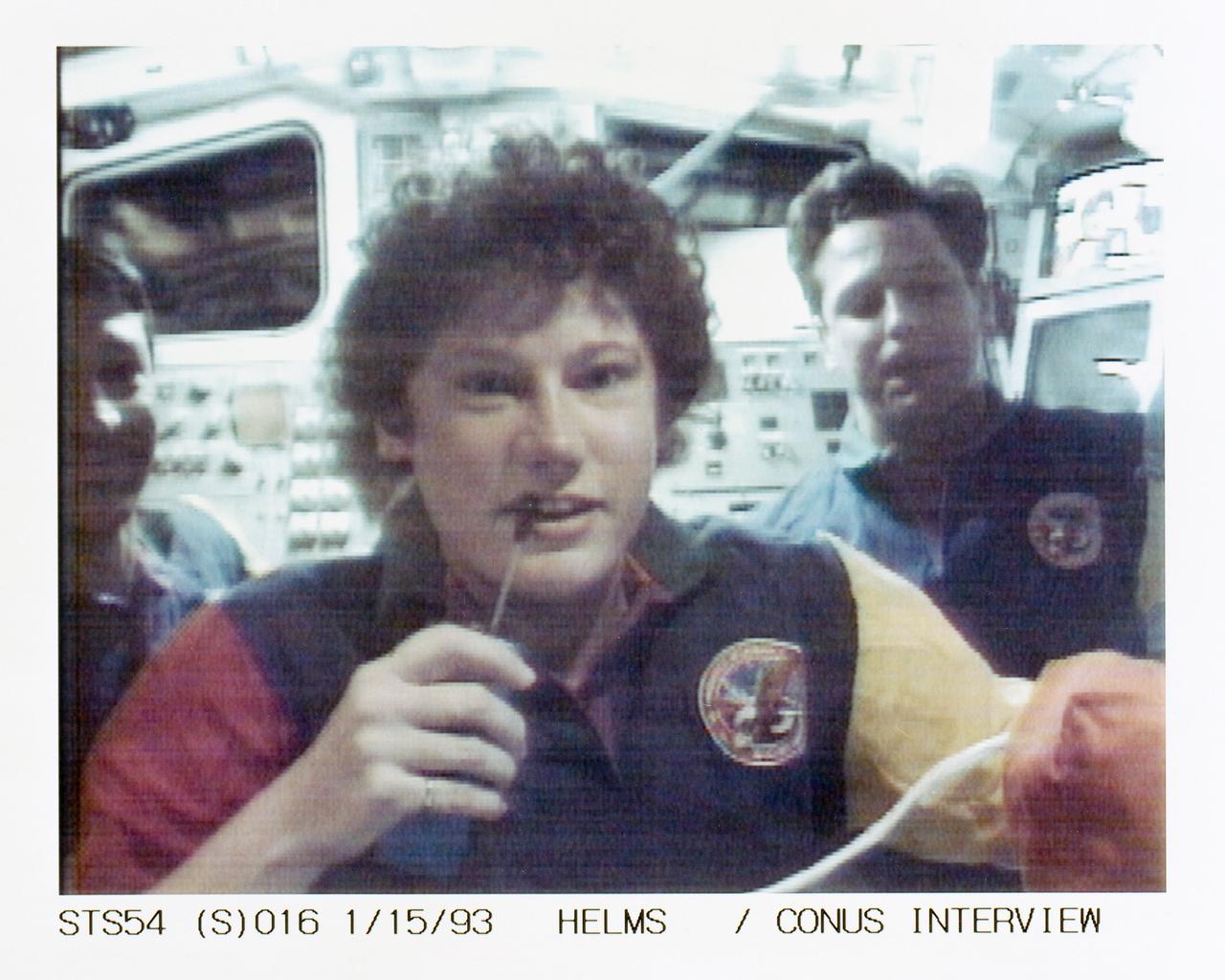
STS054-S-016 (15 Jan 1993) --- Helms talks to a radio station from the flight deck of Endeavour while Runco, left, and Harbaugh look on in the background. The scene was recorded at 13:54:14:13 GMT, Jan. 15, 1993.
STS-54 MS3 Helms talks to radio station from OV-105's aft flight deck
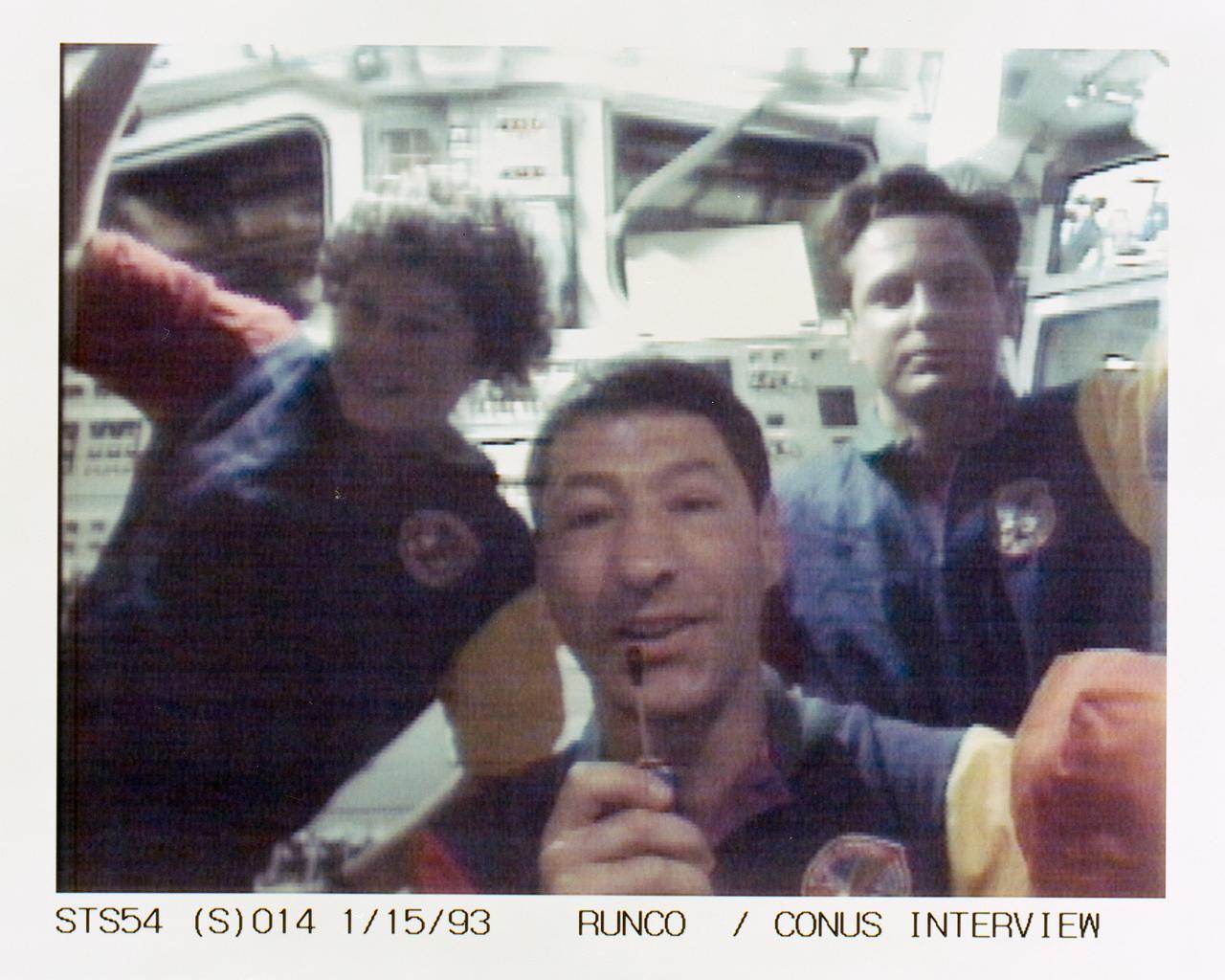
STS054-S-014 (15 Jan 1993) --- Runco talks to a radio station from the flight deck of Endeavour while, in the background, several crewmates await their turns to communicate with other stations. The scene was recorded at 13:48:45:11 GMT, Jan. 15, 1993.
STS-54 MS1 Runco talks to radio station from OV-105's aft flight deck
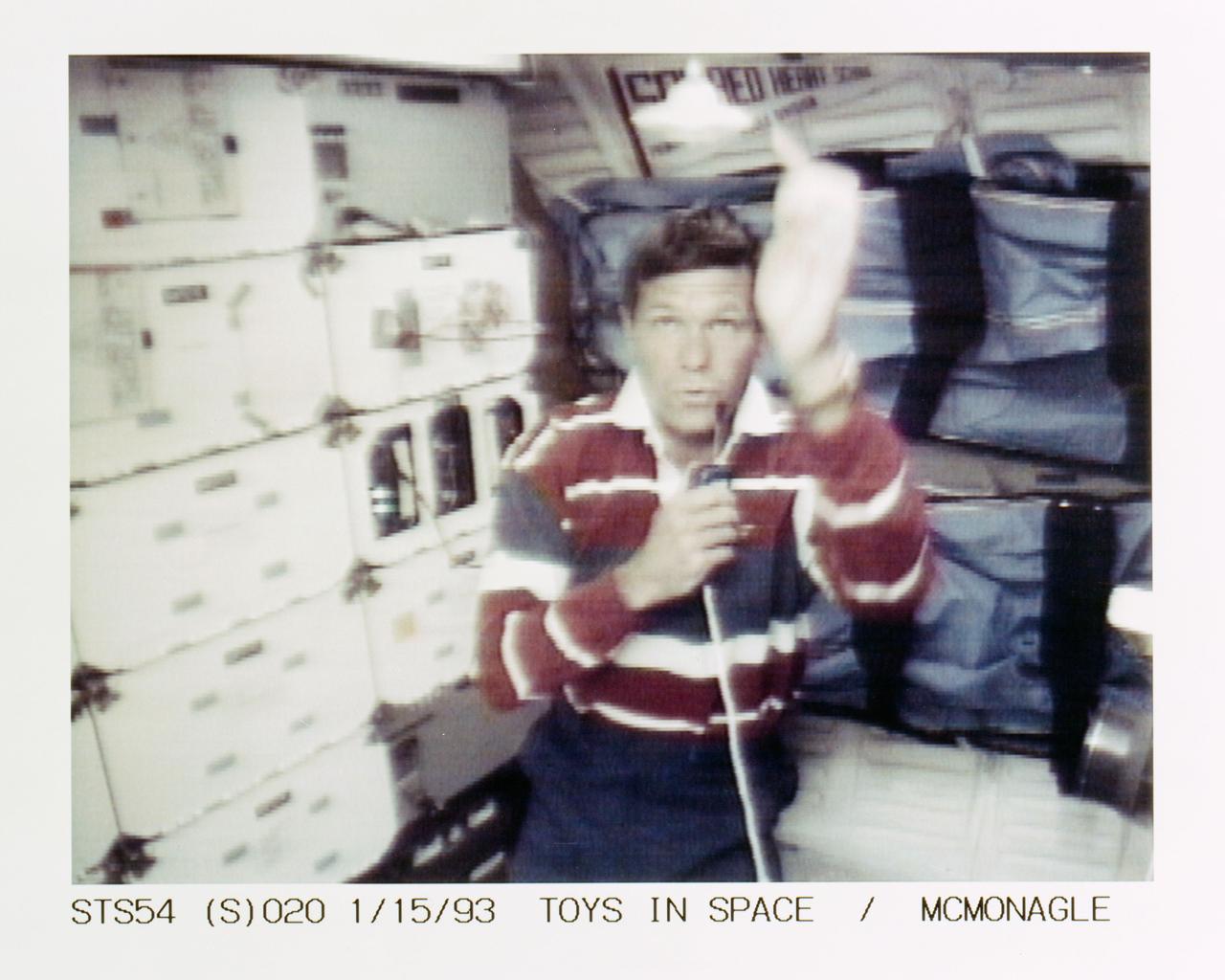
STS054-S-020 (15 Jan 1993) --- McMonagle watches as a top spins above his head on the middeck of the Earth-orbiting Endeavour.  The demonstration was part of a lengthy "physics of toys" program conducted by all five crewmembers on their third day aboard the Shuttle.  Through telephone and TV downlinks, students in four schools around the country participated in a special lesson to discover how specific toys function differently in the classroom compared to those on the Shuttle.  Students at Westwood Elementary School in Flint, Michigan -- McMonagle's hometown -- asked him questions about the several toys he demonstrated. The top demonstrates gyroscopic motion, the center of mass and angular momentum. The entire collection of toys will be videotaped for an educational program to be distributed to schools in the autumn. The scene was downlinked at 18:01:59:11 GMT, Jan. 15, 1993.
STS-54 Pilot McMonagle with DSO 802 & Physics of Toys top on OV-105's middeck
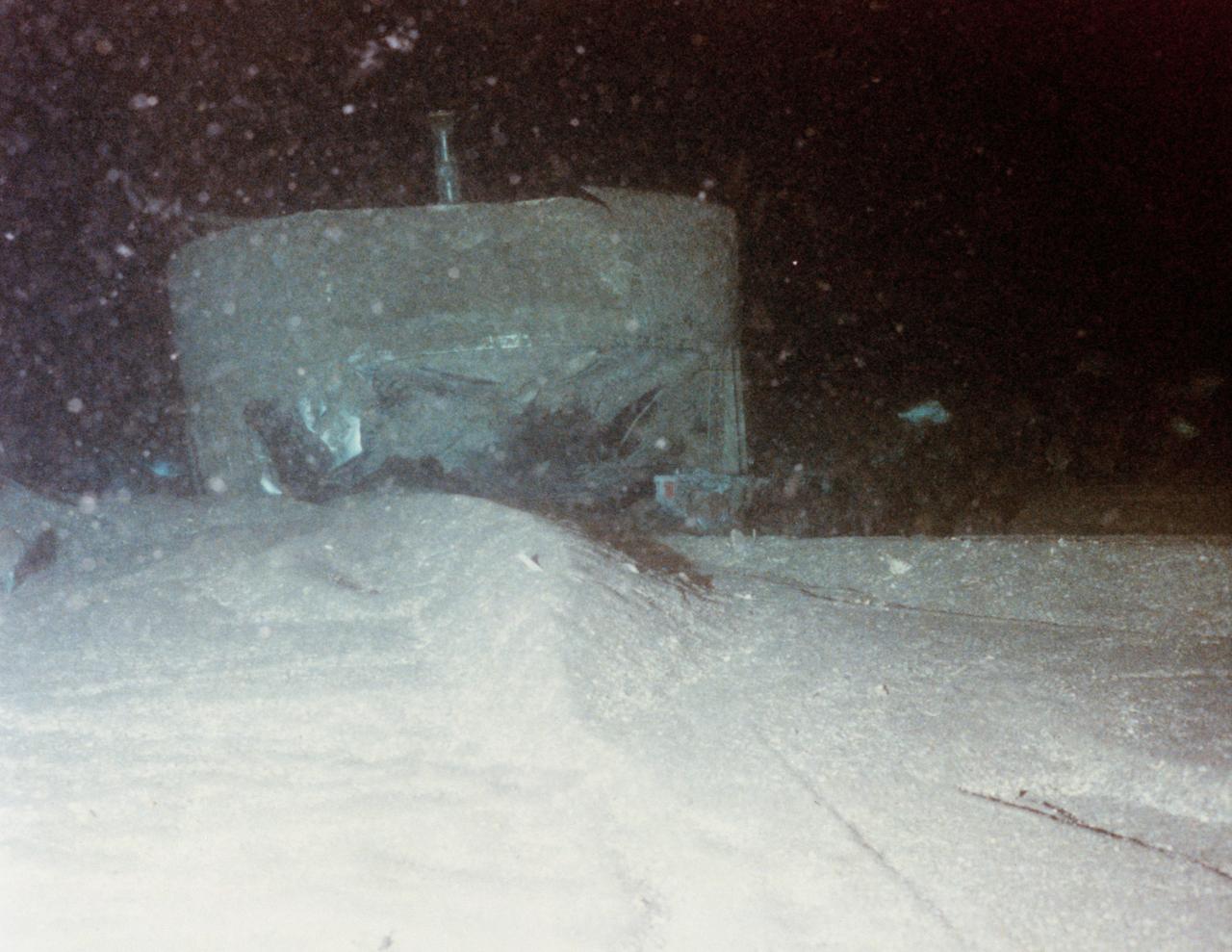
S86-29996 (16 March 1986) --- Deep Drone contact #192 dive 54.  (st)
View of the SRB recovery during STS 51-L investigation
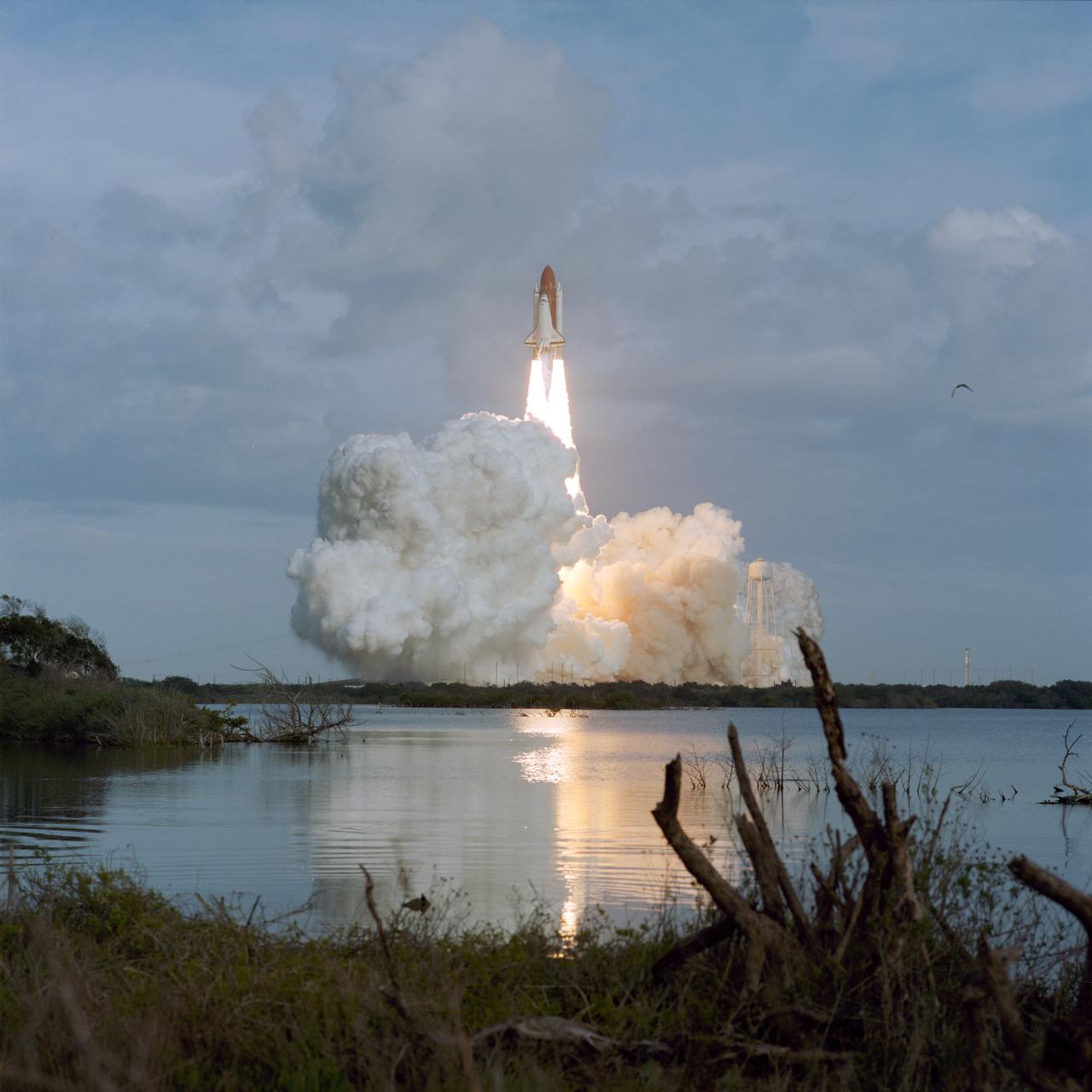
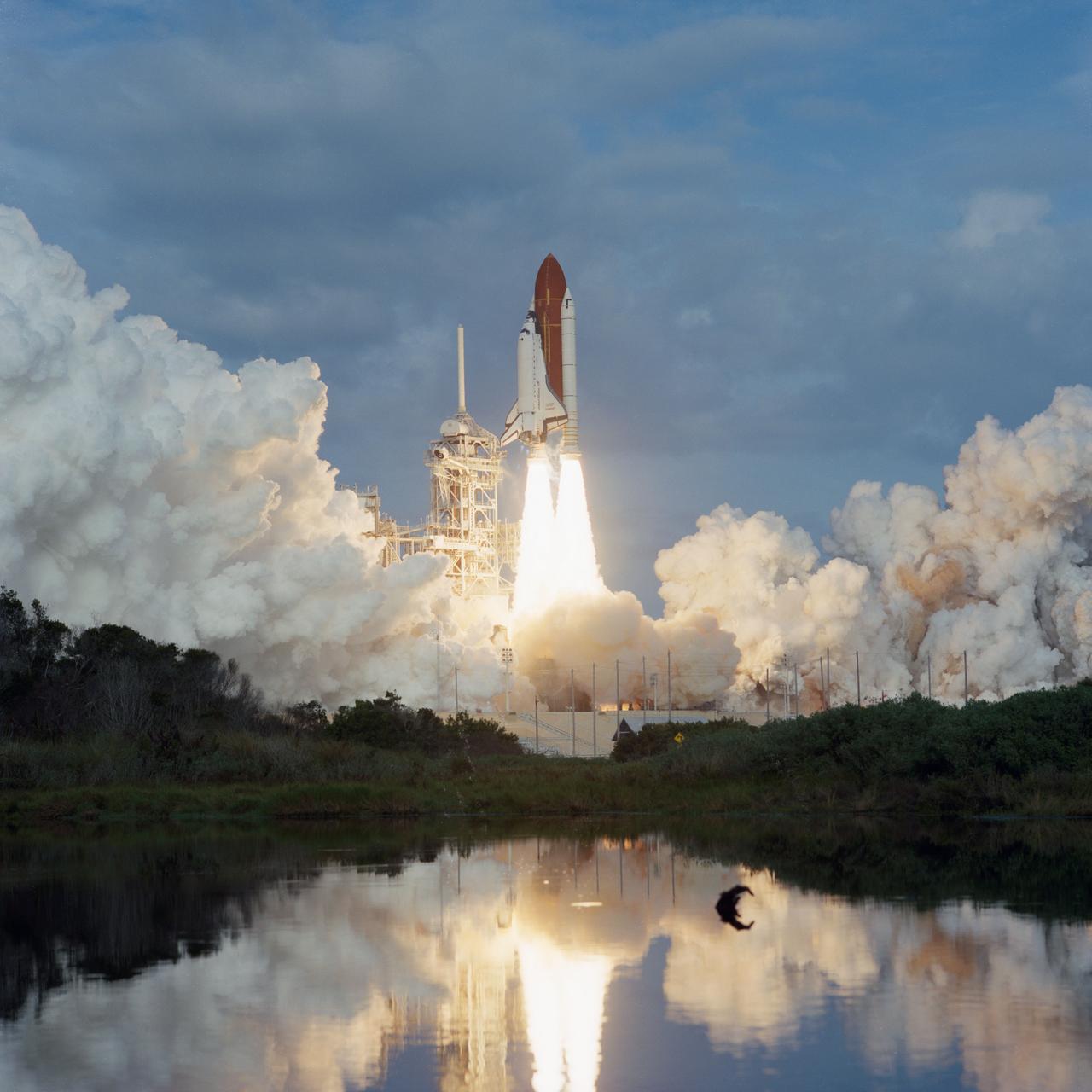
STS054-S-061 (13 Jan 1993) --- The Space Shuttle Endeavour creates a mountain of exhaust clouds as is soars off the launch pad and heads toward Earth orbit with a crew of five and the Tracking and Data Relay Satellite (TDRS-F) aboard.  Launch occurred at 8:59:30 a.m. (EST), January 13, 1993.  Onboard were John H. Casper, mission commander, Donald R. McMonagle, pilot, Gregory J. Harbaugh, Mario Runco Jr., and Susan J. Helms, mission specialists.
STS-54 Endeavour, OV-105, rises above Florida landscape during KSC liftoff
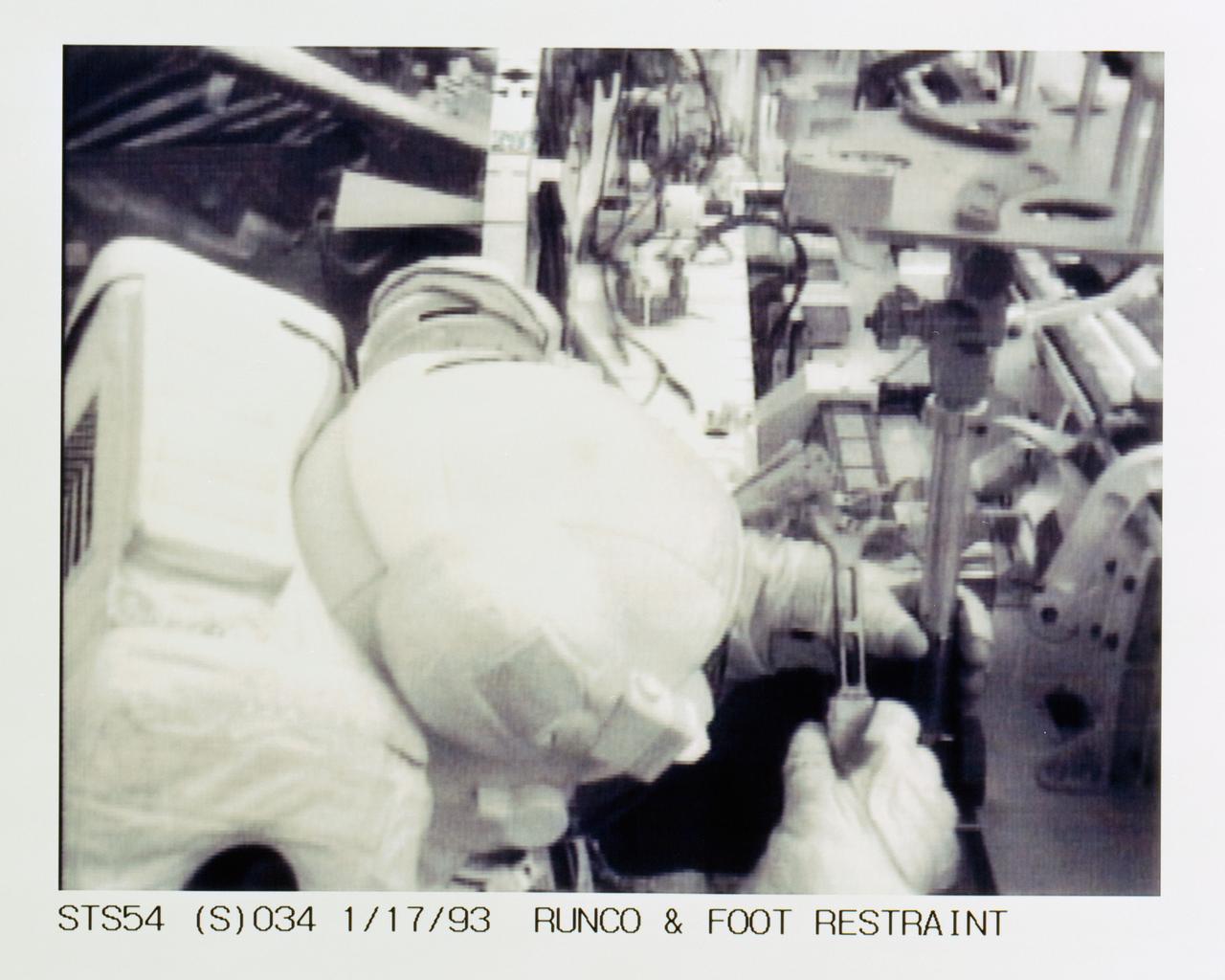
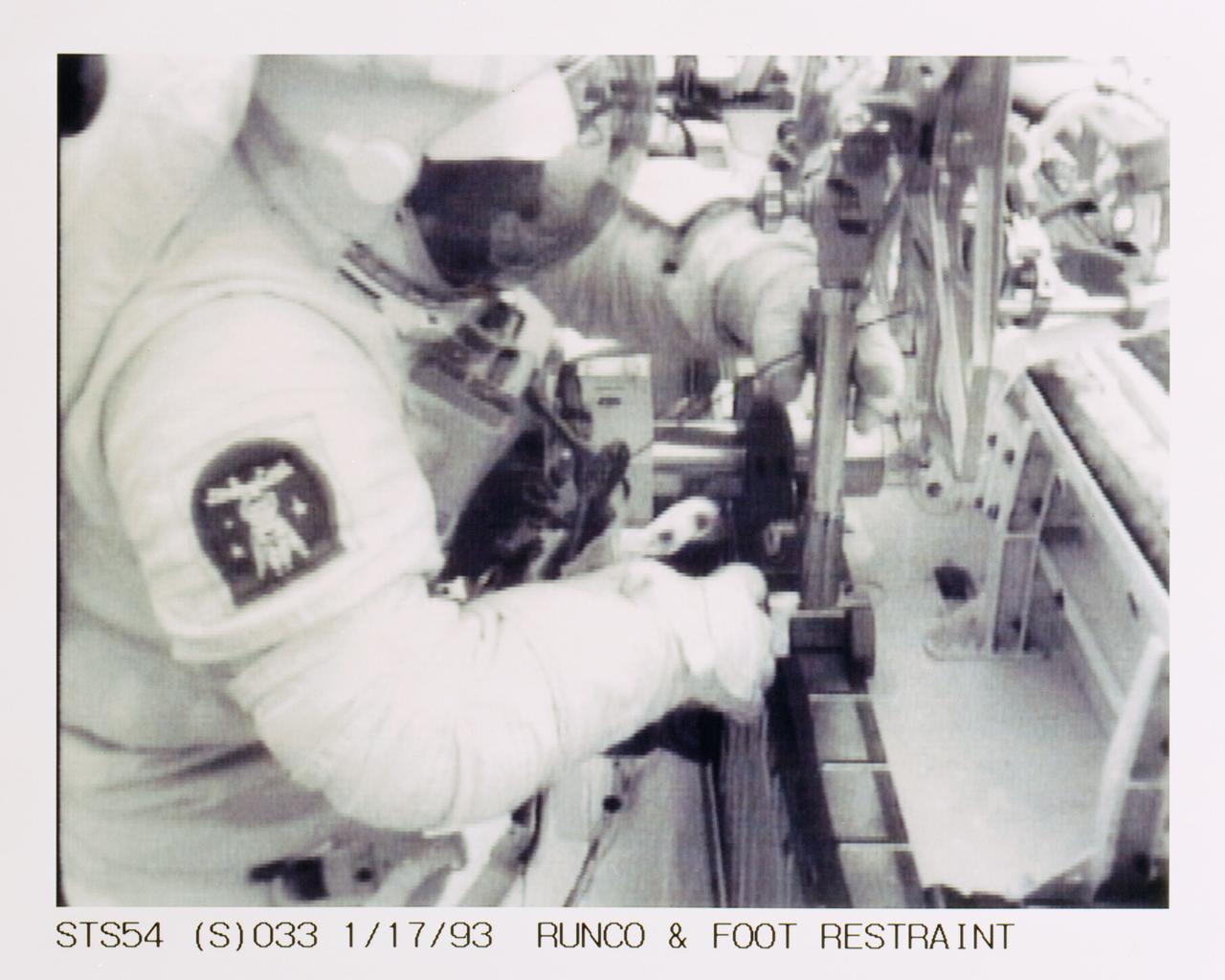
STS054-S-033 (17 Jan 1993) --- Runco works with a mobile foot restraint during extravehicular activity (EVA) in Endeavour's cargo bay.  The scene was downlinked at 11:52:04:28 GMT, Jan. 17, 1993.
STS-54 EV2 Runco attaches PFR to OV-105's PLB longeron during DTO 1210 EVA
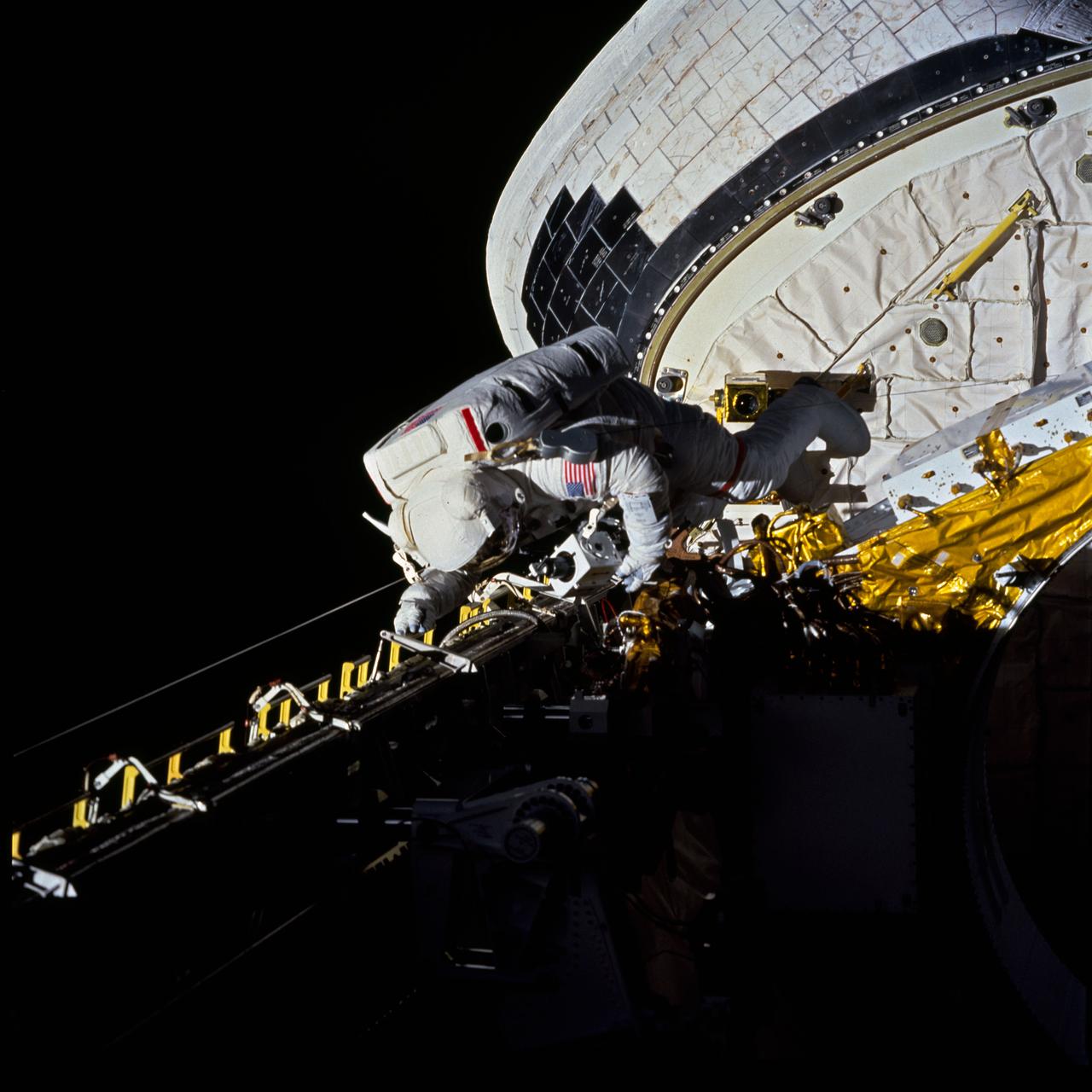
STS054-80-0N (17 Jan 1993) --- Astronaut Gregory J. Harbaugh moves along the starboard side of Endeavour's cargo bay during the four-plus hour long extravehicular activity (EVA) on January 17, 1993.  The photograph was taken with a 70mm camera from inside Endeavour's cabin by a fellow crewmember.  Three astronauts remained inside to support the spacewalk by astronauts Harbaugh and Mario Runco Jr. (out of frame).
STS-54 EV1 Harbaugh works at ASE tilt table in OV-105's payload bay
STS054-S-034 (17 Jan 1993) --- Closeup view of Runco as he works to install a mobile foot restraint during extravehicular activity (EVA) in Endeavour's cargo bay.  The scene was downlinked at 11:55:07:24 GMT, Jan. 17, 1993.
STS-54 EV2 Runco attaches PFR to OV-105's PLB longeron during DTO 1210 EVA
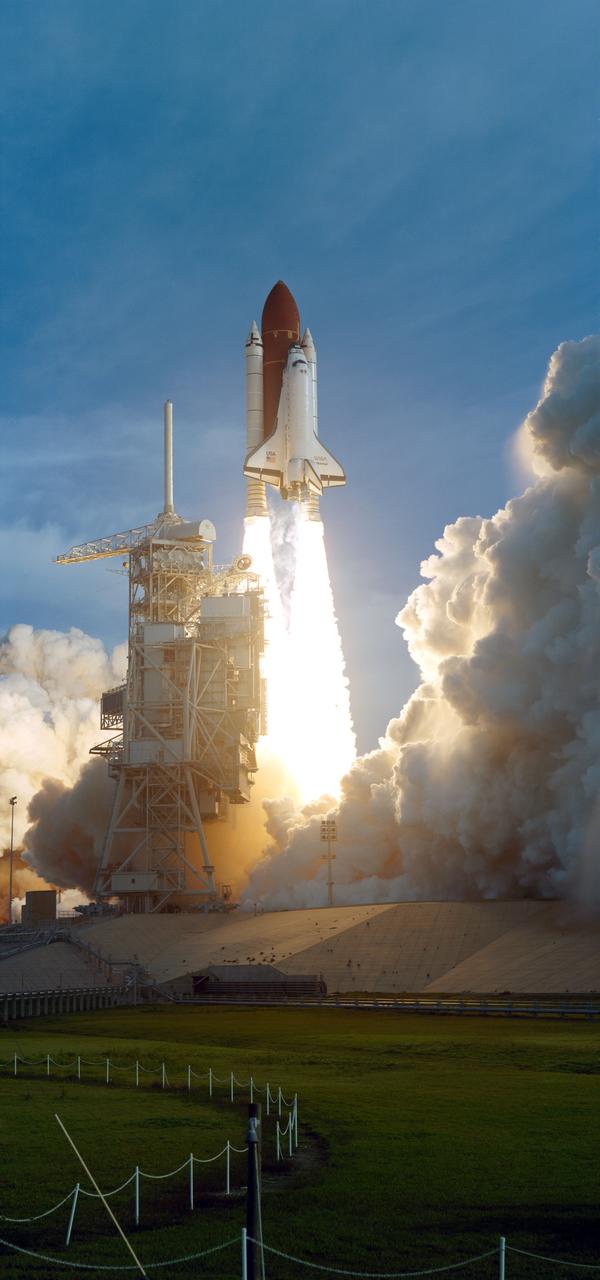
STS054-S-060 (13 Jan 1993) --- The Space Shuttle Endeavour soars off the launch pad and heads toward Earth orbit with a crew of five and the Tracking and Data Relay Satellite (TDRS-F) aboard.  Launch occurred at 8:59:30 a.m. (EST), January 13, 1993.  Onboard were John H. Casper, mission commander, Donald R. McMonagle, pilot, Gregory J. Harbaugh, Mario Runco Jr., and Susan J. Helms, mission specialists.
STS-54 Endeavour, Orbiter Vehicle (OV) 105, lifts off from KSC LC Pad 39B
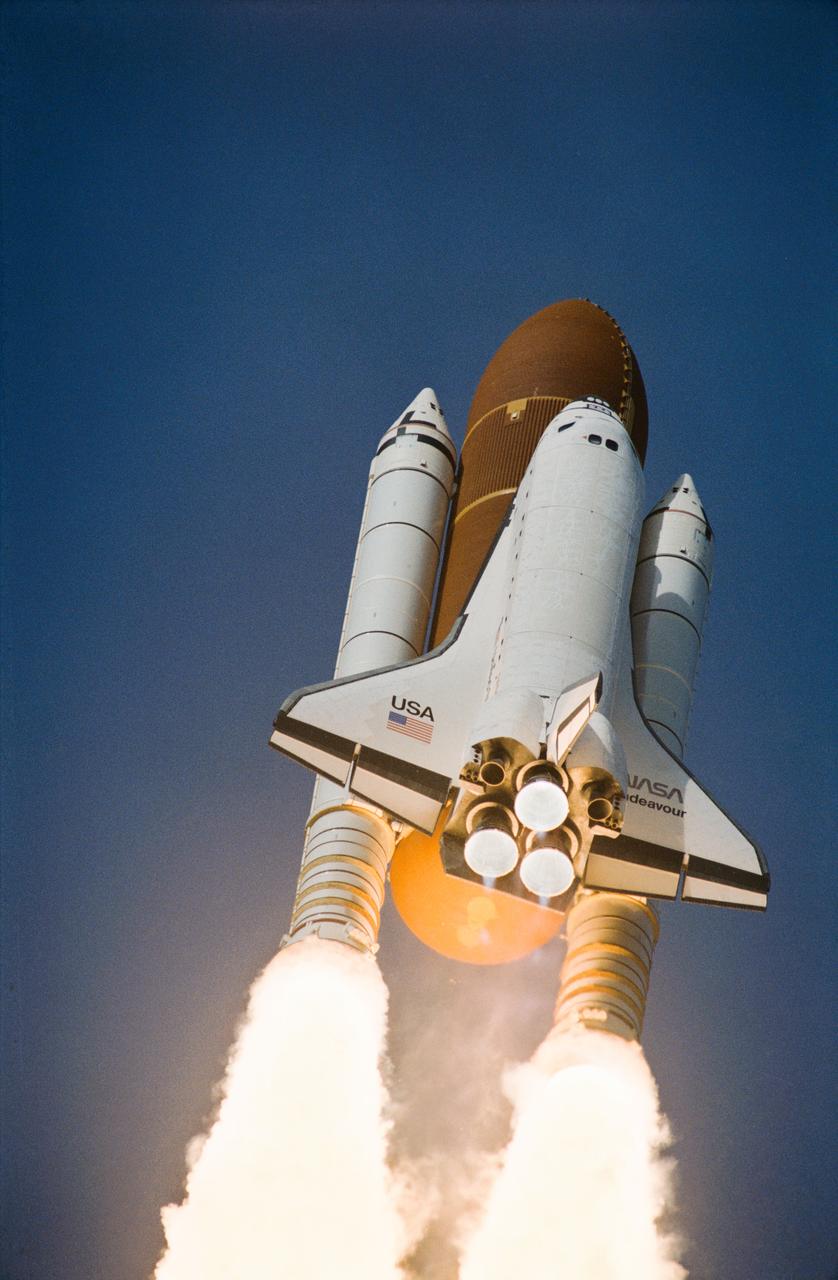
STS054-S-062 (13 Jan 1993) --- A low-angle view of the Space Shuttle Endeavour as it soars off the launch pad and heads toward Earth orbit with a crew of five and the Tracking and Data Relay Satellite (TDRS-F) aboard.  Launch occurred at 8:59:30 a.m. (EST), January 13, 1993.  Onboard were John H. Casper, mission commander, Donald R. McMonagle, pilot, Gregory J. Harbaugh, Mario Runco Jr., and Susan J. Helms, mission specialists.
STS-54 Endeavour, OV-105, soars into the morning sky after KSC liftoff
STS054-S-057 (13 Jan 1993) --- The Space Shuttle Endeavour soars off the launch pad and heads toward Earth orbit with a crew of five and the Tracking and Data Relay Satellite (TDRS-F) aboard.  Launch occurred at 8:59:30 a.m. (EST), January 13, 1993.  Onboard were John H. Casper, mission commander, Donald R. McMonagle, pilot, Gregory J. Harbaugh, Mario Runco Jr., and Susan J. Helms, mission specialists.
STS-54 Endeavour, Orbiter Vehicle (OV) 105, lifts off from KSC LC Pad 39B
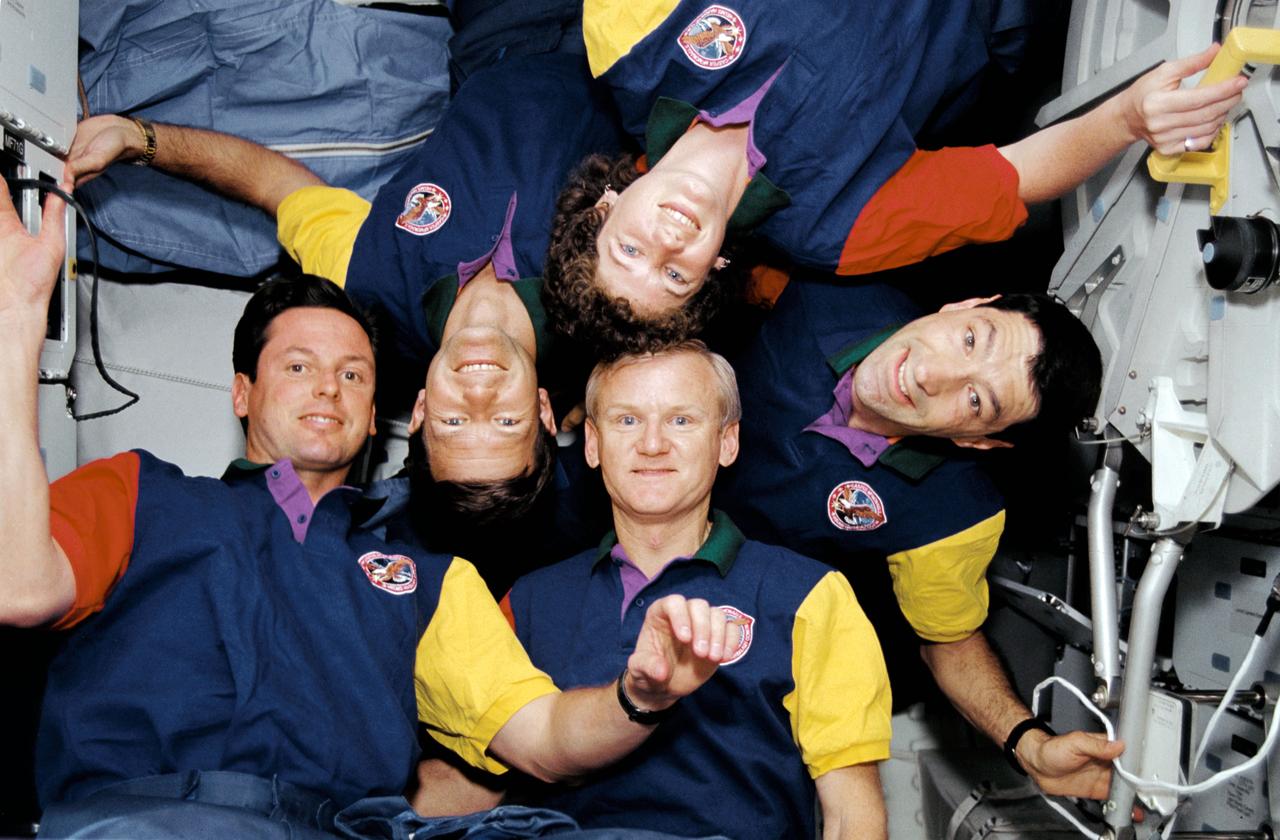
STS054-02-008 (13-19 Jan. 1993) --- The traditional inflight crew portrait has, (clockwise), Susan J. Helms, Mario Runco Jr., both mission specialists, John H. Casper, mission commander, Donald R. McMonagle, pilot, and Gregory J. Harbaugh, mission specialist.  This frame was taken with a 35mm camera aboard the Earth-orbiting Space Shuttle Endeavour during the six-day mission.
In orbit crew group portraits.
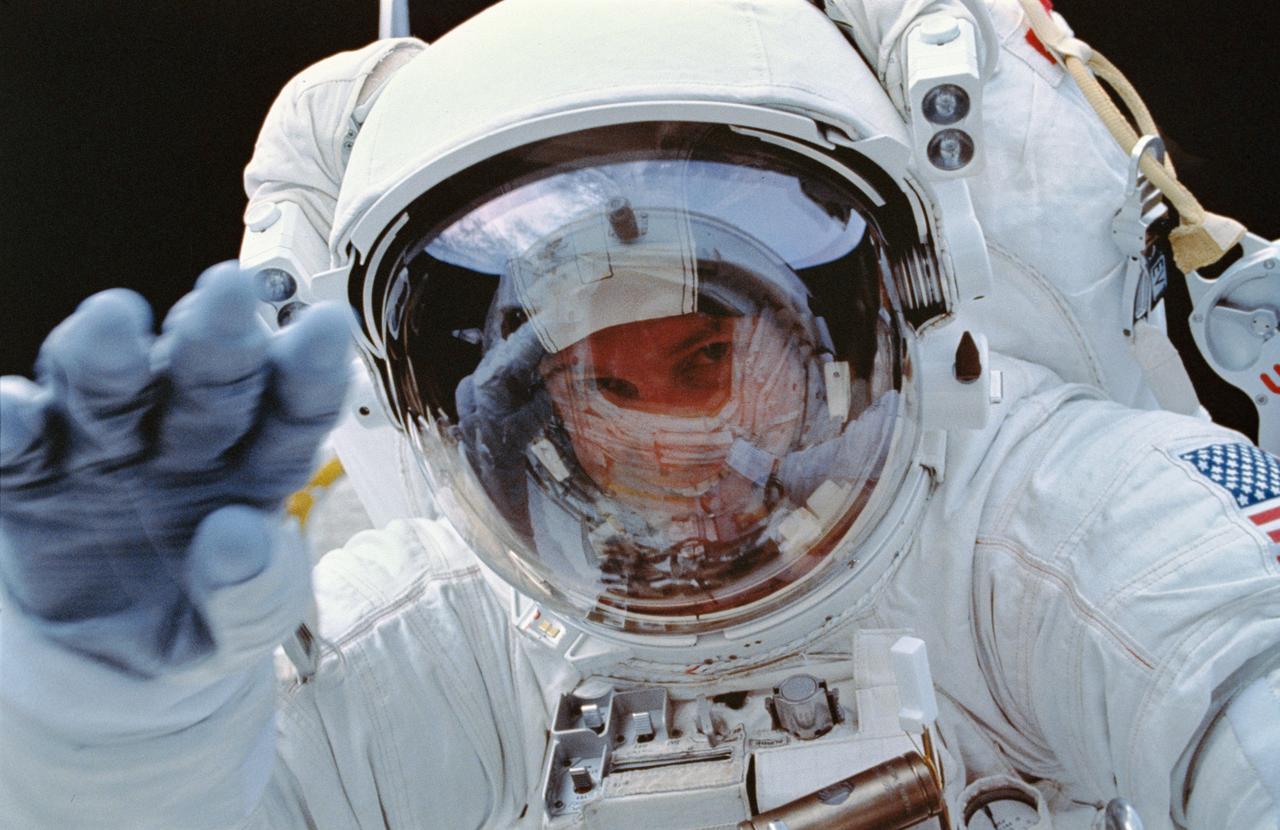
STS054-31-031 (17 Jan 1993) --- Astronaut Gregory J. Harbaugh, mission specialist, waves to fellow crew members on Endeavour's aft flight deck from the payload bay during the four-plus hours extravehicular activity (EVA).  Harbaugh was joined on the EVA by astronaut Mario Runco Jr., mission specialist.
EVA-1 Crewmember Greg Harbaugh (red stripe) working in payload bay.
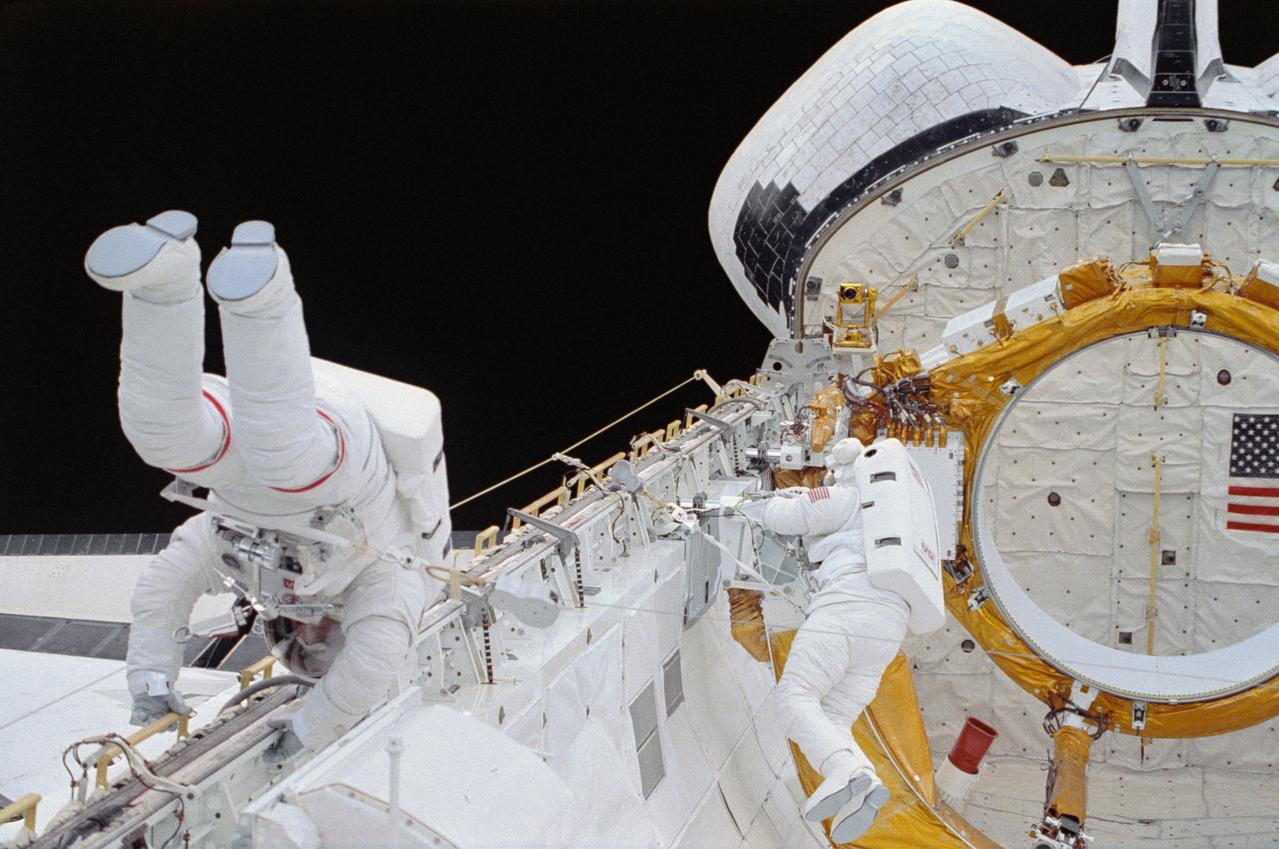
STS054-33-030 (17 Jan. 1993) --- Astronaut Gregory J. Harbaugh (left) translates along the starboard longeron in space shuttle Endeavour's cargo bay while astronaut Mario Runco Jr. prepares to work on a restraint device near the aft cargo bay firewall. The two mission specialists spent four-plus hours on the extravehicular activity (EVA) on Jan. 17, 1993. Others onboard NASA's newest shuttle for the six-day mission were astronauts John H. Casper, mission commander; Donald R. McMonagle, pilot; and Susan J. Helms, mission specialist. The photograph was taken with a 35mm camera. Photo credit: NASA
EVA Crewmembers working in the payload bay.
STS095-E-5262 (4 Nov. 1998) --- Astronaut Scott E. Parazynski, STS-95 mission specialist, with housekeeping chores on flight day seven aboard the Space Shuttle Discovery. The photo was taken with an electronic still camera (ESC) at 22:54:50 GMT, Nov. 4.
Parazynski uses shuttle vacuum cleaner on middeck
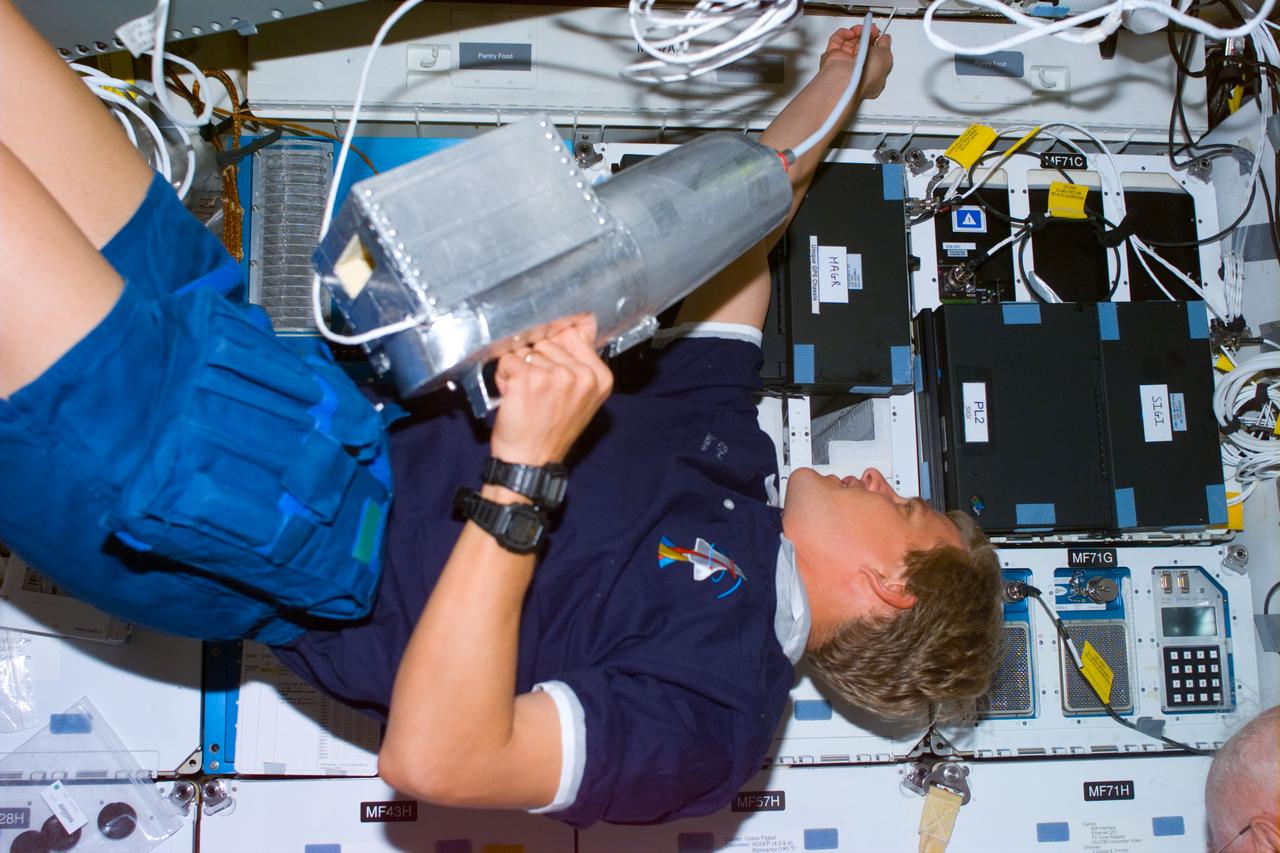
STS095-E-5260 (4 Nov. 1998) --- U.S. Sen. John H. Glenn Jr. (D.-Ohio), STS-95 payload specialist, checks out support equipment for an experiment during Flight Day 7 activity.  The photo was taken with an electronic still camera (ESC) at 22:54:15 GMT, Nov. 4.
OSTEO - Glenn on middeck
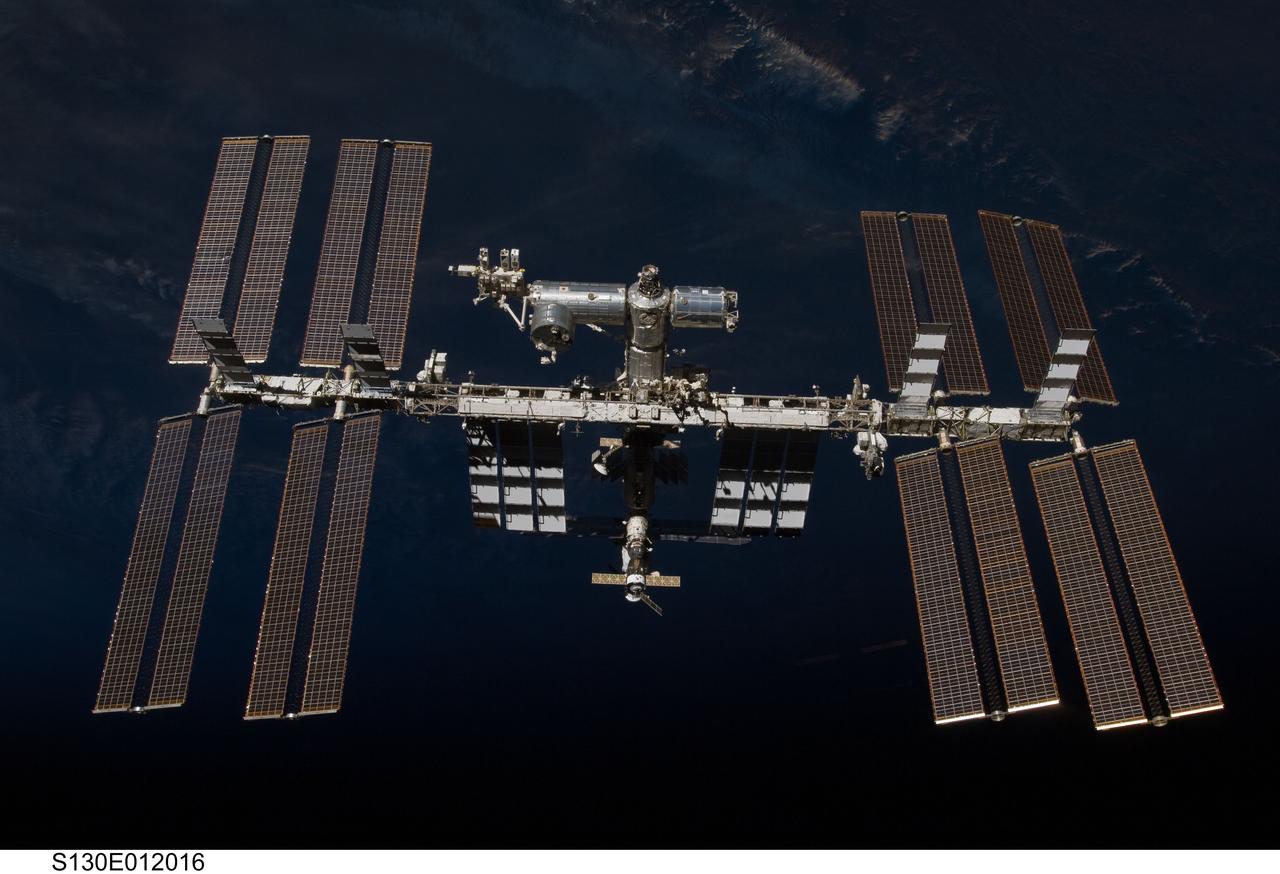
S130-E-012016 (19 Feb. 2010) --- The International Space Station is featured in this image photographed by an STS-130 crew member on space shuttle Endeavour after the station and shuttle began their post-undocking relative separation. Undocking of the two spacecraft occurred at 7:54 p.m. (EST) on Feb. 19, 2010.
Overall View of ISS After STS-130 Undocking
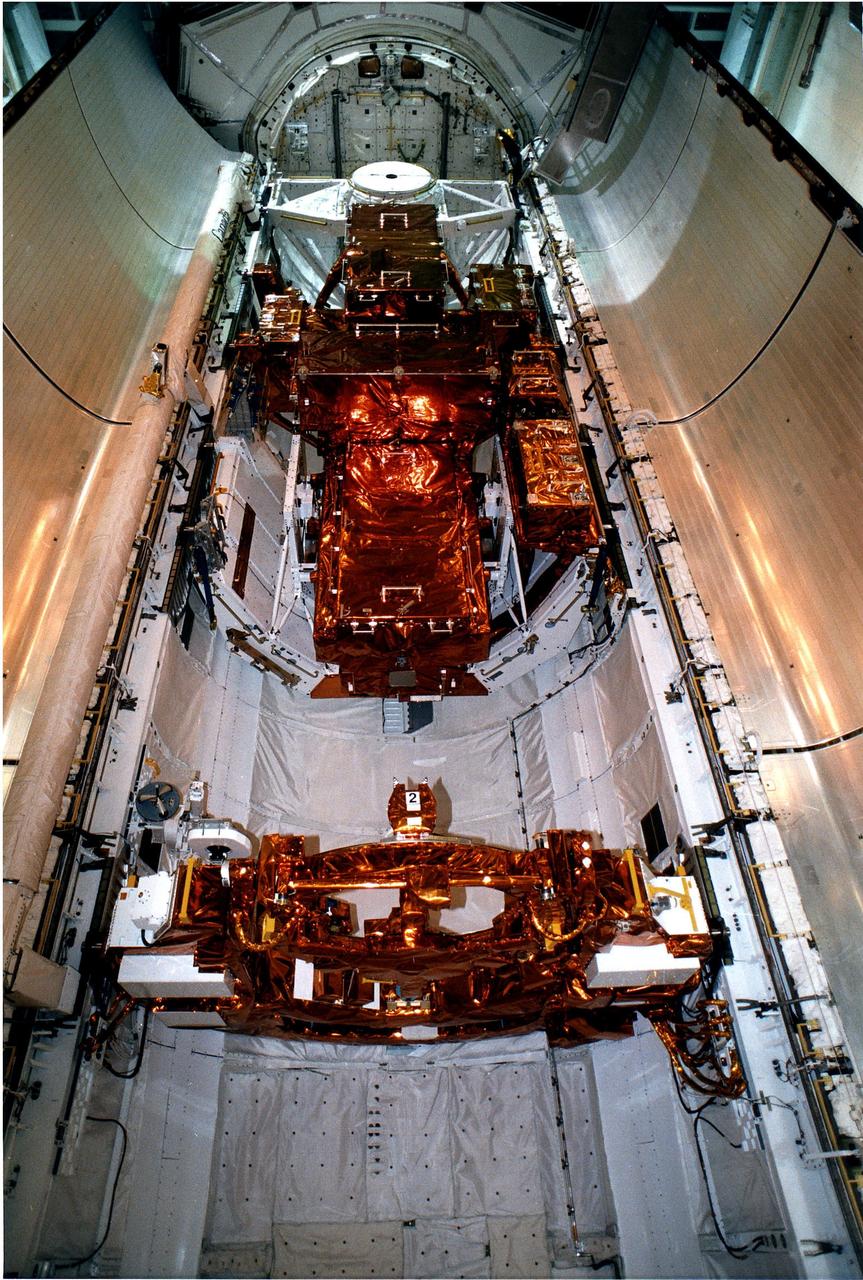
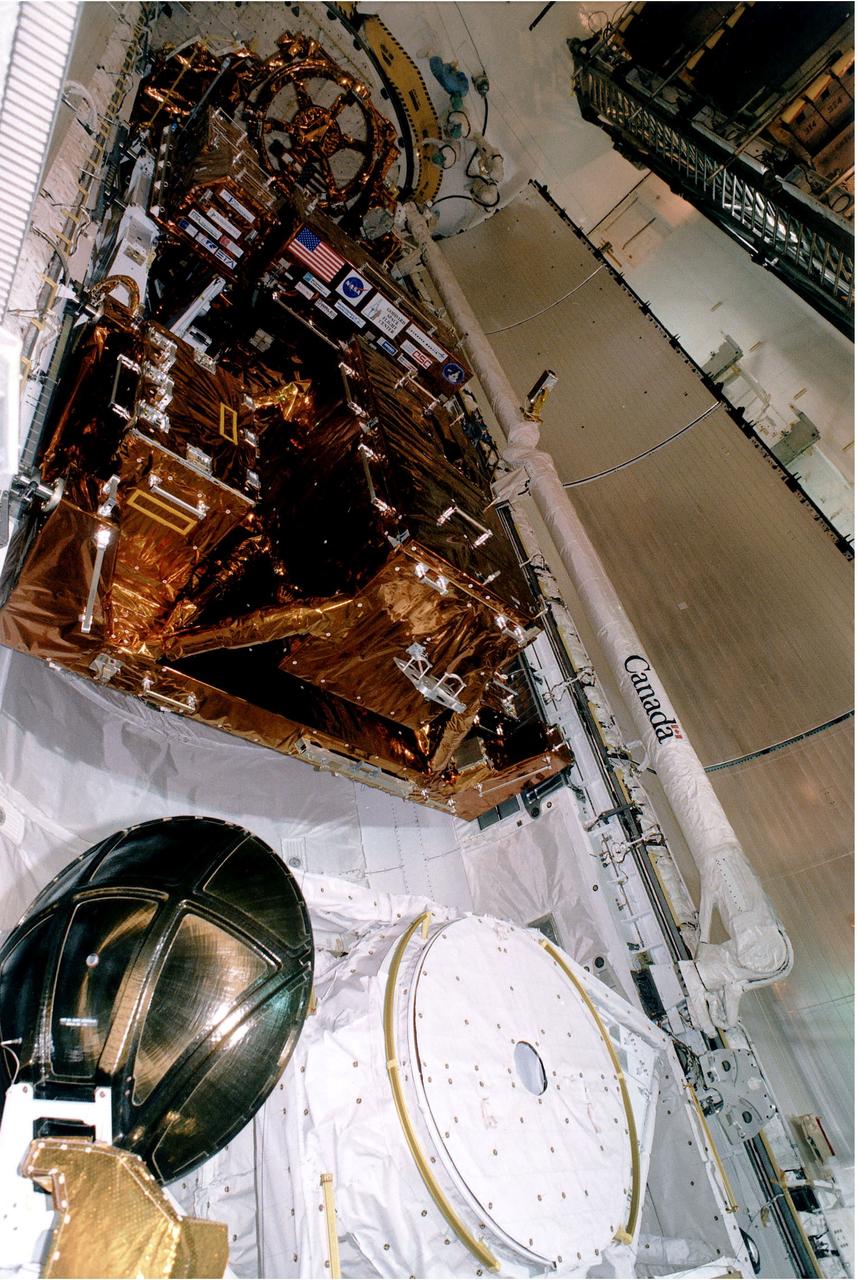
KENNEDY SPACE CENTER, FLA. -   The Payload is seen inside of the Bay just before the doors are closed for flight at Pad 39A, Kennedy Space Center, Fla.  Discovery, the orbiter for STS-82 mission, is ready for the launch of the second Hubble Space Telescope service mission.  The payload consists of the Near Infrared Camera and Multi-Object Spectrometer (NICMOS) that will be installed, Fine Guidance Sensor #1 (FGS-1), and the Space Telescope Imaging Spectrograph (STIS) to be installed.  The STS-82 will launch with a crew of seven at 3:54 a.m. EST, Feb. 11, 1997.  The launch window is 65 minutes in duration.  The Mission Commander for STS-82 is Ken Bowersox.  The purpose of the mission is to upgrade the scientific capabilities, service or replace aging components on the Telescope, and provide a reboost to the optimum altitude.
KENNEDY SPACE CENTER, FLA. - The Payload is seen inside of the Bay just before the doors are closed for flight at Pad 39A, Kennedy Space Center, Fla. Discovery, the orbiter for STS-82 mission, is ready for the launch of the second Hubble Space Telescope service mission. The payload consists of the Near Infrared Camera and Multi-Object Spectrometer (NICMOS) that will be installed, Fine Guidance Sensor #1 (FGS-1), and the Space Telescope Imaging Spectrograph (STIS) to be installed. The STS-82 will launch with a crew of seven at 3:54 a.m. EST, Feb. 11, 1997. The launch window is 65 minutes in duration. The Mission Commander for STS-82 is Ken Bowersox. The purpose of the mission is to upgrade the scientific capabilities, service or replace aging components on the Telescope, and provide a reboost to the optimum altitude.
KENNEDY SPACE CENTER, FLA. -  The Payload is seen inside of the Bay just before the doors are closed for flight at KSC's Launch Pad 39A.   Discovery, the orbiter for the STS-82 mission, is ready for the launch of the second Hubble Space Telescope service mission.  The payload consists of the Near Infrared Camera and Multi-Object Spectrometer (NICMOS) that will be installed, Fine Guidance Sensor #1 (FGS-1), and the Space Telescope Imaging Spectrograph (STIS) to be installed. The STS-82 will launch with a crew of seven at 3:54 a.m. EST, Feb. 11, 1997. The launch window is 65 minutes in duration. The Mission Commander for STS-82 is Ken Bowersox. The purpose of the mission is to upgrade the scientific capabilities, service or replace aging components on the Telescope, and provide a reboost to the optimum altitude.
KENNEDY SPACE CENTER, FLA. - The Payload is seen inside of the Bay just before the doors are closed for flight at KSC's Launch Pad 39A. Discovery, the orbiter for the STS-82 mission, is ready for the launch of the second Hubble Space Telescope service mission. The payload consists of the Near Infrared Camera and Multi-Object Spectrometer (NICMOS) that will be installed, Fine Guidance Sensor #1 (FGS-1), and the Space Telescope Imaging Spectrograph (STIS) to be installed. The STS-82 will launch with a crew of seven at 3:54 a.m. EST, Feb. 11, 1997. The launch window is 65 minutes in duration. The Mission Commander for STS-82 is Ken Bowersox. The purpose of the mission is to upgrade the scientific capabilities, service or replace aging components on the Telescope, and provide a reboost to the optimum altitude.
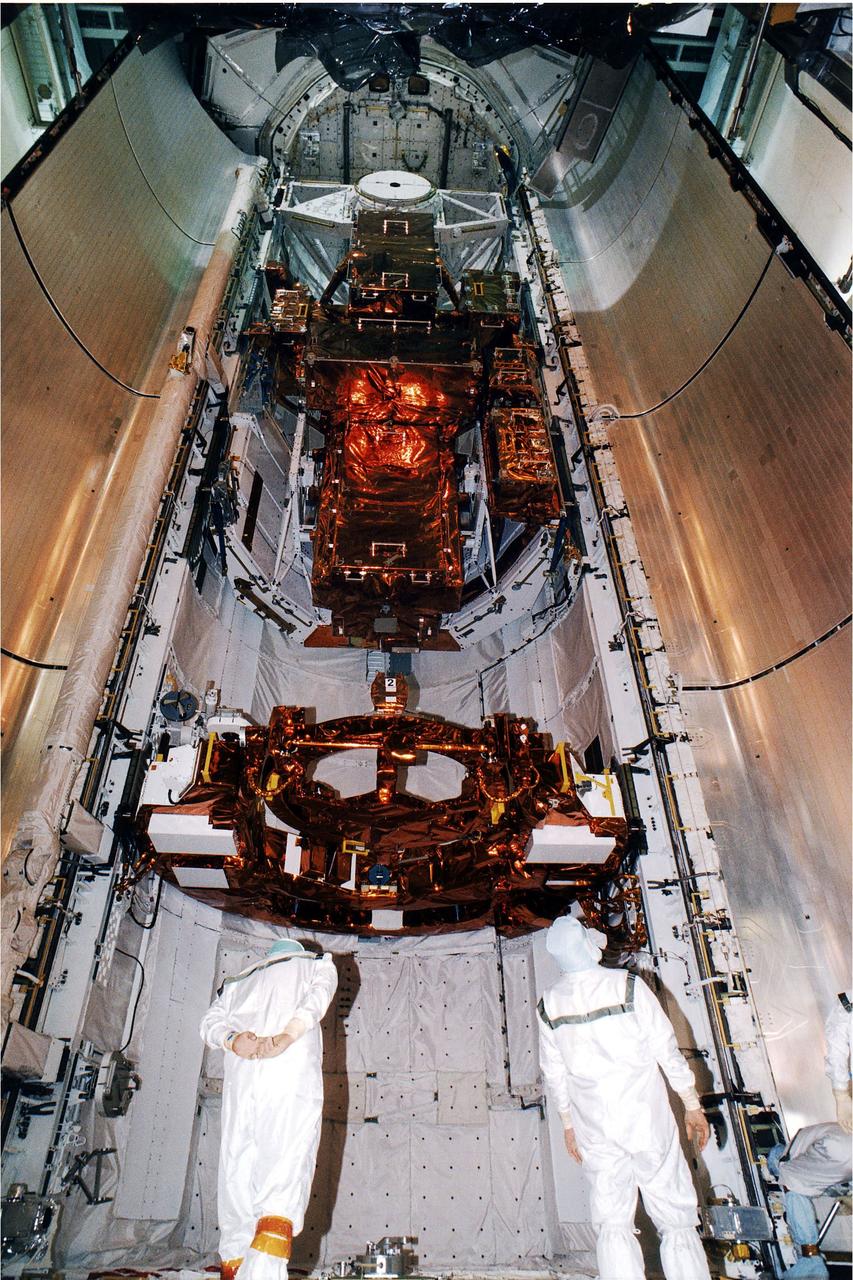
KENNEDY SPACE CENTER, FLA. -   At the KSC Launch Pad 39A, two members of the payload closeout crew check equipment as the doors are just about ready to be closed.  The Payload inside the bay of Discovery, the orbiter for the STS-82 mission, is ready for the launch of the second Hubble Space Telescope service mission.  The payload consists of the Near Infrared Camera and Multi-Object Spectrometer (NICMOS) that will be installed, Fine Guidance Sensor #1 (FGS-1), and the Space Telescope Imaging Spectrograph (STIS) to be installed. The STS-82 will launch with a crew of seven at 3:54 a.m. EST, Feb. 11, 1997. The launch window is 65 minutes in duration. The Mission Commander for STS-82 is Ken Bowersox. The purpose of the mission is to upgrade the scientific capabilities, service or replace aging components on the Telescope and provide a reboost to the optimum altitude.
KENNEDY SPACE CENTER, FLA. - At the KSC Launch Pad 39A, two members of the payload closeout crew check equipment as the doors are just about ready to be closed. The Payload inside the bay of Discovery, the orbiter for the STS-82 mission, is ready for the launch of the second Hubble Space Telescope service mission. The payload consists of the Near Infrared Camera and Multi-Object Spectrometer (NICMOS) that will be installed, Fine Guidance Sensor #1 (FGS-1), and the Space Telescope Imaging Spectrograph (STIS) to be installed. The STS-82 will launch with a crew of seven at 3:54 a.m. EST, Feb. 11, 1997. The launch window is 65 minutes in duration. The Mission Commander for STS-82 is Ken Bowersox. The purpose of the mission is to upgrade the scientific capabilities, service or replace aging components on the Telescope and provide a reboost to the optimum altitude.
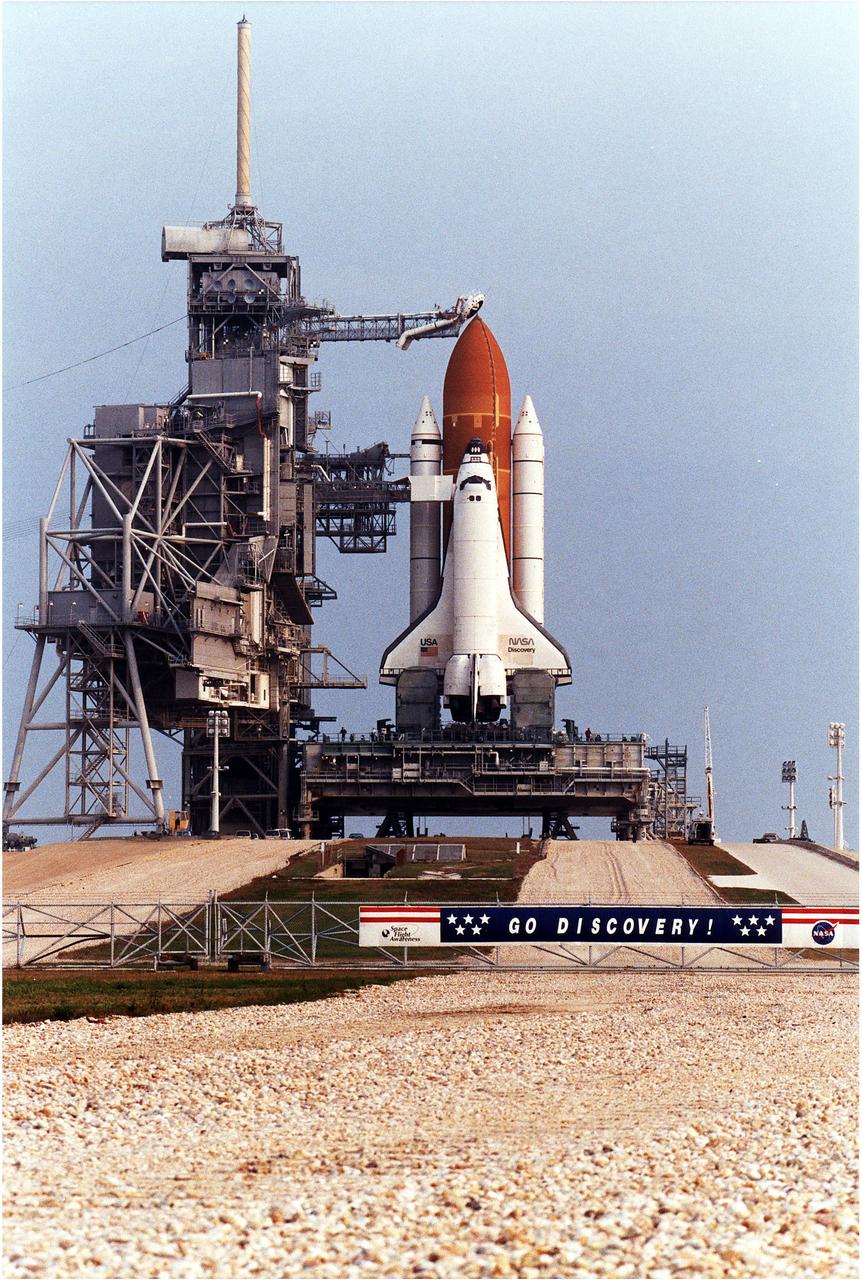
KENNEDY SPACE CENTER, FLA. -  The Rotating Service Structure has been retracted at KSC's Launch Pad 39A.   Discovery, the orbiter for the STS-82 mission, is ready for the launch of the second Hubble Space Telescope service mission.  The payload consists of the Near Infrared Camera and Multi-Object Spectrometer (NICMOS) that will be installed, Fine Guidance Sensor #1 (FGS-1), and the Space Telescope Imaging Spectrograph (STIS) to be installed. The STS-82 will launch with a crew of seven at 3:54 a.m. EST, Feb. 11, 1997. The launch window is 65 minutes in duration. The Mission Commander for STS-82 is Ken Bowersox. The purpose of the mission is to upgrade the scientific capabilities, service or replace aging components on the Telescope, and provide a reboost to the optimum altitude.
KENNEDY SPACE CENTER, FLA. - The Rotating Service Structure has been retracted at KSC's Launch Pad 39A. Discovery, the orbiter for the STS-82 mission, is ready for the launch of the second Hubble Space Telescope service mission. The payload consists of the Near Infrared Camera and Multi-Object Spectrometer (NICMOS) that will be installed, Fine Guidance Sensor #1 (FGS-1), and the Space Telescope Imaging Spectrograph (STIS) to be installed. The STS-82 will launch with a crew of seven at 3:54 a.m. EST, Feb. 11, 1997. The launch window is 65 minutes in duration. The Mission Commander for STS-82 is Ken Bowersox. The purpose of the mission is to upgrade the scientific capabilities, service or replace aging components on the Telescope, and provide a reboost to the optimum altitude.
KENNEDY SPACE CENTER, FLA. -  The White Room is seen at the upper left where the astronauts enter the Space Shuttle for flight.  The Rotating Service Structure has been retracted at KSC's Launch Pad 39A.   Discovery, the orbiter for the STS-82 mission, is ready for the launch of the second Hubble Space Telescope service mission.  The payload consists of the Near Infrared Camera and Multi-Object Spectrometer (NICMOS) that will be installed, Fine Guidance Sensor #1 (FGS-1), and the Space Telescope Imaging Spectrograph (STIS) to be installed. The STS-82 will launch with a crew of seven at 3:54 a.m. EST, Feb. 11, 1997. The launch window is 65 minutes in duration. The Mission Commander for STS-82 is Ken Bowersox. The purpose of the mission is to upgrade the scientific capabilities, service or replace aging components on the Telescope, and provide a reboost to the optimum altitude.
KENNEDY SPACE CENTER, FLA. - The White Room is seen at the upper left where the astronauts enter the Space Shuttle for flight. The Rotating Service Structure has been retracted at KSC's Launch Pad 39A. Discovery, the orbiter for the STS-82 mission, is ready for the launch of the second Hubble Space Telescope service mission. The payload consists of the Near Infrared Camera and Multi-Object Spectrometer (NICMOS) that will be installed, Fine Guidance Sensor #1 (FGS-1), and the Space Telescope Imaging Spectrograph (STIS) to be installed. The STS-82 will launch with a crew of seven at 3:54 a.m. EST, Feb. 11, 1997. The launch window is 65 minutes in duration. The Mission Commander for STS-82 is Ken Bowersox. The purpose of the mission is to upgrade the scientific capabilities, service or replace aging components on the Telescope, and provide a reboost to the optimum altitude.
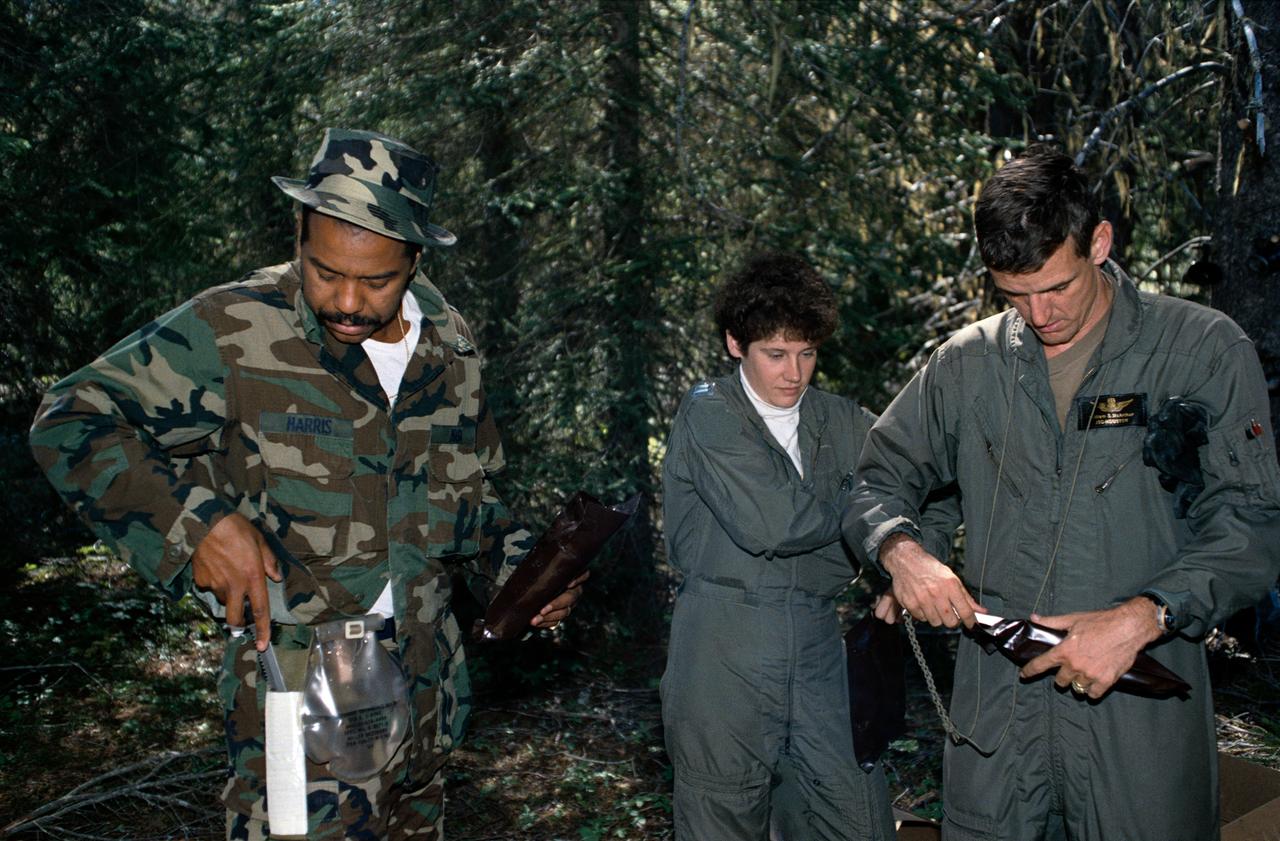
1990 Group 13 Astronaut Candidates (ASCANs) (left to right) Bernard J. Harris, Jr, Susan J. Helms, and William S. McArthur, Jr open dehydrated food packages during wilderness survival training at Fairchild Air Force Base (AFB) in Spokane, Washington. The training was conducted in the mountain forests of Washington from 08-26-90 through 08-30-90.
ASCANs Harris, Helms, and McArthur during survival training at Fairchild AFB
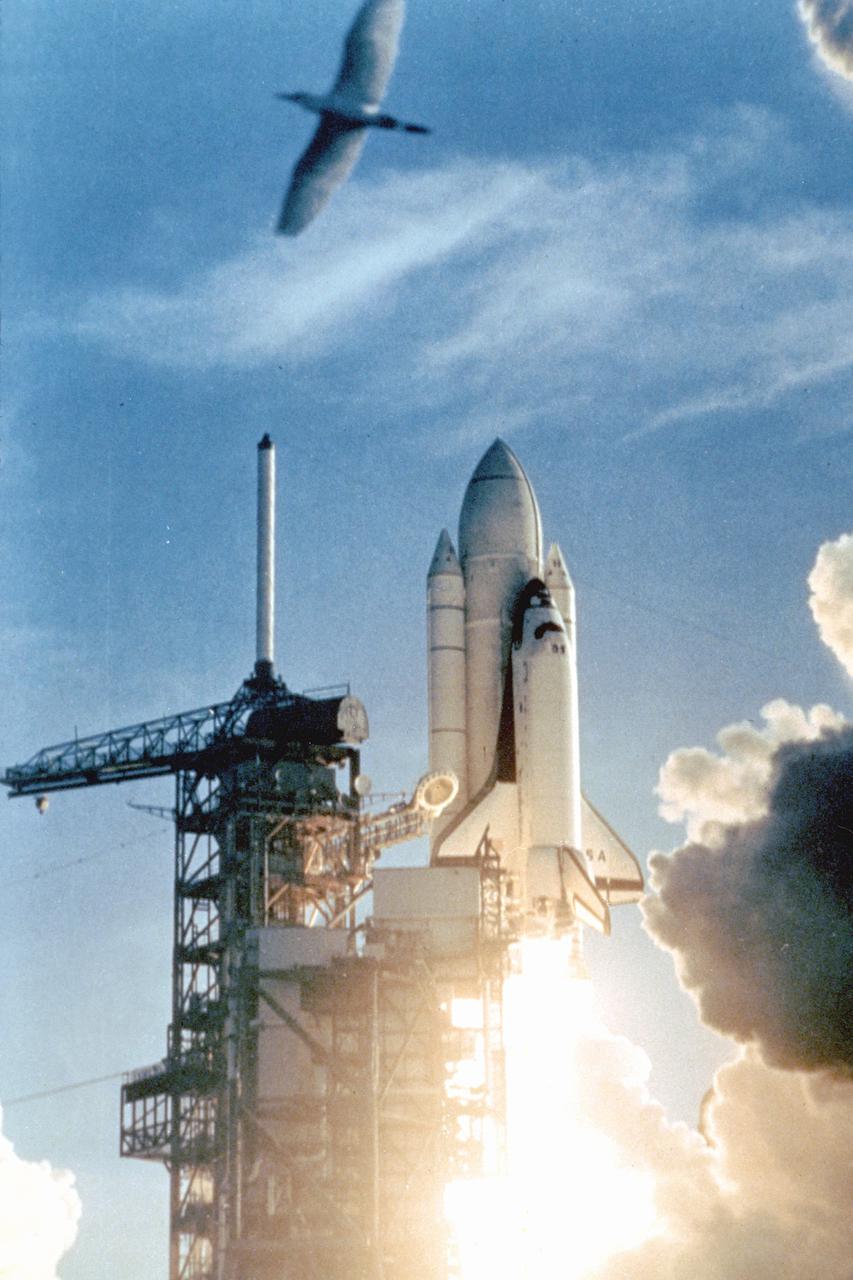
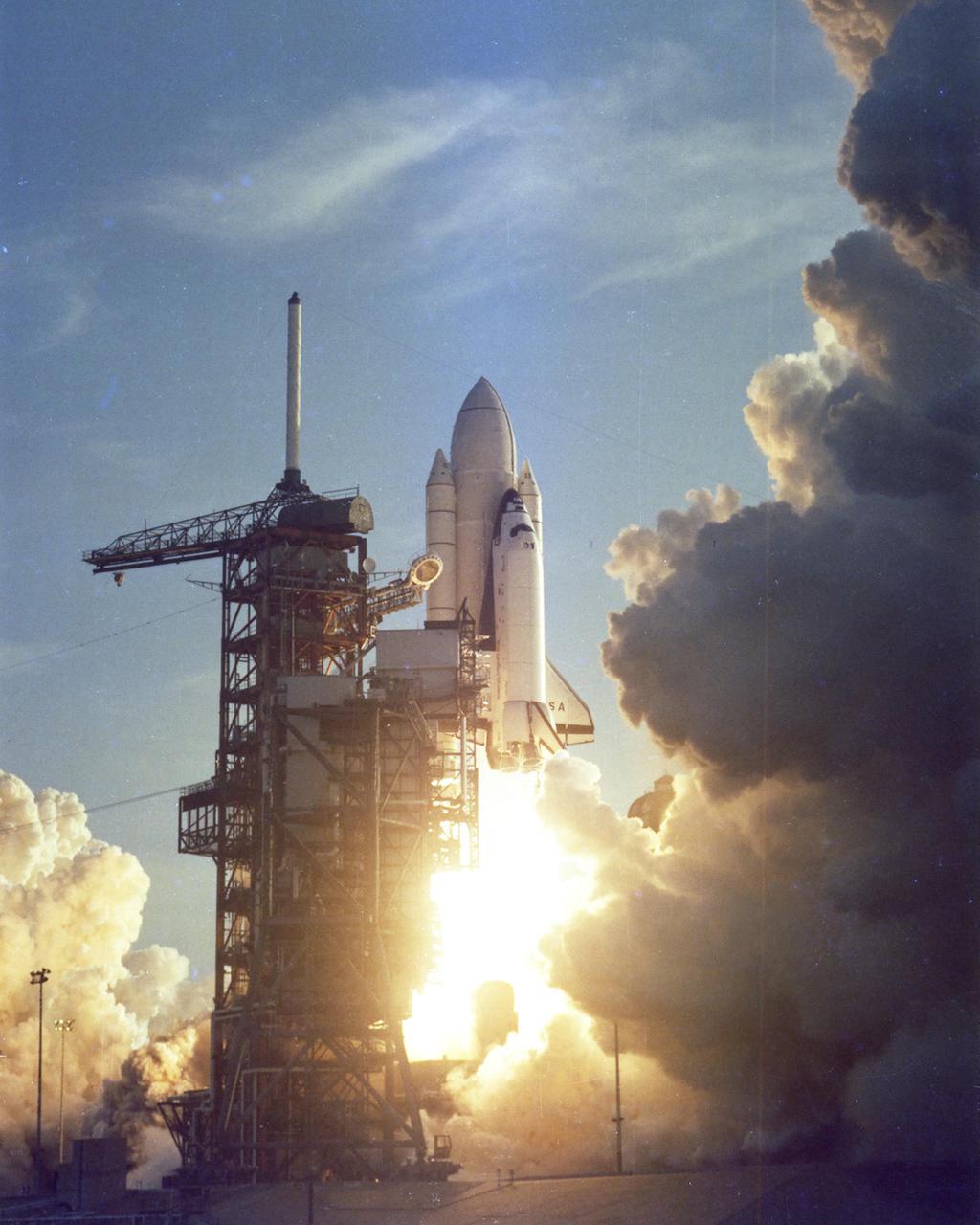
KENNEDY SPACE CENTER, FLA. -- STS-1: Columbia.  The Space Shuttle rises majestically above Launch Complex 39’s Pad A on the first leg of its maiden journey into space.  On board for the historic flight are Astronauts John Young and Bob Crippen, scheduled to spend nearly 54 hours in space on this first shakedown test of America’s new reusable Space Transportation System (STS).  The Sunday morning liftoff came a few seconds after 7 a.m. and marked the dawn of a new era in spaceflight.
KSC-81PC-0373
S130-E-011972 (19 Feb. 2010) --- Surrounded by the blackness of space, the International Space Station is featured in this image photographed by an STS-130 crew member on space shuttle Endeavour after the station and shuttle began their post-undocking relative separation. Undocking of the two spacecraft occurred at 7:54 p.m. (EST) on Feb. 19, 2010. A partial shadow of Endeavour is visible on the solar array wing panels at lower right.
Overall View of ISS After STS-130 Undocking
S128-E-006619 (30 Aug. 2009) --- Backdropped by the blackness of space, the International Space Station is featured in this image photographed by an STS-128 crew member as Space Shuttle Discovery and the station approach each other during rendezvous and docking activities on flight day three. Docking occurred at 7:54 p.m. (CDT) on Aug. 30, 2009.
ISS during STS-128 Approach
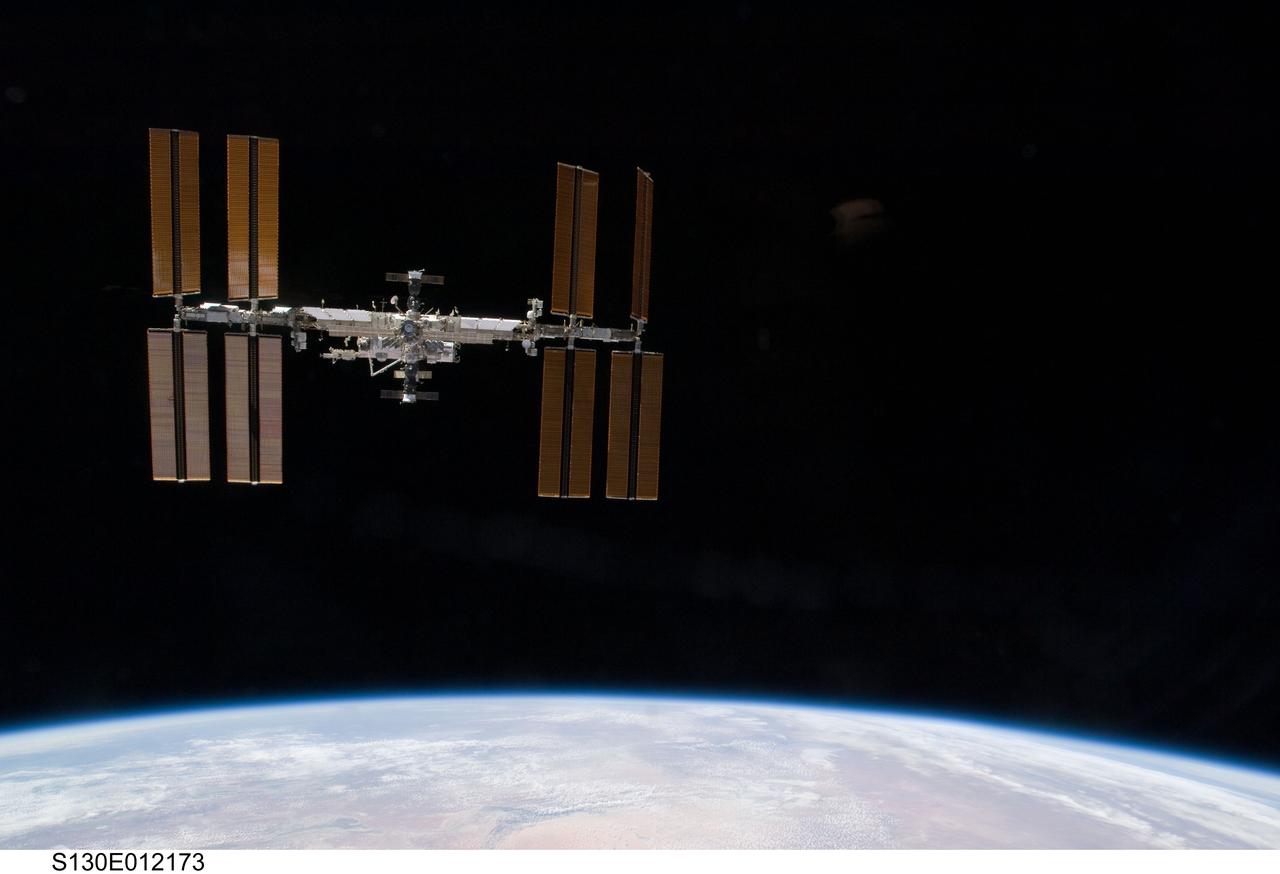
S130-E-012173 (19 Feb. 2010) --- Backdropped by Earth?s horizon and the blackness of space, the International Space Station is featured in this image photographed by an STS-130 crew member on space shuttle Endeavour after the station and shuttle began their post-undocking relative separation. Undocking of the two spacecraft occurred at 7:54 p.m. (EST) on Feb. 19, 2010.
Overall View of ISS After STS-130 Undocking
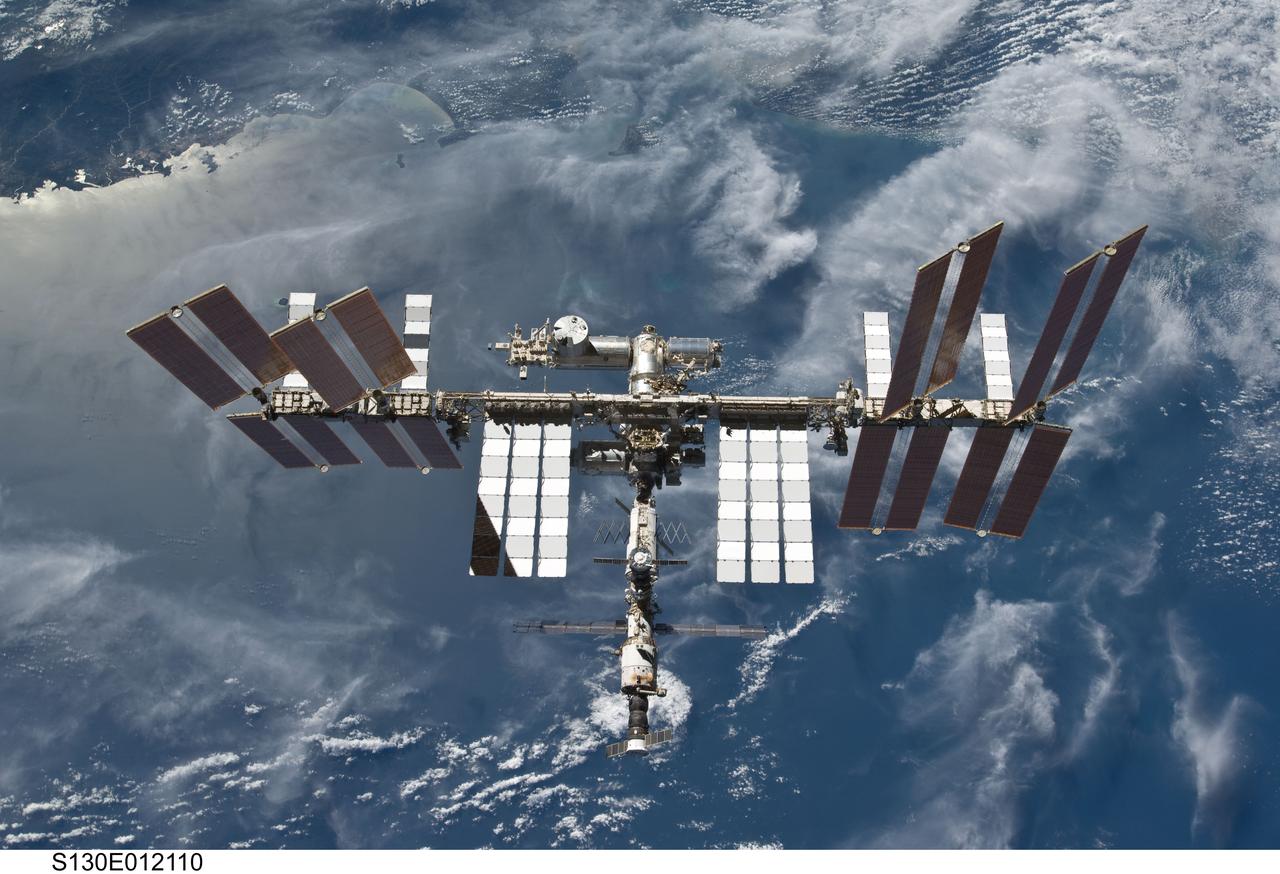
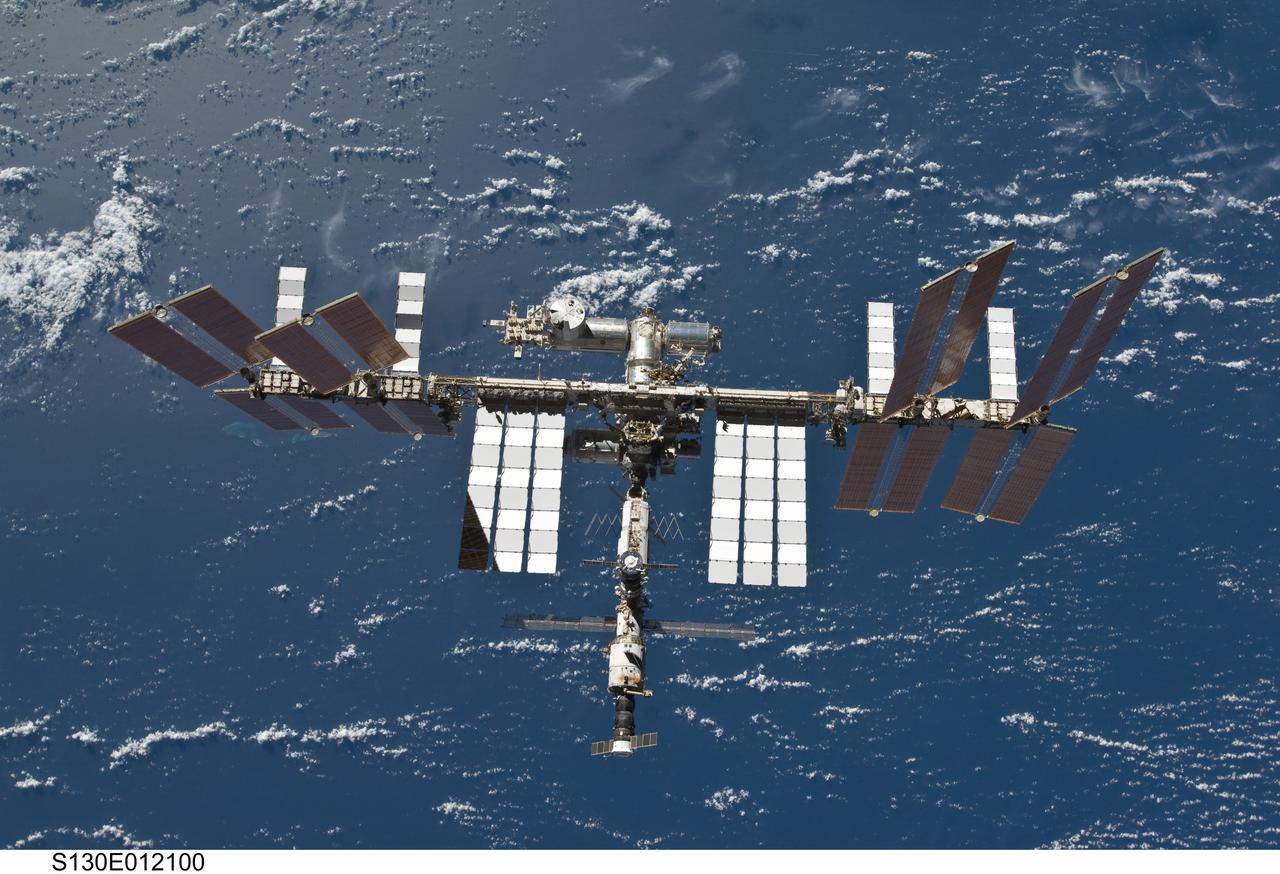
S130-E-012100 (19 Feb. 2010) --- Backdropped by a blue and white part of Earth, the International Space Station is featured in this image photographed by an STS-130 crew member on space shuttle Endeavour after the station and shuttle began their post-undocking relative separation. Undocking of the two spacecraft occurred at 7:54 p.m. (EST) on Feb. 19, 2010.
Overall View of ISS After STS-130 Undocking
KENNEDY SPACE CENTER, FLA. -- The Space Shuttle Columbia rises majestically above Launch Complex 39's Pad A on the first leg of its maiden journey into space.  On board for the historic flight are Astronauts John Young and Bob Crippen, scheduled to spend nearly 54 hours in space on this first shakedown test of America's new reusable Space Transportation System (STS-1).  The Sunday morning liftoff came a few seconds after 7:00 a.m. and marked the dawn of a new era in spaceflight.
KSC-81PC-0362
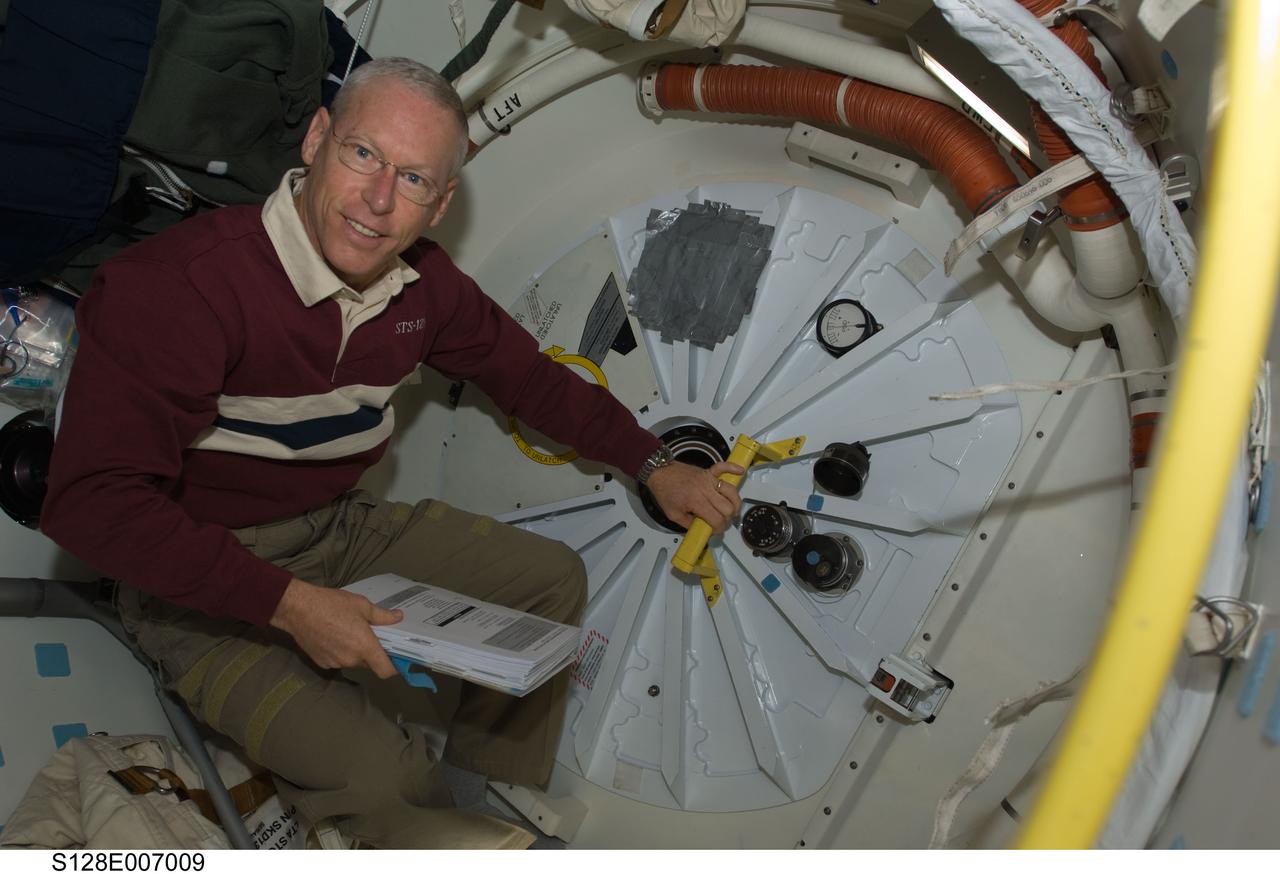
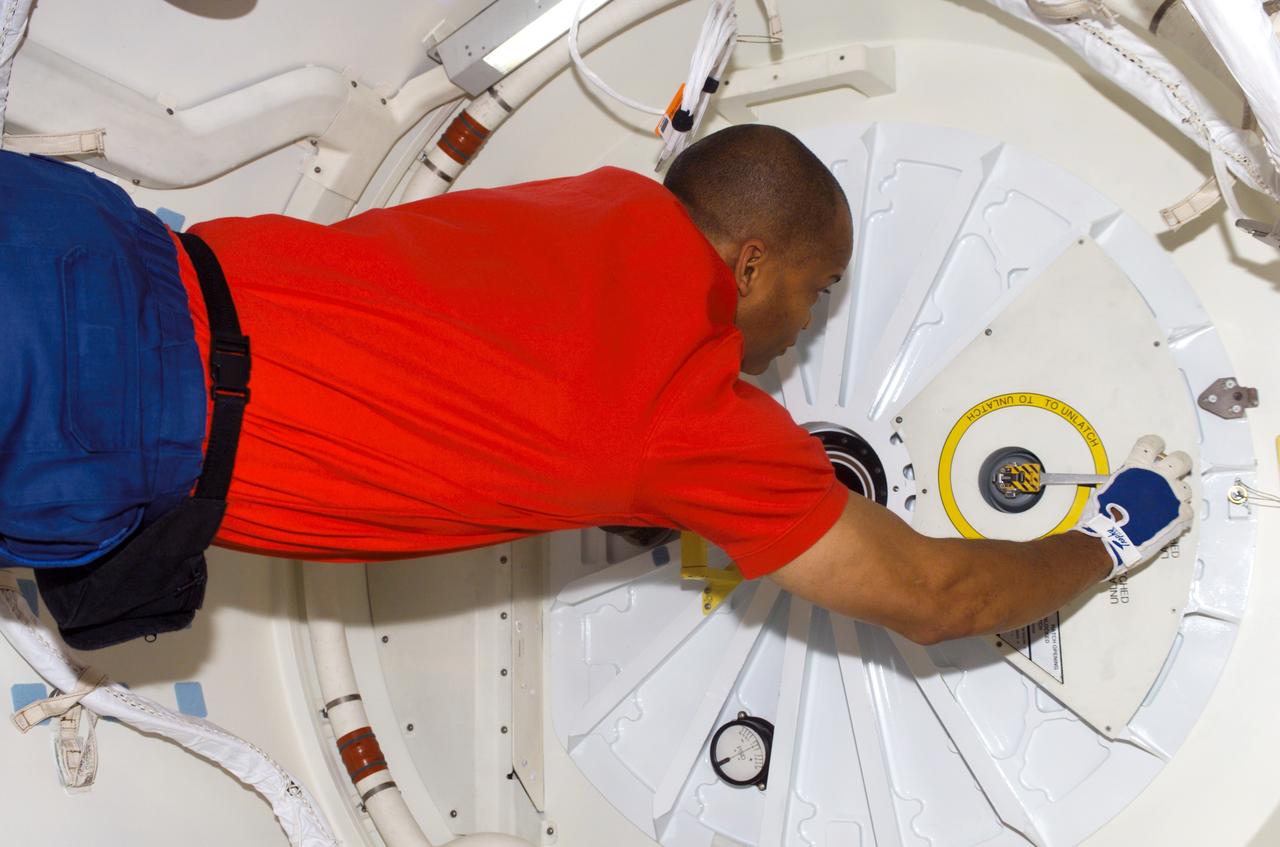
S128-E-007009 (30 Aug. 2009) --- Astronaut Patrick Forrester, STS-128 mission specialist, prepares to open the hatch that will lead the entire Space Shuttle Discovery crew into the International Space Station. The two spacecraft docked at 7:54 p.m. (CDT), and the Discovery crew entered the orbital outpost at 9:59 p.m. (CDT) on Aug. 30.
Hatch Opening OPS
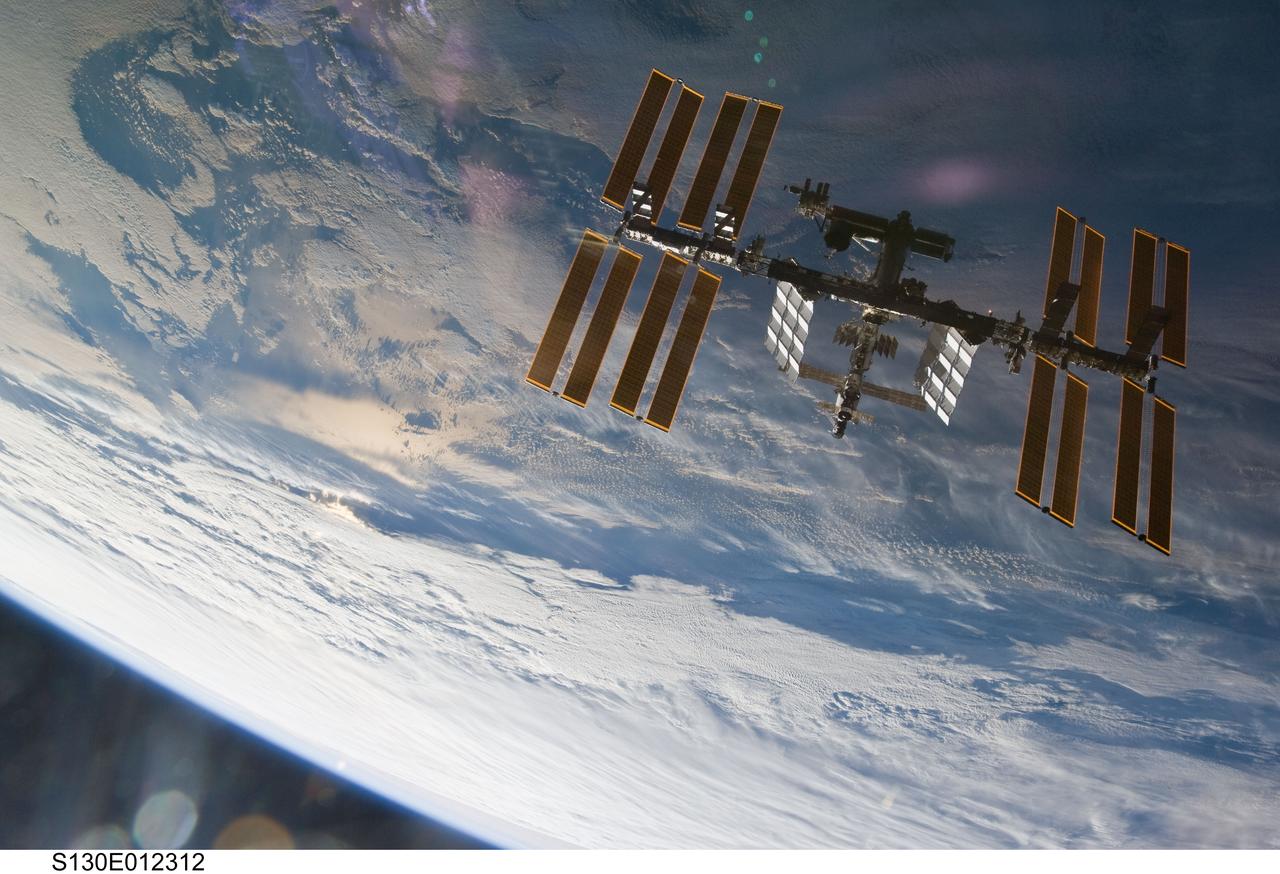
S130-E-012312 (19 Feb. 2010) --- Backdropped by Earth?s horizon and the blackness of space, the International Space Station is featured in this image photographed by an STS-130 crew member on space shuttle Endeavour after the station and shuttle began their post-undocking relative separation. Undocking of the two spacecraft occurred at 7:54 p.m. (EST) on Feb. 19, 2010.
Overall View of ISS After STS-130 Undocking
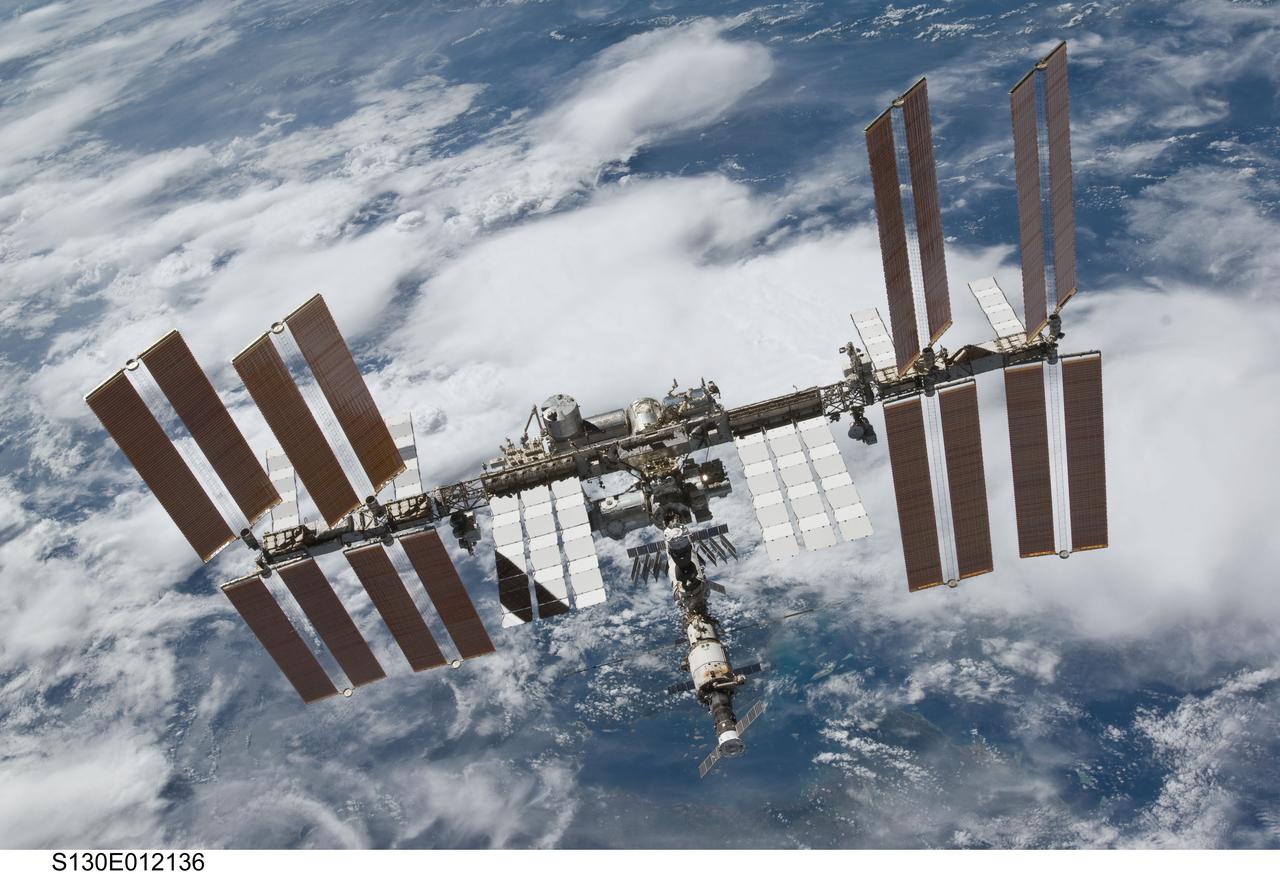
S130-E-012136 (19 Feb. 2010) --- Backdropped by a blue and white part of Earth, the International Space Station is featured in this image photographed by an STS-130 crew member on space shuttle Endeavour after the station and shuttle began their post-undocking relative separation. Undocking of the two spacecraft occurred at 7:54 p.m. (EST) on Feb. 19, 2010.
Overall View of ISS After STS-130 Undocking
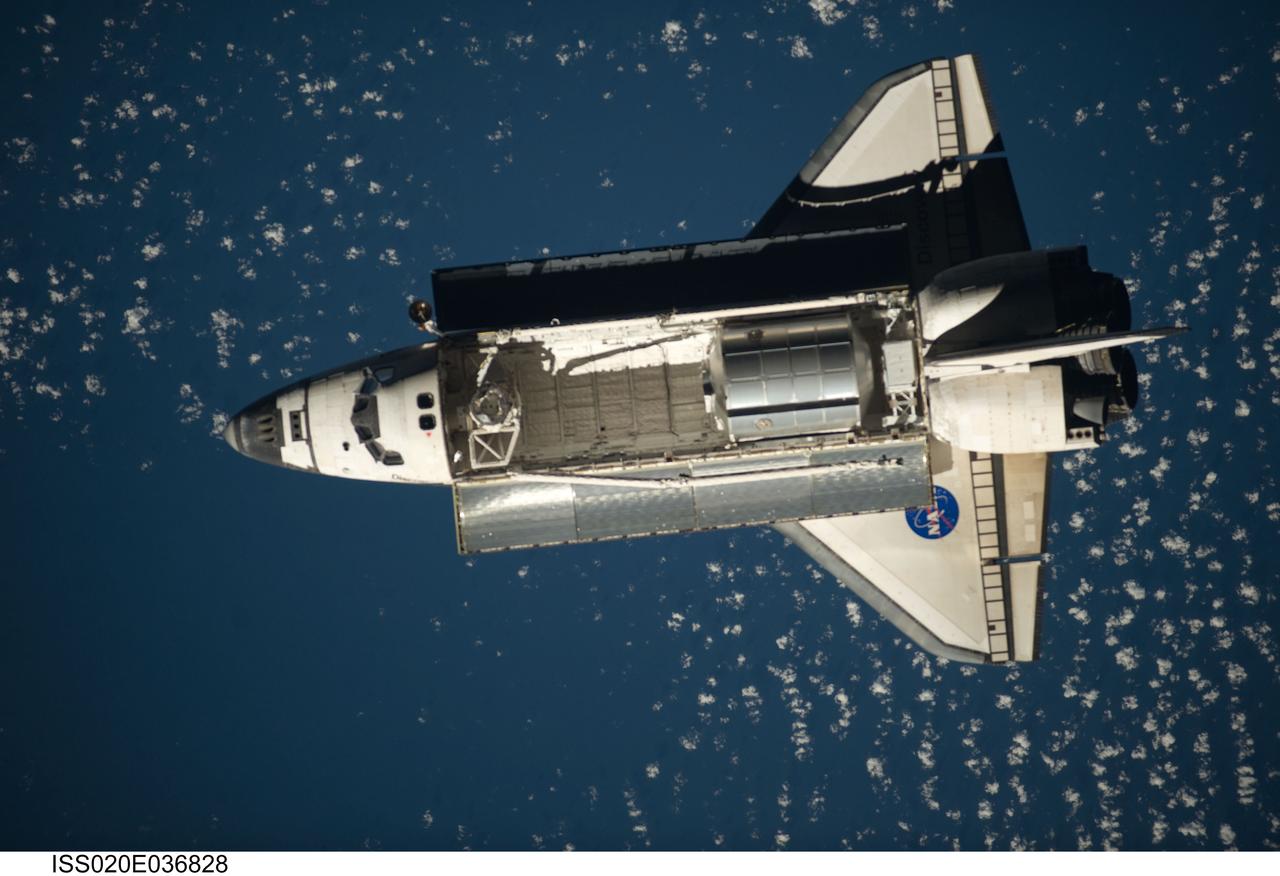
ISS020-E-036828 (30 Aug. 2009) --- Backdropped by a blue and white Earth, Space Shuttle Discovery is featured in this image photographed by an Expedition 20 crew member as the shuttle approaches the International Space Station during STS-128 rendezvous and docking operations. Docking occurred at 7:54 p.m. (CDT) on Aug. 30, 2009. The Leonardo Multi-Purpose Logistics Module is visible in Discovery?s cargo bay.
STS-128 approach to ISS
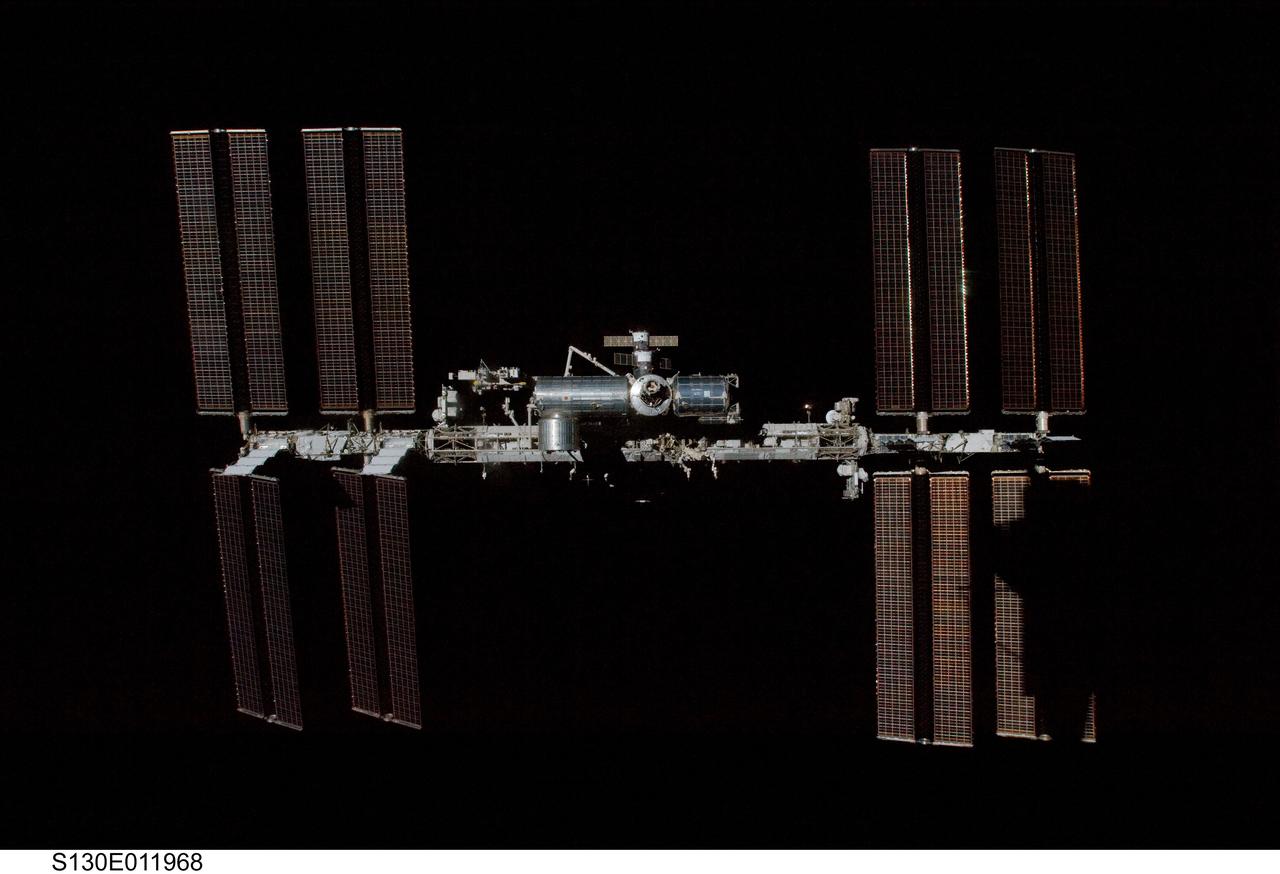
S130-E-011968 (19 Feb. 2010) --- Surrounded by the blackness of space, the International Space Station is featured in this image photographed by an STS-130 crew member on space shuttle Endeavour after the station and shuttle began their post-undocking relative separation. Undocking of the two spacecraft occurred at 7:54 p.m. (EST) on Feb. 19, 2010. A partial shadow of Endeavour is visible on the solar array wing panels at lower right.
Overall View of ISS After STS-130 Undocking
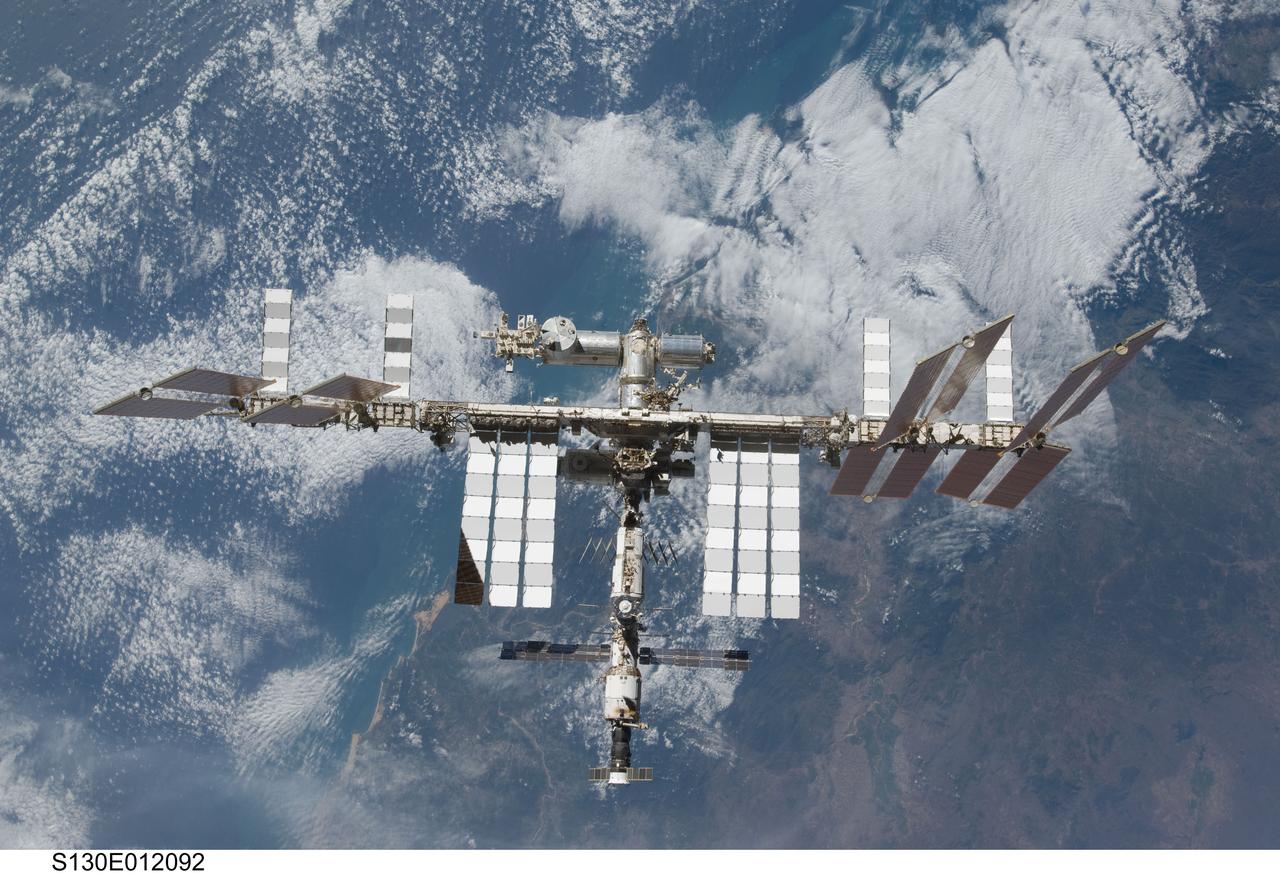
S130-E-012092 (19 Feb. 2010) --- Backdropped by a colorful part of Earth, the International Space Station is featured in this image photographed by an STS-130 crew member on space shuttle Endeavour after the station and shuttle began their post-undocking relative separation. Undocking of the two spacecraft occurred at 7:54 p.m. (EST) on Feb. 19, 2010.
Overall View of ISS After STS-130 Undocking
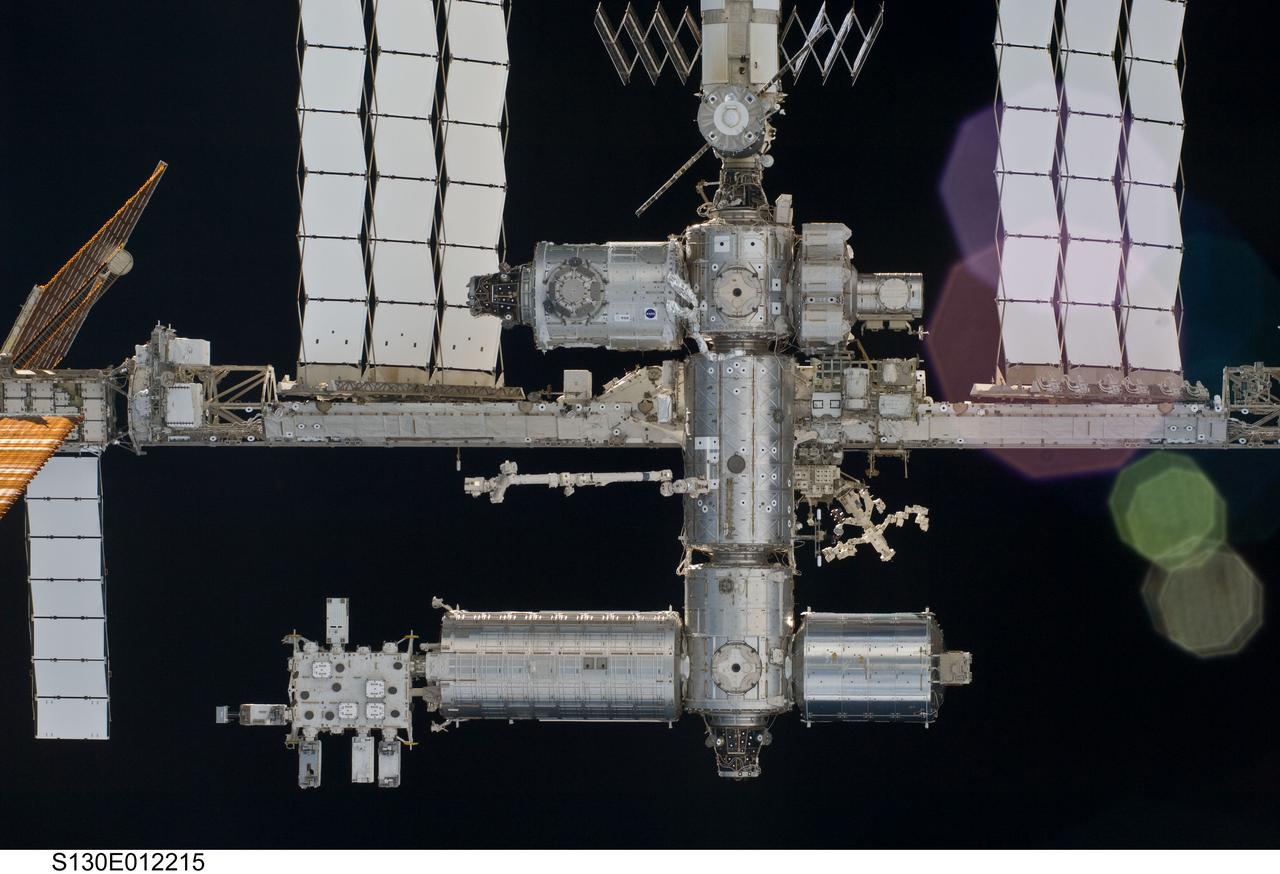
S130-E-012215 (19 Feb. 2010) --- A close-up view of a portion of the International Space Station is featured in this image photographed by an STS-130 crew member on space shuttle Endeavour after the station and shuttle began their post-undocking relative separation. Undocking of the two spacecraft occurred at 7:54 p.m. (EST) on Feb. 19, 2010. The newly-installed Tranquility node and Cupola are visible at top center.
Flyaround View of Portions of ISS
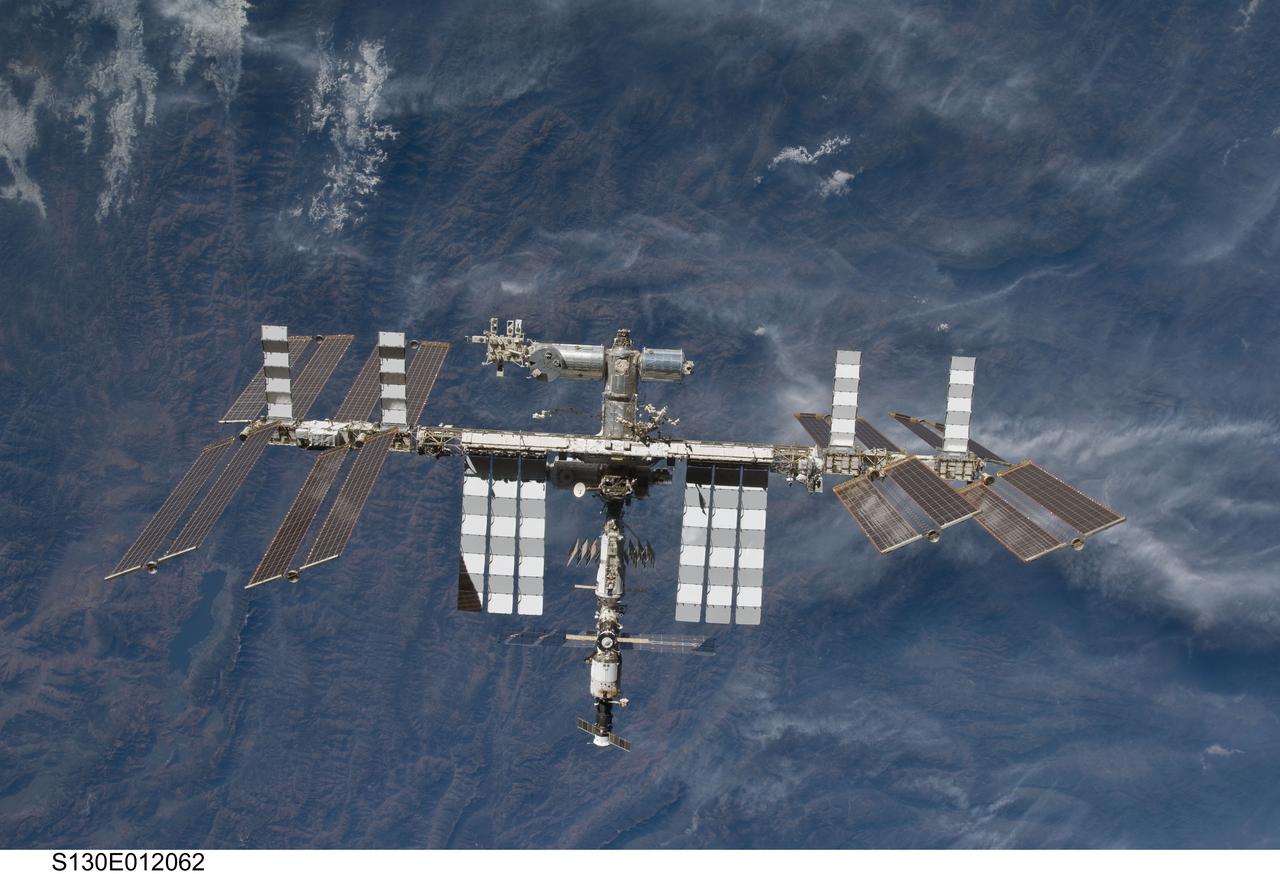
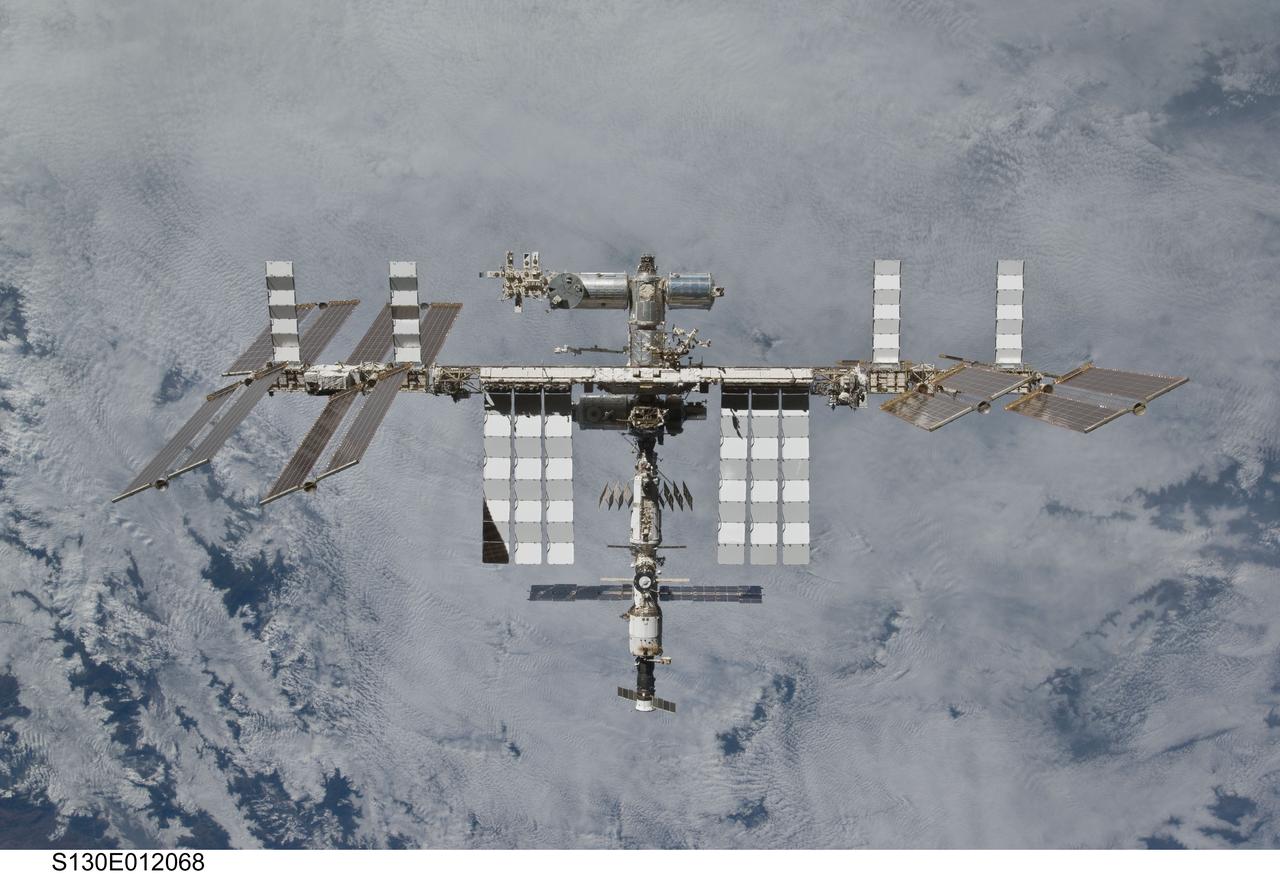
S130-E-012062 (19 Feb. 2010) --- Backdropped by rugged Earth terrain, the International Space Station is featured in this image photographed by an STS-130 crew member on space shuttle Endeavour after the station and shuttle began their post-undocking relative separation. Undocking of the two spacecraft occurred at 7:54 p.m. (EST) on Feb. 19, 2010.
Overall View of ISS After STS-130 Undocking
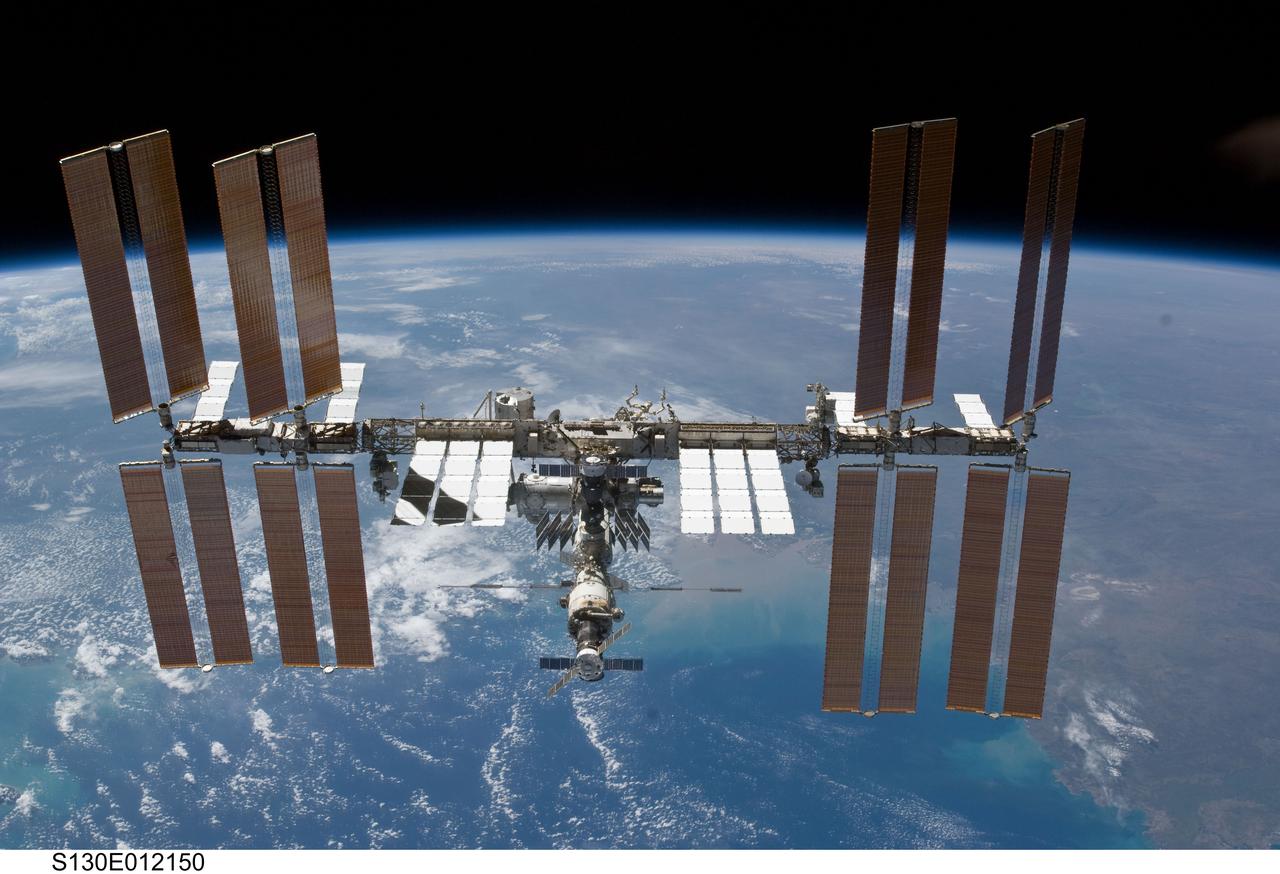
S130-E-012150 (19 Feb. 2010) --- Backdropped by Earth?s horizon and the blackness of space, the International Space Station is featured in this image photographed by an STS-130 crew member on space shuttle Endeavour after the station and shuttle began their post-undocking relative separation. Undocking of the two spacecraft occurred at 7:54 p.m. (EST) on Feb. 19, 2010.
Overall View of ISS After STS-130 Undocking
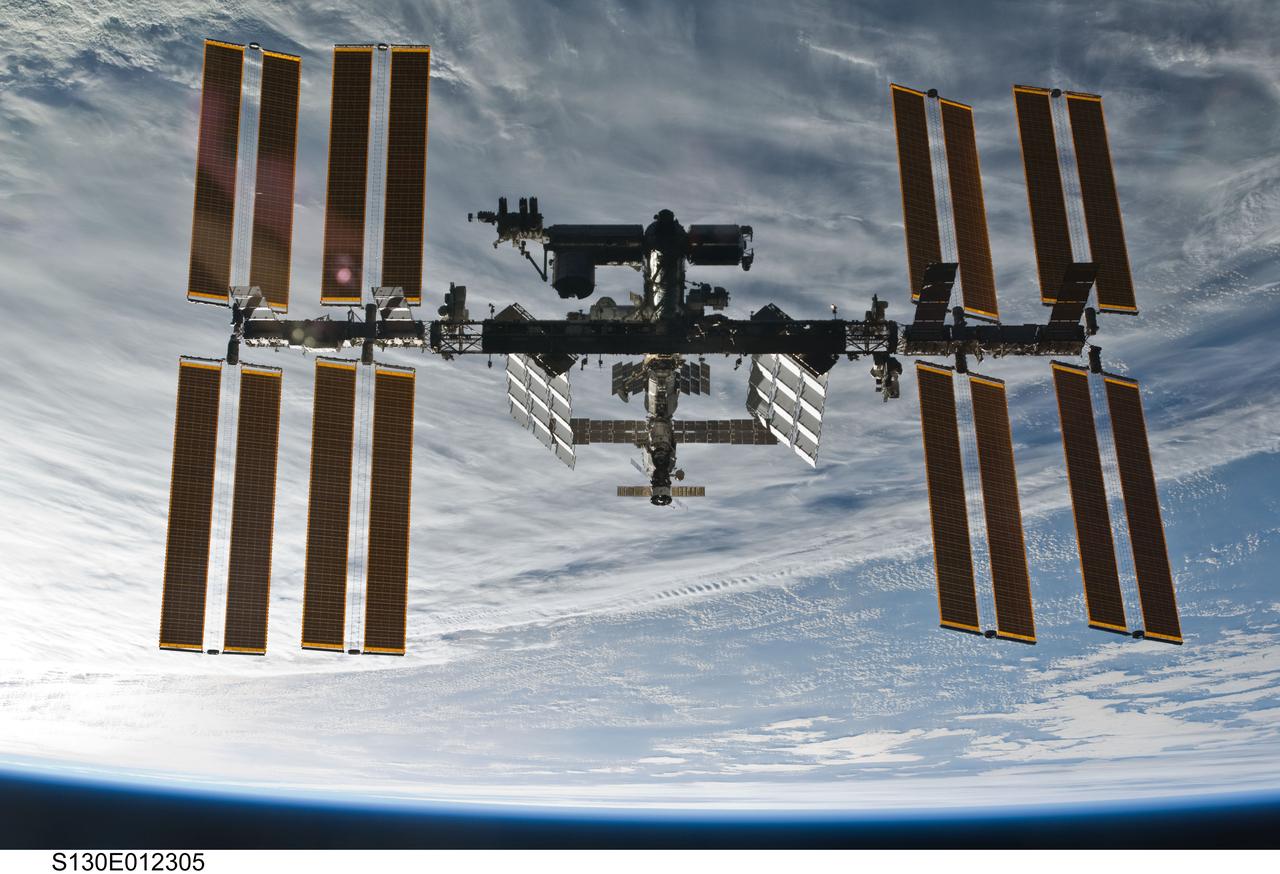
S130-E-012305 (19 Feb. 2010) --- Backdropped by a cloud-covered part of Earth, the International Space Station is featured in this image photographed by an STS-130 crew member on space shuttle Endeavour after the station and shuttle began their post-undocking relative separation. Undocking of the two spacecraft occurred at 7:54 p.m. (EST) on Feb. 19, 2010.
Overall View of ISS After STS-130 Undocking
KENNEDY SPACE CENTER, FLA. -  The Space Shuttle rises majestically above Launch Complex 39's Pad A on the first leg of its maiden journey into space.  On board for the historic flight are astronauts John Young and Bob Crippen, scheduled to spend nearly 54 hours in space on this first shakedown test of America’s new reusable Space Transportation System (STS).  The Sunday morning liftoff came a few seconds after 7 a.m. and marked the dawn of a new era in spaceflight.
KSC-81pc-0370
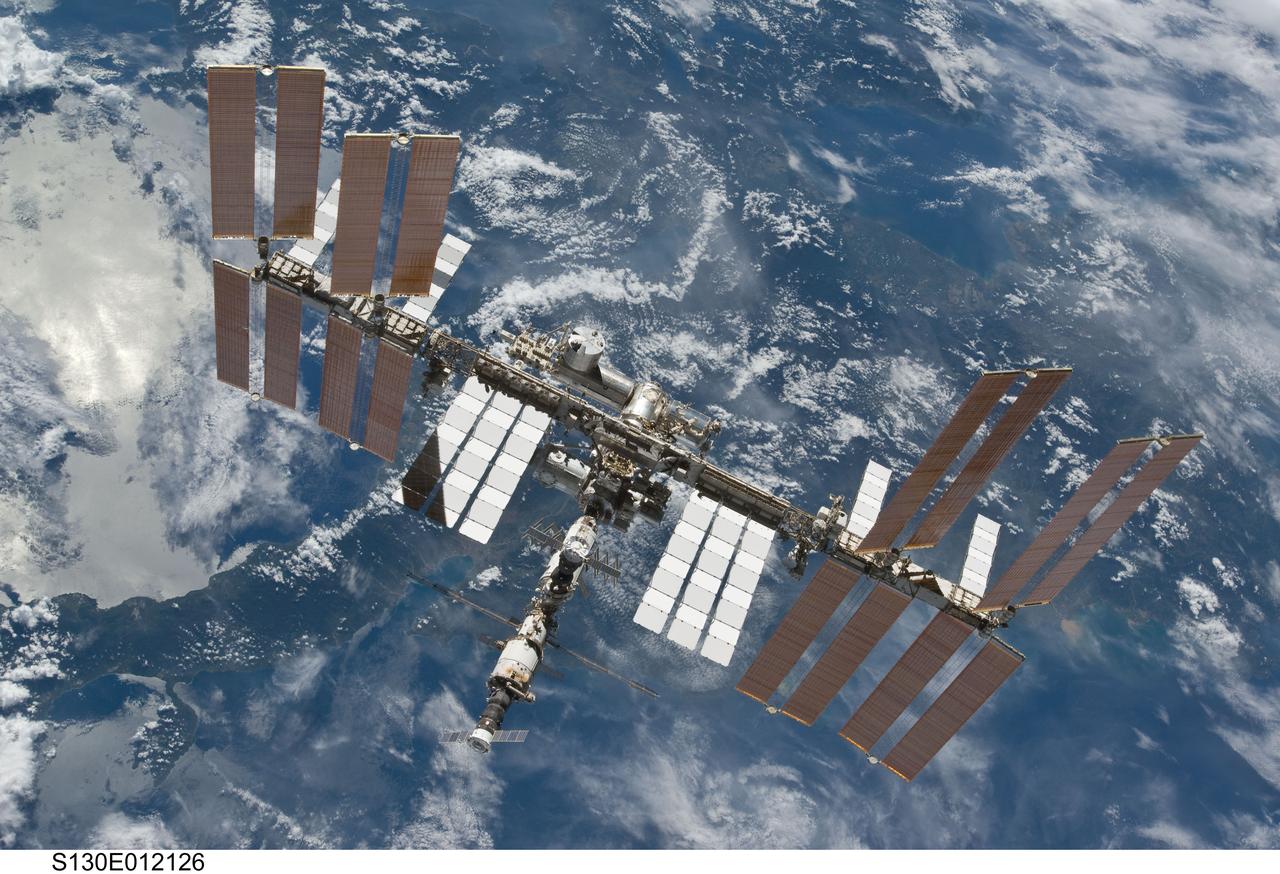
S130-E-012126 (19 Feb. 2010) --- Backdropped by a blue and white part of Earth, the International Space Station is featured in this image photographed by an STS-130 crew member on space shuttle Endeavour after the station and shuttle began their post-undocking relative separation. Undocking of the two spacecraft occurred at 7:54 p.m. (EST) on Feb. 19, 2010.
Overall View of ISS After STS-130 Undocking
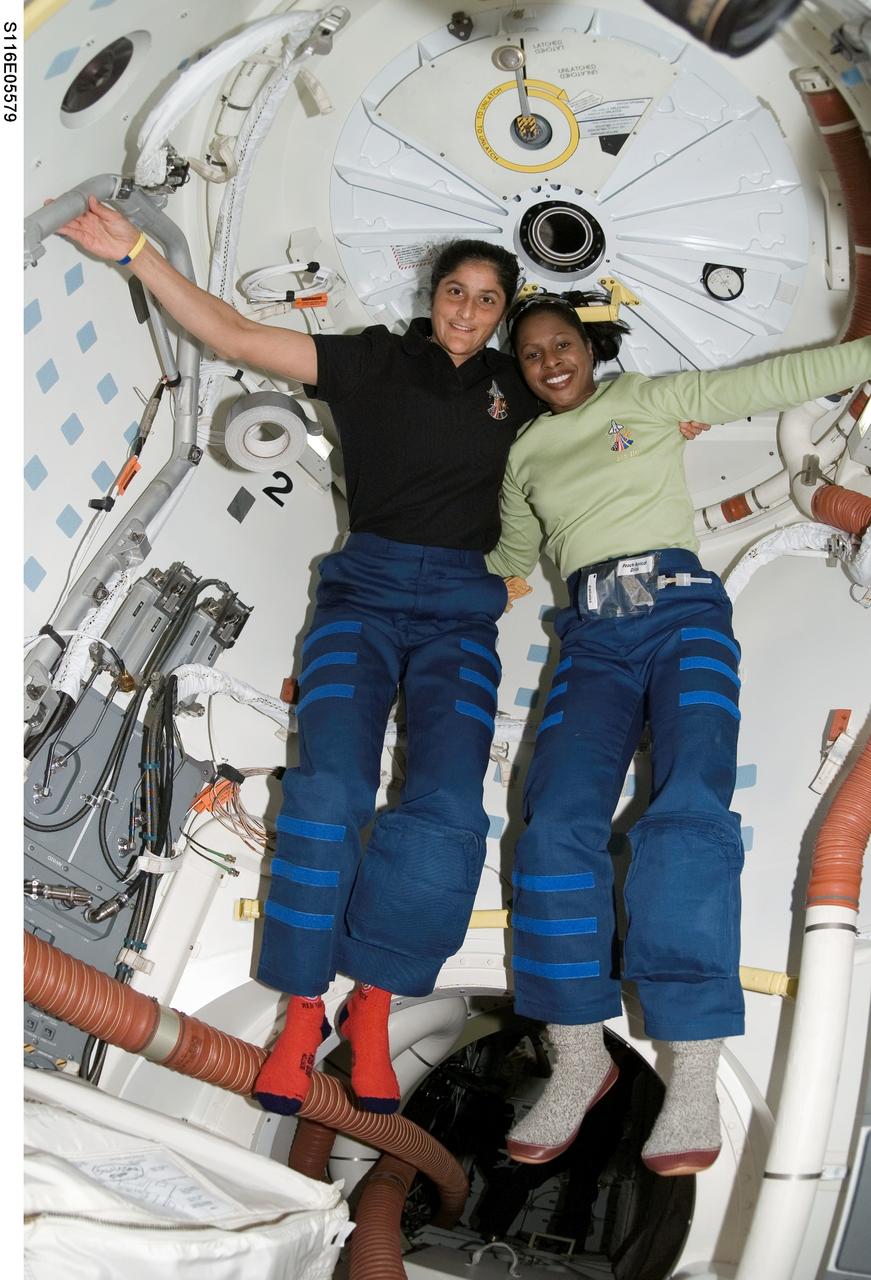
S116-E-05579 (11 Dec. 2006) --- Astronaut Sunita L. Williams (left) and Joan E. Higginbotham, both STS-116 mission specialists, float arm-in-arm near Space Shuttle Discovery's hatch, which leads into the International Space Station. Rendezvous and docking operations between the shuttle and station occurred at 4:12 p.m. (CST) and the crew entered the orbital outpost at 5:54 p.m. (CST) on Dec. 11.
Crewmembers Williams and Higginbotham in the hatch area of Space Shuttle Discovery
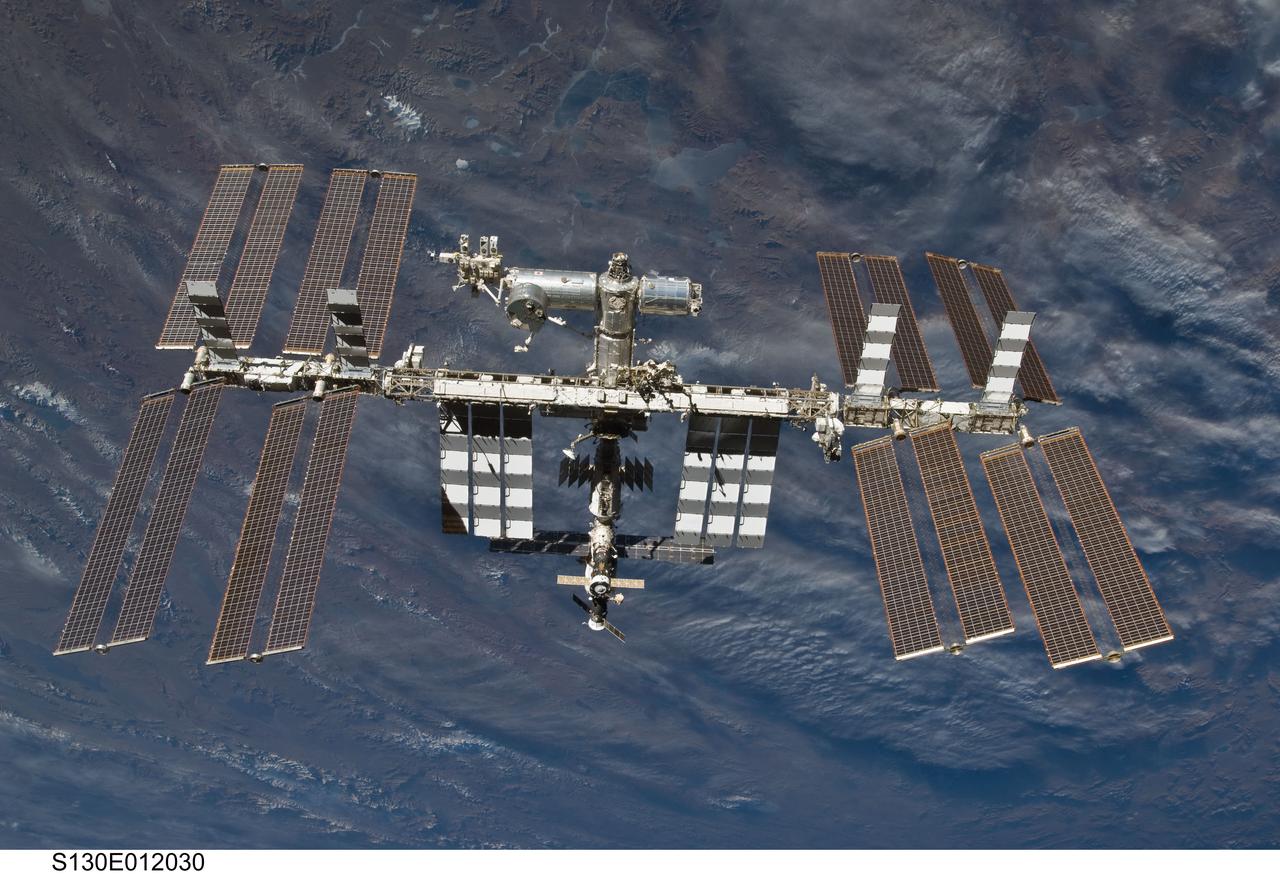
S130-E-012030 (19 Feb. 2010) --- Backdropped by a colorful part of Earth, the International Space Station is featured in this image photographed by an STS-130 crew member on space shuttle Endeavour after the station and shuttle began their post-undocking relative separation. Undocking of the two spacecraft occurred at 7:54 p.m. (EST) on Feb. 19, 2010.
Overall View of ISS After STS-130 Undocking
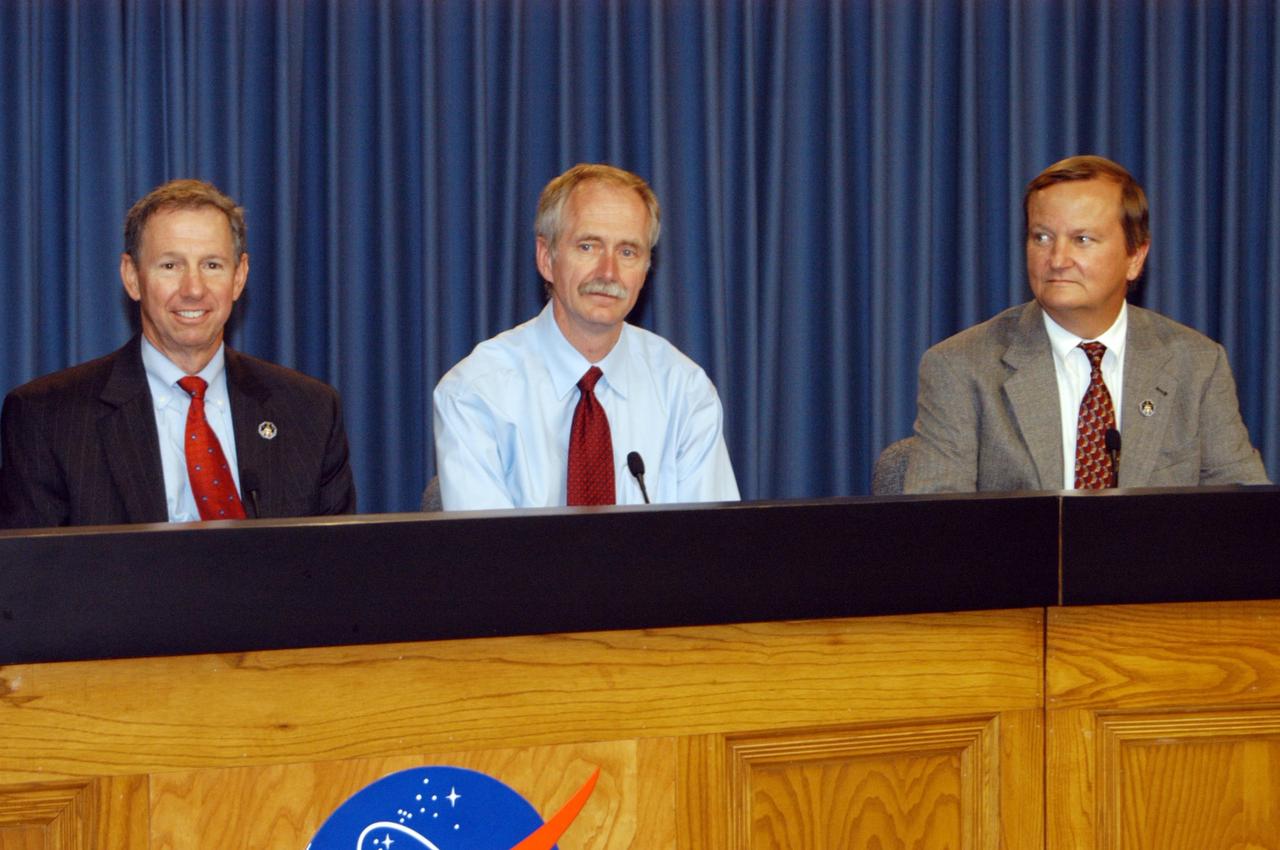
KENNEDY SPACE CENTER, FLA. -  A press conference after the landing of the orbiter Discovery and mission STS-121 crew features NASA Administrator Mike Griffin, Associate Administrator for Space Operations Bill Gerstenmaier and Shuttle Launch Director Mike Leinbach. Discovery traveled  5.3 million miles, landing on orbit 202.  Mission elapsed time was 12 days, 18 hours, 37 minutes and 54 seconds. The landing is the 62nd at Kennedy Space Center and the 32nd for Discovery.  Photo credit: NASA/George Shelton
KSC-06pd1594
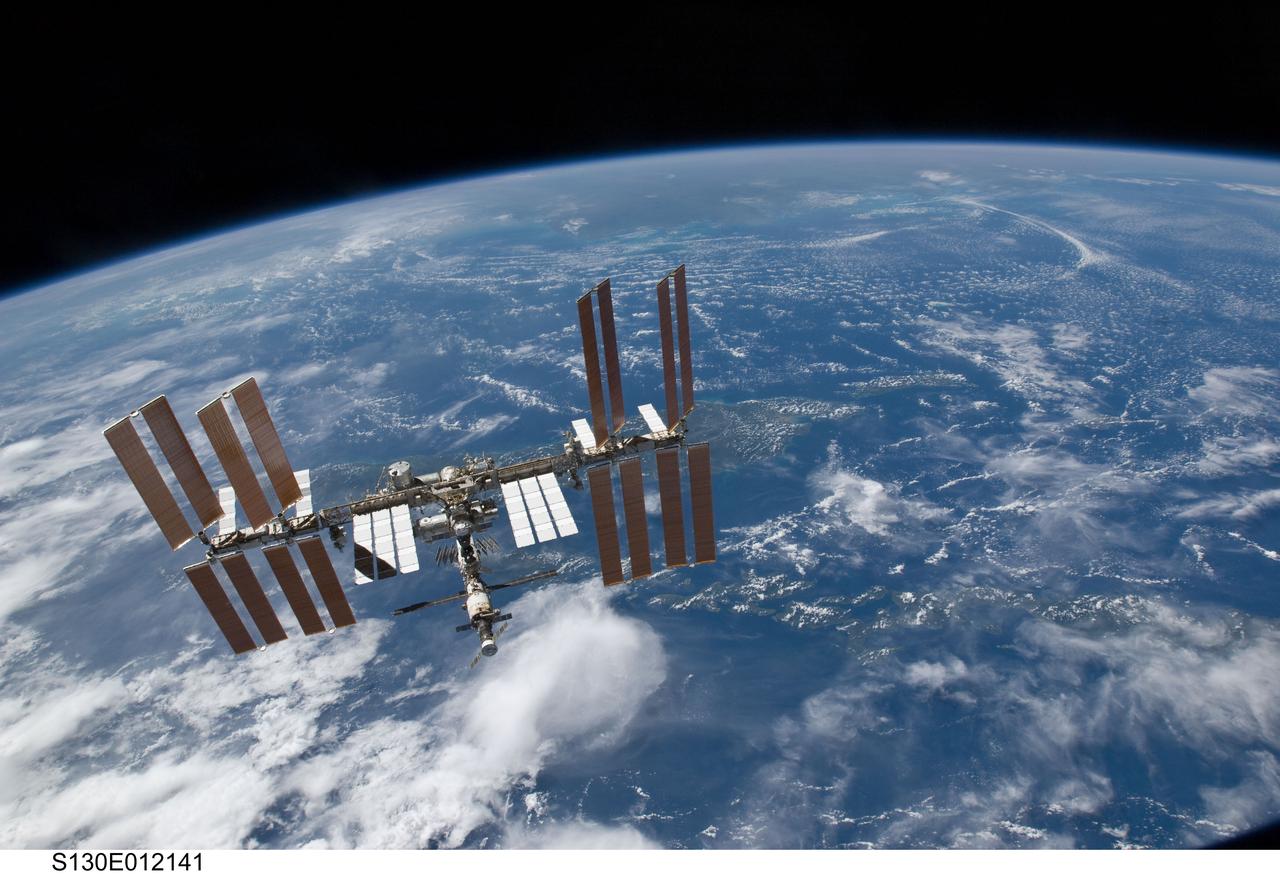
S130-E-012141 (19 Feb. 2010) --- Backdropped by Earth?s horizon and the blackness of space, the International Space Station is featured in this image photographed by an STS-130 crew member on space shuttle Endeavour after the station and shuttle began their post-undocking relative separation. Undocking of the two spacecraft occurred at 7:54 p.m. (EST) on Feb. 19, 2010.
Overall View of ISS After STS-130 Undocking
S128-E-006630 (30 Aug. 2009) --- Backdropped by the blackness of space, the International Space Station is featured in this image photographed by an STS-128 crew member as Space Shuttle Discovery and the station approach each other during rendezvous and docking activities on flight day three. Docking occurred at 7:54 p.m. (CDT) on Aug. 30, 2009.
ISS during STS-128 Approach
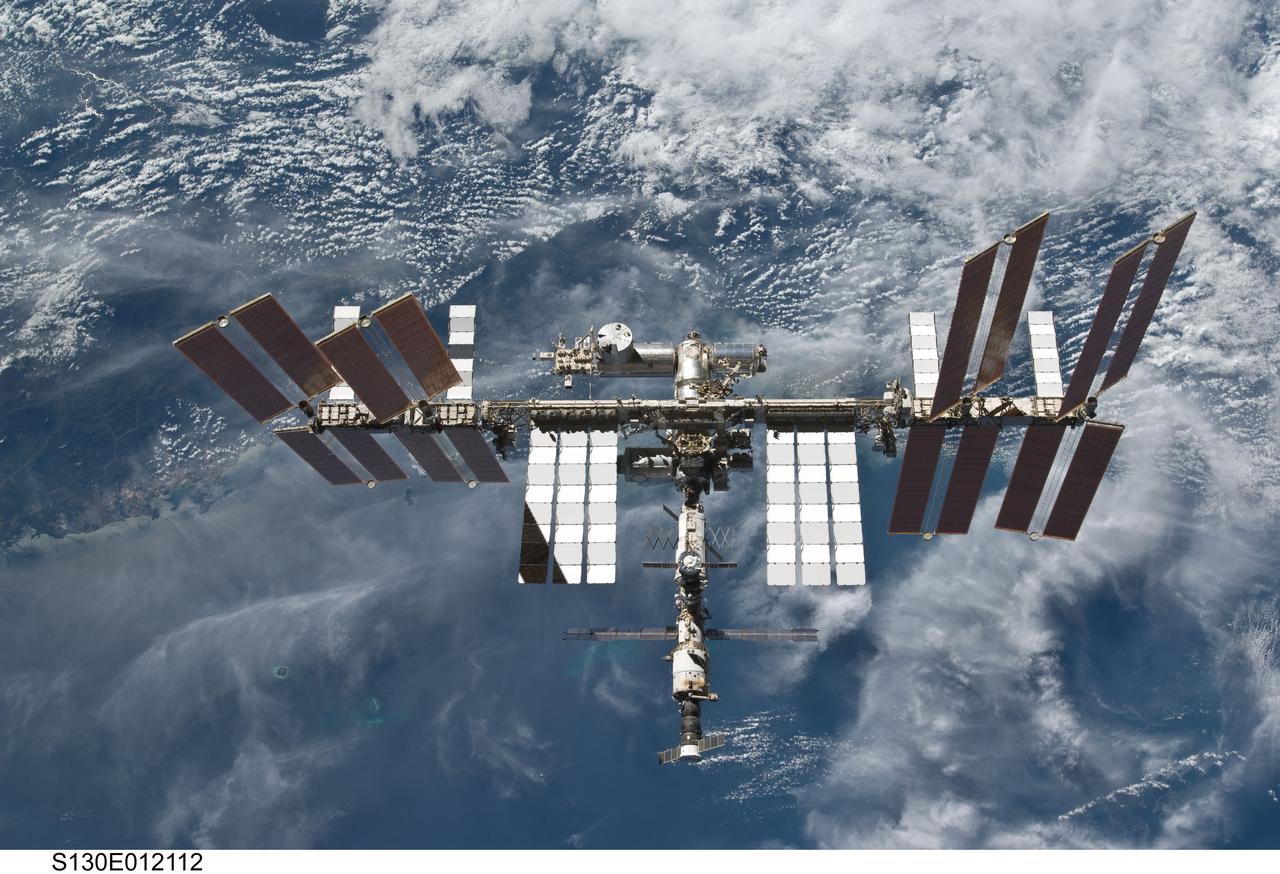
S130-E-012112 (19 Feb. 2010) --- Backdropped by a blue and white part of Earth, the International Space Station is featured in this image photographed by an STS-130 crew member on space shuttle Endeavour after the station and shuttle began their post-undocking relative separation. Undocking of the two spacecraft occurred at 7:54 p.m. (EST) on Feb. 19, 2010.
Overall View of ISS After STS-130 Undocking
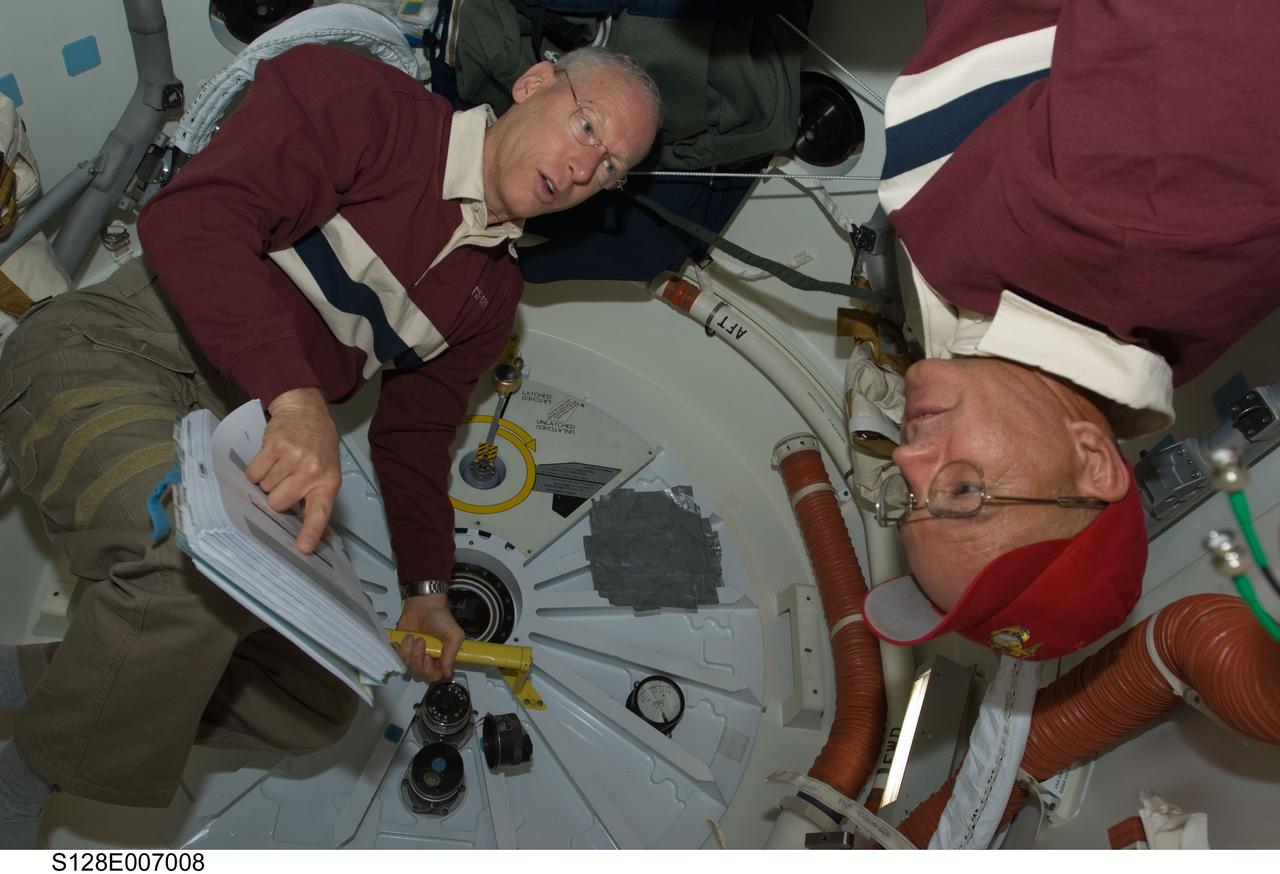
S128-E-007008 (30 Aug. 2009) --- Astronauts Rick Sturckow (right), STS-128 commander; and Patrick Forrester, mission specialist, are pictured near the hatch on the middeck of Space Shuttle Discovery after docking with the International Space Station. The two spacecraft docked at 7:54 p.m. (CDT), and the Discovery crew entered the orbital outpost at 9:59 p.m. (CDT) on Aug. 30.
Hatch Opening OPS
S130-E-012100 (19 Feb. 2010) --- Backdropped by a blue and white part of Earth, the International Space Station is featured in this image photographed by an STS-130 crew member on space shuttle Endeavour after the station and shuttle began their post-undocking relative separation. Undocking of the two spacecraft occurred at 7:54 p.m. (EST) on Feb. 19, 2010.
Overall View of ISS After STS-130 Undocking
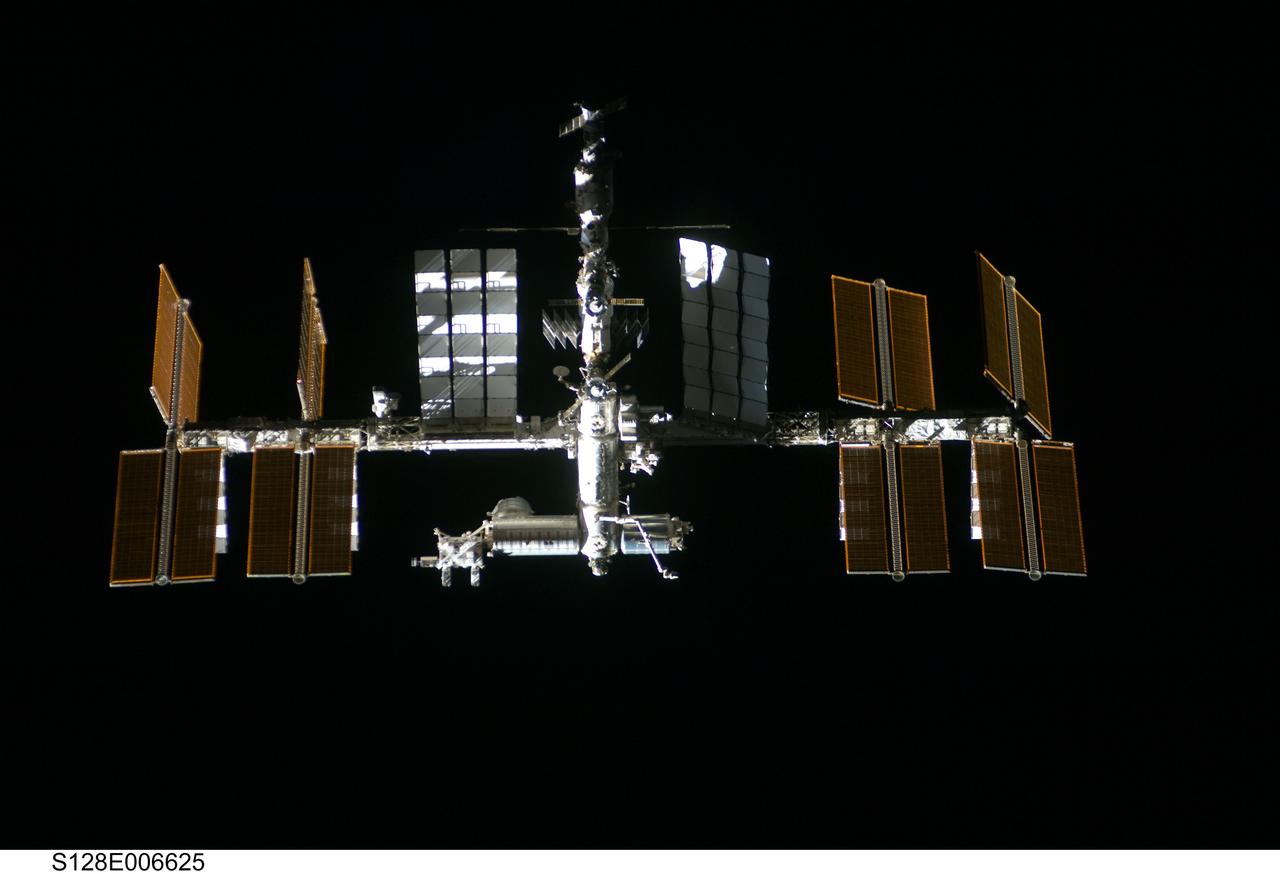
S128-E-006625 (30 Aug. 2009) --- Backdropped by the blackness of space, the International Space Station is featured in this image photographed by an STS-128 crew member as Space Shuttle Discovery and the station approach each other during rendezvous and docking activities on flight day three. Docking occurred at 7:54 p.m. (CDT) on Aug. 30, 2009.
ISS during STS-128 Approach
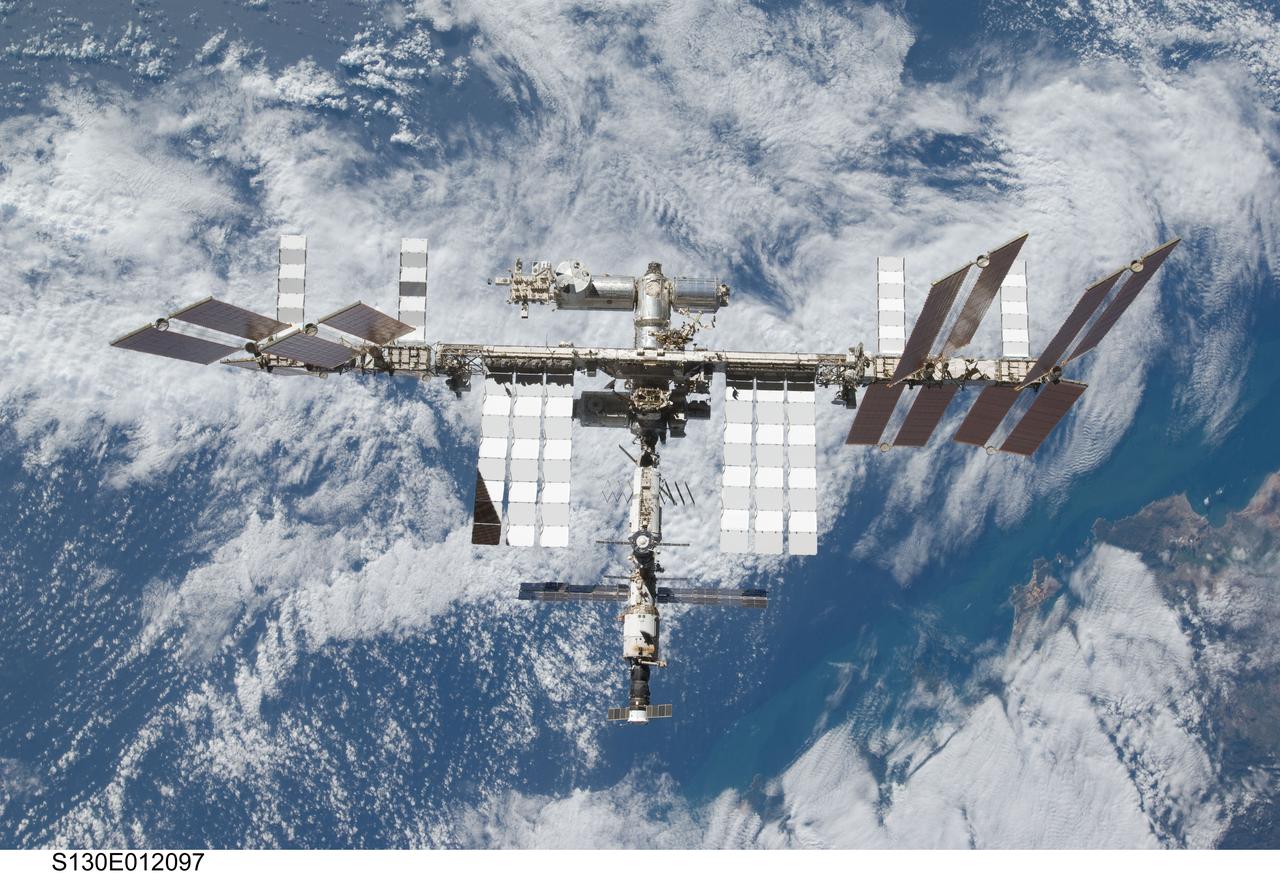
S130-E-012097 (19 Feb. 2010) --- Backdropped by a blue and white part of Earth, the International Space Station is featured in this image photographed by an STS-130 crew member on space shuttle Endeavour after the station and shuttle began their post-undocking relative separation. Undocking of the two spacecraft occurred at 7:54 p.m. (EST) on Feb. 19, 2010.
Overall View of ISS After STS-130 Undocking
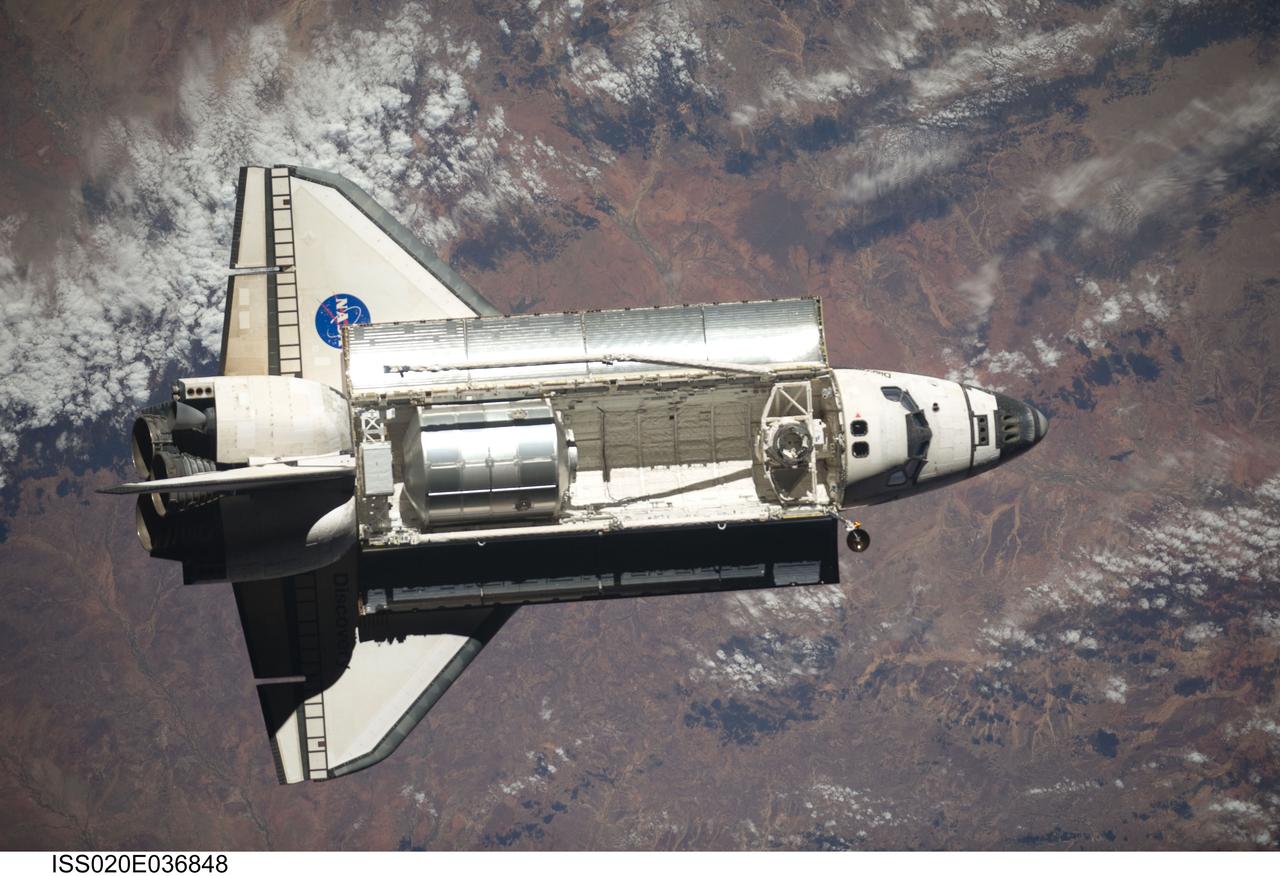
ISS020-E-036848 (30 Aug. 2009) --- Backdropped by a colorful Earth, Space Shuttle Discovery is featured in this image photographed by an Expedition 20 crew member as the shuttle approaches the International Space Station during STS-128 rendezvous and docking operations. Docking occurred at 7:54 p.m. (CDT) on Aug. 30, 2009. The Leonardo Multi-Purpose Logistics Module is visible in Discovery?s cargo bay.
STS-128 approach to ISS
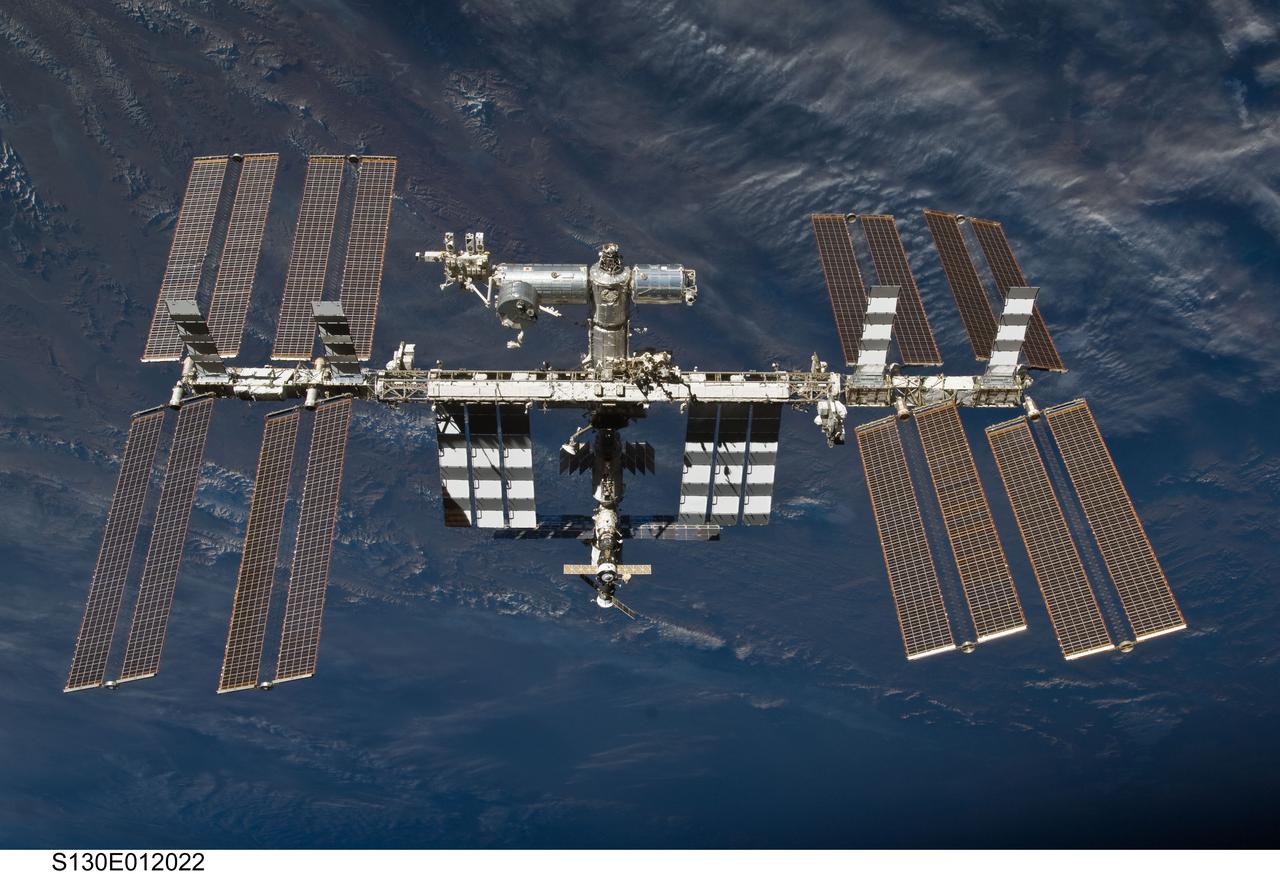
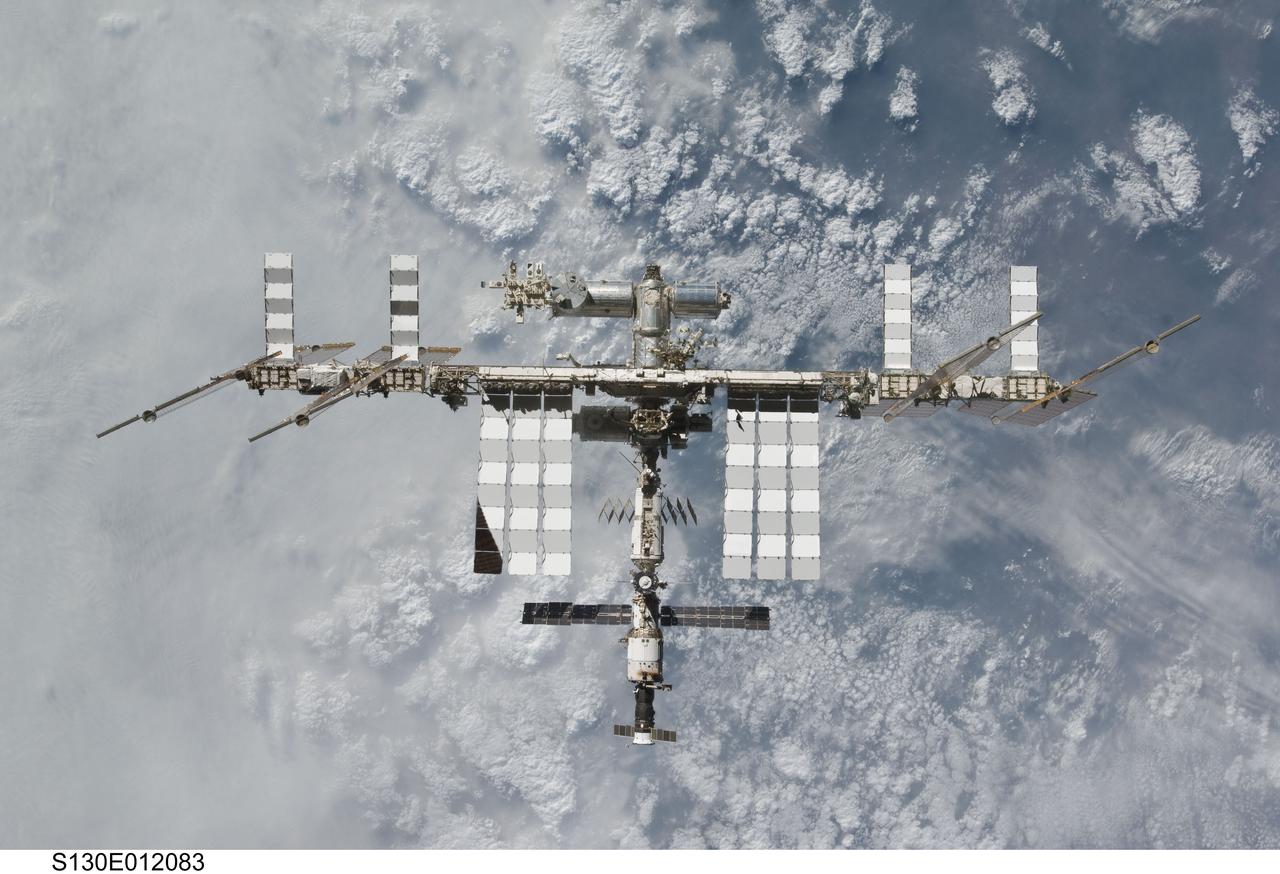
S130-E-012083 (19 Feb. 2010) --- Backdropped by a cloud-covered part of Earth, the International Space Station is featured in this image photographed by an STS-130 crew member on space shuttle Endeavour after the station and shuttle began their post-undocking relative separation. Undocking of the two spacecraft occurred at 7:54 p.m. (EST) on Feb. 19, 2010.
Overall View of ISS After STS-130 Undocking
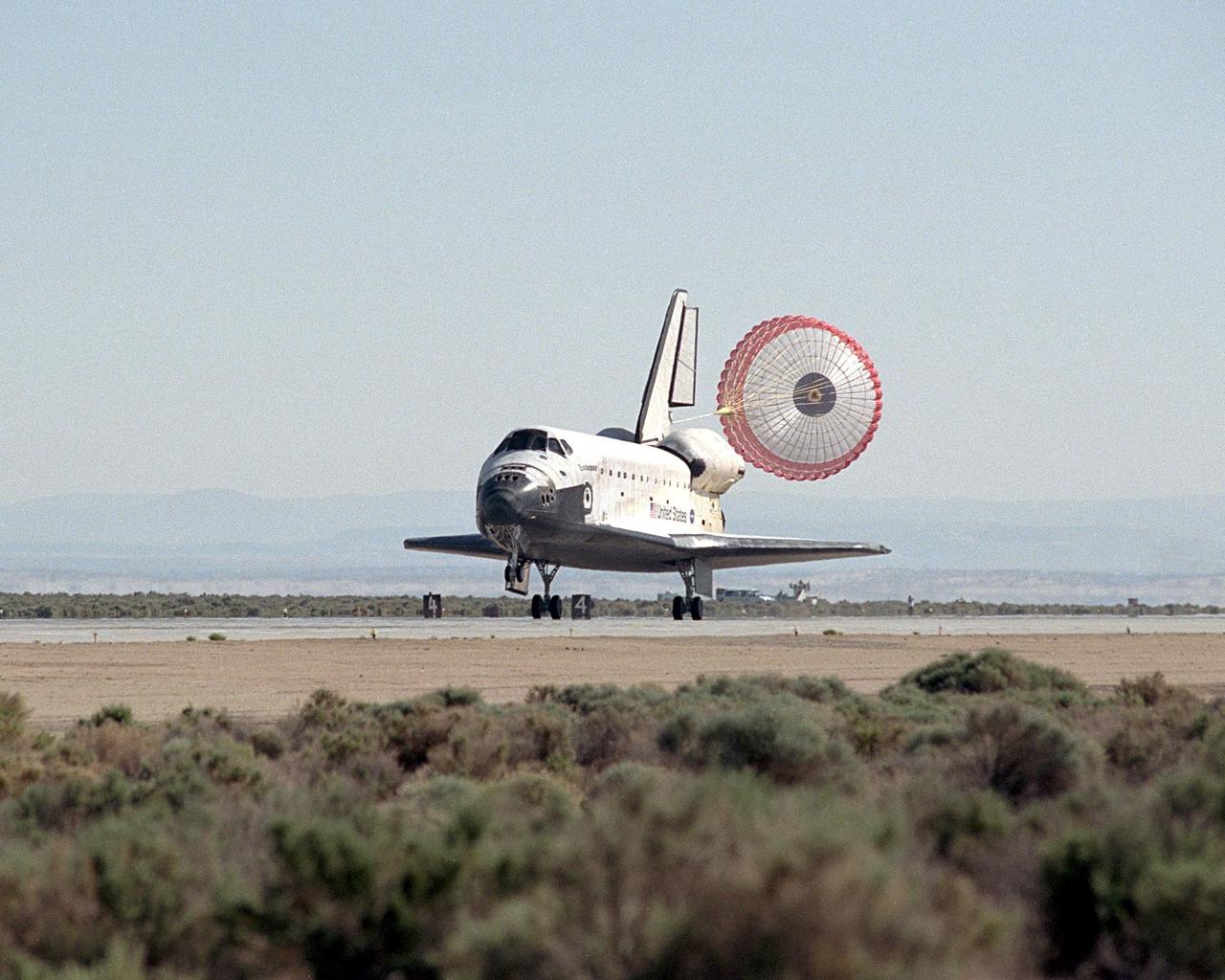
NASA/EDWARDS AFB, CALIF. -- With its drag chute deployed, Endeavour lands on runway 22 at Edwards Air Force Base, Calif., at 12:10:42 p.m. EDT after a mission of 11 days, 12 hours, 54 minutes to the International Space Station on mission STS-100. The orbiter and its crew of seven logged about 4.9 million statute miles in 186 orbits. Due to unfavorable weather conditions, landing at KSC was waved off. The landing marked the third consecutive landing at EAFB.
KSC-01PP0948
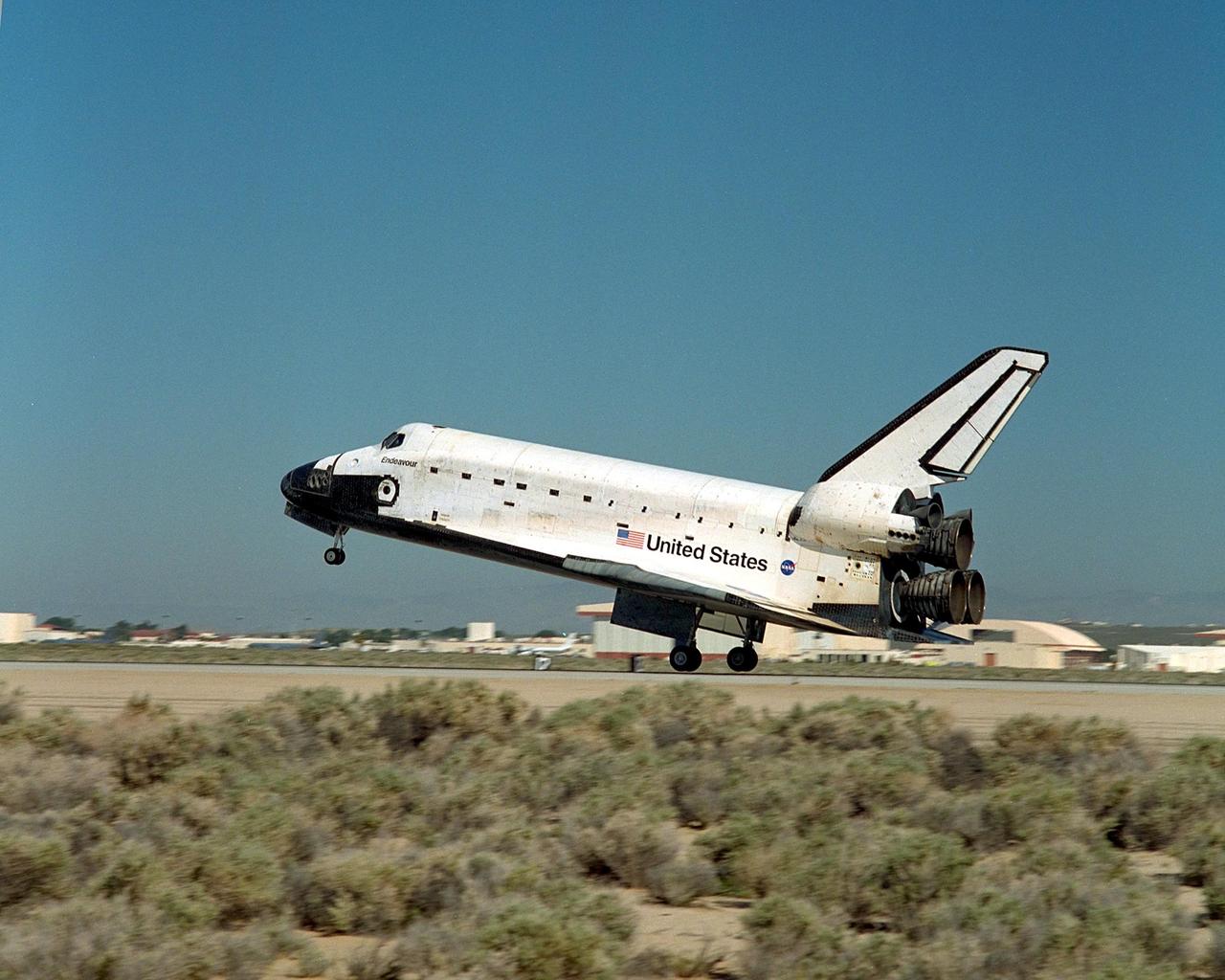
NASA/EDWARDS AFB, CALIF. -- Endeavour’s rear wheels touch down on runway 22 at Edwards Air Force Base, Calif., after the 11-day, 12-hour, 54-minute mission STS-100 to the International Space Station. Landing time was 12:10:42 p.m. EDT. The orbiter and its crew of seven logged about 4.9 million statute miles in 186 orbits. Due to unfavorable weather conditions, landing at KSC was waved off. The landing marked the third consecutive landing at EAFB.
KSC-01PP0949
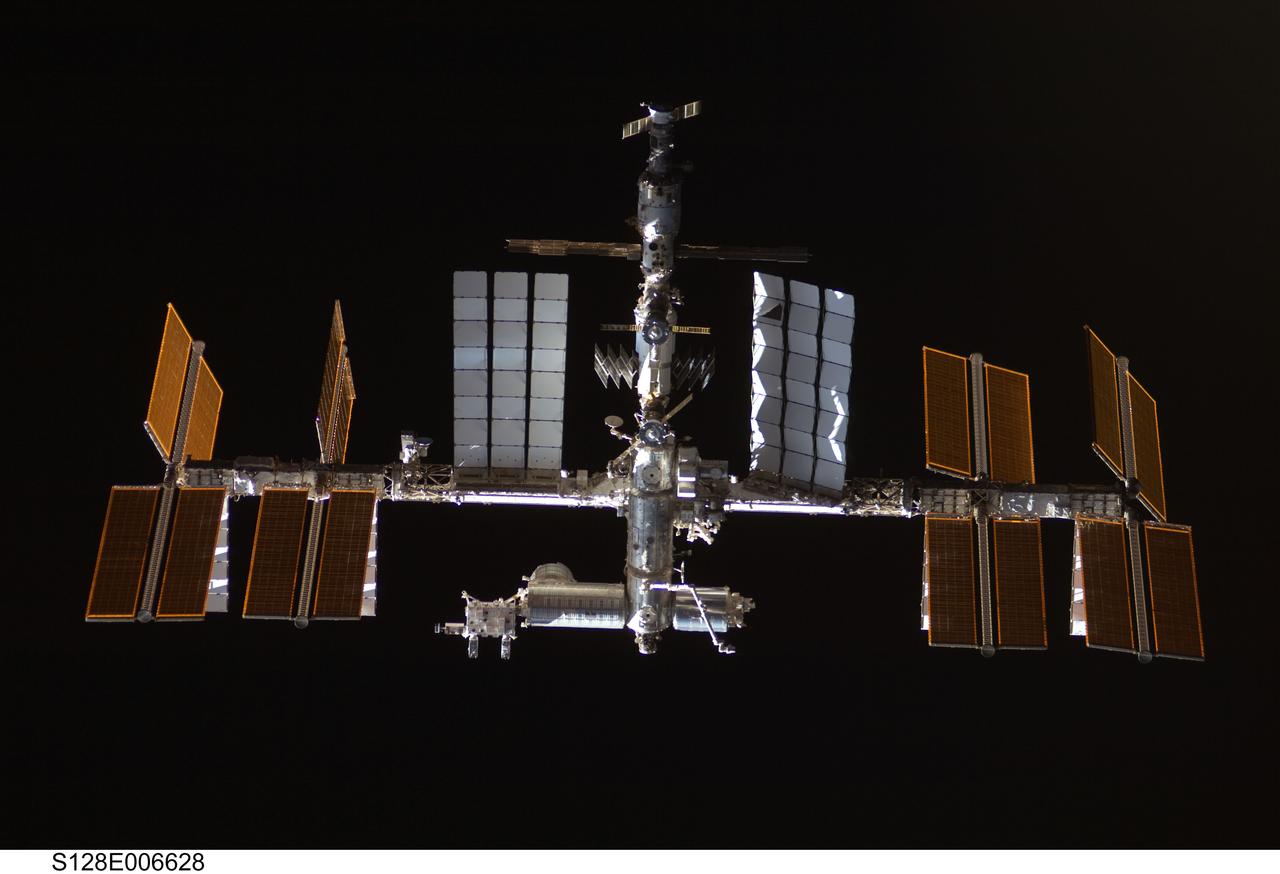
S128-E-006628 (30 Aug. 2009) --- Backdropped by the blackness of space, the International Space Station is featured in this image photographed by an STS-128 crew member as Space Shuttle Discovery and the station approach each other during rendezvous and docking activities on flight day three. Docking occurred at 7:54 p.m. (CDT) on Aug. 30, 2009.
ISS during STS-128 Approach
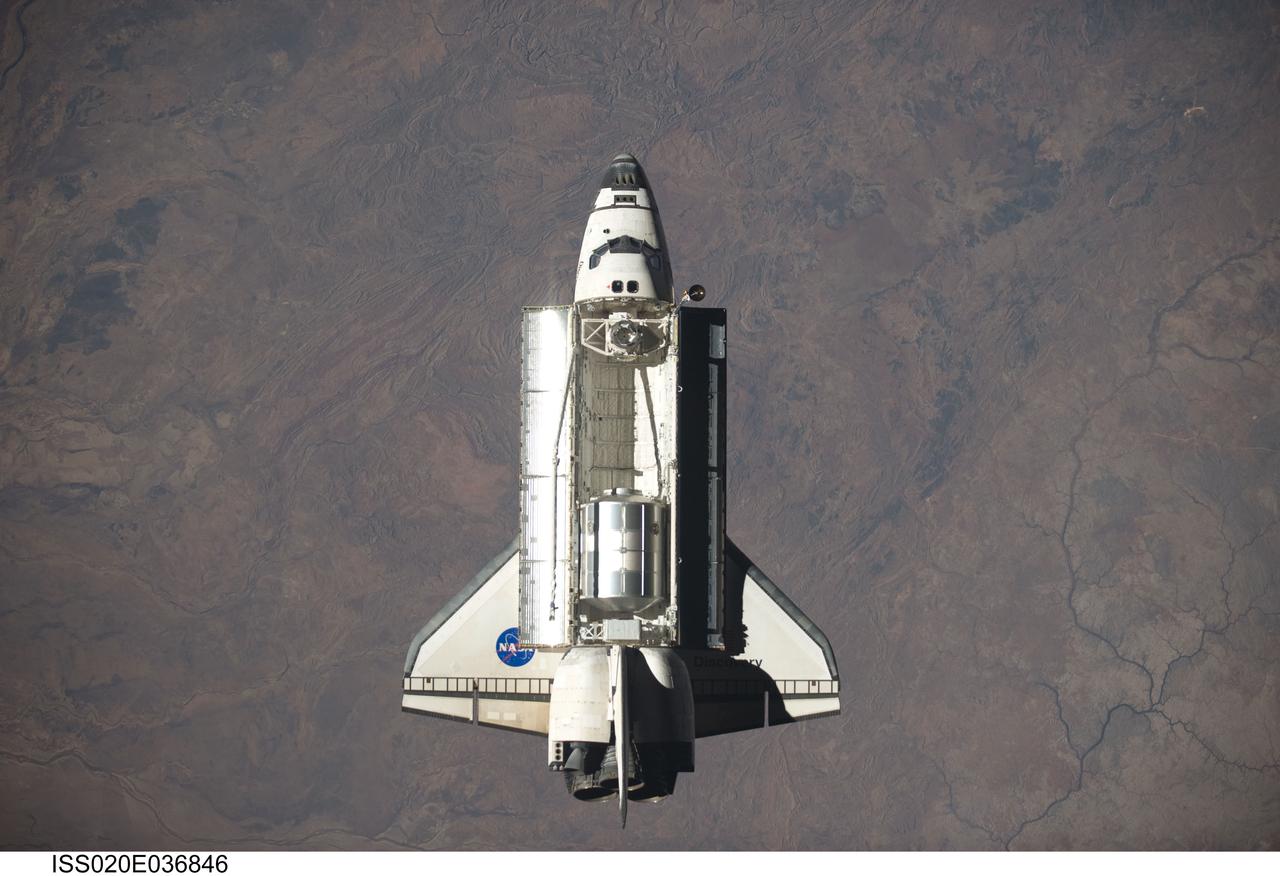
ISS020-E-036846 (30 Aug. 2009) --- Space Shuttle Discovery is featured in this image photographed by an Expedition 20 crew member as the shuttle approaches the International Space Station during STS-128 rendezvous and docking operations. Docking occurred at 7:54 p.m. (CDT) on Aug. 30, 2009. The Leonardo Multi-Purpose Logistics Module is visible in Discovery?s cargo bay.
STS-128 approach to ISS
S130-E-012068 (19 Feb. 2010) --- Backdropped by a blue and white part of Earth, the International Space Station is featured in this image photographed by an STS-130 crew member on space shuttle Endeavour after the station and shuttle began their post-undocking relative separation. Undocking of the two spacecraft occurred at 7:54 p.m. (EST) on Feb. 19, 2010.
Overall View of ISS After STS-130 Undocking
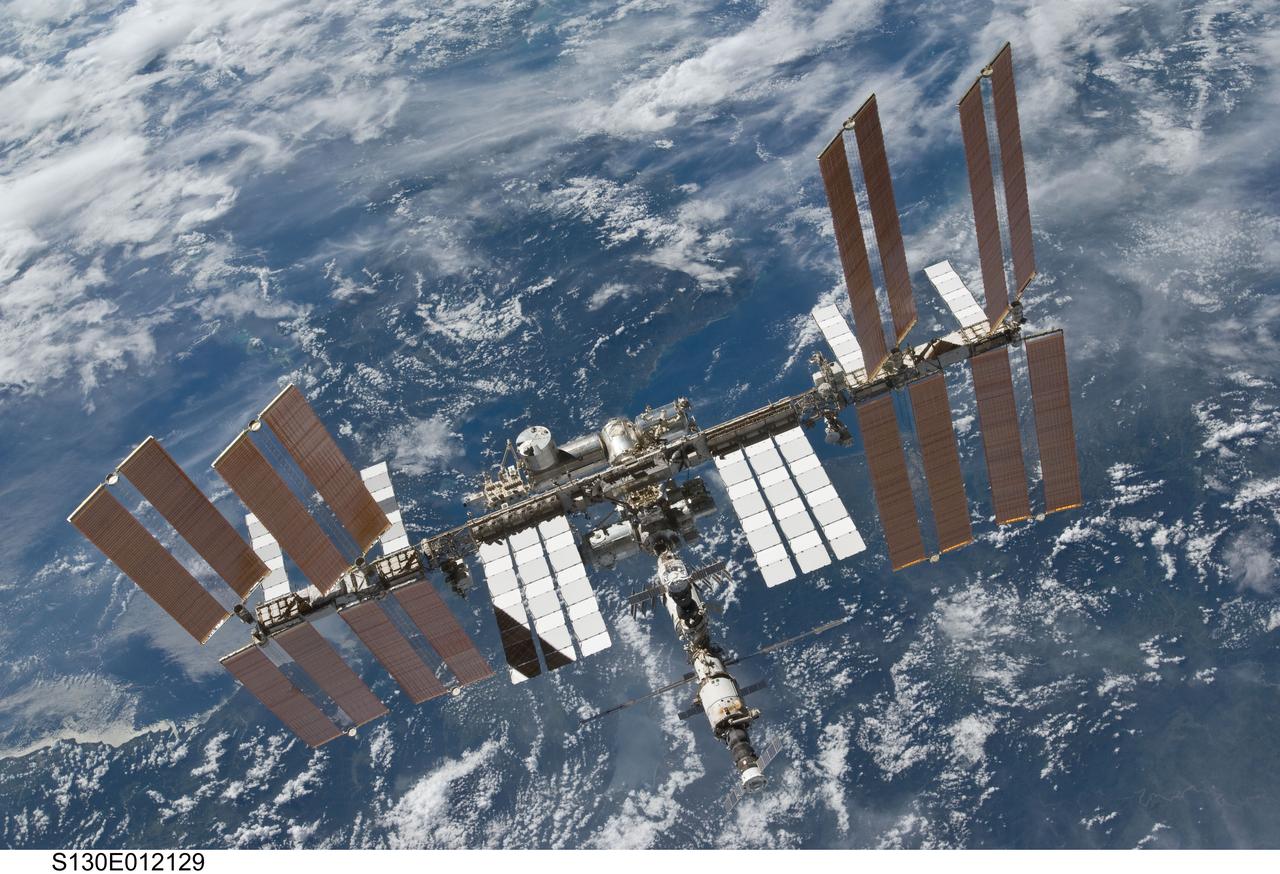
S130-E-012129 (19 Feb. 2010) --- Backdropped by a blue and white part of Earth, the International Space Station is featured in this image photographed by an STS-130 crew member on space shuttle Endeavour after the station and shuttle began their post-undocking relative separation. Undocking of the two spacecraft occurred at 7:54 p.m. (EST) on Feb. 19, 2010.
Overall View of ISS After STS-130 Undocking
ISS020-E-036850 (30 Aug. 2009) --- Backdropped by a colorful Earth, Space Shuttle Discovery is featured in this image photographed by an Expedition 20 crew member as the shuttle approaches the International Space Station during STS-128 rendezvous and docking operations. Docking occurred at 7:54 p.m. (CDT) on Aug. 30, 2009. The Leonardo Multi-Purpose Logistics Module is visible in Discovery?s cargo bay.
STS-128 approach to ISS
S130-E-012155 (19 Feb. 2010) --- Backdropped by Earth?s horizon and the blackness of space, the International Space Station is featured in this image photographed by an STS-130 crew member on space shuttle Endeavour after the station and shuttle began their post-undocking relative separation. Undocking of the two spacecraft occurred at 7:54 p.m. (EST) on Feb. 19, 2010.
Overall View of ISS After STS-130 Undocking
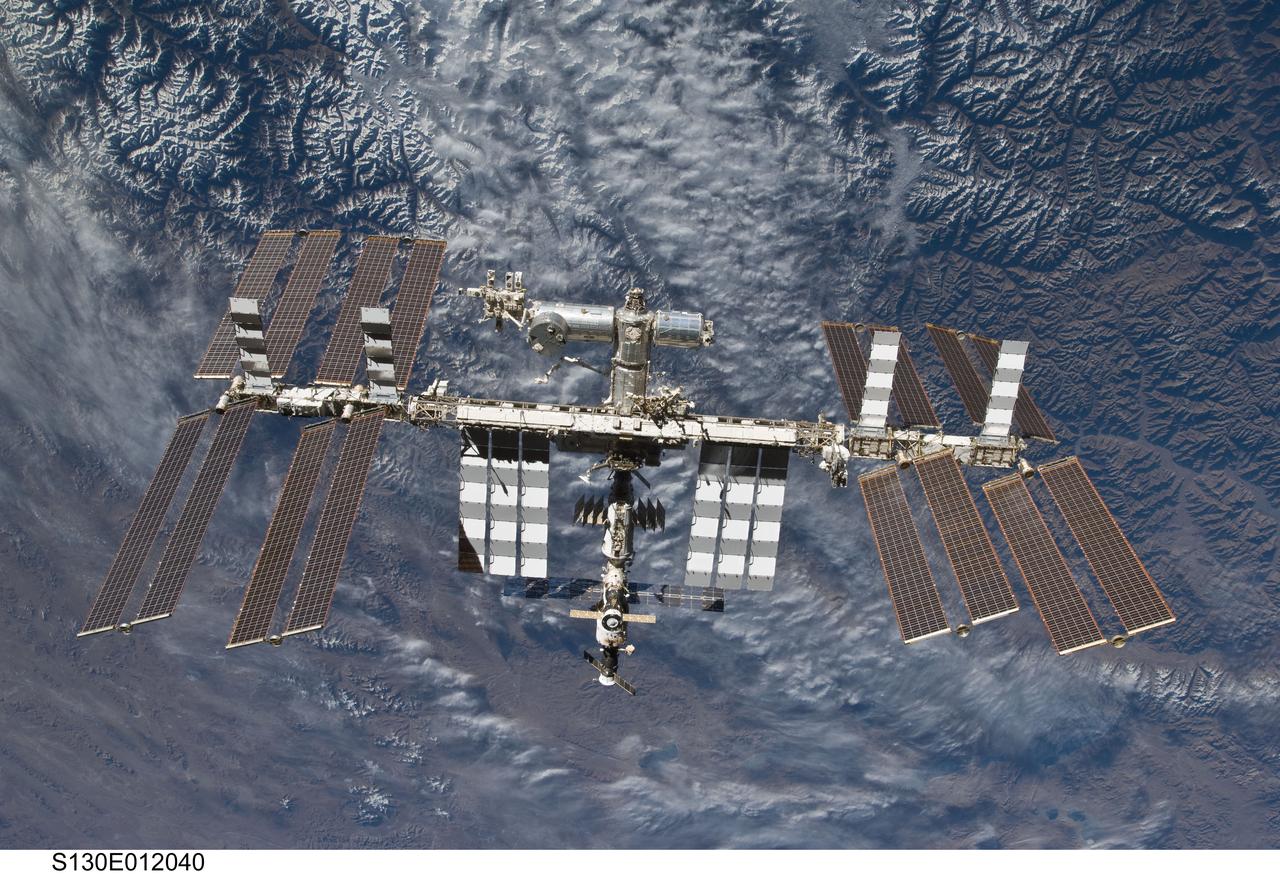
S130-E-012040 (19 Feb. 2010) --- Backdropped by rugged Earth terrain, the International Space Station is featured in this image photographed by an STS-130 crew member on space shuttle Endeavour after the station and shuttle began their post-undocking relative separation. Undocking of the two spacecraft occurred at 7:54 p.m. (EST) on Feb. 19, 2010.
Overall View of ISS After STS-130 Undocking
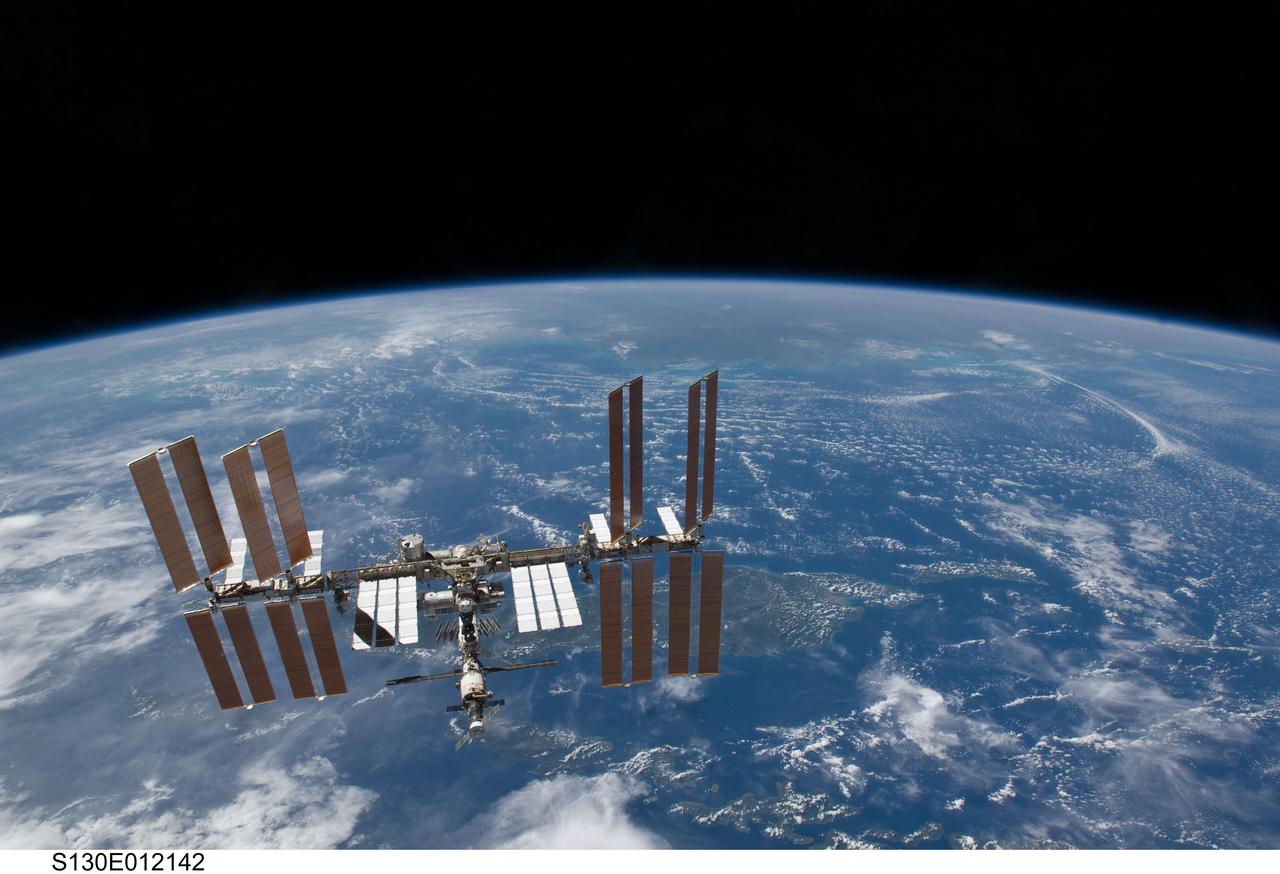
S130-E-012142 (19 Feb. 2010) --- Backdropped by Earth?s horizon and the blackness of space, the International Space Station is featured in this image photographed by an STS-130 crew member on space shuttle Endeavour after the station and shuttle began their post-undocking relative separation. Undocking of the two spacecraft occurred at 7:54 p.m. (EST) on Feb. 19, 2010.
Overall View of ISS After STS-130 Undocking
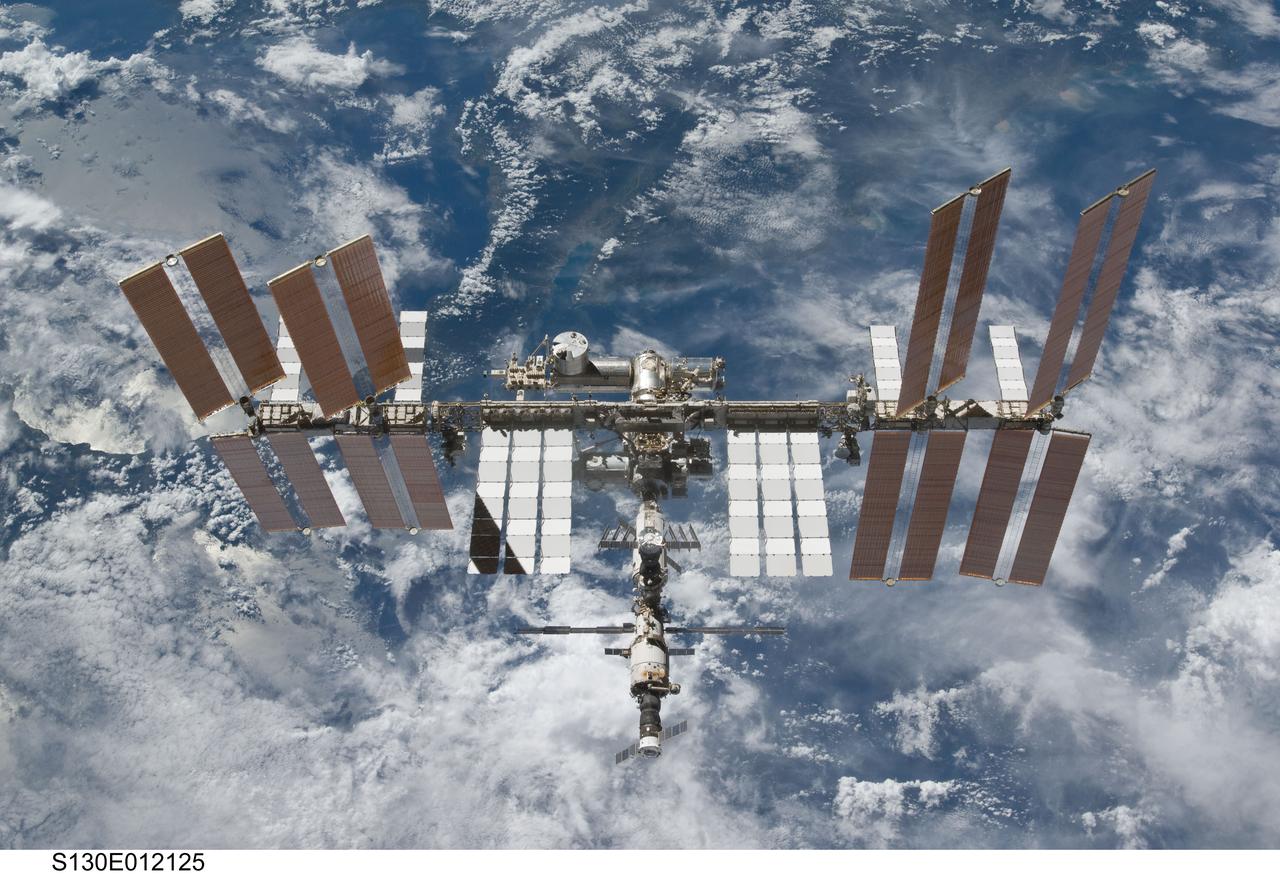
S130-E-012125 (19 Feb. 2010) --- Backdropped by a blue and white part of Earth, the International Space Station is featured in this image photographed by an STS-130 crew member on space shuttle Endeavour after the station and shuttle began their post-undocking relative separation. Undocking of the two spacecraft occurred at 7:54 p.m. (EST) on Feb. 19, 2010.
Overall View of ISS After STS-130 Undocking
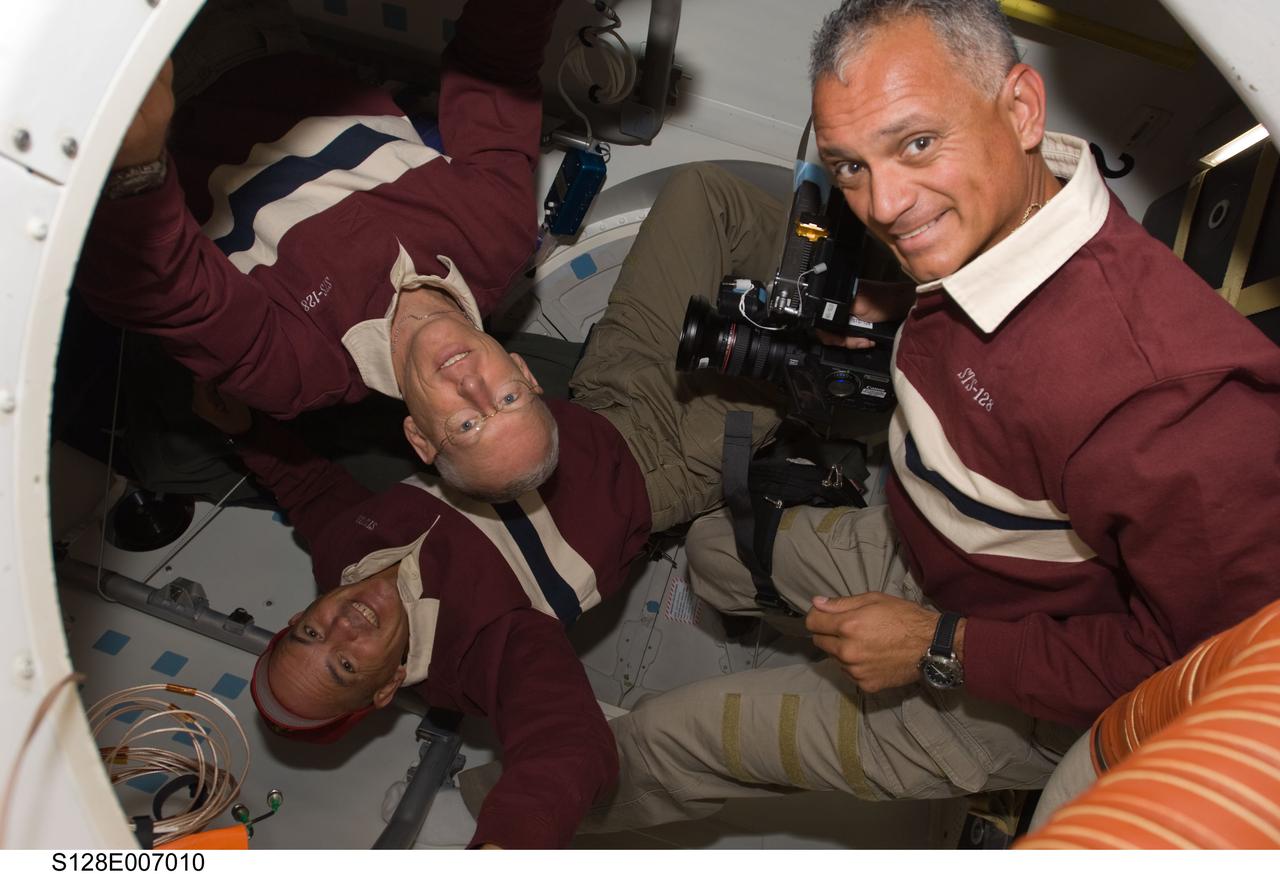
S128-E-007010 (30 Aug. 2009) --- Astronauts Rick Sturckow (bottom), STS-128 commander; John “Danny” Olivas (right) and Patrick Forrester, both mission specialists, are pictured near the hatch on the middeck of Space Shuttle Discovery after docking with the International Space Station. The two spacecraft docked at 7:54 p.m. (CDT), and the Discovery crew entered the orbital outpost at 9:59 p.m. (CDT) on Aug. 30.
Hatch Opening OPS
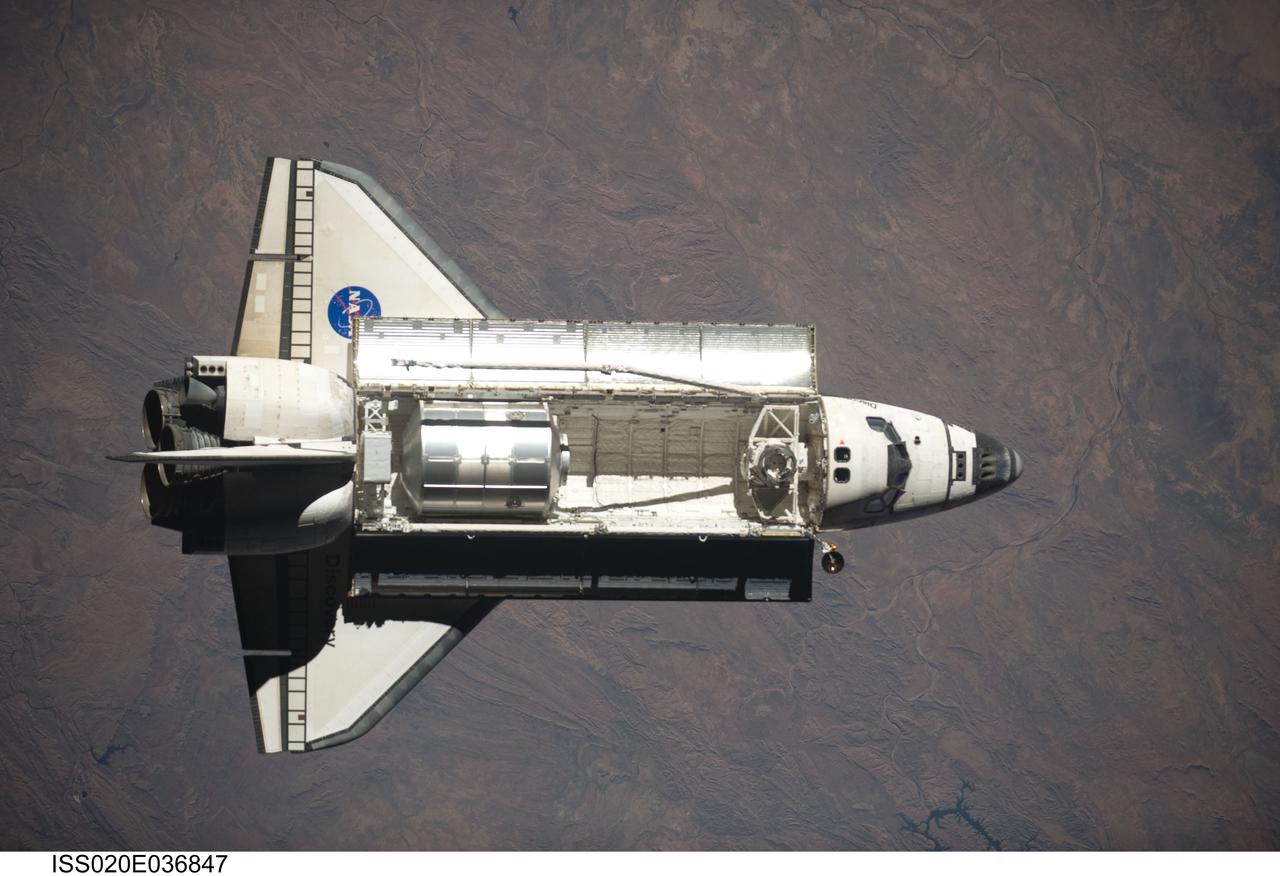
ISS020-E-036847 (30 Aug. 2009) --- Space Shuttle Discovery is featured in this image photographed by an Expedition 20 crew member as the shuttle approaches the International Space Station during STS-128 rendezvous and docking operations. Docking occurred at 7:54 p.m. (CDT) on Aug. 30, 2009. The Leonardo Multi-Purpose Logistics Module is visible in Discovery?s cargo bay.
STS-128 approach to ISS
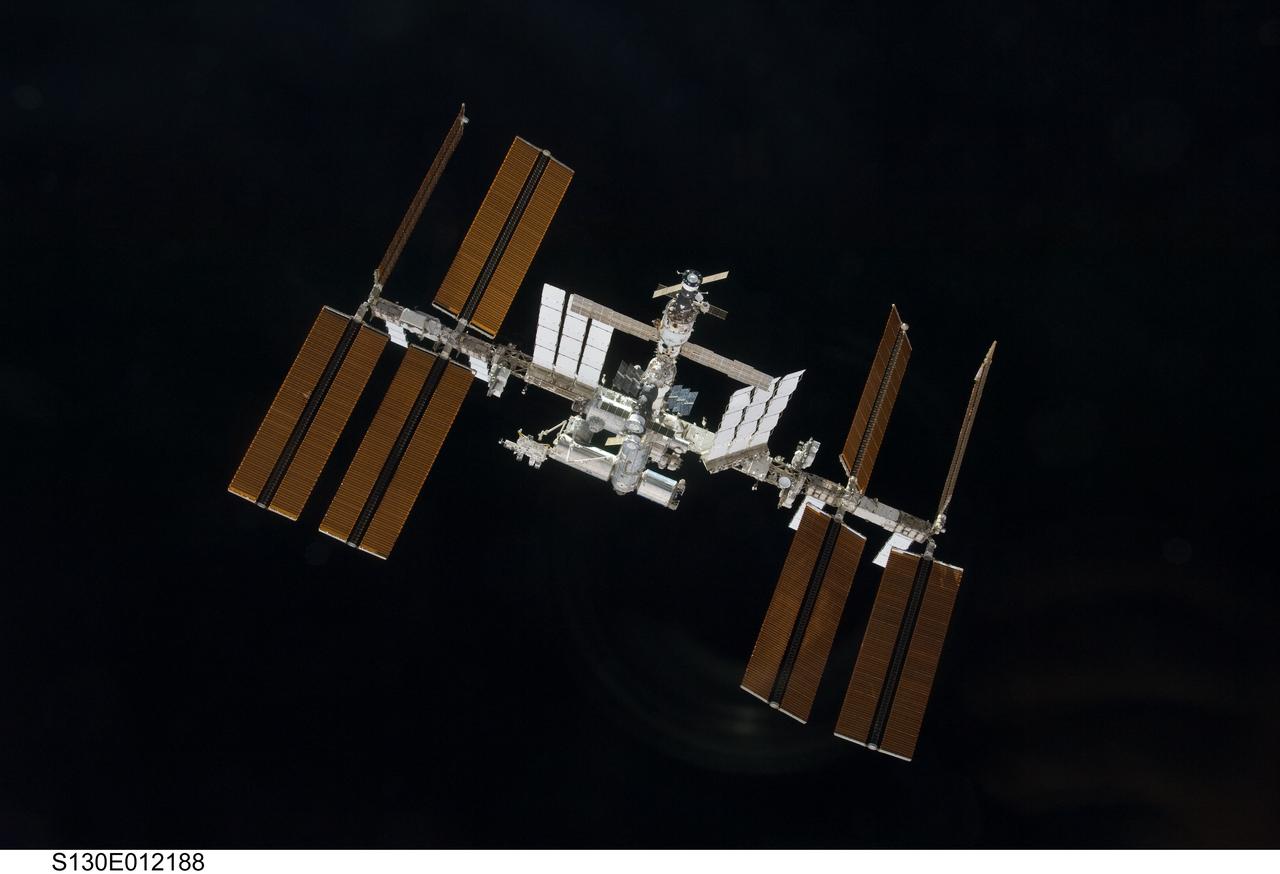
S130-E-012188 (19 Feb. 2010) --- Surrounded by the blackness of space, the International Space Station is featured in this image photographed by an STS-130 crew member on space shuttle Endeavour after the station and shuttle began their post-undocking relative separation. Undocking of the two spacecraft occurred at 7:54 p.m. (EST) on Feb. 19, 2010.
Overall View of ISS After STS-130 Undocking