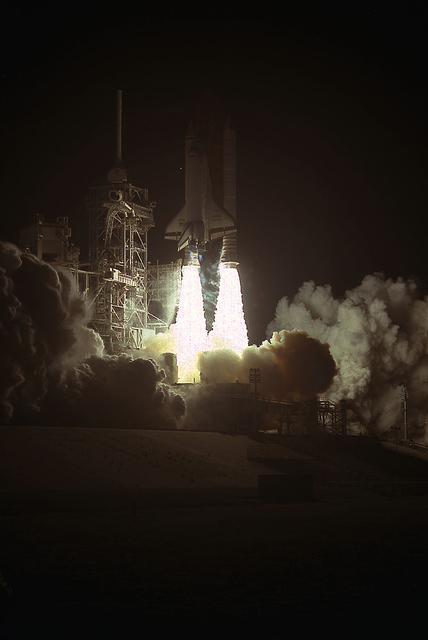
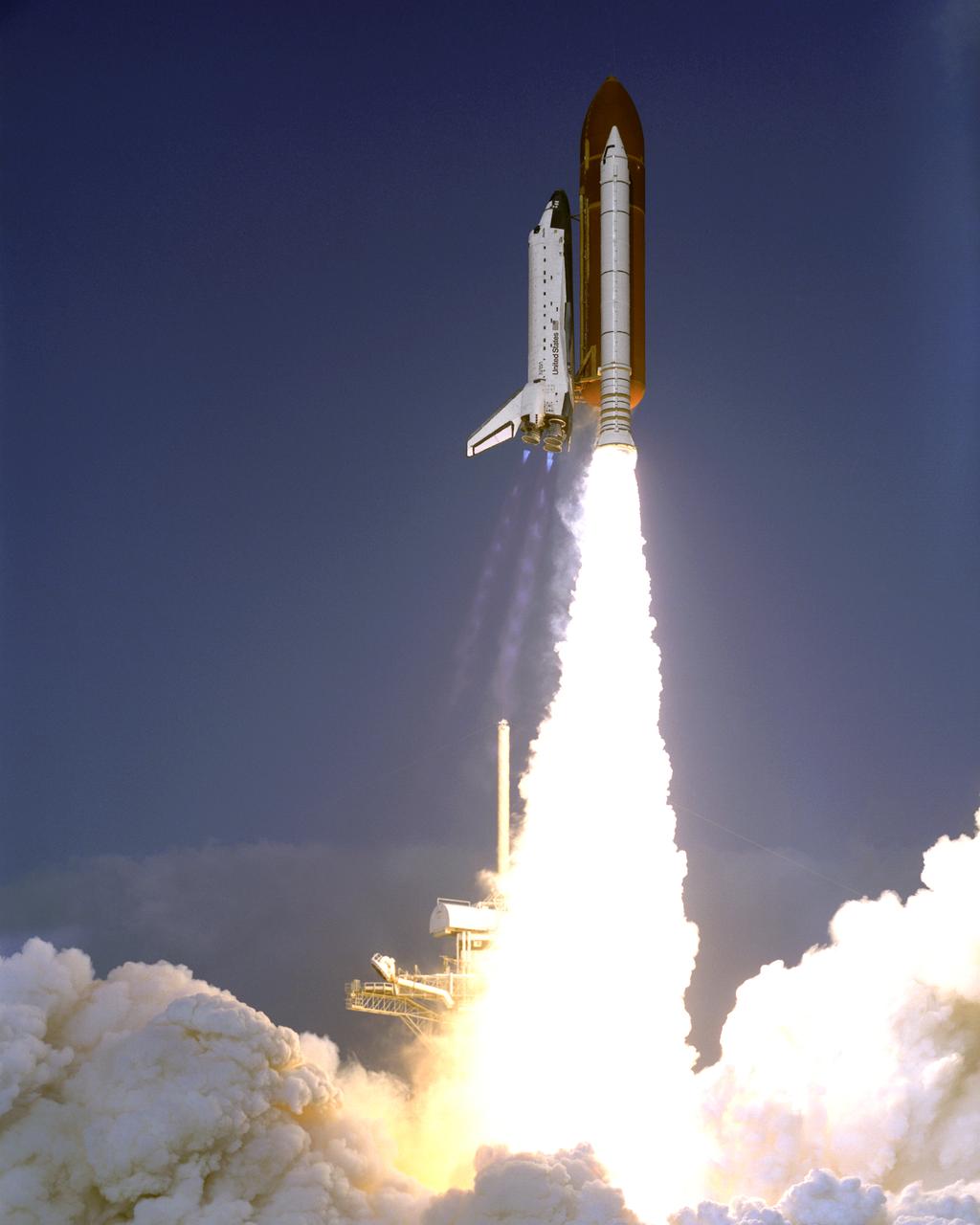
The second try works like a charm as the Space Shuttle Discovery (STS-56) lifts off from Launch Pad 39B. The first attempt to launch was halted at T-11 seconds on April 6th. Aboard for the second shuttle mission of 1993 were a crew of five and the Atmospheric Laboratory for Applications and Science 2 (ATLAS 2), the second in a series of missions to study the sun's energy output and Earth's middle atmosphere chemical make-up, and how these factors affect levels of ozone.
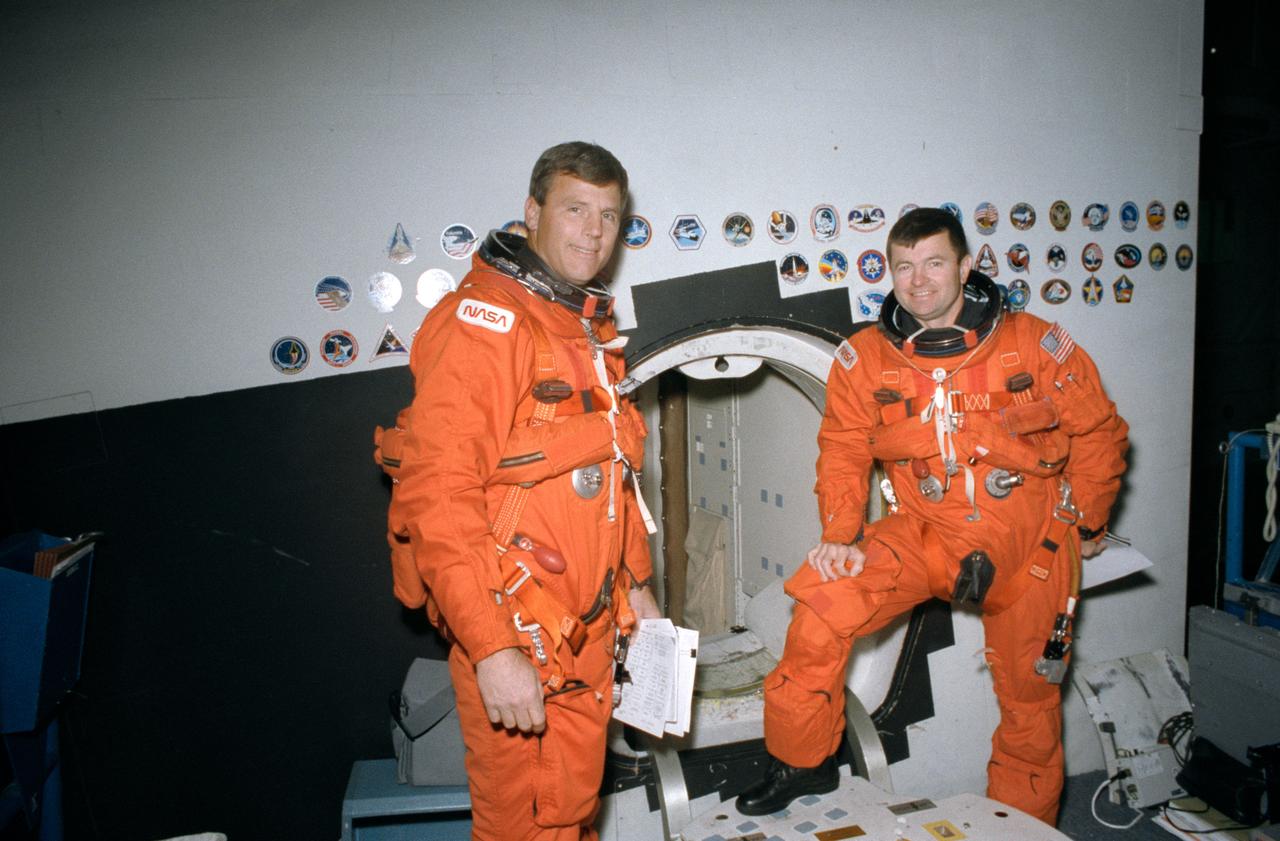
STS-56 Discovery, Orbiter Vehicle (OV) 103, Commander Kenneth Cameron (right) and Pilot Stephen S. Oswald, wearing launch and entry suits (LESs), stand at the side hatch of the crew compartment trainer (CCT), a shuttle mockup, prior to entering the mockup. Once inside the CCT, they will don their launch and entry helmets (LEHs) and participate in emergency egress (bailout) procedures. The CCT is located in JSC's Mockup and Integration Laboratory (MAIL) Bldg 9NE.
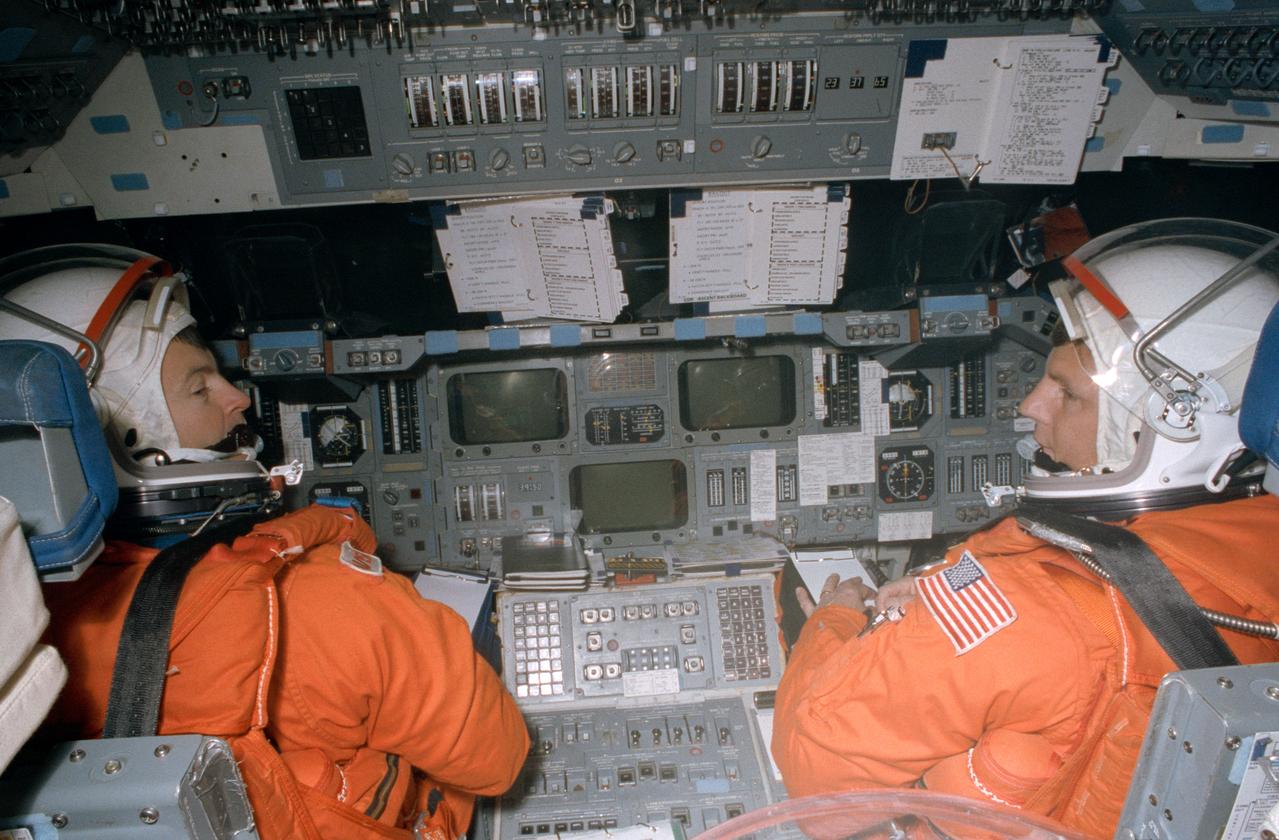
STS-56 Discovery, Orbiter Vehicle (OV) 103, Commander Kenneth Cameron, (left) and Pilot Stephen S. Oswald, wearing launch and entry suits (LESs) and launch and entry helmets (LEHs), are seated on the forward flight deck of the crew compartment trainer (CCT), a shuttle mockup. Cameron mans the commander station controls and Oswald the pilots station controls during an emergency egress (bailout) simulation. The view was taken from the aft flight deck looking forward and includes Cameron's and Oswald's profiles and the forward flight deck controls and checklists. The CCT is located in JSC's Mockup and Integration Laboratory (MAIL) Bldg 9NE.
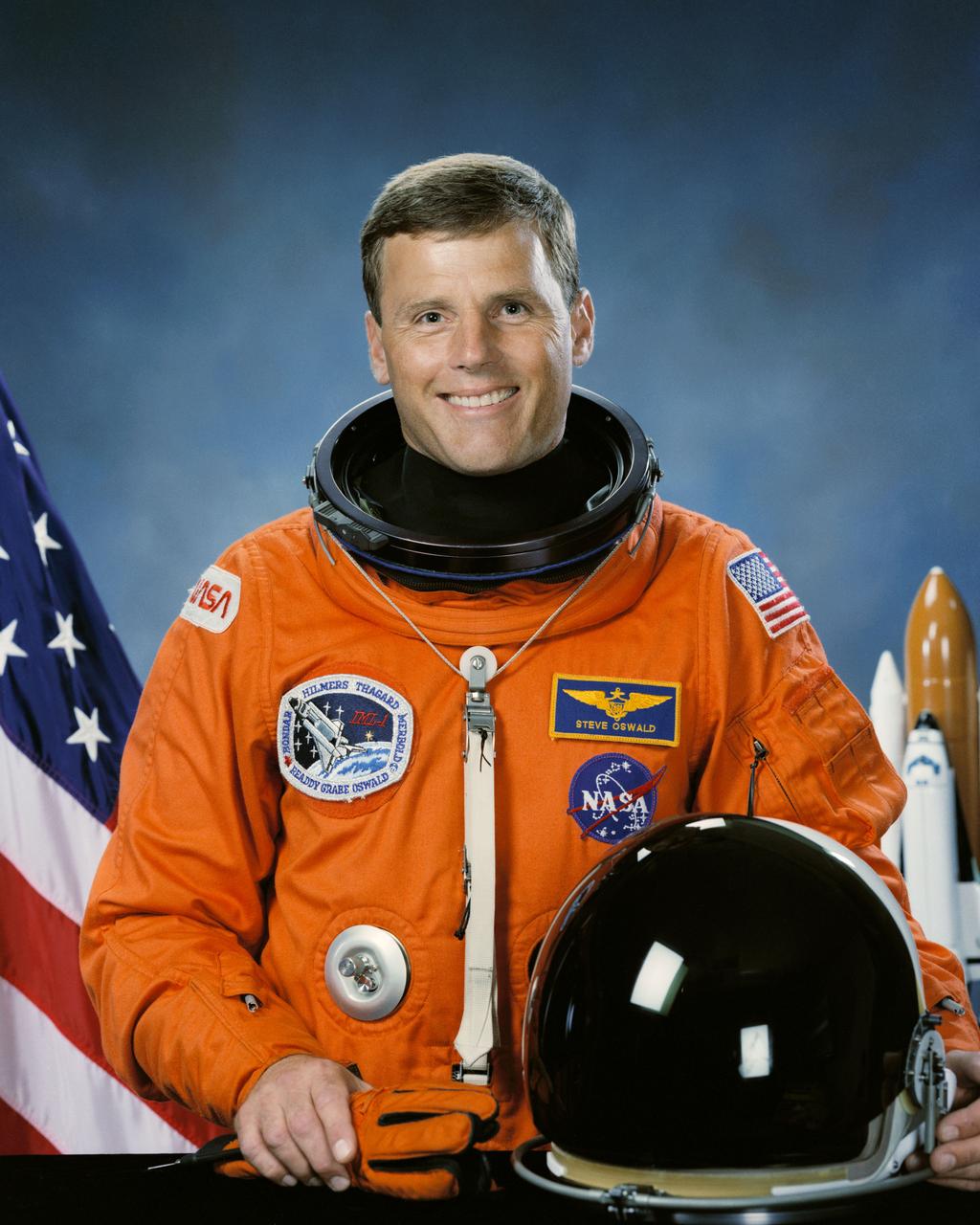
S92-31007 (March 1992) --- Astronaut Stephen S. Oswald.
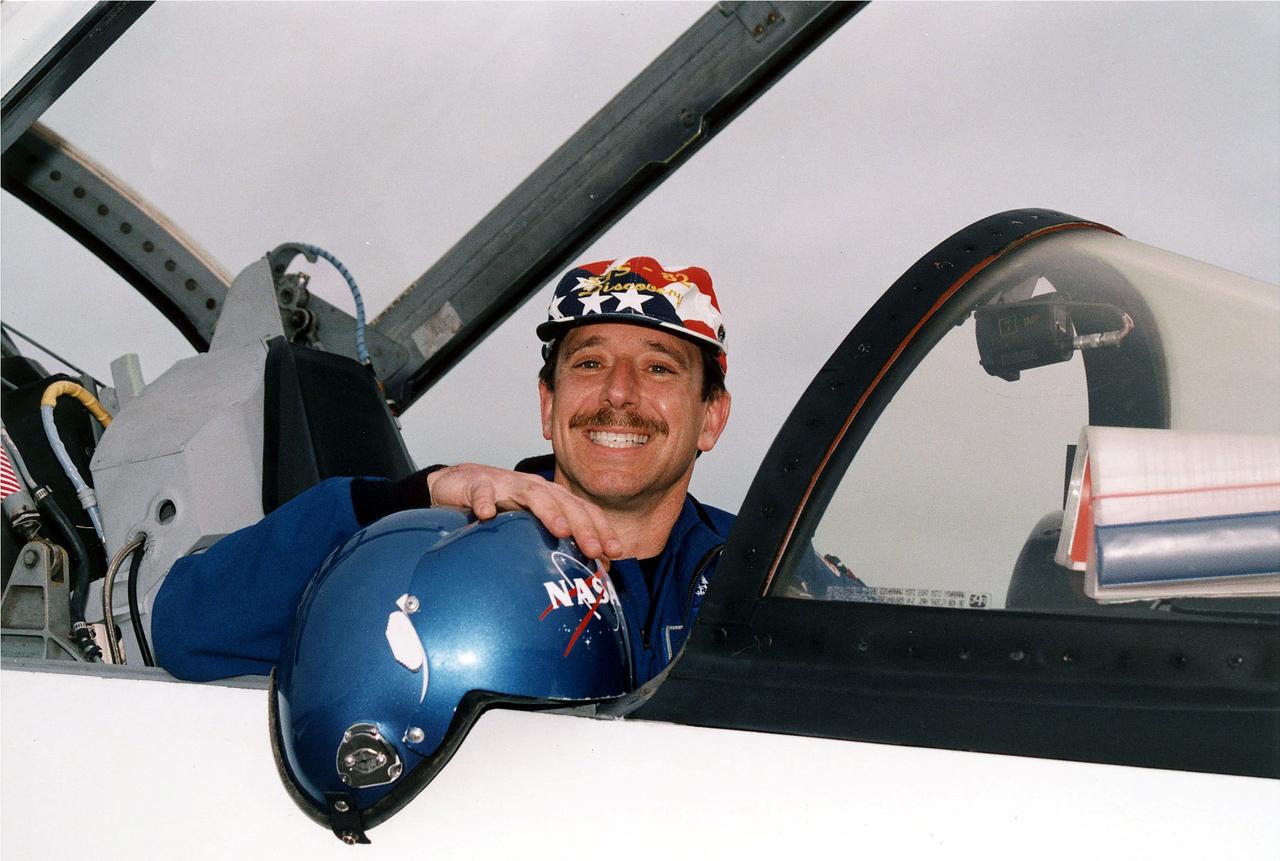
KENNEDY SPACE CENTER, FLA. - STS-82 Pilot Scott J. "Doc" Horowitz flashes a wide grin for photographers after landing his T-38 jet at KSC's Shuttle Landing Facility. Horowitz and the other six members of the STS-82 crew came from their home base at Johnson Space Center in Houston, Texas, to spend the last few days before launch at KSC. STS-82 is scheduled for liftoff on Feb. 11 during a 65-minute launch window that opens at 3:56 a.m. EST. The 10-day flight aboard the Space Shuttle Discovery will be the second Hubble Space Telescope (HST) servicing mission.
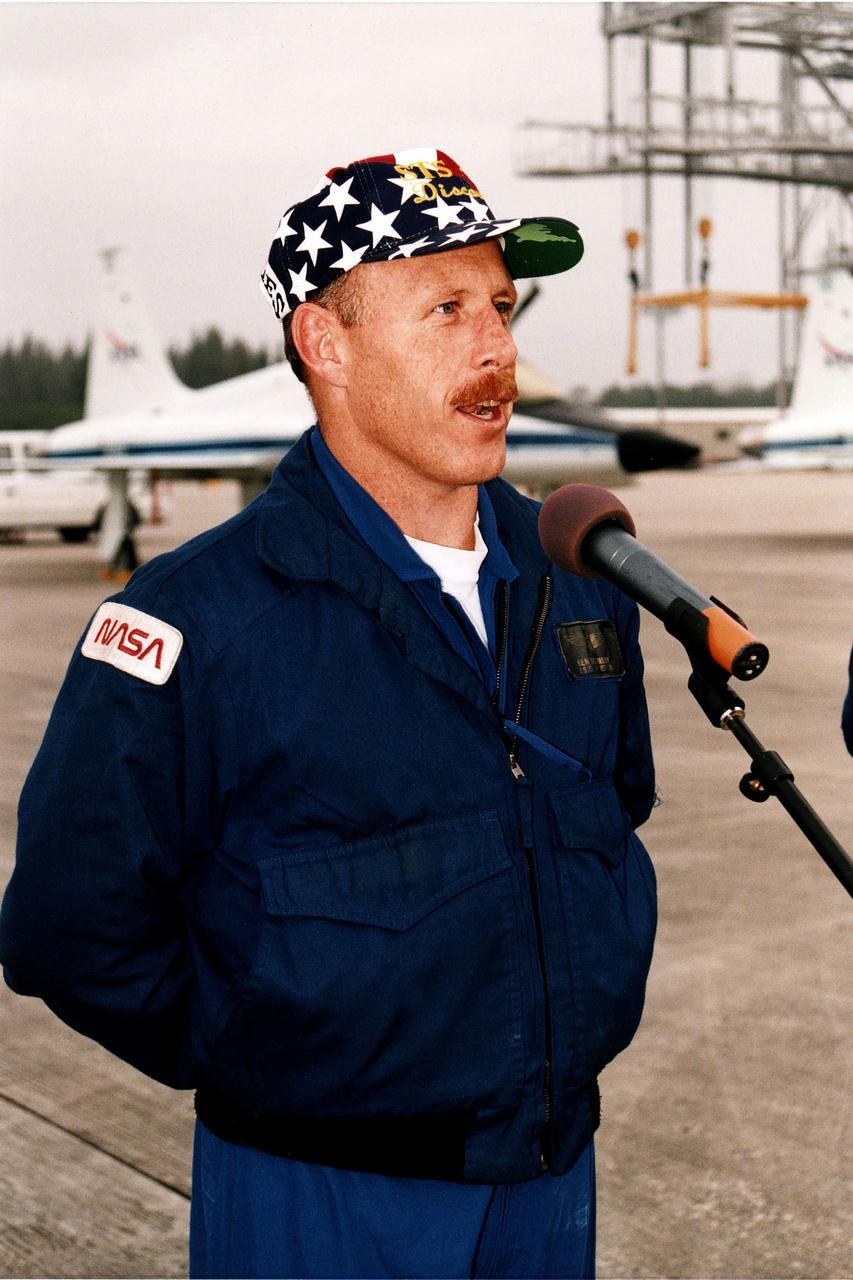
KENNEDY SPACE CENTER, FLA. - STS-82 Mission Commander Kenneth D. Bowersox greets media representatives after arrival at KSC's Shuttle Landing Facility. Bowersox and the other six members of the STS-82 crew came from their home base at Johnson Space Center in Houston, Texas, to spend the last few days before launch at KSC. STS-82 is scheduled for liftoff on Feb. 11 during a 65-minute launch window that opens at 3:56 a.m. EST. The 10-day flight aboard the Space Shuttle Discovery will be the second Hubble Space Telescope (HST) servicing mission.
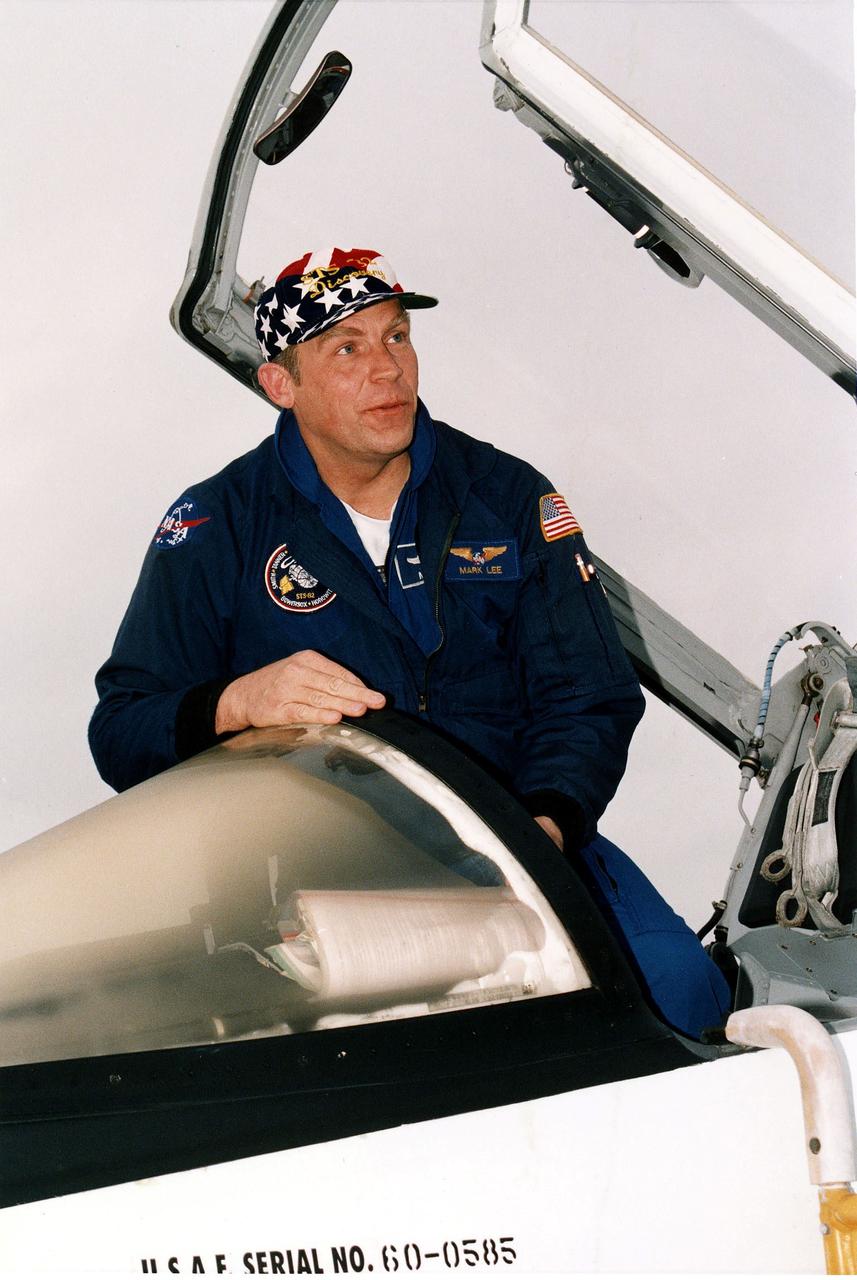
KENNEDY SPACE CENTER, FLA. - STS-82 Payload Commander Mark C. Lee prepares to step down from the T-38 jet he flew from an air field serving the astronauts' home base at Johnson Space Center, Houston, Texas, to KSC's Shuttle Landing Facility. Lee and the other six members of the STS-82 crew will spend the last few days before launch at KSC. STS-82 is scheduled for liftoff on Feb. 11 during a 65-minute launch window that opens at 3:56 a.m. EST. The 10-day flight aboard the Space Shuttle Discovery will be the second Hubble Space Telescope (HST) servicing mission.
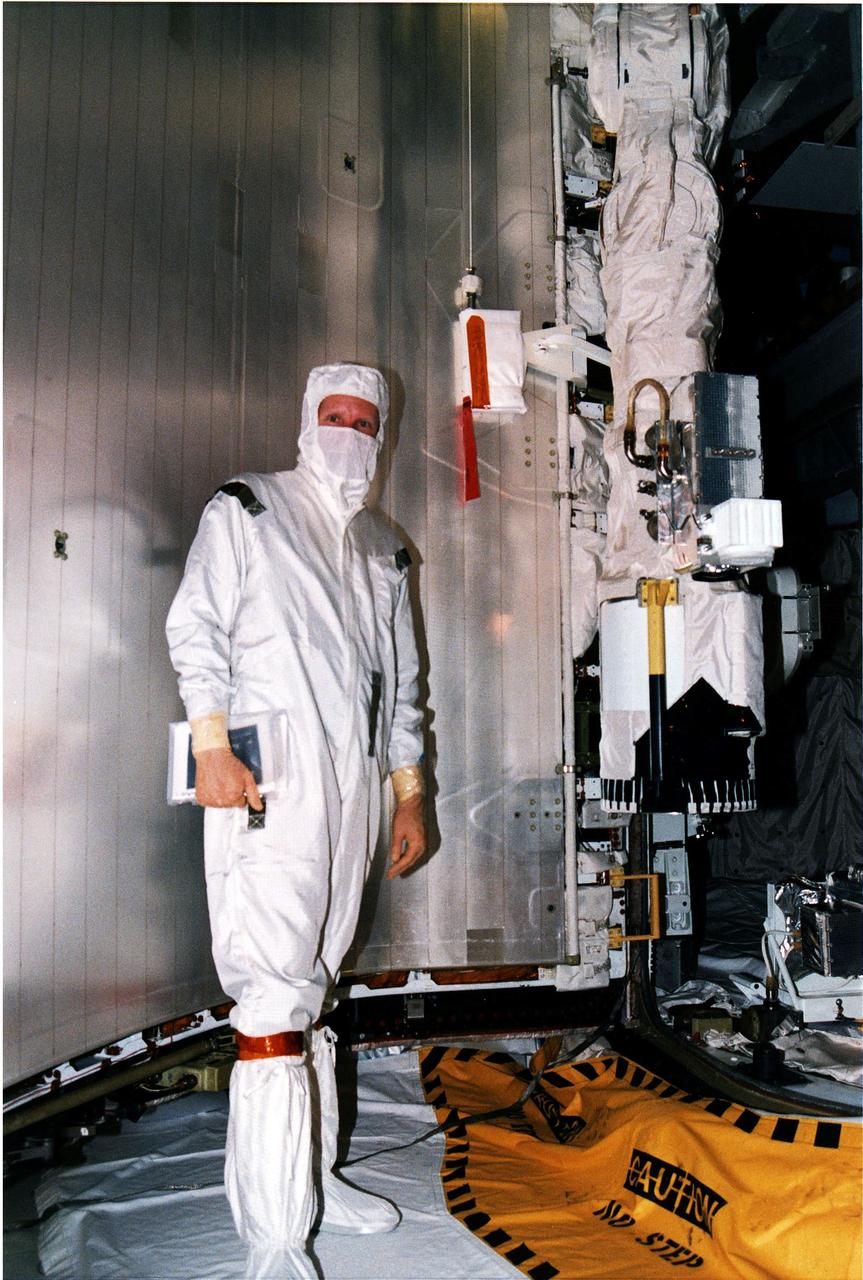
KENNEDY SPACE CENTER, FLA. - STS-82 Mission Specialist Steven A Hawley stands beside part of Discovery's Remote Manipulator System (RMS) arm, at right, which he will operate for the capture, berthing and redeployment of the Hubble Space Telescope (HST). The robotic arm also will be used as work platform for the four spacewalkers. Hawley is the prime RMS operator on the flight, which will be the second HST servicing mission. He and the other six members of the crew are making a final inspection of the payload at Launch Pad 39A before launch. STS-82 is scheduled for liftoff on Feb. 11 during a 65-minute launch window that opens at 3:56 a.m. EST.
NASA's mission to planet Earth continues as Atlantis and the STS-45 International crew of xeven roars off Pad 39A with theAtmospheric Laboratory for Applications and Science (Atlas-1) onboard. Launch occurred at 8:13 A.M., EST March 24, 1992. (Test D1310)(Item D-56)
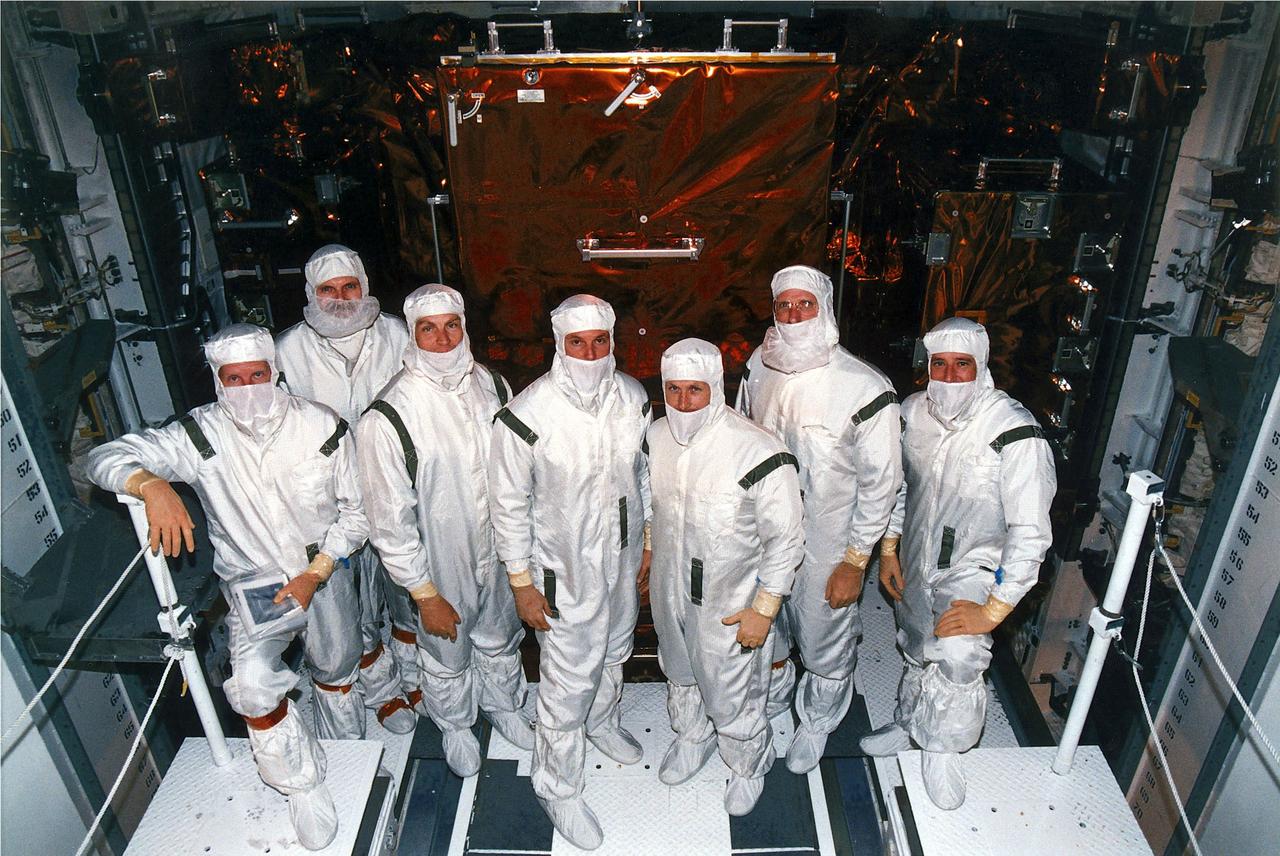
KENNEDY SPACE CENTER, FLA. - STS-82 crew members pose in their clean room suits at Launch Pad 39A where the Space Shuttle Discovery is undergoing final preparations for liftoff on the second Hubble Space Telescope (HST) servicing mission. They are making a final inspection of the payload before payload bay closure. From left are Mission Specialists Steven A. Hawley and Steven L. Smith, Payload Commander Mark C. Lee, Mission Specialist GregoryJ. Harbaugh, Mission Commander Kenneth D. Bowersox, Mission Specialist Joseph R. "Joe" Tanner and Pilot Scott J. "Doc" Horowitz. STS-82 is scheduled for liftoff on Feb. 11 during a 65-minute launch window that opens at 3:56 a.m. EST.
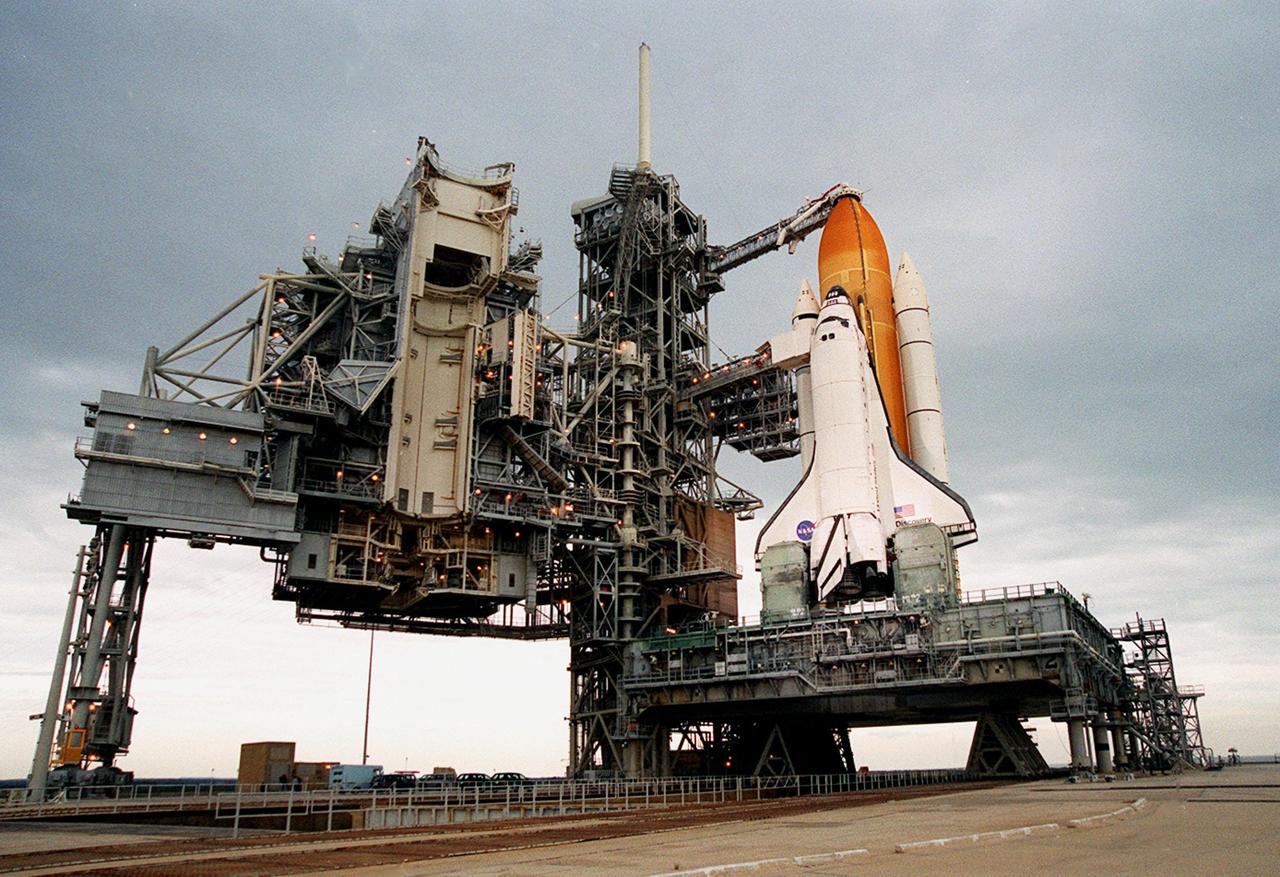
After rollback of the Rotating Service Structure at Launch Pad 39B (left) before dawn, the Space Shuttle Discovery is revealed poised for flight on mission STS-103. The rollback of the structure was complete at 4:46 a.m. EST. STS-103 is scheduled for launch Dec. 16 at 9:18 p.m. EST. The mission is expected to last about 9 days and 21 hours with a landing at KSC Sunday, Dec. 26, at 6:56 p.m. EST
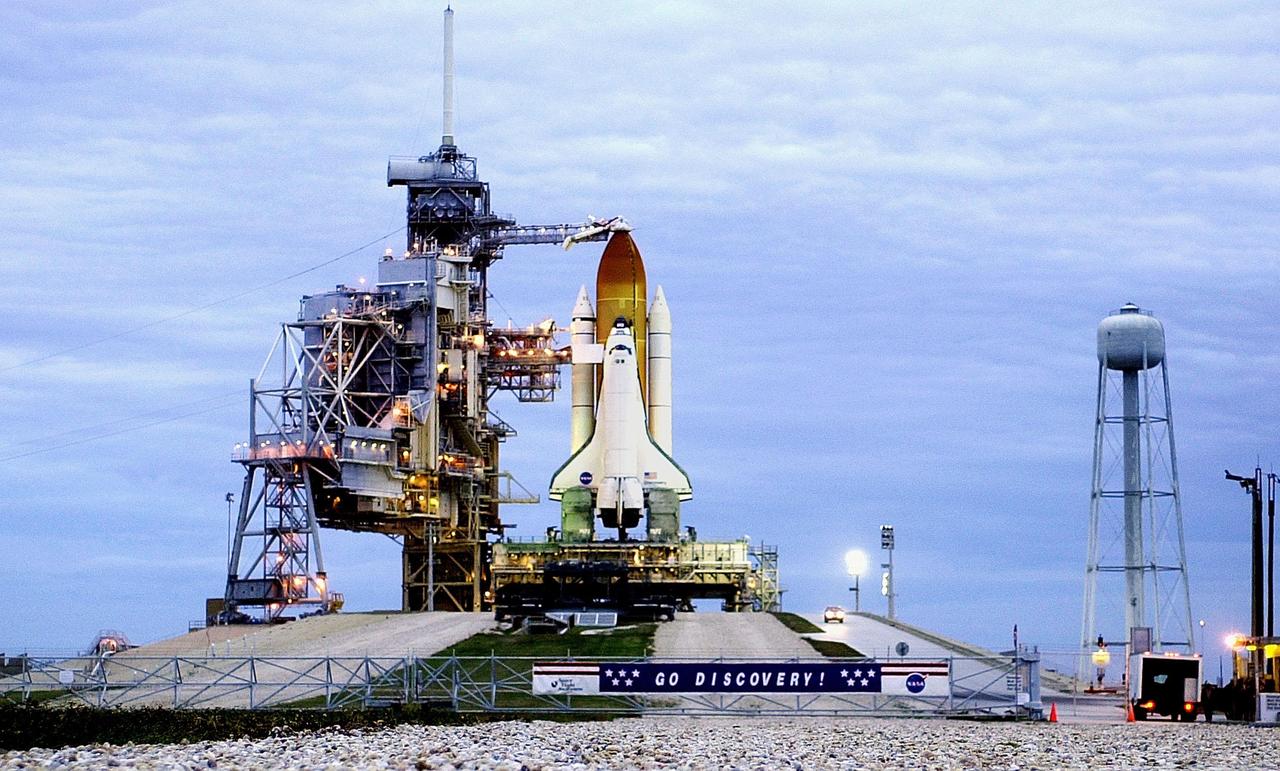
In the pre-dawn hours at Launch Pad 39B under a cloud-filled sky on the east coast of Florida, the Rotating Service Structure is rolled back to reveal the Space Shuttle Discovery poised for flight on mission STS-103. The rollback of the structure was complete at 4:46 a.m. EST. STS-103 is scheduled for launch Dec. 16 at 9:18 p.m. EST. The mission is expected to last about 9 days and 21 hours with a landing at KSC Sunday, Dec. 26, at 6:56 p.m. EST
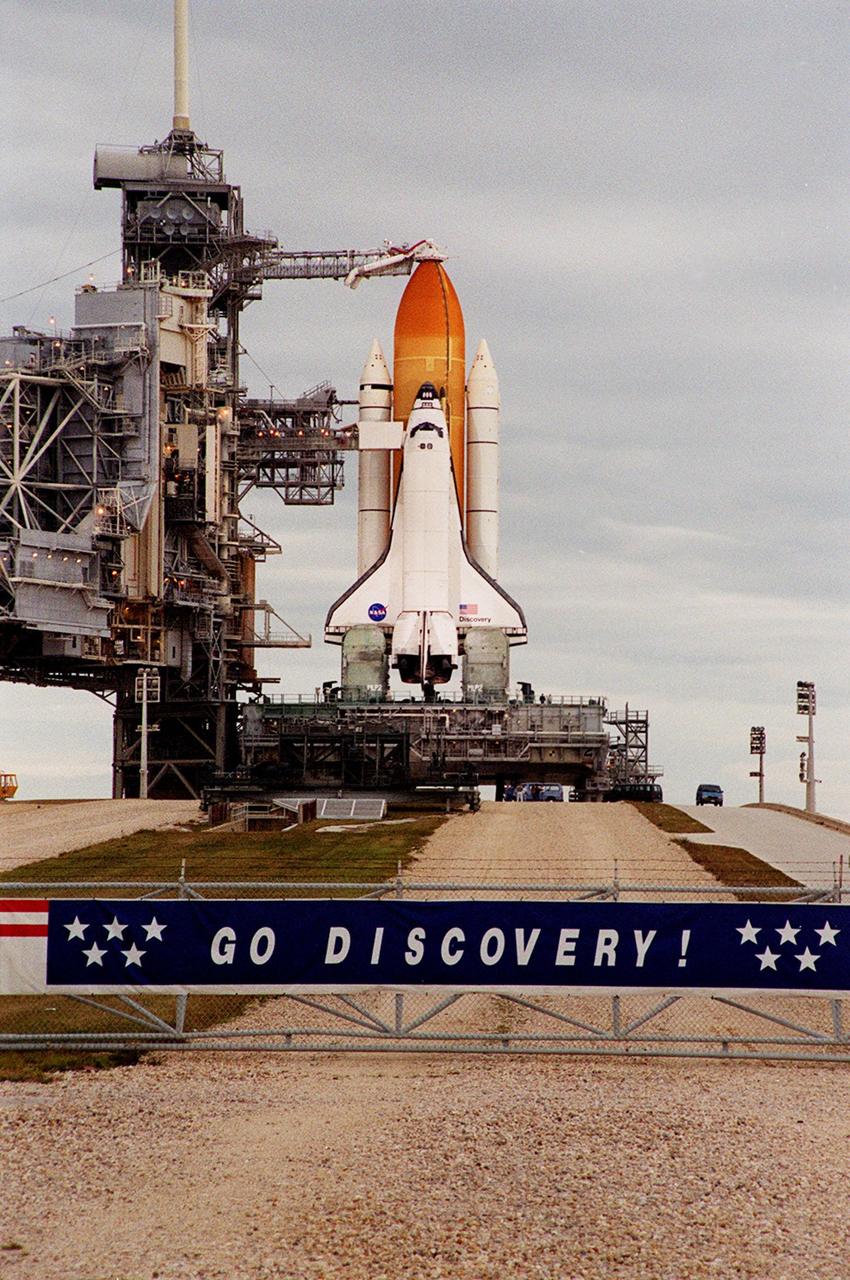
As dawn breaks at Launch Pad 39B on the east coast of Florida, the Space Shuttle Discovery is revealed poised for flight on mission STS-103. The rollback of the Rotating Service Structure (left) was complete at 4:46 a.m. EST. STS-103 is scheduled for launch Dec. 16 at 9:18 p.m. EST. The mission is expected to last about 9 days and 21 hours with a landing at KSC Sunday, Dec. 26, at 6:56 p.m. EST
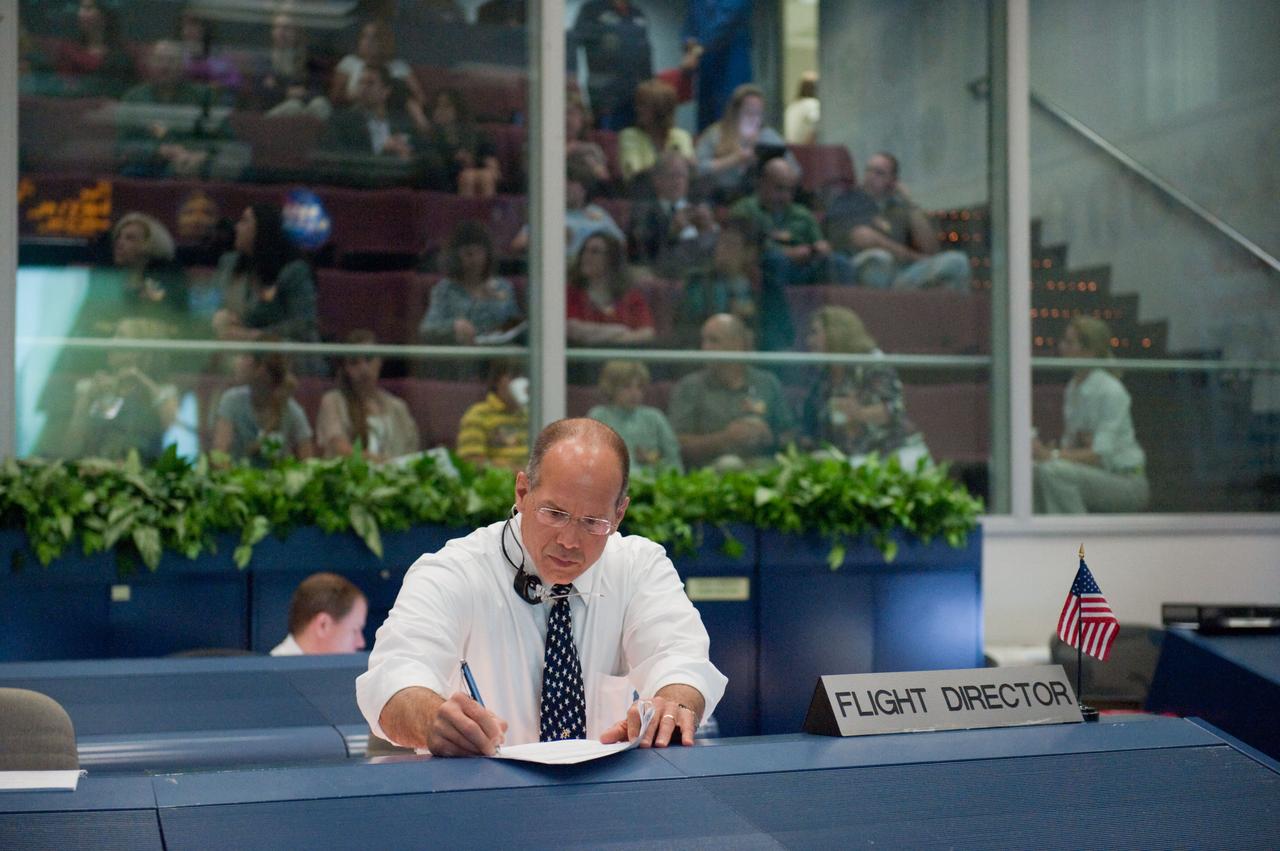
JSC2011-E-044228 (16 May 2011) --- Flight director Tony Ceccacci is pictured at his console in the space shuttle flight control room in the Mission Control Center at NASA's Johnson Space Center during launch countdown activities a few hundred miles away in Florida, site of space shuttle Endeavour's STS-134 launch. Liftoff was at 8:56 a.m. (EDT) on May 16, 2011, from Launch Pad 39A at NASA's Kennedy Space Center. Photo credit: NASA
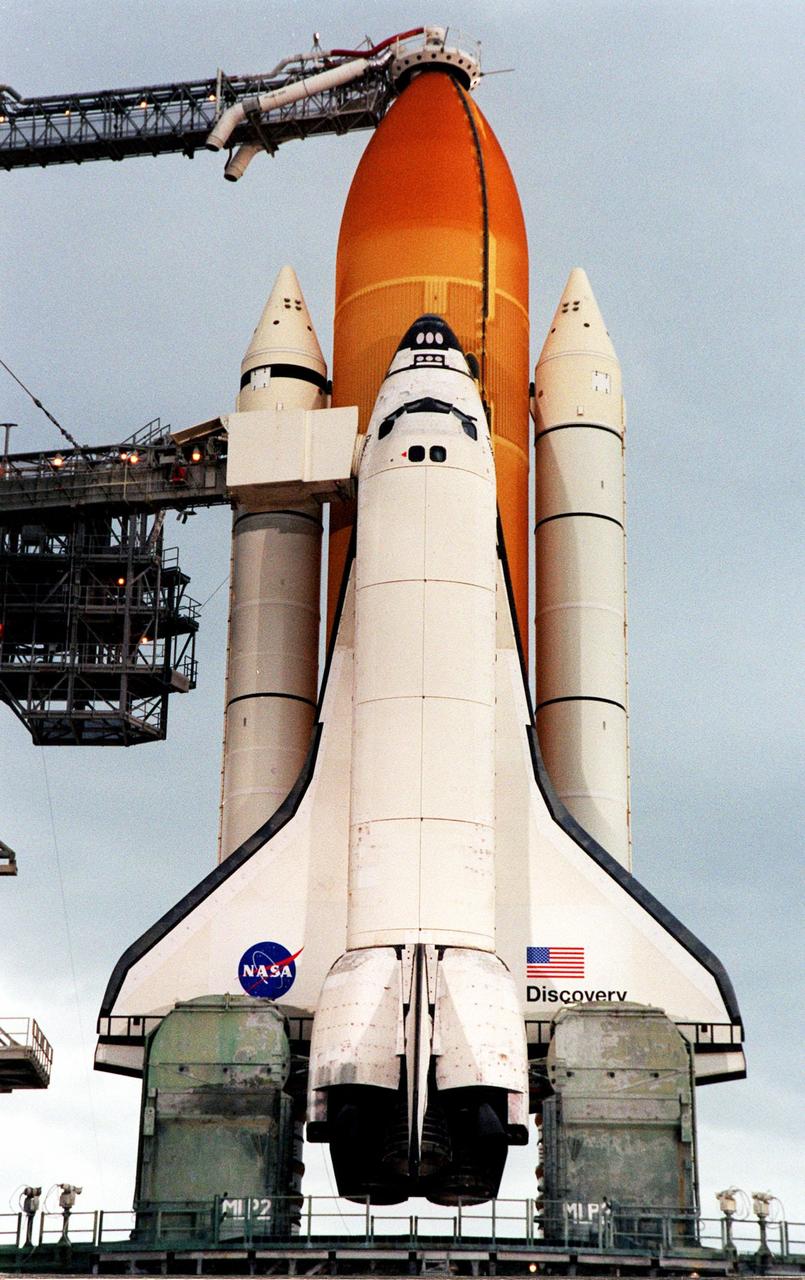
As dawn breaks at Launch Pad 39B on the east coast of Florida, the Space Shuttle Discovery is revealed after rollback of the Rotating Service Structure. The rollback of the structure was complete at 4:46 a.m. EST. Poised for flight on mission STS-103, Discovery is scheduled for launch Dec. 16 at 9:18 p.m. EST. The mission is expected to last about 9 days and 21 hours with a landing at KSC Sunday, Dec. 26, at 6:56 p.m. EST
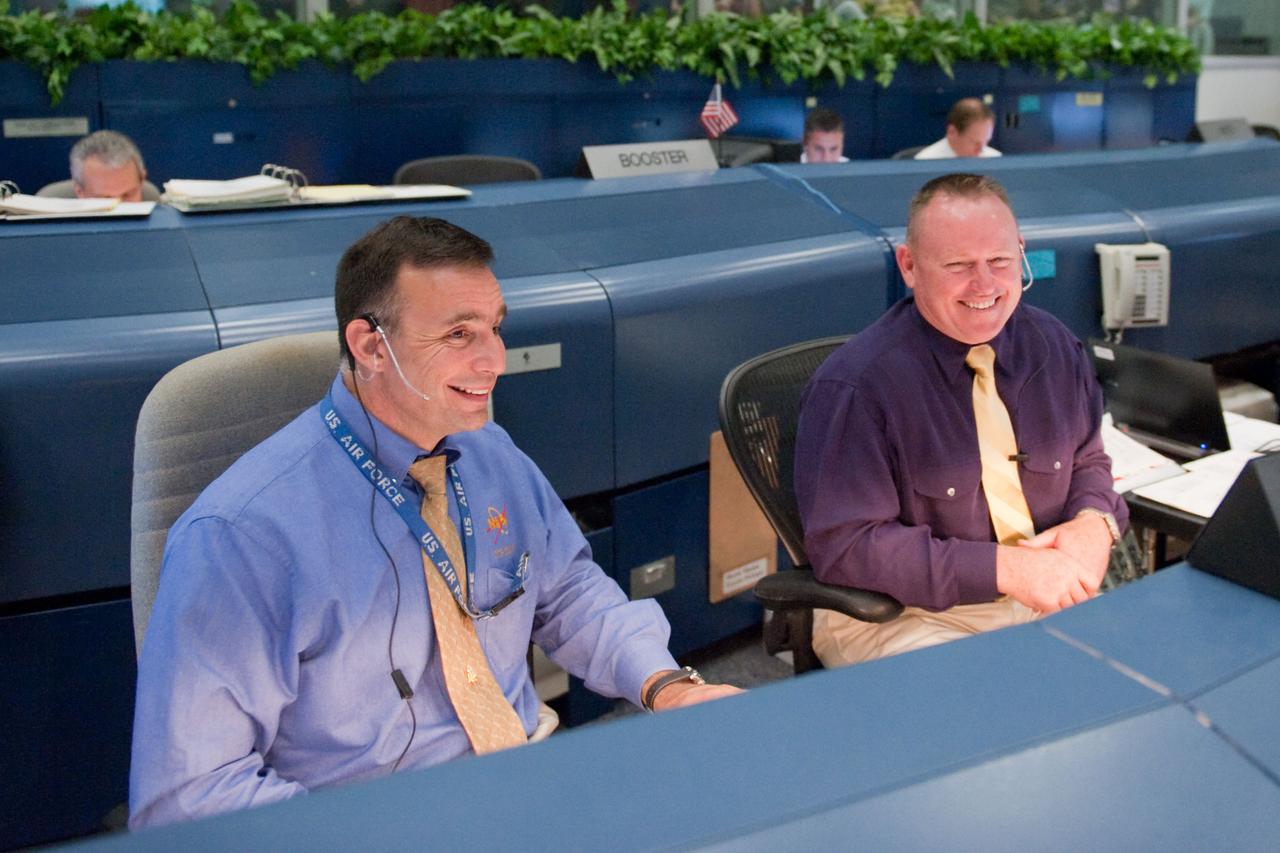
JSC2011-E-044249 (16 May 2011) --- NASA astronauts Lee Archambault (left) and Barry Wilmore, both STS-134 spacecraft communicators (CAPCOM), are pictured at their console in the space shuttle flight control room in the Mission Control Center at NASA's Johnson Space Center during launch countdown activities a few hundred miles away in Florida, site of space shuttle Endeavour's STS-134 launch. Liftoff was at 8:56 a.m. (EDT) on May 16, 2011, from Launch Pad 39A at NASA's Kennedy Space Center. Photo credit: NASA
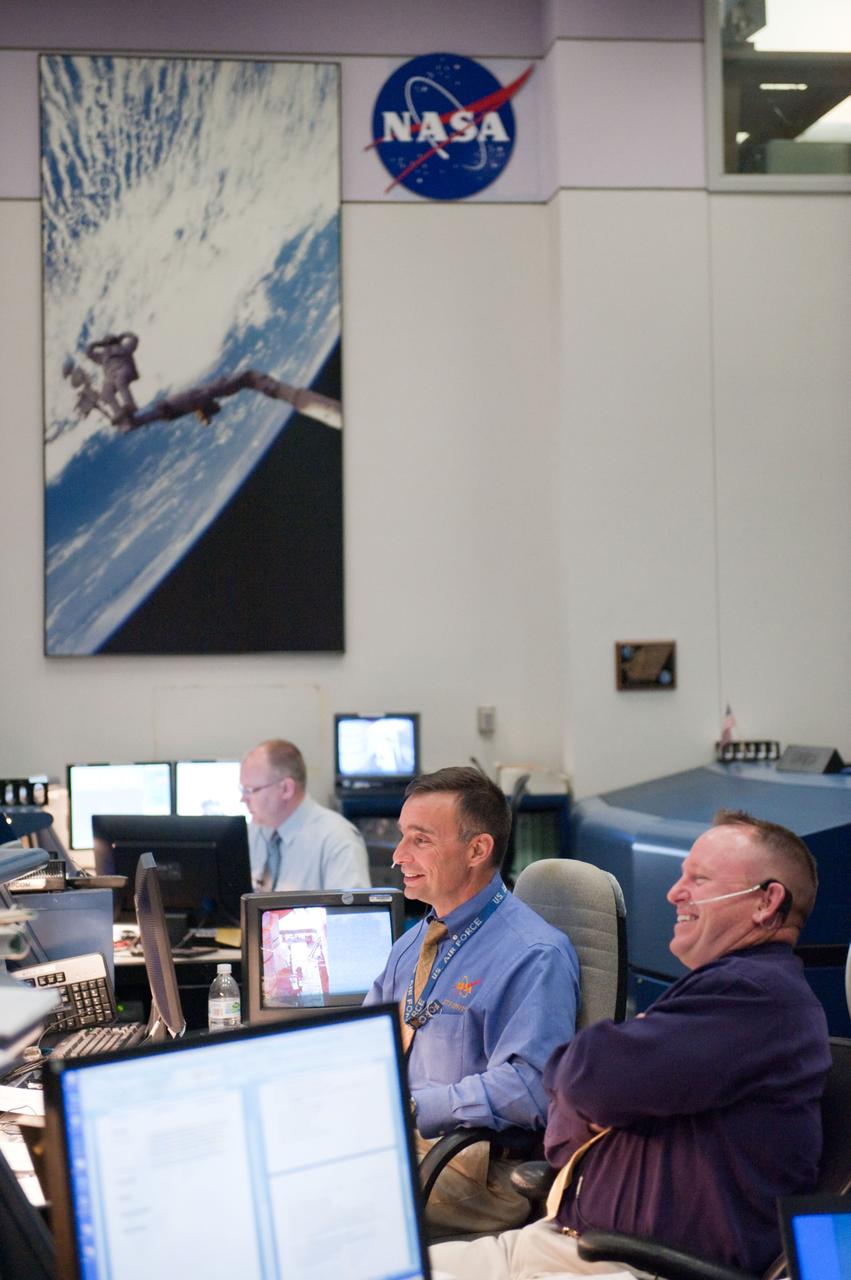
JSC2011-E-044245 (16 May 2011) --- NASA astronauts Barry Wilmore (foreground) and Lee Archambault, both STS-134 spacecraft communicators (CAPCOM), are pictured at their console in the space shuttle flight control room in the Mission Control Center at NASA's Johnson Space Center during launch countdown activities a few hundred miles away in Florida, site of space shuttle Endeavour's STS-134 launch. Liftoff was at 8:56 a.m. (EDT) on May 16, 2011, from Launch Pad 39A at NASA's Kennedy Space Center. Photo credit: NASA
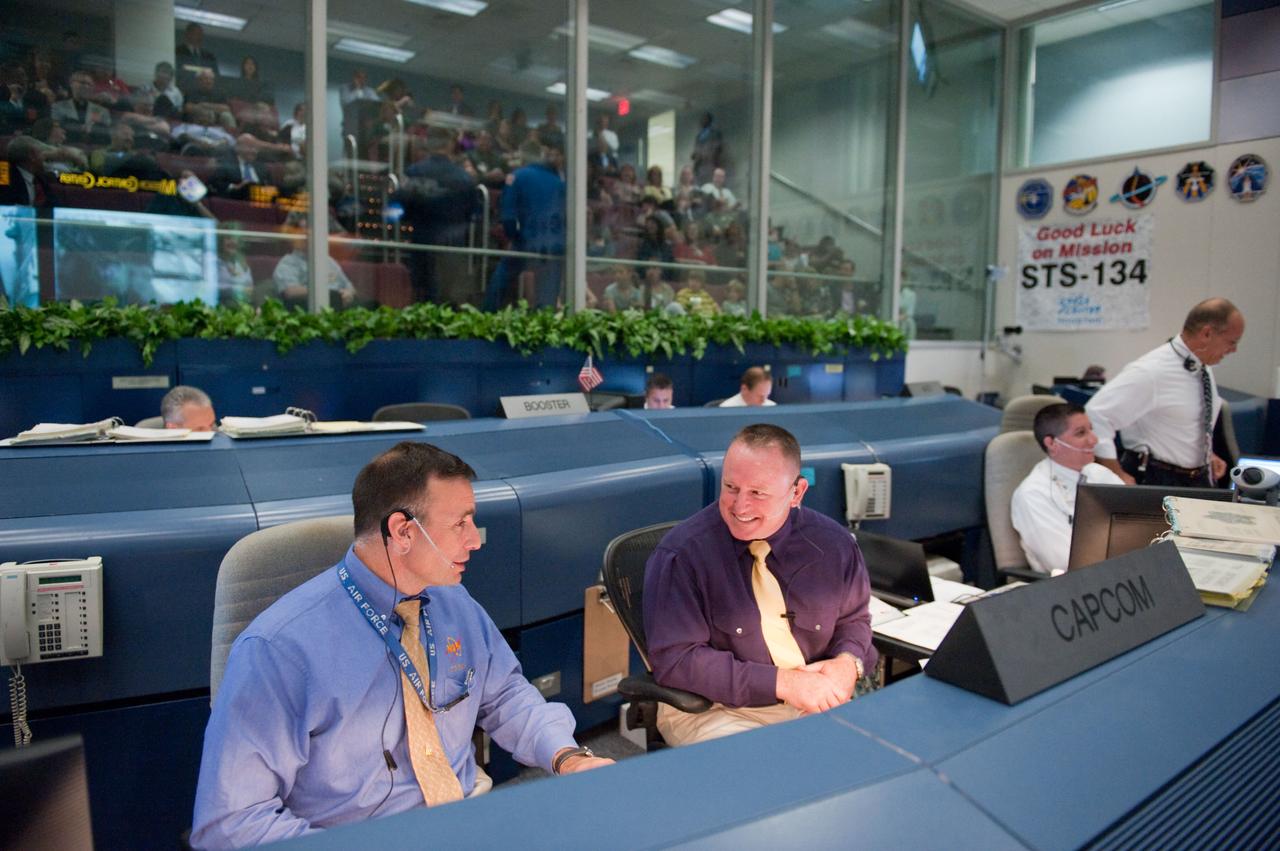
JSC2011-E-044250 (16 May 2011) --- NASA astronauts Lee Archambault (left) and Barry Wilmore, both STS-134 spacecraft communicators (CAPCOM), are pictured at their console in the space shuttle flight control room in the Mission Control Center at NASA's Johnson Space Center during launch countdown activities a few hundred miles away in Florida, site of space shuttle Endeavour's STS-134 launch. Liftoff was at 8:56 a.m. (EDT) on May 16, 2011, from Launch Pad 39A at NASA's Kennedy Space Center. Photo credit: NASA
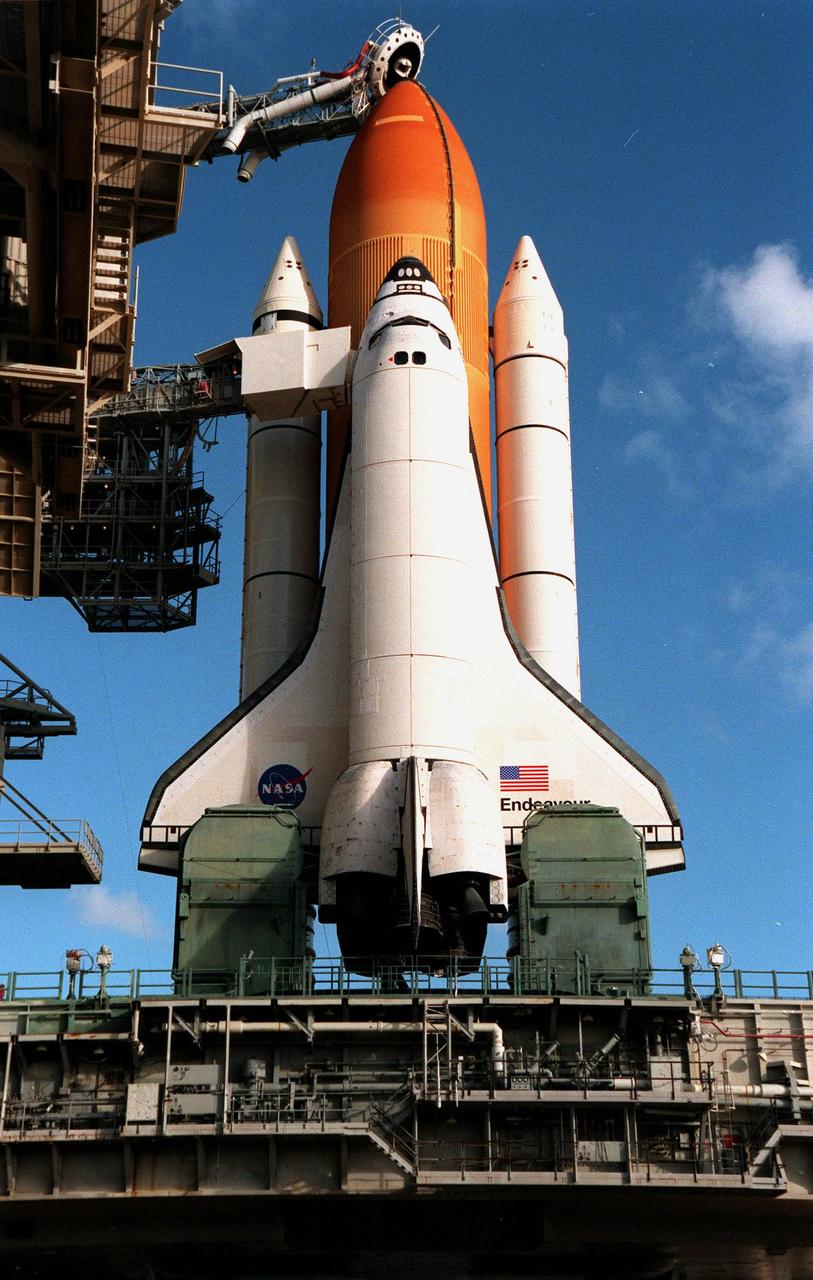
KENNEDY SPACE CENTER, FLA. -- With the Rotating Service Structure on Launch Pad 39A rolled back, the Space Shuttle Endeavour on top of the Mobile Launcher Platform is poised for launch on mission STS-88. Lift-off is targeted for 3:56 a.m. on Dec. 3. The first U.S. launch for the International Space Station, STS-88 is expected to last 11 days, 19 hours and 49 minutes, and land at 10:17 p.m. EST on Dec. 14. Endeavour carries the Unity connecting module which the crew will be mating with the Russian-built Zarya control module already in orbit. In addition to Unity, two small replacement electronics boxes are on board for possible repairs to Zarya batteries
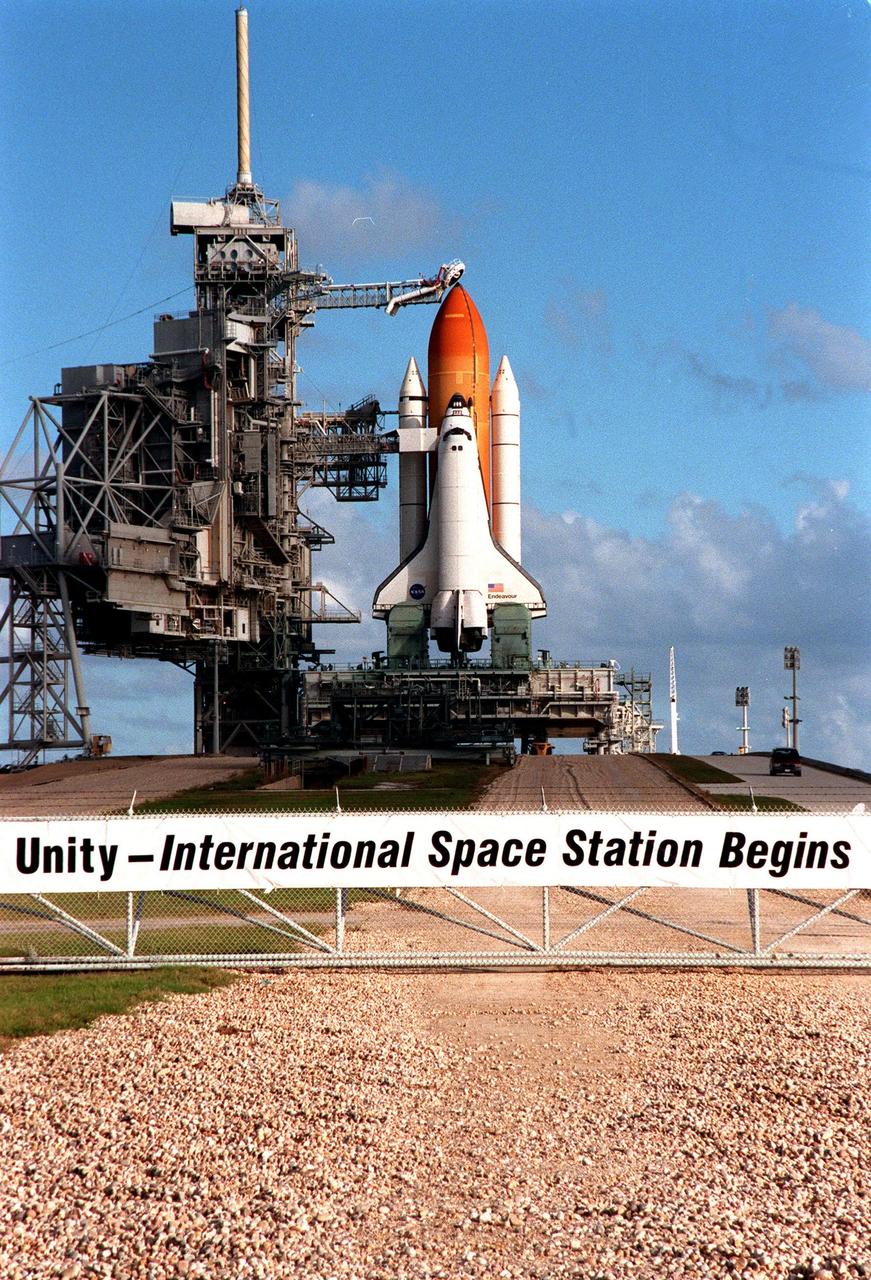
KENNEDY SPACE CENTER, FLA. -- The sign on the fence at Launch Pad 39A announces the mission of STS-88 and Space Shuttle Endeavour, poised on the pad for launch. Lift-off is targeted for 3:56 a.m. on Dec. 3. The first U.S. launch for the International Space Station, STS-88 is expected to last 11 days, 19 hours and 49 minutes, and land at 10:17 p.m. EST on Dec. 14. Endeavour carries the Unity connecting module which the crew will be mating with the Russian-built Zarya control module already in orbit. In addition to Unity, two small replacement electronics boxes are on board for possible repairs to Zarya batteries
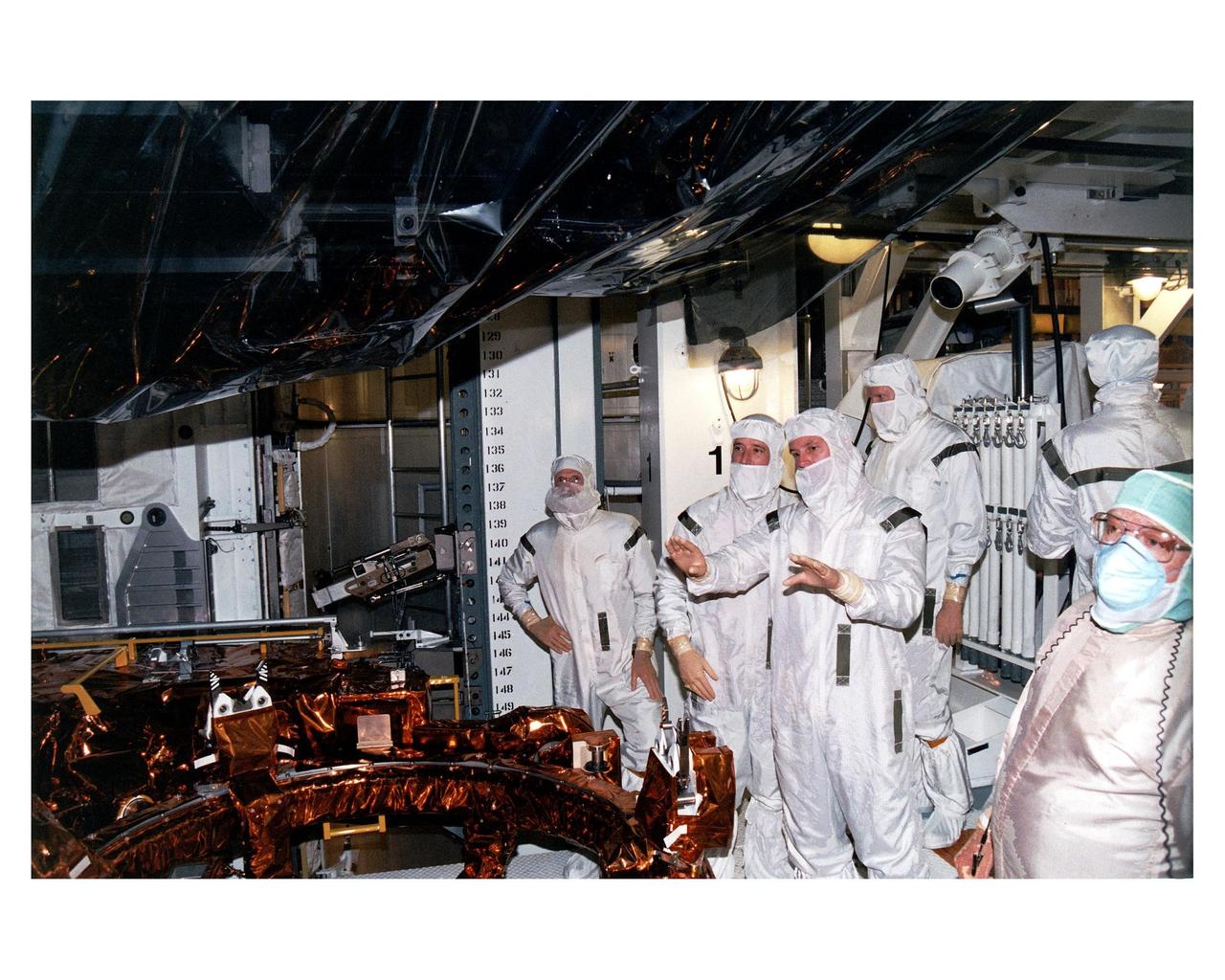
STS-82 crew members make a final inspection of the payload for the second Hubble Space Telescope (HST) servicing mission at Launch Pad 39A where the Space Shuttle Discovery is undergoing final preparations for launch. From left, are Mission Specialist Joseph R. "Joe" Tanner, Pilot Scott J. "Doc" Horowitz and Mission Specialist Gregory J. Harbaugh. Standing directly behind them is Mission Specialist Steven A. Hawley. STS-82 is scheduled for liftoff on Feb. 11 during a 65-minute launch window which opens at 3:56 a.m. EST
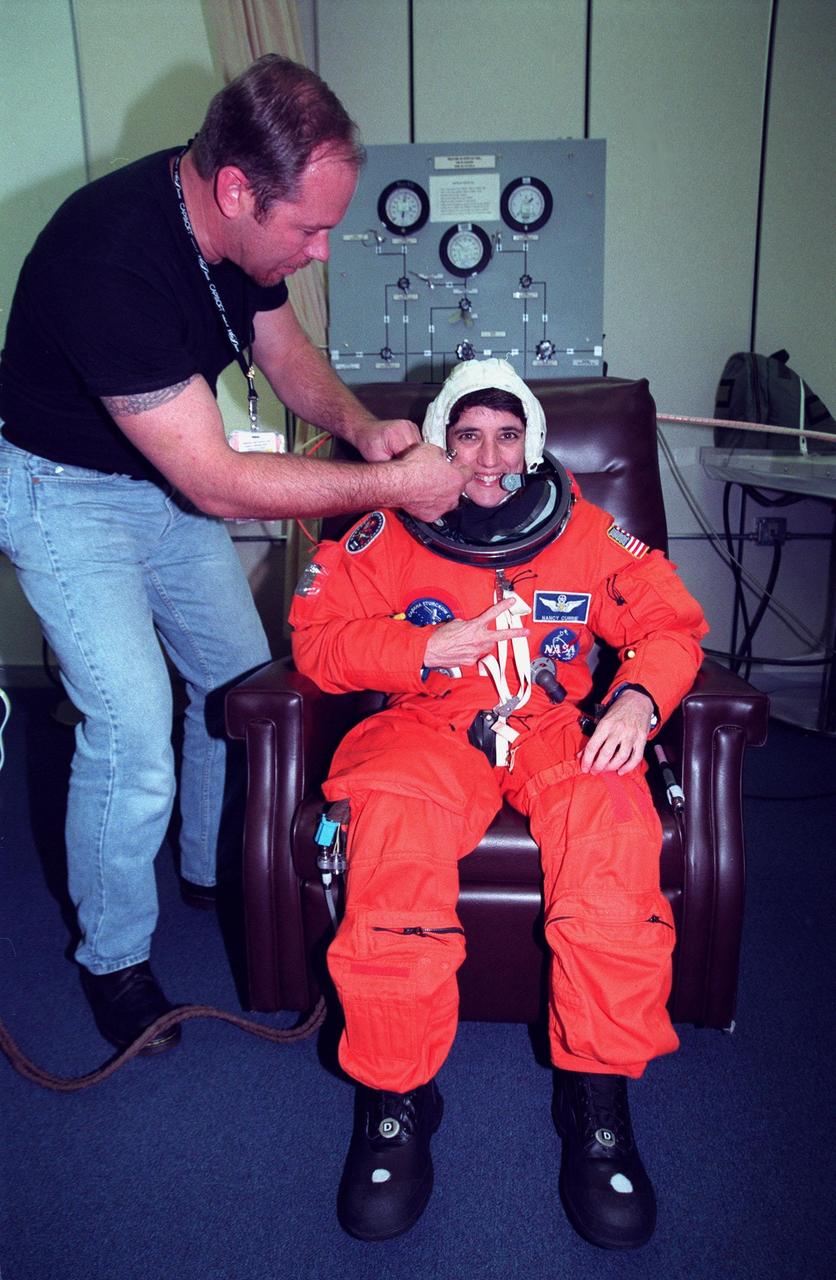
In the Operations and Checkout Building, STS-88 Mission Specialist Nancy J. Currie gets help with her flight suit from suit technician Drew Billingsley before launch. Mission STS-88 is expected to launch at 3:56 a.m. EST with the six-member crew aboard Space Shuttle Endeavour on Dec. 3. Endeavour carries the Unity connecting module, which the crew will be mating with the Russian-built Zarya control module already in orbit. In addition to Unity, two small replacement electronics boxes are on board for possible repairs to Zarya batteries. The mission is expected to last 11 days, 19 hours and 49 minutes, landing at 10:17 p.m. EST on Dec. 14
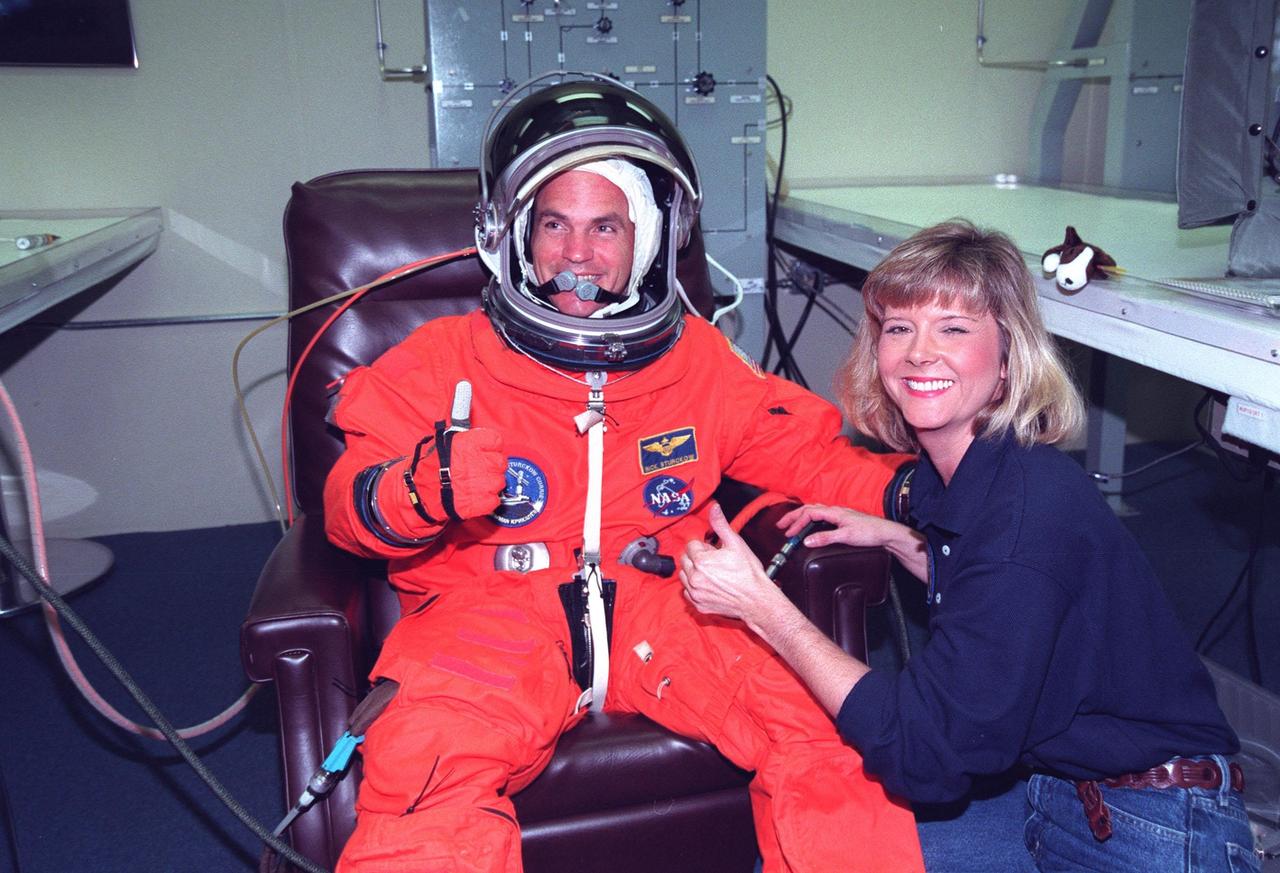
In the Operations and Checkout Building, STS-88 Pilot Frederick W. "Rick" Sturckow gets help with his flight suit from suit technician Terri McKinney before launch. Mission STS-88 is expected to launch at 3:56 a.m. EST with the six-member crew aboard Space Shuttle Endeavour on Dec. 3. Endeavour carries the Unity connecting module, which the crew will be mating with the Russian-built Zarya control module already in orbit. In addition to Unity, two small replacement electronics boxes are on board for possible repairs to Zarya batteries. The mission is expected to last 11 days, 19 hours and 49 minutes, landing at 10:17 p.m. EST on Dec. 14
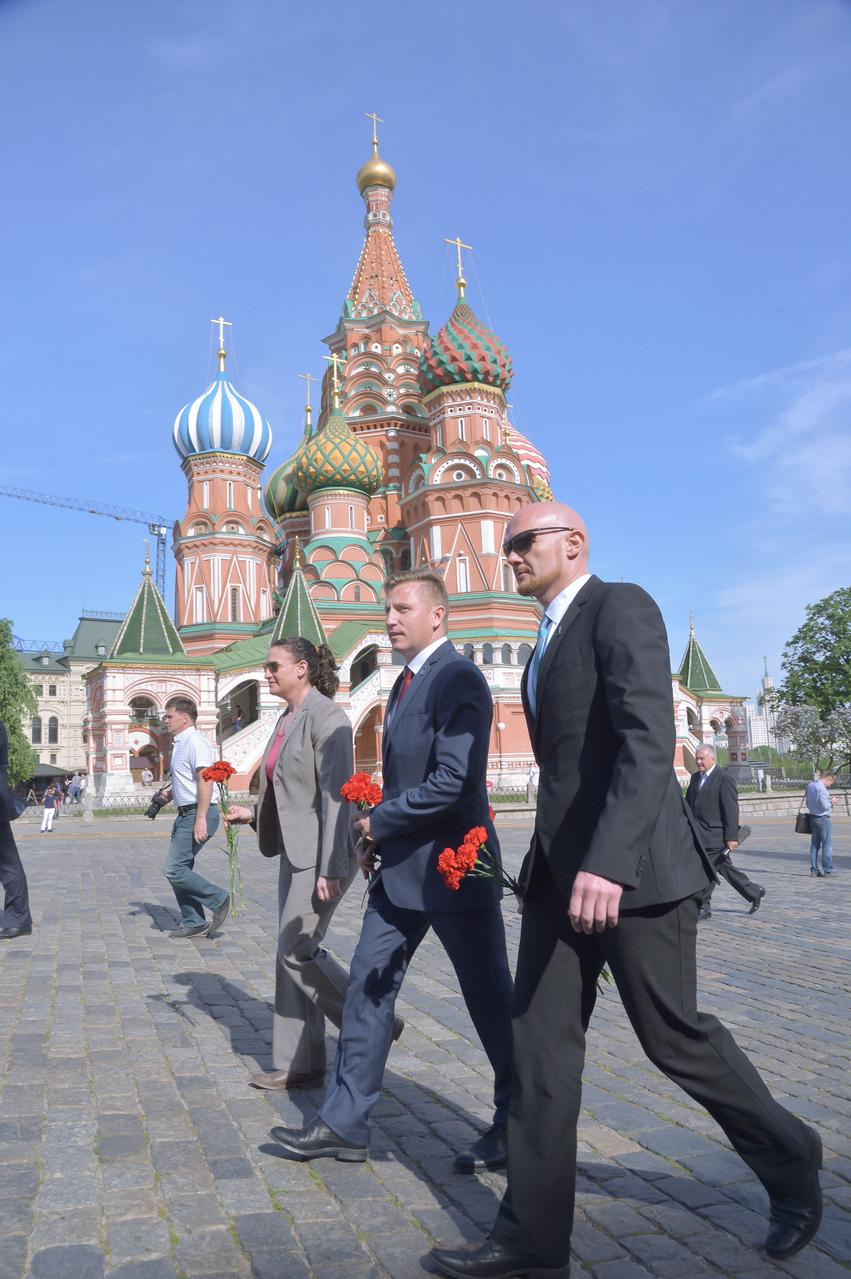
jsc2018e048501 - Walking in front of St. Basil’s Cathedral at Red Square in Moscow May 14, Expedition 56 crewmembers Serena Aunon-Chancellor of NASA (left), Sergey Prokopyev of Roscosmos (center) and Alexander Gerst of the European Space Agency (right) prepare to lay flowers at the Kremlin Wall where Russian space icons are interred. They will launch June 6 from the Baikonur Cosmodrome in Kazakhstan on the Soyuz MS-09 spacecraft for a six month mission on the International Space Station...NASA/Elizabeth Weissinger.
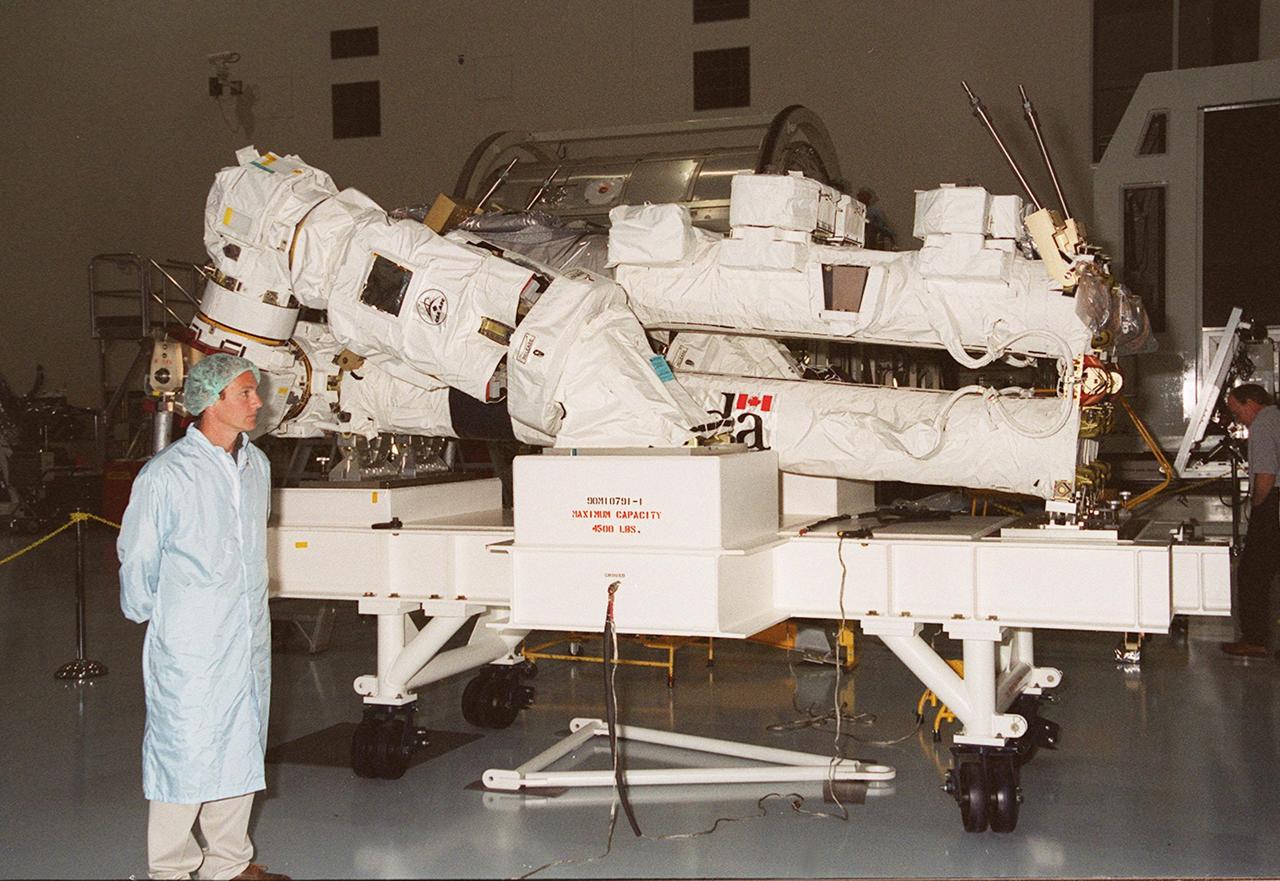
The Canadian Space Agency’s Space Station Remote Manipulator System (SSRMS) sits on the floor of the Space Station Processing Facility before transfer to a test stand . The 56-foot-long arm will be the primary means of transferring payloads between the orbiter payload bay and the International Space Station. Its three segments comprise seven joints for highly flexible land precise movement, making it capable of moving around the Station’s exterior like an inchworm. The SSRMS is scheduled for launch on STS-100 in April 2001
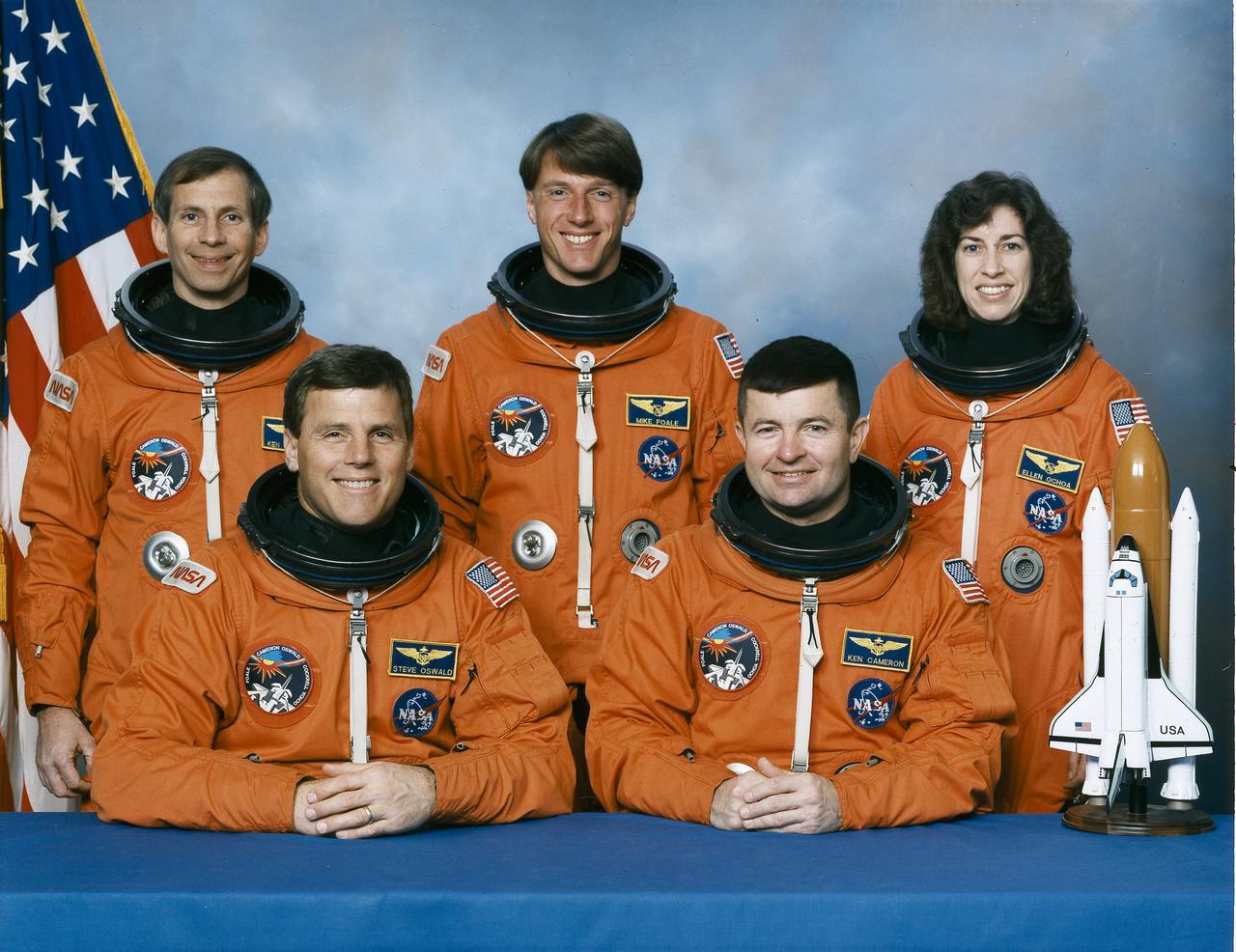
The STS-56 crew portrait includes five astronauts. Seated from the left are Stephen S. Oswald, pilot; and Kenneth D. Cameron, commander. Standing, from the left, are mission specialists Kenneth D. Cockrell, C. Michael Foal, and Ellen Ochoa. The crew launched aboard the Space Shuttle Discovery on April 8, 1993 at 1:29:00 am (EDT) with the Atmospheric Laboratory for Applications and Science-2 (ATLAS-2) as the primary payload.
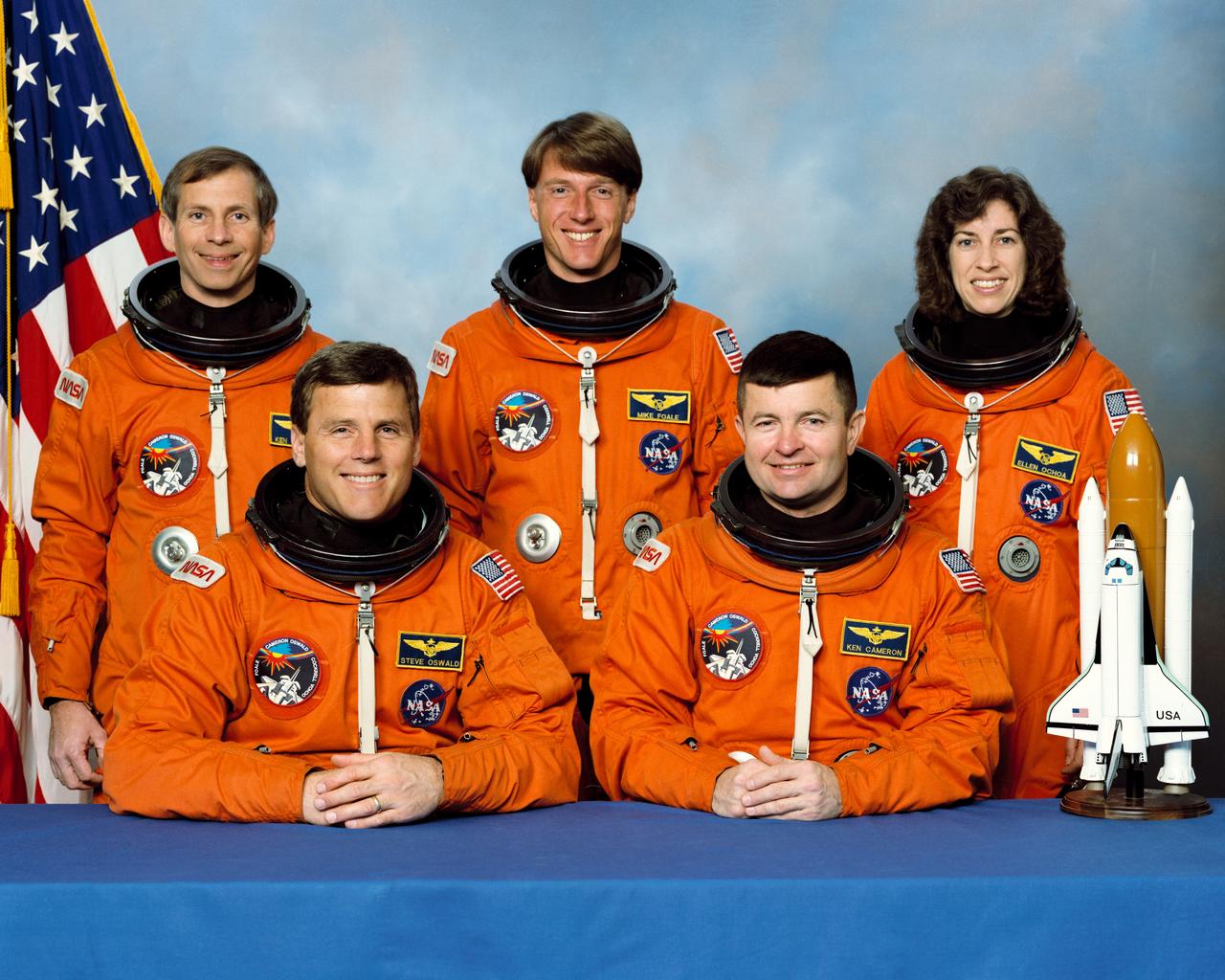
STS056-S-002 (January 1993) --- The five NASA astronauts assigned to fly aboard the Space Shuttle Discovery for the STS-56\Atlas-2 mission are pictured in training versions of their partial-pressure launch and entry garments. Left to right are astronauts Kenneth D. Cockrell, Steven S. Oswald, C. Michael Foale, Kenneth D. Cameron and Ellen Ochoa. Cameron is mission commander; Oswald, pilot; while the other three will serve as mission specialists.
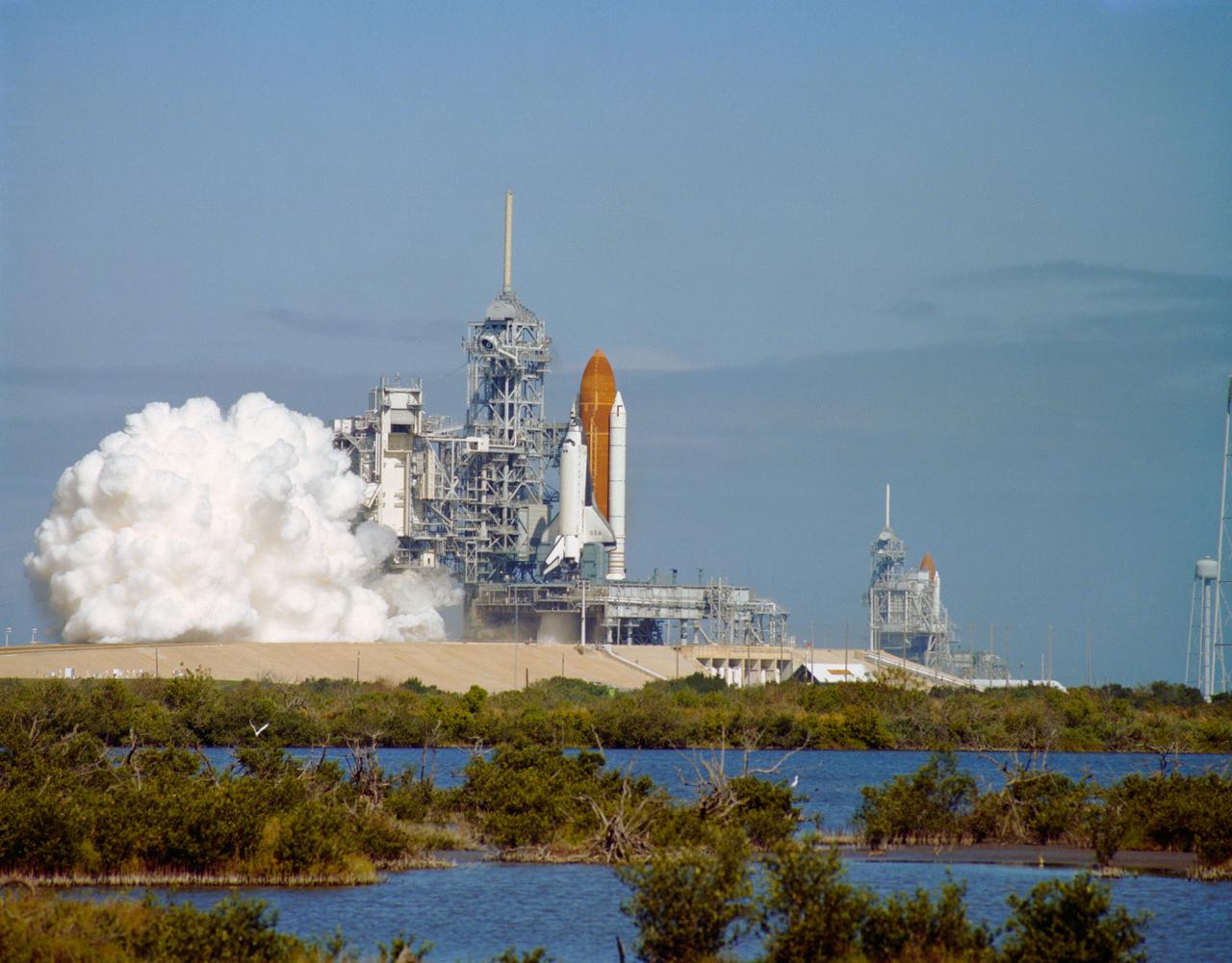
S93-31601 (March 1993) --- The second Space Shuttle launch attempt of 1993 comes to an abrupt halt when one of the three main engines on the orbiter Columbia shuts down at T -3 seconds, resulting in an on-the-pad abort of Mission STS-55. This was the first time in the post-Challenger era that a main engine shutdown has halted a Shuttle launch countdown, and only the third time in the history of the program. In 1984, STS-41D was scrubbed at T -4 seconds when the orbiter General Purpose Computer detected an anomaly in a main engine, and in 1985, STS-51F was halted at T -3 seconds due to a main engine malfunction that caused shutdown of all three engines. Columbia had been scheduled to lift off from Launch Pad 39B is the Space Shuttle Discovery, undergoing preparations for lift off on Mission STS-56.
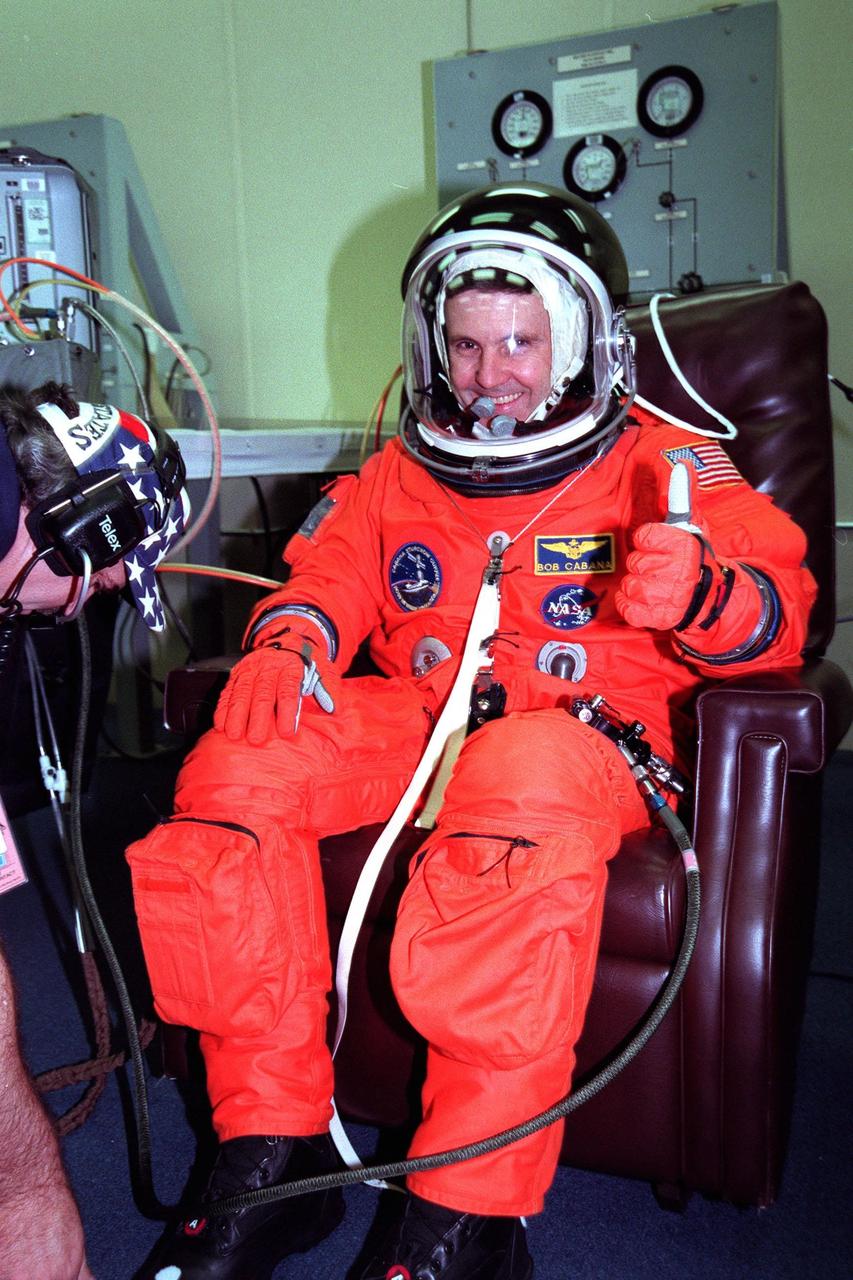
In the Operations and Checkout Building, STS-88 Commander Robert D. Cabana gives a thumbs up during suit check before launch. Mission STS-88 is expected to lift off at 3:56 a.m. EST with the six-member crew aboard Space Shuttle Endeavour on Dec. 3. Endeavour carries the Unity connecting module, which the crew will be mating with the Russian-built Zarya control module already in orbit. In addition to Unity, two small replacement electronics boxes are on board for possible repairs to Zarya batteries. The mission is expected to last 11 days, 19 hours and 49 minutes, landing at 10:17 p.m. EST on Dec. 14
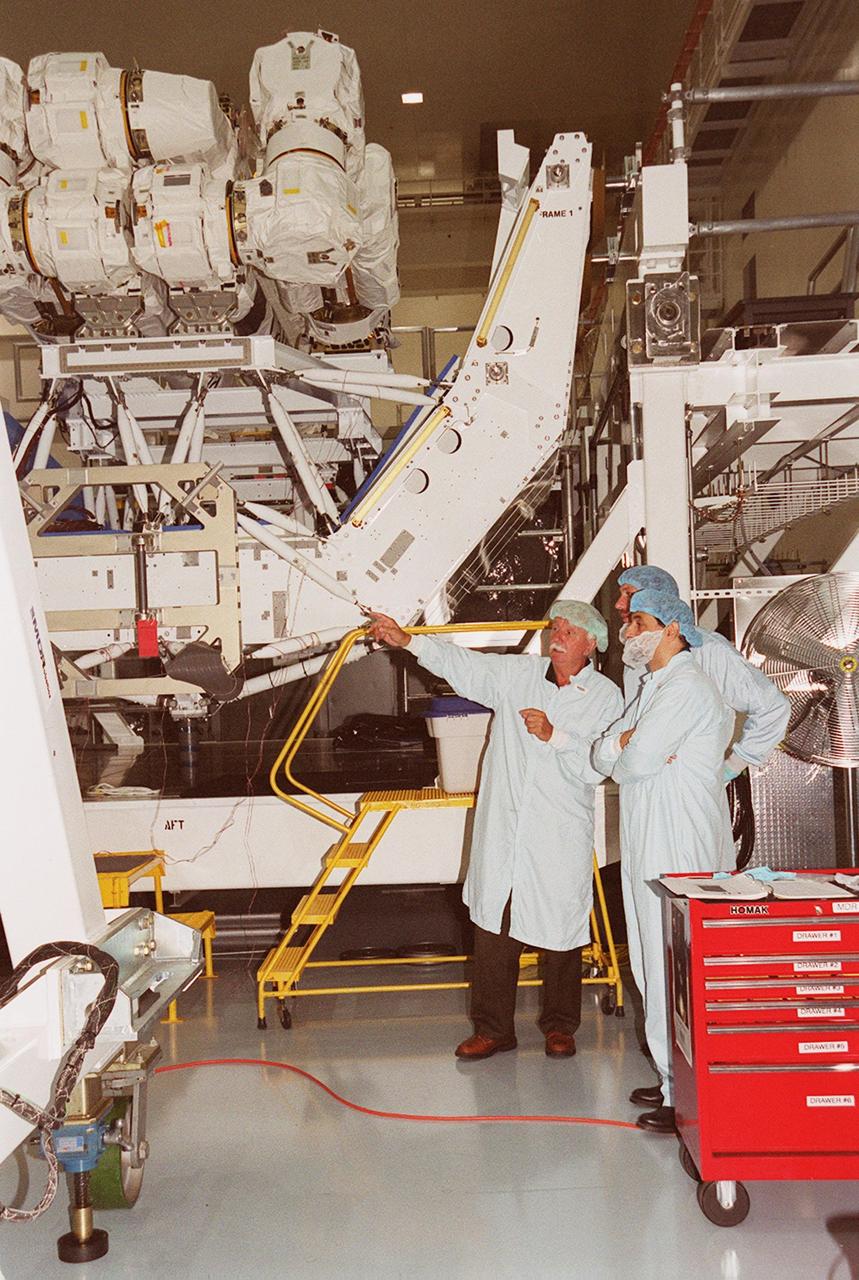
During Crew Equipment Interface Test for STS-100 crew members, a worker in the Space Station Processing Facility points to a nearby piece of hardware. Behind him is the Space Station Remote Manipulator System (SSRMS), also known as the Canadian arm. The SSRMS is the primary means of transferring payloads between the orbiter payload bay and the International Space Station for assembly. The 56-foot-long robotic arm includes two 12-foot booms joined by a hinge. Seven joints on the arm allow highly flexible and precise movement. Mission STS-100 is scheduled to launch April 19, 2001, carrying the SSRMS and Raffaello, a multi-purpose logistics module
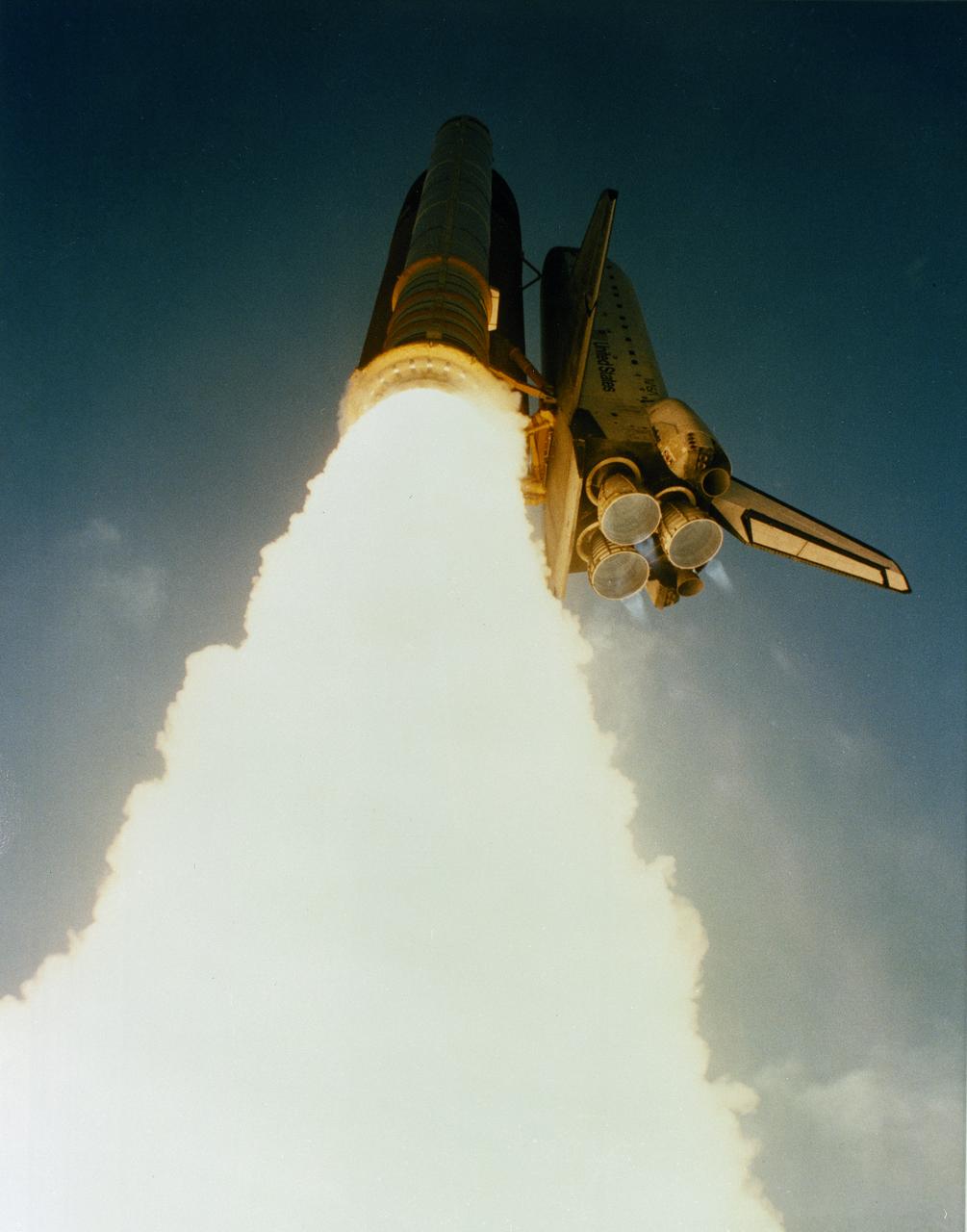
Launched aboard the Space Shuttle Atlantis on July 31, 1992 at 9:56:48 am (EDT), the STS-46 mission’s primary objectives included the deployment of the European Space Agency’s European Retrievable Carrier (EURECA) and operation of the joint NASA/Italian Space Agency Tethered Satellite System (TSS). The STS-46 crew of seven included: Loren J. Shriver, commander; Andrew M. Allen, pilot; Jeffrey A. Hoffman, mission specialist 1; Franklin R. Chang-Diaz, mission specialist 2; Claude Nicollier, mission specialist 3; Marsha S. Ivins, mission specialist 4; and Franco Malerba, payload specialist 1.
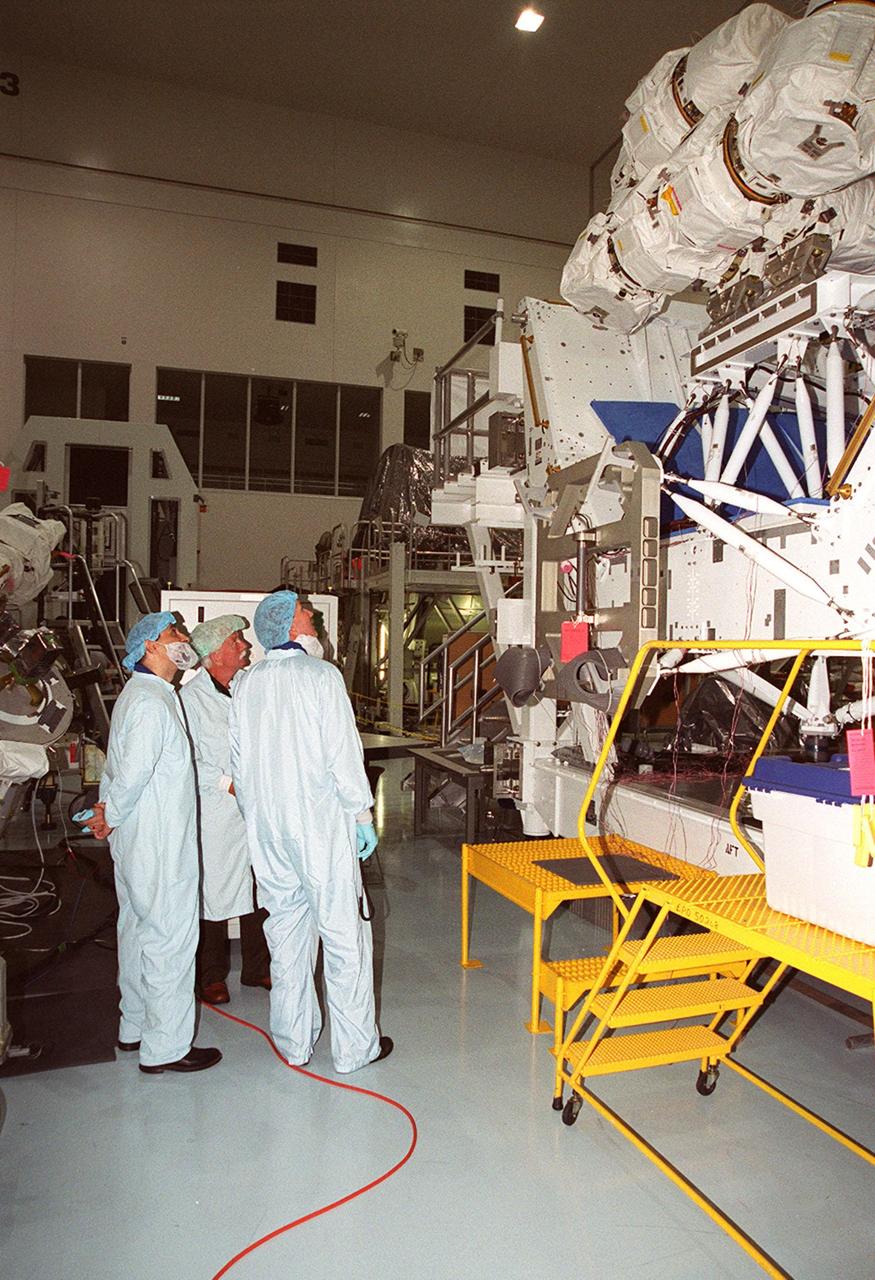
During Crew Equipment Interface Test activities, STS-100 crew members look over the Space Station Remote Manipulator System (SSRMS), also known as the Canadian arm, seated high on a work station. The SSRMS is the primary means of transferring payloads between the orbiter payload bay and the International Space Station for assembly. The 56-foot-long robotic arm includes two 12-foot booms joined by a hinge. Seven joints on the arm allow highly flexible and precise movement. Mission STS-100 is scheduled to launch April 19, 2001, carrying the SSRMS and Raffaello, a multi-purpose logistics module
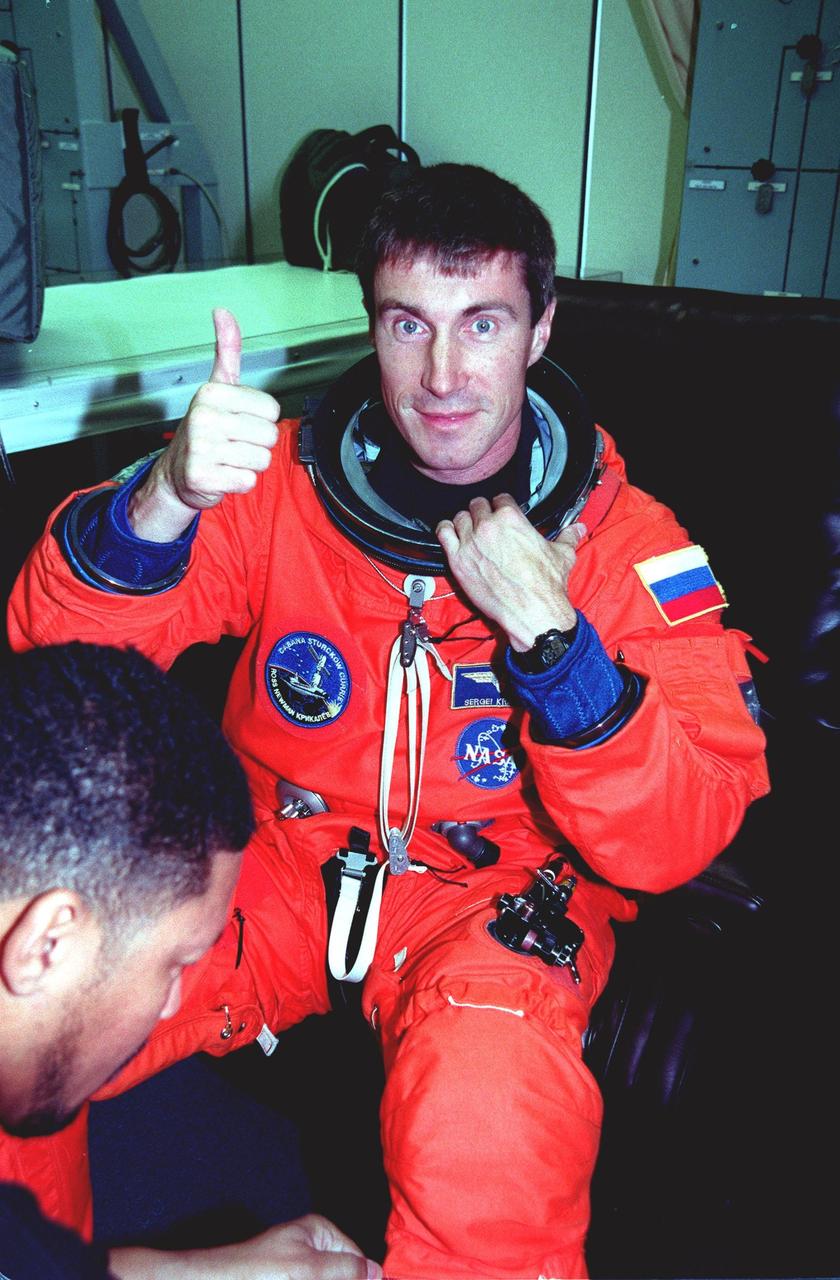
In the Operations and Checkout Building, STS-88 Mission Specialist Sergei Konstantinovich Krikalev, a Russian cosmonaut, gives a thumbs up during suit check before launch. Mission STS-88 is expected to lift off at 3:56 a.m. EST with the six-member crew aboard Space Shuttle Endeavour on Dec. 3. Endeavour carries the Unity connecting module, which the crew will be mating with the Russian-built Zarya control module already in orbit. In addition to Unity, two small replacement electronics boxes are on board for possible repairs to Zarya batteries. The mission is expected to last 11 days, 19 hours and 49 minutes, landing at 10:17 p.m. EST on Dec. 14
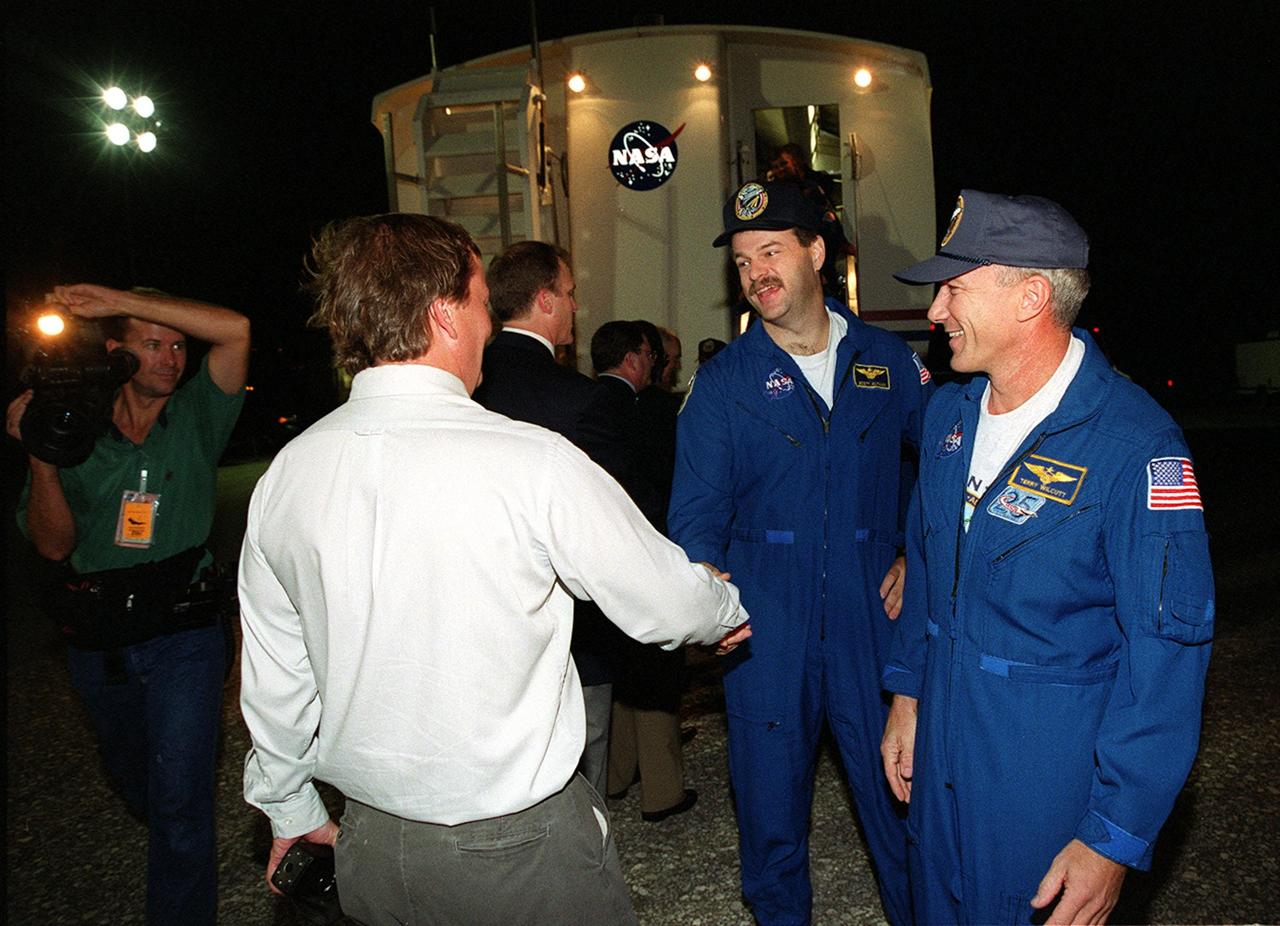
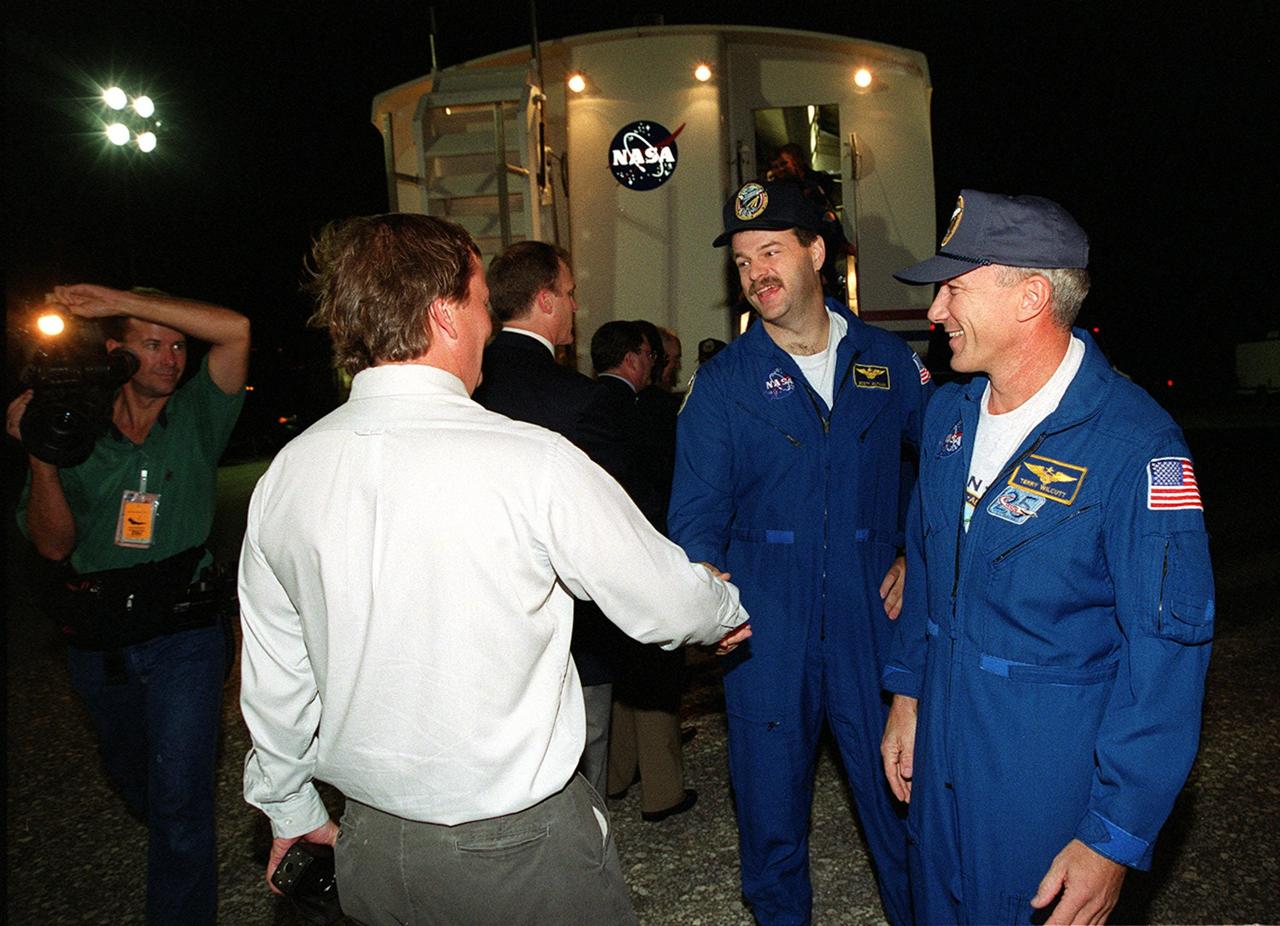
KENNEDY SPACE CENTER, FLA. -- At the Shuttle Landing Facility, KSC Launch Director Michael Leinbach (shaking hands) greets STS-106 Pilot Scott D. Altman and Commander Terrence W. Wilcutt after their successful mission and landing. Just behind Leinbach is Jim Halsell, manager of Space Shuttle Launch Integration and former Shuttle Commander, plus other dignitaries on hand to welcome the crew home. Landing occurred on-time at 3:56:48 a.m. EDT. Atlantis and crew traveled 4.9 million miles on the 11-day, 19-hour, 11-minute STS-106 mission. During the mission to the International Space Station, the crew transferred nearly 5,000 pounds of equipment and supplies for use by the first resident crew expected to arrive in November. STs-106 was the 99th flight in the Shuttle program and the 22nd for Atlantis. STS-106 also marked the 15th nighttime landing in Shuttle history and the 23rd consecutive landing at KSC
KENNEDY SPACE CENTER, FLA. -- At the Shuttle Landing Facility, KSC Launch Director Michael Leinbach (shaking hands) greets STS-106 Pilot Scott D. Altman and Commander Terrence W. Wilcutt after their successful mission and landing. Just behind Leinbach is Jim Halsell, manager of Space Shuttle Launch Integration and former Shuttle Commander, plus other dignitaries on hand to welcome the crew home. Landing occurred on-time at 3:56:48 a.m. EDT. Atlantis and crew traveled 4.9 million miles on the 11-day, 19-hour, 11-minute STS-106 mission. During the mission to the International Space Station, the crew transferred nearly 5,000 pounds of equipment and supplies for use by the first resident crew expected to arrive in November. STs-106 was the 99th flight in the Shuttle program and the 22nd for Atlantis. STS-106 also marked the 15th nighttime landing in Shuttle history and the 23rd consecutive landing at KSC
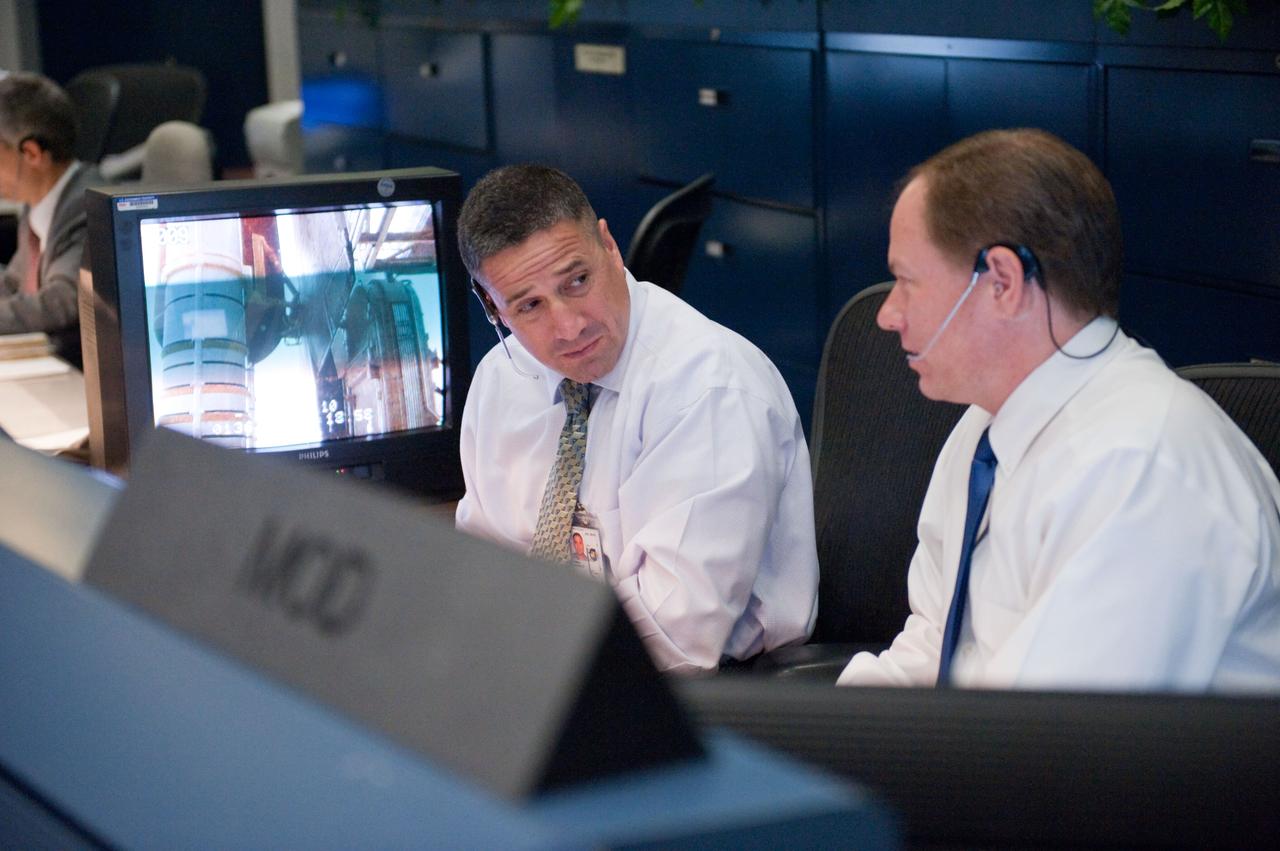
JSC2011-E-044259 (16 May 2011) --- John McCullough (right), chief of the Flight Director Office; and astronaut George Zamka are pictured at the MOD console in the space shuttle flight control room in the Mission Control Center at NASA's Johnson Space Center during launch countdown activities a few hundred miles away in Florida, site of space shuttle Endeavour's STS-134 launch. Liftoff was at 8:56 a.m. (EDT) on May 16, 2011, from Launch Pad 39A at NASA's Kennedy Space Center. Photo credit: NASA
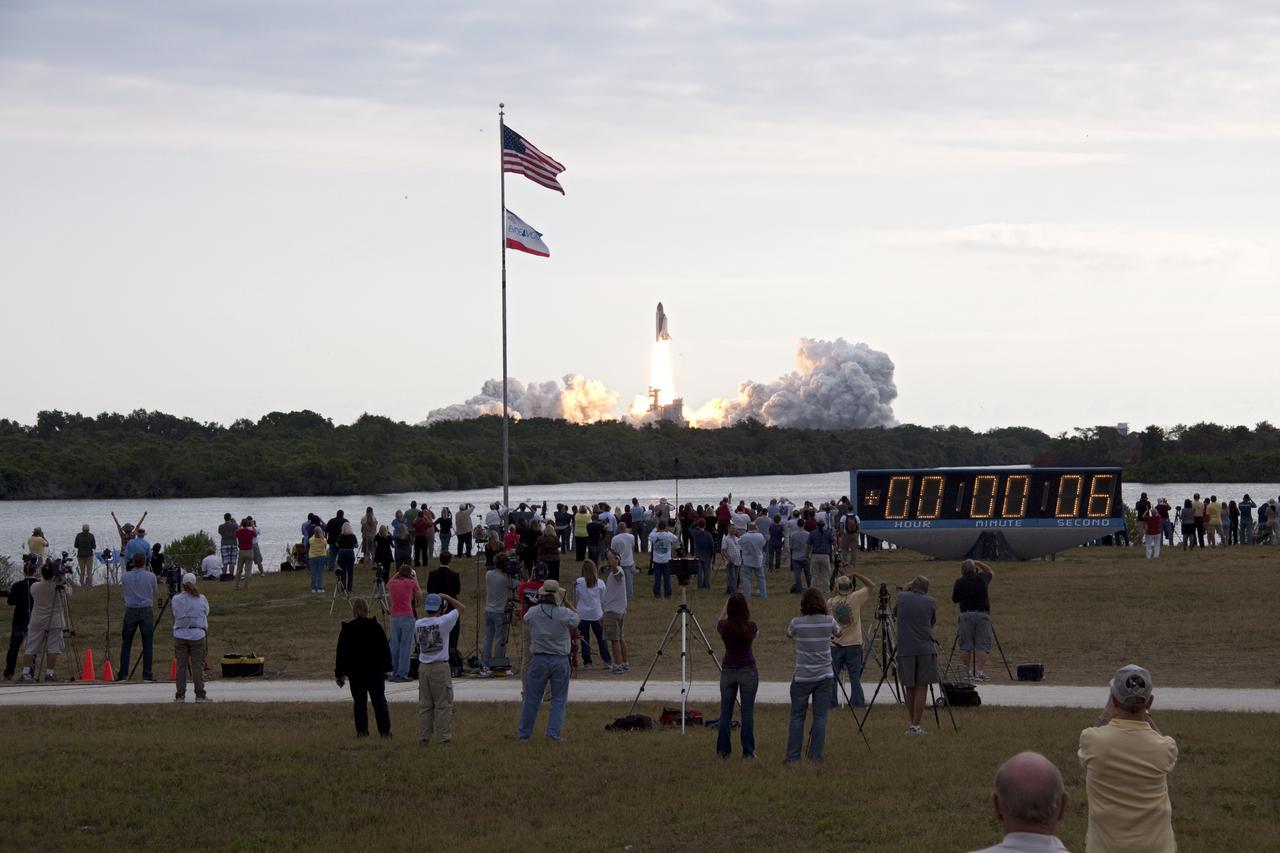
CAPE CANAVERAL, Fla. -- The American flag sways in the breeze as space shuttle Endeavour launches on the STS-134 mission to the International Space Station. The shuttle and its six-member crew lifted off from Launch Pad 39A at NASA's Kennedy Space Center in Florida on time at 8:56 a.m. EDT on May 16. STS-134 will deliver the Alpha Magnetic Spectrometer-2 (AMS), Express Logistics Carrier-3, a high-pressure gas tank and additional spare parts for the Dextre robotic helper to the International Space Station. Endeavour's first launch attempt on April 29 was scrubbed because of an issue associated with a faulty power distribution box called the aft load control assembly-2 (ALCA-2). STS-134 will be the final spaceflight for Endeavour. For more information visit, www.nasa.gov/mission_pages/shuttle/shuttlemissions/sts134/index.html. Photo credit: NASA/Troy Cryder
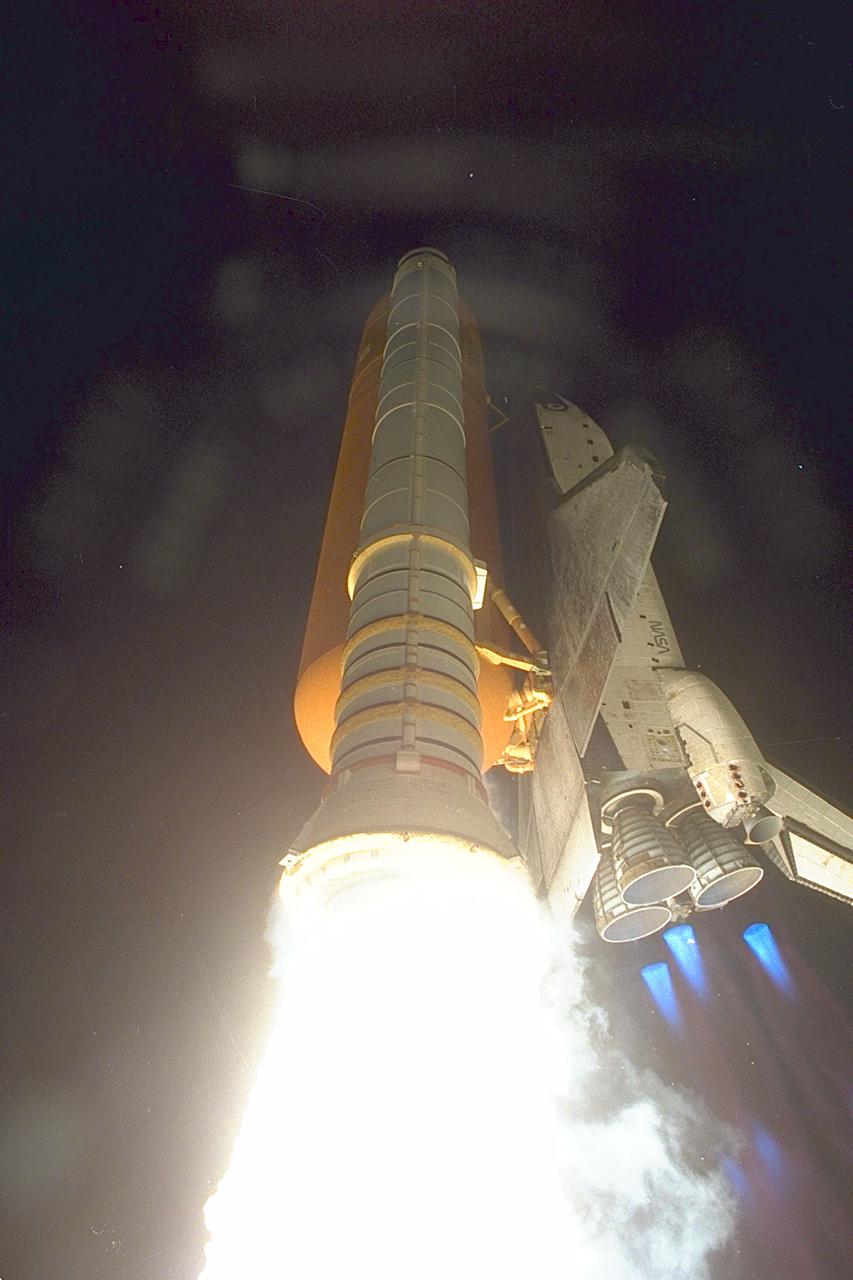
KENNEDY SPACE CENTER, FLA. - The second try works like a charm as the Space Shuttle Discovery lifts off from Launch Pad 39B on Mission STS-56 at 1:29:00 a.m EDT, April 8. First attempt to launch Discovery on its 16th space voyage was halted at T-11 seconds on April 6. Aboard for the second Space Shuttle mission of 1993 are a crew of five and the Atmospheric Laboratory for Applications and Science 2 (ATLAS 2), the second in a series of missions to study the sun's energy output and Earth's middle atmoshere chemical makeup, and how these factors affect levels of ozone.
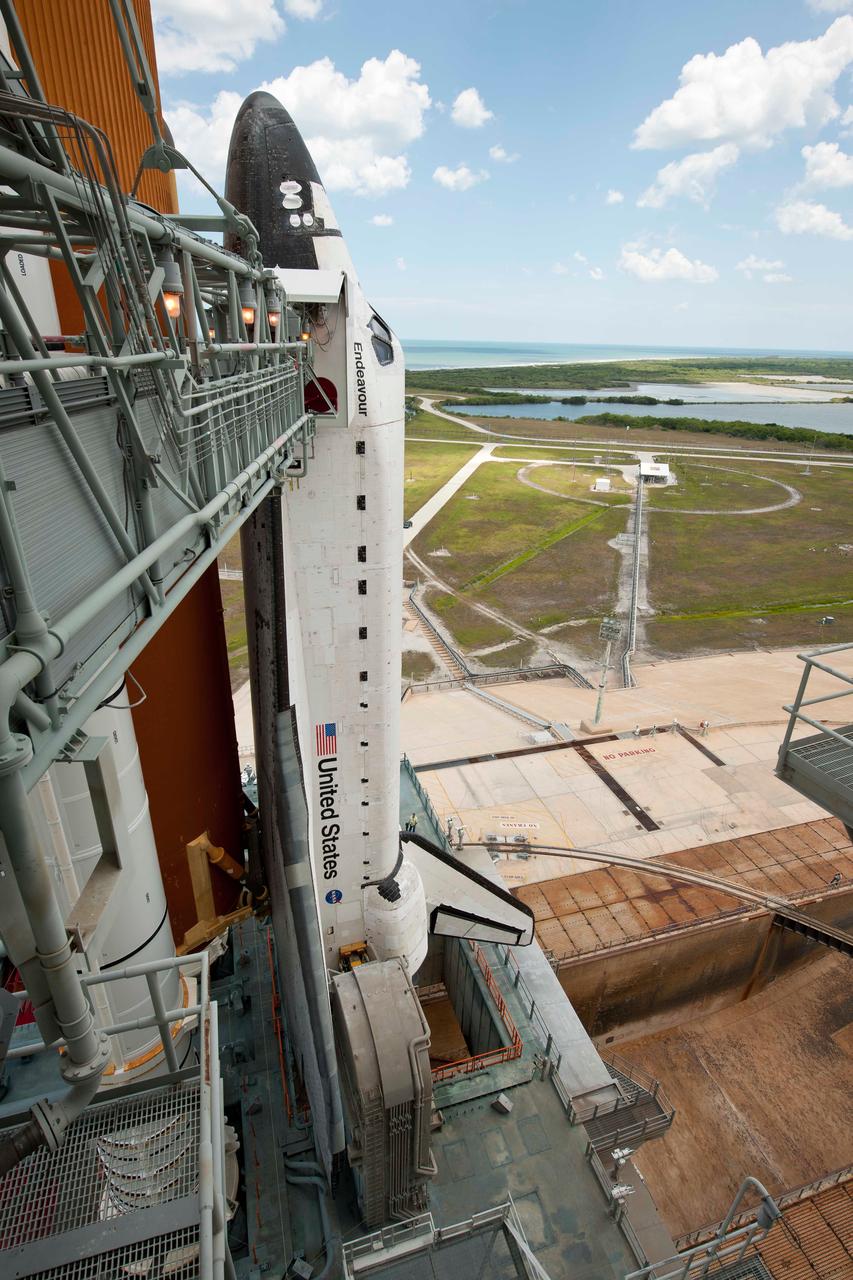
201105150010hq (15 May 2011) --- The space shuttle Endeavour is seen on launch pad 39A after the rollback of the Rotating Service Structure (RSS), May 15, 2011, at Kennedy Space Center in Cape Canaveral, Fla. During the mission, Endeavour and the STS-134 crew will deliver the Alpha Magnetic Spectrometer (AMS) and spare parts including two S-band communications antennas, a high-pressure gas tank and additional spare parts for Dextre. Launch is targeted for May 16 at 8:56 a.m. (EDT). Photo credit: NASA/Bill Ingalls
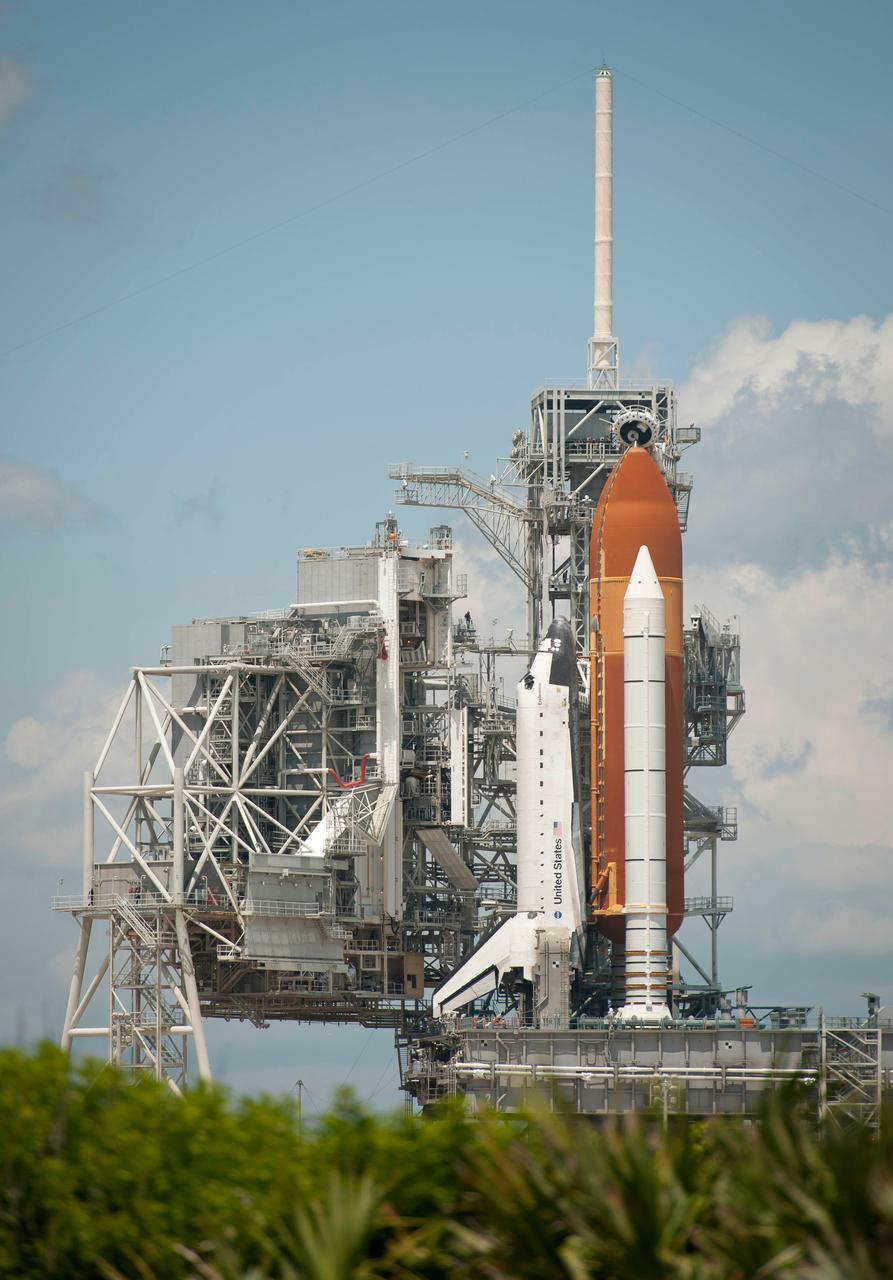
201105150002hq (15 May 2011) --- The space shuttle Endeavour is seen on launch pad 39A after the rollback of the Rotating Service Structure (RSS), May 15, 2011, at Kennedy Space Center in Cape Canaveral, Fla. During the mission, Endeavour and the STS-134 crew will deliver the Alpha Magnetic Spectrometer (AMS) and spare parts including two S-band communications antennas, a high-pressure gas tank and additional spare parts for Dextre. Launch is targeted for May 16 at 8:56 a.m. (EDT). Photo credit: NASA/Bill Ingalls
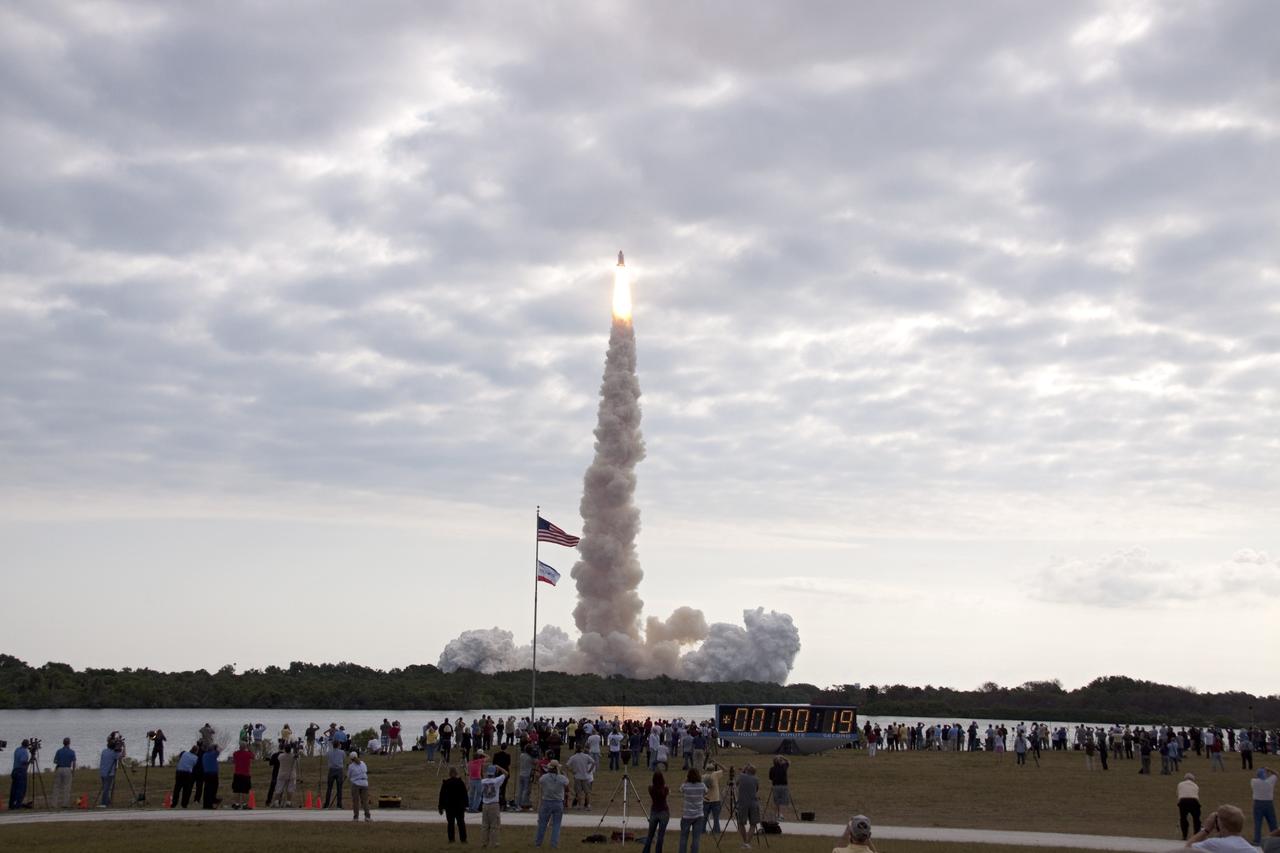
CAPE CANAVERAL, Fla. -- The American flag sways in the breeze as space shuttle Endeavour soars into the sky on the STS-134 mission to the International Space Station. The shuttle and its six-member crew lifted off from Launch Pad 39A at NASA's Kennedy Space Center in Florida on time at 8:56 a.m. EDT on May 16. STS-134 will deliver the Alpha Magnetic Spectrometer-2 (AMS), Express Logistics Carrier-3, a high-pressure gas tank and additional spare parts for the Dextre robotic helper to the International Space Station. Endeavour's first launch attempt on April 29 was scrubbed because of an issue associated with a faulty power distribution box called the aft load control assembly-2 (ALCA-2). STS-134 will be the final spaceflight for Endeavour. For more information visit, www.nasa.gov/mission_pages/shuttle/shuttlemissions/sts134/index.html. Photo credit: NASA/Troy Cryder
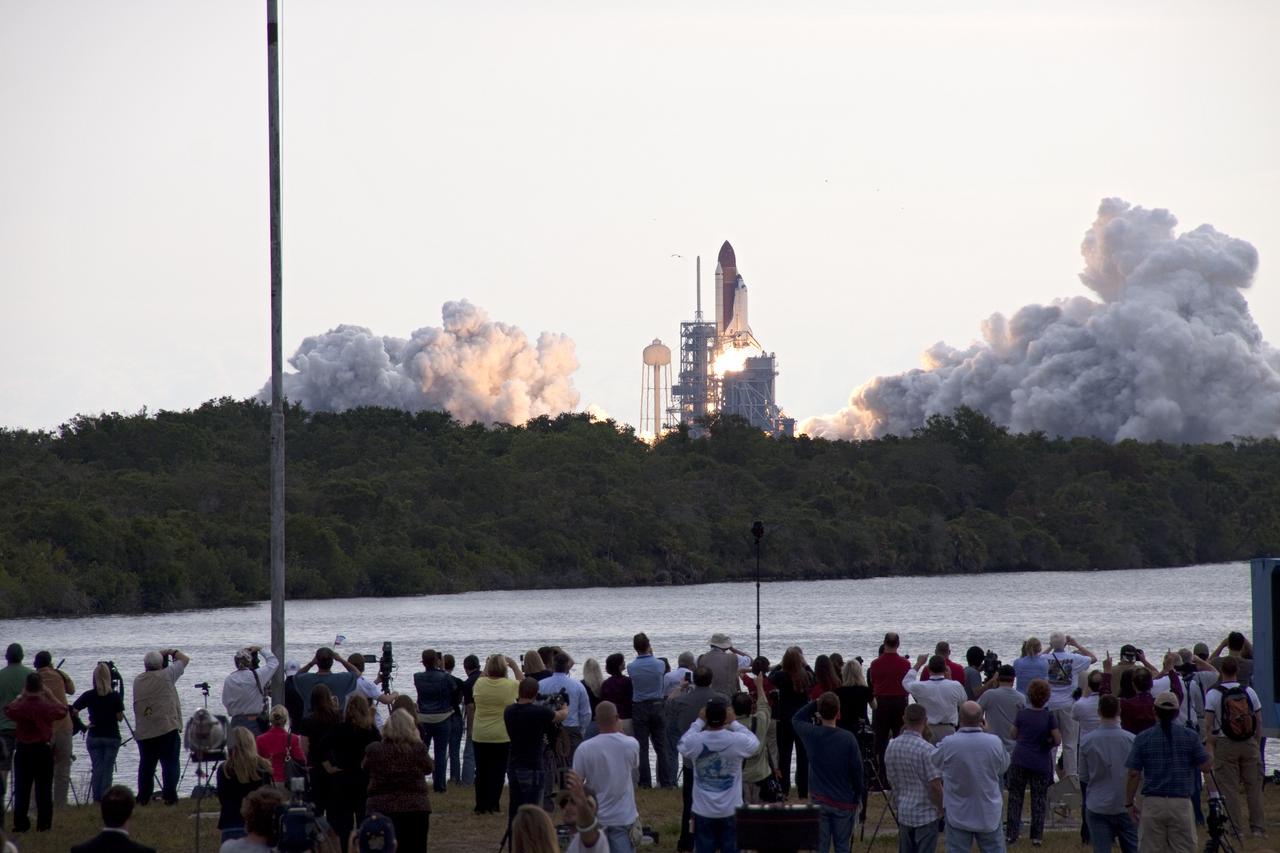
CAPE CANAVERAL, Fla. -- Media capture the launch of space shuttle Endeavour on the STS-134 mission to the International Space Station from the Press Site at NASA's Kennedy Space Center in Florida. The shuttle and its six-member crew lifted off on time at 8:56 a.m. EDT on May 16. STS-134 will deliver the Alpha Magnetic Spectrometer-2 (AMS), Express Logistics Carrier-3, a high-pressure gas tank and additional spare parts for the Dextre robotic helper to the International Space Station. Endeavour's first launch attempt on April 29 was scrubbed because of an issue associated with a faulty power distribution box called the aft load control assembly-2 (ALCA-2). STS-134 will be the final spaceflight for Endeavour. For more information visit, www.nasa.gov/mission_pages/shuttle/shuttlemissions/sts134/index.html. Photo credit: NASA/Troy Cryder
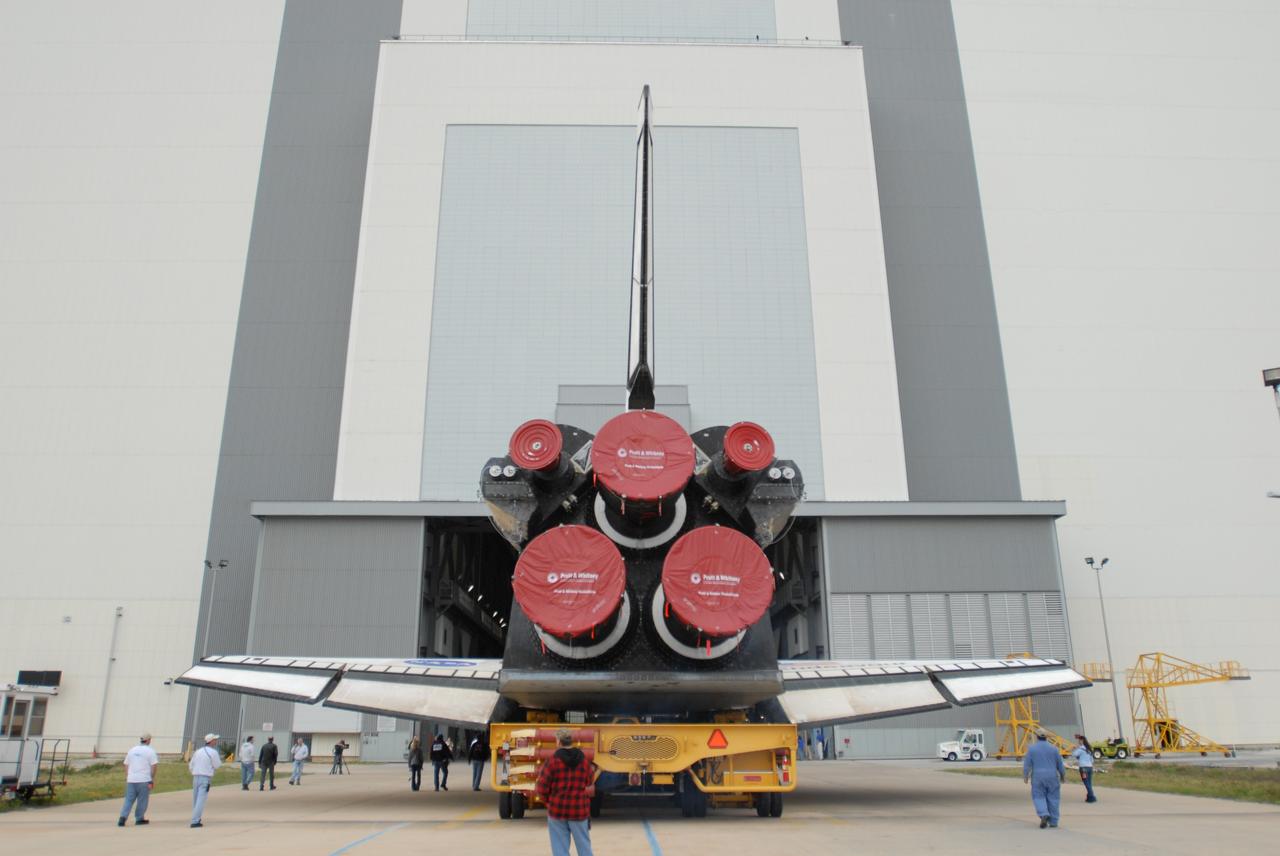
CAPE CANAVERAL, Fla. – Space shuttle Endeavour arrives at the Vehicle Assembly Building at NASA's Kennedy Space Center, Fla. The first motion of the shuttle out of Orbiter Processing Facility 2 was at 6:56 a.m. EDT. In the VAB, Endeavour will be lifted into High Bay 1 and mated to the external fuel tank and solid rocket boosters already installed on the mobile launcher platform. Endeavour is scheduled to roll out to Launch Pad 39B in about a week. Endeavour will be prepared on the pad for liftoff in the unlikely event that a rescue mission is necessary following space shuttle Atlantis' launch on the STS-125 mission to service the Hubble Space Telescope. After Atlantis is cleared to land, Endeavour will move to Launch Pad 39A for its upcoming STS-127 mission to the International Space Station, targeted to launch in mid-June. Photo credit: NASA/Jim Grossmann
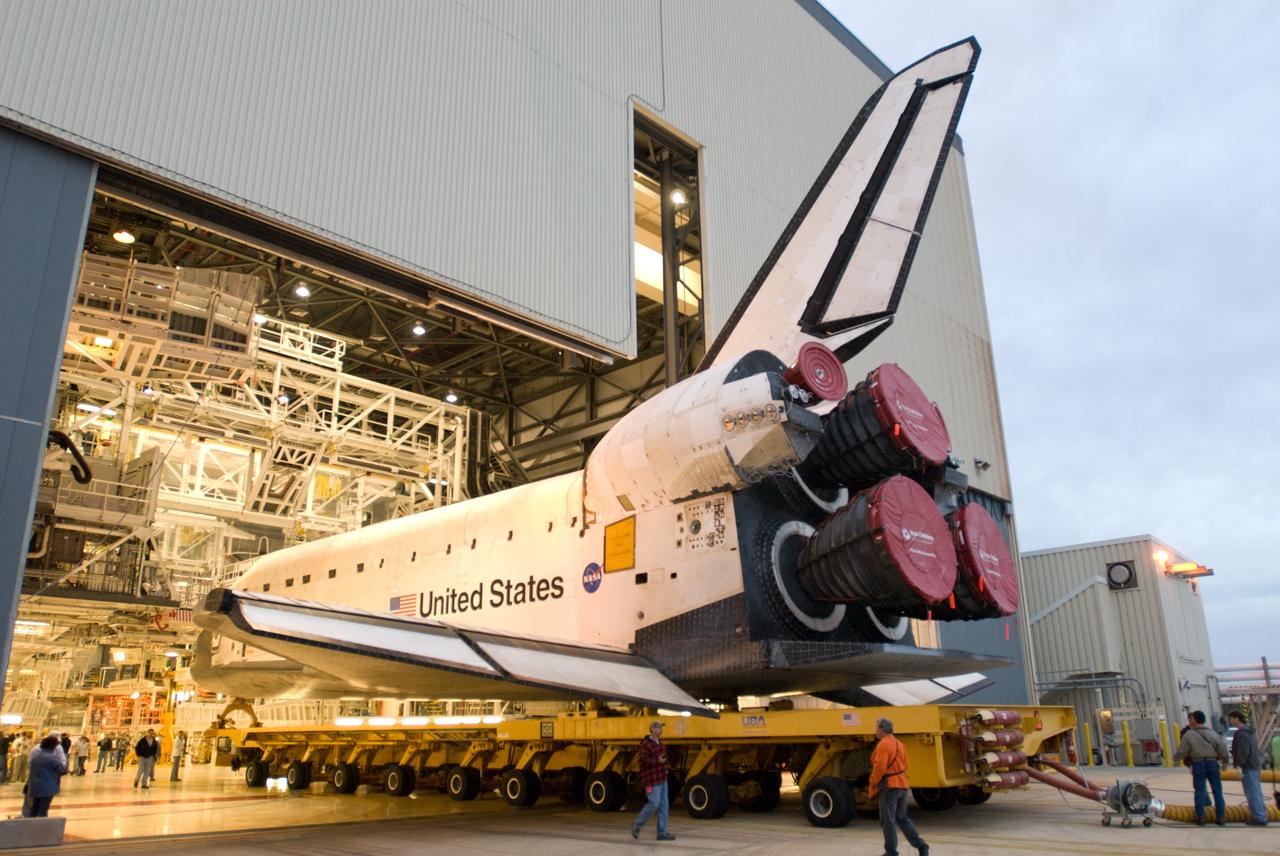
CAPE CANAVERAL, Fla. – Space shuttle Endeavour begins its move from Orbiter Processing Facility 2 to the Vehicle Assembly Building at NASA's Kennedy Space Center, Fla. The first motion of the shuttle out of its hangar was at 6:56 a.m. EDT. In the VAB, Endeavour will be lifted into High Bay 1 and mated to the external fuel tank and solid rocket boosters already installed on the mobile launcher platform. Endeavour is scheduled to roll out to Launch Pad 39B in about a week. Endeavour will be prepared on the pad for liftoff in the unlikely event that a rescue mission is necessary following space shuttle Atlantis' launch on the STS-125 mission to service the Hubble Space Telescope. After Atlantis is cleared to land, Endeavour will move to Launch Pad 39A for its upcoming STS-127 mission to the International Space Station, targeted to launch in mid-June. Photo credit: NASA/Jim Grossmann
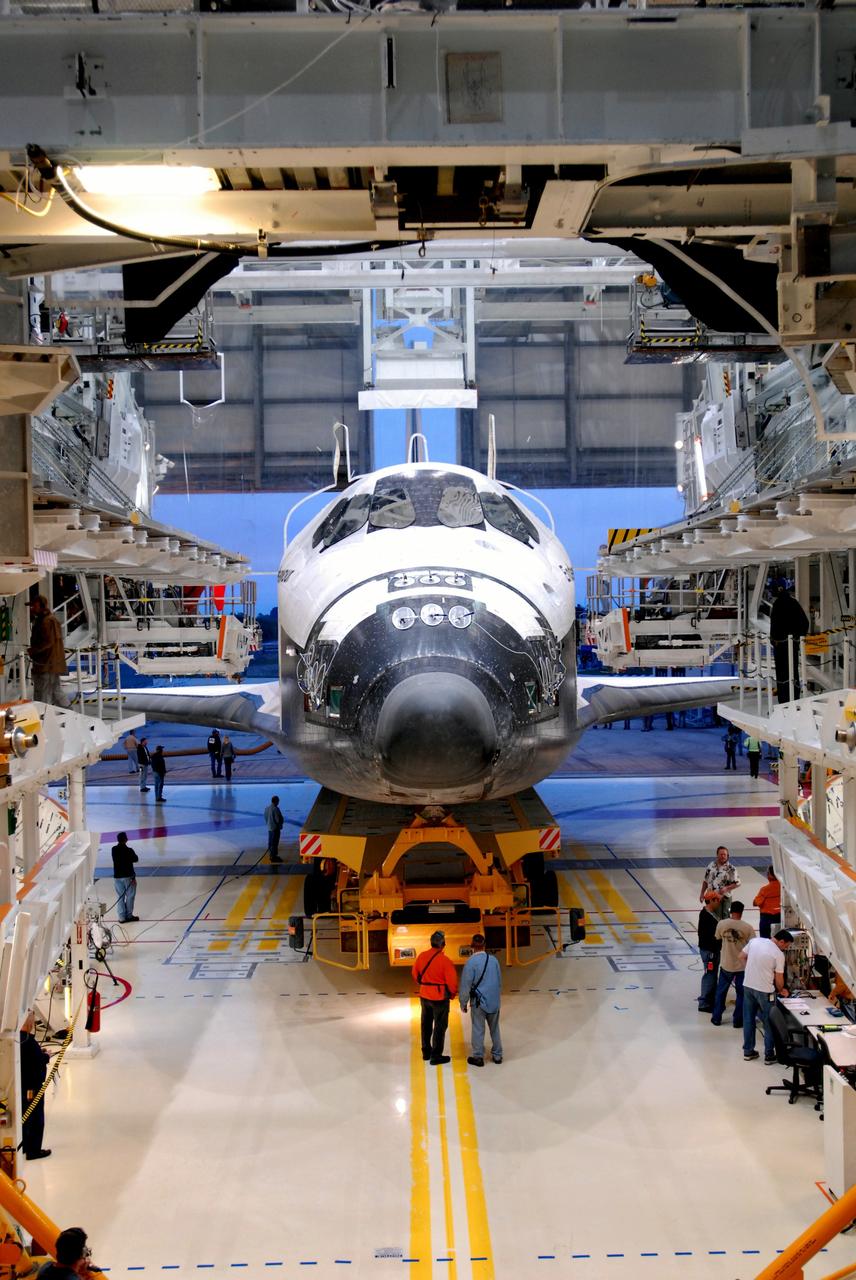
CAPE CANAVERAL, Fla. – Space shuttle Endeavour is ready for the rollover from Orbiter Processing Facility 2 to the Vehicle Assembly Building at NASA's Kennedy Space Center, Fla. The first motion of the shuttle out of its hangar was at 6:56 a.m. EDT. In the VAB, Endeavour will be lifted into High Bay 1 and mated to the external fuel tank and solid rocket boosters already installed on the mobile launcher platform. Endeavour is scheduled to roll out to Launch Pad 39B in about a week. Endeavour will be prepared on the pad for liftoff in the unlikely event that a rescue mission is necessary following space shuttle Atlantis' launch on the STS-125 mission to service the Hubble Space Telescope. After Atlantis is cleared to land, Endeavour will move to Launch Pad 39A for its upcoming STS-127 mission to the International Space Station, targeted to launch in mid-June. Photo credit: NASA/Jim Grossmann

CAPE CANAVERAL, Fla. – Space shuttle Endeavour is rolled from Orbiter Processing Facility 2 to the Vehicle Assembly Building at NASA's Kennedy Space Center, Fla. The first motion of the shuttle out of its hangar was at 6:56 a.m. EDT. In the VAB, Endeavour will be lifted into High Bay 1 and mated to the external fuel tank and solid rocket boosters already installed on the mobile launcher platform. Endeavour is scheduled to roll out to Launch Pad 39B in about a week. Endeavour will be prepared on the pad for liftoff in the unlikely event that a rescue mission is necessary following space shuttle Atlantis' launch on the STS-125 mission to service the Hubble Space Telescope. After Atlantis is cleared to land, Endeavour will move to Launch Pad 39A for its upcoming STS-127 mission to the International Space Station, targeted to launch in mid-June. Photo credit: NASA/Jim Grossmann
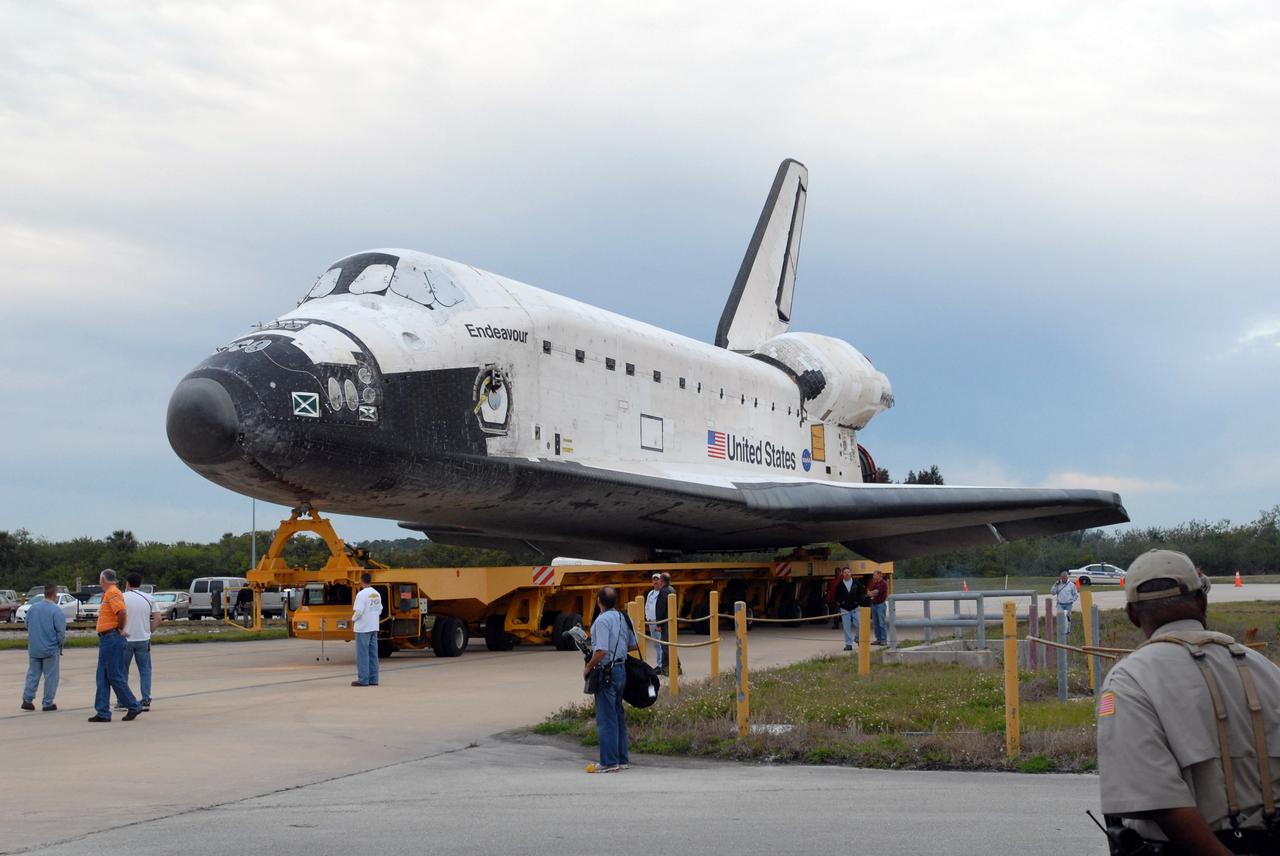
CAPE CANAVERAL, Fla. – Space shuttle Endeavour is transported from Orbiter Processing Facility 2 to the Vehicle Assembly Building at NASA's Kennedy Space Center, Fla. The first motion of the shuttle out of its hangar was at 6:56 a.m. EDT. In the VAB, Endeavour will be lifted into High Bay 1 and mated to the external fuel tank and solid rocket boosters already installed on the mobile launcher platform. Endeavour is scheduled to roll out to Launch Pad 39B in about a week. Endeavour will be prepared on the pad for liftoff in the unlikely event that a rescue mission is necessary following space shuttle Atlantis' launch on the STS-125 mission to service the Hubble Space Telescope. After Atlantis is cleared to land, Endeavour will move to Launch Pad 39A for its upcoming STS-127 mission to the International Space Station, targeted to launch in mid-June. Photo credit: NASA/Jim Grossmann
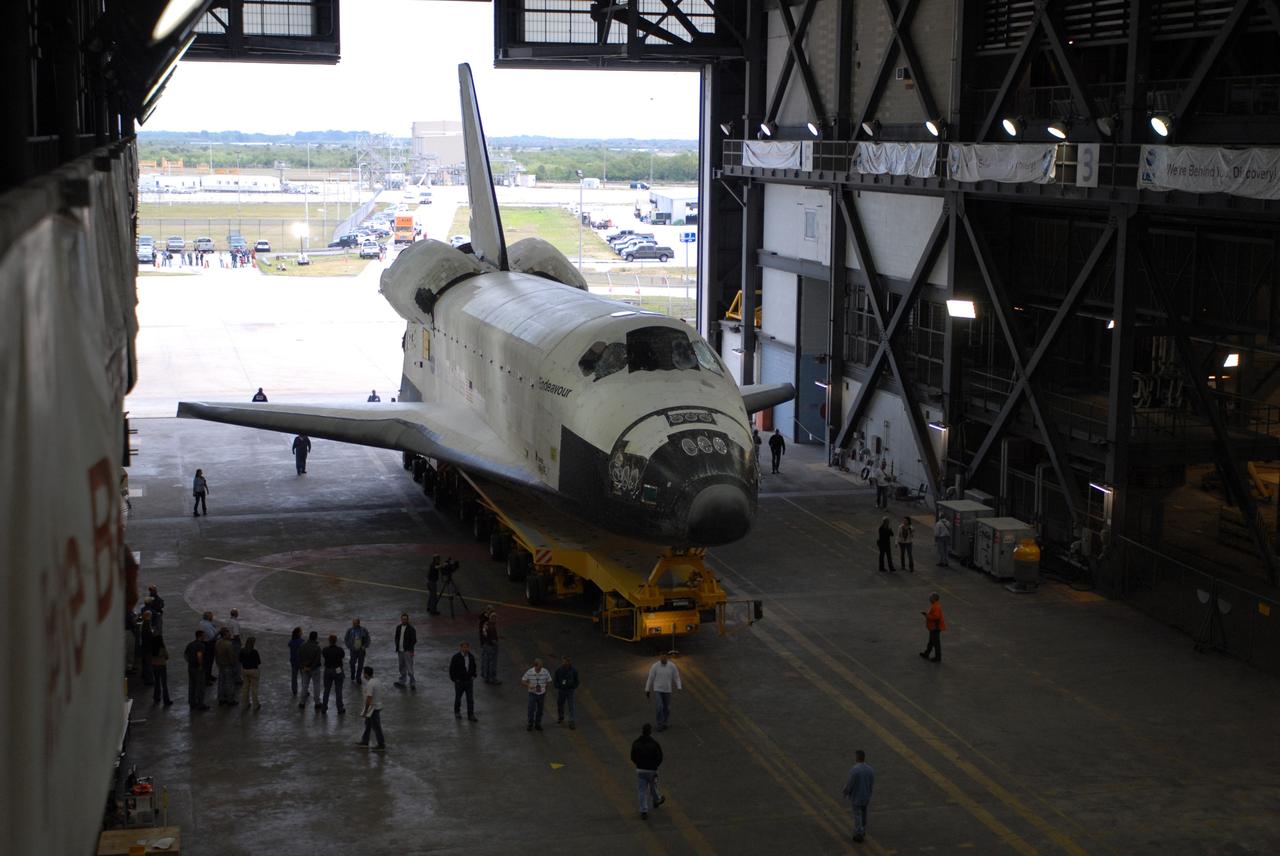
CAPE CANAVERAL, Fla. – Space shuttle Endeavour rolls into the Vehicle Assembly Building at NASA's Kennedy Space Center, Fla. The first motion of the shuttle out of Orbiter Processing Facility 2 was at 6:56 a.m. EDT. In the VAB, Endeavour will be lifted into High Bay 1 and mated to the external fuel tank and solid rocket boosters already installed on the mobile launcher platform. Endeavour is scheduled to roll out to Launch Pad 39B in about a week. Endeavour will be prepared on the pad for liftoff in the unlikely event that a rescue mission is necessary following space shuttle Atlantis' launch on the STS-125 mission to service the Hubble Space Telescope. After Atlantis is cleared to land, Endeavour will move to Launch Pad 39A for its upcoming STS-127 mission to the International Space Station, targeted to launch in mid-June. Photo credit: NASA/Jim Grossmann
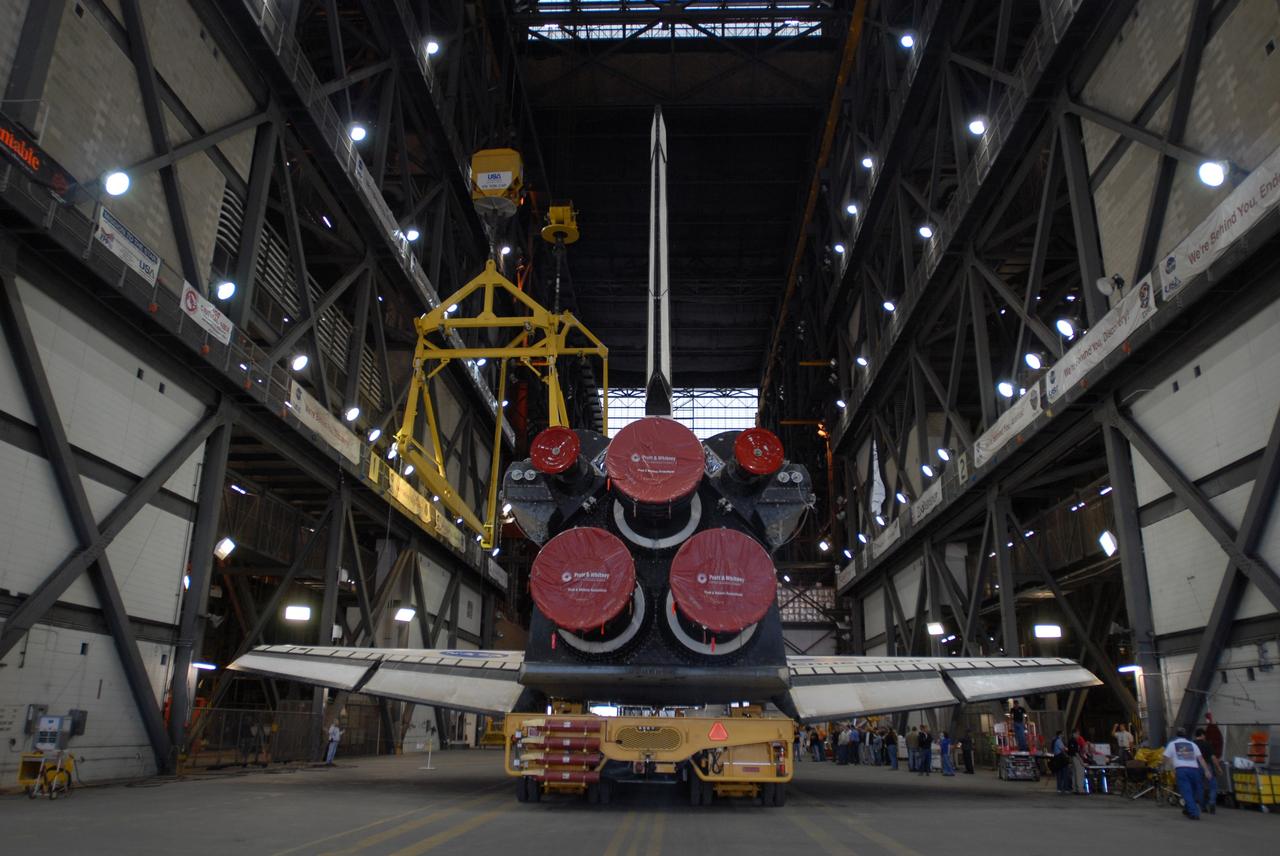
CAPE CANAVERAL, Fla. – In the transfer aisle of the Vehicle Assembly Building at NASA's Kennedy Space Center, Fla., space shuttle Endeavour is in position to be lifted into a high bay. The first motion of the shuttle out of Orbiter Processing Facility 2 was at 6:56 a.m. EDT. In the VAB, Endeavour will be lifted into High Bay 1 and mated to the external fuel tank and solid rocket boosters already installed on the mobile launcher platform. Endeavour is scheduled to roll out to Launch Pad 39B in about a week. Endeavour will be prepared on the pad for liftoff in the unlikely event that a rescue mission is necessary following space shuttle Atlantis' launch on the STS-125 mission to service the Hubble Space Telescope. After Atlantis is cleared to land, Endeavour will move to Launch Pad 39A for its upcoming STS-127 mission to the International Space Station, targeted to launch in mid-June. Photo credit: NASA/Jim Grossmann
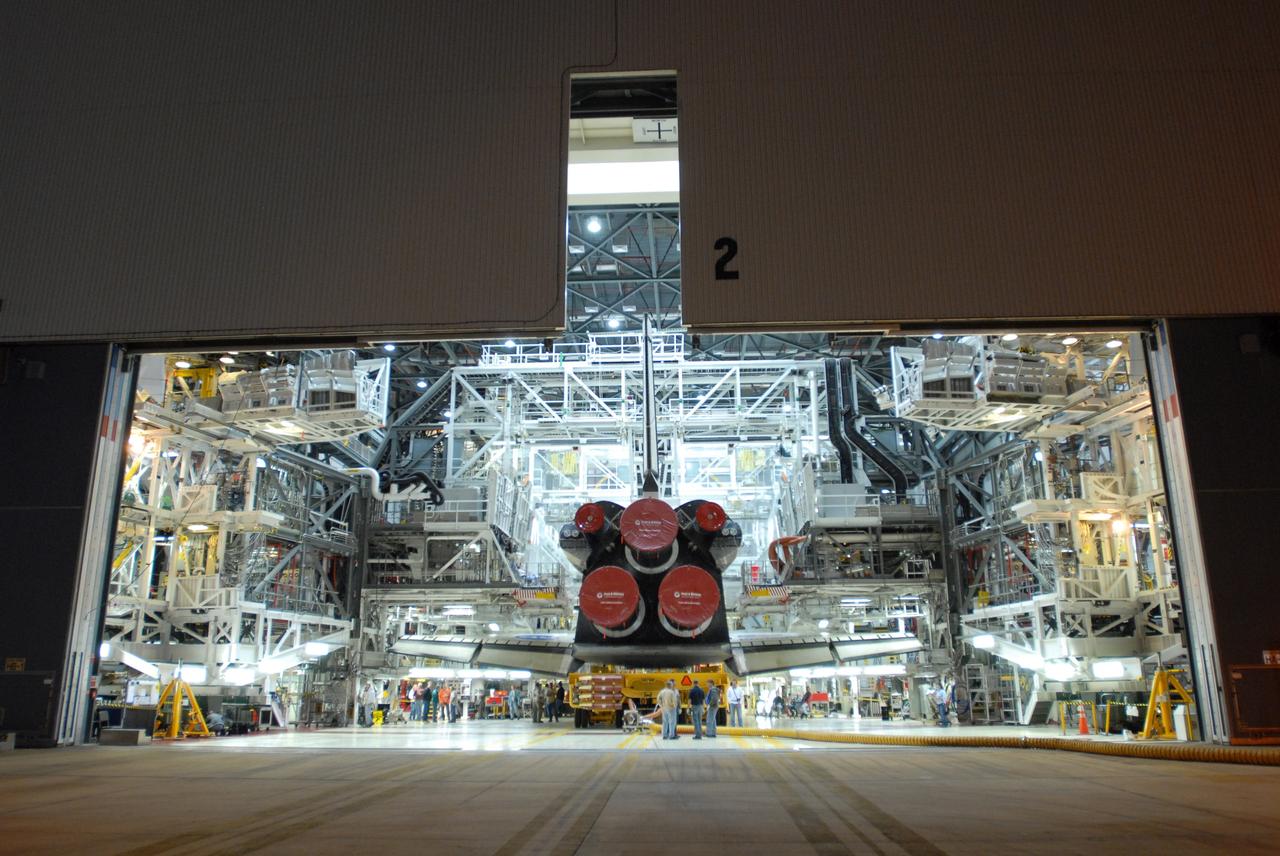
CAPE CANAVERAL, Fla. – Space shuttle Endeavour is ready for the rollover from Orbiter Processing Facility 2 to the Vehicle Assembly Building at NASA's Kennedy Space Center, Fla. The first motion of the shuttle out of its hangar was at 6:56 a.m. EDT. In the VAB, Endeavour will be lifted into High Bay 1 and mated to the external fuel tank and solid rocket boosters already installed on the mobile launcher platform. Endeavour is scheduled to roll out to Launch Pad 39B in about a week. Endeavour will be prepared on the pad for liftoff in the unlikely event that a rescue mission is necessary following space shuttle Atlantis' launch on the STS-125 mission to service the Hubble Space Telescope. After Atlantis is cleared to land, Endeavour will move to Launch Pad 39A for its upcoming STS-127 mission to the International Space Station, targeted to launch in mid-June. Photo credit: NASA/Jim Grossmann
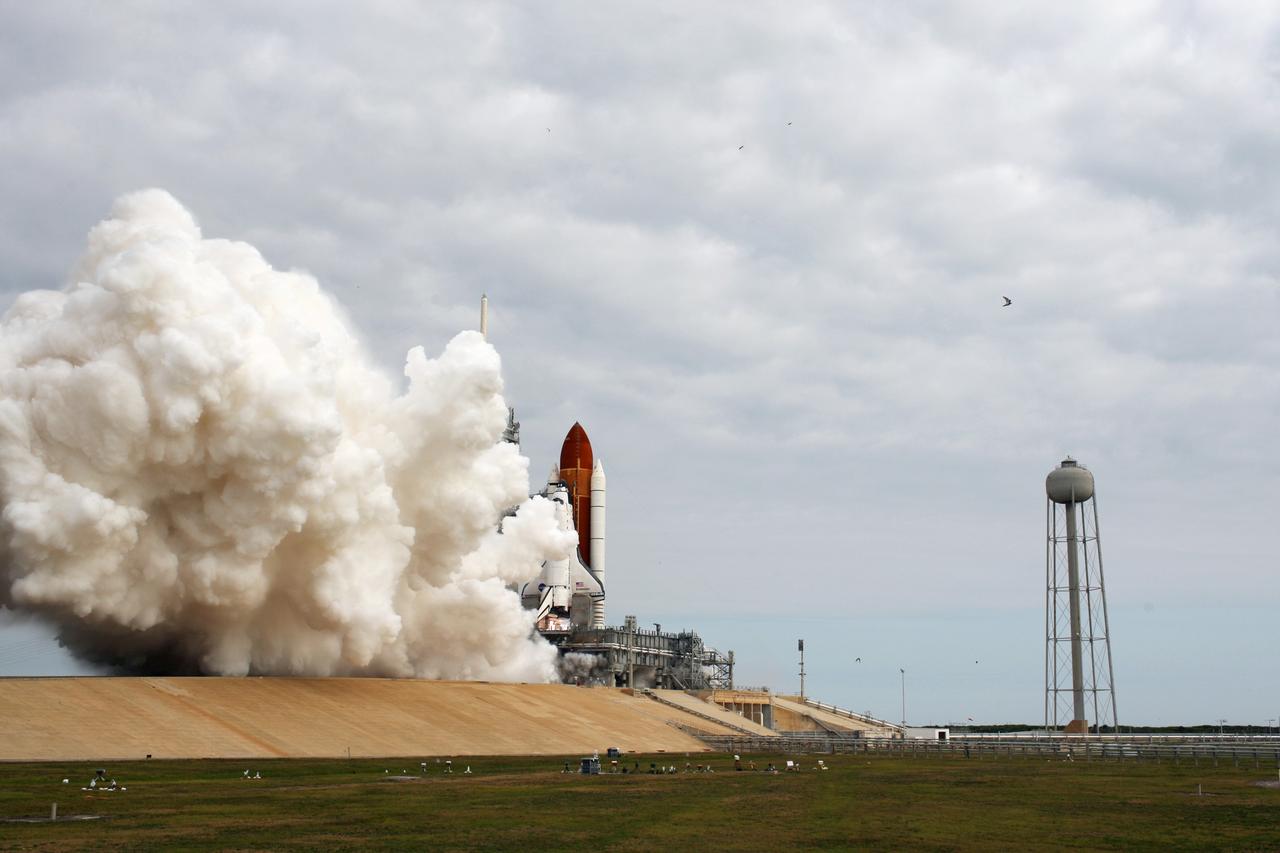
CAPE CANAVERAL, Fla. -- Kicking up a trail of smoke and steam, space shuttle Endeavour lifts off from Launch Pad 39A at NASA's Kennedy Space Center in Florida beginning its final flight, the STS-134 mission, to the International Space Station. Launch was on time at 8:56 a.m. EDT on May 16. STS-134 and its six-member crew will deliver the Alpha Magnetic Spectrometer-2 (AMS), Express Logistics Carrier-3, a high-pressure gas tank and additional spare parts for the Dextre robotic helper to the space station. Endeavour's first launch attempt on April 29 was scrubbed because of an issue associated with a faulty power distribution box called the aft load control assembly-2 (ALCA-2). For more information visit, www.nasa.gov/mission_pages/shuttle/shuttlemissions/sts134/index.html. Photo credit: NASA
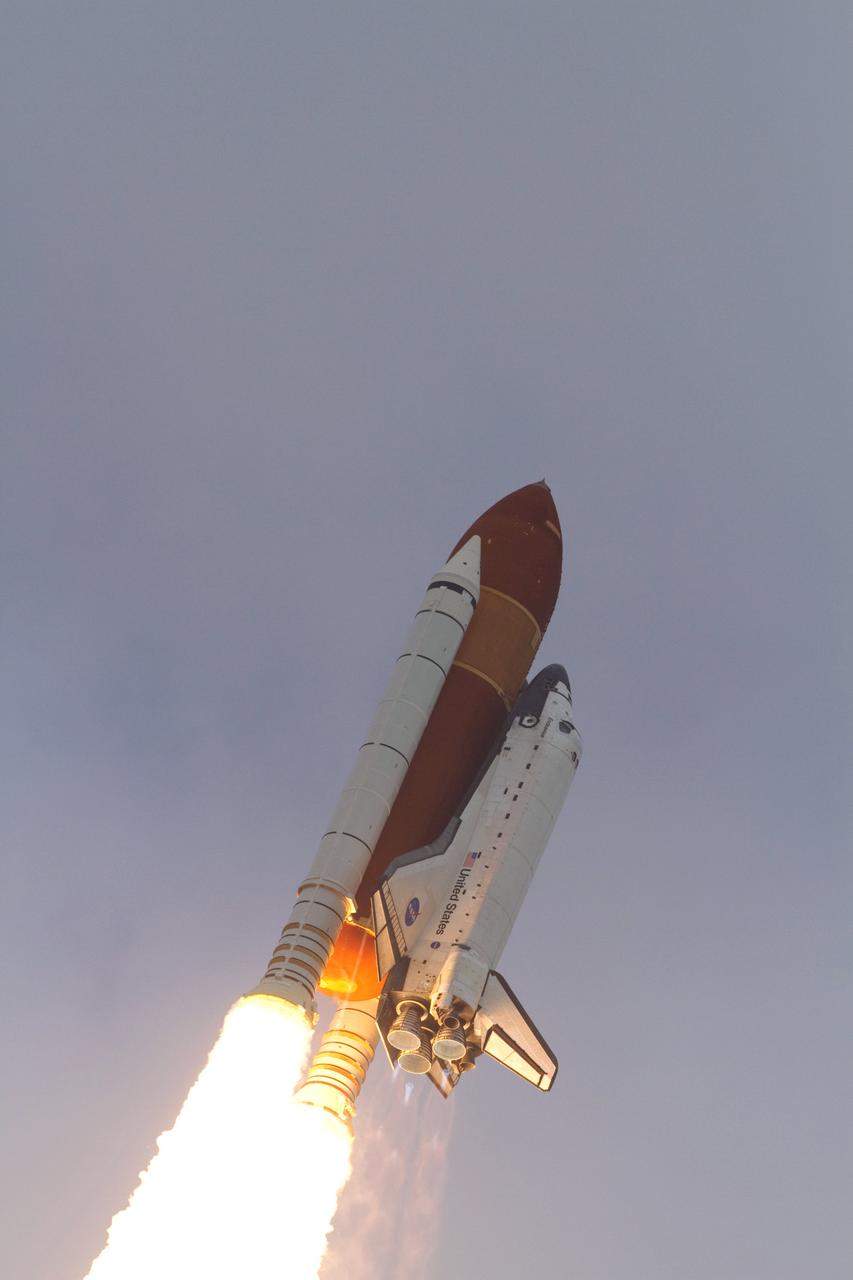
CAPE CANAVERAL, Fla. -- Rising on twin columns of fire, space shuttle Endeavour lifts off from Launch Pad 39A at NASA's Kennedy Space Center in Florida beginning its final flight, the STS-134 mission, to the International Space Station. Launch was on time at 8:56 a.m. EDT on May 16. STS-134 and its six-member crew will deliver the Alpha Magnetic Spectrometer-2 (AMS), Express Logistics Carrier-3, a high-pressure gas tank and additional spare parts for the Dextre robotic helper to the space station. Endeavour's first launch attempt on April 29 was scrubbed because of an issue associated with a faulty power distribution box called the aft load control assembly-2 (ALCA-2). For more information visit, www.nasa.gov/mission_pages/shuttle/shuttlemissions/sts134/index.html. Photo credit: NASA

STS-88 Mission Specialist Sergei Konstantinovich Krikalev, a Russian cosmonaut, smiles at onlookers after his arrival at the Shuttle Landing Facility aboard a T-38 jet aircraft. He joins the five other crew members, Commander Robert D. Cabana, Pilot Frederick W. "Rick" Sturckow and Mission Specialists Nancy J. Currie, Jerry L. Ross and James H. Newman, for prelaunch preparations for Mission STS-88 aboard Space Shuttle Endeavour. The scheduled time of launch is 3:56 a.m. EST on Dec. 3 from Launch Pad 39A. The mission is the first U.S. launch for the International Space Station. Endeavour carries the Unity connecting module which the crew will be mating with the Russian-built Zarya control module already in orbit. In addition to Unity, Endeavour will carry two small replacement electronics boxes for possible repairs to Zarya batteries. The mission is scheduled to last nearly 12 days

STS-88 Commander Robert D. Cabana smiles at onlookers after his arrival at the Shuttle Landing Facility aboard a T-38 jet aircraft. He joins other crew members Pilot Frederick W. "Rick" Sturckow and Mission Specialists Nancy J. Currie, Jerry L. Ross, James H. Newman and Sergei Konstantinovich Krikalev, a Russian cosmonaut, for prelaunch preparations for Mission STS-88 aboard Space Shuttle Endeavour. The scheduled time of launch is 3:56 a.m. EST on Dec. 3 from Launch Pad 39A. The mission is the first U.S. launch for the International Space Station. Endeavour carries the Unity connecting module which the crew will be mating with the Russian-built Zarya control module already in orbit. In addition to Unity, Endeavour will carry two small replacement electronics boxes for possible repairs to Zarya batteries. The mission is scheduled to last nearly 12 days
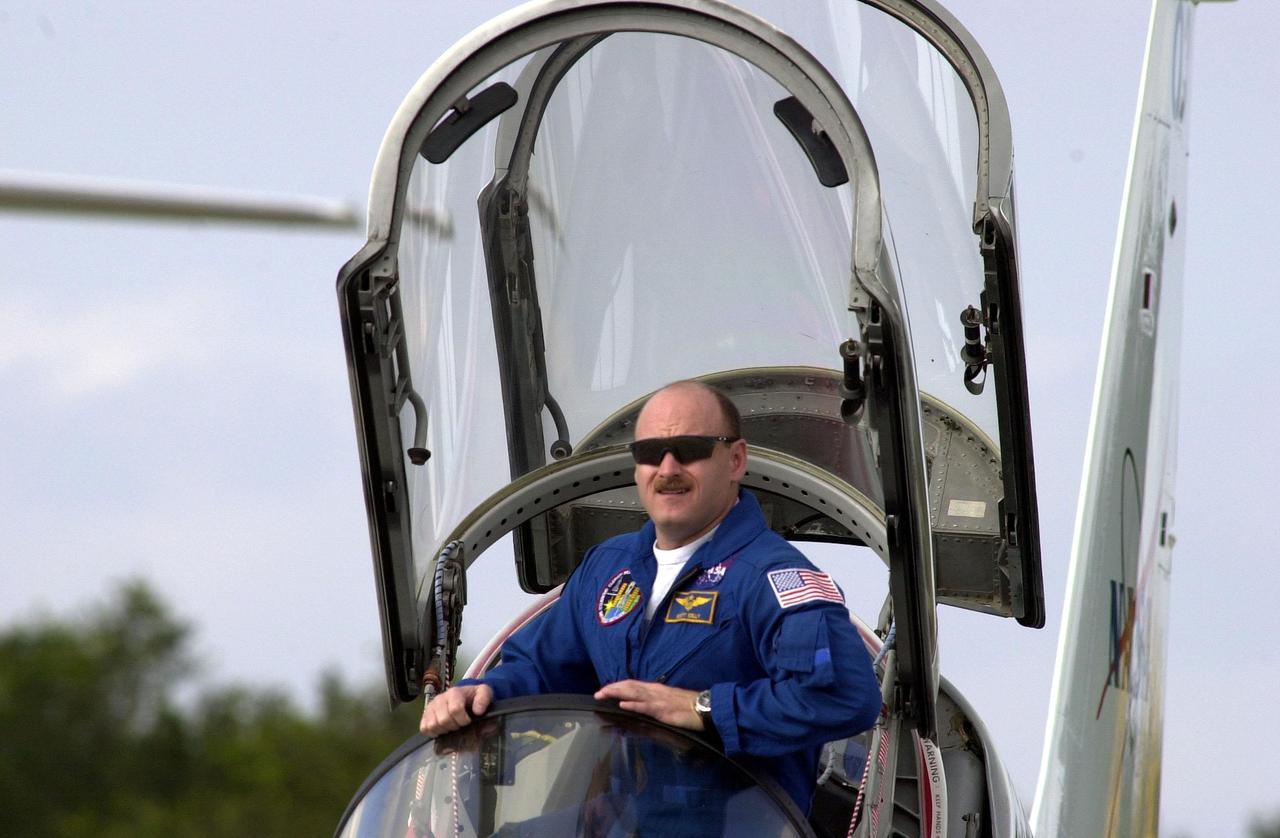
STS-103 Pilot Scott J. Kelly settles into the cockpit of a T-38 training jet for practice flights. He joins other crew members Commander Curtis L. Brown Jr. and Mission Specialists Steven L. Smith, C. Michael Foale (Ph.D.), John M. Grunsfeld (Ph.D.), Claude Nicollier of Switzerland and Jean-François Clervoy of France, for pre-launch preparations on mission STS-103 aboard Space Shuttle Discovery. Nicollier and Clervoy are with the European Space Agency. The mission, to service the Hubble Space Telescope, is scheduled for launch Dec. 16 at 9:18 p.m. EST from Launch Pad 39B. The mission is expected to last about 9 days and 21 hours. Discovery is expected to land at KSC Sunday, Dec. 26, at 6:56 p.m. EST
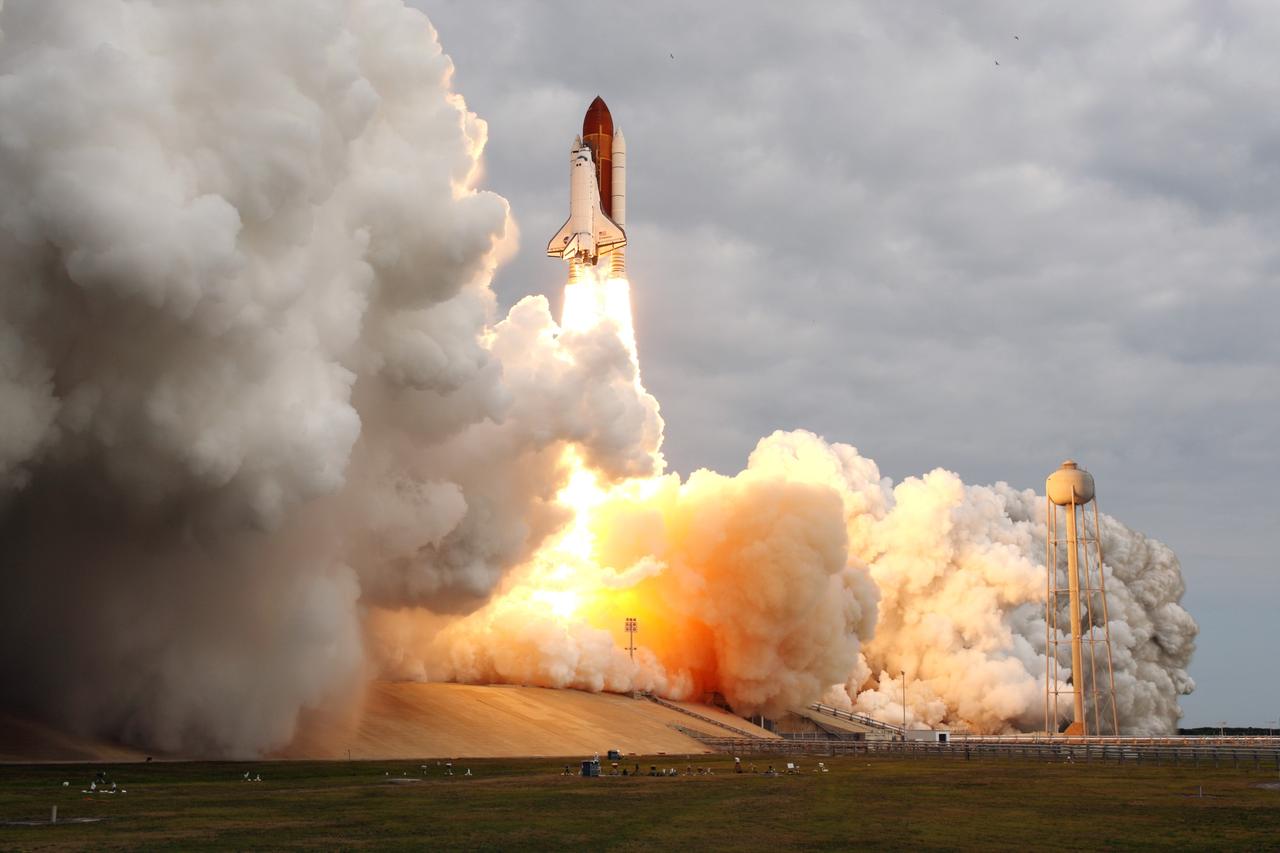
CAPE CANAVERAL, Fla. -- Rising on twin columns of fire and kicking up a trail of smoke and steam, space shuttle Endeavour lifts off from Launch Pad 39A at NASA's Kennedy Space Center in Florida beginning its final flight, the STS-134 mission, to the International Space Station. Launch was on time at 8:56 a.m. EDT on May 16. STS-134 and its six-member crew will deliver the Alpha Magnetic Spectrometer-2 (AMS), Express Logistics Carrier-3, a high-pressure gas tank and additional spare parts for the Dextre robotic helper to the space station. Endeavour's first launch attempt on April 29 was scrubbed because of an issue associated with a faulty power distribution box called the aft load control assembly-2 (ALCA-2). For more information visit, www.nasa.gov/mission_pages/shuttle/shuttlemissions/sts134/index.html. Photo credit: NASA
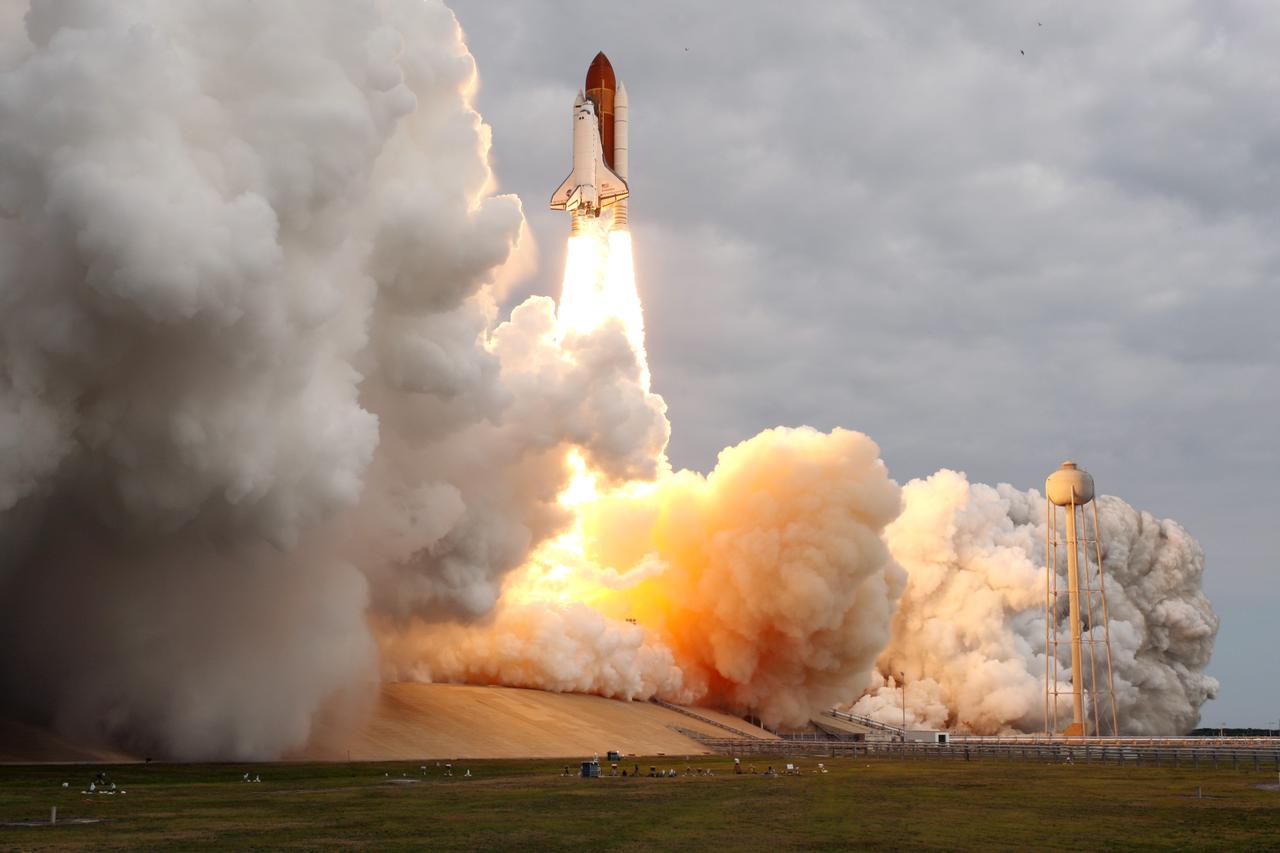
CAPE CANAVERAL, Fla. -- Rising on twin columns of fire and kicking up a trail of smoke and steam, space shuttle Endeavour lifts off from Launch Pad 39A at NASA's Kennedy Space Center in Florida beginning its final flight, the STS-134 mission, to the International Space Station. Launch was on time at 8:56 a.m. EDT on May 16. STS-134 and its six-member crew will deliver the Alpha Magnetic Spectrometer-2 (AMS), Express Logistics Carrier-3, a high-pressure gas tank and additional spare parts for the Dextre robotic helper to the space station. Endeavour's first launch attempt on April 29 was scrubbed because of an issue associated with a faulty power distribution box called the aft load control assembly-2 (ALCA-2). For more information visit, www.nasa.gov/mission_pages/shuttle/shuttlemissions/sts134/index.html. Photo credit: NASA
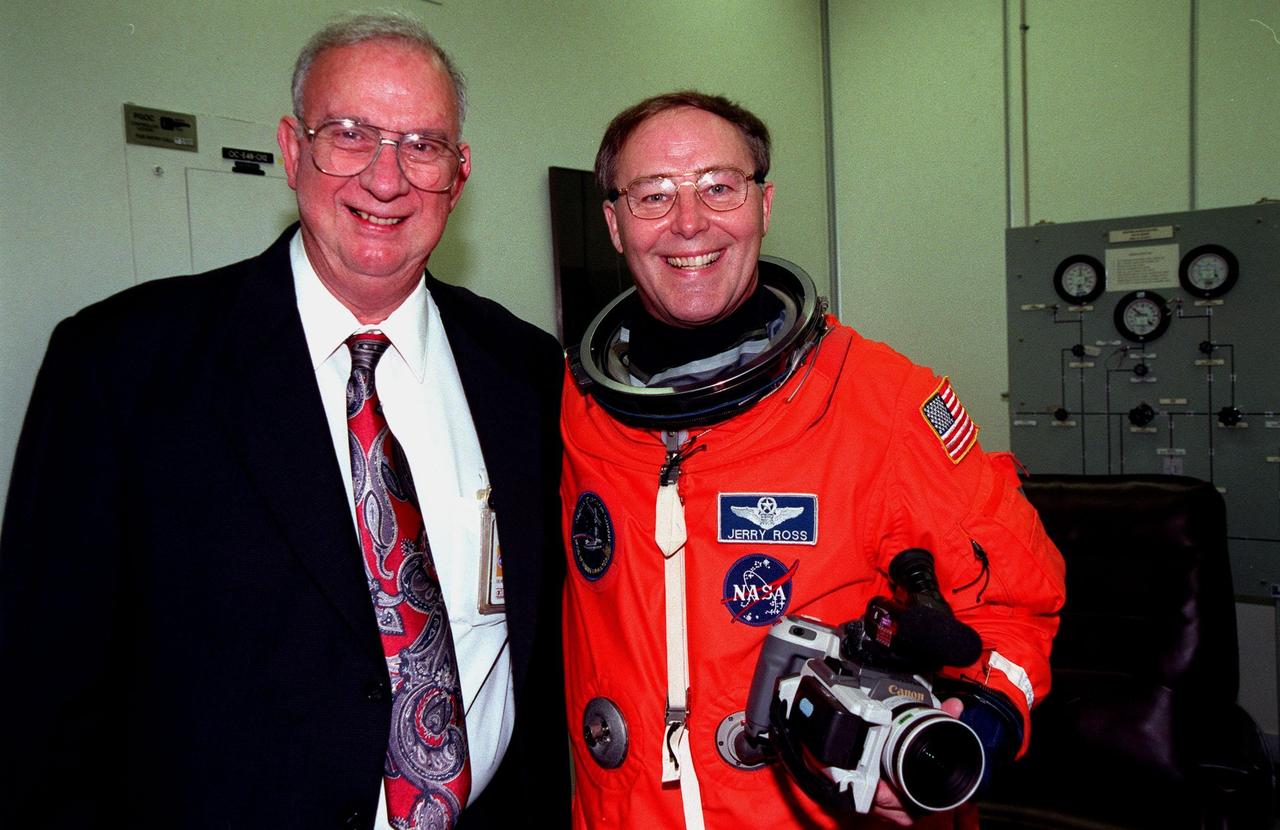
KENNEDY SPACE CENTER, FLA. -- In the Operations and Checkout Building, STS-88 Mission Specialist Jerry L. Ross (right) takes part in a complete suit check before launch. Standing with him is Owen Bertrand, chief of the Vehicle Integration Test office at Johnson Space Center. This is Bertrand's last launch before retiring in January. Mission STS-88 is expected to launch at 3:56 a.m. EST with the six-member crew aboard Space Shuttle Endeavour on Dec. 3. Endeavour carries the Unity connecting module, which the crew will be mating with the Russian-built Zarya control module already in orbit. In addition to Unity, two small replacement electronics boxes are on board for possible repairs to Zarya batteries. The mission is expected to last 11 days, 19 hours and 49 minutes, landing at 10:17 p.m. EST on Dec. 14
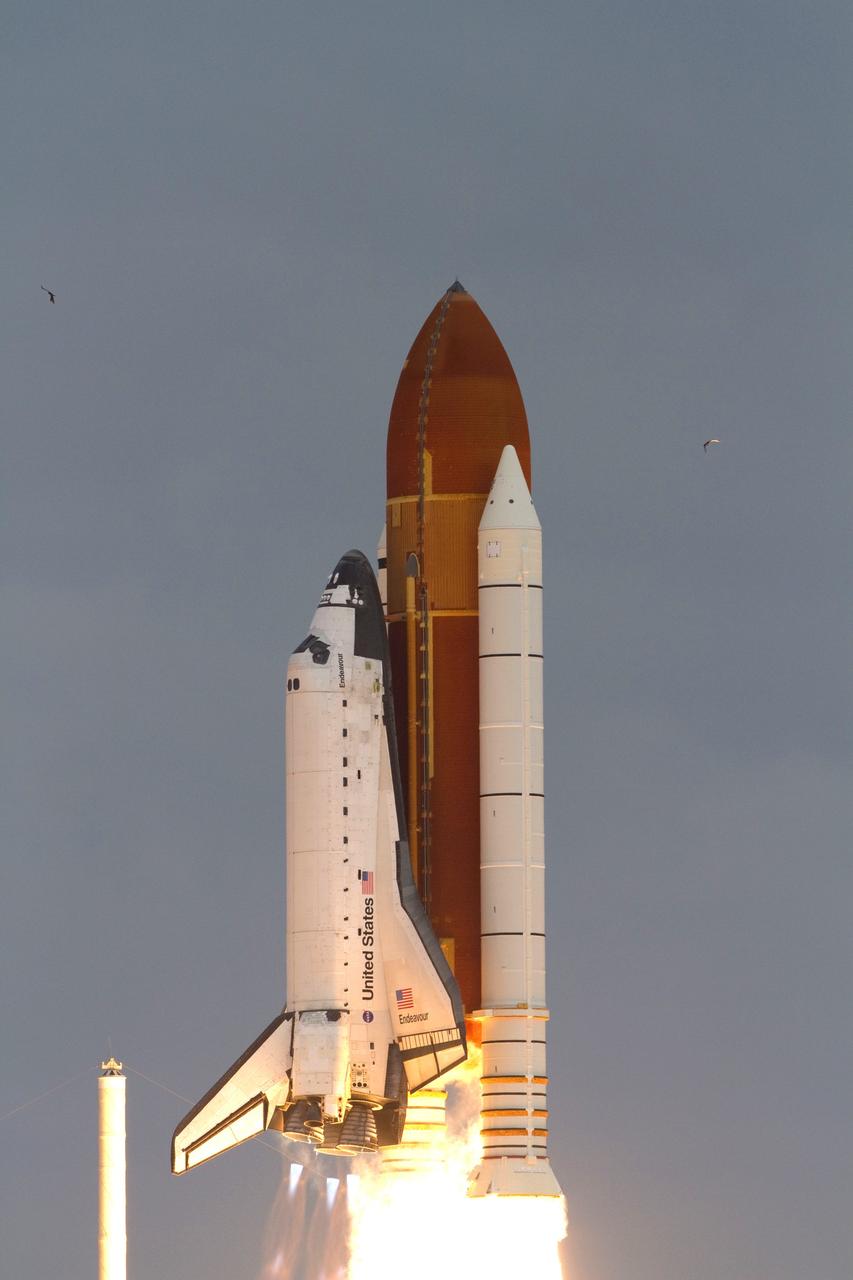
CAPE CANAVERAL, Fla. -- Rising on twin columns of fire, space shuttle Endeavour lifts off from Launch Pad 39A at NASA's Kennedy Space Center in Florida beginning its final flight, the STS-134 mission, to the International Space Station. Launch was on time at 8:56 a.m. EDT on May 16. STS-134 and its six-member crew will deliver the Alpha Magnetic Spectrometer-2 (AMS), Express Logistics Carrier-3, a high-pressure gas tank and additional spare parts for the Dextre robotic helper to the space station. Endeavour's first launch attempt on April 29 was scrubbed because of an issue associated with a faulty power distribution box called the aft load control assembly-2 (ALCA-2). For more information visit, www.nasa.gov/mission_pages/shuttle/shuttlemissions/sts134/index.html. Photo credit: NASA

KENNEDY SPACE CENTER, FLA. -- The Service Structure driver (inside the cab near bottom of photo) begins rolling back the Rotating Service Structure on Launch Pad 39A to reveal the Space Shuttle Endeavour with its external tank and two solid rocket boosters on top of the Mobile Launcher Platform. Endeavour is ready for launch of mission STS-88 targeted for 3:56 a.m. on Dec. 3. The first U.S. launch for the International Space Station, STS-88 is expected to last 11 days, 19 hours and 49 minutes, and land at 10:17 p.m. EST on Dec. 14. Endeavour carries the Unity connecting module which the crew will be mating with the Russian-built Zarya control module already in orbit. In addition to Unity, two small replacement electronics boxes are on board for possible repairs to Zarya batteries
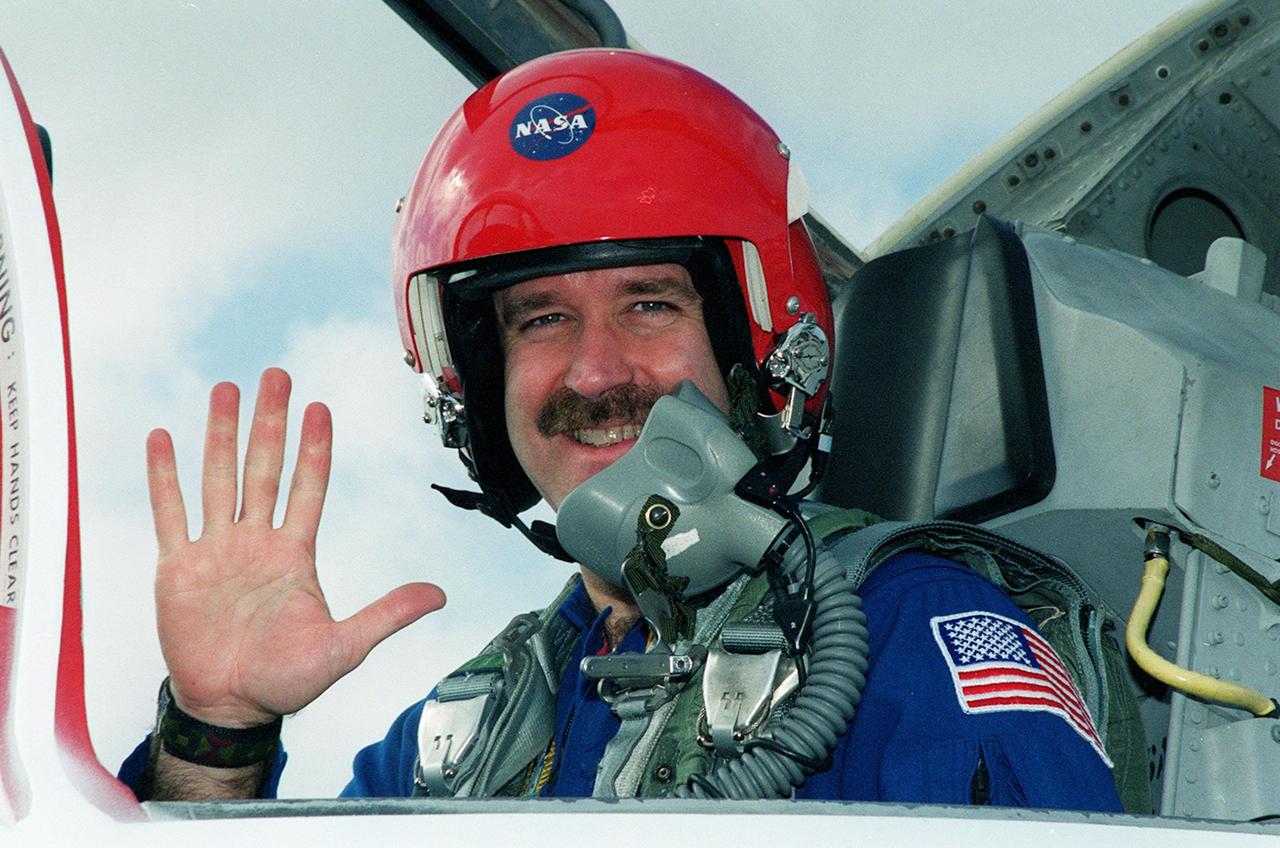
STS-103 Mission Specialist John M. Grunsfeld (Ph.D.) waves from the rear seat of a T-38 training jet before beginning practice flights. He joins other crew members Commander Curtis L. Brown Jr., Pilot Scott J. Kelly and Mission Specialists Steven L. Smith, C. Michael Foale (Ph.D.), Claude Nicollier of Switzerland and Jean-François Clervoy of France, for pre-launch preparations on mission STS-103 aboard Space Shuttle Discovery. Nicollier and Clervoy are with the European Space Agency. The mission, to service the Hubble Space Telescope, is scheduled for launch Dec. 16 at 9:18 p.m. EST from Launch Pad 39B. The mission is expected to last about 9 days and 21 hours. Discovery is expected to land at KSC Sunday, Dec. 26, at 6:56 p.m. EST
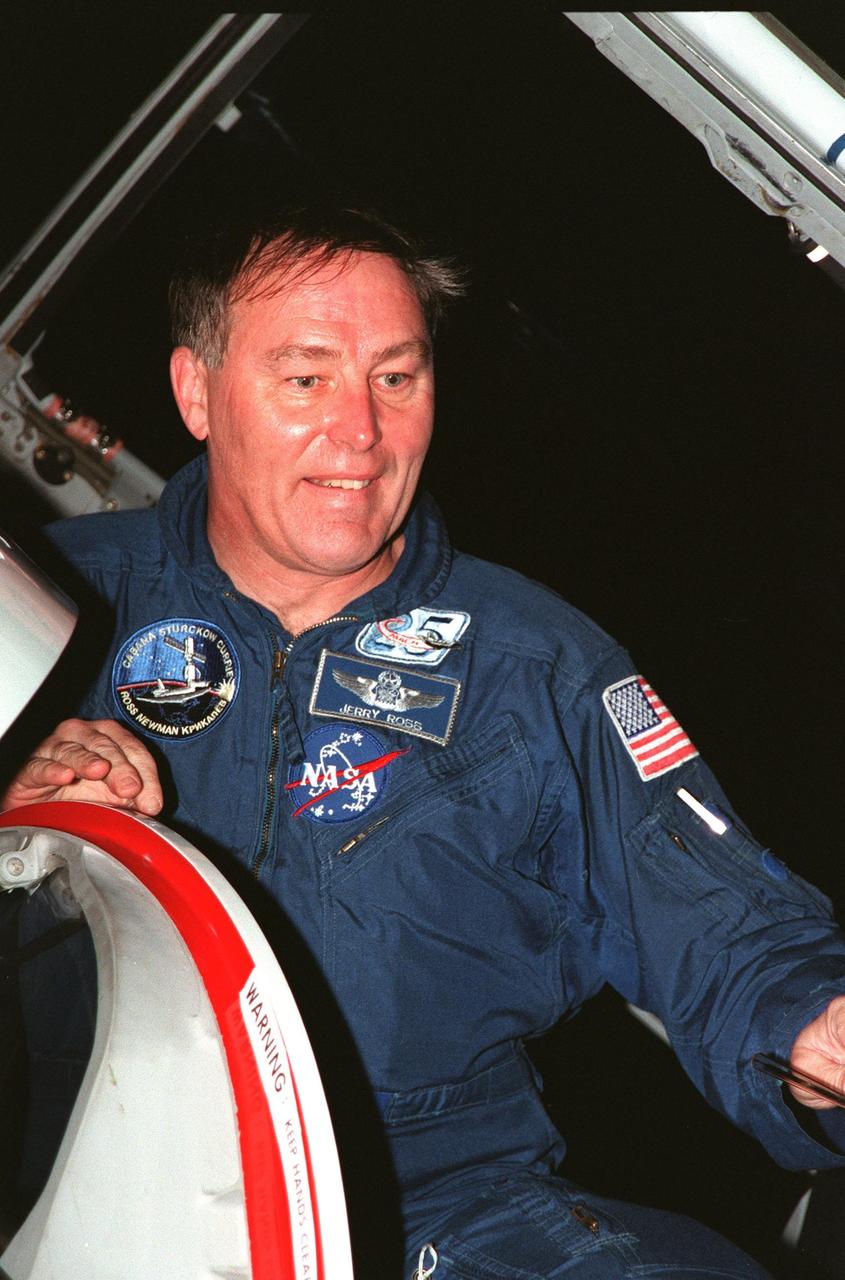
A smiling STS-88 Mission Specialist Jerry L. Ross prepares to exit the T-38 jet aircraft that brought him to the Shuttle Landing Facility. He joins the five other crew members, Commander Robert D. Cabana, Pilot Frederick W. "Rick" Sturckow, and Mission Specialists Nancy J. Currie, James H. Newman and Sergei Konstantinovich Krikalev, a Russian cosmonaut, for prelaunch preparations for mission STS-88 aboard Space Shuttle Endeavour. The scheduled time of launch is 3:56 a.m. EST on Dec. 3 from Launch Pad 39A. The mission is the first U.S. launch for the International Space Station. Endeavour carries the Unity connecting module which the crew will be mating with the Russian-built Zarya control module already in orbit. In addition to Unity, Endeavour will carry two small replacement electronics boxes for possible repairs to Zarya batteries. The mission is scheduled to last nearly 12 days
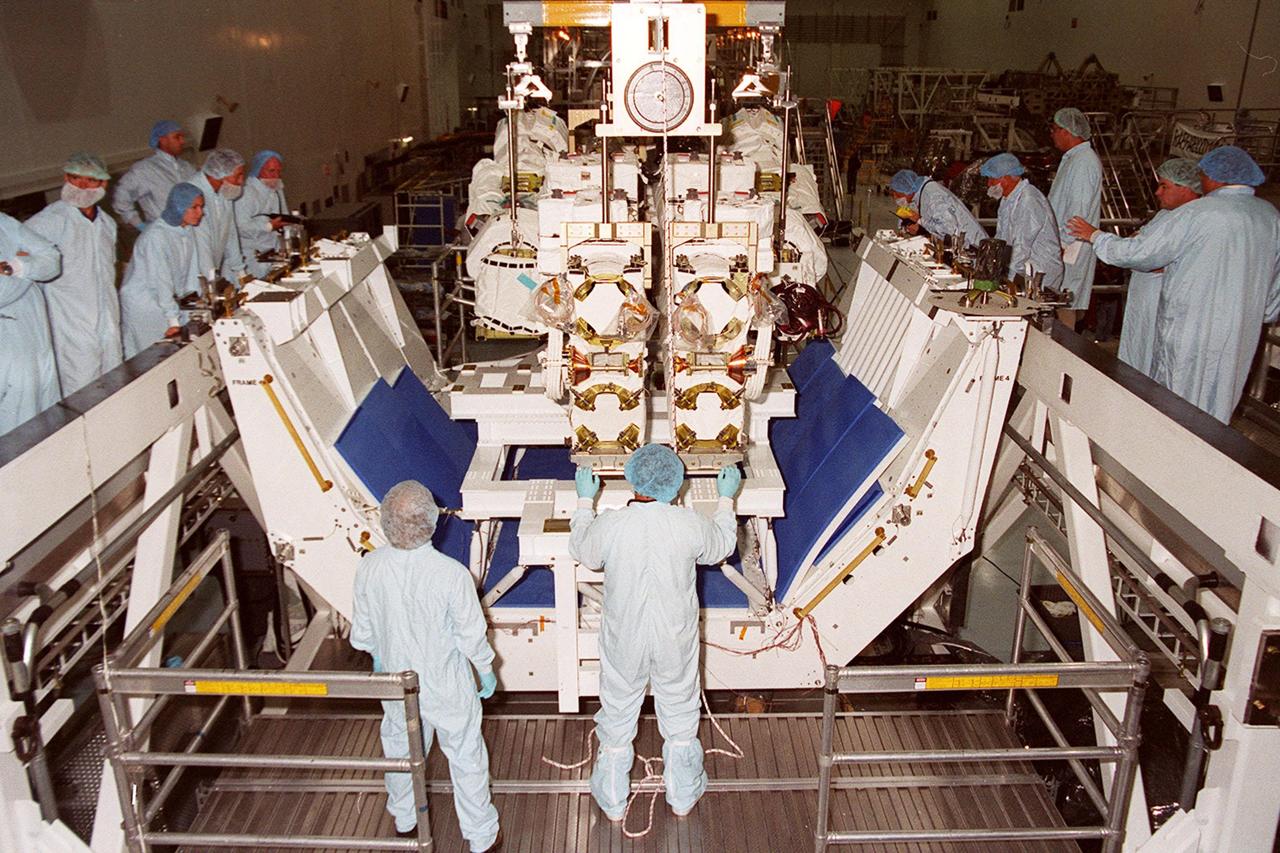
The Canadian Space Agency’s Space Station Remote Manipulator System (SSRMS) is lowered onto a test stand in the Space Station Processing Facility. At the test stand the SSRMS will be mated to its payload carrier. This pallet will later be installed into the payload bay of Space Shuttle Endeavour for launch to the International Space Station on STS-100 in April 2001. The 56-foot-long arm will be the primary means of transferring payloads between the orbiter payload bay and the Station. Its three segments comprise seven joints for highly flexible land precise movement, making it capable of moving around the Station’s exterior like an inchworm
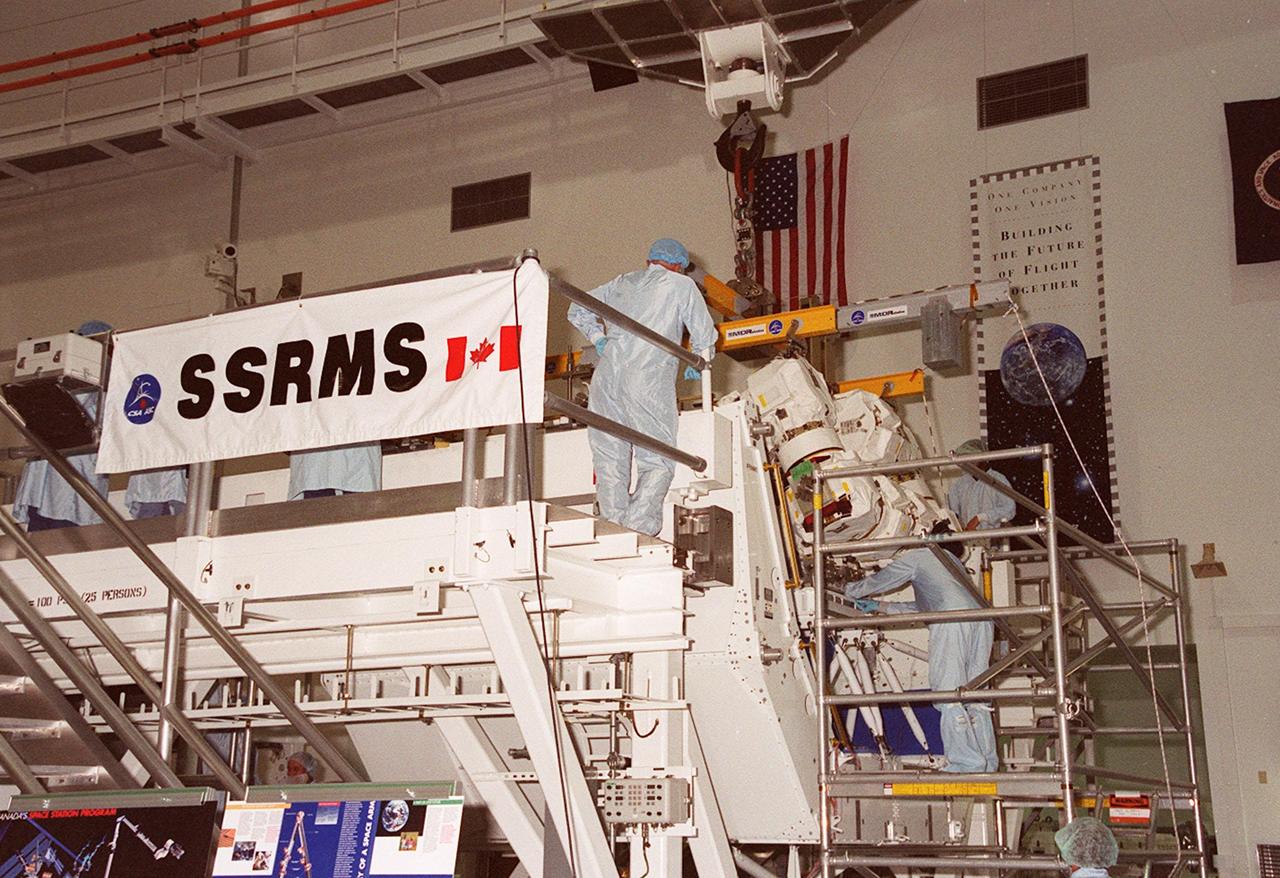
The Canadian Space Agency’s Space Station Remote Manipulator System (SSRMS) now occupies one of the work stands in the Space Station Processing Facility. There it will be mated to its payload carrier and later be installed into the payload bay of Space Shuttle Endeavour for launch to the International Space Station on STS-100 in April 2001. The 56-foot-long arm will be the primary means of transferring payloads between the orbiter payload bay and the Station. Its three segments comprise seven joints for highly flexible land precise movement, making it capable of moving around the Station’s exterior like an inchworm
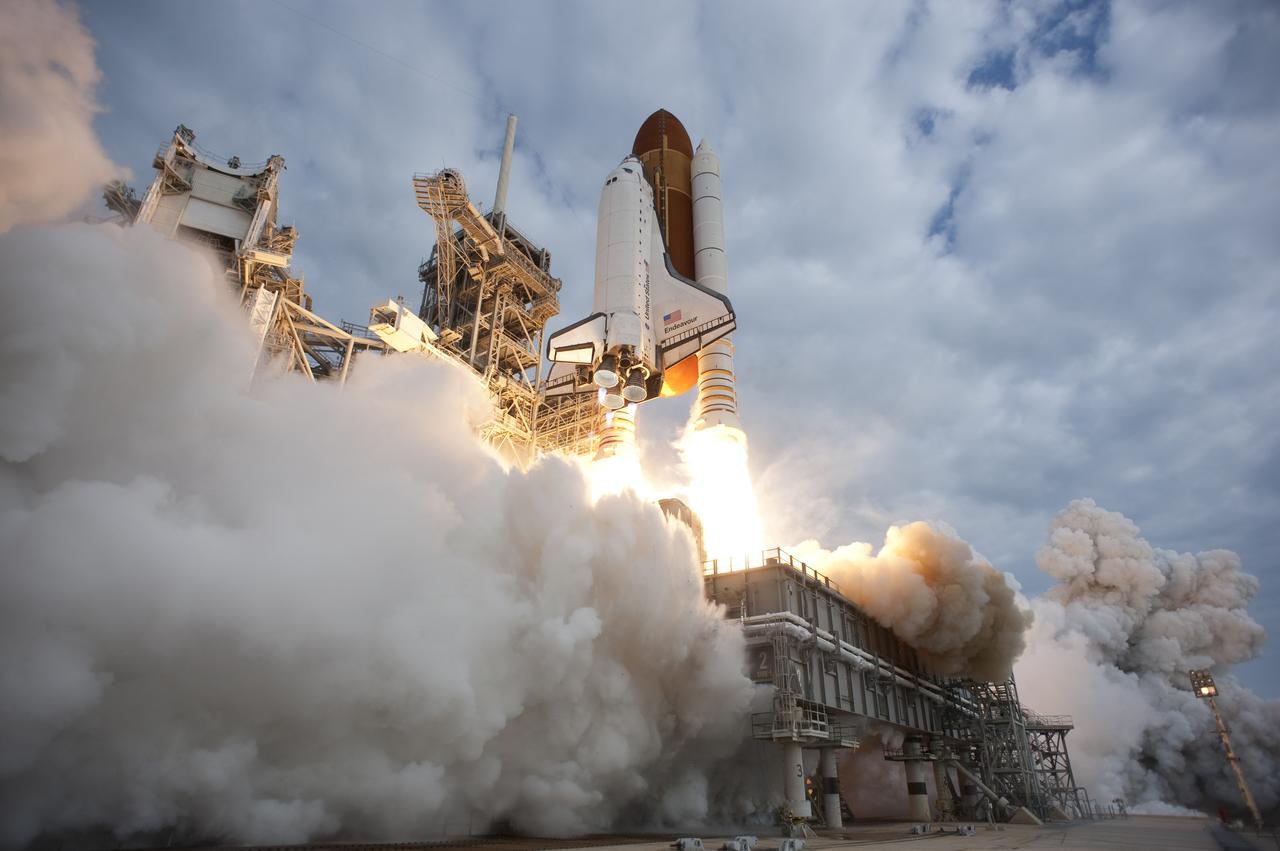
CAPE CANAVERAL, Fla. -- Space shuttle Endeavour rises on twin columns of flame from Launch Pad 39A at NASA's Kennedy Space Center in Florida. Endeavour began its final flight, the STS-134 mission to the International Space Station, at 8:56 a.m. EDT on May 16. Endeavour and its six-member crew will deliver the Alpha Magnetic Spectrometer-2 (AMS), Express Logistics Carrier-3, a high-pressure gas tank and additional spare parts for the Dextre robotic helper to the space station. For more information visit, www.nasa.gov/mission_pages/shuttle/shuttlemissions/sts134/index.html. Photo credit: NASA/Tony Gray and Tom Farrar
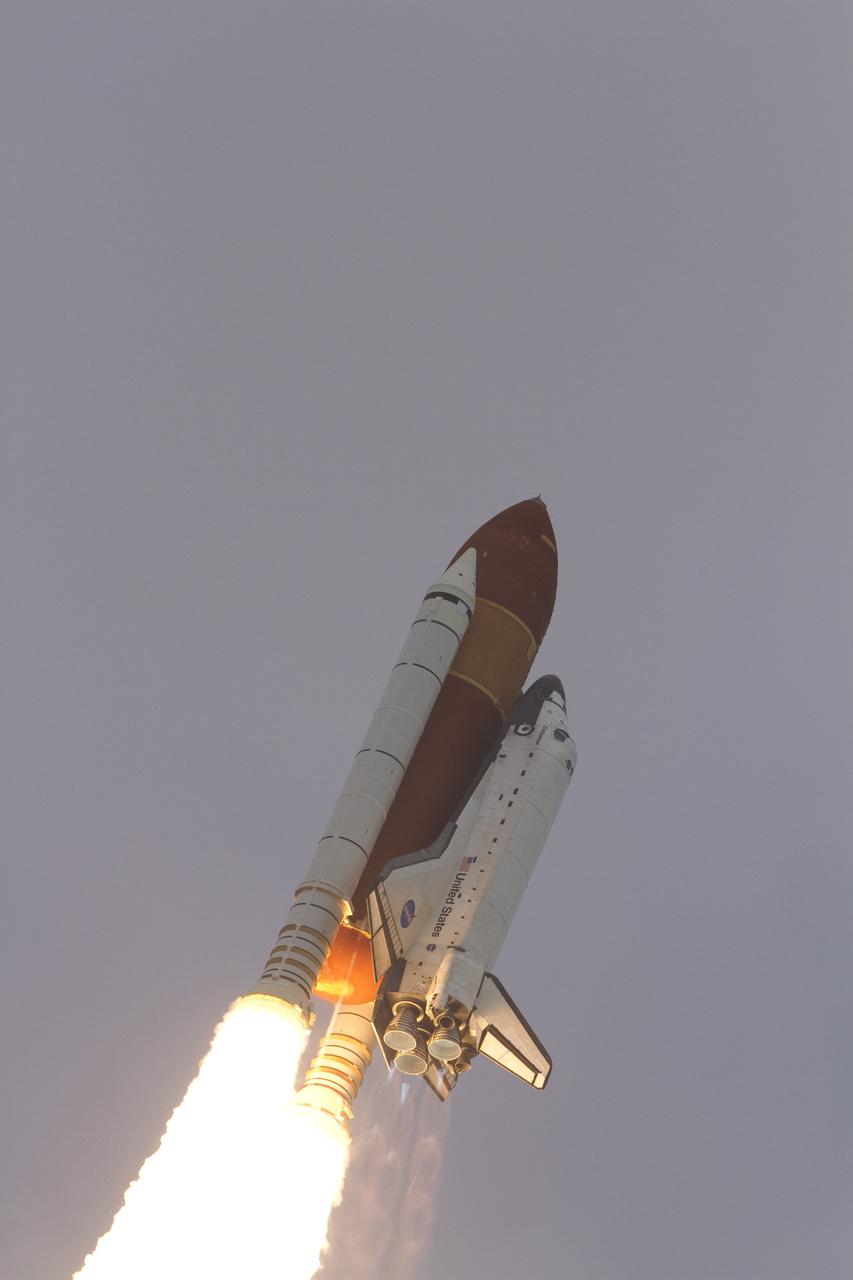
CAPE CANAVERAL, Fla. -- Space shuttle Endeavour soars to orbit from Launch Pad 39A at NASA's Kennedy Space Center in Florida. Endeavour began its final flight, the STS-134 mission to the International Space Station, at 8:56 a.m. EDT on May 16. Endeavour and its six-member crew will deliver the Alpha Magnetic Spectrometer-2 (AMS), Express Logistics Carrier-3, a high-pressure gas tank and additional spare parts for the Dextre robotic helper to the space station. For more information visit, www.nasa.gov/mission_pages/shuttle/shuttlemissions/sts134/index.html. Photo credit: NASA/Kenny Allen and George Roberts
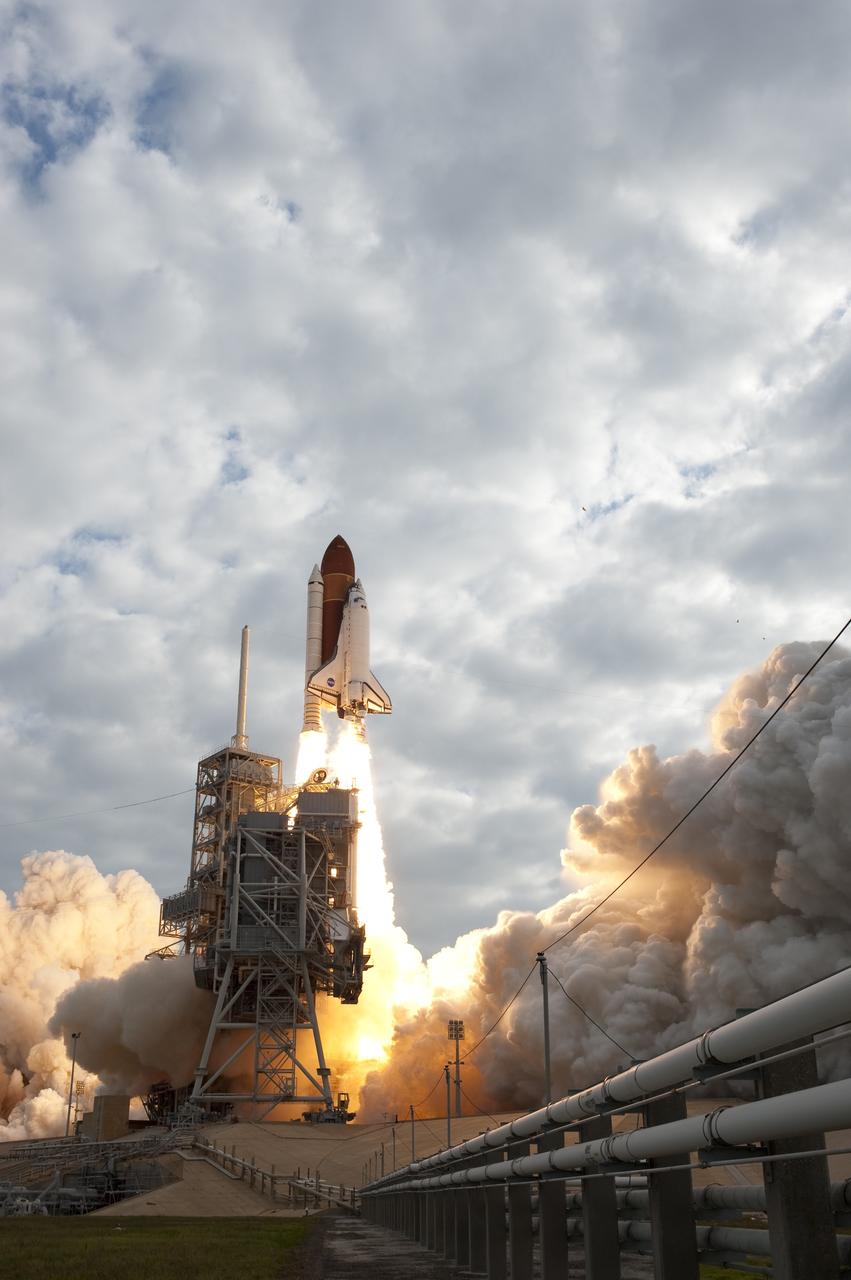
CAPE CANAVERAL, Fla. -- Rising on twin columns of fire, space shuttle Endeavour clears the tower during liftoff from Launch Pad 39A at NASA's Kennedy Space Center in Florida. Endeavour began its final flight, the STS-134 mission to the International Space Station, at 8:56 a.m. EDT on May 16. Endeavour and its six-member crew will deliver the Alpha Magnetic Spectrometer-2 (AMS), Express Logistics Carrier-3, a high-pressure gas tank and additional spare parts for the Dextre robotic helper to the space station. For more information visit, www.nasa.gov/mission_pages/shuttle/shuttlemissions/sts134/index.html. Photo credit: NASA/Sandra Joseph and Kevin O'Connell
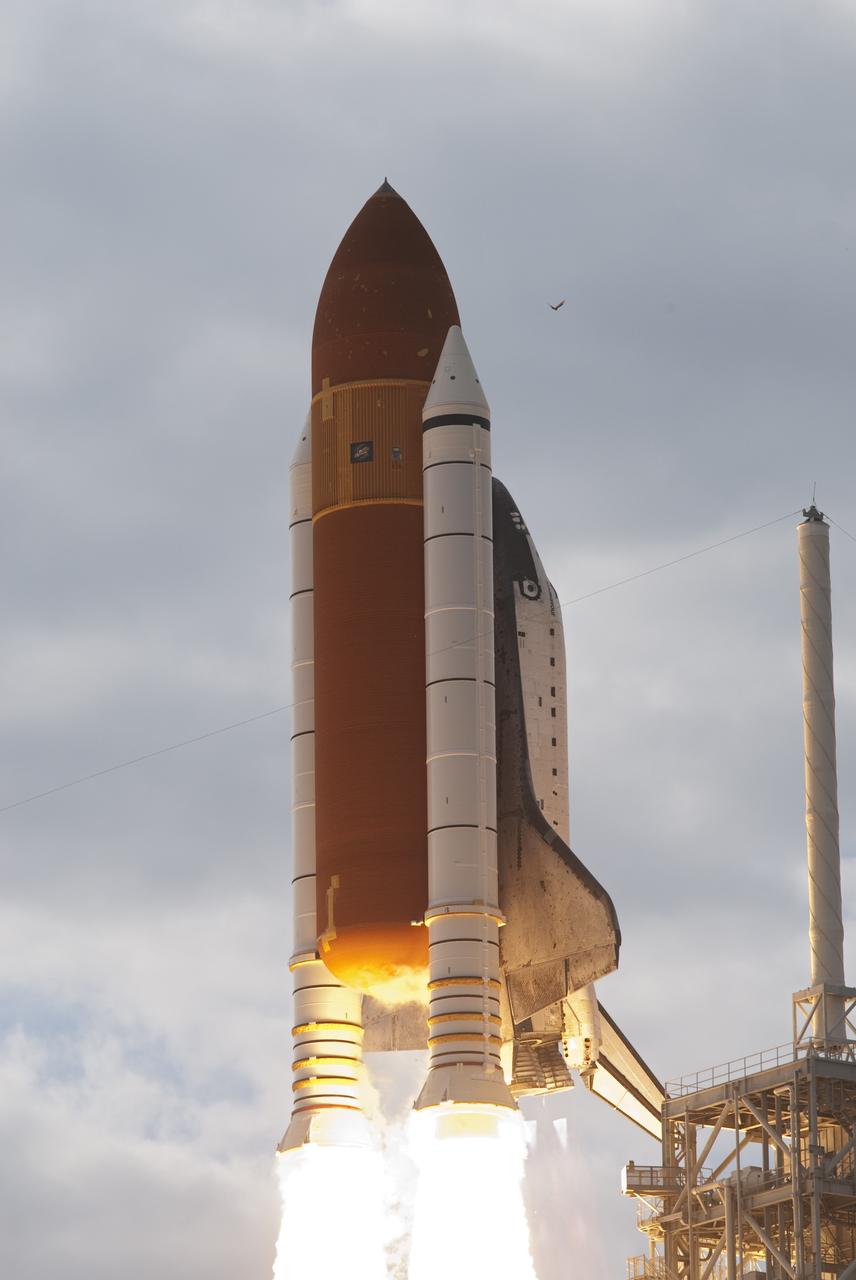
CAPE CANAVERAL, Fla. -- Space shuttle Endeavour soars to orbit from Launch Pad 39A at NASA's Kennedy Space Center in Florida. Endeavour began its final flight, the STS-134 mission to the International Space Station, at 8:56 a.m. EDT on May 16. Endeavour and its six-member crew will deliver the Alpha Magnetic Spectrometer-2 (AMS), Express Logistics Carrier-3, a high-pressure gas tank and additional spare parts for the Dextre robotic helper to the space station. For more information visit, www.nasa.gov/mission_pages/shuttle/shuttlemissions/sts134/index.html. Photo credit: NASA/George Roberts and Tom Farrar
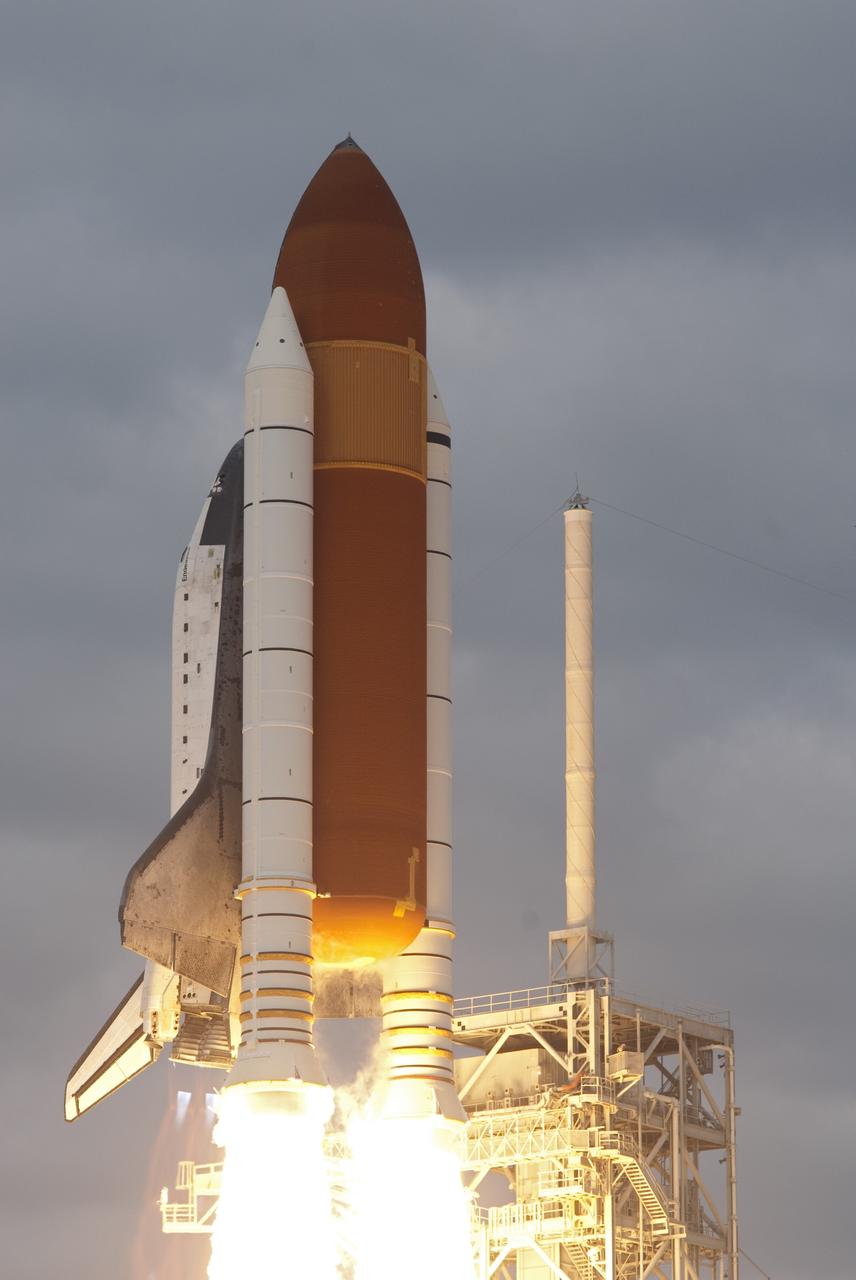
Cape Canaveral, Fla. -- On Launch Pad 39A at NASA's Kennedy Space Center in Florida, space shuttle Endeavour rises past the fixed service structure as it races toward space. Endeavour began its final flight, the STS-134 mission to the International Space Station, at 8:56 a.m. EDT on May 16. Endeavour and its six-member crew will deliver the Alpha Magnetic Spectrometer-2 (AMS), Express Logistics Carrier-3, a high-pressure gas tank and additional spare parts for the Dextre robotic helper to the space station. For more information visit, www.nasa.gov/mission_pages/shuttle/shuttlemissions/sts134/index.html. Photo credit: NASA/Rusty Backer and Mike Gayle

Cape Canaveral, Fla. -- On Launch Pad 39A at NASA's Kennedy Space Center in Florida, space shuttle Endeavour rises past the fixed service structure as it races toward space. Endeavour began its final flight, the STS-134 mission to the International Space Station, at 8:56 a.m. EDT on May 16. Endeavour and its six-member crew will deliver the Alpha Magnetic Spectrometer-2 (AMS), Express Logistics Carrier-3, a high-pressure gas tank and additional spare parts for the Dextre robotic helper to the space station. For more information visit, www.nasa.gov/mission_pages/shuttle/shuttlemissions/sts134/index.html. Photo credit: NASA/Tony Gray and Tom Farrar
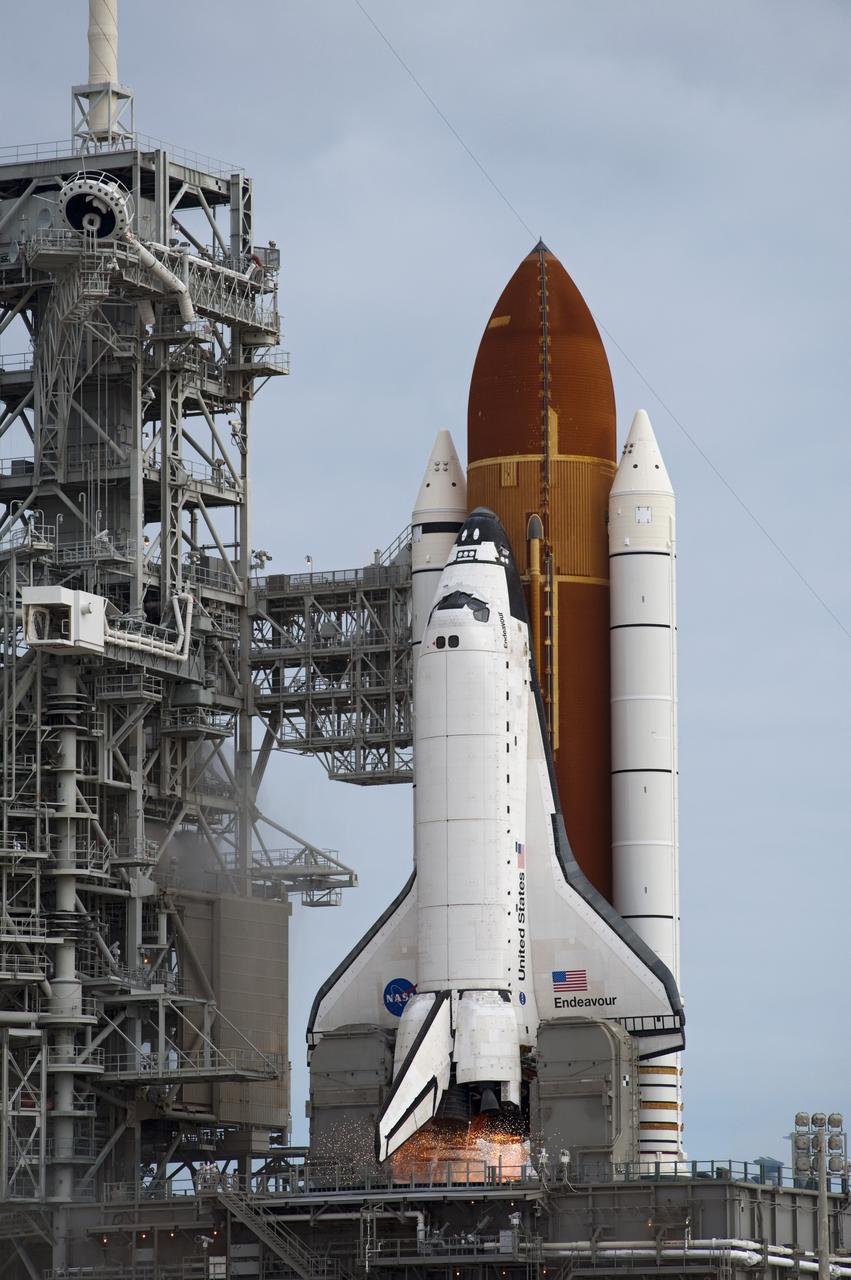
CAPE CANAVERAL, Fla. -- Space shuttle Endeavour's main engines ignite for liftoff at Launch Pad 39A at NASA's Kennedy Space Center in Florida. Endeavour began its final flight, the STS-134 mission to the International Space Station, at 8:56 a.m. EDT on May 16. Endeavour and its six-member crew will deliver the Alpha Magnetic Spectrometer-2 (AMS), Express Logistics Carrier-3, a high-pressure gas tank and additional spare parts for the Dextre robotic helper to the space station. For more information visit, www.nasa.gov/mission_pages/shuttle/shuttlemissions/sts134/index.html. Photo credit: NASA/Sandra Joseph and Kevin O'Connell
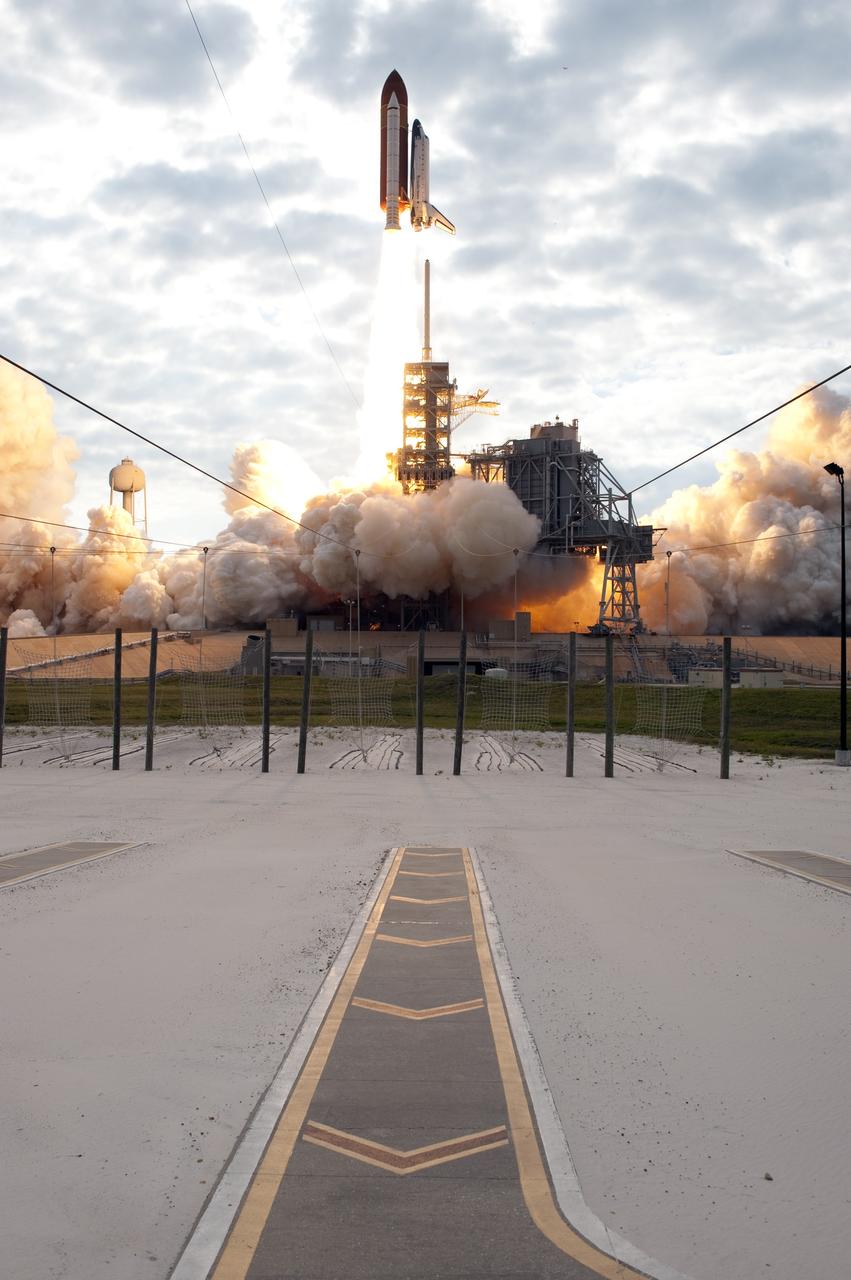
CAPE CANAVERAL, Fla. -- Space shuttle Endeavour soars toward orbit from Launch Pad 39A at NASA's Kennedy Space Center in Florida. Endeavour began its final flight, the STS-134 mission to the International Space Station, at 8:56 a.m. EDT on May 16. Endeavour and its six-member crew will deliver the Alpha Magnetic Spectrometer-2 (AMS), Express Logistics Carrier-3, a high-pressure gas tank and additional spare parts for the Dextre robotic helper to the space station. For more information visit, www.nasa.gov/mission_pages/shuttle/shuttlemissions/sts134/index.html. Photo credit: NASA/Tony Gray and Tom Farrar
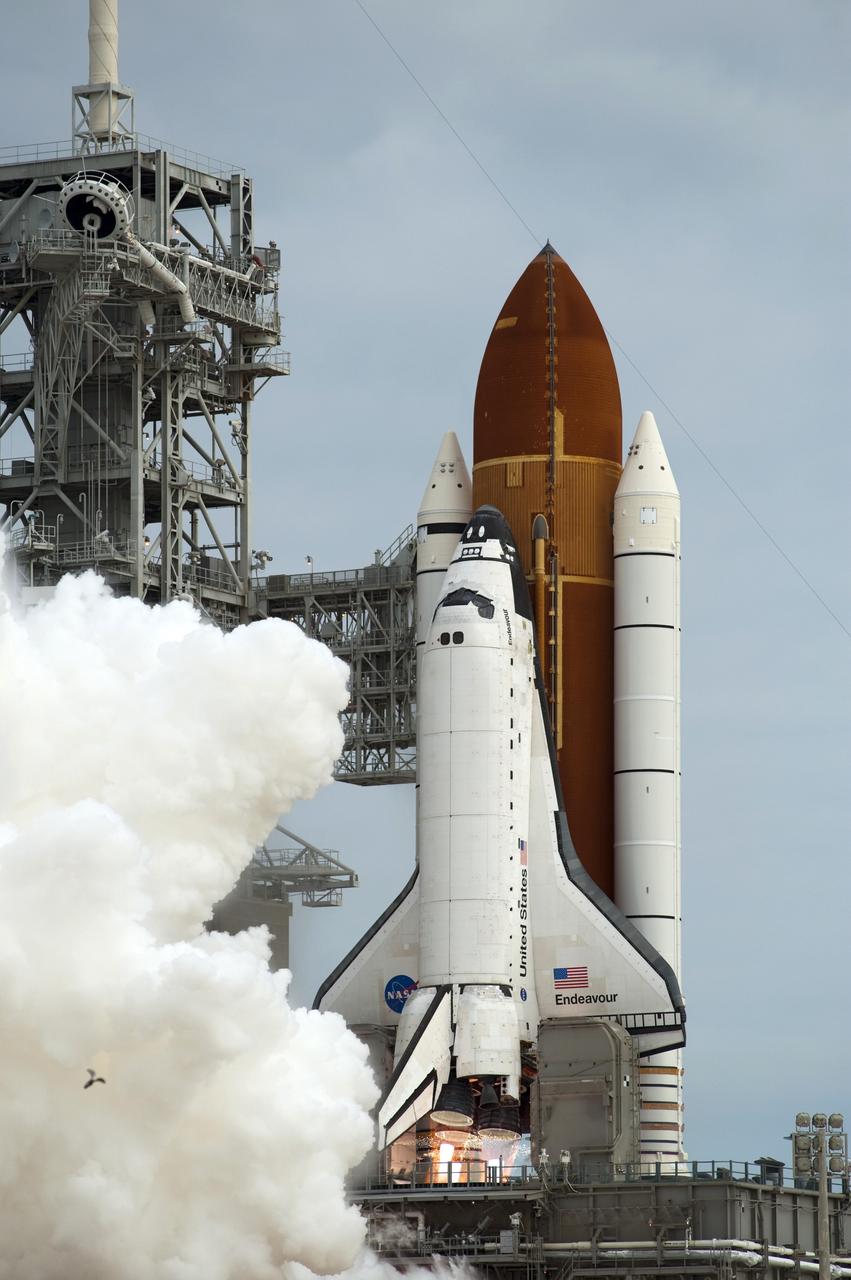
CAPE CANAVERAL, Fla. -- Space shuttle Endeavour's main engines ignite for liftoff at Launch Pad 39A at NASA's Kennedy Space Center in Florida. Endeavour began its final flight, the STS-134 mission to the International Space Station, at 8:56 a.m. EDT on May 16. Endeavour and its six-member crew will deliver the Alpha Magnetic Spectrometer-2 (AMS), Express Logistics Carrier-3, a high-pressure gas tank and additional spare parts for the Dextre robotic helper to the space station. For more information visit, www.nasa.gov/mission_pages/shuttle/shuttlemissions/sts134/index.html. Photo credit: NASA/Sandra Joseph and Kevin O'Connell
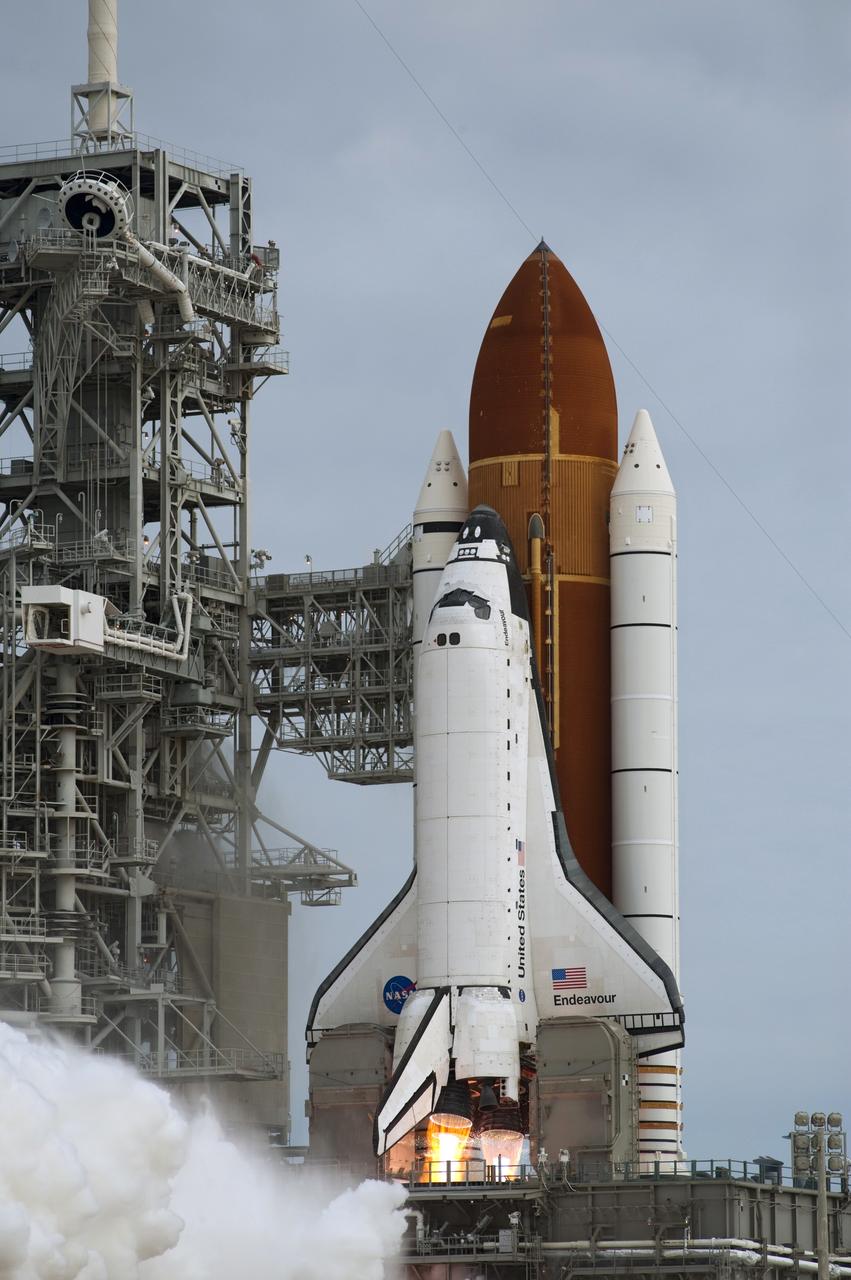
CAPE CANAVERAL, Fla. -- Space shuttle Endeavour's main engines ignite for liftoff at Launch Pad 39A at NASA's Kennedy Space Center in Florida. Endeavour began its final flight, the STS-134 mission to the International Space Station, at 8:56 a.m. EDT on May 16. Endeavour and its six-member crew will deliver the Alpha Magnetic Spectrometer-2 (AMS), Express Logistics Carrier-3, a high-pressure gas tank and additional spare parts for the Dextre robotic helper to the space station. For more information visit, www.nasa.gov/mission_pages/shuttle/shuttlemissions/sts134/index.html. Photo credit: NASA/Sandra Joseph and Kevin O'Connell
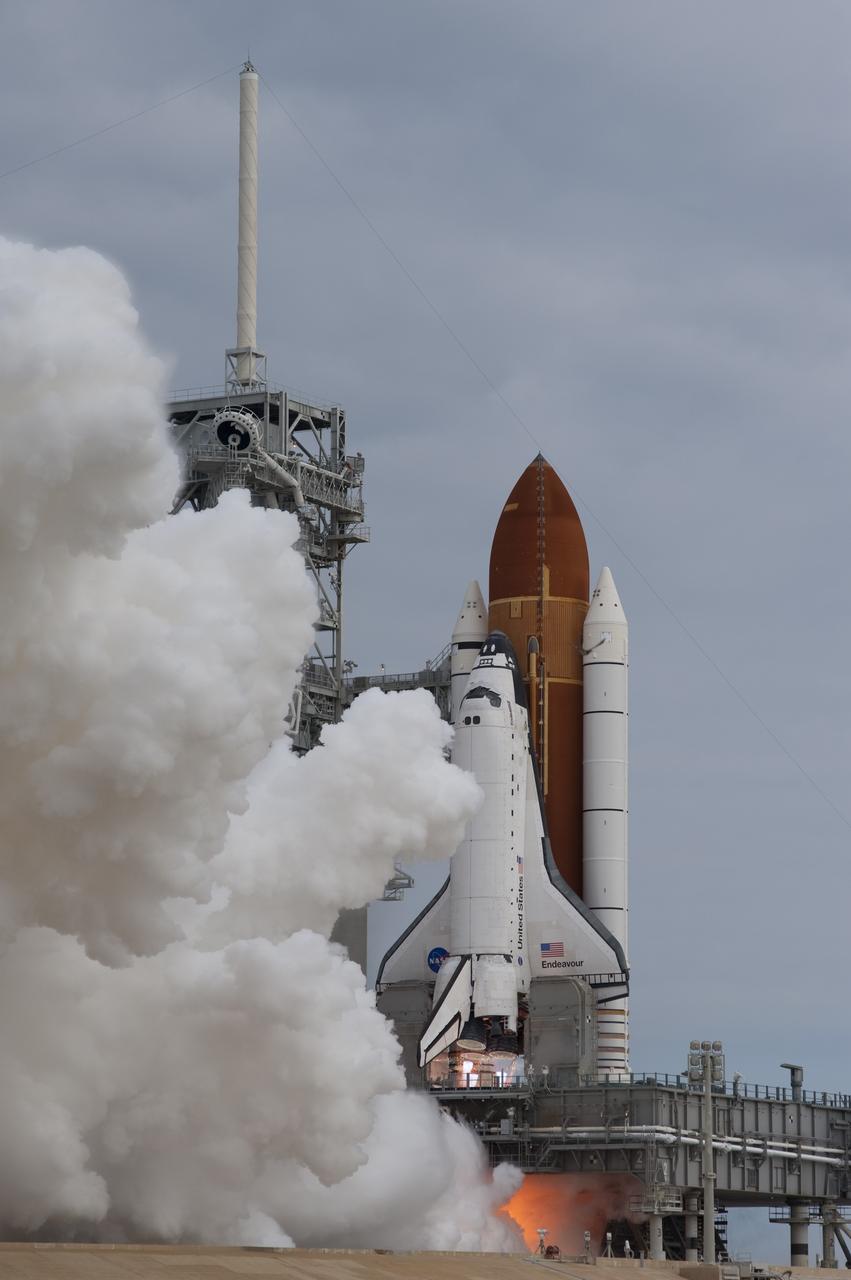
CAPE CANAVERAL, Fla. -- A cloud of steam and smoke emerge as space shuttle Endeavour's main engines ignite for liftoff at Launch Pad 39A at NASA's Kennedy Space Center in Florida. Endeavour began its final flight, the STS-134 mission to the International Space Station, at 8:56 a.m. EDT on May 16. Endeavour and its six-member crew will deliver the Alpha Magnetic Spectrometer-2 (AMS), Express Logistics Carrier-3, a high-pressure gas tank and additional spare parts for the Dextre robotic helper to the space station. For more information visit, www.nasa.gov/mission_pages/shuttle/shuttlemissions/sts134/index.html. Photo credit: NASA/Sandra Joseph and Kevin O'Connell
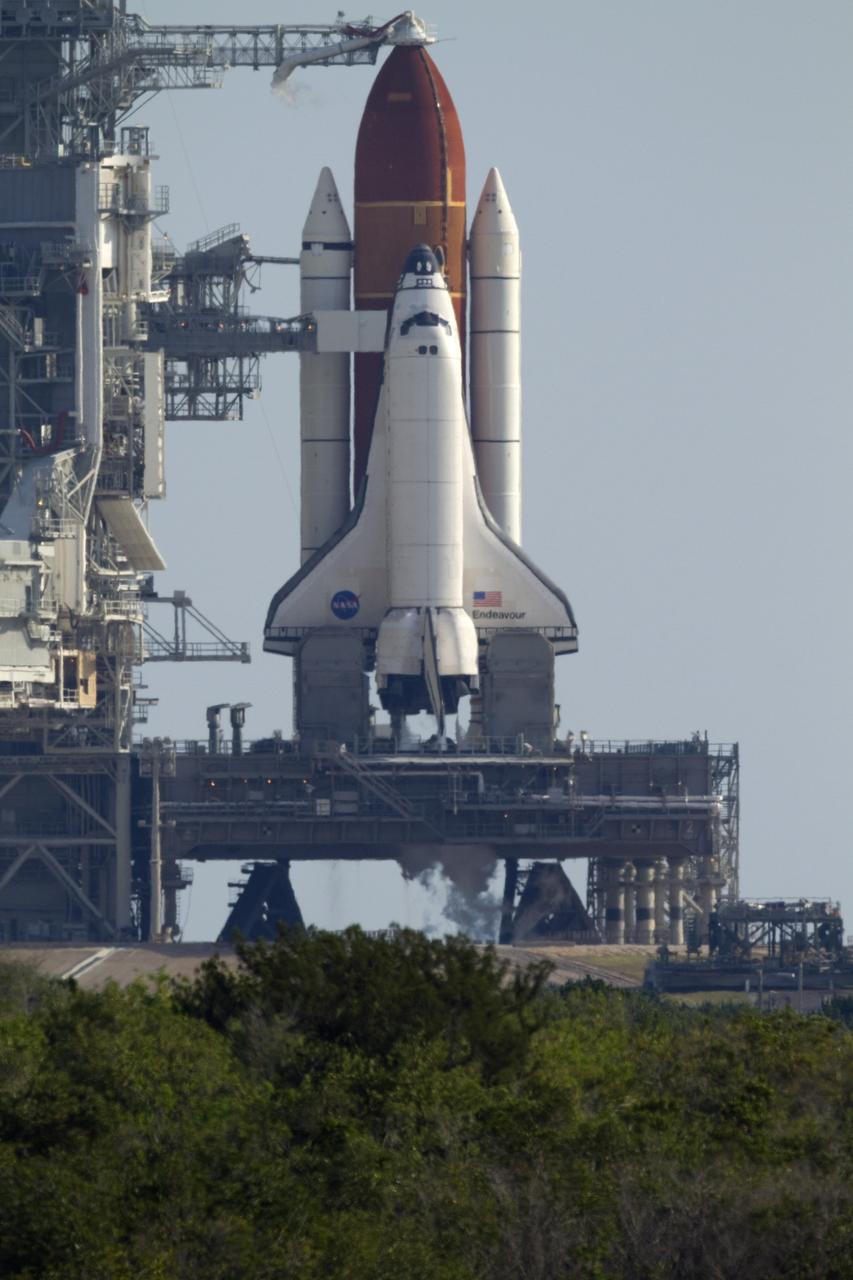
CAPE CANAVERAL, Fla. -- Space shuttle Endeavour's main engines are ready to be ignited for liftoff at Launch Pad 39A at NASA's Kennedy Space Center in Florida. Endeavour began its final flight, the STS-134 mission to the International Space Station, at 8:56 a.m. EDT on May 16. Endeavour and its six-member crew will deliver the Alpha Magnetic Spectrometer-2 (AMS), Express Logistics Carrier-3, a high-pressure gas tank and additional spare parts for the Dextre robotic helper to the space station. For more information visit, www.nasa.gov/mission_pages/shuttle/shuttlemissions/sts134/index.html. Photo credit: NASA/Kenny Allen
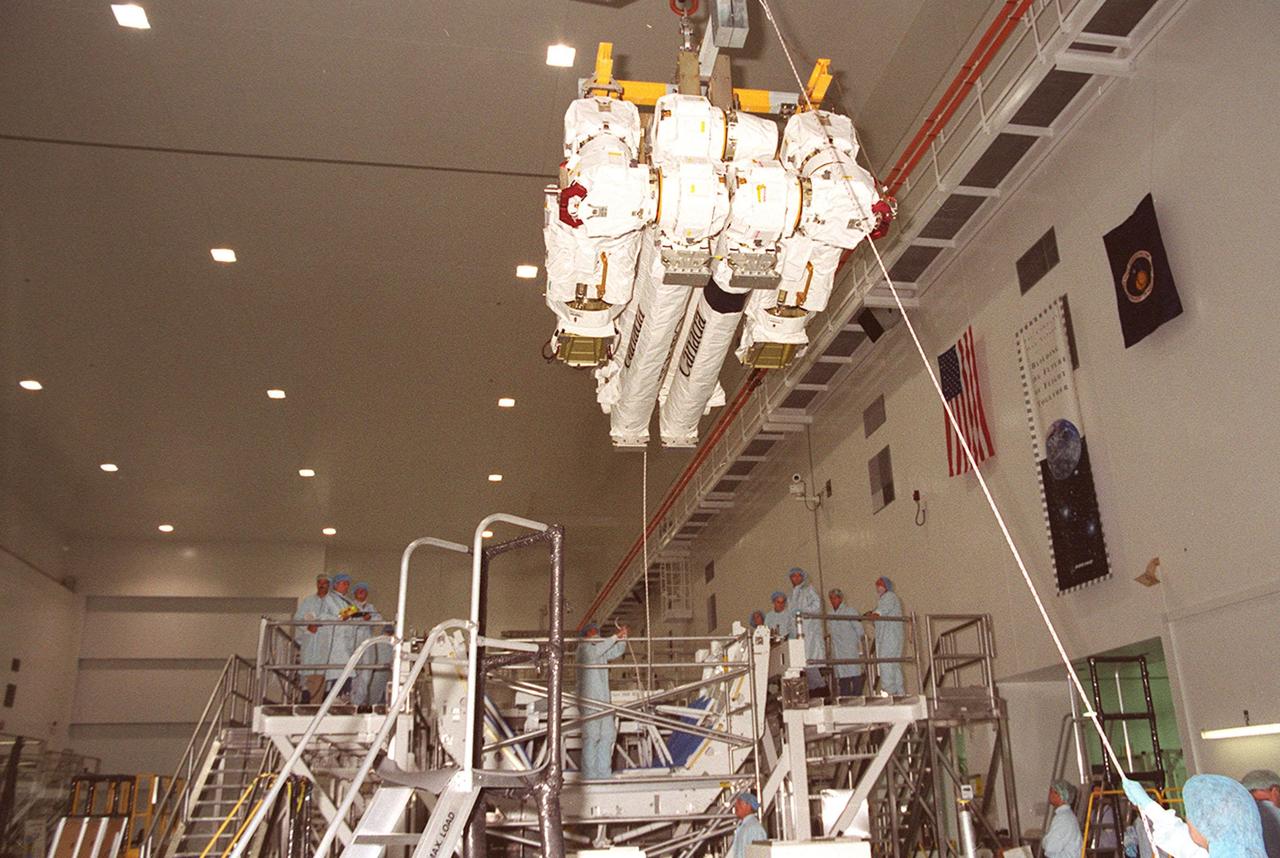
Workers in the Space Station Processing Facility help guide the Canadian Space Agency’s Space Station Remote Manipulator System (SSRMS) suspended from an overhead crane. The SSRMS is being moved to a test stand where it will be mated to its payload carrier. This pallet will later be installed into the payload bay of Space Shuttle Endeavour for launch to the International Space Station on STS-100 in April 2001. The 56-foot-long arm will be the primary means of transferring payloads between the orbiter payload bay and the Station. Its three segments comprise seven joints for highly flexible land precise movement, making it capable of moving around the Station’s exterior like an inchworm
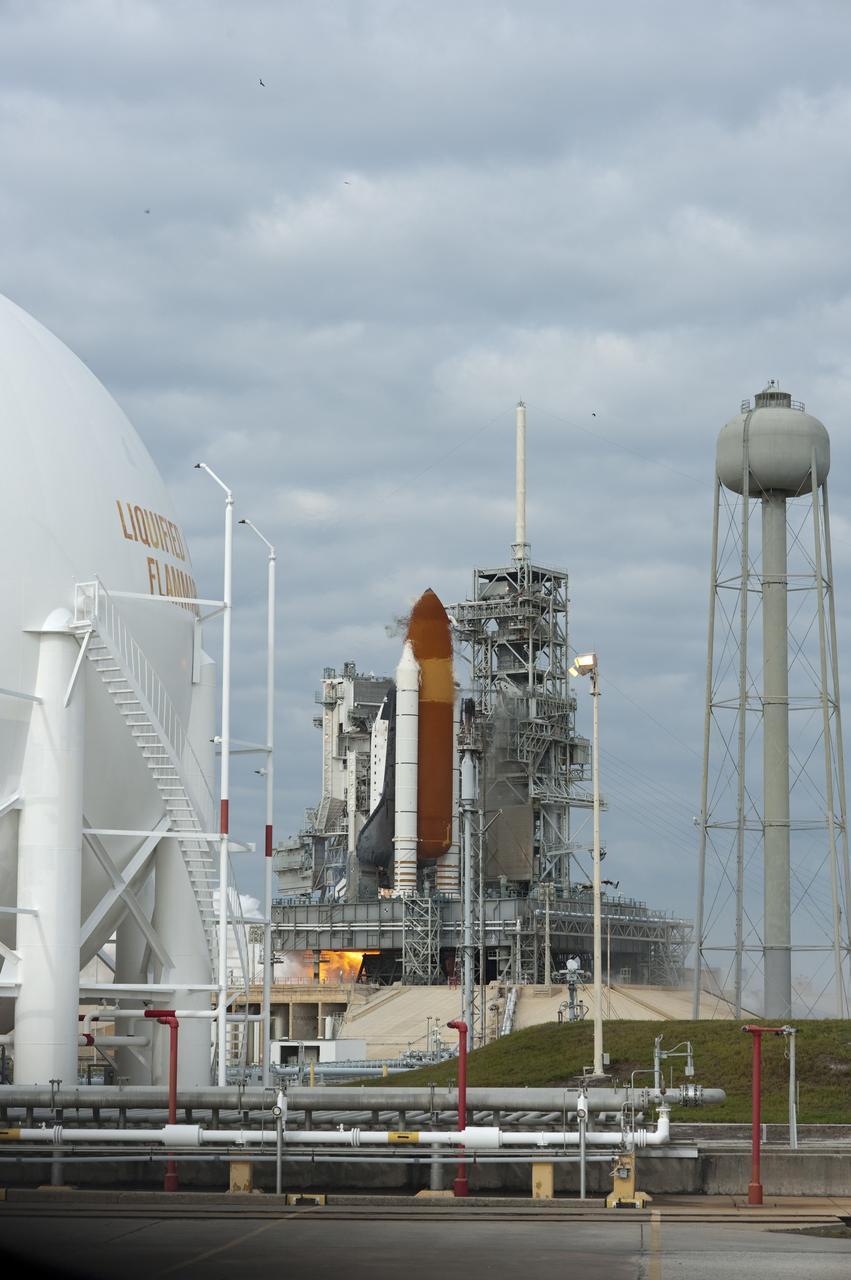
CAPE CANAVERAL, Fla. -- Space shuttle Endeavour's main engines are ignited for liftoff at Launch Pad 39A at NASA's Kennedy Space Center in Florida. Endeavour began its final flight, the STS-134 mission to the International Space Station, at 8:56 a.m. EDT on May 16. Endeavour and its six-member crew will deliver the Alpha Magnetic Spectrometer-2 (AMS), Express Logistics Carrier-3, a high-pressure gas tank and additional spare parts for the Dextre robotic helper to the space station. For more information visit, www.nasa.gov/mission_pages/shuttle/shuttlemissions/sts134/index.html. Photo credit: NASA/Tony Gray and Tom Farrar
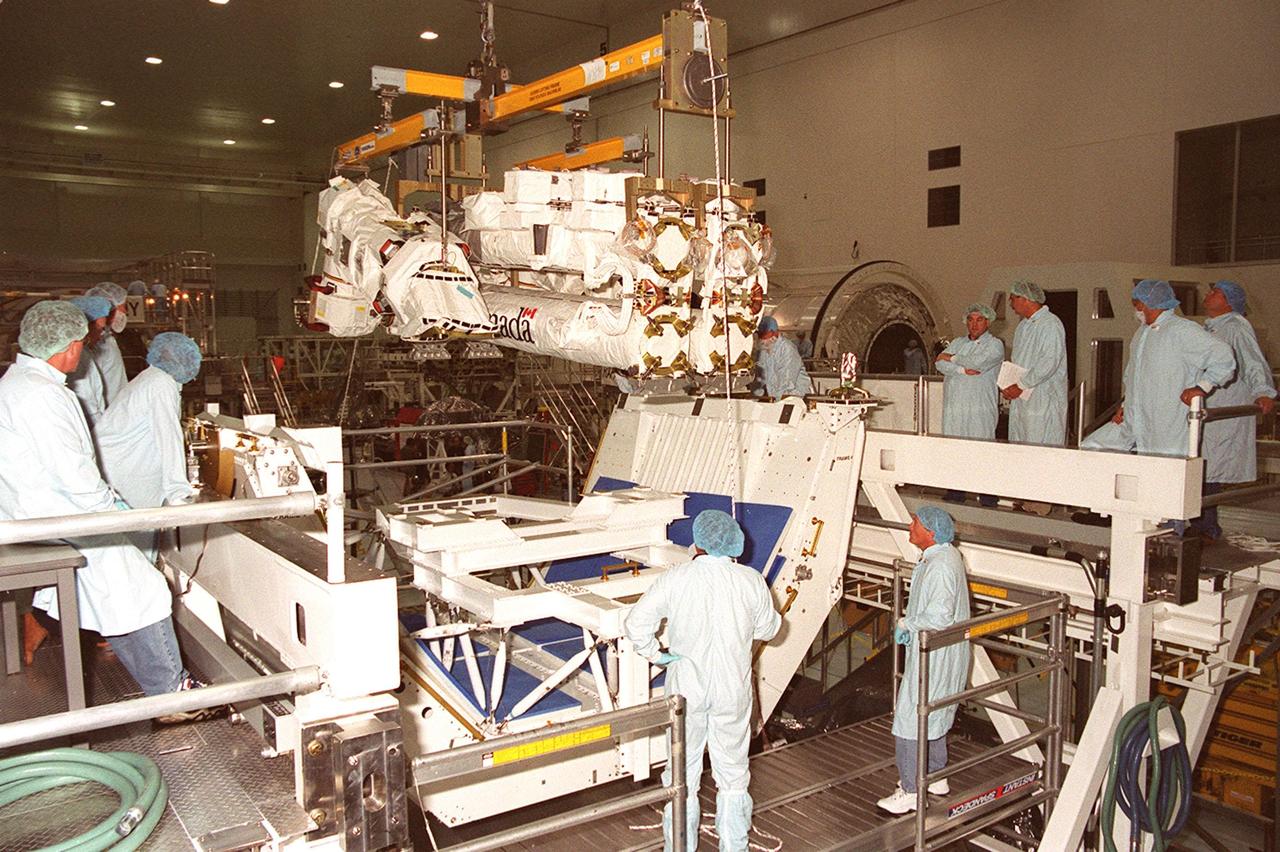
With gentle guidance, the Canadian Space Agency’s Space Station Remote Manipulator System (SSRMS) is lowered by crane onto a test stand in the Space Station Processing Facility. At the test stand the SSRMS it will be mated to its payload carrier. This pallet will later be installed into the payload bay of Space Shuttle Endeavour for launch to the International Space Station on STS-100 in April 2001. The 56-foot-long arm will be the primary means of transferring payloads between the orbiter payload bay and the Station. Its three segments comprise seven joints for highly flexible land precise movement, making it capable of moving around the Station’s exterior like an inchworm
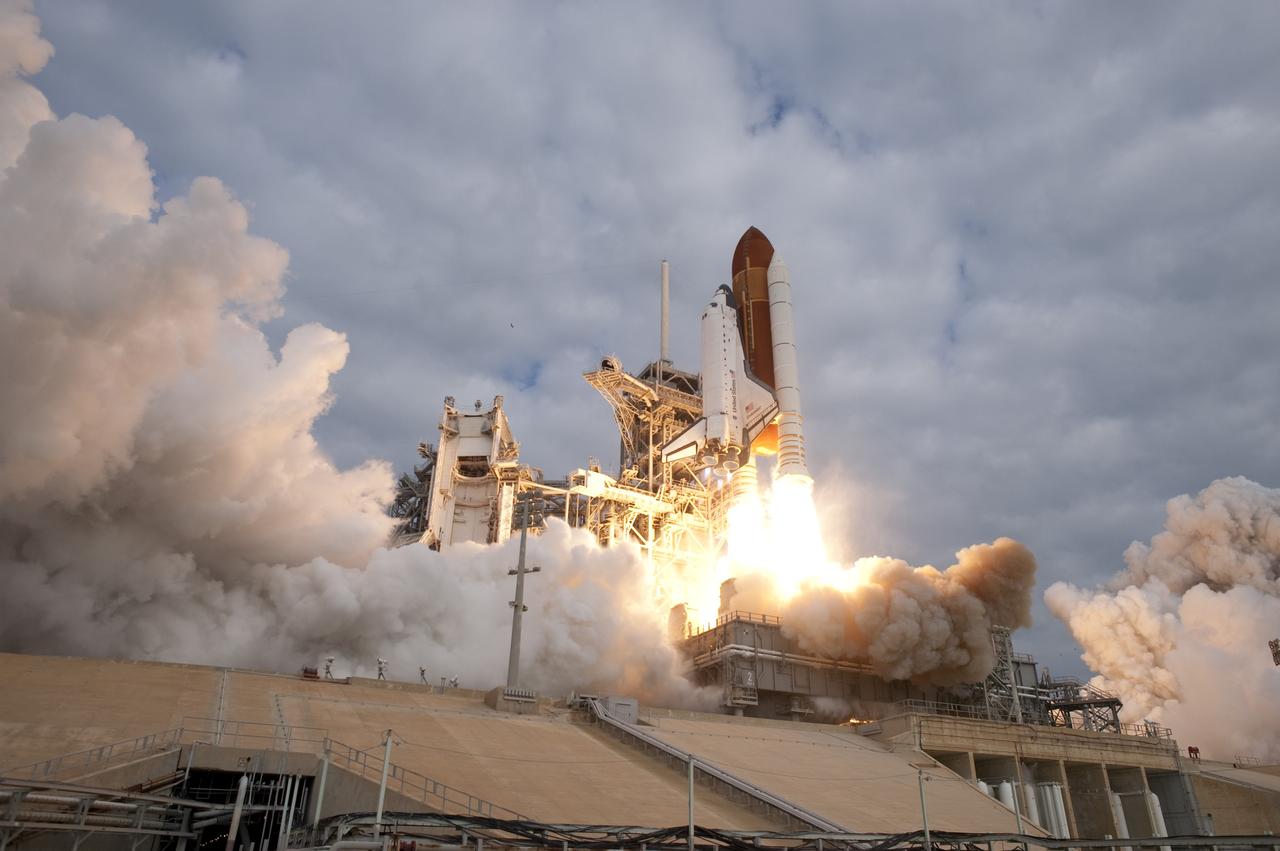
CAPE CANAVERAL, Fla. -- Space shuttle Endeavour rises through clouds of smoke and steam from Launch Pad 39A at NASA's Kennedy Space Center in Florida. Endeavour began its final flight, the STS-134 mission to the International Space Station, at 8:56 a.m. EDT on May 16. Endeavour and its six-member crew will deliver the Alpha Magnetic Spectrometer-2 (AMS), Express Logistics Carrier-3, a high-pressure gas tank and additional spare parts for the Dextre robotic helper to the space station. For more information visit, www.nasa.gov/mission_pages/shuttle/shuttlemissions/sts134/index.html. Photo credit: NASA/Sandra Joseph and Kevin O'Connell
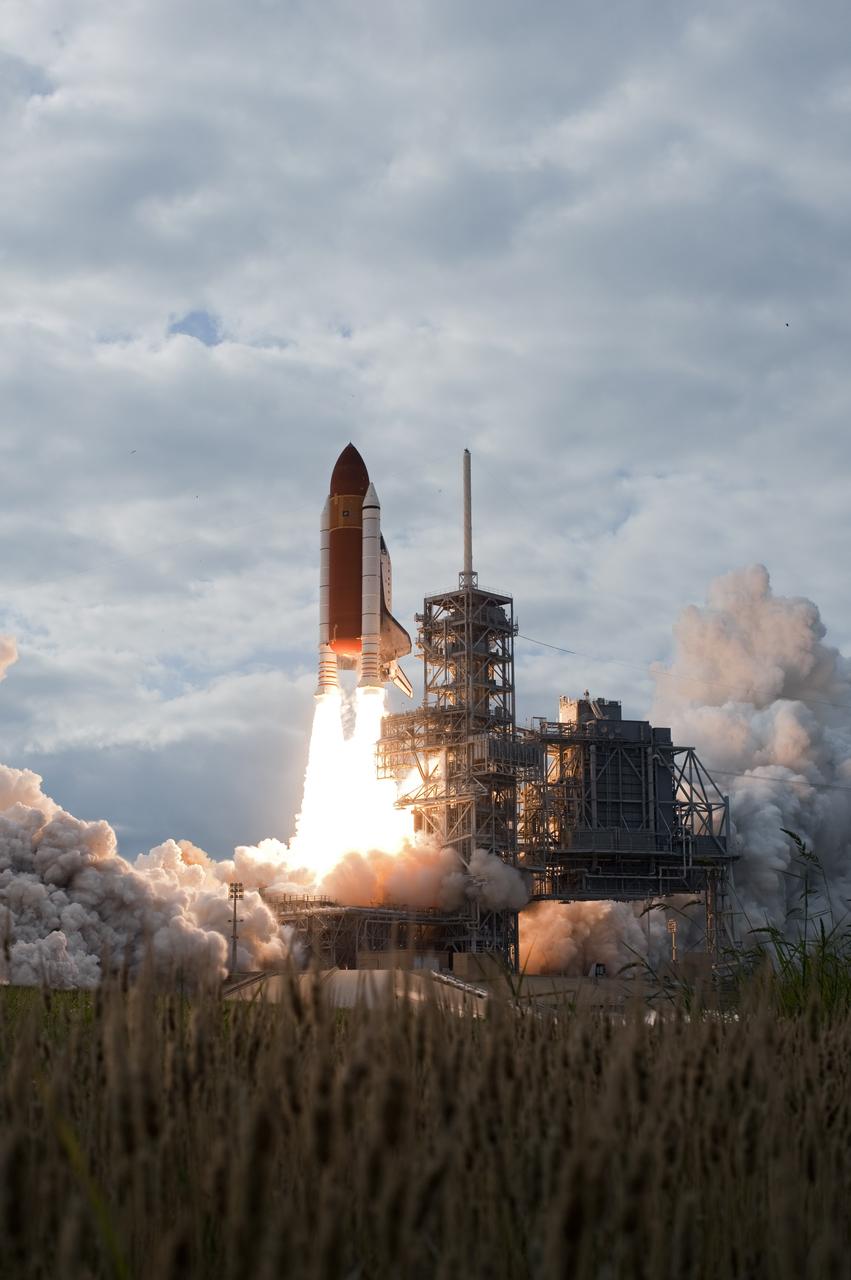
Cape Canaveral, Fla. -- On Launch Pad 39A at NASA's Kennedy Space Center in Florida, space shuttle Endeavour rises above the fixed service structure as it races toward space. Endeavour began its final flight, the STS-134 mission to the International Space Station, at 8:56 a.m. EDT on May 16. Endeavour and its six-member crew will deliver the Alpha Magnetic Spectrometer-2 (AMS), Express Logistics Carrier-3, a high-pressure gas tank and additional spare parts for the Dextre robotic helper to the space station. For more information visit, www.nasa.gov/mission_pages/shuttle/shuttlemissions/sts134/index.html. Photo credit: NASA/Sandra Joseph and Kevin O-Connell
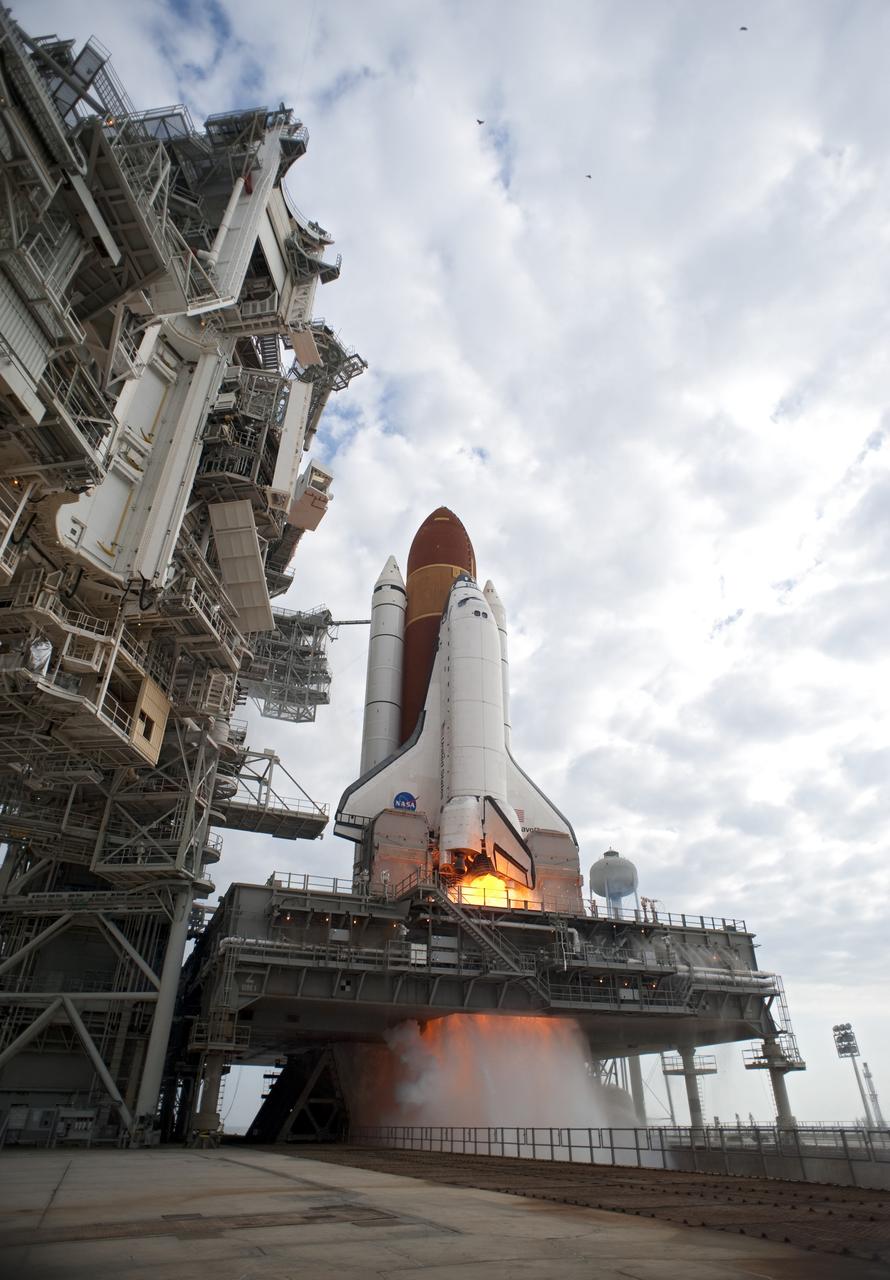
CAPE CANAVERAL, Fla. -- Space shuttle Endeavour's main engines ignite for liftoff at Launch Pad 39A at NASA's Kennedy Space Center in Florida. Endeavour began its final flight, the STS-134 mission to the International Space Station, at 8:56 a.m. EDT on May 16. Endeavour and its six-member crew will deliver the Alpha Magnetic Spectrometer-2 (AMS), Express Logistics Carrier-3, a high-pressure gas tank and additional spare parts for the Dextre robotic helper to the space station. For more information visit, www.nasa.gov/mission_pages/shuttle/shuttlemissions/sts134/index.html. Photo credit: NASA/Tony Gray and Tom Farrar
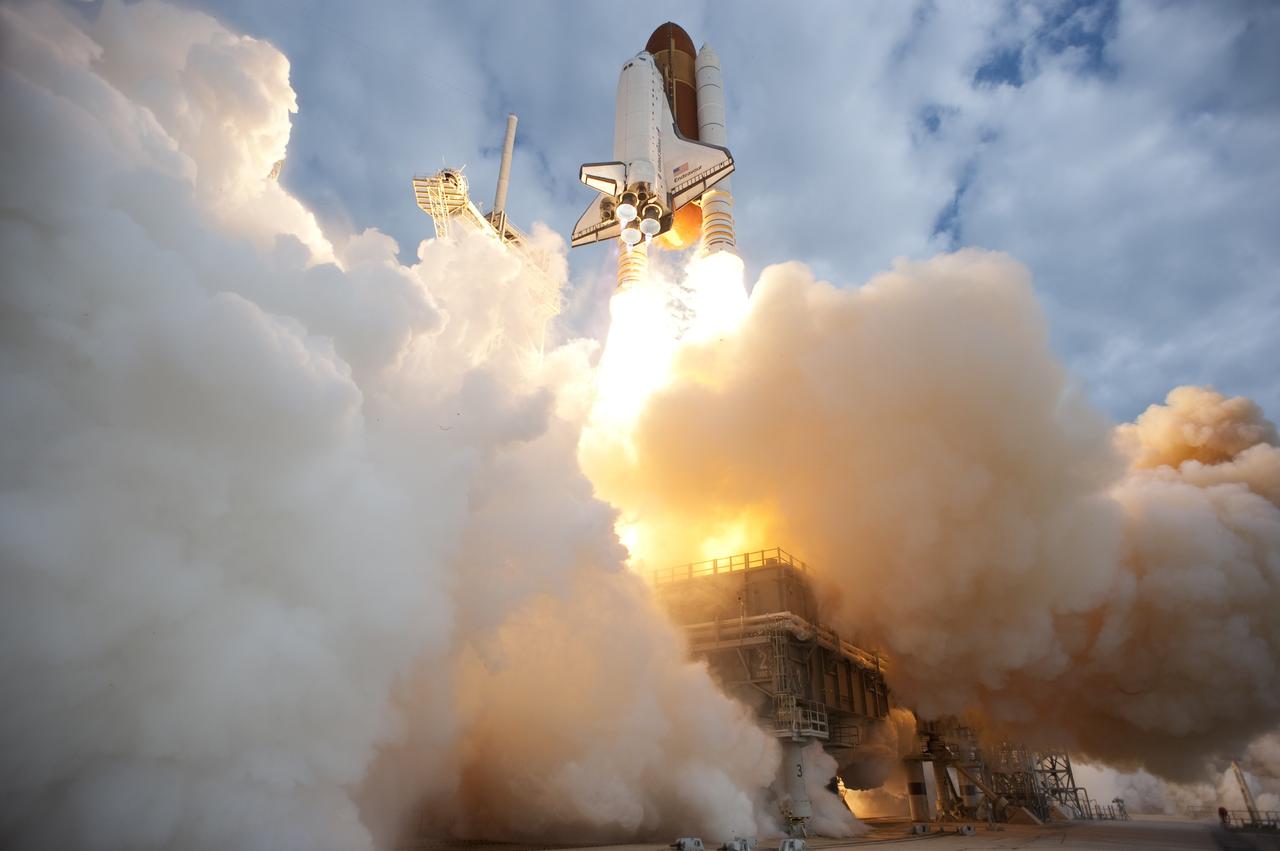
CAPE CANAVERAL, Fla. -- Space shuttle Endeavour rises on twin columns of flame through clouds of smoke and steam from Launch Pad 39A at NASA's Kennedy Space Center in Florida. Endeavour began its final flight, the STS-134 mission to the International Space Station, at 8:56 a.m. EDT on May 16. Endeavour and its six-member crew will deliver the Alpha Magnetic Spectrometer-2 (AMS), Express Logistics Carrier-3, a high-pressure gas tank and additional spare parts for the Dextre robotic helper to the space station. For more information visit, www.nasa.gov/mission_pages/shuttle/shuttlemissions/sts134/index.html. Photo credit: NASA/Tony Gray and Tom Farrar
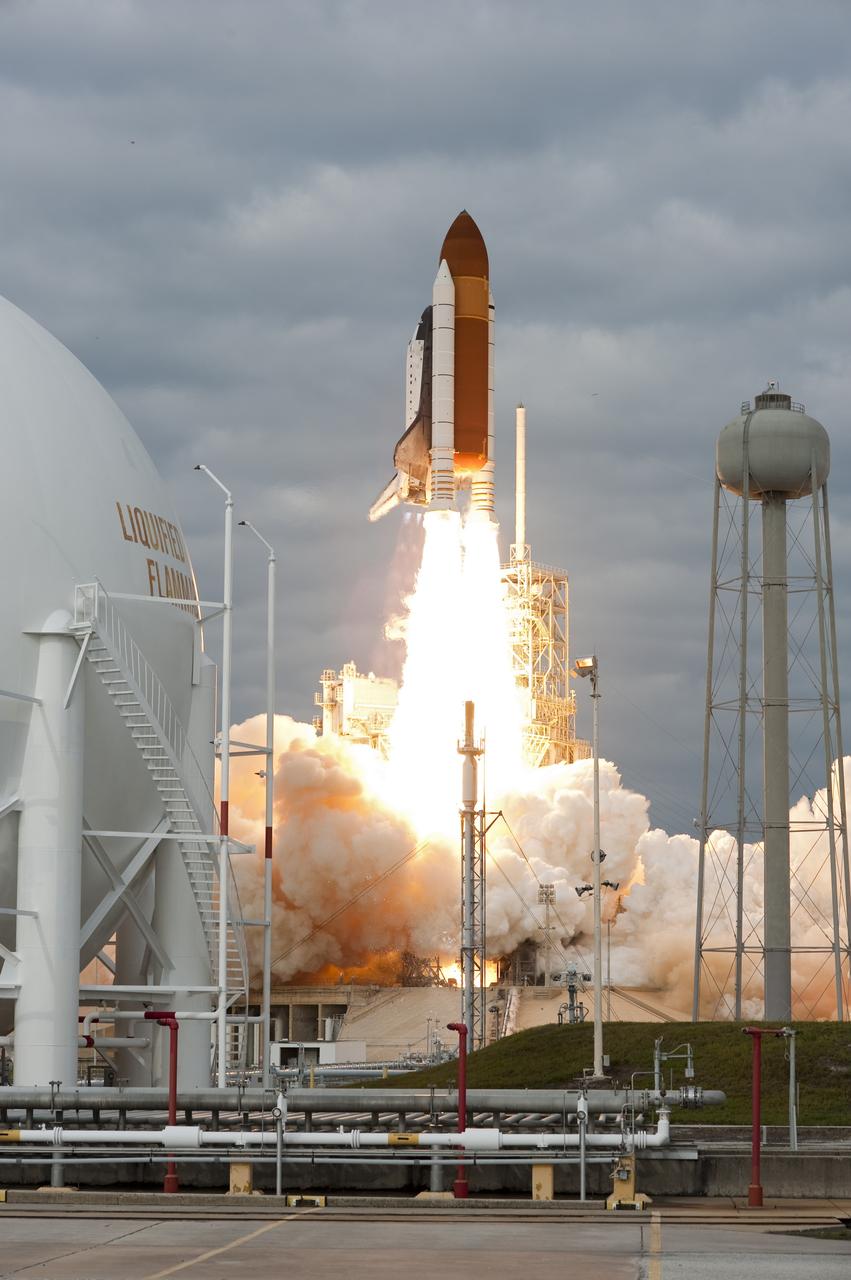
CAPE CANAVERAL, Fla. -- Space shuttle Endeavour rises on twin columns of flame from Launch Pad 39A at NASA's Kennedy Space Center in Florida. Endeavour began its final flight, the STS-134 mission to the International Space Station, at 8:56 a.m. EDT on May 16. Endeavour and its six-member crew will deliver the Alpha Magnetic Spectrometer-2 (AMS), Express Logistics Carrier-3, a high-pressure gas tank and additional spare parts for the Dextre robotic helper to the space station. For more information visit, www.nasa.gov/mission_pages/shuttle/shuttlemissions/sts134/index.html. Photo credit: NASA/Tony Gray and Tom Farrar
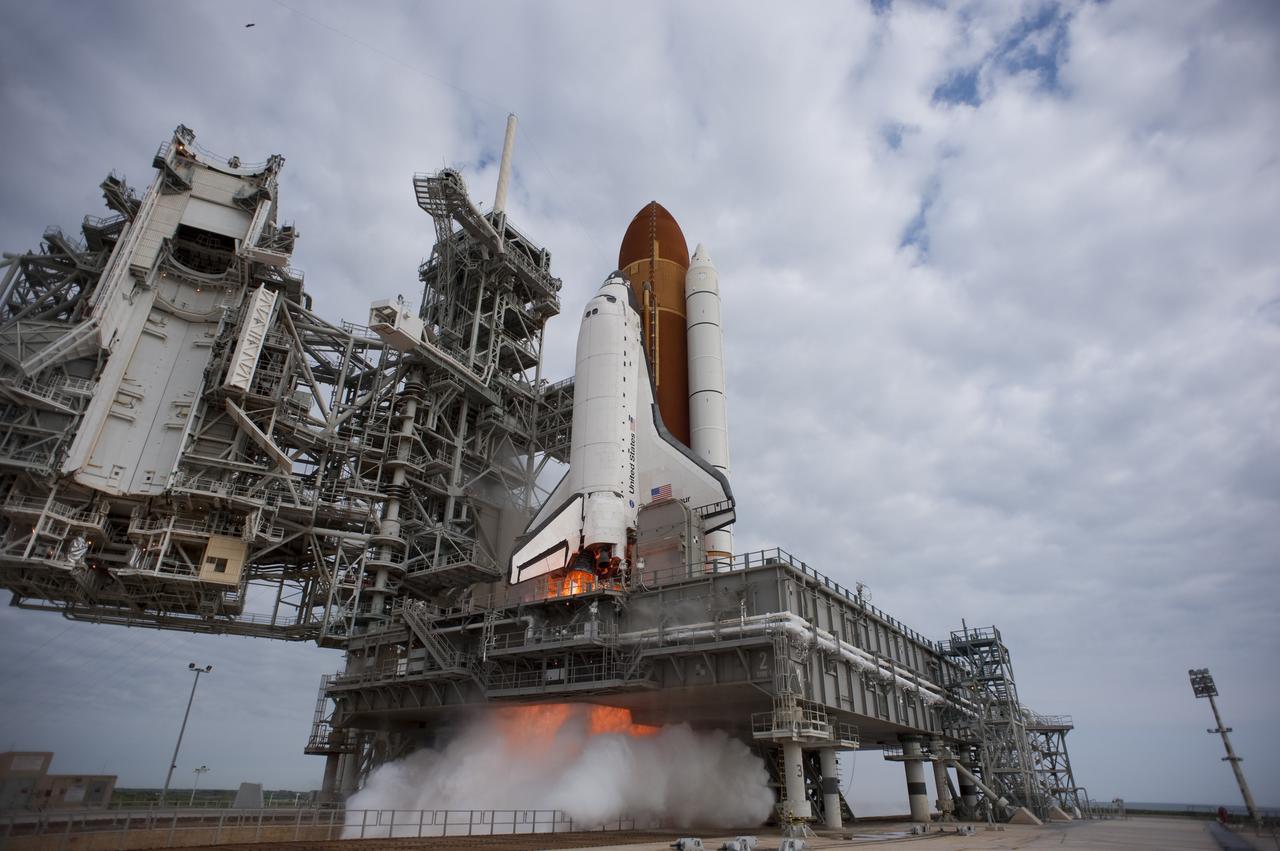
CAPE CANAVERAL, Fla. -- Space shuttle Endeavour's main engines ignite for liftoff at Launch Pad 39A at NASA's Kennedy Space Center in Florida. Endeavour began its final flight, the STS-134 mission to the International Space Station, at 8:56 a.m. EDT on May 16. Endeavour and its six-member crew will deliver the Alpha Magnetic Spectrometer-2 (AMS), Express Logistics Carrier-3, a high-pressure gas tank and additional spare parts for the Dextre robotic helper to the space station. For more information visit, www.nasa.gov/mission_pages/shuttle/shuttlemissions/sts134/index.html. Photo credit: NASA/Tony Gray and Tom Farrar
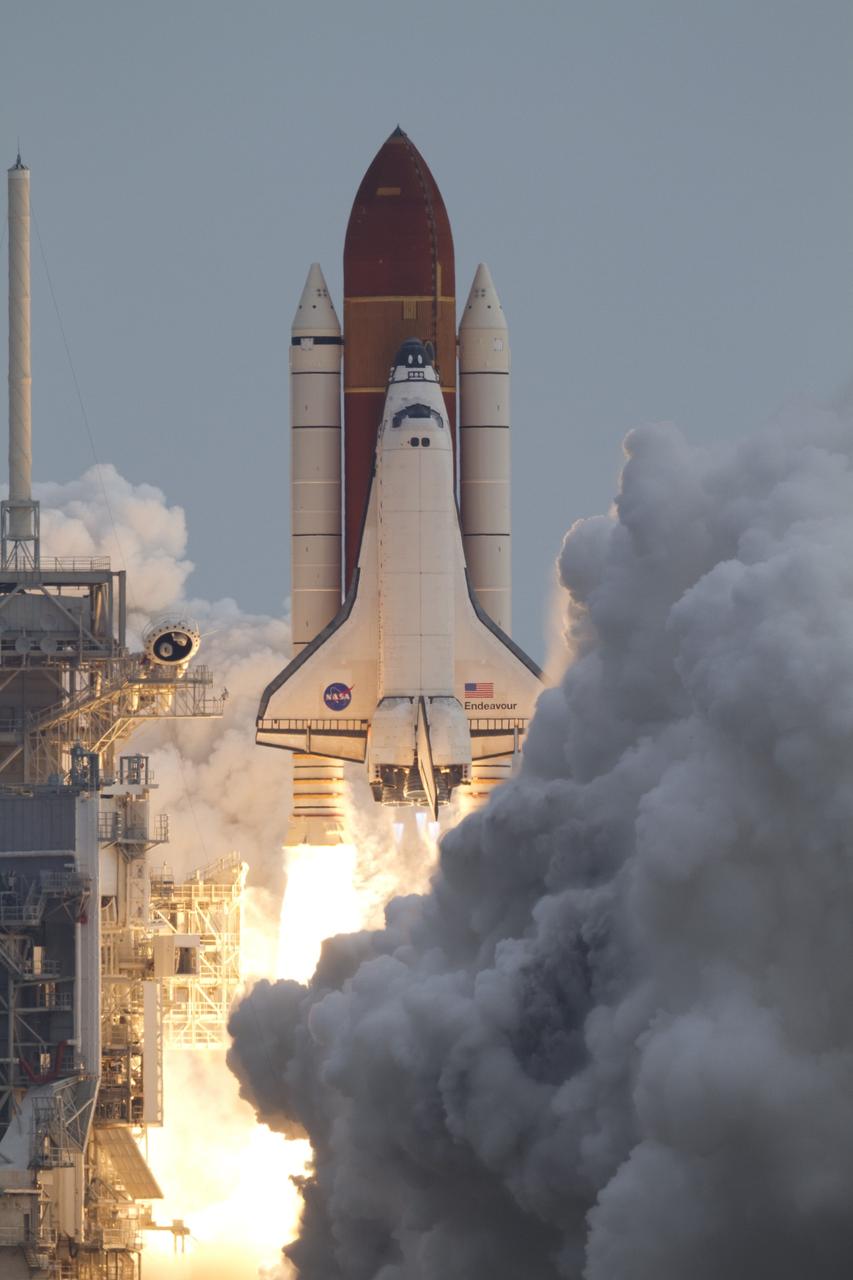
CAPE CANAVERAL, Fla. -- Space shuttle Endeavour roars through clouds of smoke and steam from Launch Pad 39A at NASA's Kennedy Space Center in Florida. Endeavour began its final flight the STS-134 mission to the International Space Station, at 8:56 a.m. EDT on May 16. Endeavour and its six-member crew will deliver the Alpha Magnetic Spectrometer-2 (AMS), Express Logistics Carrier-3, a high-pressure gas tank and additional spare parts for the Dextre robotic helper to the space station. For more information visit, www.nasa.gov/mission_pages/shuttle/shuttlemissions/sts134/index.html. Photo credit: NASA/Kenny Allen

CAPE CANAVERAL, Fla. -- Space shuttle Endeavour rises on twin columns of flame from Launch Pad 39A at NASA's Kennedy Space Center in Florida. Endeavour began its final flight, the STS-134 mission to the International Space Station, at 8:56 a.m. EDT on May 16. Endeavour and its six-member crew will deliver the Alpha Magnetic Spectrometer-2 (AMS), Express Logistics Carrier-3, a high-pressure gas tank and additional spare parts for the Dextre robotic helper to the space station. For more information visit, www.nasa.gov/mission_pages/shuttle/shuttlemissions/sts134/index.html. Photo credit: NASA/Kenny Allen and George Roberts
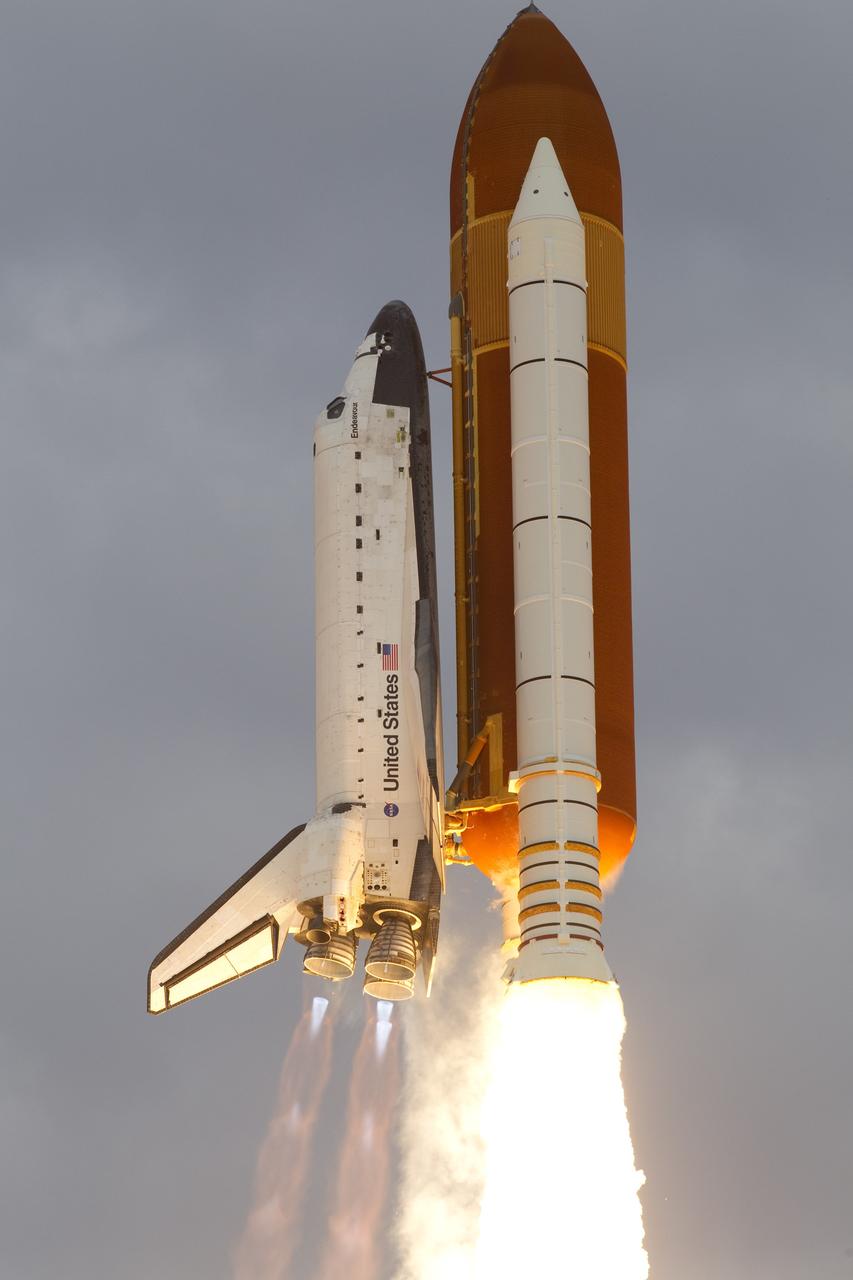
CAPE CANAVERAL, Fla. -- Space shuttle Endeavour soars toward orbit after lifting off from Launch Pad 39A at NASA's Kennedy Space Center in Florida. Endeavour began its final flight, the STS-134 mission to the International Space Station, at 8:56 a.m. EDT on May 16. Endeavour and its six-member crew will deliver the Alpha Magnetic Spectrometer-2 (AMS), Express Logistics Carrier-3, a high-pressure gas tank and additional spare parts for the Dextre robotic helper to the space station. For more information visit, www.nasa.gov/mission_pages/shuttle/shuttlemissions/sts134/index.html. Photo credit: NASA/George Roberts and Mike Kerley
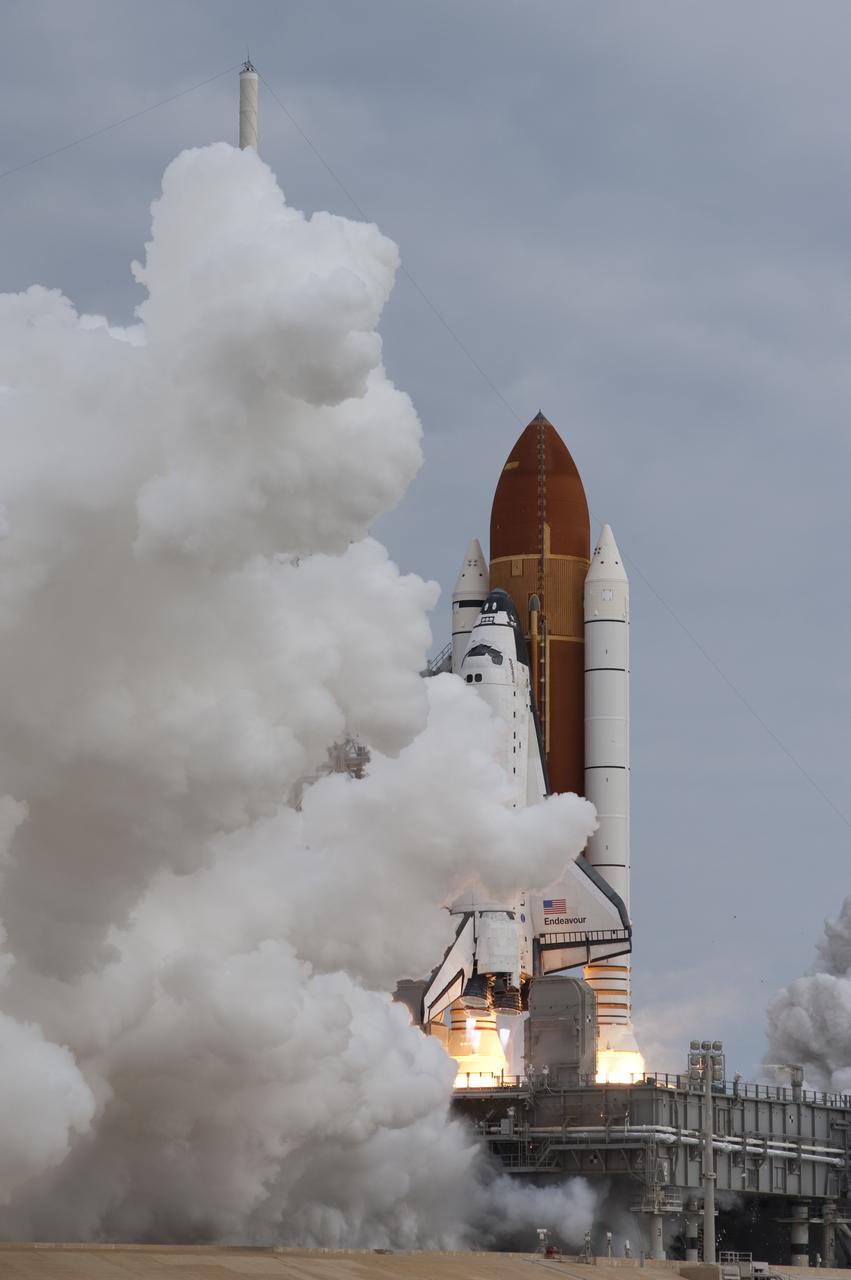
CAPE CANAVERAL, Fla. -- A cloud of steam and smoke emerge as space shuttle Endeavour's main engines ignite for liftoff at Launch Pad 39A at NASA's Kennedy Space Center in Florida. Endeavour began its final flight, the STS-134 mission to the International Space Station, at 8:56 a.m. EDT on May 16. Endeavour and its six-member crew will deliver the Alpha Magnetic Spectrometer-2 (AMS), Express Logistics Carrier-3, a high-pressure gas tank and additional spare parts for the Dextre robotic helper to the space station. For more information visit, www.nasa.gov/mission_pages/shuttle/shuttlemissions/sts134/index.html. Photo credit: NASA/Sandra Joseph and Kevin O'Connell
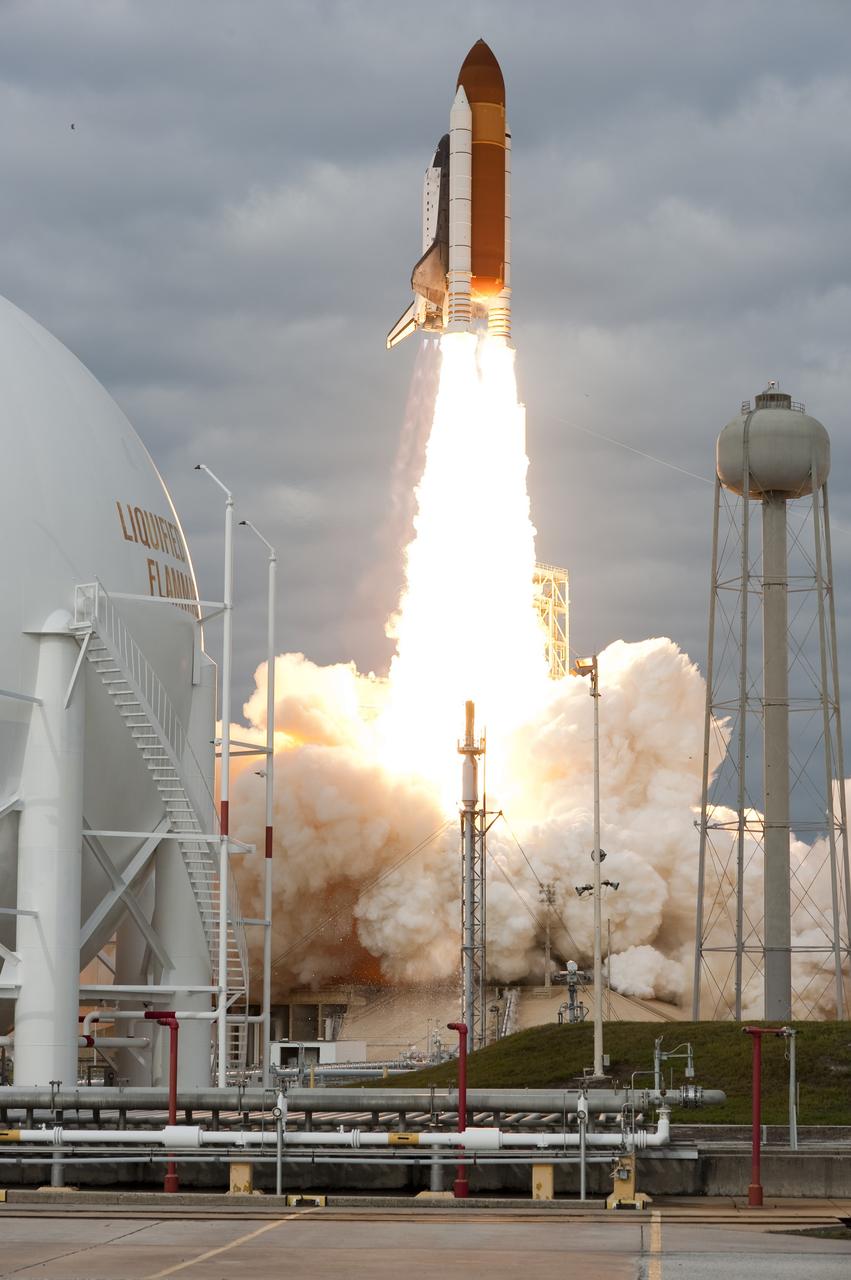
CAPE CANAVERAL, Fla. -- Space shuttle Endeavour rises on twin columns of flame and clears the tower at Launch Pad 39A at NASA's Kennedy Space Center in Florida. Endeavour began its final flight, the STS-134 mission to the International Space Station, at 8:56 a.m. EDT on May 16. Endeavour and its six-member crew will deliver the Alpha Magnetic Spectrometer-2 (AMS), Express Logistics Carrier-3, a high-pressure gas tank and additional spare parts for the Dextre robotic helper to the space station. For more information visit, www.nasa.gov/mission_pages/shuttle/shuttlemissions/sts134/index.html. Photo credit: NASA/Tony Gray and Tom Farrar
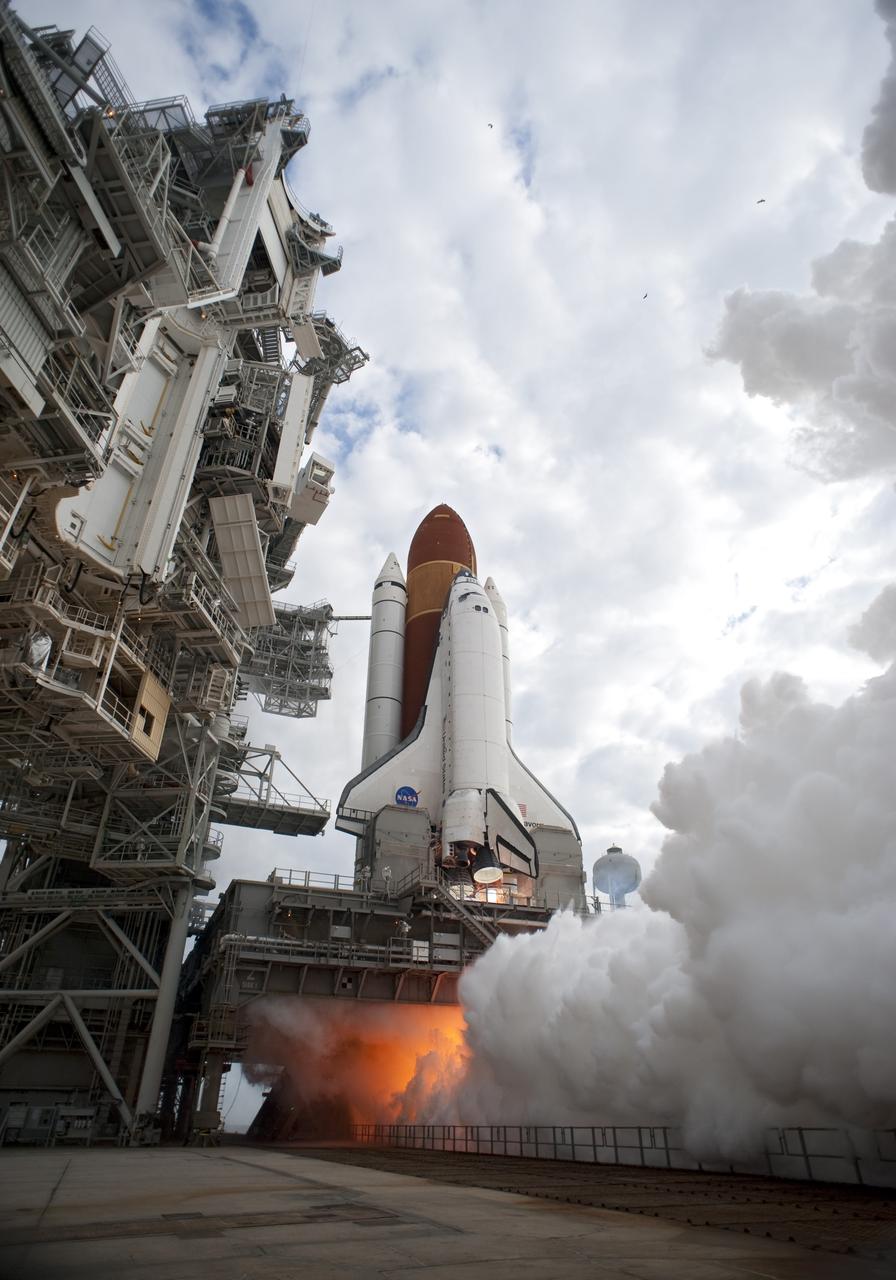
CAPE CANAVERAL, Fla. -- Space shuttle Endeavour's main engines ignite for liftoff at Launch Pad 39A at NASA's Kennedy Space Center in Florida. Endeavour began its final flight, the STS-134 mission to the International Space Station, at 8:56 a.m. EDT on May 16. Endeavour and its six-member crew will deliver the Alpha Magnetic Spectrometer-2 (AMS), Express Logistics Carrier-3, a high-pressure gas tank and additional spare parts for the Dextre robotic helper to the space station. For more information visit, www.nasa.gov/mission_pages/shuttle/shuttlemissions/sts134/index.html. Photo credit: NASA/Tony Gray and Tom Farrar
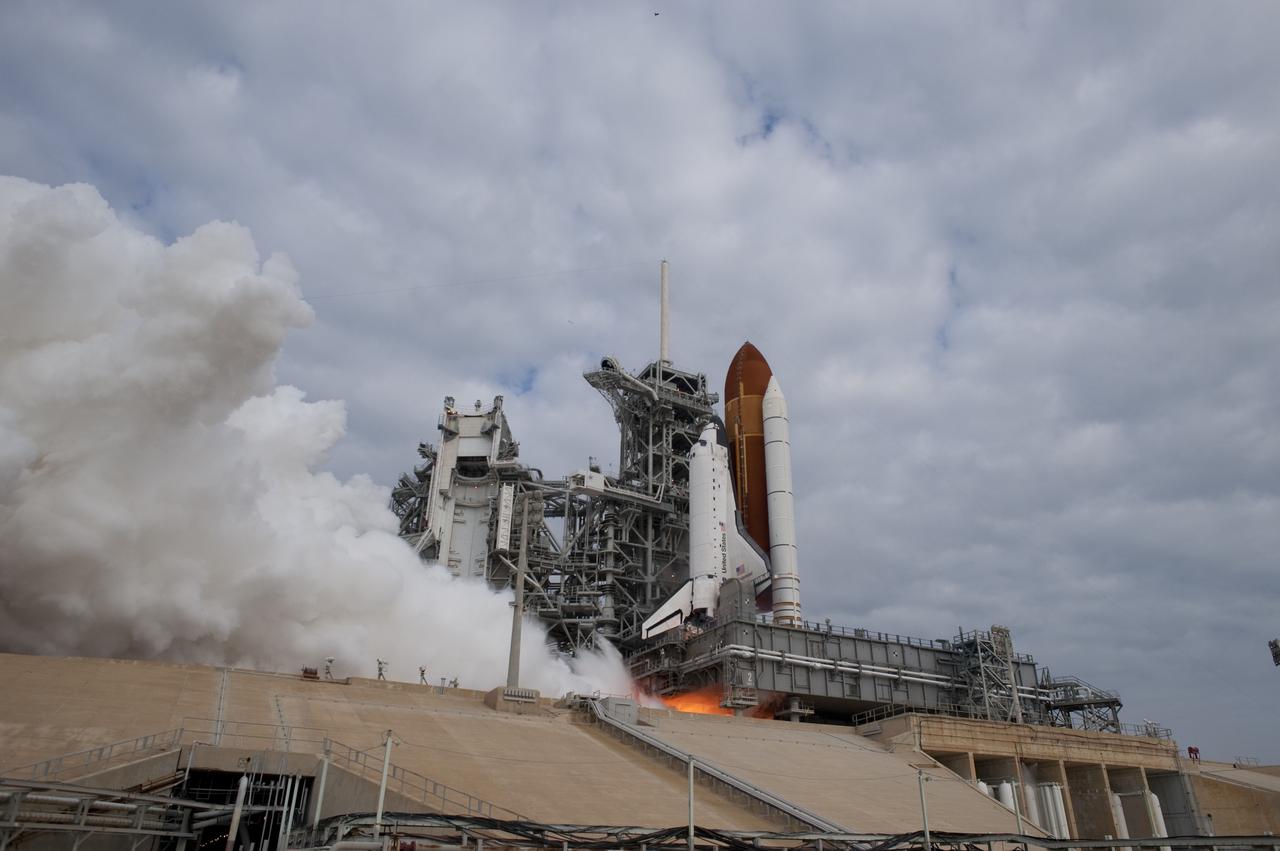
CAPE CANAVERAL, Fla. -- Space shuttle Endeavour's main engines ignite for liftoff at Launch Pad 39A at NASA's Kennedy Space Center in Florida. Endeavour began its final flight, the STS-134 mission to the International Space Station, at 8:56 a.m. EDT on May 16. Endeavour and its six-member crew will deliver the Alpha Magnetic Spectrometer-2 (AMS), Express Logistics Carrier-3, a high-pressure gas tank and additional spare parts for the Dextre robotic helper to the space station. For more information visit, www.nasa.gov/mission_pages/shuttle/shuttlemissions/sts134/index.html. Photo credit: NASA/Sandra Joseph and Kevin O'Connell
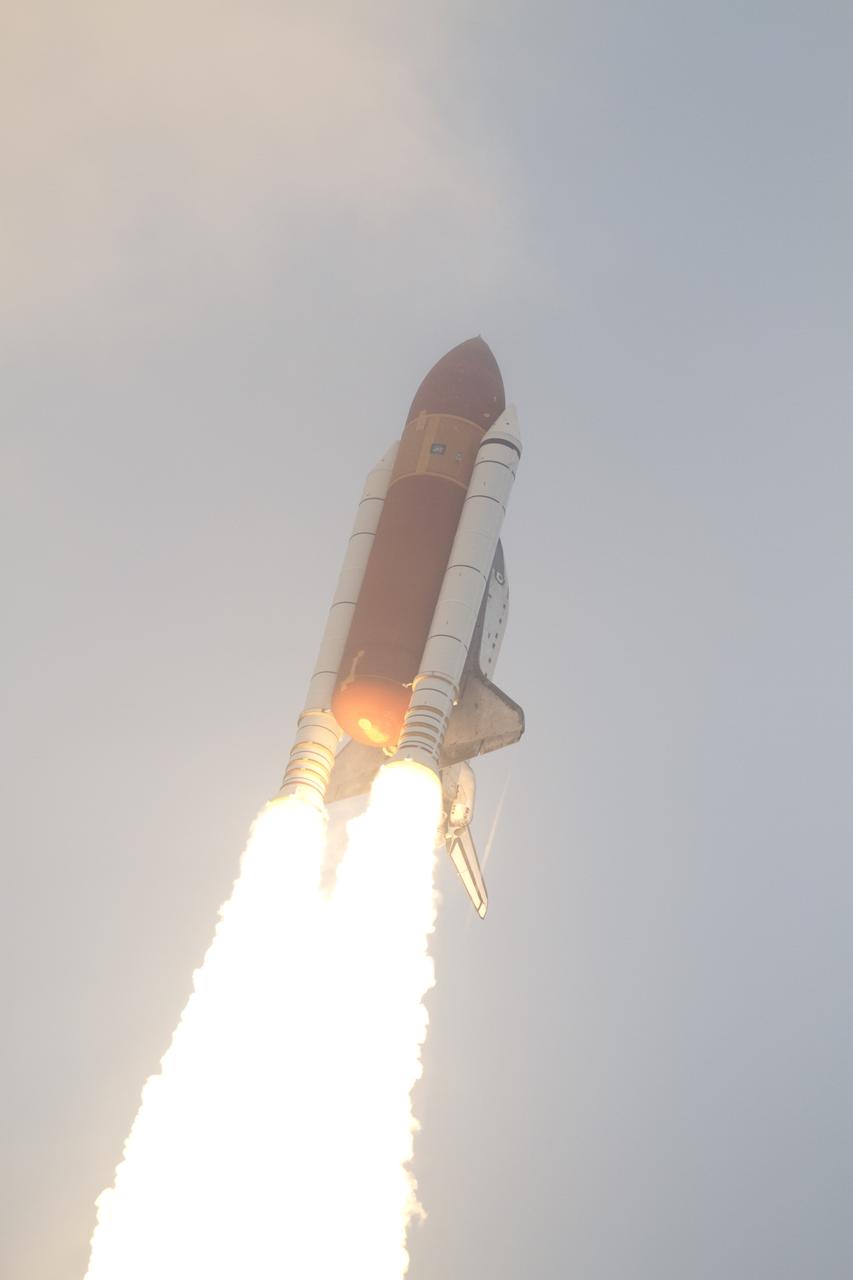
CAPE CANAVERAL, Fla. -- Space shuttle Endeavour rises on twin columns of flame from Launch Pad 39A at NASA's Kennedy Space Center in Florida. Endeavour began its final flight, the STS-134 mission to the International Space Station, at 8:56 a.m. EDT on May 16. Endeavour and its six-member crew will deliver the Alpha Magnetic Spectrometer-2 (AMS), Express Logistics Carrier-3, a high-pressure gas tank and additional spare parts for the Dextre robotic helper to the space station. For more information visit, www.nasa.gov/mission_pages/shuttle/shuttlemissions/sts134/index.html. Photo credit: NASA/Kenny Allen
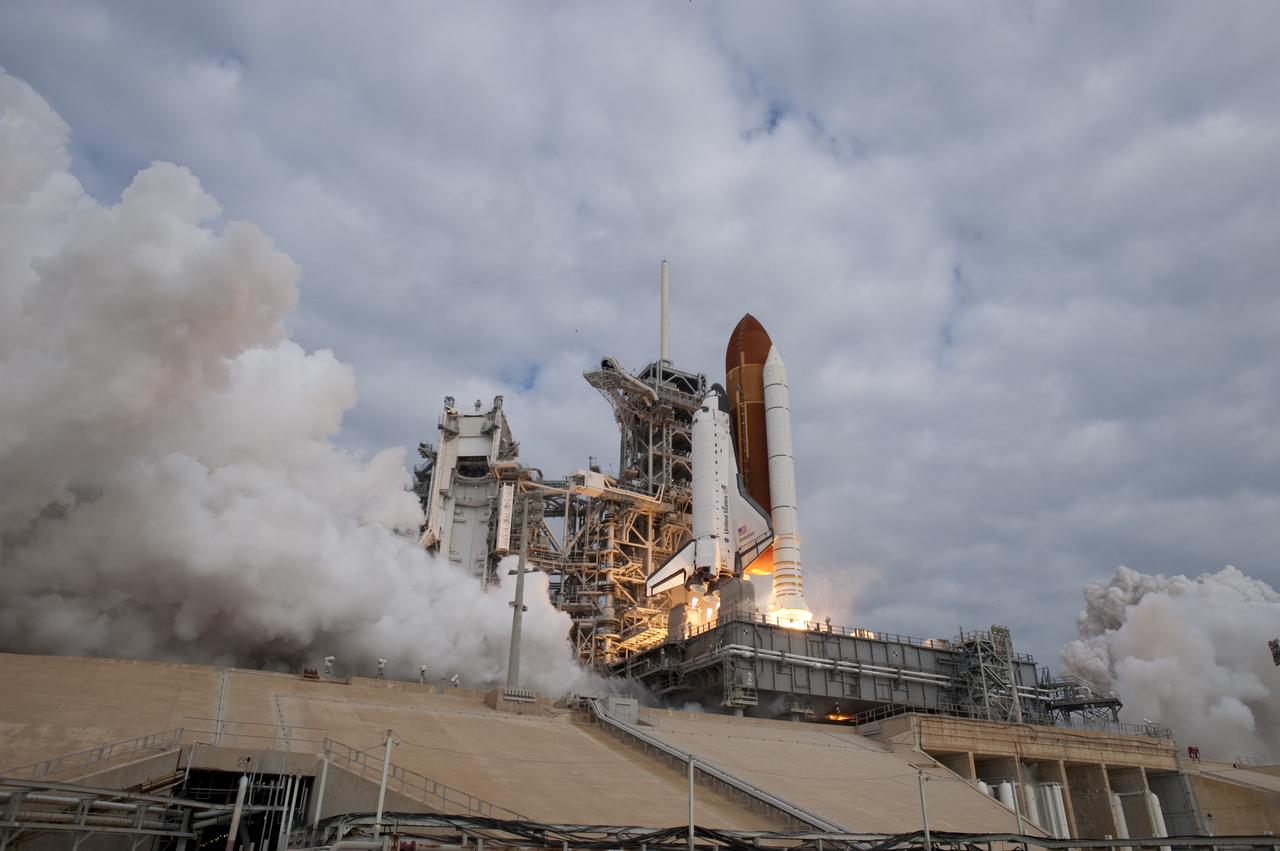
CAPE CANAVERAL, Fla. -- Space shuttle Endeavour's main engines ignite for liftoff at Launch Pad 39A at NASA's Kennedy Space Center in Florida. Endeavour began its final flight, the STS-134 mission to the International Space Station, at 8:56 a.m. EDT on May 16. Endeavour and its six-member crew will deliver the Alpha Magnetic Spectrometer-2 (AMS), Express Logistics Carrier-3, a high-pressure gas tank and additional spare parts for the Dextre robotic helper to the space station. For more information visit, www.nasa.gov/mission_pages/shuttle/shuttlemissions/sts134/index.html. Photo credit: NASA/Sandra Joseph and Kevin O'Connell
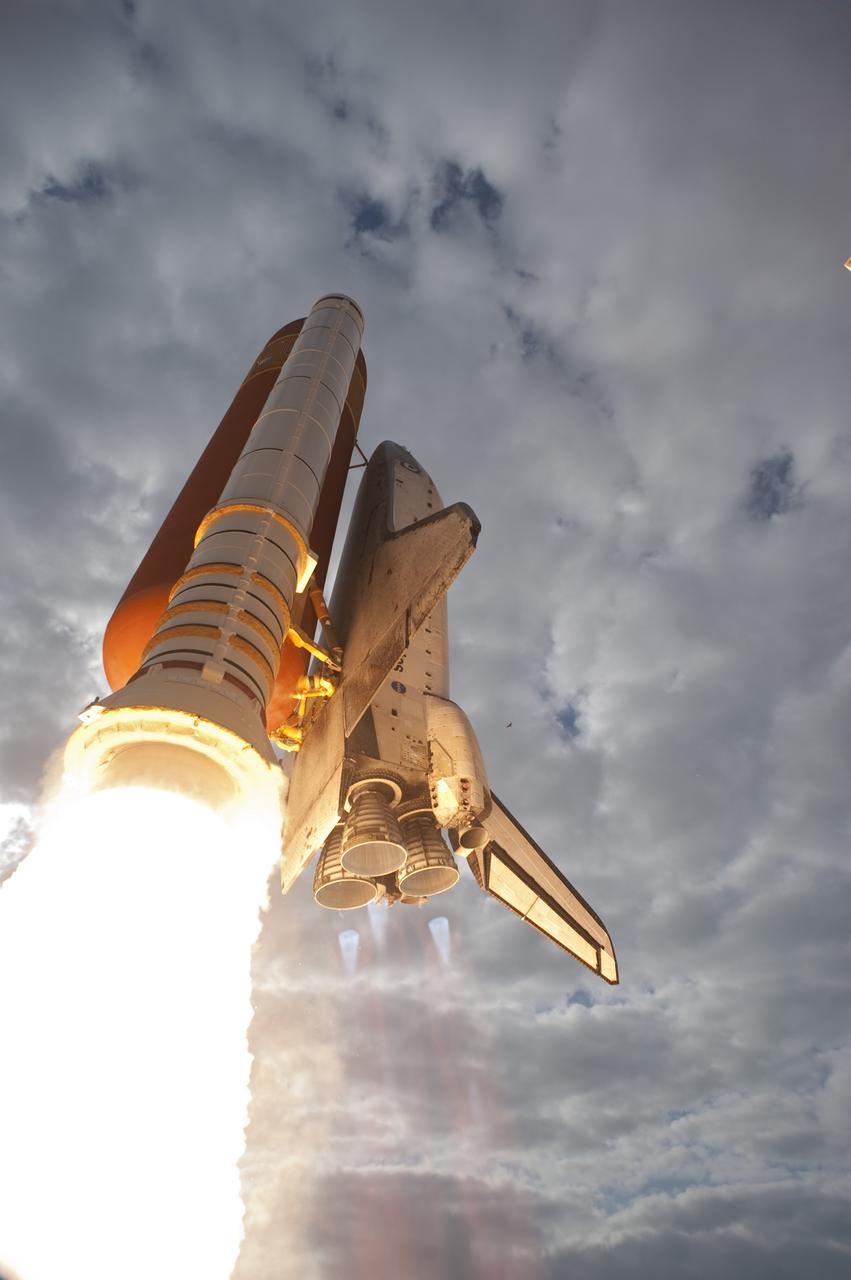
CAPE CANAVERAL, Fla. -- Space shuttle Endeavour soars to orbit from Launch Pad 39A at NASA's Kennedy Space Center in Florida. Endeavour began its final flight, the STS-134 mission to the International Space Station, at 8:56 a.m. EDT on May 16. Endeavour and its six-member crew will deliver the Alpha Magnetic Spectrometer-2 (AMS), Express Logistics Carrier-3, a high-pressure gas tank and additional spare parts for the Dextre robotic helper to the space station. For more information visit, www.nasa.gov/mission_pages/shuttle/shuttlemissions/sts134/index.html. Photo credit: NASA/Tony Gray and Tom Farrar
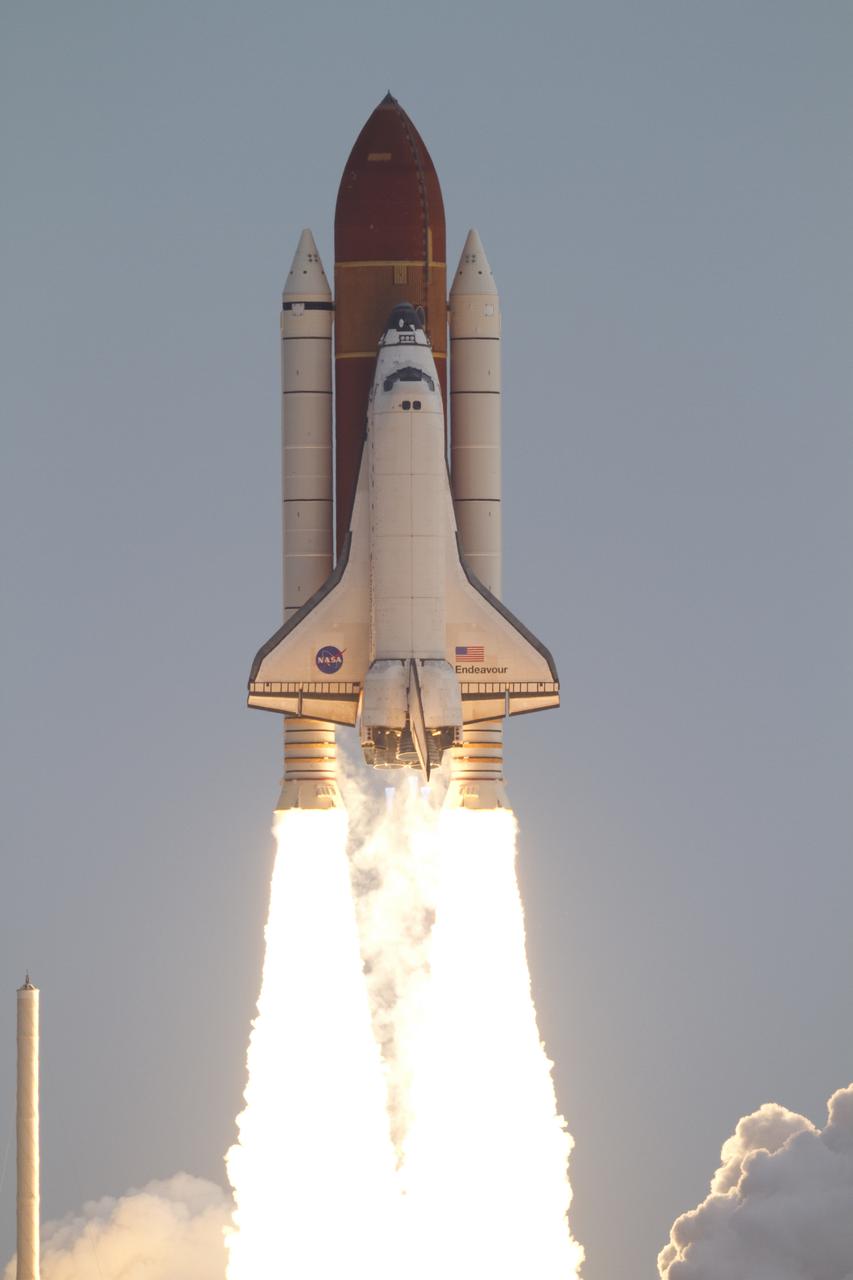
CAPE CANAVERAL, Fla. -- Space shuttle Endeavour rises on twin columns of flame from Launch Pad 39A at NASA's Kennedy Space Center in Florida. Endeavour began its final flight, the STS-134 mission to the International Space Station, at 8:56 a.m. EDT on May 16. Endeavour and its six-member crew will deliver the Alpha Magnetic Spectrometer-2 (AMS), Express Logistics Carrier-3, a high-pressure gas tank and additional spare parts for the Dextre robotic helper to the space station. For more information visit, www.nasa.gov_mission_pages_shuttle_shuttlemissions_sts134_index.html. Photo credit: NASA_Kenny Allen
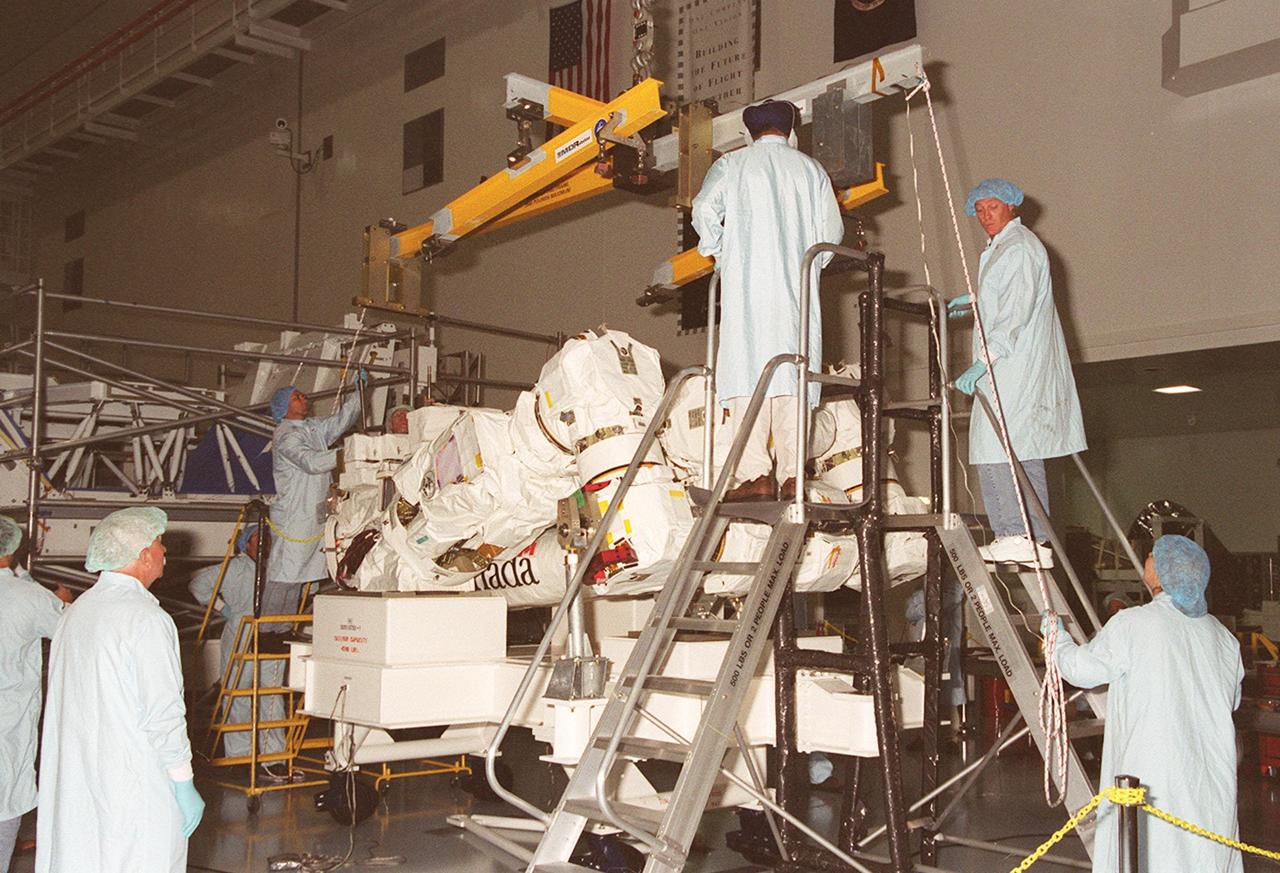
Workers in the Space Station Processing Facility help maneuver an overhead crane above the Canadian Space Agency’s Space Station Remote Manipulator System (SSRMS). The crane will lift and transfer the SSRMS to a test stand where it will be mated to its payload carrier. This pallet will later be installed into the payload bay of Space Shuttle Endeavour for launch to the International Space Station on STS-100 in April 2001. The 56-foot-long arm will be the primary means of transferring payloads between the orbiter payload bay and the Station. Its three segments comprise seven joints for highly flexible land precise movement, making it capable of moving around the Station’s exterior like an inchworm
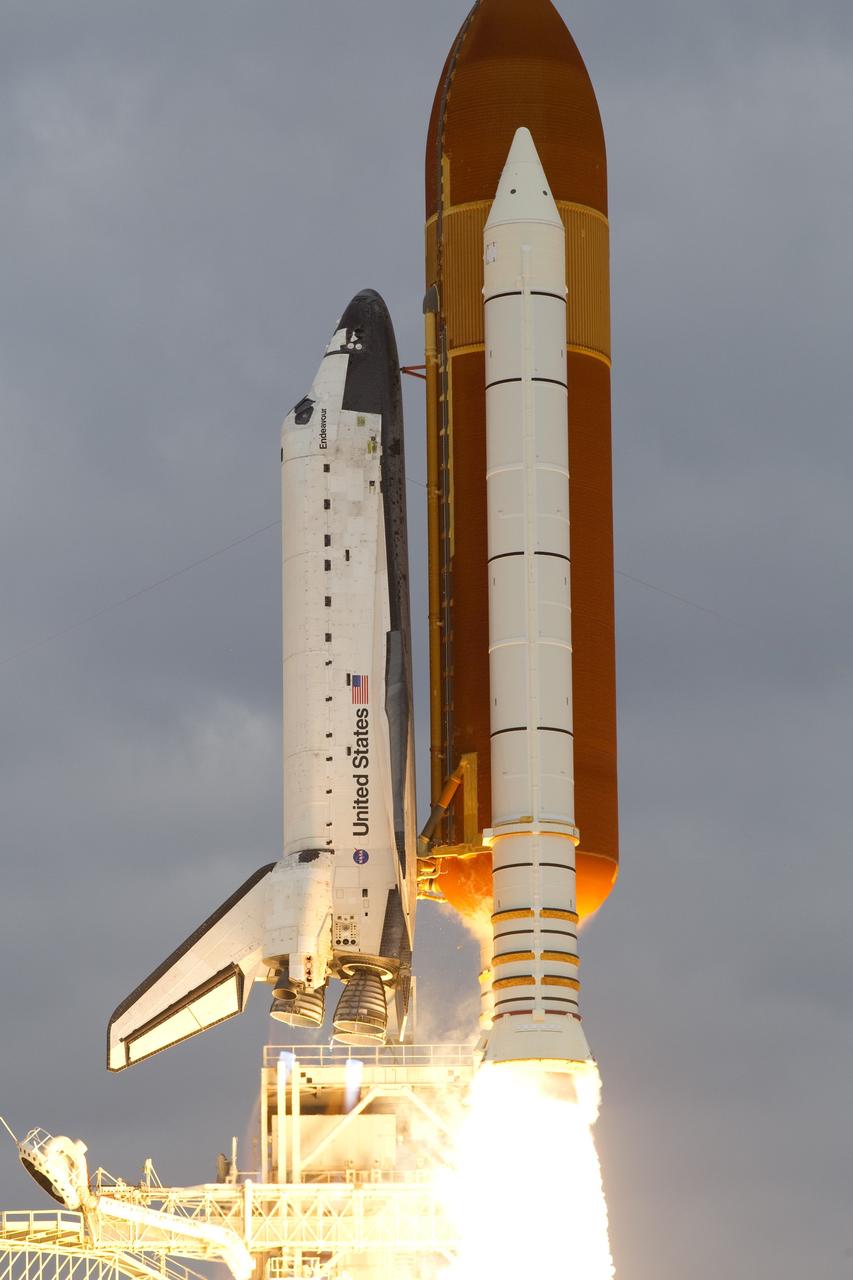
Cape Canaveral, Fla. -- On Launch Pad 39A at NASA's Kennedy Space Center in Florida, space shuttle Endeavour rises past the fixed service structure as it races toward space. Endeavour began its final flight, the STS-134 mission to the International Space Station, at 8:56 a.m. EDT on May 16. Endeavour and its six-member crew will deliver the Alpha Magnetic Spectrometer-2 (AMS), Express Logistics Carrier-3, a high-pressure gas tank and additional spare parts for the Dextre robotic helper to the space station. For more information visit, www.nasa.gov/mission_pages/shuttle/shuttlemissions/sts134/index.html. Photo credit: NASA/George Roberts and Mike Kerley
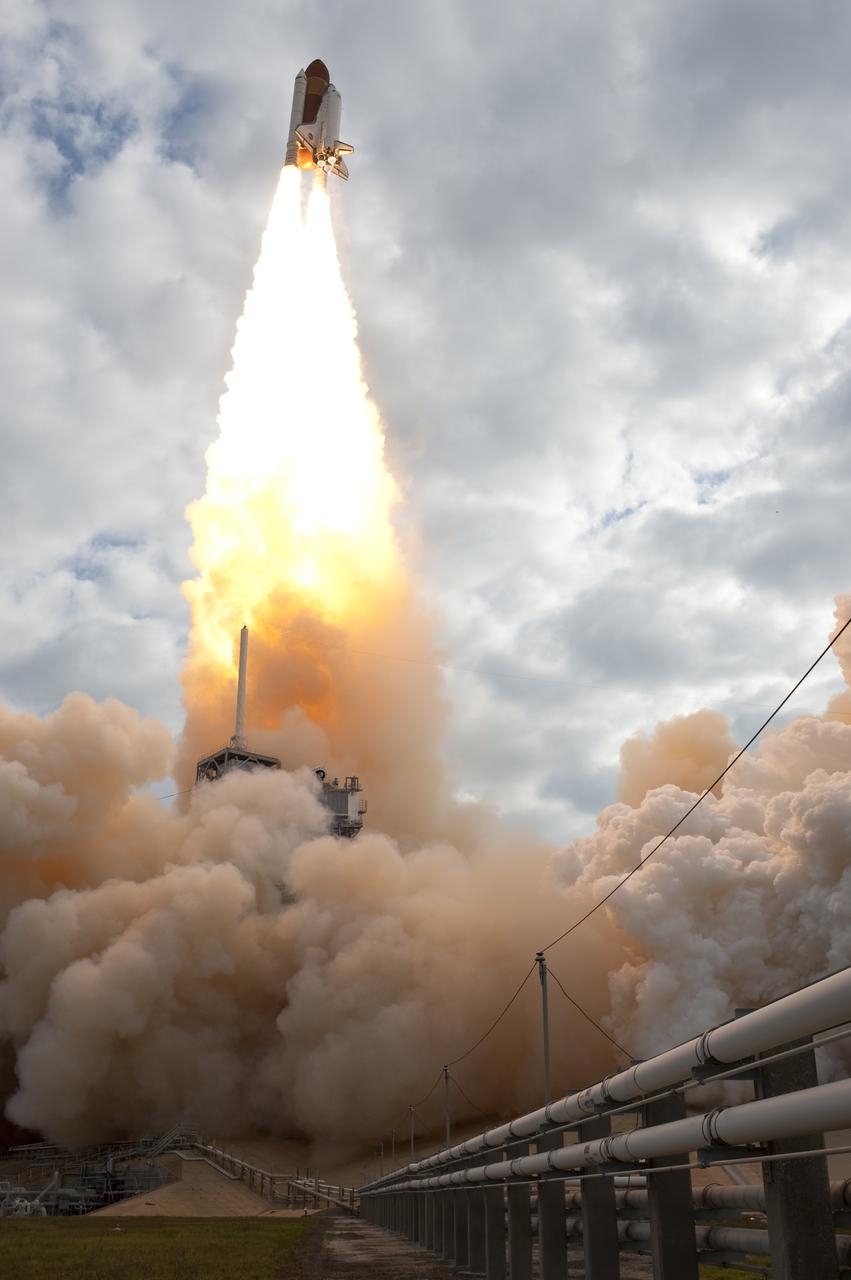
CAPE CANAVERAL, Fla. -- Rising on twin columns of fire, space shuttle Endeavour lifts off from Launch Pad 39A at NASA's Kennedy Space Center in Florida. Endeavour began its final flight, the STS-134 mission to the International Space Station, at 8:56 a.m. EDT on May 16. Endeavour and its six-member crew will deliver the Alpha Magnetic Spectrometer-2 (AMS), Express Logistics Carrier-3, a high-pressure gas tank and additional spare parts for the Dextre robotic helper to the space station. For more information visit, www.nasa.gov/mission_pages/shuttle/shuttlemissions/sts134/index.html. Photo credit: NASA/Sandra Joseph and Kevin O'Connell
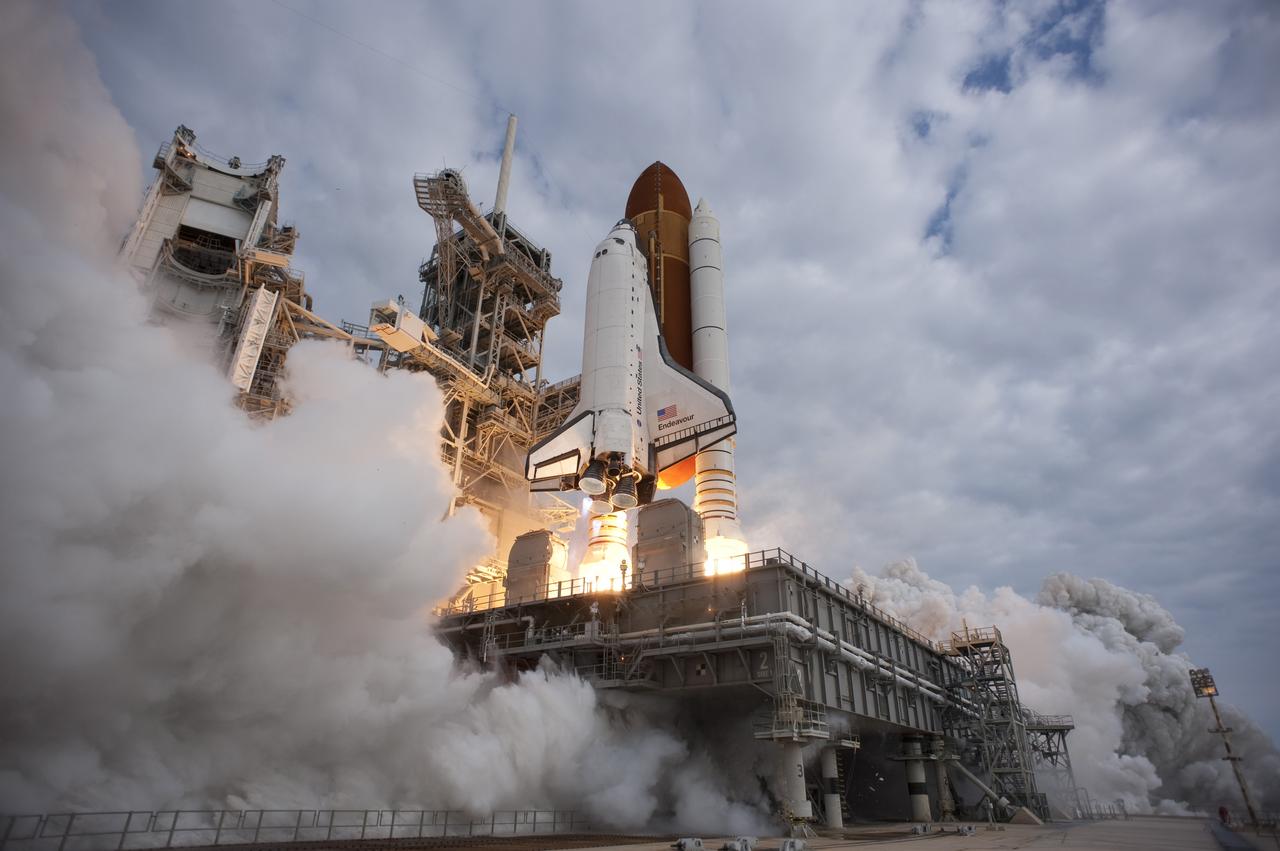
CAPE CANAVERAL, Fla. -- Space shuttle Endeavour rises on twin columns of flame from Launch Pad 39A at NASA's Kennedy Space Center in Florida. Endeavour began its final flight, the STS-134 mission to the International Space Station, at 8:56 a.m. EDT on May 16. Endeavour and its six-member crew will deliver the Alpha Magnetic Spectrometer-2 (AMS), Express Logistics Carrier-3, a high-pressure gas tank and additional spare parts for the Dextre robotic helper to the space station. For more information visit, www.nasa.gov/mission_pages/shuttle/shuttlemissions/sts134/index.html. Photo credit: NASA/Tony Gray and Tom Farrar