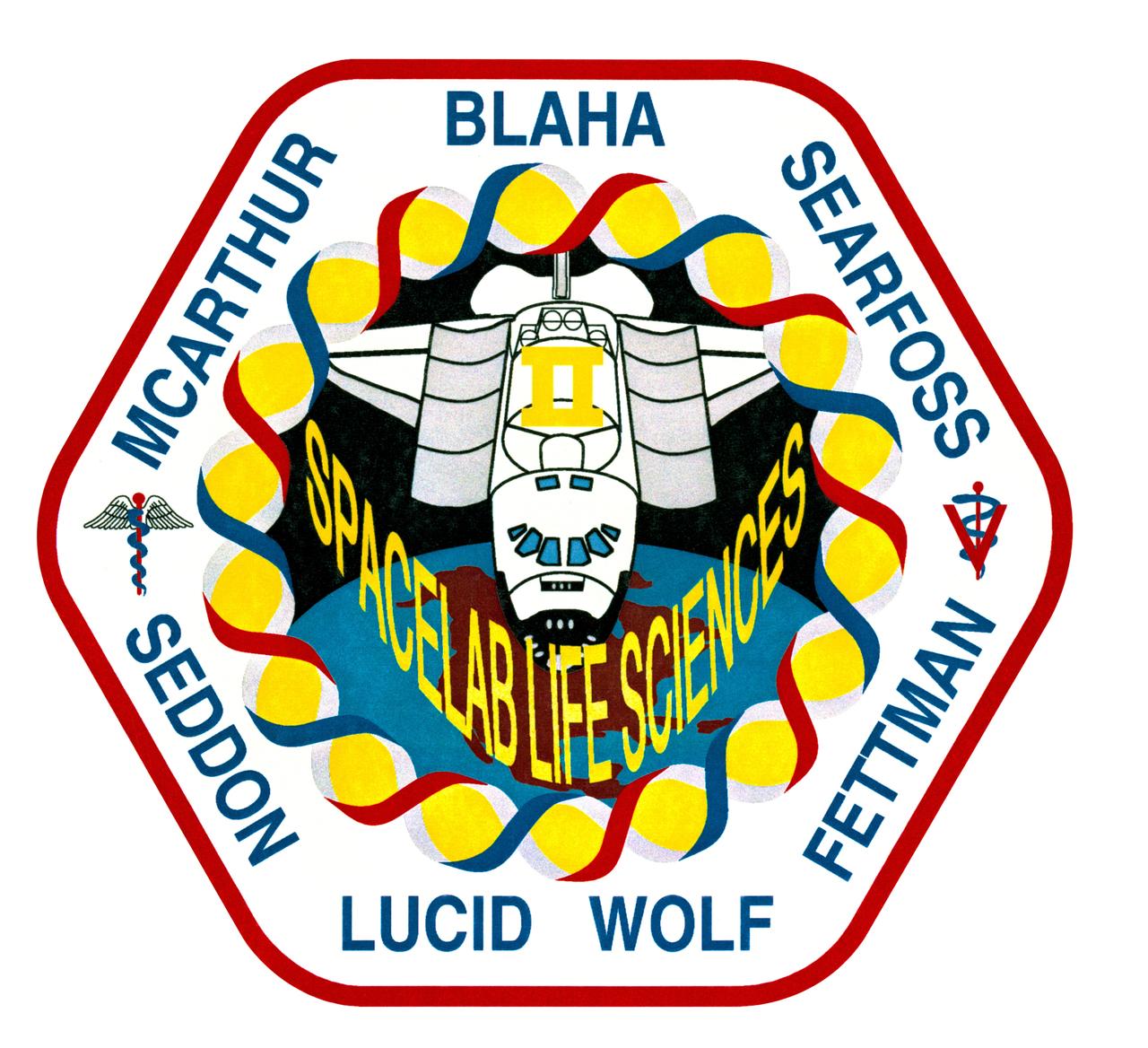
STS058-S-001 (May 1993) --- Designed by members of the flight crew, the STS-58 insignia depicts the space shuttle Columbia with a Spacelab module in its payload bay in orbit around Earth. The Spacelab and the lettering "Spacelab Life Sciences II" highlight the primary mission of the second space shuttle flight dedicated to life sciences research. An Extended Duration Orbiter (EDO) support pallet is shown in the aft payload bay, stressing the scheduled two-week duration of the longest space shuttle mission to date. The hexagonal shape of the patch depicts the carbon ring, a molecule common to all living organisms. Encircling the inner border of the patch is the double helix of DNA, representing the genetic basis of life. Its yellow background represents the sun, energy source for all life on Earth. Both medical and veterinary caducei are shown to represent the STS-58 life sciences experiments. The position of the spacecraft in orbit about Earth with the United States in the background symbolizes the ongoing support of the American people for scientific research intended to benefit all mankind. The NASA insignia design for space shuttle flights is reserved for use by the astronauts and for other official use as the NASA Administrator may authorize. Public availability has been approved only in the form of illustrations by the various news media. When and if there is any change in this policy, which we do not anticipate, it will be publicly announced. Photo credit: NASA
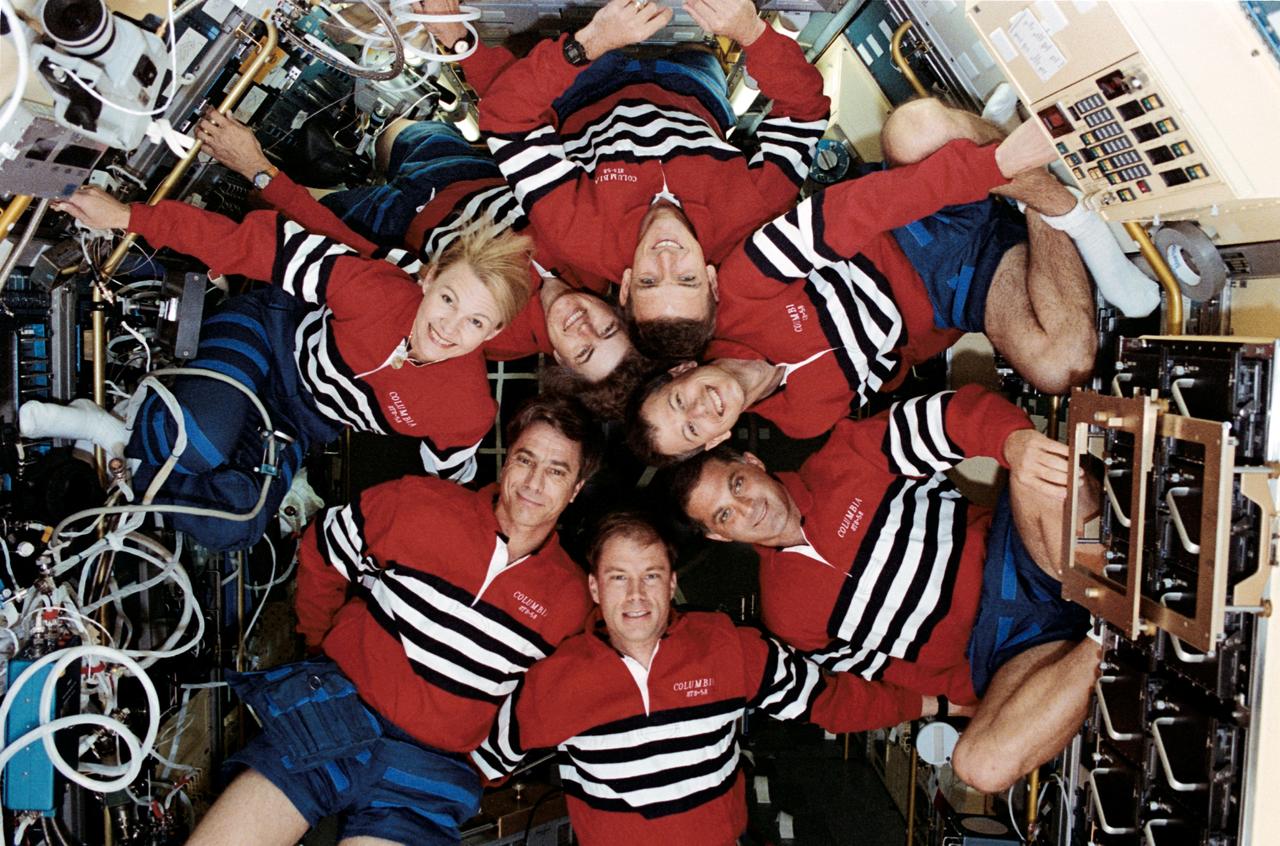
STS058-16-008 (18 Oct.-1 Nov. 1993) --- Inside the science module aboard the Earth-orbiting space shuttle Columbia, a pre-set 35mm camera recorded the traditional inflight portrait of the STS-58 crew. Pictured are (counter-clockwise from the roll of tape at upper right) payload specialist Martin J. Fettman, DVM; William S. McArthur and Shannon W. Lucid, mission specialists; Rhea Seddon, payload commander; John E. Blaha, mission commander; Richard A. Searfoss, pilot; and David A. Wolf, mission specialist. Photo credit: NASA
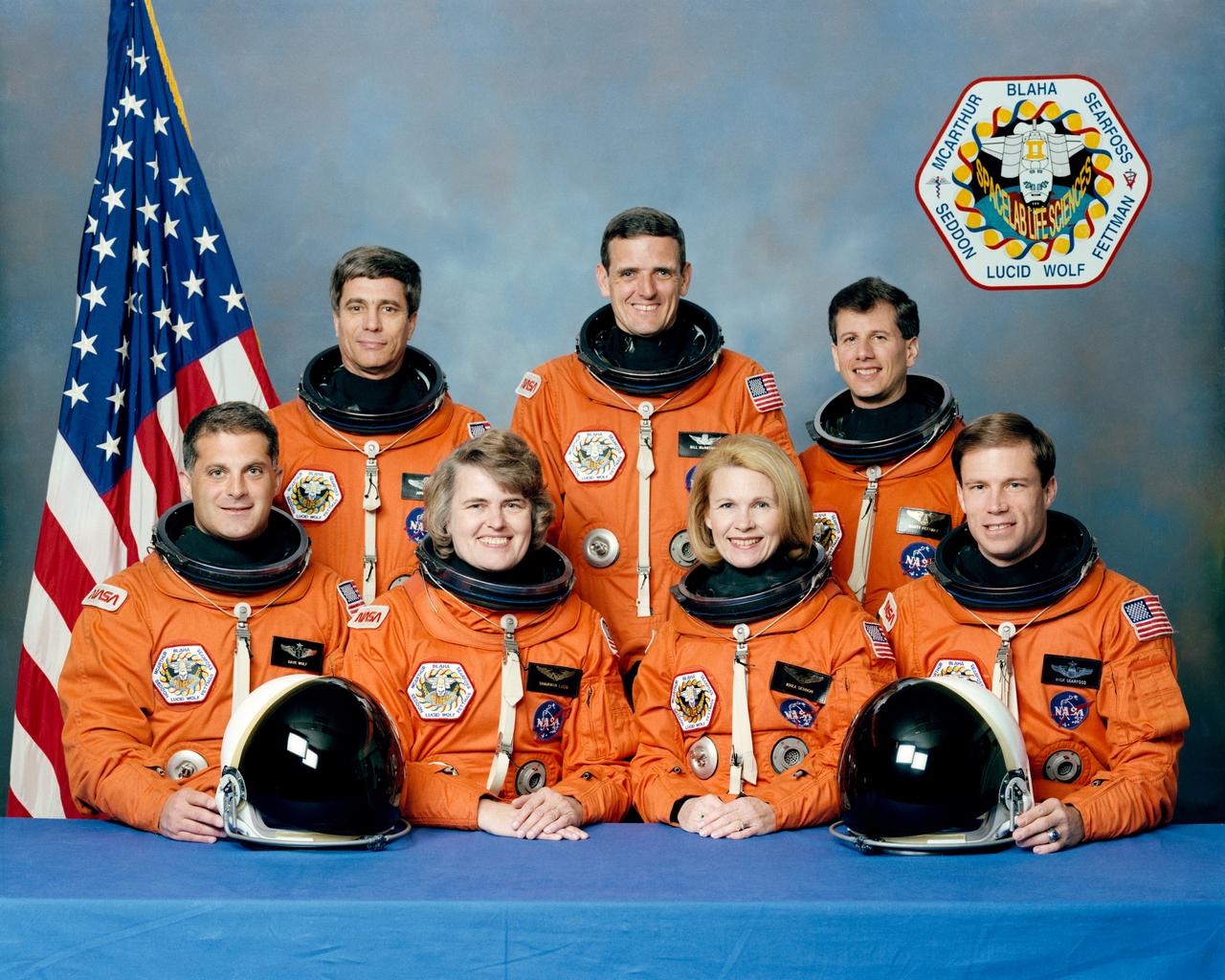
STS058-S-002 (May 1993) --- Wearing training versions of their launch and entry garments, the seven crew members assigned to the Spacelab Life Sciences (SLS-2) mission are pictured in the traditional pre-flight crew portrait. Left to right (front) are David A. Wolf, and Shannon W. Lucid, both mission specialists; Rhea Seddon, payload commander; and Richard A. Searfoss, pilot. Left to right (rear) are John E. Blaha, mission commander; William S. McArthur Jr., mission specialist; and payload specialist Martin J. Fettman, DVM.
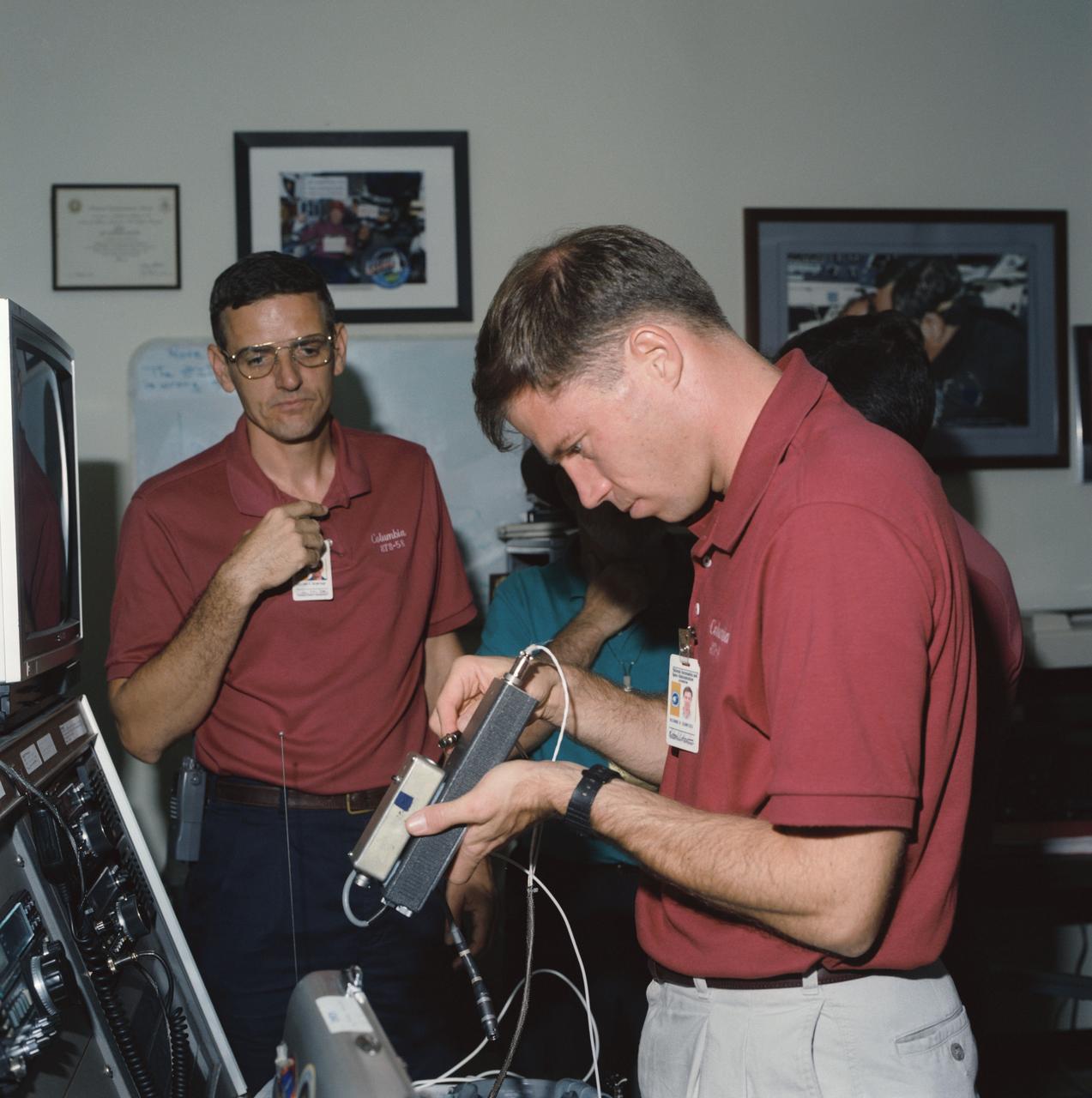
S93-45068 (22 Sept 1993) --- Two members of the STS-58 Spacelab Life Sciences (SLS-2) crew, train with amateur radio equipment at the Johnson Space Center (JSC). They are William S. McArthur (left), mission specialist, and Richard A. Searfoss, pilot. The STS-58 flight will carry the Shuttle Amateur Radio Experiment (SAREX) payload, configuration C, which includes FM voice and packet. Three of the seven crewmembers are licensed amateur radio operators. Searfoss' call letters are KC5CKM; McArthur, KC5ACR; and payload specialist Martin J. Fettman, KC5AXA. Licensed students at a number of schools around the country will have the opportunity to talk directly with the astronauts during the 14-day flight.
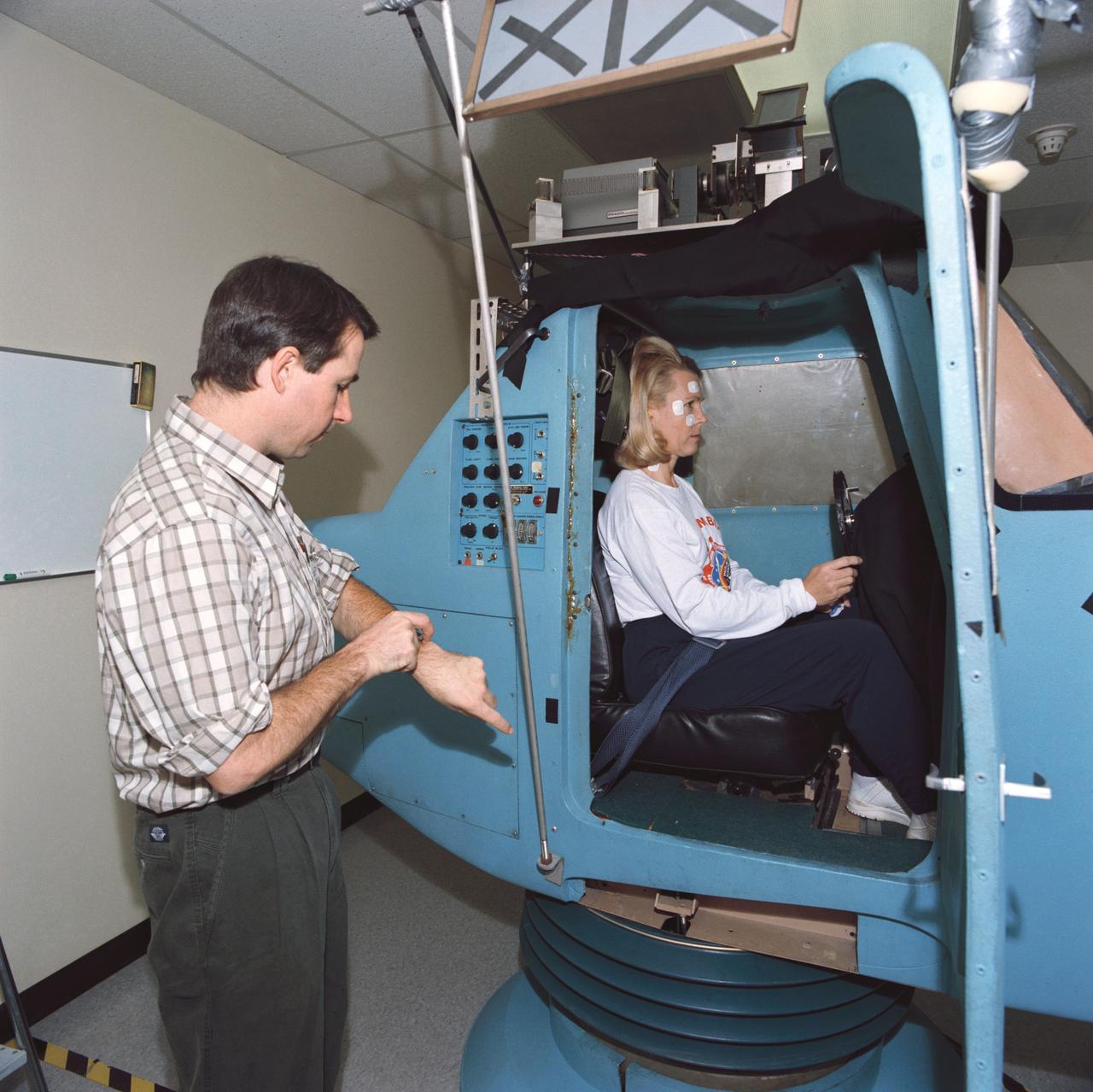
S93-45373 (29 Sept 1993) --- Astronaut Rhea Seddon, STS-58 payload commander, is in a piloting simulator as part of a pre-flight data collection project for neurovestibular functions. The seven Spacelab Life Sciences (SLS-2) crew members devoted a full day to miscellaneous biomedical data collection in preparation for next month's two week mission aboard Columbia.
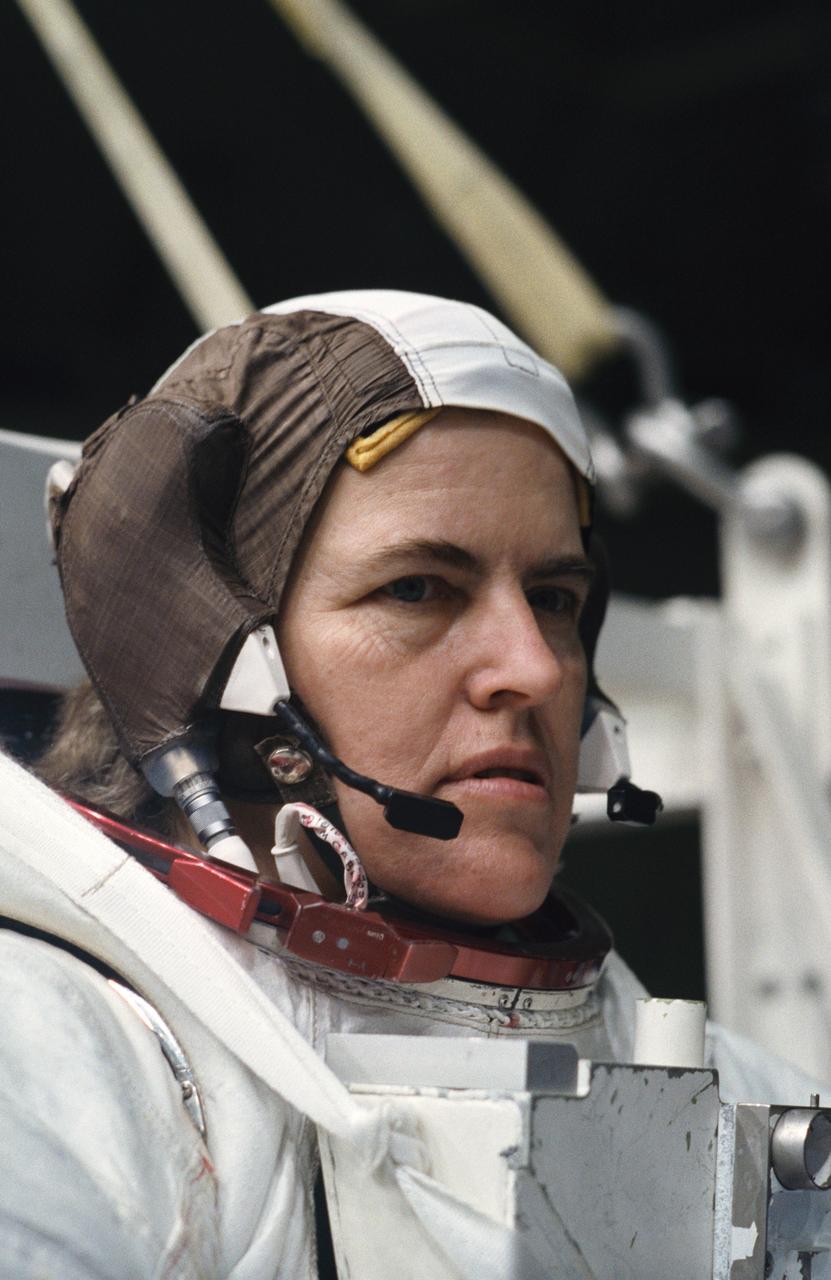
S93-31697 (3 April 1993) --- Astronaut Shannon W. Lucid participates in training for contingency Extravehicular Activity (EVA) for the STS-58 mission. Behind Lucid, sharing a moveable platform with her, is astronaut David A. Wolf (out of frame). For simulation purposes, the two mission specialists were about to be submerged to a point of neutral buoyancy in the Johnson Space Center's (JSC) Weightless Environment Training Facility (WET-F). Though the Spacelab Life Sciences (SLS-2) mission does not include a planned EVA, all crews designate members to learn proper procedures to perform outside the spacecraft in the event of failure of remote means to accomplish those tasks.
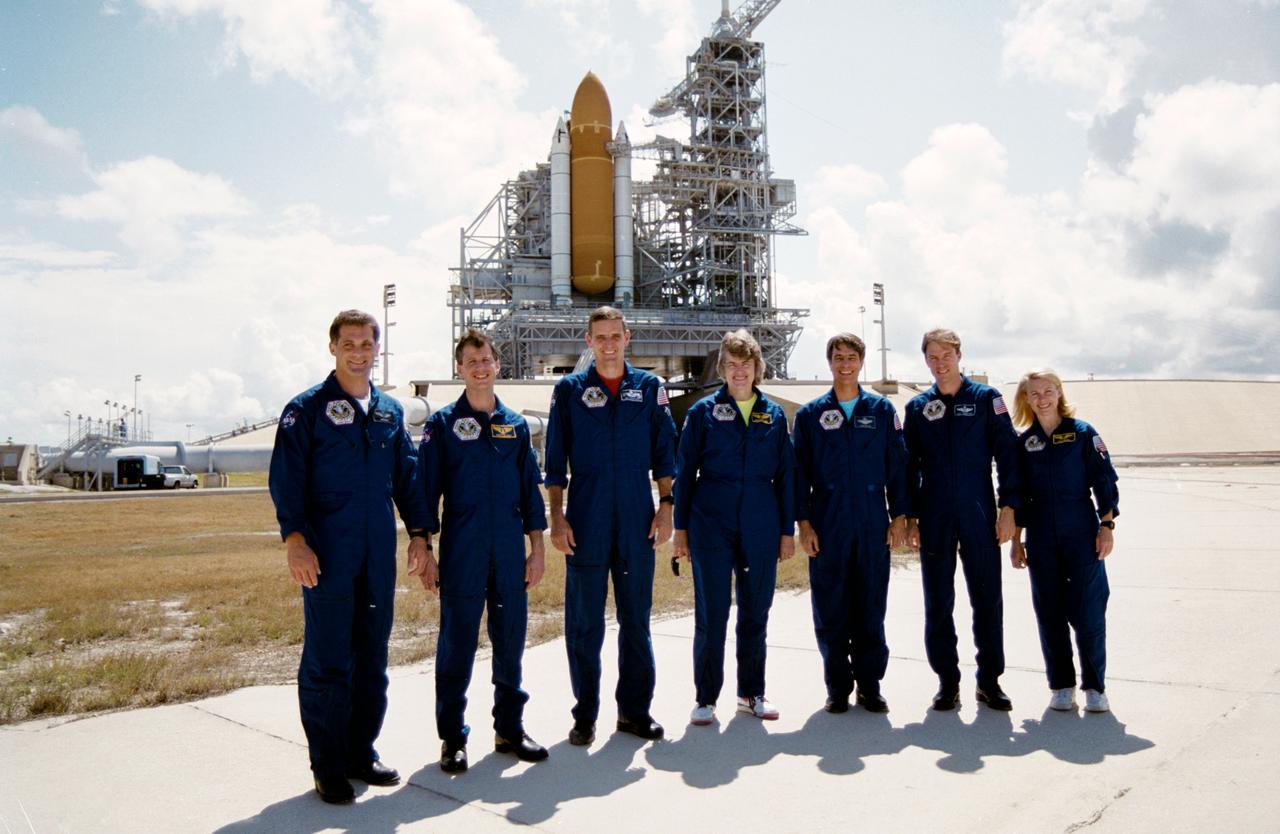
S93-45003 (20 Sept 1993) --- Posing for a crew portrait, in front of the Space Shuttle Columbia at Launch Pad 39B, are the seven STS-58 astronauts. They are, left to right, David A. Wolf, mission specialist; Martin J. Fettman, payload specialist; William S. McArthur and Shannon W. Lucid, mission specialists; John E. Blaha, mission commander; Richard A. Searfoss, pilot; and Rhea Seddon, payload commander. The crew was in Florida for the Terminal Countdown Demonstration Test (CDDT) in preparation for next month's launch aboard Columbia. (Kennedy Space Center Photo ID: KSC-93-PC-1253)
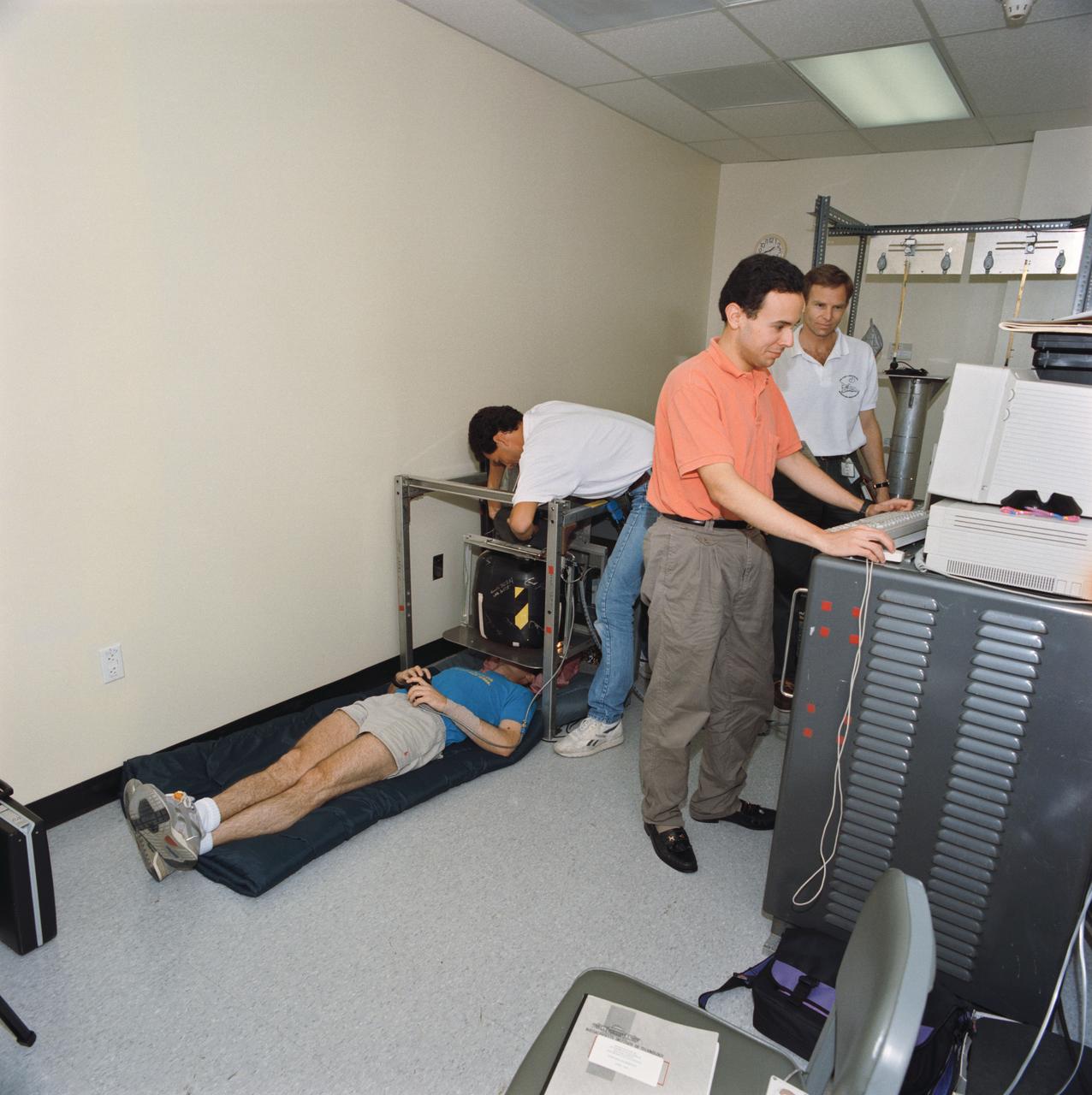
S93-45374 (29 Sept 1993) --- An unidentified STS-58 crewmember participates in a test with the rotating dome experiment. The dome will be flown as part of the Spacelab Life Sciences (SLS-2) payload on next month's scheduled STS-58 mission aboard Columbia.
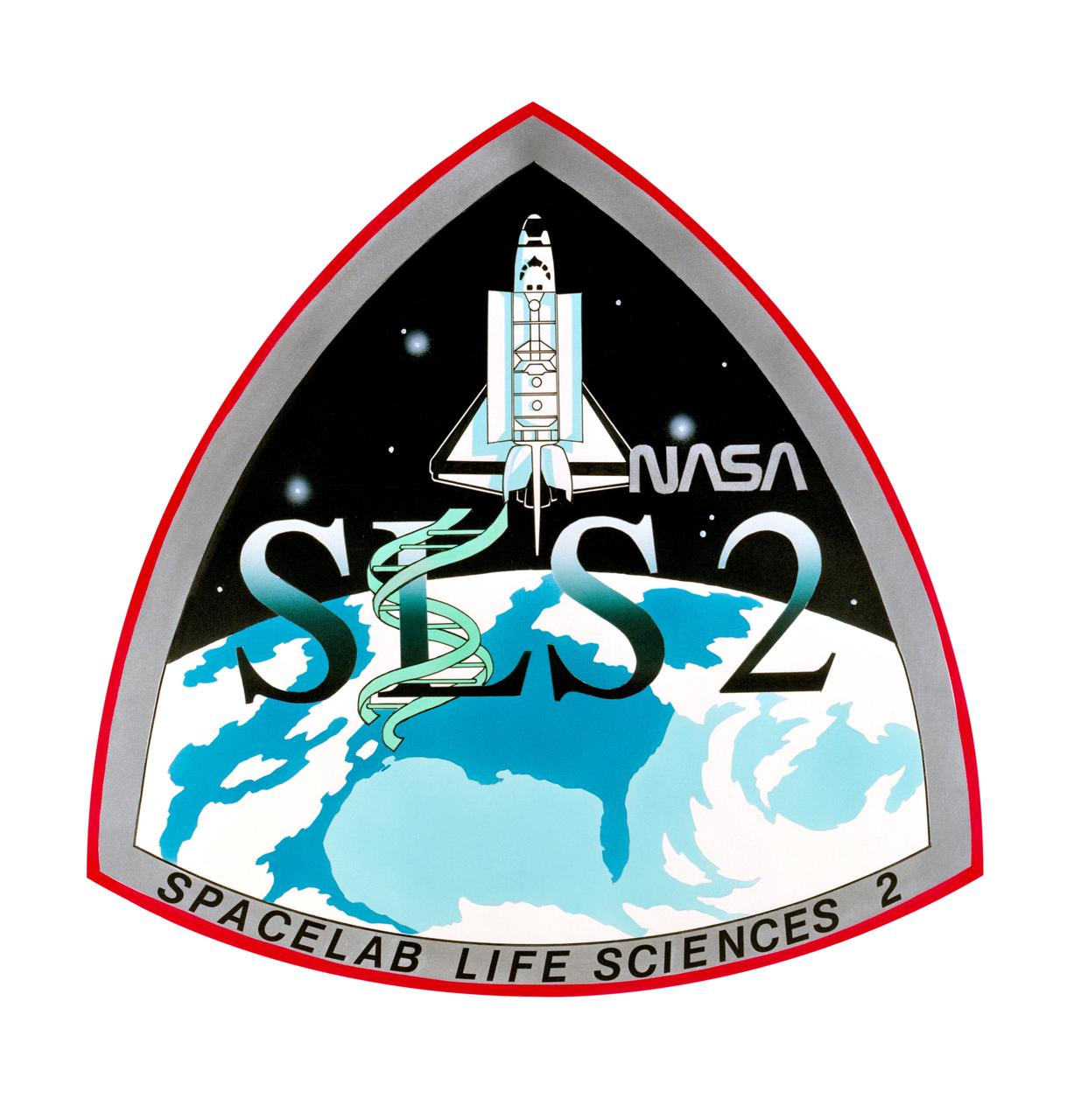
S93-26894 (March 1993) --- Spacelab Life Sciences 2, scheduled to fly as the major payload on the STS-58 mission, is represented with this logo. As in the case of SLS-1, which flew in space in June of 1991, this Spacelab mission will be devoted to life sciences and will carry a crew of experts in the associated disciplines.
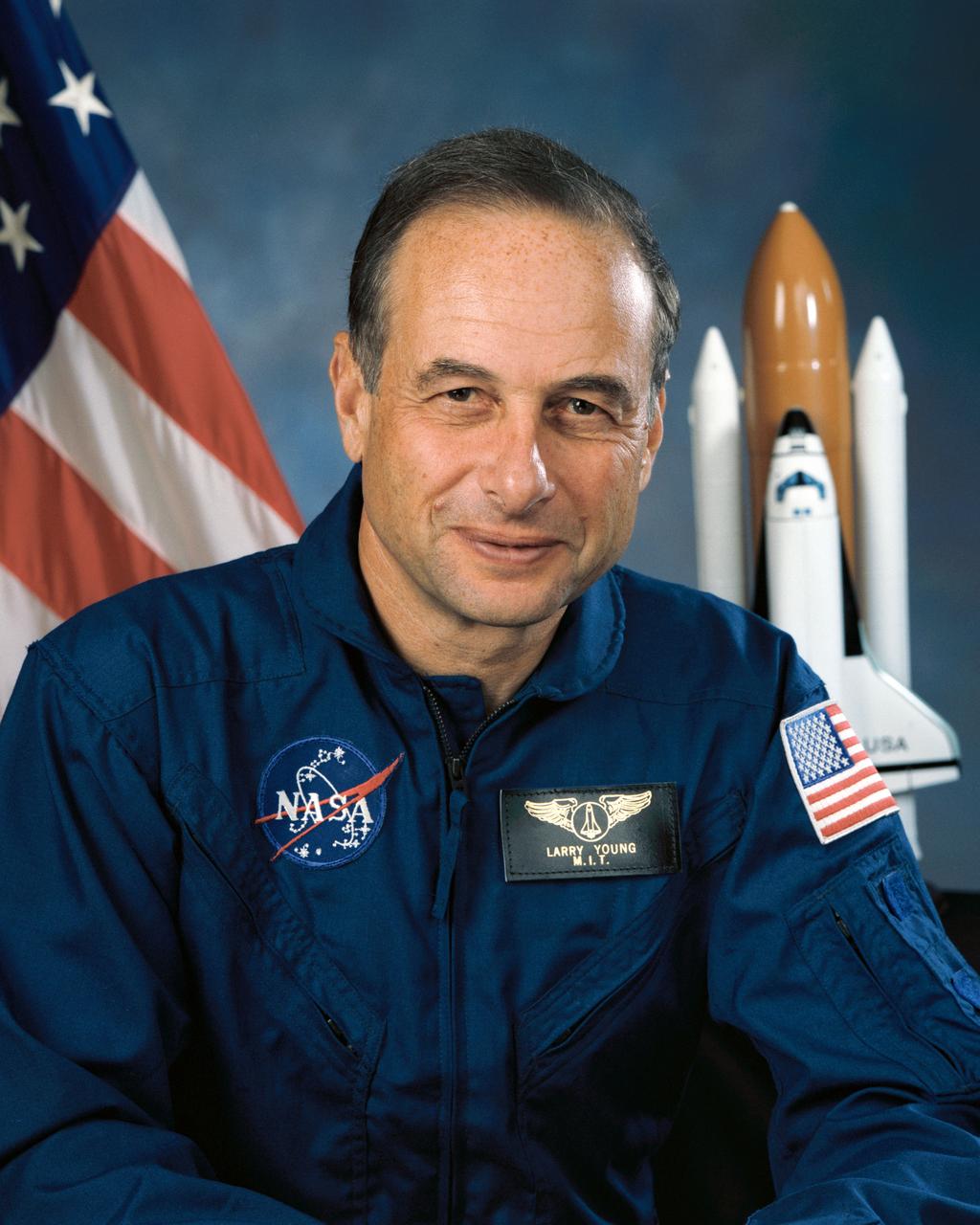
S92-49243 (November 1992) --- Astronaut Laurence Young, Sc. D., Massachusetts Institute of Technology, payload specialist
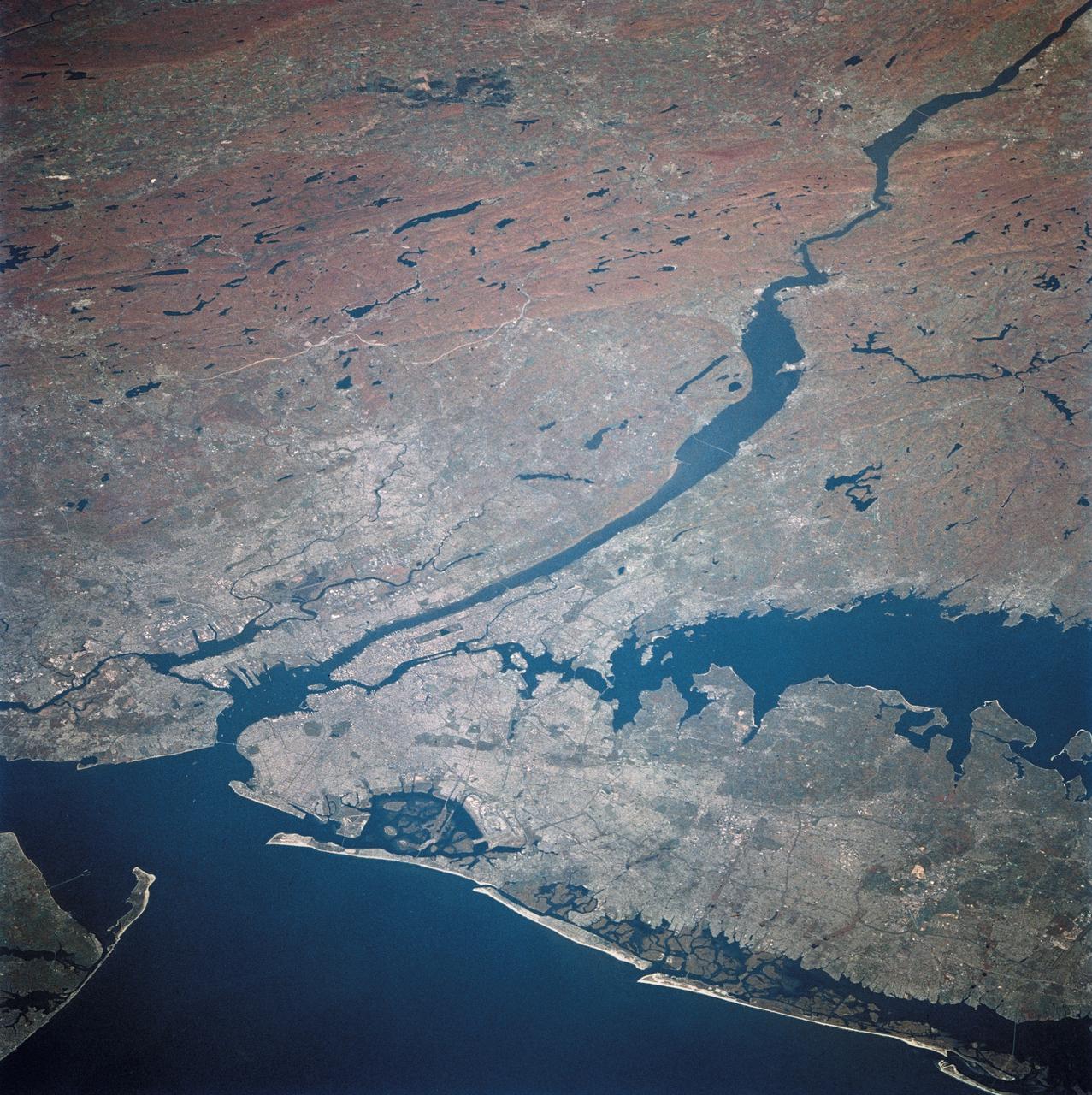
STS058-081-038 (18 Oct-1 Nov 1993) --- Fall colors in the northeast were captured by the STS-58 crew members. Long Island and the lower Hudson River dominate this scene, taken on a clear October day at the peak of the colorful fall foliage season. The maples and oaks of the Hudson Highlands are particularly striking, and contrast with the many lakes and reservoirs north of the city. The New York metropolitan area in New York and New Jersey (including Jersey City and Newark) is easily seen in the foreground. Manhattan Island sits near the middle of the scene, but Central Park foliage is still fairly green. West Point can be seen near the upper right, on the west-pointing bend of the Hudson, and the Catskills are in the far upper left.
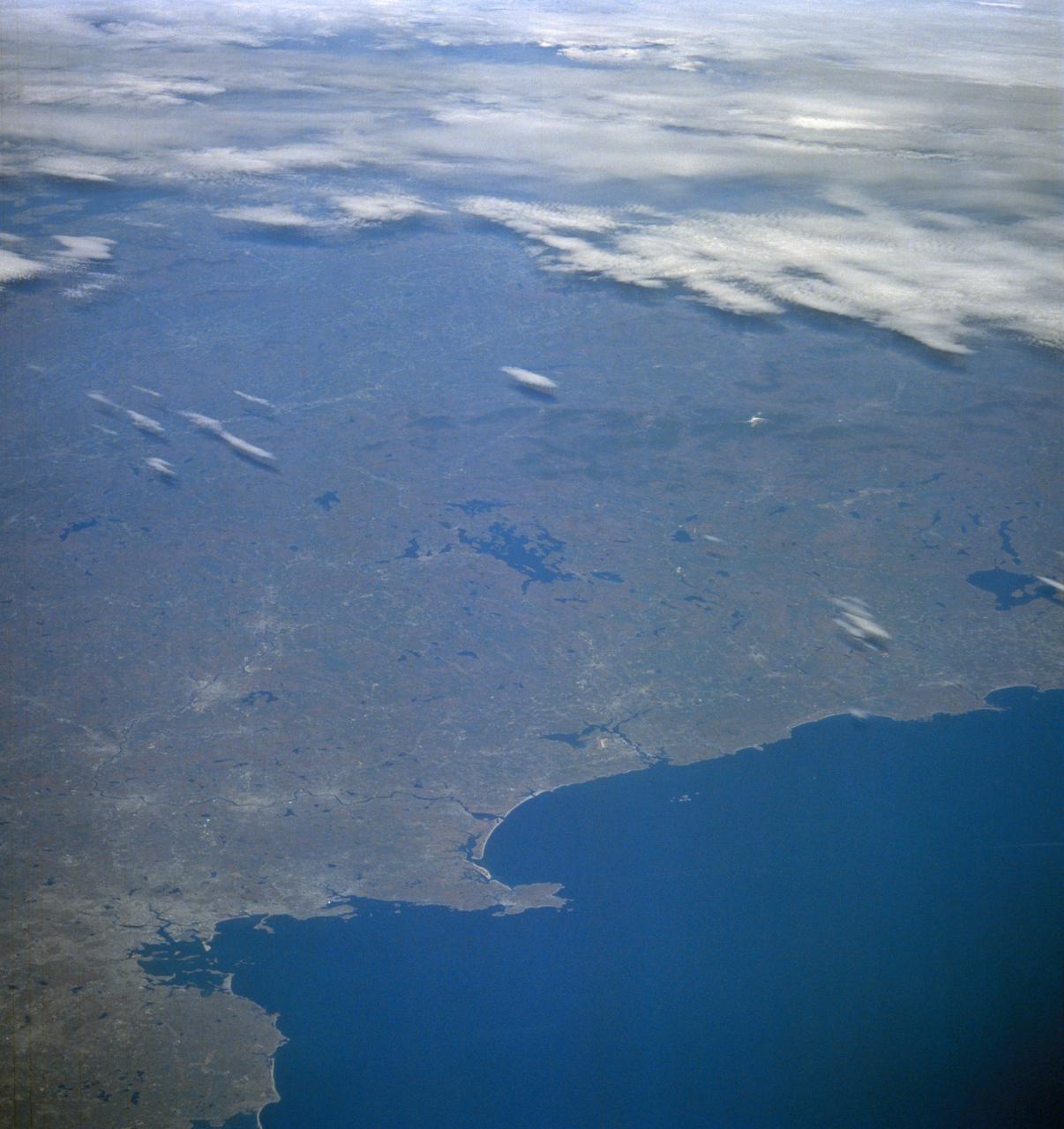
STS058-105-016 (18 Oct-1 Nov 1993) --- This photograph includes much of the heart of New England, stretching from Boston and Boston Harbor (lower left) across New Hampshire and Vermont to Lake Champlain (upper left), and up to southern Maine (Portland is just off the photo at right center). The colors in this photograph are less vivid than those in STS-58-81-038, because the color changes on the deciduous trees in central and northern New England were past their peak when this photograph was taken. North of Boston flows the Merrimack River (which forms part of the state boundary between Massachusetts and New Hampshire). It is delineated by the small industrial towns (Concord, Manchester, Nashua, Lowell) which grew up on its banks. The White Mountains of New Hampshire are seen near the center, and Mt. Washington (6,288 feet) is capped with snow.
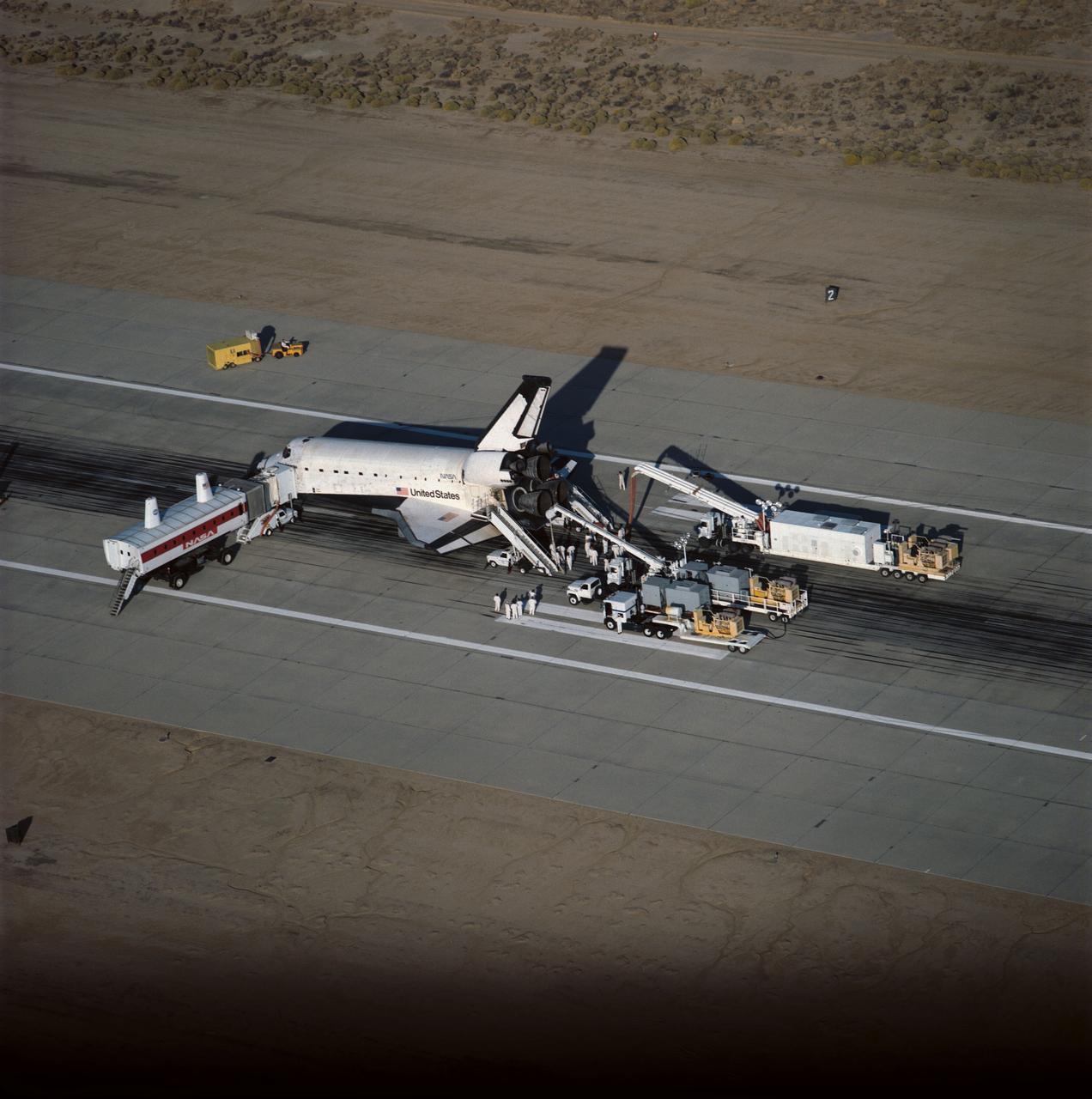
STS058-S-129 (1 Nov 1993) --- This busy scene on the runway at Edwards Air Force Base (EAFB) was taken less than an hour following the landing of the Space Shuttle Columbia. The touchdown, which had occurred at 7:06 a.m. (PST), November 1, 1993, completed a two week mission in space devoted to medical research. The array of hardware and workers includes personnel and equipment designed to make the area safe. At far left is the Crew Transport Vehicle (CTV). Still onboard the spacecraft were astronauts John E. Blaha, Richard A. Searfoss, Rhea Seddon, Shannon W. Lucid, David A. Wolf and William S. McArthur, along with payload specialist Martin J. Fettman, DVM.
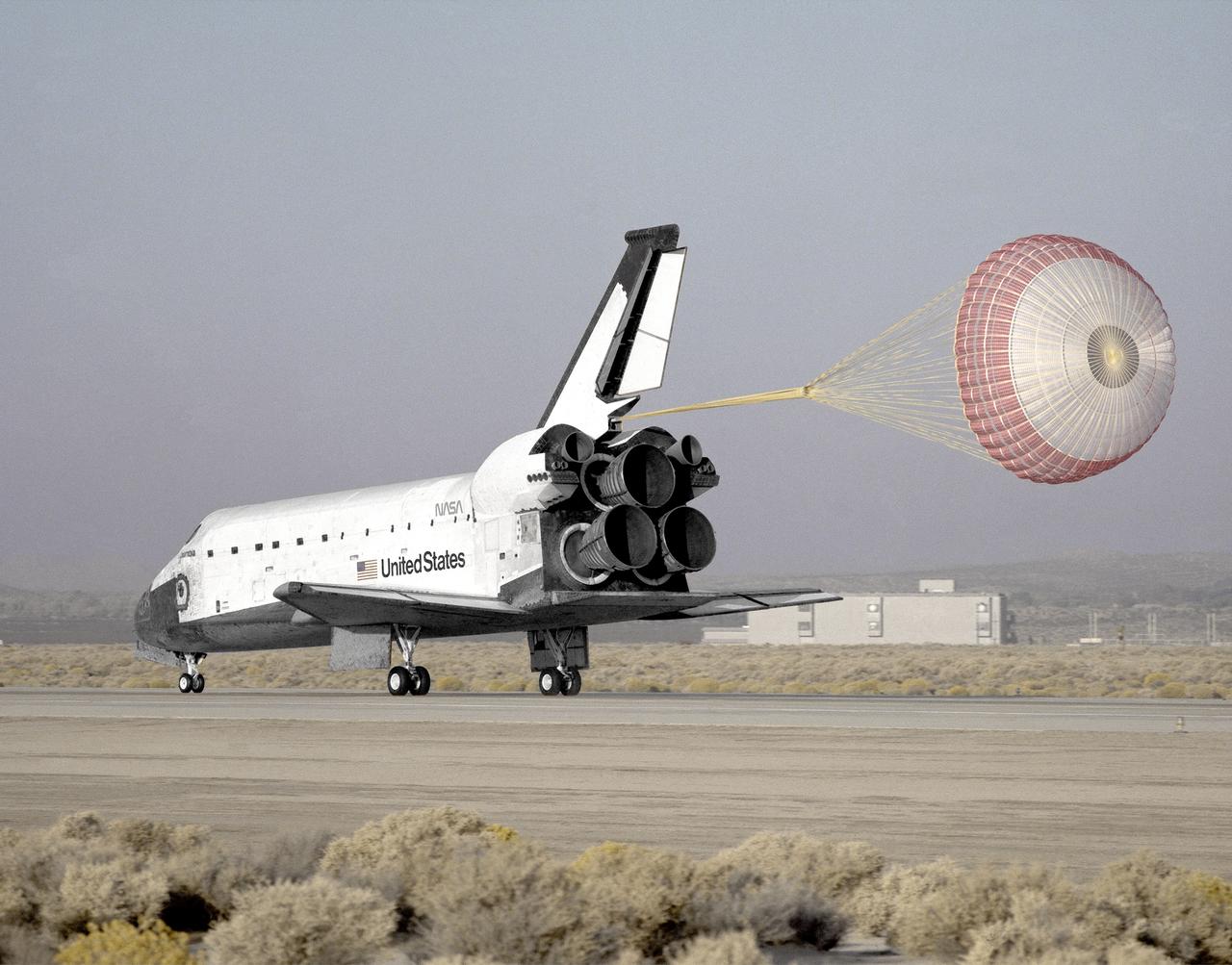
A drag chute slows the space shuttle Columbia as it rolls to a perfect landing concluding NASA's longest mission at that time, STS-58, at the Ames-Dryden Flight Research Facility (later redesignated the Dryden Flight Research Center), Edwards, California, with a 8:06 a.m. (PST) touchdown 1 November 1993 on Edward's concrete runway 22. The planned 14 day mission, which began with a launch from Kennedy Space Center, Florida, at 7:53 a.m. (PDT), October 18, was the second spacelab flight dedicated to life sciences research. Seven Columbia crewmembers performed a series of experiments to gain more knowledge on how the human body adapts to the weightless environment of space. Crewmembers on this flight included: John Blaha, commander; Rick Searfoss, pilot; payload commander Rhea Seddon; mission specialists Bill MacArthur, David Wolf, and Shannon Lucid; and payload specialist Martin Fettman.
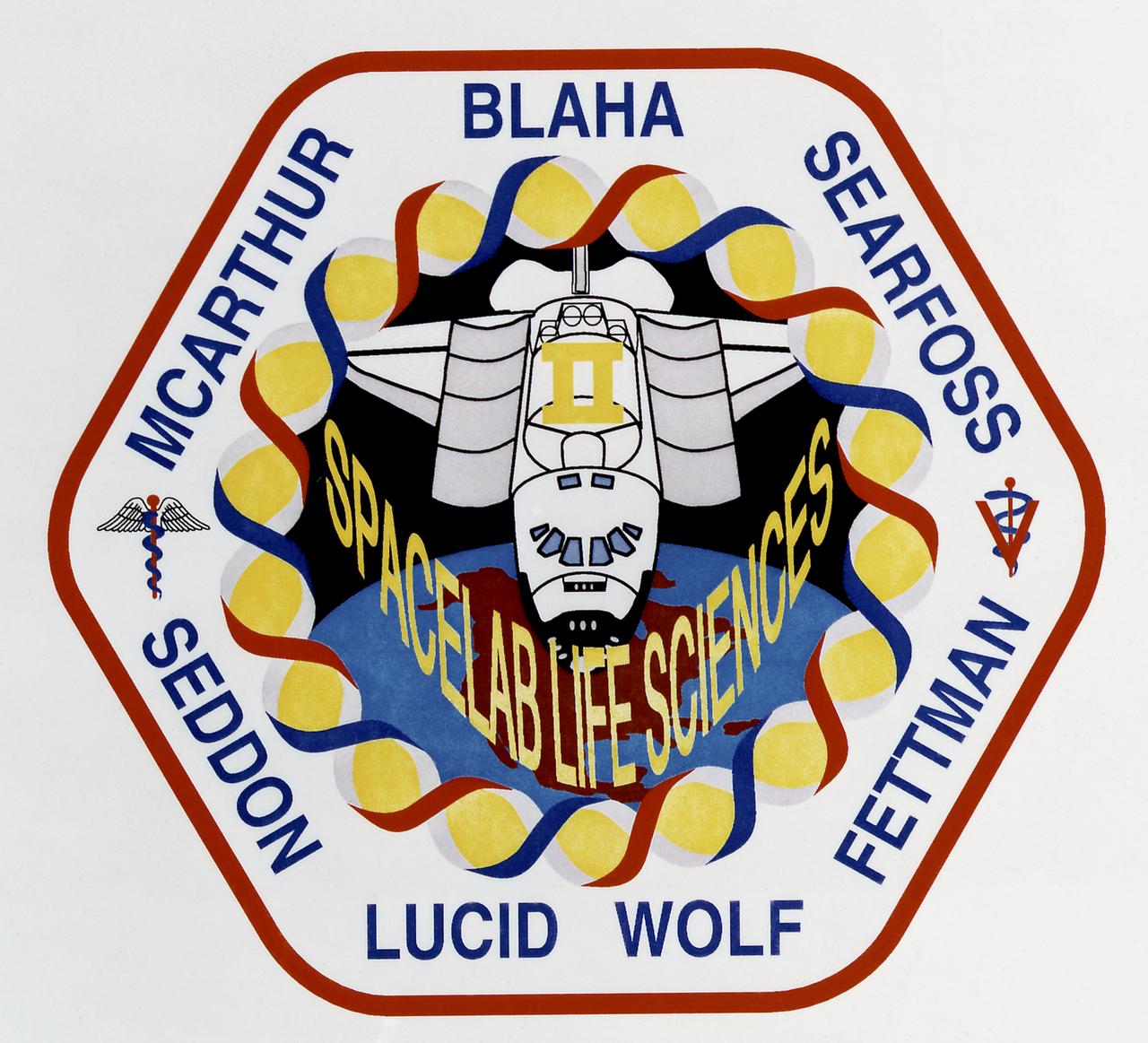
Designed by members of the flight crew, the STS-58 insignia depicts the Space Shuttle Columbia with a Spacelab module in its payload bay in orbit around Earth. The Spacelab and the lettering Spacelab Life Sciences ll highlight the primary mission of the second Space Shuttle flight dedicated to life sciences research. An Extended Duration Orbiter (EDO) support pallet is shown in the aft payload bay, stressing the scheduled two-week duration of the longest Space Shuttle mission to date. The hexagonal shape of the patch depicts the carbon ring, a molecule common to all living organisms. Encircling the inner border of the patch is the double helix of DNA, representing the genetic basis of life. Its yellow background represents the sun, energy source for all life on Earth. Both medical and veterinary caducei are shown to represent the STS- 58 life sciences experiments. The position of the spacecraft in orbit about Earth with the United States in the background symbolizes the ongoing support of the American people for scientific research intended to benefit all mankind.
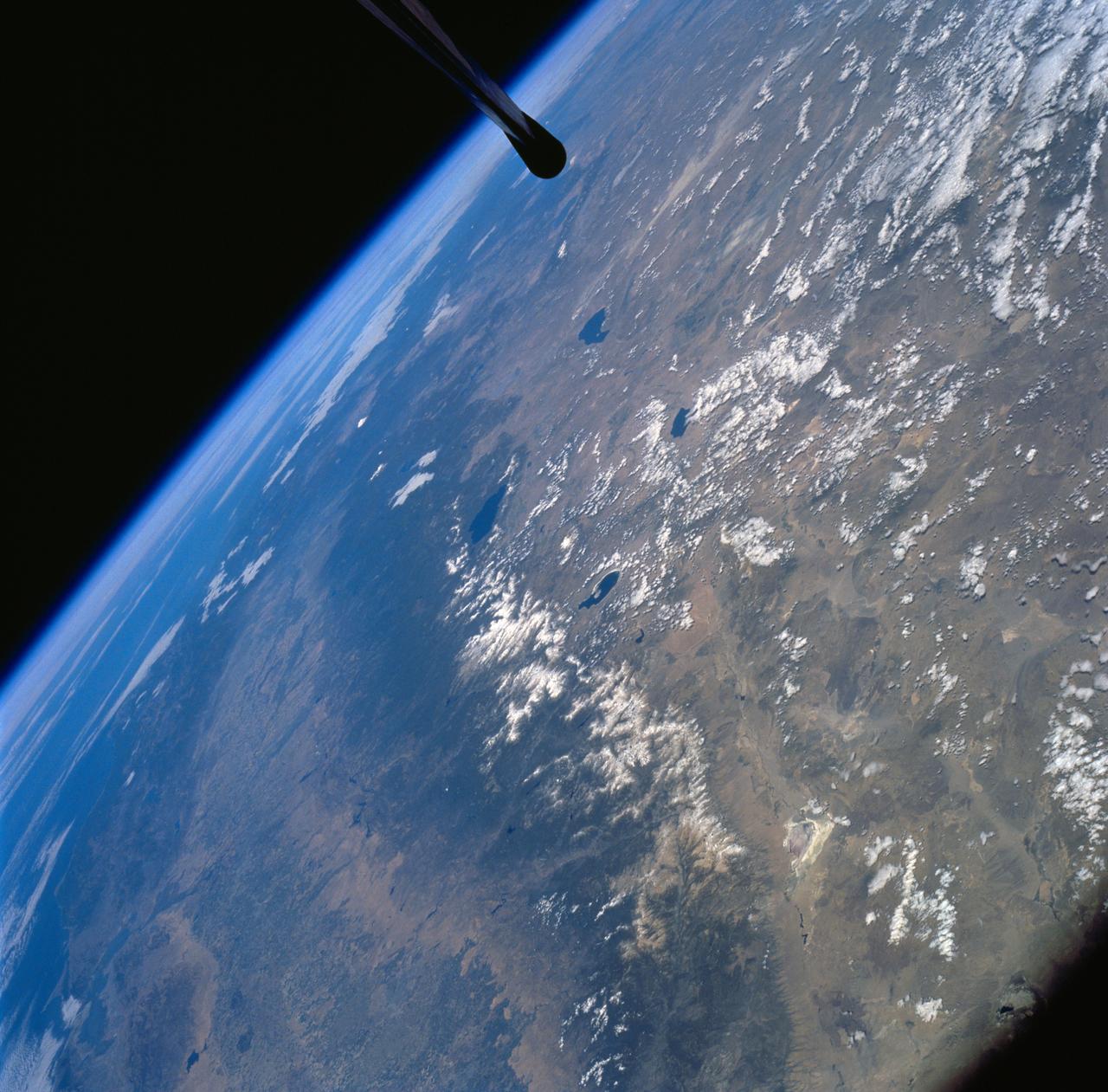
STS058-72-004 (18 Oct-1 Nov 1993) --- The Sierra Nevada Mountain Range can be seen in this north-looking high oblique view taken in October, 1993, by the STS-58 crew. Visible in the view to the west of the Sierra Nevada are the San Joaquin and Sacramento Valleys of central California. The San Francisco/Oakland Bay Area can be seen to the west of the valley at the extreme left of the photograph. To the east or right of the Sierra Nevada, the basin and Range Region of central and northern Nevada is visible. Mono Lake, Lake Tahoe and Pyramid Lake are also visible in this scene. The long northwest/southeast trending Walker Lane Shear Zone, which lies just to the east (right) of the Sierra Nevada is also visible. Near the top of the view (near the horizon), the snow covered volcanic peak Mount Shasta can be seen. Over 645 kilometers (400 miles) long and from 65 to 130 kilometers (40 to 80 miles) wide, the Sierra Nevada have many peaks in excess of 3,300 meters (11,000 feet) above sea level. A titled fault block in structure (the largest in the United States) and shaped by glaciers during the last ice age over 12,000 years ago, the Sierra Nevada eastern front rises sharply from the Great Basin of Nevada, while its western slope descends gradually to the hills bordering the Central Valley of California. Snow-fed streams supply much of the irrigation water to the Central Valley and to western Nevada and also generate hydroelectricity. Recent above normal precipitation (snowfall) of the last two years has helped in alleviating the drought conditions that had prevailed throughout most of California in the mid and late 1980's and early 1990's.
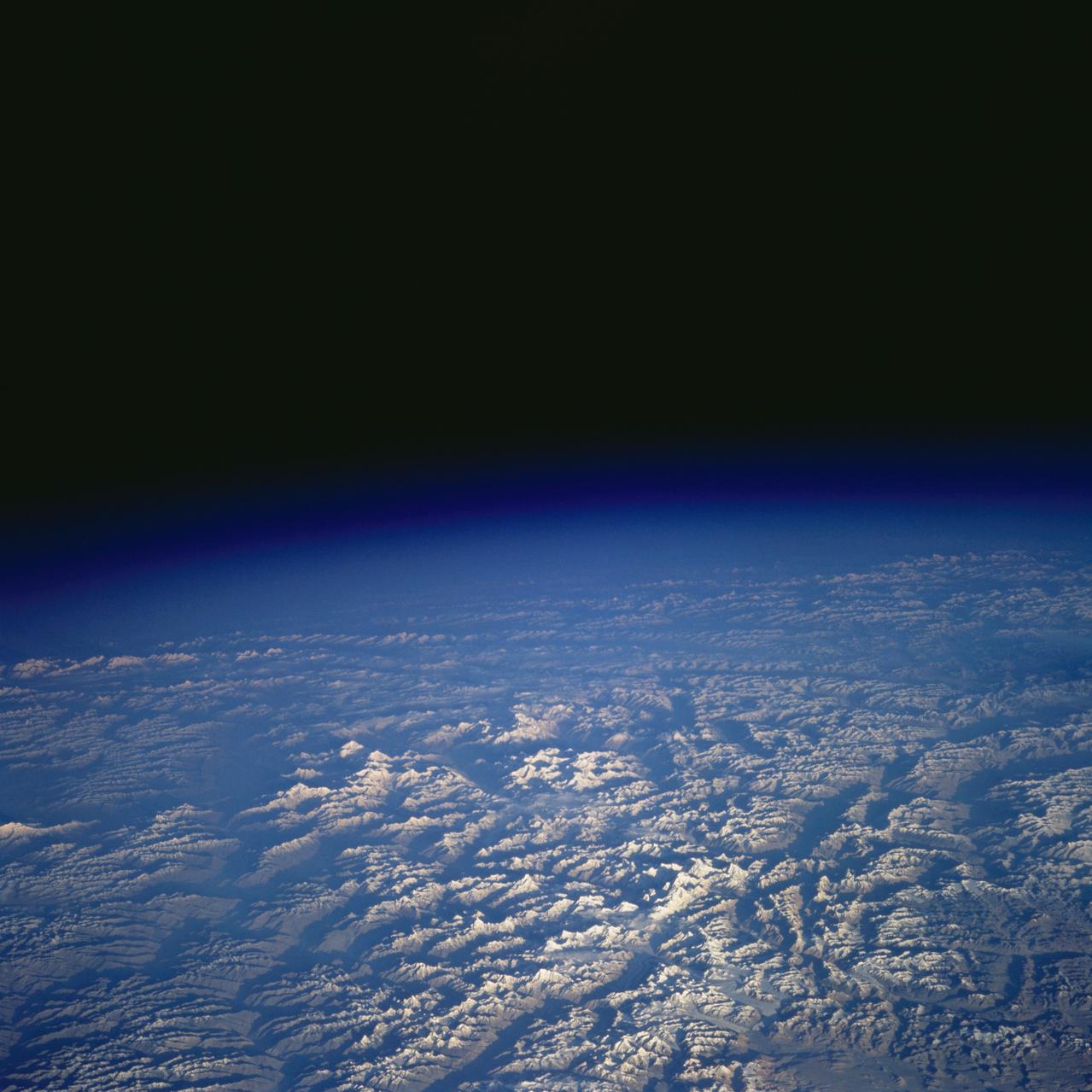
STS058-78-021 (18 Oct-1 Nov 1993) --- A clear three-dimensional view of the Karakorum Range. This northwestern extension of the Himalaya contains glaciated peaks having elevations of 7,000 to 8,000 meters.
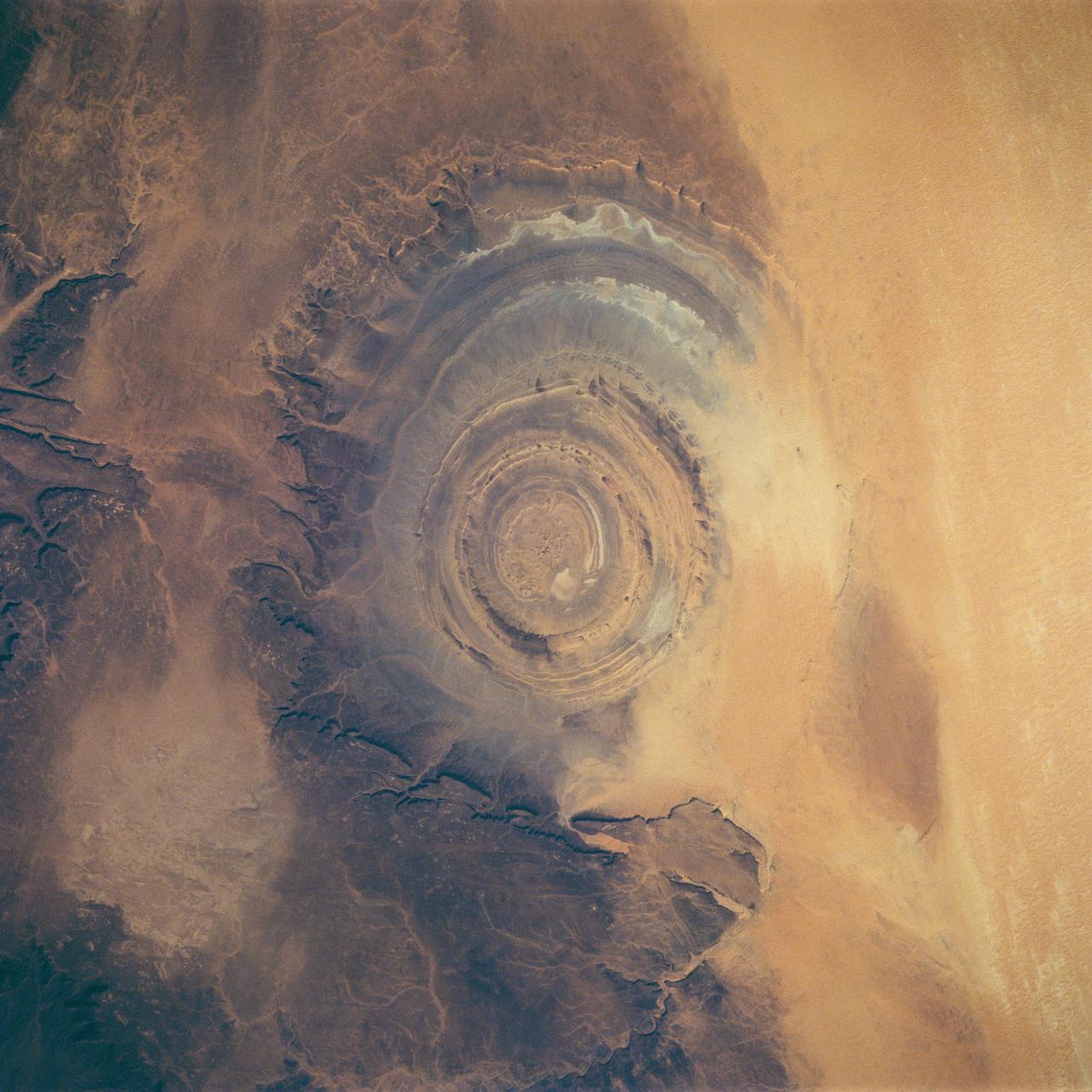
STS058-88-017 (18 Oct-1 Nov 1993) --- The eye-catching "bullseye" of the Richat Structure adds interest to the barren Gres de Chinguetti Plateau in central Mauretania, northwest Africa. It represents domally uplifted, layered (sedimentary) rocks that have been eroded by water and wind into the present shape. Desert sands have invaded the feature from the south. The origin of the structure is unknown. It is not an impact structure, because field work showed that strata are undisturbed and flat-lying in the middle of the feature, and no shock-altered rock could be found. There is no evidence for a salt dome or shale diapir, nor is there any geophysical evidence for an underlying dome of dense igneous rock having about the same density as the sedimentary layers.
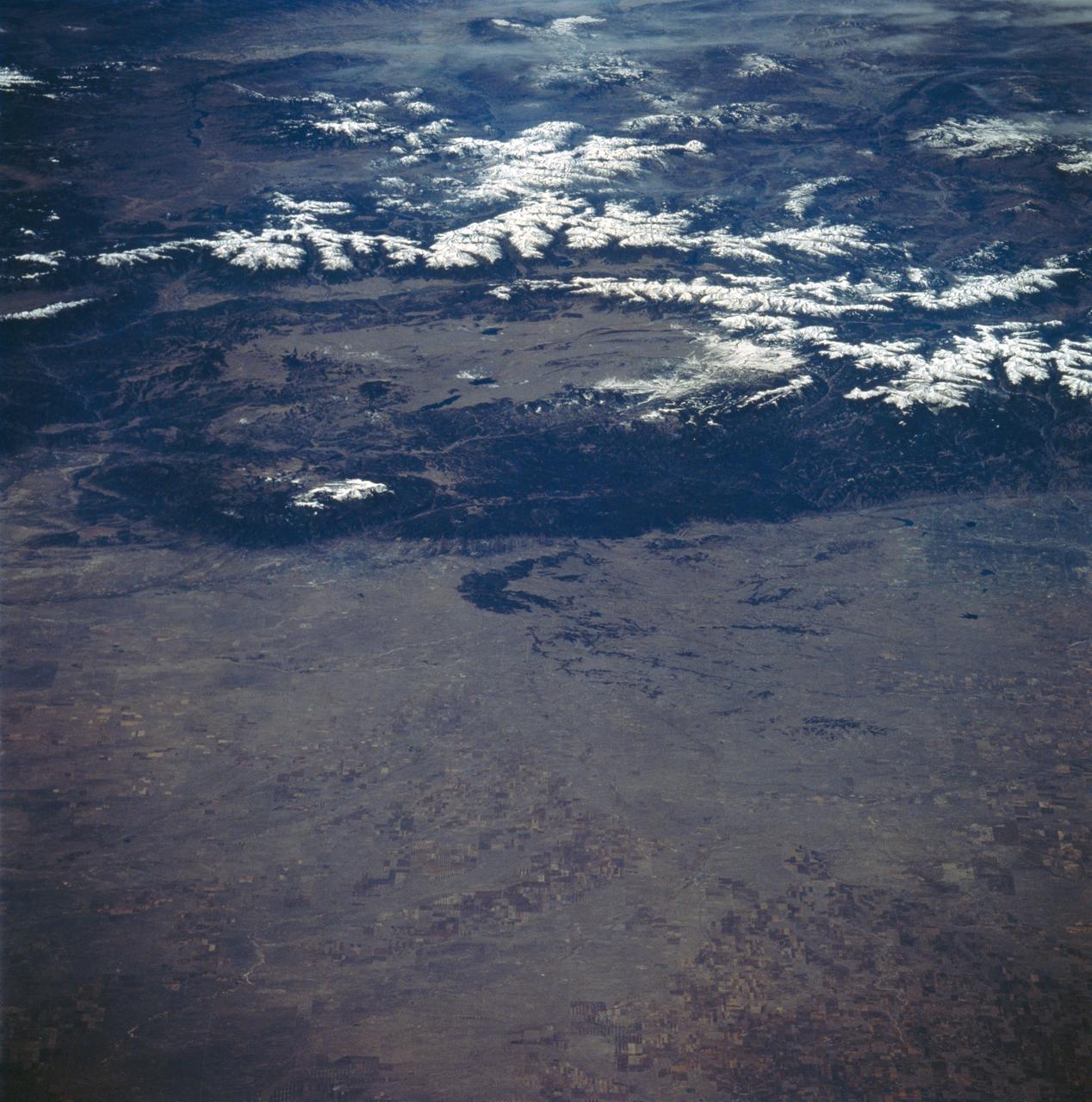
STS058-89-013 (18 Oct-1 Nov 1993) --- An oblique westward view, across the wheat fields and cattle pastures, of eastern Colorado to the Front Range of the Rocky Mountains. Denver is bisected at the center of the right edge of the frame. Pikes Peak and Colorado Springs are left of center, and the Arkansas River Valley with Canyon City and the Royal Gorge are along the left edge of the frame. This view shows the startling contrast between the nearly-flat High Plains and the ancient geological uplift of the Rockies.
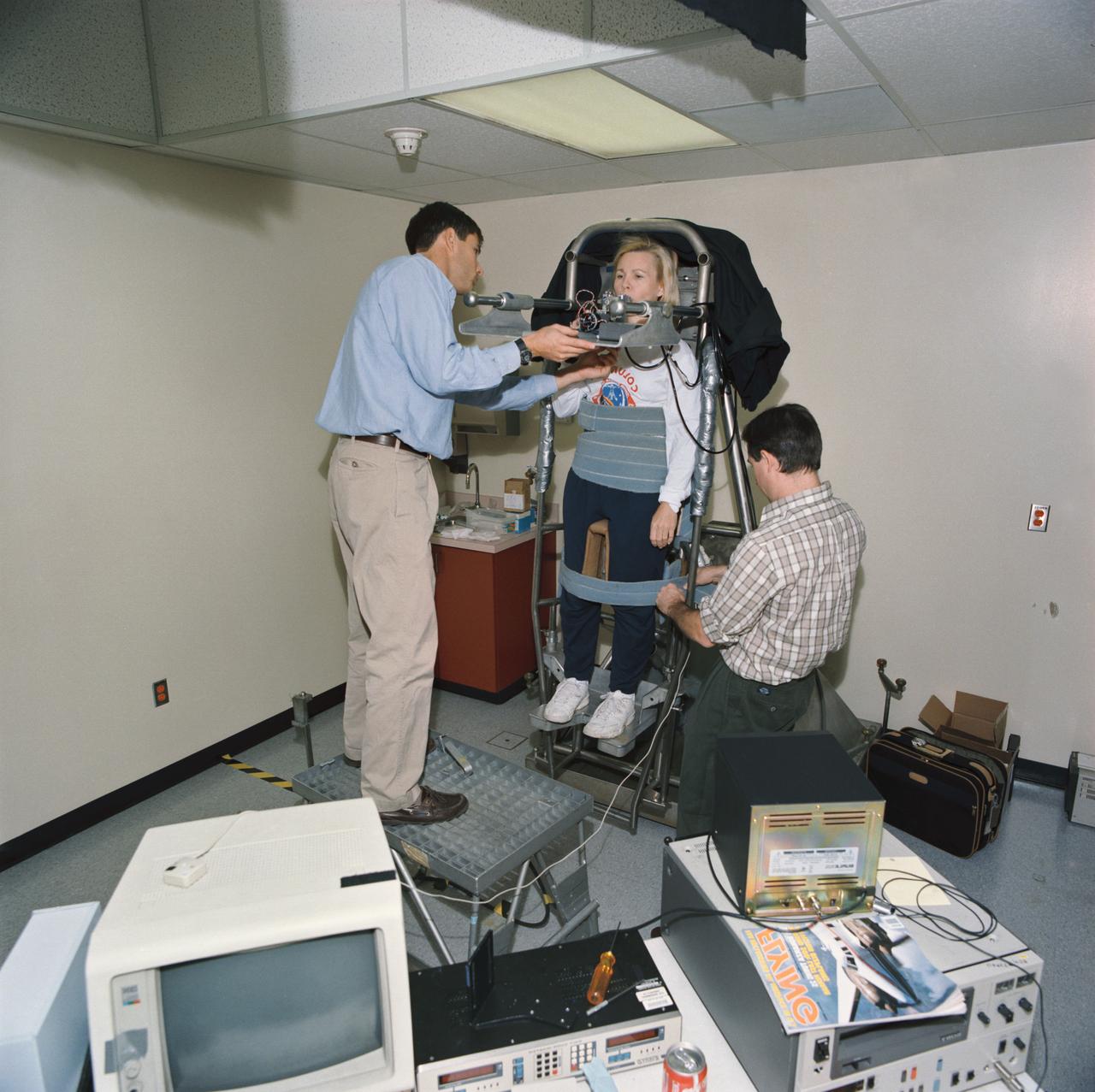
S93-45376 (29 Sept 1993) --- Astronaut Rhea Seddon, STS-58 payload commander, participates in data collection for neurovestibular functions. The data collection process was in preparation for the Spacelab Life Sciences (SLS-2) flight scheduled for next month.
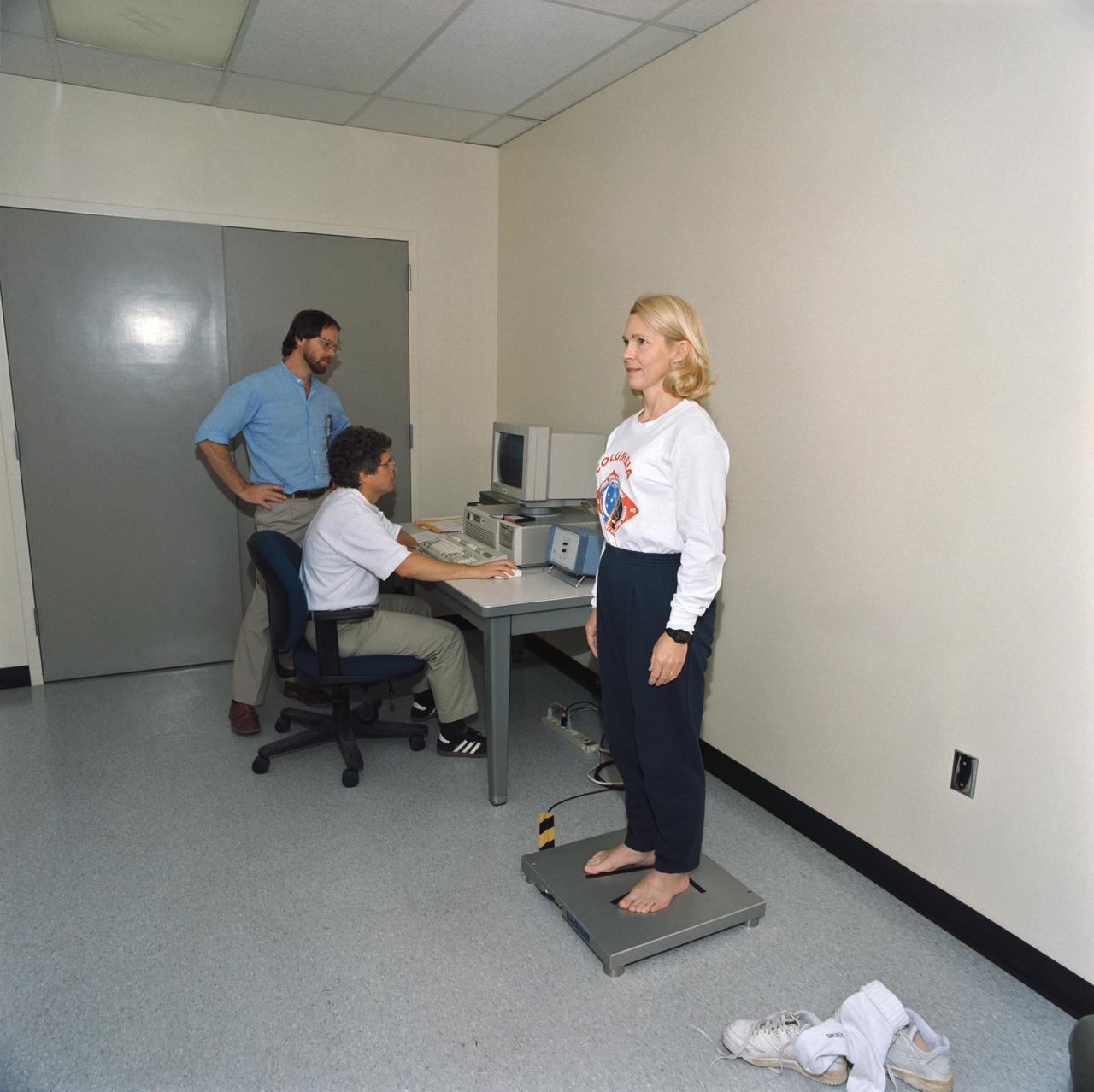
S93-45367 (29 Sept 1993) --- Astronaut Rhea Seddon, STS-58 payload commander, participates in biomedical data collection. The seven member crew spent an entire day recording important pre-flight data in preparation for the two week Spacelab Life Sciences (SLS-2) mission, scheduled for next month.
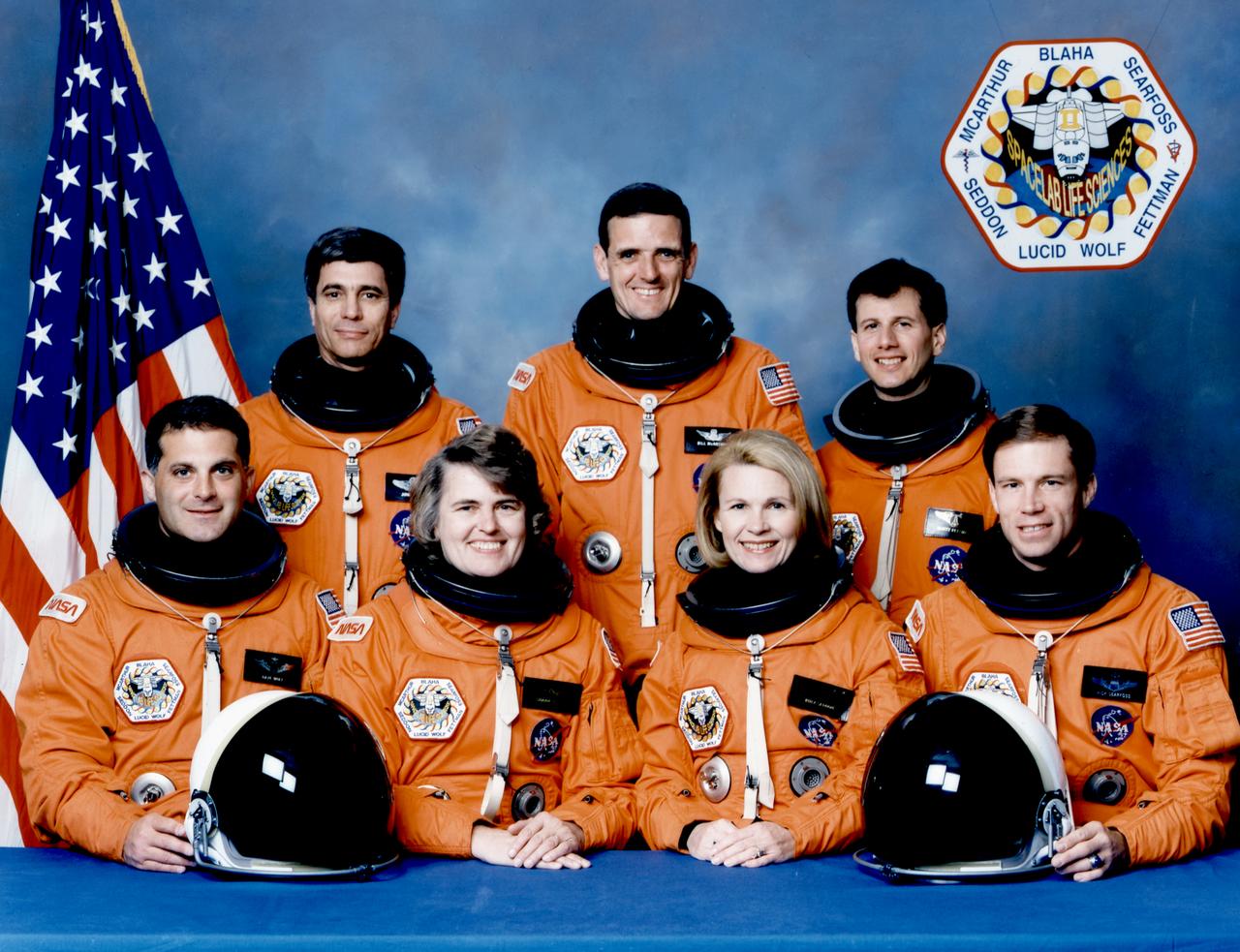
The STS-58 crew portrait includes astronauts (seated left to right) David A. Wolf, Shannon W. Lucid, and Rhea Seddon, all mission specialists; and Richard A. Searfoss, pilot. Standing in the rear, left to right, are John E. Blaha, commander; William S. McArthur, Jr., mission specialist; and Martin J. Fettmen, payload specialist. Launched aboard the Space Shuttle Columbia on October 18, 1993 at 10:53:10 a.m. (EDT), STS-58 served as the second dedicated Spacelab Life Sciences (SLS-2) mission.
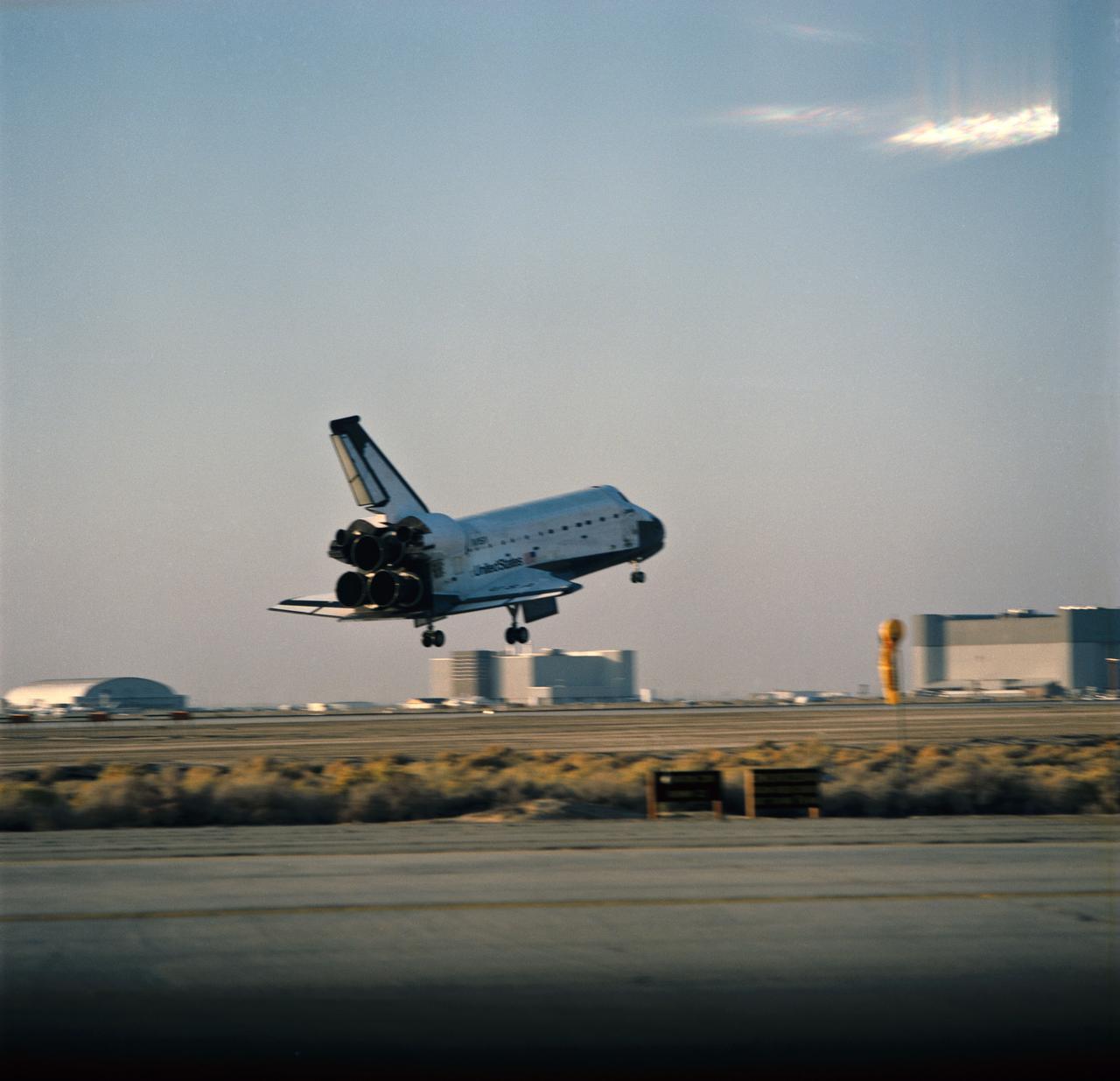
STS58-S-126 (1 Nov 1993) --- The Space Shuttle Columbia is about to touch down on the runway at Edwards Air Force Base (EAFB) in California. The landing, which occurred at 7:06 a.m. (PST), November 1, 1993, completed a two week mission in space devoted to medical research. Onboard the spacecraft were astronauts John E. Blaha, Richard A. Searfoss, Rhea Seddon, Shannon W. Lucid, David A. Wolf and William S. McArthur along with payload specialist Martin J. Fettman, DVM.
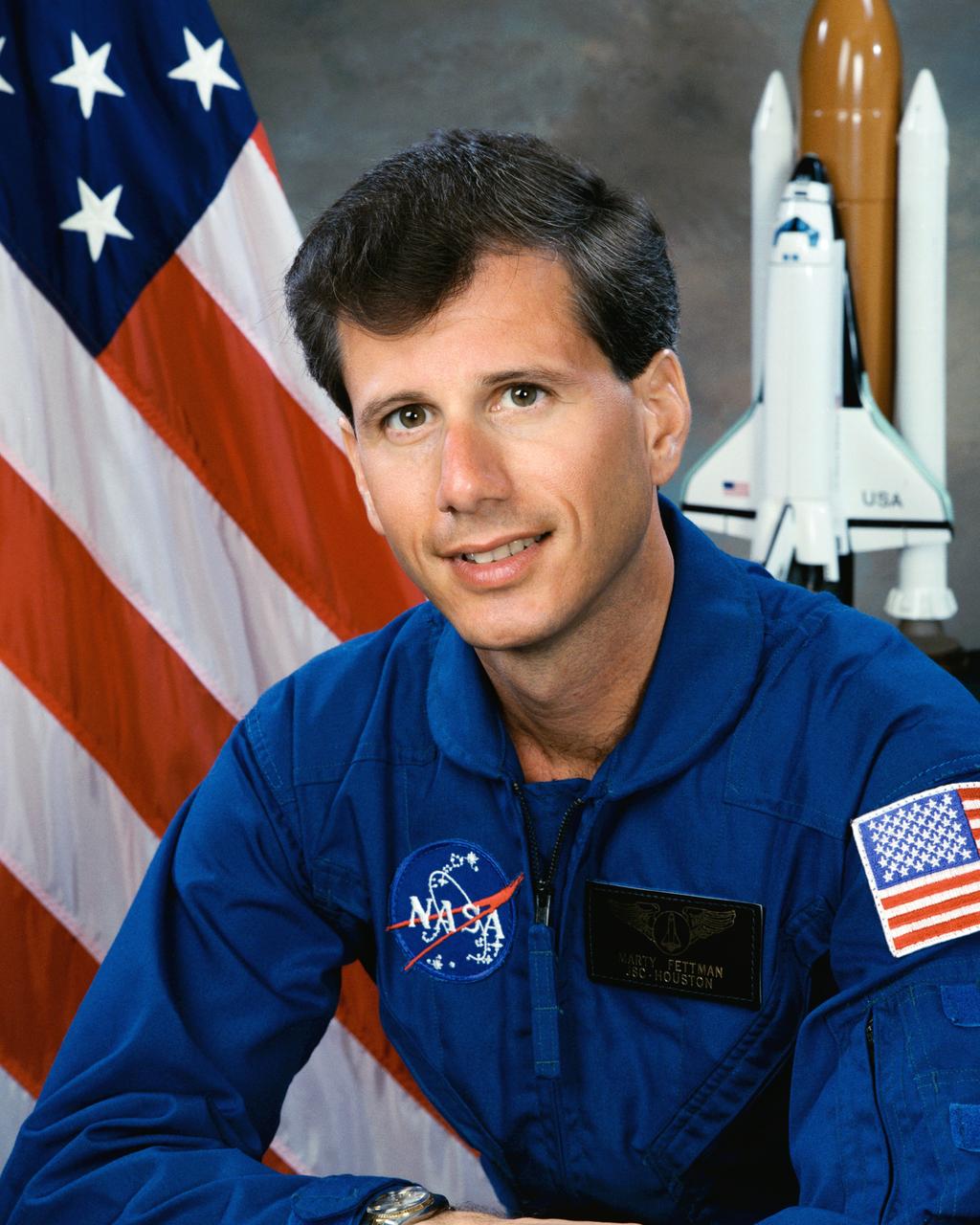
S92-48423 (October 1992) --- Astronaut Martin J. Fettman, payload specialist.
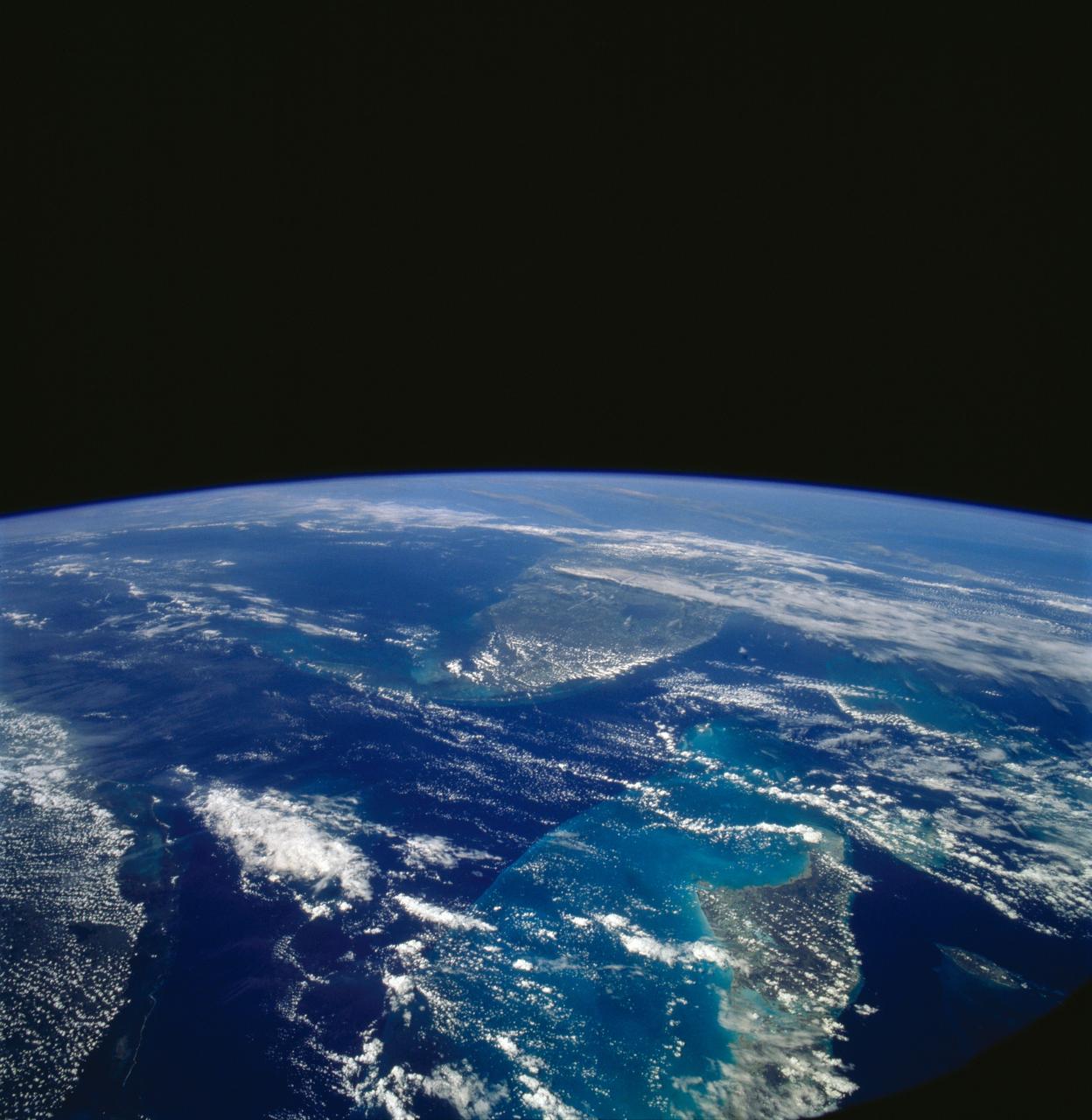
STS058-107-046 (18 Oct-1 Nov 1993) --- Clouds streak across central Florida in this striking photograph which includes the Florida Peninsula, Andros Island of the northern Bahamas and Cuba (lower left). The light blue, shallow bank of the Bahamas contrast with the deeper blue waters of the Florida strait. The city of Miami is obscured by clouds, but one can see the Florida Keys stretching off to the left. Much of the rest of the southeast coast is barely visible under haze.
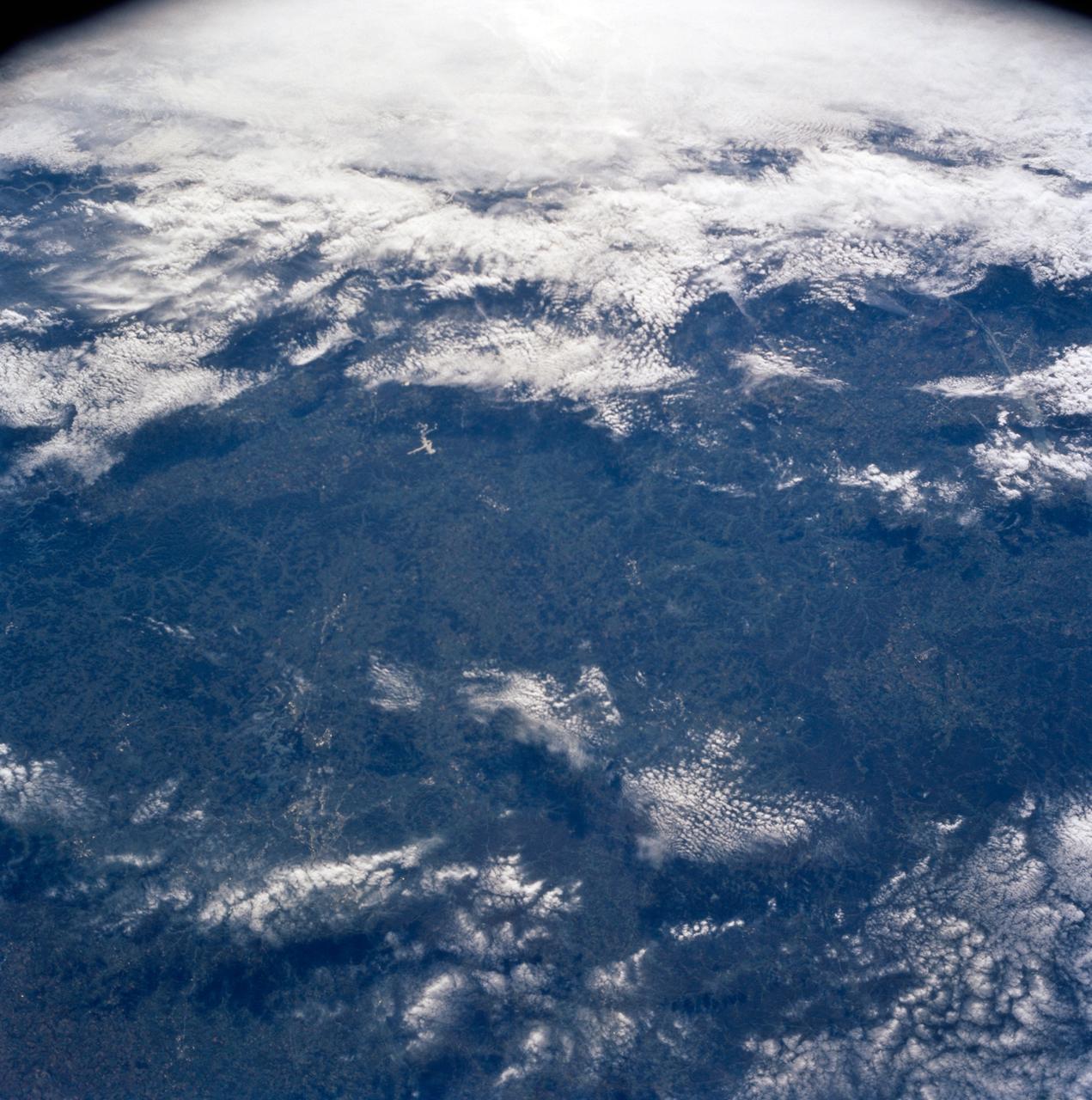
STS058-91-074 (18 Oct-1 Nov 1993) --- The largest cityscape in the view is Nashville (top left), part of which is obscured under a band of clouds (the Cumberland River, on which Nashville lies, can not be seen under the cloud band). Close to the main cloud mass on the opposite side of the view, lies a small lake (Normandy Lake in sunglint (right center) 70 miles southeast of Nashville. Between these two features, in the center of the Nashville Basin, lies the city of Murfreesboro. The city appears here as a spider like pattern one third the distance from Nashville towards Normandy Lake. The Tennessee River can be seen bottom right and top right through holes in the cloud.
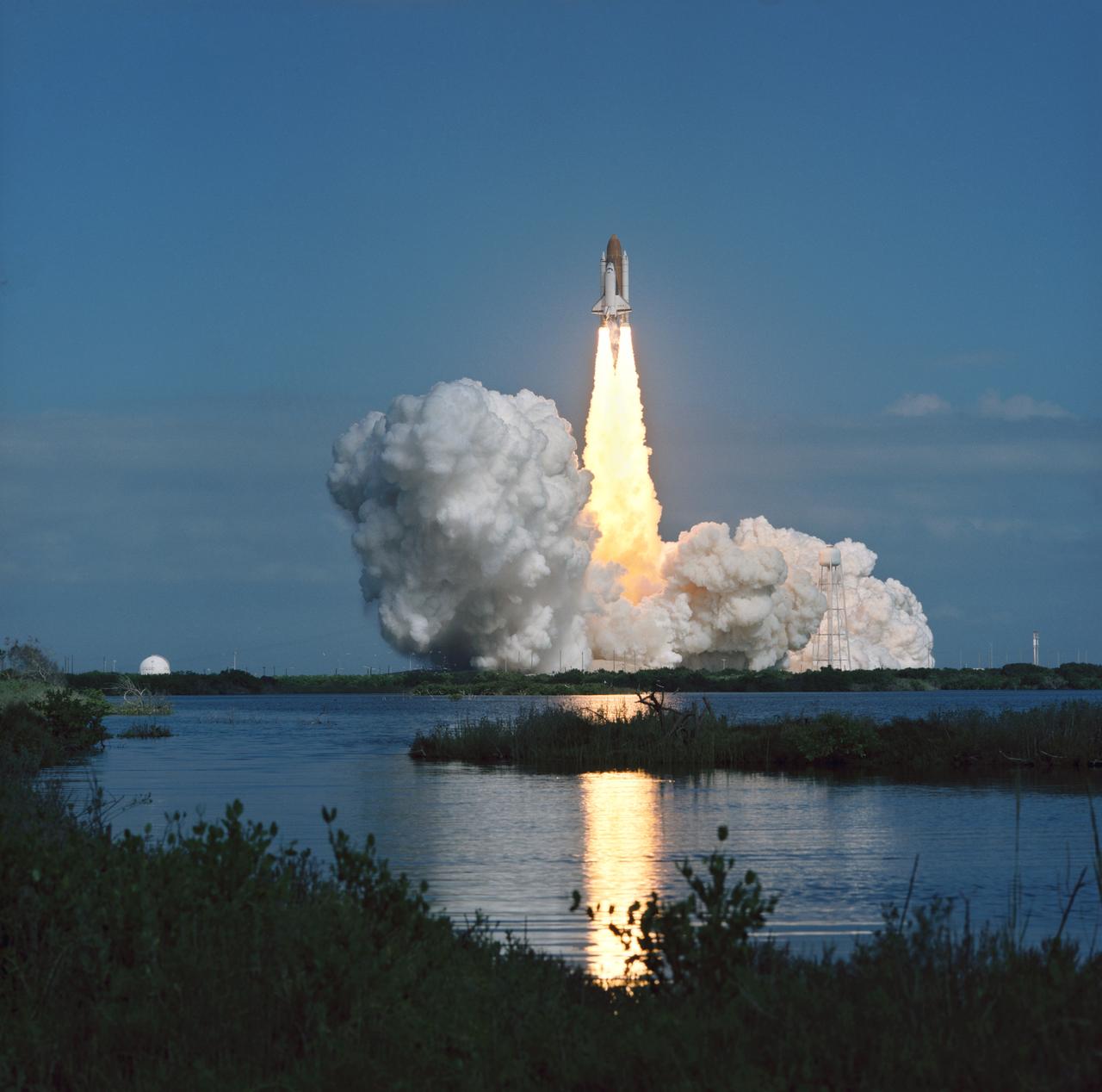
STS058-S-091 (18 Oct 1993) --- A distant shot shows the Space Shuttle Columbia, lifting off from Launch Complex 39 at Kennedy Space Center (KSC), reflecting its image in nearby marsh waters. Launch occurred at 10:53 a.m. (EDT), October 18, 1993. Along with six NASA astronauts and a veterinarian from the private sector, the Spacelab Life Sciences-2 (SLS-2) science module was aboard. Onboard were astronauts John E. Blaha, Richard A. Searfoss, Rhea Seddon, Shannon W. Lucid, David A. Wolf and William S. McArthur along with payload specialist Martin J. Fettman.
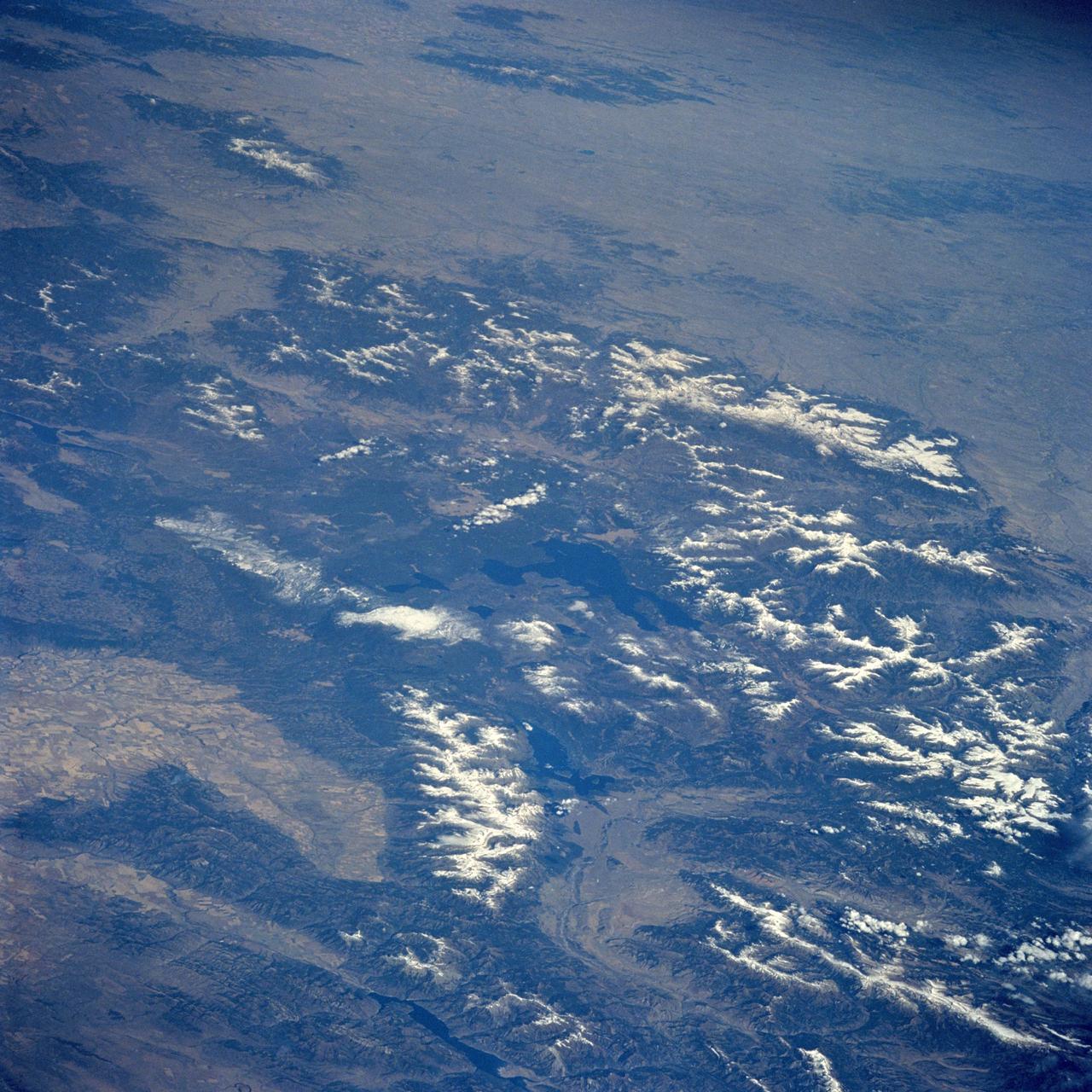
STS058-085-091 (18 Oct-1 Nov 1993) --- Yellowstone Lake and the surrounding Plateau are centered in this scene of northwestern Wyoming, and adjacent Idaho and Montana. The view extends across the Absaroka Range to Billings, on the Yellowstone River at the upper right edge of the photograph. Jackson Lake, Jackson Hole (valley) and the Grand Tetons extend from the Yellowstone Plateau toward the camera.
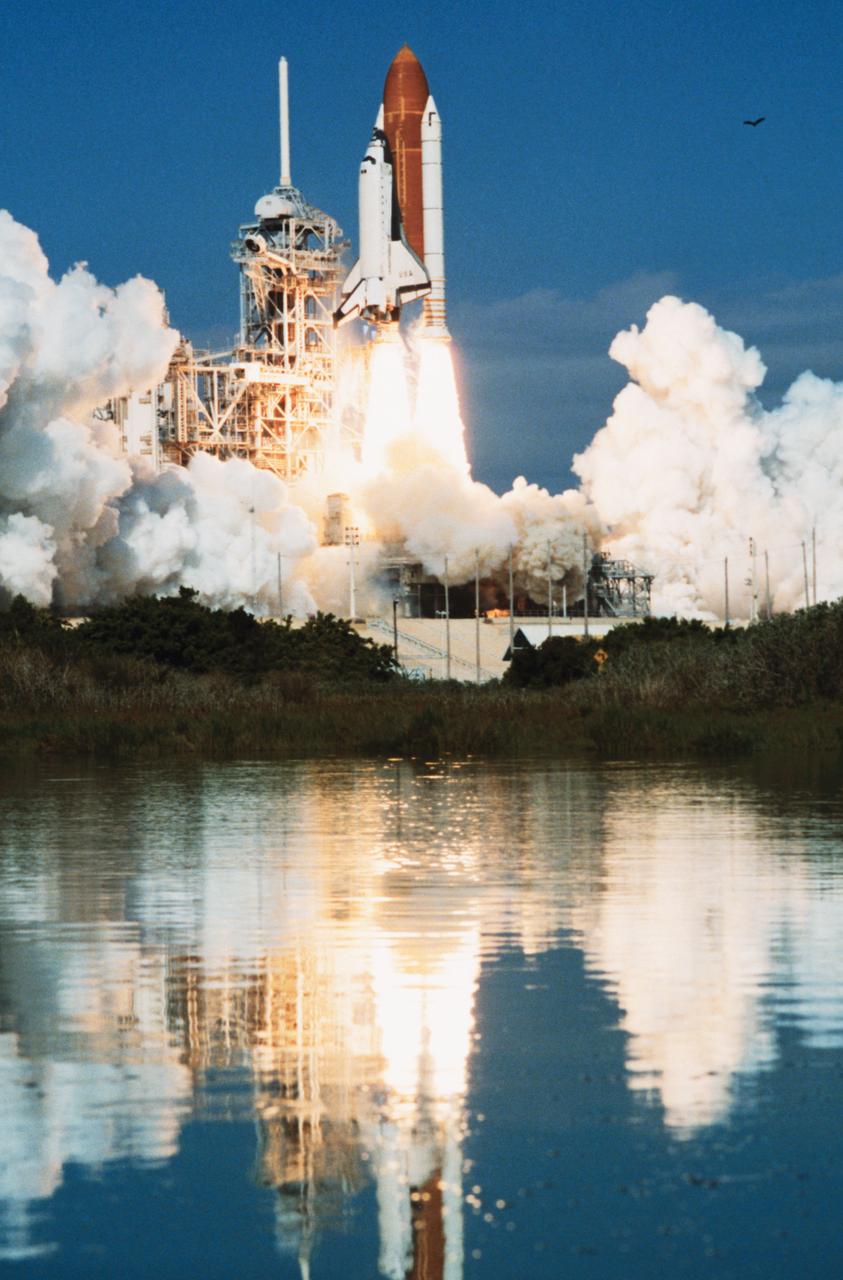
STS058-S-092 (18 Oct 1993) --- The Space Shuttle Columbia, with a crew of seven and a science module aboard, lifts off from Launch Complex 39 at Kennedy Space Center (KSC), leaving its reflection in nearby marsh. Launch occurred at 10:53 a.m. (EDT), October 18, 1993. Onboard were astronauts John E. Blaha, Richard A. Searfoss, Rhea Seddon, Shannon W. Lucid, David A. Wolf and William S. McArthur along with payload specialist Martin J. Fettman.
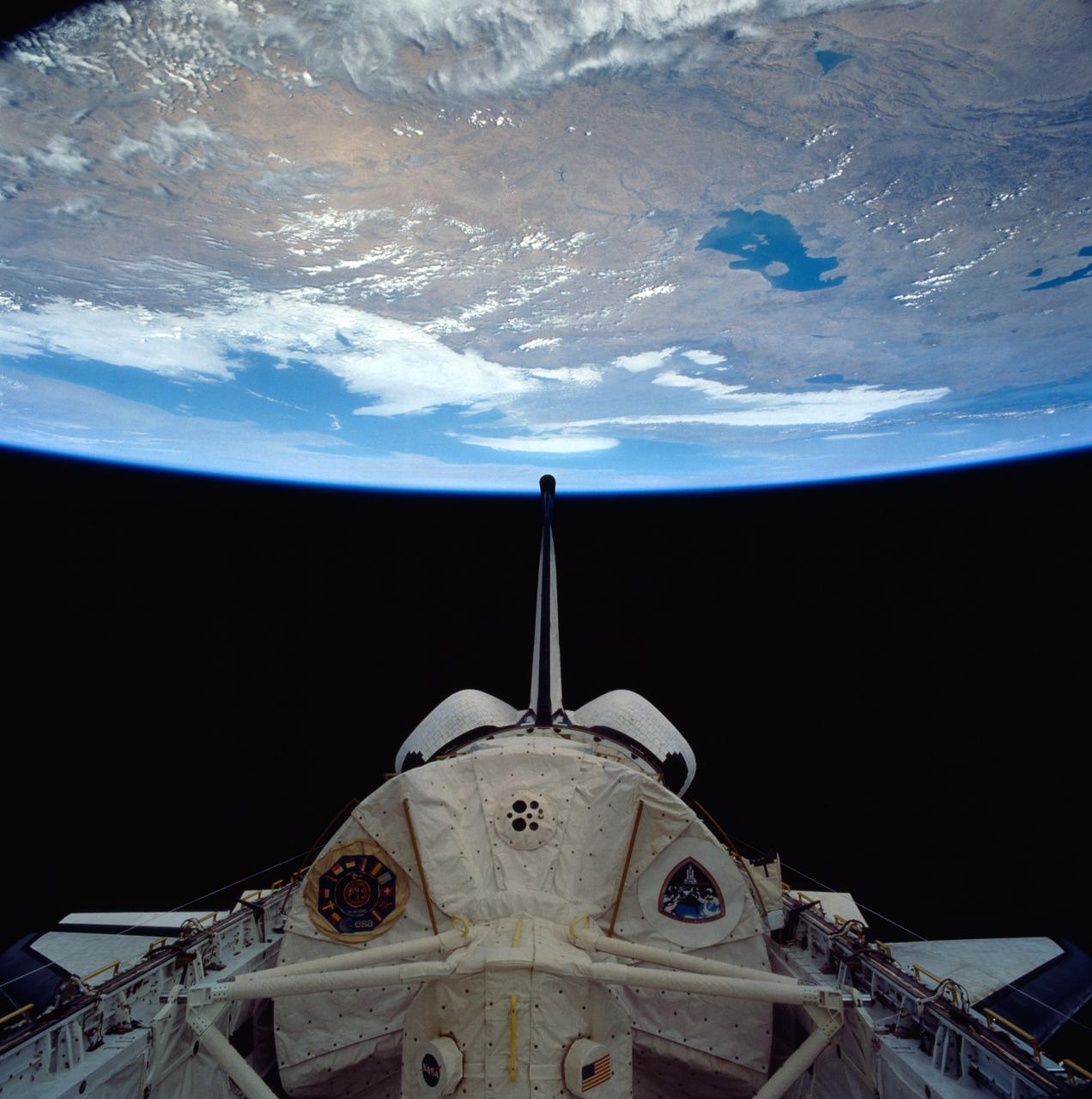
STS058-95-028 (18 Oct-1Nov 1993) --- Lake Urmia (Orumiyeh) in the high desert plateau of northwest Iran dominates the center of this northeast-looking view. The left edge of the view cuts Lake Van in eastern Turkey. The Caucasus Mountains in war-torn Georgia appear just beyond. Mount Ararat, of biblical fame, is a major peak north of Lake Van. The Caspian Sea, an international body of water, stretches across the top right of the view. Countries bordering the Caspian are Iran in the south, Kazakhstan in the west, and Russia and Azerbaijan in the west.
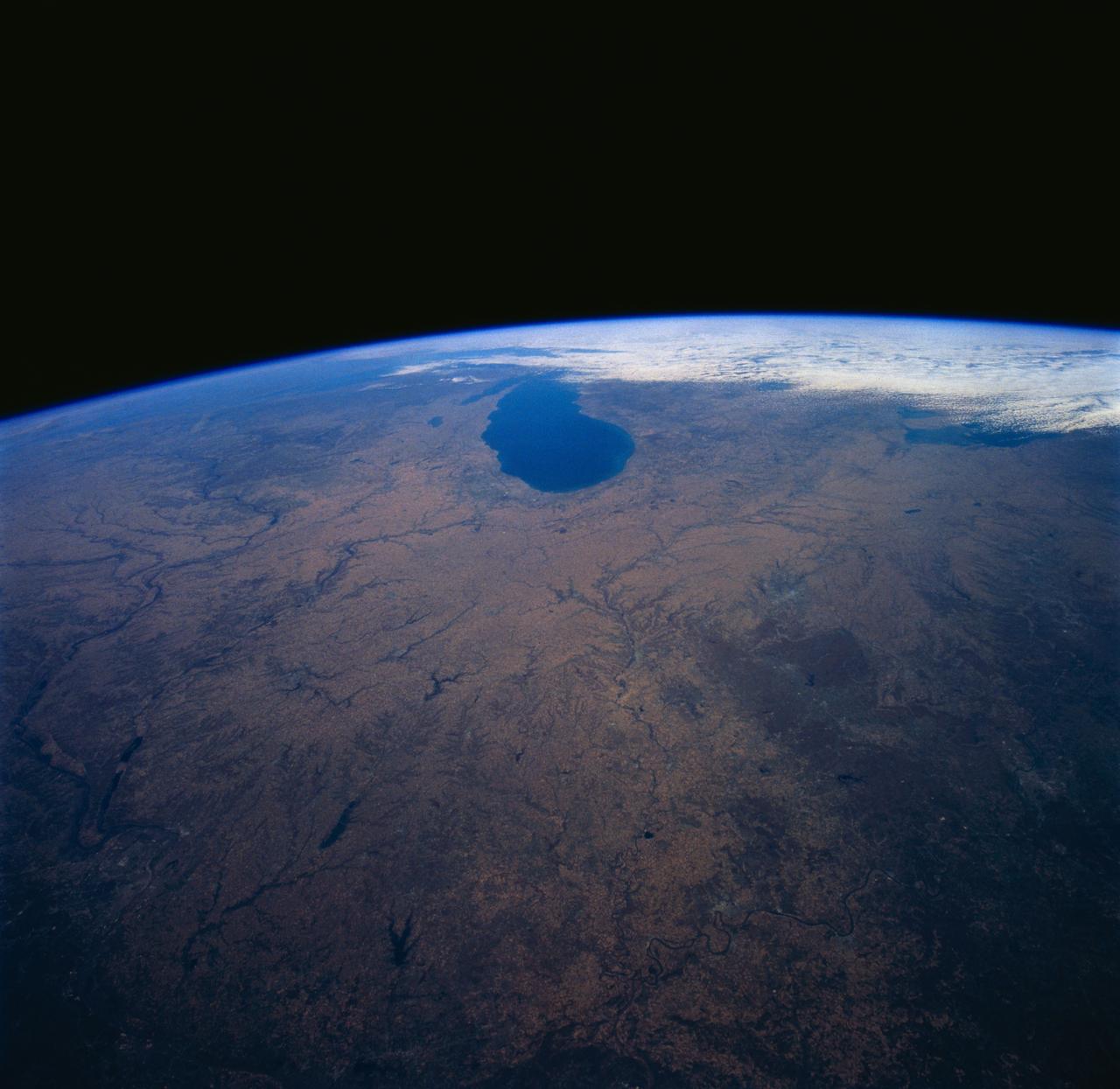
STS058-102-018 (18 Oct-1 Nov 1993) --- A cloud-free, wide-angle view from above western Tennessee to the northern edge of Lake Michigan. The view extends from Saint Louis, Missouri near the lower left-hand corner, past Evansville, Indiana and Louisville, Kentucky to Cincinnati, Ohio. A range of hills covered by trees in Fall foliage extends from the Ohio River toward Lake Michigan, ending just southwest of Indianapolis, Indiana.
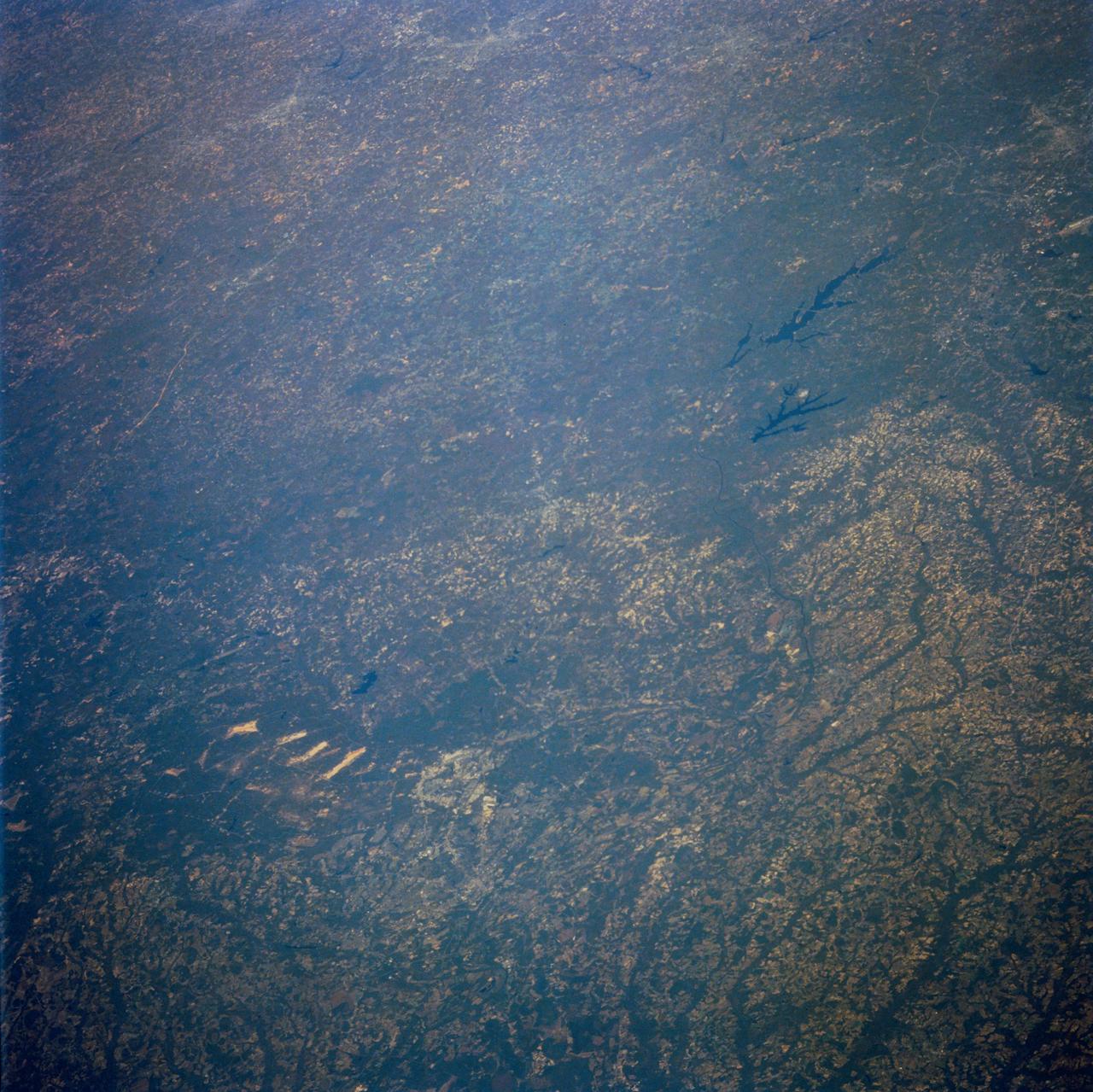
STS058-100-073 (18 Oct-1 Nov 1993) --- An unusually clear, northwestward view of central North Carolina shows the farms and timber of the inner coastal plain. The city of Fayetteville, and Fort Bragg to the west, is prominent at lower left center. The Research Triangle of Raleigh, Durham and Chapel Hill can be seen at upper right, upstream from Jordan Lake and Harris Lake on the New Hope River.
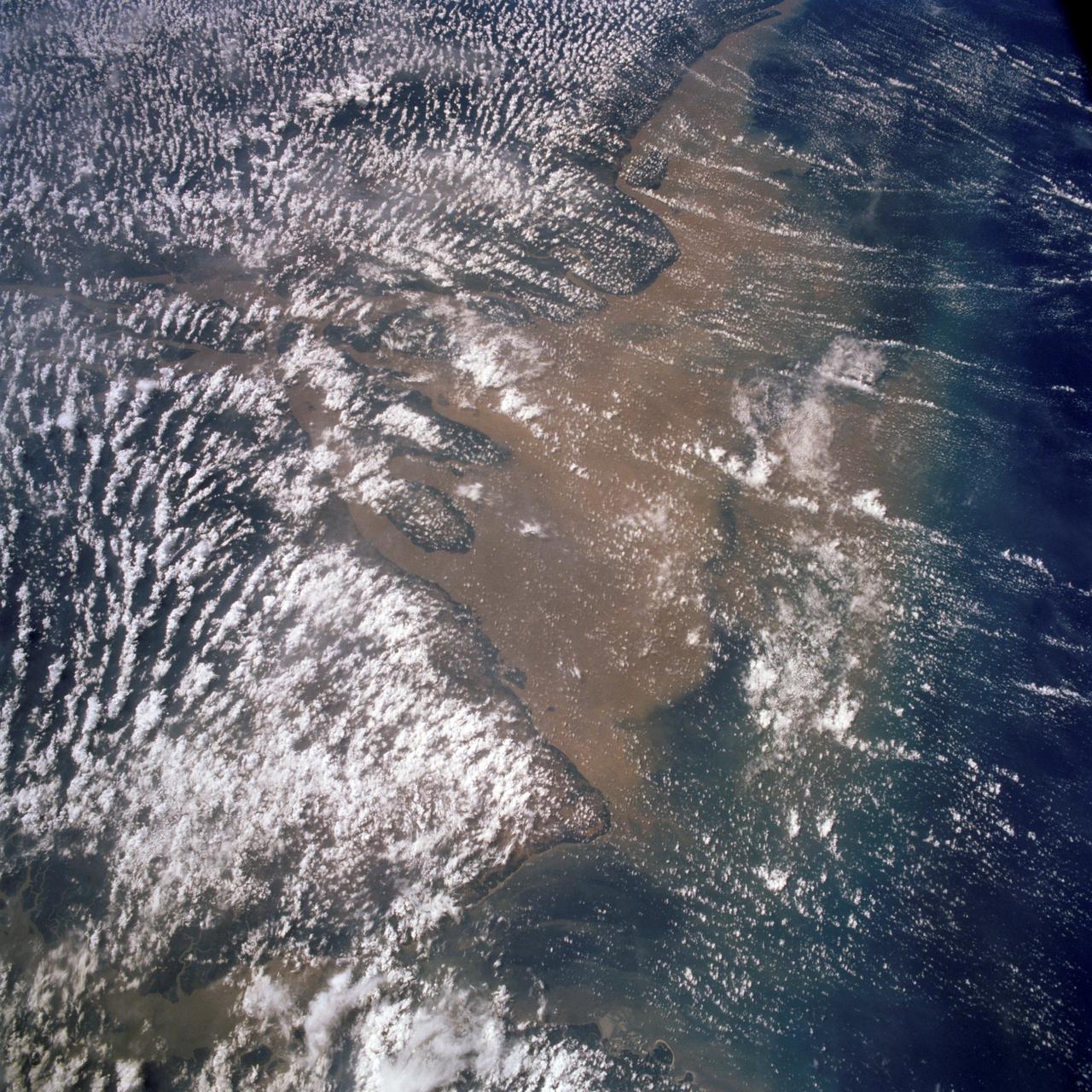
STS058-107-083 (18 Oct.-1 Nov. 1993) --- A near-nadir view of the mouth of the Amazon River, that shows all signs of being a relatively healthy system, breathing and exhaling. The well-developed cumulus field over the forested areas on both the north and south sides of the river (the view is slightly to the west) shows that good evapotranspiration is underway. The change in the cloud field from the moisture influx from the Atlantic (the cloud fields over the ocean are parallel to the wind direction) to perpendicular cloud fields over the land surface are normal. This change in direction is caused by the increased surface roughness over the land area. The plume of the river, although turbid, is no more or less turbid than it has been reported since the Portuguese first rounded Brasil's coast at the end of the 15th Century.
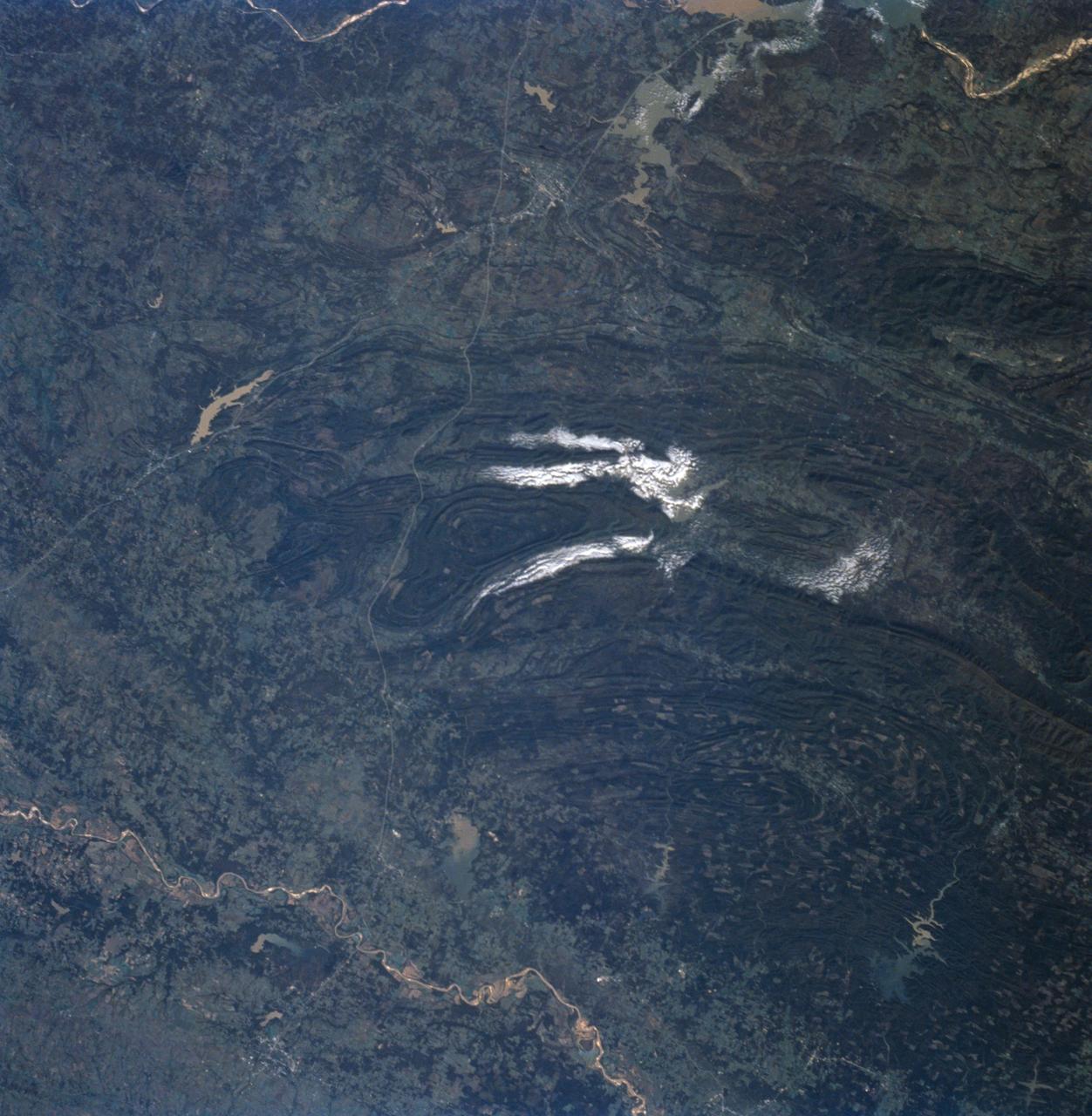
STS058-91-058 (18 Oct-1 Nov 1993) --- In this unusually clear view, the Ouachita Mountains of southeastern Oklahoma are framed on the north by Lake Eufaula on the South Canadian River, and on the south by the Red River. Sandstone, shale and chert (similar to flint) deposited in a sea several thousand feet deep were squeezed up to form the mountains about 250 million years ago. During the ensuing time, erosion of the western end of the Ouachita Mountains has emphasized linear ridges of resistant rock in the plunging anticlines and synclines, causing relief of 800 meters (2,600 feet) or more. Clouds formed by upslope winds border both the north and south sides of one of the most dramatic plunging synclines (in a syncline the rock layers dip toward the center of the structure). Toward the west, densely forested mountains give way to gently rolling, less rocky terrain and a drier climate which is better suited to farming. The mountains centered on Broken Bow, in the lower right corner of the scene, display abundant timber clearcuts that are being regenerated.
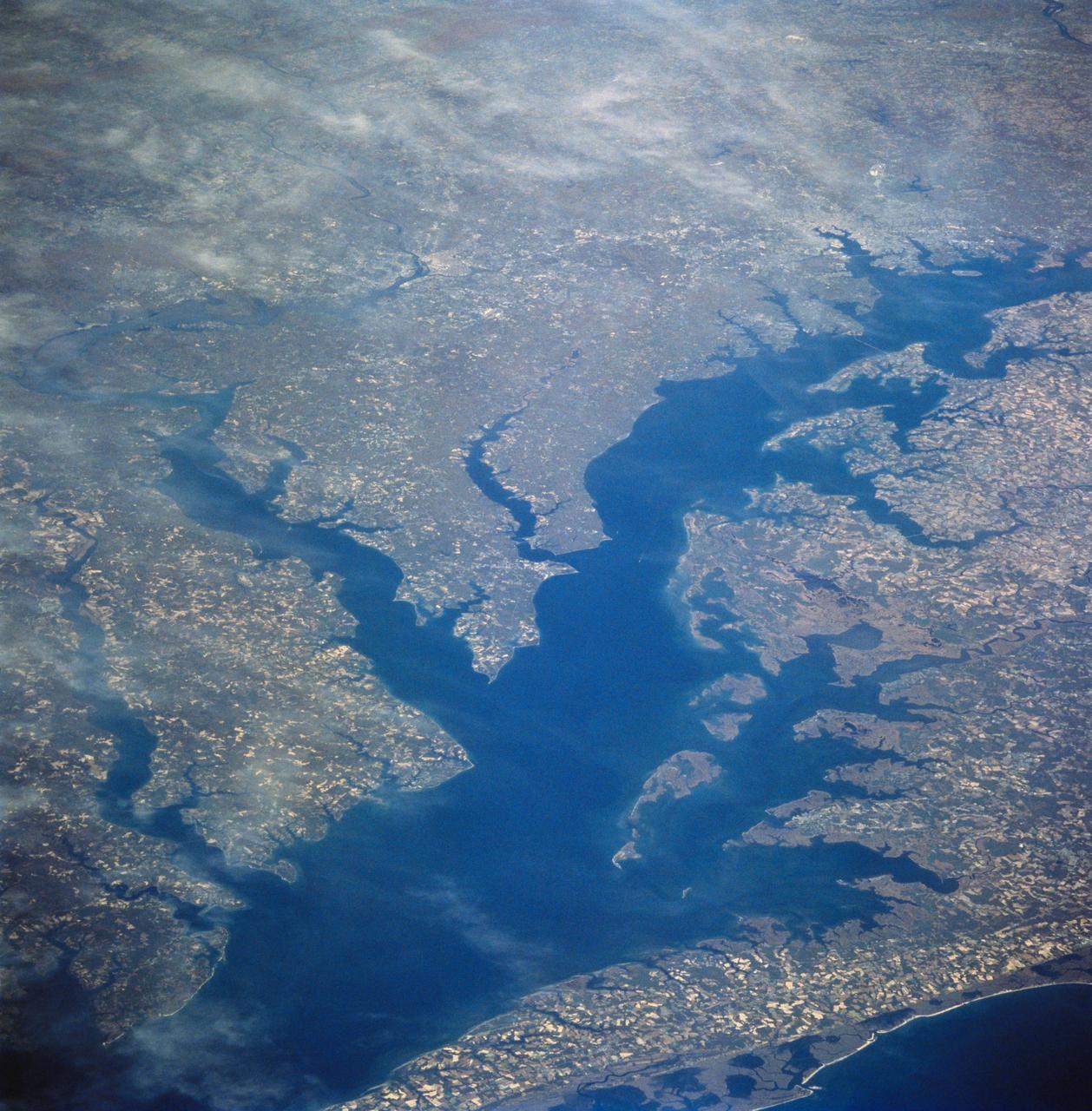
STS058-81-049 (18 Oct-1 Nov 1993) --- This view encompasses most of the large estuarine system of the Chesapeake Bay. The farmland and marshes of eastern shores of the Chesapeake (eastern Maryland and Virginia) are the foreground. The largest tributary flowing into the Bay is the Potomac River; Washington, D.C. is visible where the river bends to the northwest. The urban-suburban corridor between Washington, D.C. and Baltimore to the north (toward the right on this view) shows well as the gray zone which extends from left (D.C. on the Potomac) to right (Baltimore on the Patapsco River embayment on the Chesapeake, near the upper right).
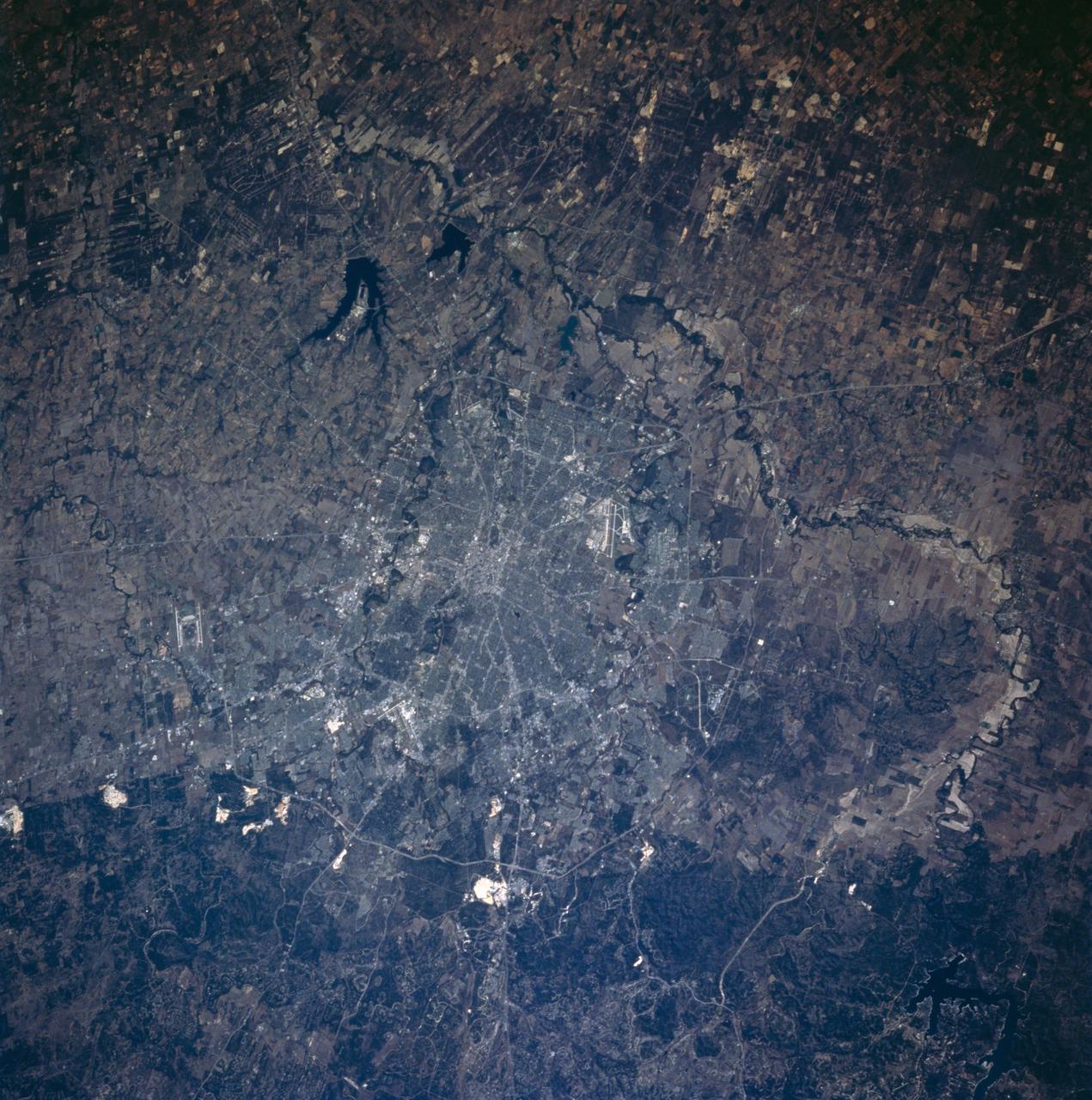
STS058-101-053 (18 Oct-1 Nov 1993) --- This sharp cloud-free photograph of San Antonio, Texas illustrates the classic pattern of western cities. The Hispanic heart of the city; an intertwining of streets along the San Antonio River and around the Alamo, surrounded by a late 19th century Anglo grid of small businesses and suburban homes. Transportation routes radiate to mid and late 20th Century ring corridors separating the urban/suburban region from the surrounding agricultural countryside. San Antonio was founded around permanent springs that rise at the foot of the Balcones Escarpment, which separates the Texas Hill Country from the South Texas Plains. Limestone quarries are conspicuous along the edge of the escarpment. San Antonio has long been a major site for military training bases: Randolph Air Force Base is outside the city to the northeast, Fort Sam Houston is contained within the northeast quadrant of the city, Brooks Air Force Base lies at the southeastern corner, and Lackland and Kelly Air Force Bases are within the suburban fringe to the southwest. San Antonio International Airport can be seen at the foot of the escarpment in the northern part of the city.
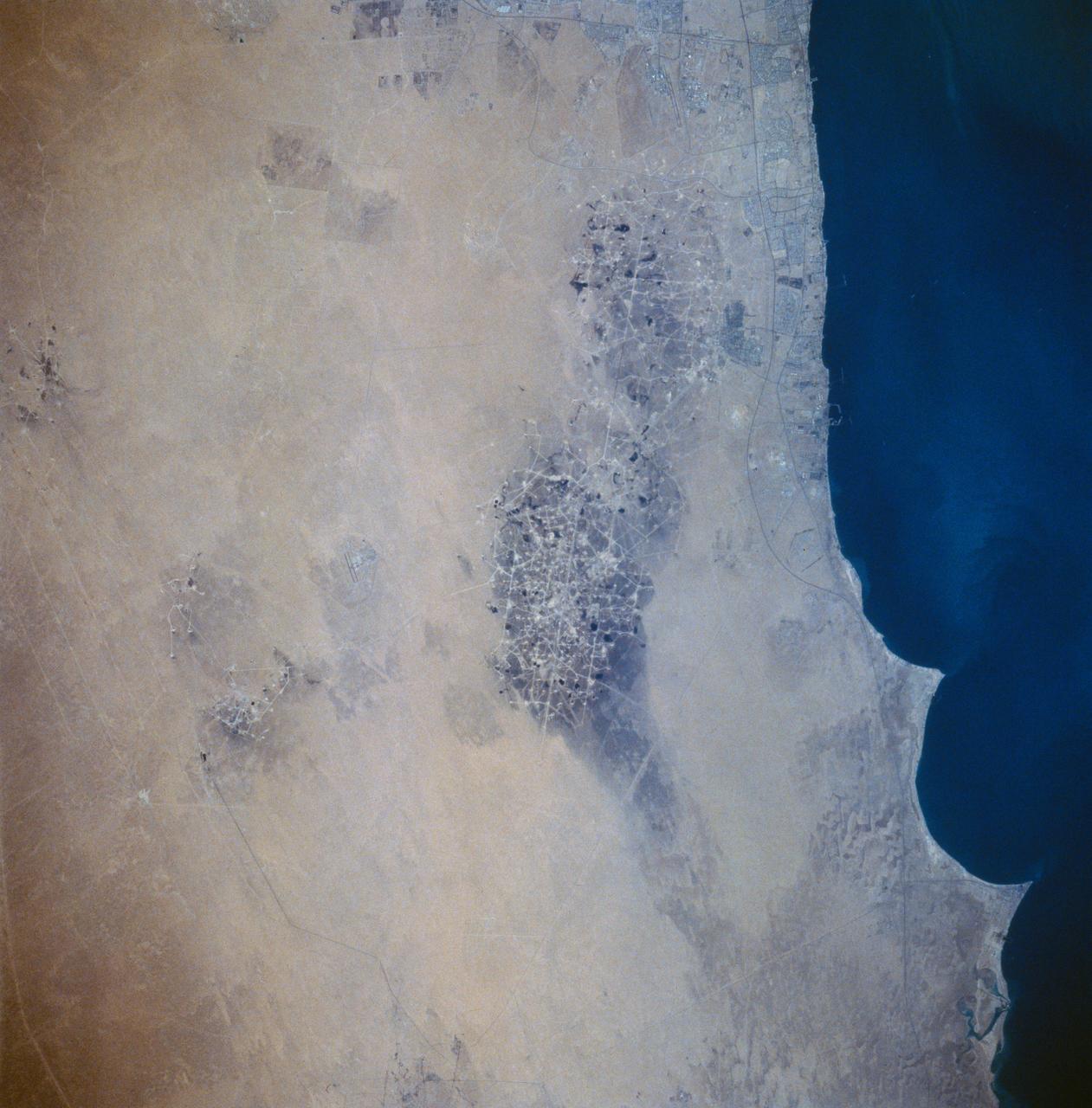
STS058-73-054 (18 Oct-1 Nov 1993) --- A clear view of the northern Kuwaiti coast shows the southern part of Kuwait City, and the major oil fields to the south. Oil-laden sands, where wells were set ablaze during the Gulf War in 1991, are visible south of Kuwait City as a dark, elongated patch surrounded by light-colored sand. Oil-stained sand between well sites (dots) and criss-crossing roads is gradually being covered by clean sand carried by strong, seasonal northwest winds.
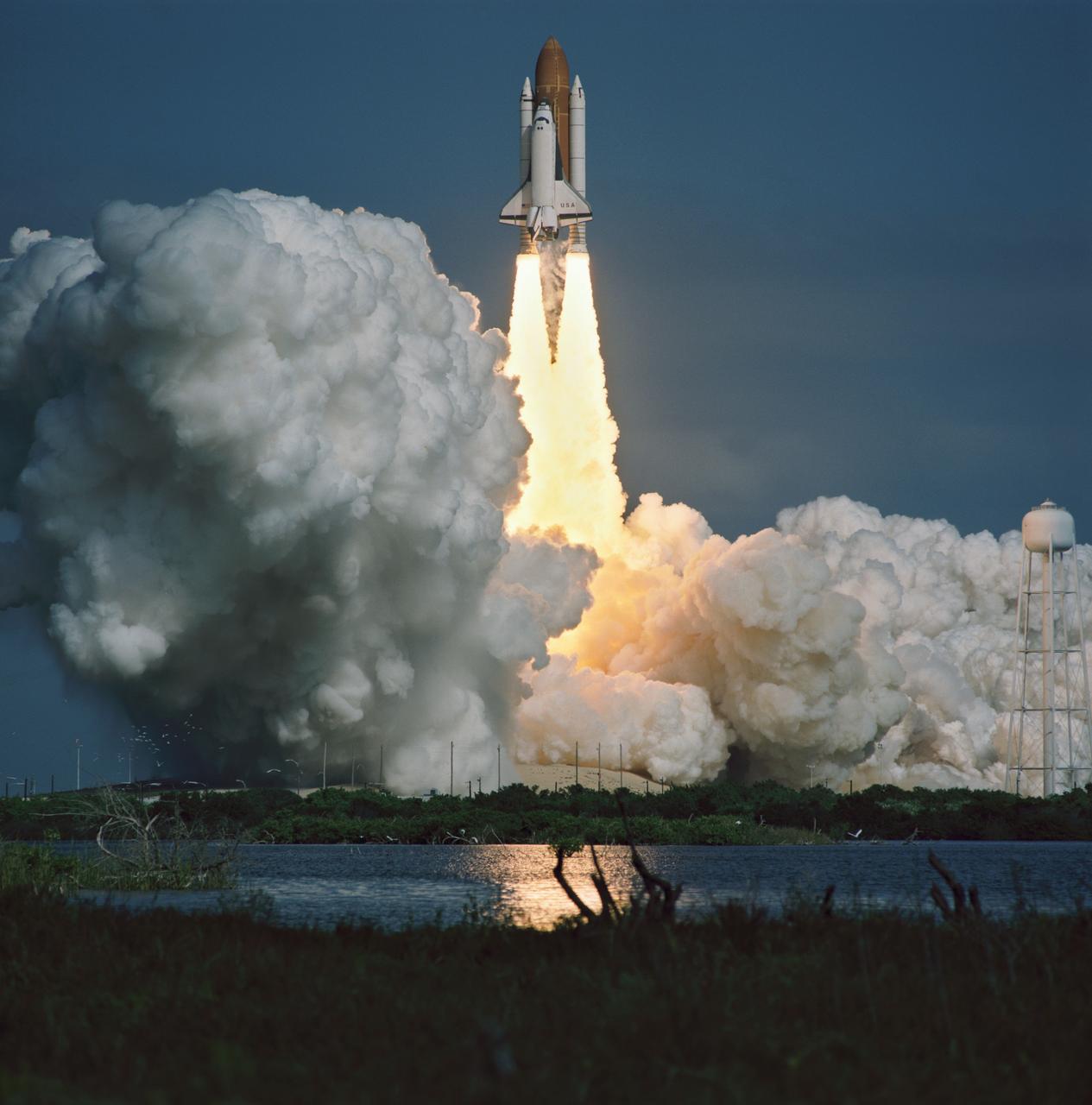
STS058-S-090 (18 Oct 1993) --- Creating large clouds of smoke the Space Shuttle Columbia lifts off from Launch Complex 39 at Kennedy Space Center (KSC). Liftoff occurred at 10:53 a.m. (EDT), October 18, 1993. Along with its Spacelab Life Sciences-2 payload, Columbia carries astronauts John E. Blaha, Richard A. Searfoss, Rhea Seddon, Shannon W. Lucid, David A. Wolf and William S. McArthur along with payload specialist Martin J. Fettman.
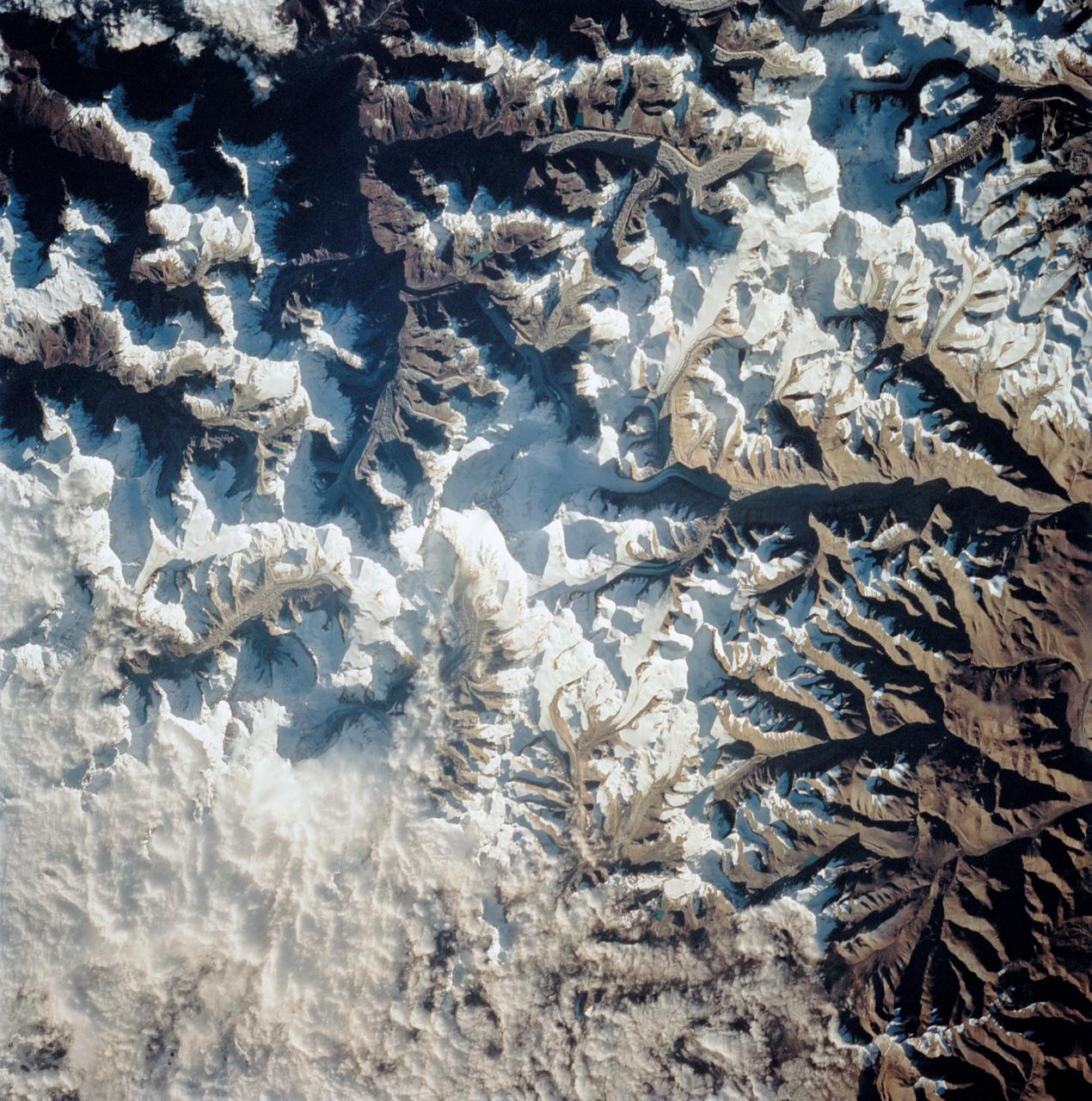
STS058-101-014 (18 Oct-1 Nov 1993) --- The best, most-nearly cloud-free, shuttle view yet of Mount Everest, the highest mountain in the world at 29,028 feet. The peak, on the border between Nepal and China, is almost exactly in the center of the photograph. The challenging North Face is in shadow; valley glaciers radiate in all directions from the central massif.
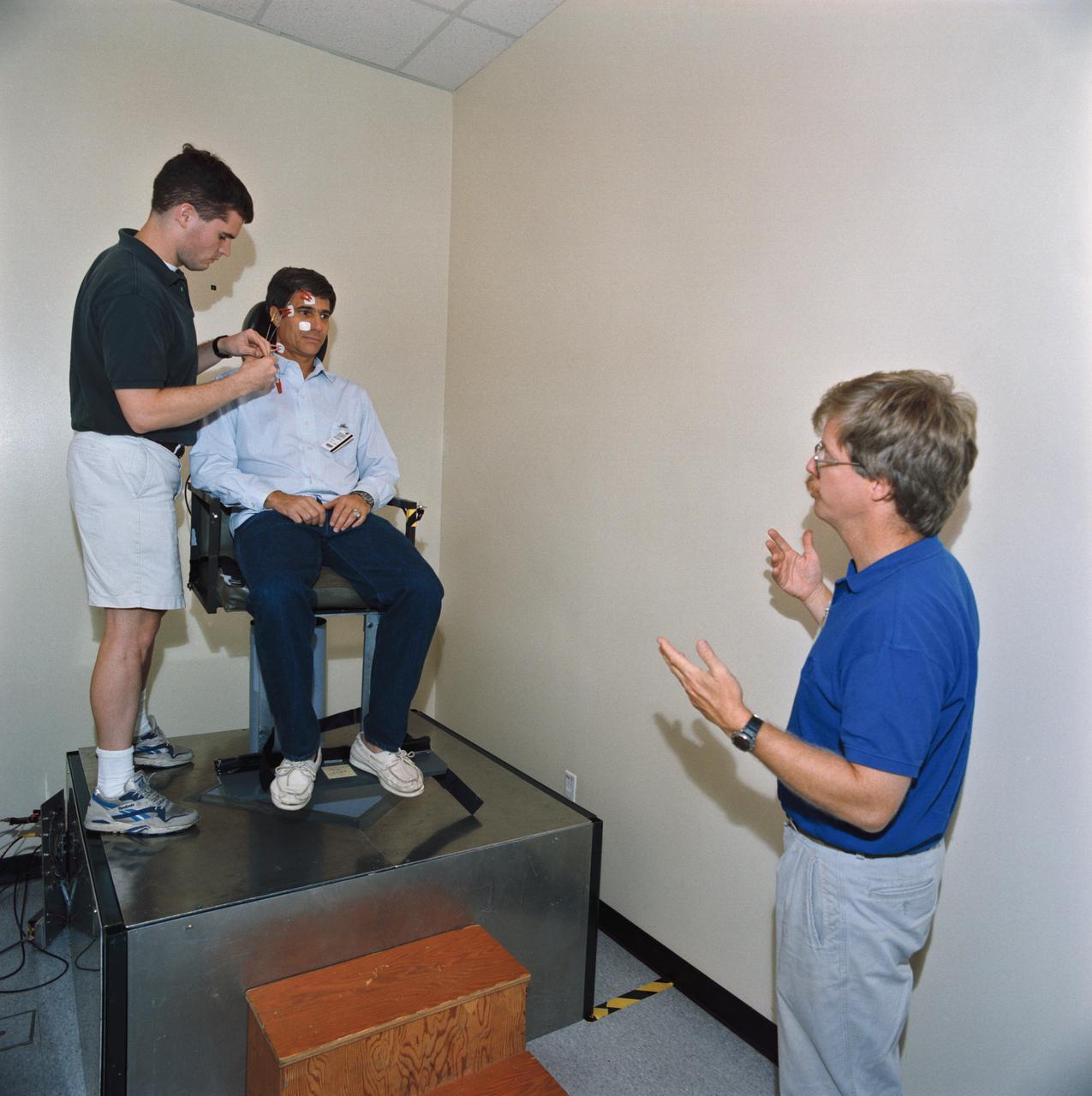
S93-45366 (29 Sept 1993) --- Astronaut John E. Blaha, STS-58 mission commander, sits in a training version of the rotating chair test device. Sensors are attached to Blaha's head and face to record responses to the rotation. Blaha was participating with five other NASA astronauts and a payload specialist for data collection and training in preparation for the two week Spacelab Life Sciences (SLS-2) mission.
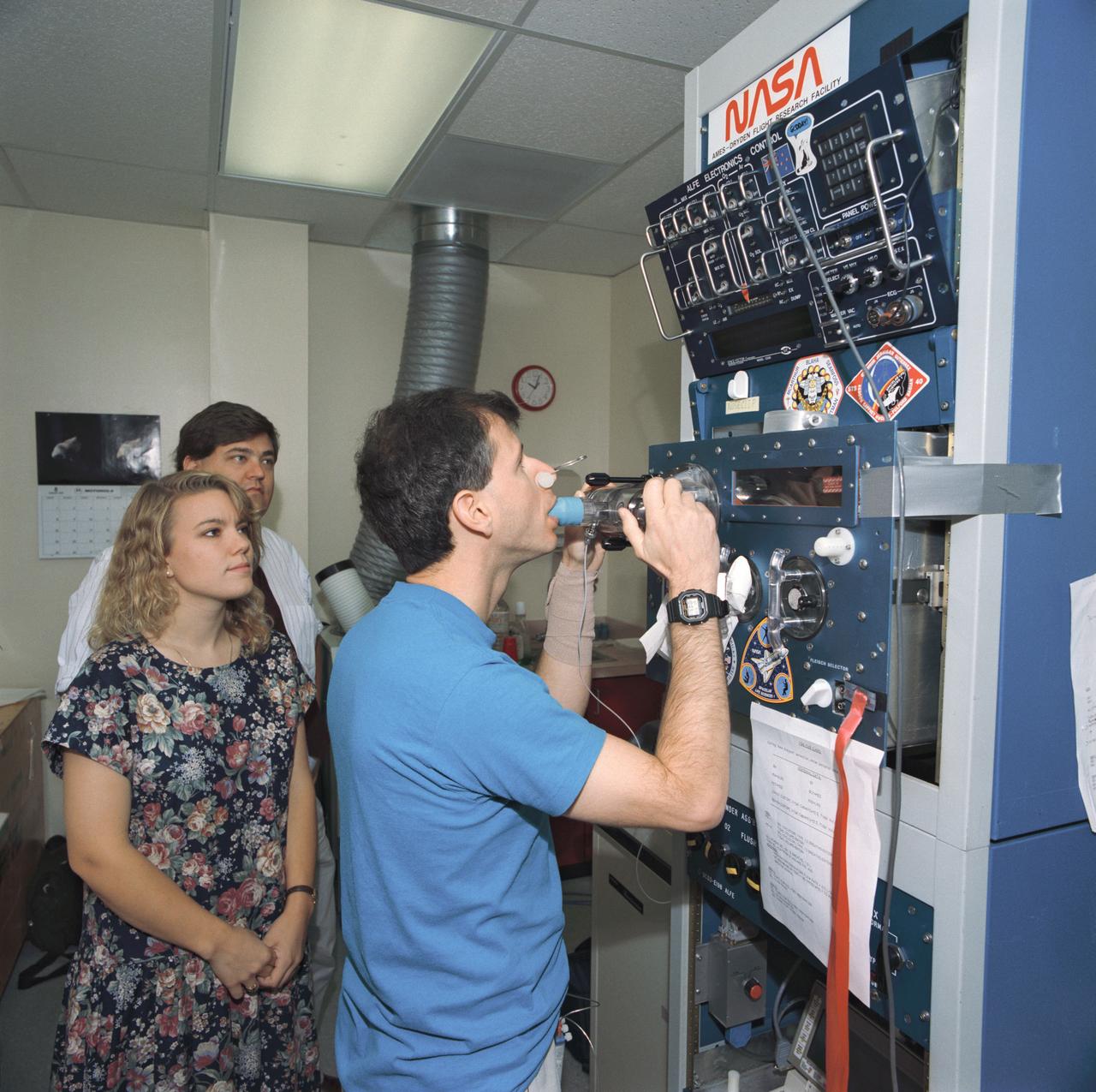
S93-45369 (29 Sept 1993) --- Training on the pre-breathing assembly, Martin J. (Marty) Fettman, DVM, inhales a predetermined gas composition. A gas analyzer mass spectrometer determines the composition of the gases he exhales. The re-breathing assembly and gas analyzer system are part of an investigation that explores how lung function is altered in space flight. The payload specialist for the Spacelab Life Sciences (SLS-2) mission was participating with six NASA astronauts, also assigned to STS-58, for data collection and training.
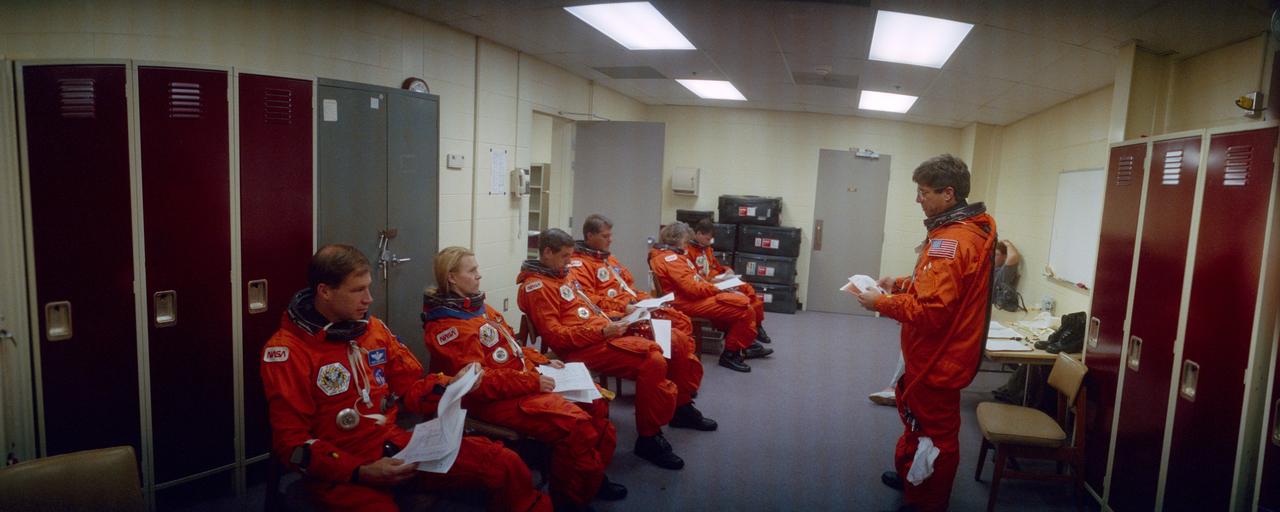
S93-38672 (20 July 1993) --- Wearing training versions of the partial pressure launch and entry garment, the STS-58 crewmembers prepare for a training exercise. After being briefed by astronaut John E. Blaha (right), mission commander, the group rehearsed contingency evacuation procedures. Most of the training session took part in the crew compartment and full fuselage trainers in the Space Shuttle mockup and integration laboratory.
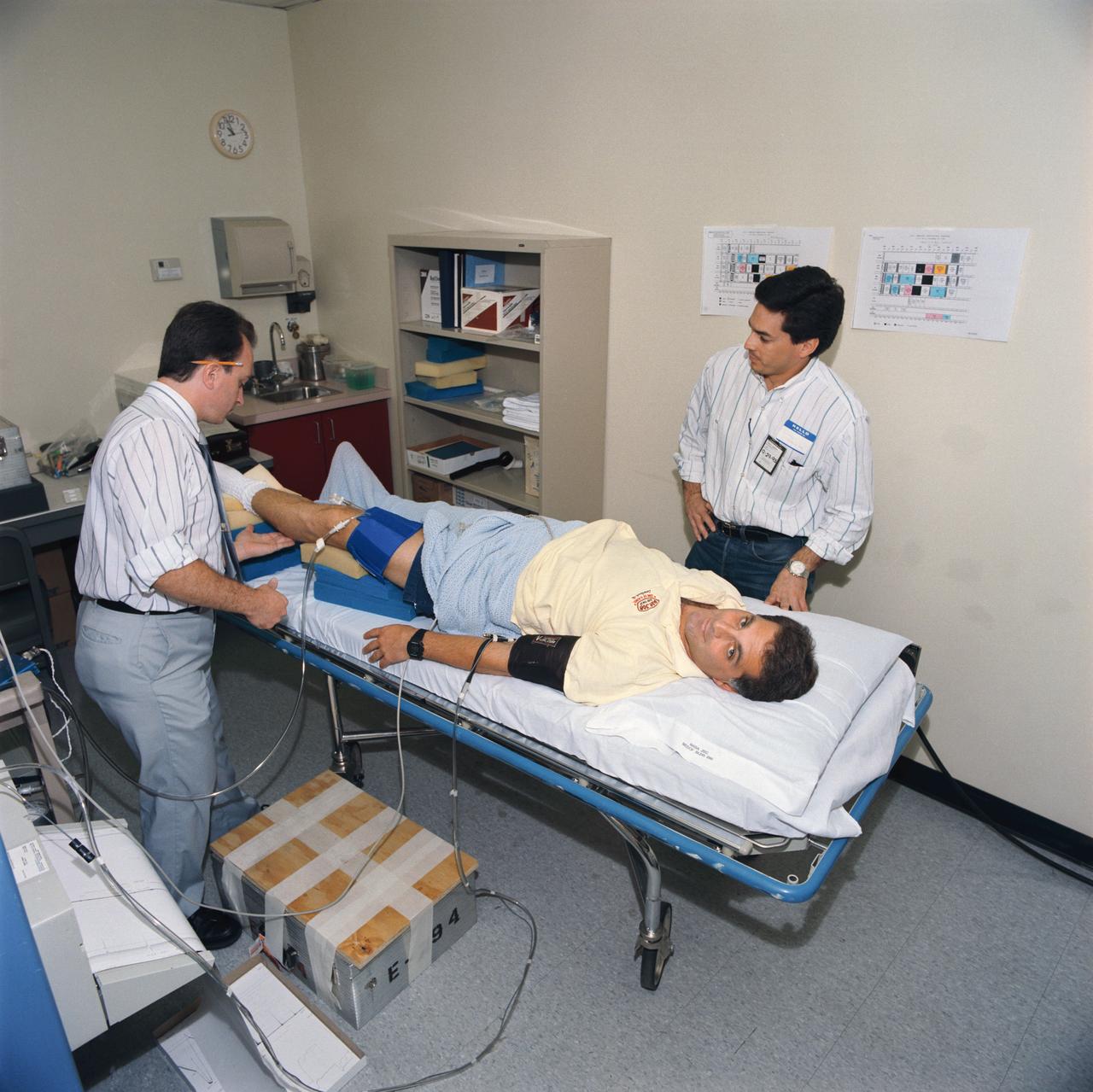
S93-45375 (29 Sept 1993) --- Astronaut David A. Wolf, STS-58 mission specialist, has blood drawn from his leg for volume measuring. The blood draw was part of the cardiovascular function data collection in preparation for the Spacelab Life Sciences (SLS-2) mission. The seven Spacelab Life Sciences crewmembers devoted a full day to miscellaneous biomedical data collection in preparation for next month's two week mission aboard Columbia.
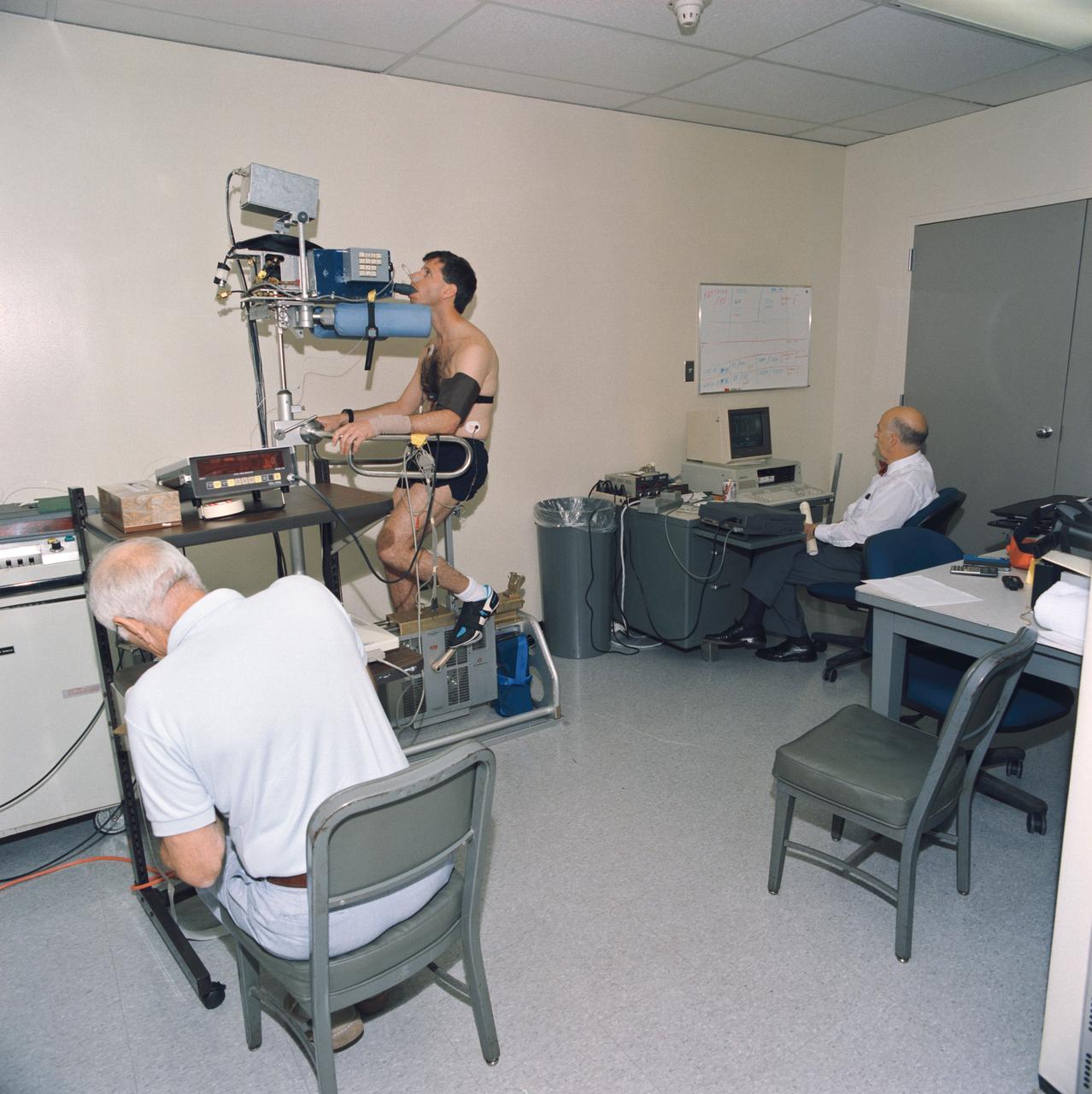
S93-45371 (29 Sept 1993) --- Astride the bicycle ergometer, Martin J. (Marty) Fettman, DVM, breathes quietly into the cardiovascular re-breathing unit during the resting phase of an experiment. The payload specialist for the Spacelab Life Sciences (SLS-2) mission was participating with six NASA astronauts, also assigned to STS-58, for data collection and training.
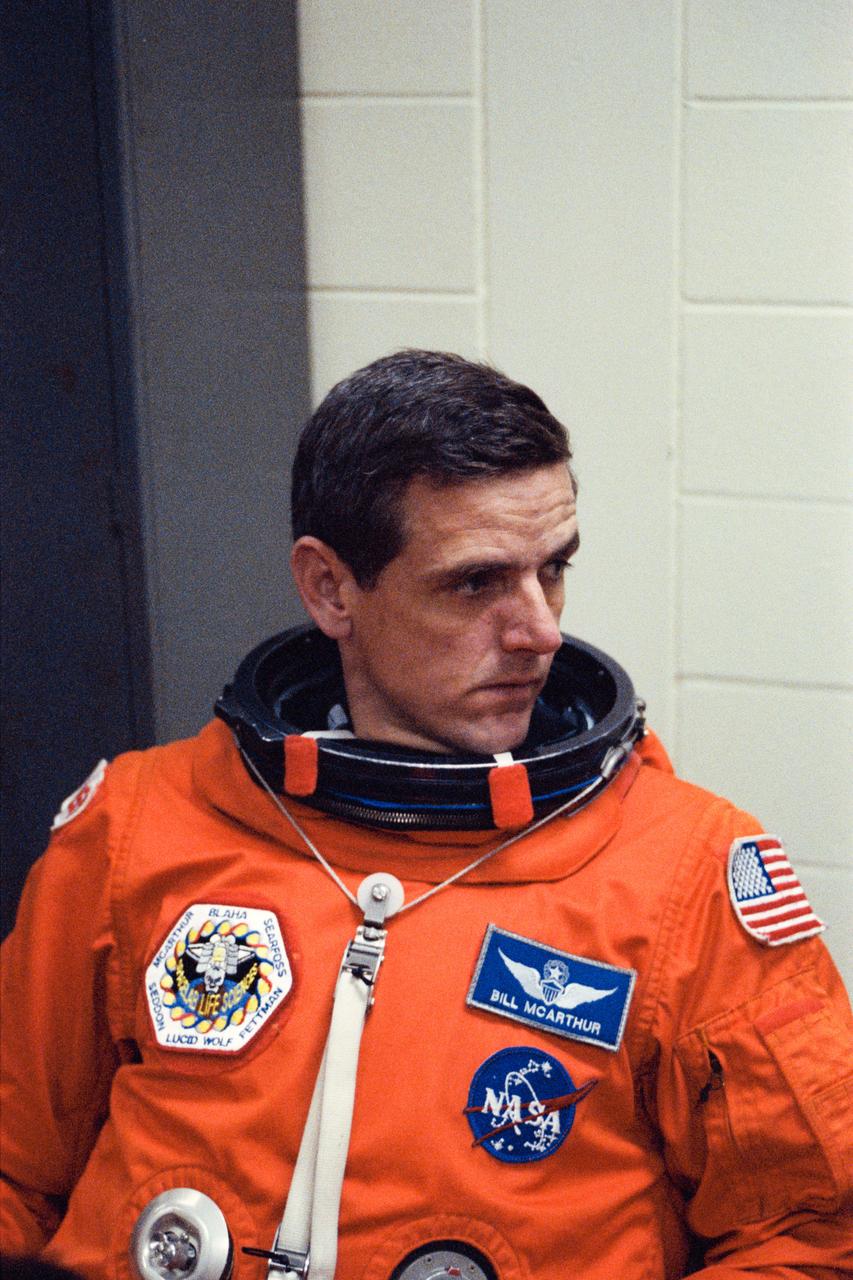
S93-39619 (20 July 1993) --- Wearing a training version of the partial pressure launch and entry garment, astronaut William S. McArthur listens to a briefing on emergency egress procedures for the STS-58 mission. McArthur, along with the five other NASA astronauts and a visiting payload specialist assigned to the seven-member crew, later rehearsed contingency evacuation procedures. Most of the training session took place in the crew compartment and full fuselage trainers of the Space Shuttle mockup and integration laboratory.
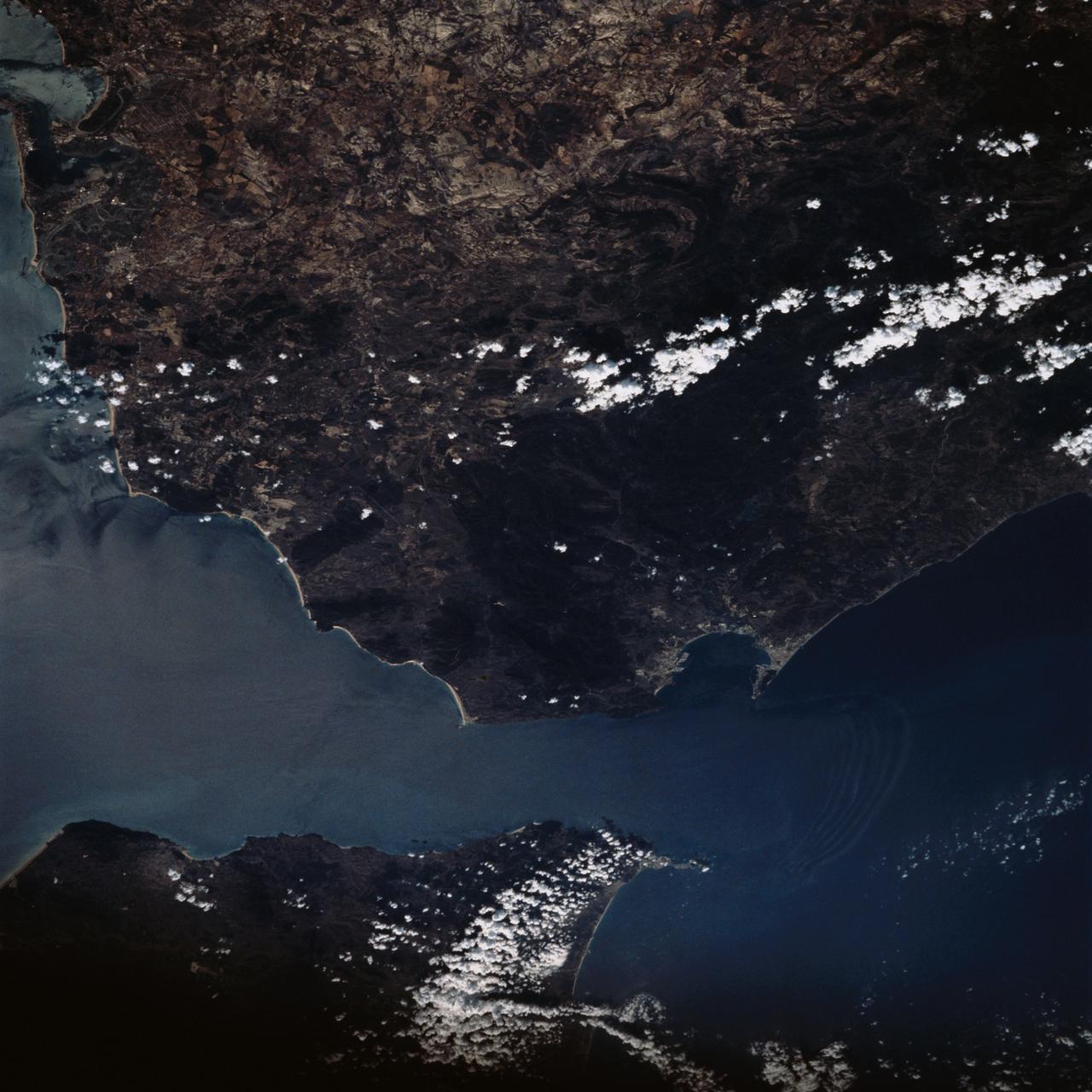
STS058-73-009 (18 Oct-1 Nov 1993) --- Atlantic water flowing with the tide through the Strait of Gibraltar into the Mediterranean generates internal waves as depicted in this photo. The incoming cool, less dense Atlantic water flows over the warm, more saline Mediterranean water. As the tide moves into the Strait of Gibraltar it encounters the Camarinal Sill, which is like a cliff under water, south of Camarinal Point, Spain. Internal waves are generated at the Sill and travel along the density boundary between the Atlantic water and the Mediterranean water. Internal waves have very little effect on the sea surface, except for gentle slopes and slight differences in roughness. We can see them in the Space Shuttle photos because of sunglint which reflects off the water. Internal waves smooth out some of the capillary waves at the surface in bands. The sun reflects more brightly from these smooth areas showing us the pattern of the underwater waves. The Bay of Cadiz on the southwest coast of Spain, the Rock of Gibraltar, and the Moroccan coast are also visible in this photo.
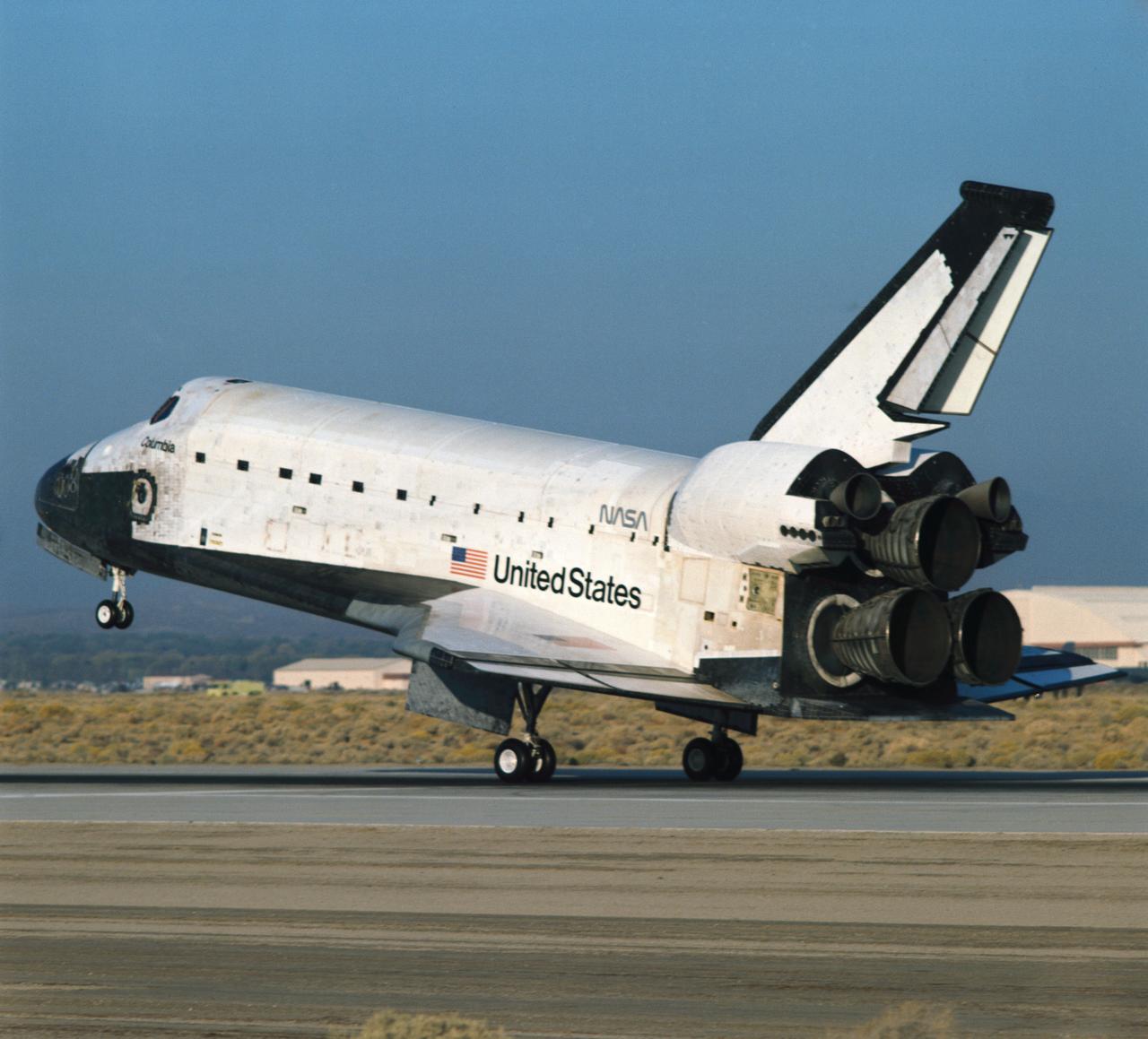
STS058-S-128 (1 Nov 1993) --- The nose gear of the Space Shuttle Columbia is about to touch down on the runway at Edwards Air Force Base (EAFB) in California. The landing, which occurred at 7:06 a.m. (PST), November 1, 1993, completed a two week mission in space devoted to medical research. Onboard the spacecraft were astronauts John E. Blaha, Richard A. Searfoss, Rhea Seddon, Shannon W. Lucid, David A. Wolf and William S. McArthur along with payload specialist Martin J. Fettman, DVM.
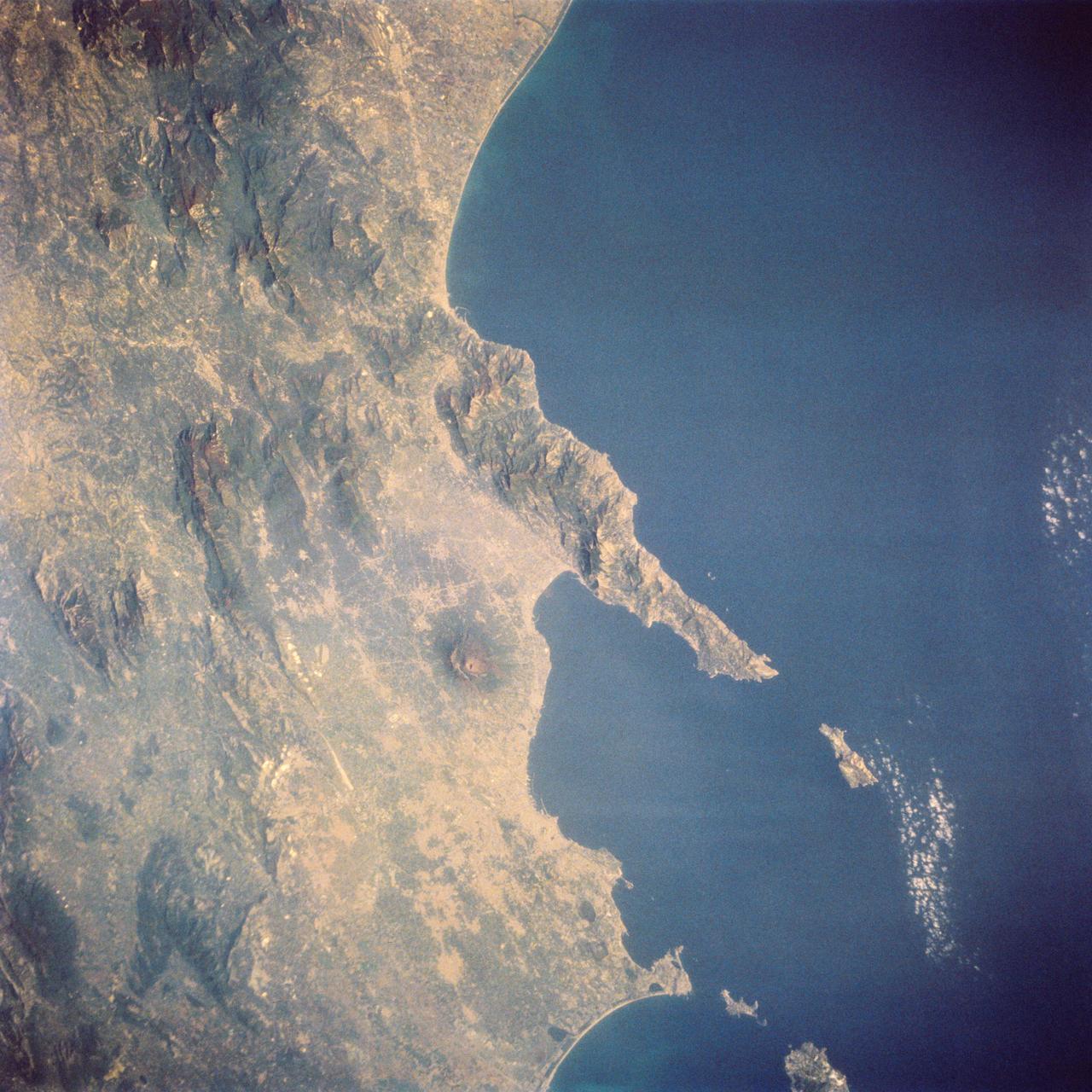
STS058-73-024 (18 Oct-1 Nov 1993) --- The ancient eruption of Vesuvius (the volcano near the center of the frame) destroyed the town of Pompeii located on its southeast flank. But the larger town of Naples, between Vesuvius (to the south) and the large, circular, lake-filled caldera of Campi Flegrei (to the west) also lives with the constant threat of volcanic hazards. In this view, Naples is the gray urban area with substantial coastal development just northwest of Vesuvius. Other landmarks marking the Italian coast include the small island of Capri, just off the west-pointing peninsula, and the city of Salerno on the coast just south of the same peninsula.
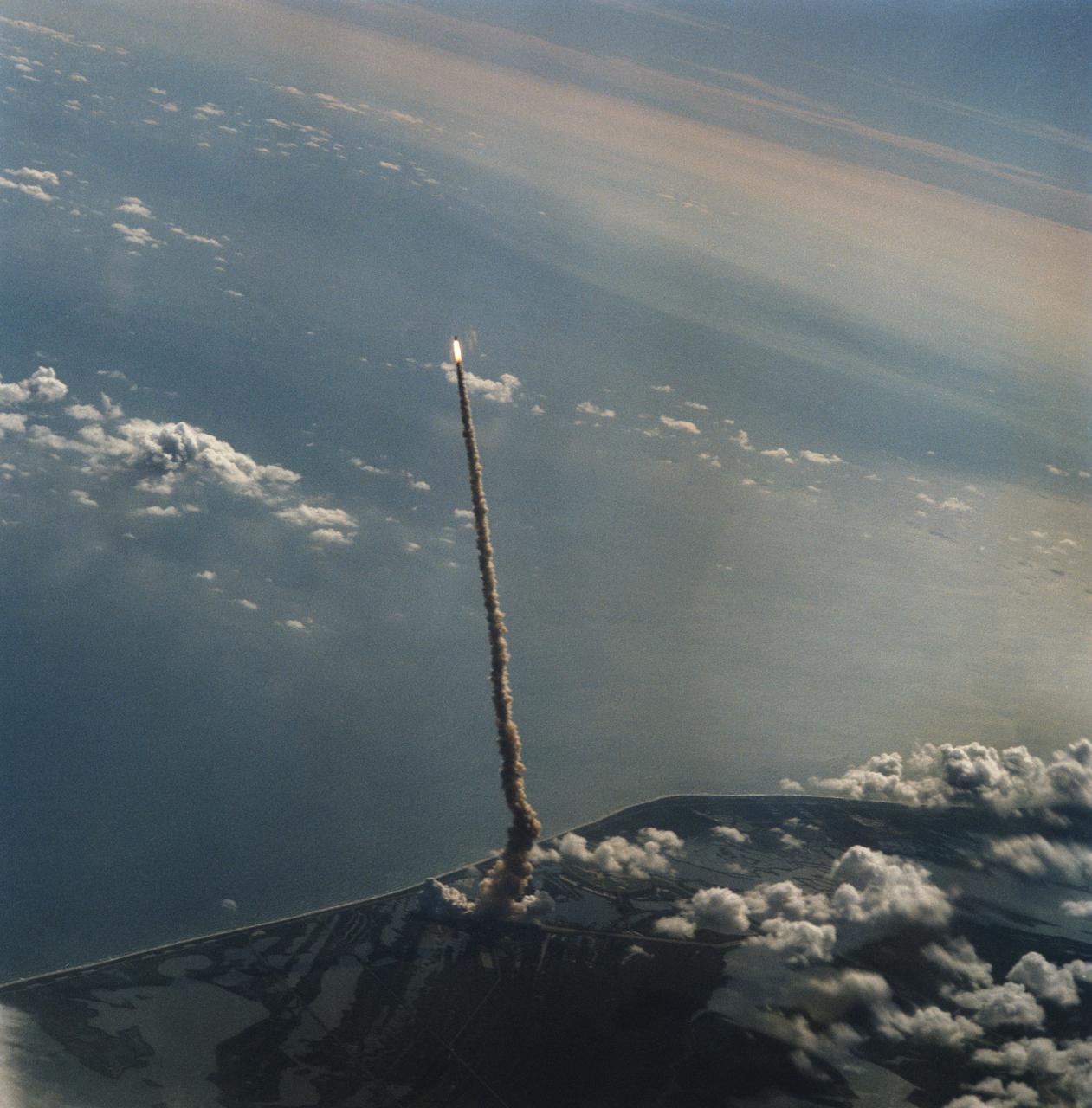
STS058-S-122 (18 Oct 1993) --- This distant shot of Columbia on its way to Earth-orbit was captured on film from the Shuttle Training Aircraft (STA) assigned to advance launch range screening. Onboard the spacecraft were six NASA astronauts, a veterinarian from the private sector and the Spacelab Life Sciences (SLS-2) science module. The crew will spend two weeks in Earth-orbiting devoting all its on-duty time to life sciences research. Launch occurred at 10:53 a.m. (EDT), October 18, 1993, from the Kennedy Space Center (KSC).

STS058-77-083 (18 Oct-1 Nov 1993) --- In this scene of the south coast of Africa, Cape Agulhas, the southernmost point on the continent, appears as the leftmost cape. Viewed with the Earth's limb top left, clouds at bottom, the view direction is west and north top right. The Cape of Good Hope, with Cape Town nearby, is the thin spike beyond. The great bay in the foreground is Algoa Bay with the city of Port Elizabeth. This was the first time European voyagers are known to have rounded the Cape of Good Hope in their quest to reach India by sea. The entire fold mountain belt of southern Africa is visible: these mountains appear as green (forested) wavy structures stretching west form the foreground, to the Cape of Good Hope, and then northwards some distance. One theory about their origin is that the Falkland Plateau, now an undersea extension of South America, was jostled up against Africa more than 150 million years ago, in times before the Atlantic Ocean existed, before Africa and South America drifted apart from one another. The jostling caused the evolution of the fold mountain belt.
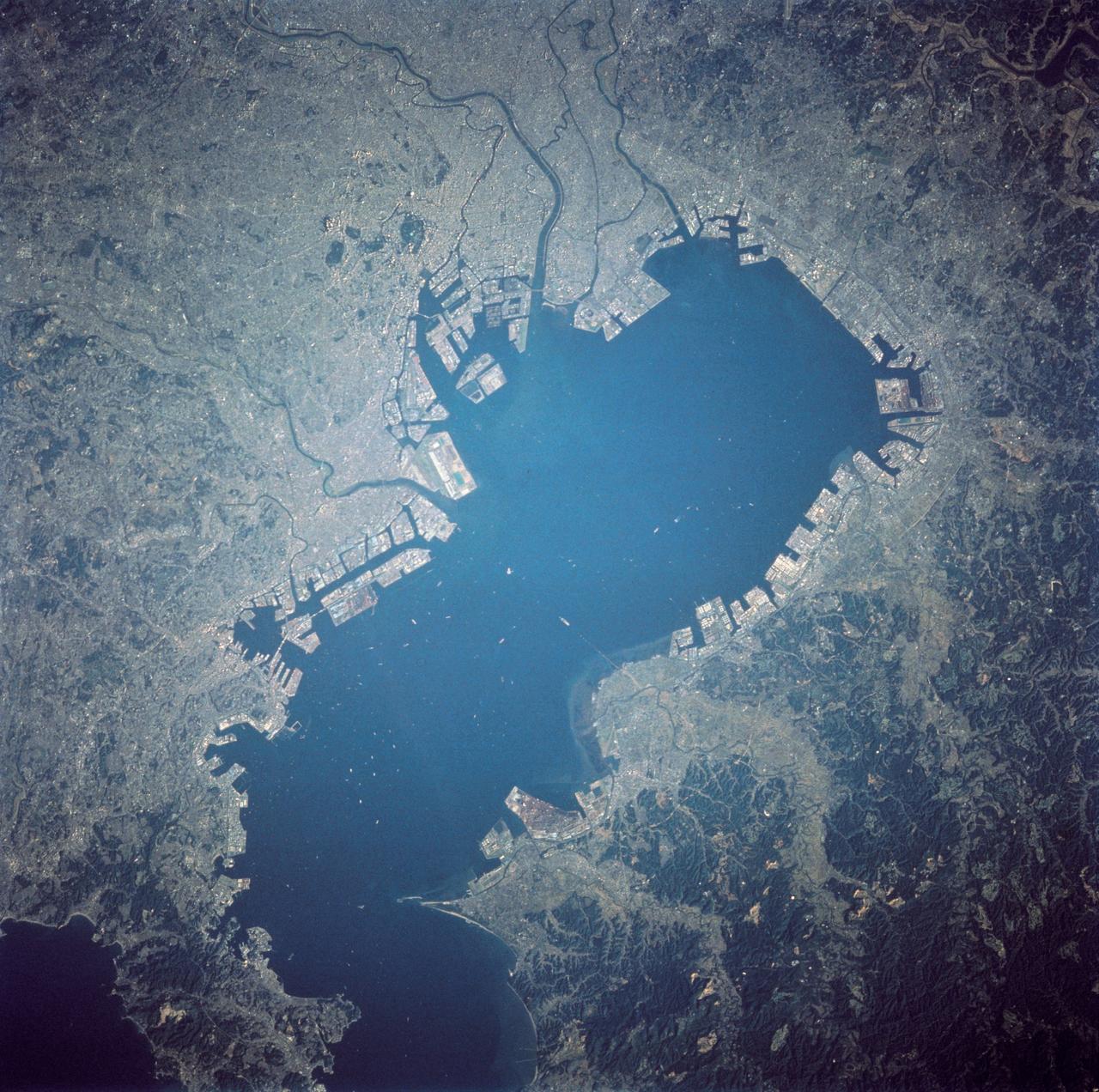
STS058-103-080 (18 Oct-1 Nov 1993) --- Japan's modern megalopolis is seen in this nadir view in great detail. More than 80 vessels can be seen at the anchorage's in Tokyo Bay. The gardens of the Emperor's Palace are seen in this circular area in the upper left quadrant. Even greater detail of this area was captured in the simultaneous color infrared image acquired during this space shuttle mission. (That photo number is STS058-110-085.)
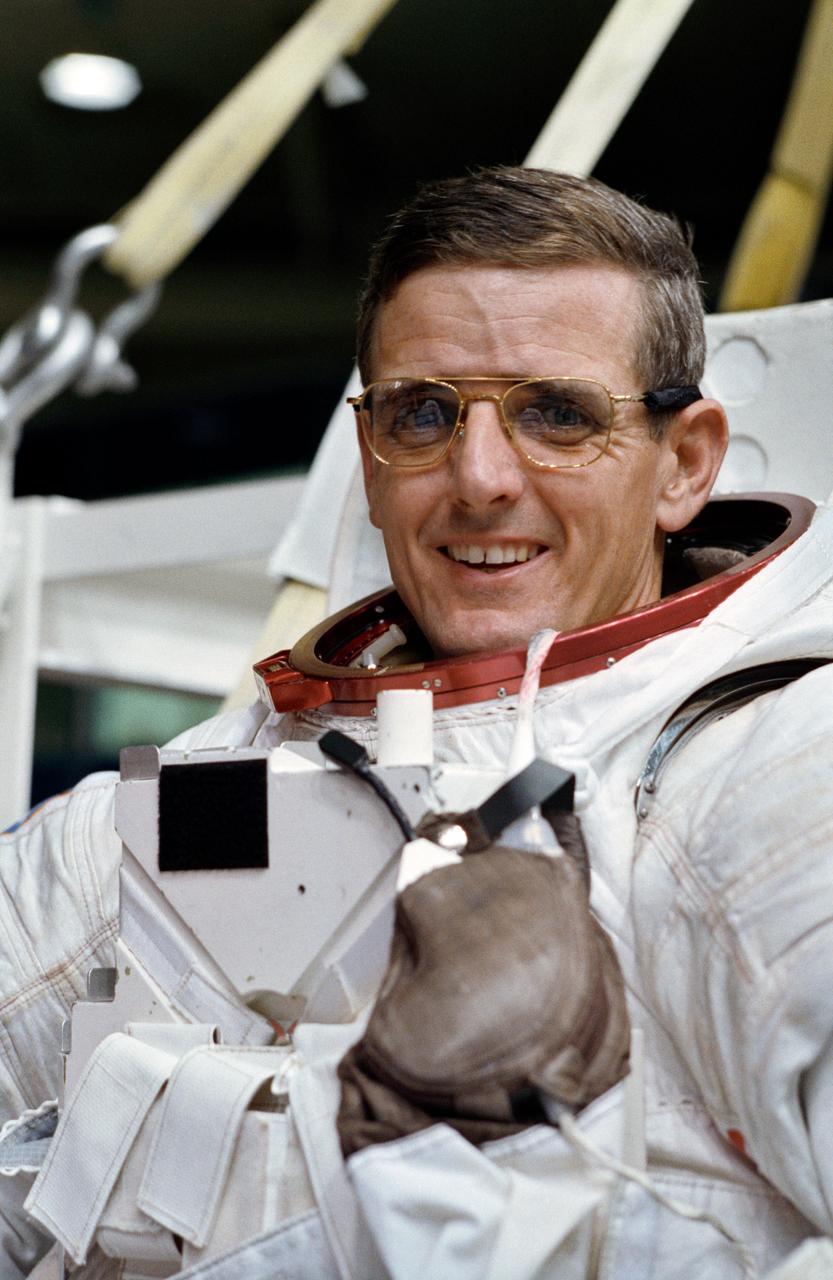
S93-43840 (6 Sept 1993) --- Astronaut William S. McArthur, mission specialist, participates in training for contingency Extravehicular Activity (EVA) for the STS-58 mission. For simulation purposes, McArthur was about to be submerged to a point of neutral buoyancy in the Johnson Space Center's (JSC) Weightless Environment Training Facility (WET-F). Though the Spacelab Life Sciences (SLS-2) mission does not include a planned EVA, all crews designate members to learn proper procedures to perform outside the spacecraft in the event of failure of remote means to accomplish those tasks.
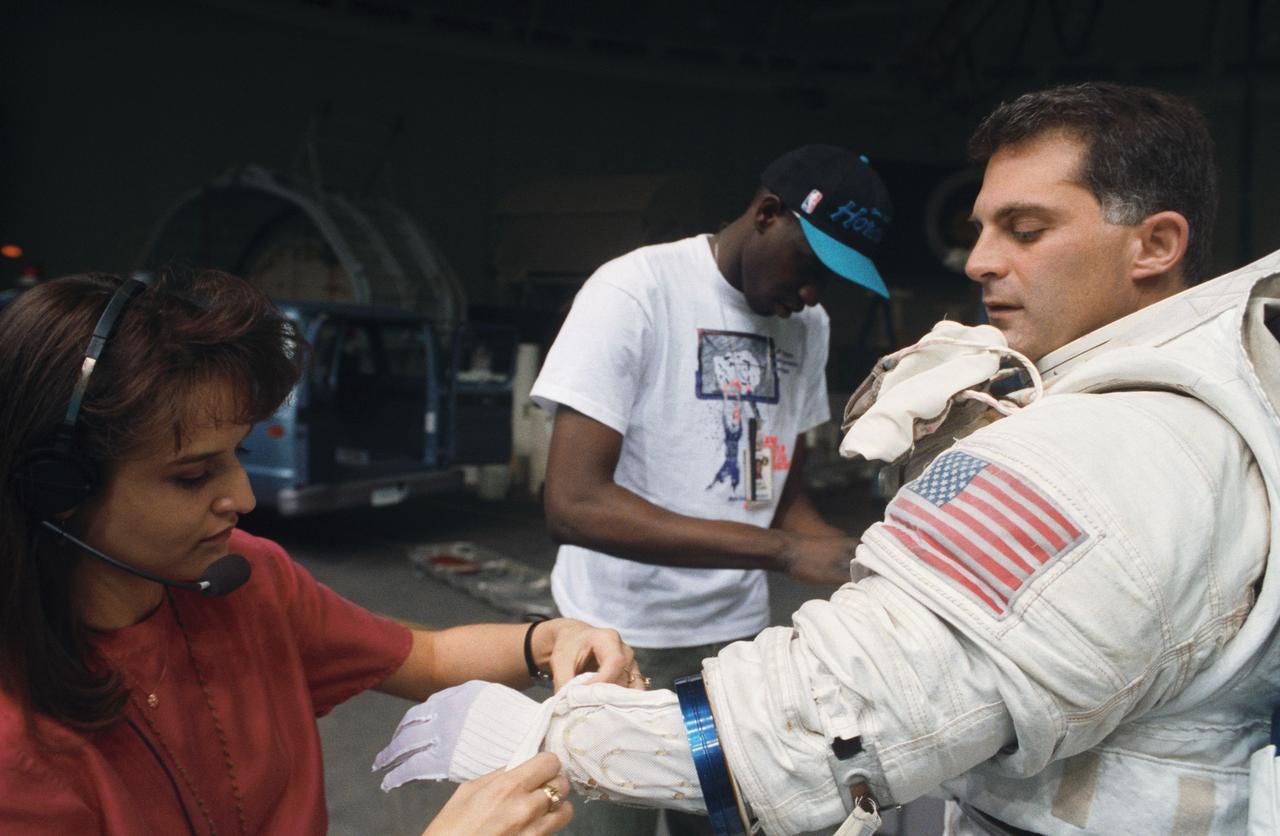
S93-31706 (3 April 1993) --- With the aid of technicians and training staffers astronaut David A. Wolf prepares to participate in training for contingency Extravehicular Activity (EVA) for the STS-58 mission. Sharing a moveable platform with Wolf was astronaut Shannon W. Lucid (out of frame). For simulation purposes, the two mission specialists were about to be submerged to a point of neutral buoyancy in the Johnson Space Center's (JSC) Weightless Environment Training Facility (WET-F). Though the Spacelab Life Sciences (SLS-2) mission does not include a planned EVA, all crews designate members to learn proper procedures to perform outside the spacecraft in the event of failure of remote means to accomplish those tasks.
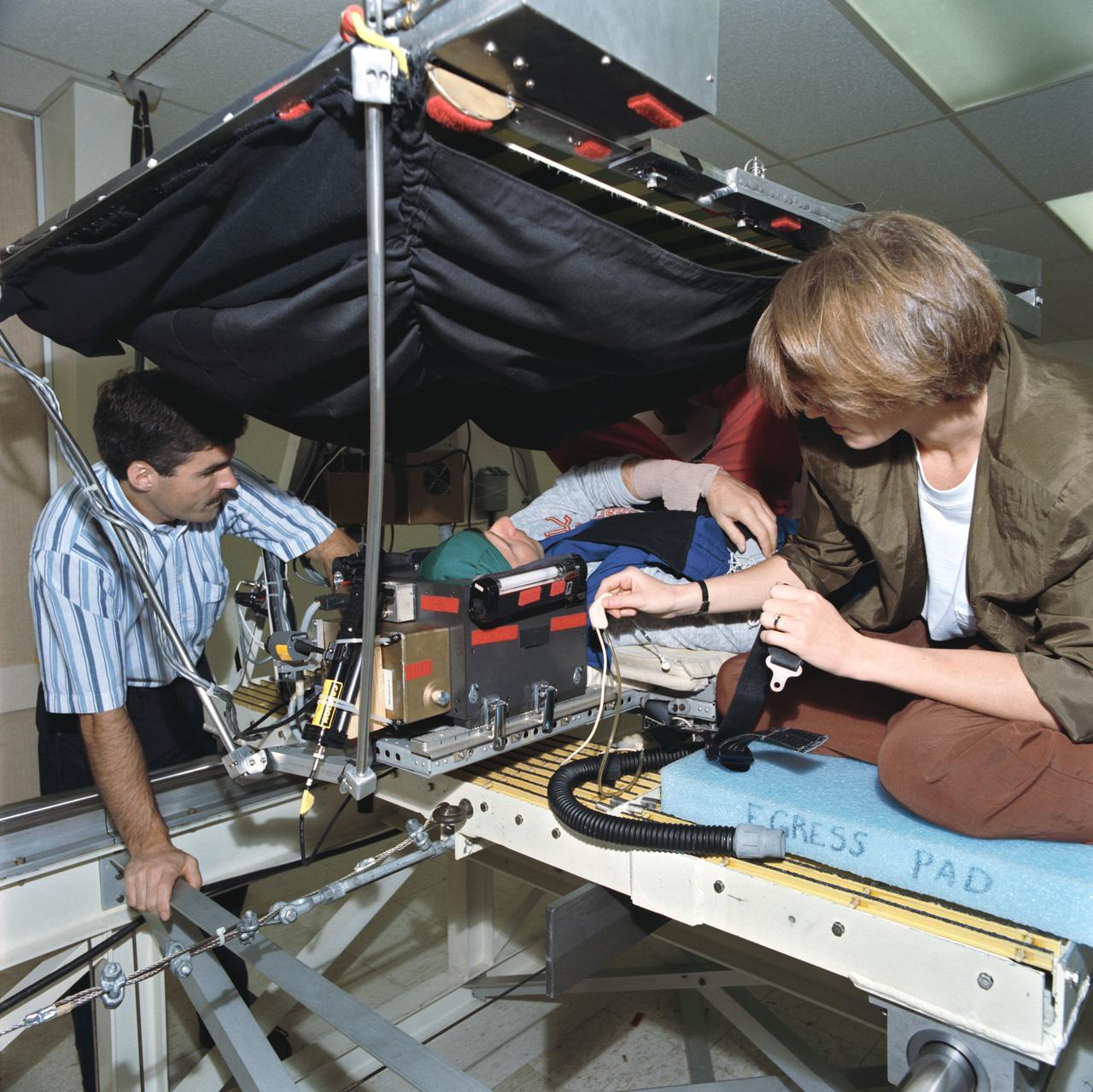
S93-45363 (29 Sept 1993) --- Payload specialist Martin J. Fettman, in an oscillating sled device, participates in a data collection project for neurovestibular functions. The seven Spacelab Life Sciences (SLS-2) crewmembers devoted a full day to miscellaneous biomedical data collection in preparation for next month's two week mission aboard Columbia.
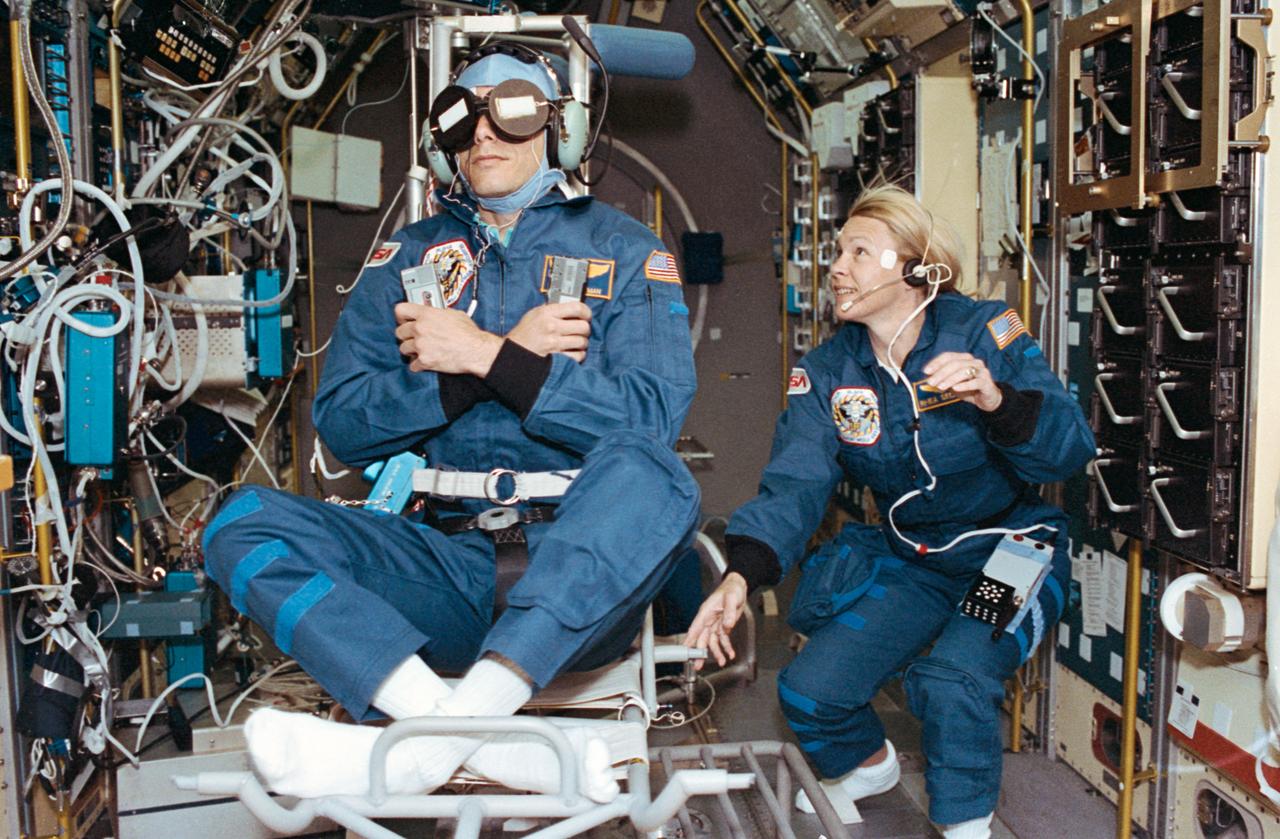
STS058-202-002 (18 Oct.-1 Nov. 1993) --- Astronaut Rhea Seddon, STS-58 payload commander, spins the Spacelab Life Sciences (SLS-2) rotating chair as payload specialist Martin J. Fettman serves as test subject. The two joined five NASA astronauts for fourteen days of medical research aboard the Earth-orbiting space shuttle Columbia. Photo credit: NASA
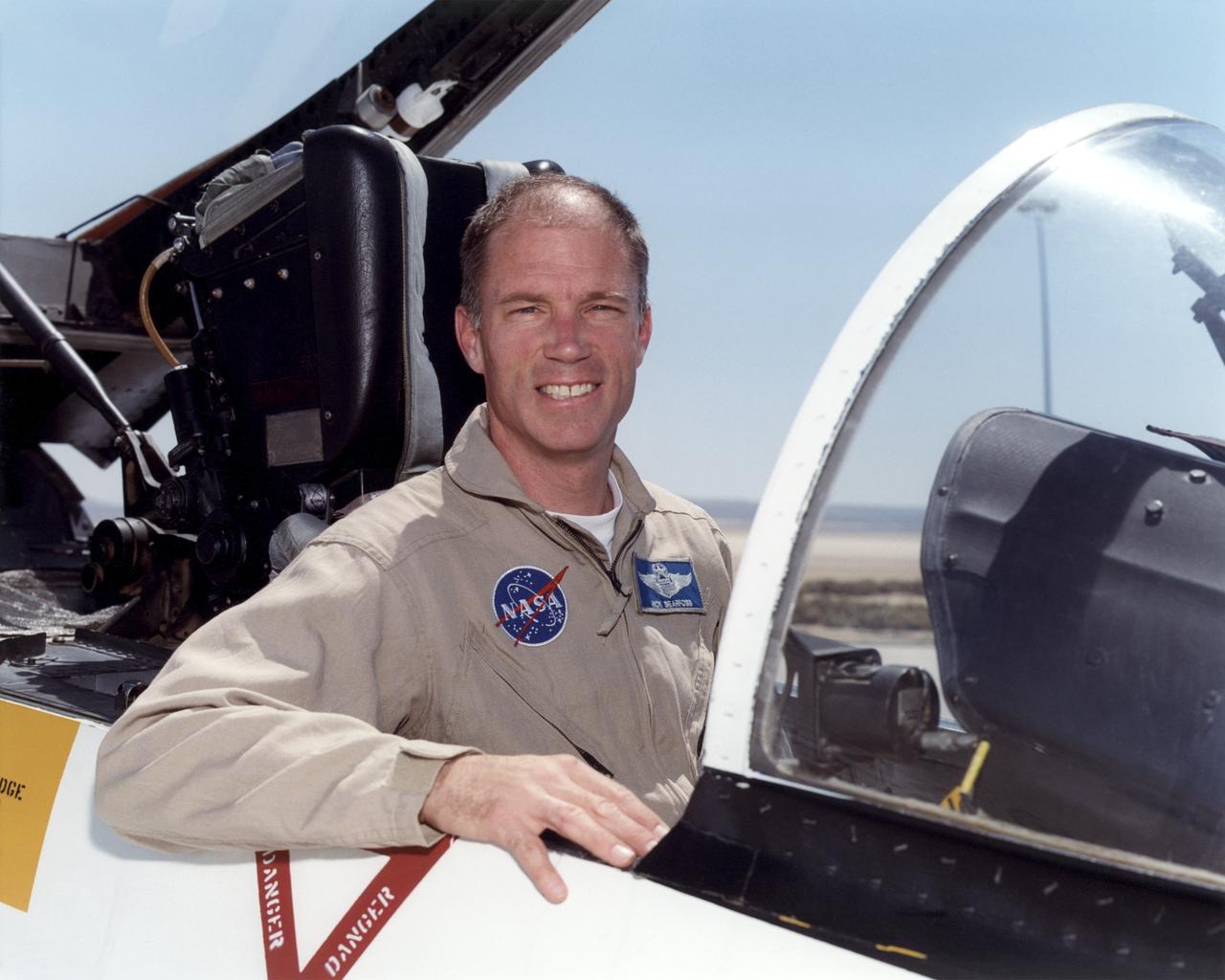
Richard A. Searfoss became a research pilot in the Flight Crew Branch of NASA's Dryden Flight Research Center, Edwards, Calif., in July 2001. He brought to Dryden more than 5,000 hours of military flying time and 939 hours in space. Searfoss served in the U.S. Air Force for more than 20 years, retiring with the rank of colonel. Following graduation in 1980 from Undergraduate Pilot Training at Williams Air Force Base, Ariz., Searfoss flew F-111s at RAF Lakenheath, England, and Mountain Home Air Force Base, Idaho. In 1988 he attended the U.S. Naval Test Pilot School, Patuxent River, Md., as a U.S. Air Force exchange officer. He was an instructor pilot at the U.S. Air Force Test Pilot School, Edwards Air Force Base, Calif., when selected for the astronaut program in January 1990. Searfoss became an astronaut in July 1991. A veteran of three space flights, Searfoss has logged 39 days in space. He served as STS-58 pilot on the seven-person life science research mission aboard Space Shuttle Columbia, launching from NASA's Kennedy Space Center, Fla., on Oct. 18, 1993, and landing at Edwards Air Force Base, Calif., on Nov. 1, 1993. The crew performed a number of medical experiments on themselves and 48 rats, expanding knowledge of human and animal physiology. Searfoss flew his second mission as pilot of STS-76 aboard the Space Shuttle Atlantis. During this nine-day mission, which launched March 22, 1996, the crew preformed the third docking of an American spacecraft with the Russian space station Mir. The crew transported to Mir nearly two tons of water, food, supplies, and scientific equipment, as well as U.S. Astronaut Shannon Lucid to begin her six-month stay in space. Completing 145 orbits, STS-76 landed at Edwards Air Force Base, Calif., on March 31, 1996. Searfoss commanded a seven-person crew on the STS-90 Neurolab mission launched on April 17, 1998. The crew served as both experiment subjects and operators for life science experiments focusing on the effects of m
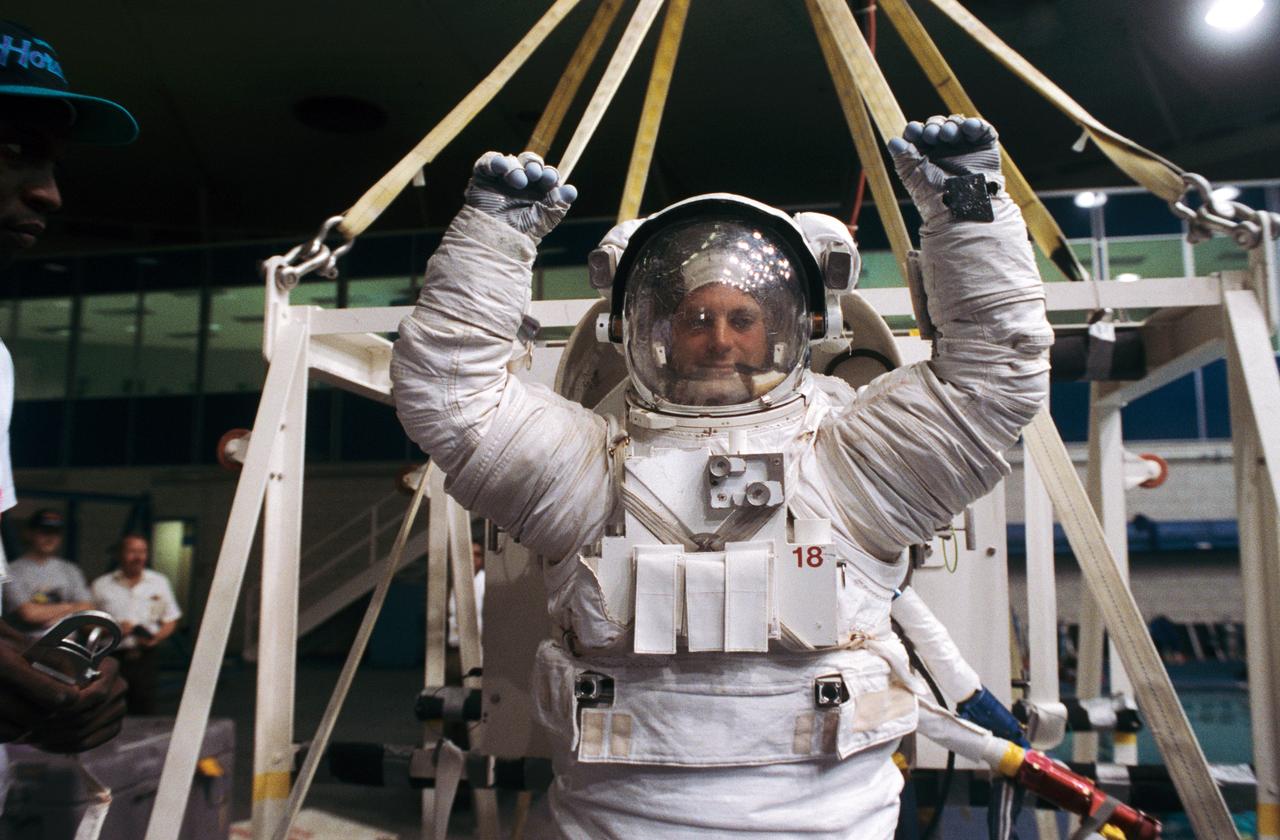
S93-31701 (3 April 1993) --- Displaying the flexibility of his training version of the Shuttle Extravehicular Mobility Unit (EMU) space suit, astronaut David A. Wolf participates in training for contingency Extravehicular Activity (EVA) for the STS-58 mission. Behind Wolf, sharing the platform with him was astronaut Shannon W. Lucid. For simulation purposes, the two mission specialists were about to be submerged to a point of neutral buoyancy in the Johnson Space Center's (JSC) Weightless Environment Training Facility (WET-F). Though the Spacelab Life Sciences (SLS-2) mission does not include a planned EVA, all crews designate members to learn proper procedures to perform outside the spacecraft in the event of failure of remote means to accomplish those tasks.
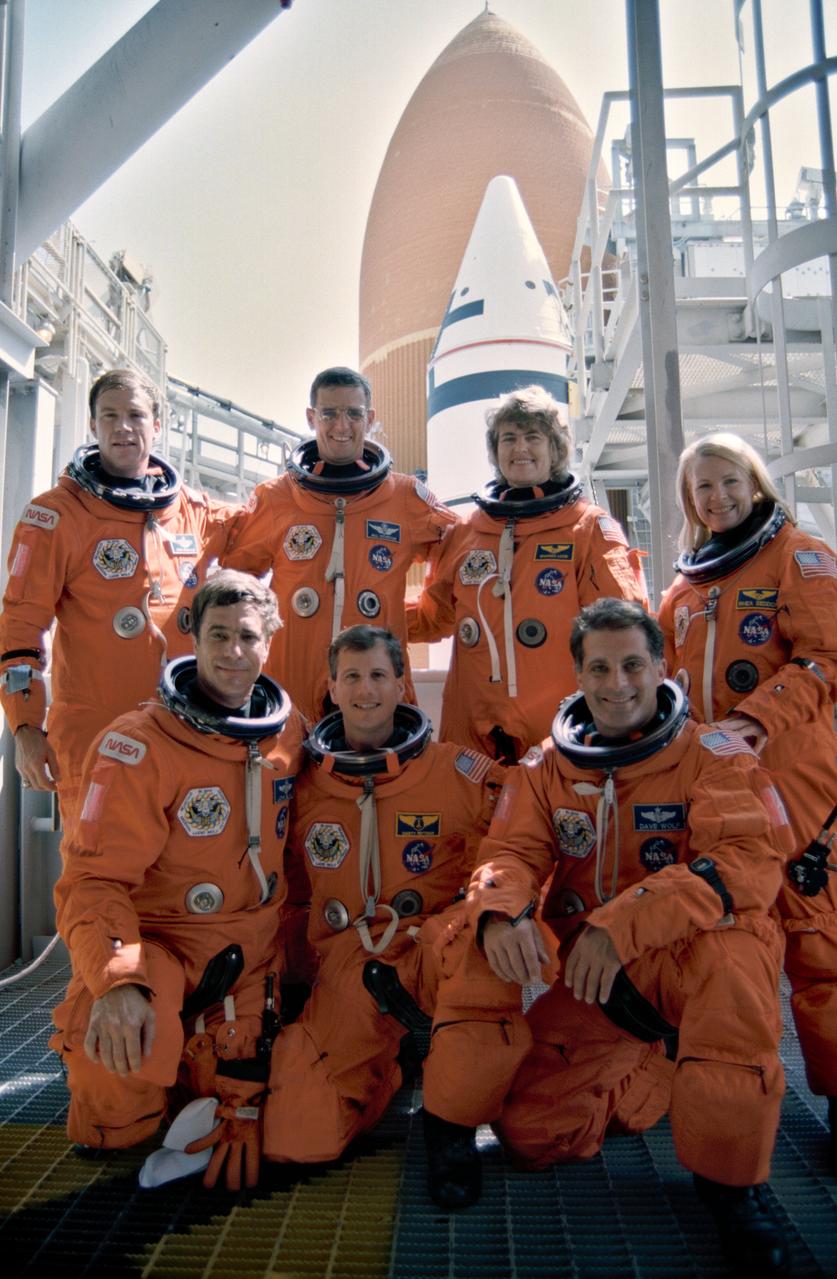
S93-45004 (20 Sept 1993) --- Posing for a crew portrait, with the Space Shuttle Columbia at Launch Pad 39B, are the seven STS-58 astronauts. They are, front row left to right, John E. Blaha, mission commander; Martin J. Fettman, payload specialist; and David A. Wolf, mission specialist. Back row, left to right, are Richard A. Searfoss, pilot; William S. McArthur and Shannon W. Lucid, mission specialists; and Rhea Seddon, payload commander. The crew was in Florida for the Terminal Countdown Demonstration Test (CDDT) in preparation for next month's launch aboard Columbia.
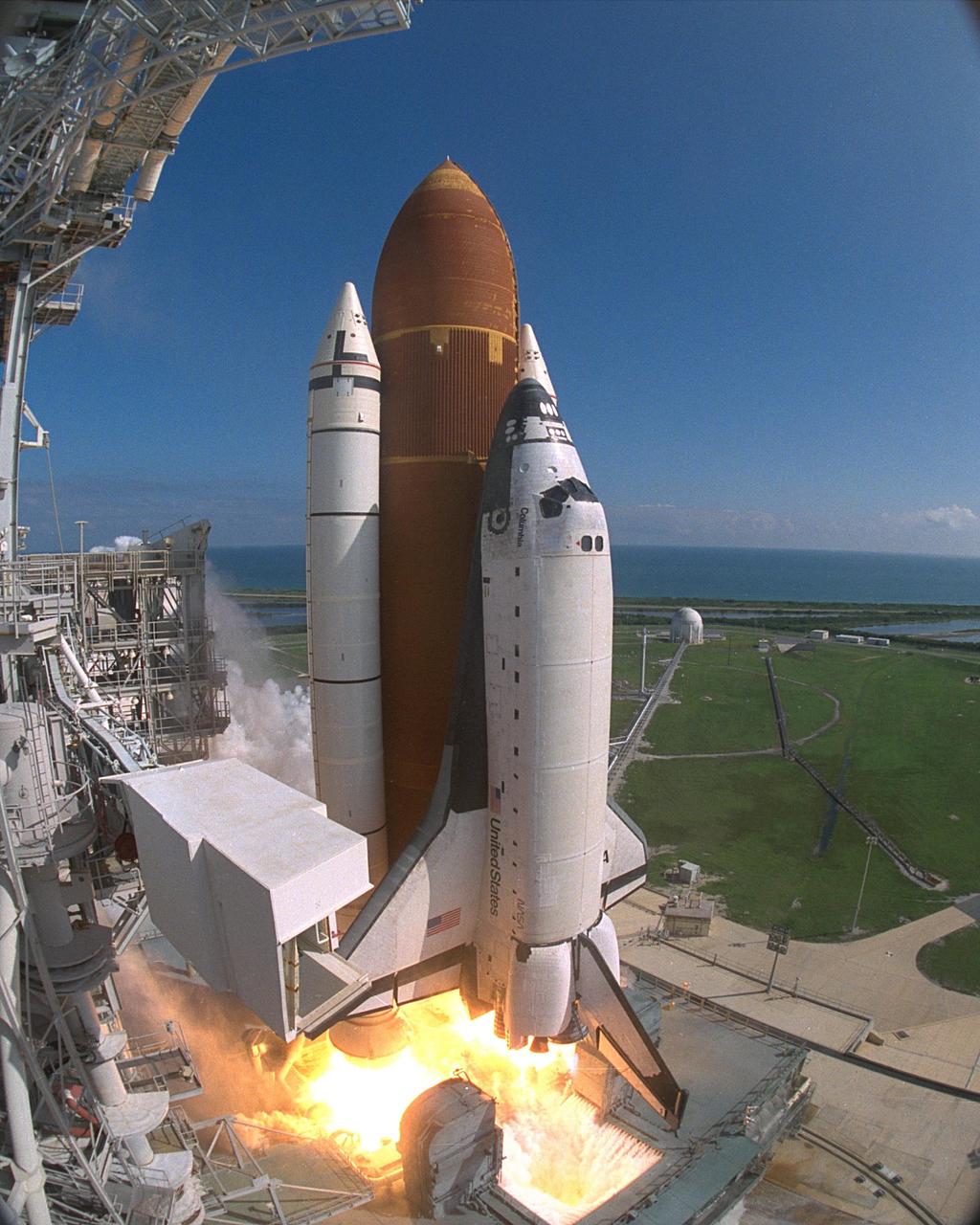
KENNEDY SPACE CENTER, FLA. -- STS-58: Columbia
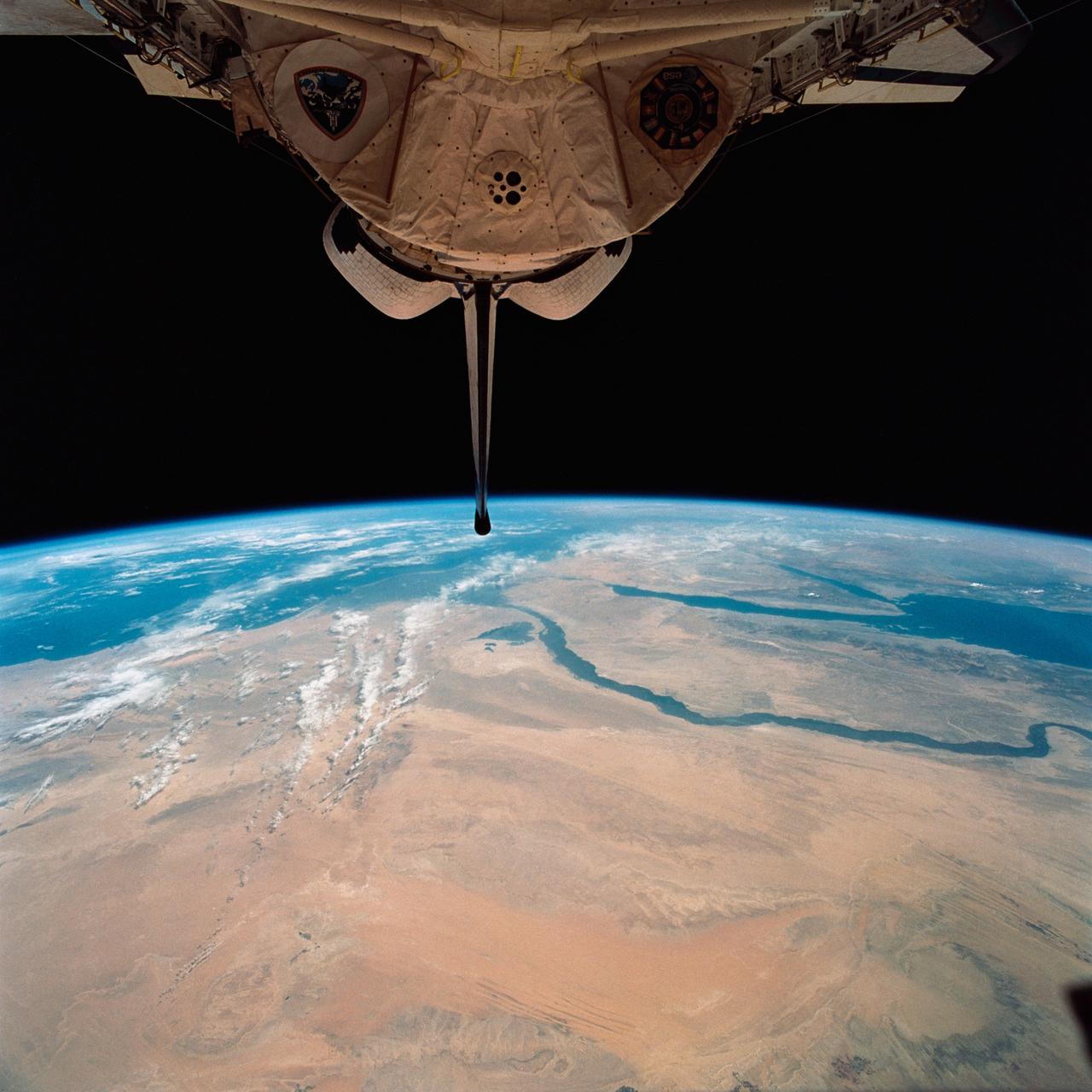
STS058-92-064 (18 Oct-1 Nov 1993) --- This oblique view, looking northeast from central Egypt, shows great expanses of the sand covered and rocky Western Desert in the foreground (bottom). The dark patches bottom right are the Dakhla Oases on the south side of an escarpment. For centuries camel trains have moved from here to the Nile Valley, seen here as a broad green line winding through the desert. The northern half of Egypt's Nile appears here, from about the latitude of Luxor to the delta. Green colors indicate the small area of crops which feed Egypt's population of 55 million. The Nile Delta is partly obscured by a band of clouds, but can be discerned at the coast as a flattened triangle of green. The smaller triangle close by is the Faiyum Basin, a depression irrigated by water from the Nile. The coast of the Mediterranean Sea appears left.
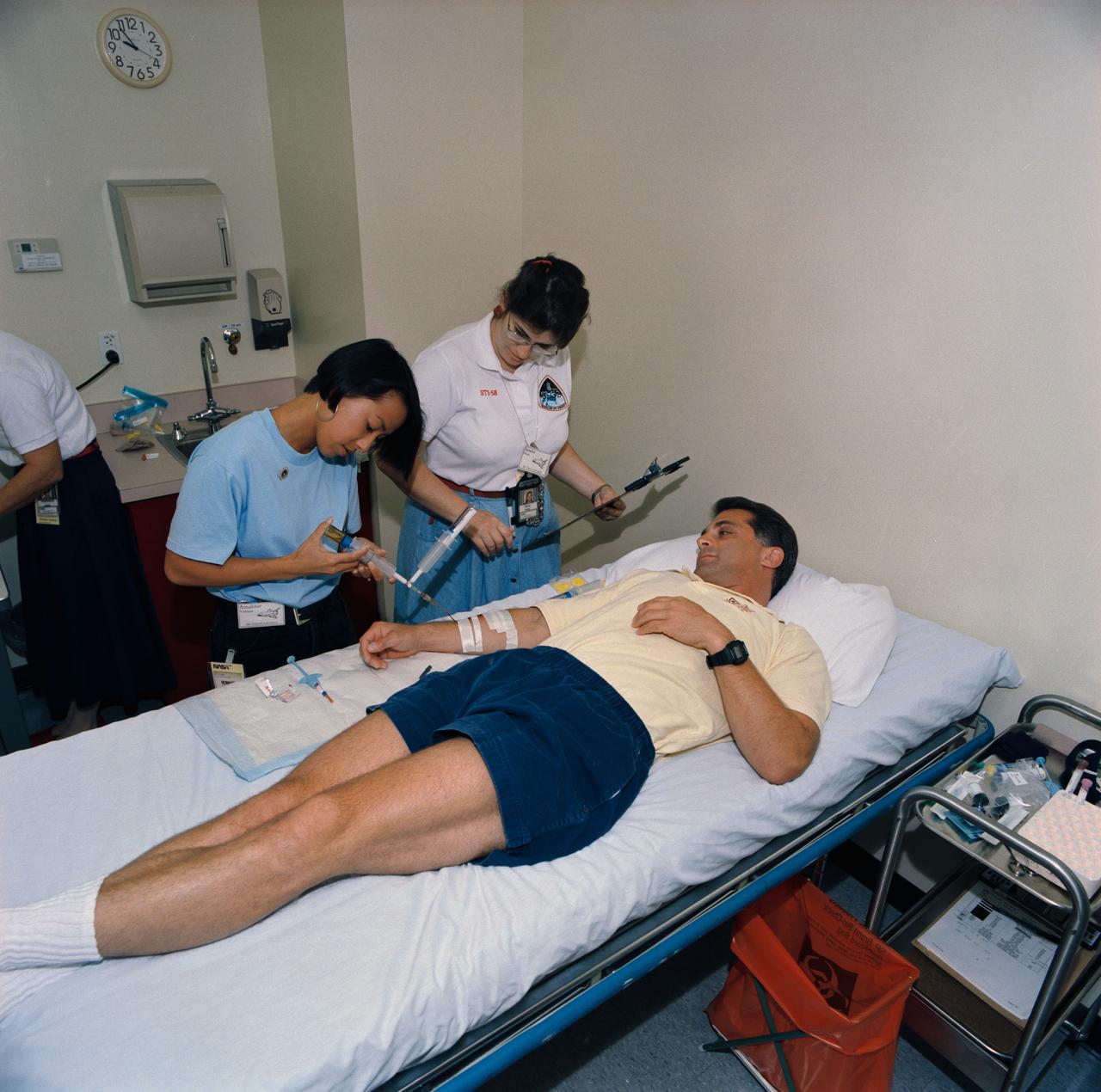
S93-45370 (29 Sept 1993) --- Blood samples from crew members are critical to several Spacelab Life Sciences (SLS-2) investigations. Amalour Veloso (left) and Sandra Prow draw blood from David A. Wolf, mission specialist. Wolf was participating with five other NASA astronauts and a payload specialist on data collection and training in preparation for the two week SLS-2 mission.
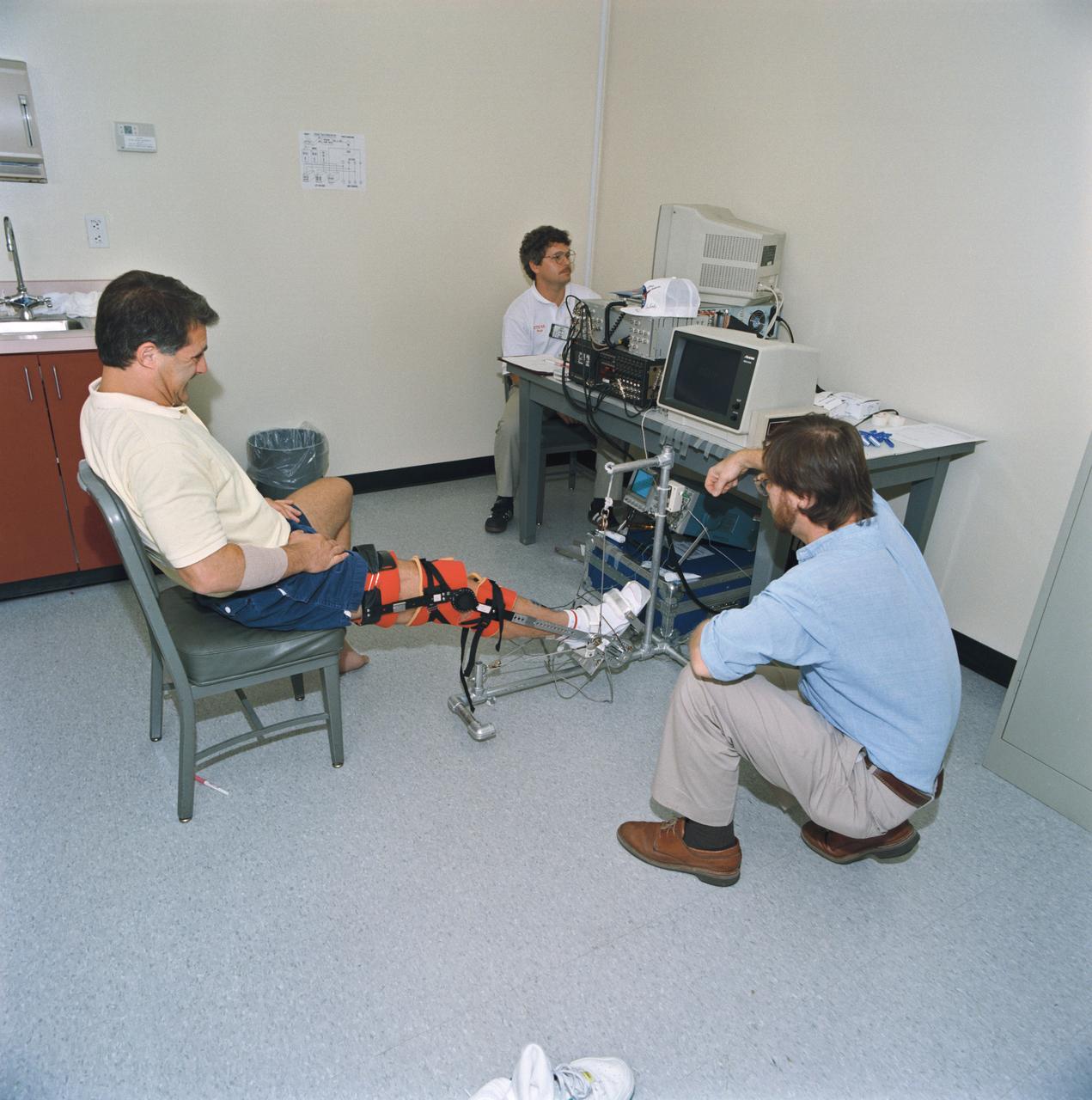
S93-45364 (29 Sept 1993) --- Astronaut David A. Wolf, mission specialist, participates in pre-flight data collection for the cardiovascular experiments scheduled to fly aboard Columbia for the Spacelab Life Sciences (SLS-2) mission.
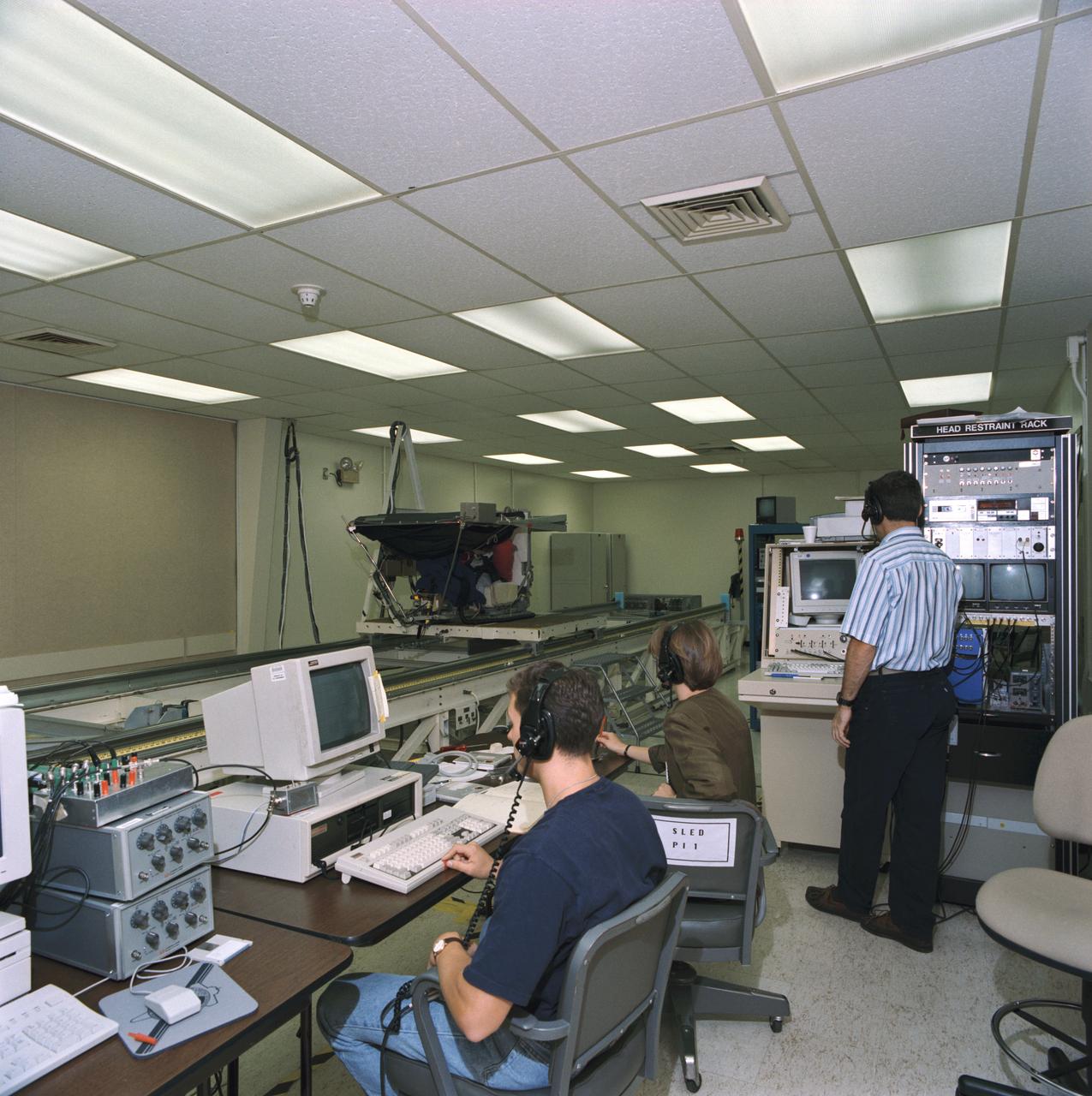
S93-45365 (29 Sept 1993) --- Payload specialist Martin J. Fettman, in an oscillating sled device in upper left, participates in a data collection project for neurovestibular functions. His responses to the sled's movements are recorded by a team of monitors in the foreground. The seven Spacelab Life Sciences (SLS-2) crew members devoted a full day to miscellaneous biomedical data collection in preparation for next month's two week mission aboard Columbia.
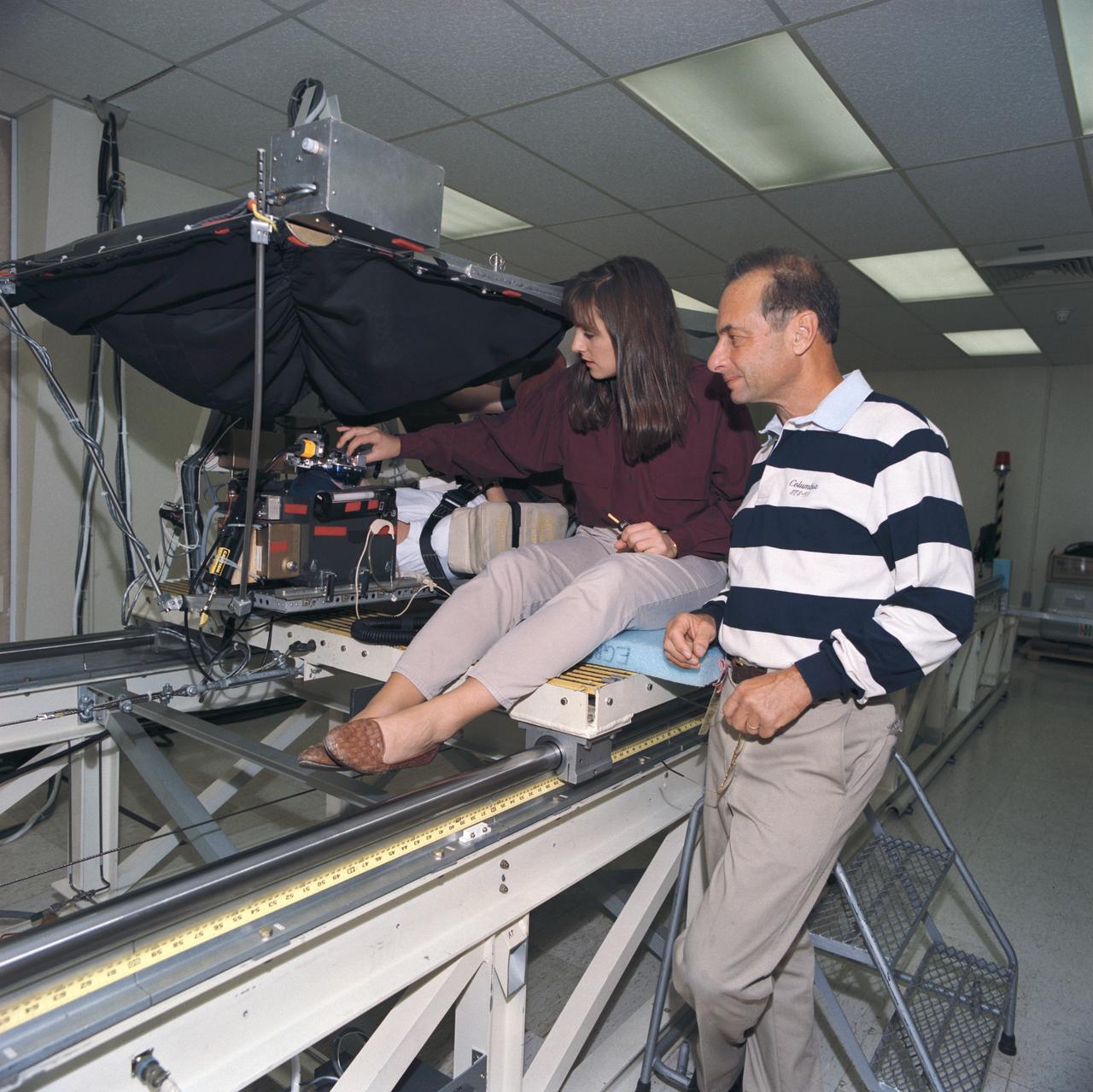
S93-45368 (29 Sept 1993) --- Payload specialist Martin J. Fettman (face obscured), in an oscillating sled device, participates in a data collection project for neurovestibular functions. Assisting the test are Dr. Laurence Young, alternate payload specialist, and an unidentified MIT student. The seven Spacelab Life Sciences (SLS-2) crew members devoted a full day to miscellaneous biomedical data collection in preparation for next month's two week mission aboard Columbia.
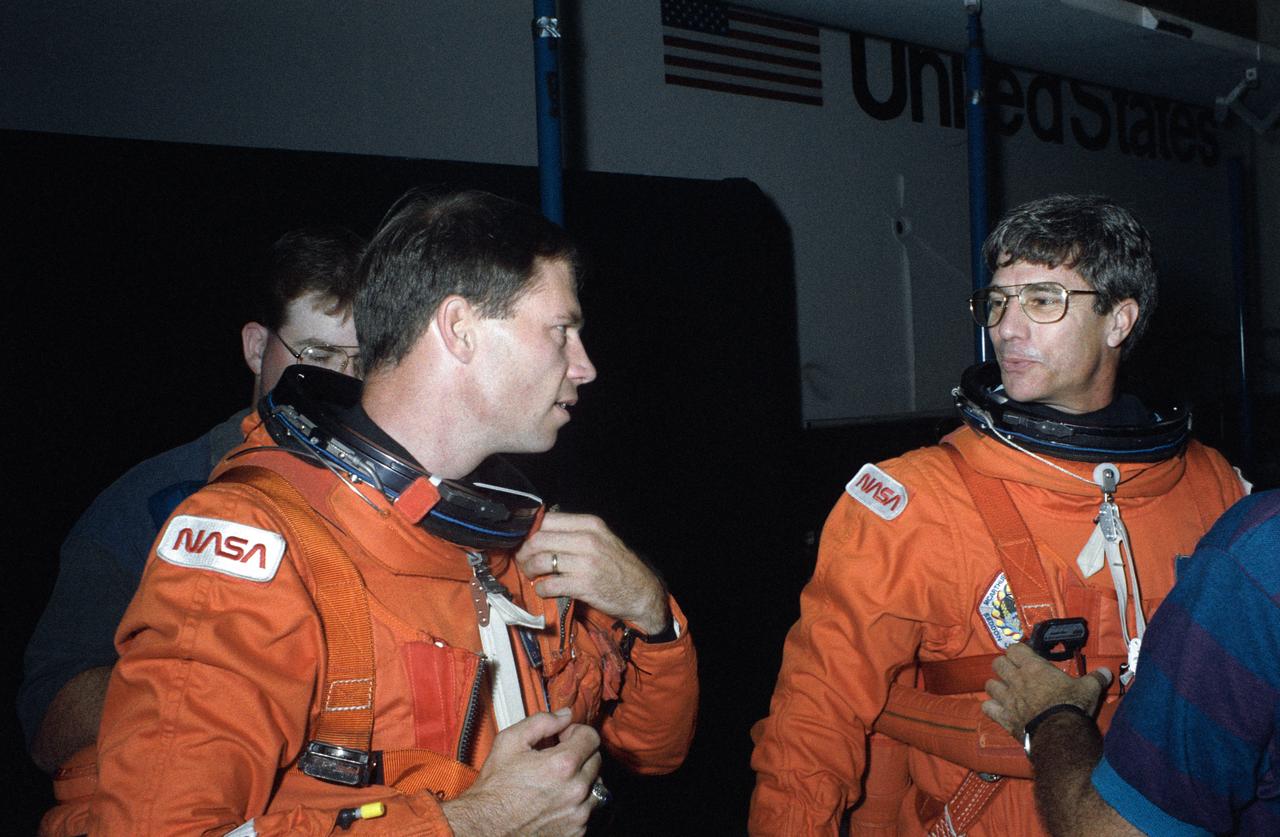
S93-38675 (20 July 1993) --- Wearing training versions of the partial pressure launch and entry garment, astronauts Richard A. Searfoss (left), pilot, and John E. Blaha, mission commander, prepare for a training exercise. The two, along with the four other NASA astronauts and a visiting payload specialist asssigned to the seven-member crew, later rehearsed contingency evacuation procedures. Most of the training session took part in the crew compartment and full fuselage trainers in the Space Shuttle mockup and integration laboratory.
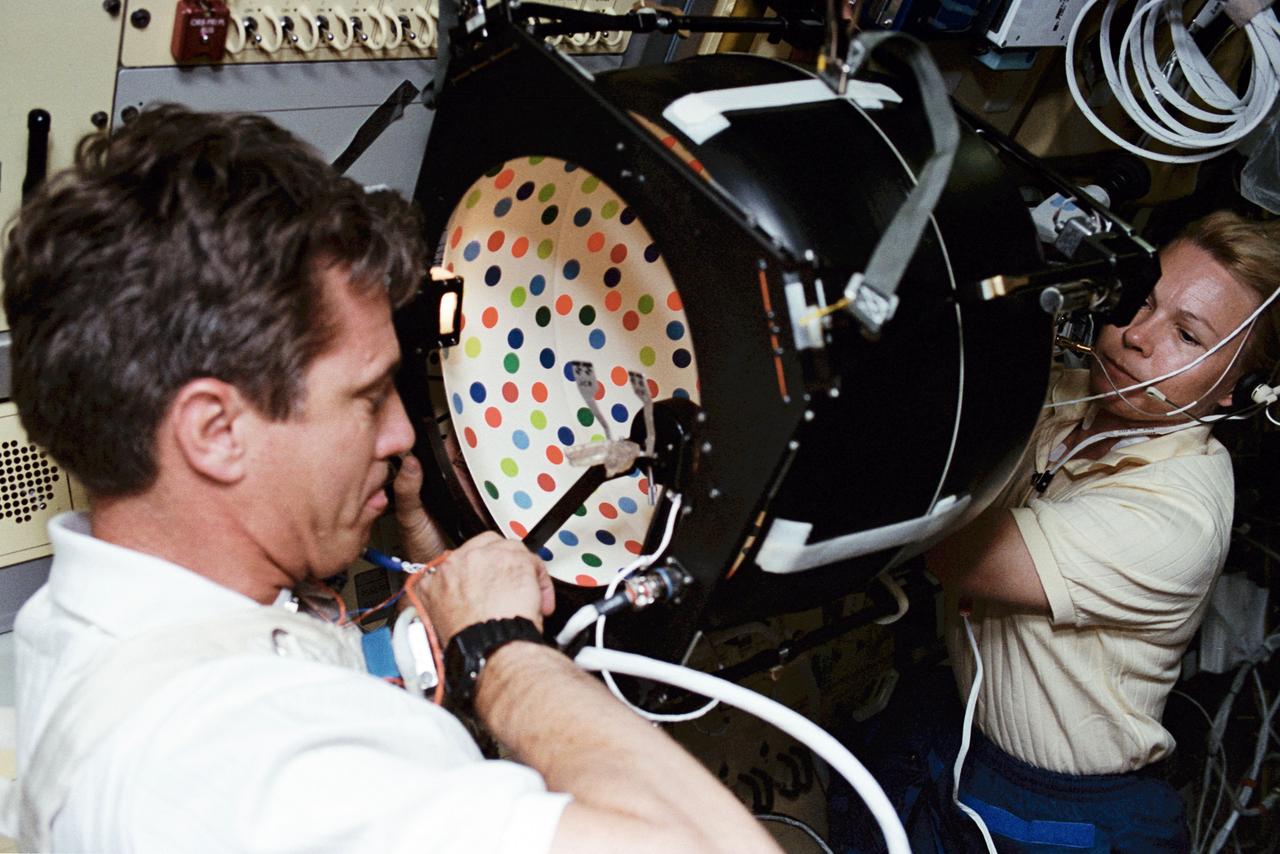
STS058-03-020 (18 Oct.-1 Nov. 1993) --- In the Spacelab onboard the space shuttle Columbia, STS-58 Commander John Blaha is positioned at the Rotating Dome vestibular experiment as Payload Commander Rhea Seddon sets up the experiment. Photo credit: NASA
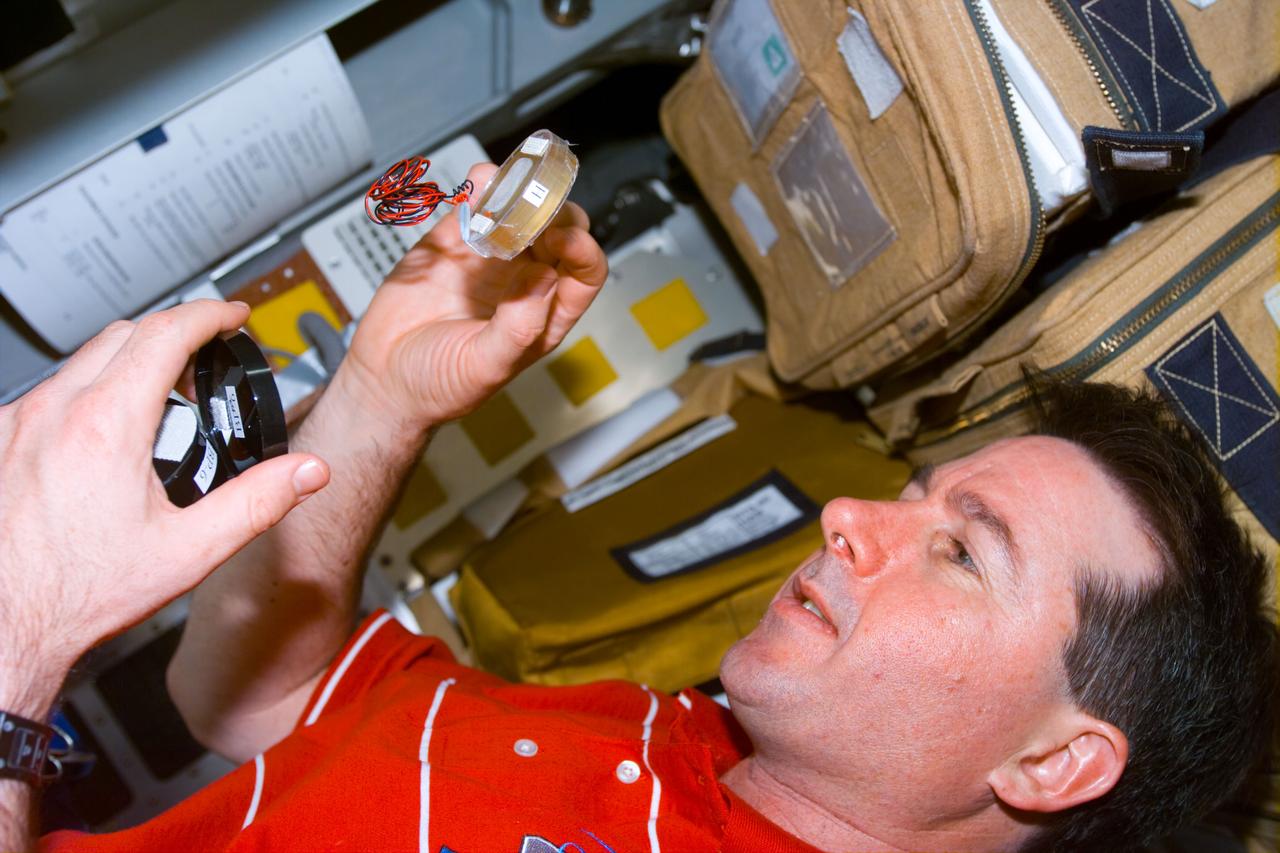
STS095-E-5102 (2 Nov. 1998) --- Astronaut Stephen K. Robinson, STS-95 mission specialist, with experiment during Flight Day 4 activity. The photograph was taken with an electronic still camera (ESC) at 04:58:07 GMT, Nov. 2.
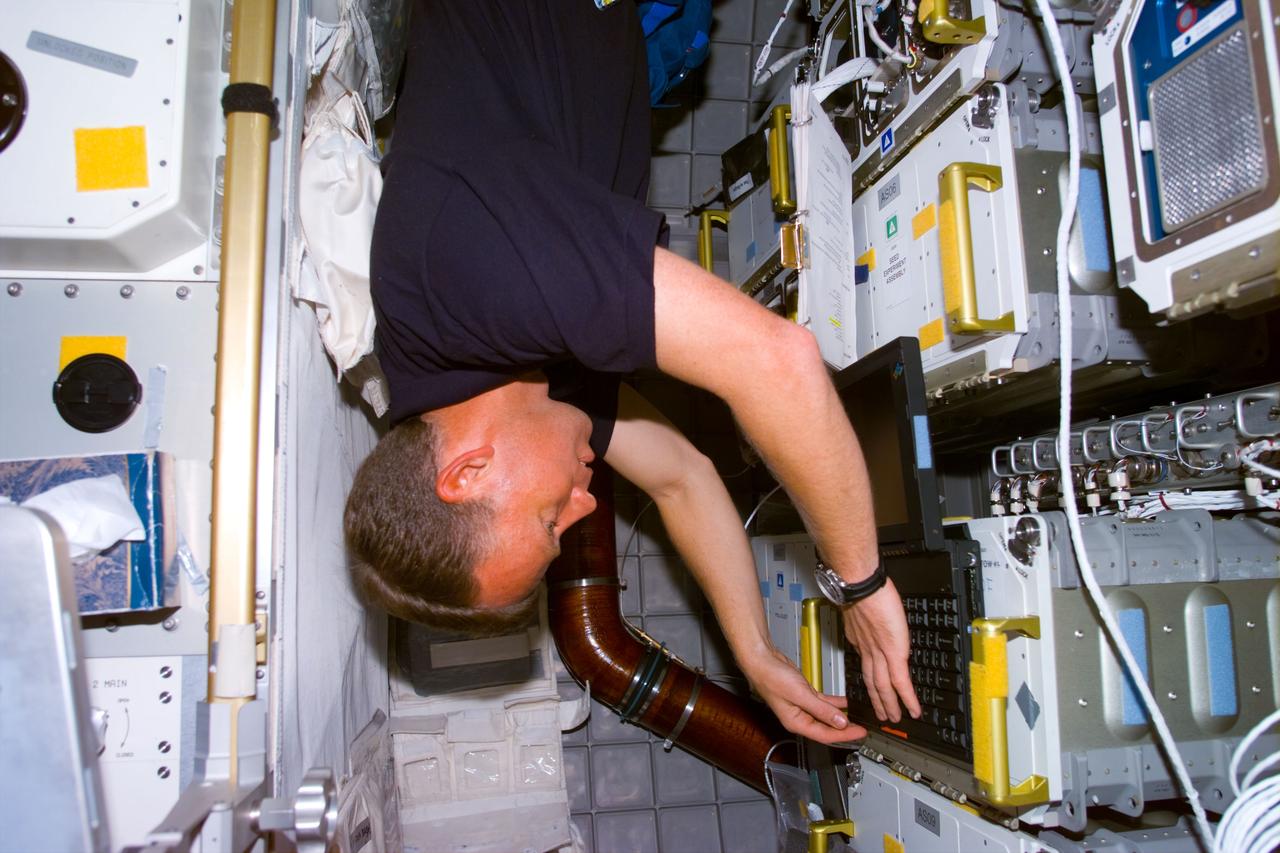
STS095-E-5218 (4 Nov. 1998) --- Astronaut Steven W. Lindsey, STS-95 pilot, inputs data on a lap top computer in the Spacehab facility onboard the Space Shuttle Discovery. The photo was taken with an electronic still camera (ESC) at 02:58:43 GMT, Nov. 4.
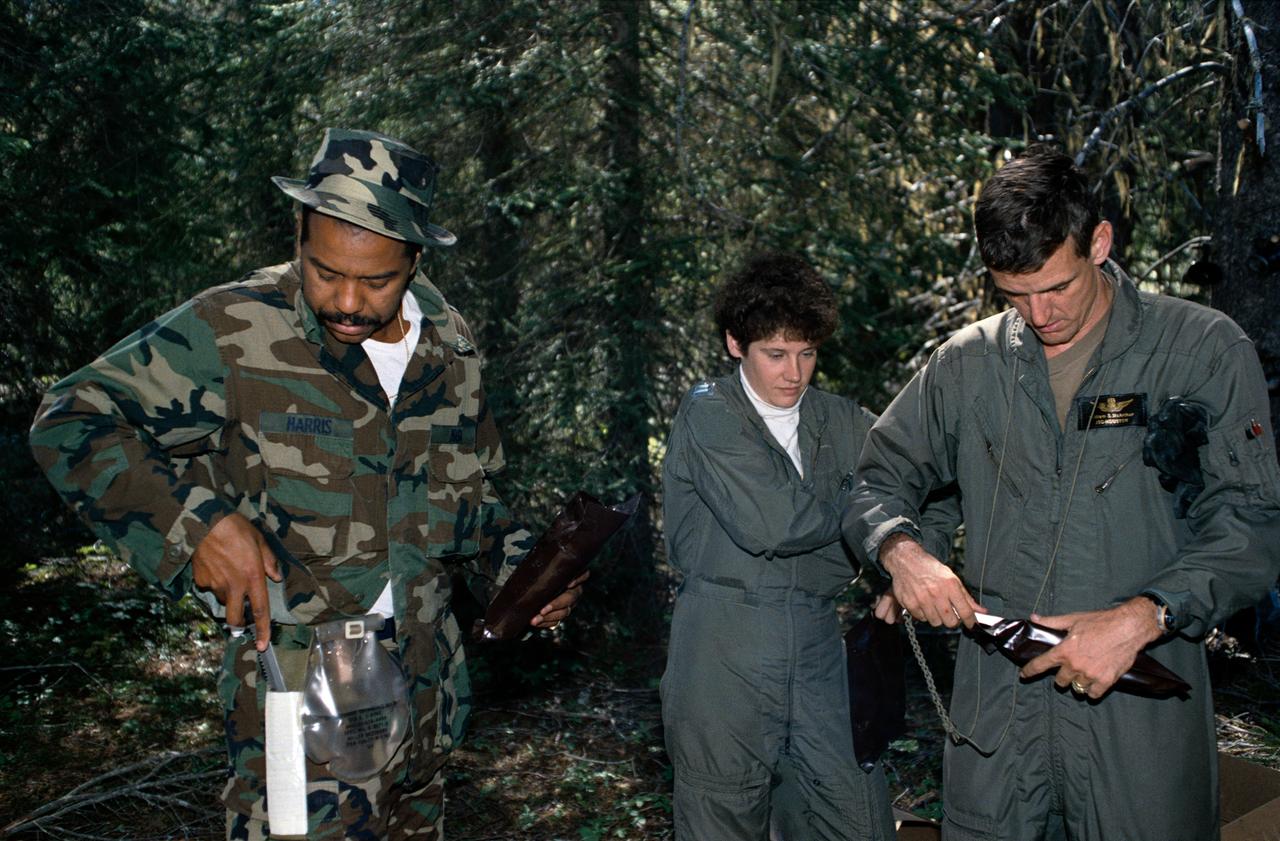
1990 Group 13 Astronaut Candidates (ASCANs) (left to right) Bernard J. Harris, Jr, Susan J. Helms, and William S. McArthur, Jr open dehydrated food packages during wilderness survival training at Fairchild Air Force Base (AFB) in Spokane, Washington. The training was conducted in the mountain forests of Washington from 08-26-90 through 08-30-90.
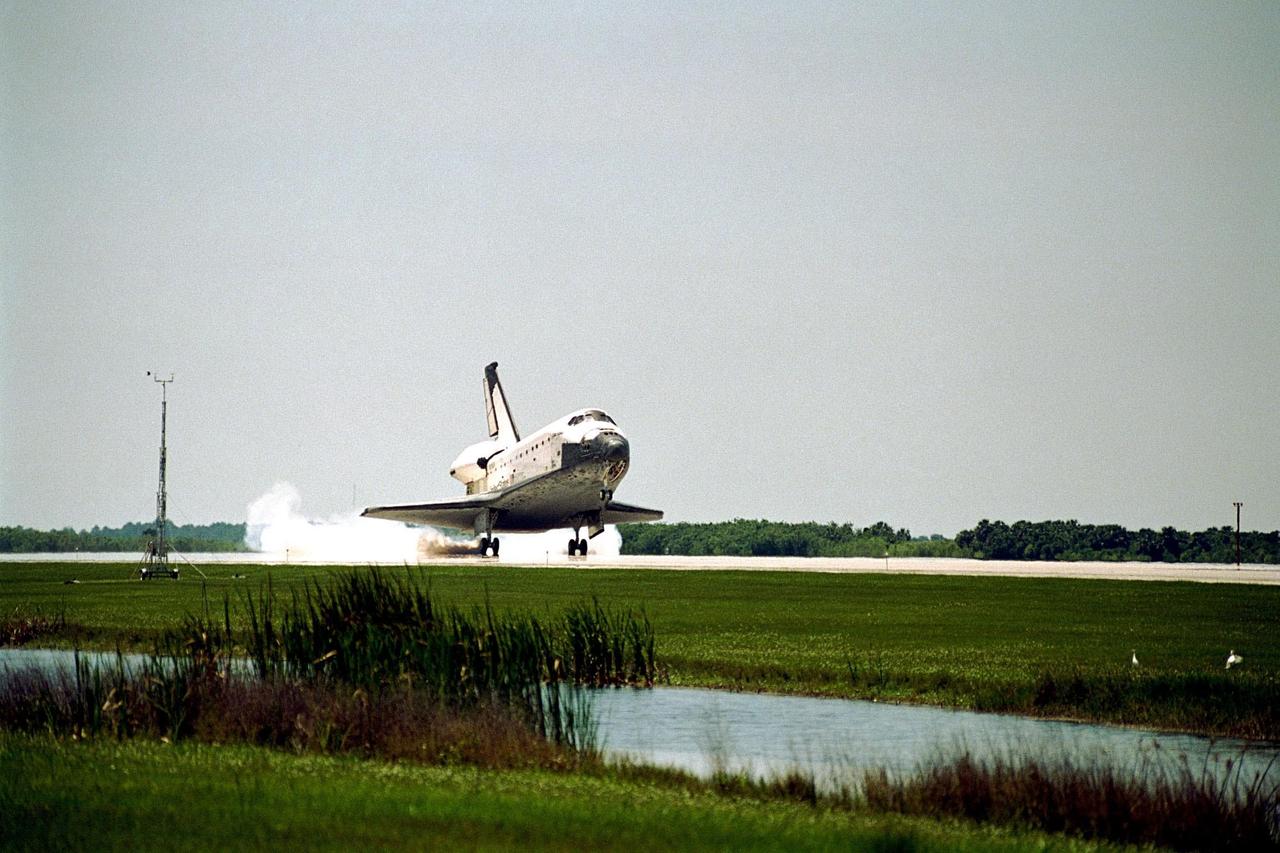
The orbiter Columbia touches down on Runway 33 of KSC's Shuttle Landing Facility to complete the nearly 16-day STS-90 mission. Main gear touchdown was at 12:08:59 p.m. EDT on May 3, 1998, landing on orbit 256 of the mission. The wheels stopped at 12:09:58 EDT, completing a total mission time of 15 days, 21 hours, 50 minutes and 58 seconds. The 90th Shuttle mission was Columbia's 13th landing at the space center and the 43rd KSC landing in the history of the Space Shuttle program. During the mission, the crew conducted research to contribute to a better understanding of the human nervous system. The crew of the STS-90 Neurolab mission include Commander Richard Searfoss; Pilot Scott Altman; Mission Specialists Richard Linnehan, D.V.M., Dafydd (Dave) Williams, M.D., with the Canadian Space Agency, and Kathryn (Kay) Hire; and Payload Specialists Jay Buckey, M.D., and James Pawelczyk, Ph.D
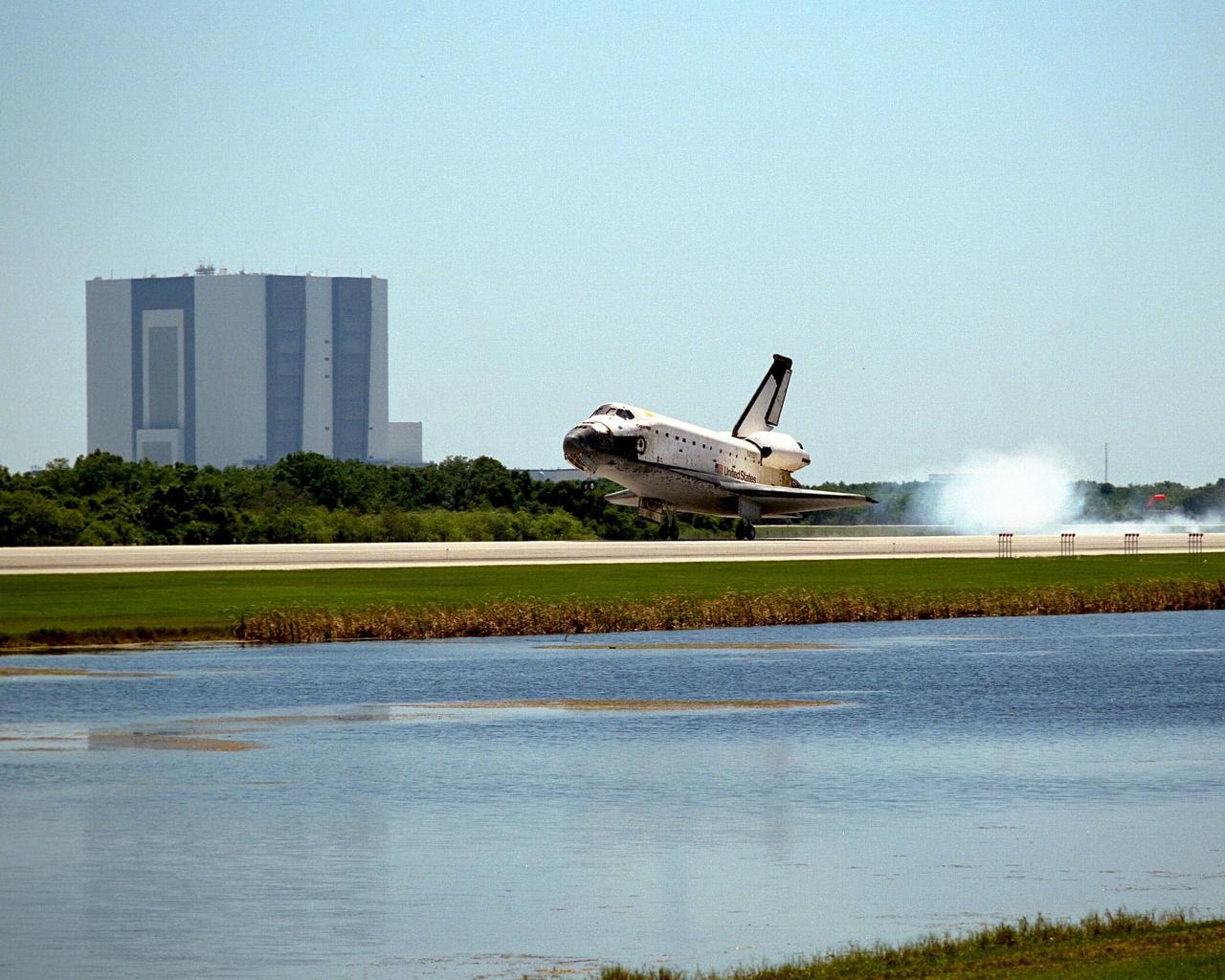
The orbiter Columbia touches down on Runway 33 of KSC's Shuttle Landing Facility to complete the nearly 16-day STS-90 mission. Main gear touchdown was at 12:08:59 p.m. EDT on May 3, 1998, landing on orbit 256 of the mission. The wheels stopped at 12:09:58 EDT, completing a total mission time of 15 days, 21 hours, 50 minutes and 58 seconds. The 90th Shuttle mission was Columbia's 13th landing at the space center and the 43rd KSC landing in the history of the Space Shuttle program. During the mission, the crew conducted research to contribute to a better understanding of the human nervous system. The crew of the STS-90 Neurolab mission include Commander Richard Searfoss; Pilot Scott Altman; Mission Specialists Richard Linnehan, D.V.M., Dafydd (Dave) Williams, M.D., with the Canadian Space Agency, and Kathryn (Kay) Hire; and Payload Specialists Jay Buckey, M.D., and James Pawelczyk, Ph.D
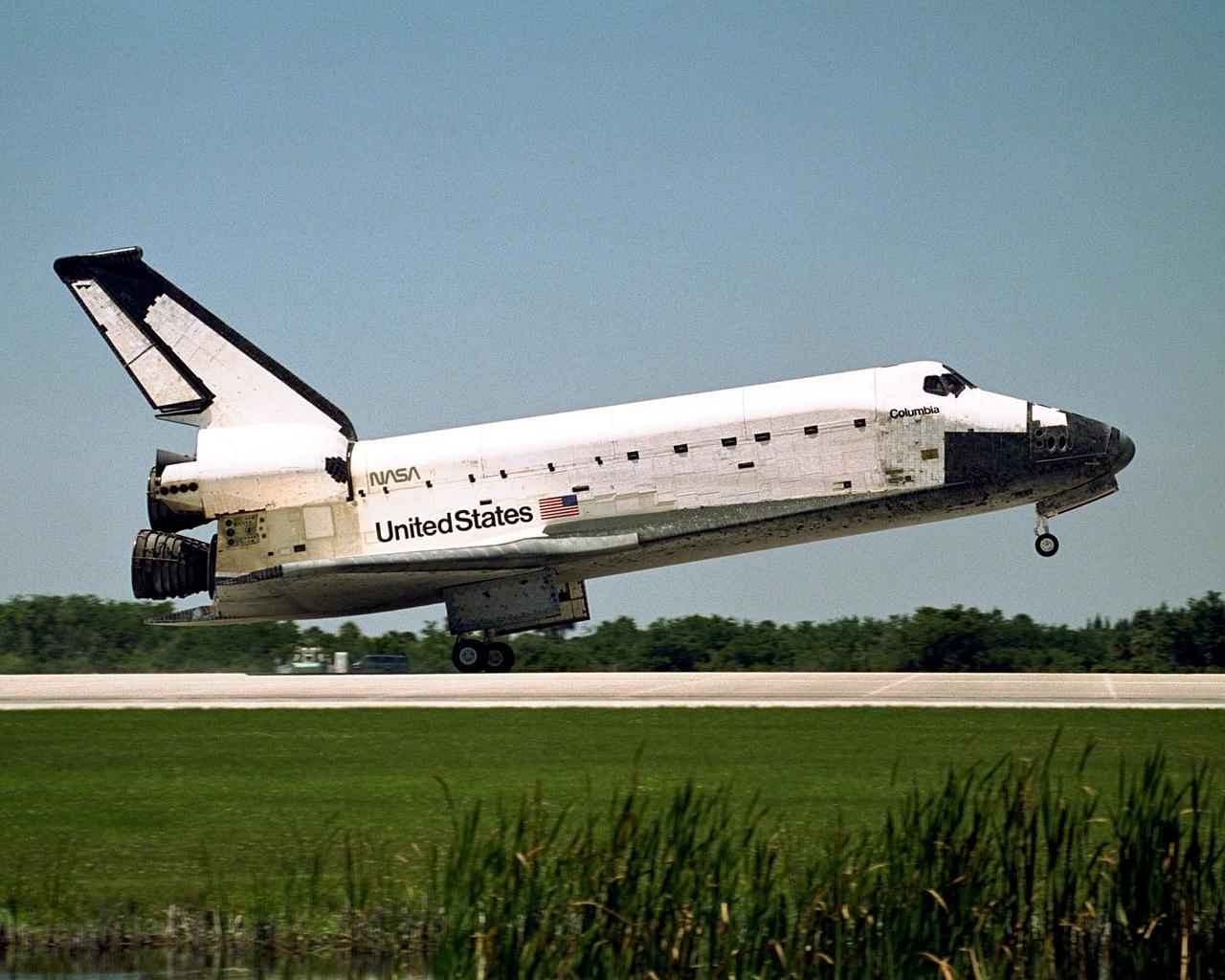
The orbiter Columbia approaches touchdown on Runway 33 of KSC's Shuttle Landing Facility to complete the nearly 16-day STS-90 mission. Main gear touchdown was at 12:08:59 p.m. EDT on May 3, 1998, landing on orbit 256 of the mission. The wheels stopped at 12:09:58 EDT, completing a total mission time of 15 days, 21 hours, 50 minutes and 58 seconds. The 90th Shuttle mission was Columbia's 13th landing at the space center and the 43rd KSC landing in the history of the Space Shuttle program. During the mission, the crew conducted research to contribute to a better understanding of the human nervous system. The crew of the STS-90 Neurolab mission include Commander Richard Searfoss; Pilot Scott Altman; Mission Specialists Richard Linnehan, D.V.M., Dafydd (Dave) Williams, M.D., with the Canadian Space Agency, and Kathryn (Kay) Hire; and Payload Specialists Jay Buckey, M.D., and James Pawelczyk, Ph.D
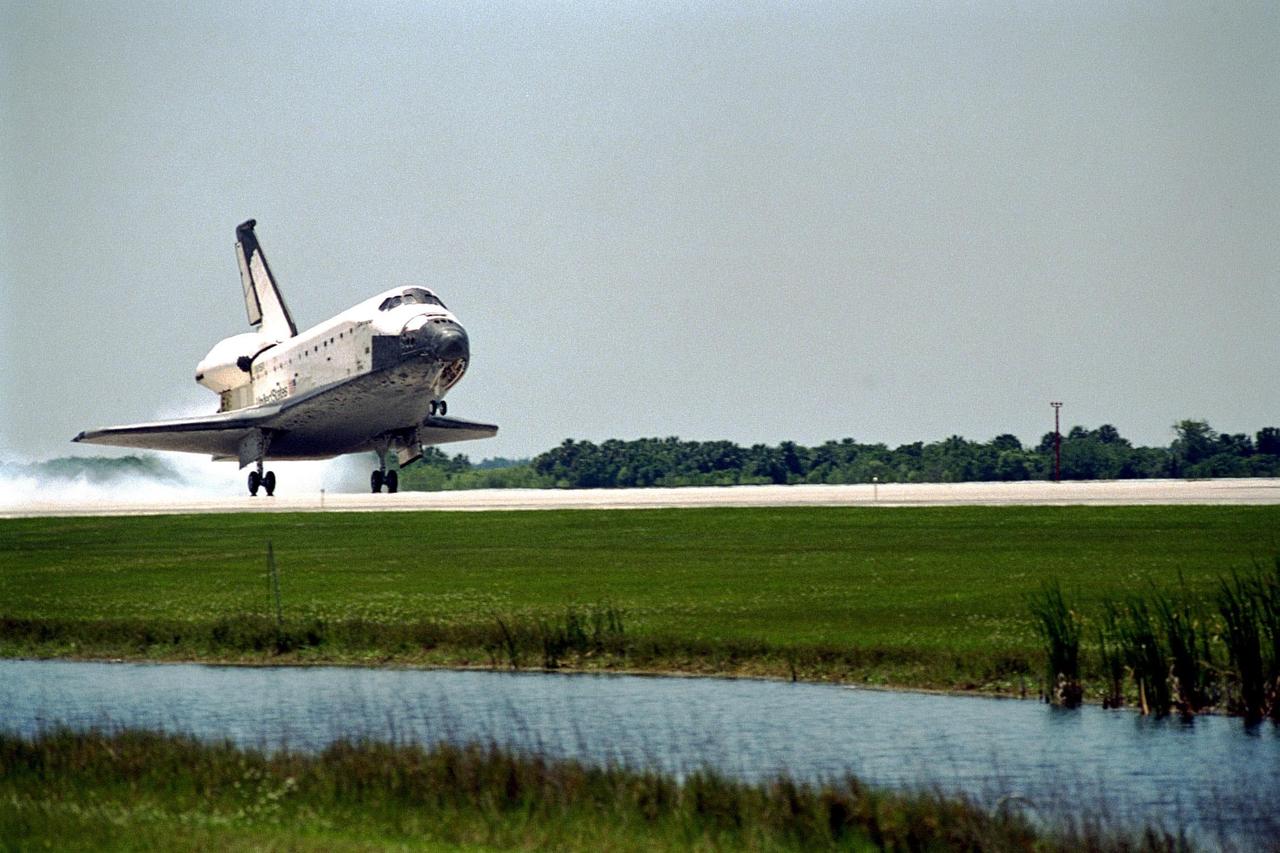
The orbiter Columbia touches down on Runway 33 of KSC's Shuttle Landing Facility to complete the nearly 16-day STS-90 mission. Main gear touchdown was at 12:08:59 p.m. EDT on May 3, 1998, landing on orbit 256 of the mission. The wheels stopped at 12:09:58 EDT, completing a total mission time of 15 days, 21 hours, 50 minutes and 58 seconds. The 90th Shuttle mission was Columbia's 13th landing at the space center and the 43rd KSC landing in the history of the Space Shuttle program. During the mission, the crew conducted research to contribute to a better understanding of the human nervous system. The crew of the STS-90 Neurolab mission include Commander Richard Searfoss; Pilot Scott Altman; Mission Specialists Richard Linnehan, D.V.M., Dafydd (Dave) Williams, M.D., with the Canadian Space Agency, and Kathryn (Kay) Hire; and Payload Specialists Jay Buckey, M.D., and James Pawelczyk, Ph.D
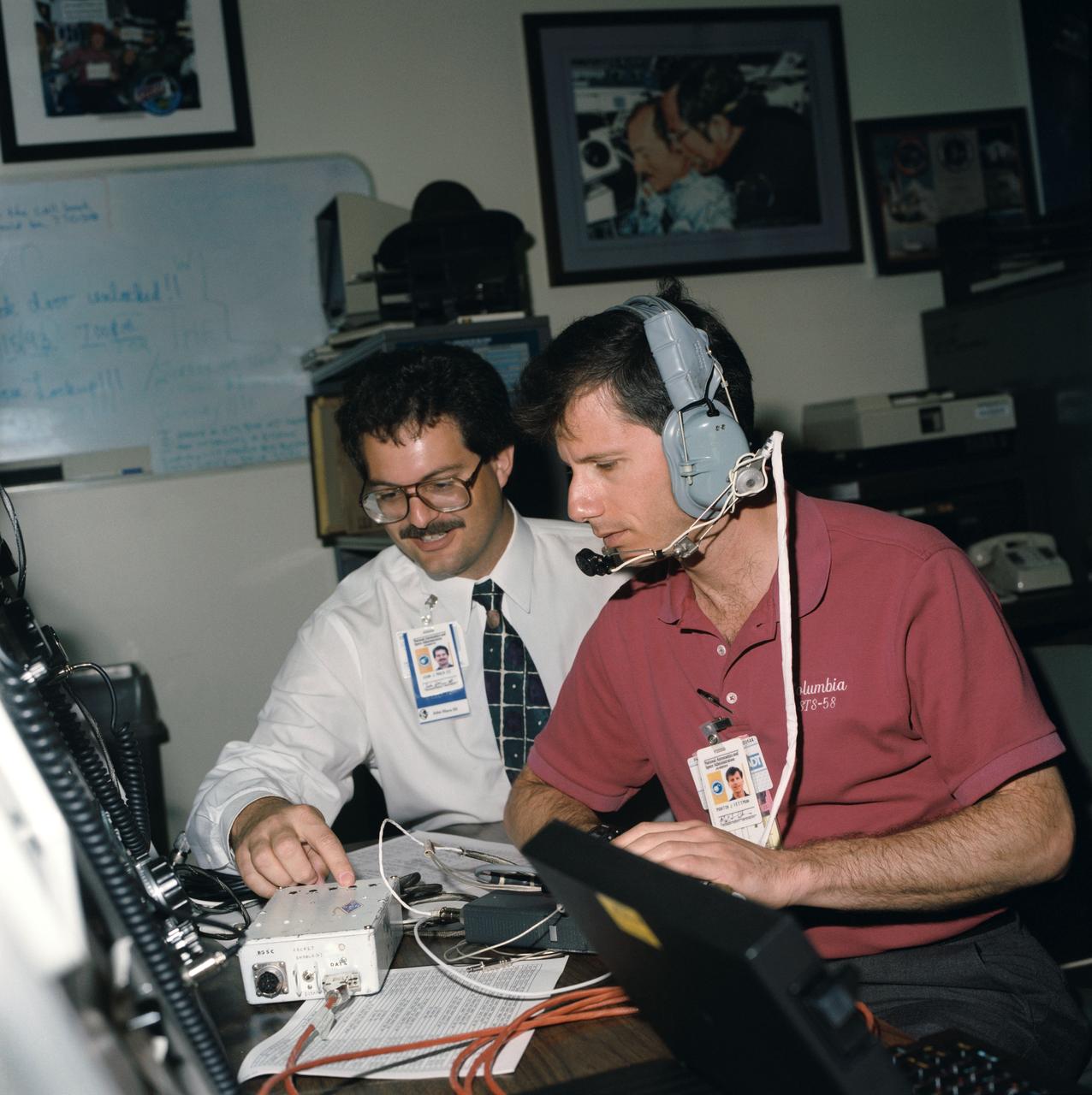
S93-45076 (22 Sept 1993) --- Payload specialist Martin J. Fettman listens to an amateur radio instruction by crew trainer John J. Maca. Members of the STS-58 crew were training with amateur radio equipment at the Johnson Space Center (JSC). The STS-58 flight will carry the Shuttle Amateur Radio Experiment (SAREX) payload, configuration C, which includes FM voice and packet. Three of the seven crew members are licensed amateur radio operators. Fettman's call letters are KC5AXA; William S. McArthur, mission specialist, KC5ACR; and Richard A. Searfoss, pilot, KC5CKM. Licensed students at a number of schools around the country will have the opportunity to talk directly with the astronauts during the 14-day flight.
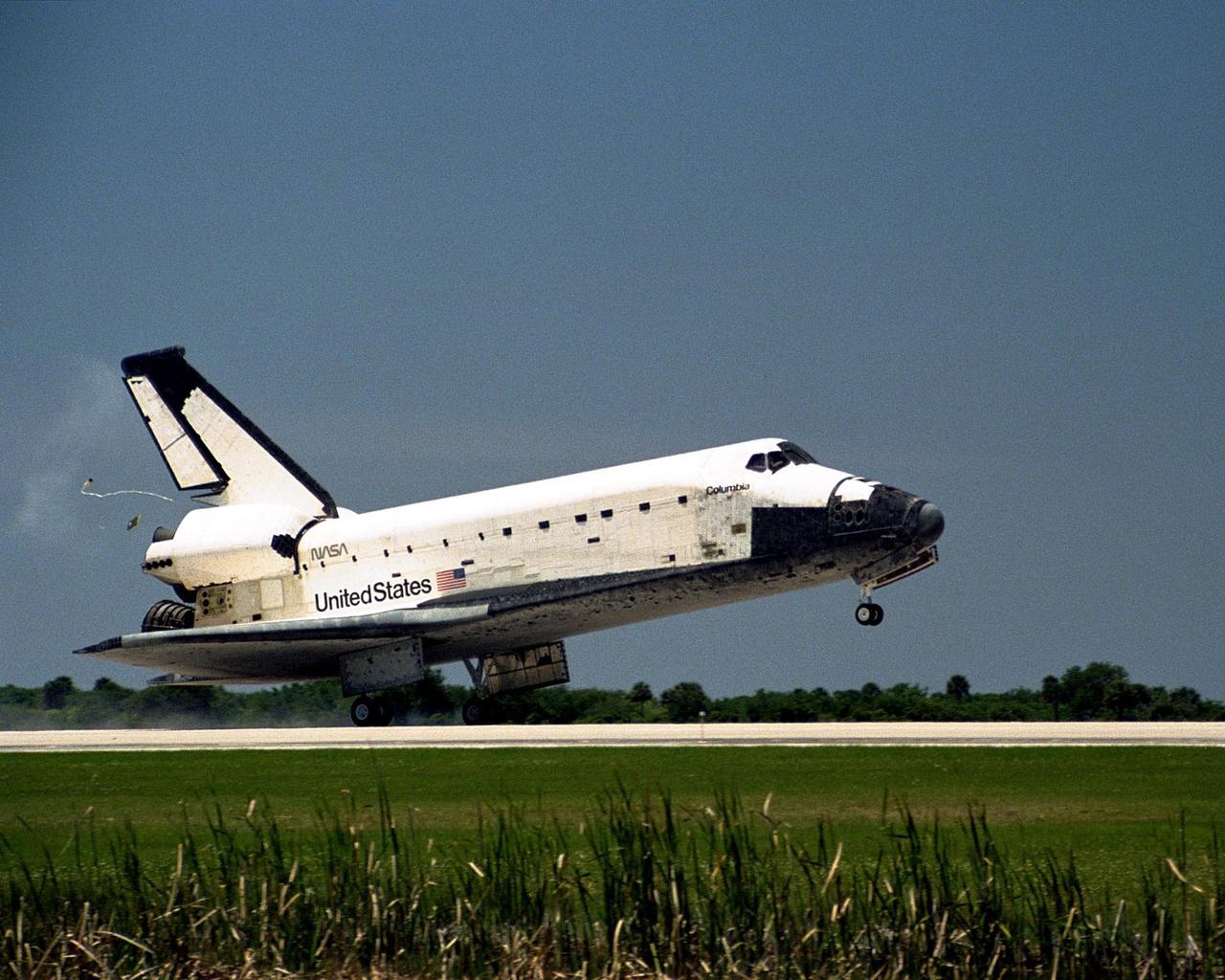
The orbiter Columbia touches down on Runway 33 of KSC's Shuttle Landing Facility to complete the nearly 16-day STS-90 mission. Main gear touchdown was at 12:08:59 p.m. EDT on May 3, 1998, landing on orbit 256 of the mission. The wheels stopped at 12:09:58 EDT, completing a total mission time of 15 days, 21 hours, 50 minutes and 58 seconds. The 90th Shuttle mission was Columbia's 13th landing at the space center and the 43rd KSC landing in the history of the Space Shuttle program. During the mission, the crew conducted research to contribute to a better understanding of the human nervous system. The crew of the STS-90 Neurolab mission include Commander Richard Searfoss; Pilot Scott Altman; Mission Specialists Richard Linnehan, D.V.M., Dafydd (Dave) Williams, M.D., with the Canadian Space Agency, and Kathryn (Kay) Hire; and Payload Specialists Jay Buckey, M.D., and James Pawelczyk, Ph.D
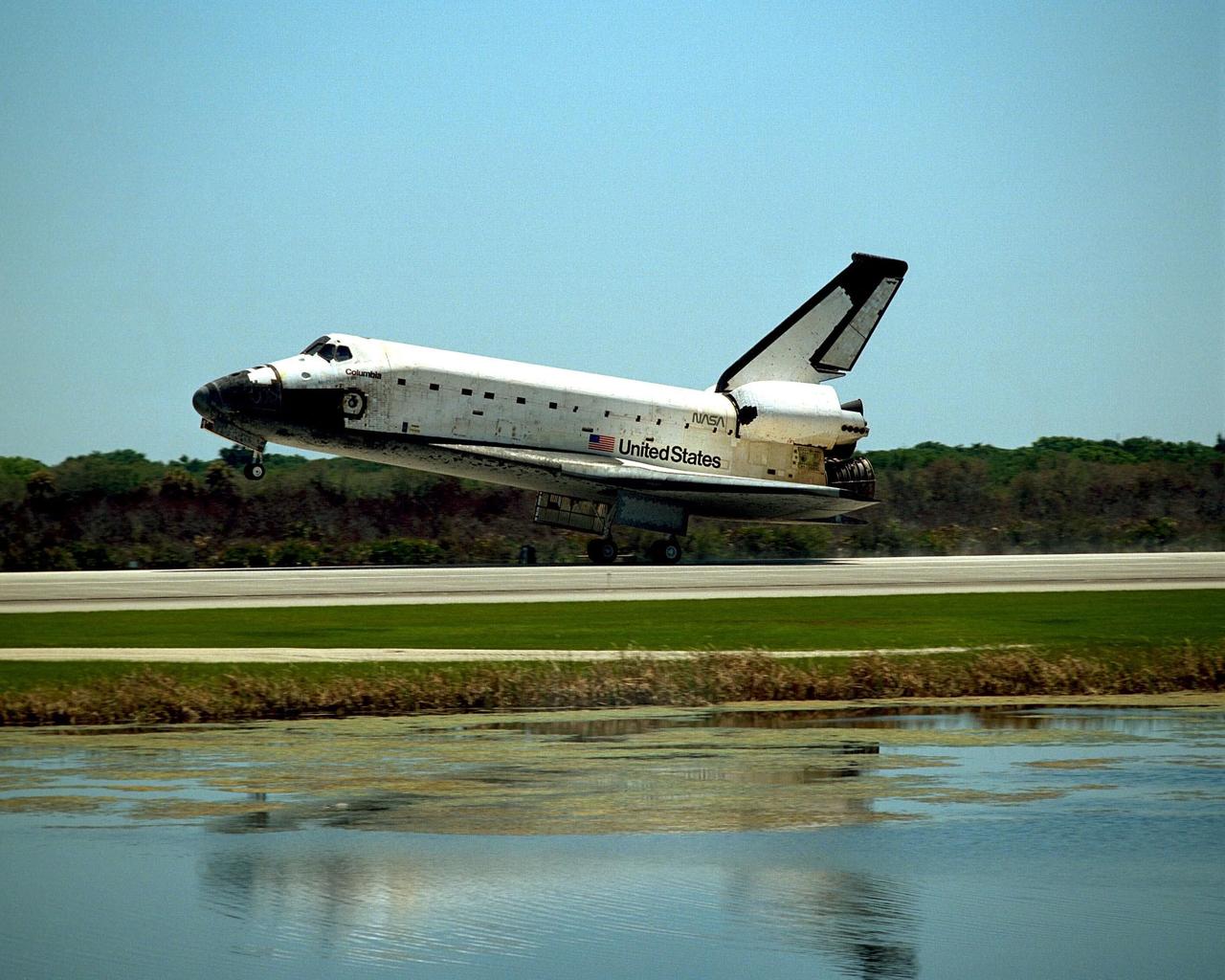
The orbiter Columbia approaches touchdown on Runway 33 of KSC's Shuttle Landing Facility to complete the nearly 16-day STS-90 mission. Main gear touchdown was at 12:08:59 p.m. EDT on May 3, 1998, landing on orbit 256 of the mission. The wheels stopped at 12:09:58 EDT, completing a total mission time of 15 days, 21 hours, 50 minutes and 58 seconds. The 90th Shuttle mission was Columbia's 13th landing at the space center and the 43rd KSC landing in the history of the Space Shuttle program. During the mission, the crew conducted research to contribute to a better understanding of the human nervous system. The crew of the STS-90 Neurolab mission include Commander Richard Searfoss; Pilot Scott Altman; Mission Specialists Richard Linnehan, D.V.M., Dafydd (Dave) Williams, M.D., with the Canadian Space Agency, and Kathryn (Kay) Hire; and Payload Specialists Jay Buckey, M.D., and James Pawelczyk, Ph.D
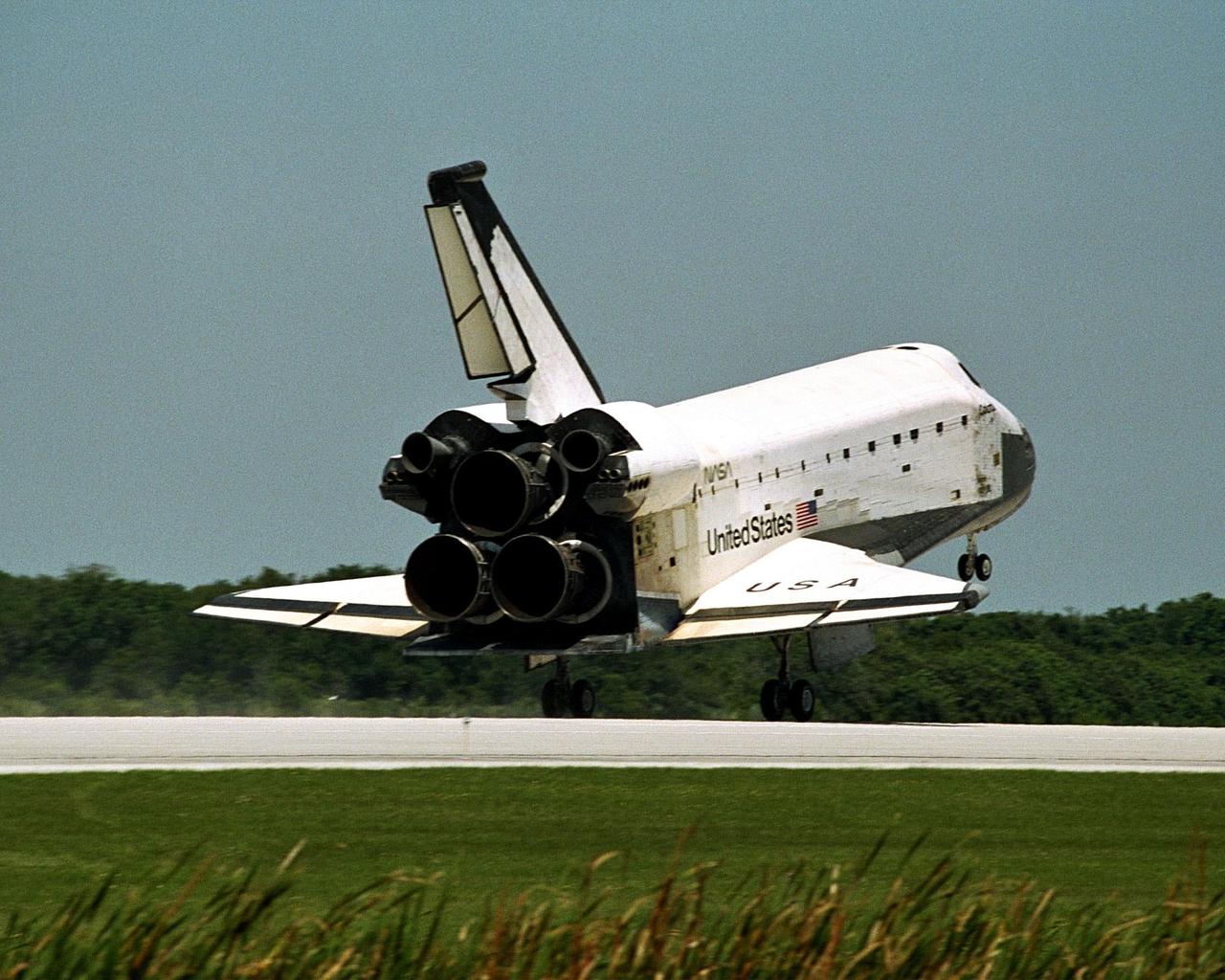
The orbiter Columbia approaches touchdown on Runway 33 of KSC's Shuttle Landing Facility to complete the nearly 16-day STS-90 mission. Main gear touchdown was at 12:08:59 p.m. EDT on May 3, 1998, landing on orbit 256 of the mission. The wheels stopped at 12:09:58 EDT, completing a total mission time of 15 days, 21 hours, 50 minutes and 58 seconds. The 90th Shuttle mission was Columbia's 13th landing at the space center and the 43rd KSC landing in the history of the Space Shuttle program. During the mission, the crew conducted research to contribute to a better understanding of the human nervous system. The crew of the STS-90 Neurolab mission include Commander Richard Searfoss; Pilot Scott Altman; Mission Specialists Richard Linnehan, D.V.M., Dafydd (Dave) Williams, M.D., with the Canadian Space Agency, and Kathryn (Kay) Hire; and Payload Specialists Jay Buckey, M.D., and James Pawelczyk, Ph.D
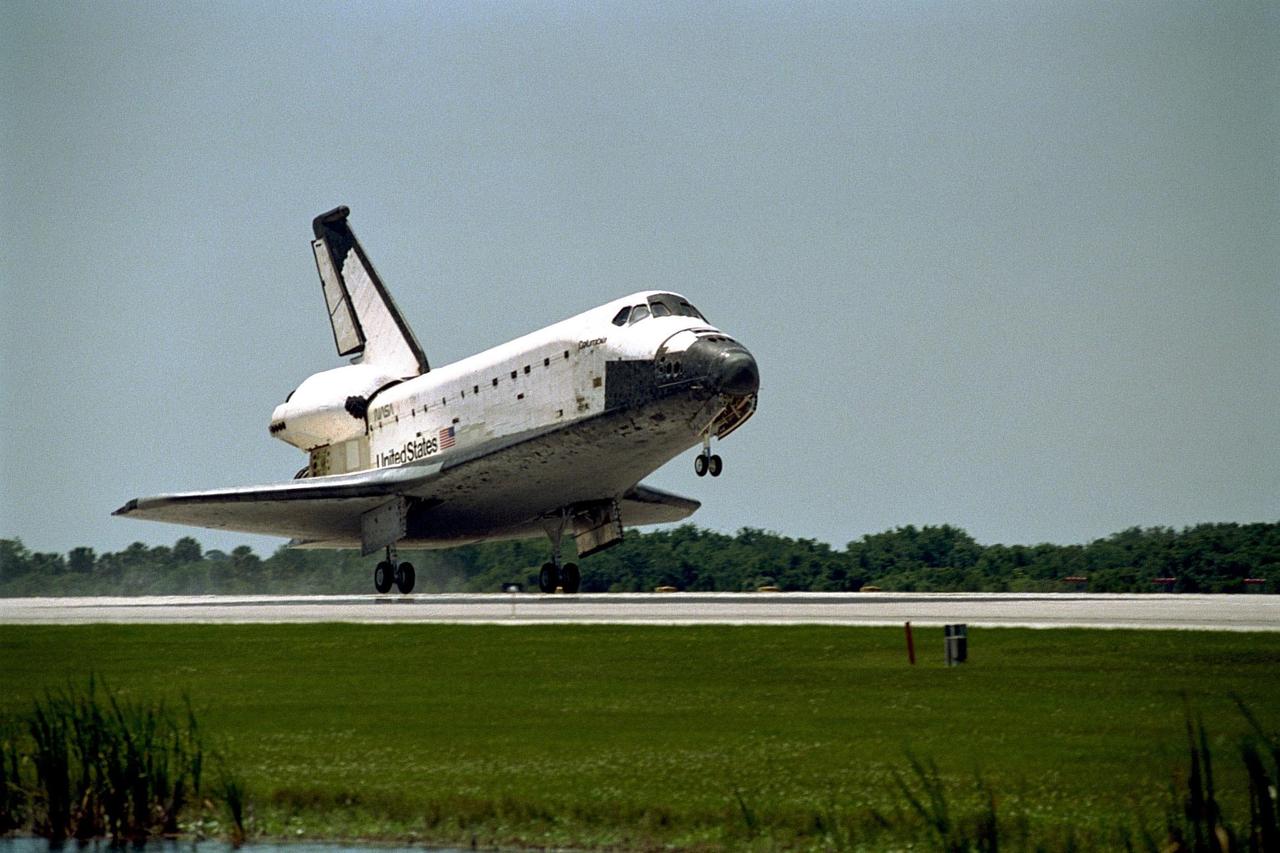
The orbiter Columbia approaches touchdown on Runway 33 of KSC's Shuttle Landing Facility to complete the nearly 16-day STS-90 mission. Main gear touchdown was at 12:08:59 p.m. EDT on May 3, 1998, landing on orbit 256 of the mission. The wheels stopped at 12:09:58 EDT, completing a total mission time of 15 days, 21 hours, 50 minutes and 58 seconds. The 90th Shuttle mission was Columbia's 13th landing at the space center and the 43rd KSC landing in the history of the Space Shuttle program. During the mission, the crew conducted research to contribute to a better understanding of the human nervous system. The crew of the STS-90 Neurolab mission include Commander Richard Searfoss; Pilot Scott Altman; Mission Specialists Richard Linnehan, D.V.M., Dafydd (Dave) Williams, M.D., with the Canadian Space Agency, and Kathryn (Kay) Hire; and Payload Specialists Jay Buckey, M.D., and James Pawelczyk, Ph.D
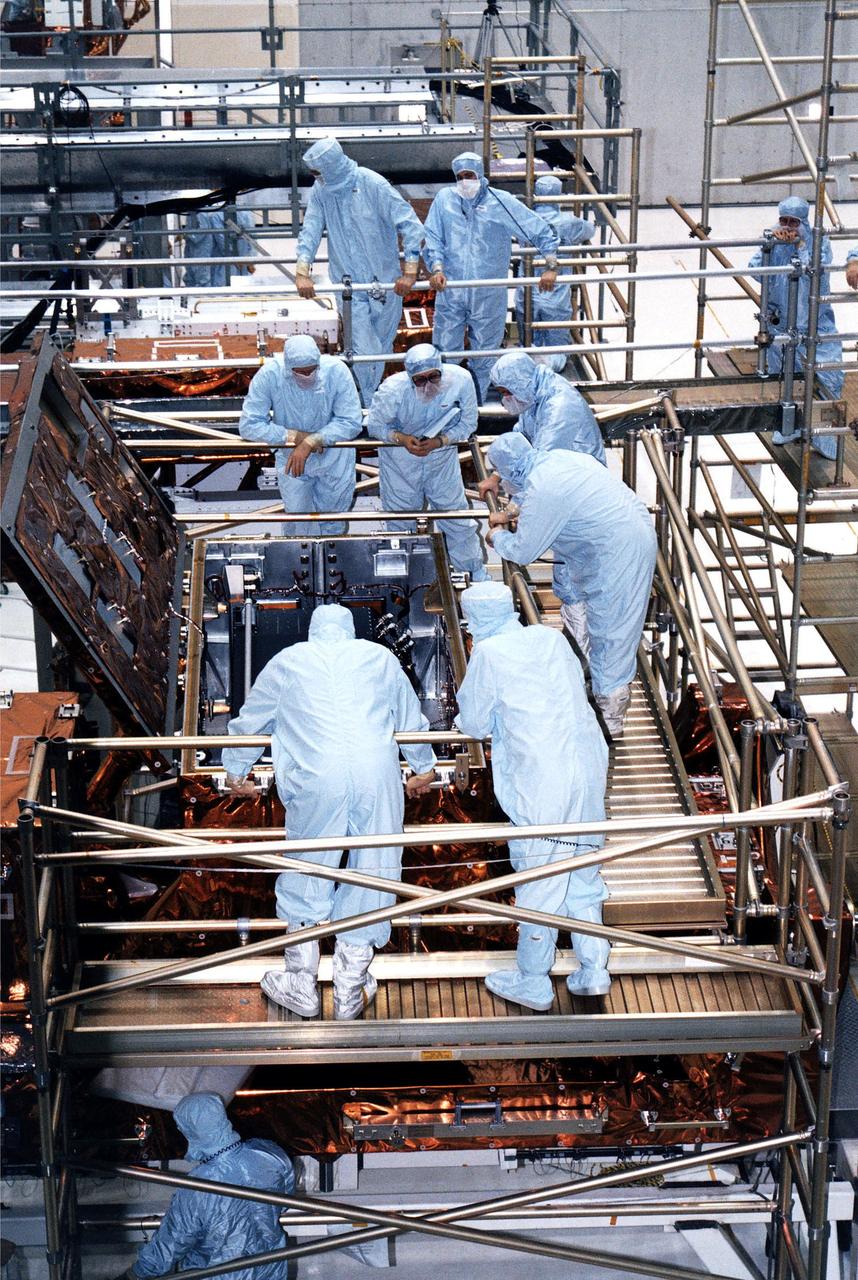
KENNEDY SPACE CENTER, FLA. - STS-82 crew members and workers at KSC's Vertical Processing Facility get a final look at the Near Infrared Camera and Multi-Object Spectrometer (NICMOS) in its flight configuration for the STS-82 mission. The crew is participating in the Crew Equipment Integration Test (CEIT). NICMOS is one of two new scientific instruments that will replace two outdated instruments on the Hubble Space Telescope (HST). NICMOS will provide HST with the capability for infrared imaging and spectroscopic observations of astronomical targets. The refrigerator-sized NICMOS also is HST's first cryogenic instrument - its sensitive infrared detectors must operate at very cold temperatures of minus 355 degrees Fahrenheit or 58 degrees Kelvin. NICMOS will be installed in Hubble during STS-82, the second Hubble Space Telescope servicing mission. Liftoff is scheduled Feb. 11 aboard Discovery with a crew of seven.
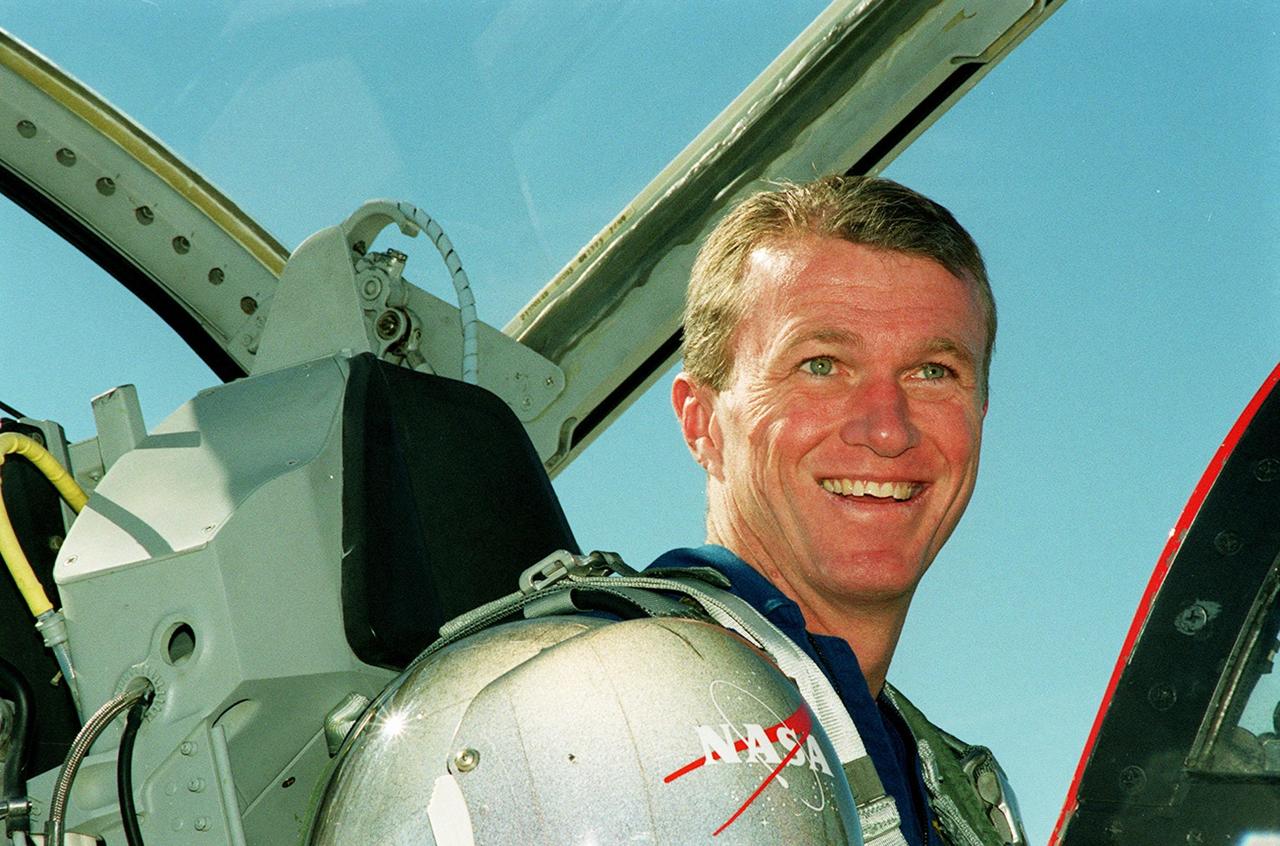
STS-97 Commander Brent Jett waits in the T-38 jet aircraft he piloted to the KSC Shuttle Landing Facility. He and the crew are on site for further work with equipment that will be on the mission. STS-97 is scheduled to launch Nov. 30 at 10:06 p.m. EST from Launch Pad 39B. The sixth flight to the International Space Station, the mission is expected to last 11 days, with a planned KSC landing at about 5:58 p.m. Dec. 11
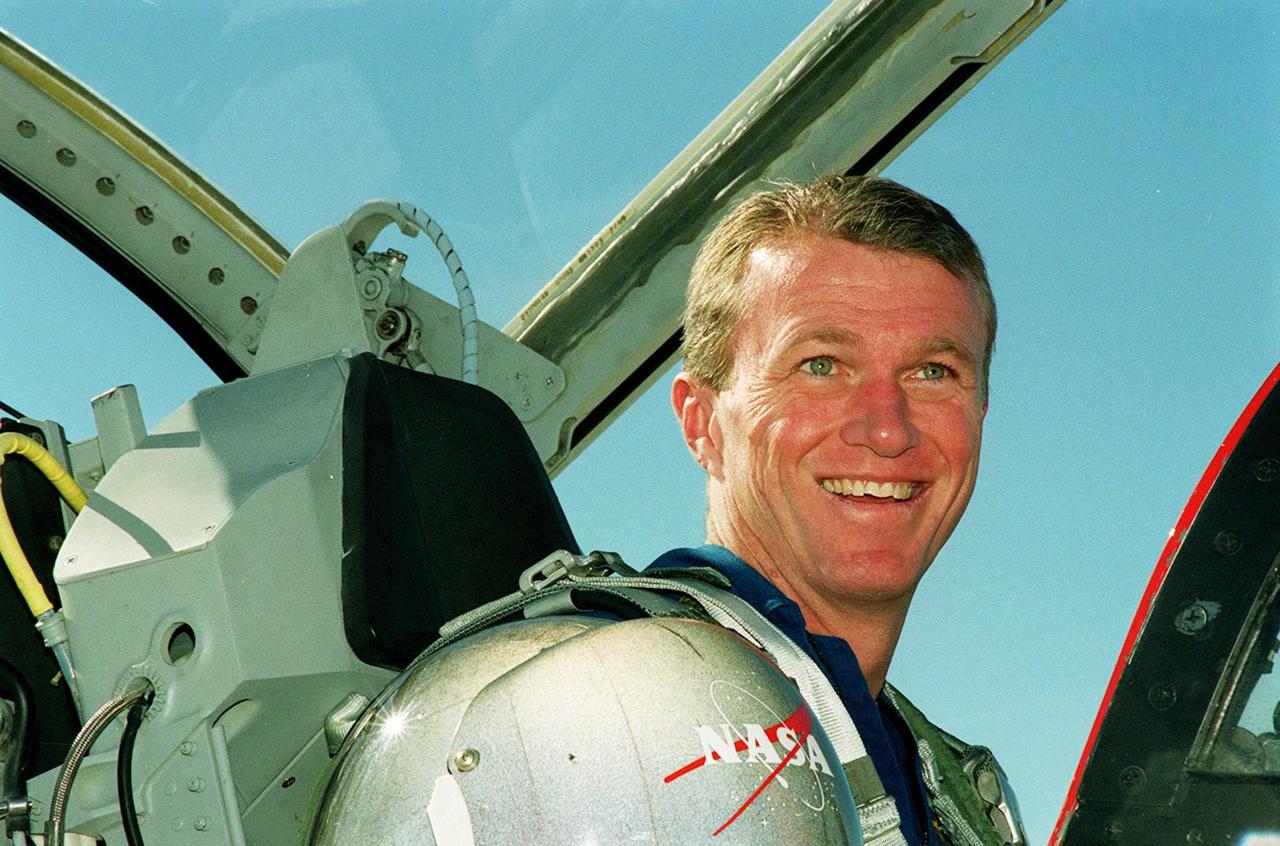
STS-97 Commander Brent Jett waits in the T-38 jet aircraft he piloted to the KSC Shuttle Landing Facility. He and the crew are on site for further work with equipment that will be on the mission. STS-97 is scheduled to launch Nov. 30 at 10:06 p.m. EST from Launch Pad 39B. The sixth flight to the International Space Station, the mission is expected to last 11 days, with a planned KSC landing at about 5:58 p.m. Dec. 11
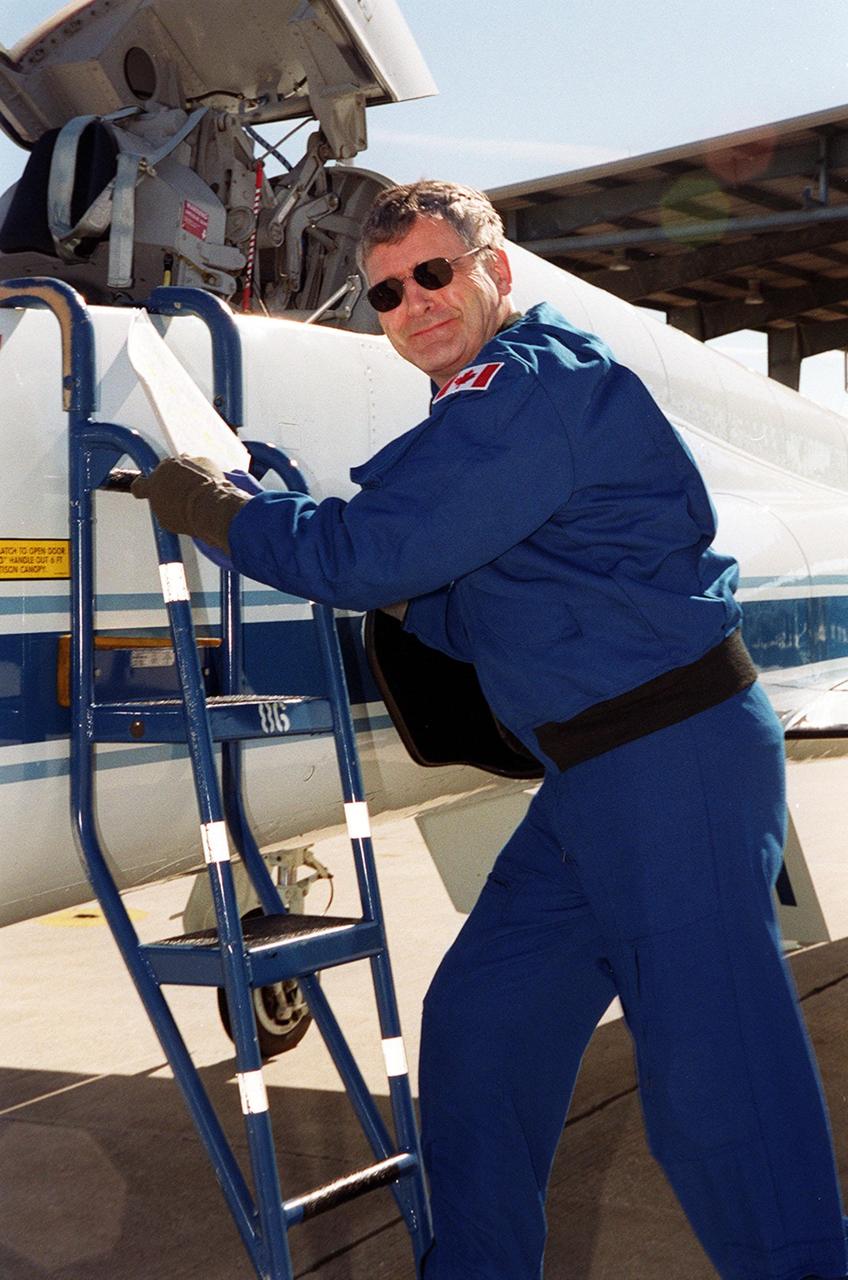
STS-97 Pilot Michael Bloomfield climbs down from the T-38 jet aircraft he piloted to the KSC Shuttle Landing Facility. He and the crew are on site for further work with equipment that will be on the mission. STS-97 is scheduled to launch Nov. 30 at 10:06 p.m. EST from Launch Pad 39B. The sixth flight to the International Space Station, the mission is expected to last 11 days, with a planned KSC landing at about 5:58 p.m. Dec. 11

STS-97 Pilot Michael Bloomfield climbs down from the T-38 jet aircraft he piloted to the KSC Shuttle Landing Facility. He and the crew are on site for further work with equipment that will be on the mission. STS-97 is scheduled to launch Nov. 30 at 10:06 p.m. EST from Launch Pad 39B. The sixth flight to the International Space Station, the mission is expected to last 11 days, with a planned KSC landing at about 5:58 p.m. Dec. 11
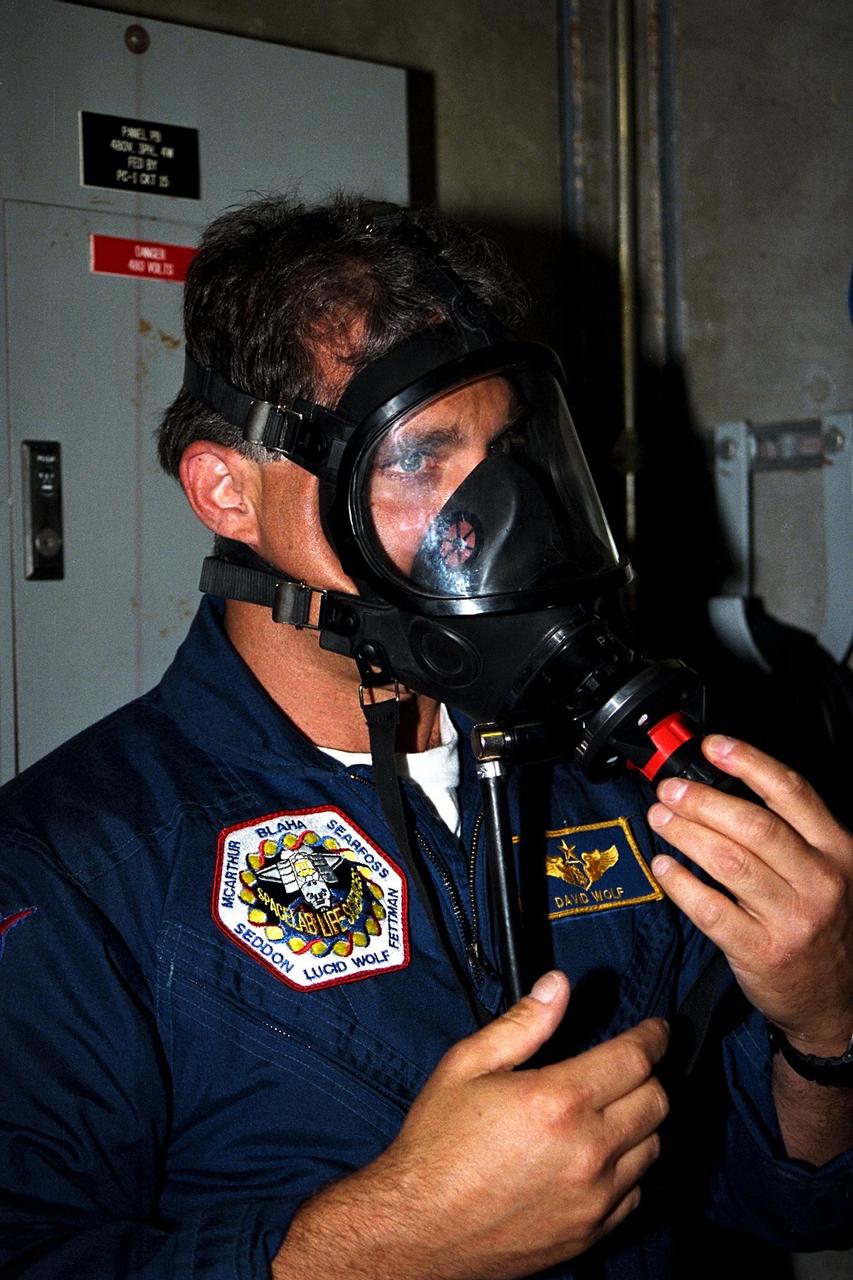
STS-86 Mission Specialist David A. Wolf dons a gas mask as part of training exercises during the Terminal Countdown Demonstration Test (TCDT), a dress rehearsal for launch. Wolf is wearing the patch from his first and only mission to date, STS-58 in 1993. STS-86 will be the seventh docking of the Space Shuttle with the Russian Space Station Mir. During the docking, Wolf will transfer to the orbiting Russian station and become a member of the Mir 24 crew, replacing U.S. astronaut C. Michael Foale, who has been on the Mir since the last docking mission, STS-84, in May. Launch of Mission STS-86 aboard the Space Shuttle Atlantis is targeted for Sept. 25
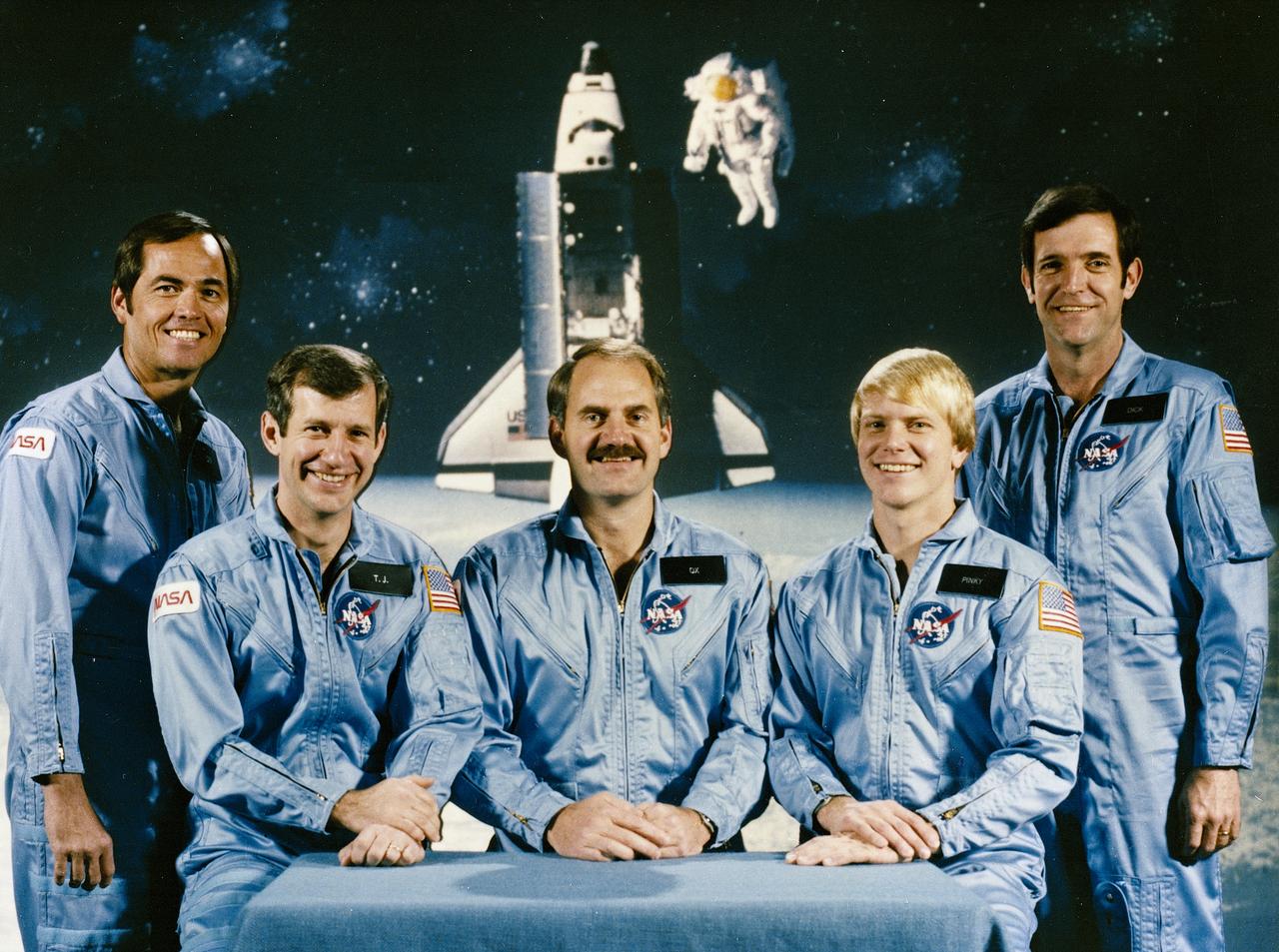
The crew assigned to the STS-41CB (STS-13) mission included (left to right) Robert L. Crippen, commander; Terry J. Hart, mission specialist; James D. Van-Hoften, mission specialist; George D. Nelson, mission specialist; and Francis R. (Dick) Scobee, pilot. Launched aboard the Space Shuttle Challenger on April 6, 1984 at 8:58:00 am (EST), the STS-41C mission marked the first direct ascent trajectory for the Space Shuttle. The crew deployed the Long Duration Exposure Facility (LDEF).
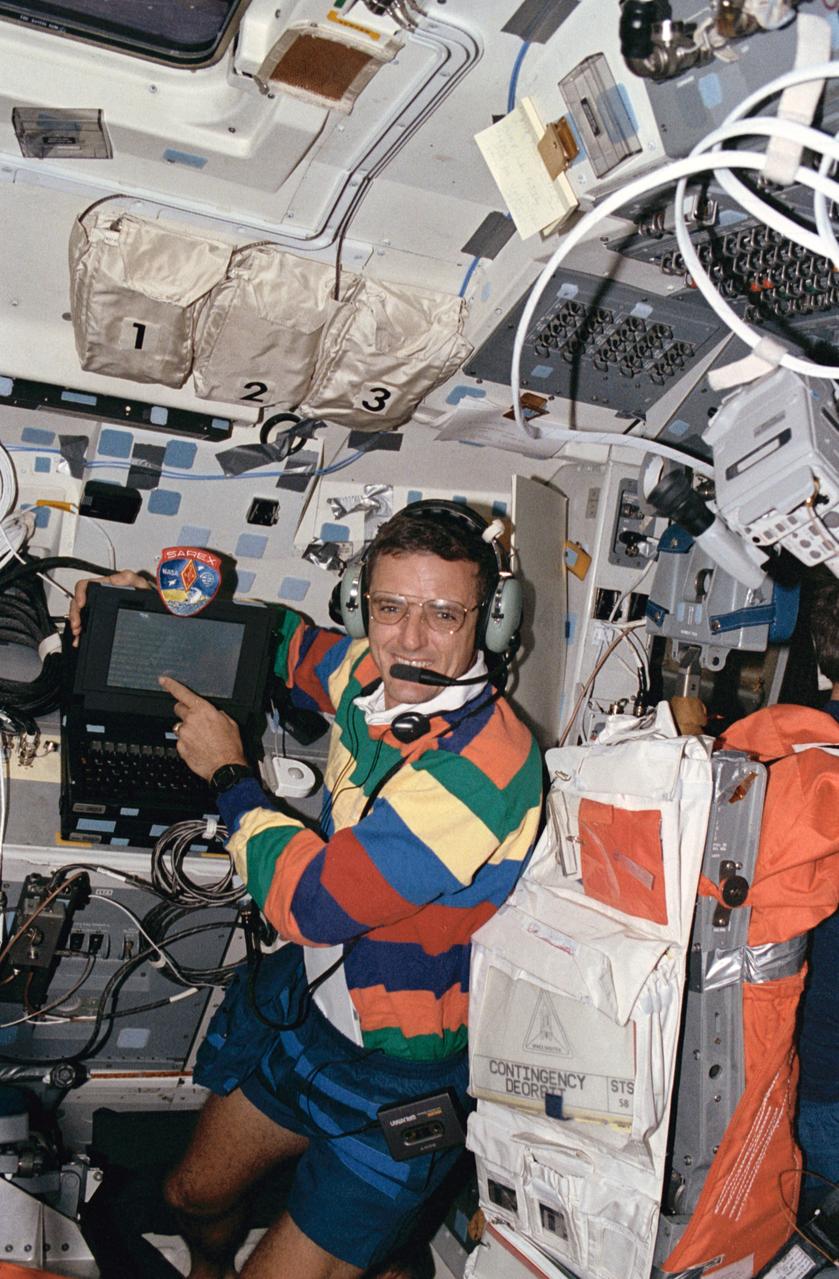
STS058-21-011 (24 Oct 1993) --- From the flight deck of the Earth-orbiting Space Shuttle Columbia, astronaut William S. McArthur talks to students on Earth. The mission specialist's activity was part of the Shuttle Amateur Radio Experiment (SAREX), a frequent payload on Shuttle missions which serves to enlighten students around the world on the topic of space travel. McArthur (call letters KC5ACR) is one of three licensed amateur radio operators on the seven-member flight.
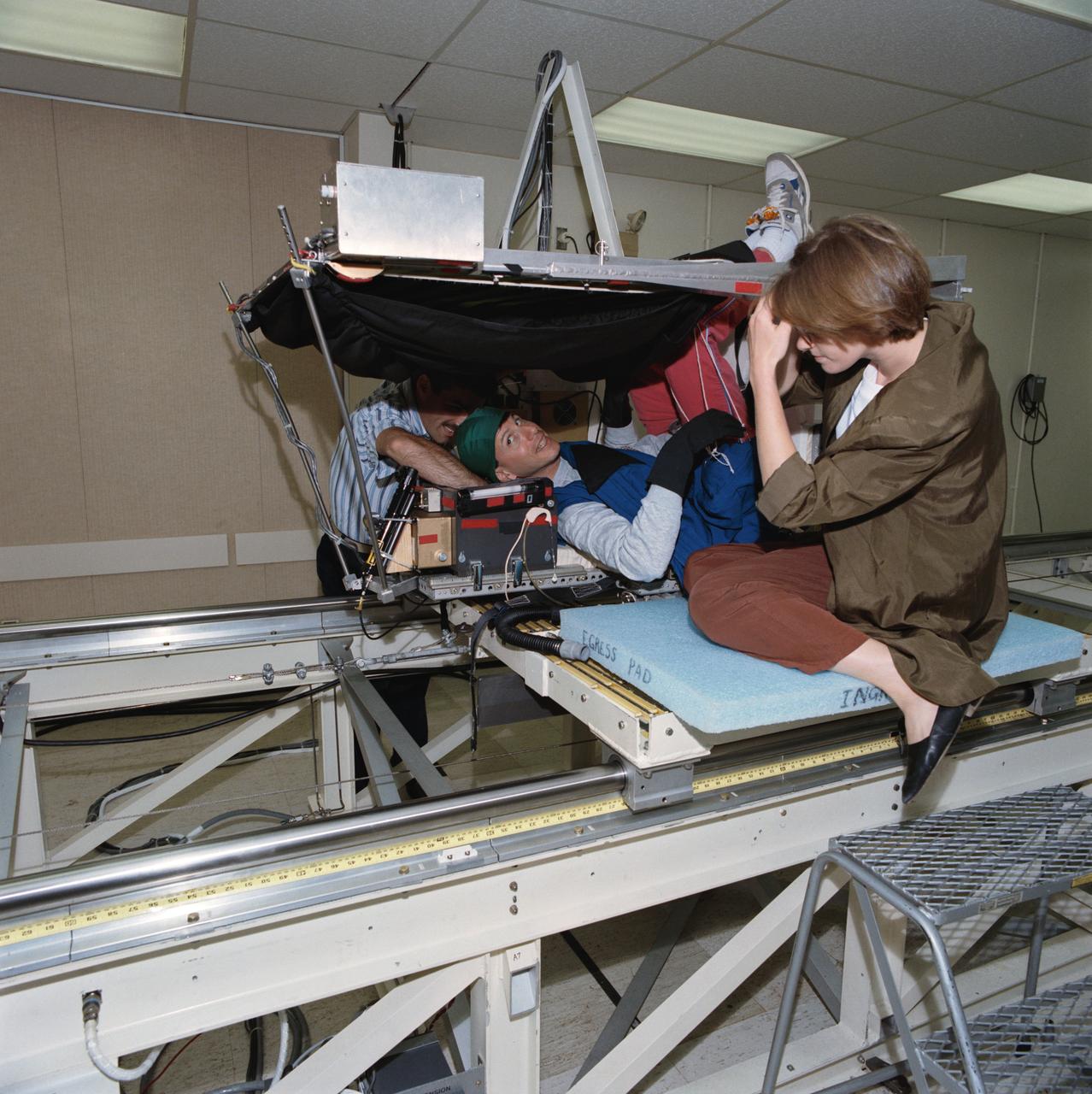
S93-45314 (29 Sept 1993) --- Payload specialist Martin J. Fettman, in an oscillating sled device, participates in a data collection project for neurovestibular functions. The seven Spacelab Life Sciences (SLS-2) crewmembers devoted a full day to miscellaneous biomedical data collection in preparation for next month's two week mission aboard Columbia.
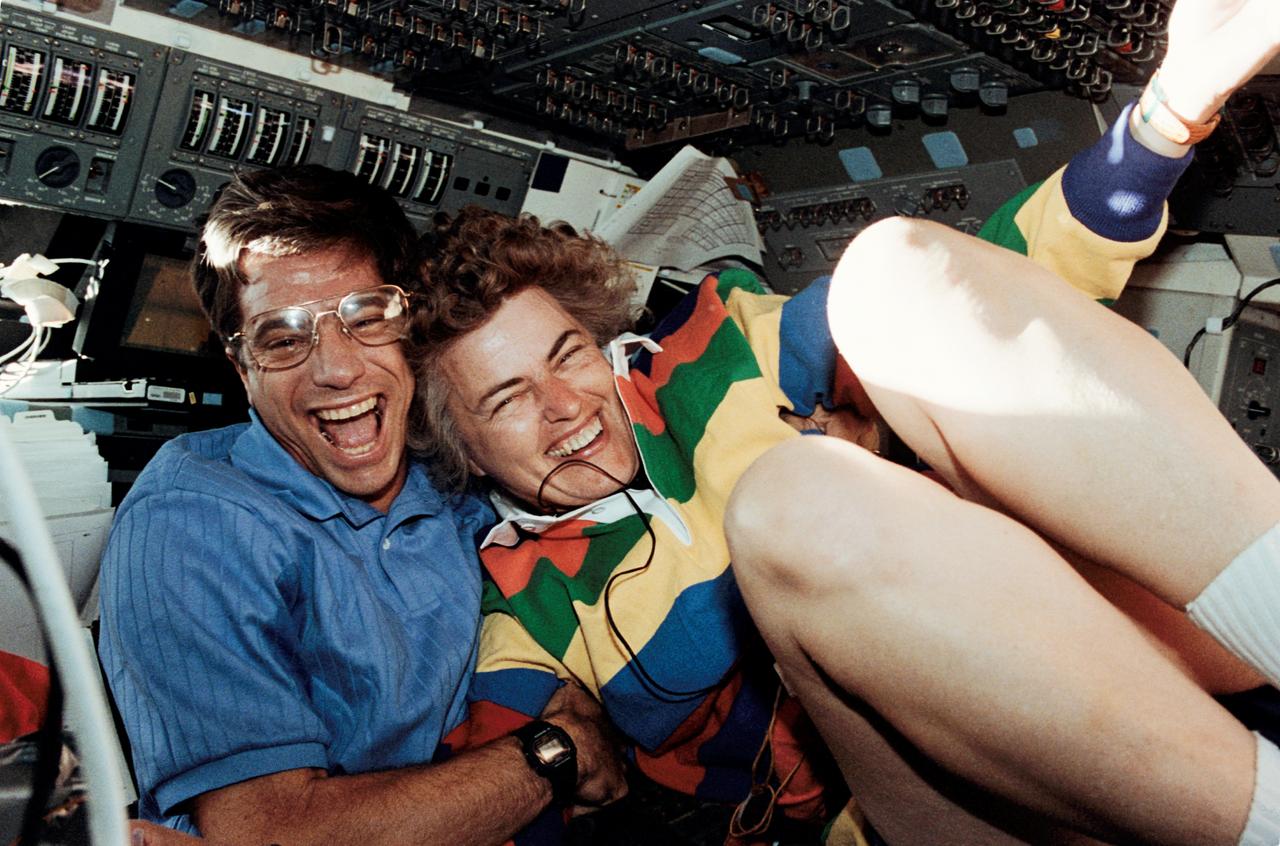
STS058-25-004 (29 Oct. 1993) --- On the forward flight deck of the Earth-orbiting Space Shuttle Columbia, astronauts John E. Blaha and Shannon W. Lucid show their glee at a milestone achieved a while earlier. The mission commander had earlier announced that Lucid's just achieved 752nd hour in space marked a space shuttle record for time spent on a mission.
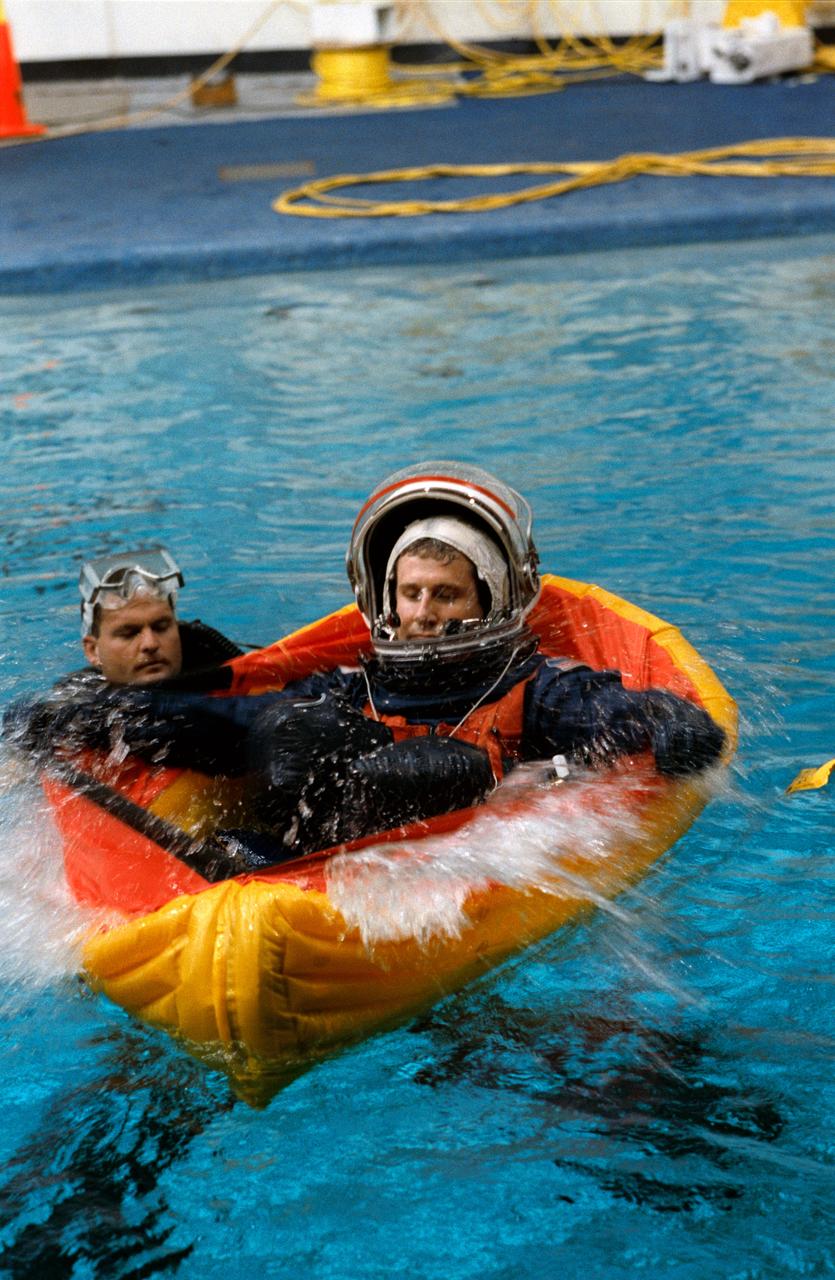
S93-43856 (7 Ssept 1993) --- Navigating a one person life raft, Jay C. Buckey, M.D., participates in emergency bailout training in the Johnson Space Center's (JSC) Weightless Environment Training Facility (WET-F). Dr. Buckey has been assigned as an alternate payload specialist for the Spacelab Life Sciences (SLS-2) mission scheduled for next month. Nearby is a SCUBA-equipped diver who assisted in the training exercises.
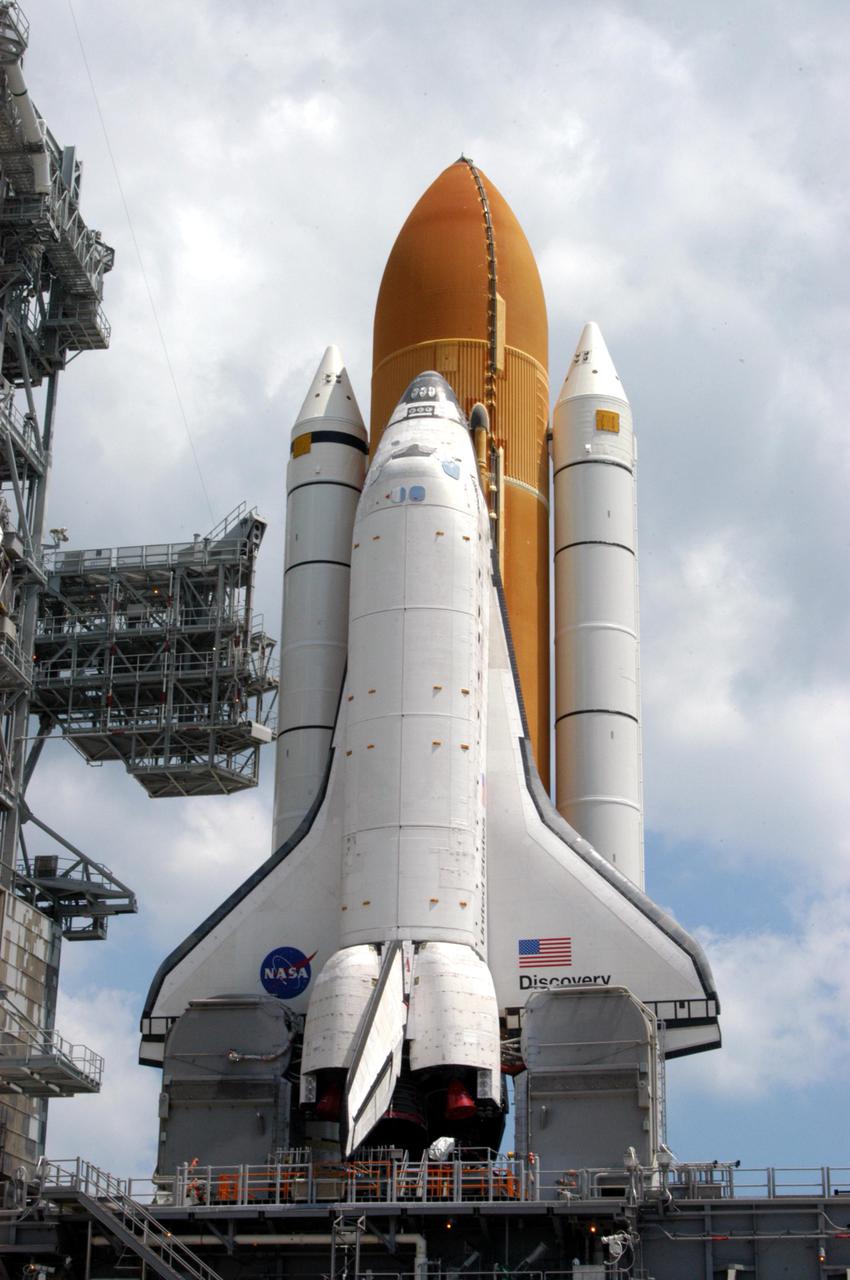
KENNEDY SPACE CENTER, FLA. - Space Shuttle Discovery moves into position on the hardstand of Launch Pad 39B. First motion for the 4.2-mile journey was at 1:58 a.m. EDT. The Space Shuttle rests on a Mobile Launcher Platform that sits atop a Crawler-Transporter. This is the second rollout of Discovery. The orbiter was returned to the Vehicle Assembly Building for connection to an improved External Tank. Launch of Discovery on its Return to Flight mission STS-114 is targeted for a launch window extending from July 13 to July 31.
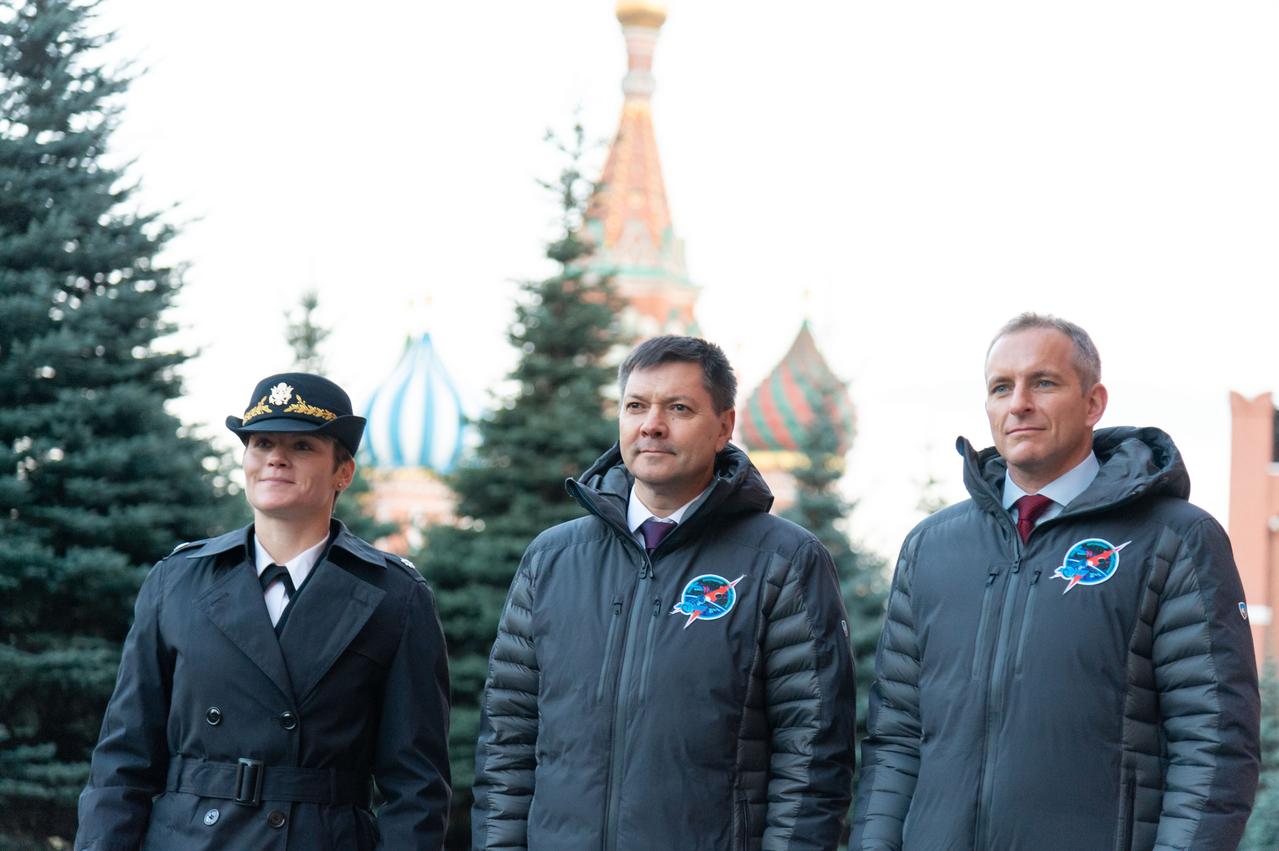
With the onion domes of St. Basil’s Cathedral serving as a backdrop, Expedition 58 crewmembers Anne McClain of NASA (left), Oleg Kononenko of Roscosmos (center) and David Saint-Jacques of the Canadian Space Agency (right) pose for pictures at the Kremlin Wall in Red Square in Moscow Nov. 15 in traditional ceremonies. They will launch Dec. 3 on the Soyuz MS-11 spacecraft from the Baikonur Cosmodrome in Kazakhstan for a six-and-a-half month mission on the International Space Station...NASA/Sarah Volkman.
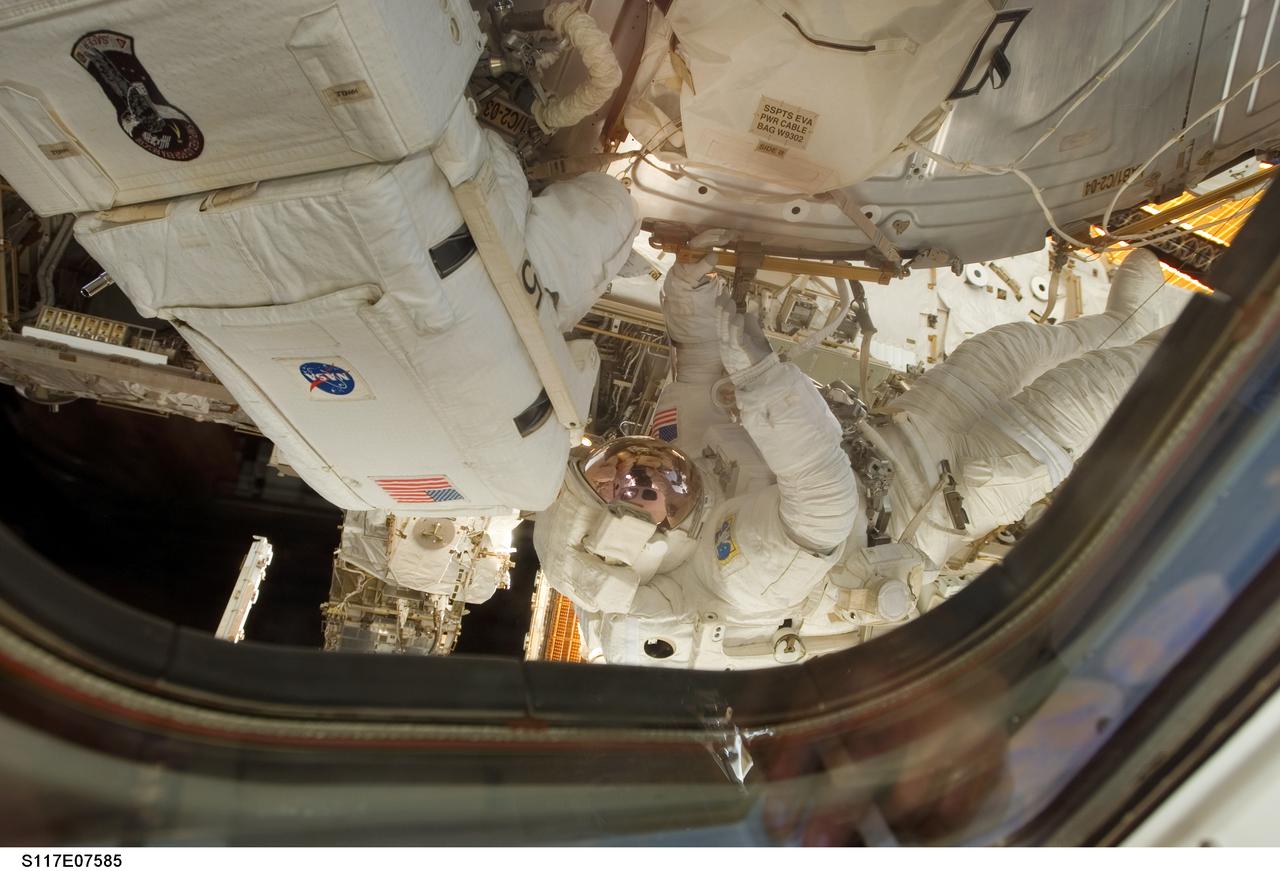
S117-E-07585 (15 June 2007) --- Astronauts Jim Reilly (left) and John (Danny) Olivas, both STS-117 mission specialists, are photographed by a crewmate inside the spacecraft in the midst of a 7 hour, 58-minute spacewalk. The two each performed solo and shared tasks on their second and the mission's third extravehicular activity. Olivas is holding onto a handrail on the Destiny lab.
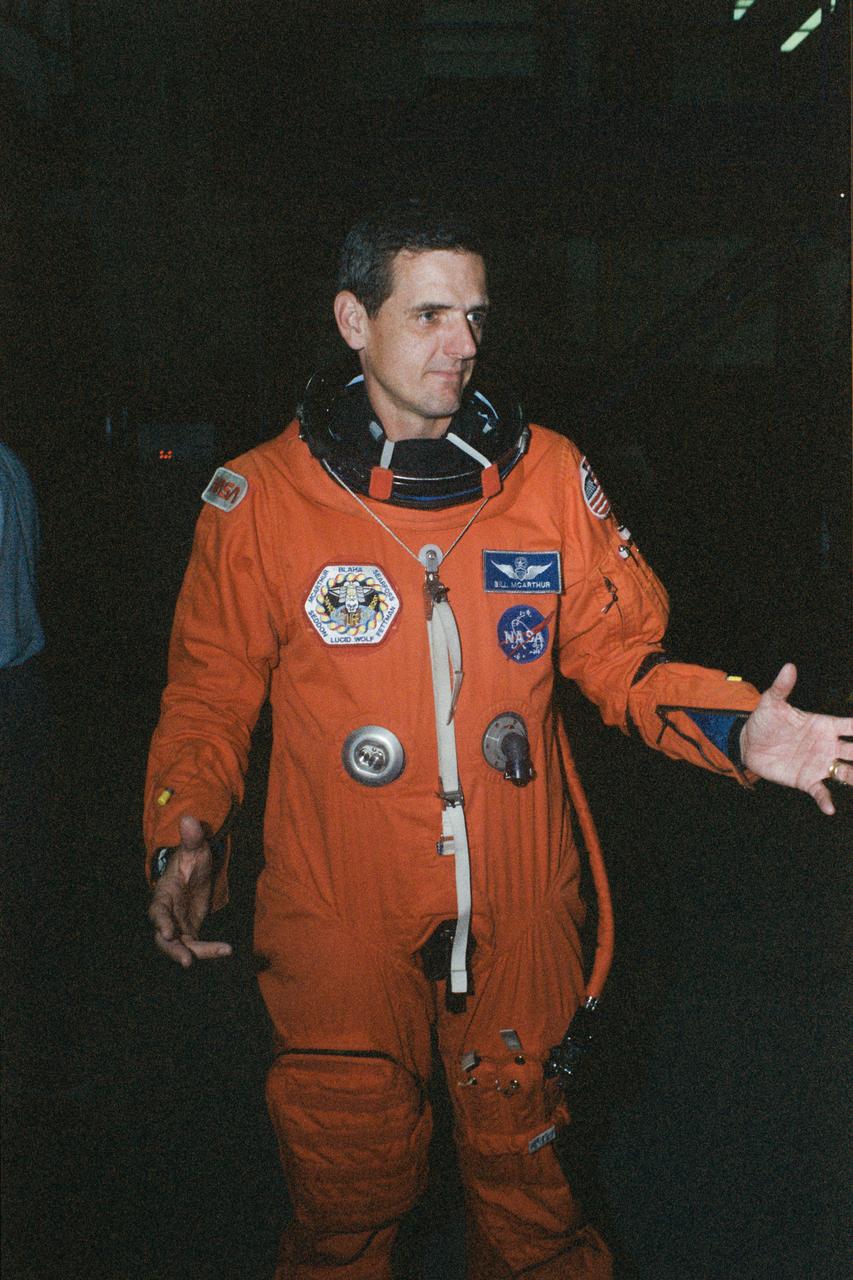
S93-38679 (20 July 1993) --- Wearing a training version of the partial pressure launch and entry garment, astronaut William S. McArthur listens to a briefing on emergency egress procedures for the STS-58 mission. McArthur, along with five other NASA astronauts and a visiting payload specialist assigned to the seven member crew, later rehearsed contingency evacuation procedures. Most of the training session took place in the crew compartment and full fuselage trainers of the Space Shuttle mockup and integration laboratory.
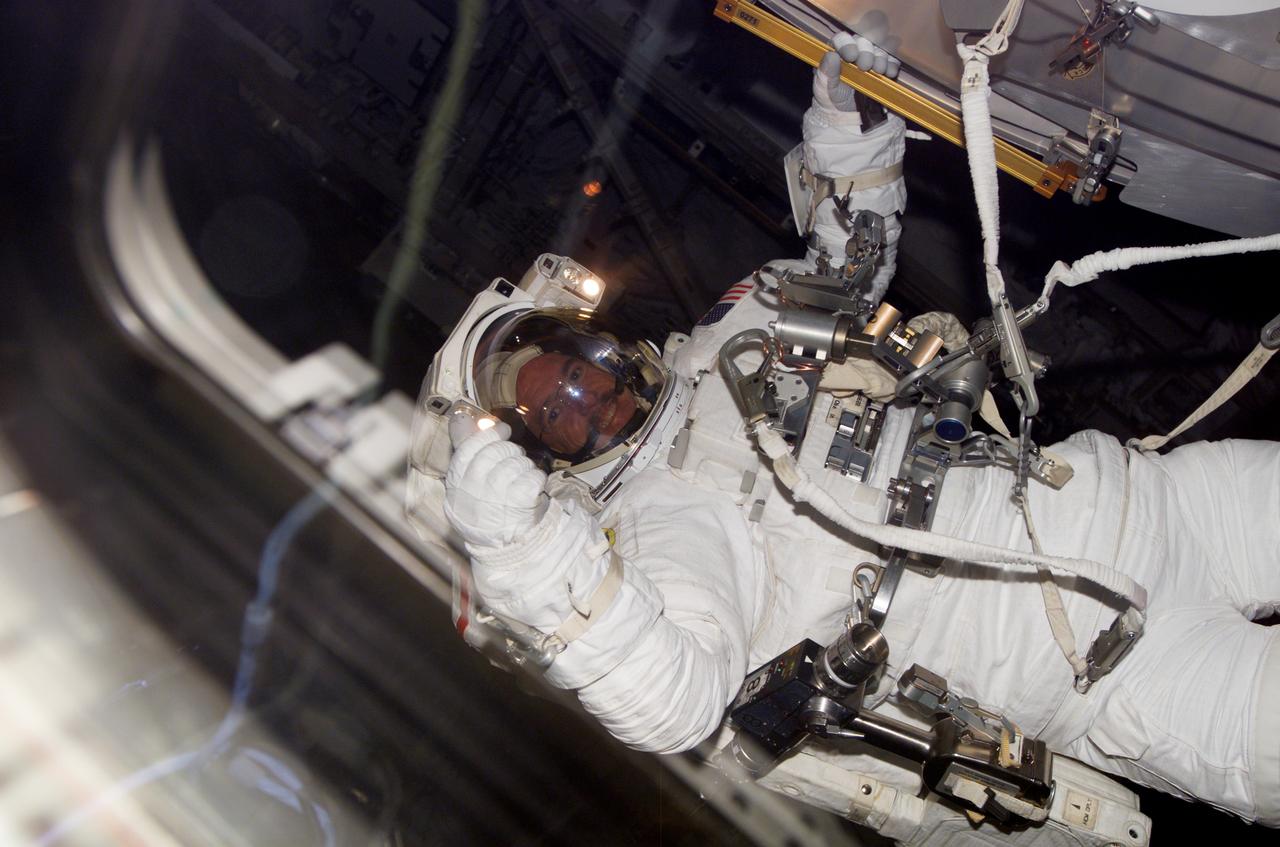
S117-E-07562 (15 June 2007) --- Astronaut Jim Reilly is photographed by a crewmate inside the spacecraft in the midst of a 7 hour, 58-minute spacewalk. Astronauts Reilly and John (Danny) Olivas (out of frame), both STS-117 mission specialists, each performed solo and shared tasks on their second and the mission's third extravehicular activity. Reilly is holding onto a handrail on the Destiny lab.
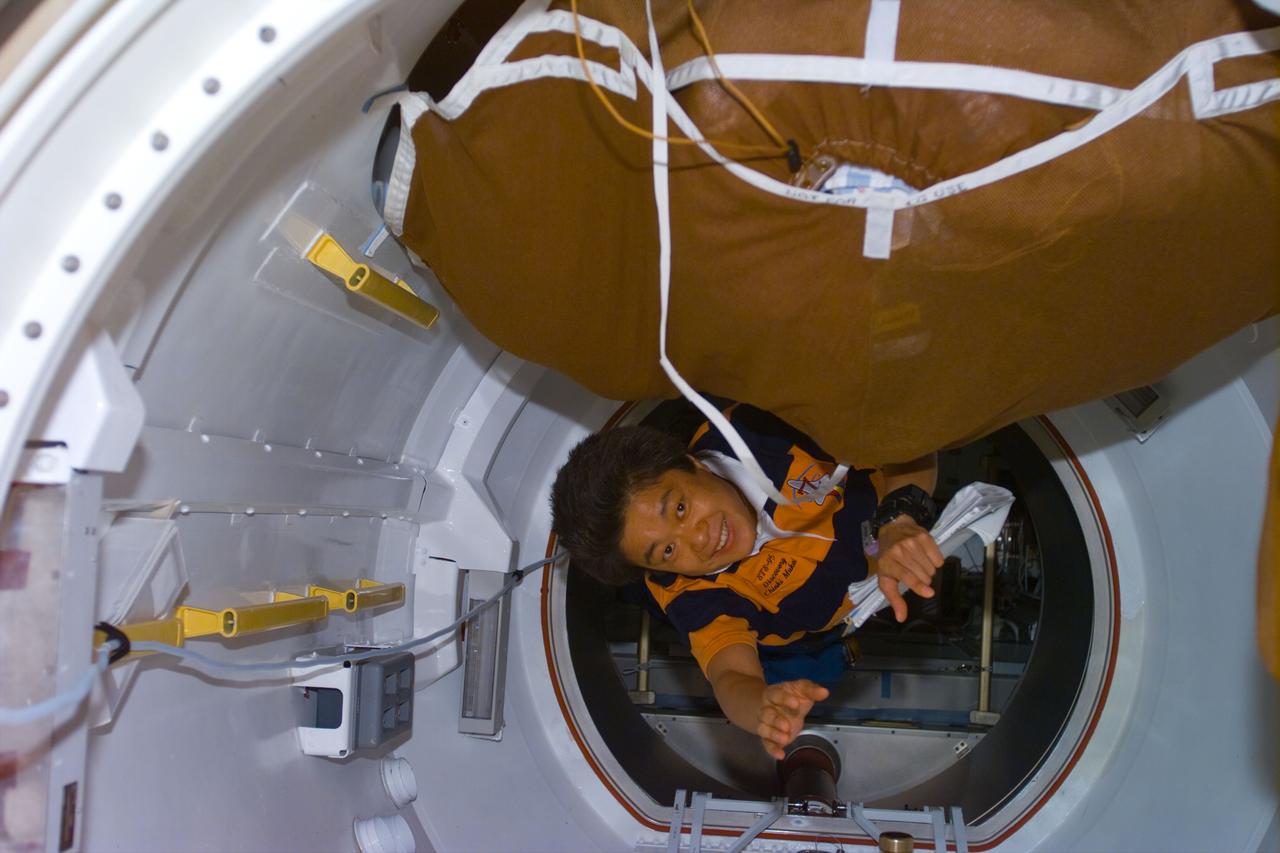
STS095-E-5214 (4 Nov. 1998) --- Payload specialist Chiaki Mukai floats into the airlock during Flight Day 6 activity aboard the Space Shuttle Discovery. A tunnel between Disovery's airlock and the cargo bay allows the payload specialist and her six STS-95 crewmates to access the Spacehab facility. The photo was taken with an electonic still camera (ESC) at 02:58:49 GMT, Nov. 4.
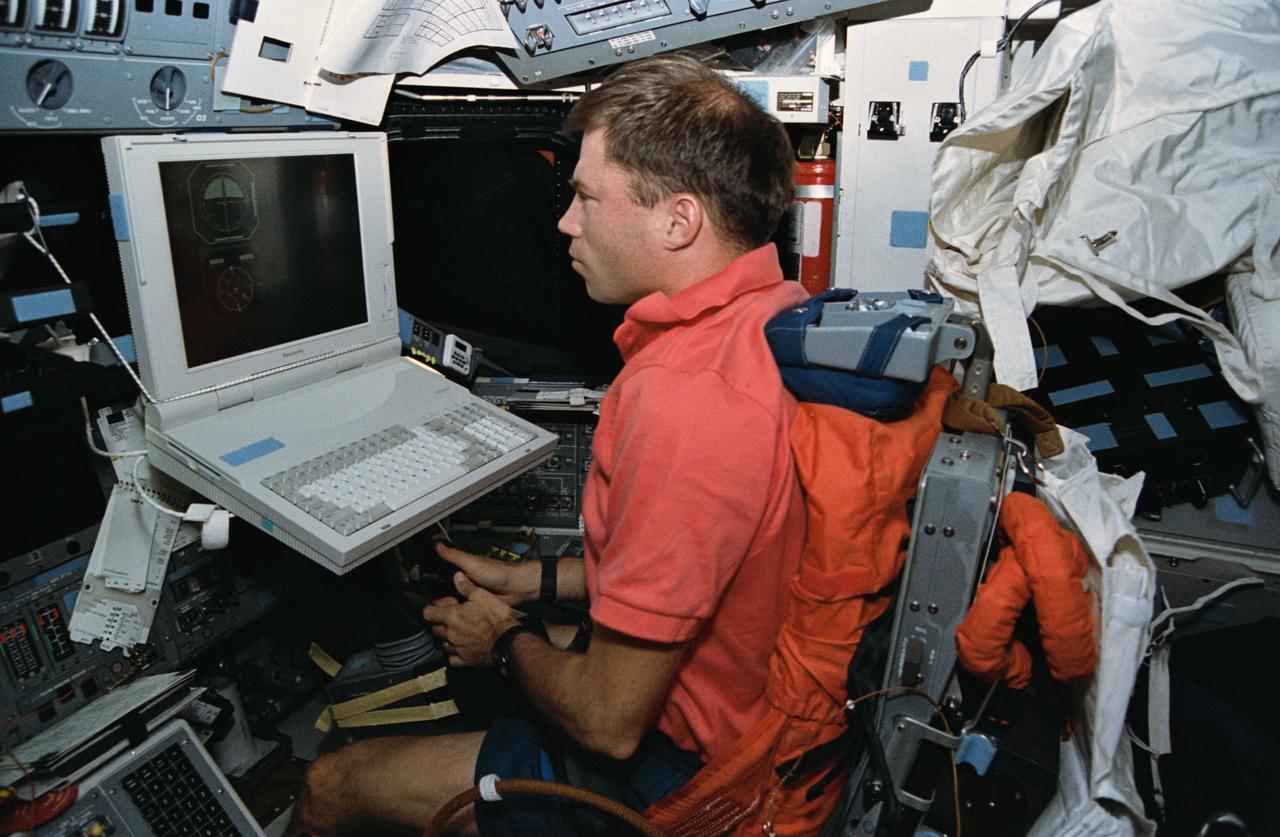
STS058-14-006 (18 Oct- 1 Nov 1993) --- Astronaut Richard A. Searfoss, pilot, participates in an experiment that measures the effects of space flight on pilot proficiency. Astronauts Searfoss (seen here at the pilot's station) and John E. Blaha, mission commander, are conducting the first tests of the Portable Inflight Landing Operations Trainer (PILOT). STS-58 is the first of six scheduled test flights of PILOT designed to determine its effectiveness as a training tool.
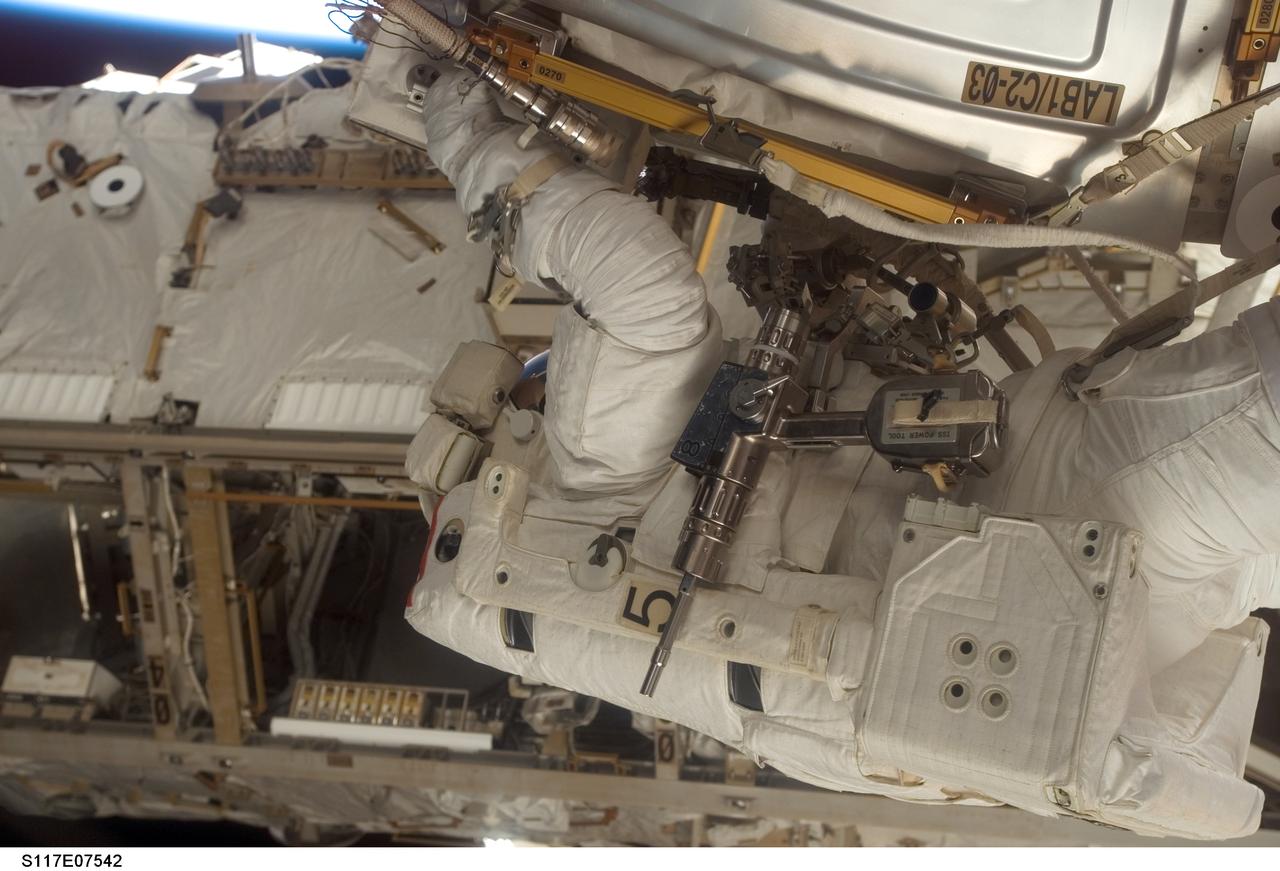
S117-E-07542 (15 June 2007) --- Astronaut Jim Reilly is photographed by a crewmate inside the spacecraft in the midst of a 7 hour, 58-minute spacewalk. Astronauts Reilly and John (Danny) Olivas (out of frame), both STS-117 mission specialists, each performed solo and shared tasks on their second and the mission's third extravehicular activity.
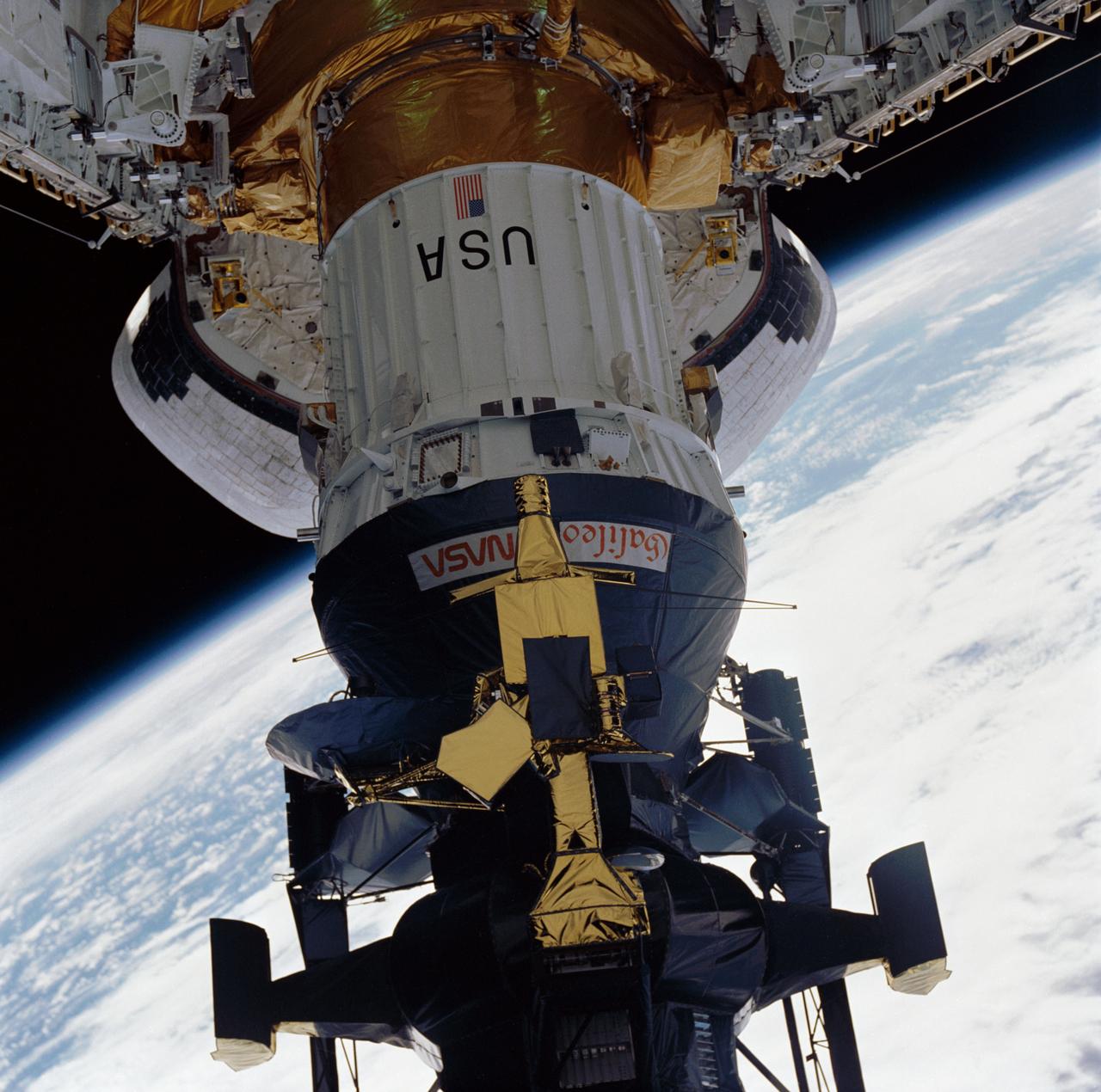
During STS-34 mission, the Galileo spacecraft mounted atop the inertial upper stage (IUS) is tilted to a 58-degree deployment position by the airborne support equipment (ASE) aft frame tilt actuator (AFTA) table in Atlantis', Orbiter Vehicle (OV) 104's, payload bay (PLB). Visible in the foreground is the ASE forward cradle and the umbilical boom which has fallen away from the IUS. OV-104's orbital maneuvering system (OMS) pods and the Earth's limb appear in the background.
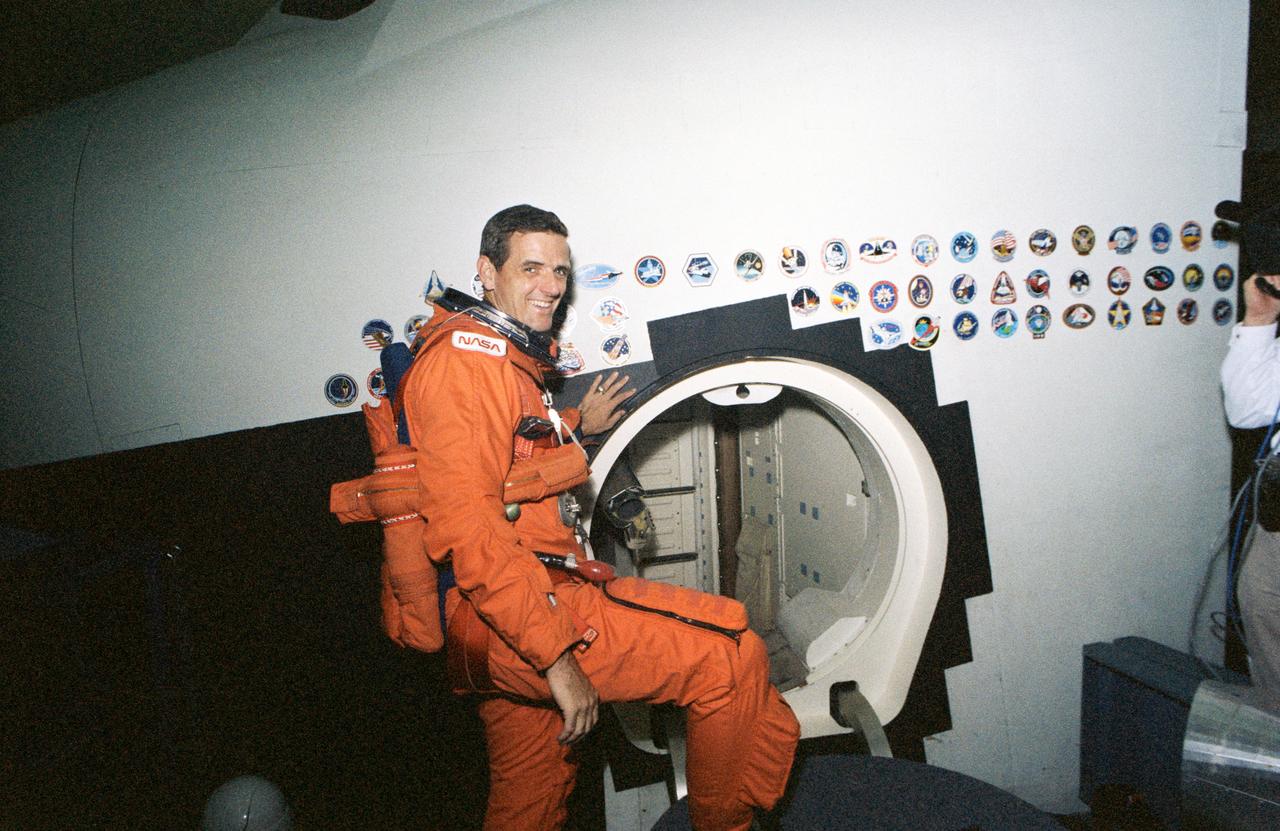
S93-38686 (20 July 1993) --- Wearing a training version of the partial pressure launch and entry garment, astronaut William S. McArthur prepares to rehearse emergency egress procedures for the STS-58 mission. McArthur, along with the five other NASA astronauts and a visiting payload specialist assigned to the seven-member crew, later simulated contingency evacuation procedures. Most of the training session took place in the crew compartment and full fuselage trainers of the Space Shuttle mockup and integration laboratory.
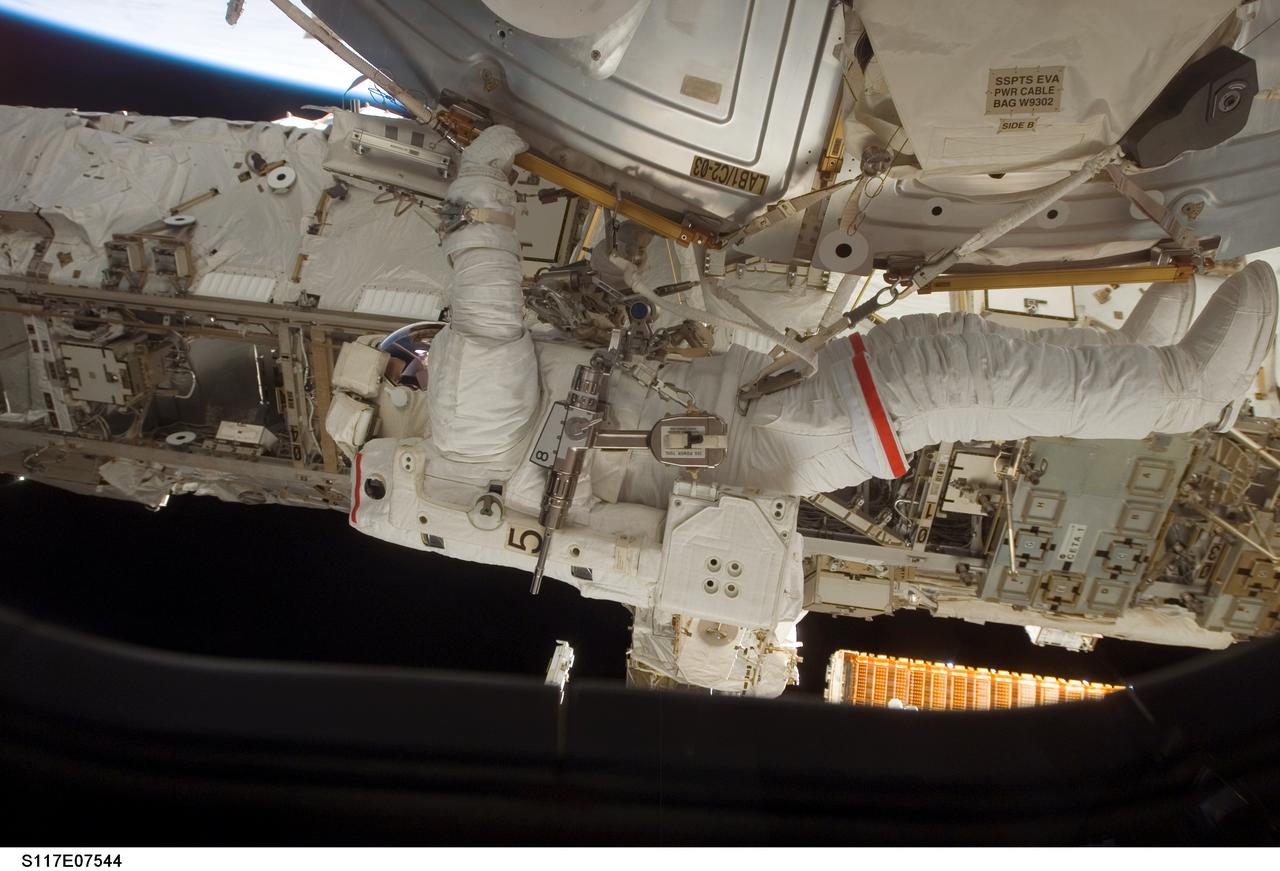
S117-E-07544 (15 June 2007) --- Astronaut Jim Reilly is photographed by a crewmate inside the spacecraft in the midst of a 7 hour, 58-minute spacewalk. Astronauts Reilly and John (Danny) Olivas (out of frame), both STS-117 mission specialists, each performed solo and shared tasks on their second and the mission's third extravehicular activity. Reilly is holding onto a handrail on the Destiny lab.