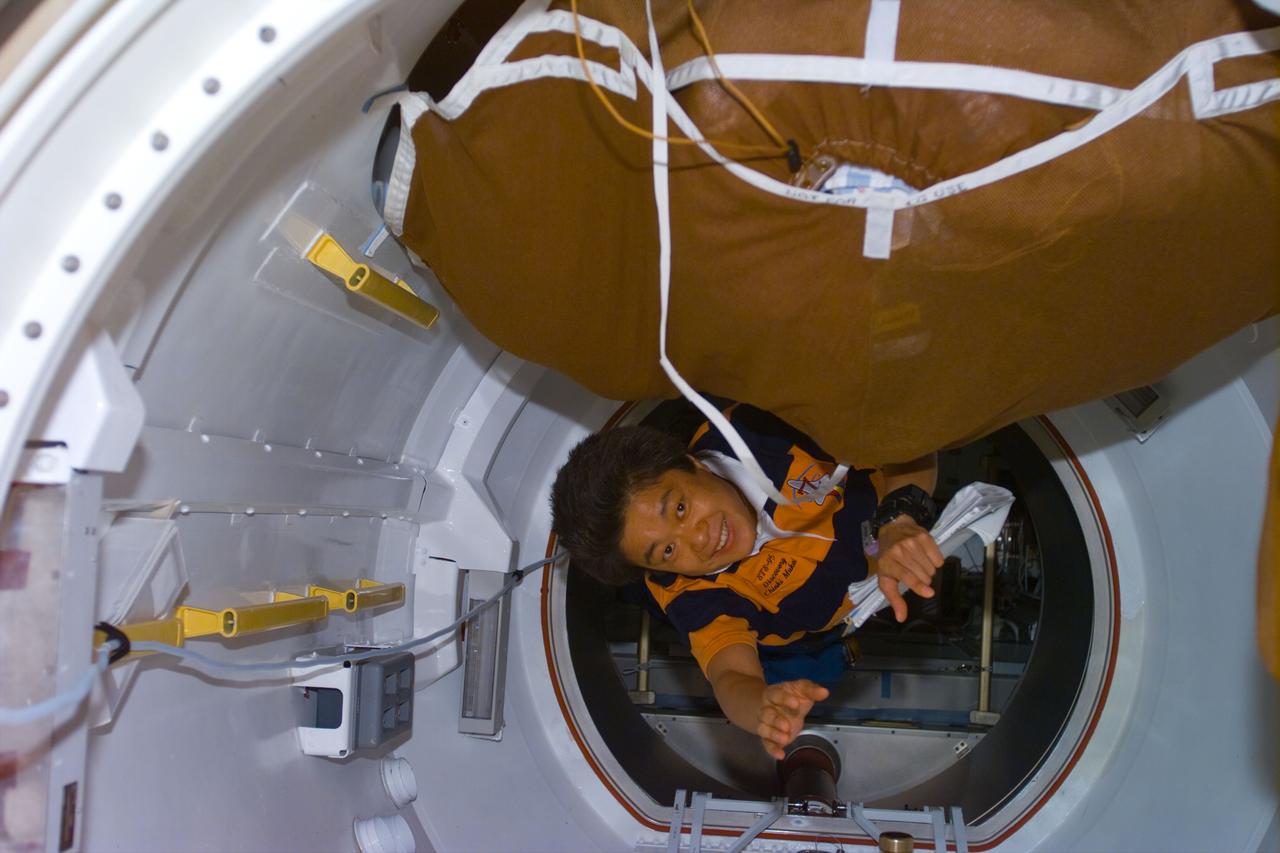
STS095-E-5214 (4 Nov. 1998) --- Payload specialist Chiaki Mukai floats into the airlock during Flight Day 6 activity aboard the Space Shuttle Discovery. A tunnel between Disovery's airlock and the cargo bay allows the payload specialist and her six STS-95 crewmates to access the Spacehab facility. The photo was taken with an electonic still camera (ESC) at 02:58:49 GMT, Nov. 4.
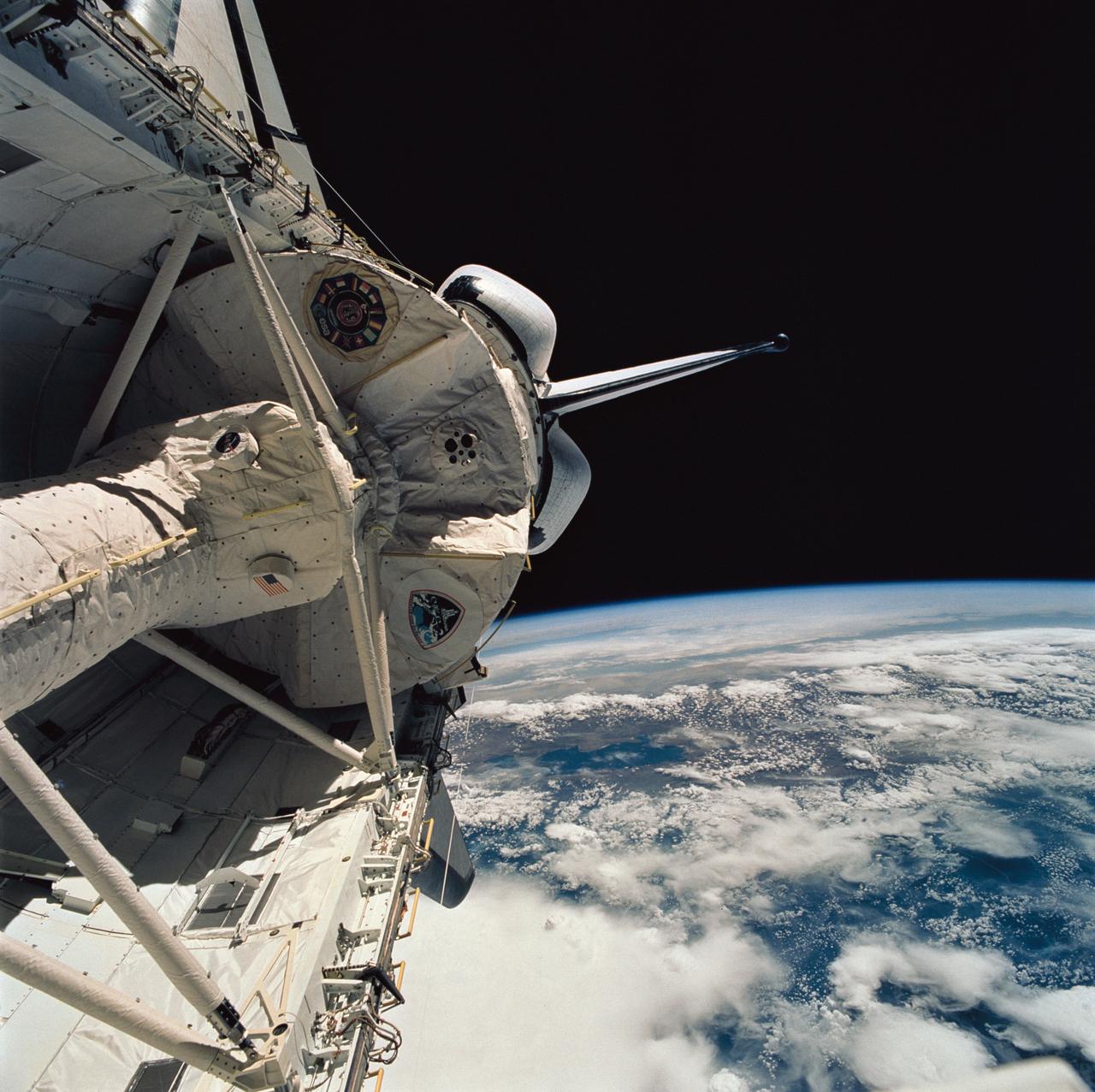
STS058-76-041 (18 Oct-1 Nov 1993) --- Backdropped against the Peru-Bolivia border and part of the Amazon basin, the Spacelab Life Sciences (SLS-2) laboratory module was captured with a 70mm camera, by one of the seven crew members inside the Space Shuttle Columbia's cabin. Part of the tunnel-like passageway is visible in the foreground. Six NASA astronauts and a veterinarian from the private sector spent two weeks devoted to medical research in Earth-orbit. Lake Titicaca, the largest high-altitude lake in the world lies in the Altiplano of Bolivia and Peru. Space Shuttle photography has been used to document fluctuations of several meters of the level of Lake Titicaca during the past decade, as well as to document the eutrophication of the north end of the lake, which is primarily due to increased population in the Peruvian shoreline areas. This view shows the effect of abnormally heavy precipitation of the region for the third successive year. Meteorologists feel this precipitation increase, which may portend another increase of the lake level, is due to the third successive El Nino - Southern Oscillation phenomenon in the 1993 - 94 southern hemisphere summertime. This global phenomenon is now resulting in major weather disturbances in Indonesia, California, Texas and elsewhere.
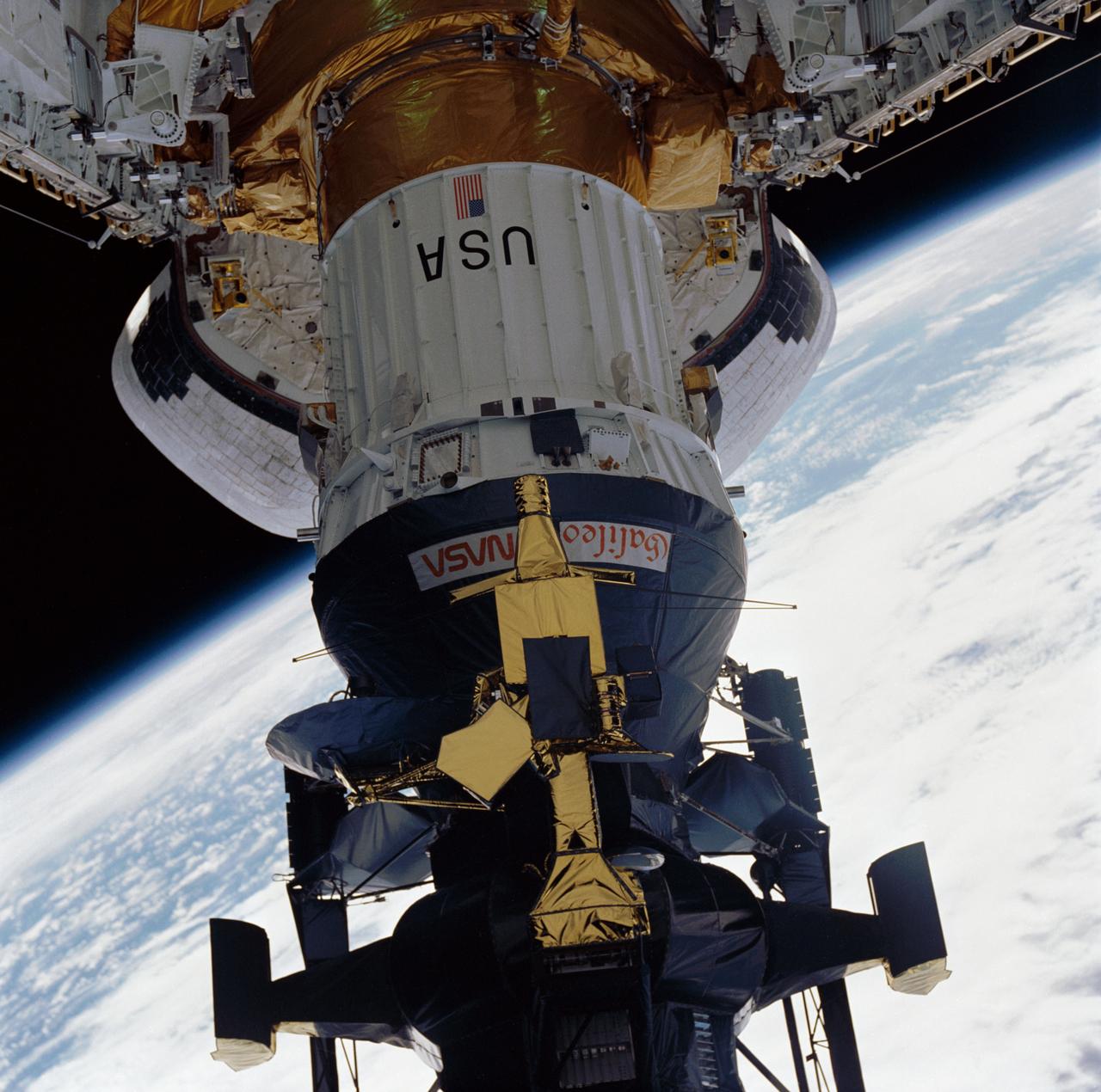
During STS-34 mission, the Galileo spacecraft mounted atop the inertial upper stage (IUS) is tilted to a 58-degree deployment position by the airborne support equipment (ASE) aft frame tilt actuator (AFTA) table in Atlantis', Orbiter Vehicle (OV) 104's, payload bay (PLB). Visible in the foreground is the ASE forward cradle and the umbilical boom which has fallen away from the IUS. OV-104's orbital maneuvering system (OMS) pods and the Earth's limb appear in the background.
Designed by members of the flight crew, the STS-58 insignia depicts the Space Shuttle Columbia with a Spacelab module in its payload bay in orbit around Earth. The Spacelab and the lettering Spacelab Life Sciences ll highlight the primary mission of the second Space Shuttle flight dedicated to life sciences research. An Extended Duration Orbiter (EDO) support pallet is shown in the aft payload bay, stressing the scheduled two-week duration of the longest Space Shuttle mission to date. The hexagonal shape of the patch depicts the carbon ring, a molecule common to all living organisms. Encircling the inner border of the patch is the double helix of DNA, representing the genetic basis of life. Its yellow background represents the sun, energy source for all life on Earth. Both medical and veterinary caducei are shown to represent the STS- 58 life sciences experiments. The position of the spacecraft in orbit about Earth with the United States in the background symbolizes the ongoing support of the American people for scientific research intended to benefit all mankind.
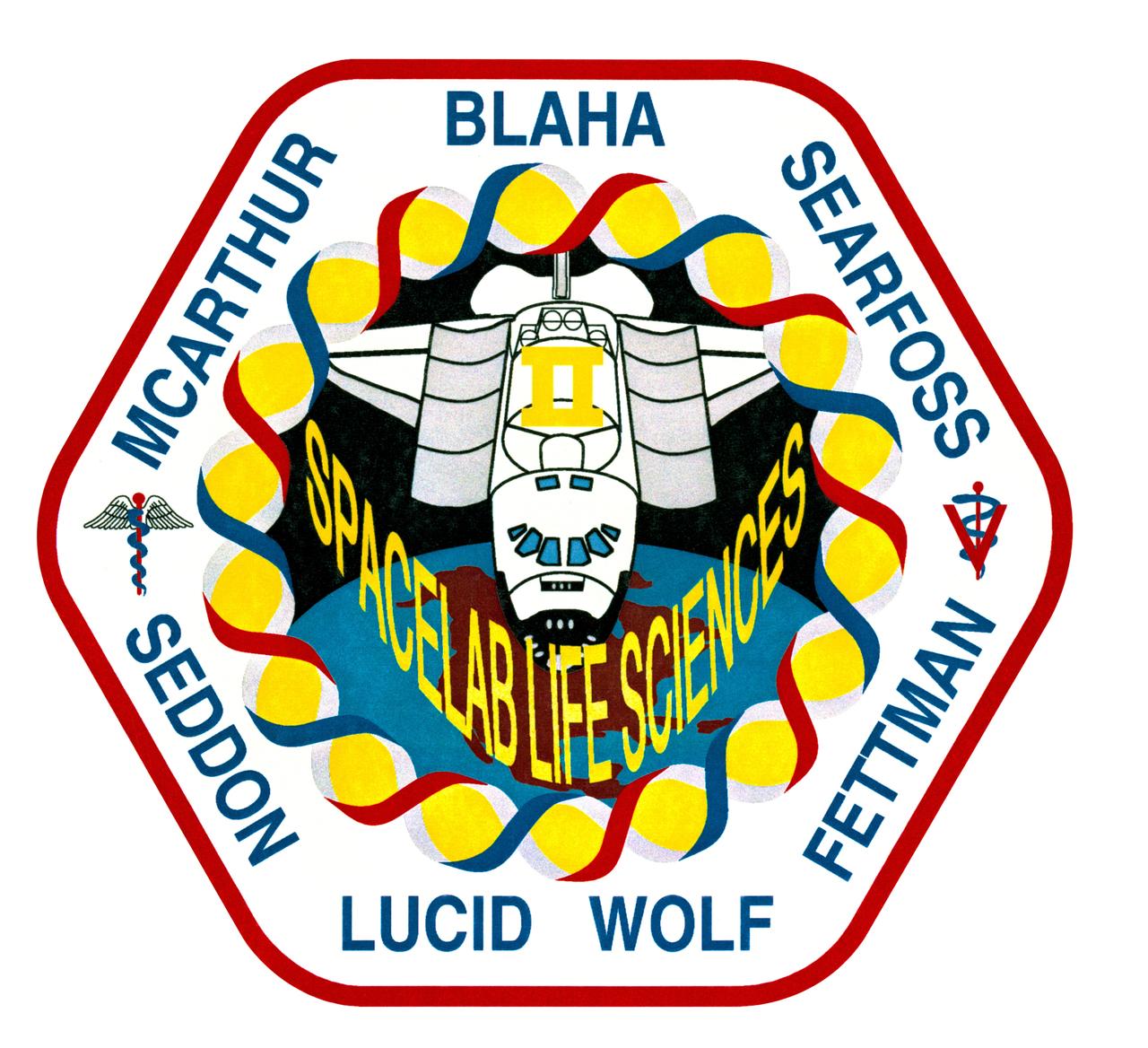
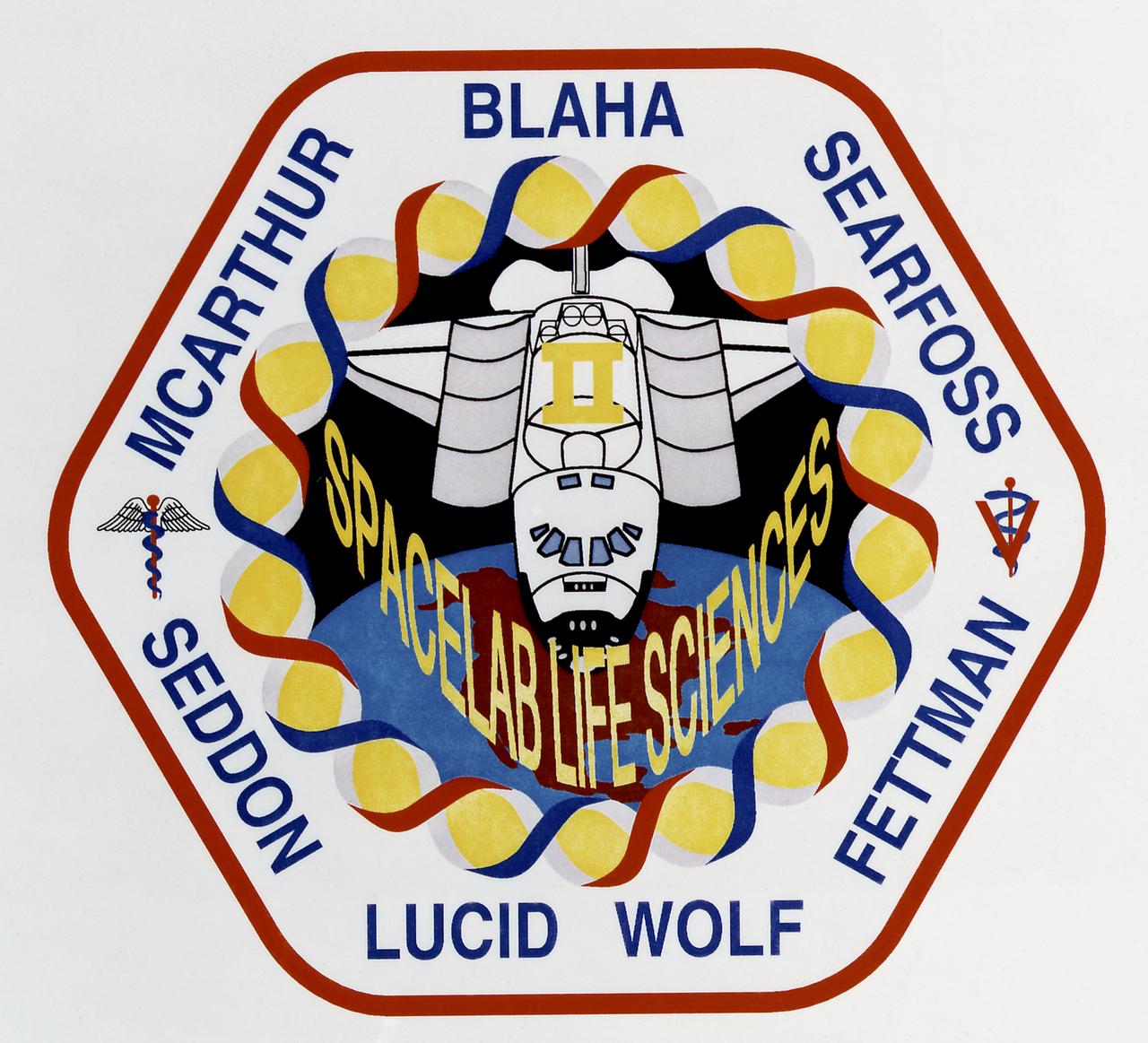
STS058-S-001 (May 1993) --- Designed by members of the flight crew, the STS-58 insignia depicts the space shuttle Columbia with a Spacelab module in its payload bay in orbit around Earth. The Spacelab and the lettering "Spacelab Life Sciences II" highlight the primary mission of the second space shuttle flight dedicated to life sciences research. An Extended Duration Orbiter (EDO) support pallet is shown in the aft payload bay, stressing the scheduled two-week duration of the longest space shuttle mission to date. The hexagonal shape of the patch depicts the carbon ring, a molecule common to all living organisms. Encircling the inner border of the patch is the double helix of DNA, representing the genetic basis of life. Its yellow background represents the sun, energy source for all life on Earth. Both medical and veterinary caducei are shown to represent the STS-58 life sciences experiments. The position of the spacecraft in orbit about Earth with the United States in the background symbolizes the ongoing support of the American people for scientific research intended to benefit all mankind. The NASA insignia design for space shuttle flights is reserved for use by the astronauts and for other official use as the NASA Administrator may authorize. Public availability has been approved only in the form of illustrations by the various news media. When and if there is any change in this policy, which we do not anticipate, it will be publicly announced. Photo credit: NASA
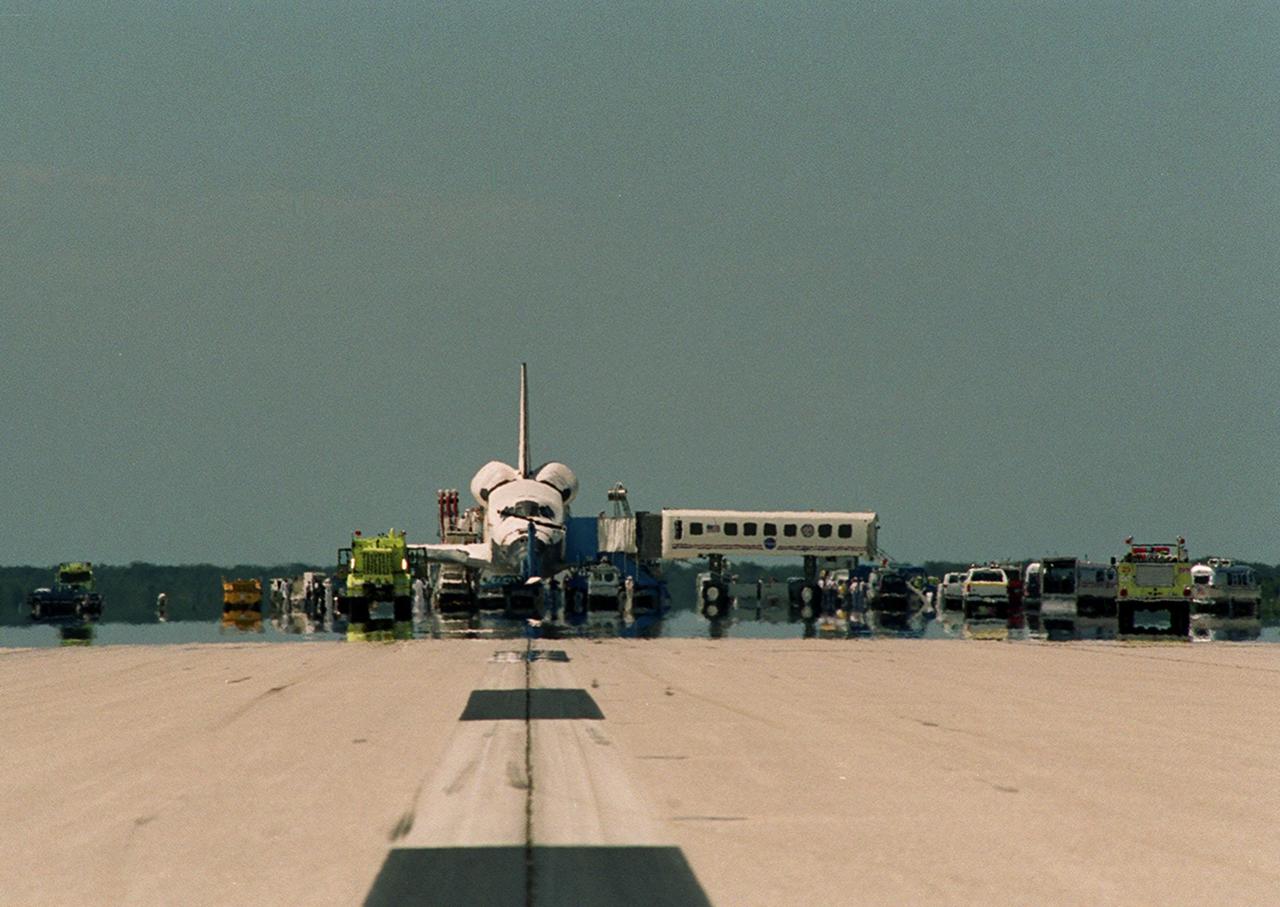
KENNEDY SPACE CENTER, Fla. -- On KSC’s Shuttle Landing Facility runway 15 following mission STS-105, specially designed vehicles and a team of up to 150 trained personnel gather around Discovery for safing operations, checking for toxic or hazardous gases, and introducing purge air to cool the vehicle and humidified air conditioning to the payload bay and other cavities to remove any residual explosive or toxic fumes that may be present. Some personnel will assist the STS-105 and Expedition Two crews in disembarking from the orbiter via the Crew Transfer Vehicle (at right). KSC support personnel will prepare the orbiter for ground tow operations, installing switch guards and removing data packages from any onboard experiments. Main gear touchdown was at 2:22:58 p.m. EDT; wheel stop, at 2:24:06 p.m. EDT. The 11-day, 21-hour, 12-minute mission accomplished the goals set for the 11th flight to the International Space Station: swapout of the resident Station crew; delivery of equipment, supplies and scientific experiments; and installation of the Early Ammonia Servicer and heater cables for the S0 truss on the Station. Discovery traveled 4.3 million miles on its 30th flight into space, the 106th mission of the Space Shuttle program. Out of five missions in 2001, the landing was the first to occur in daylight at KSC
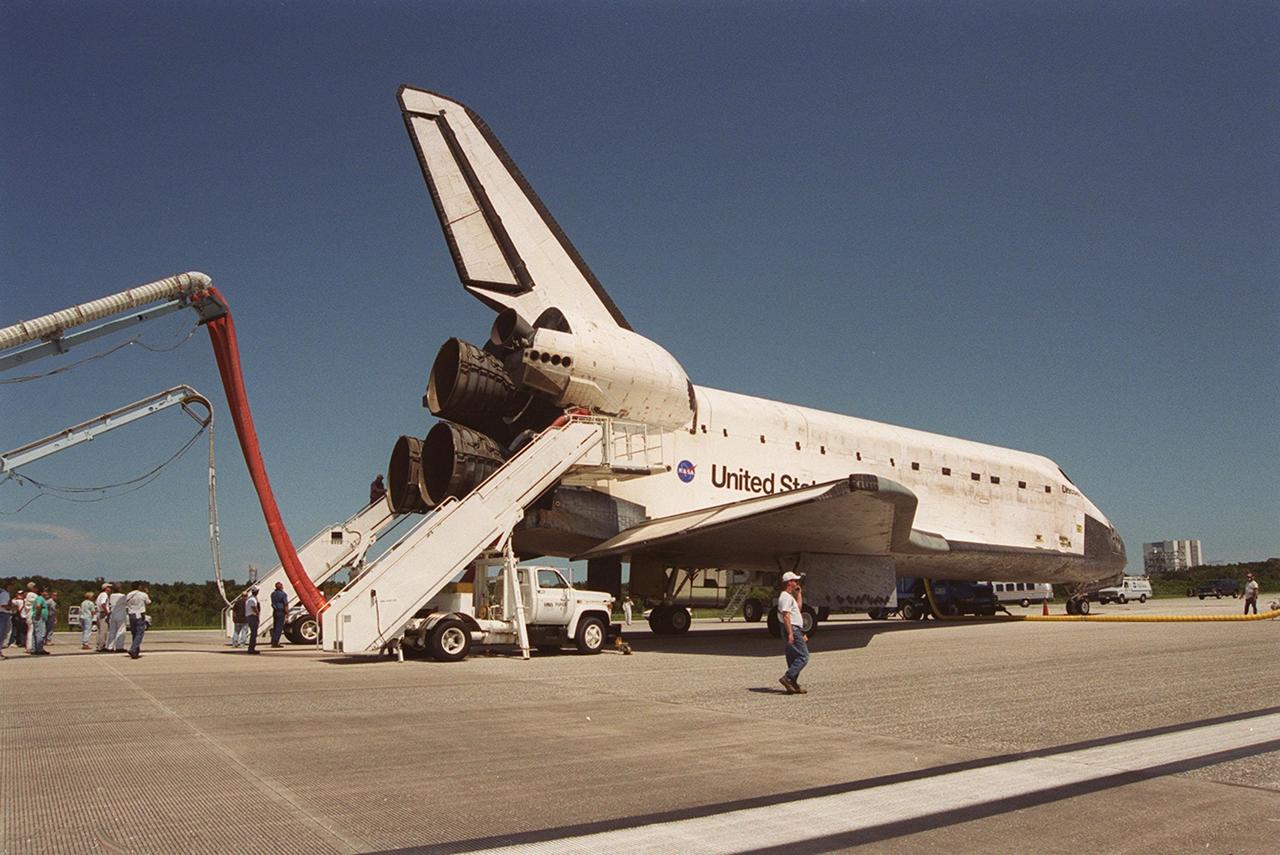
KENNEDY SPACE CENTER, Fla. -- On KSC’s Shuttle Landing Facility runway 15 following mission STS-105, orbiter Discovery undergoes safing operations such as being checked for toxic or hazardous gases, and having purge air introduced to cool the vehicle and humidified air conditioning to the payload bay and other cavities to remove any residual explosive or toxic fumes that may be present. The operations include preparing the orbiter for ground tow operations, installing switch guards and removing data packages from any onboard experiments. Main gear touchdown was at 2:22:58 p.m. EDT; wheel stop, at 2:24:06 p.m. EDT. The 11-day, 21-hour, 12-minute mission accomplished the goals set for the 11th flight to the International Space Station: swapout of the resident Station crew; delivery of equipment, supplies and scientific experiments; and installation of the Early Ammonia Servicer and heater cables for the S0 truss on the Station. Discovery traveled 4.3 million miles on its 30th flight into space, the 106th mission of the Space Shuttle program. Out of five missions in 2001, the landing was the first to occur in daylight at KSC
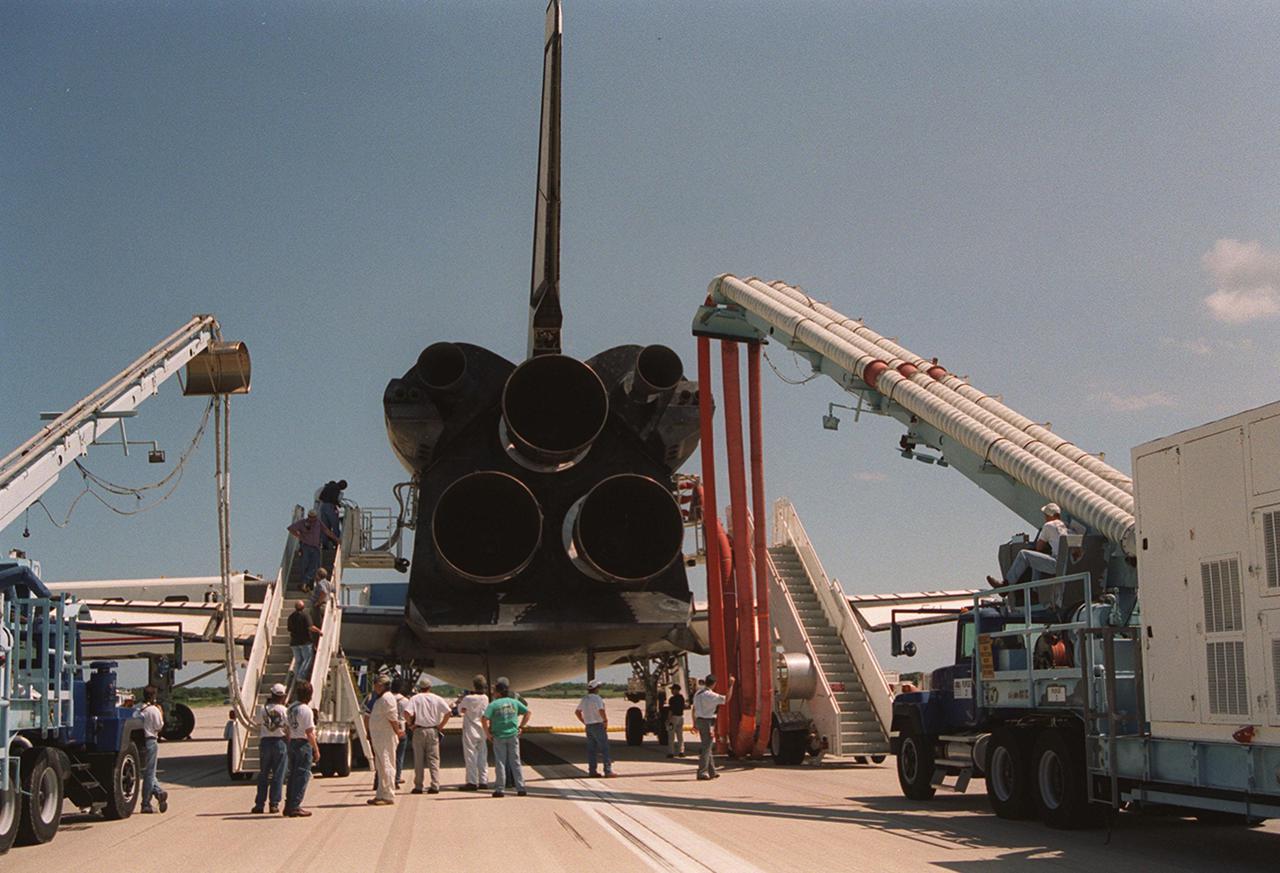
KENNEDY SPACE CENTER, Fla. -- On KSC’s Shuttle Landing Facility runway 15 following mission STS-105, orbiter Discovery undergoes safing operations such as being checked for toxic or hazardous gases, and having purge air introduced to cool the vehicle and humidified air conditioning to the payload bay and other cavities to remove any residual explosive or toxic fumes that may be present. The operations include preparing the orbiter for ground tow operations, installing switch guards and removing data packages from any onboard experiments. Main gear touchdown was at 2:22:58 p.m. EDT; wheel stop, at 2:24:06 p.m. EDT. The 11-day, 21-hour, 12-minute mission accomplished the goals set for the 11th flight to the International Space Station: swapout of the resident Station crew; delivery of equipment, supplies and scientific experiments; and installation of the Early Ammonia Servicer and heater cables for the S0 truss on the Station. Discovery traveled 4.3 million miles on its 30th flight into space, the 106th mission of the Space Shuttle program. Out of five missions in 2001, the landing was the first to occur in daylight at KSC

KENNEDY SPACE CENTER, Fla. -- On KSC’s Shuttle Landing Facility runway 15 following mission STS-105, orbiter Discovery undergoes safing operations such as being checked for toxic or hazardous gases, and having purge air introduced to cool the vehicle and humidified air conditioning to the payload bay and other cavities to remove any residual explosive or toxic fumes that may be present. The operations include preparing the orbiter for ground tow operations, installing switch guards and removing data packages from any onboard experiments. Main gear touchdown was at 2:22:58 p.m. EDT; wheel stop, at 2:24:06 p.m. EDT. The 11-day, 21-hour, 12-minute mission accomplished the goals set for the 11th flight to the International Space Station: swapout of the resident Station crew; delivery of equipment, supplies and scientific experiments; and installation of the Early Ammonia Servicer and heater cables for the S0 truss on the Station. Discovery traveled 4.3 million miles on its 30th flight into space, the 106th mission of the Space Shuttle program. Out of five missions in 2001, the landing was the first to occur in daylight at KSC
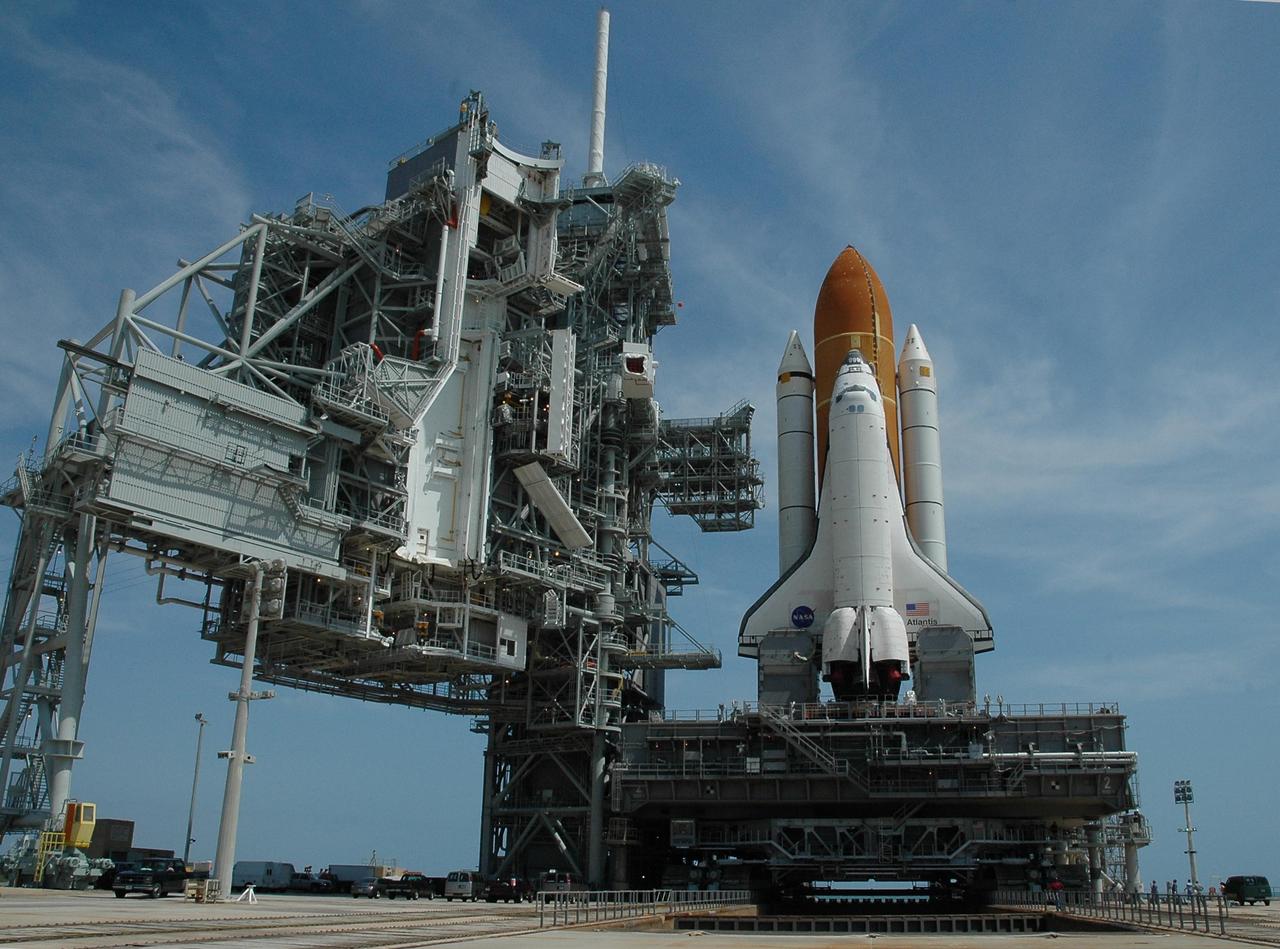
KENNEDY SPACE CENTER, FLA. -- Space Shuttle Atlantis, mounted on a mobile launch platform, finally rests on the hard stand of Launch Pad 39A, straddling the flame trench. This is the second rollout for the shuttle. The flame trench transecting the pad's mound at ground level is 490 feet long, 58 feet wide and 40 feet high. It is made of concrete and refractory brick. Pad structures are insulated from the intense heat of launch by the flame deflector system, which protects the flame trench floor and the pad surface along the top of the flame trench. On the left of the shuttle are the fixed service structure and rotating service structure in open position. When closed, the rotating structure provides protected access to the orbiter for changeout and servicing of payloads at the pad. It is supported by a rotating bridge that pivots about a vertical axis on the west side of the pad's flame trench. The white area in the center is the Payload Changeout Room, an enclosed, environmentally controlled portion of the rotating service structure that supports payload delivery at the launch pad and subsequent vertical installation in the orbiter payload bay. First motion out of the Vehicle Assembly Building was at 5:02 a.m. EDT. In late February, while Atlantis was on the launch pad, Atlantis' external tank received hail damage during a severe thunderstorm that passed through the Kennedy Space Center Launch Complex 39 area. The hail caused visible divots in the giant tank's foam insulation, as well as minor surface damage to about 26 heat shield tiles on the shuttle's left wing. The shuttle was returned to the VAB for repairs. The launch of Space Shuttle Atlantis on mission STS-117 is now targeted for June 8. A flight readiness review will be held on May 30 and 31. Photo credit: NASA/Troy Cryder