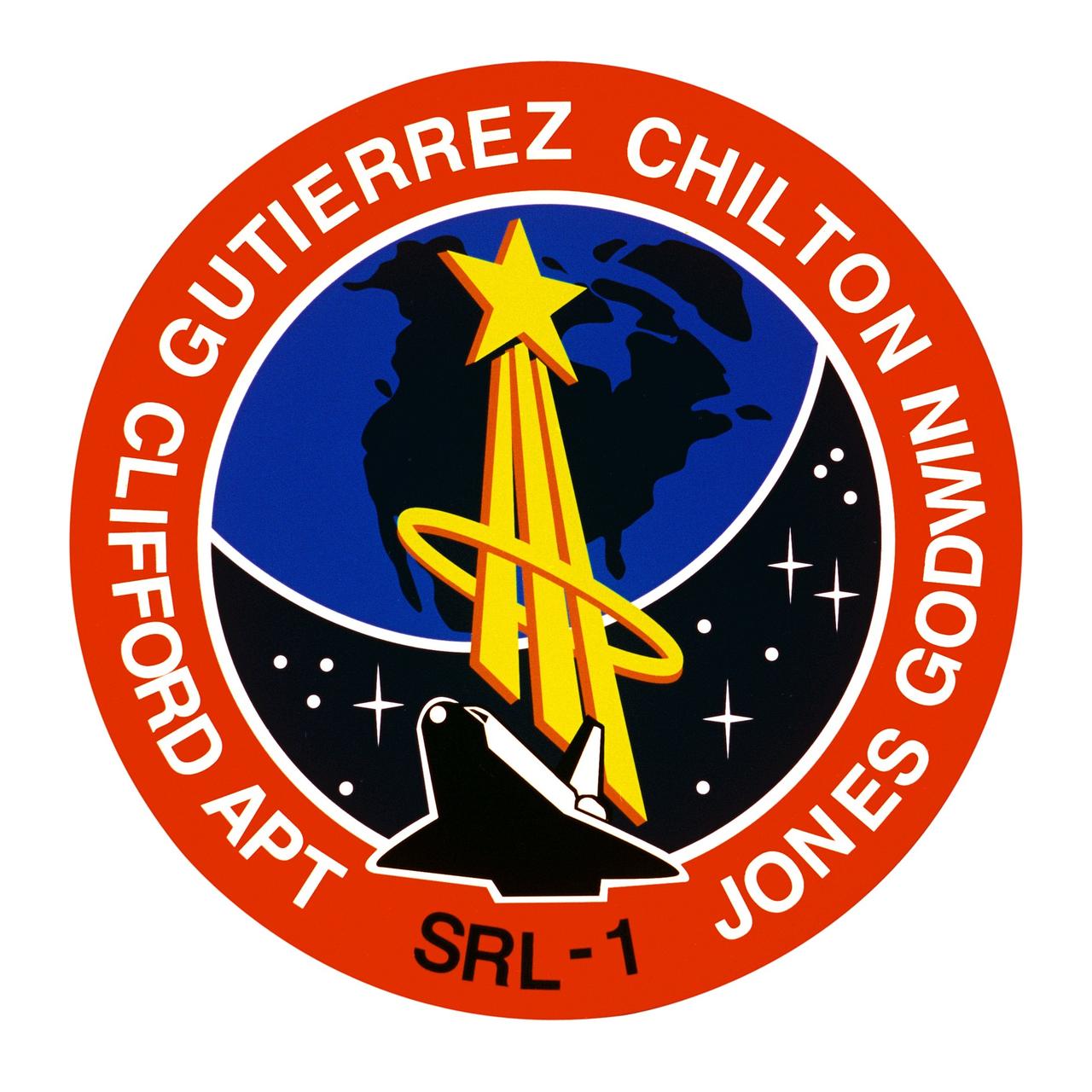
STS059-S-001 (November 1993) --- Designed by the crew members, the STS-59 insignia is dominated by Earth, reflecting the focus of the first Space Radar Laboratory (SRL-1) mission upon our planet's surface and atmosphere. The golden symbol of the astronaut corps emblem sweeps over Earth's surface from the space shuttle Endeavour, representing the operation of the SIR-C/Synthetic Aperture Radar (X-SAR) and the Measurement of Air Pollution from Space (MAPS) sensors. The astronaut emblem also signals the importance of the human element in space exploration and in the study of our planet. Using the unique vantage point of space, Endeavour and its crew -- along with scientists from around the world -- will study Earth and its environment. The starfield visible below Earth represents the many talents and skills of the international (SRL-1) team in working to make this "Mission to Planet Earth" (MTPE) a scientific and operational success. The NASA insignia design for space shuttle flights is reserved for use by the astronauts and for other official use as the NASA Administrator may authorize. Public availability has been approved only in the forms of illustrations by the various news media. When and if there is any change in this policy, which is not anticipated, the change will be publicly announced. Photo credit: NASA
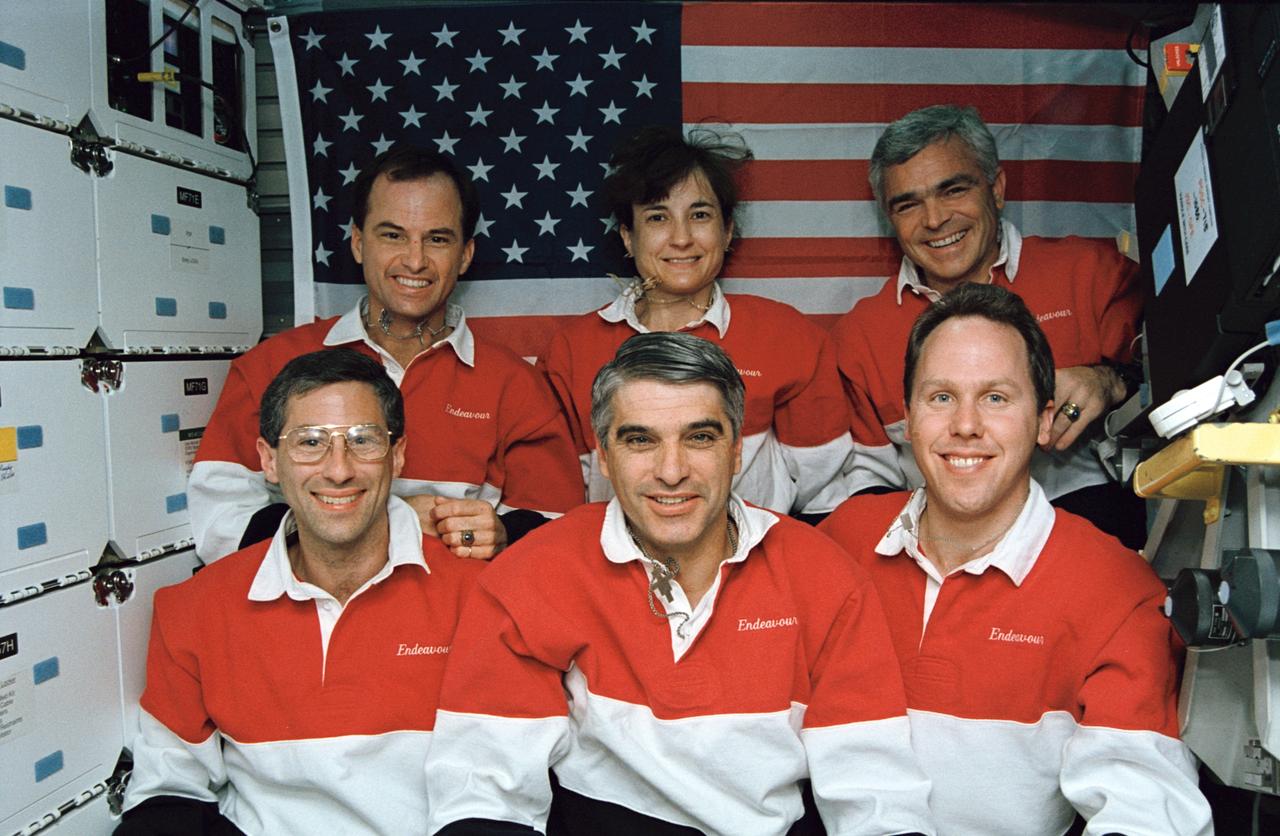
STS059-44-004 (9-20 April 1994) --- This middeck scene aboard the Space Shuttle Endeavour caught all six STS-59 crew members in a rare group shot. Astronaut Sidney M. Gutierrez, mission commander (front center) is flanked by astronauts Jerome (Jay) Apt and Thomas D. Jones, both mission specialists. On the back row are (left to right) astronaut Kevin P. Chilton, pilot; Linda M. Godwin, payload commander; and Michael R. (Rich) Clifford, mission specialist. Most of the week and a half was divided into two work shifts for the crew members.
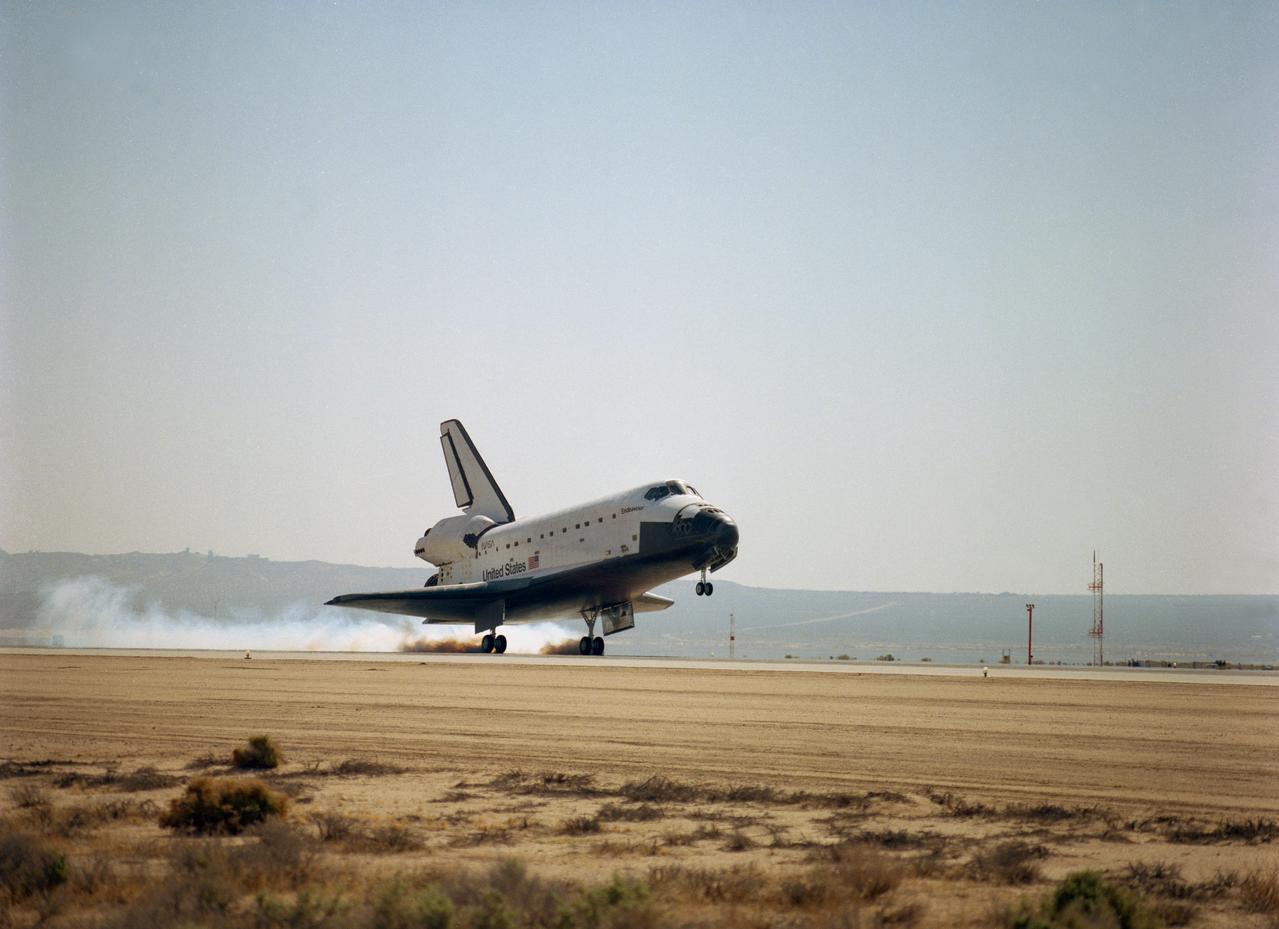
STS059-S-107 (20 April 1994) --- The main landing gear of the Space Shuttle Endeavour touches down at Edwards Air Force Base to complete the 11-day STS-59/SRL-1 mission. Landing occurred at 9:54 a.m. (PDT), April 20, 1994. Mission duration was 11 days, 5 hours, 49 minutes. Guiding Endeavour to a landing was astronaut Sidney M. Gutierrez, STS-59 commander. His crew was Kevin P. Chilton, Linda M. Godwin, Jerome (Jay) Apt, Michael R. (Rich) Clifford and Thomas D. Jones.
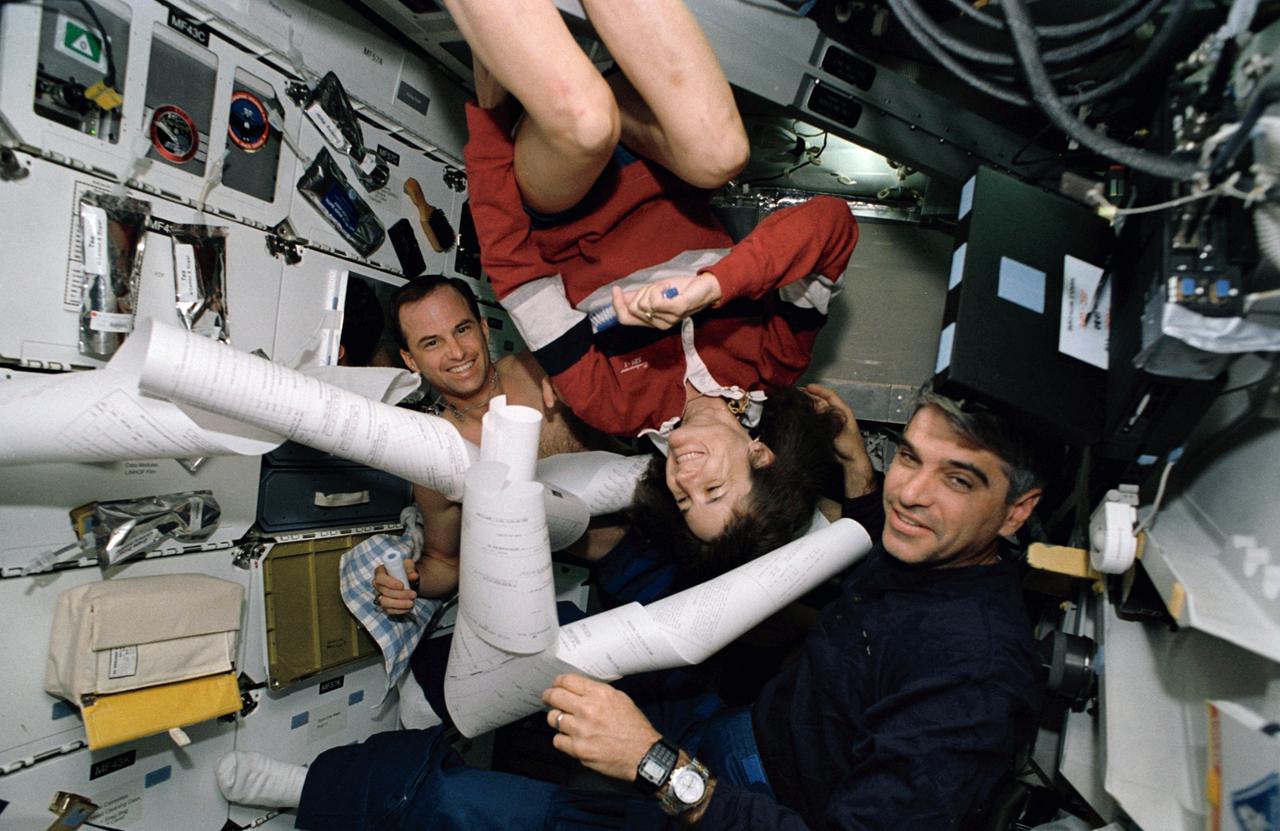
STS059-05-007 (9-20 April 1994) --- On Endeavour's middeck, the three STS-59 red shift crew members begin to organize what was believed to be among the longest mail messages in recent Shuttle history. With the picture held vertically, astronaut Sidney M. Gutierrez, mission commander, is in upper right. Also seen are astronauts Linda M. Godwin, payload commander, and Kevin P. Chilton, pilot. Though early Shuttle flights could brag of longer teleprinted messages, this Thermal Imaging Printing System's (TIPS) message from the ground competes with those of recent Shuttle flights.
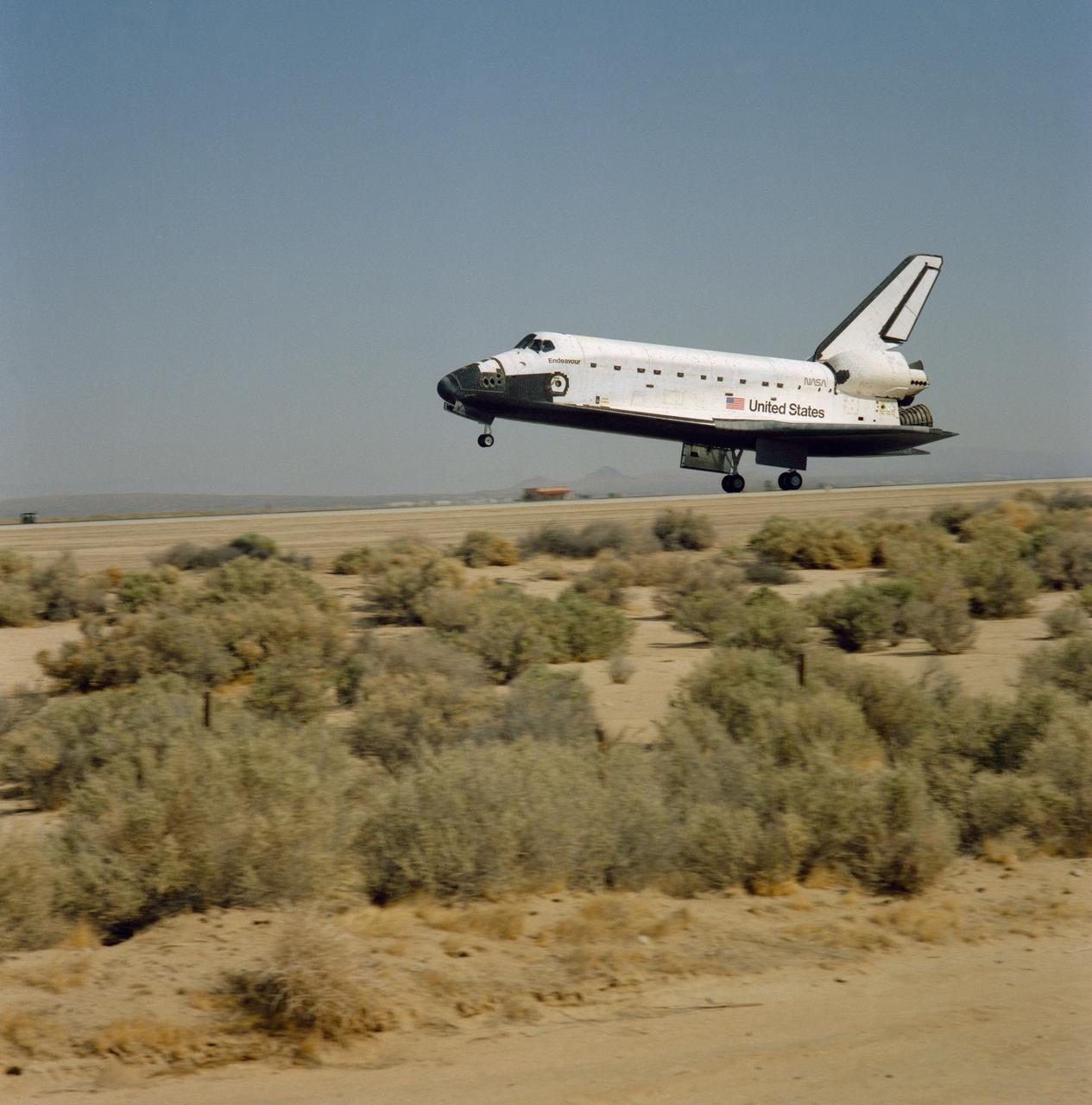
STS059-S-108 (20 April 1994) --- The main landing gear of the Space Shuttle Endeavour touches down at Edwards Air Force Base to complete the 11-day STS-59/SRL-1 mission. Landing occurred at 9:54 a.m. (PDT), April 20, 1994. Mission duration was 11 days, 5 hours, 49 minutes. Guiding Endeavour to a landing was astronaut Sidney M. Gutierrez, STS-59 commander. His crew was Kevin P. Chilton, Linda M. Godwin, Jerome (Jay) Apt, Michael R. (Rich) Clifford and Thomas D. Jones.
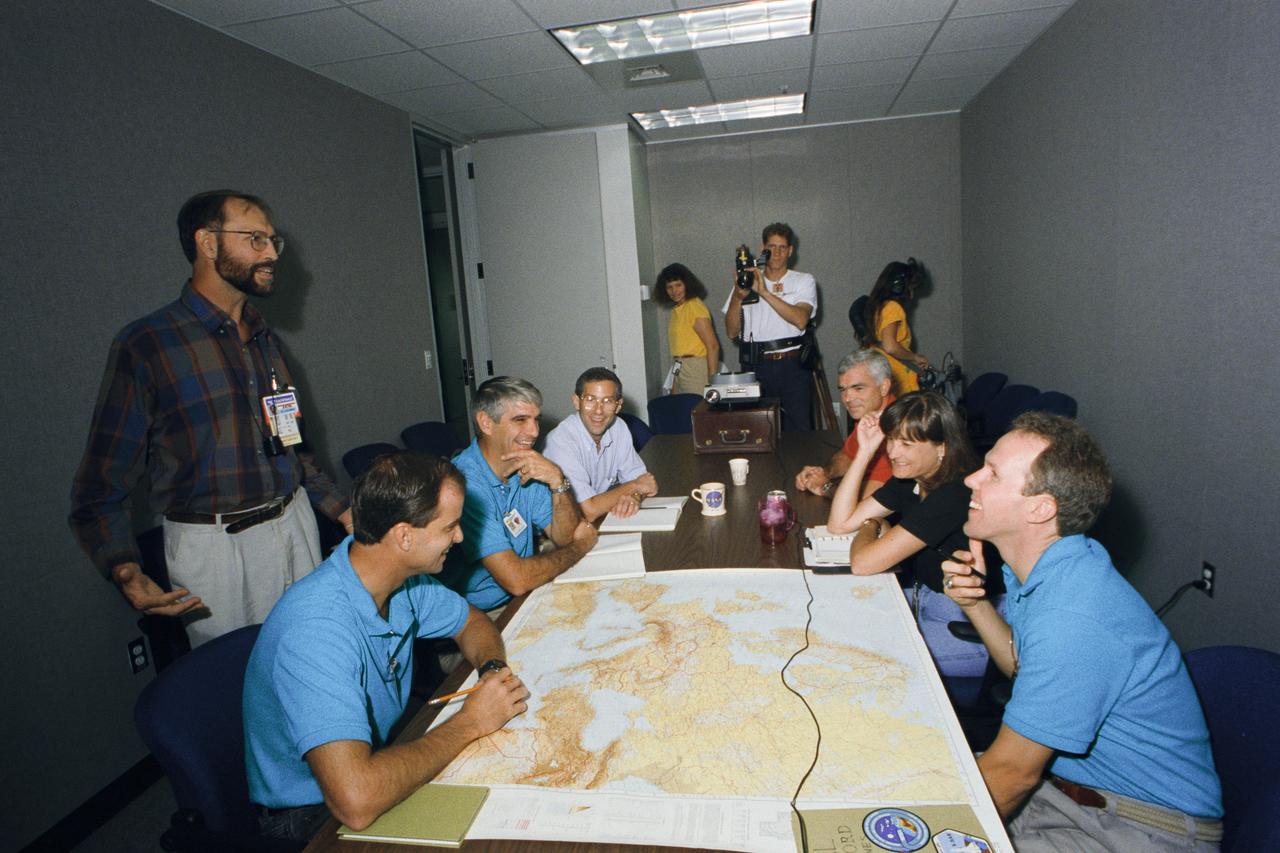
S93-42727 (26 Aug 1993) --- The six astronauts in training for the STS-59 mission are given some onboard Earth observations tips by Justin Wilkinson (standing, foreground) of the Space Shuttle Earth Observations Project (SSEOP) group. Astronaut Sidney M. Gutierrez, mission commander, is at center on the left side of the table. Others, left to right, are astronauts Kevin P. Chilton, pilot; Jerome (Jay) Apt and Michael R.U. (Rich) Clifford, both mission specialists; Linda M. Godwin, payload commander; and Thomas D. Jones, mission specialist.
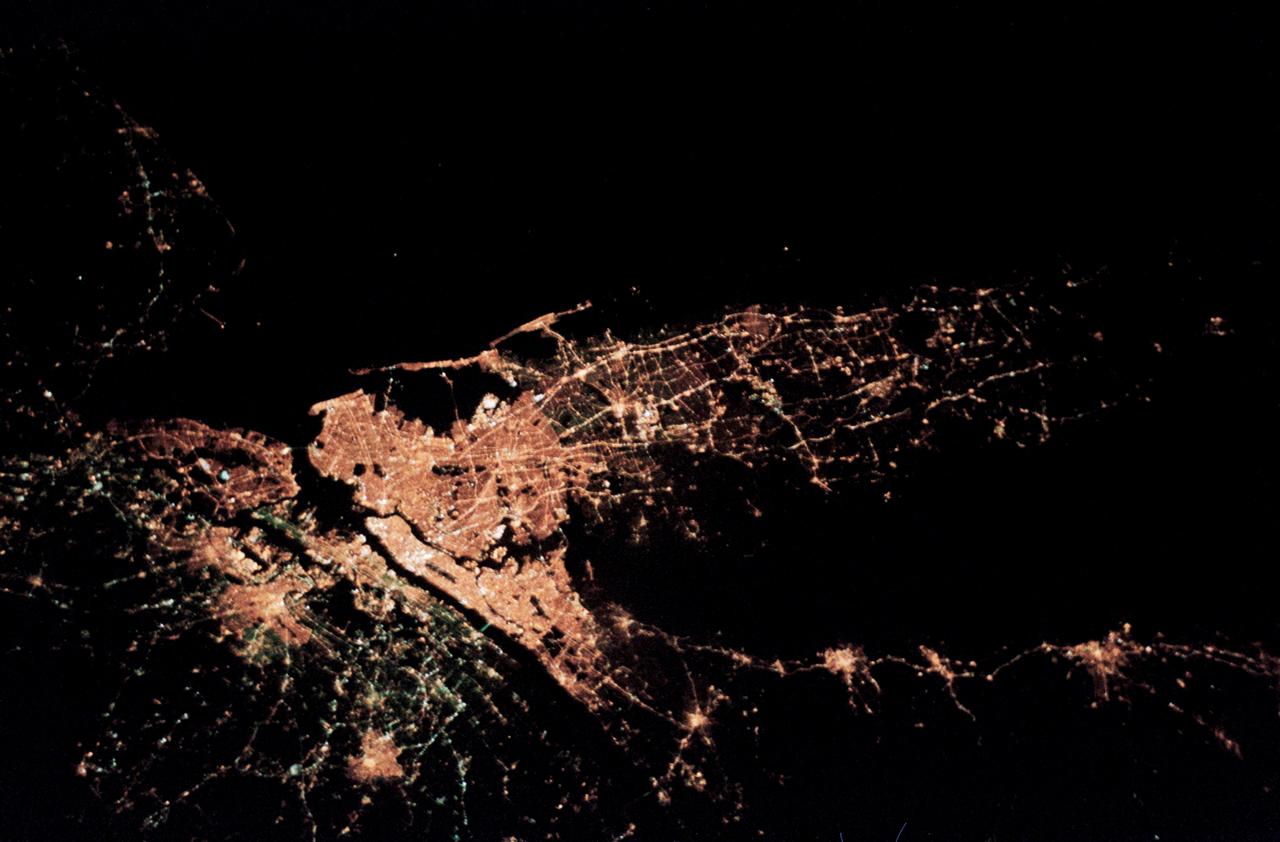
STS059-50-003 (9-20 April 1994) --- This 35mm night image of the New York City metropolitan area was captured by the crew of the STS-59 crew during the Space Radar Laboratory (SRL) mission. Scientists studying film from the Space Shuttle Endeavour feel this is the best nocturnal view of this region from the manned space program.
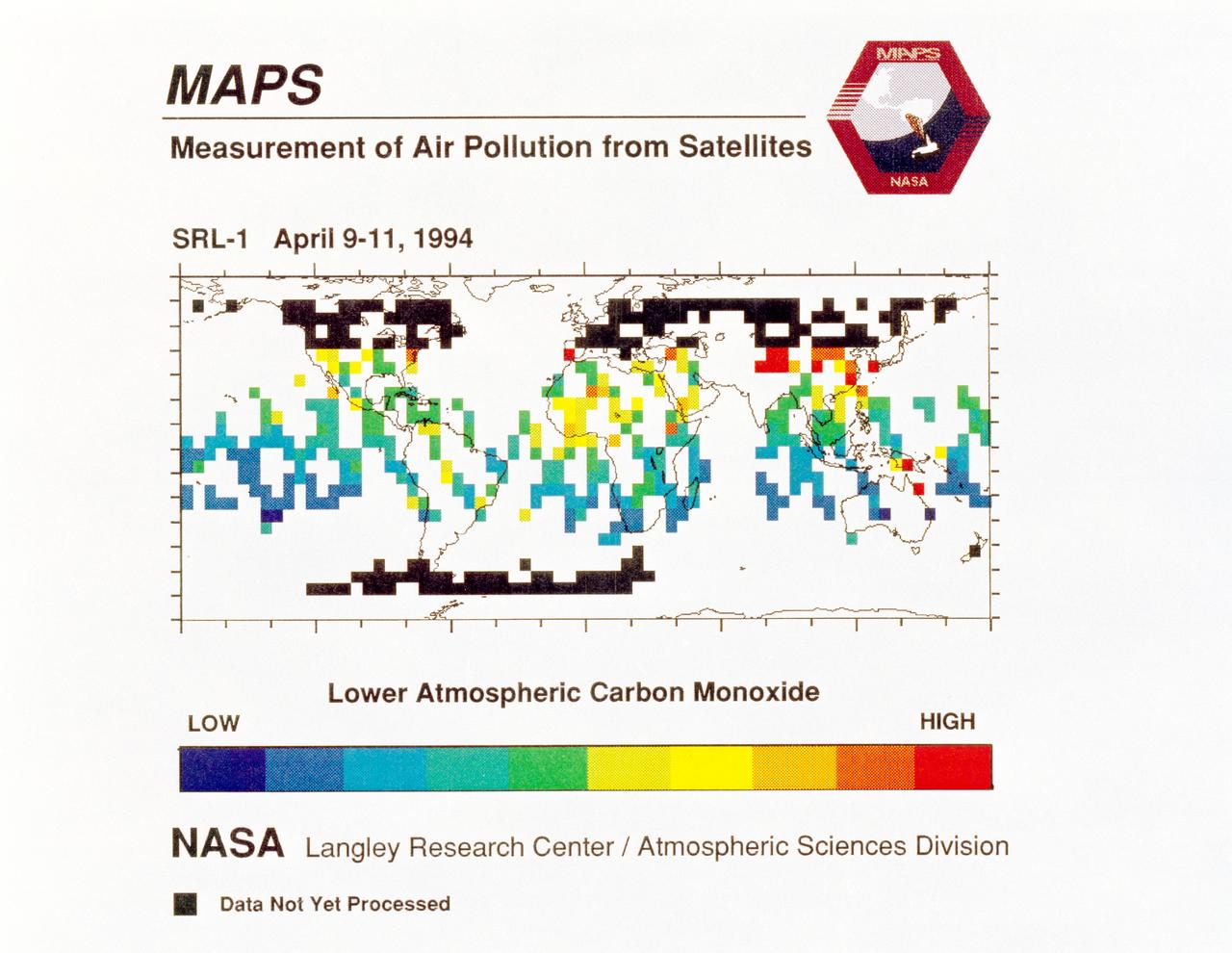
STS059-S-040 (12 April 1994) --- STS-59's MAPS (Measurement of Air Pollution from Satellites) experiment is sending real-time data that provides the most comprehensive view of carbon monoxide concentrations on Earth ever recorded. This computer image shows a summary of "quick look" data obtained by the MAPS instrument during its first days of operations as part of the Space Shuttle Endeavour's SRL-1 payload. This data will be processed using more sophisticated techniques following the flight. The color red indicates areas with the highest levels of carbon monoxide. These Northern Hemisphere springtime carbon monoxide values are generally significantly higher than the values found in the Southern Hemisphere. This is in direct contrast to the data obtained by the MAPS experiment during November 1981 and October 1984, i.e. during Northern Hemisphere fall. The astronauts aboard Endeavour have seen fires in most of the areas showing higher carbon monoxide values (China, Eastern Australia, and equatorial Africa). The relationship between the observed fires and the higher carbon monoxide values will be investigated following SRL-1 by combining the MAPS data with meteorological data, surface imagery, and Space Shuttle hand-held photographs. By the end of SRL-1, MAPS will have acquired data over most of the globe between 57 degrees north and 57 degrees south latitudes. The entire data set will be carefully analyzed using sophisticated post-flight data processing techniques. The data will then be applied in a variety of scientific studies concerning chemistry and transport processes in the atmosphere. The MAPS experiment measures the carbon monoxide in the lower atmosphere. This gas is produced both as a result of natural processes and as a result of human activities. The primary human resources of carbon monoxide are automobiles and industry and the burning of plant materials. The primary natural source is the interaction of sunlight with naturally occurring ozone and water vapor. The strength of all of these sources changes seasonally.
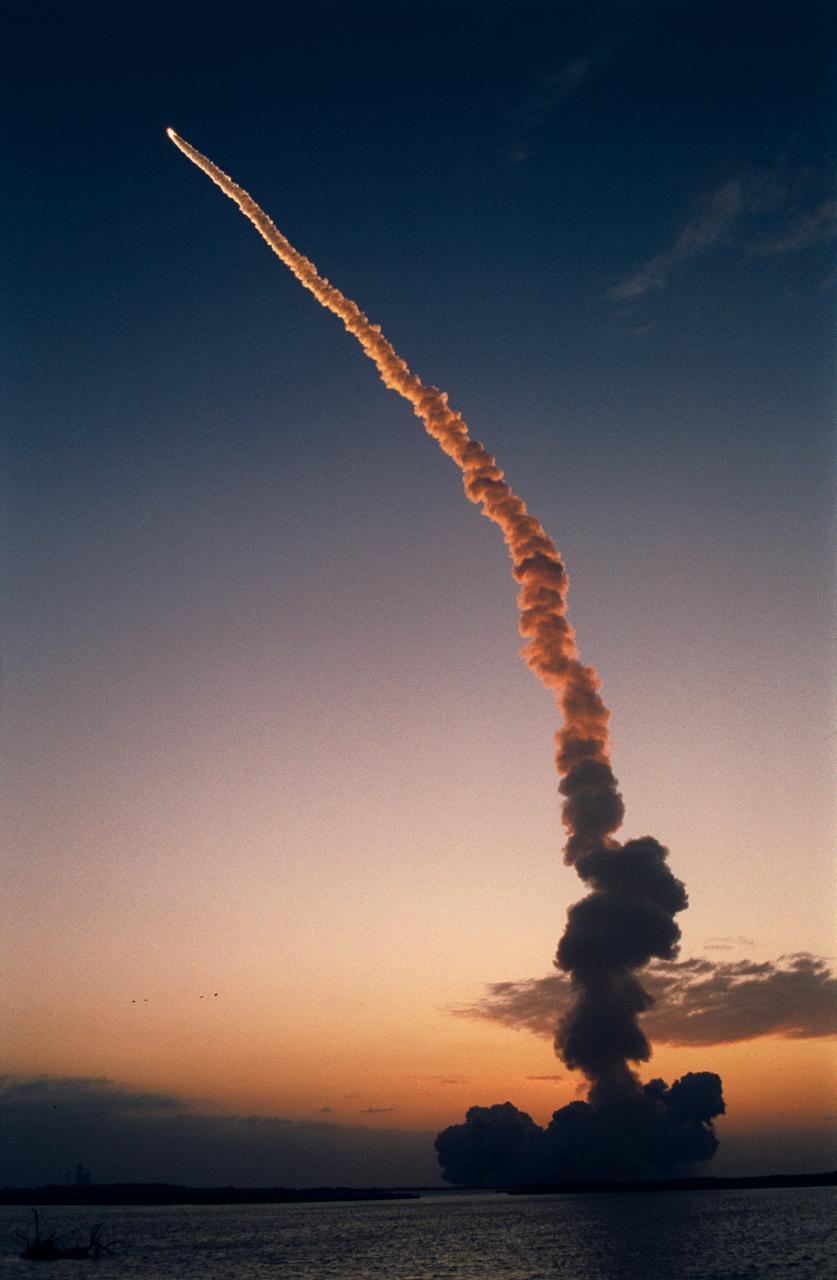
STS059-S-109 (9 April 1994) --- The Space Shuttle Endeavour heads for its sixth mission in space. Liftoff occurred at 7:05 a.m. (EDT), April 9, 1994. Onboard were astronauts Sidney M. Gutierrez, Kevin P. Chilton, Linda M. Godwin, Jerome (Jay) Apt, Michael R. (Rich) Clifford and Thomas D. Jones. The photograph was taken by Karen Dillon of San Jose, California, who observed the liftoff from the NASA causeway.
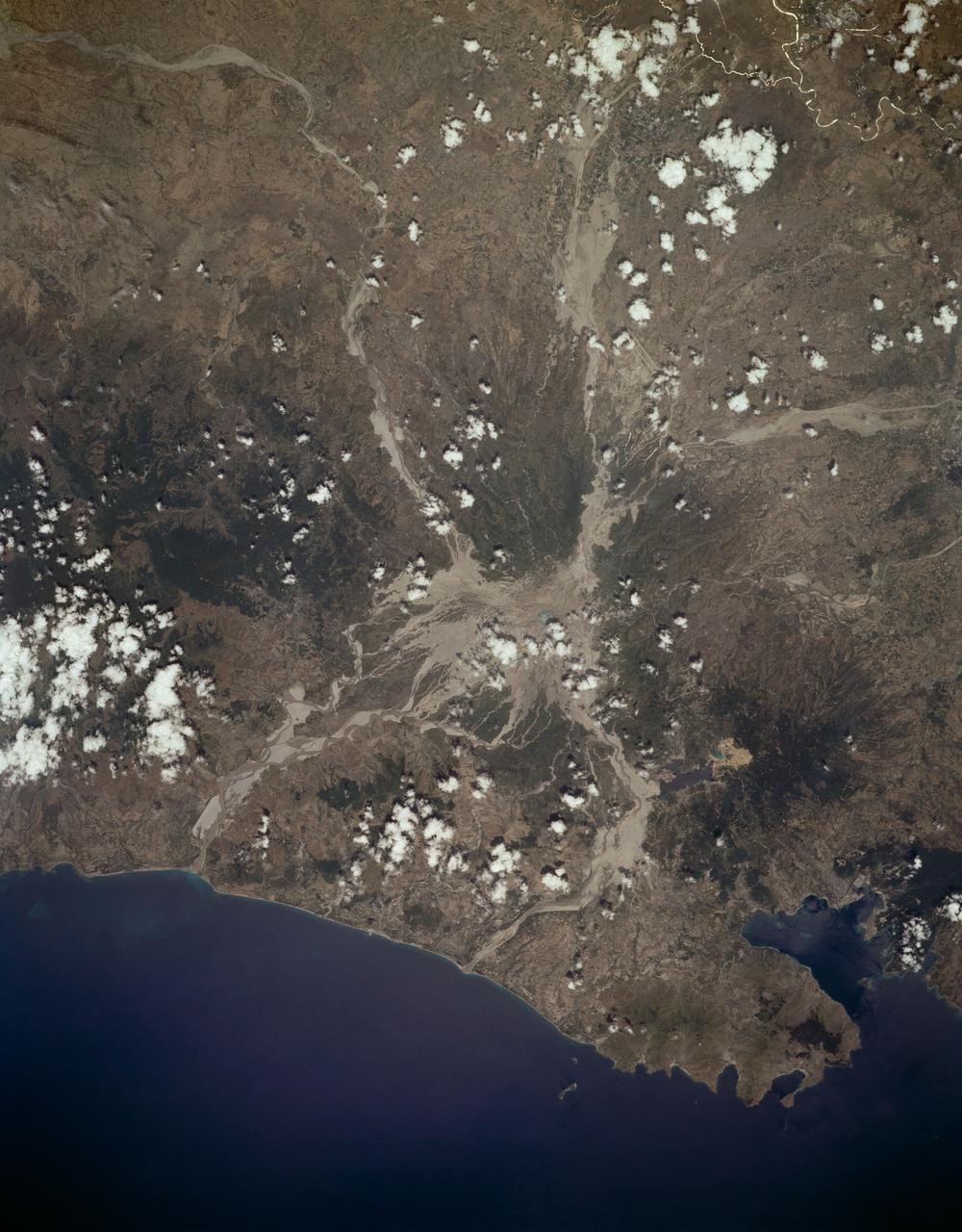
STS059-L14-170 (9-20 April 1994) --- Orient with the sea at the left. Then Subic Bay is at the lower left corner, and Clark Air Force Base (abandoned after the eruption) is to the lower right of the volcano. A turquoise lake occupies the caldera just below the center of the photograph. Mount Pinatubo erupted in June, 1991 after several hundred years of quiescence. Eruptive activity has nearly ceased, but every torrential rain in this monsoonal climate causes renewed mud flows of a viscous slurry composed of volcanic ash and pumice. Shuttle crews have been photographing the mountain at every opportunity, to add documentation to unmanned-satellite, aerial, and ground-based observations of changes. SRL scientists will use the excellent radar imagery obtained during STS-59 to help discriminate among different kinds of volcanic material, and to extend their observations to other volcanoes around the world using future, perhaps unmanned, radar satellites. Linhof photograph.
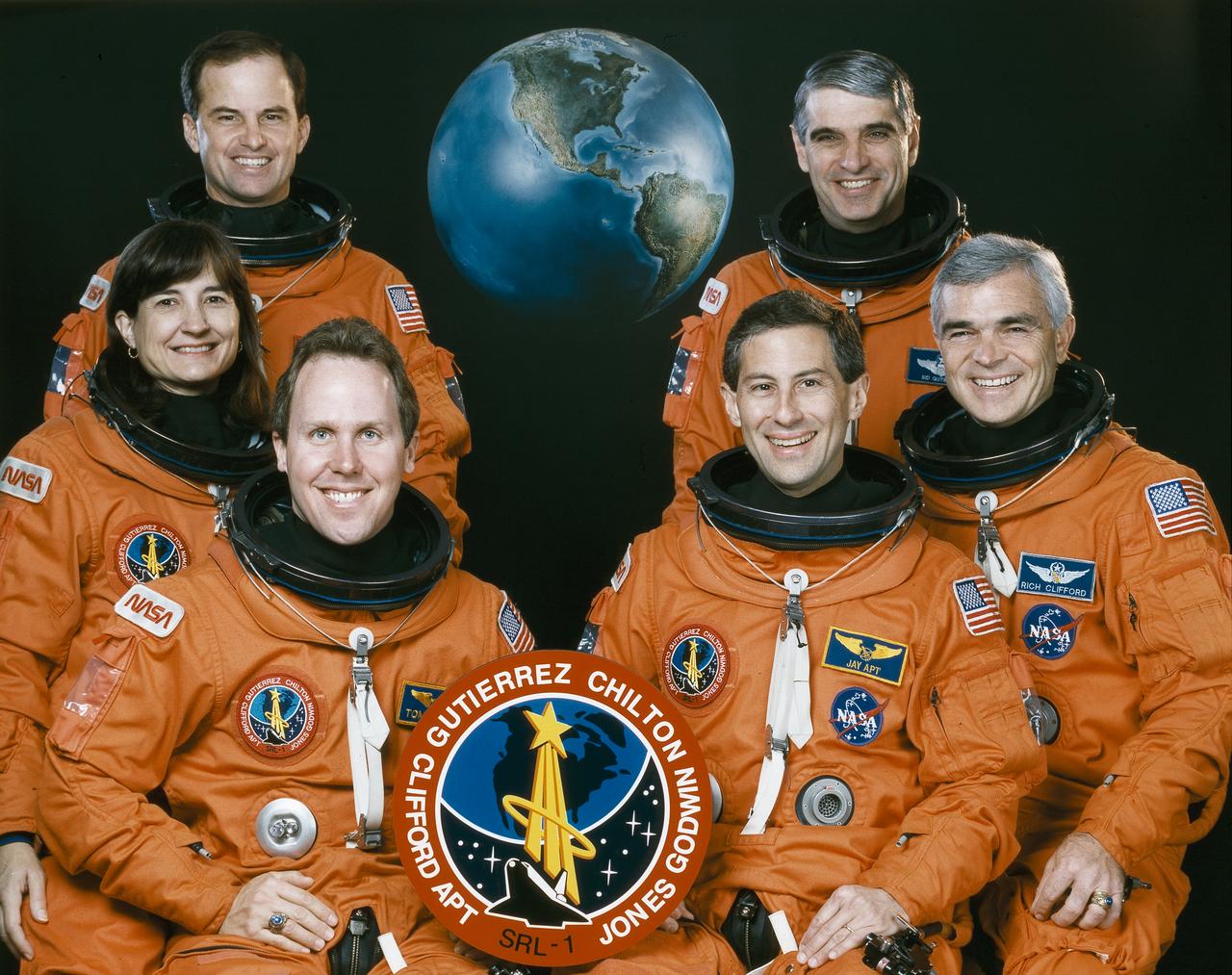
Astronauts included in the STS-59 crew portrait include (standing in rear, left to right) Kevin P. Chilton, pilot; and Sidney M. Gutierrez, commander. Seated left to right are Linda M. Godwin, payload commander; and mission specialists Thomas D. Jones, Jay Apt, and Michael R. Clifford. Launched aboard the Space Shuttle Endeavour on April 9, 1994 at 7:05:00 am (EDT), the STS-59 mission deployed the Space Radar Laboratory (SRL-1).
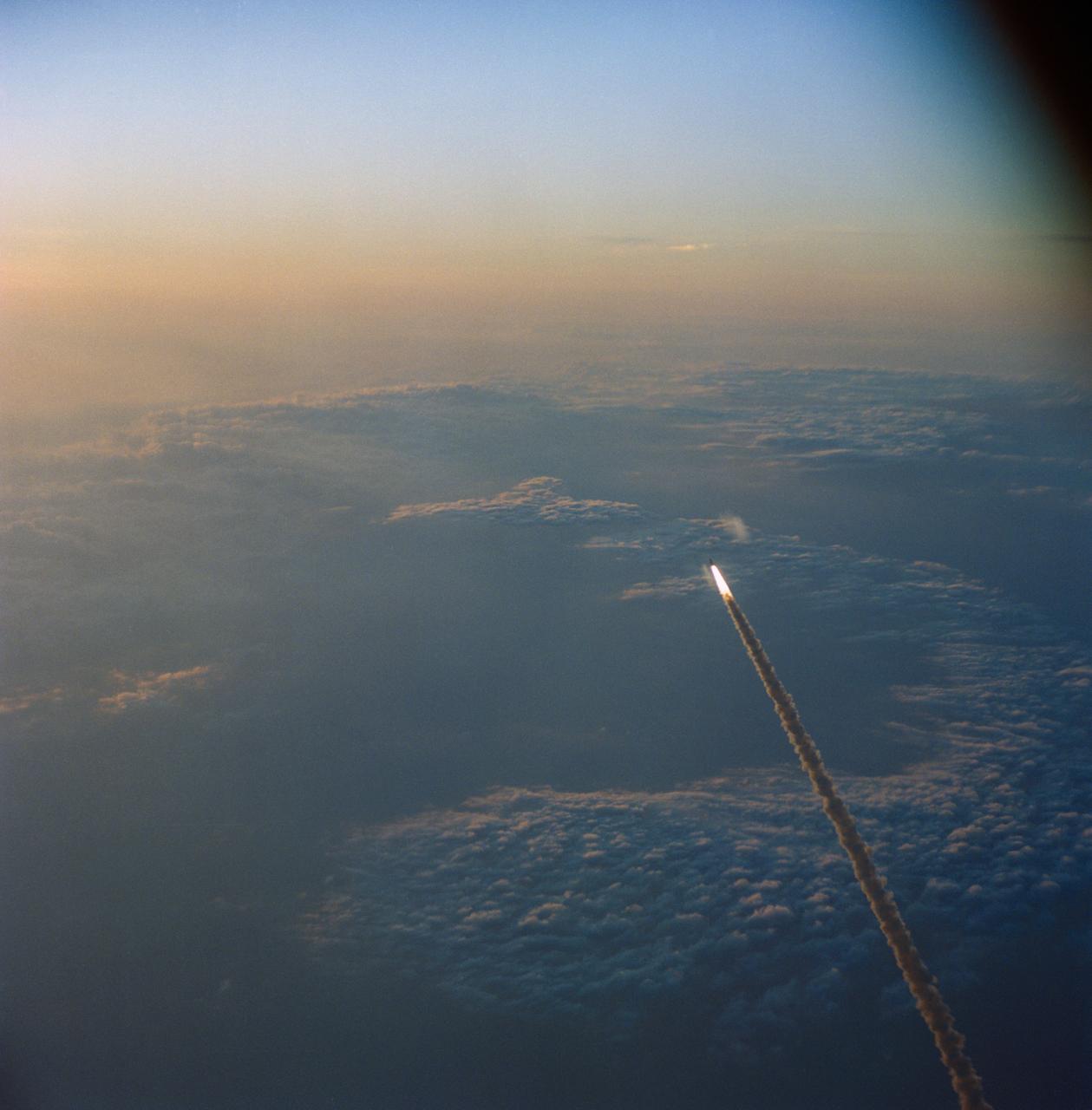
STS059-S-066 (9 April 1994) --- The liftoff of the Space Shuttle Endeavour is backdropped against clouds at the Kennedy Space Center (KSC) as six NASA astronauts head for a week and a half in Earth orbit. Liftoff occurred at 7:05 a.m. (EDT), April 9, 1994. The air-to-air view was photographed from the Shuttle Training Aircraft (STA) piloted by astronaut Robert L. Gibson. Onboard for the Space Radar Laboratory (SRL-1) mission were astronauts Sidney M. Gutierrez, Kevin P. Chilton, Jerome (Jay) Apt, Linda M. Godwin, Michael (Rich) Clifford and Thomas D. Jones.
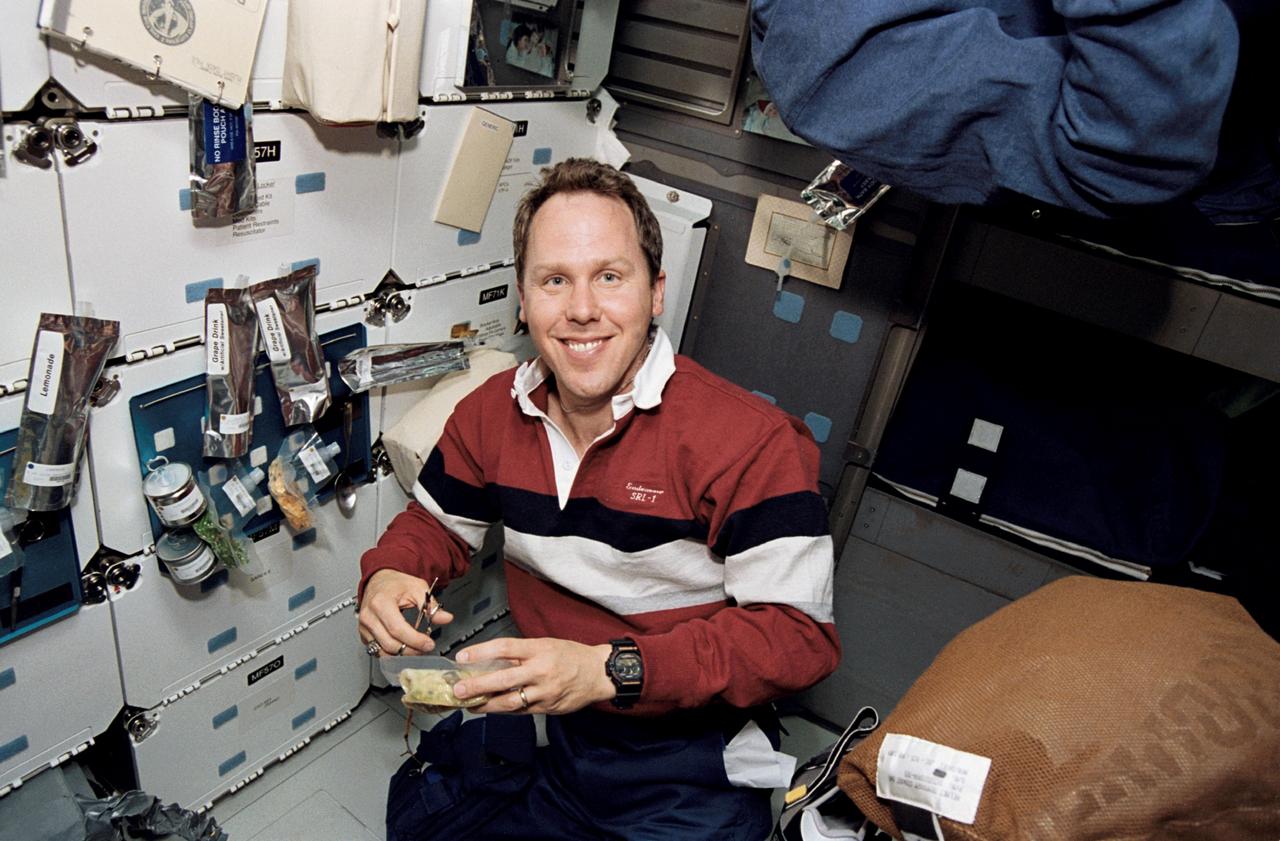
STS059-14-004 (9-20 April 1994) --- On the Space Shuttle Endeavour's middeck astronaut Thomas D. Jones, mission specialist, cuts open a package of food as he prepares for mealtime. Jones was joined by five other NASA astronauts aboard Endeavour for the STS-59 mission.
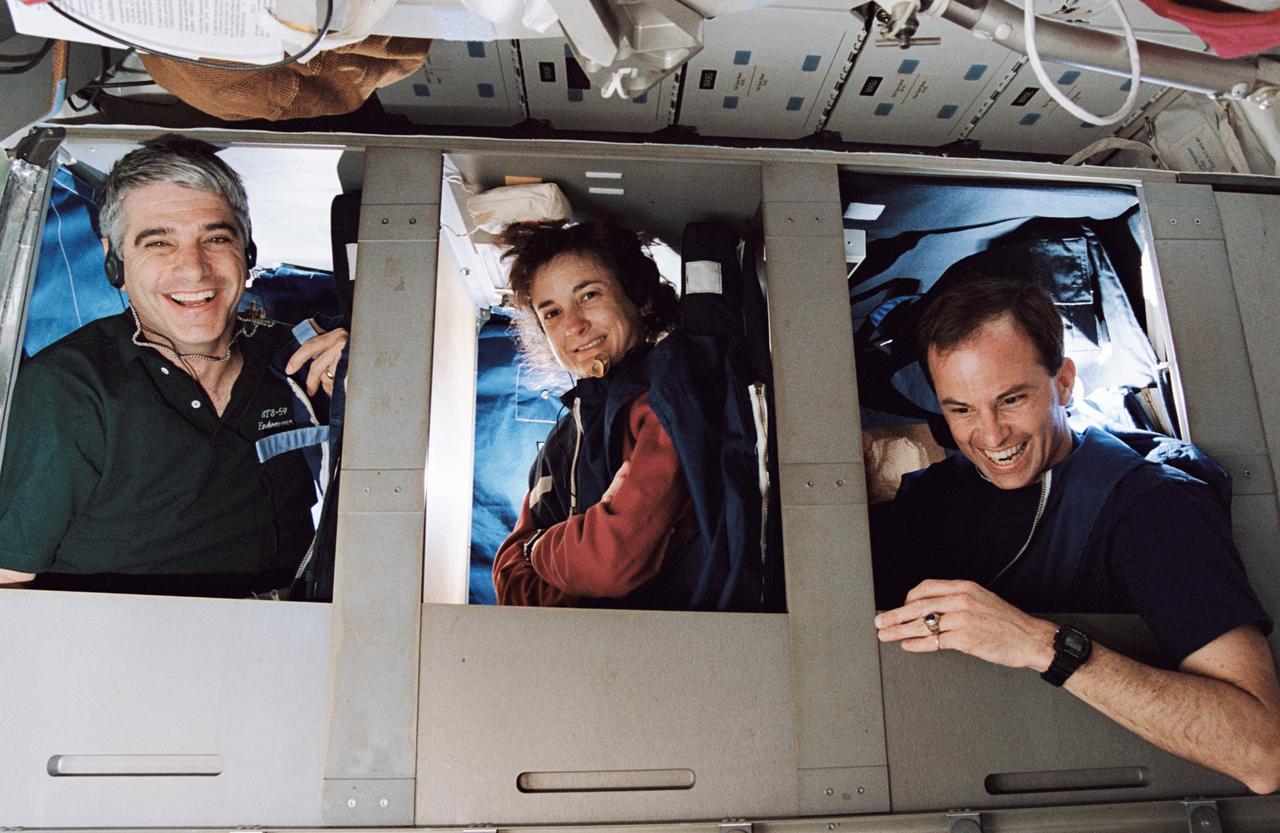
STS059-22-004 (9-20 April 1994) --- Half of Space Shuttle Endeavour's crew of six astronauts are pictured in bunks on the middeck. With the picture held horizontally, the red shift crew members pictured are, left to right, astronauts Sidney M. Gutierrez, mission commander; Linda M. Godwin, payload commander; and Kevin P. Chilton, pilot.
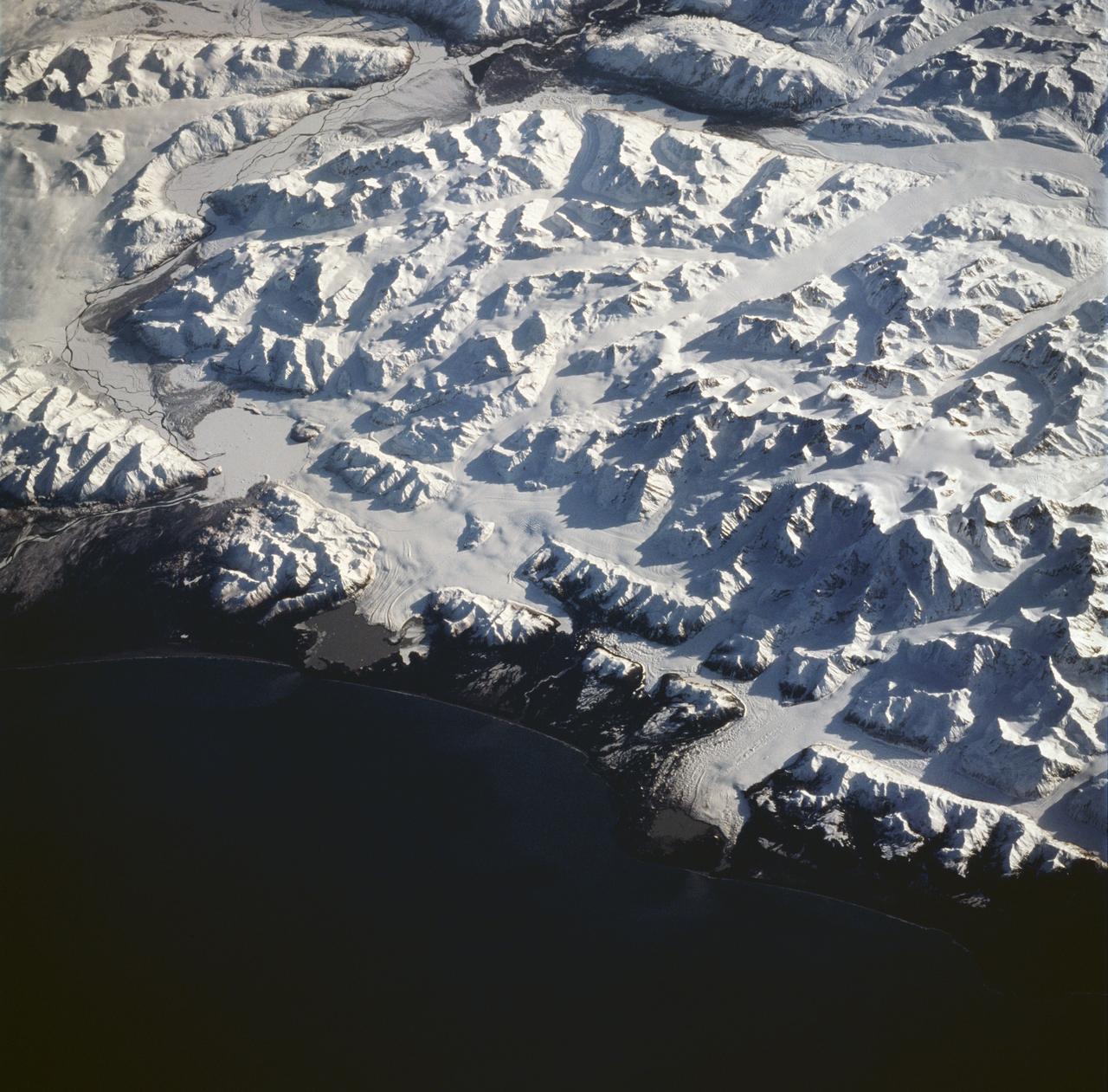
STS059-228-094 (9-20 April 1994) --- The spring thaw along the coast of the Gulf of Alaska has not touched the St. Elias Mountains, southeast of Yakutat Bay and Malaspina Glacier. A prominent glacier flows from Mt. Fairweather (15,300 feet) at right center, to form Cape Fairweather. Another glacier to the northwest almost reaches the sea; the valley of the Alsek River forms a broad, braided plan at upper left. The low sun elevation and oblique angle of this photograph provide a striking 3-dimensional appearance to the black-and-white landscape. SRL investigators will study microwave response to varying depths and conditions of ice and snow along this coast, in Spring and Summer. Hasselblad photograph.
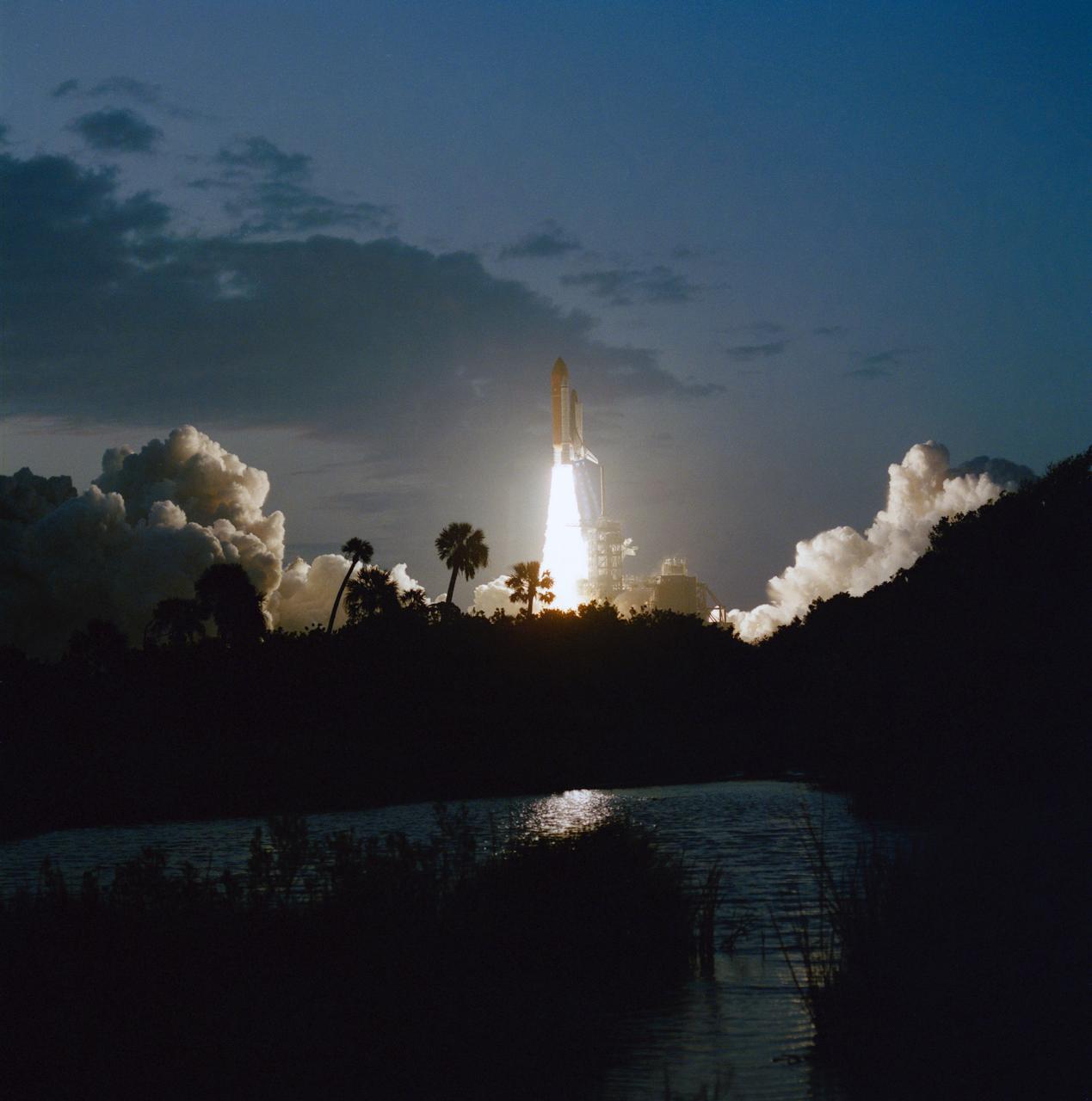
STS059-S-034 (9 April 1994) --- The liftoff of the Space Shuttle Endeavour is backdropped against a dawn sky at the Kennedy Space Center (KSC) as six NASA astronauts head for a week and a half in Earth orbit. Liftoff occurred at 7:05 a.m. (EDT), April 9, 1994. Onboard for the Space Radar Laboratory (SRL-1) mission were astronauts Sidney M. Gutierrez, Kevin P. Chilton, Jerome (Jay) Apt, Linda M. Godwin, Michael R. U. (Rich) Clifford and Thomas D. Jones.
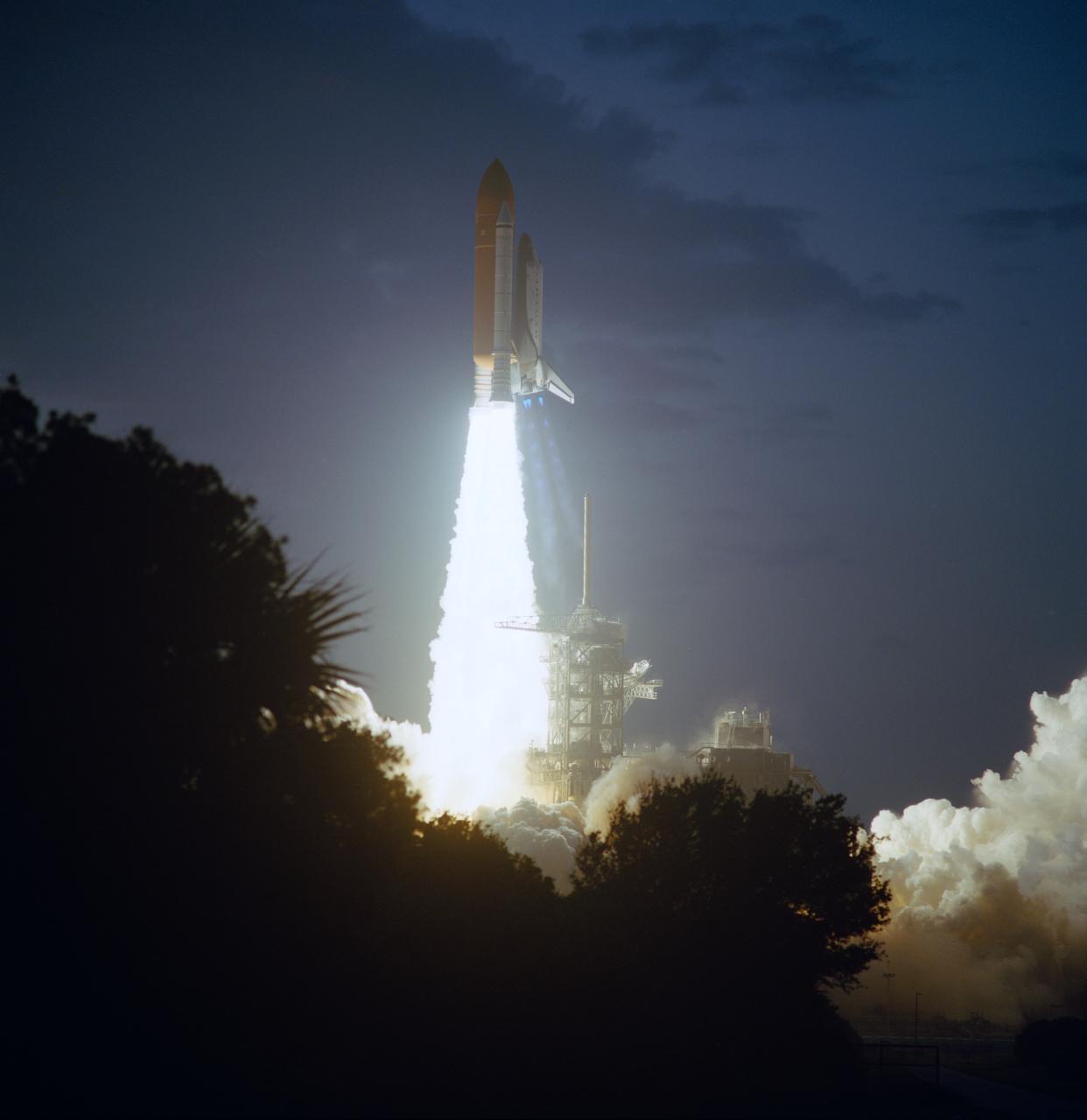
STS059-S-036 (9 April 1994) --- The liftoff of the Space Shuttle Endeavour is backdropped against a dawn sky at the Kennedy Space Center (KSC) as six NASA astronauts head for a week and a half in Earth orbit. The morning sky allows for a contrasting backdrop for the diamond shock effect of the thrust from Endeavour's main engines. Liftoff occurred at 7:05 a.m. (EDT), April 9, 1994. Onboard for the Space Radar Laboratory (SRL-1) mission were astronauts Sidney M. Gutierrez, Kevin P. Chilton, Jerome (Jay) Apt, Linda M. Godwin, Michael R. U. (Rich) Clifford and Thomas D. Jones.
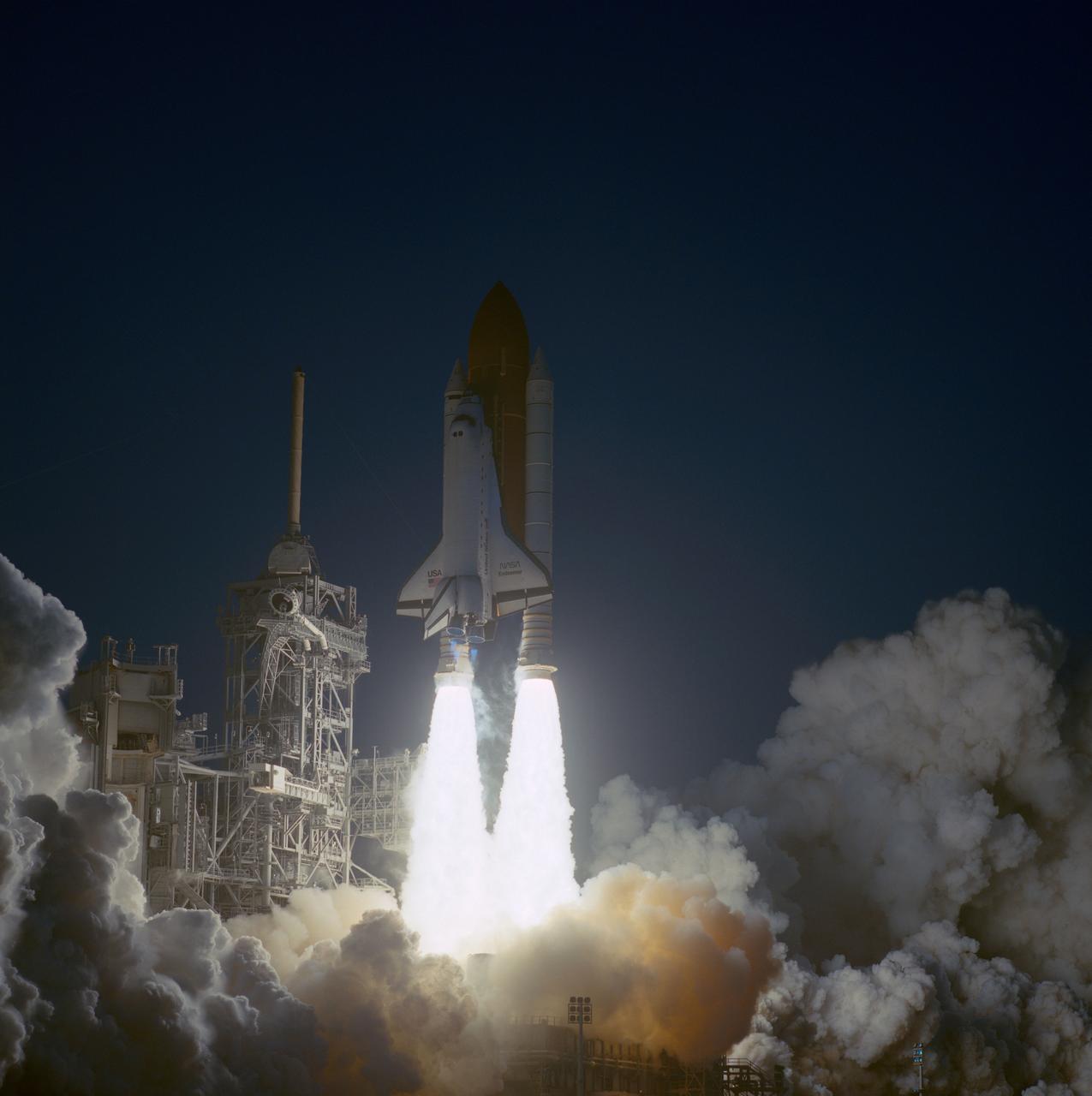
STS059-S-037 (9 April 1994) --- The liftoff of the Space Shuttle Endeavour is backdropped against a dawn sky at the Kennedy Space Center (KSC) as six NASA astronauts head for a week and a half in Earth orbit. Liftoff occurred at 7:05 a.m. (EDT), April 9, 1994. Onboard for the Space Radar Laboratory (SRL-1) mission were astronauts Sidney M. Gutierrez, Kevin P. Chilton, Jerome (Jay) Apt, Linda M. Godwin, Michael R.U. (Rich) Clifford and Thomas D. Jones.
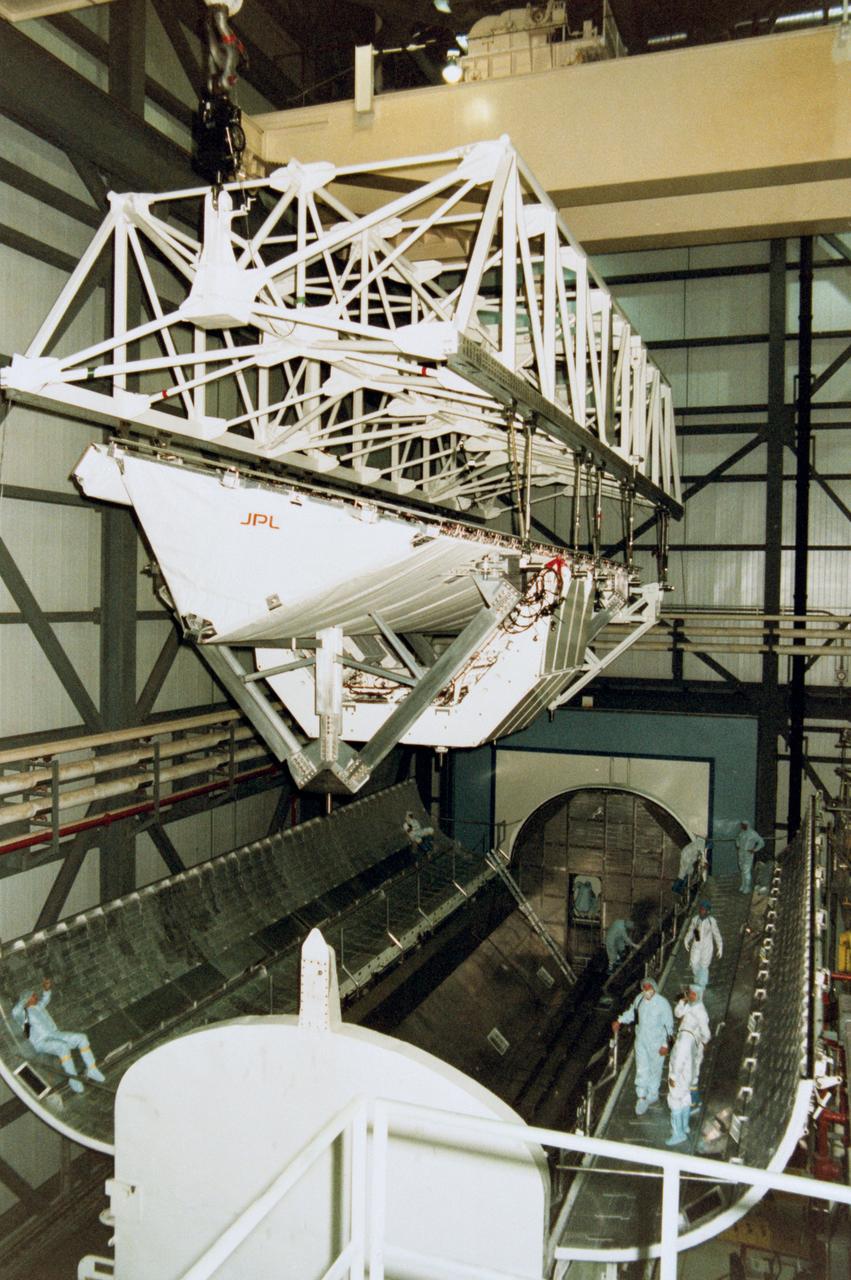
S94-30392 (16 Feb 1994) --- The Space Radar Laboratory-1 (SRL-1) is being transferred from the payload canister transporter into the payload bay of the Space Shuttle Endeavour. SRL-1 will be launched on STS-59 in April of this year.

STS059-32-016 (20 April 1994) --- Astronaut Linda M. Godwin, STS-59 payload commander, poses with the spacesuit she wore for launch. She will eventually wear the partial pressure suit for the entry phase of the Space Shuttle Endeavour's week and a half mission in Earth orbit.
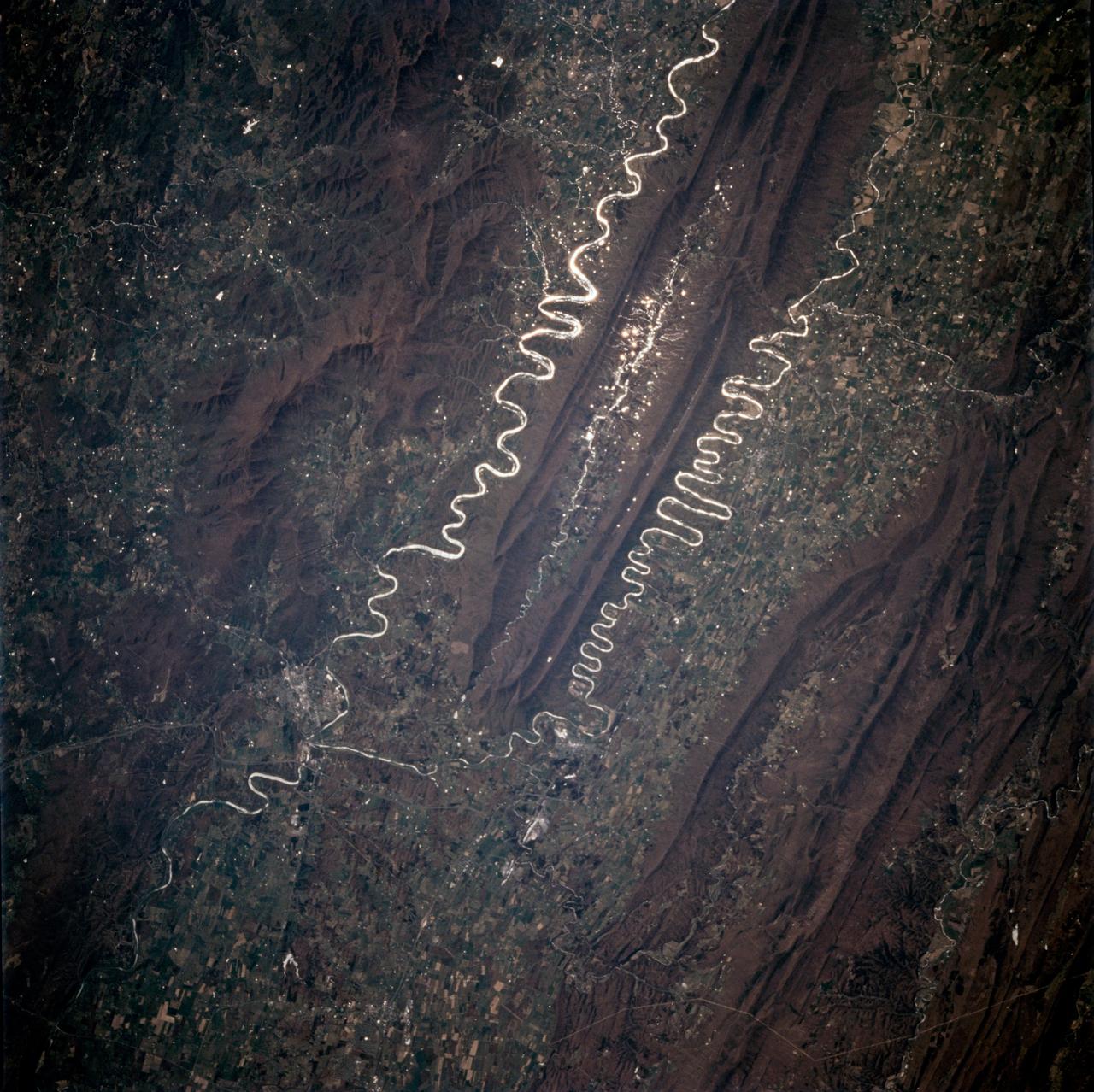
STS059-225-072 (9-20 April 1994) --- Orient with the tuning fork away from the viewer (sunglint is always south of the spacecraft at this latitude). Then the South Fork (left) and North Fork (right) of the Shenandoah meet in the foreground; Front Royal, Virginia is just to the left of the combined rivers at the junction. Massanutten Mountain, covered by reddish-brown fallen leaves of the George Washington National Forest, separates the river forks. The mountain, and other elements of the Appalachian Mountains in this scene, were formed from folded sedimentary rocks that later were eroded into their present shapes; resistant rocks, such as sandstone, form the high ground while shale and limestone form the valleys. Hasselblad photograph.
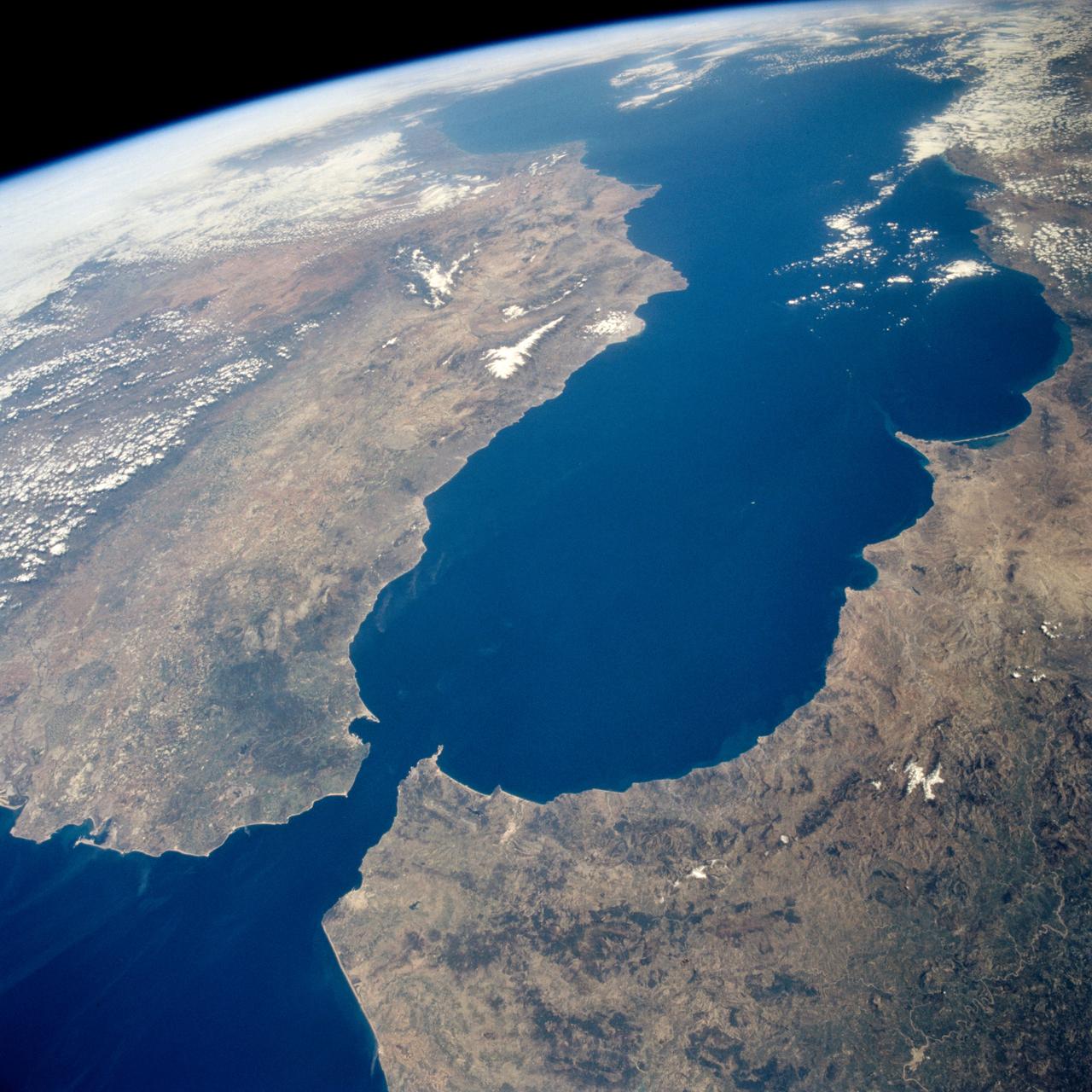
STS059-238-074 (9-20 April 1994) --- The Atlantic Ocean, Straits of Gibraltar, and Alboran Sea (the westernmost portion of the Mediterranean Sea) separate Spain on the left from Morocco on the right. Algeciras Harbor is the prominent notch cut out of the eastern end of the north shore of the Strait; the Rock of Gibraltar is the tiny arrowhead that separates the notch from the Alboran Sea. The Sierra Nevada, farther away down the Spanish coast, lives up to its name in this April scene. The difference in elevation between the Sierra Morena and the Guadalquivir River valley is highlighted nicely by cumulus clouds. Tangier, Morocco can be seen as a light-toned spot on the southern shore of the Strait, near the entrance to the Atlantic Ocean. Hasselblad photograph.
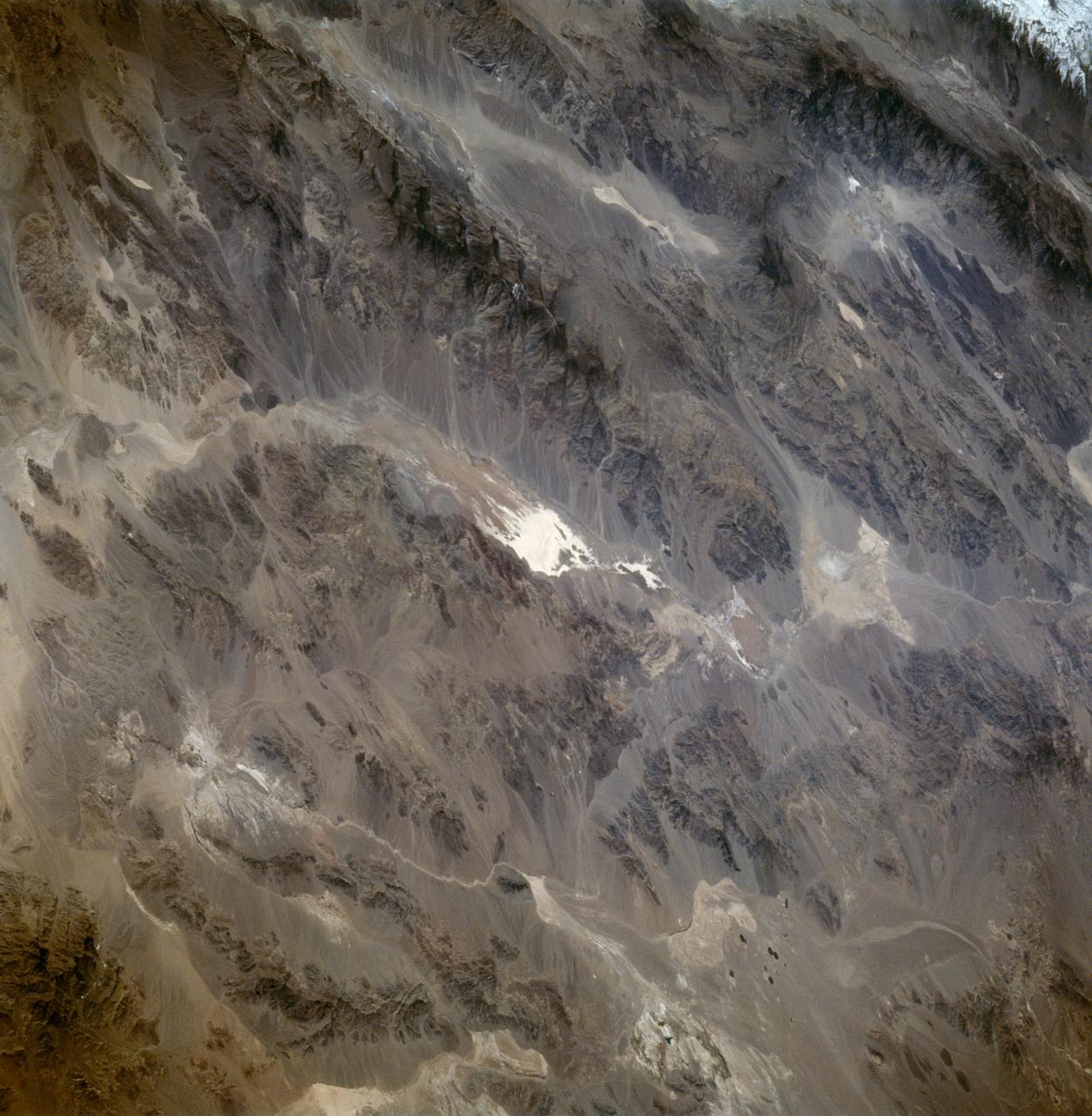
STS059-86-059 (9-20 April 1994) --- This oblique handheld Hasselblad 70mm photo shows Death Valley, near California's border with Nevada. The valley -- the central feature of Death Valley National Monument -- extends north to south for some 140 miles (225 kilometers). Hemmed in to the east by the Amargosa Range and to the west by the Panamints, its width varies from 5 to 15 miles (8 to 24 kilometers). Using Spaceborne Imaging Radar (SIR-C) and X-band Synthetic Aperture Radar (X-SAR) onboard the Space Shuttle Endeavour, the crew was able to record a great deal of data on this and other sites, as part of NASA's Mission to Planet Earth.
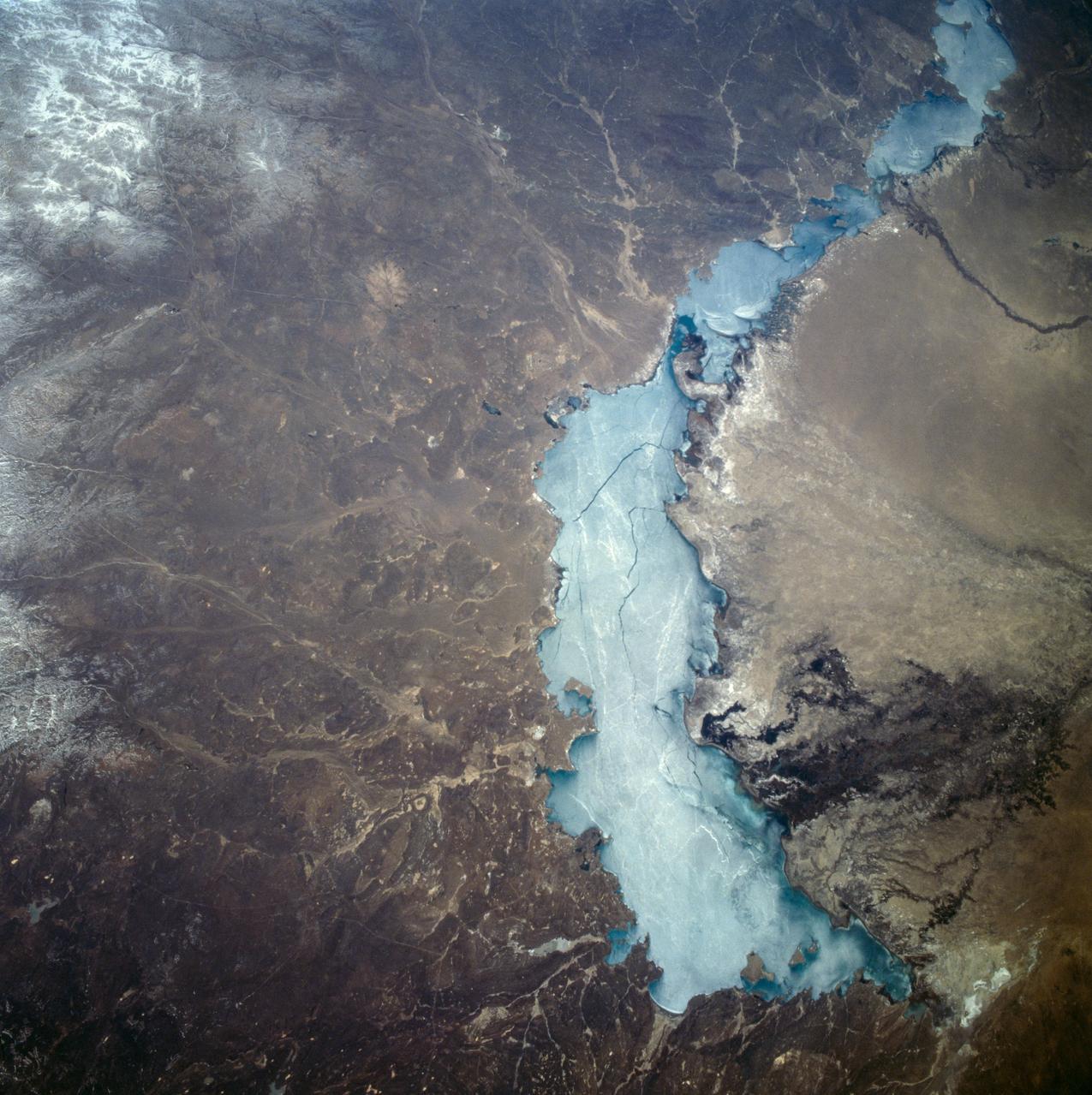
STS059-209-081 (9-20 April 1994) --- Lake Balkhash, in eastern Kazakhstan, is some 300 miles long. The lake, frozen in this scene, thawed noticeably during the mission. The shape of the lake is controlled by the delta of the Ili River, which flows from the Tien Shan Mountains in western China across this arid steppe. SRL scientists will use radar data to study the microwave effects of differences in soil moisture, and in freezing or thawing, on the deltaic sediments. Hasselblad camera.
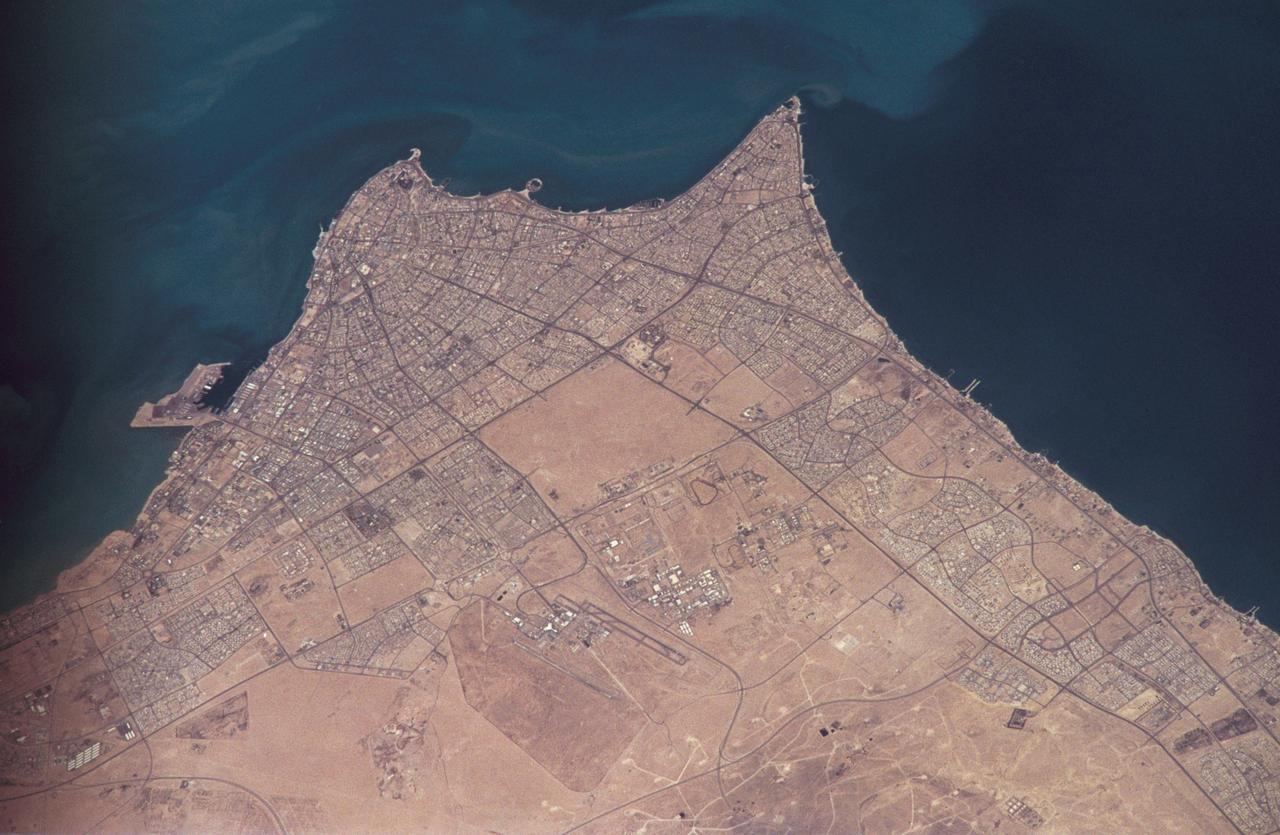
STS059-306-034 (9-20 April 1994) --- The radiating transportation pattern of this 20th-Century urban plan is nicely displayed in this high-resolution photograph. Light-toned spots in the desert mark oil well sites; along the south edge of the scene, some dark residue remains from the fires set during the recent Gulf War. Blown sand has nearly hidden the soot and thick oil that were deposited on the surface. Nikon photograph, 300mm lens.
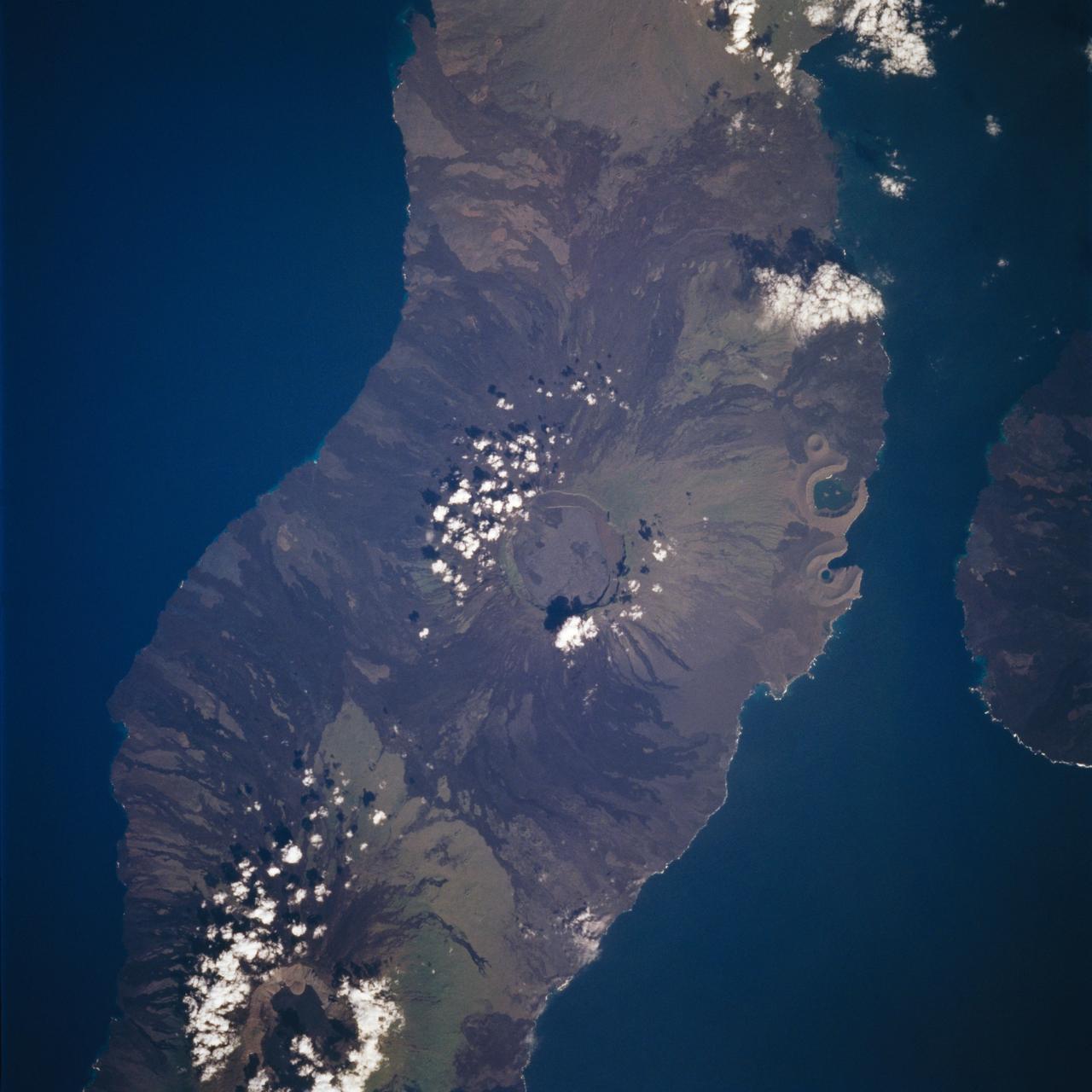
STS059-213-019 (9-20 April 1994) --- SRL scientists will use these photographs with the radar imagery to discriminate among different ages of basalt flows, and different ecosystems of shrub communities, on these equatorial volcanic islands. Aims are twofold: to understand the history of physical and biological systems on the islands themselves, and to extend what is learned to other, less-well-known areas globally. Hasselblad photograph.
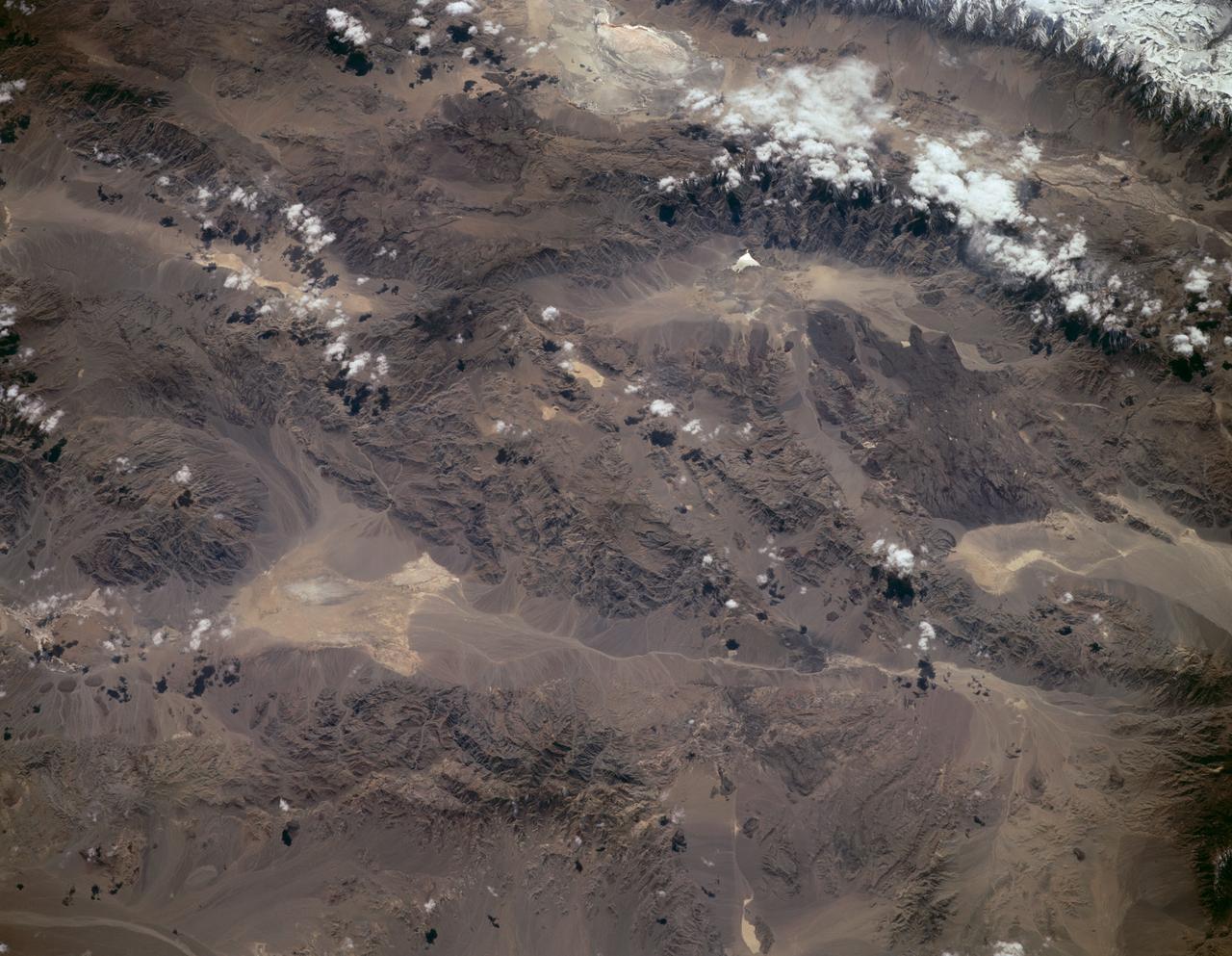
STS059-L09-162 (9-20 April 1994) --- Orient with the snow-covered mountains (Sierra Nevada of California) in the upper right corner. Then Owens Valley runs along the top of the photograph to Owens Lake playa at top center. The upper end of Death Valley extends from right to left in the foreground, with the drainage running down to a playa at Stovepipe Wells in the left foreground. Geologists are studying microwave signatures of the different playa surfaces, and the coatings on alluvial fans that extend from mountain masses, to try to sort out the history of different climates in this formerly wet but now hyperarid region.
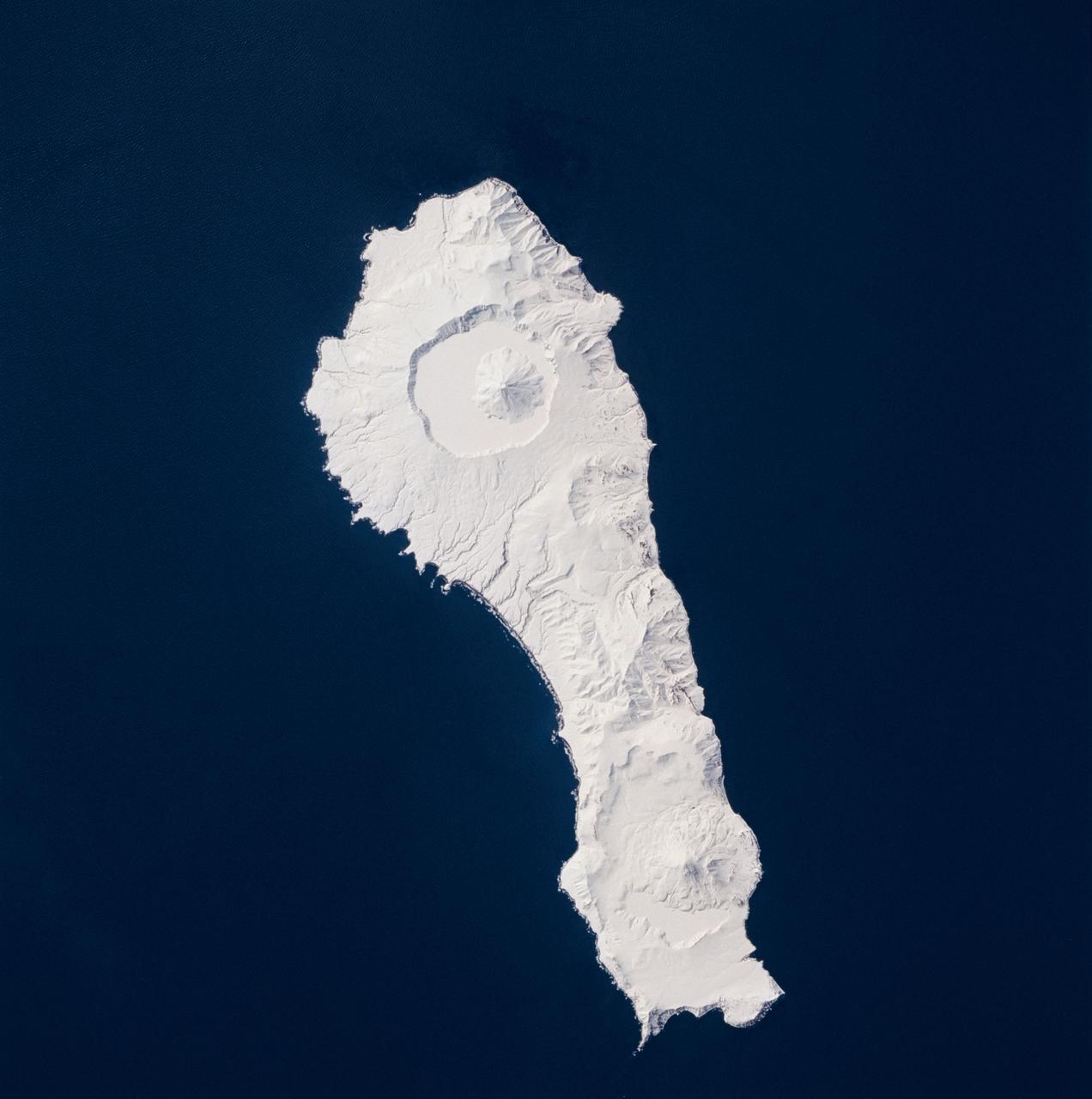
STS059-219-065 (9-20 April 1994) --- The narrow end of the island is to the north by northeast. This is one of several volcanic islands extending south by southwest between the southern tip of Kamchatka and Japan. The exposure was stopped down to provide extremely fine detail in the totally snow-covered landscape, at the same time making the dark sea look completely black. Compare to STS047-90-087, taken in September, which shows a green ground cover. Hasselblad photograph.
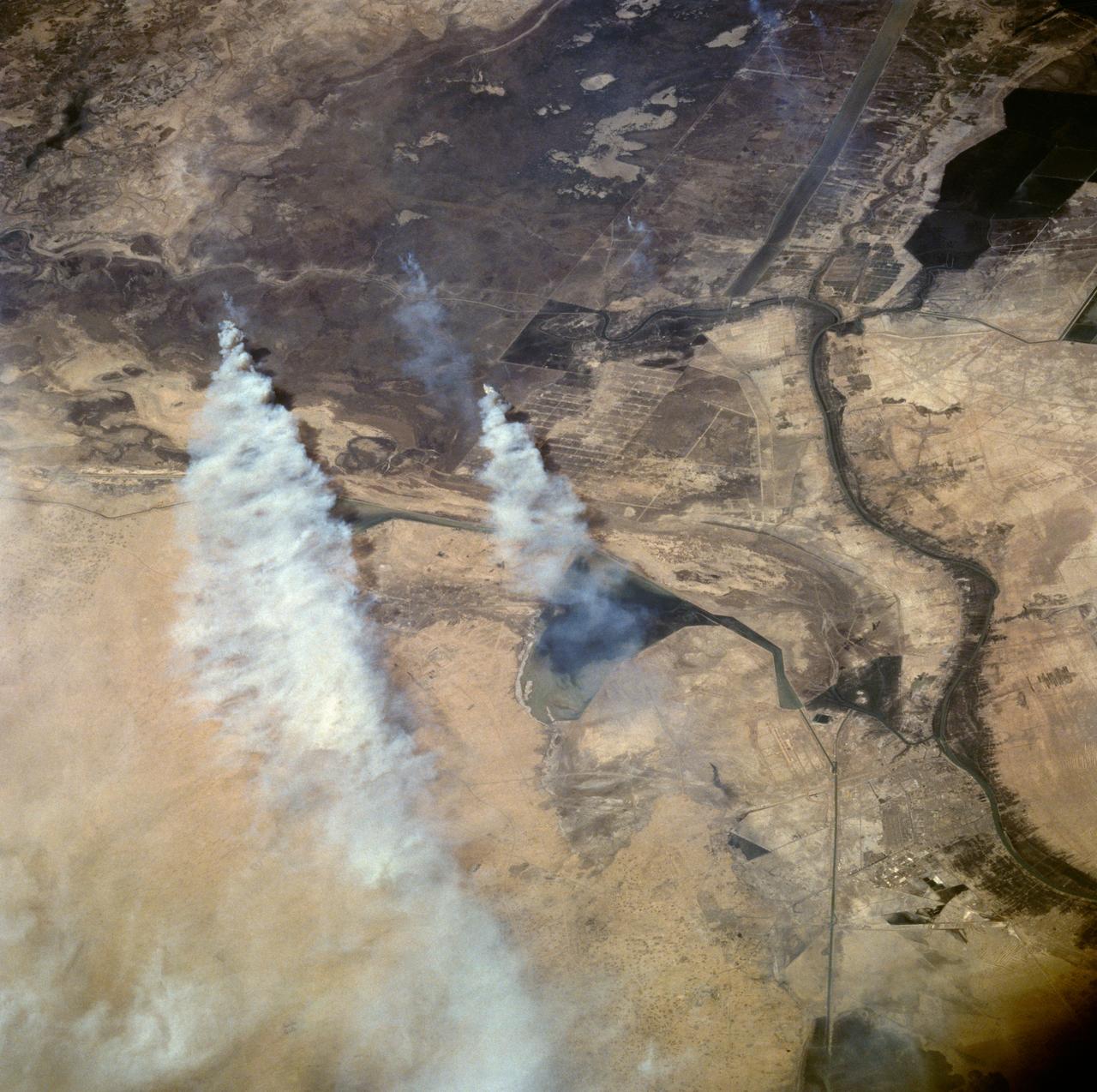
STS059-82-010 (9-20 April 1994) --- View northwestward of a small part of southeastern Iraq. The city of Basra can be seen in the lower left corner, and the former junction of the Tigris and Euphrates Rivers in the upper right. The streams have been channelized, in part to dewater and burn an extensive marsh. Hasselblad camera, 250mm lens.
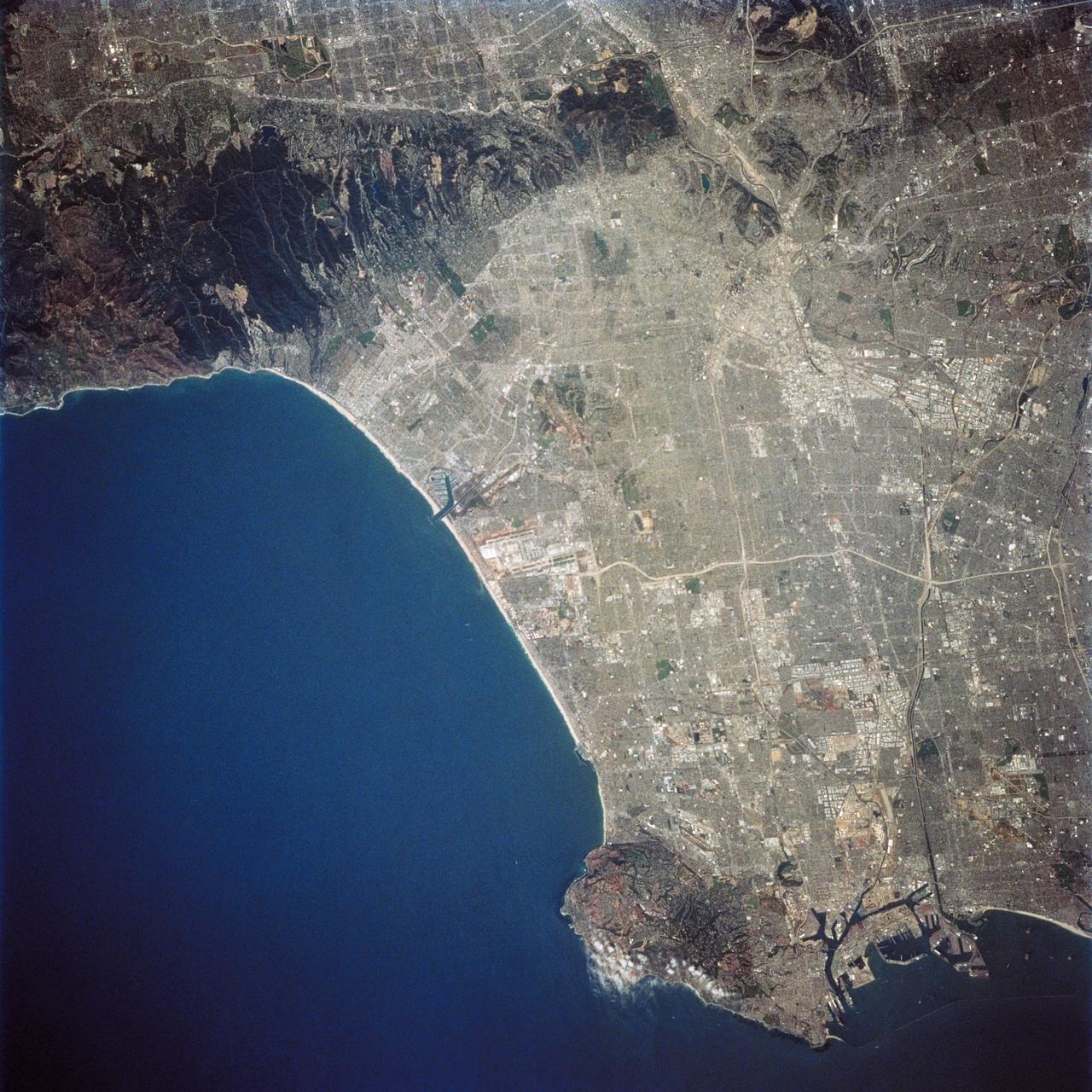
STS059-227-050 (9-20 April 1994) --- A low altitude, and unusually clear air, provided perhaps the most detailed view of Los Angeles, California ever obtained during a shuttle flight. Orient with the bulk of the ocean to the lower left. Then Long Beach is in the lower right, just east of the Palos Verdes Hills that extend into the Pacific Ocean. Marina del Rey is cut into the straight segment of beach, with Los Angeles International Airport (LAX) clearly visible to the southeast. Downtown Los Angeles is the light-toned sprawl in the upper right, with the rectangular grid pattern of Pasadena extending out of the picture. The Santa Monica Mountains to the upper left extend east-west, separating the San Fernando Valley (epicenter of the 1993 earthquake) from the Los Angeles Basin proper. It is impossible to determine by photo interpretation whether or not the de-vegetated scars along the southern edge of the mountains represent man-made features (real-estate development) or wildfires.
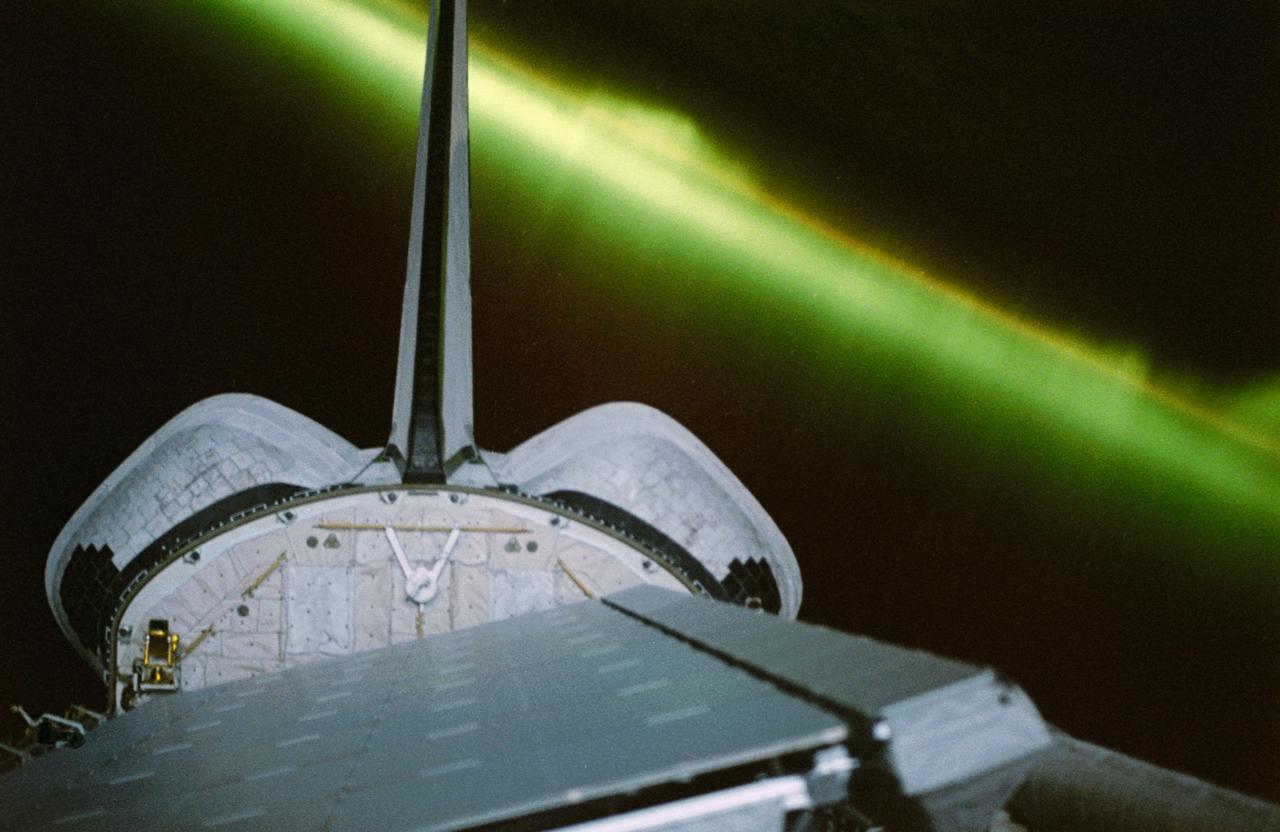
STS059-50-011 (9-20 April 94) --- A greenish appearing aurora forms the backdrop for this 35mm scene of the Earth orbiting Space Shuttle Endeavour's aft cargo bay. Featured in the bay are the antennae for the SIR-C/X-SAR imaging radar instruments, illuminated by moonlight. The crew sighted the southern lights (aurora australis) several times during each of the eleven days of the mission.
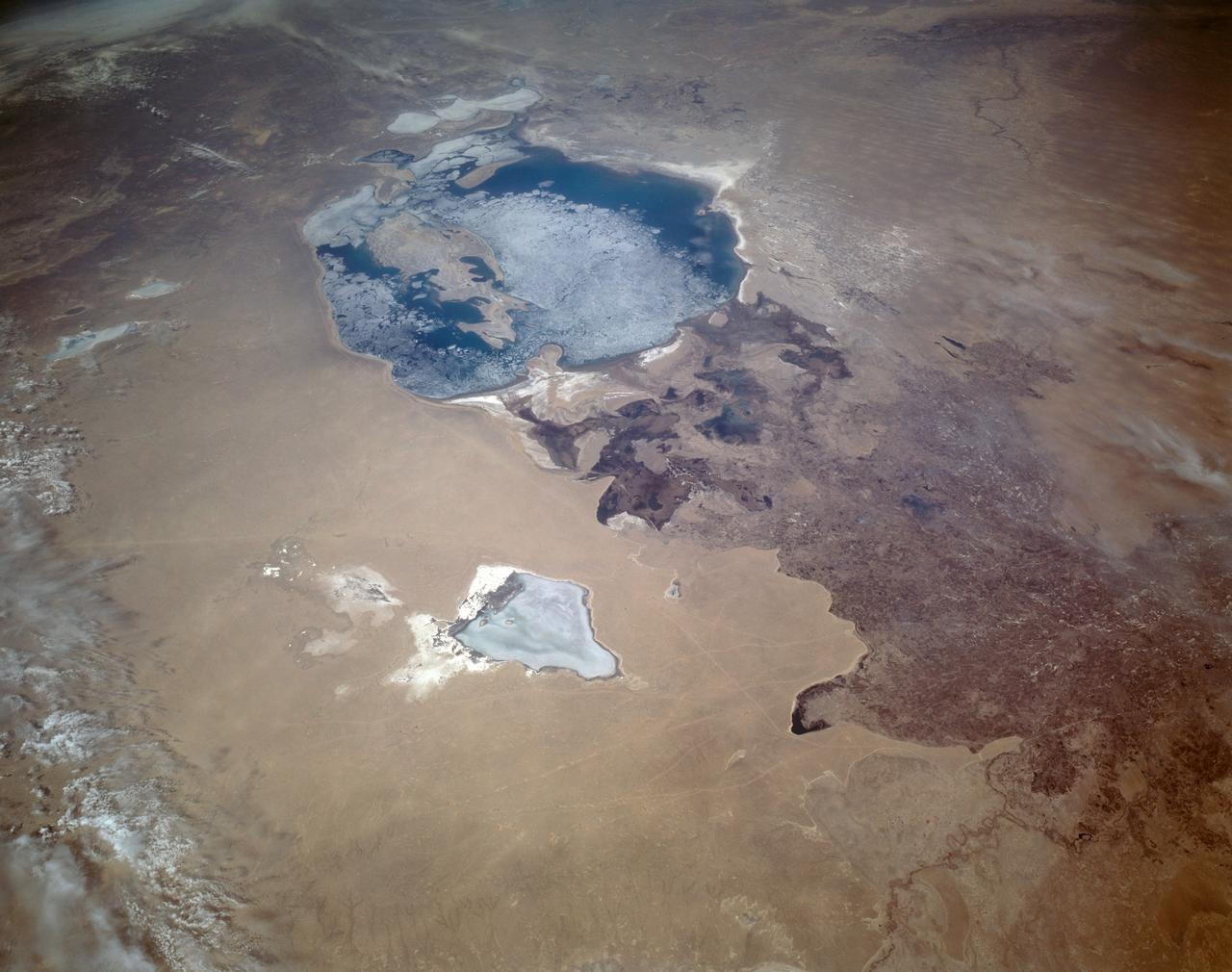
STS059-L22-140 (9-20 April 1994) --- View northeastward across Uzbekastan to the partly-ice-covered Aral Sea and Kazakhstan. The irrigated fan-delta of the Amu Darya extends from the right side of the photograph to end in extensive salt flats at the south end of the sea. The Aral was the fourth-largest inland sea or lake in the world, until diversion and over-use of the river water for irrigation led, in this arid climate, to the sea's decline. Linhof camera.
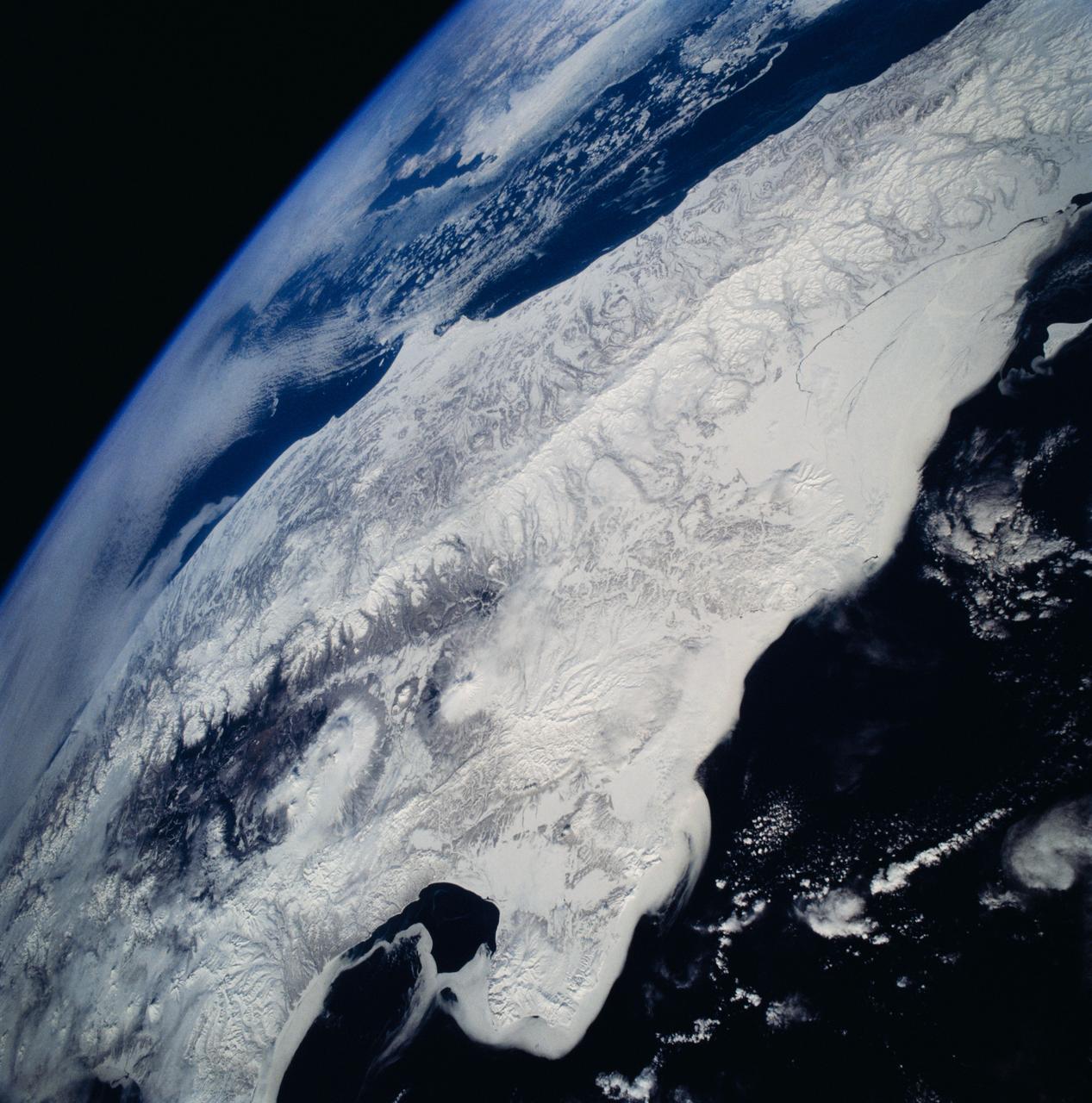
STS059-81-095 (9-20 April 1994) --- View southwestward across the Kamchatka Peninsula. The cluster of volcanoes in the middle distance are active, including Klutchevskaya whose summit reaches 15,580 feet. Changes in volcanic deposits, snow, and ice are being studied by Russian and American SRL investigators. Seasonal changes in sea ice are also of interest, for example, in Kamchatskiy Bay (upper left). Hasselblad camera, 40mm lens.
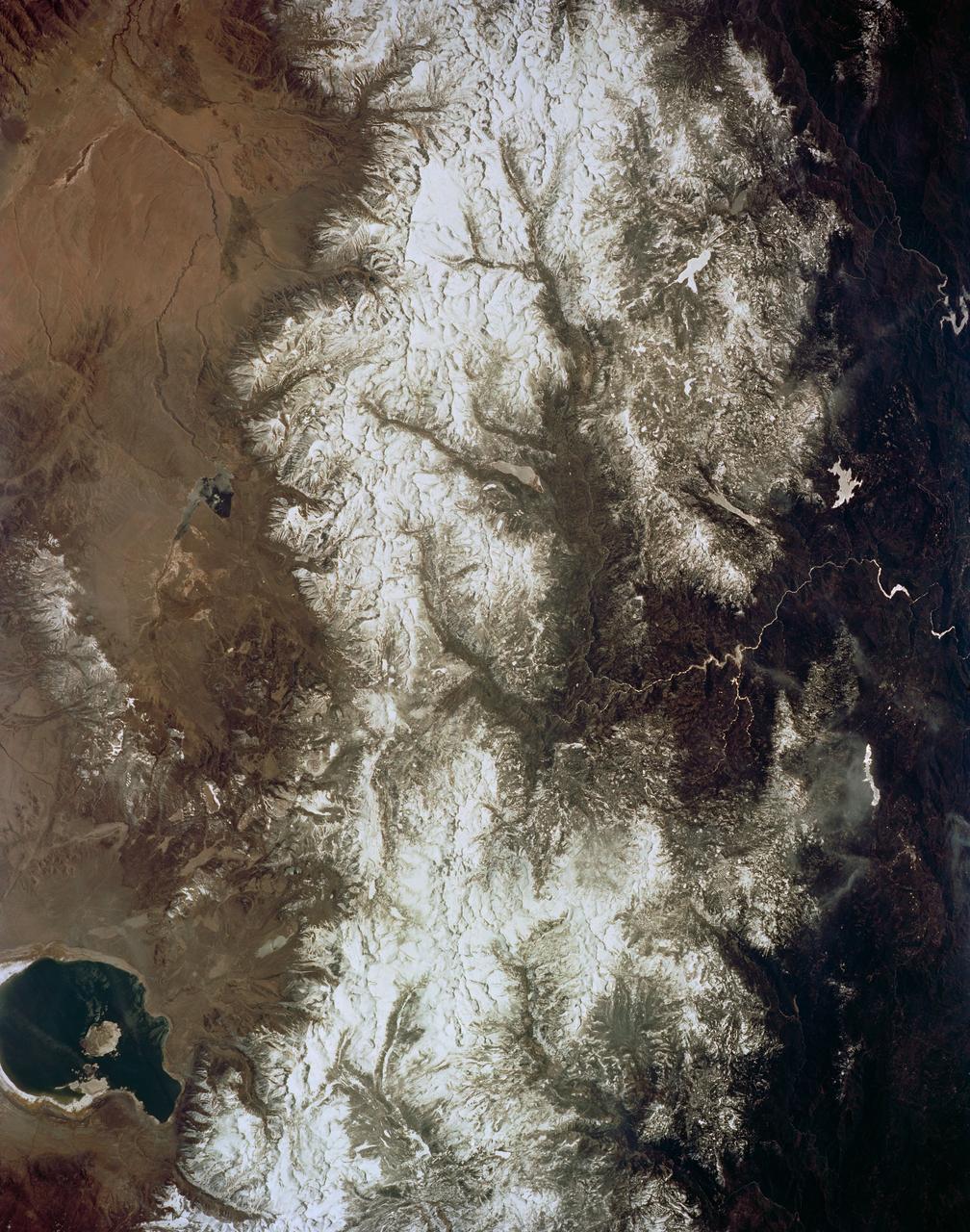
STS059-154-160 (9-20 April 1994) --- Orient with Mono Lake, California at the lower right; then the view is westward across the Sierra Nevada into the San Joaquin River drainage. A tiny network of ski trails can be seen on the Mono Lake side of the Sierras, on a line between Mono Lake and the snow-free San Joaquin headwaters. The ski trails mark Mammoth Mountain, where SRL investigators are studying microwave measurements of the water content of snowpacks. Linhof camera.
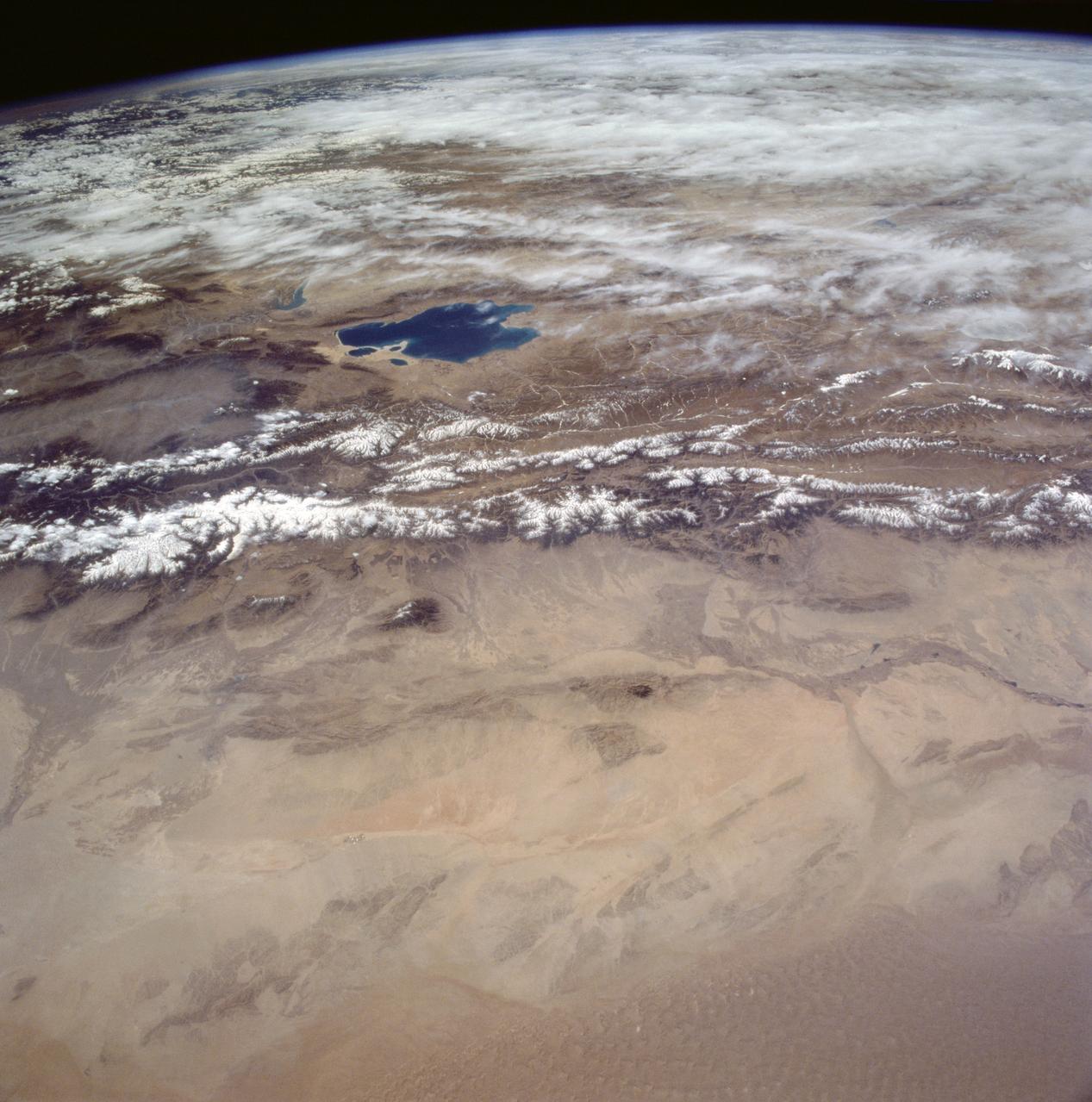
STS059-220-041 (9-20 April 1994) --- View to the south by southwest across the southern Gobi Desert (China) across the Chi-Lien-Shan or Quilienshan or Nanshan (Mountains) in Gansu Province to Lake Quinghai or Ch'ing-Hai (orthography varies with political conditions and scholarship) in Quinghai Province. The lake has a surface elevation of 10,450 feet, partially filling one of the easternmost closed drainage basins of Central Asia. Hasselblad photograph.
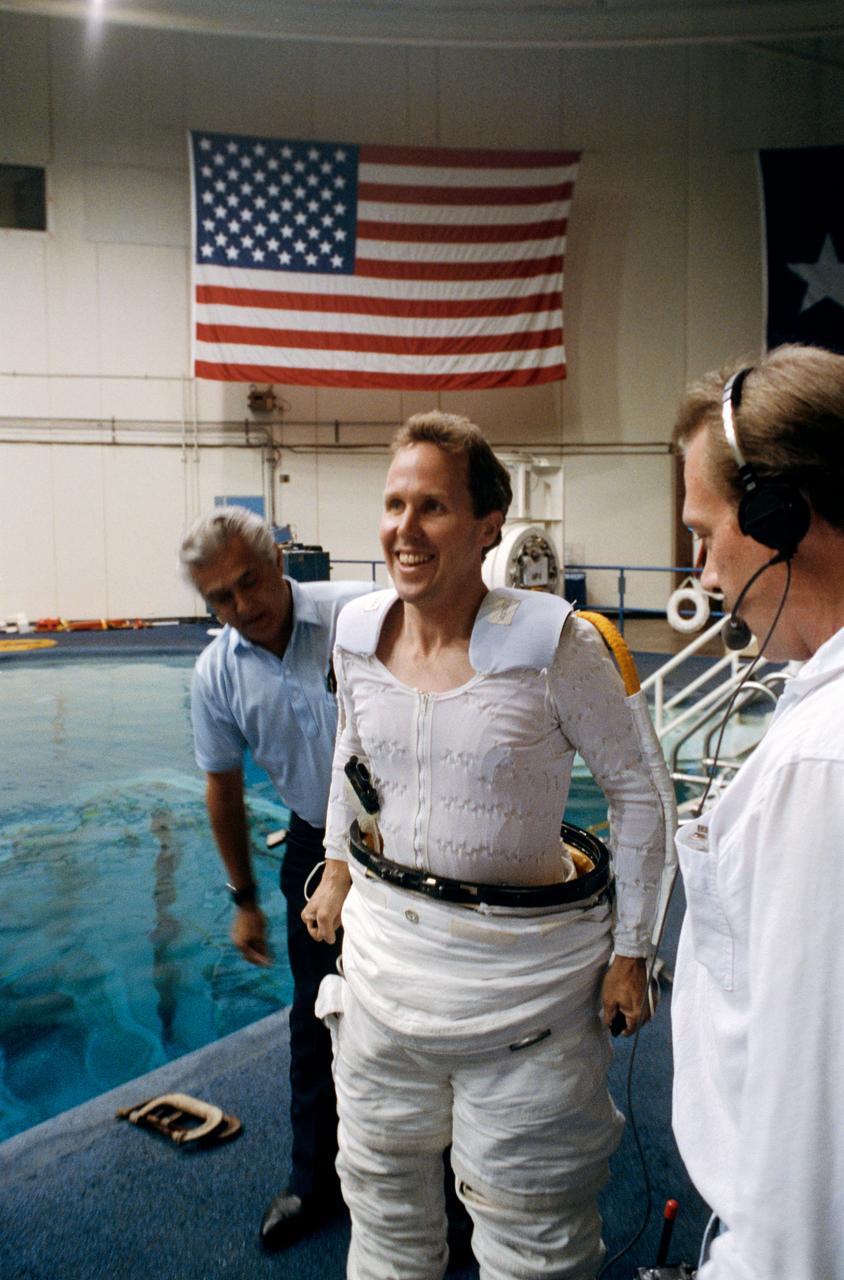
Astronaut Thomas D. Jones, mission specialist, dons a space suit prior to participating in contingency space walk simulations at the JSC Weightless Environment Training Facility (WETF). Jones is assisted by Frank Hernandez (left) and suit technician Charles Hudson of Hamilton Standard. Jones suit is weighted to that he can achieve a neutrally buoyant state once under water. Extravehicular tasks are not planned for the STS-59 mission, but a number of chores are rehearsed in case of failure of remote systems to perform those jobs.
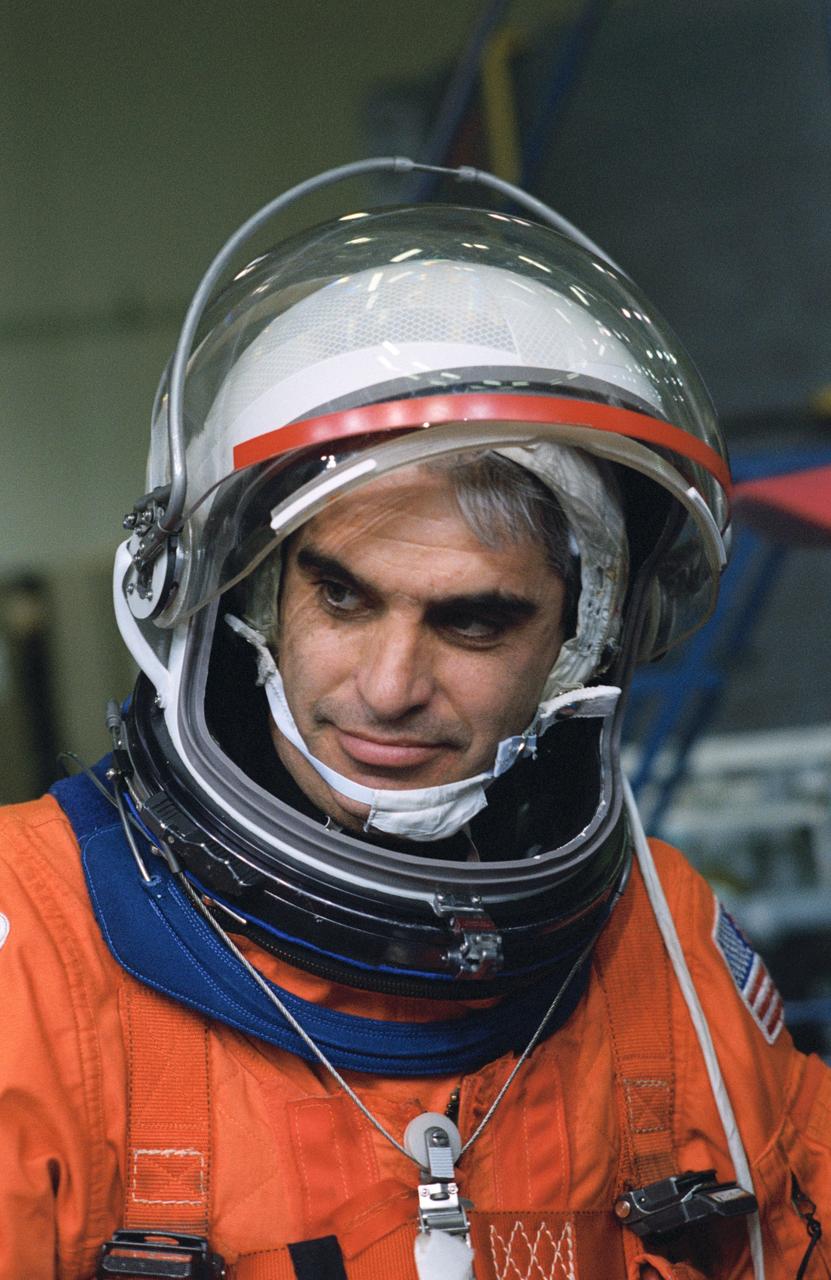
S93-50710 (22 Dec 1993) --- Astronaut Sidney M. Gutierrez, commander, takes a break during emergency bailout training at the Johnson Space Center's (JSC) Weightless Environment Training Facility (WET-F). Gutierrez and five other NASA astronauts are scheduled to fly aboard the Space Shuttle Endeavour next year.
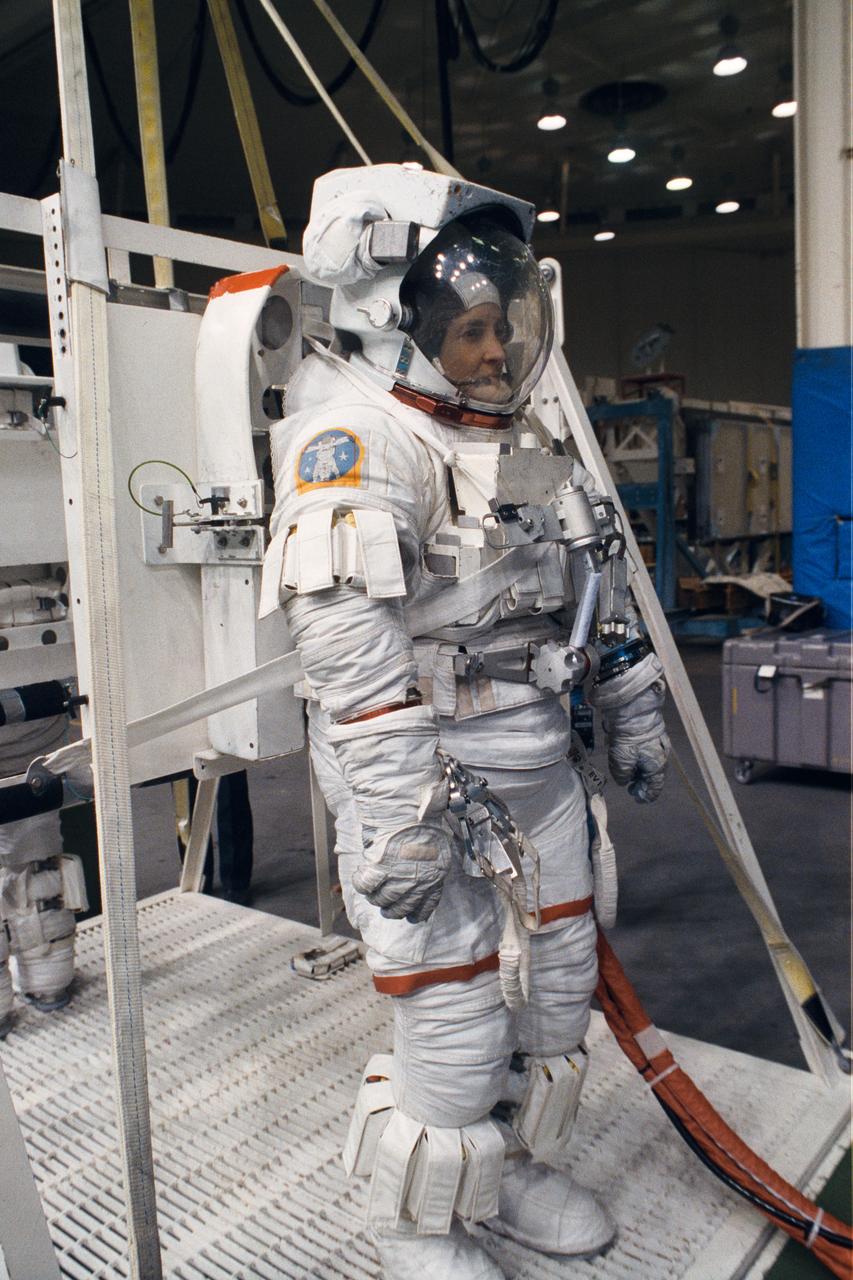
S93-41574 (17 Aug 1993) --- Astronaut Linda M. Godwin, payload commander, prepares to be submerged in a 25-feet deep pool at the Johnson Space Center's (JSC) Weightless Environment Training Facility (WET-F). Astronauts Godwin and Thomas D. Jones (out of frame at left), mission specialist, are using the WET-F to train for contingency space walks for their STS-59 Space Shuttle Endeavour mission next year. No space walks are planned for the flight.
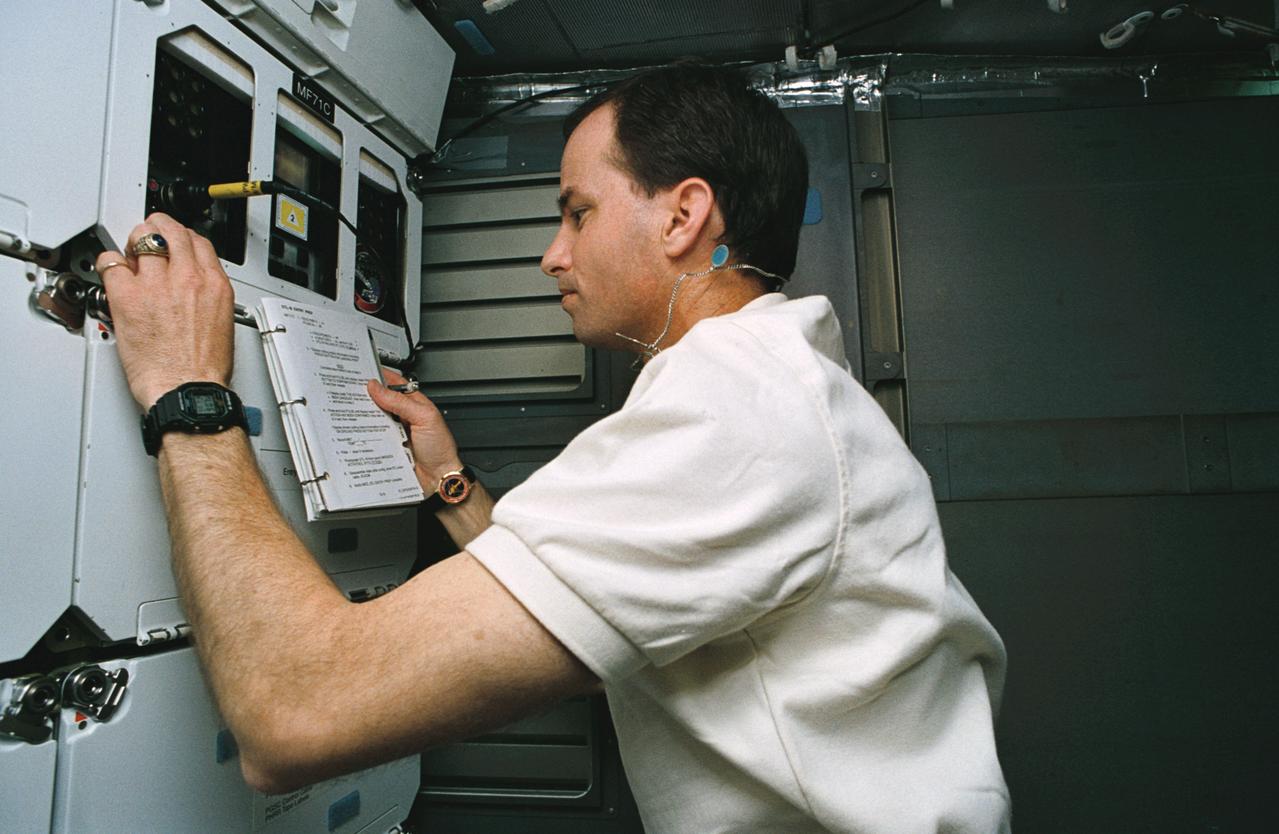
STS059-35-023 (9-20 April 1994) --- Astronaut Kevin P. Chilton, pilot, works with an advanced cell bioreactor, which incorporated the first ever videomicroscope, Space Tissue Loss (STL-B), on the Space Shuttle Endeavour's middeck. This experiment studied cell growth during the STS-59 mission. Chilton was joined in space by five other NASA astronauts for a week and a half of support to the Space Radar Laboratory (SRL-1) mission and other tasks.
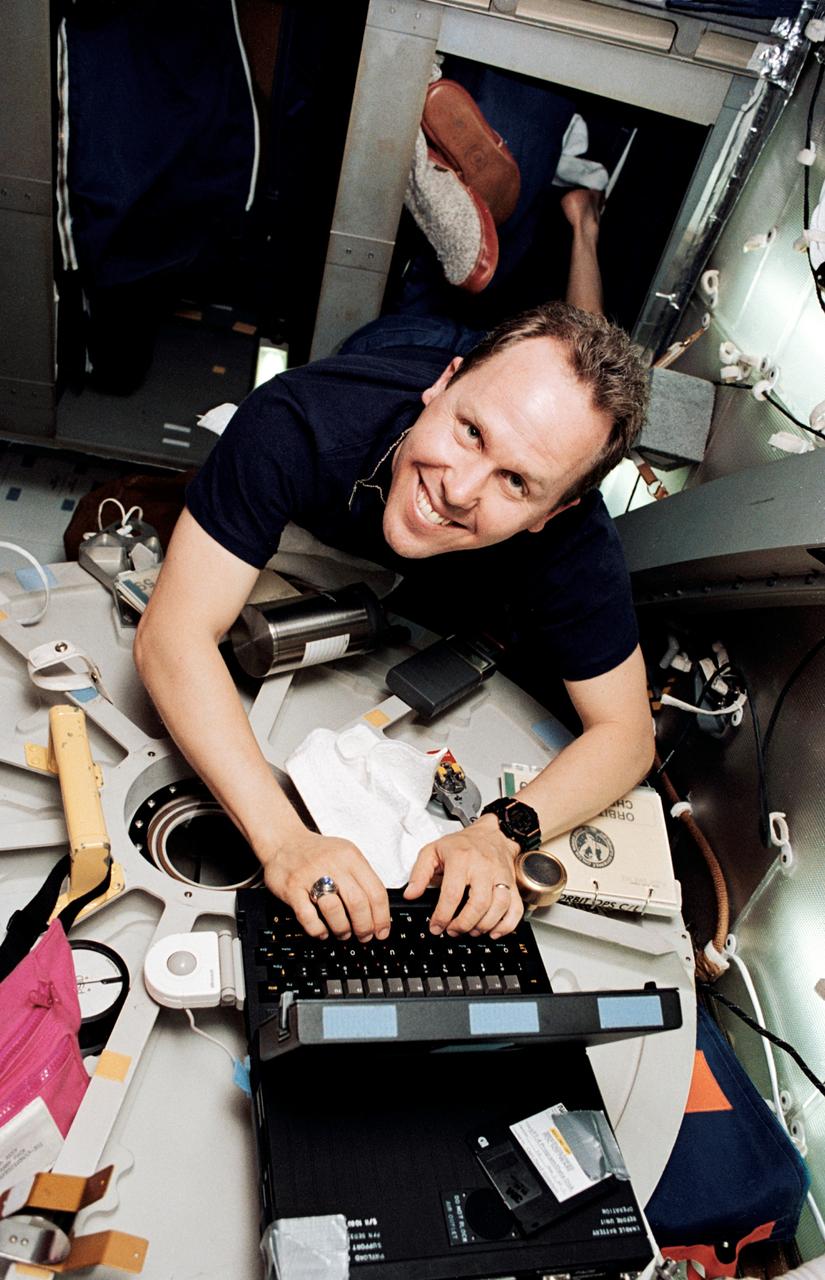
STS059-10-011 (9-20 April 1994) --- Astronaut Thomas D. Jones appears to have climbed out of bed right into his work in this onboard 35mm frame. Actually, Jones had anchored himself in the bunk facility while working on one of the onboard computers which transfered data to the ground via modem. The mission specialist was joined in space by five other NASA astronauts for a week and a half of support to the Space Radar Laboratory (SRL-1)/STS-59 mission.
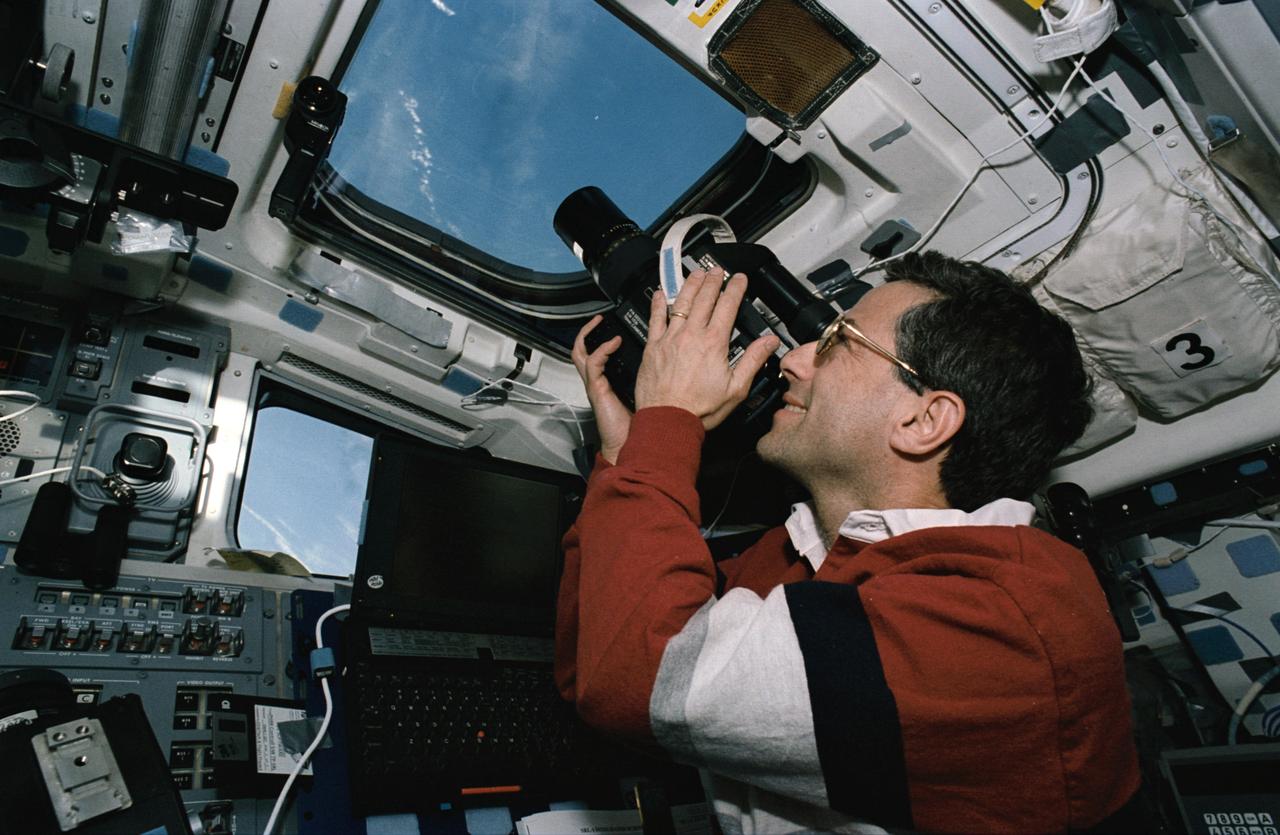
STS059-46-025 (9-20 April 1994) --- On the Space Shuttle Endeavour's aft flight deck astronaut Jerome (Jay) Apt, mission specialist, uses a handheld 70mm Hasselblad camera to record still scenes of Earth. Apt, the commander of Endeavour's Blue Shift, joined five other NASA astronauts for a week and a half in space in support of the Space Radar Laboratory/STS-59 mission.

STS059-13-030 (9-20 April 1994) --- From the Space Shuttle Endeavour's aft flight deck, astronauts Kevin P. Chilton, pilot, and Linda M. Godwin, payload commander, monitor and photograph clouds on Earth. The two, along with four other NASA astronauts spent a week and a half aboard Endeavour in support of the Space Radar Laboratory (SRL-1)/STS-59 mission.
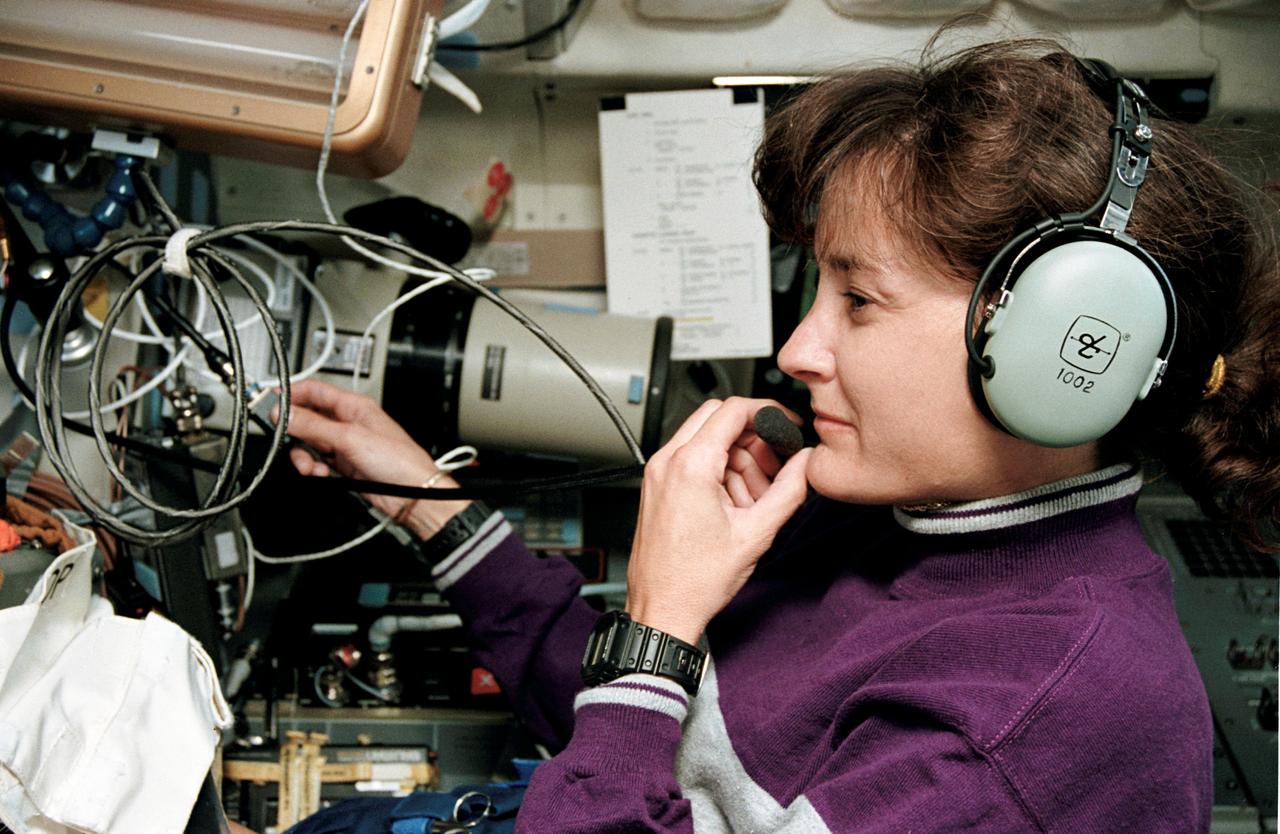
STS059-16-028 (9-20 April 1994) --- Onboard the Space Shuttle Endeavour, astronaut Linda M. Godwin talks to students via the Shuttle Amateur Radio Experiment (SAREX). The payload commander, as well as several other STS-59 crew members spent some off-duty time using the amateur radio equipment to communicate with "Hams" and students on Earth.
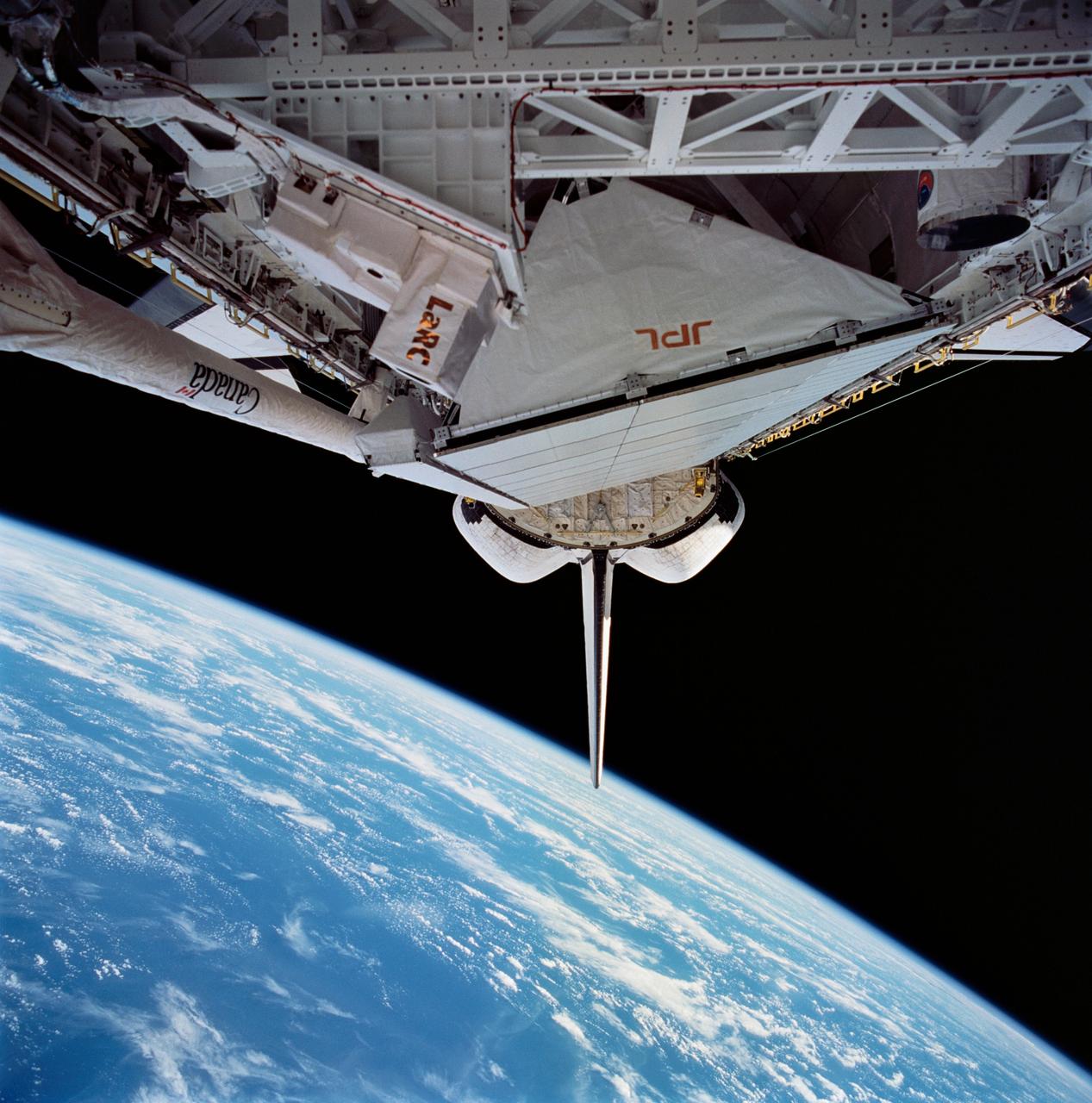
STS59-215-022 (12 April 1994) --- This 70mm frame, photographed through the aft flight deck windows of the Space Shuttle Endeavour, features the Space Radar Laboratory (SRL) payload in the cargo bay. An area of the Pacific Ocean northeast of Hawaii forms the backdrop for the image. Six NASA astronauts spent a week and a half in Earth orbit in support of the SRL mission.
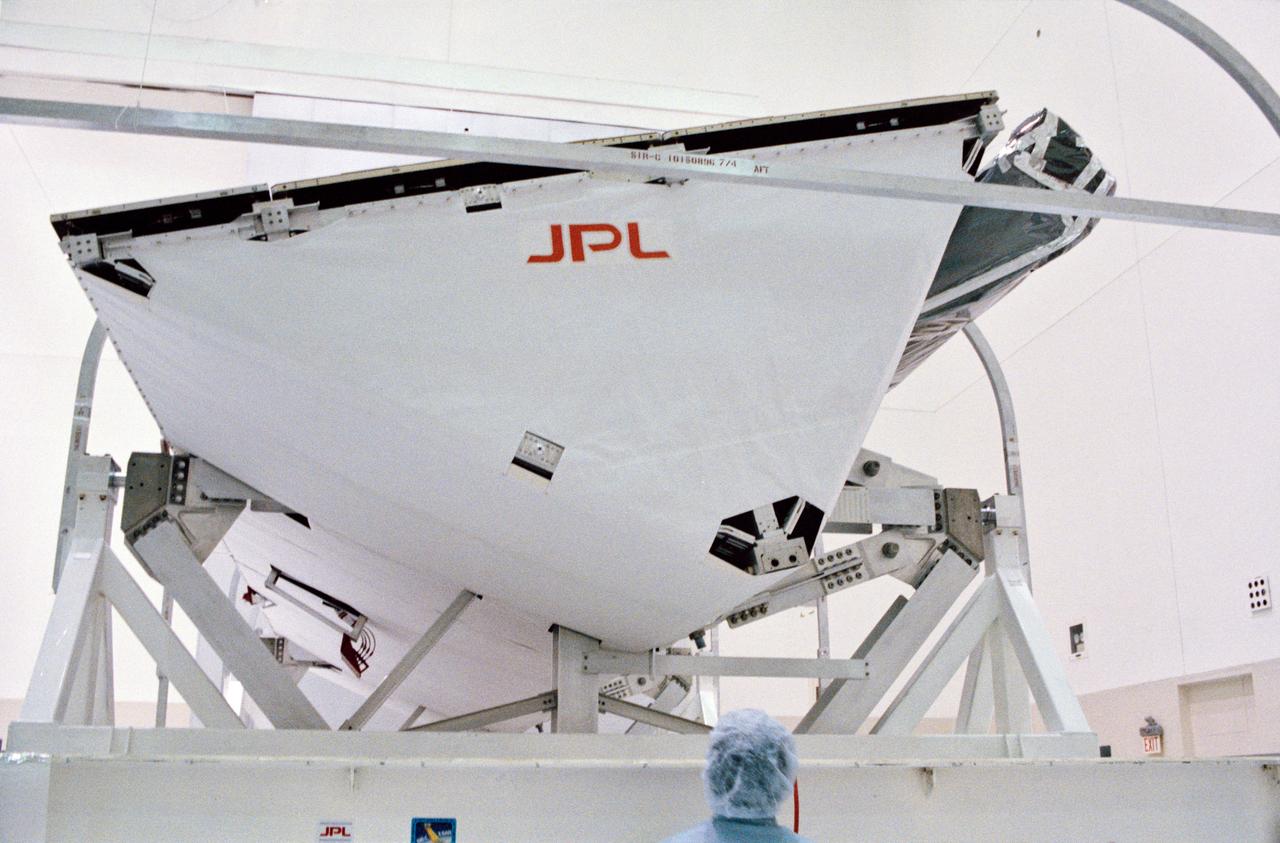
S93-48551 (October 1993) --- The Spaceborne Imaging Radar-C and X-Band Synthetic Aperture Radar (SIR-C/X-SAR) antenna, developed by the Jet Propulsion Laboratory (JPL) as part of NASA's Mission to Planet Earth (MTPE), will fly aboard the Space Shuttle Endeavour. The radar antenna uses microwave energy which gives it the ability to collect data over virtually any region at any time, regardless of weather or sunlight conditions. The radar waves can penetrate clouds, and under certain conditions the radar can also see through vegetation, ice and dry sand. In many cases, spaceborne radar is the only way scientists can explore large-scale and inaccessible regions of the Earth's surface. SIR-C/X-SAR uses three microwave wavelengths: L-Band (24 cm), C-Band (6 cm) and X-Ban (3 cm). The multi-frequency data will be used by the international scientific community to monitor global environmental processes with a focus on climate change. The MTPE spaceborne data, complemented by aircraft and ground studies, will give scientists clearer insights into those environmental changes which are caused by nature and those changes which are induced by human activity.
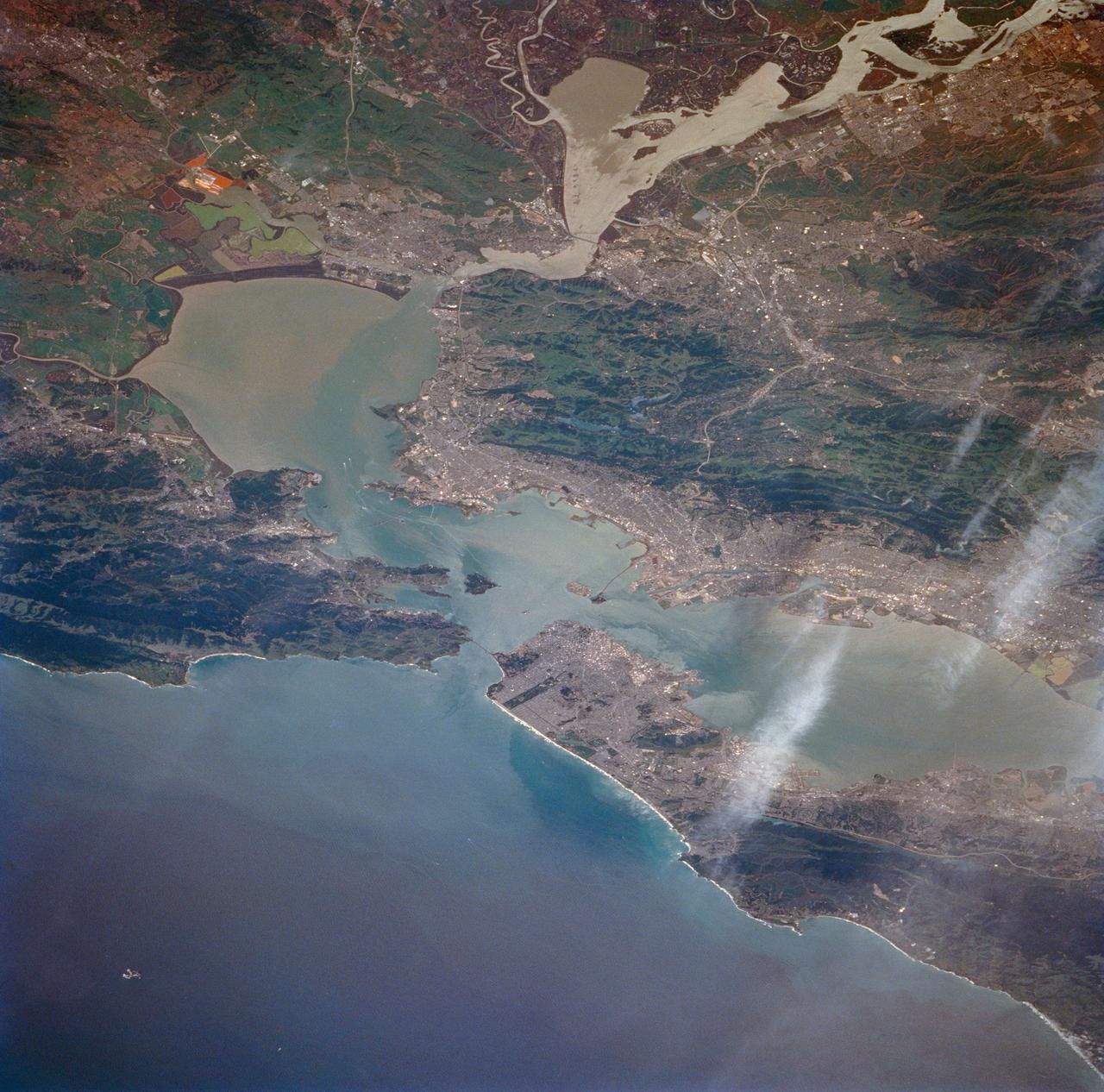
STS059-213-009 (9-20 April 1994) --- San Francisco Bay. Orient with the sea up. The delta of the combined Sacramento and San Joaquin Rivers occupies the foreground, San Francisco Bay the middle distance, and the Pacific Ocean the rest. Variations in water color caused both by sediment load and by wind streaking strike the eye. Man-made features dominate this scene. The Lafayette/Concord complex is left of the bay head, Vallejo is to the right, the Berkeley/Oakland complex rims the shoreline of the main bay, and San Francisco fills the peninsula beyond. Salt-evaporation ponds contain differently-colored algae depending on salinity. The low altitude (less than 120 nautical miles) and unusually-clear air combine to provide unusually-strong green colors in this Spring scene. Hasselblad camera.
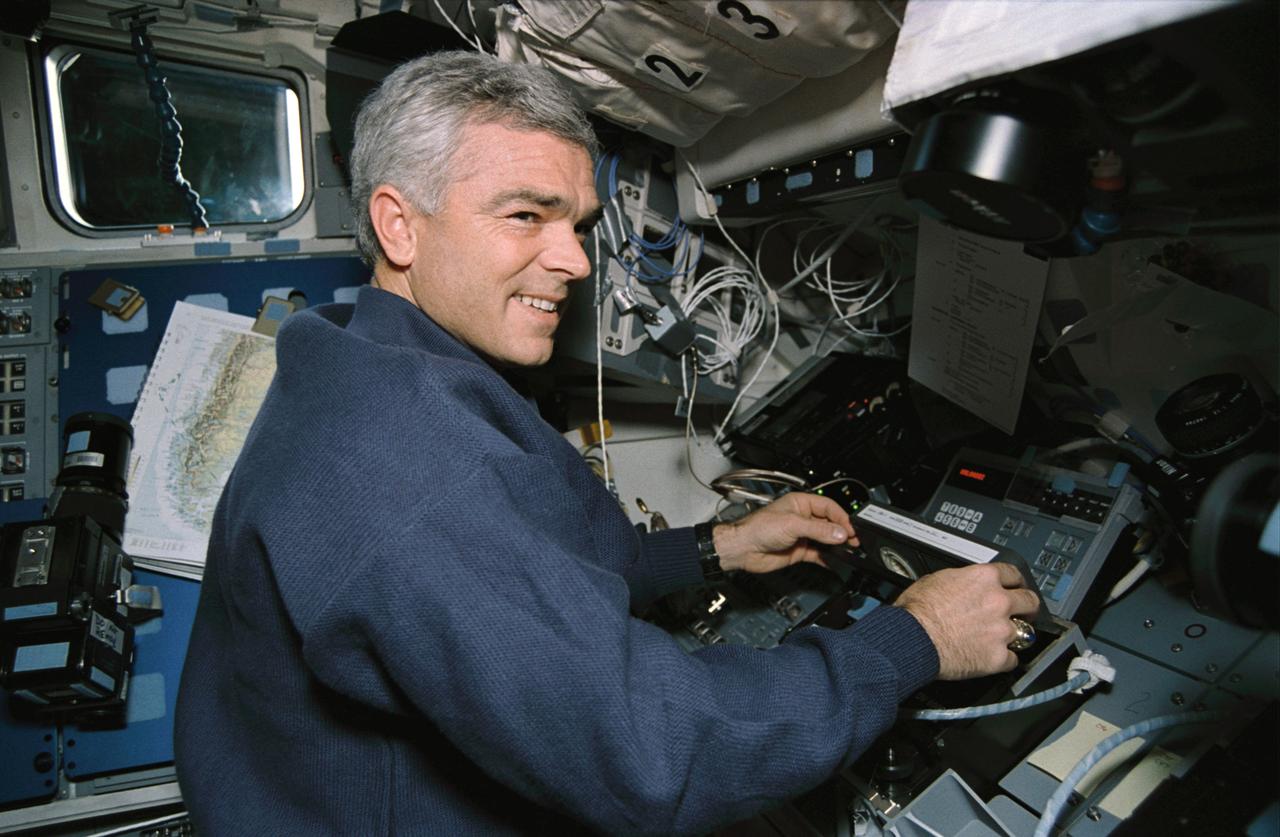
STS059-09-012 (9-20 April 1994) --- On the Space Shuttle Endeavour's aft flight deck, astronaut Michael R. (Rich) Clifford, mission specialist, inserts a tape in the payload high rate recorder. Three of these state-of-the-art recorders captured four times the amount of data that could be radioed to the ground. The 183 tapes, each containing 40 megabytes of data, will be turned into images over the next year, and analyzed over the next decade. Clifford was joined in space by five other NASA astronauts for a week and a half of support to the Space Radar Laboratory (SRL-1)/STS-59 mission.
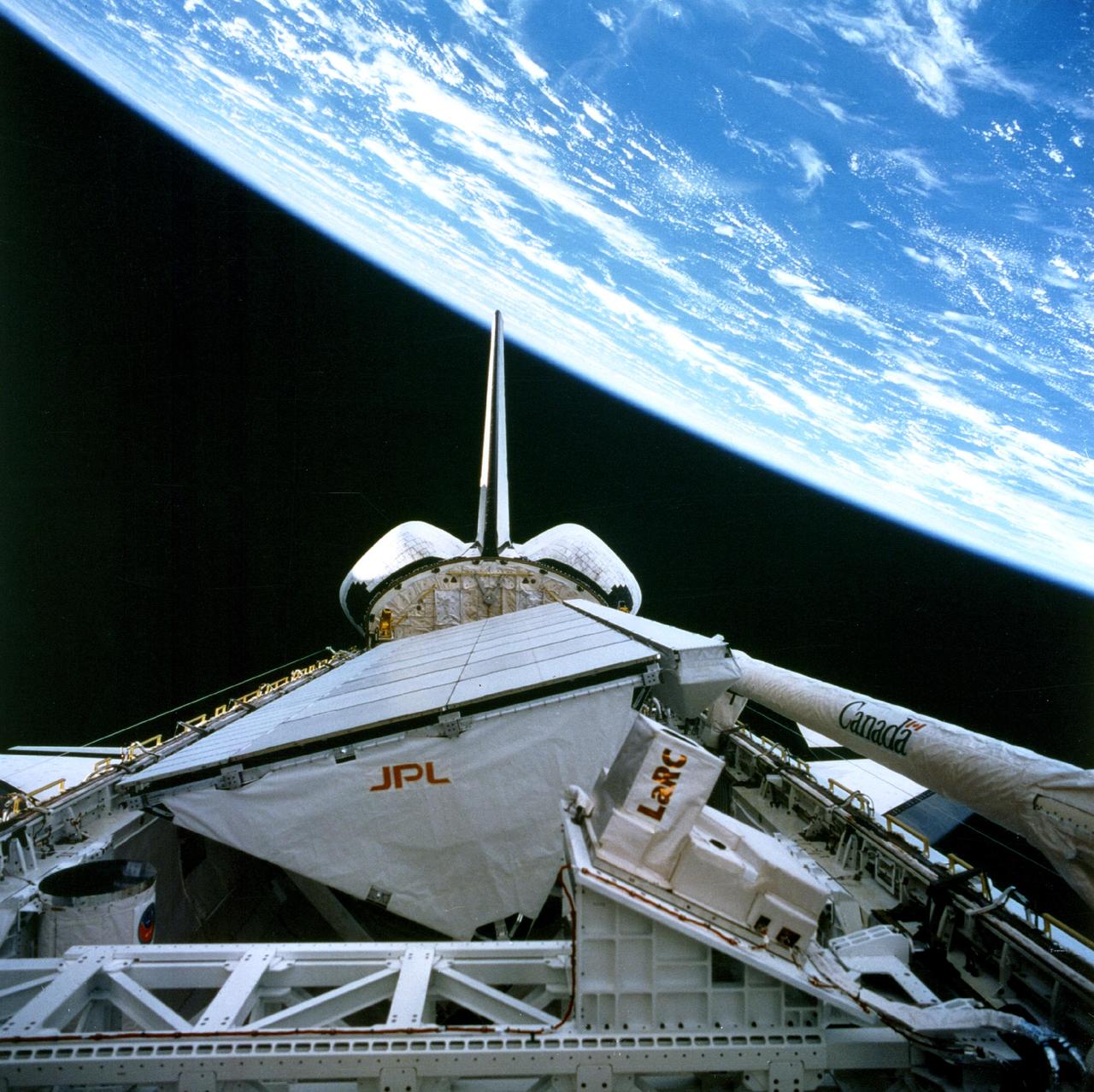
NASA SIR-C/X-SAR is shown here in the payload bay of the orbiting space shuttle Endeavour STS-59, with an area of the Pacific Ocean northeast of Hawaii in the background.
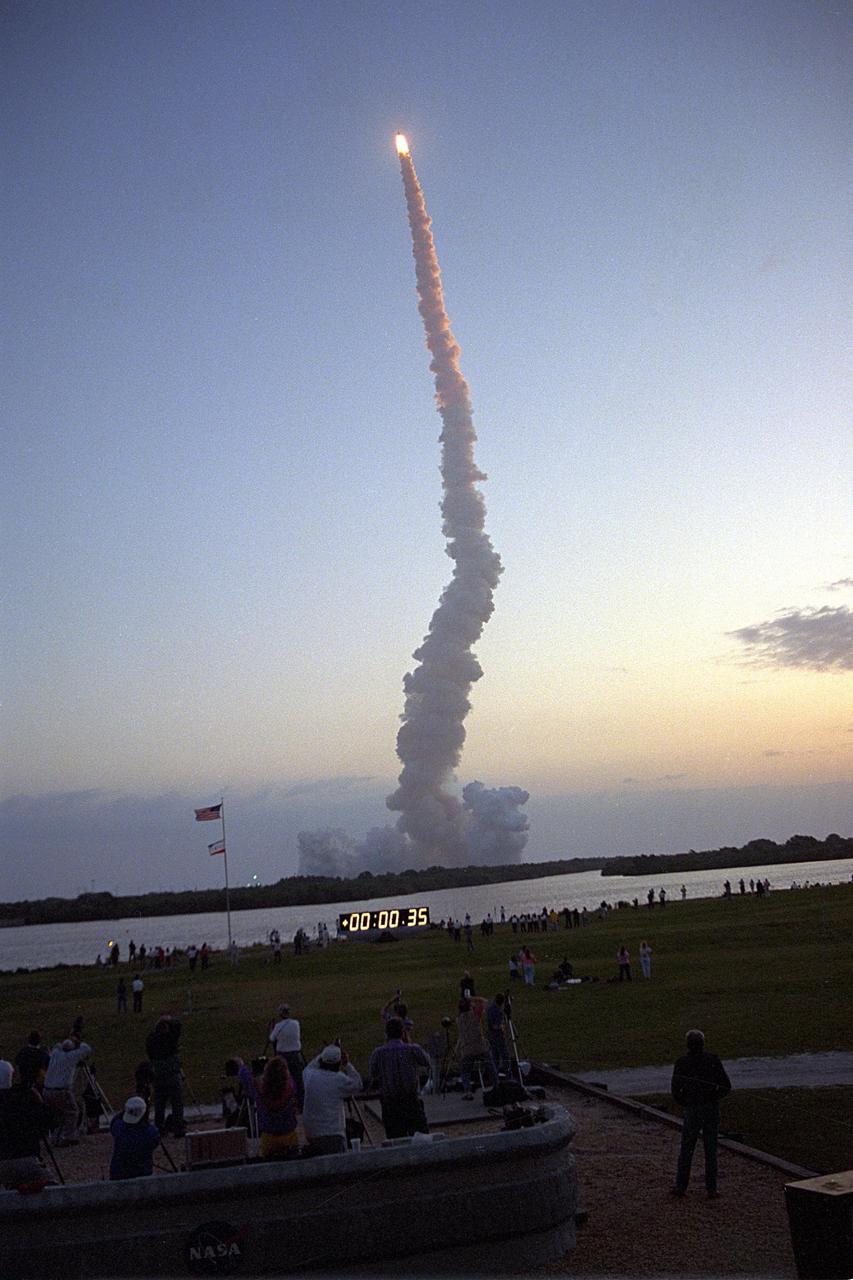
KENNEDY SPACE CENTER, FLA. -- The Space Shuttle Endeavour lifts off from launch Pad 39A on April 9, 1994, at 7:05 a.m. EDT to begin the nine-day STS-59/Space Radar Laboratory mission. The mission countdown clock also can be seen, giving the time into the mission after liftoff. The STS-59 mission is scheduled to end with a landing at KSC's Shuttle Landing Facility.
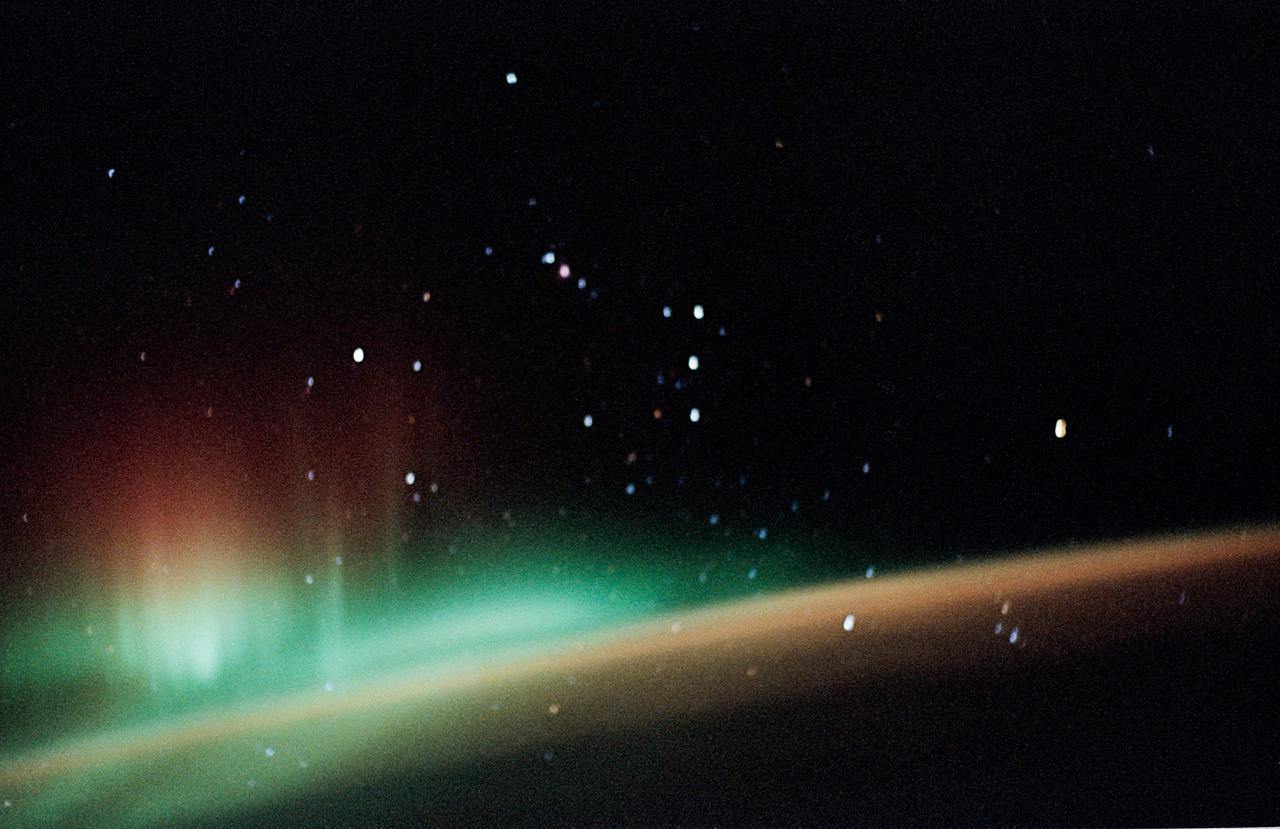
STS059-52-029 (9-20 April 1994) --- The constellation Orion is backdropped against a colorful display of the Southern Lights (aurora australis) in this 35mm image. Six NASA astronauts went on to spend a week and a half aboard the Space Shuttle Endeavour in support of the Space Radar Laboratory (SRL-1) mission.
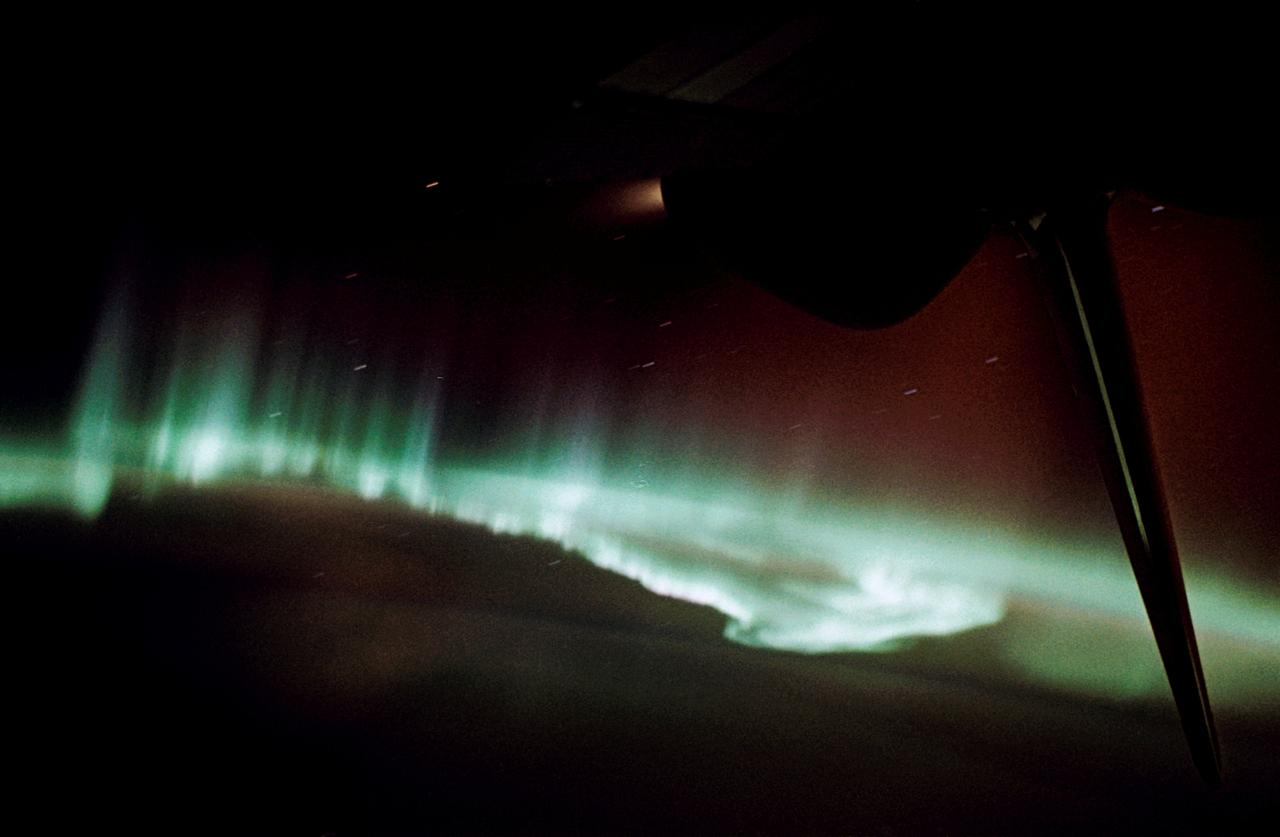
STS059-58-018 (9-20 April 1994) --- Part of the Space Shuttle Endeavour and its Space Radar Laboratory (SRL-1) payload are backdropped against a colorful display of the Southern Lights (aurora australis). The vehicle was firing a reaction control subsystem thruster (below center) when the 35mm image was exposed.
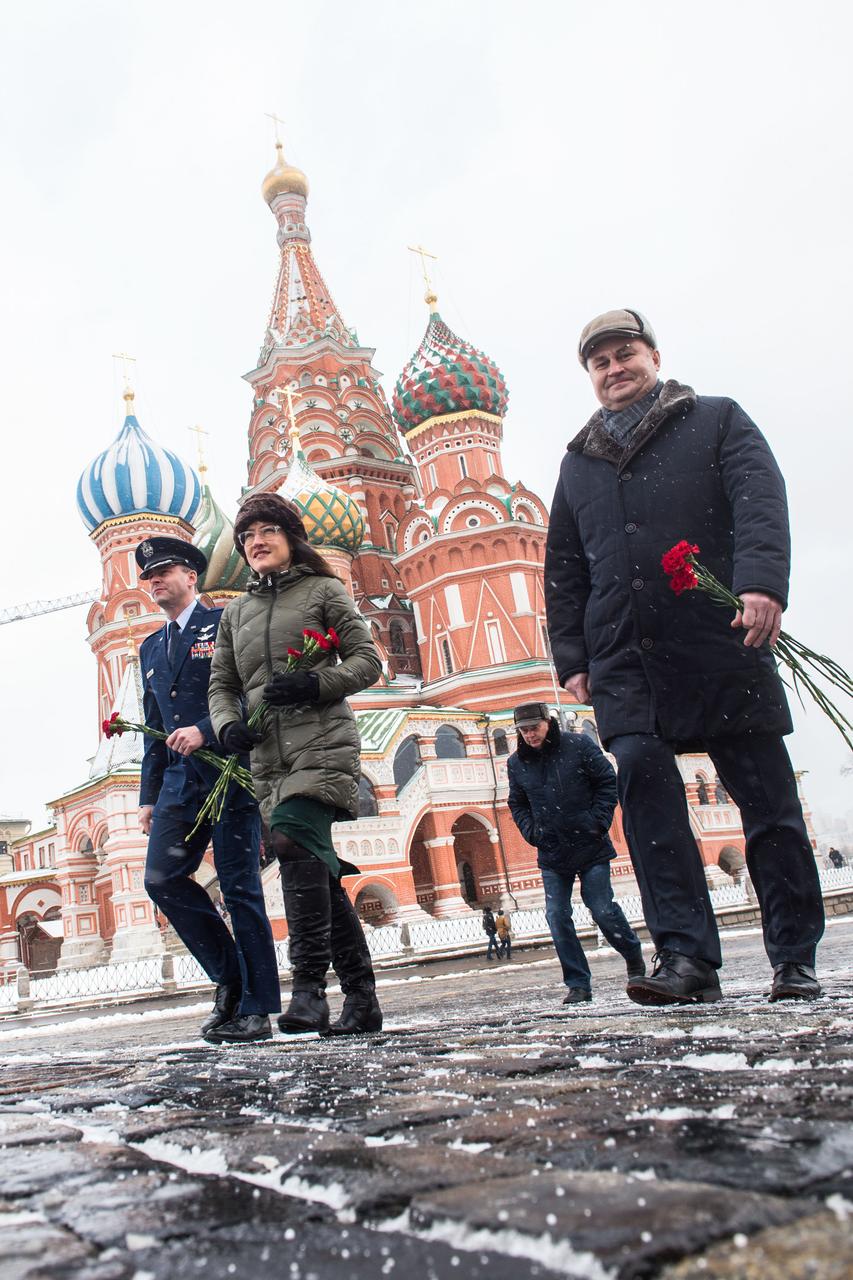
With St. Basil’s Cathedral in Red Square in Moscow providing a wintry backdrop, Expedition 59 crewmembers Nick Hague of NASA (left), Christina Koch of NASA (center) and Alexey Ovchinin of Roscosmos (right) walk toward the Kremlin Wall Feb. 21 prior to the ceremonial laying of flowers. They will launch March 14, U.S. time, on the Soyuz MS-12 spacecraft from the Baikonur Cosmodrome in Kazakhstan for a six-and-a-half month mission on the International Space Station. Andrey Shelepin/Gagarin Cosmonaut Training Center
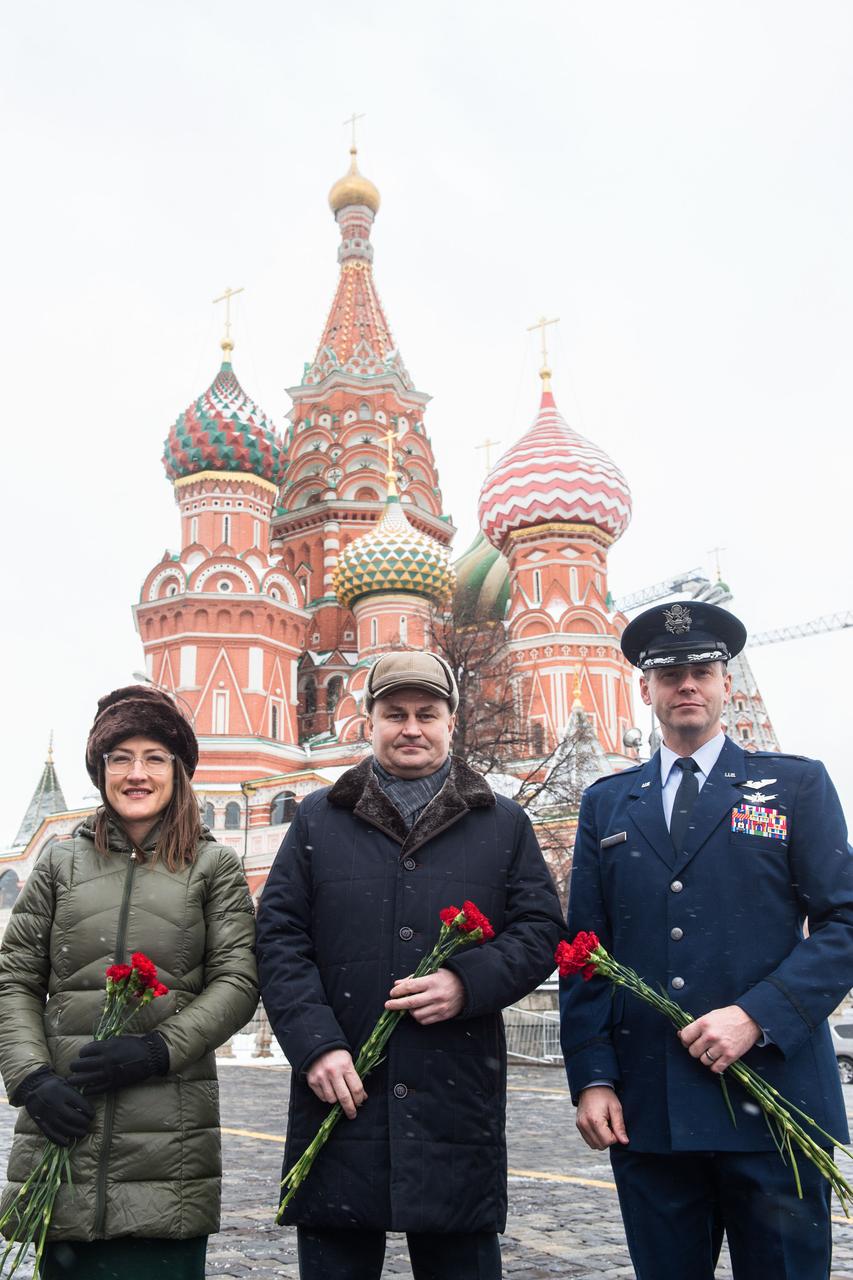
With St. Basil’s Cathedral in Red Square in Moscow providing a wintry backdrop, Expedition 59 crewmembers Christina Koch of NASA (left), Alexey Ovchinin of Roscosmos (center) and Nick Hague of NASA (right) pose for pictures Feb. 21 prior to the ceremonial laying of flowers at the Kremlin Wall. They will launch March 14, U.S. time, on the Soyuz MS-12 spacecraft from the Baikonur Cosmodrome in Kazakhstan for a six-and-a-half month mission on the International Space Station. Andrey Shelepin/Gagarin Cosmonaut Training Center
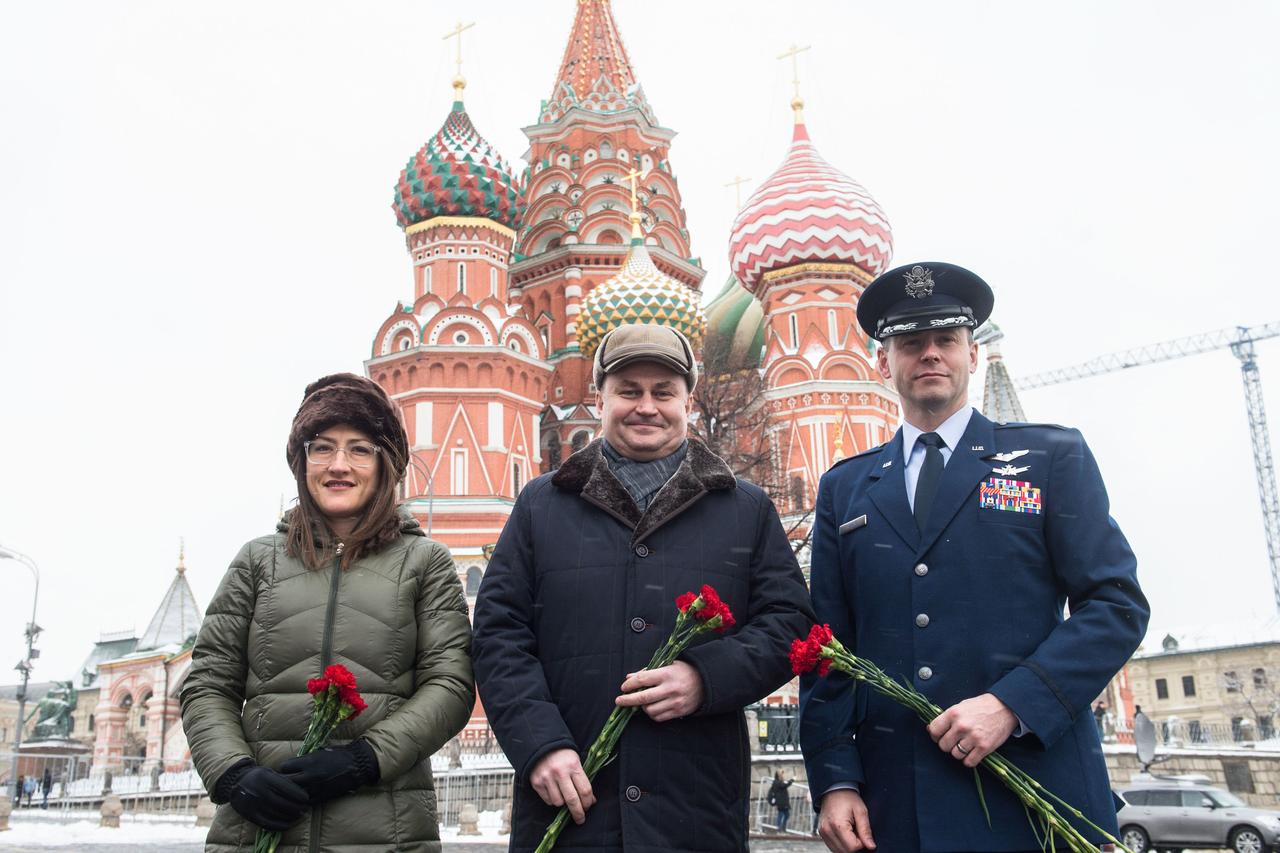
With St. Basil’s Cathedral in Red Square in Moscow providing a wintry backdrop, Expedition 59 crewmembers Christina Koch of NASA (left), Alexey Ovchinin of Roscosmos (center) and Nick Hague of NASA (right) pose for pictures Feb. 21 prior to the ceremonial laying of flowers at the Kremlin Wall. They will launch March 14, U.S. time, on the Soyuz MS-12 spacecraft from the Baikonur Cosmodrome in Kazakhstan for a six-and-a-half month mission on the International Space Station. Andrey Shelepin/Gagarin Cosmonaut Training Center
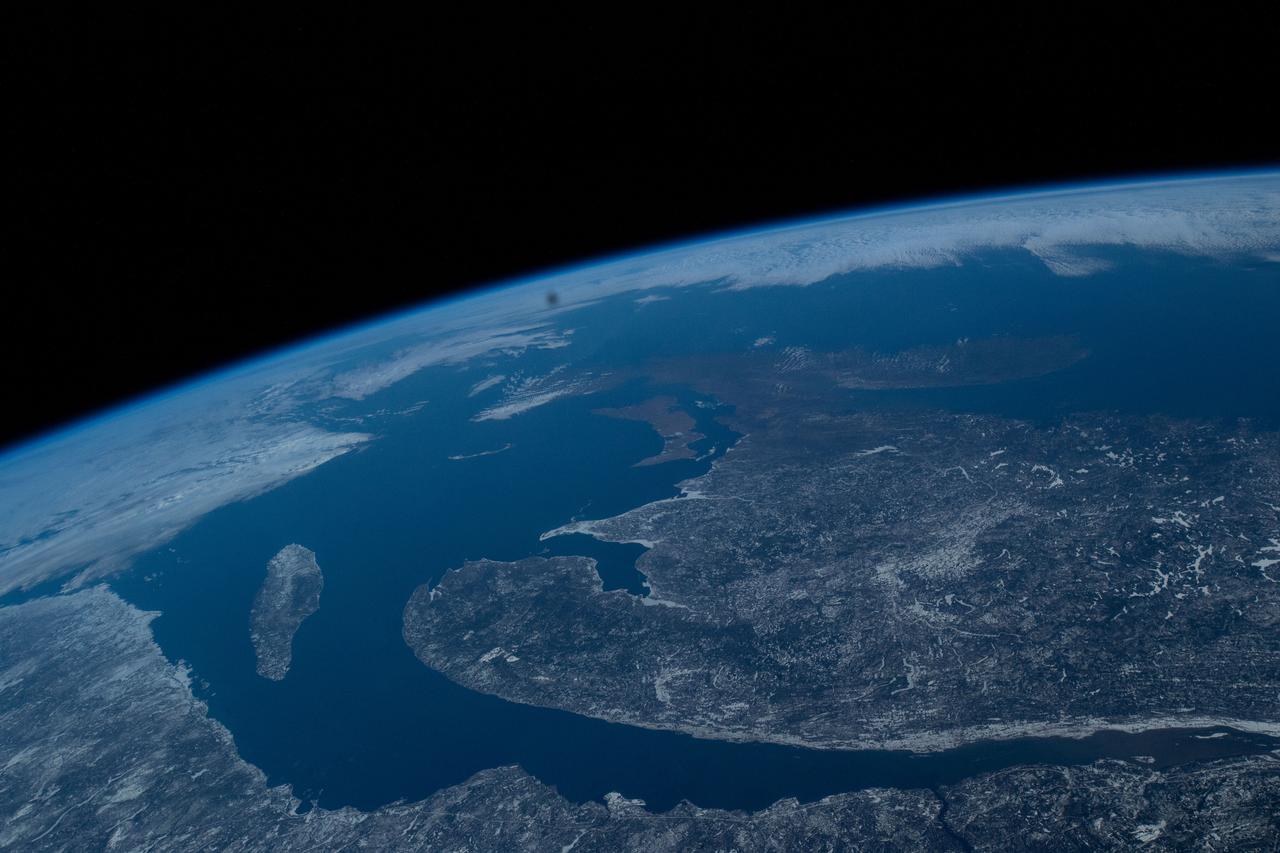
iss059e019410 (April 11, 2019) --- The International Space Station was 258 miles above Canada when an Expedition 59 crewmember photographed the Gulf of St. Lawrence and portions of Quebec, New Brunswick and Prince Edward Island.
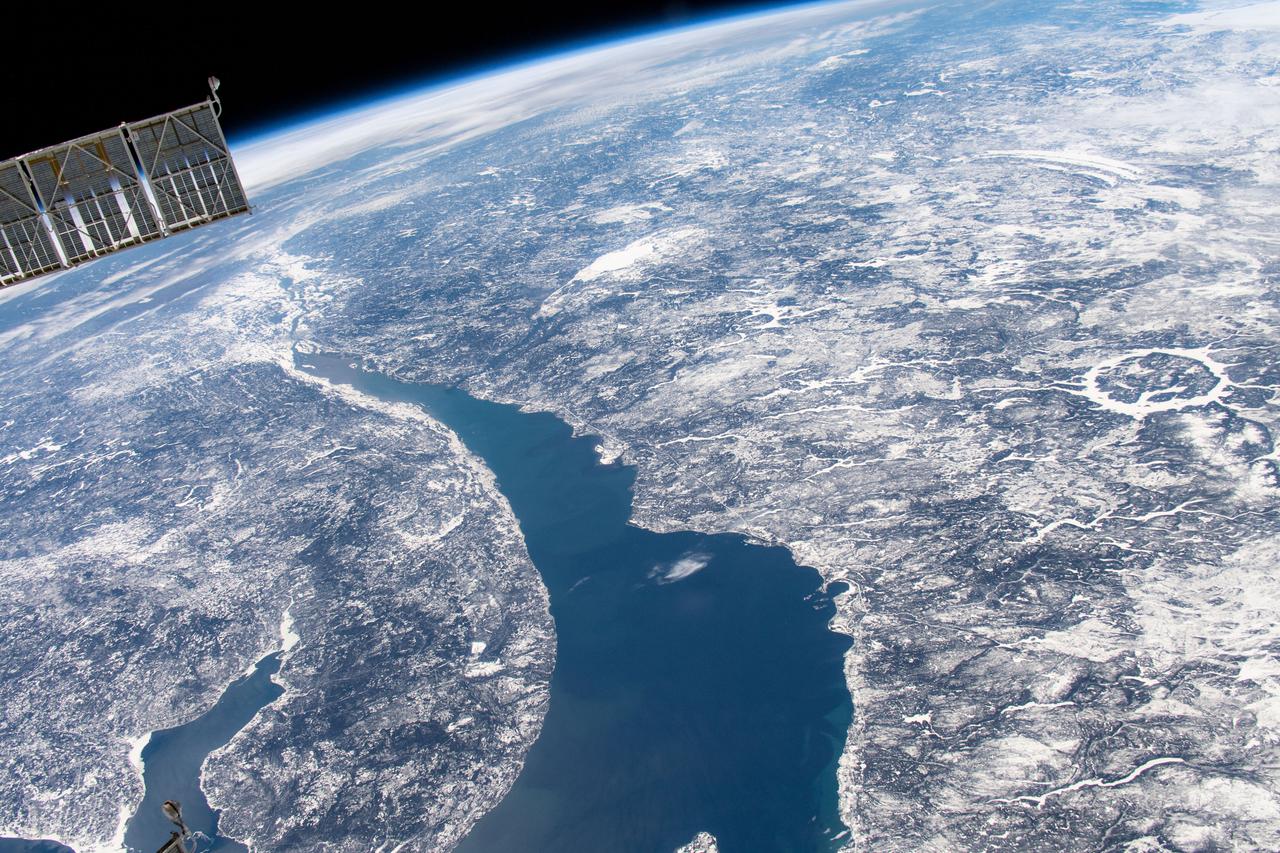
iss059e019043 (April 11, 2019) --- The International Space Station was orbiting 258 miles above Canada when an Expedition 59 crew member photographed Manicouagan Crater (right center) and the St. Lawrence River in Quebec.
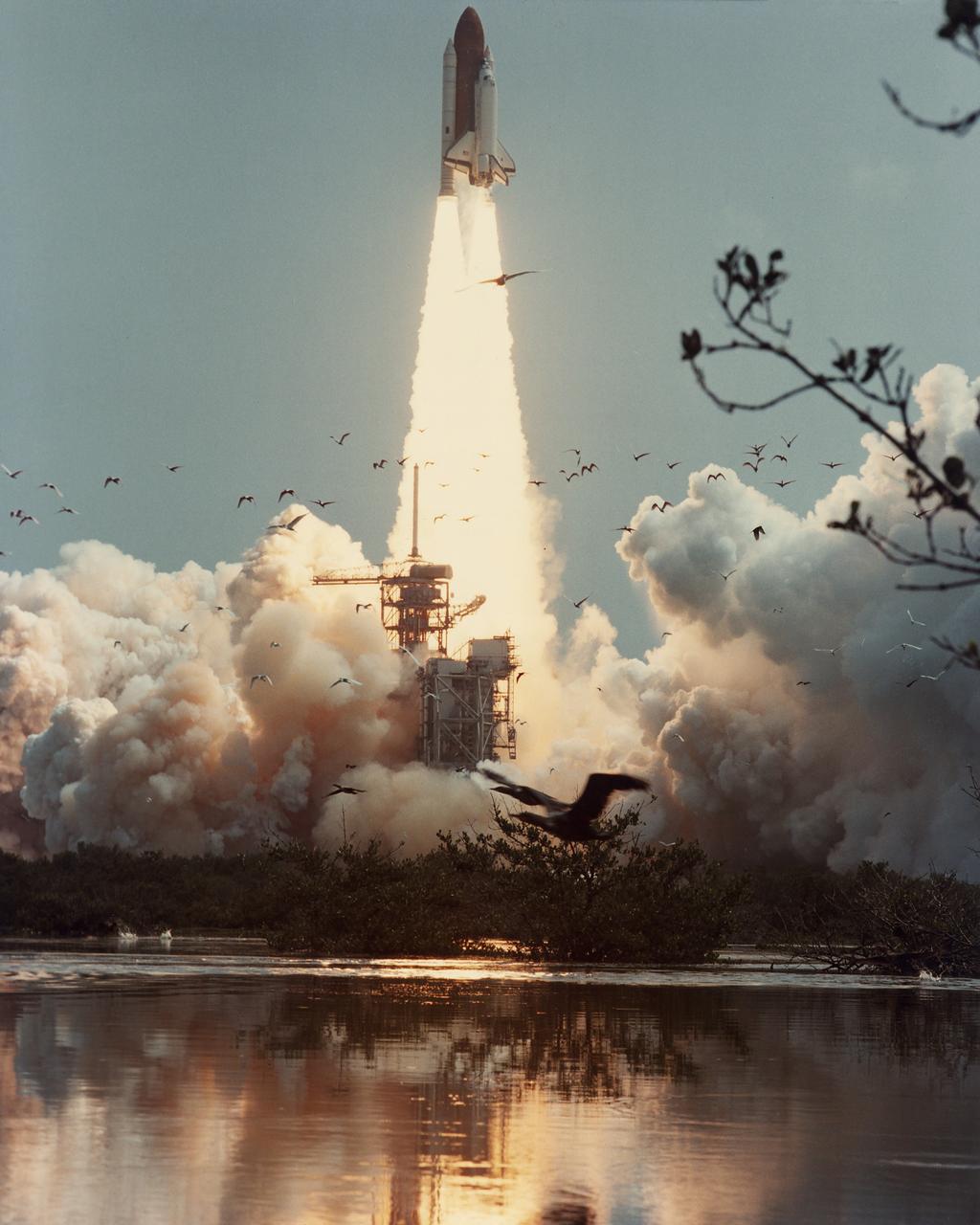
CAPE CANAVERAL, Fla. - STS-4 thunders away from Launch Pad 39A at 10:59:59 a.m. EDT, bound for a seven-day Earth orbital mission and the final developmental flight for the Space Transportation System. The fourth Space Shuttle mission is piloted by Commander Ken Mattingly and Pilot Henry Hartsfield Jr. Photo Credit: NASA
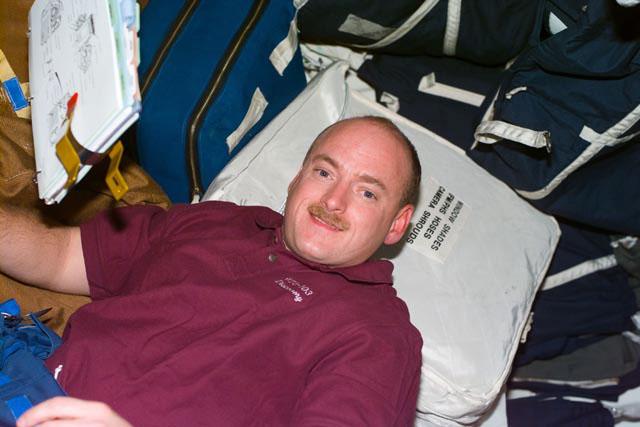
S103-E-5006 (20 December 1999) --- Astronaut Scott J. Kelly, pilot, sorts out some of the supplies for the STS-103 mission during flight day 1 activity onboard Discovery. The photo was taken with an electronic still camera (ESC) at 16:11:59 GMT, Dec. 20, 1999.
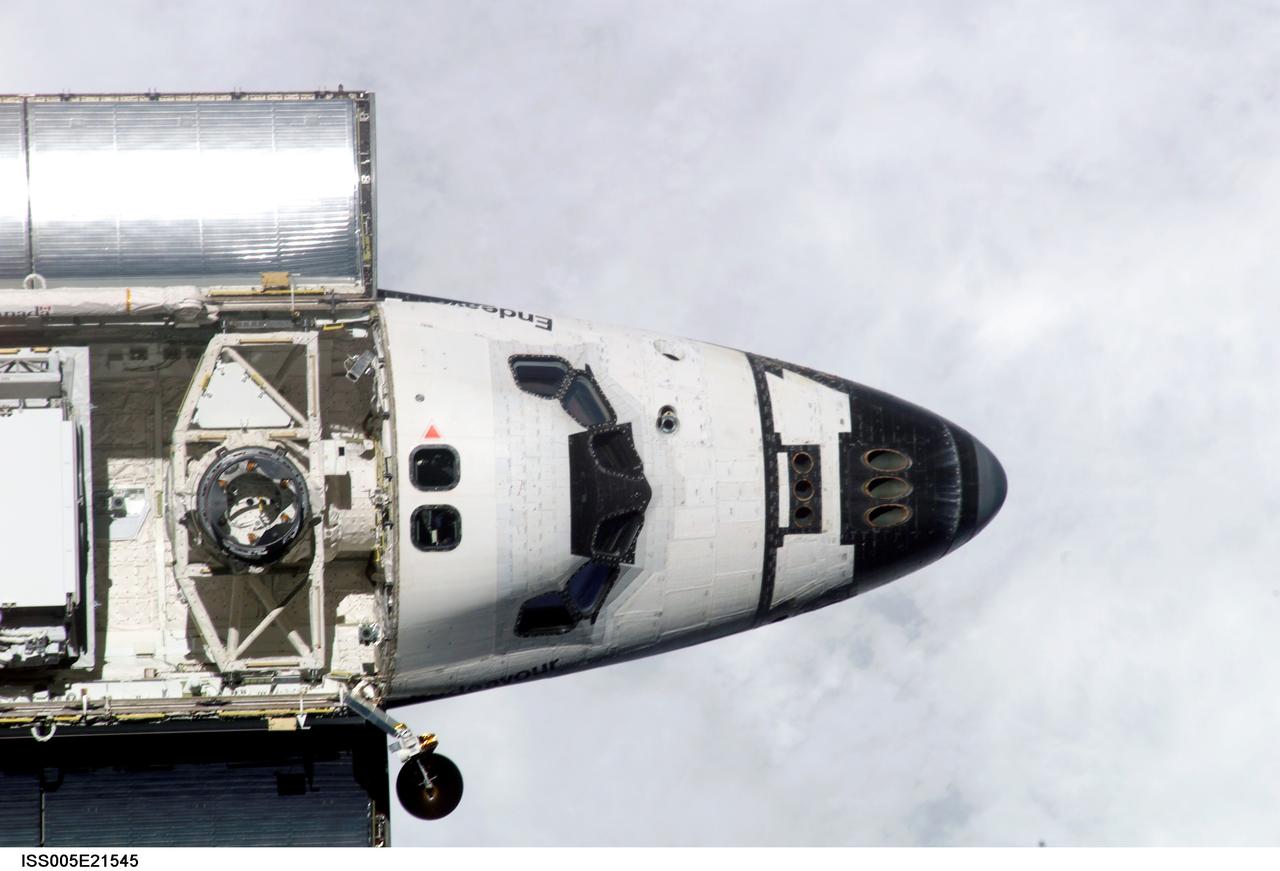
ISS005-E-21545 (25 November 2002) --- The forward section and part of the cargo bay of the Space Shuttle Endeavour were photographed by an Expedition Five crewmember aboard the International Space Station (ISS) during STS-113 rendezvous and docking operations. Docking occurred at 3:59 p.m. (CST) on November 25, 2002.
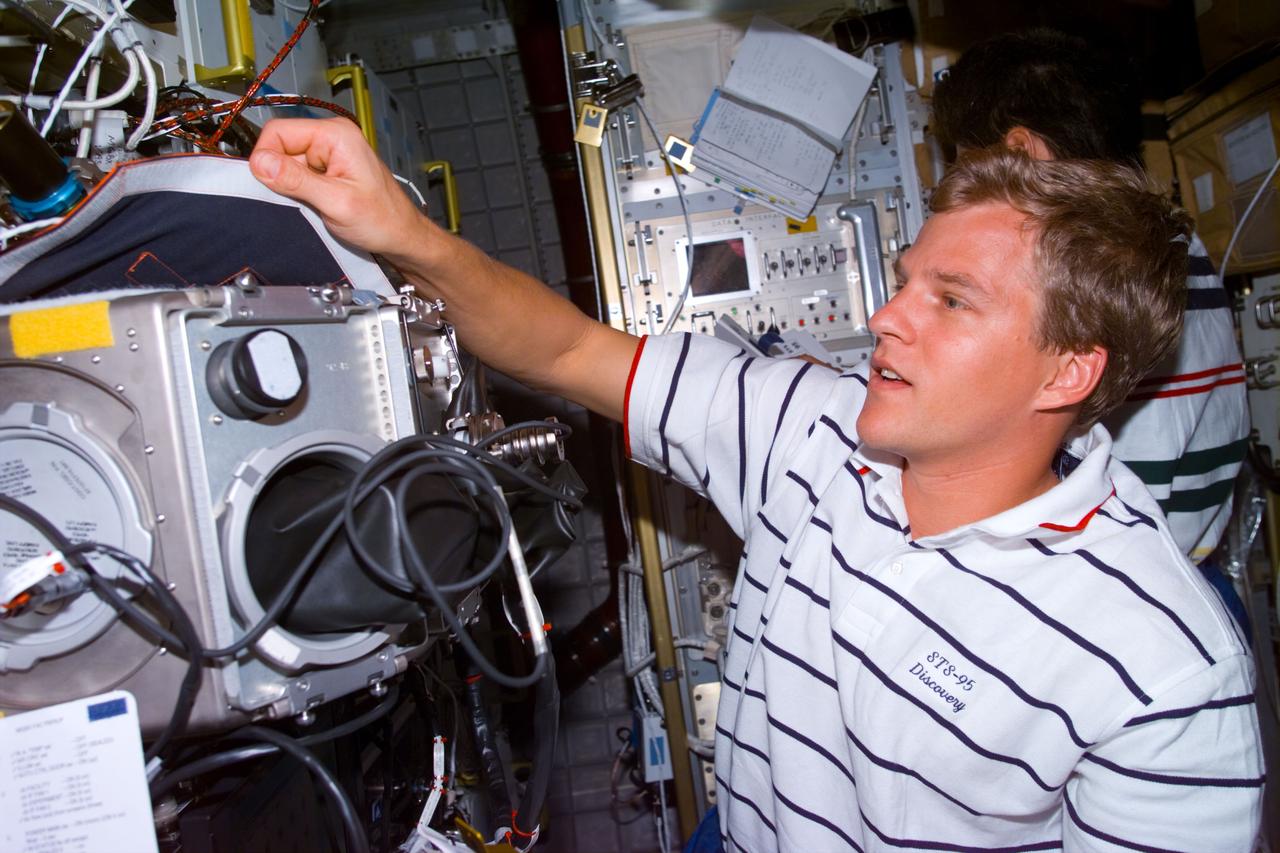
STS095-E-5104 (2 Nov. 1998) --- Astronaut Scott E. Parazynski, STS-95 mission specialist, at glove box in Spacehab facility during flight day four activity. The photo was taken with an electronic still camera (ESC) at 4:59:22 GMT, Nov. 2.
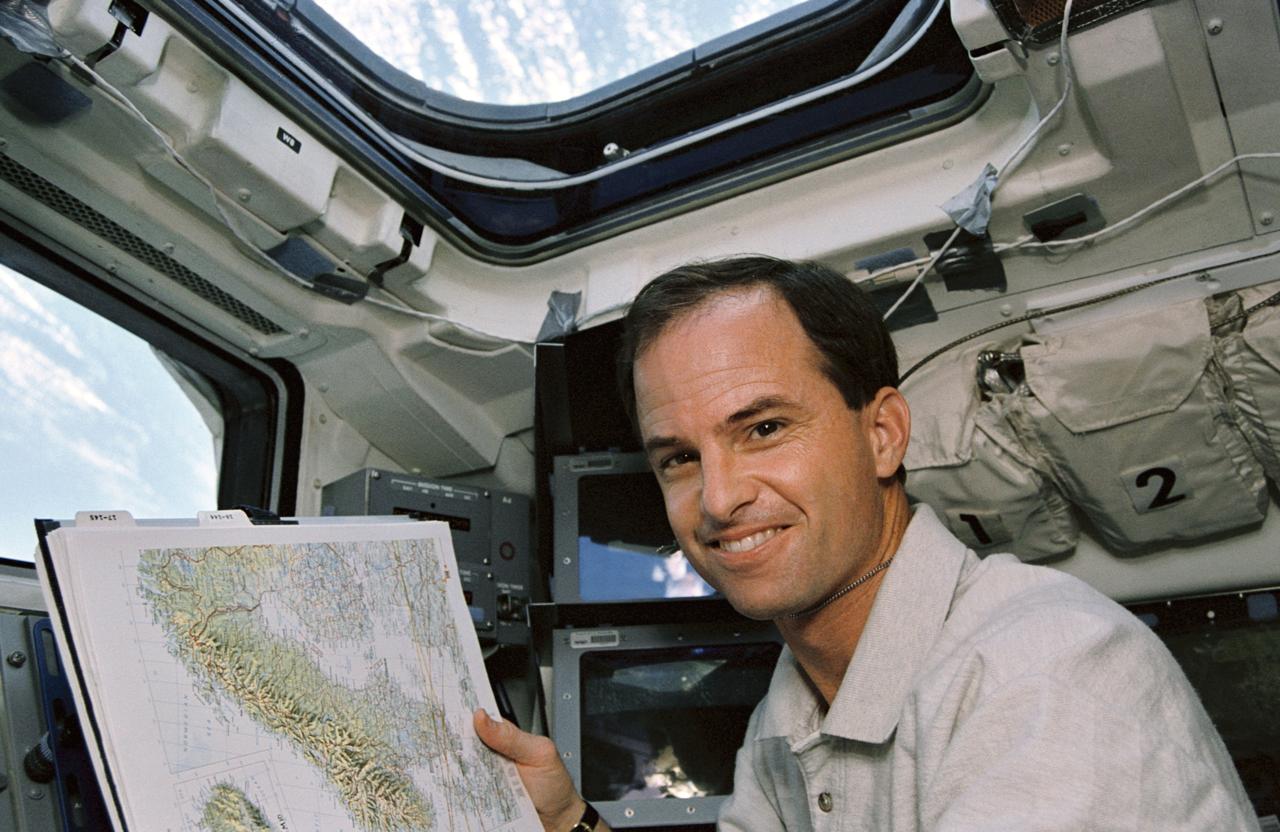
STS059-16-032 (9-20 April 1994) --- Astronaut Kevin P. Chilton, pilot, displays a map of Scandinavia on the Space Shuttle Endeavour's flight deck. Large scale maps such as this were used by the crew to locate specific sites of interest to the Space Radar Laboratory scientists. The crew then photographed the sites at the same time as the radar in the payload bay imaged them. Chilton was joined in space by five other NASA astronauts for a week and a half of support to the Space Radar Laboratory (SRL-1) mission and other tasks.
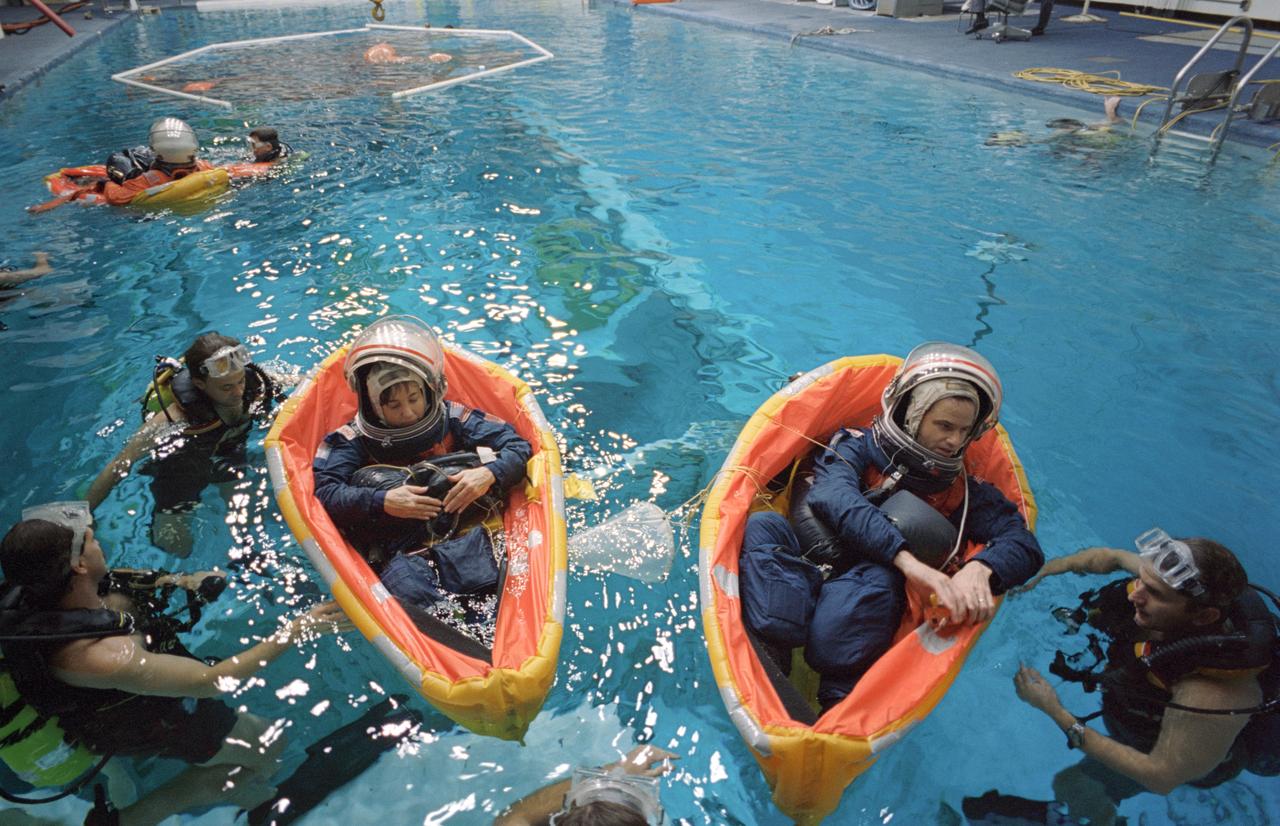
S93-50711 (22 Dec 1993) --- Astronauts Kevin P. Chilton (right), pilot, and Linda M. Godwin, payload commander, are assisted by SCUBA-equipped divers during emergency bailout training at the Johnson Space Center's (JSC) Weightless Environment Training Facility (WET-F). Godwin, Chilton and four other NASA astronauts are scheduled to fly aboard the Space Shuttle Endeavour next year.
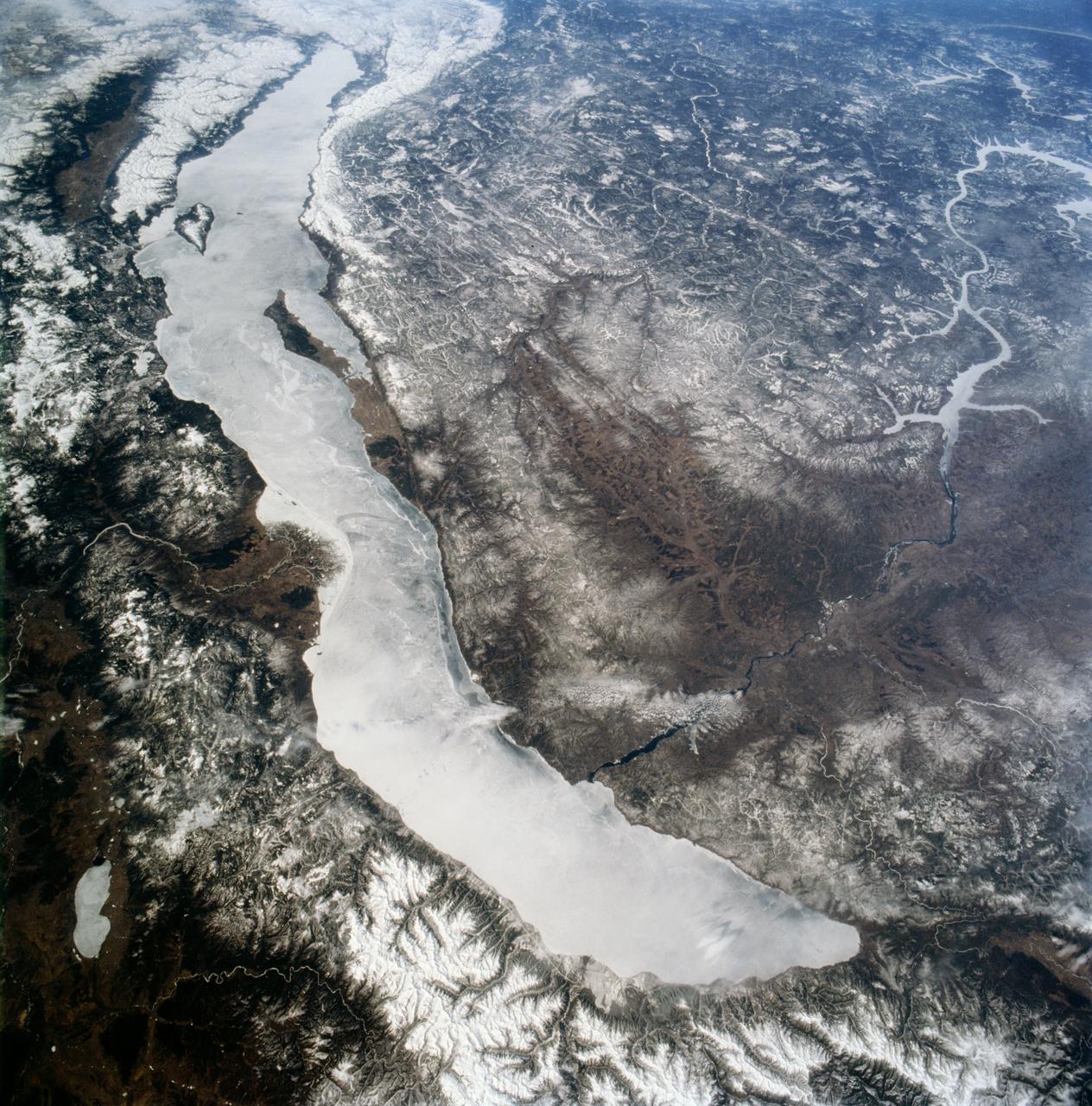
STS059-90-098 (9-20 April 1994) --- Ice-covered Lake Baikal, in Siberia, is about 400 miles long within a major rift valley. The water surface is 455 meters above sea level, but the bottom is 1,295 meters below sea level; the lake represents the largest body of fresh water in the world, except for the Antarctic and Greenland ice sheets. A tributary, the Senusi River, has built a delta on the east side. The Angara River exits the lake to the northwest; the city of Irkutsk is under the small, rippled cloud bank that crosses the river. Hasselblad camera.
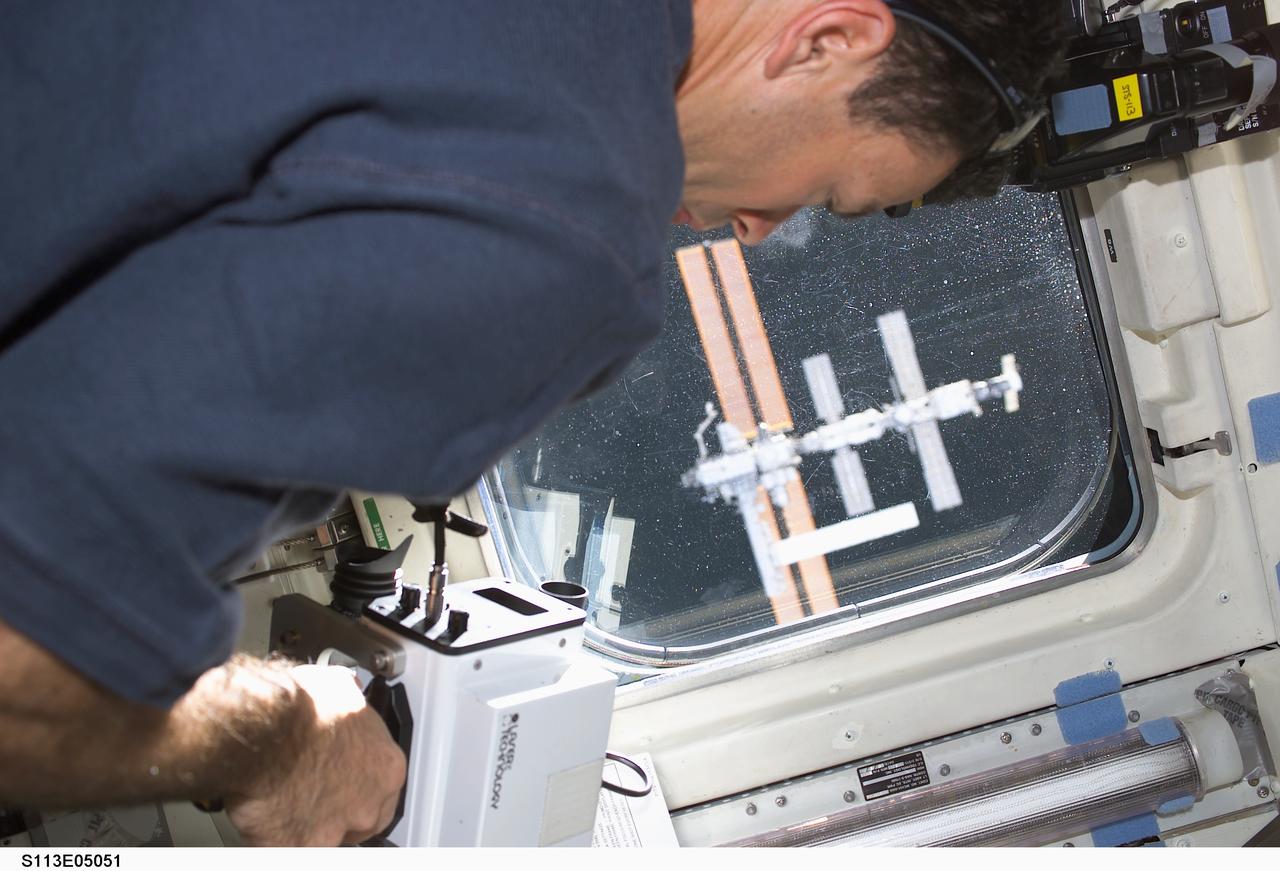
STS113-E-05051 (25 November 2002) --- Astronaut Michael E. Lopez-Alegria, STS-113 mission specialist, uses a laser ranging device on the aft flight deck of the Space Shuttle Endeavour. This instrument is a regularly called-on tool during rendezvous operations with the International Space Station (ISS). The station is visible through an overhead window. Endeavour docked with the station at 3:59 p.m. (CST) on November 25, 2002.
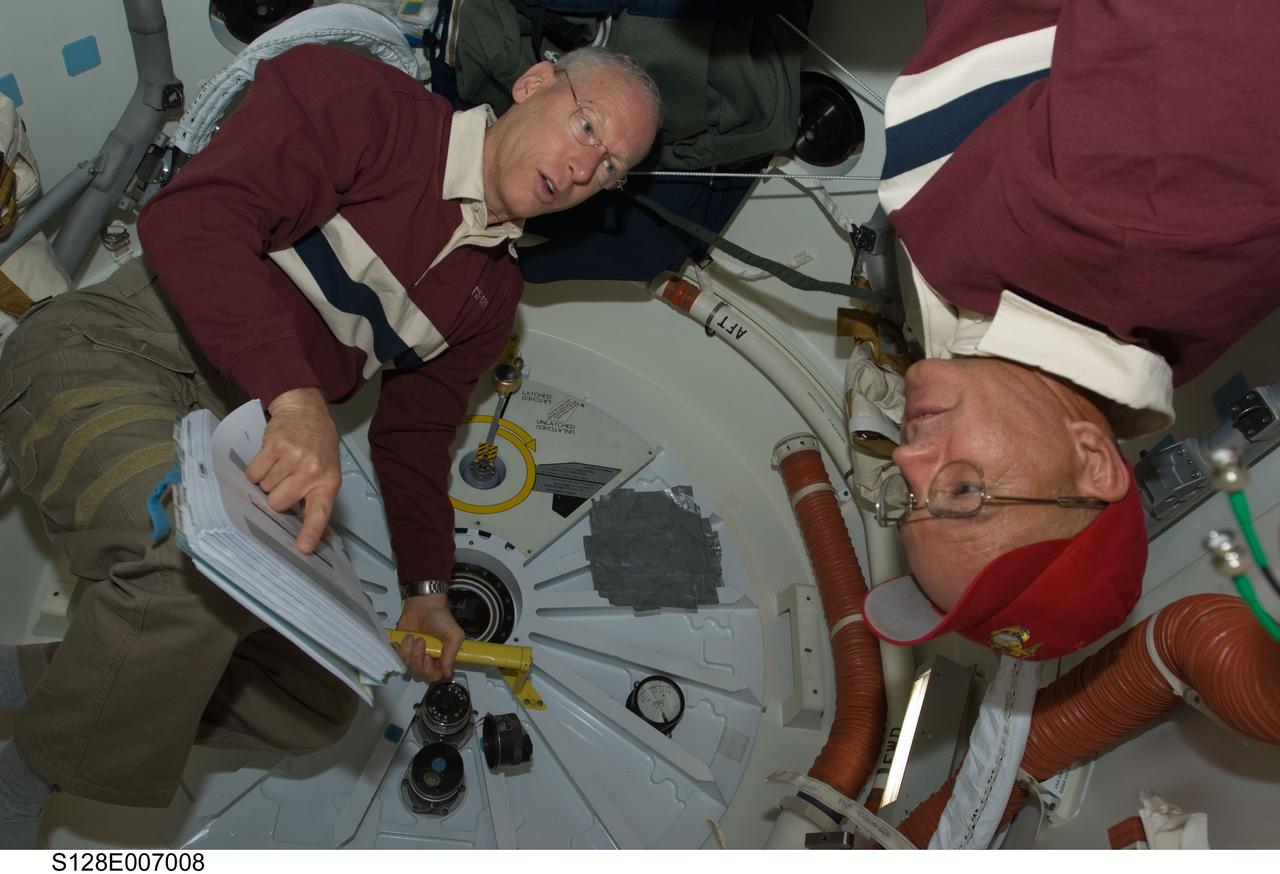
S128-E-007008 (30 Aug. 2009) --- Astronauts Rick Sturckow (right), STS-128 commander; and Patrick Forrester, mission specialist, are pictured near the hatch on the middeck of Space Shuttle Discovery after docking with the International Space Station. The two spacecraft docked at 7:54 p.m. (CDT), and the Discovery crew entered the orbital outpost at 9:59 p.m. (CDT) on Aug. 30.
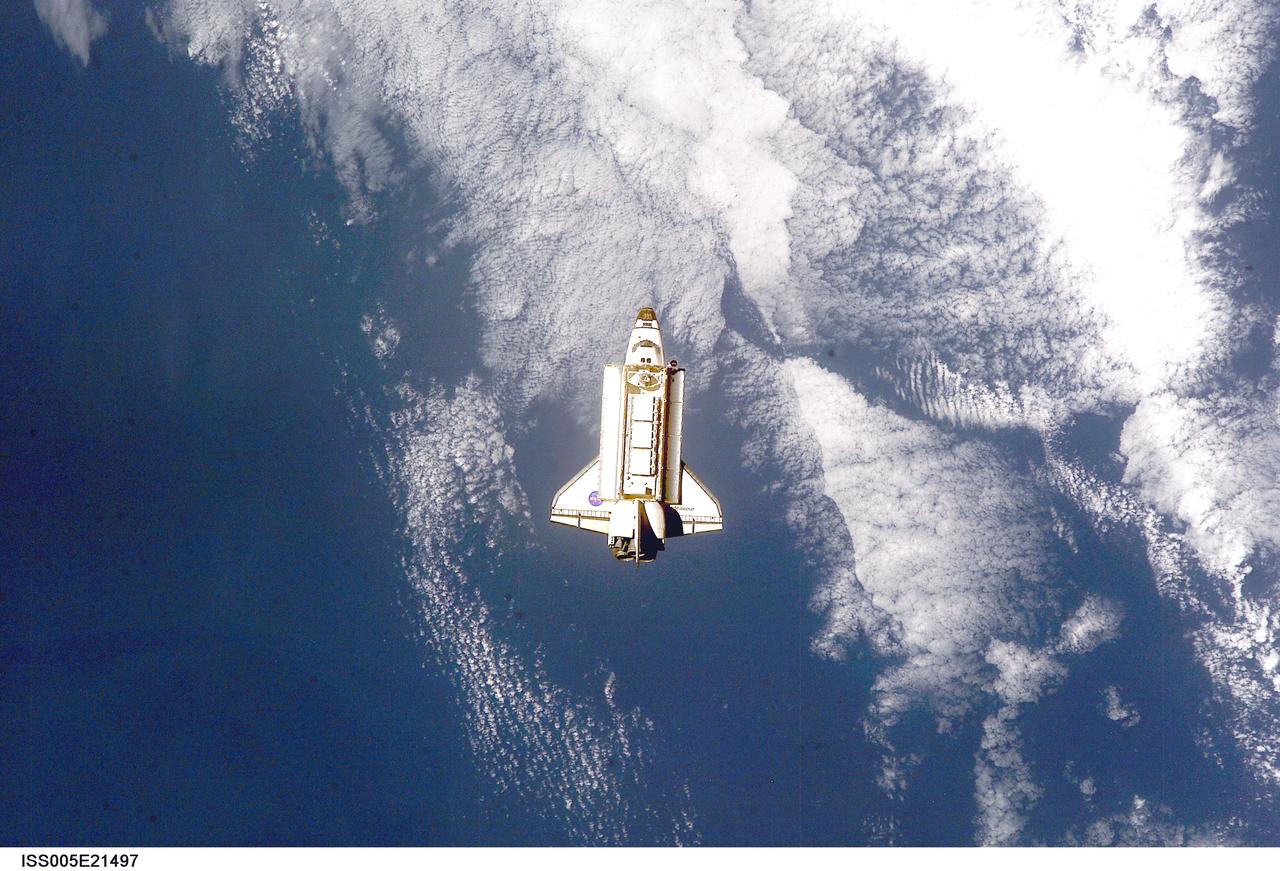
ISS005-E-21497 (25 November 2002) --- Backdropped by a blue and white Earth, the Space Shuttle Endeavour approaches the International Space Station (ISS) during STS-113 rendezvous and docking operations. Docking occurred at 3:59 p.m. (CST) on November 25, 2002. The Port One (P1) truss, which was later to be attached to the station and outfitted during three spacewalks, can be seen in Endeavour’s cargo bay.
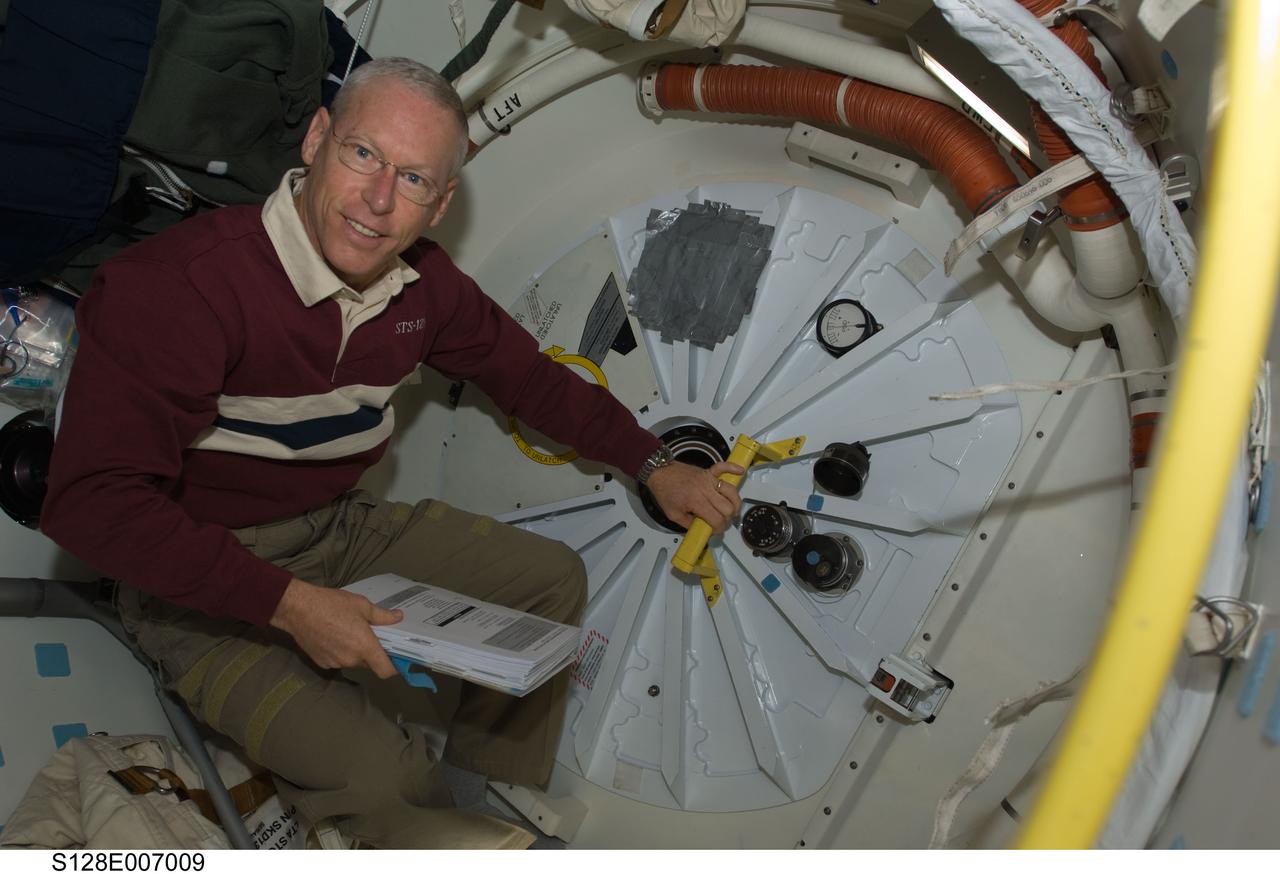
S128-E-007009 (30 Aug. 2009) --- Astronaut Patrick Forrester, STS-128 mission specialist, prepares to open the hatch that will lead the entire Space Shuttle Discovery crew into the International Space Station. The two spacecraft docked at 7:54 p.m. (CDT), and the Discovery crew entered the orbital outpost at 9:59 p.m. (CDT) on Aug. 30.
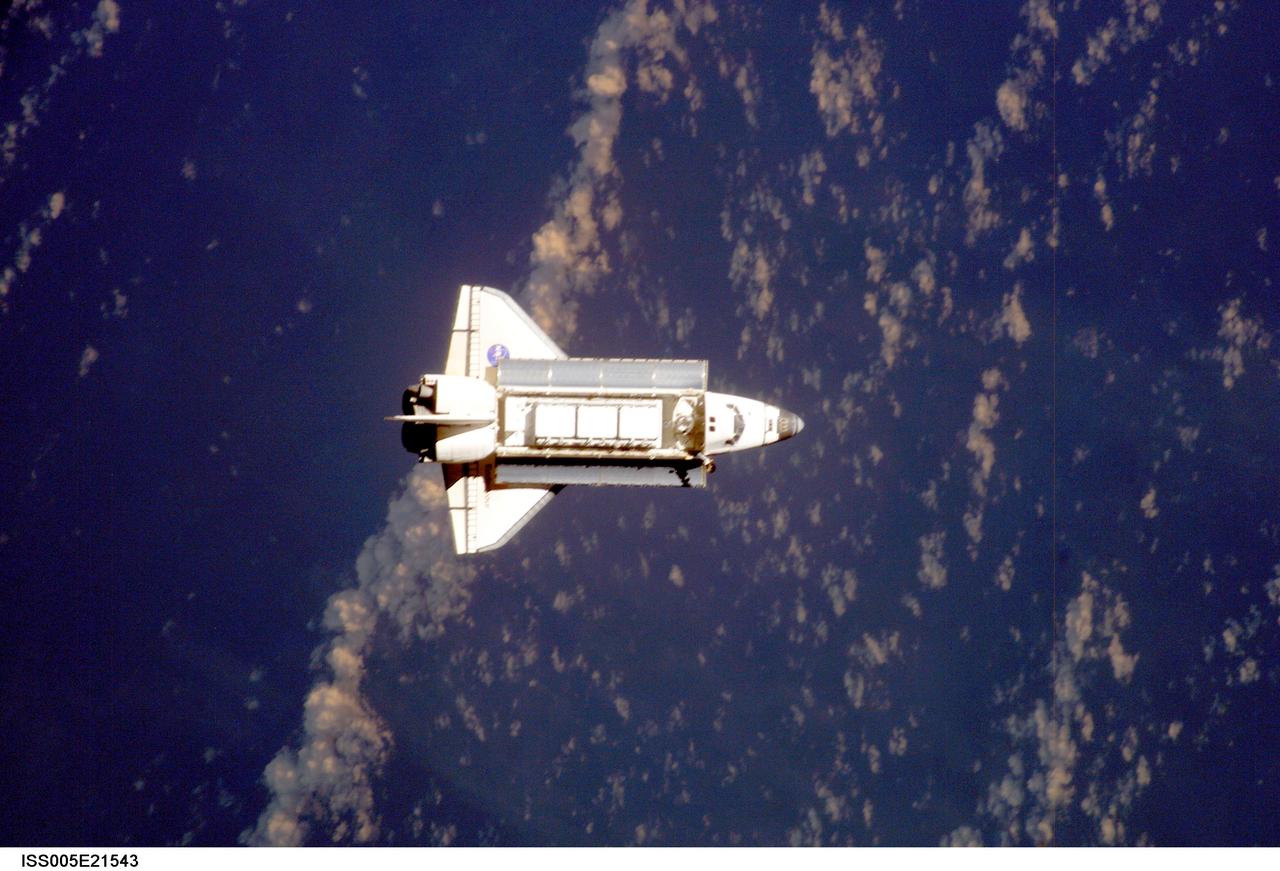
ISS005-E-21543 (25 November 2002) --- Backdropped by a blue and white Earth, the Space Shuttle Endeavour approaches the International Space Station (ISS) during STS-113 rendezvous and docking operations. Docking occurred at 3:59 p.m. (CST) on November 25, 2002. The Port One (P1) truss, which was later to be attached to the station and outfitted during three spacewalks, can be seen in Endeavour's cargo bay.

S88-E-5143 (12-12-98) --- Astronaut James H. Newman, mission specialist, works at the edge of the U.S.-built Unity connecting module during the STS-88 mission's third and final space walk, on Flight Day 10. The solar array panel on the Russian-built Zarya module is at right. The photo was taken with an electronic still camera (ESC) at 21:59:43 GMT, Dec. 12.
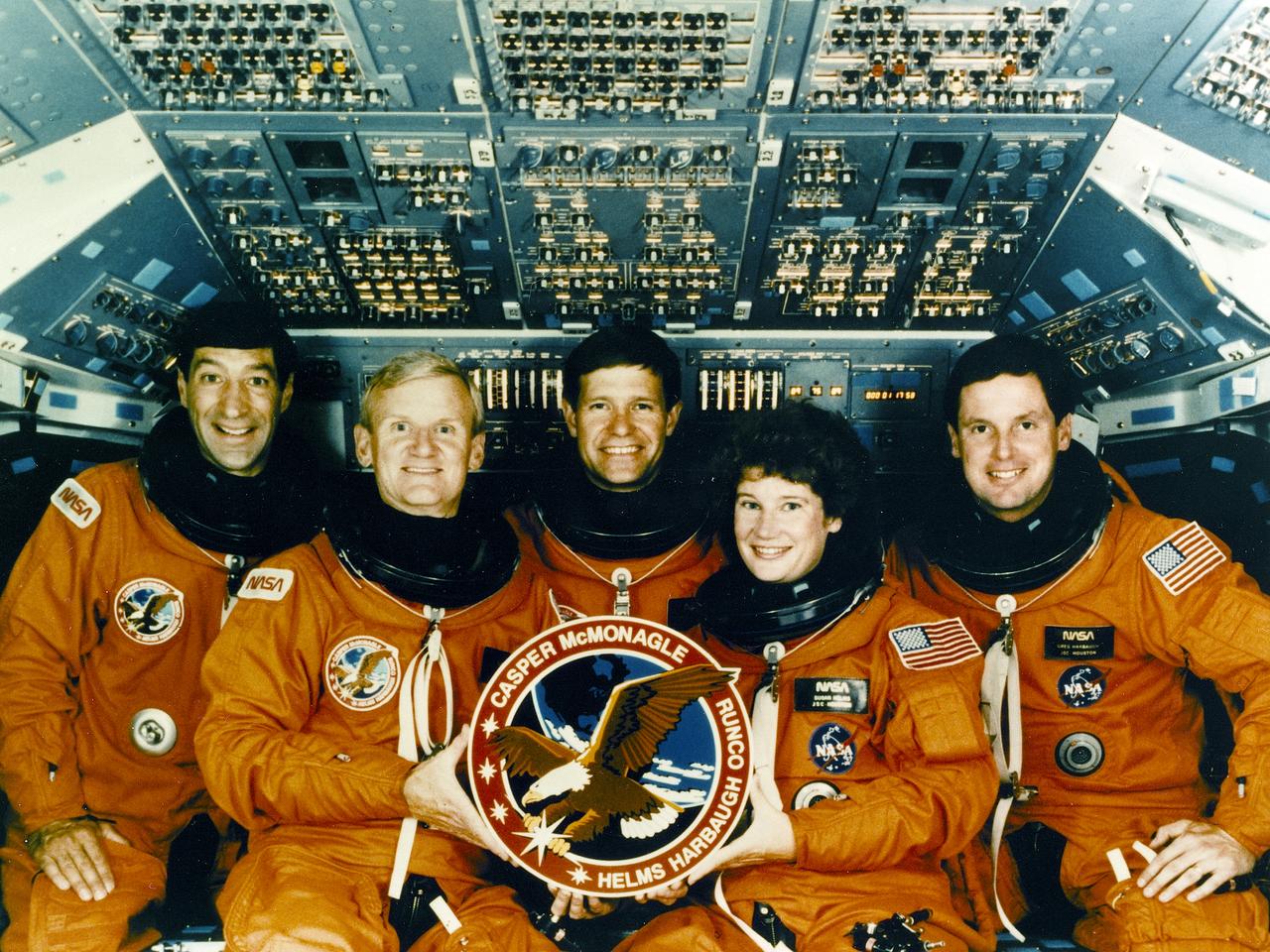
Astronauts pictured in the STS-54 crew portrait from left to right are: Mario Runco, Jr., mission specialist; John H. Casper, commander; Donald R. McMonagle, pilot; and mission specialists Susan J. Helms, and Gregory J. Harbaugh. Launched aboard the Space Shuttle Endeavour on January 13, 1993 at 8:59:30 am (EST), the crew deployed the fifth Tracking and Data Relay Satellite (TDRS-6).
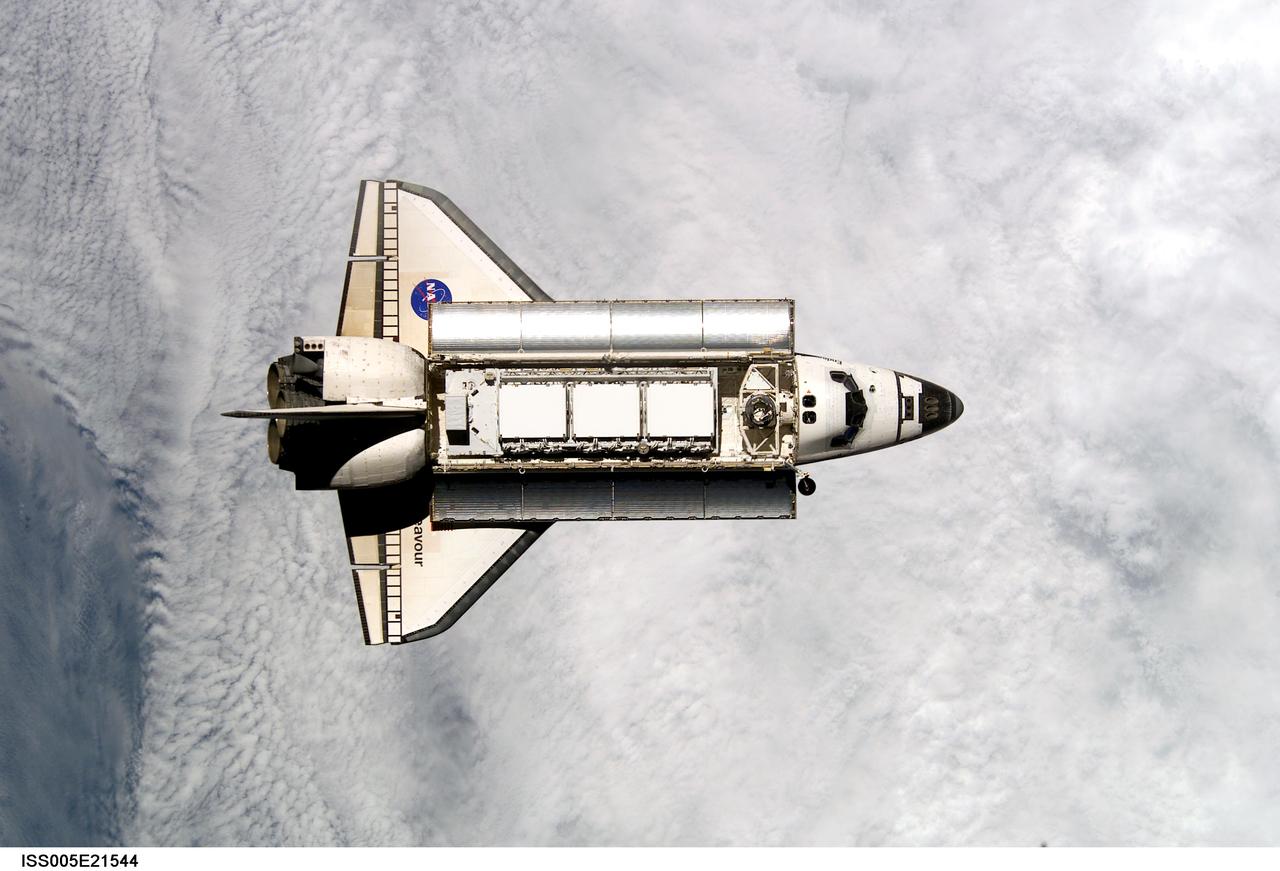
ISS005-E-21544 (25 November 2002) --- Backdropped by a blanket of clouds, the Space Shuttle Endeavour approaches the International Space Station (ISS) during STS-113 rendezvous and docking operations. Docking occurred at 3:59 p.m. (CST) on November 25, 2002. The Port One (P1) truss, which was later to be attached to the station and outfitted during three spacewalks, can be seen in Endeavour's cargo bay.
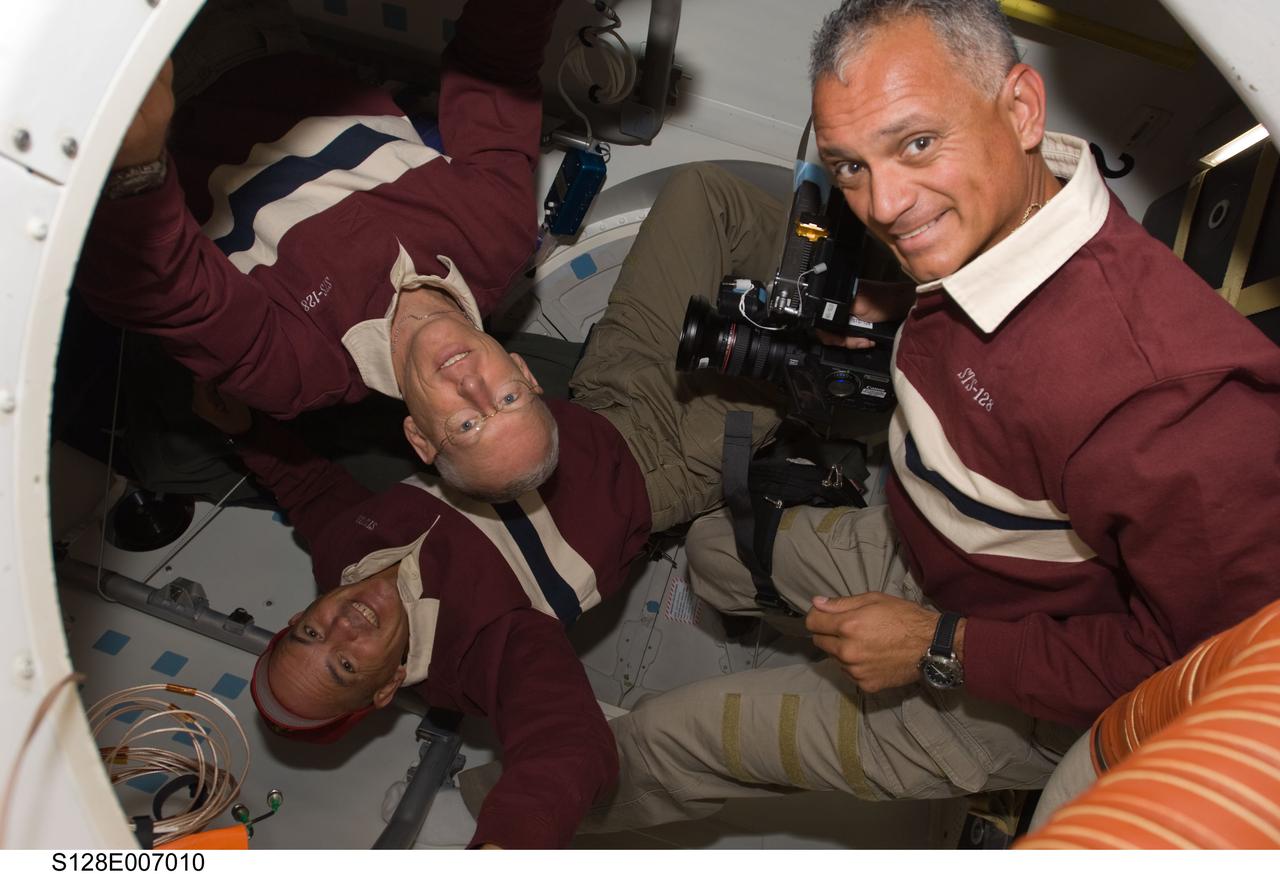
S128-E-007010 (30 Aug. 2009) --- Astronauts Rick Sturckow (bottom), STS-128 commander; John “Danny” Olivas (right) and Patrick Forrester, both mission specialists, are pictured near the hatch on the middeck of Space Shuttle Discovery after docking with the International Space Station. The two spacecraft docked at 7:54 p.m. (CDT), and the Discovery crew entered the orbital outpost at 9:59 p.m. (CDT) on Aug. 30.
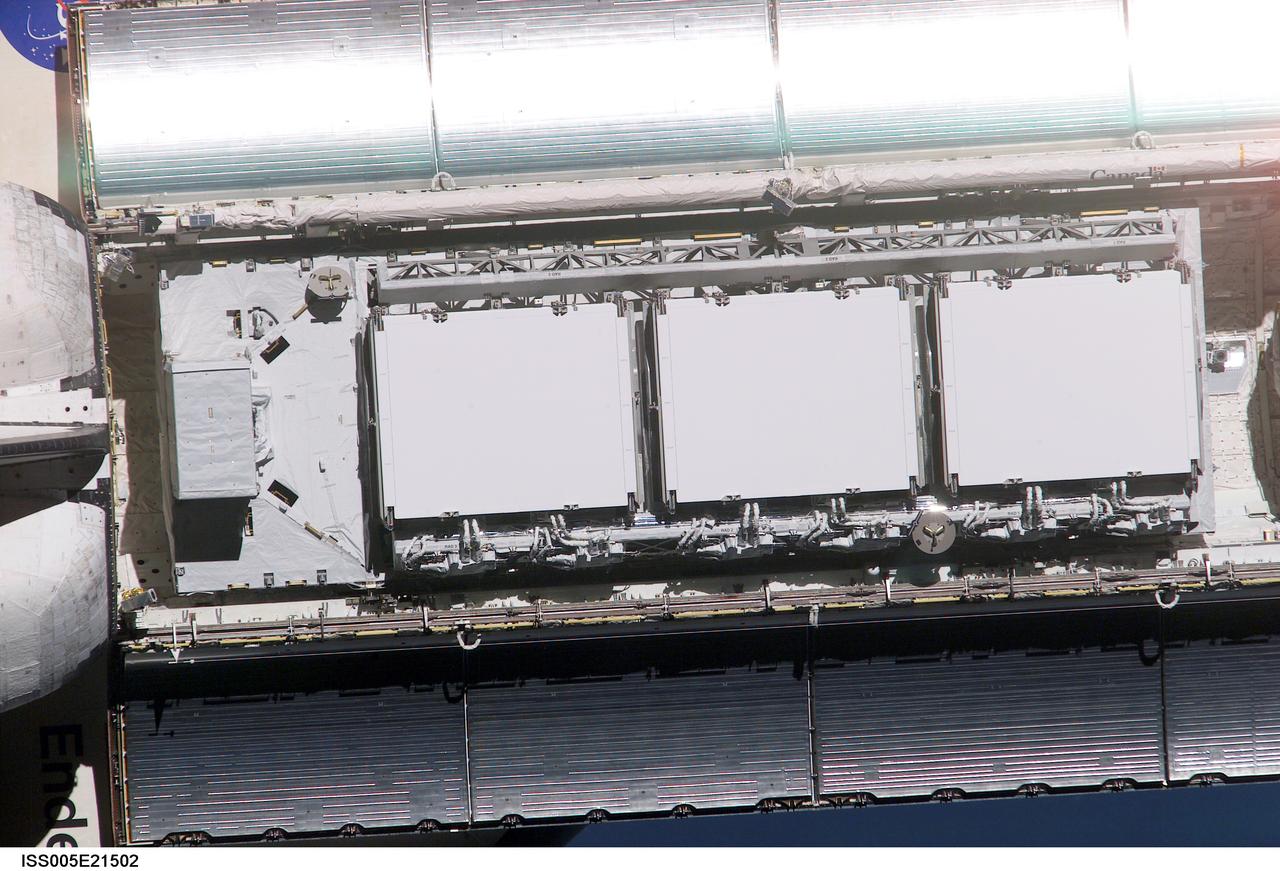
ISS005-E-21502 (25 November 2002) --- This medium close-up view of the Space Shuttle Endeavour's cargo bay was photographed by an Expedition Five crewmember onboard the International Space Station (ISS) during STS-113 rendezvous and docking operations. Docking occurred at 3:59 p.m. (CST) on November 25, 2002. The Port One (P1) truss, which was later to be attached to the station and outfitted during three spacewalks, can be seen in Endeavour's cargo bay.
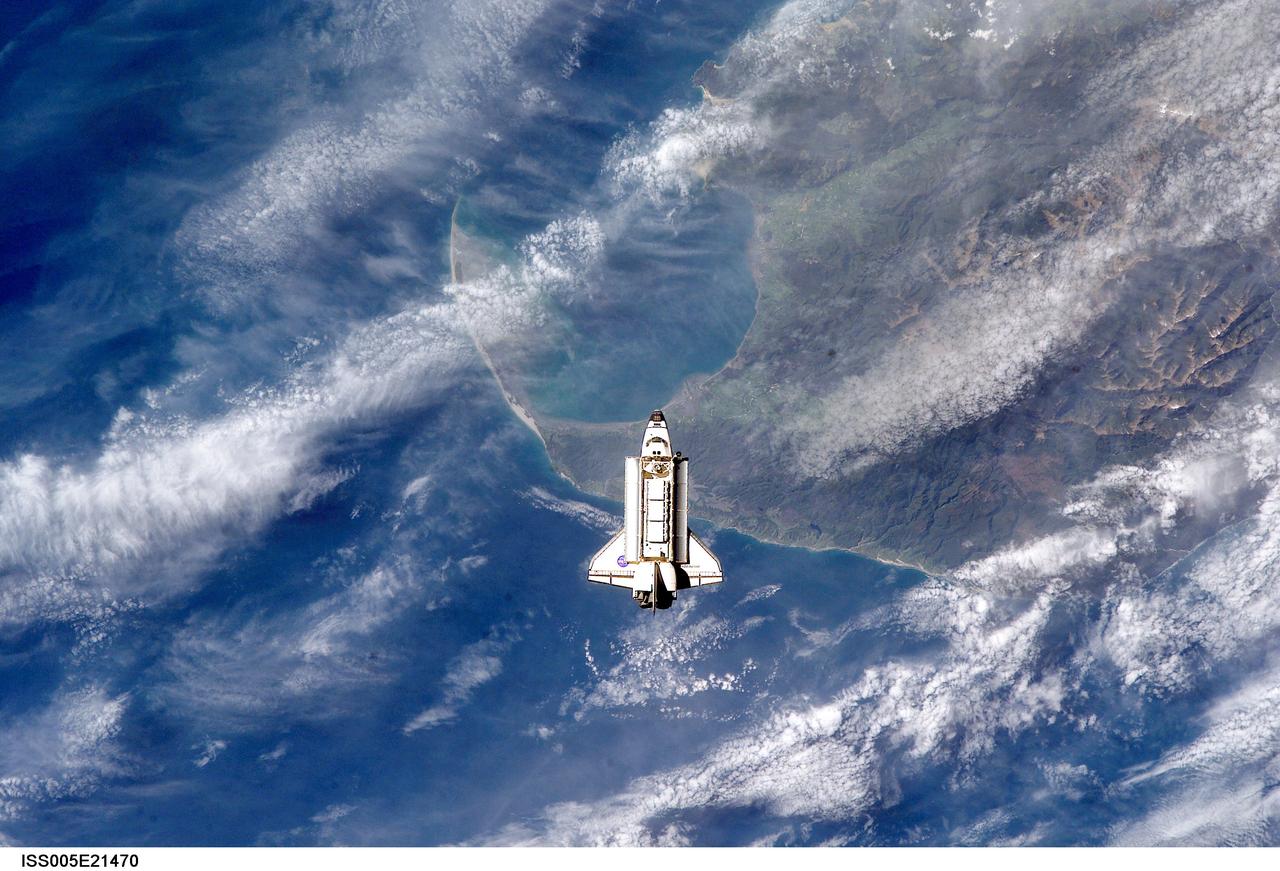
ISS005-E-21470 (25 November 2002) --- The Space Shuttle Endeavour is backdropped over the Tasman Sea and Golden Bay of New Zealand’s South Island as it approaches the International Space Station (ISS) during STS-113 rendezvous and docking operations. Docking occurred at 3:59 p.m. (CST) on November 25, 2002. The Port One (P1) truss, which was later to be attached to the station and outfitted during three spacewalks, can be seen in Endeavour’s cargo bay.
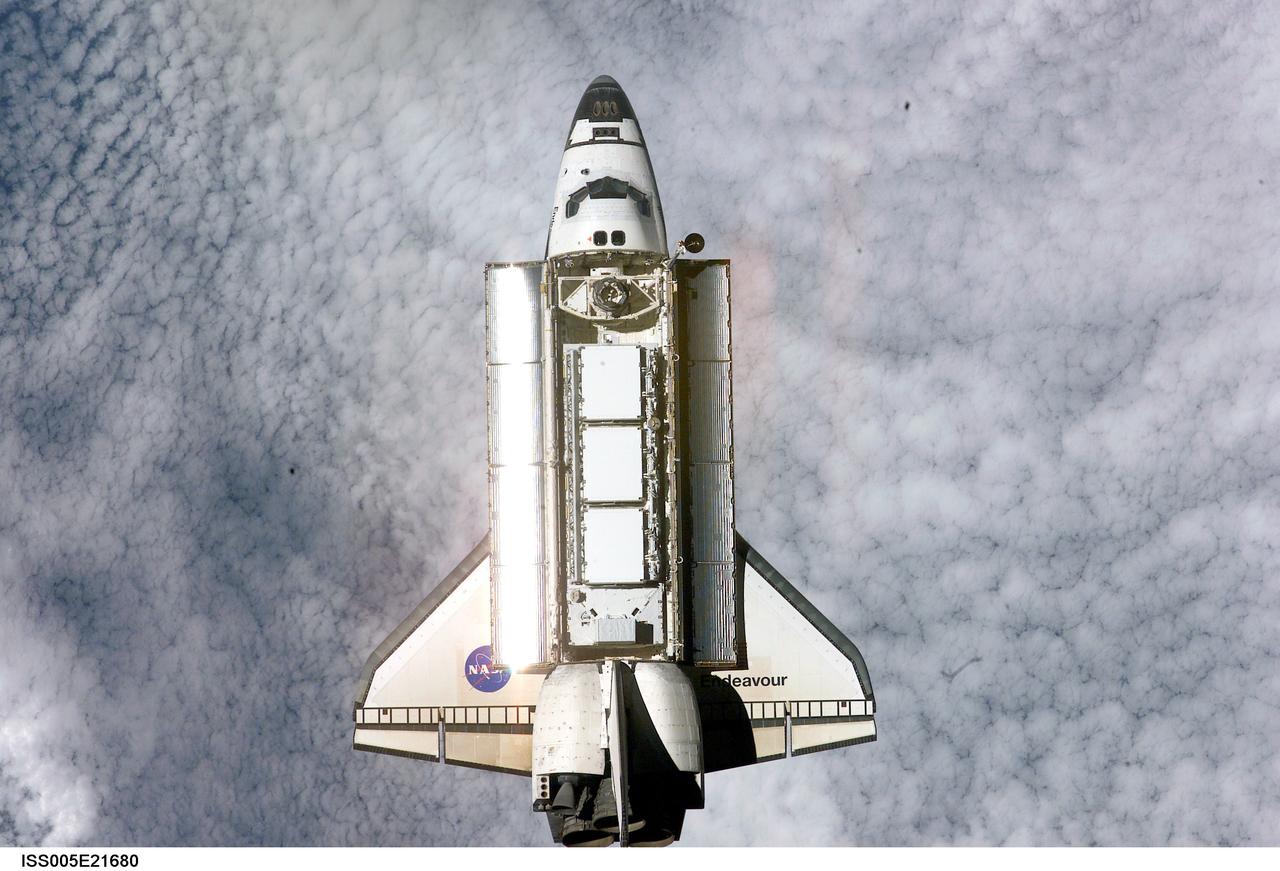
ISS005-E-21680 (25 November 2002) --- Backdropped by a blanket of clouds, the Space Shuttle Endeavour approaches the International Space Station (ISS) during STS-113 rendezvous and docking operations. Docking occurred at 3:59 p.m. (CST) on November 25, 2002. The Port One (P1) truss, which was later attached to the station and outfitted during three spacewalks, can be seen in Endeavour’s cargo bay.
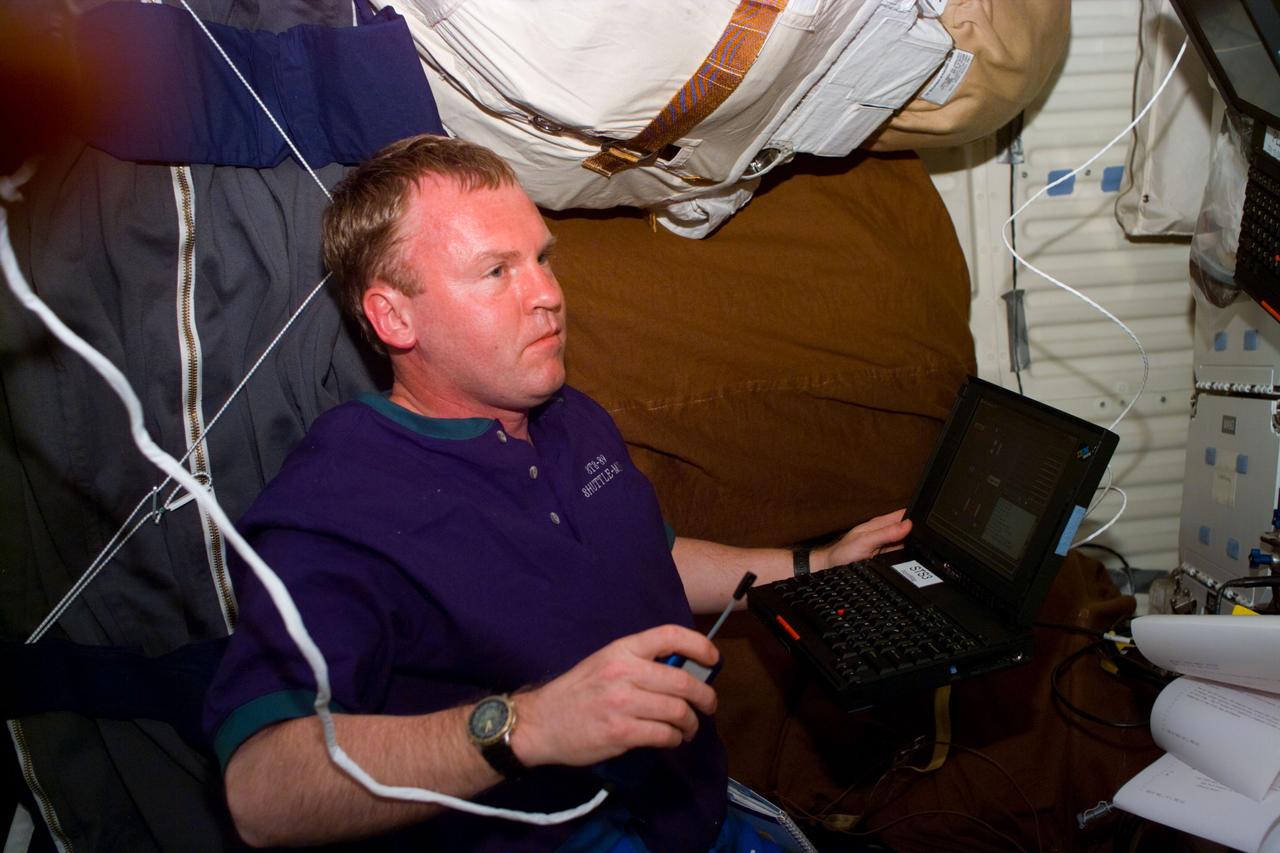
S89-E-5096 (24 Jan 1998) --- Astronaut Andrew S. W. Thomas, mission specialist, is pictured onboard the Space Shuttle Endeavour in one of the first STS-89 still scenes downlinked to flight controllers. Thomas will be the final U.S. astronaut to put in an extended stint aboard the Mir Space Station when he replaces astronaut David A. Wolf later in the week. The photo was taken with the Electronic Still Camera (ESC) at 5:31:59 GMT, January 24, 1998.
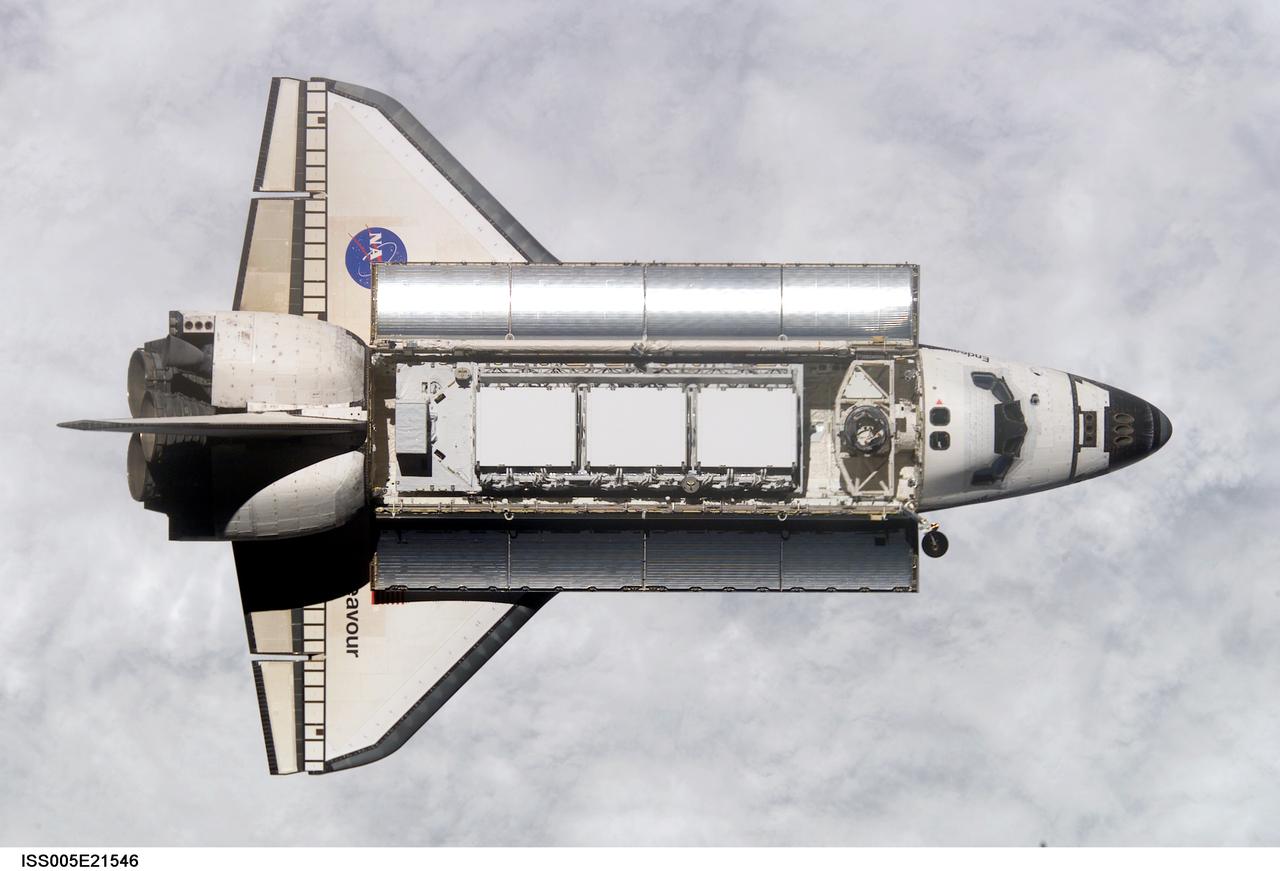
ISS005-E-21546 (25 November 2002) --- Backdropped by a blanket of clouds, the Space Shuttle Endeavour approaches the International Space Station (ISS) during STS-113 rendezvous and docking operations. Docking occurred at 3:59 p.m. (CST) on November 25, 2002. The Port One (P1) truss, which was later to be attached to the station and outfitted during three spacewalks, can be seen in Endeavour's cargo bay.

The crew assigned to the STS-51D mission included (front left to right) Karol J. Bobko, commander; Donald E. Williams, pilot; M. Rhea Seddon, mission specialist; and Jeffrey A. Hoffman, mission specialist. On the back row, left to right, are S. David Griggs, mission specialist; and payload specialists Charles D. Walker, and E. Jake Garn (Republican Utah Senator). Launched aboard the Space Shuttle Discovery on April 12, 1985 at 8:59:05 am (EST), the STS-51D mission’s primary payloads were the TELESAT-1 (ANIK-C) communications satellite and the SYNCOM IV-3 (also known as LEASAT-3).
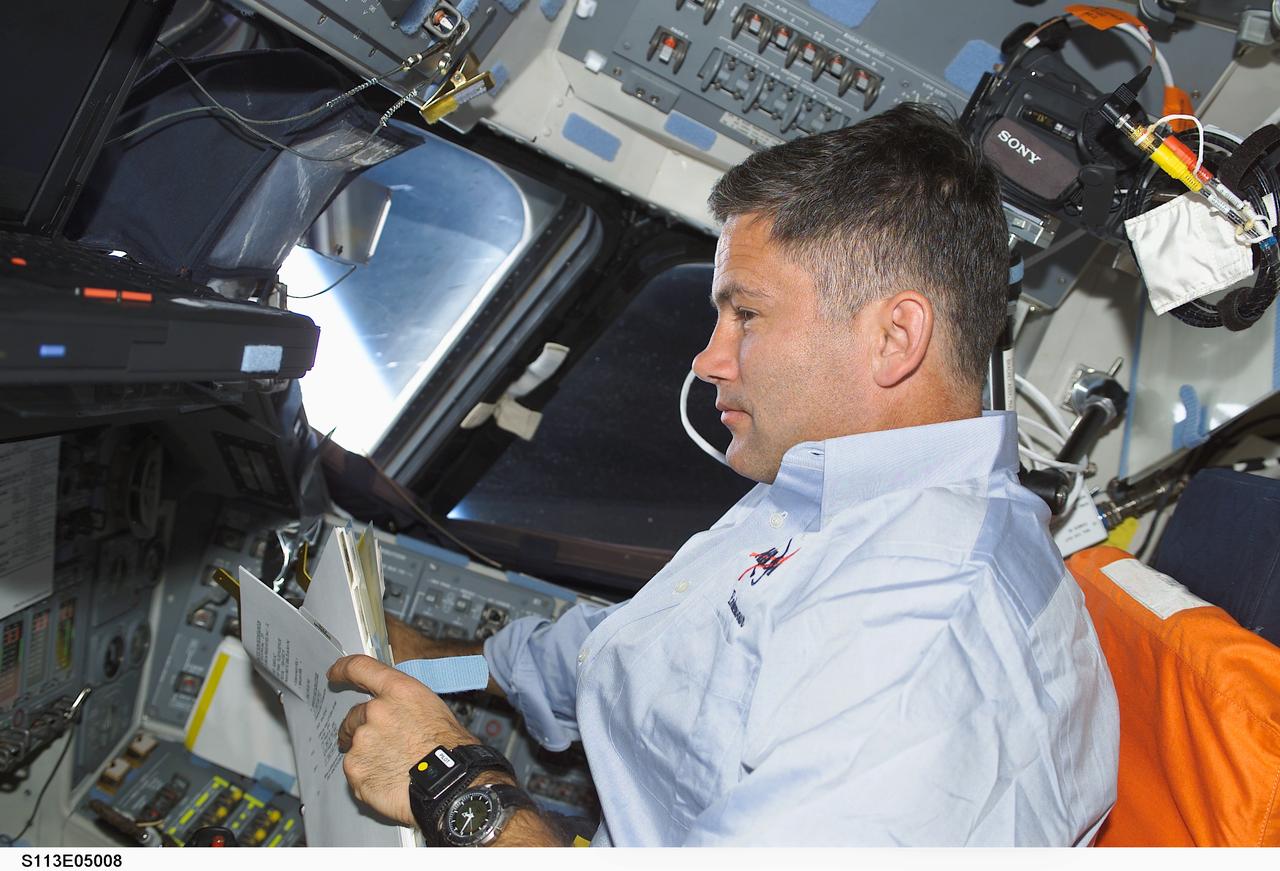
STS113-E-5008 (25 November 2002) --- Astronaut Paul S. Lockhart, pilot, works at the pilot's station on the flight deck of the Space Shuttle Endeavour during the second day of STS-113 activity. The STS-113 astronauts went on to dock the shuttle with the International Space Station at 3:59 p.m. (CST), bringing a new crew and another segment of the station's backbone, the Port One (P1) segment of the Integrated Truss System. The rendezvous and docking of Endeavour with astronaut James D. Wetherbee (out of frame), mission commander, at the controls, occurred about 248 statute miles above the South Pacific off the southeastern coast of Australia.
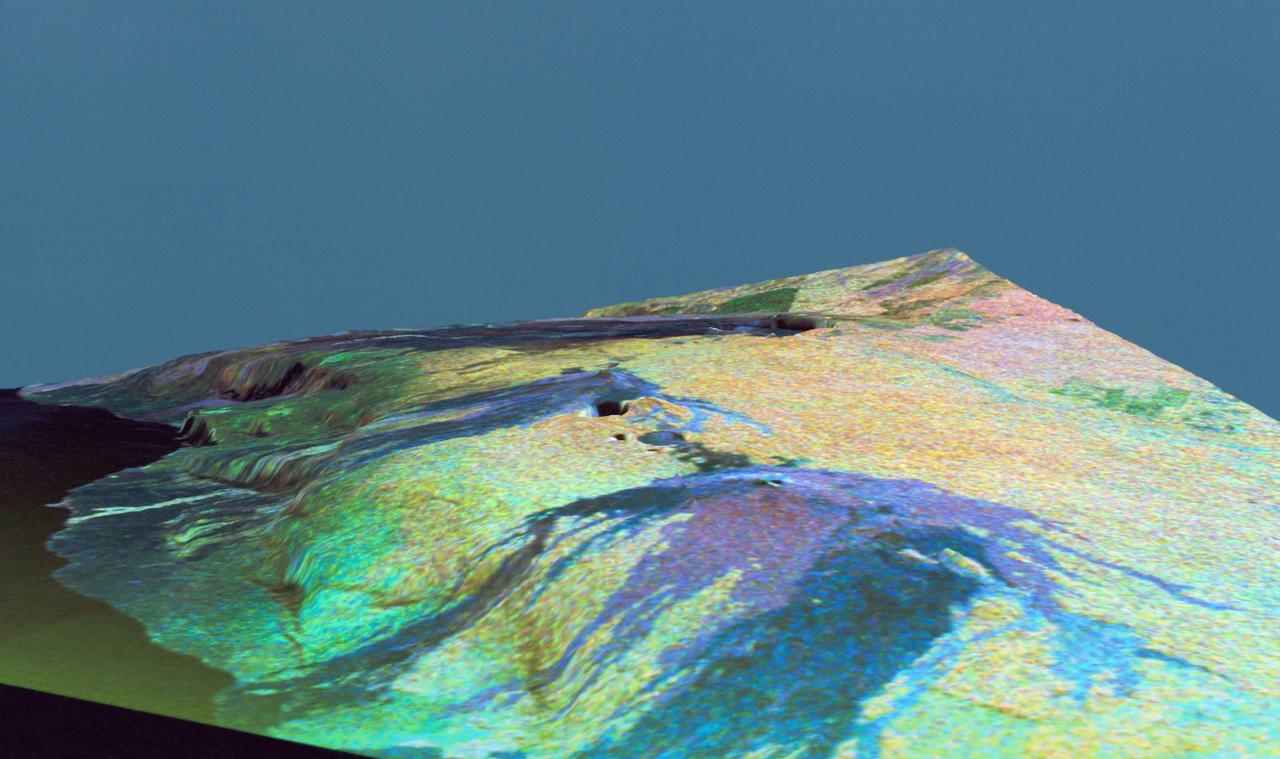
This is a three dimensional perspective view of false-color image of the eastern part of the Big Island of Hawaii. It was produced using all three radar frequencies C-Band and L-Band. This view was constructed by overlaying a SIR-C radar image on a U.S. Geological Survey digital elevation map. The image was acquired on April 12, 1994 during the 52nd orbit of the Shuttle Endeavour by the Spaceborne Imaging Radar-C and X-Band Synthetic Aperture Radar (SIR-C/X-SAR). The area shown is approximately 34 by 57 kilomters with the top of the image pointing toward north-west. The image is centered at about 155.25 degrees west longitude and 19.5 degrees north latitude. Visible in the center of the image in blue are the summit crater (Kilauea Caidera) which contains the smaller Halemaumau Crater, and the line of collapsed craters below them that form the Chain of Craters Road. The rain forest appears bright in the image while green areas correspond to lower vegetation. The lava flows have different colors depending on their types and are easily recognizable due to their shapes. The flows at the top of the image originated from the Muana Loa volcano. The Jet Propulsion Laboratory alternative photo number is P-43932.
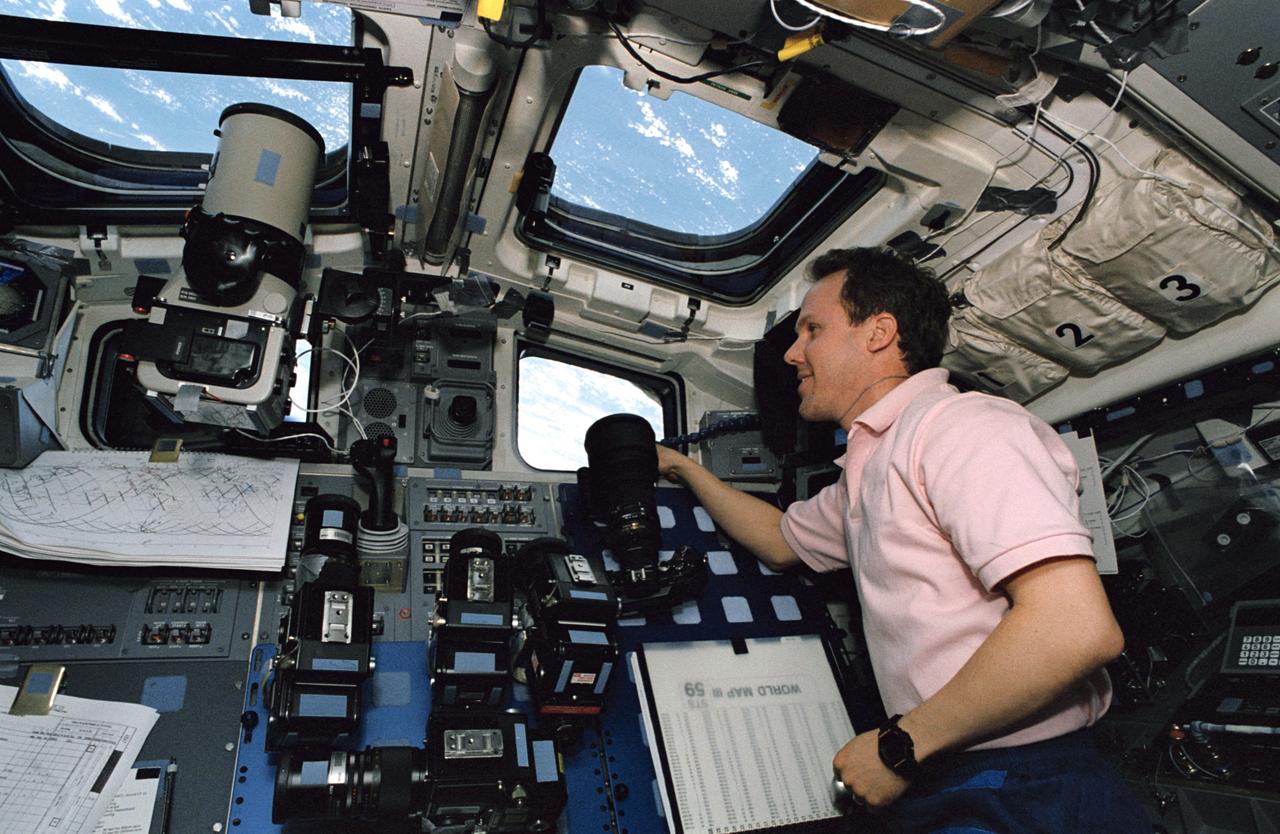
STS059-09-021 (9-20 April 1994) --- Astronaut Thomas D. Jones, mission specialist, monitors a number of cameras fixed on targets of opportunity as the Space Shuttle Endeavour orbits Earth. Jones is one of six NASA astronauts supporting the week and half Space Radar Laboratory (SRL-1) mission. He has been assigned as payload commander for SRL-2, scheduled to fly later this year.
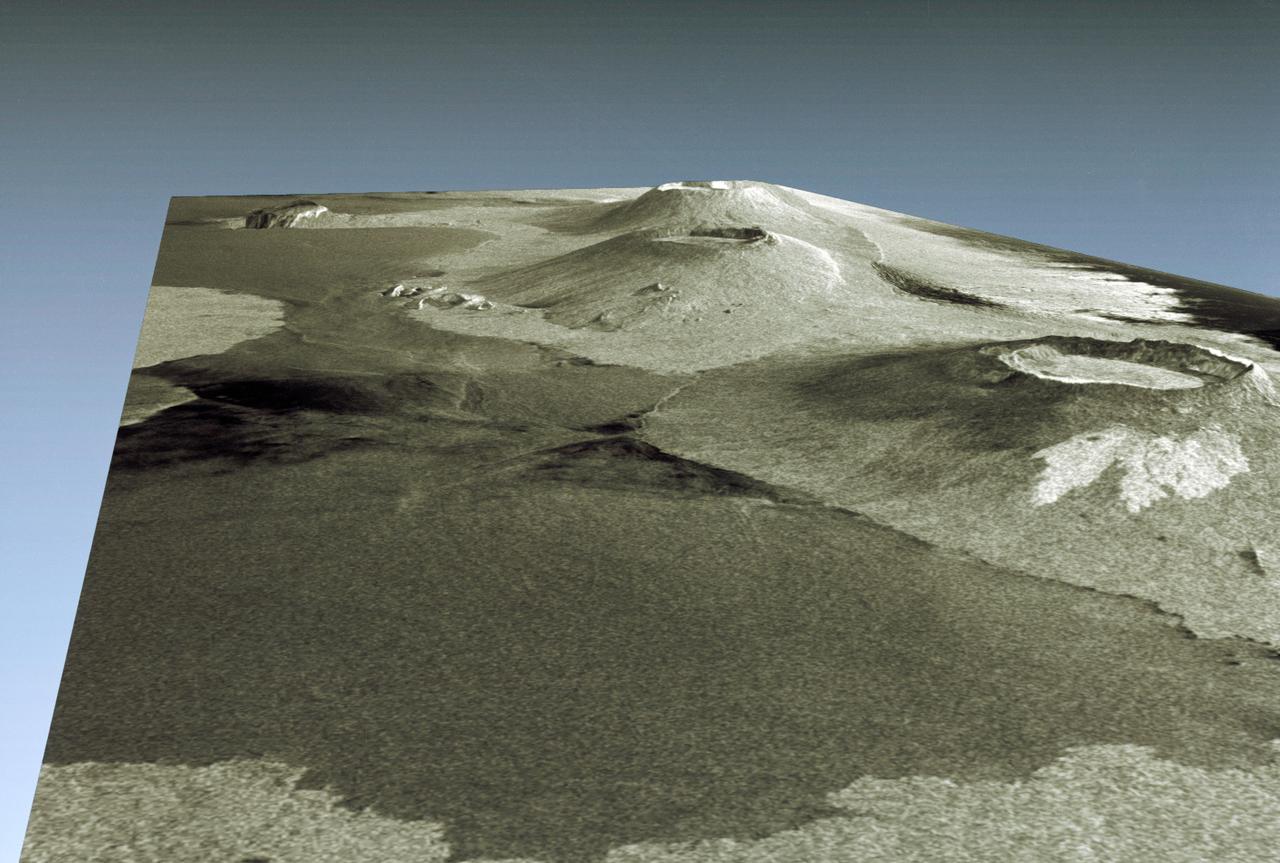
STS059-S-085 (18 April 1994) --- This is a three-dimensional perspective view of part of Isla Isabela in the western Galapagos Islands. It was taken by the L-Band radar in HH polarization from the Spaceborne Imaging Radar-C and X-Band Synthetic Aperture Radar (SIR-C/X-SAR) on the 40th orbit of the Space Shuttle Endeavour. This view was constructed by overlaying a SIR-C radar image on a U.S. Geological Survey digital elevation map. The image is centered at about .5 degrees south latitude and 91 degrees west longitude, and covers an area of 75 by 60 kilometers. The radar incidence angle at the center of the image is about 20 degrees. The western Galapagos Islands, which lie about 1200 kilometers west of Ecuador in the eastern Pacific, have six active volcanoes similar to the volcanoes found in Hawaii. Since the time of Charles Darwin's visit to the area in 1835, there have been over 60 recorded eruptions on these volcanoes. This SIR-C/X-SAR image of Alcedo and Sierra Negra volcanoes shows the rougher lava flows as bright features, while ash deposits and smooth pahoehoe lava flows appear dark. The Galapagos Islands are one of the SIR-C/X-SAR supersites and data of this area will be taken several times during the flight to allow scientists to conduct topographic change studies and to search for different lava flow types, ash deposits and fault lines. SIR-C/X-SAR is part of NASA's Mission to Planet Earth (MTPE). SIR-C/X-SAR radars illuminate Earth with microwaves allowing detailed observations at any time, regardless of weather or sunlight conditions. SIR-C/X-SAR uses three microwave wavelengths: L-Band (24 cm), C-Band (6 cm), and X-Band (3 cm). The multi-frequency data will be used by the international scientific community to better understand the global environment and how it is changing. The SIR-C/X-SAR data, complemented by aircraft and ground studies, will give scientists clearer insights into those environmental changes which are caused by nature and those changes which are induced by human activity. SIR-C was developed by NASA's Jet Propulsion Laboratory (JPL). X-SAR was developed by the Dornire and Alenia Spazio Companies for the German Space Agency, Deutsche Agentur fuer Raumfahrtangelegenheiten (DARA), and the Italian Space Agency, Agenzia Spaziale Italiana (ASI). JPL Photo ID: P-43938
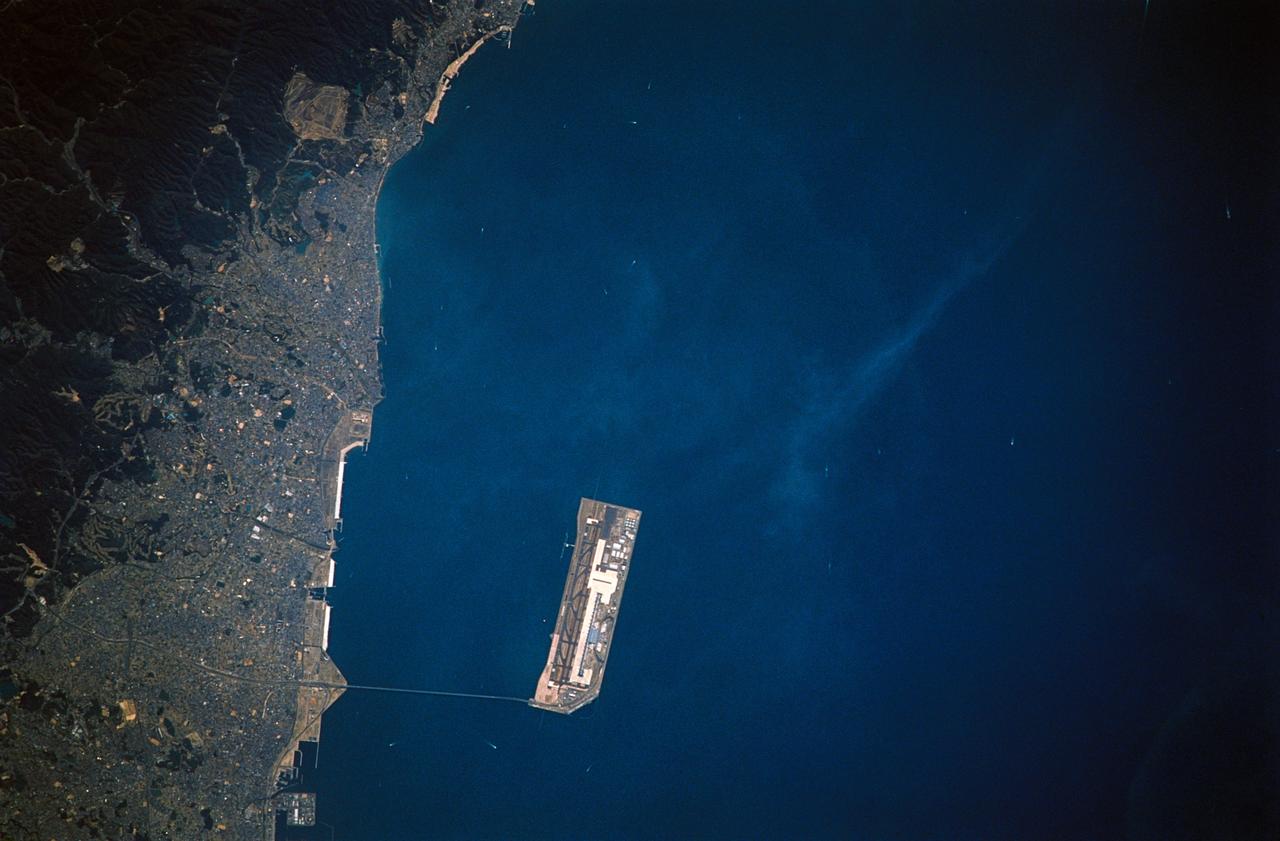
STS059-305-021 (9-20 April 1994) --- The floating airport at Osaka, Honshu, Japan. Nikon photograph, 300mm lens.
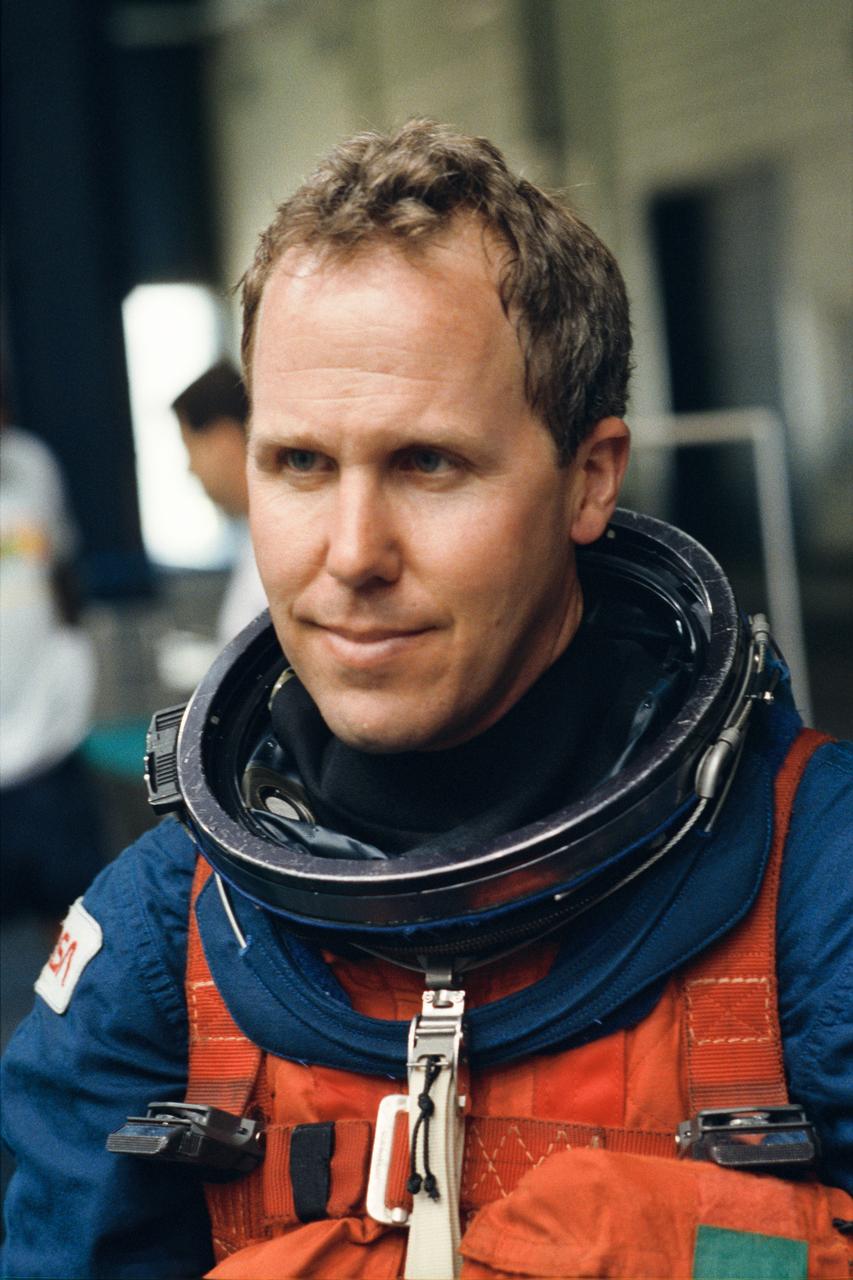
S93-43108 (2 June 1993) --- Astronaut Thomas D. Jones, mission specialist, takes a break during emergency bailout training at the Johnson Space Center's (JSC) Weightless Environment Training Facility (WET-F). Jones and five other NASA astronauts are scheduled to fly aboard the Space Shuttle Endeavour next year.
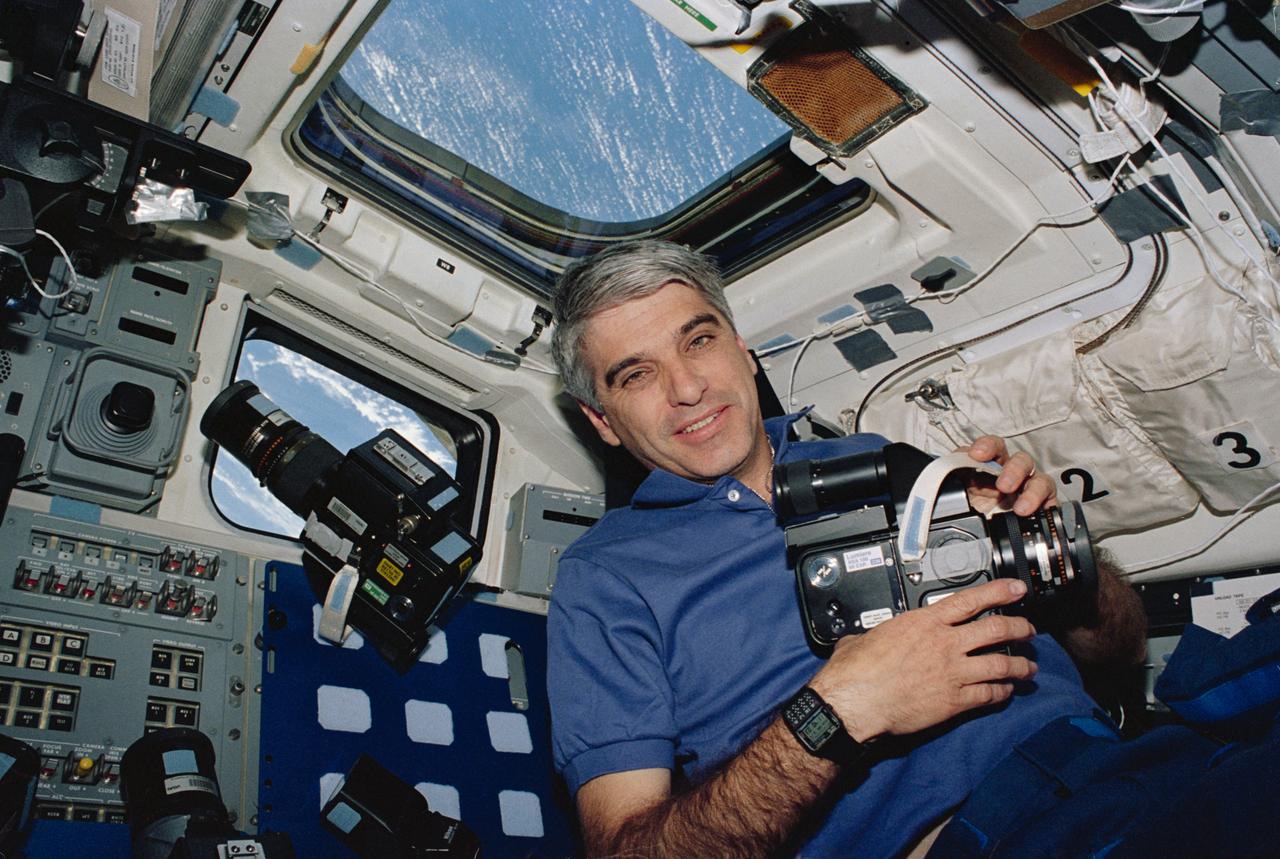
STS059-19-004 (9-20 April 1994) --- Astronaut Sidney M. Gutierrez, mission commander, pauses on the flight deck during Earth observations on the Space Shuttle Endeavour. Gutierrez, who was joined by five other NASA astronauts for 11-days in Earth orbit, holds a 70mm Hasselblad camera. The camera was one of several instruments used during the SRL mission to record an unprecedented compilation of data on planet Earth.
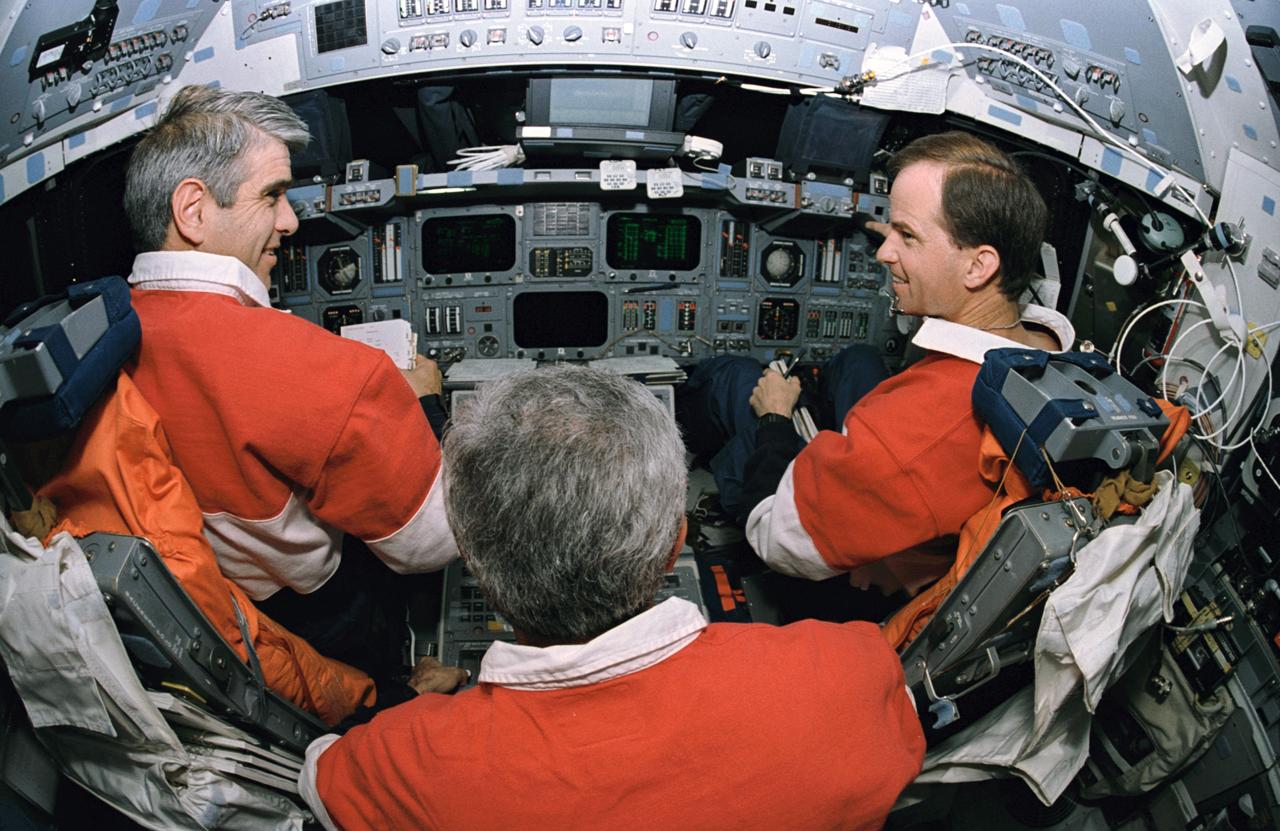
STS059-12-035 (9-20 April 1994) --- A 16mm lens on a 35mm camera provides a "fish-eye" effect for this rare scene on the Space Shuttle Endeavour's flight deck during checkout of the spacecraft's flight control systems. Astronauts Sidney M. Gutierrez (left) and Kevin P. Chilton (right) man the commander and pilot stations, respectively. Astronaut Michael R. (Rich) Clifford, the flight engineer, is seated behind the two. Not pictured are astronauts Linda M. Godwin, payload commander, and Jerome (Jay) Apt and Thomas D. Jones, both mission specialists.
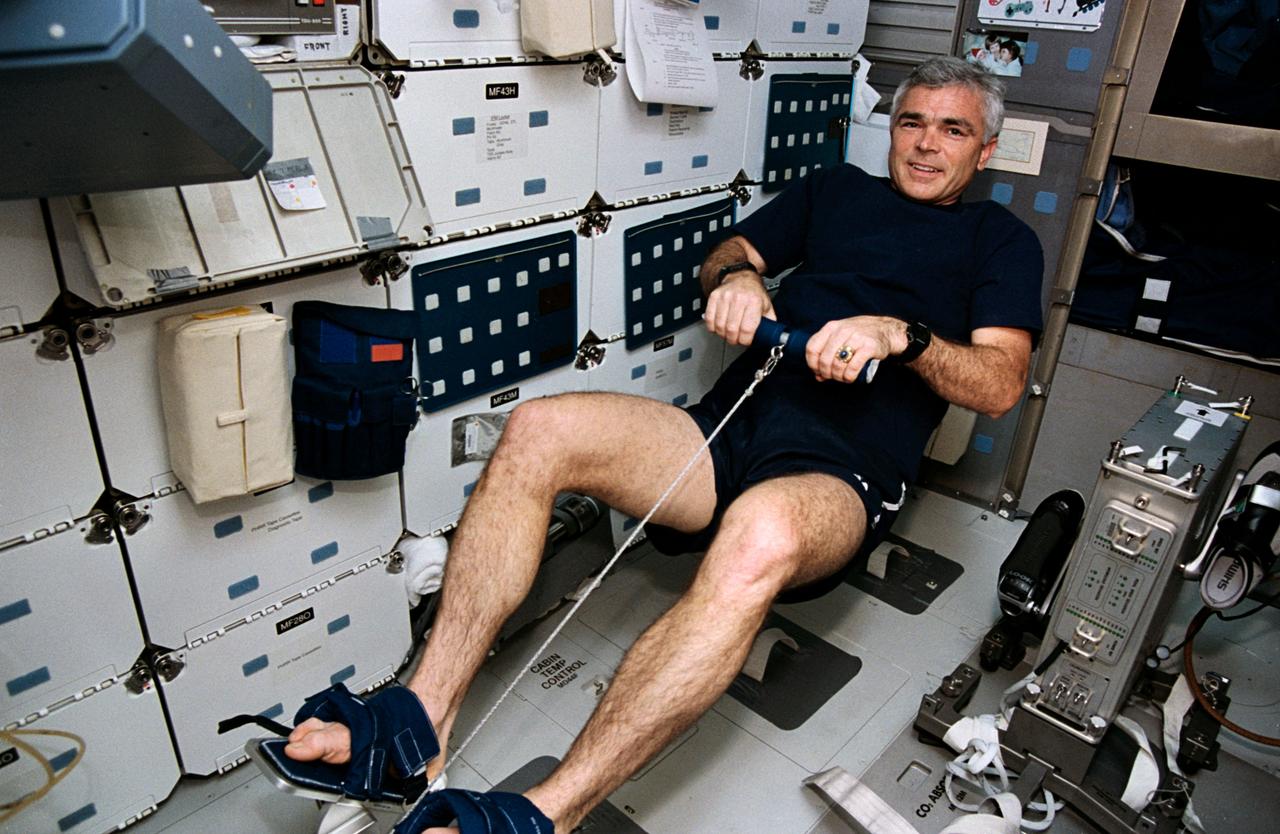
STS059-11-014 (9-20 April 1994) --- Astronaut Michael R. (Rich) Clifford, mission specialist, uses the rowing machine temporarily deployed on the Space Shuttle Endeavour's middeck. Many of the crew members put in time on the device during the week and a half mission.
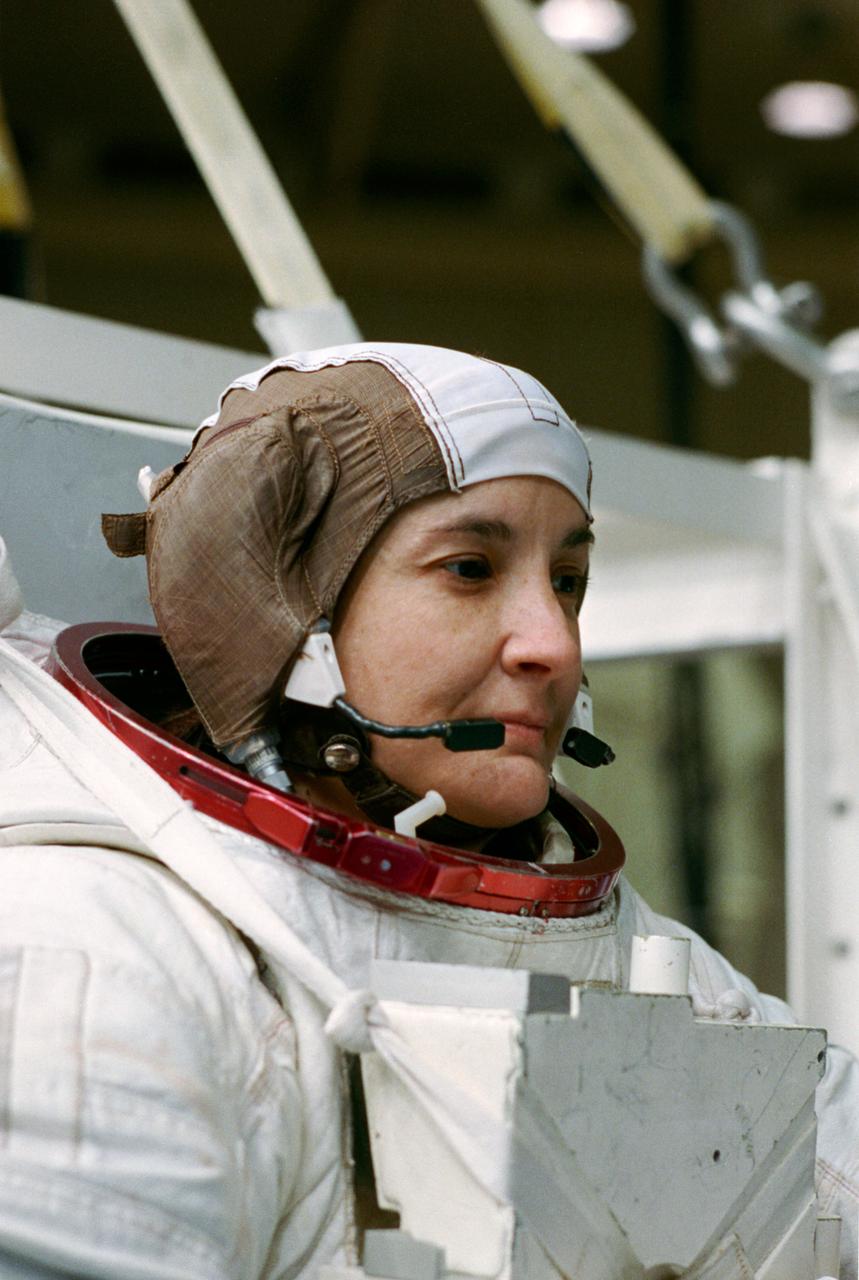
S93-41572 (17 Aug 1993) --- Astronaut Linda M. Godwin, payload commander, prepares to donn her helmet before being submerged in a 25-feet deep pool at the Johnson Space Center's (JSC) Weightless Environment Training Facility (WET-F). Astronauts Godwin and Thomas D. Jones, mission specialist, are using the WET-F to train for contingency space walks for their Space Shuttle Endeavour mission next year. No space walks are planned for the flight.
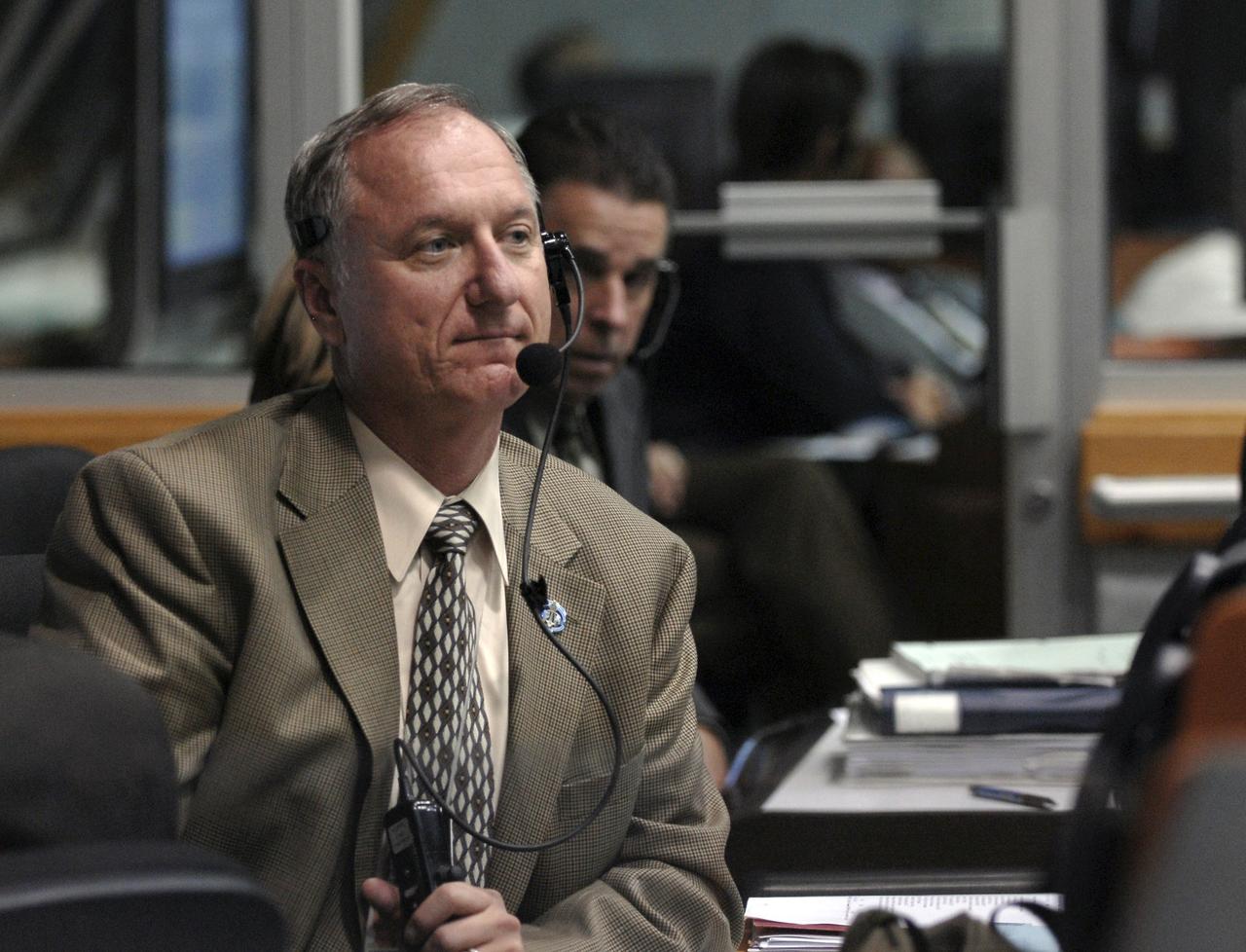
CAPE CANAVERAL, Fla. – In NASA Kennedy Space Center's Firing Room 4, STS-128 Launch Director Pete Nickolenko waits for the launch of space shuttle Discovery on the STS-128 mission. Liftoff from Launch Pad 39A was on time at 11:59 p.m. EDT. The first launch attempt on Aug. 24 was postponed due to unfavorable weather conditions. The second attempt on Aug. 25 also was postponed due to an issue with a valve in space shuttle Discovery's main propulsion system. The STS-128 mission is the 30th International Space Station assembly flight and the 128th space shuttle flight. The 13-day mission will deliver more than 7 tons of supplies, science racks and equipment, as well as additional environmental hardware to sustain six crew members on the International Space Station. The equipment includes a freezer to store research samples, a new sleeping compartment and the COLBERT treadmill. Photo credit: NASA/Kim Shiflett

KENNEDY SPACE CENTER, FLA. -- For the first time in Space Shuttle history, a fully stacked Shuttle - Atlantis - moves into high bay 2, on the west side of the Vehicle Assembly Building (VAB). The VAB and nearby rock-paved crawlerway have recently undergone major modifications to provide Shuttle fliglht hardware more storage space and protection - "Safe Haven" - from hurricanes or tropical storms. Atlantis begain moving out of VAB high bay 1 on the east side at 2:59 a.m. EDT. After the successful "Safe Haven" fit check, Shuttle Atlantis is scheduled to roll out to Launch Pad 39B in preparation for the STS-106 launch on Sept. 8.
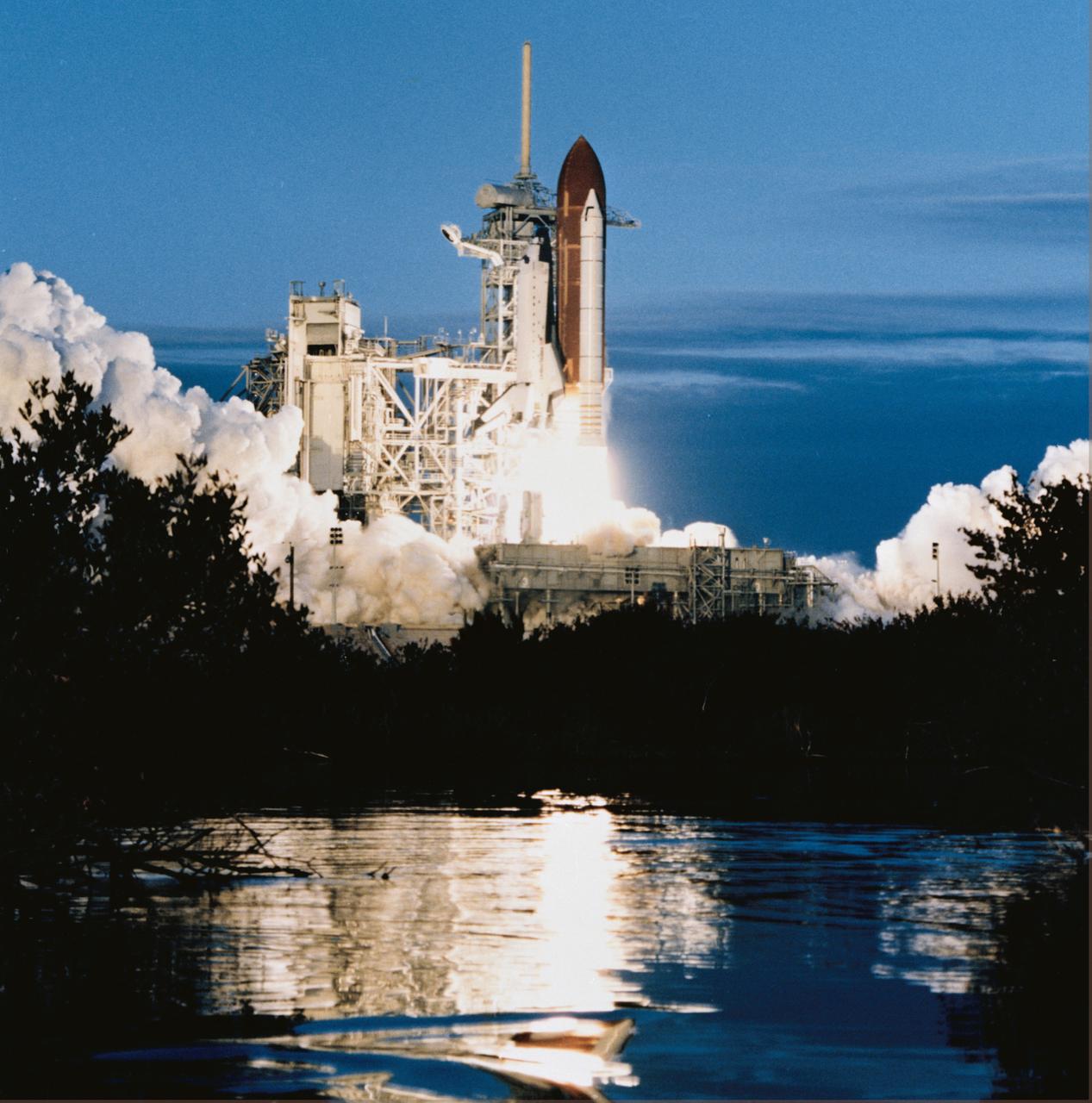
STS032-S-069 (9 Jan. 1990) --- The space shuttle Columbia, with a five member crew aboard, lifts off for the ninth time as STS-32 begins a 10-day mission in Earth orbit. Leaving from Launch Pad 39A at 7:34:59:98 a.m. EST, in this horizontal (cropped 70mm) frame, Columbia is seen reflected in nearby marsh waters some 24 hours after dubious weather at the return-to-launch site (RTLS) had cancelled a scheduled launch. Onboard the spacecraft were astronauts Daniel C. Brandenstein, James D. Wetherbee, Bonnie J. Dunbar, G. David Low and Marsha S. Ivins. Photo credit: NASA
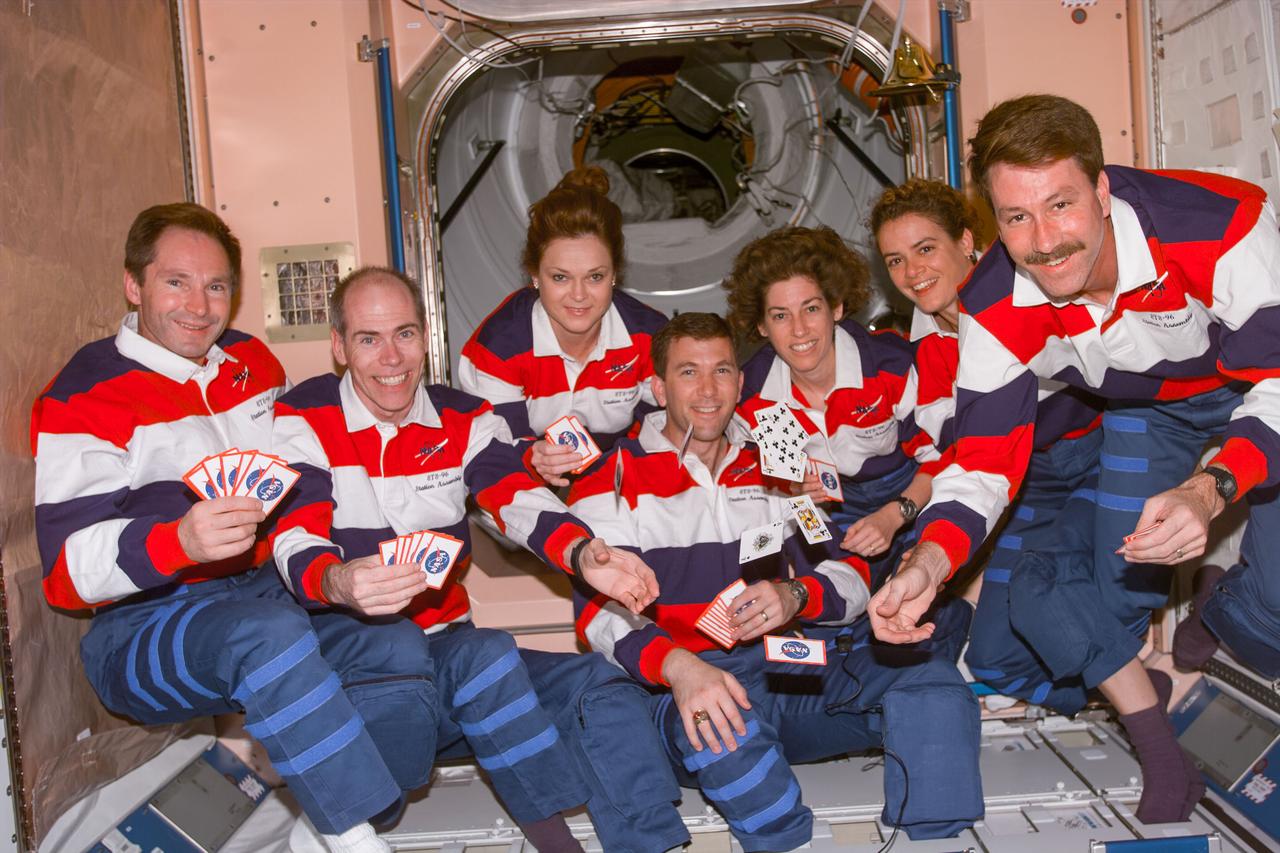
S96-E-5173 (2 June 1999) --- A pre-set electronic still camera (ESC) recorded this image of the STS-96 crewmembers playing cards on a break aboard the International Space Station (ISS). From the left are cosmonaut Valery I. Tokarev, Daniel T. Barry, Tamara E. Jernigan, Rick D. Husband, Ellen Ochoa, Julie Payette and Kent V. Rominger. Tokarev represents the Russian Space Agency (RSA) and Payette represents the Canadian Space Agency (CSA). The photograph was taken at 11:13:59 GMT, June 2, 1999.
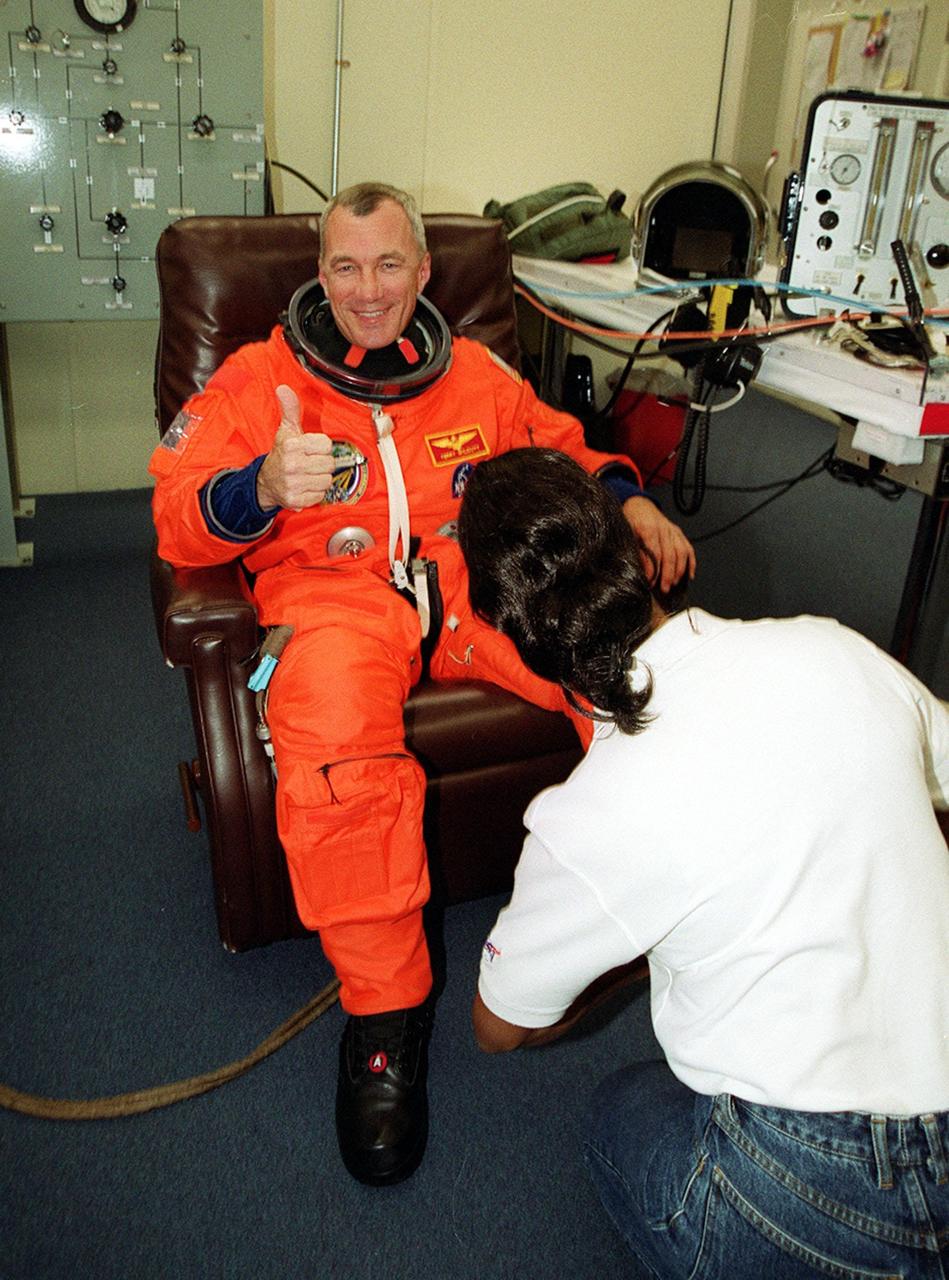
STS-106 Commander Terrence W. Wilcutt gives thumbs up for launch today as he gets help suiting up. This is Wilcutt’s fourth Shuttle flight. Space Shuttle Atlantis is set to lift off 8:45 a.m. EDT on the fourth flight to the International Space Station. During the 11-day mission, the seven-member crew will perform support tasks on orbit, transfer supplies and prepare the living quarters in the newly arrived Zvezda Service Module. The first long-duration crew, dubbed “Expedition One,” is due to arrive at the Station in late fall. Atlantis is scheduled to land at KSC Sept. 19 at 4:59 a.m. EDT
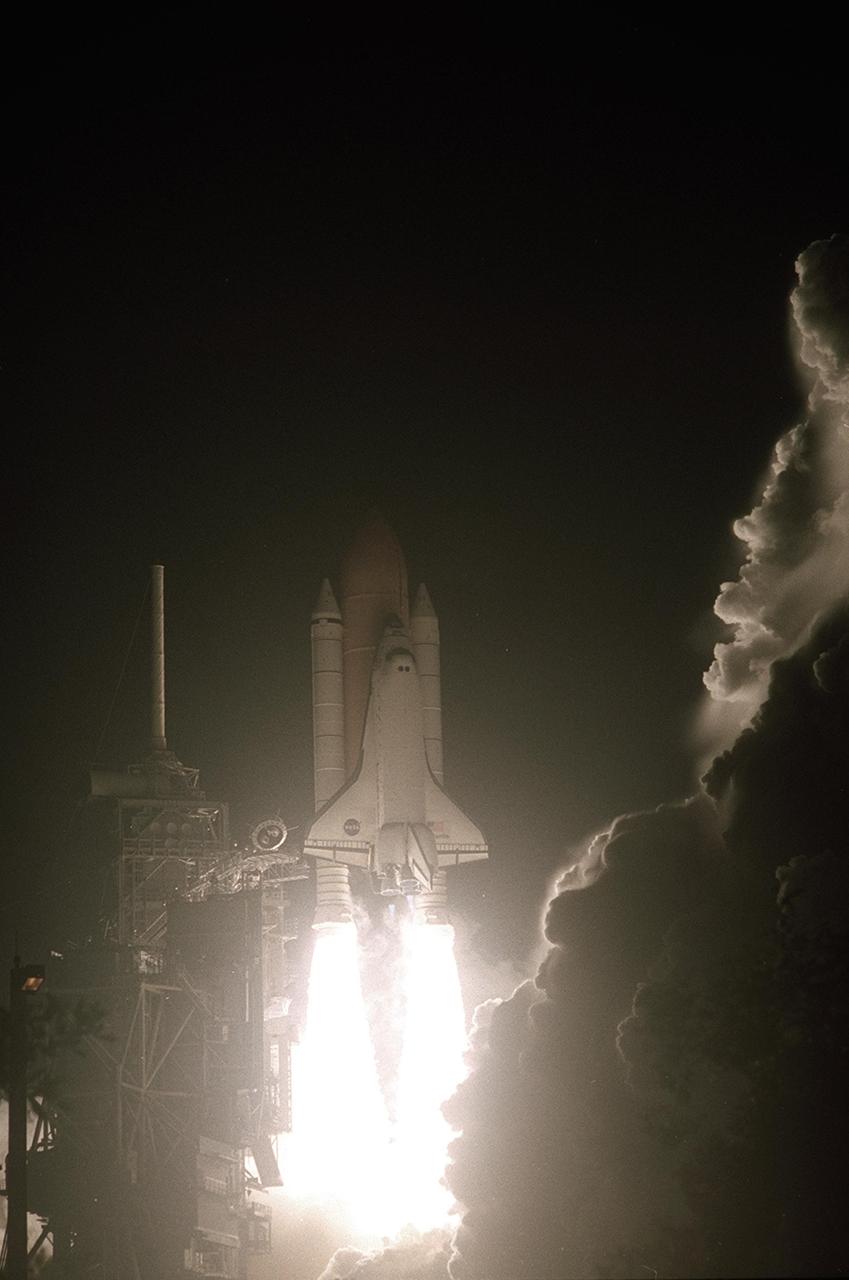
KENNEDY SPACE CENTER, Fla. -- Space Shuttle Atlantis appears to leap from a fiery ball as it hurtles into the pre-dawn sky on mission STS-104. Atlantis lifted off from Launch Pad 39B on time at 5:03:59 a.m. EDT. With a crew of five, it is heading on the 10th assembly flight to the International Space Station. The primary payload on the mission is the joint airlock module, which will require two spacewalks to attach it to the Space Station. The airlock will be the primary path for Space Station spacewalk entry and departure for U.S. spacesuits, and will also support the Russian Orlan spacesuit for EVA activity
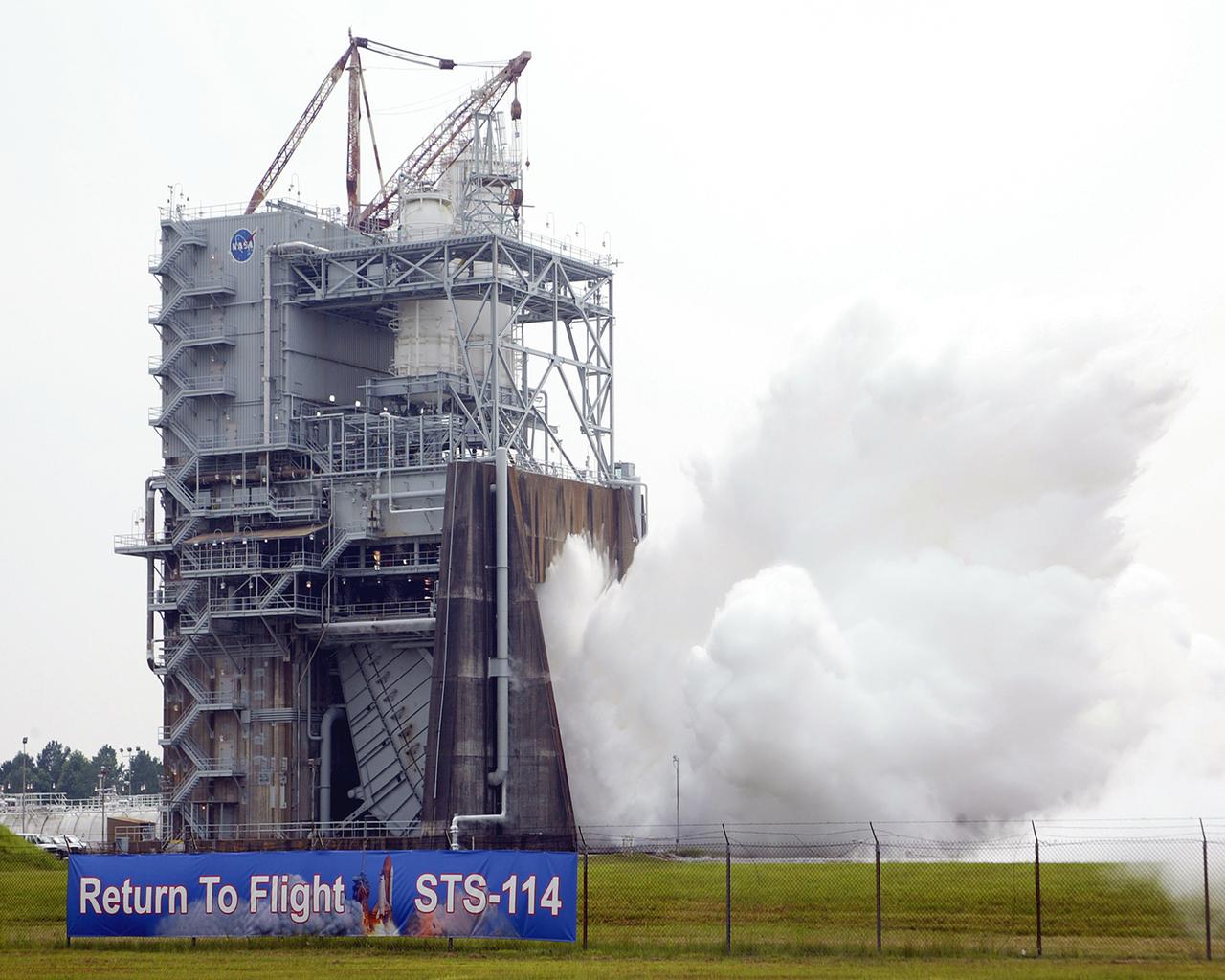
The Space Shuttle Main Engine (SSME) reached a historic milestone July 16, 2004, when a successful flight acceptance test was conducted at NASA Stennis Space Center (SSC). The engine tested today is the first complete engine to be tested and shipped in its entirety to Kennedy Space Center for installation on Space Shuttle Discovery for STS-114, NASA's Return to Flight mission. The engine test, which began about 3:59 p.m. CDT, ran for 520 seconds (8 minutes), the length of time it takes for the Space Shuttle to reach orbit.
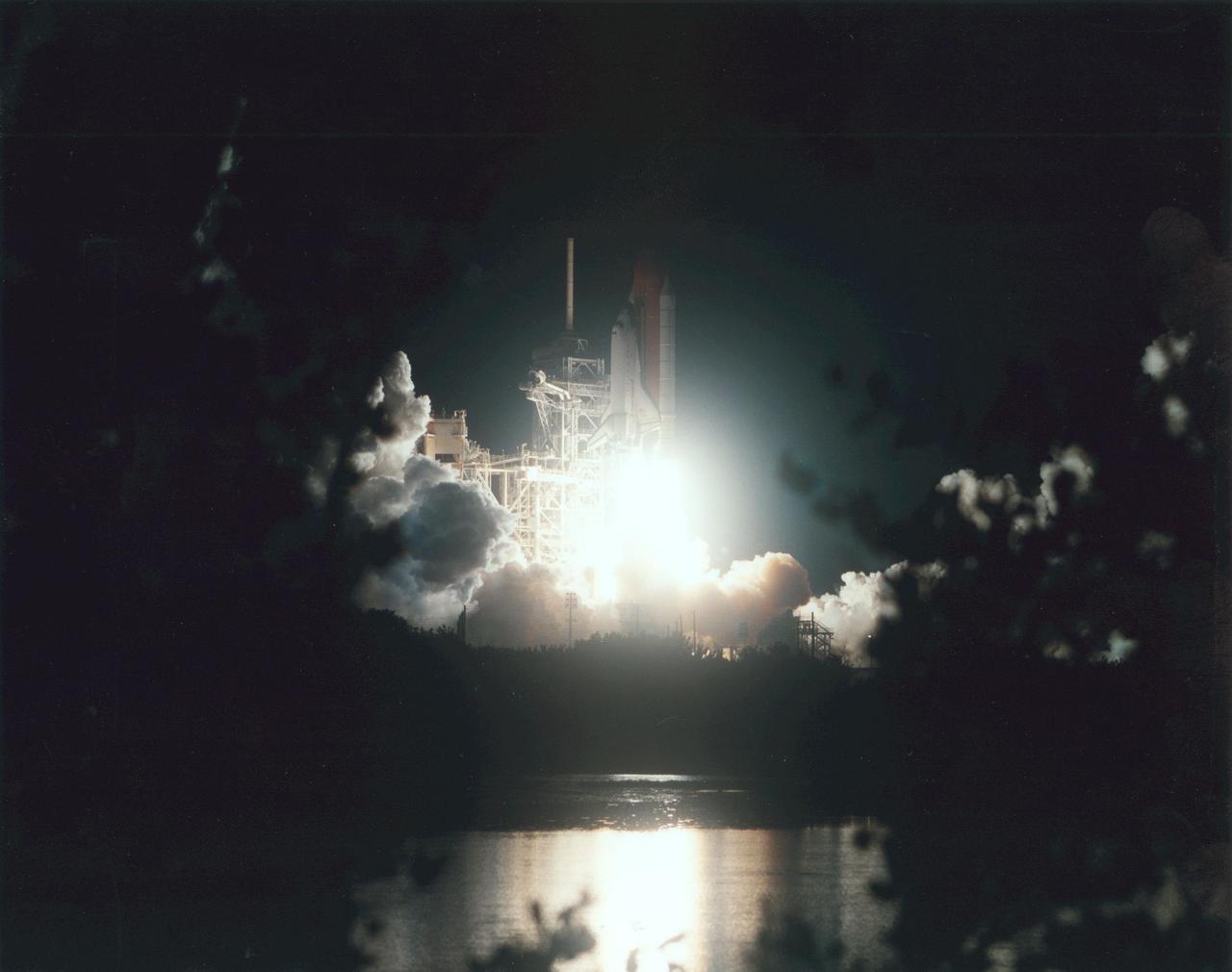
KENNEDY SPACE CENTER, Fla. -- Space Shuttle Atlantis lifts off in a blaze of light that spotlights it against the still-black sky and reflects in the nearby waters. Launch of Atlantis on mission STS-104 from Pad 39B was on time at 5:03:59 a.m. EDT. The 10th assembly flight to the International Space Station, the mission is delivering the joint airlock module, which will require two spacewalks to attach it to the Space Station. The airlock will be the primary path for Space Station spacewalk entry and departure for U.S. spacesuits, and will also support the Russian Orlan spacesuit for EVA activity
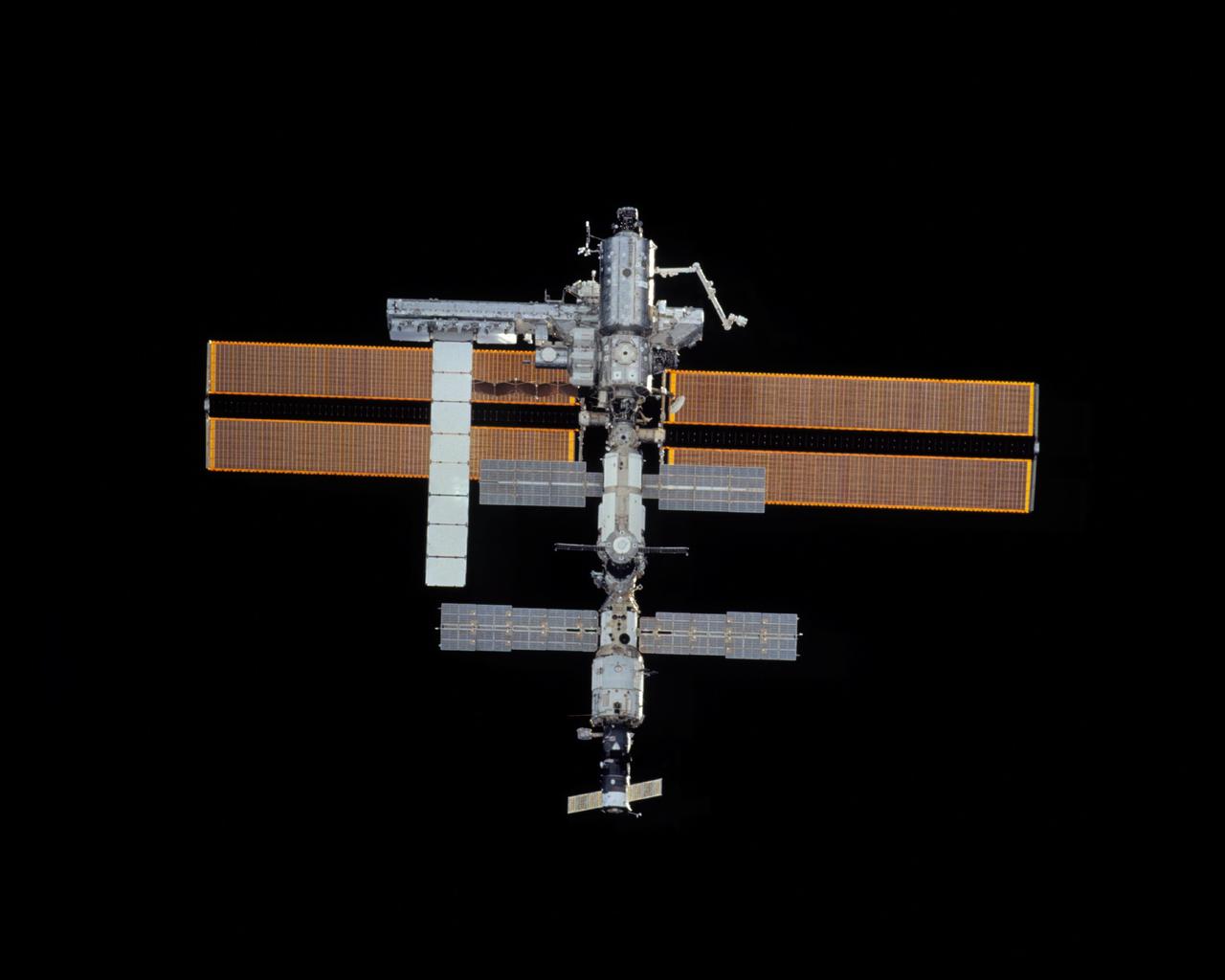
STS113-701-049 (25 November 2002) --- Backdropped by the blackness of space, the International Space Station (ISS) was photographed by a crewmember aboard the Space Shuttle Endeavour during rendezvous and docking operations. Endeavour docked with the station at 3:59 p.m. (CST) on November 25, 2002, bringing a new crew and another segment of the station's backbone, the Port One (P1) segment of the Integrated Truss System. The rendezvous and docking of Endeavour with astronaut James D. Wetherbee, STS-113 mission commander, at the controls, occurred about 248 statute miles above the South Pacific off the southeastern coast of Australia.

KENNEDY SPACE CENTER, Fla. -- Billows of smoke and steam half frame Space Shuttle Atlantis as it roars into the still-black sky before dawn. At left can be seen the top of the lightning mast on Launch Pad 39B. Launch on mission STS-104 was on time at 5:03:59 a.m. EDT. The 10th assembly flight to the International Space Station, the mission is delivering the joint airlock module, which will require two spacewalks to attach it to the Space Station. The airlock will be the primary path for Space Station spacewalk entry and departure for U.S. spacesuits, and will also support the Russian Orlan spacesuit for EVA activity
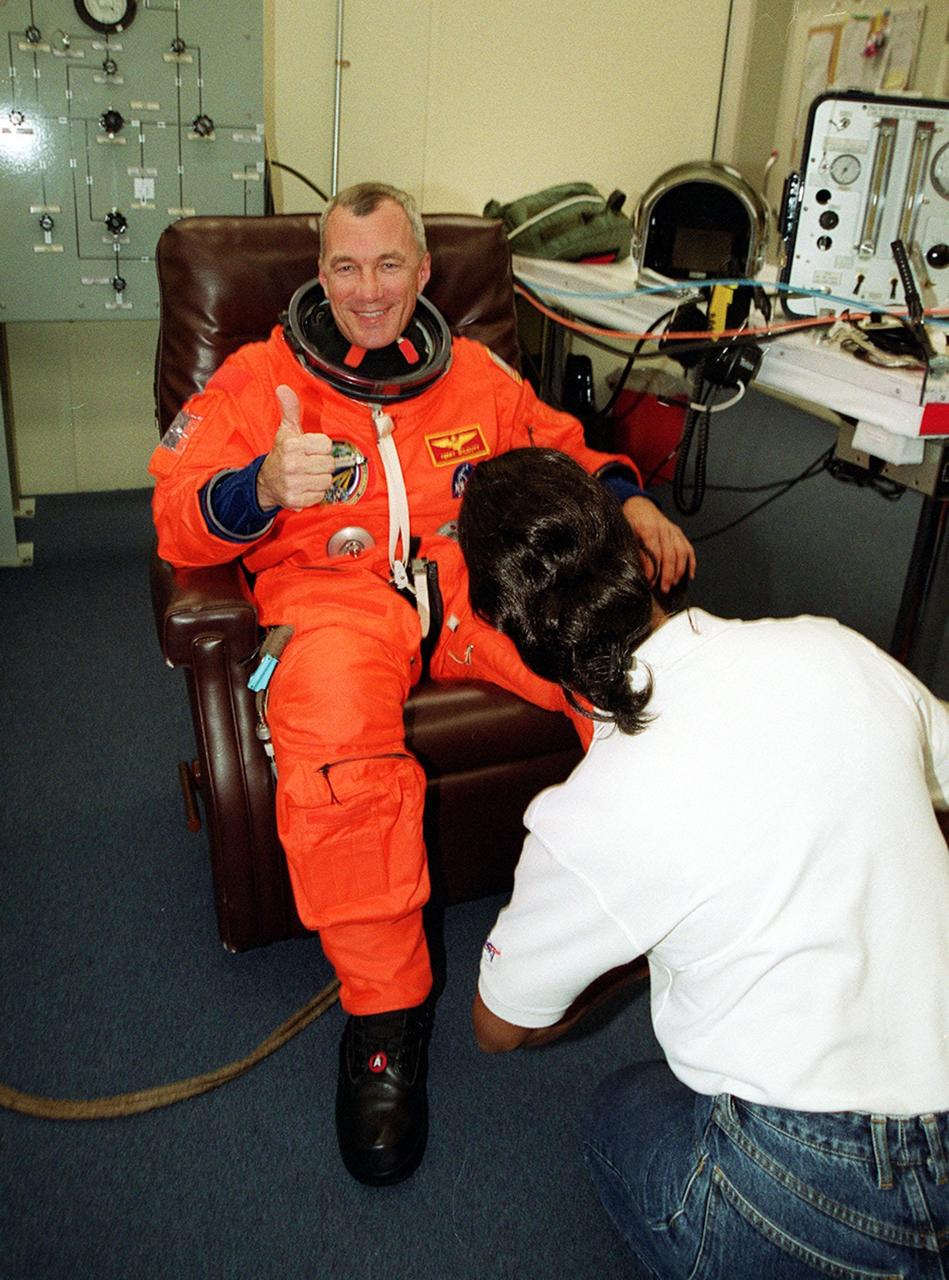
STS-106 Commander Terrence W. Wilcutt gives thumbs up for launch today as he gets help suiting up. This is Wilcutt’s fourth Shuttle flight. Space Shuttle Atlantis is set to lift off 8:45 a.m. EDT on the fourth flight to the International Space Station. During the 11-day mission, the seven-member crew will perform support tasks on orbit, transfer supplies and prepare the living quarters in the newly arrived Zvezda Service Module. The first long-duration crew, dubbed “Expedition One,” is due to arrive at the Station in late fall. Atlantis is scheduled to land at KSC Sept. 19 at 4:59 a.m. EDT
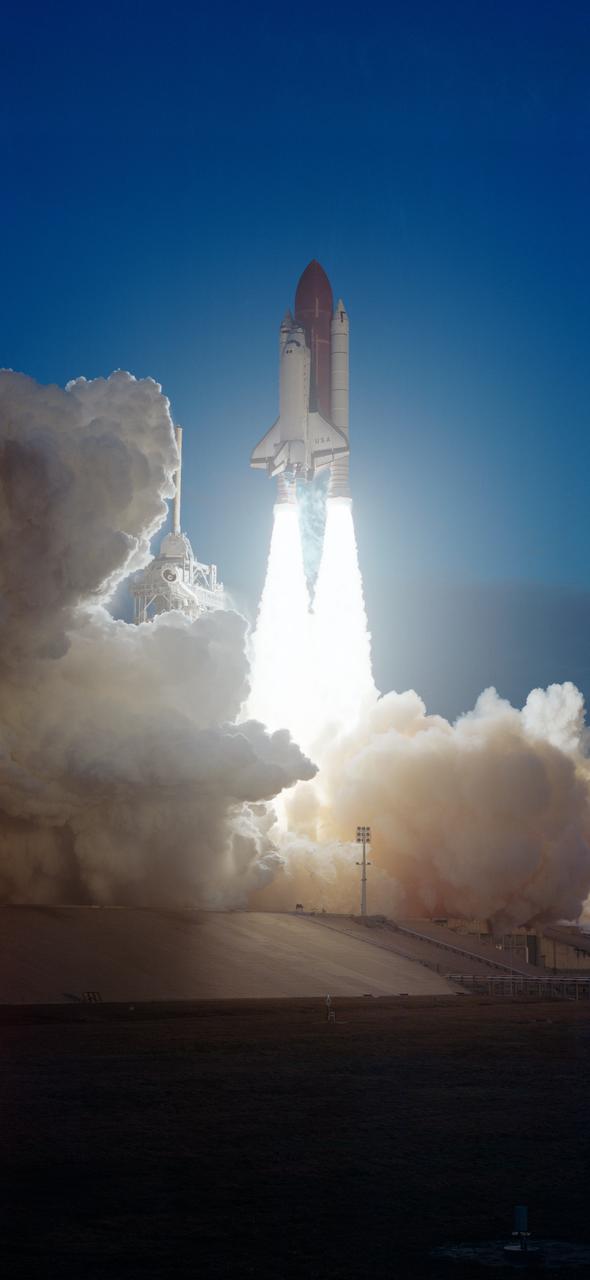
STS-32 Columbia, Orbiter Vehicle (OV) 102, atop the external tank (ET) and flanked by two solid rocket boosters (SRBs) rises above the mobile launcher platform and is nearly clear of the fixed service structure (FSS) tower at Kennedy Space Center (KSC) Launch Complex (LC) Pad 39A. Plumes of smoke billow from the SRBs and cover the launch pad in a cloud. Liftoff occurred at 7:34:59:98 am Eastern Standard Time (EST) some 24 hours after dubious weather at the return-to-landing site (RTLS) had cancelled a scheduled launch. OV-102's launch is highlighted against the early morning darkness.