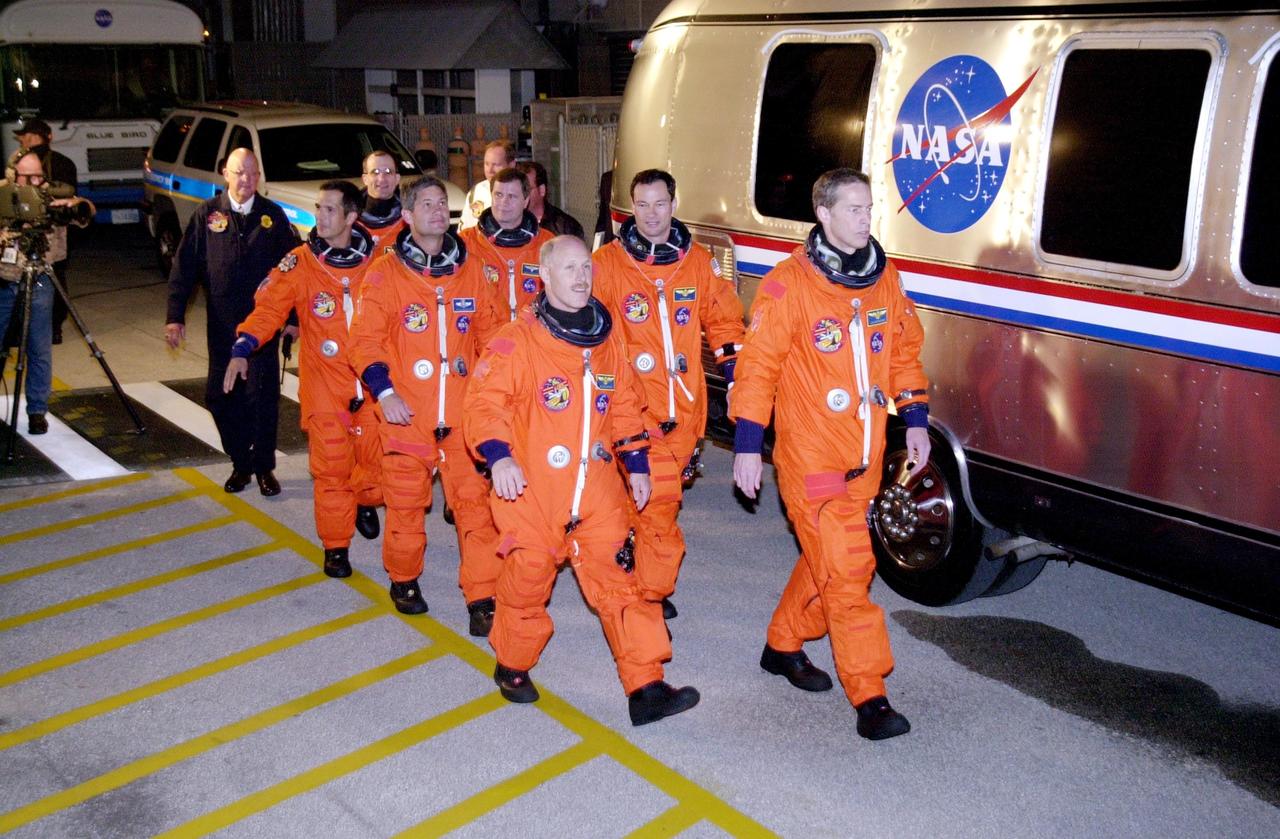
KENNEDY SPACE CENTER, FLA. -- The STS-113 and Expedition 6 crews head for the Astrovan that will take them to Launch Pad 39A and Space Shuttle Endeavour. In the foreground, from left to right, are Mission Specialist John Herrington, Pilot Paul Lockhart and Expedition 6 Commander Ken Bowersox. In the back, from left to right, are Expedition 6 flight engineers Donald Pettit and Nikolai Budarin, Mission Specialist Michael Lopez-Alegria and Commander James Wetherbee. The primary mission is bringing the Expedition 6 crew to the Station and returning the Expedition 5 crew to Earth. The major objective of the mission is delivery of the Port 1 (P1) Integrated Truss Assembly, which will be attached to the port side of the S0 truss. Three spacewalks are planned to install and activate the truss and its associated equipment. Launch of Space Shuttle Endeavour on mission STS-113 is scheduled for Nov. 11 at 12:58 a.m. EST.
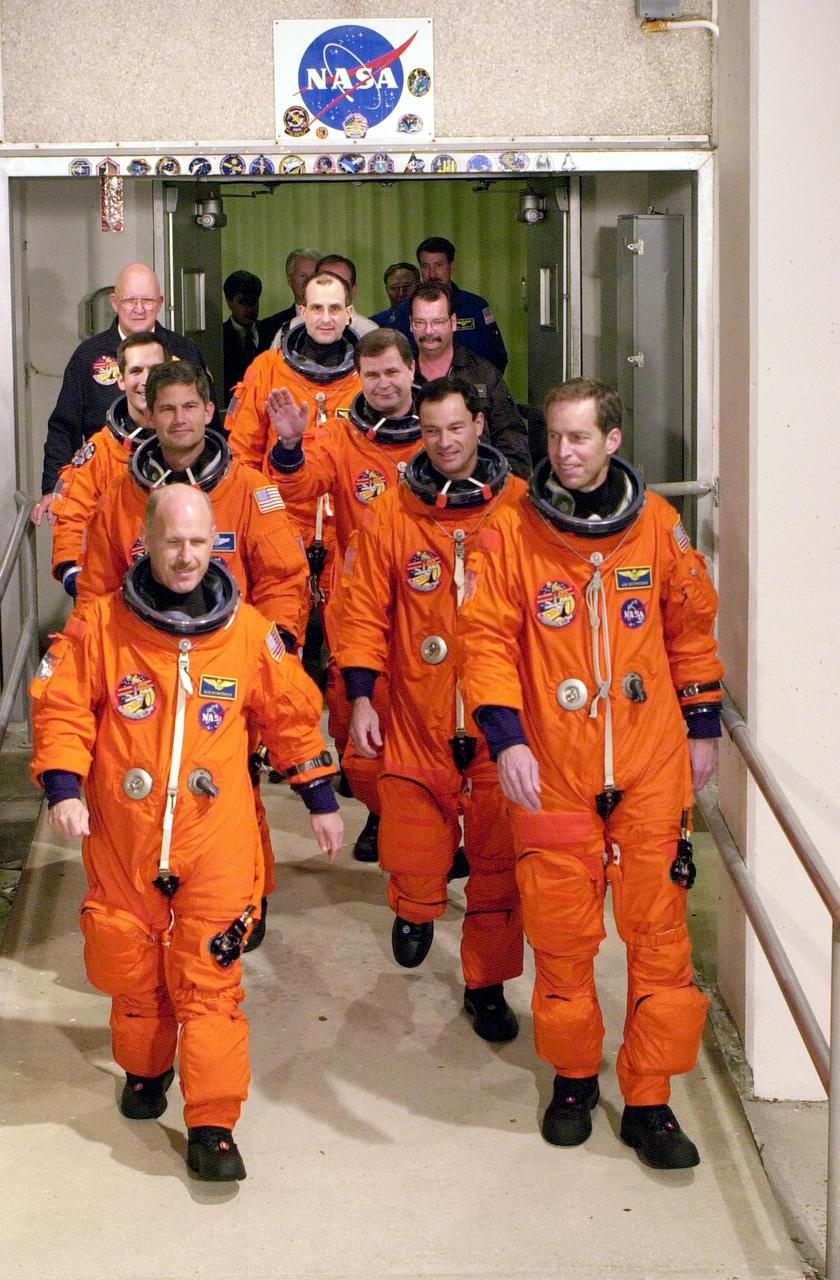
KENNEDY SPACE CENTER, FLA. - The STS-113 and Expedition 6 crews exit the Operations and Checkout Building on their way to Launch Pad 39A and liftoff of Space Shuttle Endeavour. From front to back are Expedition 6 Commander Ken Bowersox and Mission Commander James Wetherbee; Pilot Paul Lockhart and Mission Specialist Michael Lopez-Alegria; Mission Specialist John Herrington and Expedition 6 flight engineer Nikolai Budarin; and flight engineer Donald Pettit. The primary mission is bringing the Expedition 6 crew to the Station and returning the Expedition 5 crew to Earth. The major objective of the mission is delivery of the Port 1 (P1) Integrated Truss Assembly, which will be attached to the port side of the S0 truss. Three spacewalks are planned to install and activate the truss and its associated equipment. Launch of Space Shuttle Endeavour on mission STS-113 is scheduled for Nov. 11 at 12:58 a.m. EST.

KENNEDY SPACE CENTER, FLA. - Expedition 6 flight engineer Nikolai Budarin gets help with his helmet during suitup for launch on mission STS-113. Budarin, who represents the Russian Space Agency, will be making his second Shuttle flight. The primary mission is bringing the Expedition 6 crew to the Station and returning the Expedition 5 crew to Earth. The major objective of the mission is delivery of the Port 1 (P1) Integrated Truss Assembly, which will be attached to the port side of the S0 truss. Three spacewalks are planned to install and activate the truss and its associated equipment. Launch of Space Shuttle Endeavour on mission STS-113 is scheduled for Nov. 11 at 12:58 a.m. EST.
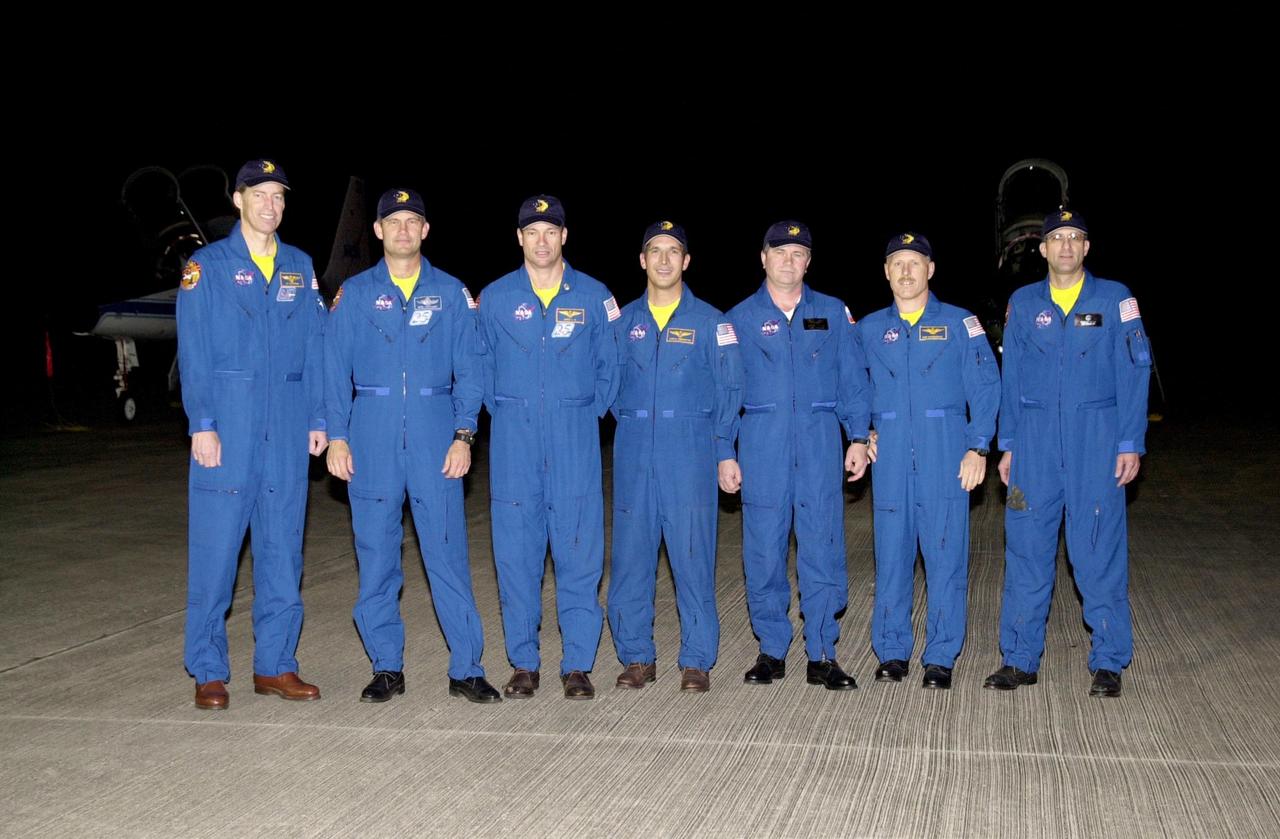
KENNEDY SPACE CENTER, FLA. - After their arrival at the KSC Shuttle Landing Facility, the crews of mission STS-113 pause for a group photo. From left are STS-113 Commander James Wetherbee, Pilot Paul Lockhart, and Mission Specialists Michael Lopez-Alegria and John Herrington; and the Expedition 6 crew, Flight Engineer Nikolai Budarin, Commander Ken Bowersox and Flight Engineer Donald Pettit. Budarin represents the Russian Space Agency. The primary mission of STS-113 is bringing the Expedition 6 crew to the Station and returning the Expedition 5 crew to Earth. In addition, the major objective of the mission is delivery of the Port 1 (P1) Integrated Truss Assembly, which will be attached to the port side of the S0 truss. Three spacewalks are planned to install and activate the truss and its associated equipment. Launch of Space Shuttle Endeavour on mission STS-113 is scheduled for Nov. 11 between midnight and 4 a.m. EST.
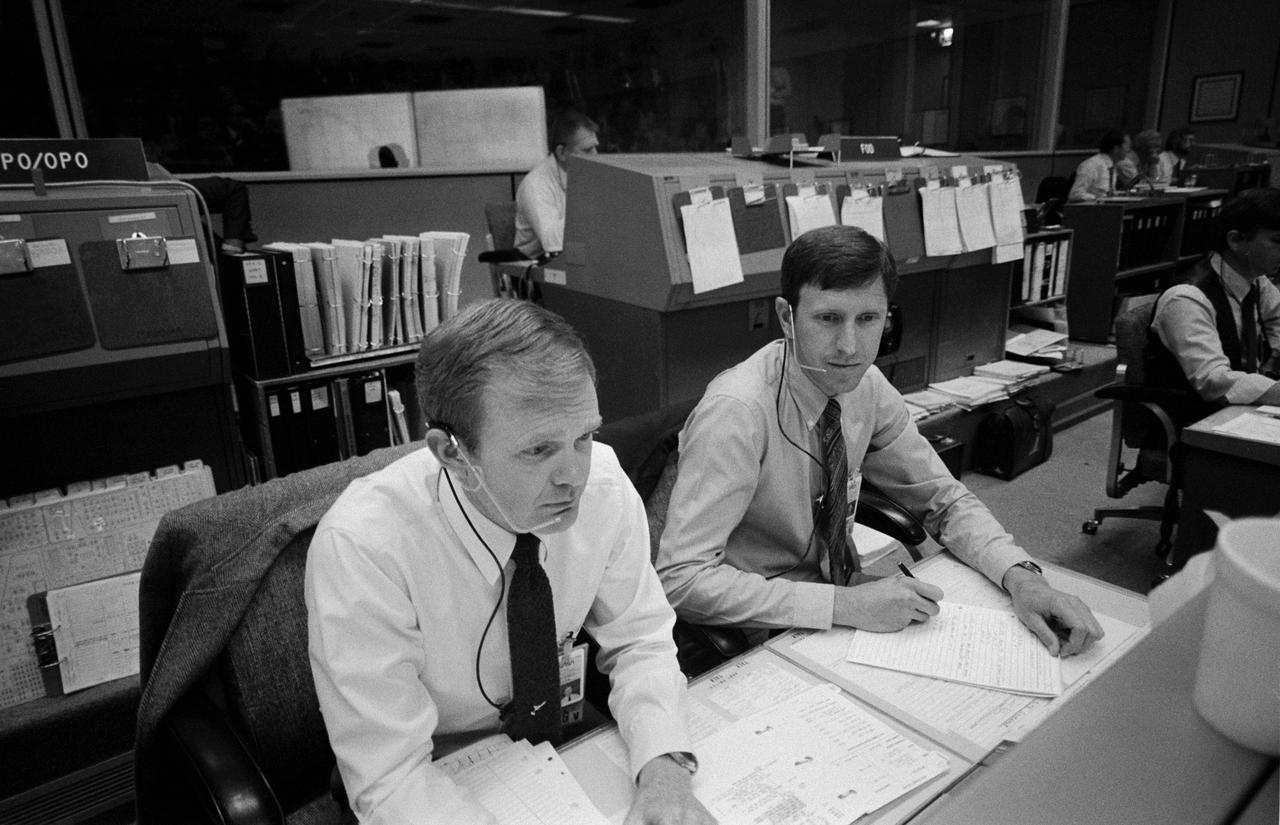
Astronauts Roy D. Bridges (left) and RIchard O. Covey serve as spacecraft communicators (CAPCOM) for STS-6. They are seated at the CAPCOM console in the mission operations control room (MOCR) of JSC's mission control center (30119); Flight Director Jay H. Greene communicates with a nearby flight controller in the MOCR just after launch of the Challenger (30120).
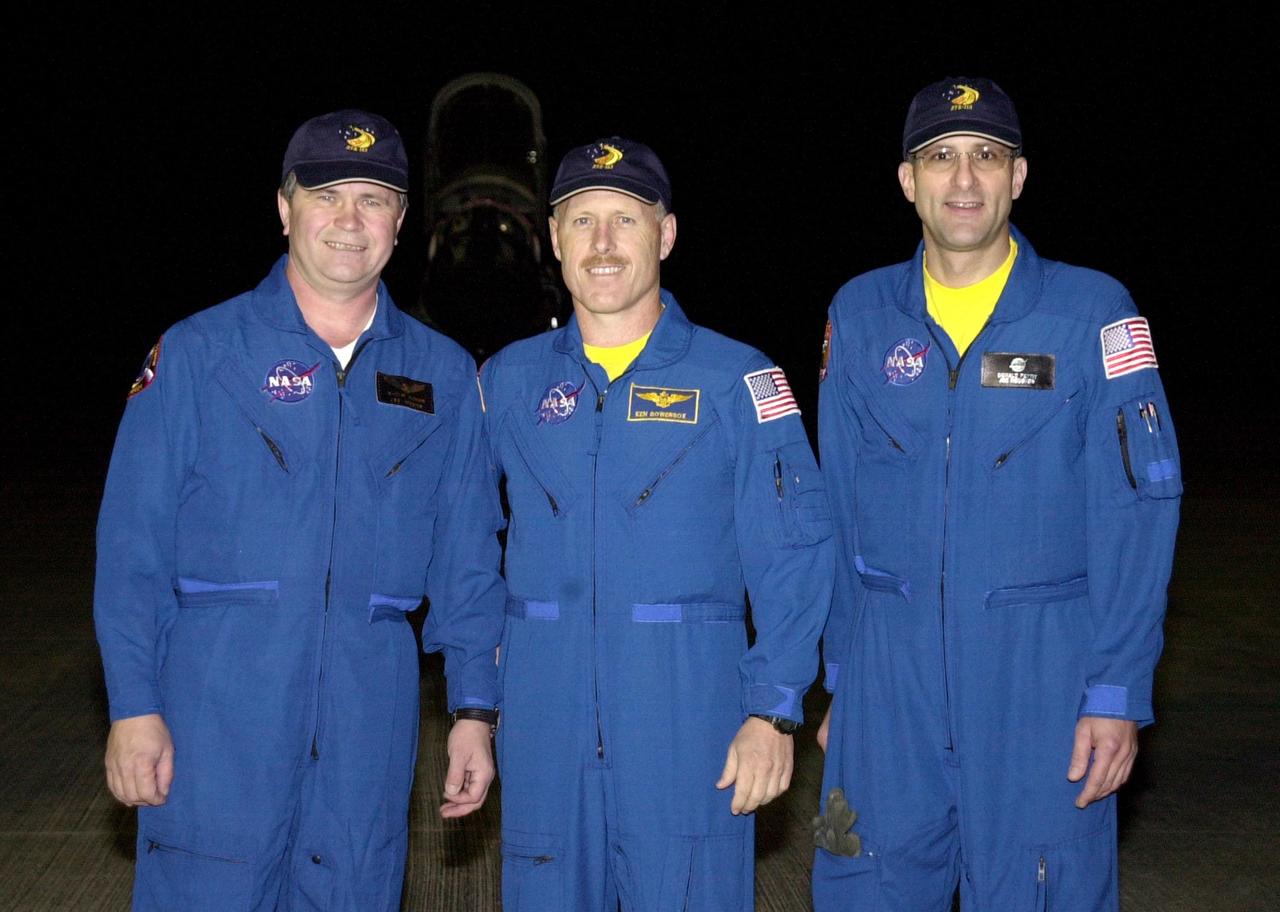
KENNEDY SPACE CENTER, FLA. -- The Expedition 6 crew poses for a photo after their arrival at the KSC Shuttle Landing Facility to prepare for launch on mission STS-113. From left are Flight Engineer Nikolai Budarin, Commander Ken Bowersox and Flight Engineer Donald Pettit. The primary mission of STS-113 is bringing the Expedition 6 crew to the Station and returning the Expedition 5 crew to Earth. In addition, the major objective of the mission is delivery of the Port 1 (P1) Integrated Truss Assembly, which will be attached to the port side of the S0 truss. Three spacewalks are planned to install and activate the truss and its associated equipment. Launch of Space Shuttle Endeavour on mission STS-113 is scheduled for Nov. 11 between midnight and 4 a.m. EST.
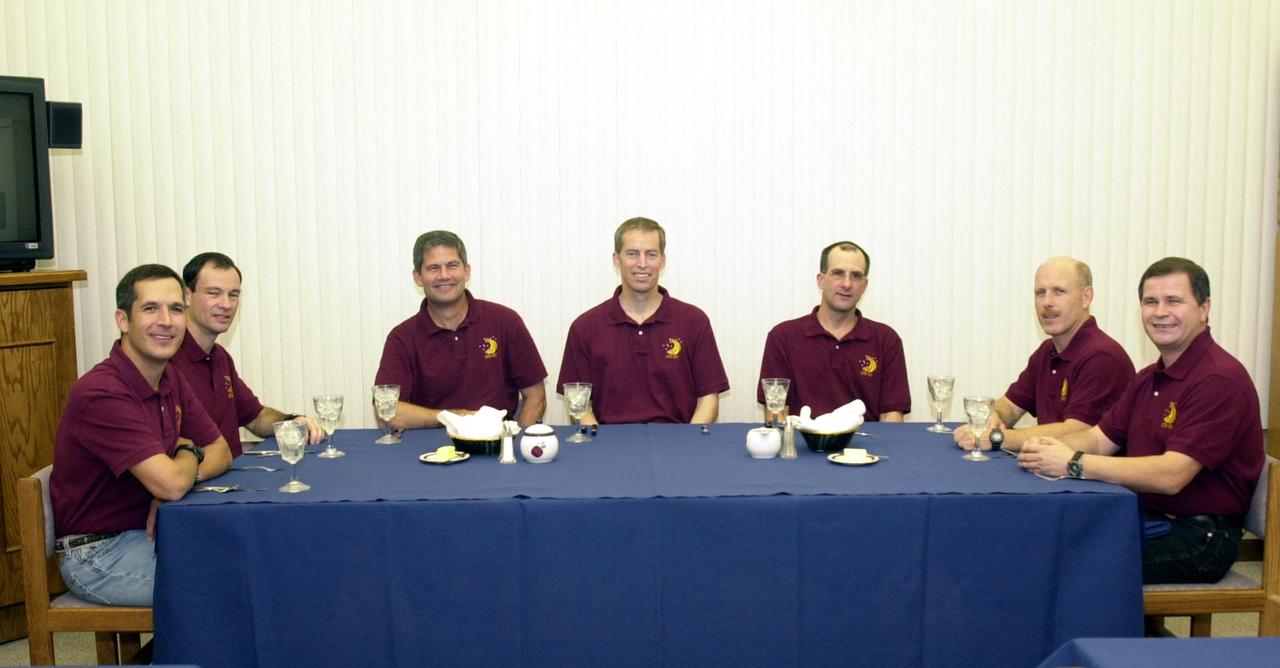
KENNEDY SPACE CENTER, FLA. -- The STS-113 crew enjoys a snack before suiting up for launch. Seated left to right are Mission Specialists John Herrington and Michael Lopez-Alegria, Pilot Paul Lockhart and Commander James Wetherbee; Expedition 6 flight engineer Donald Pettit, Commander Ken Bowersox and flight engineer Nikolai Budarin. STS-113 is the 16th American assembly flight to the International Space Station. The primary mission is bringing the Expedition 6 crew to the Station and returning the Expedition 5 crew to Earth. The major objective of the mission is delivery of the Port 1 (P1) Integrated Truss Assembly, which will be attached to the port side of the S0 truss. Three spacewalks are planned to install and activate the truss and its associated equipment. Launch of Space Shuttle Endeavour on mission STS-113 is scheduled for Nov. 11 at 12:58 a.m. EST.
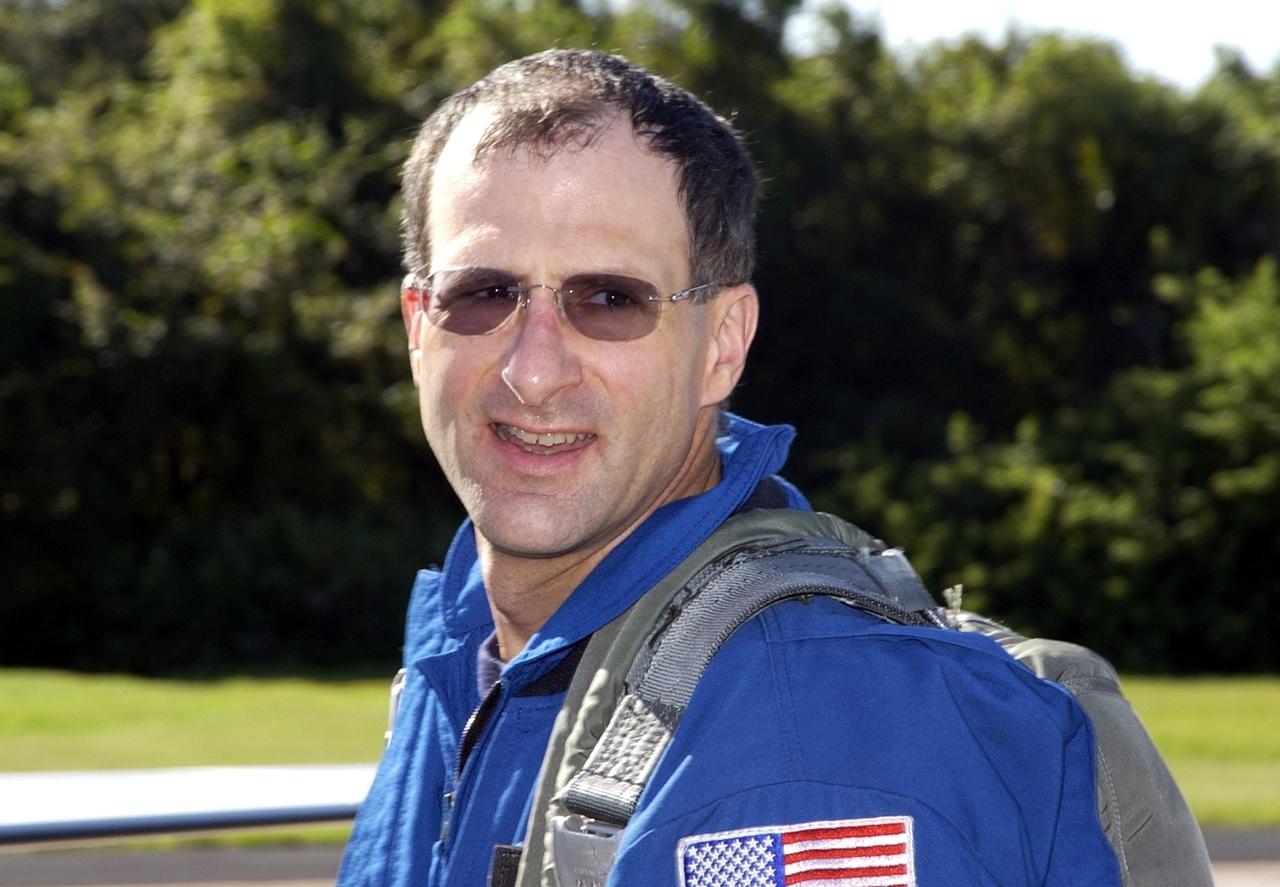
KENNEDY SPACE CENTER, FLA. -- Astronaut Donald Pettit, a member of the Expedition 6 crew, arrives at KSC for Terminal Countdown Demonstration Test activities. Expedition 6 will fly on Space Shuttle Endeavour to the International Space Station on mission STS-113. They will relieve and replace the Expedition 5 crew. Endeavour will also be transporting the Port 1 (P1) truss segment to the Station. STS-113 is scheduled to launch Nov. 10, 2002.
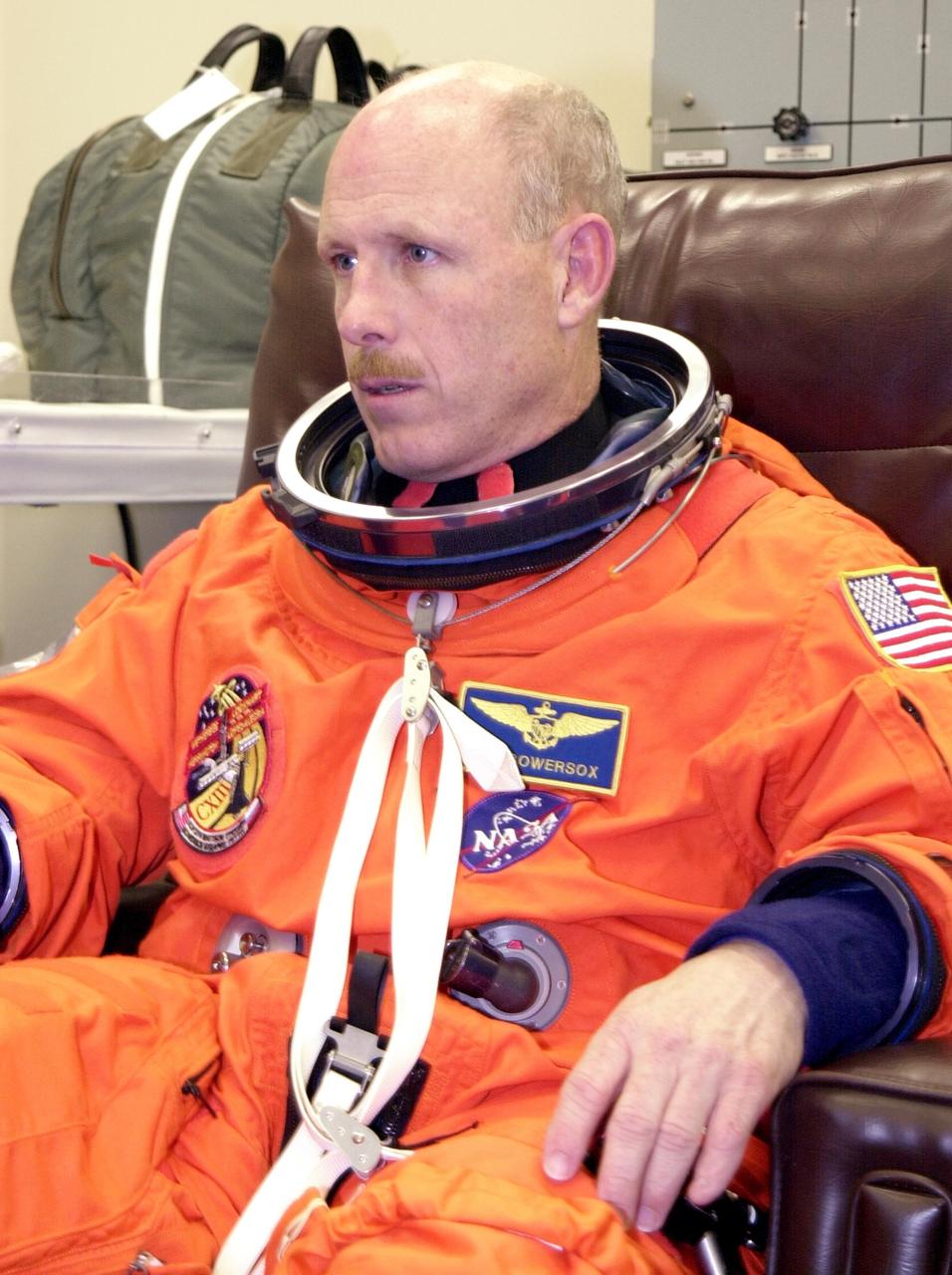
KENNEDY SPACE CENTER, FLA. -- Expedition 6 Commander Ken Bowersox suits up before launch. Bowersox will be making his fifth Shuttle flight. The primary mission is bringing the Expedition 6 crew to the Station and returning the Expedition 5 crew to Earth. The major objective of the mission is delivery of the Port 1 (P1) Integrated Truss Assembly, which will be attached to the port side of the S0 truss. Three spacewalks are planned to install and activate the truss and its associated equipment. Launch of Space Shuttle Endeavour on mission STS-113 is scheduled for Nov. 11 at 12:58 a.m. EST.
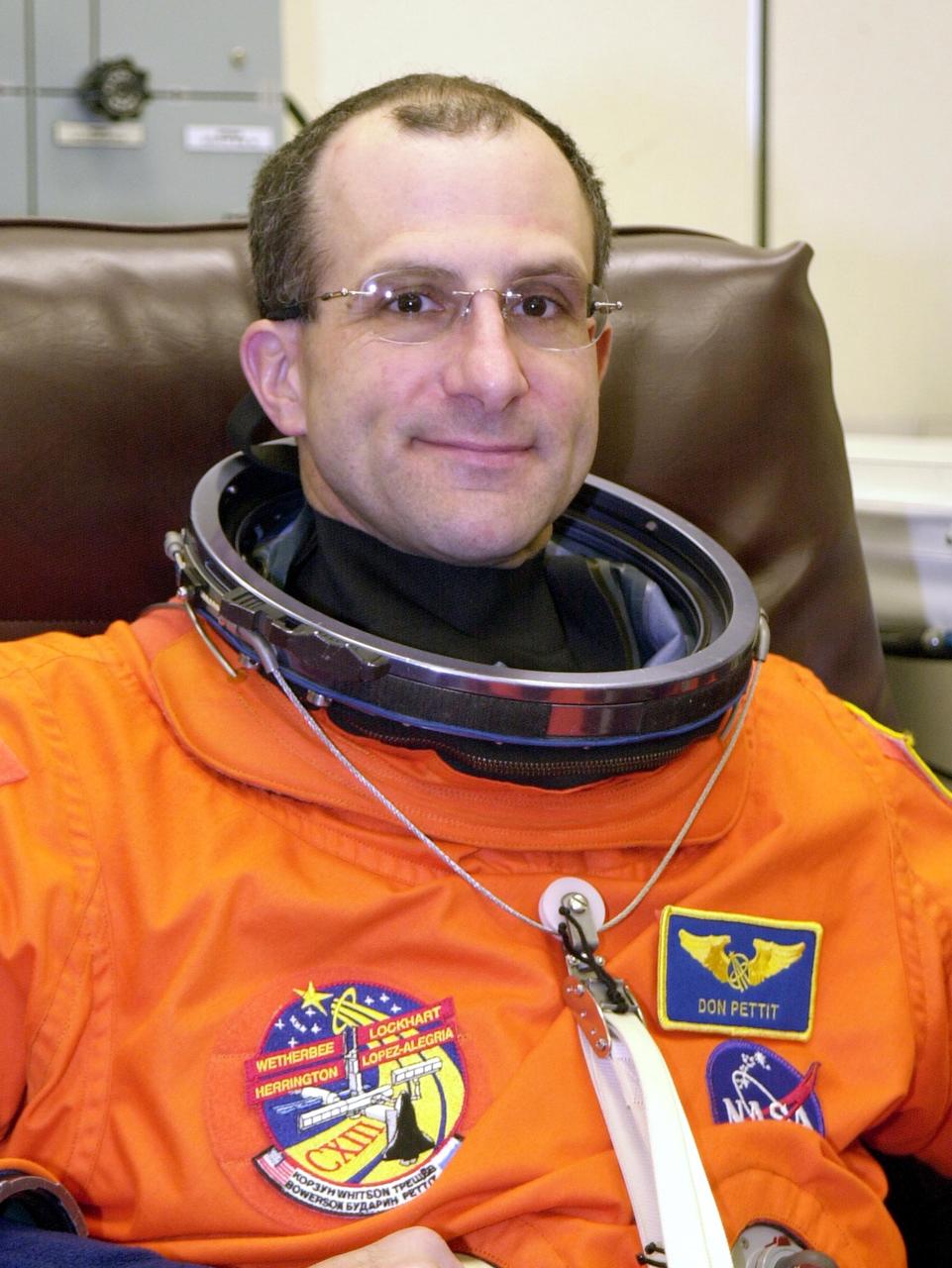
KENNEDY SPACE CENTER, FLA. - Expedition 6 flight engineer Donald Pettit suits up before launch. This will be his first Shuttle flight. The primary mission is bringing the Expedition 6 crew to the Station and returning the Expedition 5 crew to Earth. The major objective of the mission is delivery of the Port 1 (P1) Integrated Truss Assembly, which will be attached to the port side of the S0 truss. Three spacewalks are planned to install and activate the truss and its associated equipment. Launch of Space Shuttle Endeavour on mission STS-113 is scheduled for Nov. 11 at 12:58 a.m. EST.
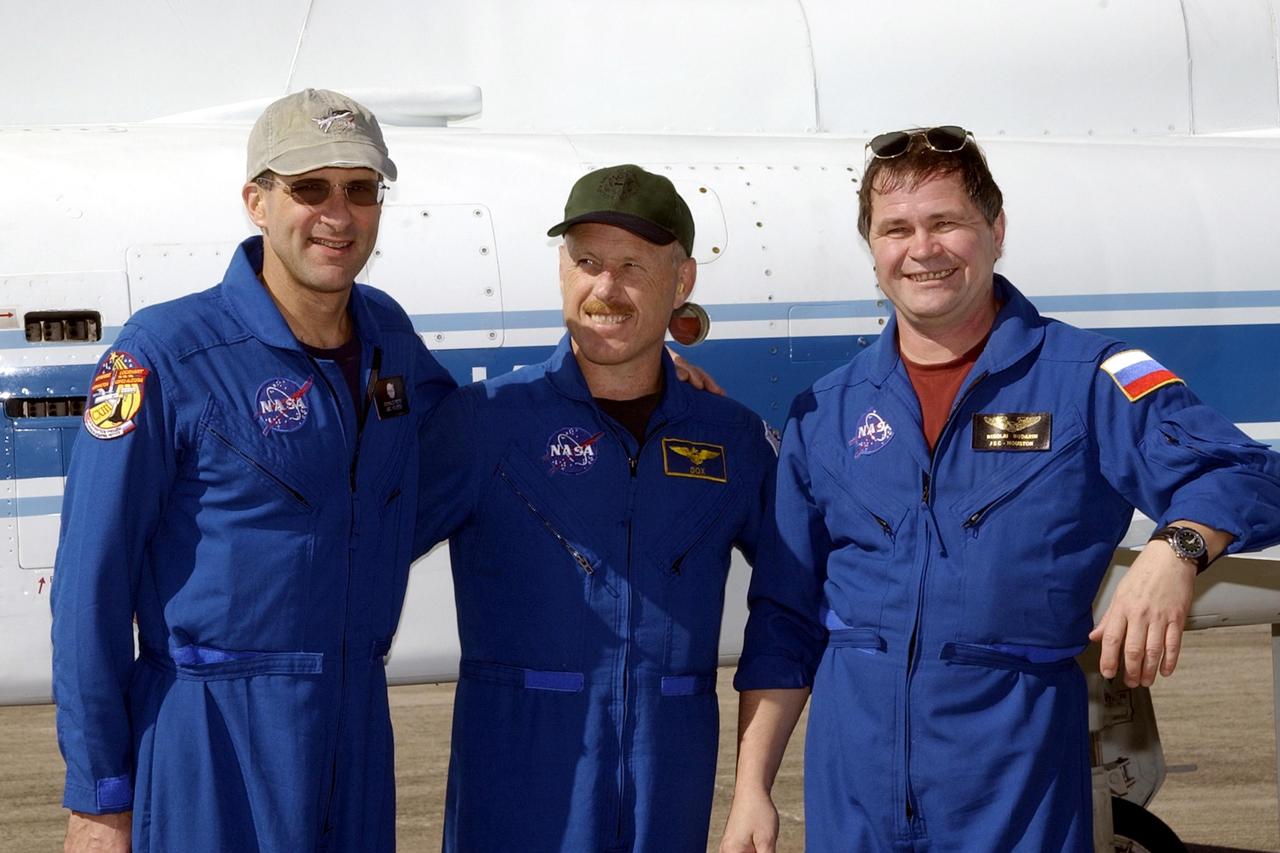
KENNEDY SPACE CENTER, FLA. -- The Expedition 6 crew pauses for the photographer after their arrival at the Shuttle Landing Facility. From left are astronaut Donald Pettit, Commander Ken Bowersox and cosmonaut Nikolai Budarin. The crew is at KSC for Terminal Countdown Demonstration Test activities. Expedition 6 will fly on Space Shuttle Endeavour to the International Space Station on mission STS-113. They will relieve and replace the Expedition 5 crew. Endeavour will also be transporting the Port 1 (P1) truss segment to the Station. STS-113 is scheduled to launch Nov. 10, 2002.
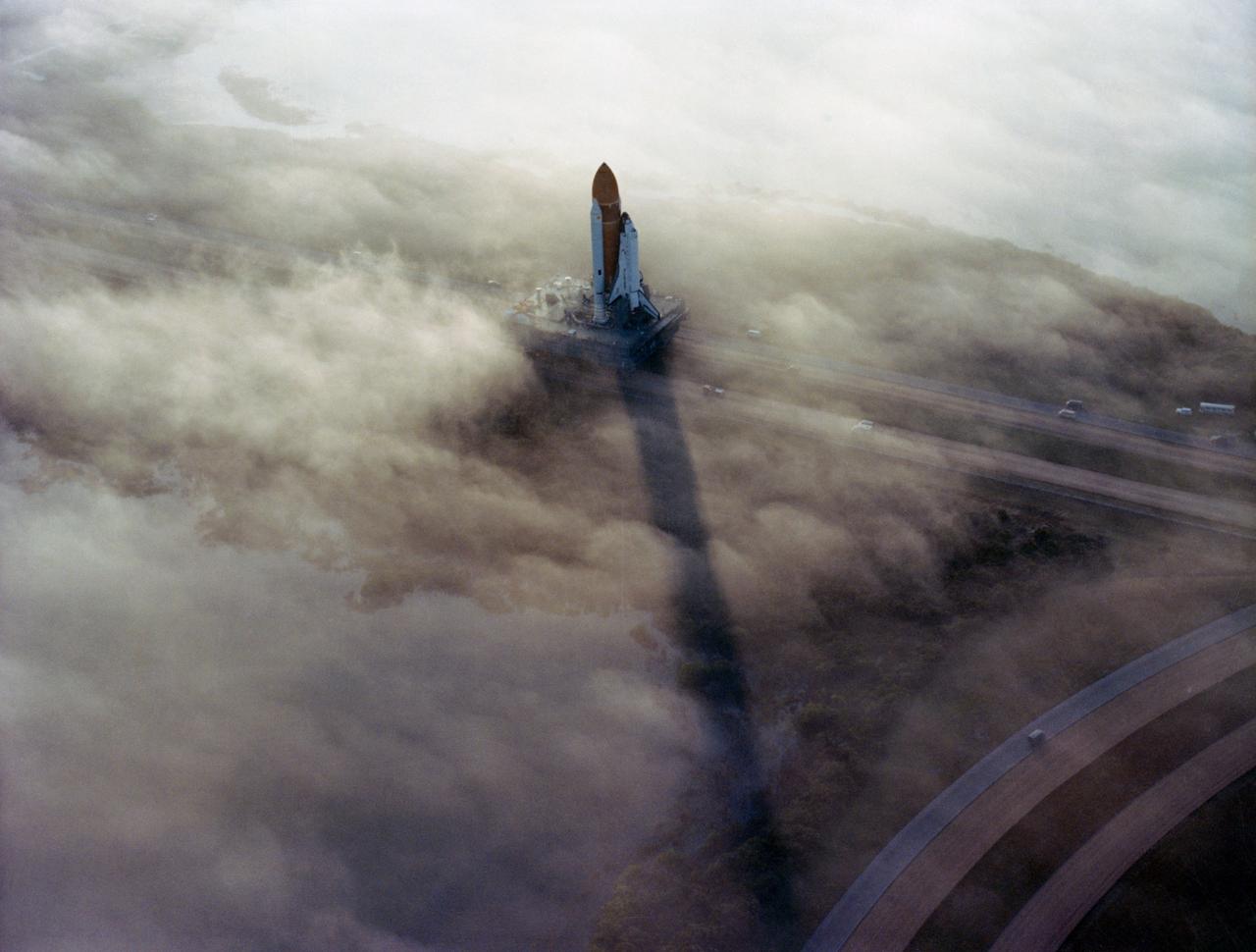
Two (2) views of the "Challenger" - STS-6 - being Rolled Out to Pad 39A in the morning fog, 11/30/1982. 1. KSC - STS-6 PREFLIGHT KSC, FL
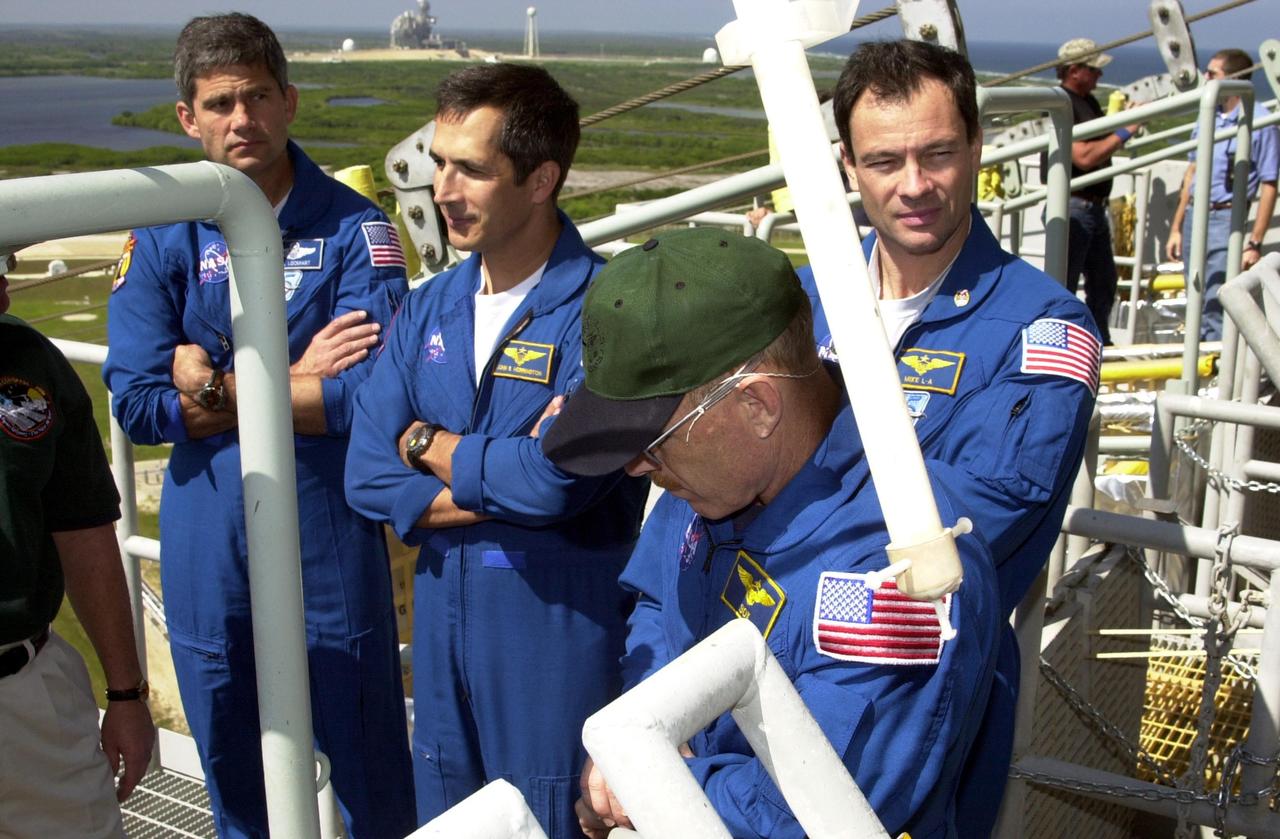
KENNEDY SPACE CENTER, FLA. - As part of Terminal Countdown Demonstration Test (TCDT) activities, the STS-113 and Expedition 6 crews receive training in emergency exit from the orbiter on Launch Pad 39A. Shown are (from left) STS-113 Pilot Paul Lockhart, Mission Specialist John Herrington, Expedition 6 Commander Ken Bowersox, and STS-113 Mission Specialist Michael Lopez-Alegria. The TCDT also includes a simulated launch countdown. The 16th assembly flight to the International Space Station, STS-113 will carry the Port 1 (P1) truss aboard Space Shuttle Endeavour as well as the Expedition 6 crew, who will replace Expedition 5 on the Station. Mission STS-113 is scheduled to launch Nov. 10, 2002.
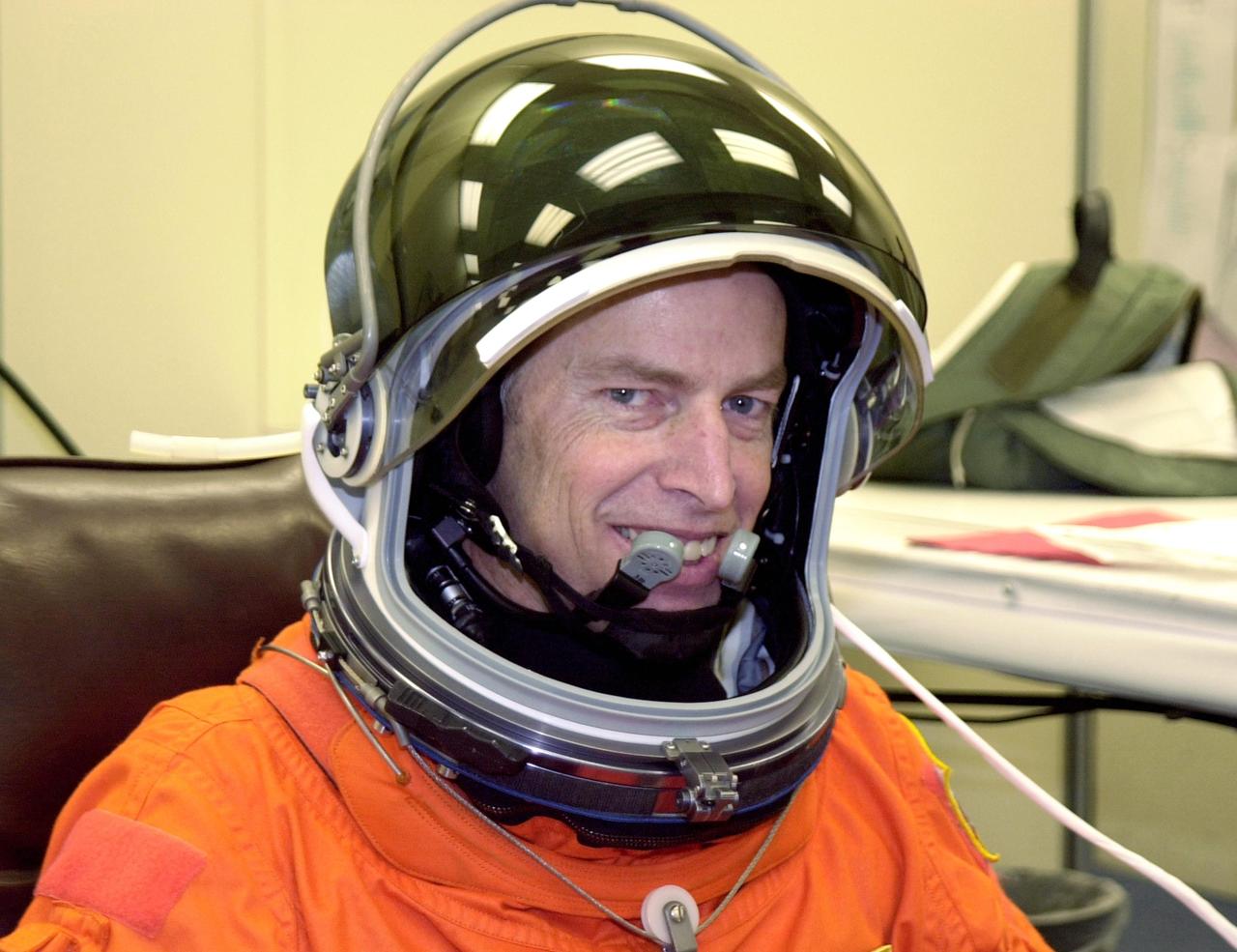
KENNEDY SPACE CENTER, FLA. - STS-113 Commander James Wetherbee is happy to suit up before launch. Wetherbee will be making his sixth Shuttle flight. The primary mission is bringing the Expedition 6 crew to the Station and returning the Expedition 5 crew to Earth. The major objective of the mission is delivery of the Port 1 (P1) Integrated Truss Assembly, which will be attached to the port side of the S0 truss. Three spacewalks are planned to install and activate the truss and its associated equipment. Launch of Space Shuttle Endeavour on mission STS-113 is scheduled for Nov. 11 at 12:58 a.m. EST.
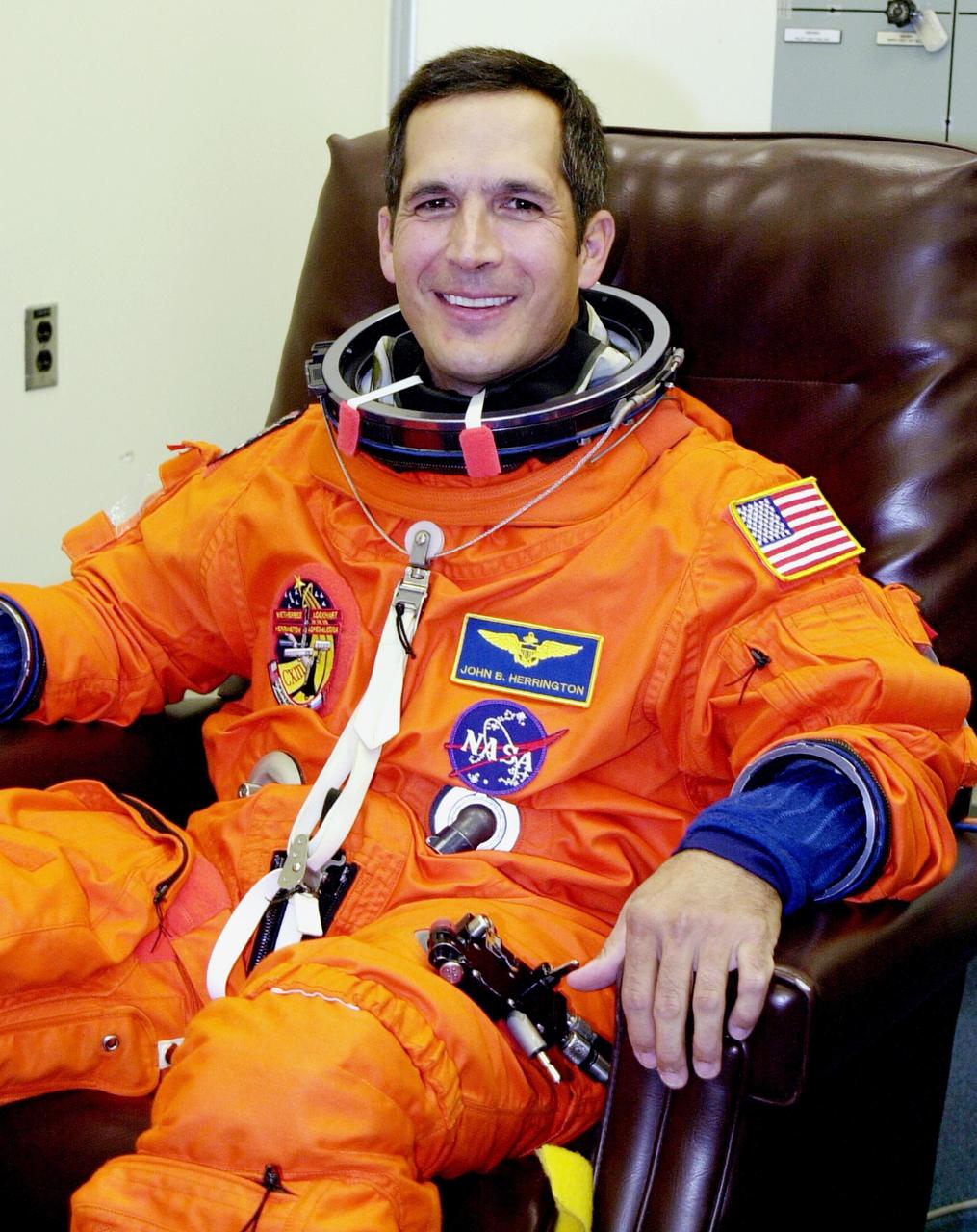
KENNEDY SPACE CENTER, FLA. -- STS-113 Mission Specialist John Herrington suits up before launch. This will be his first Shuttle flight. The primary mission is bringing the Expedition 6 crew to the Station and returning the Expedition 5 crew to Earth. The major objective of the mission is delivery of the Port 1 (P1) Integrated Truss Assembly, which will be attached to the port side of the S0 truss. Three spacewalks are planned to install and activate the truss and its associated equipment. Launch of Space Shuttle Endeavour on mission STS-113 is scheduled for Nov. 11 at 12:58 p.m. EST.
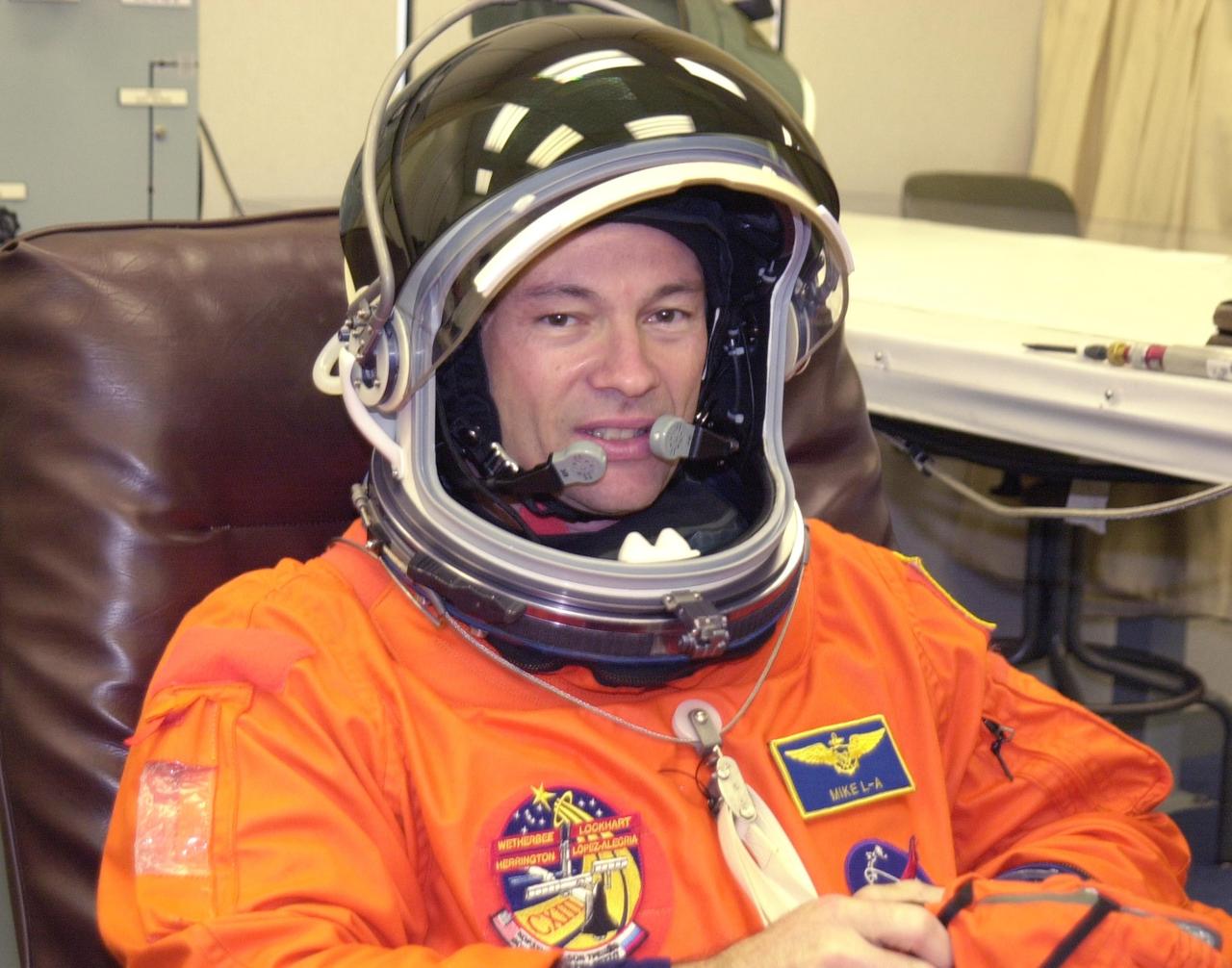
KENNEDY SPACE CENTER, FLA. -- STS-113 Mission Specialist Michael Lopez-Alegria suits up before launch. This will be his third Shuttle flight. The primary mission is bringing the Expedition 6 crew to the Station and returning the Expedition 5 crew to Earth. The major objective of the mission is delivery of the Port 1 (P1) Integrated Truss Assembly, which will be attached to the port side of the S0 truss. Three spacewalks are planned to install and activate the truss and its associated equipment. Launch of Space Shuttle Endeavour on mission STS-113 is scheduled for Nov. 11 at 12:58 a.m. EST.
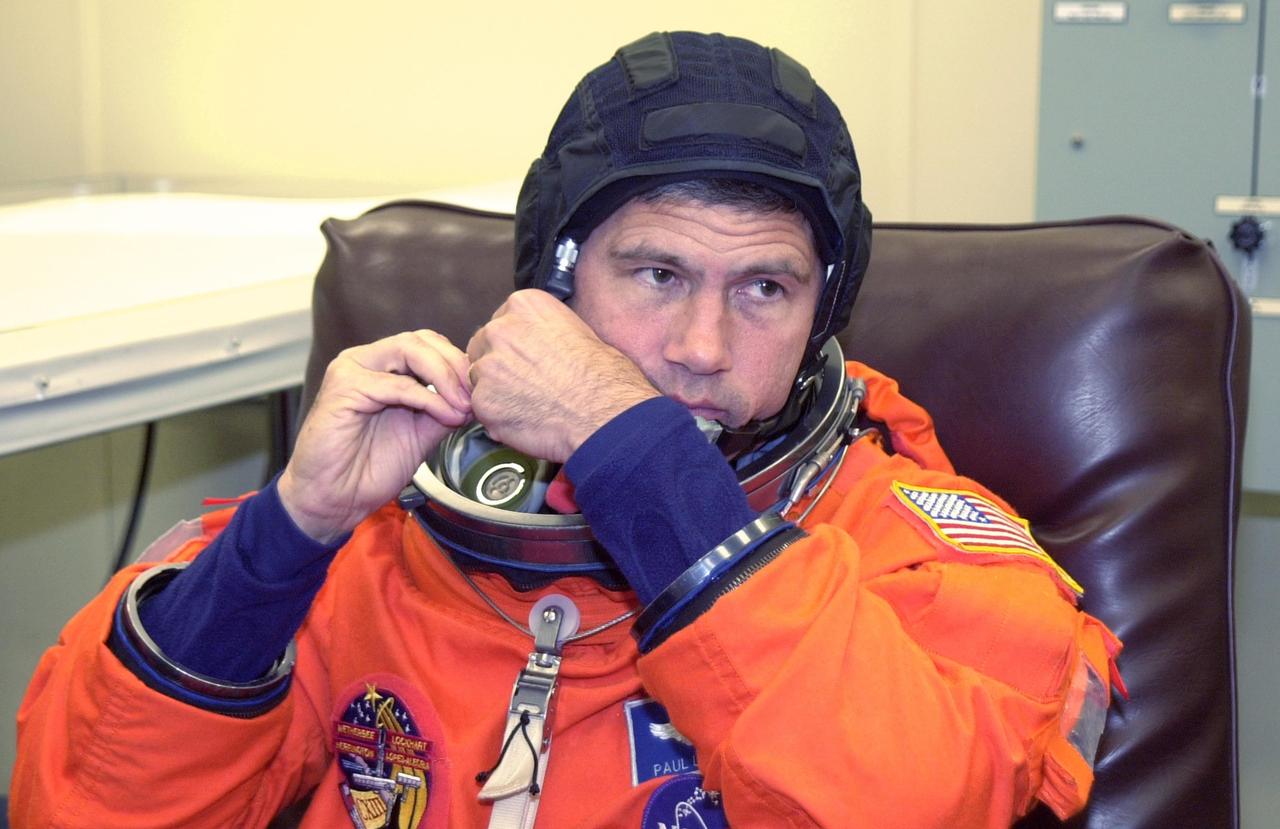
KENNEDY SPACE CENTER, FLA. -- STS-113 Paul Lockhart adjusts his helmet during suitup before launch. Lockhart will be making his second Shuttle flight. The primary mission is bringing the Expedition 6 crew to the Station and returning the Expedition 5 crew to Earth. The major objective of the mission is delivery of the Port 1 (P1) Integrated Truss Assembly, which will be attached to the port side of the S0 truss. Three spacewalks are planned to install and activate the truss and its associated equipment. Launch of Space Shuttle Endeavour on mission STS-113 is scheduled for Nov. 11 at 12:58 a.m. EST.
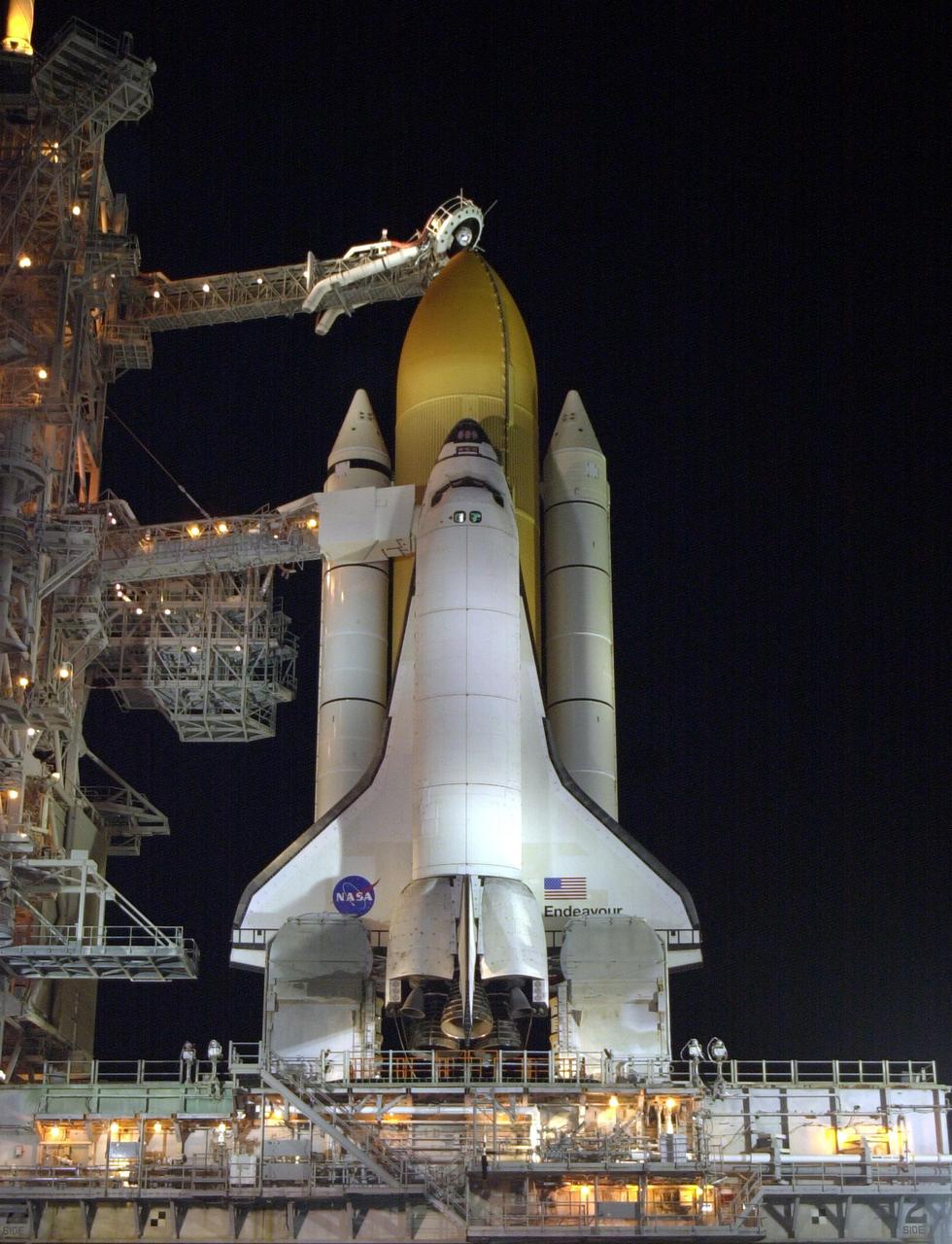
KENNEDY SPACE CENTER, FLA. - The Rotating Service Structure has been rolled back to reveal Space Shuttle Endeavour awaiting launch on Launch Pad 39A. The primary mission of STS-113 is to bring the Expedition 6 crew to the Station and return the Expedition 5 crew to Earth. Another major objective of the mission is delivery of the Port 1 (P1) Integrated Truss Assembly, which will be attached to the port side of the S0 truss. Three spacewalks are planned to install and activate the truss and its associated equipment. Launch of Space Shuttle Endeavour on mission STS-113 is scheduled for Nov. 11 at 12:58:40 a.m. EST.
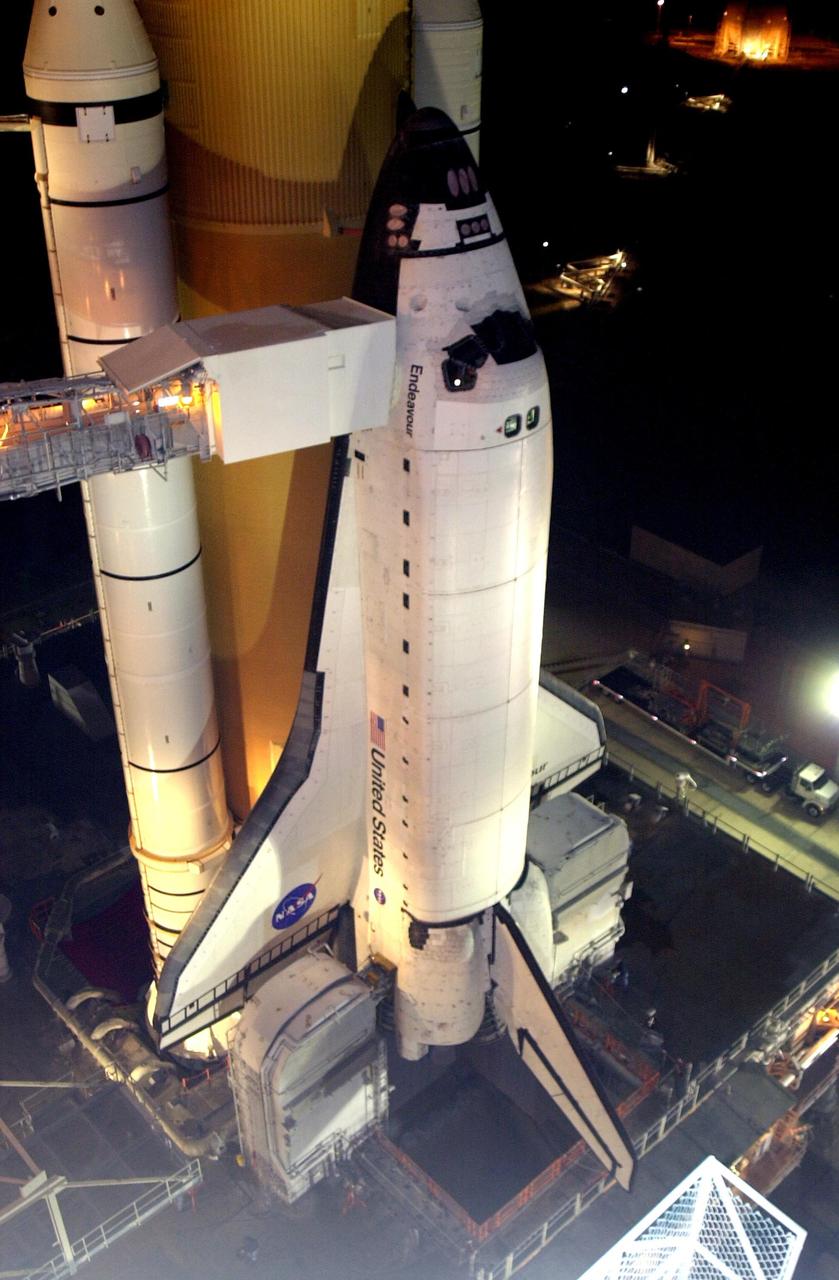
KENNEDY SPACE CENTER, FLA. -- Space Shuttle Endeavour stands ready for launch on mission STS-113. . The Orbiter Access Arm extends from the Fixed Service Structure (FSS) to the crew compartment hatch, through which the STS-113 crew will enter Endeavour. STS-113 is the 16th American assembly flight to the International Space Station. The primary mission is bringing the Expedition 6 crew to the Station and returning the Expedition 5 crew to Earth. The major objective of the mission is delivery of the Port 1 (P1) Integrated Truss Assembly, which will be attached to the port side of the S0 truss. Three spacewalks are planned to install and activate the truss and its associated equipment. Launch of Space Shuttle Endeavour on mission STS-113 is scheduled for Nov. 11 at 12:58 a.m. EST.
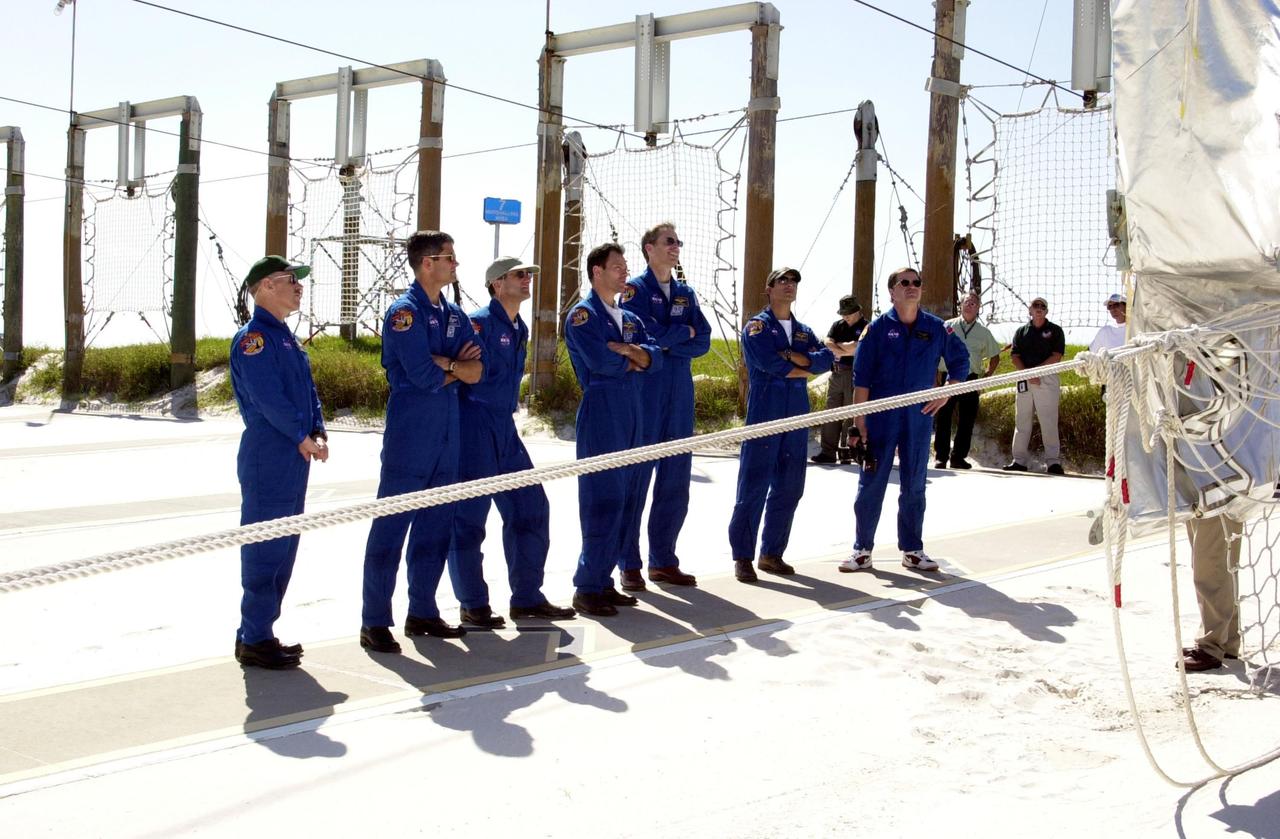
KENNEDY SPACE CENTER, FLA. - As part of Terminal Countdown Demonstration Test (TCDT) activities, the STS-113 and Expedition 6 crews receive training in emergency exit from the orbiter on Launch Pad 39A. Shown are (from left) Expedition 6 Commander Ken Bowersox; STS-113 Pilot Paul Lockhart; astronaut Donald Pettit; Mission Specialist Michael Lopez-Alegria, Commander James Wetherbee and Mission Specialist John Herrington; and cosmonaut Nikolai Budarin. The TCDT also includes a simulated launch countdown. The 16th assembly flight to the International Space Station, STS-113 will carry the Port 1 (P1) truss aboard Space Shuttle Endeavour as well as the Expedition 6 crew, who will replace Expedition 5 on the Station. Mission STS-113 is scheduled to launch Nov. 10, 2002.
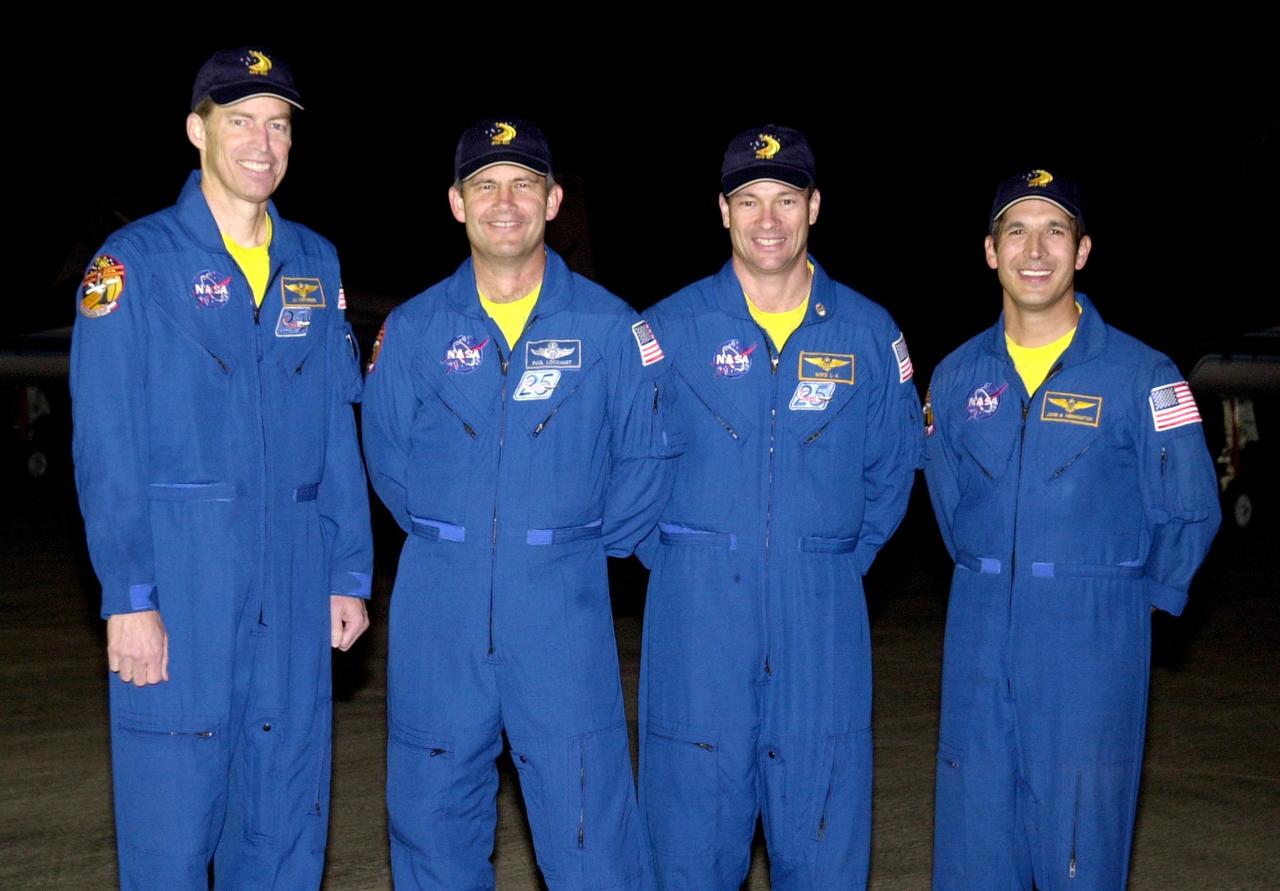
KENNEDY SPACE CENTER, FLA. - The STS-113 crew poses for a photo after their arrival at the KSC Shuttle Landing Facility to prepare for launch. From left are Commander James Wetherbee, Pilot Paul Lockhart, and Mission Specialists Michael Lopez-Alegria and John Herrington. The primary mission of STS-113 is bringing the Expedition 6 crew to the Station and returning the Expedition 5 crew to Earth. In addition, the major objective of the mission is delivery of the Port 1 (P1) Integrated Truss Assembly, which will be attached to the port side of the S0 truss. Three spacewalks are planned to install and activate the truss and its associated equipment. Launch of Space Shuttle Endeavour on mission STS-113 is scheduled for Nov. 11 between midnight and 4 a.m. EST.
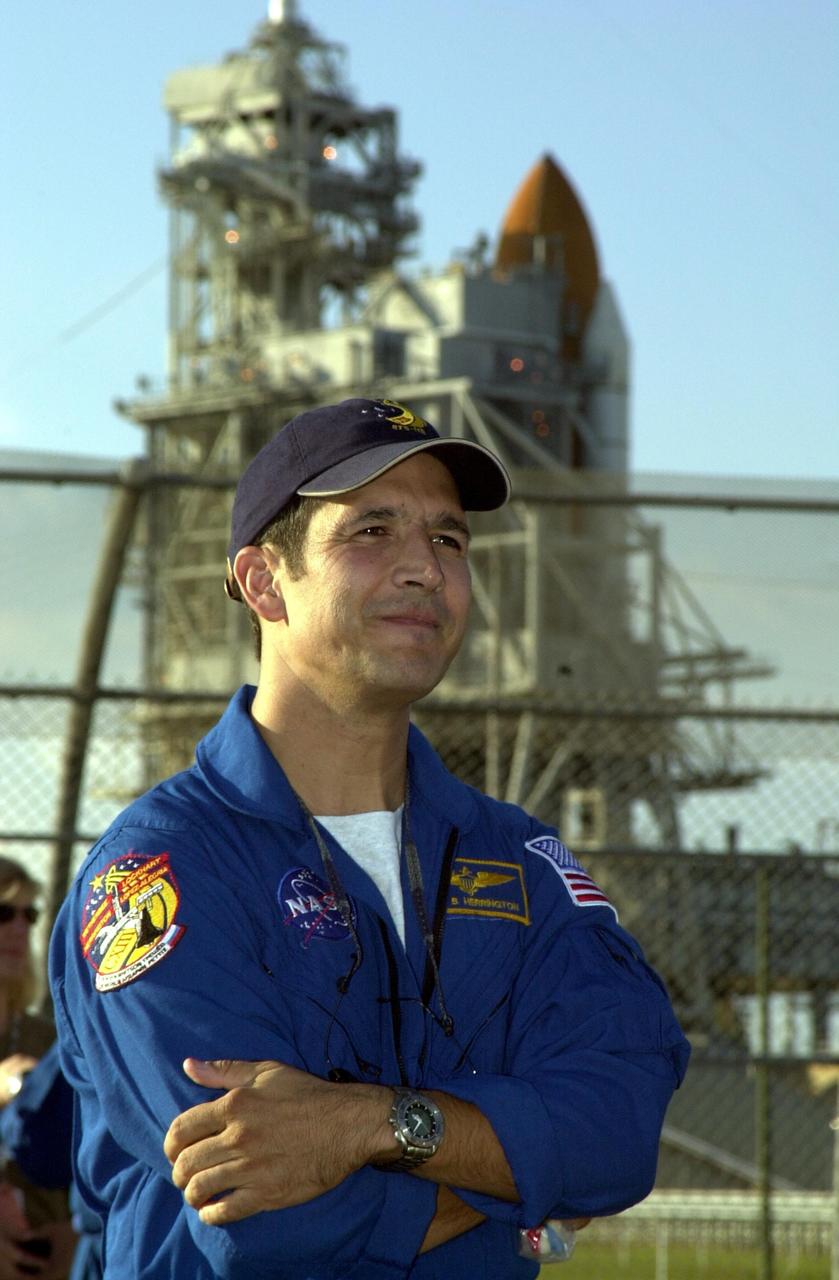
KENNEDY SPACE CENTER, FLA. - STS-113 Mission Specialist John Herrington pauses in front of Space Shuttle Endeavour at Launch Pad 39A during a tour of Kennedy Space Center prior to his launch. Upon launch, Herrington will become the first Native American in space. The primary mission of STS-113 is bringing the Expedition 6 crew to the Station and returning the Expedition 5 crew to Earth. Another major objective of the mission is delivery of the Port 1 (P1) Integrated Truss Assembly, which will be attached to the port side of the S0 truss. Three spacewalks are planned to install and activate the truss and its associated equipment. Launch of Space Shuttle Endeavour on mission STS-113 is scheduled for Nov. 11 between midnight and 4 a.m. EST.
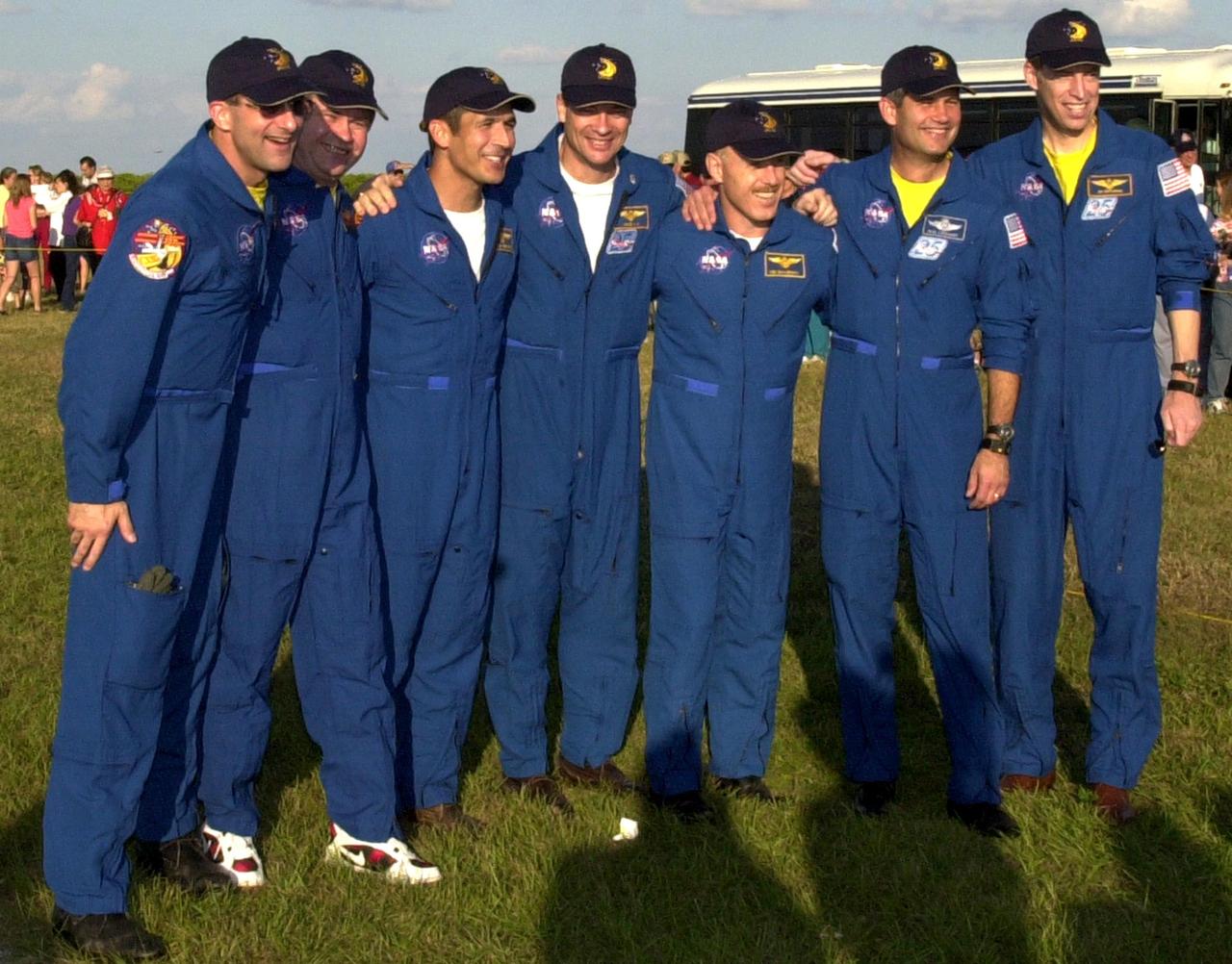
KENNEDY SPACE CENTER, FLA. - The STS-113 and Expedition Six crews pose for a group photo at Launch Pad 39A with Space Shuttle Endeavour in the background during a tour of Kennedy Space Center prior to their launch. From left are Expedition Six crew members Donald Pettit and Nikolai Budarin of the Russian Space Agency, STS-113 Mission Specialists John Herrington and Michael Lopez-Alegria, Expedition Six Commander Ken Bowersox, STS-113 Pilot Paul Lockhart, and STS-113 Commander James Wetherbee. The primary mission of STS-113 is bringing the Expedition 6 crew to the Station and returning the Expedition 5 crew to Earth. Another major objective of the mission is delivery of the Port 1 (P1) Integrated Truss Assembly, which will be attached to the port side of the S0 truss. Three spacewalks are planned to install and activate the truss and its associated equipment. Launch of Space Shuttle Endeavour on mission STS-113 is scheduled for Nov. 11 between midnight and 4 a.m. EST.
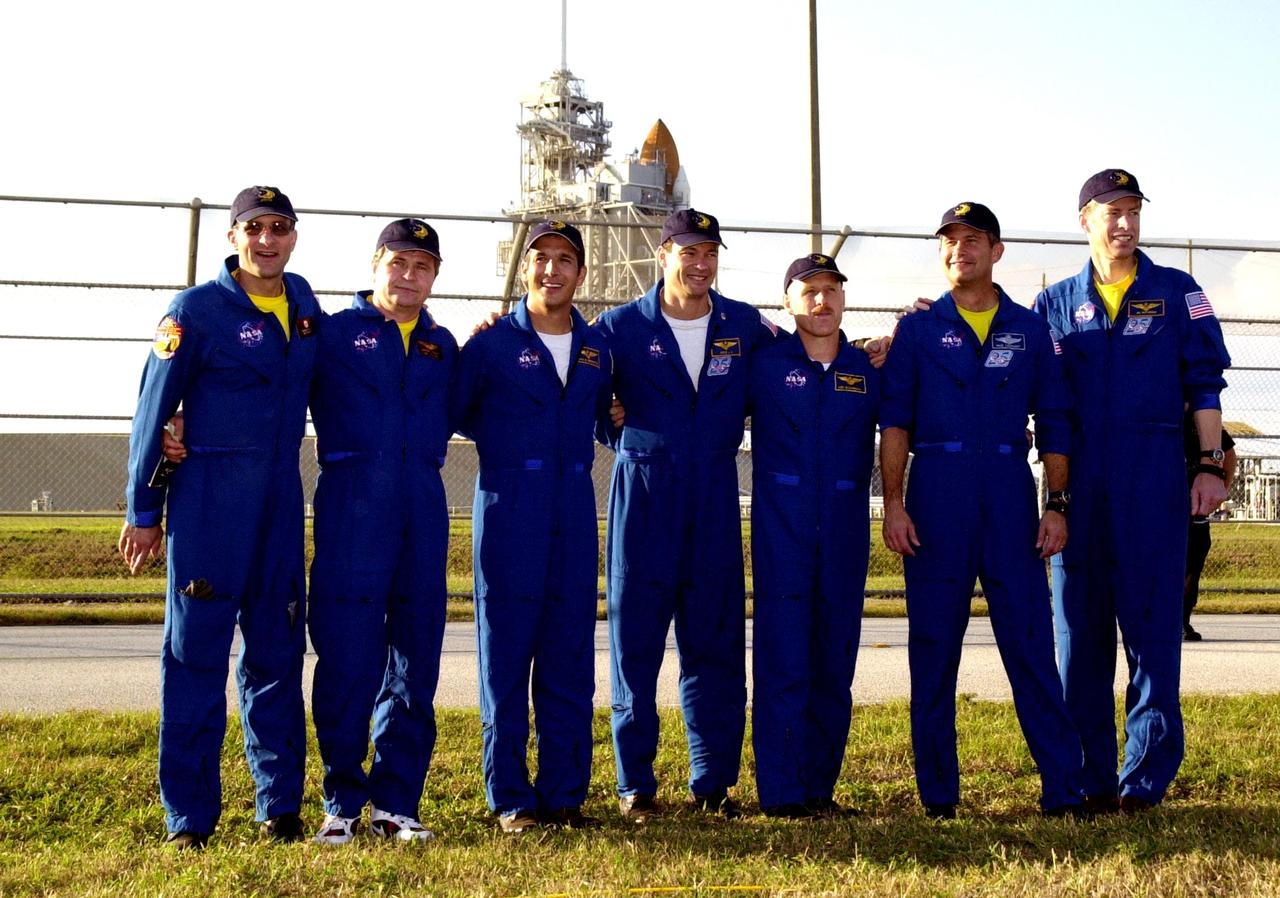
KENNEDY SPACE CENTER, FLA. - The STS-113 and Expedition Six crews pose for a group photo at Launch Pad 39A with Space Shuttle Endeavour in the background during a tour of Kennedy Space Center prior to their launch. From left are Expedition Six crew members Donald Pettit and Nikolai Budarin of the Russian Space Agency, STS-113 Mission Specialists John Herrington and Michael Lopez-Alegria, Expedition Six Commander Ken Bowersox, STS-113 Pilot Paul Lockhart, and STS-113 Commander James Wetherbee. The primary mission of STS-113 is bringing the Expedition 6 crew to the Station and returning the Expedition 5 crew to Earth. Another major objective of the mission is delivery of the Port 1 (P1) Integrated Truss Assembly, which will be attached to the port side of the S0 truss. Three spacewalks are planned to install and activate the truss and its associated equipment. Launch of Space Shuttle Endeavour on mission STS-113 is scheduled for Nov. 11 between midnight and 4 a.m. EST.
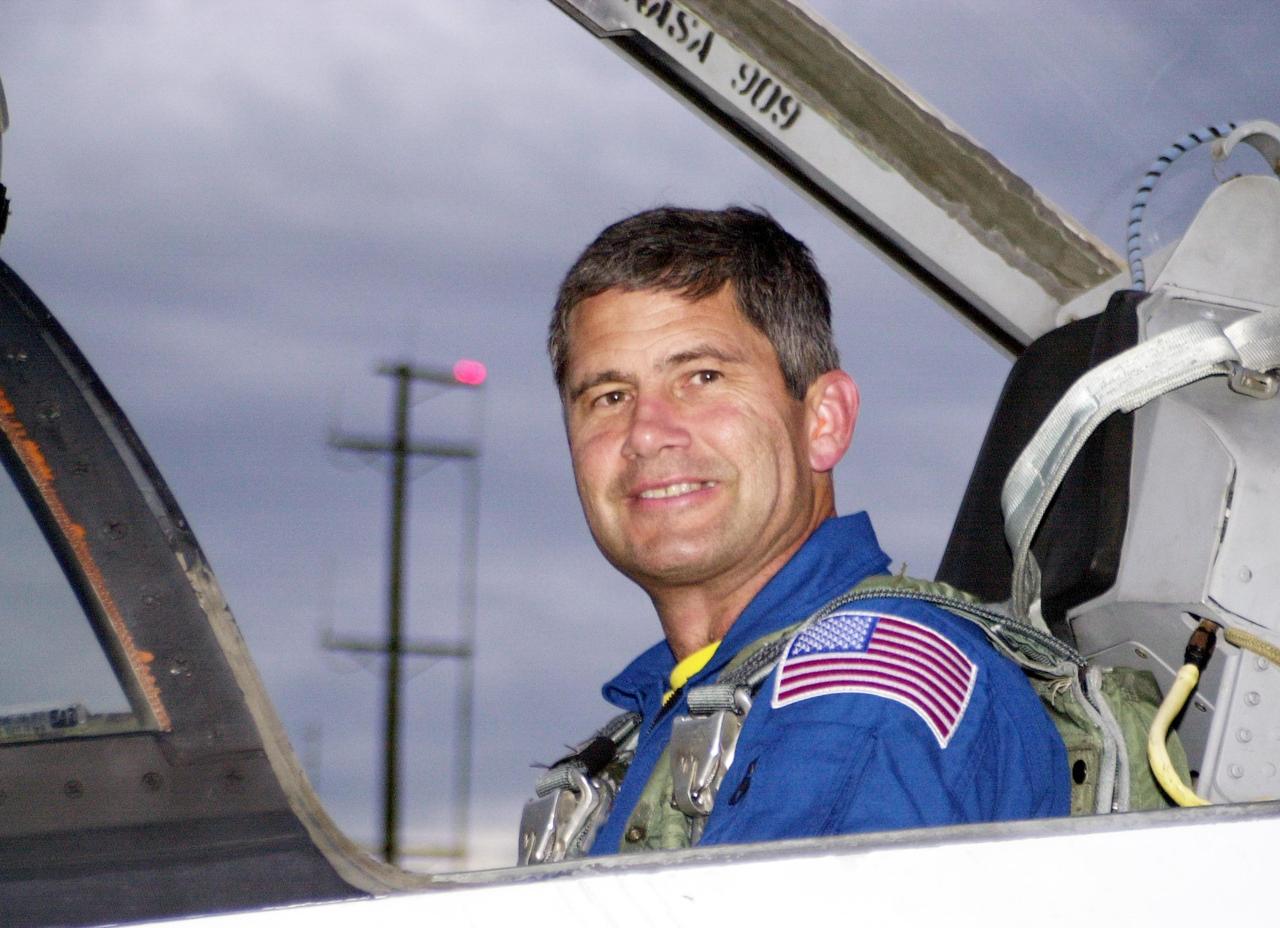
KENNEDY SPACE CENTER, FLA. -- STS-113 Pilot Paul Lockhart arrives at KSC for Terminal Countdown Demonstration Test activities, which include a simulated launch countdown. The primary payloads on mission STS-113 are the first port truss segment, P1, and the Crew and Equipment Translation Aid (CETA) Cart B. Once delivered, the P1 truss will remain stowed until flight 12A.1 in 2003 when it will be attached to the central truss segment, S0, on the Space Station. Also onboard Space Shuttle Endeavour will be the Expedition 6 crew who will replace Expedition 5, returning to Earth after 4 months. The STS-113 launch is scheduled for Nov. 10, 2002. .
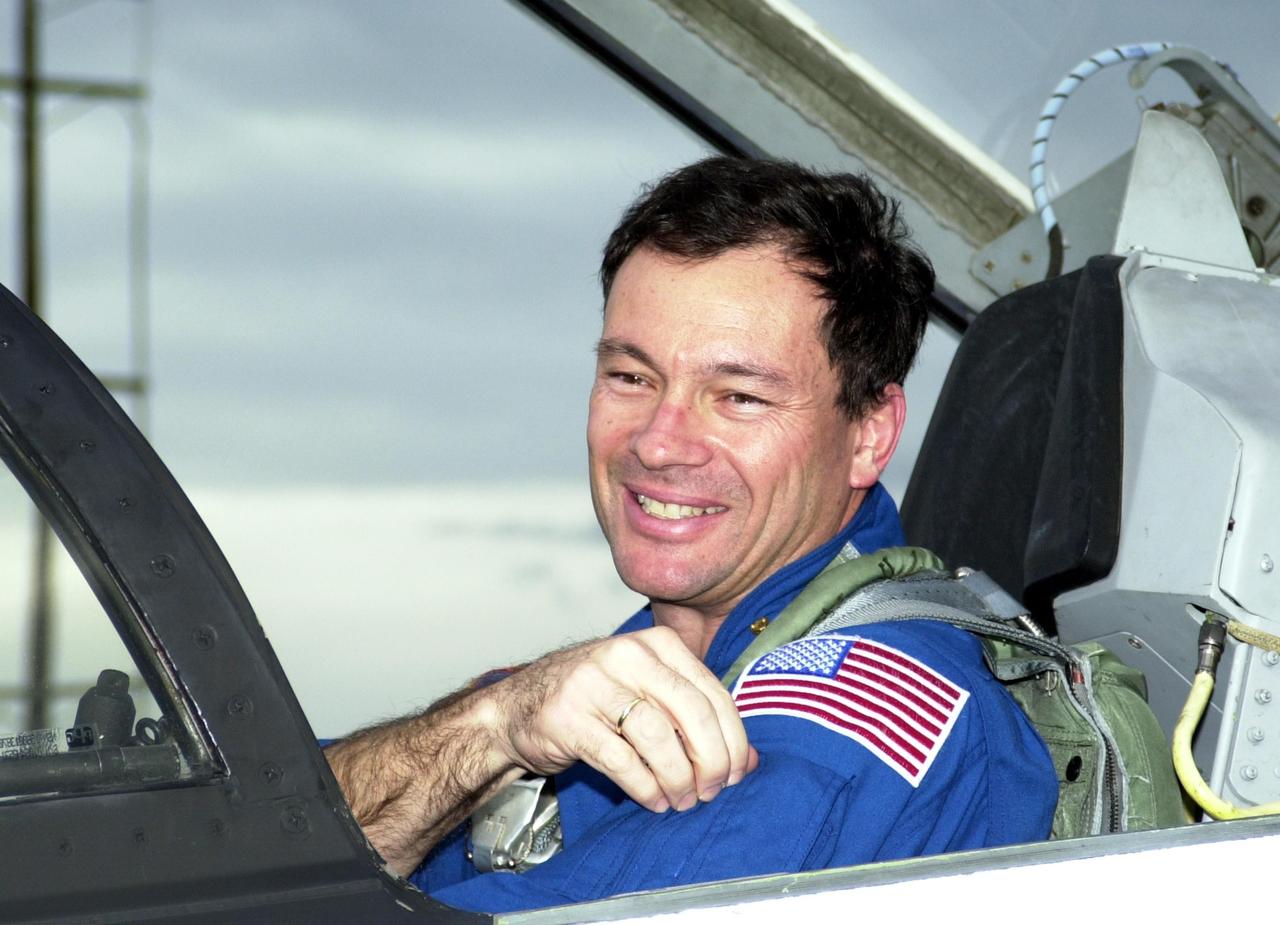
KENNEDY SPACE CENTER, FLA. -- STS-113 Mission Specialist Michael Lopez-Alegria arrives at KSC for Terminal Countdown Demonstration Test activities, which include a simulated launch countdown. The primary payloads on mission STS-113 are the first port truss segment, P1, and the Crew and Equipment Translation Aid (CETA) Cart B. Once delivered, the P1 truss will remain stowed until flight 12A.1 in 2003 when it will be attached to the central truss segment, S0, on the Space Station. Also onboard Space Shuttle Endeavour will be the Expedition 6 crew who will replace Expedition 5, returning to Earth after 4 months. The STS-113 launch is scheduled for Nov. 10, 2002.
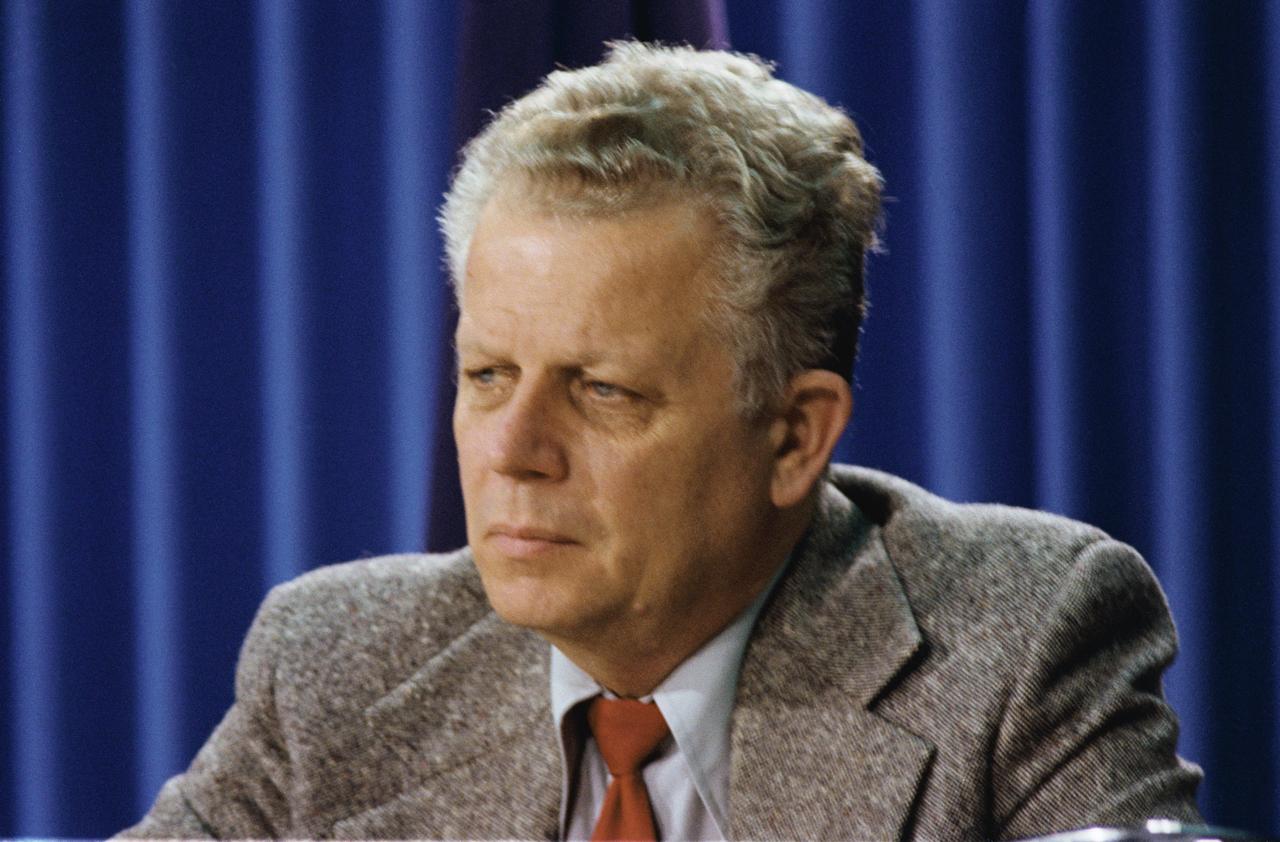
Terry White during a change-of-shift briefing in the JSC public affairs facility briefing room. White acted as one of the on-orbit public affairs officers and the landing PAO during the Challenger's STS-6 flight.

KENNEDY SPACE CENTER, FLA. - Expedition Six crew member Nikolai Budarin, of the Russian Space Agency, pauses in front of Space Shuttle Endeavour at Launch Pad 39A during a tour of Kennedy Space Center prior to his launch. The primary mission of STS-113 is bringing the Expedition 6 crew to the Station and returning the Expedition 5 crew to Earth. Another major objective of the mission is delivery of the Port 1 (P1) Integrated Truss Assembly, which will be attached to the port side of the S0 truss. Three spacewalks are planned to install and activate the truss and its associated equipment. Launch of Space Shuttle Endeavour on mission STS-113 is scheduled for Nov. 11 between midnight and 4 a.m. EST.
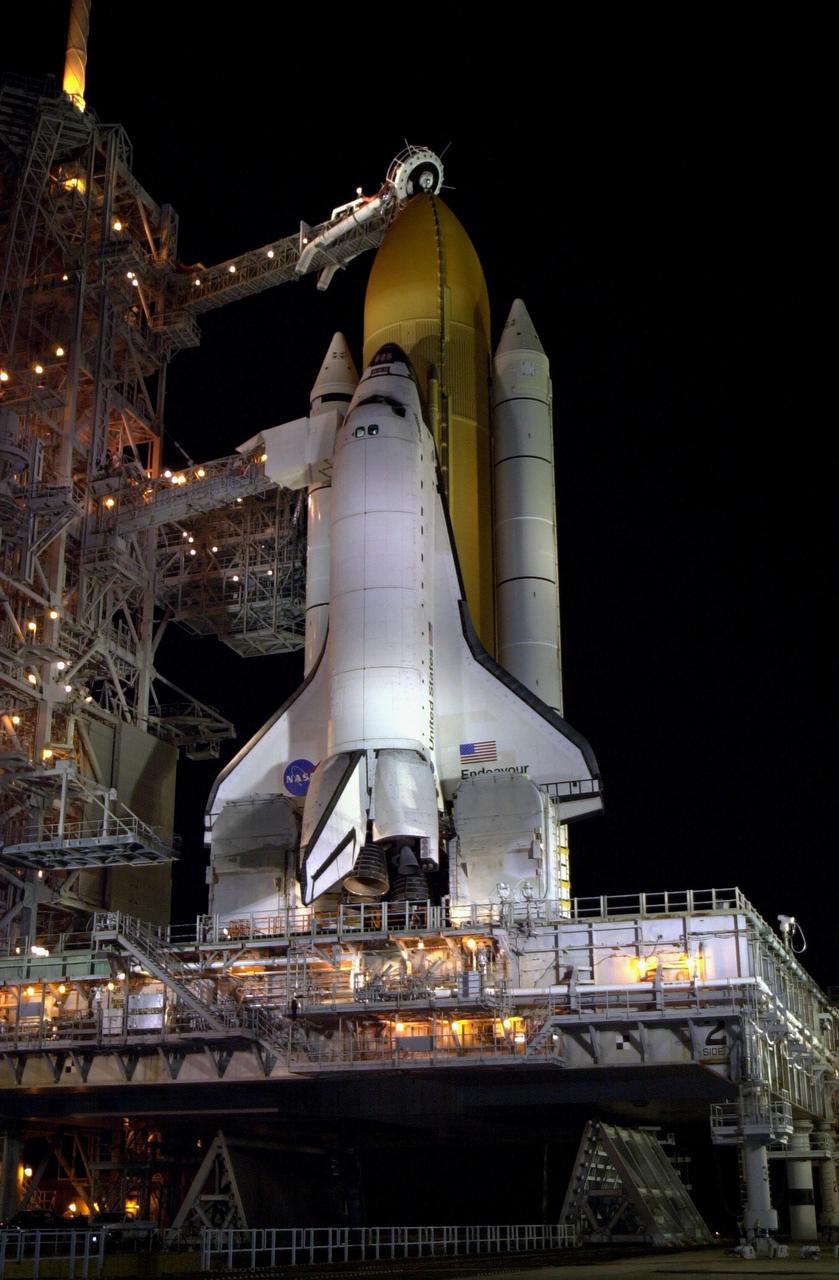
KENNEDY SPACE CENTER, FLA. -- With the Rotating Service Structure rolled back, Space Shuttle Endeavour stands ready for launch on mission STS-113. Above the golden external tank is the vent hood (known as the "beanie cap") at the end of the gaseous oxygen vent arm. Vapors are created as the liquid oxygen in the external tank boil off. The hood vents the gaseous oxygen vapors away from the Space Shuttle vehicle. The Orbiter Access Arm extends from the Fixed Service Structure (FSS) to the crew compartment hatch, through which the STS-113 crew will enter Endeavour. STS-113 is the 16th American assembly flight to the International Space Station. The primary mission is bringing the Expedition 6 crew to the Station and returning the Expedition 5 crew to Earth. The major objective of the mission is delivery of the Port 1 (P1) Integrated Truss Assembly, which will be attached to the port side of the S0 truss. Three spacewalks are planned to install and activate the truss and its associated equipment. Launch of Space Shuttle Endeavour on mission STS-113 is scheduled for Nov. 11 at 12:58 a.m. EST.
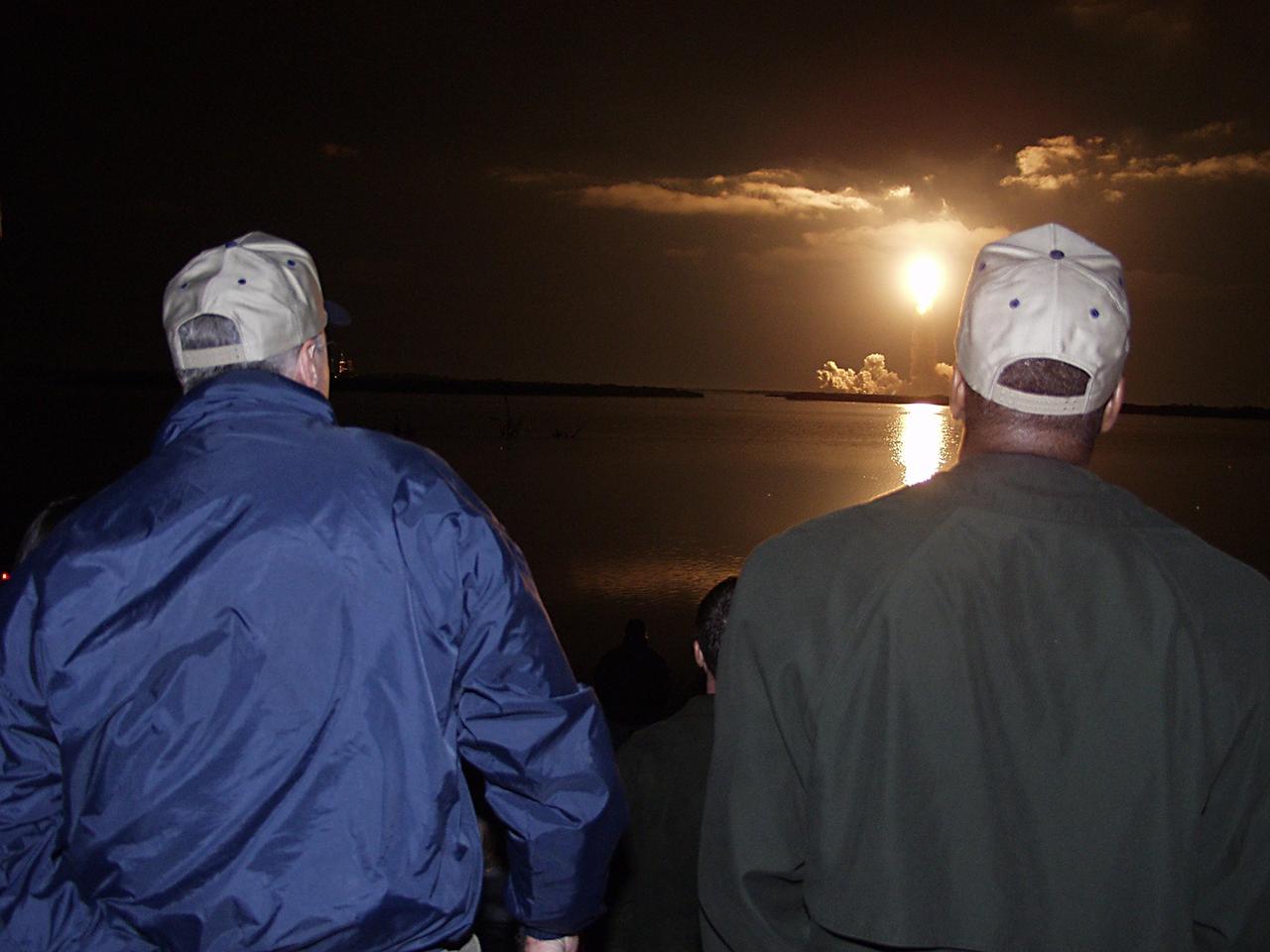
KENNEDY SPACE CENTER, FLA. - Watching the launch of Space Shuttle Endeavour on mission STS-113 are NASA Administrator Sean O'Keefe (left) and Associate Administrator of Public Affairs Glen Mahone. Liftoff occurred ontime at 7:49:47 p.m. EST. The launch is the 19th for Endeavour, and the 112th flight in the Shuttle program. Mission STS-113 is the 16th assembly flight to the International Space Station, carrying another structure for the Station, the P1 integrated truss. Also onboard are the Expedition 6 crew, who will replace Expedition 5. Endeavour is scheduled to land at KSC after an 11-day journey.
![KENNEDY SPACE CENTER, FLA. -- Space Shuttle Endeavour climbs into the black sky as it lifts off Launch Pad 39A on mission STS-113. Liftoff occurred ontime at 7:49:47 p.m. EST. The launch is the 19th for Endeavour, and the 112th flight in the Shuttle program. Mission STS-113 is the 16th assembly flight to the International Space Station, carrying another structure for the Station, the P1 integrated truss. Also onboard are the Expedition 6 crew, who will replace Expedition 5. Endeavour is scheduled to land at KSC after an 11-day journey. [Photo by Scott Andrews]](https://images-assets.nasa.gov/image/KSC-02pd1811/KSC-02pd1811~medium.jpg)
KENNEDY SPACE CENTER, FLA. -- Space Shuttle Endeavour climbs into the black sky as it lifts off Launch Pad 39A on mission STS-113. Liftoff occurred ontime at 7:49:47 p.m. EST. The launch is the 19th for Endeavour, and the 112th flight in the Shuttle program. Mission STS-113 is the 16th assembly flight to the International Space Station, carrying another structure for the Station, the P1 integrated truss. Also onboard are the Expedition 6 crew, who will replace Expedition 5. Endeavour is scheduled to land at KSC after an 11-day journey. [Photo by Scott Andrews]
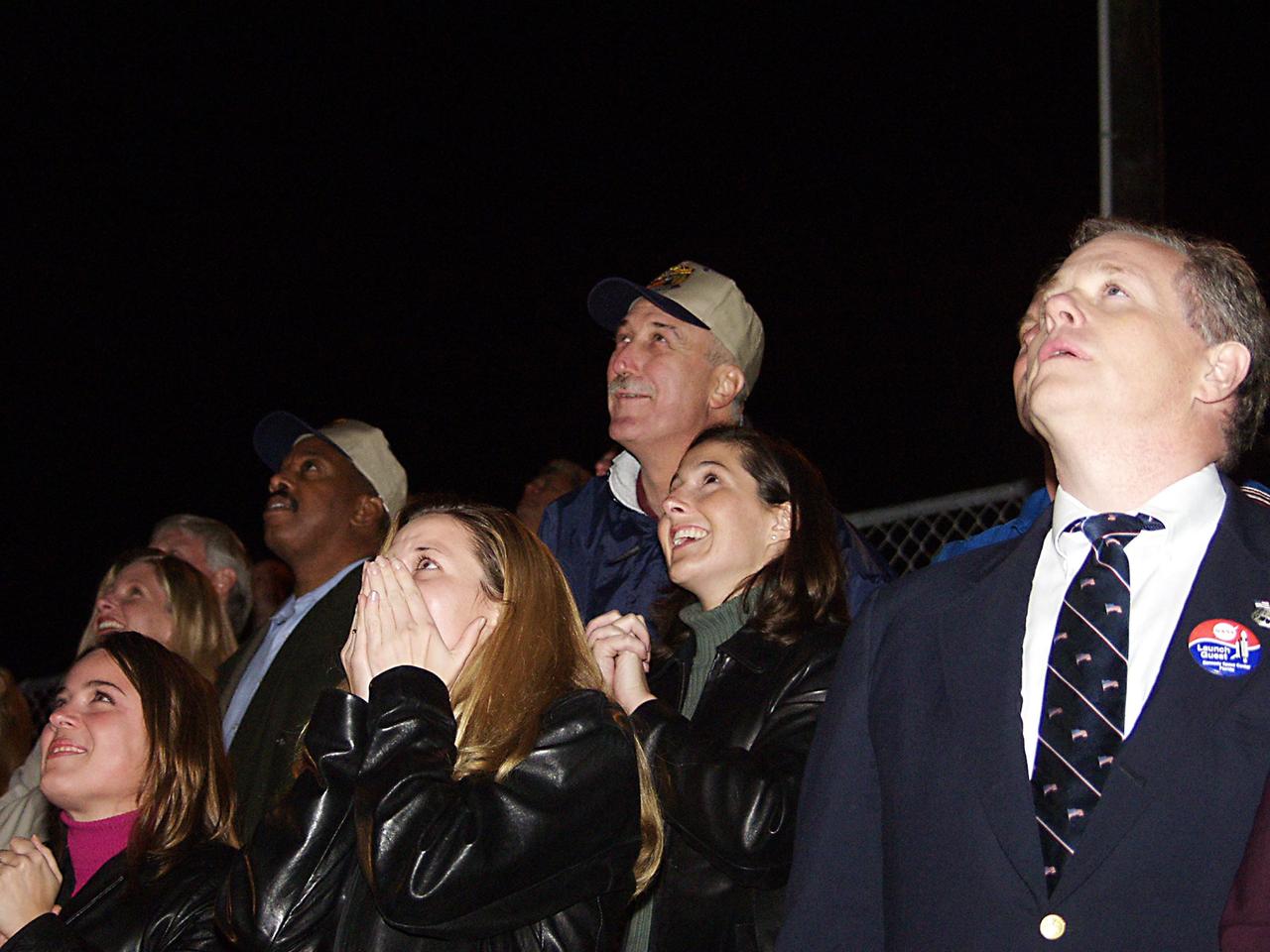
KENNEDY SPACE CENTER, FLA. - Among the visitors watching the launch of Space Shuttle Endeavour on mission STS-113 are NASA Administrator Sean O'Keefe (top, center) and Glen Mahone, associate administrator for public affairs, NASA (left of O'Keefe). Liftoff occurred ontime at 7:49:47 p.m. EST. The launch is the 19th for Endeavour, and the 112th flight in the Shuttle program. Mission STS-113 is the 16th assembly flight to the International Space Station, carrying another structure for the Station, the P1 integrated truss. Also onboard are the Expedition 6 crew, who will replace Expedition 5. Endeavour is scheduled to land at KSC after an 11-day journey.
![KENNEDY SPACE CENTER, FLA. -Space Shuttle Endeavour roars into the black sky on columns of fire as it lifts off Launch Pad 39A on mission STS-113. Liftoff occurred ontime at 7:49:47 p.m. EST. The launch is the 19th for Endeavour, and the 112th flight in the Shuttle program. Mission STS-113 is the 16th assembly flight to the International Space Station, carrying another structure for the Station, the P1 integrated truss. Also onboard are the Expedition 6 crew, who will replace Expedition 5. Endeavour is scheduled to land at KSC after an 11-day journey. [Photo by Scott Andrews]](https://images-assets.nasa.gov/image/KSC-02pd1812/KSC-02pd1812~medium.jpg)
KENNEDY SPACE CENTER, FLA. -Space Shuttle Endeavour roars into the black sky on columns of fire as it lifts off Launch Pad 39A on mission STS-113. Liftoff occurred ontime at 7:49:47 p.m. EST. The launch is the 19th for Endeavour, and the 112th flight in the Shuttle program. Mission STS-113 is the 16th assembly flight to the International Space Station, carrying another structure for the Station, the P1 integrated truss. Also onboard are the Expedition 6 crew, who will replace Expedition 5. Endeavour is scheduled to land at KSC after an 11-day journey. [Photo by Scott Andrews]
![KENNEDY SPACE CENTER, FLA. -- Against a black moonless sky, Space Shuttle Endeavour blazes into space after an ontime liftoff at 7:49:47 p.m. EST. The launch is the 19th for Endeavour, and the 112th flight in the Shuttle program. Mission STS-113 is the 16th assembly flight to the International Space Station, carrying another structure for the Station, the P1 integrated truss. Also onboard are the Expedition 6 crew, who will replace Expedition 5. Endeavour is scheduled to land at KSC after an 11-day journey. [Photo by Ray Yost]](https://images-assets.nasa.gov/image/KSC-02pd1805/KSC-02pd1805~medium.jpg)
KENNEDY SPACE CENTER, FLA. -- Against a black moonless sky, Space Shuttle Endeavour blazes into space after an ontime liftoff at 7:49:47 p.m. EST. The launch is the 19th for Endeavour, and the 112th flight in the Shuttle program. Mission STS-113 is the 16th assembly flight to the International Space Station, carrying another structure for the Station, the P1 integrated truss. Also onboard are the Expedition 6 crew, who will replace Expedition 5. Endeavour is scheduled to land at KSC after an 11-day journey. [Photo by Ray Yost]
![KENNEDY SPACE CENTER, FLA. - A full moon over Kennedy Space Center competes for dominance in the night sky with the illuminated Space Shuttle Endeavour below, poised for launch on mission STS-113 from Launch Pad 39A. The mission will be the 16th assembly flight to the International Space Station, carrying another structure for the Station, the P1 integrated truss. Also onboard will be the Expedition 6 crew, who will replace Expedition 5. [Photo by Scott Andrews]](https://images-assets.nasa.gov/image/KSC-02pd1807/KSC-02pd1807~medium.jpg)
KENNEDY SPACE CENTER, FLA. - A full moon over Kennedy Space Center competes for dominance in the night sky with the illuminated Space Shuttle Endeavour below, poised for launch on mission STS-113 from Launch Pad 39A. The mission will be the 16th assembly flight to the International Space Station, carrying another structure for the Station, the P1 integrated truss. Also onboard will be the Expedition 6 crew, who will replace Expedition 5. [Photo by Scott Andrews]

KENNEDY SPACE CENTER, FLA. - On Launch Pad 39A, a trainer (right) explains use of the slidewire basket, part of the emergency egress system, to Expedition 6 astronaut Donald Pettit (left) and STS-113 Mission Specialists Michael Lopez-Alegria (center) and John Herrington (right). . They are other crew members are taking part in Terminal Countdown Demonstration Test (TCDT) activities, which also include a simulated launch countdown. The 16th assembly flight to the International Space Station, STS-113 will carry the Port 1 (P1) truss aboard Space Shuttle Endeavour as well as the Expedition 6 crew, who will replace Expedition 5 on the Station. Mission STS-113 is scheduled to launch Nov. 10, 2002.
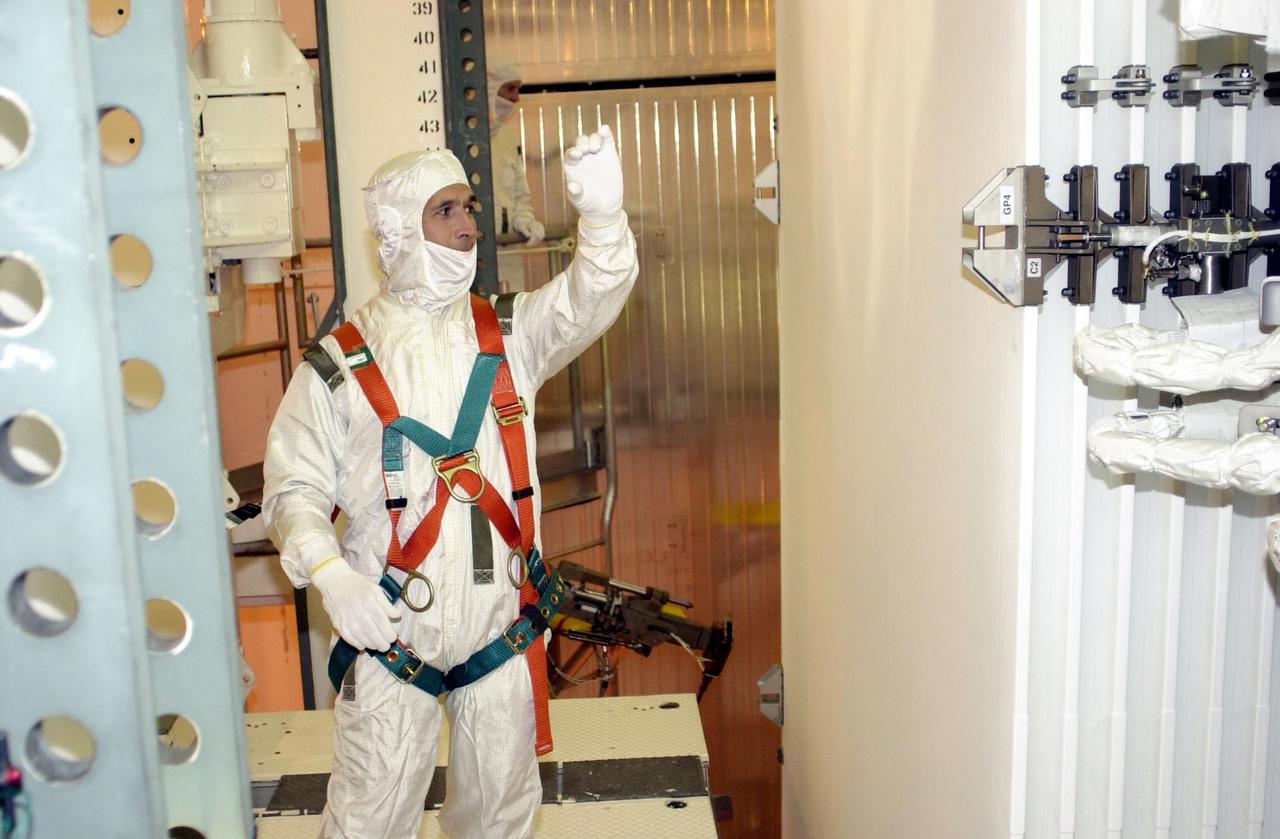
KENNEDY SPACE CENTER, FLA. - From a platform in Endeavour's payload bay, STS-113 Mission Specialist John Herrington looks over the payload for the mission. The 16th assembly flight to the International Space Station, STS-113 will carry the Port 1 (P1) truss aboard Space Shuttle Endeavour as well as the Expedition 6 crew, who will replace Expedition 5 on the Station. Mission STS-113 is scheduled to launch Nov. 10, 2002.
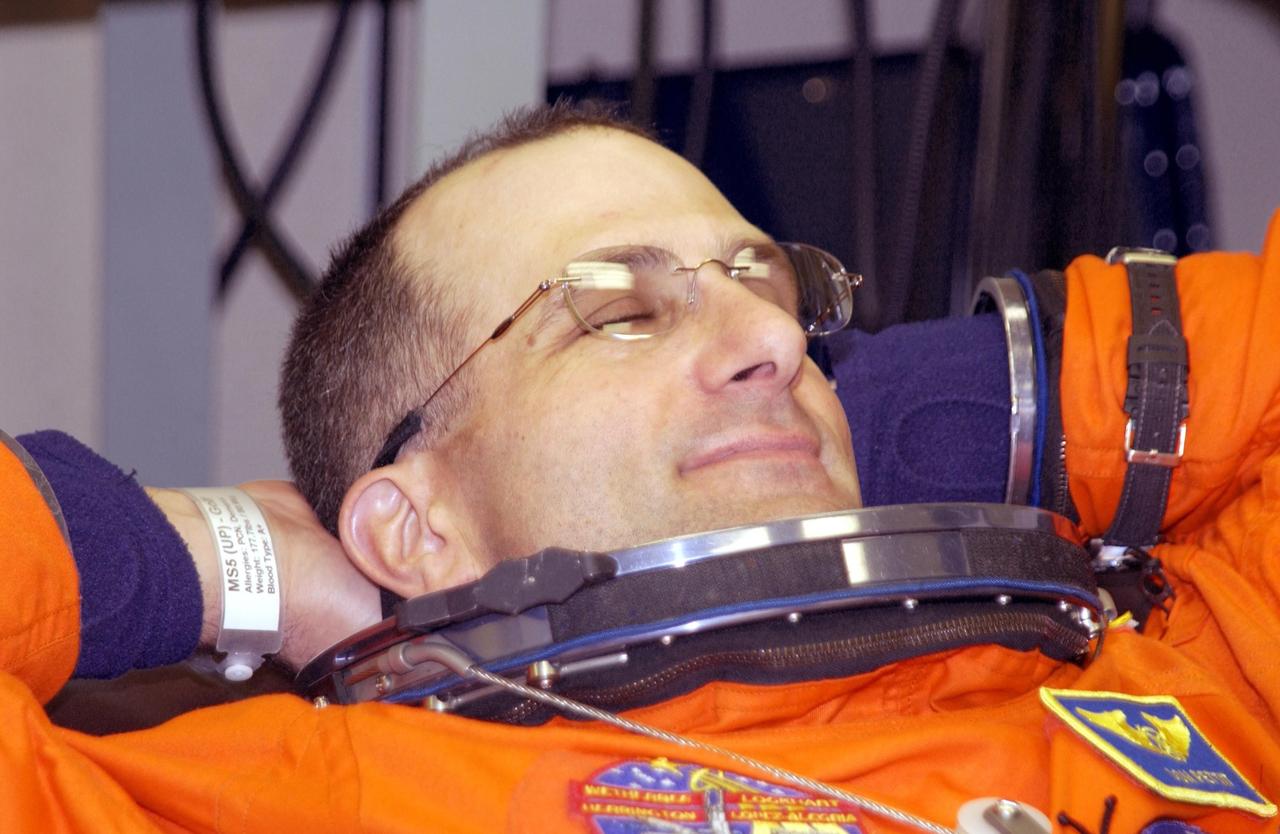
KENNEDY SPACE CENTER, FLA. -- Expedition 6 flight engineer Donald Pettit relaxes during suitup for launch. Pettit will be making his first Shuttle flight. The primary mission for the crew is bringing the Expedition 6 crew to the Station and returning the Expedition 5 crew to Earth. The major objective of the mission is delivery of the Port 1 (P1) Integrated Truss Assembly, which will be attached to the port side of the S0 truss. Three spacewalks are planned to install and activate the truss and its associated equipment. Launch of Space Shuttle Endeavour on mission STS-113 is scheduled for 8:15 p.m. EST.
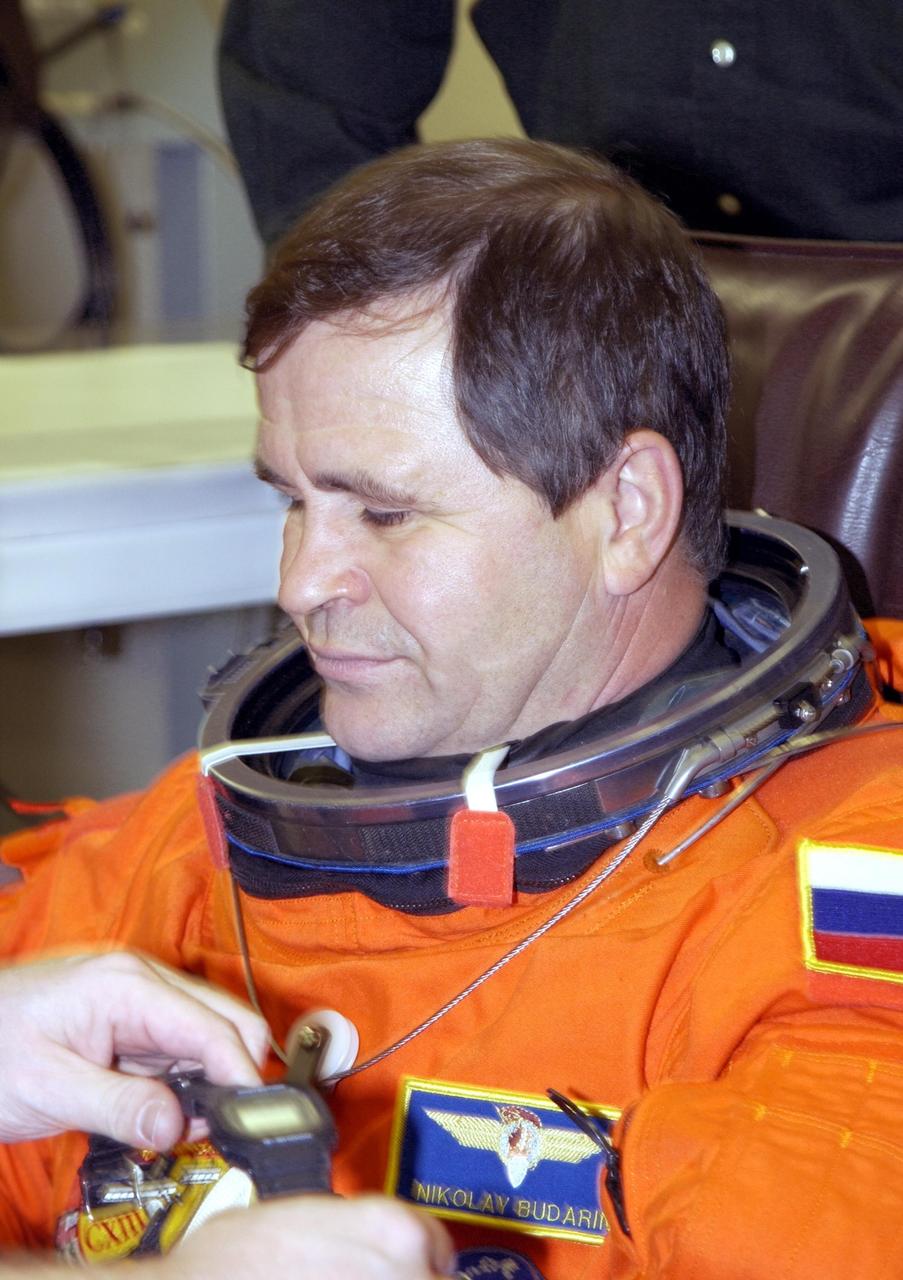
KENNEDY SPACE CENTER, FLA. - Expedition 6 flight engineer Nikolai Budarin relaxes during suitup for launch. Budarin, who is with the Russian Space Agency, will be making his second Shuttle flight. The primary mission for the crew is bringing the Expedition 6 crew to the Station and returning the Expedition 5 crew to Earth. The major objective of the mission is delivery of the Port 1 (P1) Integrated Truss Assembly, which will be attached to the port side of the S0 truss. Three spacewalks are planned to install and activate the truss and its associated equipment. Launch of Space Shuttle Endeavour on mission STS-113 is scheduled for 8:15 p.m. EST.
![KENNEDY SPACE CENTER, FLA. - Against a black moonless sky, Space Shuttle Endeavour lights up the night as it blazes into space after an ontime liftoff at 7:49:47 p.m. EST. The launch is the 19th for Endeavour, and the 112th flight in the Shuttle program. Mission STS-113 is the 16th assembly flight to the International Space Station, carrying another structure for the Station, the P1 integrated truss. Also onboard are the Expedition 6 crew, who will replace Expedition 5. Endeavour is scheduled to land at KSC after an 11-day journey. [Photo by Scott Andrews]](https://images-assets.nasa.gov/image/KSC-02pd1806/KSC-02pd1806~medium.jpg)
KENNEDY SPACE CENTER, FLA. - Against a black moonless sky, Space Shuttle Endeavour lights up the night as it blazes into space after an ontime liftoff at 7:49:47 p.m. EST. The launch is the 19th for Endeavour, and the 112th flight in the Shuttle program. Mission STS-113 is the 16th assembly flight to the International Space Station, carrying another structure for the Station, the P1 integrated truss. Also onboard are the Expedition 6 crew, who will replace Expedition 5. Endeavour is scheduled to land at KSC after an 11-day journey. [Photo by Scott Andrews]
![KENNEDY SPACE CENTER, FLA. -- Brilliant clouds of smoke and steam roll away from Launch Pad 39A as Space Shuttle Endeavour blazes into the black sky. Liftoff occurred ontime at 7:49:47 p.m. EST. The launch is the 19th for Endeavour, and the 112th flight in the Shuttle program. Mission STS-113 is the 16th assembly flight to the International Space Station, carrying another structure for the Station, the P1 integrated truss. Also onboard are the Expedition 6 crew, who will replace Expedition 5. Endeavour is scheduled to land at KSC after an 11-day journey. [Photo by Scott Andrews]](https://images-assets.nasa.gov/image/KSC-02pd1810/KSC-02pd1810~medium.jpg)
KENNEDY SPACE CENTER, FLA. -- Brilliant clouds of smoke and steam roll away from Launch Pad 39A as Space Shuttle Endeavour blazes into the black sky. Liftoff occurred ontime at 7:49:47 p.m. EST. The launch is the 19th for Endeavour, and the 112th flight in the Shuttle program. Mission STS-113 is the 16th assembly flight to the International Space Station, carrying another structure for the Station, the P1 integrated truss. Also onboard are the Expedition 6 crew, who will replace Expedition 5. Endeavour is scheduled to land at KSC after an 11-day journey. [Photo by Scott Andrews]
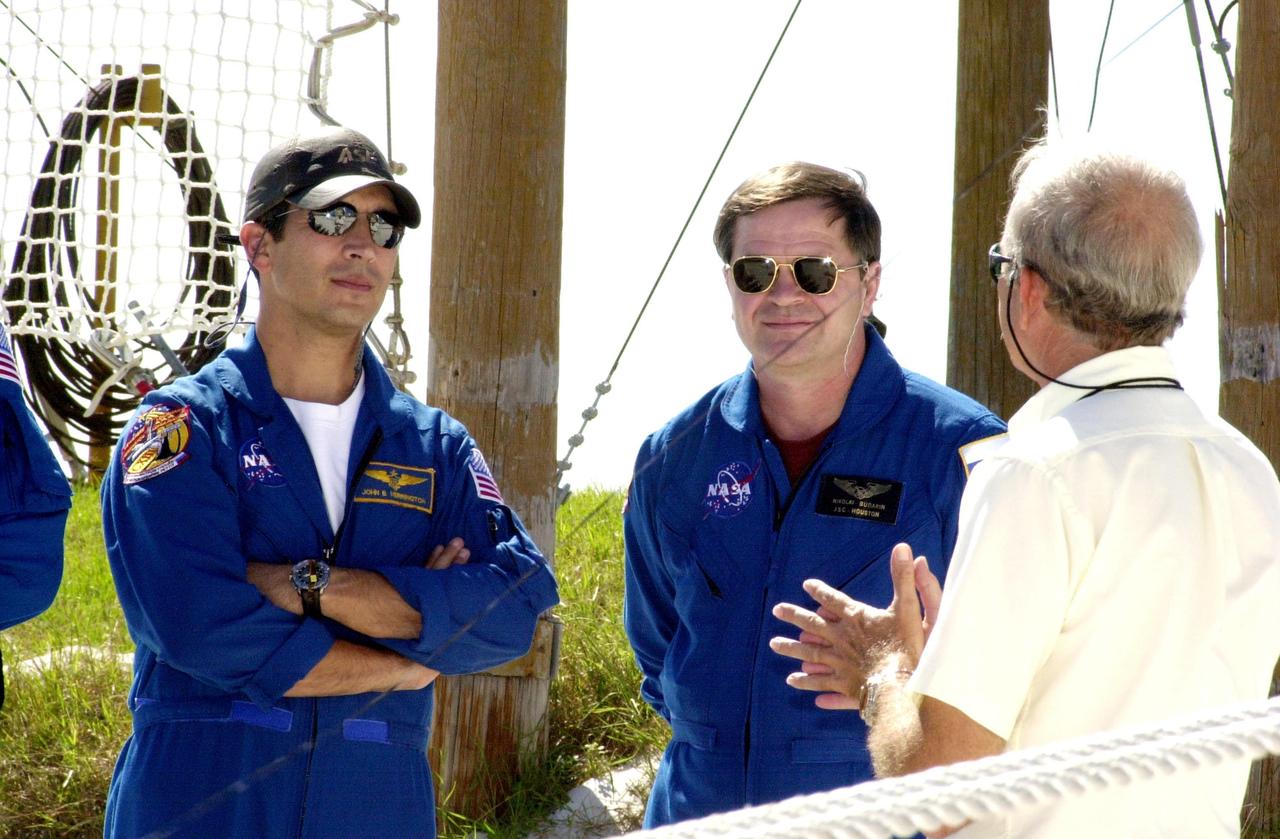
KENNEDY SPACE CENTER, FLA. - STS-113 Mission Specialist John Herrington (left) and cosmonaut Nikolai Budarin (center) listen to instructions from a trainer on the emergency egress system on Launch Pad 39A. They are other crew members are taking part in Terminal Countdown Demonstration Test (TCDT) activities, which also include a simulated launch countdown. The 16th assembly flight to the International Space Station, STS-113 will carry the Port 1 (P1) truss aboard Space Shuttle Endeavour as well as the Expedition 6 crew, who will replace Expedition 5 on the Station. Mission STS-113 is scheduled to launch Nov. 10, 2002.
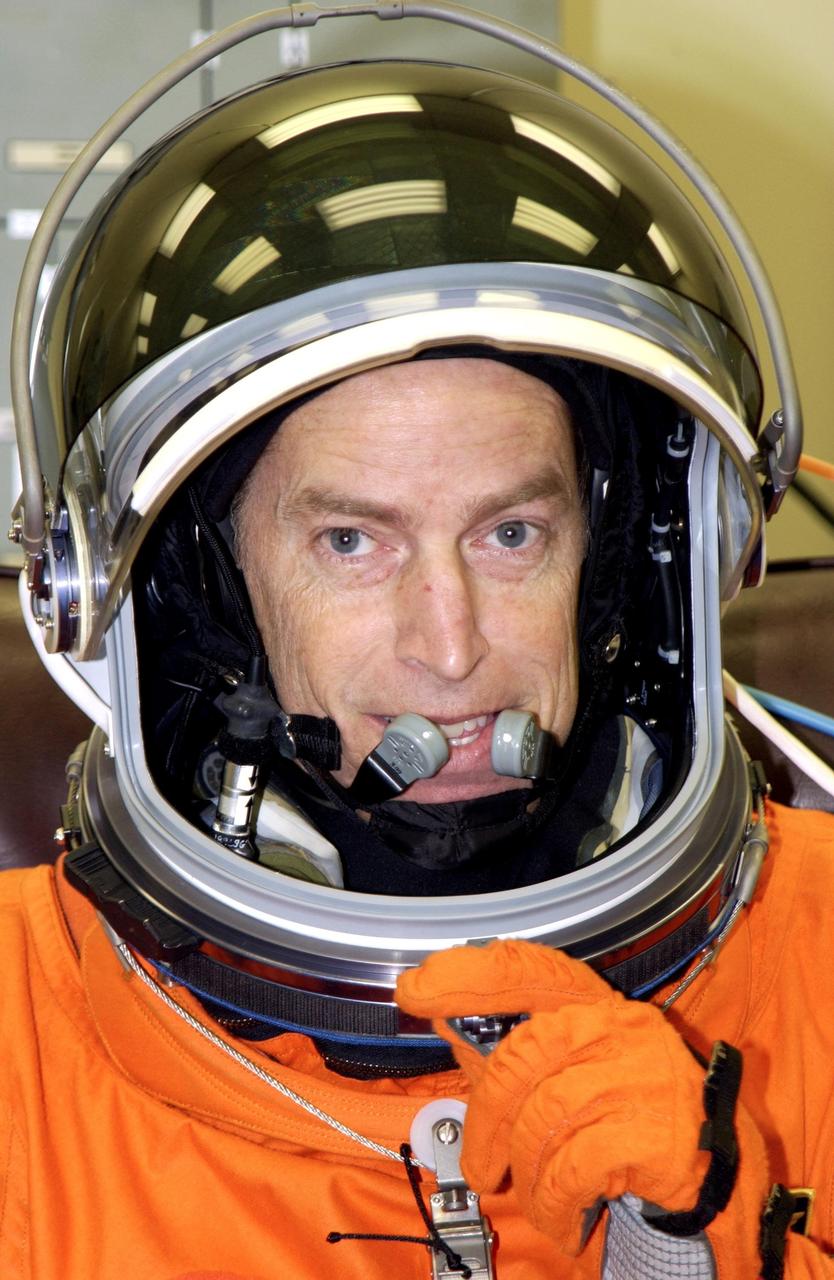
KENNEDY SPACE CENTER, FLA. -- STS-113 Commander James Wetherbee finishes suiting up before leaving for Launch Pad 39A. Wetherbee will be making his sixth Shuttle flight. The primary mission for the crew is bringing the Expedition 6 crew to the Station and returning the Expedition 5 crew to Earth. The major objective of the mission is delivery of the Port 1 (P1) Integrated Truss Assembly, which will be attached to the port side of the S0 truss. Three spacewalks are planned to install and activate the truss and its associated equipment. Launch of Space Shuttle Endeavour on mission STS-113 is scheduled for 8:15 p.m. EST.
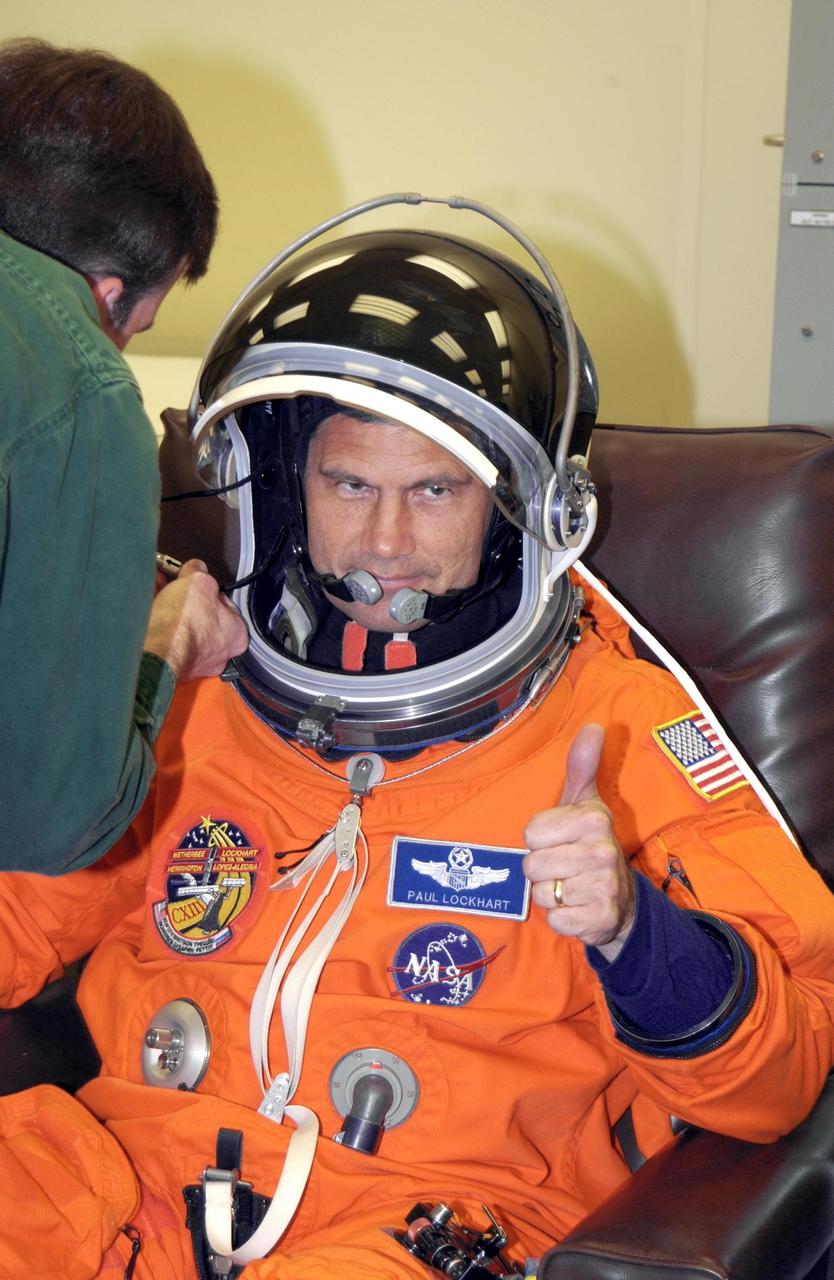
KENNEDY SPACE CENTER, FLA. -- STS-113 Pilot Paul Lockhart shows thumbs up for launch as he finishes suiting up. Lockhart will be making his second Shuttle flight. The primary mission for the crew is bringing the Expedition 6 crew to the Station and returning the Expedition 5 crew to Earth. The major objective of the mission is delivery of the Port 1 (P1) Integrated Truss Assembly, which will be attached to the port side of the S0 truss. Three spacewalks are planned to install and activate the truss and its associated equipment. Launch of Space Shuttle Endeavour on mission STS-113 is scheduled for 8:15 p.m. EST.
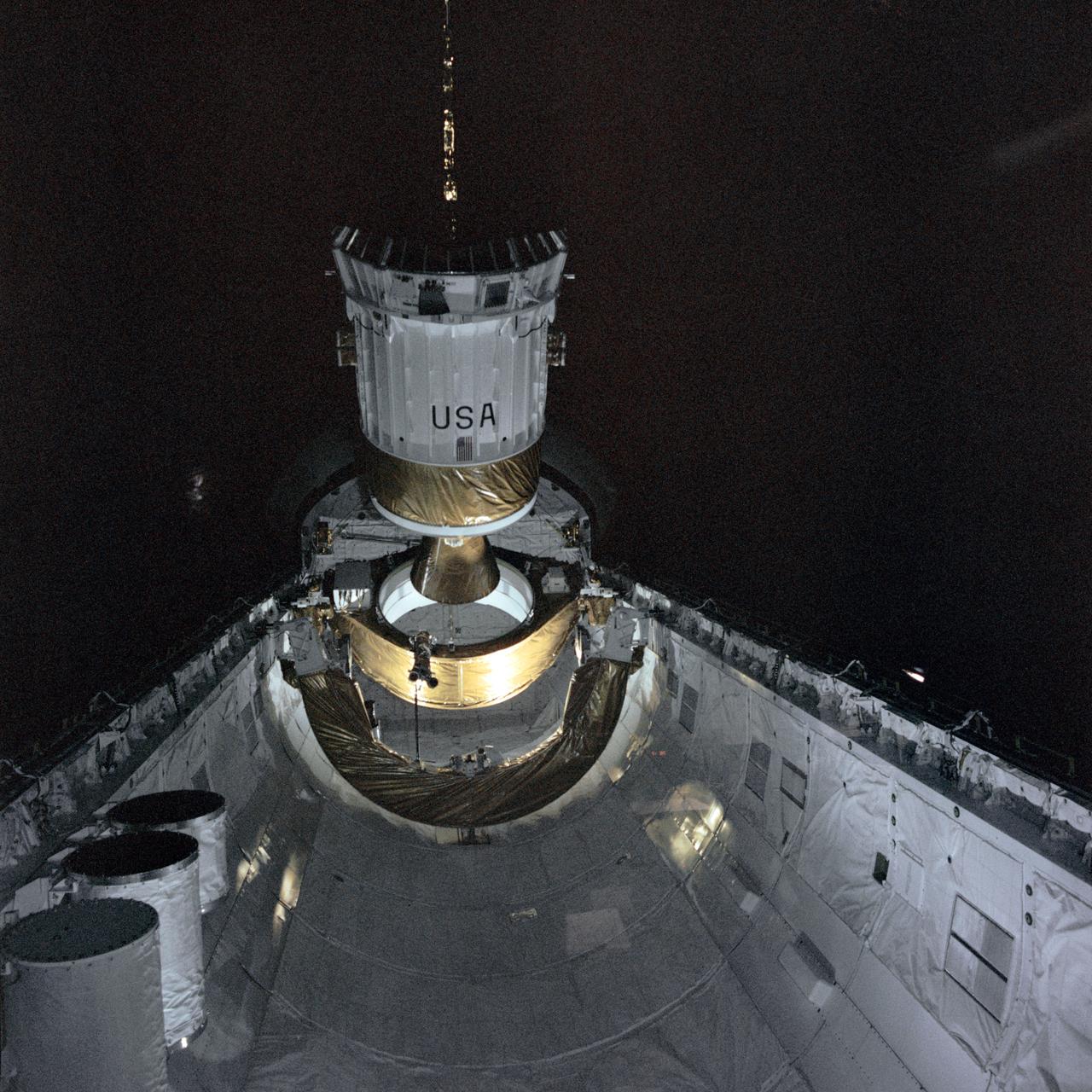
STS006-38-894 (4 April 1983) --- The tracking and data relay satellite (TDRS) leaves the 18-meter (60-ft) long cargo bay of the Earth-orbiting space shuttle Challenger about ten hours following launch of NASA’s second reusable space vehicle. The inertial upper stage (IUS) which gives power necessary to place the TDRS in its desired orbit is clearly seen in this view, photographed with a 70mm camera aimed through the aft flight deck windows of the Challenger. The cylindrical canisters in the left foreground contain scientific experiments from subscribers to NASA’s getaway special (GAS) program. Photo credit: NASA
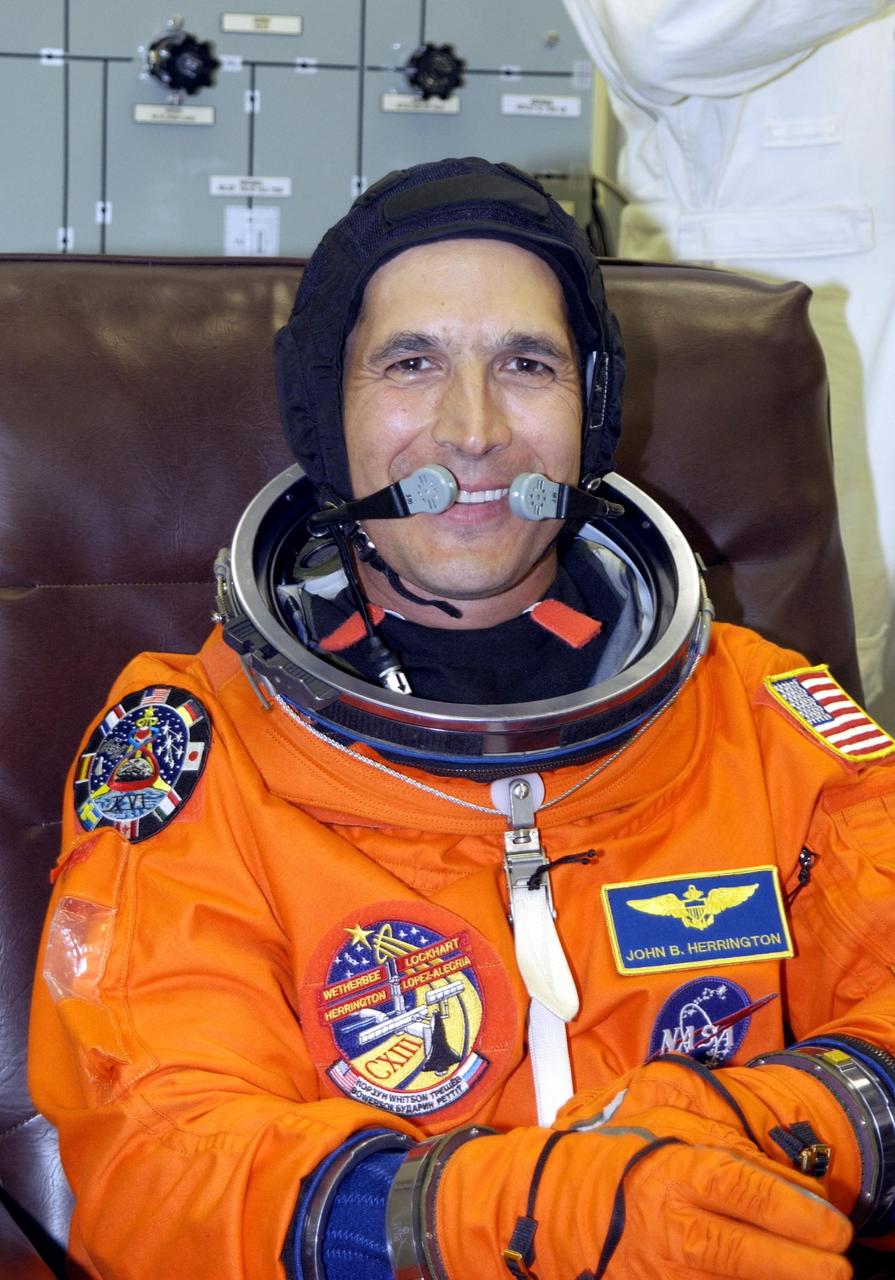
KENNEDY SPACE CENTER, FLA. -- STS-113 Mission Specialist John Herrington suits up for launch. Herrington will be making his first Shuttle flight. This is also the first launch of the first tribally enrolled Native American astronaut -- John B. Herrington -- on Space Transportation System. The primary mission for the crew is bringing the Expedition 6 crew to the Station and returning the Expedition 5 crew to Earth. The major objective of the mission is delivery of the Port 1 (P1) Integrated Truss Assembly, which will be attached to the port side of the S0 truss. Three spacewalks are planned to install and activate the truss and its associated equipment. Launch of Space Shuttle Endeavour on mission STS-113 is scheduled for 8:15 p.m. EST.
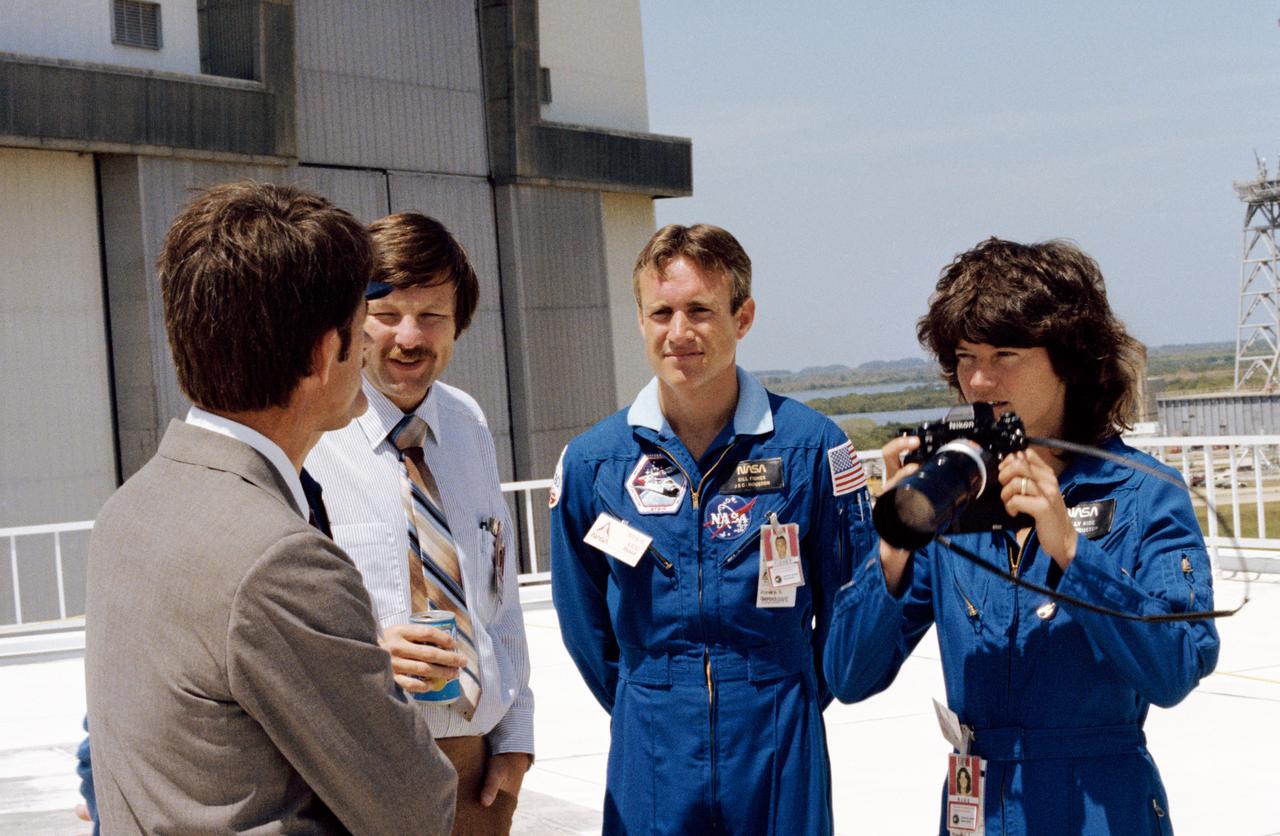
S83-31046 (4 April 1983) --- Astronaut Sally K. Ride, mission specialist for STS-7, scheduled for June 1983, records some of the prelaunch activity for STS-6 on 35mm film at the Kennedy Space Center (KSC). Astronaut William B. Lenoir, STS-5 mission specialist, is at left. Others pictured include Richard W. Nygren (center), chief of the vehicle integration section of the operations division at JSC; and astronaut William F. Fisher, second right. Photo credit: NASA

STS006-44-532 (4-9 April 1983) --- This is one of a series of photographs taken through the “ceiling” windows of the Earth-orbiting space shuttle Challenger by members of the STS-6 crew on its five-day mission in space. Many unused oil tankers lie in the roadstead along the coast of U.A.E. between the ports of Khawn Fakkan and Fujayrah. The sunglint on the Gulf of Oman permits the viewer to see the surface features much clearer. Such surface features as gynes, slicks, wakes, and sea state are clearly seen. Photo credit: NASA
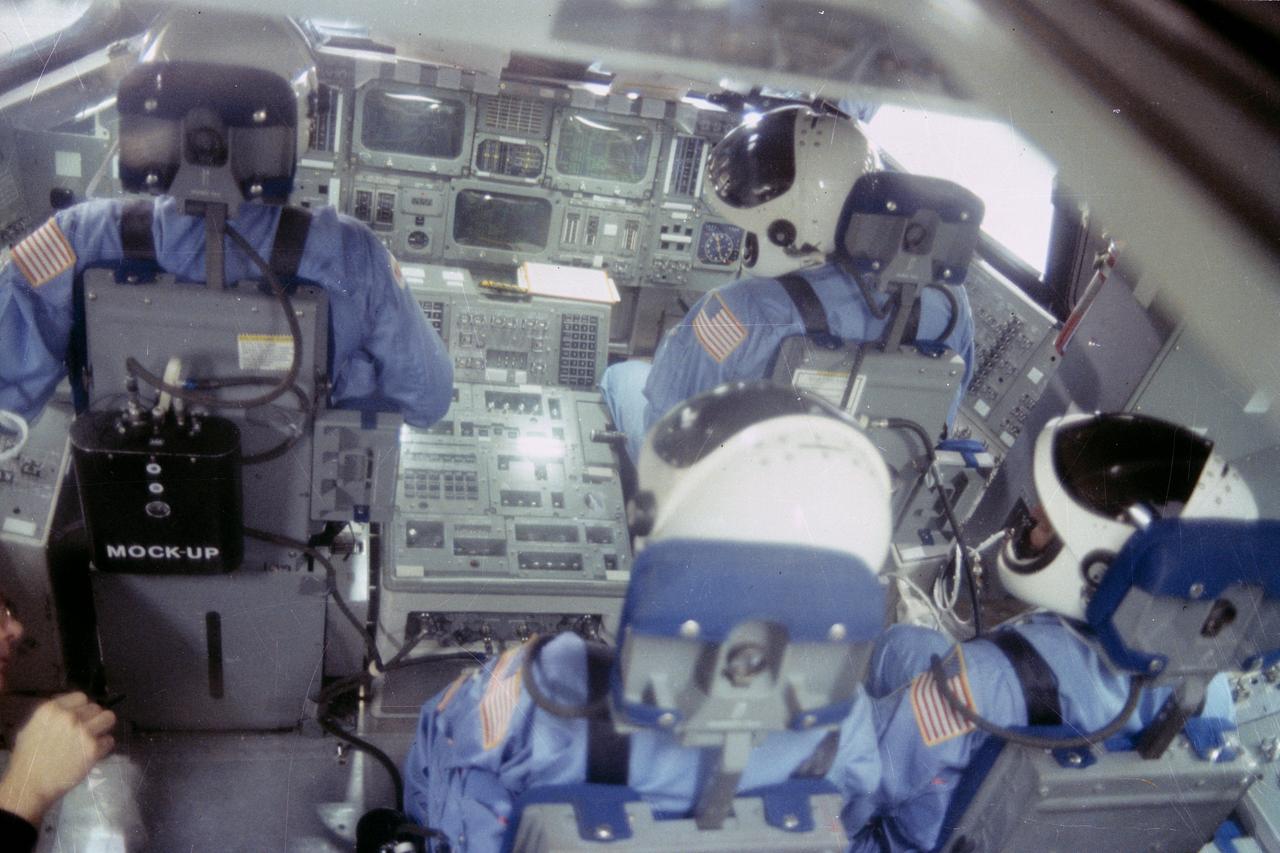
S82-41355 (December 1982) --- The four crew members for NASA?s STS-6 mission go through a training exercise in the full-scale engineering mock-up in the shuttle mock-up and integration laboratory at the Johnson Space Center (JSC). Their seating configuration reflects that of launch and landing phases aboard the space shuttle Challenger. The front stations are occupied by astronauts Paul J. Weitz (left), commander, and Karol J. Bobko, pilot. In the rear seats are astronauts Story Musgrave and Donald H. Peterson, both mission specialists. STS-6 will be the Challenger?s first flight when it takes this crew and a tracking and data relay satellite (TDRS) into Earth orbit the early part of next year. Photo credit: NASA
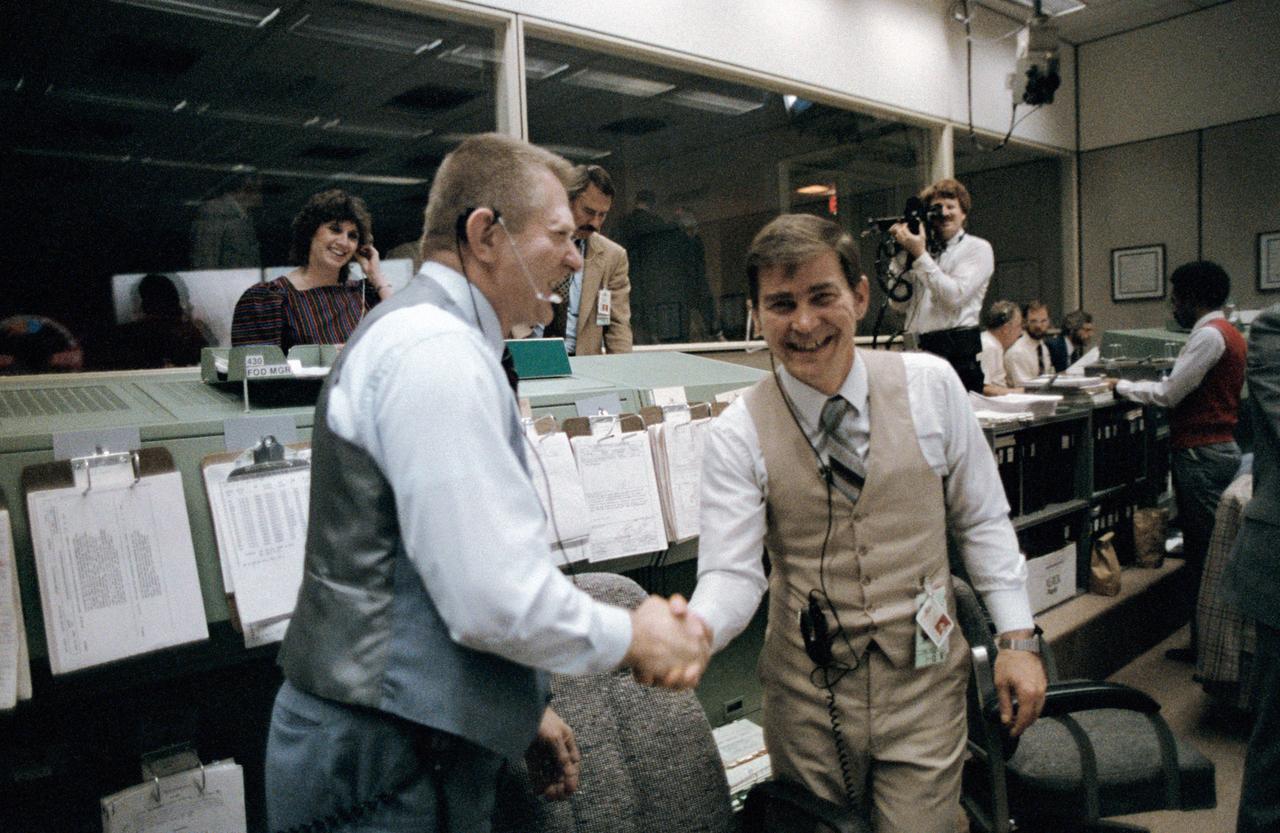
Various views of STS-6 MOCR activities during Day-5 with Vice-Pres. George Bush, Cap Communicator Bridges, JSC Director Gerald Griffin, Eugene F. Kranz, NASA Admin. James M. Beggs, Cap Com Astronaut O'Connor, Flight Directors Jay H. Greene, Gary E. Coen, and Harold Draughon. 1. BUSH, GEORGE, VICE-PRES. - STS-6 MOCR 2. DIR. GRIFFIN, GERALD D. - STS-6 MOCR 3. ADMIN. BEGGS, JAMES M. - STS-6 MOCR 4. FLT. DIRECTORS - STS-6 JSC, HOUSTON, TX Also available in 35 CN
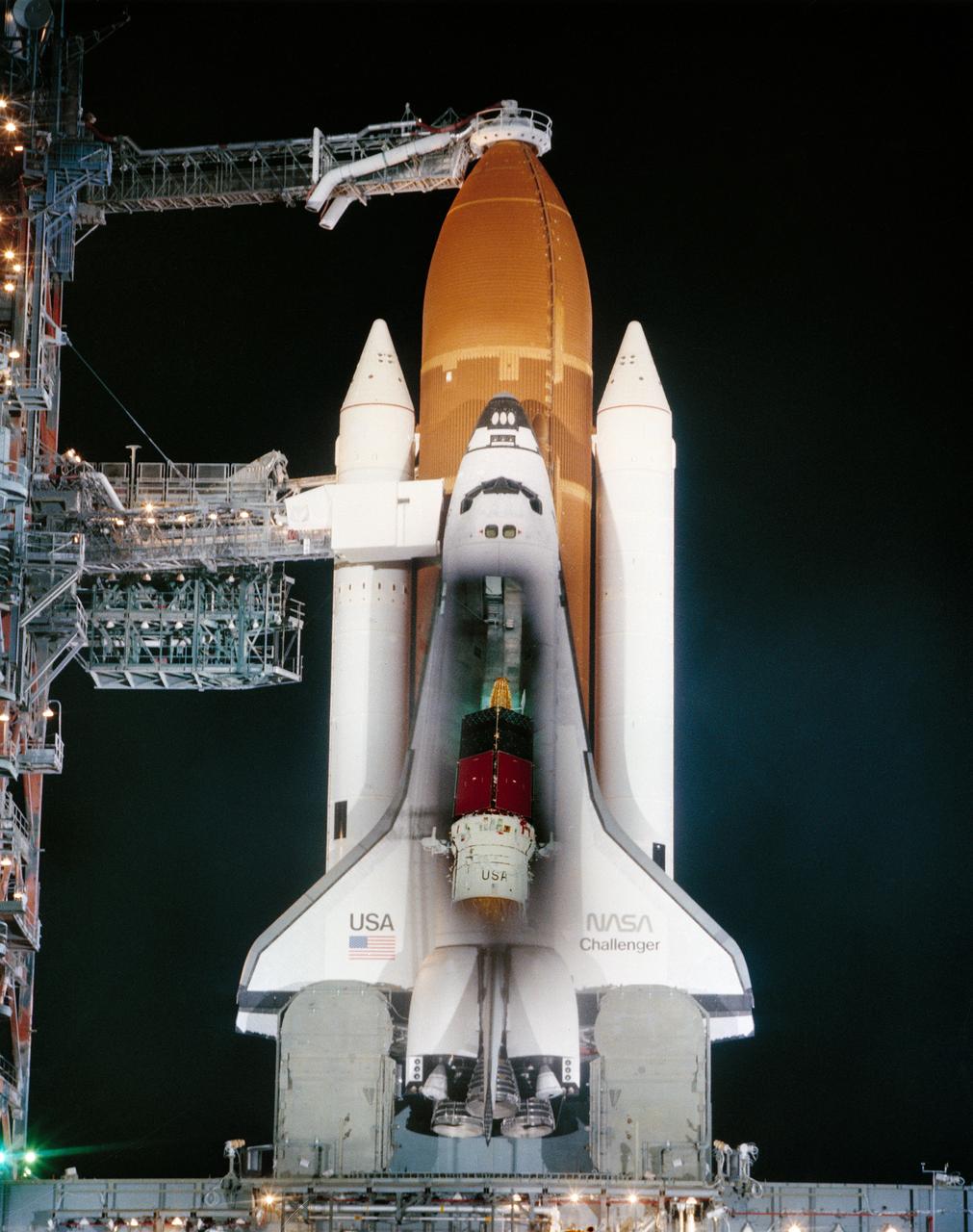
Composite view of the TDRS superimposed into Challenger Cargo Bay while on Pad 39A. 1. STS-6 - PREFLIGHT KSC, FL Also available in 4x5 B&W
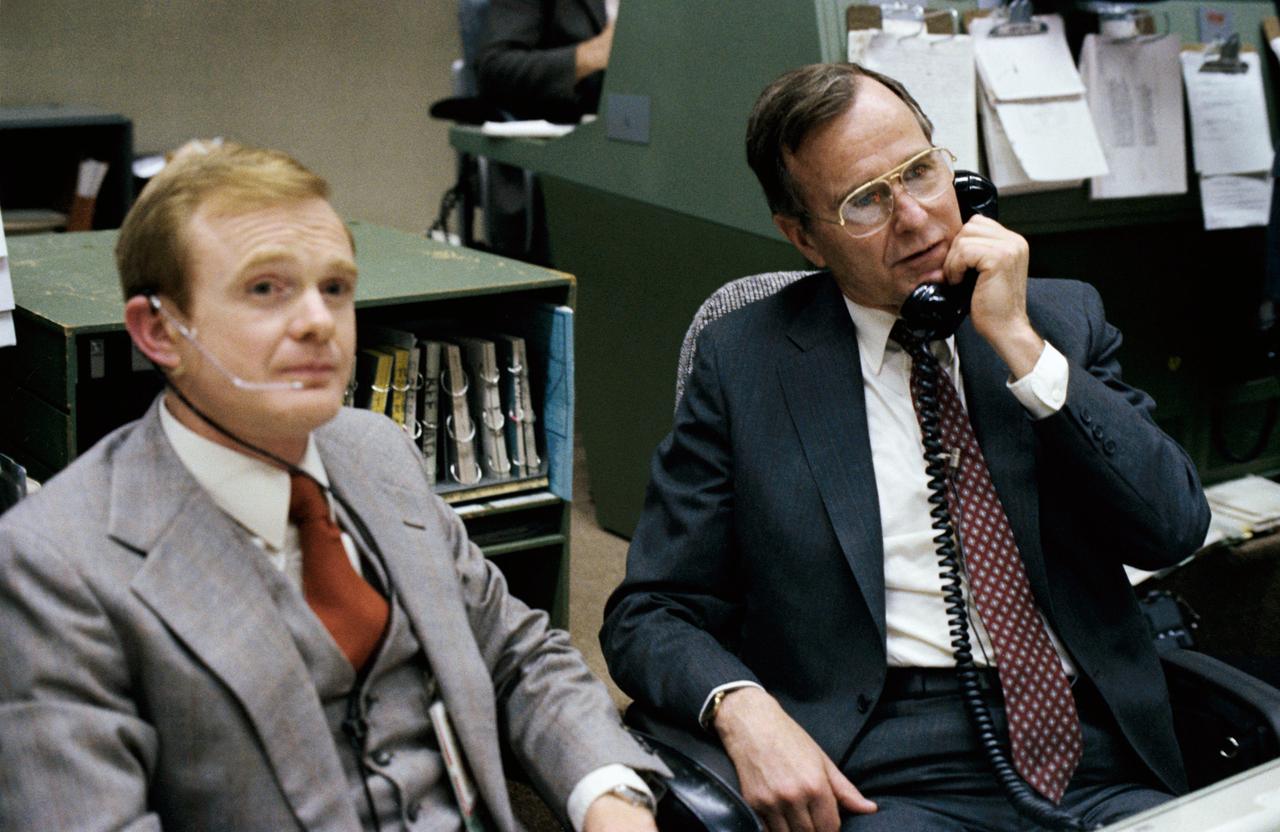
S83-30190 (8 April 1983) --- Vice President George Bush talks to the Earth-orbiting STS-6 astronauts from the spacecraft communicators; (CAPCOM) console in the mission operations control room (MOCR) of the Johnson Space Center?s mission control center. Astronaut Roy D. Bridges, left, is one of the CAPCOM personnel on duty.
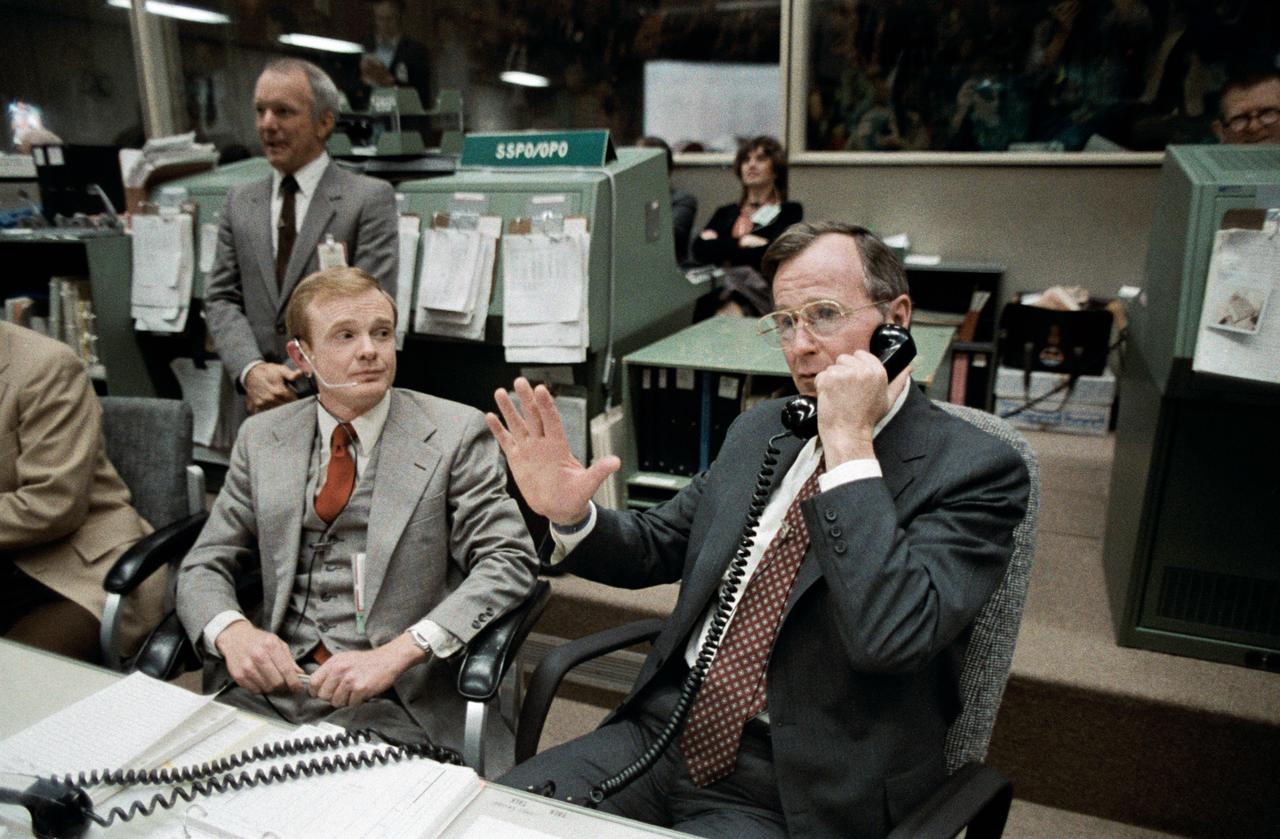
S83-30192 (8 April 1983) --- Vice President George Bush talks to the Earth-orbiting STS-6 astronauts from the spacecraft communicators; (CAPCOM) console in the mission operations control room (MOCR) of the Johnson Space Center?s mission control center. Astronaut Roy D. Bridges, is one of the CAPCOM personnel on duty. JSC Director Gerald D. Griffin, left, watches a large monitor (out of frame) on which the TV scene of the four-member Challenger crew is visible. This photo was made by Otis Imboden.
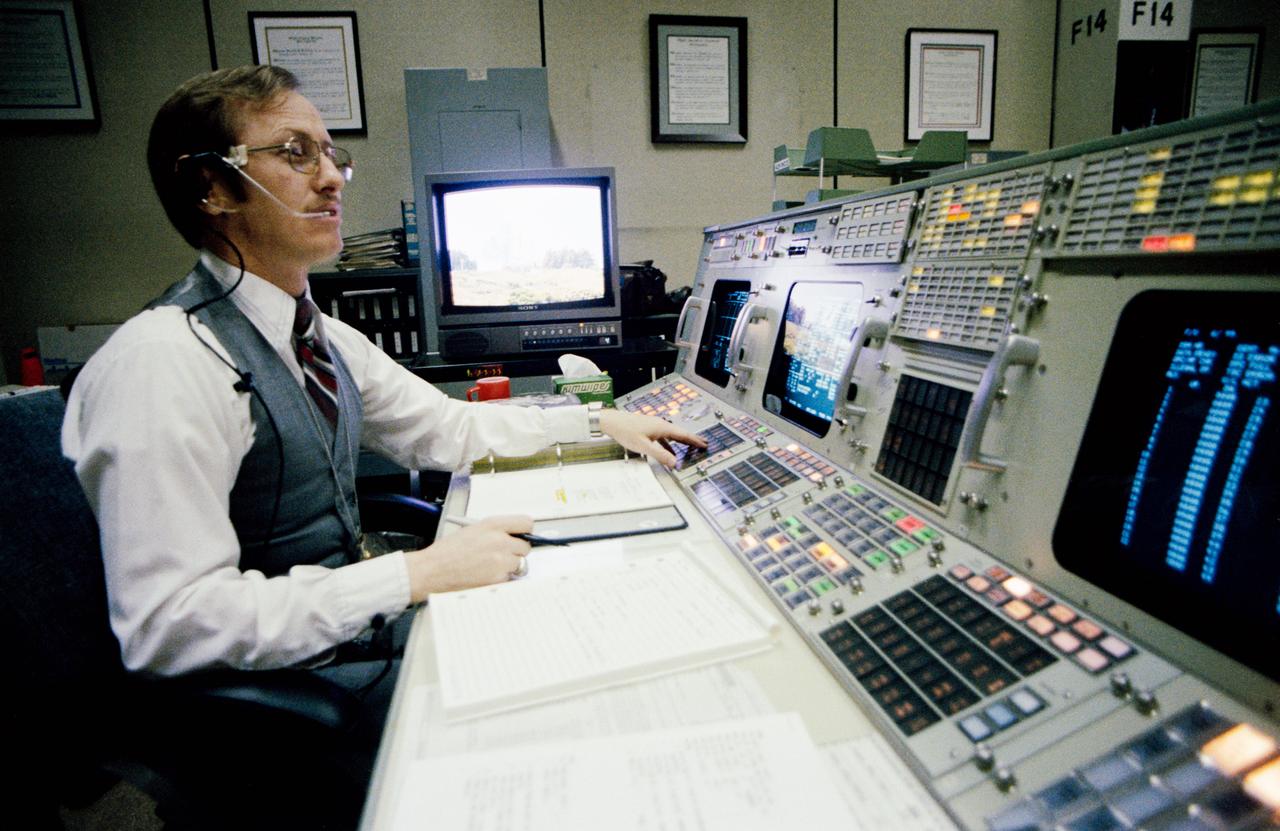
S83-30138 (6 April 1983) --- Granvil A. (Al) Pennington waits for the launch of STS-6?s Challenger as he begins his duties as ascent team integrated communication systems officer (INCO) at the INCO console in the mission operations control room (MOCR) of the Johnson Space Center?s mission control center. The second reusable spacecraft in history launched from the Kennedy Space Center?s Pad 39A at 1:30:00:88 p.m. (EST) today.
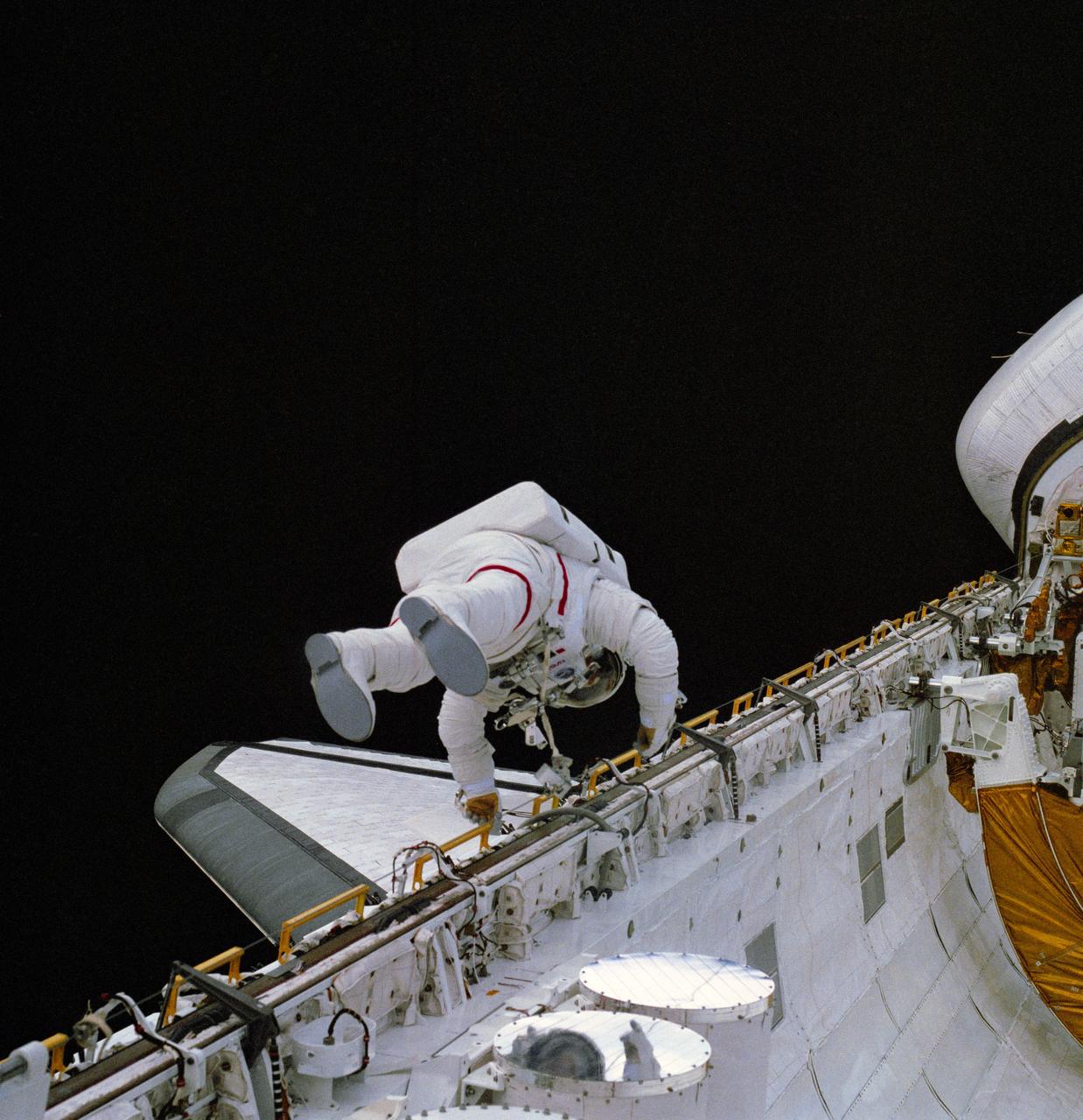
S83-30215 (7 April 1983) --- This photograph of astronaut Story Musgrave, STS-6 mission specialist, translating along the longerons on the port side of the cargo bay of the Earth-orbiting space shuttle Challenger was taken with a hand-held 70mm camera from some 18 meters (60 feet) away by one of two crew members who remained inside the cabin. Astronauts Musgrave and Donald H. Peterson (out of frame) were in the midst of NASA?s first ever shuttle extravehicular activity (EVA). Astronaut Karol J. Bobko, pilot, took a number of photographs through the aft flight deck?s windows, and astronaut Paul J. Weitz, mission commander, also exposed some images but remained in control of the orbiter during the EVA. Photo credit: NASA
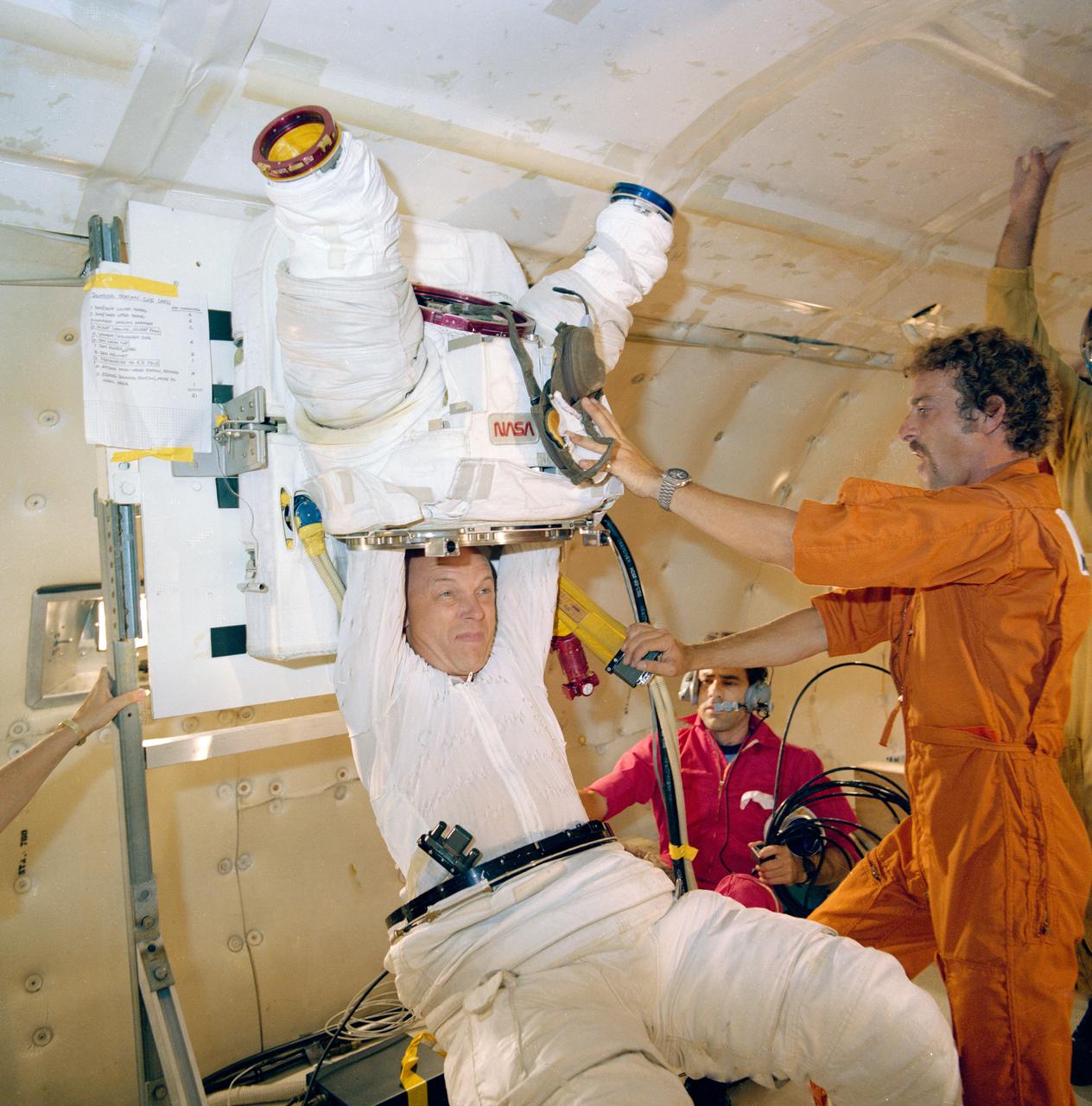
S82-33603 (November 1982) --- Astronaut F. Story Musgrave, STS-6 mission specialist, is assisted in a suit donning and doffing exercise in the weightlessness provided by a KC-135 ?zero-gravity? aircraft. Dr. Musgrave and the next mission?s other mission specialist, astronaut Donald H. Peterson, participated in the donning and doffing as a simulation for their preparations aboard the Challenger when they are called upon to perform an extravehicular activity (EVA) which was postponed from NASA?s first operational STS flight earlier this month. The suit is called an Extravehicular Mobility Unit (EMU). Photo credit: NASA
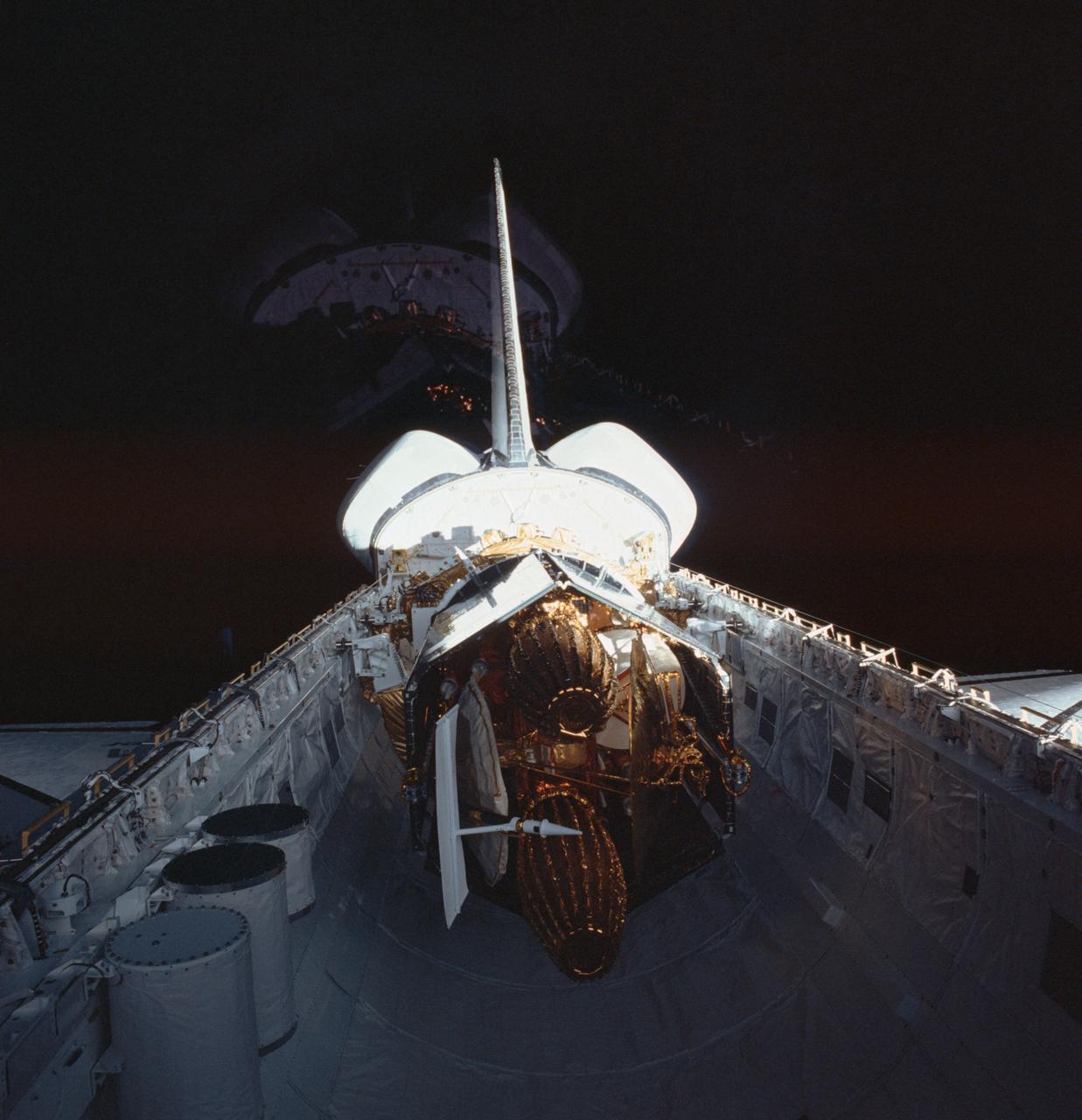
STS006-38-844 (4 April 1983) --- The stowed tracking and data relay satellite (TDRS) and its inertial upper stage (IUS) are seen in duplicate in this 70mm frame taken by the STS-6 crew aboard the Earth-orbiting space shuttle Challenger on its first day in space. A reflection in the aft window of the flight deck resulted in the mirage effect of the “second” TDRS. The three canisters in the aft foreground contain experiments of participants in NASA’s STS getaway special (GAS) program. Onboard the second reusable shuttle for this five-day flight were astronauts Paul J. Weitz, Karol J. Bobko, Dr. F. Story Musgrave and Donald H. Peterson. Photo credit: NASA
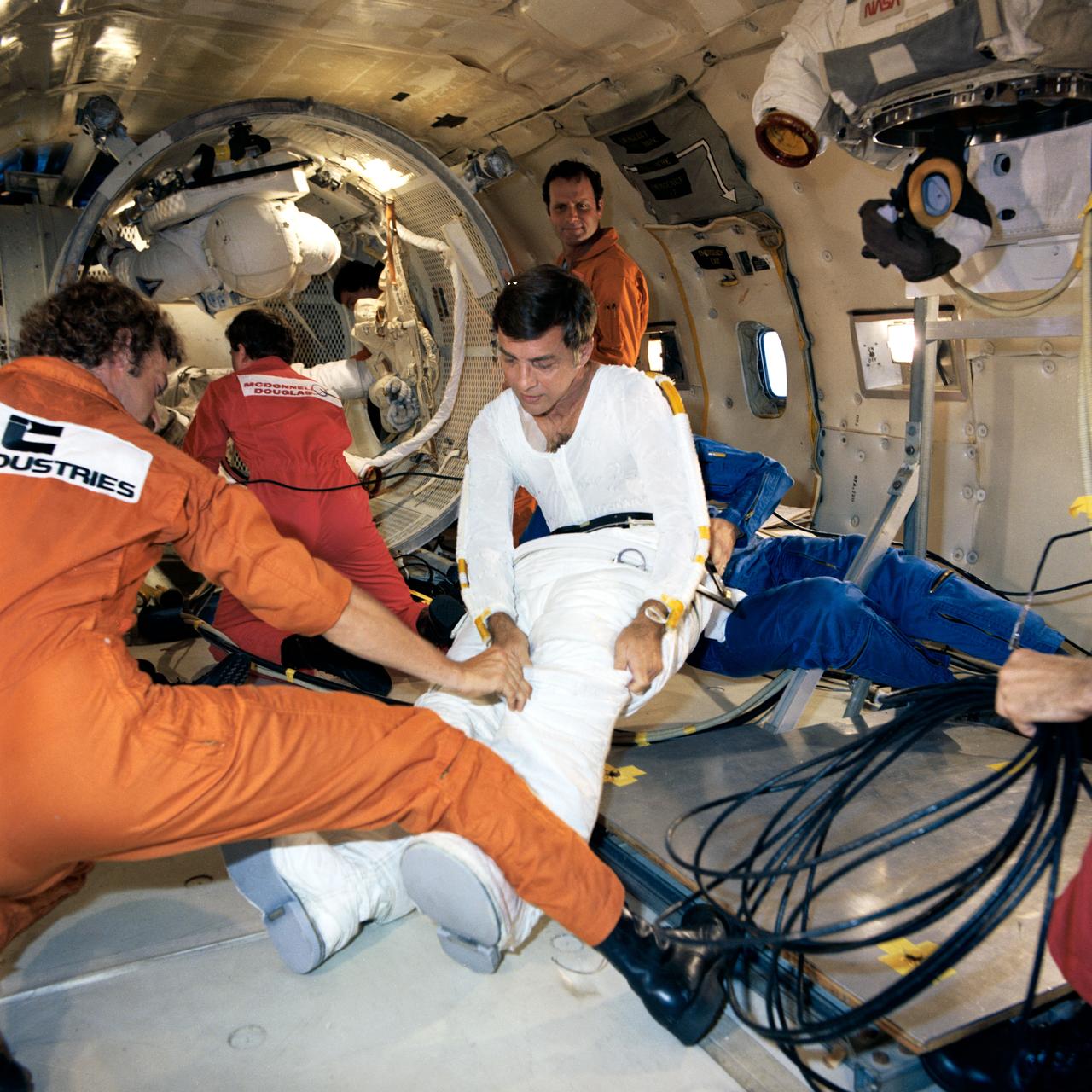
Spacesuit Donning and Doffing in Zero-G Training for Don Peterson of the STS-6 Crew with Astronaut Jerry Ross assisting; and, apparatus for testing the JSC Mechanically-Induced Settling Technology (MIST) Experiment. The training is being held aboard the KC-135 to simulate weightlessness. He is being assisted to don the lower torso of the Extravehicular Mobility Unit (EMU) by an ILC Technician. 1. ASTRONAUT ROSS, JERRY L. - ZERO-G SUITING 2. SHUTTLE - EXPERIMENTS (MIST)
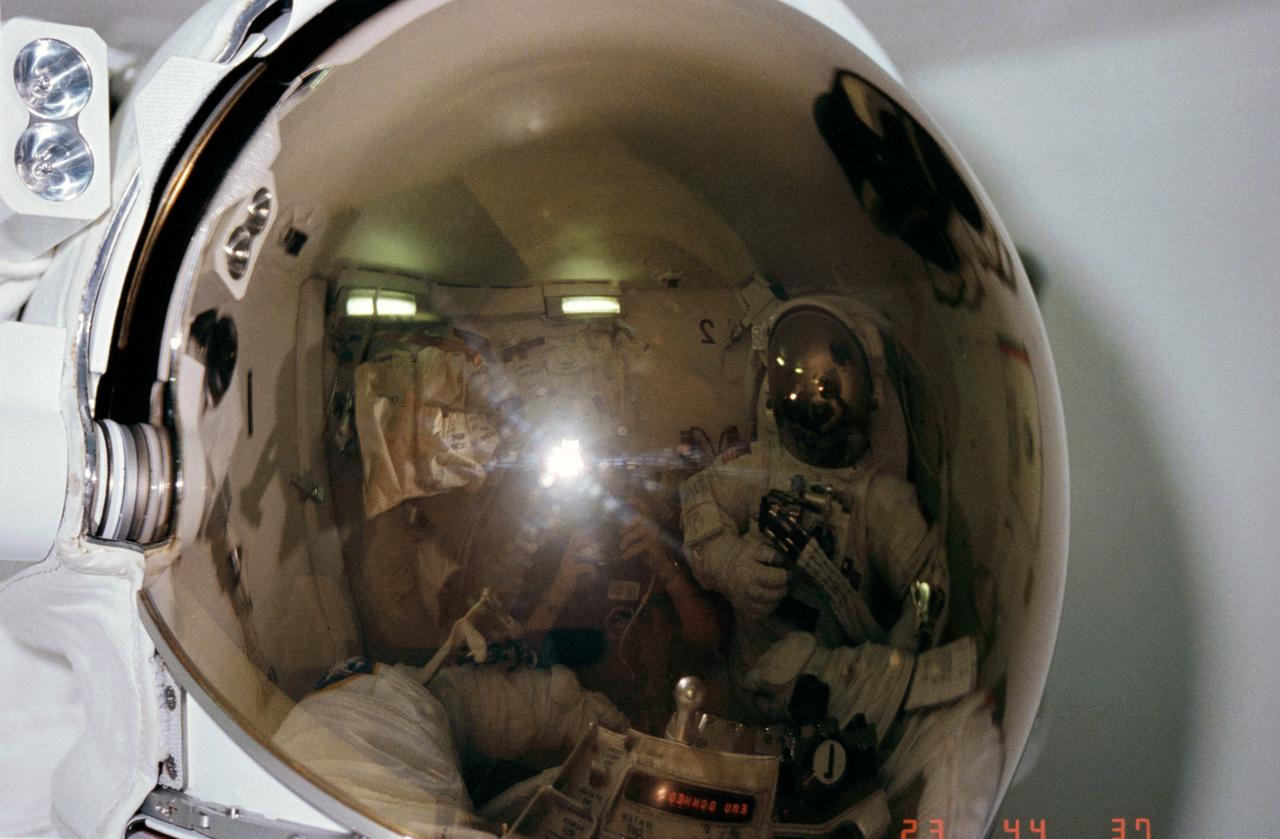
STS006-06-465 (7 April 1983) --- Three-fourths of the STS-6 astronaut crew appears in this unusual 35mm frame exposed in the airlock of the Earth-orbiting space shuttle Challenger. Astronaut F. Story Musgrave’s helmet visor encompasses all the action in the frame. Dr. Musgrave and astronaut Donald H. Peterson (reflected on right side of the visor) were fully suited in their Extravehicular Mobility Unit (EMU) spacesuits and were participating in EVA preparation exercises. Astronaut Karol J. Bobko, STS-6 pilot, wearing conventional onboard shuttle clothing, photographed the two during their procedures and appears at center of frame. The reversed number (1 and 2 in the mirrored image represent the EVA designations for the two mission specialists. Photo credit: NASA
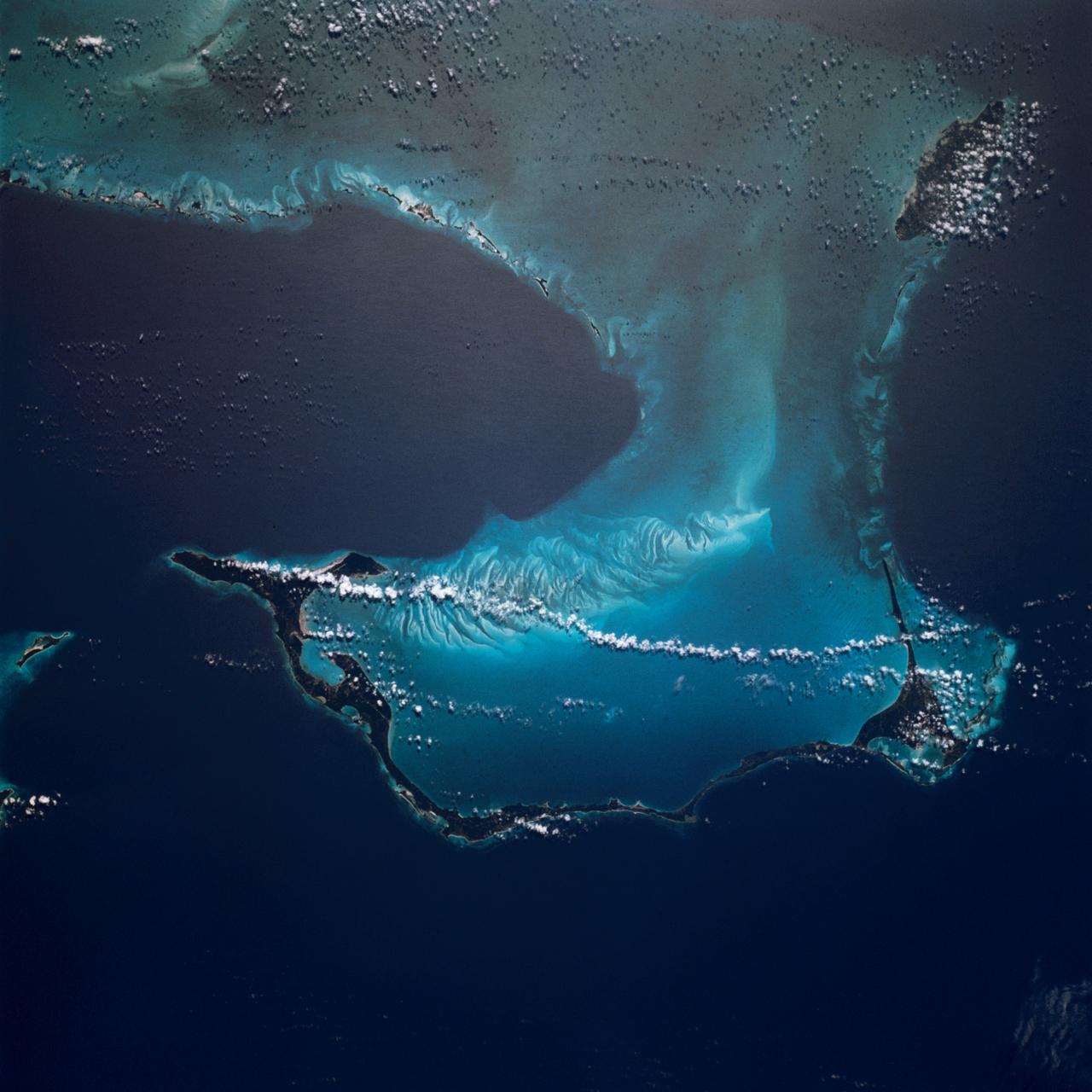
STS006-45-097 (4-9 April 1983) --- This photograph was taken with a handheld 70mm camera aimed through the “ceiling” windows of the Earth-orbiting space shuttle Challenger during its five-day STS-6 mission. A beautiful photo shows the contrast between the islands, clouds, shallow water and deep water. Islands of the Bahamas seen are New Providence (upper left) and Eleuthera (right). Northeast Providence Channel is at the upper edge and Exuma Sound is at the lower left with the open Atlantic along the right edge. The wind, from the south, causes a long cloud to develop downwind from Eleuthera Point. Photo credit: NASA
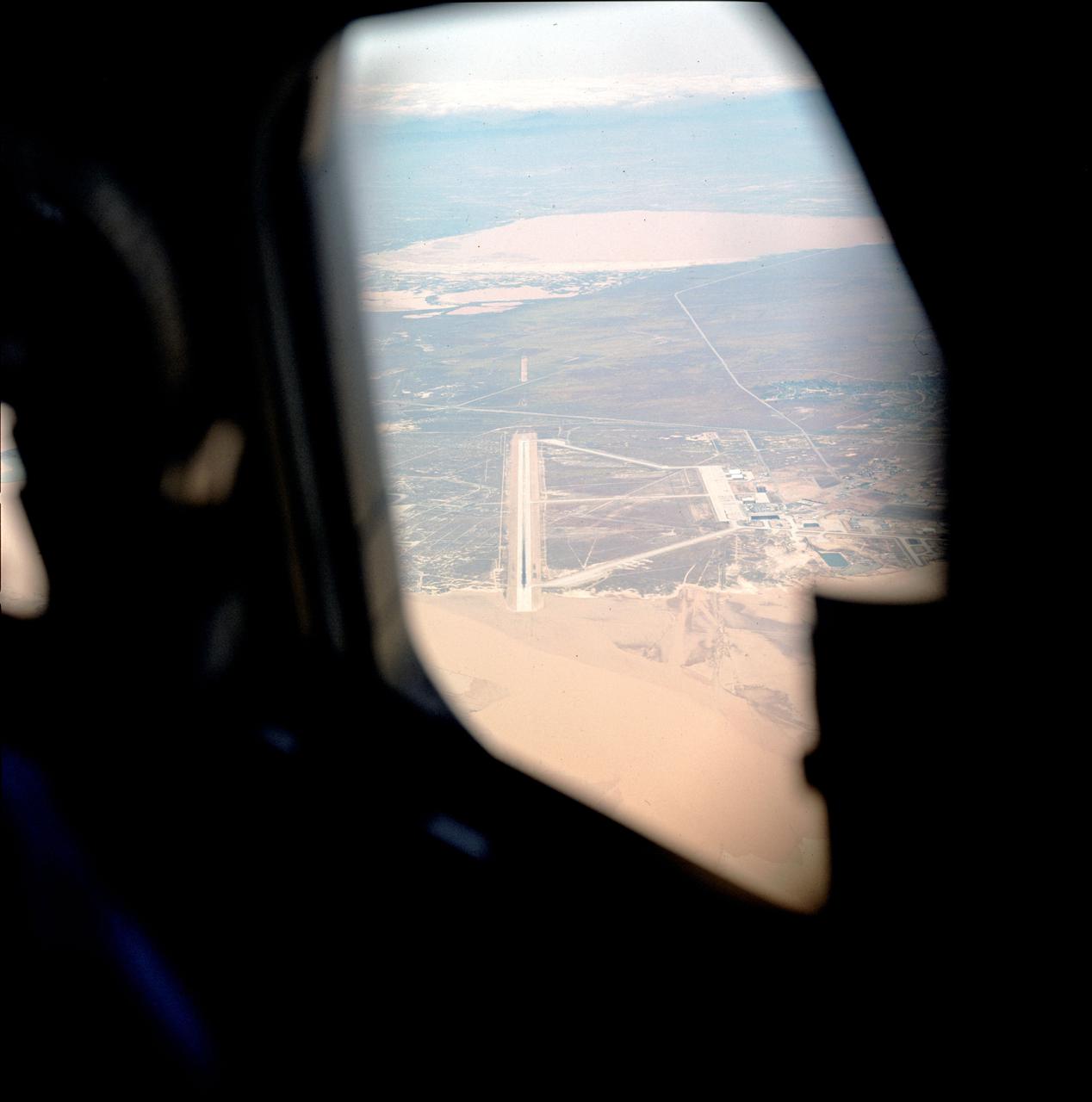
STS006-46-667 (9 April 1983) --- One of the final pictures taken aboard the space shuttle Challenger is this 35mm frame of Landing Strip 22 at Edwards Air Force Base as the reusable spacecraft was lined up for its landing only seconds later. The frame was exposed by astronaut Donald H. Peterson, STS-6 mission specialist, who was stretching behind the commander’s seat occupied by astronaut Paul J. Weitz on the flight deck. Also onboard the spacecraft for the five-day flight were astronauts Karol J. Bobko, pilot, and Dr. F. Story Musgrave, mission specialist. Photo credit: NASA
![KENNEDY SPACE CENTER, FLA. - All is quiet on Launch Pad 39A where Space Shuttle Endeavour sits prior to launch on mission STS-113 to the International Space Station. [Photo by Scott Andrews]](https://images-assets.nasa.gov/image/KSC-02pd1804/KSC-02pd1804~medium.jpg)
KENNEDY SPACE CENTER, FLA. - All is quiet on Launch Pad 39A where Space Shuttle Endeavour sits prior to launch on mission STS-113 to the International Space Station. [Photo by Scott Andrews]
![KENNEDY SPACE CENTER, FLA. - Bathed in light, Space Shuttle Endeavour sits on the pad prior to launch on mission STS-113 to the International Space Station. [Photo by Scott Andrews]](https://images-assets.nasa.gov/image/KSC-02pd1803/KSC-02pd1803~medium.jpg)
KENNEDY SPACE CENTER, FLA. - Bathed in light, Space Shuttle Endeavour sits on the pad prior to launch on mission STS-113 to the International Space Station. [Photo by Scott Andrews]
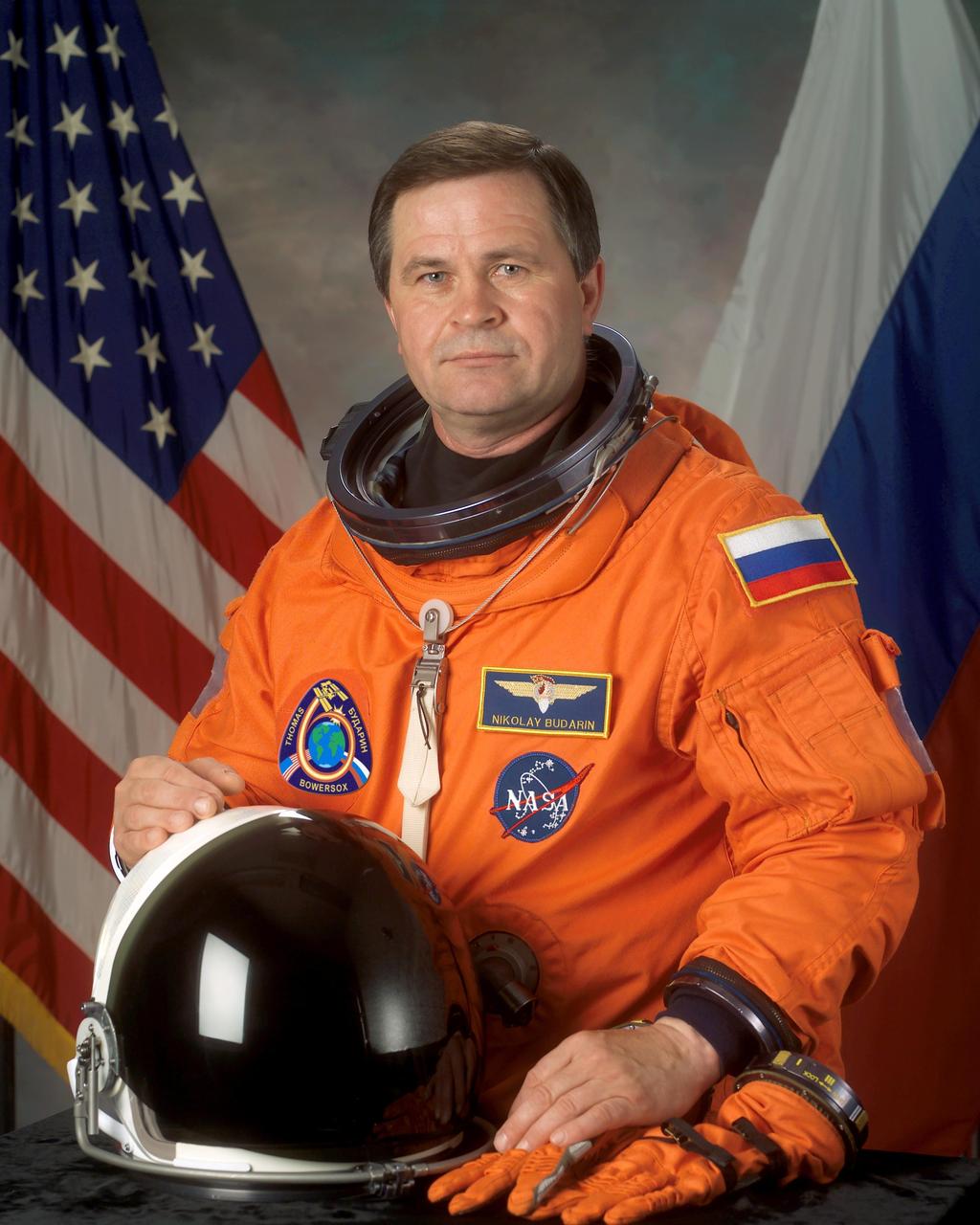
JOHNSON SPACE CENTER, HOUSTON, TEXAS -- (JSC2002-E-44140) --- Cosmonaut Nikolai M. Budarin, flight engineer representing Rosaviakosmos.
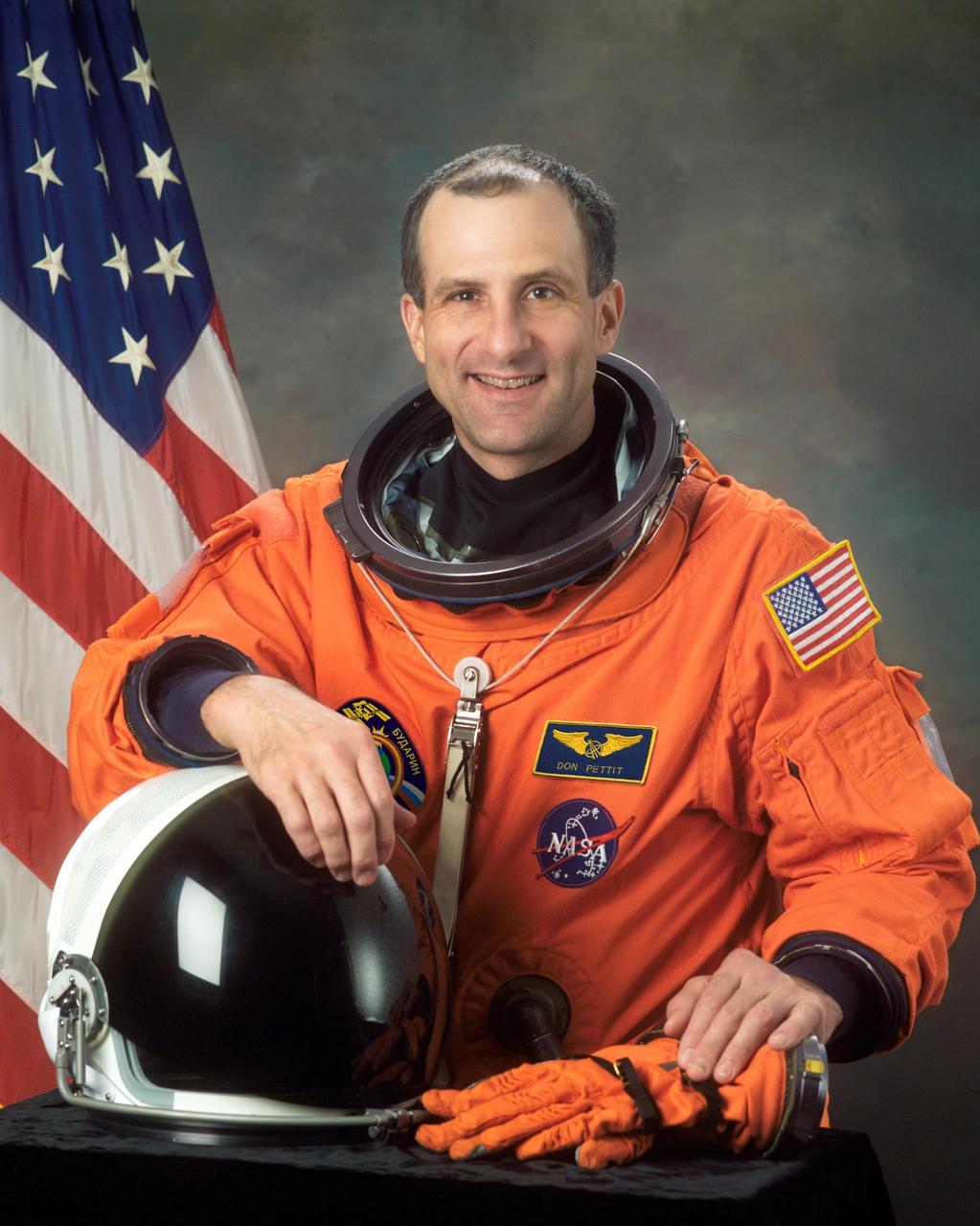
JOHNSON SPACE CENTER, HOUSTON, TEXAS -- (JSC2002-E-43073) --- Astronaut Donald R. Pettit, mission specialist, on the STS-126 mission.
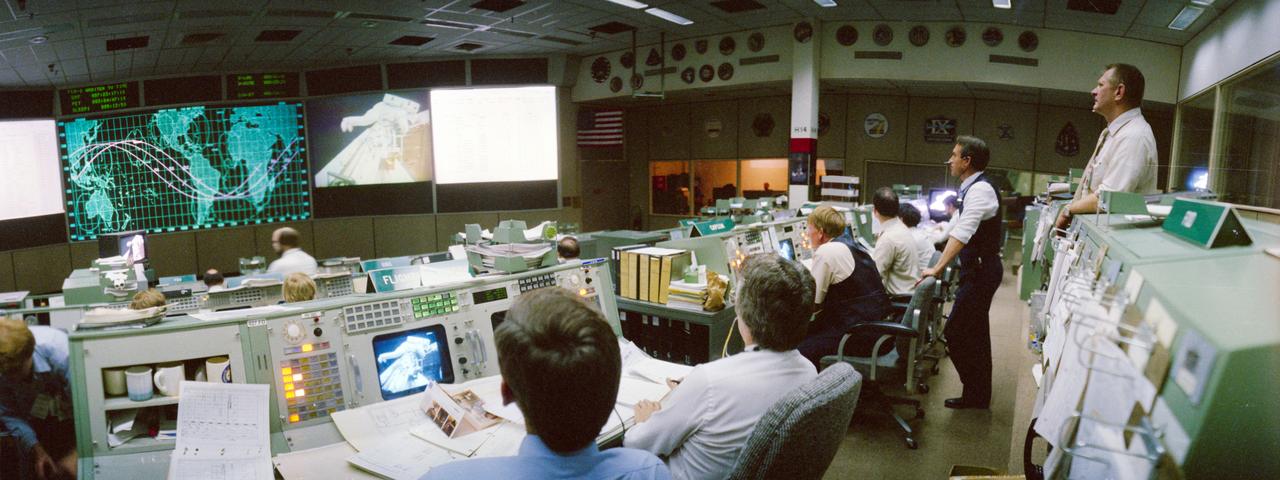
This is a wide-angle view of flight controllers in the MOCR of Mission Control Center (MCC) during the STS-6 Extravehicular Activity (EVA). They are watching the large monitor in the front of the MOCR and small ones at individual consoles as Astronaut Donald H. Peterson translates along the Challenger's port side longerons. Flight Directors Gary E. Coen (left) and Harold M. Draughon are in the foreground. Astronauts John A. McBride and Guy S. Gardner man the Spacecraft Communicator (CAPCOM) Console near center frame. Standing behind the CAPCOM Console is Astronaut William F. Fisher. Eugene F. Kranz, Director of Mission Operations, stands at right near the Flight Operations Directorate Console. JSC, Houston, TX
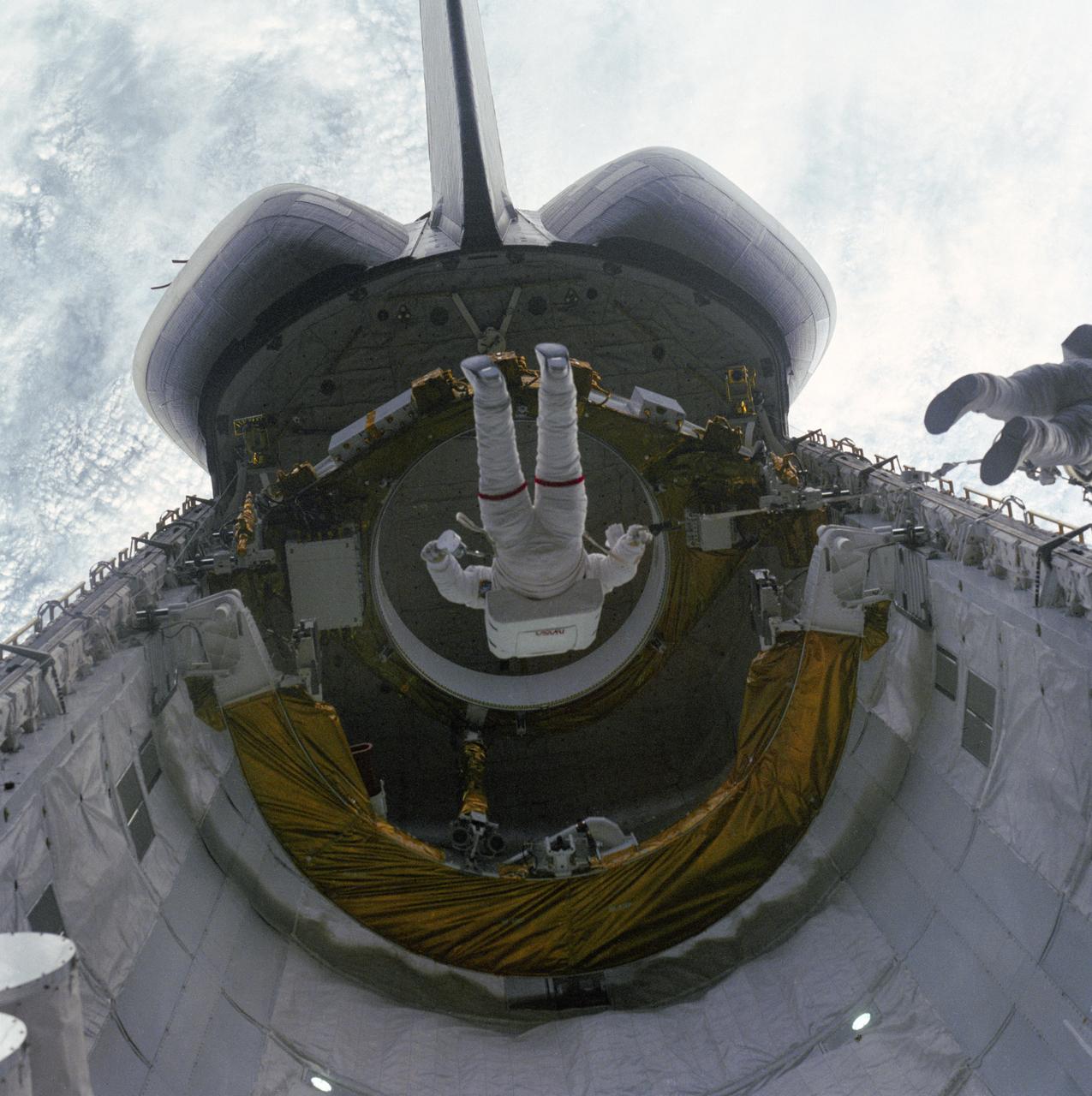
S83-30214 (7 April 1983) --- Astronaut F. Story Musgrave, STS-6 mission specialist, suspends himself midway between the starboard and port slide wire systems to evaluate the pull strength of the reel-in safety tether while astronaut Donald H. Peterson, the flight?s other mission specialist, busies himself along the port side at right edge of frame. This photograph was taken by astronaut Karol J. Bobko, pilot, from the aft window of the Earth-orbiting Challenger?s flight deck. The successful EVA occurred on April 7, 1983, on day four of the five-day flight. The gold-foil protected object is the airborne support equipment (ASE) for the now vacated inertial upper stage (IUS) which aided in the deployment of the tracking and data relay satellite (TDRS) on the first day of the mission. Astronaut Paul J. Weitz, crew commander, was in charge of the Challenger during these operations. The white background is made up mostly of clouds over Earth. Photo credit: NASA
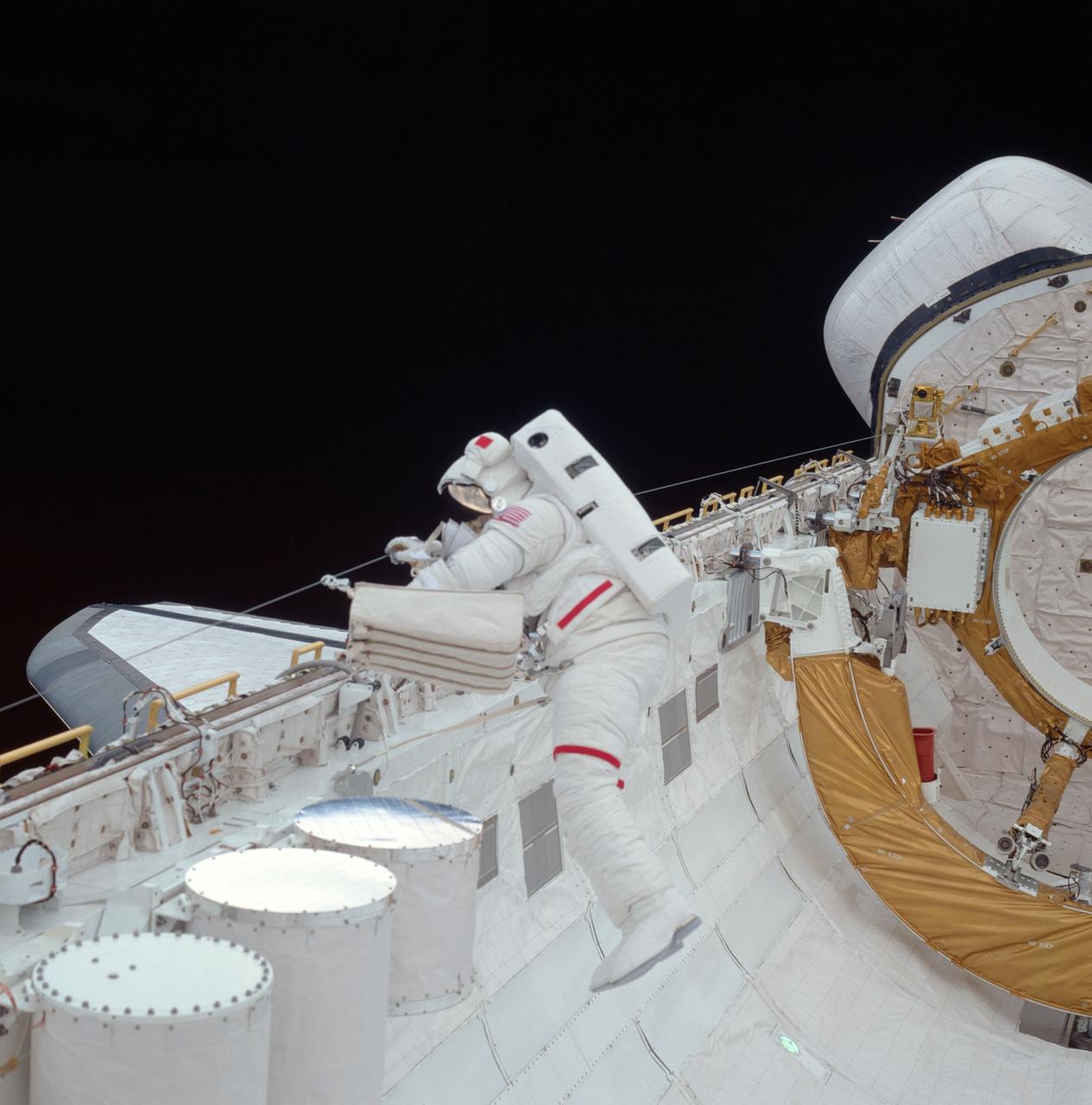
STS006-45-124 (7 April 1983) --- Astronaut F. Story Musgrave, STS-6 mission specialist, translates down the Earth-orbiting space shuttle Challenger’s payload bay door hinge line with a bag of latch tools. This photograph is among the first five still frames that recorded the April 7 extravehicular activity (EVA) of Dr. Musgrave and Donald H. Peterson, the flight’s other mission specialist. It was photographed with a handheld 70mm camera from inside the cabin by one of two crew members who remained on the flight deck during the EVA. Dr. Musgrave’s task here was to evaluate the techniques required to move along the payload bay’s edge with tools. In the lower left foreground are three canisters containing three getaway special (GAS) experiments. Part of the starboard wind and orbital maneuvering system (OMS) pod are seen back dropped against the blackness of space. The gold-foil protected object partially out of frame on the right is the airborne support equipment for the now vacated inertial upper stage (IUS) which aided the deployment of the tracking and data relay satellite on the flight’s first day. Astronauts Paul J. Weitz, command and Karol J. Bobko, pilot, remained inside the Challenger during the EVA. Photo credit: NASA
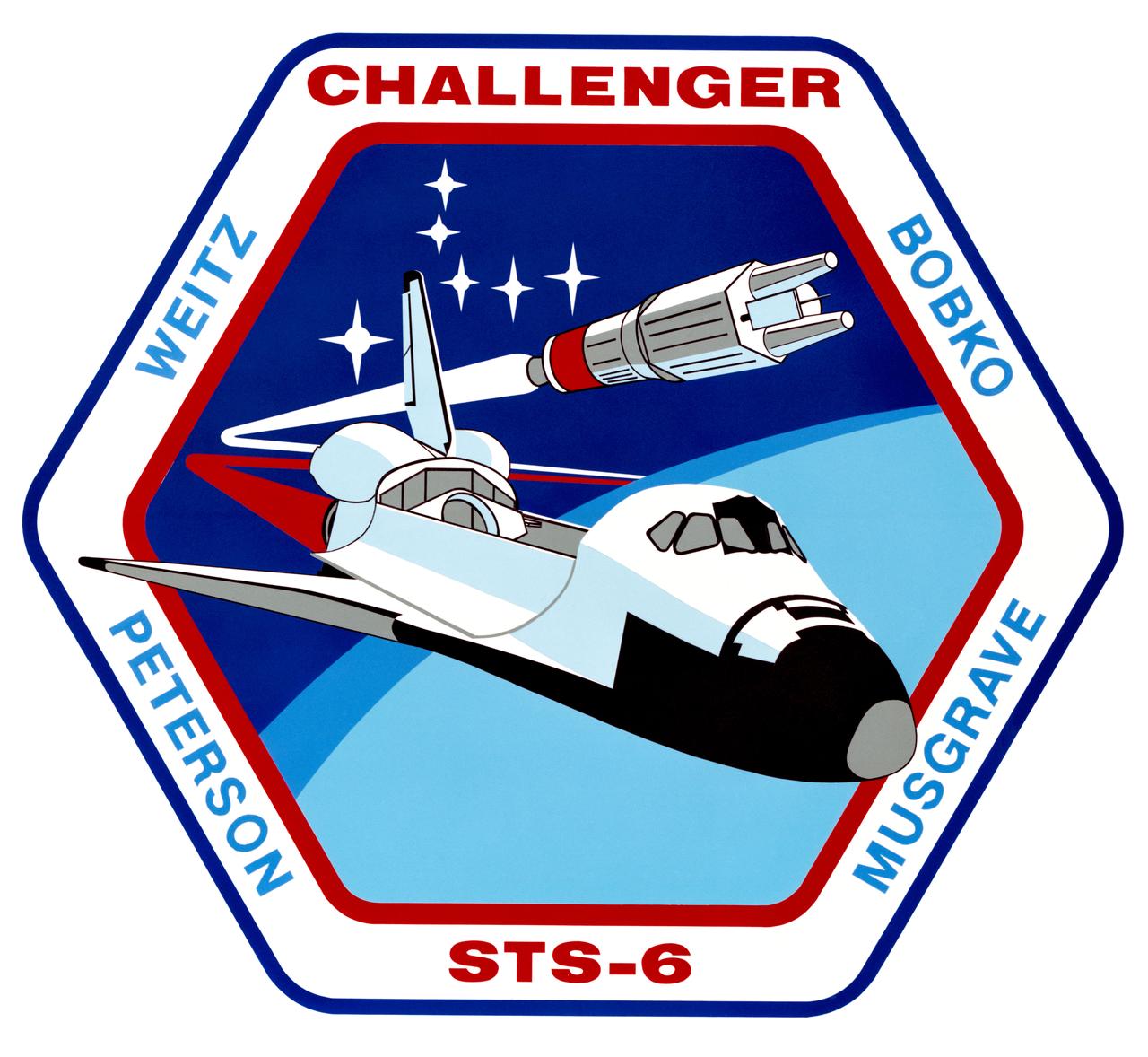
S82-39531 (December 1982) --- This is the official insignia for space shuttle mission STS-6. The crew members for this mission are astronauts Paul J. Weitz, commander; Karol J. Bobko, pilot; F. Story Musgrave, mission specialist; and Donald H. Peterson, mission specialist. The sixth space shuttle flight is represented by the hexagonal shape of the insignia and the six stars, in the portrayed constellation Virgo. The sign Virgo is also symbolic of the first flight of the space shuttle Challenger. Depicted above the spacecraft?s open cargo bay is the combined Inertial Upper Stage (IUS) and a Tracking and Data Relay Satellite. This is the first shuttle flight of the IUS rocket, which will carry the first TDRS to a geosynchronous orbit of 24,000 statute miles. The NASA insignia design for space shuttle flights is reserved for use by the astronauts and for other official use as the NASA Administrator may authorize. Public availability has been approved only in the forms of illustrations by the various news media. When and if there is any change in this policy, which is not anticipated, the change will be publicly announced. Photo credit: NASA
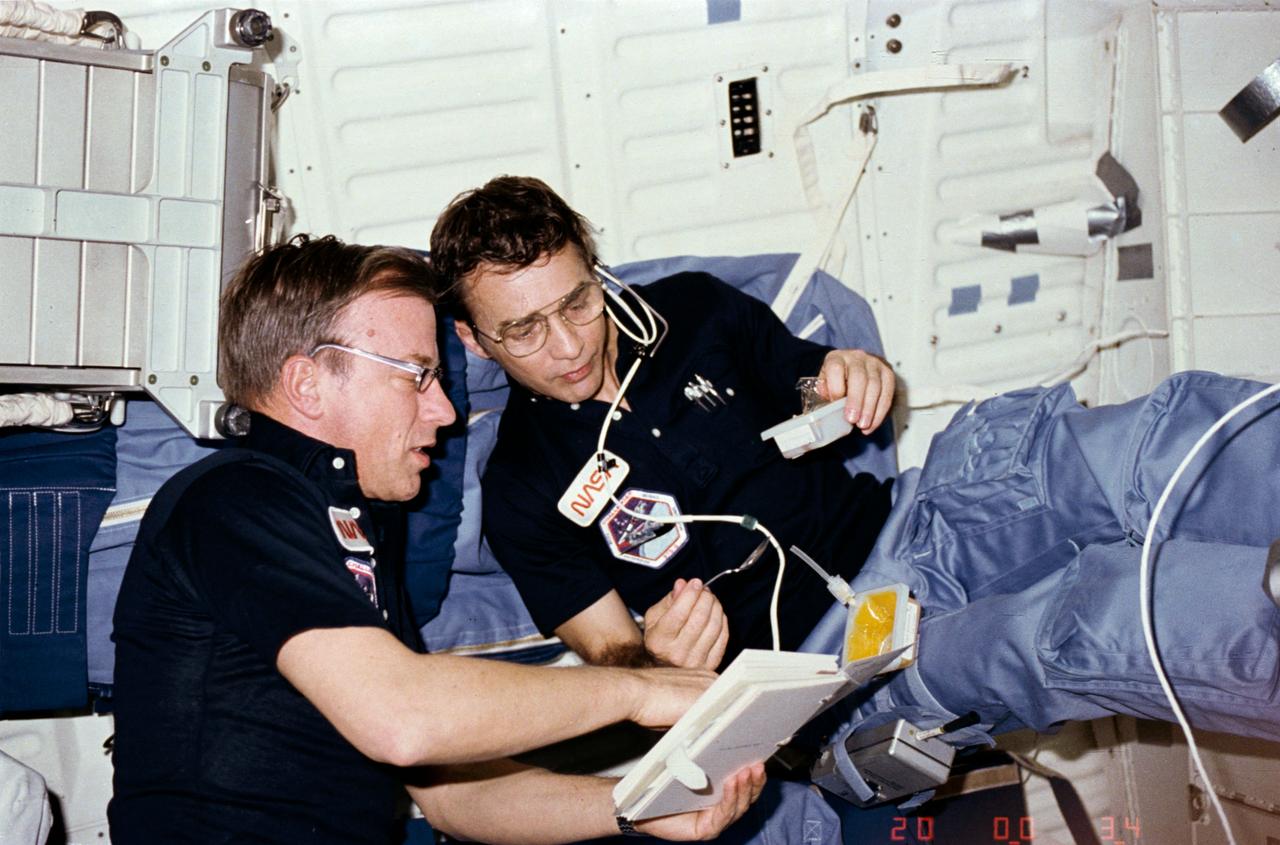
STS006-06-456 (4-9 April 1983) --- Astronaut Paul J. Weitz, STS-6 commander, points out an item in the crew activity plan (CAP) to astronaut Donald H. Peterson as the mission specialist uses a spoon to eat a meal aboard the Earth-orbiting space shuttle Challenger. The two are on the middeck. They are wearing the shirt and trouser portions of the blue cotton multi-piece constant wear garments. This frame was photographed with a 35mm camera. Photo credit: NASA
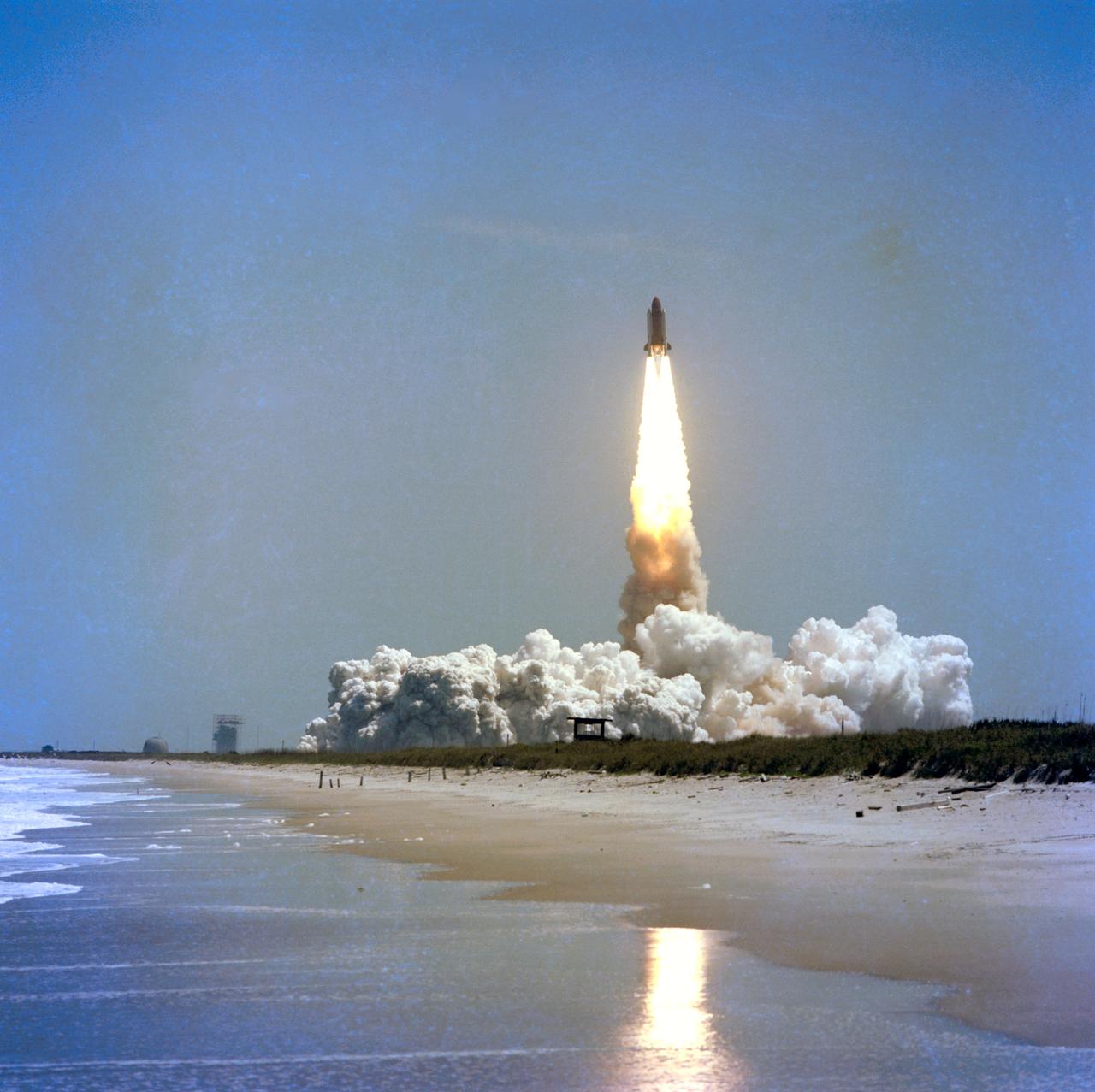
S83-30134 (7 April 1983) --- Flare from the first launch of the space shuttle Challenger is reflected in the Atlantic Ocean?s Cape Canaveral beach waters shortly after 1:30 p.m. (EST) on April 7, 1983. Only the tips of the orbiter?s wings are visible in this south looking view, as the manned portion of the launch cluster is obscured by its new lightweight external fuel tank (ET) and two solid rocket boosters (SRB). Onboard the spacecraft are astronauts Paul J. Weitz, Karol J. Bobko, Dr. F. Story Musgrave and Donald H. Peterson. Photo credit: NASA
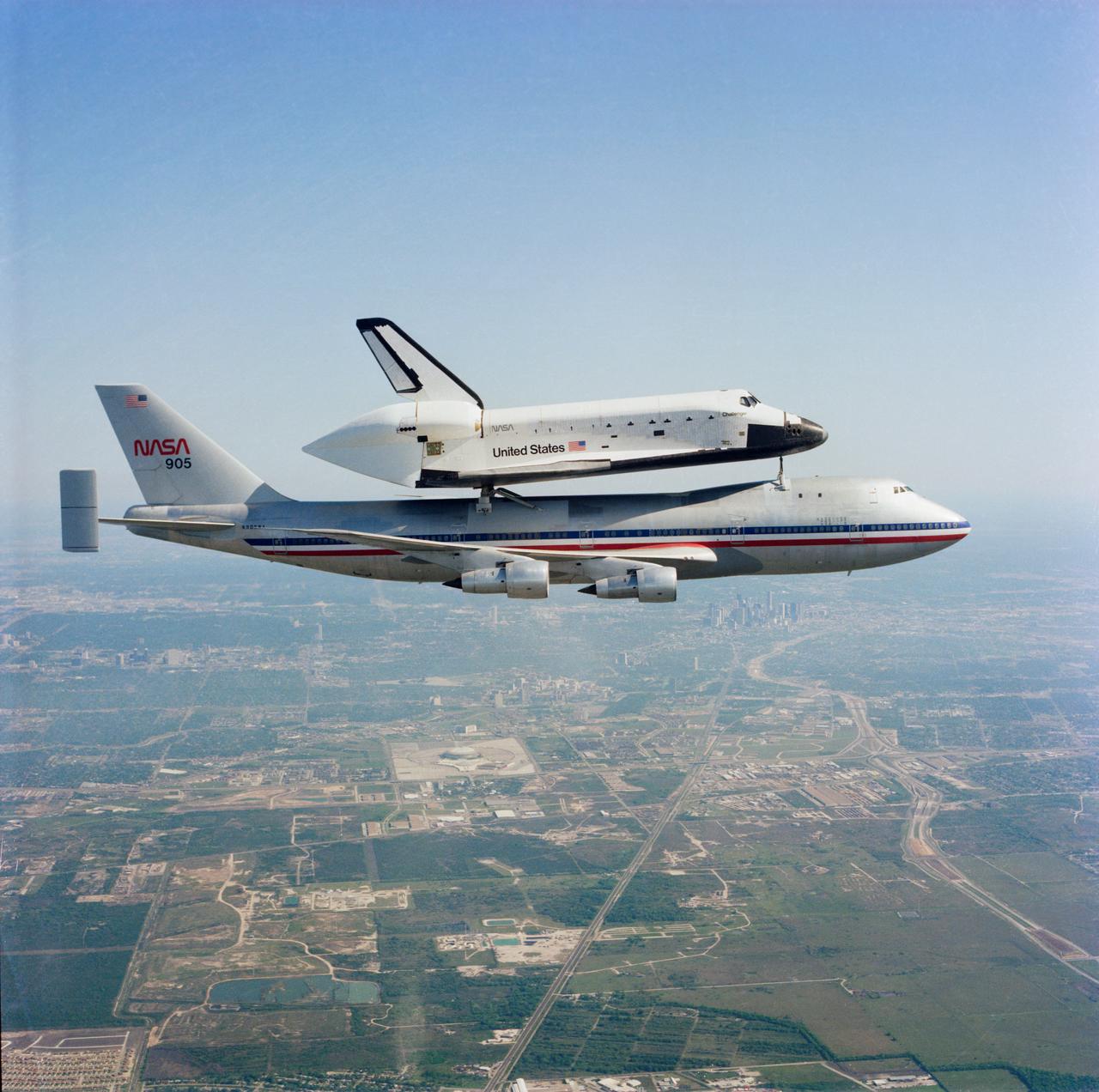
S83-30237 (16 April 1983) --- Downtown Houston and southern portions of that city form the backdrop for this picture of the Space Transportation System?s Challenger flying to the Kennedy Space Center in Florida from its California landing site. It is ferried by NASA 905, a modified 747 aircraft. The crew inside the 747 was as follows: Pilot Joseph S. Algranti; Co-pilot Francis R. (Dick) Scobee; Flight Engineers Louis E. (Skip) Guidry Jr. and Glen O. Pingry. The frame was exposed by Bob Gray from the rear station of a nearby T-38 chase plane piloted by David L. Mumme. The Harris County Domed Stadium (Astrodome) can be seen near center. Photo credit: NASA

S83-30222 (4 April 1983) --- The second reusable spacecraft in history successfully launches from Launch Pad 39A at 1:30:00:88 p.m. (EST) on April 4, 1983, and heads for its history making five-day mission in Earth orbit. The space shuttle Challenger, its two solid rocket boosters (SRB), and a new lightweight?external fuel tank were captured on film by an automatically-tripped camera in a protected station nearer to the launch pad than human beings are able to be at launch time. Onboard the spacecraft are astronauts Paul J. Wietz, Karol J. Bobko, Dr. Story Musgrave and Donald H. Peterson. Photo credit: NASA
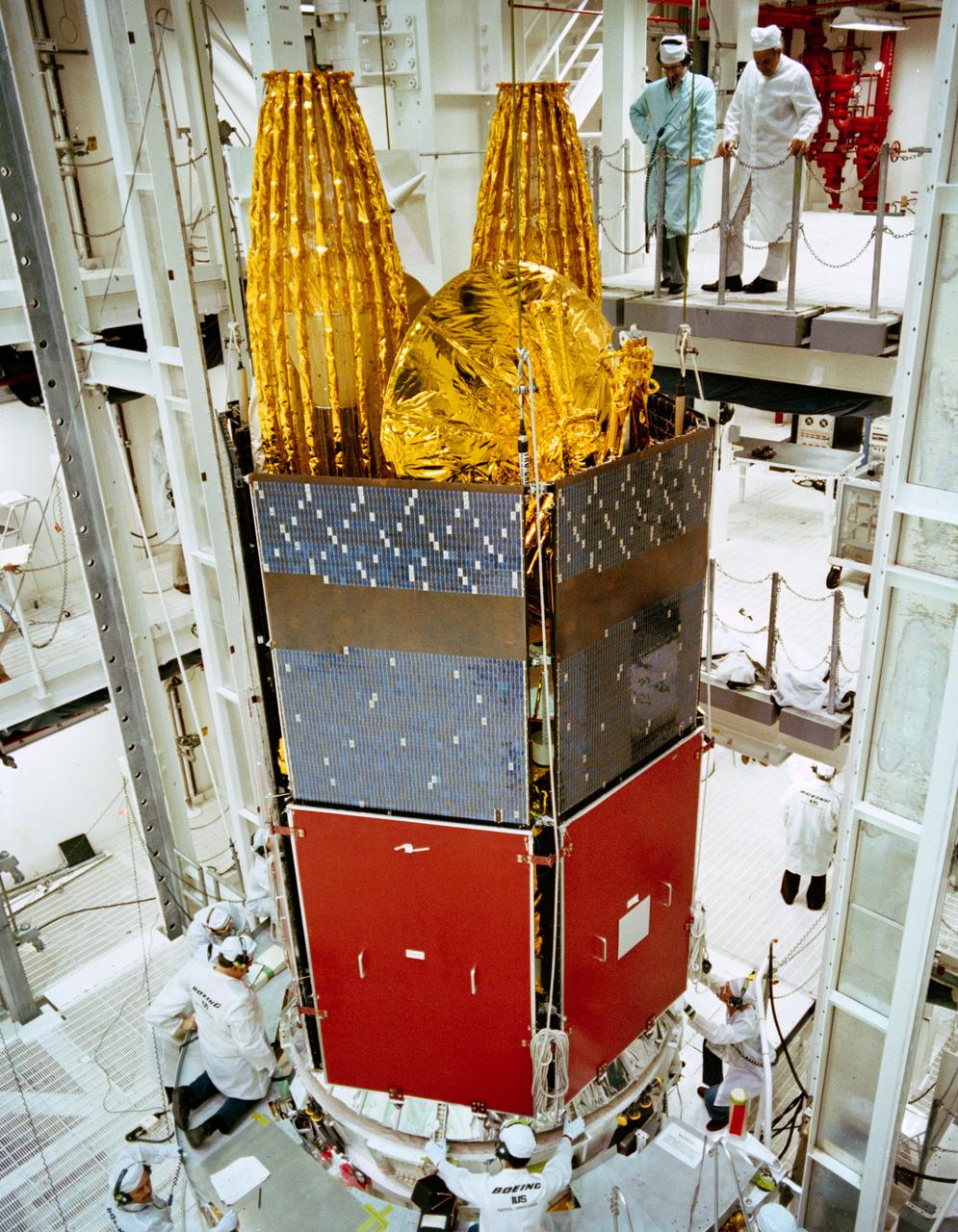
S82-41171 (29 Nov. 1982) --- NASA?s tracking and data relay satellite (TDRS) is gently mated to its inertial upper stage (IUS), which will propel the satellite to a higher geosynchronous orbit after it is ejected from the Challenger?s cargo bay during STS-6. Another TDRS will be placed in orbit on a later shuttle mission. The two will provide communications between orbiting shuttle mission craft and the ground, resulting in increased real-time communication and eliminating the need for much of NASA?s extensive world-wide system of ground tracking stations. A more distant plan is to launch other TDRS to be used for commercial telecommunications and for handling peak loads. Photo credit: NASA
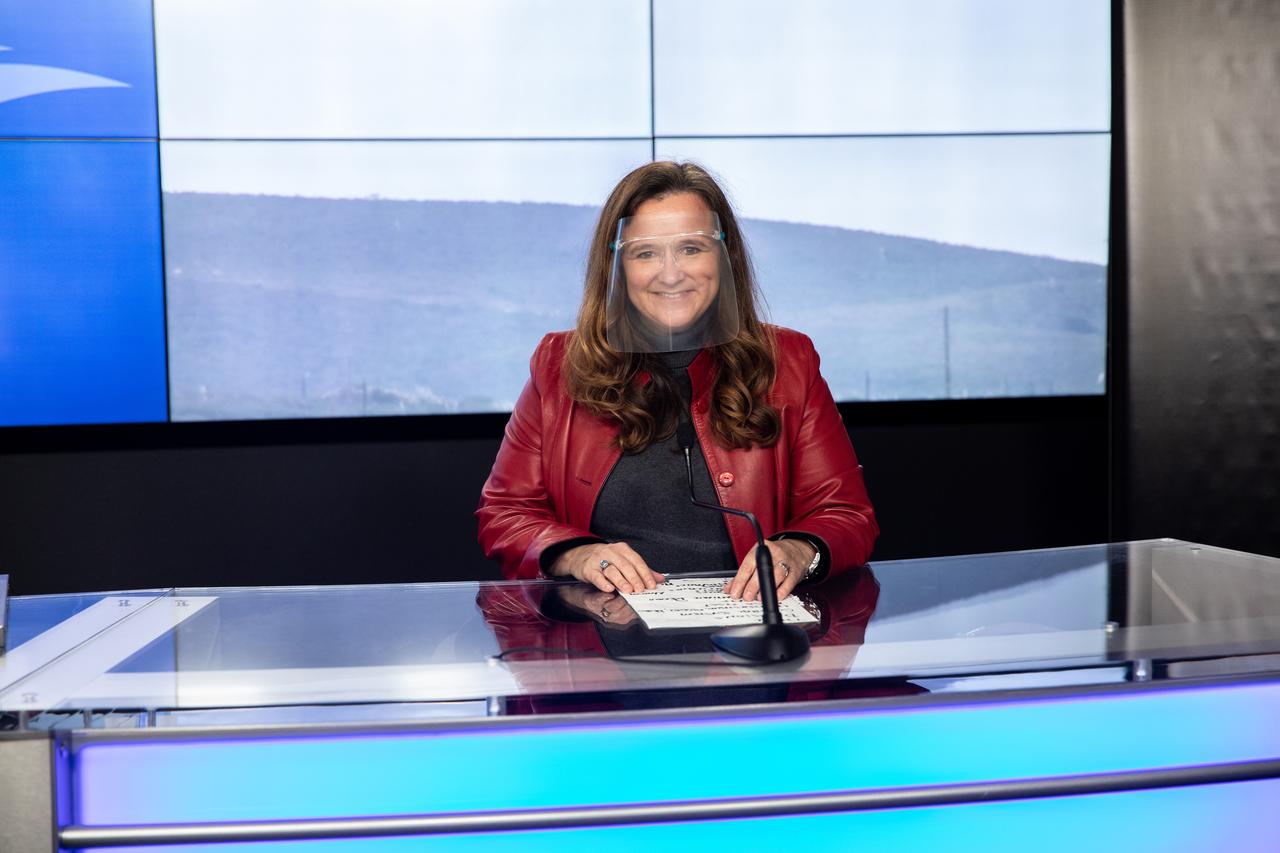
Karen St. Germain, director of NASA’s Earth Science Division, participates in a science briefing for the Sentinel-6 Michael Freilich mission at Vandenberg Air Force Base in California on Nov. 20, 2020. The Sentinel-6/Jason-CS (Continuity of Service) mission consists of the Sentinel-6 Michael Freilich satellite, which will be followed by its twin, the Sentinel-6B satellite, in 2025. The Sentinel-6/Jason-CS mission is part of Copernicus, the European Union’s Earth observation program, managed by the European Commission. Continuing the legacy of the Jason series missions, Sentinel-6/Jason-CS will extend the records of sea level into their fourth decade, collecting accurate measurements of sea surface height for more than 90% of the world’s seas, and providing crucial information for operational oceanography, marine meteorology, and climate studies. Sentinel-6 Michael Freilich launched Nov. 21, 2020, at 9:17 PST (12:17 EST). NASA’s Launch Services Program at Kennedy Space Center was responsible for launch management.
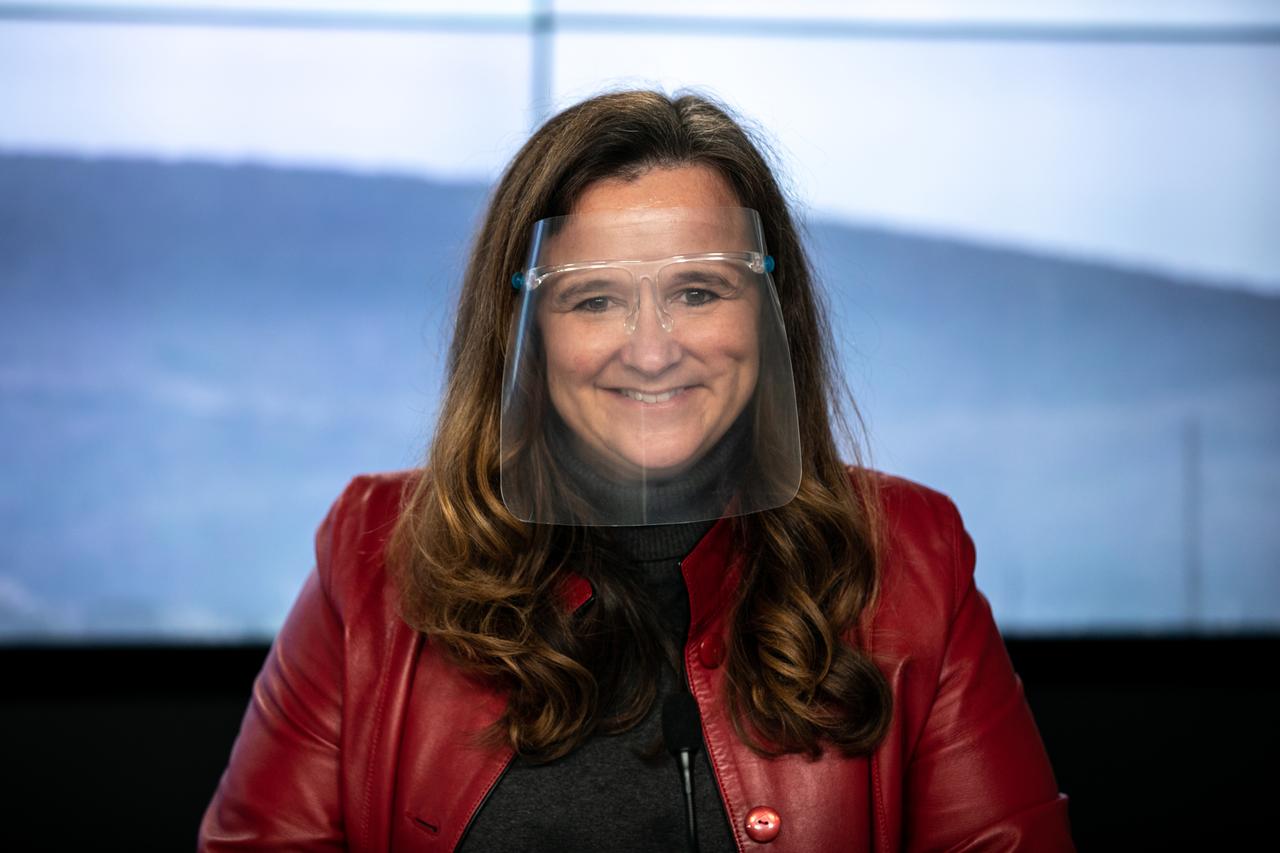
Karen St. Germain, director of NASA’s Earth Science Division, participates in a science briefing for the Sentinel-6 Michael Freilich mission at Vandenberg Air Force Base in California on Nov. 20, 2020. The Sentinel-6/Jason-CS (Continuity of Service) mission consists of the Sentinel-6 Michael Freilich satellite, which will be followed by its twin, the Sentinel-6B satellite, in 2025. The Sentinel-6/Jason-CS mission is part of Copernicus, the European Union’s Earth observation program, managed by the European Commission. Continuing the legacy of the Jason series missions, Sentinel-6/Jason-CS will extend the records of sea level into their fourth decade, collecting accurate measurements of sea surface height for more than 90% of the world’s seas, and providing crucial information for operational oceanography, marine meteorology, and climate studies. Sentinel-6 Michael Freilich launched Nov. 21, 2020, at 9:17 PST (12:17 EST). NASA’s Launch Services Program at Kennedy Space Center was responsible for launch management.
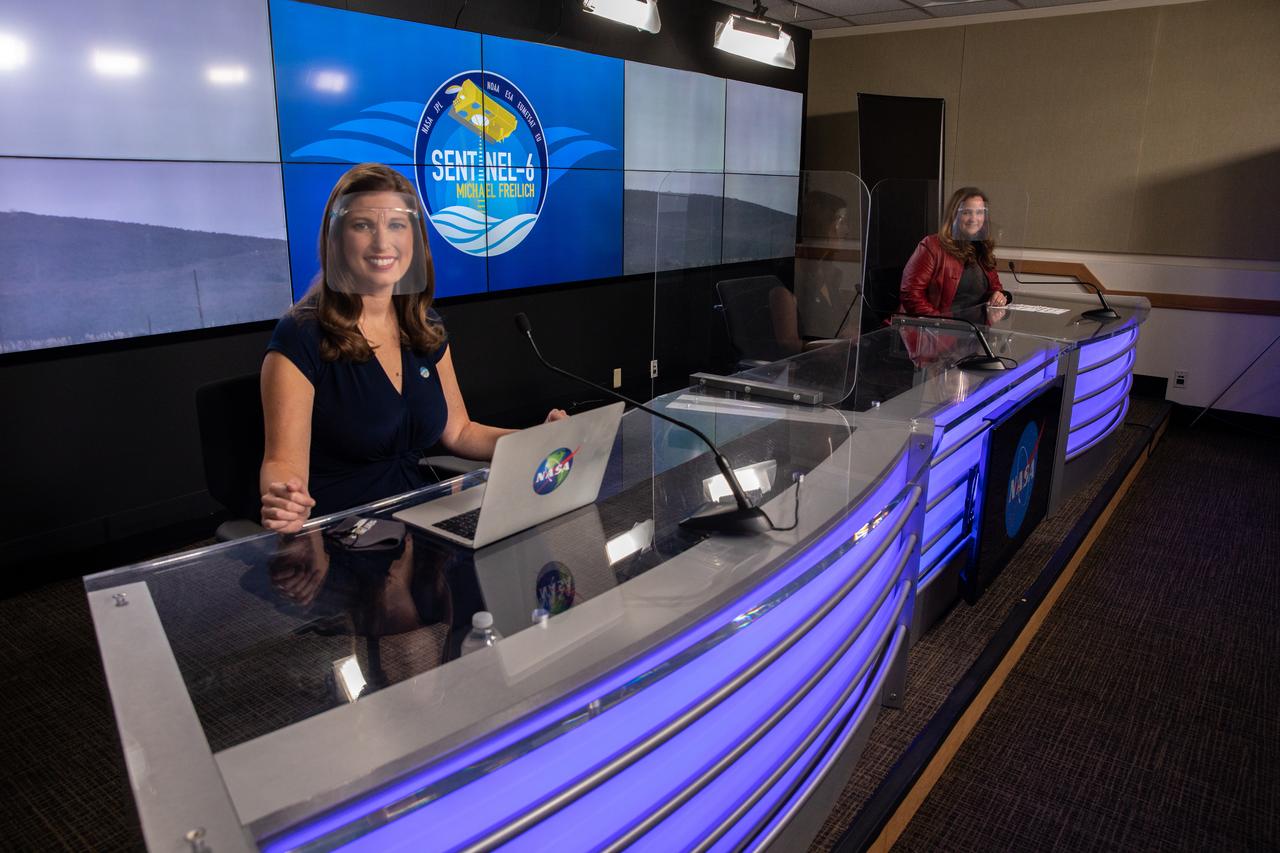
Marina Jurica of NASA’s Jet Propulsion Laboratory in Pasadena, foreground, and Karen St. Germain, director of the agency’s Earth Science Division, participate in a science briefing for the Sentinel-6 Michael Freilich mission at Vandenberg Air Force Base in California on Nov. 20, 2020. The Sentinel-6/Jason-CS (Continuity of Service) mission consists of the Sentinel-6 Michael Freilich satellite, which will be followed by its twin, the Sentinel-6B satellite, in 2025. The Sentinel-6/Jason-CS mission is part of Copernicus, the European Union’s Earth observation program, managed by the European Commission. Continuing the legacy of the Jason series missions, Sentinel-6/Jason-CS will extend the records of sea level into their fourth decade, collecting accurate measurements of sea surface height for more than 90% of the world’s seas, and providing crucial information for operational oceanography, marine meteorology, and climate studies. Sentinel-6 Michael Freilich launched Nov. 21, 2020, at 9:17 PST (12:17 EST). NASA’s Launch Services Program at Kennedy Space Center was responsible for launch management.
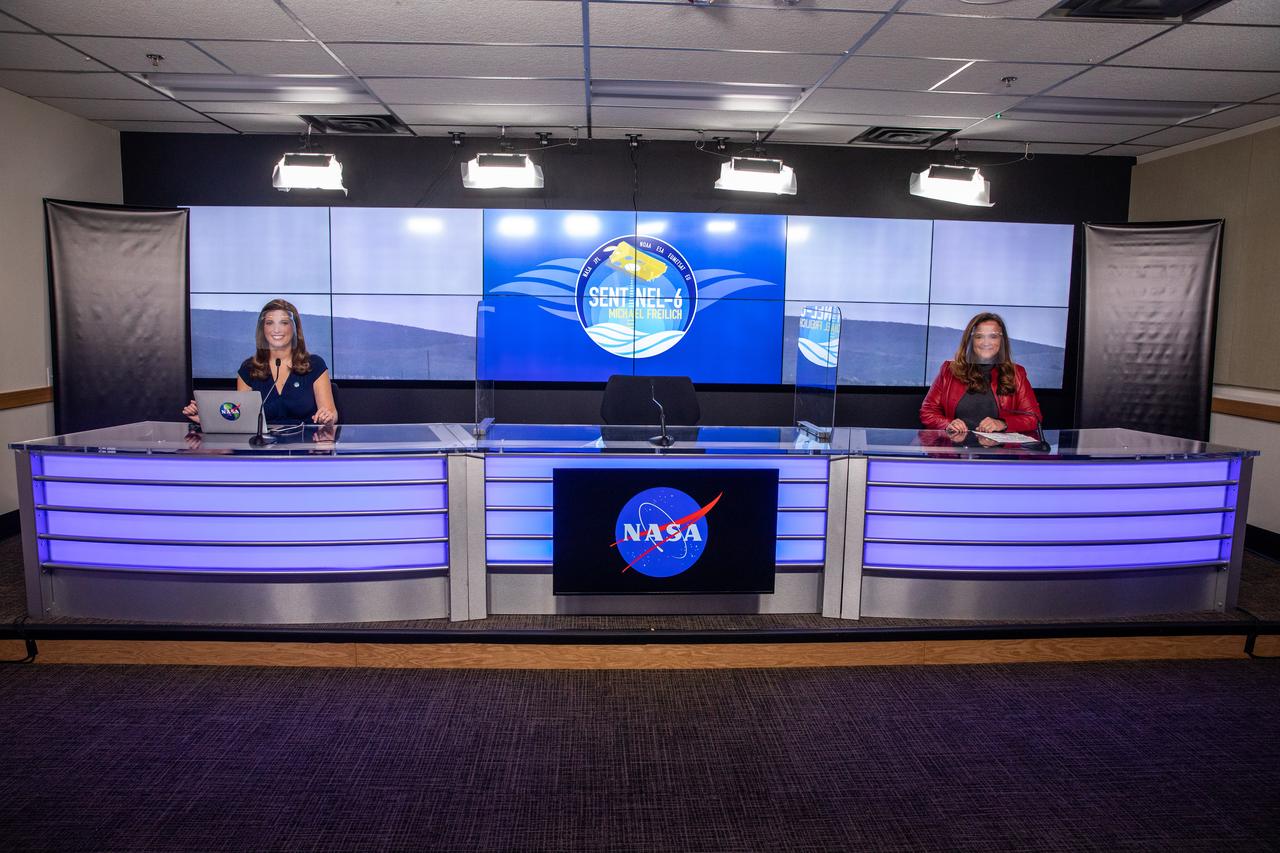
Marina Jurica of NASA’s Jet Propulsion Laboratory in Pasadena, left, and Karen St. Germain, director of the agency’s Earth Science Division, participate in a science briefing for the Sentinel-6 Michael Freilich mission at Vandenberg Air Force Base in California on Nov. 20, 2020. The Sentinel-6/Jason-CS (Continuity of Service) mission consists of the Sentinel-6 Michael Freilich satellite, which will be followed by its twin, the Sentinel-6B satellite, in 2025. The Sentinel-6/Jason-CS mission is part of Copernicus, the European Union’s Earth observation program, managed by the European Commission. Continuing the legacy of the Jason series missions, Sentinel-6/Jason-CS will extend the records of sea level into their fourth decade, collecting accurate measurements of sea surface height for more than 90% of the world’s seas, and providing crucial information for operational oceanography, marine meteorology, and climate studies. Sentinel-6 Michael Freilich launched Nov. 21, 2020, at 9:17 PST (12:17 EST). NASA’s Launch Services Program at Kennedy Space Center was responsible for launch management.
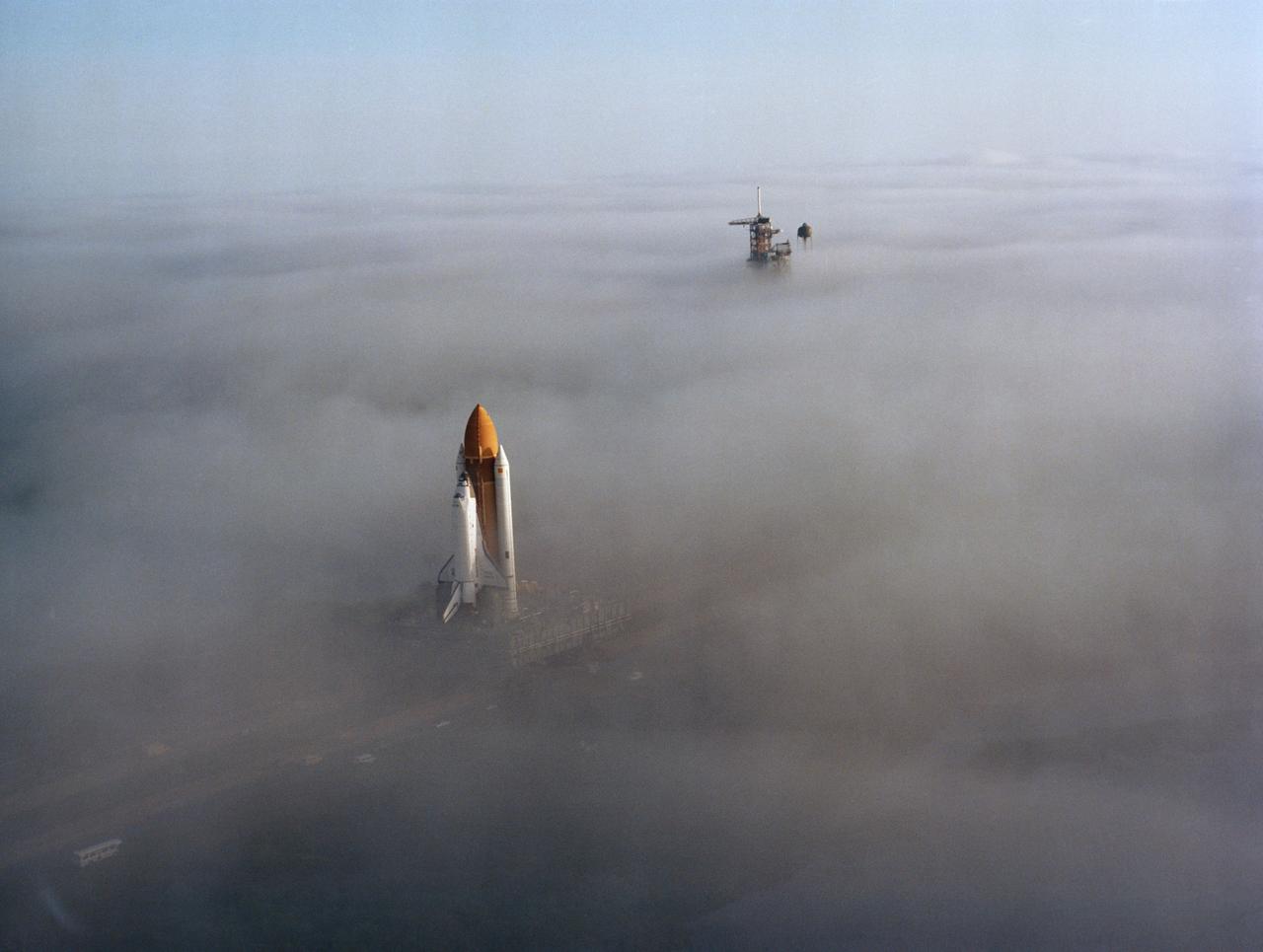
S82-41141 (30 Nov. 1982) --- The space shuttle Challenger, atop a mobile launch platform, slowly moves through the Florida fog to Launch Pad 39A in preparation for its first liftoff early next year. The fully assembled shuttle, weighting 12,000 pounds less than predecessor Columbia, completed the trip in just over six hours. Photo credit: NASA
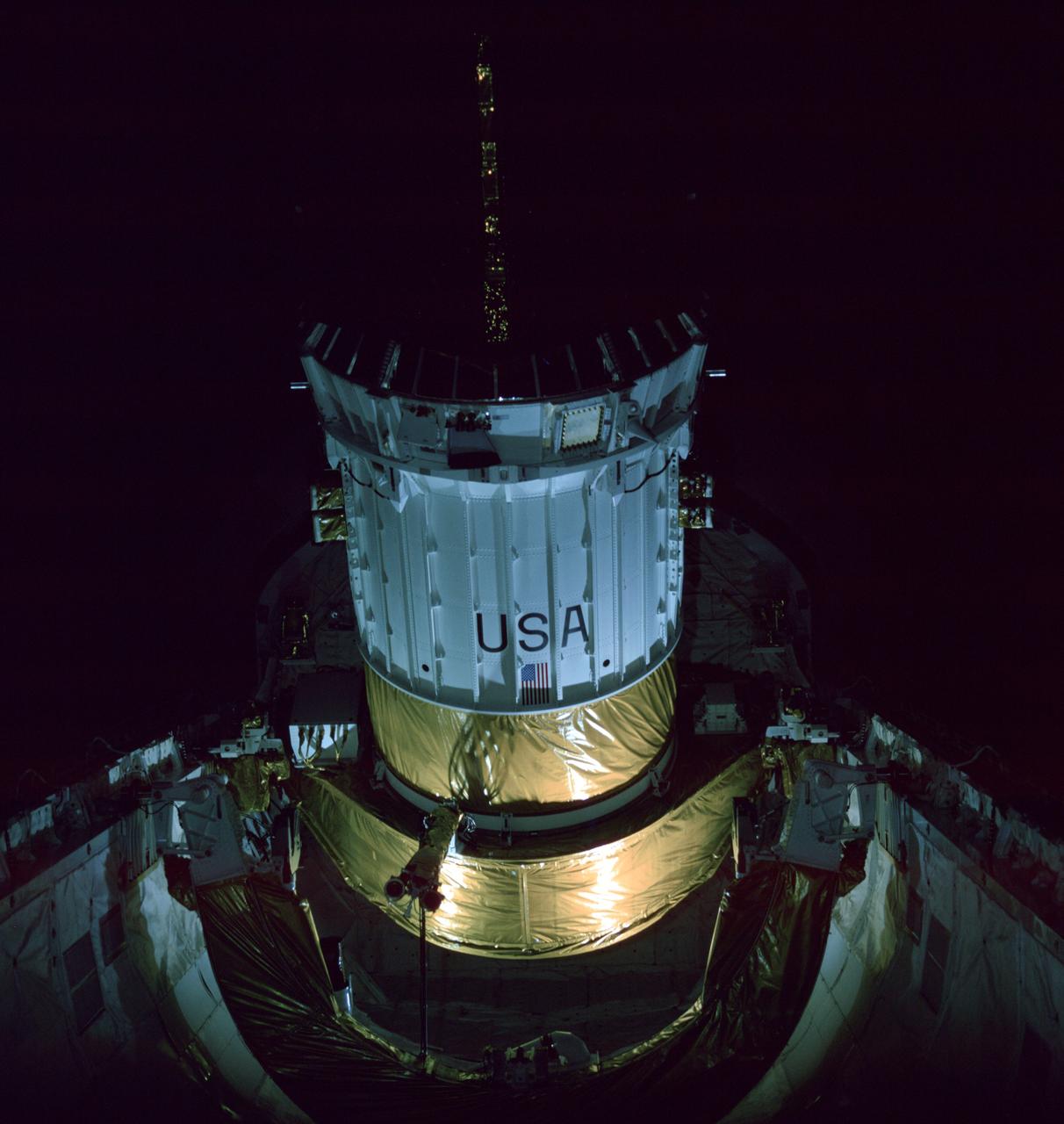
STS006-40-685 (4 April 1983) --- This view of a tilted tracking and data relay satellite (TDRS) and part of its inertial upper stage (IUS) was photographed during deployment of the TDRS/IUS tandem some 10 hours following launch of space shuttle Challenger. A 70mm camera was aimed by crew members through the aft windows of the Earth-orbiting Challenger to capture the scene. A tilt-table device was used to lift the TDRS to this position (almost 90 degrees different from its stowed position). Onboard NASA’s second reusable shuttle for this five-day flight were astronauts Paul J. Weitz, Karol J. Bobko, Dr. F. Story Musgrave and Donald H. Peterson. Photo credit: NASA
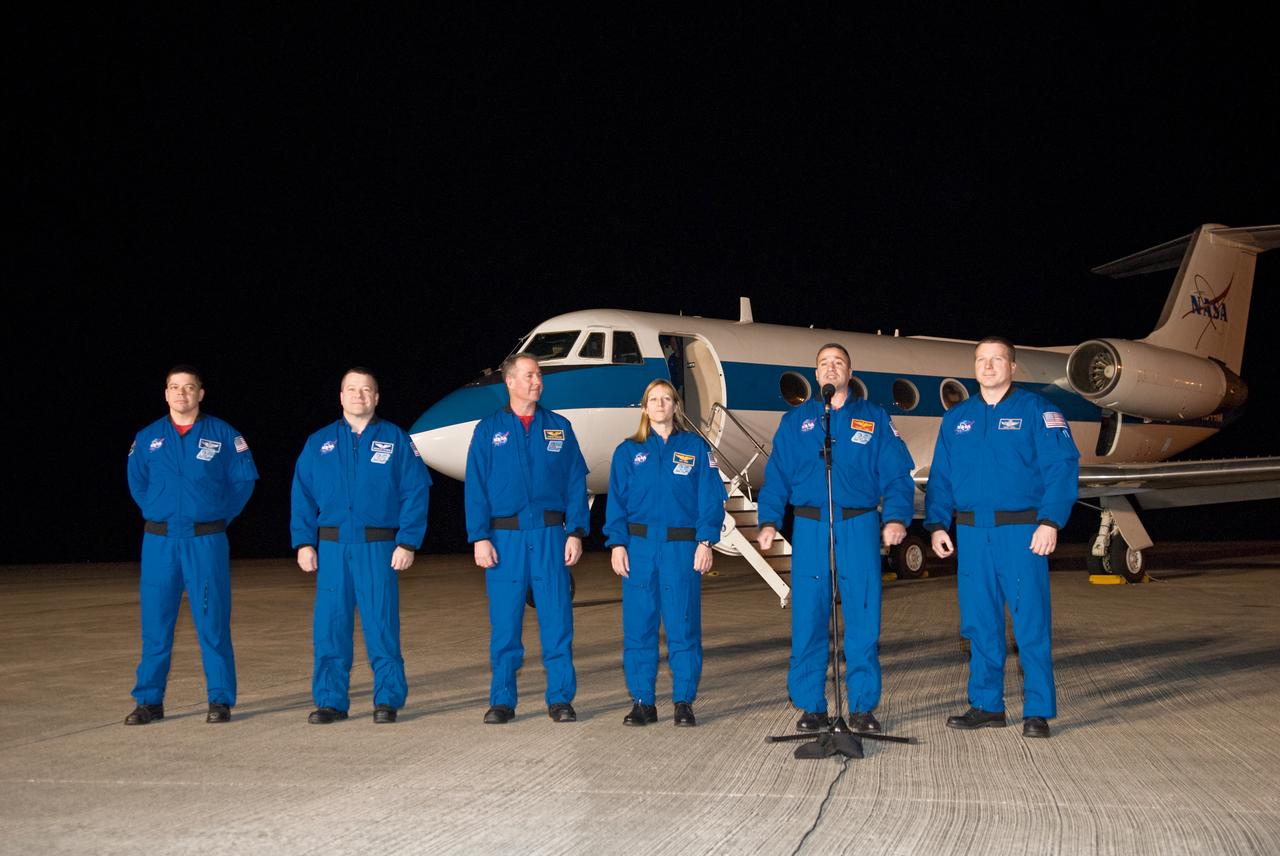
STS-130 LAUNCH L-6 CREW ARRIVAL
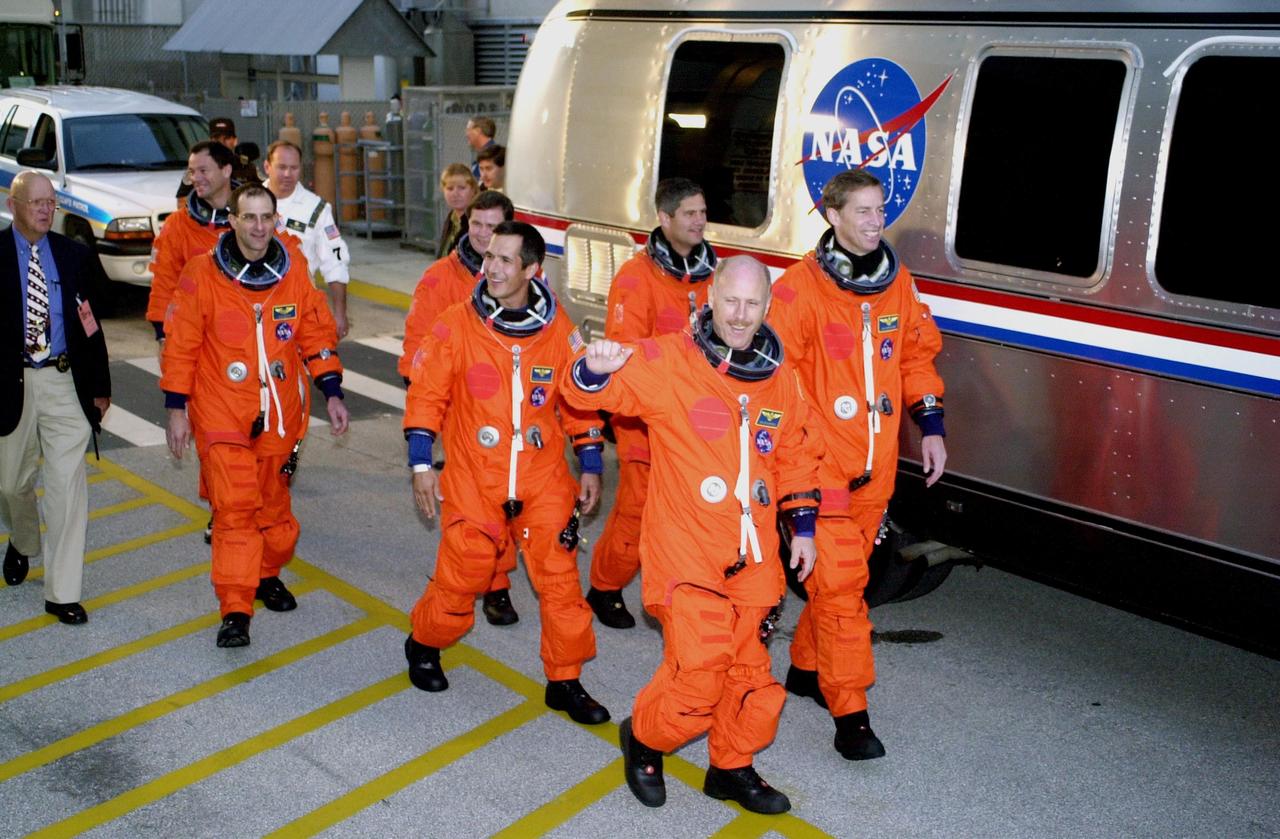
KENNEDY SPACE CENTER, FLA. -- The STS-113 and Expedition 6 crews head for the Astrovan to take them to Launch Pad 39A for a simulated launch countdown. From left are STS-113 Mission Specialist Michael Lopez-Alegria, Expedition 6 astronaut Donald Pettit and cosmonaut Nikolai Budarin, Mission Specialist John Herrington and Pilot Paul Lockhart, Expedition 6 Commander Ken Bowersox and STS-113 Commander James Wetherbee. . The countdown is part of Terminal Countdown Demonstration Test activities prior to launch. The 16th assembly flight to the International Space Station, STS-113 will carry the Port 1 (P1) truss aboard Space Shuttle Endeavour as well as the Expedition 6 crew, who will replace Expedition 5 on the Station. Mission STS-113 is scheduled to launch Nov. 10, 2002.
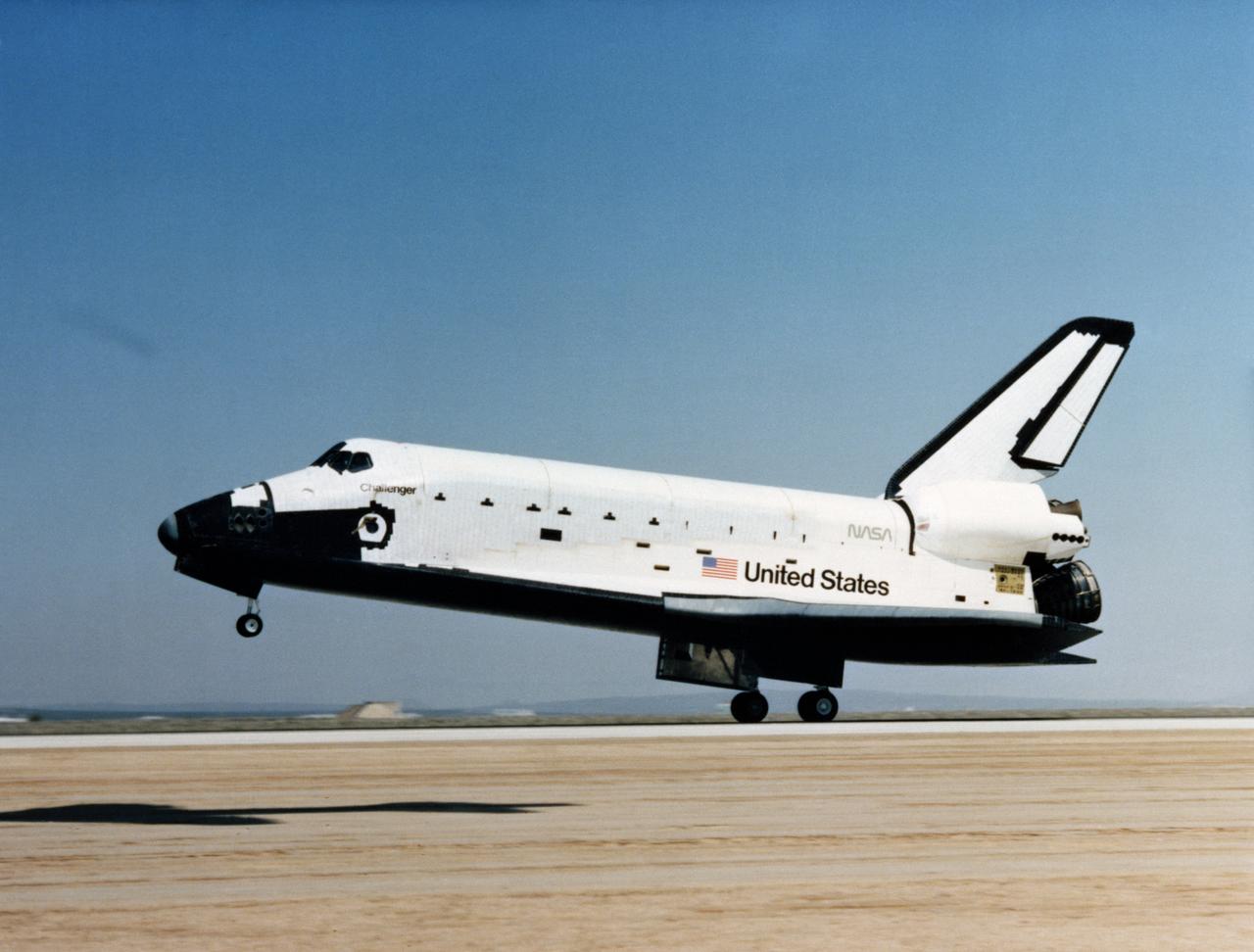
S83-30220 (9 April 1983) --- The space shuttle Challenger makes its first landing shortly before 11 a.m. (PST) on April 9, 1983, on Runway 22 at the Edwards Air Force Base in Southern California. Onboard the reusable spacecraft, having just completed a successful five-day mission, are astronauts Paul J. Weitz, Karol J. Bobko, F. Story Musgrave and Donald H. Peterson. Photo credit: NASA
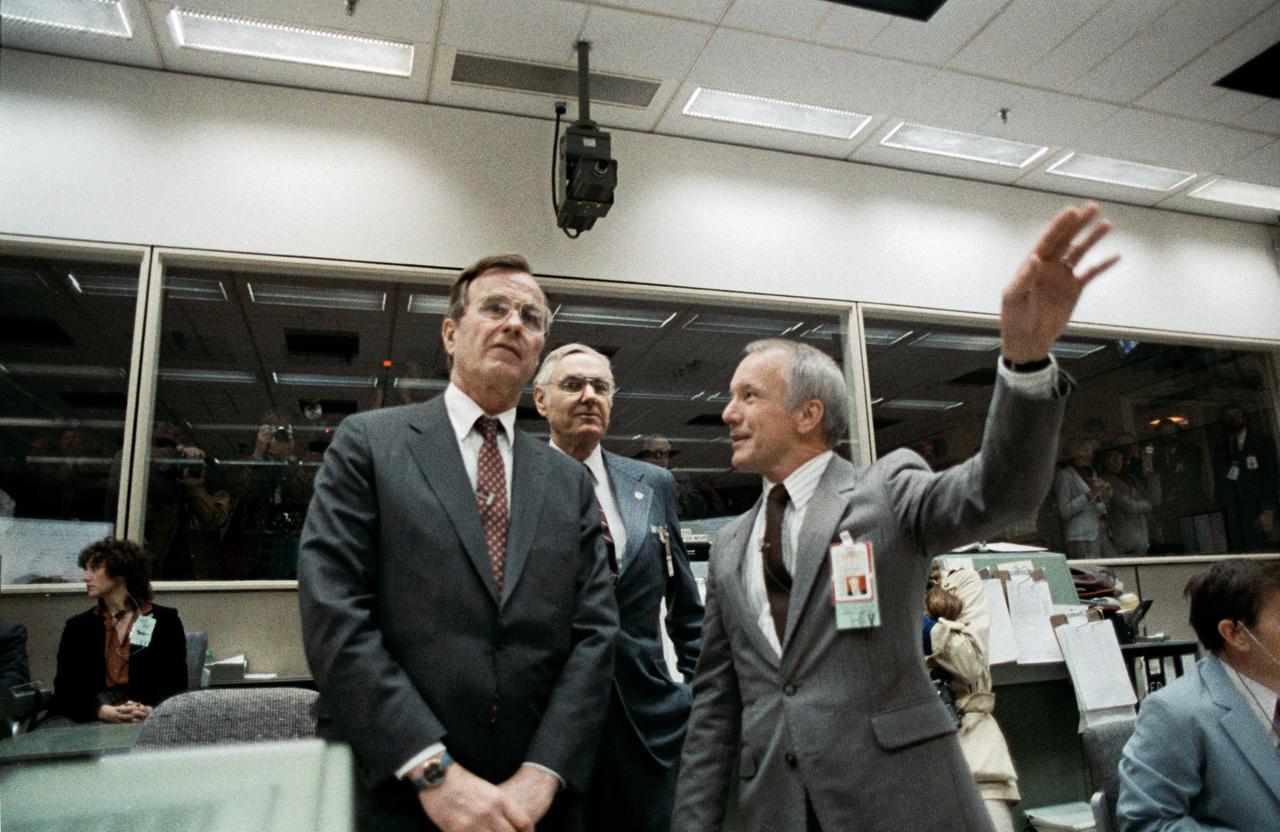
S83-30193 (8 April 1983) --- Vice President George Bush, left, is briefed by JSC Director Gerald D. Griffin, right, during a visit to the mission operations control room (MOCR) in the Johnson Space Center?s mission control center. James Beggs, NASA administrator, center, accompanied the Vice President on his visit. Flight Director Gary E. Coen is partial visible at right edge of frame, The photograph was taken by Otis Imboden.

STS006-44-582 (5 April 1983) --- A 70mm camera through the aft windows of the Earth-orbiting space shuttle Challenger’s cabin centered on the starboard orbital maneuvering system (OMS) pod of the reusable spacecraft. Two pieces of thermal protection system tile appear to have loosened. The view also shows one of the cargo bay television cameras, part of the EVA slide wire system, three handrails and other features on the aft bulkhead. Part of the airborne support equipment (ASE) for the now vacated inertial upper stage (IUS)/tracking and data relay satellite (TDRS) tandem is in lower right foreground. Photo credit: NASA
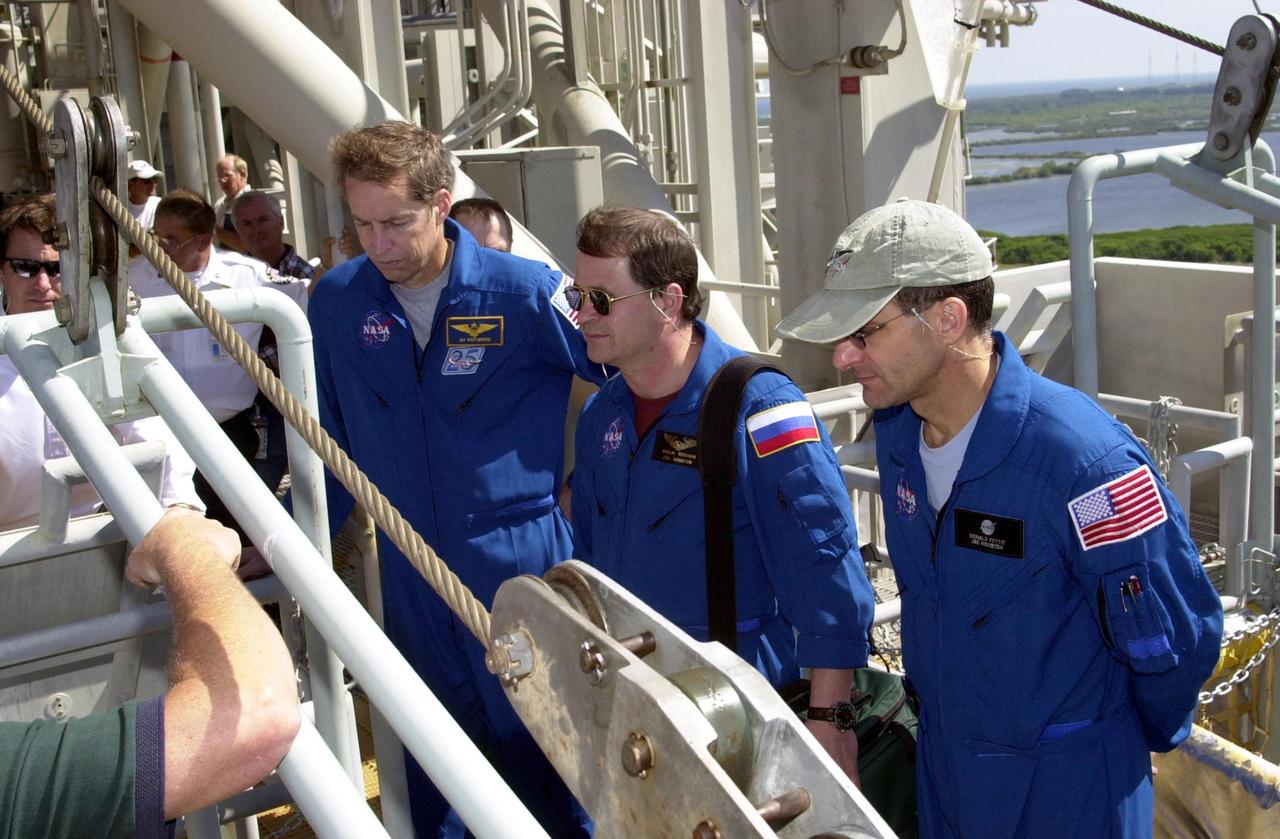
KENNEDY SPACE CENTER, FLA. - As part of Terminal Countdown Demonstration Test (TCDT) activities, the STS-113 and Expedition 6 crews receive training in emergency exit from the orbiter on Launch Pad 39A. Shown are (from left) Mission Commander James Wetherbee and cosmonaut Nikolai Budarin and astronaut Donald Pettit of the Expedition 6 crew. The TCDT also includes a simulated launch countdown. The 16th assembly flight to the International Space Station, STS-113 will carry the Port 1 (P1) truss aboard Space Shuttle Endeavour as well as the Expedition 6 crew, who will replace Expedition 5 on the Station. Mission STS-113 is scheduled to launch Nov. 10, 2002.
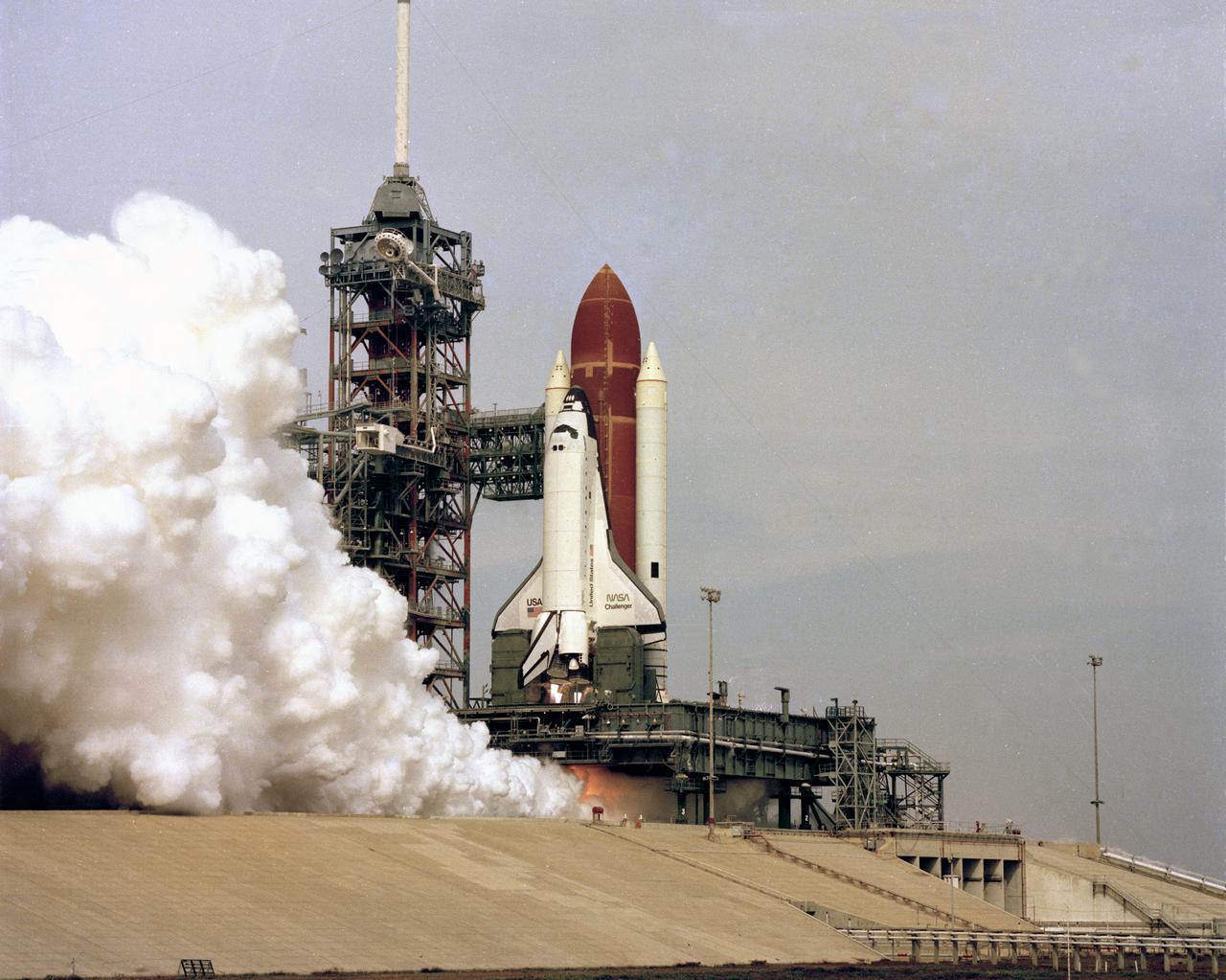
CAPE CANAVERAL, Fla. -- STS-6 second Flight Readiness Firing test, Launch Complex 39. Photo credit: NASA
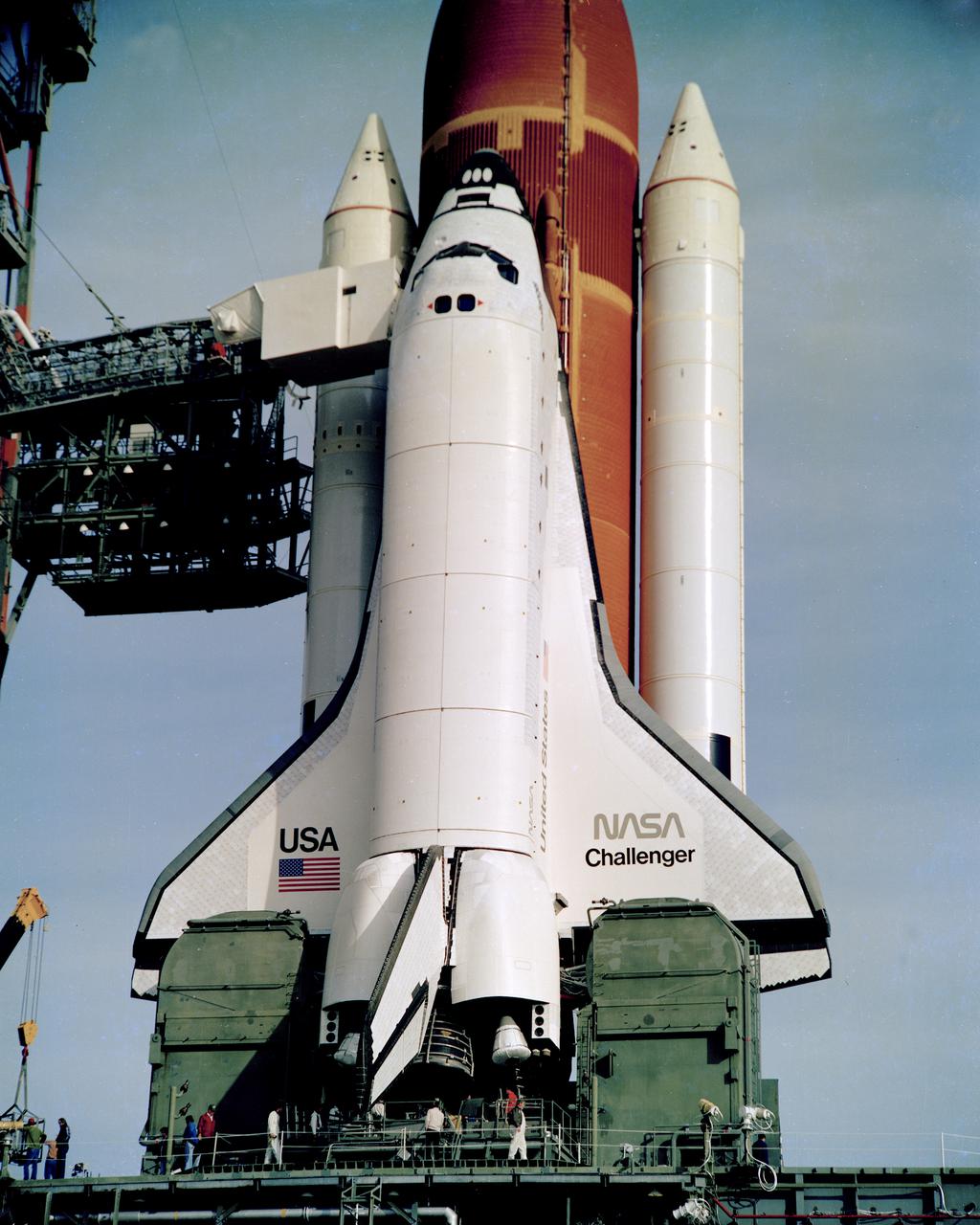
CAPE CANAVERAL, Fla. – STS-6 orbiter Challenger on Complex 39A with rotating service structure retracted. Photo credit: NASA

Transferring the Long Duration Exposure Facility (LDEF) into Canister 1 for STS-41C, March 6, 1984
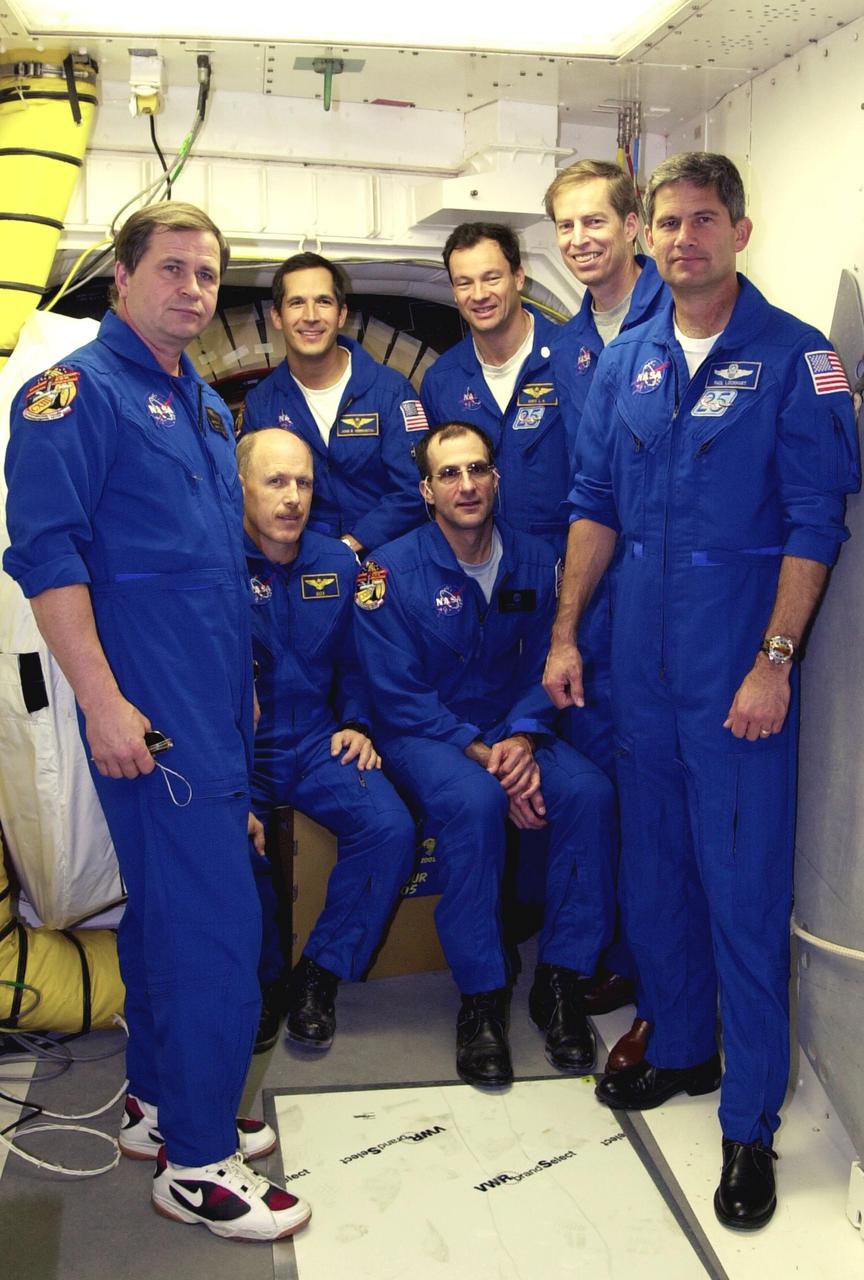
KENNEDY SPACE CENTER, FLA. -- At the entrance to Space Shuttle Endeavour's cockpit, the STS-113 and Expedition 6 crews gather for a photo during Terminal Countdown Demonstration Test activities at the pad. From left, in front, are cosmonaut Nikolai Budarin, Commander Ken Bowersox and astronaut Donald Pettit of Expedition 6, and STS-113 Pilot Paul Lockhart. In back, from left, are STS-113 Mission Specialists John Herrington and Michael Lopez-Alegria and Commander James Wetherbee. The TCDT also includes a simulated launch countdown. The 16th assembly flight to the International Space Station, STS-113 will carry the Port 1 (P1) truss aboard Space Shuttle Endeavour as well as the Expedition 6 crew, who will replace Expedition 5 on the Station. Mission STS-113 is scheduled to launch Nov. 10, 2002.

S94-E-5009 (6 July 1997) --- Astronaut Michael L. Gernhardt, one of three mission specialists on the STS-94 mission, is seen on the Space Shuttle Columbia's flight deck during Flight Day 6 activities. The photo was recorded with an Electronic Still Camera (ESC) and later downlinked to ground controllers in Houston, Texas.
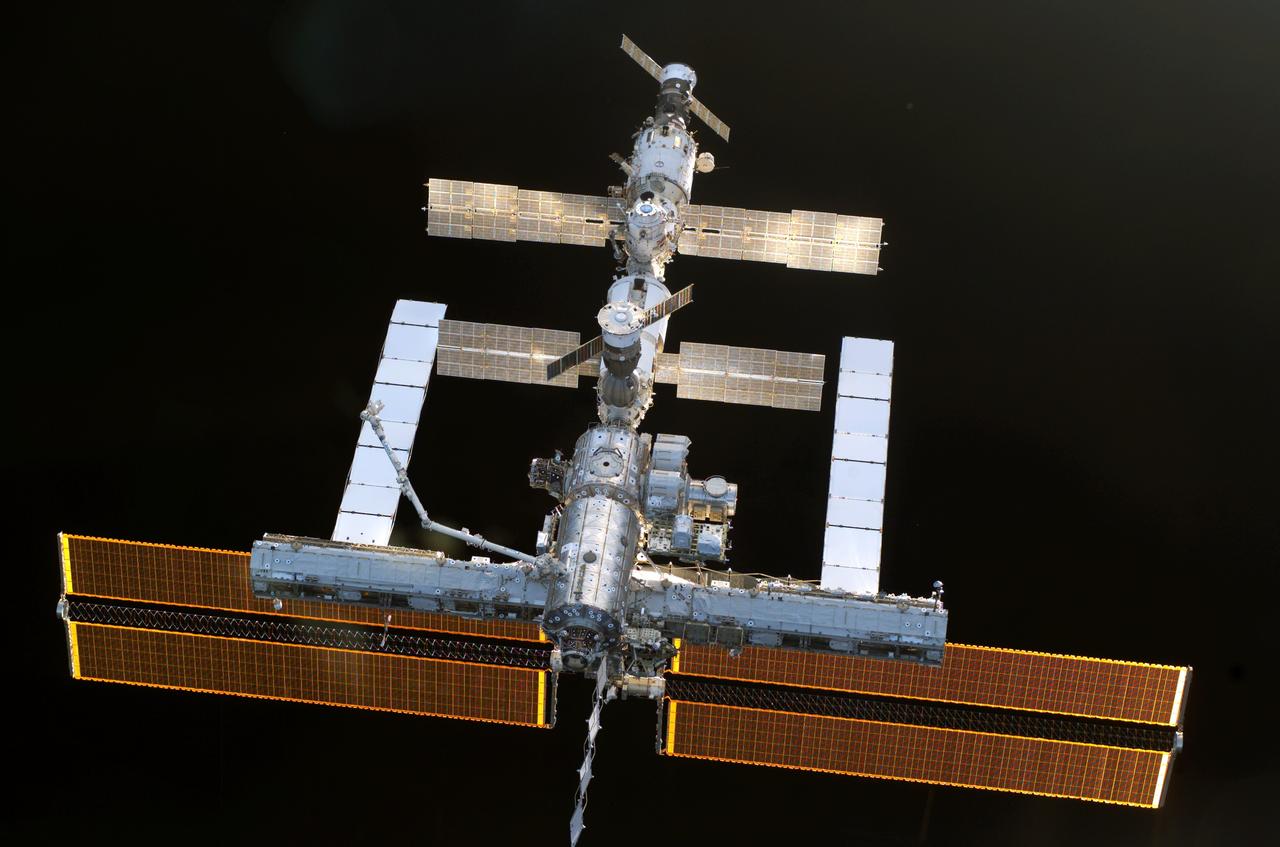
S114-E-7285 (6 August 2005) --- Backdropped by the blackness of space, this full view of the international space station was photographed by an STS-114 crewmember onboard the Space Shuttle Discovery following the undocking of the two spacecraft. Discovery pulled away from the complex at 2:24 a.m. (CDT) on Aug. 6, 2005.
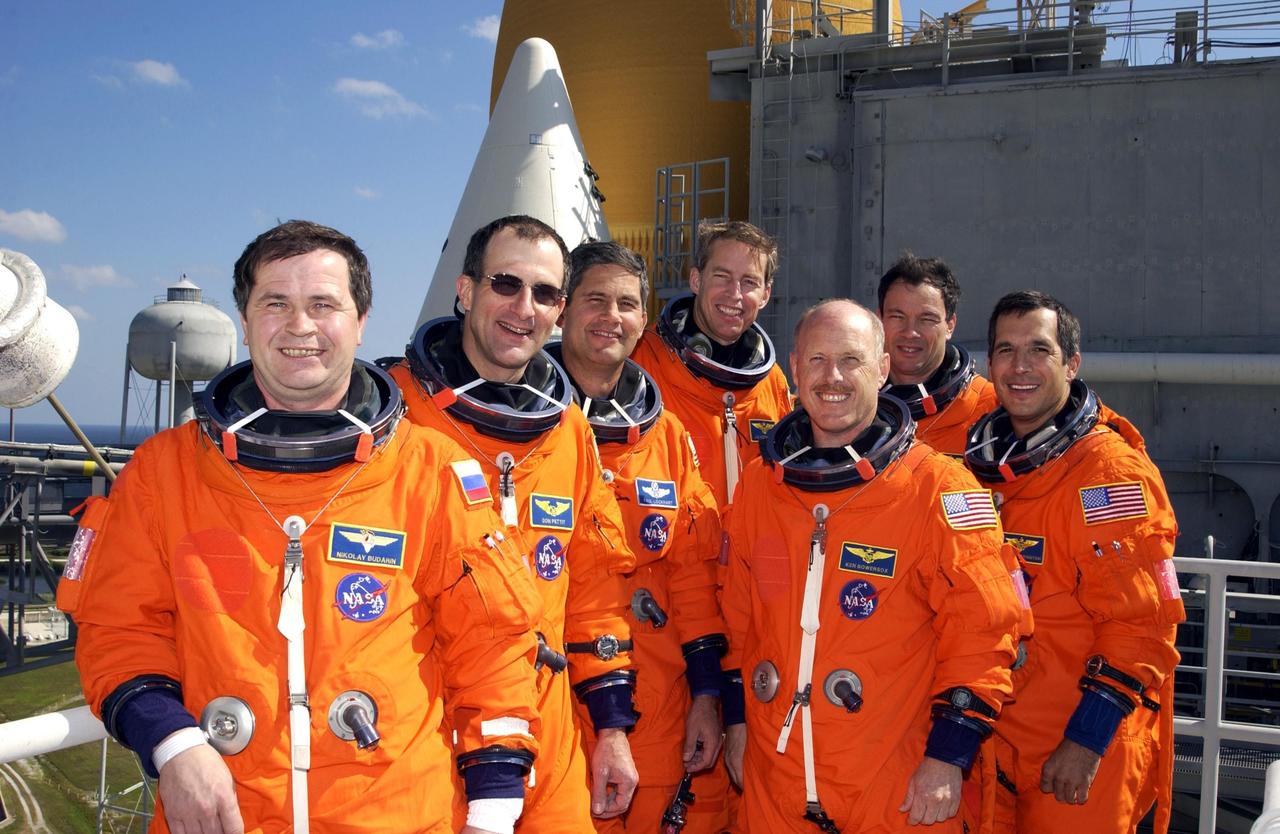
KENNEDY SPACE CENTER, FLA. -- The crews of Mission STS-113 gather for a group photograph on the 195-foot level of the Fixed Service Structure on Launch Pad 39A. From left are Expedition 6 cosmonaut Nikolai Budarin and astronaut Donald Pettit; STS-113 Pilot Paul Lockhart and Commander James Wetherbee; Expedition 6 Commander Ken Bowersox; STS-113 Mission Specialists Michael Lopez-Alegria and John Herrington. They have been participating in emergency egress training, part of Terminal Countdown Demonstration Test activities in preparation for their launch. The 16th assembly flight to the International Space Station, STS-113 will carry the Port 1 (P1) truss aboard Space Shuttle Endeavour, as well as Expedition 6, who will replace Expedition 5 on the Station. The mission is scheduled to launch Nov. 10, 2002.

KENNEDY SPACE CENTER, FLA. - The STS-113 and Expedition 6 crews exit the Operations and Checkout Building on their way to Launch Pad 39A for a simulated launch countdown. On the left, front to back, are Ken Bowersox, commander of Expedition 6, Mission Specialist John Herrington, astronaut Donald Pettit, and Mission Specialist Michael Lopez-Alegria. On the right, front to back, are STS-113 Commander James Wetherbee, Pilot Paul Lockhart, and cosmonaut Nikolai Budarin. The countdown is part of Terminal Countdown Demonstration Test activities prior to launch. The 16th assembly flight to the International Space Station, STS-113 will carry the Port 1 (P1) truss aboard Space Shuttle Endeavour as well as the Expedition 6 crew, who will replace Expedition 5 on the Station. Mission STS-113 is scheduled to launch Nov. 10, 2002.
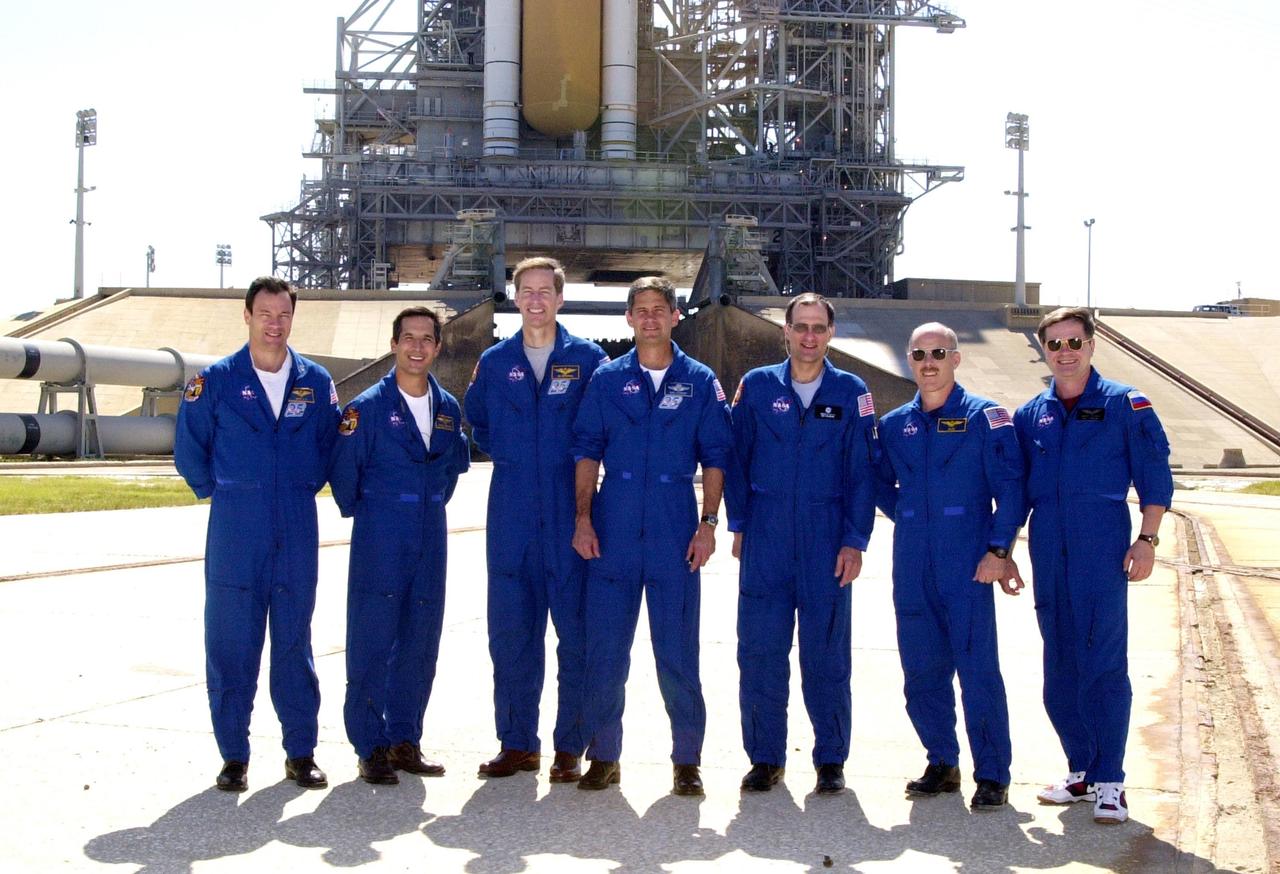
KENNEDY SPACE CENTER, FLA. - The STS-113 and Expedition 6 crews pause for a photo during Terminal Countdown Demonstration Test activities at the pad. From left are STS-113 Mission Specialists Michael Lopez-Alegria and John Herrington, Commander James Wetherbee and Pilot Paul Lockhart; Expedition 6 astronaut Donald Pettit, Commander Ken Bowersox and cosmonaut Nikolai Budarin. The TCDT also includes a simulated launch countdown. The 16th assembly flight to the International Space Station, STS-113 will carry the Port 1 (P1) truss aboard Space Shuttle Endeavour as well as the Expedition 6 crew, who will replace Expedition 5 on the Station. Mission STS-113 is scheduled to launch Nov. 10, 2002.
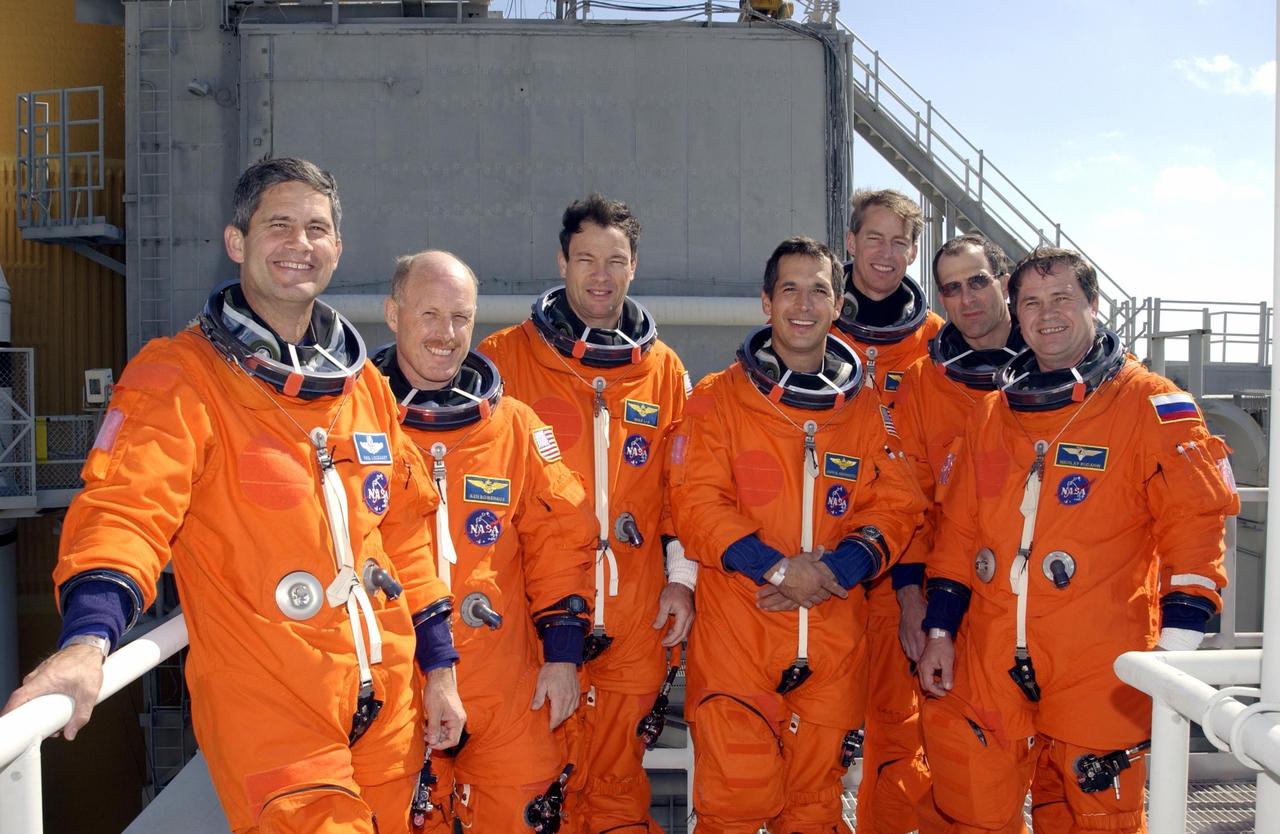
KENNEDY SPACE CENTER, FLA. -- The crews of Mission STS-113 gather for a group photograph on the 195-foot level of the Fixed Service Structure on Launch Pad 39A. From left are STS-113 Pilot Paul Lockhart; Expedition 6 Commander Ken Bowersox; STS-113 Mission Specialists Michael Lopez-Alegria and John Herrington, and Commander James Wetherbee; Expedition 6 astronaut Donald Pettit and cosmonaut Nikolai Budarin. They have been participating in emergency egress training, part of Terminal Countdown Demonstration Test activities in preparation for their launch. The 16th assembly flight to the International Space Station, STS-113 will carry the Port 1 (P1) truss aboard Space Shuttle Endeavour, as well as Expedition 6, who will replace Expedition 5 on the Station. The mission is scheduled to launch Nov. 10, 2002.
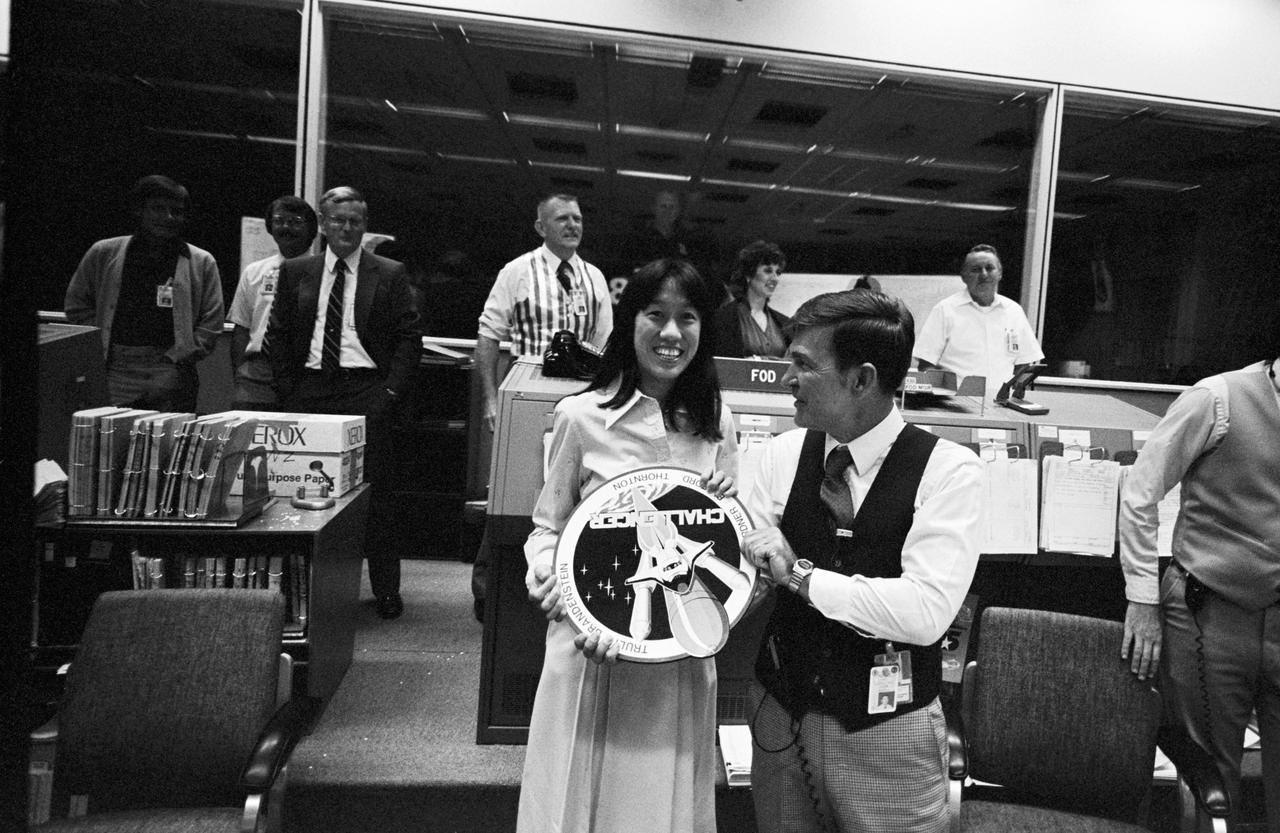
STS-8 MCC Activities, Day 6 CapComs, Astronaut Bill Fisher and Flight Director Harold Draughon. 1. INFLIGHT - STS-8 (MCC) 2. FISHER, ANNA - STS-8 (MCC) 3. FISHER, BILL - STS-8 (MCC) JSC, HOUSTON, TX Also available in 35 CN
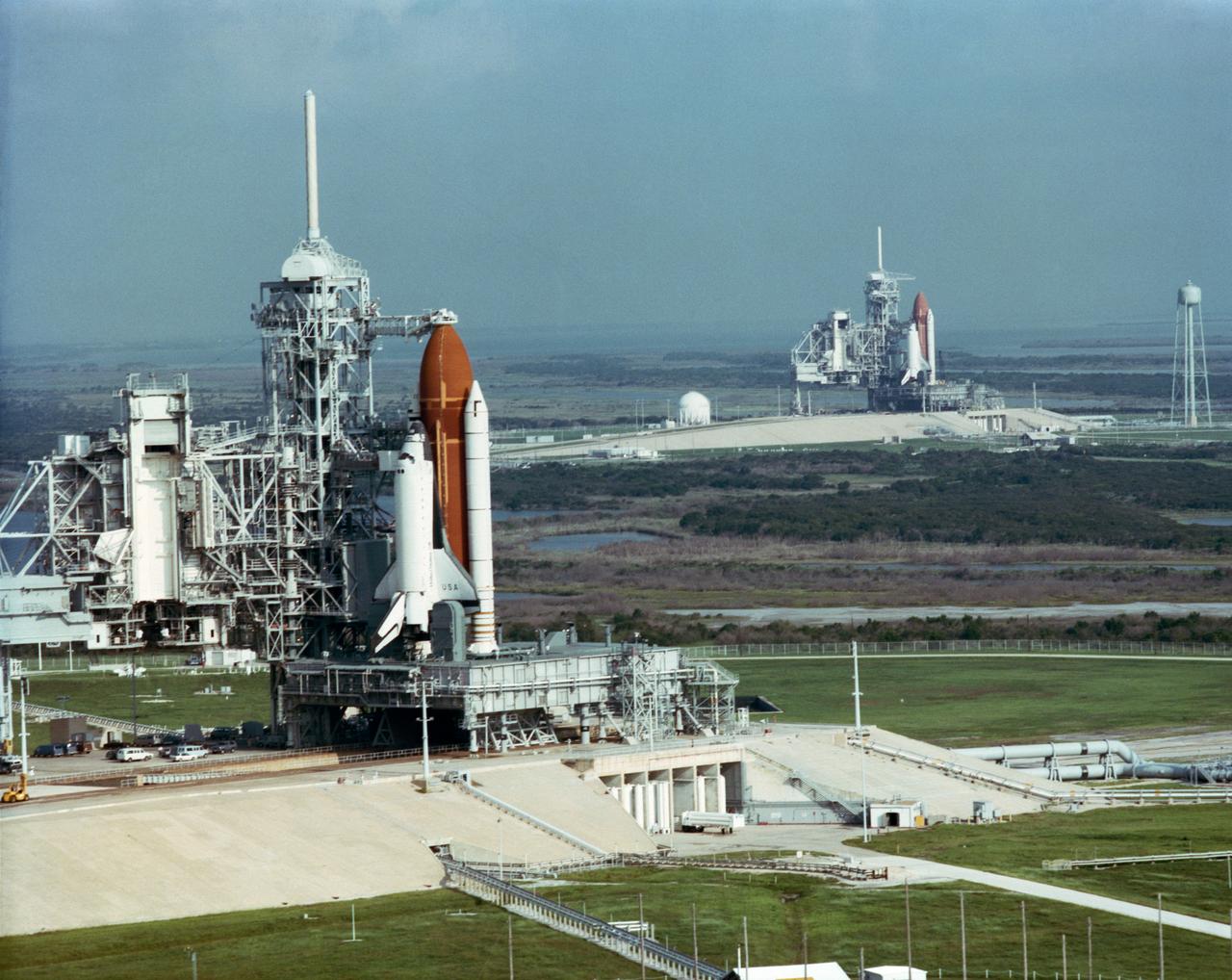
S90-48650 (5 Sept 1990) --- This rare view shows two space shuttles on adjacent pads at Launch Complex 39 with the Rotating Service Structures (RSR) retracted. Space Shuttle Columbia (foreground) is on Pad A where it awaits further processing for a September 6 early morning launch on STS-35. Discovery, its sister spacecraft, is set to begin preparations for an October liftoff on STS-41 when the Ulysses spacecraft is scheudled to be taxied into space. PLEASE NOTE: Following the taking of this photograph, STS-35 was postponed and STS-41's Discovery was successfully launched on Oct. 6.
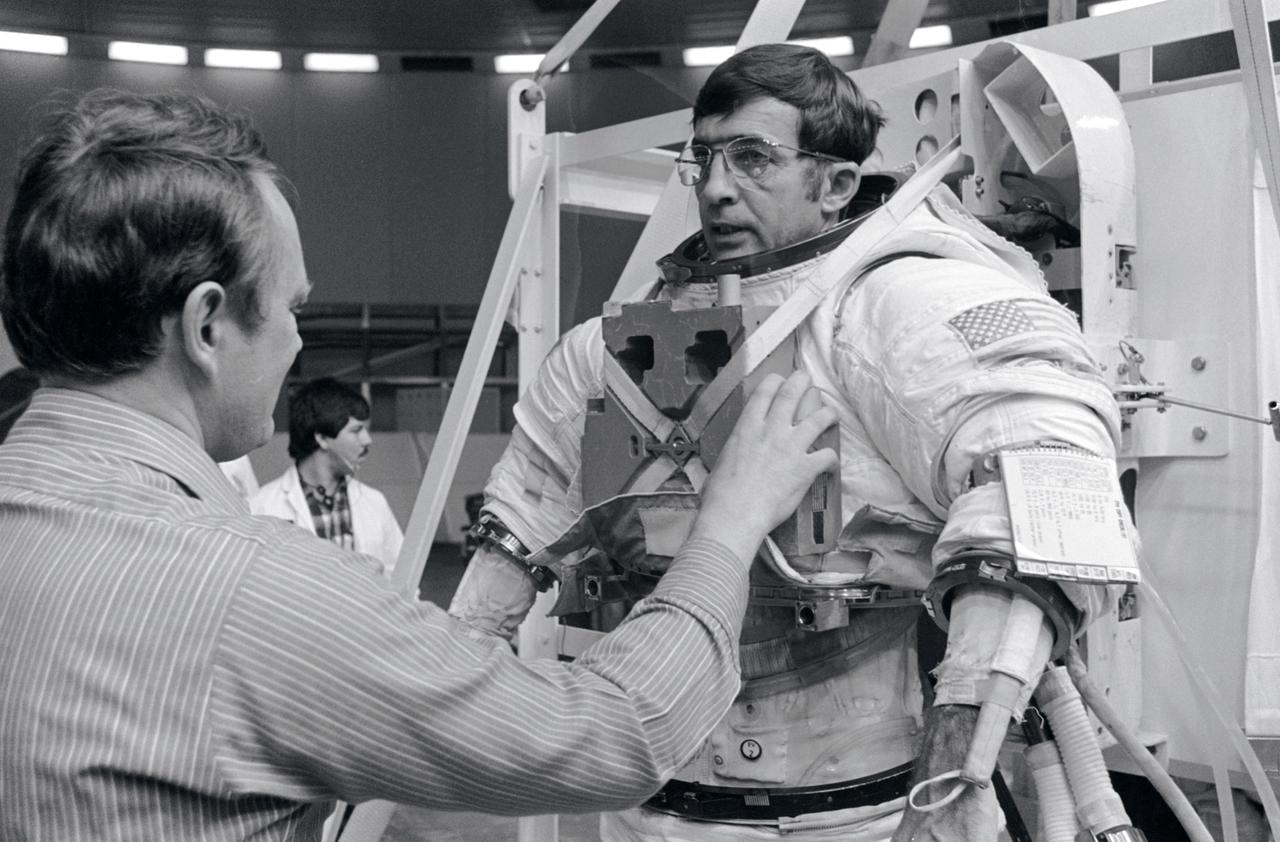
S82-41606 (December 1982) --- Astronaut Karol J. Bobko, left, STS-6 pilot, assists astronaut Donald H. Peterson, STS-6 mission specialist, prior to an underwater training session in the Johnson Space Center?s weightless environment training facility (WET-F). Astronauts F. Story Musgrave and Peterson are scheduled to perform the Space Transportation System?s first extravehicular activity on Challenger?s first flight, slated for early next year. Photo credit: NASA

KENNEDY SPACE CENTER, FLA. -- The STS-113 and Expedition 6 crews head for the Astrovan to transport them to Launch Pad 39A and Space Shuttle Endeavour. In the foreground, from left, are Mission Specialist Michael Lopez-Alegria and John Herrington, and Expedition 6 Commander Ken Bowersox. In the background, from left, are Expedition 6 flight engineers Donald Pettit and Nikolai Budarin, Pilot Paul Lockhart and Commander James Wetherbee. The primary mission for the crew is bringing the Expedition 6 crew to the Station and returning the Expedition 5 crew to Earth. The major objective of the mission is delivery of the Port 1 (P1) Integrated Truss Assembly, which will be attached to the port side of the S0 truss. Three spacewalks are planned to install and activate the truss and its associated equipment. Launch of Space Shuttle Endeavour on mission STS-113 is scheduled for Nov. 22, 2002, at 8:15 p.m. EST.