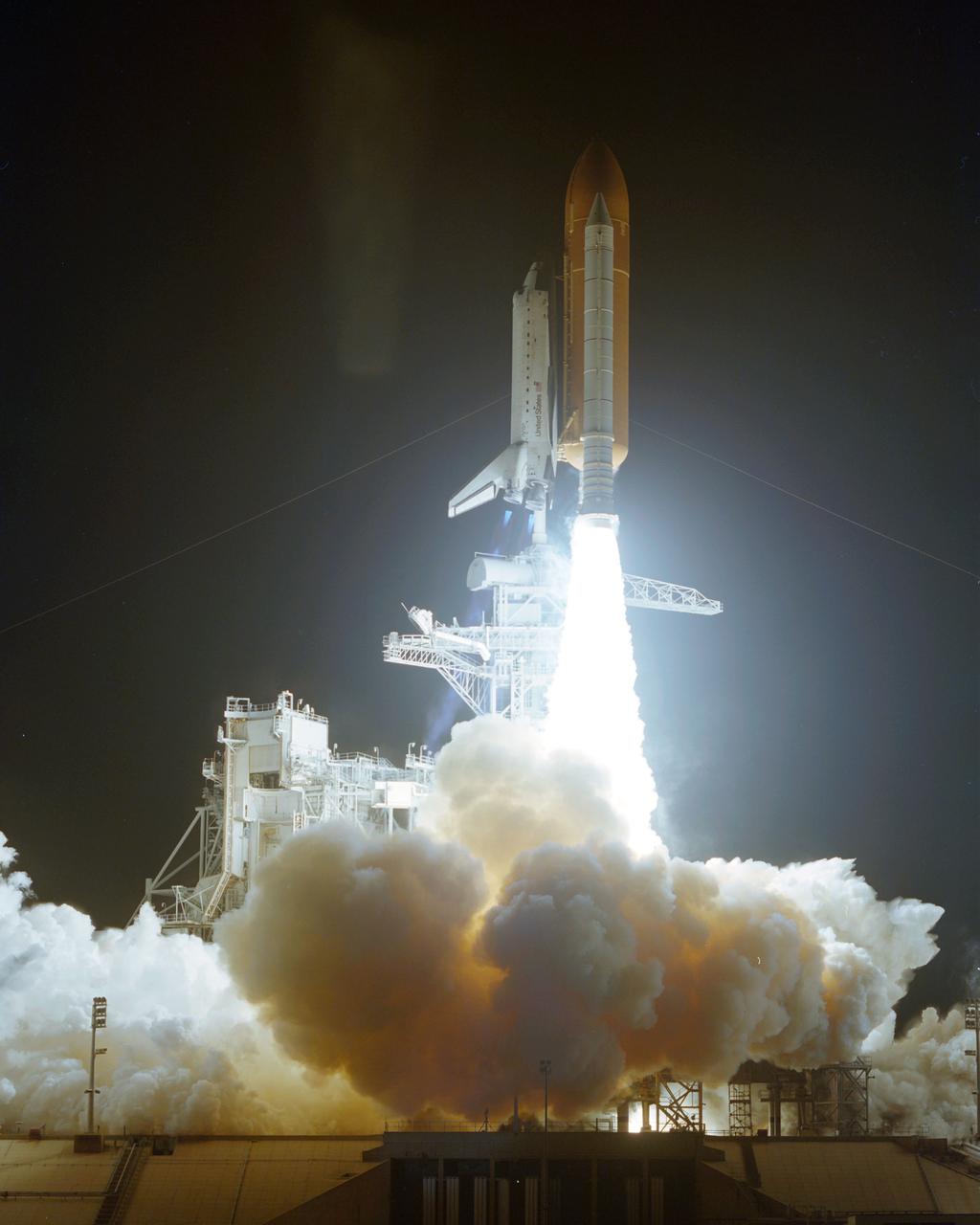
STS063-S-007 (3 Feb 1995) --- The race to catch up with the Russia's Mir gets underway as the Space Shuttle Discovery launches from Pad 39B, Kennedy Space Center (KSC) at 12:22:04 (EST), February 3, 1995. Discovery is the first in the current fleet of four Space Shuttle vehicles to make 20 launches. Onboard for the 67th (STS-63 is out of sequence) Shuttle flight are astronauts James D. Wetherbee, mission commander; Eileen M. Collins, pilot; Bernard A. Harris Jr., payload commander; mission specialists Janice Voss and C. Michael Foale; along with Russian cosmonaut Vladimir G. Titov.
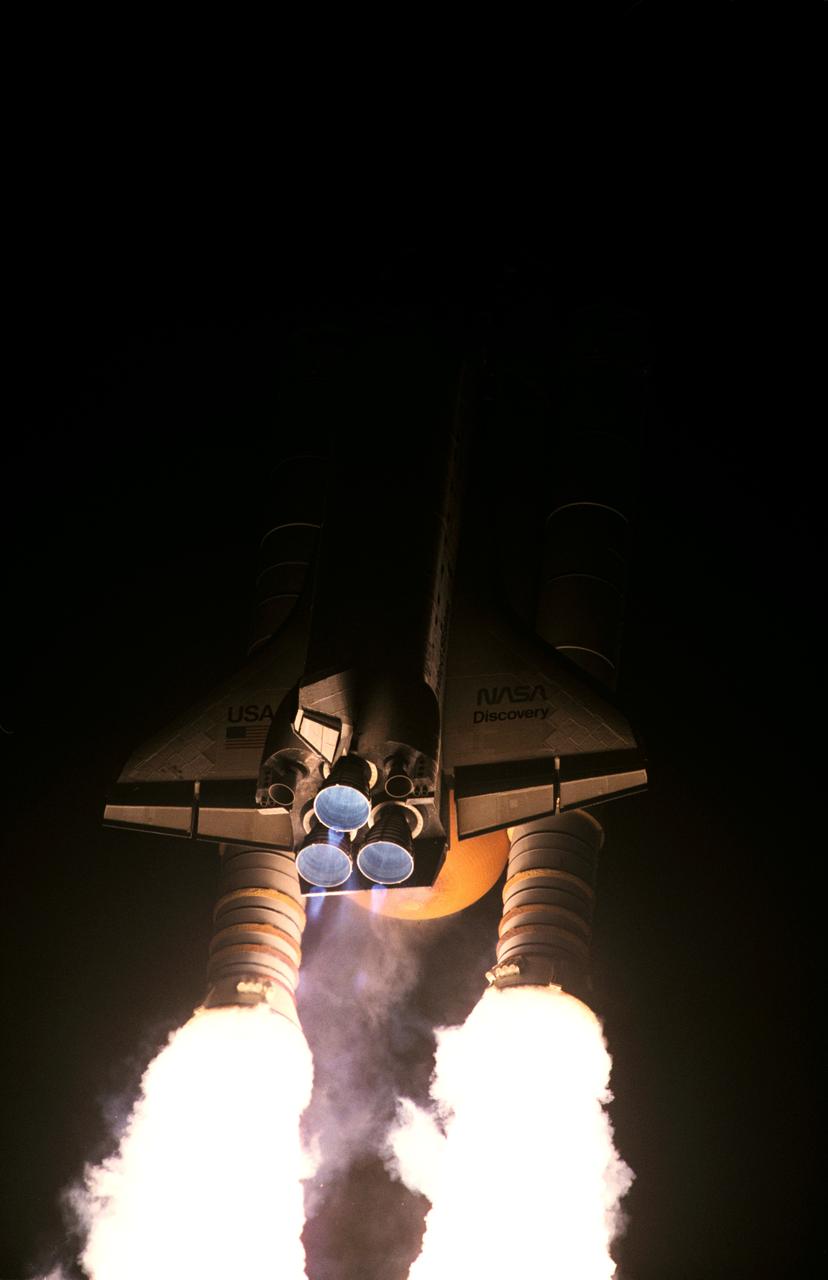
STS063-S-003 (3 Feb. 1995) --- A 35mm camera was used to expose this image of the space shuttle Discovery as it began its race to catch up with the Russia's Mir Space Station. Liftoff from Launch Pad 39B, Kennedy Space Center (KSC) occurred at 12:22:04 (EST), Feb. 3, 1995. Discovery is the first in the current fleet of four space shuttle vehicles to make 20 launches. Onboard for the 67th (STS-63 is out of sequence) shuttle flight are astronauts James D. Wetherbee, commander; Eileen M. Collins, pilot; Bernard A. Harris Jr., payload commander; and mission specialists Janice Voss and C. Michael Foale; along with Russian cosmonaut Vladimir G. Titov. Photo credit: NASA
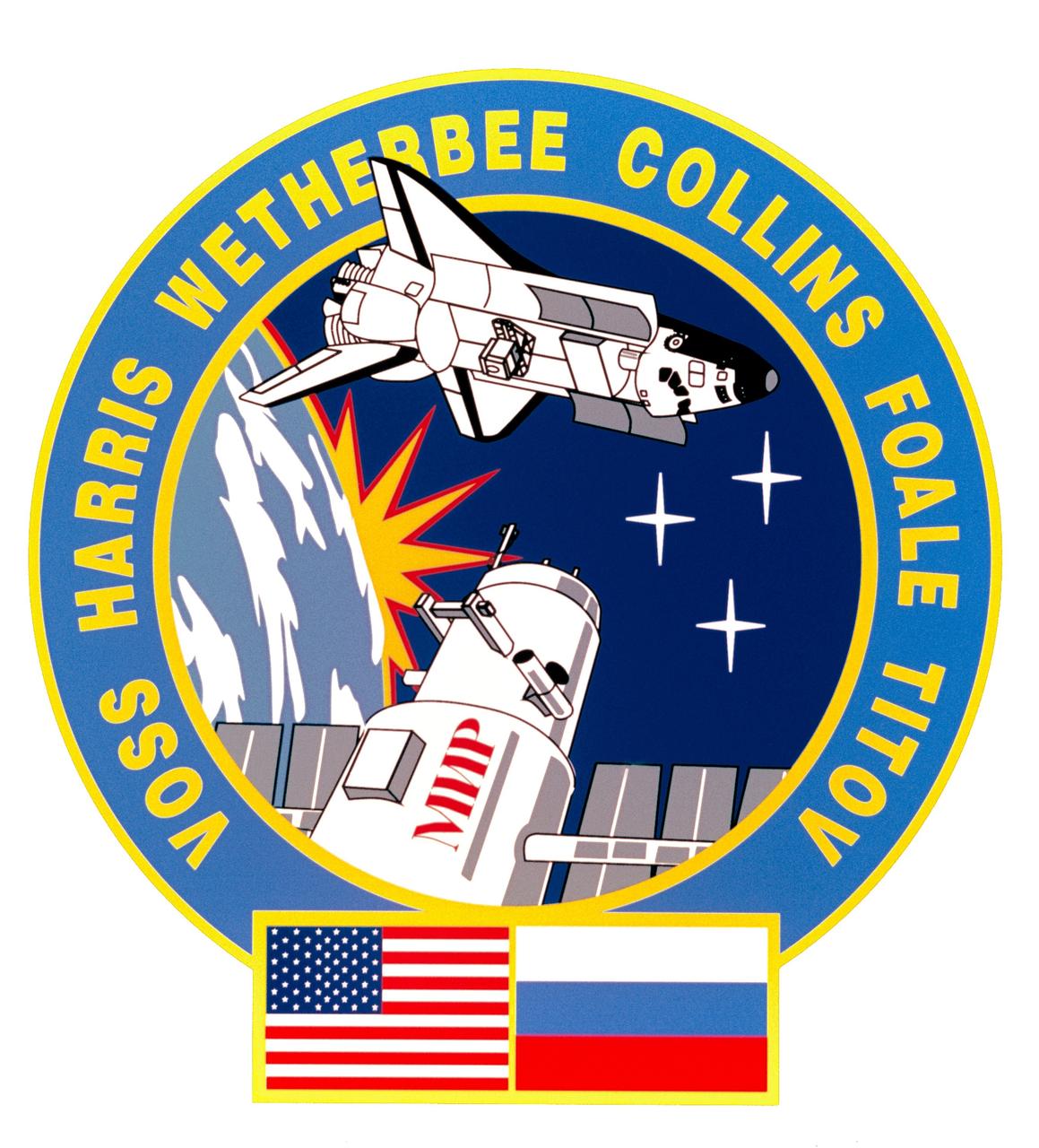
STS063-S-001 (September 1994) --- Designed by the crew members, the STS-63 crew patch depicts the orbiter maneuvering to rendezvous with Russia's Space Station Mir. The name is printed in Cyrillic on the side of the station. Visible in the orbiter's payload bay are the commercial space laboratory Spacehab and the Shuttle Pointed Autonomous Research Tool for Astronomy (SPARTAN) satellite which are major payloads on the flight. The six points on the rising sun and the three stars are symbolic of the mission's Space Transportation System (STS) numerical designation. Flags of the United States and Russia at the bottom of the patch symbolize the cooperative operations of this mission. The crew will be flying aboard the space shuttle Discovery. The NASA insignia design for space shuttle flights is reserved for use by the astronauts and for other official use as the NASA Administrator may authorize. Public availability has been approved only in the forms of illustrations by the various news media. When and if there is any change in this policy, which is not anticipated, the change will be publicly announced. Photo credit: NASA
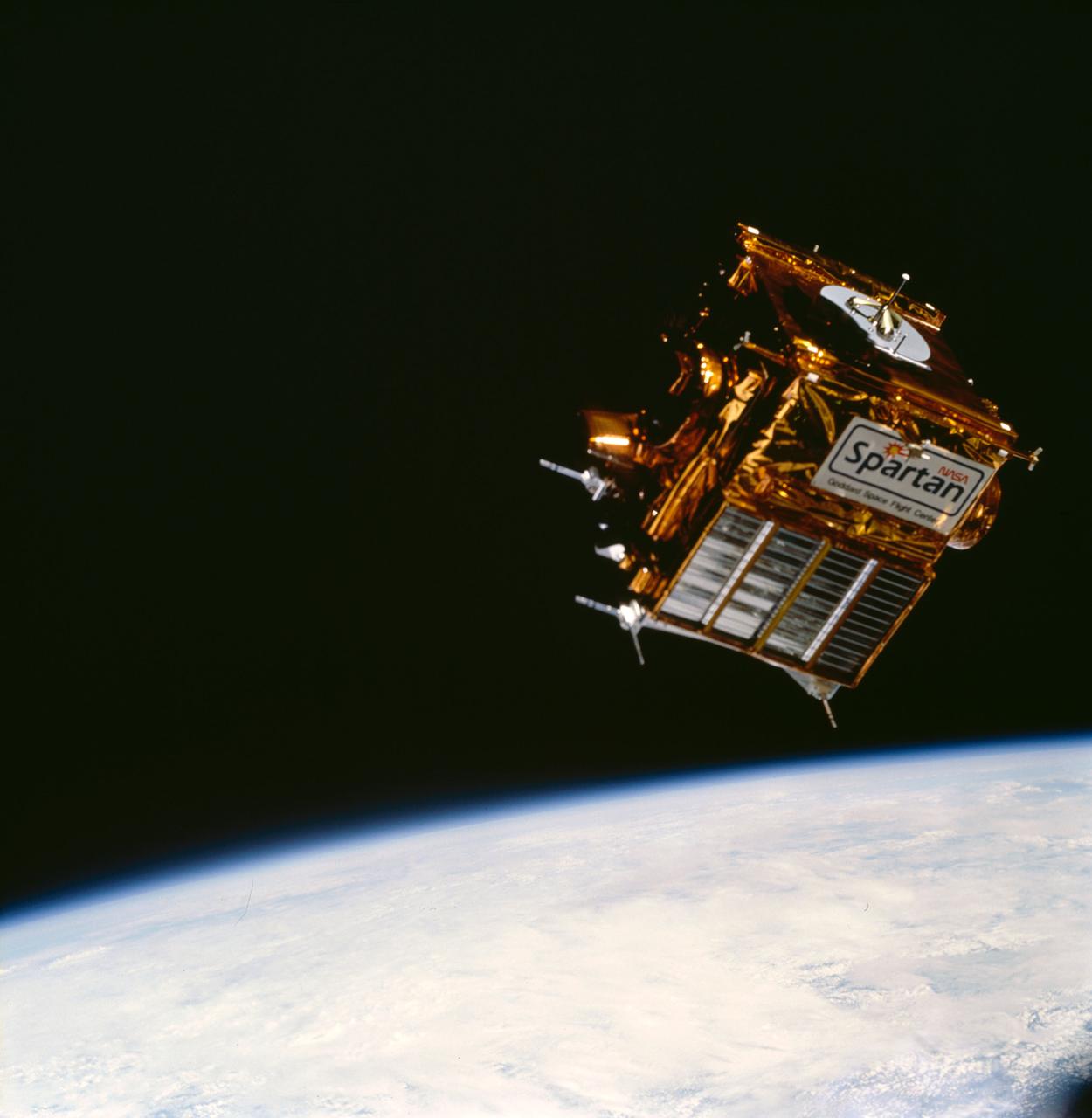
The blackness of space and part of Earth's horizon form the backdrop for this 70mm frame of the free-flying SPARTAN 204 mission. Carried into space by the STS-63 crewmembers, the satellite was later re-captured by the crew and used for maneuvering evaluations by the two space walkers, astronauts Bernard Harris and Michael Foale.
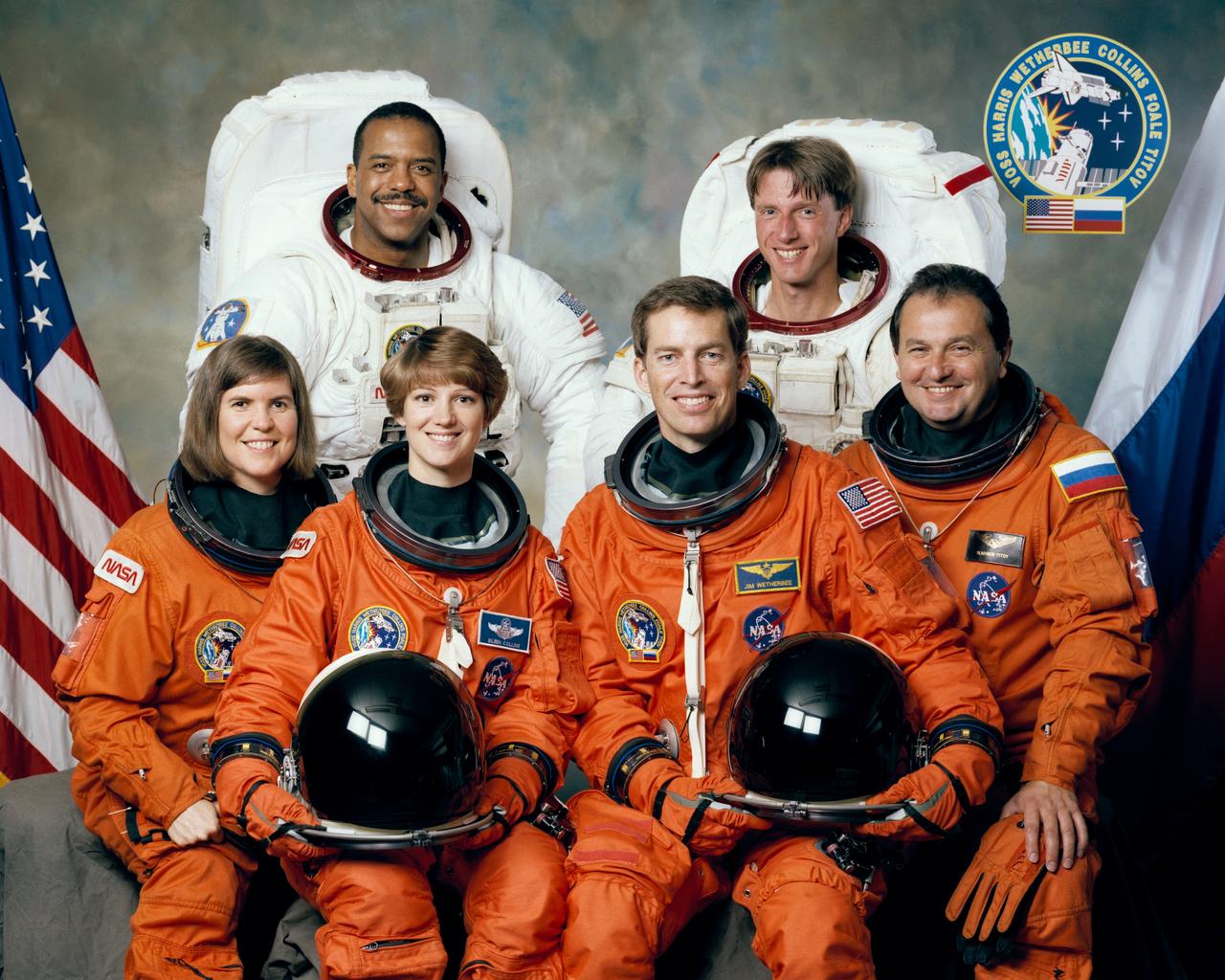
STS063-S-002 (November 1994) --- With the United States and Russian flags in the background, five NASA astronauts and a Russian cosmonaut named to fly aboard the Space Shuttle Discovery for the mission pose for the flight crew portrait at the Johnson Space Center (JSC). Left to right (front row) are Janice E. Voss, mission specialist; Eileen M. Collins, pilot; James D. Wetherbee, mission commander; and Vladimir Titov of the Russian Space Agency (RSA), mission specialist. In the rear are Bernard A. Harris Jr., payload commander; and C. Michael Foale, mission specialist.

S94-41838 (Nov 1994) --- Wearing training versions of the orange partial pressure suit used for shuttle ascent and entry, five NASA astronauts and a Russian cosmonaut assemble for an STS-63 training session. The six are in the Johnson Space Center's (JSC) Shuttle mockup and integration laboratory. They are, left to right, astronauts James D. Wetherbee, mission commander; Eileen M. Collins, pilot; Bernard A. Harris Jr., payload commander; and C. Michael Foale, Janice E. Voss, and cosmonaut Vladimir G. Titov, all mission specialists.
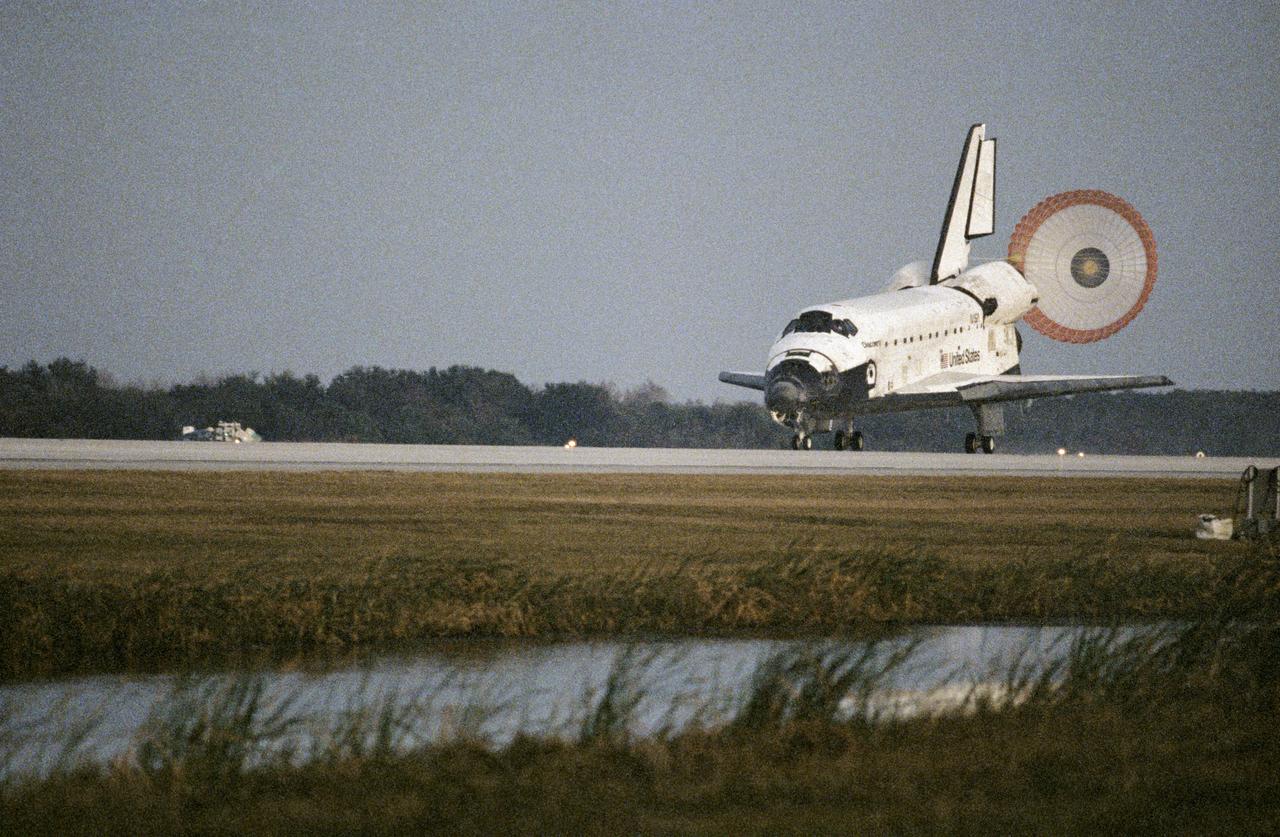
STS063-S-015 (11 Feb. 1995) --- The Space Shuttle Discovery deploys its drag chute on Runway 15 at the Kennedy Space Center's (KSC) Shuttle Landing Facility as it wraps up an eight-day mission. Touchdown occurred at 6:50:19 a.m. (EST), February 11, 1995. Onboard the Space Shuttle Discovery were astronauts James D. Wetherbee, mission commander; Eileen M. Collins, pilot; Bernard A. Harris Jr., payload commander; mission specialists C. Michael Foale, Janice E. Voss, and cosmonaut Vladimir G. Titov.
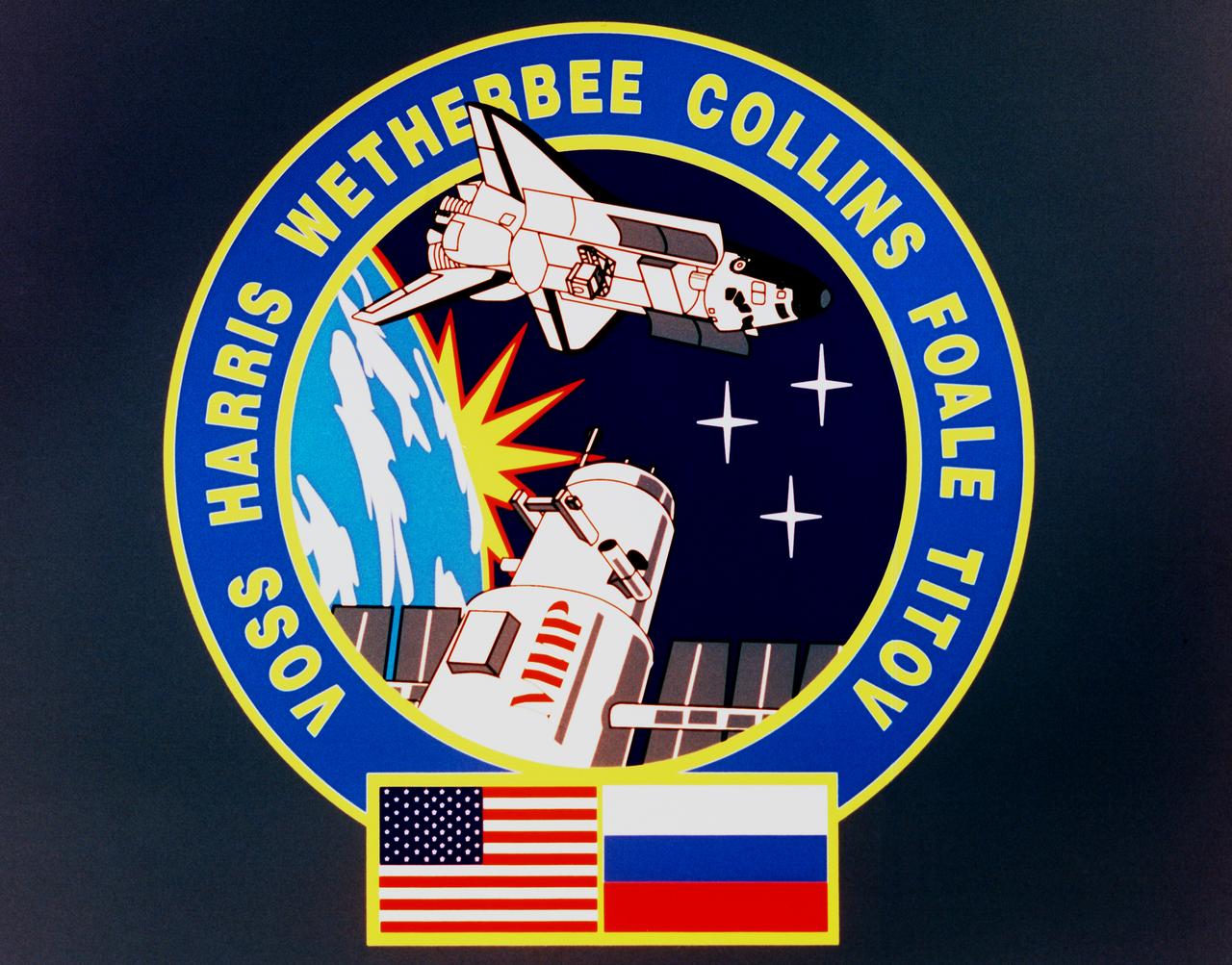
Designed by the crew members, the STS-63 crew patch depicts the orbiter maneuvering to rendezvous with Russia's Space Station Mir. The name is printed in Cyrillic on the side of the station. Visible in the Orbiter's payload bay are the commercial space laboratory Spacehab and the Shuttle Pointed Autonomous Research Tool for Astronomy (SPARTAN) satellite which are major payloads on the flight. The six points on the rising sun and the three stars are symbolic of the mission's Space Transportation System (STS) numerical designation. Flags of the United States and Russia at the bottom of the patch symbolize the cooperative operations of this mission.
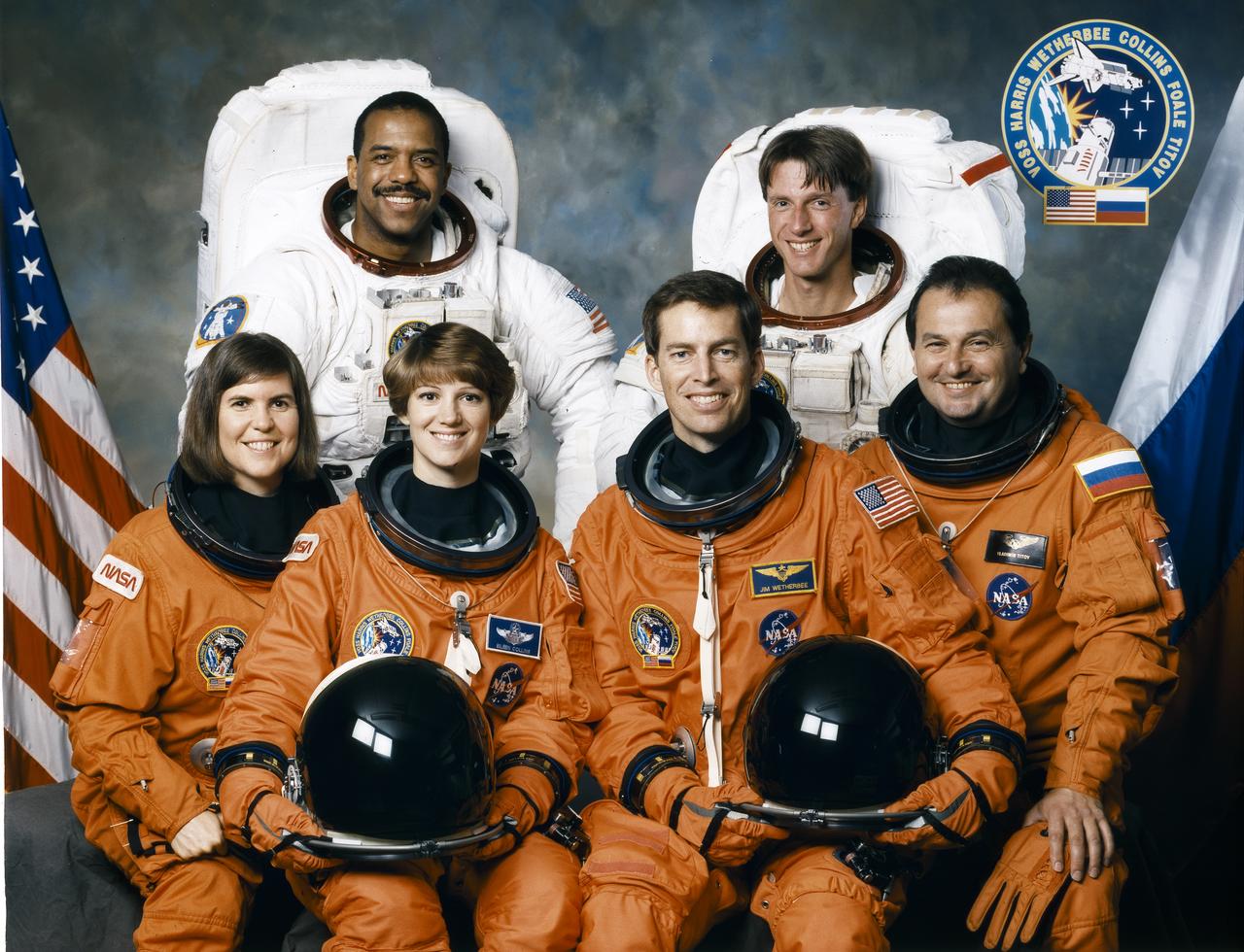
Crew members assigned to the STS-63 mission included (front left to right) Janice E. Voss, mission specialist; Eileen M. Collins, pilot; (the first woman to pilot a Space Shuttle), James D. Wetherbee, commander; and Vladmir G. Titov (Cosmonaut). Standing in the rear are mission specialists Bernard A. Harris, and C. Michael Foale. Launched aboard the Space Shuttle Discovery on February 3, 1995 at 12:22:04 am (EST), the primary payload for the mission was the SPACEHAB-3. STS-63 marked the first approach and fly around by the Shuttle with the Russian space station Mir.
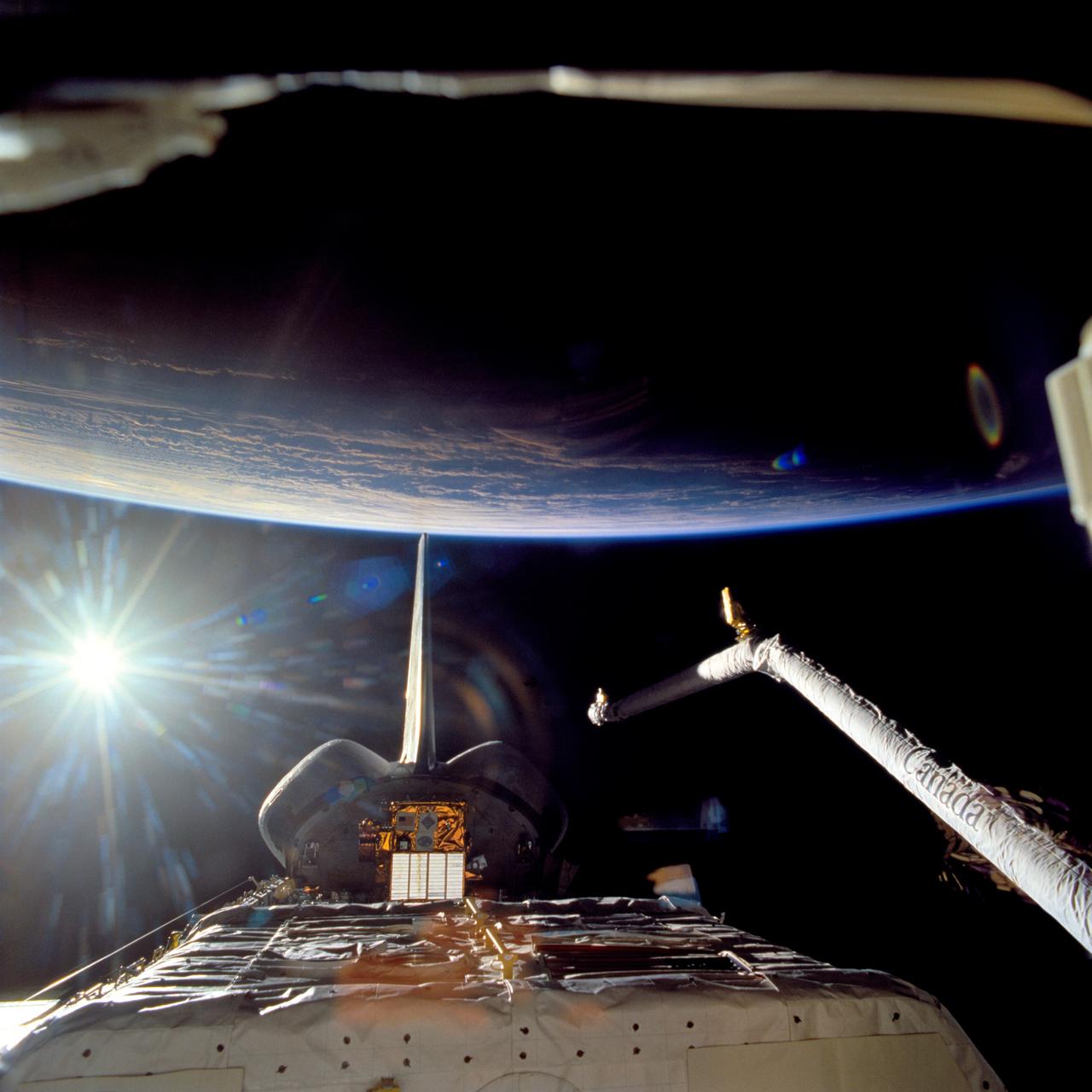
STS063-716-025 (9 Feb. 1995) --- In tail-to Earth mode, the Space Shuttle Discovery is backdropped against dark space, Sunburst and massive clouds over the ocean. The Spartan 204 is visible in the cargo bay. This is one of 16 still photographs released by the NASA Johnson Space Center (JSC) Public Affairs Office (PAO) on February 14, 1995. Onboard Discovery were astronauts James D. Wetherbee, mission commander; Eileen M. Collins, pilot; Bernard A. Harris, Jr., payload commander; mission specialists C. Michael Foale, Janice E. Voss, and cosmonaut Vladimir G. Titov.
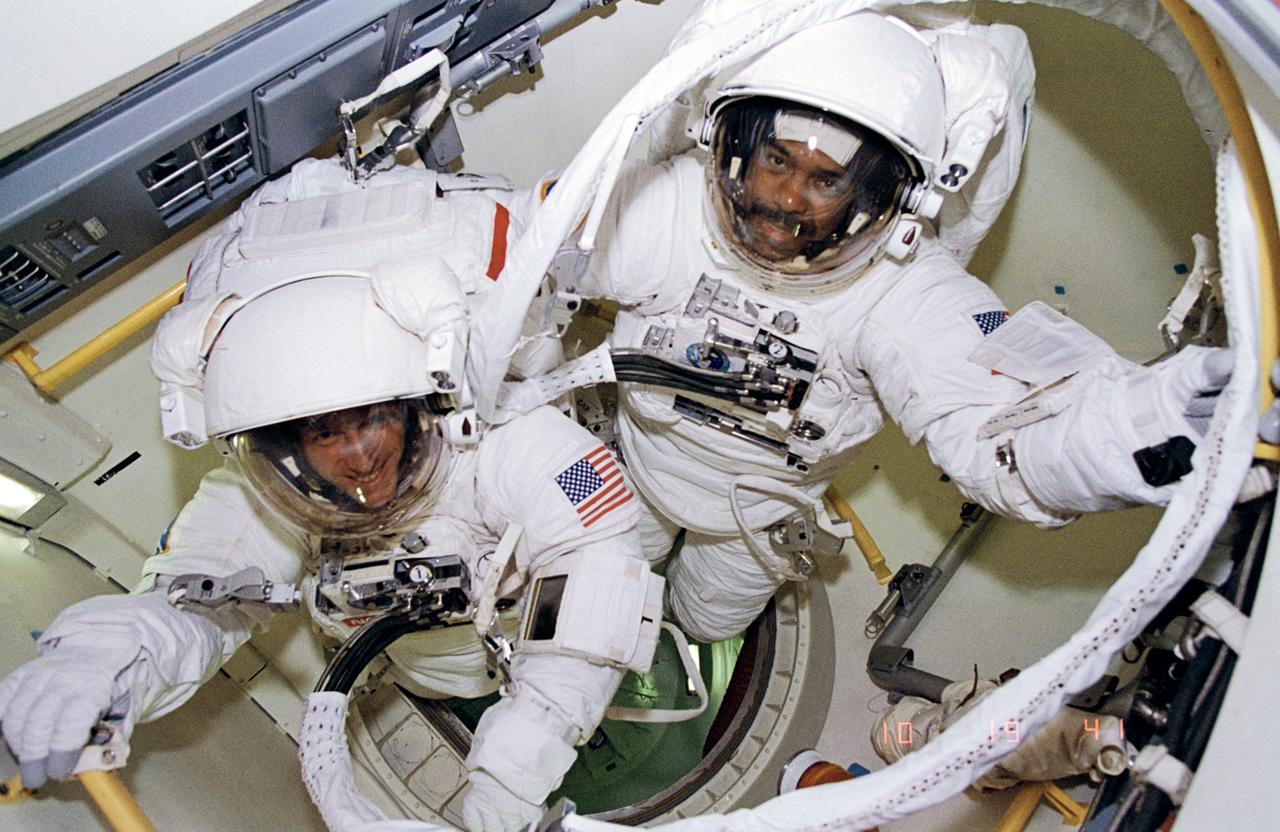
STS063-67-024 (9 Feb. 1995) --- Astronauts Bernard A. Harris Jr., STS-63 payload commander, (top right) and C. Michael Foale, mission specialist, are ready to egress airlock for an extravehicular activity (EVA). Others onboard the space shuttle Discovery were astronauts James D. Wetherbee, mission commander; Eileen M. Collins, pilot; mission specialists Janice E. Voss, and cosmonaut Vladimir G. Titov. Photo credit: NASA
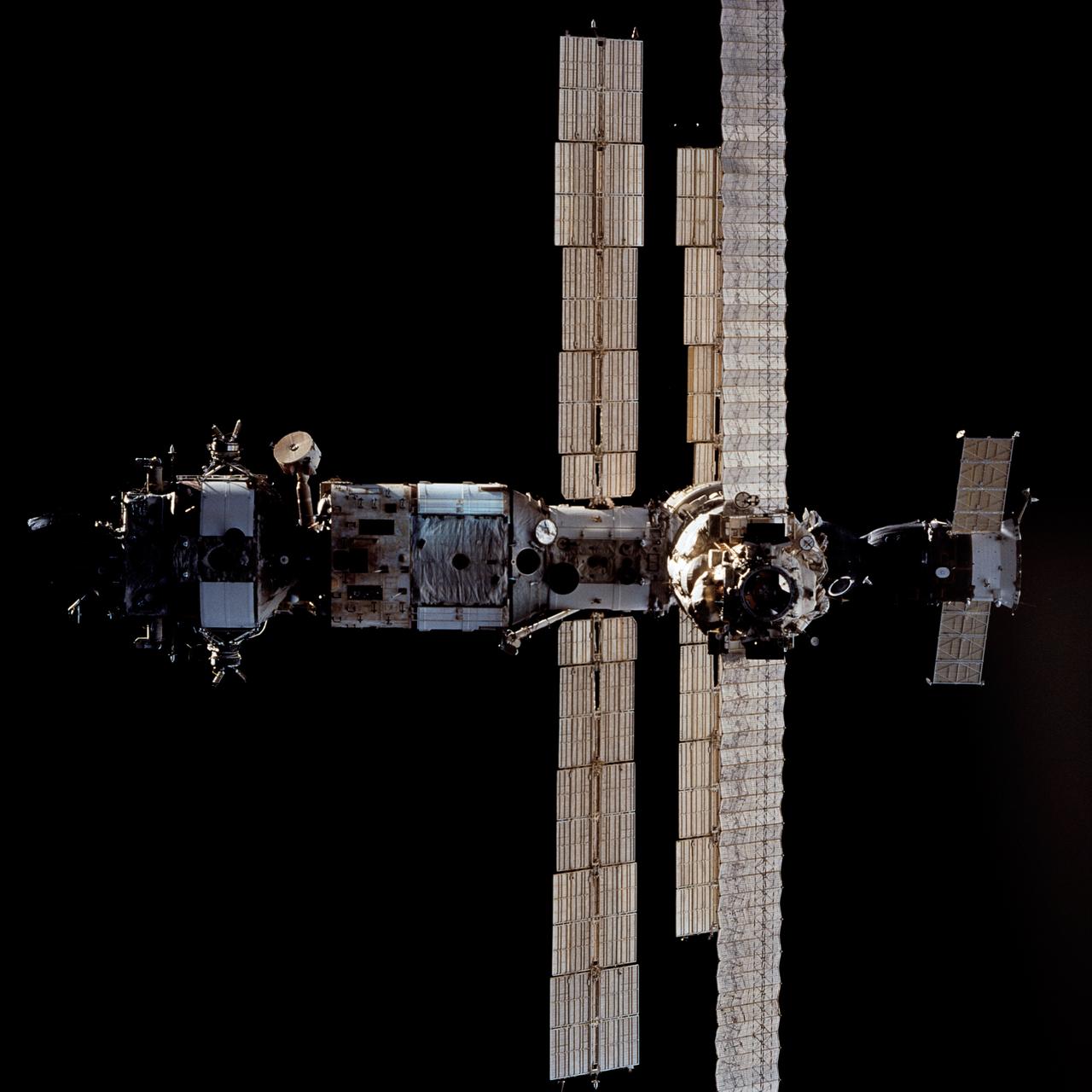
STS063-712-017 (6 Feb. 1995) --- Russia's Mir Space Station during rendezvous operations with the Space Shuttle Discovery. Docked at the bottom of the Mir facility is a Soyuz spacecraft. On the opposite end (almost cropped out of frame at top) is a Progress spacecraft. Onboard the Space Shuttle Discovery were astronauts James D. Wetherbee, mission commander; Eileen M. Collins, pilot; Bernard A. Harris, Jr., payload commander; C. Michael Foale and Janice E. Voss, mission specialists; along with cosmonaut Vladimir G. Titov, mission specialist.
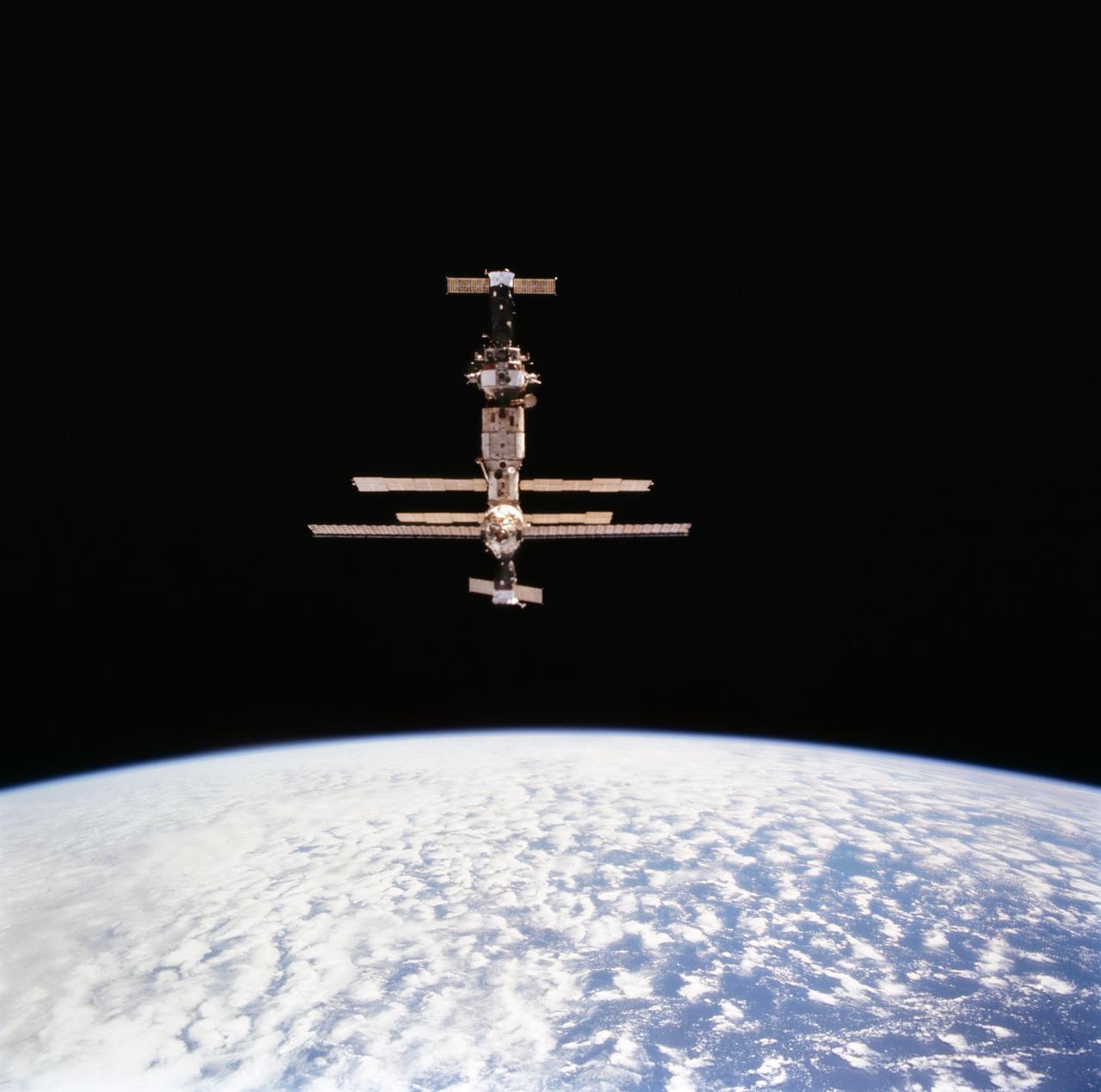
STS063-712-072 (6 Feb 1995) --- Russia's Mir Space Station over the blue and white Earth during initial approach for rendezvous operations with the Space Shuttle Discovery. Docked at bottom (nearest portion where longest solar array panel is visible) is a Soyuz space vehicle. On the opposite end is a Progress spacecraft. This is one of 16 still photographs released by the NASA Johnson Space Center (JSC) Public Affairs Office (PAO) on February 14, 1995. Onboard the Space Shuttle Discovery were astronauts James D. Wetherbee, mission commander; Eileen M. Collins, pilot; Bernard A. Harris Jr., payload commander; mission specialists C. Michael Foale, Janice E. Voss, and cosmonaut Vladimir G. Titov.
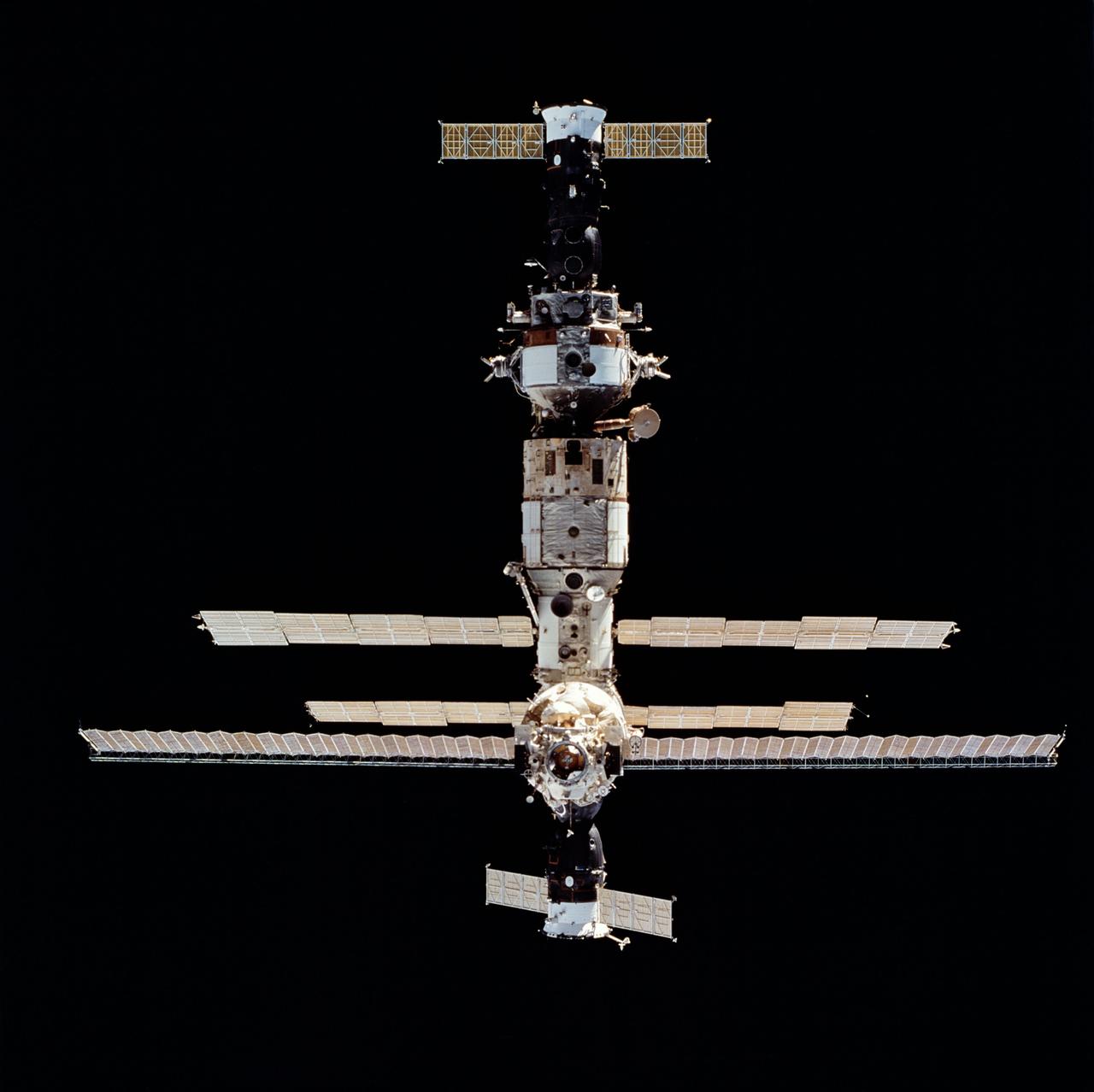
STS063-712-068 (6 Feb 1995) --- Russia's Mir Space Station during rendezvous operations with the Space Shuttle Discovery. Docked at bottom (nearest portion where longest solar array panel is visible) is a Soyuz space vehicle. On the opposite end is a Progress spacecraft. This is one of 16 still photographs released by the NASA Johnson Space Center (JSC) Public Affairs Office (PAO) on February 14, 1995. Onboard the Space Shuttle Discovery were astronauts James D. Wetherbee, mission commander; Eileen M. Collins, pilot; Bernard A. Harris, Jr., payload commander; mission specialists C. Michael Foale, Janice E. Voss, and cosmonaut Vladimir G. Titov.
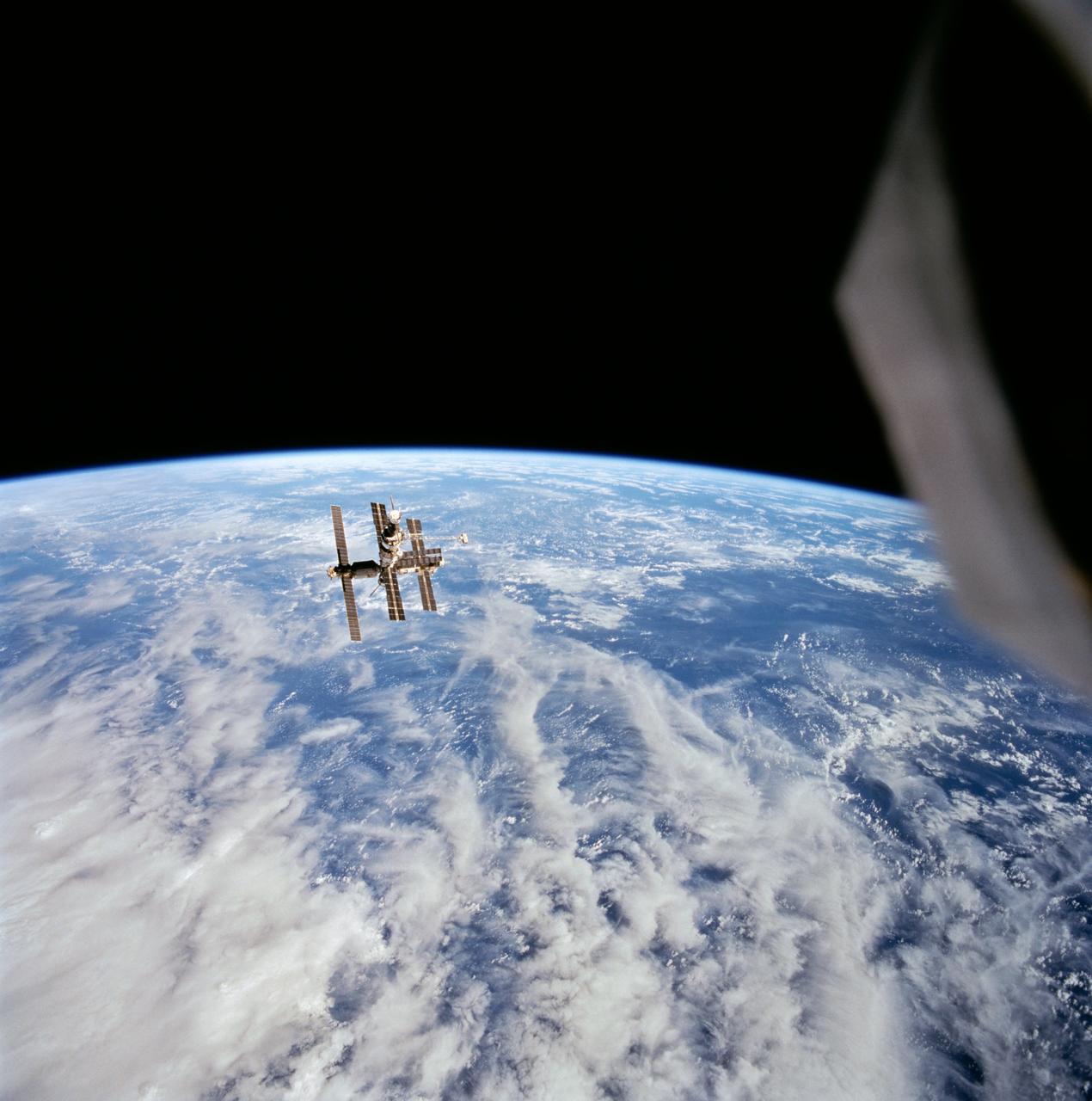
STS063-708-095 (6 Feb 1995) --- Cumulus and other clouds over the ocean form the backdrop for this scene of Russia's Mir space station during rendezvous operations by the Space Shuttle Discovery and Mir. This photograph was taken as the Discovery was firing its Reaction Control Subsystem (RCS) thrusters to separate from Mir's proximity. Onboard the Discovery were astronauts James D. Wetherbee, mission commander; Eileen M. Collins, pilot; Bernard A. Harris Jr., payload commander; mission specialists Janice Voss and C. Michael Foale; along with Russian cosmonaut Vladimir G. Titov. EDITOR'S NOTE: This 70mm handheld Hasselblad frame has been cropped to enlarge Mir.
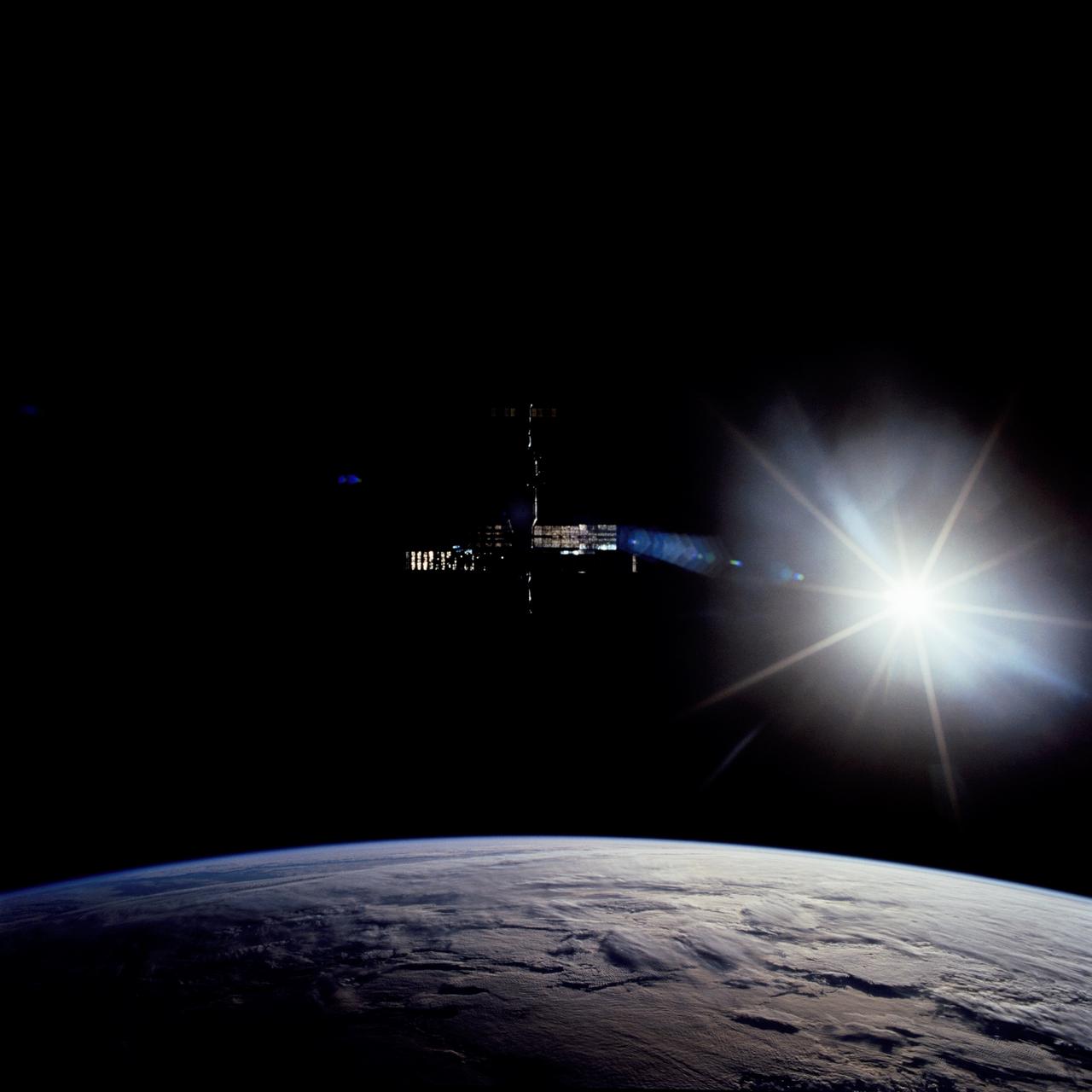
STS063-708-057 (6 Feb. 1995) --- Backdropped against the darkness of space, only the shiny part of Russia's Mir Space Station are clearly visible in this 70mm frame, photographed during rendezvous operations by the Space Shuttle Discovery and the Mir space station. Onboard the Discovery were astronauts James D. Wetherbee, mission commander; Eileen M. Collins, pilot; Bernard A. Harris Jr., payload commander; mission specialists Janice Voss, C. Michael Foale and Russian cosmonaut Vladimir G. Titov.

KENNEDY SPACE CENTER, FLA. -- STS-63: Discovery
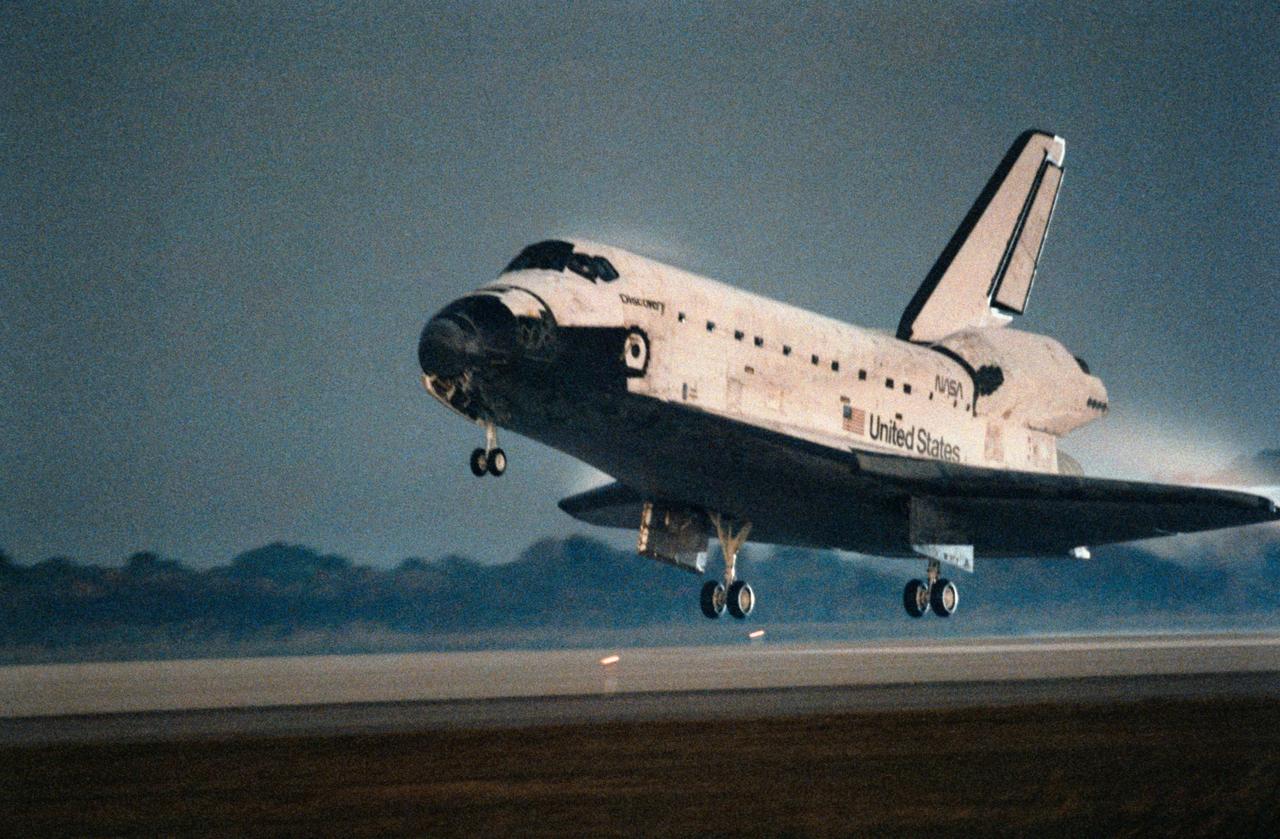
STS063-S-012 (11 Feb 1995) --- The Space Shuttle Discovery is about to touch down on Runway 15 at the Kennedy Space Center's (KSC) Shuttle Landing Facility to complete an eight-day mission. Touchdown occurred at 6:50:19 a.m. (EST), February 11, 1995. Onboard the Space Shuttle Discovery were astronauts James D. Wetherbee, mission commander; Eileen M. Collins, pilot; Bernard A. Harris Jr., payload commander; mission specialists C. Michael Foale, Janice E. Voss, and cosmonaut Vladimir G. Titov.
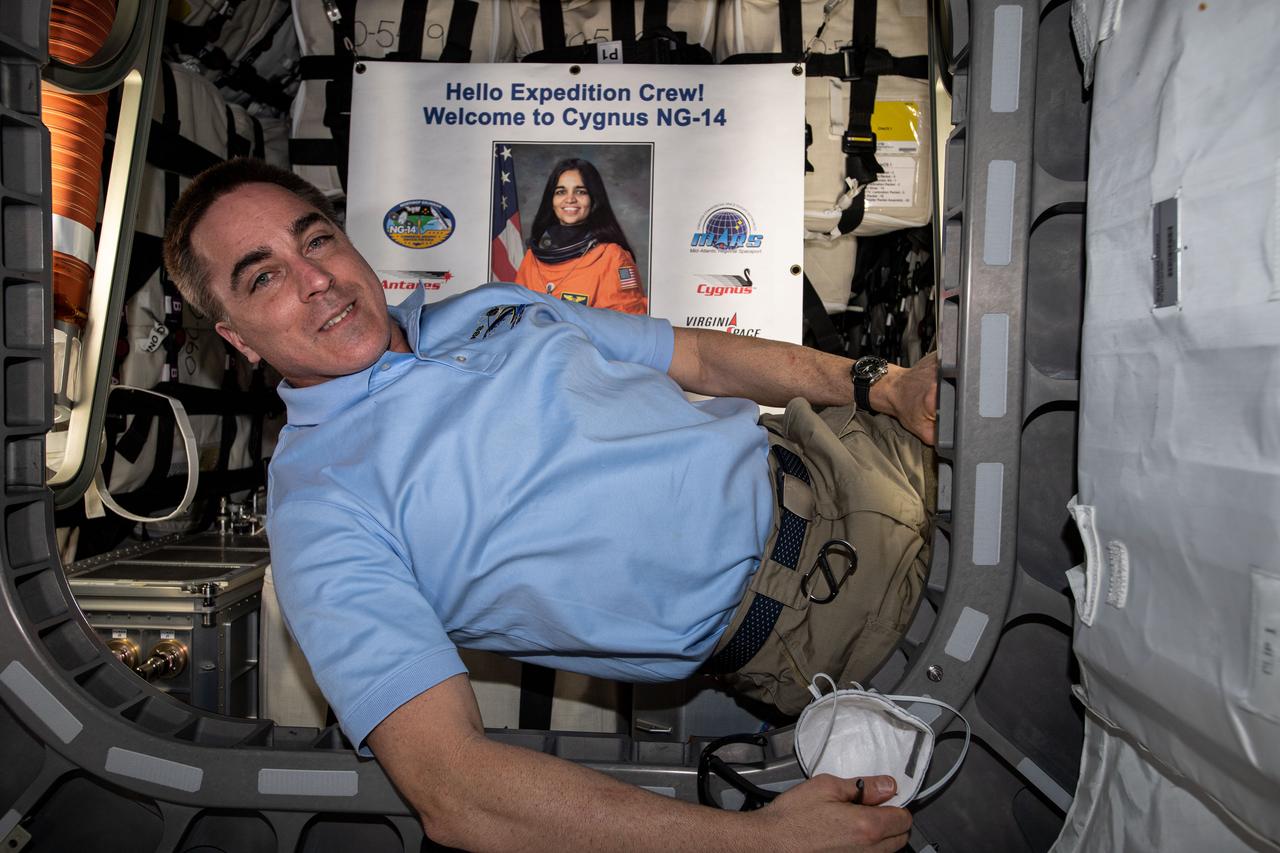
iss063e103888 (Oct. 5, 2020) --- NASA astronaut and Expedition 63 Commander Chris Cassidy is pictured inside the Northrop Grumman Cygnus space freighter named the S.S. Kalpana Chawla after the first female astronaut of Indian descent who also perished on the ill-fated STS-107 mission aboard Space Shuttle Columbia.
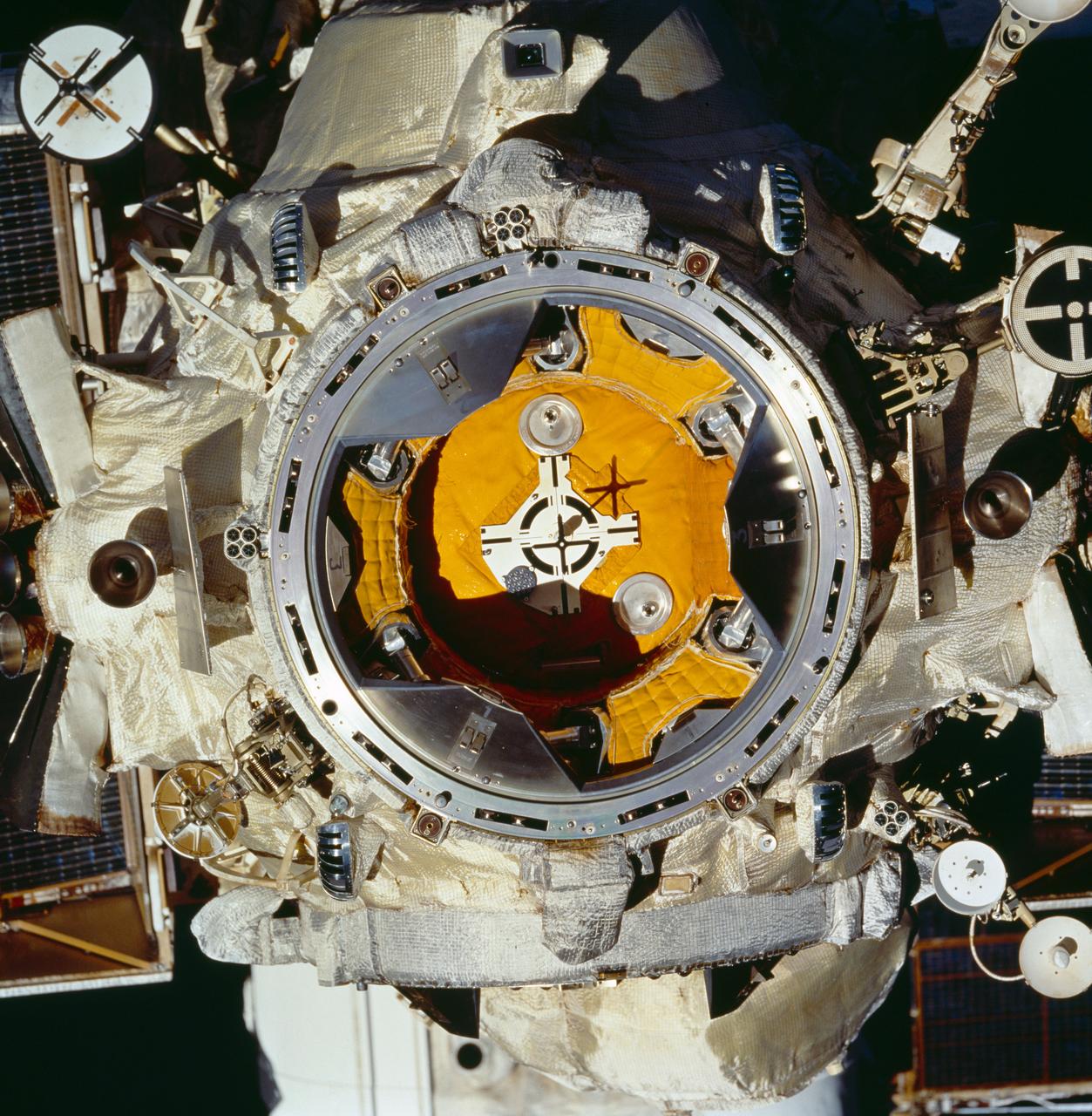
STS063-711-069 (3-11 Feb. 1995) --- This close-up scene of Russian Mir Space Station's docking target was exposed by one of the STS-63 crew members using a handheld Hasselblad camera during close proximity operations between the space shuttle Discovery and Russia's Mir Space Station.
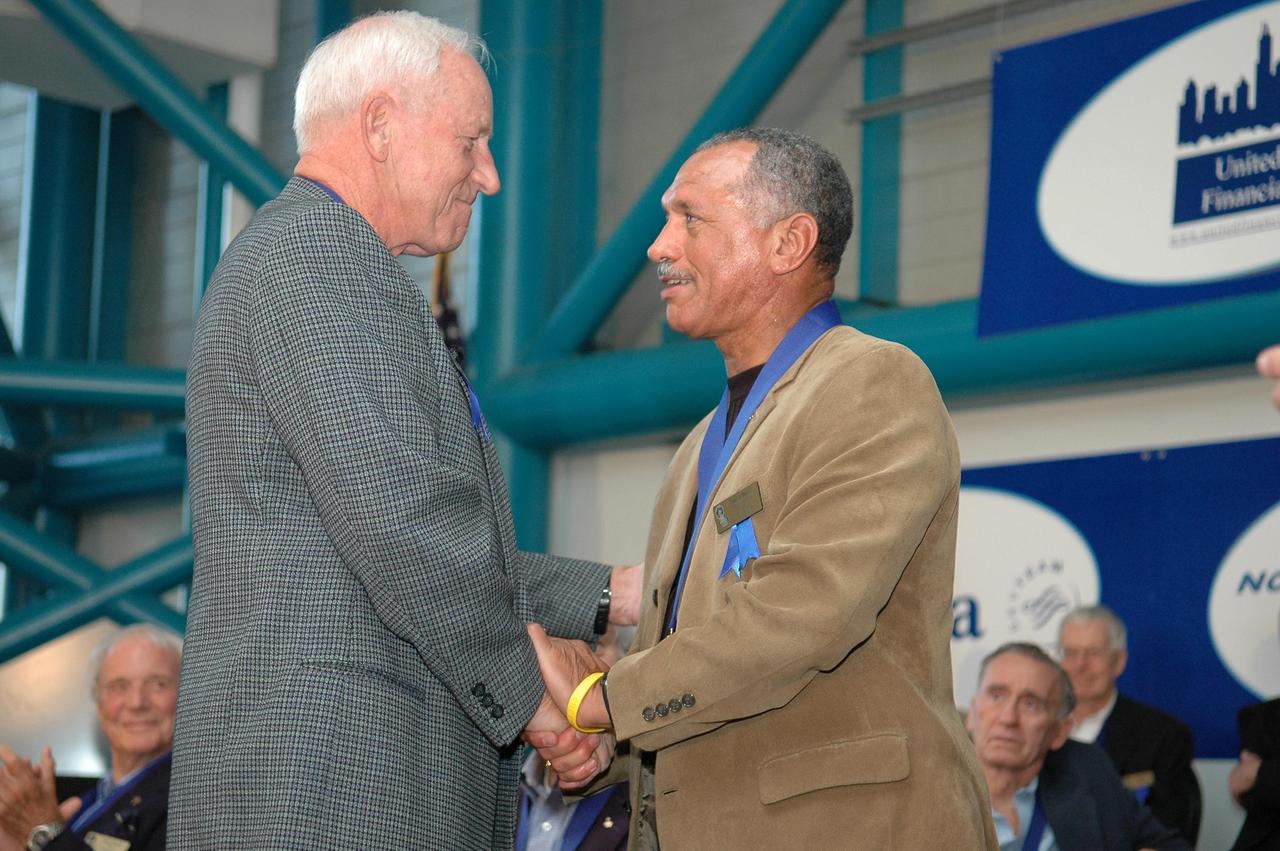
KENNEDY SPACE CENTER, FLA. - Charles F. Bolden Jr. (right) accepts congratulations from Al Worden, U.S. Astronaut Hall of Fame member and chairman of the Astronaut Scholarship Foundation. The occasion is the 2006 induction ceremony for the U.S. Astronaut Hall of Fame, held in the Apollo/Saturn V Center. The inductees for 2006 are former NASA astronauts Bolden, Henry "Hank" Hartsfield Jr. and Brewster H. Shaw Jr. Bolden flew on four space shuttle missions including STS-61C, STS-31, STS-45 and STS-60, logging 680 hours in space. The U.S. Astronaut Hall of Fame now includes 63 space explorers. Photo credit: NASA/Kim Shiflett
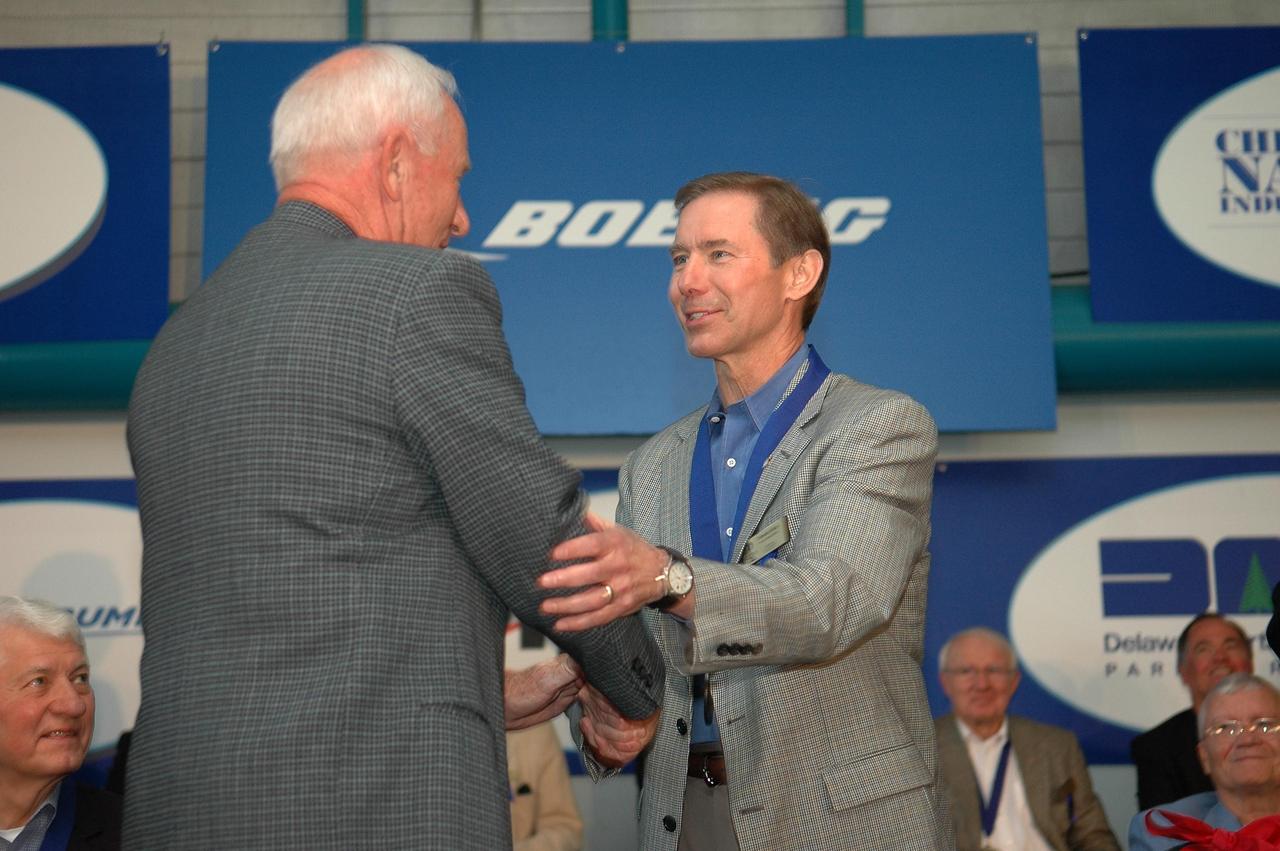
KENNEDY SPACE CENTER, FLA. - Brewster H. Shaw Jr. (right) accepts congratulations from Al Worden, U.S. Astronaut Hall of Fame member and chairman of the Astronaut Scholarship Foundation. The occasion is the 2006 induction ceremony for the U.S. Astronaut Hall of Fame, held in the Apollo/Saturn V Center. The inductees for 2006 are former NASA astronauts Shaw, Henry "Hank" Hartsfield Jr., and Charles F. Bolden Jr. Shaw flew on three space shuttle missions including STS-9, STS-61B, STS-28, logging 533 hours in space. The U.S. Astronaut Hall of Fame now includes 63 space explorers. Photo credit: NASA/Kim Shiflett
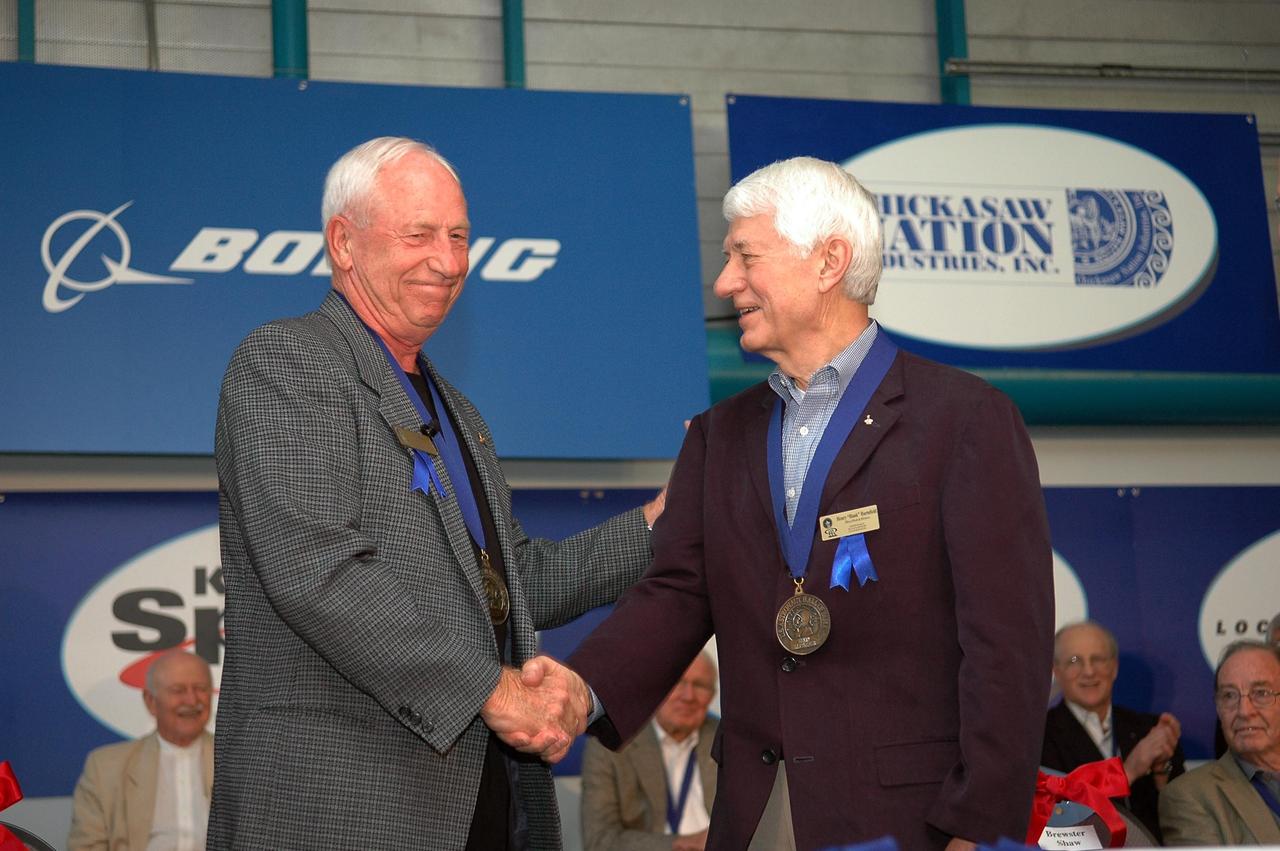
KENNEDY SPACE CENTER, FLA. - Henry "Hank" Hartsfield Jr. (right) accepts congratulations from Al Worden, U.S. Astronaut Hall of Fame member and chairman of the Astronaut Scholarship Foundation. The occasion is the 2006 induction ceremony for the U.S. Astronaut Hall of Fame, held in the Apollo/Saturn V Center. The inductees for 2006 are former NASA astronauts Hartsfield, Brewster H. Shaw Jr. and Charles F. Bolden Jr. Hartsfield flew on three space shuttle missions including STS-4, STS-41D and STS-61A, logging 482 hours in space. The U.S. Astronaut Hall of Fame now includes 63 space explorers. Photo credit: NASA/Kim Shiflett
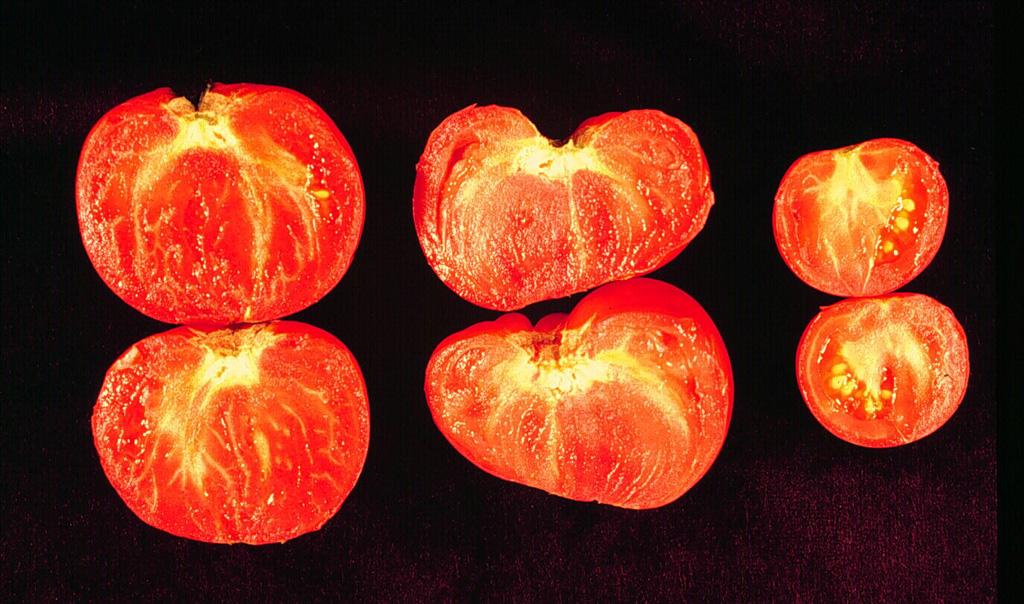
BioServe researcher Dr. Yi Li first flew plant experiments on board STS-63. Li discovered that exposure to microgravity increased a particular hormone concentration in plants. Since that time, Li has been able to manipulate this phenomenon and grow fruits, such as tomatoes, that overproduce the hormone, and these plants bear larger seedless fruit in the absence of pollination.
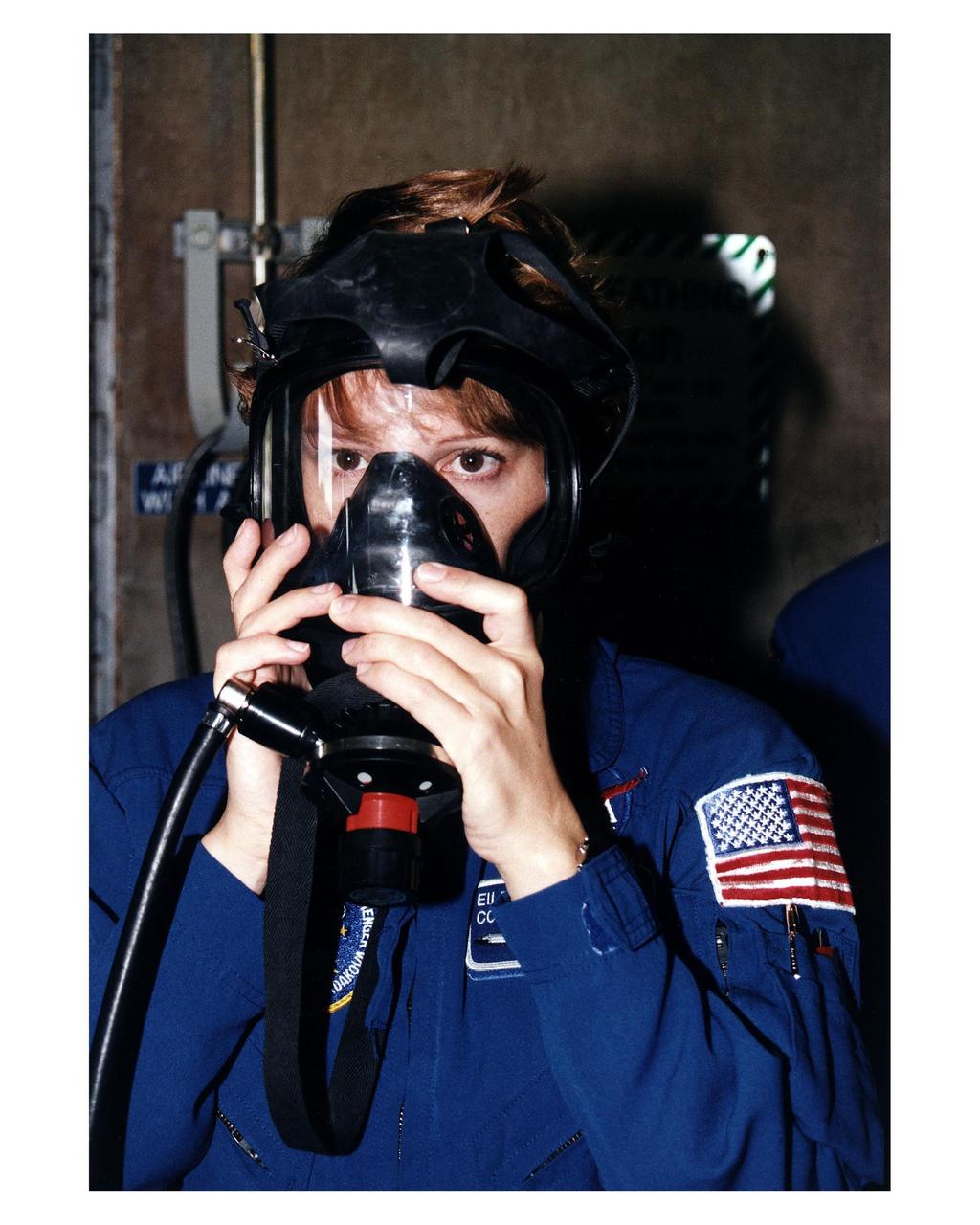
STS-84 Pilot Eileen Marie Collins practices using a gas mask during Terminal Countdown Demonstration Test (TCDT) activities at Launch Pad 39A. STS-84 will be the sixth docking of the Space Shuttle with the Russian Space Station Mir. It will be second space flight for Collins, who was the first woman Shuttle pilot on her initial mission, STS-63 in 1995. After docking, STS-84 Mission Specialist C. Michael Foale will transfer to the space station and become a member of the Mir 23 crew, replacing U.S. astronaut Jerry M. Linenger, who will return to Earth aboard Atlantis. Foale will live and work on Mir until mid-September when his replacement is expected to arrive on the STS-86 mission. STS-84 is targeted for a May 15 liftoff
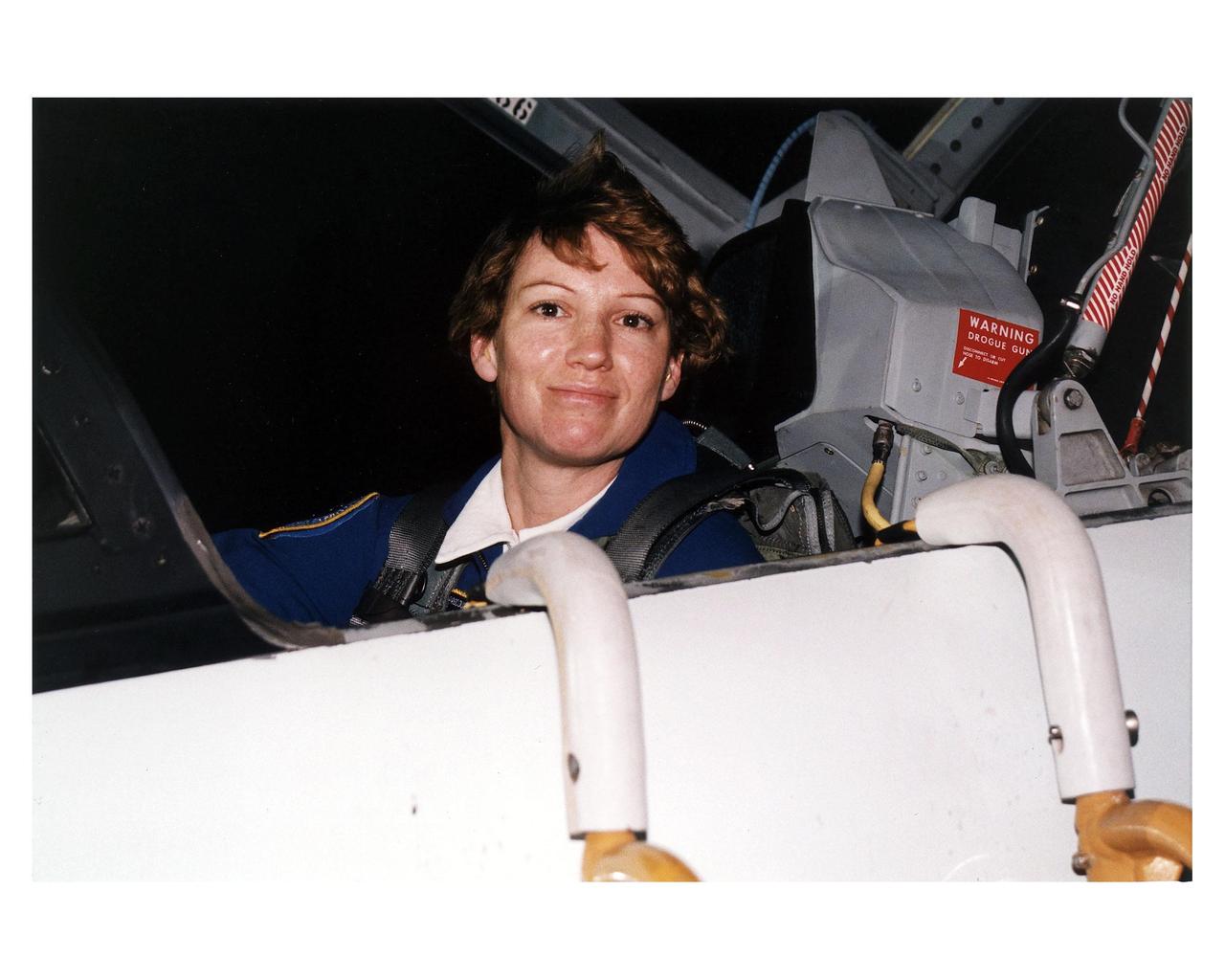
STS-84 Pilot Eileen Marie Collins arrives in a T-38 jet at KSC’s Shuttle Landing Facility. Collins will make her second space flight on STS-84. Her initial flight was as the first woman Shuttle pilot on STS-63 in 1995. STS-84 will be the sixth docking of the Space Shuttle with the Russian Space Station Mir. During the docking, STS-84 Mission Specialist C. Michael Foale will transfer to the Russian space station to become a member of the Mir 23 crew, replacing U.S. astronaut Jerry M. Linenger, who will return to Earth on Atlantis. Foale is scheduled to remain on Mir about four months until his replacement arrives on STS-86 in September
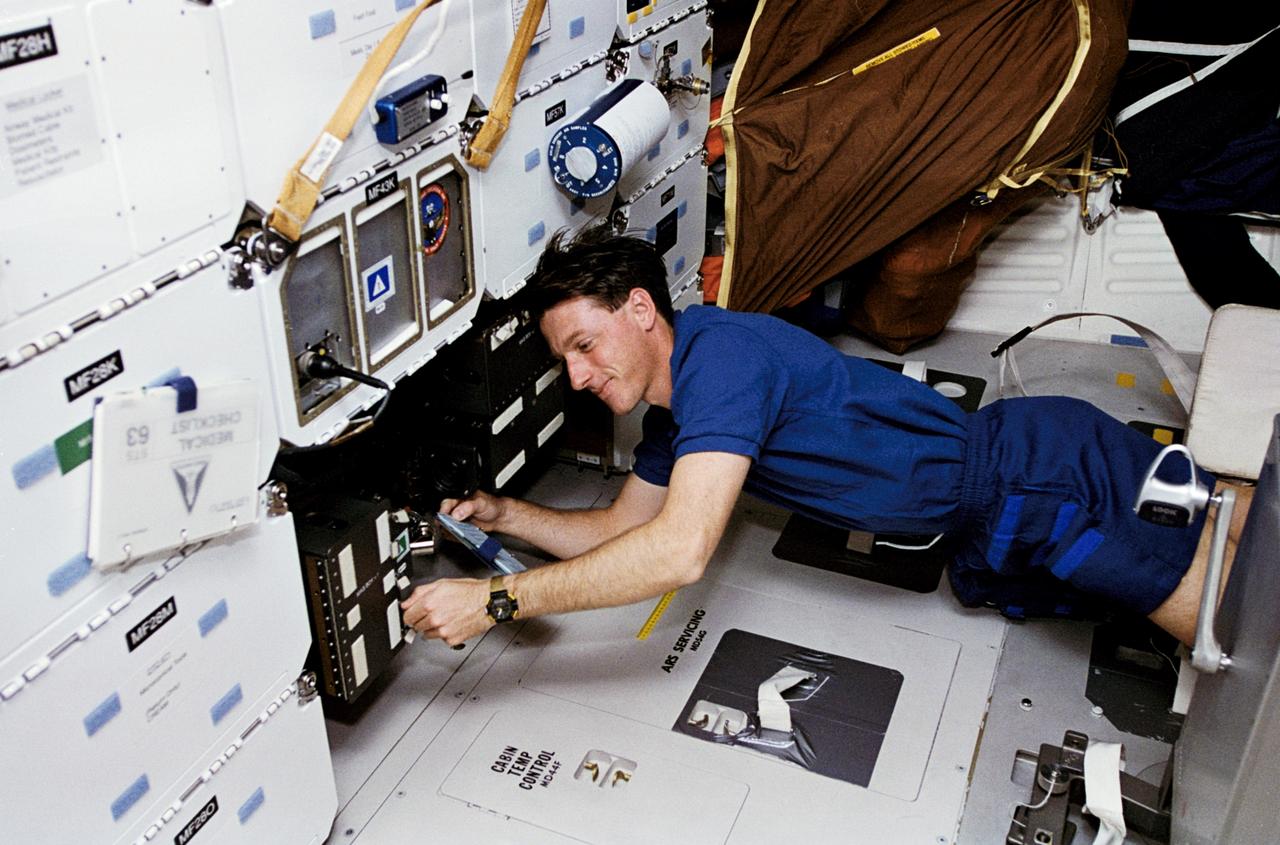
STS063-29-002 (3-11 Feb. 1995) --- On the Space Shuttle Discovery's middeck, astronaut C. Michael Foale, mission specialist, checks on the Solid Surface Combustion Experiment (SSCE). Foale was joined by four other NASA astronauts James D. Wetherbee, commander; Eileen M. Collins, pilot; Bernard A. Harris, Jr., payload commander; Janice E. Voss, mission specialist, and a Russian cosmonaut, Vladimir G. Titov; for eight days of research in Earth-orbit.
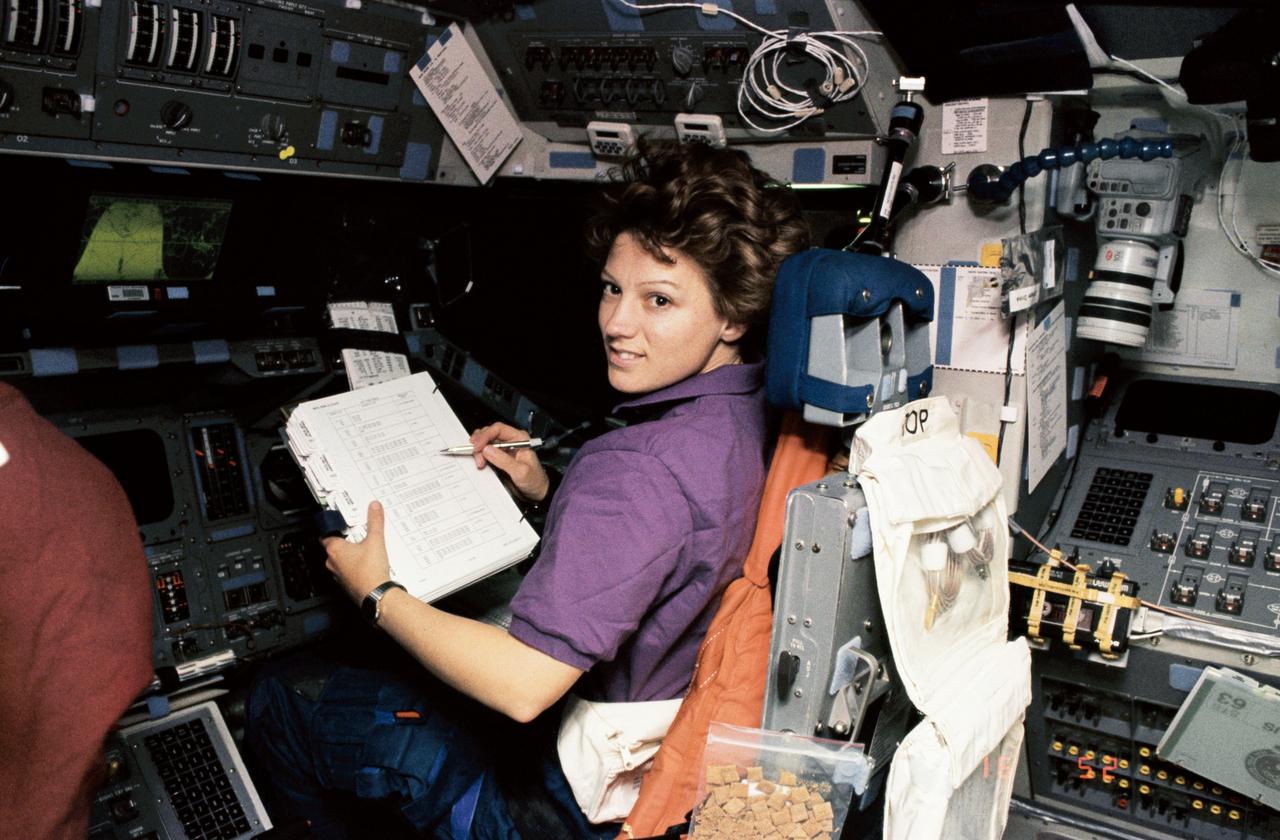
STS063-312-020 (3-11 Feb. 1995) --- Astronaut Eileen M. Collins, pilot, at the pilot's station during "hotfiring" procedure to clear leaking thruster prior to rendezvous with Russia's Mir Space Station. Others onboard the Space Shuttle Discovery were astronauts James D. Wetherbee, mission commander; Bernard A. Harris, Jr., payload commander; mission specialists C. Michael Foale and Janice E. Voss, and cosmonaut Vladimir G. Titov. This is one of 16 still photographs released by the NASA Johnson Space Center (JSC) Public Affairs Office (PAO) on February 14, 1995.
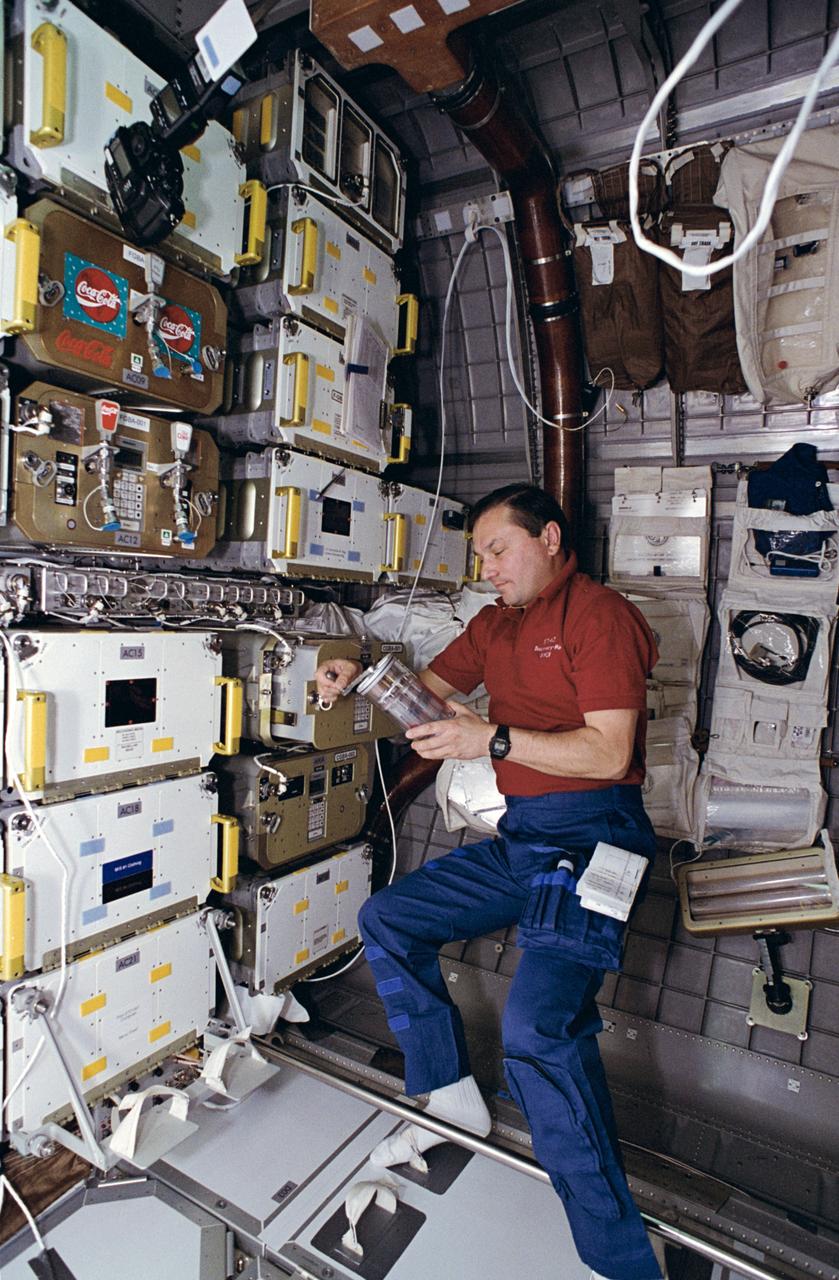
STS063-68-018 (3-11 Feb 1995) --- Russian cosmonaut Vladimir G. Titov, mission specialist, handles vials of samples for the Commercial Generic Bioprocessing Apparatus (CGBA) experiment in SpaceHab 3 Module onboard the Earth-orbiting Space Shuttle Discovery. Titov joined five NASA astronauts for eight days of research in Earth-orbit.

STS063-711-080 (6 Feb. 1995) --- Cosmonaut Valeriy V. Polyakov, who boarded Russia's Mir Space Station on January 8, 1994, looks out Mir's window during rendezvous operations with the Space Shuttle Discovery. This is one of 16 still photographs released by the NASA Johnson Space Center (JSC) Public Affairs Office (PAO) on February 14, 1995. Onboard the Discovery were astronauts James D. Wetherbee, mission commander; Eileen M. Collins, pilot; Bernard A. Harris, Jr., payload commander; mission specialists C. Michael Foale, Janice E. Voss, and cosmonaut Vladimir G. Titov.
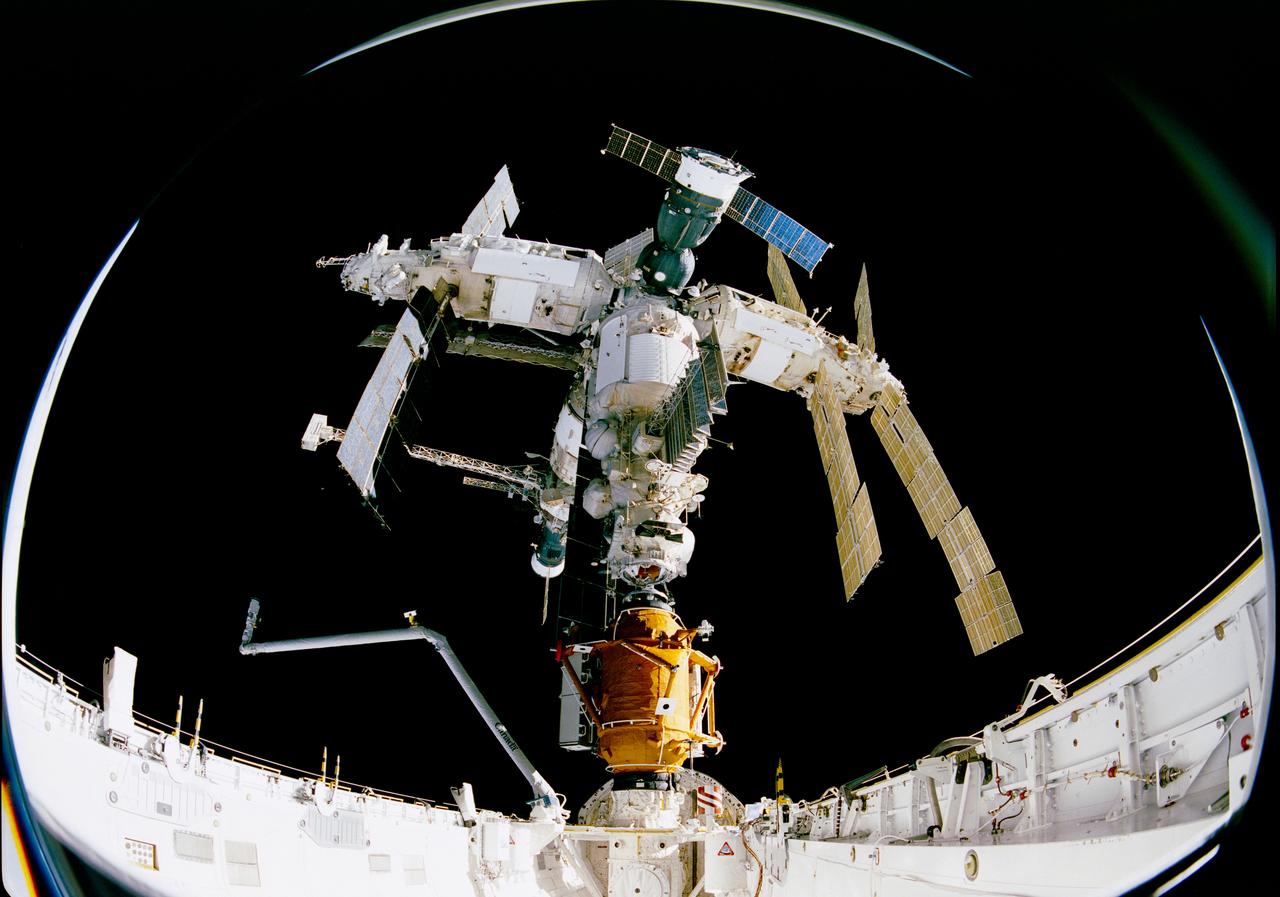
S95-22116 (15 Nov 1995) --- The Space Shuttle Atlantis has completed its successful docking with the Russia's Mir Space Station. The STS-74 crew members inside Atlantis' cabin are making preparations to meet with the Mir-20 crew members. During the STS-74 mission, the crew used an IMAX camera to document the Space Shuttle Atlantis' rendezvous and docking with the Mir Space Station. The 65mm camera system was located in the Atlantis' cargo bay and provided a unique fish-eye perspective. These images were selected from footage that will be incorporated in a large-format feature film about NASA's cooperative program with the Russians. NASA has flown IMAX camera systems on many Shuttle missions, including the recent STS-63 Shuttle-Mir rendezvous and STS-71 Shuttle-Mir docking. Film from previous missions was used to create the productions The Dream is Alive, The Blue Planet, and Destiny in Space.
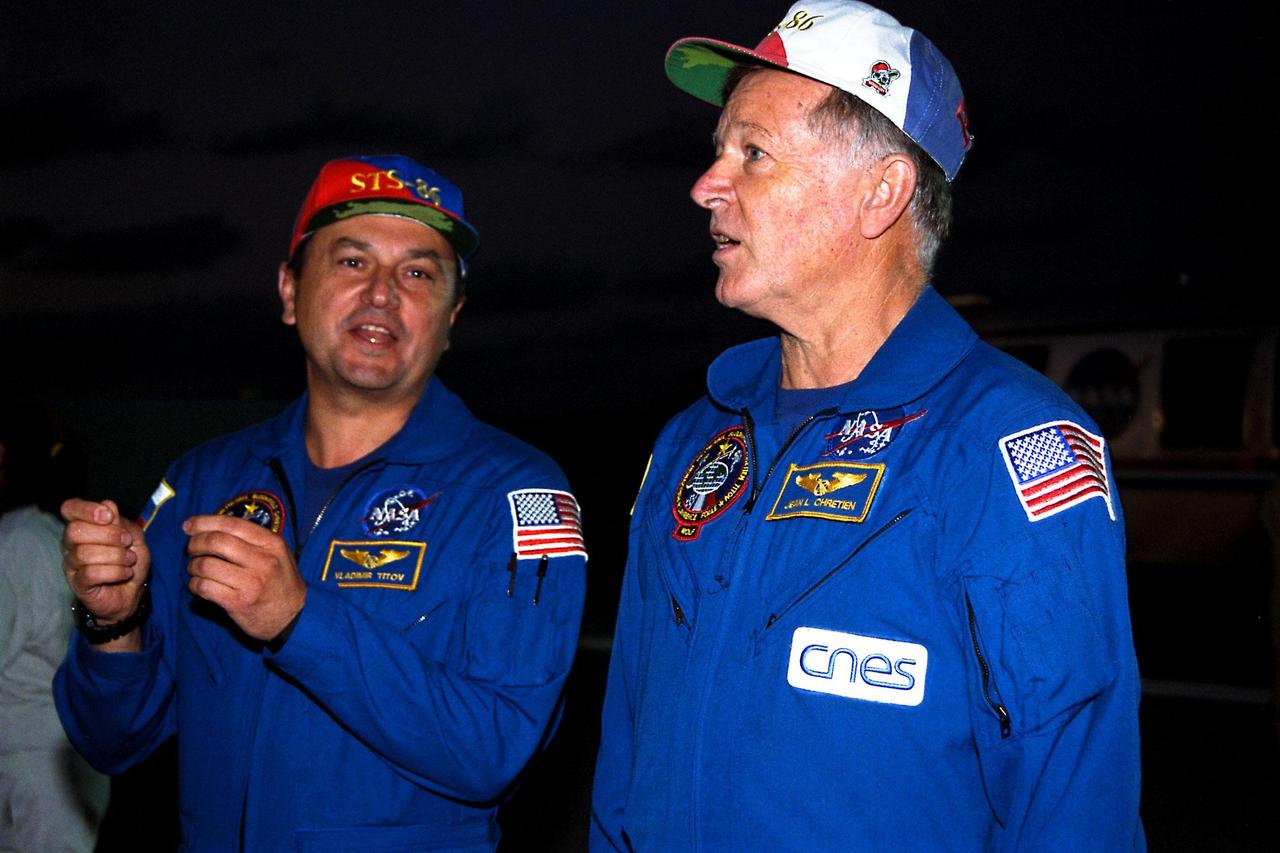
STS-86 Mission Specialists Vladimir Georgievich Titov of the Russian Space Agency, at left, and Jean-Loup J.M. Chretien of the French Space Agency, CNES, talk about their recently completed U.S. space mission while walking under and around the orbiter Atlantis after landing on KSC’s Runway 15 of the Shuttle Landing Facility. This was Chretien’s third spaceflight, but first on the Space Shuttle. Titov previously flew four times in space, including once on the Space Shuttle as a mission specialist on STS-63. The nearly 11-day STS-86 mission ended with main gear touchdown at 5:55:09 p.m. EDT, Oct. 6, 1997. STS-86 was the seventh docking of the Space Shuttle with the Russian Space Station Mir
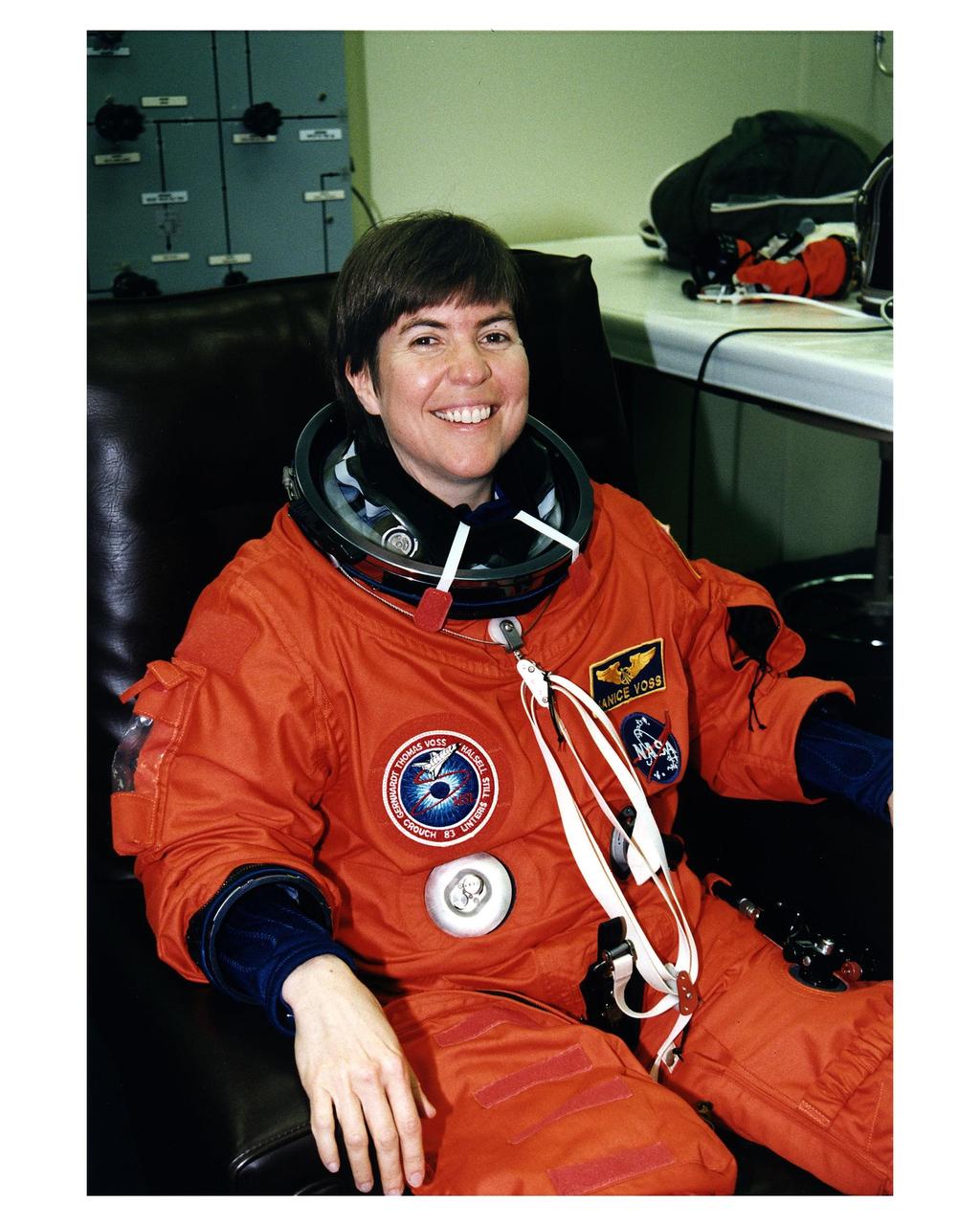
STS-94 Payload Commander Janice Voss prepares to enter the Space Shuttle Columbia at Launch Pad 39A in preparation for launch. She has flown on STS-83, STS-63 and STS-57. Voss holds a doctorate degree in aeronautics/astronautics from the Massachusetts Institute of Technology and has earned two NASA Space Flight Medals. As Payload Commander and a member of the Blue team, Voss will have overall responsibility for the operation of all of the MSL-1 experiments. During the experimentation phase of the mission, she be working primarily with three combustion experiments. She and six fellow crew members will lift off during a launch window that opens at 1:50 p.m. EDT, July 1. The launch window will open 47 minutes early to improve the opportunity to lift off before Florida summer rain showers reach the space center

STS060-93-043 (9 Feb 1994) --- BREMSAT, a 140 pound (63 kilogram) satellite, quickly leaves the cargo bay of the Space Shuttle Discovery. The 480 mm (19 inch) deployable satellite was built by the University of Bremen's Center of Applied Space Technology and Microgravity (ZARM) under sponsorship of the German Space Agency (DARA). A modified ejection system in one of the payload bay's getaway special (GAS) type canisters aided the STS-60 crew members in deploying the satellite toward the end of their eight-day mission in Earth orbit.
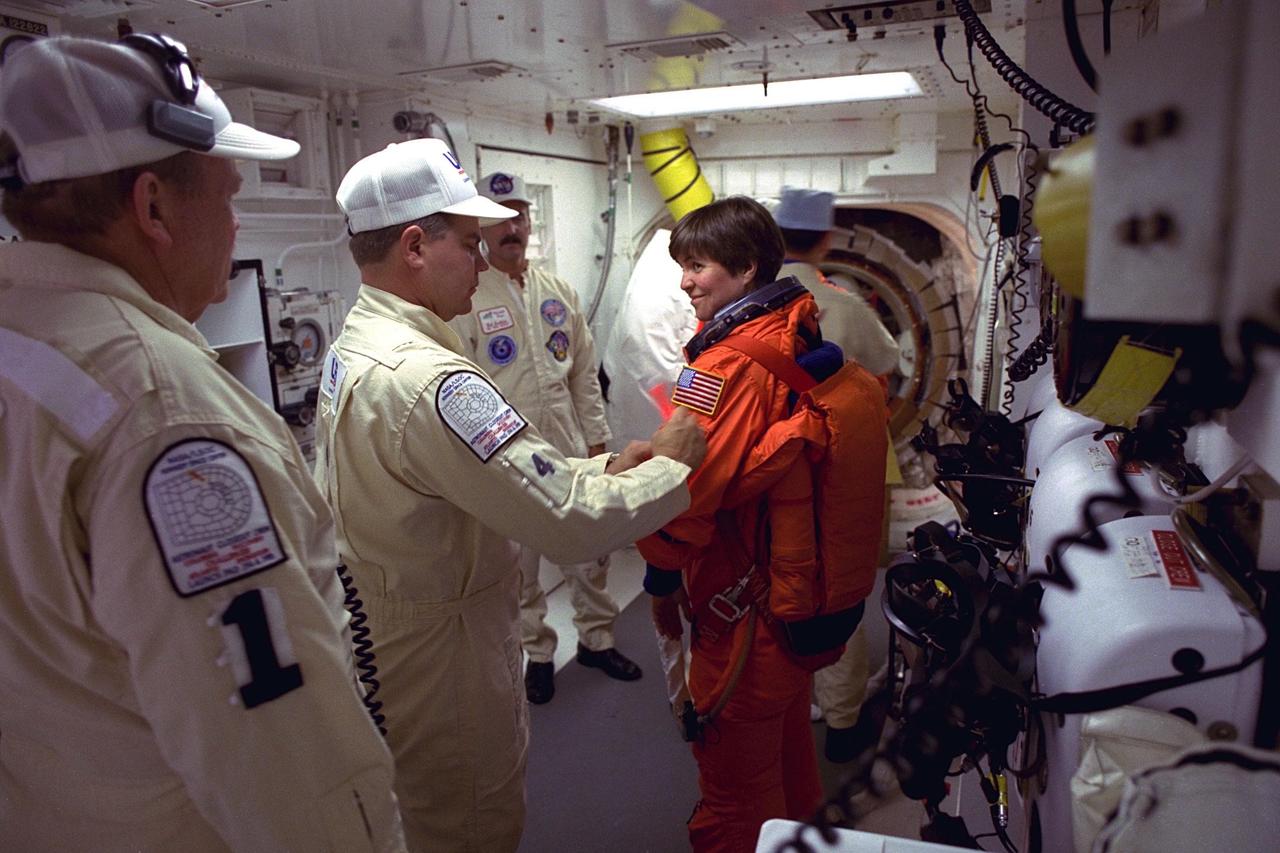
STS-83 Payload Commander Janice Voss smiles as she is assisted into her launch/entry suit in the Operations and checkout (O&C) Building. She has flown on STS-63 and STS-57. Voss holds a doctorate degree in aeronautics/astronautics from the Massachusetts Institute of Technology and has earned two NASA Space Flight Medals. As Payload Commander and a member of the Blue team, Voss will have overall responsibility for the operation of all of the MSL-1 experiments. During the experimentation phase of the mission, she will be working primarily with three combustion experiments. She and six fellow crew members will shortly depart the O&C and head for Launch Pad 39A, where the Space Shuttle Columbia will lift off during a launch window that opens at 2:00 p.m. EST, April 4
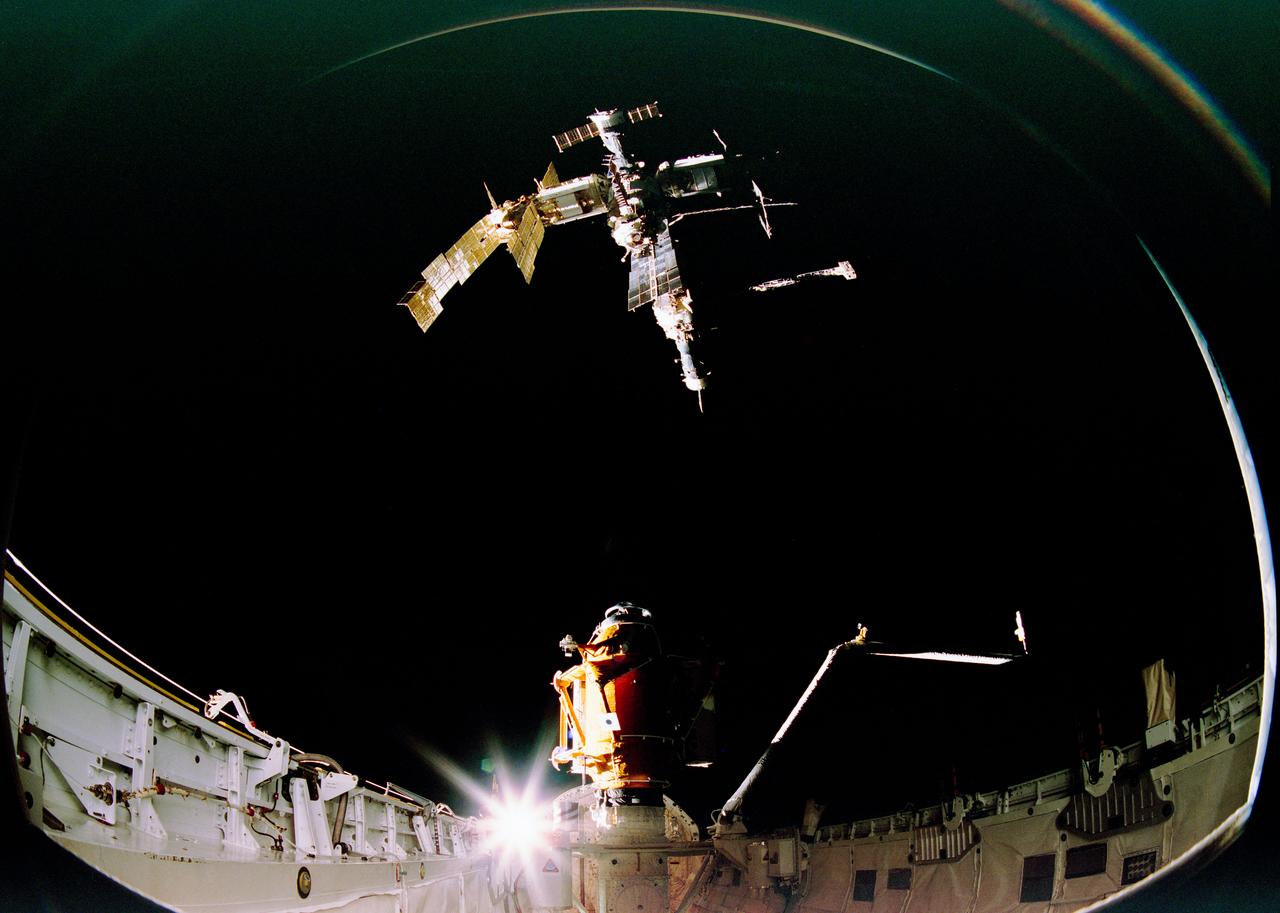
S95-22092 (15 Nov 1995) --- The Space Shuttle Atlantis moves within 80 feet of Russia's Mir Space Station during rendezvous and docking operations. During the STS-74 mission, the crew used an IMAX camera to document the Space Shuttle Atlantis' rendezvous and docking with the Mir Space Station. The 65mm camera system was located in the Atlantis' cargo bay and provided a unique fish-eye perspective. These images were selected from footage that will be incorporated in a large-format feature film about NASA's cooperative program with the Russians. NASA has flown IMAX camera systems on many Shuttle missions, including the recent STS-63 Shuttle-Mir rendezvous and STS-71 Shuttle-Mir docking. Film from previous missions was used to create the productions The Dream is Alive, The Blue Planet, and Destiny in Space.
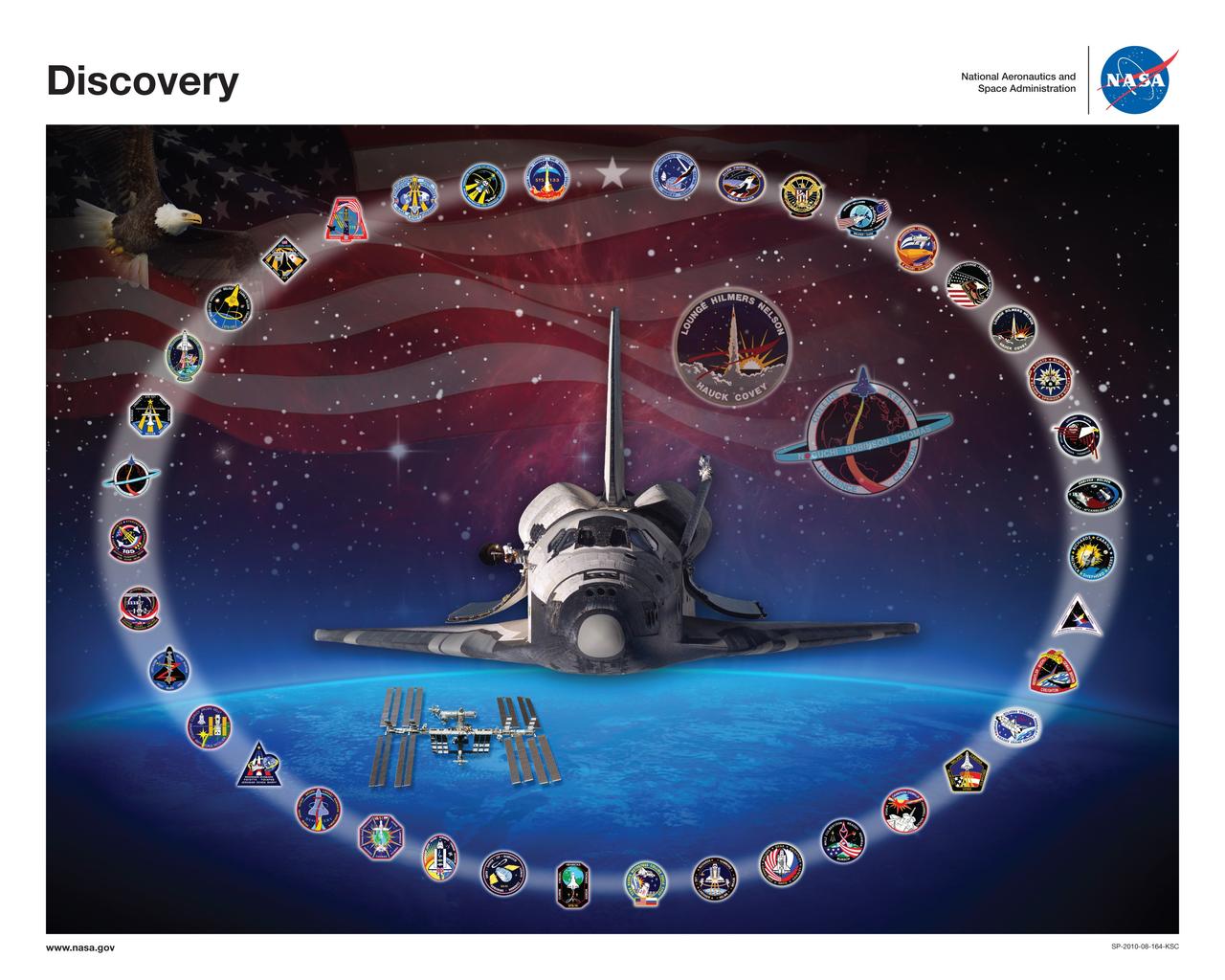
CAPE CANAVERAL, Fla. -- This is a version of space shuttle Discovery's orbiter tribute, or OV-103, which hangs in Firing Room 4 of the Launch Control Center at NASA's Kennedy Space Center in Florida. Discovery’s accomplishments include the first female shuttle pilot, Eileen Collins, on STS-63, John Glenn’s legendary return to space on STS-95, and the celebration of the 100th shuttle mission with STS-92. In addition, Discovery supported a number of Department of Defense programs, satellite deploy and repair missions and 13 International Space Station construction and operation flights. The tribute features Discovery demonstrating the rendezvous pitch maneuver on approach to the International Space Station during STS-114. Having accumulated the most space shuttle flights, Discovery’s 39 mission patches are shown circling the spacecraft. The background image was taken from the Hubble Space Telescope, which launched aboard Discovery on STS-31 and serviced by Discovery on STS-82 and STS-103. The American Flag and Bald Eagle represent Discovery’s two Return-to-Flight missions -- STS-26 and STS-114 -- and symbolize Discovery’s role in returning American astronauts to space. Five orbiter tributes are on display in the firing room, representing Atlantis, Challenger, Columbia, Endeavour and Discovery. Graphic design credit: NASA/Amy Lombardo. NASA publication number: SP-2010-08-164-KSC
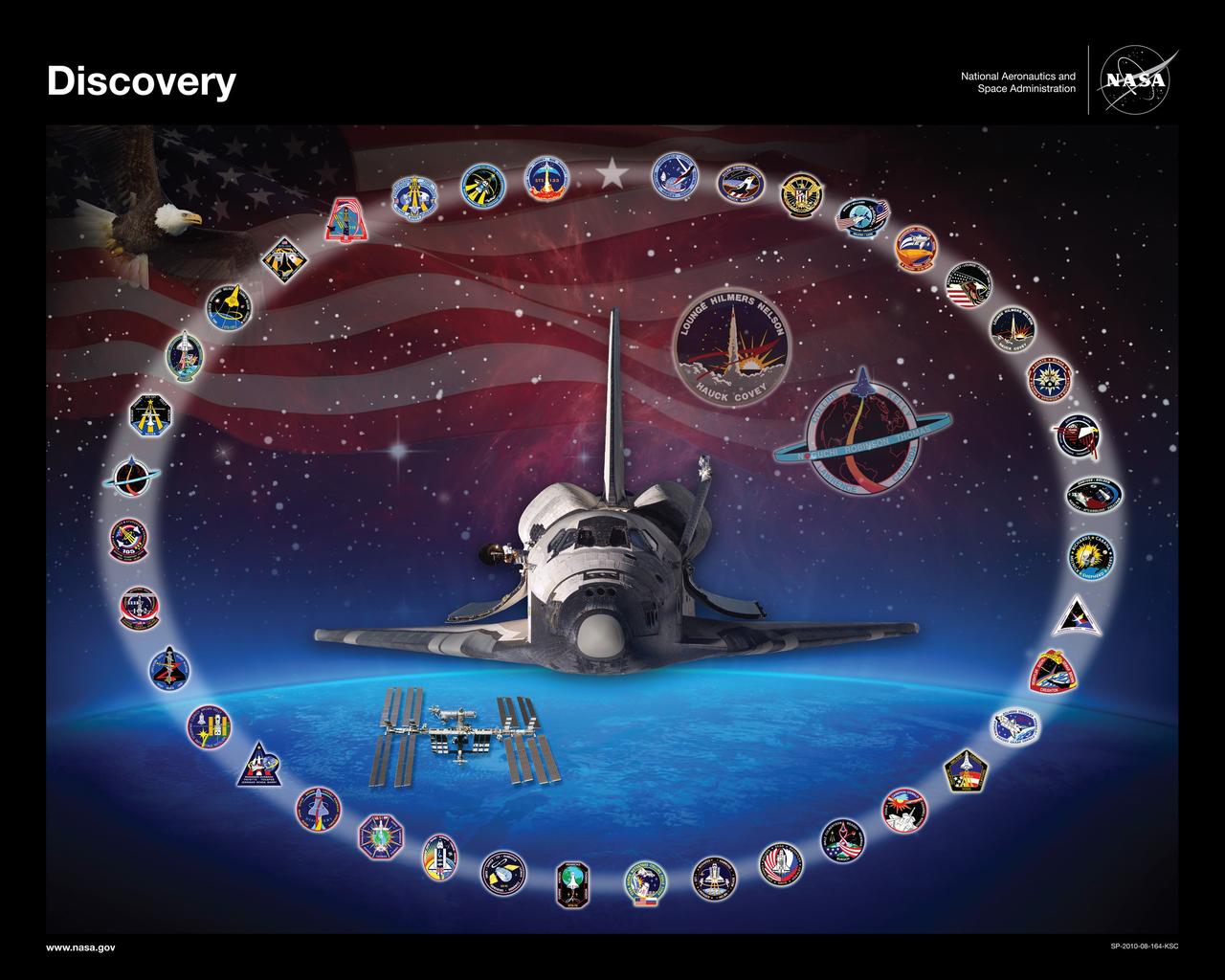
CAPE CANAVERAL, Fla. -- This is a printable version of space shuttle Discovery's orbiter tribute, or OV-103, which hangs in Firing Room 4 of the Launch Control Center at NASA's Kennedy Space Center in Florida. Discovery’s accomplishments include the first female shuttle pilot, Eileen Collins, on STS-63, John Glenn’s legendary return to space on STS-95, and the celebration of the 100th shuttle mission with STS-92. In addition, Discovery supported a number of Department of Defense programs, satellite deploy and repair missions and 13 International Space Station construction and operation flights. The tribute features Discovery demonstrating the rendezvous pitch maneuver on approach to the International Space Station during STS-114. Having accumulated the most space shuttle flights, Discovery’s 39 mission patches are shown circling the spacecraft. The background image was taken from the Hubble Space Telescope, which launched aboard Discovery on STS-31 and serviced by Discovery on STS-82 and STS-103. The American Flag and Bald Eagle represent Discovery’s two Return-to-Flight missions -- STS-26 and STS-114 -- and symbolize Discovery’s role in returning American astronauts to space. Five orbiter tributes are on display in the firing room, representing Atlantis, Challenger, Columbia, Endeavour and Discovery. Graphic design credit: NASA/Amy Lombardo. NASA publication number: SP-2010-08-164-KSC
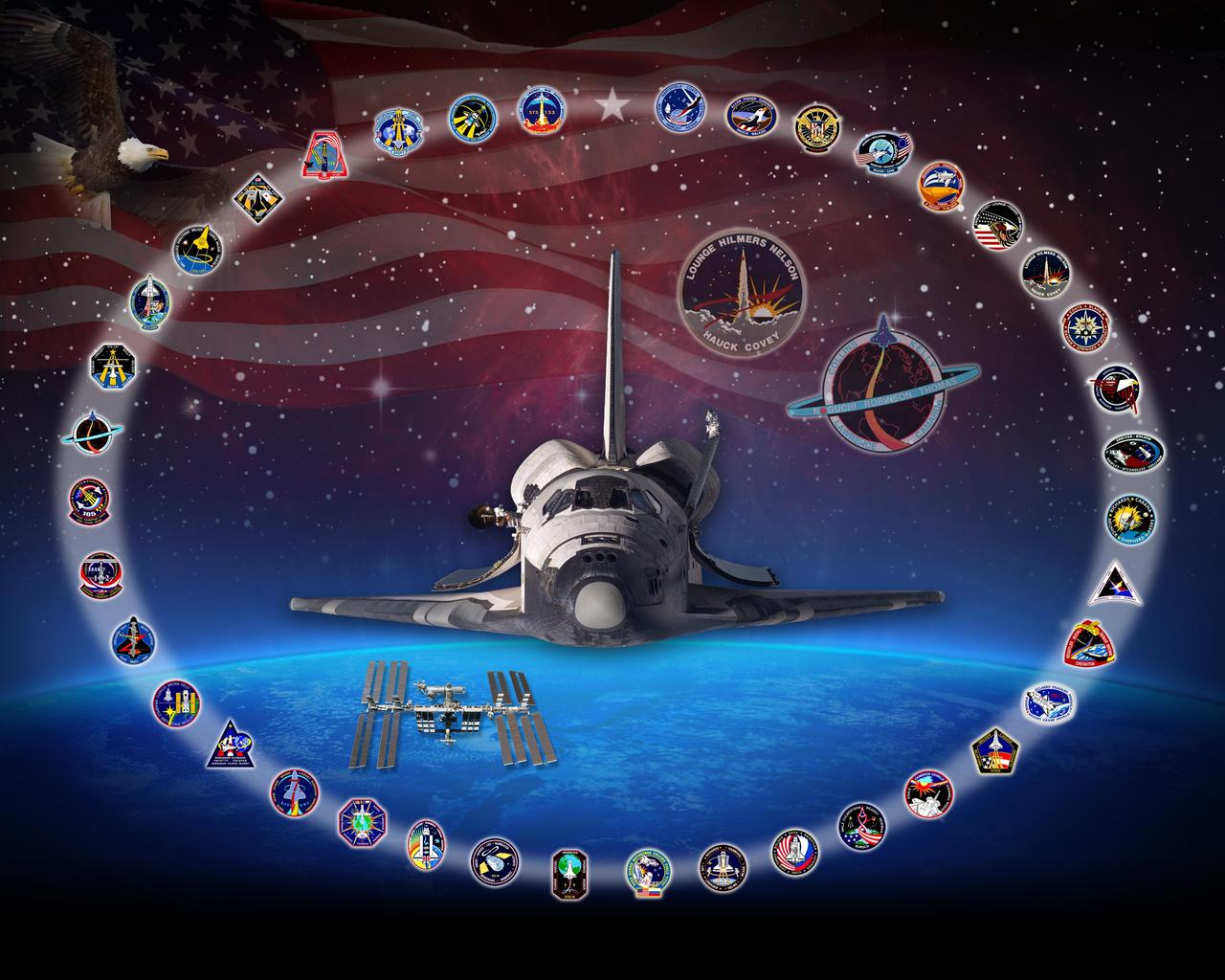
CAPE CANAVERAL, Fla. -- This orbiter tribute of space shuttle Discovery, or OV-103, hangs in Firing Room 4 of the Launch Control Center at NASA's Kennedy Space Center in Florida. Discovery’s accomplishments include the first female shuttle pilot, Eileen Collins, on STS-63, John Glenn’s legendary return to space on STS-95, and the celebration of the 100th shuttle mission with STS-92. In addition, Discovery supported a number of Department of Defense programs, satellite deploy and repair missions and 13 International Space Station construction and operation flights. The tribute features Discovery demonstrating the rendezvous pitch maneuver on approach to the International Space Station during STS-114. Having accumulated the most space shuttle flights, Discovery’s 39 mission patches are shown circling the spacecraft. The background image was taken from the Hubble Space Telescope, which launched aboard Discovery on STS-31 and serviced by Discovery on STS-82 and STS-103. The American Flag and Bald Eagle represent Discovery’s two Return-to-Flight missions -- STS-26 and STS-114 -- and symbolize Discovery’s role in returning American astronauts to space. Five orbiter tributes are on display in the firing room, representing Atlantis, Challenger, Columbia, Endeavour and Discovery. Graphic design credit: NASA/Amy Lombardo
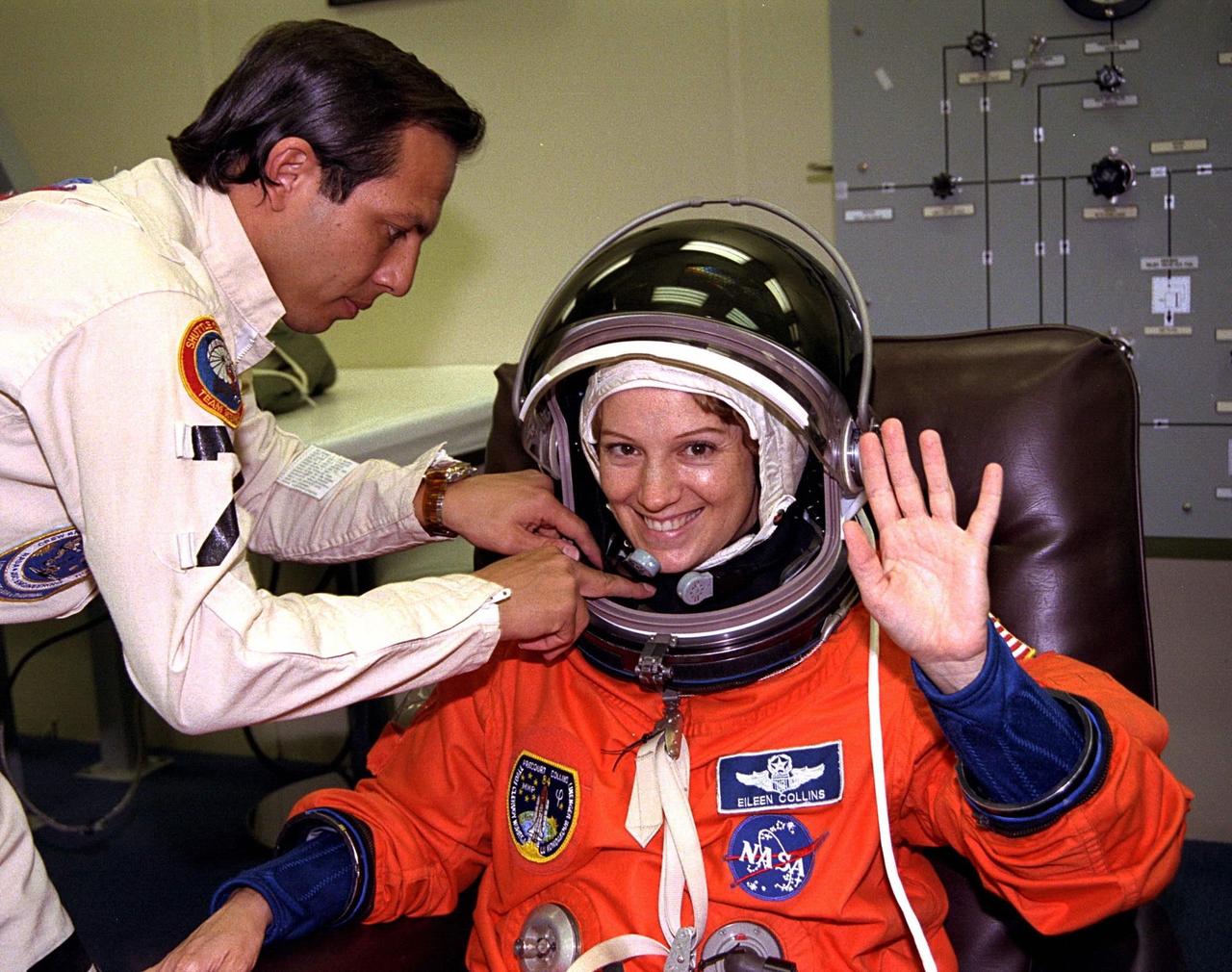
With the assistance of a suit technician, STS-84 Pilot Eileen Marie Collins finishes donning her launch and entry suit in the Operations and Checkout Building in preparation for her second Space Shuttle flight. She was the first woman Shuttle pilot on STS-63 in 1995, which was the first approach and flyaround of the Russian Space Station Mir by the Space Shuttle. Collins and six other crew members will depart shortly for Launch Pad 39A, where the Space Shuttle Atlantis awaits liftoff during an approximate 7-minute launch window which opens at about 4:08 a.m. This will be the sixth docking of the Space Shuttle with the Mir. The exact liftoff time will be determined about 90 minutes prior to launch, based on the most current location of Mir
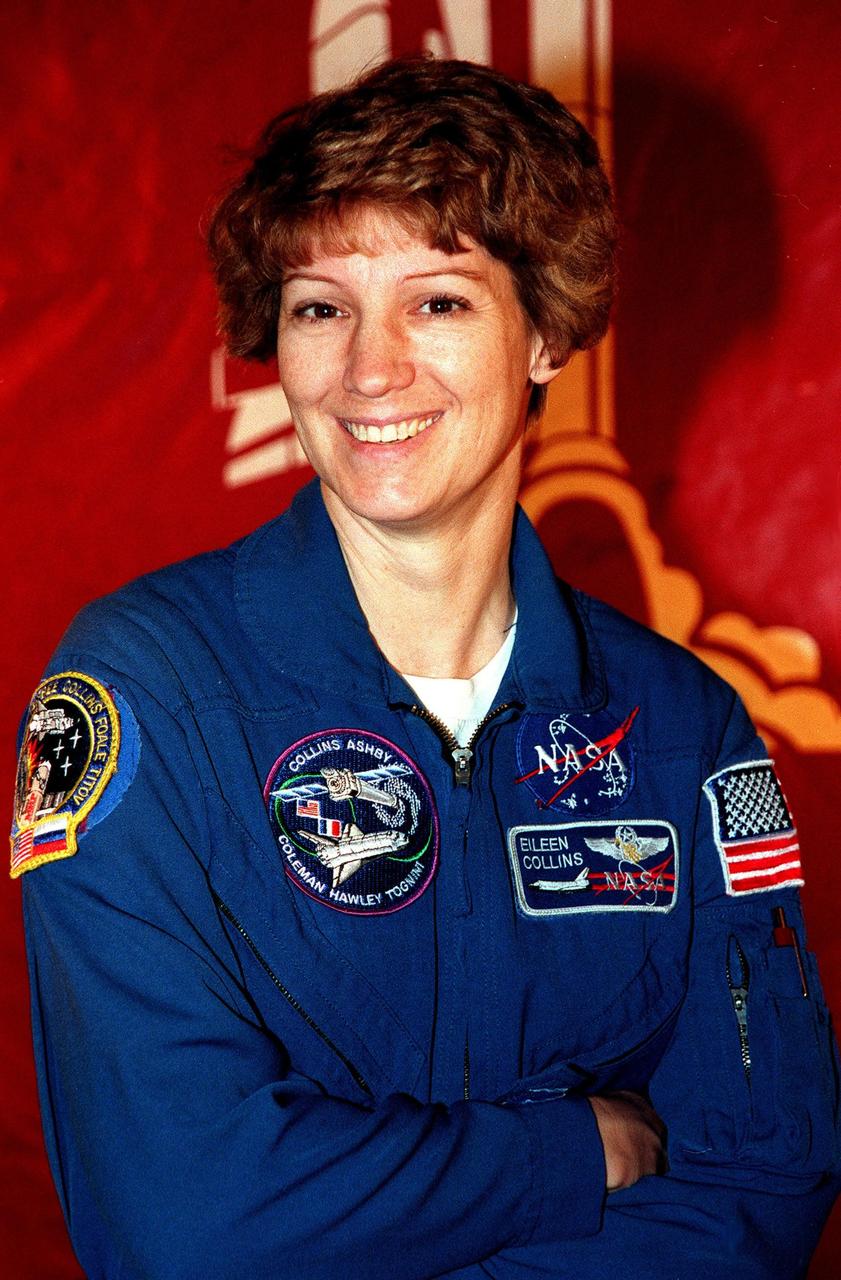
STS-93 Commander Eileen Collins (pictured) is the first woman to serve as a shuttle mission commander. She was the first woman pilot of a Space Shuttle, on mission STS-63, and also served as pilot on mission STS-84. Collins will command the crew of STS-93 on a five-day mission aboard Space Shuttle Columbia on its newly scheduled launch date July 9. The other STS-93 crew members are Pilot Jeffrey S. Ashby and Mission Specialists Steven A. Hawley, Catherine G. Coleman and Michel Tognini of France, representing the Centre National d'Etudes Spatiales (CNES). The primary mission of STS-93 is the deployment of the Chandra X-ray Observatory. Formerly called the Advanced X-ray Astrophysics Facility, Chandra comprises three major elements: the spacecraft, the science instrument module (SIM), and the world's most powerful X-ray telescope. Chandra will allow scientists from around the world to see previously invisible black holes and high-temperature gas clouds, giving the observatory the potential to rewrite the books on the structure and evolution of our universe
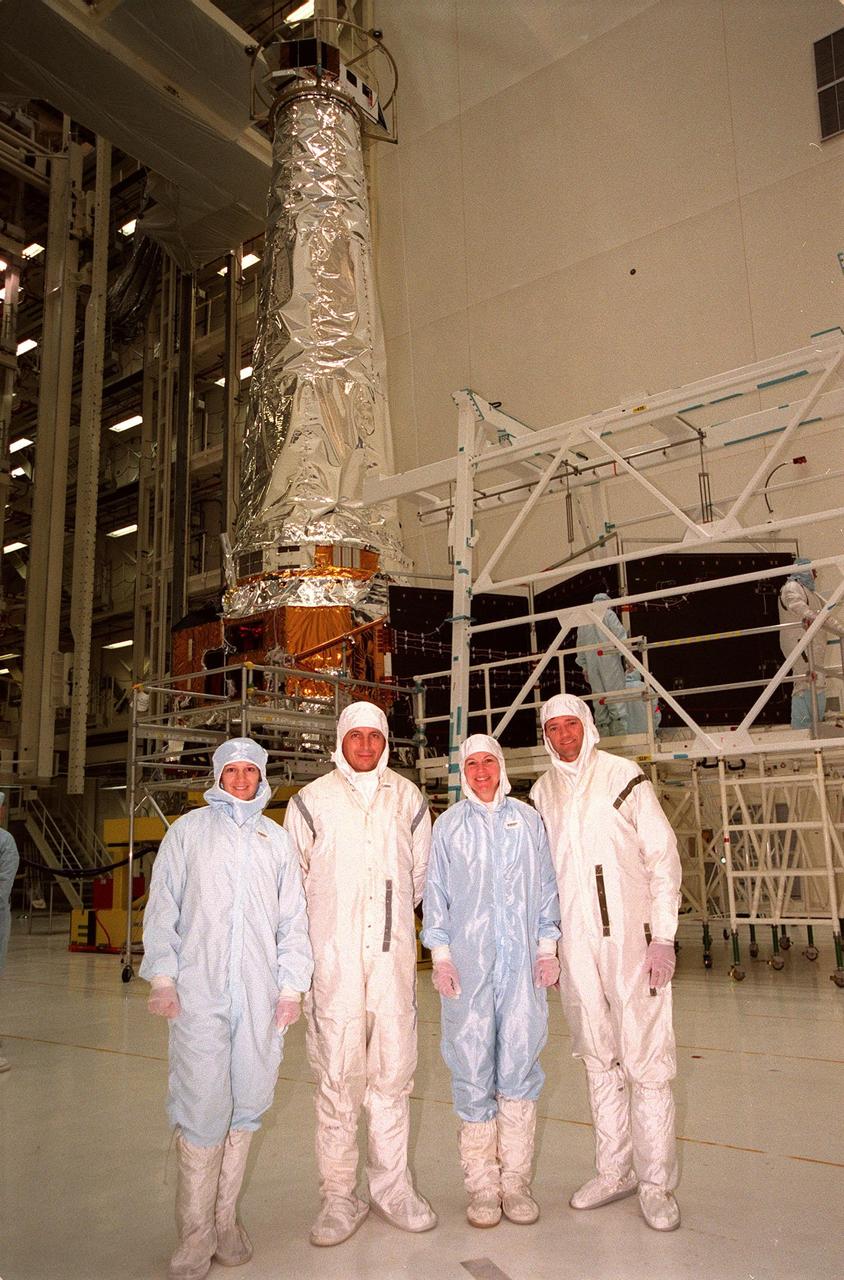
During payload familiarization, four members of the STS-93 crew pose in front of the Chandra X-ray Observatory, which is in the Vertical Processing Facility. From left are Commander Eileen Collins, Mission Specialists Michel Tognini of France and Catherine G. Coleman, and Pilot Jeffrey S. Ashby. Tognini represents the Centre National d'Etudes Spatiales (CNES). Collins is the first woman to serve as a shuttle mission commander. She was the first woman pilot of a Space Shuttle, on mission STS-63, and also served as pilot on mission STS-84. The fifth member of the STS-93 crew is Mission Specialist Steven A. Hawley. Chandra is scheduled for launch July 9 aboard Space Shuttle Columbia, on mission STS-93 . Formerly called the Advanced X-ray Astrophysics Facility, Chandra comprises three major elements: the spacecraft, the science instrument module (SIM), and the world's most powerful X-ray telescope. Chandra will allow scientists from around the world to see previously invisible black holes and high-temperature gas clouds, giving the observatory the potential to rewrite the books on the structure and evolution of our universe
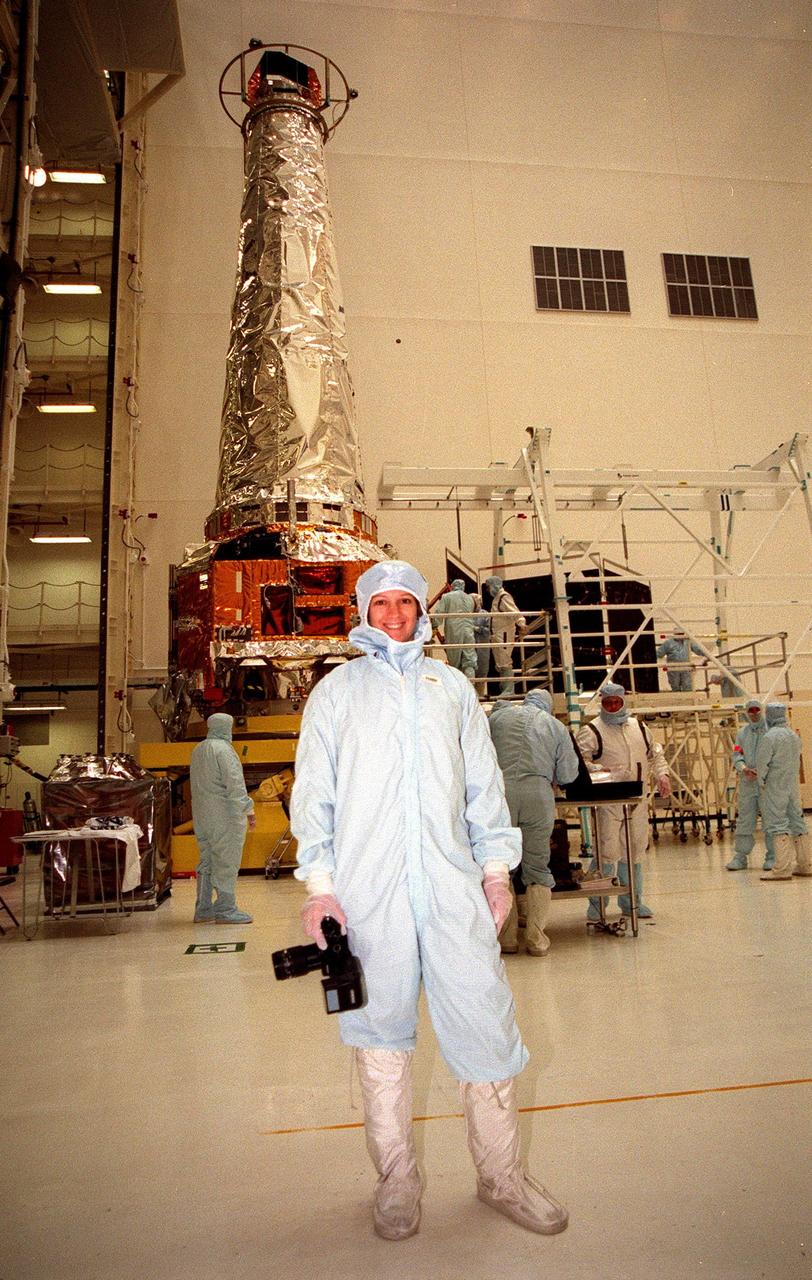
STS-93 Commander Eileen Collins poses with her camera in front of the Chandra X-ray Observatory during payload familiarization. Other members of the STS-93 crew who are at KSC are Pilot Jeffrey S. Ashby and Mission Specialists Catherine G. Coleman and Michel Tognini of France, who represents the Centre National d'Etudes Spatiales (CNES). Collins is the first woman to serve as a shuttle mission commander. She was the first woman pilot of a Space Shuttle, on mission STS-63, and also served as pilot on mission STS-84. The fifth member of the crew is Mission Specialist Steven A. Hawley. Chandra is scheduled for launch July 9 aboard Space Shuttle Columbia, on mission STS-93 . Formerly called the Advanced X-ray Astrophysics Facility, Chandra comprises three major elements: the spacecraft, the science instrument module (SIM), and the world's most powerful X-ray telescope. Chandra will allow scientists from around the world to see previously invisible black holes and high-temperature gas clouds, giving the observatory the potential to rewrite the books on the structure and evolution of our universe
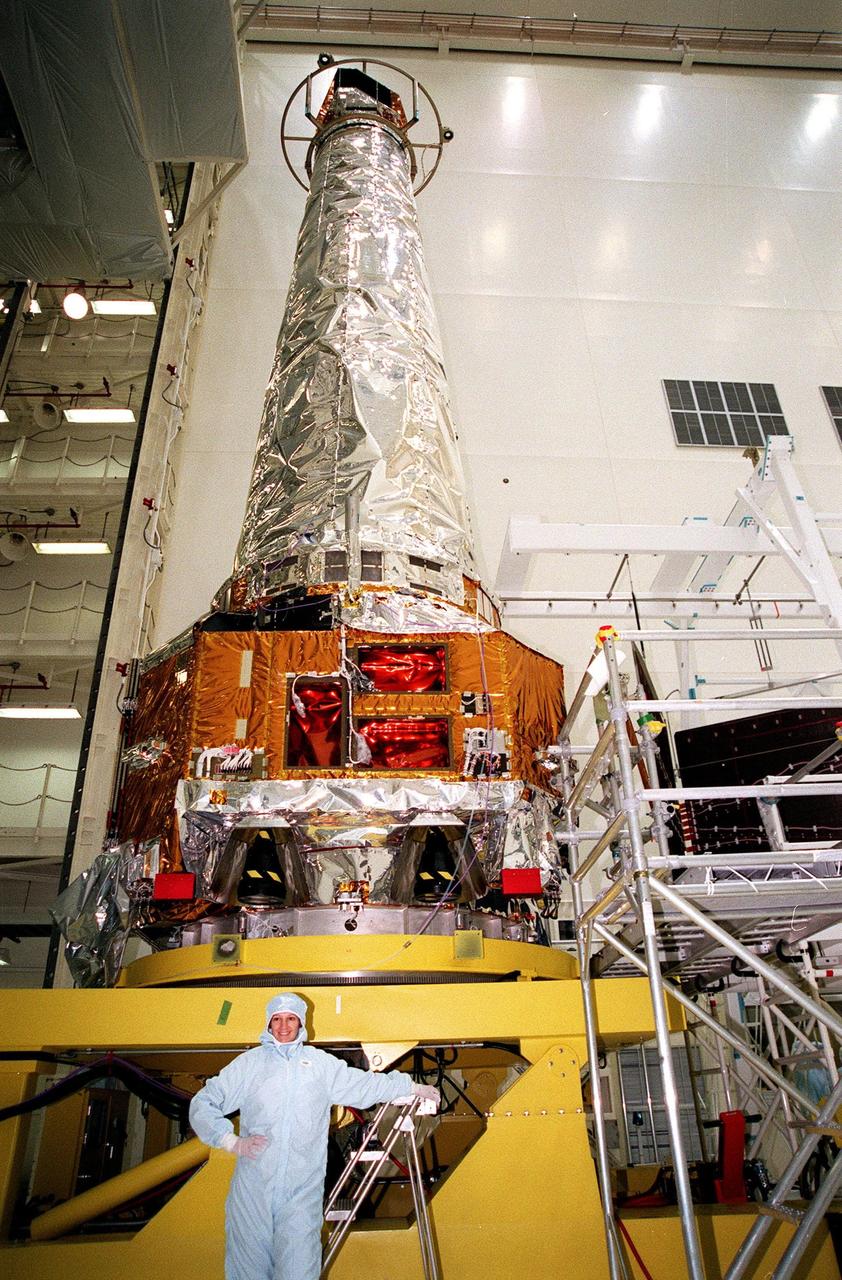
STS-93 Commander Eileen Collins poses at the foot of the Chandra X-ray Observatory during payload familiarization. Other members of the STS-93 crew who are at KSC are Pilot Jeffrey S. Ashby and Mission Specialists Catherine G. Coleman and Michel Tognini of France, who represents the Centre National d'Etudes Spatiales (CNES). Collins is the first woman to serve as a shuttle mission commander. She was the first woman pilot of a Space Shuttle, on mission STS-63, and also served as pilot on mission STS-84. The fifth member of the crew is Mission Specialist Steven A. Hawley. Chandra is scheduled for launch July 9 aboard Space Shuttle Columbia, on mission STS-93 . Formerly called the Advanced X-ray Astrophysics Facility, Chandra comprises three major elements: the spacecraft, the science instrument module (SIM), and the world's most powerful X-ray telescope. Chandra will allow scientists from around the world to see previously invisible black holes and high-temperature gas clouds, giving the observatory the potential to rewrite the books on the structure and evolution of our universe
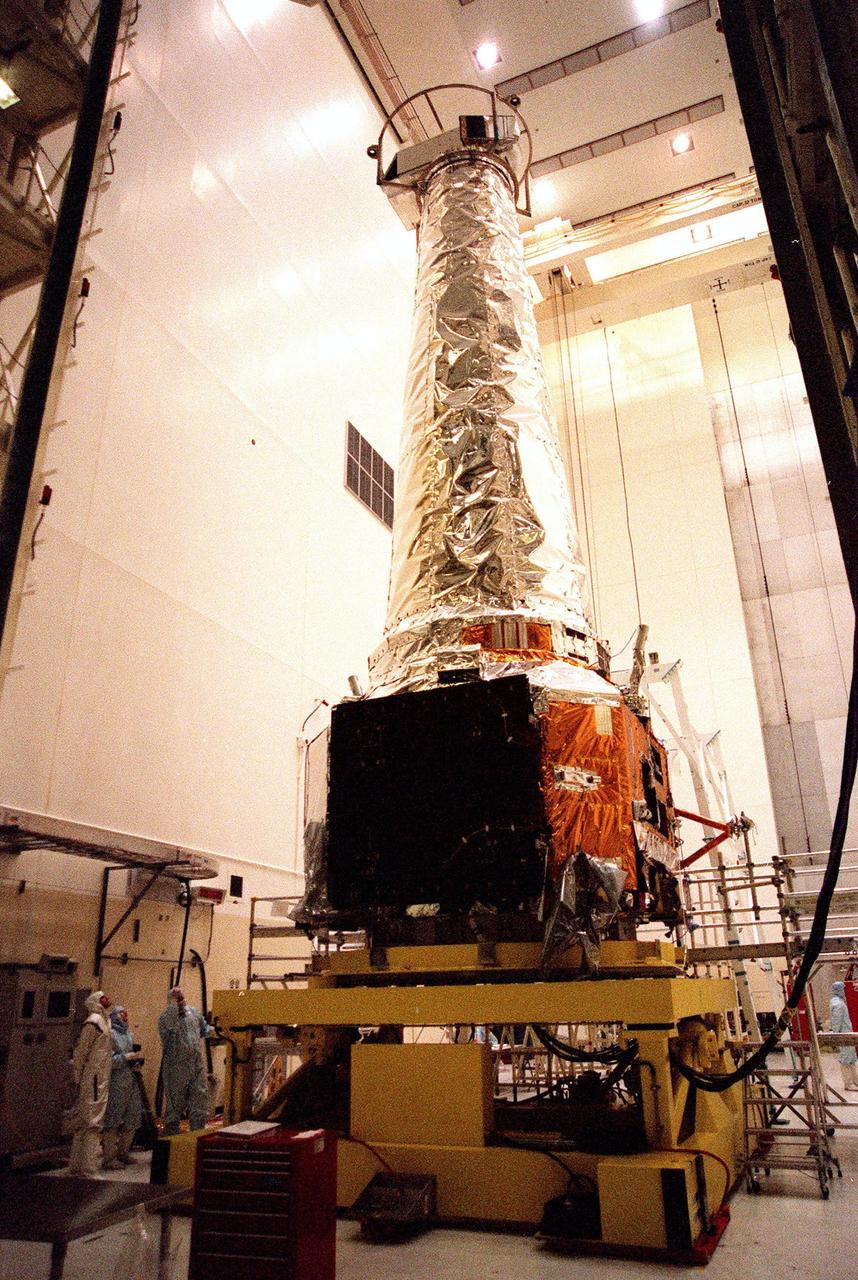
In the Vertical Processing Facility, STS-93 Pilot Jeffrey S. Ashby and Commander Eileen Collins join a TRW technician observing the Chandra X-ray Observatory on top of a work stand. Other members of the STS-93 crew who are at KSC for payload familiarization are Mission Specialists Catherine G. Coleman and Michel Tognini of France, who represents the Centre National d'Etudes Spatiales (CNES). Collins is the first woman to serve as a shuttle mission commander. She was the first woman pilot of a Space Shuttle, on mission STS-63, and also served as pilot on mission STS-84. The fifth member of the crew is Mission Specialist Steven A. Hawley. Chandra is scheduled for launch July 9 aboard Space Shuttle Columbia, on mission STS-93 . Formerly called the Advanced X-ray Astrophysics Facility, Chandra comprises three major elements: the spacecraft, the science instrument module (SIM), and the world's most powerful X-ray telescope. Chandra will allow scientists from around the world to see previously invisible black holes and high-temperature gas clouds, giving the observatory the potential to rewrite the books on the structure and evolution of our universe
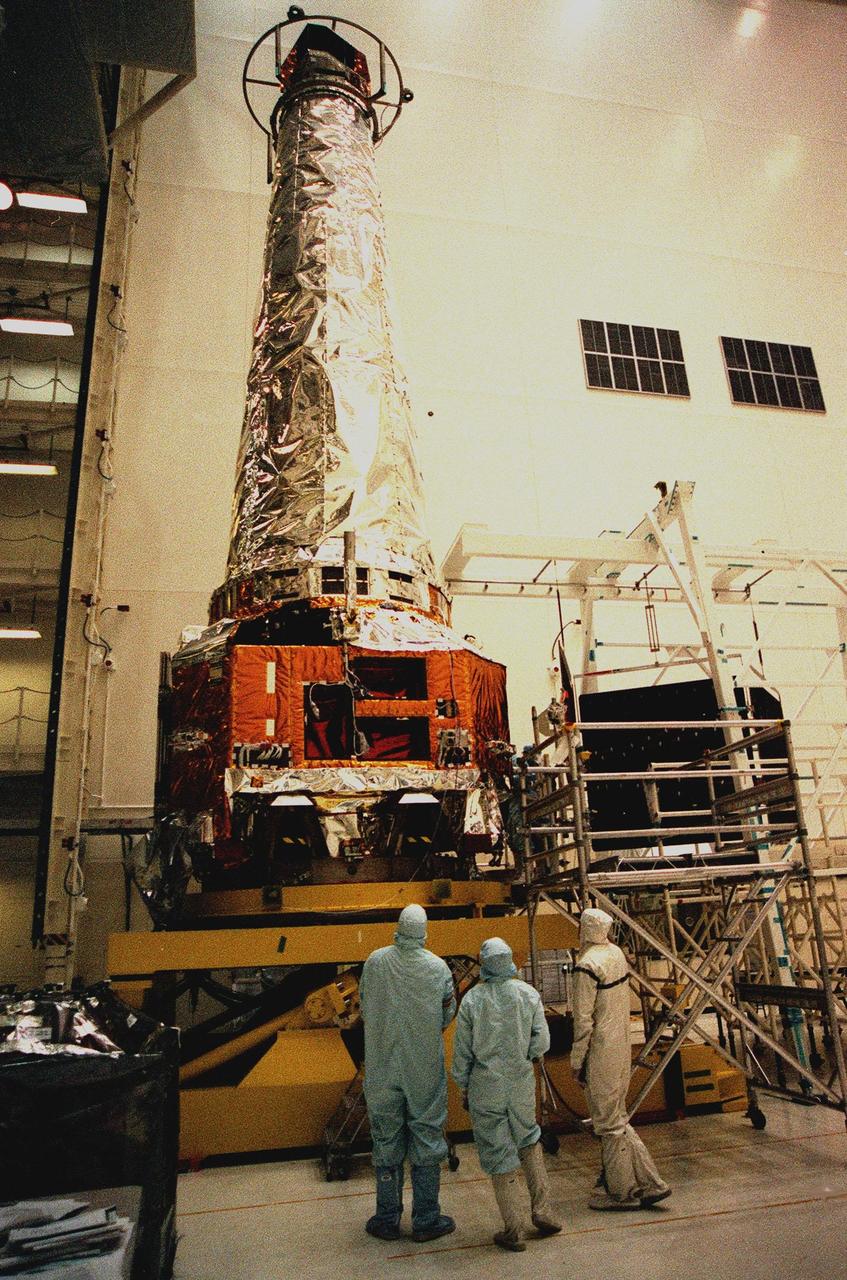
A TRW technician joins STS-93 Commander Eileen Collins (center) and Pilot Jeffrey S. Ashby (right) as they observe the Chandra X-ray Observatory on its work stand inside the Vertical Processing Facility. Other members of the STS-93 crew who are at KSC for payload familiarization are Mission Specialists Catherine G. Coleman and Michel Tognini of France, who represents the Centre National d'Etudes Spatiales (CNES). Collins is the first woman to serve as a shuttle mission commander. She was the first woman pilot of a Space Shuttle, on mission STS-63, and also served as pilot on mission STS-84. The fifth member of the crew is Mission Specialist Steven A. Hawley. Chandra is scheduled for launch July 9 aboard Space Shuttle Columbia, on mission STS-93 . Formerly called the Advanced X-ray Astrophysics Facility, Chandra comprises three major elements: the spacecraft, the science instrument module (SIM), and the world's most powerful X-ray telescope. Chandra will allow scientists from around the world to see previously invisible black holes and high-temperature gas clouds, giving the observatory the potential to rewrite the books on the structure and evolution of our universe
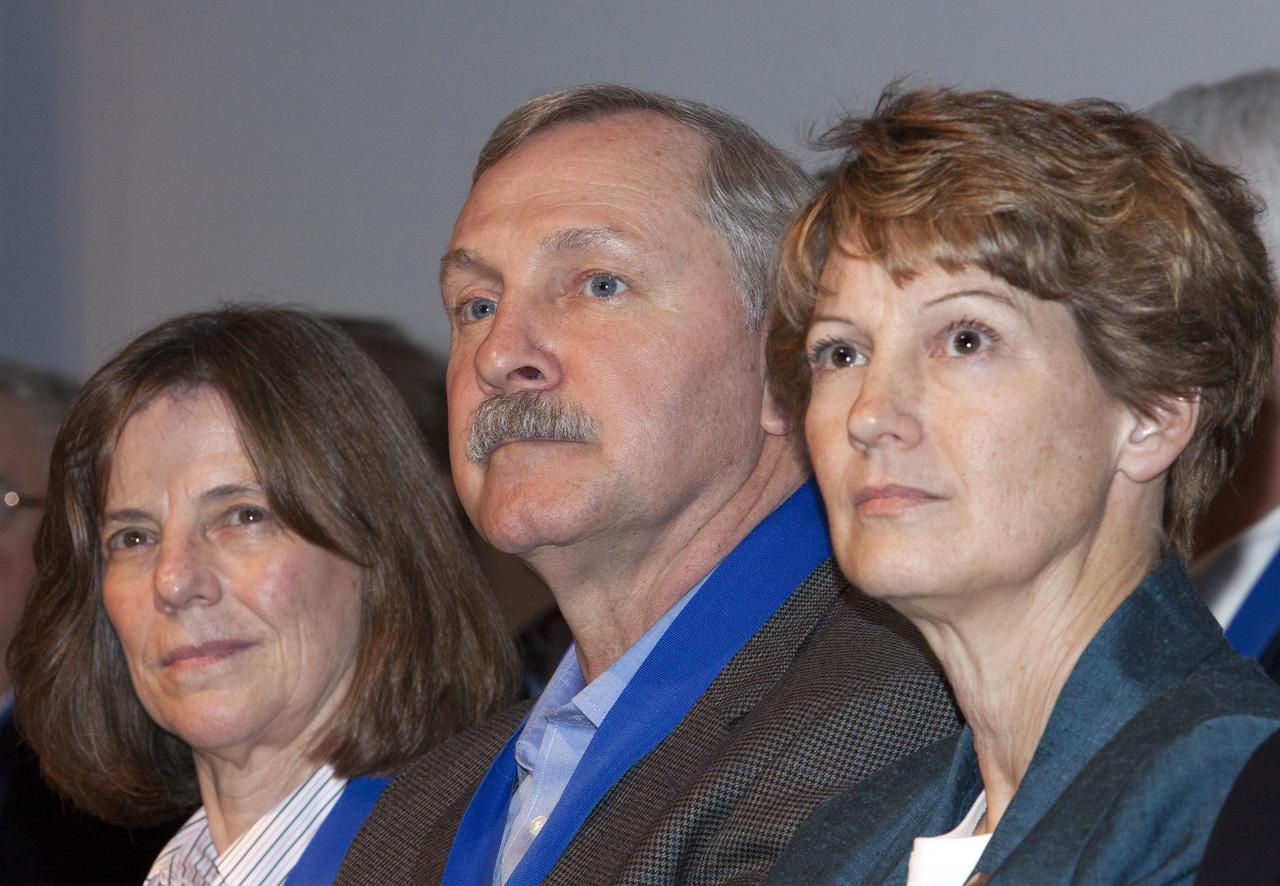
CAPE CANAVERAL, Fla. – At NASA’s Kennedy Space Center Visitor Complex in Florida, shuttle astronauts, from the left, Bonnie Dunbar, Curt Brown and Eileen Collins listen as Collins is being introduced for induction into the U.S. Astronaut Hall of Fame AHOF. She commanded STS-114 on the Return to Flight mission following the loss of the space shuttle Columbia. Collins’ career with NASA is full of accomplishments, including becoming the first woman space shuttle pilot and the first woman commander. As a four-time spaceflight veteran, Collins logged more than 872 hours in space, and her missions include STS-63, STS-84, STS-93 and STS-114. Shuttle astronauts Curt Brown and Bonnie Dunbar also were inducted into the AHOF. This induction is the twelfth group of space shuttle astronauts named to the AHOF, and the first time two women are inducted at the same time. The year’s inductees were selected by a committee of current Hall of Fame astronauts, former NASA officials, historians and journalists. The selection process is administered by the Astronaut Scholarship Foundation. For more on the U.S. Astronaut Hall of Fame, go to http:__www.kennedyspacecenter.com_astronaut-hall-of-fame.aspx For more on the Astronaut Scholarship Foundation, go to http:__astronautscholarship.org_ Photo credit: NASA_ Kim Shiflett
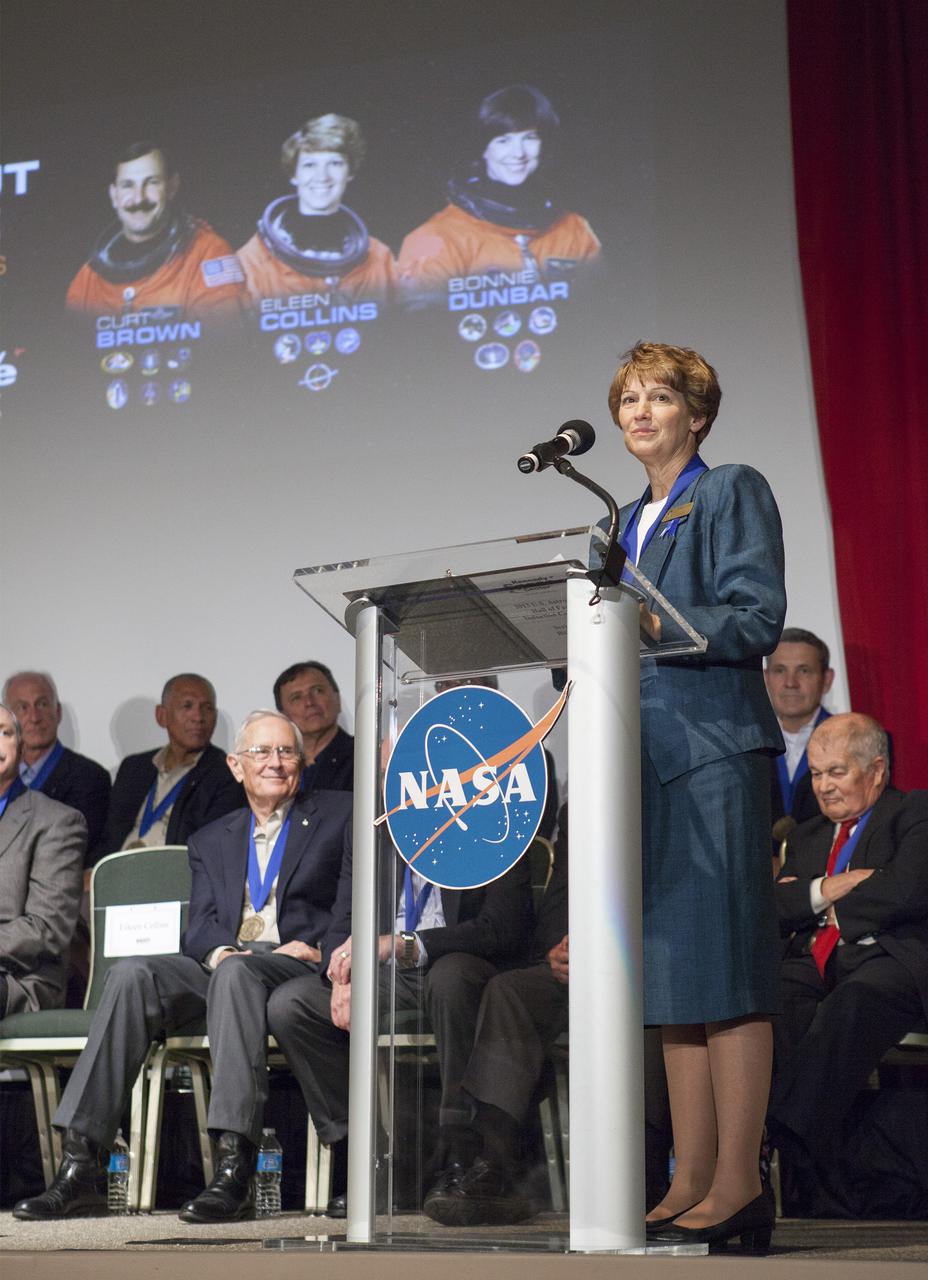
CAPE CANAVERAL, Fla. – At NASA’s Kennedy Space Center Visitor Complex in Florida, shuttle astronaut Eileen Collins speaks after being inducted into the U.S. Astronaut Hall of Fame AHOF. Revered for commanding STS-114 on the Return to Flight mission following the loss of the space shuttle Columbia, Collins’ career with NASA is full of accomplishments, including becoming the first woman space shuttle pilot and the first woman commander. As a four-time spaceflight veteran, Collins logged more than 872 hours in space, and her missions include STS-63, STS-84, STS-93 and STS-114. Shuttle astronauts Curt Brown and Bonnie Dunbar also were inducted into the AHOF. This induction is the twelfth group of space shuttle astronauts named to the AHOF, and the first time two women are inducted at the same time. The year’s inductees were selected by a committee of current Hall of Fame astronauts, former NASA officials, historians and journalists. The selection process is administered by the Astronaut Scholarship Foundation. For more on the U.S. Astronaut Hall of Fame, go to http:__www.kennedyspacecenter.com_astronaut-hall-of-fame.aspx For more on the Astronaut Scholarship Foundation, go to http:__astronautscholarship.org_ Photo credit: NASA_ Kim Shiflett
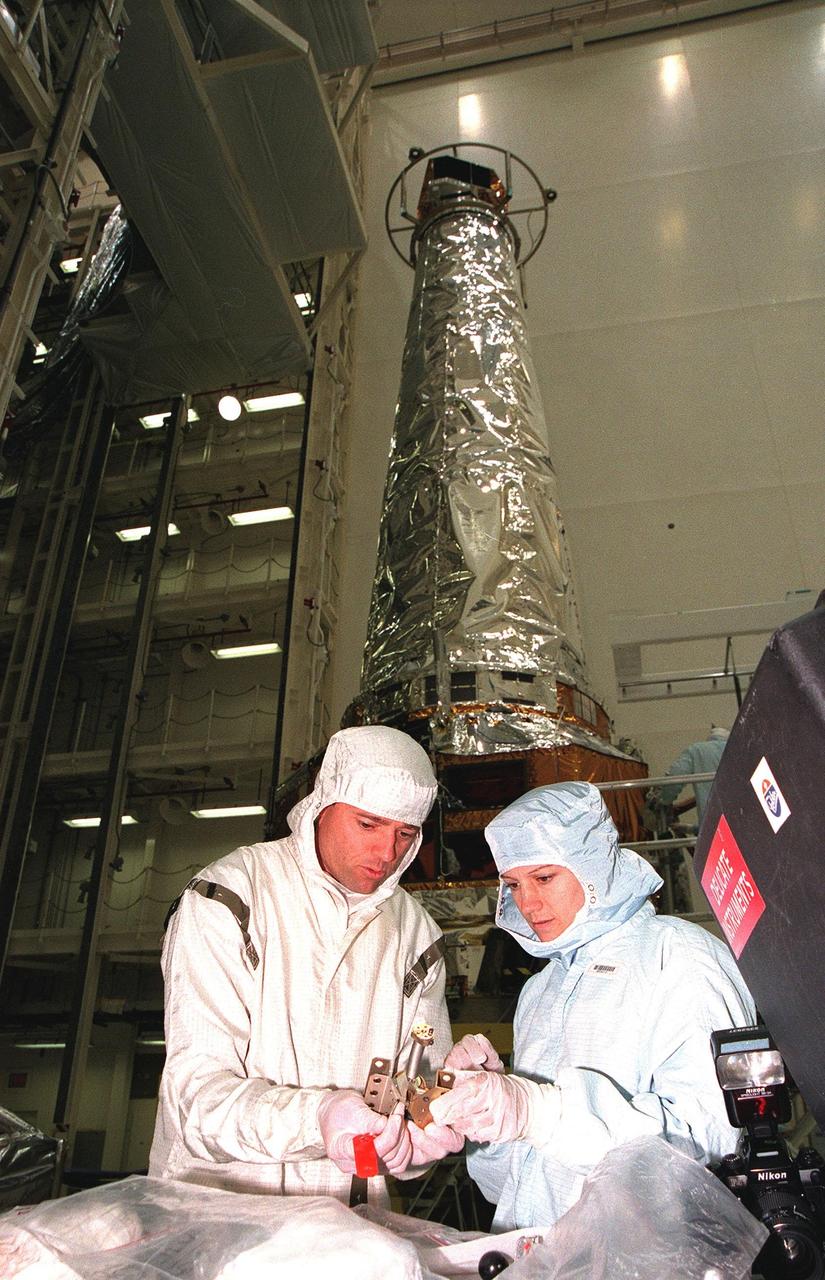
In the Vertical Processing Facility, STS-93 Pilot Jeffrey S. Ashby and Commander Eileen M. Collins look at a hinge used on the solar panels of the Chandra X-ray Observatory. Members of the STS-93 crew are at KSC for payload familiarization. Also participating are Mission Specialists Catherine G. Coleman and Michel Tognini of France, representing the Centre National d'Etudes Spatiales (CNES). Collins is the first woman to serve as a shuttle mission commander. She was the first woman pilot of a Space Shuttle, on mission STS-63, and also served as pilot on mission STS-84. The fifth member of the crew is Mission Specialist Steven A. Hawley. Chandra is scheduled for launch July 9 aboard Space Shuttle Columbia, on mission STS-93 . Formerly called the Advanced X-ray Astrophysics Facility, Chandra comprises three major elements: the spacecraft, the science instrument module (SIM), and the world's most powerful X-ray telescope. Chandra will allow scientists from around the world to see previously invisible black holes and high-temperature gas clouds, giving the observatory the potential to rewrite the books on the structure and evolution of our universe
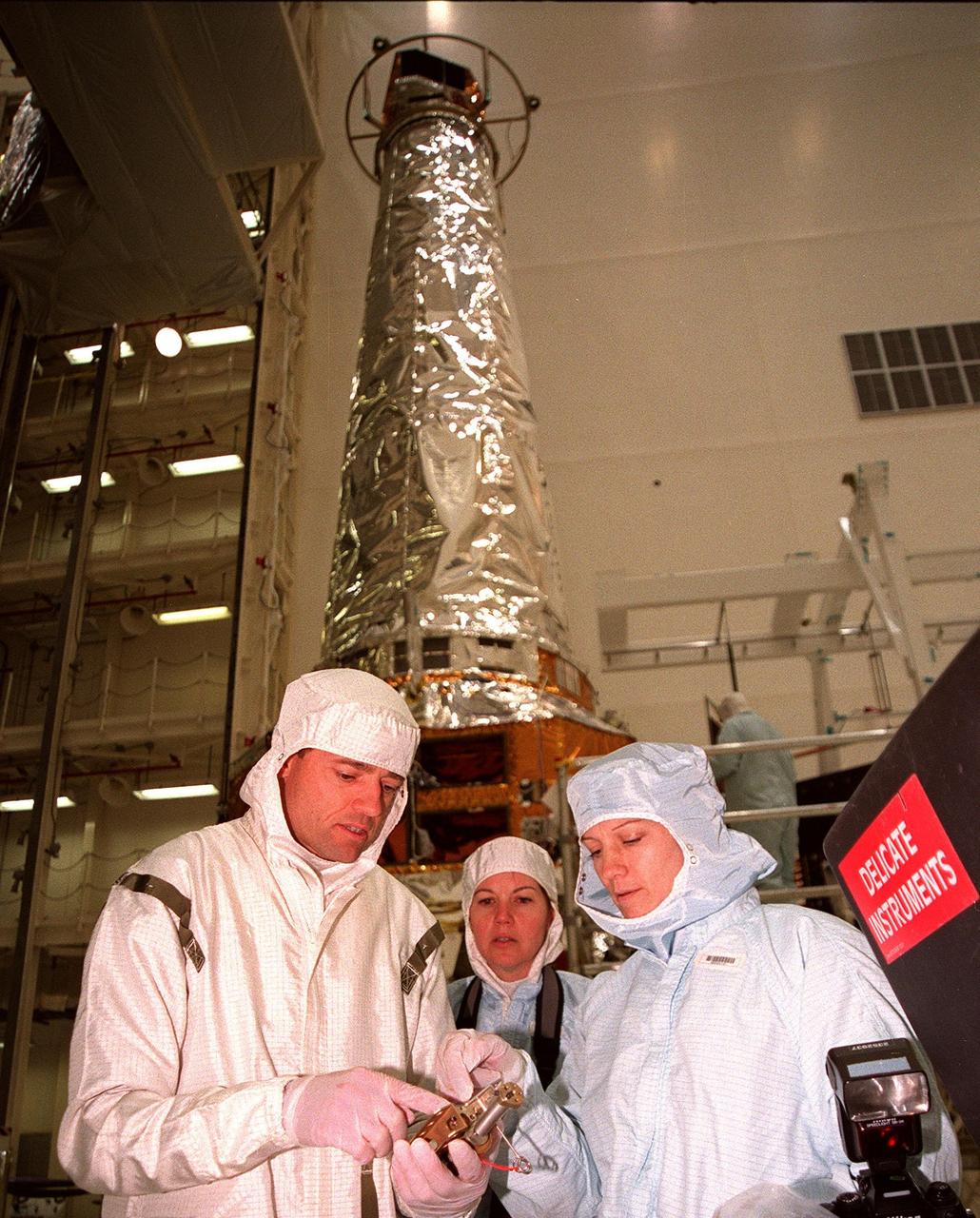
In the Vertical Processing Facility, STS-93 Pilot Jeffrey S. Ashby, Mission Specialist Catherine G. Coleman and Commander Eileen M. Collins look at a hinge used on the solar panels of the Chandra X-ray Observatory. Members of the STS-93 crew are at KSC for payload familiarization, including Mission Specialist Michel Tognini of France, representing the Centre National d'Etudes Spatiales (CNES). Collins is the first woman to serve as a shuttle mission commander. She was the first woman pilot of a Space Shuttle, on mission STS-63, and also served as pilot on mission STS-84. The fifth member of the crew is Mission Specialist Steven A. Hawley. Chandra is scheduled for launch July 9 aboard Space Shuttle Columbia, on mission STS-93 . Formerly called the Advanced X-ray Astrophysics Facility, Chandra comprises three major elements: the spacecraft, the science instrument module (SIM), and the world's most powerful X-ray telescope. Chandra will allow scientists from around the world to see previously invisible black holes and high-temperature gas clouds, giving the observatory the potential to rewrite the books on the structure and evolution of our universe
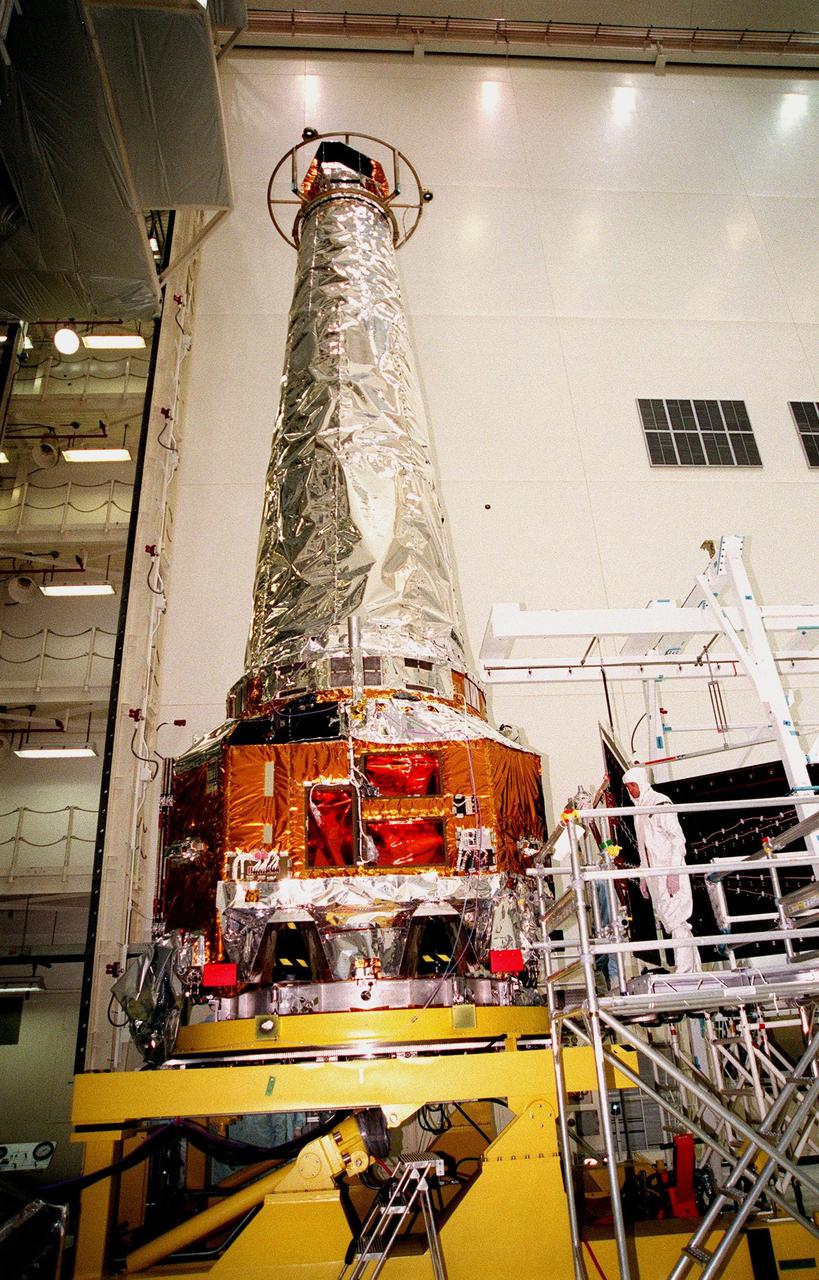
In the Vertical Processing Facility, STS-93 Pilot Jeffrey S. Ashby gets a close look at the Chandra X-ray Observatory. Other members of the STS-93 crew who are at KSC for payload familiarization are Commander Eileen Collins and Mission Specialists Catherine G. Coleman and Michel Tognini of France, who represents the Centre National d'Etudes Spatiales (CNES). Collins is the first woman to serve as a shuttle mission commander. She was the first woman pilot of a Space Shuttle, on mission STS-63, and also served as pilot on mission STS-84. The fifth member of the crew is Mission Specialist Steven A. Hawley. Chandra is scheduled for launch July 9 aboard Space Shuttle Columbia, on mission STS-93 . Formerly called the Advanced X-ray Astrophysics Facility, Chandra comprises three major elements: the spacecraft, the science instrument module (SIM), and the world's most powerful X-ray telescope. Chandra will allow scientists from around the world to see previously invisible black holes and high-temperature gas clouds, giving the observatory the potential to rewrite the books on the structure and evolution of our universe
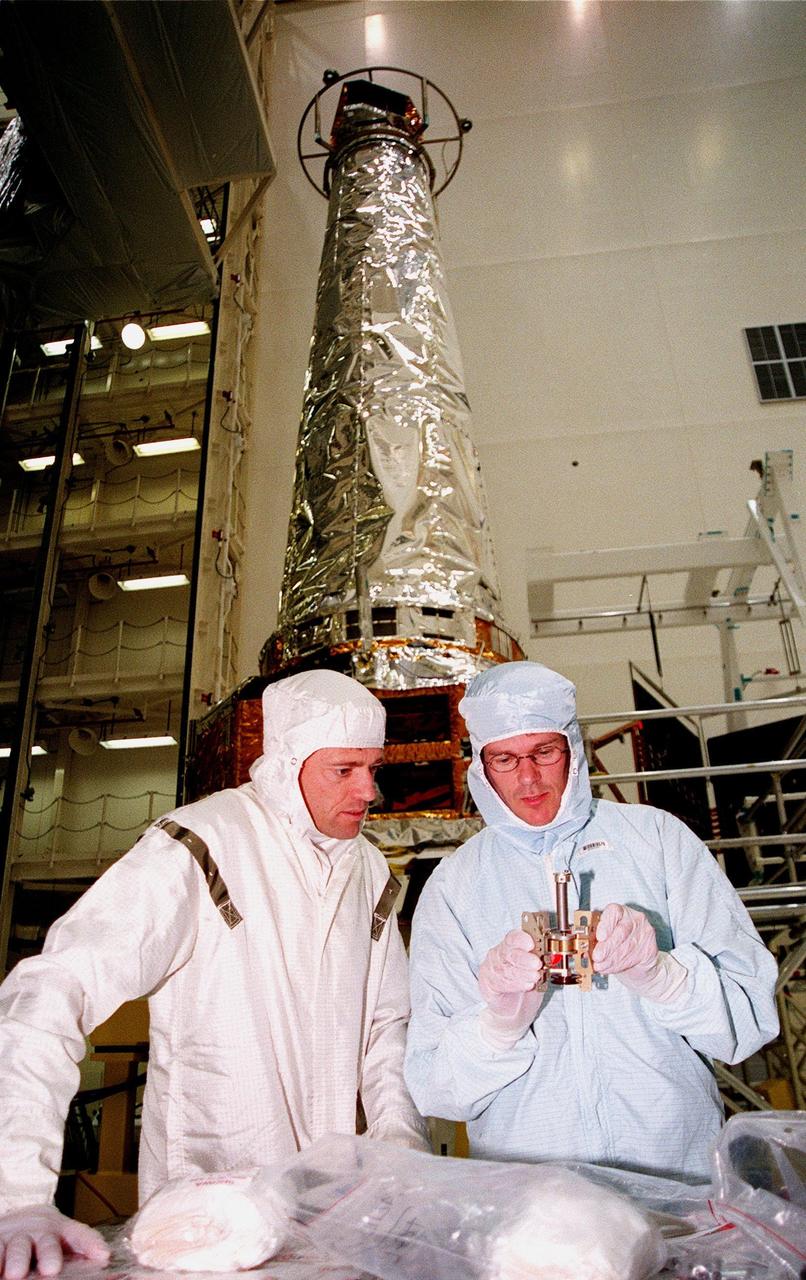
STS-93 Pilot Jeffrey S. Ashby learns about the solar panel hinge, held by a TRW technician, and its use on the Chandra X-ray Observatory behind them. Members of the STS-93 crew are at KSC for payload familiarization, including Mission Specialists Catherine G. Coleman and Michel Tognini of France, who represents the Centre National d'Etudes Spatiales (CNES). Collins is the first woman to serve as a shuttle mission commander. She was the first woman pilot of a Space Shuttle, on mission STS-63, and also served as pilot on mission STS-84. The fifth member of the crew is Mission Specialist Steven A. Hawley. Chandra is scheduled for launch July 9 aboard Space Shuttle Columbia, on mission STS-93 . Formerly called the Advanced X-ray Astrophysics Facility, Chandra comprises three major elements: the spacecraft, the science instrument module (SIM), and the world's most powerful X-ray telescope. Chandra will allow scientists from around the world to see previously invisible black holes and high-temperature gas clouds, giving the observatory the potential to rewrite the books on the structure and evolution of our universe
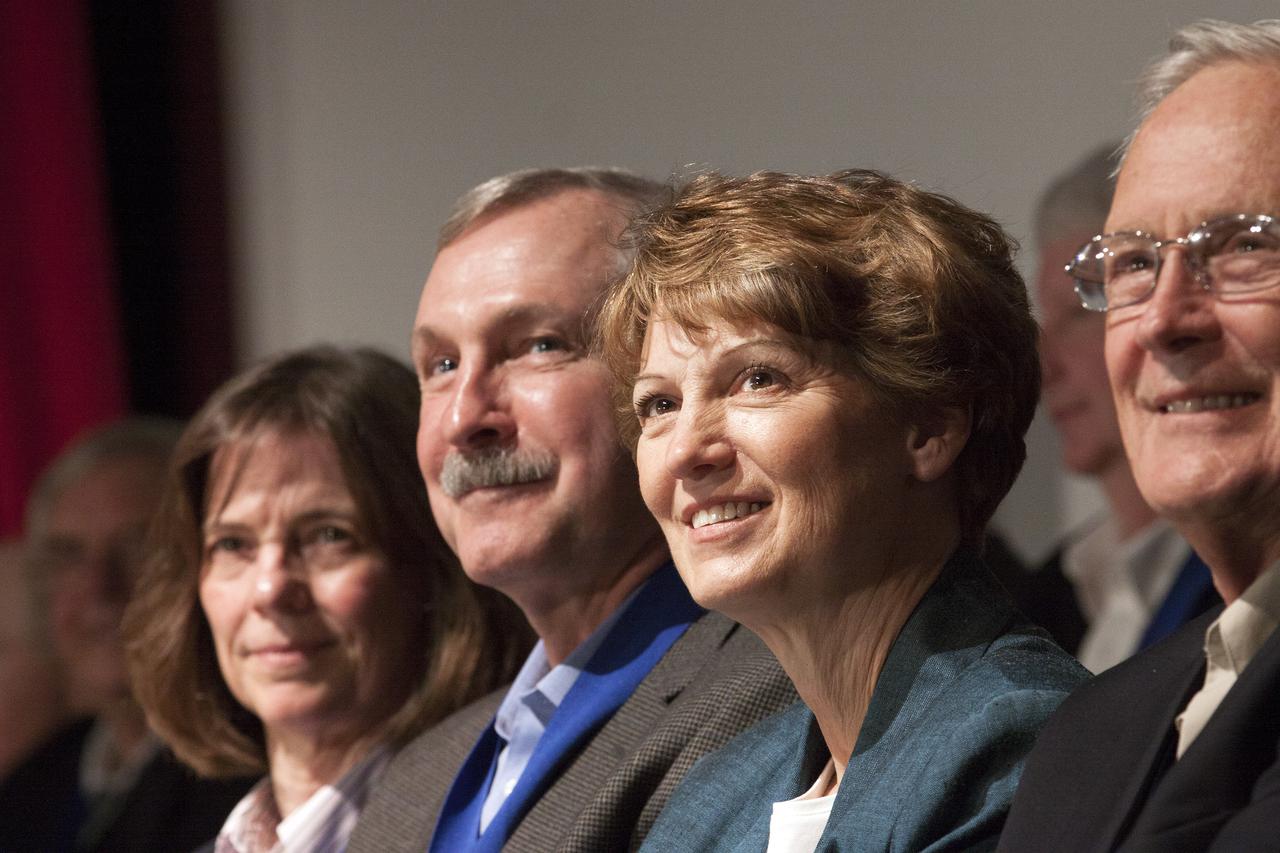
CAPE CANAVERAL, Fla. – At NASA’s Kennedy Space Center Visitor Complex in Florida, shuttle astronauts, from the left, Bonnie Dunbar, Curt Brown and Eileen Collins listen as Collins is being introduced for induction into the U.S. Astronaut Hall of Fame AHOF. She commanded STS-114 on the Return to Flight mission following the loss of the space shuttle Columbia. Collins’ career with NASA is full of accomplishments, including becoming the first woman space shuttle pilot and the first woman commander. As a four-time spaceflight veteran, Collins logged more than 872 hours in space, and her missions include STS-63, STS-84, STS-93 and STS-114. Shuttle astronauts Curt Brown and Bonnie Dunbar also were inducted into the AHOF. This induction is the twelfth group of space shuttle astronauts named to the AHOF, and the first time two women are inducted at the same time. The year’s inductees were selected by a committee of current Hall of Fame astronauts, former NASA officials, historians and journalists. The selection process is administered by the Astronaut Scholarship Foundation. For more on the U.S. Astronaut Hall of Fame, go to http:__www.kennedyspacecenter.com_astronaut-hall-of-fame.aspx For more on the Astronaut Scholarship Foundation, go to http:__astronautscholarship.org_ Photo credit: NASA_ Kim Shiflett
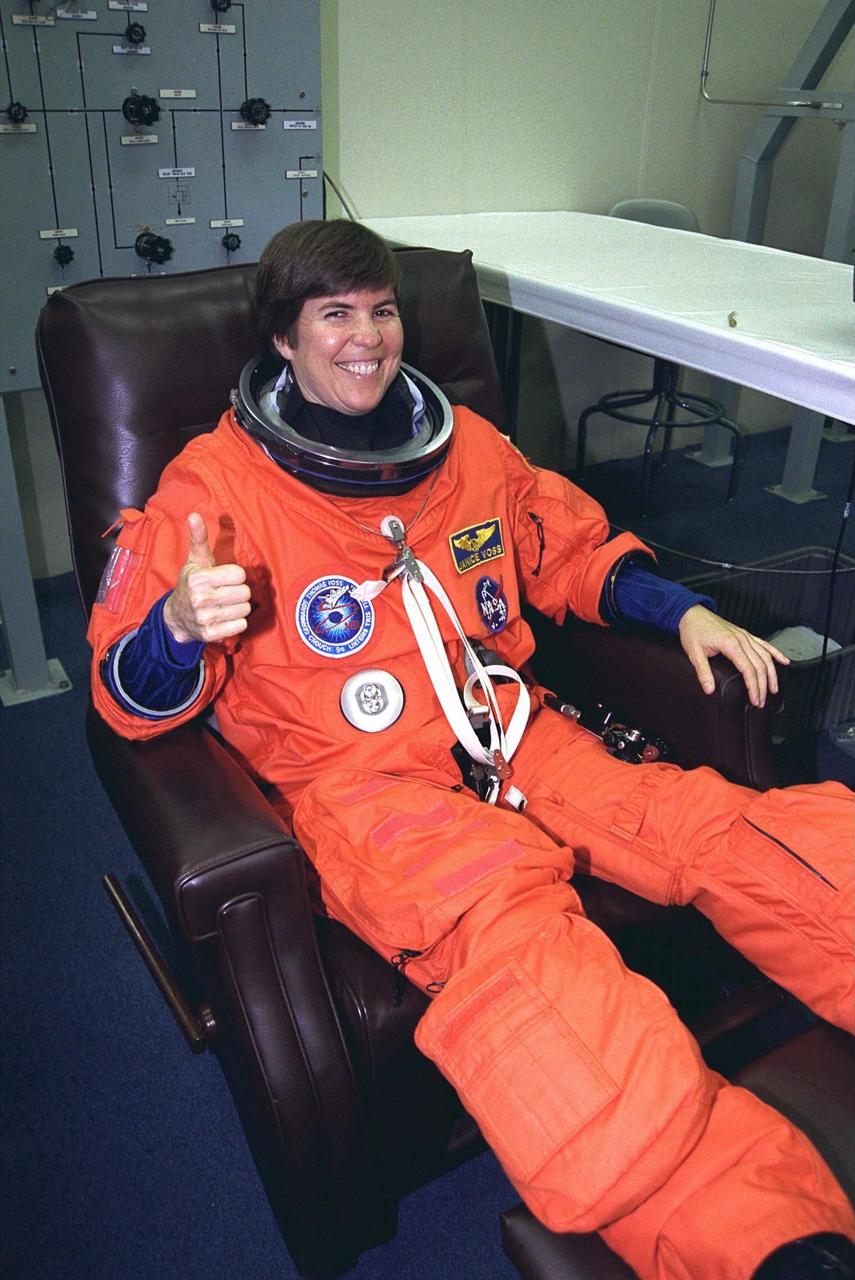
STS-94 Payload Commander Janice Voss smiles and gives a thumbs-up as she is assisted into her launch/entry suit in the Operations and Checkout (O&C) Building. She has flown on STS-83, STS-63 and STS-57. Voss holds a doctorate degree in aeronautics/astronautics from the Massachusetts Institute of Technology and has earned two NASA Space Flight Medals. As Payload Commander and a member of the Blue team, Voss will have overall responsibility for the operation of all of the MSL-1 experiments. During the experimentation phase of the mission, she be working primarily with three combustion experiments. She and six fellow crew members will shortly depart the O&C and head for Launch Pad 39A, where the Space Shuttle Columbia will lift off during a launch window that opens at 1:50 p.m. EDT, July 1. The launch window was opened 47 minutes early to improve the opportunity to lift off before Florida summer rain showers reached the space center
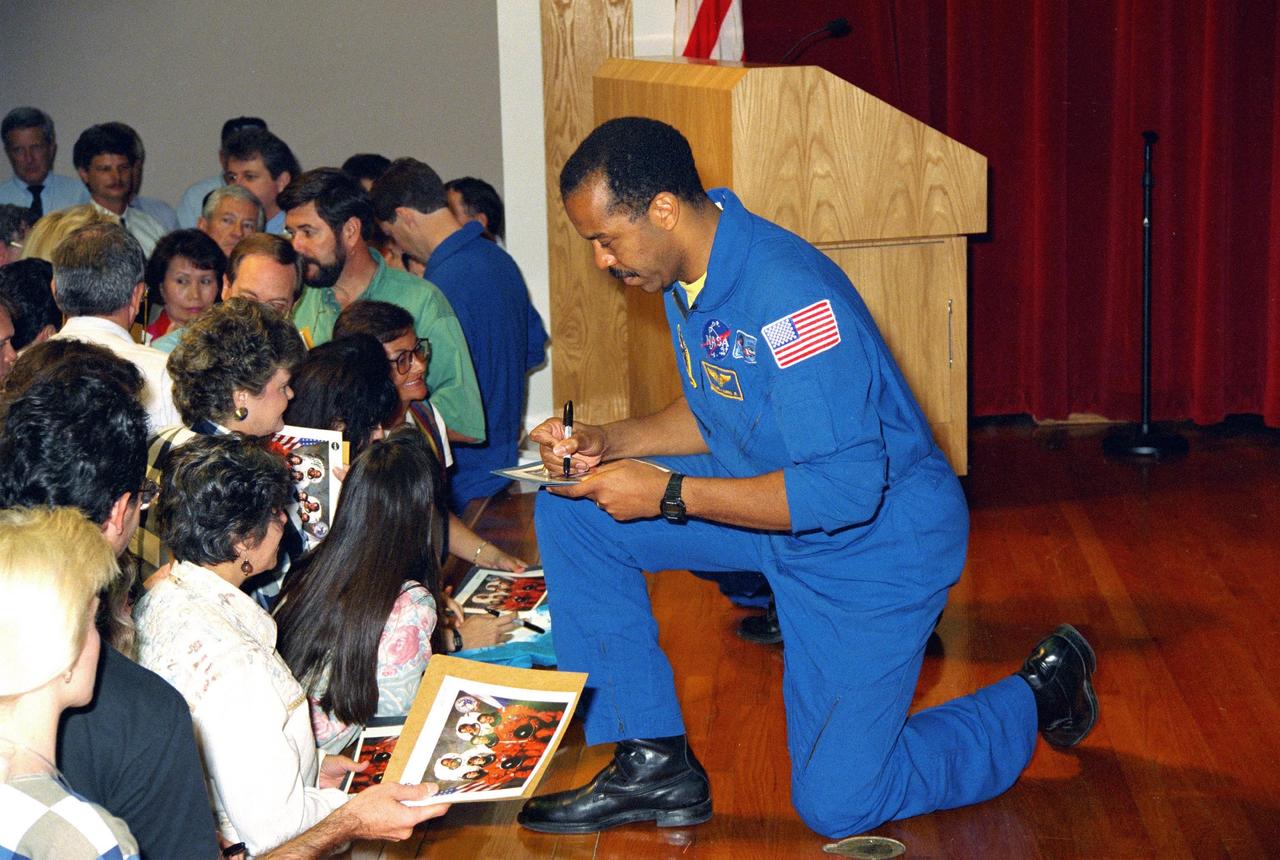
KENNEDY SPACE CENTER, FLA. -- STS-63 Mission Specialist Dr. Bernard Harris autographs copies of the crew photograph in the Training Auditorium during a March crew visit to thank employees for their help in ensuring a successful mission. The six-member crew on Discovery, who landed February 11 after an eight-day flight, included Mission Commander James Wetherbee, Pilot Eileen Collins (on the first flight of a female Shuttle pilot), and Mission Specialists Michael Foale, Janice Voss and Vladimir Titov. The mission featured another milestone, the first approach and flyaround of a Shuttle with Russian Space Station Mir. It was also the second flight of a russian cosmonaut on Shuttle and the third flight of the SPACEHAB module, which carried 20 experiments in biotechnology, advanced materials development, technology demonstrations and other measurements.
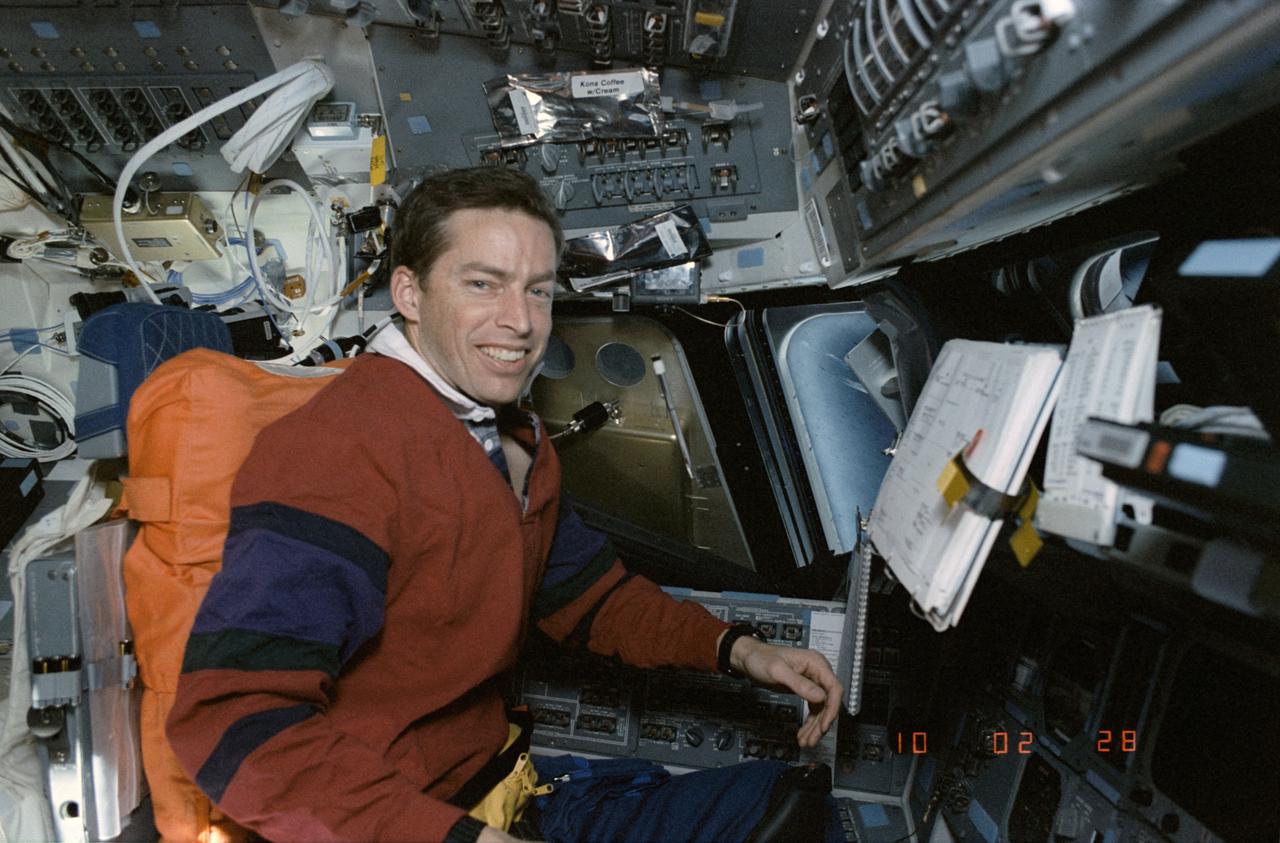
STS063-06-027 (3-11 Feb 1995) --- Seated at the commander's station on the Space Shuttle Discovery's flight deck, astronaut James D. Wetherbee, commander, was photographed by a crew mate during early phases of the STS-63 mission. A great deal of time was spent during the first few days of the mission to check a leaky thruster, which could have had a negative influence on rendezvous operations with Russia's Mir Space Station. As it turned out, all the related problems were solved and the two spacecraft succeded in achieving close proximity operations. Others onboard the Discovery were astronauts Eileen M. Collins, pilot; Bernard A. Harris Jr., payload commander; and mission specialists C. Michael Foale, Janice E. Voss, and Russian cosmonaut Vladimir G. Titov.
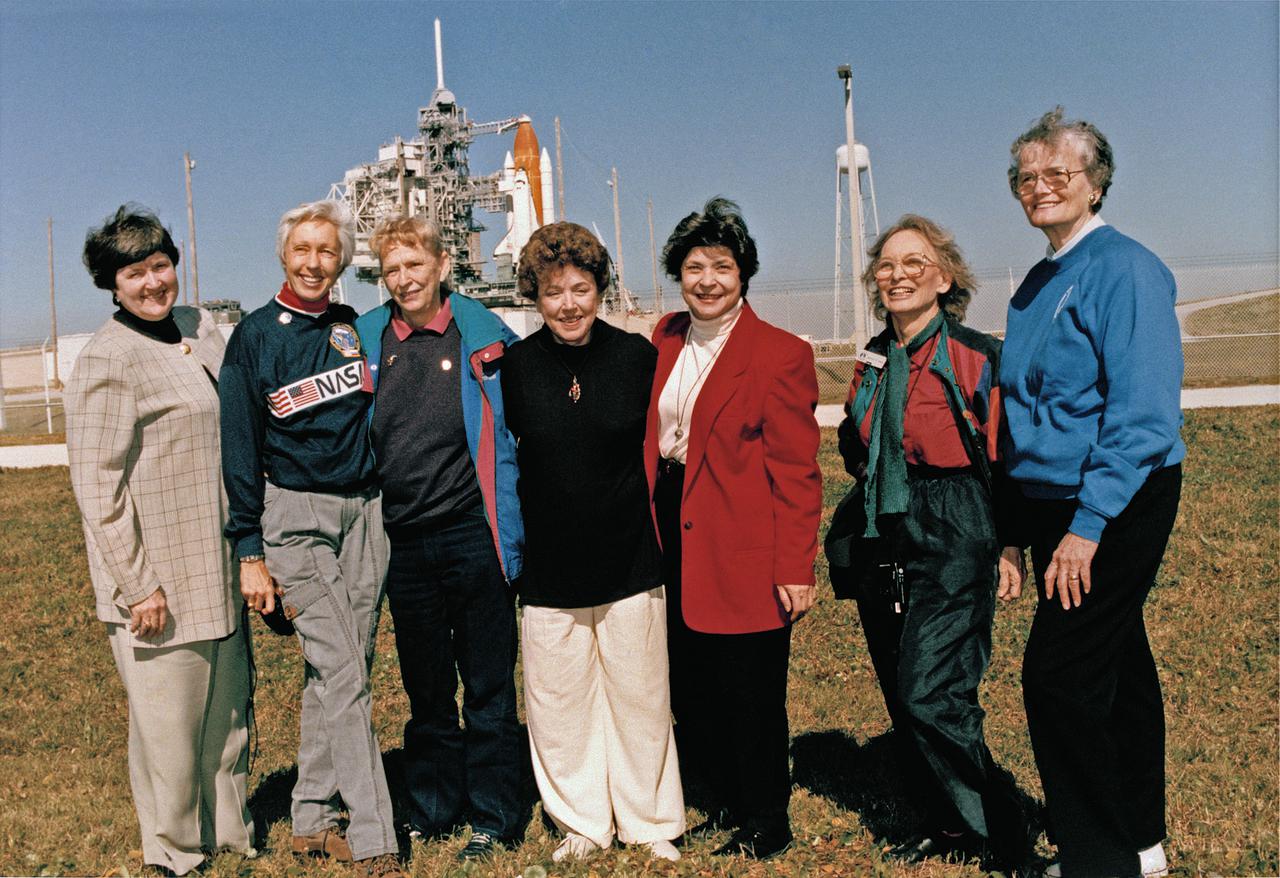
CAPE CANAVERAL, Fla. -- Exuberant and thrilled to be at Kennedy Space Center, seven women who once aspired to fly into space stand outside Launch Pad 39B near the space shuttle Discovery, poised for liftoff on the first flight of 1995. Visiting the space center as invited guests of STS-63 Pilot Eileen Collins are from left Gene Nora Jessen, Wally Funk, Jerrie Cobb, Jerri Truhill, Sarah Rutley, Myrtle Cagle and Bernice Steadman. They are members of the Mercury 13 group of women who trained to become astronauts for America's first human spaceflight program back in the early 1960s. Although the Mercury 13 effort was eventually cancelled, the women are proud to know that their commitment helped pave the way for the milestone Collins will soon set: becoming the first female shuttle pilot. Photo credit: NASA
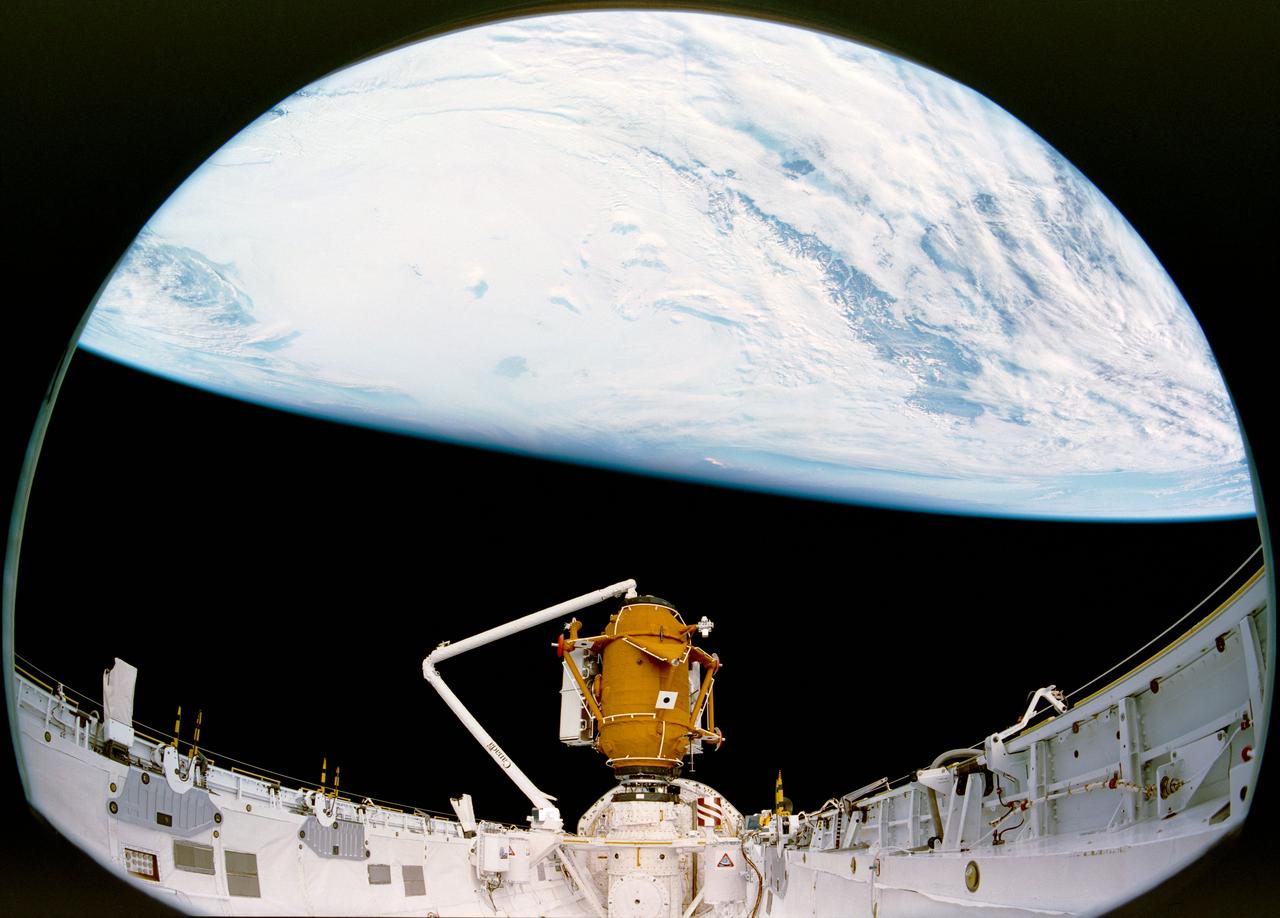
S95-22079 (14 Nov 1995) --- The Docking Module (DM) is seen just after installation in the Space Shuttle Atlantis' cargo bay. The snow-covered Bukhtarminskaye Reservoir, just north of China, may be seen in the background. When this photo was taken, five NASA astronauts were onboard Atlantis, awaiting their joint activities which is set to begin in less than 24 hours with three Mir-20 cosmonauts following tomorrow's scheduled docking. During the STS-74 mission, the crew used an IMAX camera to document the Space Shuttle Atlantis' rendezvous and docking with the Mir Space Station. The 65mm camera system was located in the Atlantis' cargo bay and provided a unique fish-eye perspective. These images were selected from footage that will be incorporated in a large-format feature film about NASA's cooperative program with the Russians. NASA has flown IMAX camera systems on many Shuttle missions, including the recent STS-63 Shuttle-Mir rendezvous and STS-71 Shuttle-Mir docking. Film from previous missions was used to create the productions The Dream is Alive, The Blue Planet, and Destiny in Space.
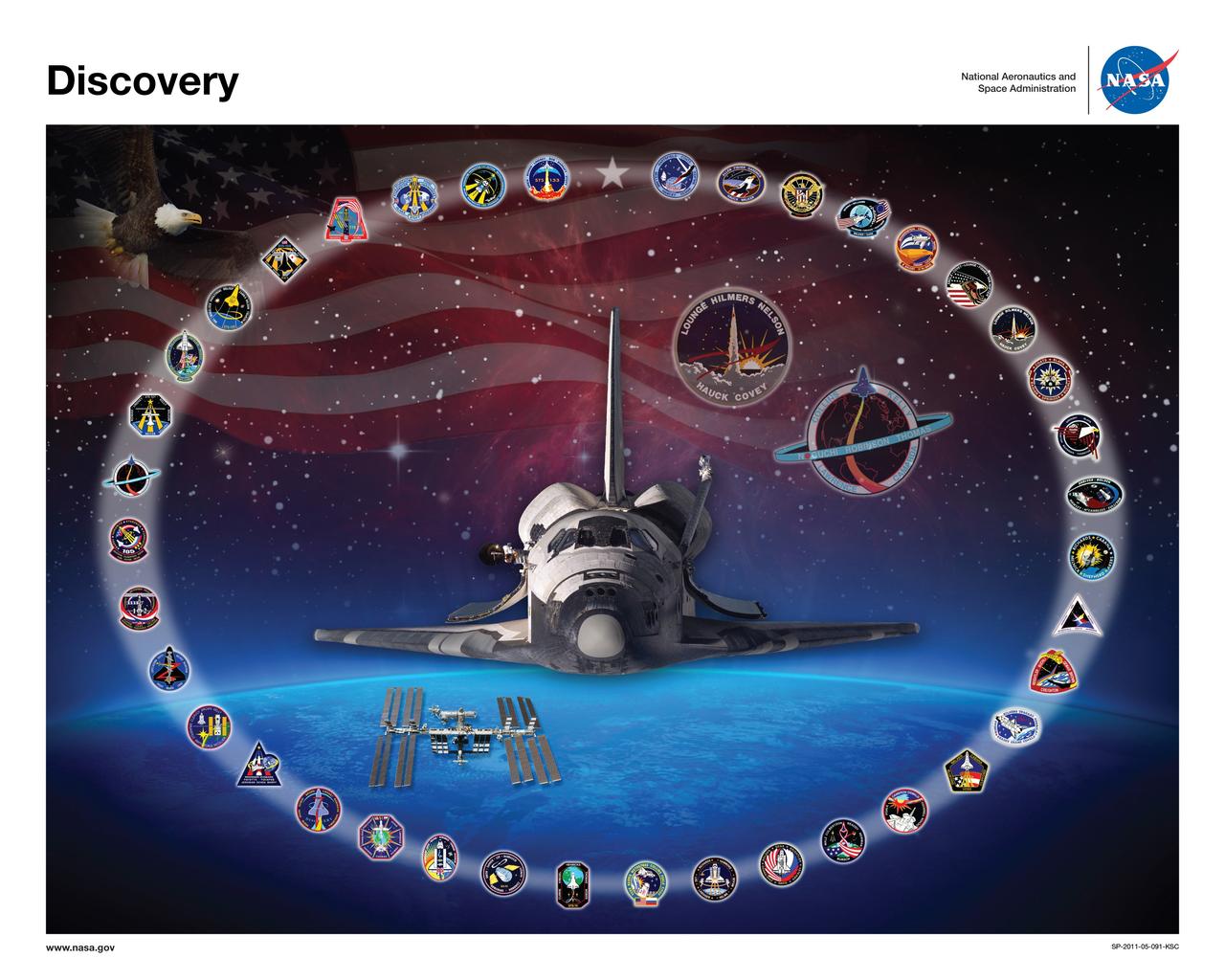
CAPE CANAVERAL, Fla. -- This is a version of space shuttle Discovery's orbiter tribute, or OV-103, which hangs in Firing Room 4 of the Launch Control Center at NASA's Kennedy Space Center in Florida. In 2011, the tribute was updated to reflect the crew member change on Discovery's final mission -- STS-133. Steve Bowen replaced Tim Kopra as a mission specialist on STS-133, after Kopra was injured in a bicycle accident that prevented him from flying into space. Discovery’s accomplishments include the first female shuttle pilot, Eileen Collins, on STS-63, John Glenn’s legendary return to space on STS-95, and the celebration of the 100th shuttle mission with STS-92. In addition, Discovery supported a number of Department of Defense programs, satellite deploy and repair missions and 13 International Space Station construction and operation flights. The tribute features Discovery demonstrating the rendezvous pitch maneuver on approach to the International Space Station during STS-114. Having accumulated the most space shuttle flights, Discovery’s 39 mission patches are shown circling the spacecraft. The background image was taken from the Hubble Space Telescope, which launched aboard Discovery on STS-31 and serviced by Discovery on STS-82 and STS-103. The American Flag and Bald Eagle represent Discovery’s two Return-to-Flight missions -- STS-26 and STS-114 -- and symbolize Discovery’s role in returning American astronauts to space. Five orbiter tributes are on display in the firing room, representing Atlantis, Challenger, Columbia, Endeavour and Discovery. Graphic design credit: NASA/Amy Lombardo. NASA publication number: SP-2010-08-164-KSC
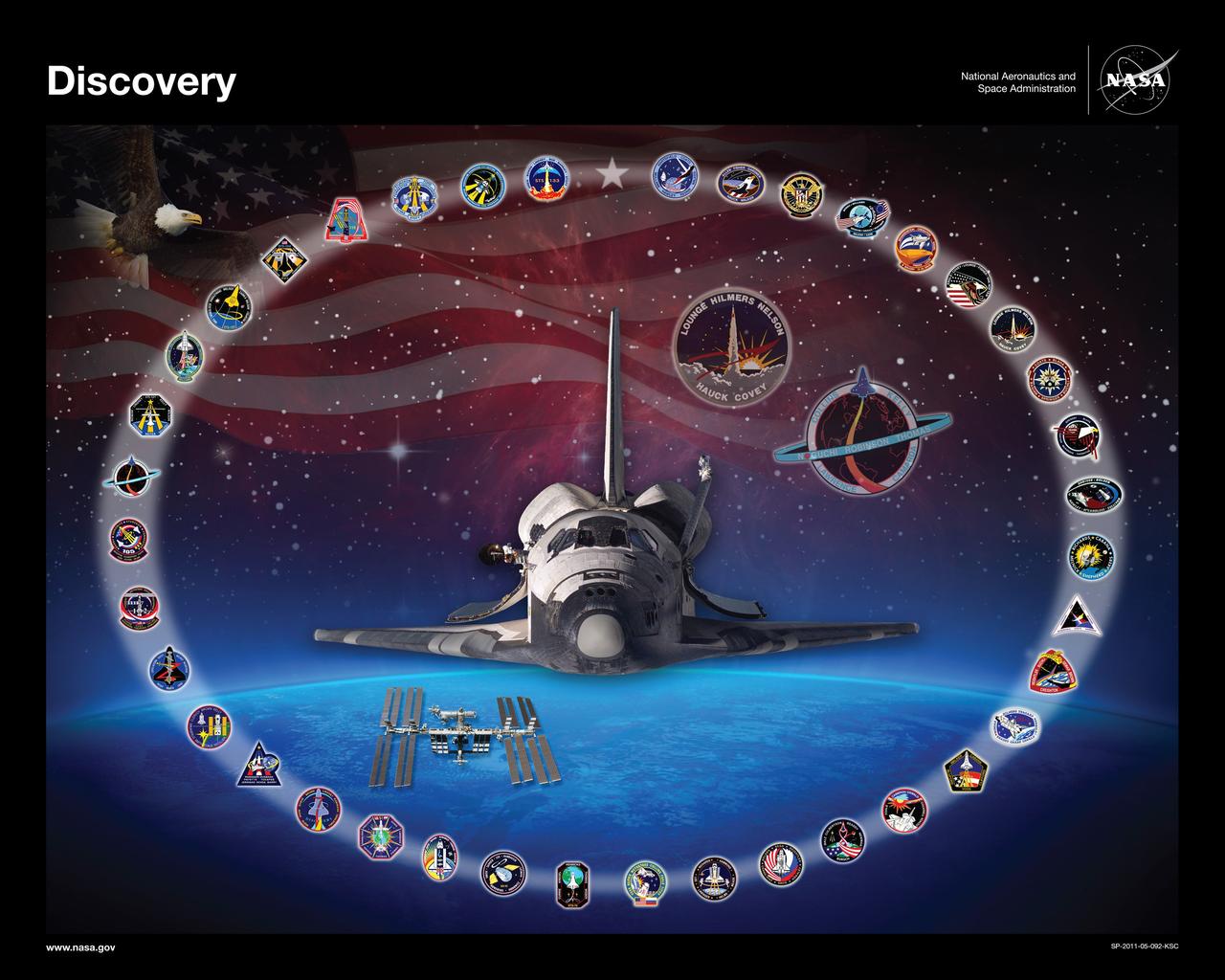
CAPE CANAVERAL, Fla. -- This is a printable version of space shuttle Discovery's orbiter tribute, or OV-103, which hangs in Firing Room 4 of the Launch Control Center at NASA's Kennedy Space Center in Florida. In 2011, the tribute was updated to reflect the crew member change on Discovery's final mission -- STS-133. Steve Bowen replaced Tim Kopra as a mission specialist on STS-133, after Kopra was injured in a bicycle accident that prevented him from flying into space. Discovery’s accomplishments include the first female shuttle pilot, Eileen Collins, on STS-63, John Glenn’s legendary return to space on STS-95, and the celebration of the 100th shuttle mission with STS-92. In addition, Discovery supported a number of Department of Defense programs, satellite deploy and repair missions and 13 International Space Station construction and operation flights. The tribute features Discovery demonstrating the rendezvous pitch maneuver on approach to the International Space Station during STS-114. Having accumulated the most space shuttle flights, Discovery’s 39 mission patches are shown circling the spacecraft. The background image was taken from the Hubble Space Telescope, which launched aboard Discovery on STS-31 and serviced by Discovery on STS-82 and STS-103. The American Flag and Bald Eagle represent Discovery’s two Return-to-Flight missions -- STS-26 and STS-114 -- and symbolize Discovery’s role in returning American astronauts to space. Five orbiter tributes are on display in the firing room, representing Atlantis, Challenger, Columbia, Endeavour and Discovery. Graphic design credit: NASA/Amy Lombardo. NASA publication number: SP-2010-08-164-KSC
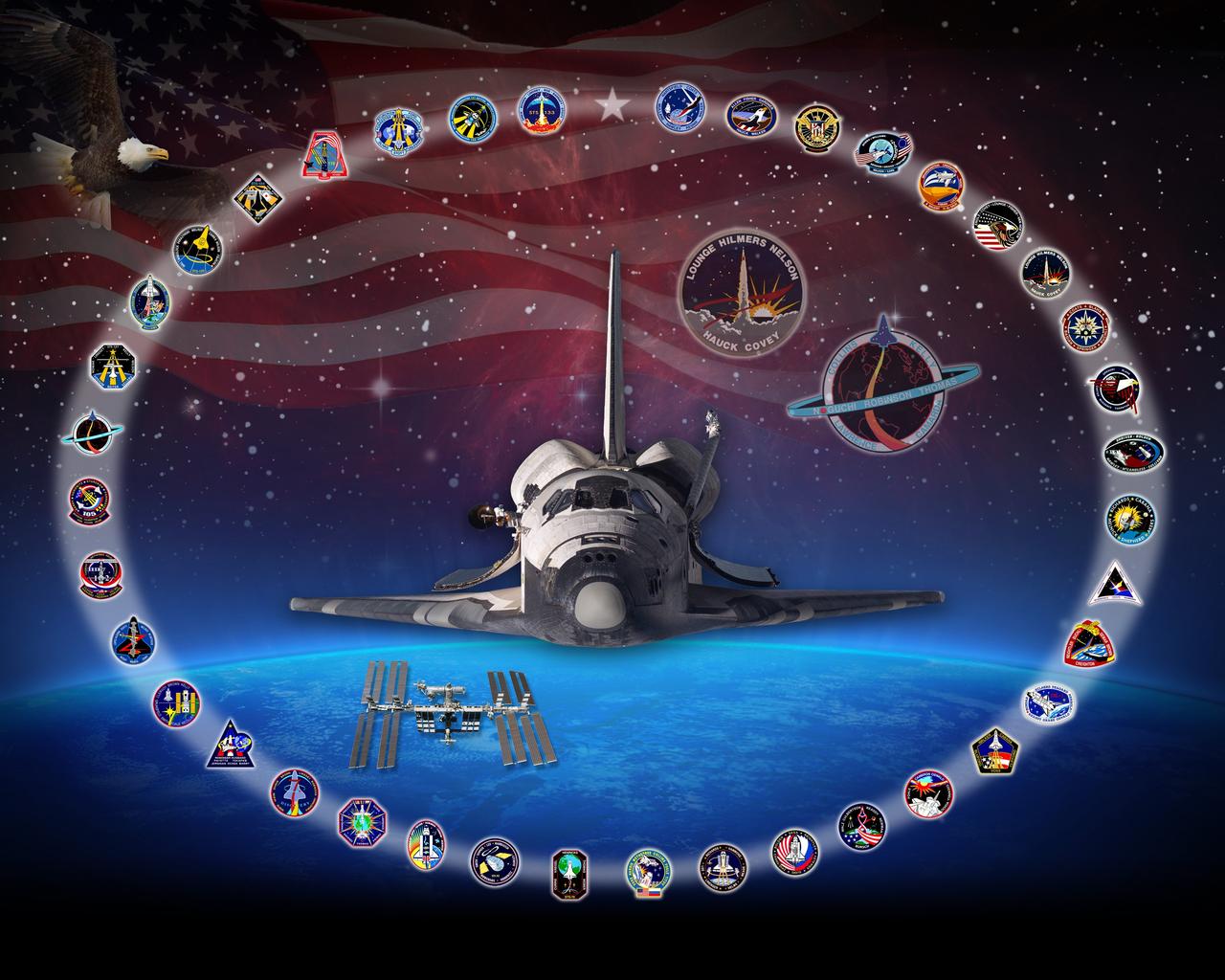
CAPE CANAVERAL, Fla. -- This orbiter tribute of space shuttle Discovery, or OV-103, hangs in Firing Room 4 of the Launch Control Center at NASA's Kennedy Space Center in Florida. In 2011, the tribute was updated to reflect the crew member change on Discovery's final mission -- STS-133. Steve Bowen replaced Tim Kopra as a mission specialist on STS-133, after Kopra was injured in a bicycle accident that prevented him from flying into space. Discovery’s accomplishments include the first female shuttle pilot, Eileen Collins, on STS-63, John Glenn’s legendary return to space on STS-95, and the celebration of the 100th shuttle mission with STS-92. In addition, Discovery supported a number of Department of Defense programs, satellite deploy and repair missions and 13 International Space Station construction and operation flights. The tribute features Discovery demonstrating the rendezvous pitch maneuver on approach to the International Space Station during STS-114. Having accumulated the most space shuttle flights, Discovery’s 39 mission patches are shown circling the spacecraft. The background image was taken from the Hubble Space Telescope, which launched aboard Discovery on STS-31 and serviced by Discovery on STS-82 and STS-103. The American Flag and Bald Eagle represent Discovery’s two Return-to-Flight missions -- STS-26 and STS-114 -- and symbolize Discovery’s role in returning American astronauts to space. Five orbiter tributes are on display in the firing room, representing Atlantis, Challenger, Columbia, Endeavour and Discovery. Graphic design credit: NASA/Amy Lombardo. NASA publication number: SP-2010-08-164-KSC