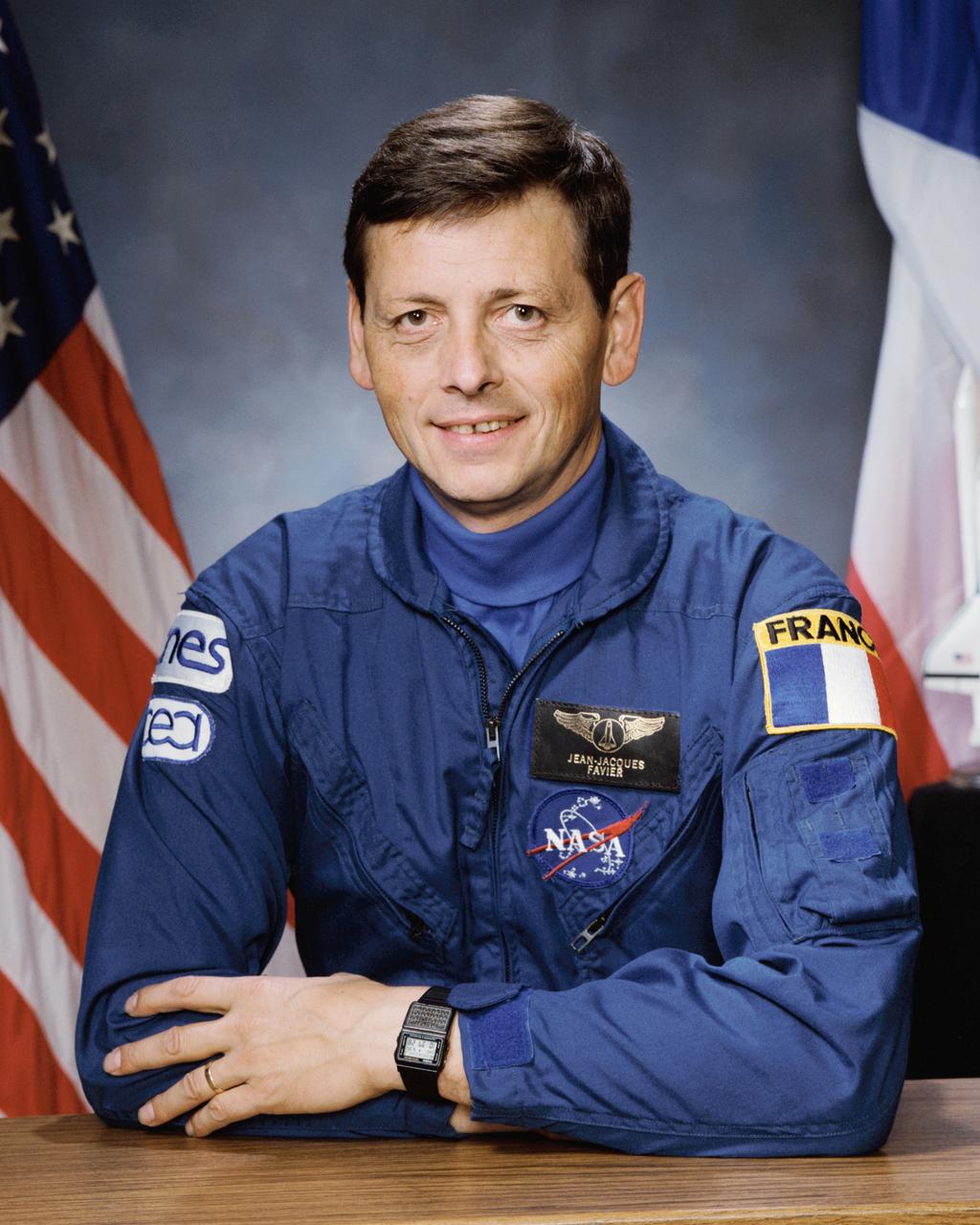
Official portrait of STS-65 International Microgravity Laboratory 2 (IML-2) backup Payload Specialist Jean-Jacques Favier. Favier is a member of the Centre National D'Etudes Spatiales (CNES), the French space agency.
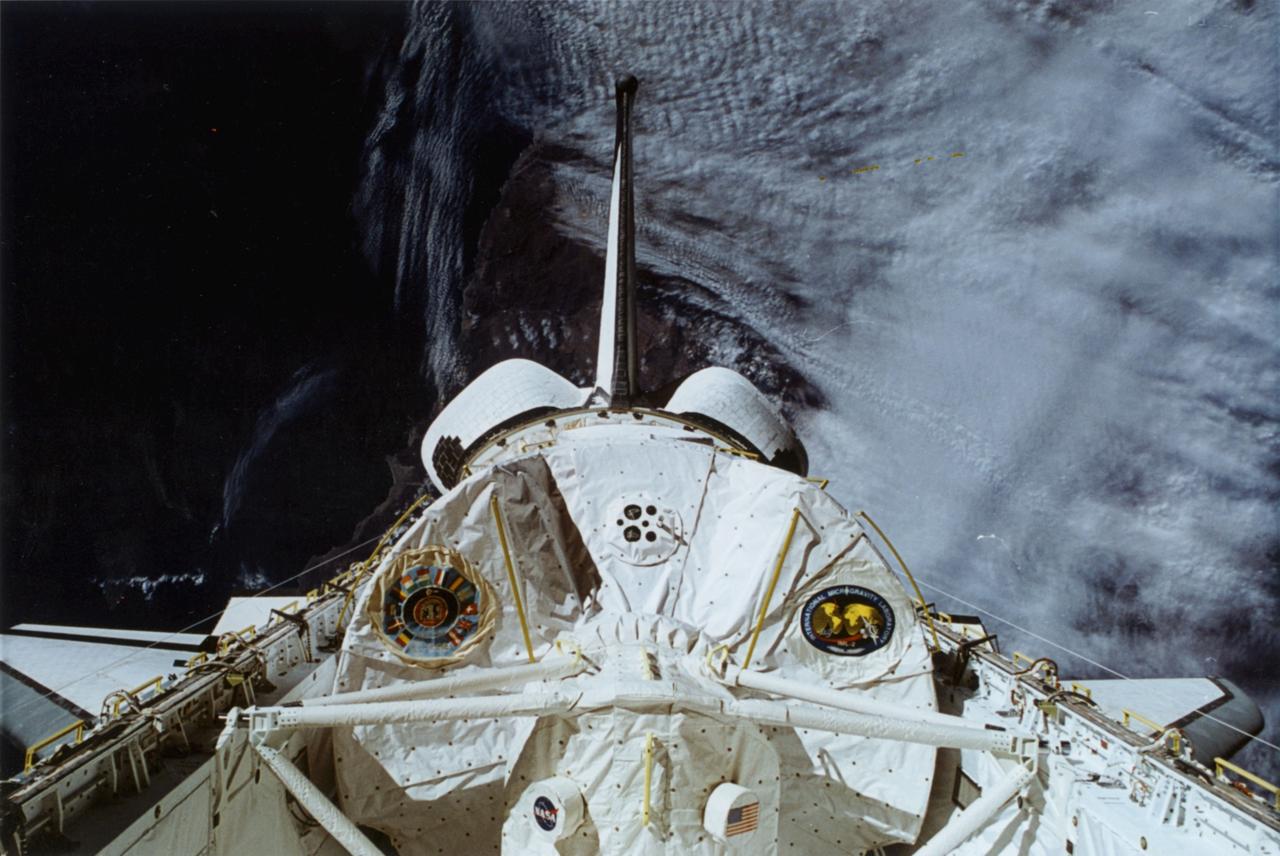
STS-65 Payload Bay Area
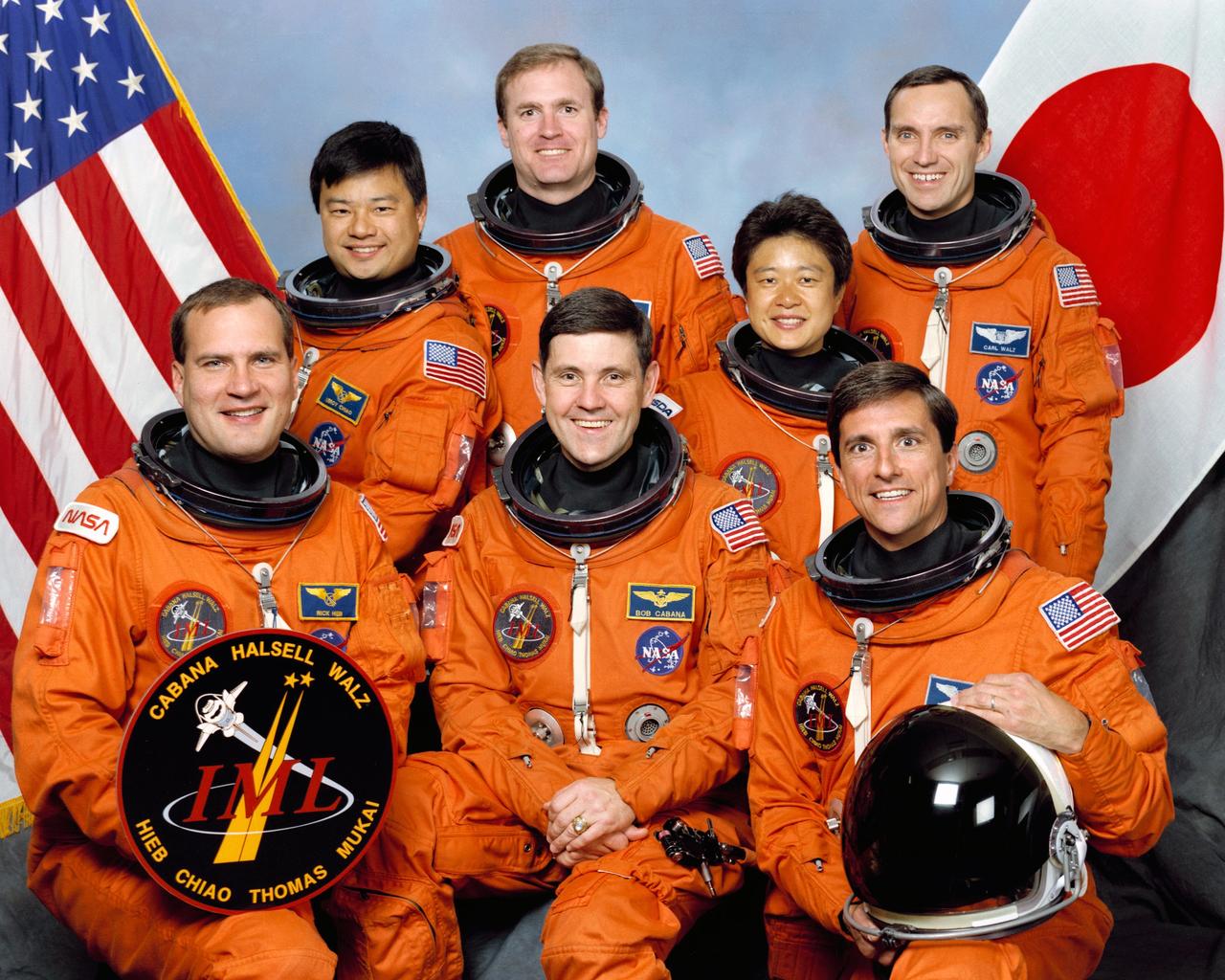
JOHNSON SPACE CENTER, Houston, Texas -- -- STS065(S)002 -- STS-65 Official Crew Portrait --- Six NASA astronauts and a Japanese payload specialist take a break from STS-65 training to pose for their crew portrait. Left to right are Richard J. Hieb, Leroy Chiao, James D. Halsell Jr., Robert D. Cabana, Dr. Chiaki Mukai, Donald A. Thomas and Carl E. Walz. Cabana is mission commander, and Halsell has been assigned as pilot. Hieb is payload commander, with Walz, Thomas and Chiao serving as mission specialists. Dr. Mukai represents the National Space Development Agency (NASDA) of Japan as payload specialist on the International Microgravity Laboratory (IML) mission.
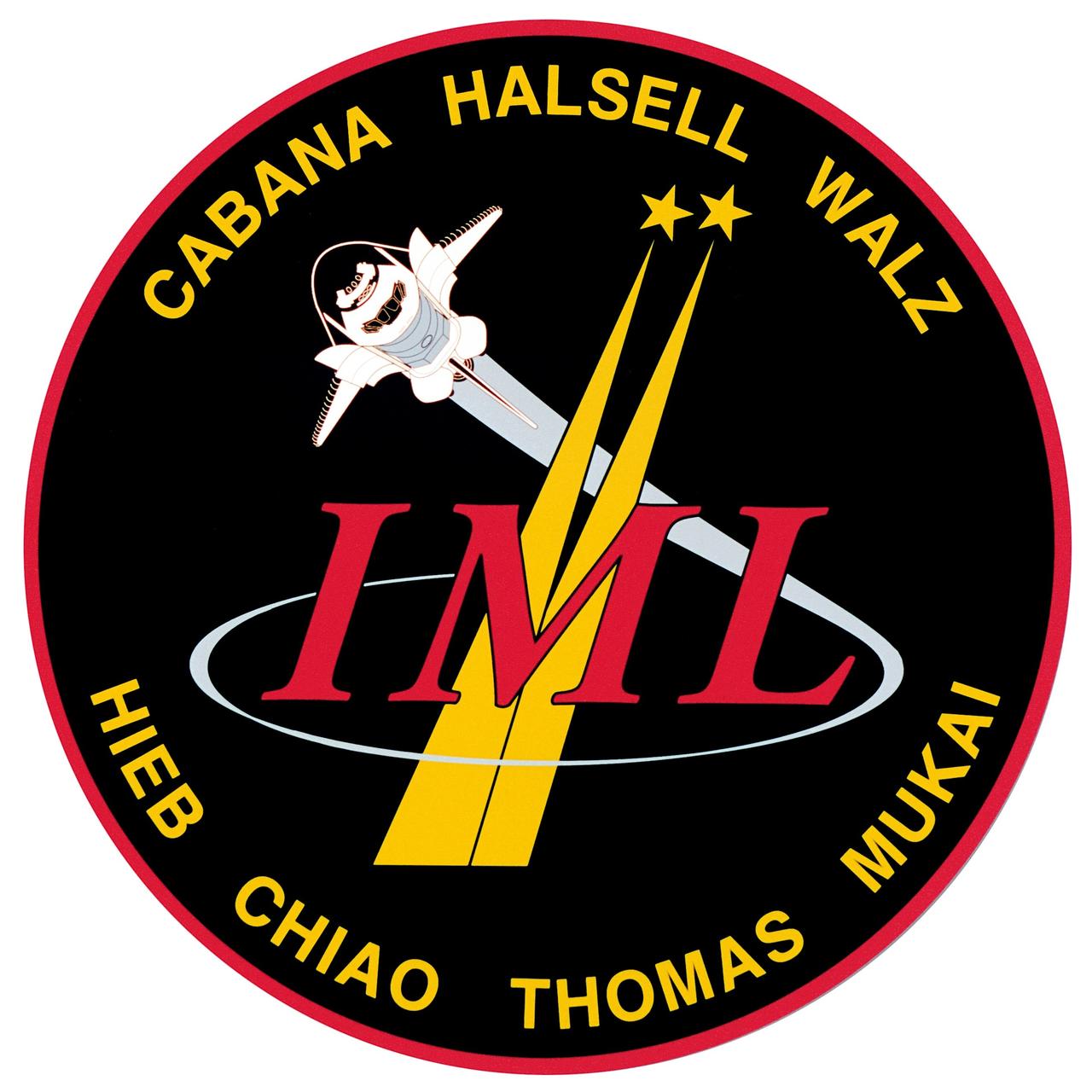
STS065-S-001 (March 1994) --- Designed by the crew members, the STS-65 insignia features the International Microgravity Laboratory (IML-2) mission and its Spacehab module which will fly aboard the space shuttle Columbia. IML-2 is reflected in the emblem by two gold stars shooting toward the heavens behind the IML lettering. The space shuttle Columbia is depicted orbiting the logo and reaching into space, with Spacehab on an international quest for a better understanding of the effects of spaceflight on materials processing and life sciences. The NASA insignia design for space shuttle flights is reserved for use by the astronauts and for other official use as the NASA Administrator may authorize. Public availability has been approved only in the forms of illustrations by the various news media. When and if there is any change in this policy, which is not anticipated, the change will be publicly announced. Photo credit: NASA
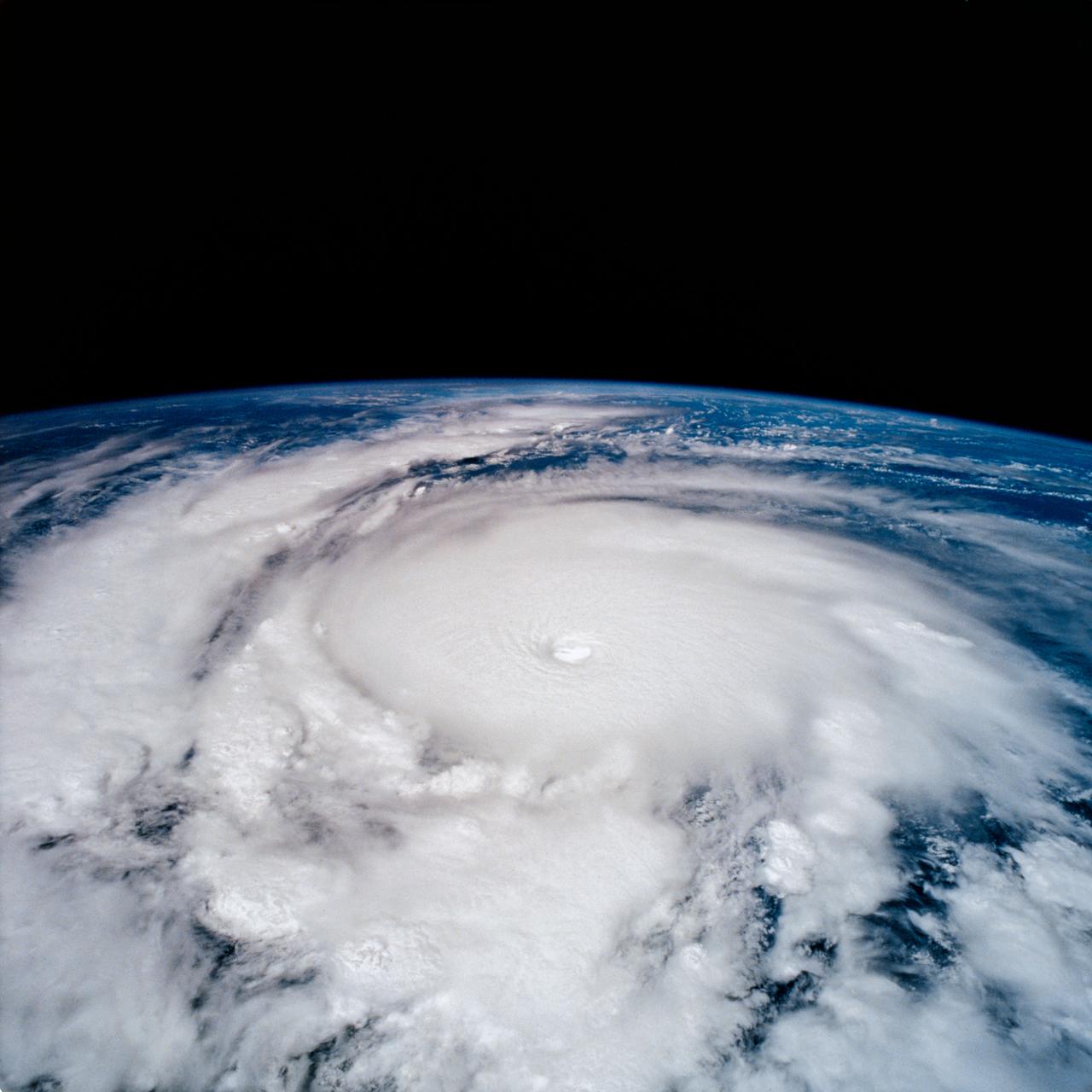
STS-65 Earth observation taken aboard Columbia, Orbiter Vehicle (OV) 102, shows Hurricane Emilia in the Eastern Pacific Ocean. Hurricane Emilia's wind speeds exceeded 150 knots. This high oblique view of the storm shows numerous spiral bands of thunderstorms, overshooting thunderstorm tops at the tropopause, and a well developed eye at the center of the picture. Shuttle photography provides high resolution details of these powerful and destructive systems that are not fully possible from lower-resolution, unmanned satellites.
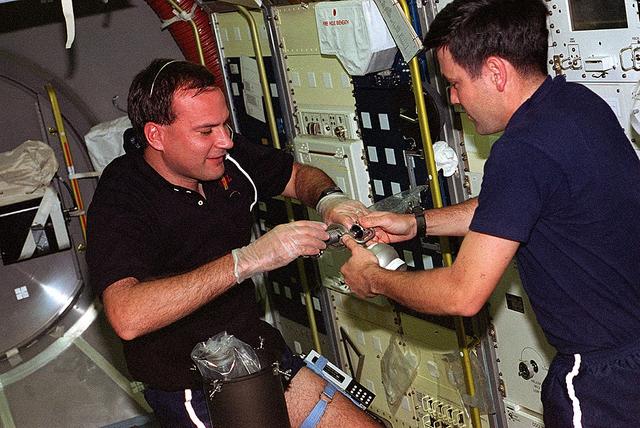
Space Shuttle Columbia (STS-65) onboard photo of Payload specialist Richard J. Hieb (right) and Shuttle Pilot James D. Halsell Jr. working on experiments in the Spacelab in the International Microgravity Laboratory (IML-2).
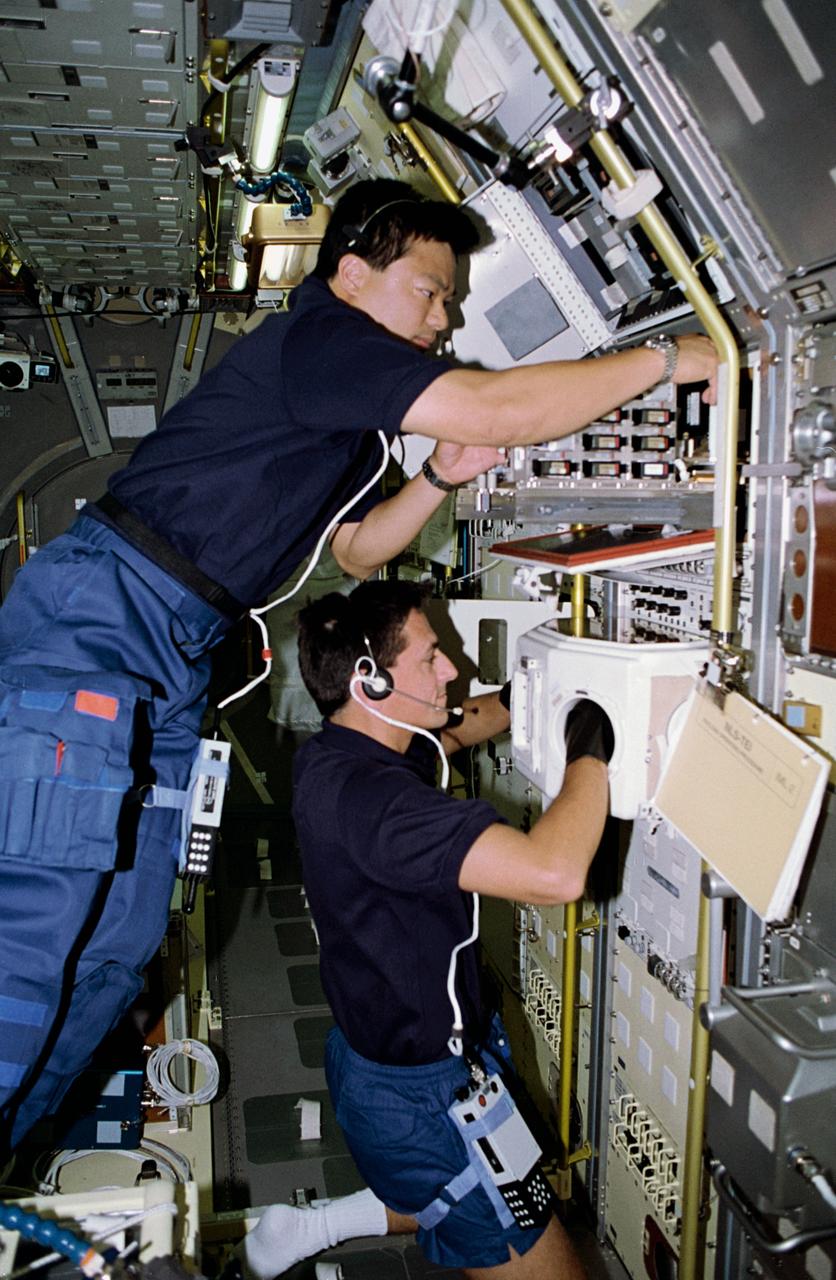
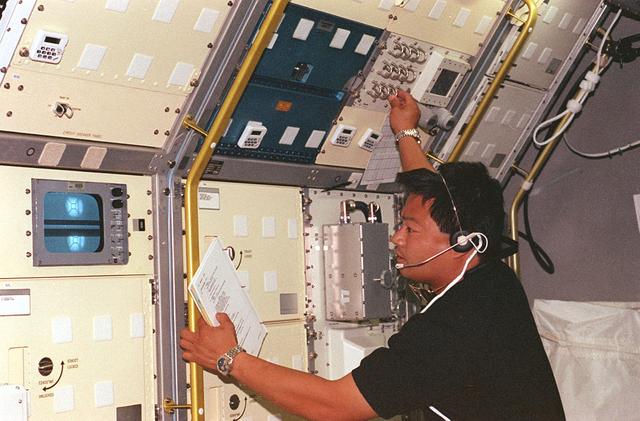
STS-65 Mission Specialist (MS) Leroy Chiao (top) and MS Donald A. Thomas are seen at work in the International Microgravity Laboratory 2 (IML-2) spacelab science module aboard the Space Shuttle Columbia, Orbiter Vehicle (OV) 102. The two crewmembers are conducting experiments at the IML-2 Rack 5 Biorack (BR). Chiao places a sample in the BR incubator as Thomas handles another sample inside the BR glovebox. The glovebox is used to prepare samples for BR and slow rotating centrifuge microscope (NIZEMI) experiments.
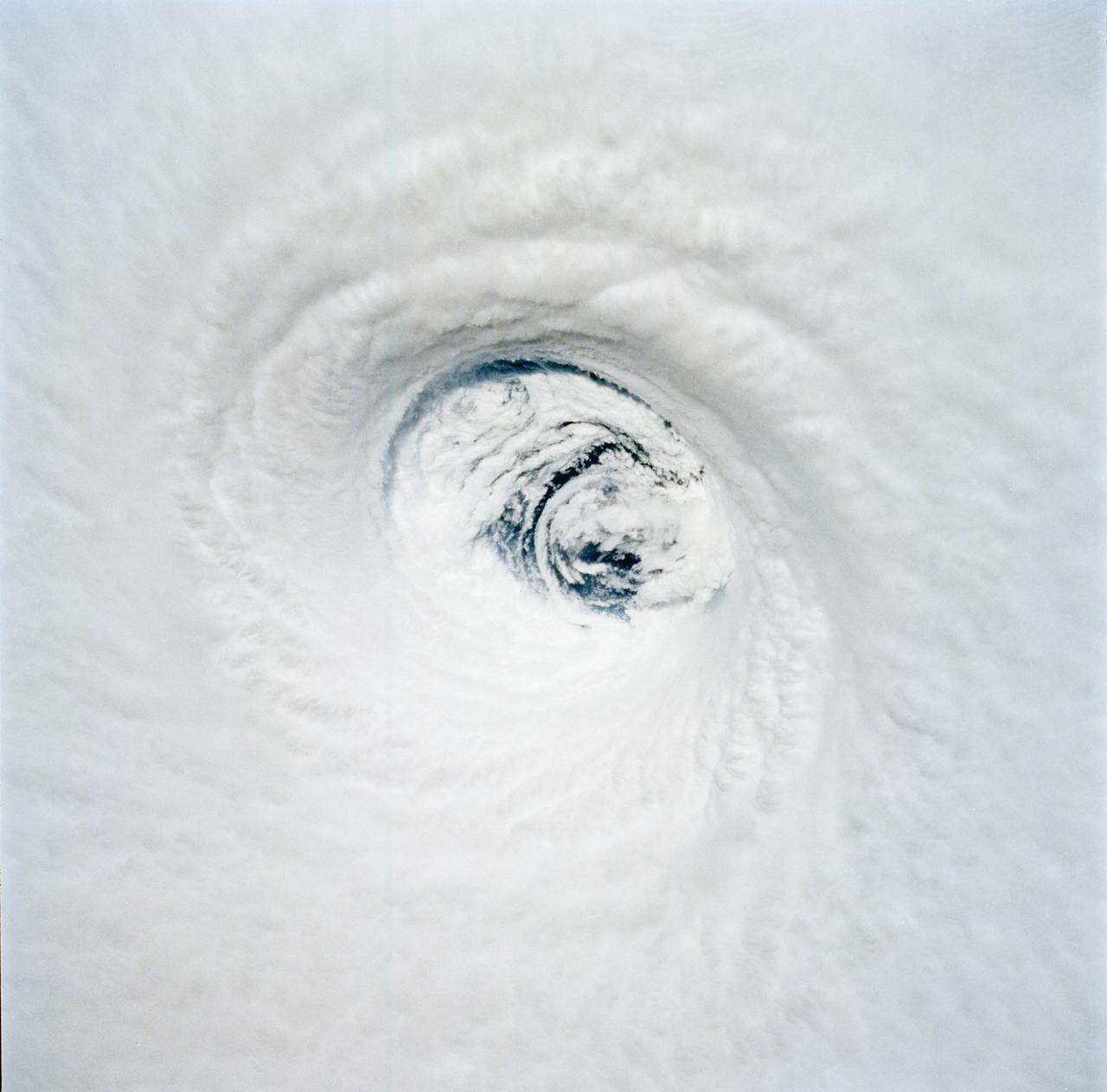
STS-65 Earth observation of Hurricane Emilia in Pacific Ocean was taken aboard Columbia, Orbiter Vehicle (OV) 102. This vertical view, photographed with a handheld 70mm camera, reveals the well-defined eye of the hurricane as it moves westerly several hundred miles southeast of the big island of Hawaii. Early in the flight the crew was able to observe the evolution of the storm and there was some concern that it might eventually head toward the Hawaiian Islands. Fortunately it did not.
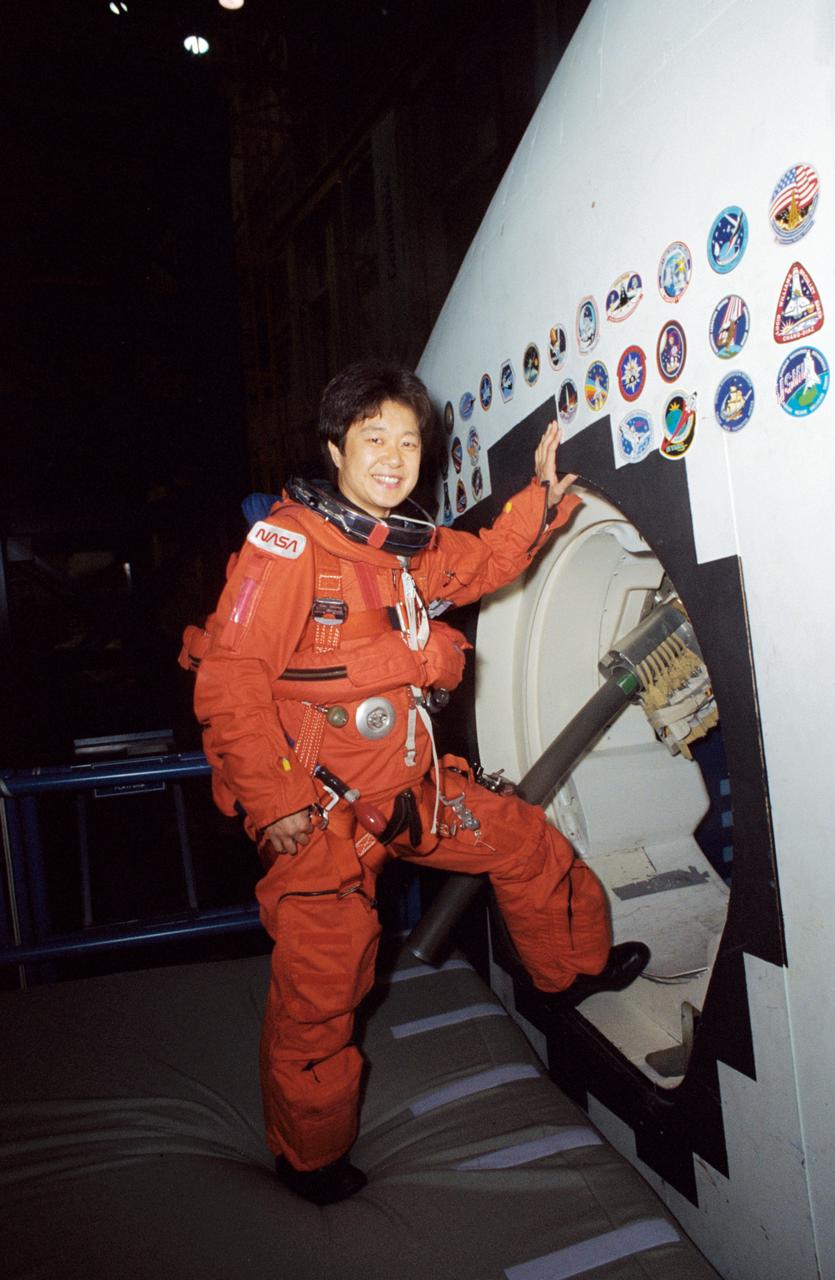
STS-65 Japanese Payload Specialist Chiaki Mukai takes a break from training at the Johnson Space Center (JSC). Wearing a training version of the orange launch and entry suit (LES), Mukai stands at the crew compartment trainer (CCT) side hatch in the Mockup and Integration Laboratory (MAIL) Bldg 9NE. Note the crew escape system (CES) pole device extending out the side hatch which would accommodate crewmembers in bailout from a troubled spacecraft. Mukai represents the National Space Development Agency (NASDA) of Japan and will serve as a payload specialist aboard Columbia, Orbiter Vehicle (OV) 102, during the STS-65 International Microgravity Laboratory 2 (IML-2) mission.
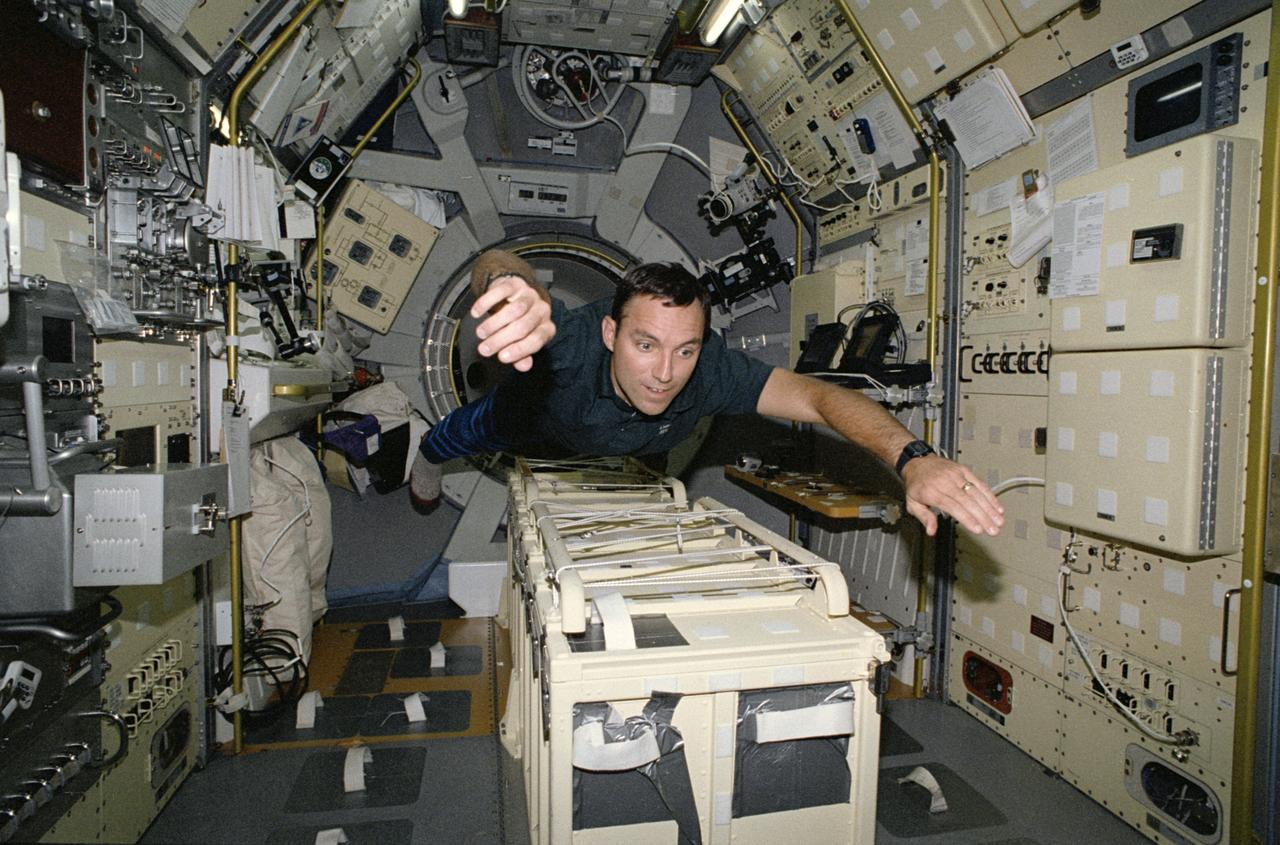
STS-65 Mission Specialist Carl E. Walz floats above center aisle equipment in the International Microgravity Laboratory 2 (IML-2) spacelab science module. Walz has just entered the IML-2 module via the spacelab tunnel (note hatch opening behind him). The tunnel connects the IML-2 module with Columbia's, Orbiter Vehicle (OV) 102's, crew compartment. Walz along with five other NASA astronauts and a Japanese payload specialist spent more than two weeks in Earth orbit conducting IML-2 experiments. This photo was among the first released by NASA following IML-2.
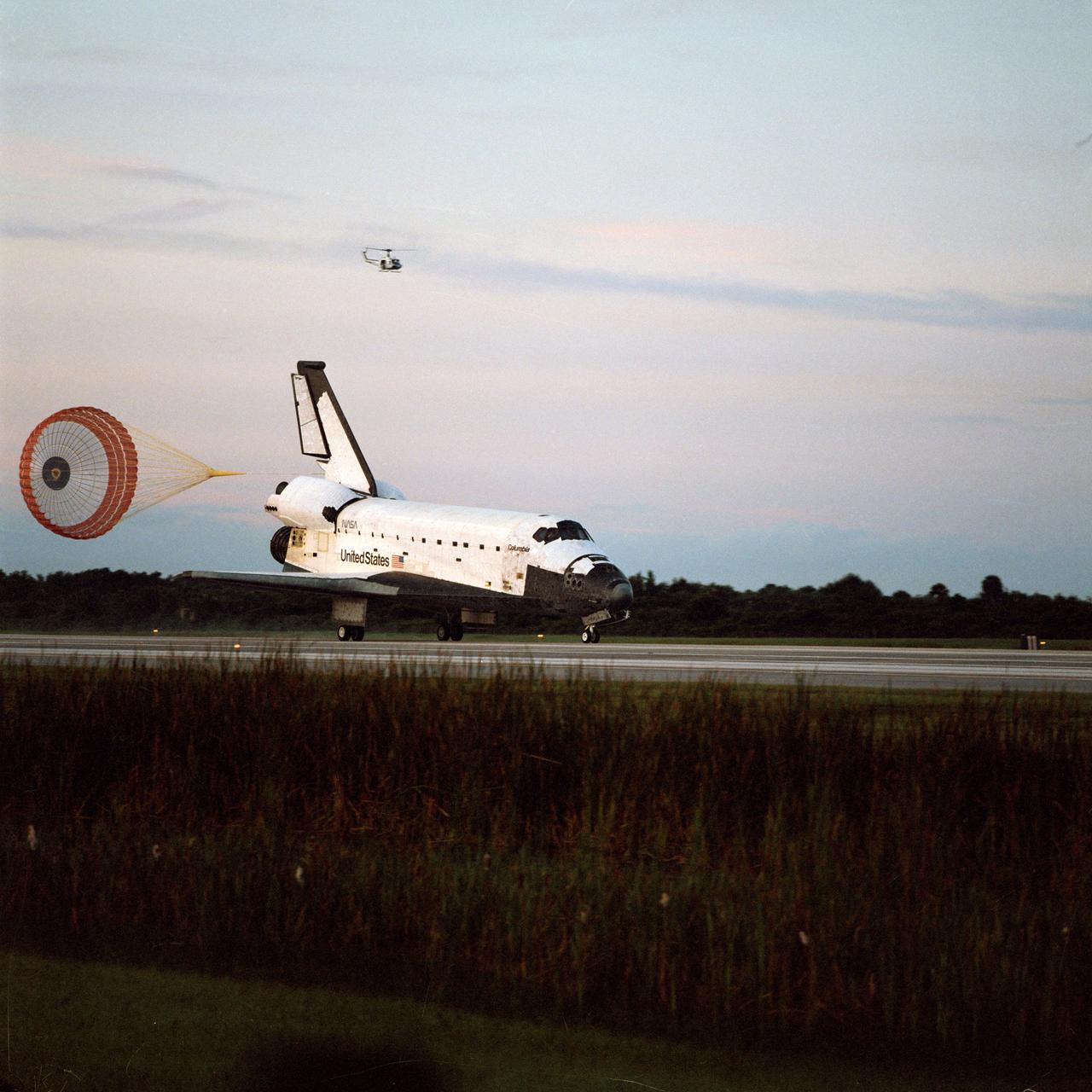
The Space Shuttle Columbia, Orbiter Vehicle (OV) 102, its drag chute fully deployed, completes a record duration mission as it lands on Runway 33 at the Kennedy Space Center (KSC) Shuttle Landing Facility (SLF). A helicopter flying overhead observes as OV-102's nose landing gear (NLG) and main landing gear (MLG) roll along the runway. Landing occurred at 6:38 am (Eastern Daylight Time (EDT)). STS-65 mission duration was 14 days 17 hours and 56 minutes. Onboard were six NASA astronauts and a Japanese payload specialist who conducted experiments in support of the International Microgravity Laboratory 2 (IML-2) during the mission.
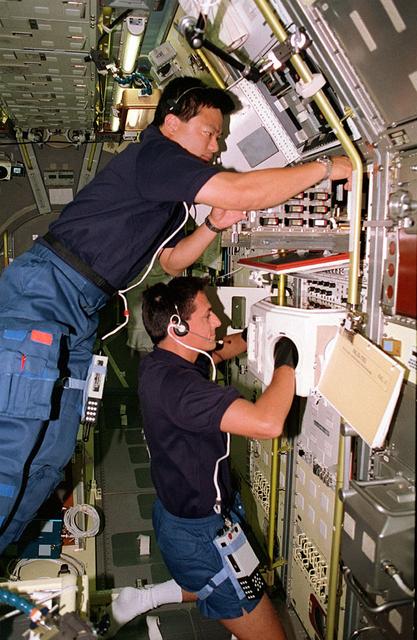
Onboard Space Shuttle Columbia (STS-65) Mission Specialist Leroy Chiao (top) and Mission Specialist Donald A. Thomas are seen at work in the International Microgravity Laboratory 2 (IML-2) spacelab science module. The two crewmembers are conducting experiments at the IML-2 Rack 5 Biorack (BR). Chiao places a sample in the BR incubator as Thomas handles another sample inside the BR glovebox. The glovebox is used to prepare samples for BR and slow rotating centrifuge microscope (NIZEMI) experiments.
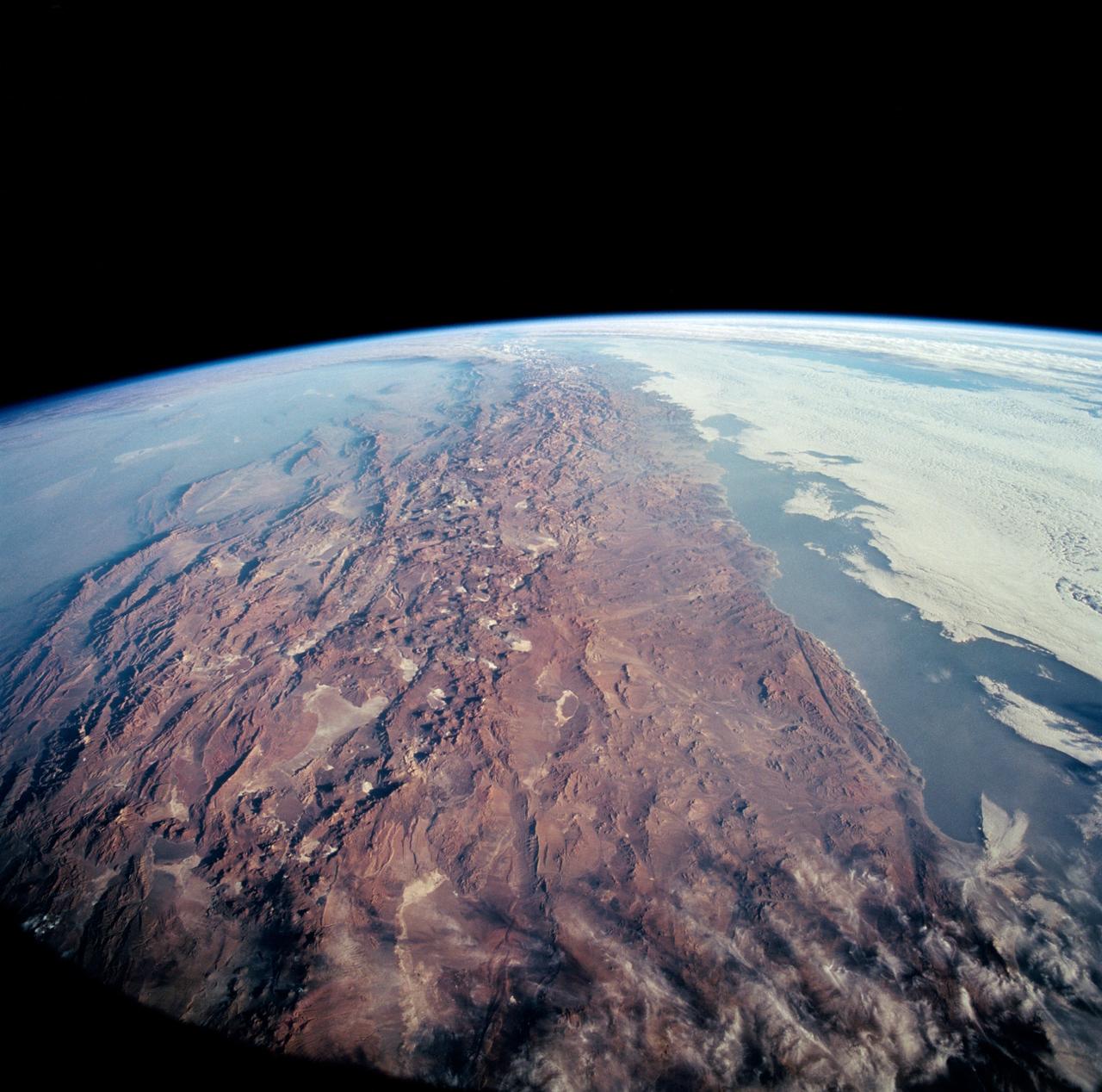
STS-65 Earth observation taken aboard Columbia, Orbiter Vehicle (OV) 102, shows Northern Chile and the Andes Mountains. This color photograph is a panoramic (southern view) that features Chile and the Andes Mountains of South America. The Atacama Desert, one of the driest regions on Earth, is clearly visible along the Chilean coast. In the near left foreground is the Salar de Arizaro. Salar Punta Negra in the center foreground appears to be partially filled with water. On the right side of the view, a coastal plateau rises from the Pacific Ocean and meets the Andes Mountains that appear as a backbone running north to south along the border of Chile and Argentina. In the distant left portion of the view can be seen the hazy Chaco Plains and Pampas.
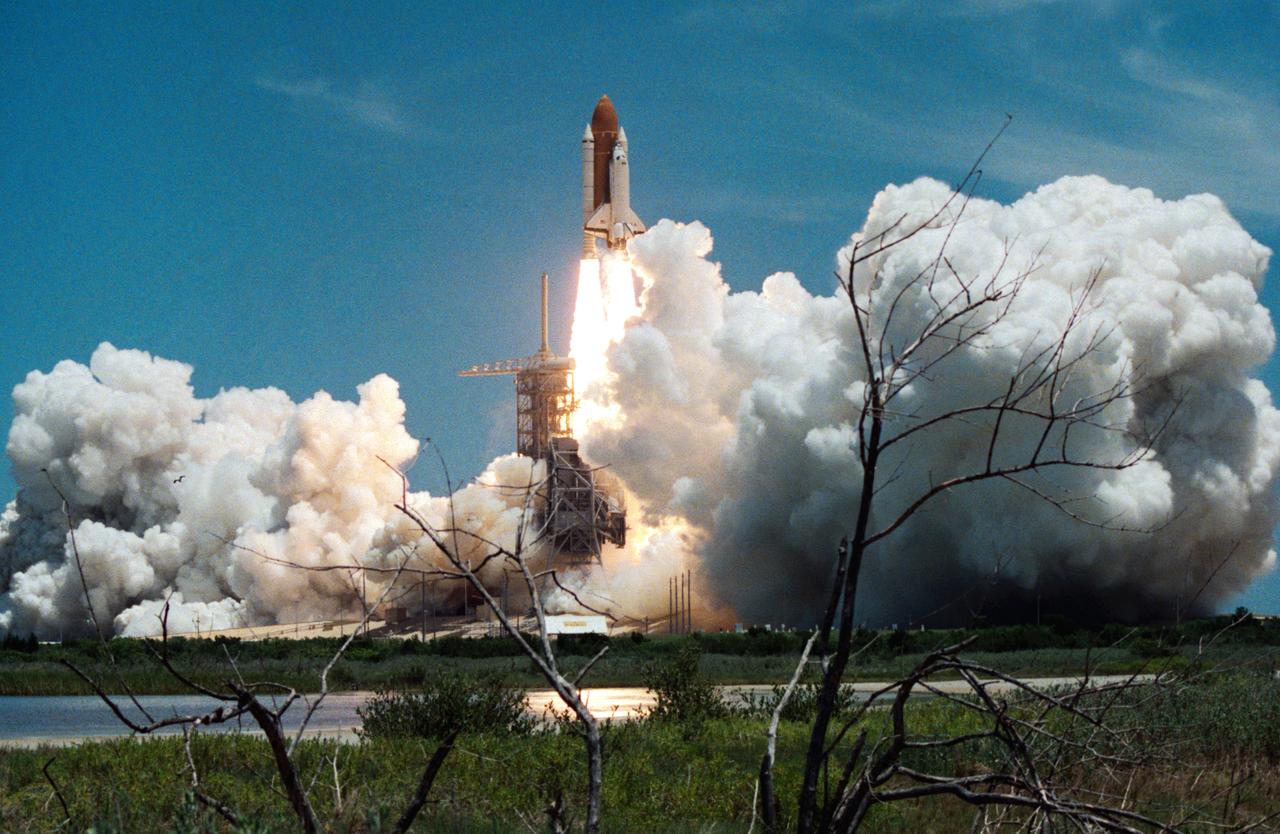
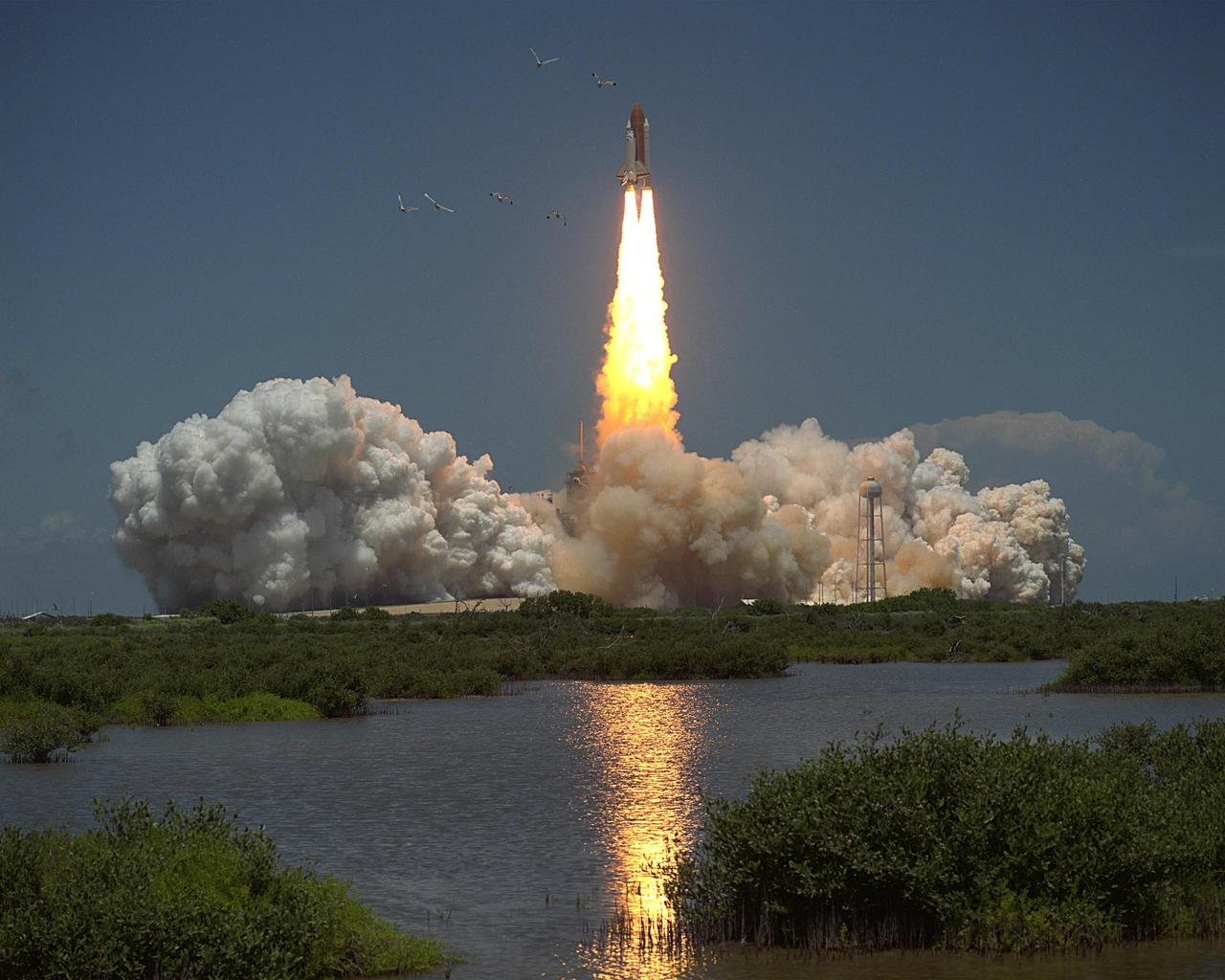
Columbia, Orbiter Vehicle (OV) 102, begins its roll maneuver after clearing the fixed service structure (FSS) tower as it rises above Kennedy Space Center (KSC) Launch Complex (LC) Pad 39A. In the foreground of this horizontal scene is Florida brush and a waterway. Beyond the brush, the shuttle's exhaust cloud envelops the immediate launch pad area. Launch occurred at 12:43 pm Eastern Daylight Time (EDT). The glow of the space shuttle main engine (SSME) and solid rocket booster (SRB) firings is reflected in the nearby waterway. Once in Earth orbit, STS-65's six NASA astronauts and a Japanese Payload Specialist aboard OV-102 will begin two weeks of experimentation in support of the second International Microgravity Laboratory (IML-2).
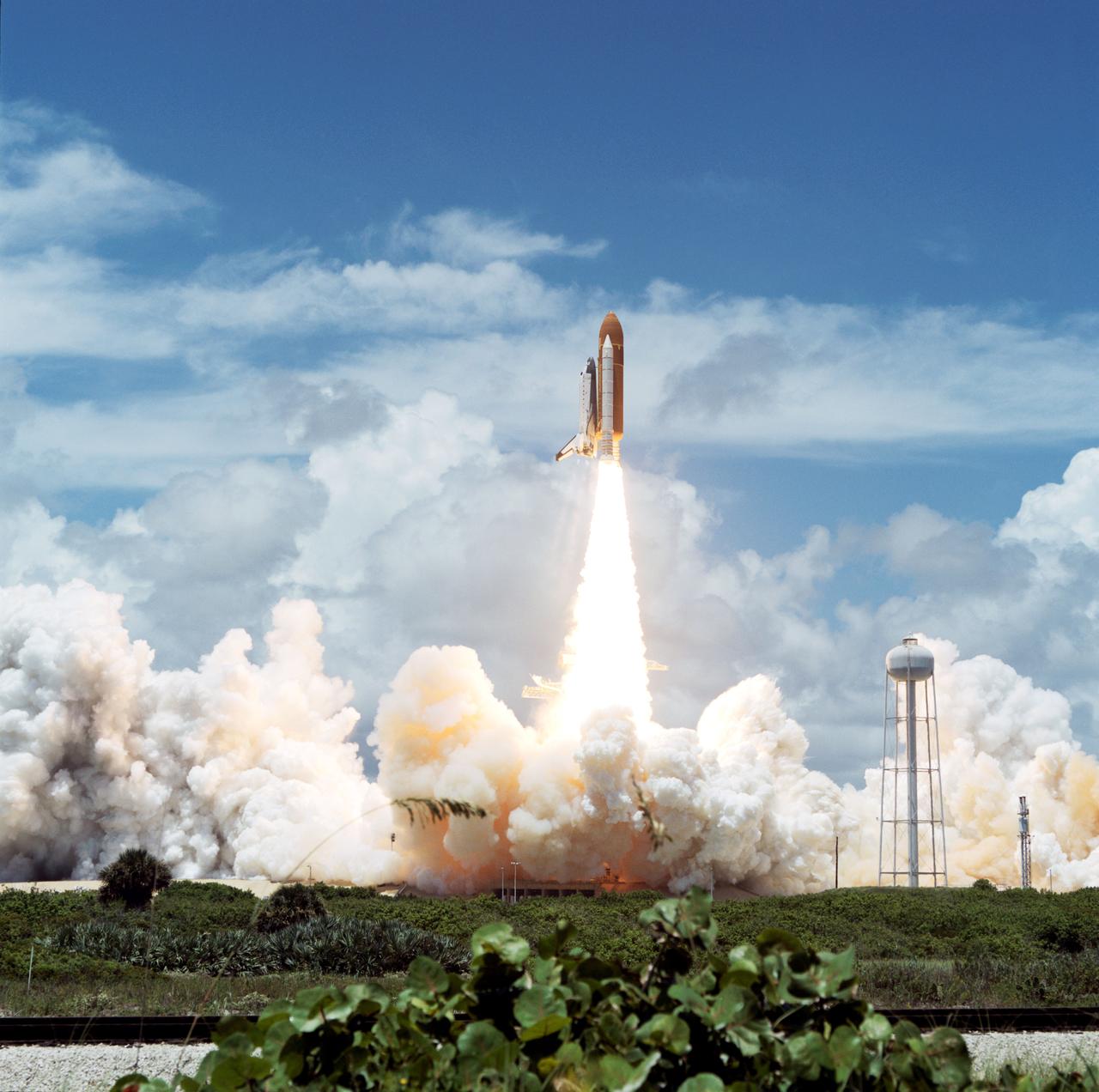
Columbia, Orbiter Vehicle (OV) 102, heads skyward after clearing the fixed service structure (FSS) tower at Kennedy Space Center (KSC) Launch Complex (LC) Pad 39A. Florida plant life appears in the foreground. The exhaust cloud produced by OV-102's solid rocket boosters (SRBs) covers the launch pad area with the exception of the sound suppression water system tower. OV-102's starboard side and the right SRB are visible from this angle. Launch occurred at 12:43 pm Eastern Daylight Time (EDT). Once in Earth orbit, STS-65's six NASA astronauts and a Japanese Payload Specialist aboard OV-102 will begin two weeks of experimentation in support of the second International Microgravity Laboratory (IML-2).
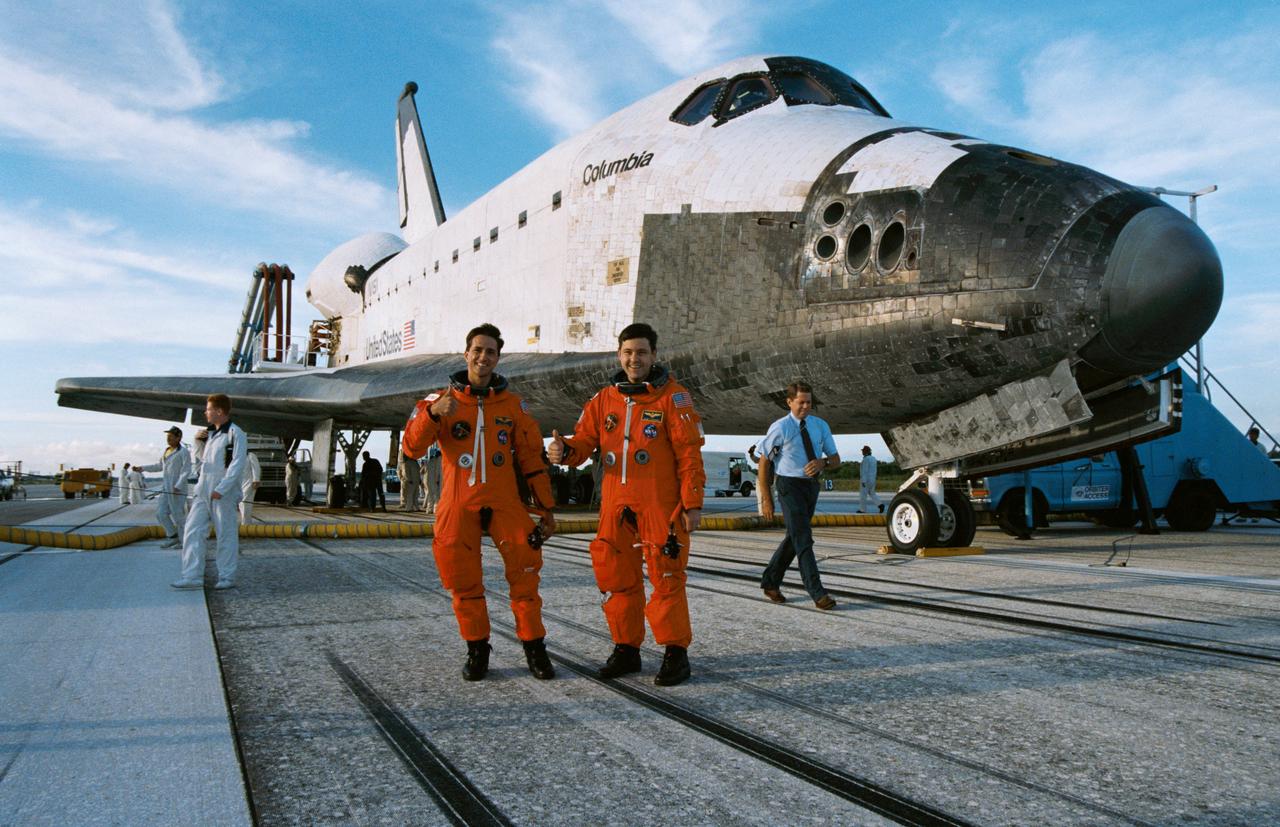
STS-65 Commander Robert D. Cabana (right) and Mission Specialist Donald A. Thomas, wearing launch and entry suits (LESs), signal mission success with a "thumbs up" gesture as they stand in front of Columbia, Orbiter Vehicle (OV) 102. The two crewmembers are all smiles after OV-102's landing at the Kennedy Space Center (KSC) Shuttle Landing Facility (SLF). The two, along with four other NASA astronauts and a Japanese payload specialist, had just broken a Shuttle duration record as they ran almost 18 hours over two weeks in space in support of the International Microgravity Laboratory 2 (IML-2) mission. Landing occurred at 6:38 am (Eastern Daylight Time (EDT)). Mission duration was 14 days, 17 hours and 56 minutes. In the background, KSC personnel conduct postflight servicing of the vehicle.
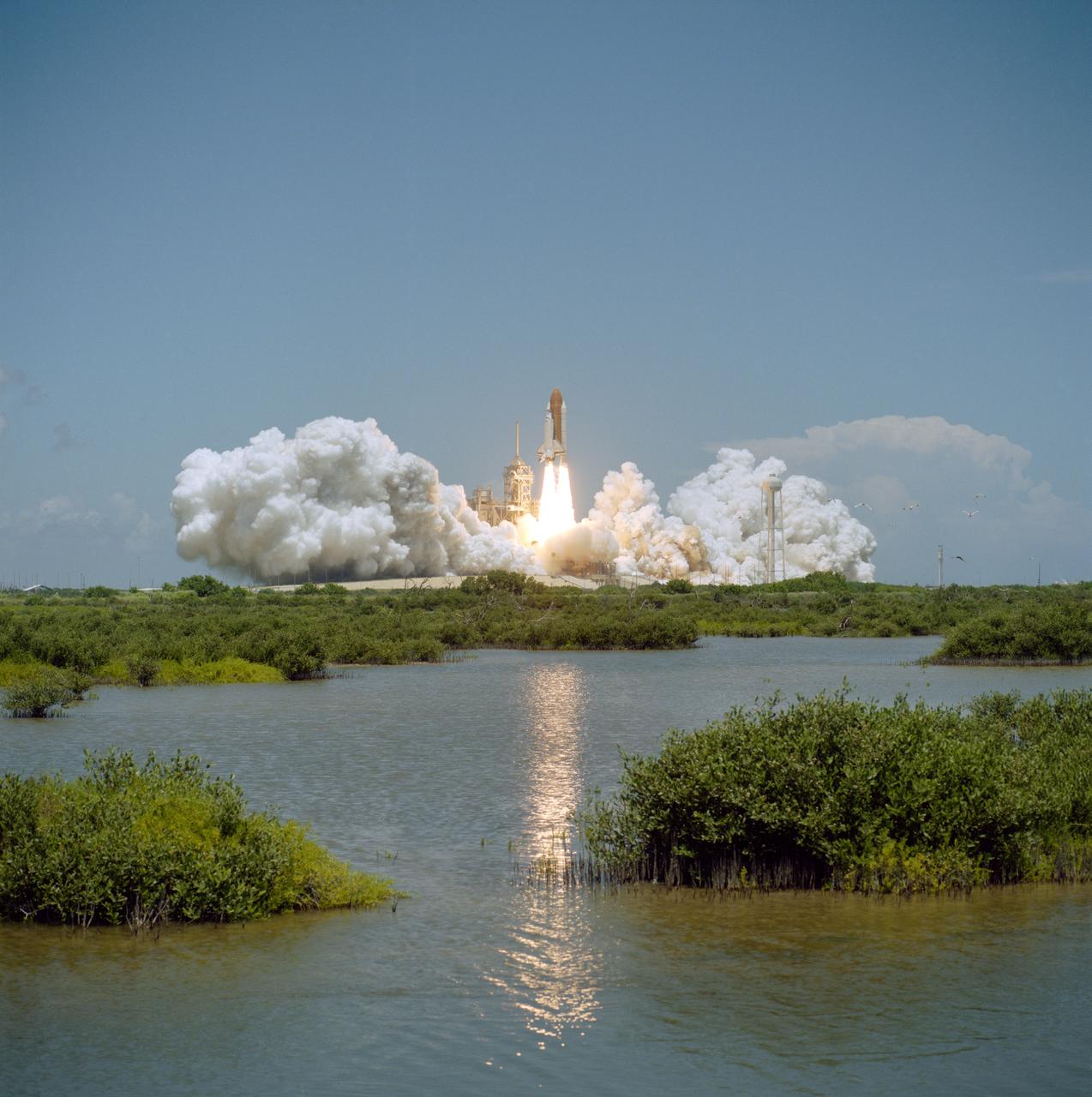
Columbia, Orbiter Vehicle (OV) 102, rises above Kennedy Space Center (KSC) Launch Complex (LC) Pad 39A after liftoff at 12:43 pm Eastern Daylight Time (EDT). An exhaust cloud covers the launch pad area and the glow of the space shuttle main engine (SSME) and solid rocket booster (SRB) firings is reflected in a nearby marsh as OV-102 atop its external tank (ET) heads toward Earth orbit. A small flock of birds is visible at the right. Once in Earth's orbit, STS-65's six NASA astronauts and a Japanese Payload Specialist aboard OV-102 will begin two weeks of experimentation in support of the second International Microgravity Laboratory (IML-2) mission.
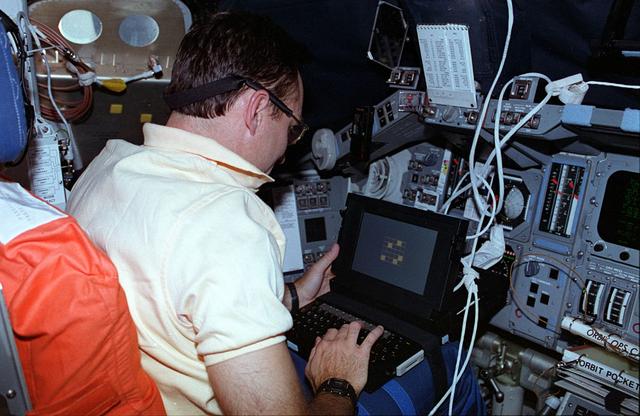
In this photograph, astronaut Carl Walz performs the Performance Assessment Workstation (PAWS) experiment at the flight deck of the Space Shuttle Orbiter Columbia during the STS-65 mission. Present day astronauts are subject to a variety of stresses during spaceflight. These include microgravity, physical isolation, confinement, lack of privacy, fatigue, and changing work/rest cycles. The purpose of this experiment is to determine the effects of microgravity upon thinking skills critical to the success of operational tasks in space. The principle objective is to distinguish between the effects of microgravity on specific information-processing skills affecting performance and those of fatigue caused by long work periods. To measure these skills, the investigators use a set of computerized performance tests called the Performance Assessment Workstation, which is based on current theoretical models of human performance. The tests were selected by analyzing tasks related to space missions and their hypothesized sensitivity to microgravity. Multiple subjective measures of cumulative fatigue and changing mood states are also included for interpreting performance data.
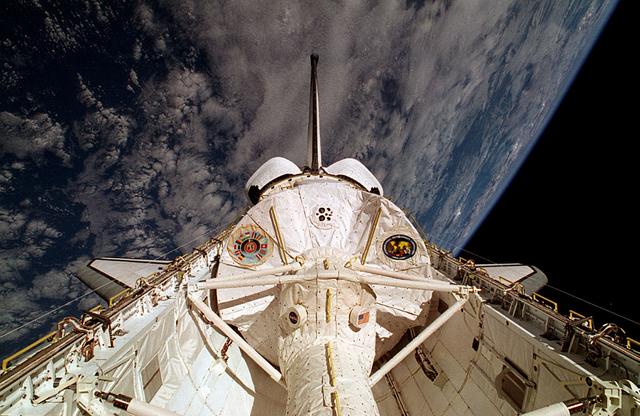
This is a Space Shuttle Columbia (STS-65) onboard photo of the second International Microgravity Laboratory (IML-2) in the cargo bay with Earth in the background. Mission objectives of IML-2 were to conduct science and technology investigations that required the low-gravity environment of space, with emphasis on experiments that studied the effects of microgravity on materials processes and living organisms. Materials science and life sciences are two of the most exciting areas of microgravity research because discoveries in these fields could greatly enhance the quality of life on Earth. If the structure of certain proteins can be determined by examining high-quality protein crystals grown in microgravity, advances can be made to improve the treatment of many human diseases. Electronic materials research in space may help us refine processes and make better products, such as computers, lasers, and other high-tech devices. The 14-nation European Space Agency (ESA), the Canadian Space Agency (SCA), the French National Center for Space Studies (CNES), the German Space Agency and the German Aerospace Research Establishment (DARA/DLR), and the National Space Development Agency of Japan (NASDA) participated in developing hardware and experiments for the IML missions. The missions were managed by NASA's Marshall Space Flight Center. The Orbiter Columbia was launched from the Kennedy Space Center on July 8, 1994 for the IML-2 mission.
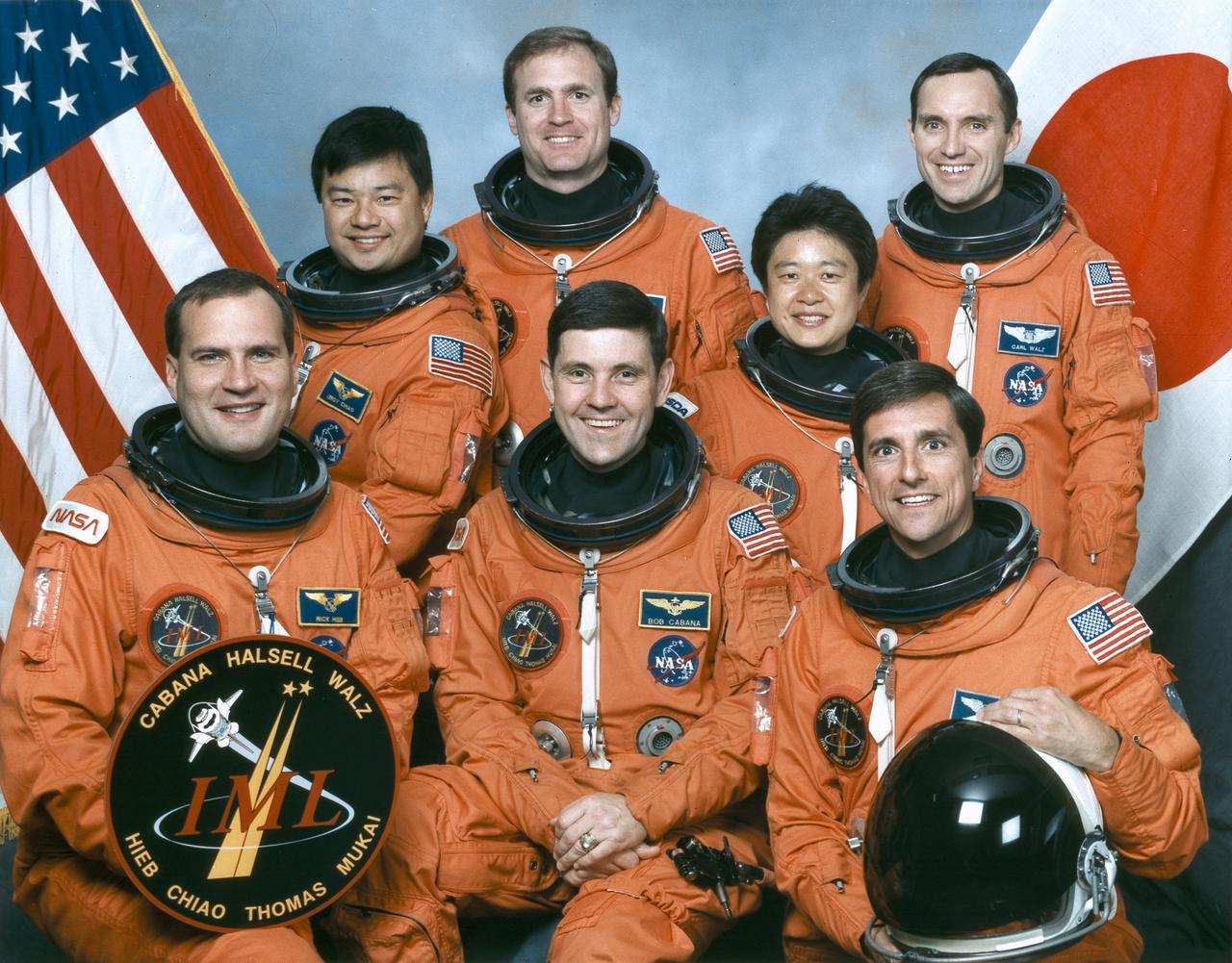
The crew assigned to the STS-65 mission included (seated left to right) Richard J. (Rick) Hieb, payload commander; Robert D. (Bob) Cabana, commander; and Donald A. Thomas, mission specialist. Standing, from left to right, are Leroy Chiao, mission specialist; James D. Halsell, pilot; Chiaki Naito-Mukai, payload specialist; and Carl E. Walz, mission specialist. Launched aboard the Space Shuttle Columbia on July 8, 1994 at 12:43:00 pm (EDT), the STS-64 mission marked the second flight of the International Microgravity Laboratory (IML-2) and the first flight of a female Japanese crew member.
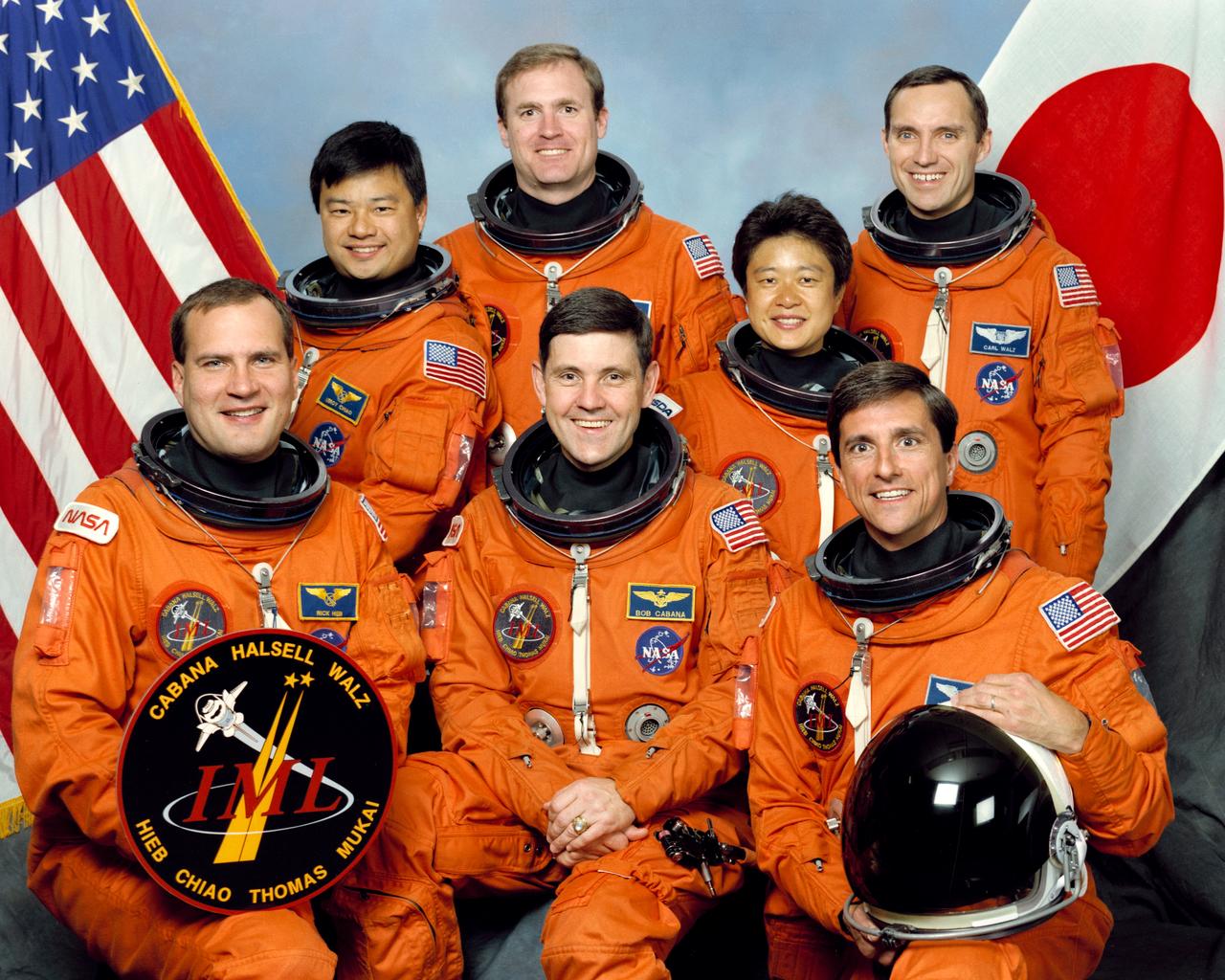
STS065-S-002 (April 1994) --- Six NASA astronauts and a Japanese payload specialist take a break from training to pose for their crew portrait. Left to right are Richard J. Hieb, Leroy Chiao, James D. Halsell Jr., Robert D. Cabana, Dr. Chiaki Mukai, Donald A. Thomas and Carl E. Walz. Cabana is mission commander, and Halsell has been assigned as pilot. Hieb is payload commander, with Walz, Thomas and Chiao serving as mission specialist. Dr. Mukai represents the National Space Development Agency (NASDA) of Japan as payload specialist on the International Microgravity Laboratory (IML) mission.
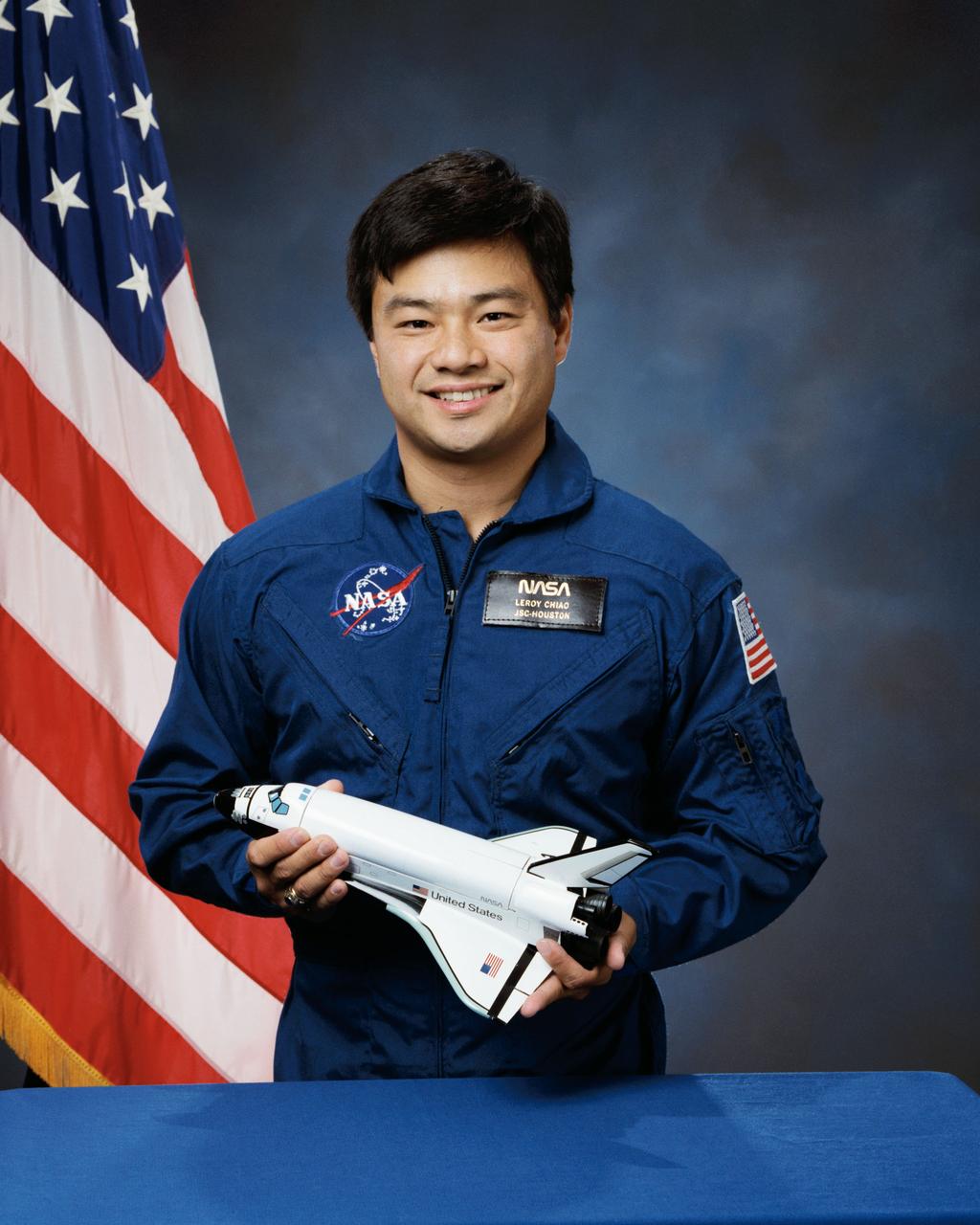
S90-45388 (August 1990) --- Astronaut Leroy Chiao, mission specialist.
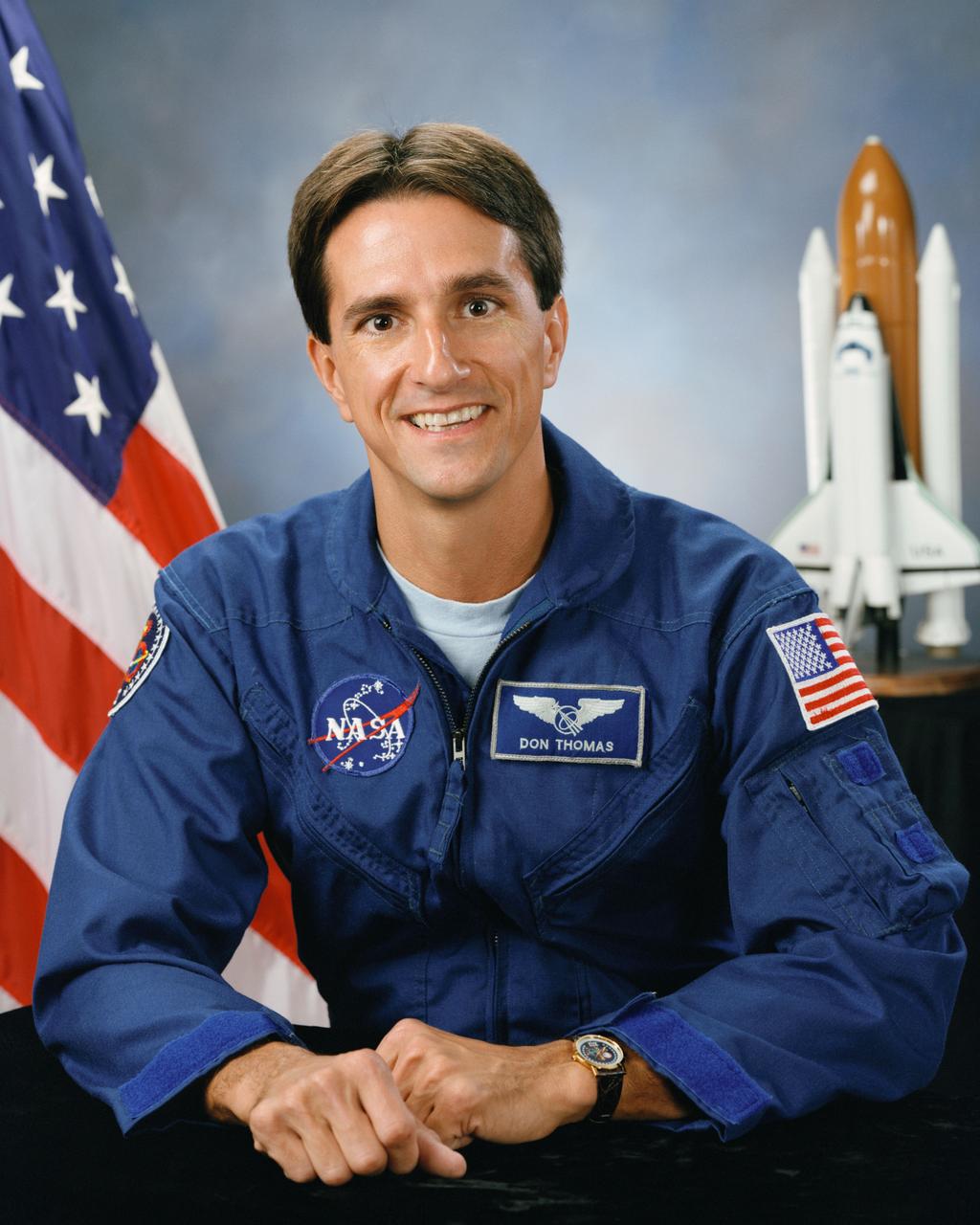
S91-48165 (3 Oct 1991) --- Astronaut Donald A. Thomas.
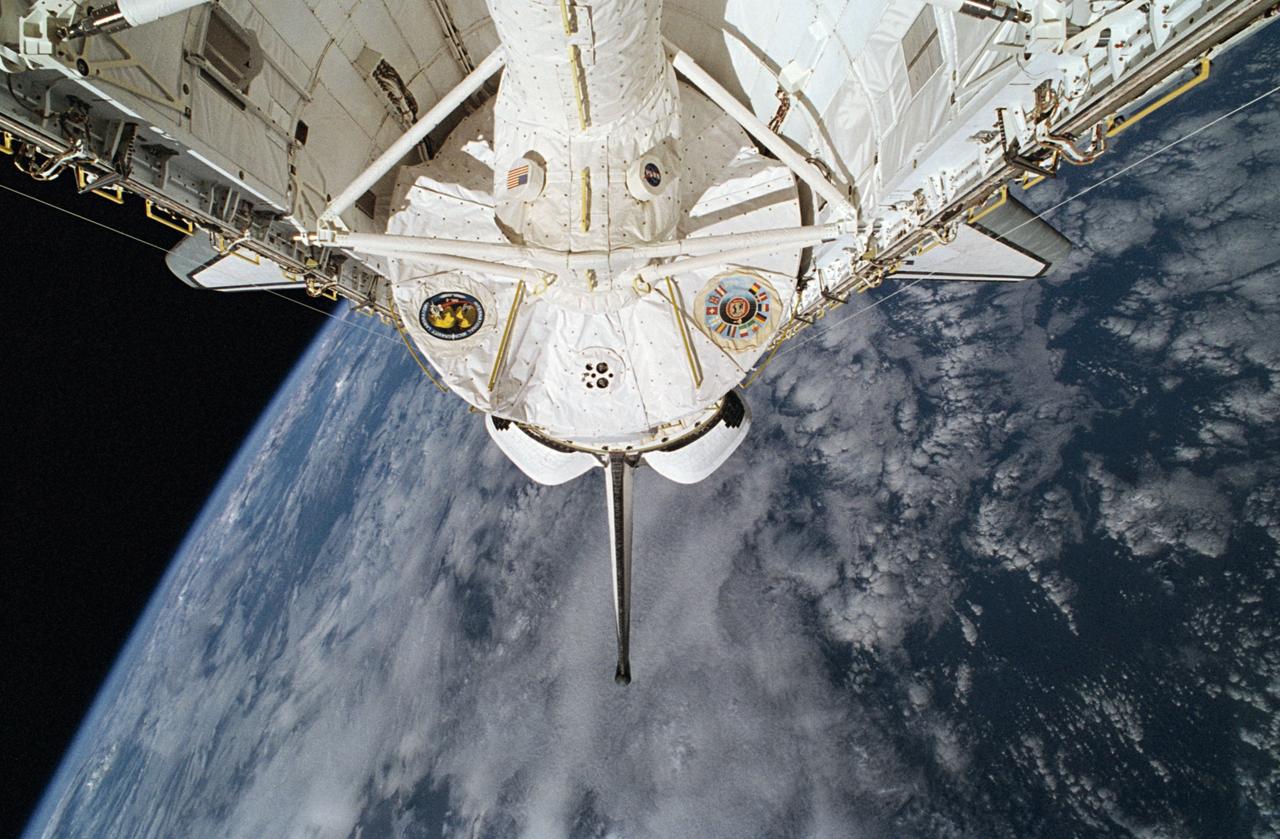
STS065-34-016 (8-23 July 1994) --- Clouds over the ocean form the backdrop for this scene of the International Microgravity Laboratory (IML-2) science module in the Space Shuttle Columbia's cargo bay during the two-week mission. Part of the tunnel that served as passageway for the seven crew members to and from the lab is seen in center foreground. Onboard Columbia were astronauts Robert D. Cabana, James D. Halsell, Jr., Richard J. Hieb, Carl E. Walz, Donald A. Thomas and Leroy Chiao, along with (NASDA) Japanese payload specialist Dr. Chiaki Naito-Mukai.
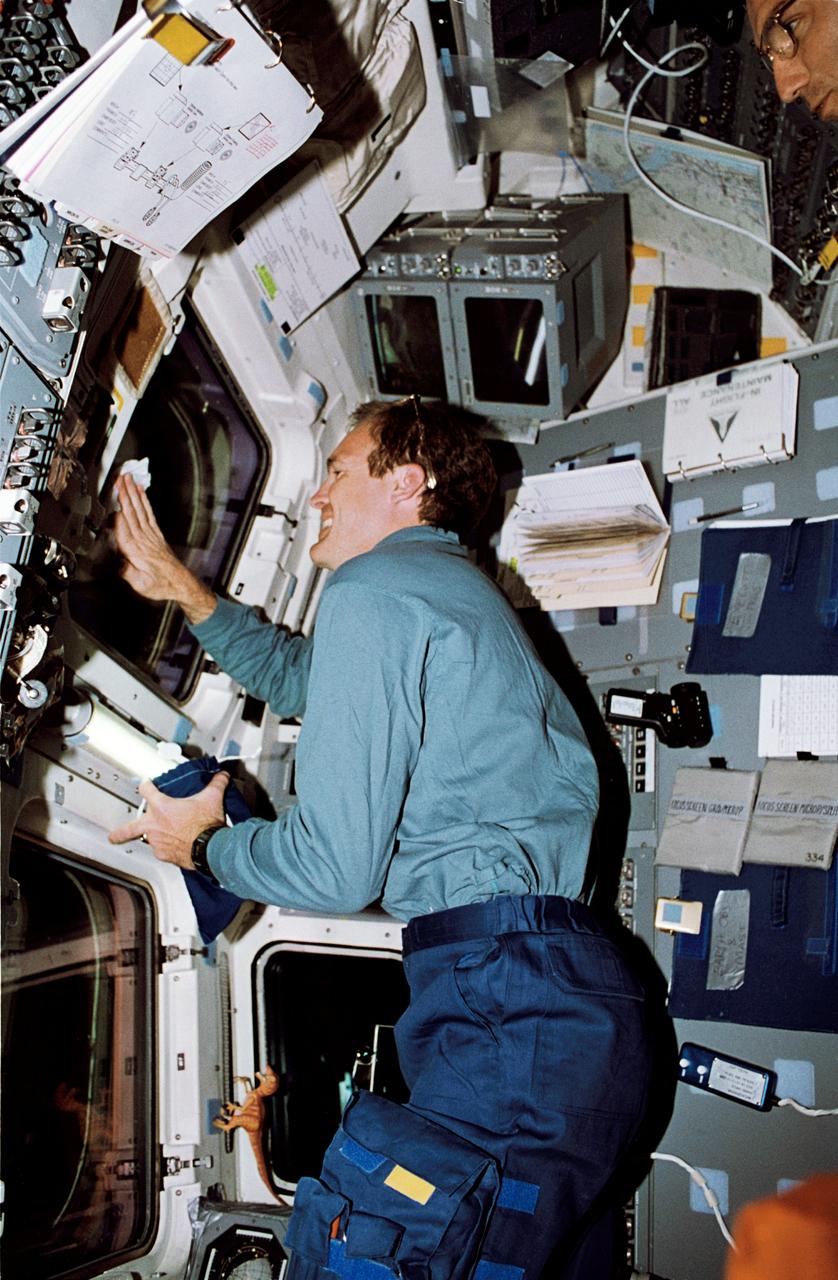
STS065-52-034 (8-23 July 1994) --- On the Space Shuttle Columbia's aft flight deck, astronaut James D. Halsel,l Jr., pilot, cleans off one of the overhead windows. Astronaut Carl E. Walz, mission specialist, looks on (photo's edge). The two shared over fourteen days in Earth-orbit with four other NASA astronauts and a Japanese payload specialist in support of the second International Microgravity Laboratory (IML-2) mission.
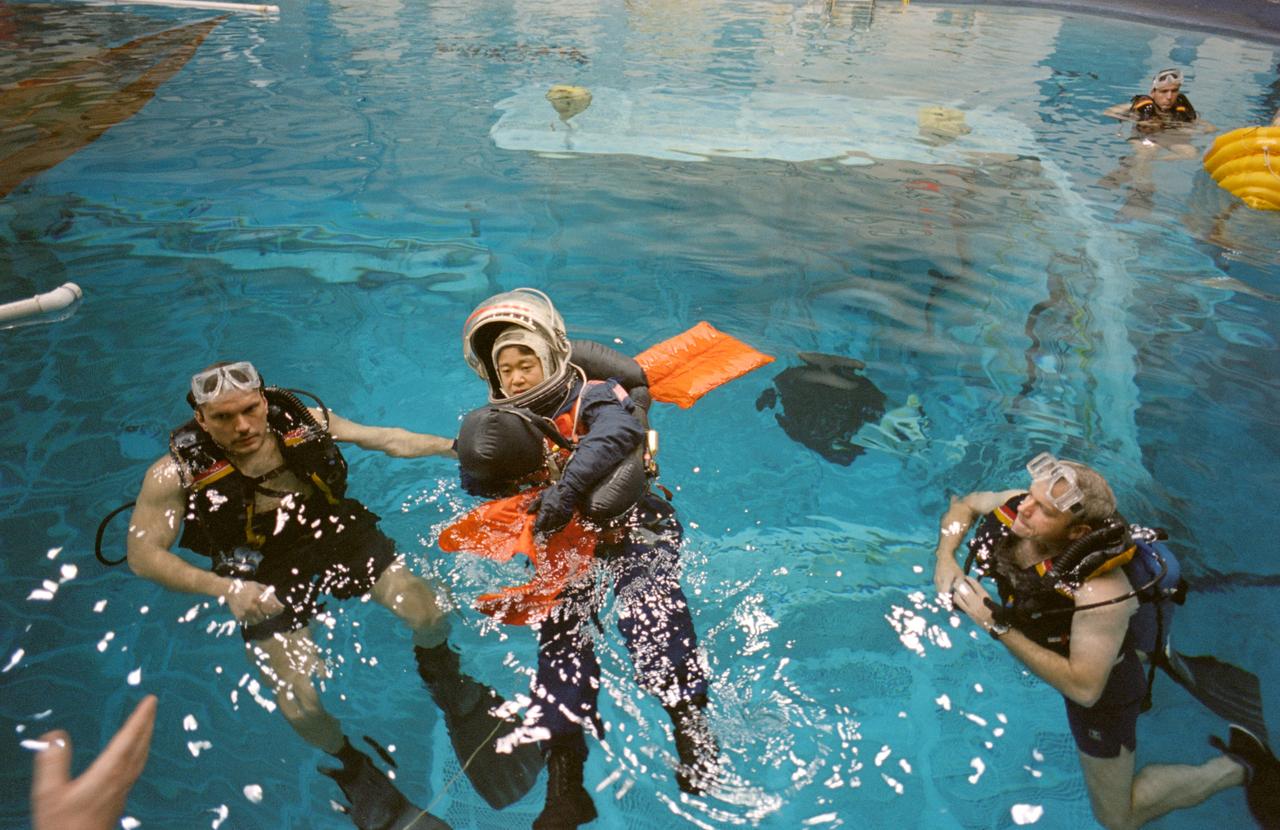
S94-29355 (28 Feb 1994) --- Dr. Chiaki Mukai, payload specialist, is assisted by a team of SCUBA-equipped divers during emergency egress training. The STS-65 crew was in the Weightless Environment Training Facility (WET-F) for the bailout training exercise. Dr. Mukai, representing the National Space Development Agency (NASDA), will join six NASA astronauts for the International Microgravity Laboratory (IML-2) mission aboard the Space Shuttle Columbia later this year.
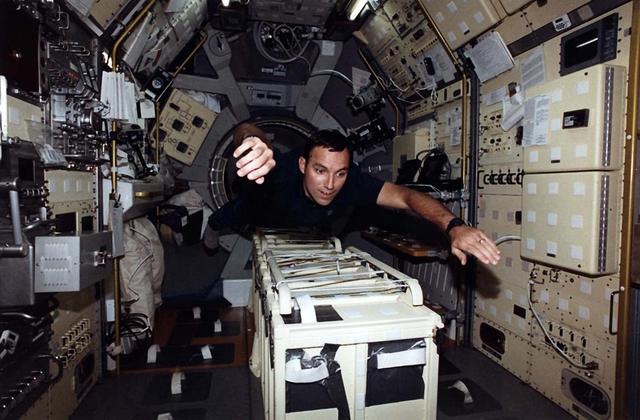
Astronaut Carl E. Walz, mission specialist, enters the International Microgravity Laboratory (IML-2) science module in the cargo bay via the turnel connecting it to Columbia's cabin. Walz joined five other NASA astronauts and a Japanese payload specialist for more than two weeks of experimenting in Earth orbit.
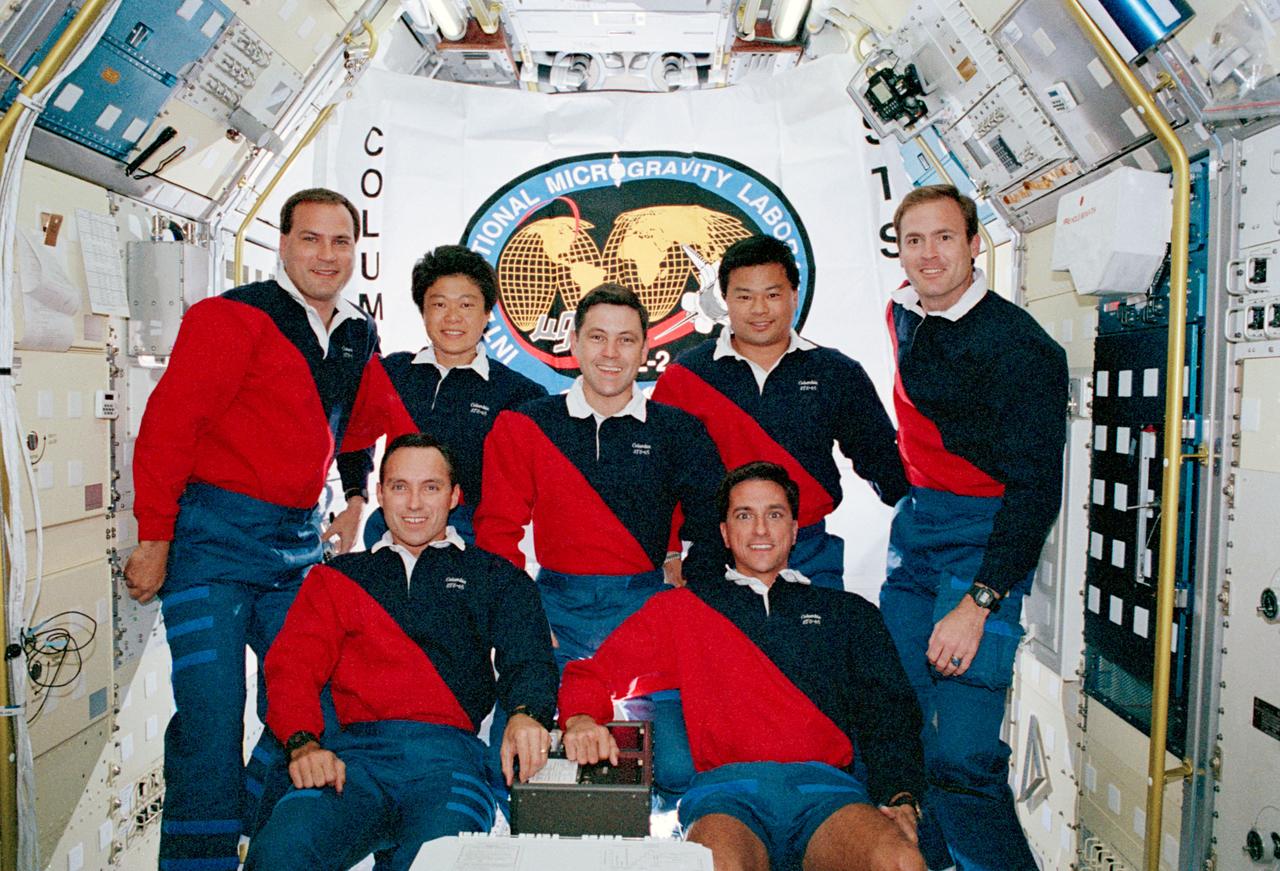
In the spacelab science module aboard the Space Shuttle Columbia, Orbiter Vehicle (OV) 102, the seven crewmembers pose for the traditional onboard (inflight) crew portrait. Displayed in the background is a flag with the International Microgravity Laboratory 2 (IML-2) insignia and Columbia inscribed along the edge. In the front row (left to right) are Mission Specialist (MS) Carl E. Walz and MS Donald A. Thomas. Behind them (left to right) are Payload Commander (PLC) Richard J. Hieb, Payload Specialist Chiaki Mukai, Commander Robert D. Cabana, MS Leroy Chiao, and Pilot James D. Halsell, Jr. Mukai represents the National Space Development Agency (NASDA) of Japan. Crewmembers are wearing their mission polo shirts for the portrait. Inside this module, the crew conducted experiments in support of the IML-2 mission.
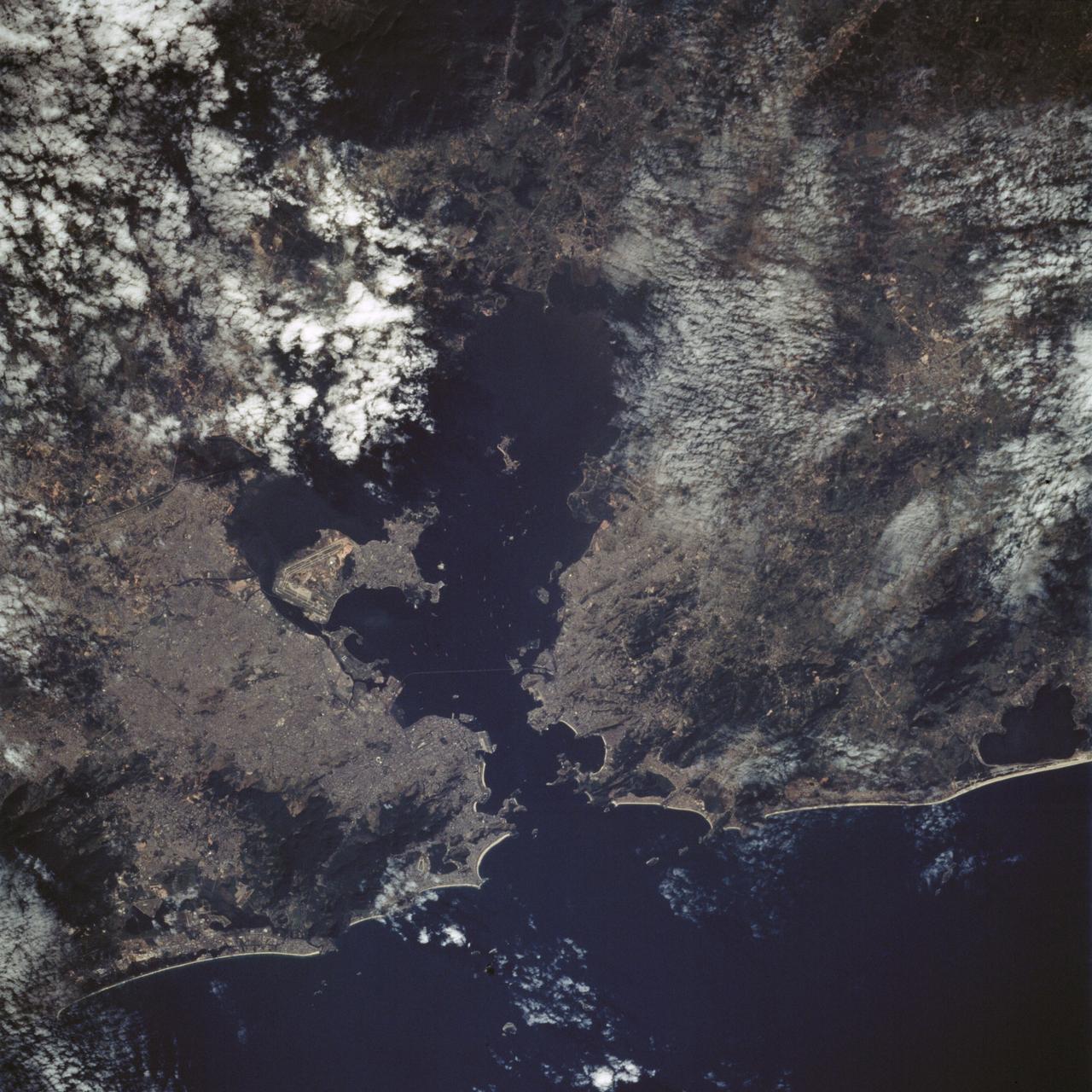
STS065-88-001 (8-23 July 1994) --- Rio de Janeiro, a port city in Brazil with a population of 11.6 million people, can be seen to the left of Governador Island in the Bay of Guanabara. Aeroporto Galeao is visible on the left, or western half of Governador Island. Below Governador Island is the Ponte Rio Niteroi bridge which connects the cities of Rio de Janeiro and Niteroi. Several ships can be seen in the Bay of Guanabara.
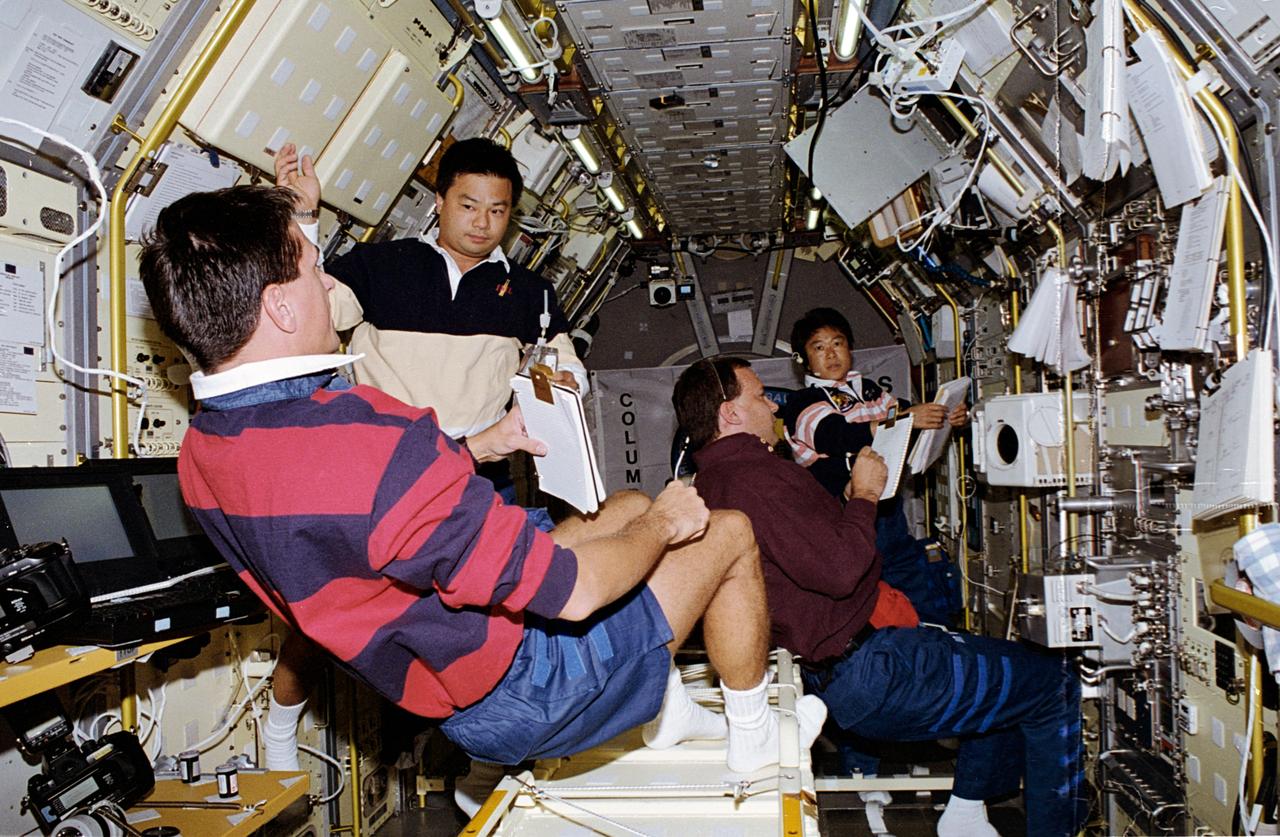
STS065-05-037 (8-23 July 1994) --- In the science module aboard the Space Shuttle Columbia, four members of the crew busy themselves with experiments in support of the second International Microgravity Laboratory (IML-2) mission. Left to right are Donald A. Thomas and Leroy Chiao, both mission specialists; Richard J. Hieb, payload commander, and Dr. Chiaki Mukai of NASDA, payload specialist.
KENNEDY SPACE CENTER, FLA. -- STS-65: Columbia
TEMPUS, an electromagnetic levitation facility that allows containerless processing of metallic samples in microgravity, first flew on the IML-2 Spacelab mission. The principle of electromagnetic levitation is used commonly in ground-based experiments to melt and then cool metallic melts below their freezing points without solidification occurring. The TEMPUS operation is controlled by its own microprocessor system; although commands may be sent remotely from the ground and real time adjustments may be made by the crew. Two video cameras, a two-color pyrometer for measuring sample temperatures, and a fast infrared detector for monitoring solidification spikes, will be mounted to the process chamber to facilitate observation and analysis. In addition, a dedicated high-resolution video camera can be attached to the TEMPUS to measure the sample volume precisely.
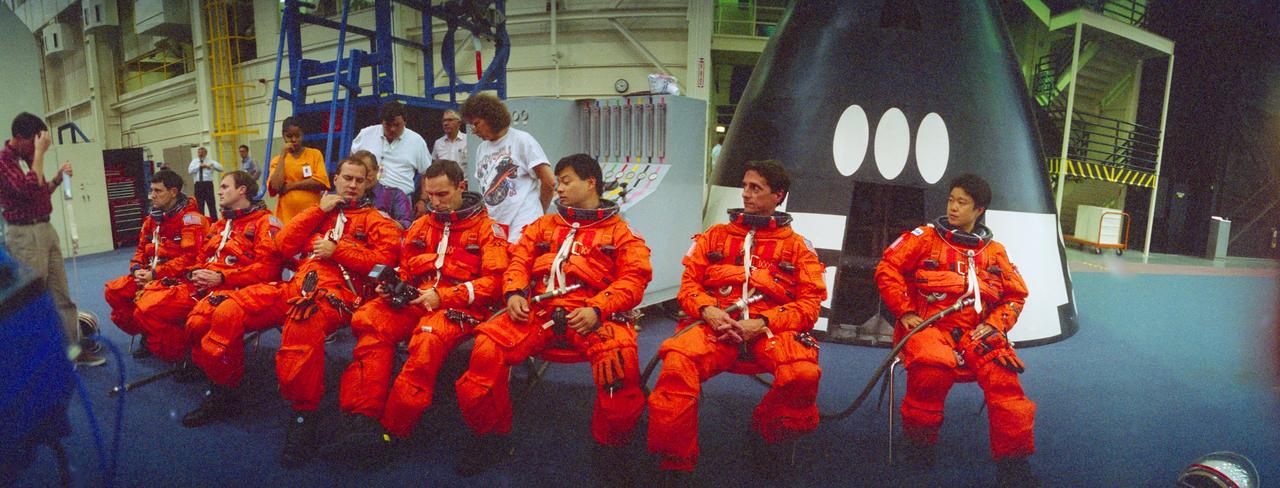
S94-31388 (25 Mar 1994) --- Six NASA astronauts and a Japanese payload specialist listen to a briefing by a crew training staffer. From the left are astronauts Robert D. Cabana, mission commander; James D. Halsell Jr., pilot; Richard J. Hieb, payload commander; and Carl E. Walz, Leroy Chiao and Donald A. Thomas, all mission specialists; along with Dr. Chiaki Mukai, payload specialist. Dr. Mukai represents the National Space Development Agency (NASDA) of Japan. The STS-65 crew was in the Johnson Space Center's (JSC) Shuttle mockup and integration laboratory for crew egress training. The full fuselage trainer, used for the rehearsals, is just out of frame. The seven-member crew will support the International Microgravity Laboratory (IML-2) mission aboard the Space Shuttle Columbia later this year.

S91-32691 (3 Mar 1991) --- Astronaut Carl E. Walz.
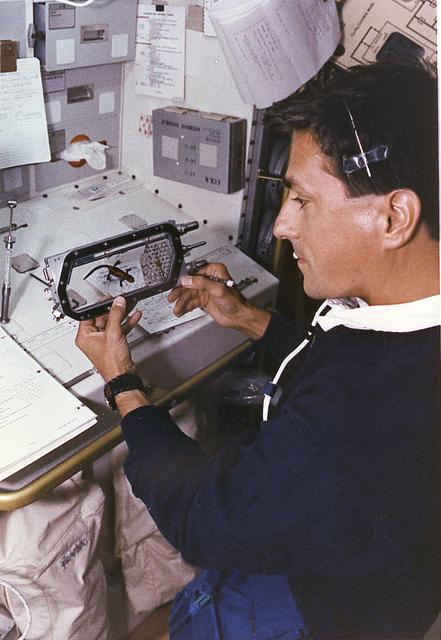
Astronaut Donald Thomas conducts the Fertilization and Embryonic Development of Japanese Newt in Space (AstroNewt) experiment at the Aquatic Animal Experiment Unit (AAEU) inside the International Microgravity Laboratory-2 (IML-2) science module. The AstroNewt experiment aims to know the effects of gravity on the early developmental process of fertilized eggs using a unique aquatic animal, the Japanese red-bellied newt. The newt egg is a large single cell at the begirning of development. The Japanese newt mates in spring and autumn. In late autumn, female newts enter hibernation with sperm in their body cavity and in spring lay eggs and fertilized them with the stored sperm. The experiment takes advantage of this feature of the newt. Groups of newts were sent to the Kennedy Space Center and kept in hibernation until the mission. The AAEU cassettes carried four newts aboard the Space Shuttle. Two newts in one cassette are treated by hormone injection on the ground to simulate egg laying. The other two newts are treated on orbit by the crew. The former group started maturization of eggs before launch. The effects of gravity on that early process were differentiated by comparison of the two groups. The IML-2 was the second in a series of Spacelab flights designed to conduct research by the international science community in a microgravity environment. Managed by the Marshall Space Flight Center, the IML-2 was launch on July 8, 1994 aboard the STS-65 Space Shuttle Orbiter Columbia mission.
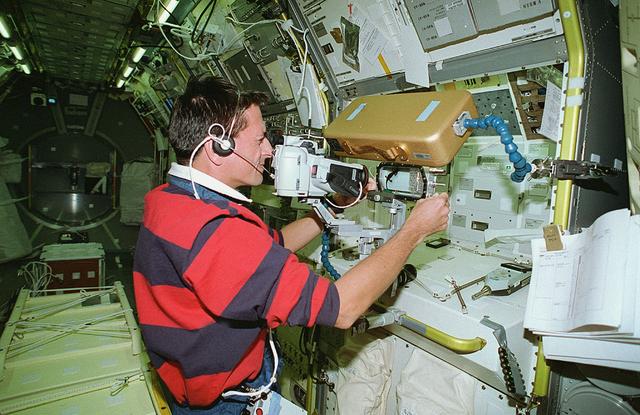
Astronaut Donald Thomas conducts the Fertilization and Embryonic Development of Japanese Newt in Space (AstroNewt) experiment at the Aquatic Animal Experiment Unit (AAEU) inside the International Microgravity Laboratory-2 (IML-2) science module. The AstroNewt experiment aims to know the effects of gravity on the early developmental process of fertilized eggs using a unique aquatic animal, the Japanese red-bellied newt. The newt egg is a large single cell at the begirning of development. The Japanese newt mates in spring and autumn. In late autumn, female newts enter hibernation with sperm in their body cavity and in spring lay eggs and fertilize them with the stored sperm. The experiment takes advantage of this feature of the newt. Groups of newts were sent to the Kennedy Space Center and kept in hibernation until the mission. The AAEU cassettes carried four newts aboard the Space Shuttle. Two newts in one cassette are treated by hormone injection on the ground to simulate egg laying. The other two newts are treated on orbit by the crew. The former group started maturization of eggs before launch. The effects of gravity on that early process were differentiated by comparison of the two groups. The IML-2 was the second in a series of Spacelab flights designed to conduct research by the international science community in a microgravity environment. Managed by the Marshall Space Flight Center, the IML-2 was launched on July 8, 1994 aboard the STS-65 Space Shuttle mission, Orbiter Columbia.
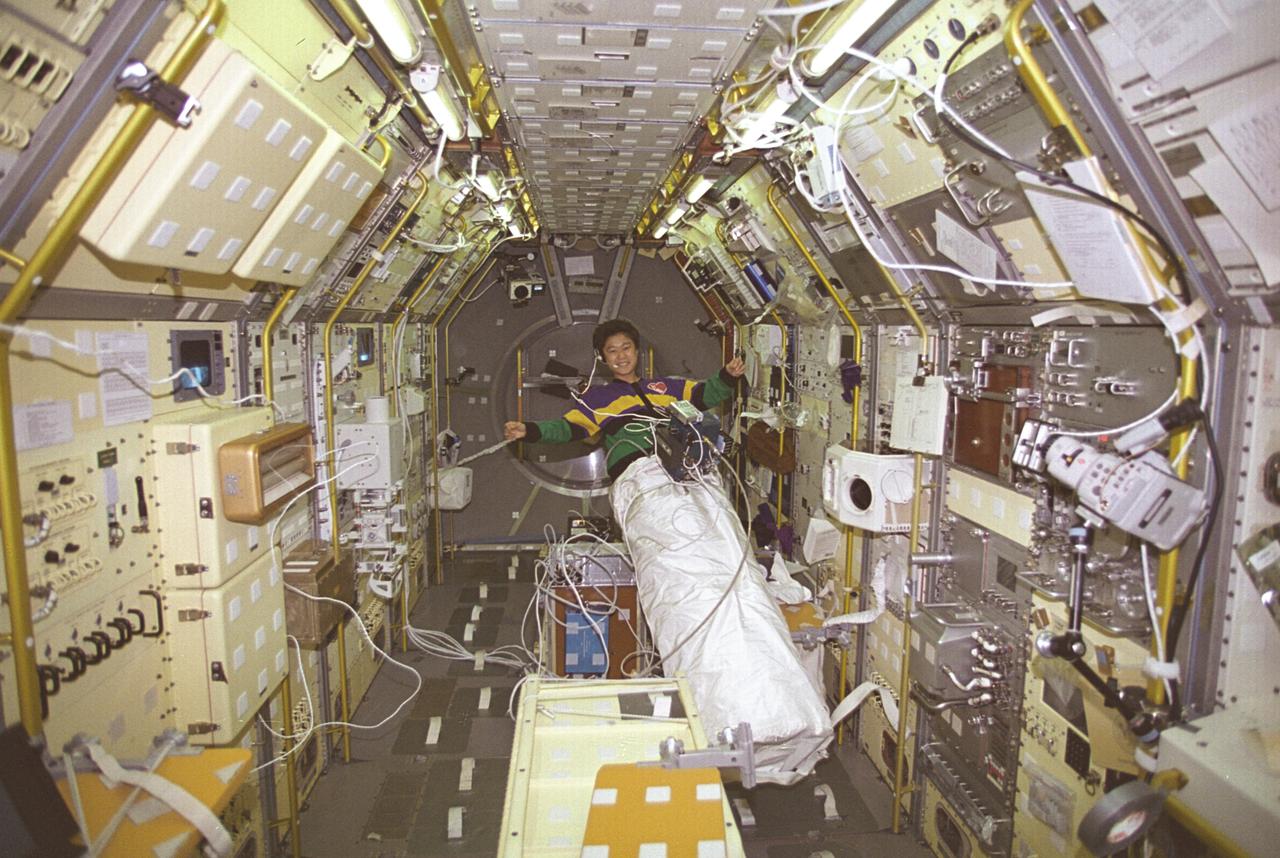
Astronaut Chiaki Mukai conducts the Lower Body Negative Pressure (LBNP) experiment inside the International Microgravity Laboratory-2 (IML-2) mission science module. Dr. Chiaki Mukai is one of the National Space Development Agency of Japan (NASDA) astronauts chosen by NASA as a payload specialist (PS). She was the second NASDA PS who flew aboard the Space Shuttle, and was the first female astronaut in Asia. When humans go into space, the lack of gravity causes many changes in the body. One change is that fluids normally kept in the lower body by gravity shift upward to the head and chest. This is why astronauts' faces appear chubby or puffy. The change in fluid volume also affects the heart. The reduced fluid volume means that there is less blood to circulate through the body. Crewmembers may experience reduced blood flow to the brain when returning to Earth. This leads to fainting or near-fainting episodes. With the use of the LBNP to simulate the pull of gravity in conjunction with fluids, salt tablets can recondition the cardiovascular system. This treatment, called "soak," is effective up to 24 hours. The LBNP uses a three-layer collapsible cylinder that seals around the crewmember's waist which simulates the effects of gravity and helps pull fluids into the lower body. The data collected will be analyzed to determine physiological changes in the crewmembers and effectiveness of the treatment. The IML-2 was the second in a series of Spacelab flights designed by the international science community to conduct research in a microgravity environment Managed by the Marshall Space Flight Center, the IML-2 was launched on July 8, 1994 aboard the STS-65 Space Shuttle Orbiter Columbia mission.
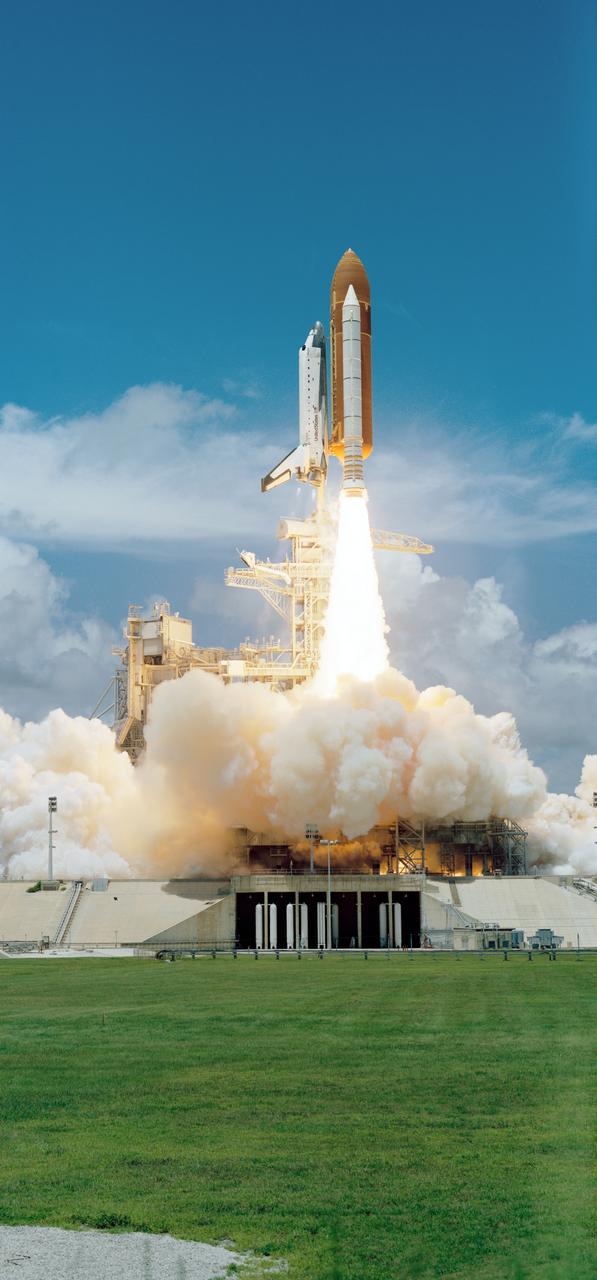
STS065-S-048 (8 July 1994) --- The Space Shuttle Columbia, with six NASA astronauts and a Japanese payload specialist aboard, heads toward Earth-orbit. A short time later, the crew began setting up the science module for two weeks of experimentation in support of the second International Microgravity Laboratory (IML-2). Launch occurred at 12:43 p.m. (EDT), July 8, 1994. Onboard were astronauts Robert D. Cabana, James D. Halsell, Jr., Richard J. Hieb, Carl E. Walz, Leroy Chiao, and Donald A. Thomas along with NASDA payload specialist Dr. Chiaki Mukai.

STS065-214-037 (8-23 July 1994) --- Ready to begin one of her busy twelve hour shifts, payload specialist Dr. Chiaki Naito-Mukai enters the International Microgravity Laboratory (IML-2) science module in the cargo bay via the tunnel connecting it to the Space Shuttle Columbia's cabin. Dr. Mukai joined six NASA astronauts for more than two weeks of experimenting in Earth orbit. This photo was among the first released by NASA following IML-2. Also onboard were NASA astronauts Robert D. Cabana, James D. Halsell, Jr., Richard J. Hieb, Carl E. Walz, Donald A. Thomas and Leroy Chiao. Dr. Mukai represented the National Space Development Agency (NASDA) of Japan.
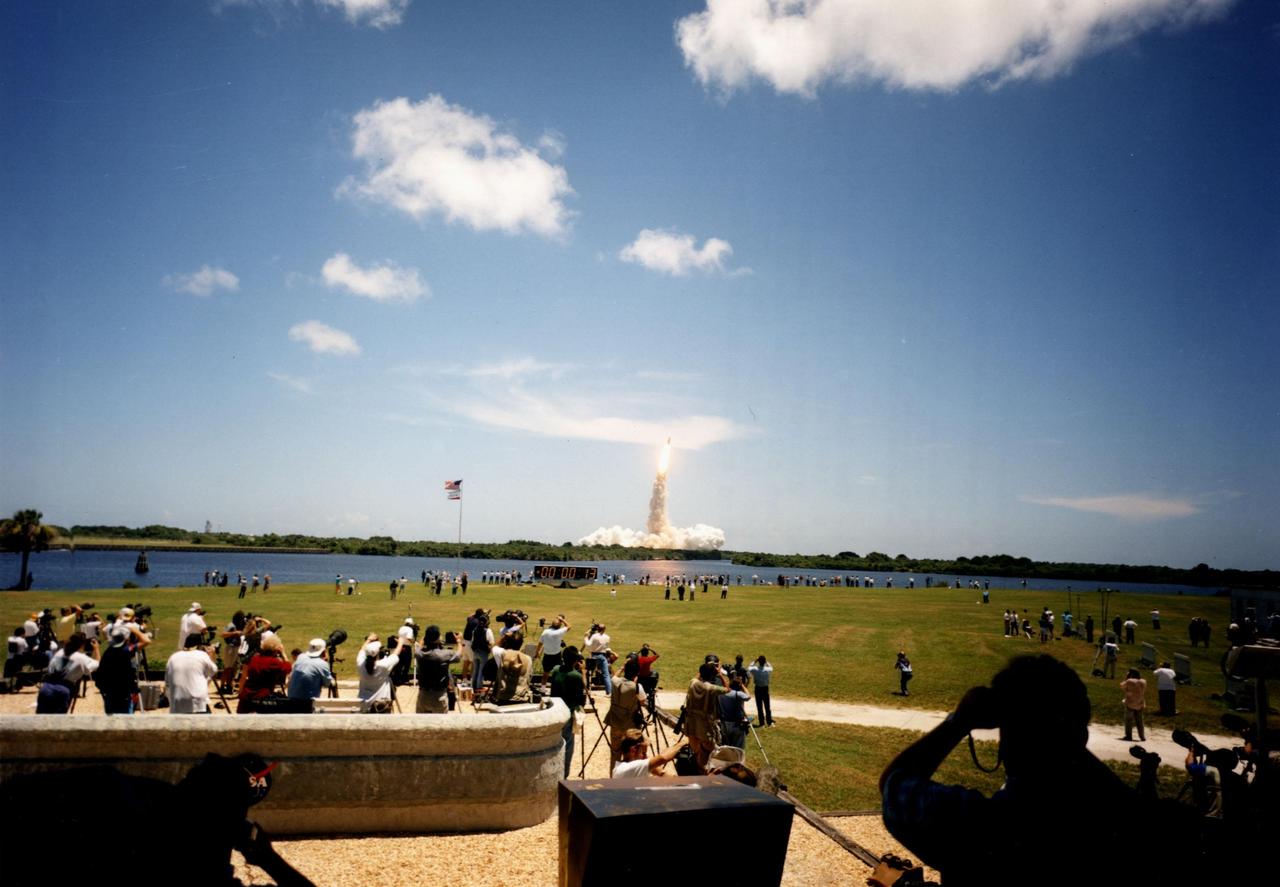
KENNEDY SPACE CENTER, FLA. -- The Space Shuttle Columbia lifts off from Launch Pad 39A on July 8, 1994 at 12:43 p.m. EDT to begin the 14-day STS-65/Internatinal Microgravity Laboratory-2 (IML-2) mission. The mission countdown clock also can be seen, giving the time into the mission after liftoff. The STS-65 mission is scheduled to end with a landing at KSC's Shuttle Landing Facility
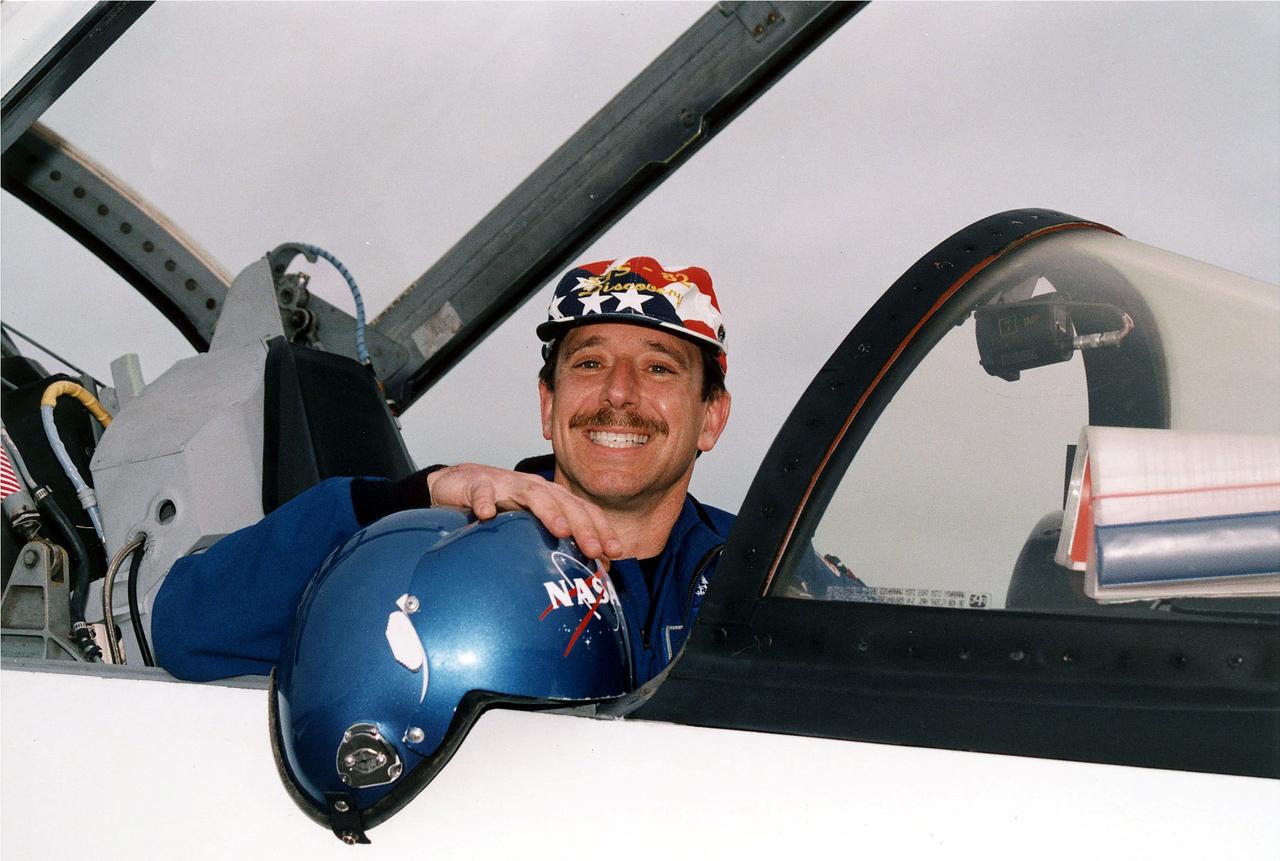
KENNEDY SPACE CENTER, FLA. - STS-82 Pilot Scott J. "Doc" Horowitz flashes a wide grin for photographers after landing his T-38 jet at KSC's Shuttle Landing Facility. Horowitz and the other six members of the STS-82 crew came from their home base at Johnson Space Center in Houston, Texas, to spend the last few days before launch at KSC. STS-82 is scheduled for liftoff on Feb. 11 during a 65-minute launch window that opens at 3:56 a.m. EST. The 10-day flight aboard the Space Shuttle Discovery will be the second Hubble Space Telescope (HST) servicing mission.
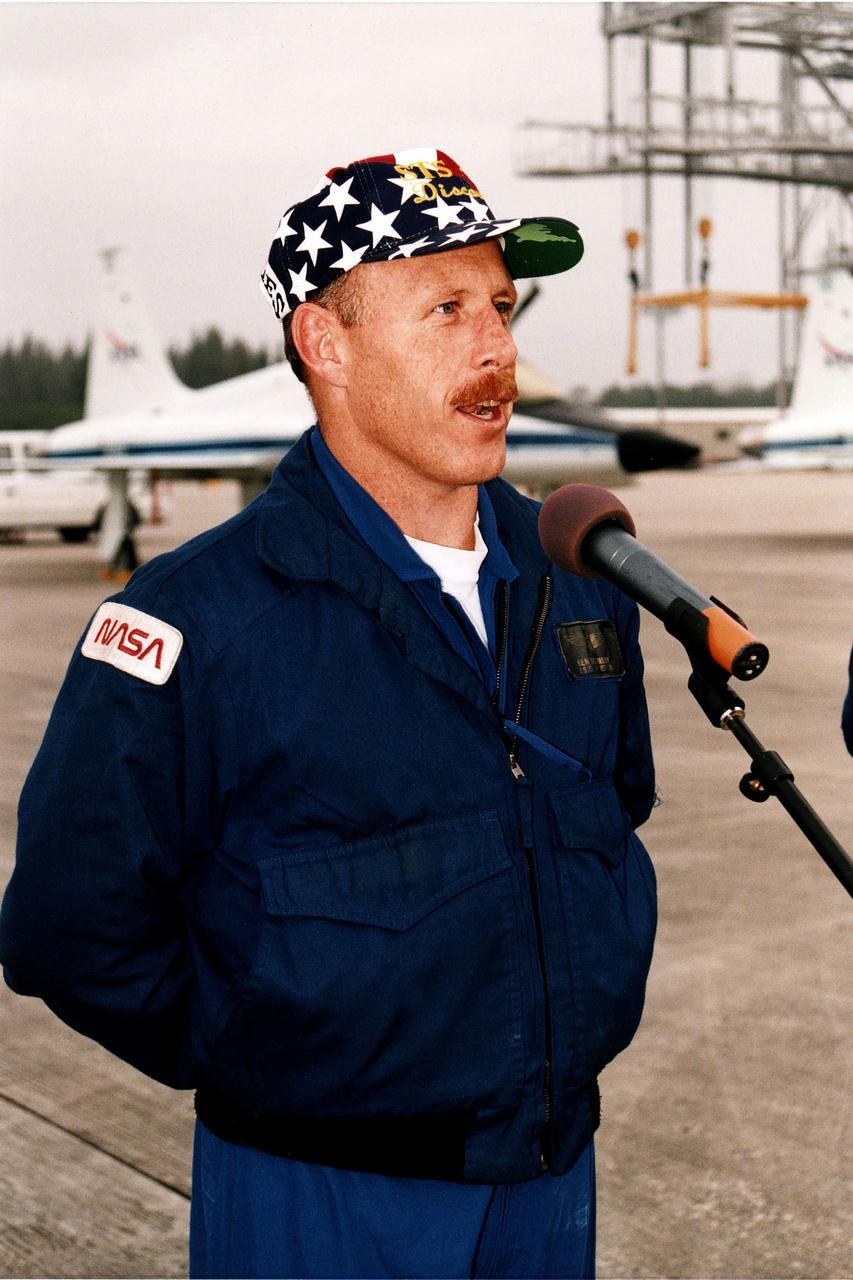
KENNEDY SPACE CENTER, FLA. - STS-82 Mission Commander Kenneth D. Bowersox greets media representatives after arrival at KSC's Shuttle Landing Facility. Bowersox and the other six members of the STS-82 crew came from their home base at Johnson Space Center in Houston, Texas, to spend the last few days before launch at KSC. STS-82 is scheduled for liftoff on Feb. 11 during a 65-minute launch window that opens at 3:56 a.m. EST. The 10-day flight aboard the Space Shuttle Discovery will be the second Hubble Space Telescope (HST) servicing mission.
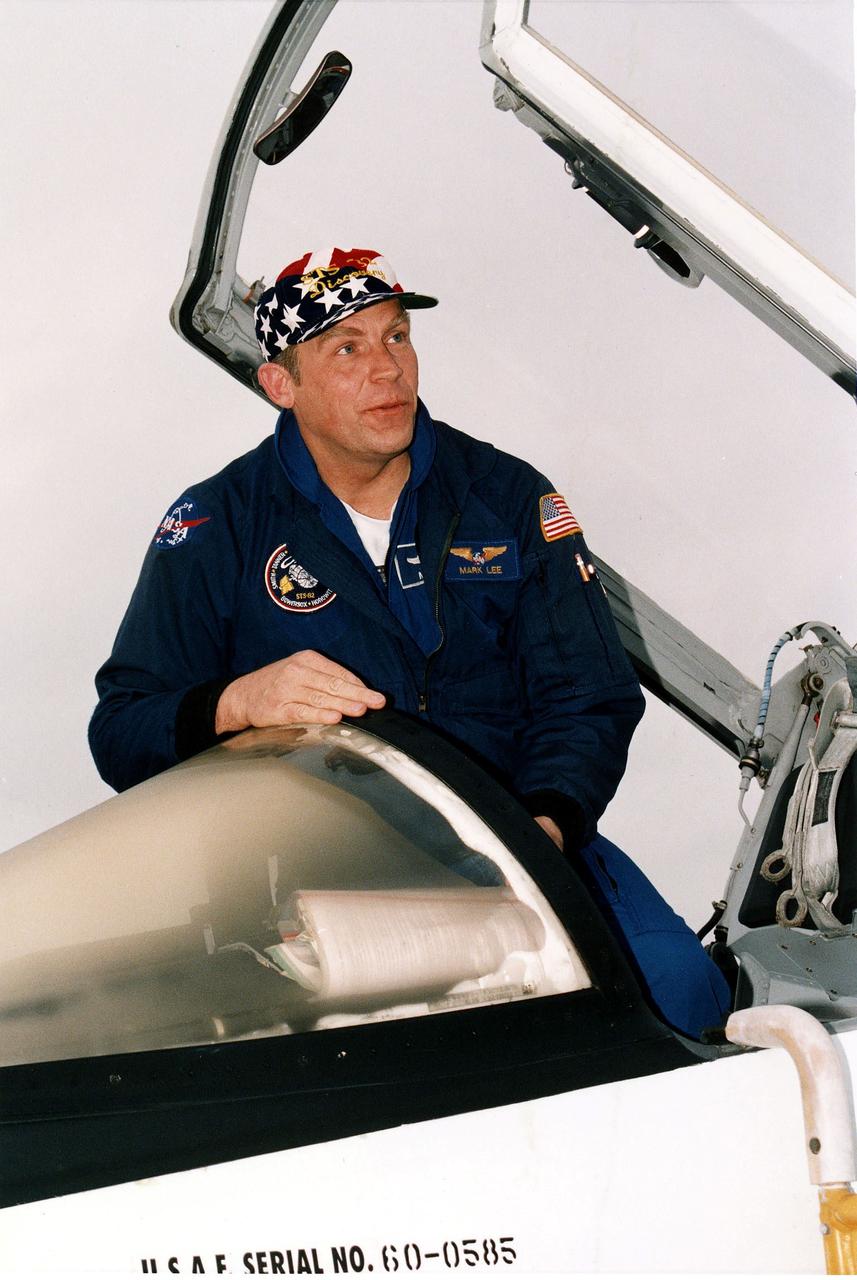
KENNEDY SPACE CENTER, FLA. - STS-82 Payload Commander Mark C. Lee prepares to step down from the T-38 jet he flew from an air field serving the astronauts' home base at Johnson Space Center, Houston, Texas, to KSC's Shuttle Landing Facility. Lee and the other six members of the STS-82 crew will spend the last few days before launch at KSC. STS-82 is scheduled for liftoff on Feb. 11 during a 65-minute launch window that opens at 3:56 a.m. EST. The 10-day flight aboard the Space Shuttle Discovery will be the second Hubble Space Telescope (HST) servicing mission.
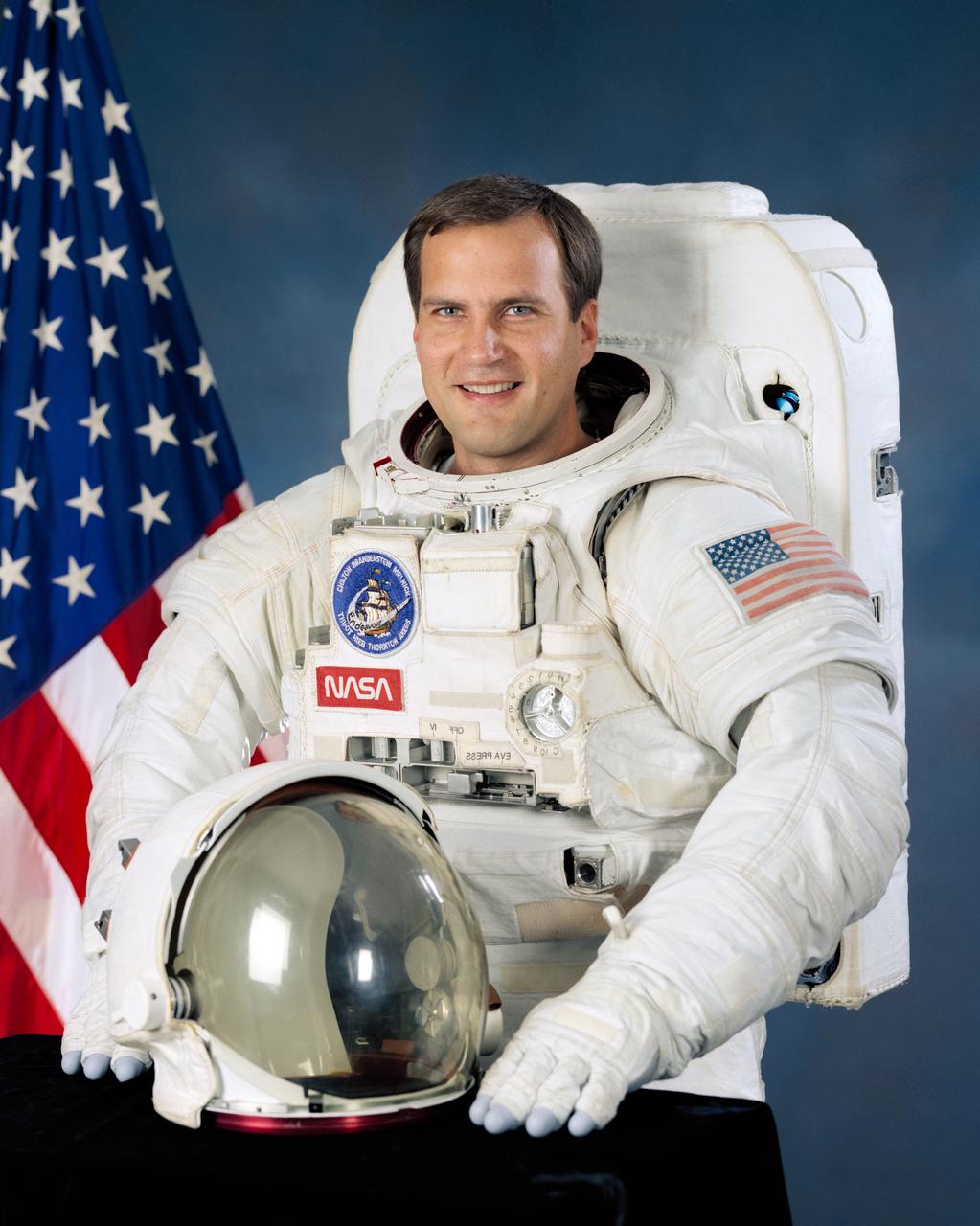
S92-41511 (1992) --- Astronaut Richard J. Hieb.
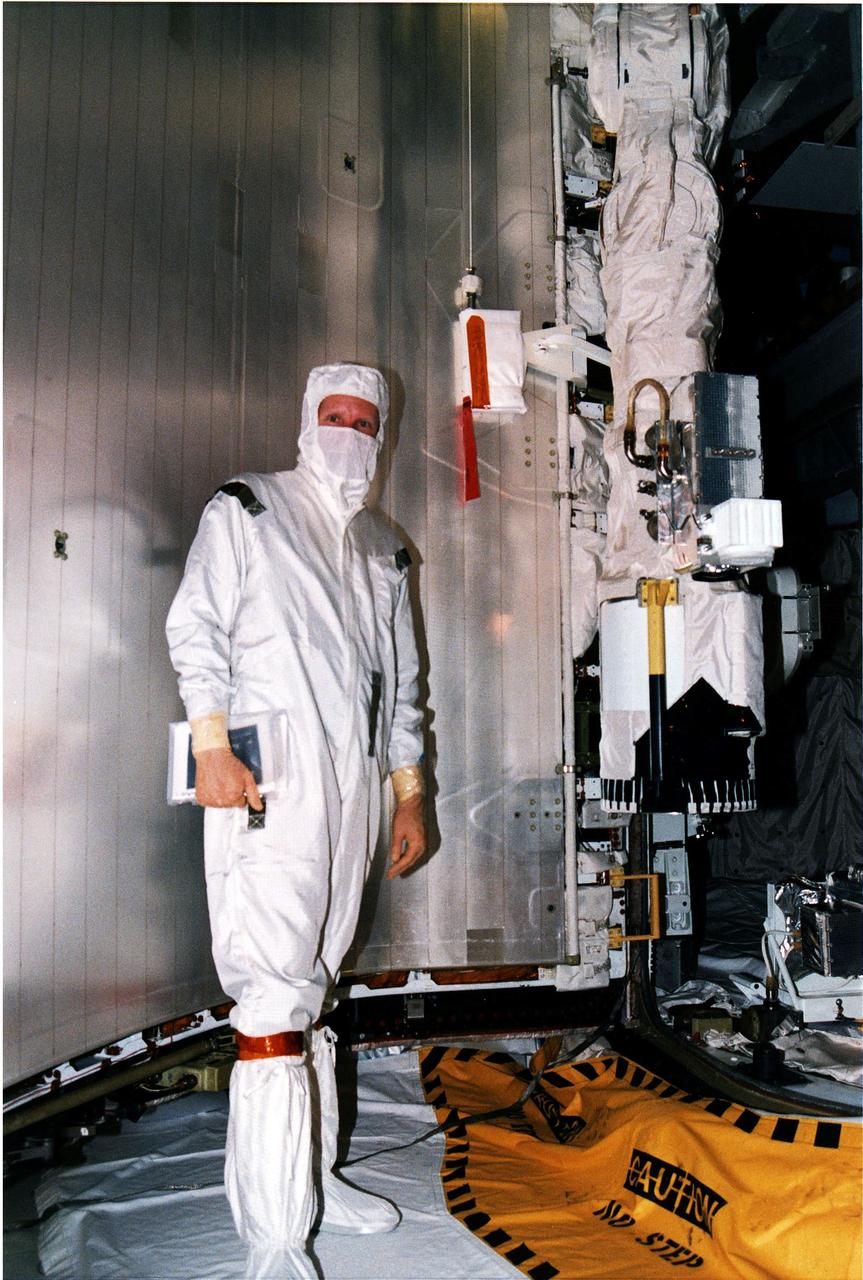
KENNEDY SPACE CENTER, FLA. - STS-82 Mission Specialist Steven A Hawley stands beside part of Discovery's Remote Manipulator System (RMS) arm, at right, which he will operate for the capture, berthing and redeployment of the Hubble Space Telescope (HST). The robotic arm also will be used as work platform for the four spacewalkers. Hawley is the prime RMS operator on the flight, which will be the second HST servicing mission. He and the other six members of the crew are making a final inspection of the payload at Launch Pad 39A before launch. STS-82 is scheduled for liftoff on Feb. 11 during a 65-minute launch window that opens at 3:56 a.m. EST.
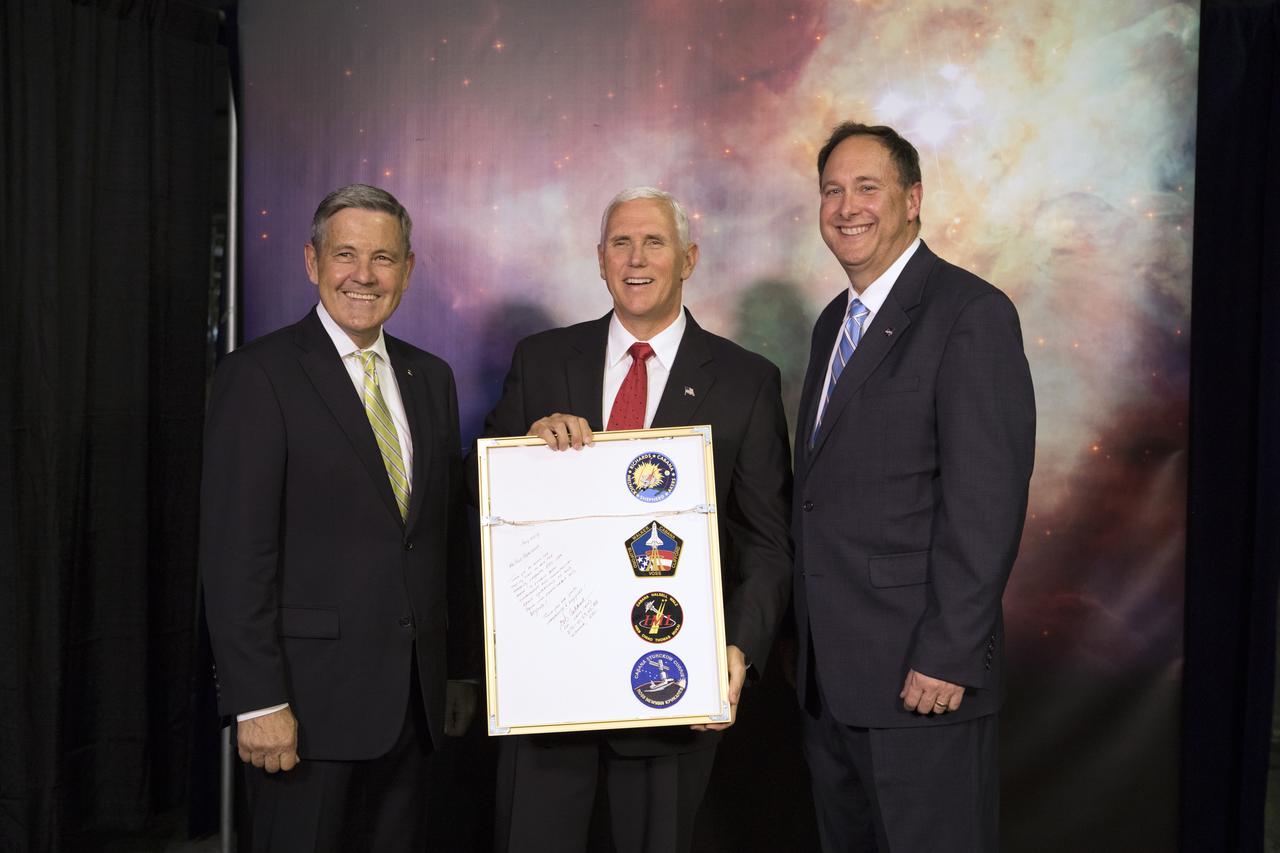
Kennedy Space Center Bob Cabana, left, and NASA's Acting Administrator Robert Lightfoot, right present Vice President Mike Pence with a framed plaque. On the back of the plaque are patches from each of Cabana's four space shuttle mission, STS-88, STS-53, STS-65, STS-41, and an inscription thanking the Vice President for his support of NASA. During his visit to Kennedy, the Vice President spoke inside the iconic Vehicle Assembly Building, where he thanked employees for advancing American leadership in space.
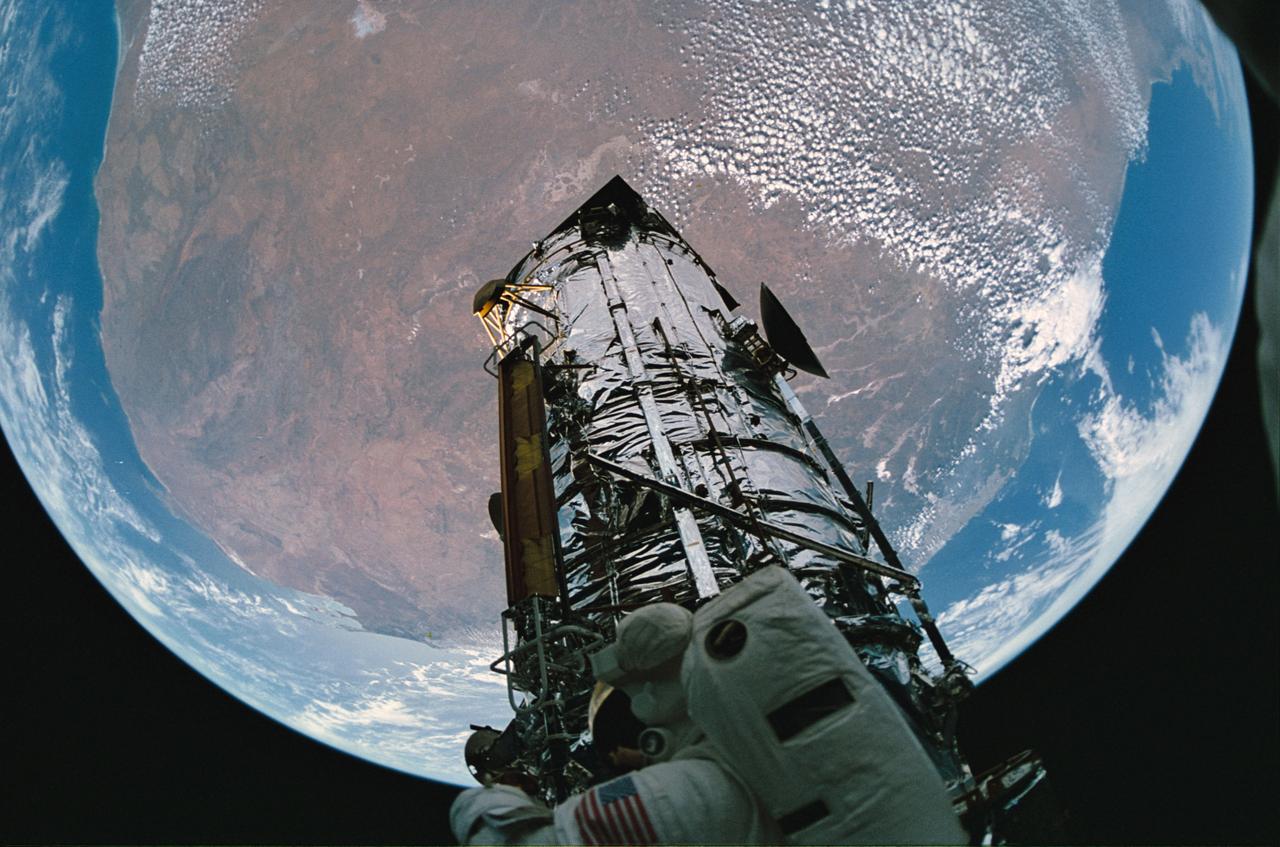
STS061-65-015 (9 Dec 1993) --- A fish-eye lens was used to capture the Hubble Space Telescope (HST), a spherical Earth and Australian landmass with a bit of distortion during the final extravehicular activity (EVA) on the STS-61 HST-servicing mission. Astronaut F. Story Musgrave can be seen at bottom of the frame.
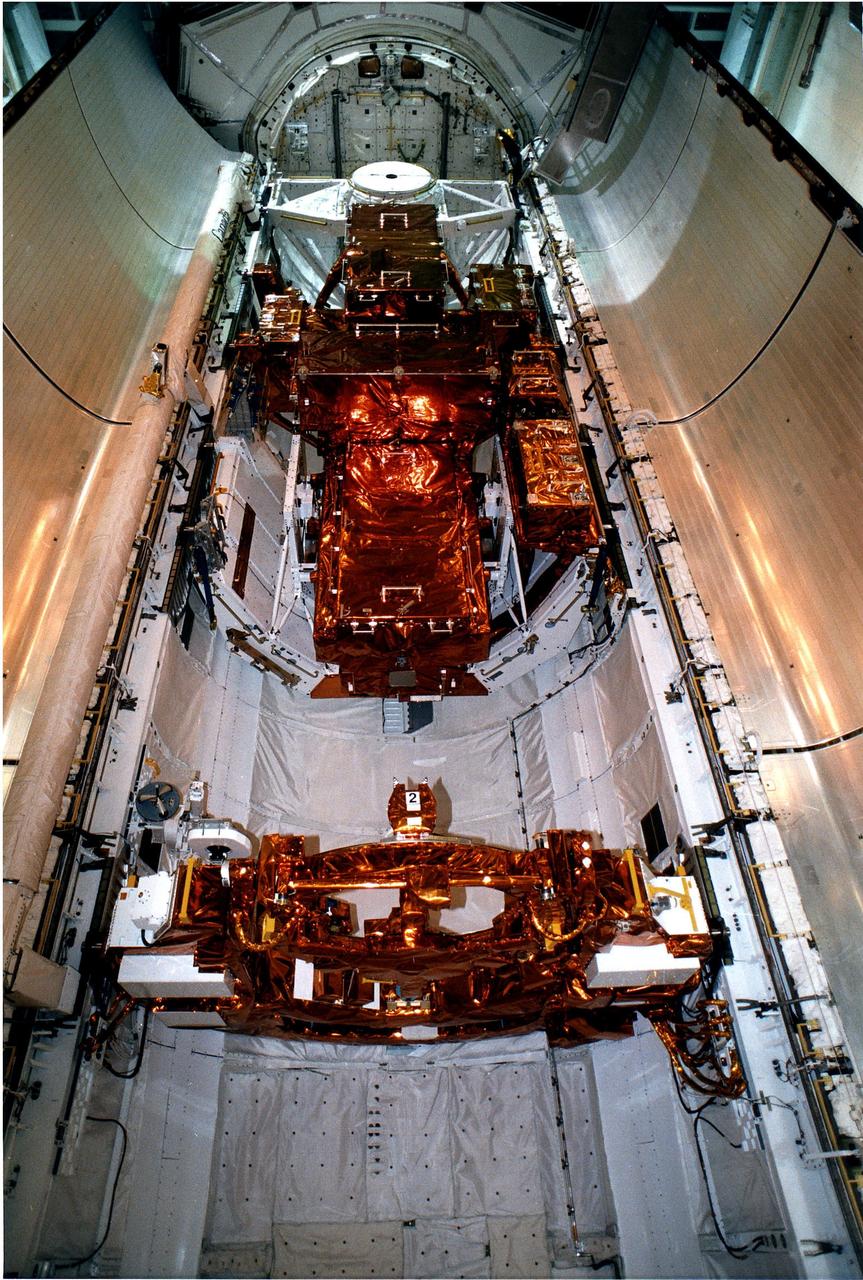
KENNEDY SPACE CENTER, FLA. - The Payload is seen inside of the Bay just before the doors are closed for flight at Pad 39A, Kennedy Space Center, Fla. Discovery, the orbiter for STS-82 mission, is ready for the launch of the second Hubble Space Telescope service mission. The payload consists of the Near Infrared Camera and Multi-Object Spectrometer (NICMOS) that will be installed, Fine Guidance Sensor #1 (FGS-1), and the Space Telescope Imaging Spectrograph (STIS) to be installed. The STS-82 will launch with a crew of seven at 3:54 a.m. EST, Feb. 11, 1997. The launch window is 65 minutes in duration. The Mission Commander for STS-82 is Ken Bowersox. The purpose of the mission is to upgrade the scientific capabilities, service or replace aging components on the Telescope, and provide a reboost to the optimum altitude.
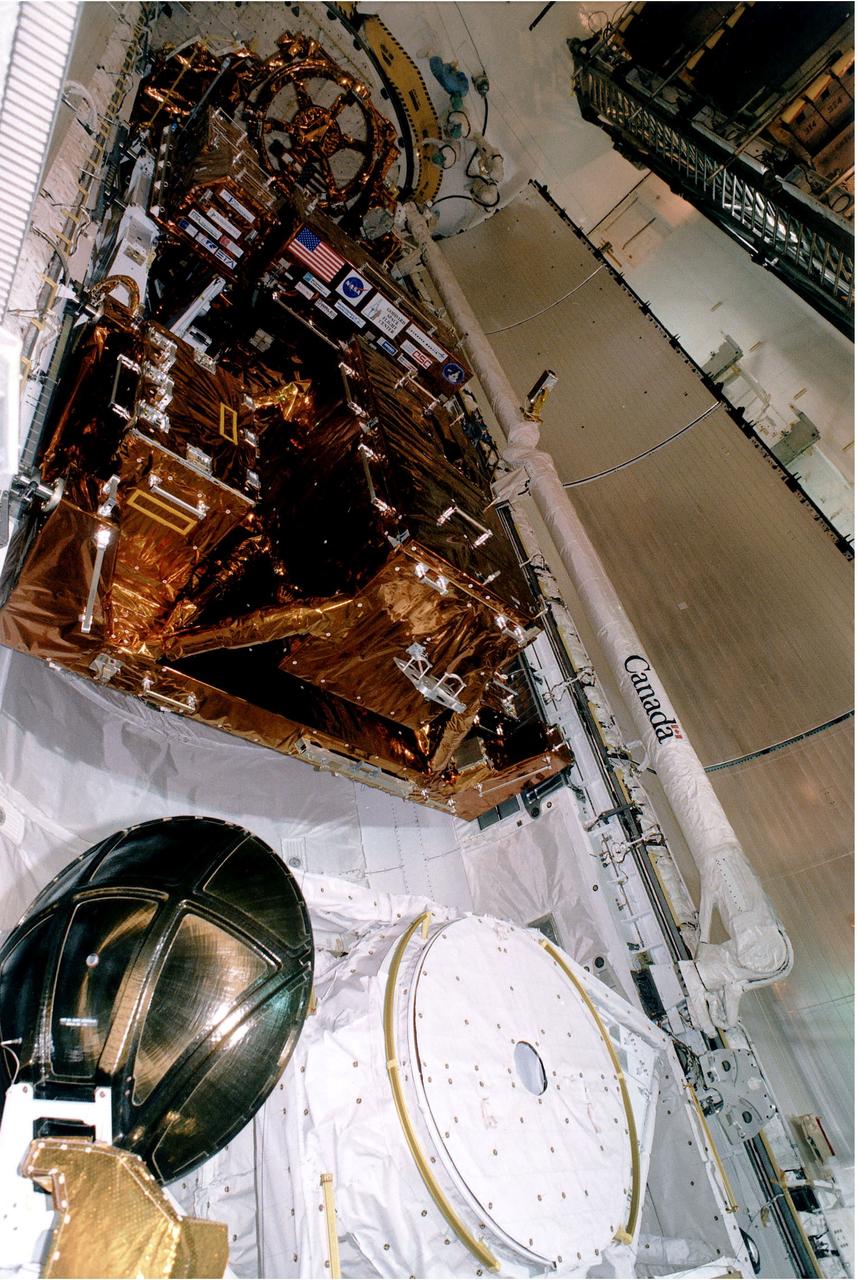
KENNEDY SPACE CENTER, FLA. - The Payload is seen inside of the Bay just before the doors are closed for flight at KSC's Launch Pad 39A. Discovery, the orbiter for the STS-82 mission, is ready for the launch of the second Hubble Space Telescope service mission. The payload consists of the Near Infrared Camera and Multi-Object Spectrometer (NICMOS) that will be installed, Fine Guidance Sensor #1 (FGS-1), and the Space Telescope Imaging Spectrograph (STIS) to be installed. The STS-82 will launch with a crew of seven at 3:54 a.m. EST, Feb. 11, 1997. The launch window is 65 minutes in duration. The Mission Commander for STS-82 is Ken Bowersox. The purpose of the mission is to upgrade the scientific capabilities, service or replace aging components on the Telescope, and provide a reboost to the optimum altitude.
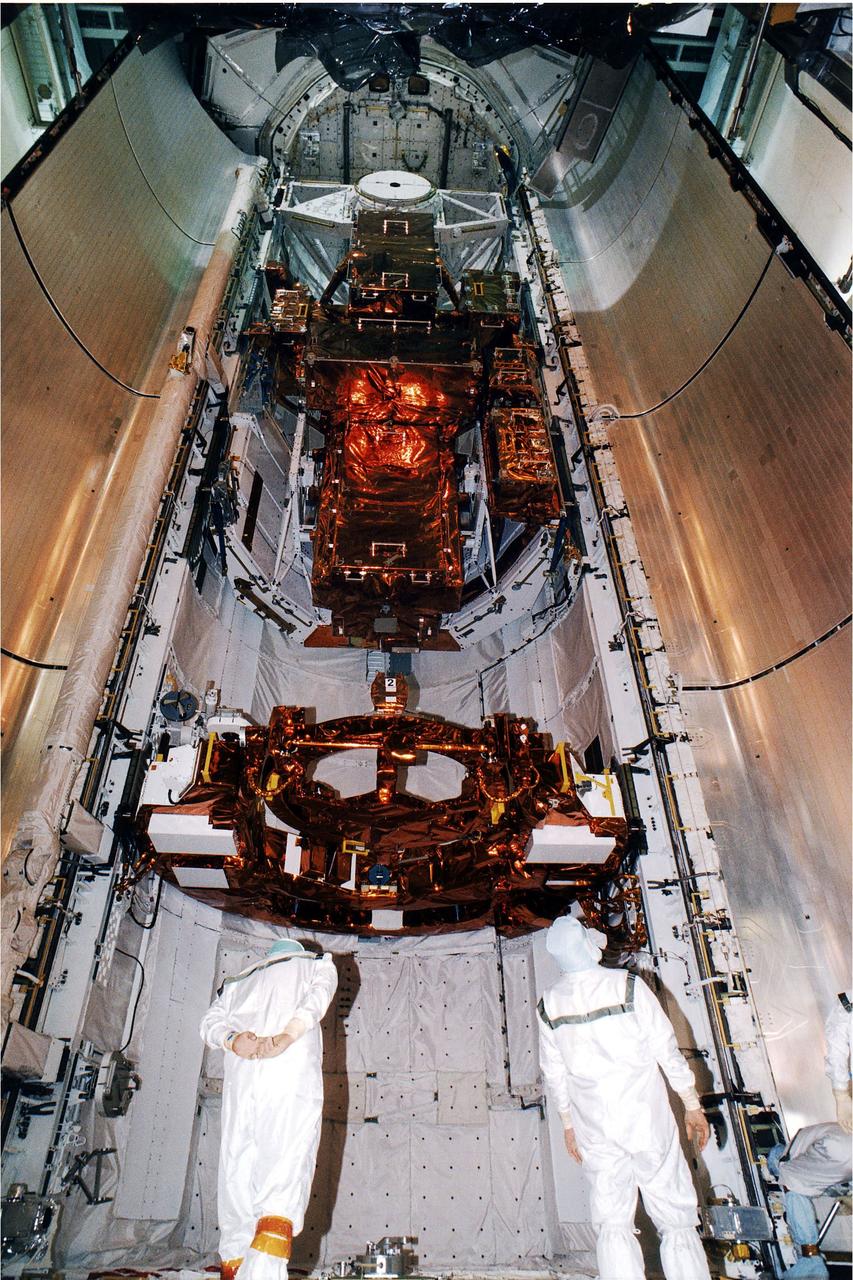
KENNEDY SPACE CENTER, FLA. - At the KSC Launch Pad 39A, two members of the payload closeout crew check equipment as the doors are just about ready to be closed. The Payload inside the bay of Discovery, the orbiter for the STS-82 mission, is ready for the launch of the second Hubble Space Telescope service mission. The payload consists of the Near Infrared Camera and Multi-Object Spectrometer (NICMOS) that will be installed, Fine Guidance Sensor #1 (FGS-1), and the Space Telescope Imaging Spectrograph (STIS) to be installed. The STS-82 will launch with a crew of seven at 3:54 a.m. EST, Feb. 11, 1997. The launch window is 65 minutes in duration. The Mission Commander for STS-82 is Ken Bowersox. The purpose of the mission is to upgrade the scientific capabilities, service or replace aging components on the Telescope and provide a reboost to the optimum altitude.
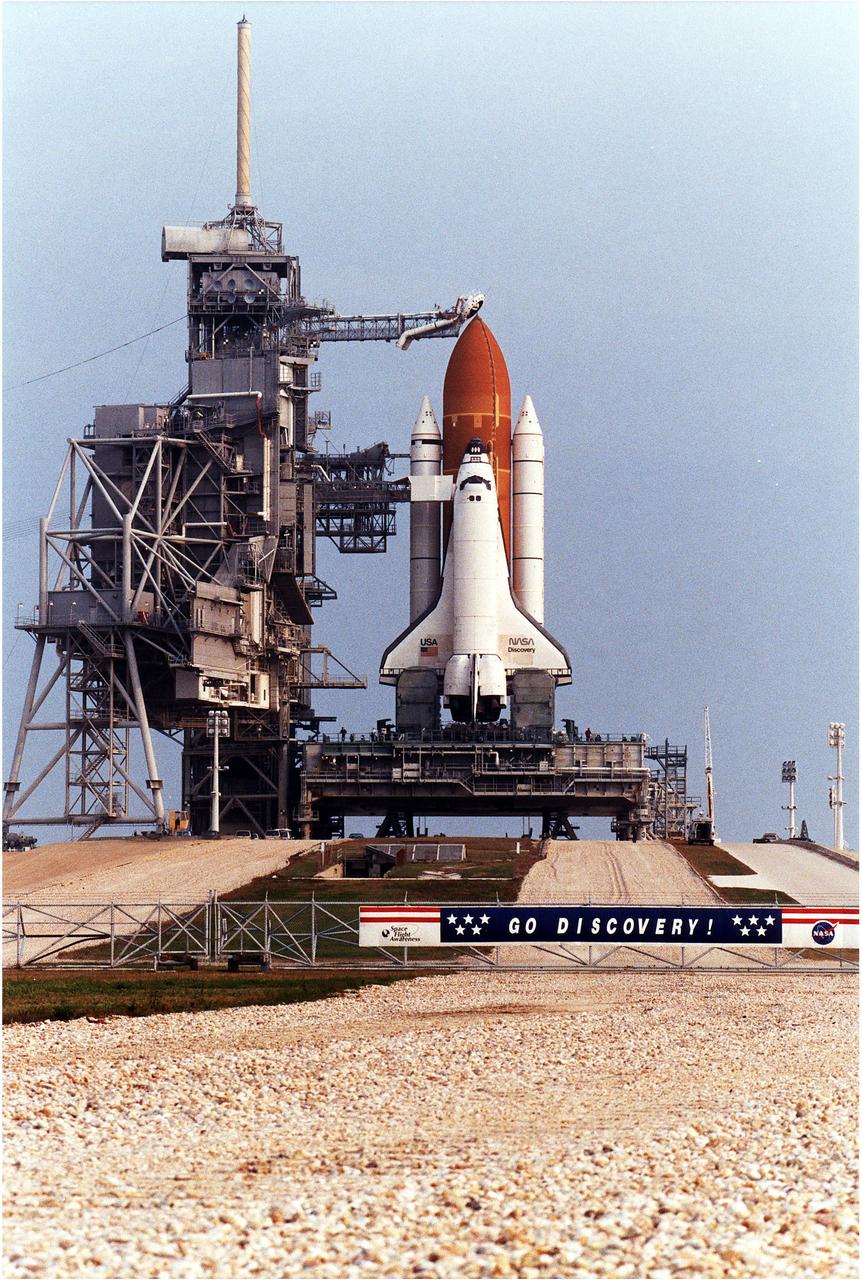
KENNEDY SPACE CENTER, FLA. - The Rotating Service Structure has been retracted at KSC's Launch Pad 39A. Discovery, the orbiter for the STS-82 mission, is ready for the launch of the second Hubble Space Telescope service mission. The payload consists of the Near Infrared Camera and Multi-Object Spectrometer (NICMOS) that will be installed, Fine Guidance Sensor #1 (FGS-1), and the Space Telescope Imaging Spectrograph (STIS) to be installed. The STS-82 will launch with a crew of seven at 3:54 a.m. EST, Feb. 11, 1997. The launch window is 65 minutes in duration. The Mission Commander for STS-82 is Ken Bowersox. The purpose of the mission is to upgrade the scientific capabilities, service or replace aging components on the Telescope, and provide a reboost to the optimum altitude.

KENNEDY SPACE CENTER, FLA. - The White Room is seen at the upper left where the astronauts enter the Space Shuttle for flight. The Rotating Service Structure has been retracted at KSC's Launch Pad 39A. Discovery, the orbiter for the STS-82 mission, is ready for the launch of the second Hubble Space Telescope service mission. The payload consists of the Near Infrared Camera and Multi-Object Spectrometer (NICMOS) that will be installed, Fine Guidance Sensor #1 (FGS-1), and the Space Telescope Imaging Spectrograph (STIS) to be installed. The STS-82 will launch with a crew of seven at 3:54 a.m. EST, Feb. 11, 1997. The launch window is 65 minutes in duration. The Mission Commander for STS-82 is Ken Bowersox. The purpose of the mission is to upgrade the scientific capabilities, service or replace aging components on the Telescope, and provide a reboost to the optimum altitude.

Dr. Chiaki Mukai of Japan's National Space Development Agency (NASDA) speaks to students at the California Science Center during the outreach session of the Pan Pacific Microgravity Conference on May 2, 2001. She flew as a payload specialist on two NASA Space Shuttle missions, STS-65 carrying the second International Microgravity Laboratory (IML-2, 1994) and STS-95 (1998).
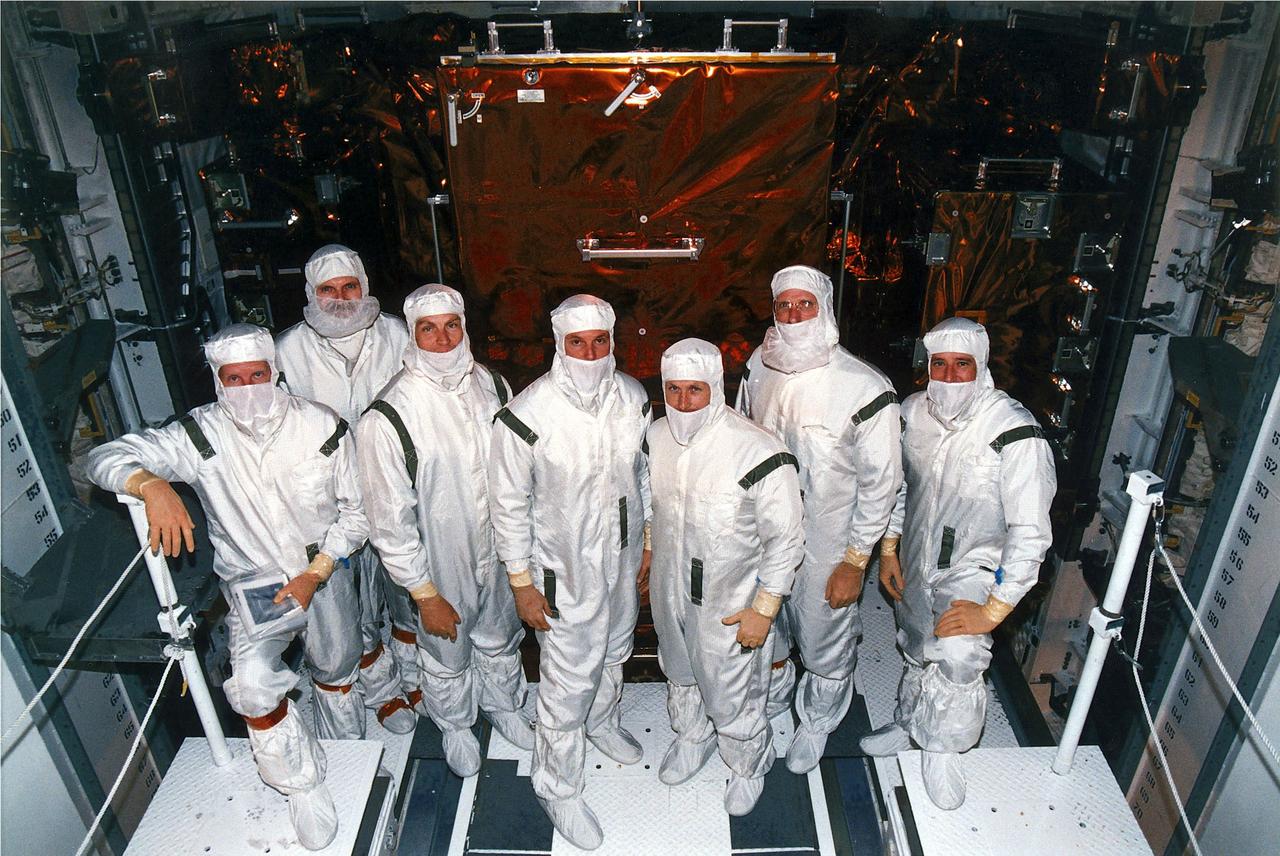
KENNEDY SPACE CENTER, FLA. - STS-82 crew members pose in their clean room suits at Launch Pad 39A where the Space Shuttle Discovery is undergoing final preparations for liftoff on the second Hubble Space Telescope (HST) servicing mission. They are making a final inspection of the payload before payload bay closure. From left are Mission Specialists Steven A. Hawley and Steven L. Smith, Payload Commander Mark C. Lee, Mission Specialist GregoryJ. Harbaugh, Mission Commander Kenneth D. Bowersox, Mission Specialist Joseph R. "Joe" Tanner and Pilot Scott J. "Doc" Horowitz. STS-82 is scheduled for liftoff on Feb. 11 during a 65-minute launch window that opens at 3:56 a.m. EST.
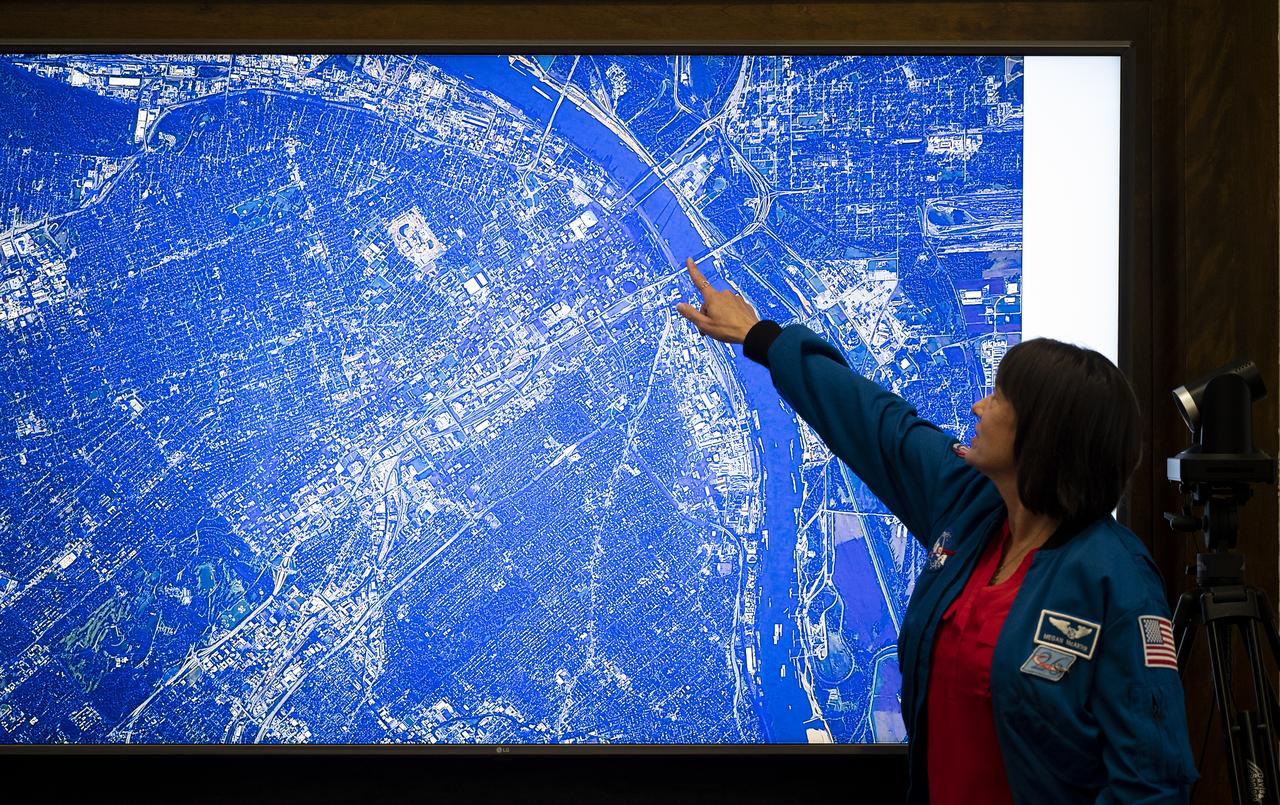
NASA astronaut Megan McArthur points to the shadow of the Gateway Arch on the Mississippi River in St. Louis while showing images of National Parks taken from the International Space Station during Expeditions 65 and 66 during a presentation to leadership and rangers who participate in the National Park Service’s astronomy and dark sky programs, Thursday, June 9, 2022 at the U.S. Department of the Interior in Washington, DC. McArthur, NASA astronaut Shane Kimbrough, Japan Aerospace Exploration Agency (JAXA) astronaut Akihiko Hoshide, and ESA (European Space Agency) astronaut Thomas Pesquet, flew on NASA’s SpaceX Crew-2 mission, the second crew rotation mission to the International Space Station as part of the agency’s Commercial Crew Program, and spent 198 days aboard the orbiting laboratory as part of Expeditions 65 and 66. Photo Credit: (NASA/Joel Kowsky)
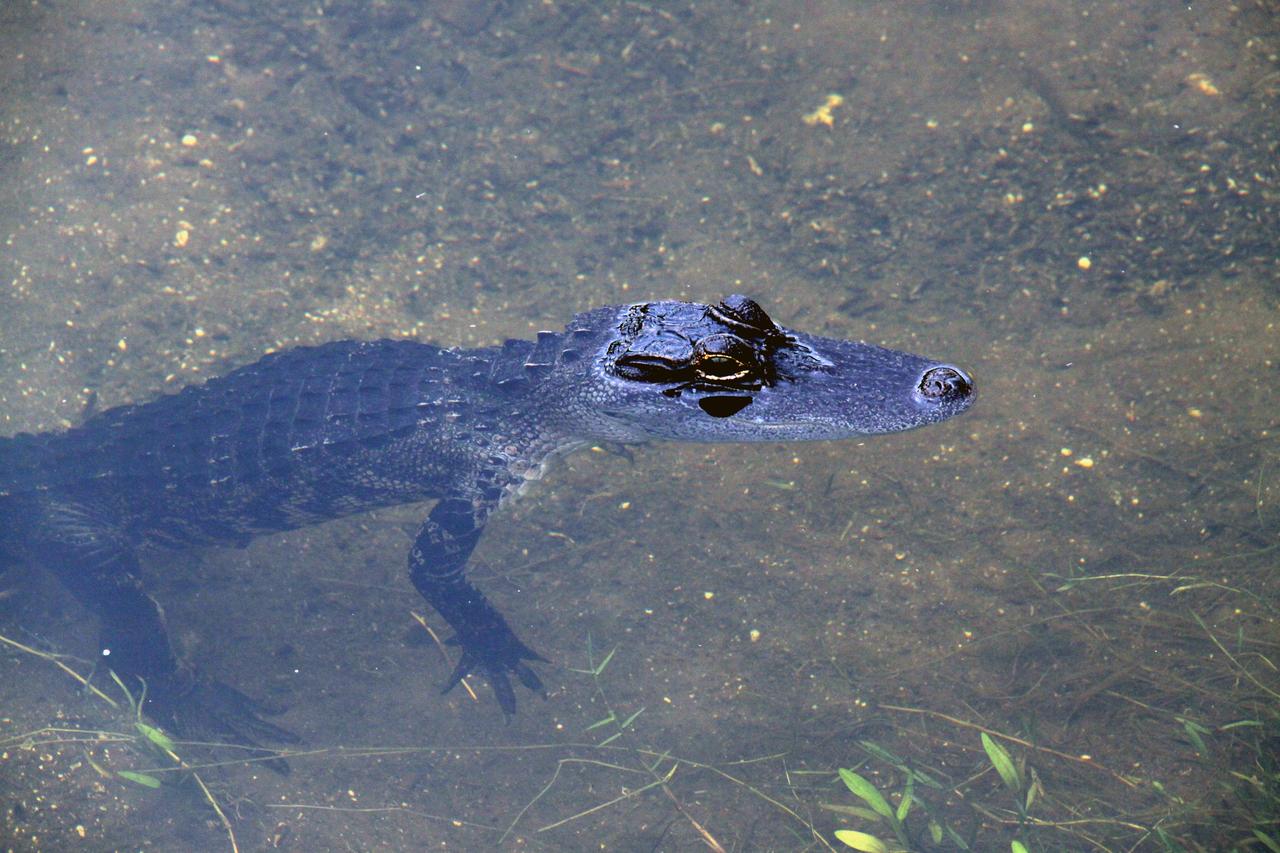
CAPE CANAVERAL, Fla. – A baby alligator is unaware that the water saturating the ground is the aftermath of thunderstorms in the vicinity of NASA Kennedy Space Center’s Shuttle Landing Facility and that space shuttle Atlantis is unable to land to conclude the STS-125 mission. Alligators can be spotted in the drainage canals and other waters surrounding Kennedy. The center shares a boundary with the Merritt Island Wildlife Nature Refuge, which is a habitat for more than 310 species of birds, 25 mammals, 117 fishes and 65 amphibians and reptiles. Photo credit: NASA/Glenn Benson
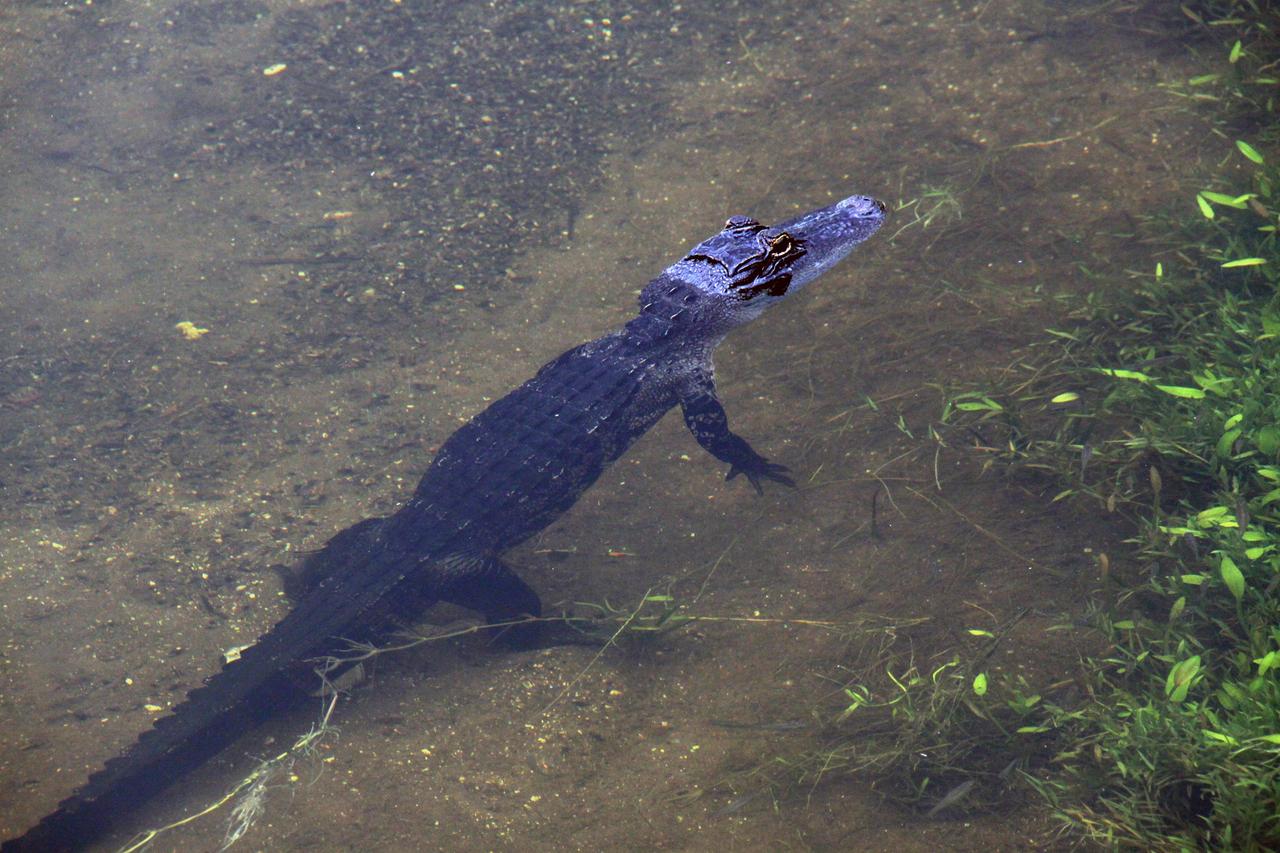
CAPE CANAVERAL, Fla. – A baby alligator is unconcerned that water saturates the ground and space shuttle Atlantis is unable to land at NASA’s Kennedy Space Center to conclude the STS-125 mission, the aftermath of thunderstorms in the vicinity of the Shuttle Landing Facility. Alligators can be spotted in the drainage canals and other waters surrounding Kennedy. The center shares a boundary with the Merritt Island Wildlife Nature Refuge, which is a habitat for more than 310 species of birds, 25 mammals, 117 fishes and 65 amphibians and reptiles. Photo credit: NASA/Glenn Benson
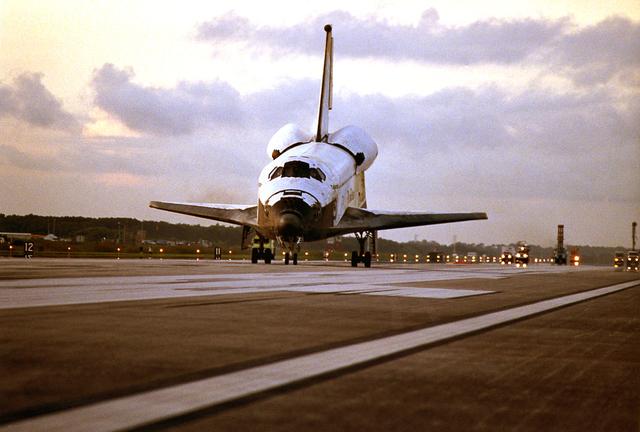
The Space Shuttle Columbia (STS-65) came to a stop at Kennedy Space Center's (KSC) Shuttle Landing Facility to complete the International Microgravity Laboratory 2 (IML-2) mission. During the record-setting spaceflight of 14 days, 17 hours, and 56 minutes, the seven-person crew conducted more than 80 materials and life sciences experiments,
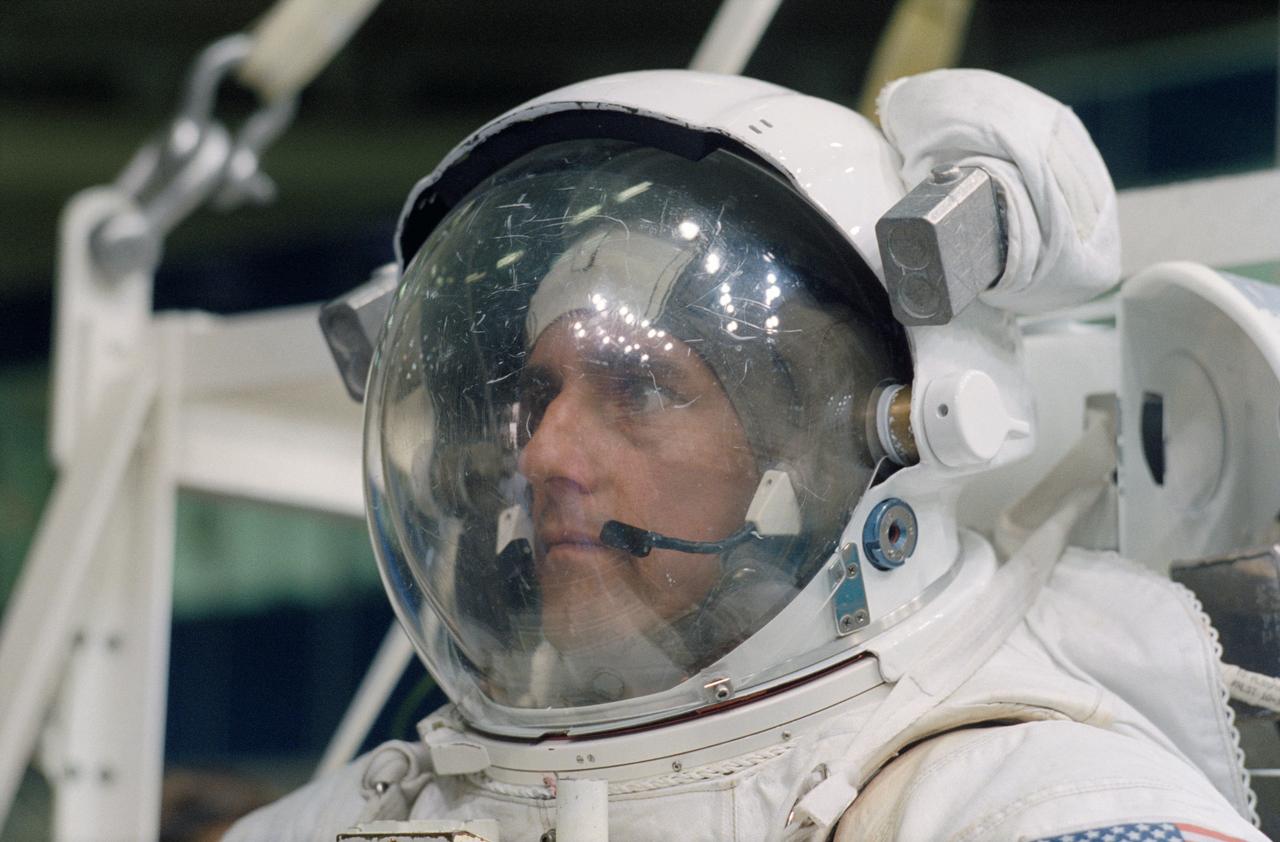
S94-29978 (8 March 1994) --- Astronaut Donald A. Thomas, mission specialist, prepares to be lowered into a 25-feet deep pool at the Johnson Space Center's (JSC) Weightless Environment Training Facility (WET-F). Astronauts Thomas and Leroy Chiao were about to be submerged and made to be neutrally buoyant in order to rehearse several contingency tasks that would require a spacewalk. No spacewalks are scheduled for the International Microgravity Laboratory (IML-2).
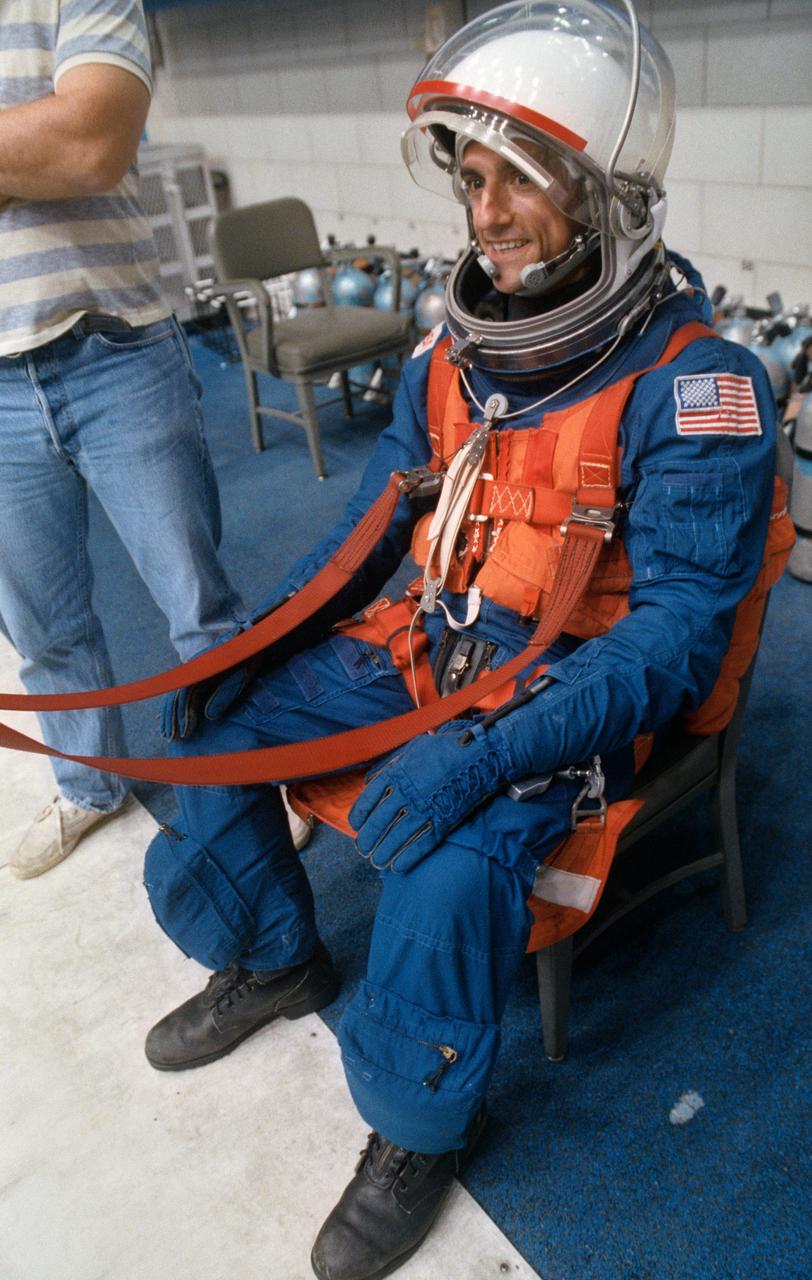
S93-43113 (Nov 1993) --- Astronaut Donald A. Thomas, mission specialist, is pictured during a bailout training session at the Johnson Space Center's (JSC) Weightless Environment Test Facility (WET-F). Thomas was joined by five other NASA astronauts and a Japanese payload specialist for the training session. The crew will spend approximately two weeks aboard the Space Shuttle Columbia next year in support of the second International Microgravity Laboratory (IML-2) mission.
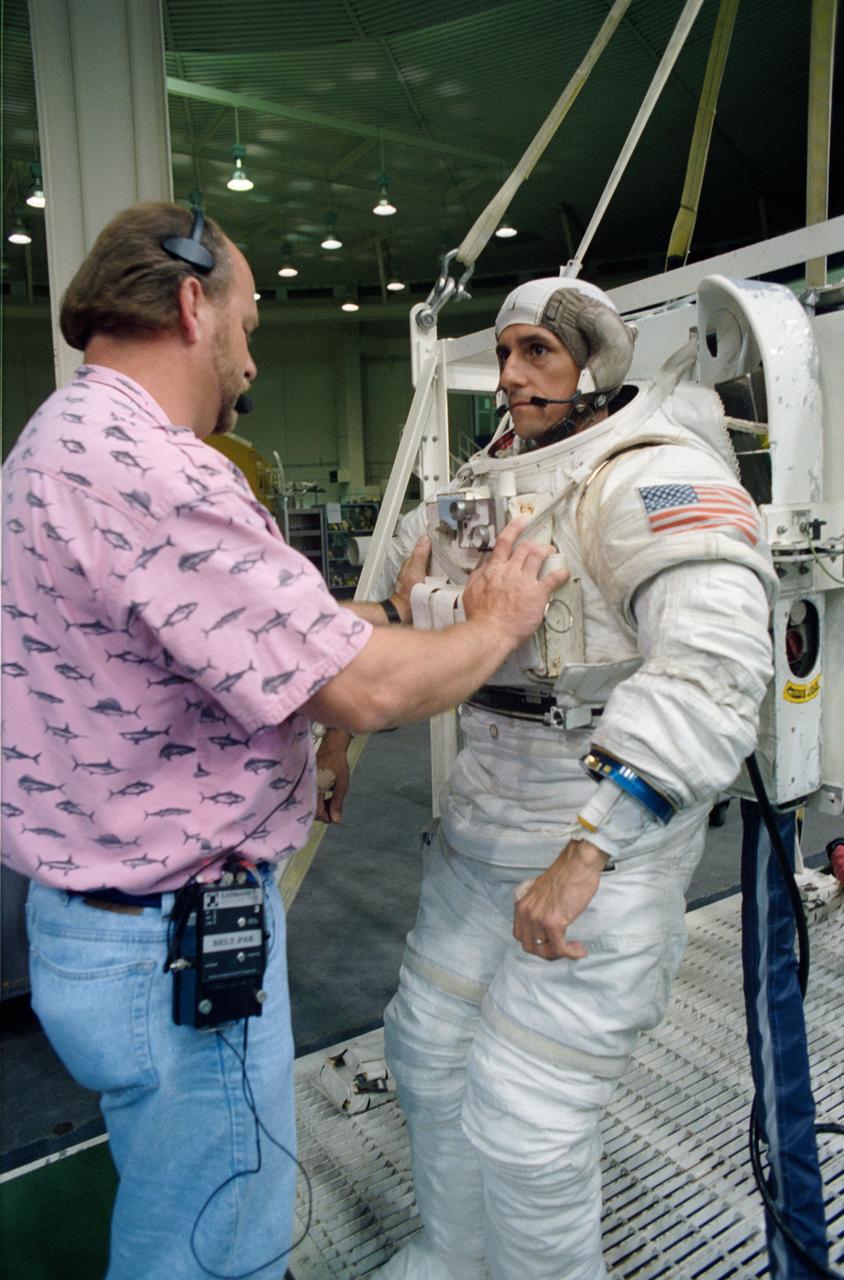
S94-29981 (8 March 1994) --- Astronaut Donald A. Thomas, mission specialist, awaits his helmet as he prepares to be lowered into a 25-feet deep pool at the Johnson Space Center's (JSC) Weightless Environment Training Facility (WET-F). Astronauts Thomas and Leroy Chiao were about to be submerged and made to be neutrally buoyant in order to rehearse several contingency tasks that would require a spacewalk. No spacewalks are scheduled for the International Microgravity Laboratory (IML-2).
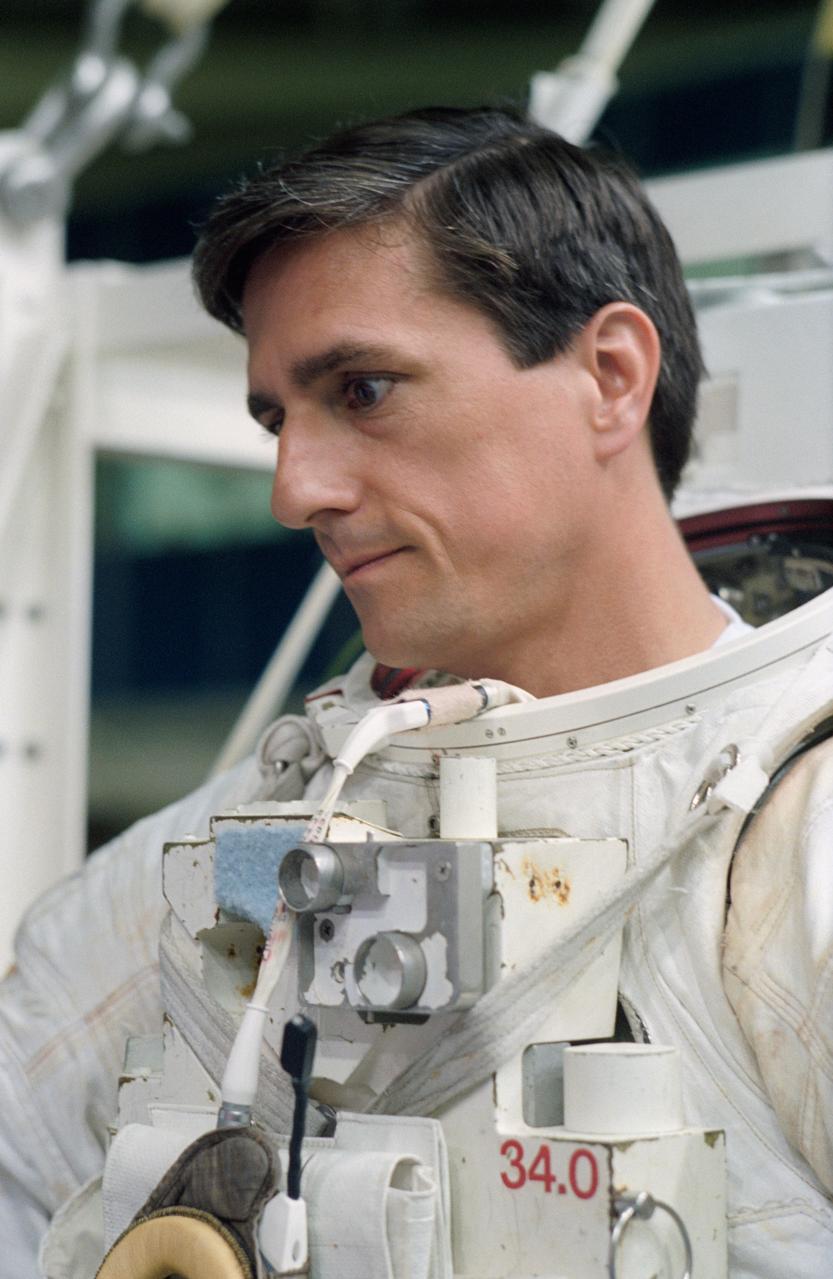
S94-29976 (8 March 1994) --- Astronaut Donald A. Thomas, mission specialist, awaits his helmet as he prepares to be lowered into a 25-feet deep pool at the Johnson Space Center's (JSC) Weightless Environment Training Facility (WET-F). Astronauts Thomas and Leroy Chiao were about to be submerged and made to be neutrally buoyant in order to rehearse several contingency tasks that would require a spacewalk. No spacewalks are scheduled for the International Microgravity Laboratory (IML-2).
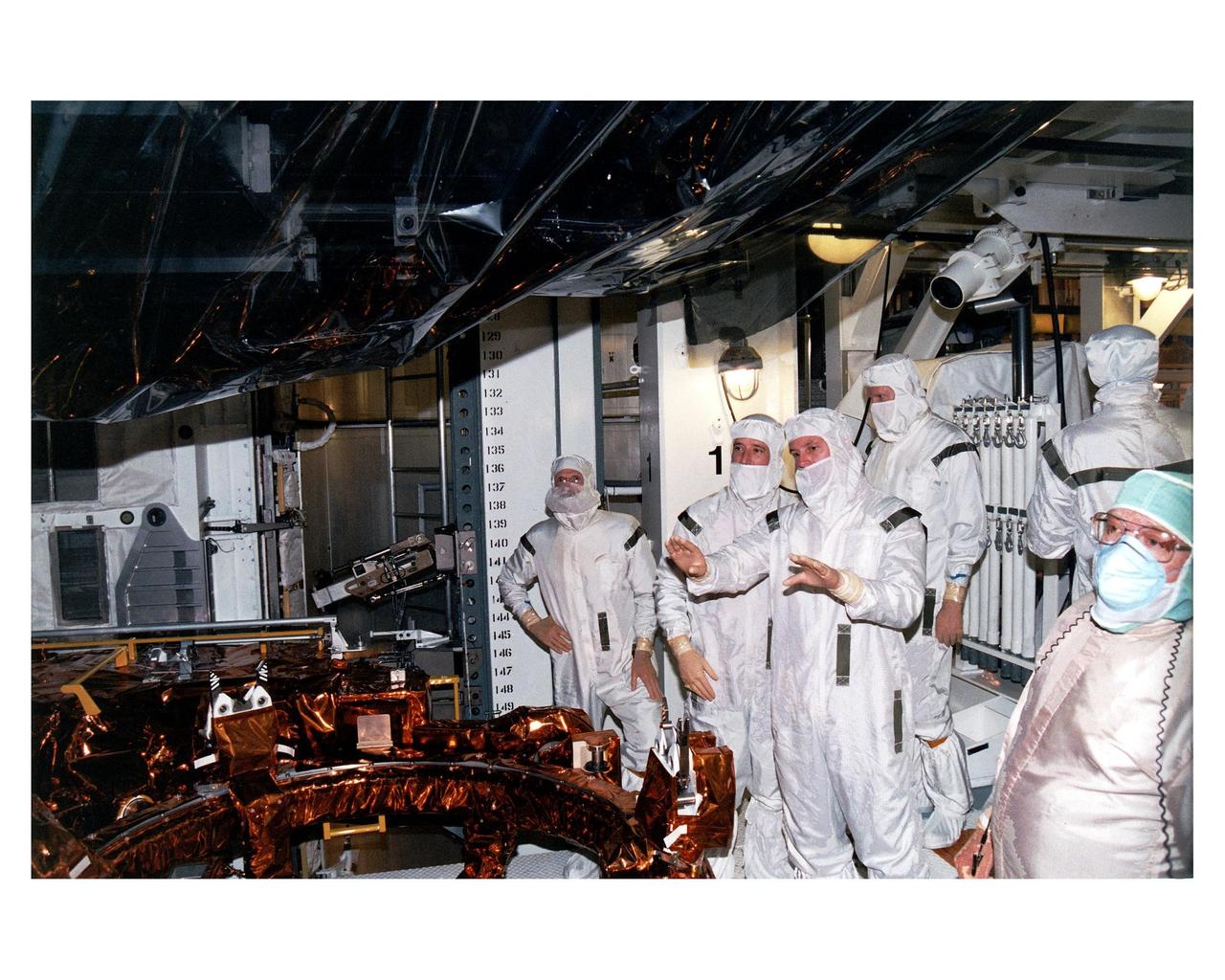
STS-82 crew members make a final inspection of the payload for the second Hubble Space Telescope (HST) servicing mission at Launch Pad 39A where the Space Shuttle Discovery is undergoing final preparations for launch. From left, are Mission Specialist Joseph R. "Joe" Tanner, Pilot Scott J. "Doc" Horowitz and Mission Specialist Gregory J. Harbaugh. Standing directly behind them is Mission Specialist Steven A. Hawley. STS-82 is scheduled for liftoff on Feb. 11 during a 65-minute launch window which opens at 3:56 a.m. EST
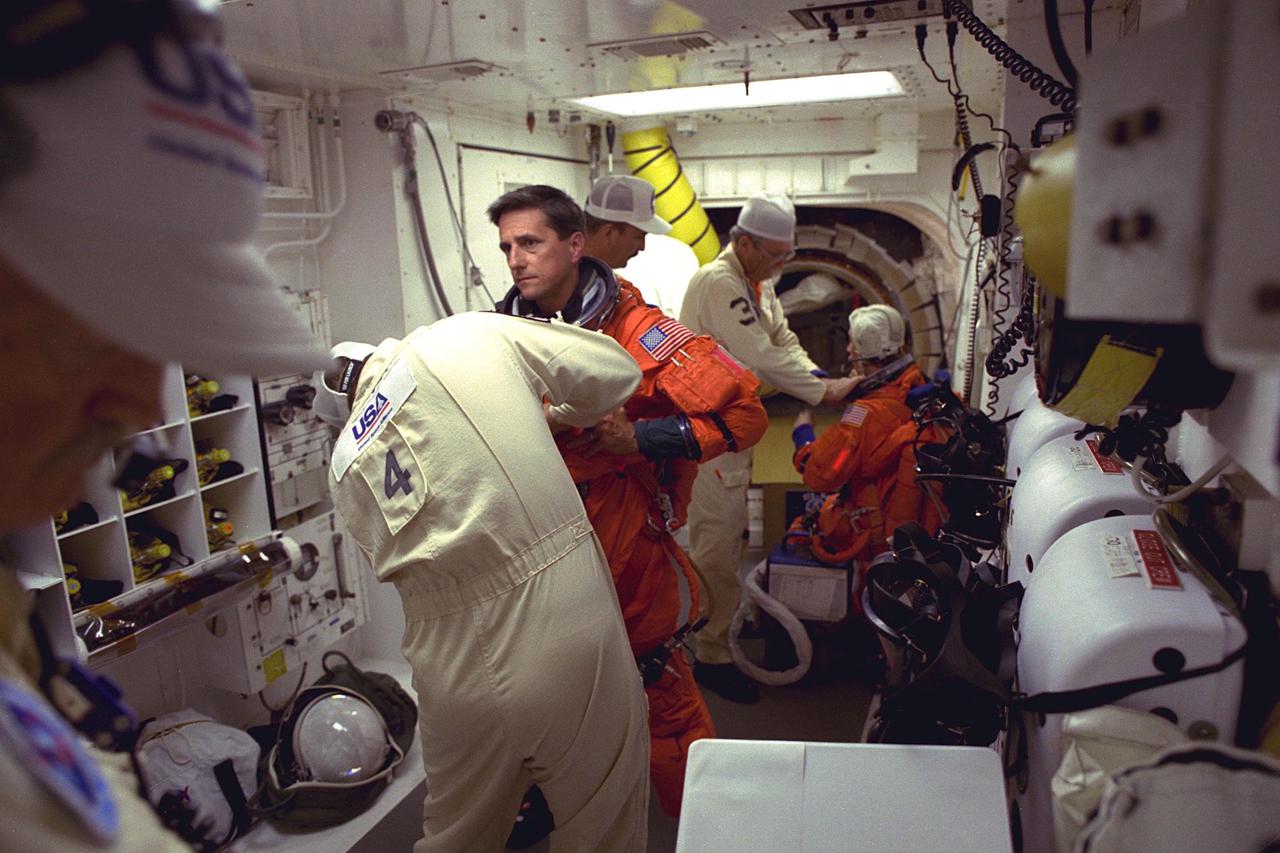
STS-94 Mission Specialist Donald A. Thomas prepares to enter the Space Shuttle Columbia at Launch Pad 39A in preparation for launch. He has flown on STS-83, STS-70 and STS-65. He holds a doctorate in materials science and has been the Principal Investigator for a Space Shuttle crystal growth experiment. Because of his background in materials science, Thomas will be concentrating his efforts during the Red shift on the five experiments in this discipline in the Large Isothermal Furnace. He also will work on the ten materials science investigations in the Electromagnetic Containerless Processing Facility and four that will be measuring the effects of microgravity and motion in the orbiter on the experiments. Thomas and six fellow crew members will lift off during a launch window that opens at 1:50 p.m. EDT, July 1. The launch window will open 47 minutes early to improve the opportunity to lift off before Florida summer rain showers reach the space center
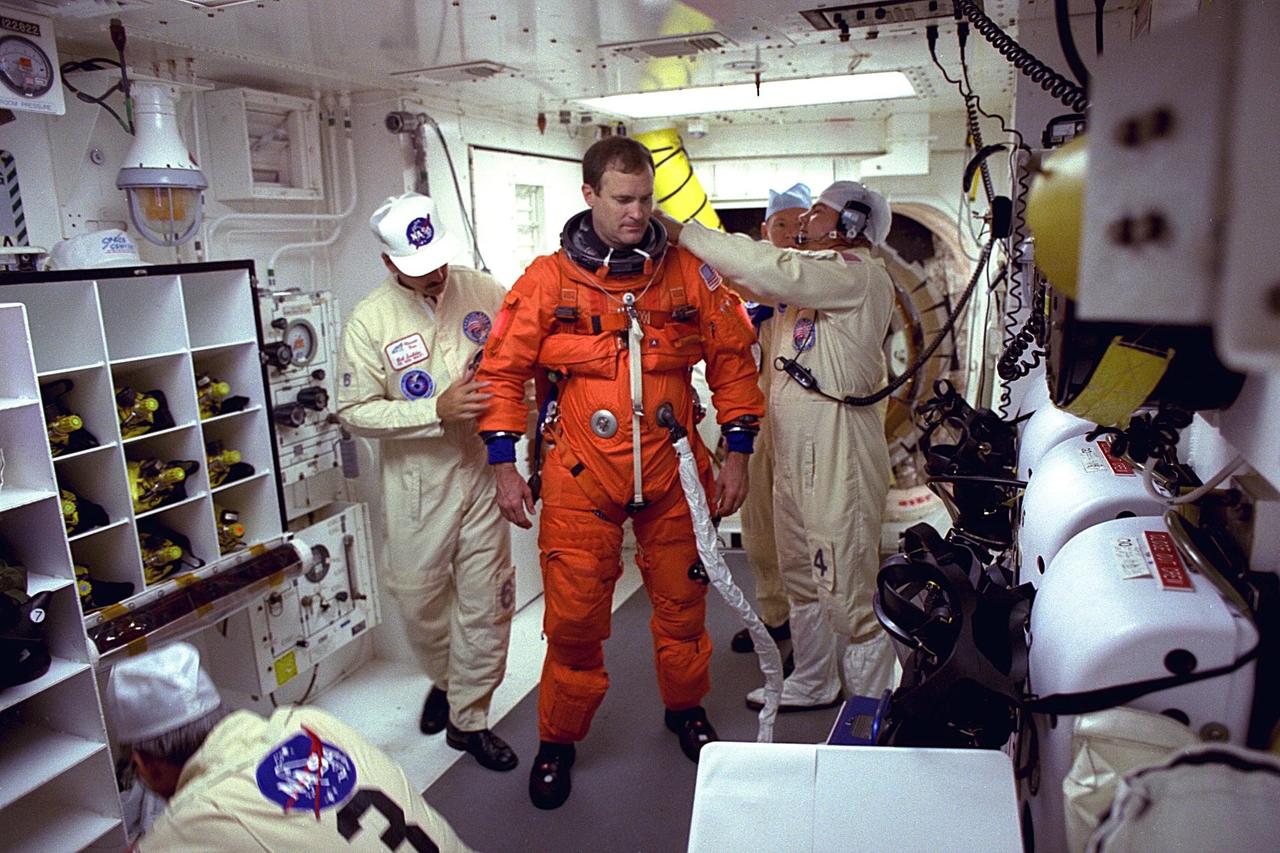
STS-94 Mission Commander James D. Halsell, Jr., prepares to enter the Space Shuttle Columbia at Launch Pad 39A in preparation for launch. Halsell is on his fourth space flight, having served as commander of STS-83 and pilot of both STS-74 and STS-65. He is a lieutenant colonel in the Air Force and a former SR-71 Blackbird test pilot and holds master’s degrees in management and space operations. Halsell will have responsibility for the success of the mission and will operate and maintain Columbia during the Red, or second shift. He will also assist with a materials science experiment and a protein crystal growth payload during the 16-day mission. Halsell and six fellow crew members will lift off during a launch window that opens at 1:50 p.m. EDT, July 1. The launch window will open 47 minutes early to improve the opportunity to lift off before Florida summer rain showers reach the space center
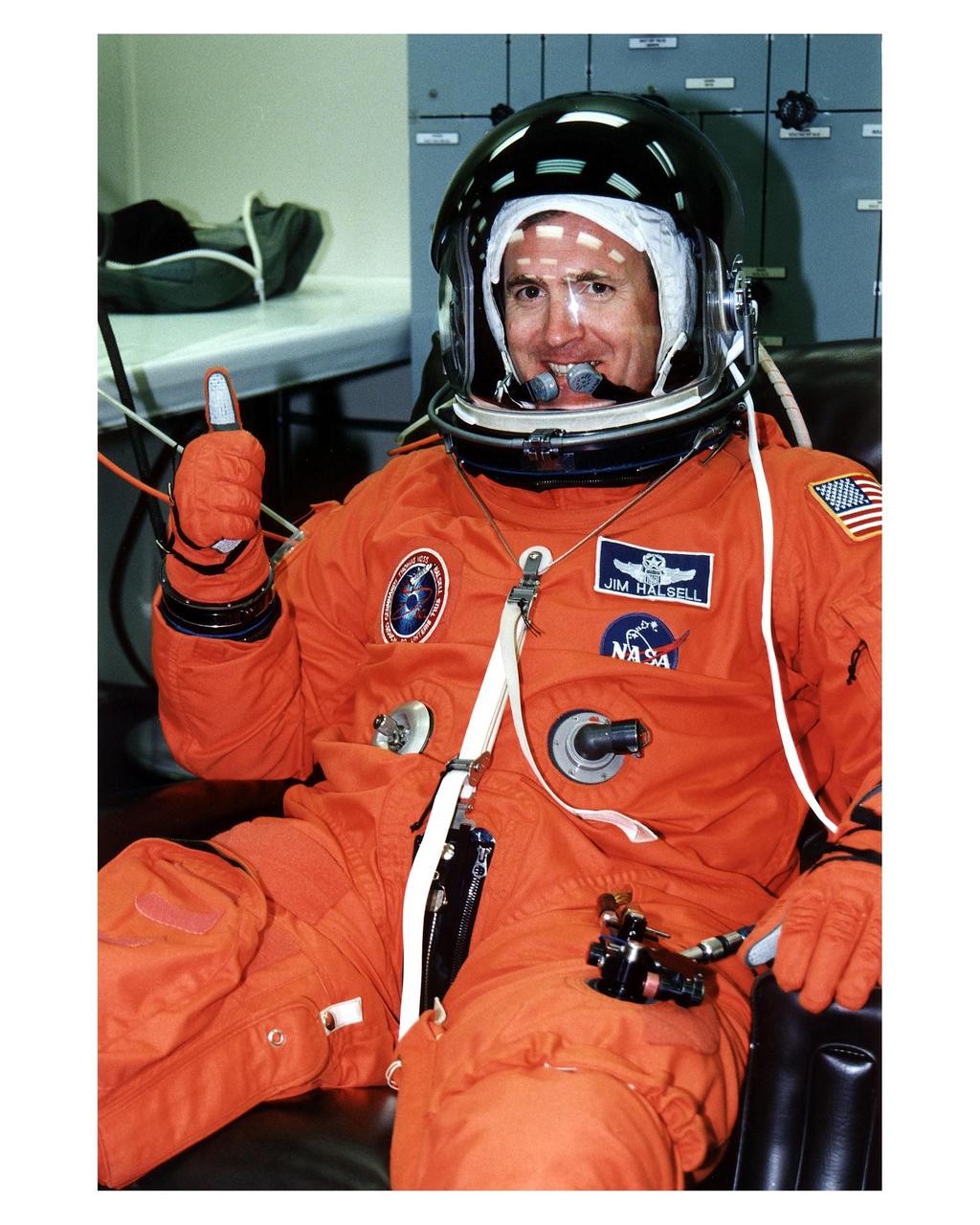
STS-83 Mission Commander James D. Halsell, Jr., gives a thumbs-up after he is assisted into his launch/entry suit in the Operations and Checkout (O&C) Building. Halsell is on his third space flight, having served as pilot of both STS-74 and STS-65. He is a lieutenant colonel in the Air Force and a former SR-71 Blackbird test pilot and holds master's degrees in management and space operations. Halsell will have responsibility for the success of the mission and will operate and maintain Columbia during the Red, or second shift. He will also assist with a materials science experiment and a protein crystal growth payload during the 16-day mission. Halsell and six fellow crew members will shortly depart the O&C and head for Launch Pad 39A, where the Space Shuttle Columbia will lift off during a launch window that opens at 2:00 p.m. EST, April 4
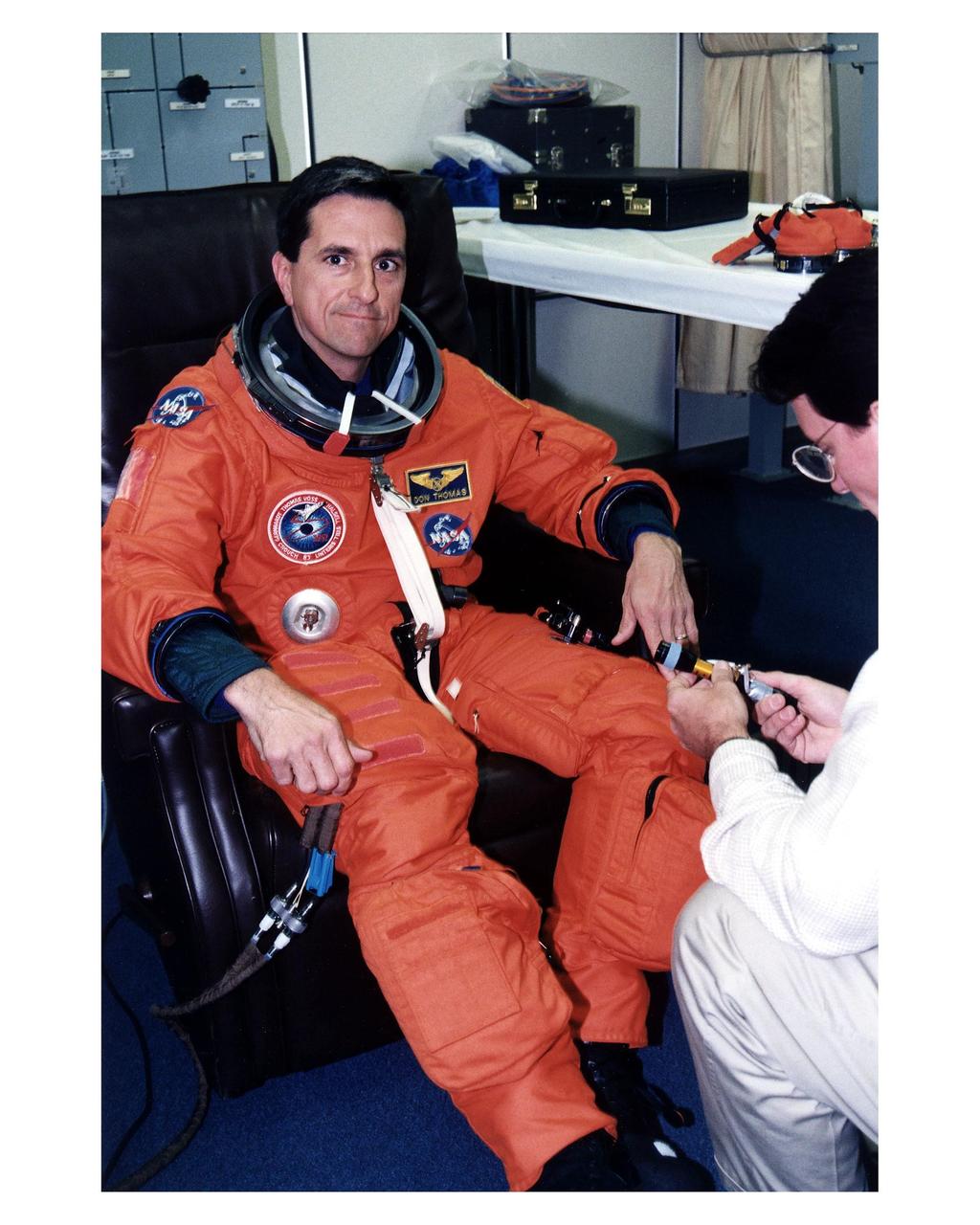
STS-83 Mission Specialist Donald A. Thomas is assisted into his launch/entry suit in the Operations and Checkout (O&C) Building. He has flown on both STS-70 and STS-65. He holds a doctorate in materials science and has been the Principal Investigator for a Space Shuttle crystal growth experiment. Because of his background in materials science, Thomas will be concentrating his efforts during the Red shift on the five experiments in this discipline in the large Isothermal Furnace. He also will work on the ten materials science investigations in the Electromagnetic Containerless Processing Facility and four that will be measuring the effects of microgravity and motion in the orbiter on the experiments. Thomas and six fellow crew members will shortly depart the O&C and head for Launch Pad 39A, where the Space Shuttle Columbia will lift off during a launch window that opens at 2:00 pm EST, April 4
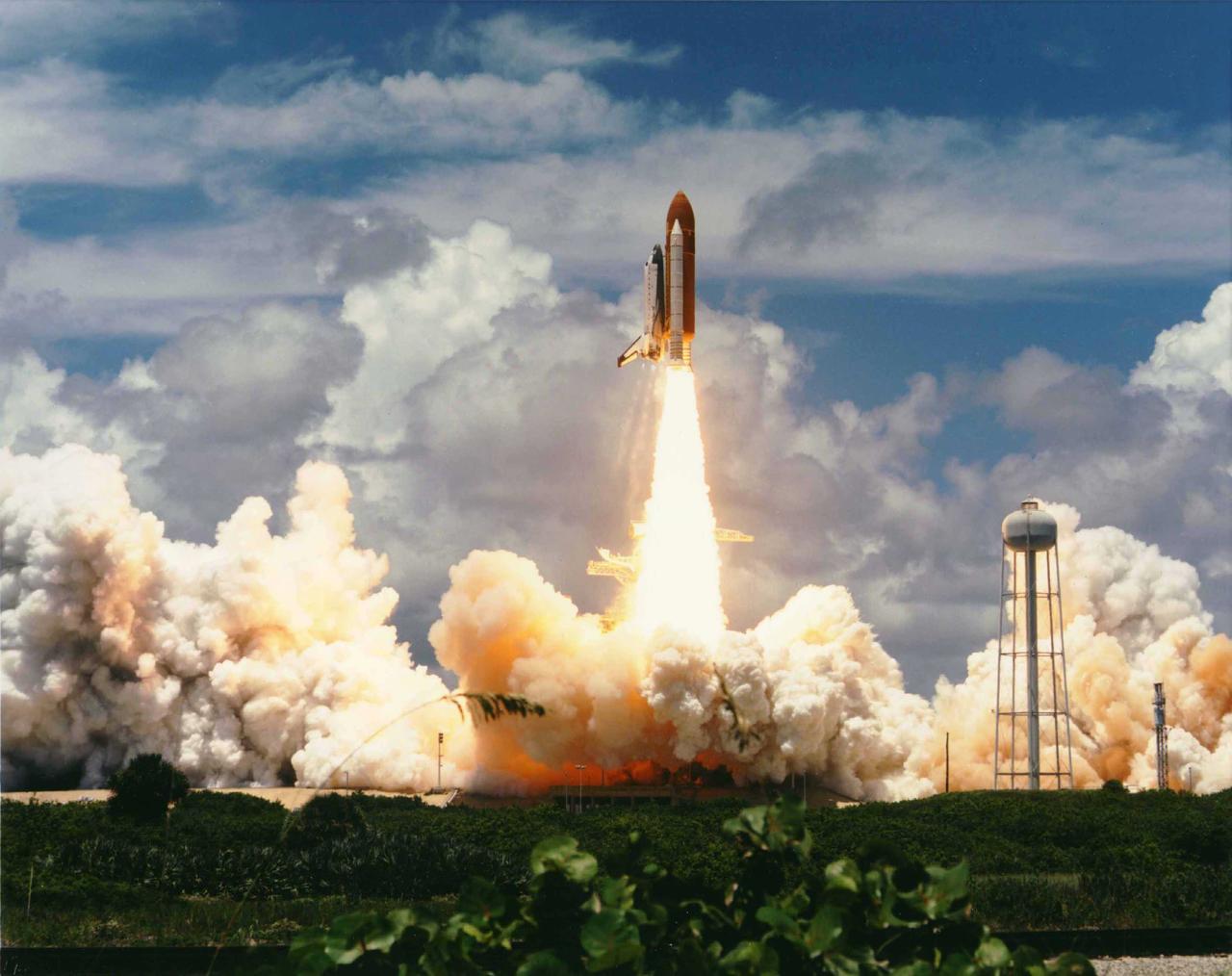
KENNEDY SPACE CENTER, FLA. - The second International Microgravity Laboratory-2 (IML-2) is off to an ontime start as the Space Shuttle Columbia lifts off from Launch Pad 39A at 12:43:00 p.m. EDT. On board are a crew of seven and more than 80 investigations developed by more than 200 scientists from 13 countries. The IML-2 complement includes materials science, bioprocessing, space and radiation biology, and human physiology experiments that will be carried out over the course of the 14-day flight. The commander of Space Shuttle Mission STS-65 is Robert D. Cabana. James D. Halsell Jr. is the pilot; the payload commander is Richard J. Hieb; the three mission specialists are Carl E. Walz, Leroy Chiao and Donald A. Thomas. Dr. Chiaki Mukai, representing NASDA, the National Space Development Agency of Japan, is the payload specialist. Mukai becomes the first Japanese woman to fly into space.
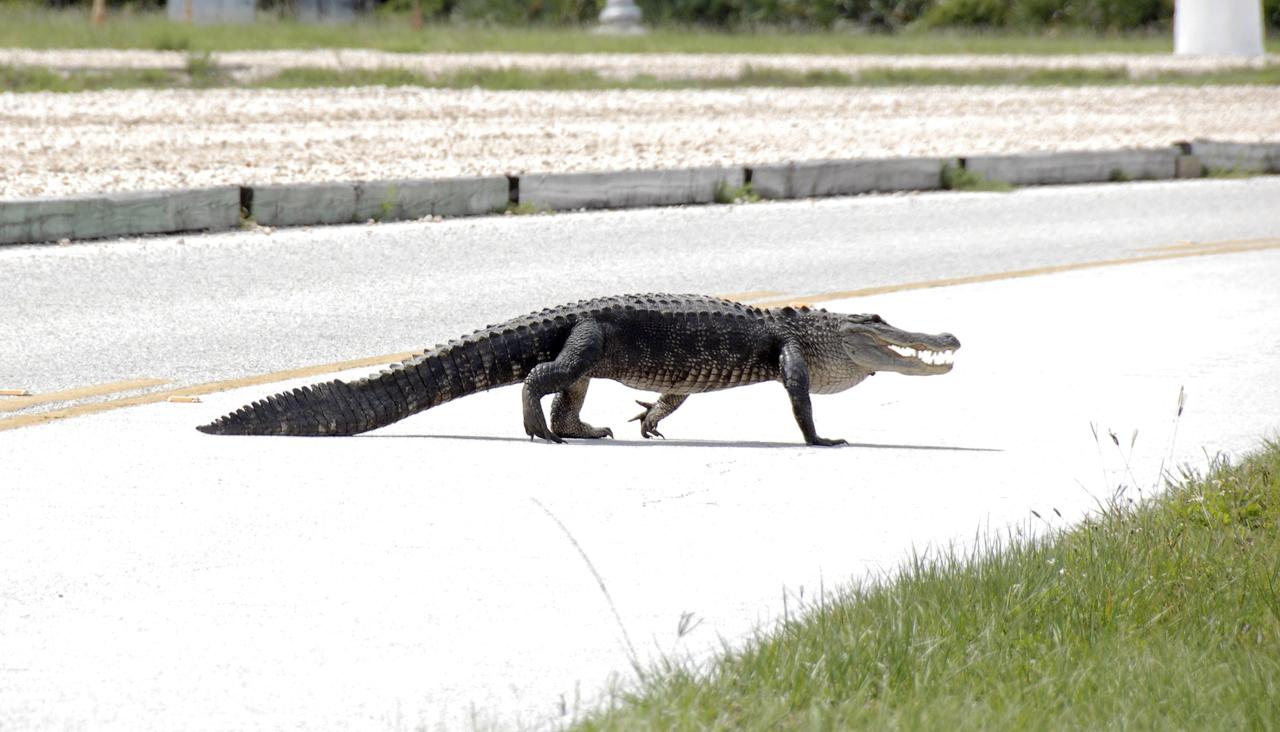
CAPE CANAVERAL, Fla. – Taking a mid-day stroll, an alligator crosses the Saturn Causeway at NASA's Kennedy Space Center in Florida in front of the Astrovan with STS-127 crew members aboard. The crew was on its way to Launch Pad 39A for a simulated launch countdown, part of the terminal countdown demonstration test. Alligators can be spotted in the drainage canals and other waters surrounding Kennedy. They occasionally venture onto roads seeking new environs or mates. The center shares a boundary with the Merritt Island Wildlife Nature Refuge, which is a habitat for more than 310 species of birds, 25 mammals, 117 fishes and 65 amphibians and reptiles. Photo credit: NASA/Kim Shiflett
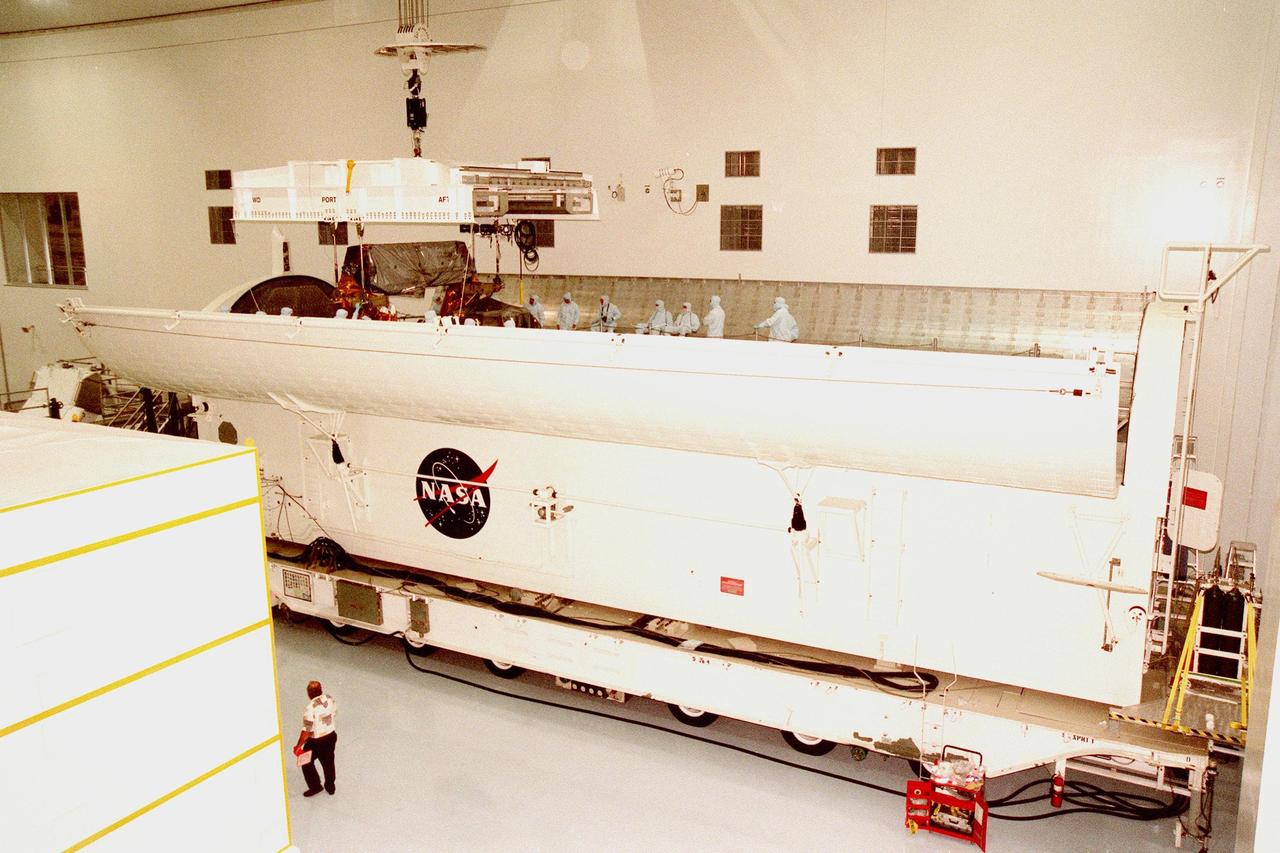
KENNEDY SPACE CENTER, FLA. -- The Hubble Space Telescope Orbiting Systems Test (HOST), one of the payloads on the STS-95 mission, is placed inside its payload canister in the Space Station Processing Facility. The canister is 65 feet long, 18 feet wide and 18 feet, 7 inches high. The HOST platform is carrying four experiments to validate components planned for installation during the third Hubble Space Telescope servicing mission and to evaluate new technologies in an Earth-orbiting environment. The STS-95 mission is scheduled to launch Oct. 29. It will carry other payloads such as the Spartan solar-observing deployable spacecraft, the International Extreme Ultraviolet Hitchhiker (IEH-3), and the SPACEHAB single module with experiments on space flight and the aging process
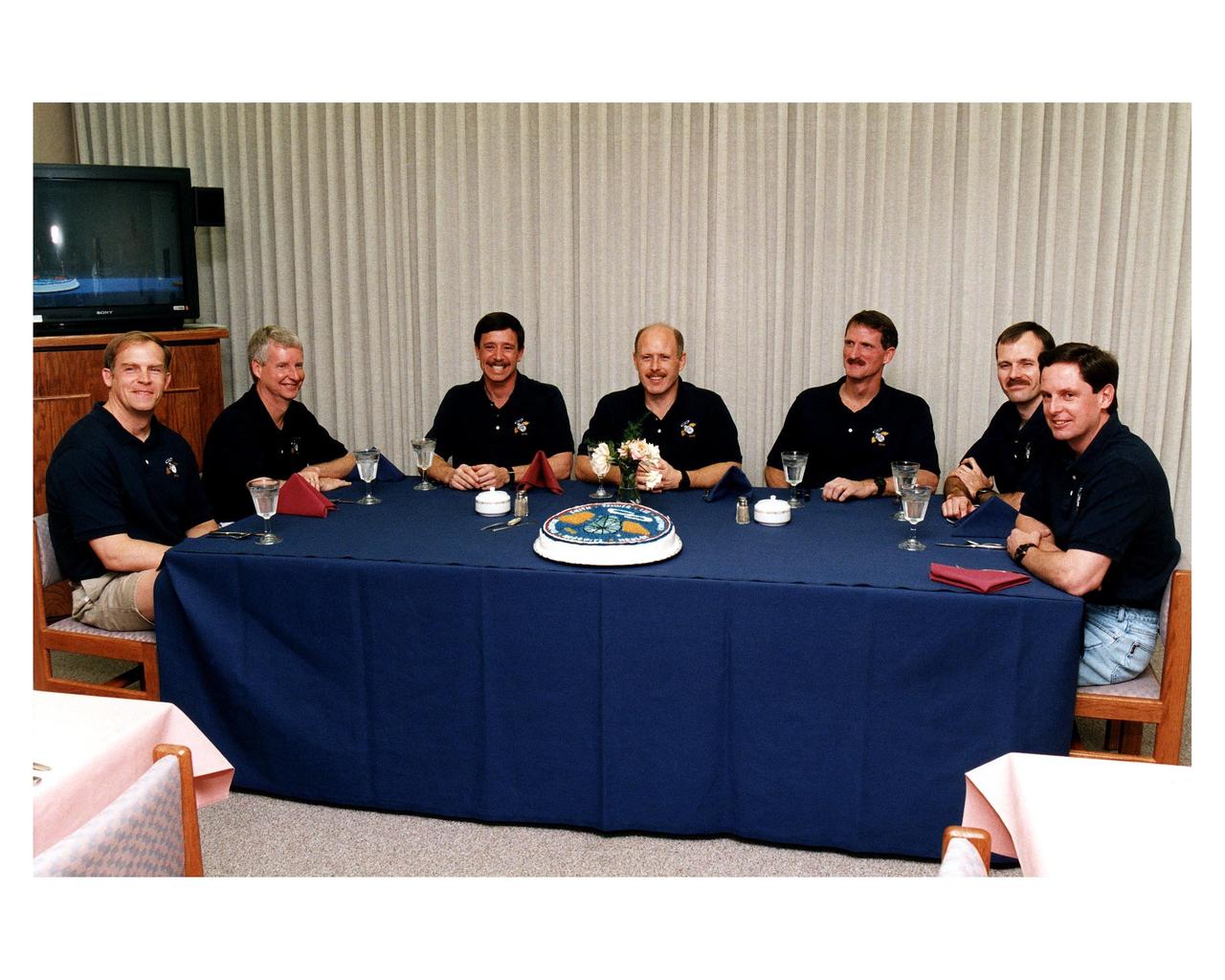
As part of the final STS-82 prelaunch activities, the seven crew members gather for lunch and a photo opportunity in the Operations and Checkout Building. From left, are Payload Commander Mark C. Lee, Mission Specialist Steven A. Hawley, Pilot Scott J. "Doc" Horowitz, Mission Commander Kenneth D. Bowersox, and Mission Specialists Joseph R. "Joe" Tanner, Steven L. Smith and Gregory J. Harbaugh. After a weather briefing, the astronauts will don their launch and entry suits and depart for Launch Pad 39A, where the Space Shuttle Discovery awaits liftoff during a 65-minute launch window which opens at about 3:55 a.m. EST, Feb. 11. The exact opening of the launch window will be announced a few hours before launch based on the final computation of the location of the Hubble Space Telescope (HST). STS-82 will be the second mission to service the HST which was deployed in 1990
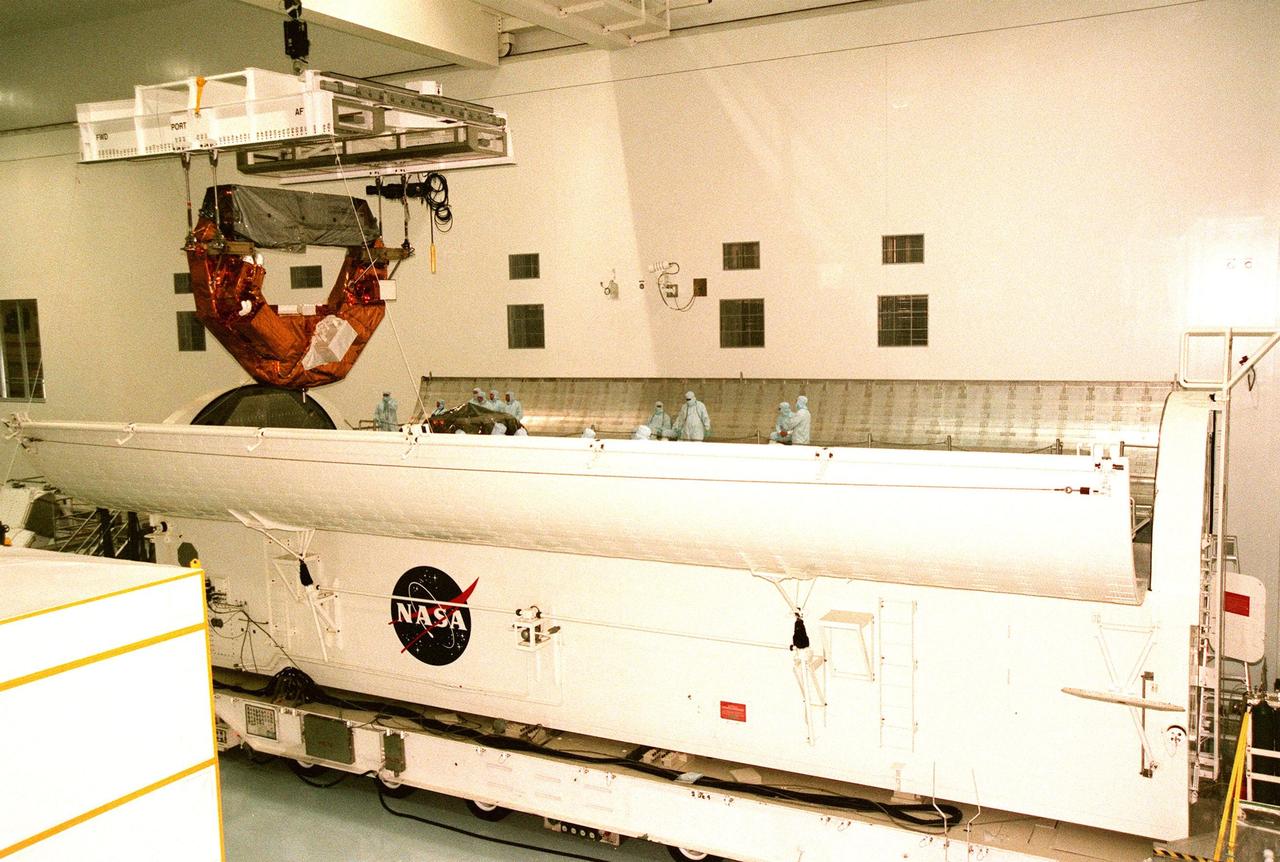
KENNEDY SPACE CENTER, FLA. -- The Hubble Space Telescope Orbiting Systems Test (HOST), one of the payloads on the STS-95 mission, is suspended above its payload canister in the Space Station Processing Facility. The canister is 65 feet long, 18 feet wide and 18 feet, 7 inches high. The HOST platform is carrying four experiments to validate components planned for installation during the third Hubble Space Telescope servicing mission and to evaluate new technologies in an Earth-orbiting environment. The STS-95 mission is scheduled to launch Oct. 29. It will carry other payloads such as the Spartan solar-observing deployable spacecraft, the International Extreme Ultraviolet Hitchhiker (IEH-3), and the SPACEHAB single module with experiments on space flight and the aging process
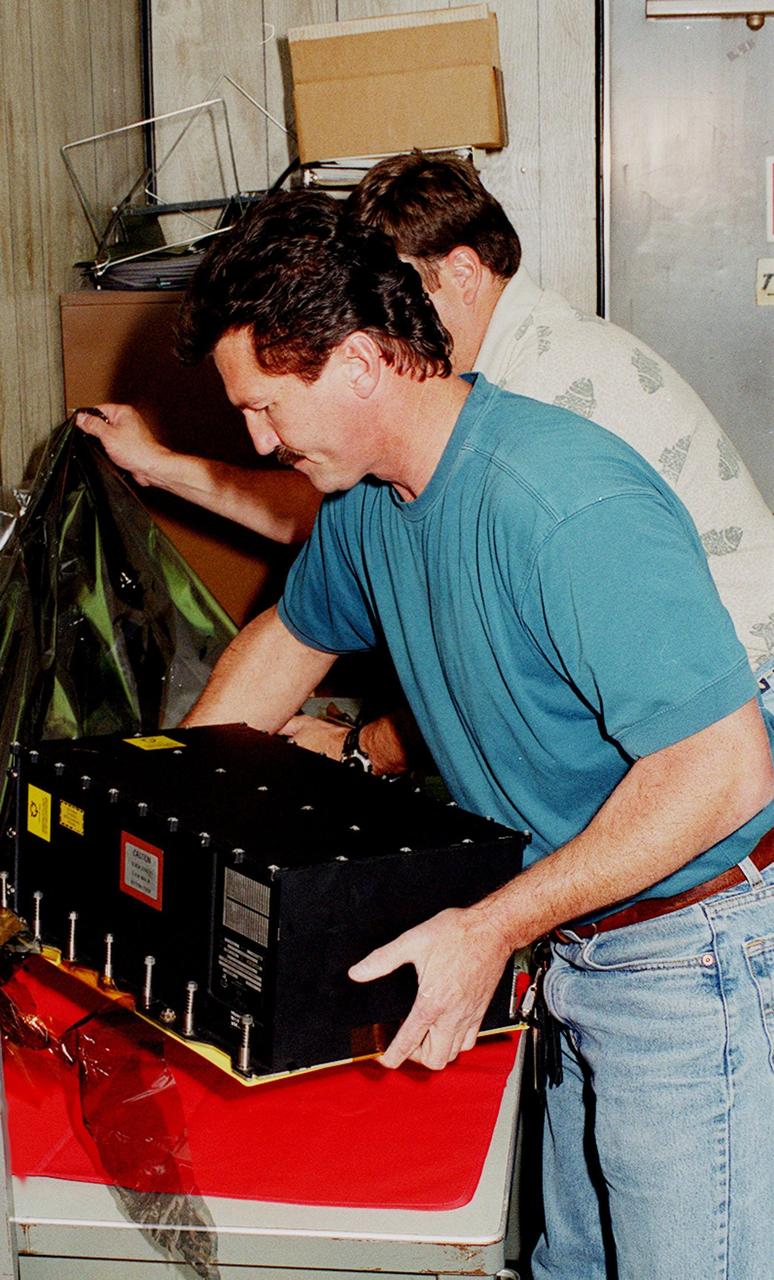
KENNEDY SPACE CENTER, FLA. -- Workers in a Quality trailer in the Launch Pad 39B Area unwrap a new Enhanced Main Events Controller (E-MEC) to be installed in Shuttle Endeavour. The original E-MEC in Endeavour became suspect during the Jan. 31 launch countdown and mission STS-99 was delayed when NASA managers decided to replace it. Each Shuttle carries two enhanced master events controllers (E-MECs), which provide relays for onboard flight computers to send signals to arm and fire pyrotechnics that separate the solid rockets and external tank during assent. The E-MECs are located in the orbiter's aft compartment and both are needed for the Shuttle to be cleared for flight. Currently Endeavour and Columbia are the only two orbiters with the E-MECs. Built by Rockwell's Satellite Space Electronics Division, Anaheim, Calif., each unit weighs 65 pounds and is approximately 20 inches long, 13 inches wide and 8 inches tall. Previously, three Shuttle flights have been scrubbed or delayed due to faulty MECs: STS-73, STS-49 and STS-41-D. Before workers can begin E-MEC replacement efforts at the launch pad, cryogenic reactants must be offloaded from the orbiter and Space Shuttle ordnance disconnected. The next scheduled date for launch of STS-99 is Feb. 11 at 12:30 p.m. EST
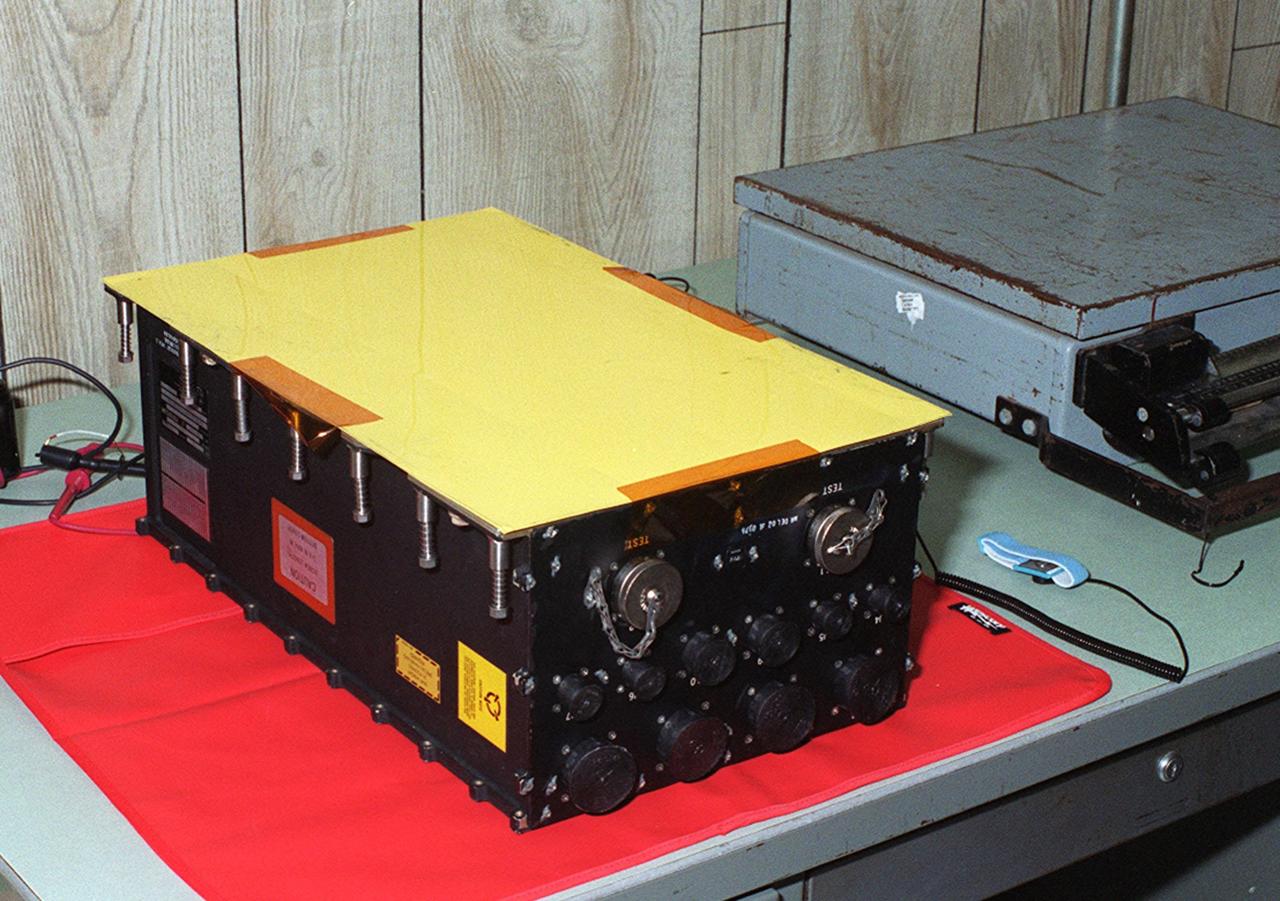
KENNEDY SPACE CENTER, FLA. -- A new Enhanced Main Events Controller (E-MEC) for Shuttle Endeavour sits on a table in a Quality trailer in the Launch Pad 39B area. The original E-MEC in Endeavour became suspect during the Jan. 31 launch countdown and mission STS-99 was delayed when NASA managers decided to replace it. Each Shuttle carries two enhanced master events controllers (E-MECs), which provide relays for onboard flight computers to send signals to arm and fire pyrotechnics that separate the solid rockets and external tank during assent. The E-MECs are located in the orbiter's aft compartment and both are needed for the Shuttle to be cleared for flight. Currently Endeavour and Columbia are the only two orbiters with the E-MECs. Built by Rockwell's Satellite Space Electronics Division, Anaheim, Calif., each unit weighs 65 pounds and is approximately 20 inches long, 13 inches wide and 8 inches tall. Previously, three Shuttle flights have been scrubbed or delayed due to faulty MECs: STS-73, STS-49 and STS-41-D. Before workers can begin E-MEC replacement efforts at the launch pad, cryogenic reactants must be offloaded from the orbiter and Space Shuttle ordnance disconnected. The next scheduled date for launch of STS-99 is Feb. 11 at 12:30 p.m. EST
KENNEDY SPACE CENTER, FLA. -- Workers carry away the faulty Enhanced Main Events Controller (E-MEC) from Shuttle Endeavour at Launch Pad 39A. The E-MEC became suspect during the Jan. 31 launch countdown and mission STS-99 was delayed when NASA managers decided to replace it. Each Shuttle carries two enhanced master events controllers (E-MECs), which provide relays for onboard flight computers to send signals to arm and fire pyrotechnics that separate the solid rockets and external tank during assent. Both E-MECs are needed for the Shuttle to be cleared for flight. Currently Endeavour and Columbia are the only two orbiters with the E-MECs. Built by Rockwell's Satellite Space Electronics Division, Anaheim, Calif., each unit weighs 65 pounds and is approximately 20 inches long, 13 inches wide and 8 inches tall. Previously, three Shuttle flights have been scrubbed or delayed due to faulty MECs: STS-73, STS-49 and STS-41-D. The next scheduled date for launch of STS-99 is Feb. 11 at 12:30 p.m. EST
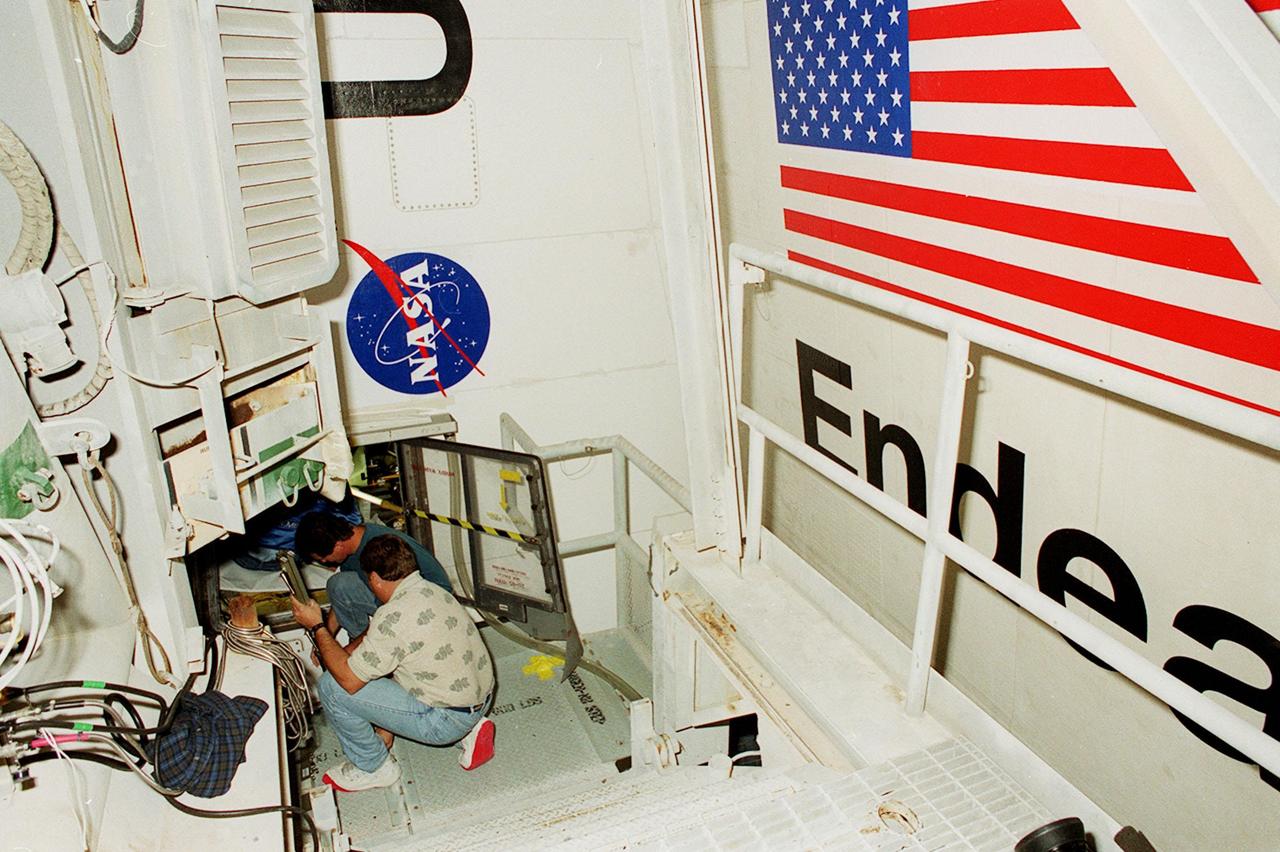
KENNEDY SPACE CENTER, FLA. -- Technicians work in the aft compartment of Shuttle Endeavour's payload bay, where a new Enhanced Main Events Controller (E-MEC) will be installed. The original E-MEC in Endeavour became suspect during the Jan. 31 launch countdown and mission STS-99 was delayed when NASA managers decided to replace it. Each Shuttle carries two enhanced master events controllers (E-MECs), which provide relays for onboard flight computers to send signals to arm and fire pyrotechnics that separate the solid rockets and external tank during assent. Both E-MECs are needed for the Shuttle to be cleared for flight. Currently Endeavour and Columbia are the only two orbiters with the E-MECs. Built by Rockwell's Satellite Space Electronics Division, Anaheim, Calif., each unit weighs 65 pounds and is approximately 20 inches long, 13 inches wide and 8 inches tall. Previously, three Shuttle flights have been scrubbed or delayed due to faulty MECs: STS-73, STS-49 and STS-41-D. Before workers can begin E-MEC replacement efforts at the launch pad, cryogenic reactants had to be offloaded from the orbiter and Space Shuttle ordnance disconnected. The next scheduled date for launch of STS-99 is Feb. 11 at 12:30 p.m. EST
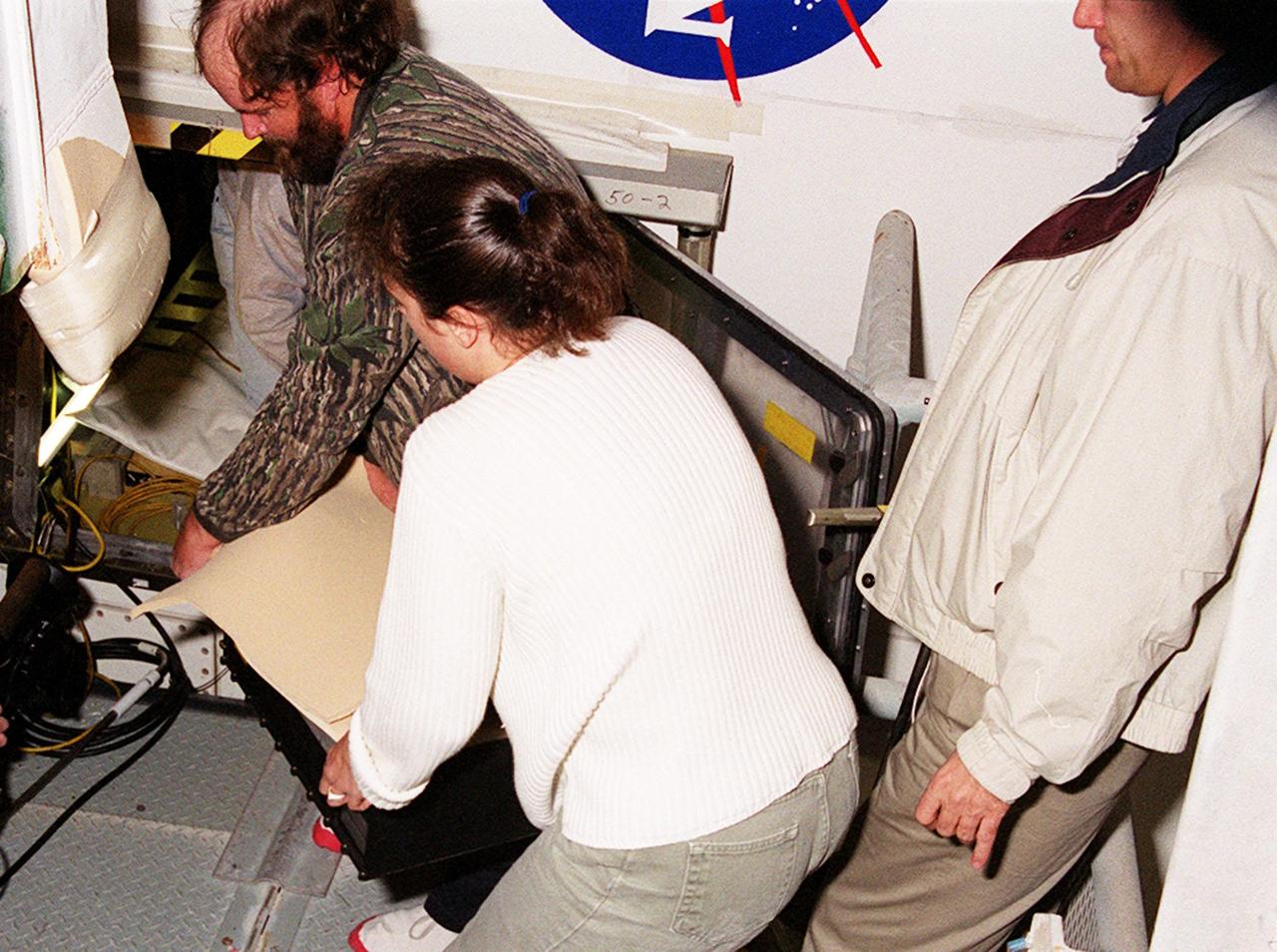
KENNEDY SPACE CENTER, FLA. -- Workers carry away the faulty Enhanced Main Events Controller (E-MEC) from Shuttle Endeavour at Launch Pad 39A. The E-MEC became suspect during the Jan. 31 launch countdown and mission STS-99 was delayed when NASA managers decided to replace it. Each Shuttle carries two enhanced master events controllers (E-MECs), which provide relays for onboard flight computers to send signals to arm and fire pyrotechnics that separate the solid rockets and external tank during assent. Both E-MECs are needed for the Shuttle to be cleared for flight. Currently Endeavour and Columbia are the only two orbiters with the E-MECs. Built by Rockwell's Satellite Space Electronics Division, Anaheim, Calif., each unit weighs 65 pounds and is approximately 20 inches long, 13 inches wide and 8 inches tall. Previously, three Shuttle flights have been scrubbed or delayed due to faulty MECs: STS-73, STS-49 and STS-41-D. The next scheduled date for launch of STS-99 is Feb. 11 at 12:30 p.m. EST
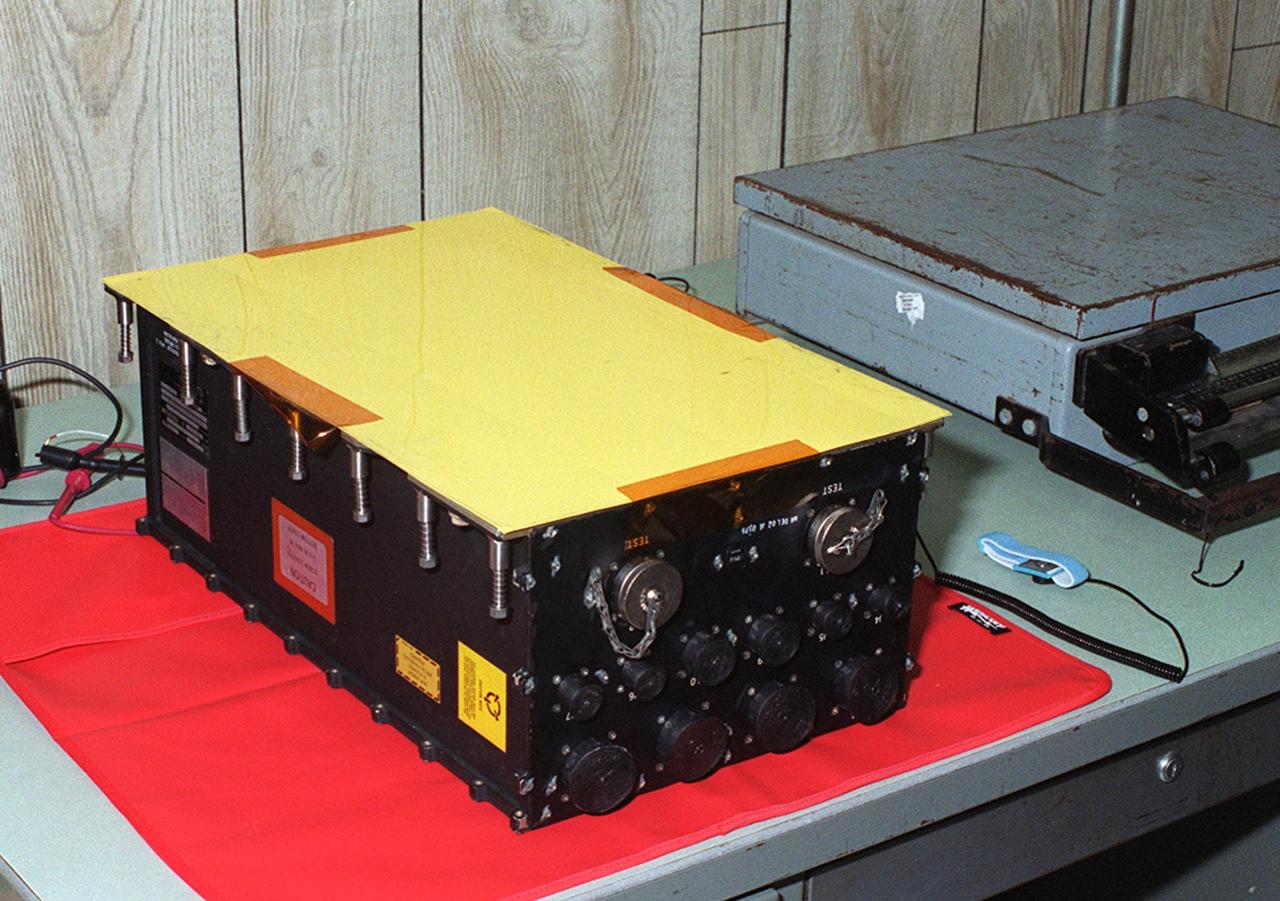
KENNEDY SPACE CENTER, FLA. -- A new Enhanced Main Events Controller (E-MEC) for Shuttle Endeavour sits on a table in a Quality trailer in the Launch Pad 39B area. The original E-MEC in Endeavour became suspect during the Jan. 31 launch countdown and mission STS-99 was delayed when NASA managers decided to replace it. Each Shuttle carries two enhanced master events controllers (E-MECs), which provide relays for onboard flight computers to send signals to arm and fire pyrotechnics that separate the solid rockets and external tank during assent. The E-MECs are located in the orbiter's aft compartment and both are needed for the Shuttle to be cleared for flight. Currently Endeavour and Columbia are the only two orbiters with the E-MECs. Built by Rockwell's Satellite Space Electronics Division, Anaheim, Calif., each unit weighs 65 pounds and is approximately 20 inches long, 13 inches wide and 8 inches tall. Previously, three Shuttle flights have been scrubbed or delayed due to faulty MECs: STS-73, STS-49 and STS-41-D. Before workers can begin E-MEC replacement efforts at the launch pad, cryogenic reactants must be offloaded from the orbiter and Space Shuttle ordnance disconnected. The next scheduled date for launch of STS-99 is Feb. 11 at 12:30 p.m. EST
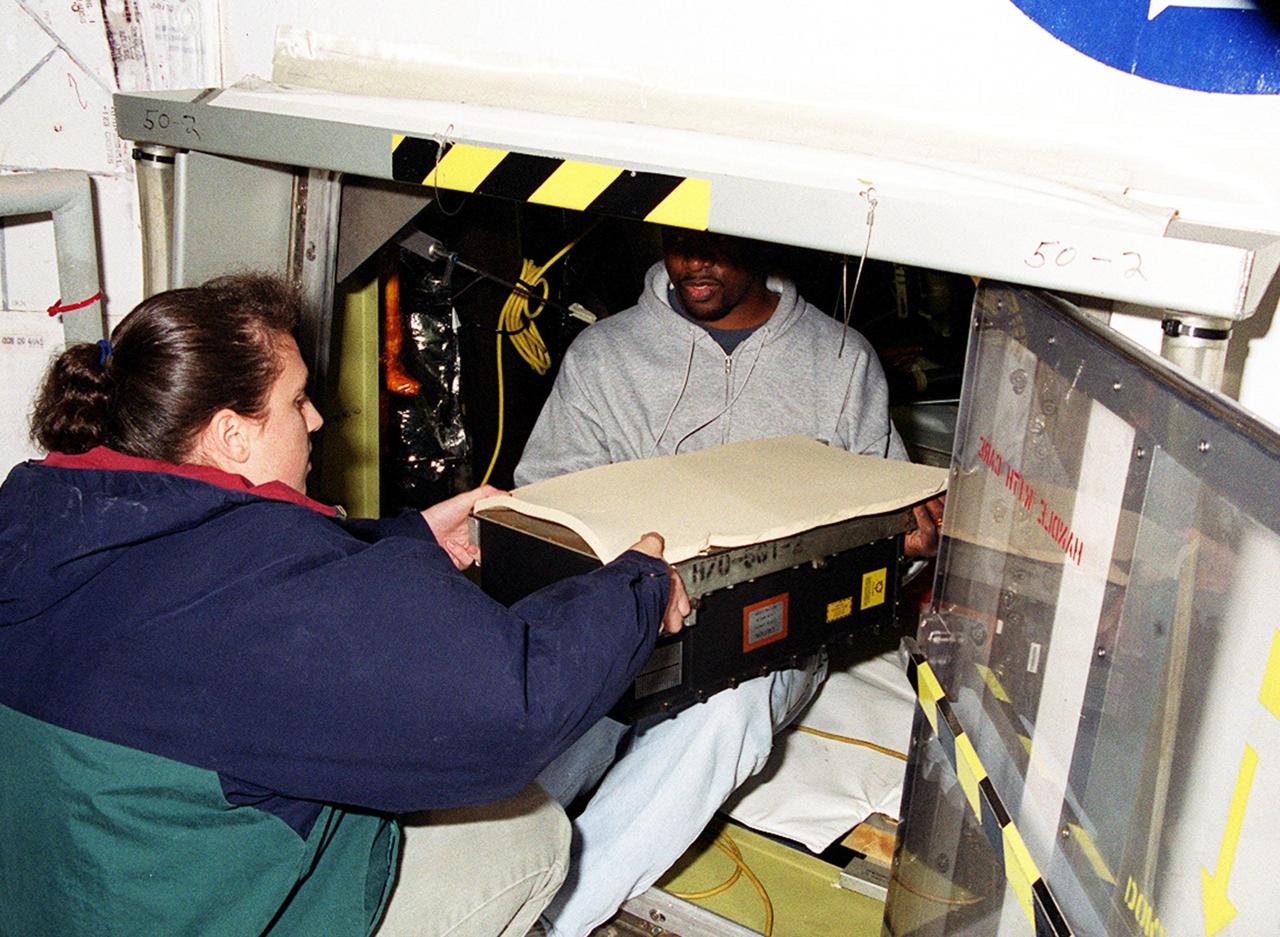
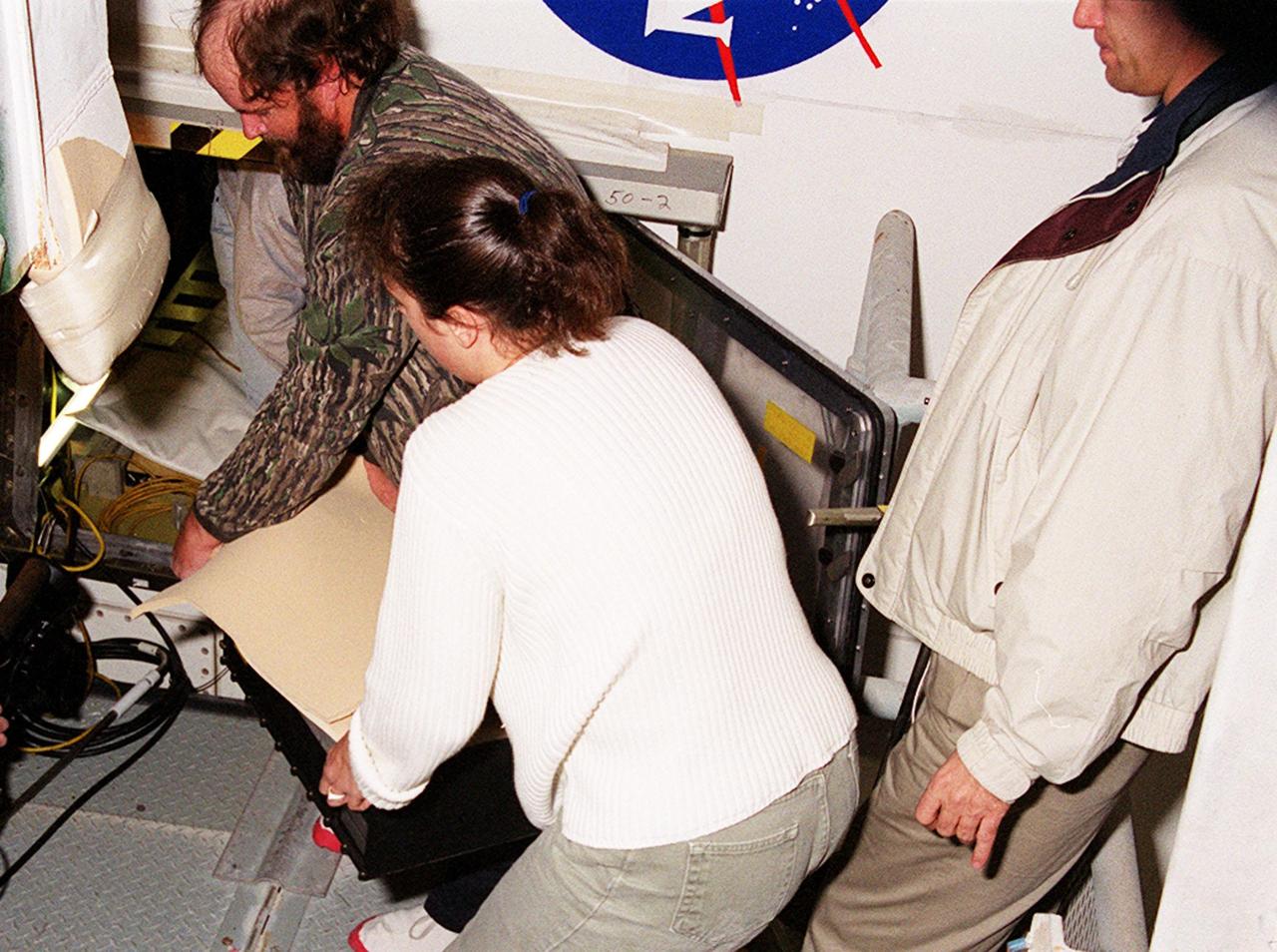
KENNEDY SPACE CENTER, FLA. -- At Launch Pad 39A, workers move the replacement Enhanced Main Events Controller (E-MEC) into Shuttle Endeavour's aft compartment in the payload bay. The original E-MEC became suspect during the Jan. 31 launch countdown and mission STS-99 was delayed when NASA managers decided to replace it. Each Shuttle carries two enhanced master events controllers (E-MECs), which provide relays for onboard flight computers to send signals to arm and fire pyrotechnics that separate the solid rockets and external tank during assent. Both E-MECs are needed for the Shuttle to be cleared for flight. Currently Endeavour and Columbia are the only two orbiters with the E-MECs. Built by Rockwell's Satellite Space Electronics Division, Anaheim, Calif., each unit weighs 65 pounds and is approximately 20 inches long, 13 inches wide and 8 inches tall. Previously, three Shuttle flights have been scrubbed or delayed due to faulty MECs: STS-73, STS-49 and STS-41-D. The next scheduled date for launch of STS-99 is Feb. 11 at 12:30 p.m. EST
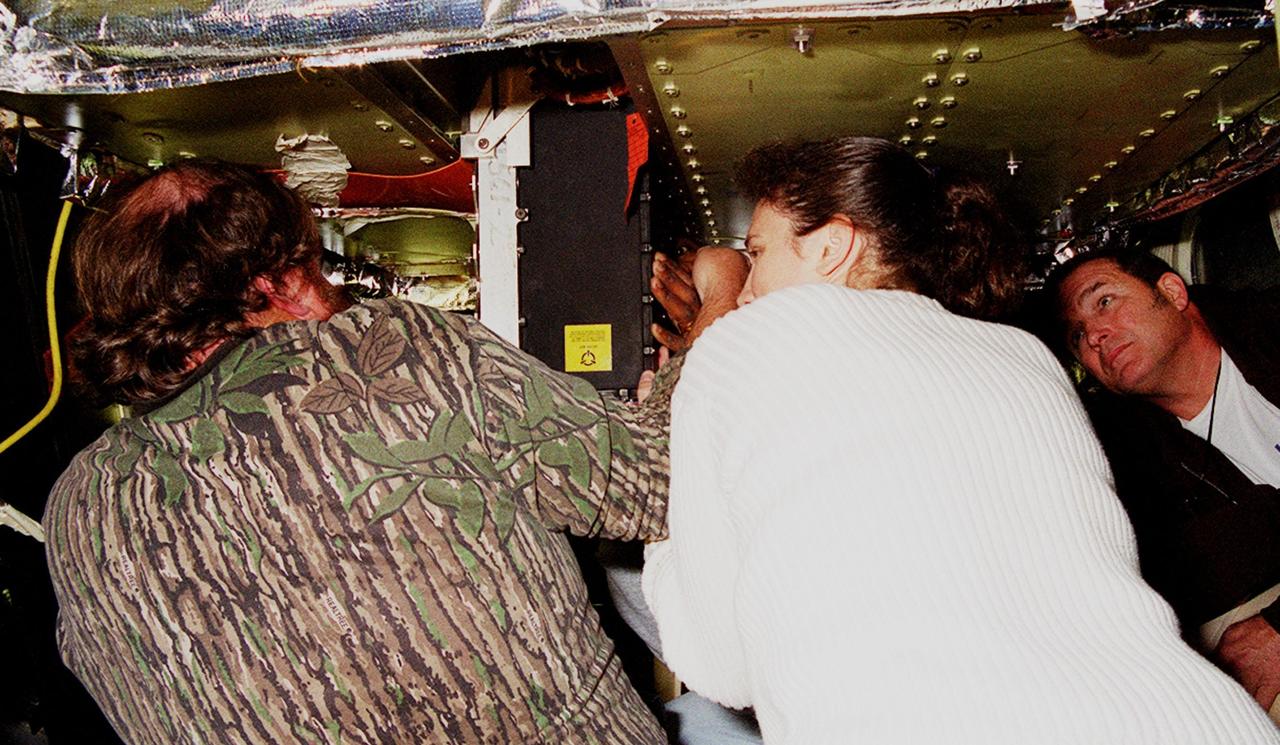
KENNEDY SPACE CENTER, FLA. -- Technicians remove a faulty Enhanced Main Events Controller (E-MEC) from Shuttle Endeavour at Launch Pad 39A. The E-MEC became suspect during the Jan. 31 launch countdown and mission STS-99 was delayed when NASA managers decided to replace it. Each Shuttle carries two enhanced master events controllers (E-MECs), which provide relays for onboard flight computers to send signals to arm and fire pyrotechnics that separate the solid rockets and external tank during assent. Both E-MECs are needed for the Shuttle to be cleared for flight. Currently Endeavour and Columbia are the only two orbiters with the E-MECs. Built by Rockwell's Satellite Space Electronics Division, Anaheim, Calif., each unit weighs 65 pounds and is approximately 20 inches long, 13 inches wide and 8 inches tall. Previously, three Shuttle flights have been scrubbed or delayed due to faulty MECs: STS-73, STS-49 and STS-41-D. The next scheduled date for launch of STS-99 is Feb. 11 at 12:30 p.m. EST
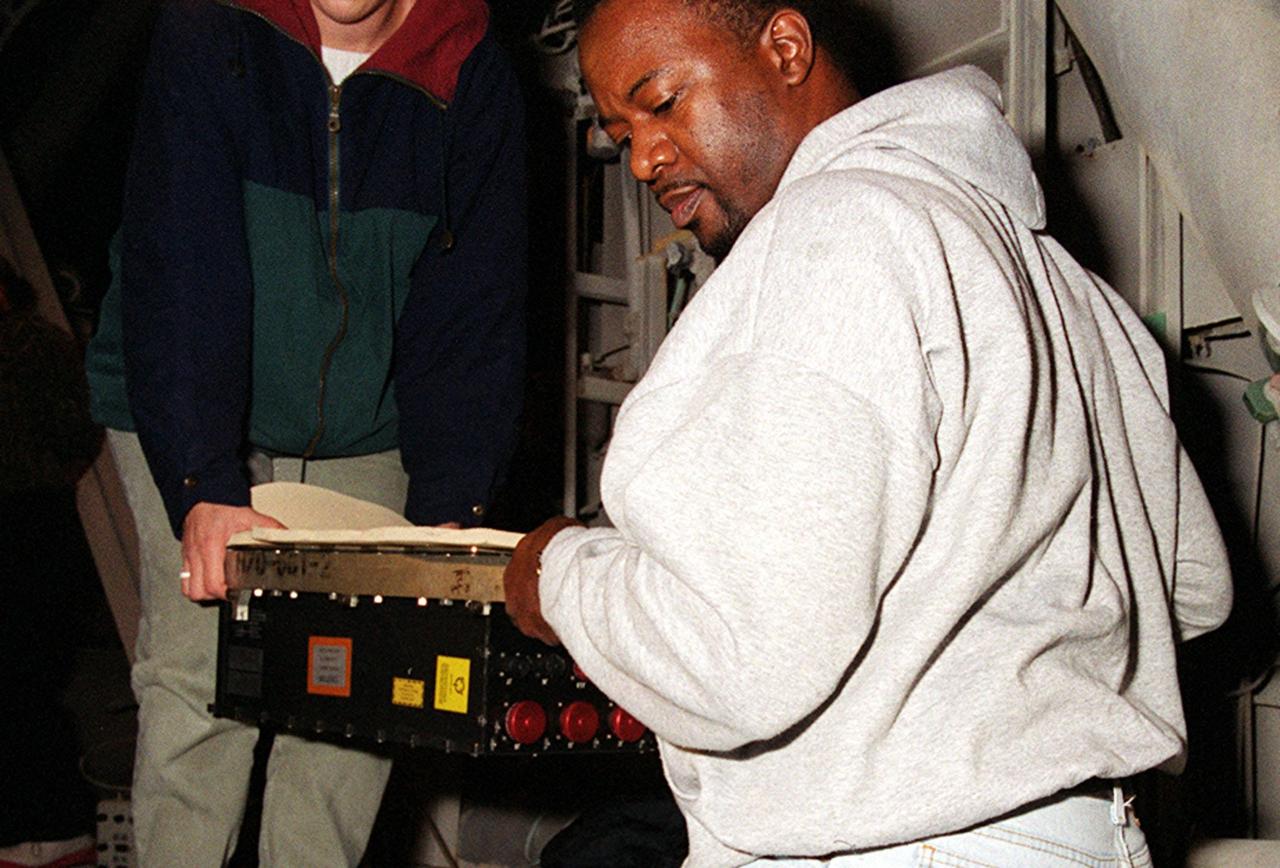
KENNEDY SPACE CENTER, FLA. -- Workers carry the replacement Enhanced Main Events Controller (E-MEC) to Shuttle Endeavour at Launch Pad 39A for installation in the aft compartment of the payload bay. The original E-MEC became suspect during the Jan. 31 launch countdown and mission STS-99 was delayed when NASA managers decided to replace it. Each Shuttle carries two enhanced master events controllers (E-MECs), which provide relays for onboard flight computers to send signals to arm and fire pyrotechnics that separate the solid rockets and external tank during assent. Both E-MECs are needed for the Shuttle to be cleared for flight. Currently Endeavour and Columbia are the only two orbiters with the E-MECs. Built by Rockwell's Satellite Space Electronics Division, Anaheim, Calif., each unit weighs 65 pounds and is approximately 20 inches long, 13 inches wide and 8 inches tall. Previously, three Shuttle flights have been scrubbed or delayed due to faulty MECs: STS-73, STS-49 and STS-41-D. The next scheduled date for launch of STS-99 is Feb. 11 at 12:30 p.m. EST
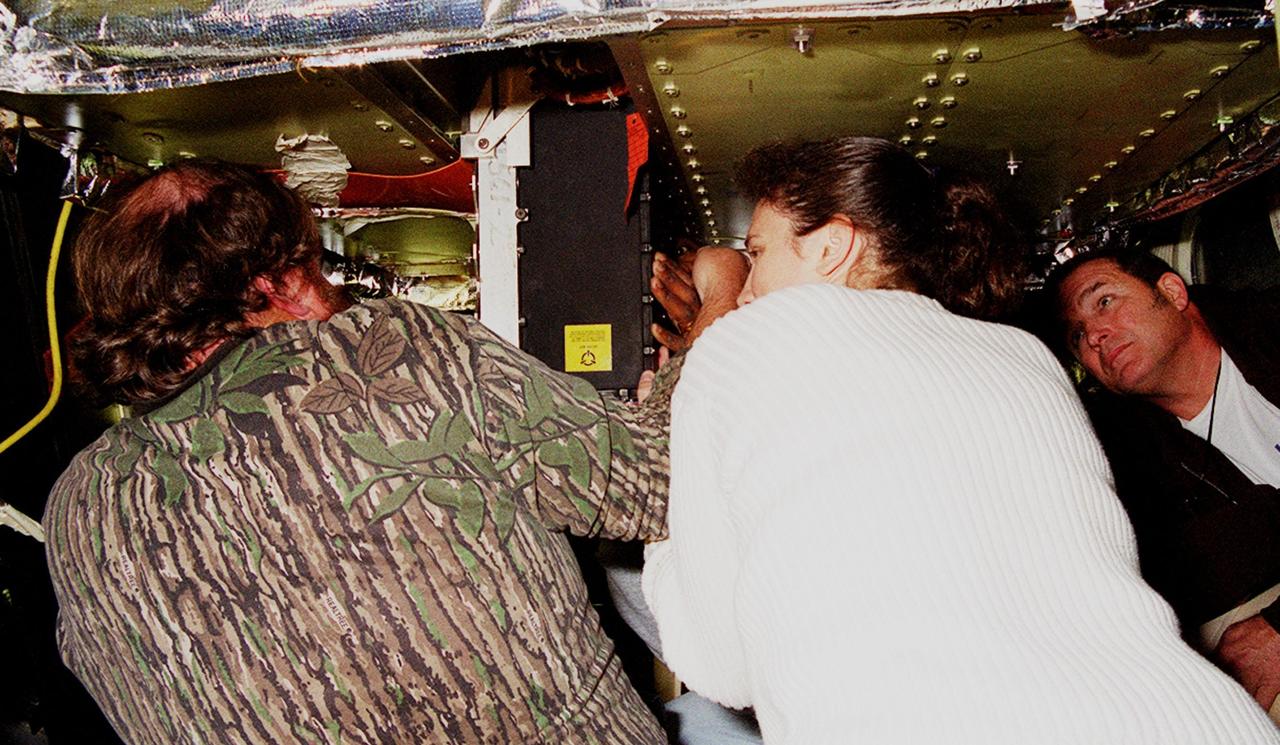
KENNEDY SPACE CENTER, FLA. -- Technicians remove a faulty Enhanced Main Events Controller (E-MEC) from Shuttle Endeavour at Launch Pad 39A. The E-MEC became suspect during the Jan. 31 launch countdown and mission STS-99 was delayed when NASA managers decided to replace it. Each Shuttle carries two enhanced master events controllers (E-MECs), which provide relays for onboard flight computers to send signals to arm and fire pyrotechnics that separate the solid rockets and external tank during assent. Both E-MECs are needed for the Shuttle to be cleared for flight. Currently Endeavour and Columbia are the only two orbiters with the E-MECs. Built by Rockwell's Satellite Space Electronics Division, Anaheim, Calif., each unit weighs 65 pounds and is approximately 20 inches long, 13 inches wide and 8 inches tall. Previously, three Shuttle flights have been scrubbed or delayed due to faulty MECs: STS-73, STS-49 and STS-41-D. The next scheduled date for launch of STS-99 is Feb. 11 at 12:30 p.m. EST
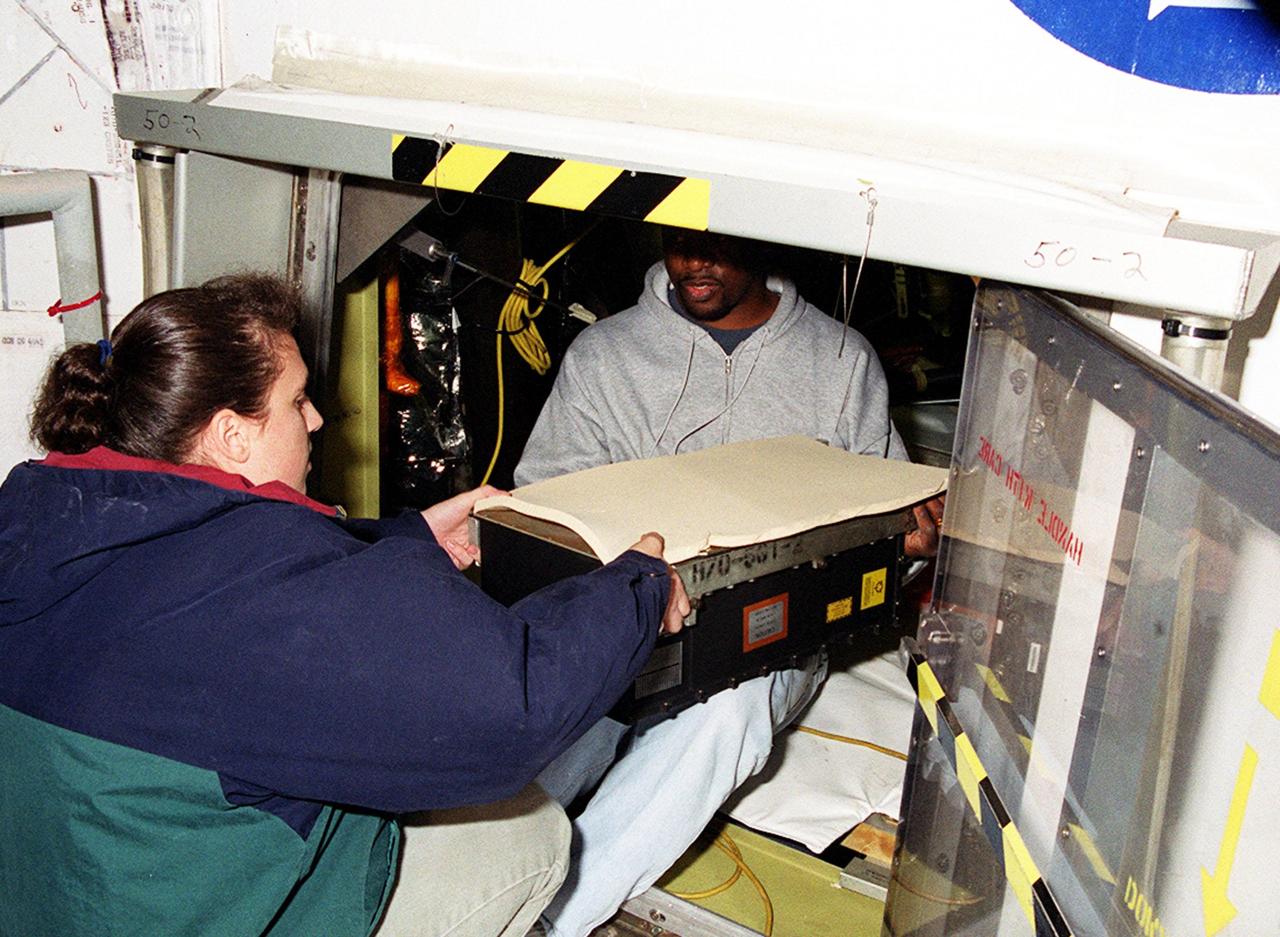
KENNEDY SPACE CENTER, FLA. -- At Launch Pad 39A, workers move the replacement Enhanced Main Events Controller (E-MEC) into Shuttle Endeavour's aft compartment in the payload bay. The original E-MEC became suspect during the Jan. 31 launch countdown and mission STS-99 was delayed when NASA managers decided to replace it. Each Shuttle carries two enhanced master events controllers (E-MECs), which provide relays for onboard flight computers to send signals to arm and fire pyrotechnics that separate the solid rockets and external tank during assent. Both E-MECs are needed for the Shuttle to be cleared for flight. Currently Endeavour and Columbia are the only two orbiters with the E-MECs. Built by Rockwell's Satellite Space Electronics Division, Anaheim, Calif., each unit weighs 65 pounds and is approximately 20 inches long, 13 inches wide and 8 inches tall. Previously, three Shuttle flights have been scrubbed or delayed due to faulty MECs: STS-73, STS-49 and STS-41-D. The next scheduled date for launch of STS-99 is Feb. 11 at 12:30 p.m. EST
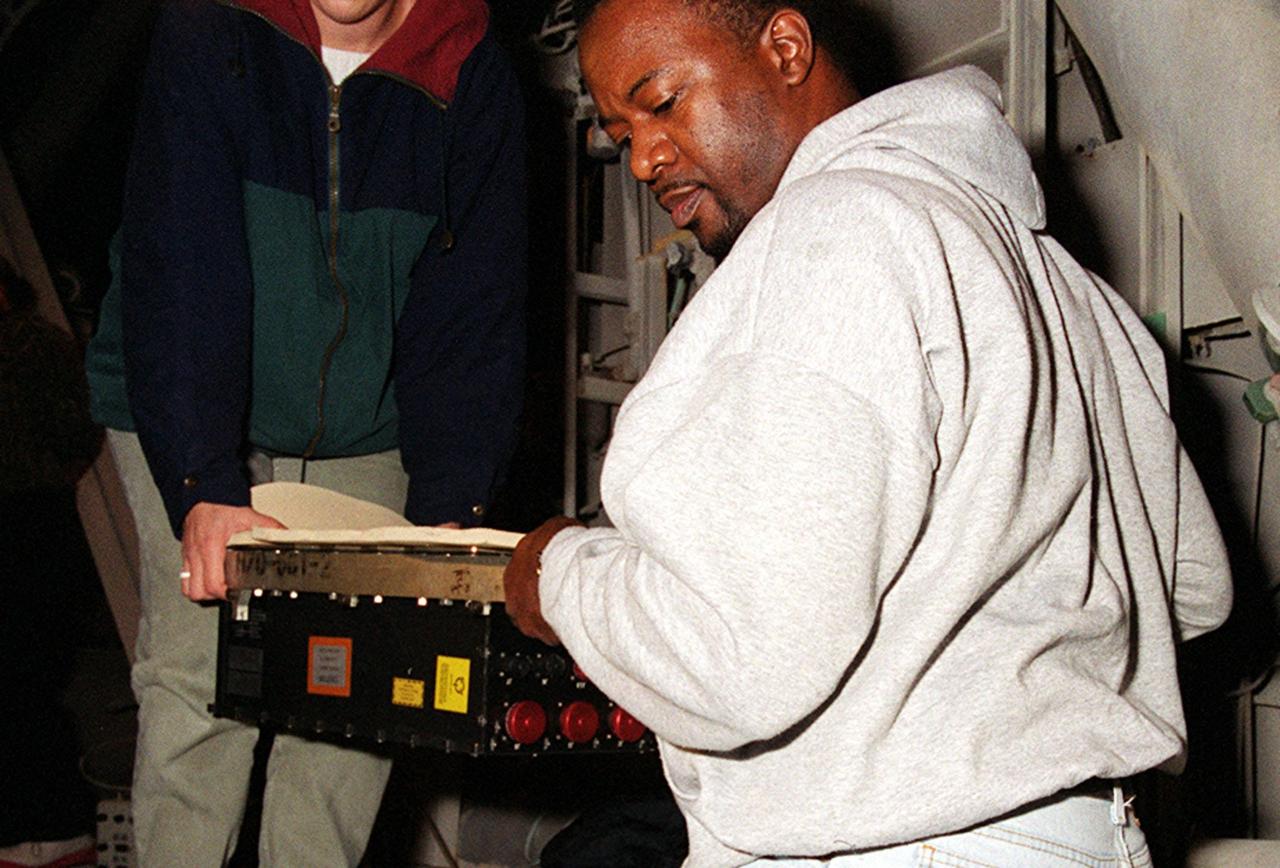
KENNEDY SPACE CENTER, FLA. -- Workers carry the replacement Enhanced Main Events Controller (E-MEC) to Shuttle Endeavour at Launch Pad 39A for installation in the aft compartment of the payload bay. The original E-MEC became suspect during the Jan. 31 launch countdown and mission STS-99 was delayed when NASA managers decided to replace it. Each Shuttle carries two enhanced master events controllers (E-MECs), which provide relays for onboard flight computers to send signals to arm and fire pyrotechnics that separate the solid rockets and external tank during assent. Both E-MECs are needed for the Shuttle to be cleared for flight. Currently Endeavour and Columbia are the only two orbiters with the E-MECs. Built by Rockwell's Satellite Space Electronics Division, Anaheim, Calif., each unit weighs 65 pounds and is approximately 20 inches long, 13 inches wide and 8 inches tall. Previously, three Shuttle flights have been scrubbed or delayed due to faulty MECs: STS-73, STS-49 and STS-41-D. The next scheduled date for launch of STS-99 is Feb. 11 at 12:30 p.m. EST

KENNEDY SPACE CENTER, FLA. -- Technicians work in the aft compartment of Shuttle Endeavour's payload bay, where a new Enhanced Main Events Controller (E-MEC) will be installed. The original E-MEC in Endeavour became suspect during the Jan. 31 launch countdown and mission STS-99 was delayed when NASA managers decided to replace it. Each Shuttle carries two enhanced master events controllers (E-MECs), which provide relays for onboard flight computers to send signals to arm and fire pyrotechnics that separate the solid rockets and external tank during assent. Both E-MECs are needed for the Shuttle to be cleared for flight. Currently Endeavour and Columbia are the only two orbiters with the E-MECs. Built by Rockwell's Satellite Space Electronics Division, Anaheim, Calif., each unit weighs 65 pounds and is approximately 20 inches long, 13 inches wide and 8 inches tall. Previously, three Shuttle flights have been scrubbed or delayed due to faulty MECs: STS-73, STS-49 and STS-41-D. Before workers can begin E-MEC replacement efforts at the launch pad, cryogenic reactants had to be offloaded from the orbiter and Space Shuttle ordnance disconnected. The next scheduled date for launch of STS-99 is Feb. 11 at 12:30 p.m. EST

KENNEDY SPACE CENTER, FLA. -- Workers in a Quality trailer in the Launch Pad 39B Area unwrap a new Enhanced Main Events Controller (E-MEC) to be installed in Shuttle Endeavour. The original E-MEC in Endeavour became suspect during the Jan. 31 launch countdown and mission STS-99 was delayed when NASA managers decided to replace it. Each Shuttle carries two enhanced master events controllers (E-MECs), which provide relays for onboard flight computers to send signals to arm and fire pyrotechnics that separate the solid rockets and external tank during assent. The E-MECs are located in the orbiter's aft compartment and both are needed for the Shuttle to be cleared for flight. Currently Endeavour and Columbia are the only two orbiters with the E-MECs. Built by Rockwell's Satellite Space Electronics Division, Anaheim, Calif., each unit weighs 65 pounds and is approximately 20 inches long, 13 inches wide and 8 inches tall. Previously, three Shuttle flights have been scrubbed or delayed due to faulty MECs: STS-73, STS-49 and STS-41-D. Before workers can begin E-MEC replacement efforts at the launch pad, cryogenic reactants must be offloaded from the orbiter and Space Shuttle ordnance disconnected. The next scheduled date for launch of STS-99 is Feb. 11 at 12:30 p.m. EST
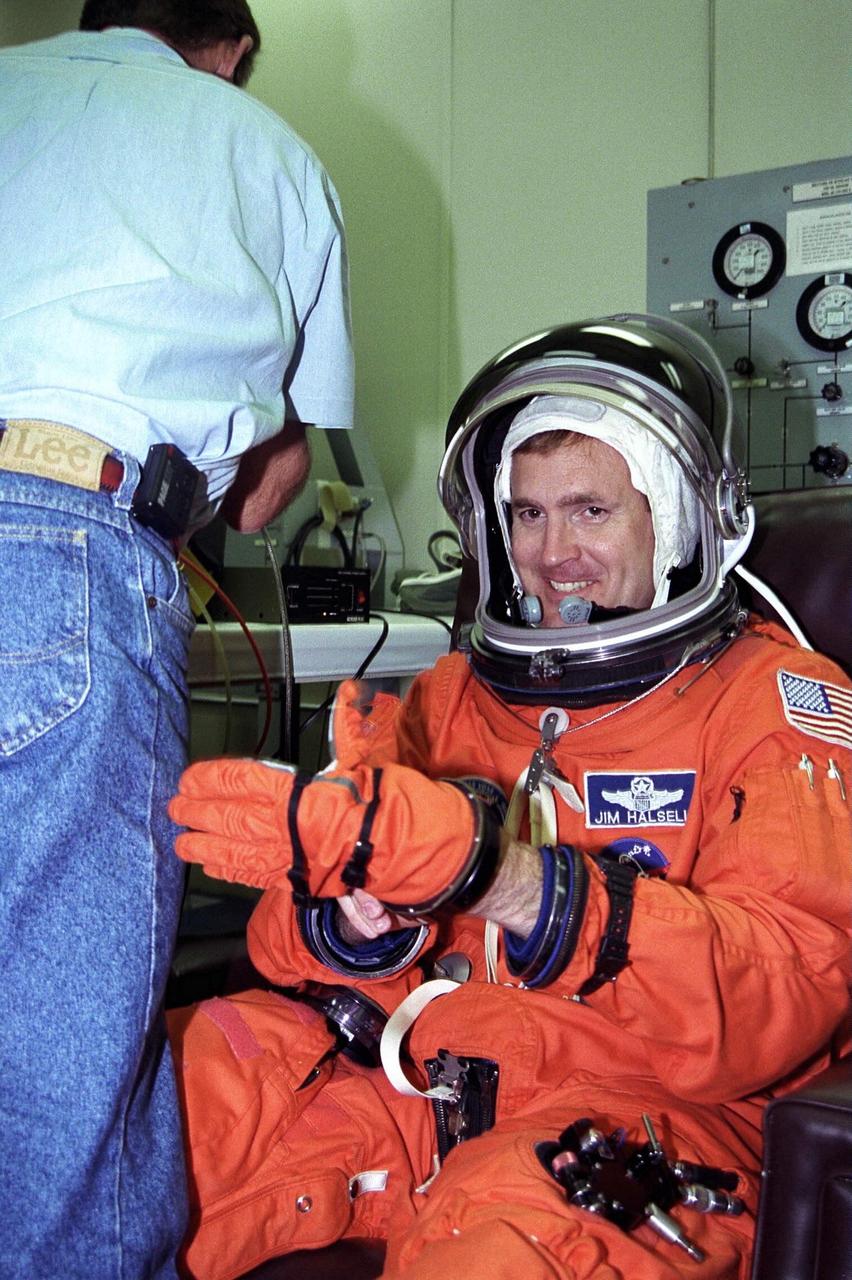
STS-94 Mission Commander James D. Halsell, Jr., puts his left glove on while he is assisted into his launch/entry suit in the Operations and Checkout (O&C) Building. Halsell is on his fourth space flight, having served as commander of STS-83 and pilot of both STS-74 and STS-65. He is a lieutenant colonel in the Air Force and a former SR-71 Blackbird test pilot and holds master’s degrees in management and space operations. Halsell will have responsibility for the success of the mission and will operate and maintain Columbia during the Red, or second shift. He will also assist with a materials science experiment and a protein crystal growth payload during the 16-day mission. Halsell and six fellow crew members will shortly depart the O&C and head for Launch Pad 39A, where the Space Shuttle Columbia will lift off during a launch window that opens at 1:50 p.m. EDT, July 1. The launch window was opened 47 minutes early to improve the opportunity to lift off before Florida summer rain showers reached the space center
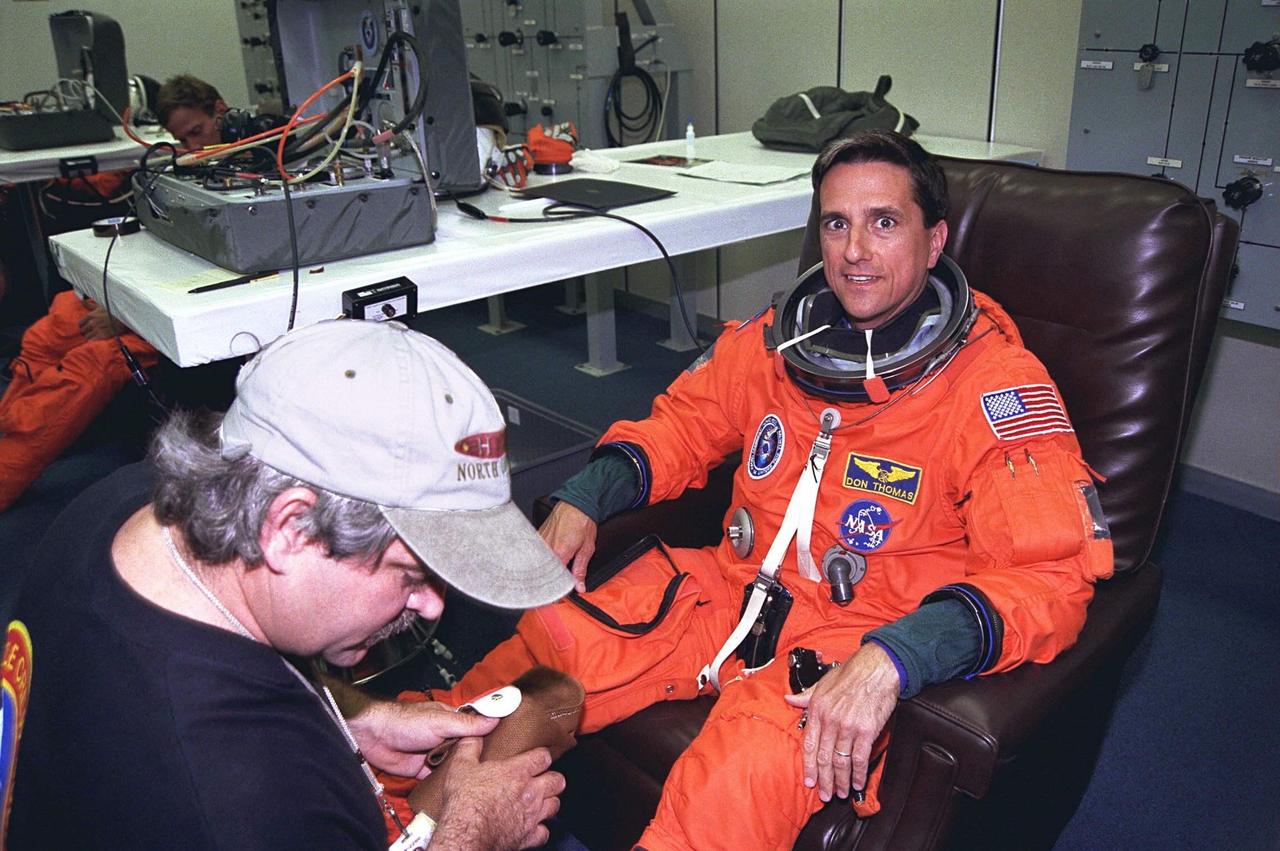
STS-94 Mission Specialist Donald A. Thomas smiles as a suit technician helps him into his launch/entry suit in the Operations and Checkout (O&C) Building. He has flown on STS-83, STS-70 and STS-65. He holds a doctorate in materials science and has been the Principal Investigator for a Space Shuttle crystal growth experiment. Because of his background in materials science, Thomas will be concentrating his efforts during the Red shift on the five experiments in this discipline in the Large Isothermal Furnace. He also will work on the ten materials science investigations in the Electromagnetic Containerless Processing Facility and four that will be measuring the effects of microgravity and motion in the orbiter on the experiments. Thomas and six fellow crew members will shortly depart the O&C and head for Launch Pad 39A, where the Space Shuttle Columbia will lift off during a launch window that opens at 1:50 p.m. EDT, July 1. The launch window was opened 47 minutes early to improve the opportunity to lift off before Florida summer rain showers reached the space center
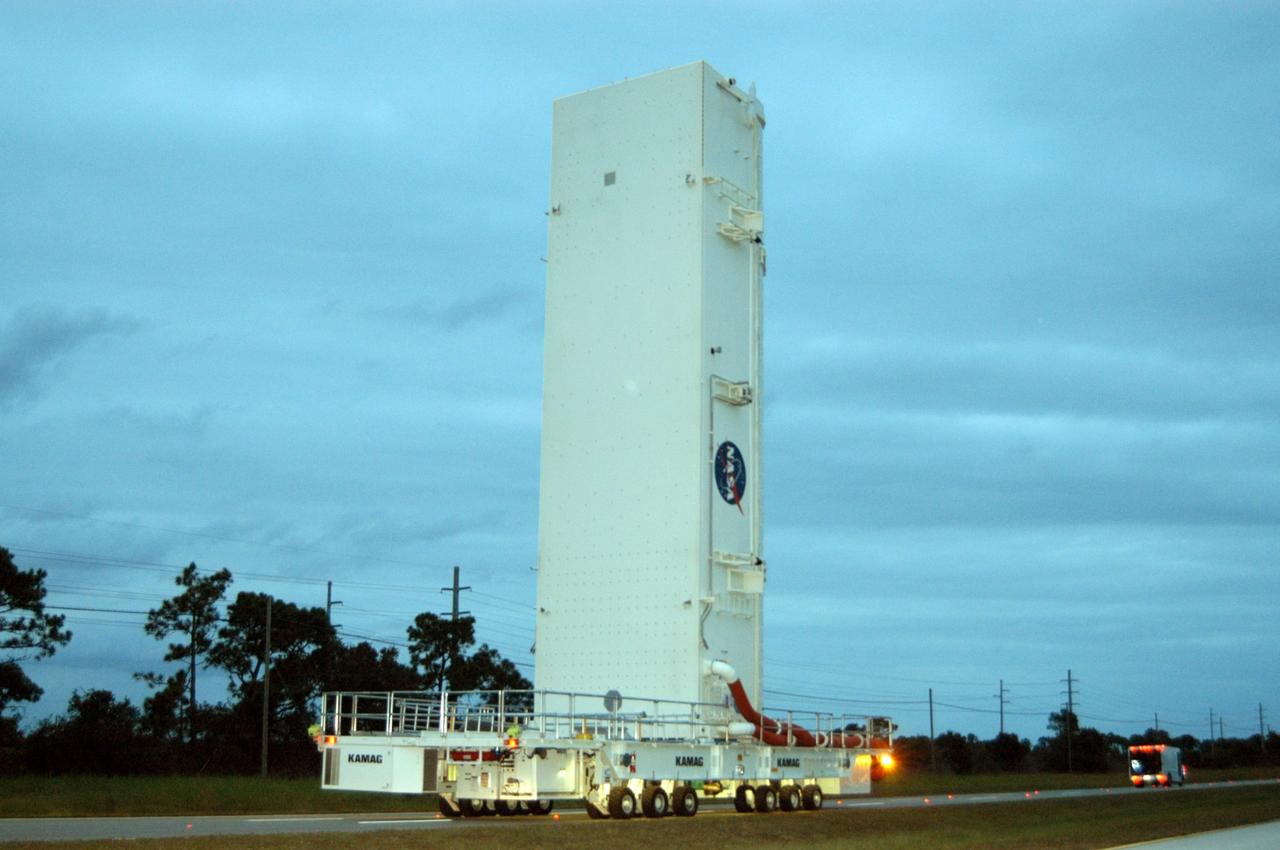
KENNEDY SPACE CENTER, FLA. -- Under a darkening, cloud-covered sky, the payload canister transporter carries its cargo very slowly along the road to Launch Pad 39B for mission STS-116. Inside the canister are the SPACEHAB module and the port 5 truss segment, which will be moved into the payload changeout room at the pad and transferred into Space Shuttle Discovery's payload bay once the vehicle has rolled out to the pad. The payload canister is 65 feet long, 18 feet wide and 18 feet, 7 inches high. It has the capability to carry vertically or horizontally processed payloads up to 15 feet in diameter and 60 feet long, matching the capacity of the orbiter payload bay. It can carry payloads weighing up to 65,000 pounds. Clamshell-shaped doors at the top of the canister operate like the orbiter payload bay doors, with the same allowable clearances. Photo credit: NASA/George Shelton
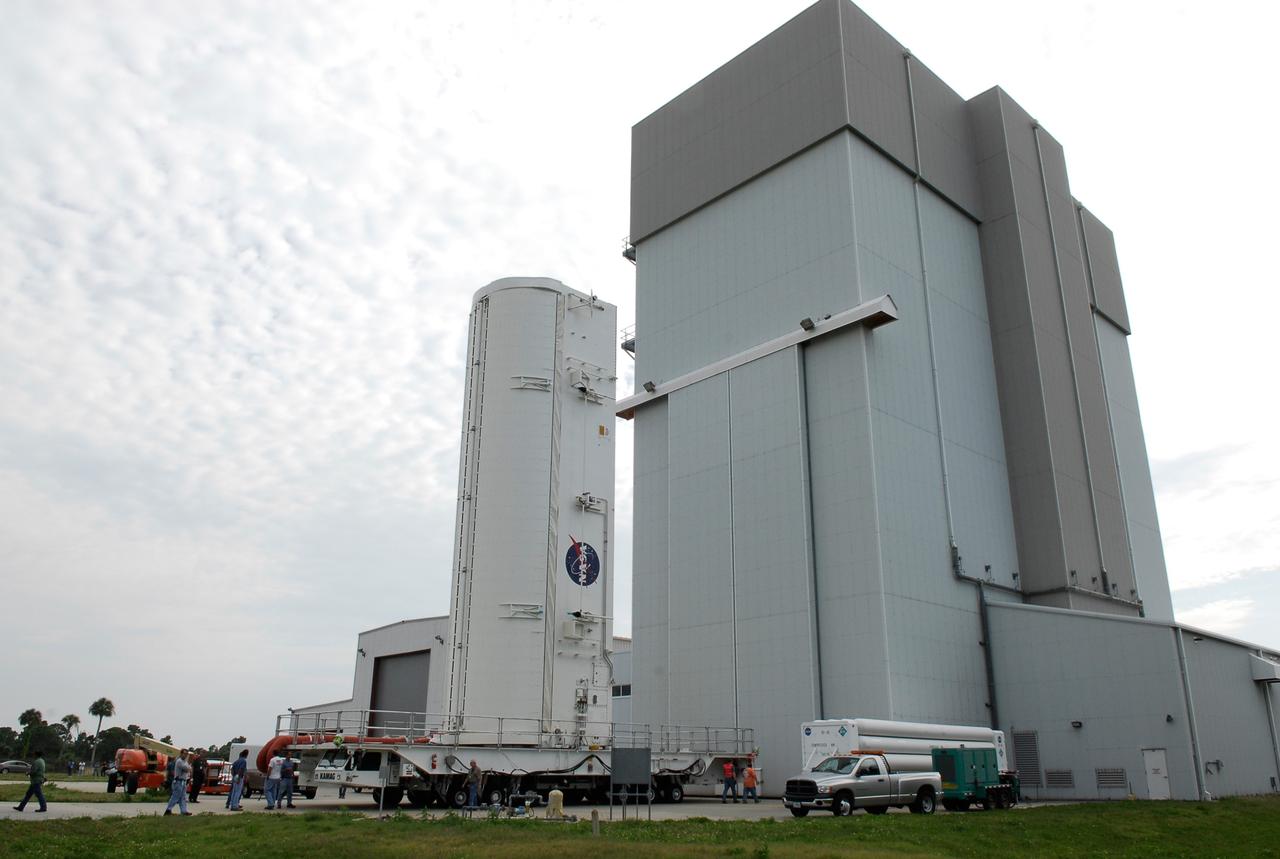
CAPE CANAVERAL, Fla. – Positioned on its 12-wheeled, 24-tire transporter, the payload canister with the STS-124 mission payload, Japanese Experiment Module - Pressurized Module and the Japanese Remote Manipulator System, or RMS, inside, begins its slow journey to Launch Pad 39A at NASA's Kennedy Space Center. At the pad, the payload will be transferred into the payload changeout room on the rotating service structure. The transporter is 65 feet long and 23 feet wide. The transporter’s wheels are independently steerable, permitting it to move forward, backward, sideways or diagonally and to turn on its own axis like a carousel. It is equipped with pneumatic-actuated braking and hydrostat¬ic leveling and drive systems. It is steered from a two-seat operator cab mounted at one end. From the payload changeout room, the pressurized module and RMS then will be transferred into space shuttle Discovery’s payload bay. Launch is targeted for May 31. Photo credit: NASA/Kim Shiflett
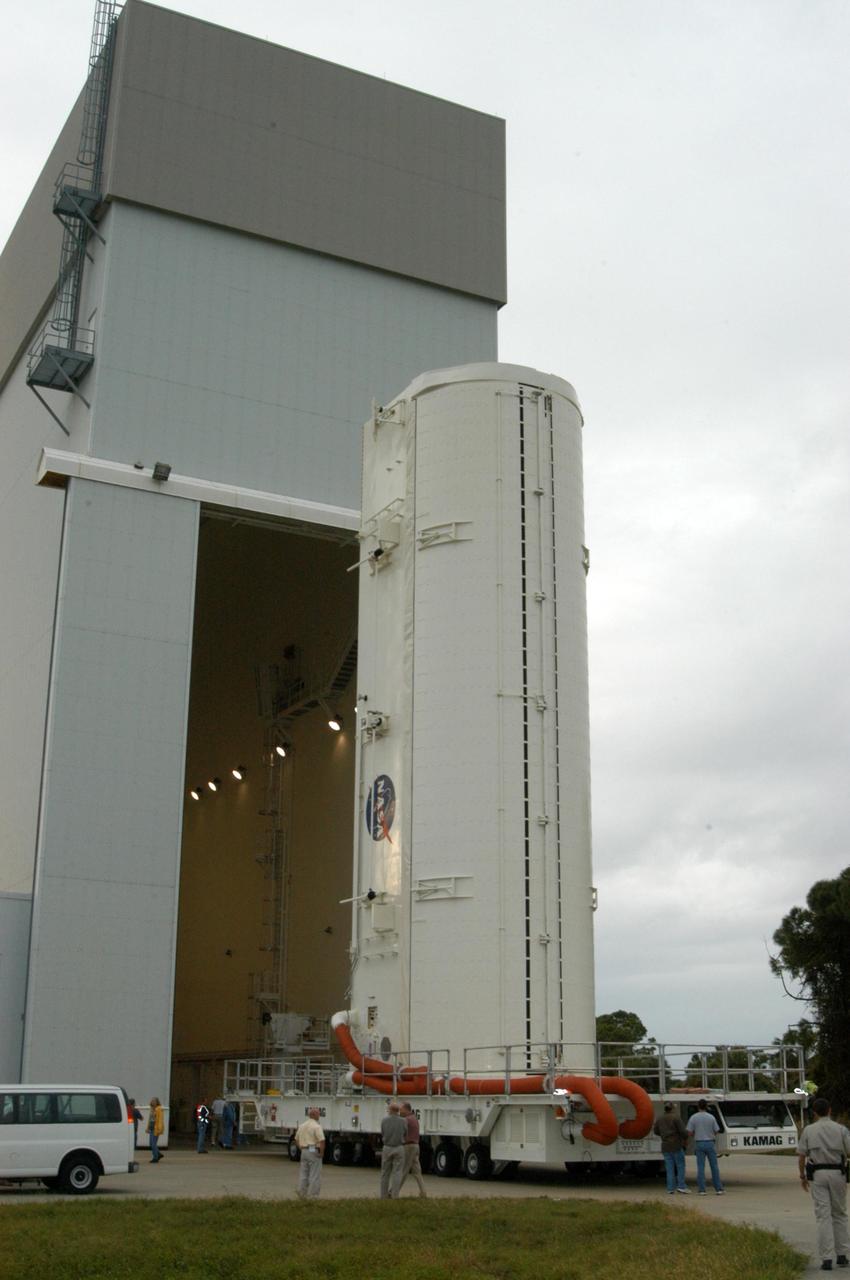
KENNEDY SPACE CENTER, FLA. -- Installed on a transporter, the payload canister moves out of the Vertical Processing Facility. Inside the canister are the SPACEHAB module and the port 5 truss segment for mission STS-116. They will be moved into the payload changeout room at the pad and transferred into Space Shuttle Discovery's payload bay once the vehicle has rolled out to the pad. The payload canister is 65 feet long, 18 feet wide and 18 feet, 7 inches high. It has the capability to carry vertically or horizontally processed payloads up to 15 feet in diameter and 60 feet long, matching the capacity of the orbiter payload bay. It can carry payloads weighing up to 65,000 pounds. Clamshell-shaped doors at the top of the canister operate like the orbiter payload bay doors, with the same allowable clearances. Photo credit: NASA/George Shelton
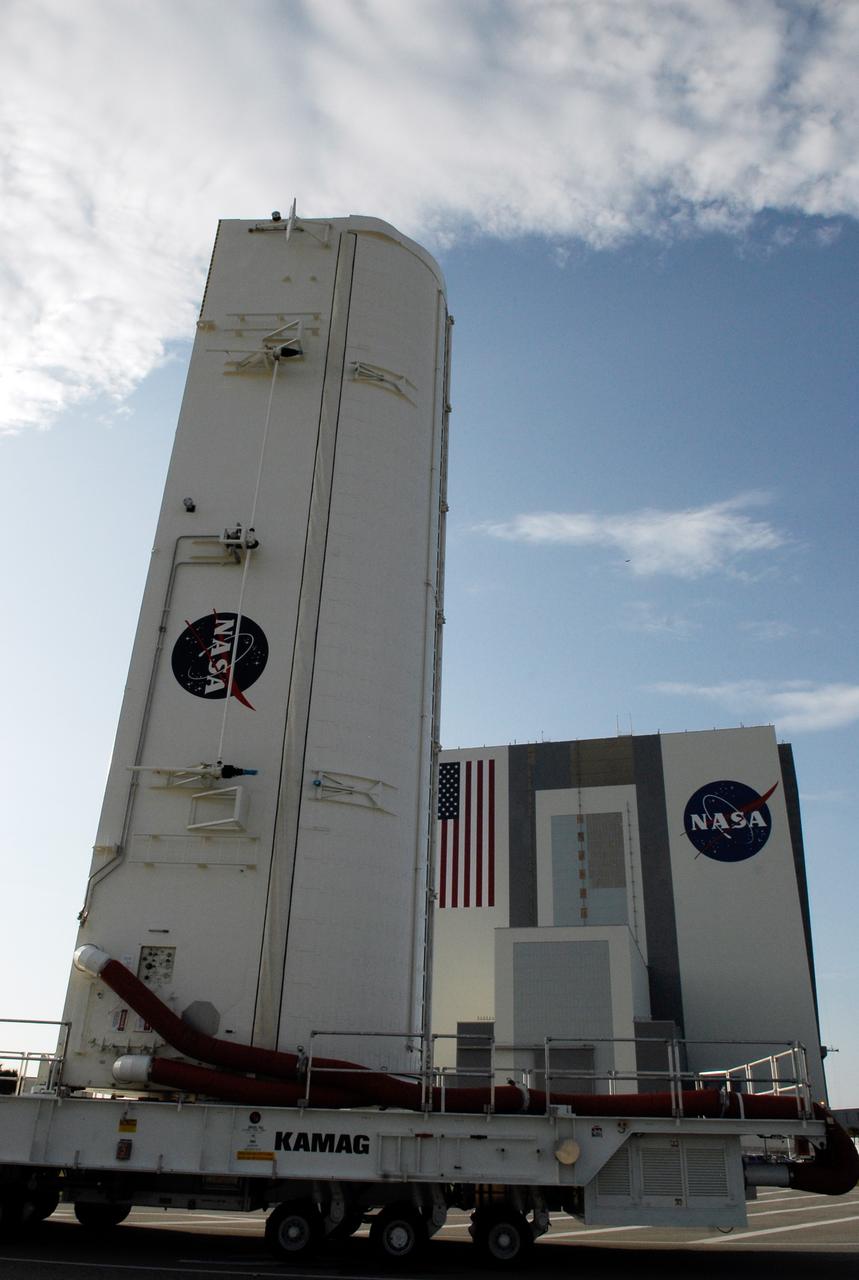
CAPE CANAVERAL, Fla. – Positioned on its 12-wheeled, 24-tire transporter, the payload canister with the STS-124 mission payload, Japanese Experiment Module - Pressurized Module and the Japanese Remote Manipulator System, or RMS, inside, slowly passes the Vehicle Assembly Building at NASA's Kennedy Space Center, on its journey to Launch Pad 39A. At the pad, the payload will be transferred into the payload changeout room on the rotating service structure. The transporter is 65 feet long and 23 feet wide. The transporter’s wheels are independently steerable, permitting it to move forward, backward, sideways or diagonally and to turn on its own axis like a carousel. It is equipped with pneumatic-actuated braking and hydrostat¬ic leveling and drive systems. It is steered from a two-seat operator cab mounted at one end. From the payload changeout room, the pressurized module and RMS then will be transferred into space shuttle Discovery’s payload bay. Launch is targeted for May 31. Photo credit: NASA/Kim Shiflett
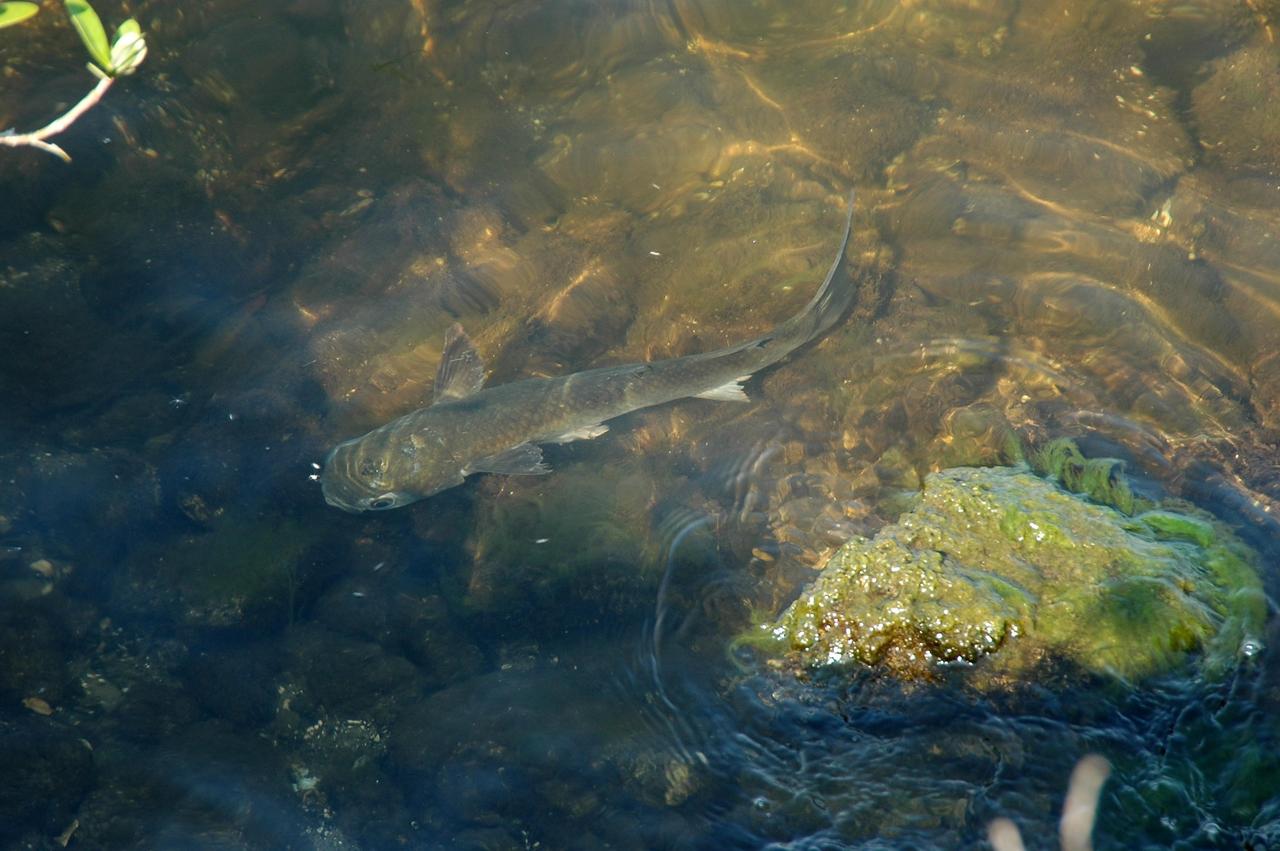
KENNEDY SPACE CENTER, FLA. - In the turn basin near the NASA News Center swims a large fish, perhaps witness to the arrival today of the external fuel tank that will launch Space Shuttle Atlantis on the next shuttle mission, STS-115. The tank, designated ET-118, was shipped from the Michoud Assembly Facility in New Orleans. The area is part of the Merritt Island National Wildlife Refuge, which shares a boundary with the center. The wildlife refuge is a habitat for more than 117 fishes, as well as 310 species of birds, 25 mammals and 65 amphibians and reptiles. In addition, the Refuge supports 19 endangered or threatened wildlife species on Federal or State lists, more than any other single refuge in the U.S. Photo credit: NASA/Kim Shiflett
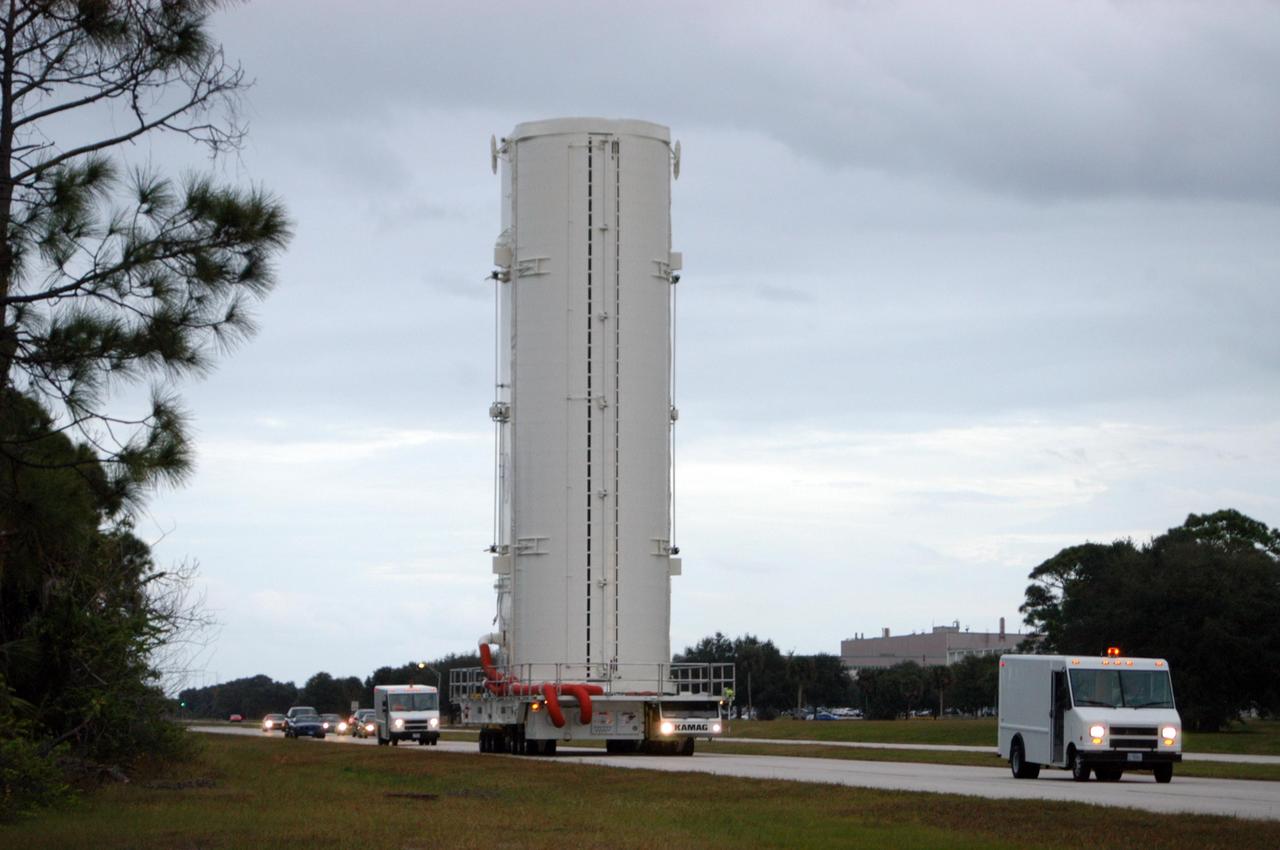
KENNEDY SPACE CENTER, FLA. -- The payload canister transporter carries its cargo very slowly along the road to Launch Pad 39B for mission STS-116. Inside the canister are the SPACEHAB module and the port 5 truss segment, which will be moved into the payload changeout room at the pad and transferred into Space Shuttle Discovery's payload bay once the vehicle has rolled out to the pad. The payload canister is 65 feet long, 18 feet wide and 18 feet, 7 inches high. It has the capability to carry vertically or horizontally processed payloads up to 15 feet in diameter and 60 feet long, matching the capacity of the orbiter payload bay. It can carry payloads weighing up to 65,000 pounds. Clamshell-shaped doors at the top of the canister operate like the orbiter payload bay doors, with the same allowable clearances. Photo credit: NASA/George Shelton
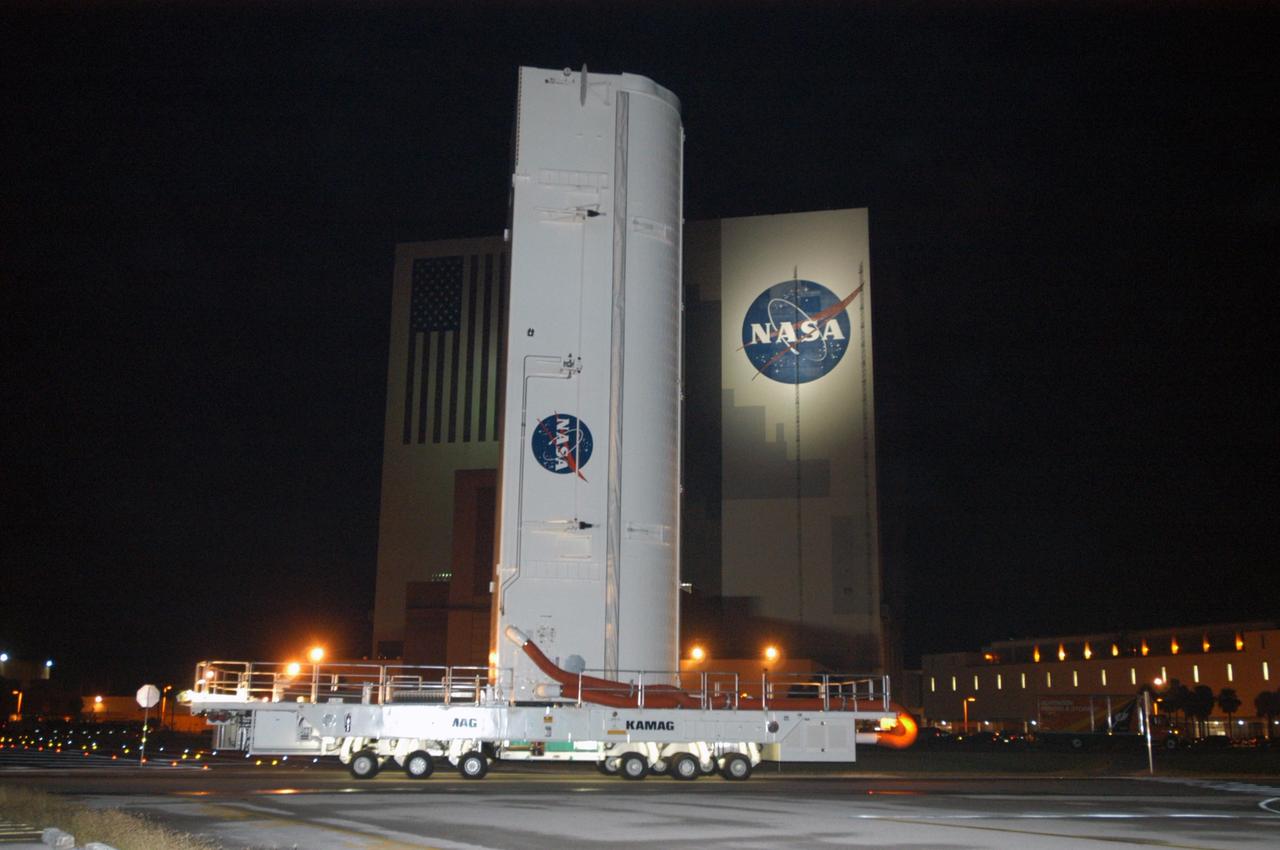
KENNEDY SPACE CENTER, FLA. -- Lamps spotlight the payload canister transporter as it slowly carries its cargo past the Vehicle Assembly Building on the road to Launch Pad 39B for mission STS-116. Inside the canister are the SPACEHAB module and the port 5 truss segment, which will be moved into the payload changeout room at the pad and transferred into Space Shuttle Discovery's payload bay once the vehicle has rolled out to the pad. The payload canister is 65 feet long, 18 feet wide and 18 feet, 7 inches high. It has the capability to carry vertically or horizontally processed payloads up to 15 feet in diameter and 60 feet long, matching the capacity of the orbiter payload bay. It can carry payloads weighing up to 65,000 pounds. Clamshell-shaped doors at the top of the canister operate like the orbiter payload bay doors, with the same allowable clearances. Photo credit: NASA/George Shelton
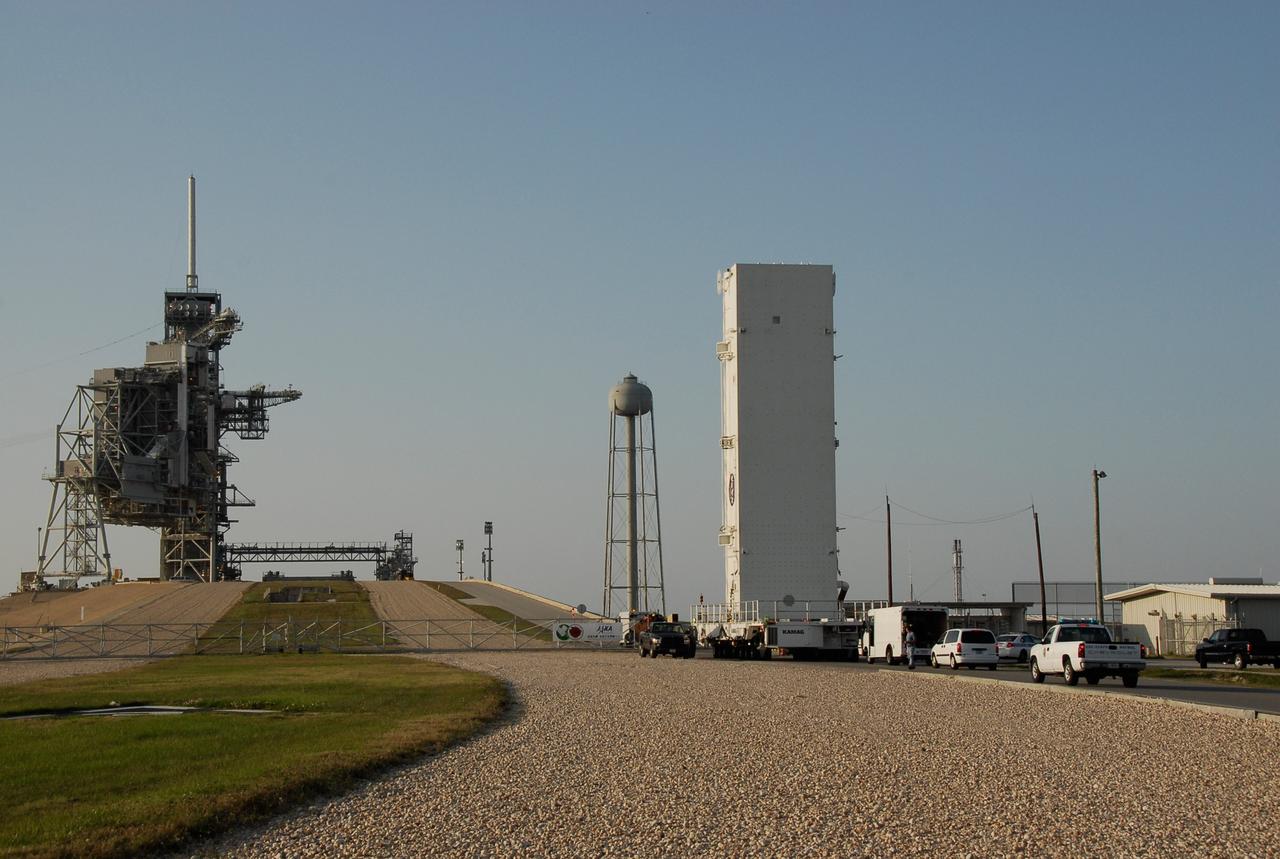
CAPE CANAVERAL, Fla. -- Positioned on its 12-wheeled, 24-tire transporter, the payload canister with the STS-124 mission payload, Japanese Experiment Module - Pressurized Module and the Japanese Remote Manipulator System, or RMS, inside, approaches the ramp to Launch Pad 39A at NASA's Kennedy Space Center. The transporter is 65 feet long and 23 feet wide. The transporter’s wheels are independently steerable, permitting it to move forward, backward, sideways or diagonally and to turn on its own axis like a carousel. It is equipped with pneumatic-actuated braking and hydrostat¬ic leveling and drive systems. It is steered from a two-seat operator cab mounted at one end. From the payload changeout room, the pressurized module and RMS will be transferred into space shuttle Discovery’s payload bay. Launch is targeted for May 31. Photo credit: NASA/Kim Shiflett
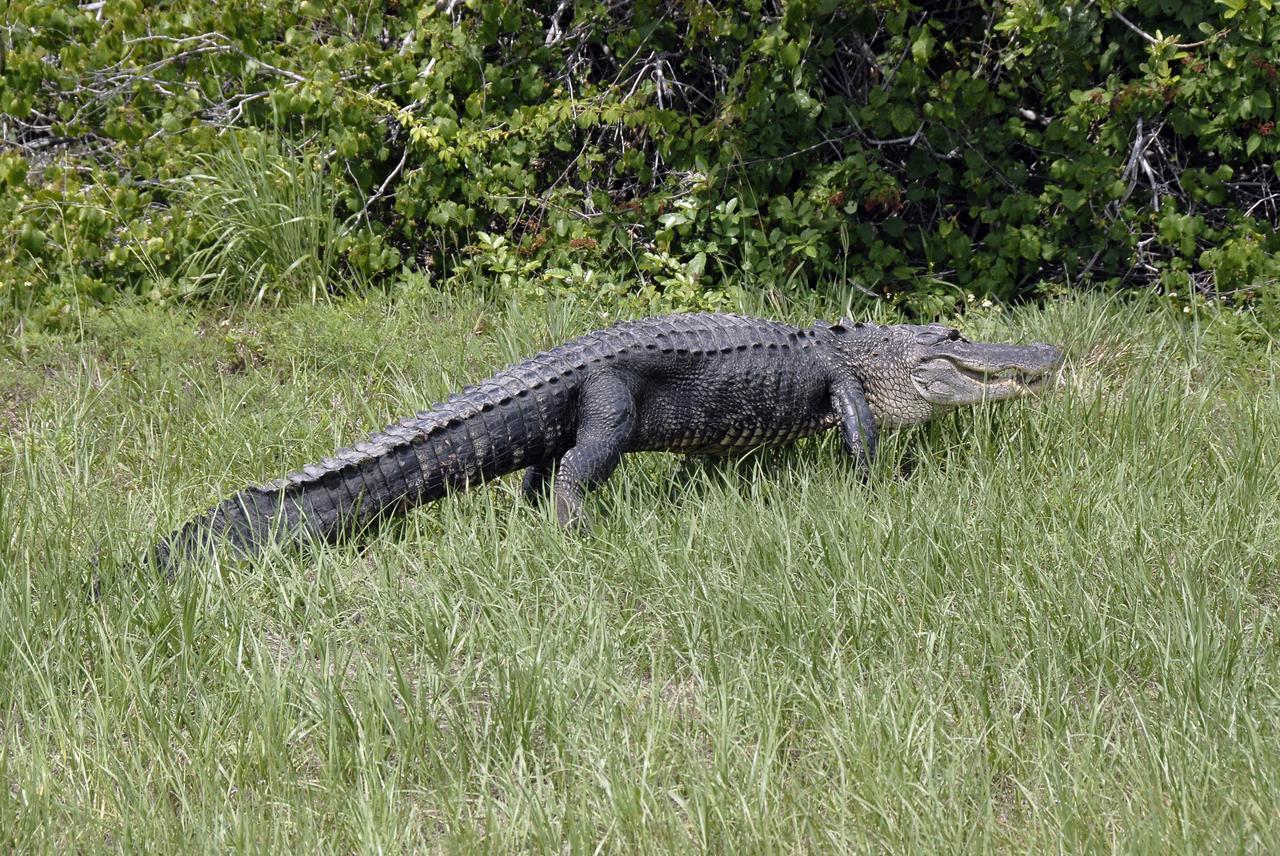
CAPE CANAVERAL, Fla. – Taking a mid-day stroll, an alligator heads for the woods after crossing the Saturn Causeway at NASA's Kennedy Space Center in Florida in front of the Astrovan with STS-127 crew members aboard. The crew was on its way to Launch Pad 39A for a simulated launch countdown, part of the terminal countdown demonstration test. Alligators can be spotted in the drainage canals and other waters surrounding Kennedy. They occasionally venture onto roads seeking new environs or mates. The center shares a boundary with the Merritt Island Wildlife Nature Refuge, which is a habitat for more than 310 species of birds, 25 mammals, 117 fishes and 65 amphibians and reptiles. Photo credit: NASA/Kim Shiflett
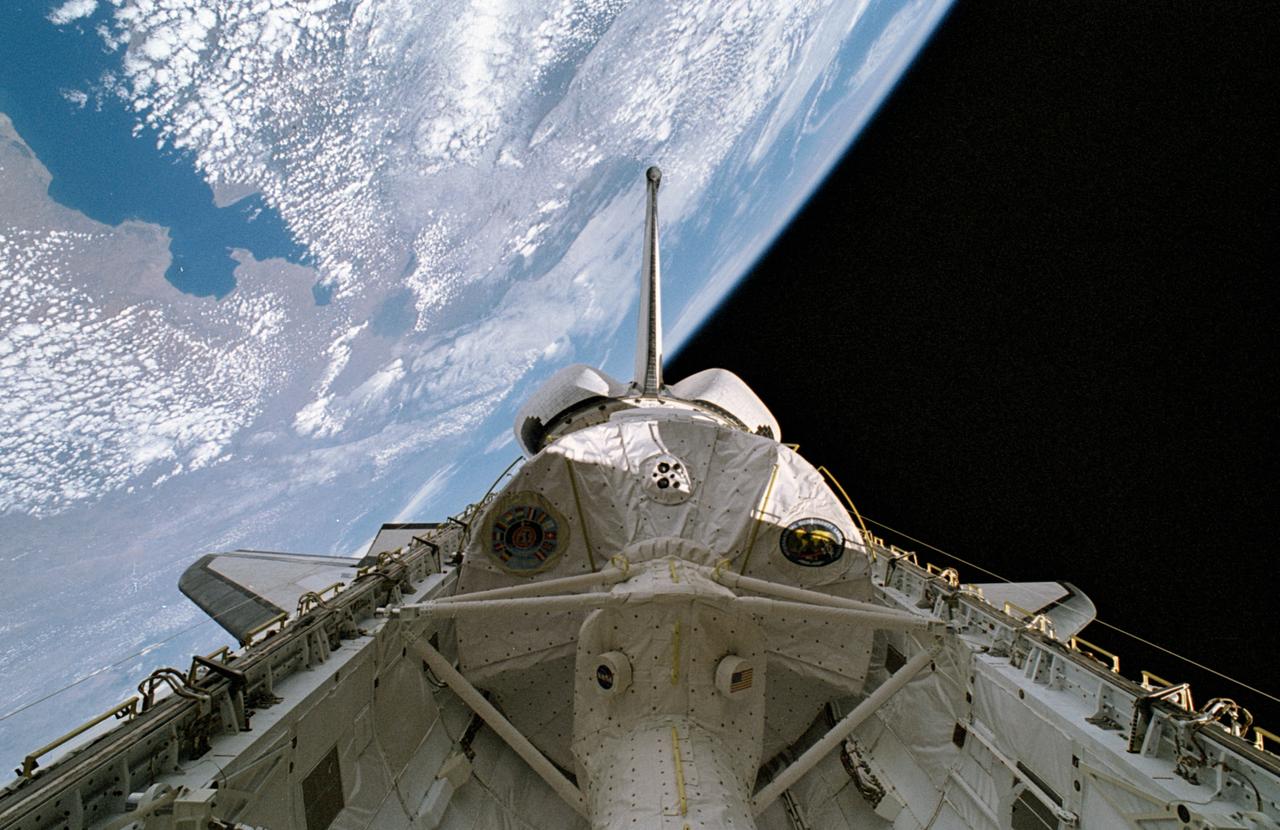
STS065-42-017 (8-23 July 1994) --- This 35mm panorama shows the science module, for the second International Microgravity Laboratory (IML-2) and the Space Shuttle Columbia's cargo bay, backdropped against the darkness of space over part of Africa, on Earth's horizon. Lake Nyasa in Malawi can easily be delineated. Also visible are part of the country of Mozambique and the Indian Ocean. Six NASA astronauts and a Japanese payload specialist spent more than two weeks of experimenting in Earth-orbit. Onboard were NASA astronauts Robert D. Cabana, James D. Halsell, Jr., Richard J. Hieb, Carl E. Walz, Donald A. Thomas and Leroy Chiao along with payload specialist Dr. Chiaki Mukai, representing the National Space Development Agency (NASDA) of Japan.
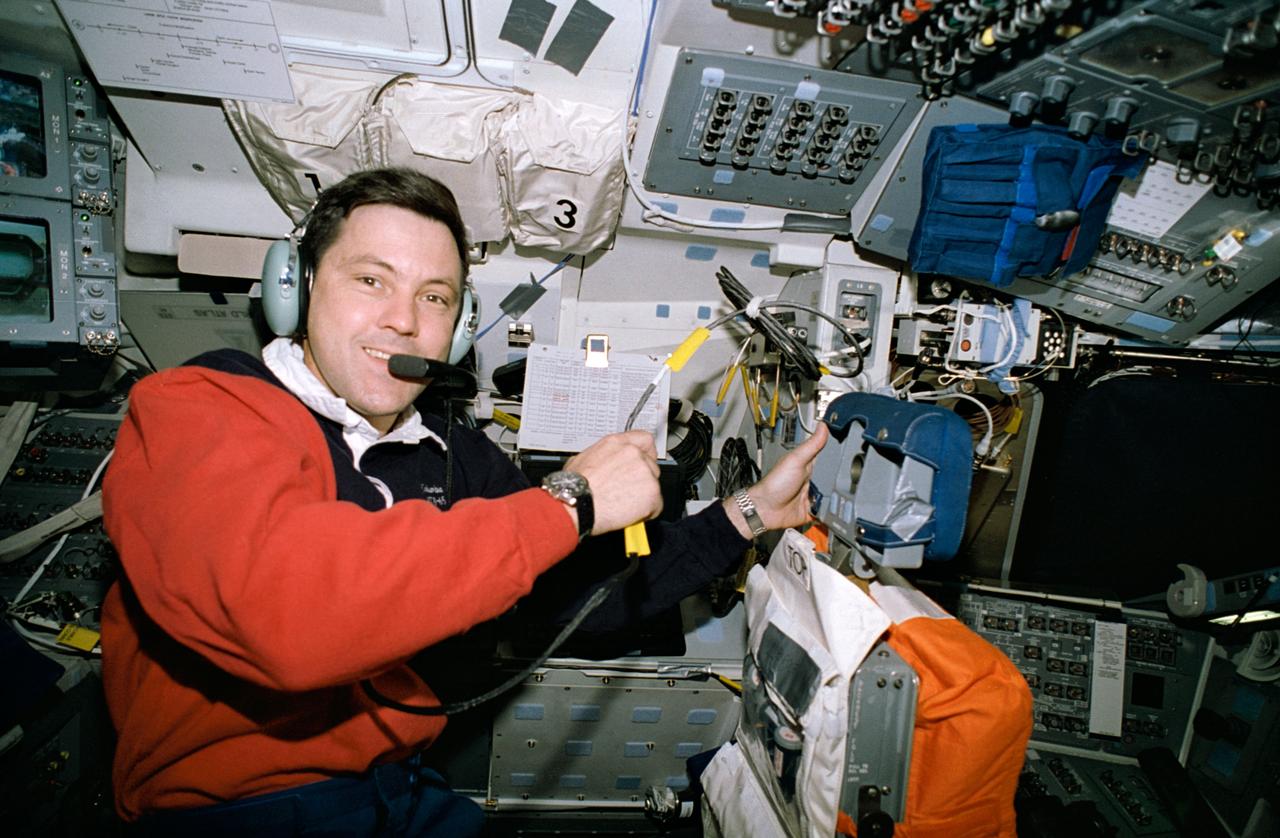
STS065-44-014 (8-23 July 1994) --- Astronaut Robert D. Cabana, mission commander, is seen on the Space Shuttle Columbia's flight deck with the Shuttle Amateur Radio Experiment (SAREX). SAREX was established by NASA, the American Radio League/Amateur Radio Satellite Corporation and the Johnson Space Center (JSC) Amateur Radio Club to encourage public participation in the space program through a project to demonstrate the effectiveness of conducting short-wave radio transmissions between the Shuttle and ground-based radio operators at low-cost ground stations with amateur and digital techniques. As on several previous missions, SAREX was used on this flight as an educational opportunity for students around the world to learn about space firsthand by speaking directly to astronauts aboard the Shuttle.
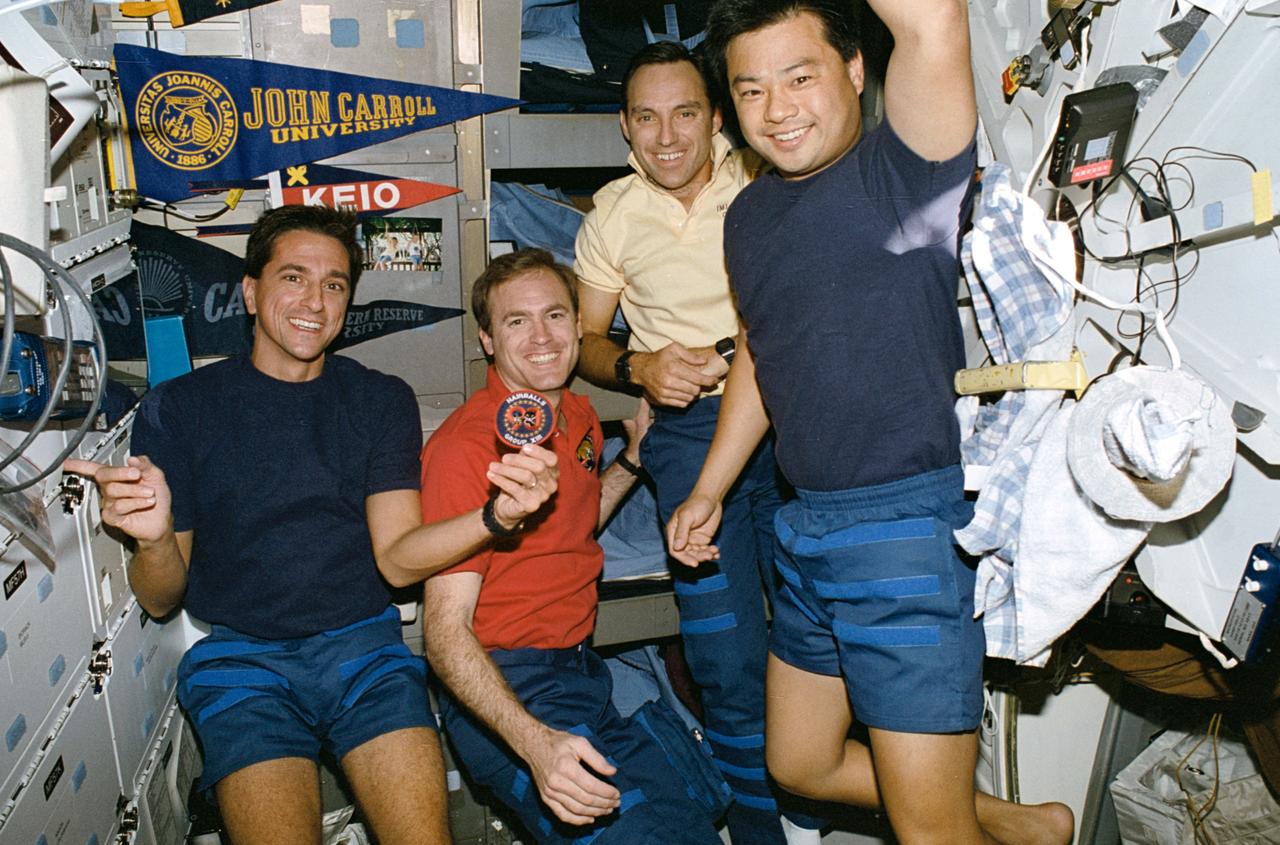
STS065-18-022 (8-23 July 1994) --- During off-duty time on the Space Shuttle Columbia's mid-deck, four members of the crew, from the 1990 (thirteenth) astronaut class, display their group's insignia. The "hairballs" pictured, (left to right) are astronauts Donald A. Thomas, James D. Halsell, Jr., Carl E. Walz and Leroy Chiao.