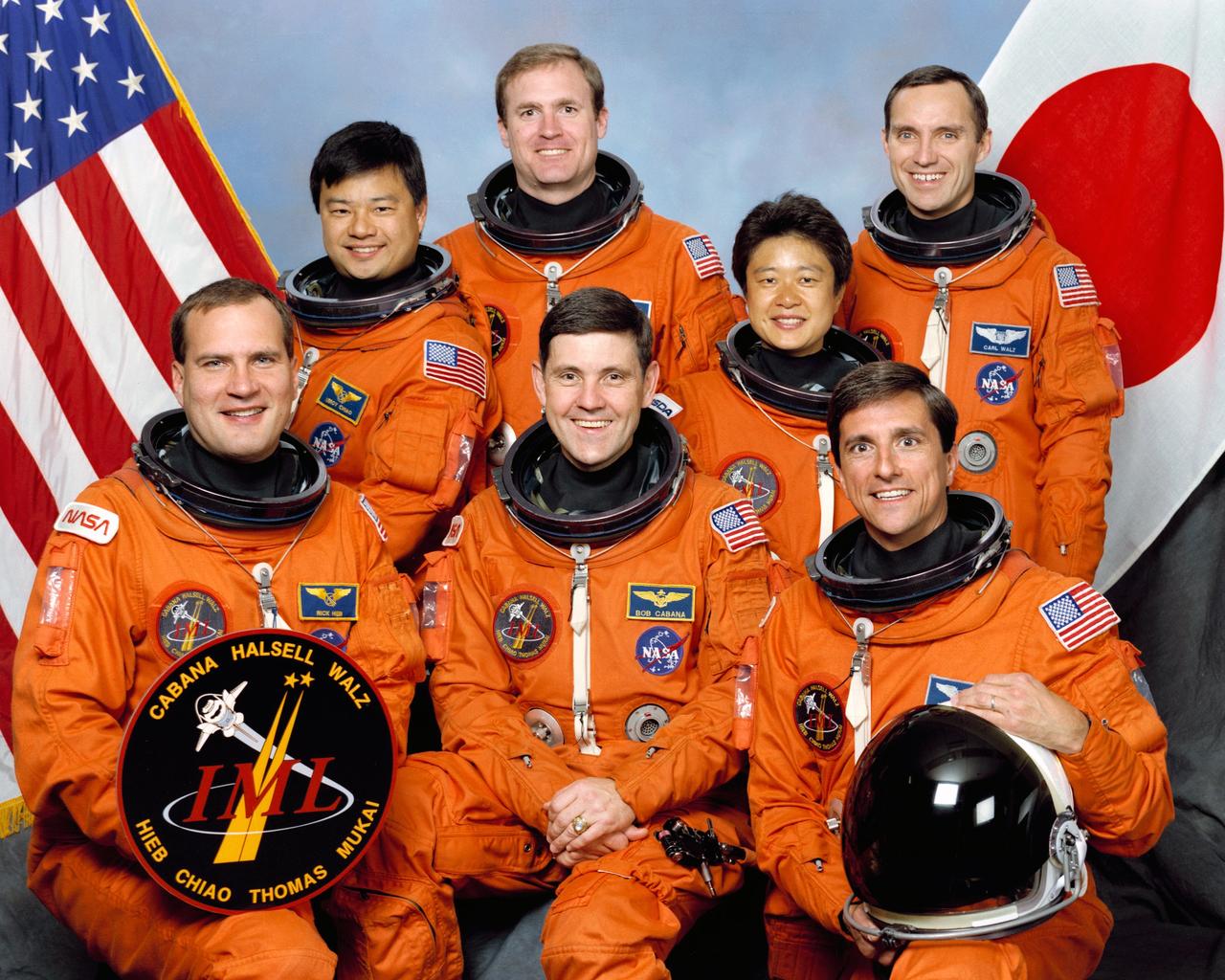
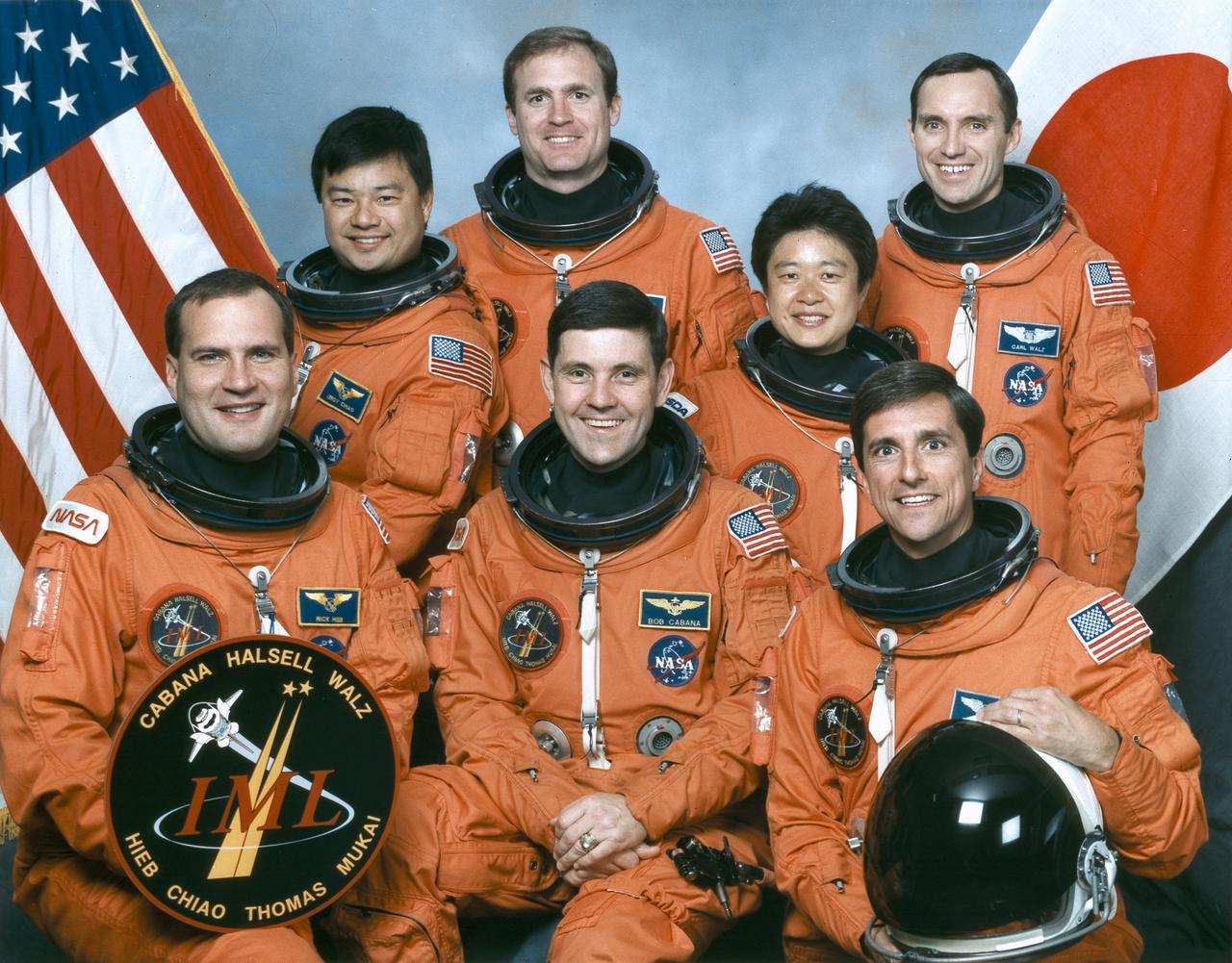
The crew assigned to the STS-65 mission included (seated left to right) Richard J. (Rick) Hieb, payload commander; Robert D. (Bob) Cabana, commander; and Donald A. Thomas, mission specialist. Standing, from left to right, are Leroy Chiao, mission specialist; James D. Halsell, pilot; Chiaki Naito-Mukai, payload specialist; and Carl E. Walz, mission specialist. Launched aboard the Space Shuttle Columbia on July 8, 1994 at 12:43:00 pm (EDT), the STS-64 mission marked the second flight of the International Microgravity Laboratory (IML-2) and the first flight of a female Japanese crew member.
Microgravity
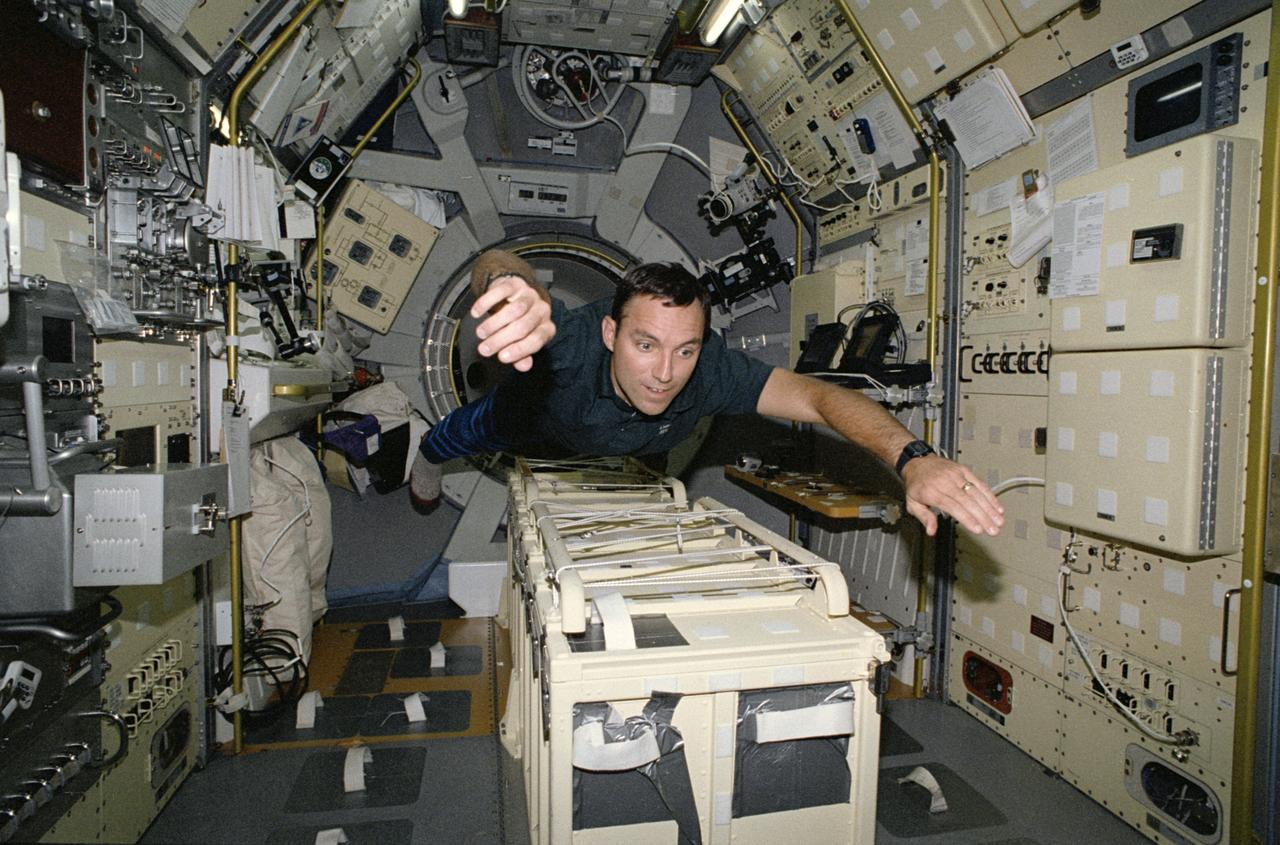
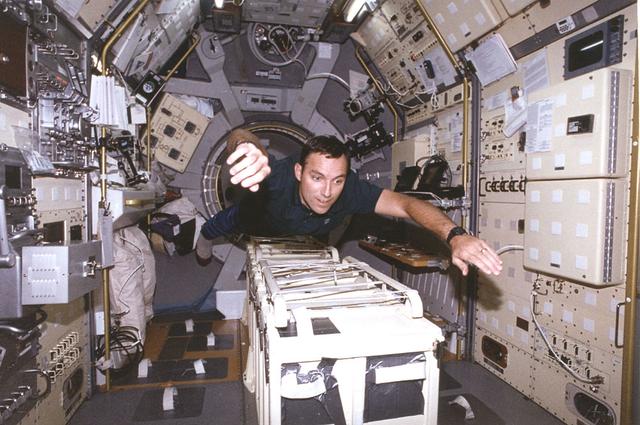
STS-65 Mission Specialist Carl E. Walz floats above center aisle equipment in the International Microgravity Laboratory 2 (IML-2) spacelab science module. Walz has just entered the IML-2 module via the spacelab tunnel (note hatch opening behind him). The tunnel connects the IML-2 module with Columbia's, Orbiter Vehicle (OV) 102's, crew compartment. Walz along with five other NASA astronauts and a Japanese payload specialist spent more than two weeks in Earth orbit conducting IML-2 experiments. This photo was among the first released by NASA following IML-2.
STS-65 Mission Specialist Walz in IML-2 spacelab aboard Columbia, OV-102
Astronaut Carl E. Walz, mission specialist, enters the International Microgravity Laboratory (IML-2) science module in the cargo bay via the turnel connecting it to Columbia's cabin. Walz joined five other NASA astronauts and a Japanese payload specialist for more than two weeks of experimenting in Earth orbit.
Microgravity
JOHNSON SPACE CENTER, Houston, Texas -- --  STS065(S)002 -- STS-65 Official Crew Portrait --- Six NASA astronauts and a Japanese payload specialist take a break from STS-65 training to pose for their crew portrait.  Left to right are Richard J. Hieb, Leroy Chiao, James D. Halsell Jr., Robert D. Cabana, Dr. Chiaki Mukai, Donald A. Thomas and Carl E. Walz.  Cabana is mission commander, and Halsell has been assigned as pilot.  Hieb is payload commander, with Walz, Thomas and Chiao serving as mission specialists. Dr. Mukai represents the National Space Development Agency (NASDA) of Japan as payload specialist on the International Microgravity Laboratory (IML) mission.
KSC-94PC-611
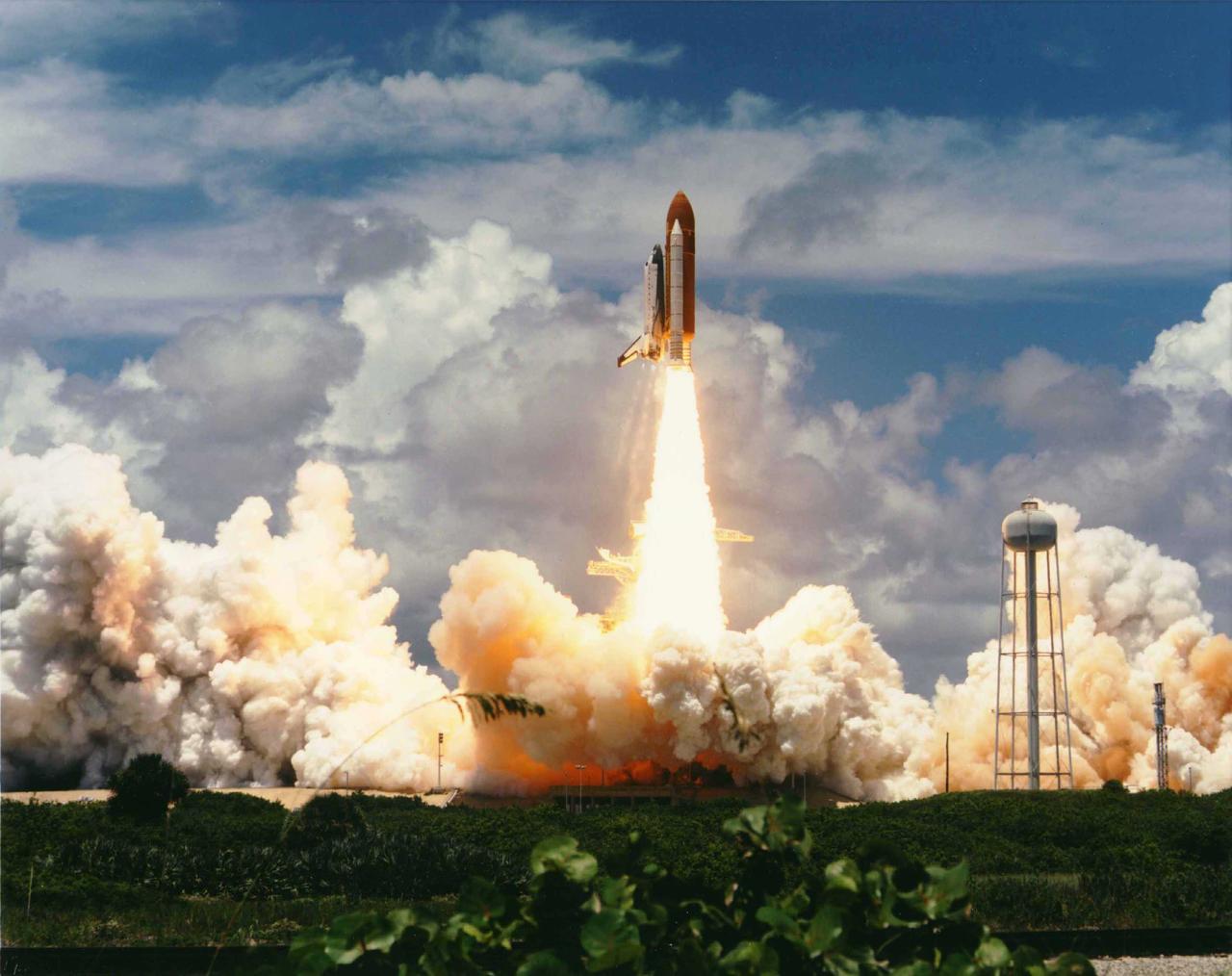
KENNEDY SPACE CENTER, FLA. - The second International Microgravity Laboratory-2 (IML-2) is off to an ontime start as the Space Shuttle Columbia lifts off from Launch Pad 39A at 12:43:00 p.m. EDT.  On board are a crew of seven and more than 80 investigations developed by more than 200 scientists from 13 countries.  The IML-2 complement includes materials science, bioprocessing, space and radiation biology, and human physiology experiments that will be carried out over the course of the 14-day flight.  The commander of Space Shuttle Mission STS-65 is Robert D. Cabana.  James D. Halsell Jr. is the pilot; the payload commander is Richard J. Hieb; the three mission specialists are Carl E. Walz, Leroy Chiao and Donald A. Thomas.  Dr. Chiaki Mukai, representing NASDA, the National Space Development Agency of Japan, is the payload specialist.  Mukai becomes the first Japanese woman to fly into space.
KENNEDY SPACE CENTER, FLA. - The second International Microgravity Laboratory-2 (IML-2) is off to an ontime start as the Space Shuttle Columbia lifts off from Launch Pad 39A at 12:43:00 p.m. EDT. On board are a crew of seven and more than 80 investigations developed by more than 200 scientists from 13 countries. The IML-2 complement includes materials science, bioprocessing, space and radiation biology, and human physiology experiments that will be carried out over the course of the 14-day flight. The commander of Space Shuttle Mission STS-65 is Robert D. Cabana. James D. Halsell Jr. is the pilot; the payload commander is Richard J. Hieb; the three mission specialists are Carl E. Walz, Leroy Chiao and Donald A. Thomas. Dr. Chiaki Mukai, representing NASDA, the National Space Development Agency of Japan, is the payload specialist. Mukai becomes the first Japanese woman to fly into space.
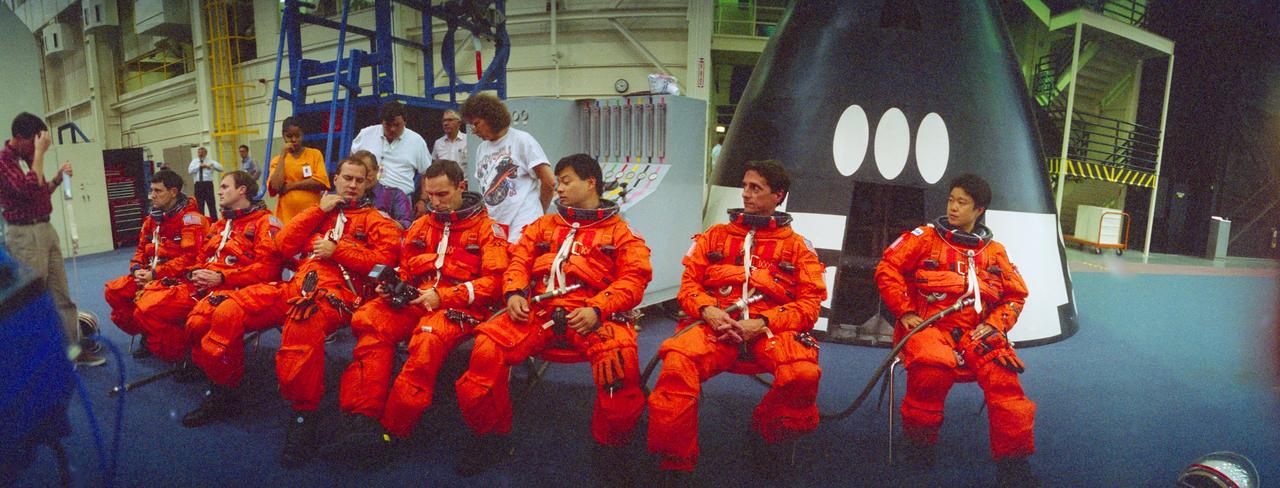
S94-31388 (25 Mar 1994) --- Six NASA astronauts and a Japanese payload specialist listen to a briefing by a crew training staffer.  From the left are astronauts Robert D. Cabana, mission commander; James D. Halsell Jr., pilot; Richard J. Hieb, payload commander; and Carl E. Walz, Leroy Chiao and Donald A. Thomas, all mission specialists; along with Dr. Chiaki Mukai, payload specialist.  Dr. Mukai represents the National Space Development Agency (NASDA) of Japan.  The STS-65 crew was in the Johnson Space Center's (JSC) Shuttle mockup and integration laboratory for crew egress training.  The full fuselage trainer, used for the rehearsals, is just out of frame.  The seven-member crew will support the International Microgravity Laboratory (IML-2) mission aboard the Space Shuttle Columbia later this year.
STS-65 Columbia, OV-102, IML-2 crew during egress training in MAIL Bldg 9NE
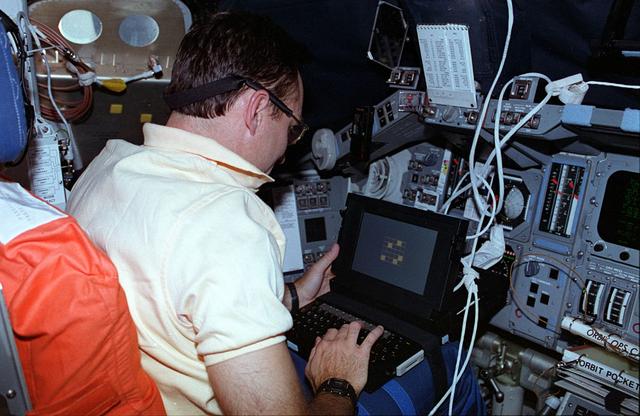
In this photograph, astronaut Carl Walz performs the Performance Assessment Workstation (PAWS) experiment at the flight deck of the Space Shuttle Orbiter Columbia during the STS-65 mission. Present day astronauts are subject to a variety of stresses during spaceflight. These include microgravity, physical isolation, confinement, lack of privacy, fatigue, and changing work/rest cycles. The purpose of this experiment is to determine the effects of microgravity upon thinking skills critical to the success of operational tasks in space. The principle objective is to distinguish between the effects of microgravity on specific information-processing skills affecting performance and those of fatigue caused by long work periods. To measure these skills, the investigators use a set of computerized performance tests called the Performance Assessment Workstation, which is based on current theoretical models of human performance. The tests were selected by analyzing tasks related to space missions and their hypothesized sensitivity to microgravity. Multiple subjective measures of cumulative fatigue and changing mood states are also included for interpreting performance data.
Space Shuttle Projects
Astronaut Carl E. Walz, mission specialist, flies through the second International Microgravity Laboratory (IML-2) science module, STS-65 mission. IML was dedicated to study fundamental materials and life sciences in a microgravity environment inside Spacelab, a laboratory carried aloft by the Shuttle. The mission explored how life forms adapt to weightlessness and investigated how materials behave when processed in space. The IML program gave a team of scientists from around the world access to a unique environment, one that is free from most of Earth's gravity. Managed by the NASA Marshall Space Flight Center, the 14-nation European Space Agency (ESA), the Canadian Space Agency (SCA), the French National Center for Space Studies (CNES), the German Space Agency and the German Aerospace Research Establishment (DARA/DLR), and the National Space Development Agency of Japan (NASDA) participated in developing hardware and experiments for the IML missions. The missions were managed by NASA's Marshall Space Flight Center. The Orbiter Columbia was launched on July 8, 1994 for the IML-2 mission.
Spacelab