
STS066-S-040 (14 November 1994) --- The main landing gear is on the ground and the nose gear is about to touch down as the Space Shuttle Atlantis heads toward a stop at Edwards Air Force Base in southern California, ending a successful 10 day, 22 hour and 34 minute space mission. Landing occurred at 7:34 a.m. (PST), November 14, 1994. Onboard were astronauts Donald R. McMonagle, commander; Curtis L. Brown, Jr., pilot; Ellen S. Ochoa, payload commander; Scott E. Parazynski and Joseph R. Tanner, both mission specialists, along with European Space Agency (ESA) mission specialist Jean-Francois Clervoy. The crew supported the Atmospheric Laboratory for Applications and Science (ATLAS-3) mission.
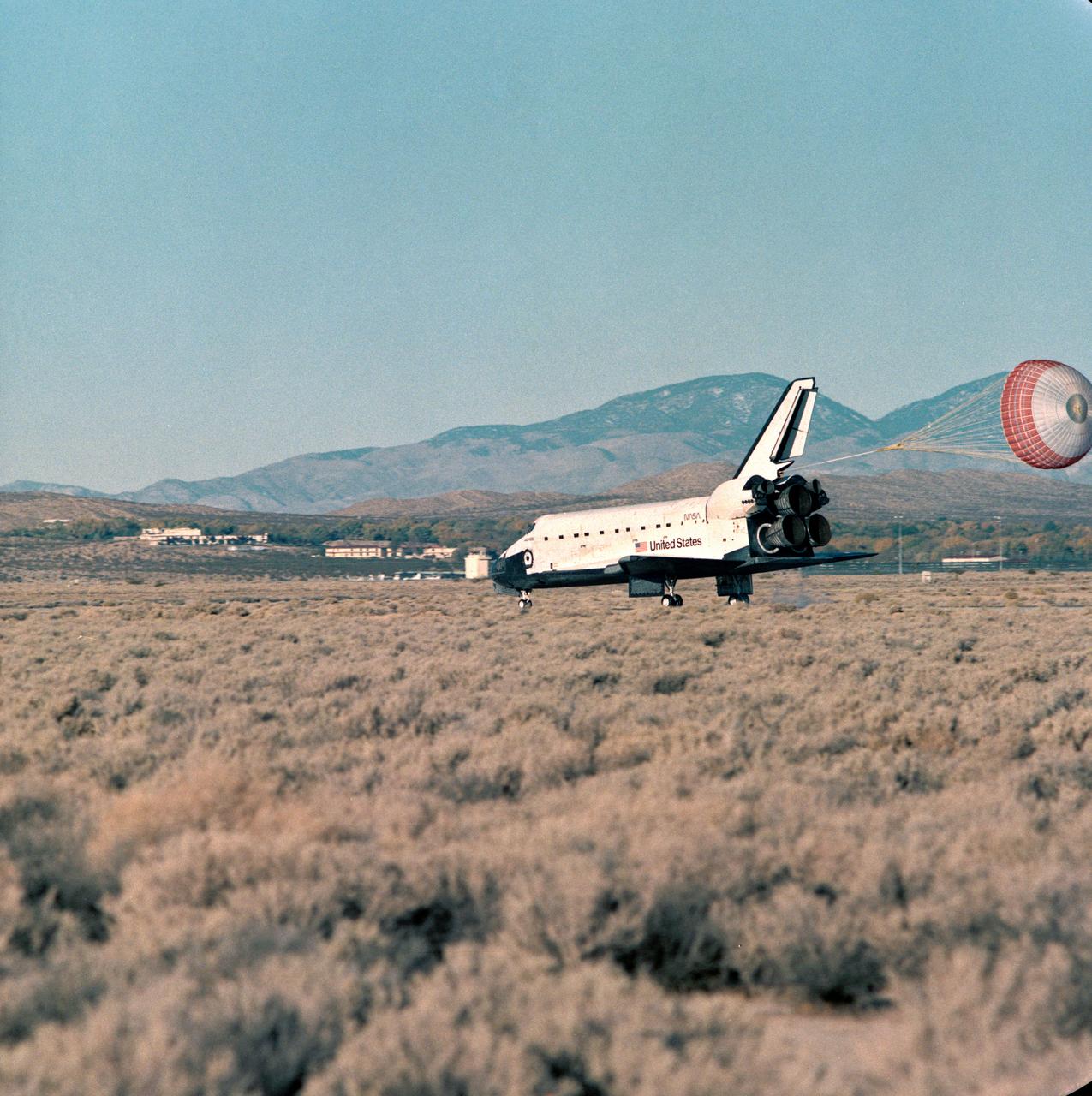
STS066-S-039 (14 November 1994) --- The drag chute is fully deployed as the Space Shuttle Atlantis heads toward a stop at Edwards Air Force Base in southern California, ending a successful 10 day, 22 hour and 34 minute space mission. Landing occurred at 7:34 a.m. (PST), November 14, 1994. Onboard were astronauts Donald R. McMonagle, commander; Curtis L. Brown, Jr., pilot; Ellen S. Ochoa, payload commander; Scott E. Parazynski and Joseph R. Tanner, both mission specialists, along with European Space Agency (ESA) mission specialist Jean-Francois Clervoy. The crew supported the Atmospheric Laboratory for Applications and Science (ATLAS-3) mission.

The space shuttle Atlantis lands with its drag chute deployed on runway 22 at Edwards, California, to complete the STS-66 mission dedicated to the third flight of the Atmospheric Laboratory for Applications and Science-3 (ATLAS-3), part of NASA's Mission to Planet Earth program. The astronauts also deployed and retrieved a free-flying satellite designed to study the middle and lower thermospheres and perform a series of experiments covering life sciences research and microgravity processing. The landing was at 7:34 a.m. (PST) 14 November 1994, after being waved off from the Kennedy Space Center, Florida, due to adverse weather.
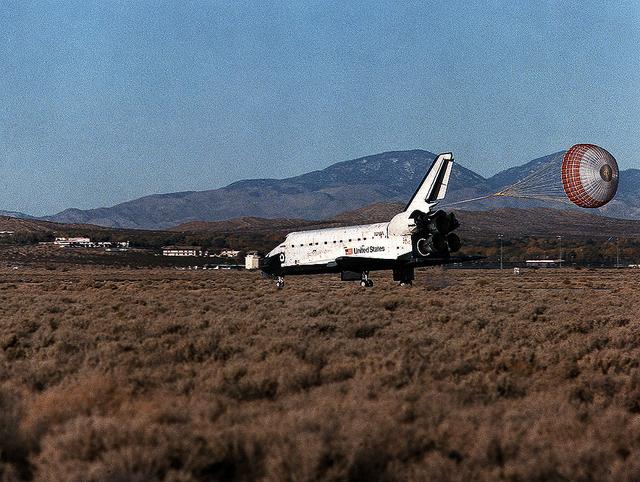
The drag-chute is fully deployed as the Space Shuttle Atlantis (STS-66) heads toward a stop at Edwards Air Force Base in southern California, ending a successful mission. The crew supported the Atmospheric Laboratory for Applications and Science (ATLAS-3), conducting approximately 80 experiments. The Cryogenic Infrared Spectrometer and Telescopes for the Atmosphere-Shuttle Pallet Satellite (CRISTA-SPAS), which was developed by German engineers, was successfully deployed and retrieved during this space mission.
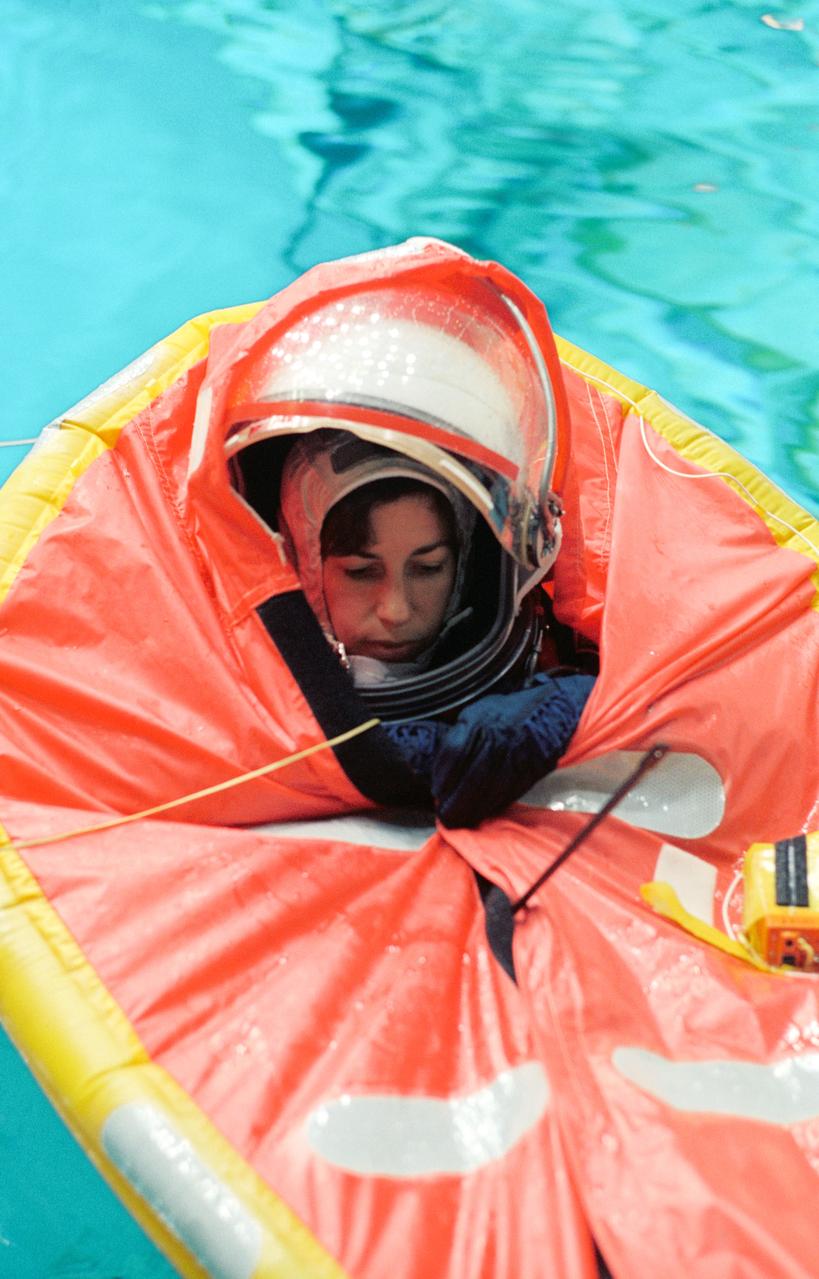
S94-37520 (28 June 1994) --- Astronaut Ellen Ochoa, STS-66 payload commander, secures herself in a small life raft during an emergency bailout training exercise in the Johnson Space Center's (JSC) Weightless Environment Training Facility (WET-F). Making her second flight in space, Ochoa will join four other NASA astronauts and a European mission specialist for a week and a half in space aboard the Space Shuttle Atlantis in support of the Atmospheric Laboratory for Applications and Science (ATLAS-3) mission. Ochoa was a mission specialist on the ATLAS-2 mission in April of 1993.
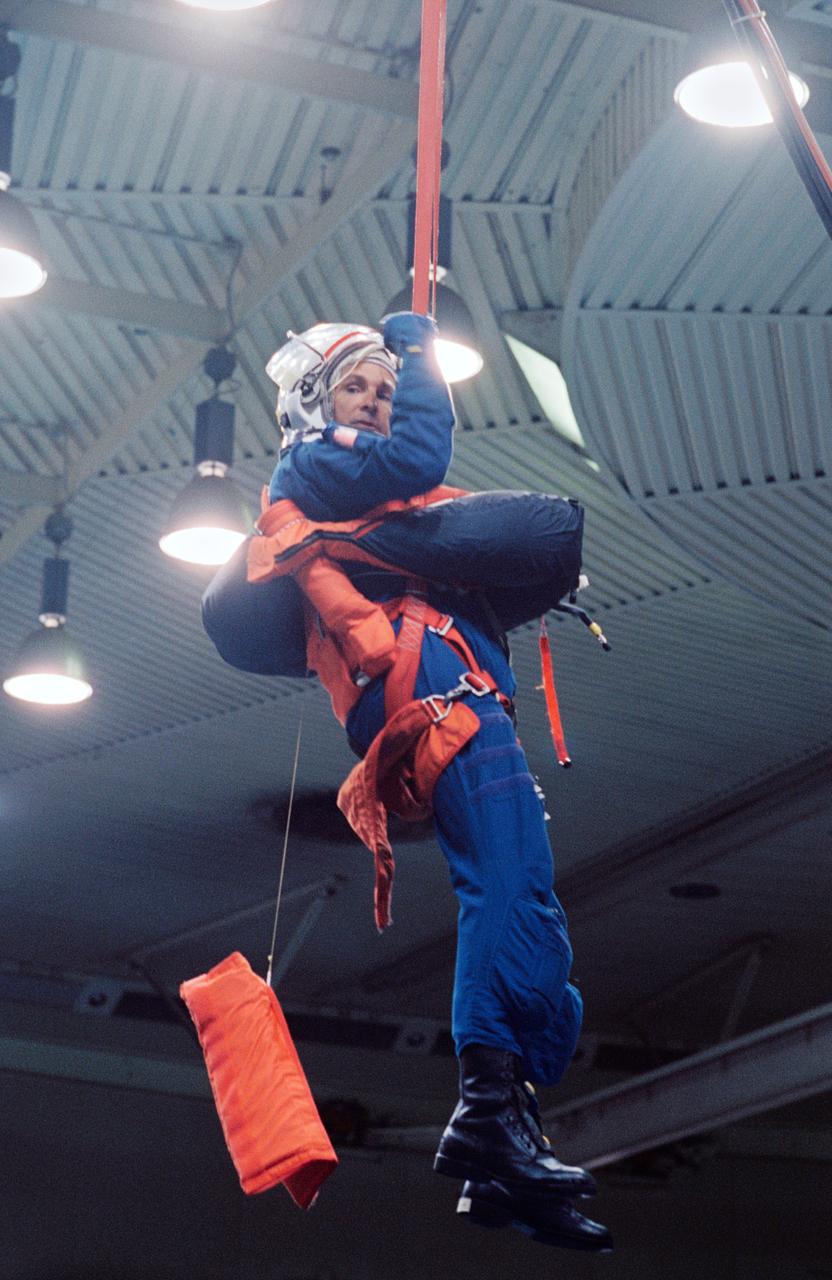
S94-37516 (28 June 1994) --- Astronaut Curtis L. Brown is suspended by a simulated parachute gear during an emergency bailout training exercise in the Johnson Space Center's (JSC) Weightless Environment Training Facility (WET-F). Making his second flight in space, Brown will join four other NASA astronauts and a European mission specialist for a week and a half in space aboard the Space Shuttle Atlantis in support of the Atmospheric Laboratory for Applications and Science (ATLAS-3) mission.
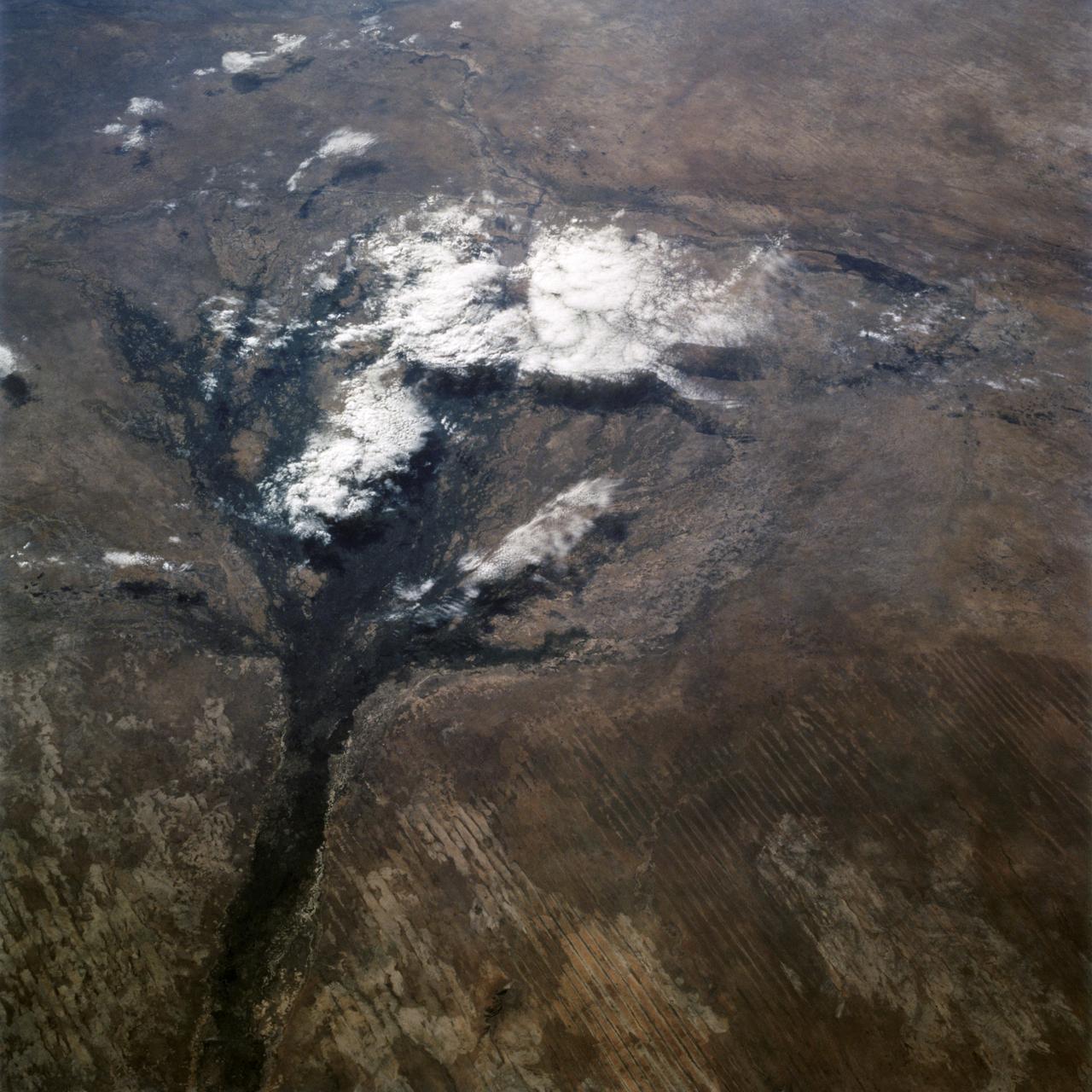
STS066-122-091 (3-14 Nov. 1994) --- This November 1994 view looking south-southeast shows clouds over the Okavango Delta area of northern Botswana. The Okavango is one of the wilder, less spoiled regions of Africa. The area still supports great herds of wild animals such as elephant, zebra and the cape buffalo. Despite conservation efforts from the stable government of Botswana, delta habitats are pressured. The Okavango River (lower left of view) brings water from the high, wet plateaus of Angola into the Kalahari Desert, and enormous inland basin. As a result of a series of small faults (upper center of the view) related to the African Rift System, the river is dammed up in the form of swampy inland delta. Here, water is consumed by evaporation, infiltration, and the swamp forests. Late summer floods take six months to slowly penetrate the 160 kilometer (95 miles) to the other end of the Delta. The visual patterns of the area are strongly linear: straight sand dunes occur in many places and can be seen across the bottom portion of the photograph. Numerous brush-fire scars produce a complex, straight-edged pattern over much of the lower portion of this view. Lake Ngami (upper right of view) was once permanently full as late as the middle 1800's. Changes in the climate of the area over the last 100 years has changed the size and shape of the inland delta.
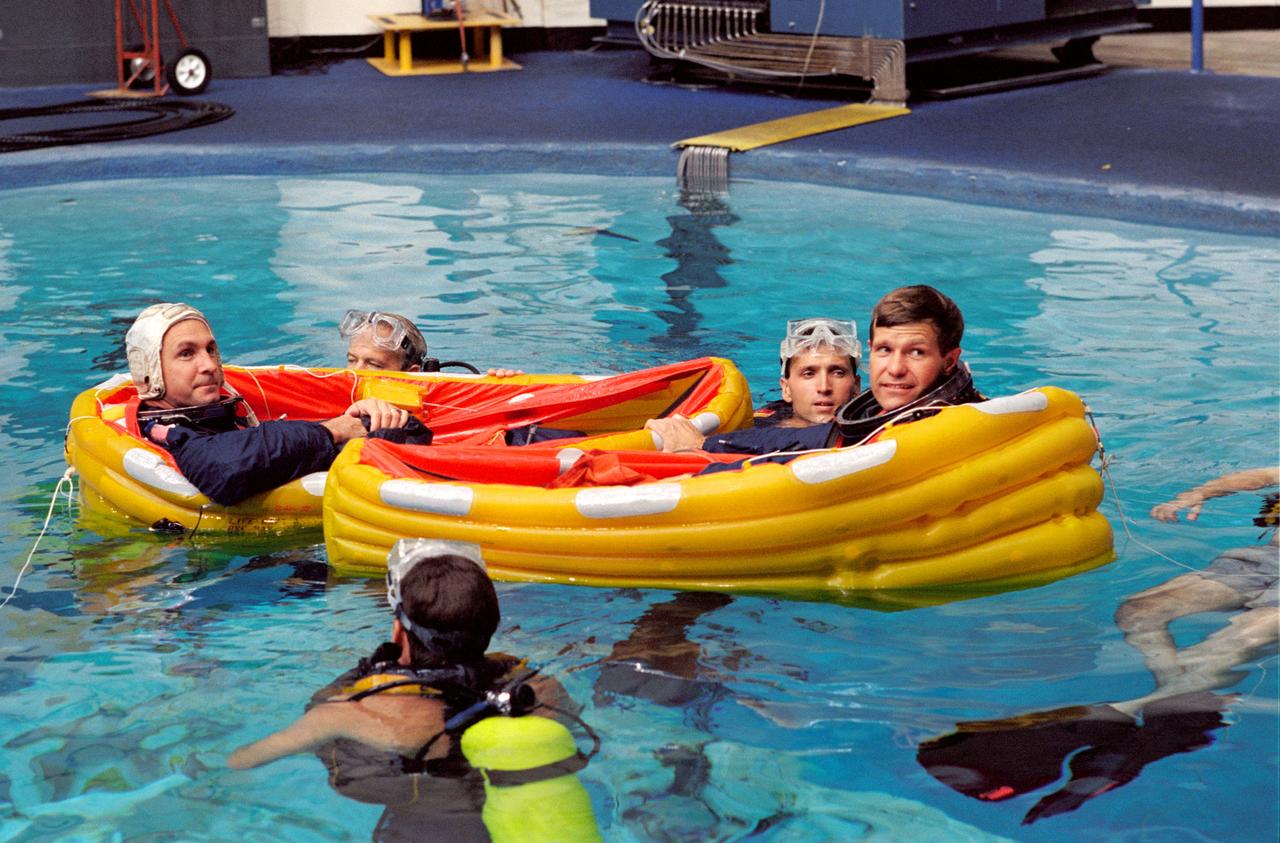
S94-37526 (28 June 1994) --- In separate life rafts, astronauts Donald R. McMonagle (right), mission commander, and Curtis L. Brown, pilot, are assisted by several SCUBA-equipped divers during an emergency bailout training exercise in the Johnson Space Center's (JSC) Weightless Environment Training Facility (WET-F). Making their third and second flights in space, respectively, McMonagle and Brown will be joined by three other NASA astronauts and a European mission specialist for a week and a half in space aboard the Space Shuttle Atlantis. The flight will support the Atmospheric Laboratory for Applications and Science (ATLAS-3) mission.
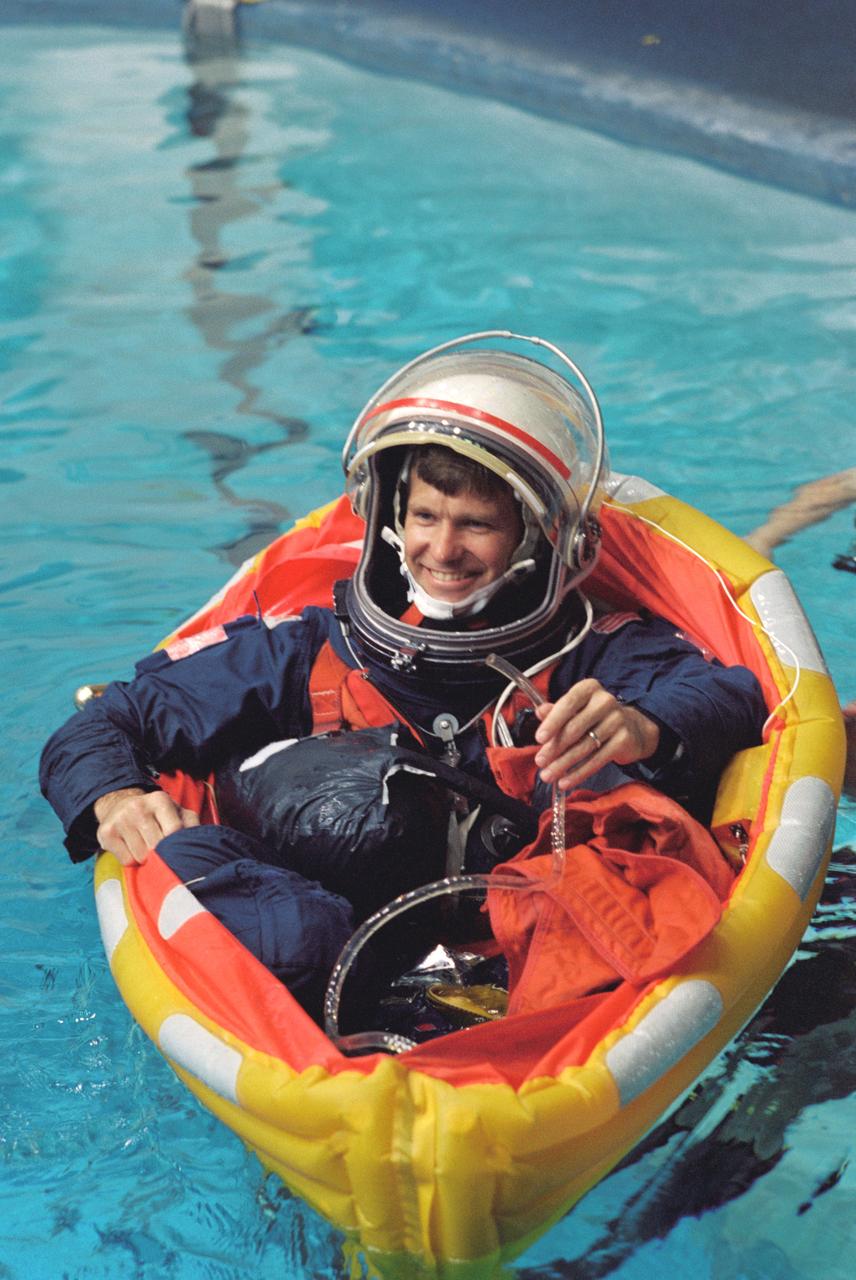
S94-37521 (28 June 1994) --- Astronaut Donald R. McMonagle, mission commander, checks the drainage hose on his rapidly fashioned life raft during an emergency bailout training exercise in the Johnson Space Center's (JSC) Weightless Environment Training Facility (WET-F). Making his third flight in space covering 343 hours, McMonagle will be joined by four other NASA astronauts and a European mission specialist for a week and a half in space aboard the Space Shuttle Atlantis. The flight will support the Atmospheric Laboratory for Applications and Science (ATLAS-3) mission.

The space shuttle Atlantis atop NASA's 747 Shuttle Carrier Aircraft (SCA) during takeoff for a return ferry flight to the Kennedy Space Center from Edwards, California. The STS-66 mission was dedicated to the third flight of the Atmospheric Laboratory for Applications and Science-3 (ATLAS-3), part of NASA's Mission to Planet Earth program. The astronauts also deployed and retrieved a free-flying satellite designed to study the middle and lower thermospheres and perform a series of experiments covering life sciences research and microgravity processing. The landing was at 7:34 a.m. (PST) 14 November 1994, after being waved off from the Kennedy Space Center, Florida, due to adverse weather.