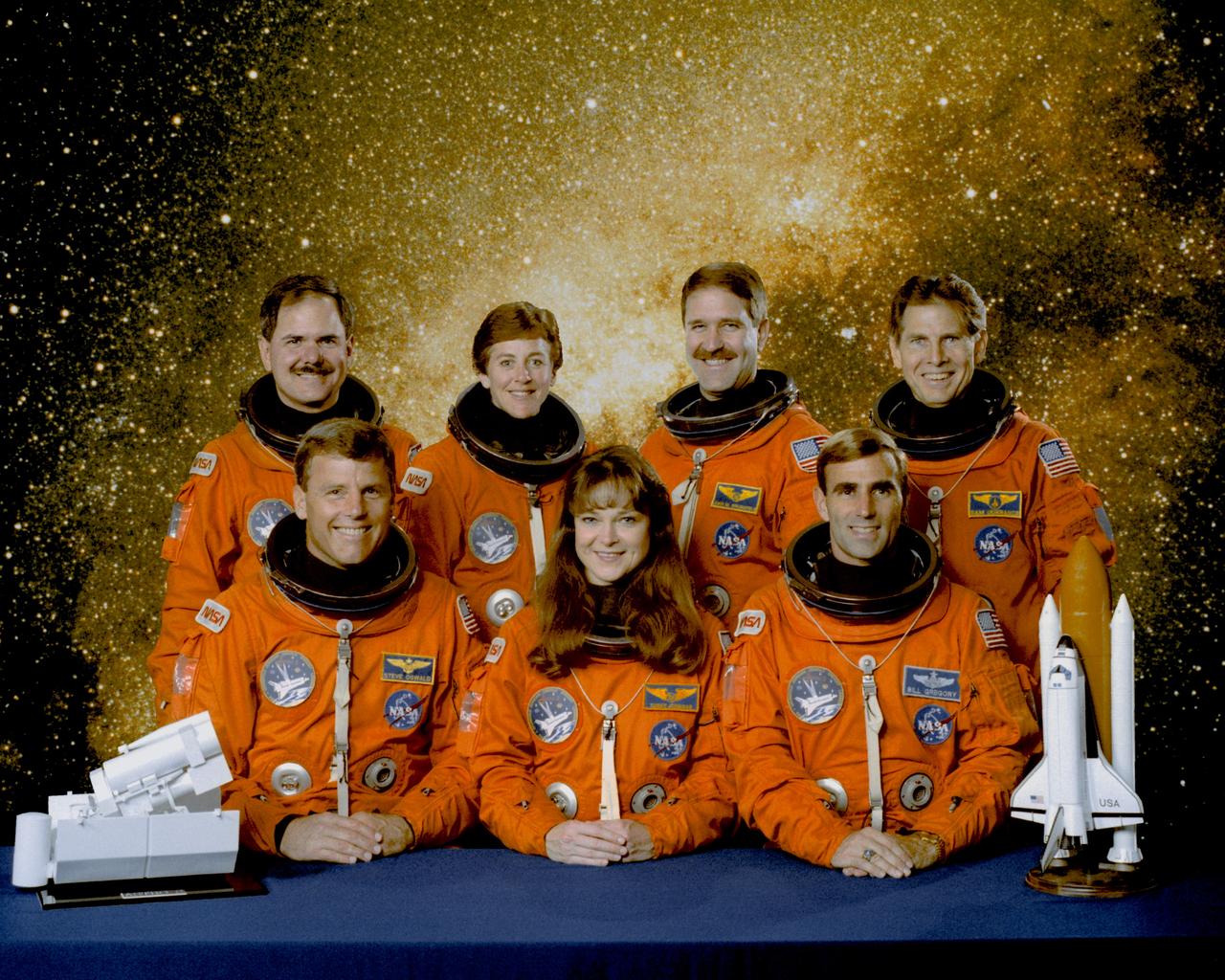
STS067-S-002 (December 1994) --- Five NASA astronauts and two payload specialists from the private sector have been named to fly aboard the Space Shuttle Endeavour for the STS-67/ASTRO-2 mission, scheduled for March 1995. In front are astronauts (left to right) Stephen S. Oswald, mission commander; Tamara E. Jernigan, payload commander; and William G. Gregory, pilot. In the back are (left to right) Ronald A. Parise, payload specialist; astronauts Wendy B. Lawrence, and John M. Grunsfeld, both mission specialists; and Samuel T. Durrance, payload specialist. Dr. Durrance is a research scientist in the Department of Physics and Astronomy at Johns Hopkins University, Baltimore, Maryland. Dr. Parise is a senior scientist in the Space Observatories Department, Computer Sciences Corporation, Silver Spring, Maryland. Both payload specialist's flew aboard the Space Shuttle Columbia for the STS-35/ASTRO-1 mission in December 1990.
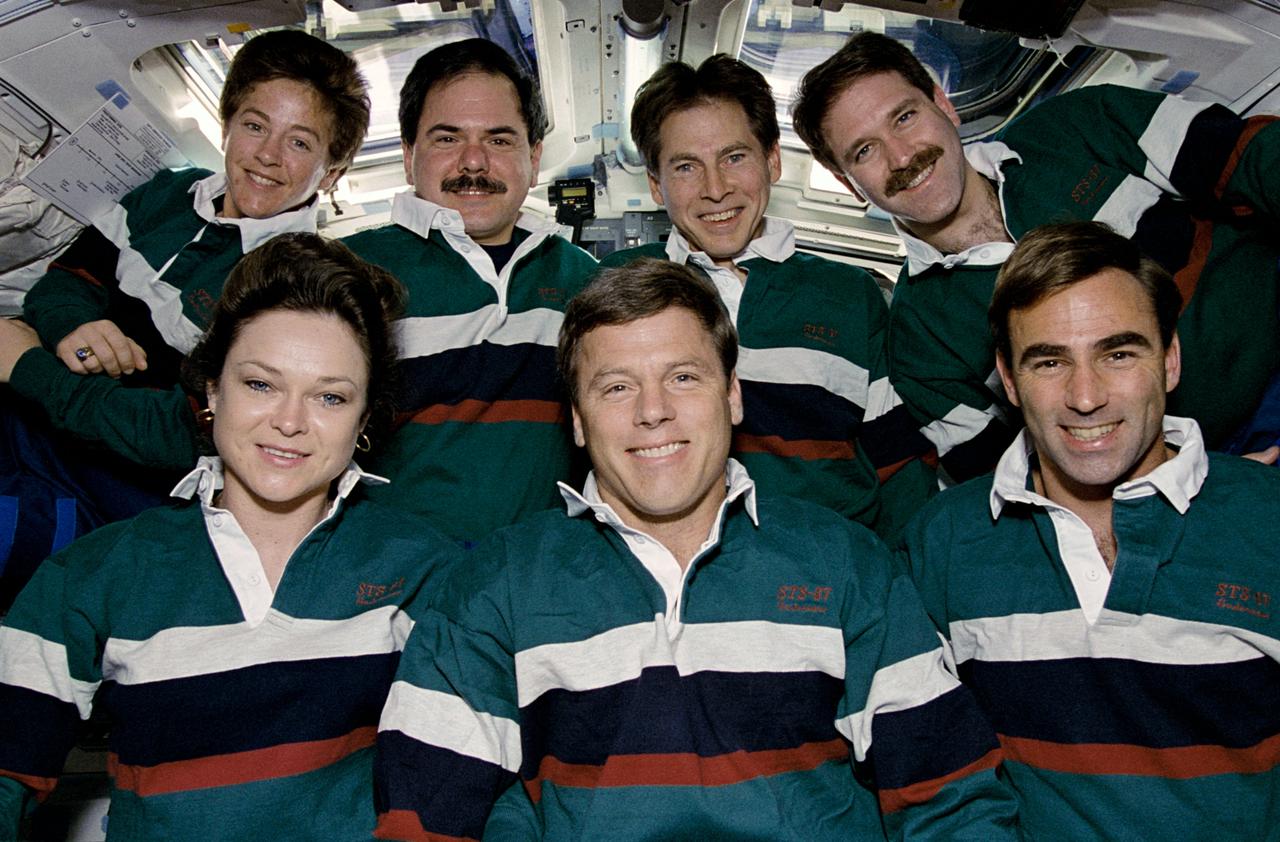
The STS-67/ASTRO-2 crew members pose for their traditional inflight portrait on the aft flight deck of the Earth orbiting Space Shuttle Endeavour. Left to right in the front are astronauts Tamara E. Jernigan, payload commander; Steven S. Oswald, mission commander; and William G. Gregory, pilot. Left to right on the back row are astronaut Wendy B. Lawrence, flight engineer; payload specialists Ronald A. Parise and Samuel T. Durrance; and John M. Grunsfeld, mission specialist.
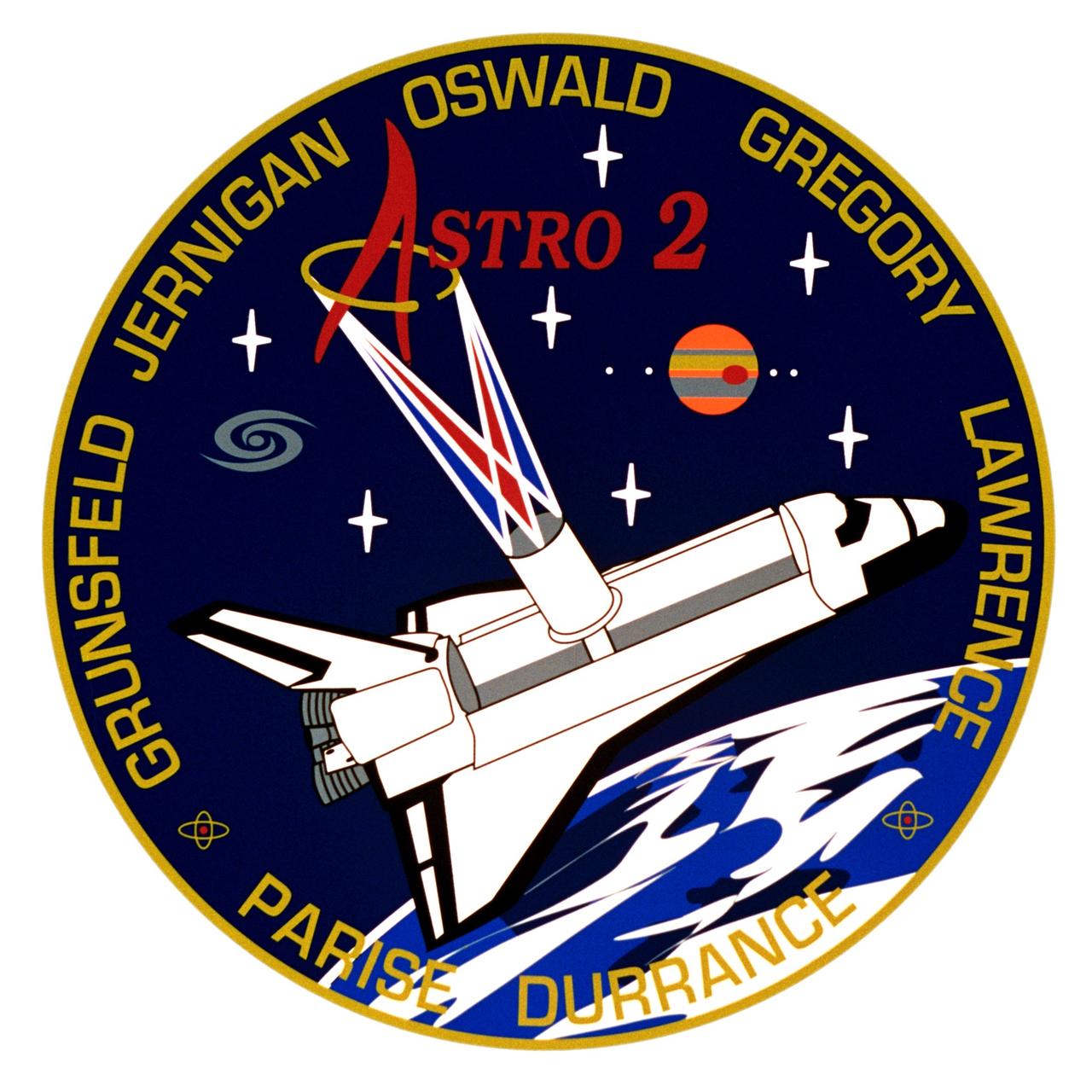
STS067-S-001 (October 1994) --- Observation and remote exploration of the Universe in the ultraviolet wavelengths of light are the focus of the STS-67/ASTRO-2 mission, as depicted in the crew patch designed by the crew members. The insignia shows the ASTRO-2 telescopes in the space shuttle Endeavour's payload bay, orbiting high above Earth's atmosphere. The three sets of rays, diverging from the telescope on the patch atop the Instrument Pointing System (IPS), correspond to the three ASTRO-2 telescopes -- the Hopkins Ultraviolet Telescope (HUT), the Ultraviolet Imaging Telescope (UIT), and the Wisconsin Ultraviolet Photo-Polarimeter Experiment (WUPPE). The telescopes are co-aligned to simultaneously view the same astronomical object, as shown by the convergence of rays on the NASA symbol. This symbol also represents the excellence of the union of the NASA teams and universality's in the exploration of the universe through astronomy. The celestial targets of ASTRO-2 include the observation of planets, stars and galaxies shown in the design. The two small atoms represent the search in the ultraviolet spectrum for the signature of primordial helium in intergalactic space left over from the Big Bang. The observations performed on ASTRO-2 will contribute to man's knowledge and understanding of the vast universe, from the planets in out system to the farthest reaches of space. The NASA insignia design for space shuttle flights is reserved for use by the astronauts and for other official use as the NASA Administrator may authorize. Public availability has been approved only in the forms of illustrations by the various news media. When and if there is any change in this policy, which is not anticipated, the change will be publicly announced. Photo credit: NASA
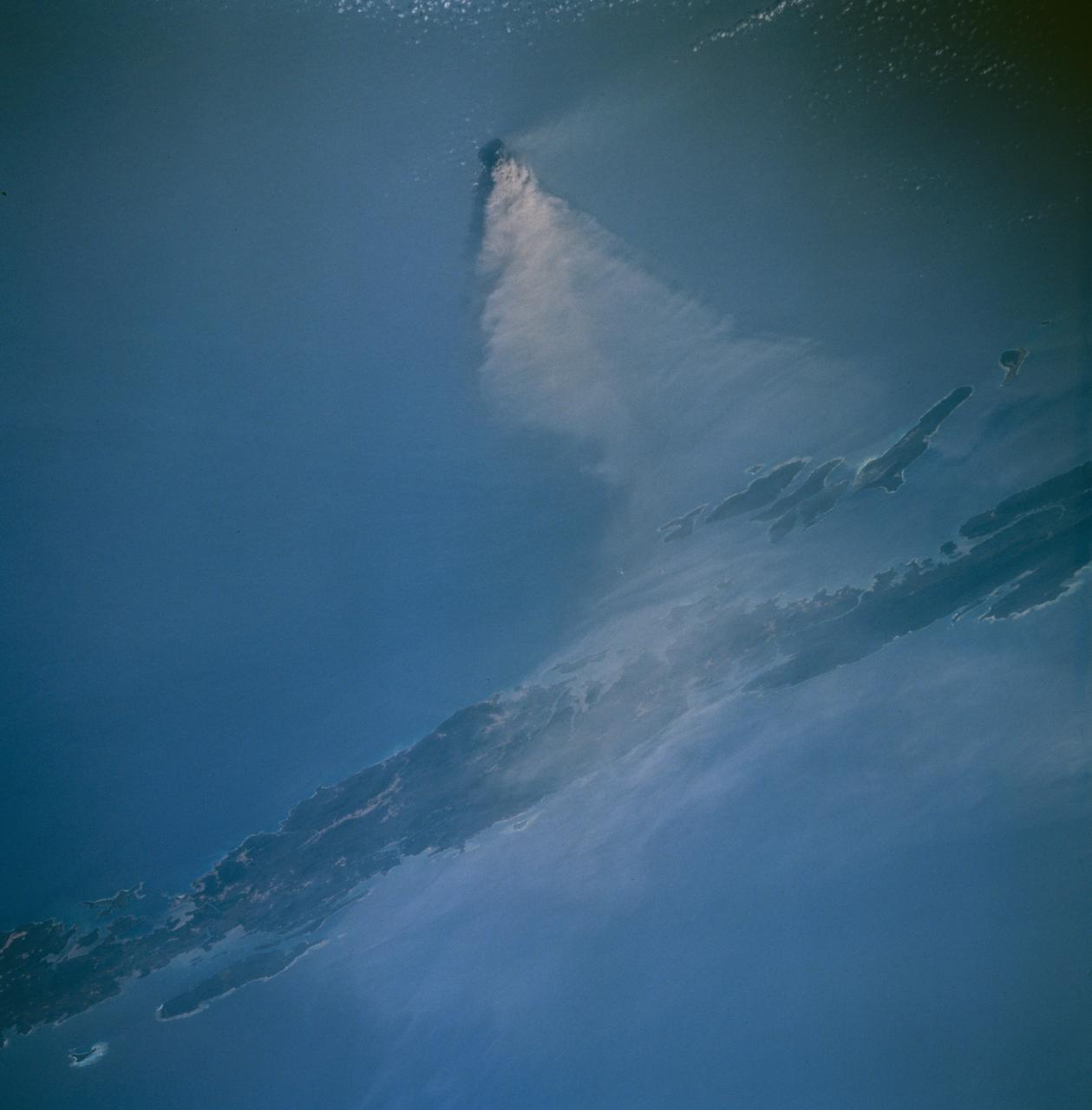
Barren Island, a small volcanic island which is part of the Andaman Island group in the Andaman Sea west of Malaysia, began a new eruptive phase late in 1994. The STS-67 crew noticed the volcanic plume early in their flight, and had several opportunities to document the on-going eruption. This view, taken March 14, 1995, shows a healthy volcanic plume rising several thousand feet into the atmosphere. The main plume drifts westward over Andaman Island, although a smaller plume close to the ground is being dispersed to the south.
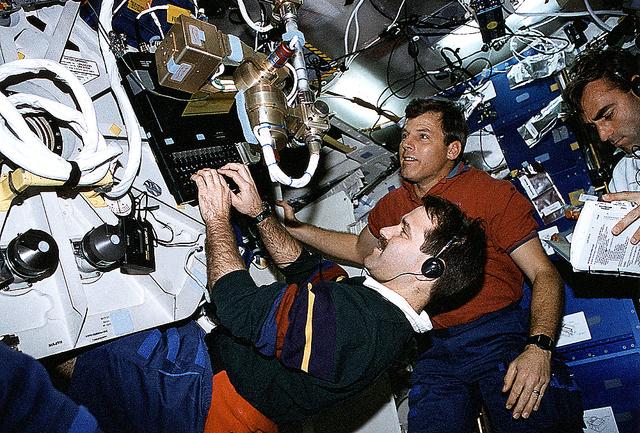
Onboard Space Shuttle Endeavour (STS-67) astronaut John Grunsfeld works at a laptop computer while wearing a headset. Commander Stephen Oswald watches Grunsfeld and Pilot Bill Gregory reads a checklist on the shuttle mid-deck.
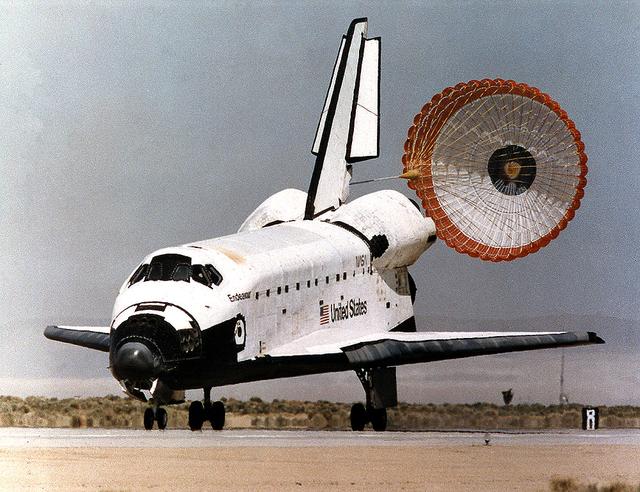
The Space Shuttle Endeavour (STS-67) lands at Edwards Air Force Base in southern California after successfully completing NASA's longest plarned shuttle mission. The seven-member crew conducted round-the-clock observations with the ASTRO-2 observatory, a trio of telescopes designed to study the universe of ultraviolet astronomy. Because of Earth's protective ozone layer ultraviolet light from celestial objects does not reach gound-based telescopes, and such studies can only be conducted from space.
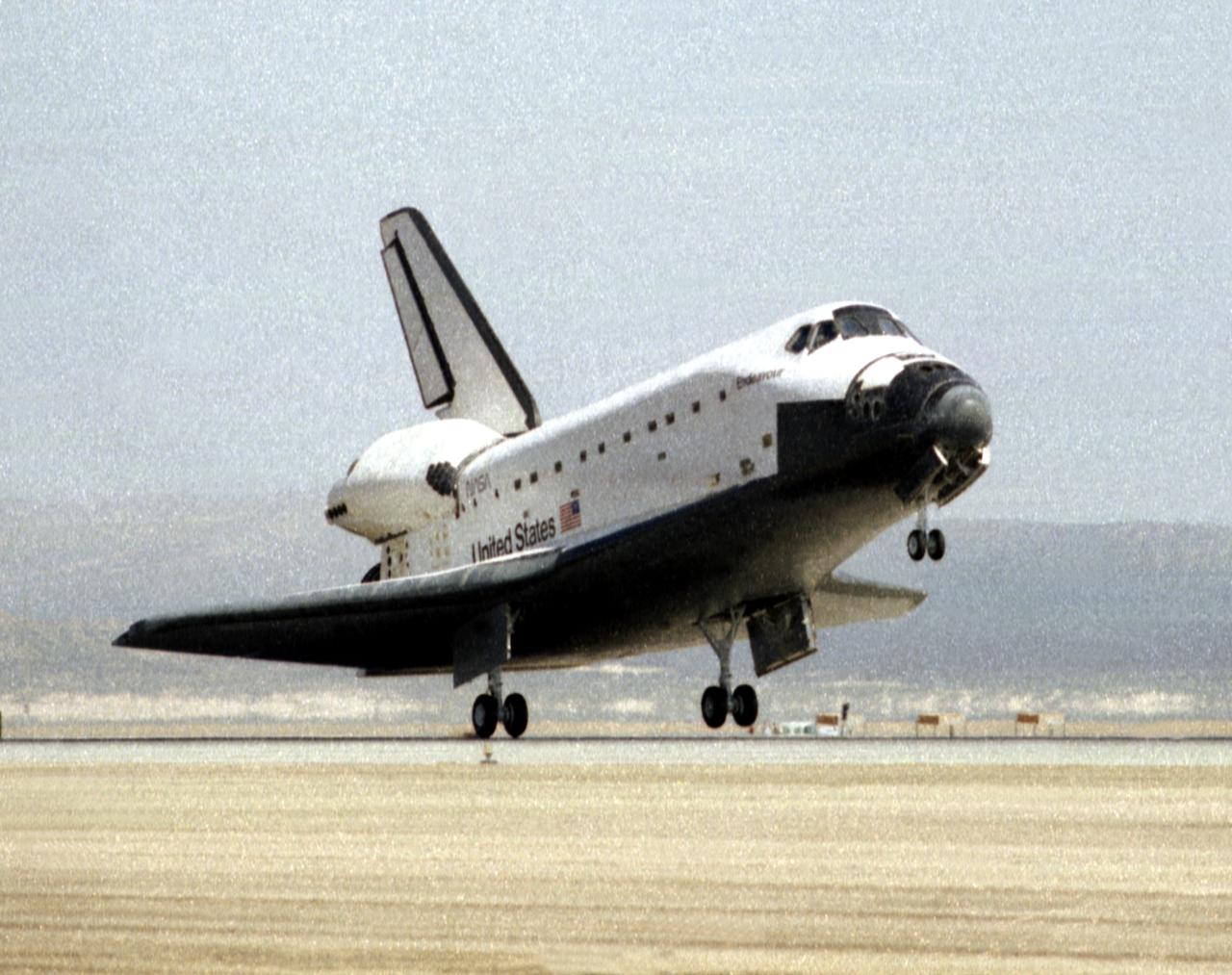
The space shuttle Endeavour slips to a smooth landing on runway 22 at Edwards, California, to complete the highly successful record-setting STS-67 mission. The landing was at 1:46 p.m. (PST) 18 March 1995, after waiving off from the Kennedy Space Center, Florida, earlier that morning due to adverse weather. Launched into space at 10:38 a.m. (PST) 1 March 1995, the Endeavour crew conducted NASA's longest shuttle flight to date and carried unique ultraviolet telescopes (ASTRO-2) which captured views of the universe impossible to obtain from the ground. Mission Commander was Steve Oswald making his third flight and the Pilot was Bill Gregory on his first mission. Mission Specialist 1 was John Grunsfeld making his first flight and Specialist 2 was Wendy Lawrence on her first flight. Tamara Jernigan served as Specialist 3 on her third flight and the two payload specialists were Samuel Durrance and Ronald Parise, both on their second flight.
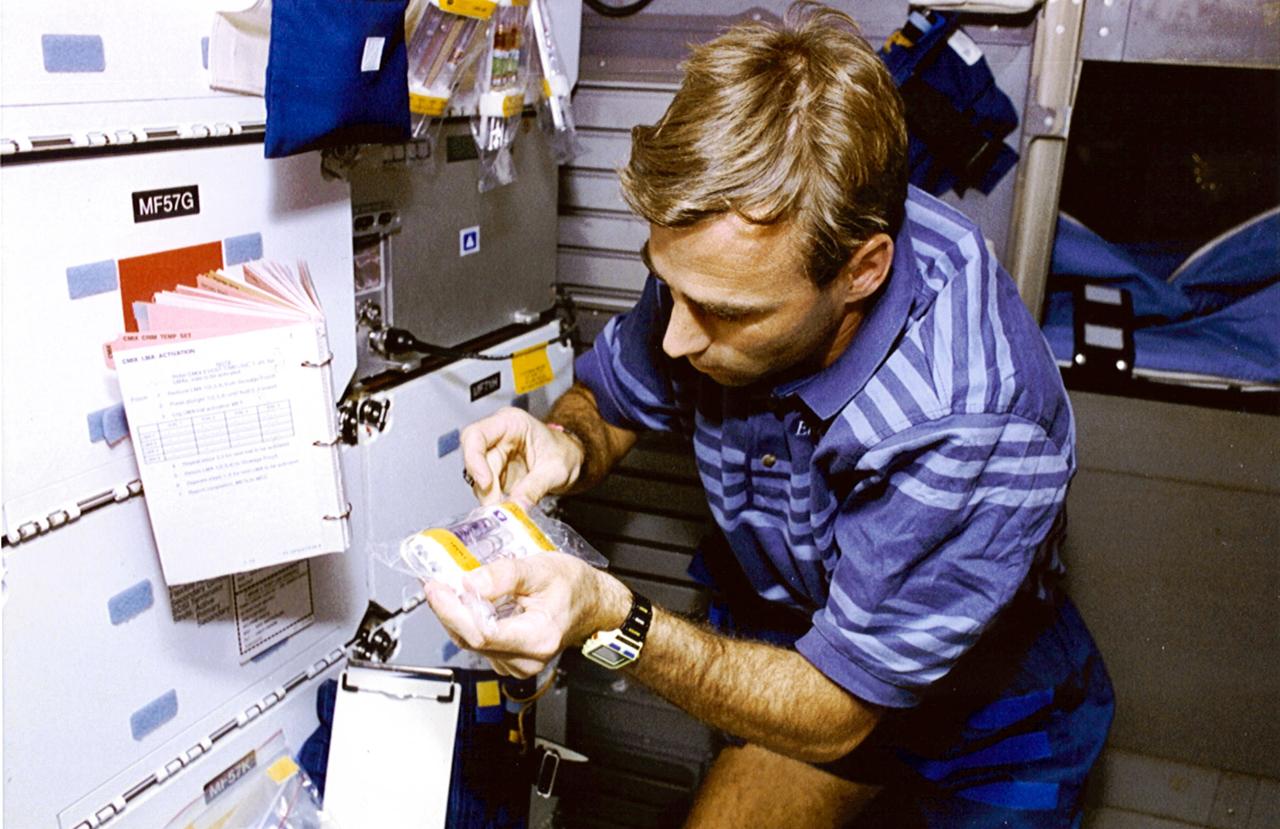
Experiments to seek solutions for a range of biomedical issues are at the heart of several investigations that will be hosted by the Commercial Instrumentation Technology Associates (ITA), Inc. Biomedical Experiments (CIBX-2) payload. CIBX-2 is unique, encompassing more than 20 separate experiments including cancer research, commercial experiments, and student hands-on experiments from 10 schools as part of ITA's ongoing University Among the Stars program. Astronaut William G. Gregory activates Liquids Mixing Apparatus (LMA) vials during STS-67. Other LMAs hang at top on the face of the middeck locker array. The experiments are sponsored under NASA's Space Product Development Program (SPD).
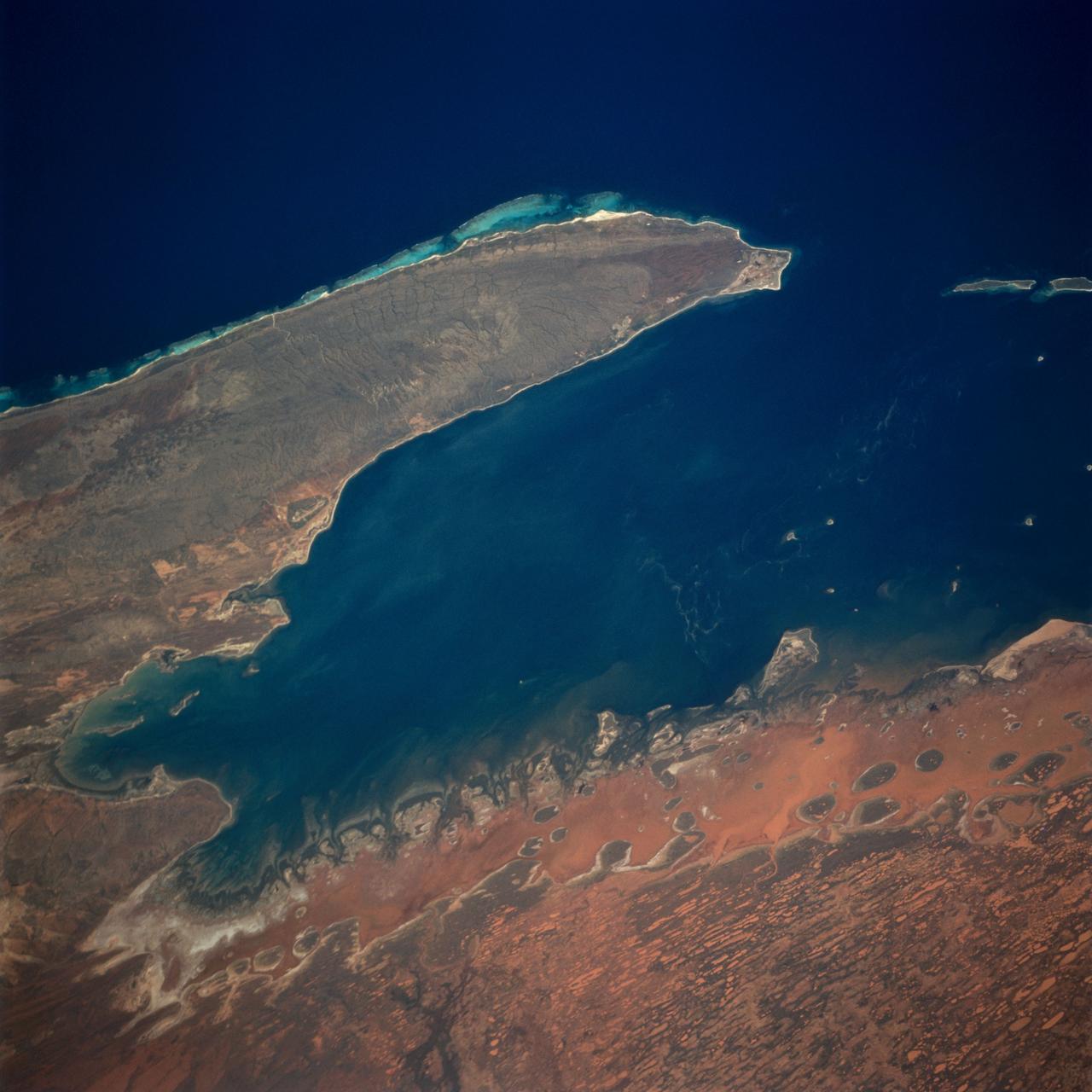
The Exmouth Gulf, western Australia, is bounded on the west by the Cape Ranges; near the base of the peninsula the Learmonth Airfield, site of a solar observatory, can be seen. Spit-accretion ridges formed on ancient beaches extend along the western edge of the peninsula, which today is lined by the Ningaloo Reef. Red mud carried by floodwaters, the result of Hurricane Bobby the previous week, cover flat coastal land along the eastern side of the gulf. The mud is mixing slowly with marine water as it filters through passes between mangrove-covered islands. A filamentous pattern in the gulf probably indicates a plankton bloom. Island paleodunes stretching from south to north cover the landscape.
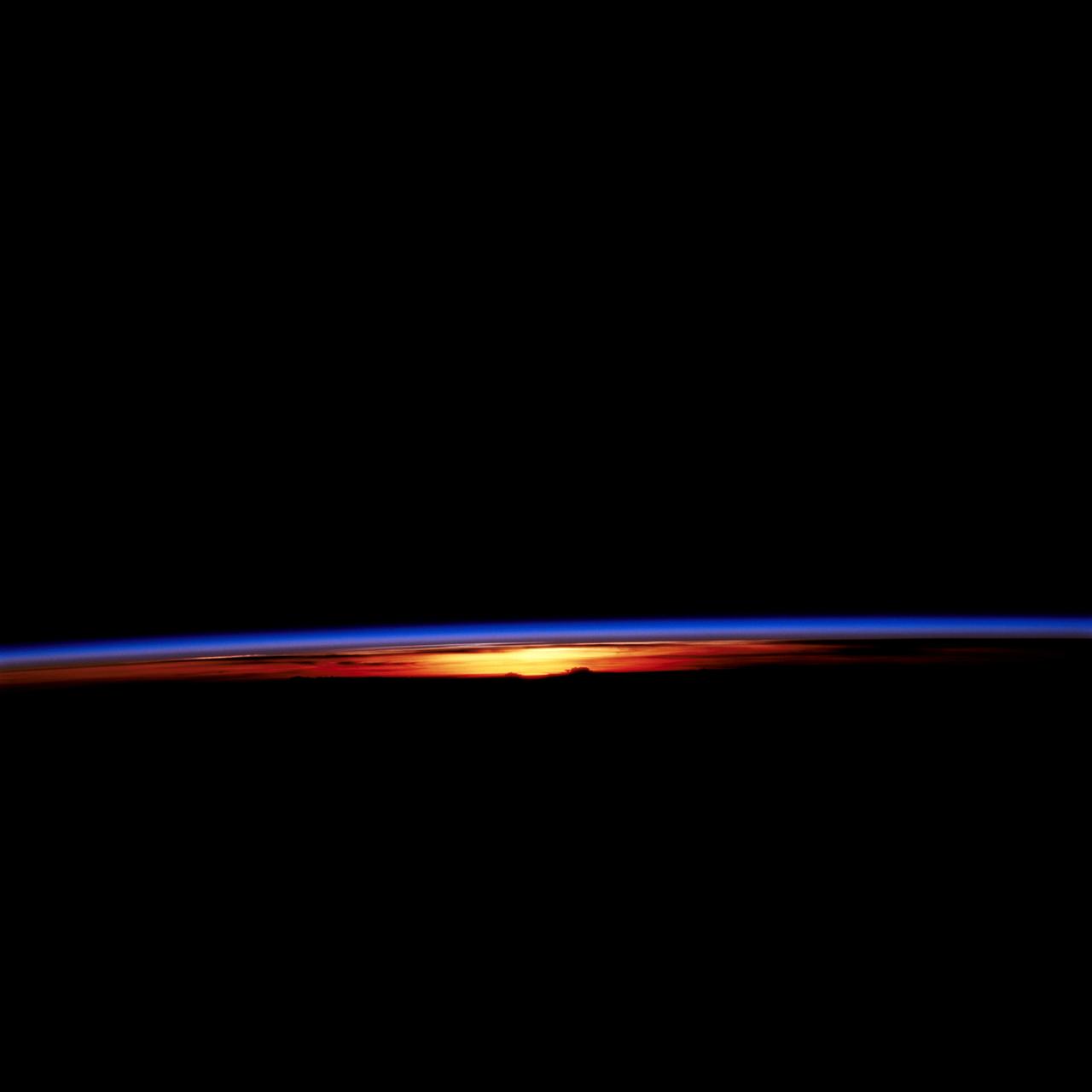
STS067-709-007 (2-18 March 1995) --- This shot, taken just after sunset, shows several distinct layers of gases in the atmosphere on the Earth’s limb. The distinct colors formed by the amount of scattered light that passes through these gases.
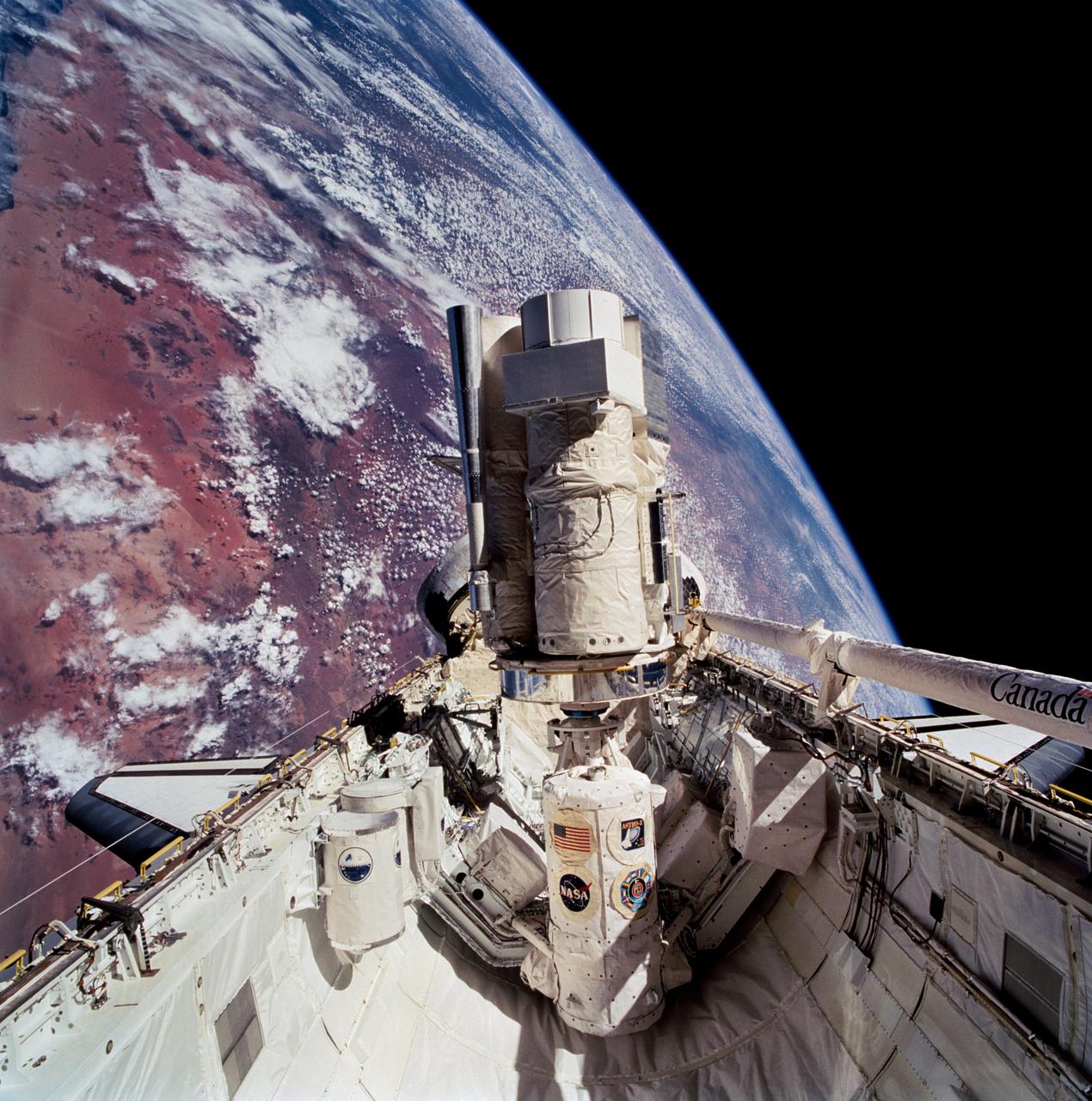
STS067-713-072 (2-18 March 1995) --- This 70mm cargo bay scene, backdropped against a desert area of Namibia, typifies the view that daily greeted the Astro-2 crew members during their almost 17-days aboard the Space Shuttle Endeavour. Positioned on the Spacelab pallet amidst other hardware, the Astro-2 payload is in its operational mode. Visible here are the Instrument Pointing System (IPS), Hopkins Ultraviolet Telescope (HUT), Star Tracker (ST), Ultraviolet Imaging Telescope (UIT), Wisconsin Ultraviolet Photo-Polarimeter Experiment (WUPPE), and Integrated Radiator System (IRS). At this angle, the Optical Sensor Package (OPS) is not seen. The Igloo, which supports the package of experiments, is in center foreground. Two Get-Away Special (GAS) canisters are in lower left foreground. The Extended Duration Orbiter (EDO) pallet, located aft of the cargo bay, is obscured by the Astro-2 payload. The Endeavour was 190 nautical miles above Earth.
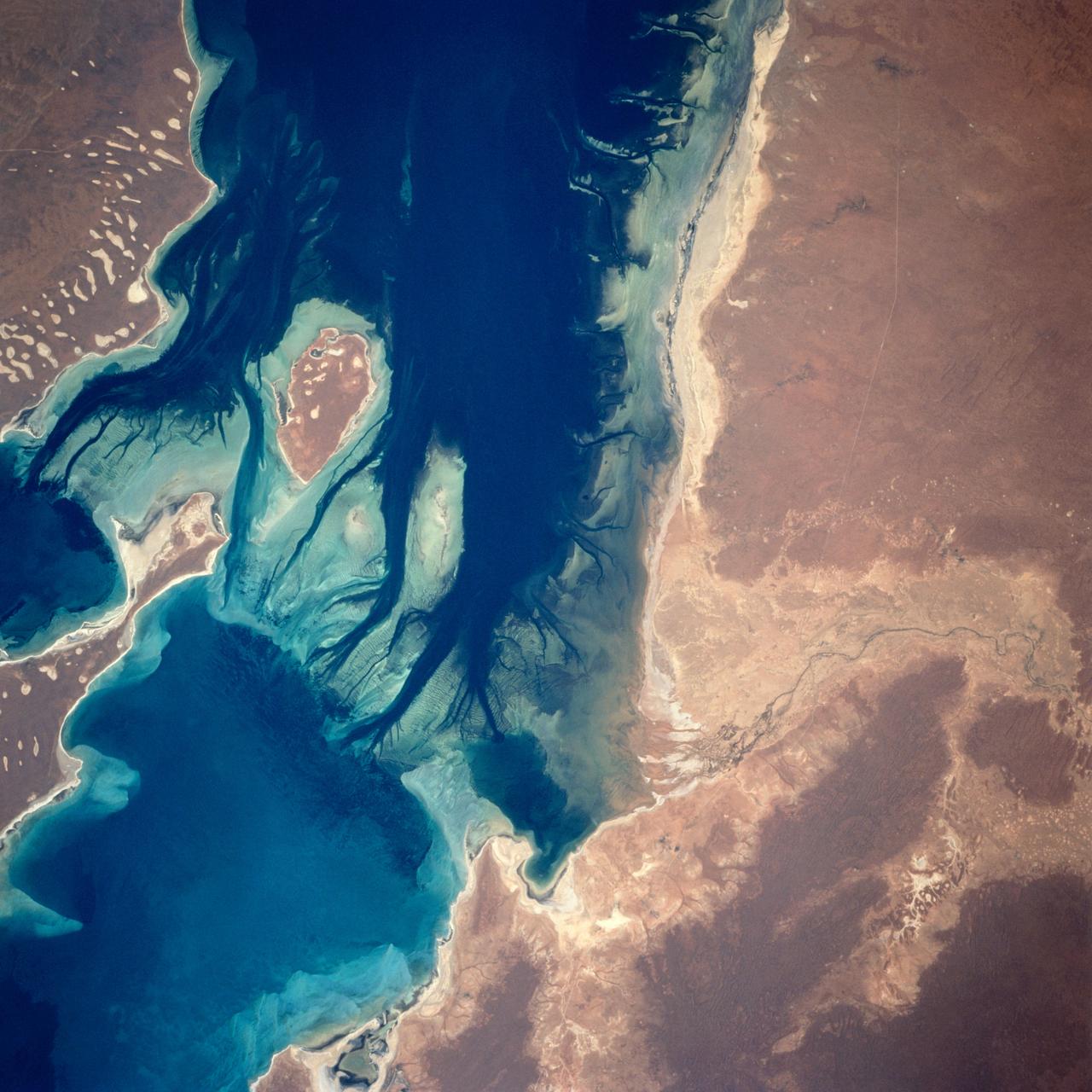
A nearly vertical view of Disappointment Reach and surroundings. Ripple-like patterns extending at right angles to the tidal flow can be discerned on shoals. Relict sand dune patterns, crests unvegetated, are evident on the western side of the estuary. Red mud brought down the Mooramel River on the east side of the estuary does extend into the shallow water of the inter-tidal lagoons. Most of the light-colored water along the coast, represents shoals of lime sediment. Patterns of sediment distribution by tides, waves, streams, and wind combine to create a complex and colorful scene.
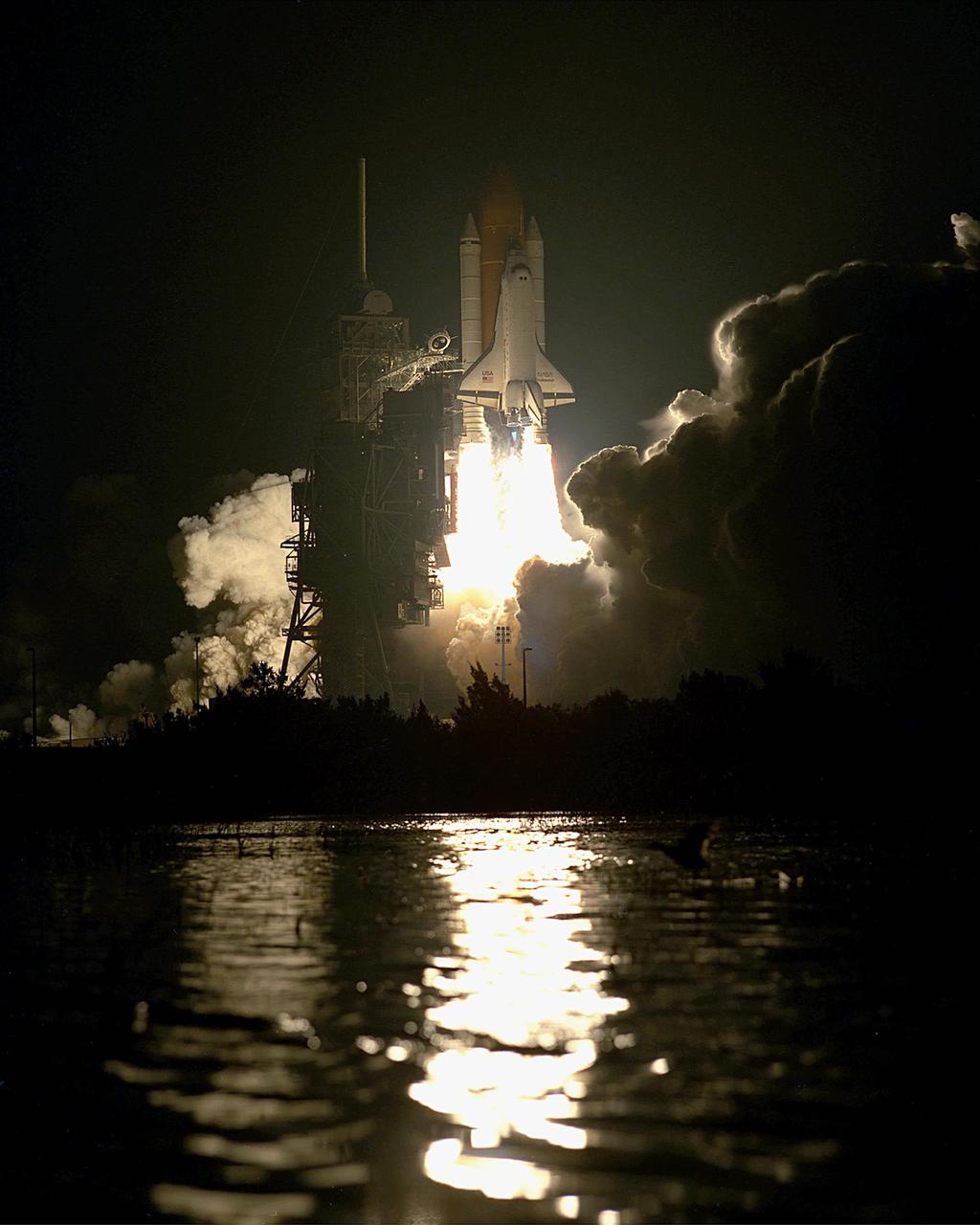
KENNEDY SPACE CENTER, FLA. -- STS-67: Endeavour
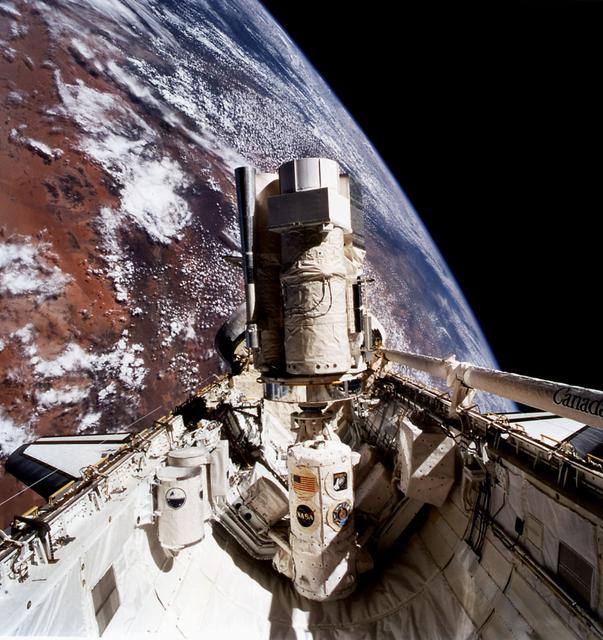
ASTRO-2 was the second dedicated Spacelab mission to conduct astronomical observations in the ultraviolet spectral regions. It consisted of three unique instruments: the Hopkins Ultraviolet Telescope (HUT), the Ultraviolet Imaging Telescope (UIT) and the Wisconsin Ultraviolet Photo-Polorimeter Experiment ((WUPPE). These experiments selected targets from a list of over 600 and observed objects ranging from some inside the solar system to individual stars, nebulae, supernova remnants, galaxies, and active extra galactic objects. This data supplemented data collected on the ASTRO-1 mission flown on the STS-35 mission in December 1990. Because most ultraviolet radiation is absorbed by Earth's atmosphere, it carnot be studied from the ground. The far and extreme ultraviolet regions of the spectrum were largely unexplored before ASTRO-1, but knowledge of all wavelengths is essential to obtain an accurate picture of the universe. ASTRO-2 had almost twice the duration of its predecessor, and a launch at a different time of year allows the telescopes to view different portions of the sky. The mission served to fill in large gaps in astronomers' understanding of the universe and laid the foundations for more discovery in the future. ASTRO-2, a primary payload of STS-67 flight, was launched on March 2, 1995 aboard the Space Shuttle Orbiter Endeavour.
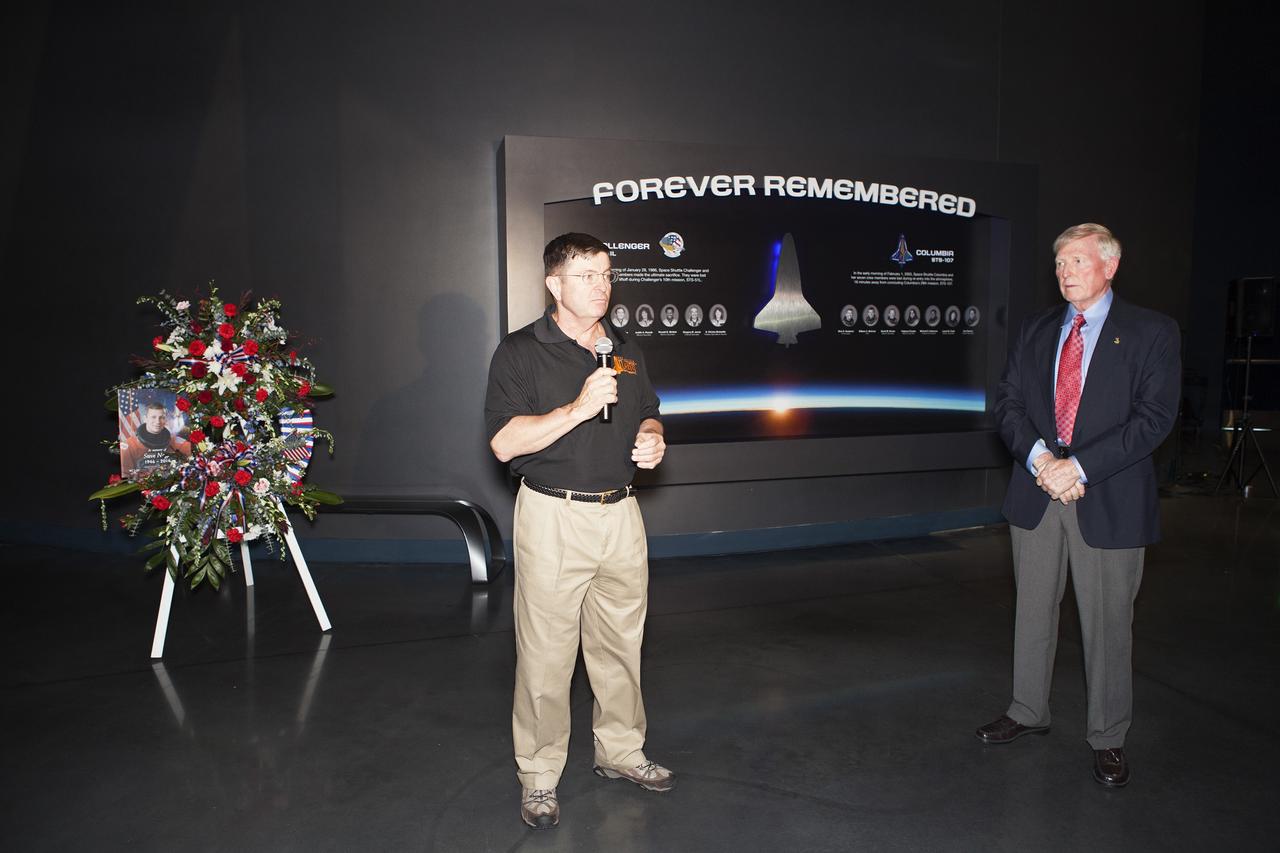
CAPE CANAVERAL, Fla. – Former NASA astronaut Jon McBride speaks at a wreath-laying ceremony honoring former NASA astronaut Steven R. Nagel at the Space Shuttle Atlantis exhibit at the Kennedy Space Center Visitor Complex in Florida. Nagel died Aug. 21 after a long illness. He was 67 years old. Nagel served as a mission specialist on his first space shuttle flight, STS-51G, in 1985. He was pilot on his second shuttle flight, STS-61A, also in 1985. He commanded his final two flights, STS-37 and STS-55, in 1991 and 1993, respectively. He logged a total of 723 hours in space. To learn more about Nagel's career, visit http://www.nasa.gov/press/2014/august/former-nasa-astronaut-steven-nagel-veteran-of-four-shuttle-flights-dies-at-67/. Photo credit: NASA/Dimitri Gerondidakis
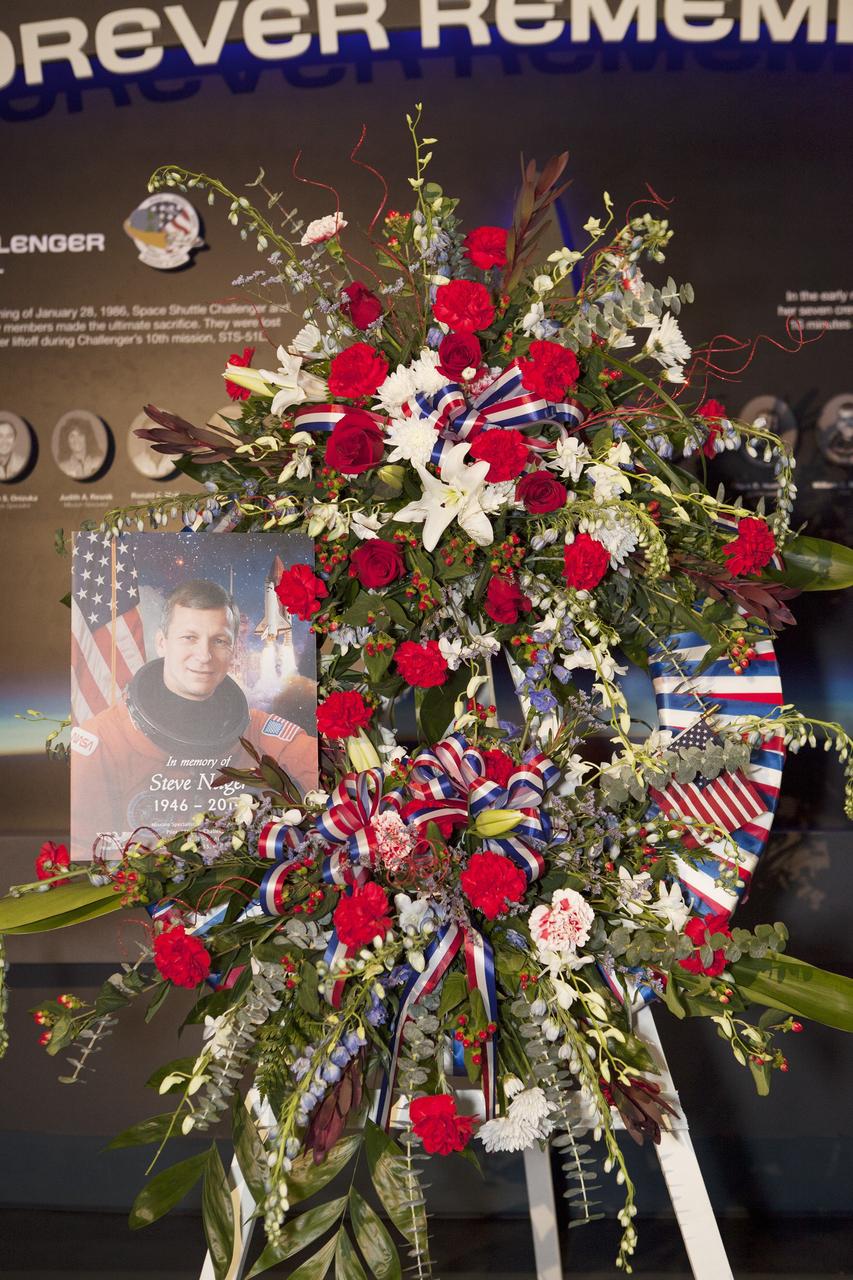
CAPE CANAVERAL, Fla. -- A wreath honoring former NASA astronaut Steven R. Nagel is displayed beside his photo at the Space Shuttle Atlantis exhibit at the Kennedy Space Center Visitor Complex in Florida. Nagel died Aug. 21 after a long illness. He was 67 years old. Nagel served as a mission specialist on his first space shuttle flight, STS-51G, in 1985. He was pilot on his second shuttle flight, STS-61A, also in 1985. He commanded his final two flights, STS-37 and STS-55, in 1991 and 1993, respectively. He logged a total of 723 hours in space. To learn more about Nagel's career, visit http://www.nasa.gov/press/2014/august/former-nasa-astronaut-steven-nagel-veteran-of-four-shuttle-flights-dies-at-67/. Photo credit: NASA/Dimitri Gerondidakis
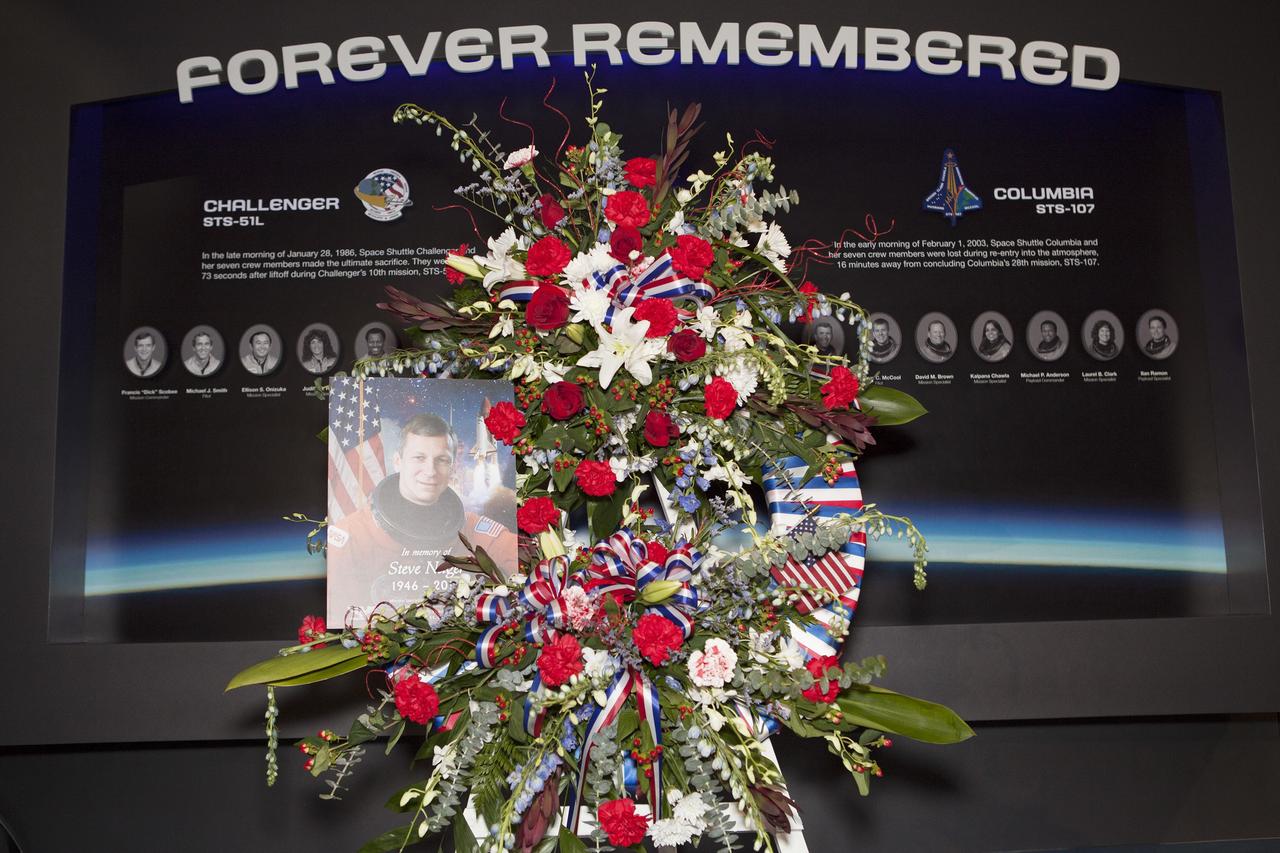
CAPE CANAVERAL, Fla. -- A wreath honoring former NASA astronaut Steven R. Nagel is displayed beside his photo at the Space Shuttle Atlantis exhibit at the Kennedy Space Center Visitor Complex in Florida. Nagel died Aug. 21 after a long illness. He was 67 years old. Nagel served as a mission specialist on his first space shuttle flight, STS-51G, in 1985. He was pilot on his second shuttle flight, STS-61A, also in 1985. He commanded his final two flights, STS-37 and STS-55, in 1991 and 1993, respectively. He logged a total of 723 hours in space. To learn more about Nagel's career, visit http://www.nasa.gov/press/2014/august/former-nasa-astronaut-steven-nagel-veteran-of-four-shuttle-flights-dies-at-67/. Photo credit: NASA/Dimitri Gerondidakis
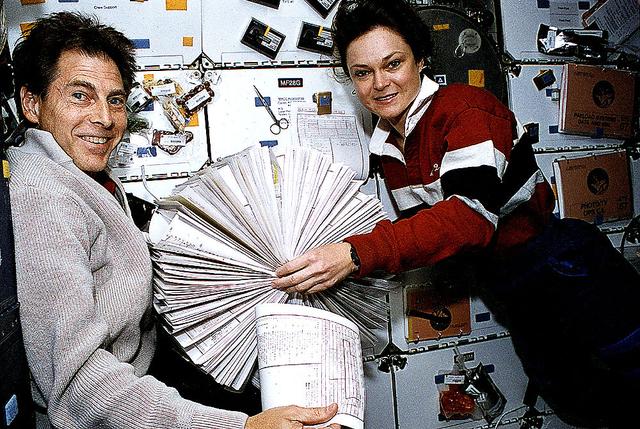
Astronaut Tamara Jernigan, STS-67 payload commander, and payload specialist Samuel T. Durrance use the absence of gravity for a perusal of Astro-2 targets in a loose-leaf, Rolodex-type collection of data. The two are in the mid-deck of the Earth-orbiting Space Shuttle Endeavour.
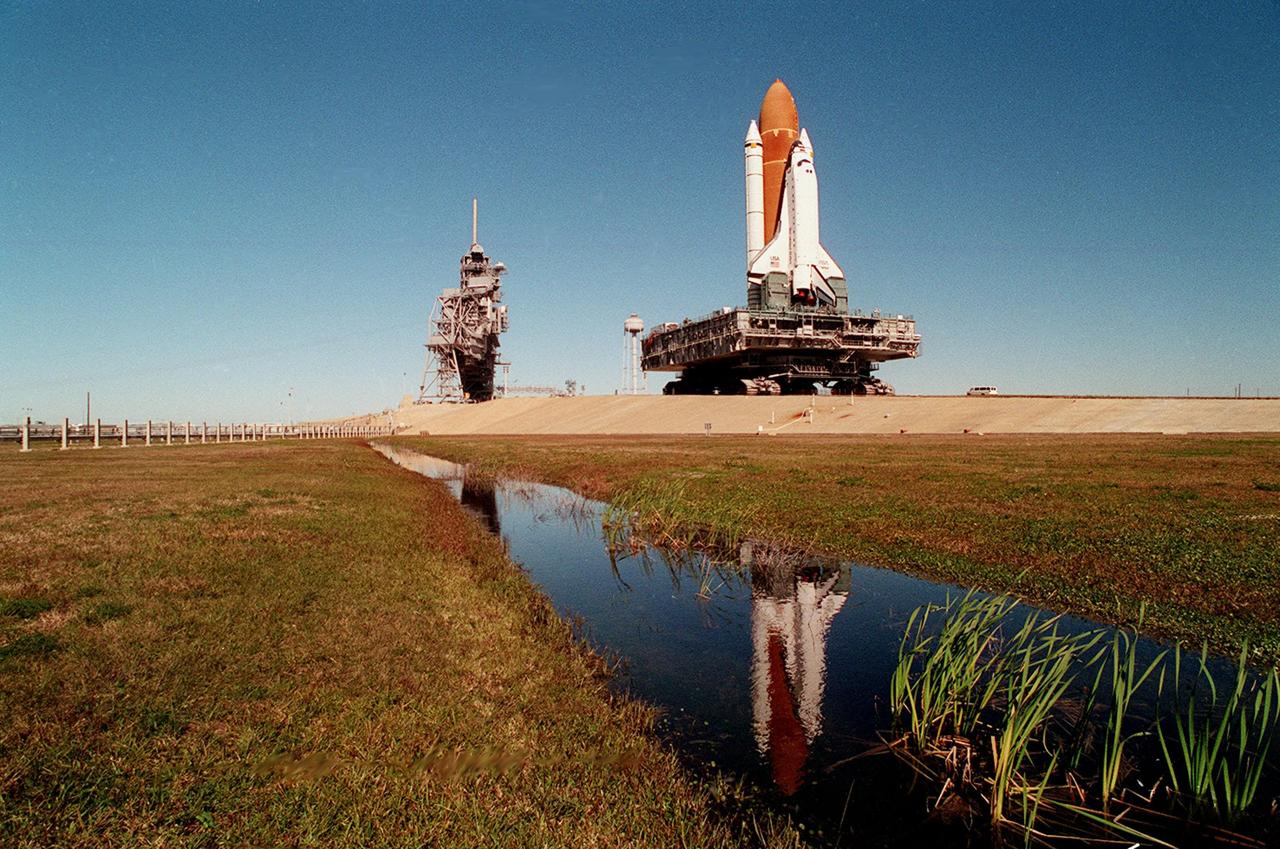
A massive 19 million pounds-plus (8.6 million kilograms) of Space Shuttle, support and transport hardware inch toward Launch Pad 39A from the Vehicle Assembly Building. The fully asssembled Space Shuttle Endeavour, minus its payloads, weighs about 4.5 million pounds (2 million kg.); the mobile launcher platform, on which it was assembled and from which it will lift off, weighs 9.25 million pounds (4.19 million kg.); and the crawler-transporter carrying the platform and Shuttle checks in at around 6 million pounds (2.7 million kg.). Once at the pad, the Shuttle and launch platform will be deposited atop support columns to complete preparations for the second Shuttle launch of 1995. The primary payload of mission STS-67 is the Astro-2 Astrophysics Observatory, carrying three ultraviolet telescopes that flew on the Astro-1 mission in 1990. STS-67 also is scheduled to become the longest shuttle flight to date, lasting 16 days
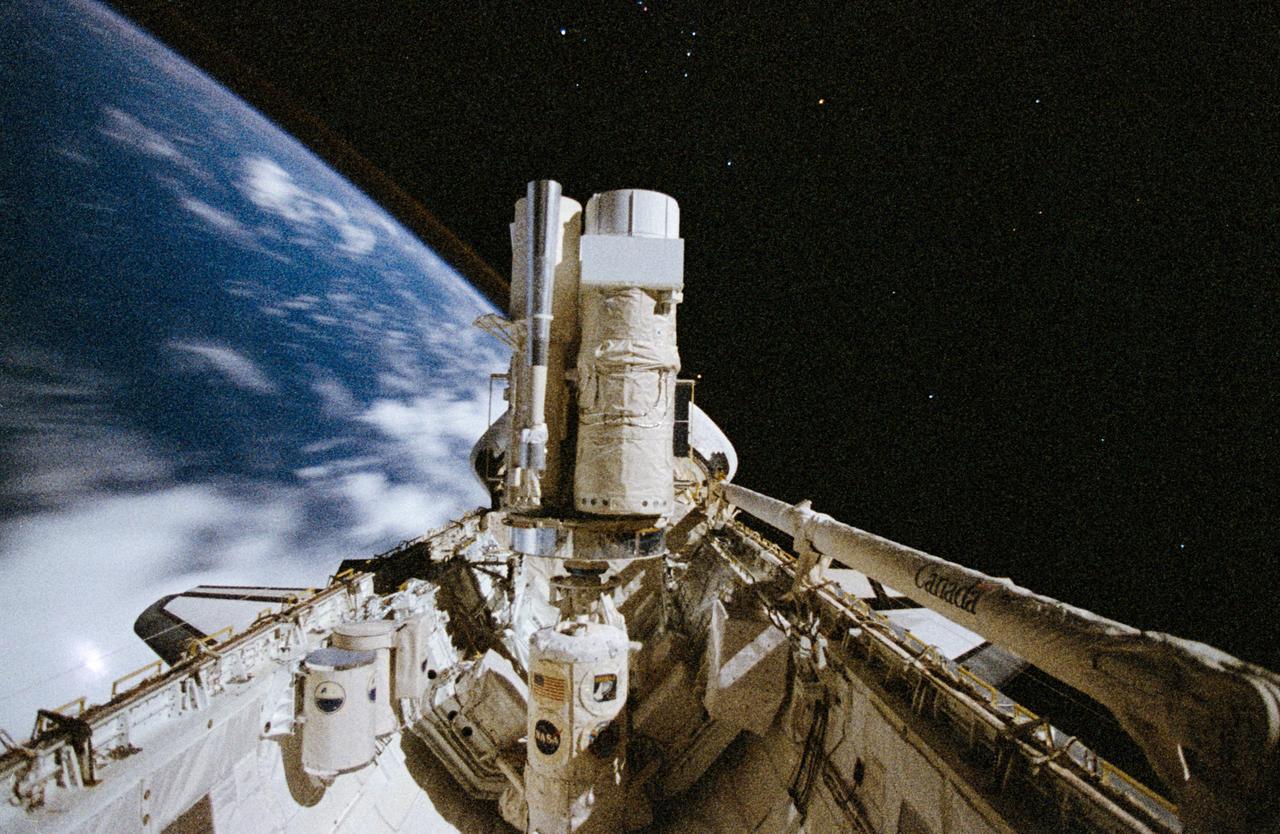
STS067-371-028 (2-18 March 1995) --- This 35mm lunar-illuminated scene of the Astro-2 payload in the Space Shuttle Endeavour's cargo bay was recorded by one of by the seven crew members during one of the many night passes of the almost 17-day mission. The cluster of telescopes and the Instrument Pointing System (IPS) are backdropped against the blue and white Earth and the darkness of space. What is believed to be the Constellation Orion is visible at upper center.
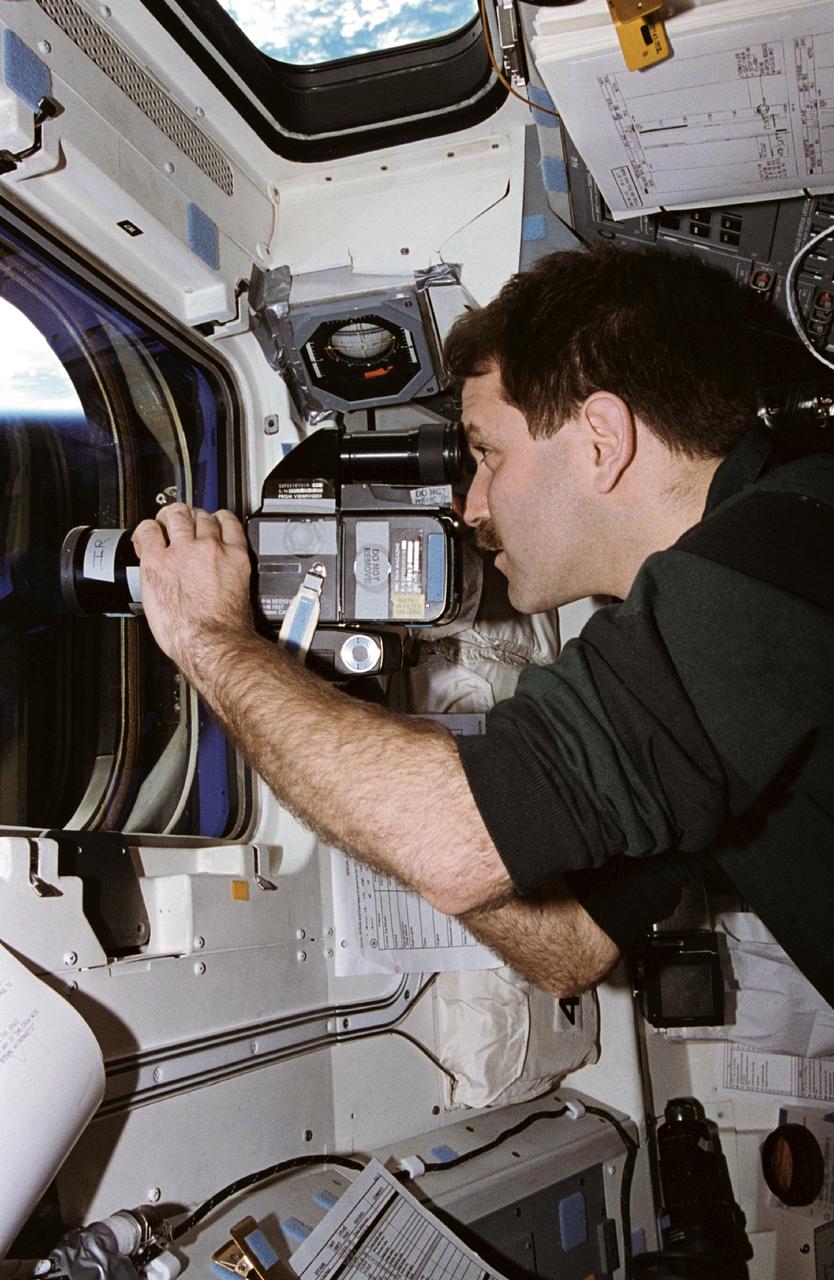
STS067-377-008 (2-18 March 1995) --- Astronaut John M. Grunsfeld, mission specialist, uses a handheld Hasselblad camera to record the Astro-2 payload. Orbiting Earth at 190 nautical miles, Grunsfeld joined four other NASA astronauts and two scientists for almost 17 days conducting research in support of the Astro-2 mission.
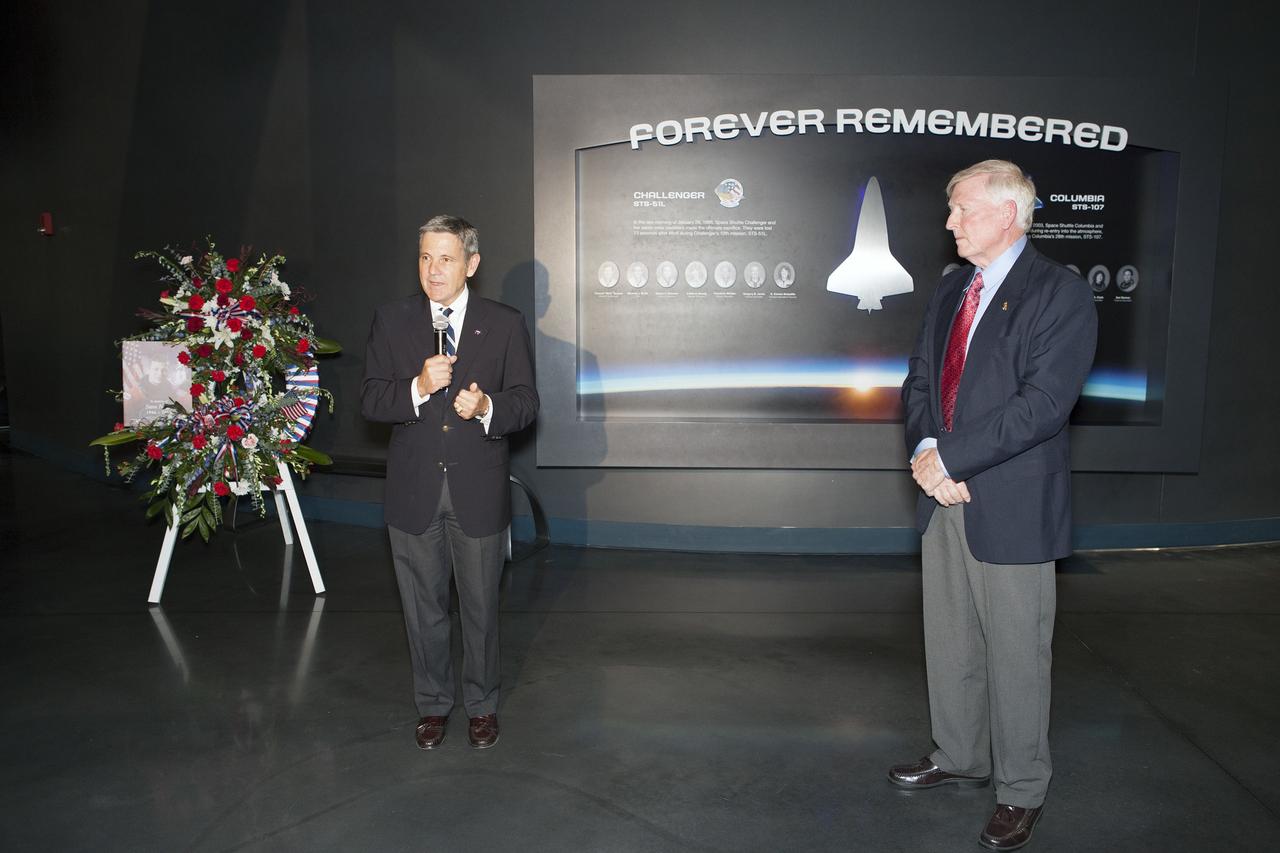
CAPE CANAVERAL, Fla. -- Kennedy Space Center Director Bob Cabana speaks at a wreath-laying ceremony honoring former NASA astronaut Steven R. Nagel at the Space Shuttle Atlantis exhibit at the Kennedy Space Center Visitor Complex in Florida. Former NASA astronaut Jon McBride looks on, at right. Nagel died Aug. 21 after a long illness. He was 67 years old. Nagel served as a mission specialist on his first space shuttle flight, STS-51G, in 1985. He was pilot on his second shuttle flight, STS-61A, also in 1985. He commanded his final two flights, STS-37 and STS-55, in 1991 and 1993, respectively. He logged a total of 723 hours in space. To learn more about Nagel's career, visit http://www.nasa.gov/press/2014/august/former-nasa-astronaut-steven-nagel-veteran-of-four-shuttle-flights-dies-at-67/. Photo credit: NASA/Dimitri Gerondidakis
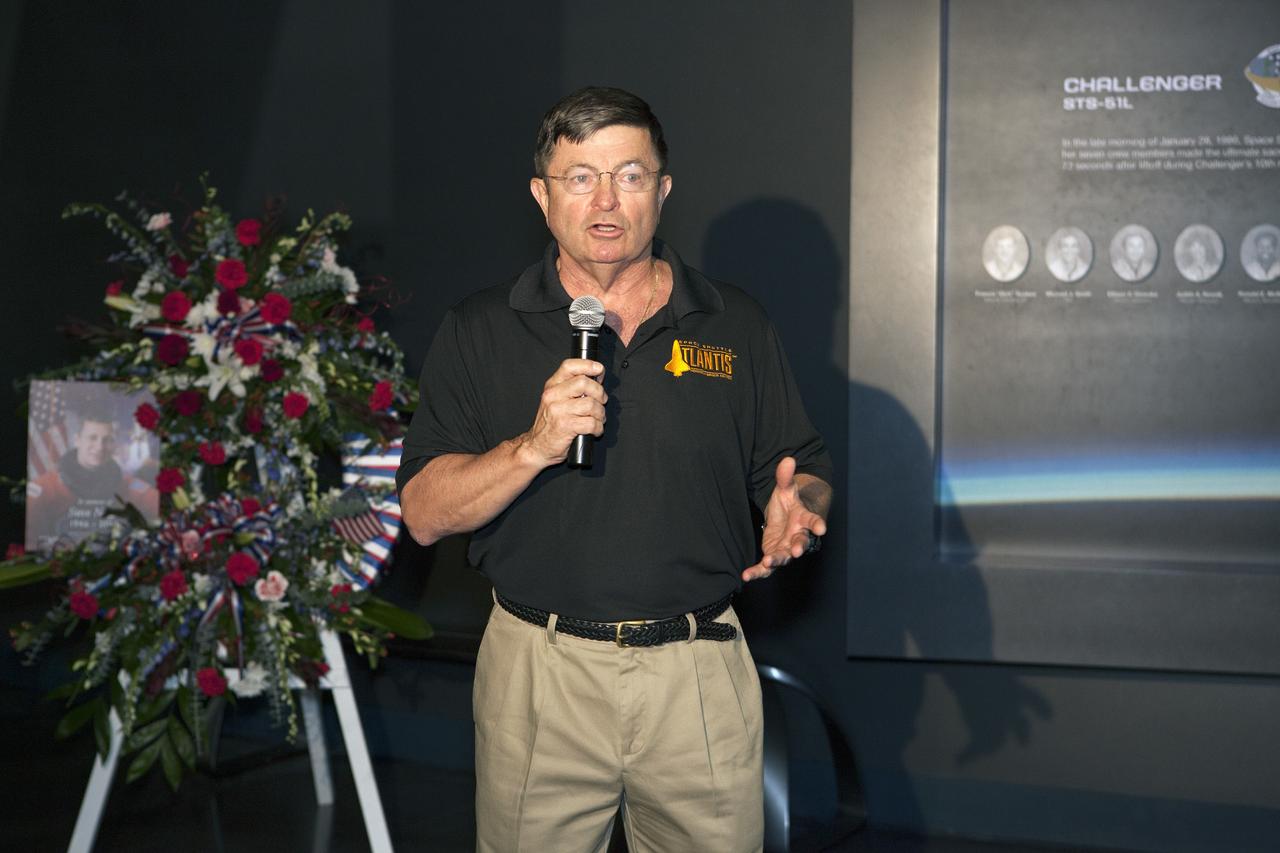
CAPE CANAVERAL, Fla. – Former NASA astronaut Kenneth Cameron speaks at a wreath-laying ceremony honoring former NASA astronaut Steven R. Nagel at the Space Shuttle Atlantis exhibit at the Kennedy Space Center Visitor Complex in Florida. Former NASA astronaut Jon McBride looks on, at right. Nagel died Aug. 21 after a long illness. He was 67 years old. Nagel served as a mission specialist on his first space shuttle flight, STS-51G, in 1985. He was pilot on his second shuttle flight, STS-61A, also in 1985. He commanded his final two flights, STS-37 and STS-55, in 1991 and 1993, respectively. He logged a total of 723 hours in space. To learn more about Nagel's career, visit http://www.nasa.gov/press/2014/august/former-nasa-astronaut-steven-nagel-veteran-of-four-shuttle-flights-dies-at-67/. Photo credit: NASA/Dimitri Gerondidakis
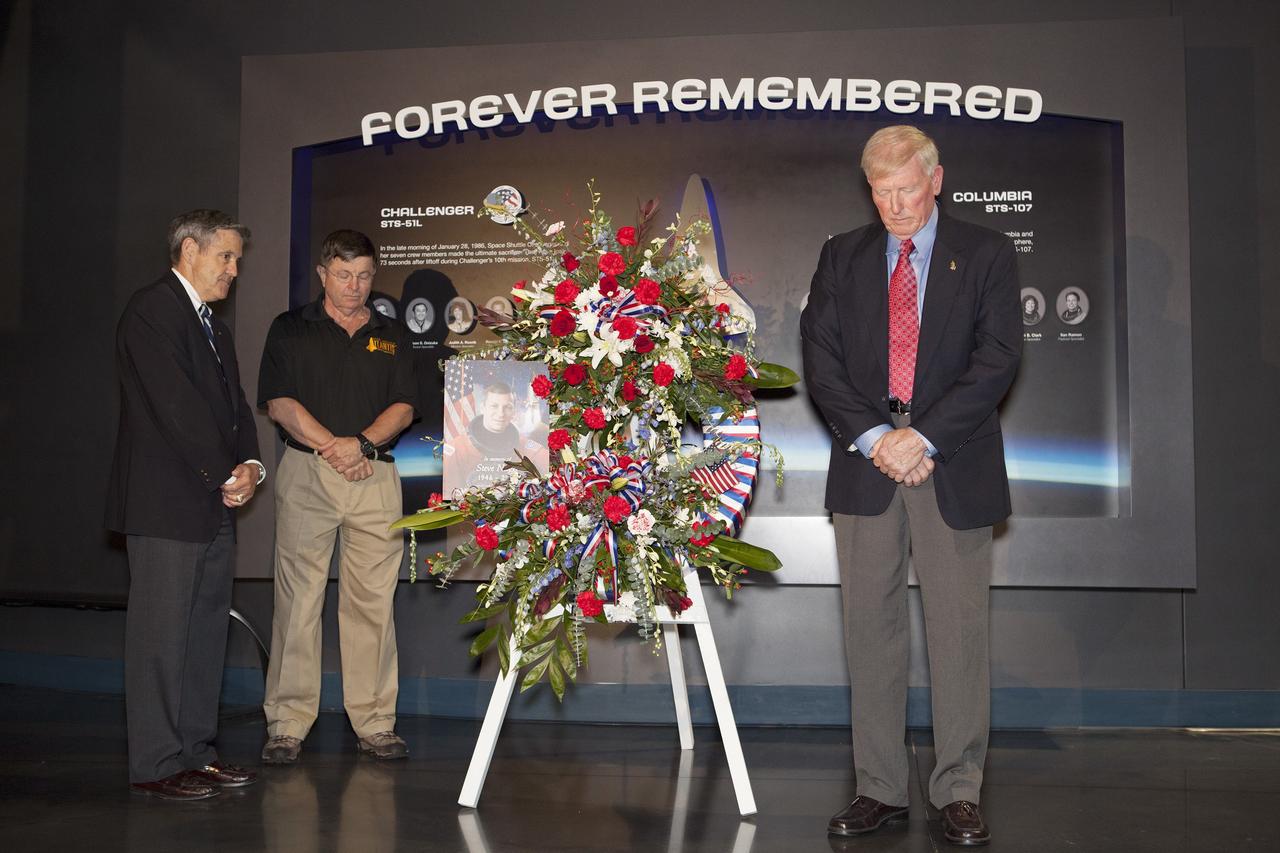
CAPE CANAVERAL, Fla. -- From left, Kennedy Space Center Director Bob Cabana, Kenneth Cameron, and Jon McBride, all former NASA astronauts, pause for reflection after placing a wreath honoring former NASA astronaut Steven R. Nagel at the Space Shuttle Atlantis exhibit at the Kennedy Space Center Visitor Complex in Florida. Nagel died Aug. 21 after a long illness. He was 67 years old. Nagel served as a mission specialist on his first space shuttle flight, STS-51G, in 1985. He was pilot on his second shuttle flight, STS-61A, also in 1985. He commanded his final two flights, STS-37 and STS-55, in 1991 and 1993, respectively. He logged a total of 723 hours in space. To learn more about Nagel's career, visit http://www.nasa.gov/press/2014/august/former-nasa-astronaut-steven-nagel-veteran-of-four-shuttle-flights-dies-at-67/. Photo credit: NASA/Dimitri Gerondidakis
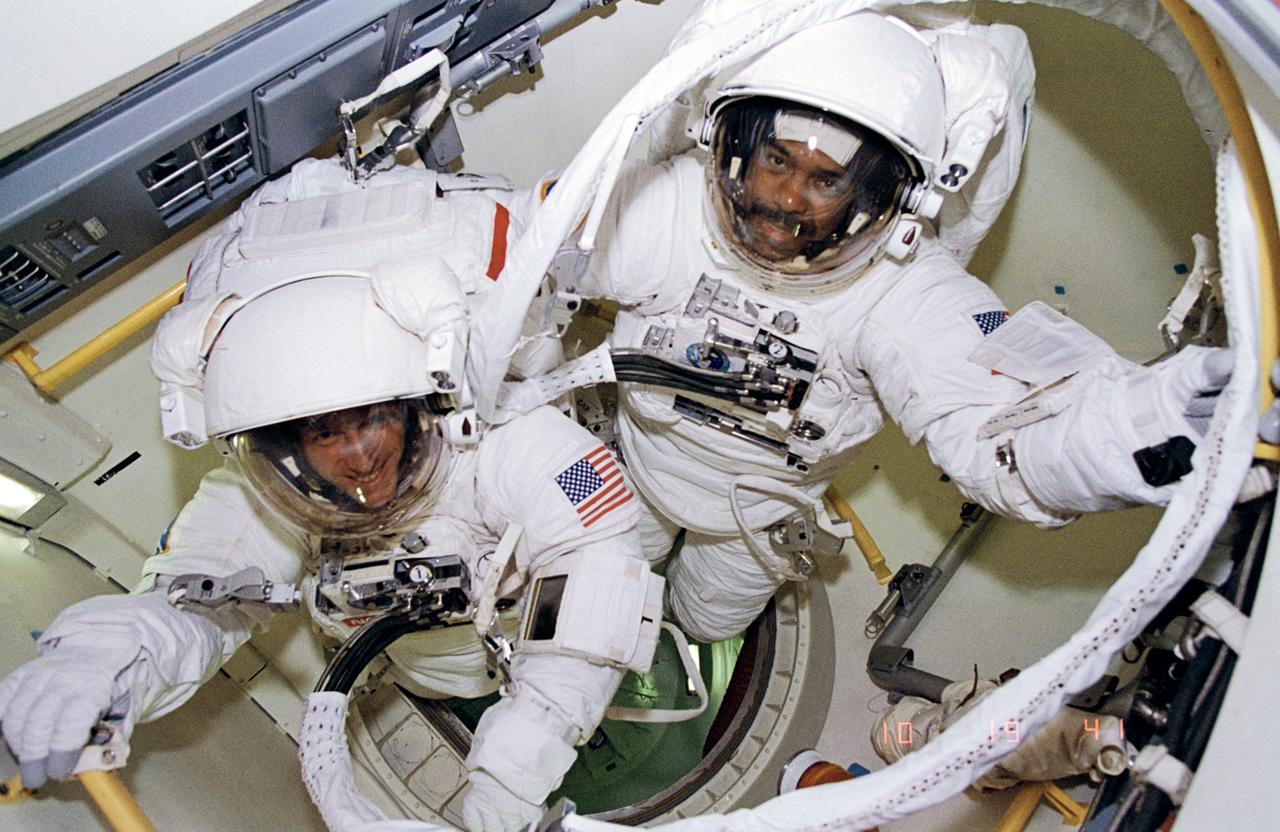
STS063-67-024 (9 Feb. 1995) --- Astronauts Bernard A. Harris Jr., STS-63 payload commander, (top right) and C. Michael Foale, mission specialist, are ready to egress airlock for an extravehicular activity (EVA). Others onboard the space shuttle Discovery were astronauts James D. Wetherbee, mission commander; Eileen M. Collins, pilot; mission specialists Janice E. Voss, and cosmonaut Vladimir G. Titov. Photo credit: NASA
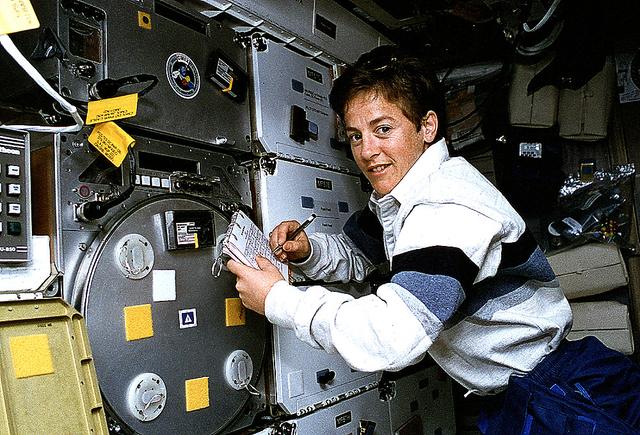
Astronaut Wendy B. Lawrence, flight engineer and mission specialist for STS-67, scribbles notes on the margin of a checklist while monitoring an experiment on the Space Shuttle Endeavour's mid-deck. The experiment is the Protein Crystal Growth (PCG), which takes up locker space near the Commercial Materials Dispersion Apparatus Instruments Technology Associates Experiment (CMIX).
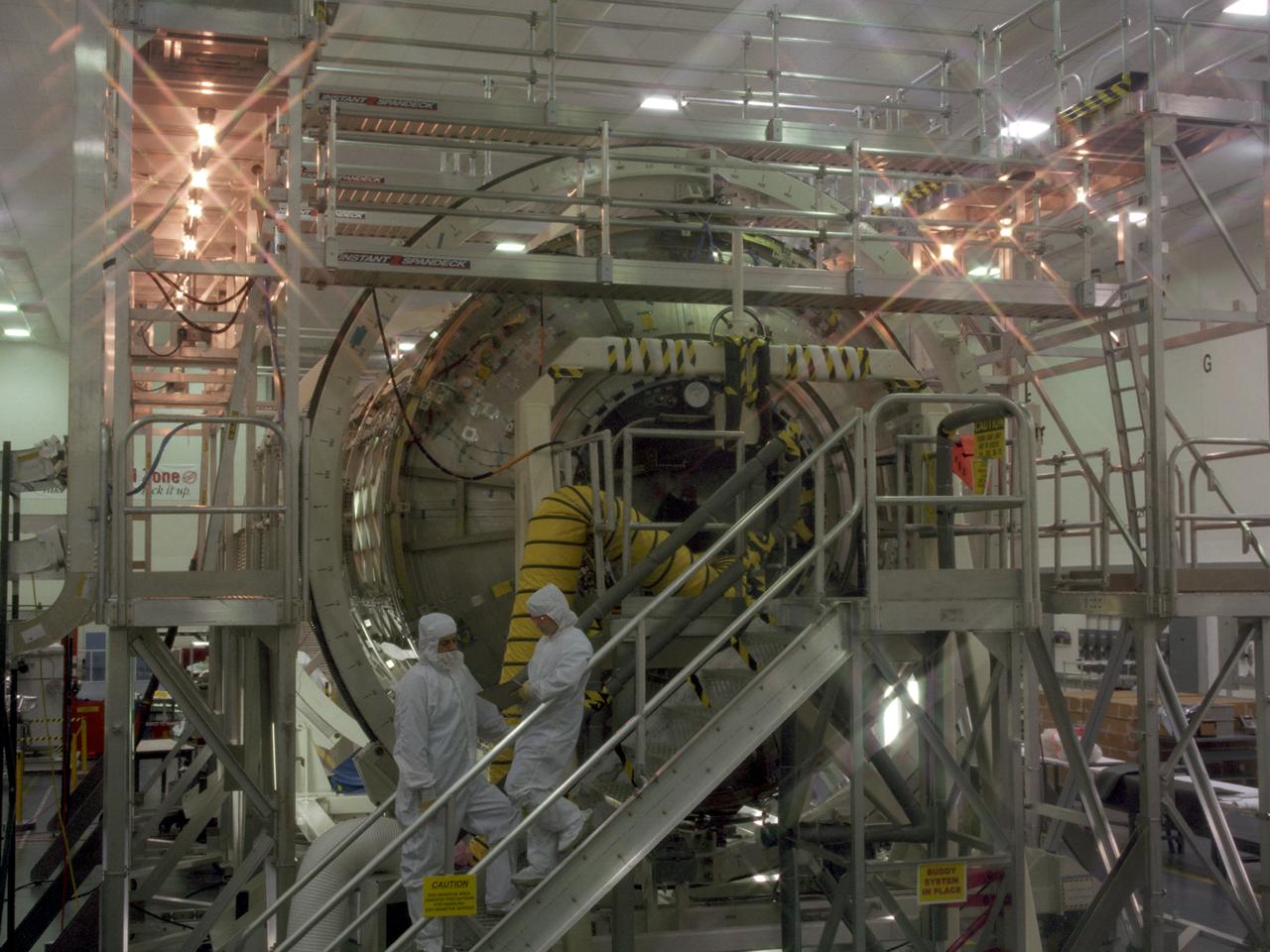
This photograph shows the U.S. Laboratory Module (also called Destiny) for the International Space Station (ISS), under construction in the Space Station manufacturing facility at the Marshall Space Flight Center. The U.S. Laboratory module is the centerpiece of the ISS, where science experiments will be performed in the near-zero gravity of space. The Destiny Module was launched aboard the Space Shuttle orbiter Atlantis (STS-67 mission) on February 7, 2001. The aluminum module is 8.5 meters (28 feet) long and 4.3 meters (14 feet) in diameter. The laboratory consists of three cylindrical sections and two end cones with hatches that will be mated to other station components. A 50.9-centimeter- (20-inch-) diameter window is located on one side of the center module segment. This pressurized module is designed to accommodate pressurized payloads. It has a capacity of 24 rack locations, and payload racks will occupy 13 locations especially designed to support experiments. The ISS is a multidisciplinary laboratory, technology test bed, and observatory that will provide unprecedented undertakings in scientific, technological, and international experimentation.
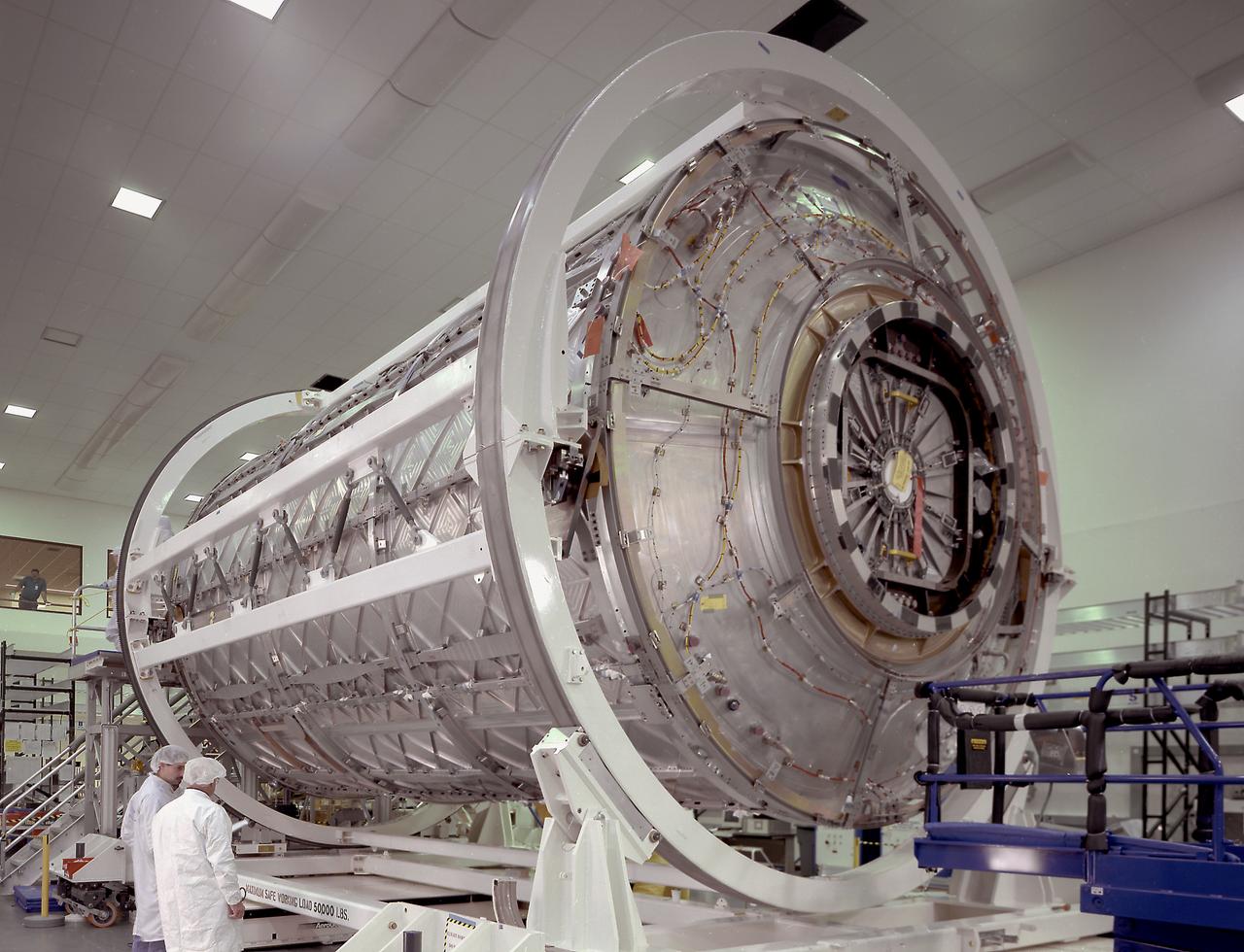
This photograph shows the U.S. Laboratory Module (also called Destiny) for the International Space Station (ISS), in the Space Station manufacturing facility at the Marshall Space Flight Center, being readied for shipment to the Kennedy Space Center. The U.S. Laboratory module is the centerpiece of the ISS, where science experiments will be performed in the near-zero gravity of space. The Destiny Module was launched aboard the Space Shuttle orbiter Atlantis (STS-67 mission) on February 7, 2001. The aluminum module is 8.5 meters (28 feet) long and 4.3 meters (14 feet) in diameter. The laboratory consists of three cylindrical sections and two endcones with hatches that will be mated to other station components. A 50.9-centimeter- (20-inch-) diameter window is located on one side of the center module segment. This pressurized module is designed to accommodate pressurized payloads. It has a capacity of 24 rack locations, and payload racks will occupy 13 locations especially designed to support experiments. The ISS is a multidisciplinary laboratory, technology test bed, and observatory that will provide unprecedented undertakings in scientific, technological, and international experimentation.