![STS-7, Orbiter Challenger in orbit, taken from camera aboard Shuttle Pallet Satellite (SPAS) [Germany]](https://images-assets.nasa.gov/image/335891/335891~medium.jpg)
STS-7, Orbiter Challenger in orbit, taken from camera aboard Shuttle Pallet Satellite (SPAS) [Germany]
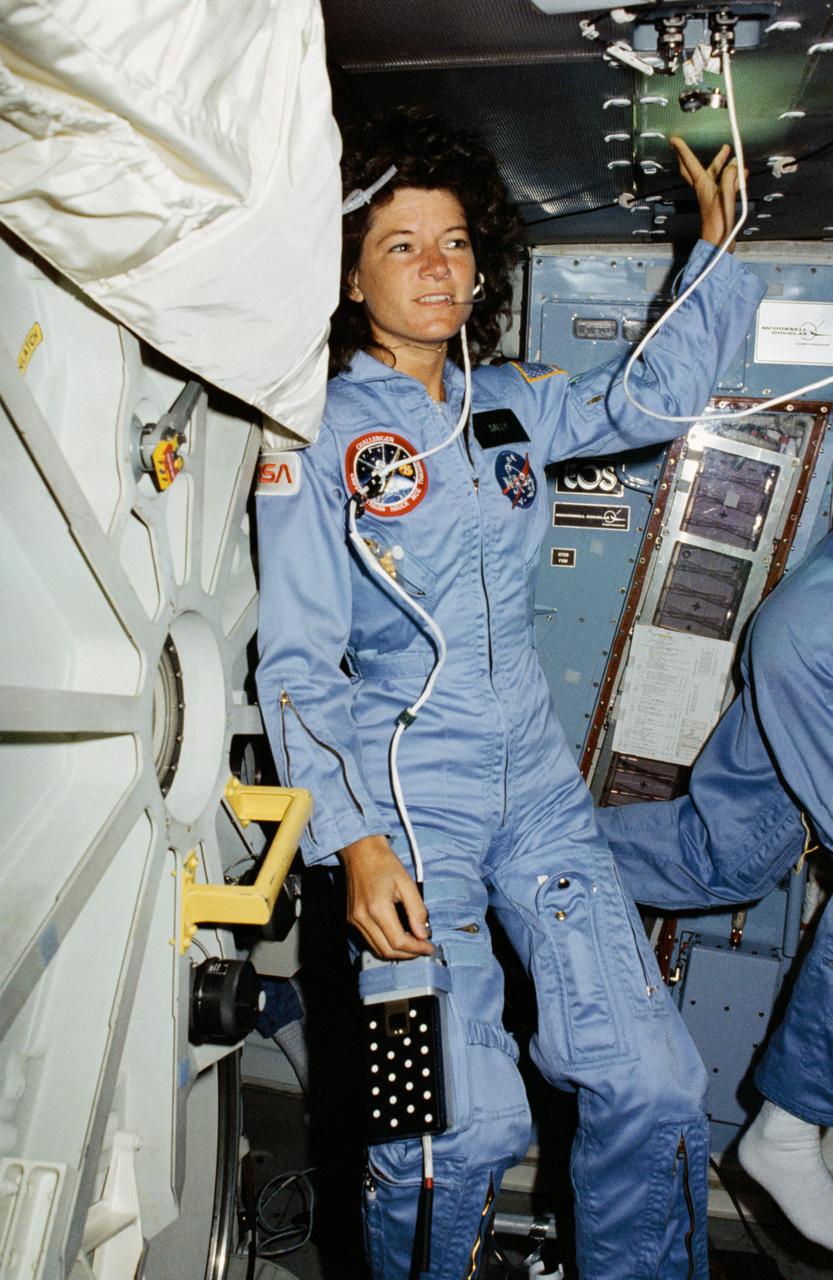
STS007-02-020 (21 June 1983) --- Astronaut Sally K. Ride, STS-7 mission specialist, STS-7 mission specialist, stands in the mid deck of the orbiting Space Shuttle Challenger near one of the experiment with which she has devoted a great deal of time. The continuous flow electrophoresis system (CFES) experiment, about the size of a household refrigerator, stands nearby. One of her fellow crewmembers moves partially out of frame in the background. The tube on her face is part of a communications system linking Dr. Ride to ground controllers in Houston.

STS007-06-0314 (18-24 June 1983) --- Astronaut John M. Fabian, STS-7 mission specialist, sleeps in a zip-up blue sleep restraint device in the locker area of the Earth-orbiting space shuttle Challenger's middeck. The frame was exposed with a 35mm camera. Photo credit: NASA
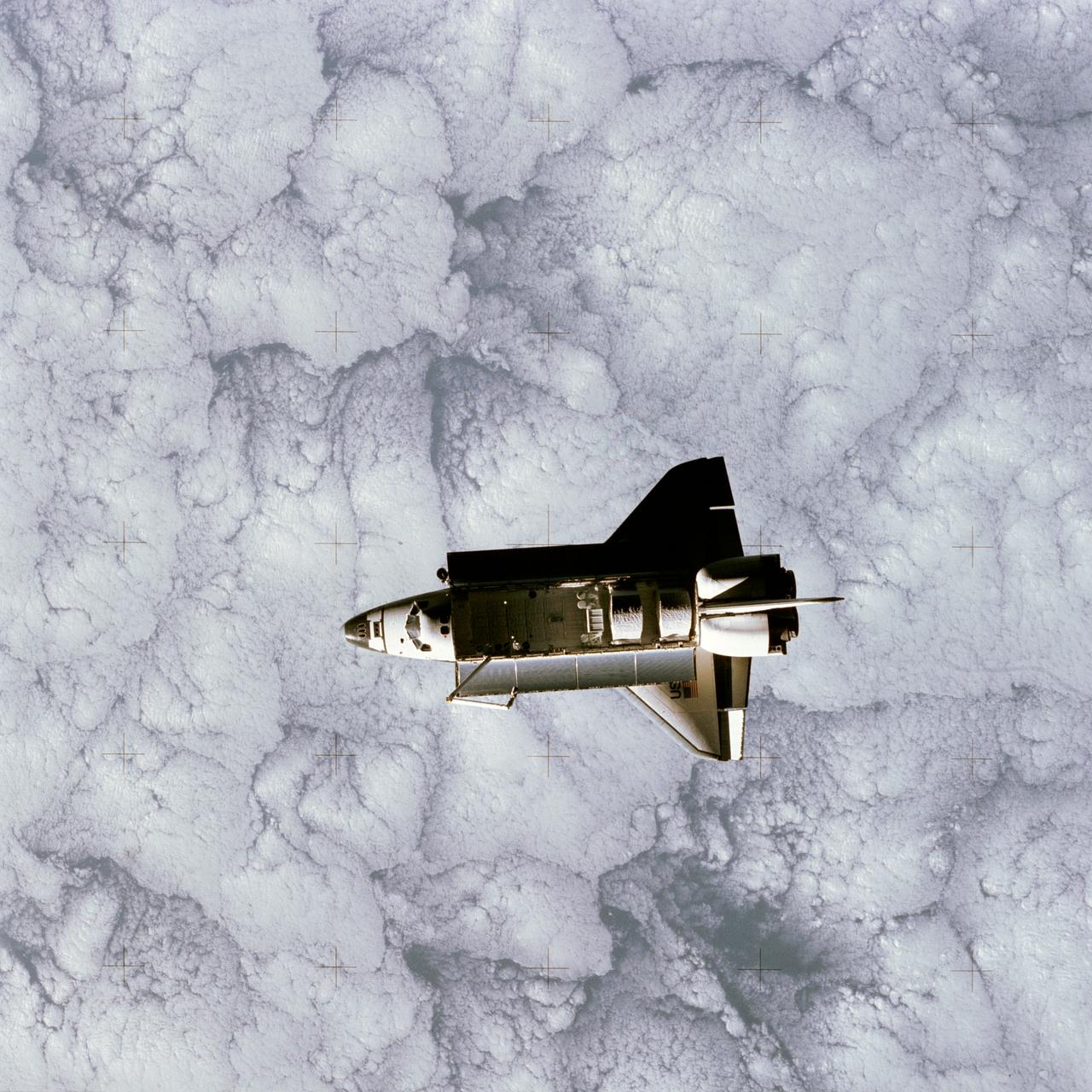
STS007-32-1667 (22 June 1983) --- The Earth-orbiting Space Shuttle Challenger over a heavily cloud-covered portion of the Earth was captured by a 70mm camera onboard the temporarily free-flying Shuttle Pallet Satellite (SPAS-01) during a busy Day 5 on the STS-7 mission. Visible in the cargo bay are the protective cradles for the now vacated Telesat Anik C2 and Palapa-B communications satellites, the pallet for the NASA Office of Space and Terrestrial Applications (OSTA-2); the Remote Manipulator System (RMS) and the KU-Band antenna. The STS-7 astronaut crew and the RMS arm later retrieved the SPAS and returned it to a stowed position in the cargo bay of the Space Shuttle Challenger for the return to Earth.

STS007-26-1439 (18-24 June 1983) --- Astronaut John M. Fabian, STS-7 mission specialist, is captured with a 35mm camera at his sleep station in the middeck of the Earth-orbiting space shuttle Challenger. This scene was selected by the five-member astronaut crew for showing at its July 1, 1983 Post Flight Press Conference (PFPC) at the Johnson Space Center's (JSC) main auditorium. Photo credit: NASA
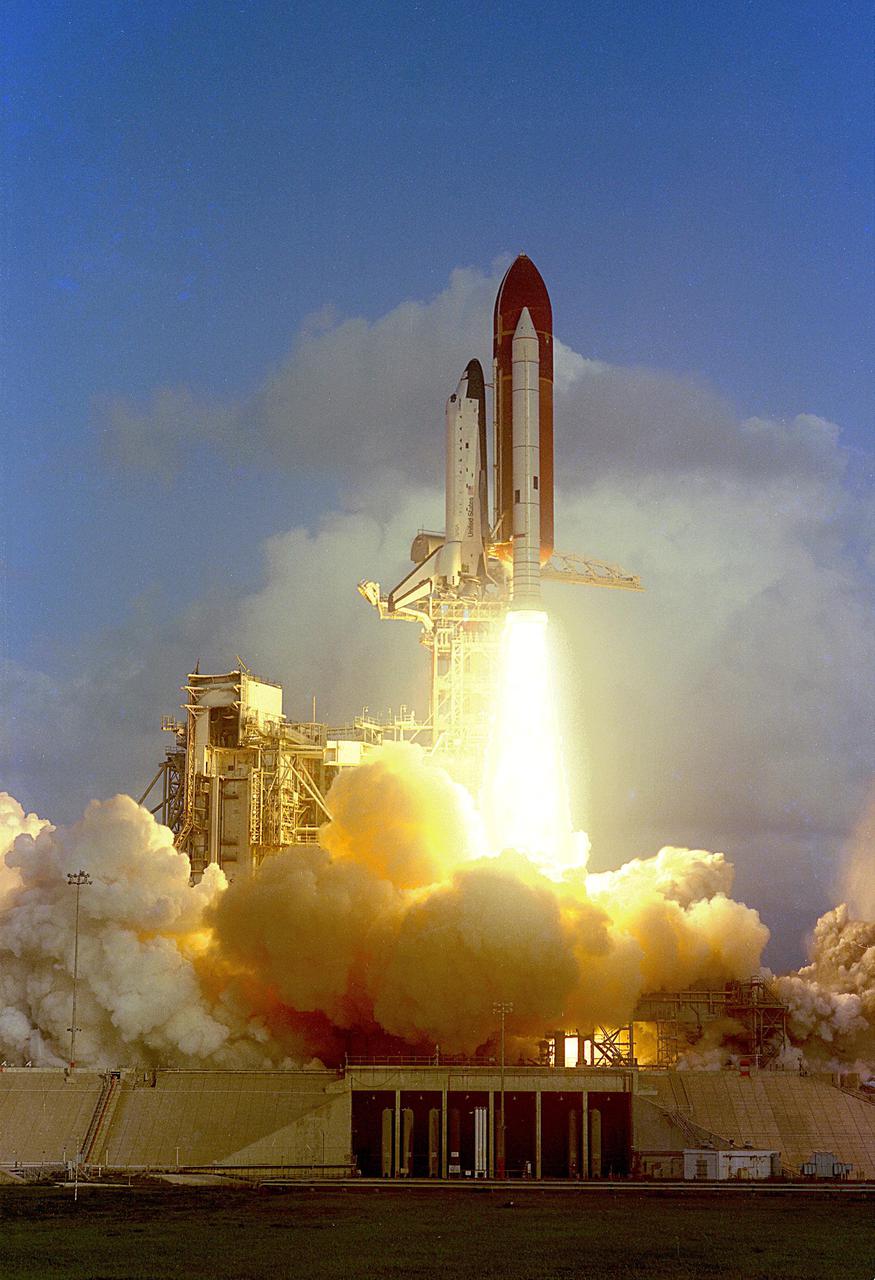
KENNEDY SPACE CENTER, FLA. -- STS-7: Challenger
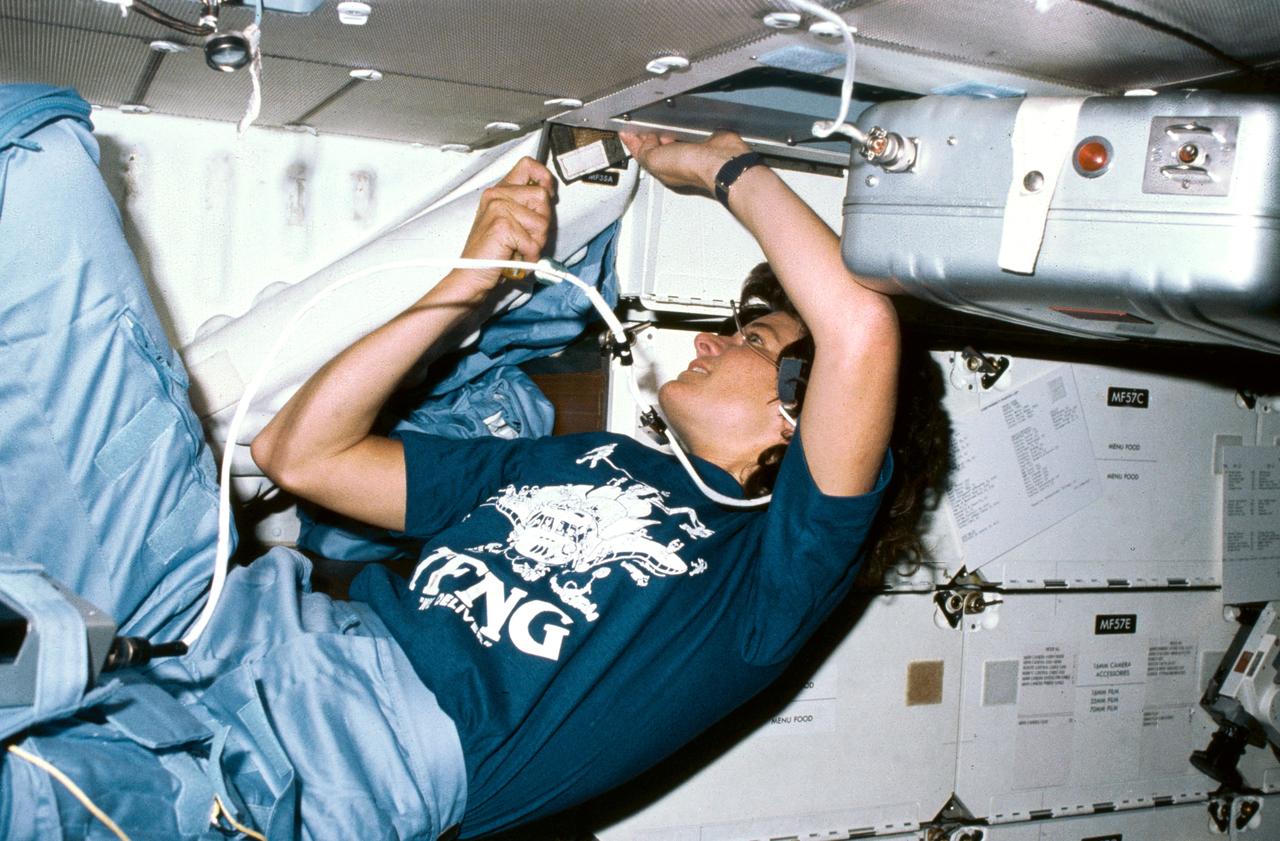
S83-35768 (18-24 June 1983) --- Astronaut Sally K. Ride, mission specialist for STS-7, uses a screw driver in order to clean out an air filtering system in the mid-deck of the Earth-orbiting Space Shuttle Challenger. Dr. Ride's constant wear garment bears some extras -- a cartoon of 35 busy astronauts around a Space Shuttle and the acronym TFNG, below which is written, "We deliver!" TFNG stands for thirty-five new guys, referring to the 1978 class of astronaut candidates (ASCAN) from which Dr. Ride and three of her crew members hail. The tiny two-word declarative in white lettering refers to the successful deployment of two communications satellites. This photograph was made with a 35mm camera.
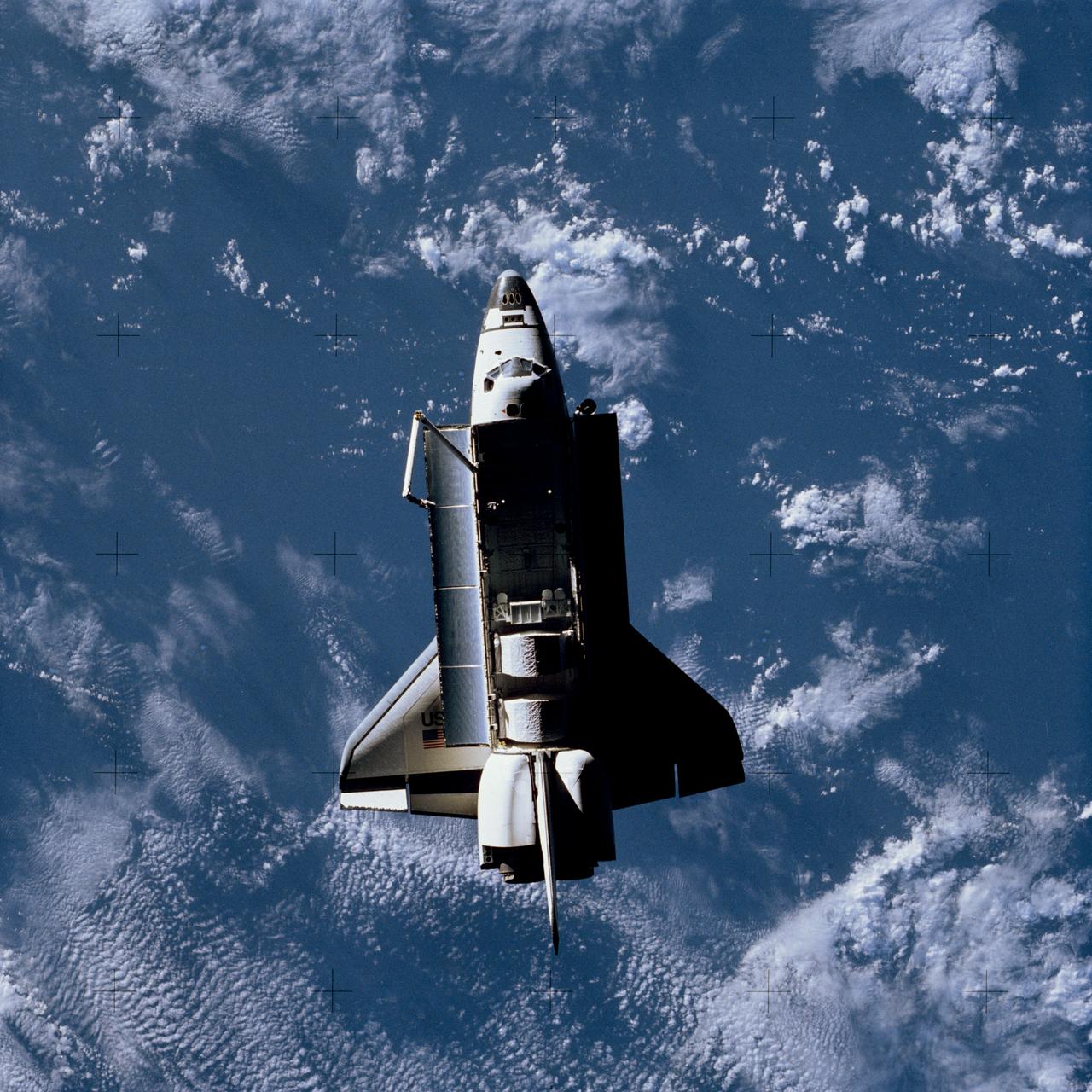
Full views of "Challenger" in Space, taken by the Shuttle Pallet Satellite (SPAS), also views of Cargo Bay and Remote Manipulator System (RMS) extended. 1. SHUTTLE - RMS (STS-7) Also available in 4x5 CN
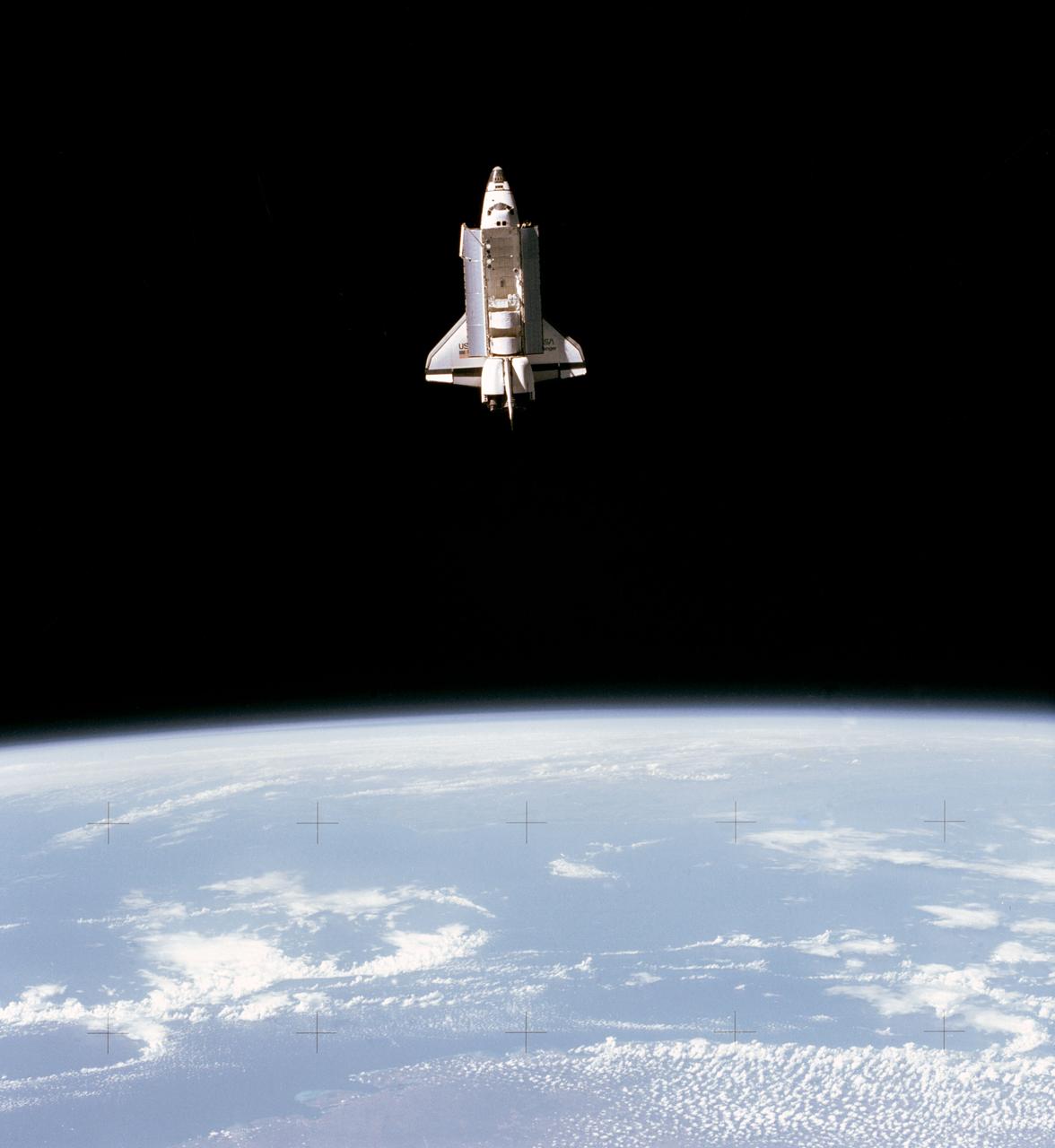
Full views of "Challenger" in Space, taken by the Shuttle Pallet Satellite (SPAS), also views of Cargo Bay and Remote Manipulator System (RMS) extended. 1. SHUTTLE - RMS (STS-7) Also available in 4x5 CN
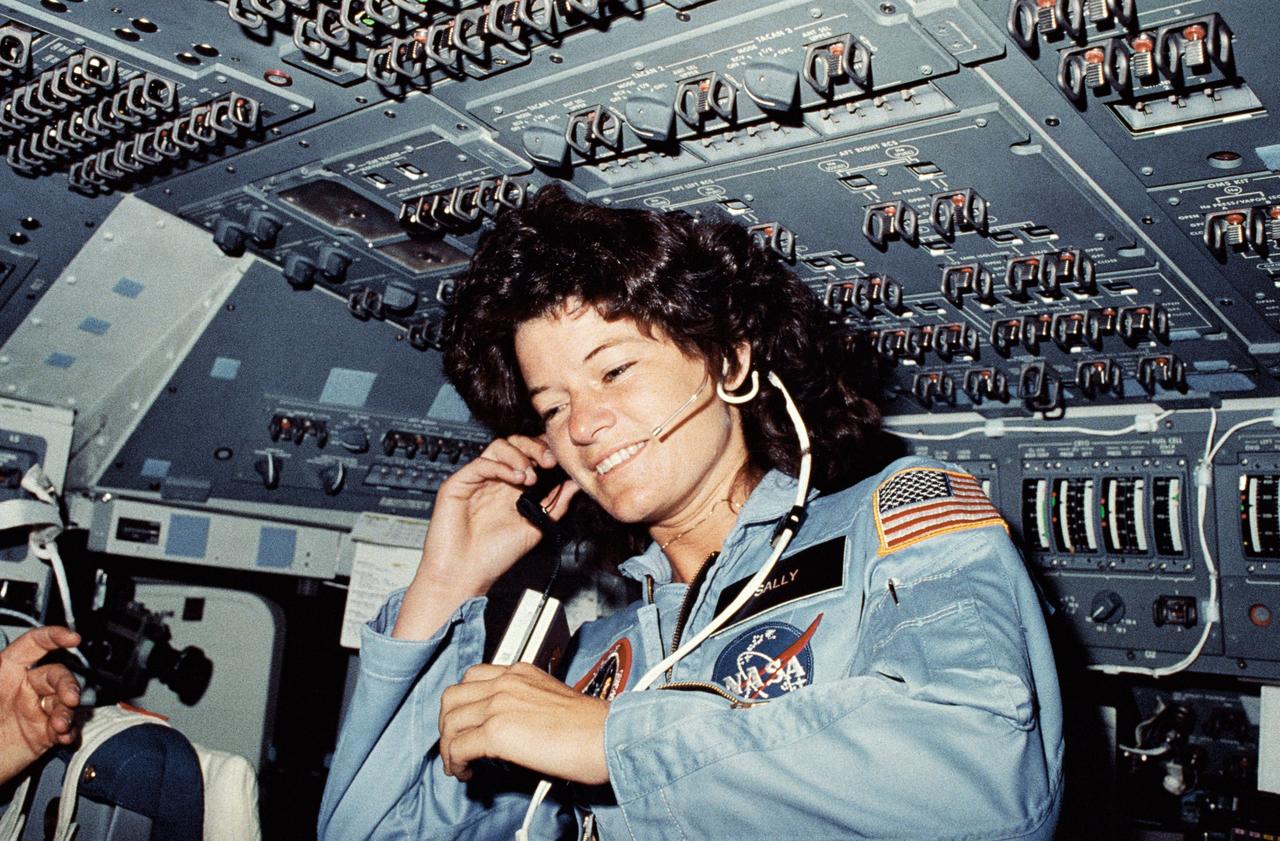
STS007-02-027 (21 June 1983) --- Astronaut Sally K. Ride, STS-7 mission specialist, communicates with ground controllers from the flight deck of the Earth-orbiting Space Shuttle Challenger.
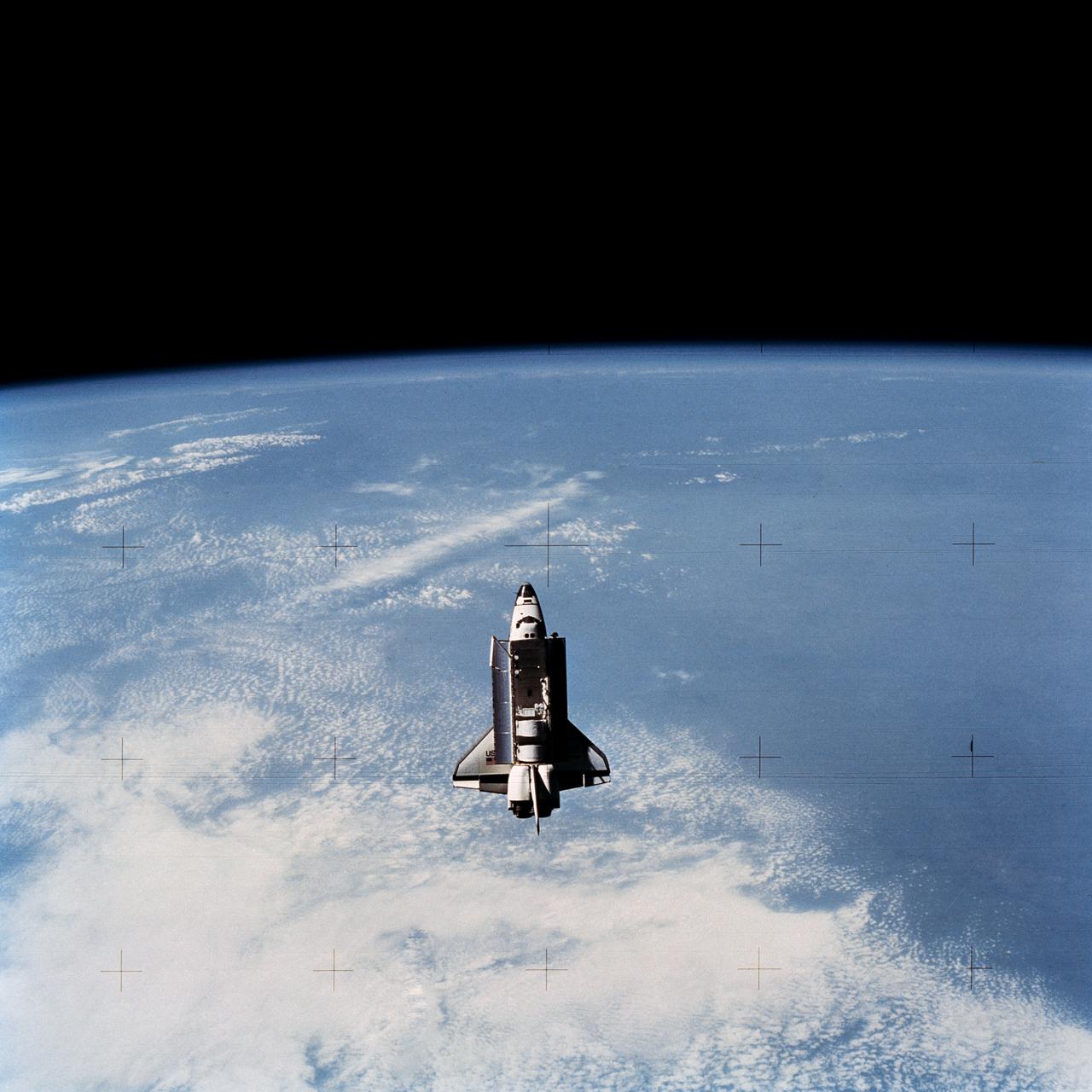
Full views of "Challenger" in Space, taken by the Shuttle Pallet Satellite (SPAS), also views of Cargo Bay and Remote Manipulator System (RMS) extended. 1. SHUTTLE - RMS (STS-7) Also available in 4x5 CN
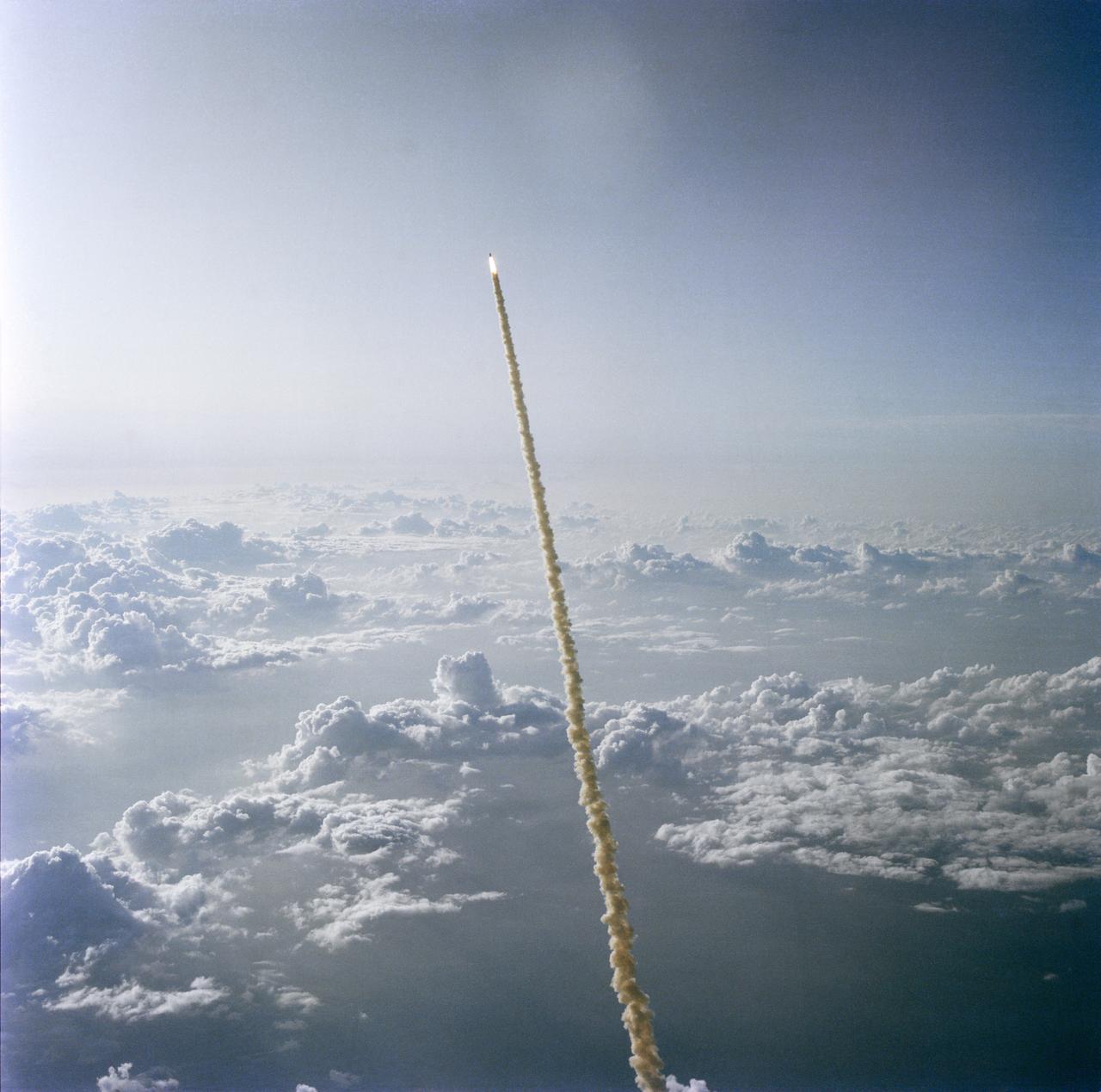
S83-35620 (18 June 1983) --- The space shuttle Challenger, its two solid rocket boosters and an external fuel tank carry the five-member STS-7 astronaut crew toward a six-day mission in Earth orbit. This high-angle view of the liftoff, a lengthy stretch of Florida Atlantic coastline and a number of large cumulus clouds was photographed with a handheld 70mm camera by astronaut John W. Young. Young usually pilots the Shuttle Training Aircraft (STA) for weather monitoring at launch and landing sites for STS missions. The Challenger?s second launch occurred at 7:33 a.m. (EDT) on 18 June 1983. Photo credit: NASA
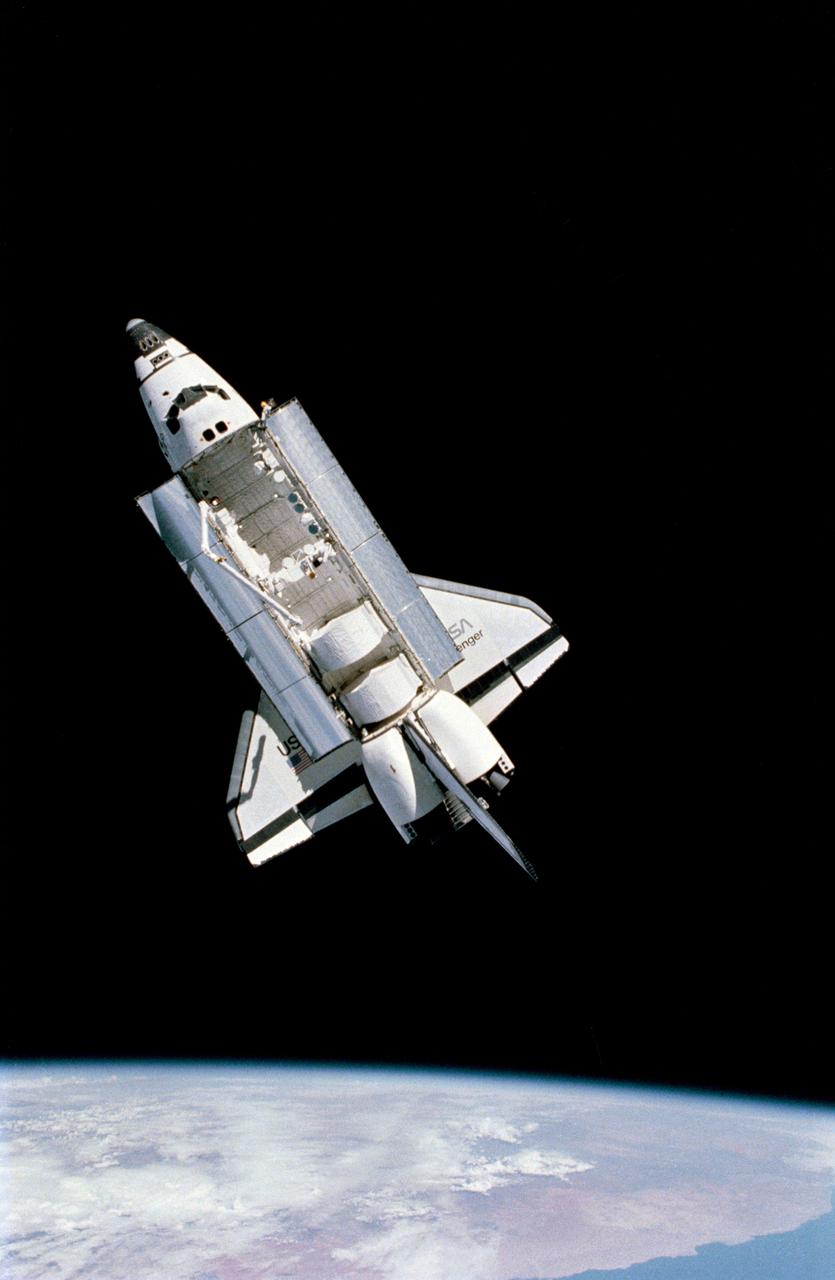
S84-27022 (7 Feb 1984) --- A 35mm frame from the February 7, 1984, extravehicular activity (EVA) photographed with a camera affixed to the gear of astronaut Bruce McCandless II. The mission specialist was equipped with the nitrogen-propelled, hand-controlled Manned Maneuvering Unit (MMU), which took him some 90 meters away from the Space Shuttle Challenger. This scene is reminiscent of views of the Challenger during the June 1983, STS-7 flight, on which the Shuttle Pallet Satellite (SPAS - seen here in the middle of the cargo bay) provided scenes of 38-meter-long reusable vehicle over the Earth.
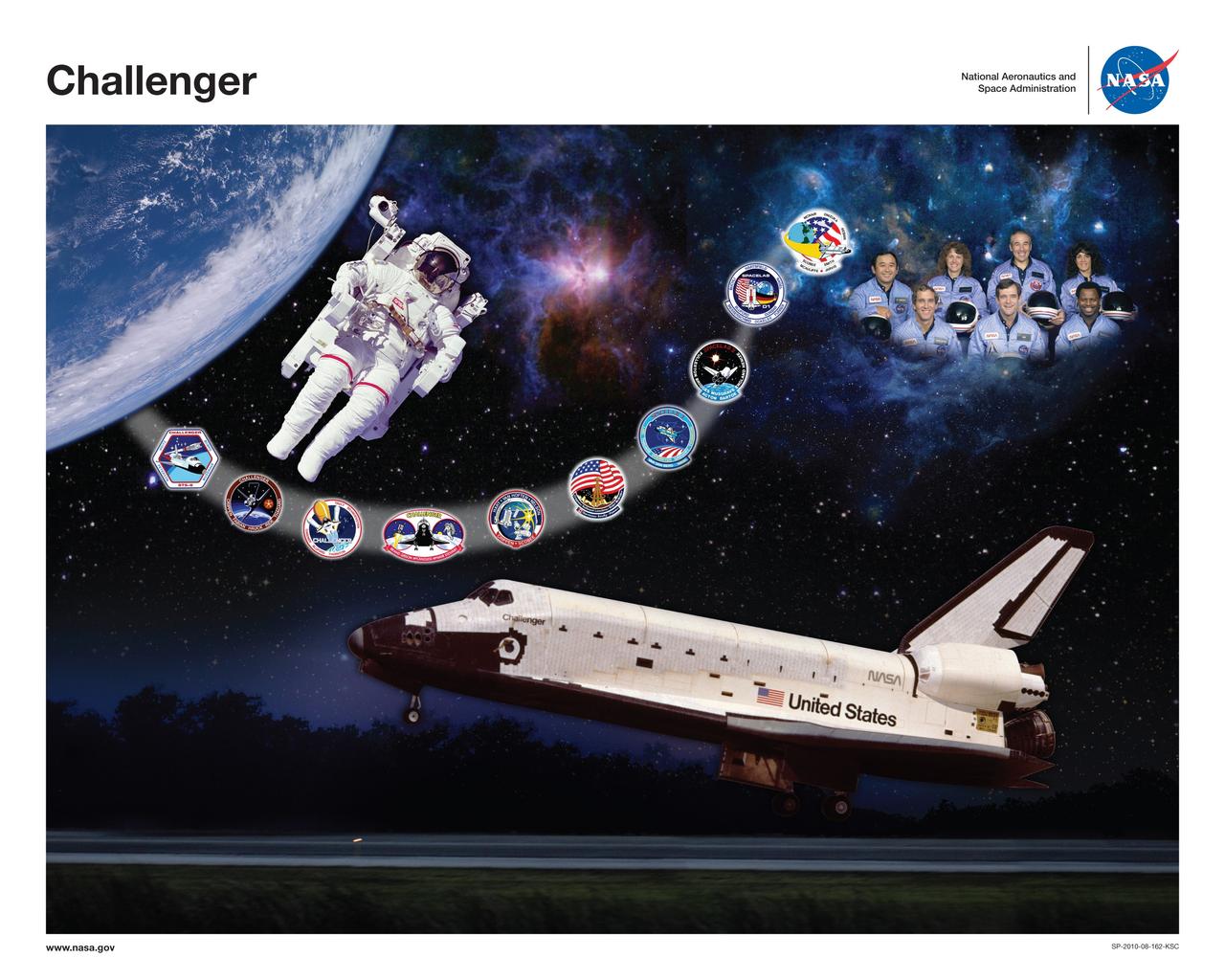
CAPE CANAVERAL, Fla. -- This is a version of space shuttle Challenger's orbiter tribute, or OV-099, which hangs in Firing Room 4 of the Launch Control Center at NASA's Kennedy Space Center in Florida. Challenger's accomplishments include the first night launch and first African-American in space, Guion Bluford, on STS-8, the first in-flight capture, repair and redeployment of an orbiting satellite during STS-41C, the first American woman in space, Sally Ride, on STS-7, and the first American woman to walk in space, Kathryn Sullivan, during STS-41G. Challenger is credited with blazing a trail for NASA's other orbiters with the first night landing at Edwards Air Force Base in California on STS-8 and the first landing at Kennedy on STS-41B. The spacewalker in the tribute represents Challenger’s role in the first spacewalk during STS-6 and the first untethered spacewalk on STS-41B. Crew-designed patches for each of Challenger’s missions lead from Earth toward a remembrance of the STS-51L crew, which was lost 73 seconds after liftoff on Jan. 28, 1986. Five orbiter tributes are on display in the firing room, representing Atlantis, Challenger, Columbia, Endeavour and Discovery. Graphic design credit: NASA/Lynda Brammer. NASA publication number: SP-2010-08-162-KSC
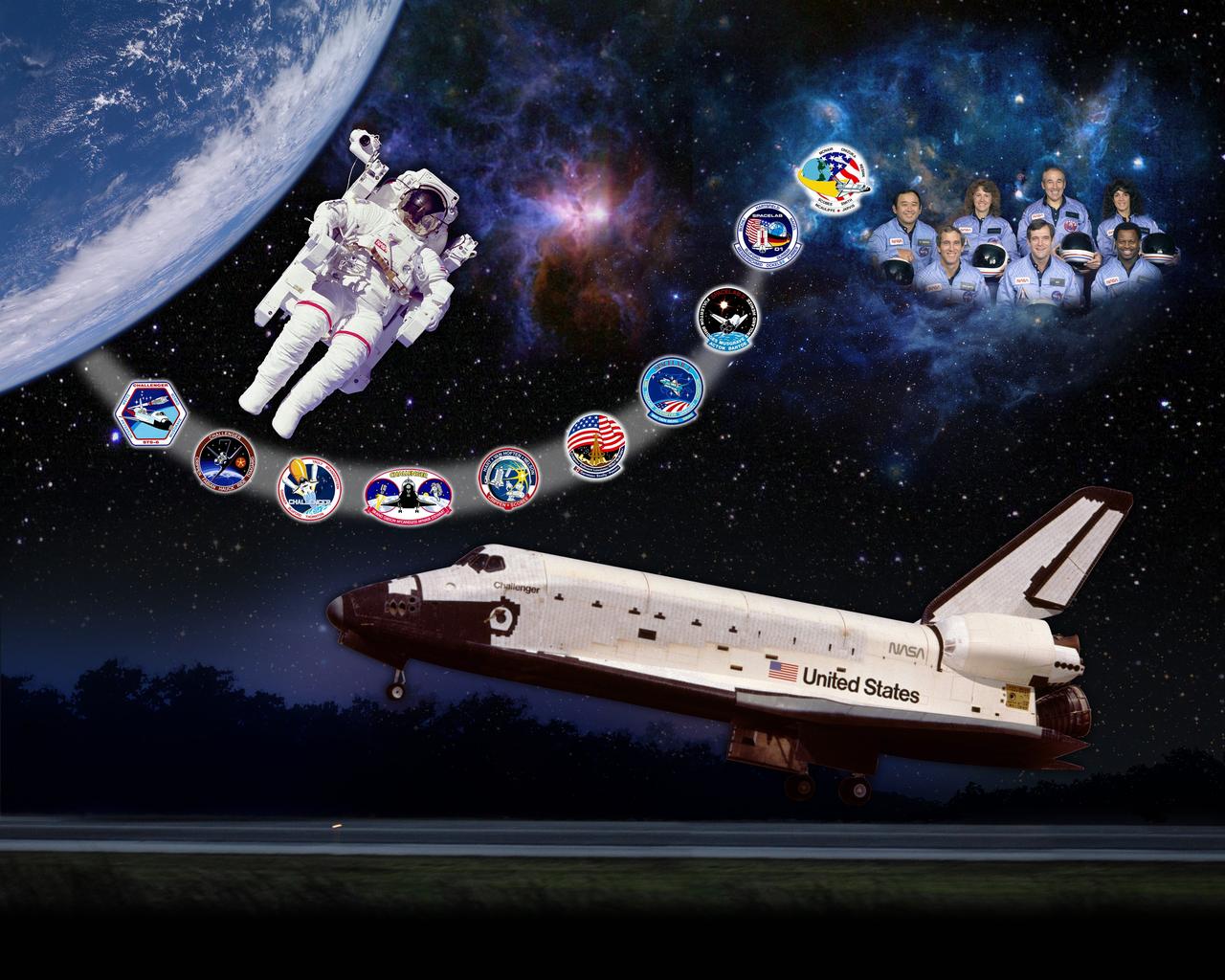
CAPE CANAVERAL, Fla. -- This orbiter tribute of space shuttle Challenger, or OV-099, hangs in Firing Room 4 of the Launch Control Center at NASA's Kennedy Space Center in Florida. Challenger's accomplishments include the first night launch and first African-American in space, Guion Bluford, on STS-8, the first in-flight capture, repair and redeployment of an orbiting satellite during STS-41C, the first American woman in space, Sally Ride, on STS-7, and the first American woman to walk in space, Kathryn Sullivan, during STS-41G. Challenger is credited with blazing a trail for NASA's other orbiters with the first night landing at Edwards Air Force Base in California on STS-8 and the first landing at Kennedy on STS-41B. The spacewalker in the tribute represents Challenger’s role in the first spacewalk during STS-6 and the first untethered spacewalk on STS-41B. Crew-designed patches for each of Challenger’s missions lead from Earth toward a remembrance of the STS-51L crew, which was lost 73 seconds after liftoff on Jan. 28, 1986. Five orbiter tributes are on display in the firing room, representing Atlantis, Challenger, Columbia, Endeavour and Discovery. Graphic design credit: NASA/Lynda Brammer
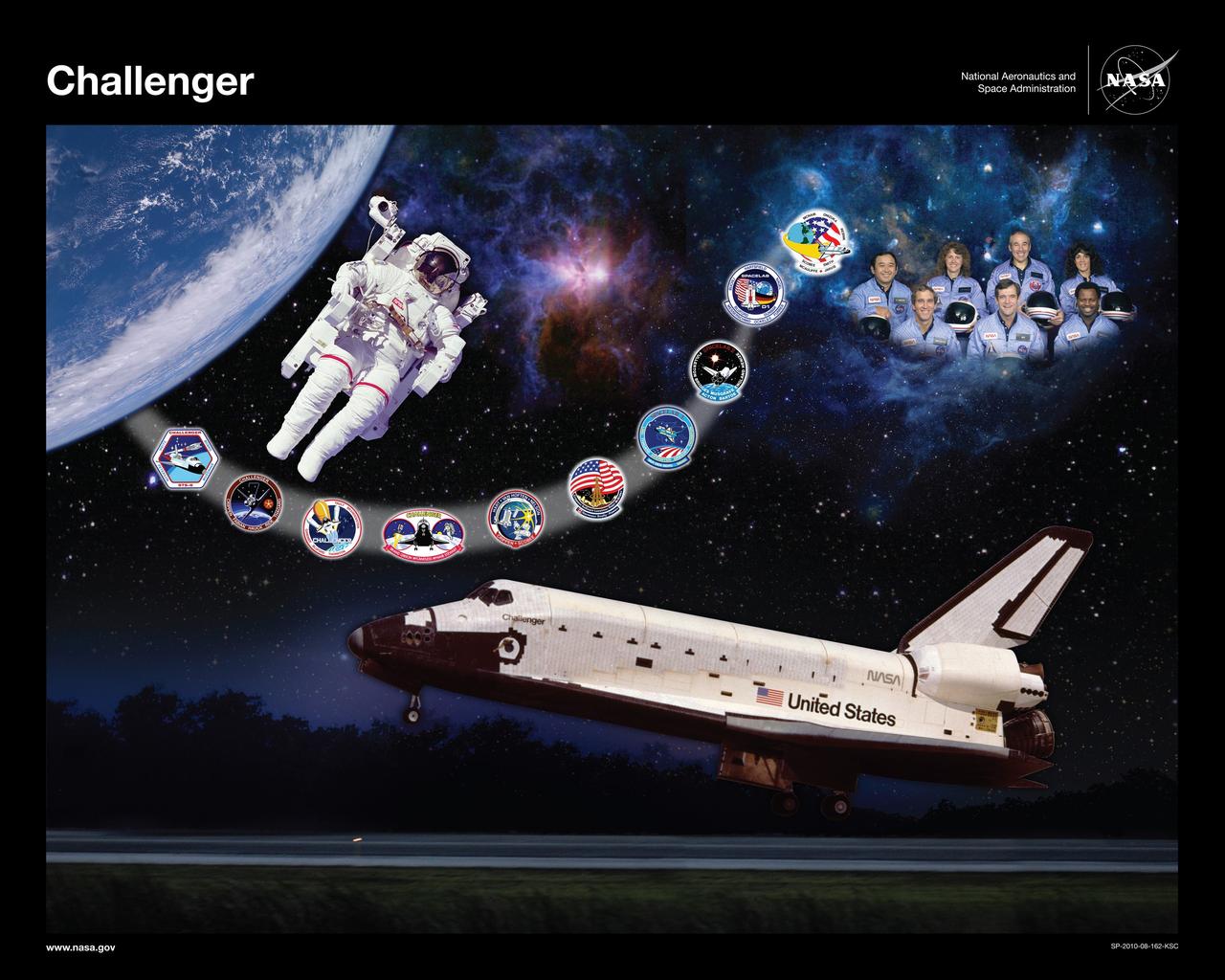
CAPE CANAVERAL, Fla. -- This is a printable version of space shuttle Challenger's orbiter tribute, or OV-099, which hangs in Firing Room 4 of the Launch Control Center at NASA's Kennedy Space Center in Florida. Challenger's accomplishments include the first night launch and first African-American in space, Guion Bluford, on STS-8, the first in-flight capture, repair and redeployment of an orbiting satellite during STS-41C, the first American woman in space, Sally Ride, on STS-7, and the first American woman to walk in space, Kathryn Sullivan, during STS-41G. Challenger is credited with blazing a trail for NASA's other orbiters with the first night landing at Edwards Air Force Base in California on STS-8 and the first landing at Kennedy on STS-41B. The spacewalker in the tribute represents Challenger’s role in the first spacewalk during STS-6 and the first untethered spacewalk on STS-41B. Crew-designed patches for each of Challenger’s missions lead from Earth toward a remembrance of the STS-51L crew, which was lost 73 seconds after liftoff on Jan. 28, 1986. Five orbiter tributes are on display in the firing room, representing Atlantis, Challenger, Columbia, Endeavour and Discovery. Graphic design credit: NASA/Lynda Brammer. NASA publication number: SP-2010-08-162-KSC
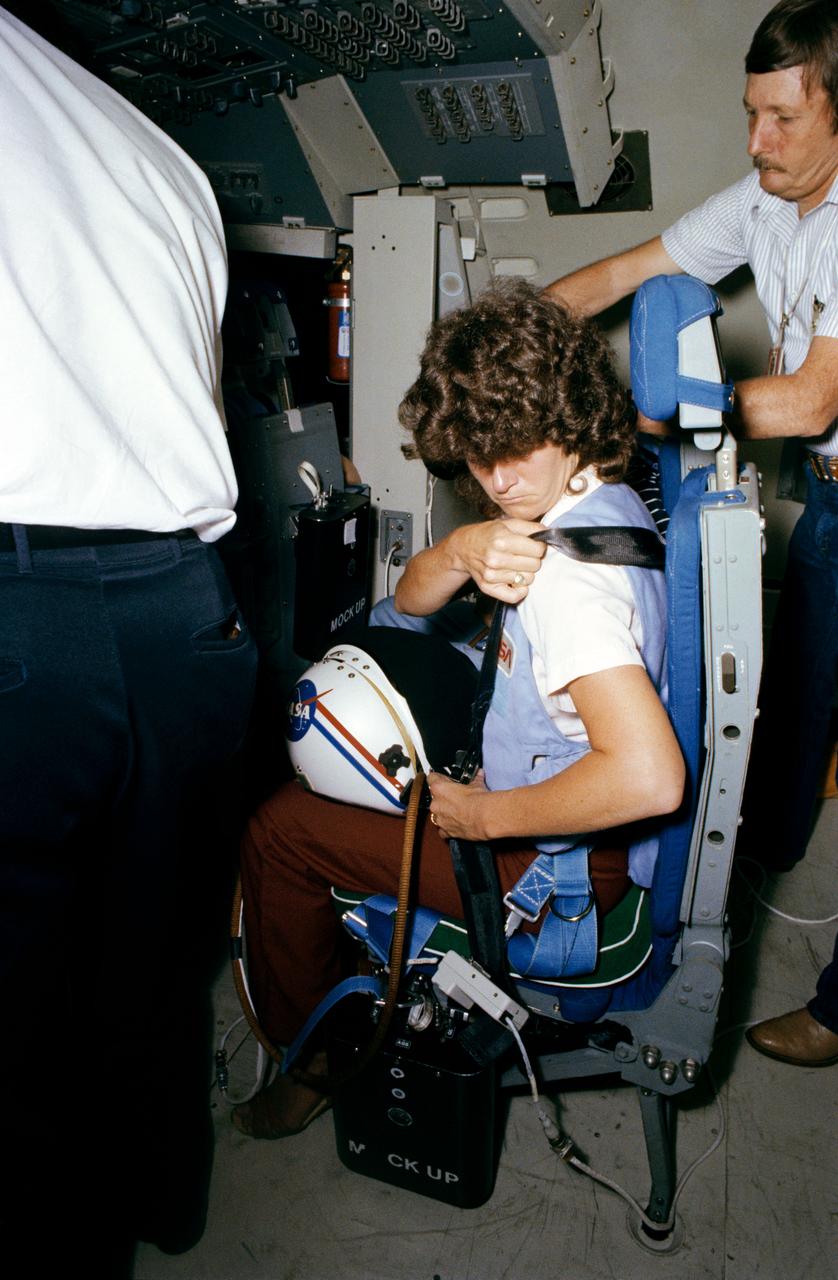
S83-32568 (23 May 1983) --- Astronaut Sally K. Ride, STS-7 mission specialist, straps herself into a seat in the Shuttle Mission Simulator (SMS) in Johnson Space Center?s Mission Simulation and Training Facility. Dr. Ride and the other STS-7 crew members continue their simulations in the motion base simulator in preparation for their flight in the space shuttle Challenger. Launch is scheduled for June 18. Troy Stewart, suit technician, assisted Dr. Ride. Photo credit: NASA
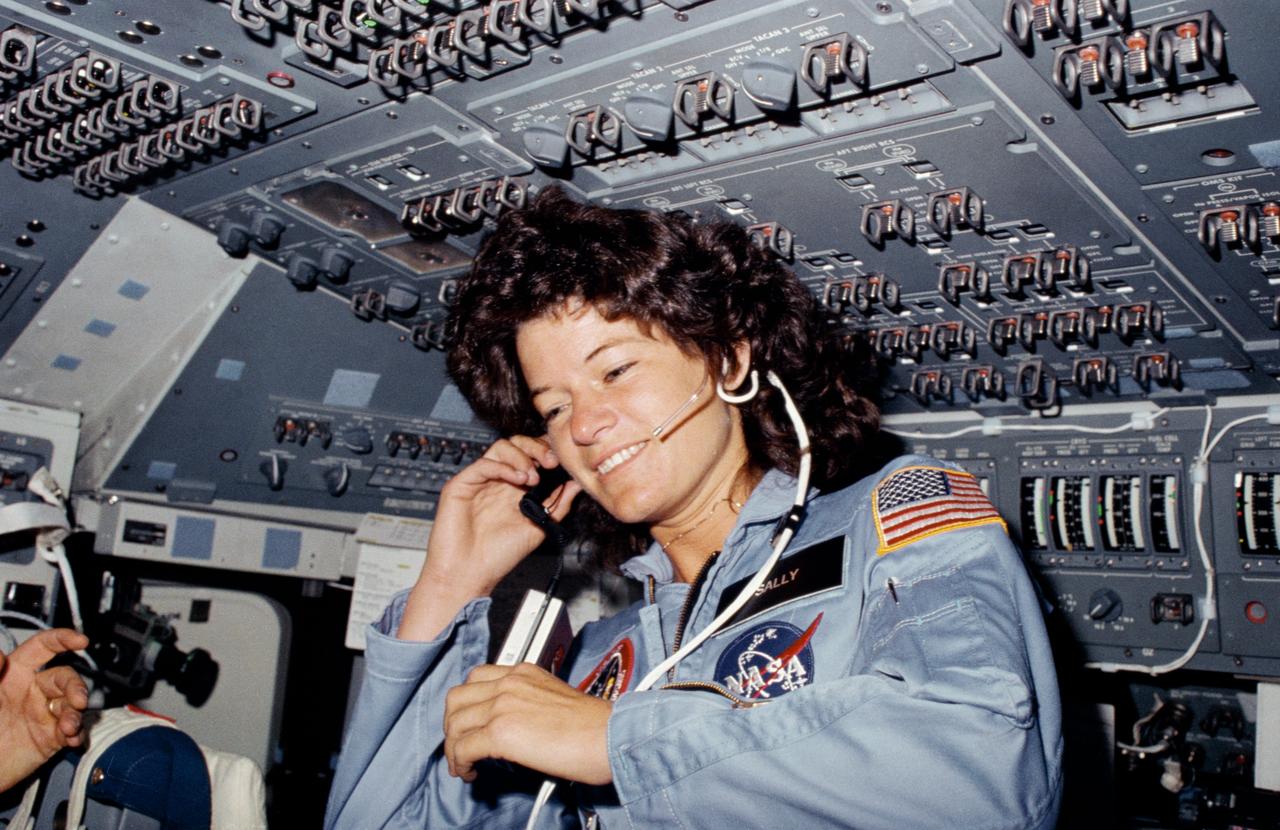
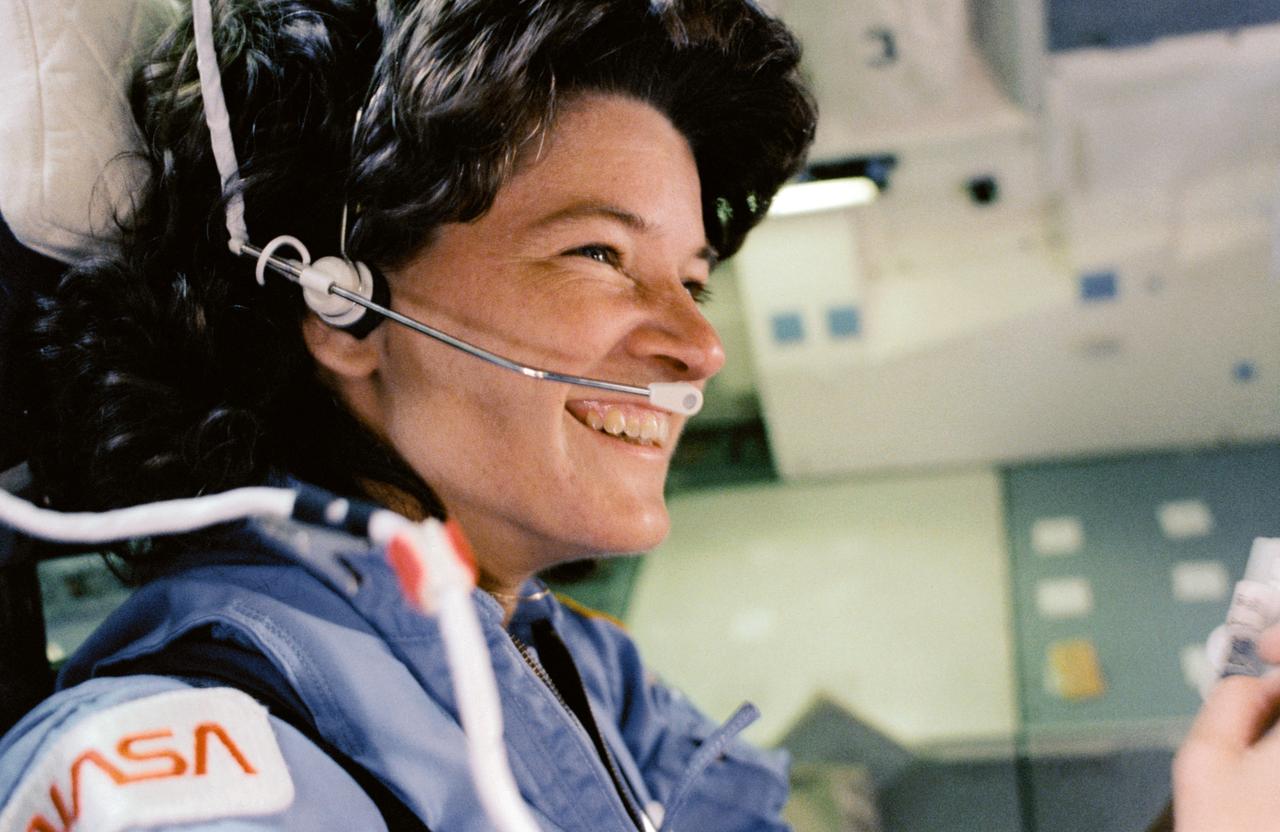
S83-35763 / STS007-02-027 (18 June 1983) --- Seen on the flight deck of the space shuttle Challenger, astronaut Sally K. Ride, STS-7 mission specialist, became the first American woman in space on June 18, 1983. Photo credit: NASA
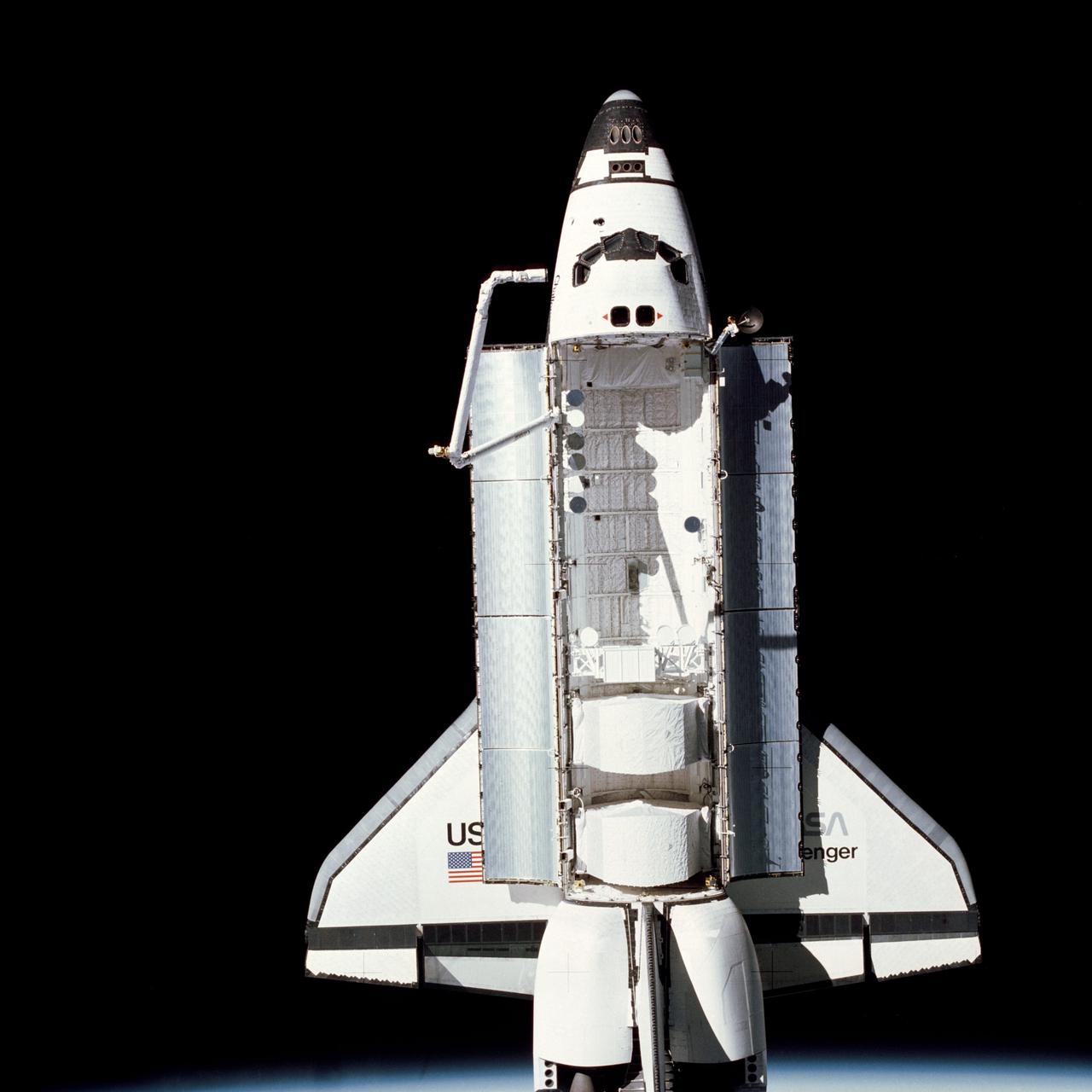
S83-35803 (22 June 1983) --- The Earth-orbiting space shuttle Challenger against the blackness of space was captured by a 70mm camera onboard the temporarily free-flying Shuttle Pallet Satellite (SPAS-01) during a busy Day 5 on the STS-7 mission. Visible in the cargo bay are the protective cradles for the now vacated Telesat Anik C2 and Palapa B communications satellites, the pallet for the NASA Office of Space and Terrestrial Applications (OSTA-2); the Remote Manipulator System (RMS) and the KU-Band antenna. The STS-7 astronaut crew with the RMS arm later retrieved the SPAS and returned it to a stowed position in the cargo bay for the return to Earth. Photo credit: NASA
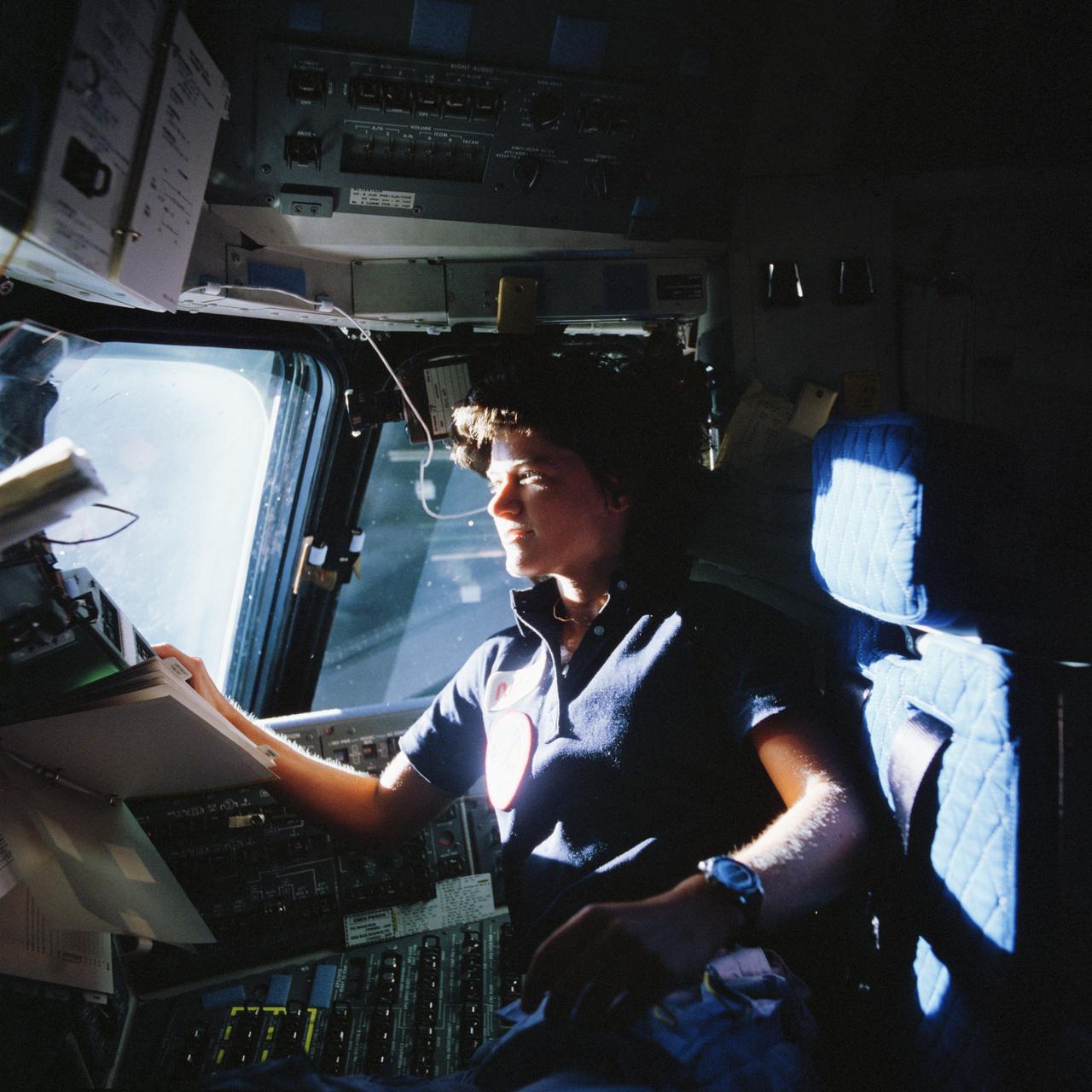
S83-35783 / STS007-05-029 (18-24 June 1983) --- Astronaut Sally K. Ride, mission specialist, is shown here sitting in the front seat and looking out the windows of the Earth-orbiting Space Shuttle Challenger. Ride and four other crew members are onboard the Challenger.
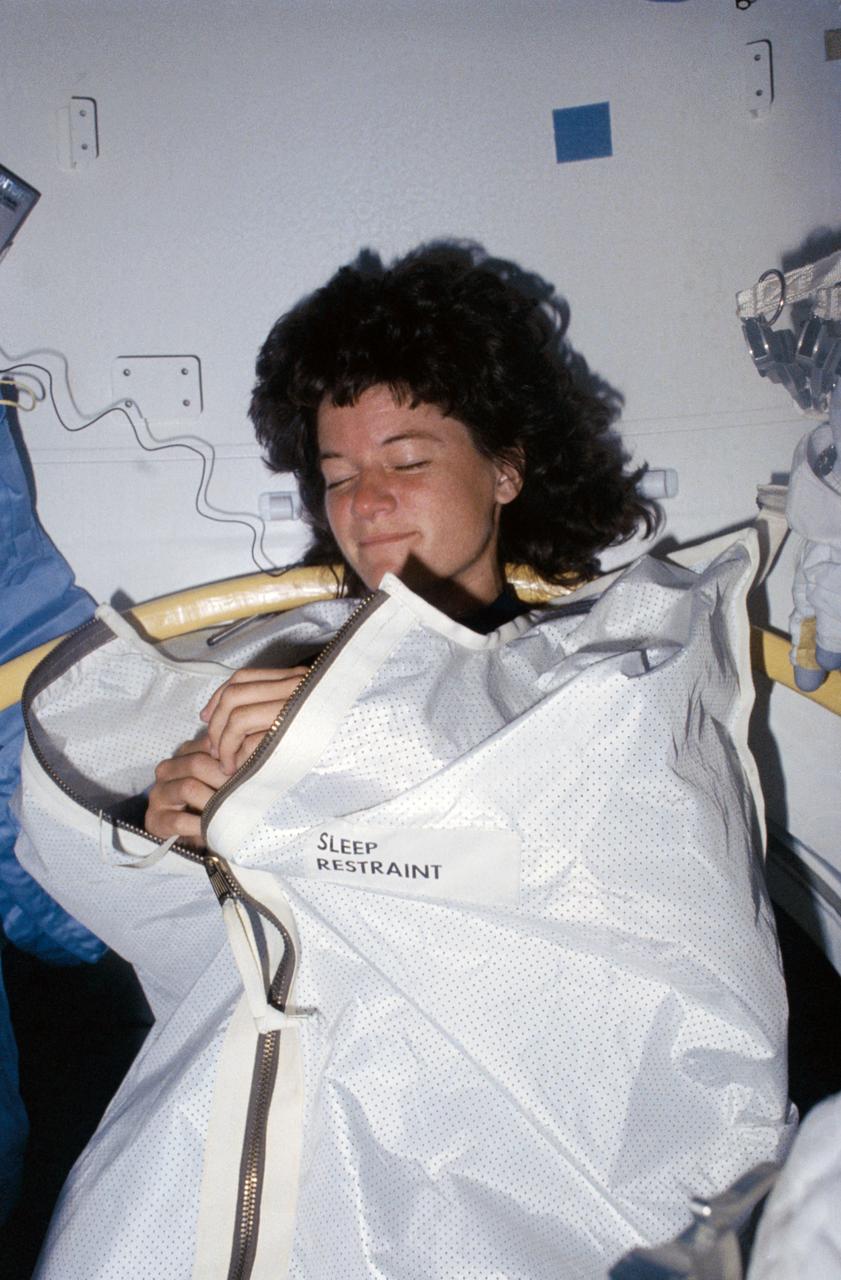
STS007-26-1438 (18-24 June 1983) --- Astronaut Sally K. Ride, mission specialist, was captured at her sleep station in the Space Shuttle Challenger's middeck by a fellow crew member using a 35mm camera. This method of sleep is just one used by the 20 astronauts who have now flown aboard NASA's first two Space Shuttle Orbiters. Some astronauts choose to sleep in various positions with either their feet or upper bodies or both anchored and others elect to use the sleep restraint device demonstrated here by Dr. Ride.
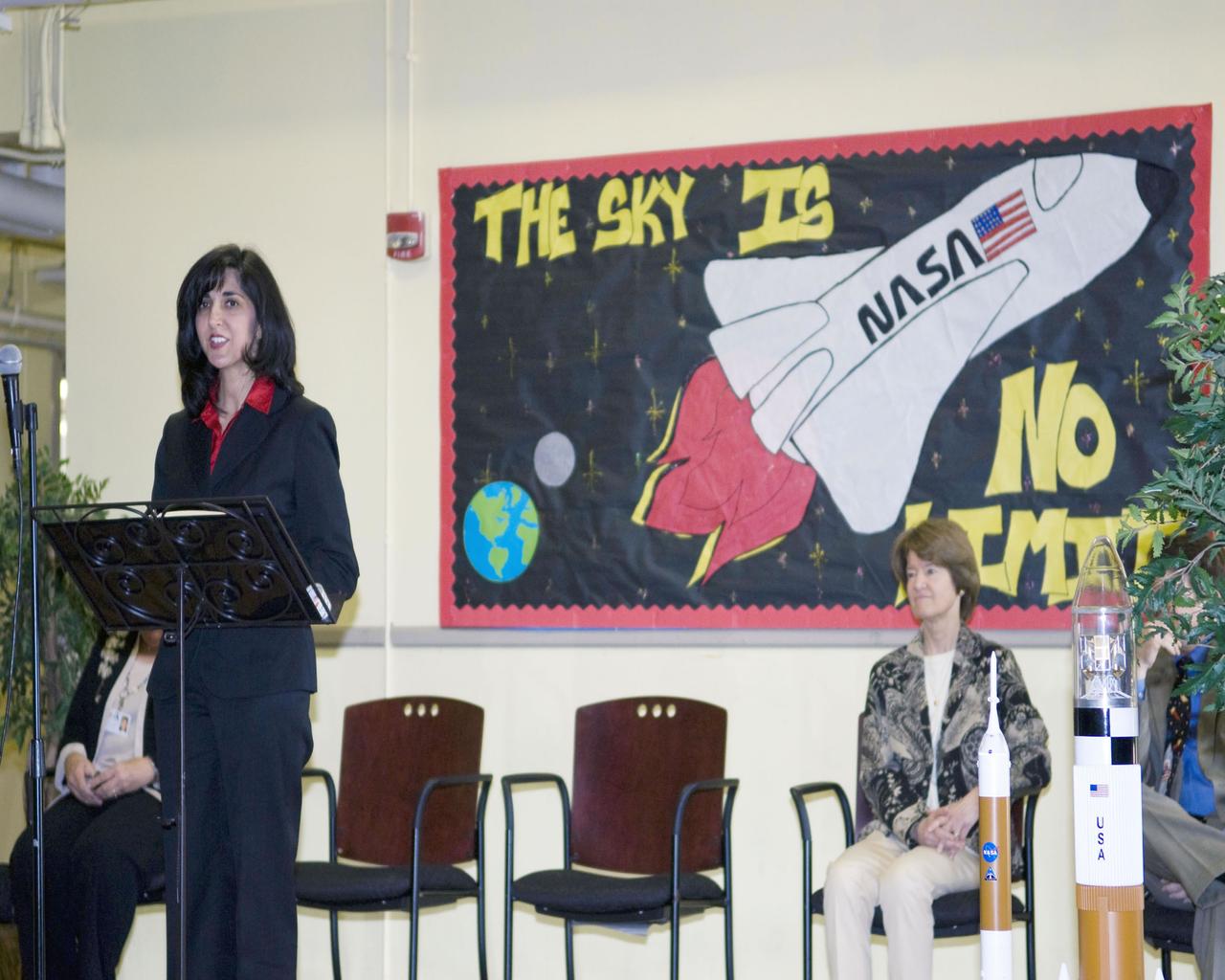
Louisiana First Lady Supriya Jindal (left) speaks to teachers and students at A.P. Tureaud Elementary School in New Orleans during a March 19 visit. At the school, Jindal was joined by retired NASA astronaut Sally Ride, the first American woman in space. Ride was a crew member on space shuttle Challenger during its STS-7 mission in 1983. She also was a crew member of space shuttle discovery on the STS-41 mission in 1984.

CAPE CANAVERAL, Fla. -- The crew of 41B STS-11, the first spaceflight in history to begin and conclude a mission at the same site, leave the flight deck of orbiter Challenger to be greeted by George Abbey, director of Flight Crew Operations. In ascending order, the crew members are Vance Brand, mission commander mission Pilot Robert L.'Hoot' Gibson and Mission Specialists Robert L. Stewart, Ronald E. McNair and Bruce McCandless II. Challenger touched down at 7:15:55 a.m. EST on Feb. 11, rolling 10,700 feet before coming to a stop on the Kennedy Space Center's 15,000-foot-long runway. Photo credit: NASA
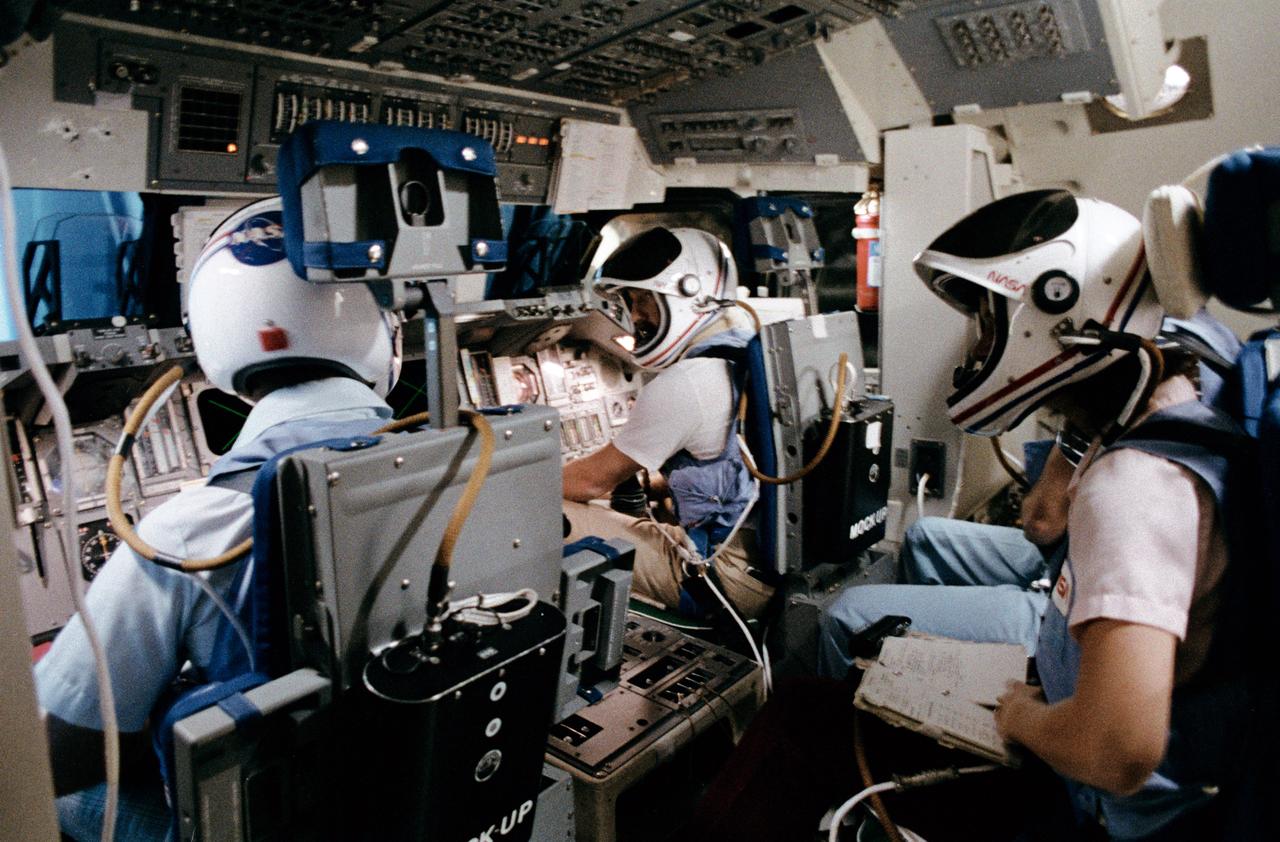
S83-32723 (23 May 1983) --- This scene in the Shuttle Mission Simulator (SMS) previews next month?s STS-7 flight in the space shuttle Challenger. Taken during a simulation session, the photo illustrates the seating arrangement for launch and landing phases of the Challenger?s second spaceflight and its first with five crew members. Pictured, left to right, are astronauts Robert L. Crippen, commander; Frederick H. Hauck, pilot; Sally K. Ride and John M. Fabian (almost totally obscured), mission specialists. Dr. Norman E. Thagard, a third mission specialist, will be seated in the middeck for launch and landing phases. Photo credit: NASA/Otis Imboden/National Geographic Society.
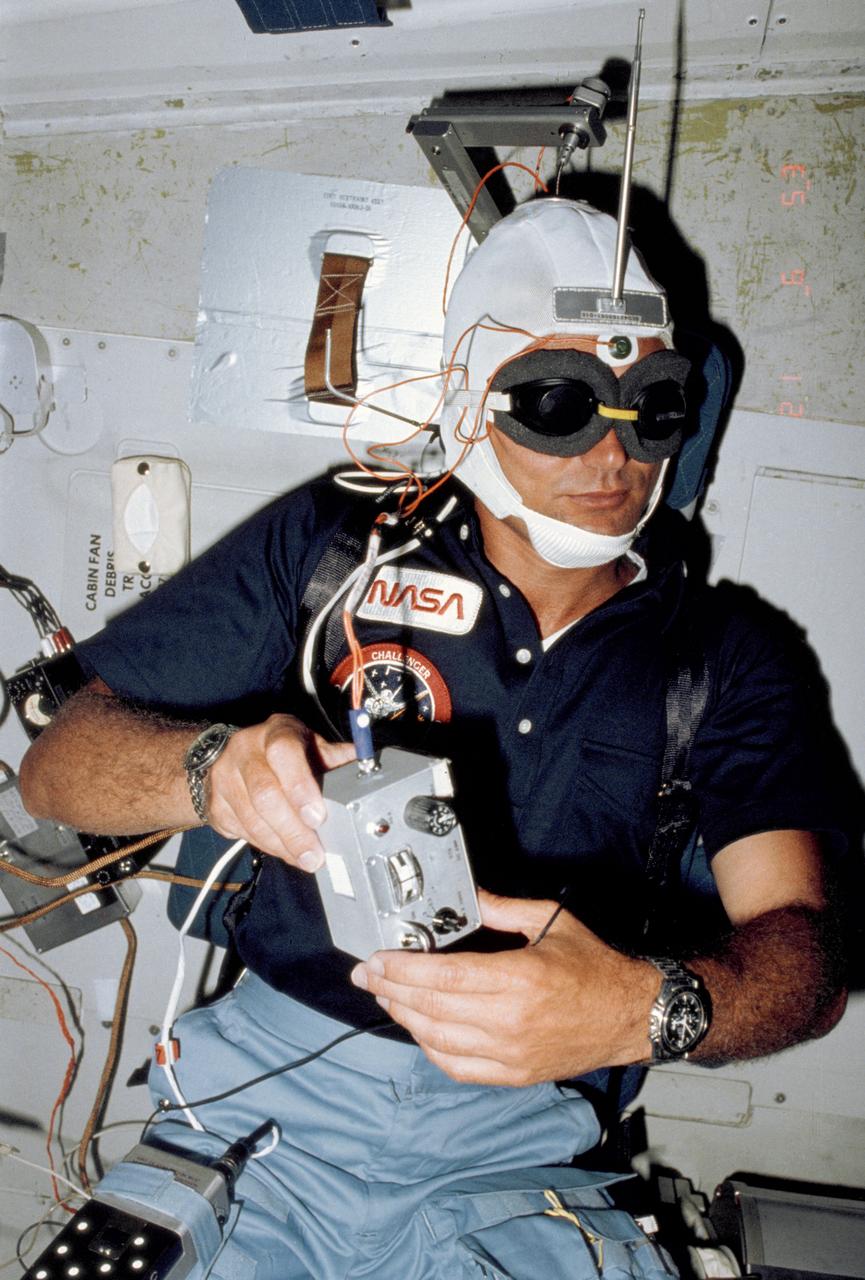
S83-35770 (18?24 June 1983)--- Astronaut Norman E. Thagard, STS-7 mission specialist, is actually performing a medical experiment though his appearance resembles popular depictions of an invading alien. Thagard, a medical doctor, has been assigned a busy project of evaluating physiological reactions of astronauts in space travel. He is on the middeck of the Earth-orbiting space shuttle Challenger. Photo credit: NASA
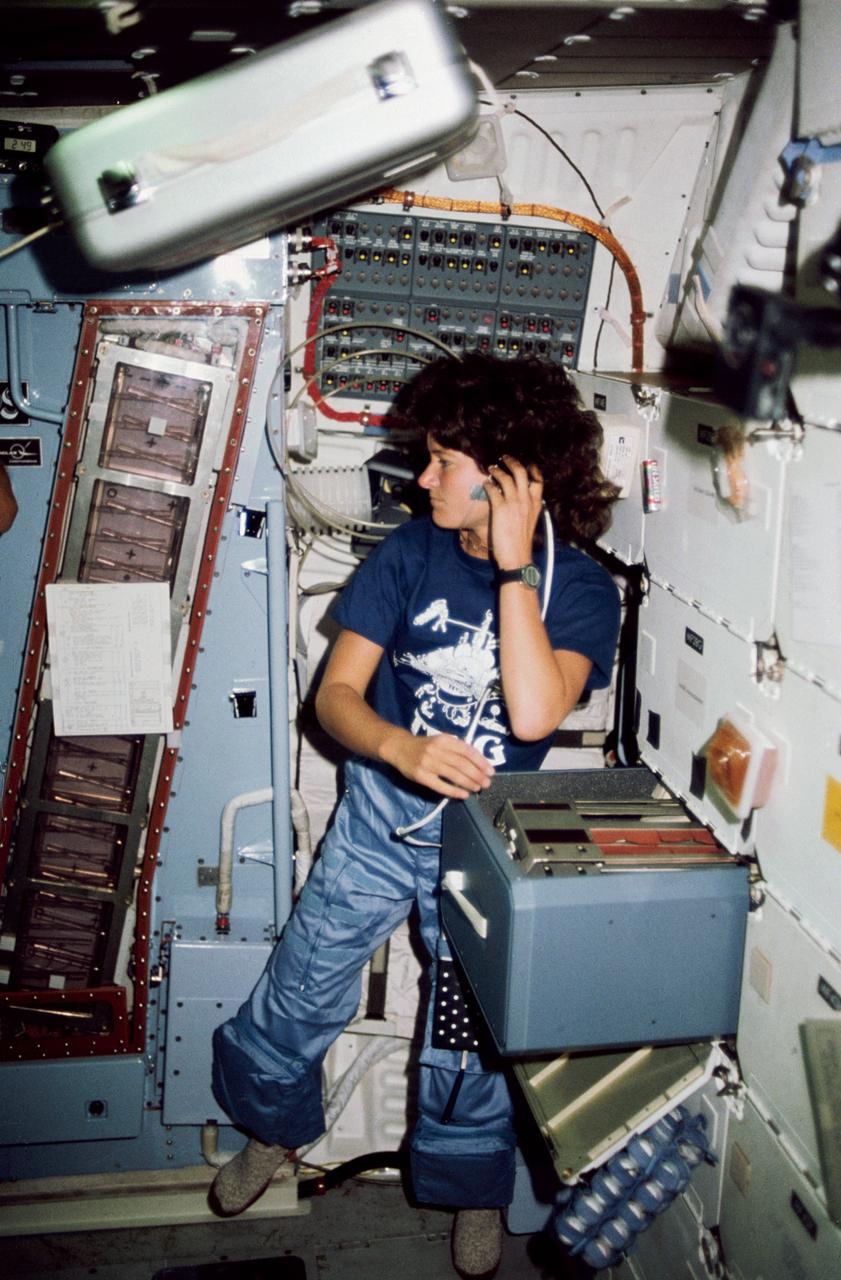
STS007-11-495 (18-24 June 1983) --- Astronaut Sally K. Ride, STS-7 mission specialist, communicates with ground controllers from the mid deck of the Earth-orbiting Space Shuttle Challenger. She has just opened one of the large lockers during the operation and monitoring of the continuous flow electrophoresis system (CFES) experiment at left edge. This photograph was made with a 35mm camera.
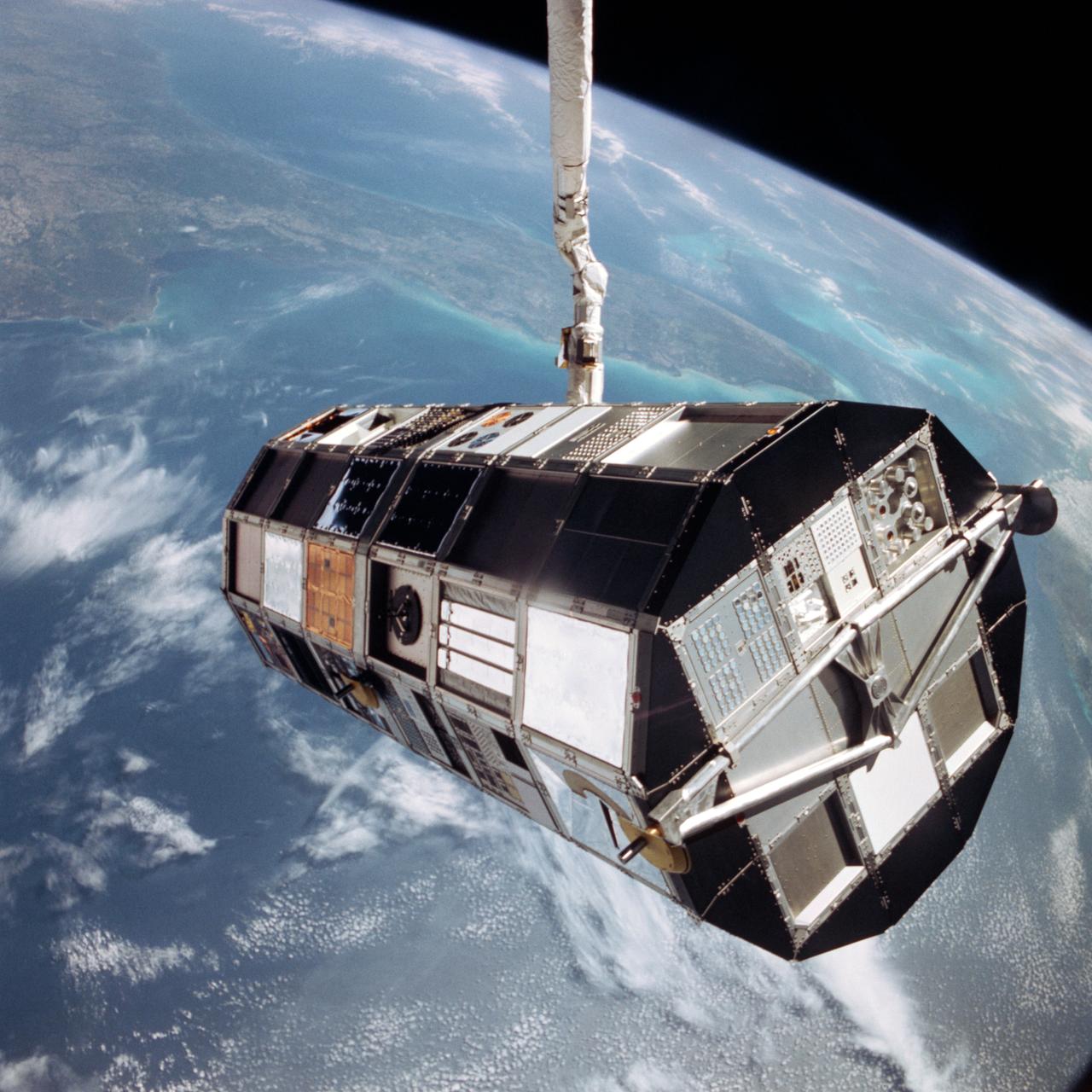
41C-36-1618 (7 April 1984) --- The Remote Manipulator System (RMS) arm suspends the giant Long Duration Exposure Facility (LDEF) high above the Gulf of Mexico prior to releasing it into space. Carried into Earth orbit with the STS-41C crew by the Space Shuttle Challenger, LDEF will remain in space until retrieved by a future Shuttle mission, in nine or ten months. Florida and the Bahama Banks are visible near the Earth's horizon in the 70mm frame.
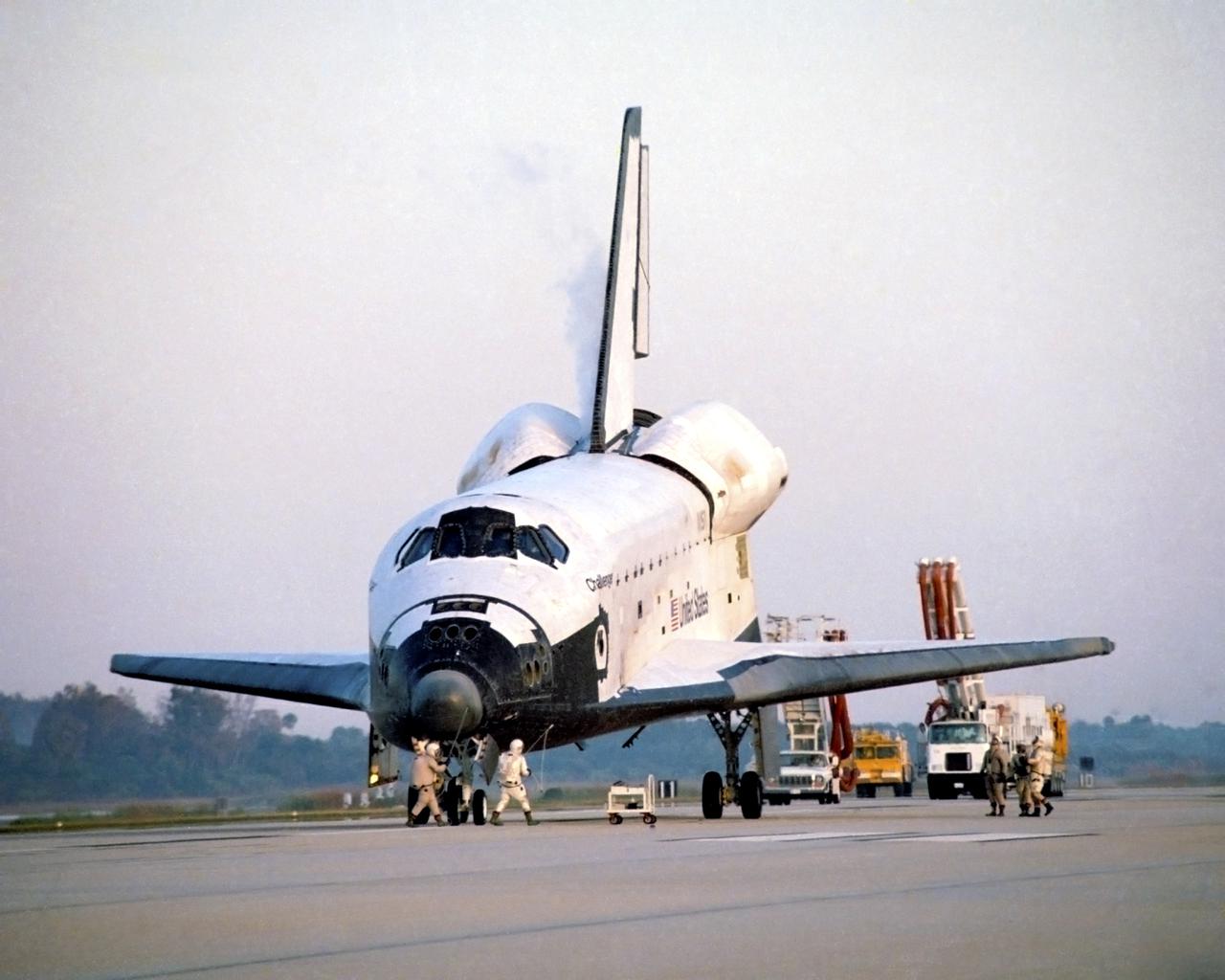
CAPE CANAVERAL, Fla. -- Ground crew members perform initial post-landing procedures on orbiter Challenger as the the crew, the first-ever to experience both launch and landing at KSC, prepare to exit the spaceship. Touchdown was at 7:15:55 a.m. EST on Feb. 11. Crew members for the historic Mission 41-B STS-11 are Commander Vance D. Brand, Pilot Robert L.'Hoot' Gibson, and Mission Specialists Bruce McCandless II, Robert L. Stewart and Ronald E. McNair. Photo credit: NASA
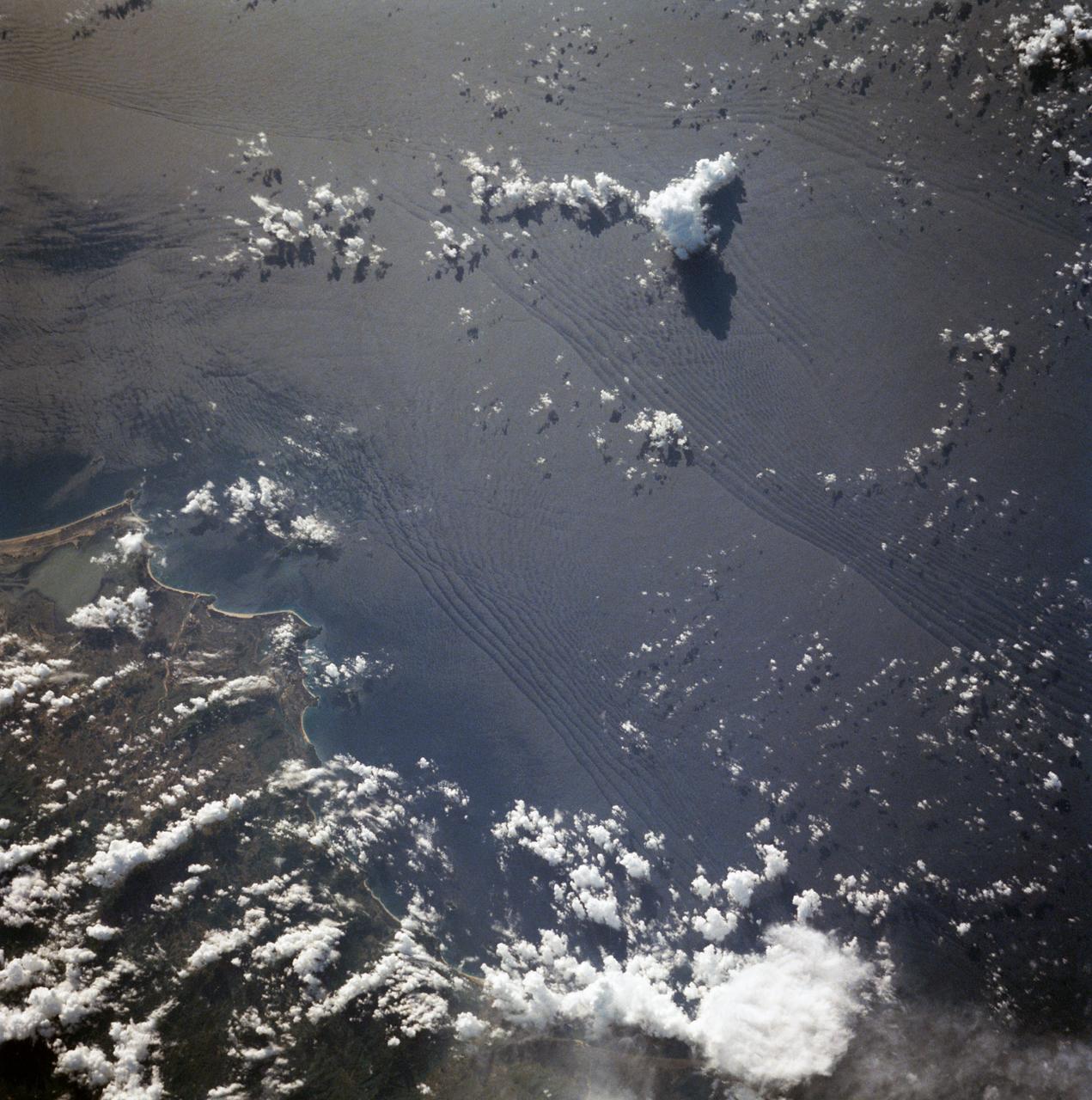
STS007-05-245 (18-24 June 1983) --- A rare view of internal waves in the South China Sea. Several different series of internal waves are represented in the 70mm frame, exposed with a handheld camera by members of the STS-7 astronaut crew aboard the Earth-orbiting Challenger. The land area visible in the lower left is part of the large island of Hainan, China.
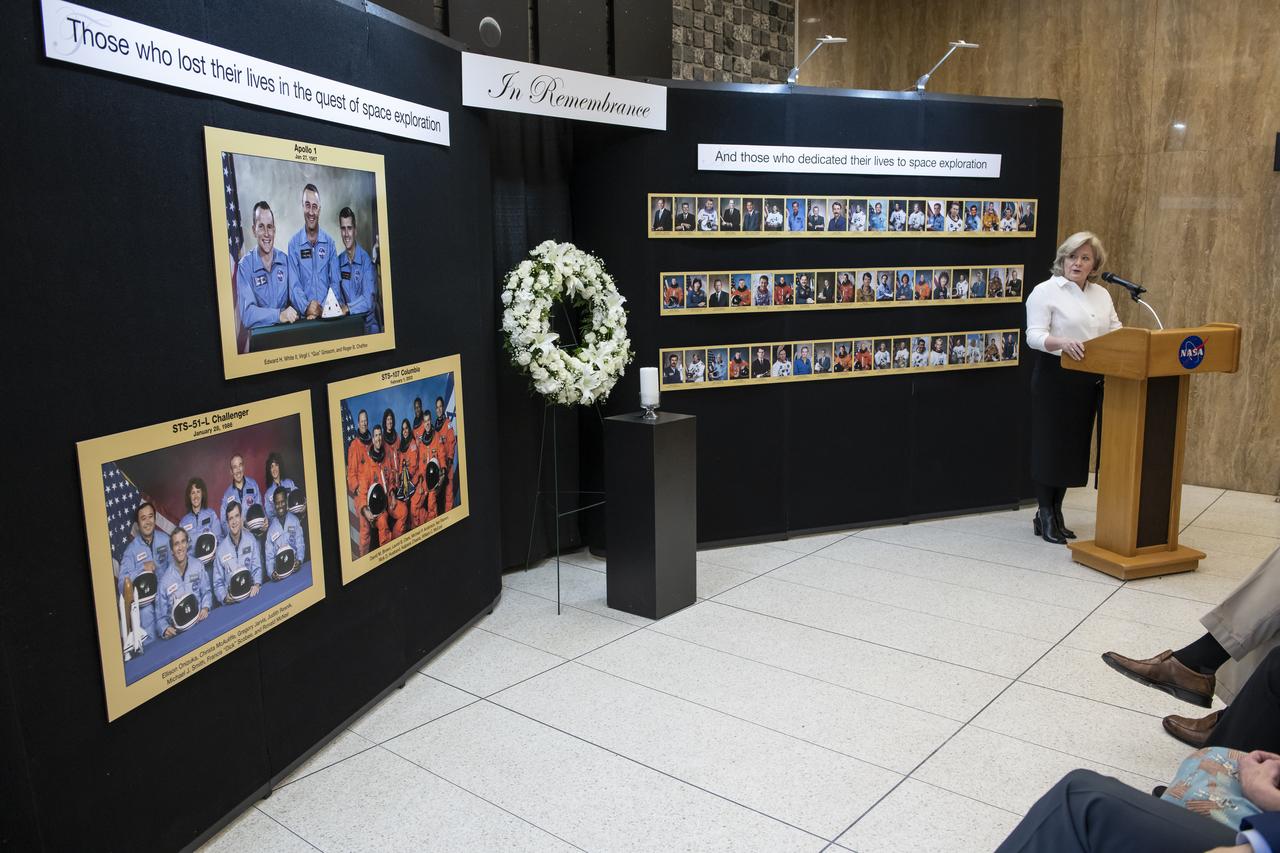
NASA Marshall Space Flight Center Director Jody Singer looks solemnly toward a display honoring the crews of space shuttle Columbia STS-107, space shuttle Challenger STS-51L and Apollo 1 during the center's Day of Remembrance ceremony Feb. 7. Singer, former astronaut Jan Davis, and Marshall Safety and Mission Assurance Directorate Director Rick Burt, spoke at the annual ceremony, which honors those who lost their lives in the quest of space exploration and those who dedicated their lives to space exploration. The ceremony concluded with Singer lighting a candle in memory of the honorees and a moment of silence led by Johnny Stephenson, director of the Office of Strategic Analysis & Communications.
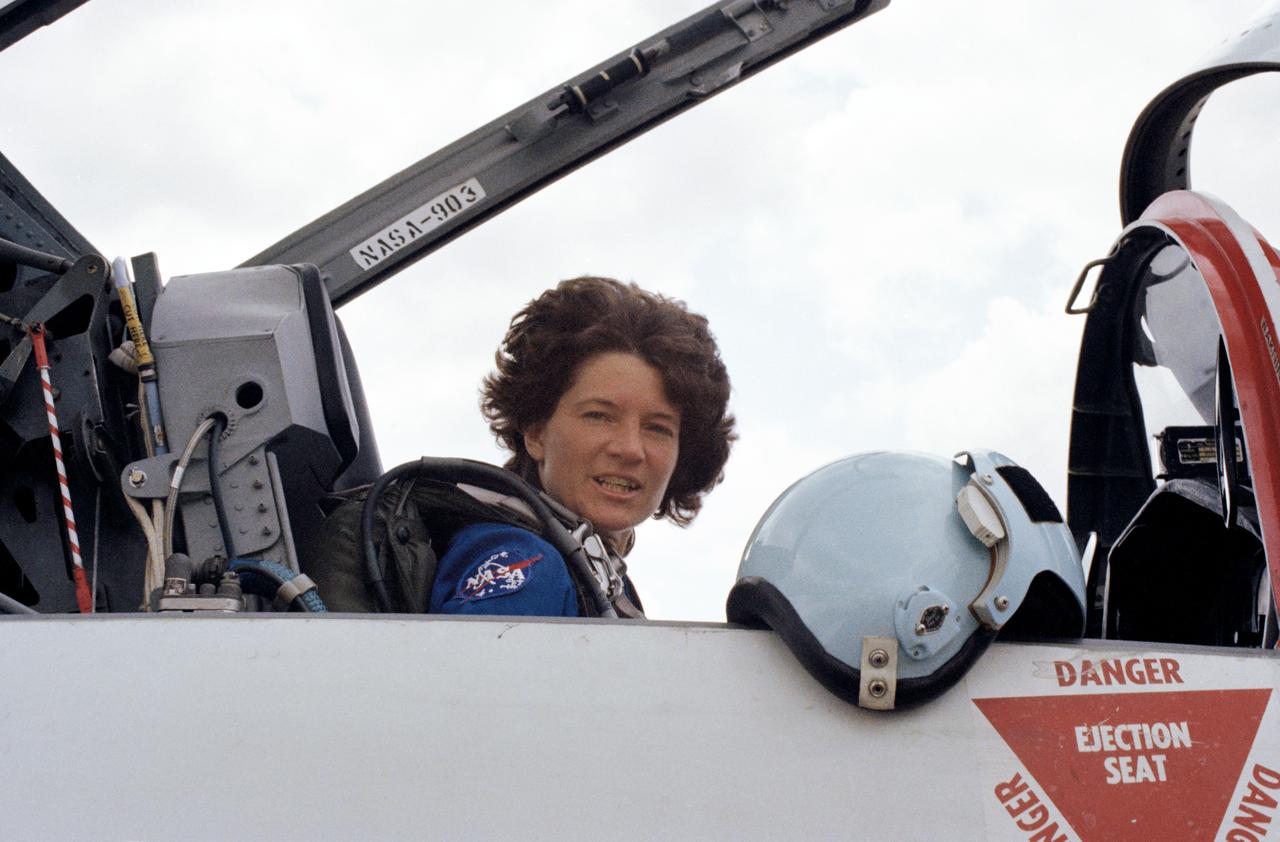
S83-34151 (15 June 1983) --- Astronaut Sally K. Ride, STS-7 mission specialist, takes one last look at familiar training environs before taking off from NASA’s Houston facility in a T-38 jet aircraft, destination: Florida and the Kennedy Space Center (KSC). After a few days of preparation at KSC, Dr. Ride and four other astronauts will be the first NASA five-member crew to fly in space as they liftoff in the Challenger from Launch Pad 39A. The mission specialist is positioned in the rear station of the jet, piloted by astronaut Robert L. Crippen, STS-7 commander. The T-38 fleet is kept at Ellington Base near the Johnson Space Center (JSC).
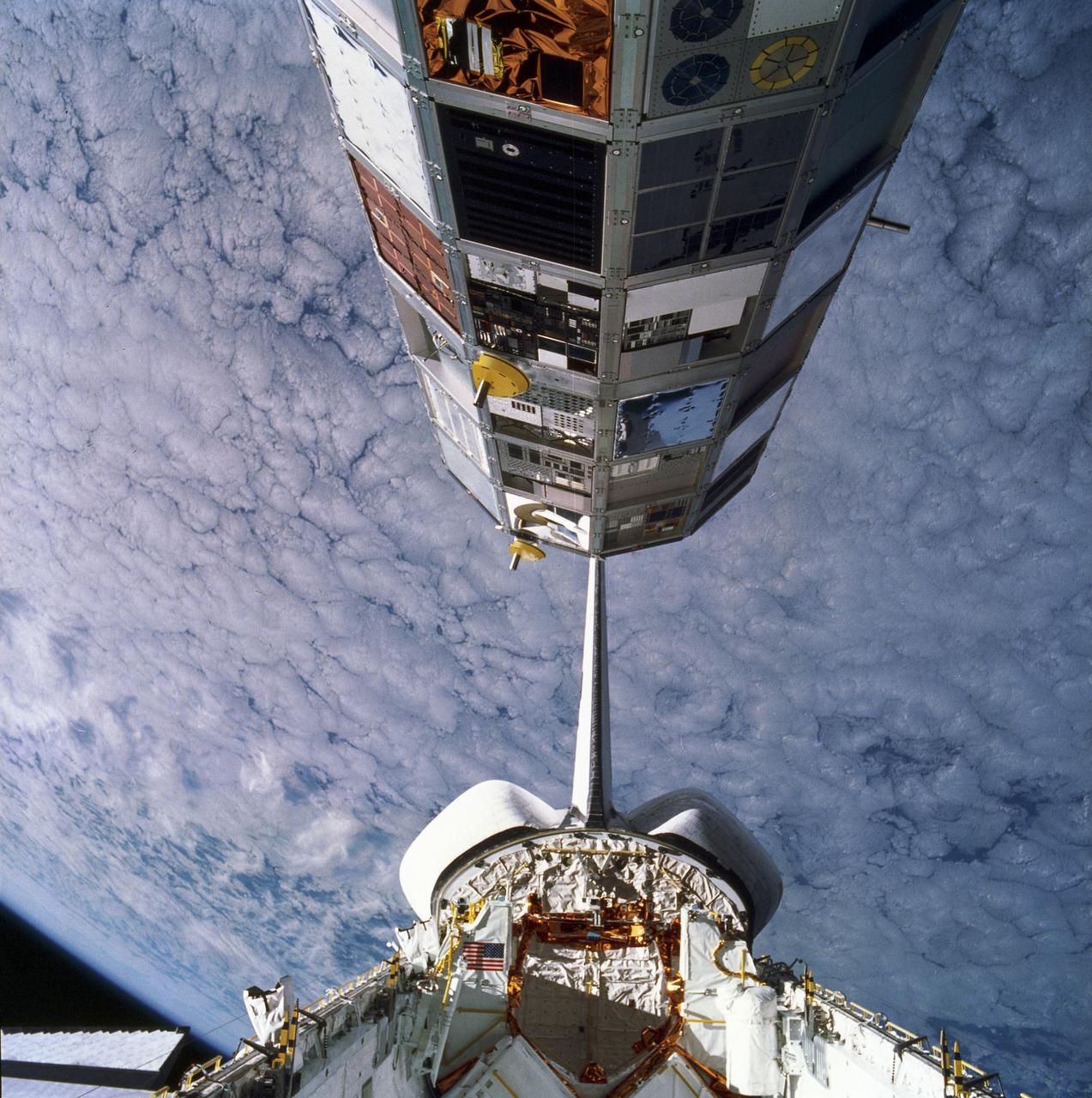
This is an onboard photo of the deployment of the Long Duration Exposure Facility (LDEF) from the cargo bay of the Space Shuttle Orbiter Challenger STS-41C mission, April 7, 1984. After a five year stay in space, the LDEF was retrieved during the STS-32 mission by the Space Shuttle Orbiter Columbia in January 1990 and was returned to Earth for close examination and analysis. The LDEF was designed by the Marshall Space Flight Center (MSFC) to test the performance of spacecraft materials, components, and systems that have been exposed to the environment of micrometeoroids, space debris, radiation particles, atomic oxygen, and solar radiation for an extended period of time. Proving invaluable to the development of both future spacecraft and the International Space Station (ISS), the LDEF carried 57 science and technology experiments, the work of more than 200 investigators, 33 private companies, 21 universities, 7 NASA centers, 9 Department of Defense laboratories, and 8 forein countries.
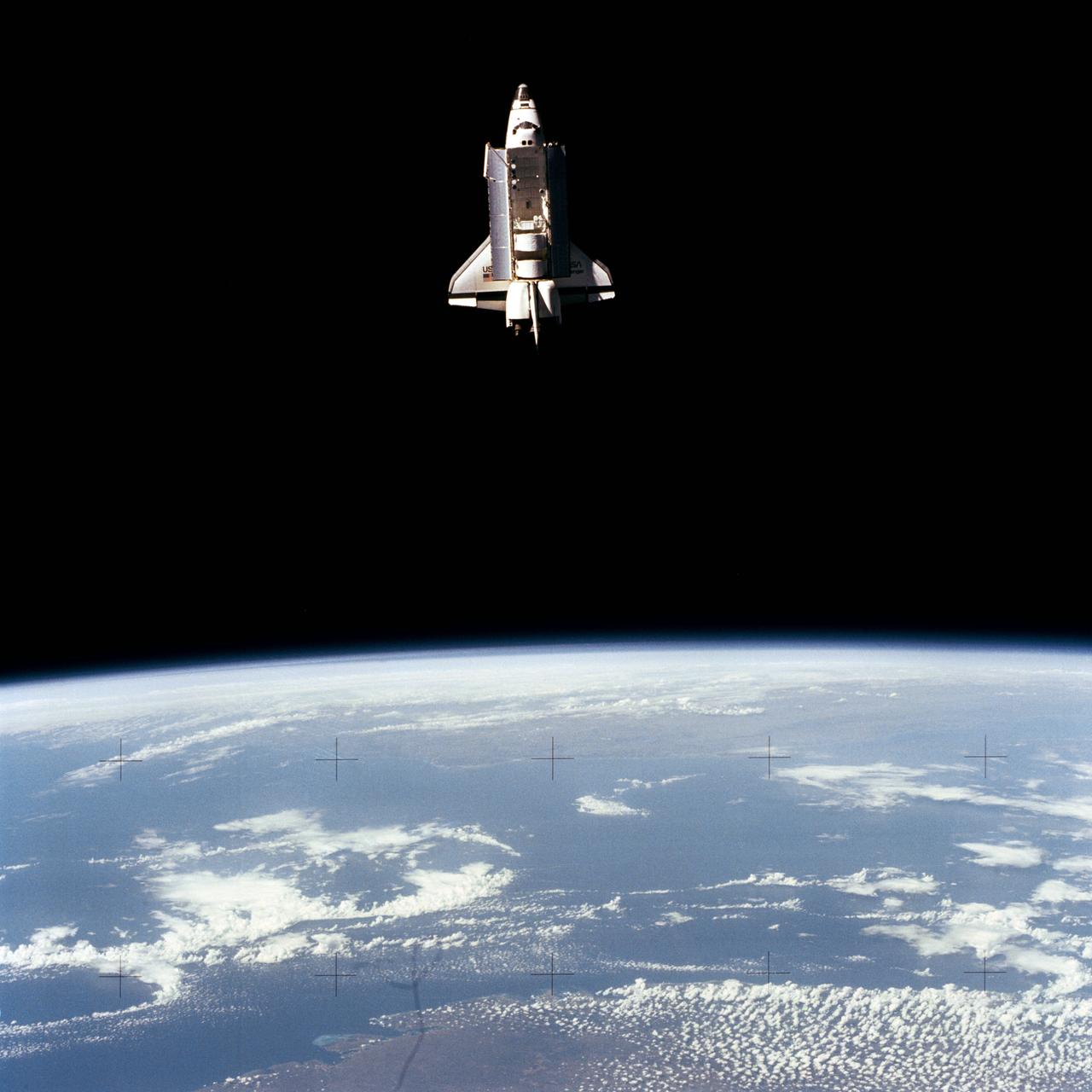
STS007-32-1702 (22 June 1983) --- The Earth-orbiting space shuttle Challenger beyond the Earth's horizon was captured by a 70mm camera onboard the unmanned, free-flying Shuttle Pallet Satellite (SPAS-01) during the busy flight day 5 of the STS-7 mission. Visible in the cargo bay are the protective cradles for the now-vacated Telesat Anik C-2 and Palapa B communications satellites, the pallet for the NASA Office of Space and Terrestrial Applications (OSTA-02), the Remote Manipulator System (RMS) and the KU-Band antenna. The STS-7 crew with the RMS later retrieved the SPAS and returned it to a stowed position in the cargo bay for return to Earth. Photo credit: NASA or National Aeronautics and Space Administration
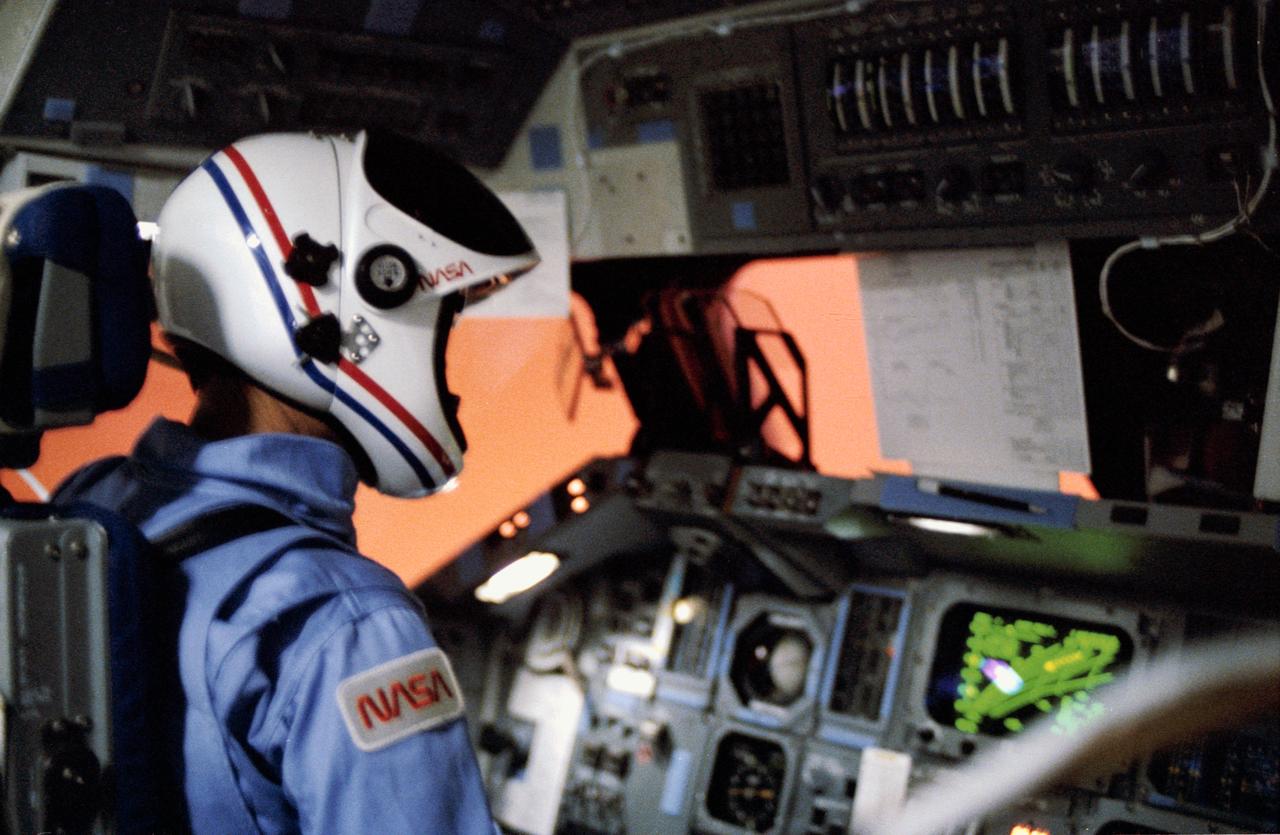
STS007-31-1614 & S83-35775 (24 June 1983) --- Astronaut Robert L. Crippen is seen at the commander’s station of the Space Shuttle Challenger as it passes through the Earth’s atmosphere on re-entry. The friction results in a pinkish glow visible through the forward windows on the flight deck. The scene was exposed with a 35mm camera.
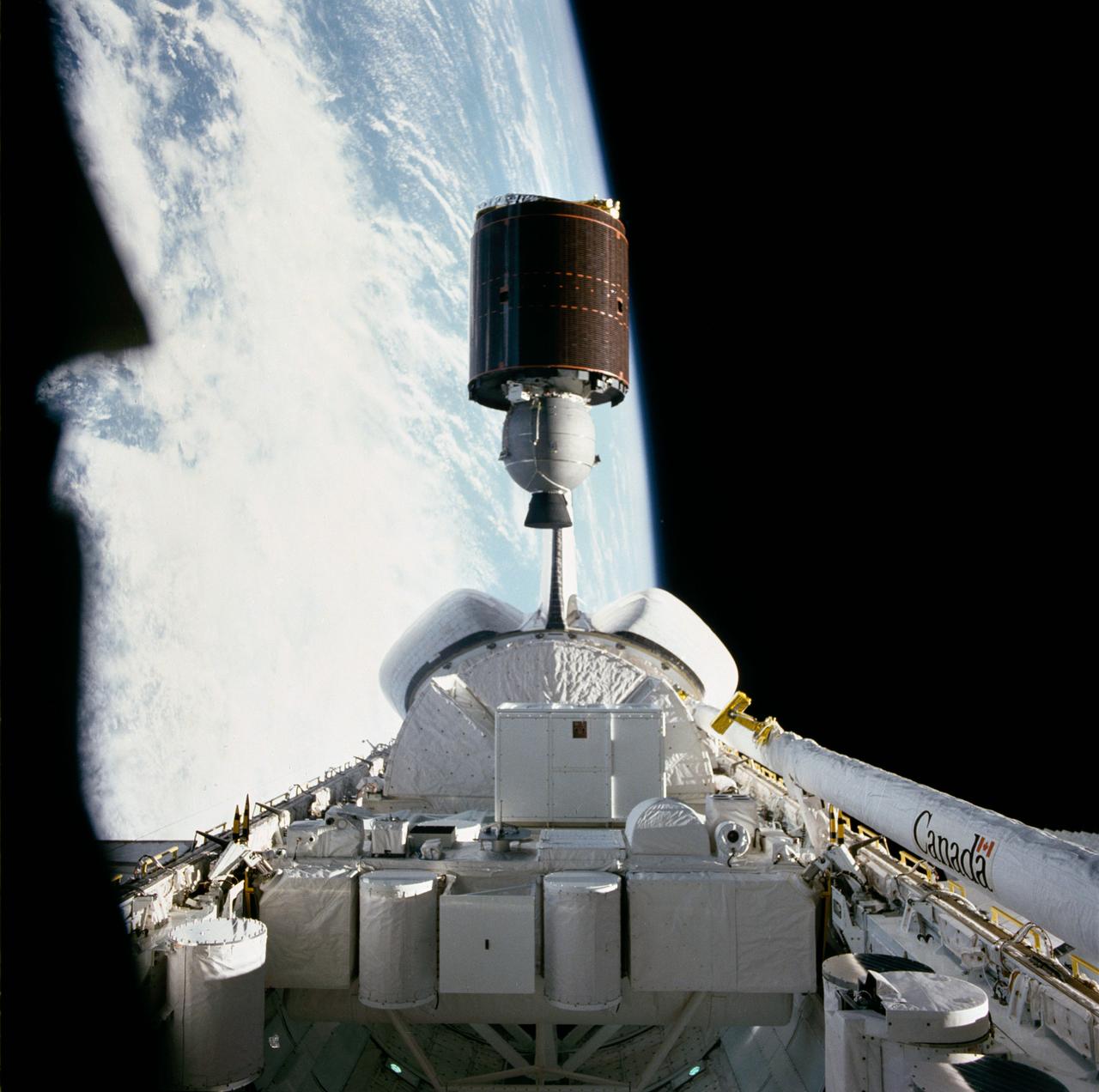
STS007-18-770 (18-24 June 1983) --- Telesat-F communications satellite is just about to clear the vertical stabilizer of the Earth-orbiting Space Shuttle Challenger to begin its way toward its Earth-orbital destination.
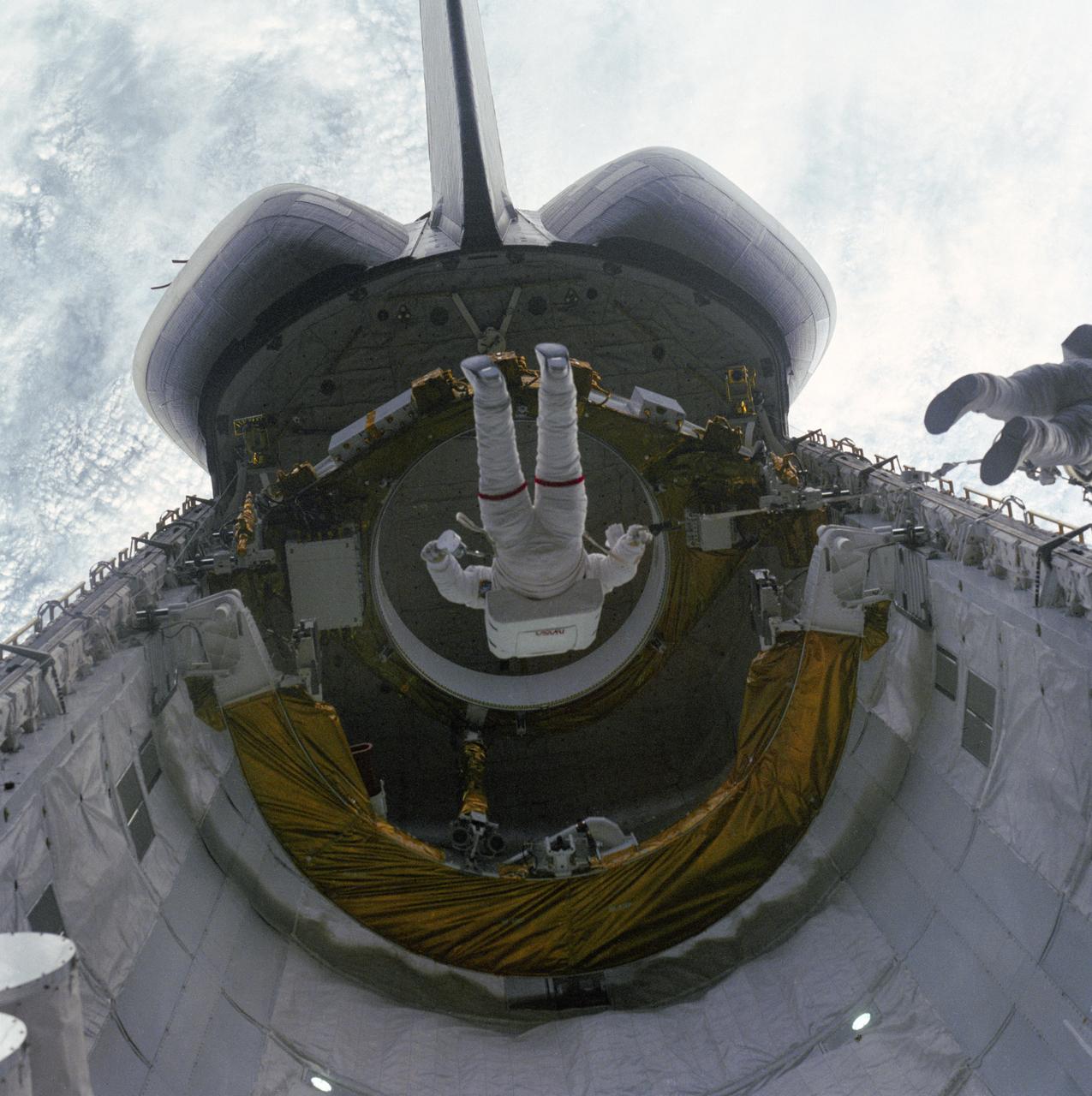
S83-30214 (7 April 1983) --- Astronaut F. Story Musgrave, STS-6 mission specialist, suspends himself midway between the starboard and port slide wire systems to evaluate the pull strength of the reel-in safety tether while astronaut Donald H. Peterson, the flight?s other mission specialist, busies himself along the port side at right edge of frame. This photograph was taken by astronaut Karol J. Bobko, pilot, from the aft window of the Earth-orbiting Challenger?s flight deck. The successful EVA occurred on April 7, 1983, on day four of the five-day flight. The gold-foil protected object is the airborne support equipment (ASE) for the now vacated inertial upper stage (IUS) which aided in the deployment of the tracking and data relay satellite (TDRS) on the first day of the mission. Astronaut Paul J. Weitz, crew commander, was in charge of the Challenger during these operations. The white background is made up mostly of clouds over Earth. Photo credit: NASA
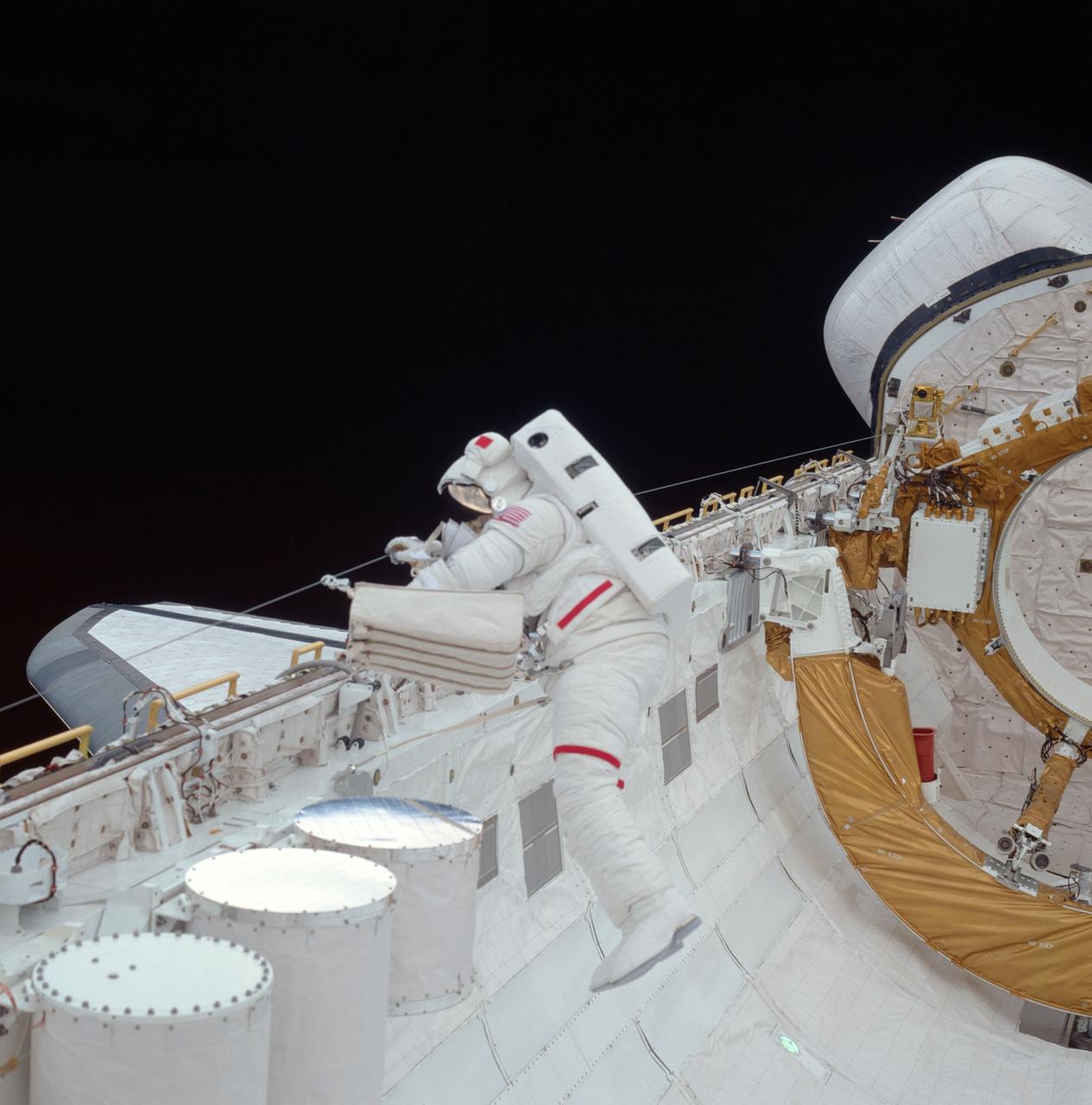
STS006-45-124 (7 April 1983) --- Astronaut F. Story Musgrave, STS-6 mission specialist, translates down the Earth-orbiting space shuttle Challenger’s payload bay door hinge line with a bag of latch tools. This photograph is among the first five still frames that recorded the April 7 extravehicular activity (EVA) of Dr. Musgrave and Donald H. Peterson, the flight’s other mission specialist. It was photographed with a handheld 70mm camera from inside the cabin by one of two crew members who remained on the flight deck during the EVA. Dr. Musgrave’s task here was to evaluate the techniques required to move along the payload bay’s edge with tools. In the lower left foreground are three canisters containing three getaway special (GAS) experiments. Part of the starboard wind and orbital maneuvering system (OMS) pod are seen back dropped against the blackness of space. The gold-foil protected object partially out of frame on the right is the airborne support equipment for the now vacated inertial upper stage (IUS) which aided the deployment of the tracking and data relay satellite on the flight’s first day. Astronauts Paul J. Weitz, command and Karol J. Bobko, pilot, remained inside the Challenger during the EVA. Photo credit: NASA
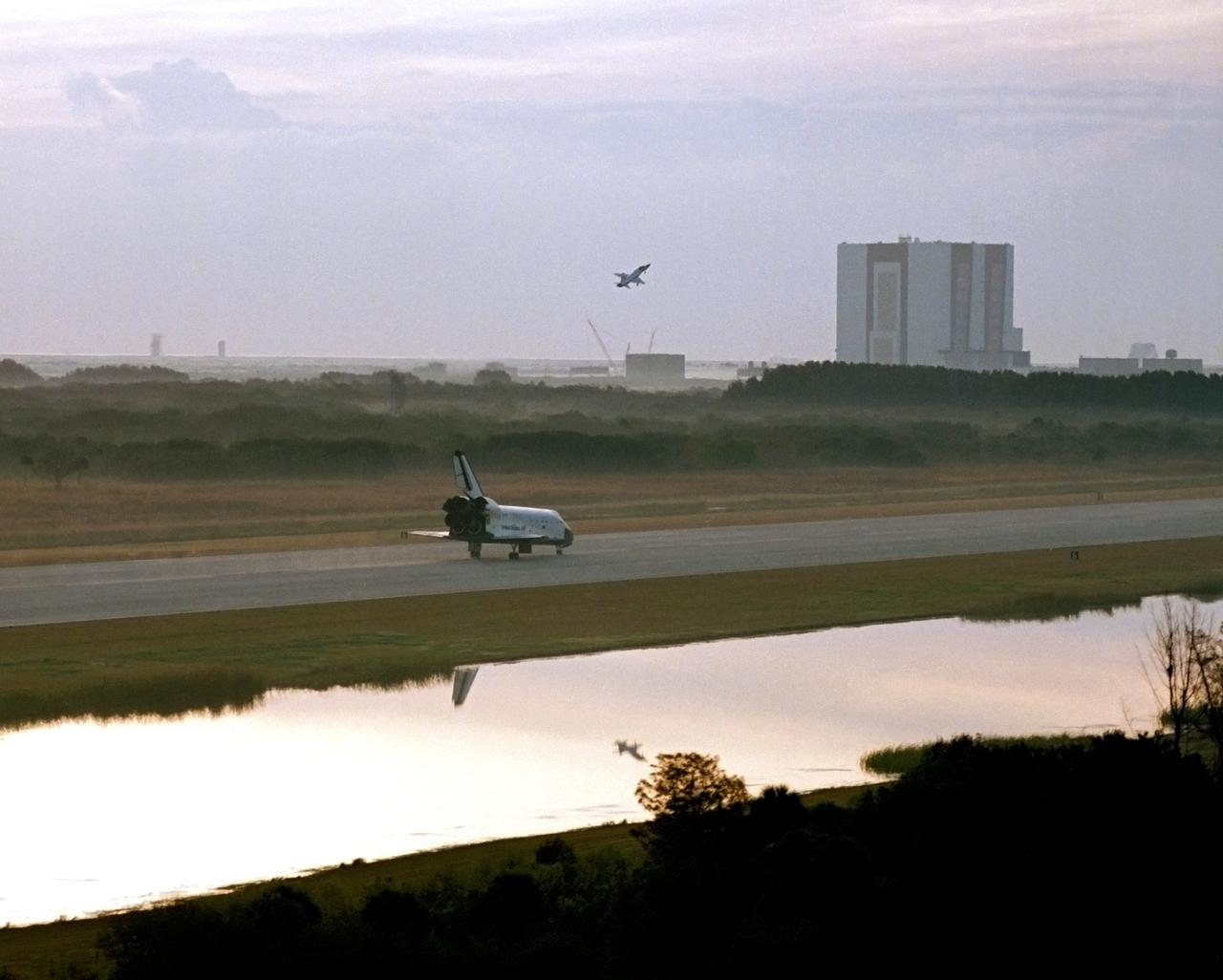
CAPE CANAVERAL, Fla. -- Shortly after sunrise the space shuttle orbiter Challenger touches down on the KSC runway at 7:16 a.m. The T-38 escort chase plane is seen just above the orbiter. The historic first landing at KSC brought to a conclusion an eight-day mission that started at 8:00 a.m. Feb. 3, 1984. The STS 41-B mission had several other firsts including an un-tethered spacewalk made by two of the astronauts. The Vehicle Assembly Building can be seen in the right side of the photograph. Photo credit: NASA
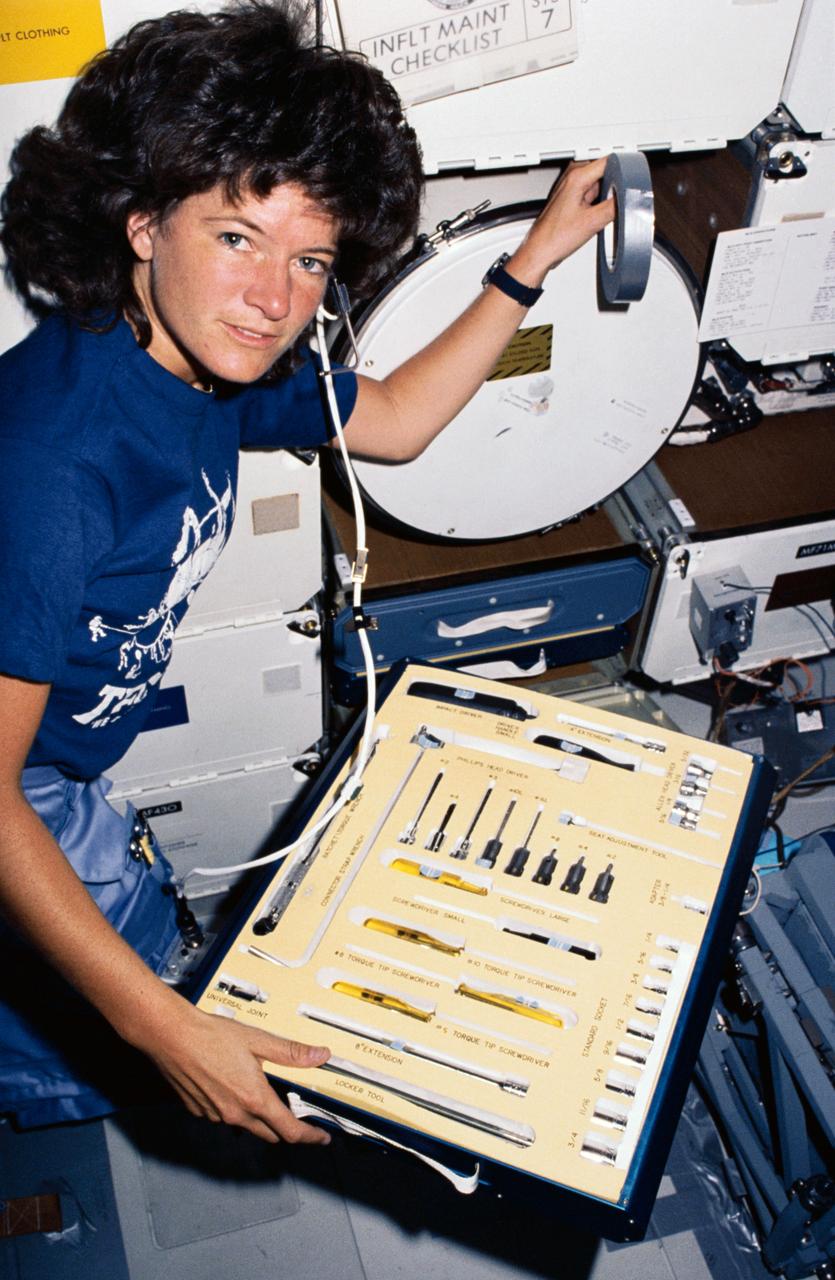
STS007-12-536 (18-24 June 1983) --- Astronaut Sally K. Ride, STS-7 mission specialist, displays the array of tools at her disposal on the mid deck of the Earth-orbiting Space Shuttle Challenger. Dr. Ride is positioned near the monodisperse latex reactor (MLR) experiment. They cylinder near her elbow is the actual reactor and the device next to it at right frame edge is the MRL apparatus container. Dr. Ride and four other astronauts are sharing duties aboard the reusable spacecraft for a six-day space mission full of “firsts.” This photograph was made with a 35mm camera. It was among the visuals used by crewmembers at their post-flight press conference.
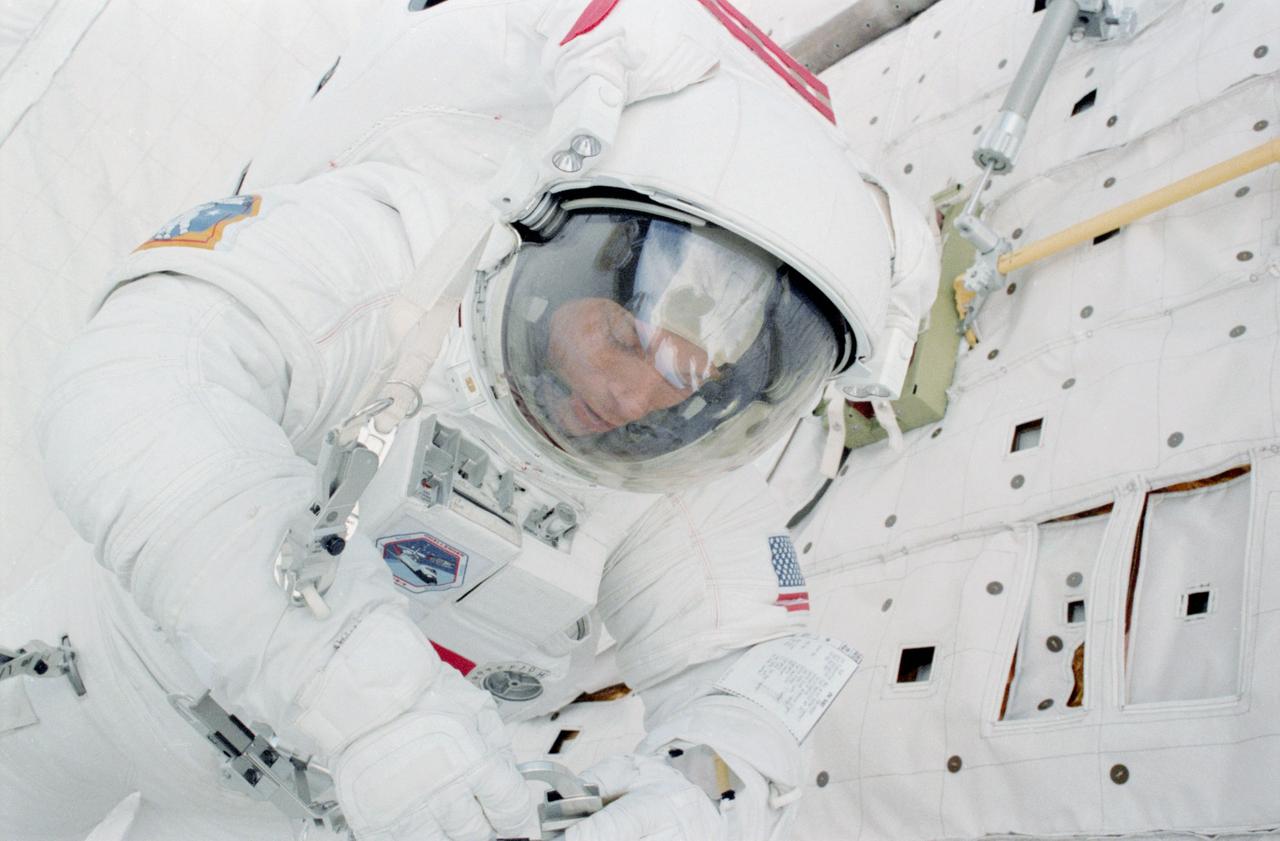
STS006-22-026 (7 April 1983) --- Astronaut F. Story Musgrave, one of two STS-6 mission specialists who performed a lengthy, successful extravehicular activity (EVA) in the cargo bay of the Earth orbiting space shuttle Challenger, anchors himself near the forward bulkhead of the reusable vehicle. Astronaut Donald H. Peterson, sharing the cargo bay with Dr. Musgrave, exposed this frame with a 35mm camera, while astronauts Paul J. Weitz, commander, and Karol J. Bobko, pilot, remained in the cabin. Photo credit: NASA
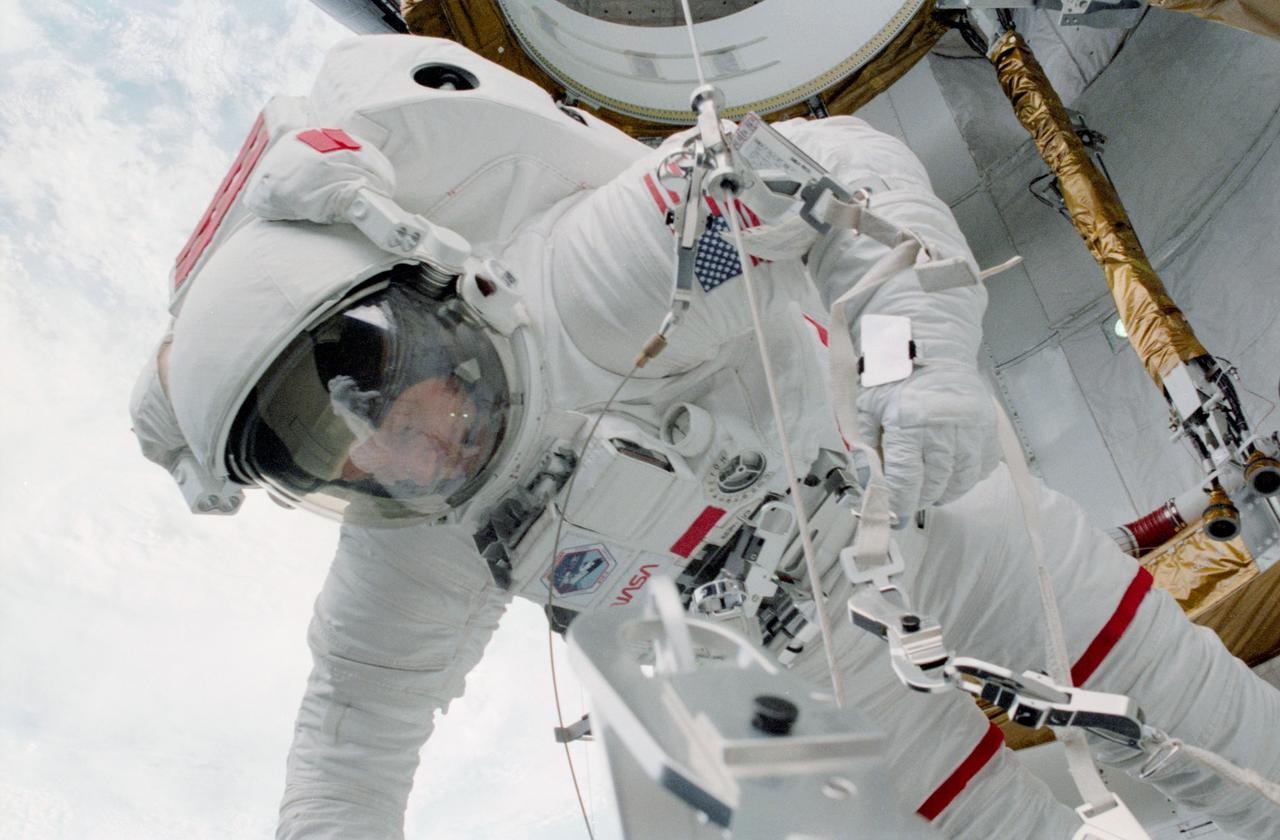
STS006-22-038 (7 April 1983) --- Astronaut F. Story Musgrave, one of two STS-6 mission specialists who performed a long, successful extravehicular activity (EVA) in the cargo bay of the Earth-orbiting space shuttle Challenger, moves along a slide wire near the now vacated inertial upper stage’s (ISU) airborne support equipment (ASE). Astronaut Donald H. Peterson, sharing the cargo bay with Dr. Musgrave, exposed this frame with a 35mm camera, while astronauts Paul J. Weitz, commander; Karol J. Bobko, pilot, remained in the cabin. Photo credit: NASA

STS007-08-396 (18-24 June 1983) --- Astronaut Robert L. Crippen, STS-7 commander, used a 35mm camera to expose this frame of the four representatives of the "thirty five new guys" onboard the Earth-orbiting Space Shuttle Challenger. The TFNG (notice Frederick H. Hauck's T-shirt at left) pays tribute to the 1978 astronaut candidate (ASCAN) class of NASA astronauts. Others in the photograph are Astronauts Norman E. Thagard, Sally K. Ride and John M. Fabian. Hauck is the crew's pilot and the other three are mission specialist. The crew members are in the process of preparing a snack of meal. The tall experiment in the background is the Continuous Flow Electrophoresis System (CFES).
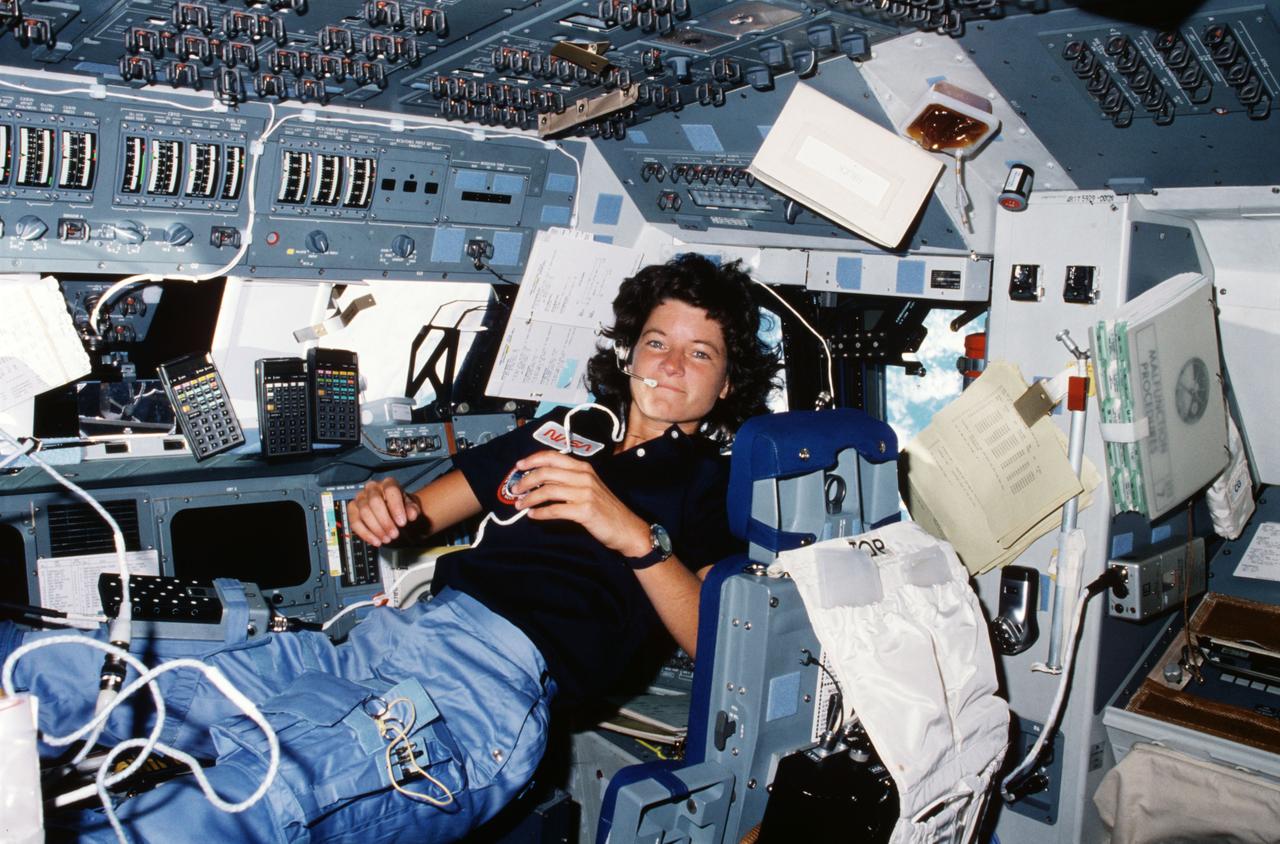
STS007-14-629 (21 June 1983) --– Astronaut Sally K. Ride, STS-7 mission specialist, performs a number of functions simultaneously, proving the necessity for versatility and dexterity in space travel. Floating freely on the flight deck, Dr. Ride communicates with ground controllers in Houston, moves within feet of important reference data, hand calculators and other aids all at the same time. She is one of the five astronaut crew members for the Challenger’s second orbital mission. Her head is in the station normally occupied by the pilot (in this case, Frederick H. (Rick) Hauck) and her feet are anchored at the station for the crew commander (in this case, Robert L. Crippen). Photo credit: NASA

S83-35782 (18 June 1983) --- An Orbital Maneuvering System (OMS) engine firing caused this bright glow at the aft end of the Earth-orbiting space shuttle Challenger on June 18, 1983. Also visible in the 70mm exposure are parts of the Shuttle Pallet Satellite (SPAS-01). The experiment package for NASA's Office of Space and Terrestrial Applications (OSTA-2), the protective cradles for the Indonesian Palapa-B and Telesat Canada Anik C2 satellites, some getaway special (GAS) canisters and the Canadian-built Remote Manipulator System (RMS). The firing took place less than an hour after deployment of Anik. Photo credit: NASA
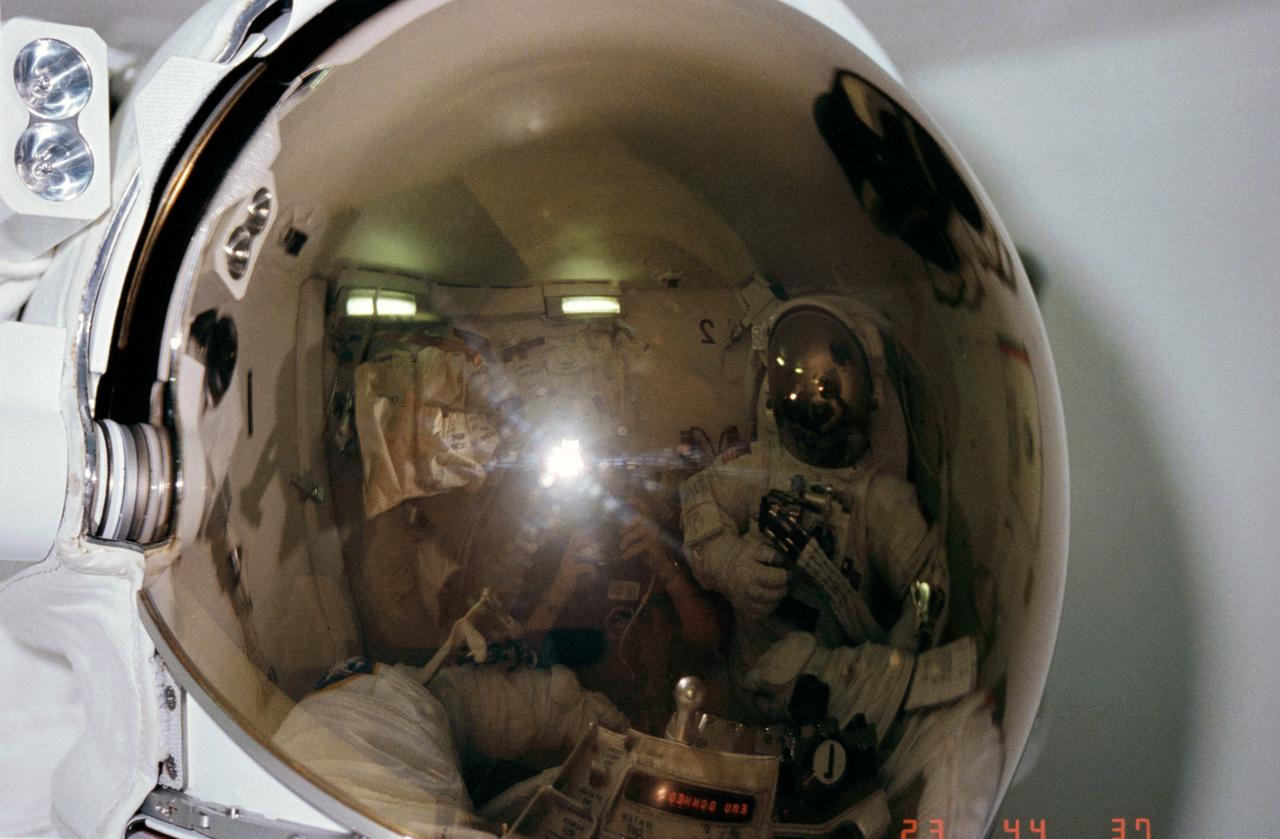
STS006-06-465 (7 April 1983) --- Three-fourths of the STS-6 astronaut crew appears in this unusual 35mm frame exposed in the airlock of the Earth-orbiting space shuttle Challenger. Astronaut F. Story Musgrave’s helmet visor encompasses all the action in the frame. Dr. Musgrave and astronaut Donald H. Peterson (reflected on right side of the visor) were fully suited in their Extravehicular Mobility Unit (EMU) spacesuits and were participating in EVA preparation exercises. Astronaut Karol J. Bobko, STS-6 pilot, wearing conventional onboard shuttle clothing, photographed the two during their procedures and appears at center of frame. The reversed number (1 and 2 in the mirrored image represent the EVA designations for the two mission specialists. Photo credit: NASA
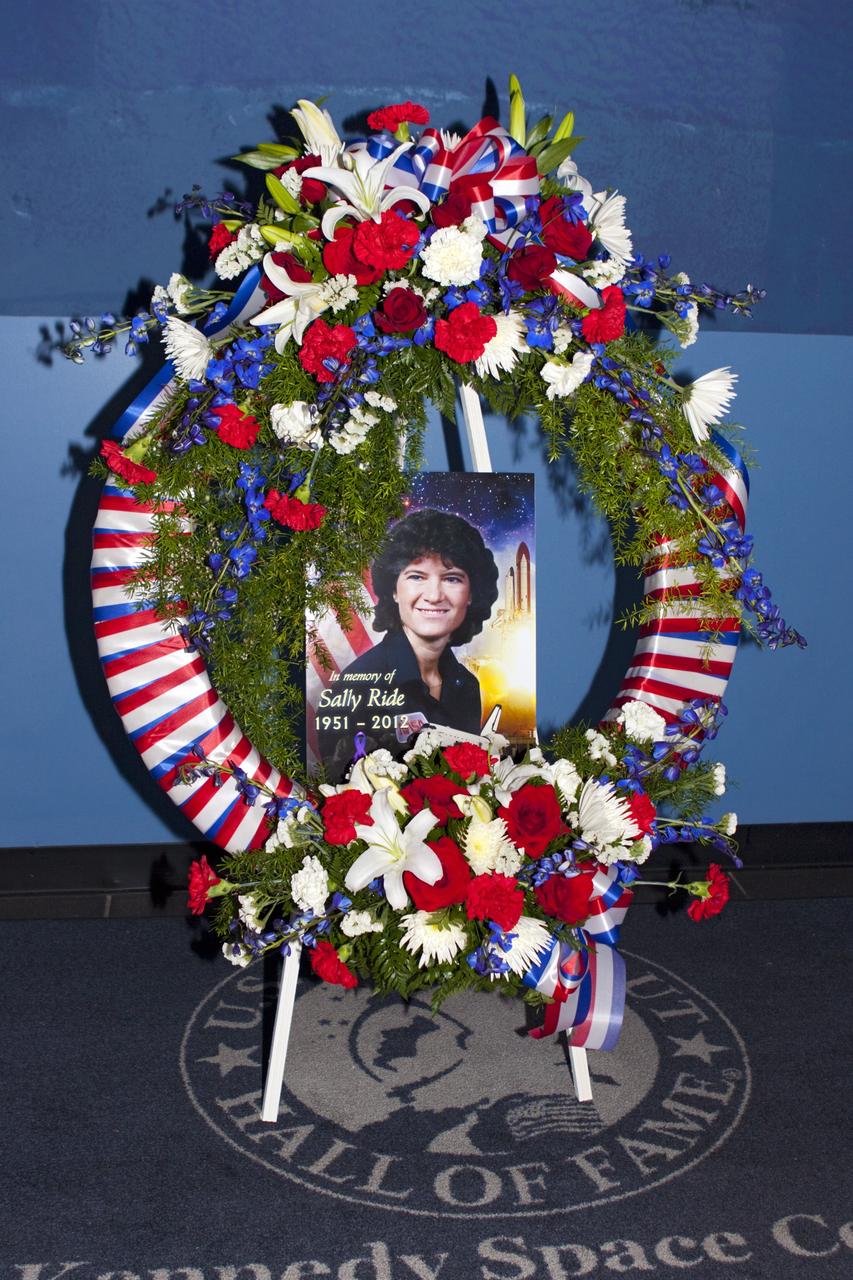
TITUSVILLE, Fla. - A wreath was laid at the U. S. Astronaut Hall of Fame honoring Sally K. Ride, who became America's first woman in space in 1983. Following her death on July 23, 2012, Ride is being remembered for her service to NASA and for her efforts to encourage children to study math, science and technology. A California-born physicist, she broke the gender barrier 29 years ago when she rode to orbit aboard space shuttle Challenger on STS-7. Ride subsequently served, again as a mission specialist, on STS-41G in 1984. Following her career with NASA, in 2001 Ride founded her own company, Sally Ride Science, to pursue her long-time passion of motivating youth -- especially girls and young women -- to pursue careers in technical fields. Photo credit: NASA/Jim Grossmann
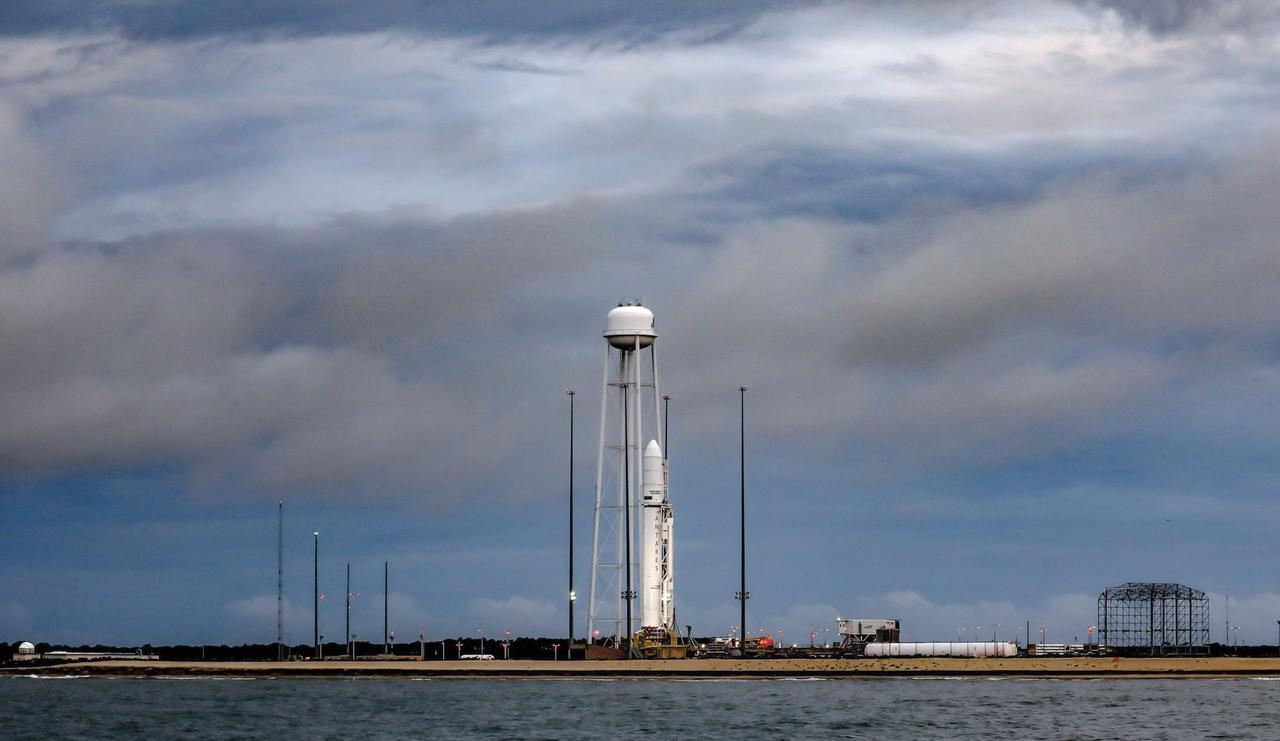
A Northrop Grumman Antares rocket carrying a Cygnus resupply spacecraft is seen at sunrise on the Mid-Atlantic Regional Spaceport’s Pad-0A, Aug. 7, 2021, at NASA's Wallops Flight Facility in Virginia. Northrop Grumman’s 16th contracted cargo resupply mission with NASA to the International Space Station will deliver nearly 8,200 pounds of science and research, crew supplies and vehicle hardware to the orbital laboratory and its crew. Northrop Grumman named the NG CRS-16 Cygnus spacecraft after NASA astronaut Ellison Onizuka, in honor of his prominence as the first Asian American astronaut. Onizuka was hired in 1978 in the first class of diverse astronauts, and his first spaceflight was aboard space shuttle Discovery in January 1985 for STS-51-C. He lost his life aboard the space shuttle Challenger in 1986. Launch is scheduled for 5:56 p.m. EDT, Tuesday, Aug. 10, 2021. Photo Credit: NASA/Terry Zaperach
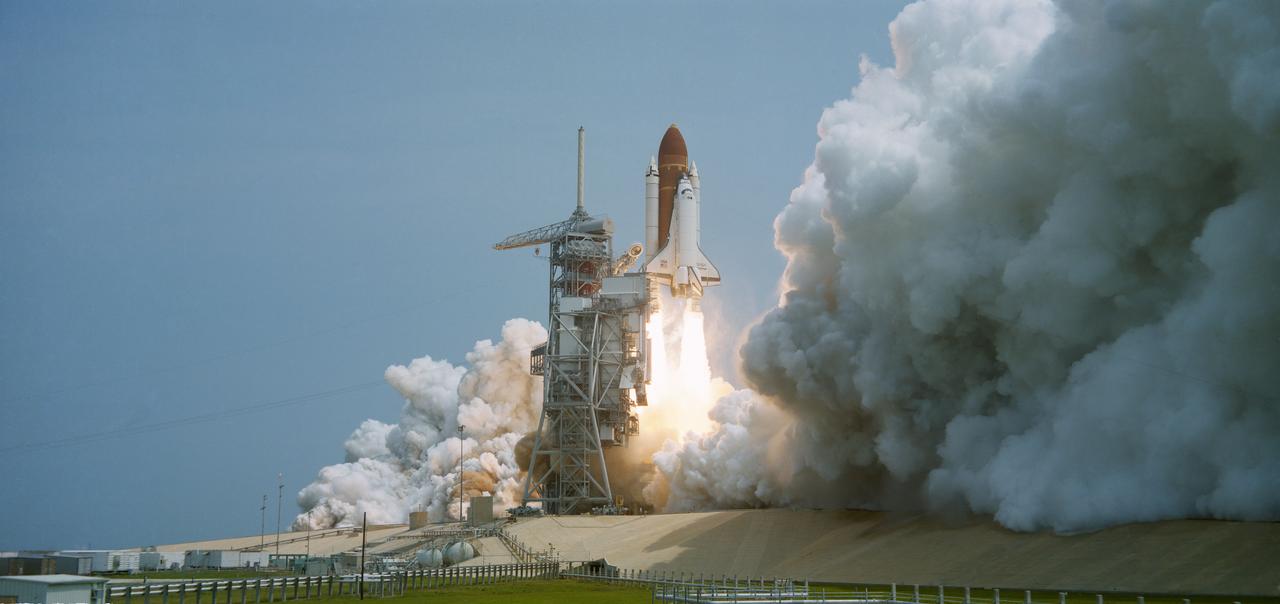
51B-S-052 (20 April 1985) --- The STS 51-B Spacelab 3 mission begins with the liftoff of the Challenger from Pad 39A at 12:02 p.m. (EDT). The Spacelab-3 configuration consists of a long module and a Mission Experiment Support Structure (MPESS). The object of the mission is to conduct applications, science and technology-oriented experimentation requiring the low-gravity of Earth orbit and extended duration stable vehicle attitude. Mission emphasis will be on materials processing. The seven-member crew consists of astronauts Robert F Overmyer, commander; Frederick D. Gregory, pilot; Don L. Lind, Norman E. Thagard and William E. Thornton; all mission specialists and payload specialists Taylor G. Wang and Lodewijk van den Berg. The mission is planned for 7 days with a landing at Dryden Flight Research Facility, Edwards California scheduled for May 6.
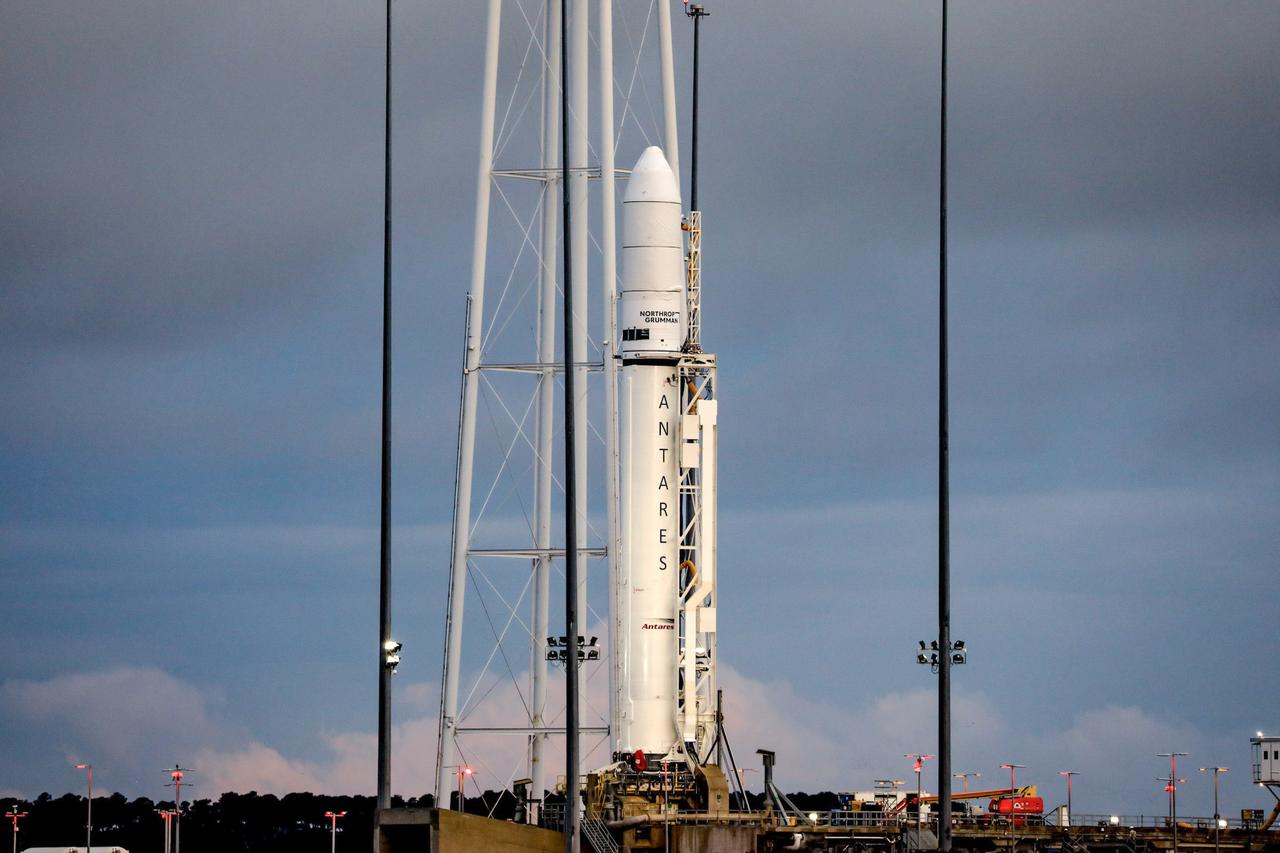
A Northrop Grumman Antares rocket carrying a Cygnus resupply spacecraft is seen at sunrise on the Mid-Atlantic Regional Spaceport’s Pad-0A, Aug. 7, 2021, at NASA's Wallops Flight Facility in Virginia. Northrop Grumman’s 16th contracted cargo resupply mission with NASA to the International Space Station will deliver nearly 8,200 pounds of science and research, crew supplies and vehicle hardware to the orbital laboratory and its crew. Northrop Grumman named the NG CRS-16 Cygnus spacecraft after NASA astronaut Ellison Onizuka, in honor of his prominence as the first Asian American astronaut. Onizuka was hired in 1978 in the first class of diverse astronauts, and his first spaceflight was aboard space shuttle Discovery in January 1985 for STS-51-C. He lost his life aboard the space shuttle Challenger in 1986. Launch is scheduled for 5:56 p.m. EDT, Tuesday, Aug. 10, 2021. Photo Credit: NASA/Terry Zaperach
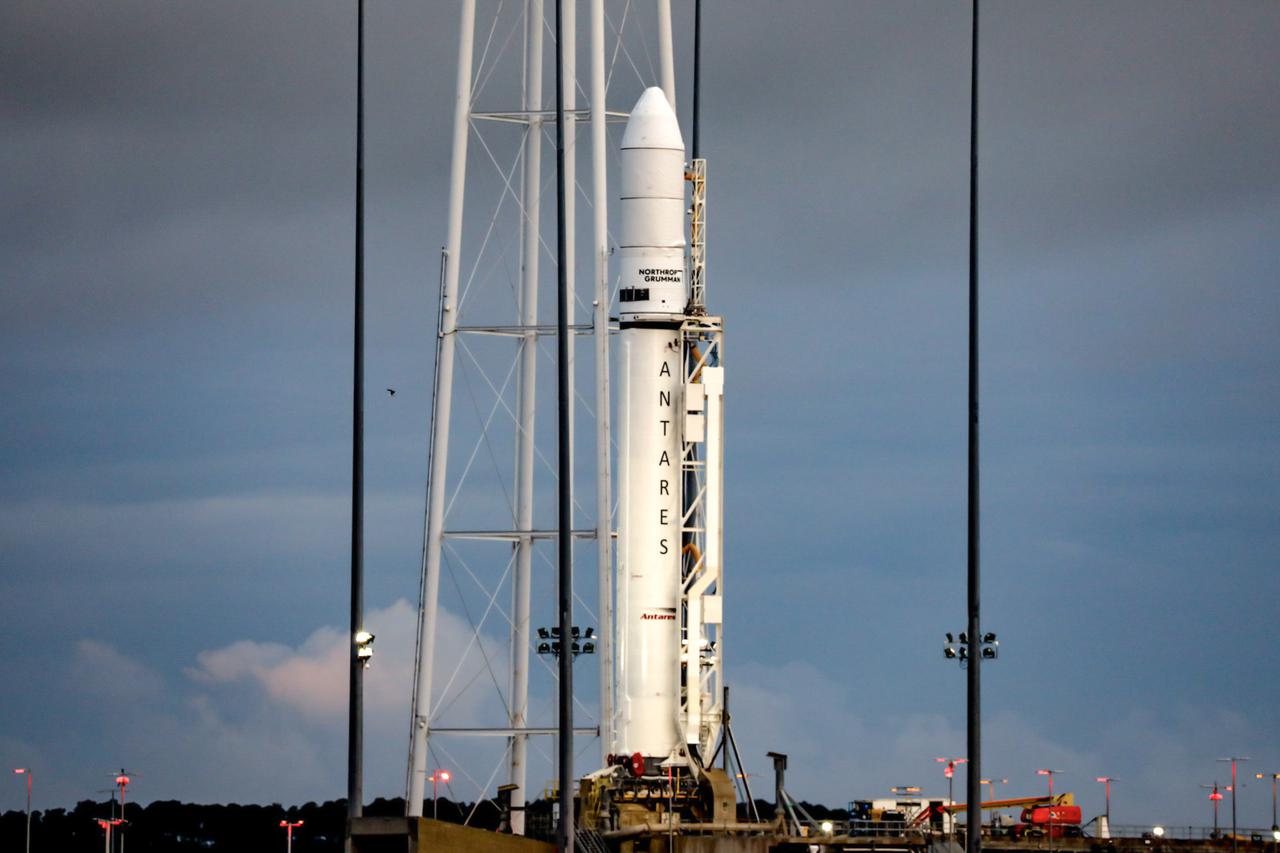
A Northrop Grumman Antares rocket carrying a Cygnus resupply spacecraft is seen at sunrise on the Mid-Atlantic Regional Spaceport’s Pad-0A, Aug. 7, 2021, at NASA's Wallops Flight Facility in Virginia. Northrop Grumman’s 16th contracted cargo resupply mission with NASA to the International Space Station will deliver nearly 8,200 pounds of science and research, crew supplies and vehicle hardware to the orbital laboratory and its crew. Northrop Grumman named the NG CRS-16 Cygnus spacecraft after NASA astronaut Ellison Onizuka, in honor of his prominence as the first Asian American astronaut. Onizuka was hired in 1978 in the first class of diverse astronauts, and his first spaceflight was aboard space shuttle Discovery in January 1985 for STS-51-C. He lost his life aboard the space shuttle Challenger in 1986. Launch is scheduled for 5:56 p.m. EDT, Tuesday, Aug. 10, 2021. Photo Credit: NASA/Terry Zaperach
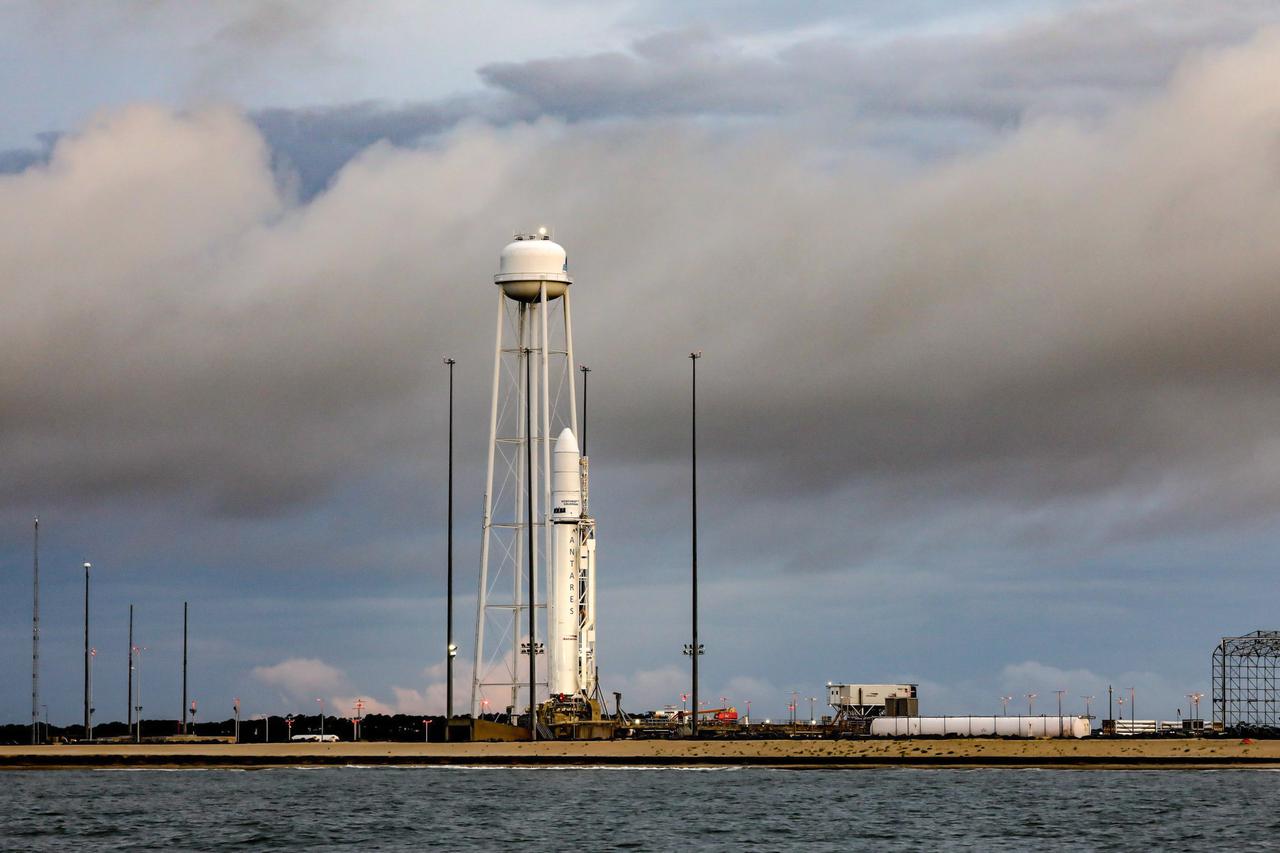
A Northrop Grumman Antares rocket carrying a Cygnus resupply spacecraft is seen at sunrise on the Mid-Atlantic Regional Spaceport’s Pad-0A, Aug. 7, 2021, at NASA's Wallops Flight Facility in Virginia. Northrop Grumman’s 16th contracted cargo resupply mission with NASA to the International Space Station will deliver nearly 8,200 pounds of science and research, crew supplies and vehicle hardware to the orbital laboratory and its crew. Northrop Grumman named the NG CRS-16 Cygnus spacecraft after NASA astronaut Ellison Onizuka, in honor of his prominence as the first Asian American astronaut. Onizuka was hired in 1978 in the first class of diverse astronauts, and his first spaceflight was aboard space shuttle Discovery in January 1985 for STS-51-C. He lost his life aboard the space shuttle Challenger in 1986. Launch is scheduled for 5:56 p.m. EDT, Tuesday, Aug. 10, 2021. Photo Credit: NASA/Terry Zaperach
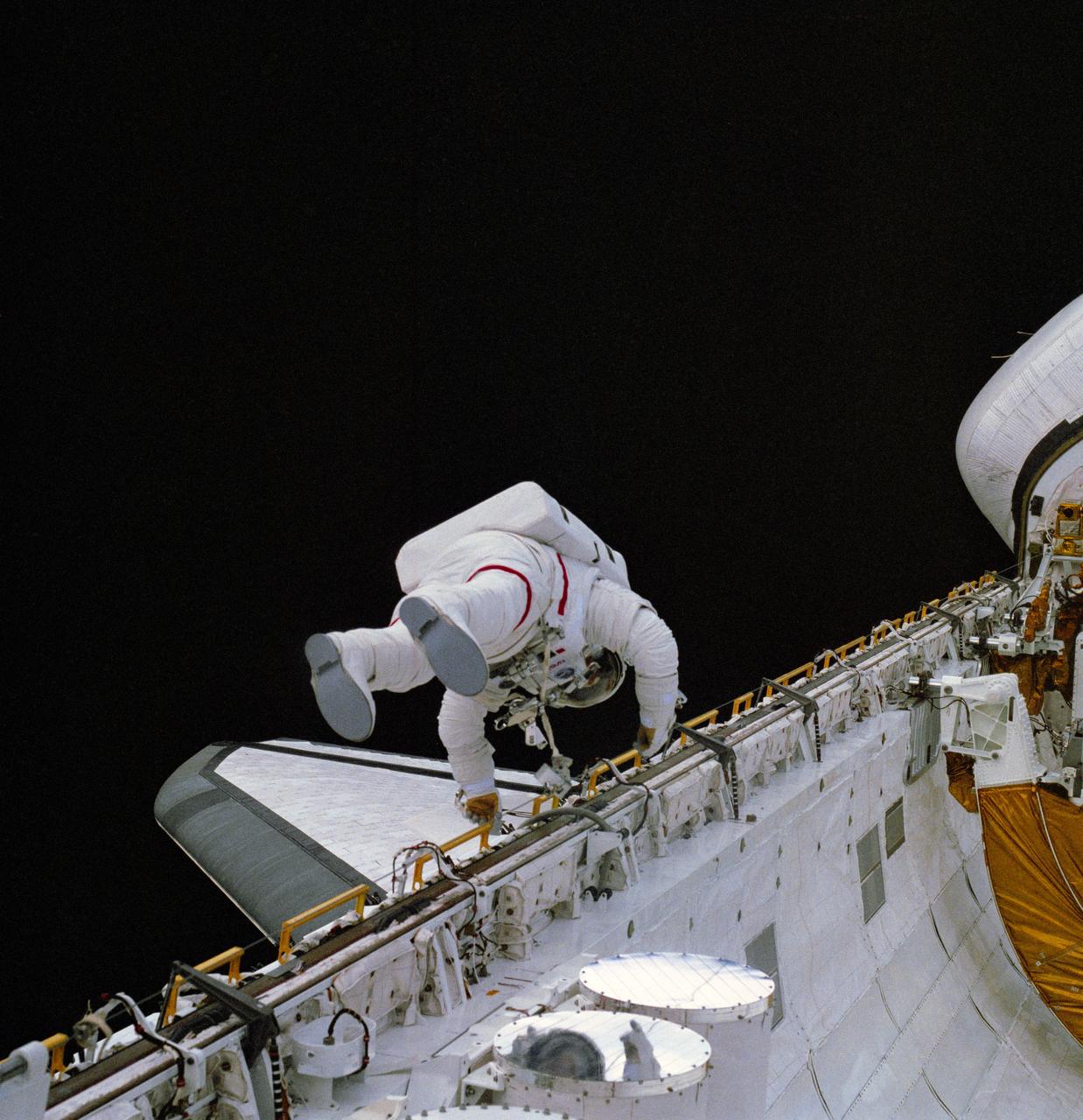
S83-30215 (7 April 1983) --- This photograph of astronaut Story Musgrave, STS-6 mission specialist, translating along the longerons on the port side of the cargo bay of the Earth-orbiting space shuttle Challenger was taken with a hand-held 70mm camera from some 18 meters (60 feet) away by one of two crew members who remained inside the cabin. Astronauts Musgrave and Donald H. Peterson (out of frame) were in the midst of NASA?s first ever shuttle extravehicular activity (EVA). Astronaut Karol J. Bobko, pilot, took a number of photographs through the aft flight deck?s windows, and astronaut Paul J. Weitz, mission commander, also exposed some images but remained in control of the orbiter during the EVA. Photo credit: NASA
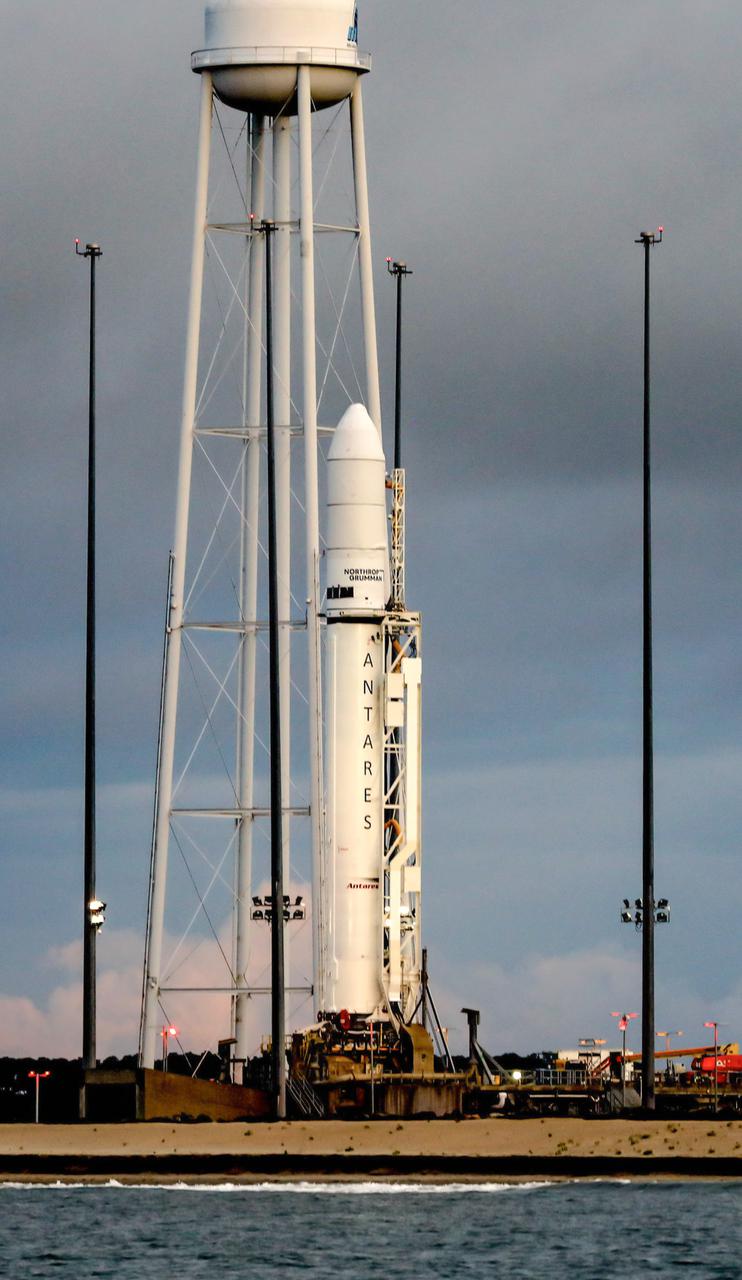
A Northrop Grumman Antares rocket carrying a Cygnus resupply spacecraft is seen at sunrise on the Mid-Atlantic Regional Spaceport’s Pad-0A, Aug. 7, 2021, at NASA's Wallops Flight Facility in Virginia. Northrop Grumman’s 16th contracted cargo resupply mission with NASA to the International Space Station will deliver nearly 8,200 pounds of science and research, crew supplies and vehicle hardware to the orbital laboratory and its crew. Northrop Grumman named the NG CRS-16 Cygnus spacecraft after NASA astronaut Ellison Onizuka, in honor of his prominence as the first Asian American astronaut. Onizuka was hired in 1978 in the first class of diverse astronauts, and his first spaceflight was aboard space shuttle Discovery in January 1985 for STS-51-C. He lost his life aboard the space shuttle Challenger in 1986. Launch is scheduled for 5:56 p.m. EDT, Tuesday, Aug. 10, 2021. Photo Credit: NASA/Terry Zaperach
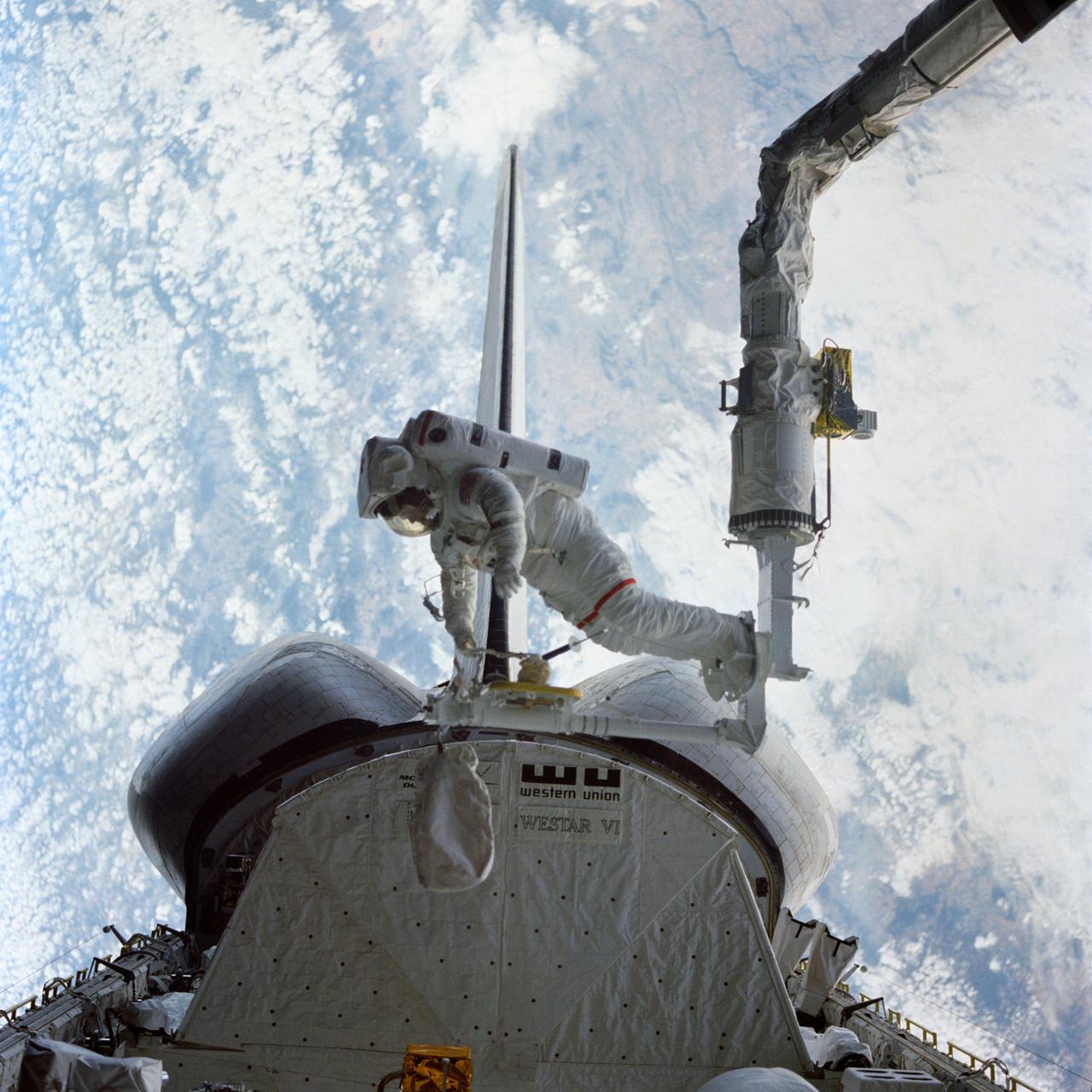
S84-27021 (7 Feb 1984) --- Astronaut Bruce McCandless II, 41B mission specialist tests a "cherry-picker" type device during February 7 historical Extravehicular Activity (EVA). The EVA, in which Astronauts McCandless and Robert L. Stewart, two of three STS-41B mission specialists, participated, marked two firsts--initial use of both the Mobile Foot Restraint (MFR) attached to the Remote Manipulator System (RMS) arm here, and the Manned Maneuvering Unit (MMU) backpack (not seen in this frame). The Challenger was flying with its aft end aimed toward the Earth. This photograph clearly shows where the MFR connects to the end effector of the Canadian-built RMS arm. The two spacewalkers were monitored and photographed by their fellow crewmembers, astronauts Vance D. Brand, commander; Robert L. Gibson, pilot; and Ronald E. McNair, mission specialist. The three remained in the cabin for another EVA session two days later. Photo Credit: NASA
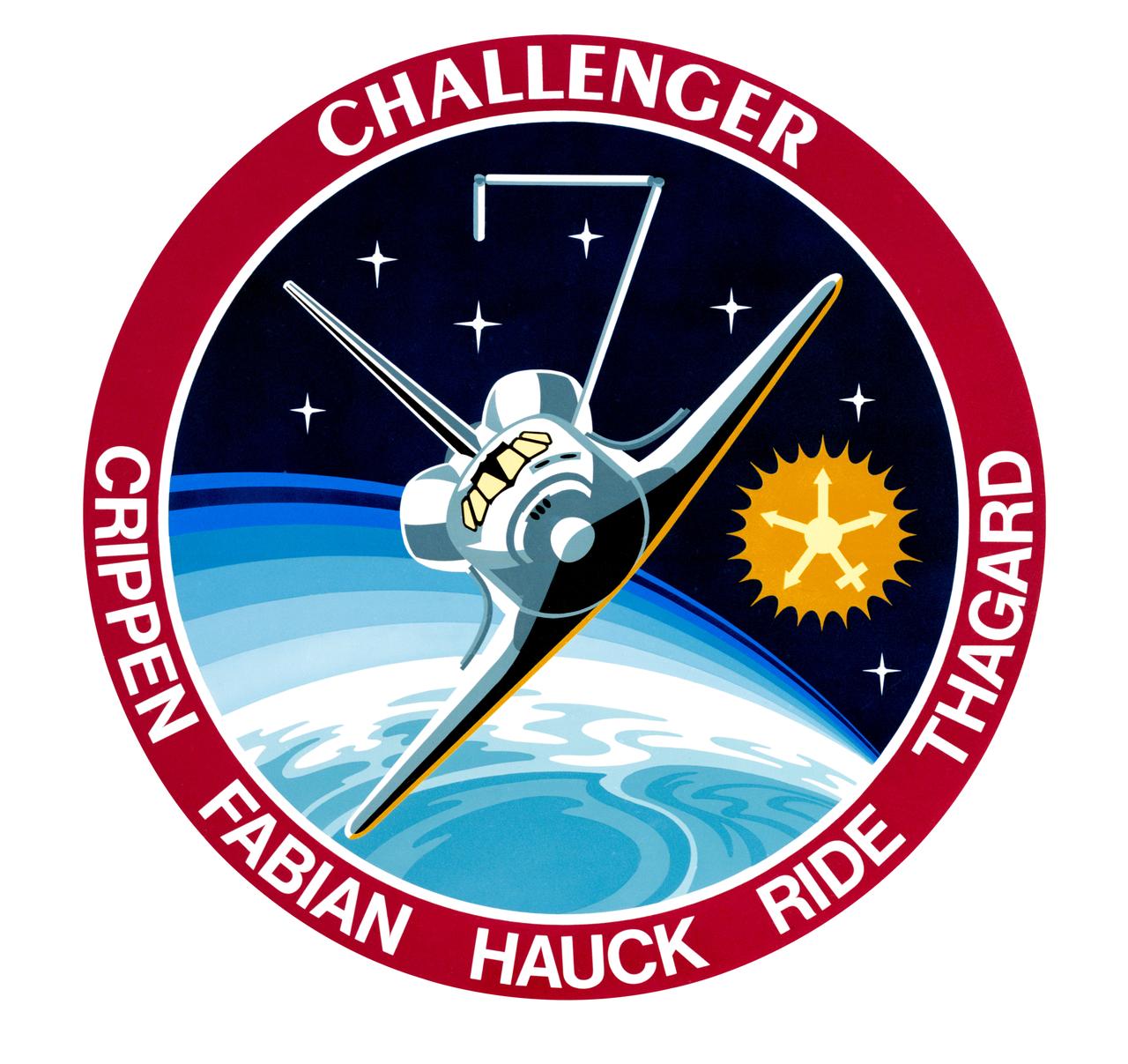
S83-28355 (March 1983) --- The space shuttle Challenger, making its second flight into space on STS-7, is featured in the art for the insignia for that NASA flight. The remote manipulator arm is positioned such that, the number 7 is formed. Likewise, seven stars are visible against the black sky. Within the sun?s center are representations for the five crew members, including, for the first time in NASA?s space program, a woman ? Dr. Sally K. Ride, mission specialist. The crew member?s surnames are listed along the outside edge of the sphere. They are astronauts Robert L. Crippen, commander; Frederick H. Hauck, pilot; John M. Fabian, Sally K. Ride and Norman E. Thagard, mission specialists. The flight is scheduled for the first week of June 1983. The NASA insignia design for space shuttle flights is reserved for use by the astronauts and for other official use as the NASA Administrator may authorize. Public availability has been approved only in the forms of illustrations by the various news media. When and if there is any change in this policy, which is not anticipated, the change will be publicly announced. Photo credit: NASA
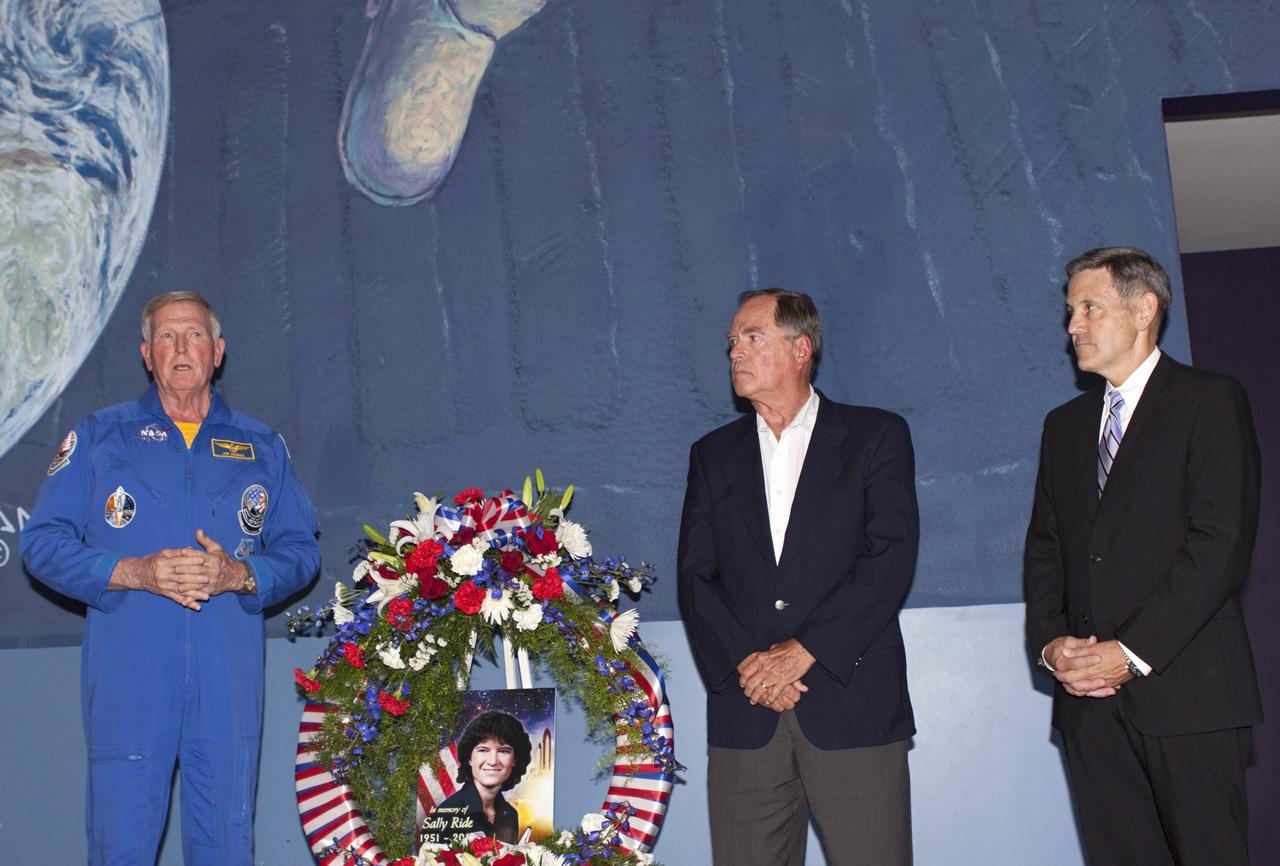
TITUSVILLE, Fla. - Former astronauts Jon McBride, left, and Bob Crippen, center, along with Kennedy Space Center director Bob Cabana, also a former astronaut, laid a wreath at the U. S. Astronaut Hall of Fame honoring Sally K. Ride, who became America's first woman in space in 1983. Following her death on July 23, 2012, Ride is being remembered for her service to NASA and for her efforts to encourage children to study math, science and technology. Crippen was commander on both of Ride's space shuttle missions. McBride was pilot on her second flight. Ride was inducted into the Astronaut Hall of Fame in 2003. A California-born physicist, she broke the gender barrier 29 years ago when she rode to orbit aboard space shuttle Challenger on STS-7. Ride subsequently served, again as a mission specialist, on STS-41G in 1984. Following her career with NASA, in 2001 Ride founded her own company, Sally Ride Science, to pursue her long-time passion of motivating youth -- especially girls and young women -- to pursue careers in technical fields. Photo credit: NASA/Jim Grossmann
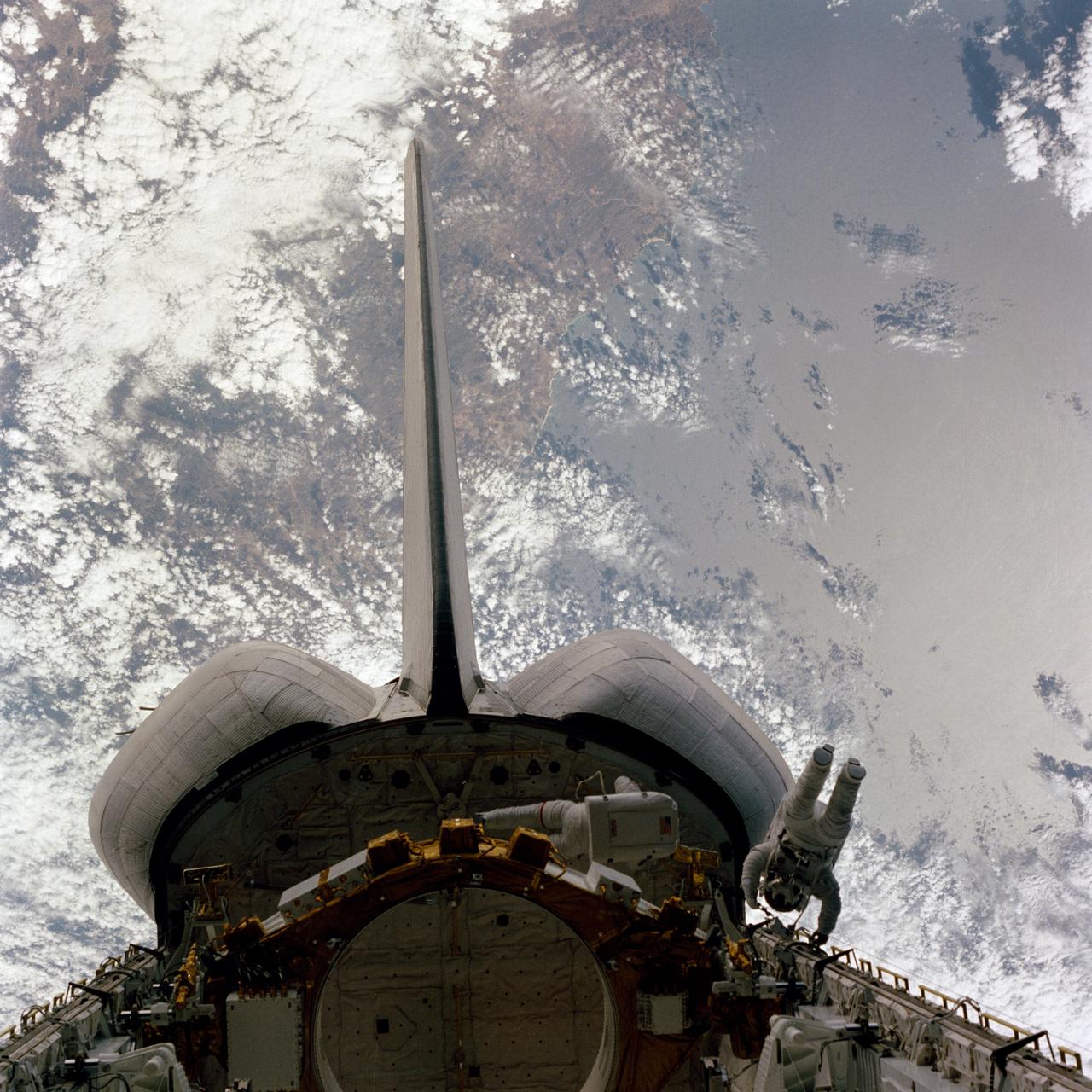
STS006-45-111 (7 April 1983) --- Astronaut Donald H. Peterson (port side) and F. Story Musgrave, STS-6 mission specialists, evaluate the handrail system on the starboard longeron and aft bulkhead, respectively, during a long extravehicular activity (EVA) aboard the Earth-orbiting space shuttle Challenger. The vertical stabilizer and orbital maneuvering system (OMS) pods frame a portion of Mexico?s state of Jalisco below. Punta Farallon and Sahta da Tencatita, about 120 kilometers (75 miles) south of Puerto Vallarta, are visible. Pacific waters form about half of the backdrop for this scene, photographed by one of two crew members who remained inside the spacecraft during the EVA. Astronaut Karol J. Bobko, pilot, took a number of pictures of his fellow crew members during their outside tasks and astronaut Paul J. Weitz, commander, took some photographs while remaining in command of the reusable vehicle. Photo credit: NASA

“When I first joined Twitter in 2009, one of the first accounts I followed was NASA. I knew they were doing NASA ‘Tweetups’ (now called Socials) where members of the public could apply, go behind the scenes of a NASA facility and potentially attend a launch. “I was selected for the STS-135 Tweetup — the final launch of the Space Shuttle, July 2011. The Tweetup gave me access that I never in my life thought I’d be able to experience. Being inside the Vehicle Assembly Building, where Saturn rockets were assembled, where the Space Shuttle was stacked and now where the SLS is going to be stacked… that for me, was incredible. “We got to Kennedy for the launch on July 7. There were severe thunderstorms and lightning all around. The weather was not looking good for the next day. “The next morning, we get to the press site, and the weather continues to look like it’s going to prevent the launch. There was a 30% chance. I didn’t think it was going to happen. “And then, there was a break in the clouds. And at 11:28 am, the Shuttle launches. It was such a physical, emotional experience. I remember feeling the sound waves. I was just so excited, so thrilled, so overcome by seeing all these people put in so many hours on something that was bigger than themselves, working toward making this mission a success. And that was the culmination of it: 5 million pounds of thrust lifting this vehicle 250 miles off the planet. “I thought, ‘wow, Atlantis took off with just a 30% chance.’ So, I try to take that with me whenever I face a challenging situation. And that’s kind of why I was teetering on not applying for my first NASA internship in 2013. But I thought to myself, ‘well, that vehicle took off in not-so-ideal conditions. Things aren’t impossible.’ That’s what led me to pursue this career at NASA.” Portrait, Andres Almeida, Thursday, September 19, 2019 at NASA Headquarters in Washington. Photo Credit: (NASA/Aubrey Gemignani)
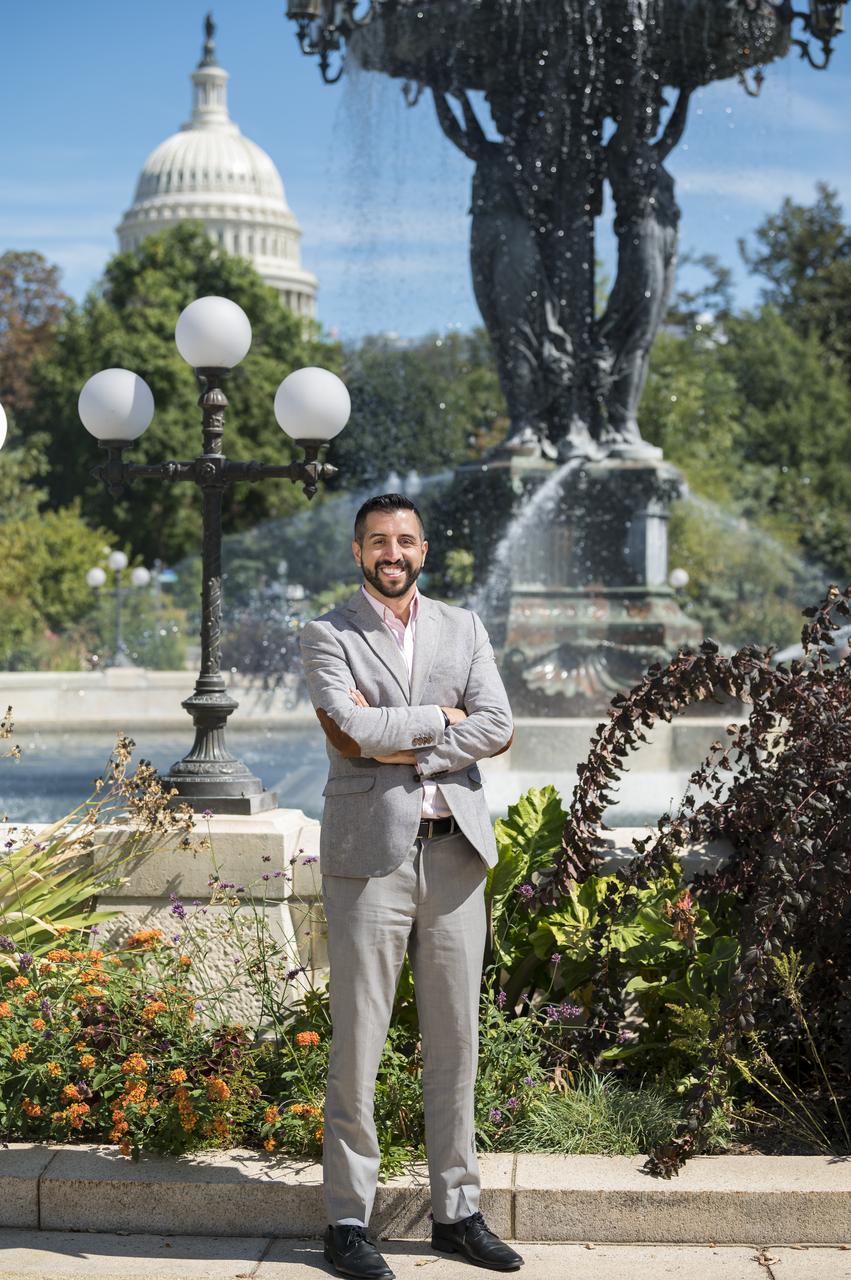
“When I first joined Twitter in 2009, one of the first accounts I followed was NASA. I knew they were doing NASA ‘Tweetups’ (now called Socials) where members of the public could apply, go behind the scenes of a NASA facility and potentially attend a launch. “I was selected for the STS-135 Tweetup — the final launch of the Space Shuttle, July 2011. The Tweetup gave me access that I never in my life thought I’d be able to experience. Being inside the Vehicle Assembly Building, where Saturn rockets were assembled, where the Space Shuttle was stacked and now where the SLS is going to be stacked… that for me, was incredible. “We got to Kennedy for the launch on July 7. There were severe thunderstorms and lightning all around. The weather was not looking good for the next day. “The next morning, we get to the press site, and the weather continues to look like it’s going to prevent the launch. There was a 30% chance. I didn’t think it was going to happen. “And then, there was a break in the clouds. And at 11:28 am, the Shuttle launches. It was such a physical, emotional experience. I remember feeling the sound waves. I was just so excited, so thrilled, so overcome by seeing all these people put in so many hours on something that was bigger than themselves, working toward making this mission a success. And that was the culmination of it: 5 million pounds of thrust lifting this vehicle 250 miles off the planet. “I thought, ‘wow, Atlantis took off with just a 30% chance.’ So, I try to take that with me whenever I face a challenging situation. And that’s kind of why I was teetering on not applying for my first NASA internship in 2013. But I thought to myself, ‘well, that vehicle took off in not-so-ideal conditions. Things aren’t impossible.’ That’s what led me to pursue this career at NASA.” Portrait, Andres Almeida, Thursday, September 19, 2019 at NASA Headquarters in Washington. Photo Credit: (NASA/Aubrey Gemignani)
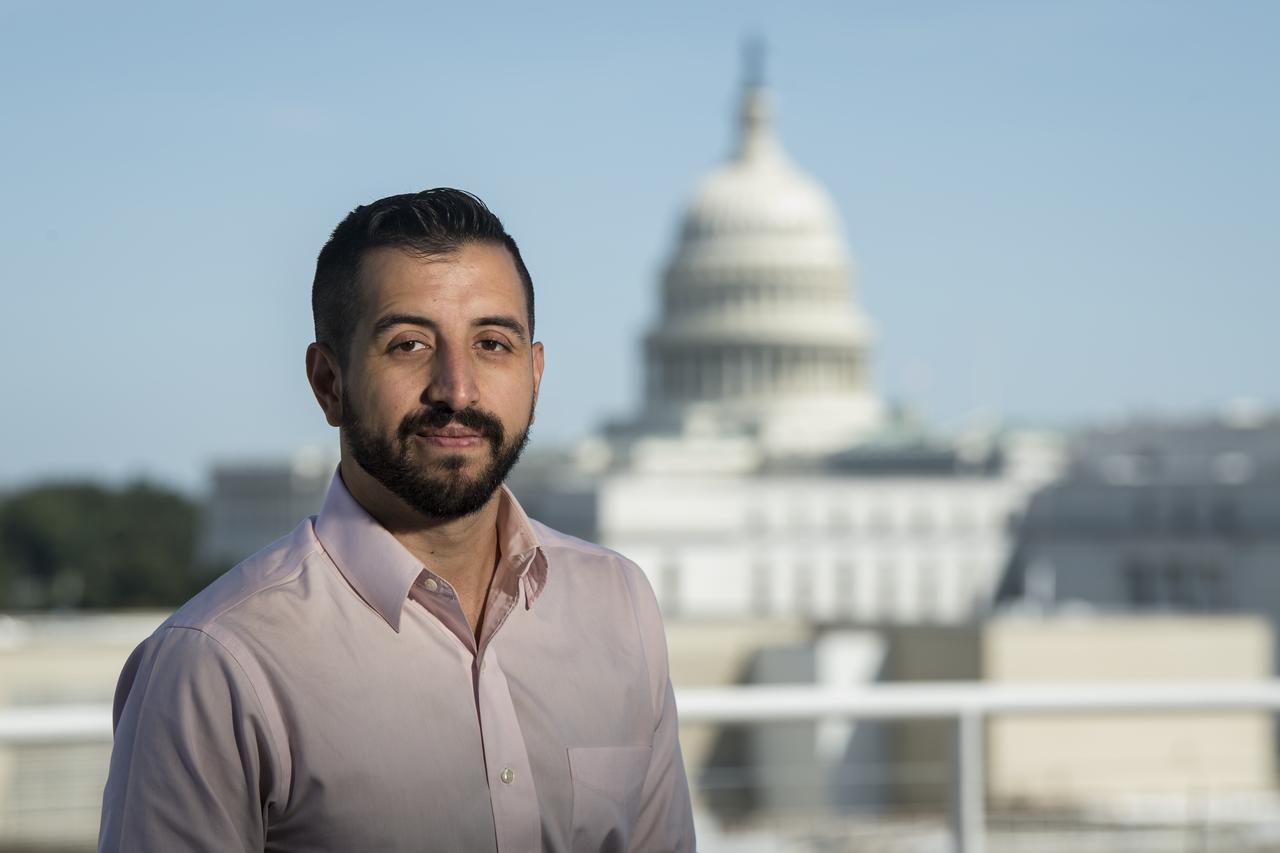
“When I first joined Twitter in 2009, one of the first accounts I followed was NASA. I knew they were doing NASA ‘Tweetups’ (now called Socials) where members of the public could apply, go behind the scenes of a NASA facility and potentially attend a launch. “I was selected for the STS-135 Tweetup — the final launch of the Space Shuttle, July 2011. The Tweetup gave me access that I never in my life thought I’d be able to experience. Being inside the Vehicle Assembly Building, where Saturn rockets were assembled, where the Space Shuttle was stacked and now where the SLS is going to be stacked… that for me, was incredible. “We got to Kennedy for the launch on July 7. There were severe thunderstorms and lightning all around. The weather was not looking good for the next day. “The next morning, we get to the press site, and the weather continues to look like it’s going to prevent the launch. There was a 30% chance. I didn’t think it was going to happen. “And then, there was a break in the clouds. And at 11:28 am, the Shuttle launches. It was such a physical, emotional experience. I remember feeling the sound waves. I was just so excited, so thrilled, so overcome by seeing all these people put in so many hours on something that was bigger than themselves, working toward making this mission a success. And that was the culmination of it: 5 million pounds of thrust lifting this vehicle 250 miles off the planet. “I thought, ‘wow, Atlantis took off with just a 30% chance.’ So, I try to take that with me whenever I face a challenging situation. And that’s kind of why I was teetering on not applying for my first NASA internship in 2013. But I thought to myself, ‘well, that vehicle took off in not-so-ideal conditions. Things aren’t impossible.’ That’s what led me to pursue this career at NASA.” Portrait, Andres Almeida, Thursday, September 19, 2019 at NASA Headquarters in Washington. Photo Credit: (NASA/Aubrey Gemignani)
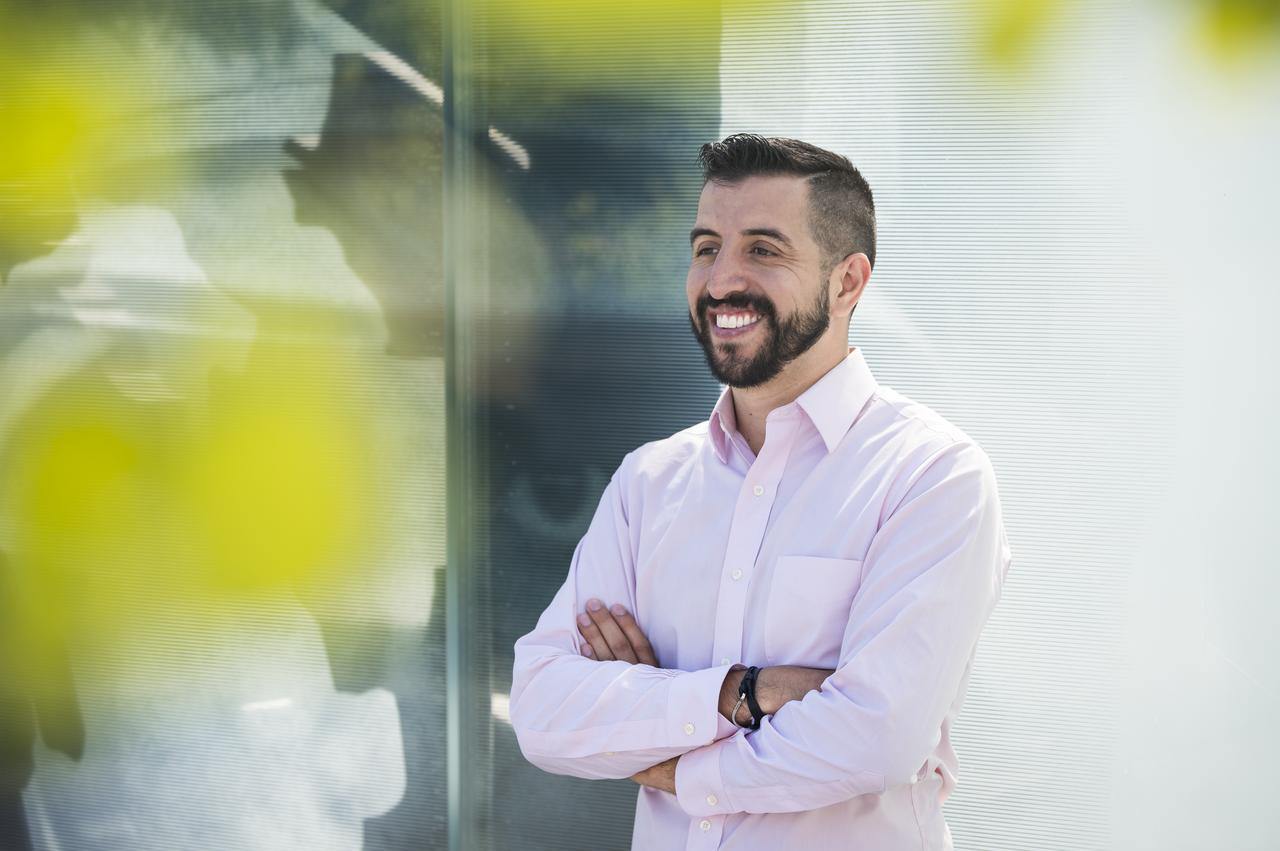
“When I first joined Twitter in 2009, one of the first accounts I followed was NASA. I knew they were doing NASA ‘Tweetups’ (now called Socials) where members of the public could apply, go behind the scenes of a NASA facility and potentially attend a launch. “I was selected for the STS-135 Tweetup — the final launch of the Space Shuttle, July 2011. The Tweetup gave me access that I never in my life thought I’d be able to experience. Being inside the Vehicle Assembly Building, where Saturn rockets were assembled, where the Space Shuttle was stacked and now where the SLS is going to be stacked… that for me, was incredible. “We got to Kennedy for the launch on July 7. There were severe thunderstorms and lightning all around. The weather was not looking good for the next day. “The next morning, we get to the press site, and the weather continues to look like it’s going to prevent the launch. There was a 30% chance. I didn’t think it was going to happen. “And then, there was a break in the clouds. And at 11:28 am, the Shuttle launches. It was such a physical, emotional experience. I remember feeling the sound waves. I was just so excited, so thrilled, so overcome by seeing all these people put in so many hours on something that was bigger than themselves, working toward making this mission a success. And that was the culmination of it: 5 million pounds of thrust lifting this vehicle 250 miles off the planet. “I thought, ‘wow, Atlantis took off with just a 30% chance.’ So, I try to take that with me whenever I face a challenging situation. And that’s kind of why I was teetering on not applying for my first NASA internship in 2013. But I thought to myself, ‘well, that vehicle took off in not-so-ideal conditions. Things aren’t impossible.’ That’s what led me to pursue this career at NASA.” Portrait, Andres Almeida, Thursday, September 19, 2019 at NASA Headquarters in Washington. Photo Credit: (NASA/Aubrey Gemignani)