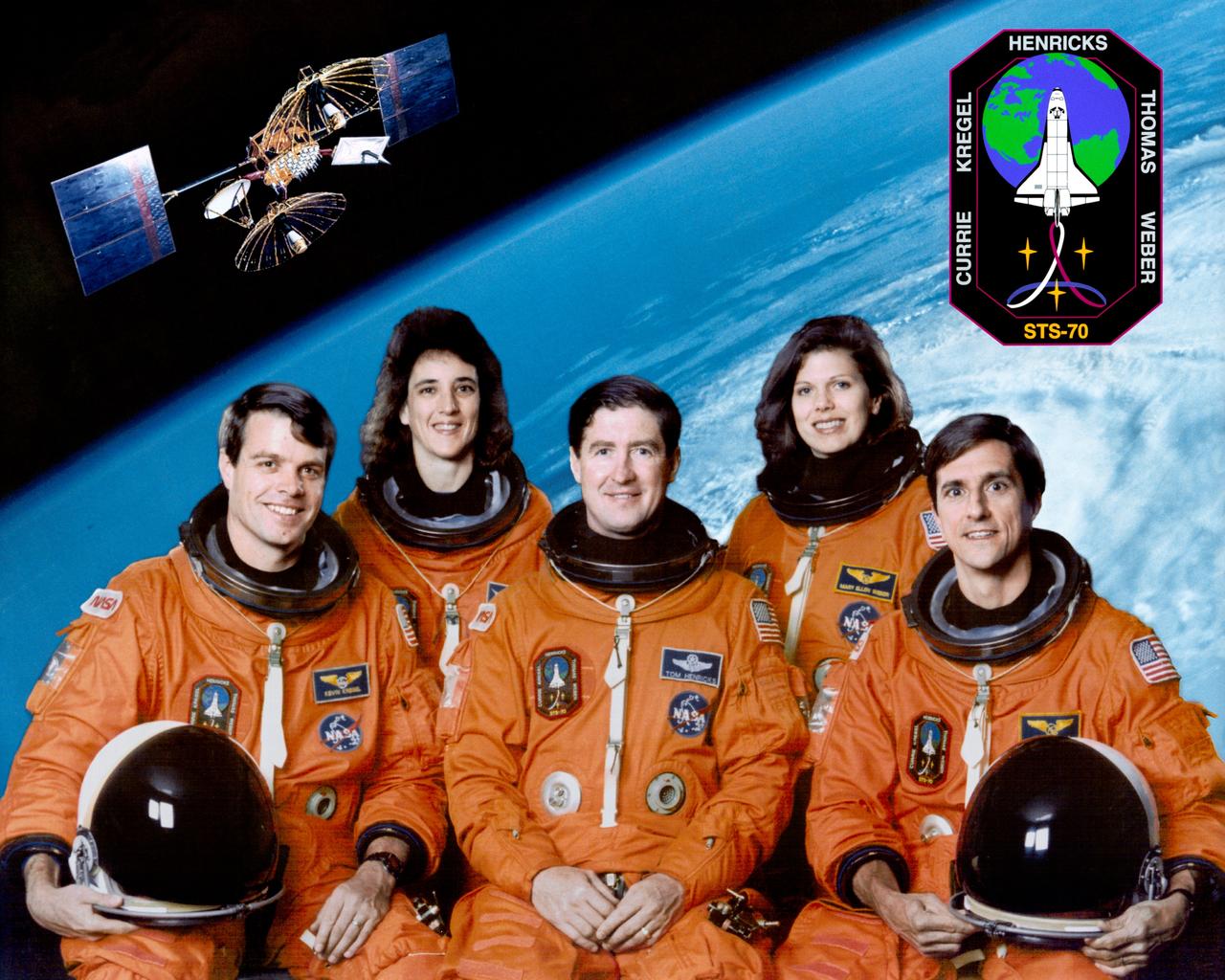
STS070-S-002 (May 1995) --- These five NASA astronauts are in training for the STS-70 mission aboard the Space Shuttle Discovery. Left to right are astronauts Kevin R. Kregel, Nancy J. Currie, Terence T. (Tom) Henricks, Mary Ellen Weber and Donald A. Thomas. Henricks and Kregel are commander and pilot, respectively. The other three are mission specialists. Among the tasks they are expected to perform is the deployment of another satellite in the network of the Tracking and Data Relay Satellite System (TDRSS).
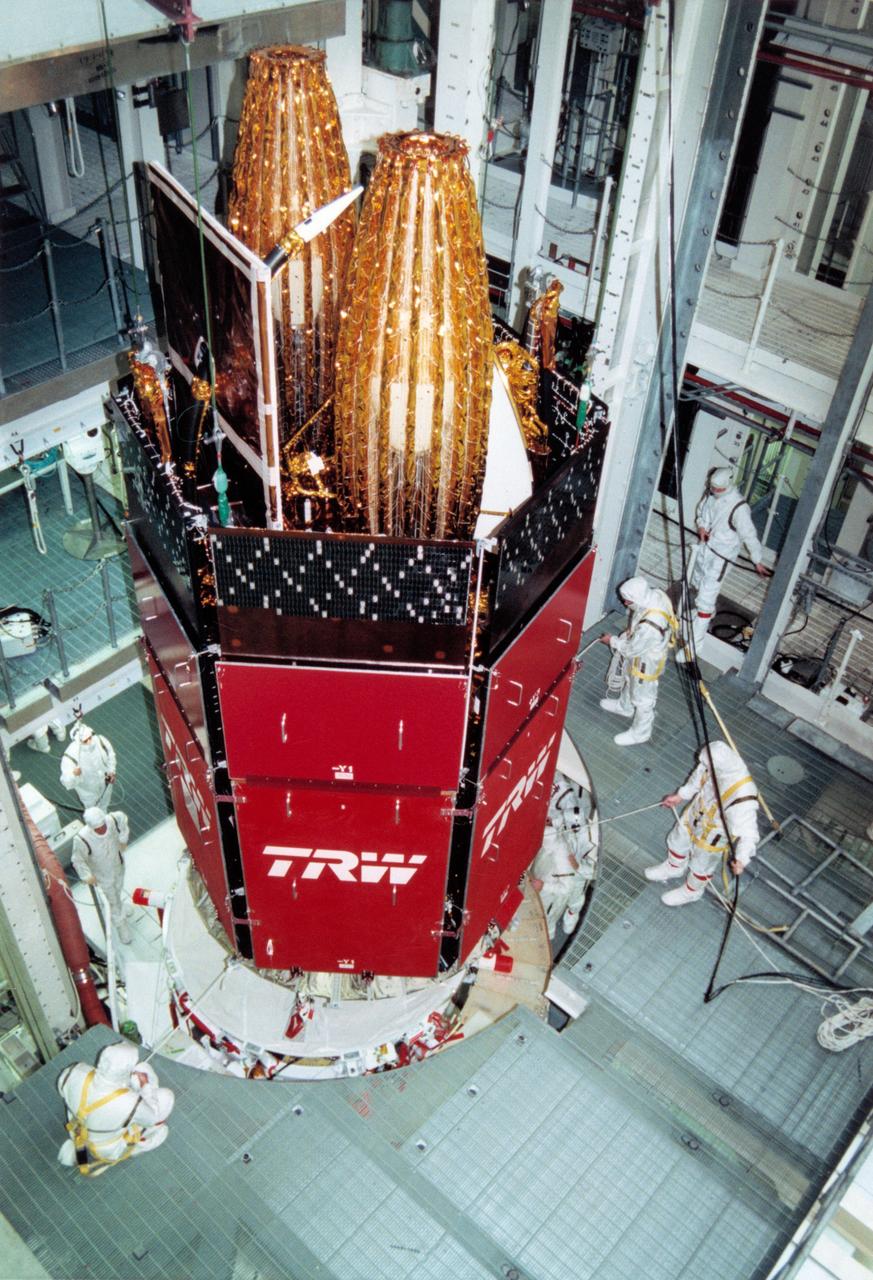
S95-08962 (12 APRIL 1995) --- Members of the Kennedy Space Center (KSC) Payload Processing Team hoist the Tracking and Data Relay Satellite (TDRS-G) into a work stand in the Vertical Processing Facility (VPF) for mating with its Inertial Upper Stage (IUS). After testing and final checkout, TDRS-G and the IUS will be transported to Launch Pad 39B and installed into the Space Shuttle Discovery's payload bay for launch on the STS-70 mission, scheduled for launch June 8, 1995.
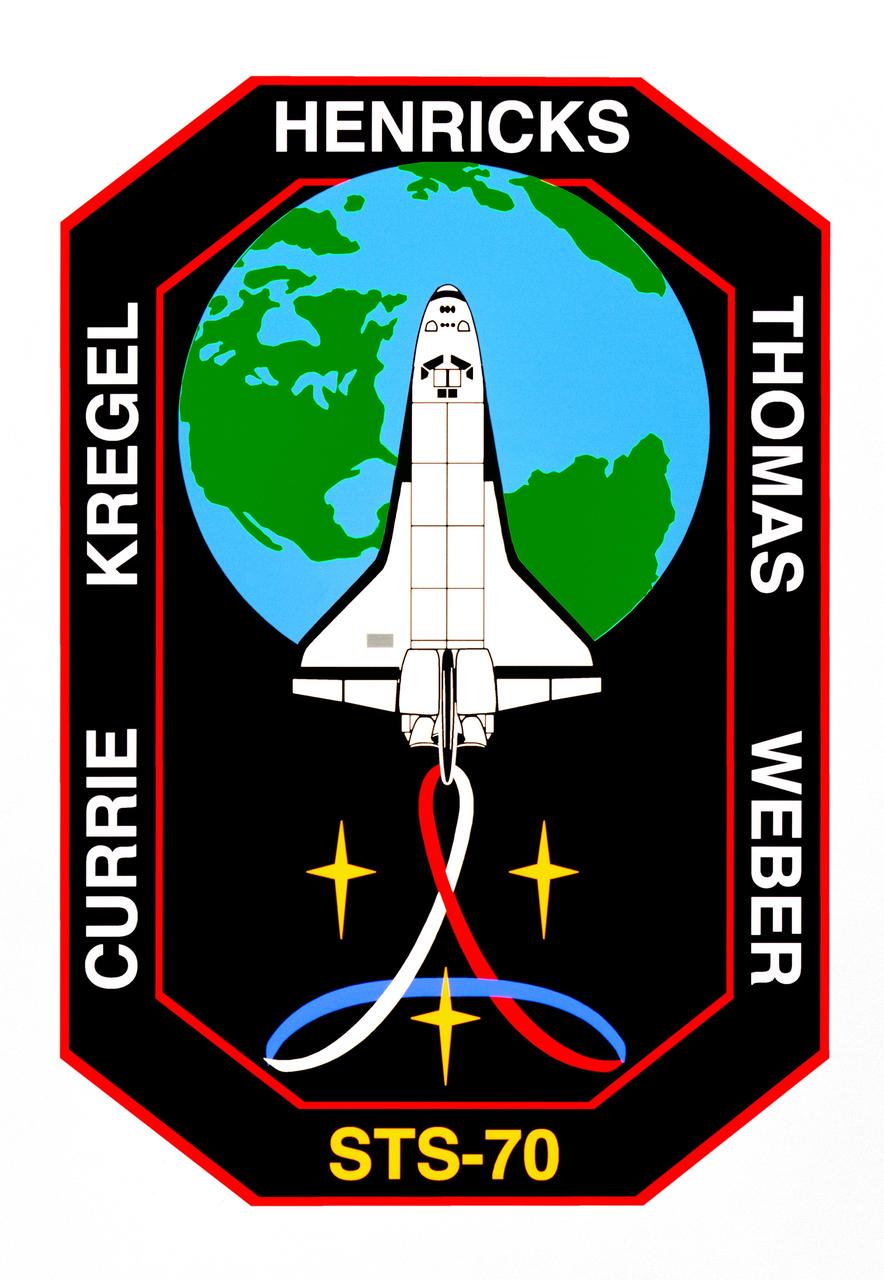
STS070-S-001 (March 1995) --- Designed by the crew members, the STS-70 crew patch depicts the space shuttle Discovery orbiting Earth in the vast blackness of space. The primary mission of deploying a NASA Tracking and Data Relay Satellite (TDRS) is depicted by three gold stars. They represent the triad composed of spacecraft transmitting data to Earth through the Tracking and Data Relay Satellite System (TDRSS). The stylized red, white and blue ribbon represents the American goal of linking space exploration to the advancement of all humankind. Surnames of the five astronaut crew members are spaced around the periphery of the patch. The NASA insignia design for space shuttle flights is reserved for use by the astronauts and for other official use as the NASA Administrator may authorize. Public availability has been approved only in the forms of illustrations by the various news media. When and if there is any change in this policy, which is not anticipated, the change will be publicly announced. Photo credit: NASA
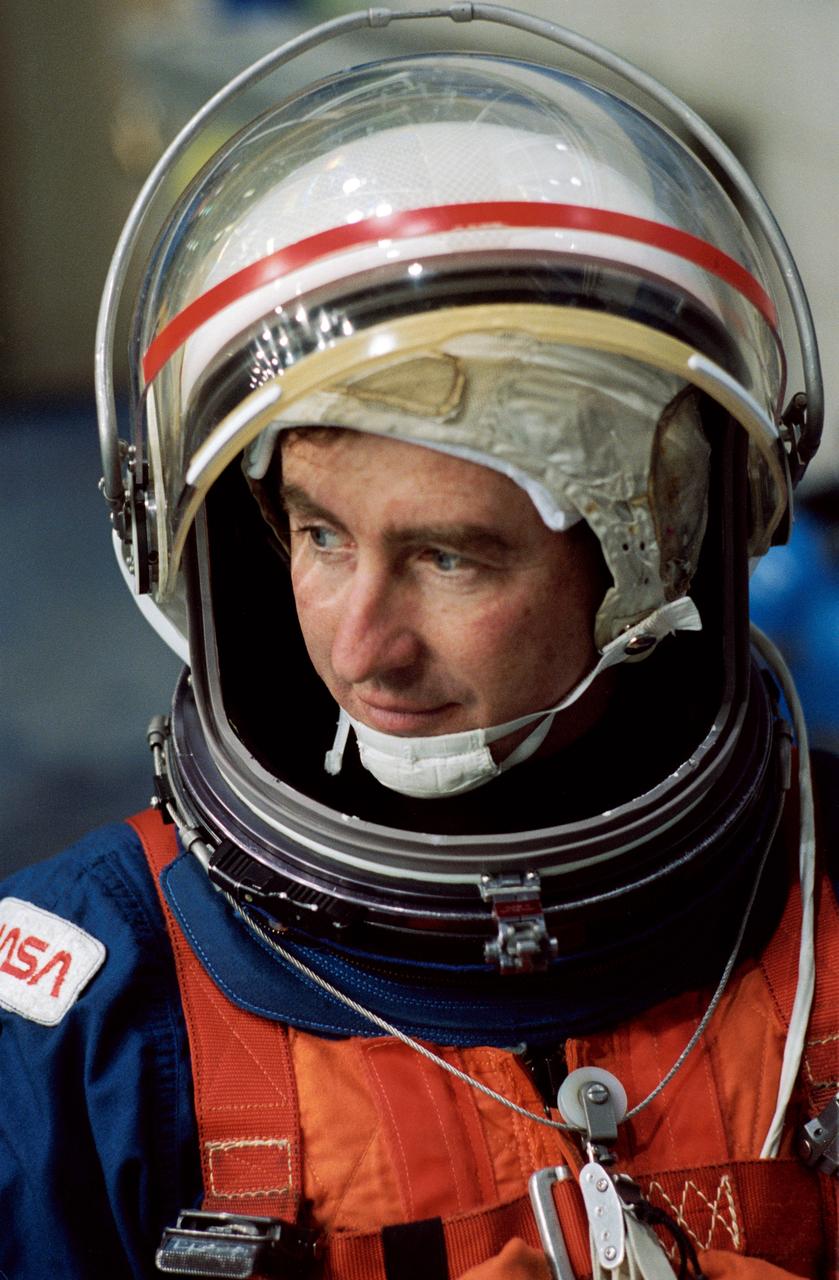
S95-03464 (16 Feb 1995) --- Attired in a training version of the Shuttle launch and entry garment, astronaut Terence T. (Tom) Henricks participates in a bailout training session at the Johnson Space Center's (JSC) systems integration facility. Henricks, mission commander for the STS-70 flight, was listening as a member of the crew training staff briefed the crew members on the use of parachute gear.
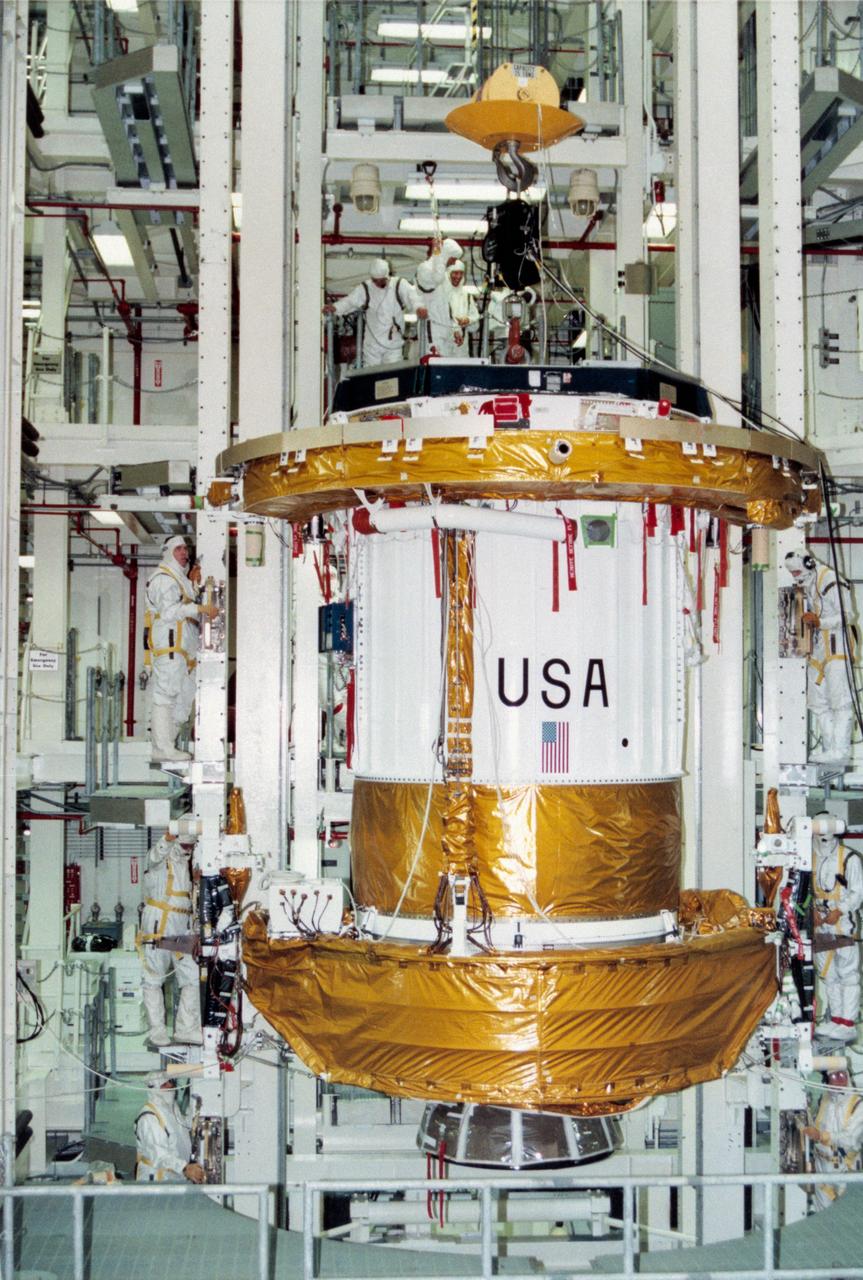
S95-08961 (4 APRIL 1995) --- Workers in the Vertical Processing Facility (VPF) oversee and control the lowering of the Inertial Upper Stage (IUS) booster into a work stand for preflight processing. The IUS will be attached to the Tracking and Data Relay Satellite (TDRS-G), which will be deployed by the Space Shuttle Discovery on the STS-70 mission. The IUS is scheduled to be mated to the TDRS satellite later in April. Liftoff of STS-70 is slated for no earlier than June 8, 1995.
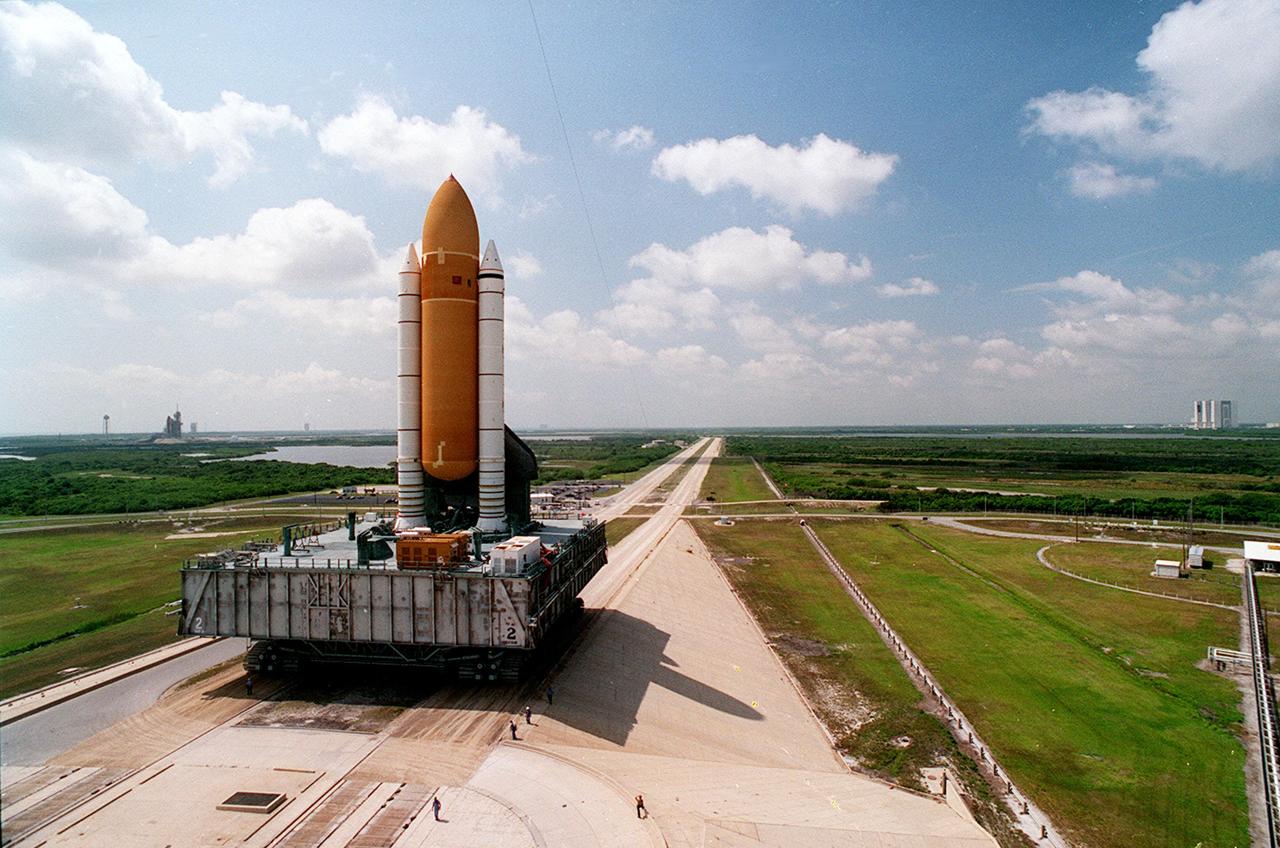
The Space Shuttle Discovery slowly and carefully makes the 4.2- mile (6.8 kilometer) trek from the Vehicle Assembly Building, background at right, to Launch Pad 39B on its Mobile Launcher Platform carried by the Crawler Transporter. Pad 39A, with the Shapce Shuttle Atlantic poised for liftoff, is in background at left. Discovery is scheduled to fly first, on STS-70 targeted for June 8. Atlantis' mission, STS-71, is scheduled no earlier than June 22.
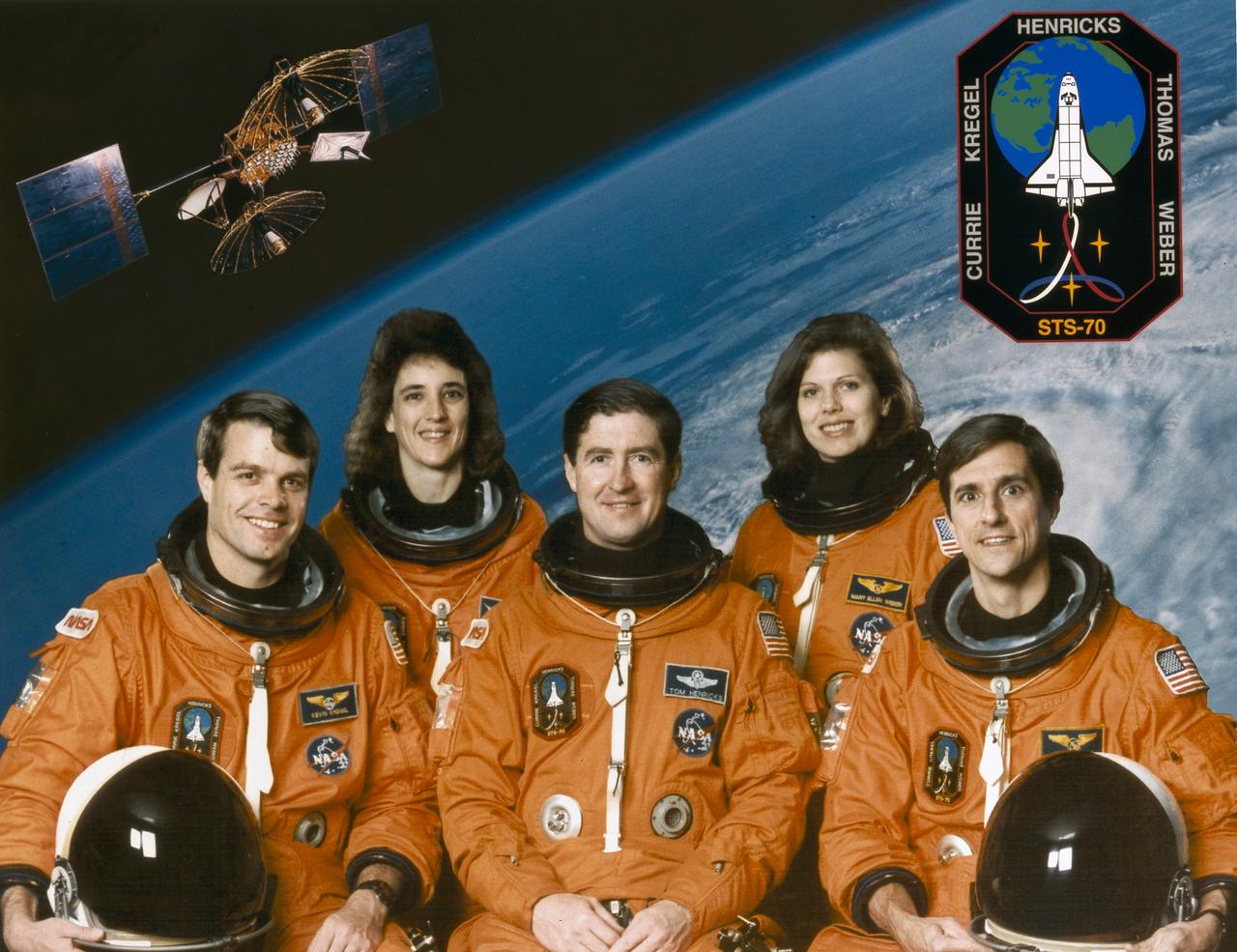
The crew assigned to the STS-70 mission included (front left to right) Kevin R. Kregel, pilot; Nancy J. Currie, mission specialist; Terrence T, Henricks, commander; Mary Ellen Weber, mission specialist, and Donald A. Thomas, mission specialist. Launched aboard the Space Shuttle Discovery on July 13,9:41:55.078 am (EDT), the STS-70 mission’s primary payload was the Tracking and Data Relay Satellite-G (TDRS-G).
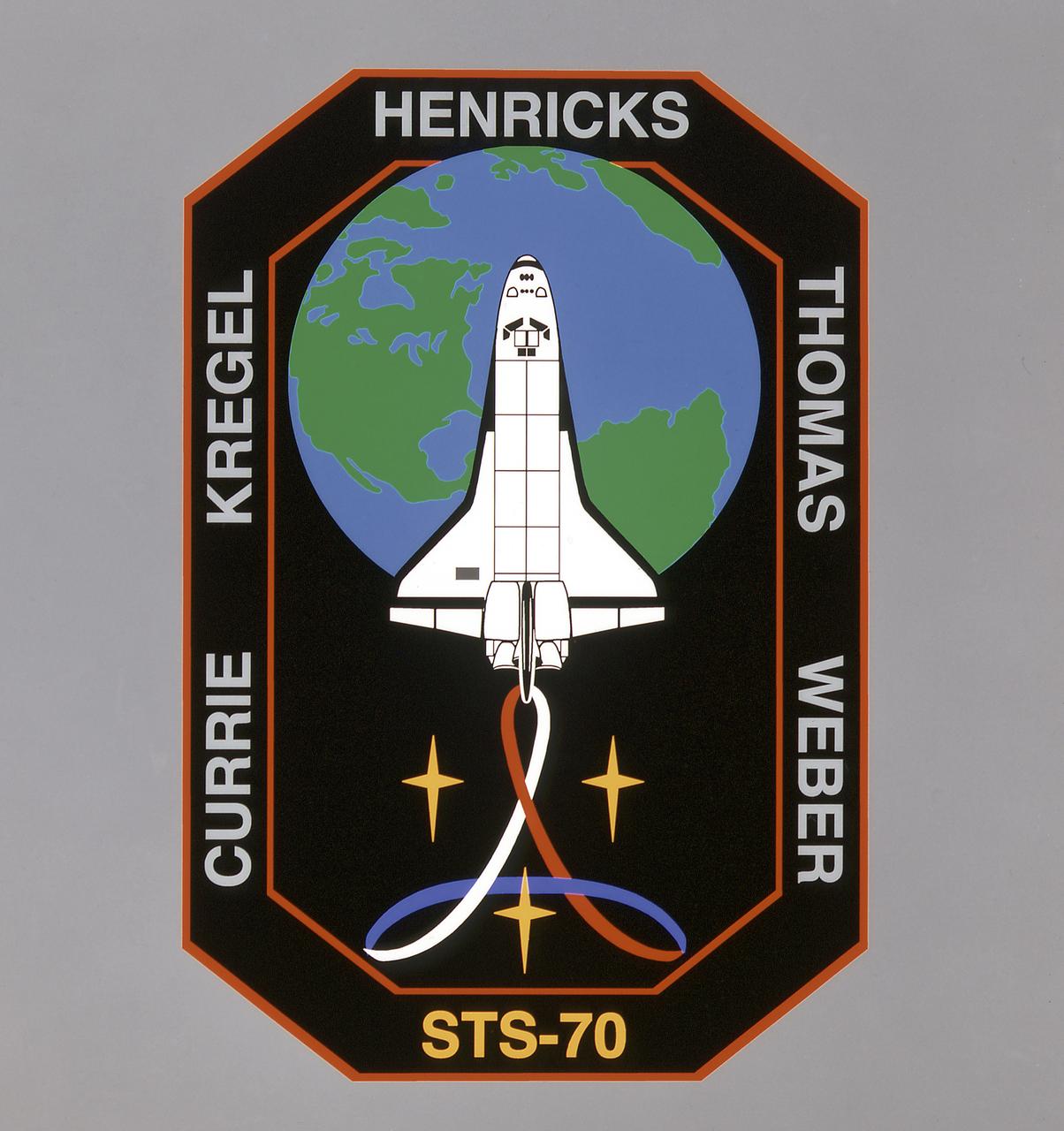
The STS-70 crew patch depicts the Space Shuttle Discovery orbiting Earth in the vast blackness of space. The primary mission of deploying a NASA Tracking and Data Relay Satellite (TDRS) is depicted by three gold stars. They represent the triad composed of spacecraft transmitting data to Earth through the TDRS system. The stylized red, white, and blue ribbon represents the American goal of linking space exploration to the advancement of all humankind.
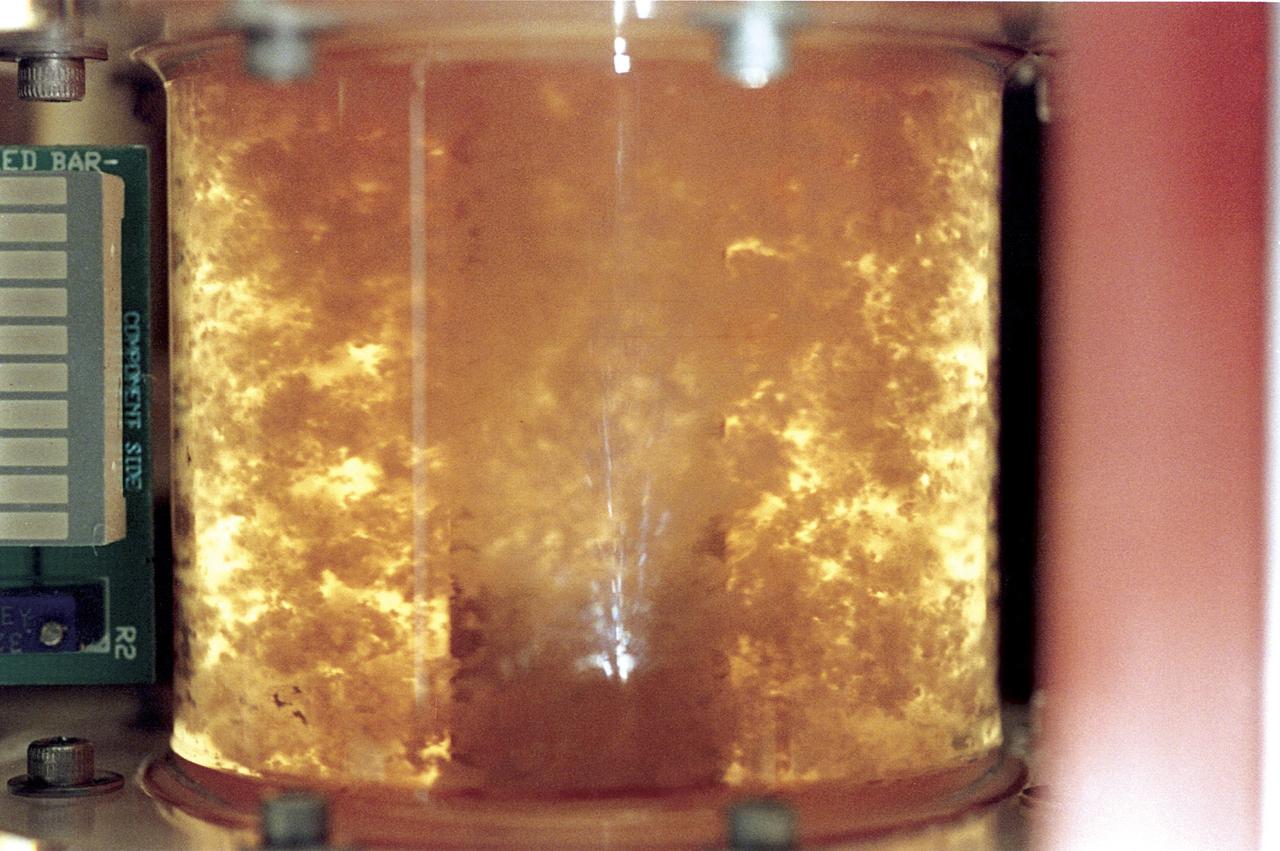
Within five days, bioreactor cultivated human colon cancer cells (shown) grown in Microgravity on the STS-70 mission in 1995, had grown 30 times the volume of the control specimens on Earth. The samples grown in space had a higher level of cellular organization and specialization. Because they more closely resemble tumors found in the body, microgravity grown cell cultures are ideal for research purposes.
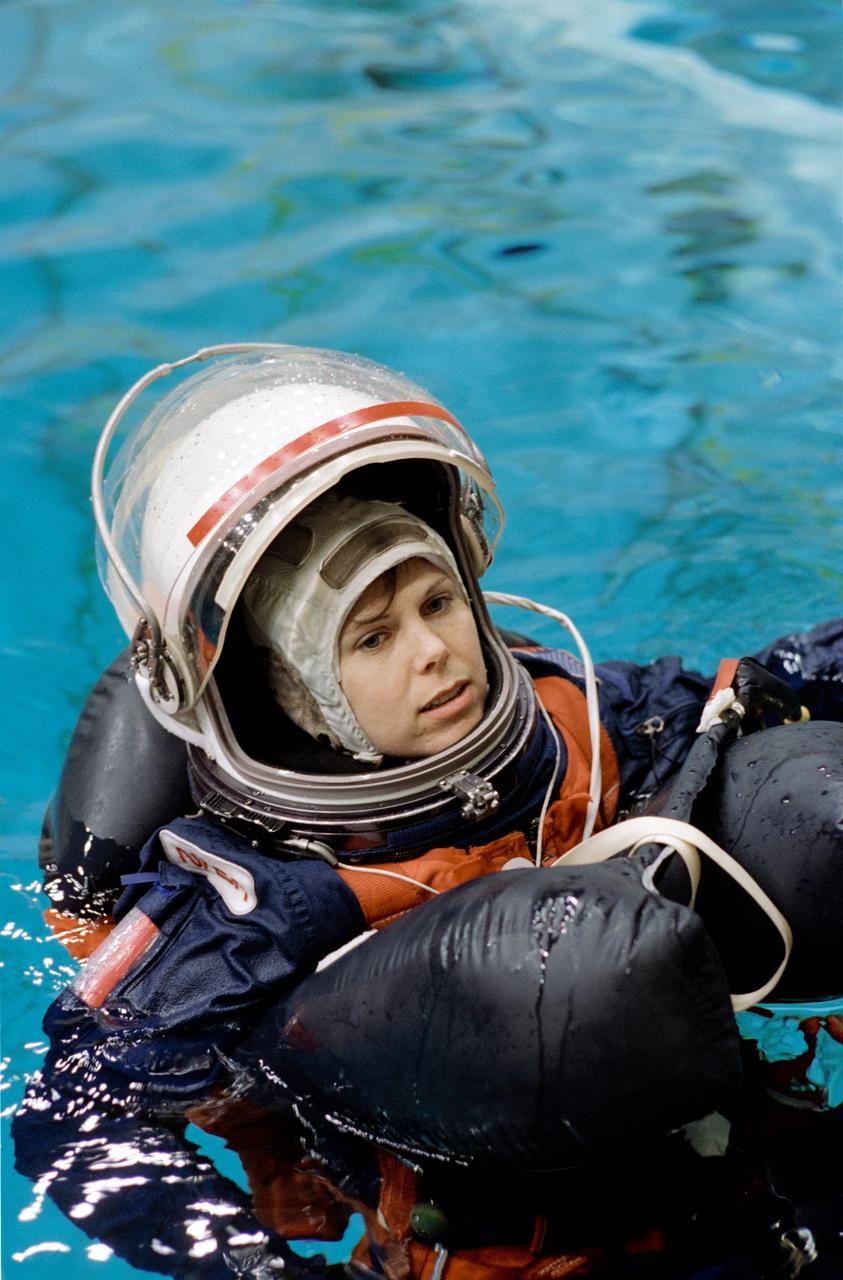
S95-03501 (16 FEB 1995) --- Astronaut Mary Ellen Weber prepares to deploy a life raft during a training session at the Johnson Space Center's (JSC) Weightless Environment Training Facility (WET-F). Training as a mission specialist for the STS-70 mission, Weber was joined by four crew mates in the emergency bailout rehearsal.
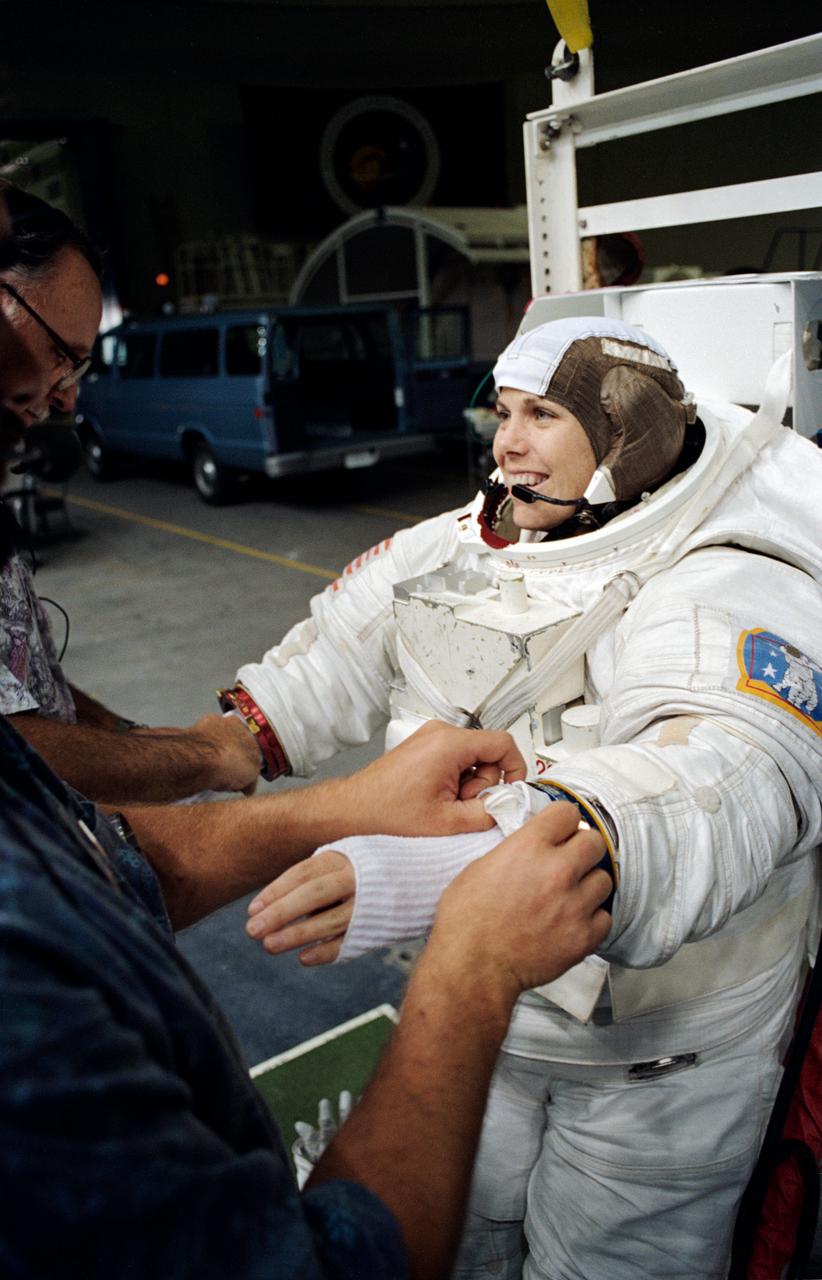
Attired in a training version of the Extravehicular Mobility Unit (EMU), astronaut Mary Ellen Weber gets help with the final touches of suit donning during a training session at JSC's Weightless Environment Training Facility (WETF). Training as a mission specialist for the STS-70 mission, Weber was about to rehearse a contingency space walk.
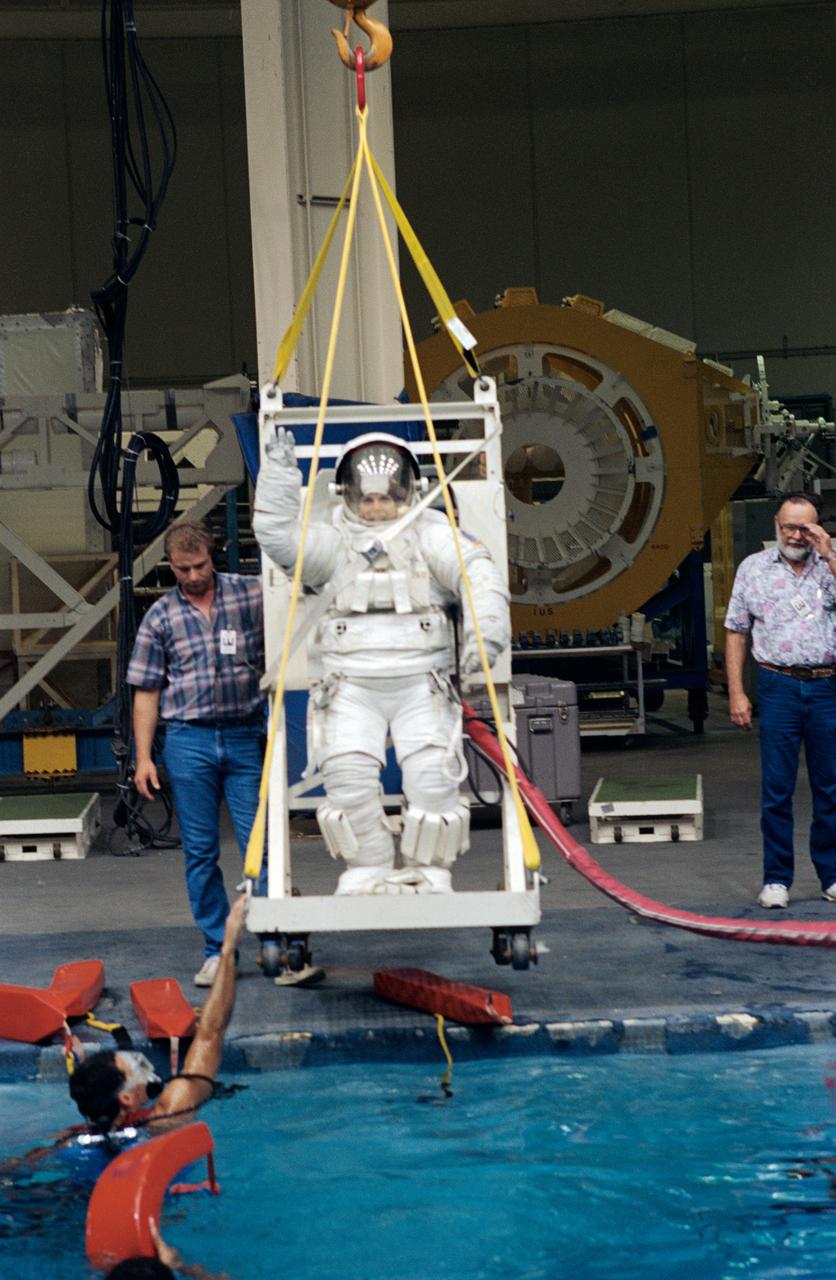
Attired in a training version of the Extravehicular Mobility Unit (EMU), Astronaut Mary Ellen Weber participates in a training session at JSC's Weightless Environment Training Facility (WETF). Training as a mission specialist for the STS-70 mission, Weber was about to rehearse a contingency space walk. One of several SCUBA-equipped divers waits to assist in the rehearsal in the water.
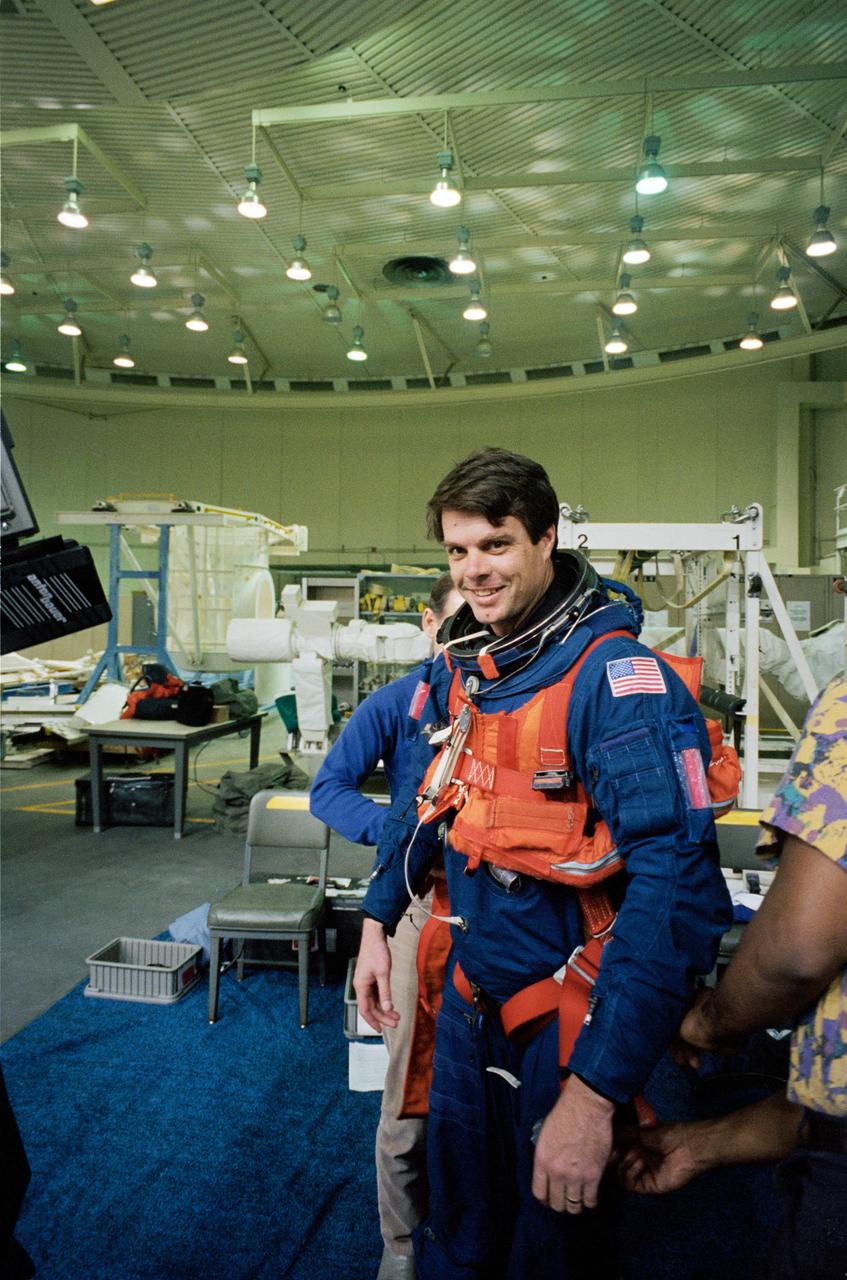
S95-03465 (16 Feb 1995) --- Attired in a training version of the Shuttle launch and entry garment, astronaut Kevin R. Kregel gets help with the final touches of suit donning during a training session at the Johnson Space Center's (JSC) Weightless Environment Training Facility (WET-F). Assigned as pilot for the STS-70 mission, Kregel was about to rehearse emergency bailout. The crew members made use of a nearby 25-feet deep pool to practice parachute landings in water and subsequent deployment of life rafts.
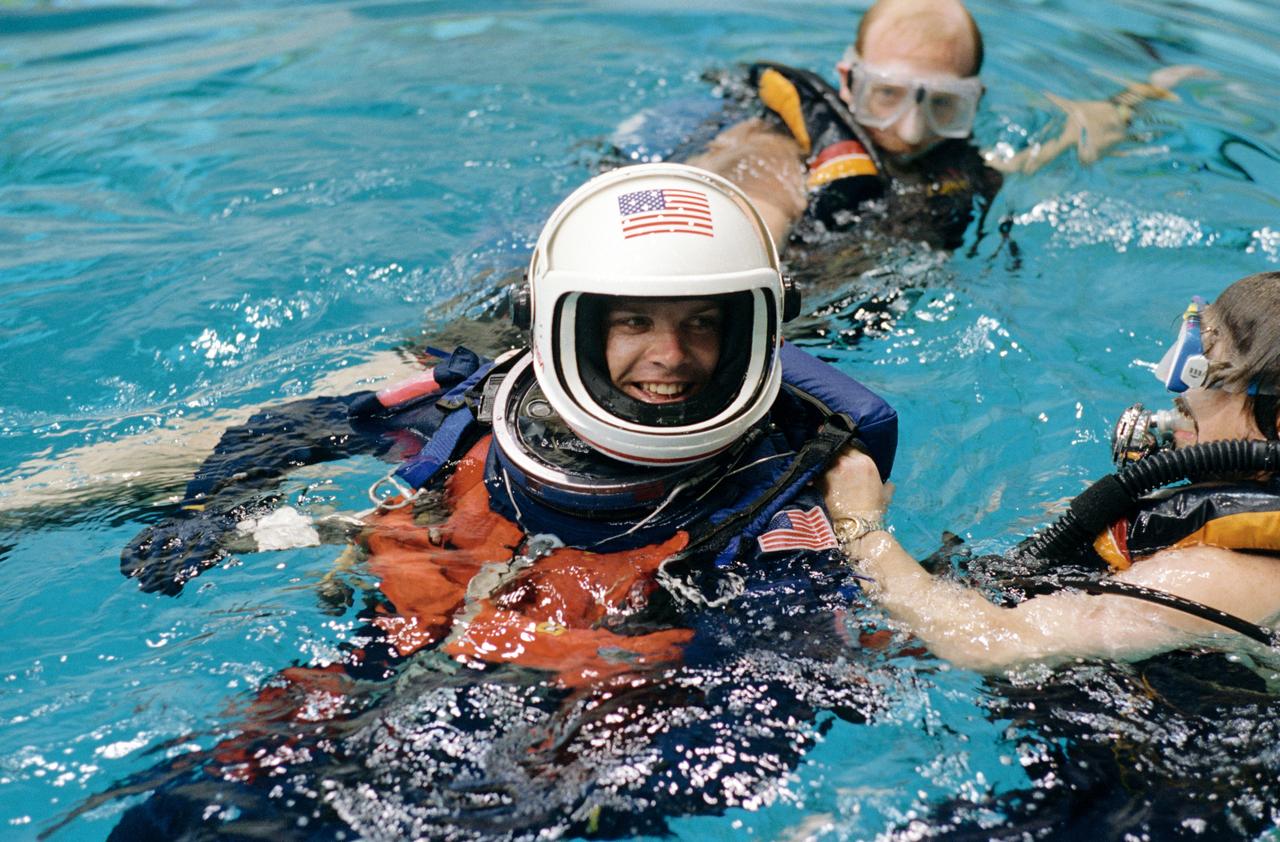
S95-03480 (16 FEB 1995) --- Attired in a training version of the Shuttle launch and entry garment, astronaut Kevin R. Kregel, pilot, gets help from SCUBA-equipped divers during a training session at the Johnson Space Center's (JSC) Weightless Environment Training Facility (WET-F). As part of the emergency bailout phase of their training agenda, the STS-70 crew members made use of this 25-feet deep pool to practice parachute landings in water and subsequent deployment of life rafts.
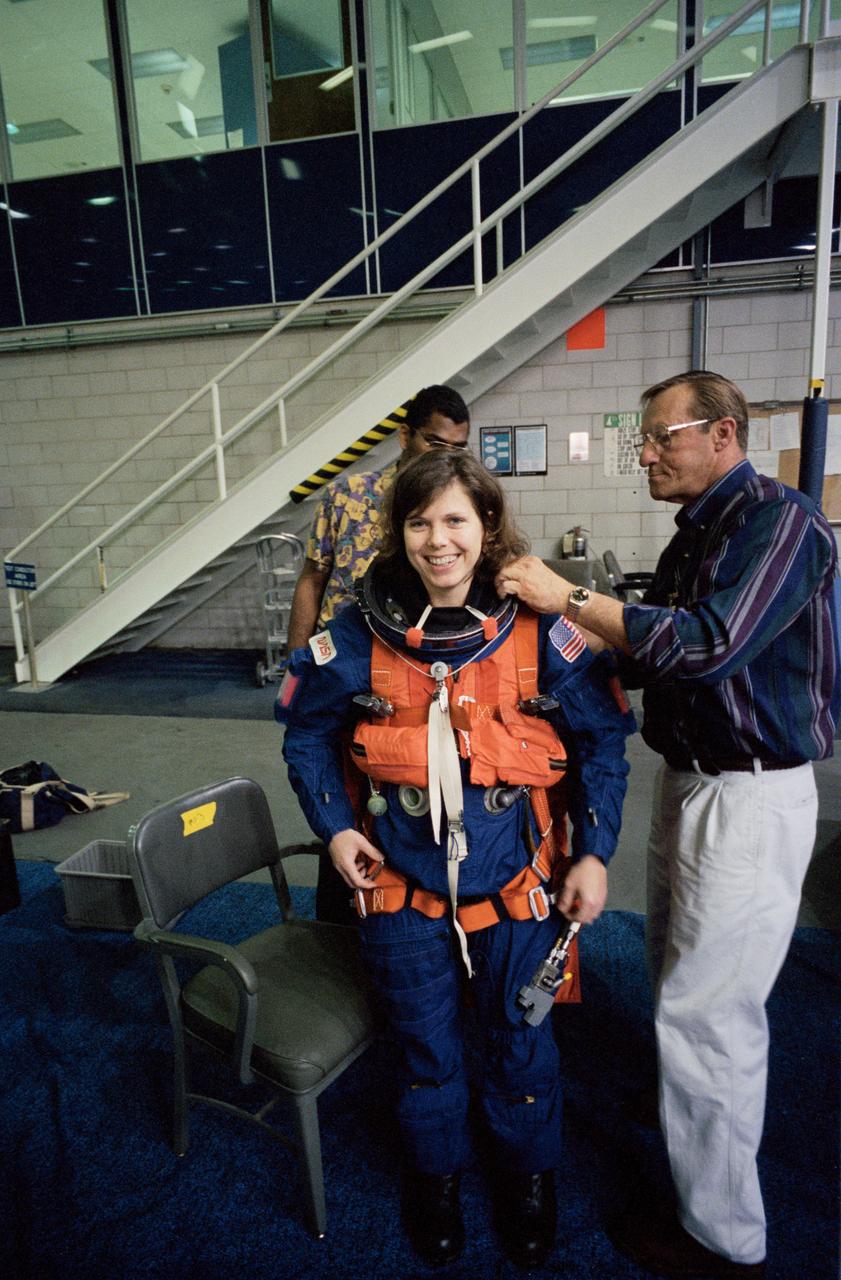
S95-03469 (16 FEB 1995) --- Attired in a training version of the Shuttle launch and entry garment, astronaut Mary Ellen Weber gets help with the final touches of suit donning during a training session at the Johnson Space Center's (JSC) Weightless Environment Training Facility (WET-F). Helping out is Rockwell's William L. Todd (right), while Staffon Isaacs looks on. Training as a mission specialist for the STS-70 mission, Weber was about to rehearse emergency bailout. The crew members made use of a nearby 25-feet deep pool to practice parachute landings in water and subsequent deployment of life rafts.
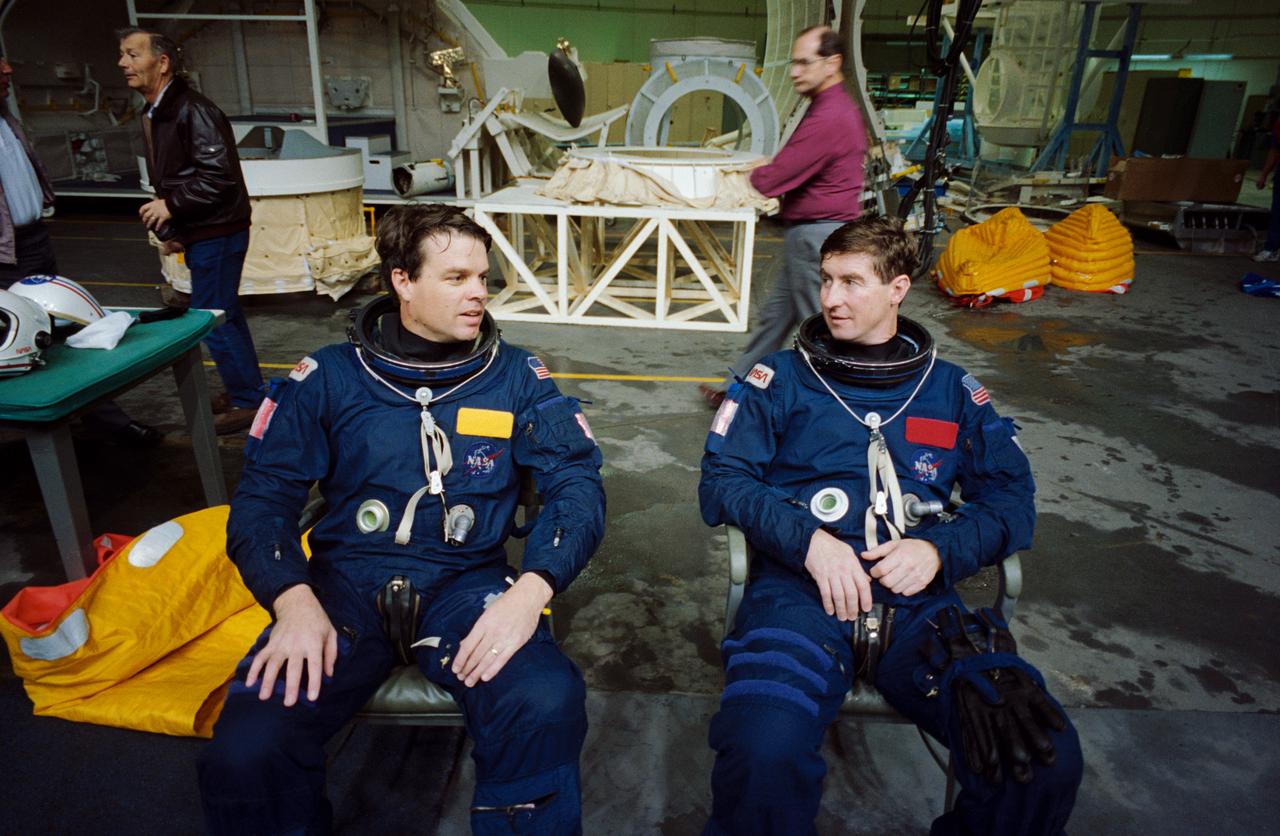
S95-03470 (16 FEB 1995) --- Attired in blue training versions of the orange Shuttle launch and entry garments, astronauts Terence T. (Tom) Henricks, right, and Kevin R. Kregel take a break during a bailout training session at the Johnson Space Center's (JSC) Weightless Environment Training Facility (WET-F). Assigned as commander and pilot, respectively, for the STS-70 mission, the two later joined their crew mates in making use of a nearby 25-feet deep pool to practice parachute landings in water and subsequent deployment of life rafts.
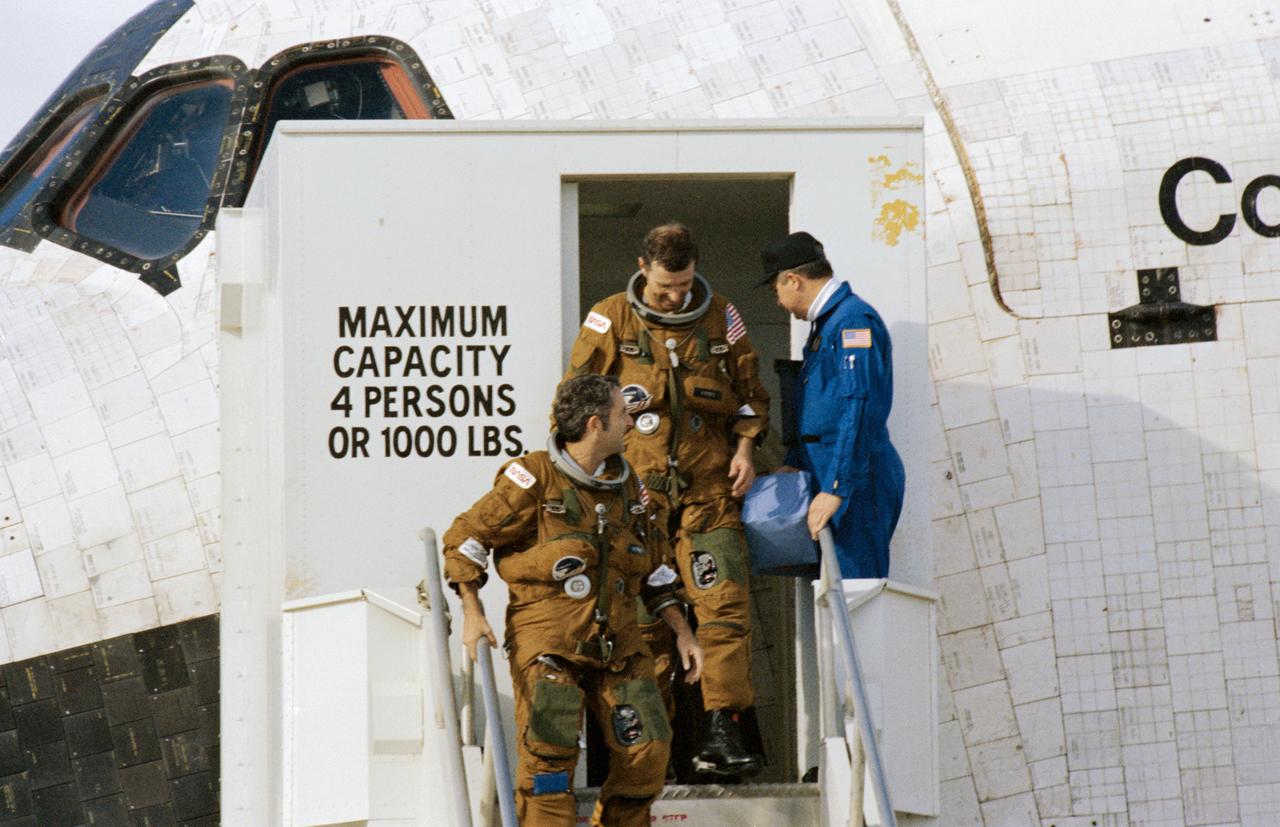
Documentary views of Space Shuttle Columbia on Lakebed Runway during De-Servicing, Crew Egress and departure from Orbiter at the end of STS-2 Mission. EAFB, CA Also available in 70 CN
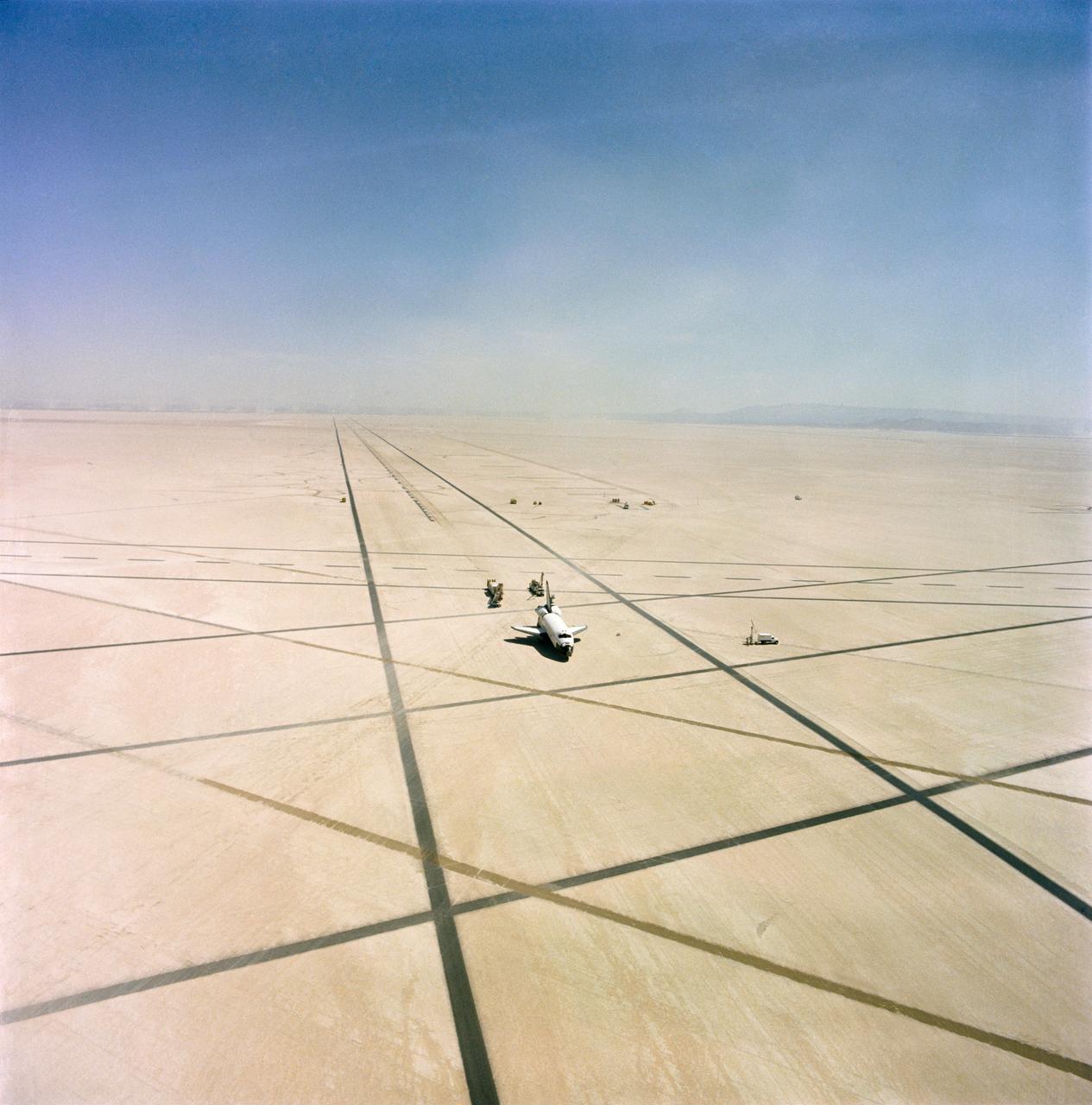
Documentary aerial and ground views of the Columbia sitting on the Lakebed Runway with the deservicing trucks following the STS-1 Mission, 04/14/1981. EAFB, CA Also available in 70 CN
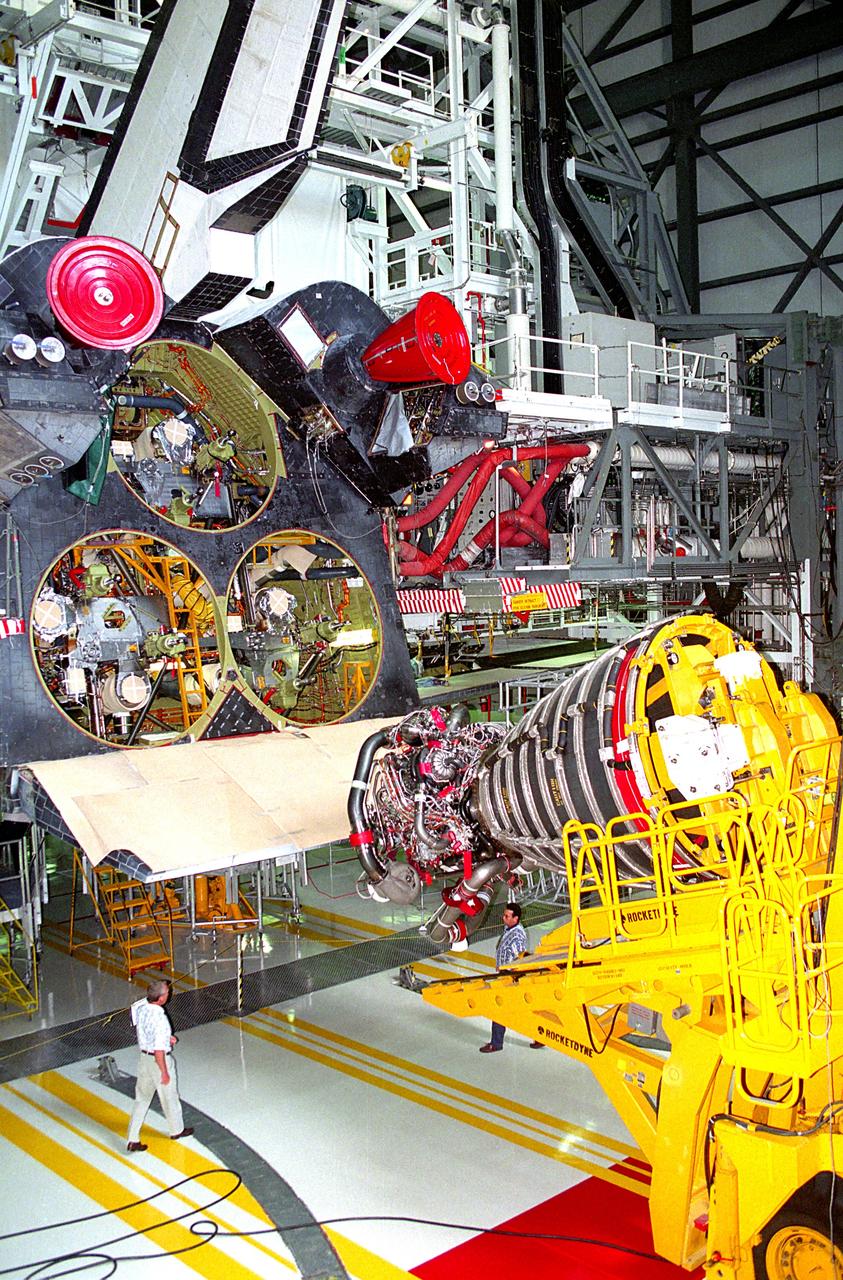
KENNEDY SPACE CENTER, FLA. - A Space Shuttle Main Engine (SSME) hoist prepares to lift the first Block 1 engine to be installed in an orbiter into the number one position on Discovery while the spaceplane is being prepared for the STS-70 mission in the high bay of Orbiter Processing Facility 2. The new engine, SSME No. 2036, features a new high-pressure liquid oxygen turbopump, a two-duct powerhead, a baffleless main injector, a single-coil heat exchanger and start sequence modifications. The other two main engines to be used during the liftoff of the STS-70 mission are of the existing Phase II design.
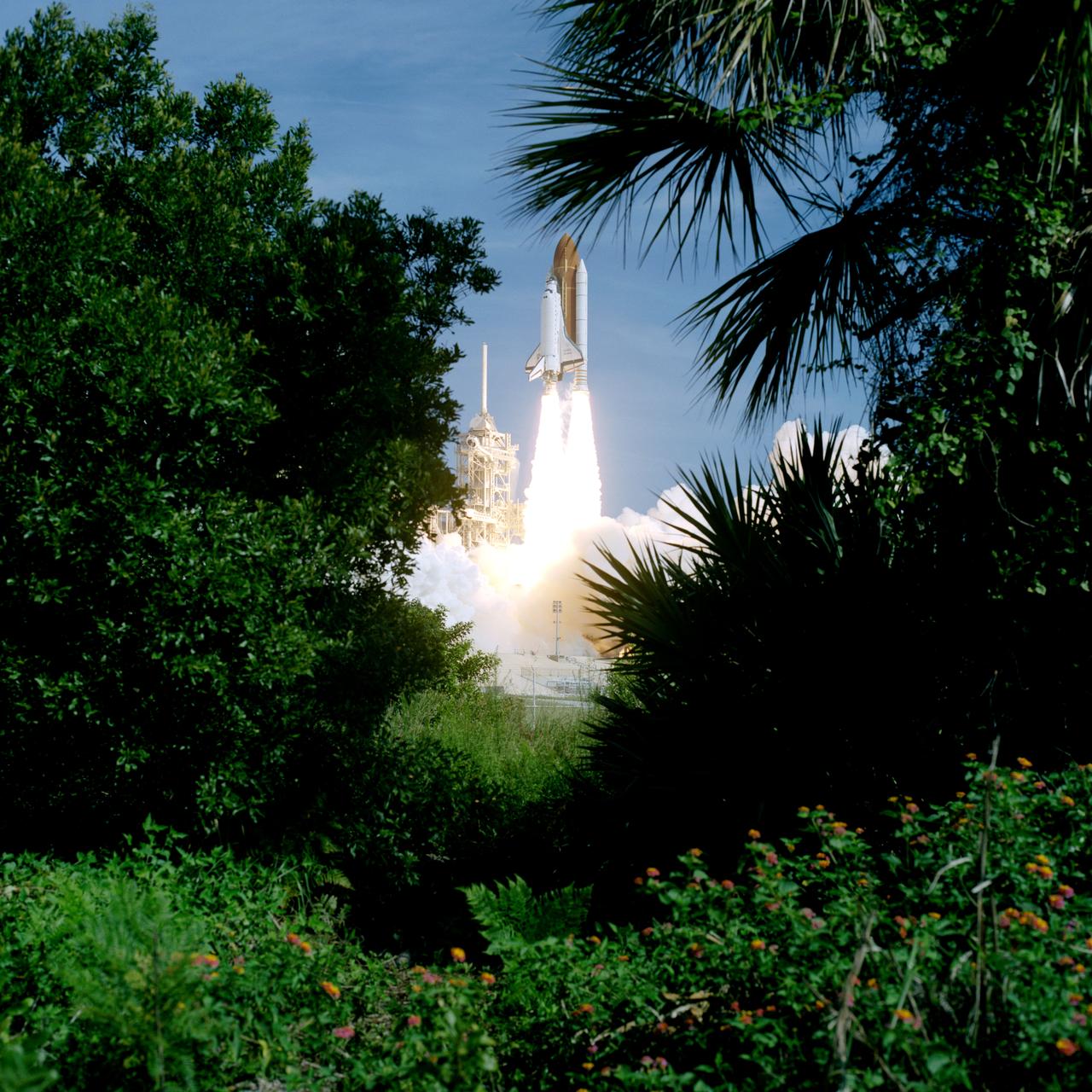
STS070-S-003 (13 JULY 1995) --- Framed by Florida foliage, the Space Shuttle Discovery begins its 21st Spaceflight. Five NASA astronauts and a Tracking and Data Relay Satellite (TDRS) were aboard for the liftoff, which occurred at 9:41:55 a.m. (EDT), July 13, 1995 from Launch Pad 39B. Onboard were astronauts Terence T. (Tom) Henricks, Kevin R. Kregel, Nancy J. Curie, Donald A. Thomas and Mary Ellen Weber. This mission also marks the maiden flight of the new Block I Space Shuttle Main Engine configuration designed to increase engine performance as well as safety and reliability.
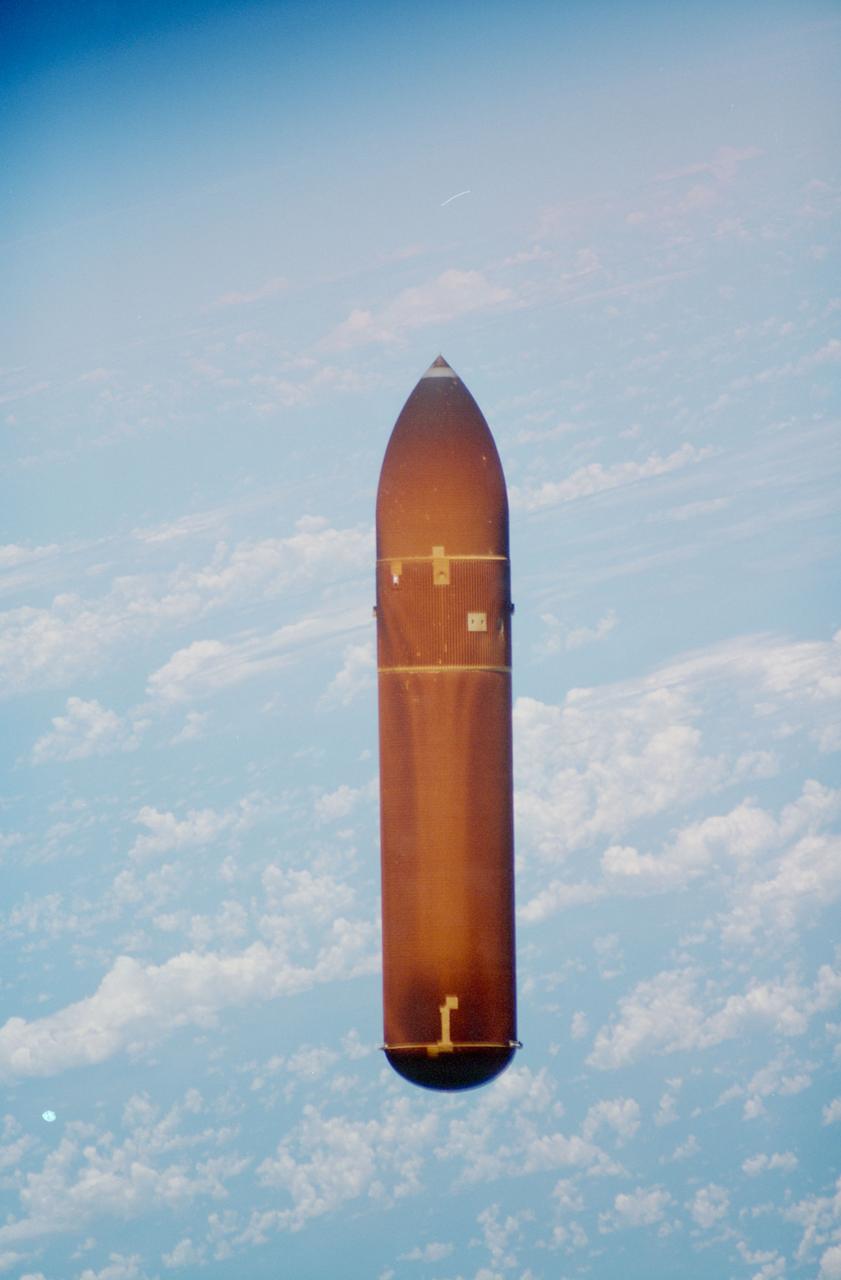
STS070-303-007 (13 JULY 1995) --- The external fuel tank (ET) for STS-70 is photographed just after falling away from the space shuttle Discovery en route to the 101st human-tended United States space flight.
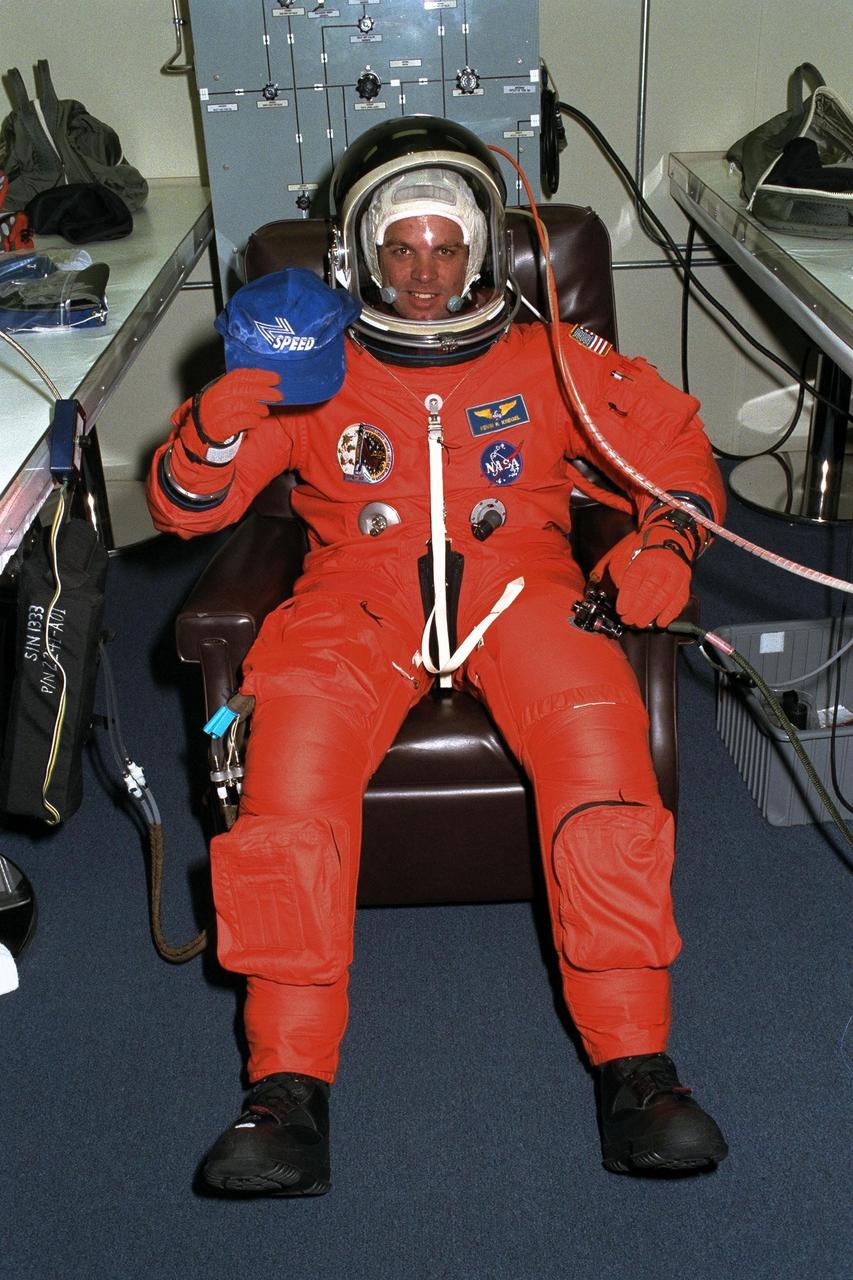
STS-87 Commander Kevin Kregel sits in his launch and entry suit in the Operations and Checkout Building holding a cap of his son’s soccer team of which Kregel is the coach. Shortly, he and the five other crew members of STS-87 will depart for Launch Pad 39B, where the Space Shuttle Columbia awaits liftoff on a 16-day mission to perform microgravity and solar research. A veteran of two space flights (STS-70 and -78), Kregel has logged more than 618 hours in space
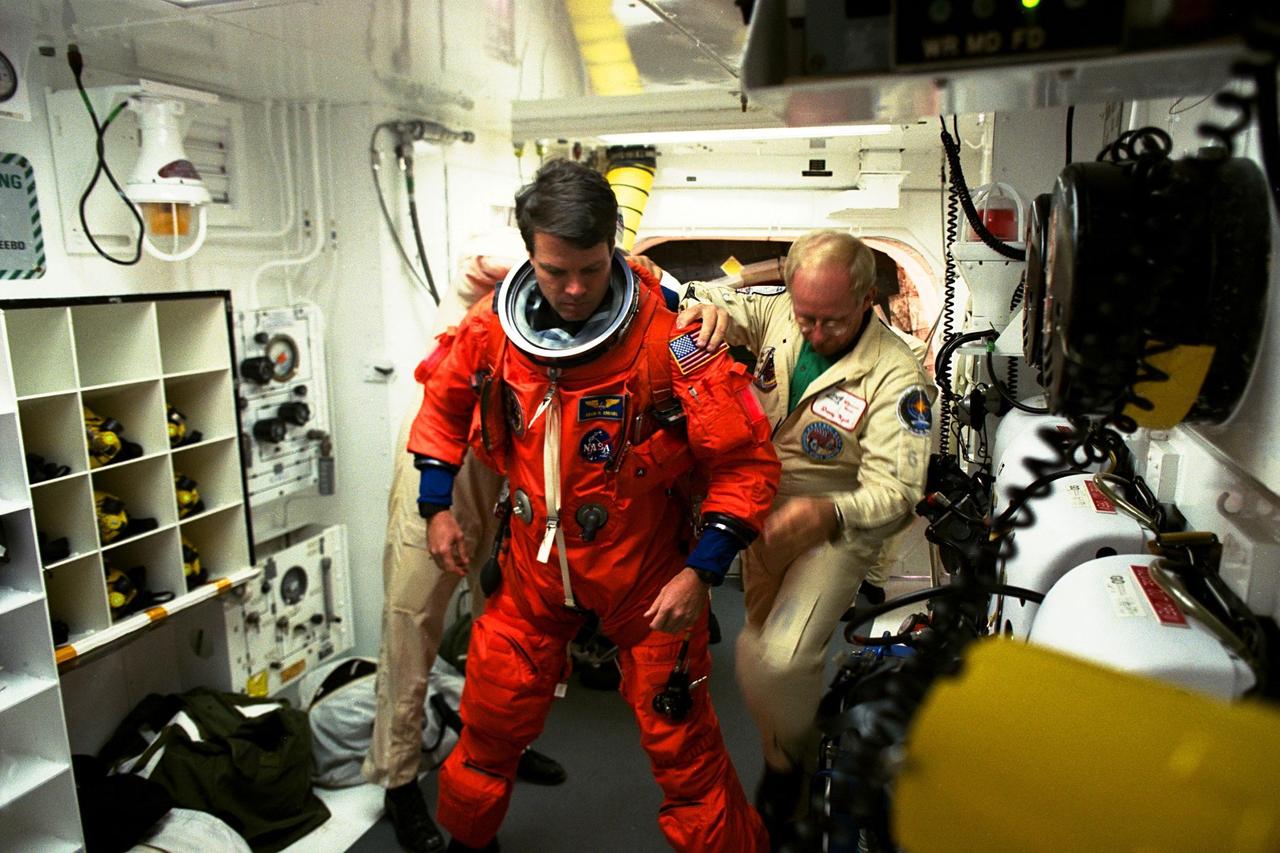
STS-87 Commander Kevin Kregel is assisted with his ascent and re-entry flight suit in the white room at Launch Pad 39B by Danny Wyatt, NASA quality assurance specialist. STS-87 is the fourth flight of the United States Microgravity Payload and Spartan-201. A veteran of two space flights (STS-70 and -78), Kregel has logged more than 618 hours in space
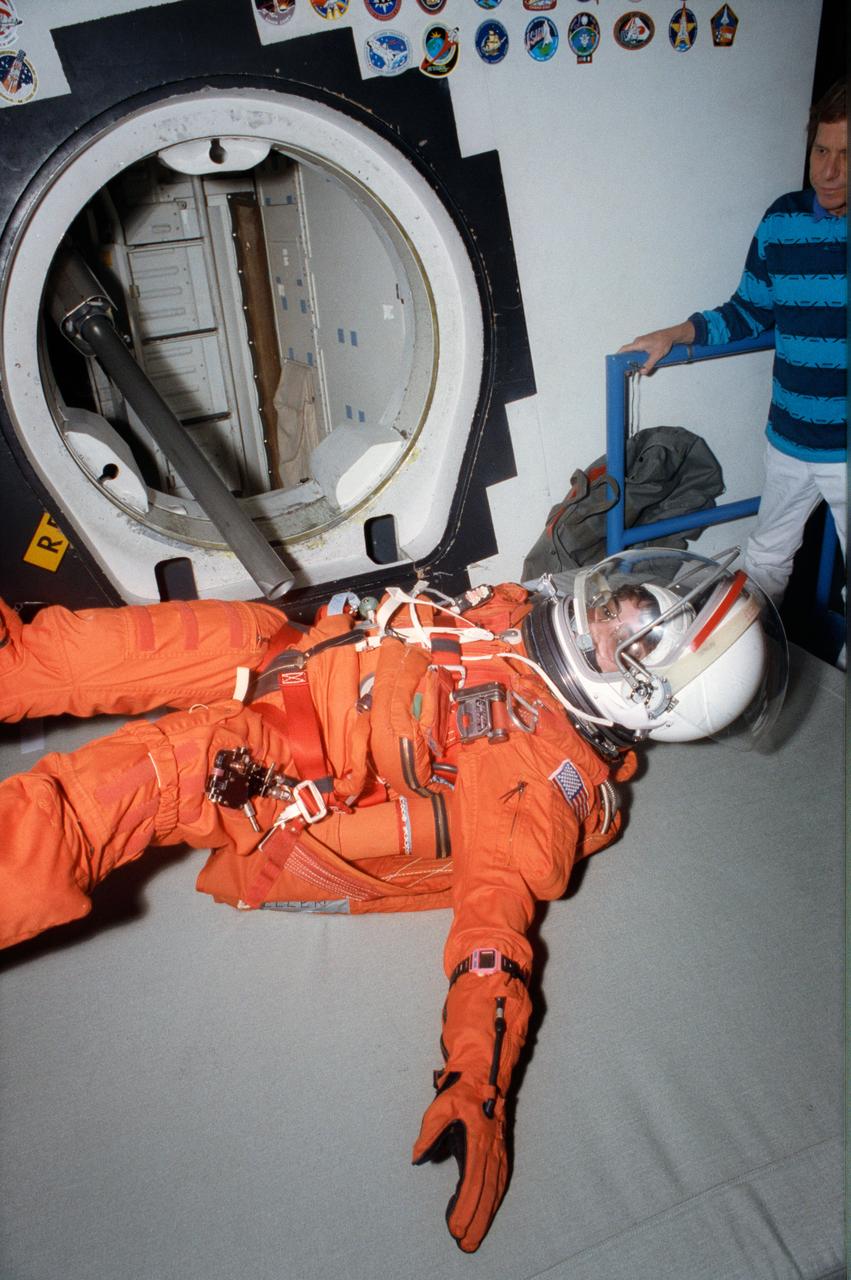
S93-31980 (April 1993) --- Attired in a training version of the Shuttle launch and entry garment, astronaut Nancy J. Sherlock participates in a bailout training session at the Johnson Space Center's (JSC) systems integration facility. Training as a mission specialist for the STS-57 mission, Sherlock was rehearsing using the slide pole escape device. EDITOR'S NOTE: Nancy J. Currie (formerly Sherlock) has been assigned as a mission specialist for the STS-70 mission, scheduled for launch in spring of 1995.
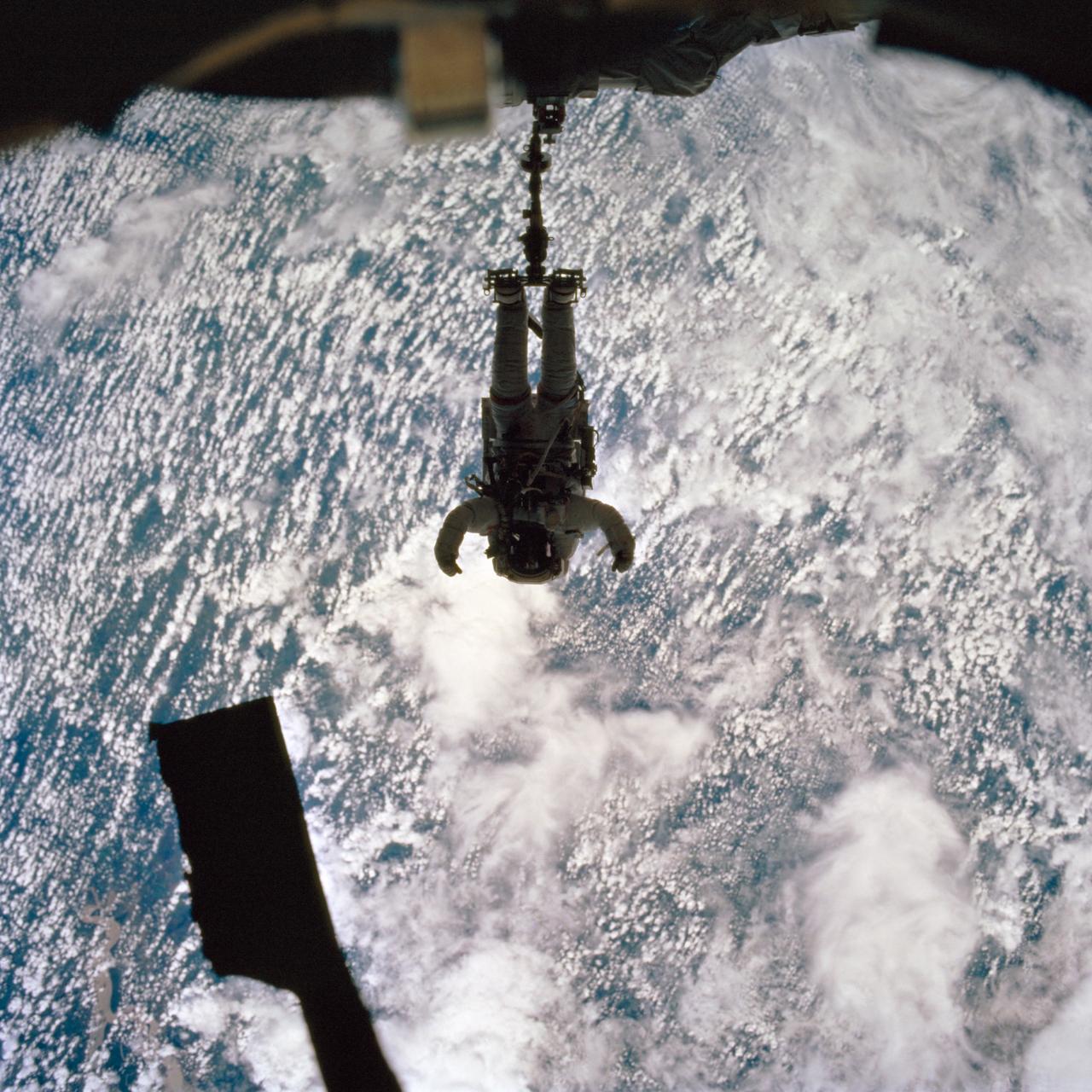
ISS002-707-057 (22 April 2001) --- 70-mm frame. STS-100 EVA crewmember Chris Hadfield in dark silhouette - shadowed by the ISS on work/foot pedestal platform for the Remote Manipulator System (RMS) over a 90% cloud covered earth background. A small segment of an unidentified river is in the lower left corner. 22 April 2001 Altitude 208 nautical miles
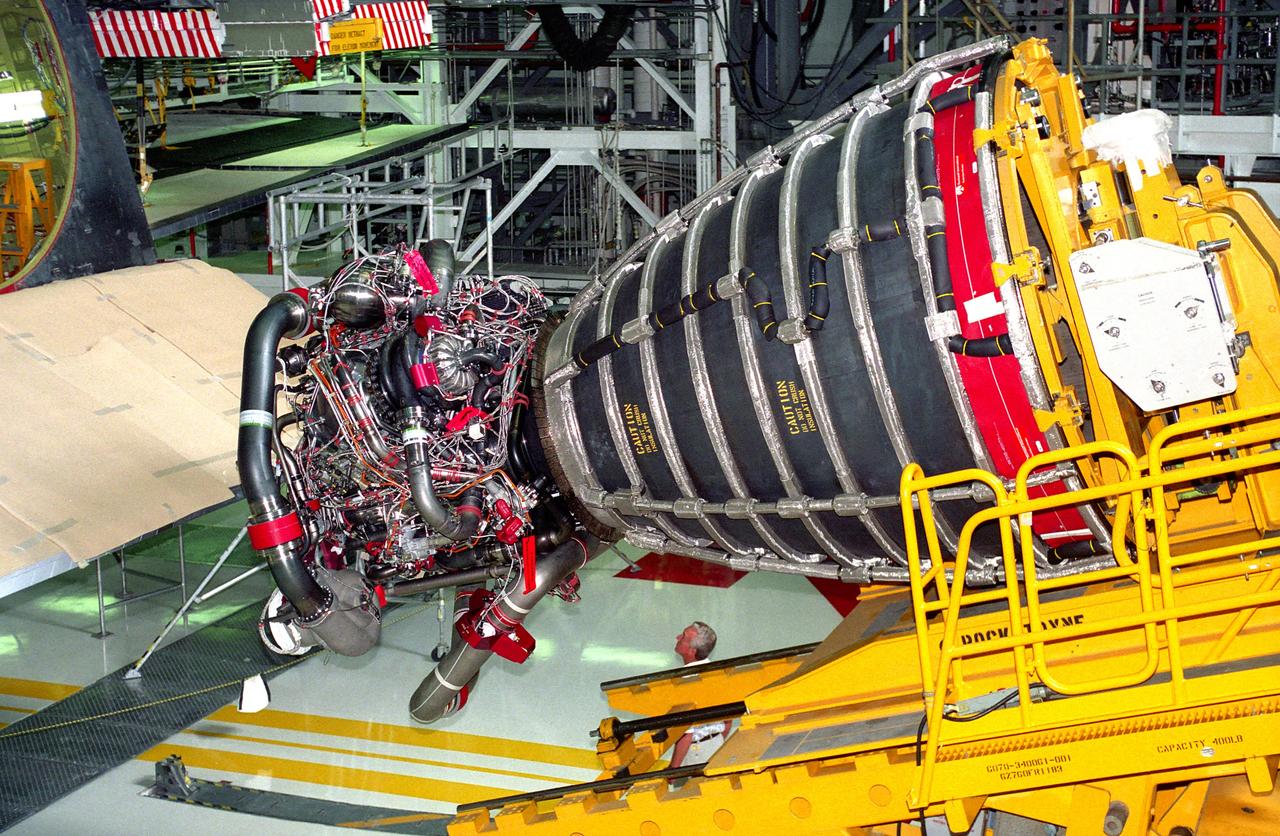
KENNEDY SPACE CENTER, FLA. - Space Shuttle Main Engine (SSME) No. 2036, the first of the new Block 1 engines to fly, awaits installation into position one of the orbiter Discovery in Orbiter Processing Facility 2 during preparation of the spaceplane for the STS-70 mission. The advanced powerplant features a new high-pressure liquid oxygen turbopump, a two-duct powerhead, a baffleless main injector, a single-coil heat exchanger and start sequence modifications. These modifications are designed to improve both engine performance and safety.
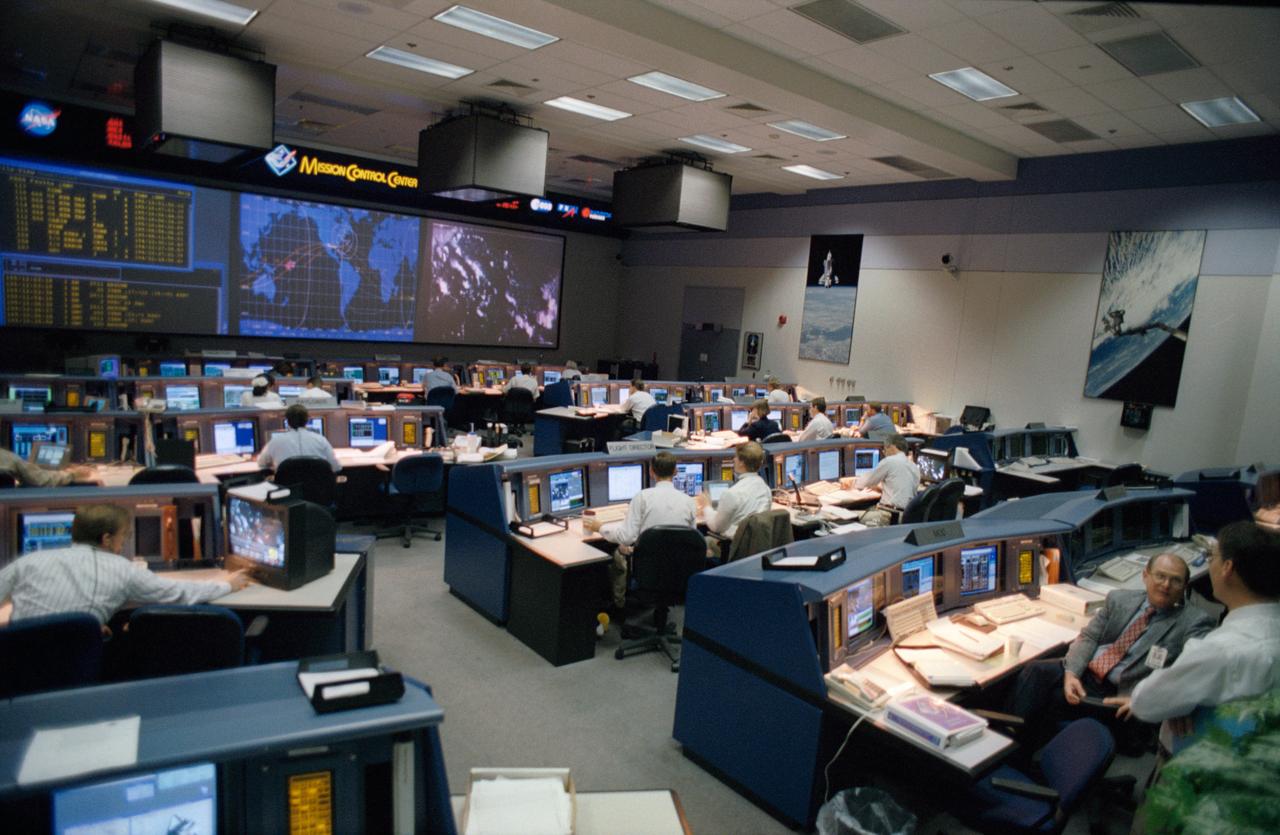
S95-16439 (13-22 July 1995) --- An overall view from the rear shows activity in the new Mission Control Center (MCC), opened for operation and dedicated during the STS-70 mission. The new MCC, developed at a cost of about 50 million, replaces the main-frame based, NASA-unique design of the old Mission Control with a standard workstation-based, local area network system commonly in use today.
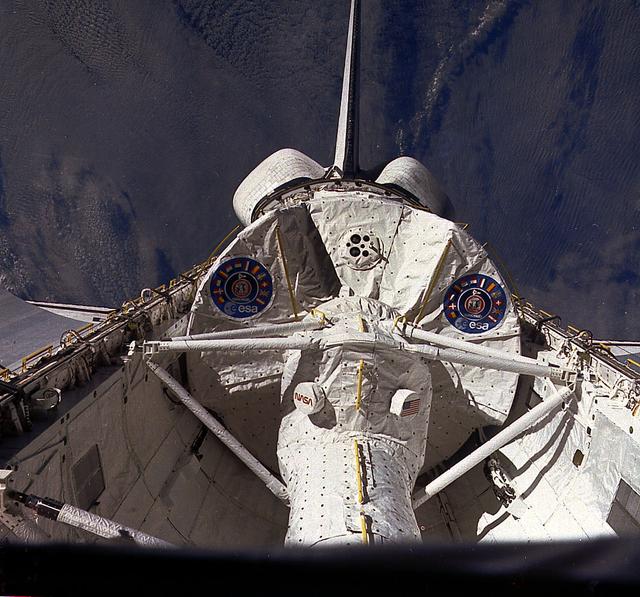
A Space Shuttle mission STS-9 onboard view show's Spacelab-1 (SL-1) module in orbiter Columbia's payload bay. Spacelab-1 was a cooperative venture of NASA and the European Space Agency. Scientists from eleven European nations plus Canada, Japan and the U.S. provided instruments and experimental procedures for over 70 different investigations in five research areas of disciplines: astronomy and solar physics, space plasma physics, atmospheric physics and Earth observations, life sciences and materials science.

STS070-334-031 (13-22 JULY 1995) --- Astronaut Kevin R. Kregel demonstrates the new shuttle sleep restraints on the space shuttle Discovery?s middeck. During an August 11, 1995, post flight presentation to fellow employees at the Johnson Space Center (JSC), the STS-70 pilot discussed features of the device and lauded its ability to add comfort for crew members.
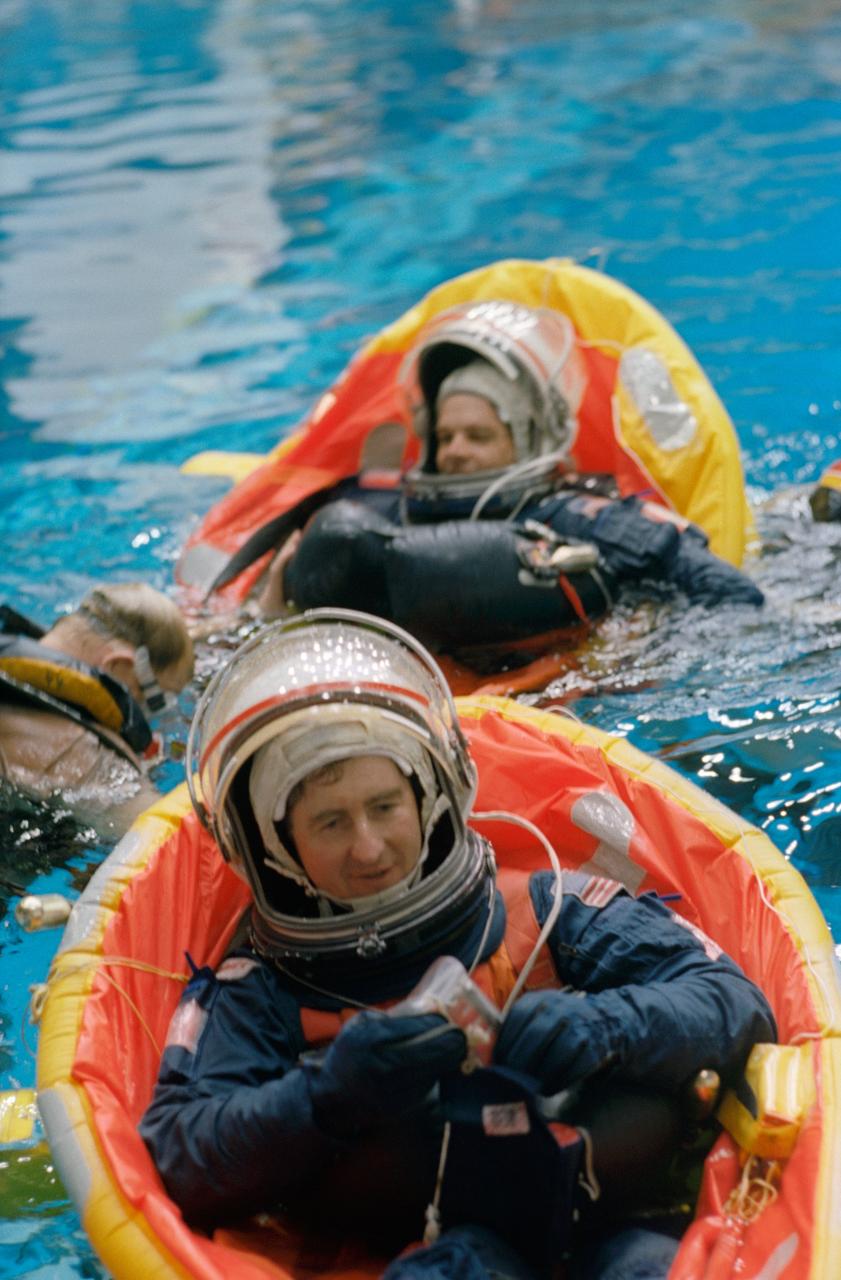
S95-03473 (16 Feb 1995) --- Astronauts Terence T. (Tom) Henricks (foreground) and Kevin R. Kregel deploy their life rafts during emergency bailout training in a 25 feet deep pool at the Johnson Space Center's (JSC) Weightless Environment Training Facility (WET-F). Henricks and Kregel are commander and pilot, respectively, for the STS-70 mission, now scheduled for a liftoff in early June.
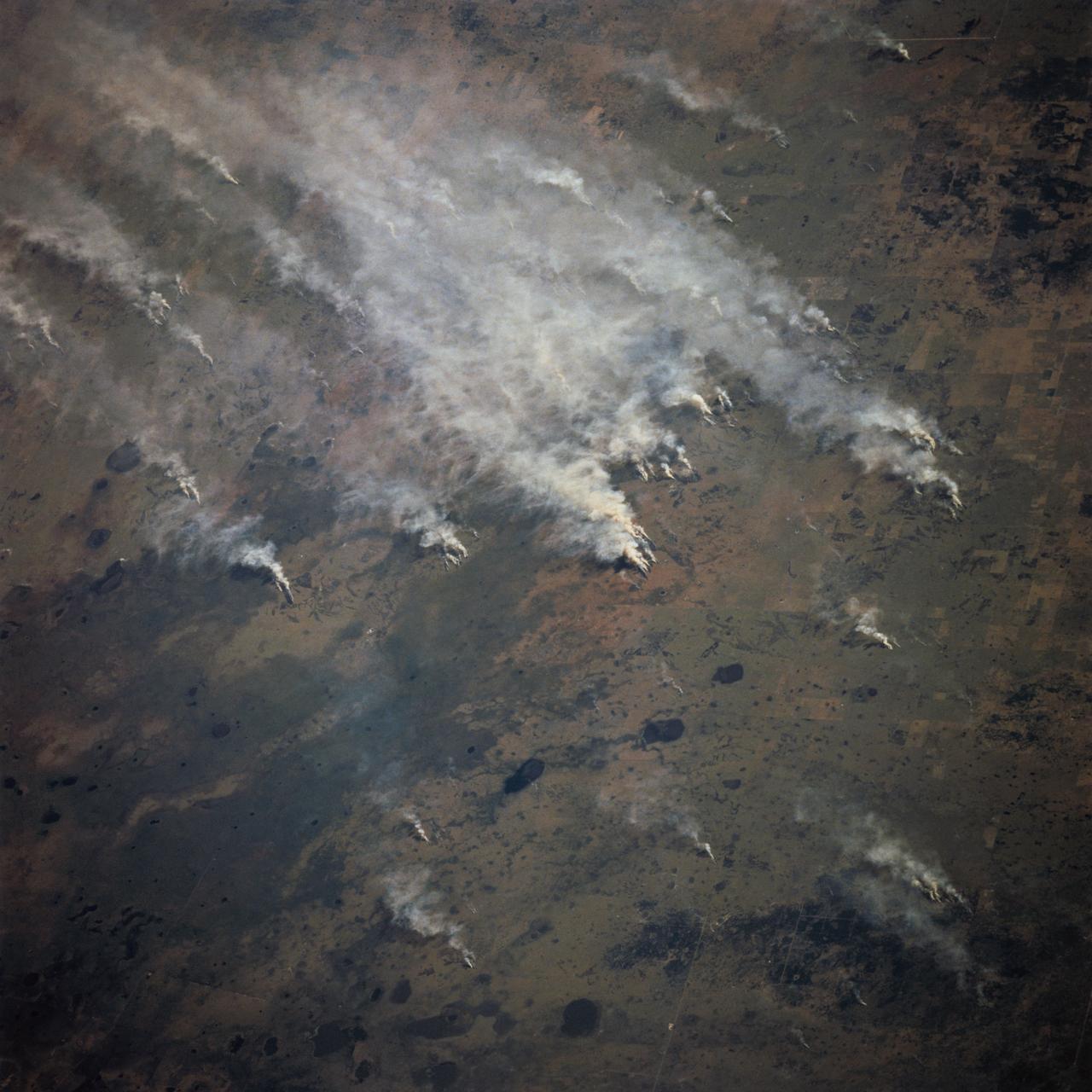
STS070-717-027 (13-22 JULY 1995) --- Easterly winds from the Mozambique Channel blow the smoke from many large fires in southern Mozambique inland. Neighboring views showed the smoke moving over and around the Chimanimani Mountains, into Zimbabwe on the African plateau. Winter is the dry season in southern Africa and fires are set to hasten the greening of the grass shoots for cattle grazing.
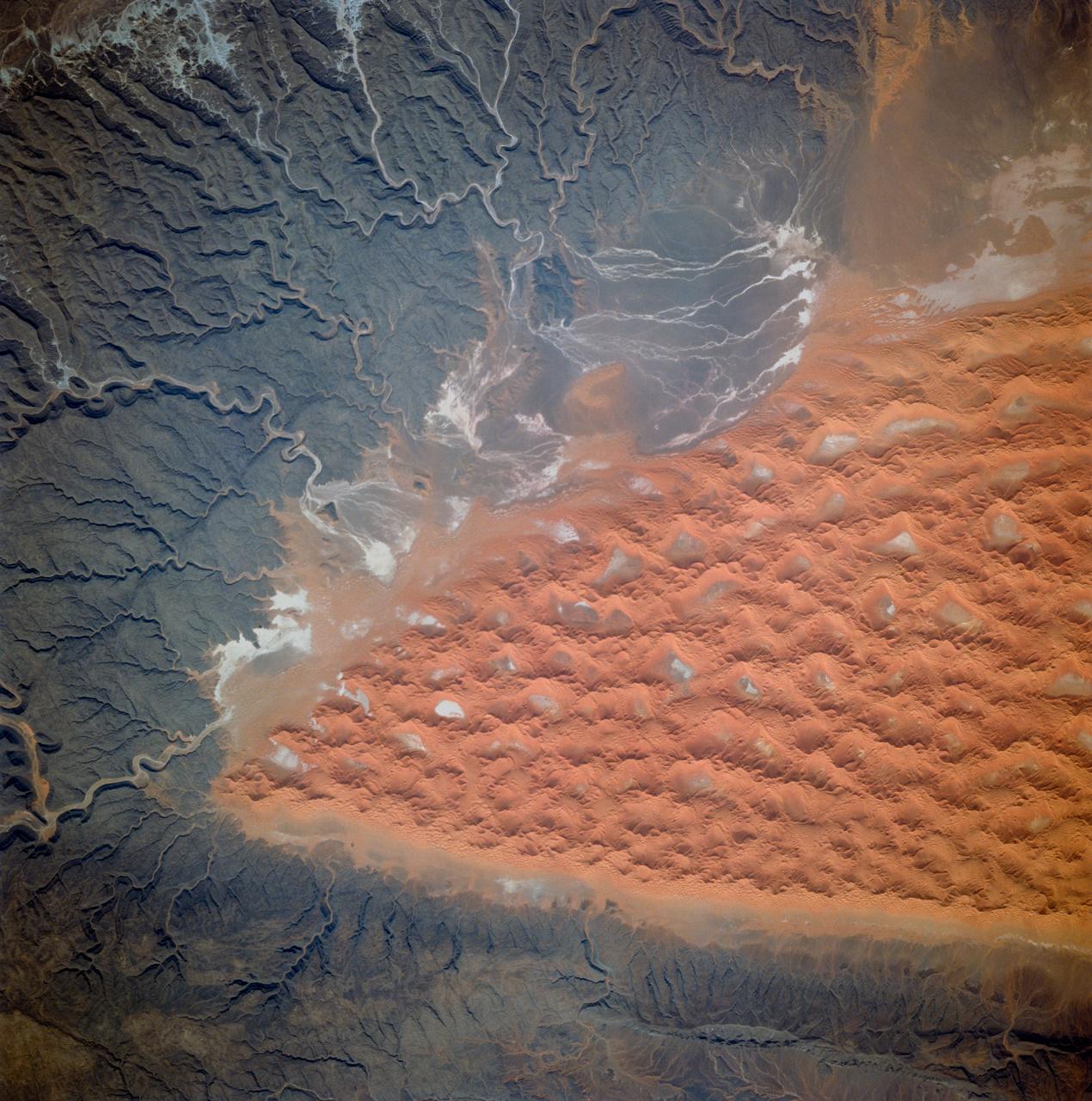
STS070-705-094 (13-22 JULY 1995) --- The southern half (about 70 miles in this view) of the Tifernine dunes of east-central Algeria appears on this view. The Tifernine dune-sea is one of the more dramatic features visible from the Shuttle when flying over the Sahara Desert. The dunes lie in a basin of dark-colored rocks heavily cut by winding stream courses (top right). Very occasional storms allow the streams to erode the dark rocks and transport the sediment to the basin. Westerly winds then mold the stream sediments into the complex dune shapes so well displayed here. North at bottom.
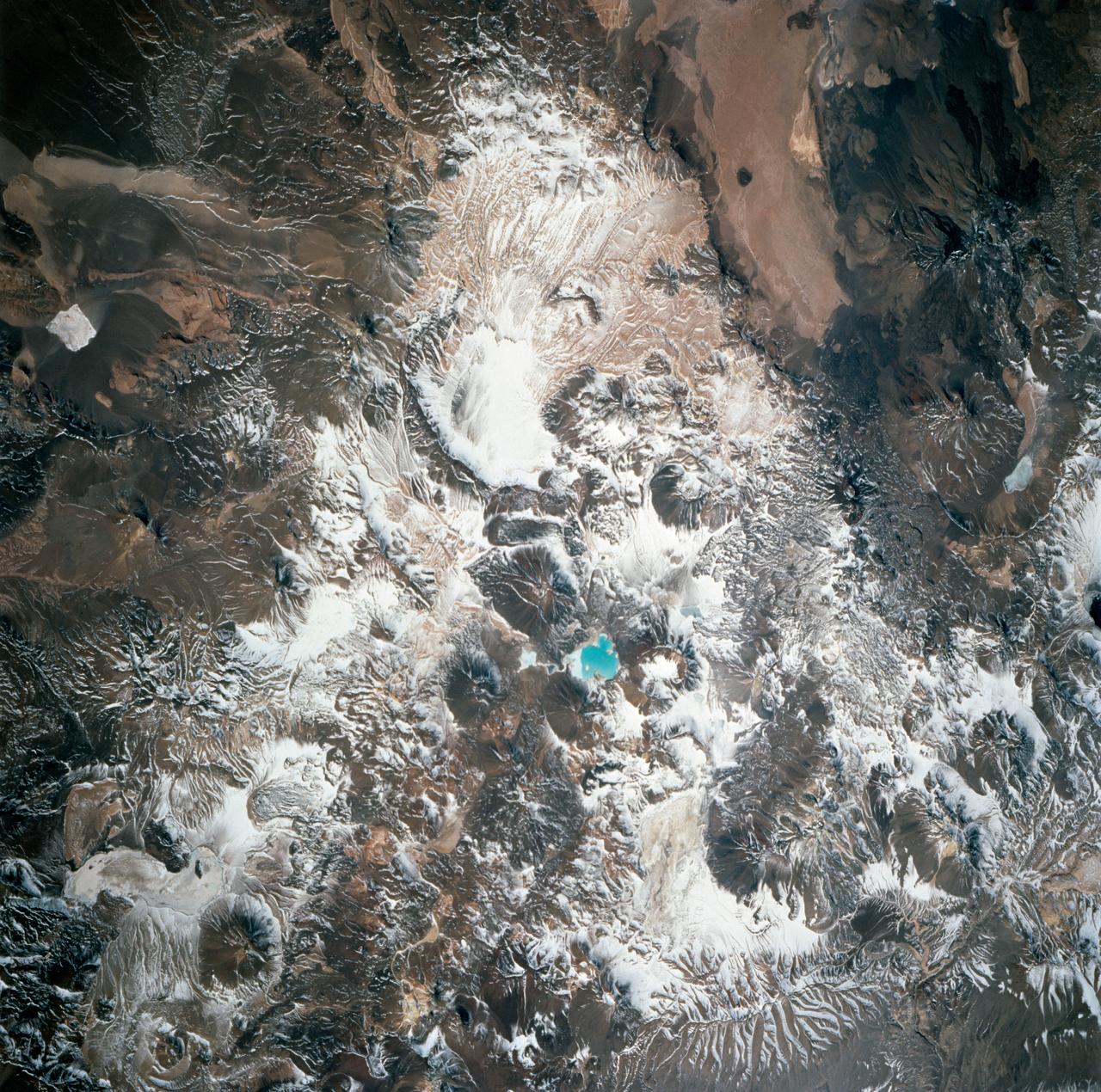
STS070-717-011 (13-22 JULY 1995) --- Volcanic landscapes with a thin dusting of snow appear in this near-vertical view of the dry, high spine of the Andes Mountains at around 28 degrees south latitude. Strong westerly winds (from left) have blown the snow off the highest volcanic peaks (center and bottom): many of these peaks rise higher than 20,000 feet. A small, dry lake appears top right, the white color derived from salts. The border between Argentina and Chile winds from volcano to volcano and passes just left of the small blue lake (left center). Black lava flows can be detected bottom right. The larger area of brown-pink rocks (bottom rock) is also an area of volcanic rocks, of a type known as ash flow tuffs which are violently extruded, often in volumes measured in cubic kilometers.
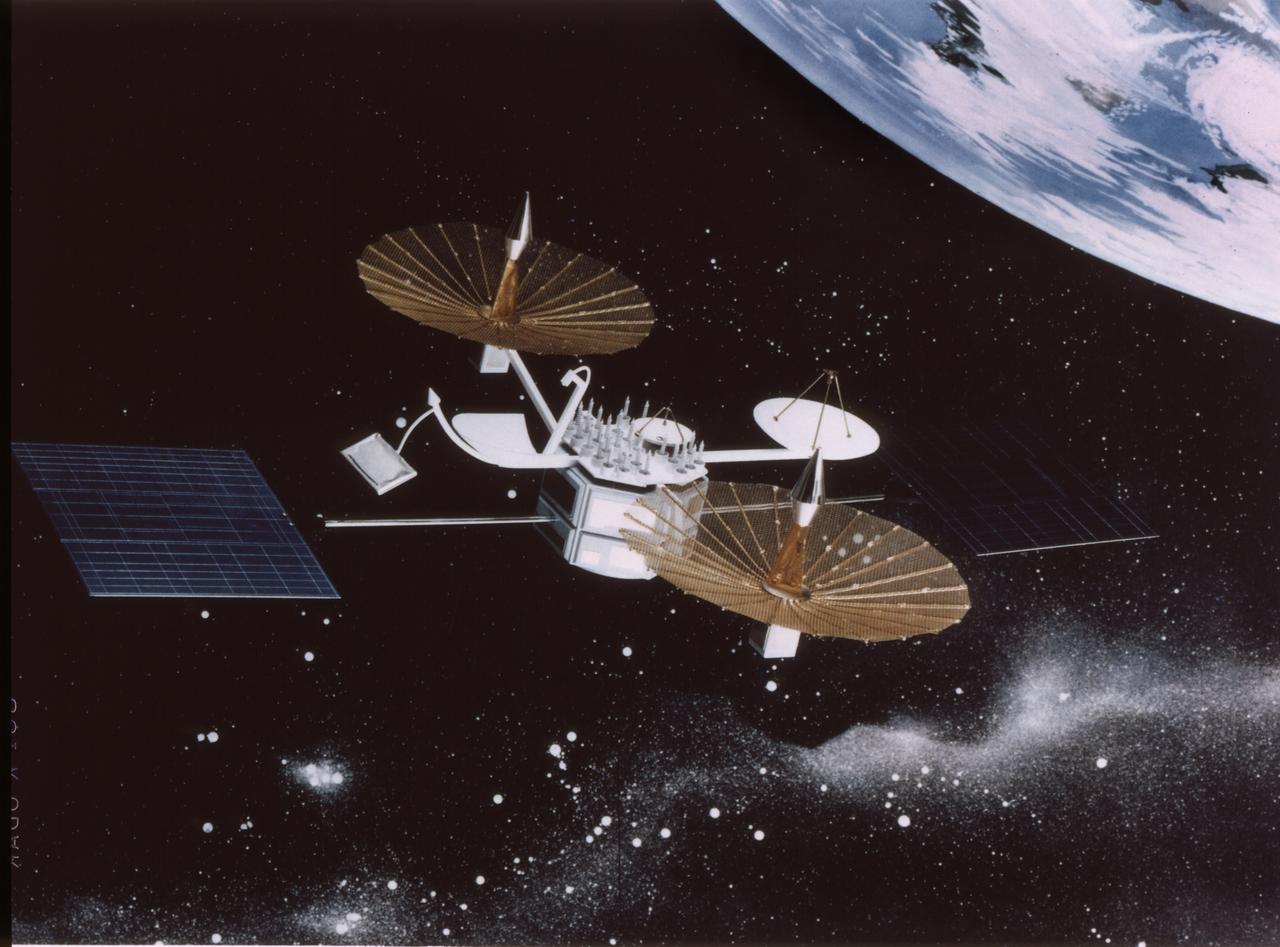
This artist's concept drawing depicts the Tracking and Data Relay Satellite-C (TDRS-C), which was the primary payload of the Space Shuttle Discovery on the STS-26 mission, launched on September 29, 1988. The TDRS system provides almost uninterrupted communications with Earth-orbiting Shuttles and satellites, and had replaced the intermittent coverage provided by globe-encircling ground tracking stations used during the early space program. The TDRS can transmit and receive data, and track a user spacecraft in a low Earth orbit. The deployment of TDRS-G on the STS-70 mission being the latest in the series, NASA has successfully launched six TDRSs.
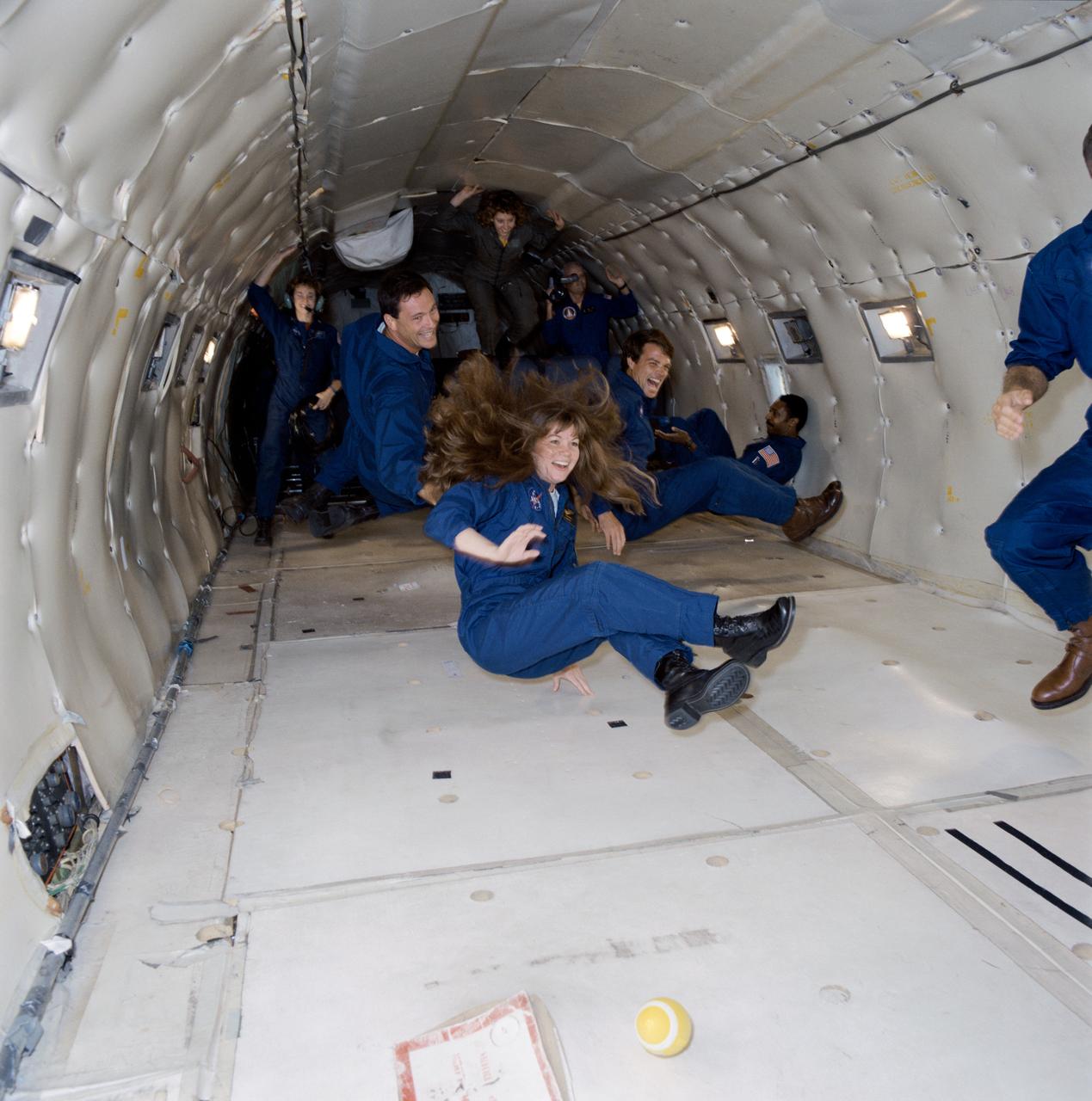
S94-26350 (10 Jan. 1994) --- Astronaut Catherine G. Coleman seems to enjoy the brief period of weightlessness she is sharing with fellow members of the 1992 class of astronauts. The weightless experience was afforded by a special parabolic pattern flown by NASA?s KC-135 ?zero gravity? aircraft. Left to right behind her are astronauts Michael E. Lopez-Alegria, Kevin R. Kregel and Winston E. Scott. EDITOR?S NOTE: Since this photograph was taken the four have been named to flights as follows: Kregel, STS-70; Scott, STS-72.
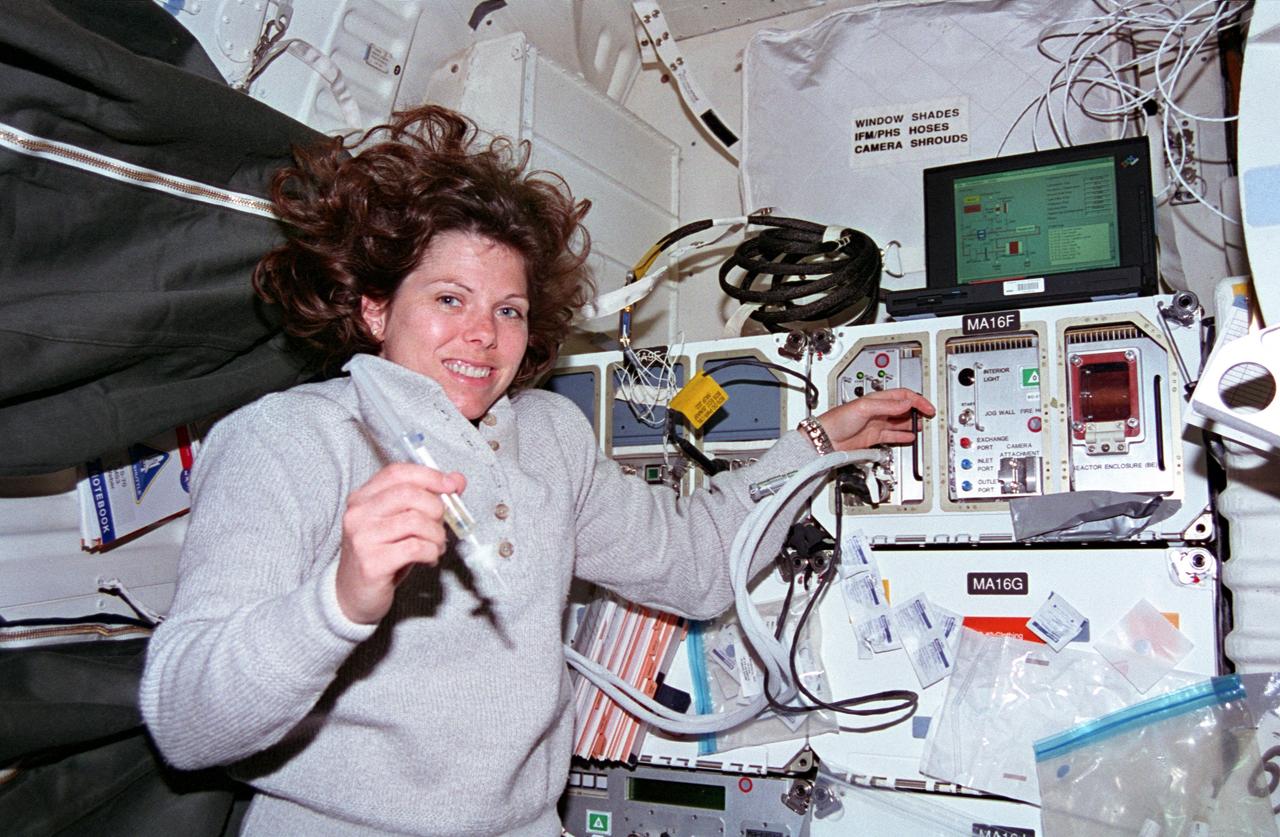
STS070-301-025 (13-22 July 1995) --- Astronaut Mary Ellen Weber works with a syringe related to the Bioreactor Development System (BDS). The almost weightless state of space travel provides life science researchers with the opportunity to grow cells into three-dimensional tissue pieces that are not achievable using conventional tissue culture methods on Earth. At specified times during the STS-70 mission, crew members injected color producing substances to document fluid movement in the reactor, and various-sized beads to estimate the tissue size that could be supported in the Bioreactor. The photo was among NASA's first release of still photography from the STS-70 mission. The mission was launched from the Kennedy Space Center (KSC) on July 13, 1995, and ended when Discovery landed on Runway 33 there on July 22, 1995. The crew members were astronauts Terence T. (Tom) Henricks, commander; Kevin R. Kregel, pilot; and Donald A. Thomas, Nancy J. Currie and Weber, all mission specialists.
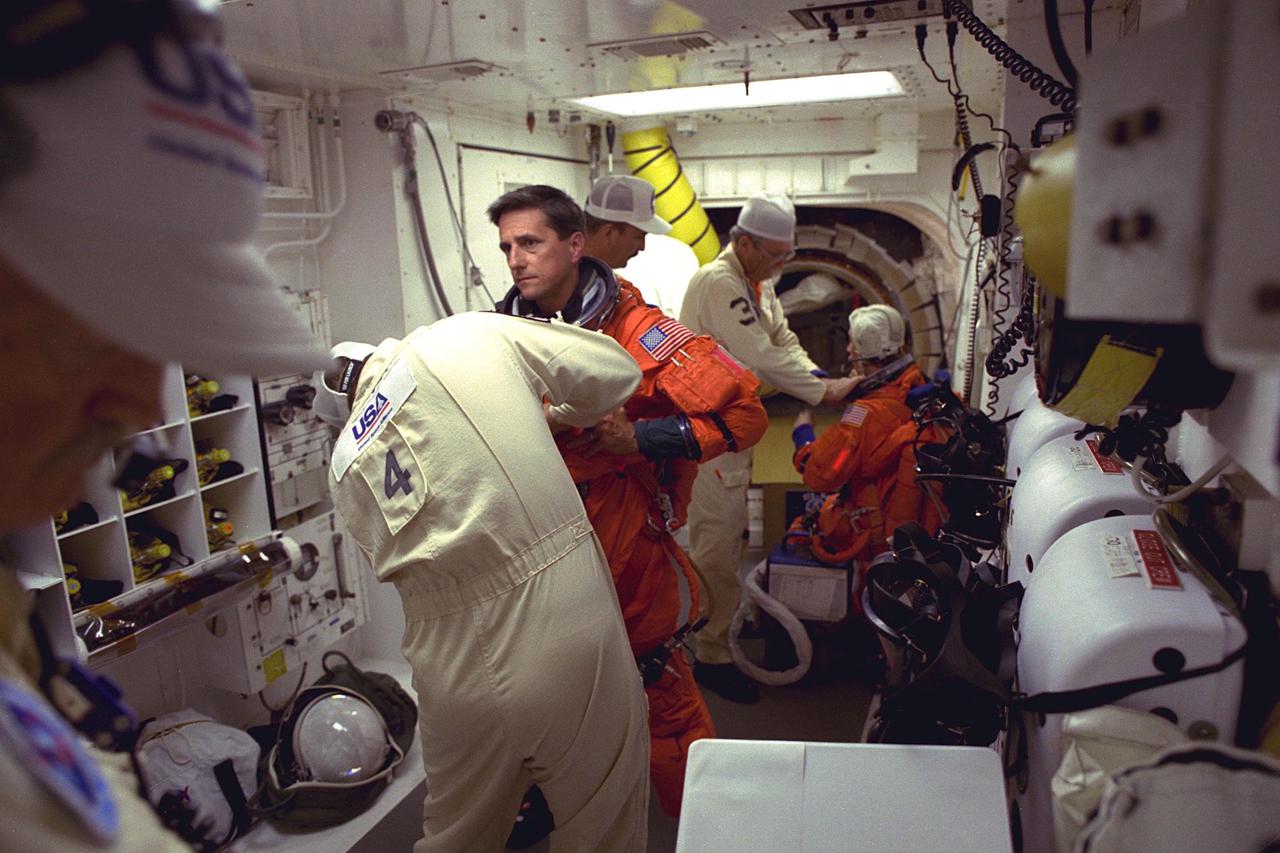
STS-94 Mission Specialist Donald A. Thomas prepares to enter the Space Shuttle Columbia at Launch Pad 39A in preparation for launch. He has flown on STS-83, STS-70 and STS-65. He holds a doctorate in materials science and has been the Principal Investigator for a Space Shuttle crystal growth experiment. Because of his background in materials science, Thomas will be concentrating his efforts during the Red shift on the five experiments in this discipline in the Large Isothermal Furnace. He also will work on the ten materials science investigations in the Electromagnetic Containerless Processing Facility and four that will be measuring the effects of microgravity and motion in the orbiter on the experiments. Thomas and six fellow crew members will lift off during a launch window that opens at 1:50 p.m. EDT, July 1. The launch window will open 47 minutes early to improve the opportunity to lift off before Florida summer rain showers reach the space center
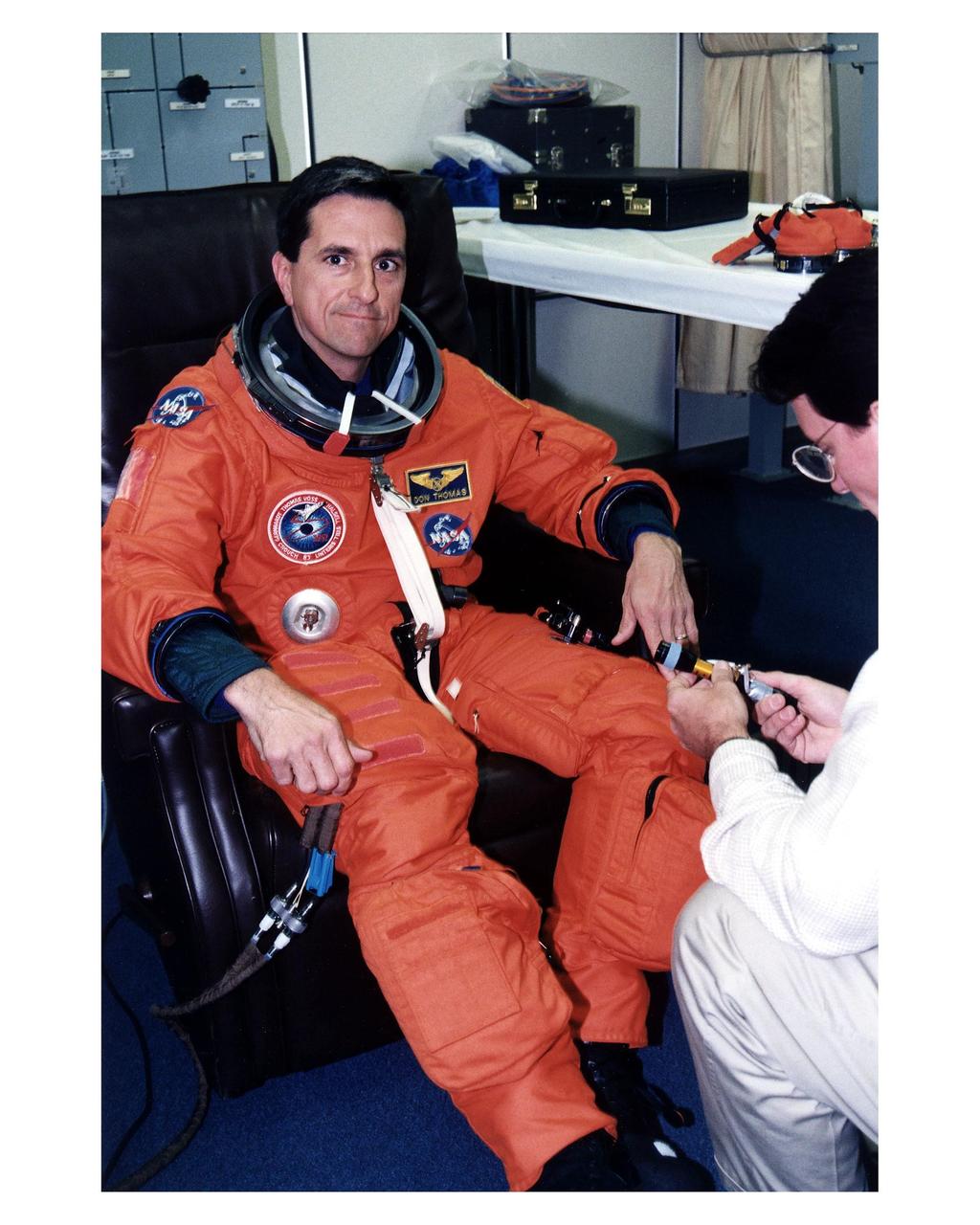
STS-83 Mission Specialist Donald A. Thomas is assisted into his launch/entry suit in the Operations and Checkout (O&C) Building. He has flown on both STS-70 and STS-65. He holds a doctorate in materials science and has been the Principal Investigator for a Space Shuttle crystal growth experiment. Because of his background in materials science, Thomas will be concentrating his efforts during the Red shift on the five experiments in this discipline in the large Isothermal Furnace. He also will work on the ten materials science investigations in the Electromagnetic Containerless Processing Facility and four that will be measuring the effects of microgravity and motion in the orbiter on the experiments. Thomas and six fellow crew members will shortly depart the O&C and head for Launch Pad 39A, where the Space Shuttle Columbia will lift off during a launch window that opens at 2:00 pm EST, April 4
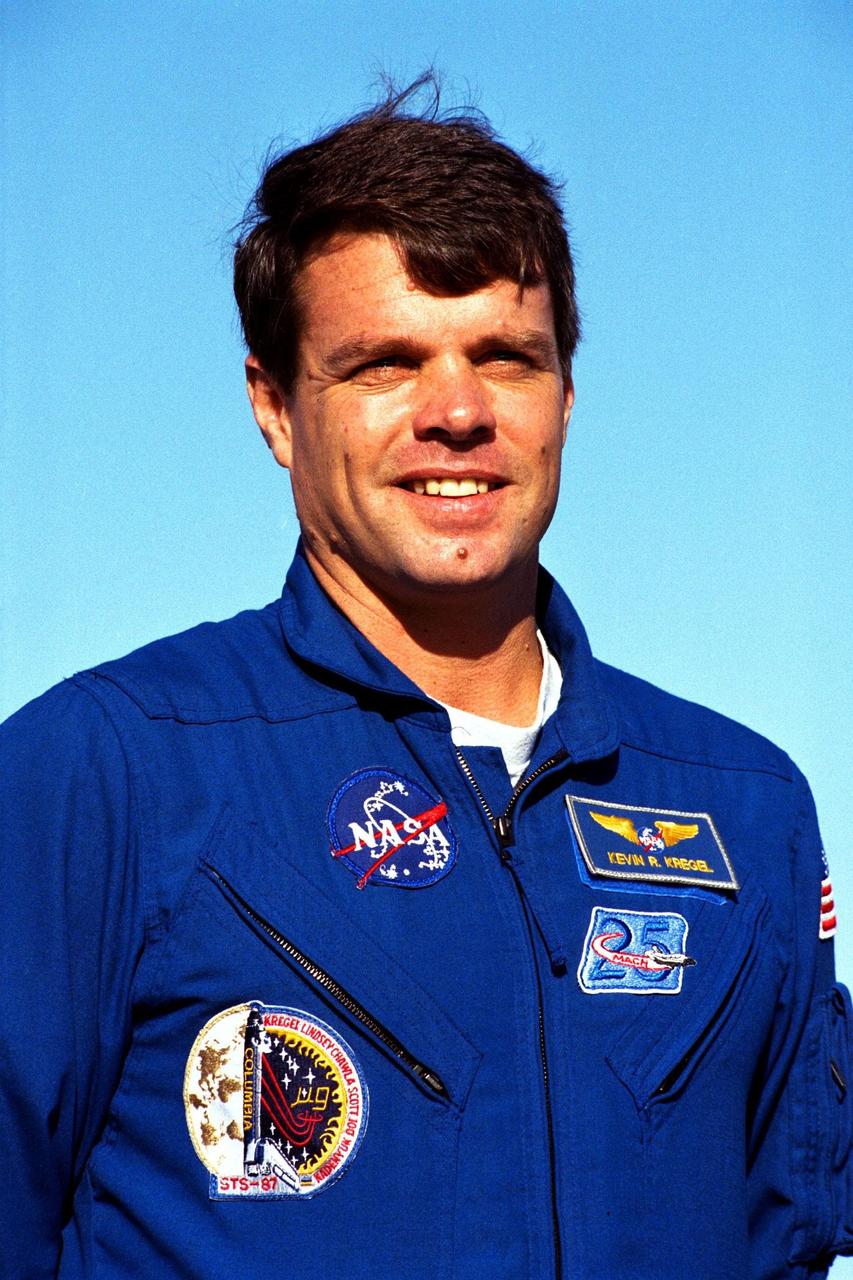
Kevin Kregel, commander of the STS-87 crew, participates in a news briefing at Launch Pad 39B during the Terminal Countdown Demonstration Test (TCDT) at Kennedy Space Center (KSC). Selected by NASA in 1992, Kregel is a veteran of two space flights (STS-70 and 78) and has logged over 618 hours in space. The TCDT is held at KSC prior to each Space Shuttle flight providing the crew of each mission opportunities to participate in simulated countdown activities. The TCDT ends with a mock launch countdown culminating in a simulated main engine cut-off. The crew also spends time undergoing emergency egress training exercises at the pad and has an opportunity to view and inspect the payloads in the orbiter's payload bay. STS-87 is scheduled for launch Nov. 19 aboard the Space Shuttle Columbia from pad 39B at KSC
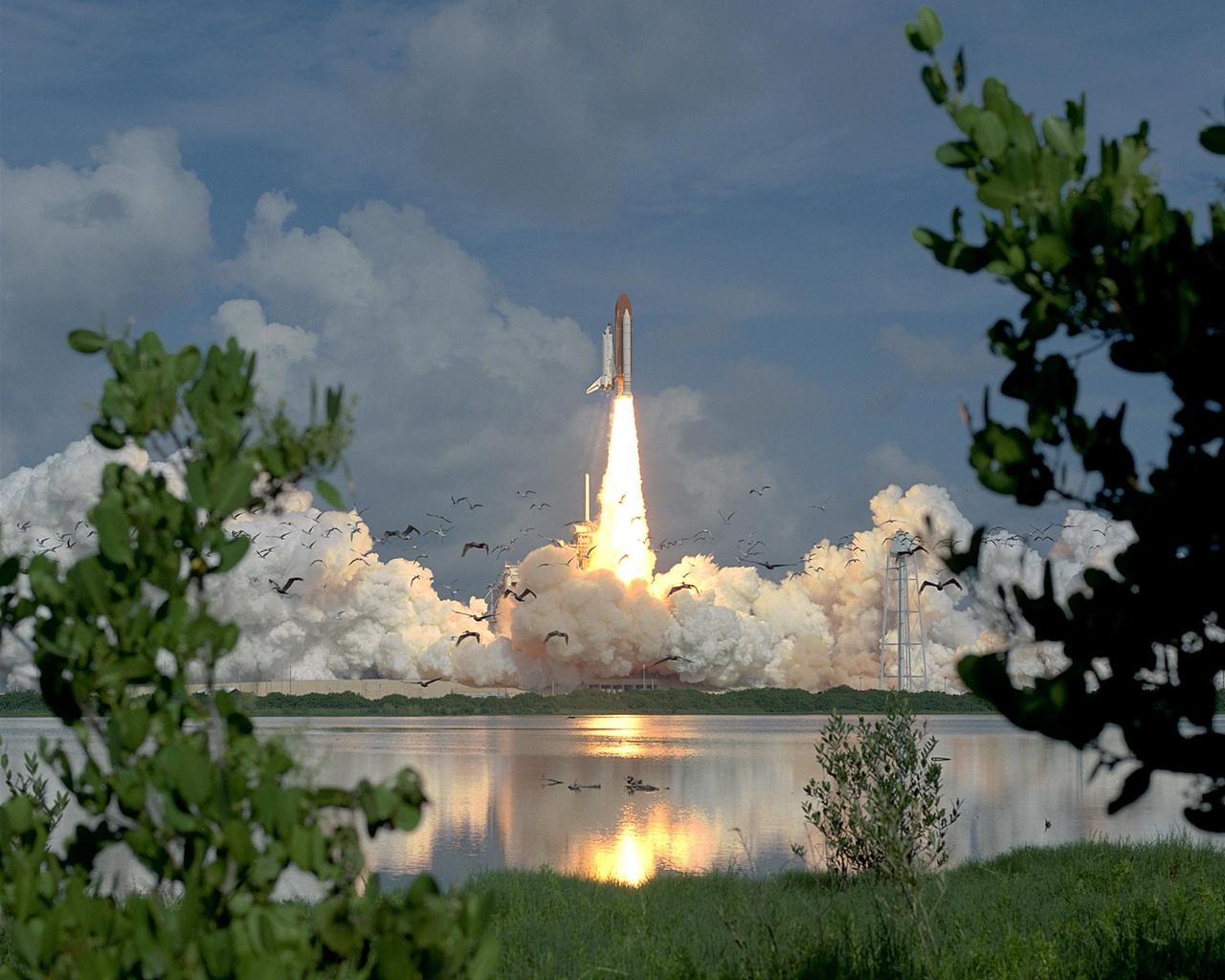
Startled birds scatter as the stillness of a summer morning is broken by a giant's roar. The Space Shuttle Discovery thundered into space from Launch Pad 39B at 9:41:55:078 a.m. EDT. STS-70 is the 70th Shuttle flight overall, the 21st for Discovery (OV-103), and the fourth Shuttle flight in 1995. On board for the nearly eight-day mission are a crew of five: Commander Terence "Tom" Henricks, Pilot Kevin R. Kregel, and Mission Specialists Nancy Jane Currie, Donald A. Thomas and Mary Ellen Weber. The crew's primary objective is to deploy the Tracking and Data Relay Satellite-G (TDRS-G), which will join a constellation of other TDRS spacecraft already on orbit
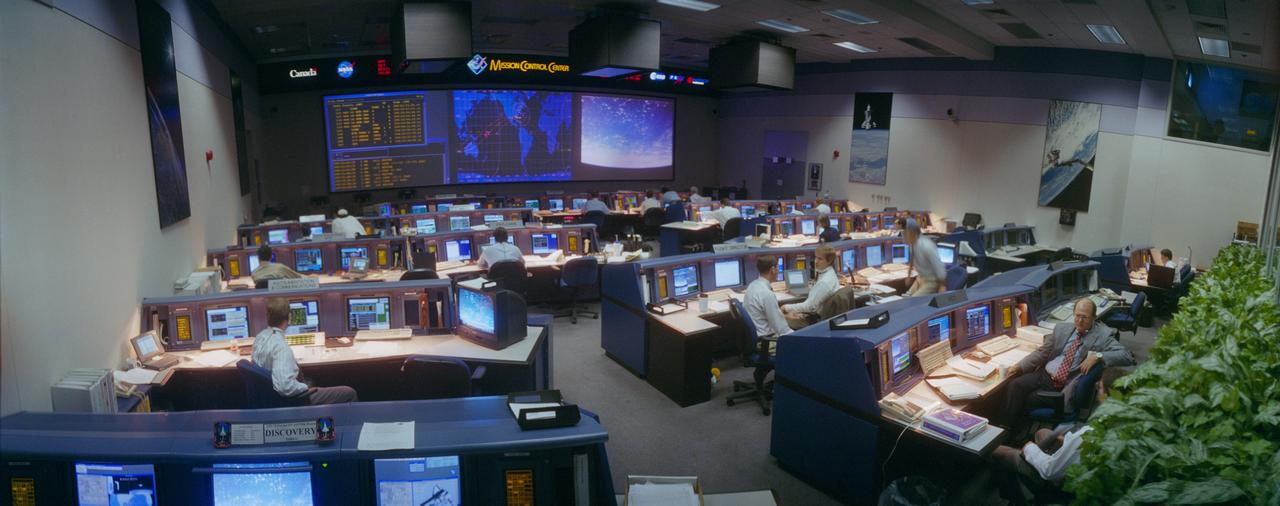
S95-16445 (13-22 July 1995) --- A wide angle view from the rear shows activity in the new Mission Control Center (MCC), opened for operation and dedicated during the STS-70 mission. The Space Shuttle Discovery was just passing over Florida at the time this photo was taken (note mercator map and TV scene on screens). The new MCC, developed at a cost of about 50 million, replaces the main-frame based, NASA-unique design of the old Mission Control with a standard workstation-based, local area network system commonly in use today.

S95-10529 (3 May 1995) --- Inside the cavernous Vehicle Assembly Building (VAB), workers carry out the meticulous process of lifting the Orbiter Discovery from a horizontal to a vertical position. Once upright, Discovery will be transferred into a high bay for mating with the external tank and solid rocket booster assembly already mounted on the mobile launcher platform. Completing the assembly process takes about five working days. Discovery?s next destination is Launch Pad 39B, and final preparations for liftoff on mission STS-70 scheduled for June 1995.

CAPE CANAVERAL, Fla. -- Space shuttle and rover models built of LEGO bricks are on display at NASA's Kennedy Space Center in Florida, marking a new partnership between the U.S. space agency and The LEGO Group. The three-year Space Act Agreement is meant to spark the interest of children in science, technology, engineering and mathematics (STEM) with the future release of four NASA-inspired products in the toy company's LEGO CITY line. To commemorate the beginning of the partnership, two small LEGO space shuttles will launch aboard space shuttle Discovery's STS-133 mission to the International Space Station. A 40- by 70-foot activity tent will be set up at Kennedy on Nov. 3 for children of all ages to build their vision of the future with LEGO bricks. LEGO sets also will fly to the space station aboard Endeavour's STS-134 mission, and will be put together on orbit to demonstrate the challenges faced while building things in microgravity. Photo credit: NASA/Jack Pfaller
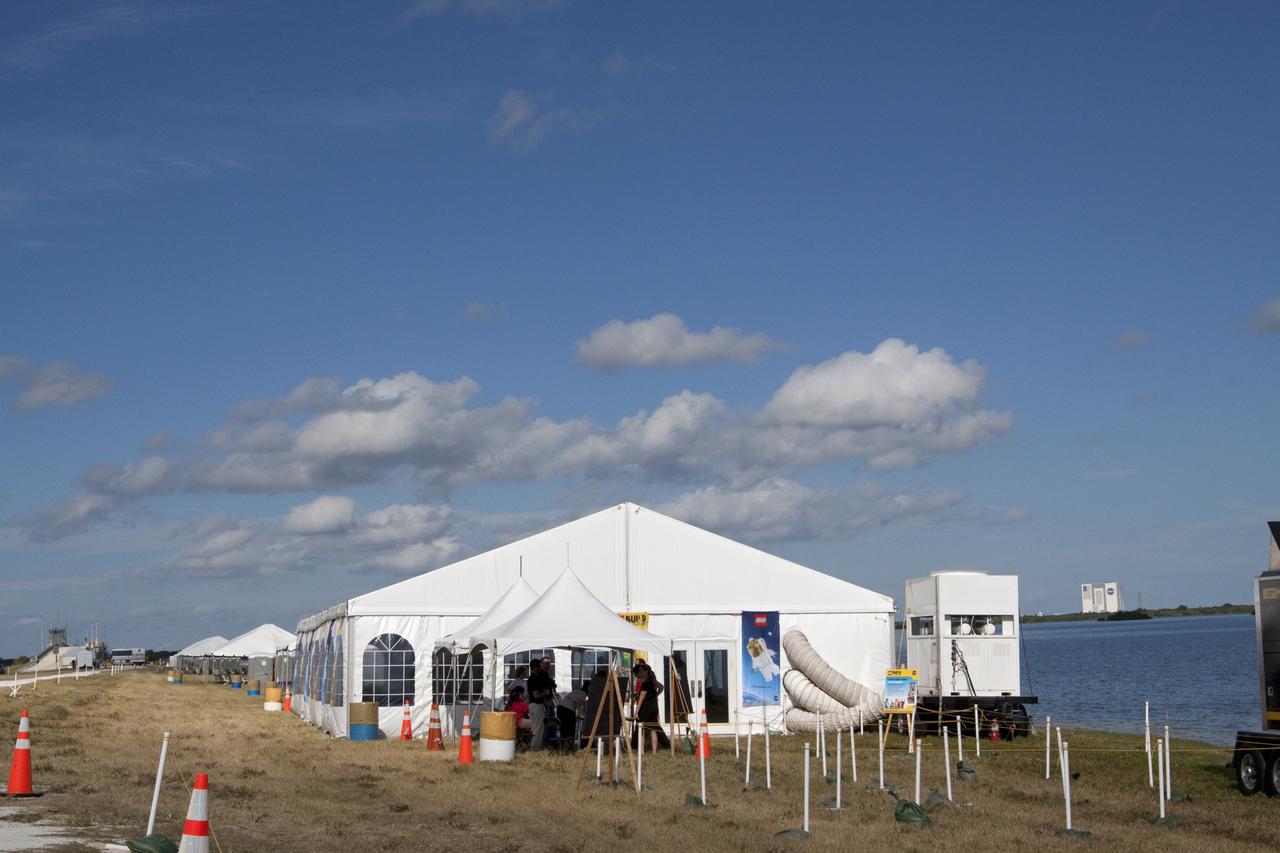
CAPE CANAVERAL, Fla. -- A 40- by 70-foot activity tent chock full of LEGO bricks is set up on the NASA Causeway at Kennedy Space Center in Florida. Inside, children of all ages will have the opportunity to build their vision of the future with LEGO bricks, marking the beginning of a three-year Space Act Agreement between NASA and The LEGO Group. The partnership is meant to spark the interest of children in science, technology, engineering and mathematics (STEM). To commemorate the partnership, two small LEGO space shuttles will launch aboard space shuttle Discovery's STS-133 mission to the International Space Station and the company will release four NASA-inspired products in its LEGO CITY line next year. LEGO sets also will fly to the space station aboard Endeavour's STS-134 mission, and will be put together on orbit to demonstrate the challenges faced while building things in microgravity. Photo credit: NASA/Jack Pfaller
CAPE CANAVERAL, Fla. -- On the NASA Causeway at Kennedy Space Center in Florida, a 40- by 70-foot activity tent chock full of LEGO bricks is ready to welcome children of all ages. There, they will have the opportunity to build their vision of the future with LEGO bricks, marking the beginning of a three-year Space Act Agreement between NASA and The LEGO Group. The partnership is meant to spark the interest of children in science, technology, engineering and mathematics (STEM). To commemorate the partnership, two small LEGO space shuttles will launch aboard space shuttle Discovery's STS-133 mission to the International Space Station and the company will release four NASA-inspired products in its LEGO CITY line next year. LEGO sets also will fly to the space station aboard Endeavour's STS-134 mission, and will be put together on orbit to demonstrate the challenges faced while building things in microgravity. Photo credit: NASA/Jack Pfaller
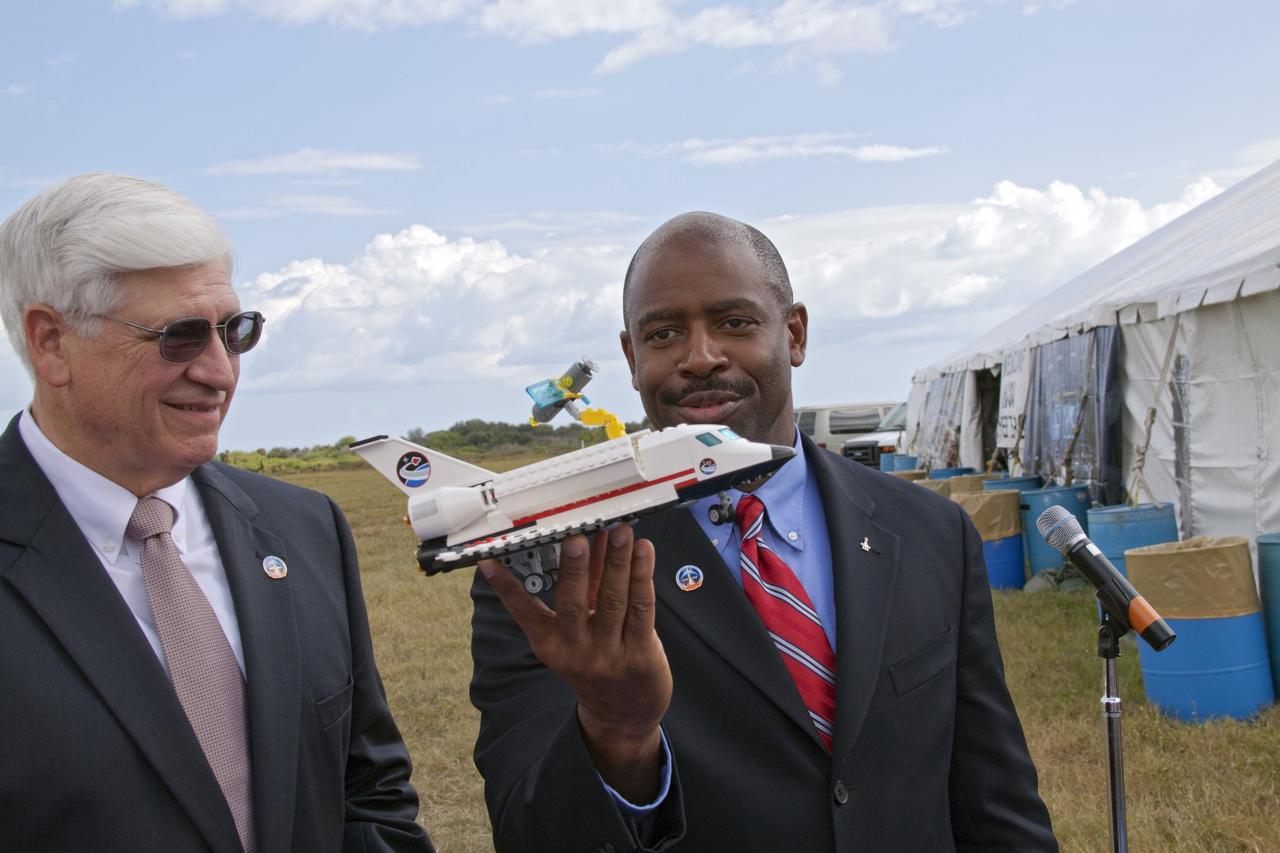
CAPE CANAVERAL, Fla. -- NASA and The LEGO Group announce a three-year Space Act Agreement meant to spark the interest of children in science, technology, engineering and mathematics (STEM) with the future release of four NASA-inspired products in the toy company's LEGO CITY line. From left, are Stephan Turnipseed, president of LEGO Education North America, and Leland Melvin, NASA's associate administrator for Education. To commemorate the beginning of the partnership, two small LEGO space shuttles will launch aboard space shuttle Discovery's STS-133 mission to the International Space Station. A 40- by 70-foot activity tent will be set up at Kennedy on Nov. 3 for children of all ages to build their vision of the future with LEGO bricks. LEGO sets also will fly to the space station aboard Endeavour's STS-134 mission, and will be put together on orbit to demonstrate the challenges faced while building things in microgravity. Photo credit: NASA/Jack Pfaller
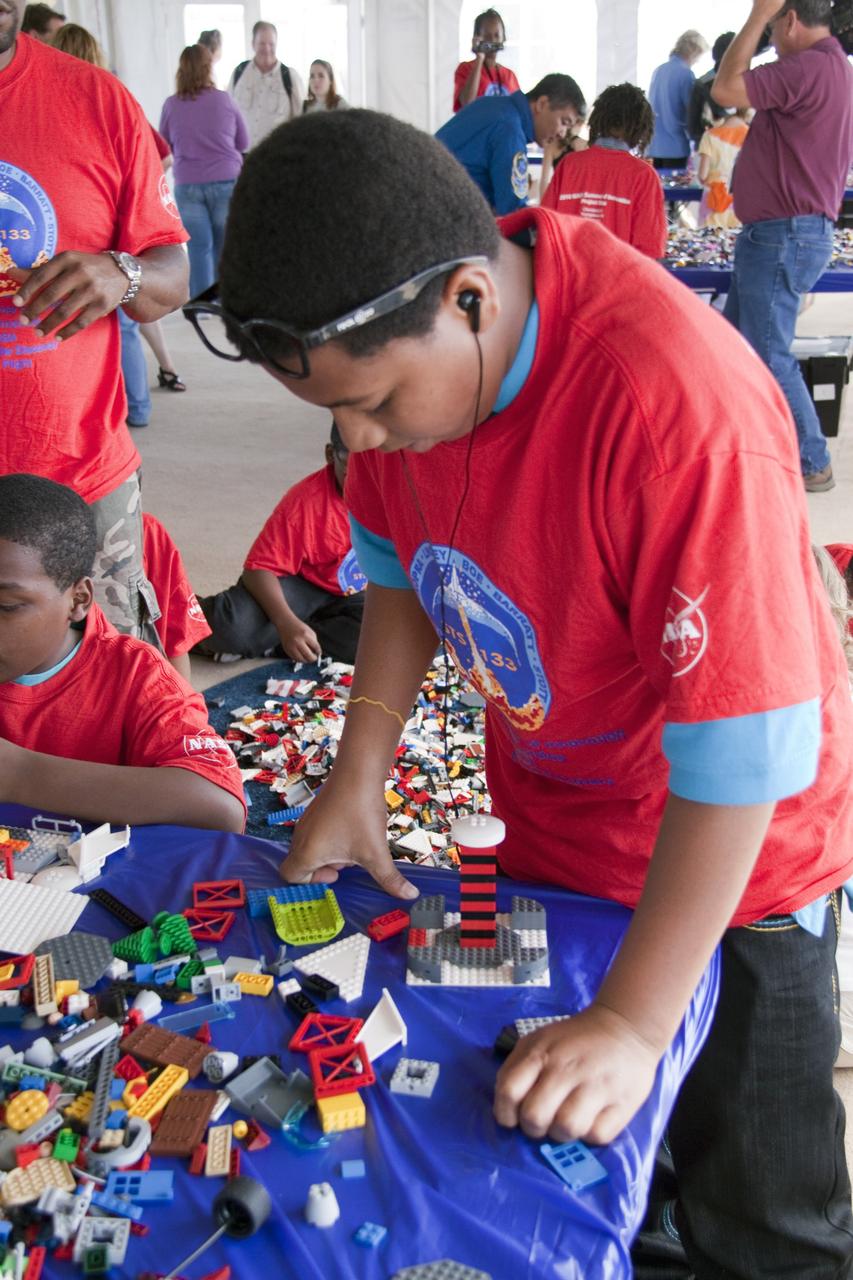
CAPE CANAVERAL, Fla. -- On the NASA Causeway at Kennedy Space Center in Florida, school children build LEGO space vehicles inside a 40- by 70-foot activity tent. There, children of all ages are building their vision of the future with LEGO bricks, marking the beginning of a three-year Space Act Agreement between NASA and The LEGO Group. The partnership is meant to spark the interest of children in science, technology, engineering and mathematics (STEM). To commemorate the partnership, two small LEGO space shuttles will launch aboard space shuttle Discovery's STS-133 mission to the International Space Station and the company will release four NASA-inspired products in its LEGO CITY line next year. LEGO sets also will fly to the space station aboard Endeavour's STS-134 mission, and will be put together on orbit to demonstrate the challenges faced while building things in microgravity. Photo credit: NASA/Jack Pfaller
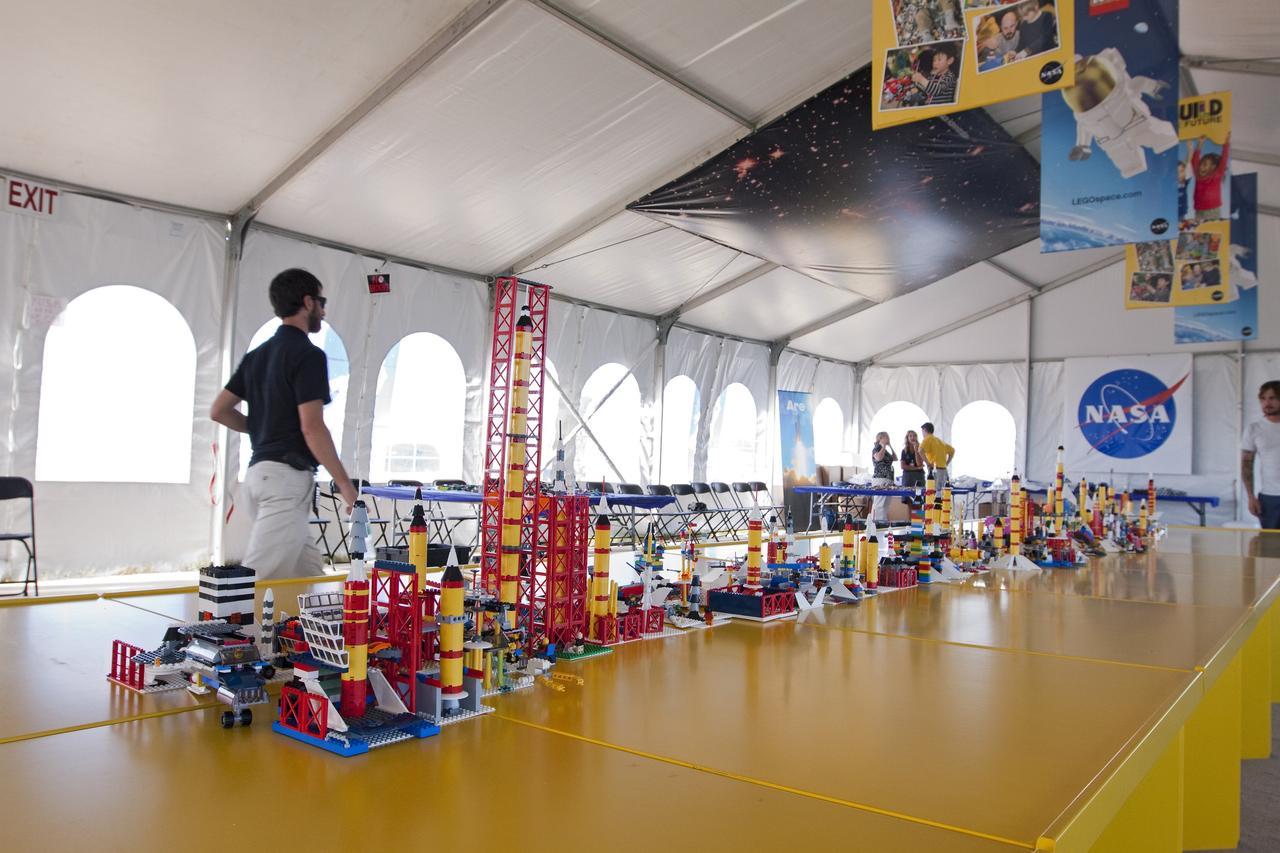
CAPE CANAVERAL, Fla. -- On the NASA Causeway at Kennedy Space Center in Florida, a 40- by 70-foot activity tent chock full of LEGO bricks is ready to welcome children of all ages. There, they will have the opportunity to build their vision of the future with LEGO bricks, marking the beginning of a three-year Space Act Agreement between NASA and The LEGO Group. The partnership is meant to spark the interest of children in science, technology, engineering and mathematics (STEM). To commemorate the partnership, two small LEGO space shuttles will launch aboard space shuttle Discovery's STS-133 mission to the International Space Station and the company will release four NASA-inspired products in its LEGO CITY line next year. LEGO sets also will fly to the space station aboard Endeavour's STS-134 mission, and will be put together on orbit to demonstrate the challenges faced while building things in microgravity. Photo credit: NASA/Jack Pfaller
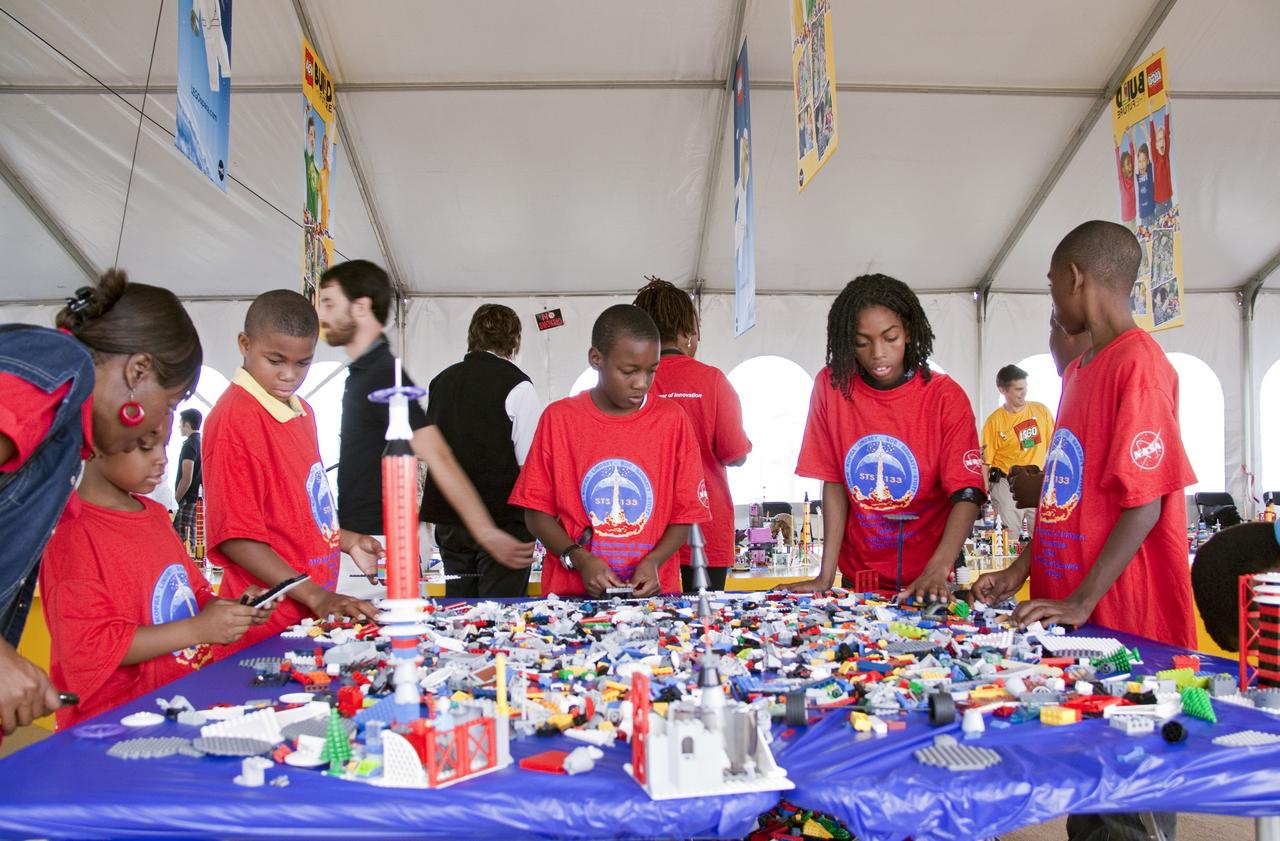
CAPE CANAVERAL, Fla. -- On the NASA Causeway at Kennedy Space Center in Florida, school children build LEGO space vehicles inside a 40- by 70-foot activity tent. There, children of all ages are building their vision of the future with LEGO bricks, marking the beginning of a three-year Space Act Agreement between NASA and The LEGO Group. The partnership is meant to spark the interest of children in science, technology, engineering and mathematics (STEM). To commemorate the partnership, two small LEGO space shuttles will launch aboard space shuttle Discovery's STS-133 mission to the International Space Station and the company will release four NASA-inspired products in its LEGO CITY line next year. LEGO sets also will fly to the space station aboard Endeavour's STS-134 mission, and will be put together on orbit to demonstrate the challenges faced while building things in microgravity. Photo credit: NASA/Jack Pfaller
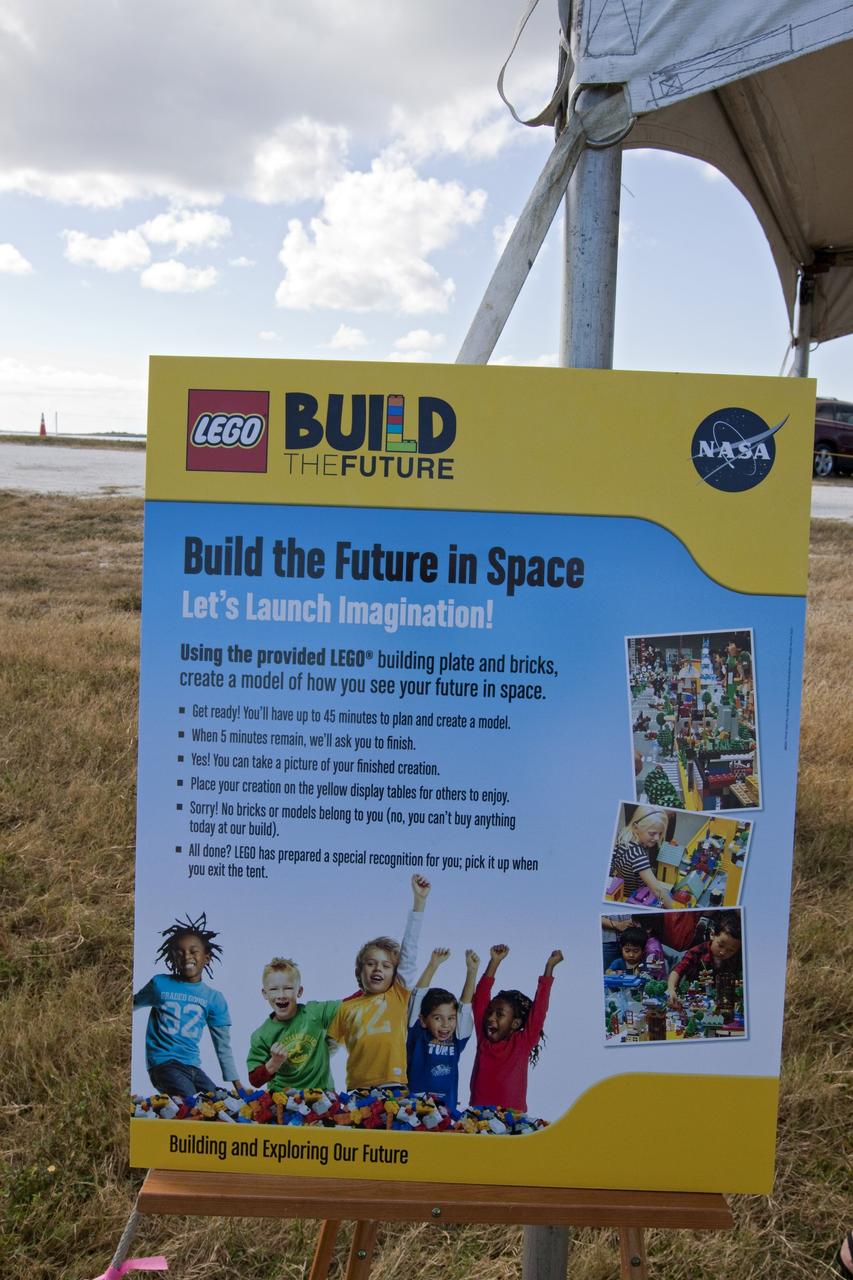
CAPE CANAVERAL, Fla. -- A sign welcomes children of all ages to a 40- by 70-foot activity tent chock full of LEGO bricks on the NASA Causeway at Kennedy Space Center in Florida. Inside the tent, they will have the opportunity to build their vision of the future with LEGO bricks, marking the beginning of a three-year Space Act Agreement between NASA and The LEGO Group. The partnership is meant to spark the interest of children in science, technology, engineering and mathematics (STEM). To commemorate the partnership, two small LEGO space shuttles will launch aboard space shuttle Discovery's STS-133 mission to the International Space Station and the company will release four NASA-inspired products in its LEGO CITY line next year. LEGO sets also will fly to the space station aboard Endeavour's STS-134 mission, and will be put together on orbit to demonstrate the challenges faced while building things in microgravity. Photo credit: NASA/Jack Pfaller
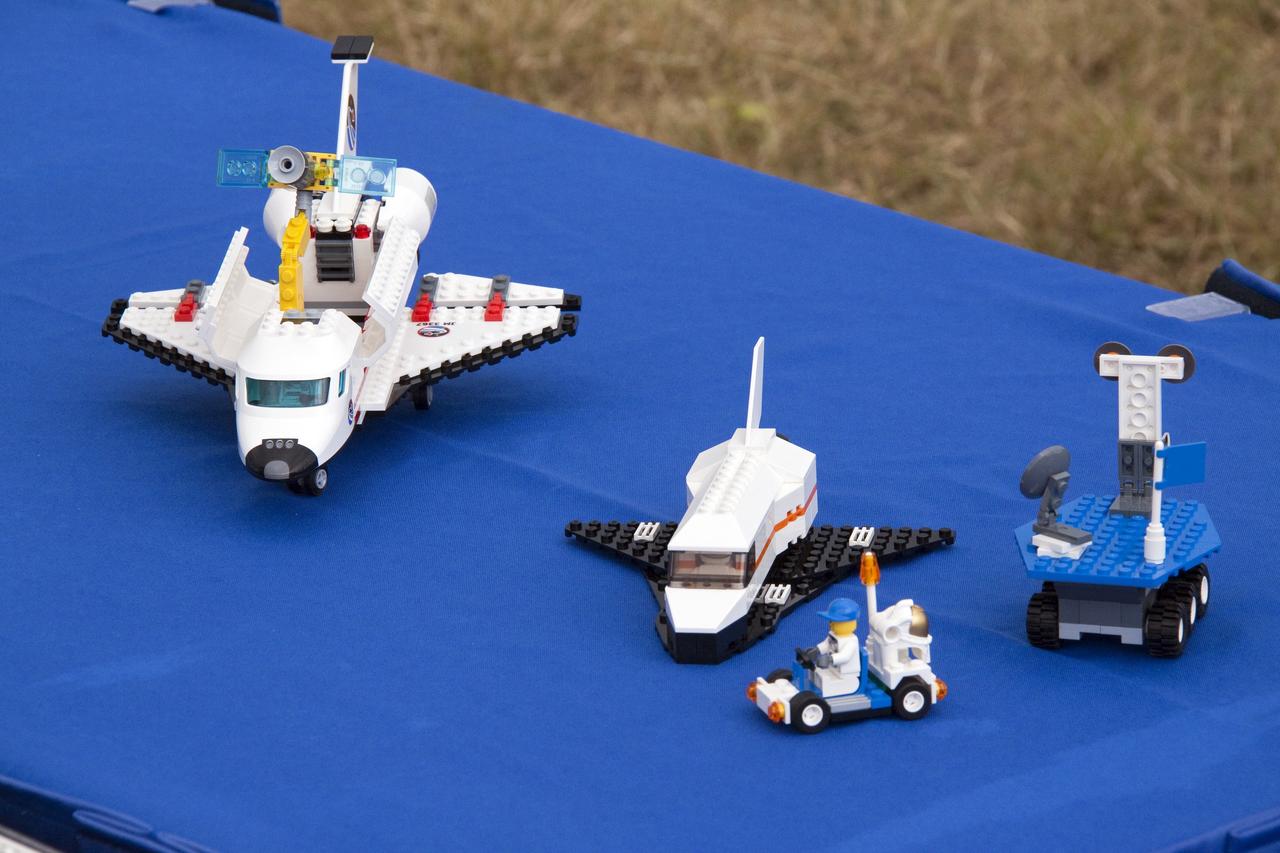
CAPE CANAVERAL, Fla. -- Space shuttle and rover models built of LEGO bricks are on display at NASA's Kennedy Space Center in Florida, marking a new partnership between the U.S. space agency and The LEGO Group. The three-year Space Act Agreement is meant to spark the interest of children in science, technology, engineering and mathematics (STEM) with the future release of four NASA-inspired products in the toy company's LEGO CITY line. To commemorate the beginning of the partnership, two small LEGO space shuttles will launch aboard space shuttle Discovery's STS-133 mission to the International Space Station. A 40- by 70-foot activity tent will be set up at Kennedy on Nov. 3 for children of all ages to build their vision of the future with LEGO bricks. LEGO sets also will fly to the space station aboard Endeavour's STS-134 mission, and will be put together on orbit to demonstrate the challenges faced while building things in microgravity. Photo credit: NASA/Jack Pfaller
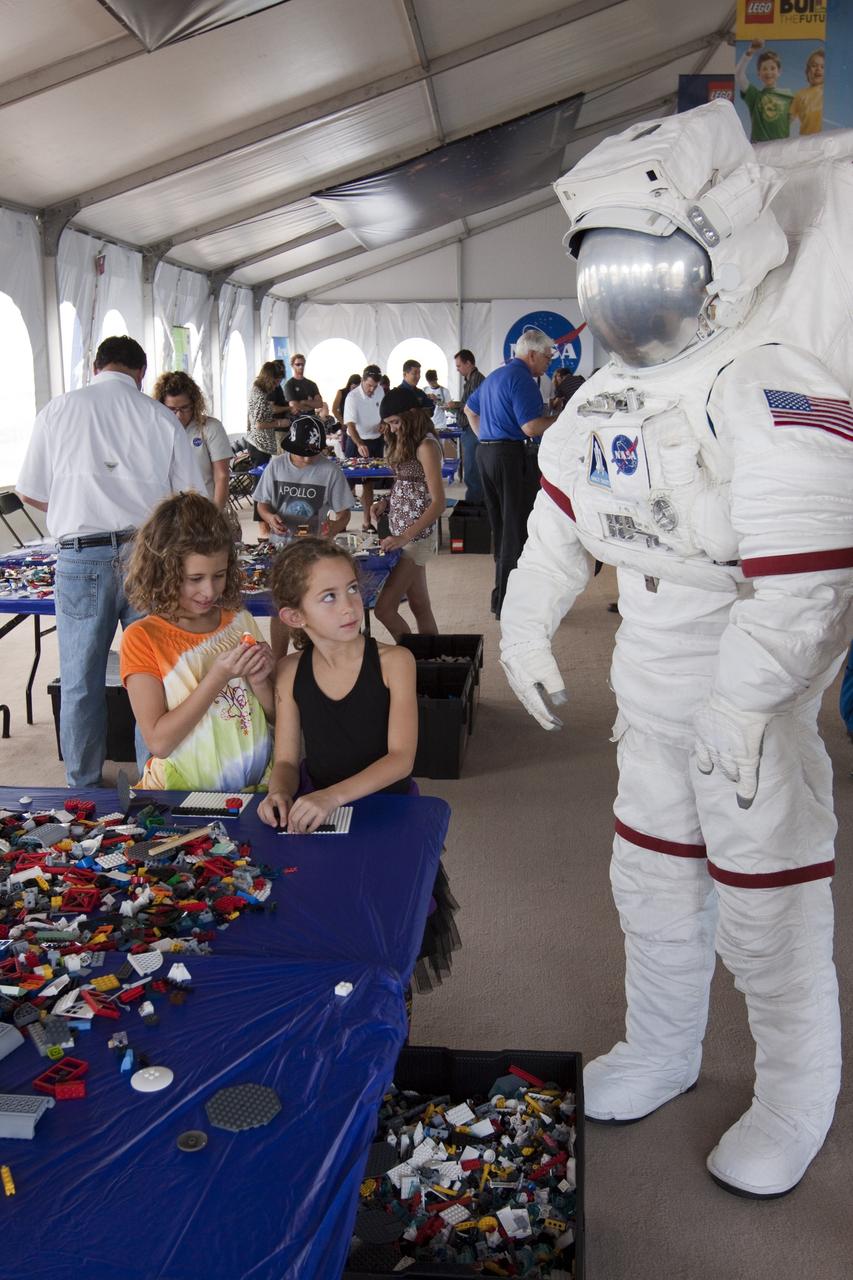
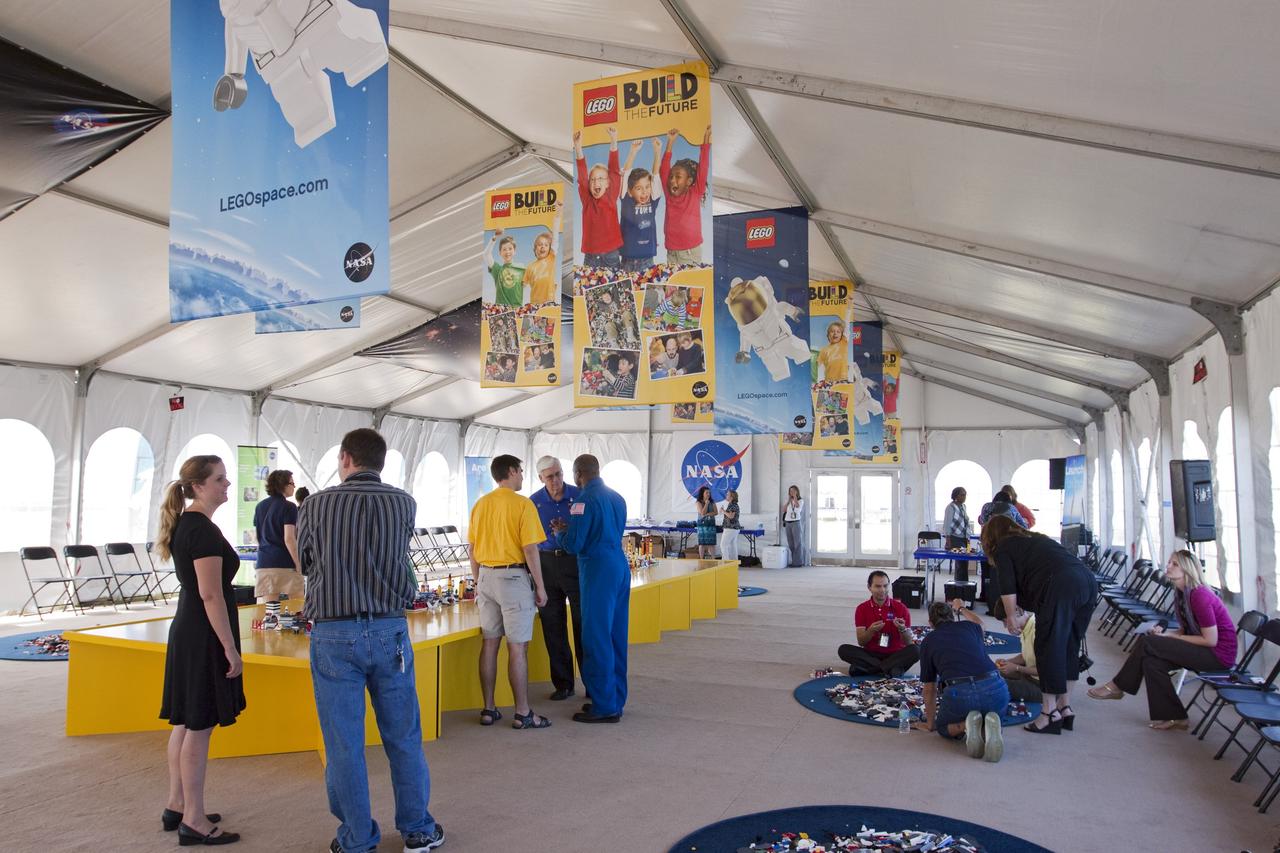
CAPE CANAVERAL, Fla. -- On the NASA Causeway at Kennedy Space Center in Florida, a 40- by 70-foot activity tent chock full of LEGO bricks hosts children, adults and a space person. There, they are building their vision of the future with LEGO bricks, marking the beginning of a three-year Space Act Agreement between NASA and The LEGO Group. The partnership is meant to spark the interest of children in science, technology, engineering and mathematics (STEM). To commemorate the partnership, two small LEGO space shuttles will launch aboard space shuttle Discovery's STS-133 mission to the International Space Station and the company will release four NASA-inspired products in its LEGO CITY line next year. LEGO sets also will fly to the space station aboard Endeavour's STS-134 mission, and will be put together on orbit to demonstrate the challenges faced while building things in microgravity. Photo credit: NASA/Jack Pfaller
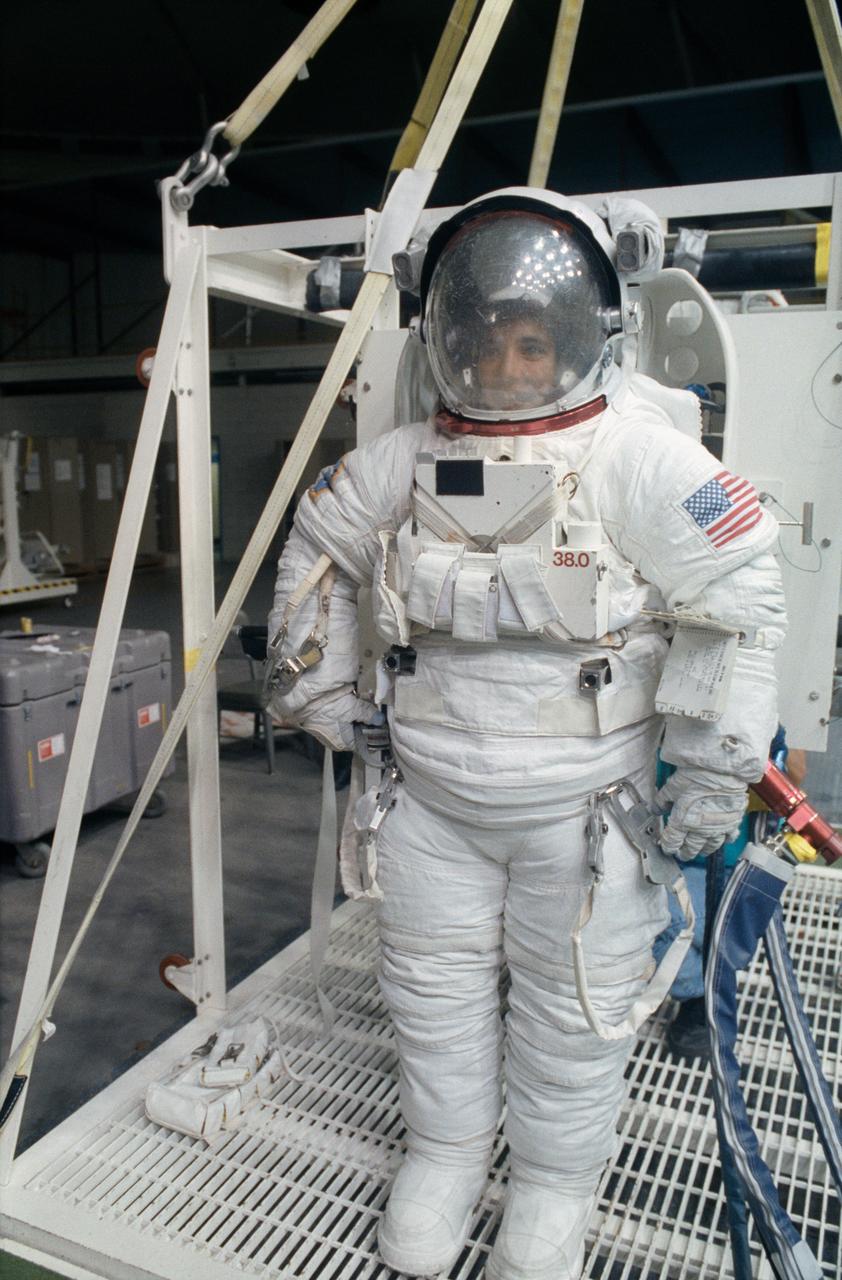
S92-40376 (March 1992) --- Attired in a training version of the Extravehicular Mobility Unit (EMU), astronaut Nancy J. Sherlock participates in a training session at the Johnson Space Center's (JSC) Weightless Environment Training Facility (WET-F). Training as a mission specialist for the STS-57 mission, Sherlock was rehearsing a contingency space walk. Astronauts scheduled for Extravehicular Activity (EVA) duty and those who might be called upon for unscheduled space walk duty use a nearby 25 feet deep pool to practice various chores. The suits used in the training are equipped with communications gear, pressurized and weighted to create a neutral buoyancy in the water tank. EDITOR'S NOTE: Nancy J. Currie (formerly Sherlock) has been assigned as a mission specialist for the STS-70 mission, scheduled for launch in spring of 1995.

CAPE CANAVERAL, Fla. -- On the NASA Causeway at Kennedy Space Center in Florida, a 40- by 70-foot activity tent chock full of LEGO bricks hosts children, adults and a space person. There, they are building their vision of the future with LEGO bricks, marking the beginning of a three-year Space Act Agreement between NASA and The LEGO Group. The partnership is meant to spark the interest of children in science, technology, engineering and mathematics (STEM). To commemorate the partnership, two small LEGO space shuttles will launch aboard space shuttle Discovery's STS-133 mission to the International Space Station and the company will release four NASA-inspired products in its LEGO CITY line next year. LEGO sets also will fly to the space station aboard Endeavour's STS-134 mission, and will be put together on orbit to demonstrate the challenges faced while building things in microgravity. Photo credit: NASA/Jack Pfaller
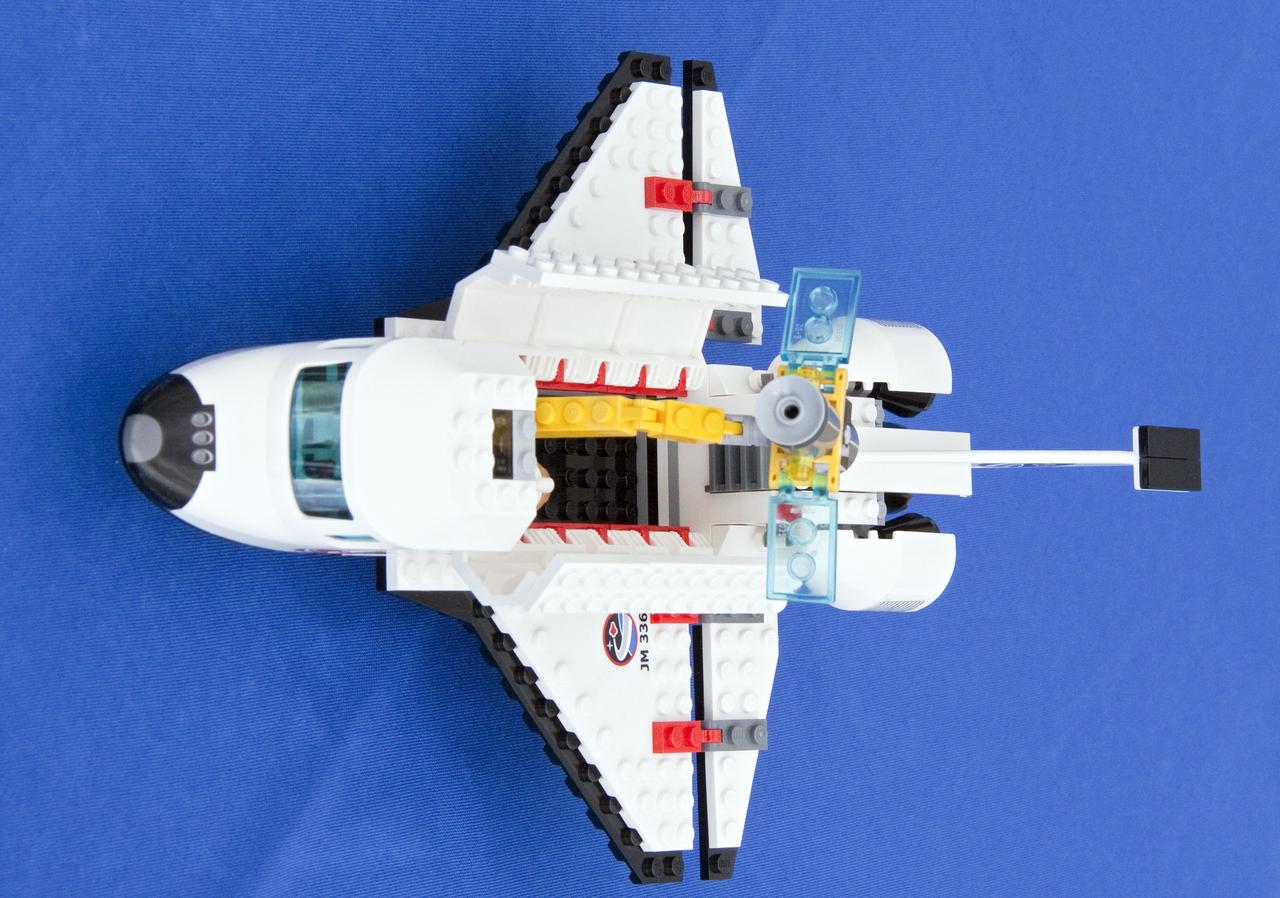
CAPE CANAVERAL, Fla. -- A space shuttle model built of LEGO bricks is on display at NASA's Kennedy Space Center in Florida, marking a new partnership between the U.S. space agency and The LEGO Group. The three-year Space Act Agreement is meant to spark the interest of children in science, technology, engineering and mathematics (STEM) with the future release of four NASA-inspired products in the toy company's LEGO CITY line. To commemorate the beginning of the partnership, two small LEGO space shuttles will launch aboard space shuttle Discovery's STS-133 mission to the International Space Station. A 40- by 70-foot activity tent will be set up at Kennedy on Nov. 3 for children of all ages to build their vision of the future with LEGO bricks. LEGO sets also will fly to the space station aboard Endeavour's STS-134 mission, and will be put together on orbit to demonstrate the challenges faced while building things in microgravity. Photo credit: NASA/Jack Pfaller
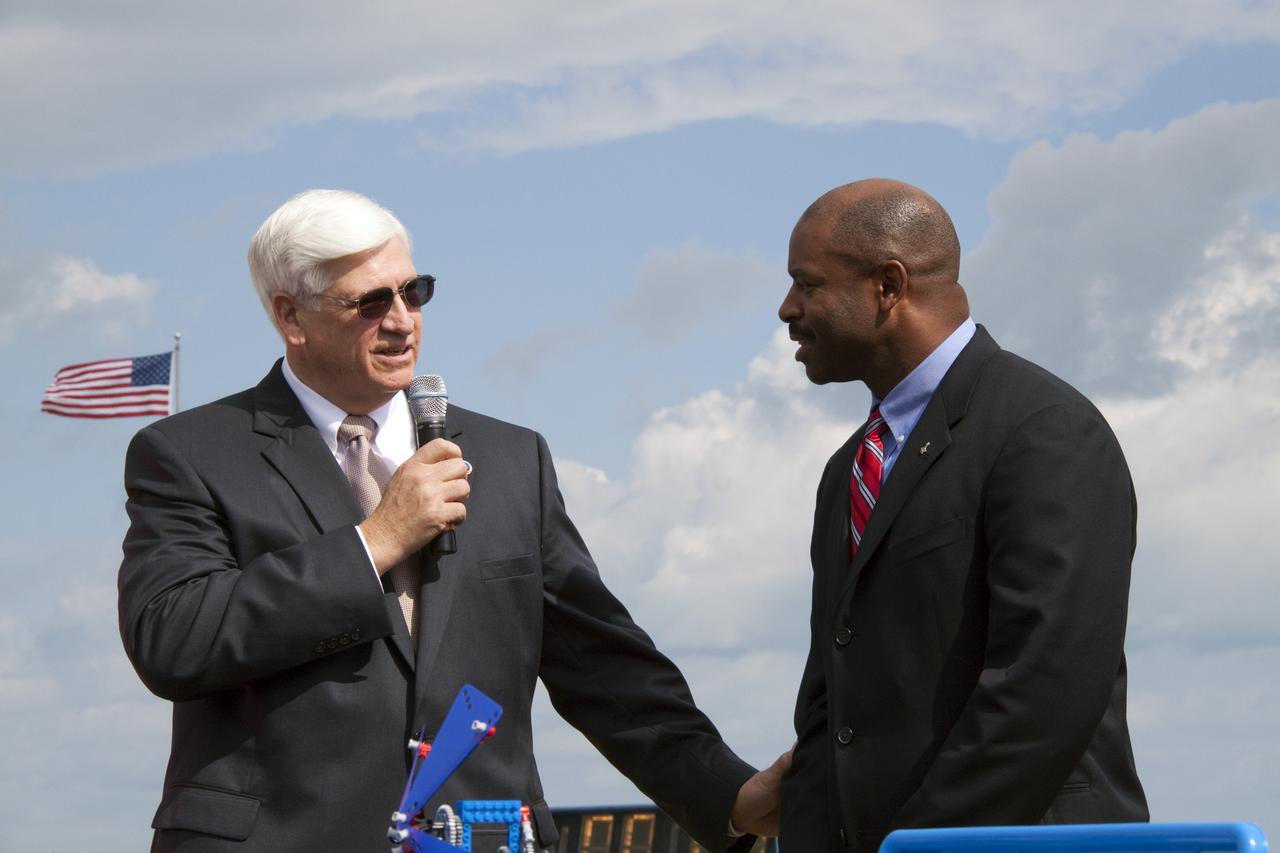
CAPE CANAVERAL, Fla. -- NASA and The LEGO Group announce a three-year Space Act Agreement meant to spark the interest of children in science, technology, engineering and mathematics (STEM) with the future release of four NASA-inspired products in the toy company's LEGO CITY line. From left, are Stephan Turnipseed, president of LEGO Education North America, and Leland Melvin, NASA's associate administrator for Education. To commemorate the beginning of the partnership, two small LEGO space shuttles will launch aboard space shuttle Discovery's STS-133 mission to the International Space Station. A 40- by 70-foot activity tent will be set up at Kennedy on Nov. 3 for children of all ages to build their vision of the future with LEGO bricks. LEGO sets also will fly to the space station aboard Endeavour's STS-134 mission, and will be put together on orbit to demonstrate the challenges faced while building things in microgravity. Photo credit: NASA/Jack Pfaller
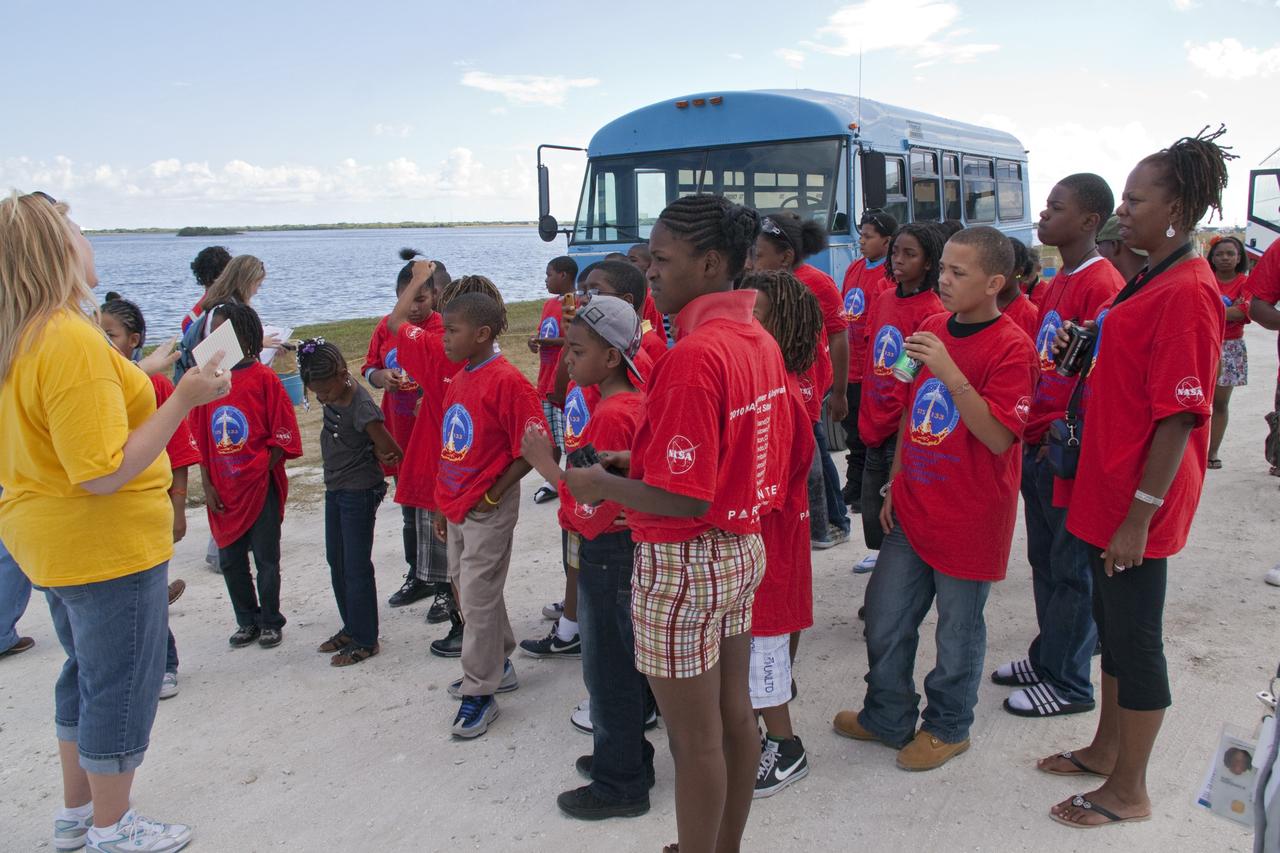
CAPE CANAVERAL, Fla. -- On the NASA Causeway at Kennedy Space Center in Florida, school children arrive at a 40- by 70-foot activity tent chock full of LEGO bricks. There, they will build their vision of the future with LEGO bricks, marking the beginning of a three-year Space Act Agreement between NASA and The LEGO Group. The partnership is meant to spark the interest of children in science, technology, engineering and mathematics (STEM). To commemorate the partnership, two small LEGO space shuttles will launch aboard space shuttle Discovery's STS-133 mission to the International Space Station and the company will release four NASA-inspired products in its LEGO CITY line next year. LEGO sets also will fly to the space station aboard Endeavour's STS-134 mission, and will be put together on orbit to demonstrate the challenges faced while building things in microgravity. Photo credit: NASA/Jack Pfaller

CAPE CANAVERAL, Fla. -- A space shuttle model built of LEGO bricks is on display at NASA's Kennedy Space Center in Florida, marking a new partnership between the U.S. space agency and The LEGO Group. The three-year Space Act Agreement is meant to spark the interest of children in science, technology, engineering and mathematics (STEM) with the future release of four NASA-inspired products in the toy company's LEGO CITY line. To commemorate the beginning of the partnership, two small LEGO space shuttles will launch aboard space shuttle Discovery's STS-133 mission to the International Space Station. A 40- by 70-foot activity tent will be set up at Kennedy on Nov. 3 for children of all ages to build their vision of the future with LEGO bricks. LEGO sets also will fly to the space station aboard Endeavour's STS-134 mission, and will be put together on orbit to demonstrate the challenges faced while building things in microgravity. Photo credit: NASA/Jack Pfaller
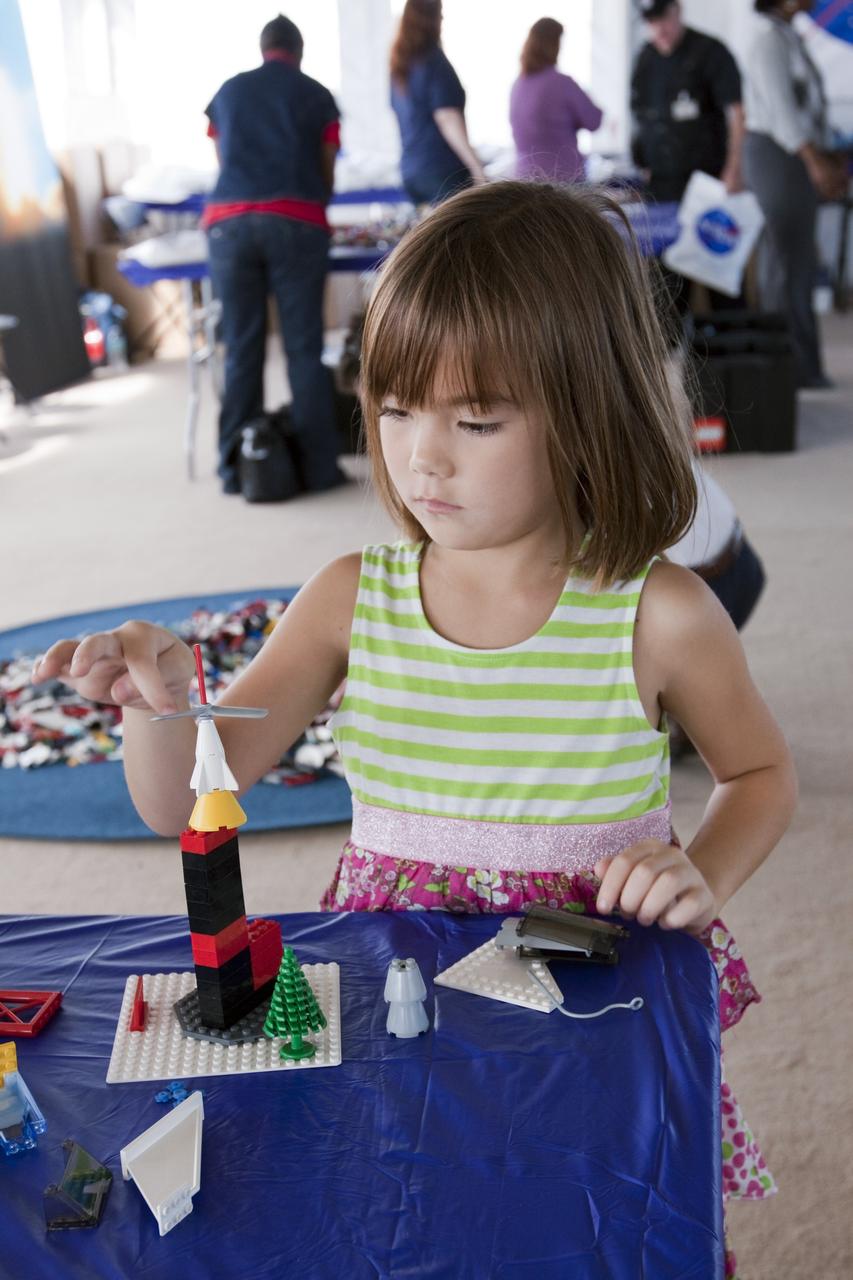
CAPE CANAVERAL, Fla. -- On the NASA Causeway at Kennedy Space Center in Florida, a 40- by 70-foot activity tent chock full of LEGO bricks hosts children and adults. There, they are building their vision of the future with LEGO bricks, marking the beginning of a three-year Space Act Agreement between NASA and The LEGO Group. The partnership is meant to spark the interest of children in science, technology, engineering and mathematics (STEM). To commemorate the partnership, two small LEGO space shuttles will launch aboard space shuttle Discovery's STS-133 mission to the International Space Station and the company will release four NASA-inspired products in its LEGO CITY line next year. LEGO sets also will fly to the space station aboard Endeavour's STS-134 mission, and will be put together on orbit to demonstrate the challenges faced while building things in microgravity. Photo credit: NASA/Jack Pfaller
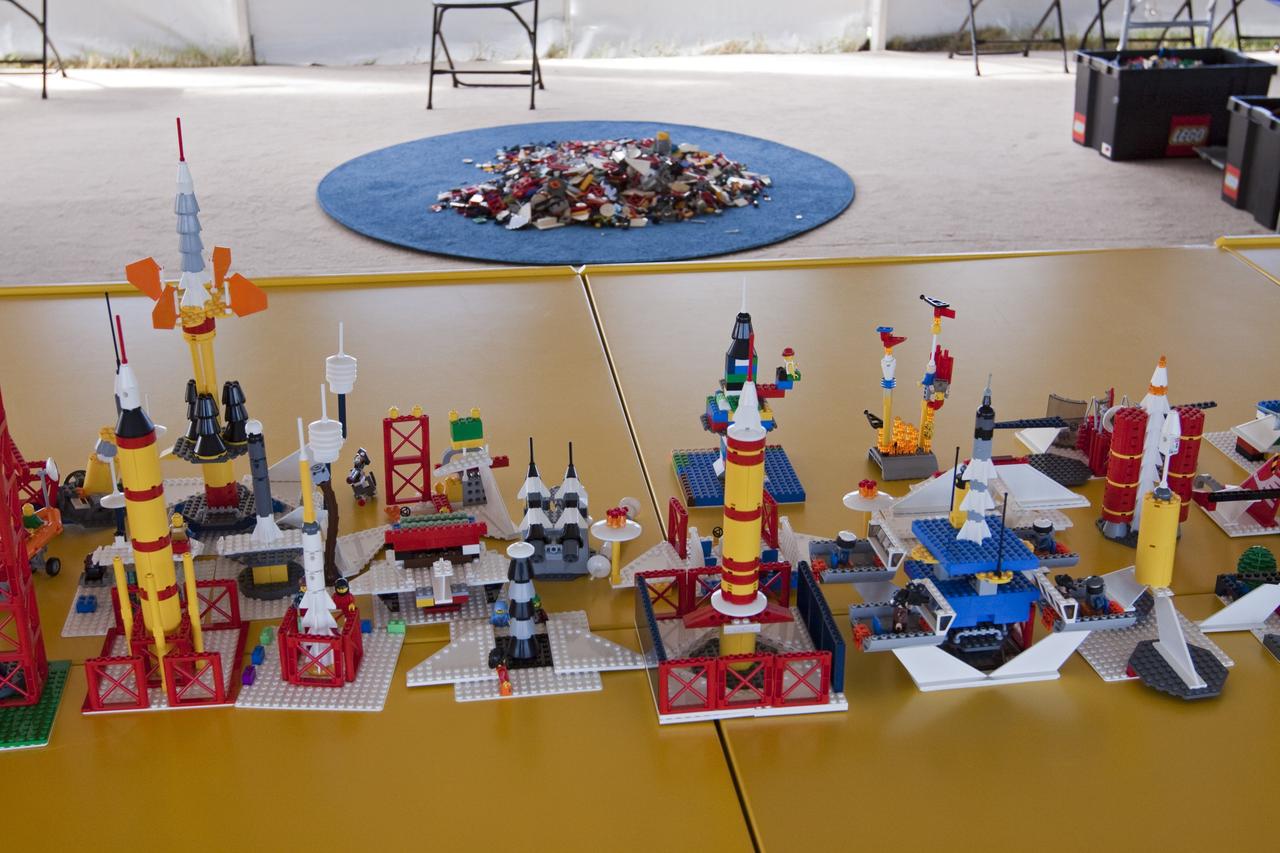
CAPE CANAVERAL, Fla. -- On the NASA Causeway at Kennedy Space Center in Florida, a 40- by 70-foot activity tent chock full of LEGO bricks is ready to welcome children of all ages. There, they will have the opportunity to build their vision of the future with LEGO bricks, marking the beginning of a three-year Space Act Agreement between NASA and The LEGO Group. The partnership is meant to spark the interest of children in science, technology, engineering and mathematics (STEM). To commemorate the partnership, two small LEGO space shuttles will launch aboard space shuttle Discovery's STS-133 mission to the International Space Station and the company will release four NASA-inspired products in its LEGO CITY line next year. LEGO sets also will fly to the space station aboard Endeavour's STS-134 mission, and will be put together on orbit to demonstrate the challenges faced while building things in microgravity. Photo credit: NASA/Jack Pfaller
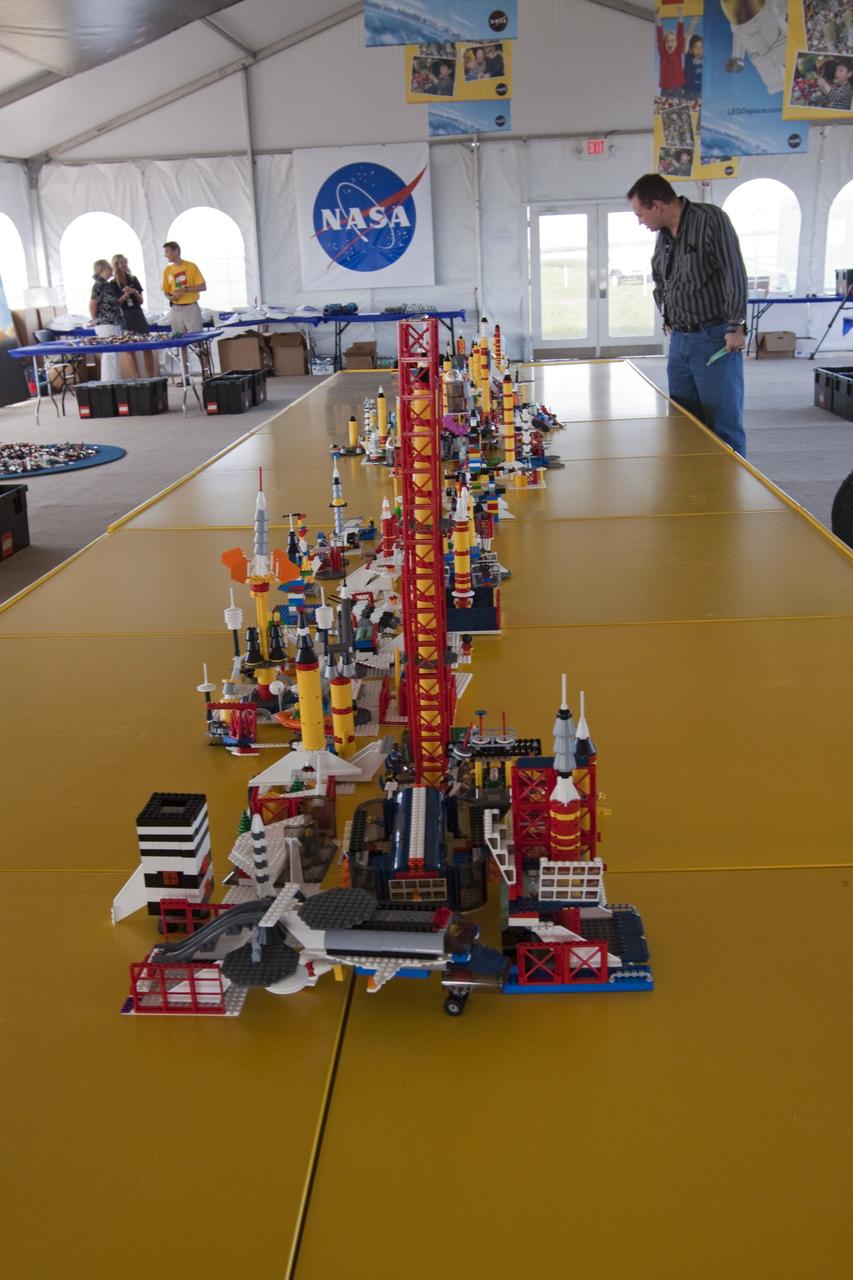
CAPE CANAVERAL, Fla. -- On the NASA Causeway at Kennedy Space Center in Florida, a 40- by 70-foot activity tent chock full of LEGO bricks is ready to welcome children of all ages. There, they will have the opportunity to build their vision of the future with LEGO bricks, marking the beginning of a three-year Space Act Agreement between NASA and The LEGO Group. The partnership is meant to spark the interest of children in science, technology, engineering and mathematics (STEM). To commemorate the partnership, two small LEGO space shuttles will launch aboard space shuttle Discovery's STS-133 mission to the International Space Station and the company will release four NASA-inspired products in its LEGO CITY line next year. LEGO sets also will fly to the space station aboard Endeavour's STS-134 mission, and will be put together on orbit to demonstrate the challenges faced while building things in microgravity. Photo credit: NASA/Jack Pfaller
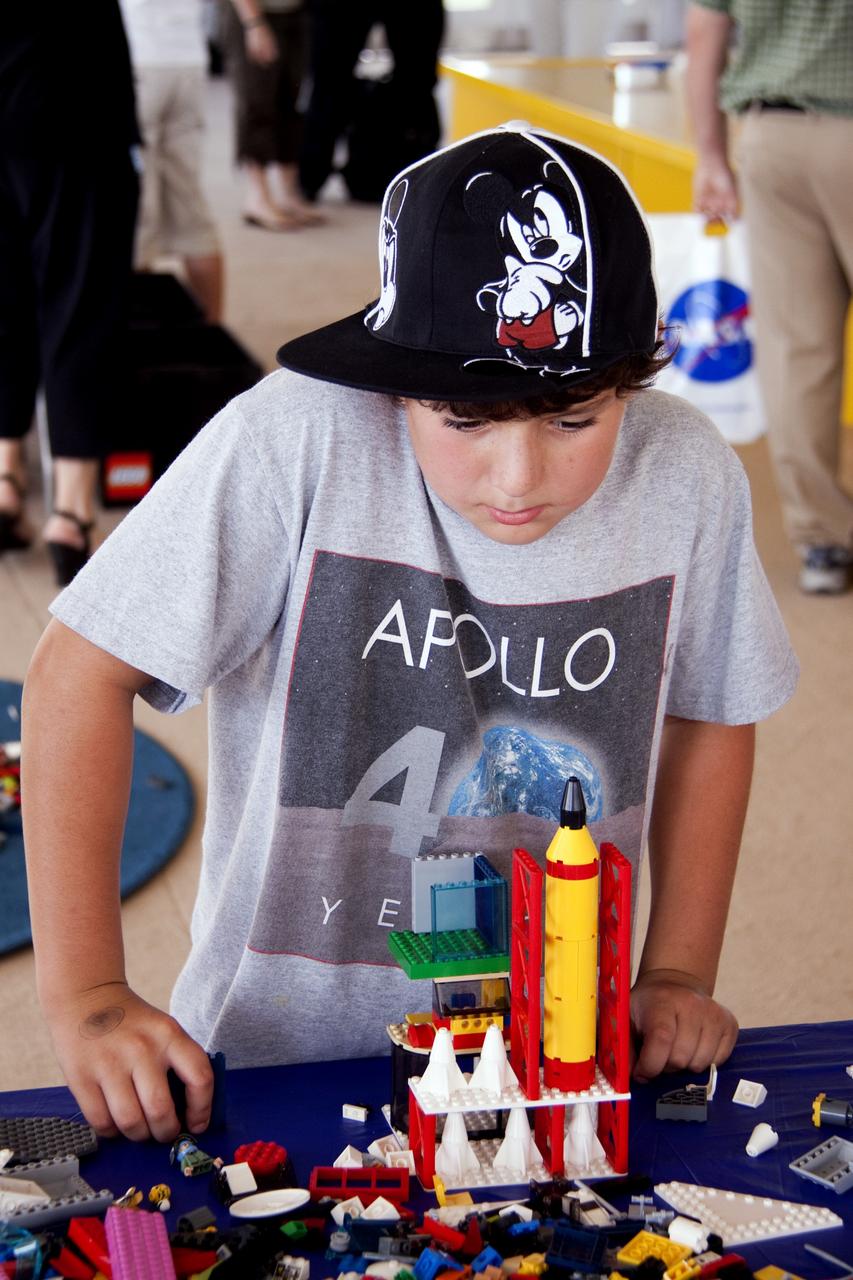
CAPE CANAVERAL, Fla. -- On the NASA Causeway at Kennedy Space Center in Florida, a 40- by 70-foot activity tent chock full of LEGO bricks hosts children and adults. There, they are building their vision of the future with LEGO bricks, marking the beginning of a three-year Space Act Agreement between NASA and The LEGO Group. The partnership is meant to spark the interest of children in science, technology, engineering and mathematics (STEM). To commemorate the partnership, two small LEGO space shuttles will launch aboard space shuttle Discovery's STS-133 mission to the International Space Station and the company will release four NASA-inspired products in its LEGO CITY line next year. LEGO sets also will fly to the space station aboard Endeavour's STS-134 mission, and will be put together on orbit to demonstrate the challenges faced while building things in microgravity. Photo credit: NASA/Jack Pfaller

CAPE CANAVERAL, Fla. -- On the NASA Causeway at Kennedy Space Center in Florida, a 40- by 70-foot activity tent chock full of LEGO bricks hosts children and adults. There, they are building their vision of the future with LEGO bricks, marking the beginning of a three-year Space Act Agreement between NASA and The LEGO Group. The partnership is meant to spark the interest of children in science, technology, engineering and mathematics (STEM). To commemorate the partnership, two small LEGO space shuttles will launch aboard space shuttle Discovery's STS-133 mission to the International Space Station and the company will release four NASA-inspired products in its LEGO CITY line next year. LEGO sets also will fly to the space station aboard Endeavour's STS-134 mission, and will be put together on orbit to demonstrate the challenges faced while building things in microgravity. Photo credit: NASA/Jack Pfaller
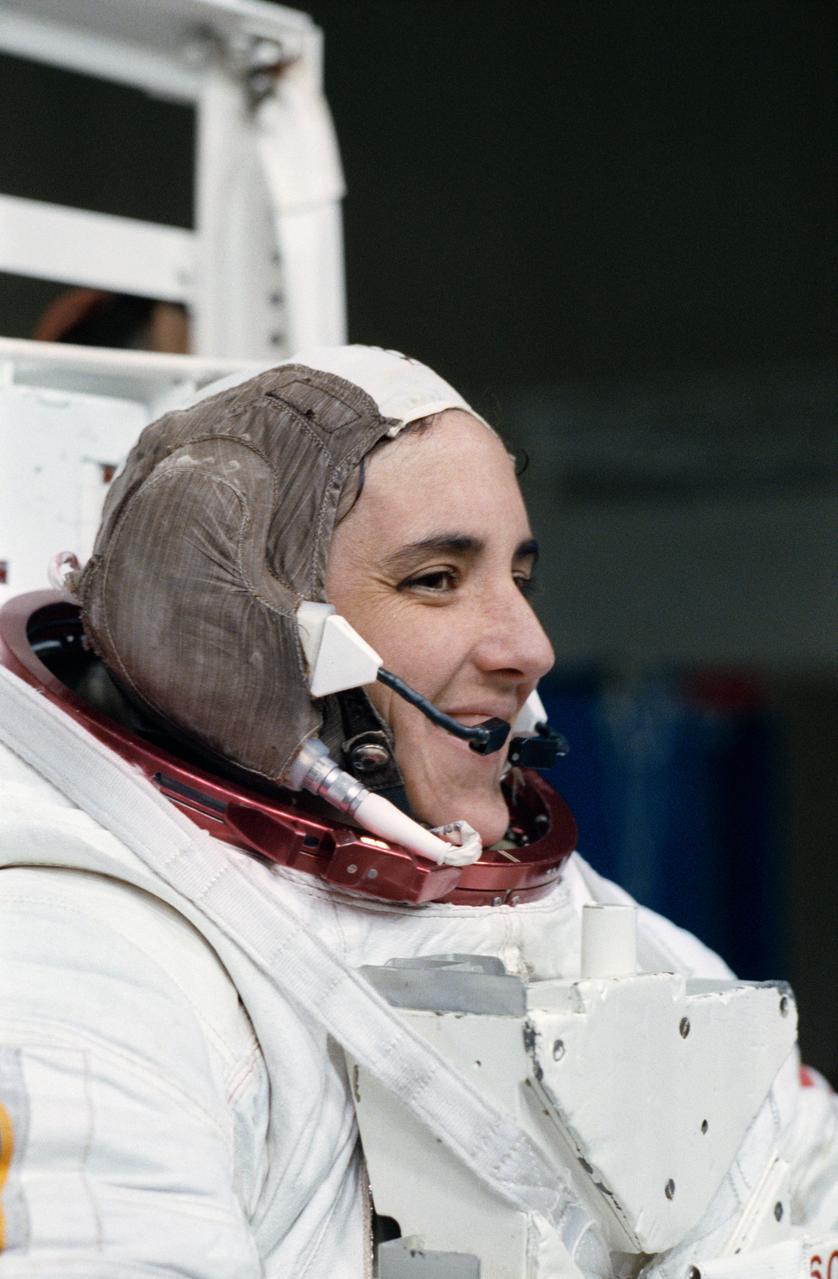
S92-29546 (March 1992) --- Attired in a training version of the Extravehicular Mobility Unit (EMU), astronaut Nancy J. Sherlock checks her communications link during a training session at the Johnson Space Center's (JSC) Weightless Environment Training Facility (WET-F). Training as a mission specialist for the STS-57 mission, Sherlock was rehearsing a contingency spacewalk. Astronauts scheduled for Extravehicular Activity (EVA) duty and those who might be called upon for unscheduled space walk duty frequently use a nearby 25 feet deep pool to practice various chores. The suits used in the training are equipped with communications gear, pressurized and weighted to create a neutral buoyancy in the water tank. EDITOR'S NOTE: Nancy J. Currie (formerly Sherlock) has been assigned as a mission specialist for the STS-70 mission, scheduled for launch in spring of 1995.
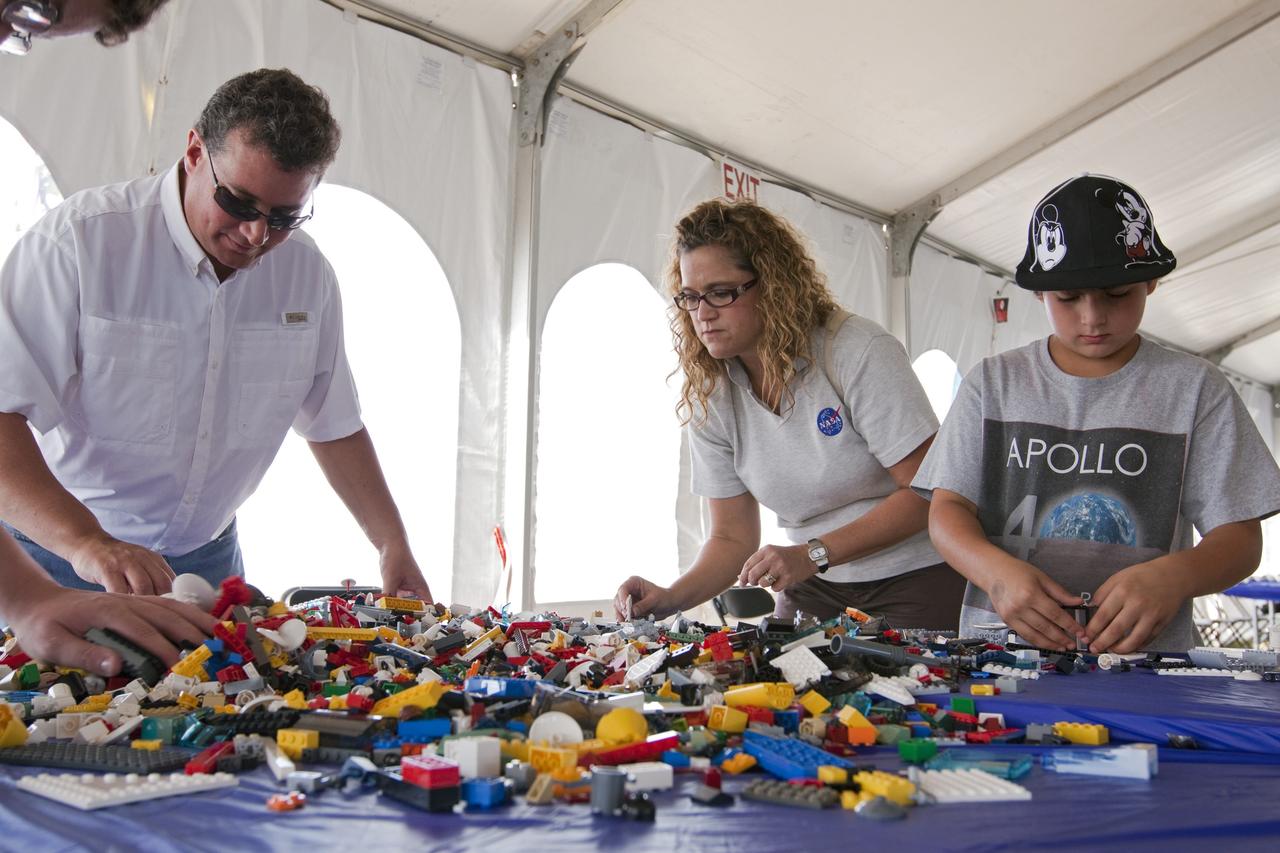
CAPE CANAVERAL, Fla. -- On the NASA Causeway at Kennedy Space Center in Florida, a 40- by 70-foot activity tent chock full of LEGO bricks hosts children and adults. There, they are building their vision of the future with LEGO bricks, marking the beginning of a three-year Space Act Agreement between NASA and The LEGO Group. The partnership is meant to spark the interest of children in science, technology, engineering and mathematics (STEM). To commemorate the partnership, two small LEGO space shuttles will launch aboard space shuttle Discovery's STS-133 mission to the International Space Station and the company will release four NASA-inspired products in its LEGO CITY line next year. LEGO sets also will fly to the space station aboard Endeavour's STS-134 mission, and will be put together on orbit to demonstrate the challenges faced while building things in microgravity. Photo credit: NASA/Jack Pfaller
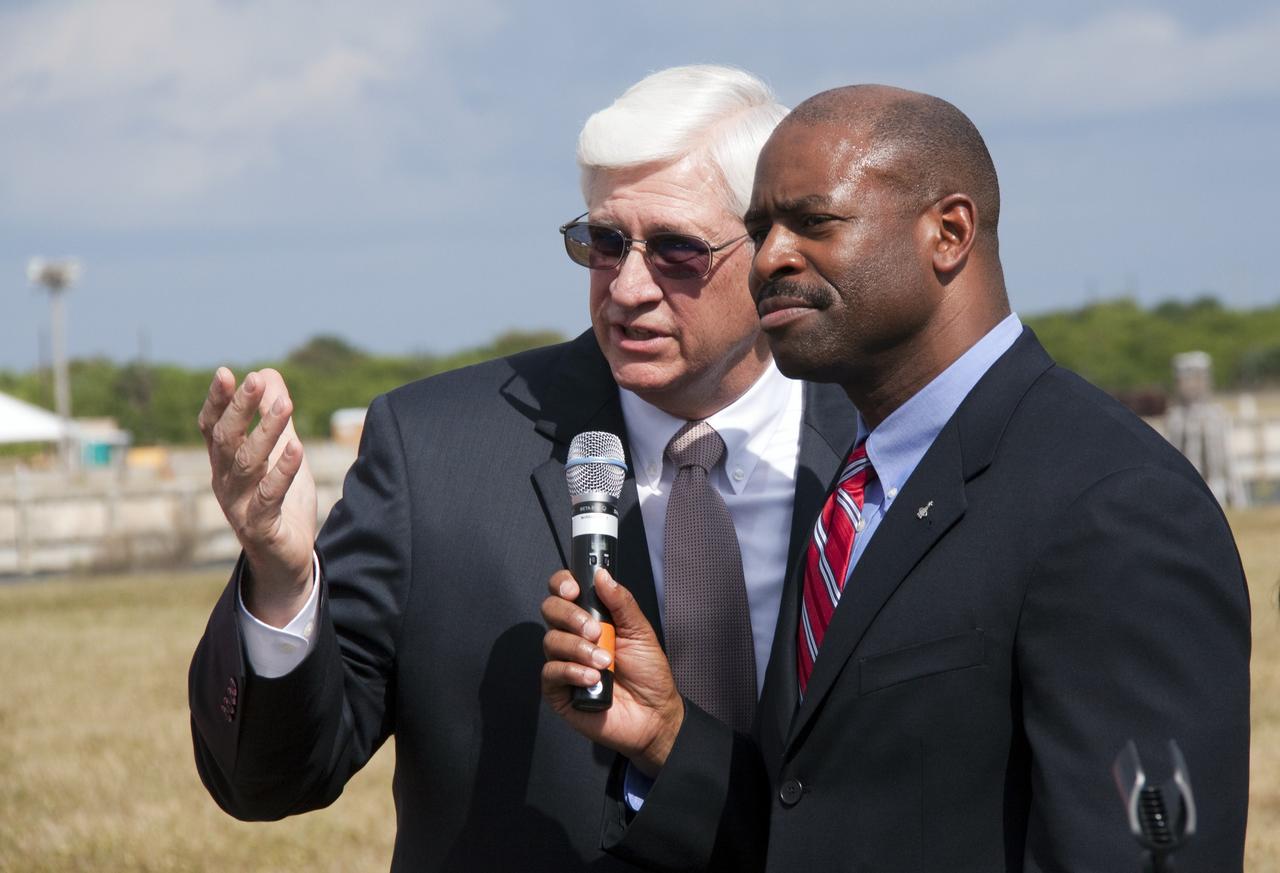
CAPE CANAVERAL, Fla. -- NASA and The LEGO Group announce a three-year Space Act Agreement meant to spark the interest of children in science, technology, engineering and mathematics (STEM) with the future release of four NASA-inspired products in the toy company's LEGO CITY line. From left, are Stephan Turnipseed, president of LEGO Education North America, and Leland Melvin, NASA's associate administrator for Education. To commemorate the beginning of the partnership, two small LEGO space shuttles will launch aboard space shuttle Discovery's STS-133 mission to the International Space Station. A 40- by 70-foot activity tent will be set up at Kennedy on Nov. 3 for children of all ages to build their vision of the future with LEGO bricks. LEGO sets also will fly to the space station aboard Endeavour's STS-134 mission, and will be put together on orbit to demonstrate the challenges faced while building things in microgravity. Photo credit: NASA/Jack Pfaller
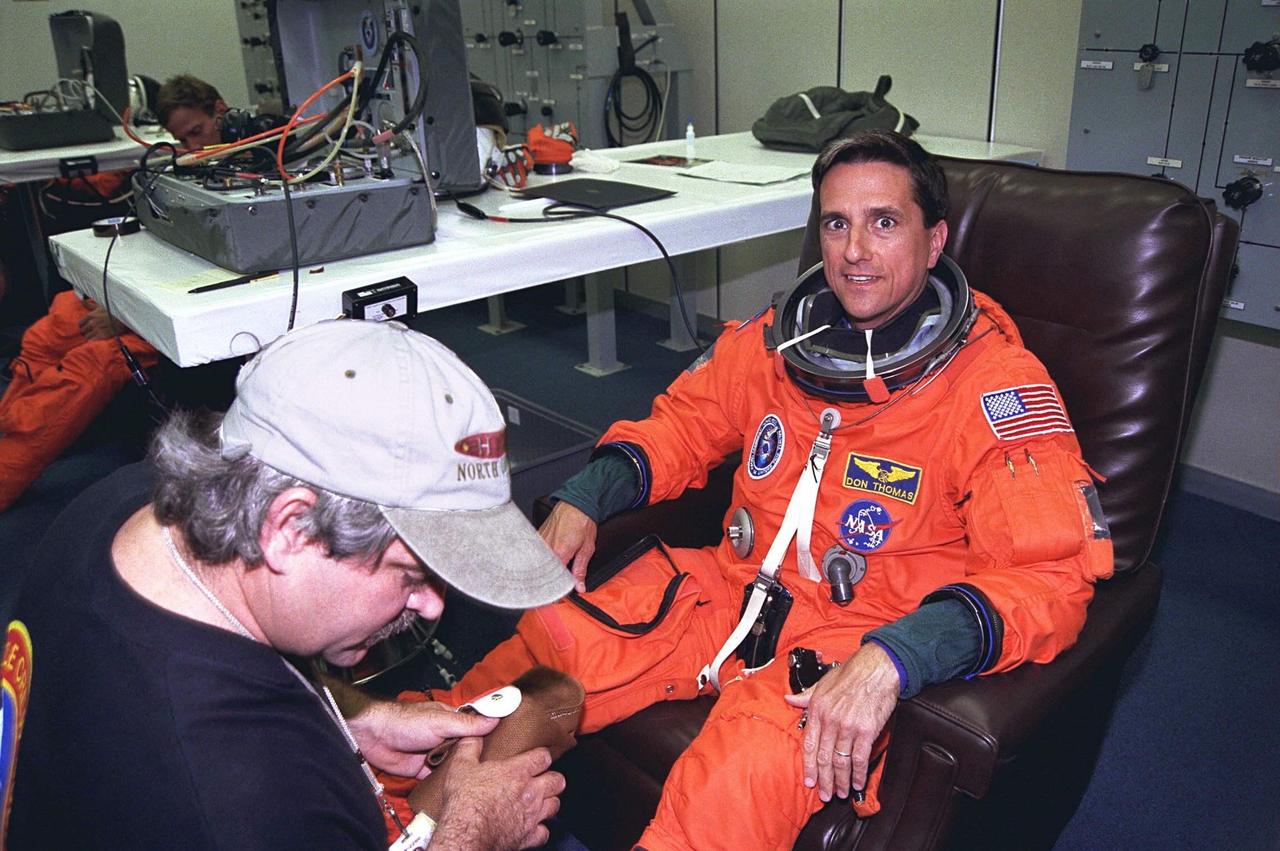
STS-94 Mission Specialist Donald A. Thomas smiles as a suit technician helps him into his launch/entry suit in the Operations and Checkout (O&C) Building. He has flown on STS-83, STS-70 and STS-65. He holds a doctorate in materials science and has been the Principal Investigator for a Space Shuttle crystal growth experiment. Because of his background in materials science, Thomas will be concentrating his efforts during the Red shift on the five experiments in this discipline in the Large Isothermal Furnace. He also will work on the ten materials science investigations in the Electromagnetic Containerless Processing Facility and four that will be measuring the effects of microgravity and motion in the orbiter on the experiments. Thomas and six fellow crew members will shortly depart the O&C and head for Launch Pad 39A, where the Space Shuttle Columbia will lift off during a launch window that opens at 1:50 p.m. EDT, July 1. The launch window was opened 47 minutes early to improve the opportunity to lift off before Florida summer rain showers reached the space center
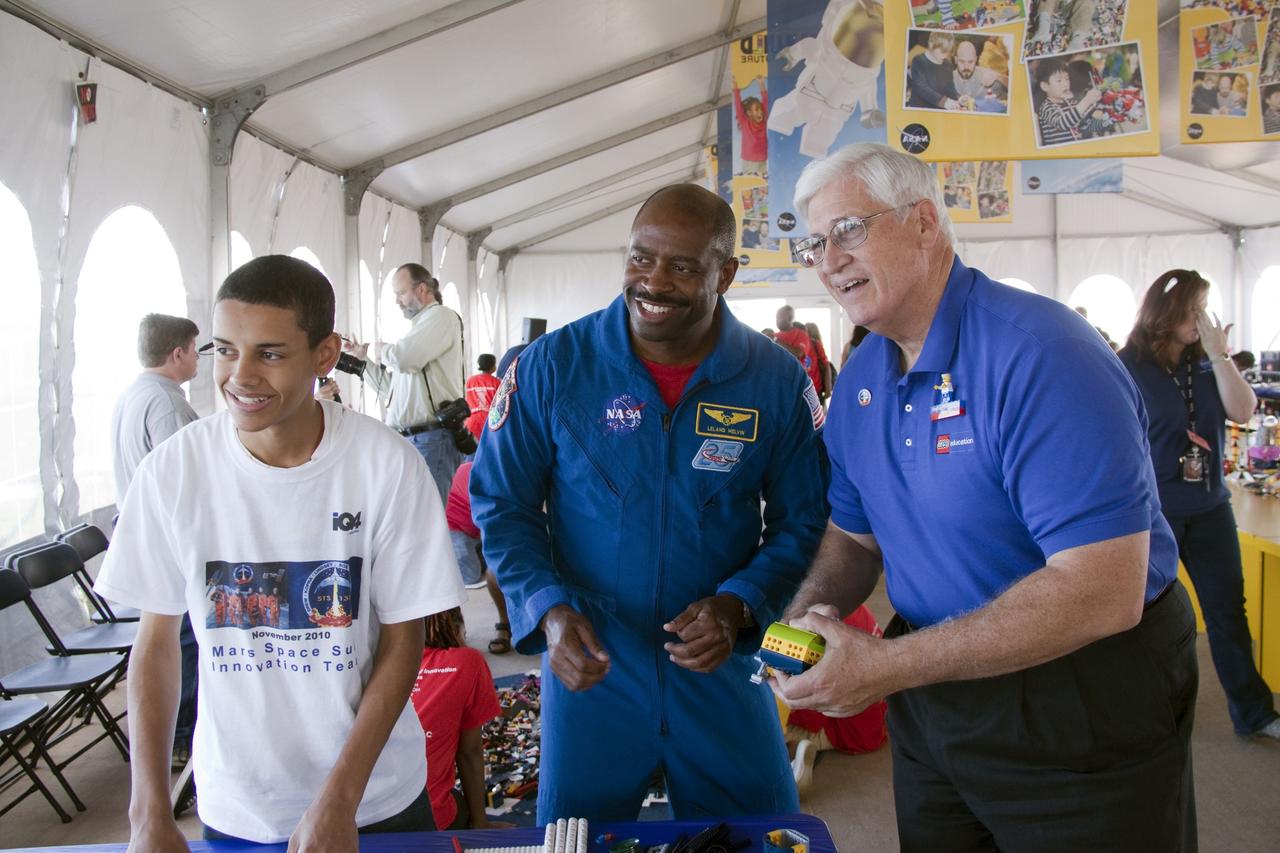
CAPE CANAVERAL, Fla. -- On the NASA Causeway at Kennedy Space Center in Florida, Leland Melvin, NASA's associate administrator for Education, center, and Stephan Turnipseed, president of LEGO Education North America, right, help a student build LEGO space vehicles inside a 40- by 70-foot activity tent. There, children of all ages are building their vision of the future with LEGO bricks, marking the beginning of a three-year Space Act Agreement meant to spark the interest of children in science, technology, engineering and mathematics (STEM). To commemorate the partnership, two small LEGO space shuttles will launch aboard space shuttle Discovery's STS-133 mission to the International Space Station and the company will release four NASA-inspired products in its LEGO CITY line next year. LEGO sets also will fly to the space station aboard Endeavour's STS-134 mission, and will be put together on orbit to demonstrate the challenges faced while building things in microgravity. Photo credit: NASA/Jack Pfaller
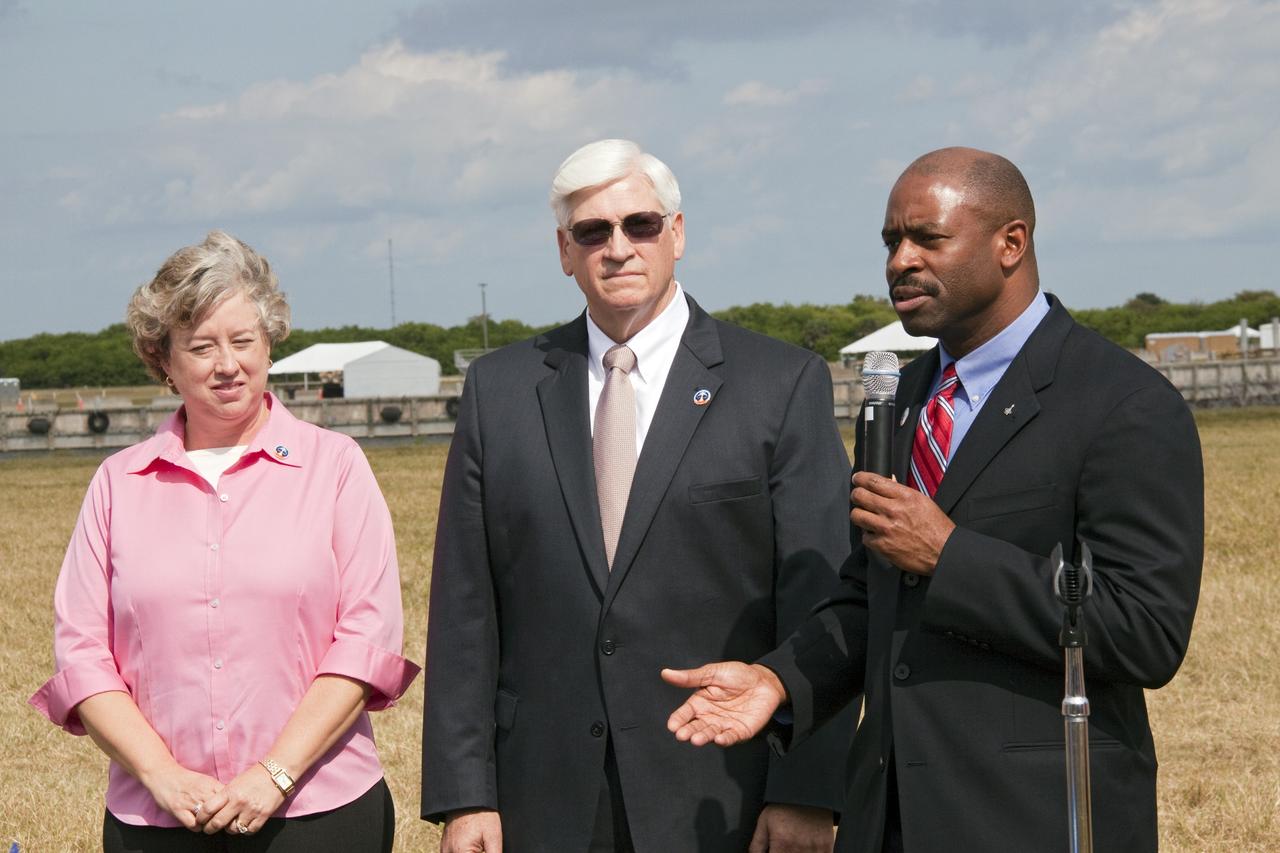
CAPE CANAVERAL, Fla. -- NASA and The LEGO Group announce a three-year Space Act Agreement meant to spark the interest of children in science, technology, engineering and mathematics (STEM) with the future release of four NASA-inspired products in the toy company's LEGO CITY line. From left, are Debbie Biggs, education specialist for International Space Station National Lab Education Projects, Stephan Turnipseed, president of LEGO Education North America, and Leland Melvin, NASA's associate administrator for Education. To commemorate the beginning of the partnership, two small LEGO space shuttles will launch aboard space shuttle Discovery's STS-133 mission to the International Space Station. A 40- by 70-foot activity tent will be set up at Kennedy on Nov. 3 for children of all ages to build their vision of the future with LEGO bricks. LEGO sets also will fly to the space station aboard Endeavour's STS-134 mission, and will be put together on orbit to demonstrate the challenges faced while building things in microgravity. Photo credit: NASA/Jack Pfaller
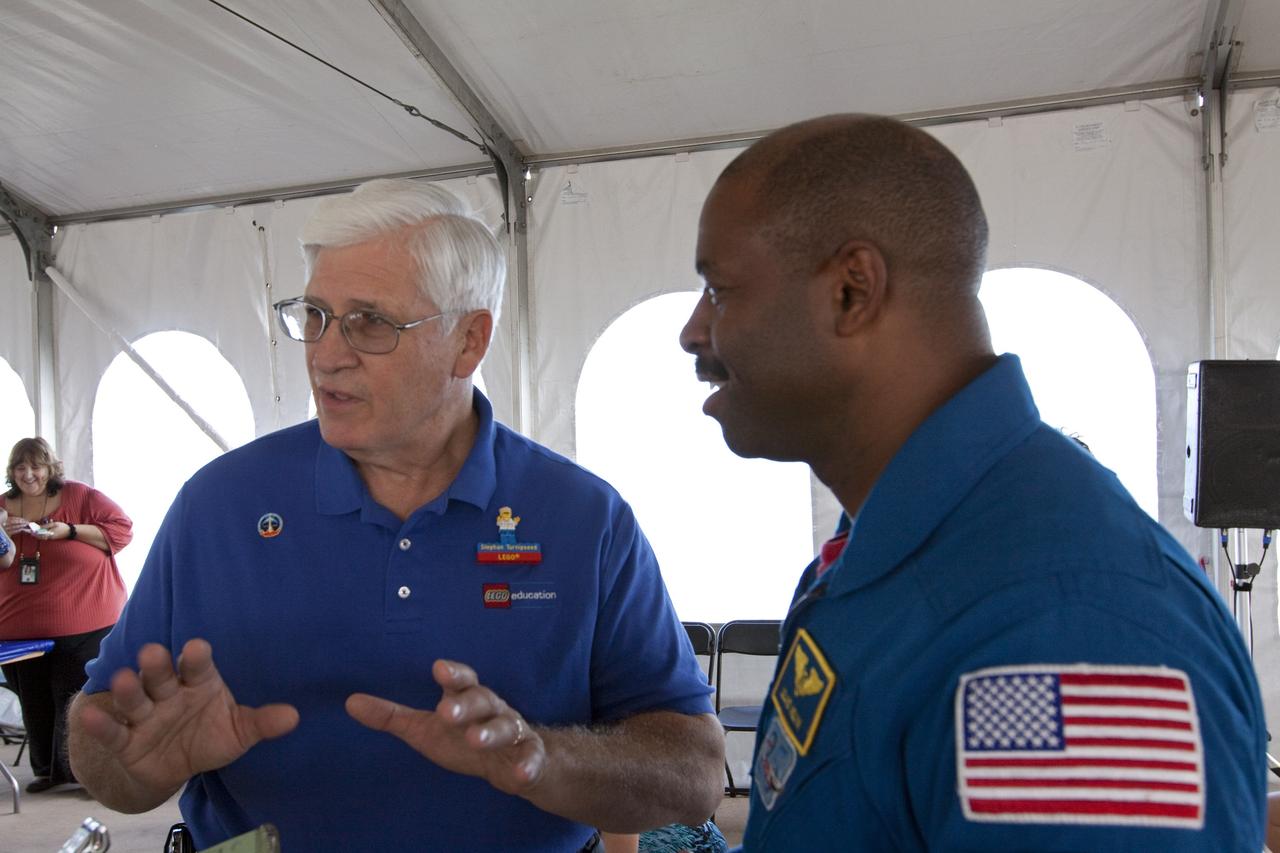
CAPE CANAVERAL, Fla. -- Stephan Turnipseed, president of LEGO Education North America, left, and Leland Melvin, NASA's associate administrator for Education, discuss the new partnership between the U.S. space agency and the toy company inside a 40- by 70-foot activity tent chock full of LEGO bricks on the NASA Causeway at Kennedy Space Center in Florida. There, children of all ages are building their vision of the future with LEGO bricks, marking the beginning of a three-year Space Act Agreement meant to spark the interest of children in science, technology, engineering and mathematics (STEM). To commemorate the partnership, two small LEGO space shuttles will launch aboard space shuttle Discovery's STS-133 mission to the International Space Station and the company will release four NASA-inspired products in its LEGO CITY line next year. LEGO sets also will fly to the space station aboard Endeavour's STS-134 mission, and will be put together on orbit to demonstrate the challenges faced while building things in microgravity. Photo credit: NASA/Jack Pfaller
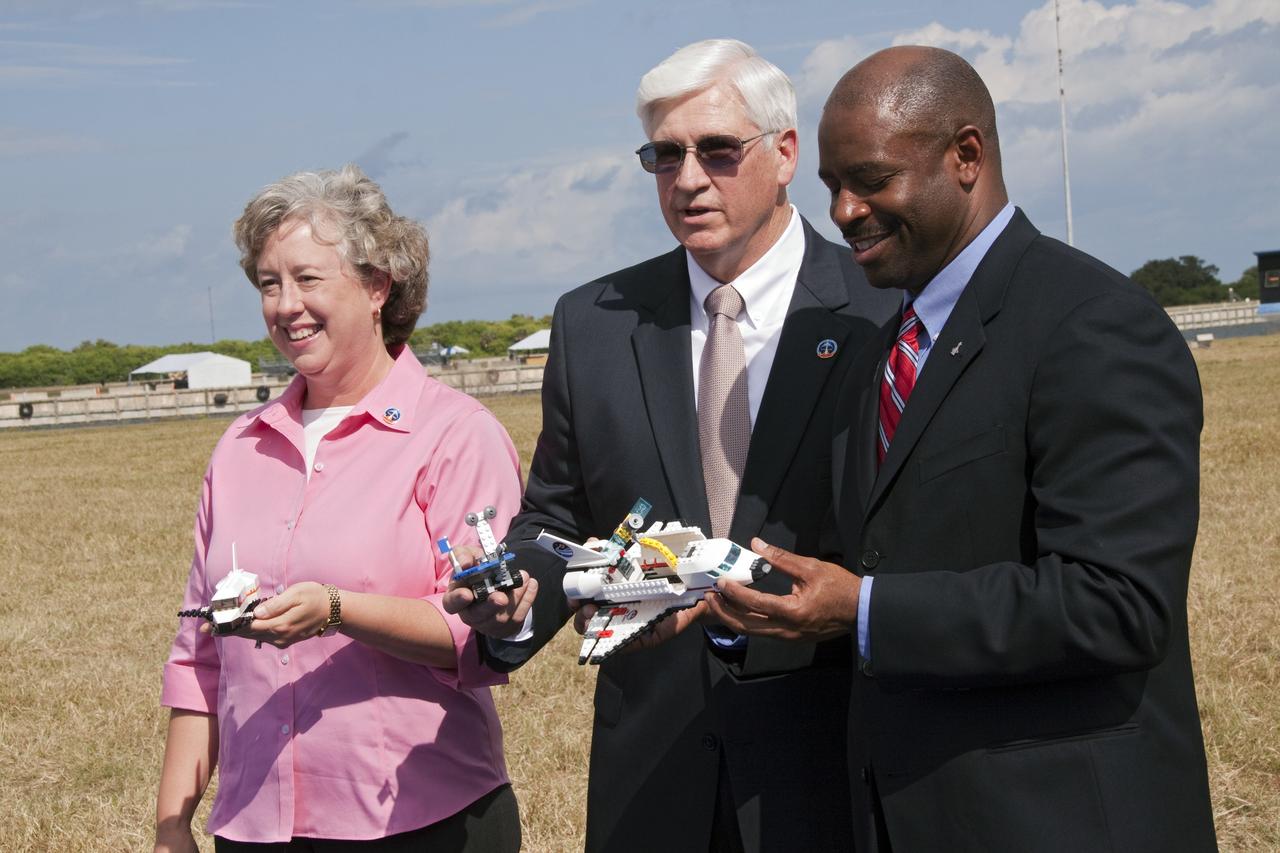
CAPE CANAVERAL, Fla. -- NASA and The LEGO Group announce a three-year Space Act Agreement meant to spark the interest of children in science, technology, engineering and mathematics (STEM) with the future release of four NASA-inspired products in the toy company's LEGO CITY line. From left, are Debbie Biggs, education specialist for International Space Station National Lab Education Projects, Stephan Turnipseed, president of LEGO Education North America, and Leland Melvin, NASA's associate administrator for Education. To commemorate the beginning of the partnership, two small LEGO space shuttles will launch aboard space shuttle Discovery's STS-133 mission to the International Space Station. A 40- by 70-foot activity tent will be set up at Kennedy on Nov. 3 for children of all ages to build their vision of the future with LEGO bricks. LEGO sets also will fly to the space station aboard Endeavour's STS-134 mission, and will be put together on orbit to demonstrate the challenges faced while building things in microgravity. Photo credit: NASA/Jack Pfaller
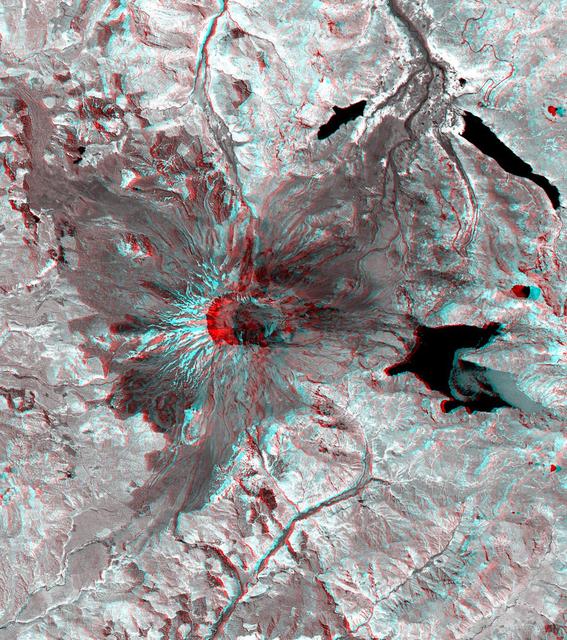
This 3-D anaglyph image of Mt. St. Helens volcano combines the nadir-looking and back-looking band 3 images of ASTER. To view the image in stereo, you will need blue-red glasses. Make sure to look through the red lens with your left eye. This ASTER image of Mt. St. Helens volcano in Washington was acquired on August 8, 2000 and covers an area of 37 by 51 km. Mount Saint Helens, a volcano in the Cascade Range of southwestern Washington that had been dormant since 1857, began to show signs of renewed activity in early 1980. On 18 May 1980, it erupted with such violence that the top of the mountain was blown off, spewing a cloud of ash and gases that rose to an altitude of 19 kilometers. The blast killed about 60 people and destroyed all life in an area of some 180 square kilometers (some 70 square miles), while a much larger area was covered with ash and debris. It continues to spit forth ash and steam intermittently. As a result of the eruption, the mountain's elevation decreased from 2,950 meters to 2,549 meters. The image is centered at 46.2 degrees north latitude, 122.2 degrees west longitude. http://photojournal.jpl.nasa.gov/catalog/PIA11160

CAPE CANAVERAL, Fla. -- NASA and The LEGO Group announce a three-year Space Act Agreement meant to spark the interest of children in science, technology, engineering and mathematics (STEM) with the future release of four NASA-inspired products in the toy company's LEGO CITY line. From left, are Debbie Biggs, education specialist for International Space Station National Lab Education Projects, Stephan Turnipseed, president of LEGO Education North America, Leland Melvin, NASA's associate administrator for Education, and Ann Marie Trotta, NASA Public Affairs officer. To commemorate the beginning of the partnership, two small LEGO space shuttles will launch aboard space shuttle Discovery's STS-133 mission to the International Space Station. A 40- by 70-foot activity tent will be set up at Kennedy on Nov. 3 for children of all ages to build their vision of the future with LEGO bricks. LEGO sets also will fly to the space station aboard Endeavour's STS-134 mission, and will be put together on orbit to demonstrate the challenges faced while building things in microgravity. Photo credit: NASA/Jack Pfaller
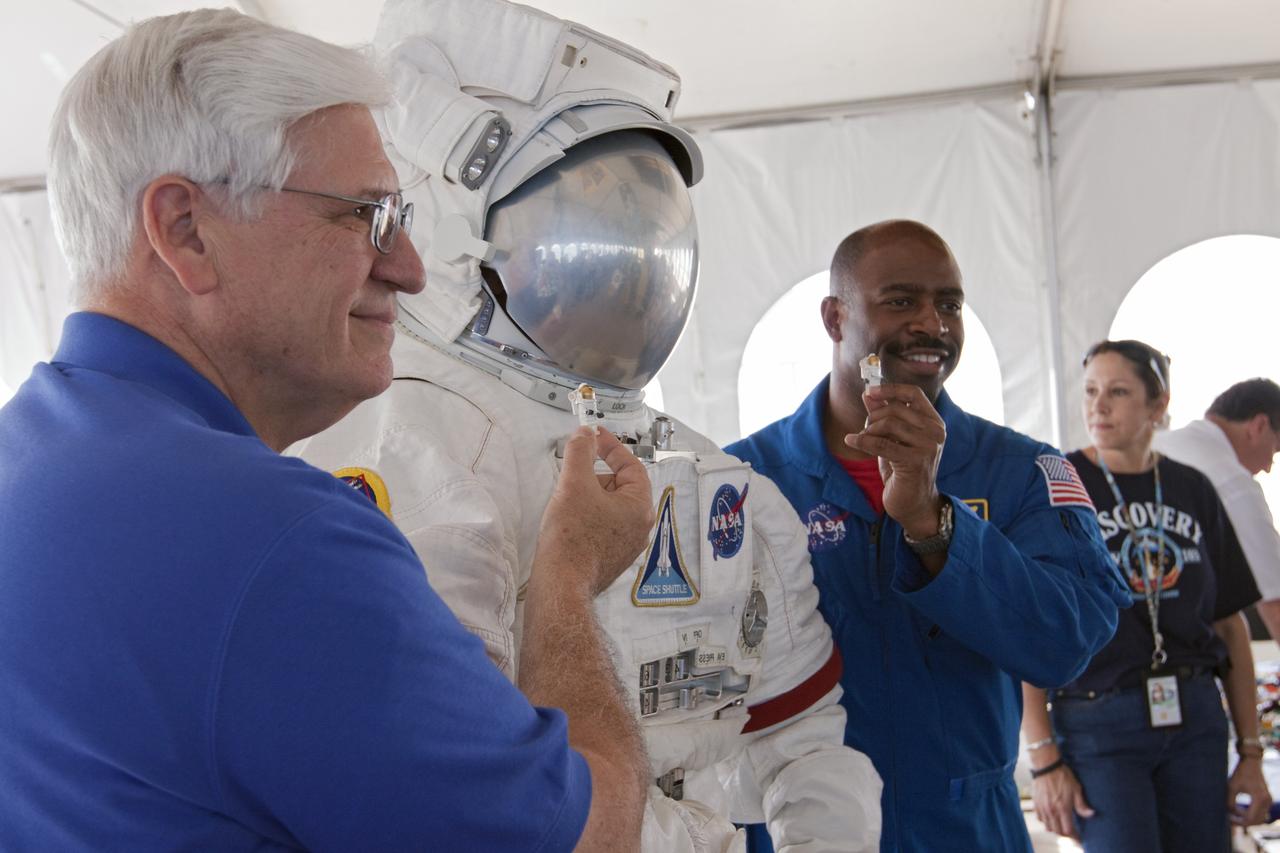
CAPE CANAVERAL, Fla. -- Stephan Turnipseed, president of LEGO Education North America, left, a space person, and Leland Melvin, NASA's associate administrator for Education, show off toy space people inside a 40- by 70-foot activity tent chock full of LEGO bricks on the NASA Causeway at Kennedy Space Center in Florida. There, children of all ages are building their vision of the future with LEGO bricks, marking the beginning of a three-year Space Act Agreement meant to spark the interest of children in science, technology, engineering and mathematics (STEM). To commemorate the partnership, two small LEGO space shuttles will launch aboard space shuttle Discovery's STS-133 mission to the International Space Station and the company will release four NASA-inspired products in its LEGO CITY line next year. LEGO sets also will fly to the space station aboard Endeavour's STS-134 mission, and will be put together on orbit to demonstrate the challenges faced while building things in microgravity. Photo credit: NASA/Jack Pfaller
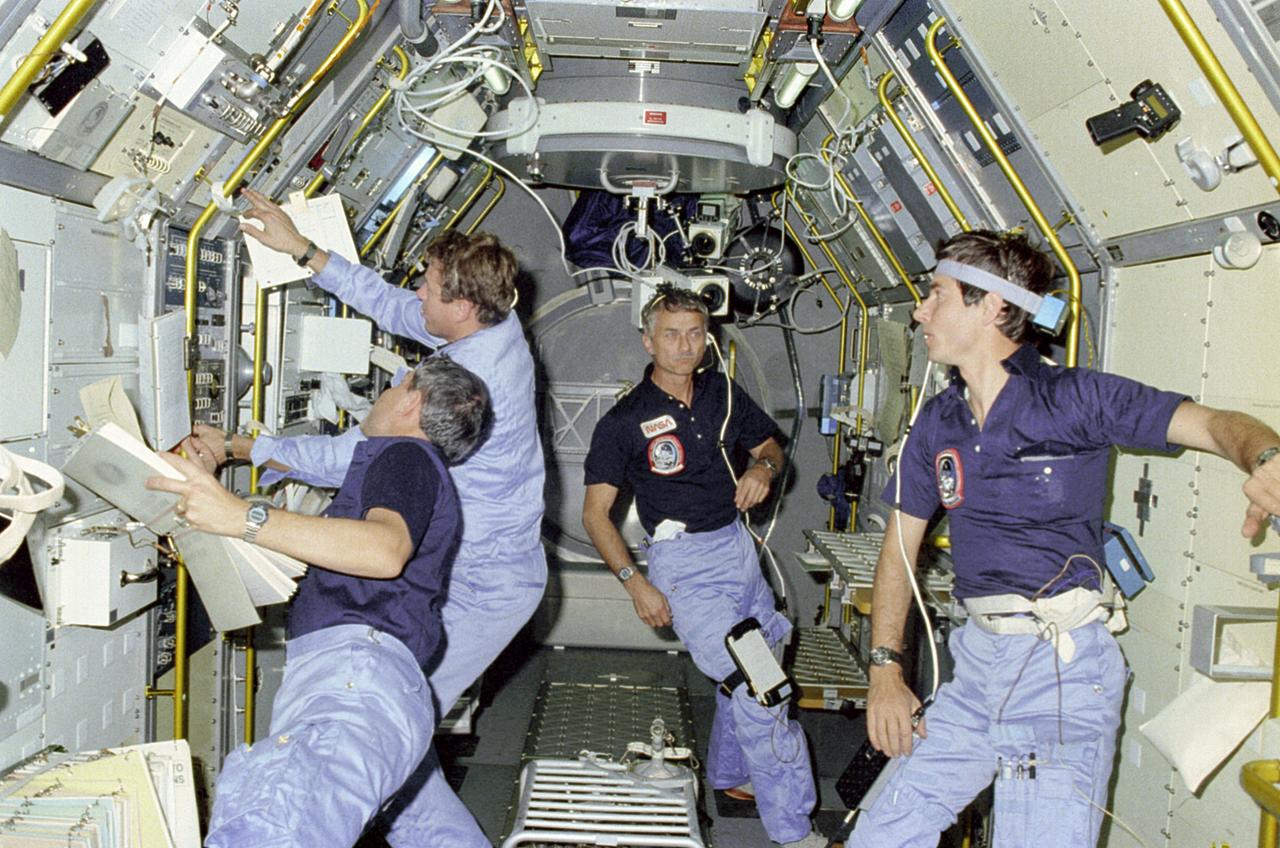
This photograph shows activities inside the science module during the Spacelab-1 (STS-9) mission. Left to right are Mission Specialist Robert Parker, Payload Specialist Byron Lichtenberg, Mission Specialist Owen Garriott, and Payload Specialist Ulf Merbold. The overall goal of the Spacelab-1 mission, the first mission of the Spacelab facility, were: (1) To verify the Spacelab system capability, (2) to obtain valuable scientific, applications, and technology data from a U.S./European multidisciplinary payload, and (3) to demonstrate the broad capability of Spacelab for scientific research. More than 70 experiments in 5 disciplines from 14 nations were conducted during the mission. The mission marked the the entry of non-astronaut persornel, called Payload Specialists, into space as working members of the crew. They are fellow scientists representing the international group of investigators using the mission. Mission Specialists are NASA astronauts who have broad scientific training. They operate various Orbiter-Spacelab systems, perform any required activity outside the spacecraft, and support investigations as needed. The Space Shuttle Orbiter Columbia that carried Spacelab-1 was operated by two other NASA astronauts serving as commander and pilot. The STS-9 mission, managed by the Marshall Space Flight Center, was launched on November 28, 1983.
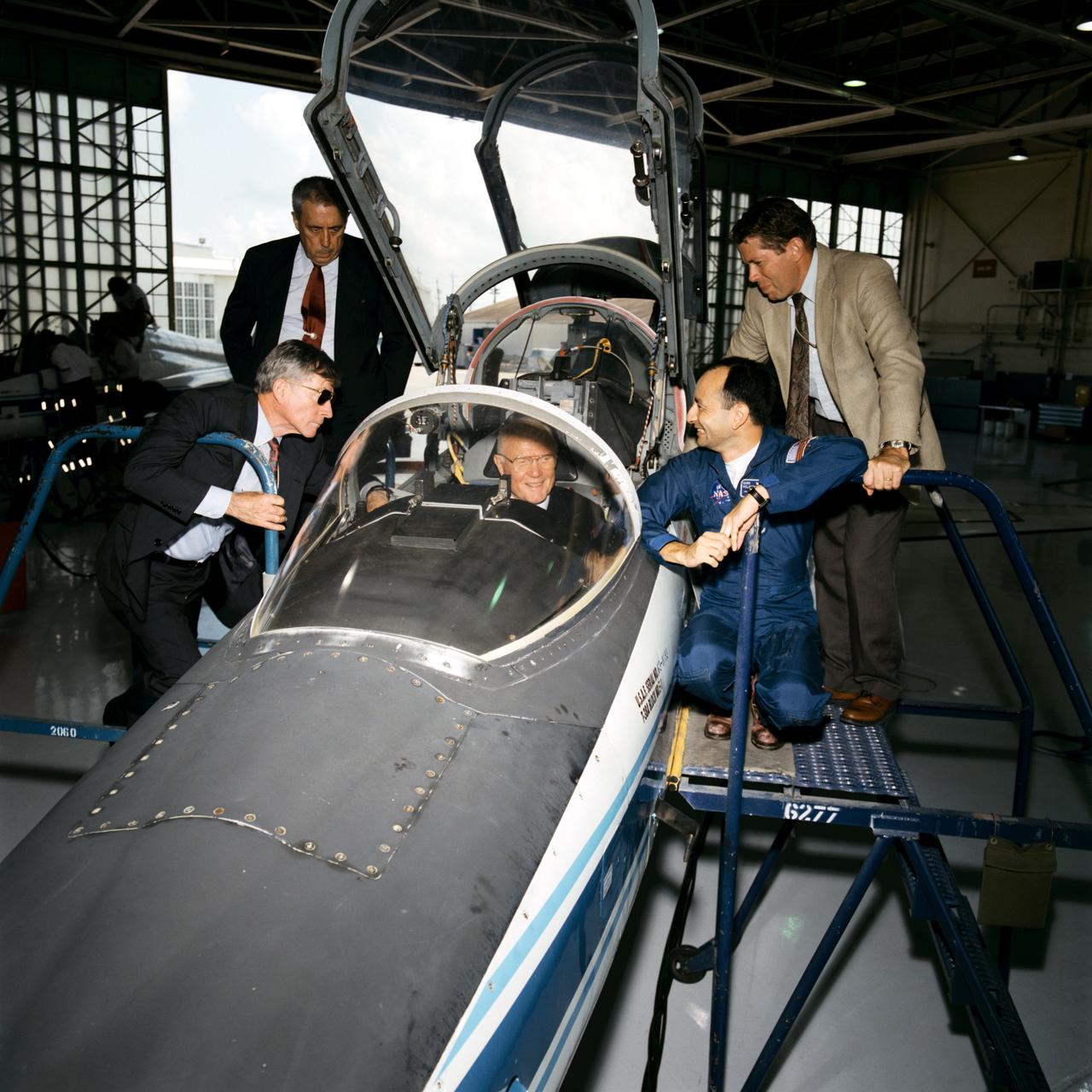
Senator John Glenn visit to Johnson Space Center (JSC). Views of Glenn sitting in cockpit of T-38 in Hangar 276 with John Young, George Abbey, David Leestma and Mark Polansky observing (11150). An engineer explains SPIFEX experiment hardware to Abby, Young and Glenn in Bldg 13 (11151, 11153). Glenn talks with astronaut Terrence T. Henricks and employees in Bldg 9C, Virtual reality lab (11152). Lunch in Bldg 17 Flight Crew support division with Dr. Ellen Baker, Robert "Hoot" Gibson and John Glenn (11154). Linda Godwin, Robert Cabana, Abbey, Young, Baker, Gibson and Glenn at lunch (11155). Astronaut Mark Lee shows Glenn and his aide how to use the virtural reality helmets (11156-7). Glenn shakes the hand of Franklin Chang-Diaz with his plasma rocket in the background in the Sonny Carter Training Facility (SCTF) (11158). Glenn in the Manipulator Development Facility (MDF) Remote Manipulator System (RMS) station mock-up in Bldg 9A with Abbey, Young and aide (11159, 11186). Glenn signs a book for Thomas D. Jones as Frederick Sturckow and Linda Godwin look on (11160). Glenn inside visual-vestibular trainer in Bldg 9B (11161). In conference room meeting with astronaut corps in Bldg 4S, Glenn shakes Robert Cabana's hand (11162). John Glenn and John Young pose for a group shot with Bldg 17 Food lab personnel (11163). Glenn thanks the food lab personnel (11164). Glenn visits Bldg 5 Fixed Base (FB) middeck simulator with astronauts Terrence Henricks and Mary Ellen Weber (11165). Glenn with Charles T. Bourland (11166). STS-70 crew Donald Thomas, Terrence Henricks, Mary Ellen Weber, Nancy Currie and Kevin Kregel with Glenn's advisor (11167). STS-70 crew Thomas, Henricks, Weber, Currie and Kregel with John Glenn (11175). Glenn with Thomas, Kregel, Weber, Henricks and trainer (11176-7). David J. Homan assists Glenn's aide with virtual reality goggles (11168) and Glenn (11174). John Young in Bldg 9C equilibrium trainer (11169). Glenn with Carl Walz in flight deck mock-up of MDF in Bldg 9NE (11170, 11187). Young, Abbey, aides, Glenn and Walz examine helium balloon in MDF (11171-2). Chang-Diaz shows Glenn's tour group the plasma rocket (11173). Glenn's presentation to astronaut corps (11178-81, 11184-5). Glenn is presented with framed picture of Sonny Carter Training Facility (SCTF) (11182) and framed picture of space station (11183).
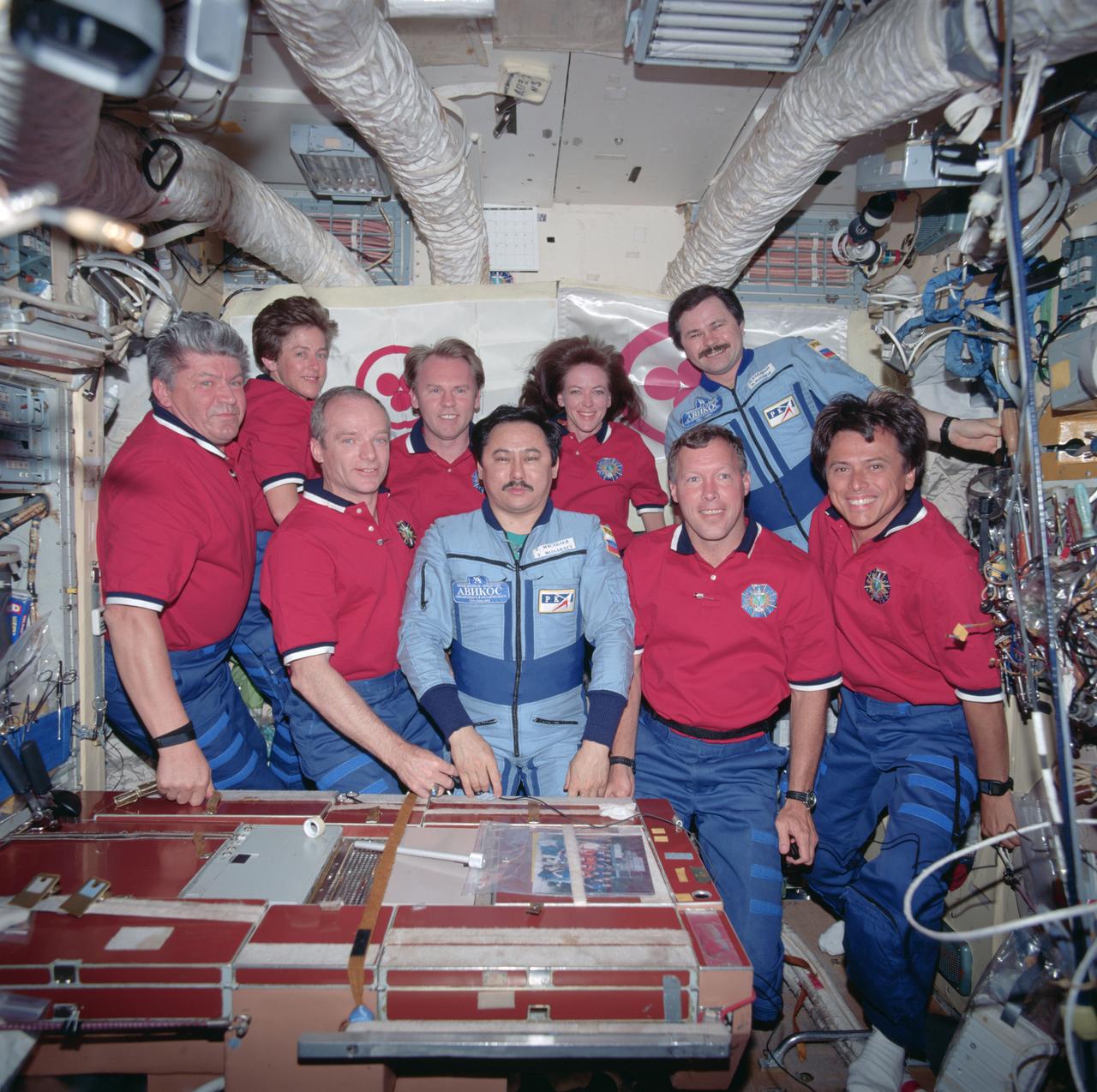
STS091-703-031 (2-12 June 1998) --- The STS-91 crew and the Mir-25 cosmonauts currently manning Russia's space station pose for the final joint inflight NASA-Mir portrait in the core module. Left to right are Valery V. Ryumin, Wendy B. Lawrence, Charles J. Precourt, Andrew S.W. Thomas, Talgat Musabayev, Janet L. Kavandi, Dominic C. Gorie, Nikolai Budarin and Franklin R. Chang-Diaz. Ryumin represents the Russian Aviation and Space Agency. Thomas ended up spending 141 days in space on this journey, including time aboard Endeavour and Discovery, which delivered and retrieved him to and from the Mir, respectively. Later the Discovery made the final undocking of an American Shuttle from the Mir complex, leaving Musabayev and Budarin, the current Mir crewmembers, behind. A pre-set 70-mm camera recorded the portrait. Photo Credit: National Aeronautics and Space Administration (NASA) and the Russian Aviation and Space Agency.
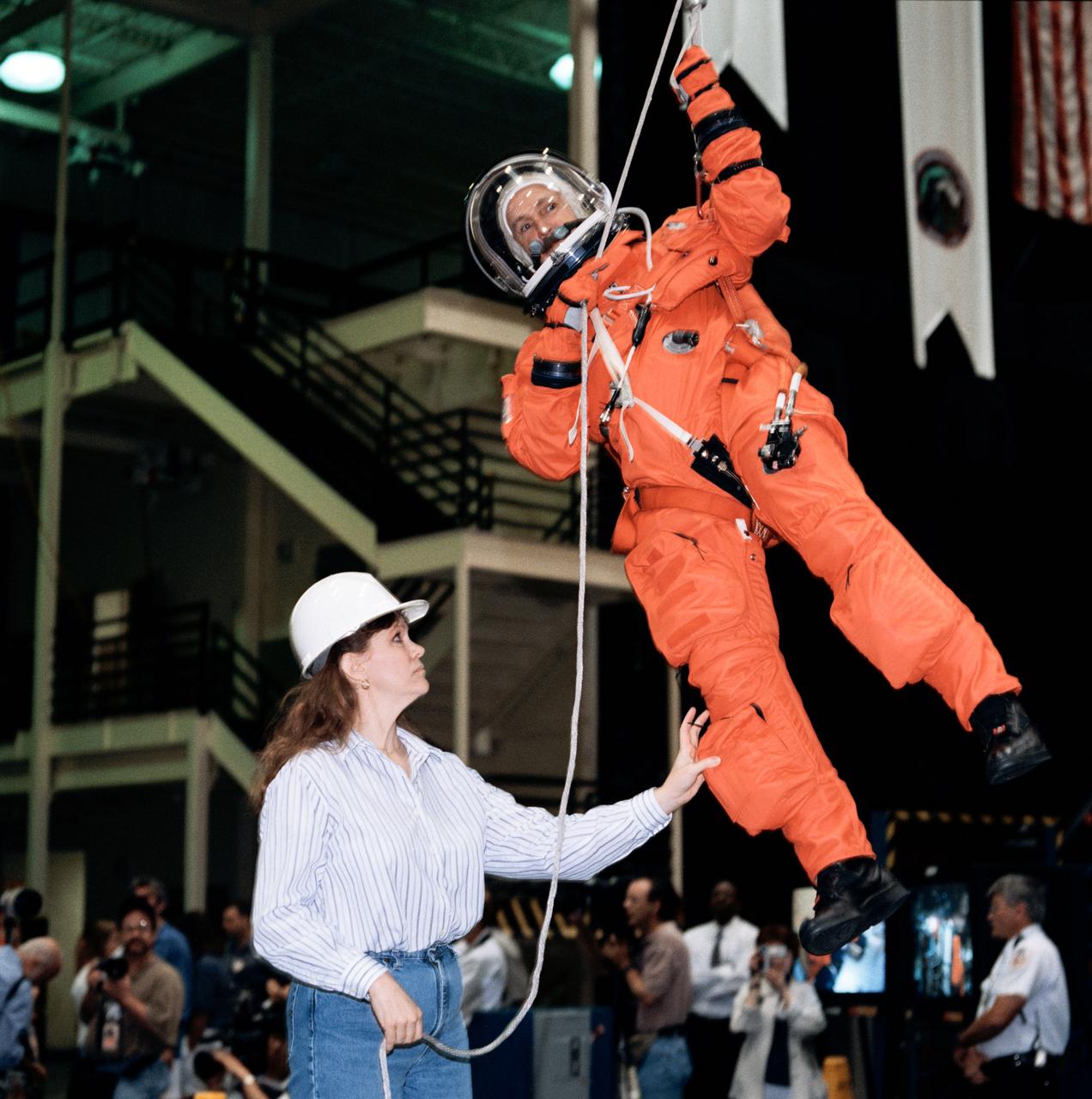
Photographic documentation of the STS-95 crew emergency egress training at the bldg 9A Full Fuselage Trainer (FFT). Views include: Mission specialist Senator John Glenn (in his orange Launch and Landing (LES) suit) is photographed by his wife as other visitors look on (07958). STS-95 crewmember prepares to use the Sky Genie to climb down the side of the FFT (07959). STS-95 crew lines up to pose for pictures in their LES's. Left to right are: Mission specialist Pedro Duque, payload specialist Chiaki Mukai, commander Curt Brown, payload specialist U.S. Senator John Glenn, mission specialist Stephen Robinson, pilot Steven Lindsey, and mission specialist Scott F. Parazynski (07960). Parazynski, Glenn and Robinson talk while their photo is being taken (07961). Mukai receives assistance from suit techs in donning her LES helmet (07962). Glenn receives assistance from suit techs in donning his LES helmet (07963). Glenn, in his LES, walks toward the FFT (07964). Glenn uses the Sky Genie to prepare to climb down the side of the FFT (07965). View of Mrs. Annie Glenn watching her husband during training (07966). Mukai receives assistance from a suit tech with her LES while Glenn watches (07967). Close-up view of Mukai in her LES without a helmet (07968). Glenn and Mukai prepare to strap themselves into their seats in the mockup of the FFT middeck (07969-70). Close-up view of Mukai with her helmet on (07971). Mukai climbs down the rope with help from a technician on the ground (07972). Lindsey, Parazynski, Duque, Mukai and Glenn are photographed seated, waiting for training (07973). Close-up of Duque without his helmet (07974). Close-up of Lindsey with his helmet on, talking to a trainer (07975-6). View of Lindsey climbing down the rope (07977).
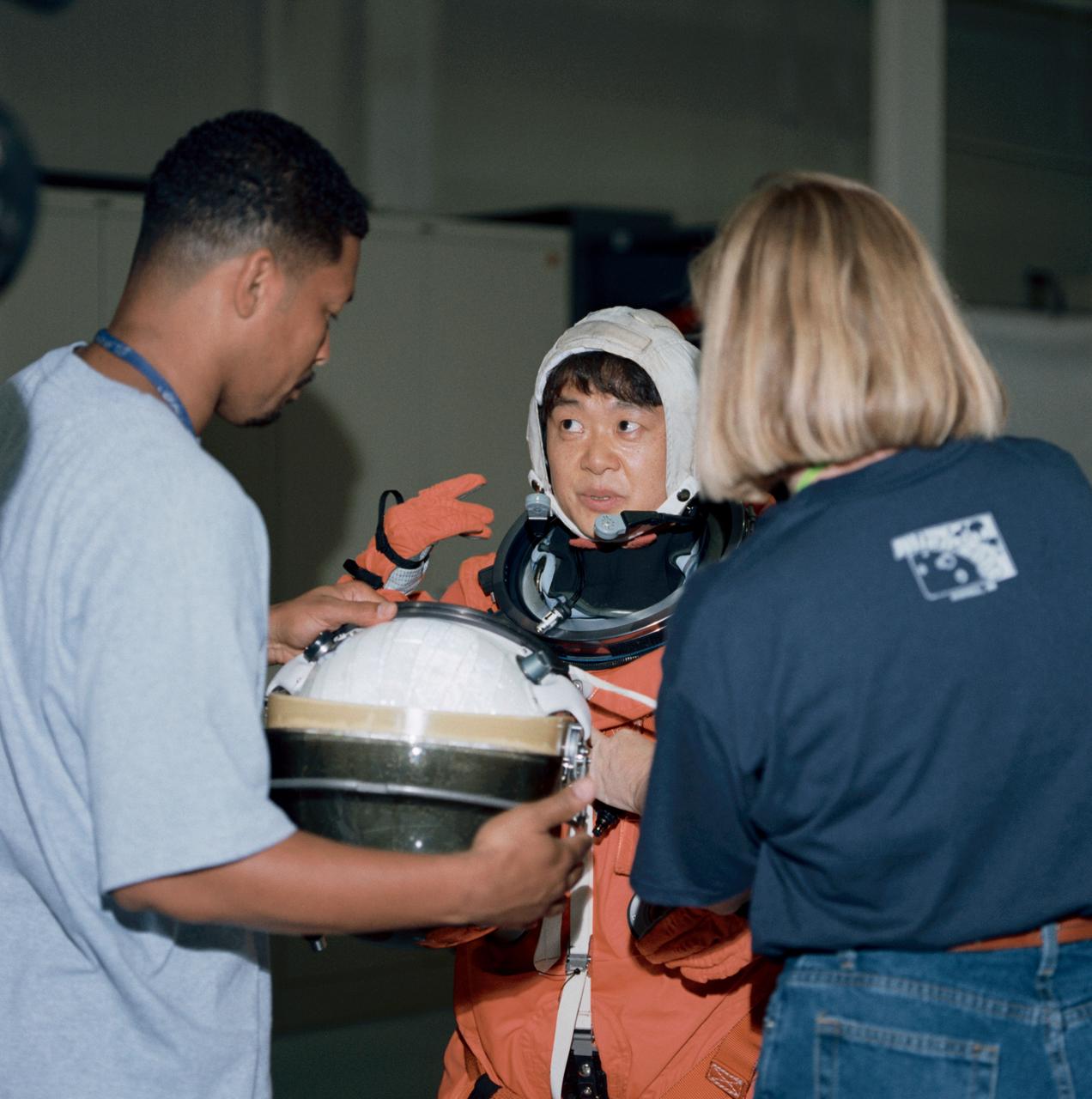
Photographic documentation of the STS-95 crew emergency egress training at the bldg 9A Full Fuselage Trainer (FFT). Views include: Mission specialist Senator John Glenn (in his orange Launch and Landing (LES) suit) is photographed by his wife as other visitors look on (07958). STS-95 crewmember prepares to use the Sky Genie to climb down the side of the FFT (07959). STS-95 crew lines up to pose for pictures in their LES's. Left to right are: Mission specialist Pedro Duque, payload specialist Chiaki Mukai, commander Curt Brown, payload specialist U.S. Senator John Glenn, mission specialist Stephen Robinson, pilot Steven Lindsey, and mission specialist Scott F. Parazynski (07960). Parazynski, Glenn and Robinson talk while their photo is being taken (07961). Mukai receives assistance from suit techs in donning her LES helmet (07962). Glenn receives assistance from suit techs in donning his LES helmet (07963). Glenn, in his LES, walks toward the FFT (07964). Glenn uses the Sky Genie to prepare to climb down the side of the FFT (07965). View of Mrs. Annie Glenn watching her husband during training (07966). Mukai receives assistance from a suit tech with her LES while Glenn watches (07967). Close-up view of Mukai in her LES without a helmet (07968). Glenn and Mukai prepare to strap themselves into their seats in the mockup of the FFT middeck (07969-70). Close-up view of Mukai with her helmet on (07971). Mukai climbs down the rope with help from a technician on the ground (07972). Lindsey, Parazynski, Duque, Mukai and Glenn are photographed seated, waiting for training (07973). Close-up of Duque without his helmet (07974). Close-up of Lindsey with his helmet on, talking to a trainer (07975-6). View of Lindsey climbing down the rope (07977).
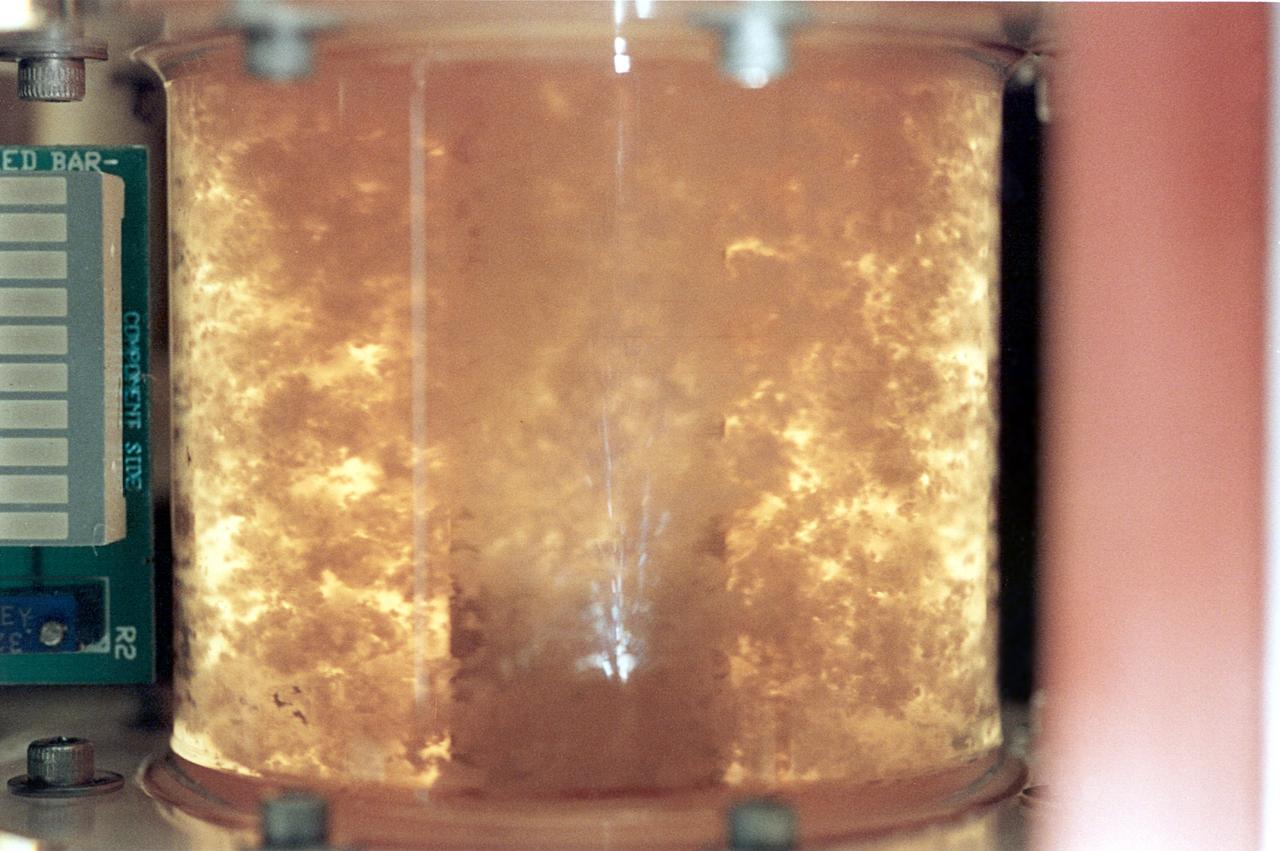
For 5 days on the STS-70 mission, a bioreactor cultivated human colon cancer cells, which grew to 30 times the volume of control specimens grown on Earth. This significant result was reproduced on STS-85 which grew mature structures that more closely match what are found in tumors in humans. Shown here, clusters of cells slowly spin inside a bioreactor. On Earth, the cells continually fall through the buffer medium and never hit bottom. In space, they are naturally suspended. Rotation ensures gentle stirring so waste is removed and fresh nutrient and oxygen are supplied. The NASA Bioreactor provides a low turbulence culture environment which promotes the formation of large, three-dimensional cell clusters. Due to their high level of cellular organization and specialization, samples constructed in the bioreactor more closely resemble the original tumor or tissue found in the body. The Bioreactor is rotated to provide gentle mixing of fresh and spent nutrient without inducing shear forces that would damage the cells. The work is sponsored by NASA's Office of Biological and Physical Research. The bioreactor is managed by the Biotechnology Cell Science Program at NASA's Johnson Space Center (JSC). NASA-sponsored bioreactor research has been instrumental in helping scientists to better understand normal and cancerous tissue development. In cooperation with the medical community, the bioreactor design is being used to prepare better models of human colon, prostate, breast and ovarian tumors. Cartilage, bone marrow, heart muscle, skeletal muscle, pancreatic islet cells, liver and kidney are just a few of the normal tissues being cultured in rotating bioreactors by investigators.
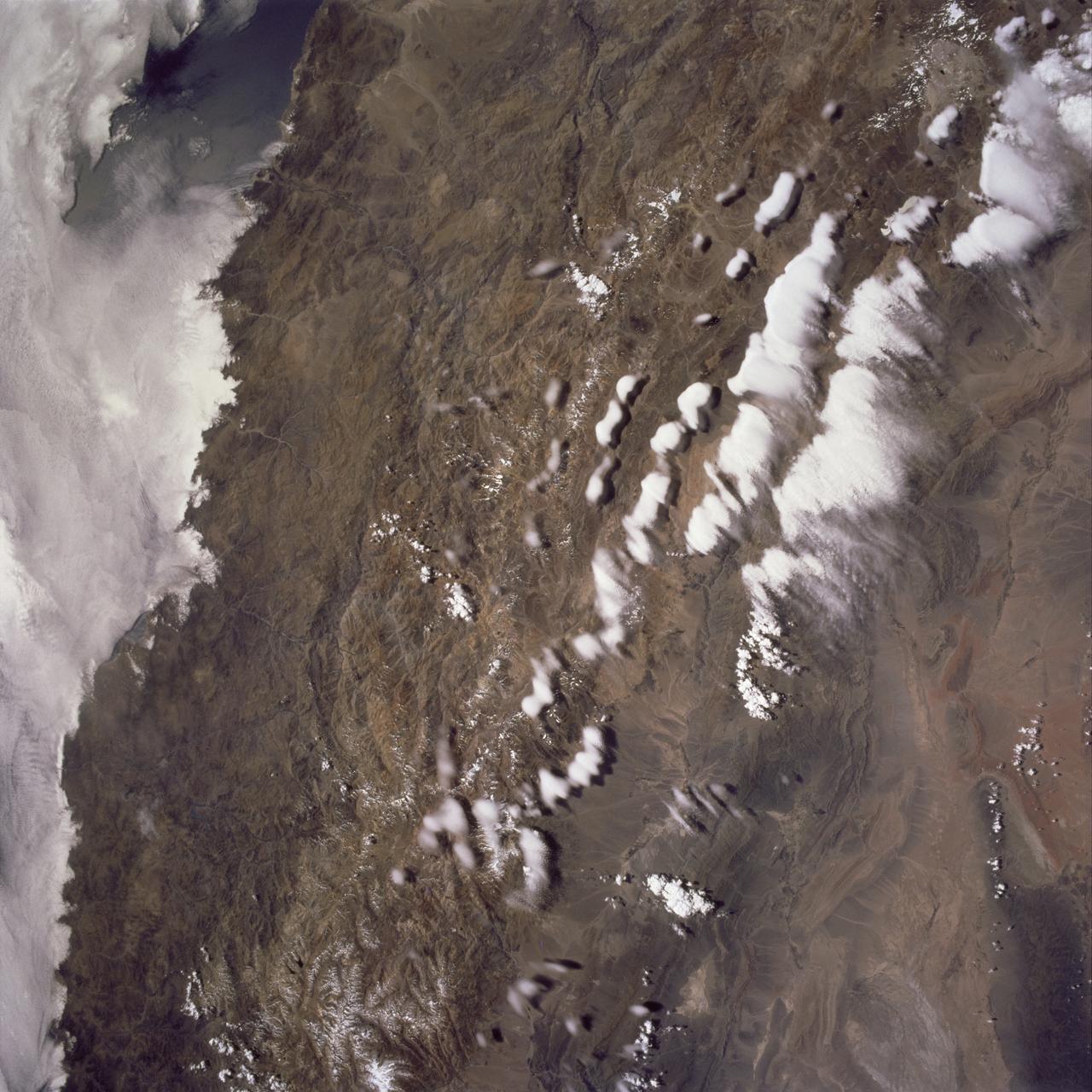
STS097-715-061 (10 December 2000) This view over the Central Andes Mountains in Argentina and Chile was taken on December 10, 2000 by one of the astronauts aboard the Earth-orbiting Space Shuttle Endeavour. Extending 5500 miles (8850 kilometers) along the western coast of South America from northern Colombia to Cape Horn in southern Chile, the Andes are the longest mountain range, above sea level, and the second highest range in the world. According to NASA scientists studying the STS-97 photo collection, this immense system came into existence nearly 70 million years ago. With numerous active volcanoes and a slow uplift, the building of the Andes Mountains continues today rising four inches (10 centimeters) per century, the scientists say. In this north-looking view, snow covers the higher peaks of the range, some of which rise to over 20000 feet (6100 meters) above sea level. Along the left or western portion of the view, clouds can be seen along coastal areas of Chile. In the bottom left quadrant of the scene, the blue waters of the Paloma Reservoir, a recreational lake, are visible. The folded Tontal Range (bottom center) and the Valle Fertil Range (upper right quadrant and partially cloud covered) of western Argentina can be seen. The rocks of these ranges, the scientists point out, are ancient compared to the younger volcanic peaks and ranges of the Andes. The city of San Juan, Argentina is visible on the eastern (right) base of the Tontal Range in the lower right quadrant of the view.