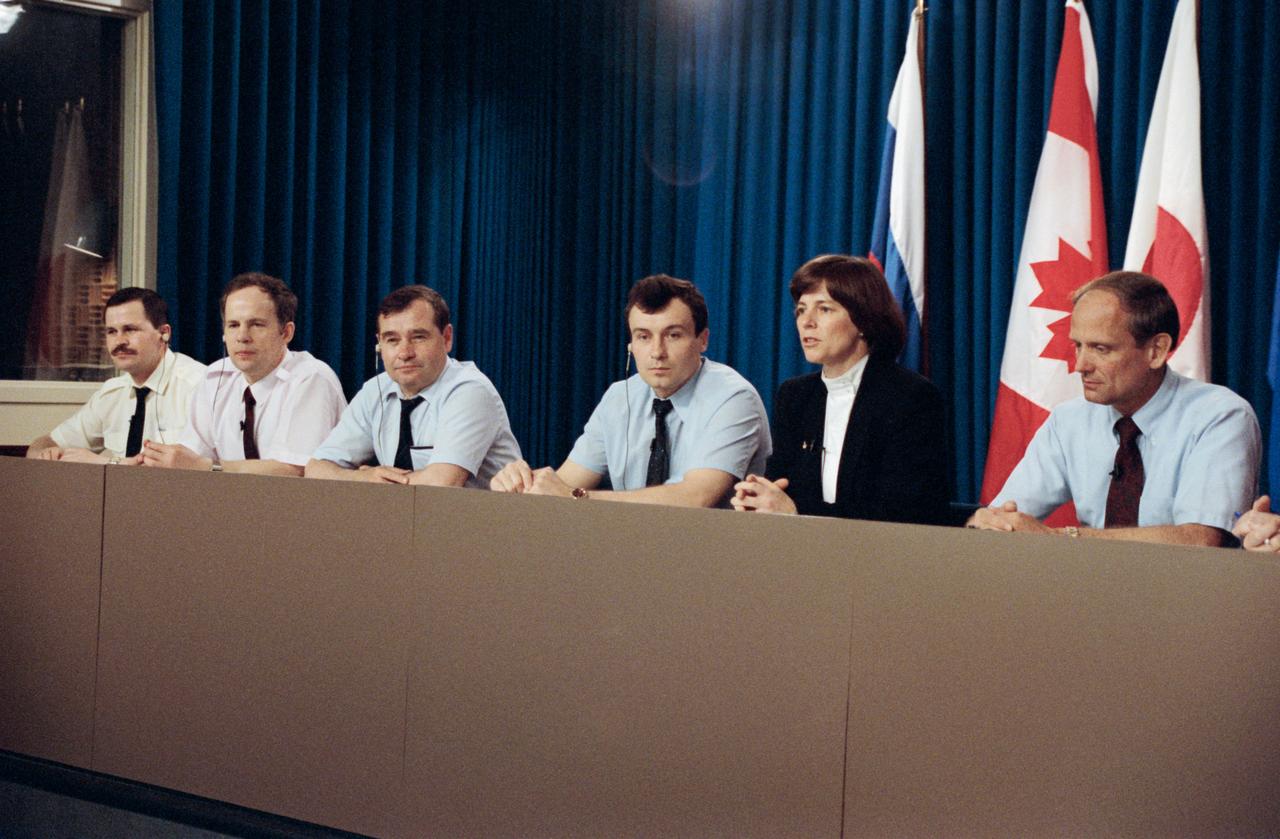
S94-34094 (16 June 1994) --- Crewmembers for the joint Space Shuttle/Mir missions meet the press at the Johnson Space Center (JSC). On the dais are, left to right, cosmonauts Nikolai M. Budarin, Anatoly Y. Solovyov, Gennady M. Strekalov and Vladimir N. Dezhurov, and astronauts Bonnie J. Dunbar and Norman E. Thagard. In a precedent-setting flight, Thagard will be launched with Dezhurov and Strekalov to Mir early next year for a three month mission, designated as Mir 18, on Russia's space station. Then in late May, as the assignment of STS-71, the space shuttle Atlantis will rendezvous with Mir to pick up the Mir 18 crew and transfer cosmonauts Solovyov and Budarin to the station for the Mir 19 mission. STS-71 mission specialist Dunbar is training as Thagard's backup.
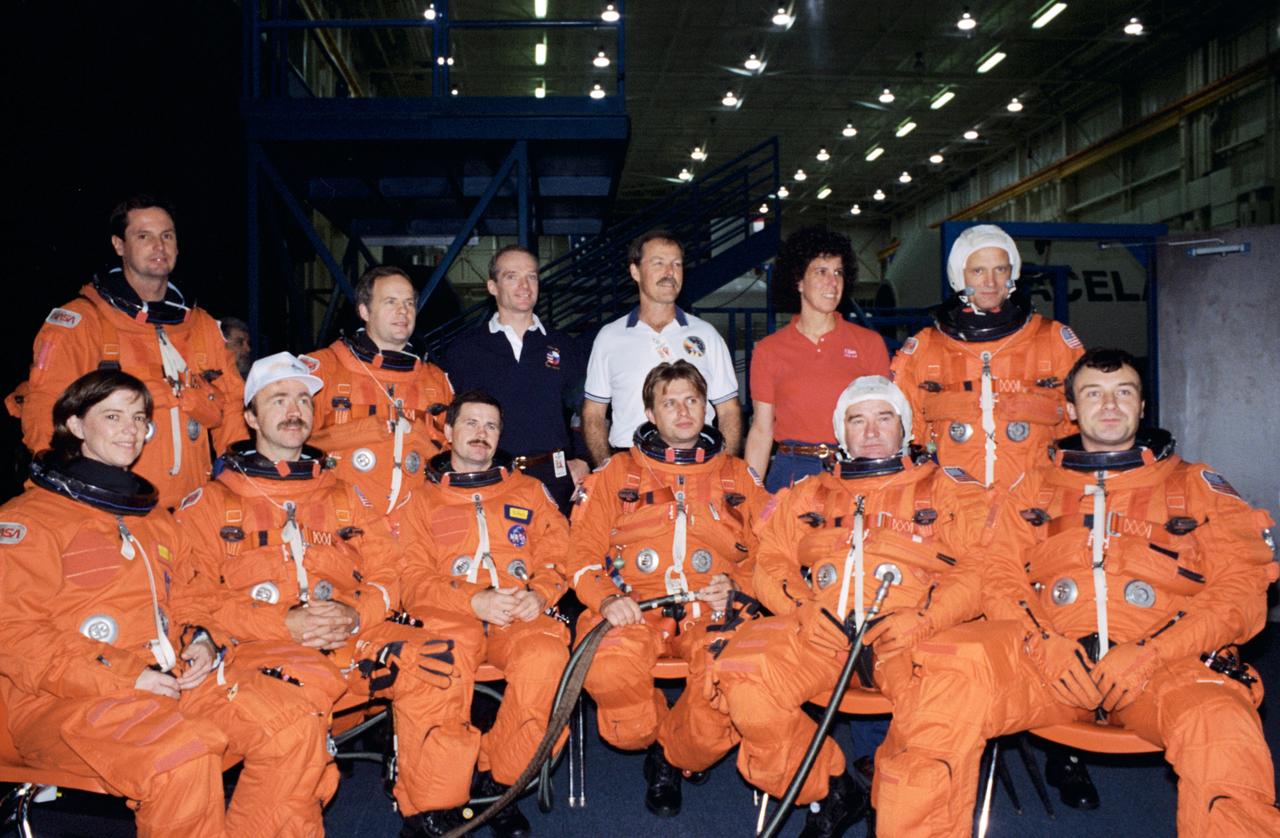
S94-47050 (28 Oct 1994) --- Crew members for the joint Space Shuttle/Russian Mir Space Station missions assemble for an informal portrait during a break in training in the Systems Integration Facility at the Johnson Space Center (JSC). In front (left to right) are astronaut Bonnie J. Dunbar; cosmonauts Aleksandr F. Poleshchuk, Yuriy I. Onufriyenko, Gennadiy M. Strekalov and Vladimir N. Dezhurov. In the rear are astronaut Gregory J. Harbaugh; cosmonaut Anatoliy Y. Solovyev, and astronauts Charles J. Precourt, Robert L. Gibson, Ellen S. Baker and Norman E. Thagard. In a precedent-setting flight, Thagard will be launched as a guest researcher along with Dezhurov, commander, and Strekalov, flight engineer, to Russia's Mir Space Station early next year for a three month mission, designated as Mir 18. Then in late spring, as the assignment of STS-71, the Space Shuttle Atlantis will rendezvous with Mir to pick up the Mir 18 crew and transfer cosmonauts Solovyov and Nikolai M. Budarin to the station for the Mir 19 mission. STS-71 mission specialist Dunbar is training as Thagard's backup.
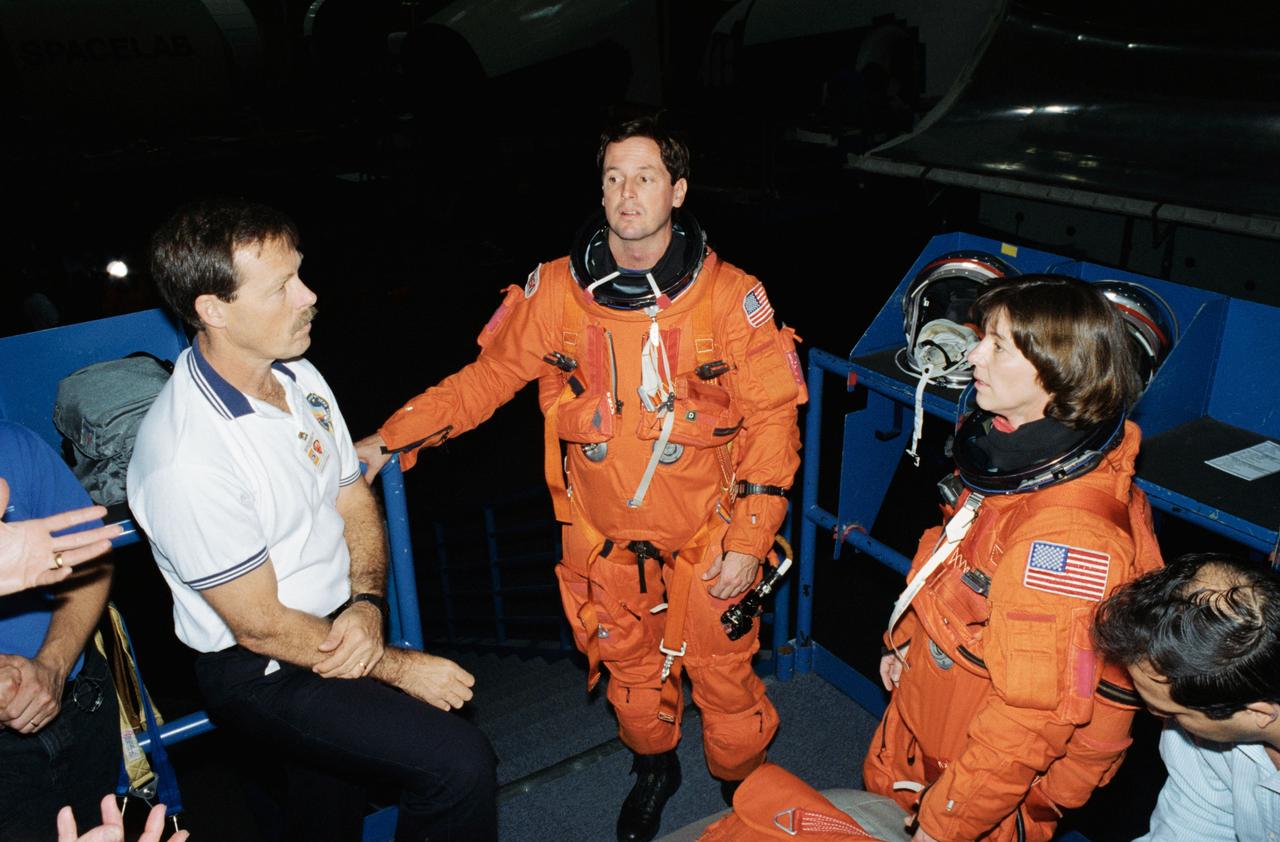
S94-47065 (18 Oct 1994) --- Astronaut Robert L. Gibson (left), STS-71 mission commander, converses with two crew mates prior to emergency egress training in the Systems Integration Facility at the Johnson Space Center (JSC). Astronauts Bonnie J. Dunbar and Gregory J. Harbaugh are attired in training versions of the partial pressure launch and entry space suits.
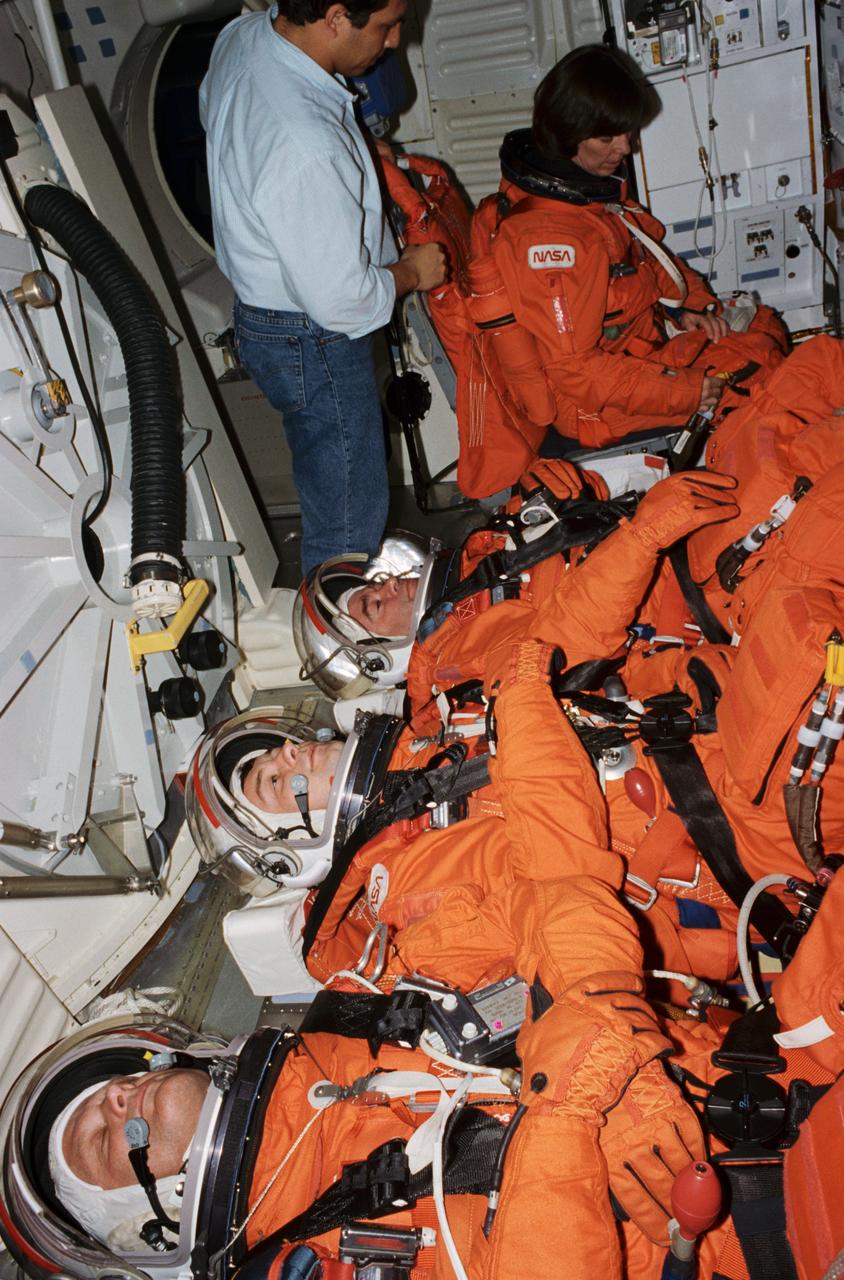
S94-47075 (Nov. 1994) --- In a Shuttle mockup trainer at the Johnson Space Center (JSC), a NASA astronaut and two Russian cosmonauts assigned to Russia's Mir 18 mission check out hardware like that to be flown onboard NASA's Space Shuttle Atlantis, the spacecraft that will retrieve the three from their orbital home for three months. Astronaut Norman E. Thagard (left), cosmonaut Vladimir N. Dezhurov, mission commander; and Gennadiy M. Strekalov, flight engineer; practice using the Recumbent Seating System (RSS). Astronaut Bonnie J. Dunbar, Thagard's backup on Mir 18 and mission specialist for STS-71, sits in a conventional middeck launch and entry station in the background. RSS has been manifest to be carried on the Space Shuttle Atlantis for the STS-71 mission. When the Space Shuttle Atlantis docks with Russia's Mir Space Station in 1995, Thagard and the two Russian cosmonauts, who will have been onboard Mir for a long duration stay, will join the STS-71 crew for the return to Earth.
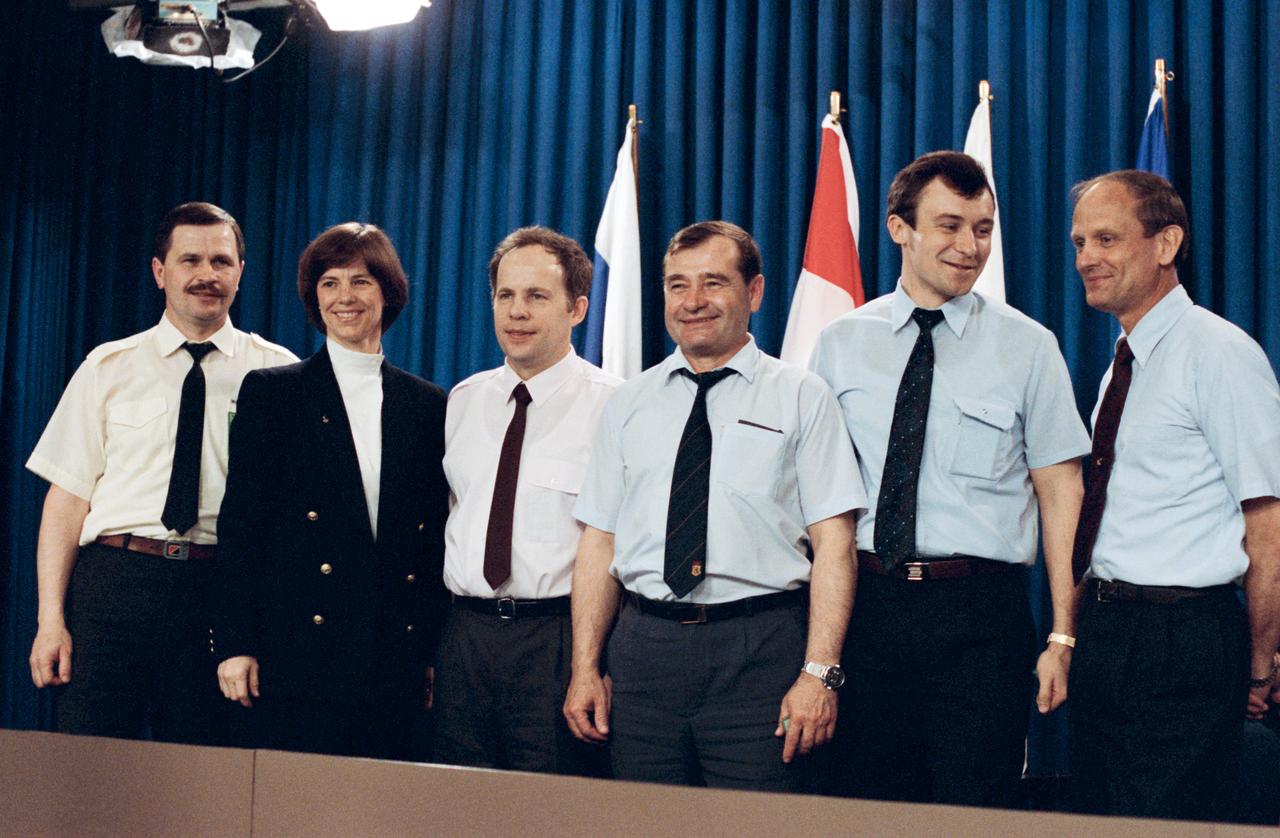
S94-34099 (16 June 1994) --- Crewmembers for two of the joint Space Shuttle/Mir missions pose for photographs after fielding questions from the press at Johnson Space Center (JSC). Left to right are cosmonaut Nikolai M. Budarin, astronaut Bonnie J. Dunbar, cosmonauts Anatoliy Y. Solovyov, Gennadiy M. Strekalov and Vladimir N. Dezhurov; and astronaut Norman E. Thagard. In a precedent-setting flight, Thagard will be launched with Dezhurov and Strekalov to Russia?s Mir Space Station early next year for a three-month mission, designated as Mir 18. Then in late May, as the assignment of STS-71, the Space Shuttle Atlantis will rendezvous with Mir to pick up the Mir 18 crew and transfer cosmonauts Solovyov and Budarin to the station for the Mir 19 mission. STS-71 mission specialist Dunbar is training as Thagard?s backup.
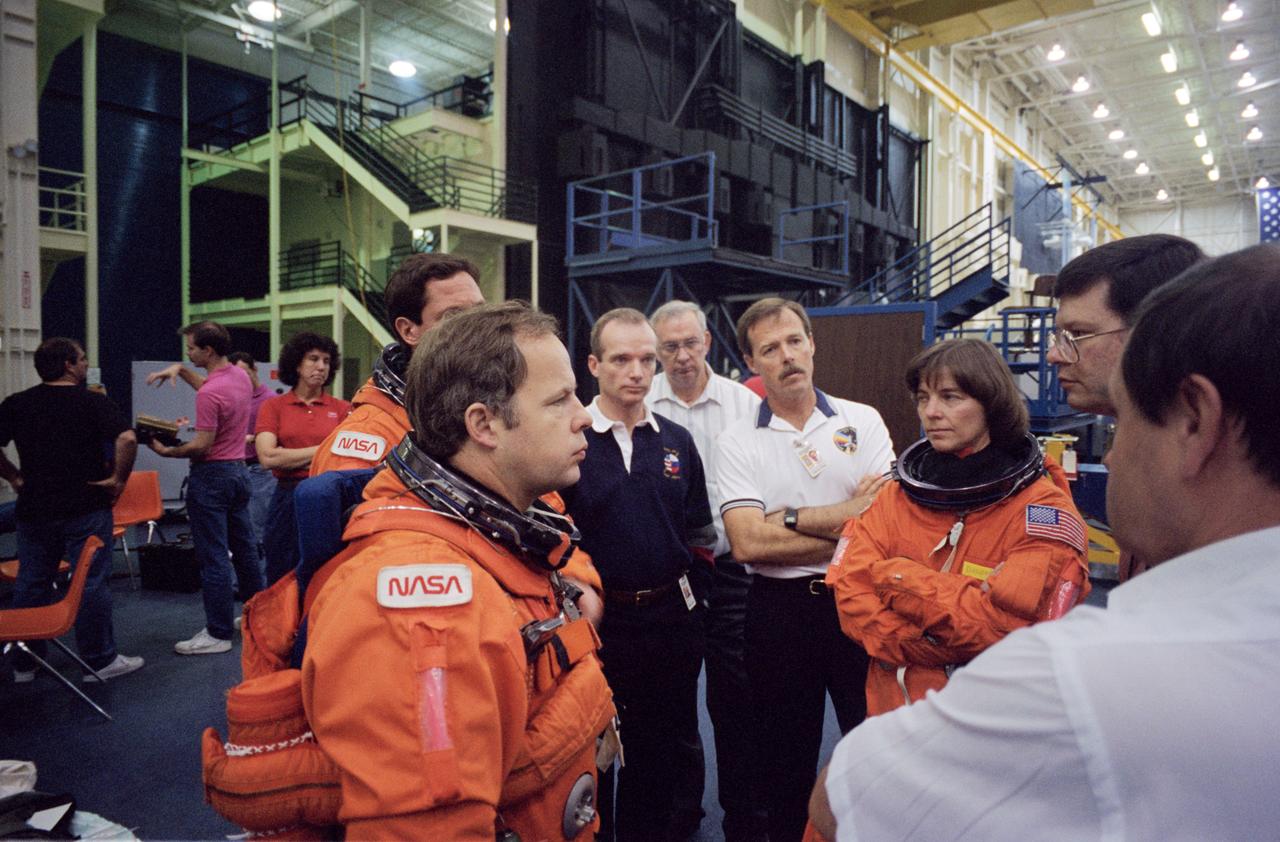
S94-47079 (18 Oct 1994) --- Astronaut Robert L. Gibson, (arms folded, near center) STS-71 mission commander, joins several crew mates during a briefing preceding emergency egress training in the Systems Integration Facility at the Johnson Space Center (JSC). Astronauts Bonnie J. Dunbar and Gregory J. Harbaugh (partially obscured), along with cosmonaut Anatoliy Y. Solovyev, all mission specialists, are attired in training versions of the partial pressure launch and entry space suits. Astronaut Charles J. Precourt, pilot, is in center foreground, and Ellen S. Baker, mission specialist, is in left background.
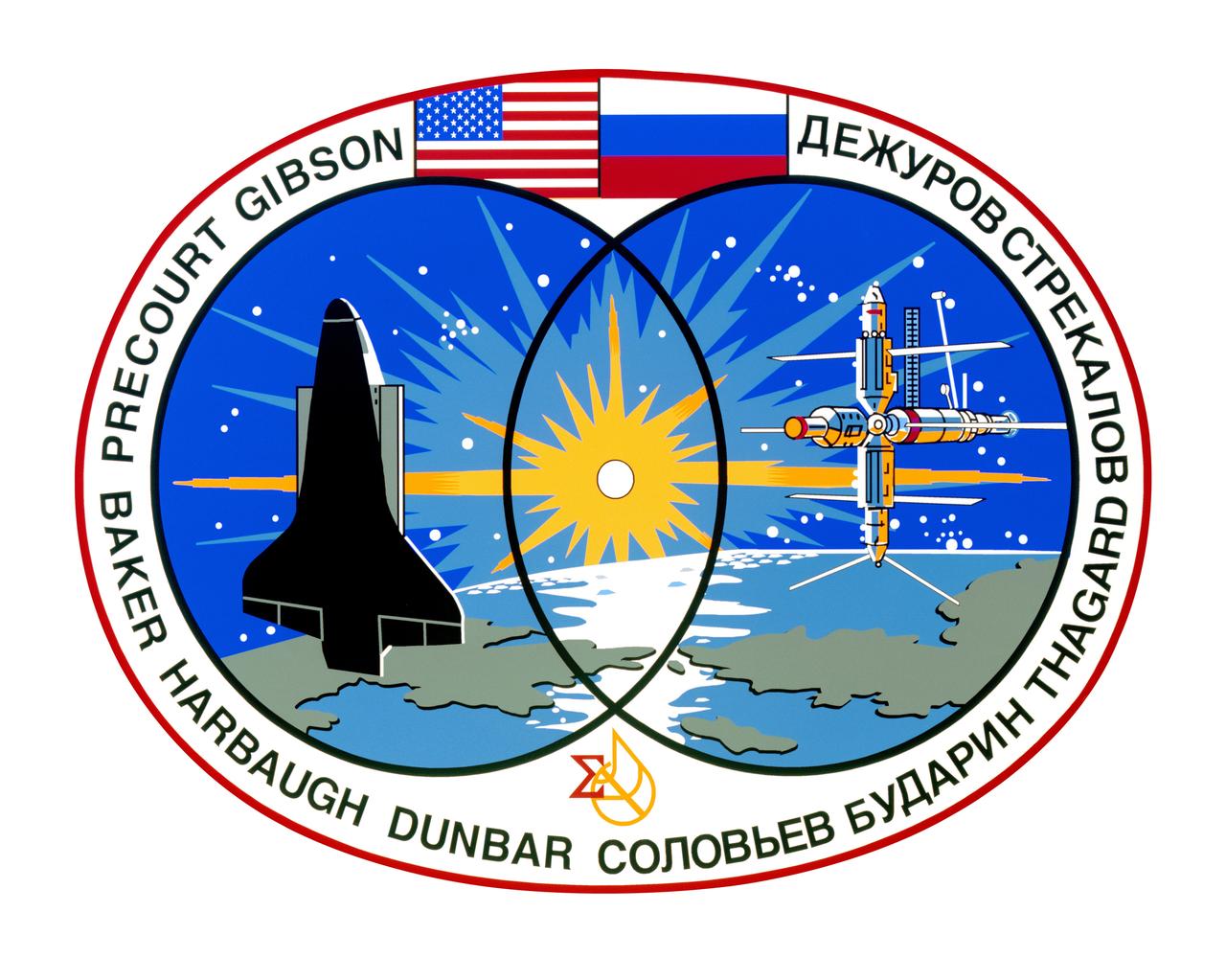
STS071-S-001 (April 1995) --- The STS-71 crew patch design depicts the orbiter Atlantis in the process of the first international docking mission of the space shuttle Atlantis with the Russian Mir Space Station. The names of the 10 astronauts and cosmonauts who will fly aboard the orbiter as shown along the outer border of the patch. The rising sun symbolizes the dawn of a new era of cooperation between the two countries. The vehicles Atlantis and Mir are shown in separate circles converging at the center of the emblem symbolizing the merger of the space programs of the two space faring nations. The flags of the United States and Russia emphasize the equal partnership of the mission. The joint program symbol at the lower center of the patch acknowledges the extensive contributions made by the Mission Control Centers (MCC) of both countries. The crew insignia was designed by aviation and space artist, Bob McCall, who also designed the crew patch for the Apollo-Soyuz Test Project (ASTP) in 1975, the first international space docking mission. The NASA insignia design for space shuttle flights is reserved for use by the astronauts and for other official use as the NASA Administrator may authorize. Public availability has been approved only in the forms of illustrations by the various news media. When and if there is any change in this policy, which is not anticipated, the change will be publicly announced. Photo credit: NASA
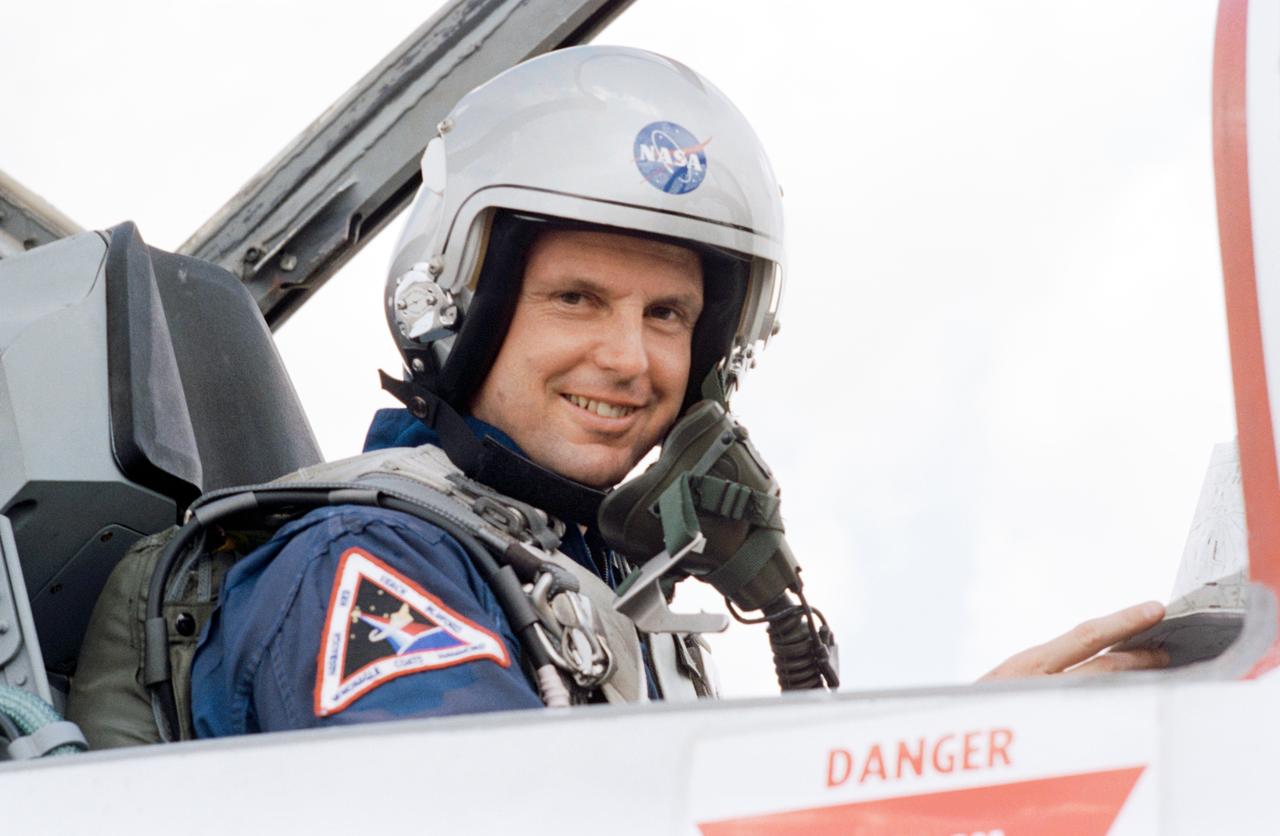
S94-36123 (June 1994) --- Astronaut Gregory J. Harbaugh, STS-71 mission specialist, sits in the rear station of a NASA T-38 jet trainer at Ellington Field. Harbaugh is in training for the STS-71 mission scheduled aboard the space shuttle Atlantis next year.

SPACE SHUTTLE STS-71 (MIR 18) SLM-1, FLIGHT FIXATIVE BAGS (FLOWN ONBOARD) QUAIL EGGS

SPACE SHUTTLE STS-71 (MIR 18) SLM-1, FLIGHT FIXATIVE BAGS (FLOWN ONBOARD) QUAIL EGGS
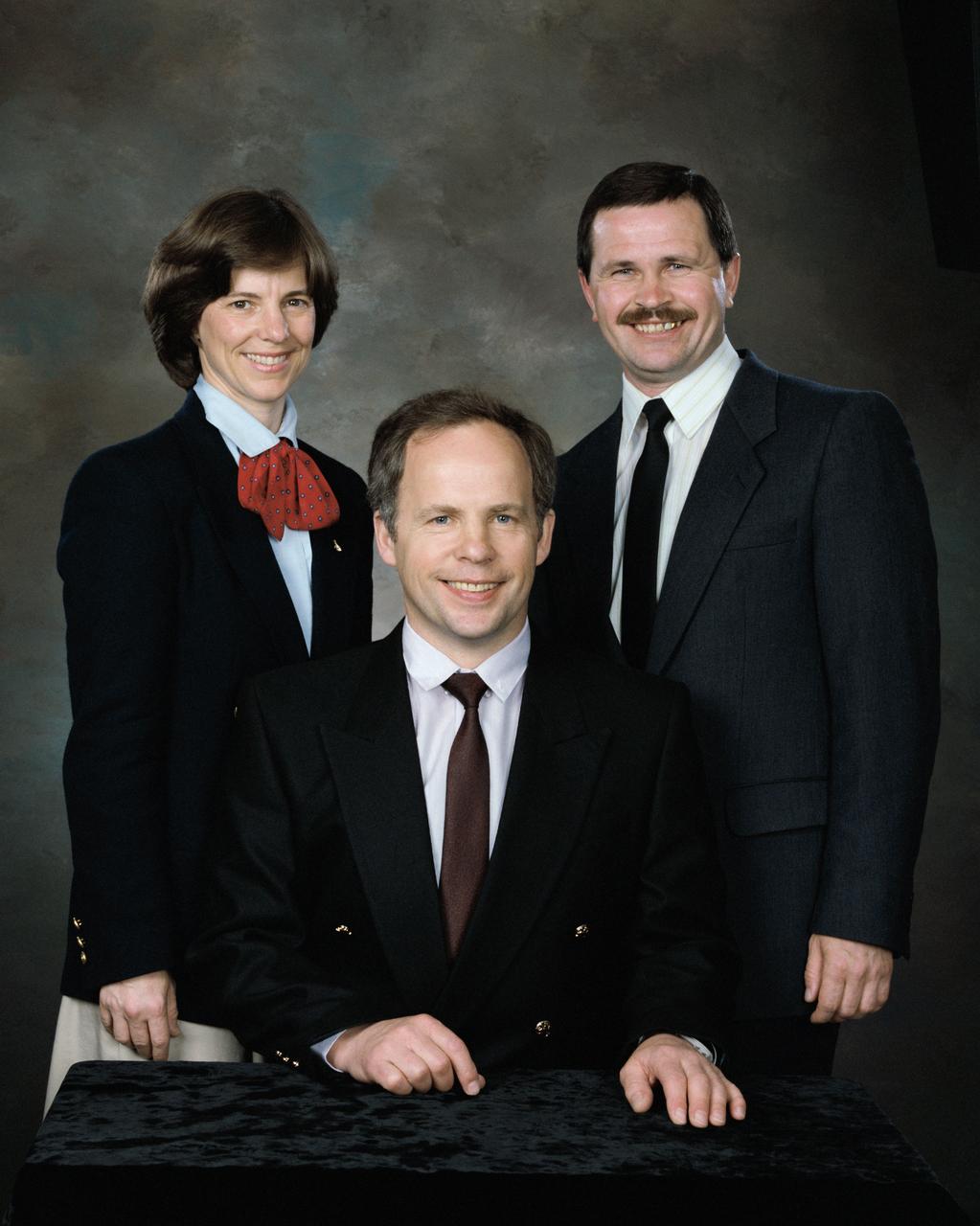
S94-34942 (27 May 1994) --- This is a portrait of (left to right) Bonnie J. Dunbar, Anatoliy Y. Solovyev, and Nikolai M. Budarin in civilian clothes. Dunbar is mission specialist for STS-71, and alternate crew member for Mir 18. Solovyev is commander for Mir 19, and Budarin is the flight engineer for that mission.
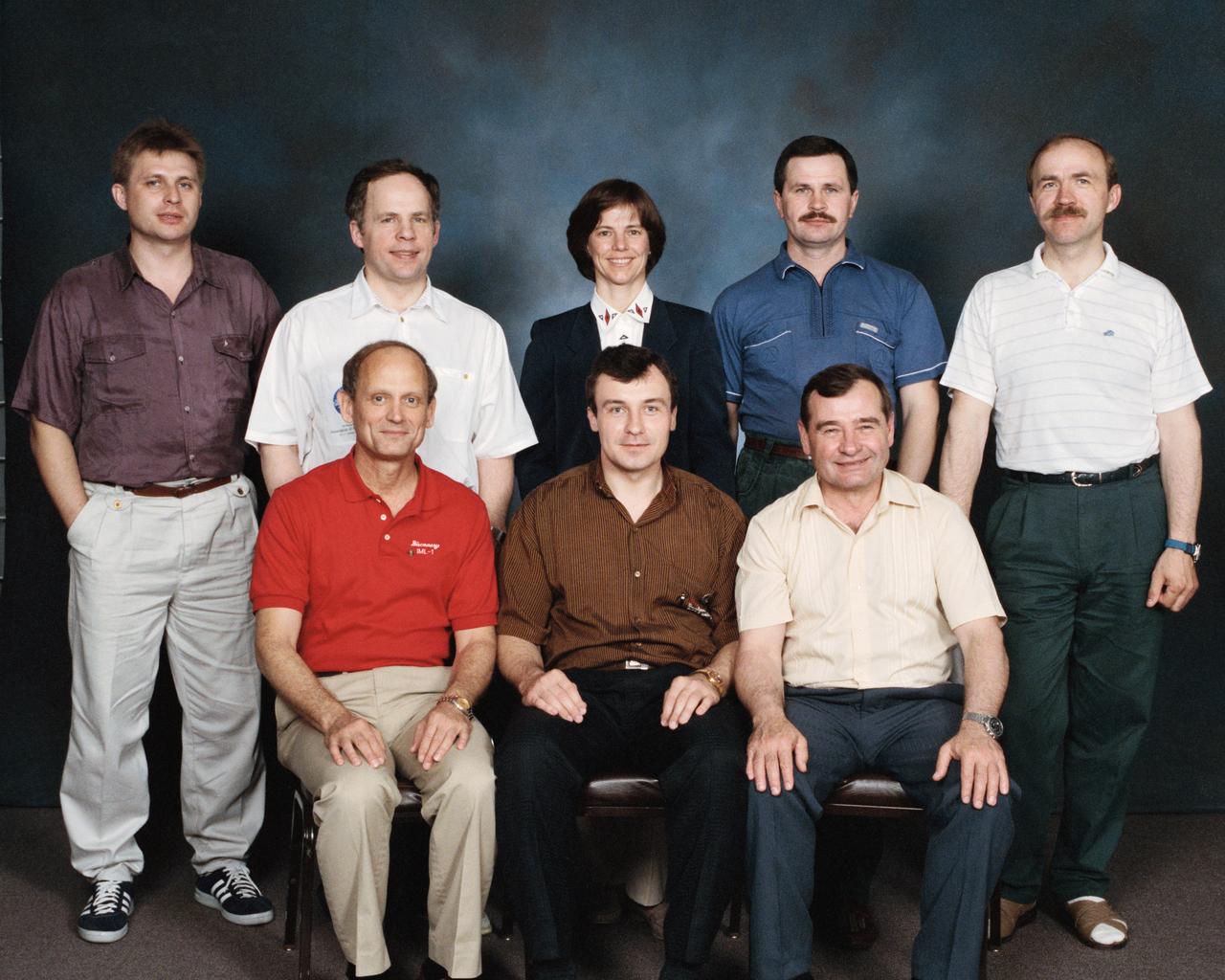
S94-35069 (17 June 1994) --- Crew members for the joint Space Shuttle/Mir missions pose for a team portrait in the midst of a three week training period at the Johnson Space Center (JSC). On the front row are, left to right, astronaut Norman E. Thagard and cosmonauts Vladimir N. Dezhurov and Gennadi M. Strekalov. Back row, left to right, cosmonauts Yuri I. Onufrienko and Anatoly Y. Solovyov, astronaut Bonnie J. Dunbar, cosmonauts Nikolai M. Budarin and Alexander F. Poleshchuk.
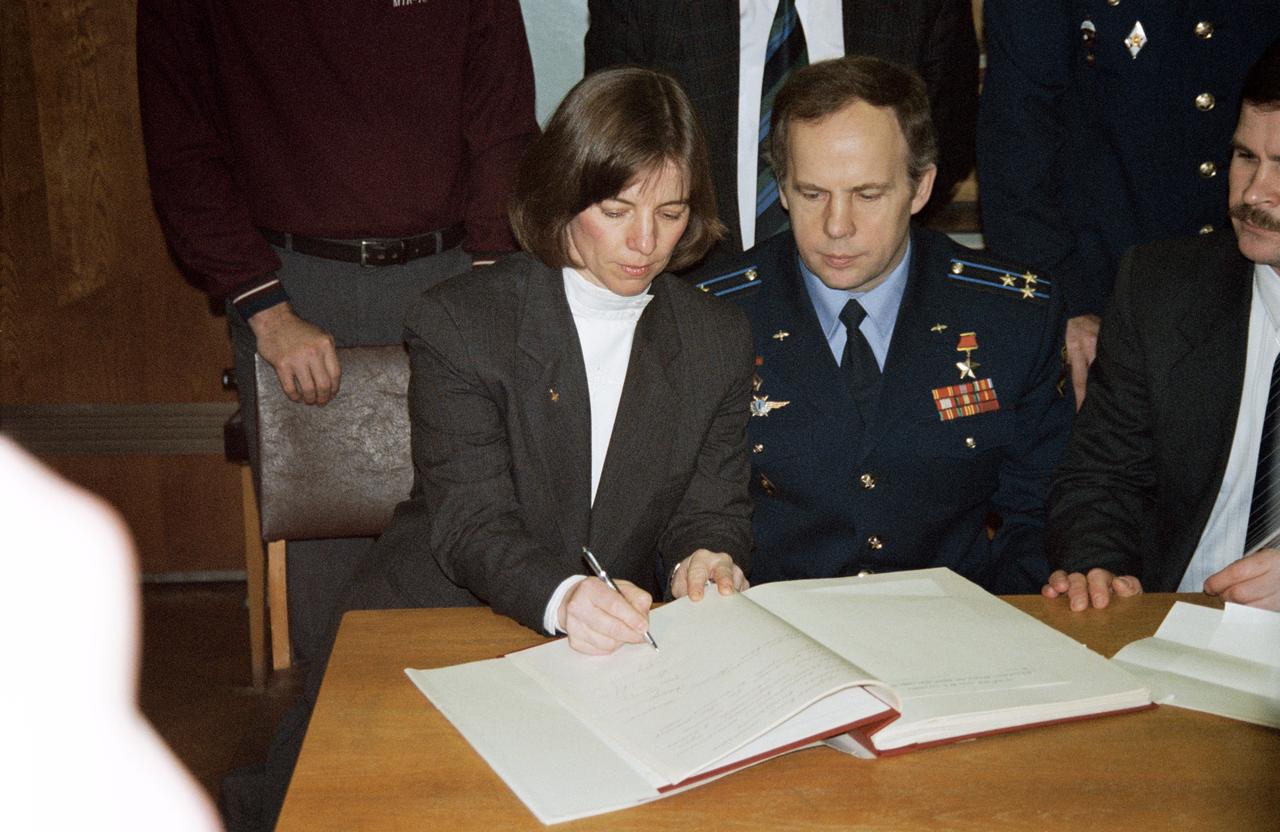
S95-04325 (22 March 1995) --- In keeping with Russian tradition, astronaut Bonnie J. Dunbar (left), STS-71 mission specialist, signs the diary of the late Yuriy A. Gagarin, the first Russian cosmonaut, as her STS-71 crew mates look on. Cosmonauts Anatoliy Y. Solovyov (center), Mir 19 mission commander, and Nikiolai M. Budarin, flight engineer, have been training with Dunbar in both the United States and Russia for the past several months. It is customary for each crew member about to aboard a Russian spacecraft to sign the diary. Dunbar has been in Russia training as alternate researcher for the Mir 18 mission.
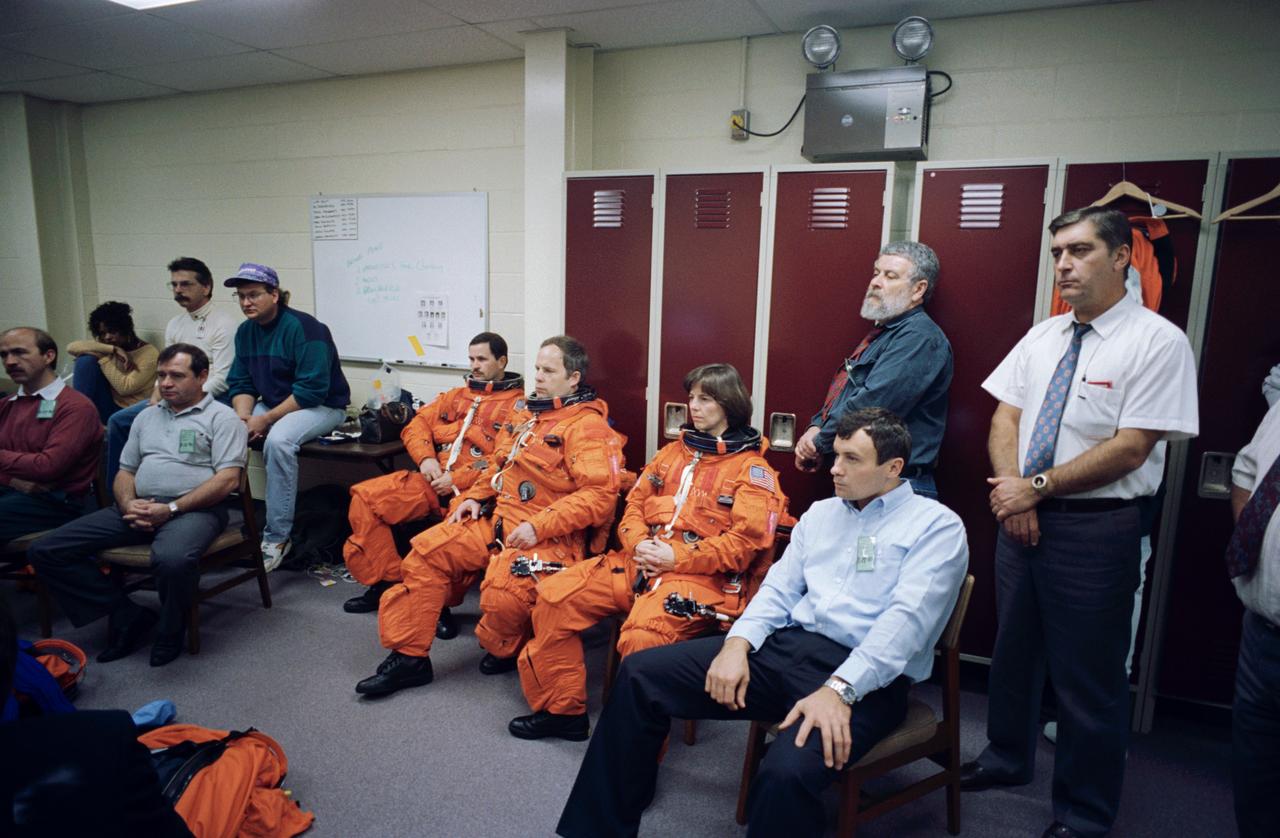
S94-47218 (28 Oct 1994) --- A number of Russian cosmonauts and an American astronaut listen to a briefing on launch and landing emergency situations during a training session in the Systems Integration Facility at the Johnson Space Center (JSC). Scheduled to launch aboard the Space Shuttle Atlantis with the STS-71 crew (in orange suits, left to right) are Nikolai M. Budarin, Mir 19 flight engineer; Anatoliy Y. Solovyev, Mir 19 mission commander; and Bonnie J. Dunbar, STS-71 mission specialist. The three are flanked by cosmonauts Gennadiy M. Strekalov (seated, second left) and Vladimir N. Dezhurov (seated, right foreground), flight engineer and commander, respectively, for the Mir-18 mission, who will return from a Russian Mir Space Station stay in Atlantis along with the two-way crew members of the STS-71 mission. Alexsandr F. Poleshchuk (seated, far left) is a Mir-reserve crew member.
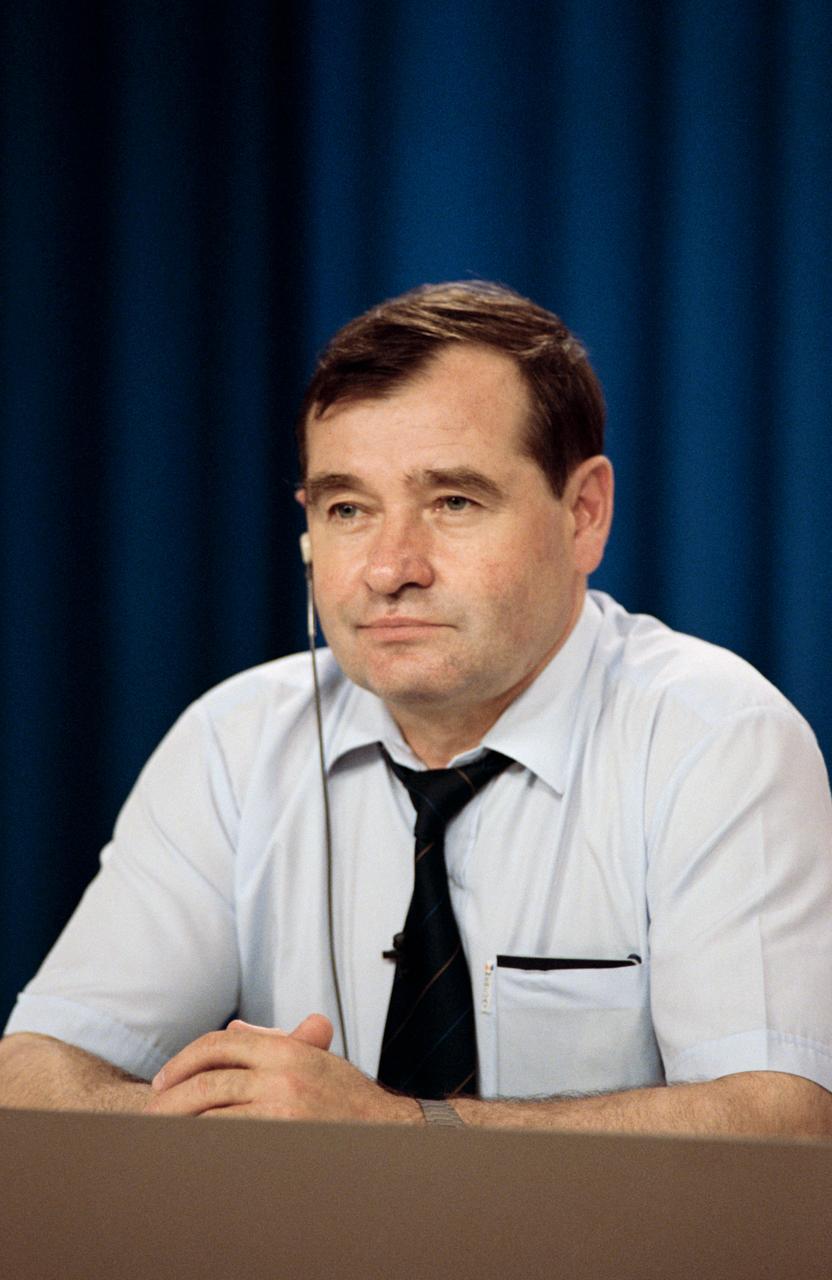
Cosmonaut Gennadiy M. Strekalov, flight engineer for the Mir-18 mission, listens to a question from a news media representative. Crew members for two of the joint Space Shuttle/Mir missions met the press at JSC.
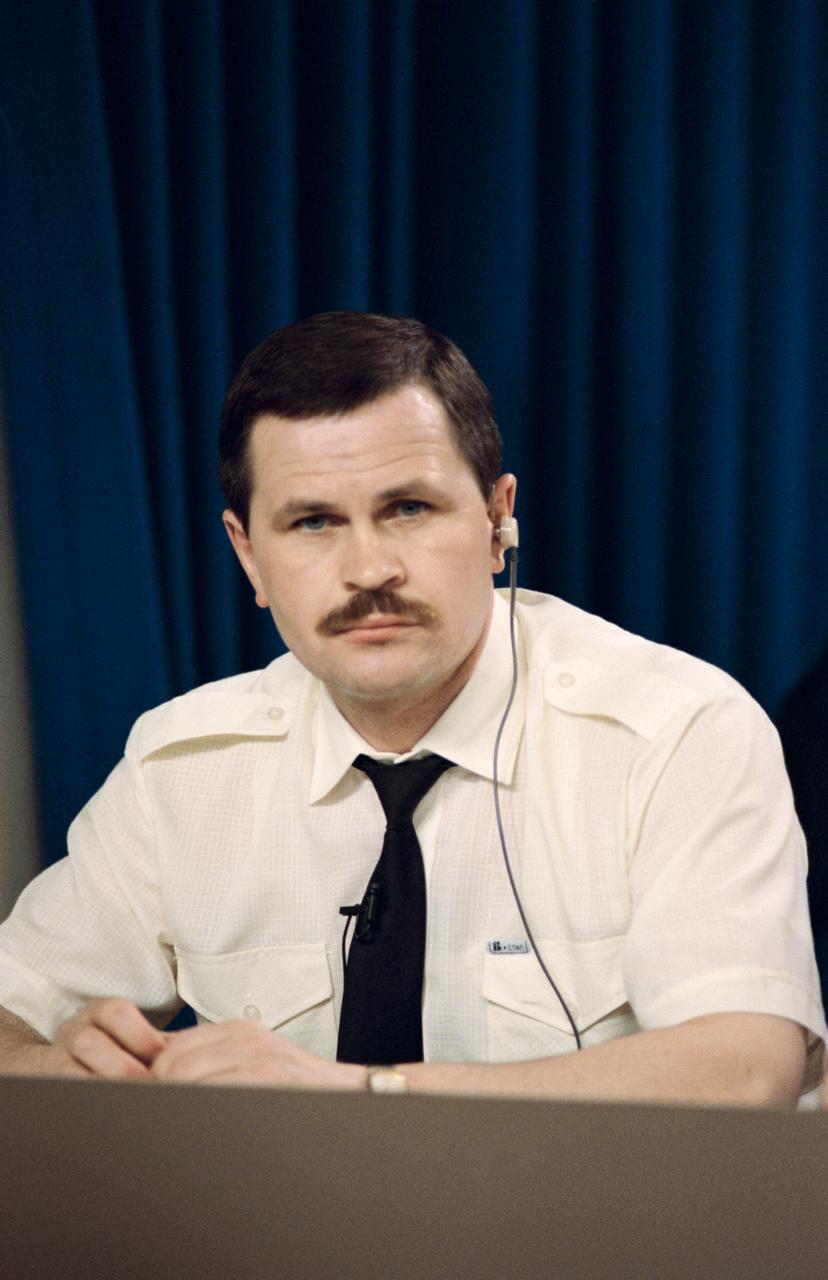
Cosmonaut Nikolai M. Budarin, flight engineer for Mir 19, ponders a question from a news media representative. Crew members for two of the joint Space Shuttle/Mir missions met the press at JSC.
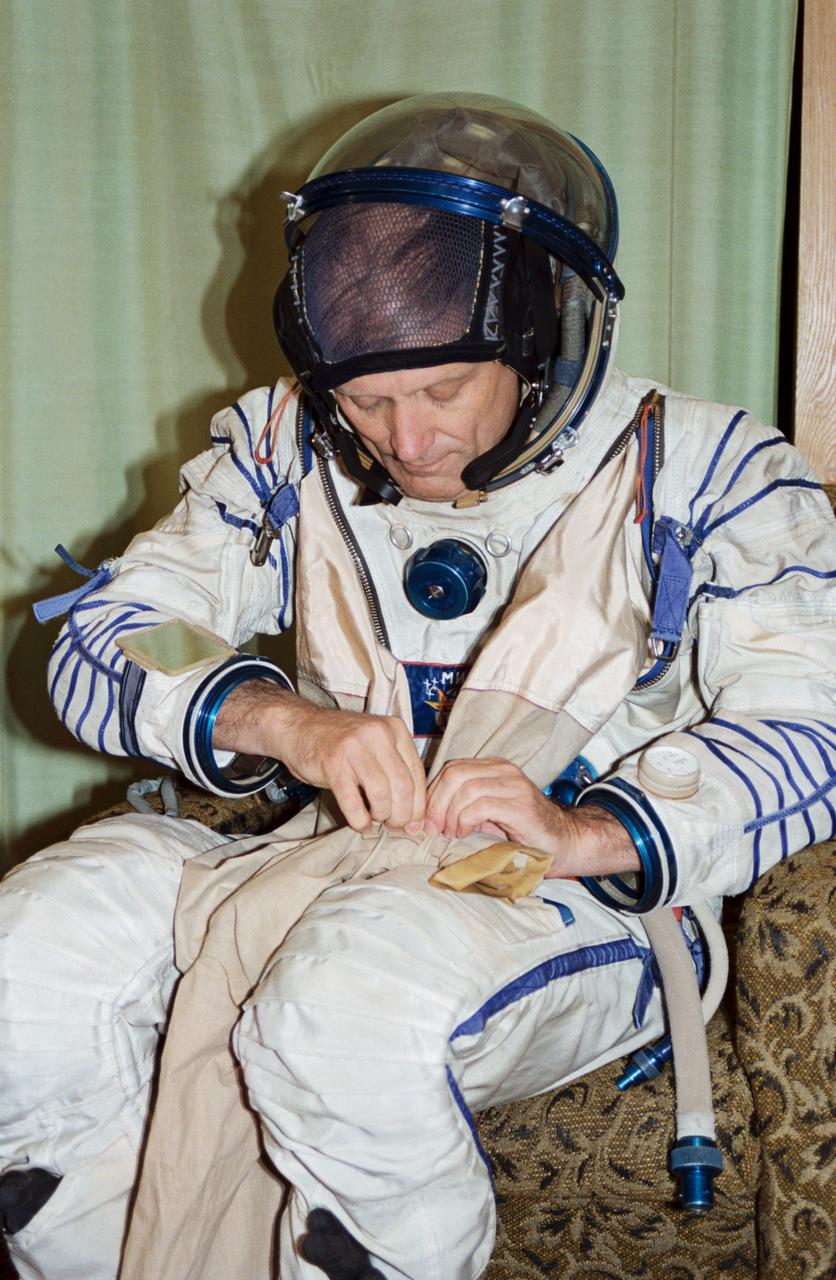
Astronaut Norman E. Thagard in a cosmonaut space suit in the Training Simulator Facility at the Gagarin Cosmonaut Training Center (Star City), near Moscow, Russia. In March 1995, astronaut Thagard is scheduled to be launched in a Russian Soyuz spacecraft with two cosmonauts to begin a three-month tour of duty on the Russian Mir Space Station. Thagard, along with his back-up, astronaut Bonnie J. Dunbar, has been training in Russian since February 1994.
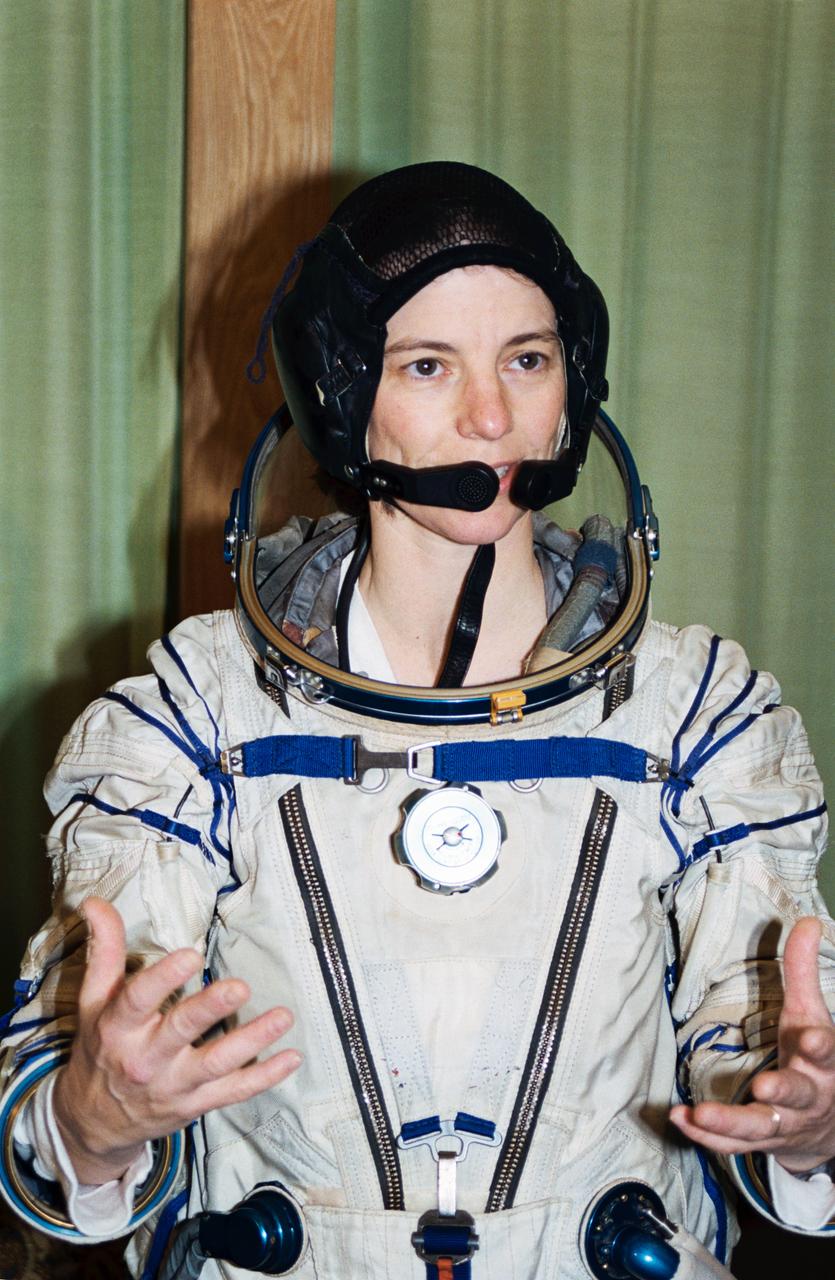
Astronaut Bonnie J. Dunbar in a cosmonaut space suit in the Training Simulator Facility at the Gagarin Cosmonaut Training Center (Star City), near Moscow, Russia. In March 1995, astronaut Norman E. Thagard is scheduled to be launched in a Russian Soyuz spacecraft with two cosmonauts to begin a three-month tour of duty on the Russian Mir Space Station. Thagard, along with his back-up, astronaut Bonnie J. Dunbar, has been training in Russian since February 1994.
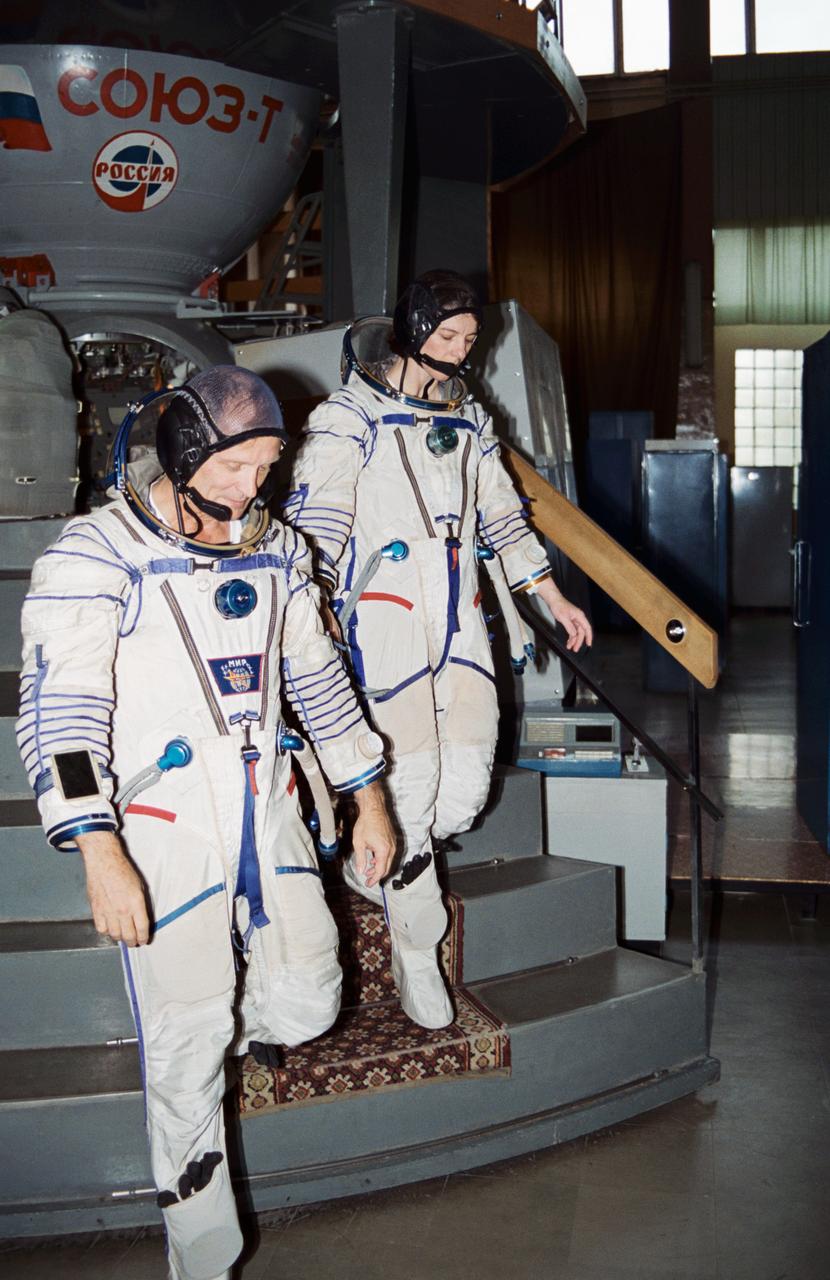
Astronauts Norman E. Thagard and Bonnie J. Dunbar in cosmonaut space suits in the Training Simulator Facility at the Gagarin Cosmonaut Training Center (Star City), near Moscow, Russia. In March 1995, astronaut Thagard is scheduled to be launched in a Russian Soyuz spacecraft with two cosmonauts to begin a three-month tour of duty on the Russian Mir Space Station. Thagard, along with his back-up, astronaut Bonnie J. Dunbar, has been training in Russian since February 1994.
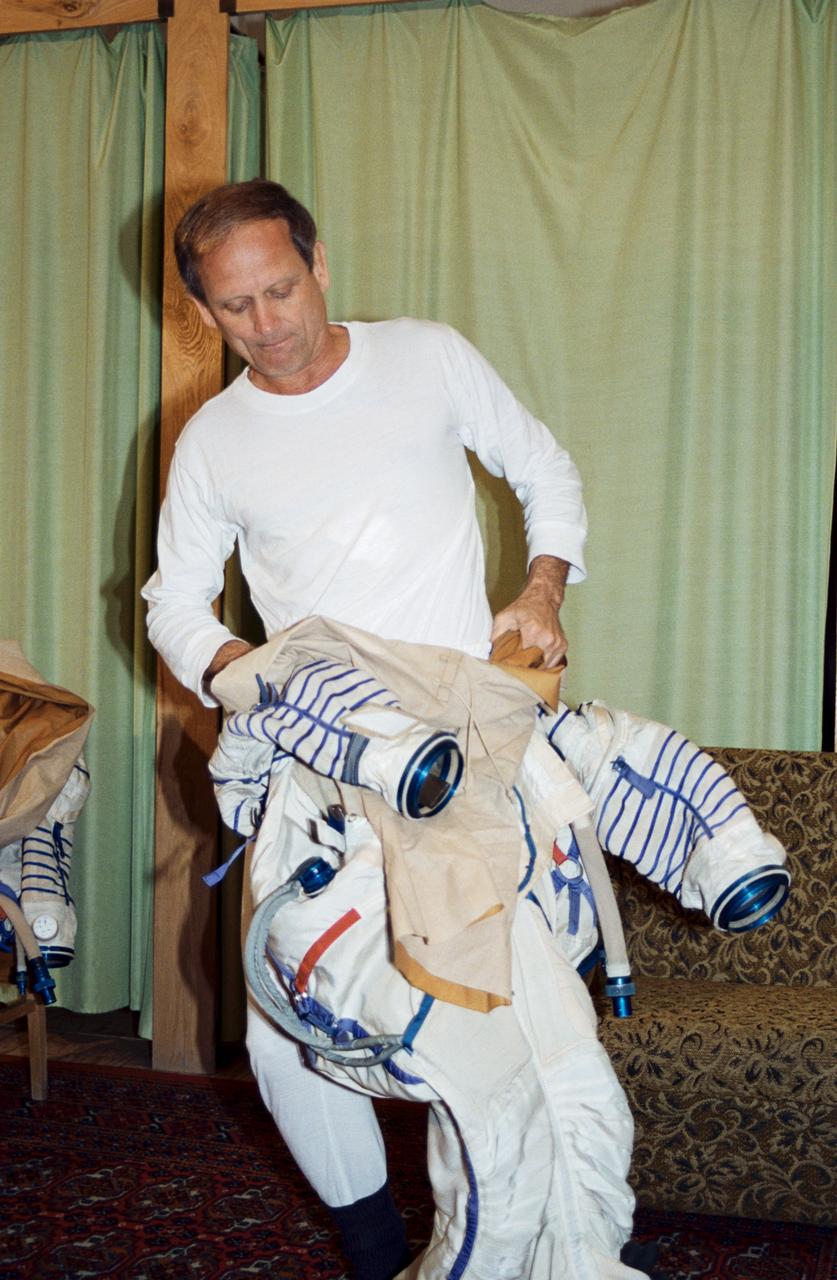
Astronaut Norman E. Thagard getting into a cosmonaut space suit in the Training Simulator Facility at the Gagarin Cosmonaut Training Center (Star City), near Moscow, Russia.
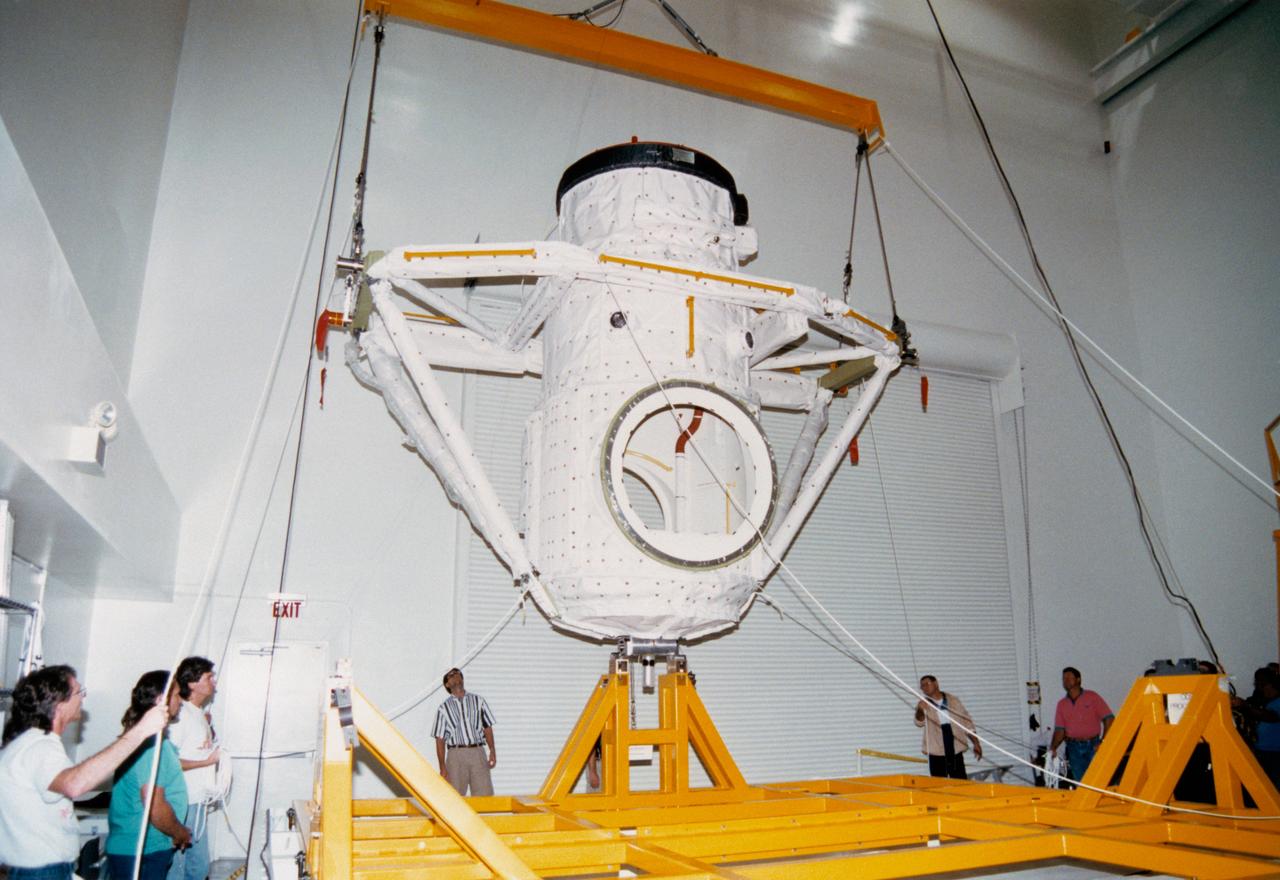
S94-47810 (2 Dec. 1994) --- Lockheed Space Operations Company workers in the Extended Duration Orbiter (EDO) Facility, located inside the Vehicle Assembly Building (VAB), carefully hoist the Orbiter Docking System (ODS) from its shipping container into a test stand. The ODS was shipped in a horizontal position to the Kennedy Space Center (KSC) from contractor Rockwell Aerospace's Downey plant. Once the ODS is upright, work can continue to prepare the hardware for the first docking of the United States Space Shuttle and Russian Space Station MIR in 1995. The ODS contains both United States-made and Russian-made hardware. The black band is Russian-made thermal insulation protecting part of the docking mechanism, also Russian-made, called the Androgynous Peripheral Docking System (APDS). A red protective cap covers the APDS itself. Other elements of the ODS, most of it protected by white United States-made thermal insulation, were developed by Rockwell, which also integrated and checked out the assembled Russian-United States system.
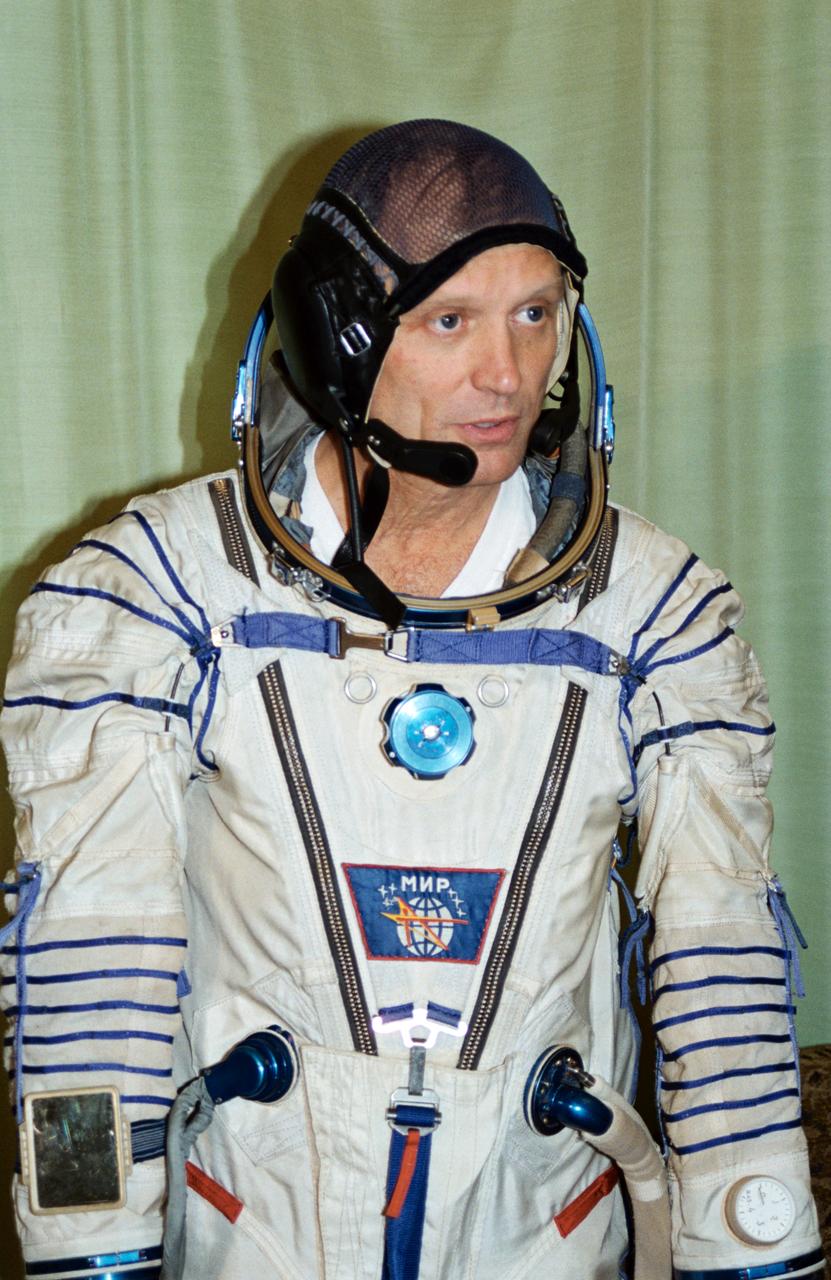
S94-45643 (20 Sept 1994) --- Astronaut Norman E. Thagard in a cosmonaut space suit in the Training Simulator Facility at the Gagarin Cosmonaut Training Center (Star City), near Moscow, Russia. In March 1995, astronaut Thagard is scheduled to be launched in a Russian Soyuz spacecraft with two cosmonauts to begin a three-month tour of duty on the Russian Mir Space Station. Thagard, along with his back-up, astronaut Bonnie J. Dunbar, has been training in Russia since February 1994. During his stay on Mir, he will conduct a variety of life sciences experiments that will provide U.S. investigators with the first long-duration exposure data since Skylab in the late 1970's. Thagard's mission will end in July when the Space Shuttle Atlantis, carrying the newly installed docking mechanism, docks with Mir Space Station for the first United States - Russian docking operation since Apollo-Soyuz in 1975. The Orbiter will remain attached to Mir for five days of joint scientific operations before returning home with Thagard and his Russian crew mates and leaving behind two cosmonauts on Mir.

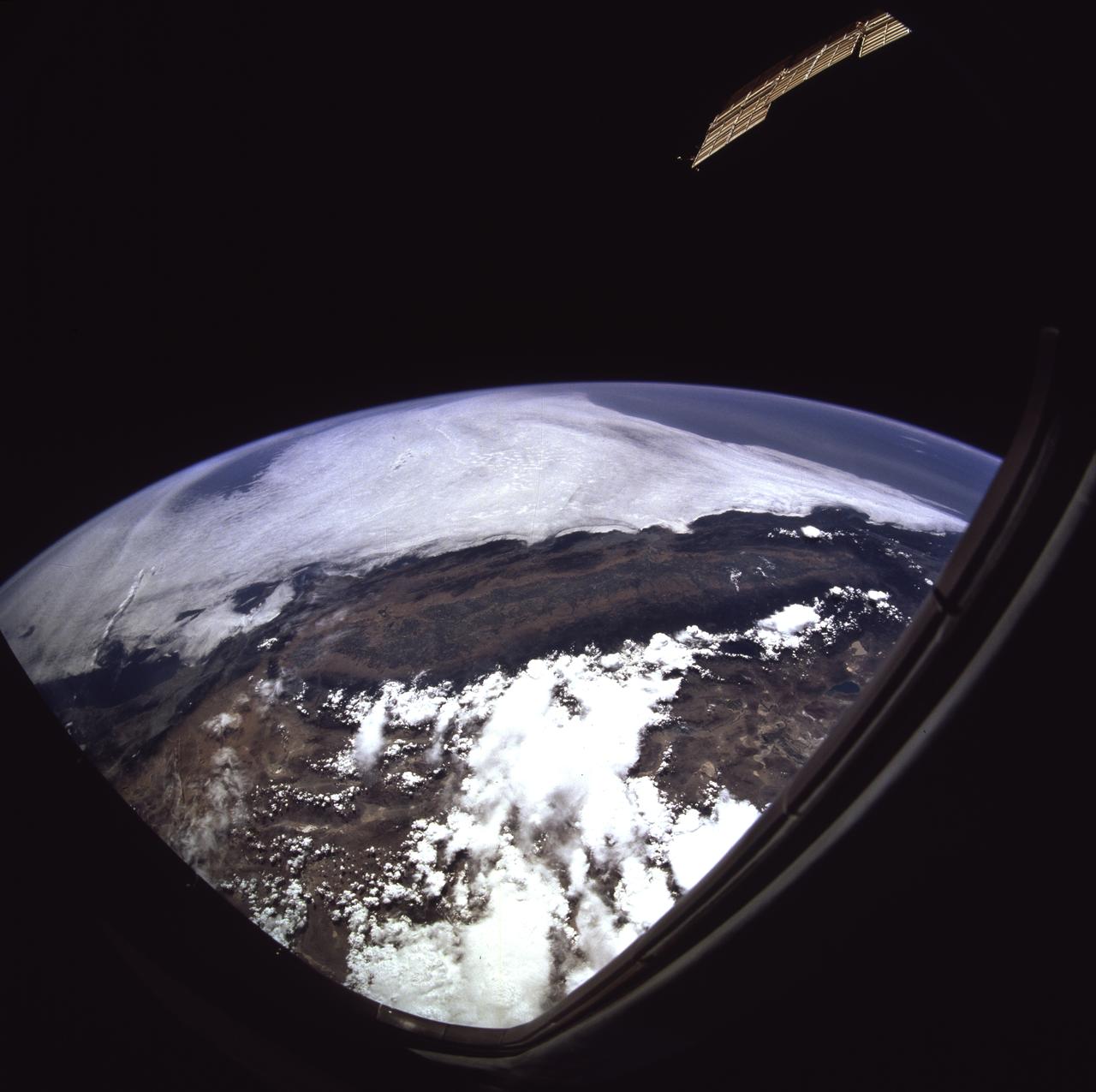
STS071-705-055 (27 June-7 July 1995) --- This vertical view over the central Andes Mountains was photographed from the Earth-orbiting space shuttle Atlantis during the ten-day STS-71 mission. It is one of many still visuals shown by the returning crew during its post-flight press briefing on July 18, 1995. Views of Earth from orbit often make landscapes seem flat, but this view taken with the Sun near the horizon and with a 250mm lens able to pick up detail reveals the conical peaks of numerous volcanoes. The dusting of snow makes the view more vivid as the peaks cast black shadows. The snow is a few days old in this view since several roads can be seen crossing dry lake beds (smooth white areas between mountains, top right), indicating that vehicles have crushed and melted the thin snow. According to NASA scientists observing the STS-71 photography, some volcanoes are not yet mapped. They believe that most of the snow-covered peaks reach more than 16,000 feet in altitude.

STS071-S-074 (4 July 1995) --- This view of the space shuttle Atlantis during its move away from Russia's Mir Space Station was photographed by the Mir-19 crew on July 4, 1995. Cosmonauts Anatoliy Y. Solovyev and Nikolai M. Budarin, Mir-19 commander and flight engineer, respectively, temporarily undocked the Soyuz spacecraft from the cluster of Mir elements to perform a brief fly-around. They took pictures while the STS-71 crew, with Mir-18's three crew members aboard, undocked from Atlantis for the completion of this leg of the joint activities. Solovyev and Budarin had been taxied to the Mir Space Station by the STS-71 ascent trip of Atlantis.
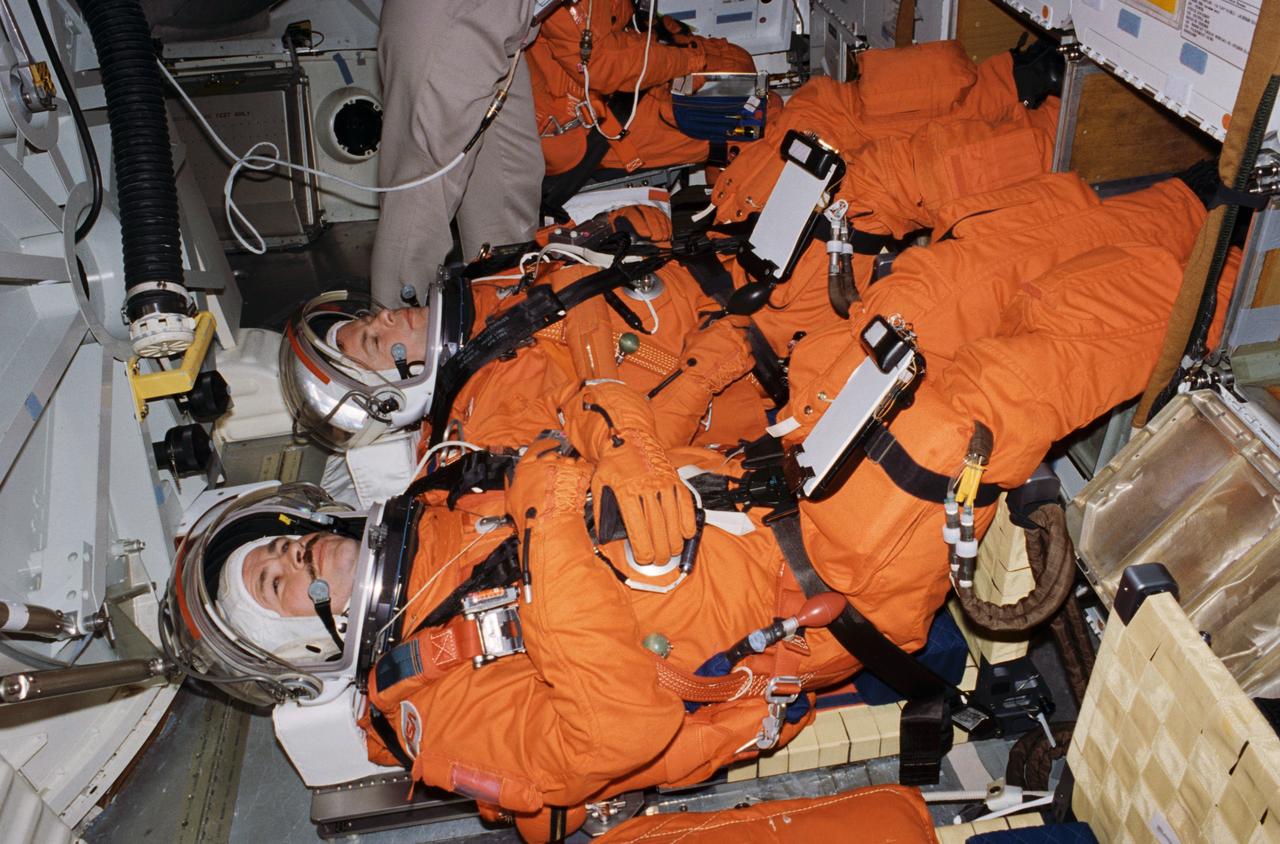
S94-47071 (Nov. 1994) --- In a Shuttle mockup trainer at the Johnson Space Center (JSC), two Russian cosmonauts assigned to Russia's Mir 19 mission check out hardware like that to be flown onboard NASA's Space Shuttle Atlantis, the spacecraft that will take the pair to their orbital destination. Anatoly Y. Solovyev, mission commander; and Nikolai M. Budarin (nearest camera), flight engineer, practice using the Recumbent Seating System (RSS). RSS has been manifest to be carried on the Space Shuttle Atlantis for the STS-71 mission. When Atlantis docks with the Mir space station in 1995, a NASA astronaut and two other Russian cosmonauts, who will have been onboard Mir for a long duration stay, will join the STS-71 crew for the return to Earth. Solovyev and Budarin will remain aboard Mir, to return to Earth later in one of Russia's Soyuz spacecraft.
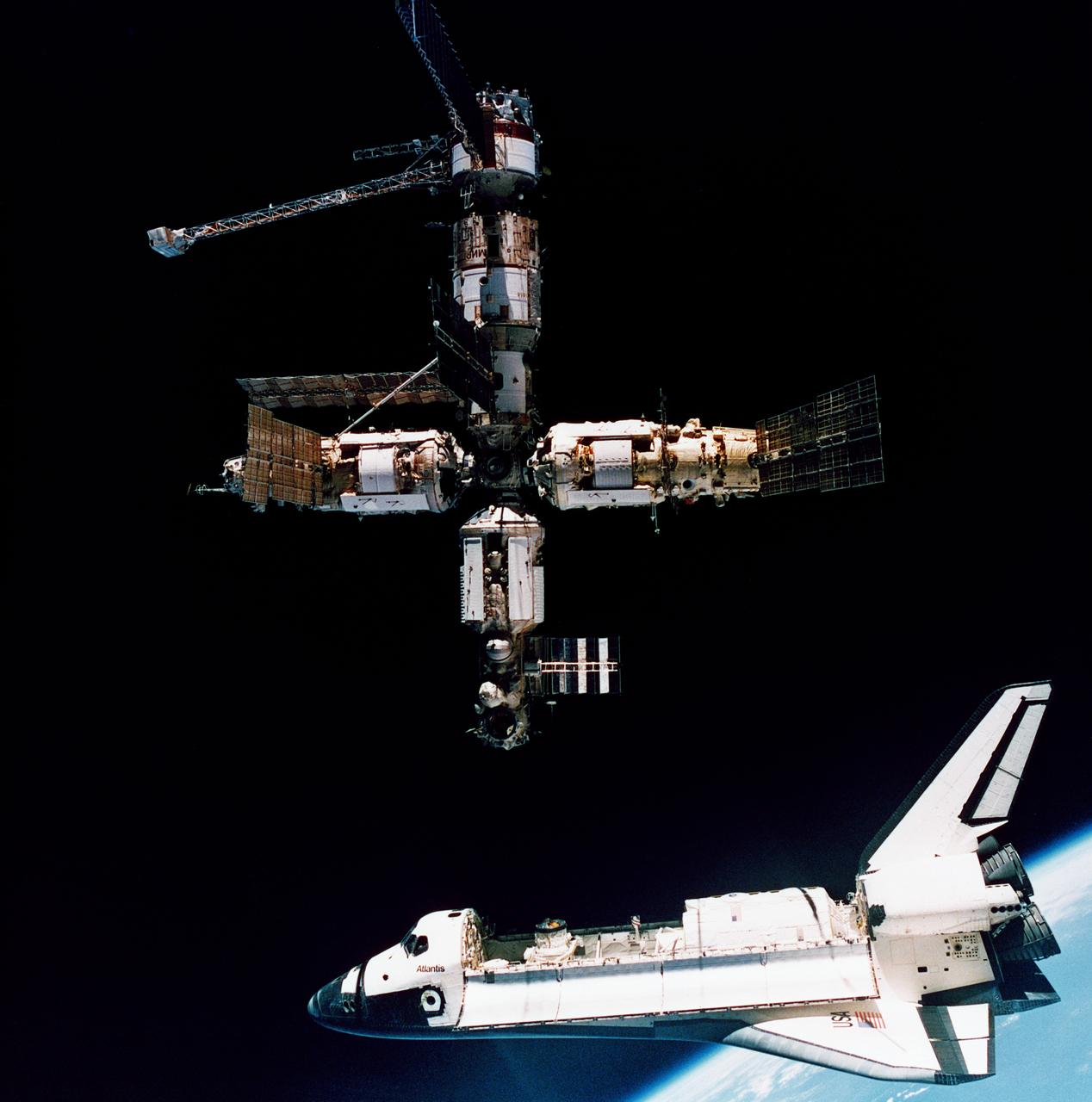
STS071-S-075 (4 July 1995) --- This view of the space shuttle Atlantis beginning its move away from Russia's Mir Space Station was photographed by the Mir-19 crew on July 4, 1995. Cosmonauts Anatoliy Y. Solovyev and Nikolai M. Budarin, Mir-19 commander and flight engineer, respectively, temporarily undocked the Soyuz spacecraft from the cluster of Mir elements to perform a brief fly-around. They took pictures while the STS-71 crew, with Mir-18's three crew members aboard, undocked from Atlantis for the completion of this leg of the joint activities. Solovyev and Budarin had been taxied to the Mir Space Station by the STS-71 ascent trip of Atlantis.
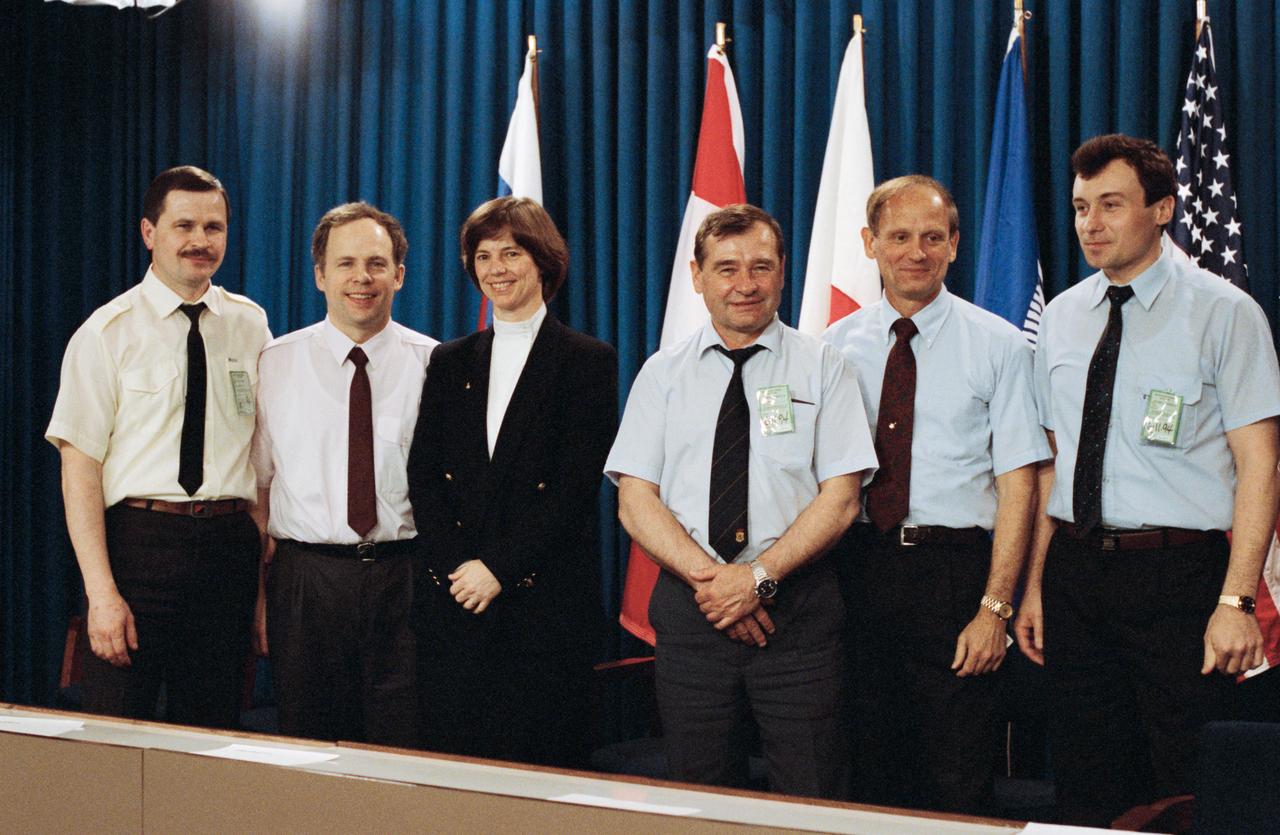
Crew members for two joint Space Shuttle/Mir missions greet the press during a break in medical operations training at JSC. Left to right are Nikolai M. Budarin, Anatoly Y. Solovyev, Bonnie J. Dunbar, Gennadiy M. Strekalov, Norman E. Thagard and Vladimir N. Dezhurov.

Cosmonaut Anatoliy Y. Solovyev, mission commander for Mir 19, responds to a question from a news media representative. Crew members for two of the joint Space Shuttle/Mir missions met the press at JSC.
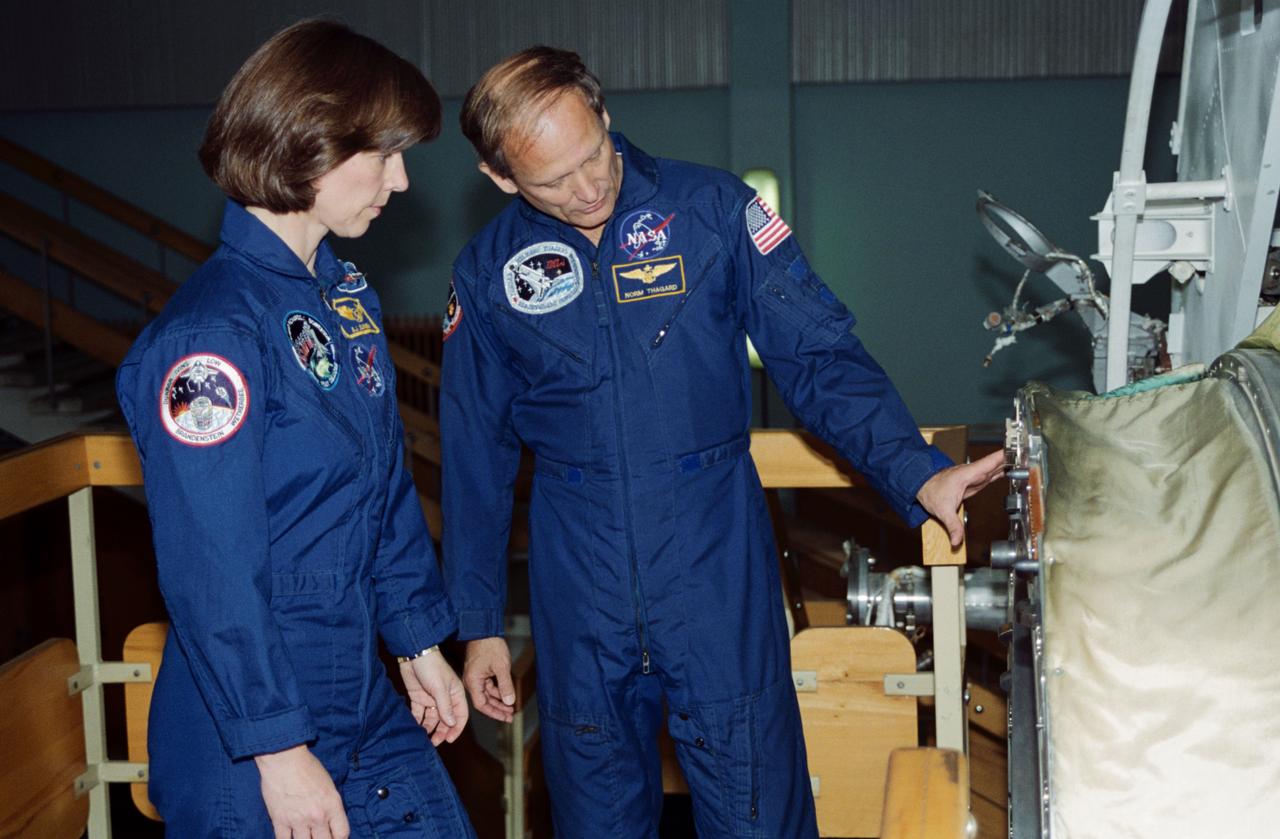
S94-45647 (20 Sept 1994) --- Astronaut's Norman E. Thagard and Bonnie J. Dunbar by the Mir Space Station simulator at the Gagarin Cosmonaut Training Center (Star City), near Moscow, Russia. In March 1995, astronaut Thagard is scheduled to be launched in a Russian Soyuz spacecraft with two cosmonauts to begin a three-month tour of duty on the Russian Mir Space Station. Thagard, along with his back-up, astronaut Dunbar, has been training in Russia since February 1994. During his stay on Mir, he will conduct a variety of life sciences experiments that will provide U.S. investigators with the first long-duration exposure data since Skylab in the late 1970's. Thagard's mission will end in late May or early June when the Space Shuttle Atlantis, carrying the newly installed docking mechanism, docks with Mir Space Station for the first United States - Russian docking operation since Apollo-Soyuz in 1975. The Orbiter will remain attached to Mir for five days of joint scientific operations before returning home with Thagard and his Russian crew mates and leaving behind two cosmonauts on Mir.
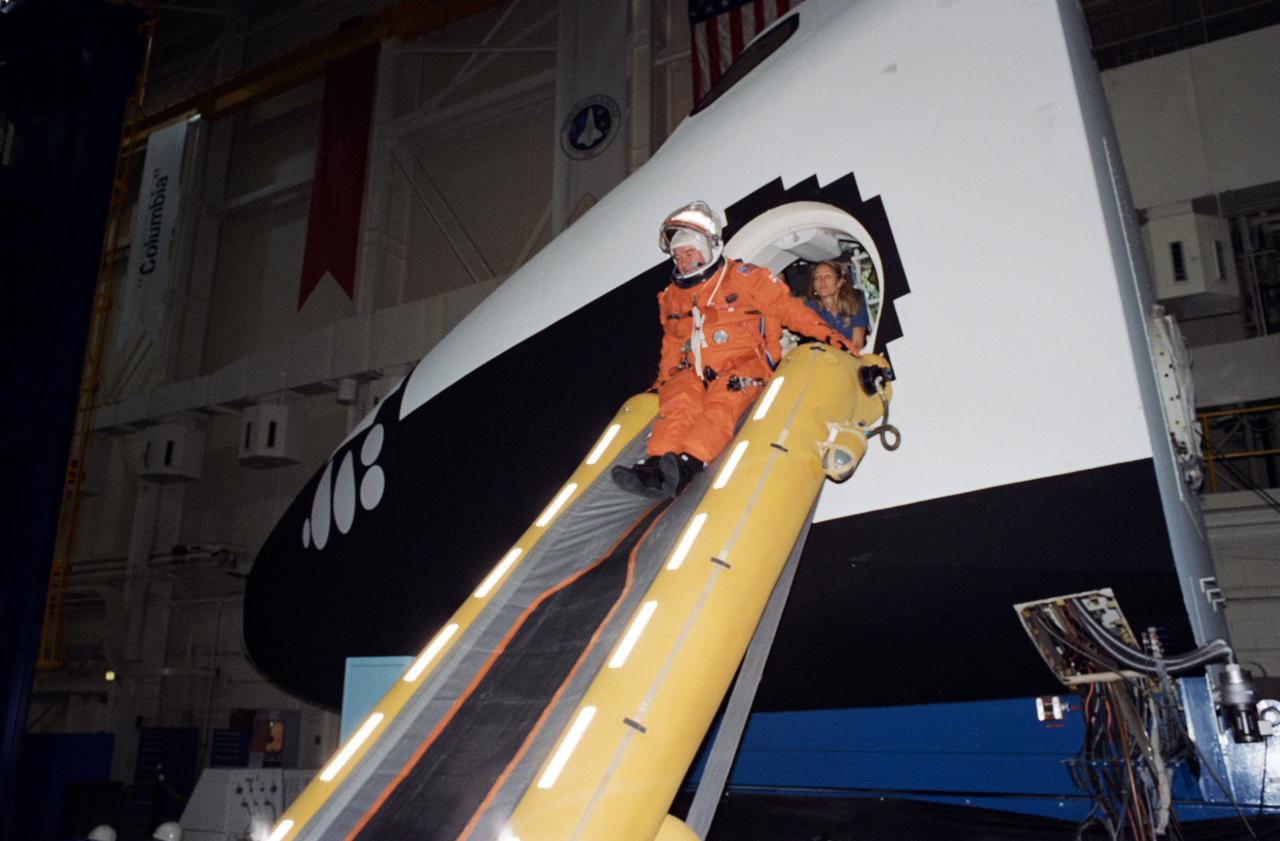
S94-47083 (14 Oct 1994) --- Cosmonaut Gennadiy M. Strekalov, Mir-18 flight engineer, who will return via the Space Shuttle Atlantis from a three-month mission aboard Russia's Mir Space Station, joins the STS-71 crew members during emergency egress training. The training took place in the systems integration facility at the Johnson Space Center (JSC). In a precedent-setting flight, NASA astronaut Norman E. Thagard will be launched with Vladimir N. Dezhurov and Strekalov to the Mir Space Station early next year for a three month mission. Then in late May, as the assignment of STS-71, the Space Shuttle Atlantis will rendezvous with Mir to pick up the Mir 18 crew and transfer two other cosmonauts to the station for the Mir 19 mission.
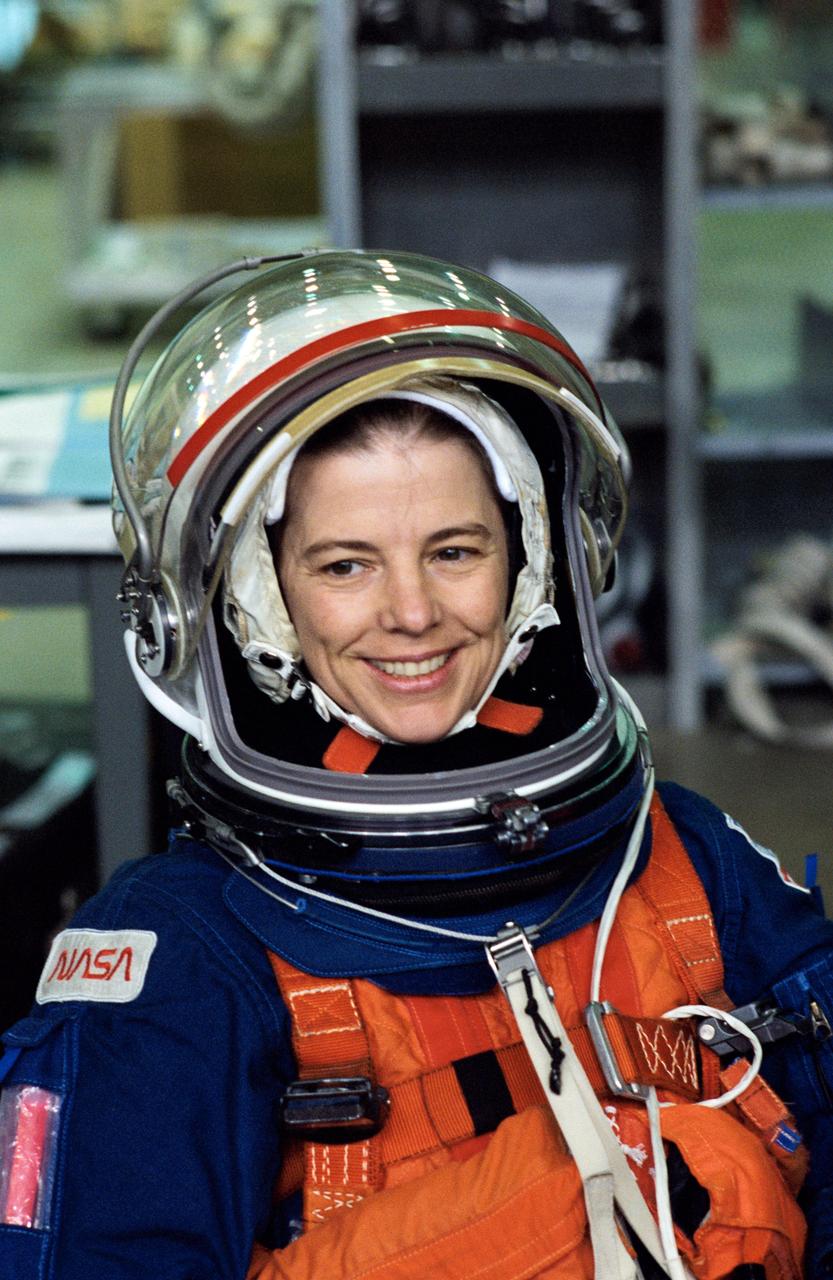
S94-47256 (13 Oct 1994) --- Astronaut Bonnie J. Dunbar, STS-71 mission specialist, smiles as she watches a crew mate (out of frame) make a simulated parachute landing in nearby water. The action came as part of an emergency bailout training session in the Johnson Space Center's (JSC) Weightless Environment Training Facility's (WET-F) 25-feet-deep pool.
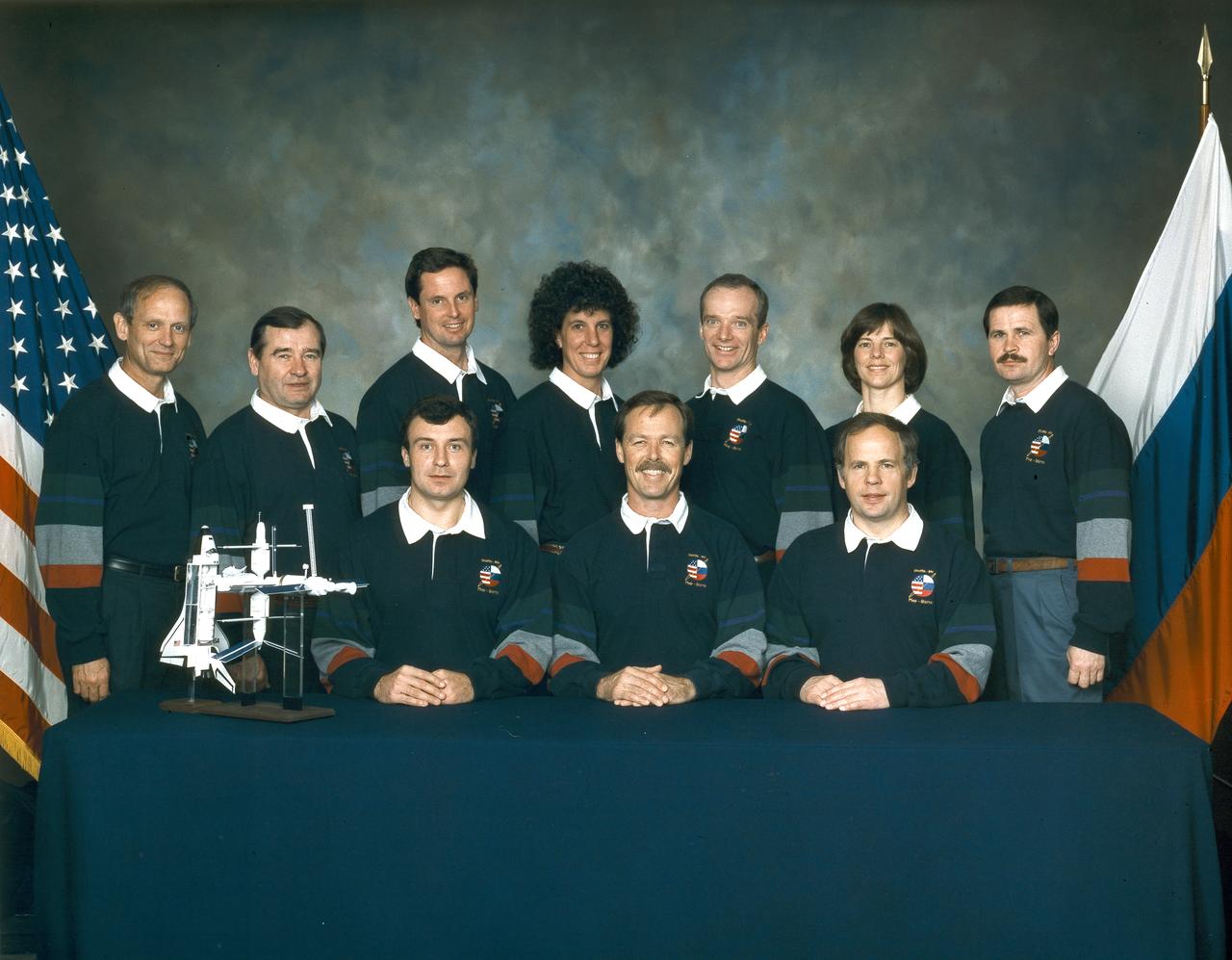
The crew assigned to the STS-71 mission included (front left to right) Vladimir N. Dezhurov, Mir 18 crew download; Robert L. Gibson, commander; and Anatoly Y. Solovyev, Mir 19 crew upload. On the back row, left to right, are Norman E. Thagard, Mir 18 crew download; Gennadiy Strelalov, Mir 18 crew download; Gregory J. Harbaugh, mission specialist; Ellen S. Baker, mission specialist; Charles J. Precourt, pilot; Bonnie J. Dunbar, mission specialist; and Nikolai Budarin, Mir 19 crew upload. Launched aboard the Space Shuttle Atlantis on June 27, 1995 at 3:32:19.044 pm (EDT), the STS-71 mission marked many firsts in human space flight history. It was the first U.S. Space Shuttle-Russian Space Station Mir docking and joint on-orbit operations, and the first on-orbit change out of a shuttle crew. In addition, it was the largest spacecraft ever in orbit and was the 100th U.S. human space launch conducted from the Cape.
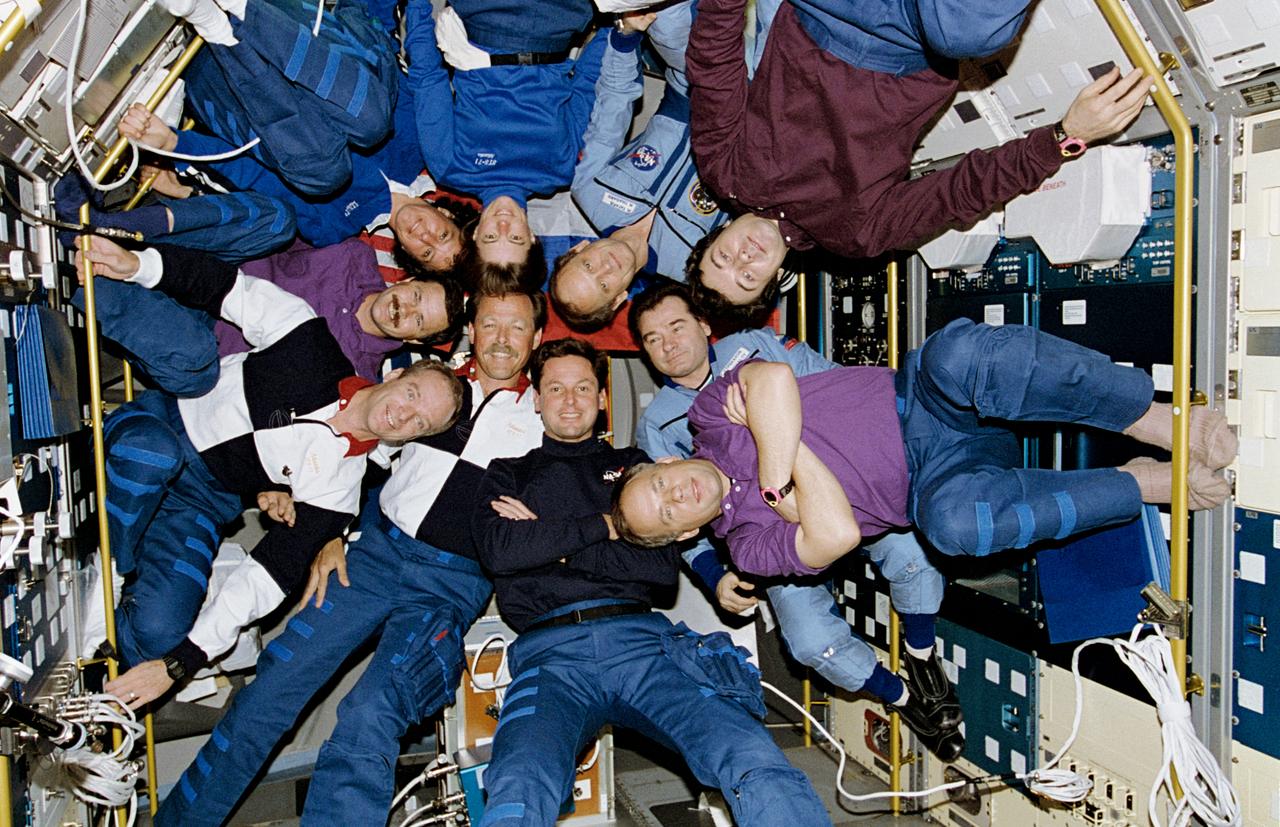
STS071-122-013 (27 June-7 July 1995) --- Inside the space shuttle Atlantis' Spacelab Science Module, the crewmembers of STS-71, Mir-18 and Mir-19 pose for the traditional inflight portrait. For individual identification, hold picture vertically with socked feet of Anatoly Y. Solovyev at bottom center. Clockwise from Solovyev are astronauts Gregory J. Harbaugh, Robert L. Gibson, Charles J. Precourt, Nikolai M. Budarin, Ellen S. Baker, Bonnie J. Dunbar, Norman E. Thagard, and cosmonauts Gennadiy M. Strekalov (at angle) and Vladimir N. Dezhurov.
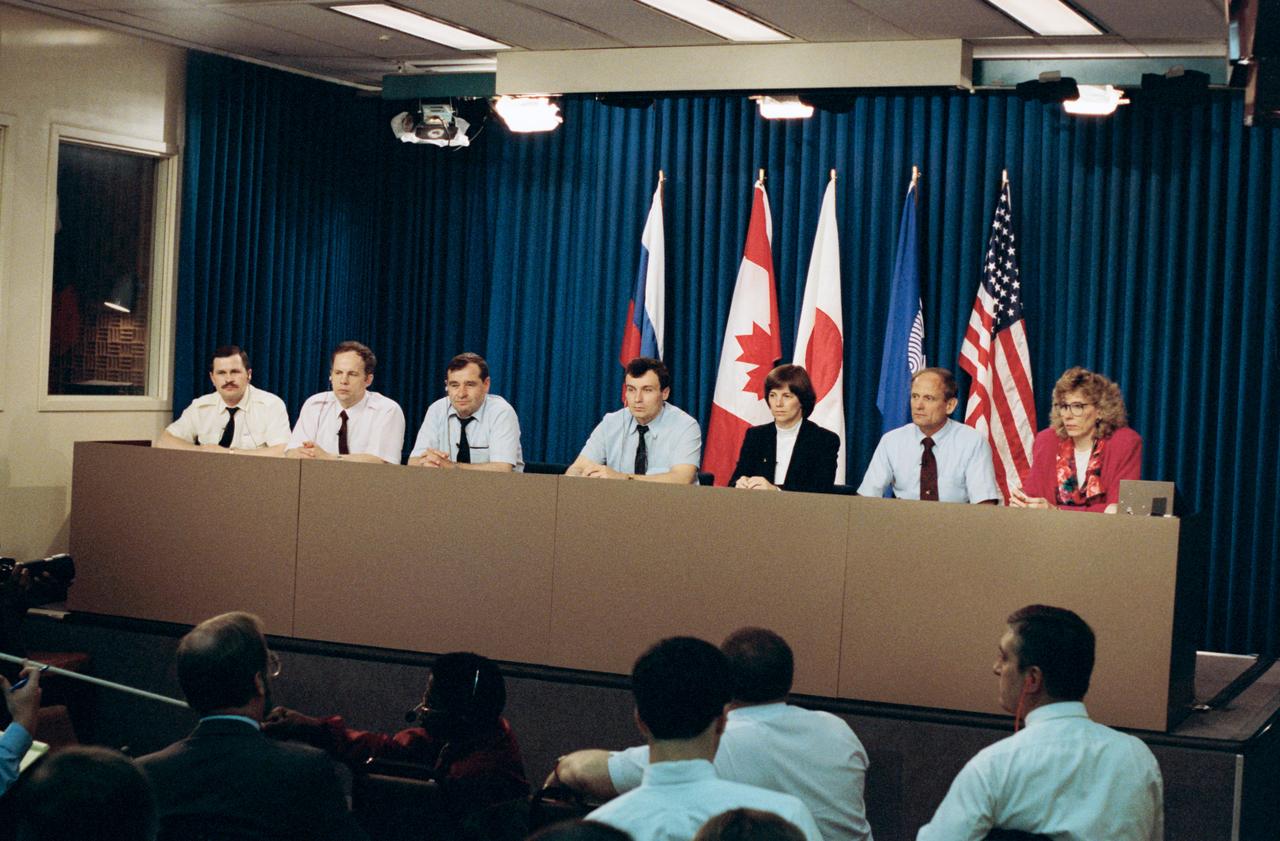
Crew members for the joint Space Shuttle / Mir mission field questions from the press at JSC. Left to right are cosmonauts Nikolai M. Budarin, Anatoliy Y. Solovyov, Gennadiy M. Strekalov, Vladimir N. Dezhurov, and astronauts Bonnie J. Dunbar, Norman E. Thagard, along with Kari L. Fluegel of the Public Affairs Office's (PAO) News and Media Services Branch. Flags representing the international space partners - Russia, the United States, the European Space Agency (ESA), Canada and Japan - are displayed behind the conference participants.
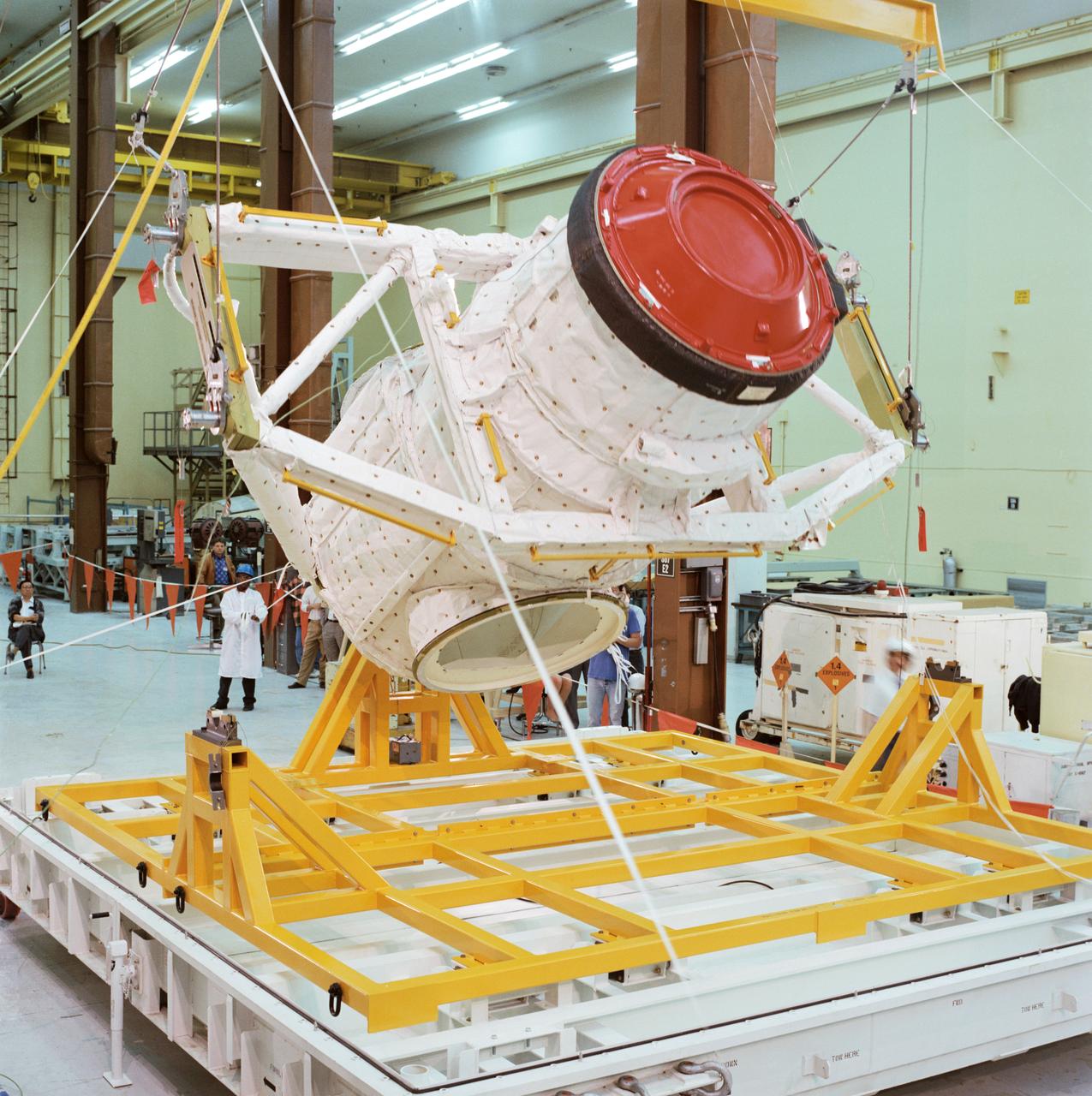
S95-00057 (15 Nov 1994) --- In Rockwell's Building 290 at Downey, California, the external airlock assembly/Mir docking system is rotated into position for crating up for shipment to the Kennedy Space Center (KSC) in Florida. Jointly developed by Rockwell and RSC Energia, the external airlock assembly and Mir docking system will be mounted in the cargo bay of the Space Shuttle Atlantis to enable the shuttle to link up to Russia's Mir space station. The docking system contains hooks and latches compatible with the system currently housed on the Mir's Krystall module, to which Atlantis will attach for the first time next spring. STS-71 will carry two Russian cosmonauts, who will replace a three-man crew aboard Mir including Norman E. Thagard, a NASA astronaut. The combined 10-person crew will conduct almost five days of joint life sciences investigations both aboard Mir and in the Space Shuttle Atlantis's Spacelab module.
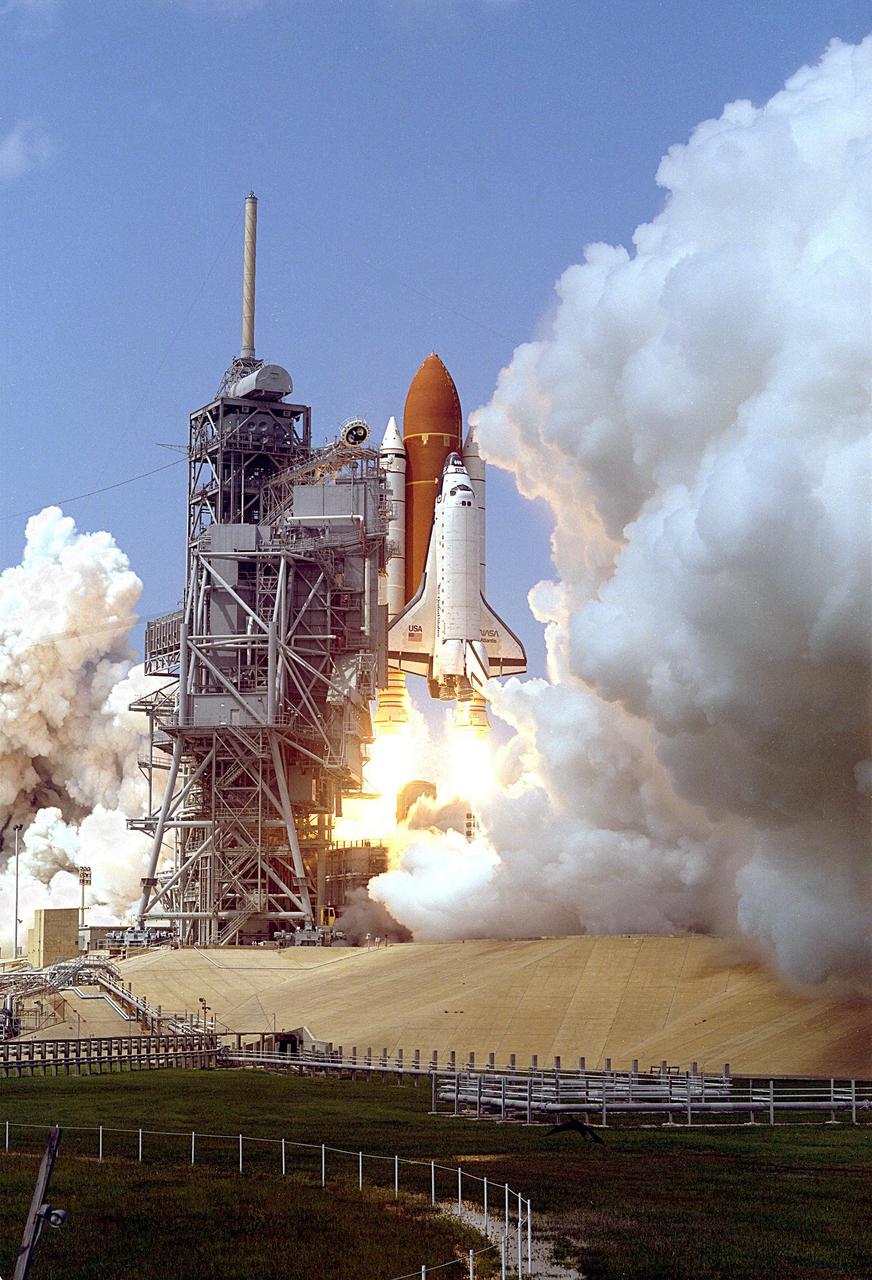
KENNEDY SPACE CENTER, FLA. -- STS-71: Atlantis
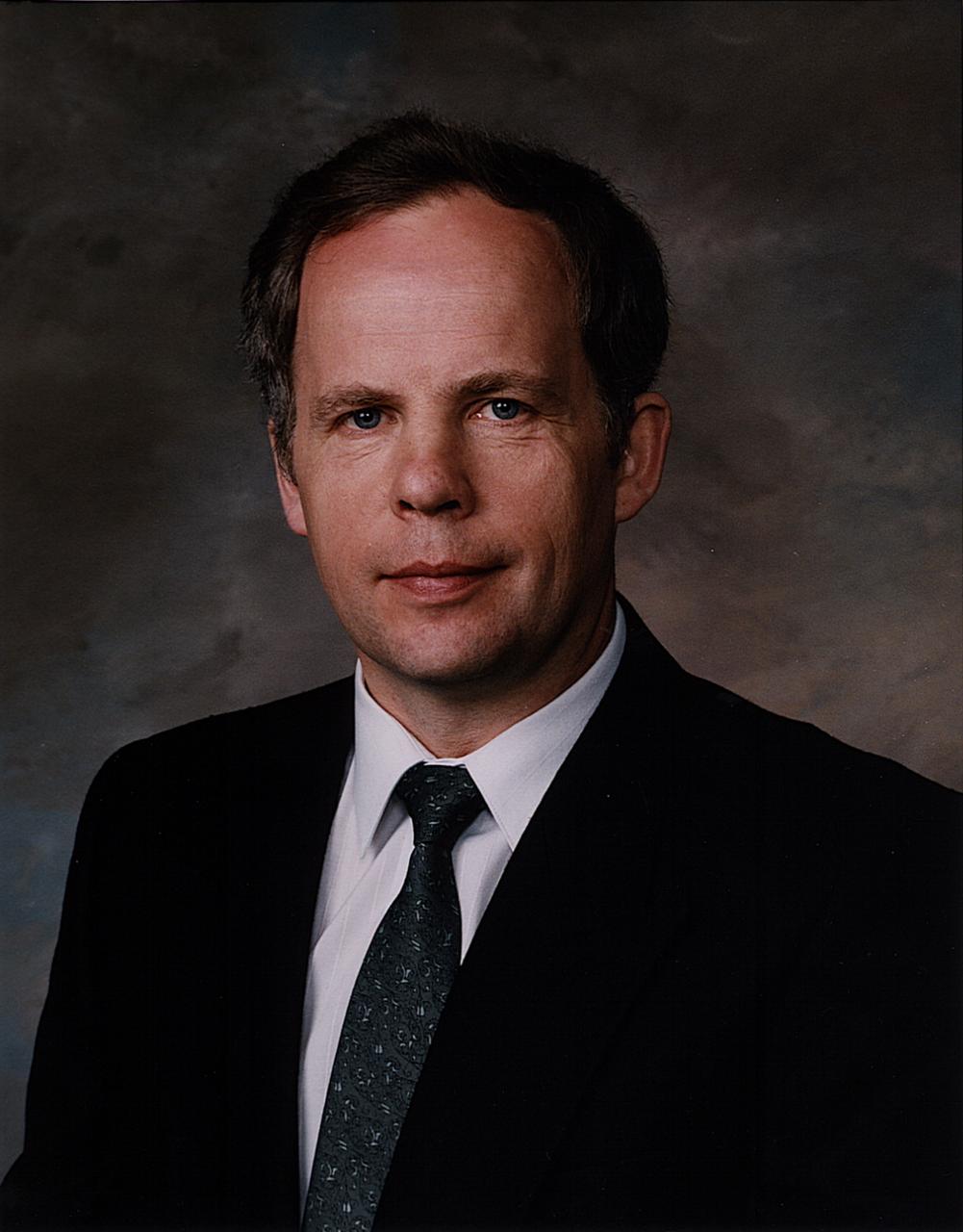
s94-34935 --- Portrait of Russian cosmonaut and Mir 19 commander Anatoly Solovyev in civilian clothes.
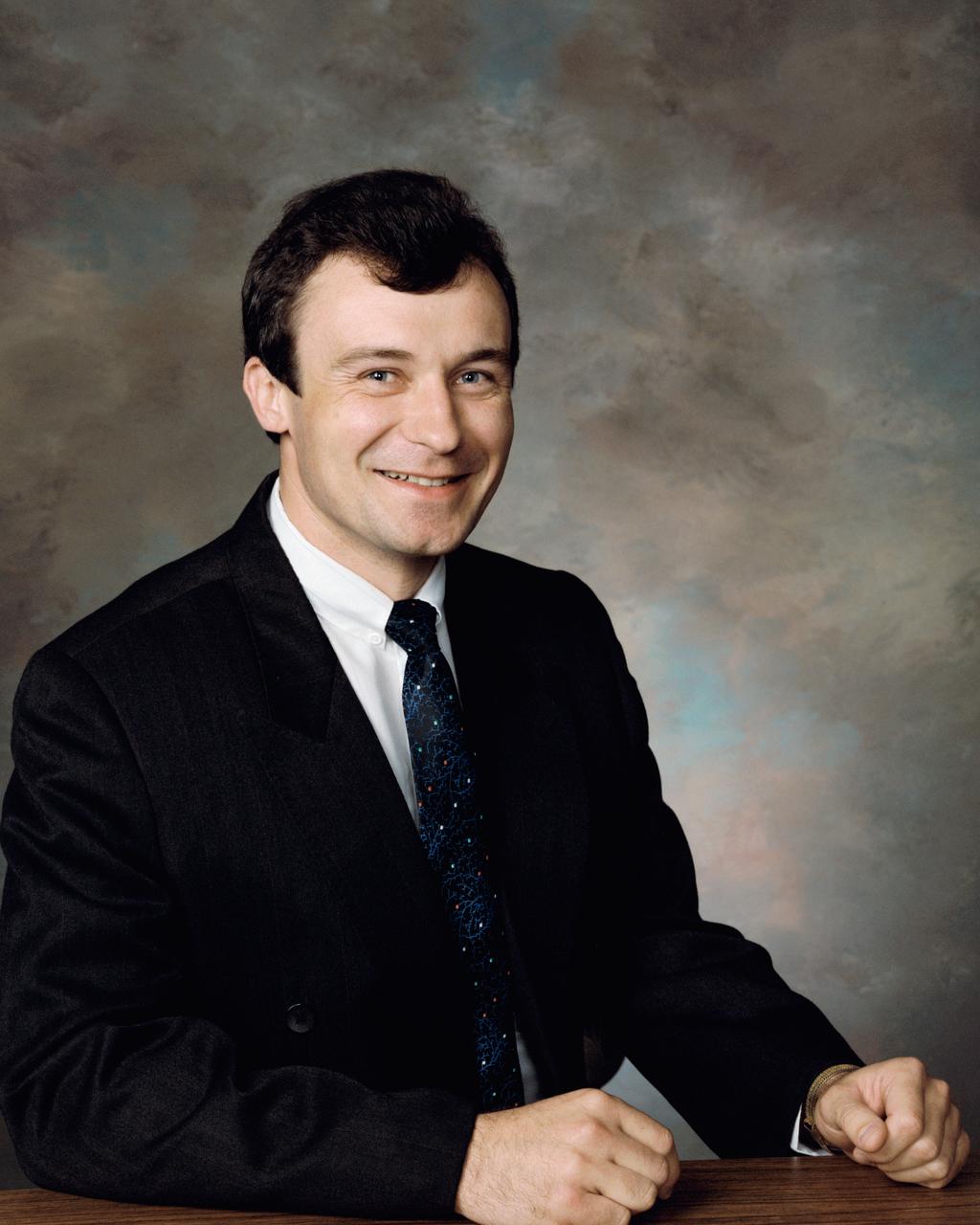
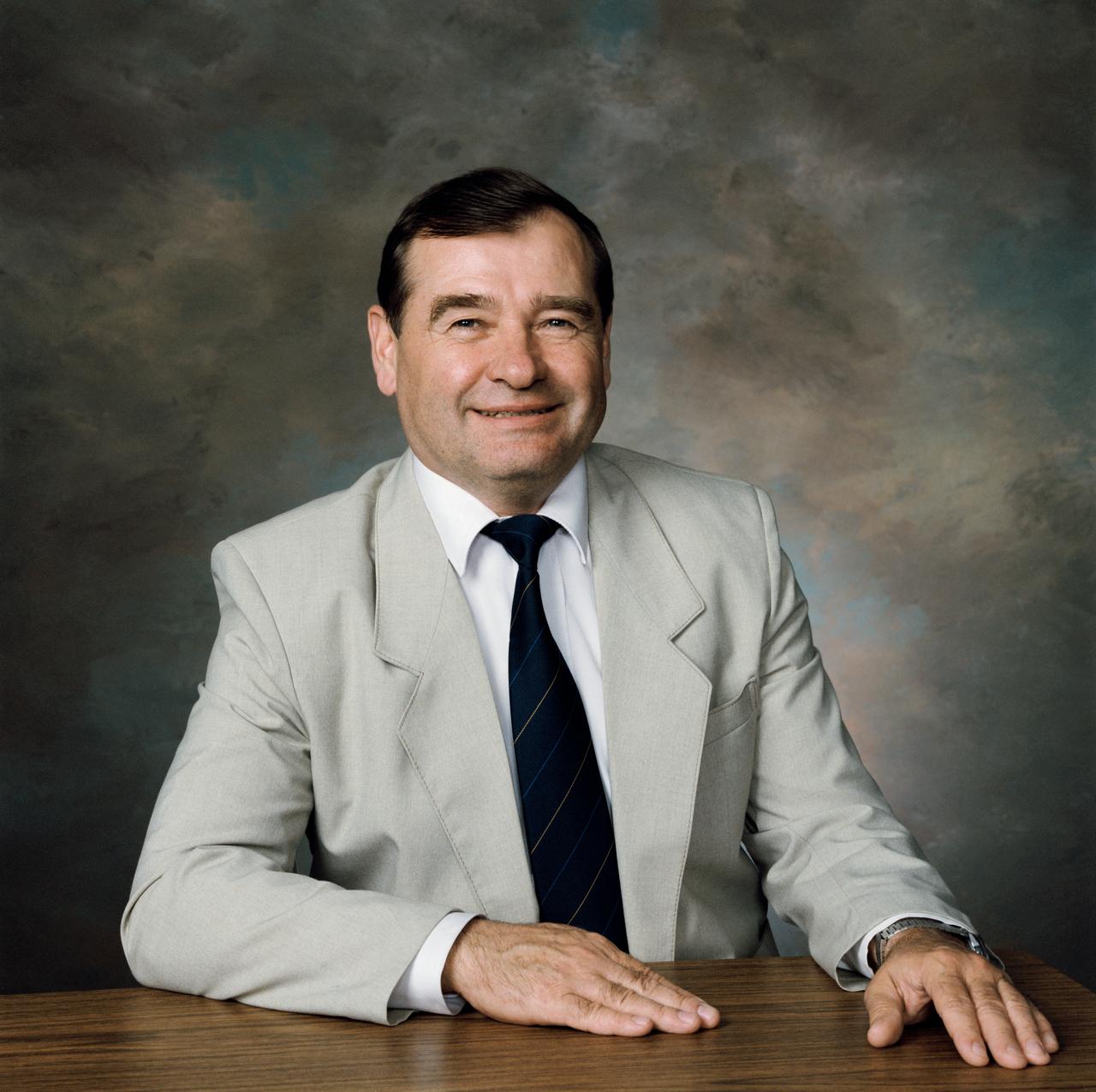
S94-34940 (June 1994) --- Vladimir N. Dezhurov, Russian cosmonaut Commander, Mir-18 EDITOR'S NOTE: Early next year, Dezhurov, along with NASA astronaut Norman E. Thagard and another cosmonaut, will be launched into Earth-orbit to spend three months aboard Russia's Mir space station.
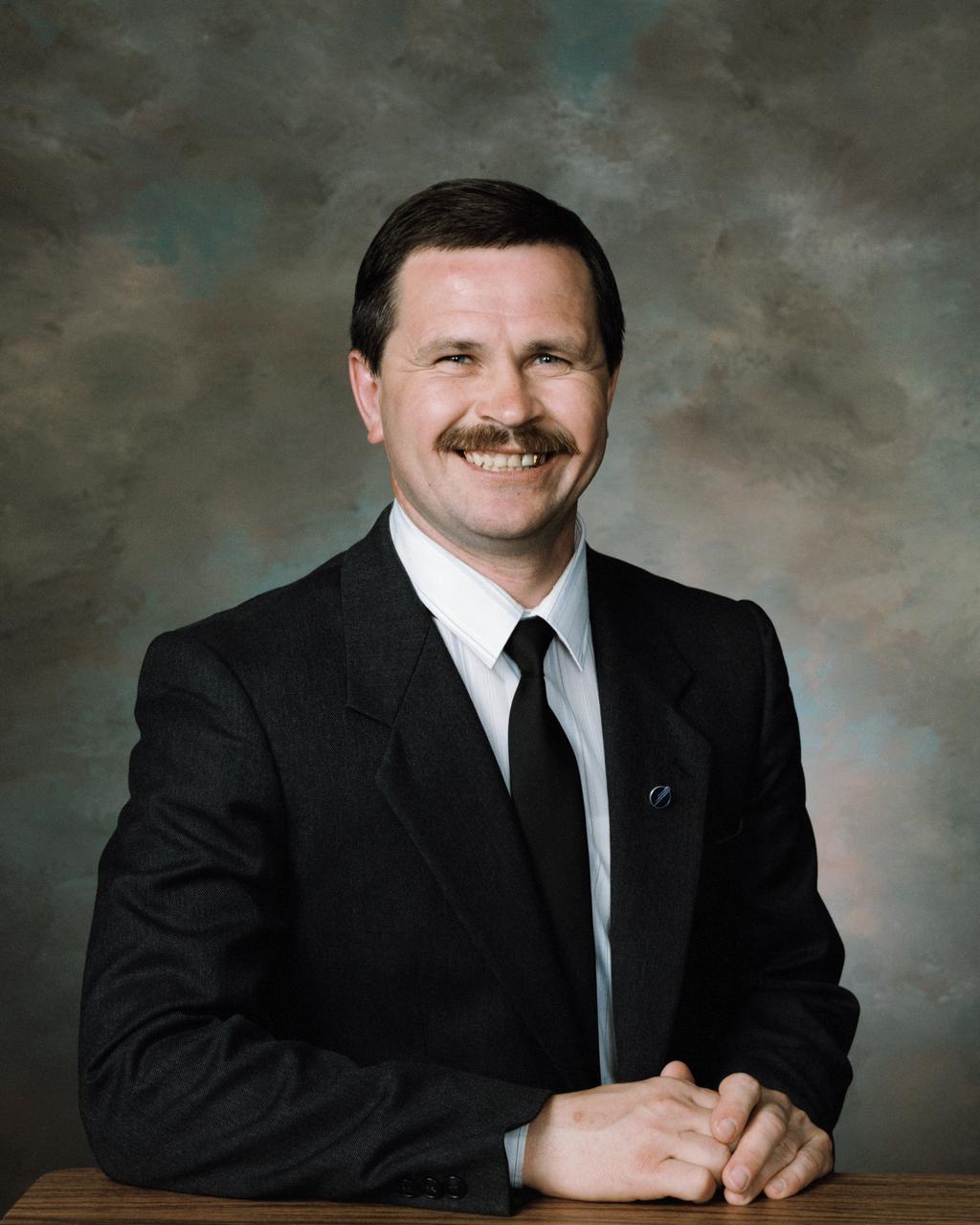
S94-34938 (27 May 1994) --- Cosmonaut Nikolai M. Budarin, flight engineer.
S94-34939 (Nov 1994) --- Gennadity M. Strekalov, Russian cosmonaut Flight Engineer, Mir-18.
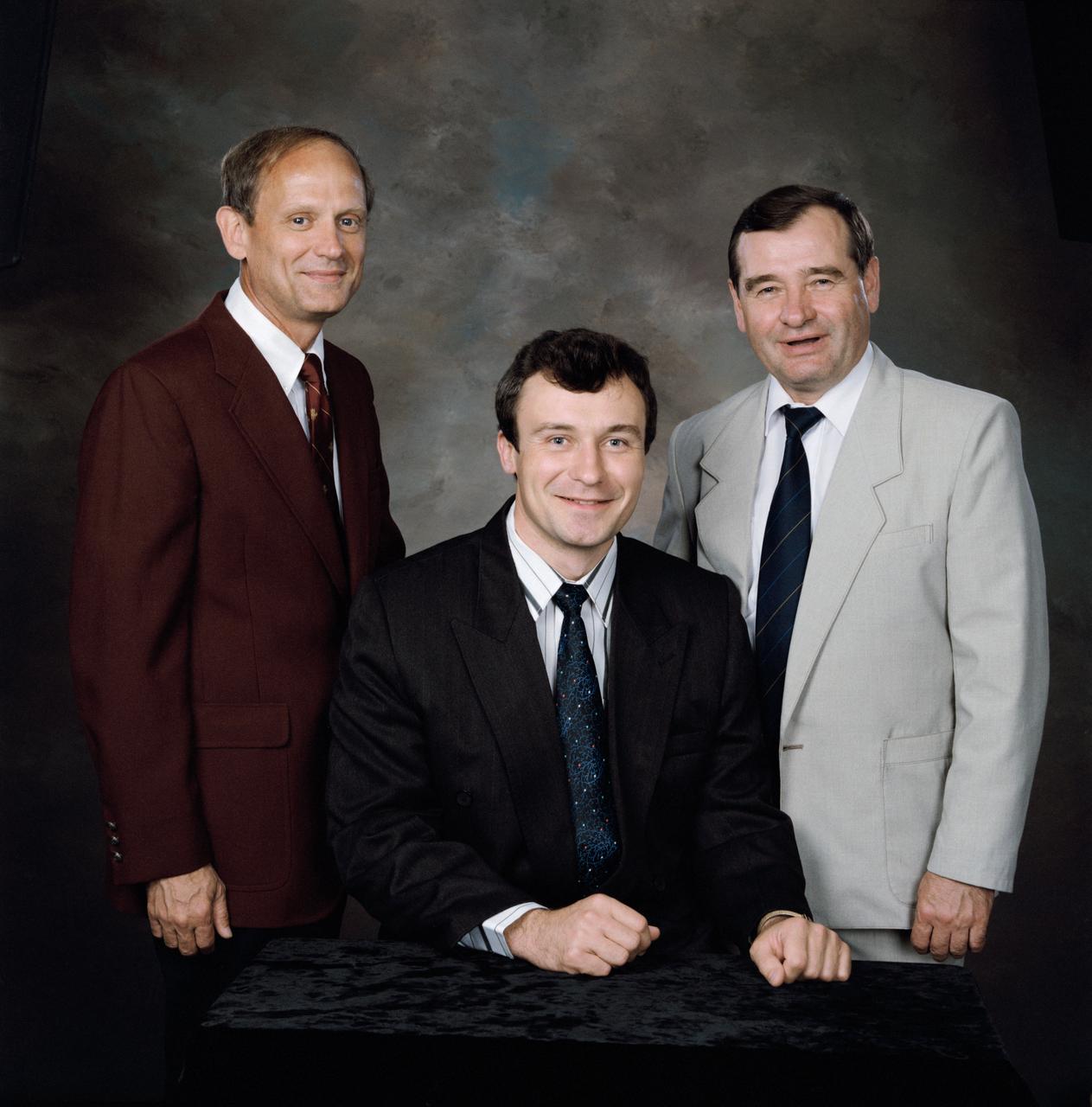
This is a portrait of the Mir 18 crew members in civilian clothes. They are (left to right) Norman E. Thagard, astronaut; commander Vladimir N. Dezhurov, cosmonaut; and Gennadiy M. Strekalov, cosmonaut.
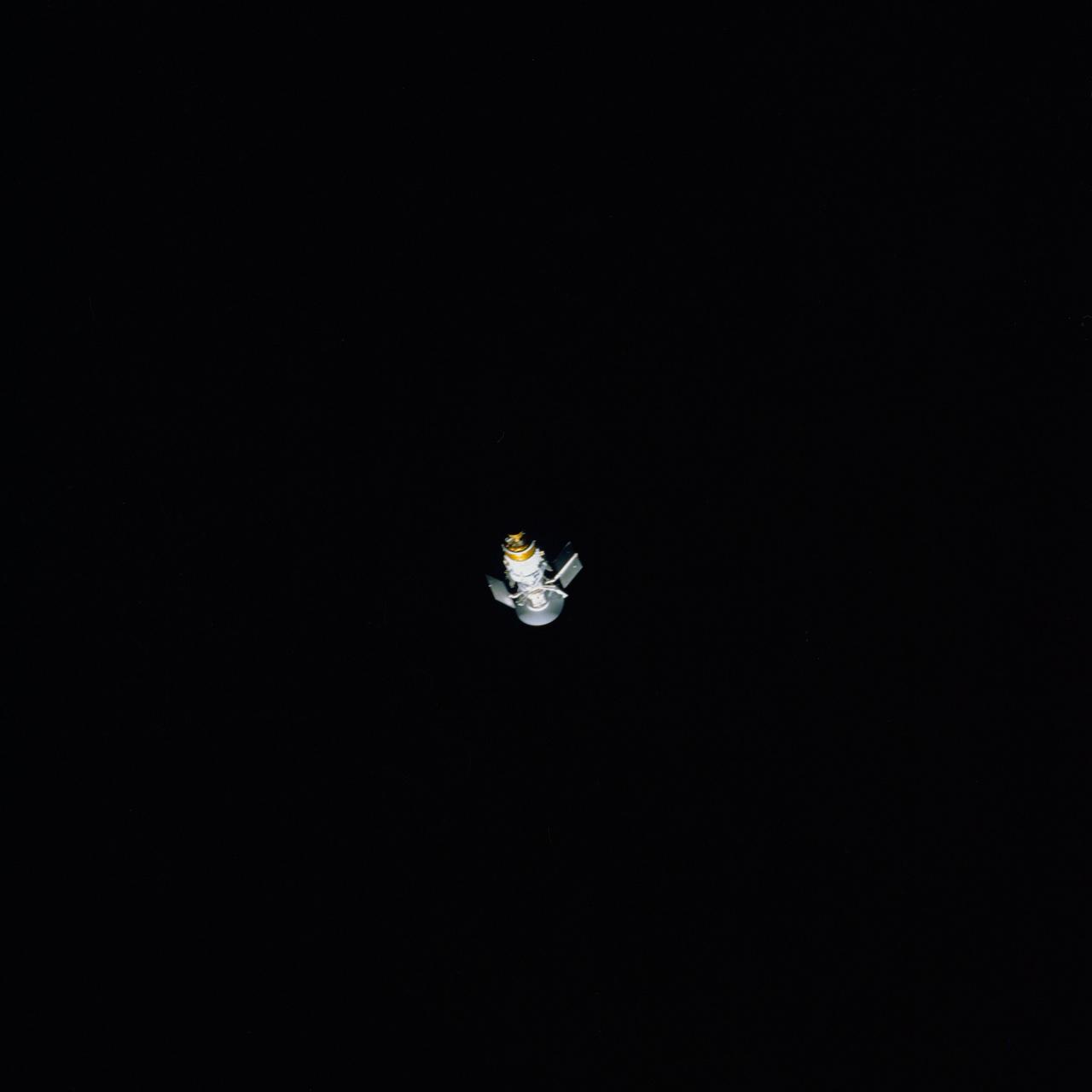
STS030-71-063 (4 May 1989) --- This scene is one of two released by NASA showing the process of solar array panel deployment on the Magellan spacecraft. Panels are not fully extended in this frame. The spacecraft had earlier been released by the STS-30 crewmembers to begin its long journey to the planet Venus for an extensive radar mapping mission. The frame was photographed through Atlantis? aft flight deck windows with a handheld 70mm camera. The complementary photograph is STS030-71-070.
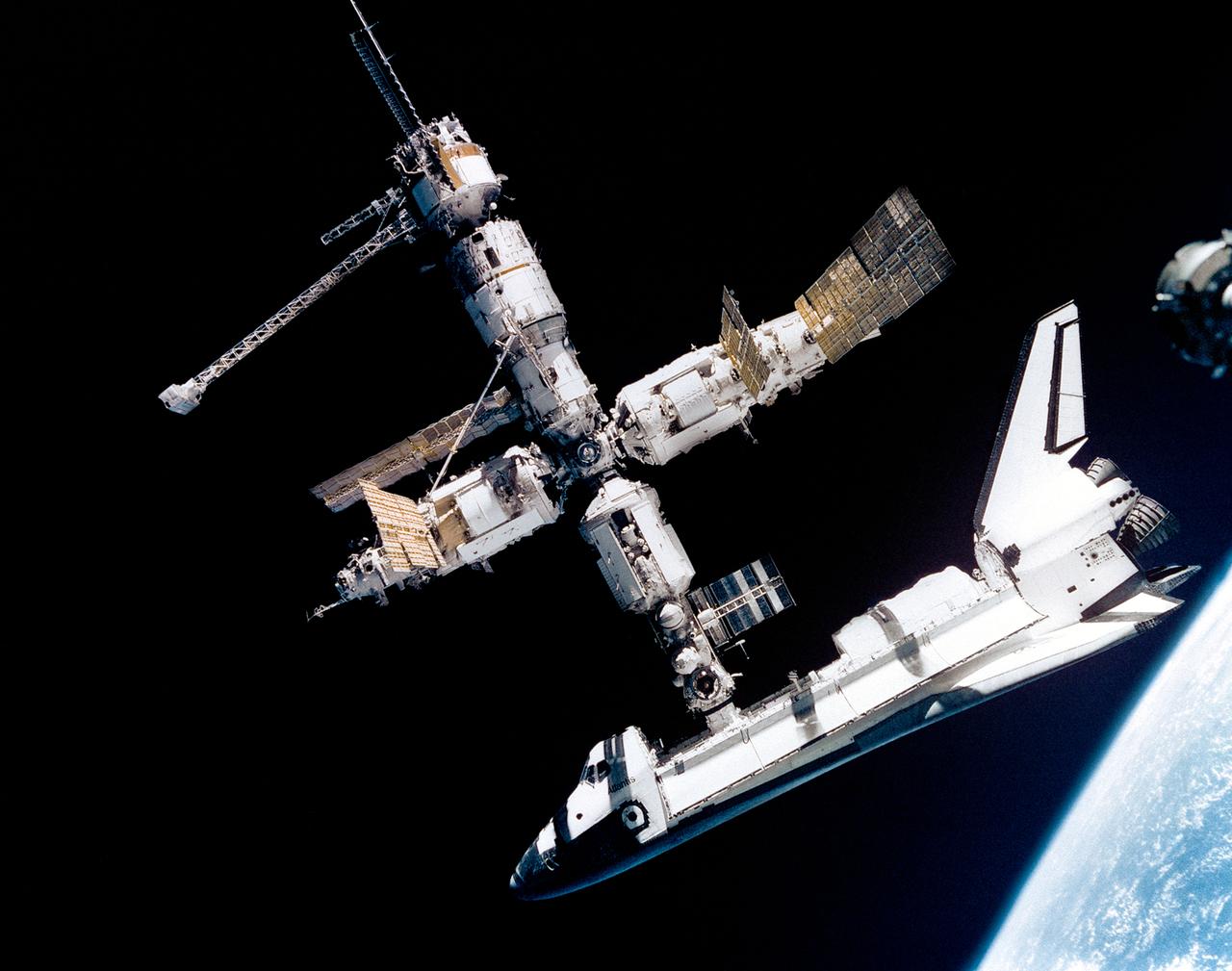
STS071-S-072 (4 July 1995) --- This view of the space shuttle Atlantis still connected to Russia's Mir Space Station was photographed by the Mir-19 crew on July 4, 1995. Cosmonauts Anatoliy Y. Solovyev and Nikolai M. Budarin, Mir-19 commander and flight engineer, respectively, temporarily undocked the Soyuz spacecraft from the cluster of Mir elements to perform a brief fly-around. They took pictures while the STS-71 crew, with Mir-18's three crew members aboard, undocked Atlantis for the completion of this leg of the joint activities. Solovyev and Budarin had been taxied to the Mir Space Station by the STS-71 ascent trip of Atlantis.
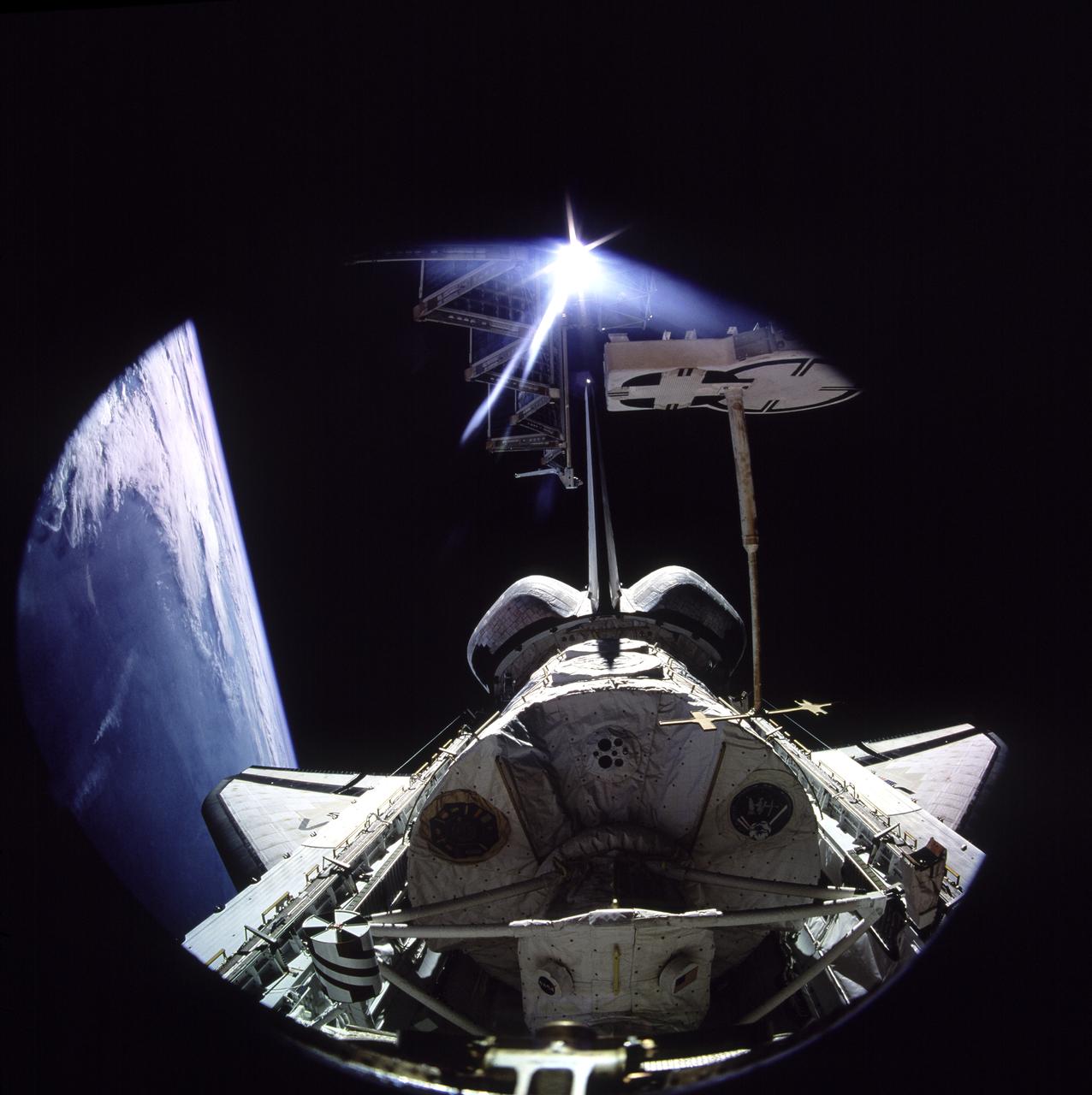
STS071-741-057 (27 June-7 July 1995) --- Docked already with Russia's Mir Space Station, the space shuttle Atlantis' aft cargo bay and Spacelab science module are visible through a window on the Mir Space Station. A 70mm camera, carried into space by the STS-71 crew aboard Atlantis, was used to expose the image. The linkup enabled the seven STS-71 crew members to visit Mir and it allowed the three Mir-18 crew members, in space since March of this year, access to Spacelab. That module was quite busy with tests and data collection involving the three until Atlantis brought them home on July 7, 1995.
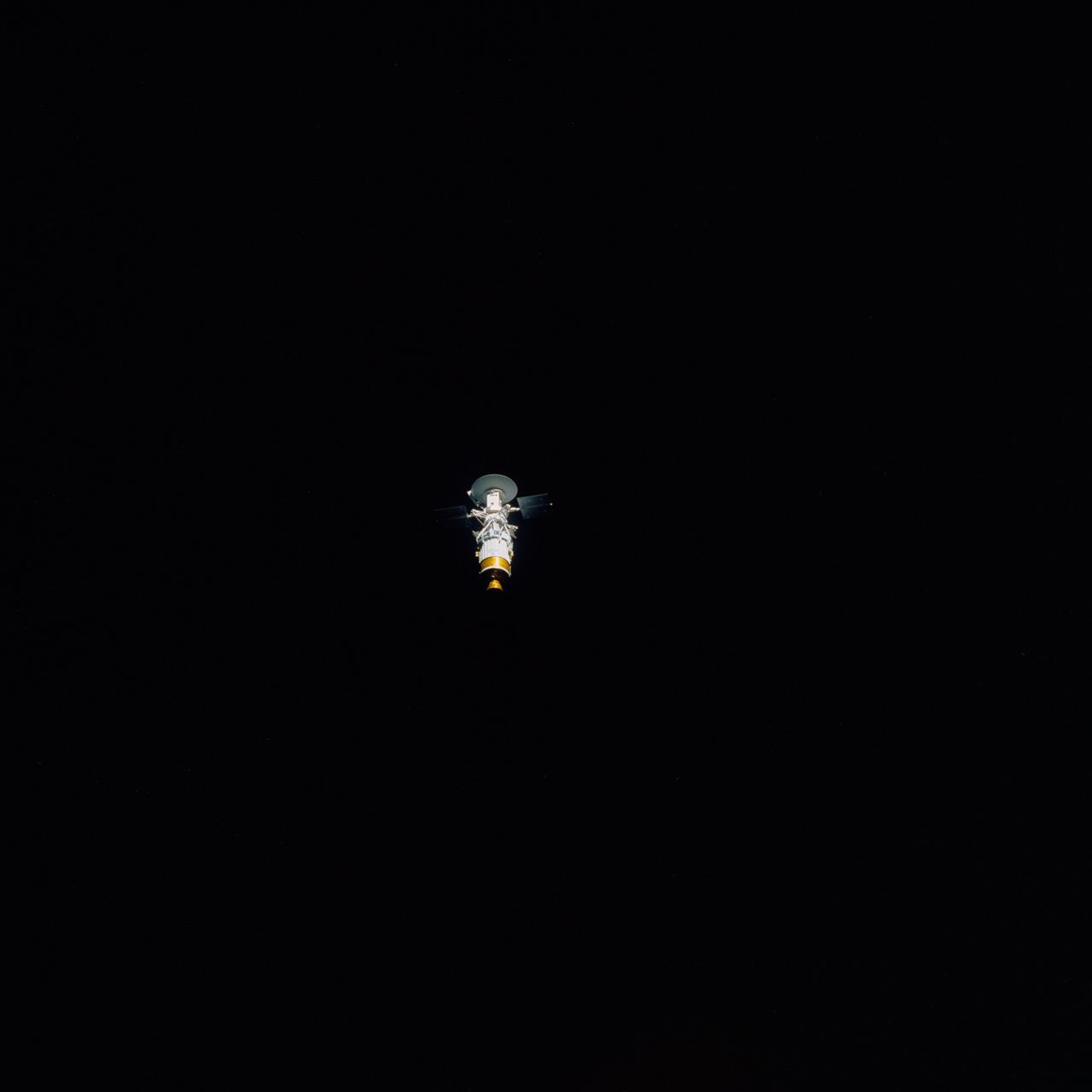
STS030-71-070 (4 May 1989) --- This scene is one of two released by NASA showing the process of solar array panel deployment on the Magellan spacecraft. Though partially blended into the backdrop of the blackness of space, it appears the two panels are fully extended in this frame. The spacecraft had earlier been released by the STS-30 crewmembers to begin its long journey to the planet Venus for an extensive radar mapping mission. The frame was photographed through Atlantis' aft flight deck windows with a handheld 70mm camera. The complementary photograph is STS030-71-063.
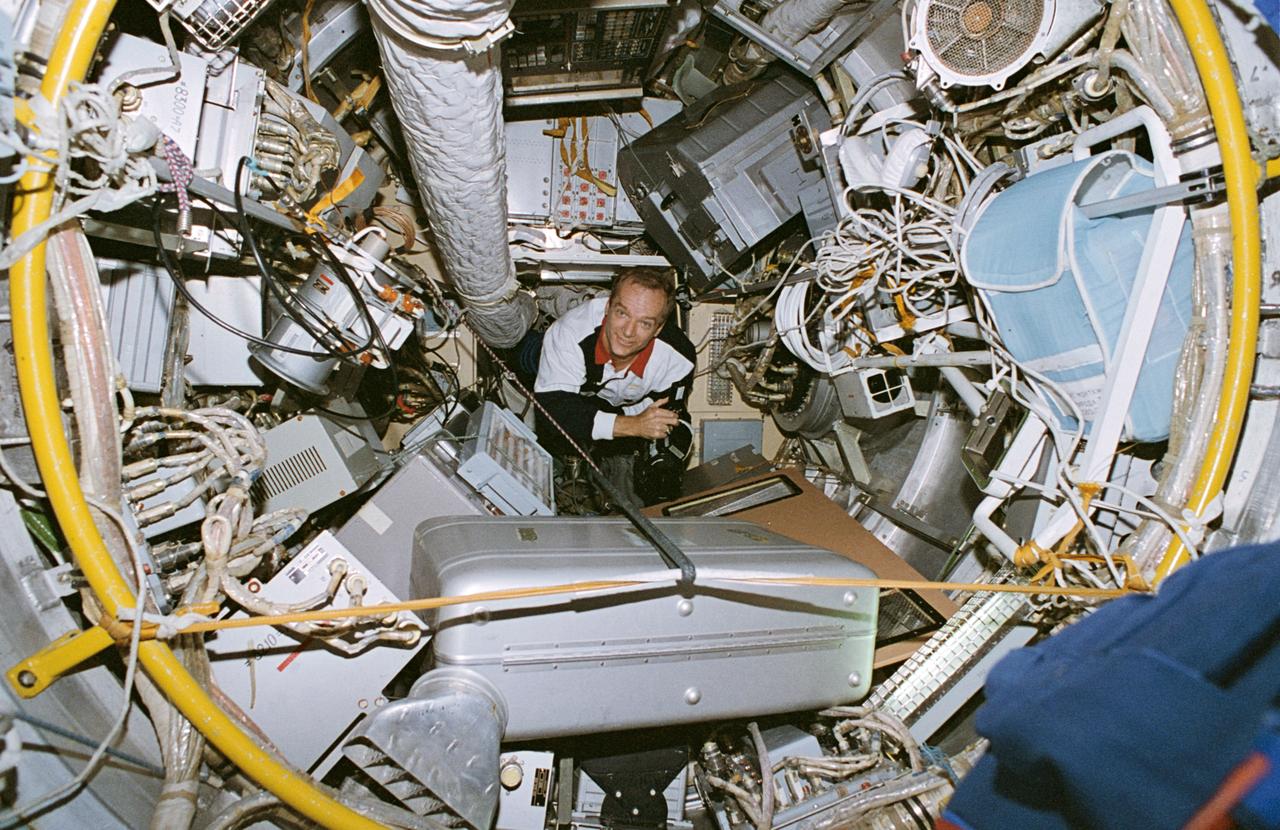
STS071-105-021 (27 June-7 July 1995) --- Astronaut Charles J. Precourt, STS-71 pilot, floats from the space shuttle Atlantis into Russia's Mir Space Station Kristall Module during the historic eleven-day flight involving a total of ten astronauts and cosmonauts.
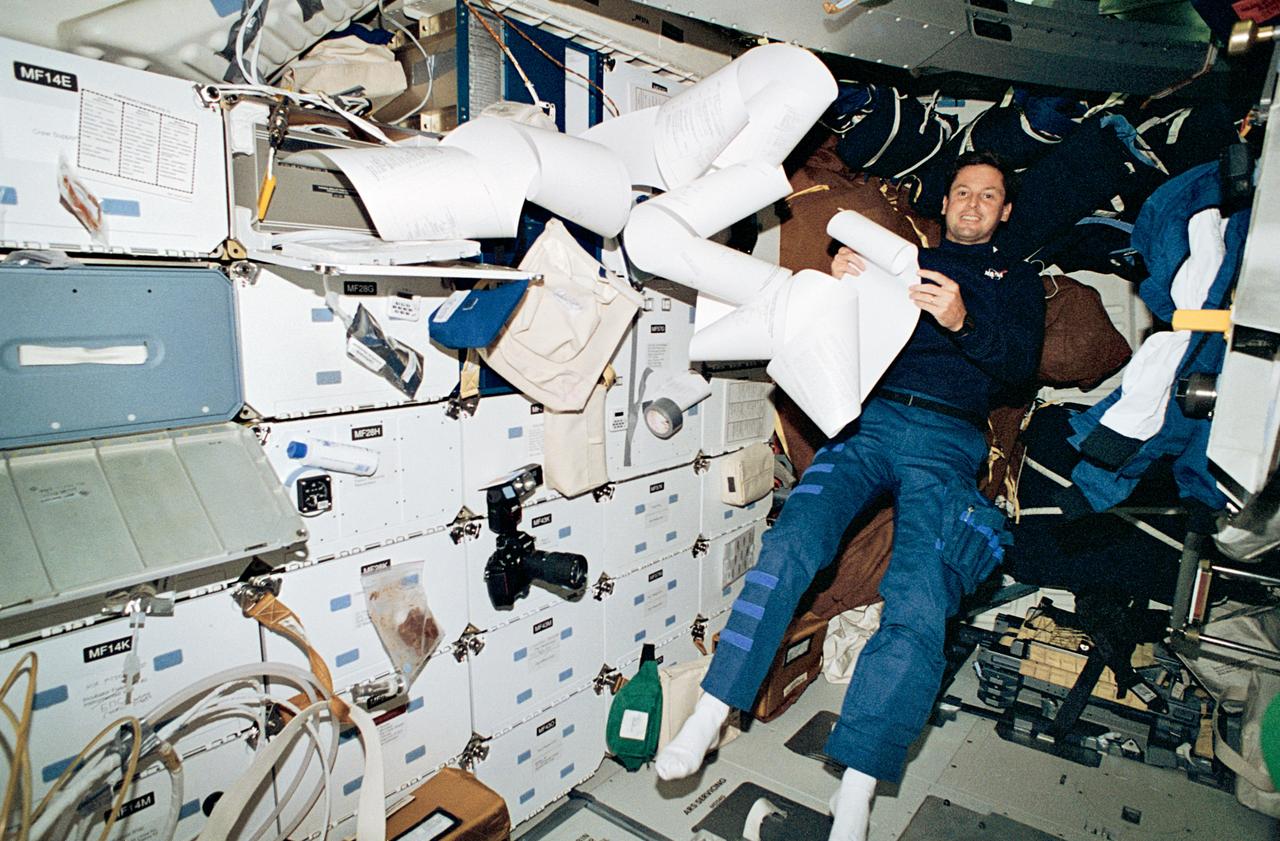
STS071-122-018 (27 June-7 July 1995) --- Astronaut Gregory J. Harbaugh, STS-71 mission specialist, is pictured on the space shuttle Atlantis' middeck, with a roll of messages from the Thermal Imaging Printing System (TIPS). The volume of information had been up-linked by ground controllers in Houston, Texas.
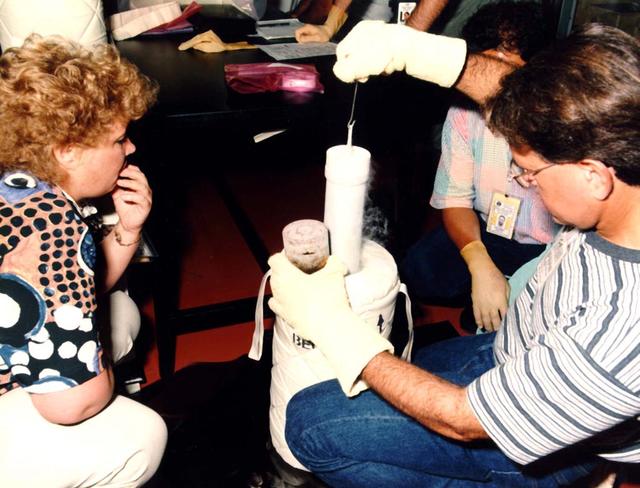
Liquid nitrogen dewar loading at Kennedy Space Center for STS-71 flight with Stan Koszelak (right), University of California at Riverside, adn Tamara Chinareva (left), Russian Spacecraft Coporation-Energia. The picture shows Koszelak removing the insert from the transportation dewar.

This image of the Space Shuttle Orbiter Atlantis, with cargo bay doors open showing Spacelab Module for the Spacelab Life Science and the docking port, was photographed from the Russian Mir Space Station during STS-71 mission. The STS-71 mission performed the first docking with the Russian Mir Space Station to exchange crews. The Mir 19 crew, cosmonauts Anatoly Solovyev and Nikolai Budarin, replaced the Mir 18 crew, cosmonauts Valdamir Dezhurov and Gernady Strekalov, and astronaut Norman Thagard. Astronaut Thagard was launched aboard a Soyuz spacecraft in March 1995 for a three-month stay on the Mir Space Station as part of the Mir 18 crew. The Orbiter Atlantis was modified to carry a docking system compatible with the Mir Space Station. The Orbiter also carried a Spacelab module for the Spacelab Life Science mission in the payload bay in which various life science experiments and data collection took place throughout the 10-day mission.
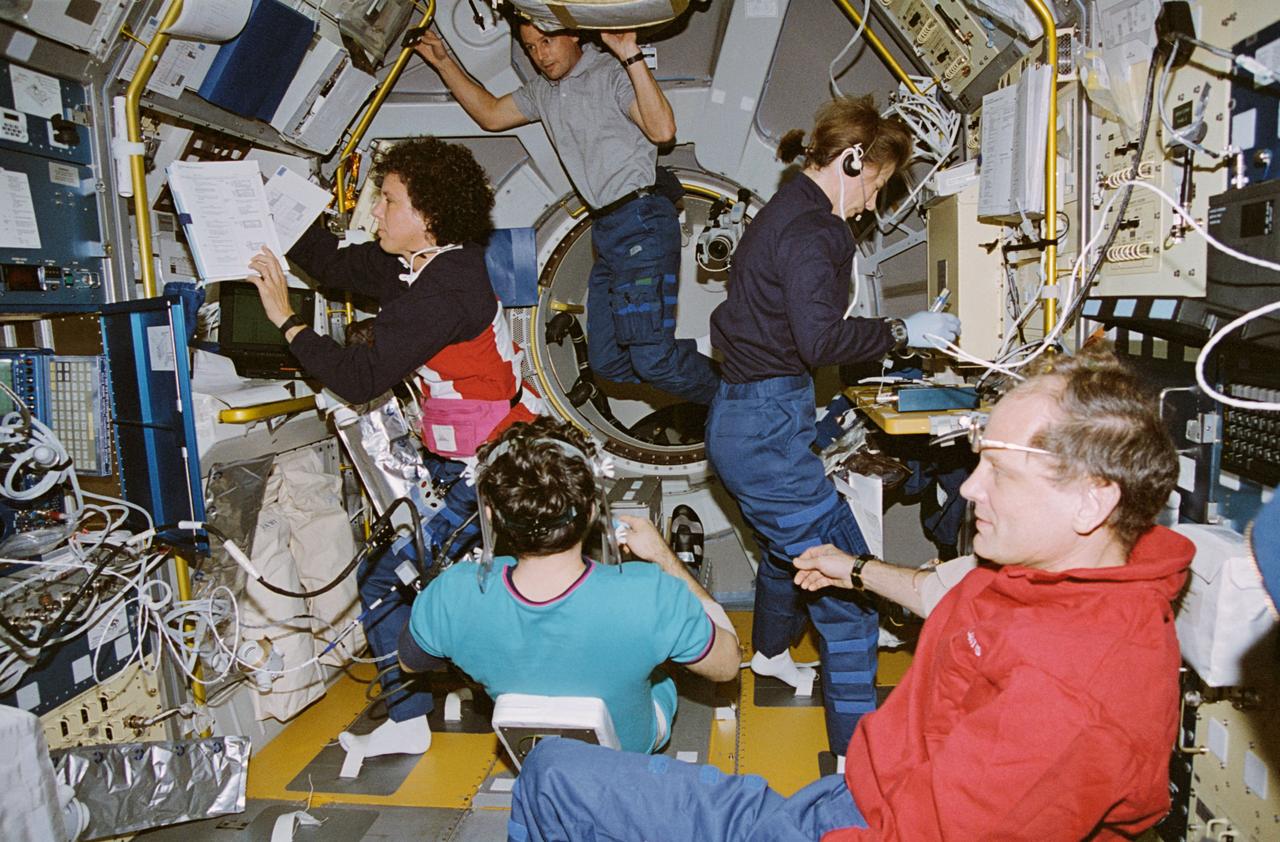
STS071-102-027 (27 June - 7 July 1995) --- Onboard the Spacelab Science Module in the Space Shuttle Atlantis' cargo bay, four astronauts and a cosmonaut team up to collect data from Mir-18 crew members who have been aboard Russia's Mir Space Station for four months. Astronauts Ellen S. Baker (left), Gregory J. Harbaugh (top center) and Bonnie J. Dunbar, STS-71 mission specialists, are joined by astronaut Norman E. Thagard (right) and Vladimir N. Dezhurov (on bicycle ergometer) in the module. Dezhurov was Mir-18 commander and Thagard served as a cosmonaut researcher on the Mir-18 mission. The three STS-71 mission specialists lifted off aboard Atlantis on June 27, 1995, to participate in the historic link-up.
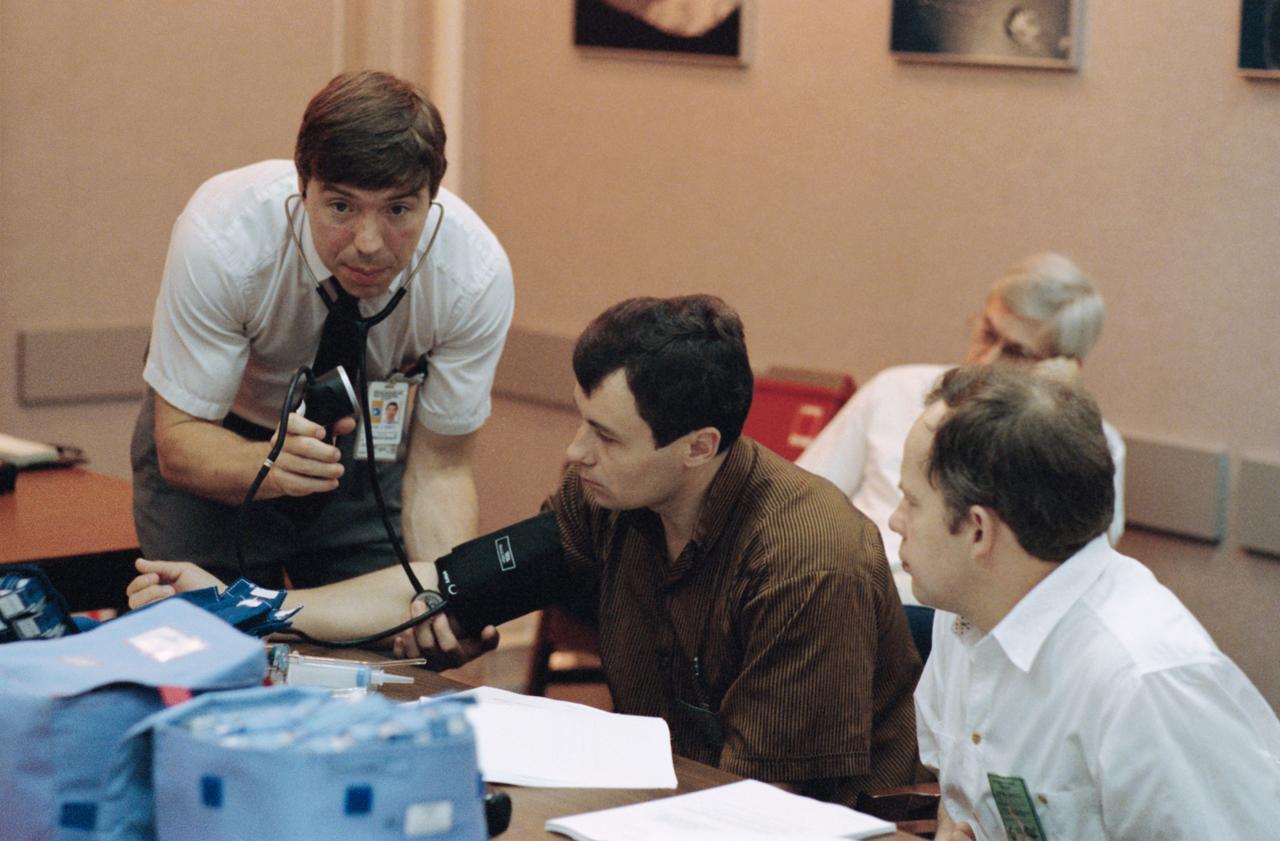
Cosmonaut Vladimir N. Dezhurov (center), Mir 18 mission commander, gets his blood pressure taken by Dr. Michael J. Barrett, flight surgeon. Cosmonaut Anatoliy Y. Solovyev (right), Mir 19 mission commander, looks on. Solovyev, Dezhurov, along with their respective flight engineers and a number of other cosmonauts and astronauts participating in the joint program, were in Houston, Texas, to prepare for their upcoming missions.
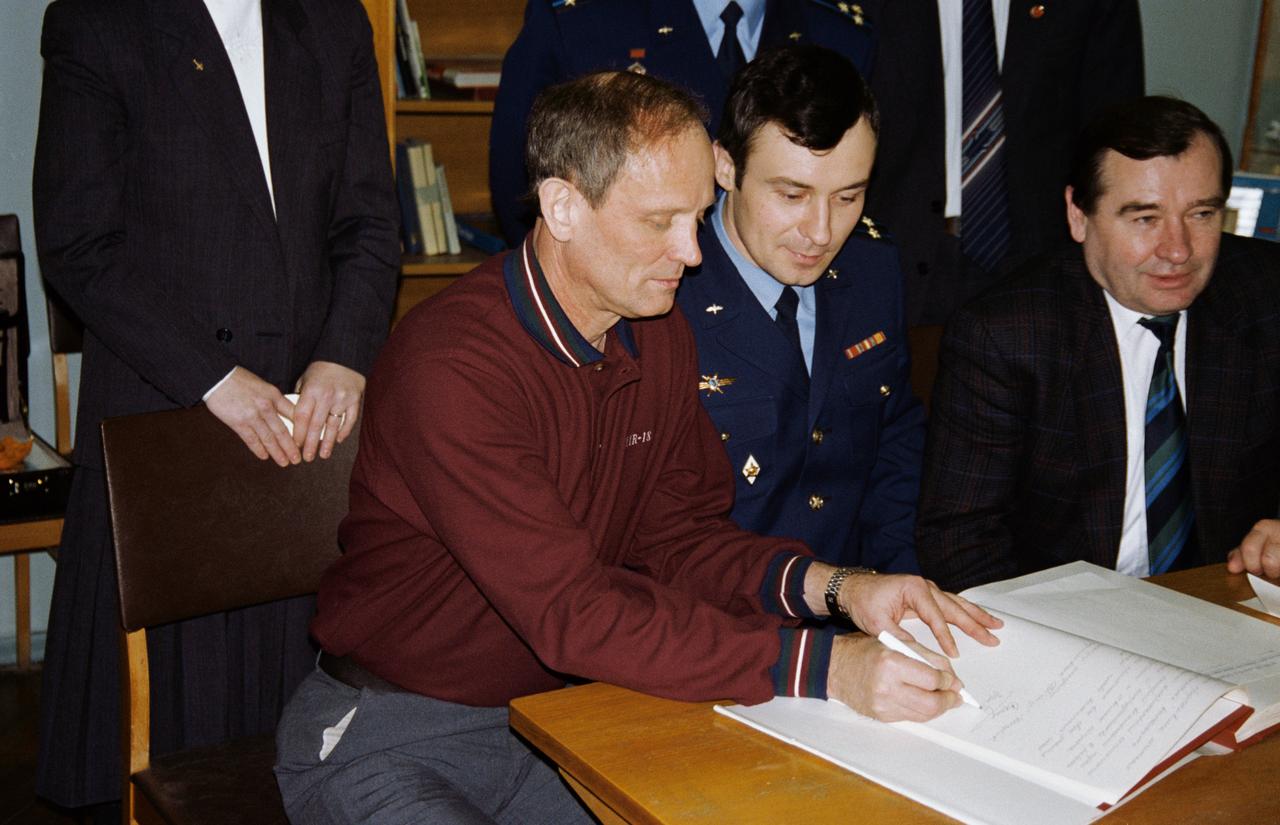
S95-04324 (22 March 1995) --- In keeping with Russian tradition, astronaut Norman E. Thagard (left), guest researcher, signs the diary of the late Yuriy A. Gagarin, the first Russian cosmonaut, as his Mir 18 crew mates look on. Cosmonauts Vladimir N. Dezhurov (center), mission commander, and Gennadiy M. Strkalov, flight engineer, have been training with Thagard in both the United States and Russia for the past several months. It is customary for each crew member about to aboard a Russian spacecraft to sign the diary.
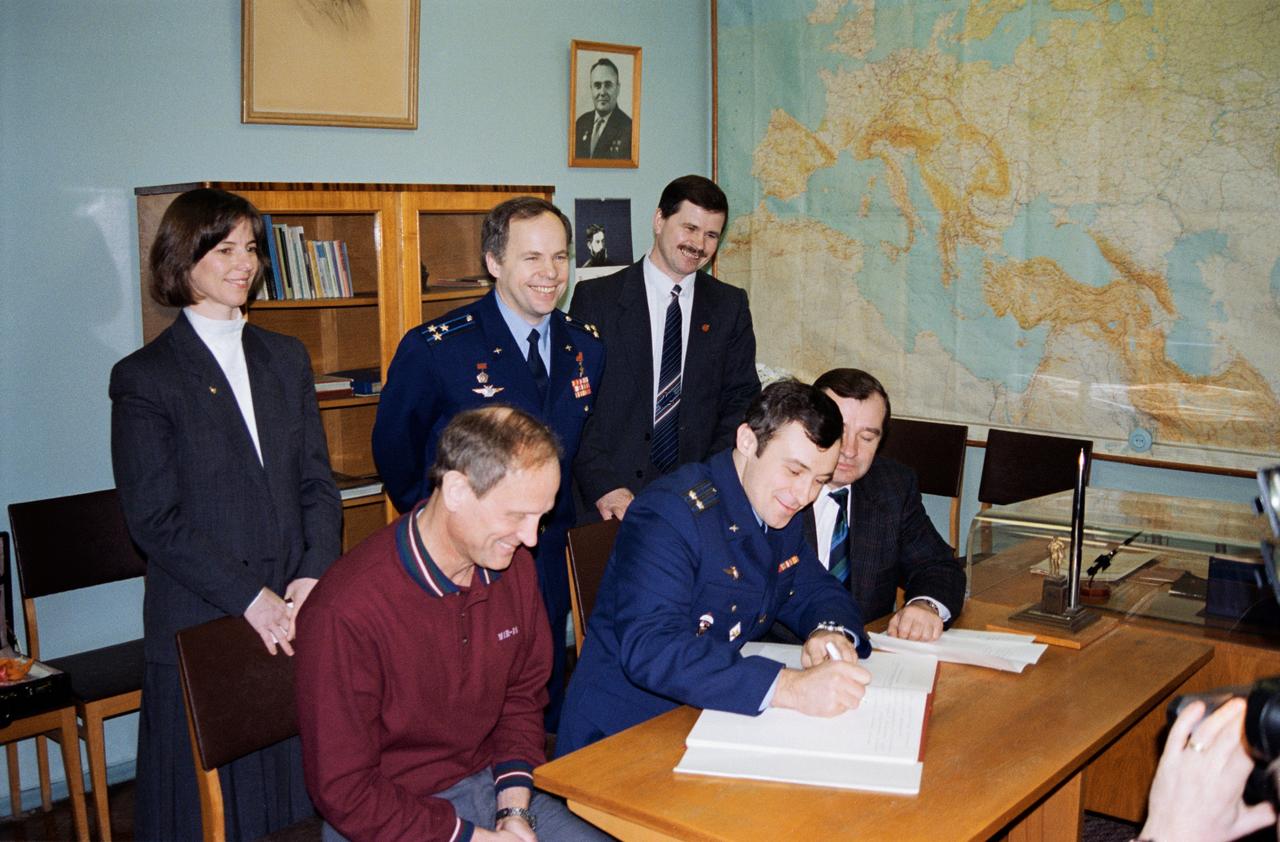
S95-04323 (22 Feb 1995) --- In keeping with Russian tradition, astronaut Norman E. Thagard (seated, left), guest researcher, watches as Vladimir N. Dezhurov (seated, center), signs the diary of the late Yuriy A. Gagarin, the first Russian cosmonaut, as his Mir 18 crew mates and the subsequent Mir crewmembers look on. Cosmonauts Dezhurov, mission commander, and Gennadiy M. Strekalov (seated right, partially obscured), flight engineer, have been training with Thagard in both the United States and Russia for the past several months. Watching are, standing left to right, astronaut Bonnie J. Dunbar, Thagard?s alternate crew member; and cosmonauts Anatoliy Y. Solovyev, Mir 19 mission commander, and Nikolai M. Budarin, flight engineer.
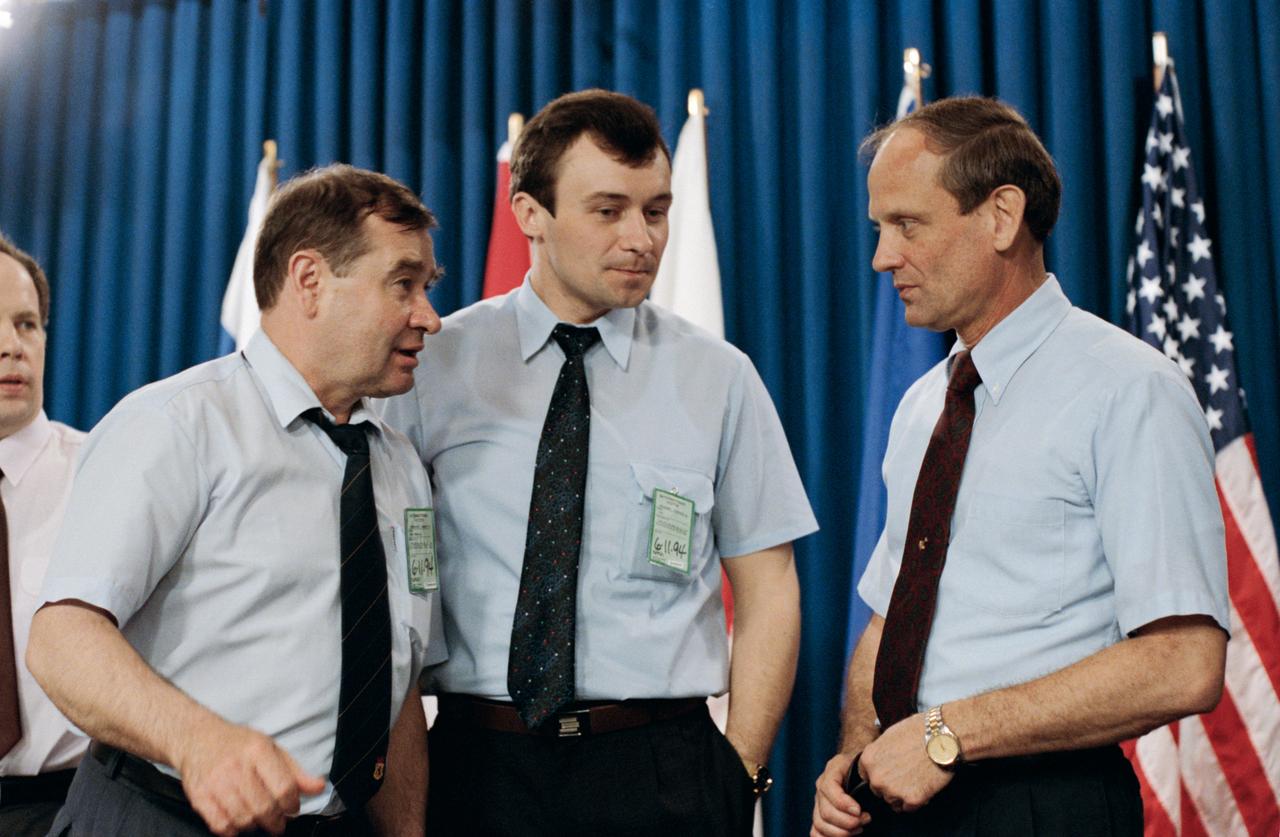
Astronaut Norman E. Thagard, right, chats with two Russian cosmonauts with whom he will be launched into space early next year for a three month mission. Designated Mir 18, the mission aboard the Russian space station will include Mir 18 crew members Gennadiy Strekalov (left) and commander Vladimir Dezhurov. The three appeared at a press conference during a break in medical training at JSC.
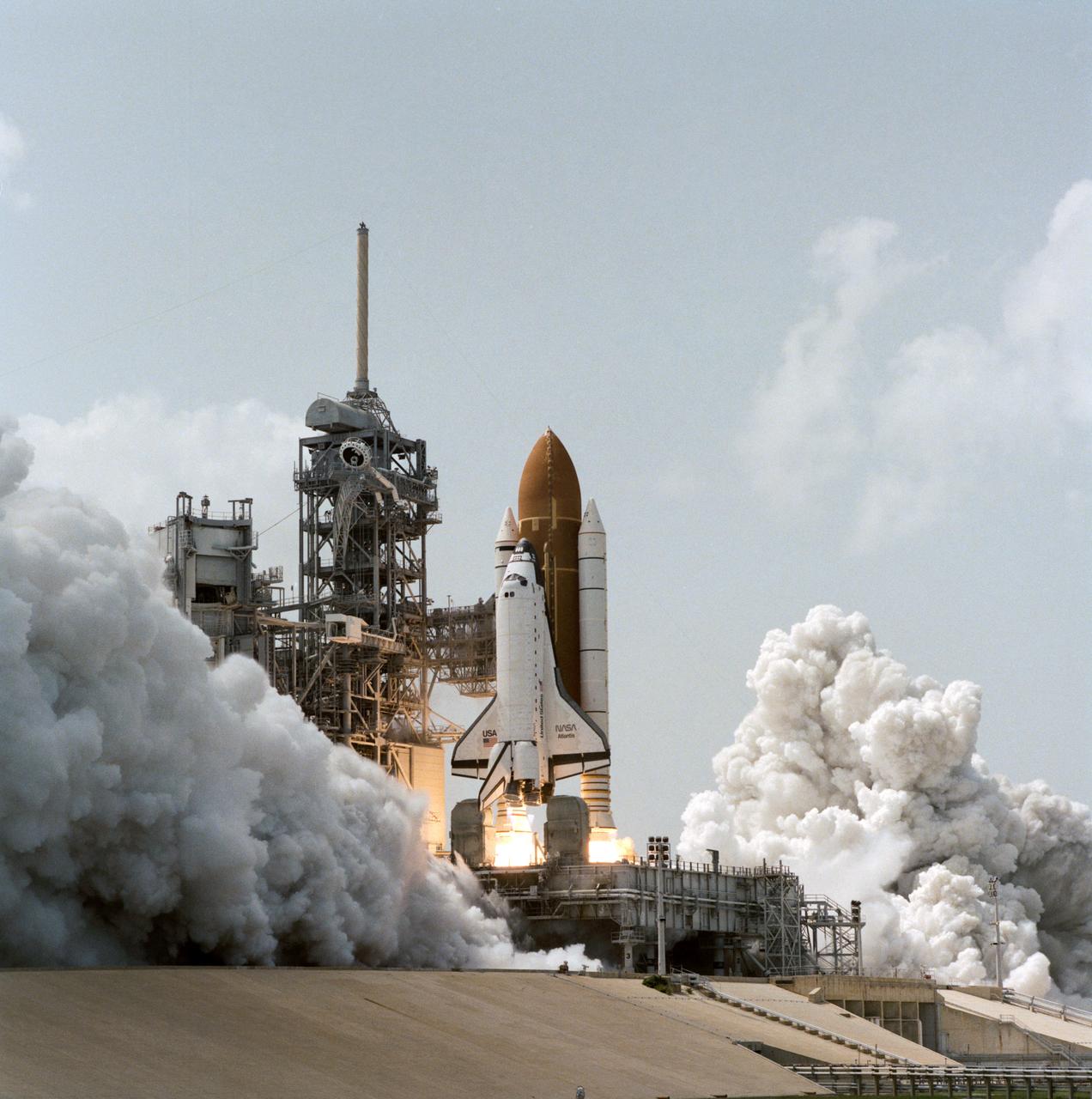
STS071-S-003 (27 June 1995) --- At the Kennedy Space Center's (KSC) Launch Pad 39A, the 100th United States human space launch gets underway at 3:32:19 p.m. (EDT) on June 27, 1995. Onboard the Space Shuttle Atlantis are five NASA astronauts and two Russian cosmonauts. In two days, the crew will join up with astronaut Norman E. Thagard and two Russian cosmonauts who have been onboard Russia's Mir Space Station since March of this year. That pair - Vladimir N. Dezhurov and Gennadiy M. Strekalov - will return to Earth aboard the Space Shuttle Atlantis with Thagard and the short-term United States visitors, while Anatoly Y. Solovyev and Nikolai M. Budarin - the two cosmonauts launched today aboard the Space Shuttle Atlantis - will remain aboard Mir for a longer tour of duty.
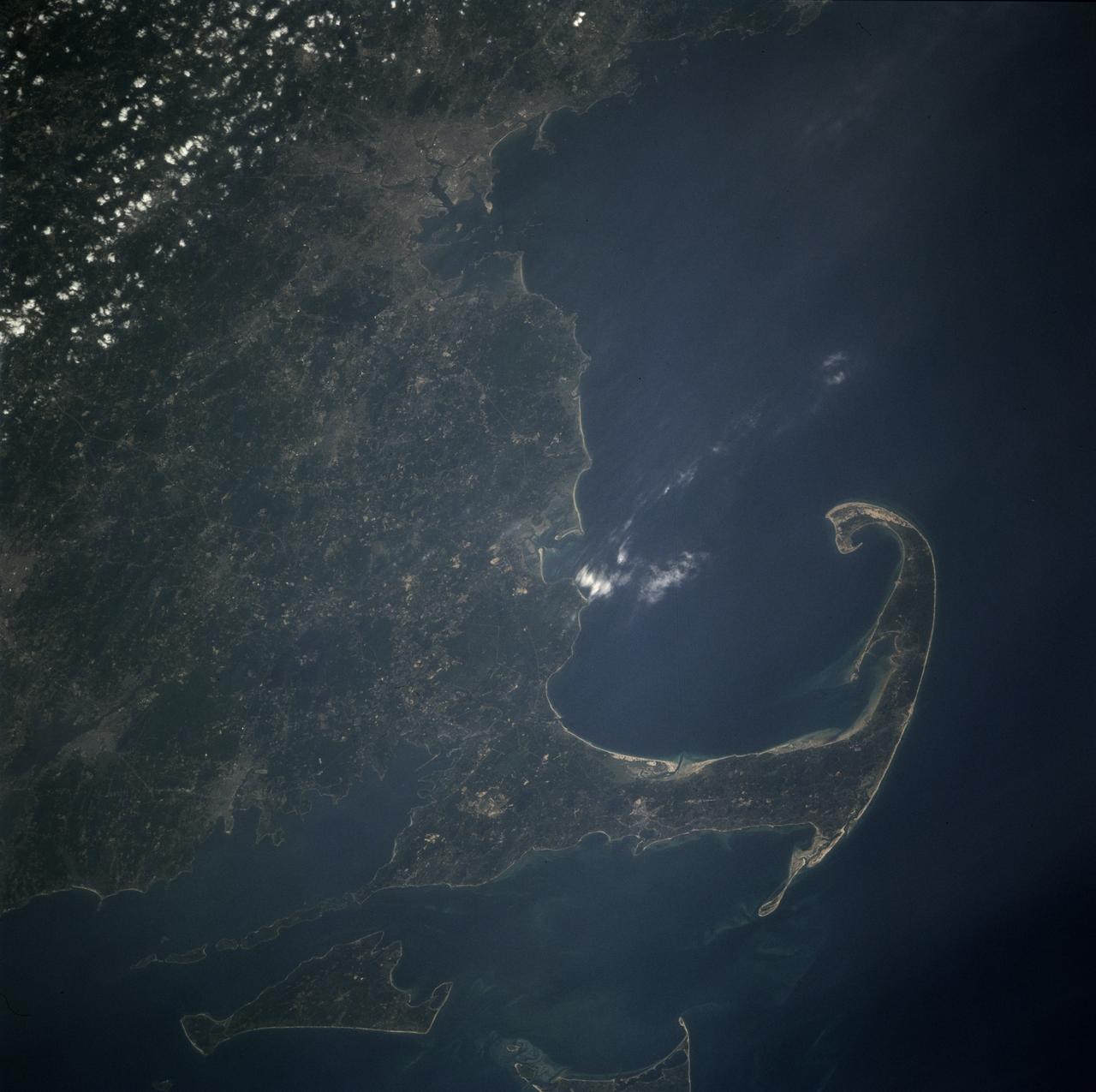
STS071-708-040 (27 June-7 July 1995) --- This view shows Cape Cod in some detail in the center right of the view. Provincetown lies on the inside of the hook of Cape Cod. Other larger cities are unusually easy to see on this frame. The Boston metropolitan area is the large gray area at the top (north), with a smaller gray patch immediately south indicating Brockton, Massachusetts. Other smaller patches in southern Massachusetts (bottom left) indicate Fall River (far left) and New Bedford in the coast on the north side of Buzzard's Bay. The outskirts of Providence, Rhode Island appear half way up the left edge of the frame. The islands at the bottom of the frame are Martha's Vineyard (bottom left) and Nantucket Island (partial view). Shoals (near-surface sand bars) appear as light-blue swirls on the shallow sea bottom between Cape Cod and these islands. The distance from Boston to Nantucket is almost 100 miles.
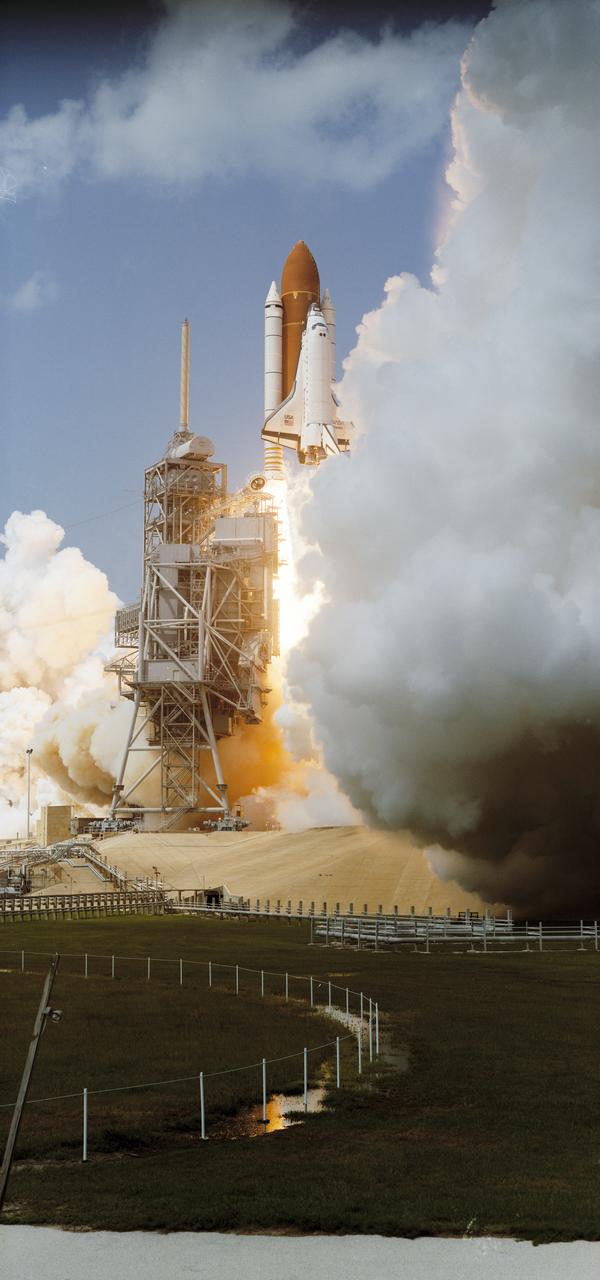
STS071-S-005 (27 June 1995) --- At the Kennedy Space Center's (KSC) Launch Pad 39A, the 100th United States human space launch gets underway at 3:32:19 p.m. (EDT) on June 27, 1995. Onboard Atlantis are five NASA astronauts and two Russian cosmonauts. In two days, the crew will join up with astronaut Norman E. Thagard and two Russian cosmonauts who have been onboard Russia's Mir Space Station since March of this year. That pair - Vladimir N. Dezhurov and Gennadiy M. Strekalov - will return to Earth aboard the Space Shuttle Atlantis with Thagard and the short-term visitors, while Anatoly Y. Solovyev and Nikolai M. Budarin - the two cosmonauts launched today aboard the Space Shuttle Atlantis - will remain aboard Mir for a longer tour of duty.
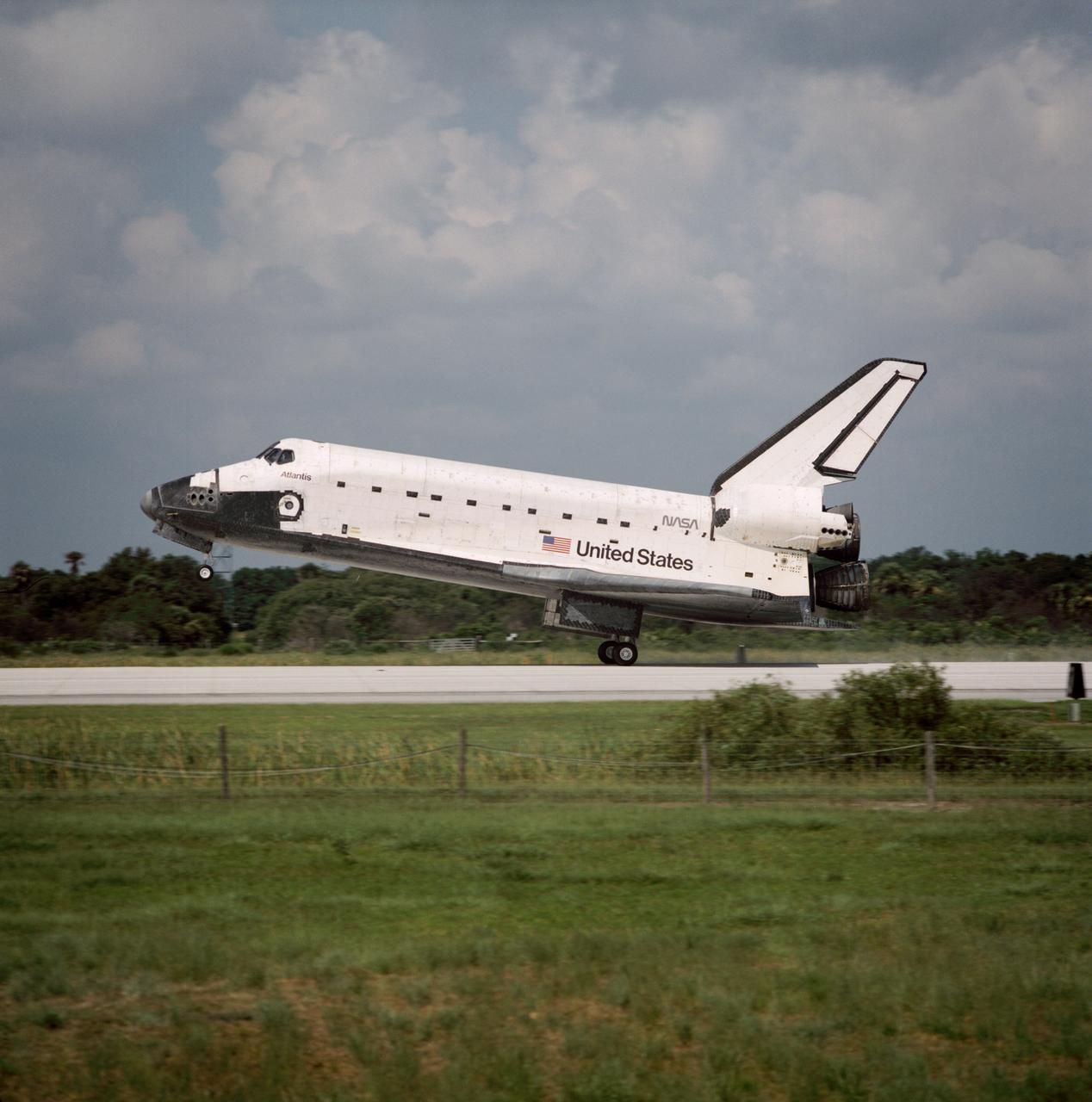
STS071-S-069 (7 July 1995) --- The Space Shuttle Atlantis touches down on Runway 33 at the Kennedy Space Center's (KSC) Shuttle landing facility to complete an historic mission in space. The landing completed an historic mission in space involving a linkup with Russia?s Mir Space Station and a total of six astronauts and four cosmonauts. Onboard for the landing were six NASA astronauts and two cosmonauts. Touchdown occurred at 10:55 a.m. (EDT), July 7, 1995.
STS071-701-098 (27 June-7 July 1995) --- This wide-angle, west-looking view shows all of California, from the Los Angeles basin (left, at the coast), to the Oregon border (far right). A large cloud mass occupies the Pacific Ocean all the way to the horizon. The effect of interaction between the land and sea can be seen by the cloud patterns at the coast. San Francisco lies in the bay where clouds penetrate inland farthest (right of center). The central valley of California stands out very well as a cigar-shaped feature across the center of view - green in the middle, surrounded by a brown line, with dark green (forests) surrounding that.
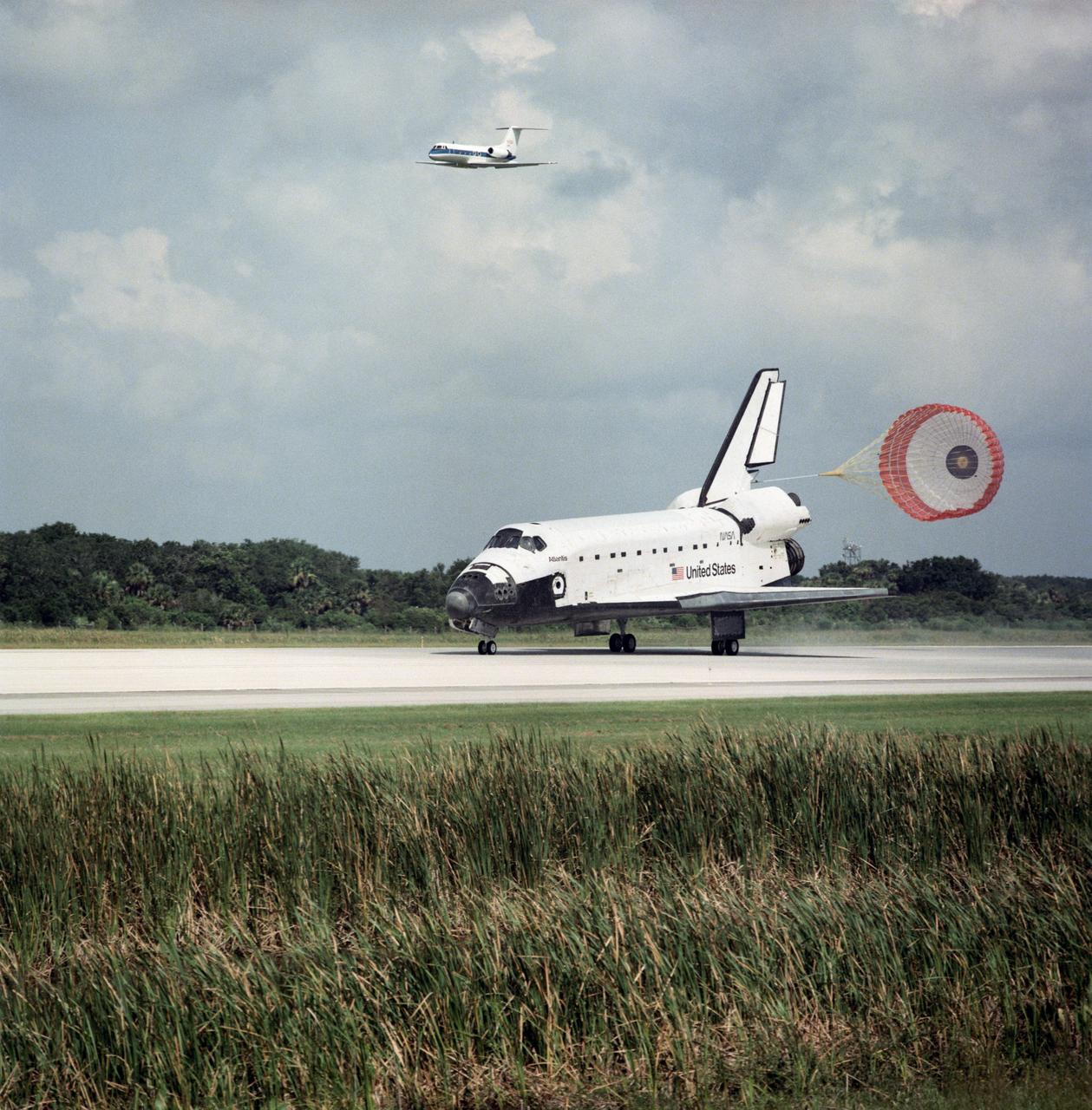
STS071-S-070 (7 July 1995) --- The drag chute of the Space Shuttle Atlantis is deployed as the spacecraft touches down on Runway 33 at the Kennedy Space Center's (KSC) Shuttle landing facility. The Shuttle Training Aircraft (STA) piloted by astronaut Robert D. Cabana, is visible in upper left. The landing completed an historic mission in space involving a linkup with Russia?s Mir Space Station and the Space Shuttle Atlantis, a total of six astronauts and four cosmonauts. Onboard for the landing were six NASA astronauts and two cosmonauts. Touchdown occurred at 10:55 a.m. (EDT), July 7, 1995.
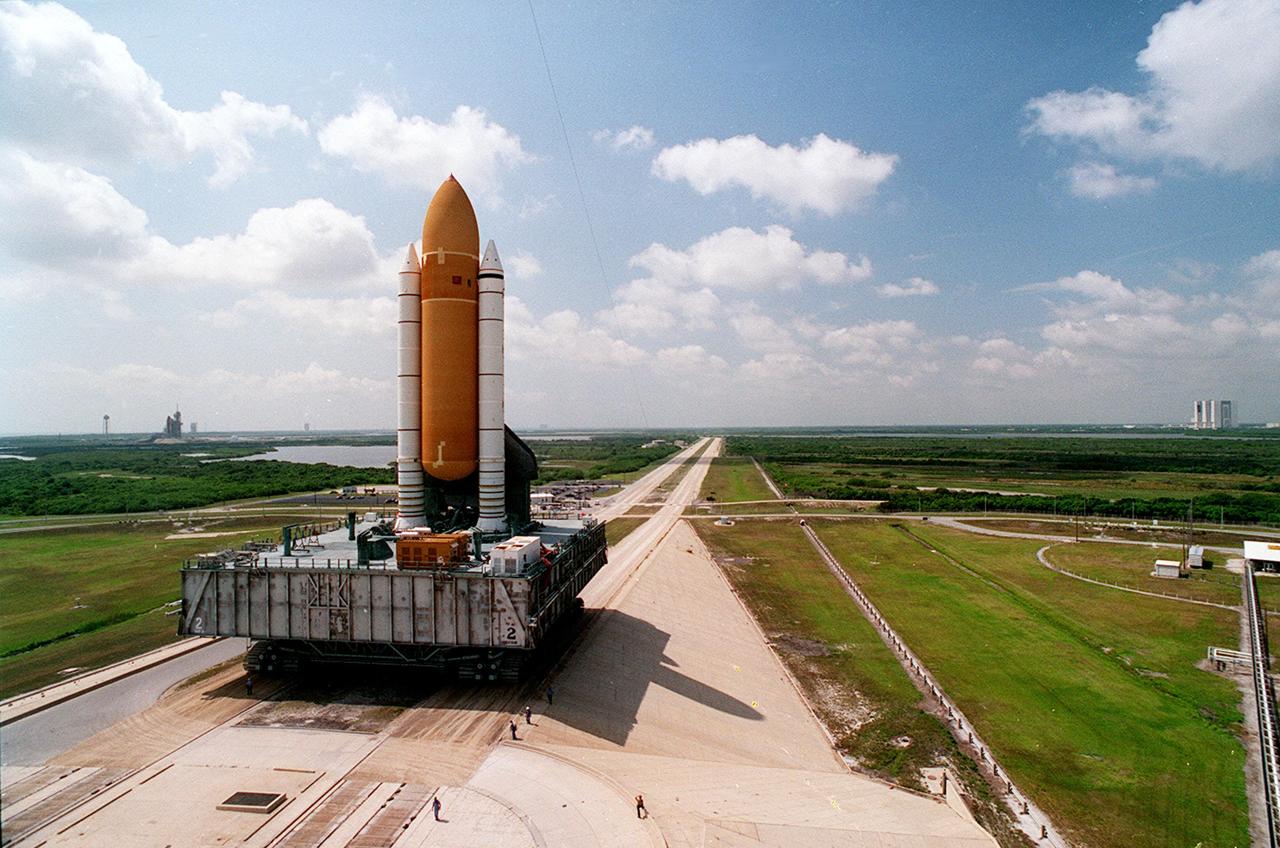
The Space Shuttle Discovery slowly and carefully makes the 4.2- mile (6.8 kilometer) trek from the Vehicle Assembly Building, background at right, to Launch Pad 39B on its Mobile Launcher Platform carried by the Crawler Transporter. Pad 39A, with the Shapce Shuttle Atlantic poised for liftoff, is in background at left. Discovery is scheduled to fly first, on STS-70 targeted for June 8. Atlantis' mission, STS-71, is scheduled no earlier than June 22.
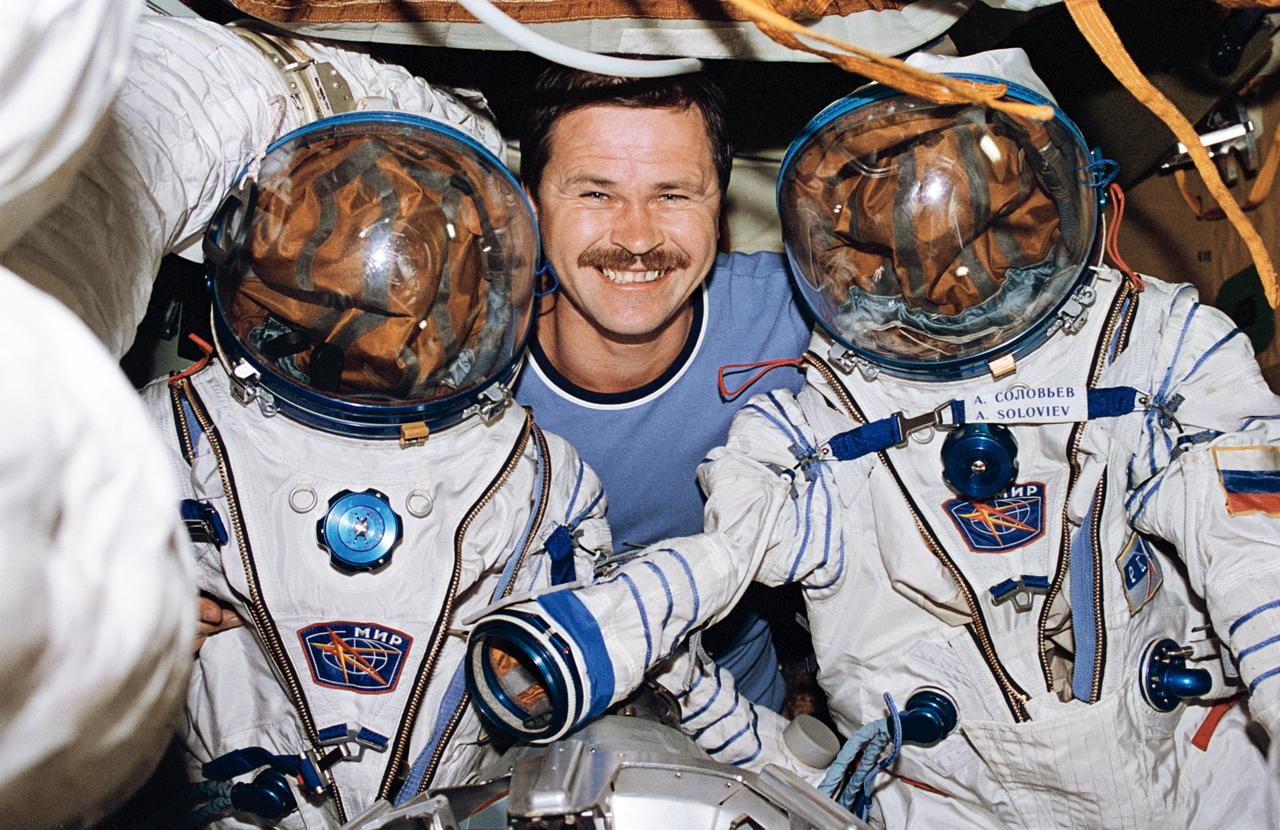
STS071-104-029 (27 June-7 July 1995) --- Cosmonaut Nikolai M. Budarin, Mir-19 flight engineer, is pictured on Russia's Mir Space Station with two Russian space suits. These are for Intravehicular (IVA) wear and are not the suits designed for Extravehicular Activity (EVA). Budarin remained aboard Mir with cosmonaut Anatoly Y. Solovyev, Mir-19 commander, when the three Mir-18 crewmembers and the five STS-71 astronauts later undocked the space shuttle Atlantis from Mir and returned to Earth.
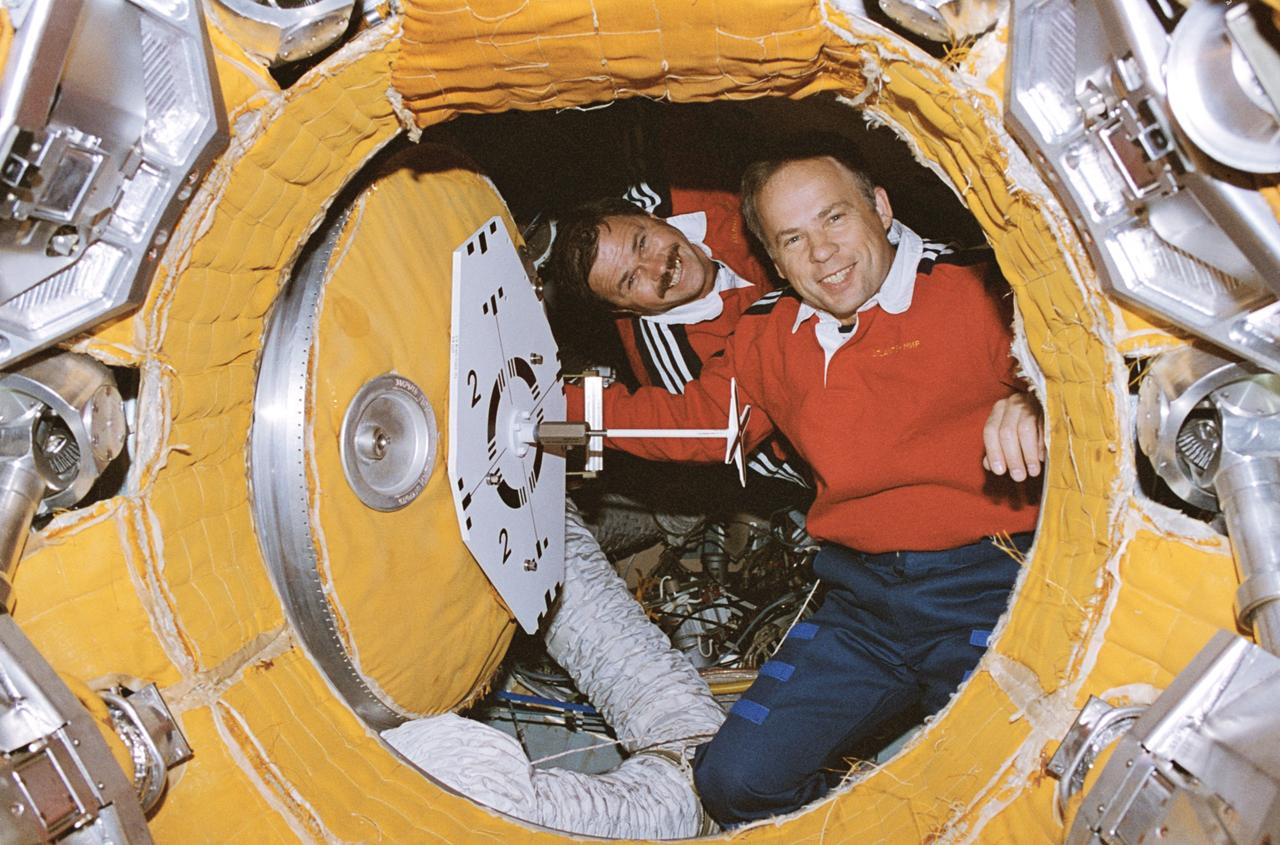
STS071-117-032 (4 July 1995) --- In the docking vestibule of Russia's Mir Space Station, cosmonauts Anatoly Y. Solovyev, Mir-19 commander, and Nikolai M. Budarin, Mir-19 flight engineer, smile at the departing Space Shuttle Atlantis STS-71 crew prior to hatch closing. Later, the two manned the Soyuz vehicle as it was temporarily moved from the Mir complex for Atlantis' undocking.
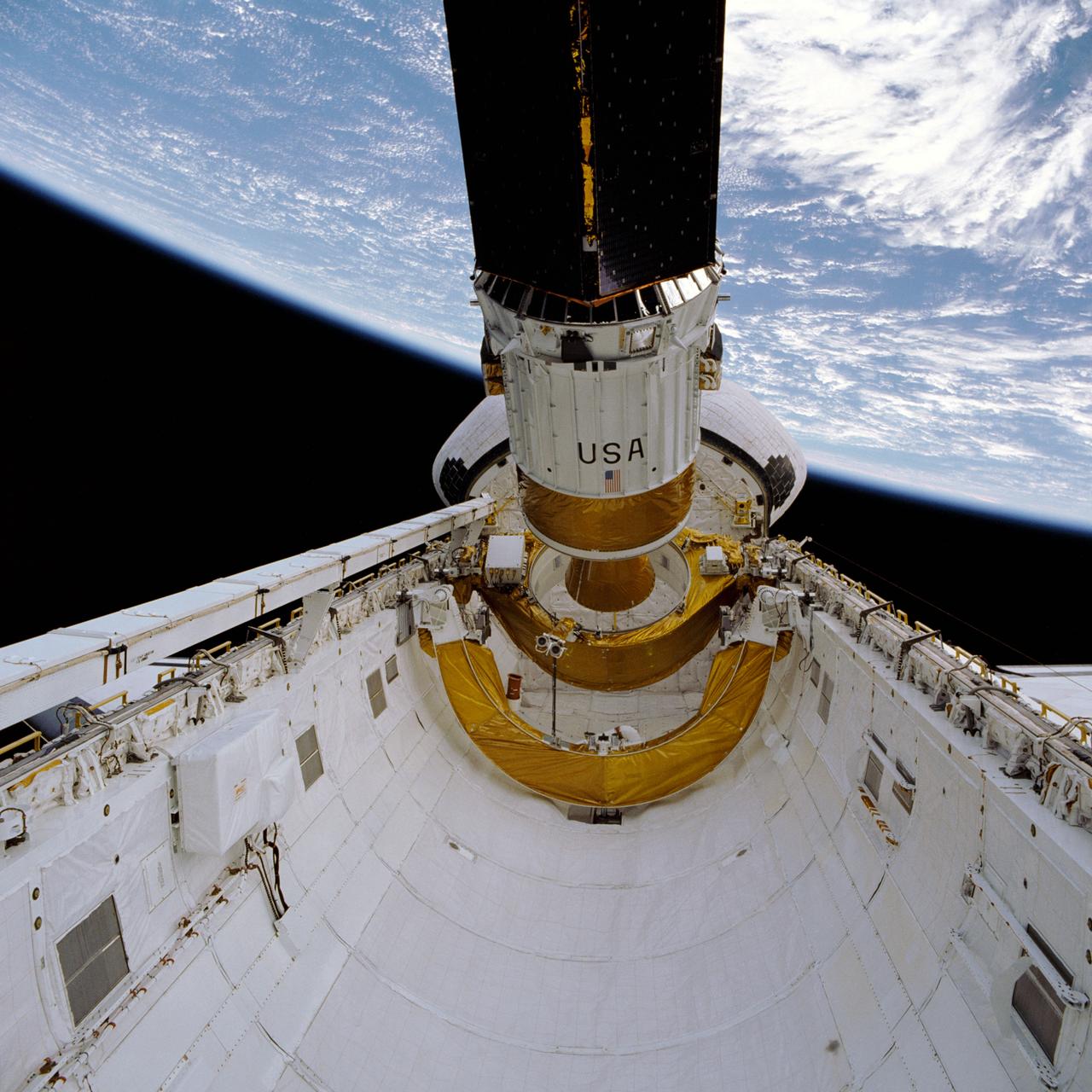
STS029-71-026 (13 March 1989) --- The Tracking and Data Relay Satellite (TDRS-D) is tilted in the cargo bay prior to its release via a remote system on Discovery's flight deck. This photographic frame was among NASA's third STS-29 photo release. Monday, March 20, 1989. Crewmembers were Astronauts Michael L. Coats, John E. Blaha, James F. Buchli, Robert C. Springer and James P. Bagian.
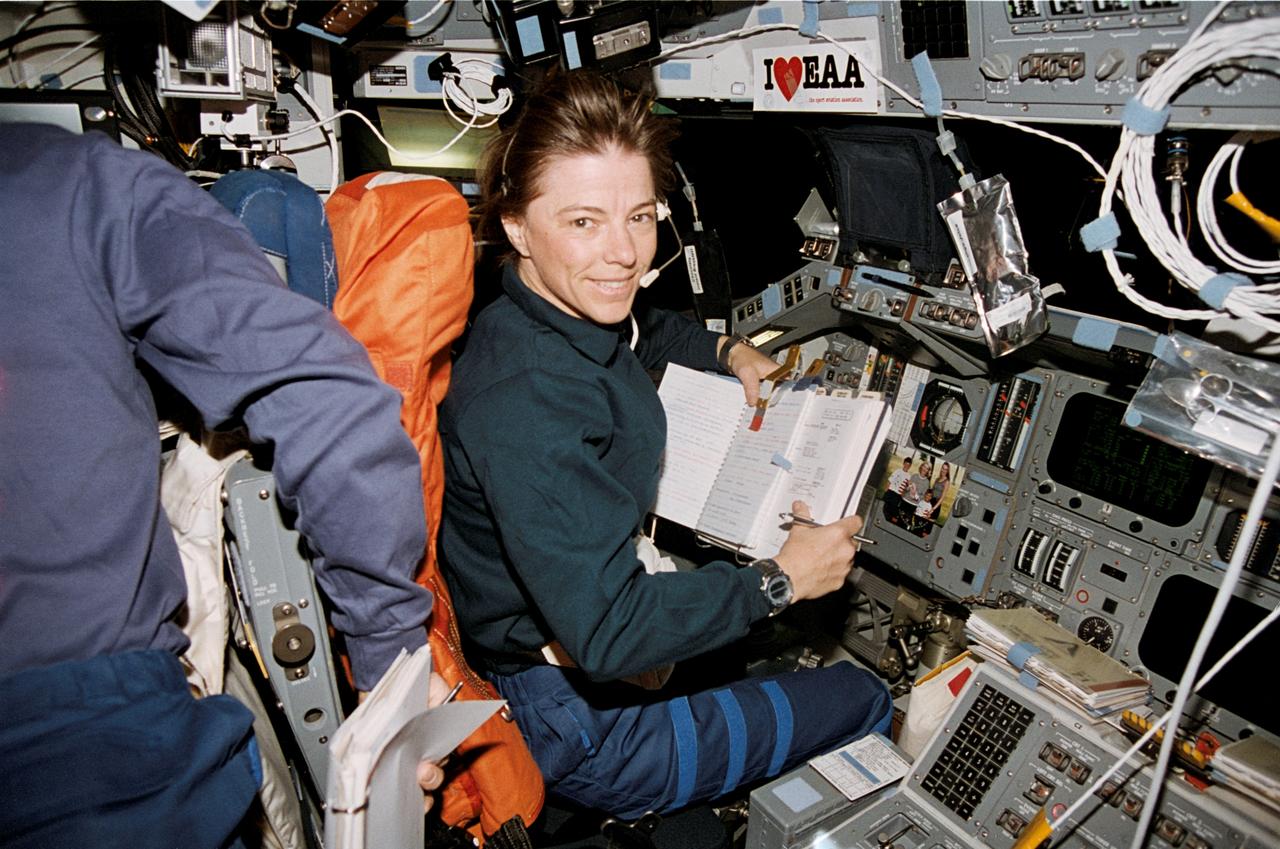
STS071-126-003 (29 June 1995) --- Astronaut Bonnie J. Dunbar, STS-71 mission specialist, occupies the commander's station on the space shuttle Atlantis' flight deck during rendezvous operations with Russia's Mir Space Station. Dunbar acted as the communications link between the two spacecraft for both the docking and undocking phases of the historic joint mission.
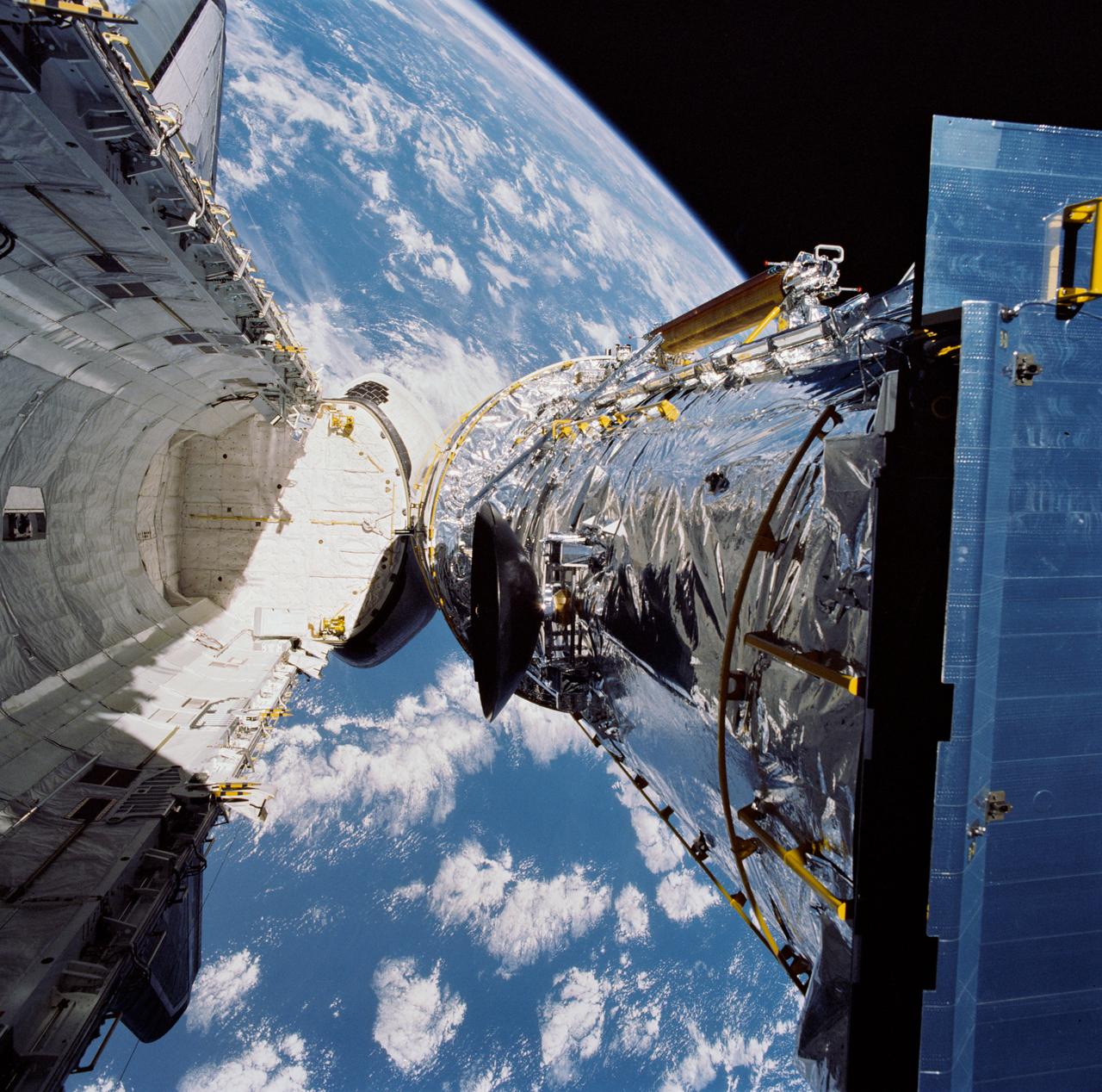
STS031-71-095 (25 April 1990) --- The Hubble Space Telescope (HST) is suspended above Discovery's cargo bay some 332 nautical miles above Earth. The Canadian-built Remote Manipulator System (RMS) arm, controlled from in-cabin by the astronaut crew members of STS-31, held the huge telescope in this position during pre-deployment procedures, which included extension of solar array panels and antennae. The photo was made with a 70mm handheld Hasselblad camera.
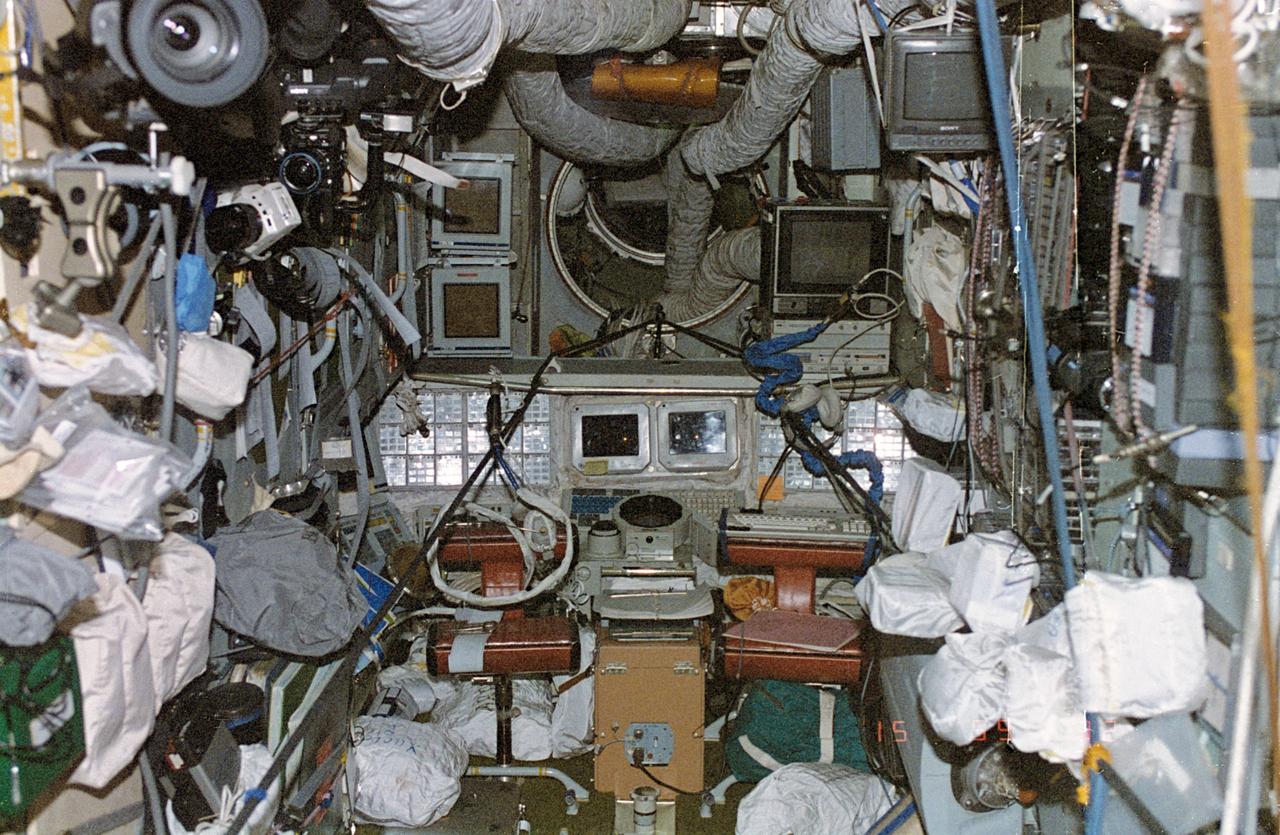
NM18-302-038 (28 June 1995) --- Astronaut Norman E. Thagard, Mir-18 cosmonaut researcher, took this picture aboard Mir on the eve of the targeted arrival day of Atlantis. Thagard told a July 18 press conference audience in Houston that he worked to clean the area prior to the Mir-19 crew and the STS-71 crew arrival and that his showing of this slide represented the first time the crew would have seen the area "in this condition."
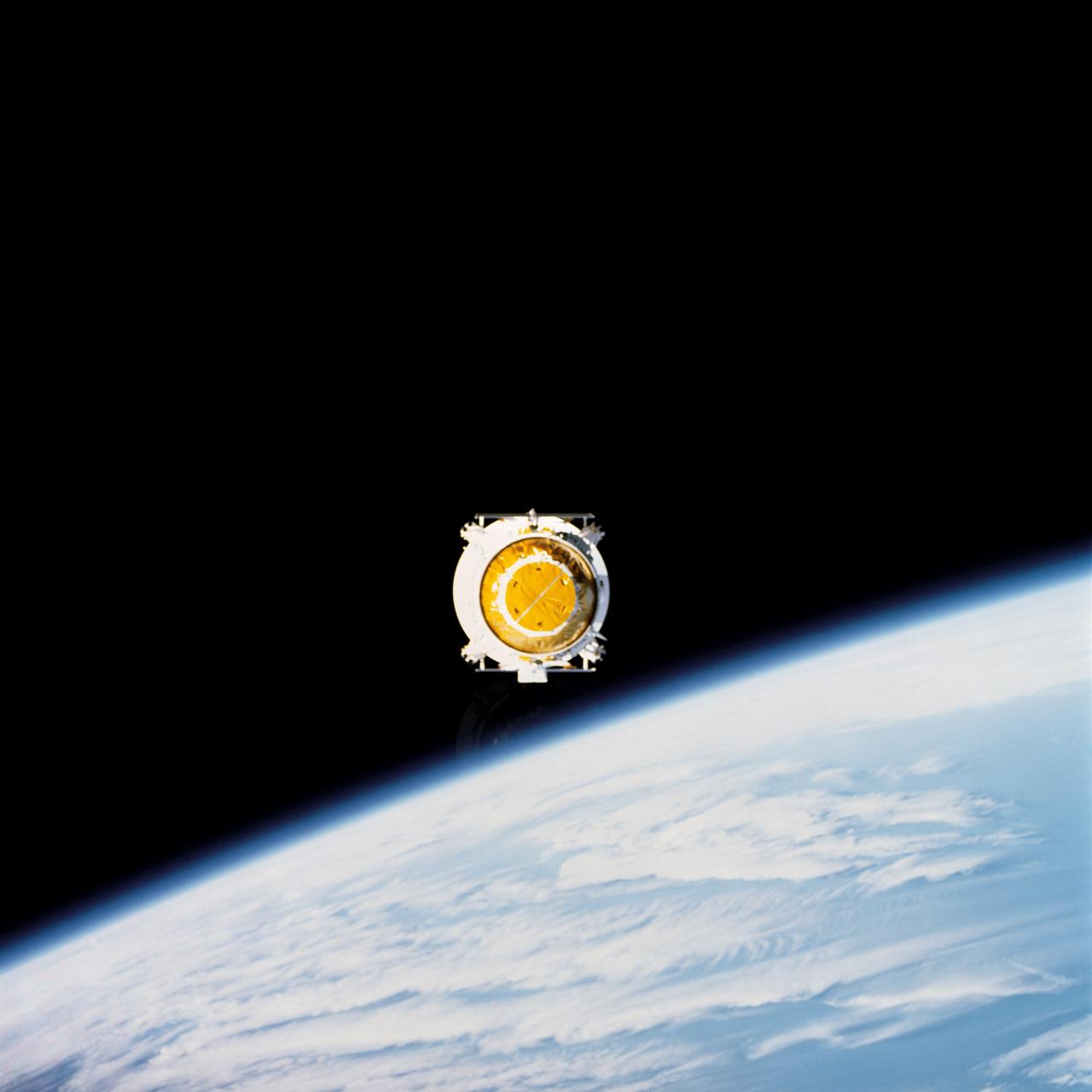
STS030-71-053 (4 May 1989) --- In the early evening hours of Space Shuttle Atlantis’ first day in space for the four-day STS-30 mission, the Magellan spacecraft is released into space to begin its long journey to the planet Venus for an extensive radar mapping mission. The scene was photographed through Atlantis’ aft flight deck windows with a handheld 70mm camera.
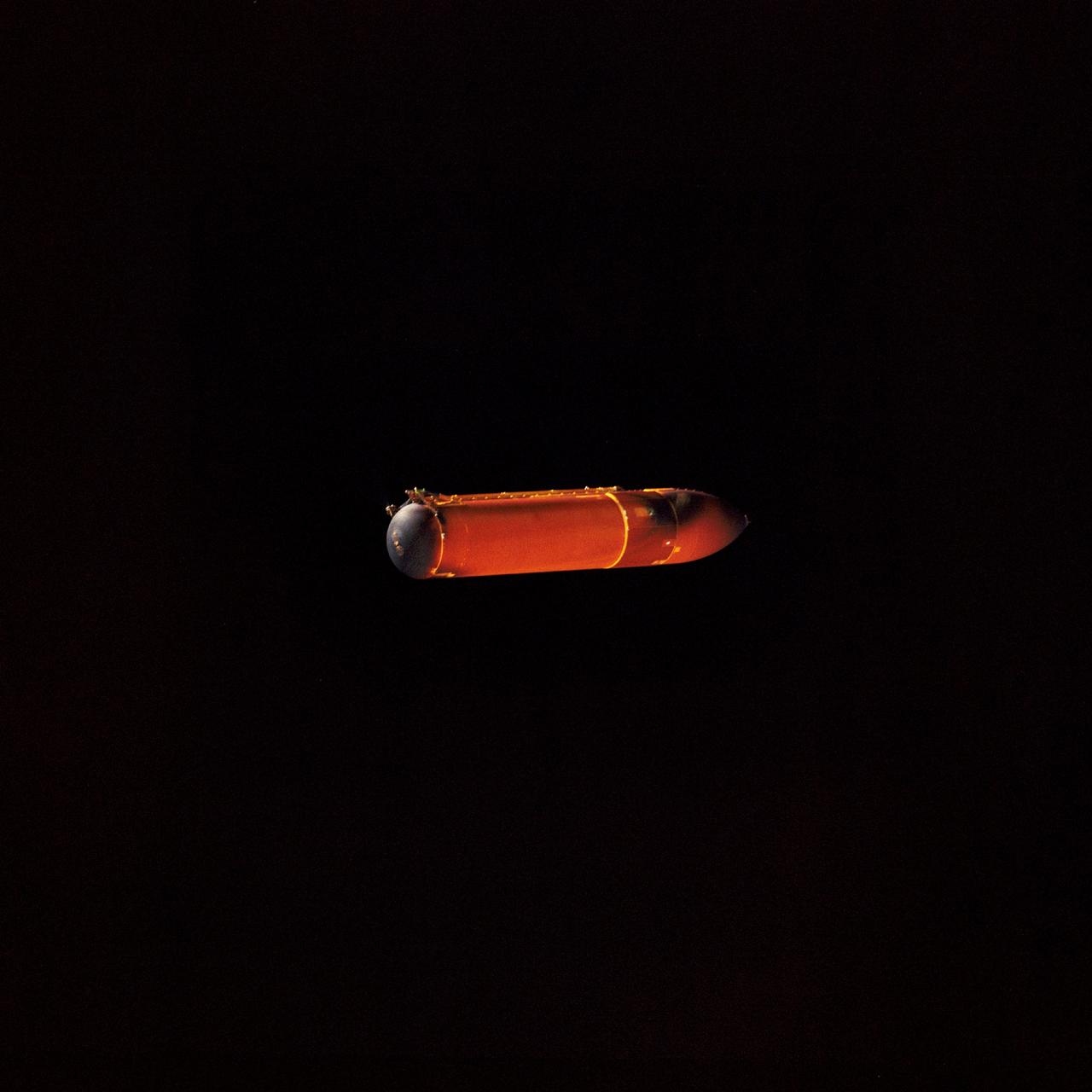
STS045-71-001 (24 March 1992) --- This 70mm photograph of the external fuel tank (ET) for STS-45 was photographed 4 1/2 minutes after having been jettisoned from Space Shuttle Atlantis. The excellent view of the starboard side of the ET shows both top and bottom attach points to the two solid rocket boosters (SRB). NASA engineers studying the STS-45 onboard photography deem the visible burn scars, caused by the SRBs, to be normal. The long thin pipe visible is the liquid oxygen line. At the bottom end of the large tank, both the liquid oxygen (nearest camera) and liquid hydrogen orbiter-to-ET attach hardware can be seen.
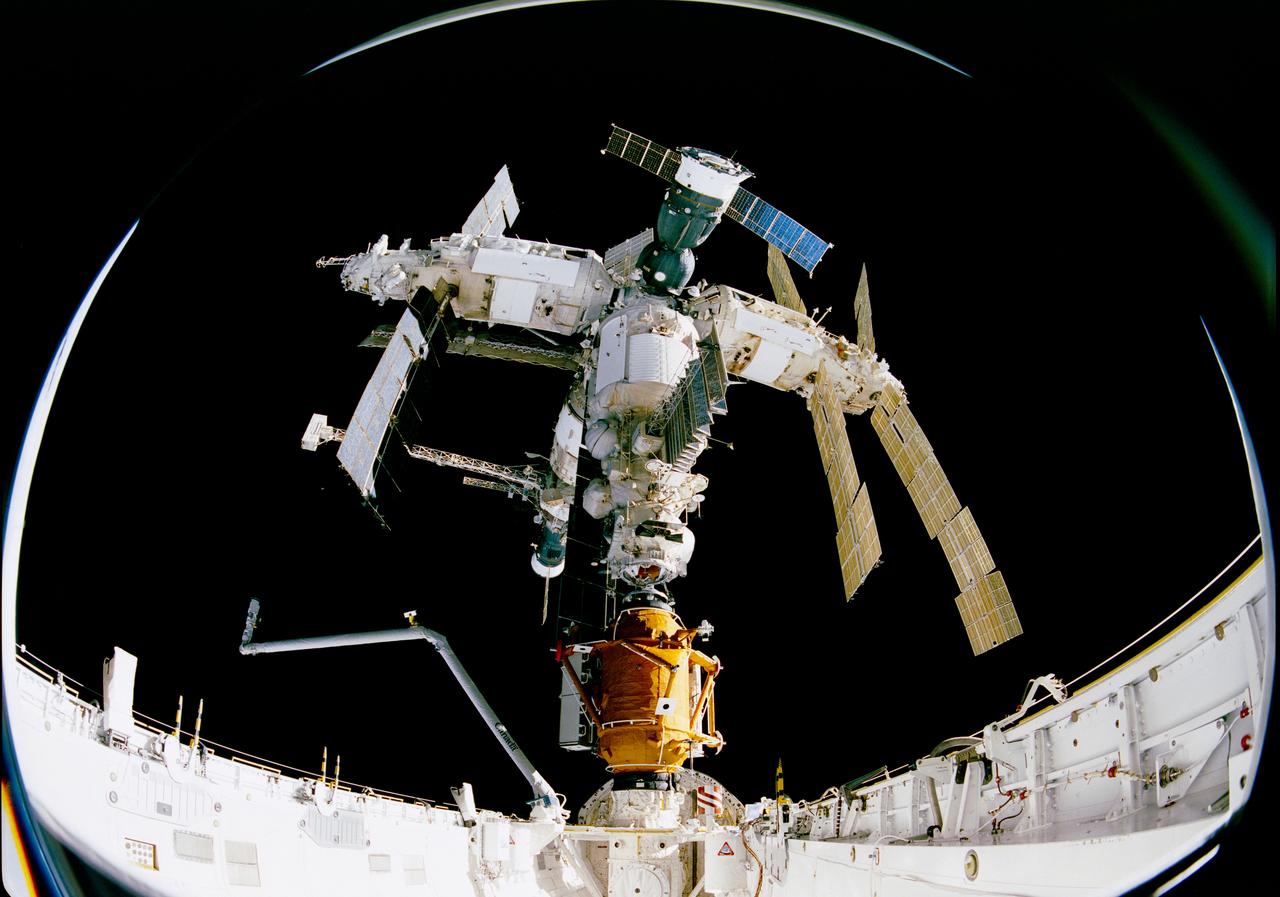
S95-22116 (15 Nov 1995) --- The Space Shuttle Atlantis has completed its successful docking with the Russia's Mir Space Station. The STS-74 crew members inside Atlantis' cabin are making preparations to meet with the Mir-20 crew members. During the STS-74 mission, the crew used an IMAX camera to document the Space Shuttle Atlantis' rendezvous and docking with the Mir Space Station. The 65mm camera system was located in the Atlantis' cargo bay and provided a unique fish-eye perspective. These images were selected from footage that will be incorporated in a large-format feature film about NASA's cooperative program with the Russians. NASA has flown IMAX camera systems on many Shuttle missions, including the recent STS-63 Shuttle-Mir rendezvous and STS-71 Shuttle-Mir docking. Film from previous missions was used to create the productions The Dream is Alive, The Blue Planet, and Destiny in Space.
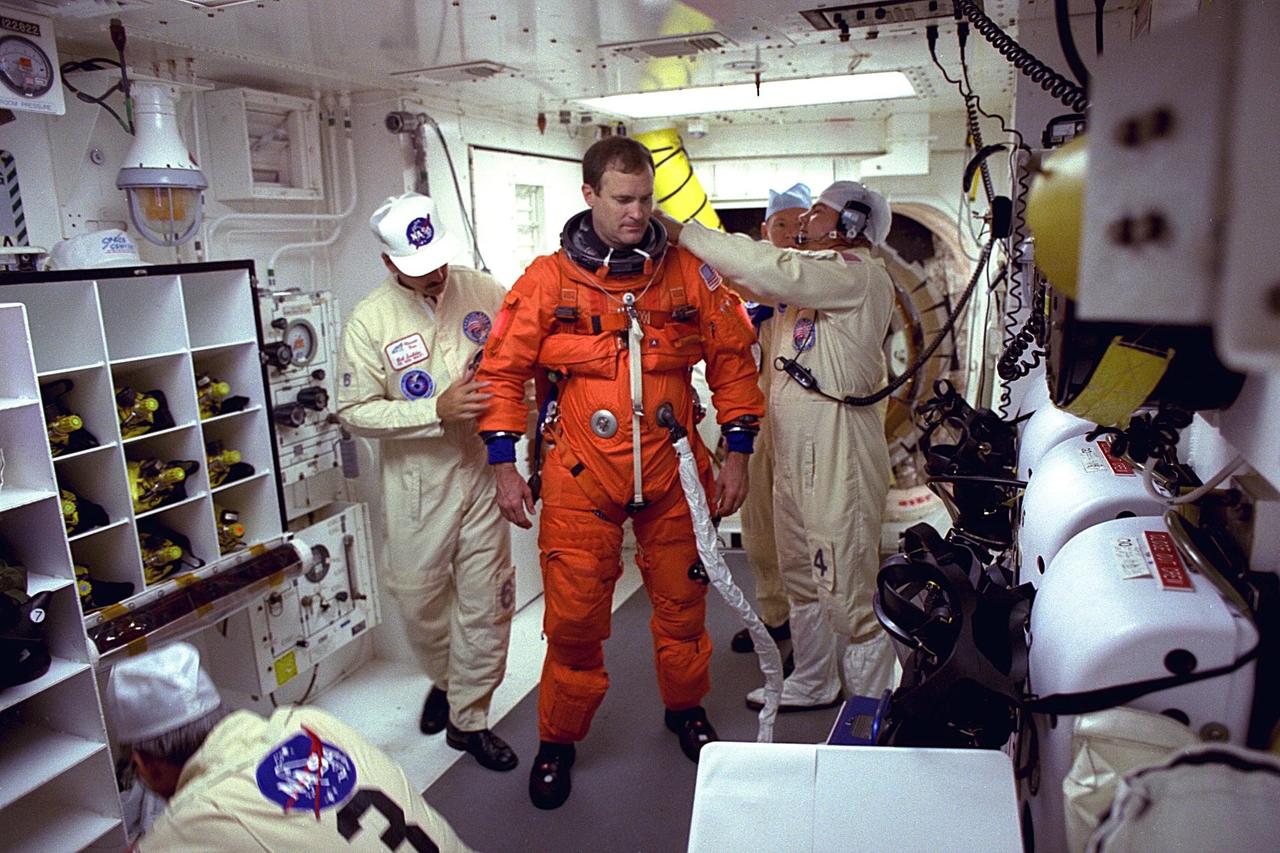
STS-94 Mission Commander James D. Halsell, Jr., prepares to enter the Space Shuttle Columbia at Launch Pad 39A in preparation for launch. Halsell is on his fourth space flight, having served as commander of STS-83 and pilot of both STS-74 and STS-65. He is a lieutenant colonel in the Air Force and a former SR-71 Blackbird test pilot and holds master’s degrees in management and space operations. Halsell will have responsibility for the success of the mission and will operate and maintain Columbia during the Red, or second shift. He will also assist with a materials science experiment and a protein crystal growth payload during the 16-day mission. Halsell and six fellow crew members will lift off during a launch window that opens at 1:50 p.m. EDT, July 1. The launch window will open 47 minutes early to improve the opportunity to lift off before Florida summer rain showers reach the space center
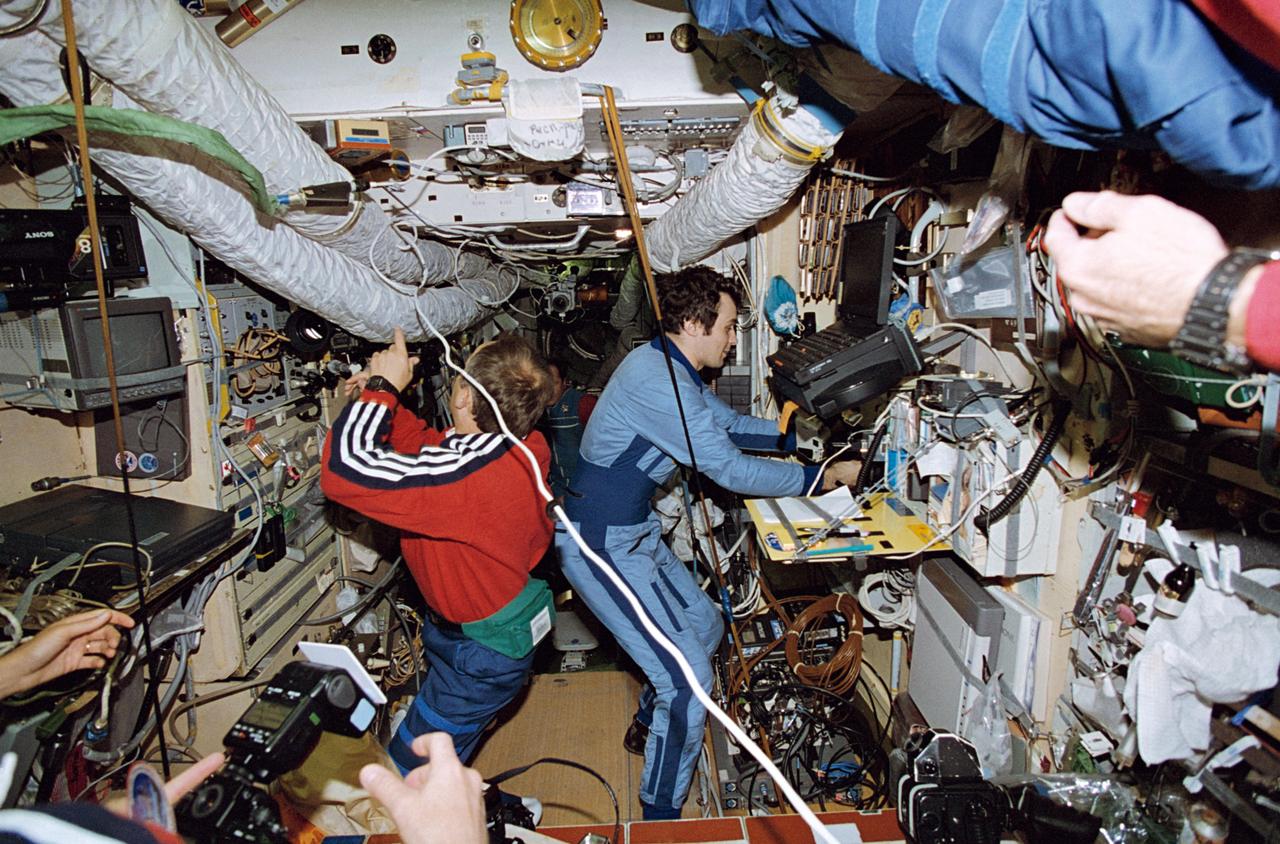
STS071-118-007 (27 June - 7 July 1995) --- Onboard the Russia?s Mir Space Station Mir Base Block, cosmonauts Anatoly Y. Solovyev (left) and Vladimir N. Dezhurov, Mir 19 and 18 commanders, respectively, exchange information about their research tasks. The two represent a change of guard aboard Mir, as Dezhurov prepares to come back to Earth with the STS-71 crew aboard Space Shuttle Atlantis. Nikolai M. Budarin and Gennadiy M. Strekalov - cosmonaut/flight engineers making the same exchange -- are out of frame.
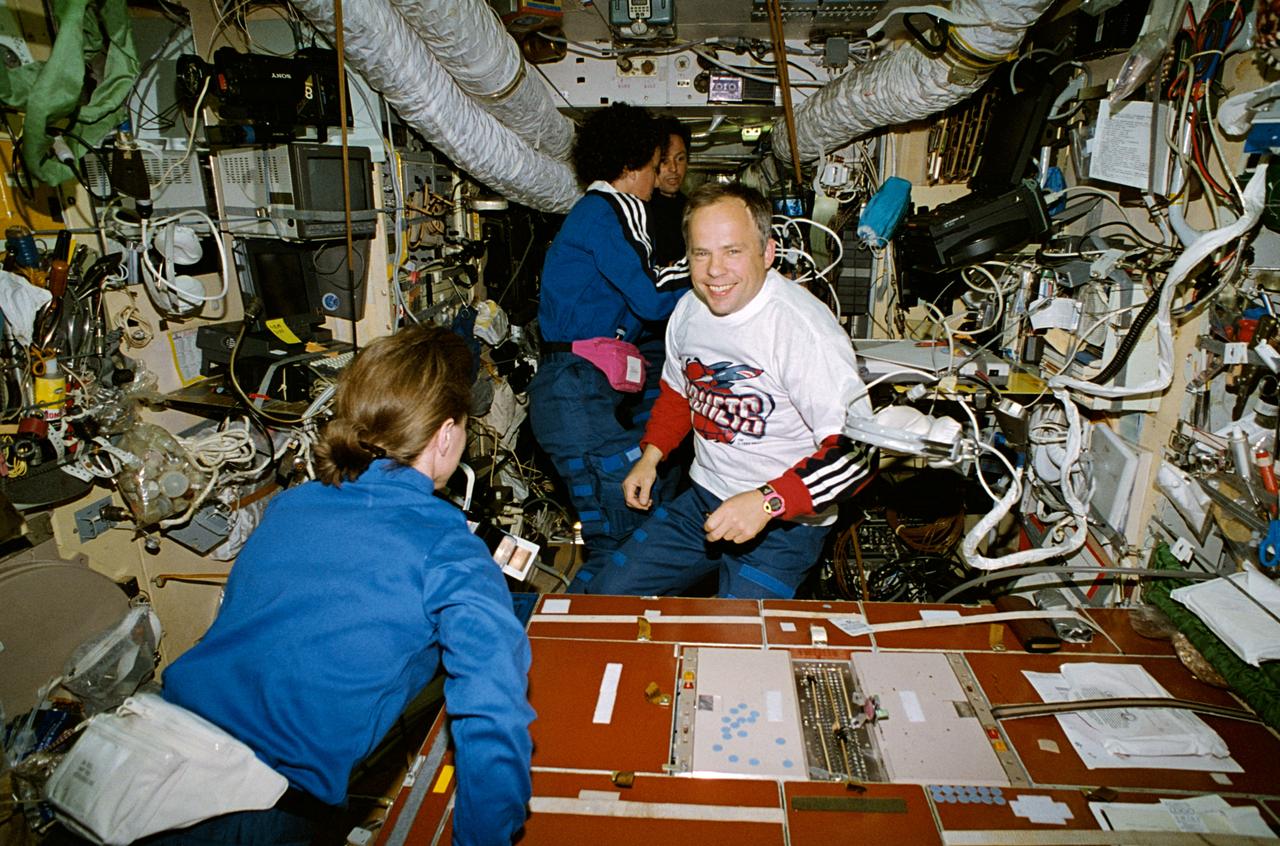
STS071-122-021 (27 June-7 July 1995) --- Three astronauts and a cosmonaut who went into space aboard the space shuttle Atlantis check out the core module living quarters on Russia's Mir Space Station. Sporting a new Houston Rockets T-shirt near frame center is cosmonaut Anatoly Y. Solovyev, Mir-19 mission commander. Astronaut Bonnie J. Dunbar, STS-71 mission specialist, floats into the frame at lower left. Beyond Solovyev are astronauts Ellen S. Baker and Gregory J. Harbaugh, mission specialists.
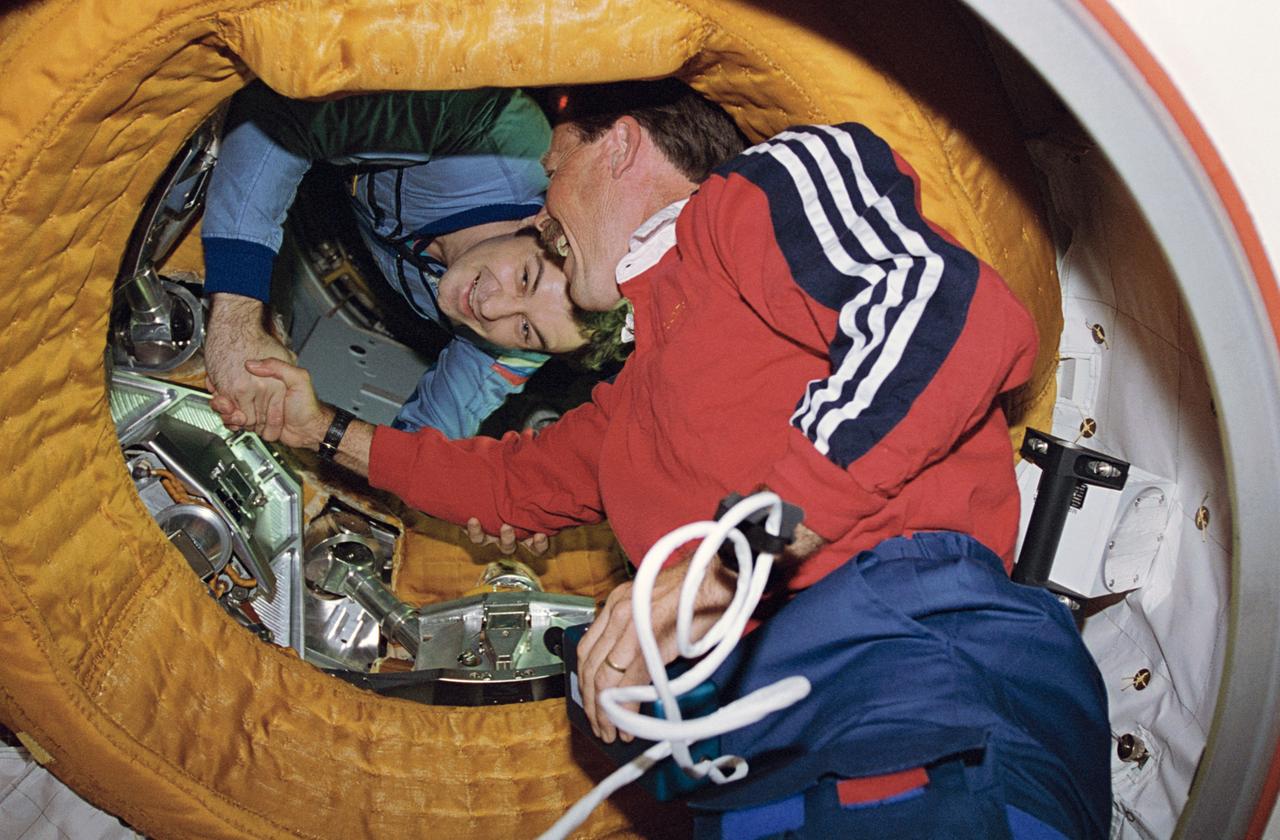
STS071-118-004 (29 June 1995) --- Astronaut Robert L. Gibson, STS-71 commander, shakes the hand of cosmonaut Vladimir N. Dezhurov, Mir-18 commander. The historic handshake took place two and half weeks prior to the 20th anniversary of a similar in-space greeting between cosmonauts and astronauts participating in the Apollo-Soyuz Test Project (ASTP). On July 17, 1975, astronaut Thomas P. Stafford, NASA's ASTP commander, greeted his counterpart, Aleksey A. Leonov in a docking tunnel linking the Soyuz and Apollo spacecraft.
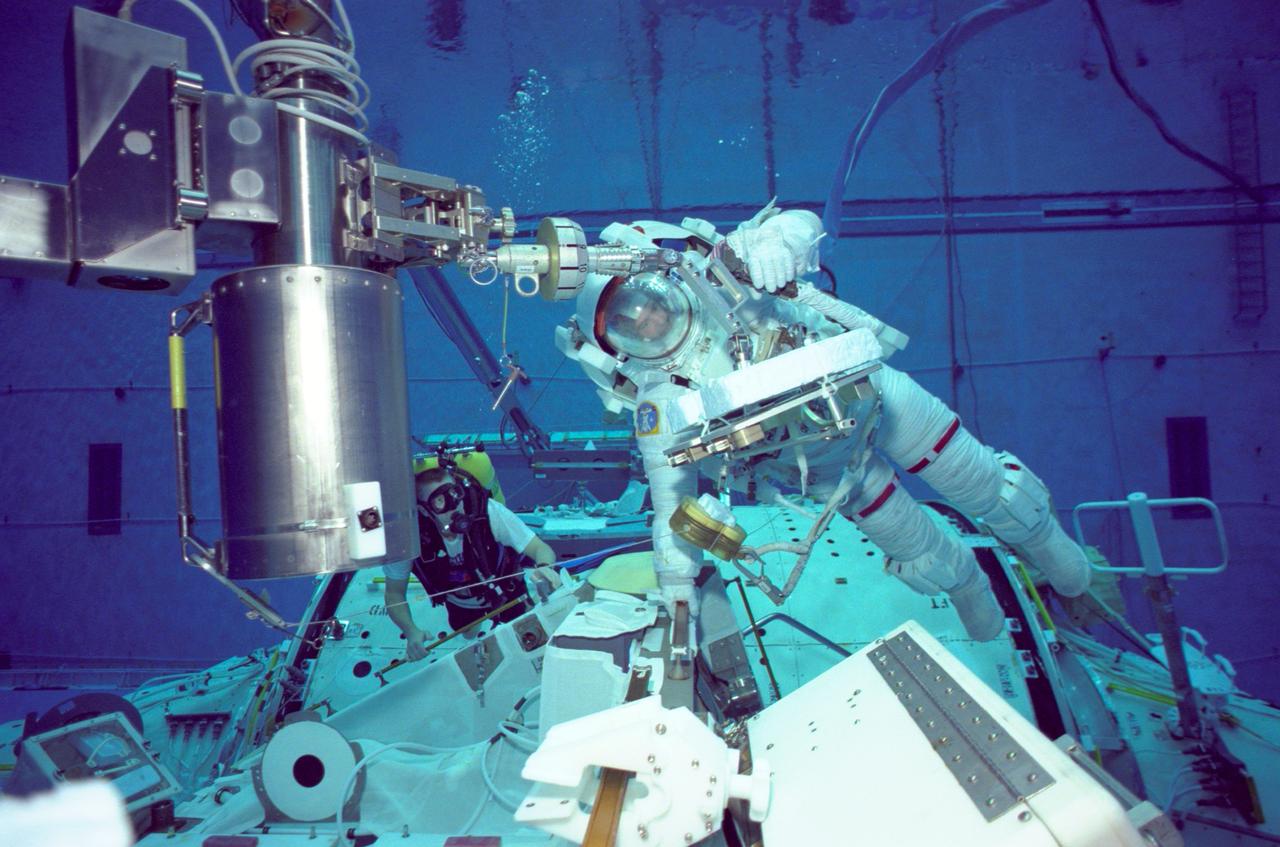
Photographic documentation showing astronauts in Extravehicular Mobility Units (EMU) participating in STS-97 (4A) EVA training in the Neutral Buoyancy Lab (NBL) pool in the Sonny Carter Training Facility (SCTF). Views include: various views of a person in an EMU (07069-71, 07077); various views of a person in an EMU with stripes on an Articulated Portable Foot Restraint (APFR) (07072, 07079) ; various views of a person in an EMU using a Pistol Grip Tool (PGT) (07073-74, 07080); person in an EMU with stripes poses with divers (07075); two persons in EMUs on APFRs (07076); person in an EMU with stripes (07078, 07081-83).
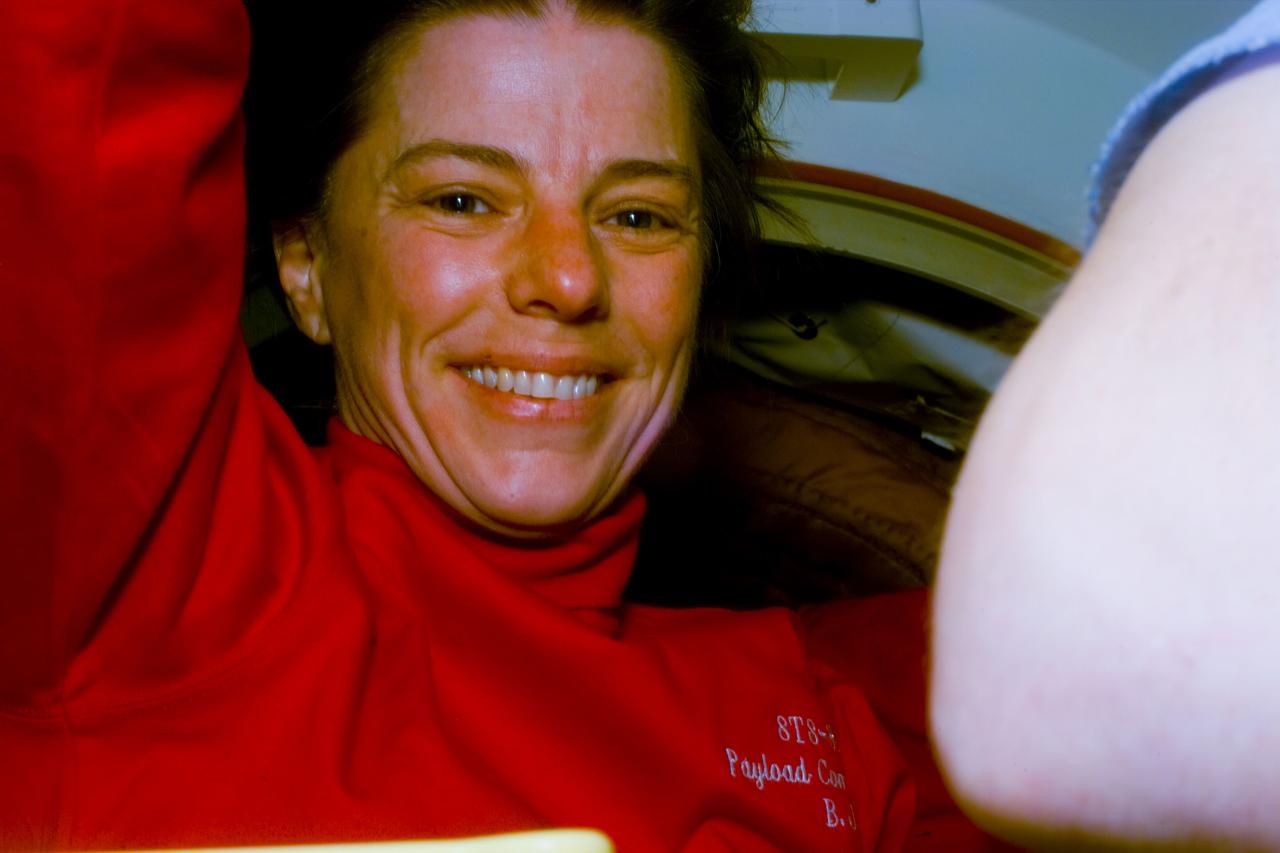
S89-E-5175 (24 Jan 1998) --- This Electronic Still Camera (ESC) image shows astronaut Bonnie J. Dunbar, payload commander, shortly after Shuttle/Mir docking activities began. "Deja-vu" may have come to the mind of Dunbar as she boarded Russia's Mir Space Station. Dunbar was a member of the STS-71 crew -- the first United States aggregation to visit Mir -- along with cosmonaut Anatoliy Y. Solovyev, Mir-24 commander. The ESC view was taken at 22:37:23 GMT, on January 24, 1998.
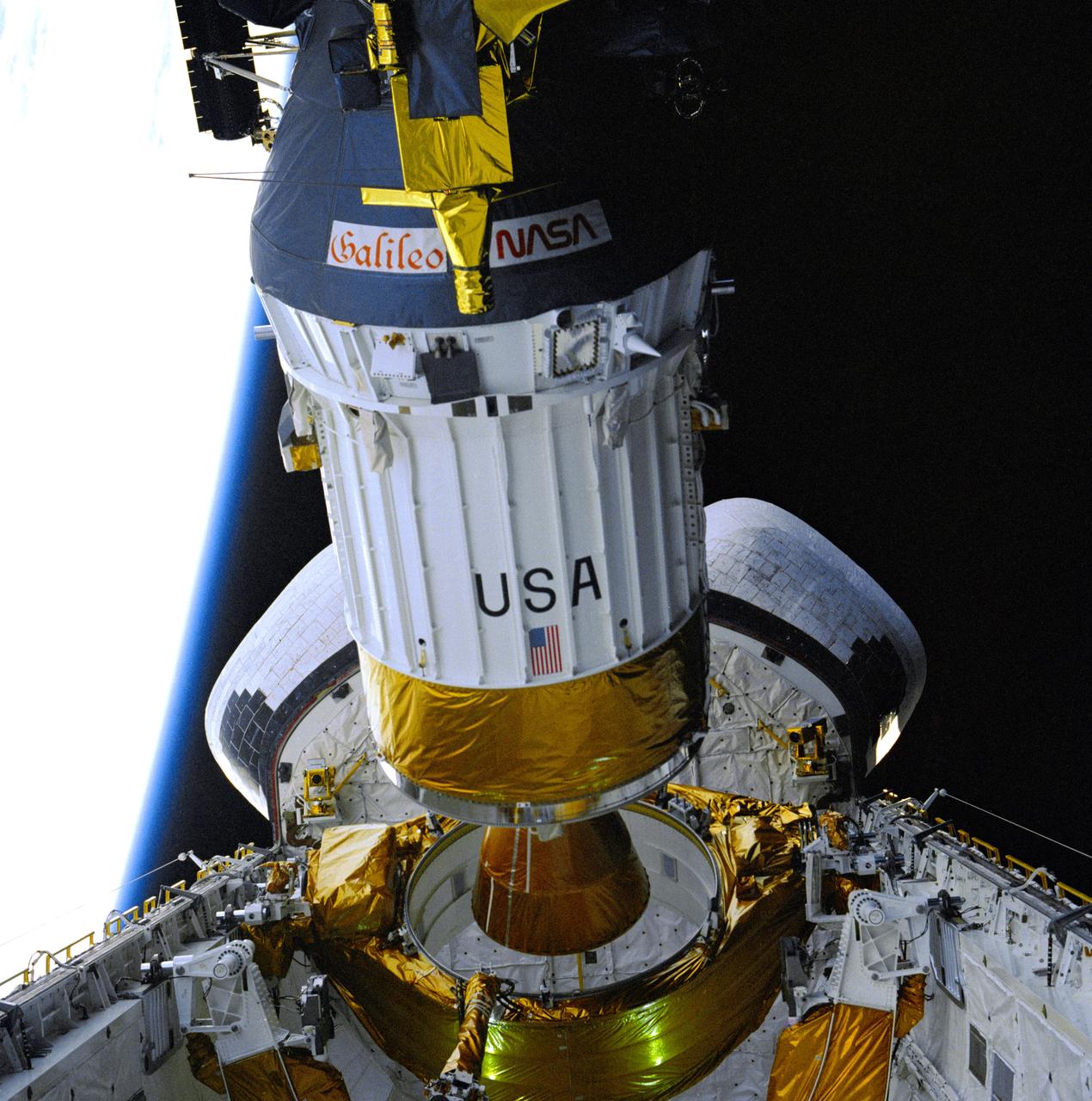
STS034-71-000AK (18 Oct 1989) --- Backdropped against the blackness of space, the Galileo spacecraft and its inertial upper stage (IUS) have just detached from a cradle-like device aboard the Earth-orbiting Space Shuttle Atlantis to begin a six-year journey to Jupiter. The five-member STS-34 crew deployed the satellite within six hours of achieving Earth orbit on Oct. 18, 1989. The scene was exposed with a 70mm handheld Hasselblad camera. Earth's horizon and a thin line representing its airglow and atmosphere are visible on the left side of the frame.
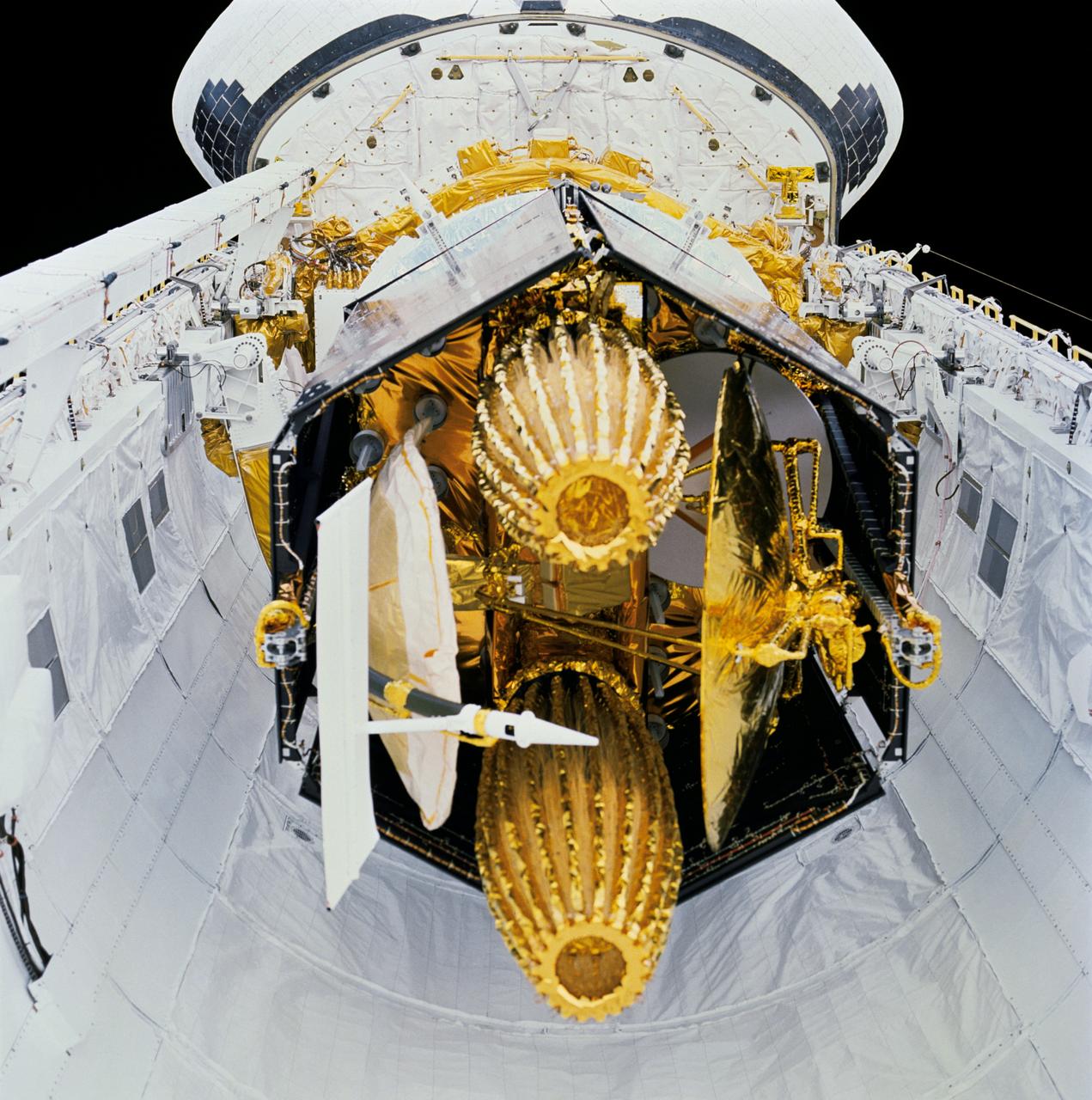
STS029-71-000AE (13-18 March 1989) --- STS-29 onboard view shows Space Shuttle Discovery's payload bay with tracking and data relay satellite D (TDRS-D) in stowed, pre-deployment position. In this head-on view, TDRS-D stowed components including single access #1 and #2, solar cell panels, SGL, S-Band omni antenna, and C-Band antenna are visible. TDRS-D rests in airborne support equipment (ASE) forward cradle and aft frame tilt actuator (AFTA). Discovery's aft bulkhead and orbital maneuvering system (OMS) pods are visible in the background.
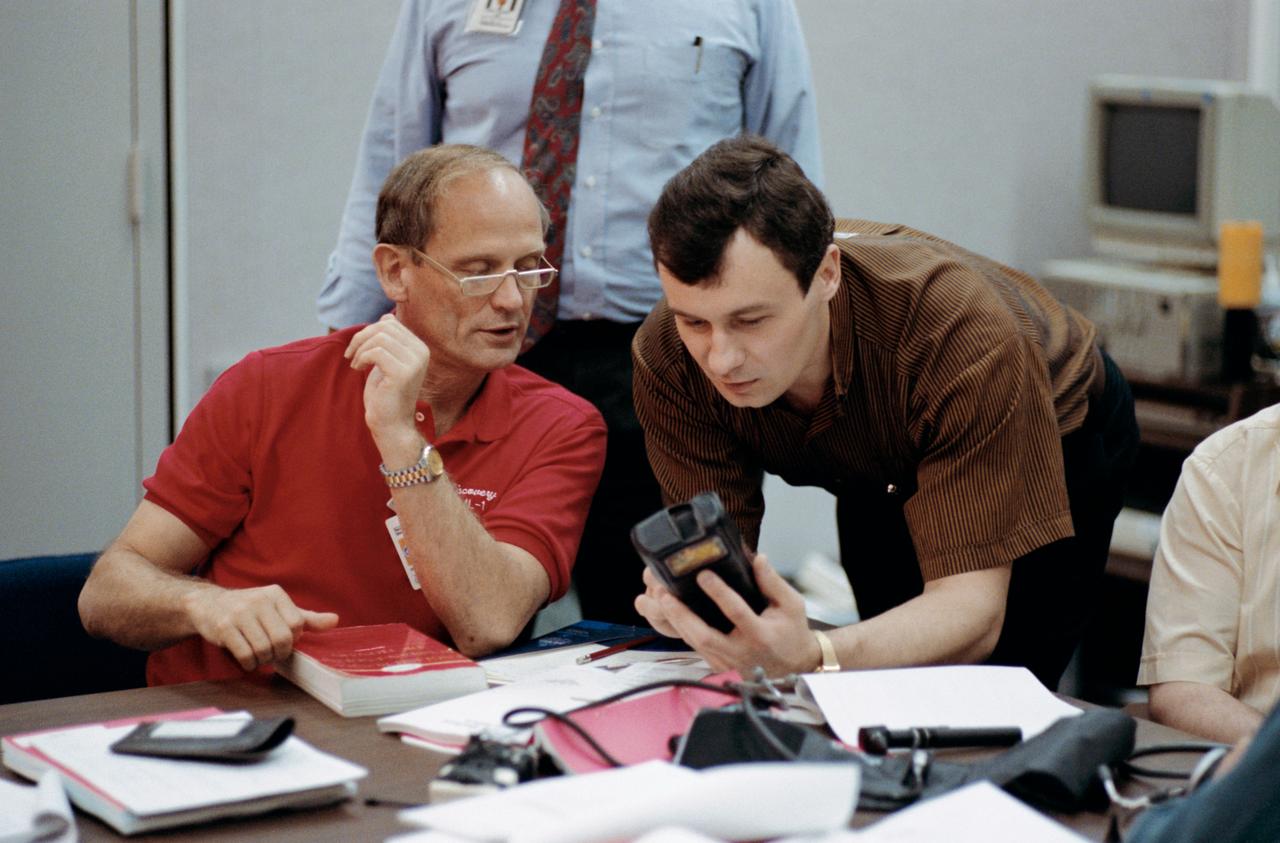
Mir 18 commander Vladimir N. Dezhurov, right, and fellow crew member, astronaut Norman E. Thagard, practice using a bar-code reader during medical operations training at JSC.
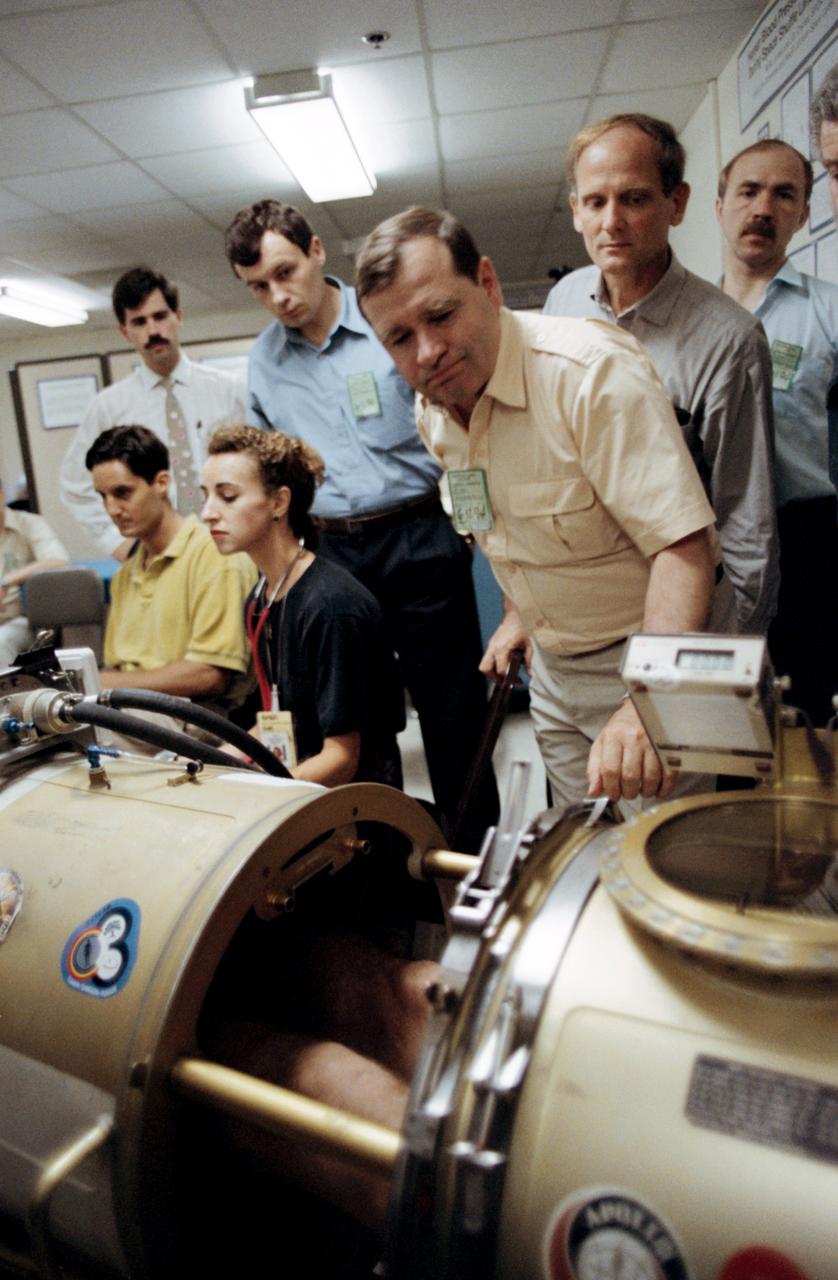
Astronaut Norman E. Thagard (right center), a guest researcher on Russia's Mir 18 mission, monitors a test of a subject (out of frame) in the Lower Body Negative Pressure (LBNP) device. Others pictured, left to right, are Todd Schlegel (seated) of the Medical Sciences Division at JSC, unidentified trainer, Linda Barrows of Krug; cosmonaut Vladimir N. Dezhurov, mission commander; cosmonaut Gennadiy M. Strekalov, Thagard and cosmonaut Alexsandr F. Poleshchuk, Mir 18 reserve flight engineer.
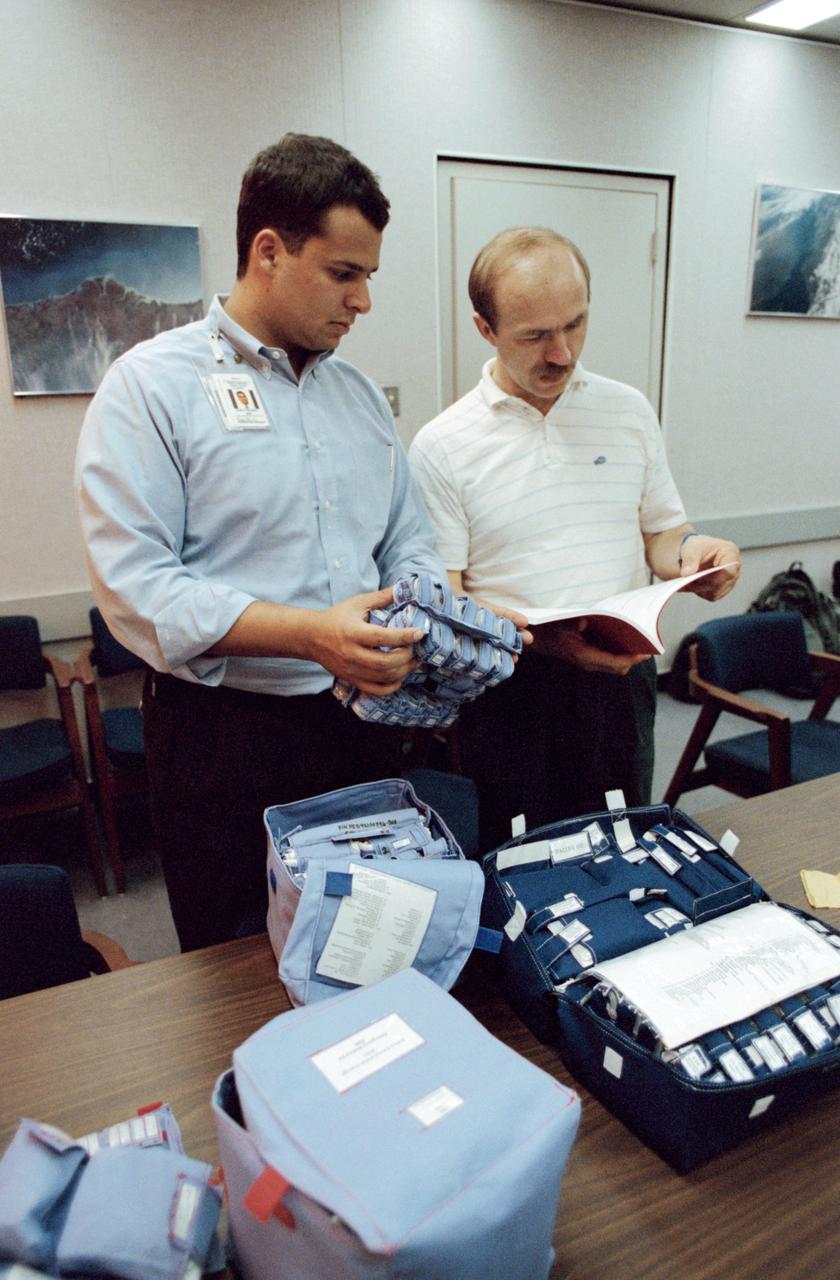
Cosmonaut Alexandr F. Poleshchuk (right) inventories medical supplies with Ezra D. Kucharz, medical operations trainer for Krug Life Sciences, Incorporated. Poleshchuk, a Mir reserve crew member, and a number of other cosmonauts and astronauts participating in the joint Russia - United States program were in Houston, Texas, to prepare for upcoming missions which involve crew members from the two nations.

The rising sun signifies the dawn of a new era of human Spaceflight, the first phase of the United States/Russian space partnership, Shuttle-Mir. Mir is shown in its proposed final on orbit configuration. The Shuttle is shown in a generic tunnel/Spacehab configuration. The Shuttle/Mir combination, docked to acknowledge the union of the two space programs, orbits over an Earth devoid of any definable features or political borders to emphasize Earth as the home planet for all humanity. The individual stars near the Space Shuttle and the Russian Mir Space Station represent the previous individual accomplishments of Russia's space program and that of the United States. The binary star is a tribute to the previous United States-Russian joint human Spaceflight program, the Apollo-Soyuz Test Project (ASTP). The flags of the two nations are symbolized by flowing ribbons of the national colors interwoven in space to represent the two nations joint exploration of space. NASA SHUTTLE and PKA MNP are shown in the stylized logo fonts of the two agencies that are conducting this program.
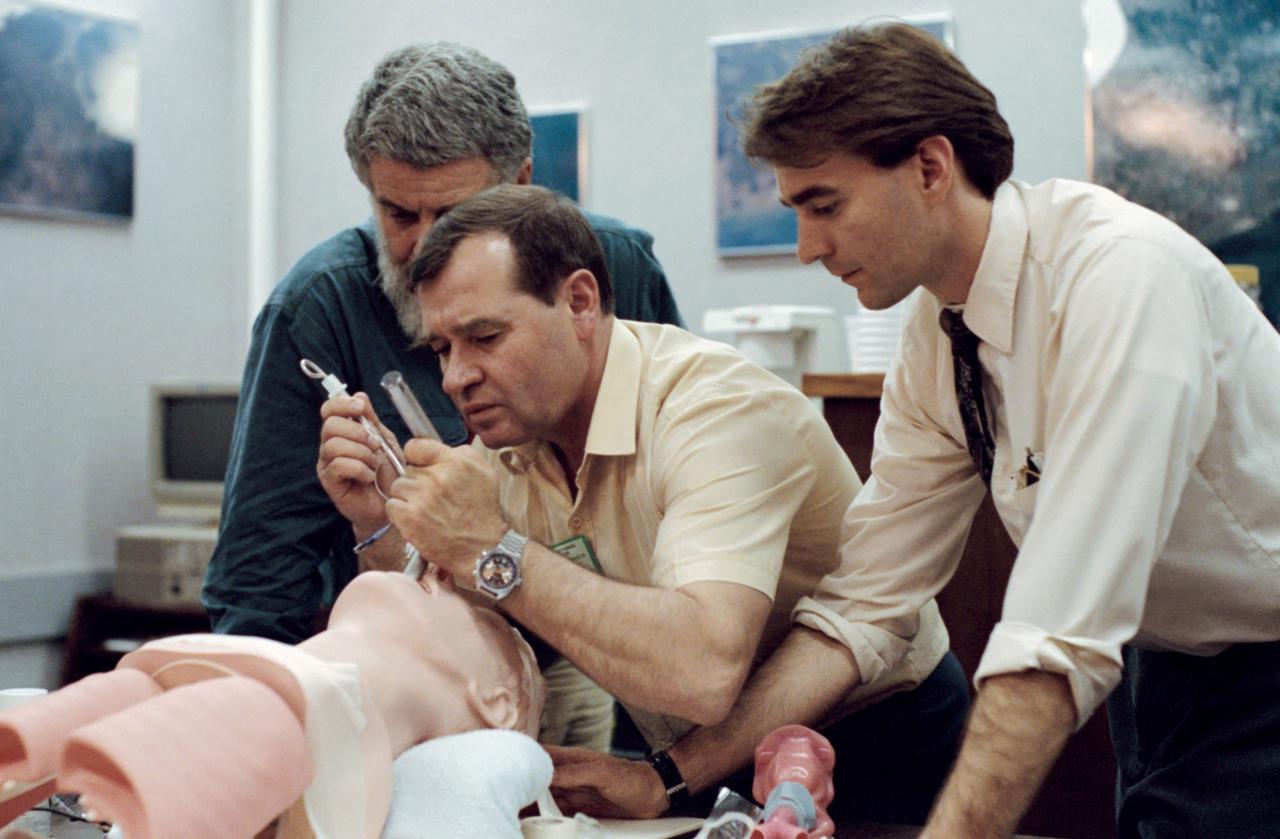
Mir 18 crewmember Gennadiy M. Strekalov, center, practicies an emergency medical procedure to maintain a patient airway during training at JSC. Looking on are Dave E. Ward (right), a JSC medical doctor, and an unidentified interpreter.
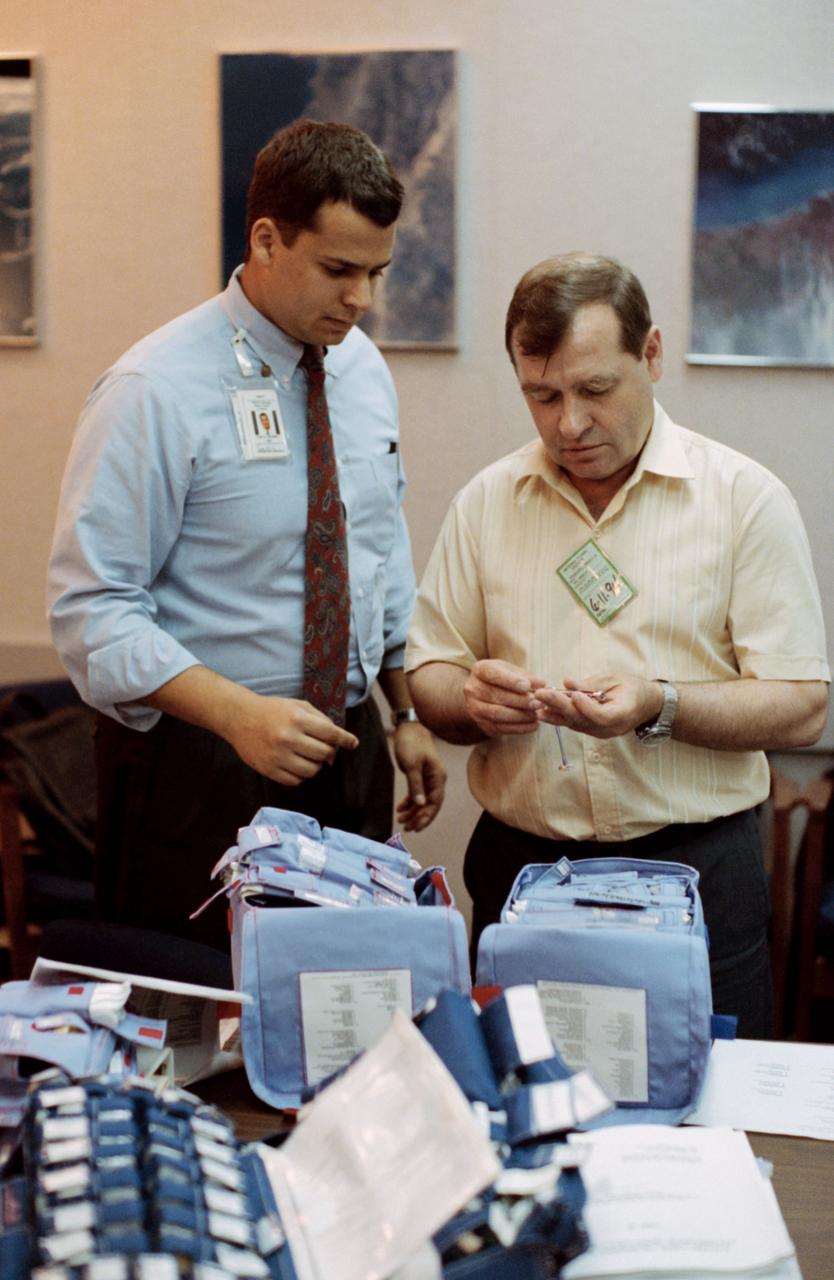
Cosmonaut Gennadiy M. Strekalov (right), Mir-18 flight engineer, is briefed on medical supplies by Ezra D. Kucharz, medical operations trainer for Krug Life Sciences, Incorporated. Strekalov and a number of other cosmonauts and astronauts participating in joint Russia - United States space missions are in Houston, Texas, to prepare for their upcoming missions.
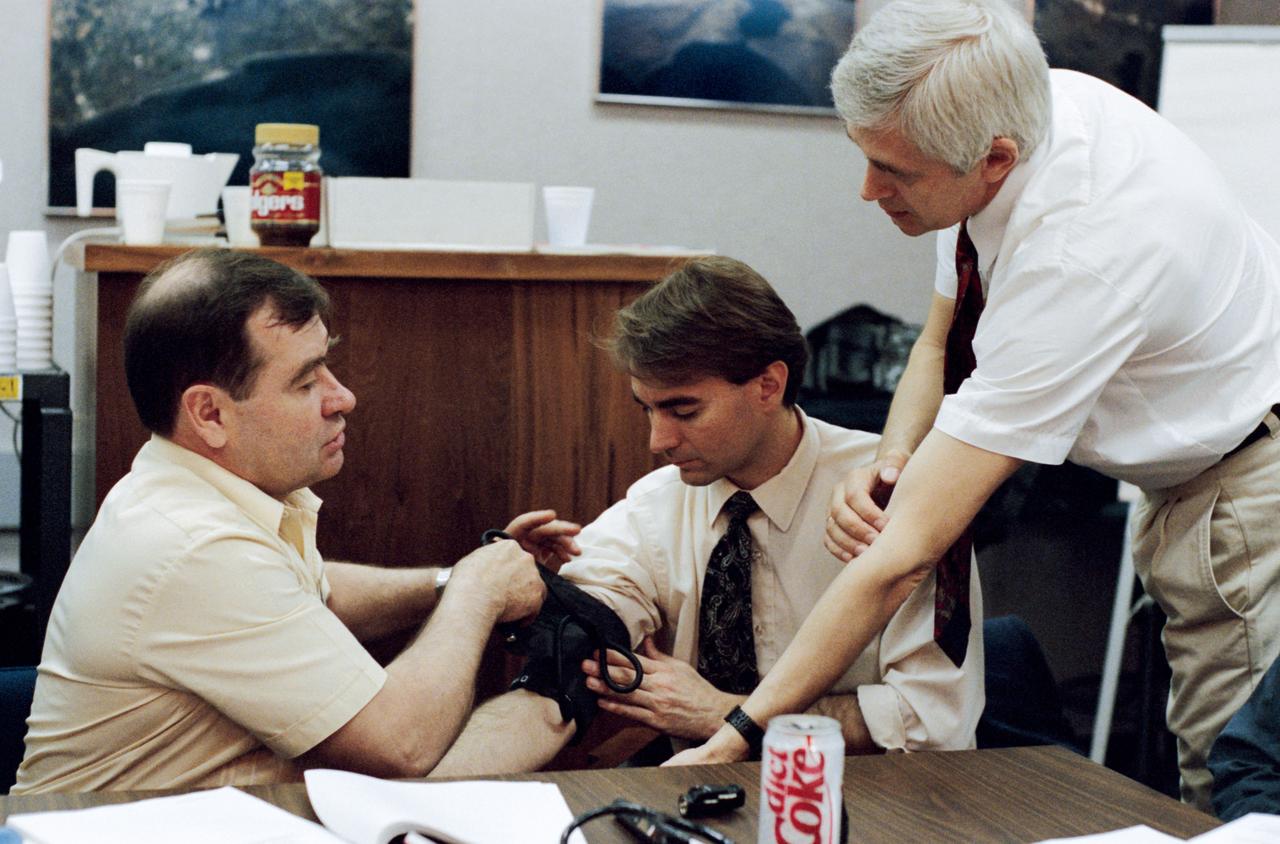
Using Dr. Dave E. Ward, a JSC physician, as a test subject, cosmonaut Gennadiy M. Strekalov (left), rehearses the taking of blood pressure. This is a service he will likely be performing a great deal next year when he boards Russia's Mir Space Station, in Earth-orbit, as Mir 18 flight engineer.
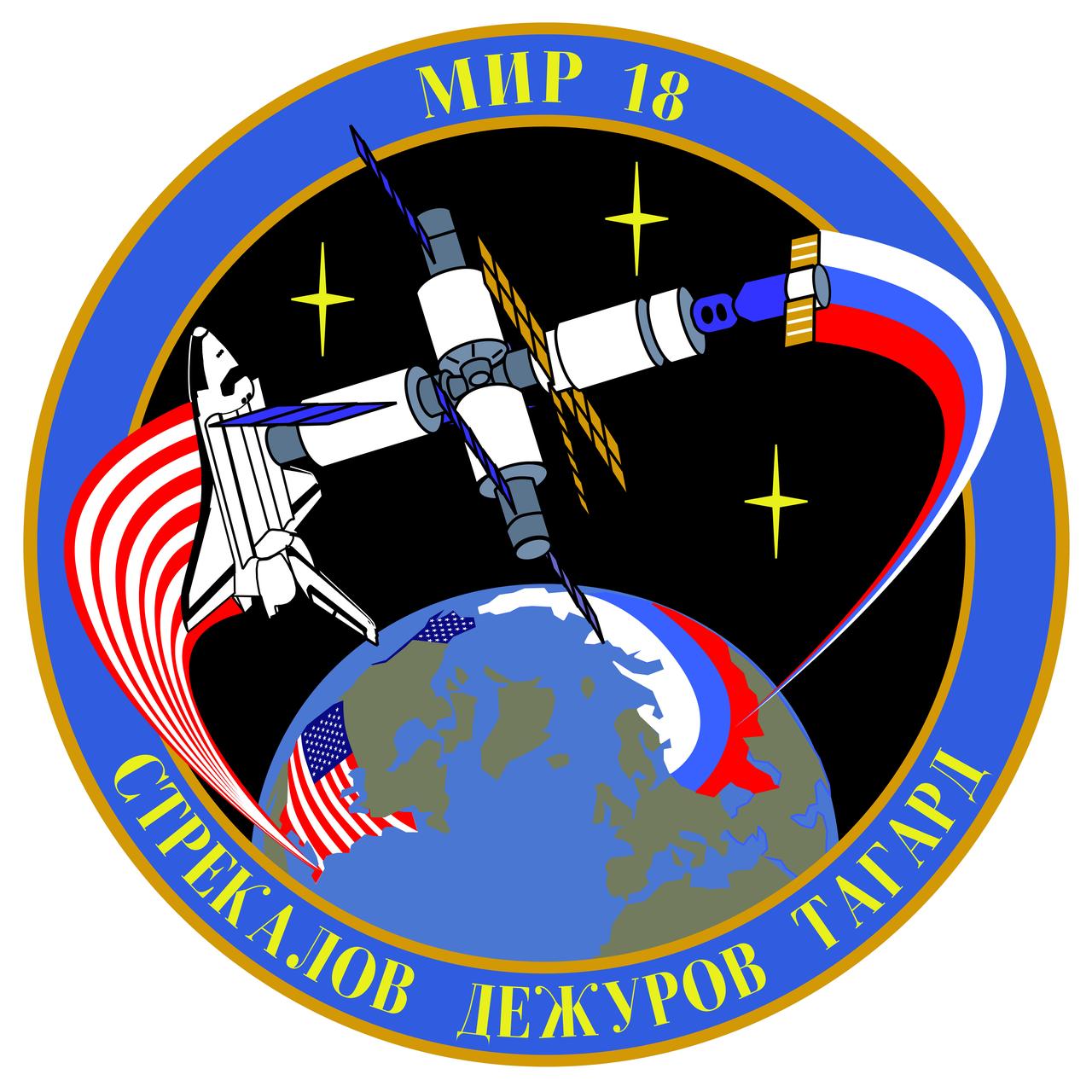
S94-36965 (20 Sept 1994) --- The rising sun signifies the dawn of a new era of human Spaceflight, the first phase of the U.S./Russian space partnership, Shuttle-Mir. Mir is shown in its proposed final on orbit configuration. The Shuttle is shown in a generic tunnel/Spacehab configuration. The Shuttle-Mir combination, docked to acknowledge the union of the two space programs, orbits over an Earth devoid of any definable features or political borders to emphasize Earth as the home planet for all humanity. The individual stars near the Shuttle and the Mir station represent the previous individual accomplishments of Russia's space program and that of the U.S. The binary star is a tribute to the previous U.S.-Russian joint human Spaceflight program, the Apollo-Soyuz Test Project. The flags of the two nations are symbolized by flowing ribbons of the national colors interwoven in space to represent the two nations joint exploration of space. NASA SHUTTLE and PKA MNP are shown in the stylized logo fonts of the two agencies that are conducting this program.
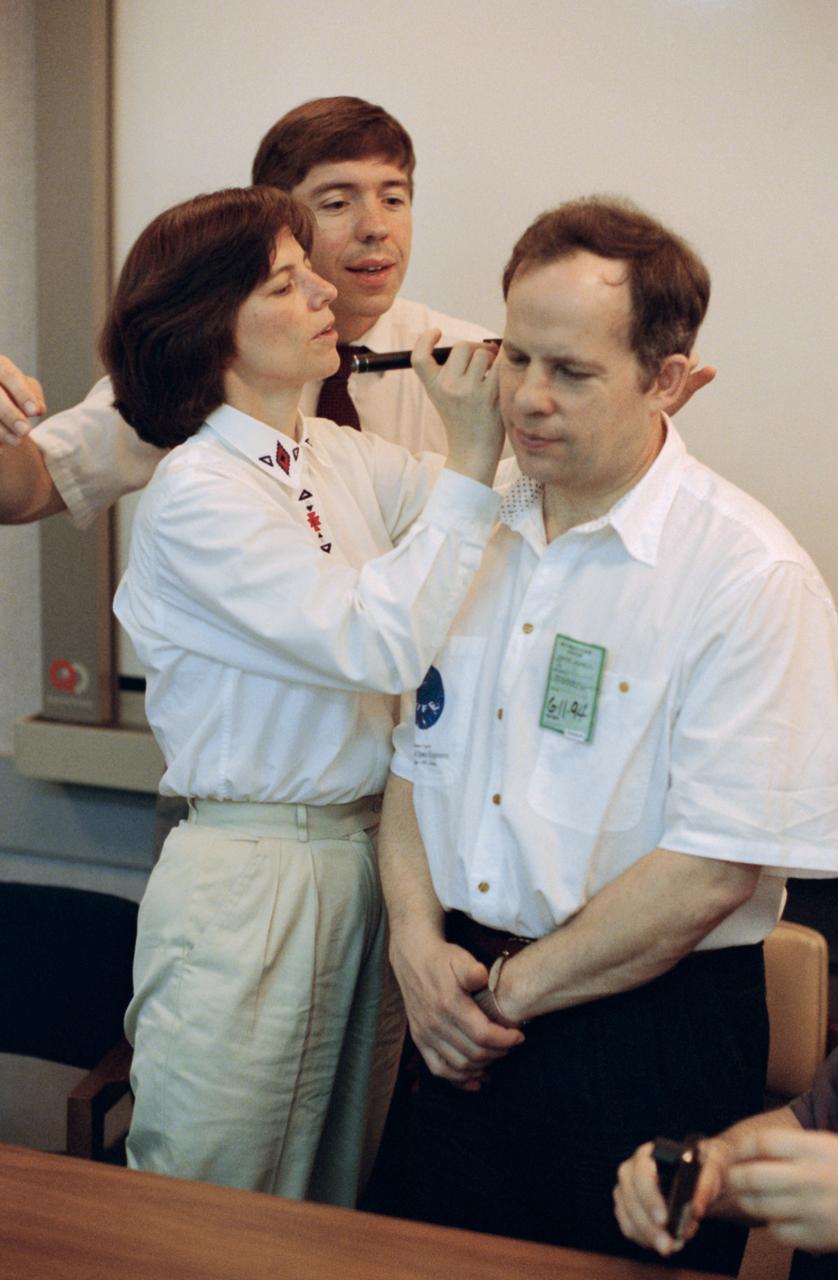
S94-35071 (17 June 1994) --- Flight surgeon Mike Barrett looks on as astronaut Bonnie J. Dunbar conducts a physical examination on cosmonaut Anatoly Solovyov. Crew members for the joint Space Shuttle/Mir missions are in the midst of three weeks' medical operations training for their cooperative flights.
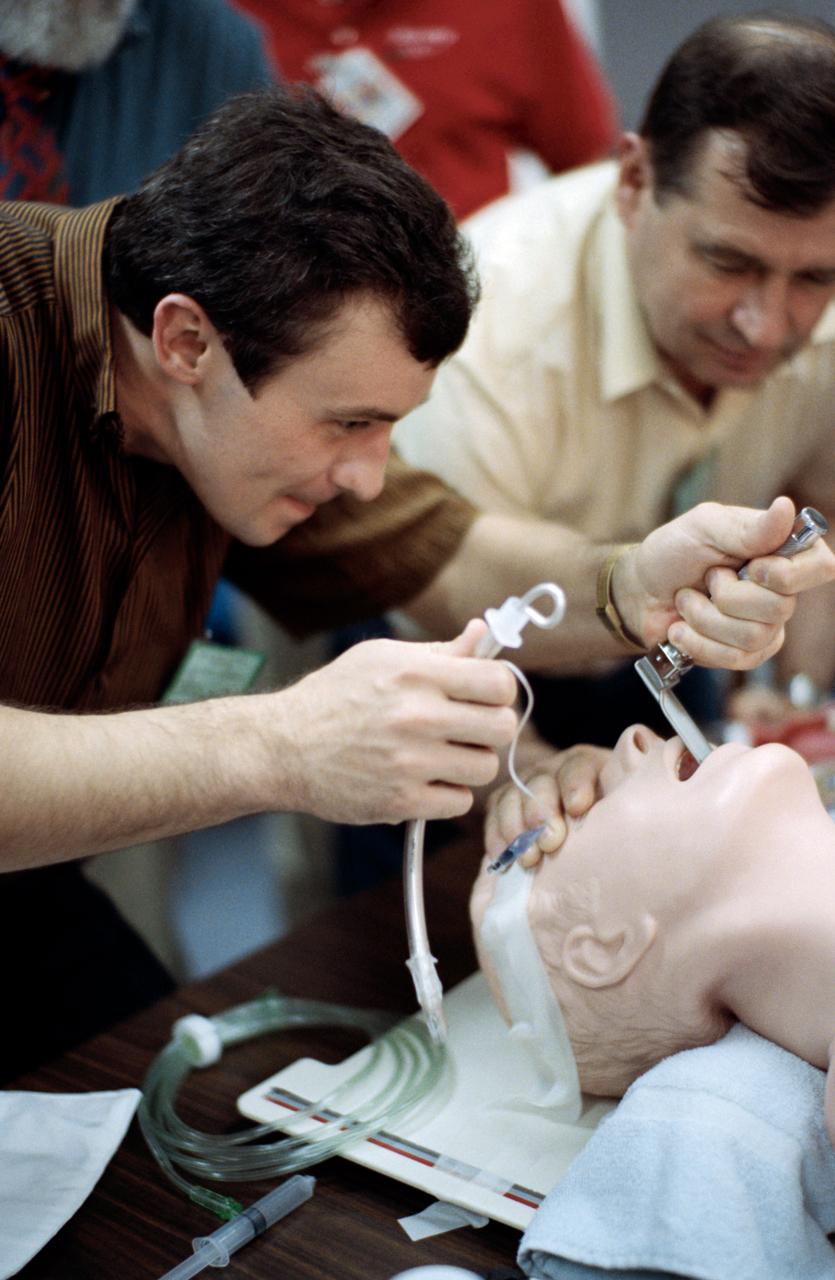
Cosmonaut Vladimir N. Dezhurov (left), Mir 18 mission commander, among a group of Russians in the United States to participate in training for the joint Russia - United States space missions, conducts an intubation on a dummy. Dezhurov, along with Mir 18 flight engineer Gennadiy M. Strekalov (pictured) prepare for upcoming missions which involve crew members from the two nations.
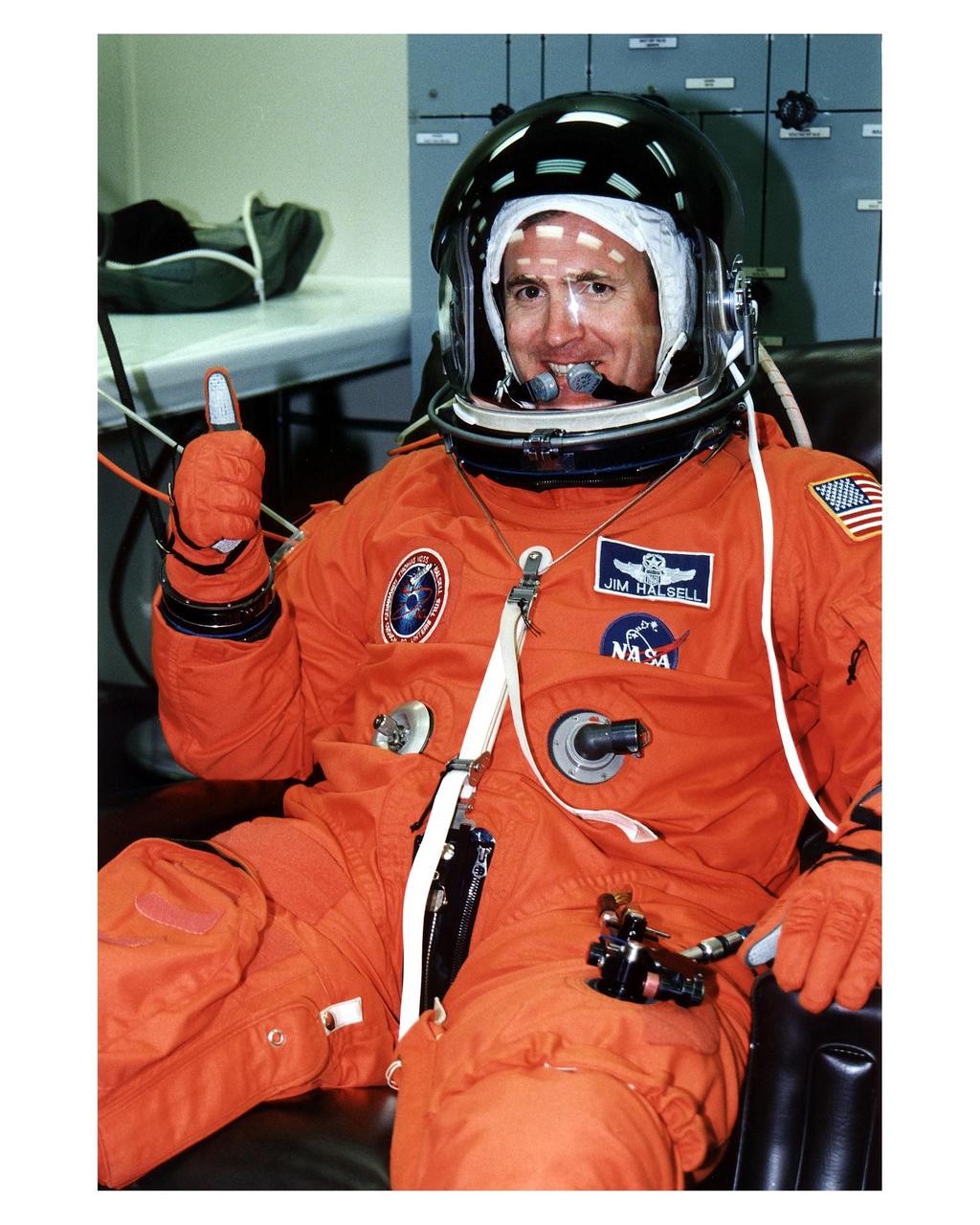
STS-83 Mission Commander James D. Halsell, Jr., gives a thumbs-up after he is assisted into his launch/entry suit in the Operations and Checkout (O&C) Building. Halsell is on his third space flight, having served as pilot of both STS-74 and STS-65. He is a lieutenant colonel in the Air Force and a former SR-71 Blackbird test pilot and holds master's degrees in management and space operations. Halsell will have responsibility for the success of the mission and will operate and maintain Columbia during the Red, or second shift. He will also assist with a materials science experiment and a protein crystal growth payload during the 16-day mission. Halsell and six fellow crew members will shortly depart the O&C and head for Launch Pad 39A, where the Space Shuttle Columbia will lift off during a launch window that opens at 2:00 p.m. EST, April 4
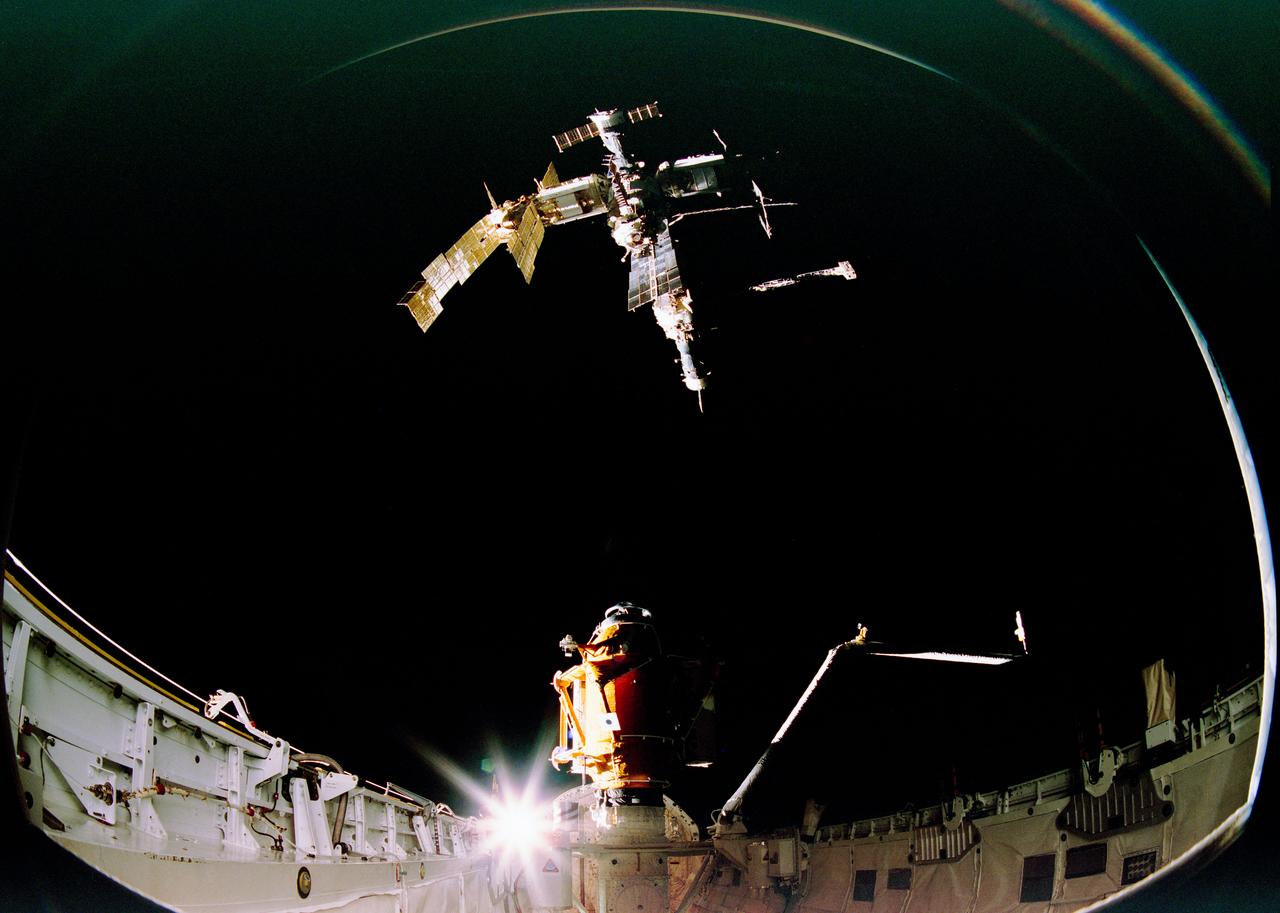
S95-22092 (15 Nov 1995) --- The Space Shuttle Atlantis moves within 80 feet of Russia's Mir Space Station during rendezvous and docking operations. During the STS-74 mission, the crew used an IMAX camera to document the Space Shuttle Atlantis' rendezvous and docking with the Mir Space Station. The 65mm camera system was located in the Atlantis' cargo bay and provided a unique fish-eye perspective. These images were selected from footage that will be incorporated in a large-format feature film about NASA's cooperative program with the Russians. NASA has flown IMAX camera systems on many Shuttle missions, including the recent STS-63 Shuttle-Mir rendezvous and STS-71 Shuttle-Mir docking. Film from previous missions was used to create the productions The Dream is Alive, The Blue Planet, and Destiny in Space.
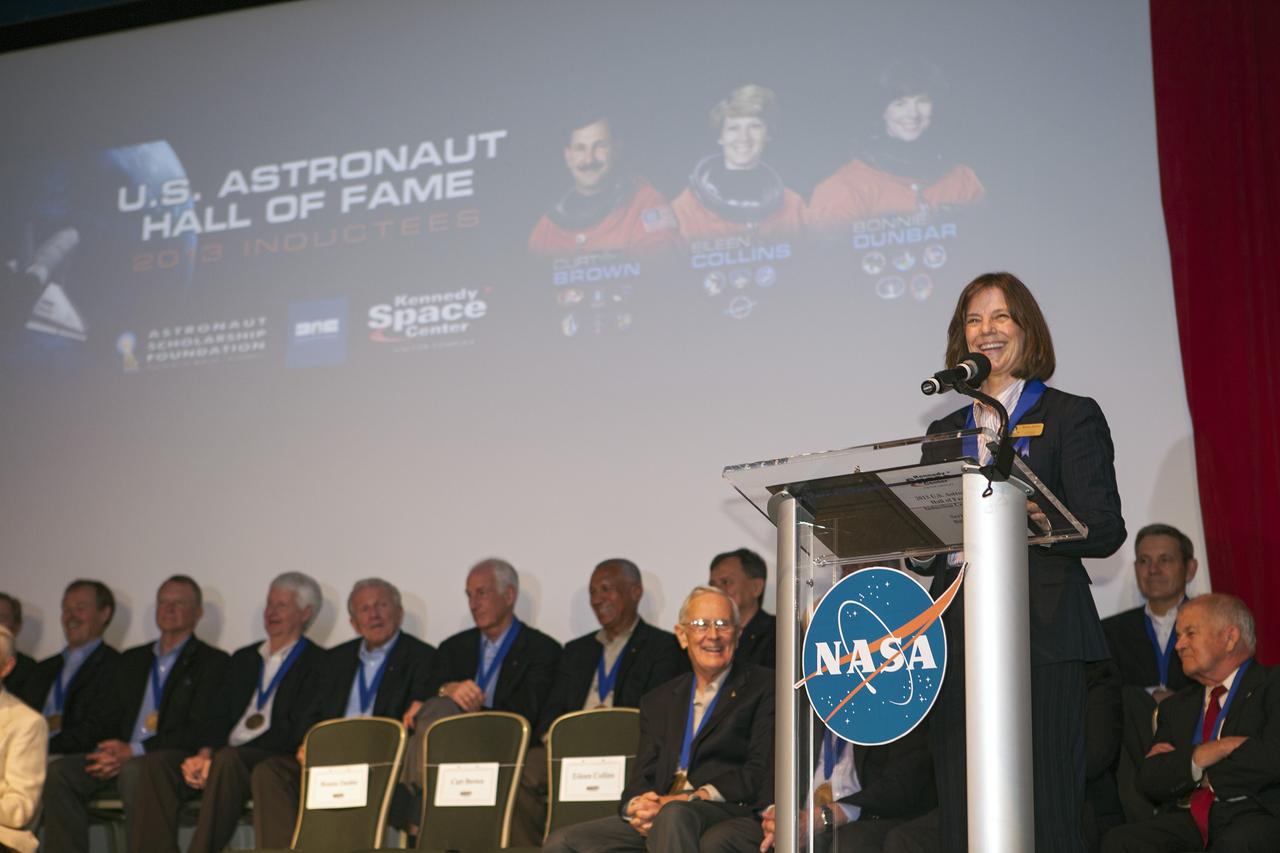
CAPE CANAVERAL, Fla. – At NASA’s Kennedy Space Center Visitor Complex in Florida, shuttle astronaut Bonnie Dunbar speaks after being inducted into the U.S. Astronaut Hall of Fame AHOF. Dunbar received NASA’s Outstanding Leadership Award in 1993 and NASA’s Exceptional Service Medal in 1998 and 1991. During her career with NASA, she served as a mission specialist and a payload commander. Dunbar logged 1,208 hours in space, and her spaceflights include STS 61-A, STS-32, STS-50, STS-71 and STS-89. Shuttle astronauts Curt Brown and Eileen Collins also were inducted into the AHOF. This induction is the twelfth group of space shuttle astronauts named to the AHOF, and the first time two women are inducted at the same time. The year’s inductees were selected by a committee of current Hall of Fame astronauts, former NASA officials, historians and journalists. The selection process is administered by the Astronaut Scholarship Foundation. For more on the U.S. Astronaut Hall of Fame, go to http://www.kennedyspacecenter.com/astronaut-hall-of-fame.aspx For more on the Astronaut Scholarship Foundation, go to http://astronautscholarship.org/ Photo credit: NASA/ Kim Shiflett
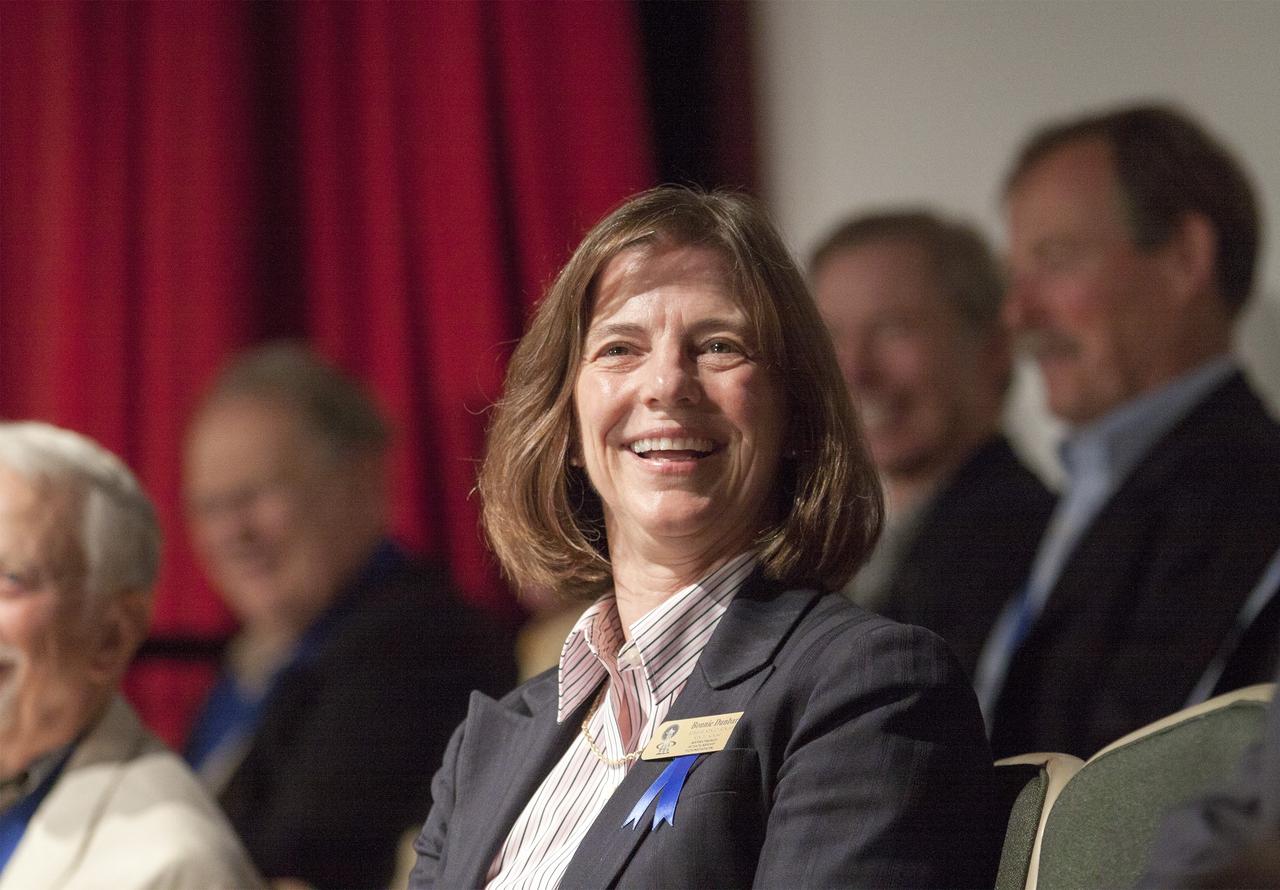
CAPE CANAVERAL, Fla. – At NASA’s Kennedy Space Center Visitor Complex in Florida, shuttle astronaut Bonnie Dunbar listens as she is being introduced for induction into the U.S. Astronaut Hall of Fame AHOF. Dunbar received NASA’s Outstanding Leadership Award in 1993 and NASA’s Exceptional Service Medal in 1998 and 1991. During her career with NASA, she served as a mission specialist and a payload commander. Dunbar logged 1,208 hours in space, and her spaceflights include STS 61-A, STS-32, STS-50, STS-71 and STS-89. Shuttle astronauts Curt Brown and Eileen Collins also were inducted into the AHOF. This induction is the twelfth group of space shuttle astronauts named to the AHOF, and the first time two women are inducted at the same time. The year’s inductees were selected by a committee of current Hall of Fame astronauts, former NASA officials, historians and journalists. The selection process is administered by the Astronaut Scholarship Foundation. For more on the U.S. Astronaut Hall of Fame, go to http://www.kennedyspacecenter.com/astronaut-hall-of-fame.aspx For more on the Astronaut Scholarship Foundation, go to http://astronautscholarship.org/ Photo credit: NASA/ Kim Shiflett
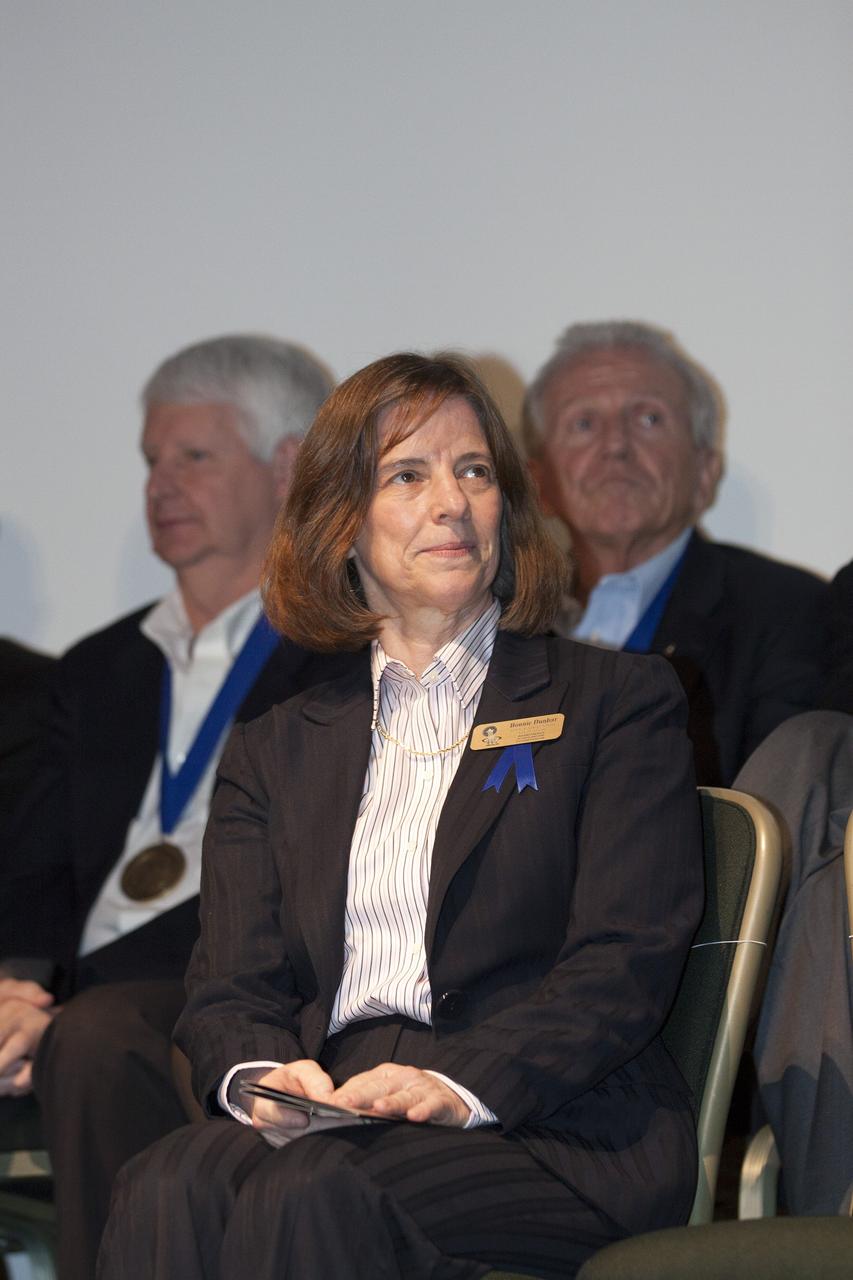
CAPE CANAVERAL, Fla. – At NASA’s Kennedy Space Center Visitor Complex in Florida, shuttle astronaut Bonnie Dunbar listens as she is being introduced for induction into the U.S. Astronaut Hall of Fame AHOF. Dunbar received NASA’s Outstanding Leadership Award in 1993 and NASA’s Exceptional Service Medal in 1998 and 1991. During her career with NASA, she served as a mission specialist and a payload commander. Dunbar logged 1,208 hours in space, and her spaceflights include STS 61-A, STS-32, STS-50, STS-71 and STS-89. Shuttle astronauts Curt Brown and Eileen Collins also were inducted into the AHOF. This induction is the twelfth group of space shuttle astronauts named to the AHOF, and the first time two women are inducted at the same time. The year’s inductees were selected by a committee of current Hall of Fame astronauts, former NASA officials, historians and journalists. The selection process is administered by the Astronaut Scholarship Foundation. For more on the U.S. Astronaut Hall of Fame, go to http://www.kennedyspacecenter.com/astronaut-hall-of-fame.aspx For more on the Astronaut Scholarship Foundation, go to http://astronautscholarship.org/ Photo credit: NASA/ Kim Shiflett
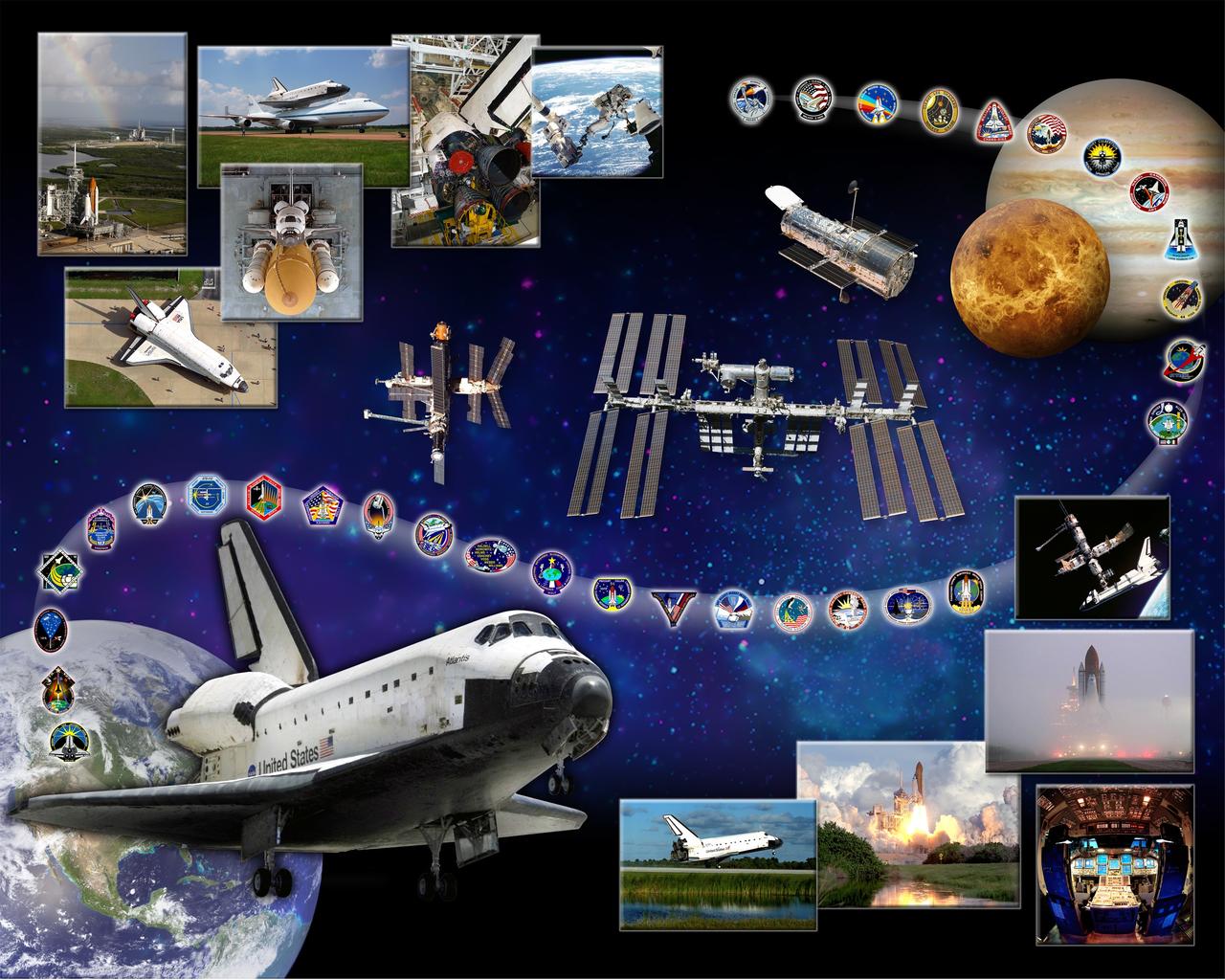
CAPE CANAVERAL, Fla. -- This orbiter tribute of space shuttle Atlantis, or OV-104, hangs in Firing Room 4 of the Launch Control Center at NASA's Kennedy Space Center in Florida. In the lower-left corner, it features Atlantis soaring above Earth and threaded through the design are the mission patches for each of Atlantis’ flights. Atlantis' accomplishments include seven missions to the Russian space station Mir and several assembly, construction and resupply missions to the International Space Station. Atlantis also flew the last Hubble Space Telescope servicing mission on STS-125. In the tribute, the planet Venus represents the Magellan probe being deployed during STS-30, and Jupiter represents the Galileo probe being deployed during STS-34. The inset photos illustrate various aspects of shuttle processing as well as significant achievements, such as the glass cockpit and the first shuttle docking with Mir during STS-71. The inset photo in the upper-left corner shows a rainbow over Atlantis on Launch Pad 39A and shuttle Endeavour on Launch Pad 39B at Kennedy. Endeavour was the assigned vehicle had Atlantis’ STS-125 mission needed rescue, and this was the last time both launch pads were occupied at the same time. The stars in the background represent the many people who have worked with Atlantis and their contributions to the vehicle’s success. Graphic design credit: NASA/Amy Lombardo
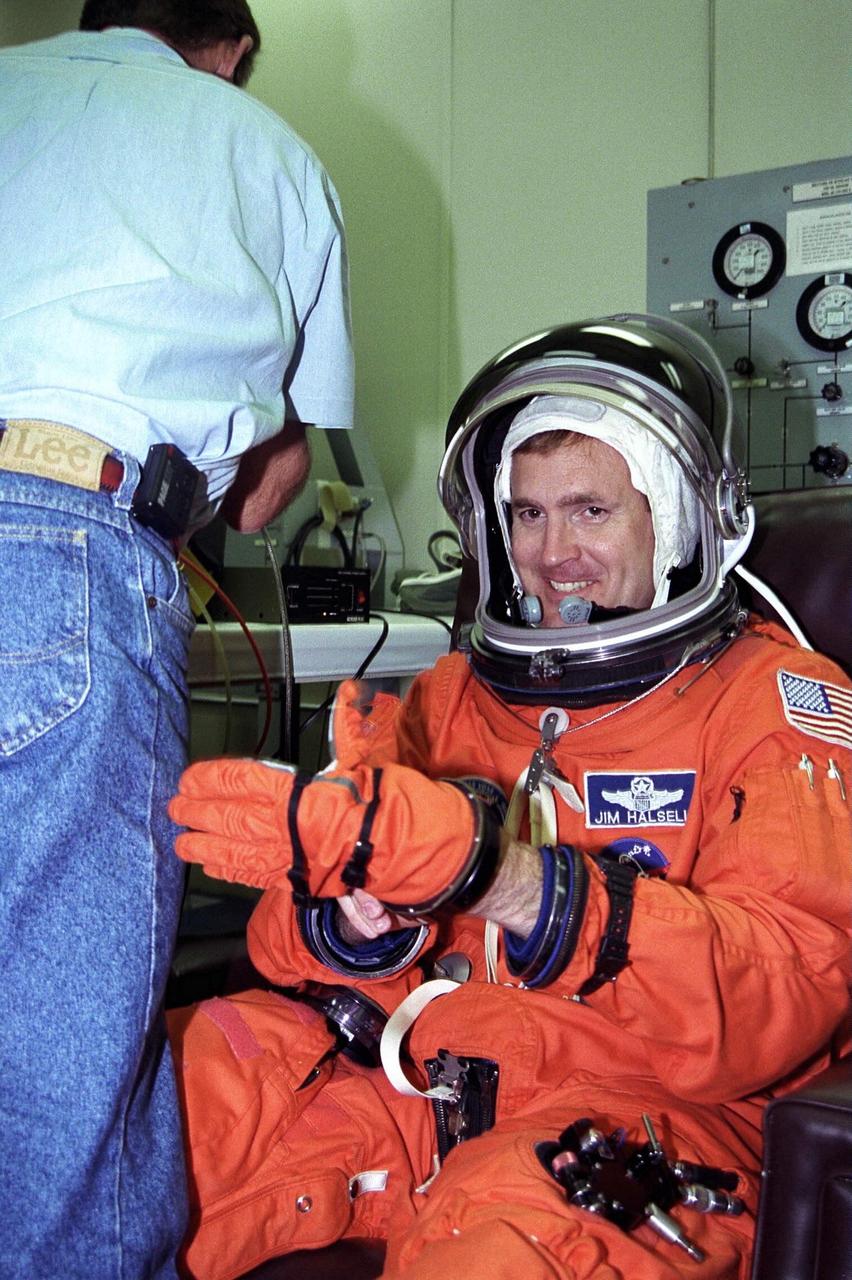
STS-94 Mission Commander James D. Halsell, Jr., puts his left glove on while he is assisted into his launch/entry suit in the Operations and Checkout (O&C) Building. Halsell is on his fourth space flight, having served as commander of STS-83 and pilot of both STS-74 and STS-65. He is a lieutenant colonel in the Air Force and a former SR-71 Blackbird test pilot and holds master’s degrees in management and space operations. Halsell will have responsibility for the success of the mission and will operate and maintain Columbia during the Red, or second shift. He will also assist with a materials science experiment and a protein crystal growth payload during the 16-day mission. Halsell and six fellow crew members will shortly depart the O&C and head for Launch Pad 39A, where the Space Shuttle Columbia will lift off during a launch window that opens at 1:50 p.m. EDT, July 1. The launch window was opened 47 minutes early to improve the opportunity to lift off before Florida summer rain showers reached the space center
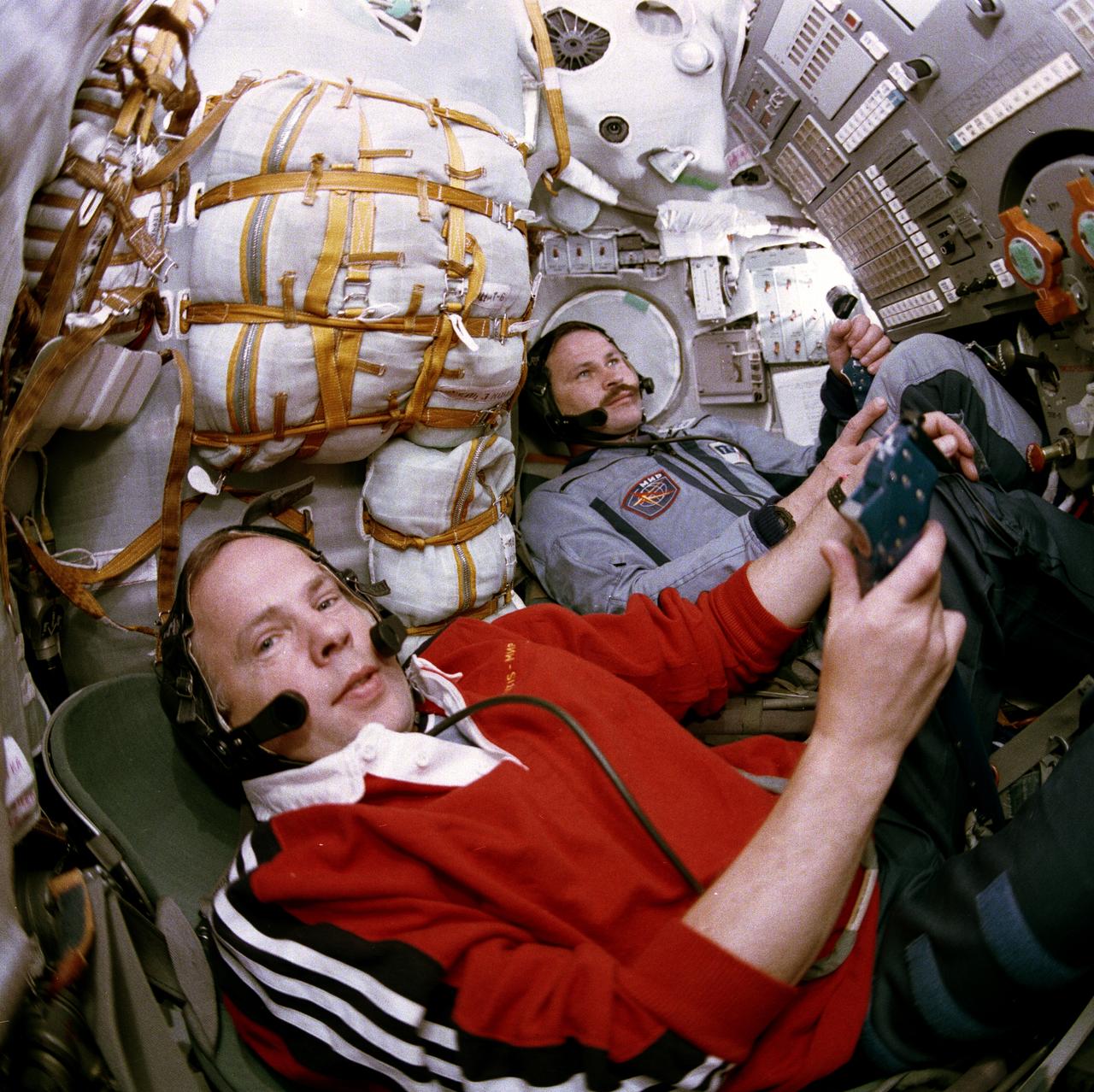
STS071-763-007 (27 June-7 July 1995) --- Onboard the docked Soyuz spacecraft, cosmonauts Anatoly Y. Solovyev (left) and Nikolai M. Budarin, Mir 19 commander and flight engineer, respectively, conduct a checkout of communications systems. The two represent the new in a change of guard aboard Russia's Mir Space Station, as Mir-18 astronaut Norman E. Thagard and two Mir-18 cosmonauts prepare to come back to Earth with the STS-71 crew aboard the space shuttle Atlantis. Later in the joint mission, Solovyev and Budarin backed the Soyuz spacecraft away from the Mir/Atlantis tandem to allow for the space shuttle Atlantis to undock with its crew of six astronauts and two cosmonauts aboard.
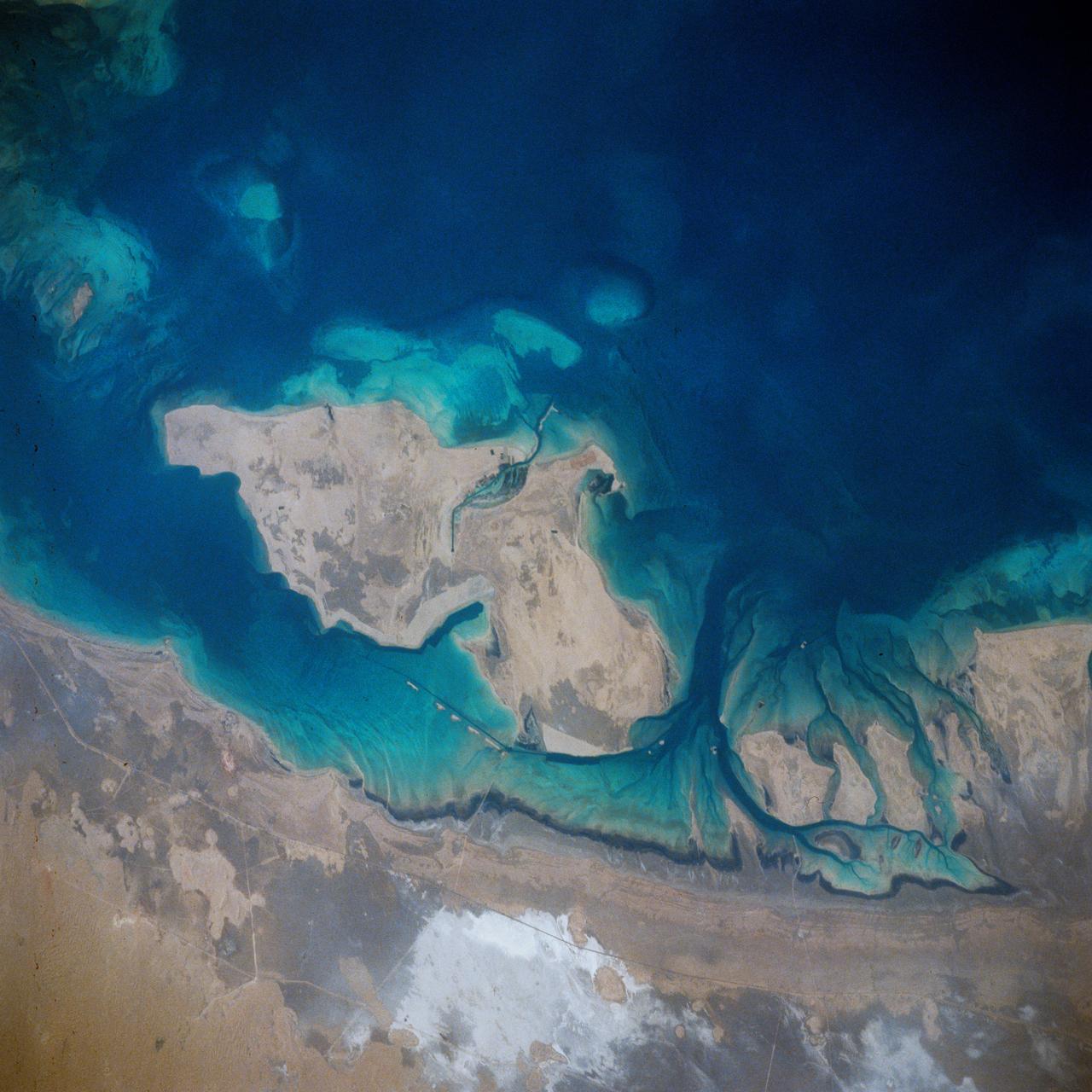
STS039-71-088 (28 April-6 May 1991) --- A handheld 70mm frame of the southern Persian Gulf area. The island in the middle of the frame is Al Jirab, 30 miles west of Abu Dhabi in the United Arab Emirates. On the mainland beaches opposite the island, a thick and continuous black fringe of oil can be seen as a line. Photo experts studying the STS 39 photography have not yet ascertained the source of the oil. They disclosed that if the oil does in fact stem from damaged Kuwaiti offshore oil fields, the slick has been blown southward at least 460 miles. The city of Tarif is visible in the affected area. Lighter brown slicks can be seen offshore. A causeway joins Al Jirab to the mainland and a dredged ship channel with its associated islands can be seen west of the causeway.
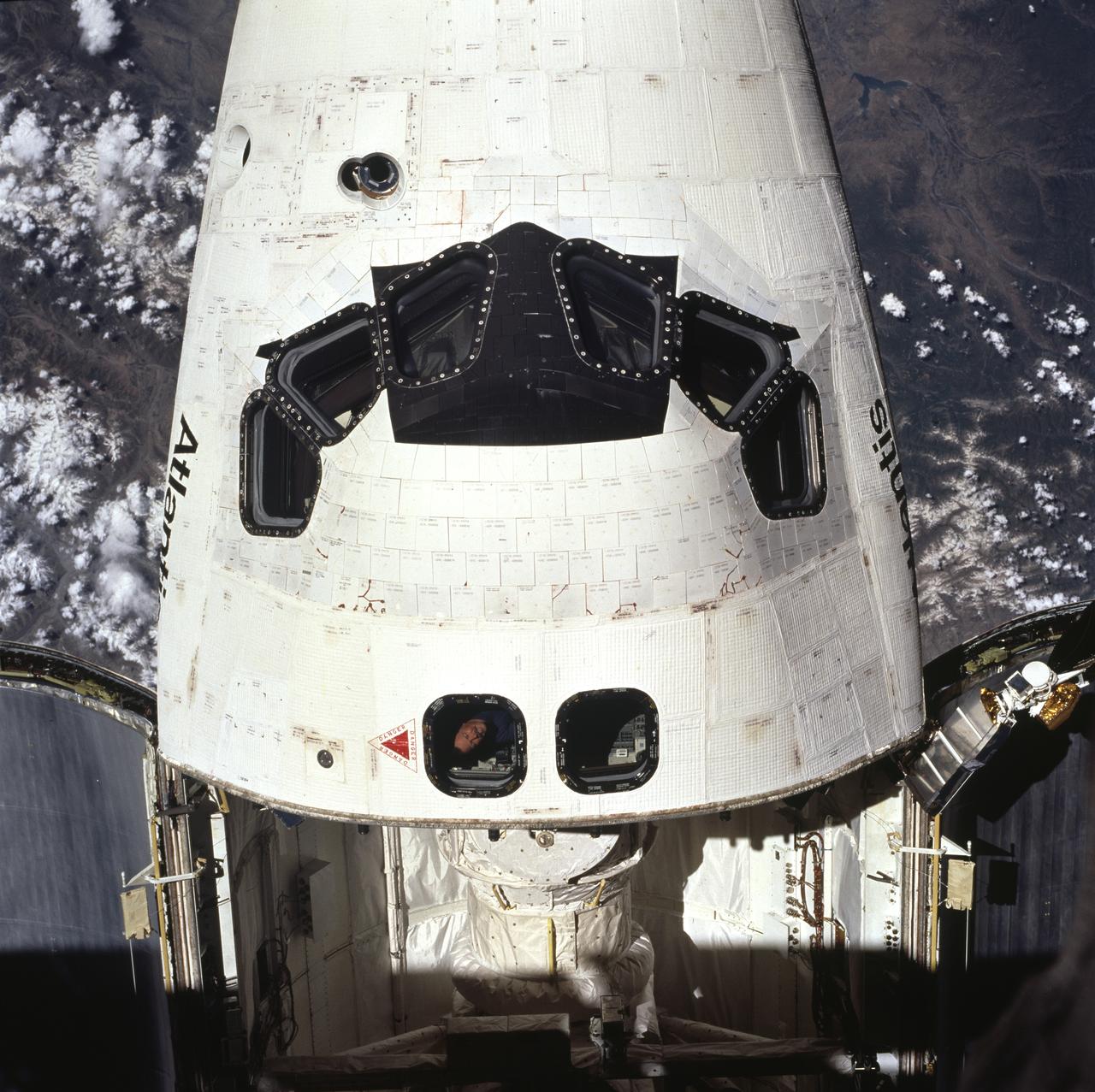
STS071-723-059 (27 June-7 July 1995) --- Docked already with Russia's Mir Space Station, the space shuttle Atlantis, with its crew cabin most prominent, is partially visible through a window on the station. A 70mm camera, carried into space by the crew aboard Atlantis, was used to expose the image. Above astronaut Robert L. Gibson's, STS-71 commander, head can be seen the tunnel leading to Spacelab's Science Module in Atlantis' cargo bay. A port in the tunnel enabled the seven crew members to visit Mir and it allowed the three Mir-18 crewmembers, in space since March of this year, access to Spacelab. That module was quite busy with tests and data collection involving the three until Atlantis brought them home on July 7, 1995.
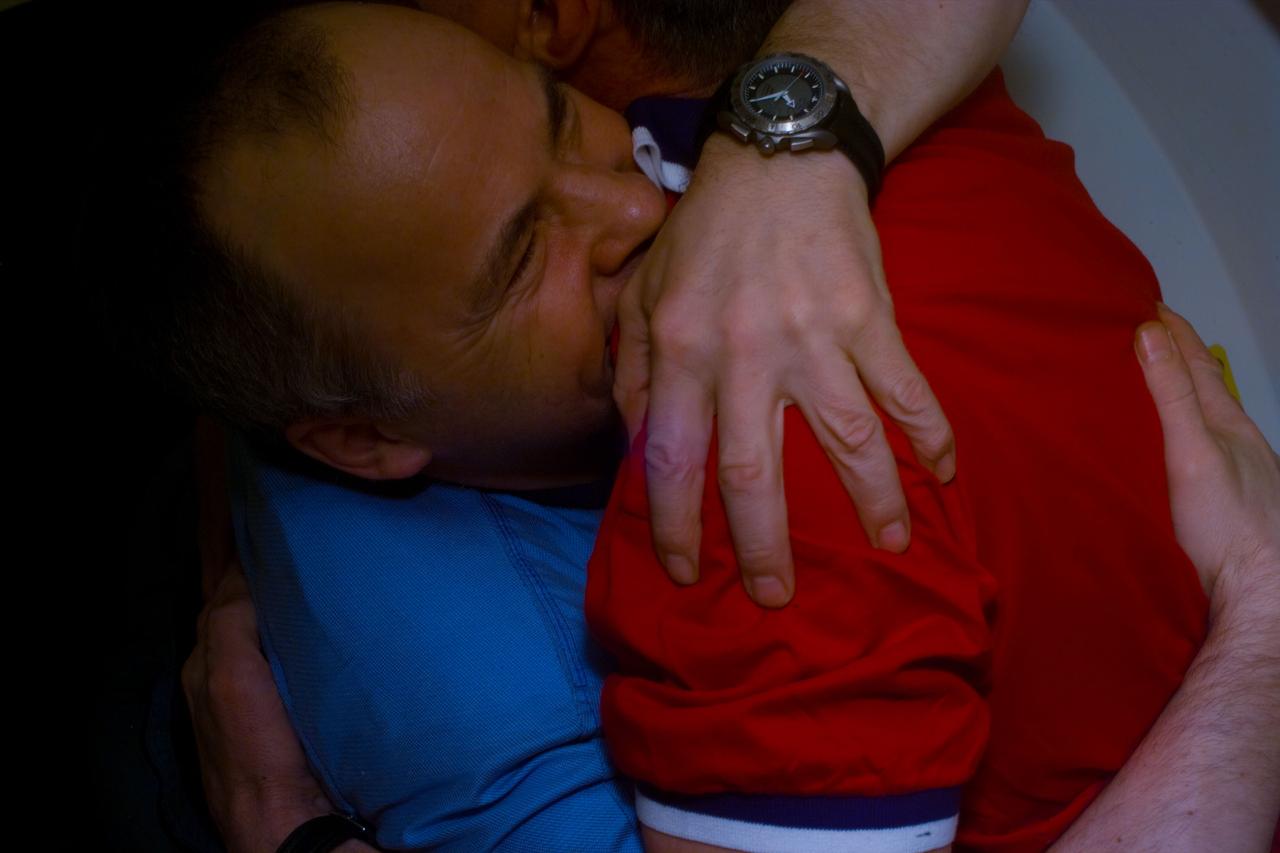
S89-E-5171 (24 Jan 1998) --- Just seconds after hatch opening, the Space Shuttle Endeavour and Russian Mir Space Station commanders are reunited. At left is cosmonaut Anatoliy Y. Solovyev. Astronaut Terrence W. (Terry) Wilcutt's (right) crew includes astronaut Andrew S.W. Thomas who will remain aboard Mir for several months' research as the final U.S. astronaut cosmonaut guest researcher to do so, as the United States and Russia prepare for the onset of the era of International Space Station (ISS). Solovyev was a member of the STS-71 crew which marked the first of the nine planned NASA-Mir link-ups. The photograph was taken with a 35mm Electronic Still Camera (ESC) at 22:35:59 GMT, January 24, 1998.
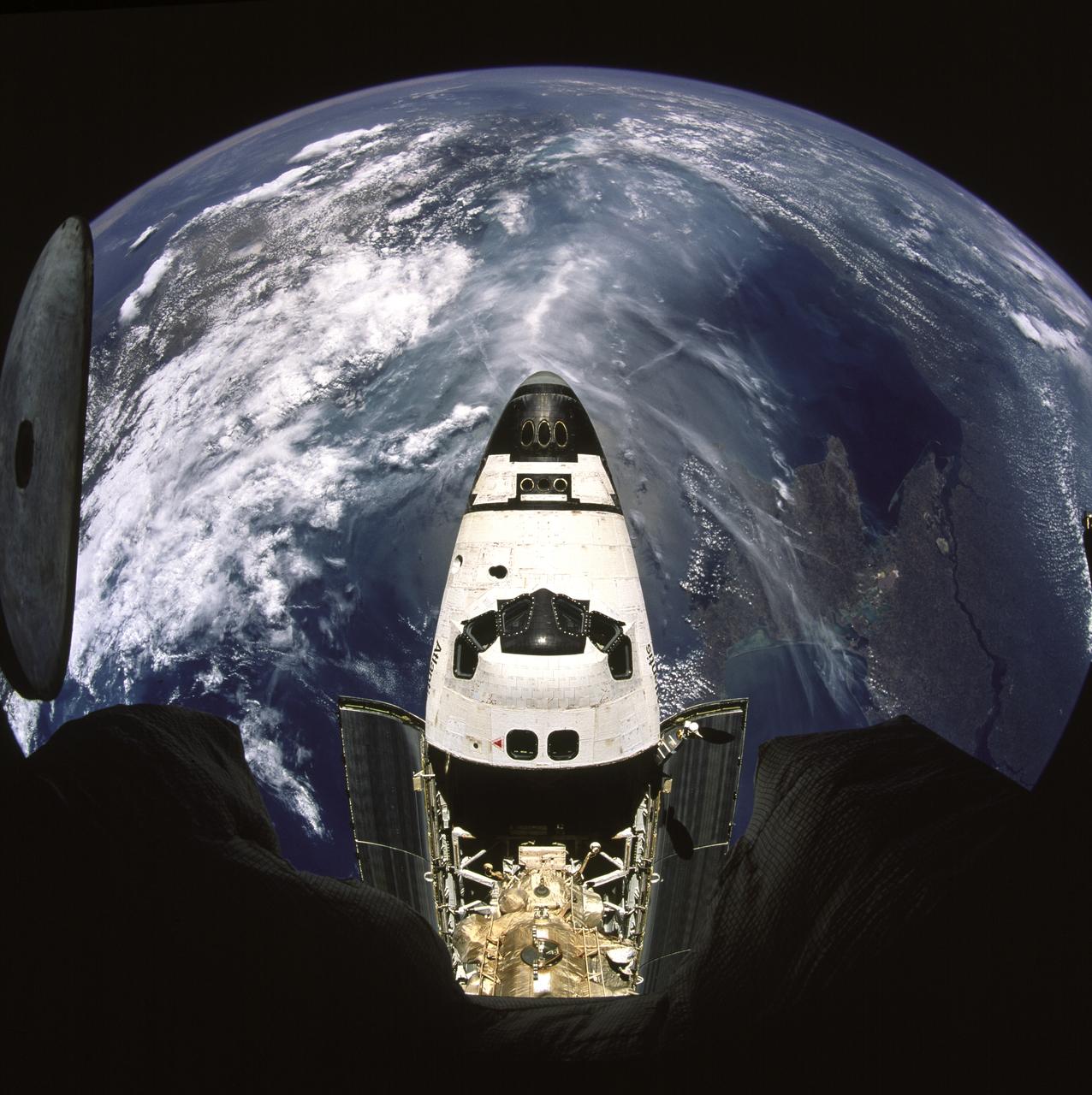
STS071-741-004 (27 June-7 July 1995) --- Docked already with Russia's Mir Space Station and backdropped against a half globe of Earth featuring the Crimean Peninsula, the space shuttle Atlantis is partially visible through a window on the Kvant 2 Module. A 70mm camera, carried into space by the STS-71 crew aboard the space shuttle Atlantis, was used to expose the image. The crew cabin and forward cargo bay of Atlantis are most prominent. Below center can be seen the Androgynous Peripheral Docking System (APDS) and the Kristall Module on Mir. The APDS is connected to a port in a tunnel leading to the Spacelab Science Module in Atlantis' cargo bay. The linkup enabled the seven STS-71 crew members to visit Mir and it allowed the three Mir-18 crew members, in space since March of this year, access to Spacelab. That module was quite busy with tests and data collection involving the three, Mir-18 crew, until Atlantis brought them home on July 7, 1995. The Black Sea lies directly beneath Atlantis, with Ukraine's diamond-shaped Crimean Peninsula immediately to the right of the cockpit. The wide lower course of the Dnepr River can be seen entering the Black Sea at far right. The coast of Romania and Bulgaria lies at a point where the cloud begins at top right. The peninsula of Asia Minor lies across the left of the view, mostly under cloud cover. The Mediterranean Sea is the cloud-free, blue mass beyond. Still further, at about 1,300 miles distance, the north edge of Africa is stretched out as a line across the horizon with its characteristic sandy color. The nose of Atlantis points southwest toward the only outlet of the Black Sea known as the Bosporus.