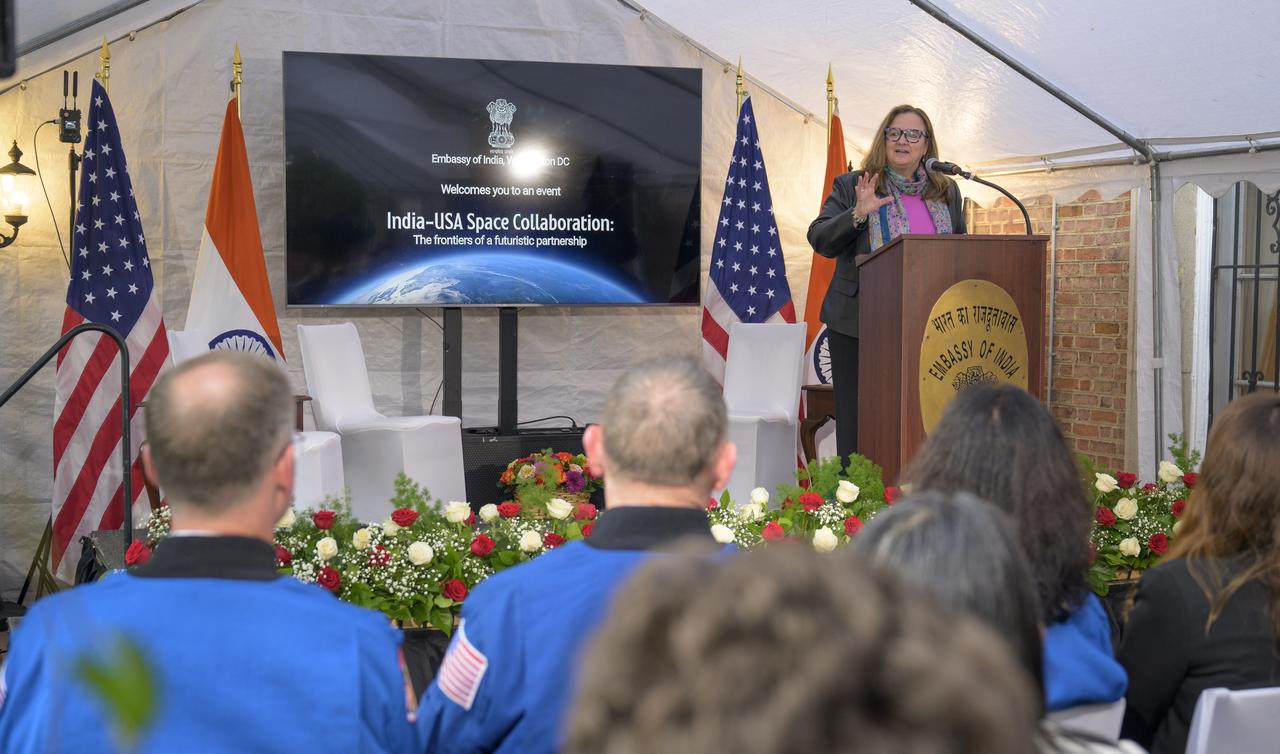
NASA Earth Science Division Director Karen St. Germain gives remarks during an event featuring Expedition 72 NASA astronauts Butch WIlmore, Nick Hague, and Suni Williams, and Axiom Mission 4 astronaut Shubhanshu Shukla, Monday, Sept. 15, 2025, at residence of the Ambassador of India in Washington. Williams, Hague and Wilmore served as part of Expedition 72 onboard the International Space Station. Photo Credit: (NASA/Bill Ingalls)
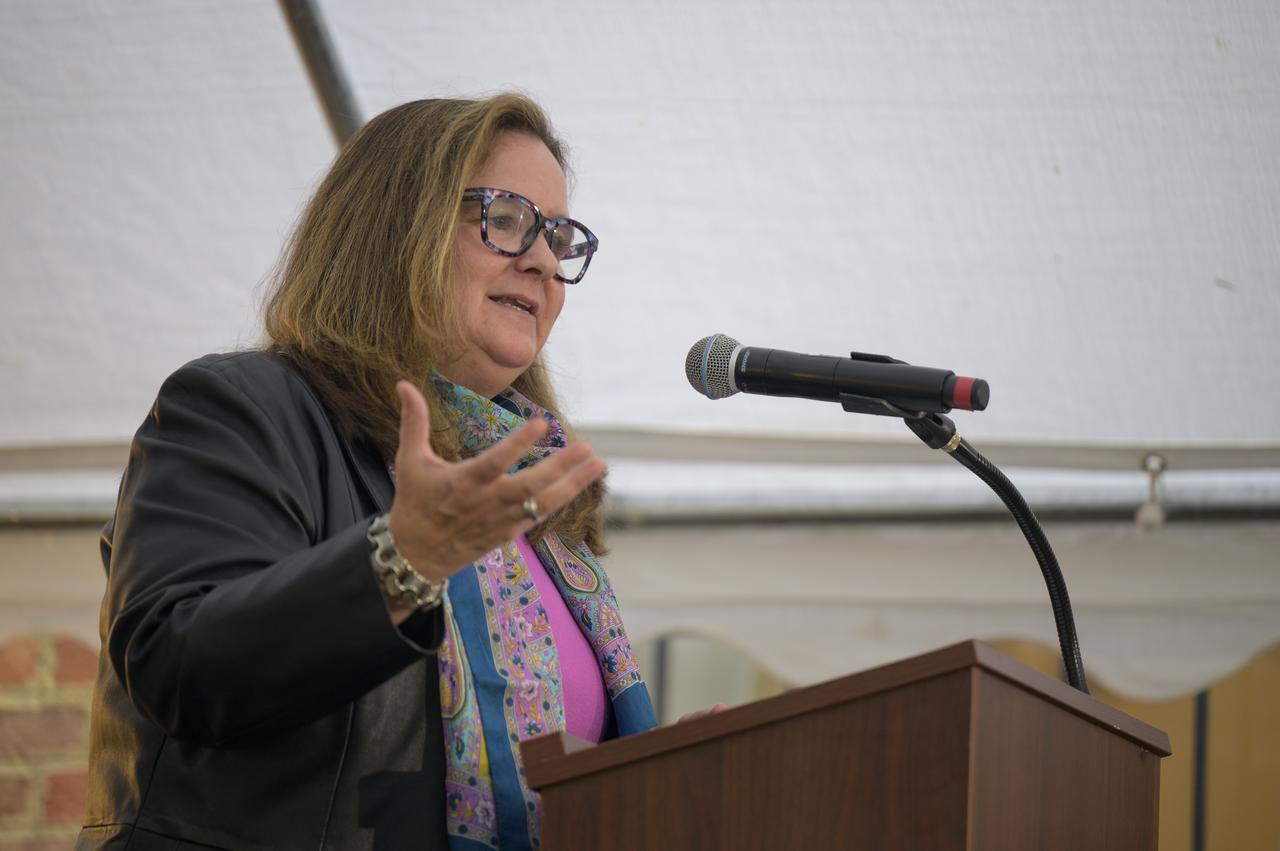
NASA Earth Science Division Director Karen St. Germain gives remarks during an event featuring Expedition 72 NASA astronauts Butch WIlmore, Nick Hague, and Suni Williams, and Axiom Mission 4 astronaut Shubhanshu Shukla, Monday, Sept. 15, 2025, at residence of the Ambassador of India in Washington. Williams, Hague and Wilmore served as part of Expedition 72 onboard the International Space Station. Photo Credit: (NASA/Bill Ingalls)
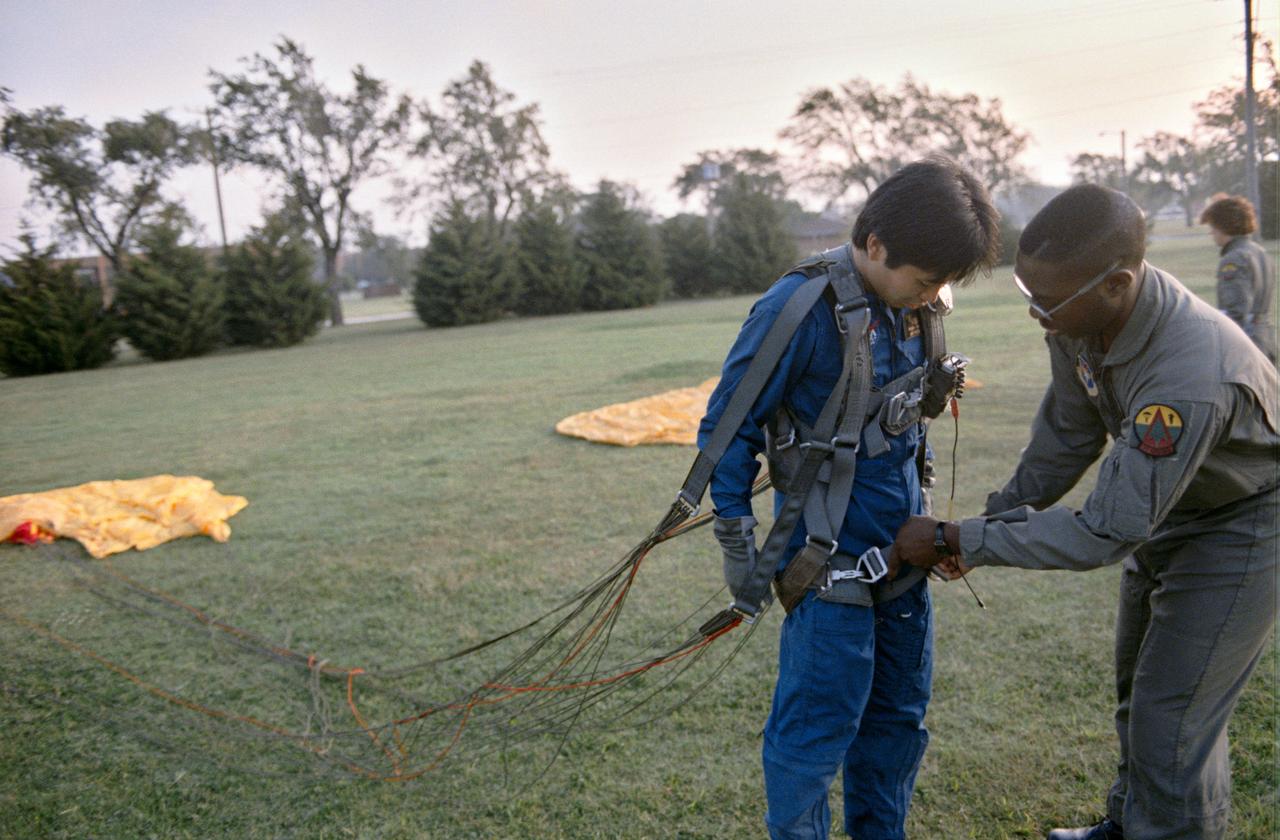
S95-00352 (12-14 September 1992) --- Astronaut candidate Koichi Wakata gets assistance with his parachute following a simulated chute drop at Vance Air Force Base. Wakata, representing the National Space Development Agency (NASDA) of Japan, is one of seven international mission specialist candidates who joined 19 United States astronaut candidates for the three-day parachute/survival training school at the Oklahoma Base. EDITOR'S NOTE: Since this photograph was taken, Wakata has been named as mission specialist for the STS-72 mission.
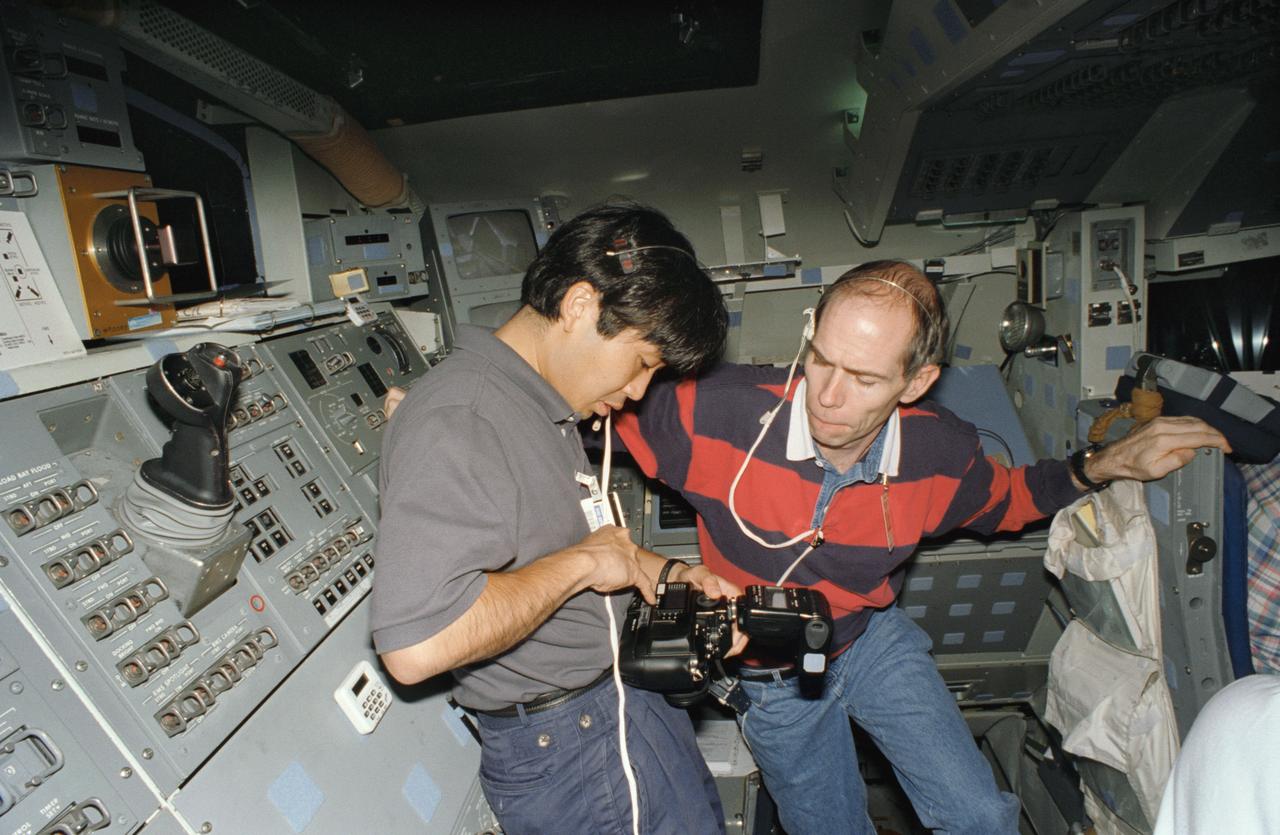
S95-12703 (May 1995) --- Astronauts Koichi Wakata (left) and Daniel T. Barry check the settings on a 35mm camera during an STS-72 training session. Wakata is a mission specialist, representing Japan's National Space Development Agency (NASDA) and Barry is a United States astronaut assigned as mission specialist for the same mission. The two are on the aft flight deck of the fixed base Shuttle Mission Simulator (SMS) at the Johnson Space Center (JSC).
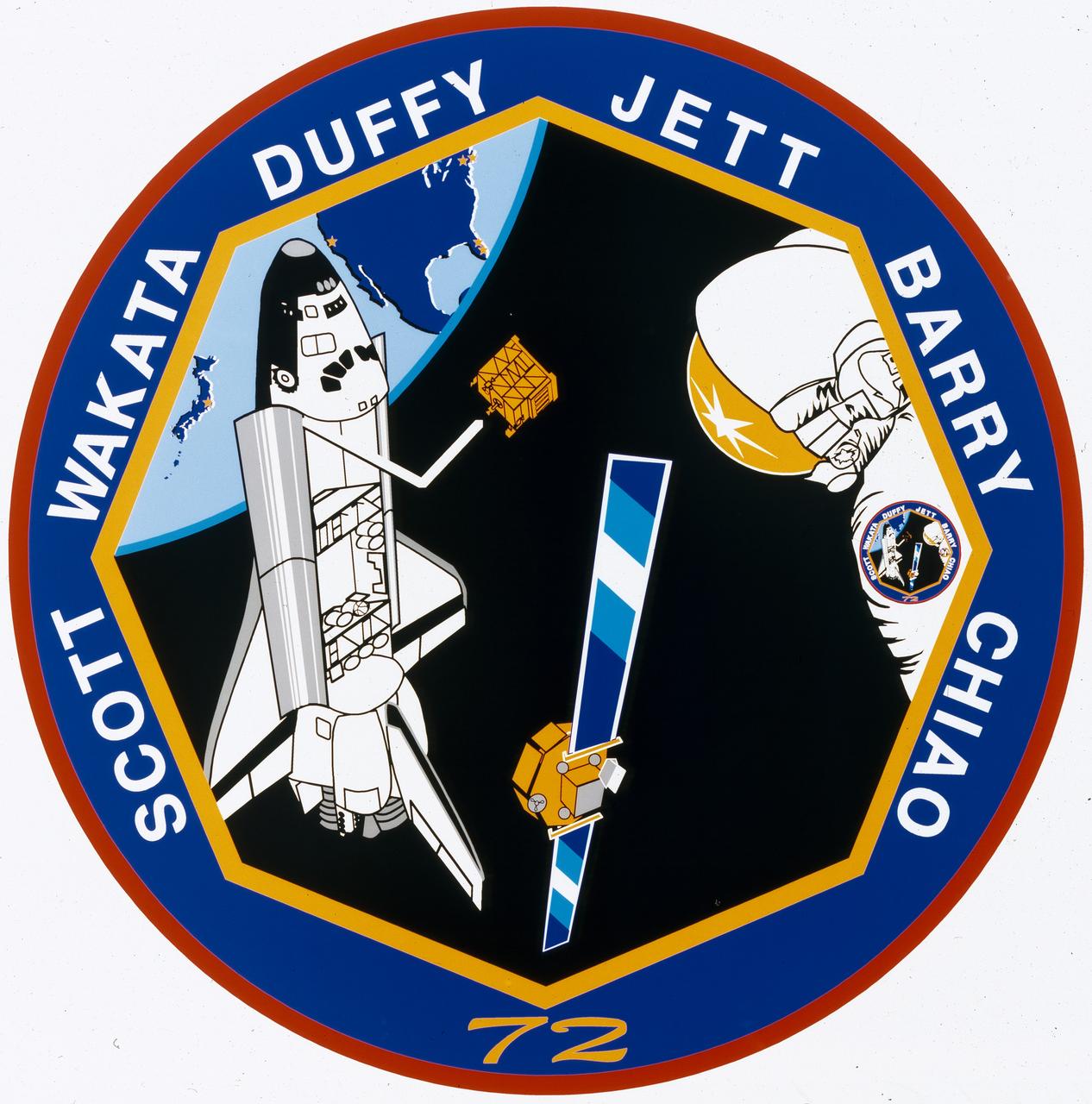
The crew patch of STS-72 depicts the Space Shuttle Endeavour and some of the payloads on the flight. The Japanese satellite, Space Flyer Unit (SFU) is shown in a free-flying configuration with the solar array panels deployed. The inner gold border of the patch represents the SFU's distinct octagonal shape. Endeavour’s rendezvous with and retrieval of SFU at an altitude of approximately 250 nautical miles. The Office of Aeronautics and Space Technology's (OAST) flyer satellite is shown just after release from the Remote Manipulator System (RMS). The OAST satellite was deployed at an altitude of 165 nautical miles. The payload bay contains equipment for the secondary payloads - the Shuttle Laser Altimeter (SLA) and the Shuttle Solar Backscatter Ultraviolet Instrument (SSBUV). There were two space walks planned to test hardware for assembly of the International Space Station. The stars represent the hometowns of the crew members in the United States and Japan.
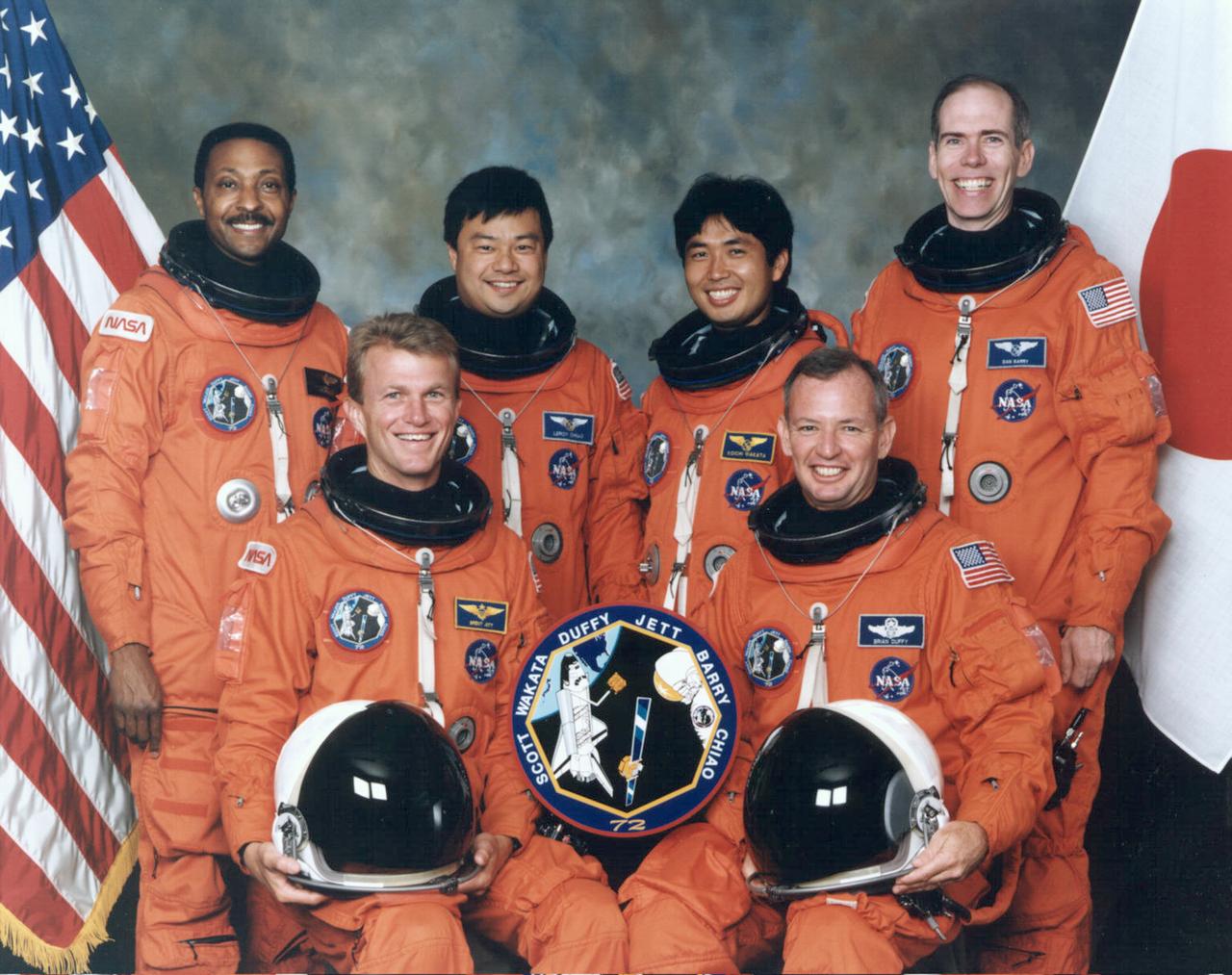
Six astronauts composed the crew for the STS-72 mission that launched aboard the Space Shuttle Endeavour on January 11, 1996. Astronauts Brian Duffy (right front) and Brent W. Jett (left front) are mission commander and pilot, respectively. Mission specialists (back row, left to right) are Winston E. Scott, Leroy Chiao, Koichi Wakata, and Daniel T. Barry. Wakata is an international mission specialist representing Japan’s National Space Development Agency (NASDA) based at the Johnson Space Center (JSC). Mission objectives included the retrieval of the Japanese Space Flyer Unit (SFU), and the deployment of the Office of Aeronautics and Space Technology-Flyer (OAST-Flyer).
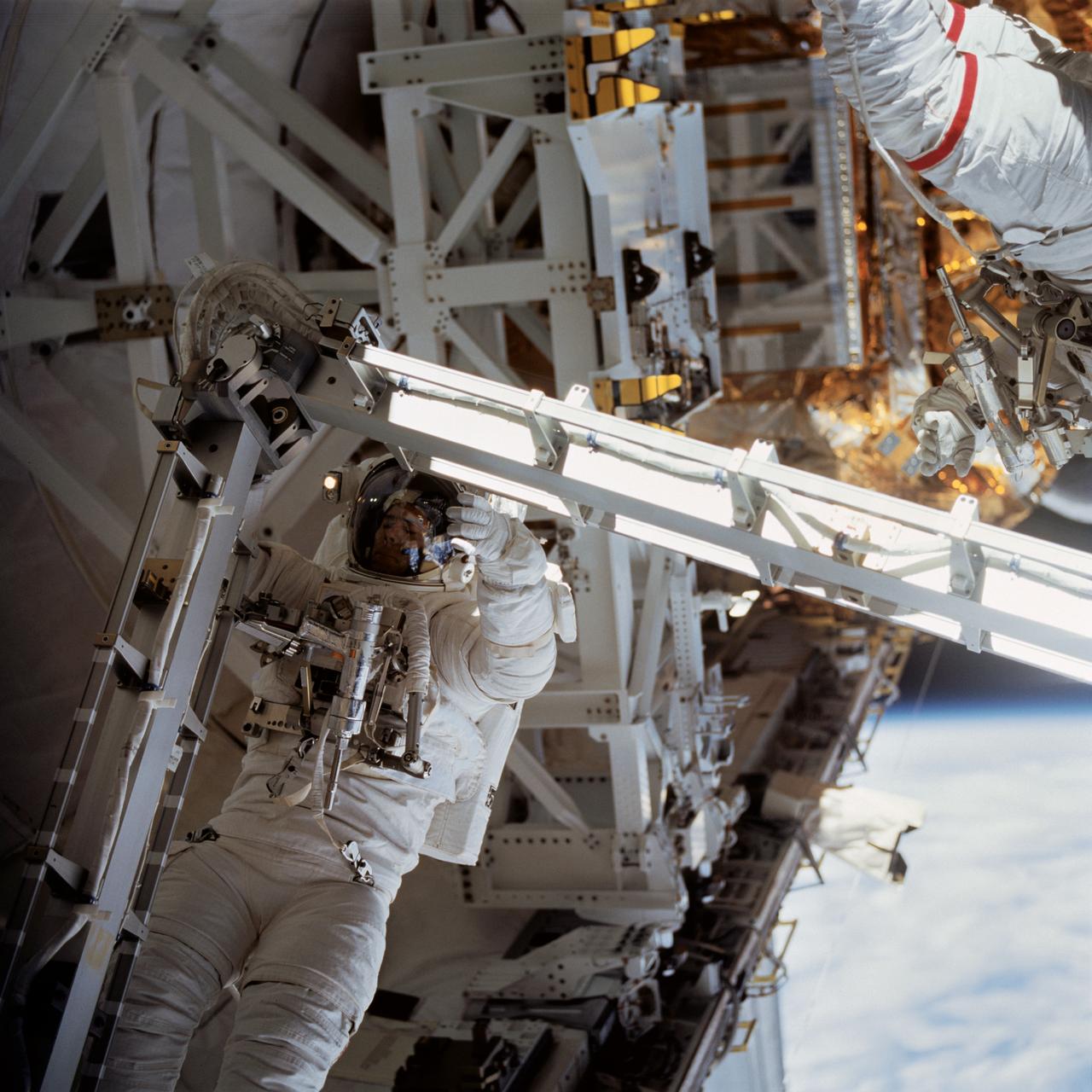
STS072-735-093 (15 Jan. 1996) --- Astronaut Daniel T. Barry, STS-72 mission specialist, works in the cargo bay of the Space Shuttle Endeavour during the first of two extravehicular activities (EVA). Barry unfolds the rigid umbilical as astronaut Leroy Chiao (partially visible at top) assists. The two joined four other NASA astronauts for a week and a half aboard Endeavour.
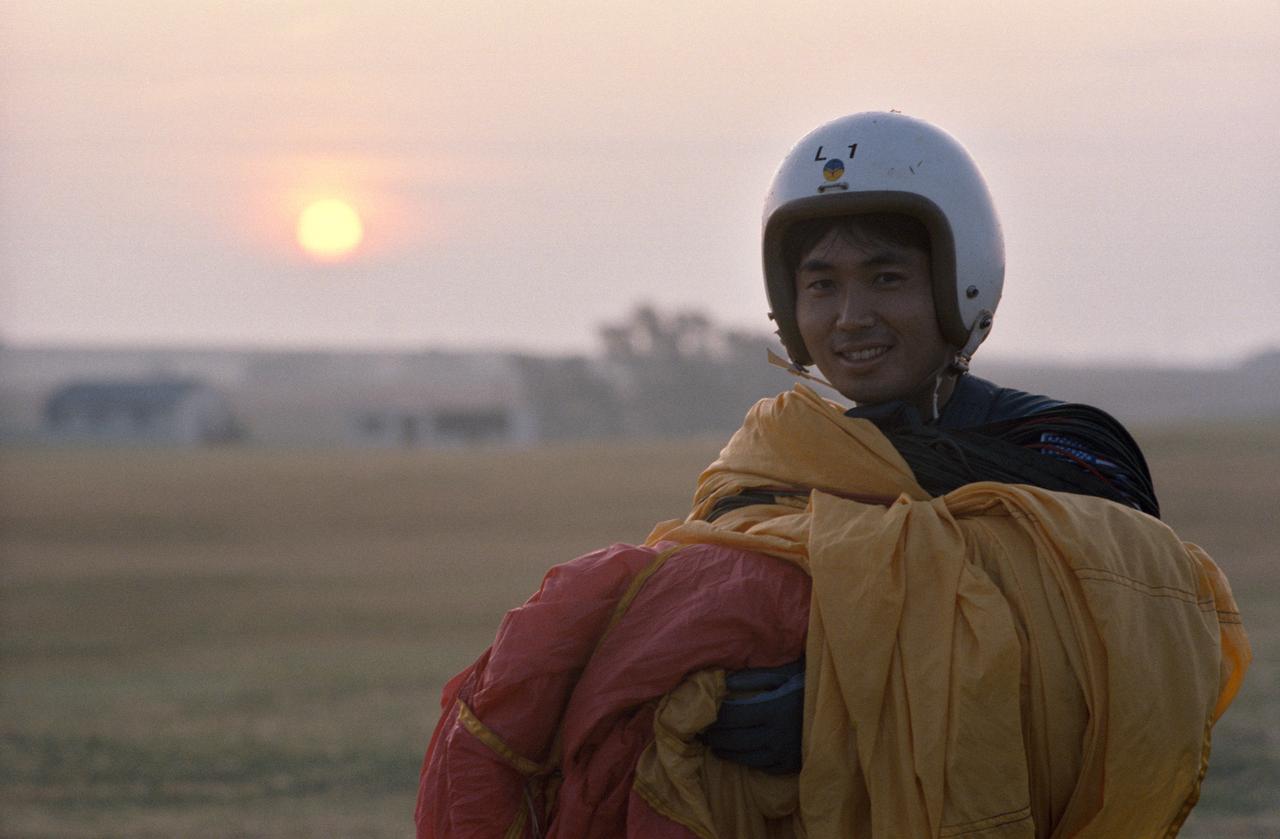
S95-00359 (12-14 September 1992) --- Astronaut candidate Koichi Wakata gathers his parachute following a simulated chute drop at Vance Air Force Base. Wakata is one of seven international mission specialist candidates who joined 19 United States astronaut candidates for the three-day parachute/survival training school at the Oklahoma Base. EDITORS NOTE: Since this photograph was taken, Wakata has been named as mission specialist for the STS-72 mission.

S95-00355 (12-14 September 1992) --- Astronaut candidate Koichi Wakata prepares to jump off a box during a parachute landing demonstration at Vance Air Force Base. This portion of the training is designed to familiarize the trainees with the proper way to hit the ground following a parachute jump. Looking on are astronaut candidates Michael L. Gernhardt (left) and Andrew W. S. Thomas (second left), along with a United States Air Force (USAF) instructor. Wakata, representing Japan's National Space Development Agency (NASDA), is one of seven international mission specialist candidates who joined 19 United States astronaut candidates, including Gernhardt and Thomas, for the three-day parachute/survival training school at the Oklahoma Base. EDITORS NOTE: Since this photograph was taken, Gernhardt, Wakata and Thomas have been named as mission specialists for the STS-69, STS-72 and STS-77 missions, respectively.
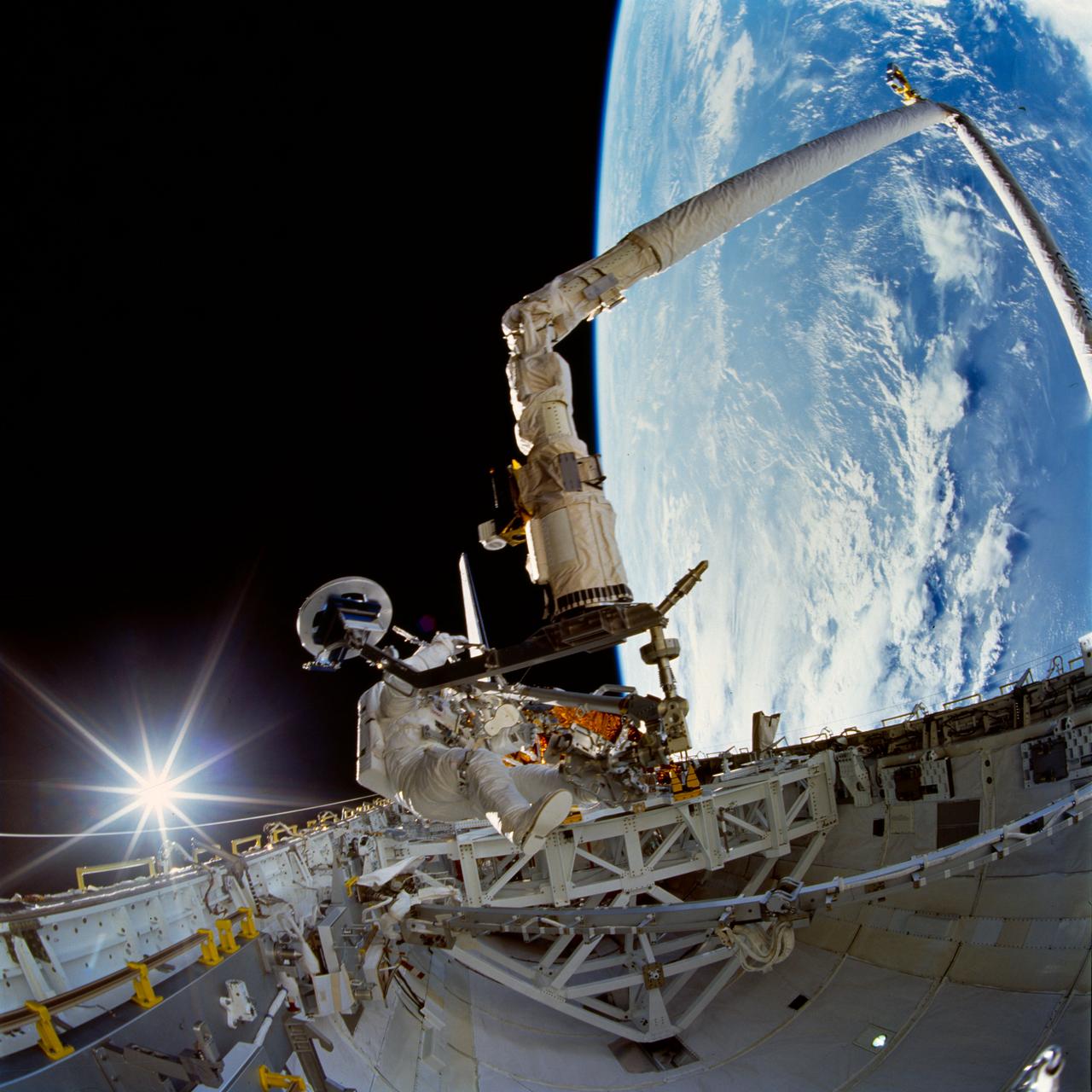
STS072-742-004 (15 Jan. 1996) --- Astronaut Daniel T. Barry, STS-72 mission specialist, tests a Temporary Equipment Restraint Aid (TERA) in the cargo bay of the Earth-orbiting space shuttle Endeavour. A reflection of the sun’s rays beam off Endeavour’s aft flight deck window in the “fish-eye” image. Barry was joined by astronaut Leroy Chiao for this first of two extravehicular activities (EVA) on the mission. A good part of the EVA was spent evaluating EVA hardware for future scheduled missions. Astronauts Chiao and Winston E. Scott participated in the second EVA two days later. Photo credit: NASA
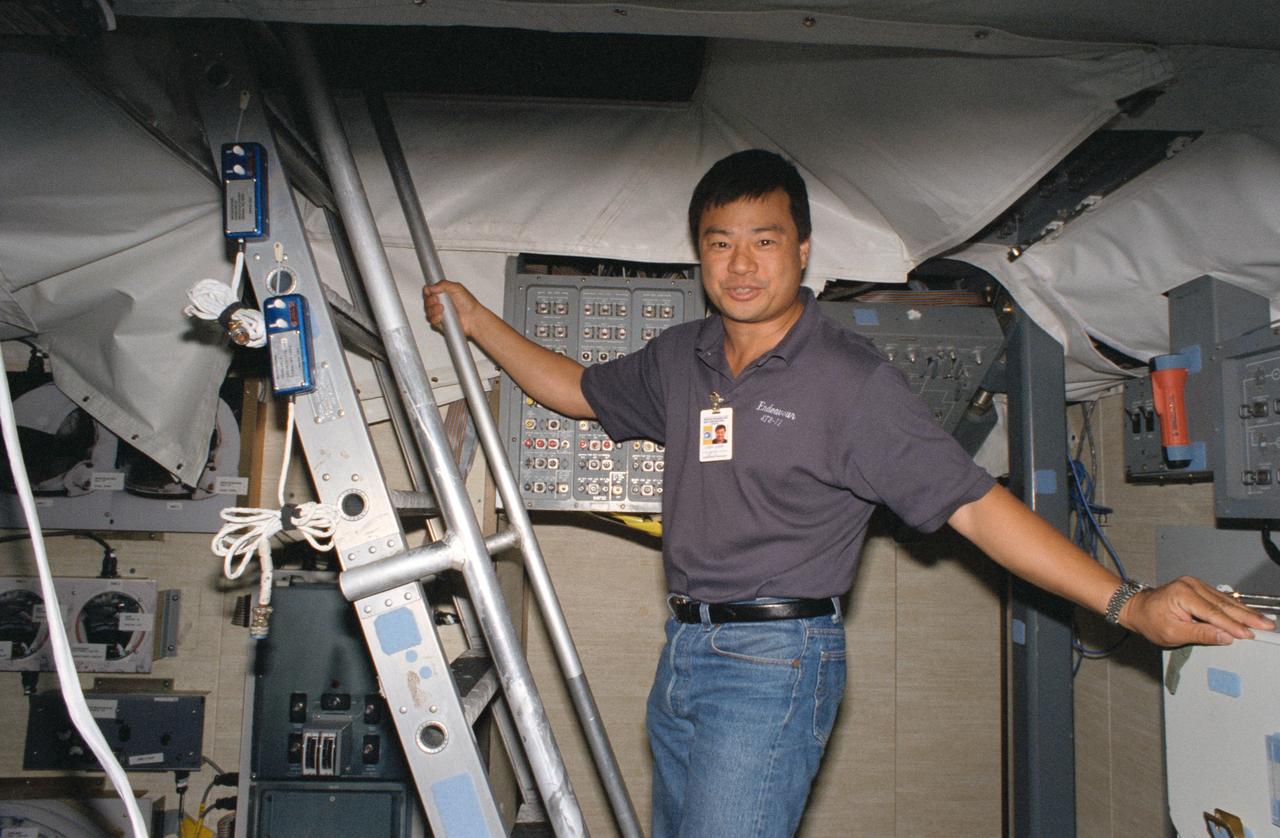
S95-12711 (May 1995) --- Astronaut Leroy Chiao, assigned as mission specialist for the STS-72 mission, prepares to ascend stairs to the flight deck of the fixed base Shuttle Mission Simulator (SMS) at the Johnson Space Center (JSC). Chiao will join an international mission specialist and four other NASA astronauts aboard the Space Shuttle Endeavour for a scheduled nine-day mission, now set for the winter of this year.
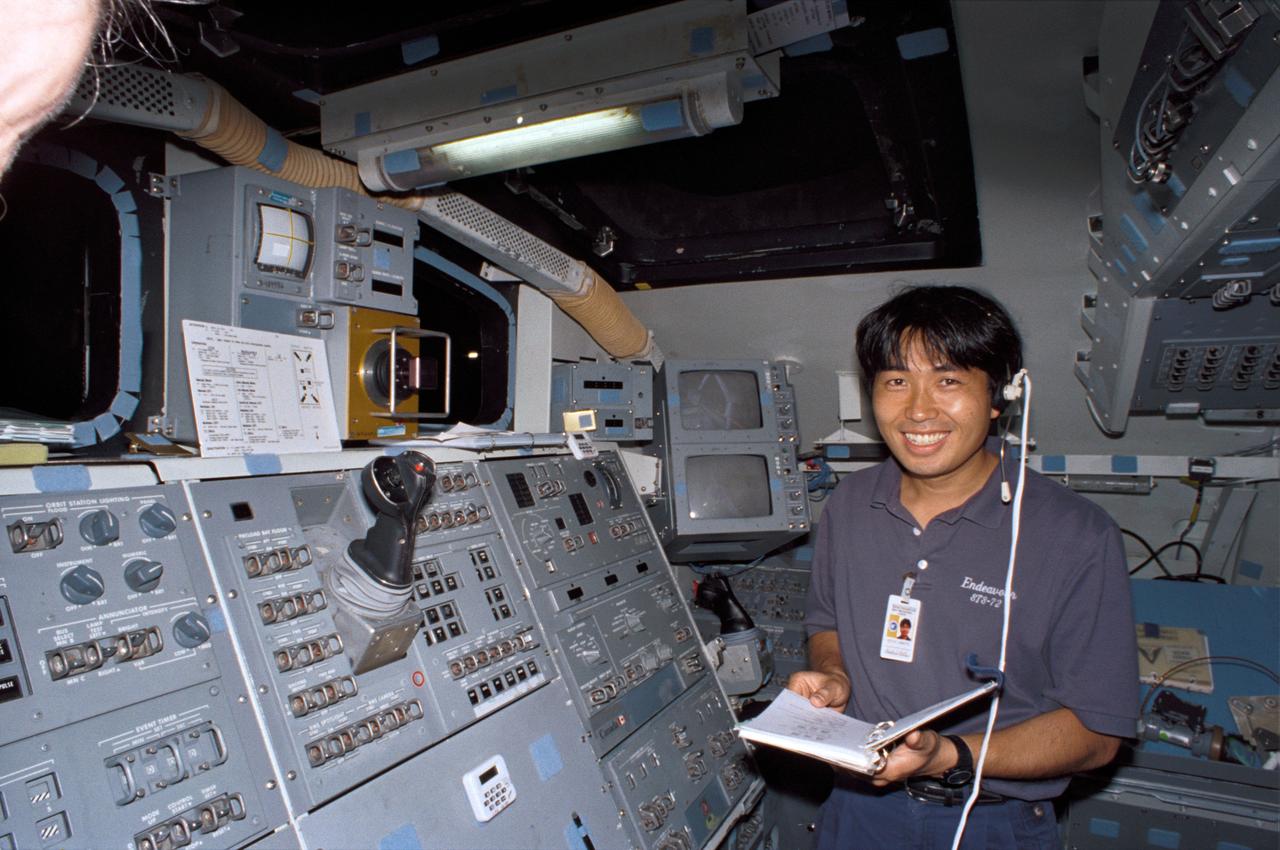
S95-12706 (May 1995) --- Astronaut Koichi Wakata, representing Japan's National Space Development Agency (NASDA) and assigned as mission specialist for the STS-72 mission, checks over a copy of the flight plan. Wakata is on the flight deck of the fixed base Shuttle Mission Simulator (SMS) at the Johnson Space Center (JSC). He will join five NASA astronauts aboard Endeavour for a scheduled nine-day mission, now set for the winter of this year.
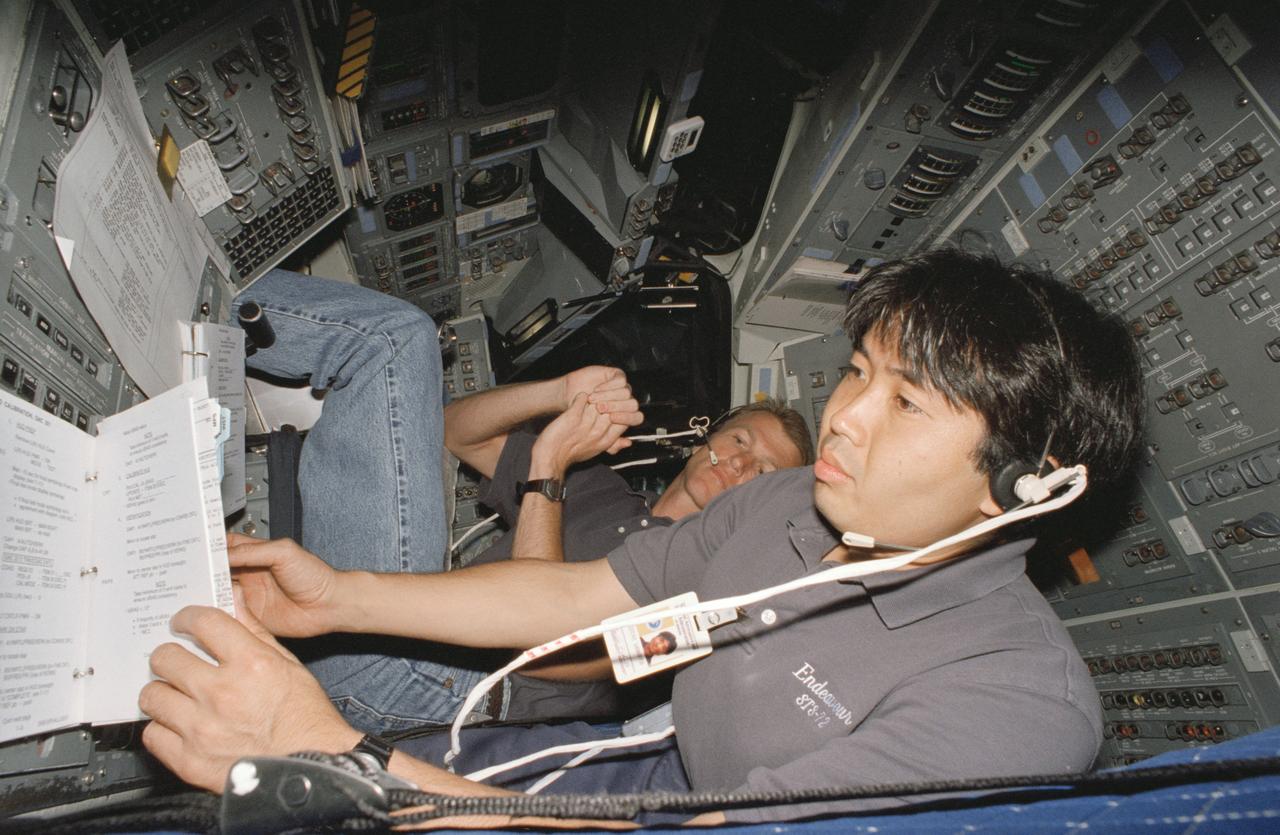
S95-12725 (May 1995) --- Astronaut Koichi Wakata, representing Japan's National Space Development Agency (NASDA) and assigned as mission specialist for the STS-72 mission, checks over a copy of the flight plan. Wakata is on the flight deck of the fixed base Shuttle Mission Simulator (SMS) at the Johnson Space Center (JSC). In the background is astronaut Brent W. Jett, pilot. The two will join four NASA astronauts aboard Space Shuttle Endeavour for a scheduled nine-day mission, now set for the winter of this year.
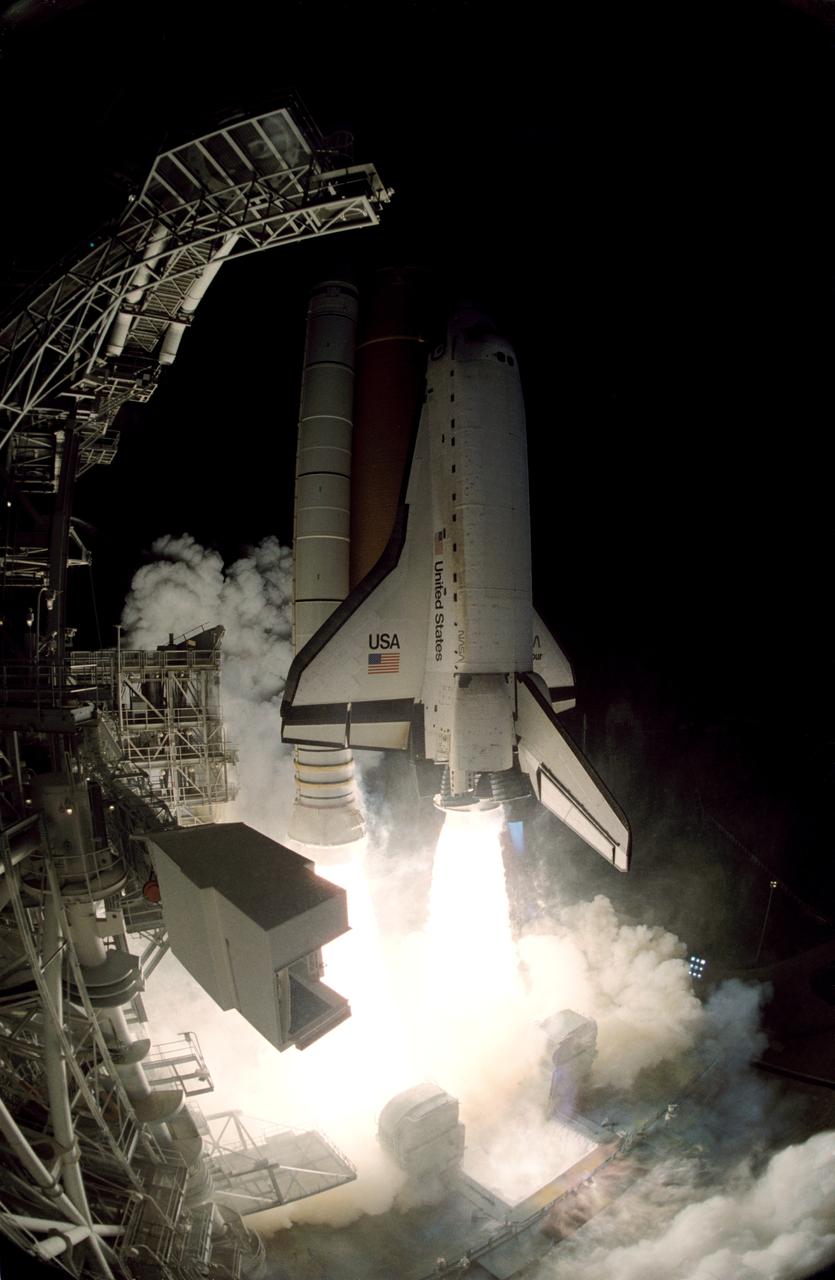
STS072-S-003 (11 Jan. 1996) --- A "fish-eye" lens was used to afford this unique view of the Space Shuttle Endeavour as it lifts off from Launch Pad 39B at the Kennedy Space Center (KSC). Liftoff for STS-72 occurred at 4:41:00:072 a.m. (EST), January 11, 1996. Onboard the spacecraft were astronauts Brian Duffy, commander; Brent W. Jett, pilot; along with Daniel T. Barry, Leroy Chiao, Winston E. Scott and Koichi Wakata, all mission specialists. Wakata represents Japan's National Space Development Agency (NASDA).
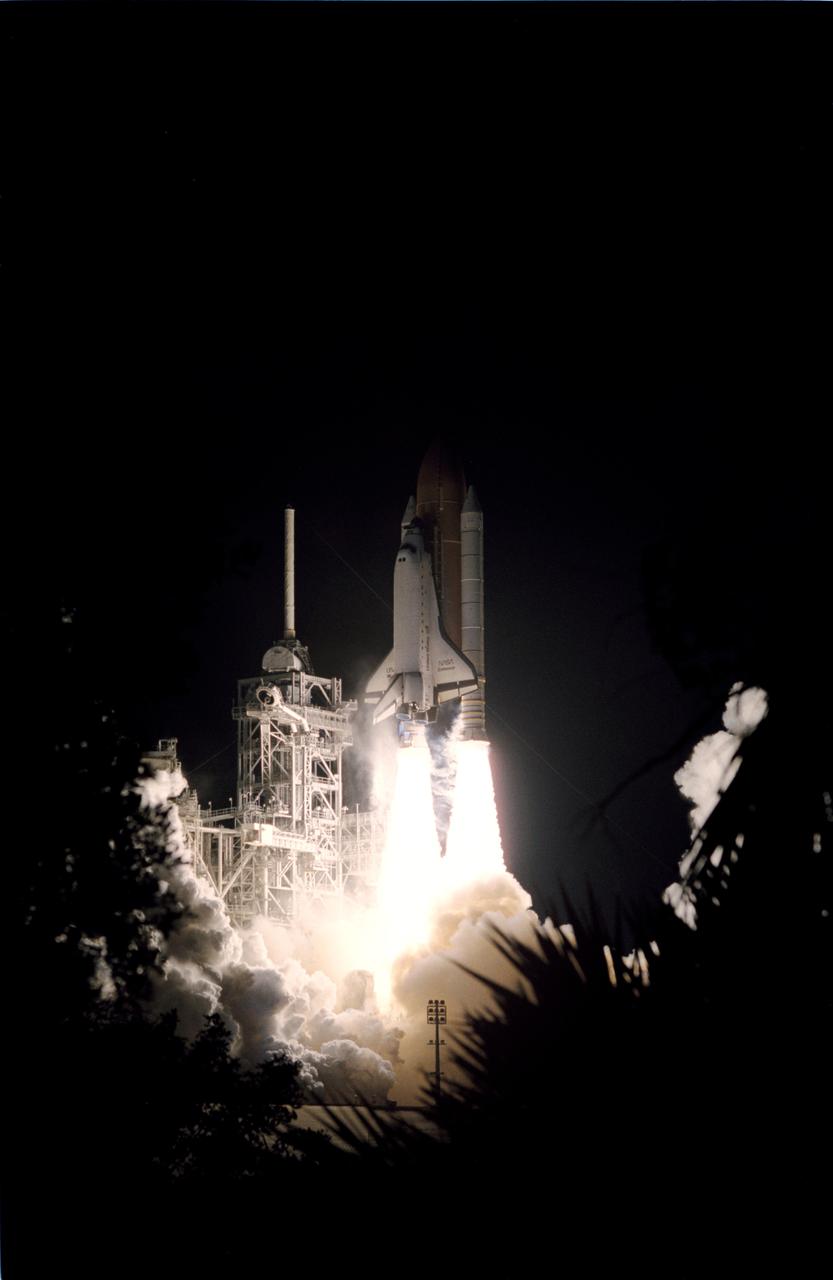
STS072-S-004 (11 Jan. 1996) --- The Space Shuttle Endeavour lights up the night sky as it lifts off from Launch Pad 39B at the Kennedy Space Center (KSC). Liftoff for STS-72 occurred at 4:41:00:072 a.m. (EST), January 11, 1996. Onboard the spacecraft were astronauts Brian Duffy, commander; Brent W. Jett, pilot; along with Daniel T. Barry, Leroy Chiao, Winston E. Scott and Koichi Wakata, all mission specialists. Wakata represents Japan's National Space Development Agency (NASDA).
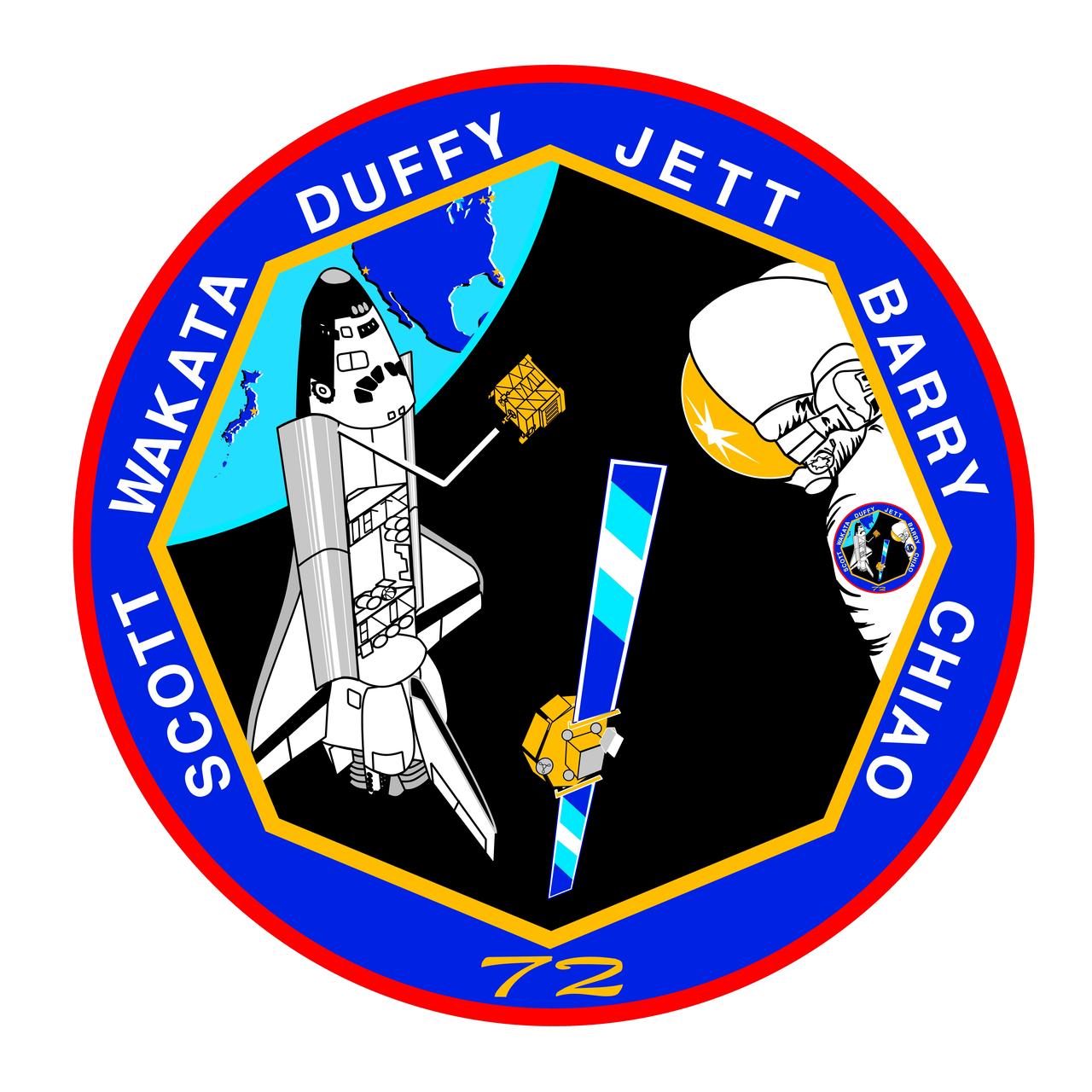
STS072-S-001 (May 1995) --- The crew patch of STS-72 depicts the space shuttle Endeavour and some of the payloads on the flight. The Japanese satellite, Space Flyer Unit (SFU) is shown in a free-flying configuration with the solar array panels deployed. The inner gold border of the patch represents the SFU's distinct octagonal shape. Endeavour will rendezvous with and retrieve SFU at an altitude of approximately 250 nautical miles. The Office of Aeronautics and Space Technology's (OAST) flyer satellite is shown just after release from the Remote Manipulator System (RMS). The OAST satellite will be deployed at an altitude of 165 nautical miles to fly free for two days gathering scientific data. The payload bay contains equipment for the secondary payloads - the Shuttle Laser Altimeter (SLA) and the Shuttle Solar Backscatter Ultraviolet Instrument (SSBUI). There are two spacewalks planned to test hardware for assembly of the International Space Station. The stars represent the hometowns of the crew members in the United States and Japan. The NASA insignia design for space shuttle flights is reserved for use by the astronauts and for other official use as the NASA Administrator may authorize. Public availability has been approved only in the forms of illustrations by the various news media. When and if there is any change in this policy, which is not anticipated, the change will be publicly announced. Photo credit: NASA
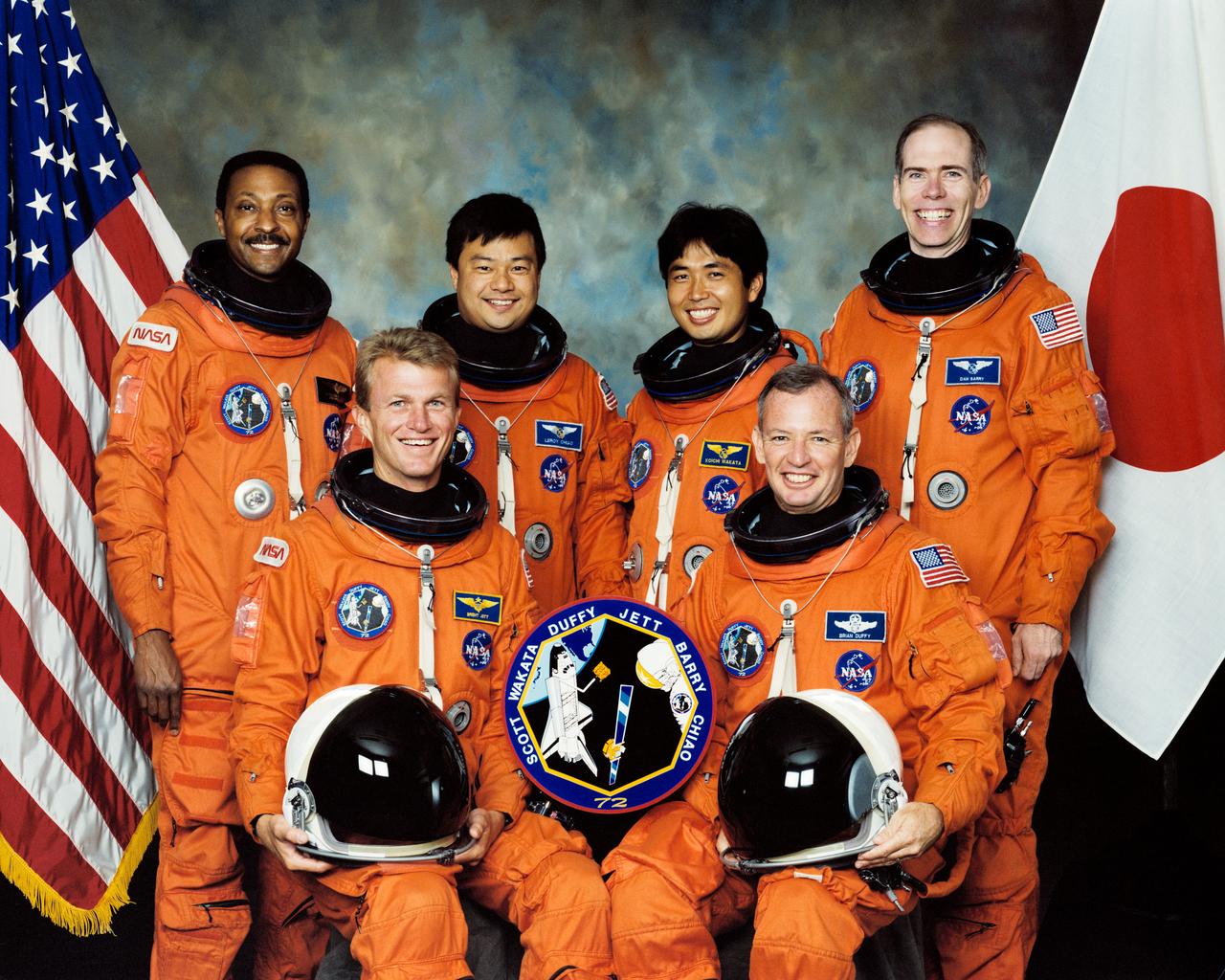
STS072-S-002 (August 1995) --- These six astronauts are in training for their mission scheduled aboard the Space Shuttle Endeavour later this year. Astronauts Brian Duffy (right front) and Brent W. Jett (left front) are mission commander and pilot, respectively. Mission specialists (back row, left to right) are Winston E. Scott, Leroy Chiao, Koichi Wakata and Daniel T. Barry. Wakata is an international mission specialist representing Japan’s National Space Development Agency (NASDA) based at the Johnson Space Center (JSC).
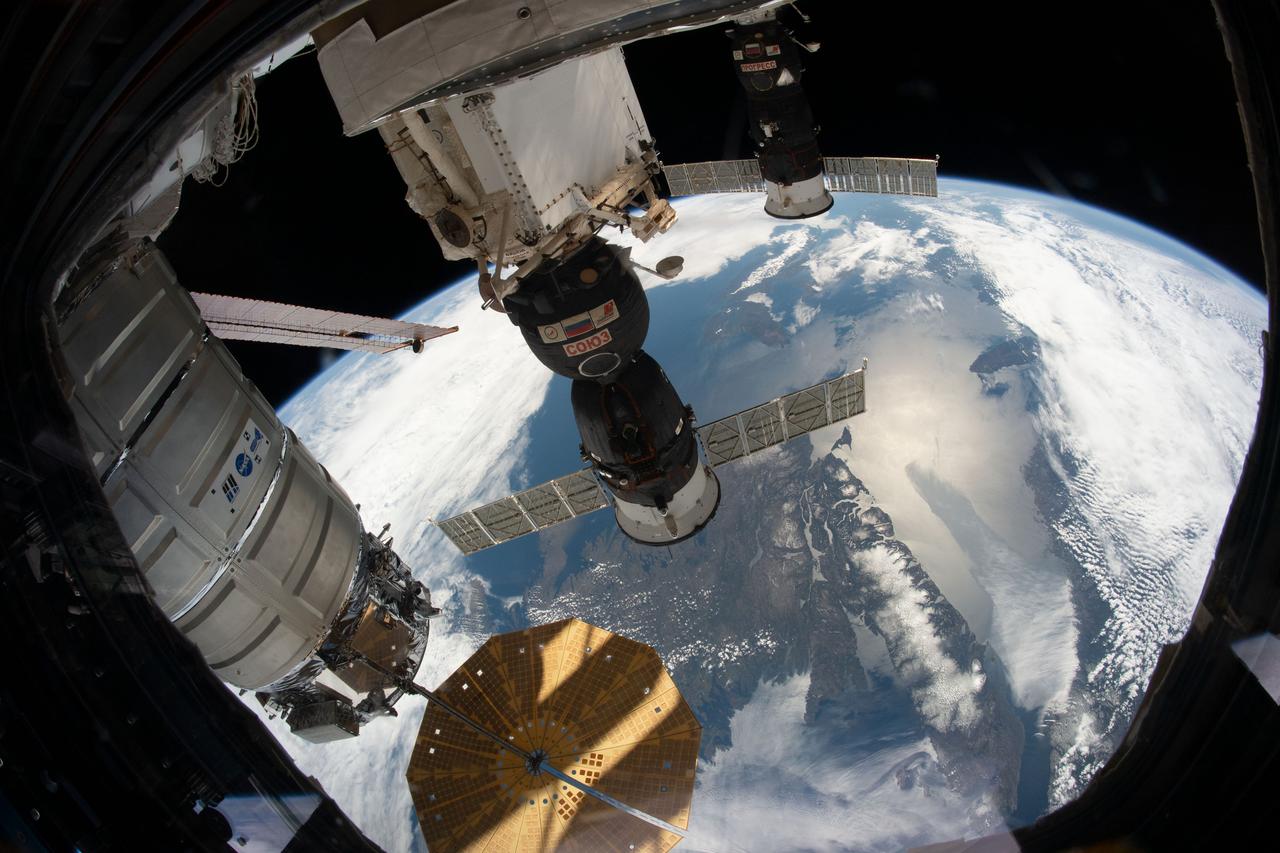
iss059e097992 (June 7, 2019) --- (From bottom to top) The Northrop Grumman Cygnus space freighter, the Soyuz MS-12 crew ship and the Progress 72 cargo craft are pictured attached to the International Space Station as the orbiting complex flew 258 miles above the Gulf of St. Lawrence.

STS-87 Mission Specialist Winston Scott is assisted with his ascent and re-entry flight suit in the white room at Launch Pad 39B by Danny Wyatt, NASA quality assurance specialist. STS-87 is the fourth flight of the United States Microgravity Payload and Spartan-201. Scott is scheduled to perform an extravehicular activity spacewalk with Mission Specialist Takao Doi, Ph.D., of the National Space Development Agency of Japan, during STS-87. Scott also performed a spacewalk on the STS-72 mission
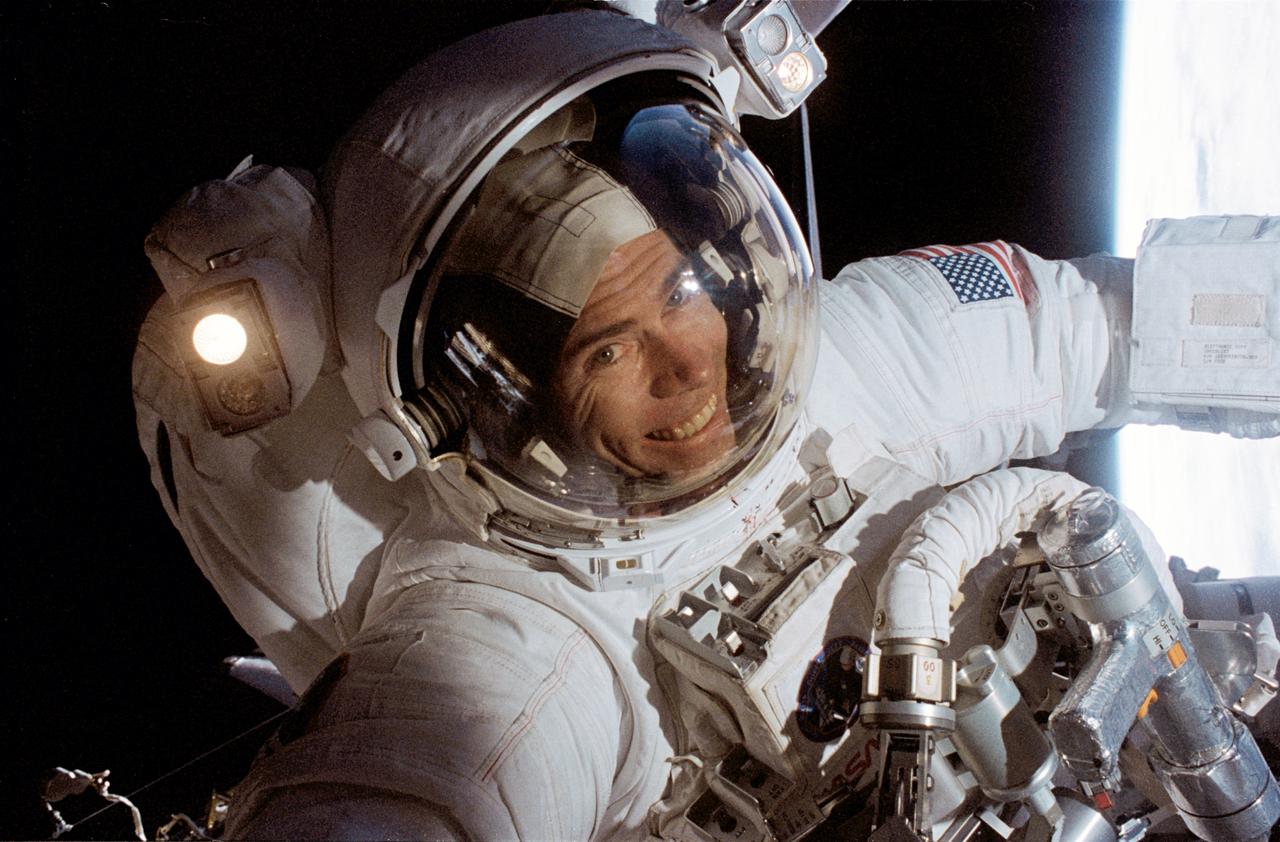
STS072-305-034 (15 Jan. 1996) --- Astronaut Daniel T. Barry, mission specialist, works in the cargo bay of the Space Shuttle Endeavour during the first of two extravehicular activities (EVA). Barry was joined by astronaut Leroy Chiao for the EVA. The two joined four other NASA astronauts for a week and a half aboard Endeavour.
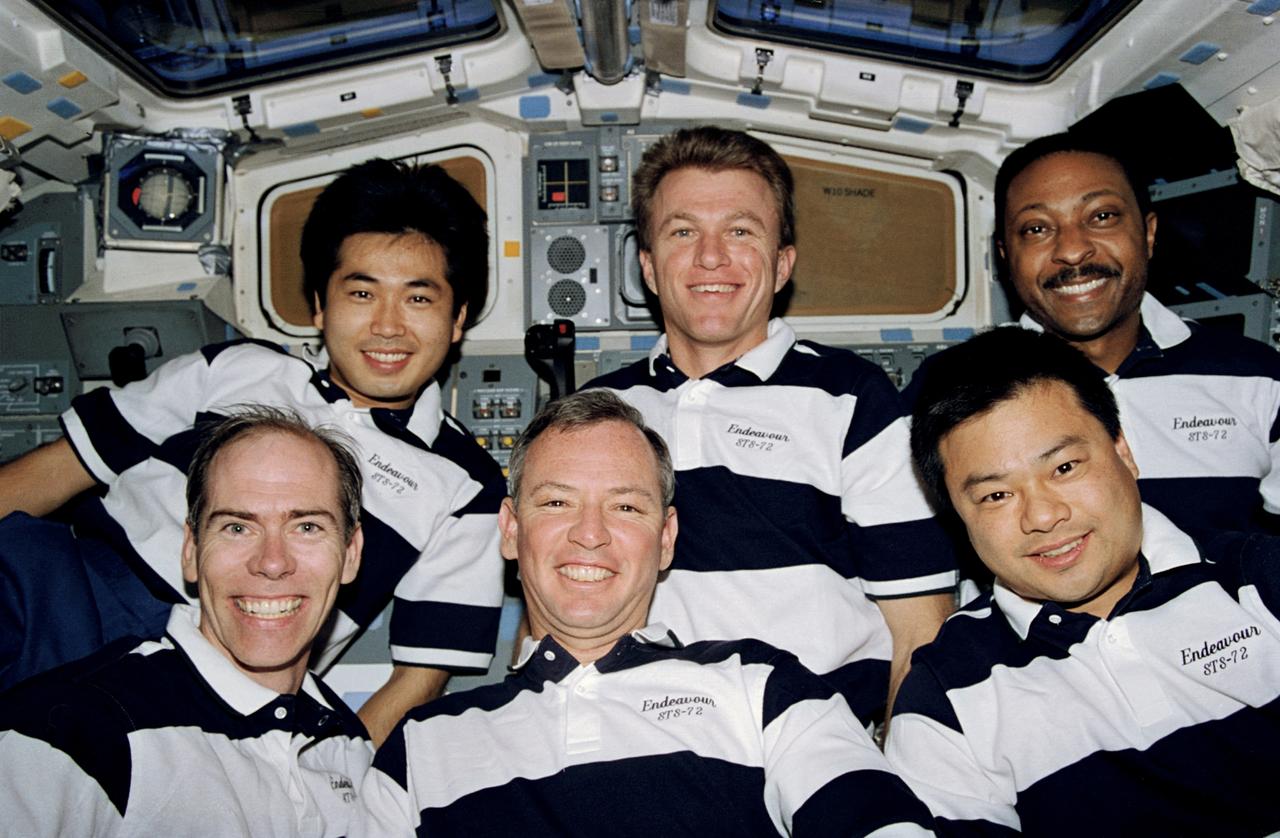
STS072-410-007 (11-20 Jan. 1996) --- The crewmembers selected the aft flight deck for the site of their inflight crew portrait aboard the Earth-orbiting Space Shuttle Endeavour. In front are, left to right, astronauts Daniel T. Barry, mission specialist; Brian Duffy, mission commander; and Leroy Chiao, mission specialist. In the rear are (left to right) Koichi Wakata, mission specialist representing Japan's National Space Development Agency (NASDA); Brent W. Jett Jr., pilot; and Winston E. Scott, mission specialist.
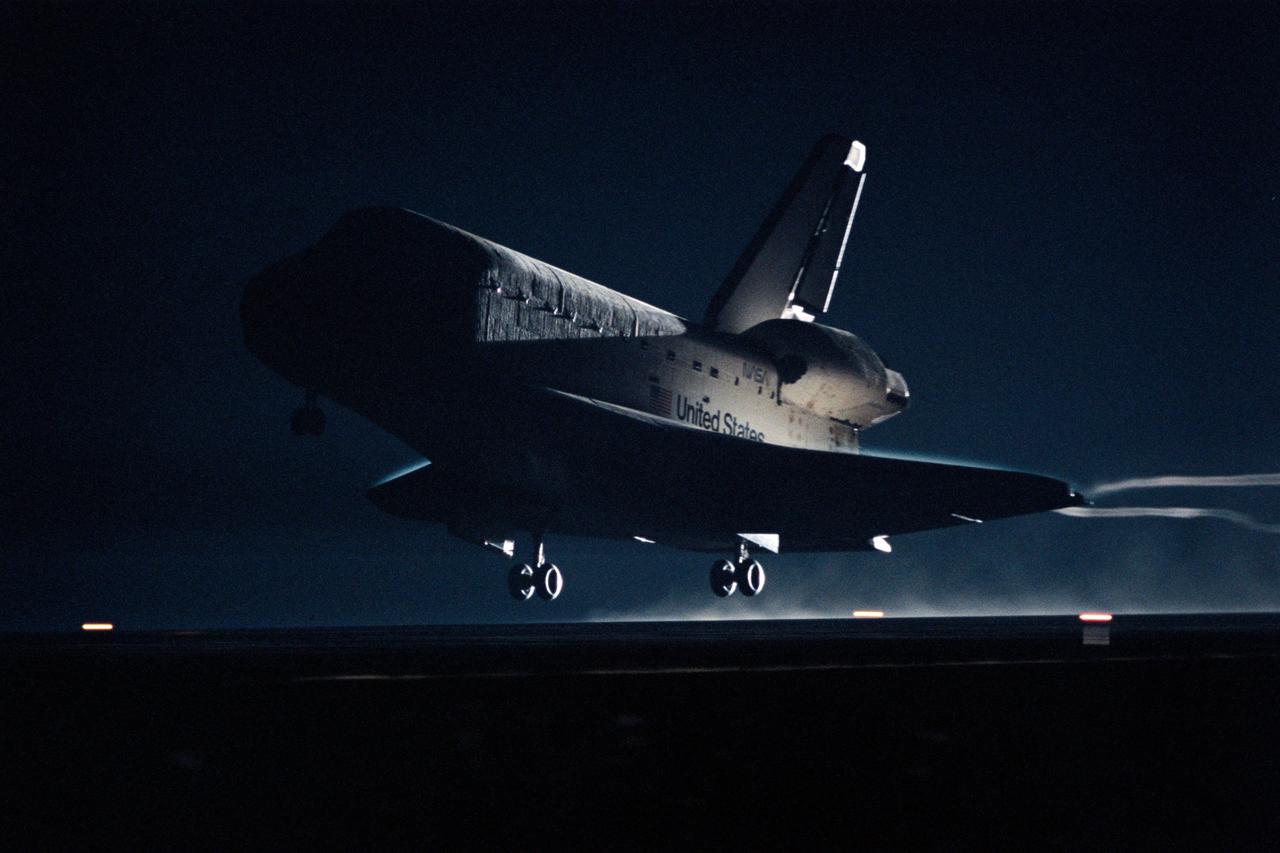
STS072-S-009 (20 Jan. 1996) --- The Space Shuttle Endeavour, with a crew of six aboard, touches down on Runway 15 at the Kennedy Space Center’s (KSC) Shuttle Landing Facility (SLF). This mission’s conclusion marks only the third nocturnal Shuttle landing at the Florida facility. Crew members were astronauts Brian Duffy, commander; and Brent W. Jett Jr., pilot; along with astronauts Leroy Chiao, Winston E. Scott, Daniel T. Barry and Koichi Wakata, all mission specialists. Wakata represents Japan’s National Space Development Agency (NASDA).
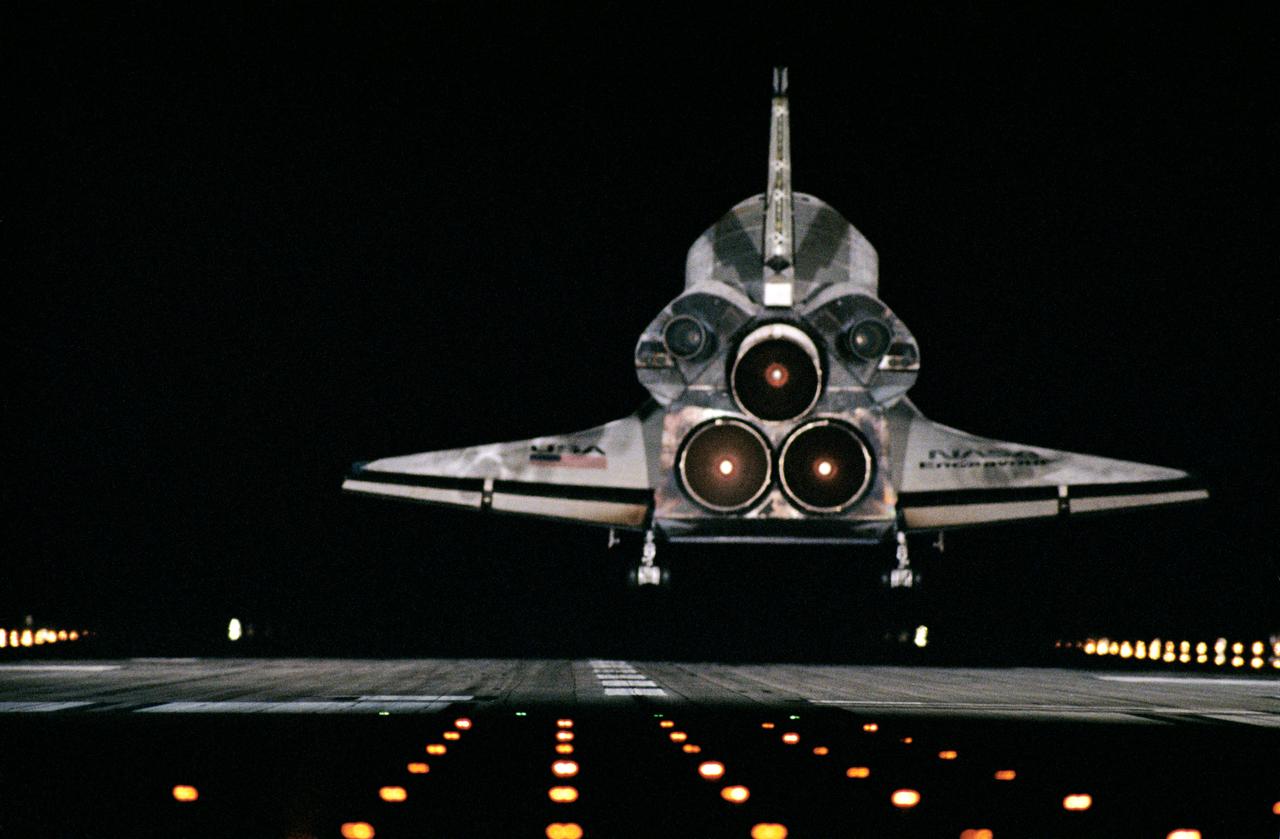
STS072-S-008 (20 Jan. 1996) --- The Space Shuttle Endeavour, with a crew of six aboard, is about to touch down on Runway 15 at the Kennedy Space Center’s (KSC) Shuttle Landing Facility (SLF). This mission’s conclusion marks only the third nocturnal Shuttle landing at the Florida facility. Crew members were astronauts Brian Duffy, commander; and Brent W. Jett Jr., pilot; along with astronauts Leroy Chiao, Winston E. Scott, Daniel T. Barry and Koichi Wakata, all mission specialists. Wakata represents Japan’s National Space Development Agency (NASDA).
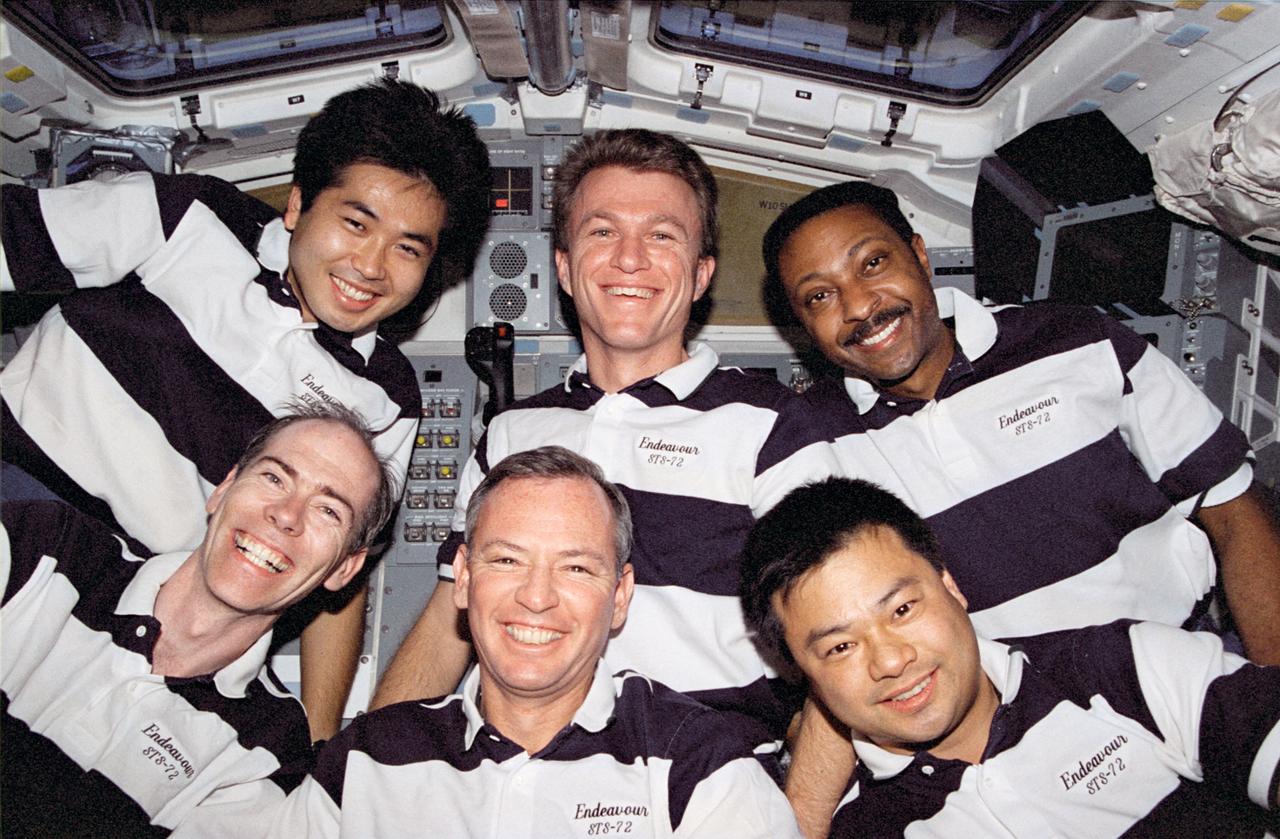
STS072-344-019 (11-20 Jan. 1996) --- The crew members selected the aft flight deck for the site of their inflight crew portrait aboard the Earth-orbiting Space Shuttle Endeavour. In front, left to right, are astronauts Daniel T. Barry, mission specialist; Brian Duffy, mission commander; and Leroy Chiao, mission specialist. In the rear are, left to right, Koichi Wakata, mission specialist representing Japan’s National Space Development Agency (NASDA); Brett W. Jett Jr., pilot; and Winston E. Scott, mission specialist. Flying in the bright sunlight, the crew had put shades in the aft flight deck windows to prevent heavy shadowing.
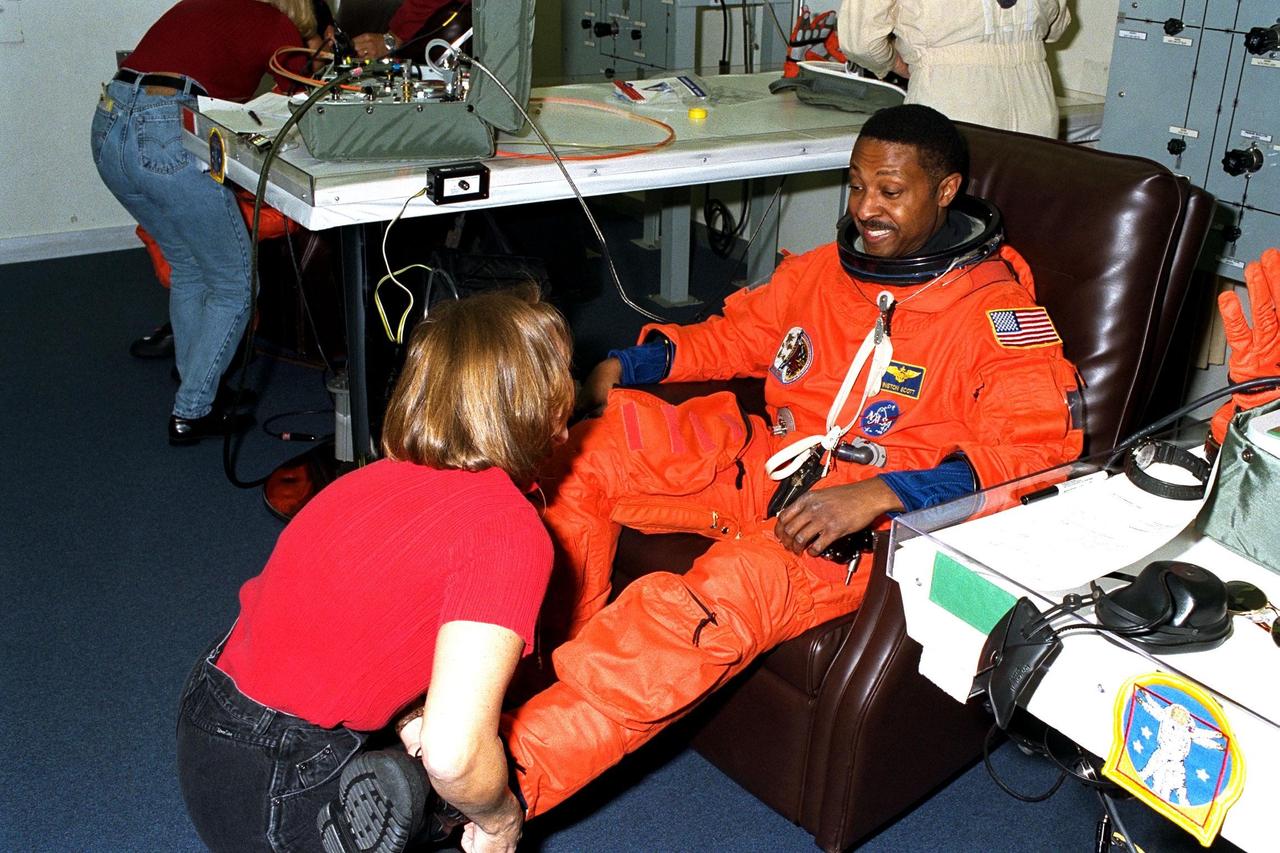
STS-87 Mission Specialist Winston Scott dons his launch and entry suit with the assistance of a suit technician in the Operations and Checkout Building. This is Scott’s second space flight. He and the five other crew members will depart shortly for Launch Pad 39B, where the Space Shuttle Columbia awaits liftoff on a 16-day mission to perform microgravity and solar research. Scott is scheduled to perform an extravehicular activity spacewalk with Mission Specialist Takao Doi, Ph.D., of the National Space Development Agency of Japan, during STS-87. He also performed a spacewalk on STS-72
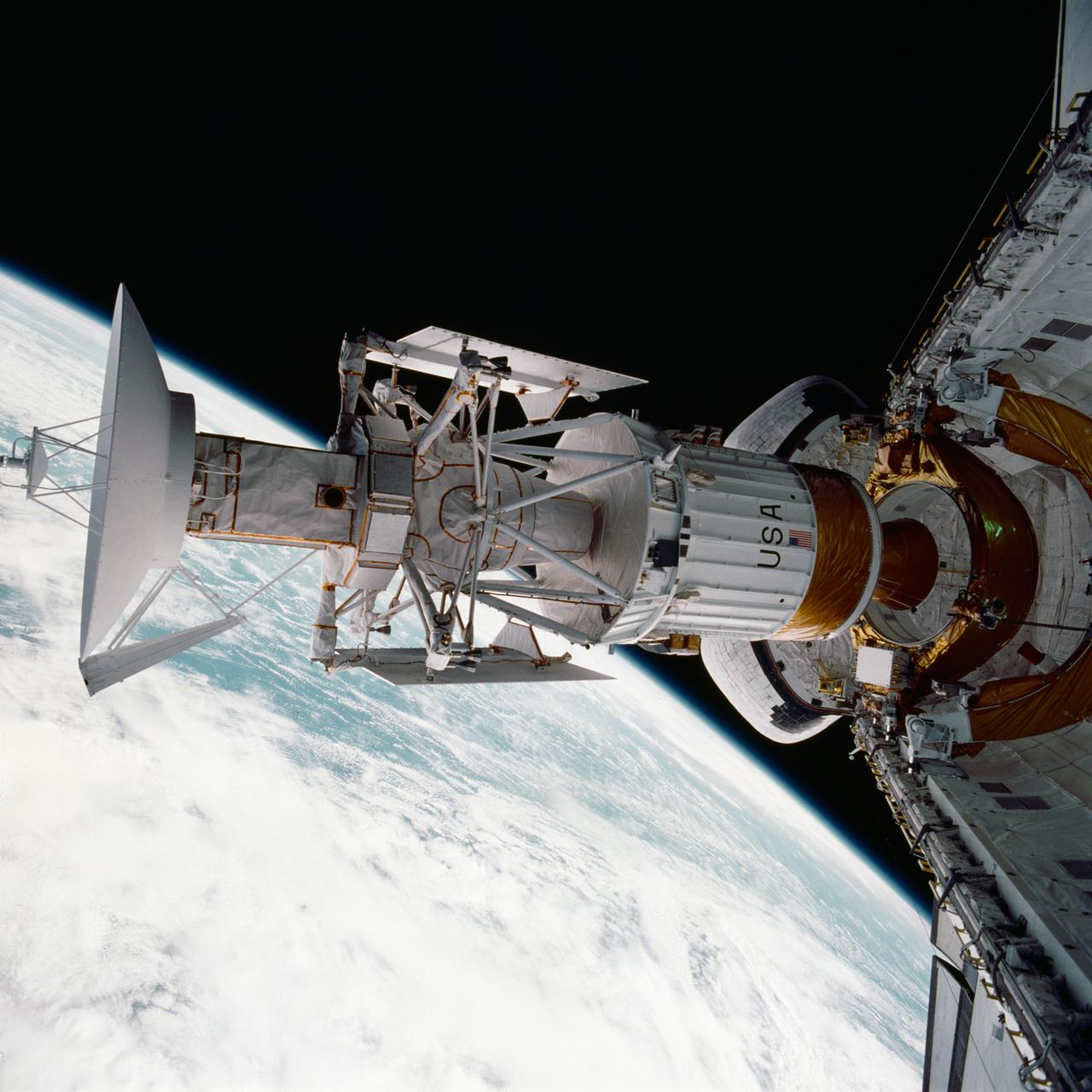
STS030-72-047 (4 May 1989) --- In the early evening hours of Atlantis?s first day in space for the four-day STS-30 mission, the Magellan spacecraft is released into space to begin its long journey to the planet Venus for an extensive radar mapping mission. The scene was photographed through Atlantis?s aft flight deck windows with a handheld 70mm camera.
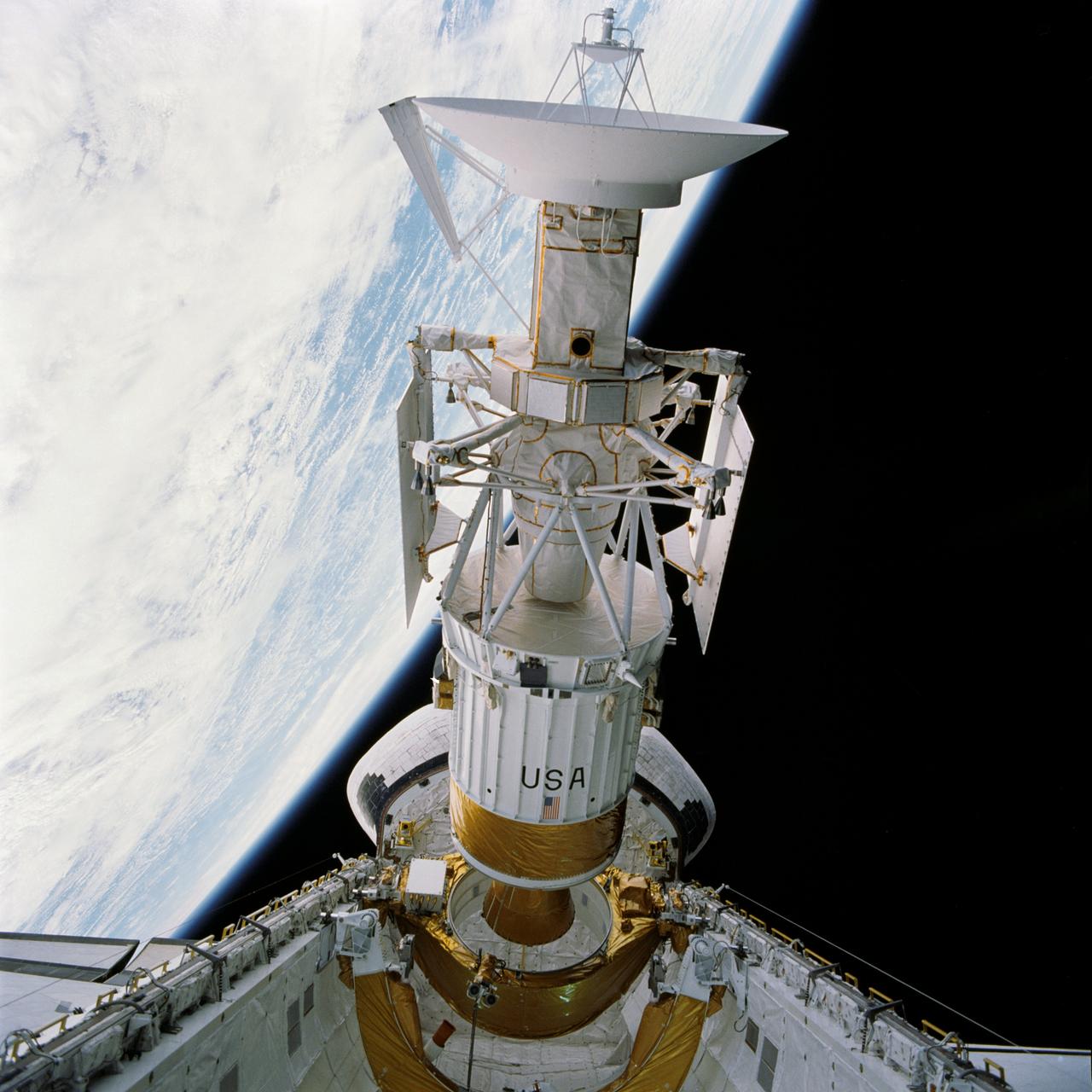
STS030-72-046 (4 May 1989) --- In the early evening hours of the Space Shuttle Atlantis' first day in space for the four-day STS-30 mission, the Magellan spacecraft is released into space to begin its long journey to the planet Venus for an extensive radar mapping mission. The scene was photographed through Atlantis' aft flight deck windows with a handheld 70mm camera.
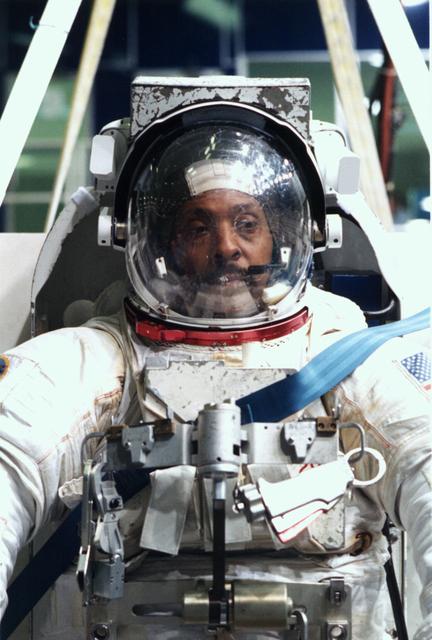
S95-04113 (24 February 1995) --- Wearing a training version of the Space Shuttle Extravehicular Mobility Unit (EMU), astronaut Winston E. Scott, mission specialist, prepares to go underwater for a Extravehicular Activity (EVA) simulation at Johnson Space Center's (JSC) Weightless Environment Training Facility (WET-F). In less than a year from now, Scott is scheduled to perform an EVA in the cargo bay of the Space Shuttle Endeavour in support of the STS-72 mission.
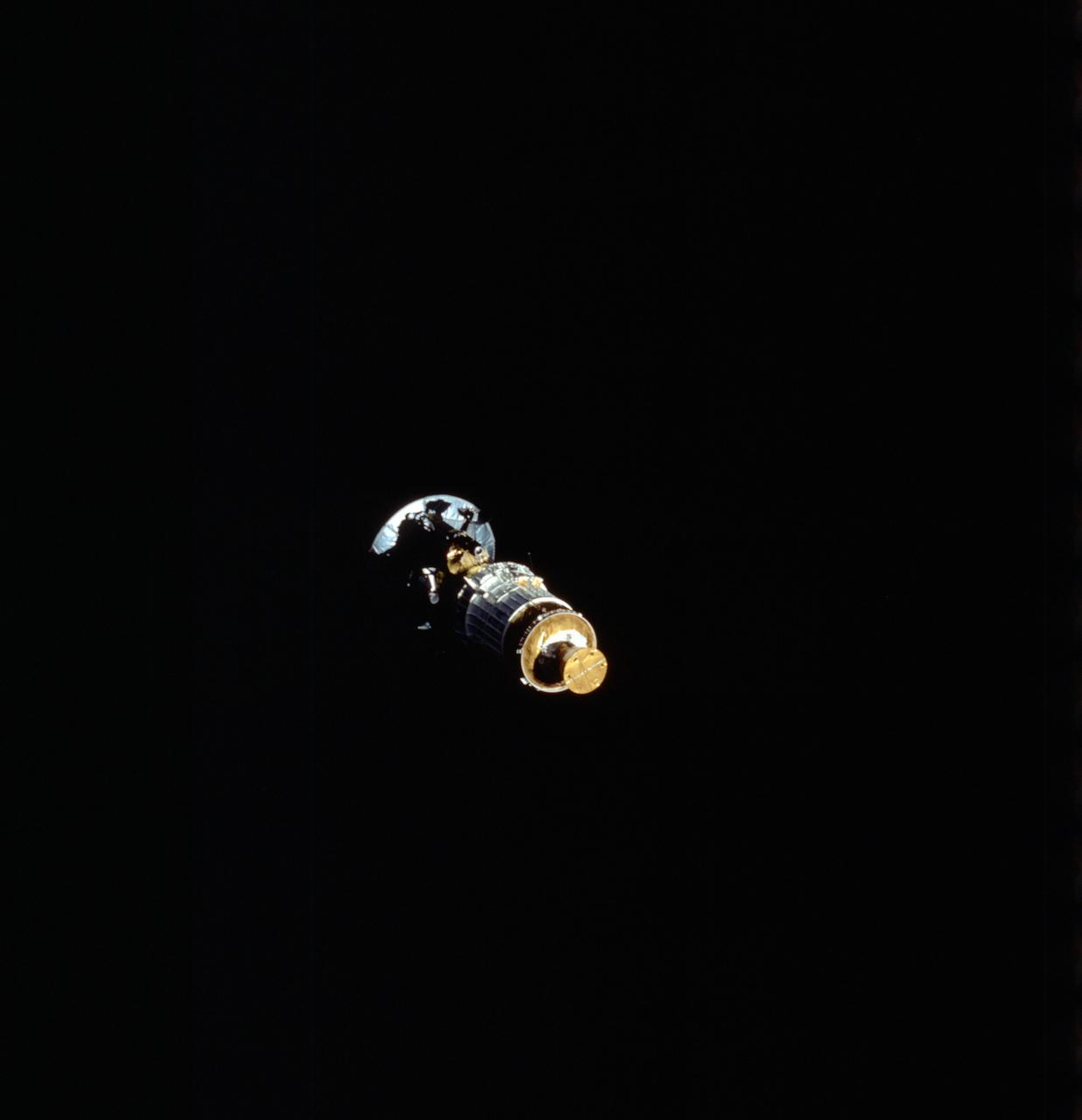
STS034-72-070 (18 Oct 1989) --- Backdropped against the blackness of space, the Galileo spacecraft and its inertial upper stage (IUS) begin relative separation from the Earth-orbiting Space Shuttle Atlantis. The five-member STS-34 crew deployed the Jupiter-bound satellite within six hours of achieving Earth orbit on Oct. 18, 1989. The scene was exposed with a 70mm handheld Hasselblad camera.
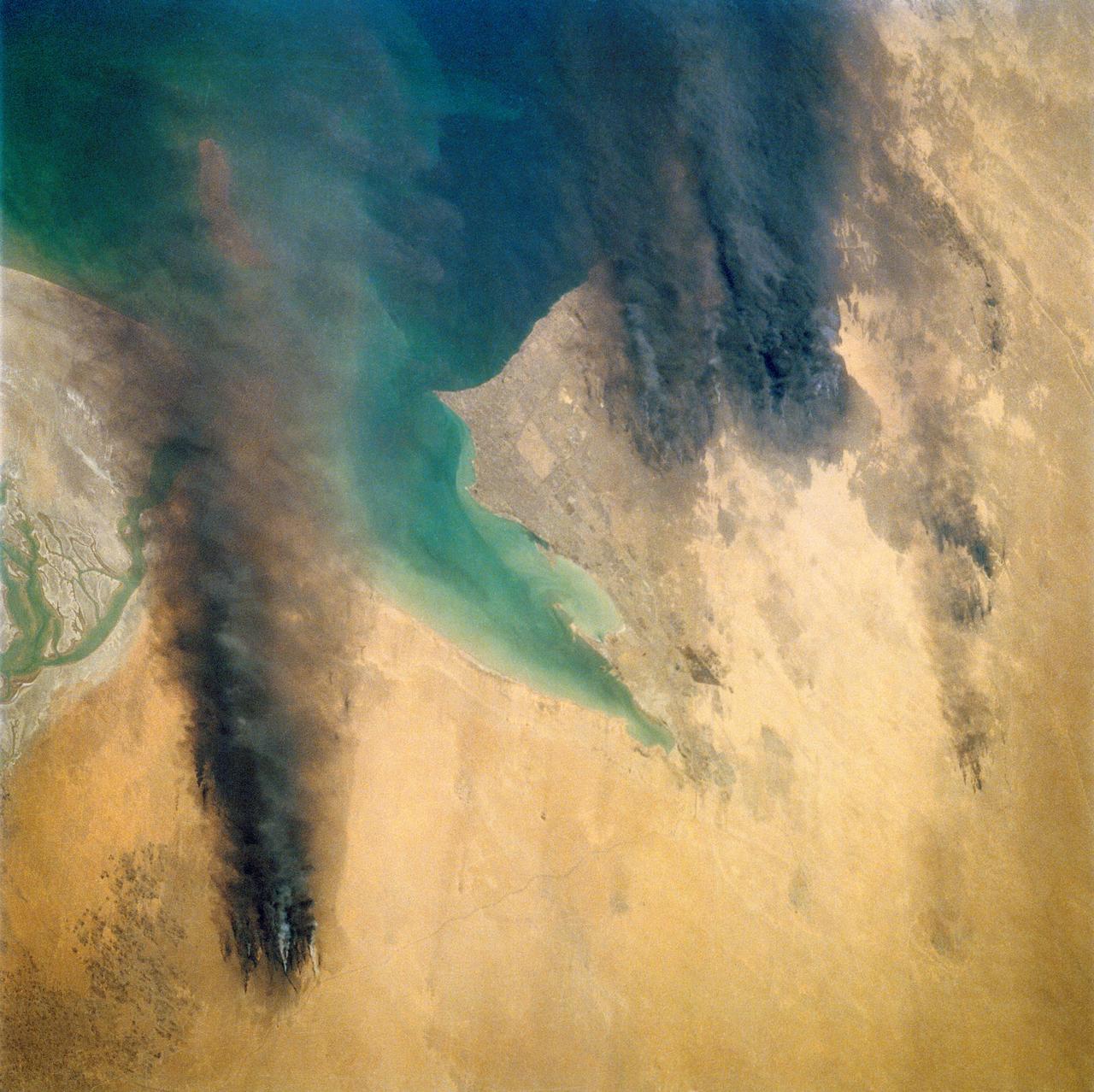
STS039-72-060 (28 April-6 May 1991) --- This view from the Earth-orbiting Space Shuttle Discovery shows the smoke from burning oil well fires, aftermath of Iraqi occupation. Oil wells to the north of the Bay of Kuwait and just south of Kuwait City, on the south shore, can be seen burning out of control. Compared with pictures of the same area shot during STS-37 (April 1991), this frame shows a complete shift of winds, with much of the smoke blowing eastward over the Gulf. The STS-37 scenes showed lengthy southward-blowing sheets of smoke toward Saudi Arabia. In this view, the Gulf island Faylakah Awhah is barely visible through the smoke.
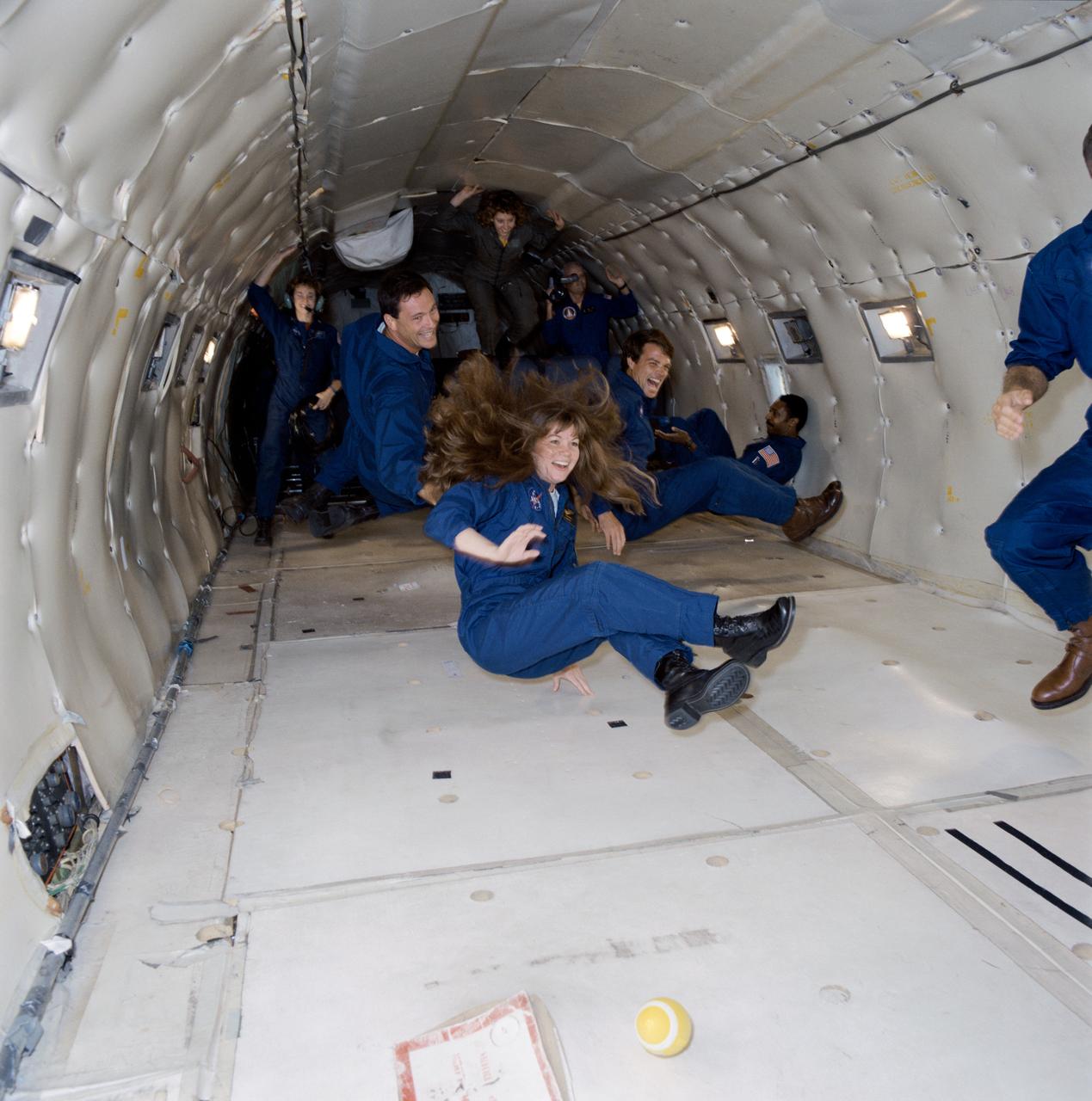
S94-26350 (10 Jan. 1994) --- Astronaut Catherine G. Coleman seems to enjoy the brief period of weightlessness she is sharing with fellow members of the 1992 class of astronauts. The weightless experience was afforded by a special parabolic pattern flown by NASA?s KC-135 ?zero gravity? aircraft. Left to right behind her are astronauts Michael E. Lopez-Alegria, Kevin R. Kregel and Winston E. Scott. EDITOR?S NOTE: Since this photograph was taken the four have been named to flights as follows: Kregel, STS-70; Scott, STS-72.
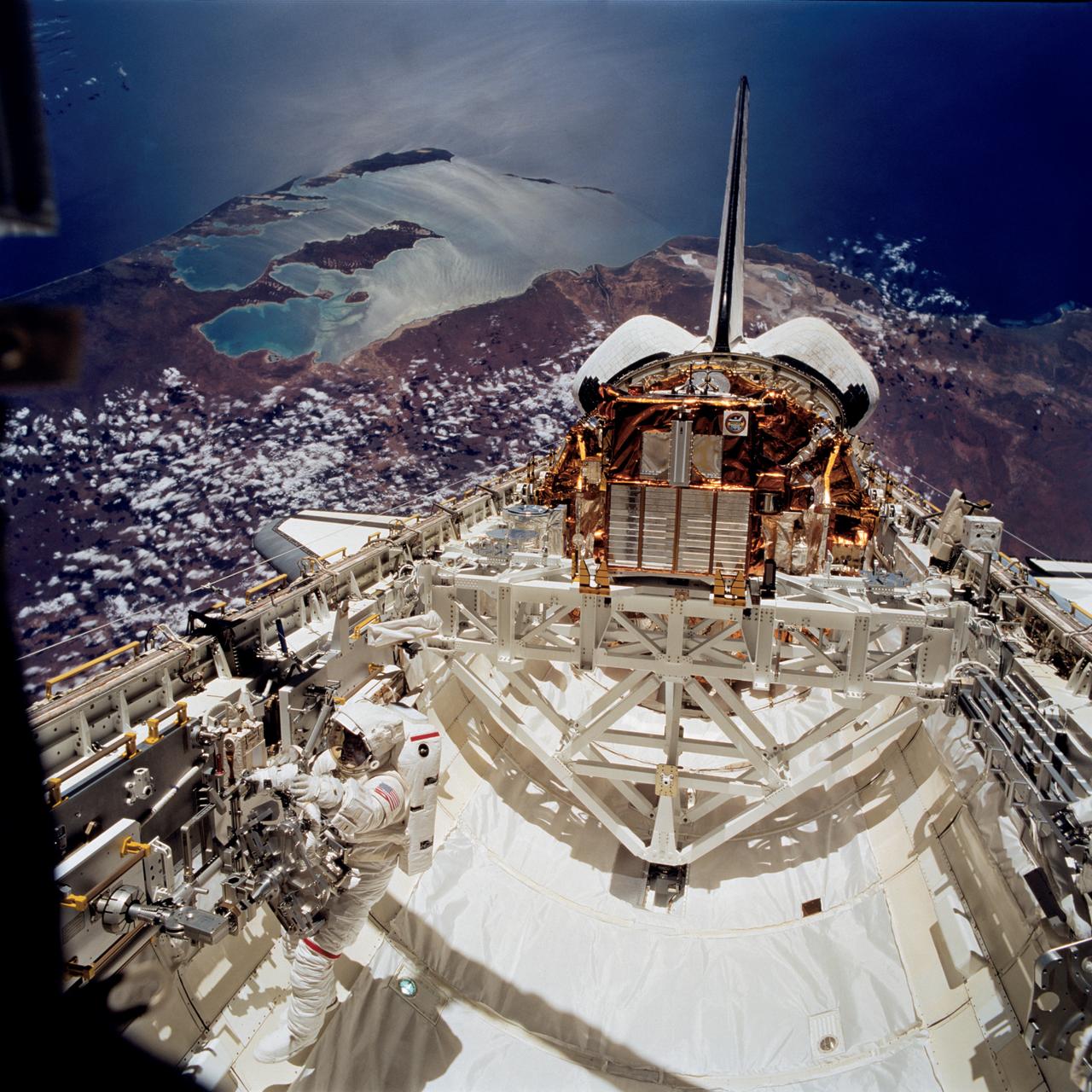
STS072-740-044 (17 Jan. 1996) --- Backdropped against Australia's Shark Bay, this panoramic scene of the Space Shuttle Endeavour in Earth-orbit was recorded during the mission's second Extravehicular Activity (EVA-2) on January 17, 1996. Astronaut Leroy Chiao works with a Mobile Foot Restraint (MFR) at bottom left. The Japanese Space Flyer Unit (SFU) satellite and the Office of Aeronautics and Space Technology (OAST) Flyer satellite are seen in their stowed positions in the aft cargo bay.
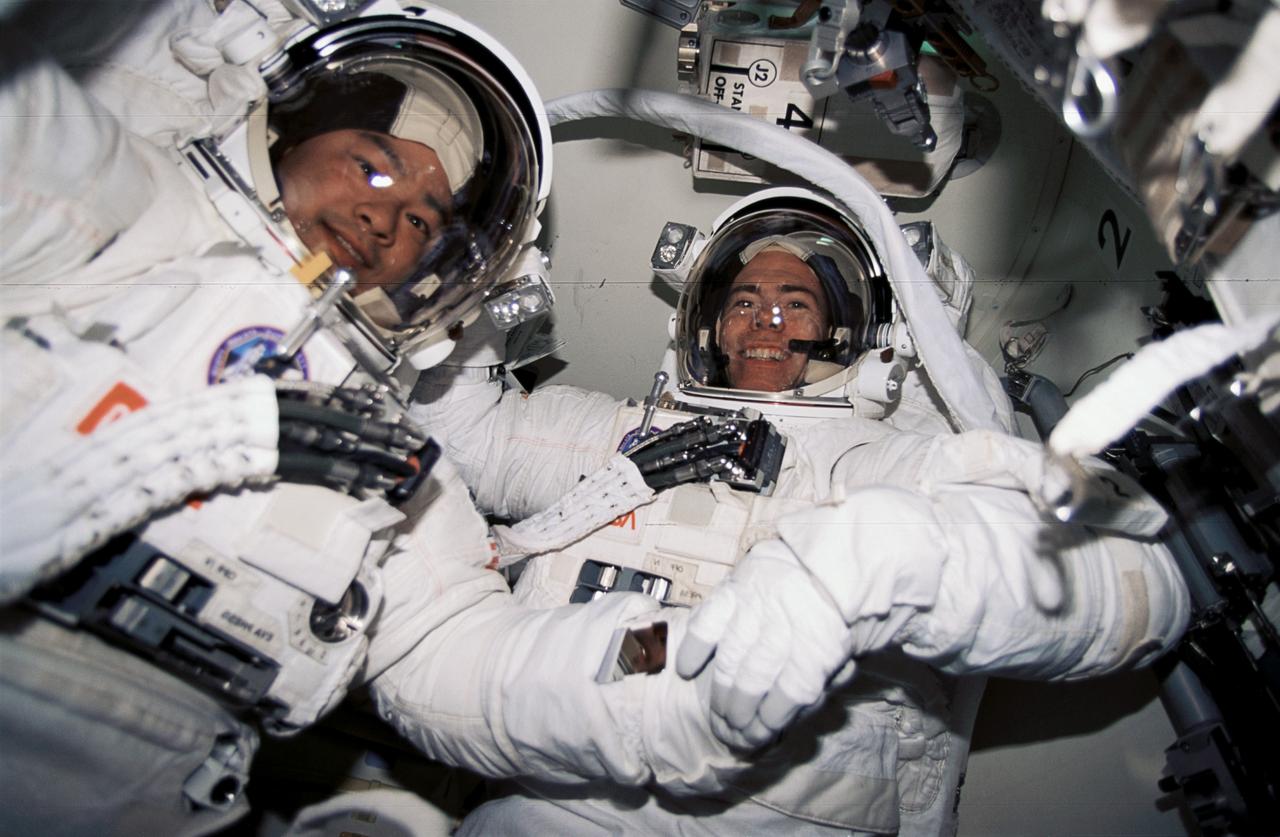
STS072-391-009 (15 Jan. 1996) --- In the Space Shuttle Endeavour's airlock, astronauts Leroy Chiao (left) and Daniel T. Barry prepare for the first extravehicular activity (EVA) scheduled on the mission. The two EVA's were scheduled to evaluate space station assembly techniques.
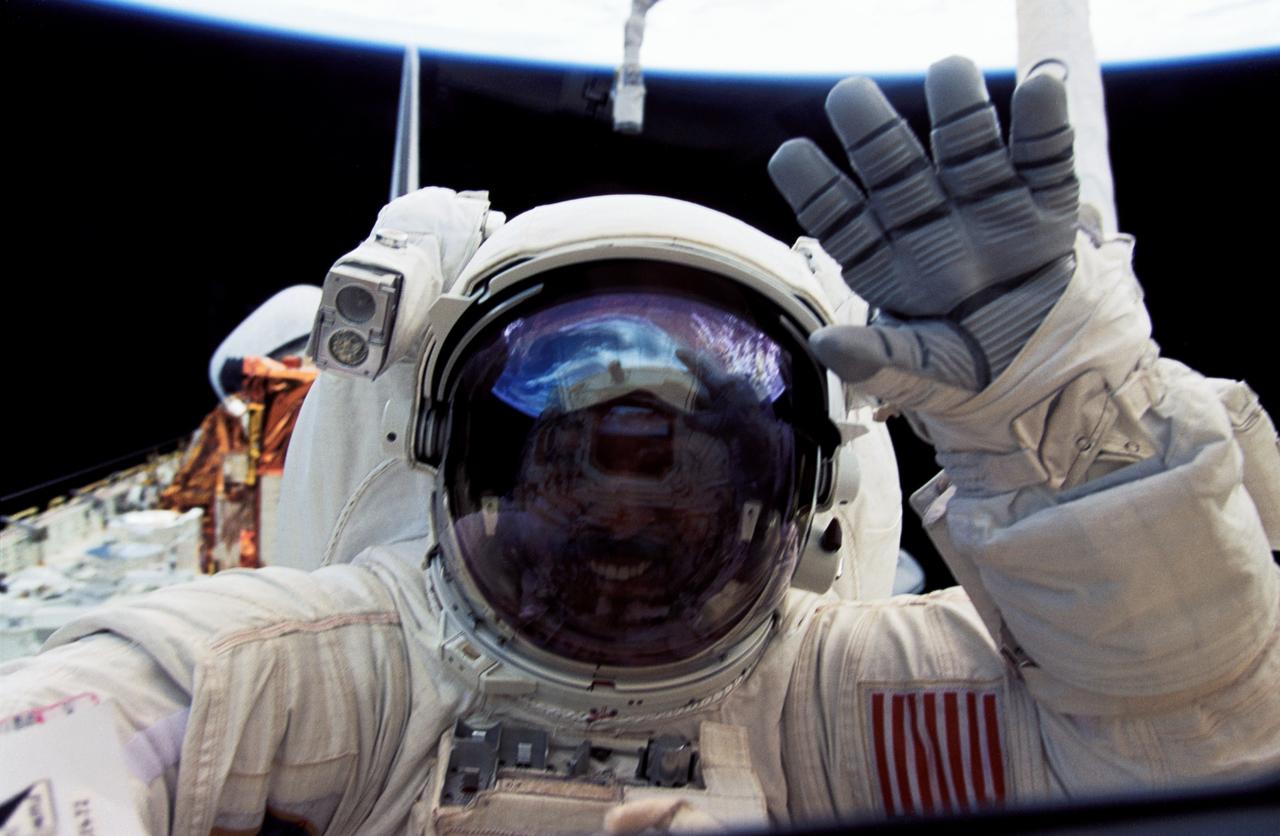
STS072-393-022 (17 Jan. 1996) --- In the Space Shuttle Endeavour's cargo bay, astronaut Winston E. Scott waves to crew mates inside the crew cabin during his extravehicular activity (EVA) on January 17, 1996. Scott was joined by astronaut Leroy Chiao for the EVA.
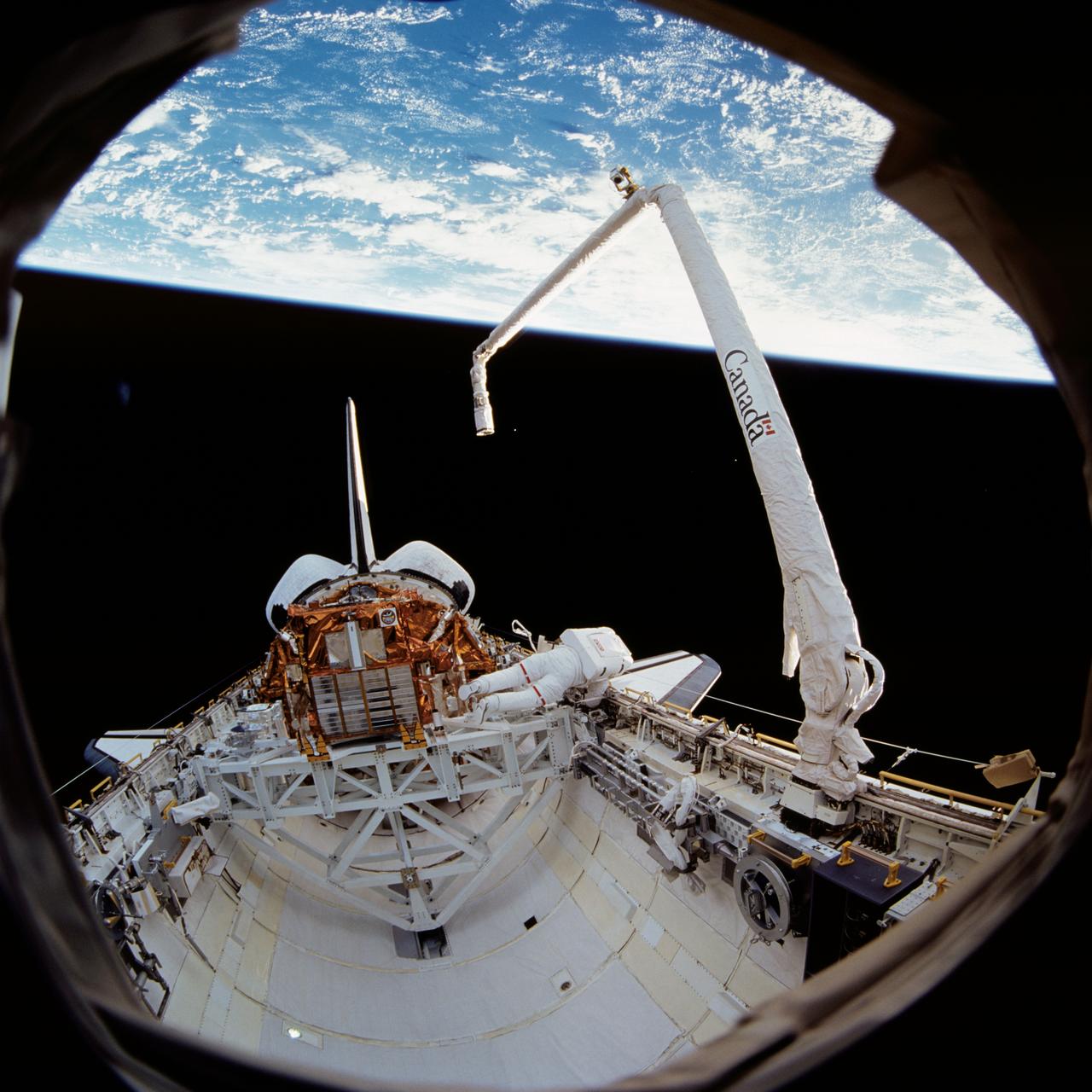
STS072-722-041 (17 Jan. 1996) --- Astronaut Winston E. Scott traverses the portside of the Space Shuttle Endeavour's cargo bay during the second of two Extravehicular Activities (EVA) to demonstrate space station assembly techniques. A 30mm lens on a 70mm handheld camera gives a "fish-eye" effect to the scene. Both the Japanese Space Flyer Unit (SFU) and the Office of Aeronautics and Space Technology (OAST) Flyer satellite are in their stowed positions. TV cameras on the Remote Manipulator System (RMS) provided live coverage of the activity.
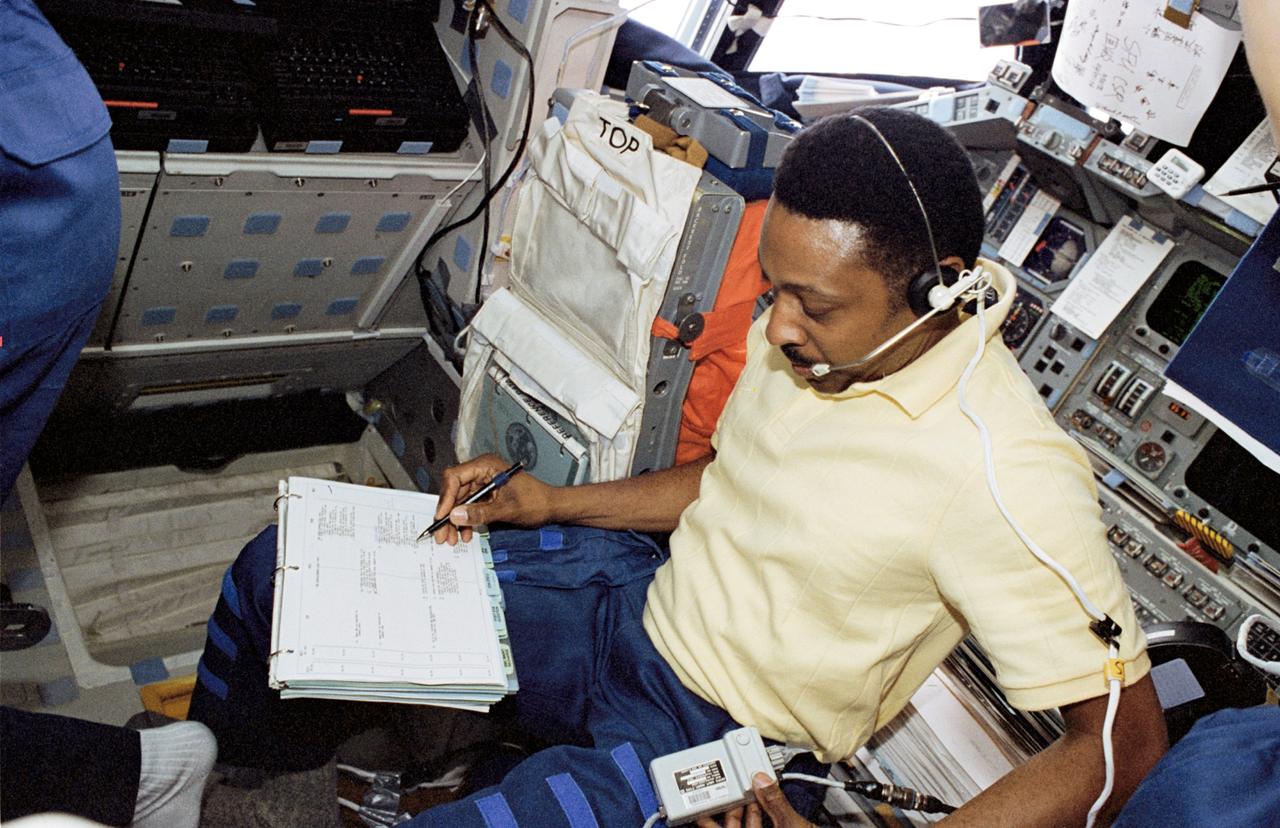
STS072-322-008 (11-20 Jan. 1996) --- On the Space Shuttle Endeavour's forward flight deck, astronaut Winston E. Scott goes over procedures for rendezvous operations with the Japanese Space Flyer Unit (SFU) satellite.

STS072-321-019 (11-20 Jan. 1996) --- Astronaut Koichi Wakata takes advantage of the microgravity environment on the middeck of the Earth-orbiting Space Shuttle Endeavour. Representing Japan's National Space Development Agency (NASDA), Wakata joined five other astronauts for a week and a half of activity aboard Endeavour. Astronaut Leroy Chiao works in the background.
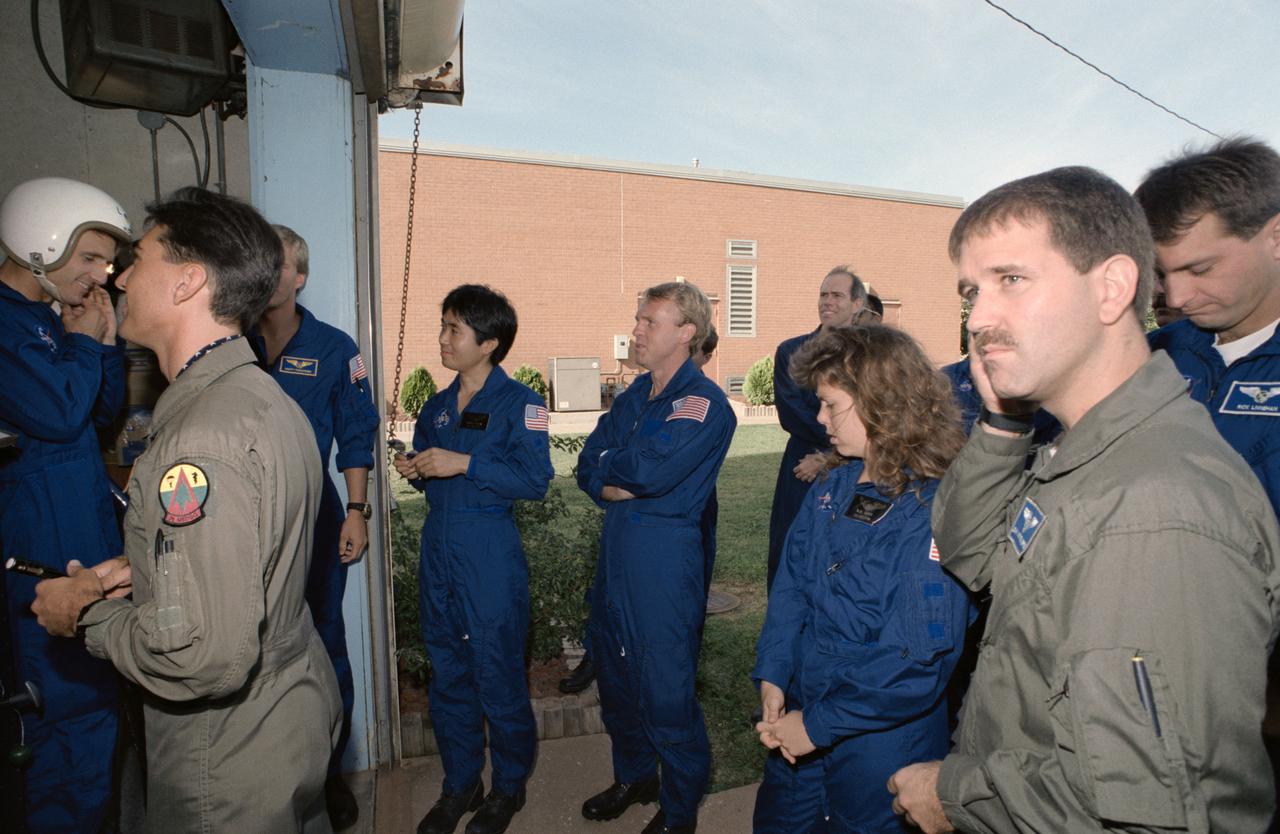
S95-00356 (14 September 1992) --- Several 1992 astronaut candidates wait in line to receive gear for one of several phases of parachute familiarization and survival training at Vance Air Force Base in Oklahoma. Recognizable in the picture are Jerry M. Linenger, Scott E. Parazynski, Koichi Wakata, Andrew S. W. Thomas, Mary Ellen Weber, Joseph R. Tanner, John M. Grunsfeld and Richard M. Linnehan.
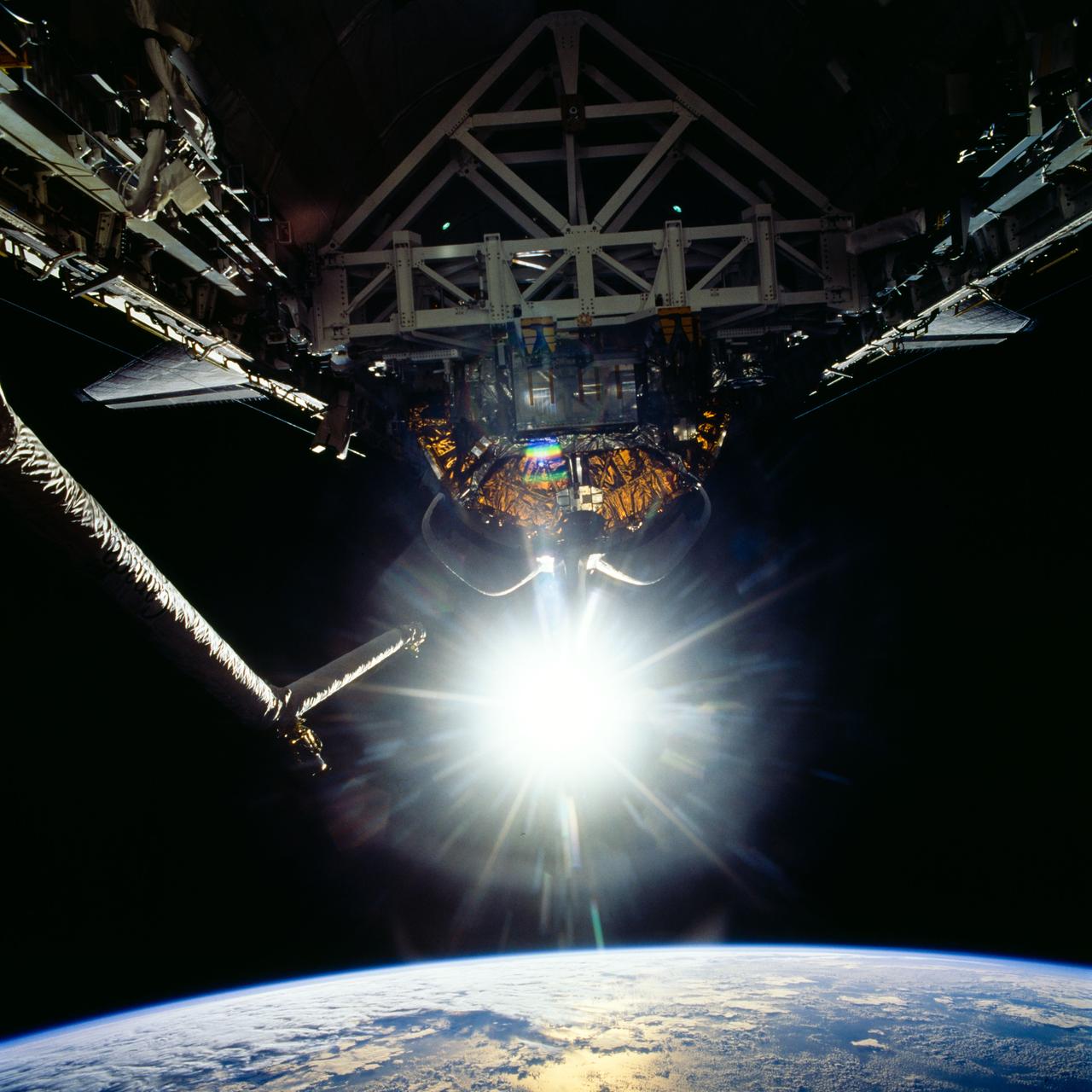
STS072-726-085 (11-20 Jan. 1996) --- The crew members captured this 70mm view of the Space Shuttle Endeavour’s cargo bay, with the reflection of sunglint over Earth’s horizon. The Canadian-built Remote Manipulator System (RMS) arm, with two television cameras affixed, is at frame right. The crew earlier had retrieved the Japanese Space Flyer (SFU) and berthed in the aft cargo bay, along with the Office of Aeronautics and Space Technology (OAST) Flyer satellite.
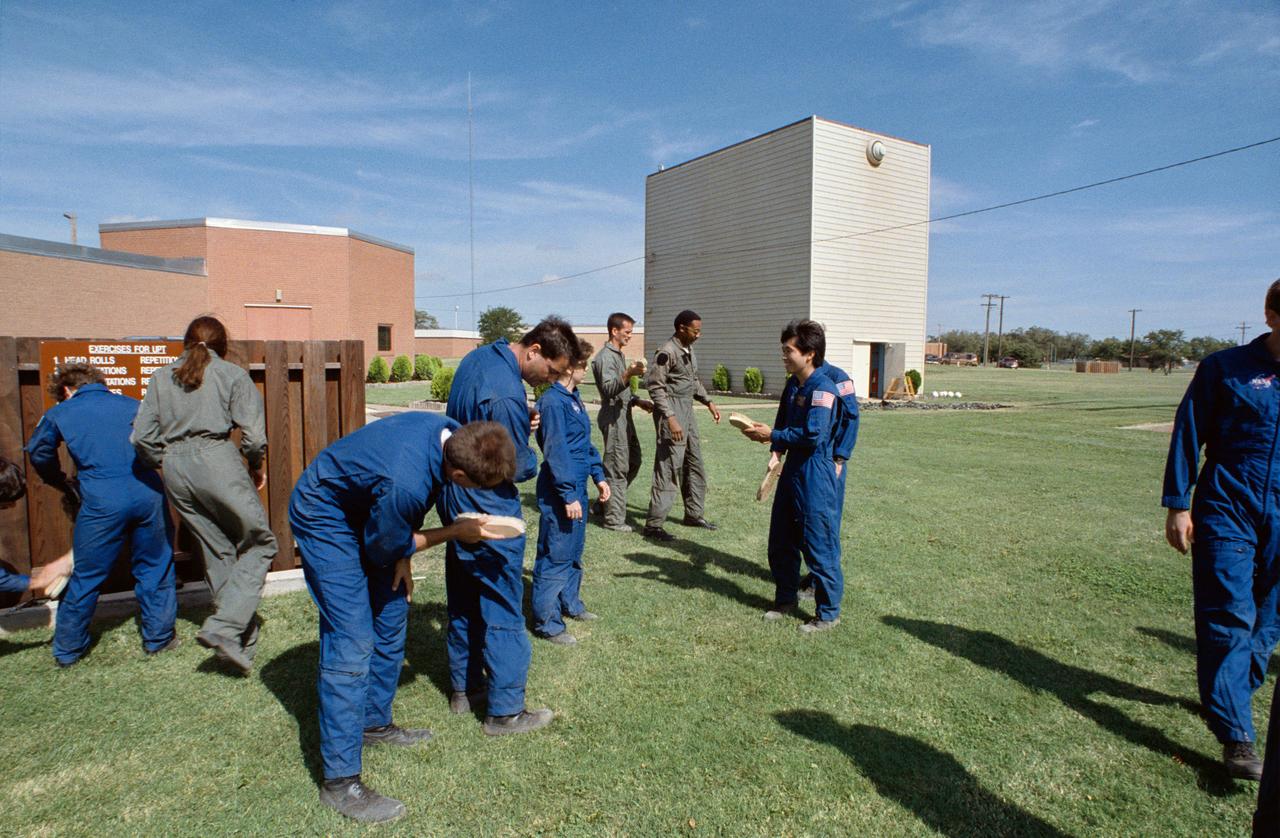
S95-00353 (12-14 September 1992) --- Several 1992 astronaut candidates brush the sand and gravel off one another following one of several phases of parachute familiarization and survival training at Vance Air Force Base in Oklahoma. Recognizable in the picture are Wendy B. Lawrence, Michael E. Lopez-Alegria, Chris A. Hadfield, Winston E. Scott and Koichi Wakata. The trainees had just completed an exercise, which required their jumping off a box into a gravel pit, in order to familiarize them the proper way to meet the ground following an emergency parachute drop.
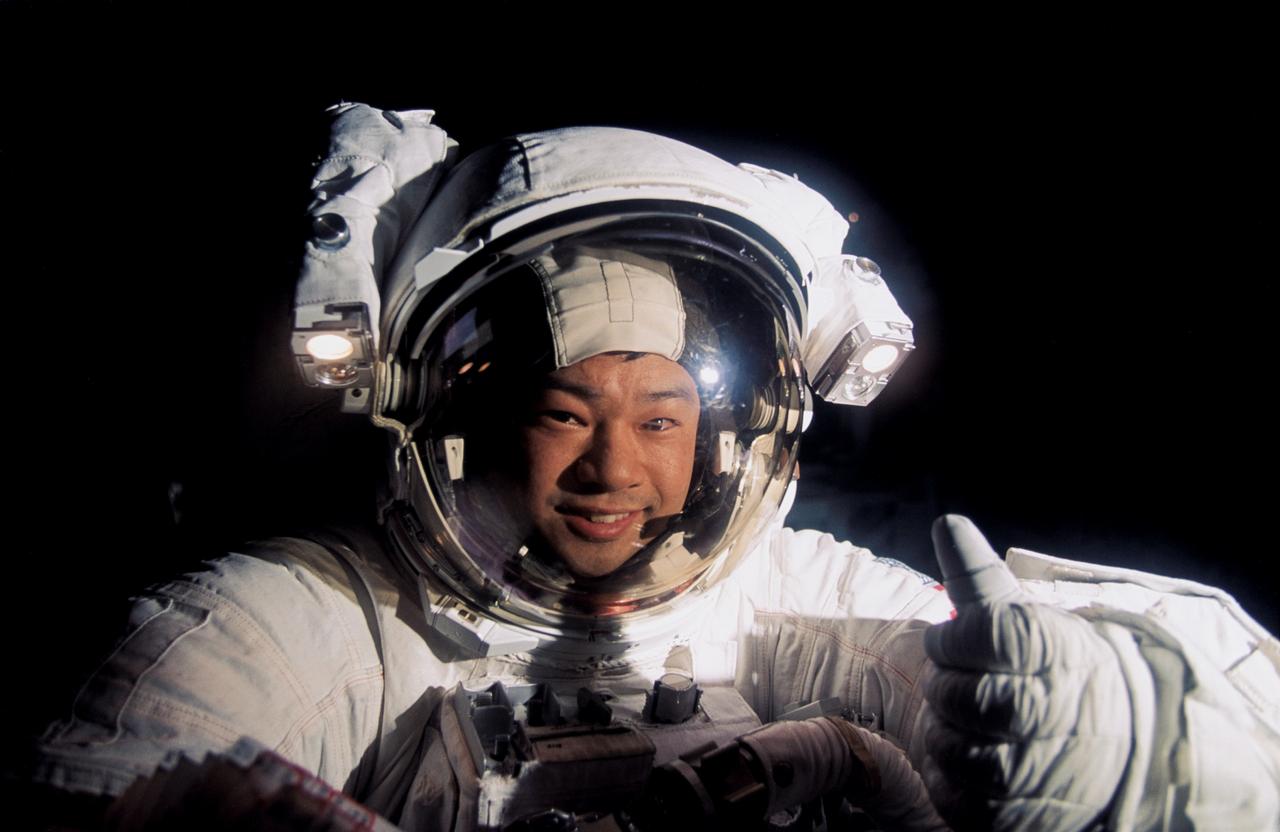
STS072-393-008 (17 Jan. 1996) --- Astronaut Leroy Chiao gives a thumbs up signal, marking the success of his second extravehicular activity (EVA) in three days. Chiao was joined by astronaut Winston E. Scott on this EVA.
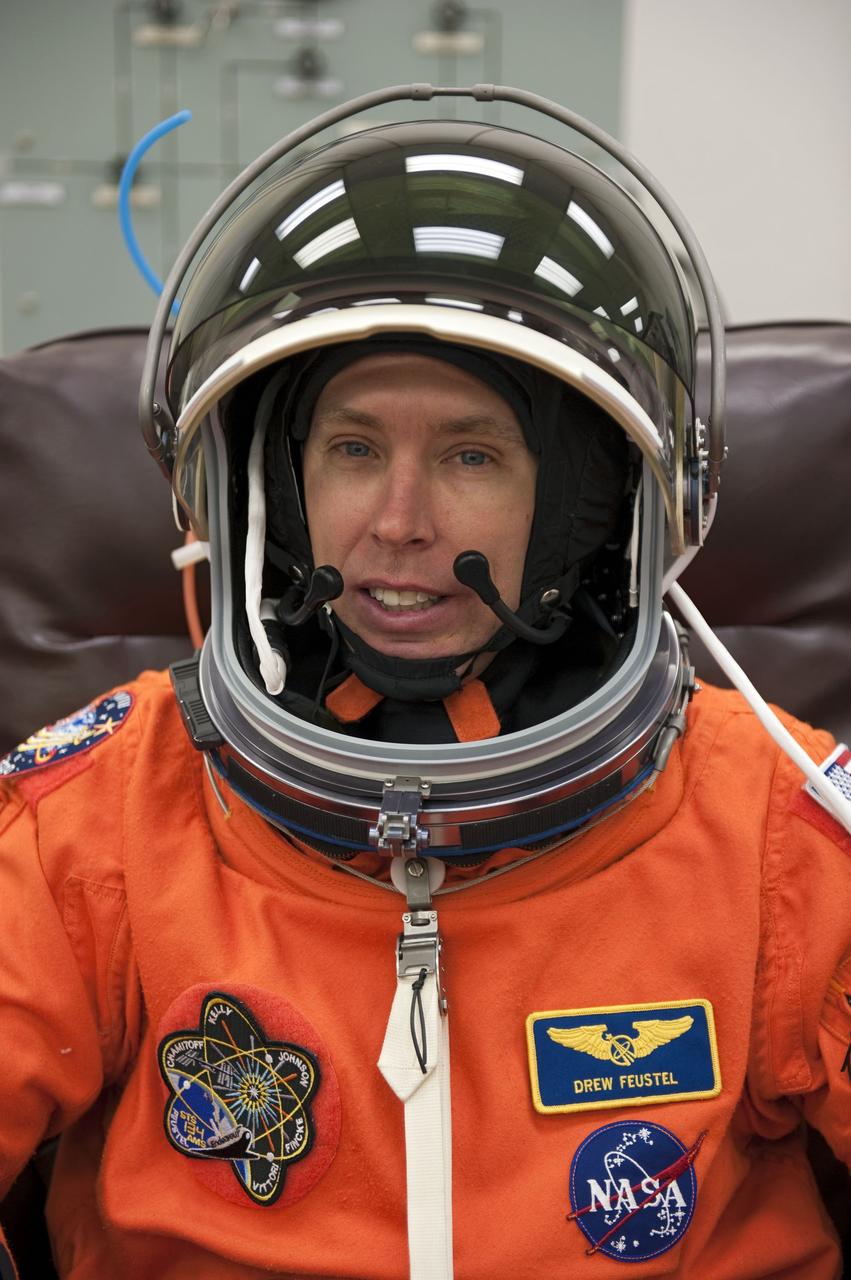
CAPE CANAVERAL, Fla. -- In the Operations and Checkout Building (O&C) at NASA's Kennedy Space Center in Florida, space shuttle Endeavour's STS-134 astronauts put on their launch-and-entry suits and check the fit of their helmets and gloves before heading to the Astrovan for the ride to Launch Pad 39A. Mission Specialist Andrew Feustel, seen here, last flew to NASA's Hubble Space Telescope in 2009. STS-134 will deliver the Express Logistics Carrier-3, Alpha Magnetic Spectrometer-2 (AMS), a high-pressure gas tank and additional spare parts for the Dextre robotic helper to the space station. Endeavour was scheduled to launch at 3:47 p.m. on April 29, but that attempt was scrubbed for at least 72 hours while engineers assess an issue associated with the shuttle's Auxiliary Power Unit 1. STS-134 will be the final spaceflight for Endeavour. For more information visit, www.nasa.gov/mission_pages/shuttle/shuttlemissions/sts134/index.html. Photo credit: NASA/Kim Shiflett
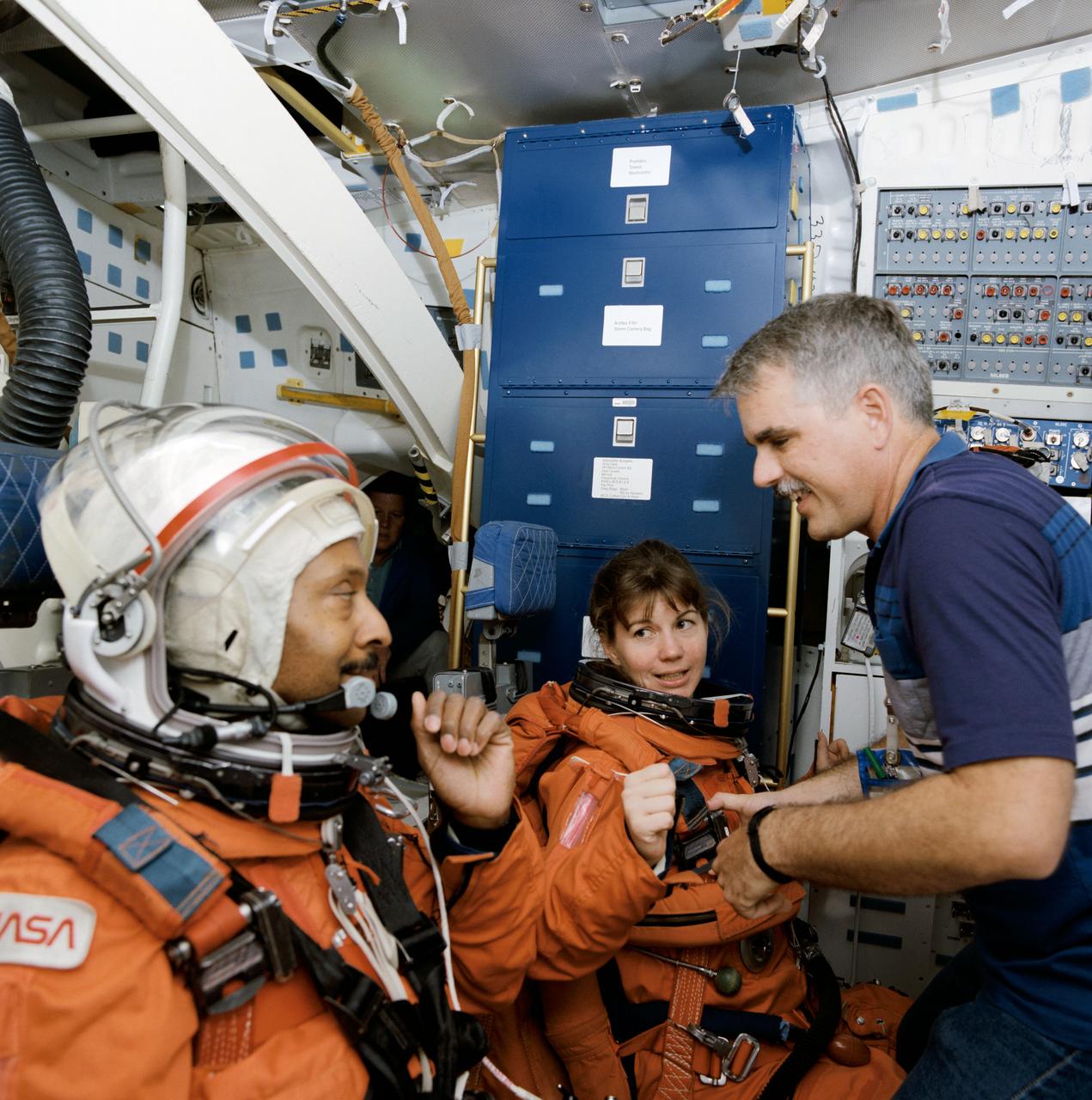
S94-33189 (June 1994) --- Though they have been assigned to two different missions, two NASA astronauts share a briefing about a common mission phase of activity - ascent. Winston E. Scott and Catherine G. Coleman, mission specialists for STS-72 and 73 respectively are briefed by John Hopkins in the mid-deck of one of two full-scale trainers in Johnson Space Center?s (JSC) Systems Integration Facility. Both mission specialists are seated in special break-down stations that accommodate a portion of each Shuttle crew during ascent and entry phases of the flight.
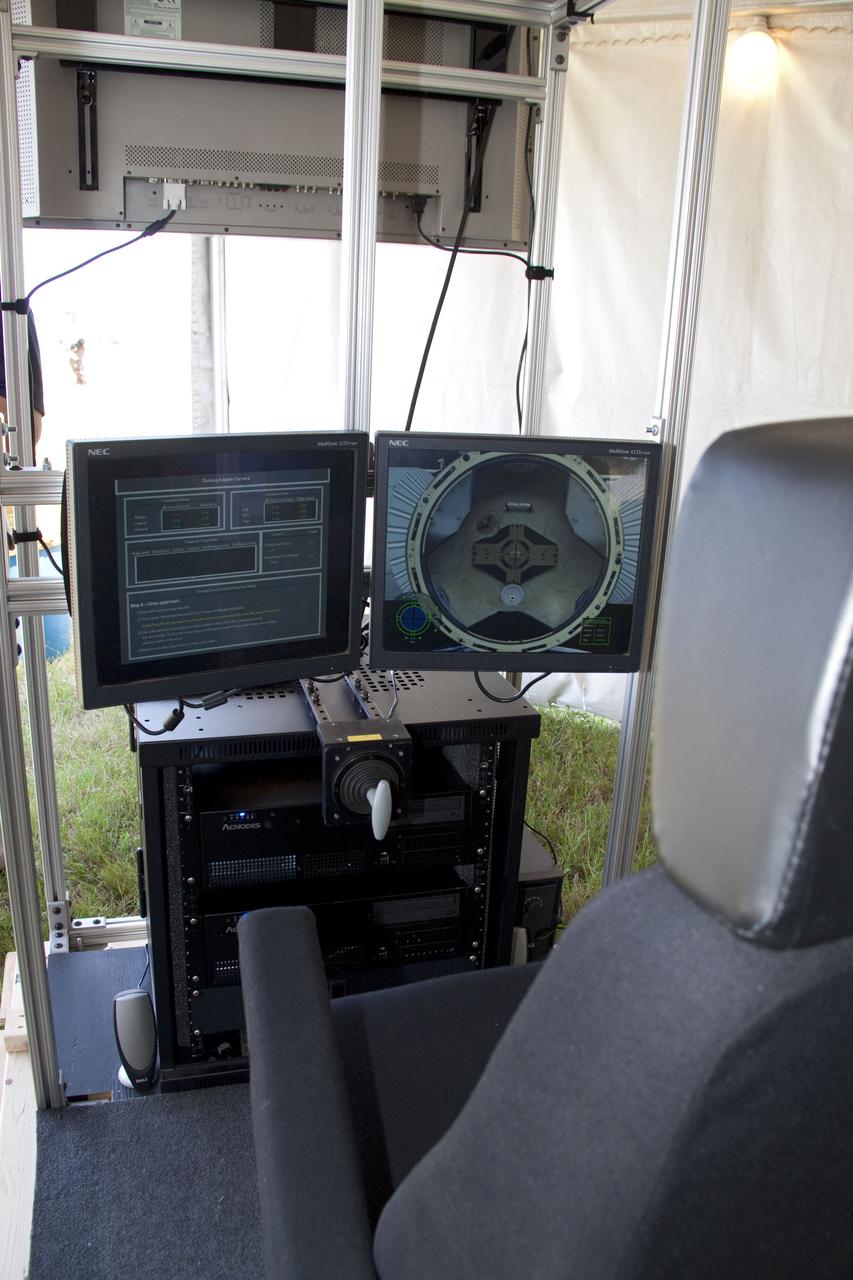
CAPE CANAVERAL, Fla. -- An interactive docking simulator developed by Lockheed Martin gave STS-134 launch guests at NASA's Kennedy Space Center in Florida the opportunity to fly a realistic docking maneuver with the International Space Station. The center screen provides the forward view to the docking target while the white T-shaped handle is used for translation corrections during the maneuver. The Sensor Test for Orion Relnav Risk Mitigation, or STORRM, flight test planned for space shuttle Endeavour's STS-134 mission will mature the sensor technologies to make these docking operations easier and safer for America's next-generation exploration spacecraft. STS-134 also will deliver the Express Logistics Carrier-3, Alpha Magnetic Spectrometer-2 (AMS), a high-pressure gas tank and additional spare parts for the Dextre robotic helper to the space station. Endeavour was scheduled to launch at 3:47 p.m. on April 29, but that attempt was scrubbed for at least 72 hours while engineers assess an issue associated with the shuttle's Auxiliary Power Unit 1. STS-134 will be the final spaceflight for Endeavour. For more information visit, www.nasa.gov_mission_pages_shuttle_shuttlemissions_sts134_index.html. Photo credit: NASA_Jack Pfaller
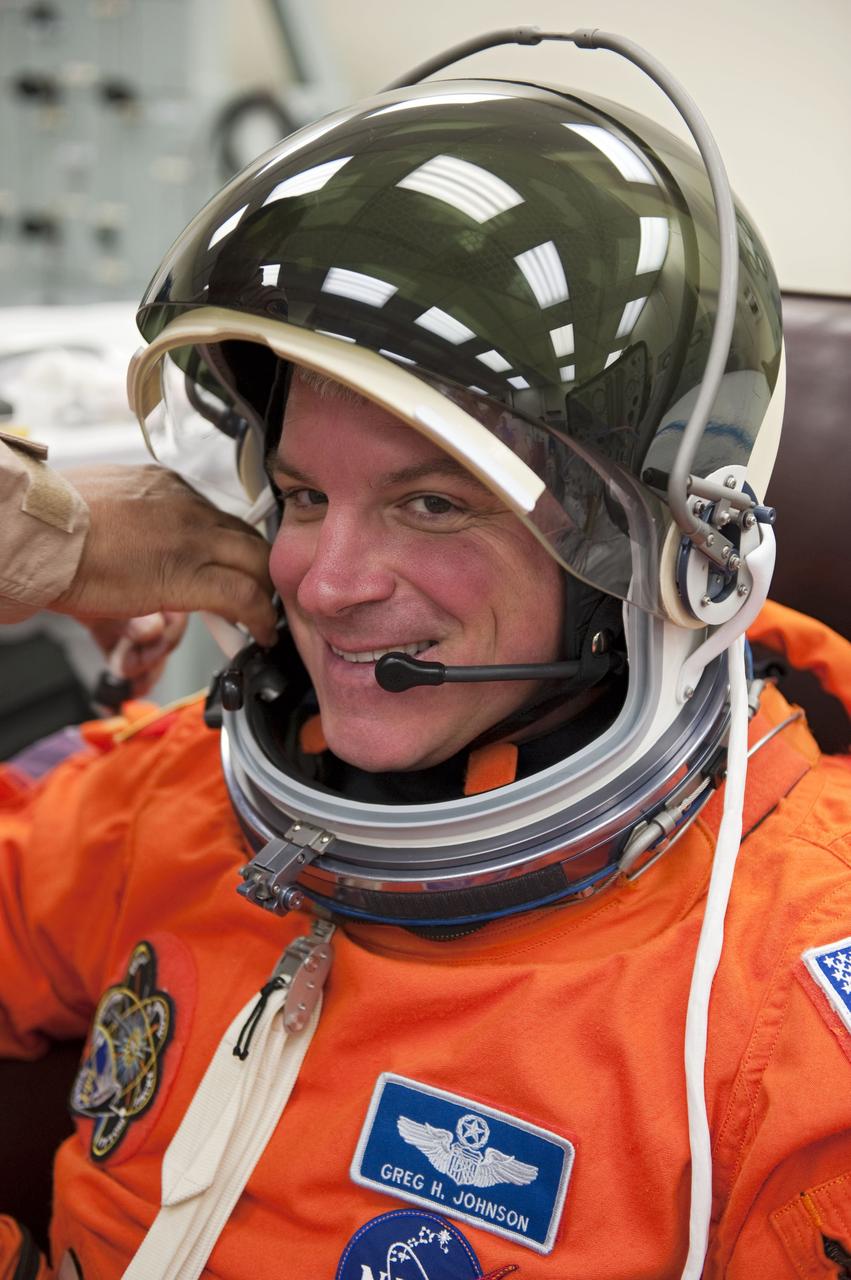
CAPE CANAVERAL, Fla. -- In the Operations and Checkout Building (O&C) at NASA's Kennedy Space Center in Florida, space shuttle Endeavour's STS-134 astronauts put on their launch-and-entry suits and check the fit of their helmets and gloves before heading to the Astrovan for the ride to Launch Pad 39A. Pilot Greg H. Johnson, seen here, last piloted space shuttle Endeavour during its STS-123 mission in 2008. STS-134 will deliver the Express Logistics Carrier-3, Alpha Magnetic Spectrometer-2 (AMS), a high-pressure gas tank and additional spare parts for the Dextre robotic helper to the space station. Endeavour was scheduled to launch at 3:47 p.m. on April 29, but that attempt was scrubbed for at least 72 hours while engineers assess an issue associated with the shuttle's Auxiliary Power Unit 1. STS-134 will be the final spaceflight for Endeavour. For more information visit, www.nasa.gov/mission_pages/shuttle/shuttlemissions/sts134/index.html. Photo credit: NASA/Kim Shiflett

CAPE CANAVERAL, Fla. -- In the Operations and Checkout Building (O&C) at NASA's Kennedy Space Center in Florida, space shuttle Endeavour's STS-134 astronauts put on their launch-and-entry suits and check the fit of their helmets and gloves before heading to the Astrovan for the ride to Launch Pad 39A. Commander Mark Kelly, seen here, last commanded space shuttle Discovery during its STS-124 mission in 2008. STS-134 will deliver the Express Logistics Carrier-3, Alpha Magnetic Spectrometer-2 (AMS), a high-pressure gas tank and additional spare parts for the Dextre robotic helper to the space station. Endeavour was scheduled to launch at 3:47 p.m. on April 29, but that attempt was scrubbed for at least 72 hours while engineers assess an issue associated with the shuttle's Auxiliary Power Unit 1. STS-134 will be the final spaceflight for Endeavour. For more information visit, www.nasa.gov/mission_pages/shuttle/shuttlemissions/sts134/index.html. Photo credit: NASA/Kim Shiflett
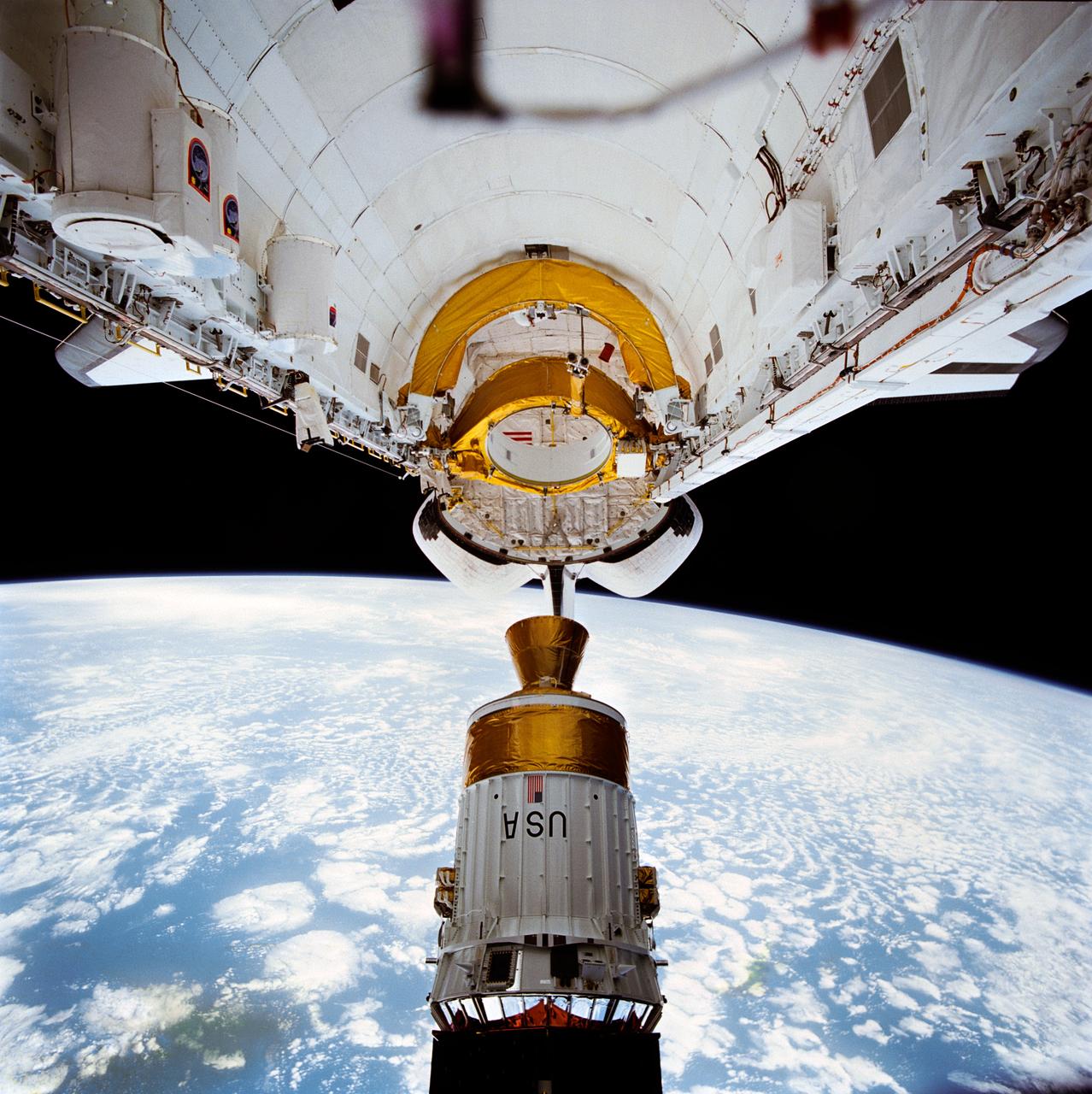
STS043-72-059 (2 Aug 1991) --- The Tracking and Data Relay Satellite (TDRS-E), leaves the payload bay of the earth-orbiting Atlantis a mere six hours after the Space Shuttle was launched from Pad 39A at Kennedy Space Center, Florida. TDRS, built by TRW, will be placed in a geosynchronous orbit and after on-orbit testing, which requires several weeks, will be designated TDRS-5. The communications satellite will replace TDRS-3 at 174 degrees West longitude. The backbone of NASA's space-to-ground communications, the Tracking and Data Relay satellites have increased NASA's ability to send and receive data to spacecraft in low-earth orbit to more than 85 percent of the time. The five astronauts of the STS 43 mission are John E. Blaha, mission commander, Michael A. Baker, pilot, and Shannon W. Lucid, G. David Low, and James C. Adamson, all mission specialists.
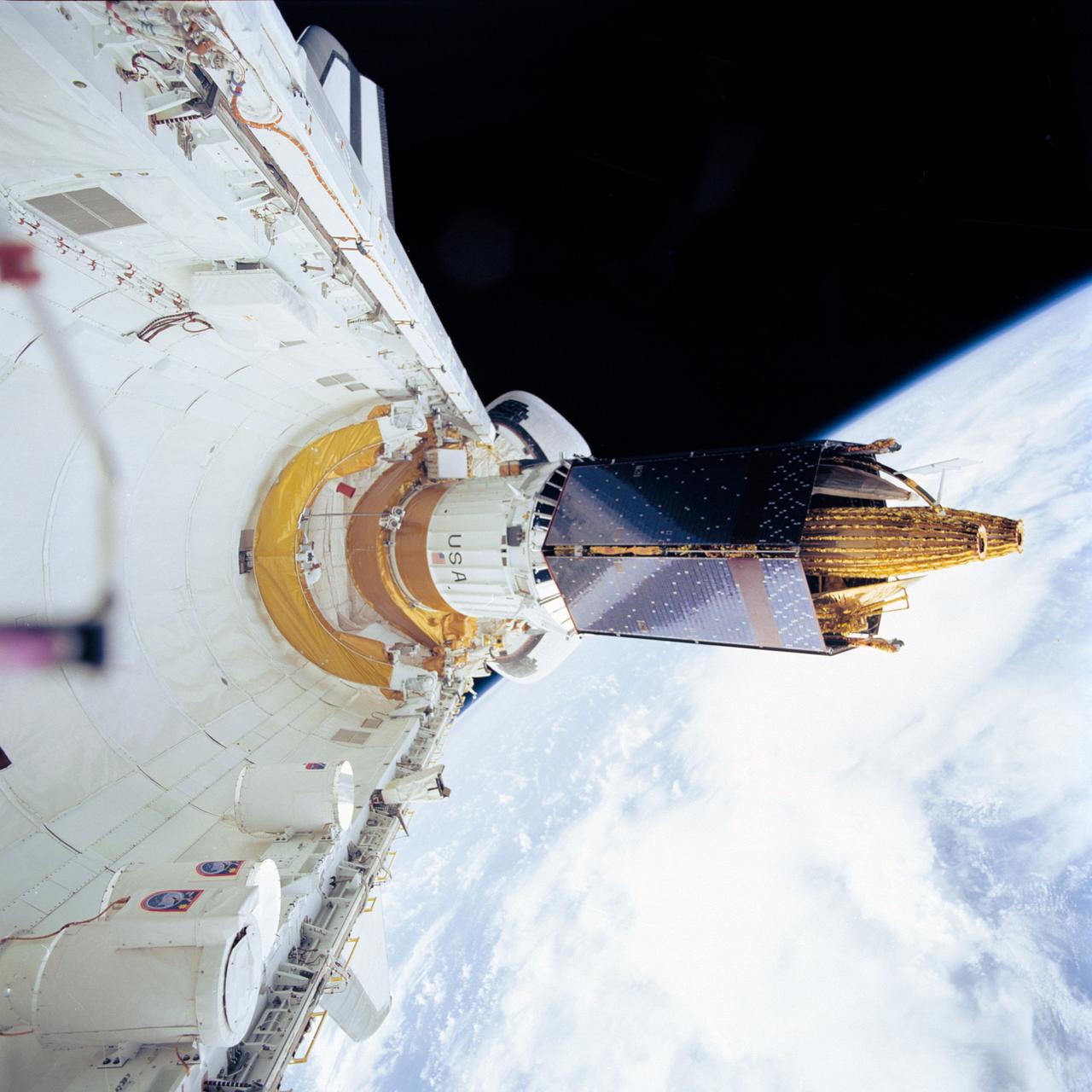
STS043-72-002 (2 Aug 1991) --- The Tracking and Data Relay Satellite (TDRS-E), leaves the payload bay of the earth-orbiting Atlantis a mere six hours after the Space Shuttle was launched from Pad 39A at Kennedy Space Center, Florida. TDRS, built by TRW, will be placed in a geosynchronous orbit and after on-orbit testing, which requires several weeks, will be designated TDRS-5. The communications satellite will replace TDRS-3 at 174 degrees West longitude. The backbone of NASA's space-to-ground communications, the Tracking and Data Relay satellites have increased NASA's ability to send and receive data to spacecraft in low-earth orbit to more than 85 percent of the time. The five astronauts of the STS 43 mission are John E. Blaha, mission commander, Michael A. Baker, pilot, and Shannon W. Lucid, G. David Low, and James C. Adamson, all mission specialists.

CAPE CANAVERAL, Fla. -- Space shuttle Endeavour's six STS-134 astronauts, dressed in their orange launch-and-entry suits, wave to news media and other spectators before hopping aboard the Astrovan parked in front of the Operations and Checkout Building at NASA's Kennedy Space Center in Florida. The modified Airstream recreational vehicle has transported astronauts to their spacecraft since 1984. From left, are Mission Specialists Greg Chamitoff, Andrew Feustel, Roberto Vittori with the European Space Agency and Michael Fincke, Pilot Greg H. Johnson and Commander Mark Kelly. STS-134 will deliver the Express Logistics Carrier-3, Alpha Magnetic Spectrometer-2 (AMS), a high-pressure gas tank and additional spare parts for the Dextre robotic helper to the space station. Endeavour was scheduled to launch at 3:47 p.m. on April 29, but that attempt was scrubbed for at least 72 hours while engineers assess an issue associated with the shuttle's Auxiliary Power Unit 1. STS-134 will be the final spaceflight for Endeavour. For more information visit, www.nasa.gov/mission_pages/shuttle/shuttlemissions/sts134/index.html. Photo credit: NASA/Kim Shiflett
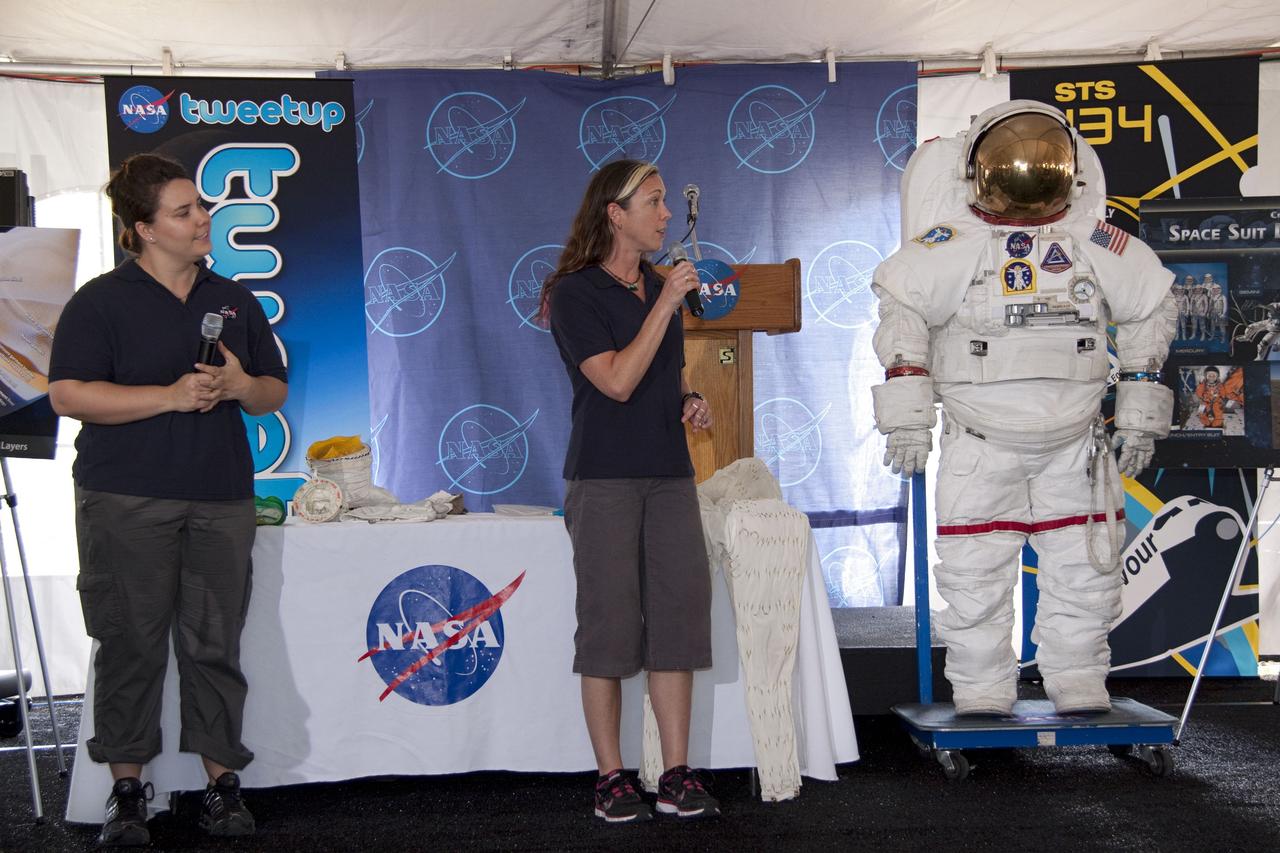
CAPE CANAVERAL, Fla. -- At NASA's Kennedy Space Center in Florida, Mallory Jennings, left, and Heather Paul, aerospace engineers with Johnson Space Center's Spacesuit Life Support, perform a spacesuit demonstration during the STS-134 Tweetup event. About 150 people from 43 states, Washington, D.C., and half a dozen countries are participating in the event. A Tweetup gives followers of @NASA on the social messaging medium Twitter the opportunity to tour the center, view a shuttle launch and speak with NASA managers, astronauts, shuttle technicians and engineers. During the STS-134 mission, space shuttle Endeavour will deliver the Express Logistics Carrier-3, Alpha Magnetic Spectrometer-2 (AMS), a high-pressure gas tank and additional spare parts for the Dextre robotic helper to the International Space Station. Endeavour was scheduled to launch at 3:47 p.m. on April 29, but that attempt was scrubbed for at least 72 hours while engineers assess an issue associated with the shuttle's Auxiliary Power Unit 1. STS-134 will be the final spaceflight for Endeavour. For more information visit, www.nasa.gov/mission_pages/shuttle/shuttlemissions/sts134/index.html. Photo credit: NASA/Jack Pfaller
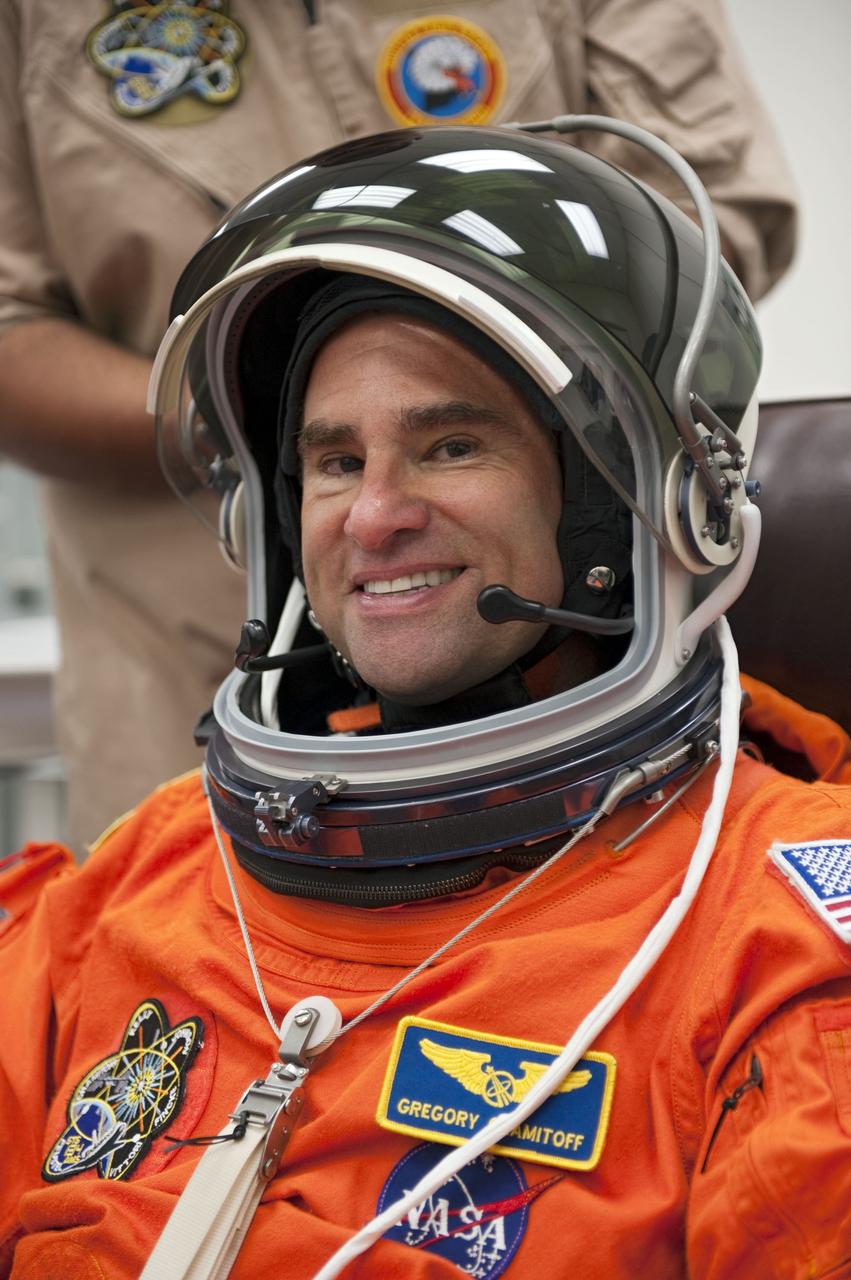
CAPE CANAVERAL, Fla. -- In the Operations and Checkout Building (O&C) at NASA's Kennedy Space Center in Florida, space shuttle Endeavour's STS-134 astronauts put on their launch-and-entry suits and check the fit of their helmets and gloves before heading to the Astrovan for the ride to Launch Pad 39A. Mission Specialist Greg Chamitoff, seen here, last served as flight engineer and science officer aboard the International Space Station in 2008. STS-134 will deliver the Express Logistics Carrier-3, Alpha Magnetic Spectrometer-2 (AMS), a high-pressure gas tank and additional spare parts for the Dextre robotic helper to the space station. Endeavour was scheduled to launch at 3:47 p.m. on April 29, but that attempt was scrubbed for at least 72 hours while engineers assess an issue associated with the shuttle's Auxiliary Power Unit 1. STS-134 will be the final spaceflight for Endeavour. For more information visit, www.nasa.gov/mission_pages/shuttle/shuttlemissions/sts134/index.html. Photo credit: NASA/Kim Shiflett

CAPE CANAVERAL, Fla. -- Howard Hu, manager for the Orion System Performance and Analysis Office at NASA's Johnson Space Center, provides an overview of the Sensor Test for Orion Relnav Risk Mitigation, or STORRM, flight test that space shuttle Endeavour will perform on the last on-orbit day of the STS-134 mission. The overview took place at NASA's Kennedy Space Center in Florida where Endeavour is awaiting liftoff. During the mission, Endeavour will fly a dedicated maneuver to simulate an Orion rendezvous trajectory, while two Orion sensors collect visual- and laser-based relative navigation data. This will provide an unprecedented in-flight test opportunity for America's next-generation exploration spacecraft. STS-134 also will deliver the Express Logistics Carrier-3, Alpha Magnetic Spectrometer-2 (AMS), a high-pressure gas tank and additional spare parts for the Dextre robotic helper to the space station. Endeavour was scheduled to launch at 3:47 p.m. on April 29, but that attempt was scrubbed for at least 72 hours while engineers assess an issue associated with the shuttle's Auxiliary Power Unit 1. STS-134 will be the final spaceflight for Endeavour. For more information visit, www.nasa.gov_mission_pages_shuttle_shuttlemissions_sts134_index.html. Photo credit: NASA_Jack Pfaller
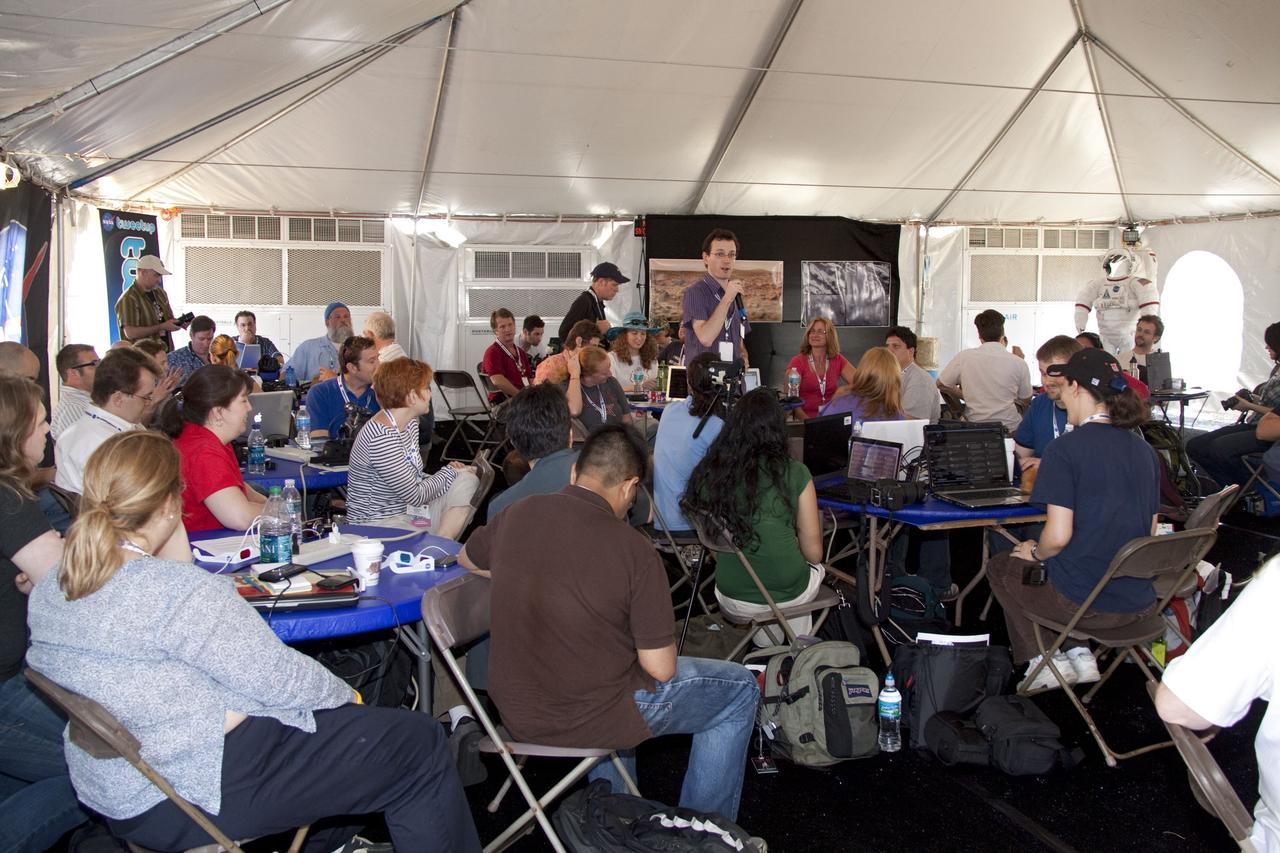
CAPE CANAVERAL, Fla. -- About 150 people from 43 states, Washington, D.C., and half a dozen countries participate in the STS-134 Tweetup event at NASA's Kennedy Space Center in Florida. A Tweetup gives followers of @NASA on the social messaging medium Twitter the opportunity to tour the center, view a shuttle launch and speak with NASA managers, astronauts, shuttle technicians and engineers. During the STS-134 mission, space shuttle Endeavour will deliver the Express Logistics Carrier-3, Alpha Magnetic Spectrometer-2 (AMS), a high-pressure gas tank and additional spare parts for the Dextre robotic helper to the International Space Station. Endeavour was scheduled to launch at 3:47 p.m. on April 29, but that attempt was scrubbed for at least 72 hours while engineers assess an issue associated with the shuttle's Auxiliary Power Unit 1. STS-134 will be the final spaceflight for Endeavour. For more information visit, www.nasa.gov/mission_pages/shuttle/shuttlemissions/sts134/index.html. Photo credit: NASA/Jack Pfaller
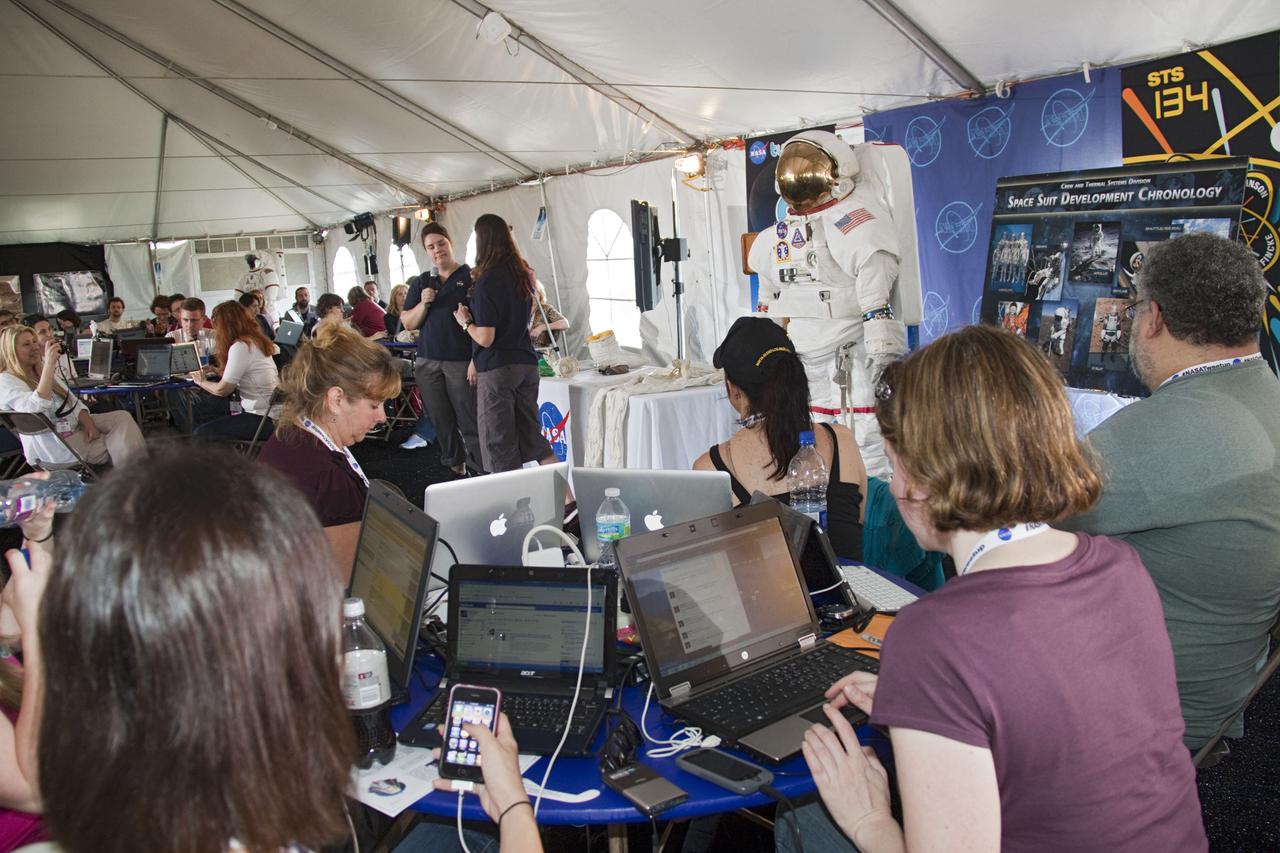
CAPE CANAVERAL, Fla. -- At NASA's Kennedy Space Center in Florida, Mallory Jennings and Heather Paul, aerospace engineers with Johnson Space Center's Spacesuit Life Support, perform a spacesuit demonstration during the STS-134 Tweetup event. About 150 people from 43 states, Washington, D.C., and half a dozen countries are participating in the event. A Tweetup gives followers of @NASA on the social messaging medium Twitter the opportunity to tour the center, view a shuttle launch and speak with NASA managers, astronauts, shuttle technicians and engineers. During the STS-134 mission, space shuttle Endeavour will deliver the Express Logistics Carrier-3, Alpha Magnetic Spectrometer-2 (AMS), a high-pressure gas tank and additional spare parts for the Dextre robotic helper to the International Space Station. Endeavour was scheduled to launch at 3:47 p.m. on April 29, but that attempt was scrubbed for at least 72 hours while engineers assess an issue associated with the shuttle's Auxiliary Power Unit 1. STS-134 will be the final spaceflight for Endeavour. For more information visit, www.nasa.gov_mission_pages_shuttle_shuttlemissions_sts134_index.html. Photo credit: NASA_Jack Pfaller
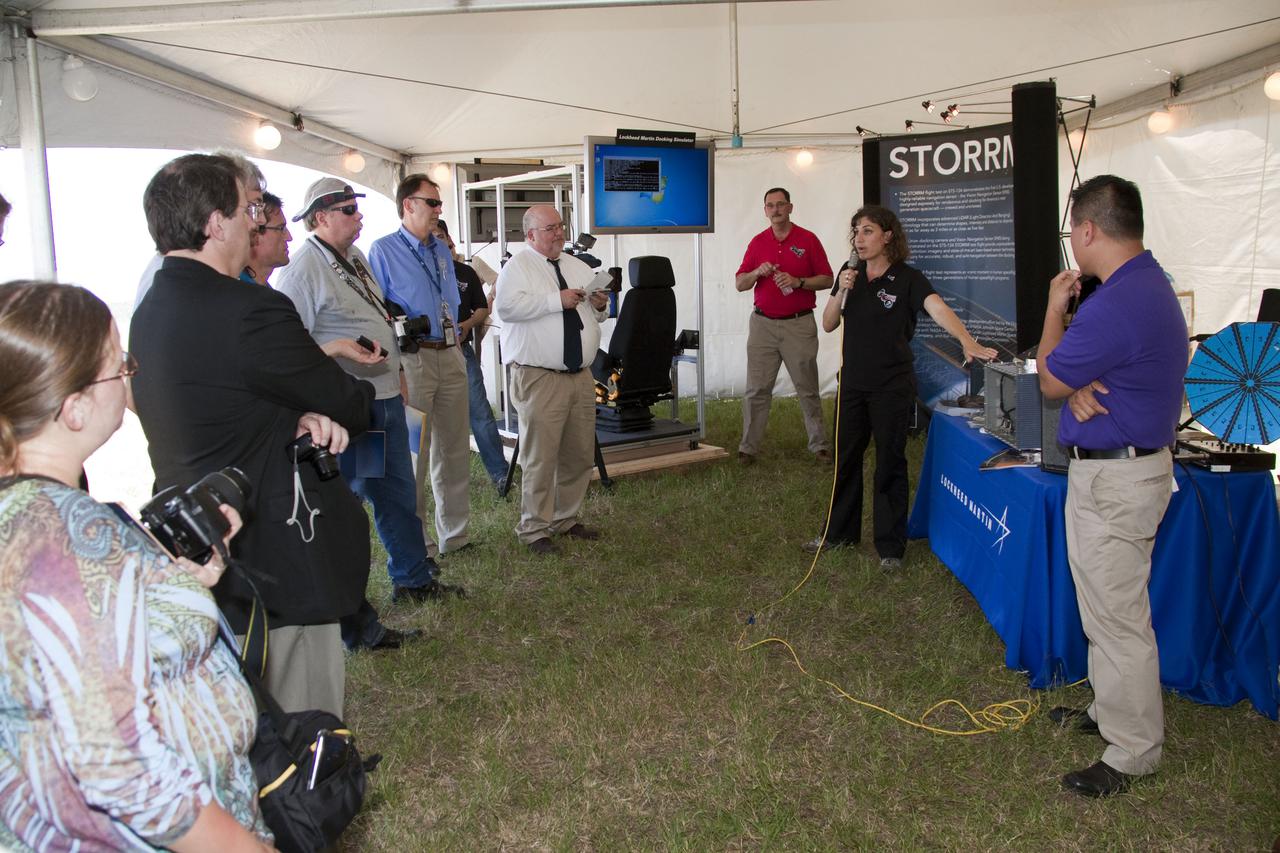
CAPE CANAVERAL, Fla. -- Heather Hinkel, principal investigator for the Sensor Test for Orion Relnav Risk Mitigation, or STORRM, Project at NASA's Johnson Space Center, provides an overview of the flight test that space shuttle Endeavour will perform on the last on-orbit day of the STS-134 mission. The overview took place at NASA's Kennedy Space Center in Florida where Endeavour is awaiting liftoff. During the mission, Endeavour will fly a dedicated maneuver to simulate an Orion rendezvous trajectory, while two Orion sensors collect visual- and laser-based relative navigation data. This will provide an unprecedented in-flight test opportunity for America's next-generation exploration spacecraft. STS-134 also will deliver the Express Logistics Carrier-3, Alpha Magnetic Spectrometer-2 (AMS), a high-pressure gas tank and additional spare parts for the Dextre robotic helper to the space station. Endeavour was scheduled to launch at 3:47 p.m. on April 29, but that attempt was scrubbed for at least 72 hours while engineers assess an issue associated with the shuttle's Auxiliary Power Unit 1. STS-134 will be the final spaceflight for Endeavour. For more information visit, www.nasa.gov_mission_pages_shuttle_shuttlemissions_sts134_index.html. Photo credit: NASA_Jack Pfaller
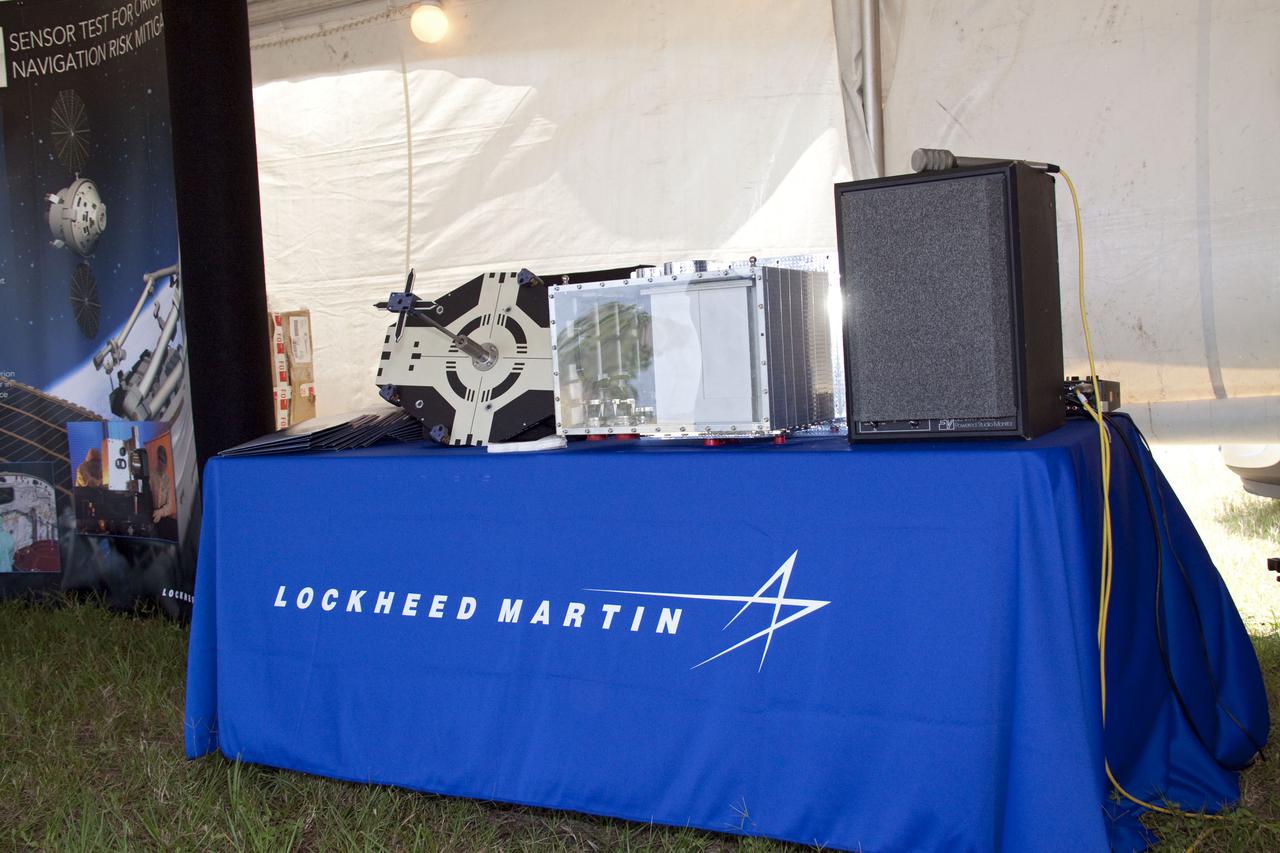
CAPE CANAVERAL, Fla. -- A model of the Sensor Test for Orion Relnav Risk Mitigation, or STORRM, is displayed at NASA's Kennedy Space Center in Florida. Seen here, is the International Space Station docking target and STORMM sensor enclosure assembly. A flight test of STORRM will be performed on STS-134 on the last on-orbit day of the mission, when space shuttle Endeavour will fly a dedicated maneuver to simulate an Orion rendezvous trajectory. Throughout the maneuver, two Orion sensors will collect visual- and laser-based relative navigation data. This will provide an unprecedented in-flight test opportunity for America's next-generation exploration spacecraft. STS-134 also will deliver the Express Logistics Carrier-3, Alpha Magnetic Spectrometer-2 (AMS), a high-pressure gas tank and additional spare parts for the Dextre robotic helper to the space station. Endeavour was scheduled to launch at 3:47 p.m. on April 29, but that attempt was scrubbed for at least 72 hours while engineers assess an issue associated with the shuttle's Auxiliary Power Unit 1. STS-134 will be the final spaceflight for Endeavour. For more information visit, www.nasa.gov_mission_pages_shuttle_shuttlemissions_sts134_index.html. Photo credit: NASA_Jack Pfaller

CAPE CANAVERAL, Fla. -- In the Operations and Checkout Building (O&C) at NASA's Kennedy Space Center in Florida, space shuttle Endeavour's STS-134 astronauts put on their launch-and-entry suits and check the fit of their helmets and gloves before heading to the Astrovan for the ride to Launch Pad 39A. Mission Specialist Roberto Vittori with the European Space Agency, seen here, will be making his third trip to the International Space Station. His first mission was in 2002 and second in 2005, both of which were launched aboard a Russian Soyuz spacecraft. STS-134 will deliver the Express Logistics Carrier-3, Alpha Magnetic Spectrometer-2 (AMS), a high-pressure gas tank and additional spare parts for the Dextre robotic helper to the space station. Endeavour was scheduled to launch at 3:47 p.m. on April 29, but that attempt was scrubbed for at least 72 hours while engineers assess an issue associated with the shuttle's Auxiliary Power Unit 1. STS-134 will be the final spaceflight for Endeavour. For more information visit, www.nasa.gov/mission_pages/shuttle/shuttlemissions/sts134/index.html. Photo credit: NASA/Kim Shiflett
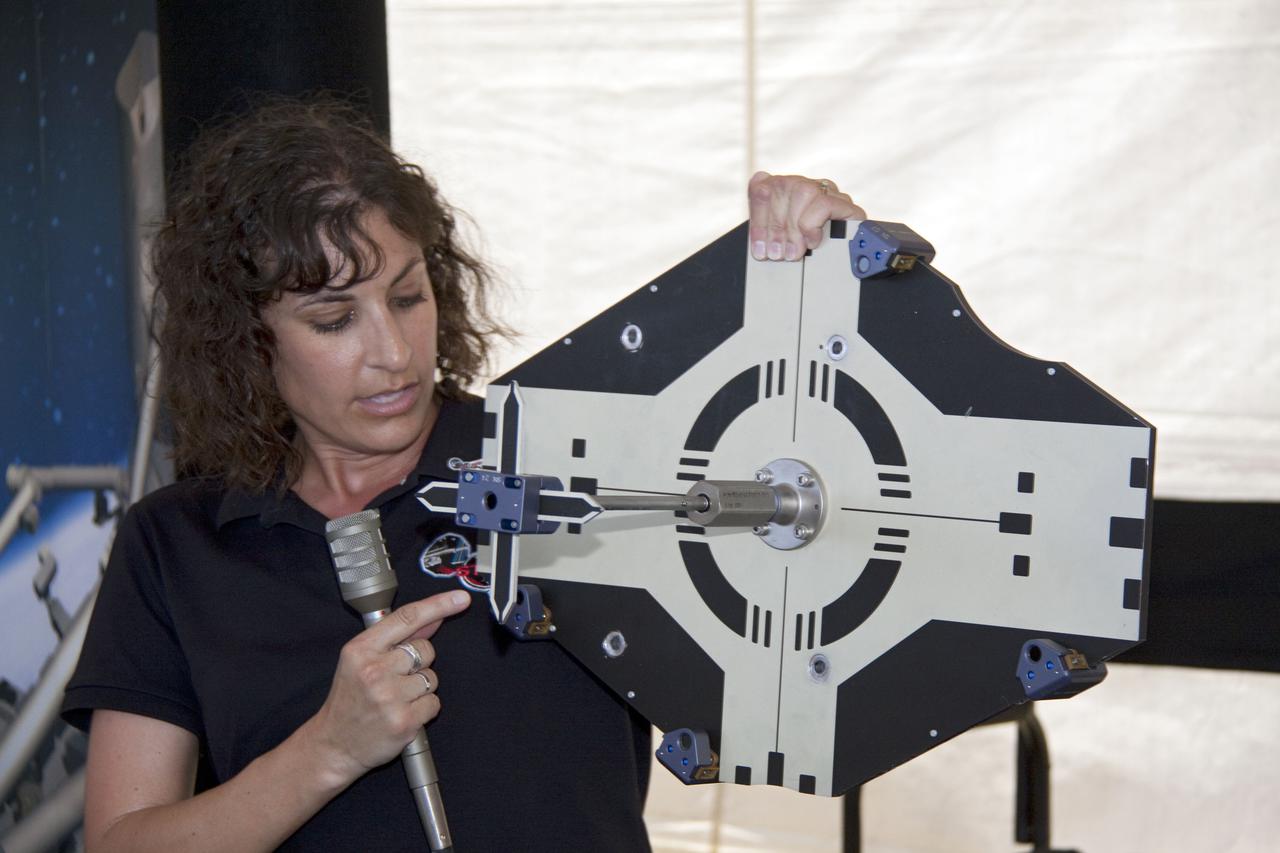
CAPE CANAVERAL, Fla. -- Heather Hinkel, principal investigator for the Sensor Test for Orion Relnav Risk Mitigation, or STORRM, Project at NASA's Johnson Space Center, provides an overview of the flight test that space shuttle Endeavour will perform on the last on-orbit day of the STS-134 mission. The overview took place at NASA's Kennedy Space Center in Florida where Endeavour is awaiting liftoff. During the mission, Endeavour will fly a dedicated maneuver to simulate an Orion rendezvous trajectory, while two Orion sensors collect visual- and laser-based relative navigation data. This will provide an unprecedented in-flight test opportunity for America's next-generation exploration spacecraft. STS-134 also will deliver the Express Logistics Carrier-3, Alpha Magnetic Spectrometer-2 (AMS), a high-pressure gas tank and additional spare parts for the Dextre robotic helper to the space station. Endeavour was scheduled to launch at 3:47 p.m. on April 29, but that attempt was scrubbed for at least 72 hours while engineers assess an issue associated with the shuttle's Auxiliary Power Unit 1. STS-134 will be the final spaceflight for Endeavour. For more information visit, www.nasa.gov_mission_pages_shuttle_shuttlemissions_sts134_index.html. Photo credit: NASA_Jack Pfaller
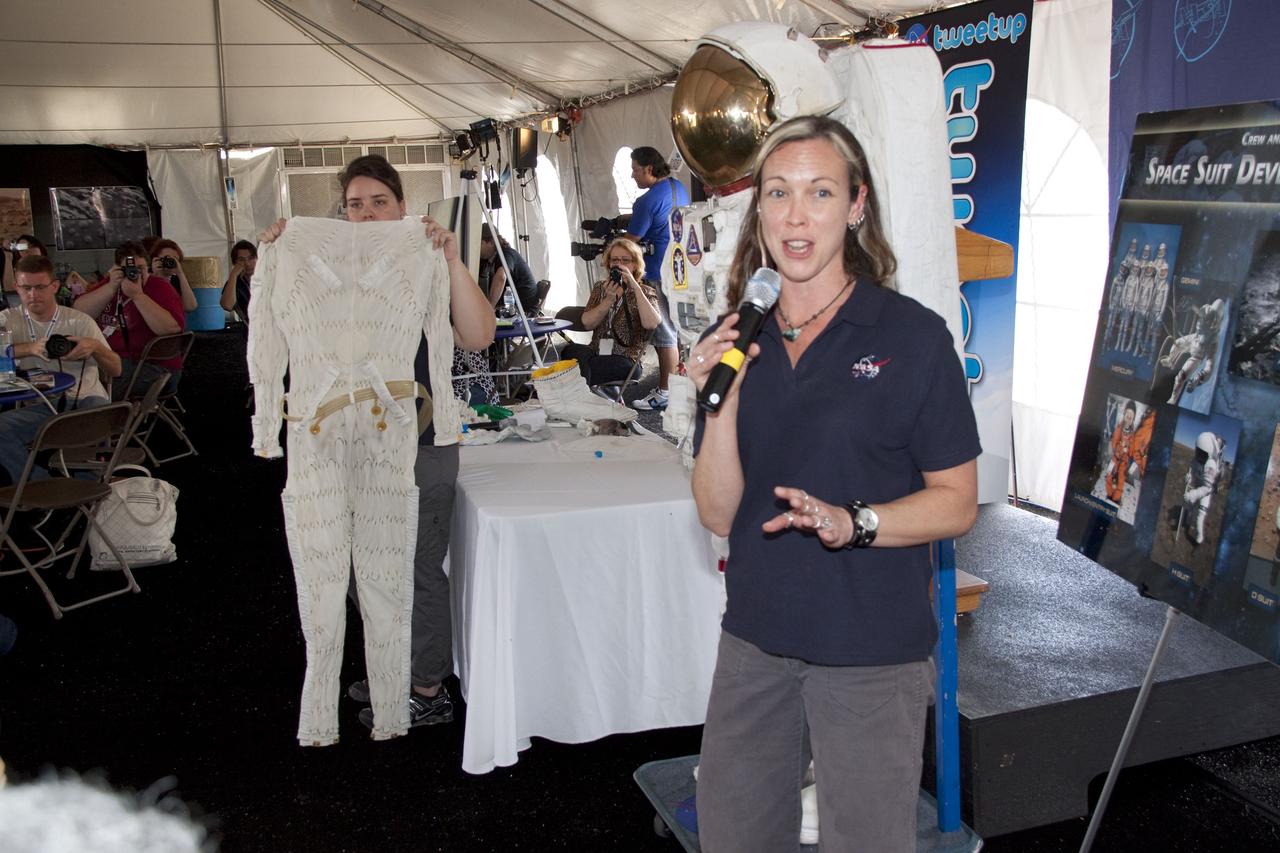
CAPE CANAVERAL, Fla. -- At NASA's Kennedy Space Center in Florida, Mallory Jennings, left, and Heather Paul, aerospace engineers with Johnson Space Center's Spacesuit Life Support, perform a spacesuit demonstration during the STS-134 Tweetup event. About 150 people from 43 states, Washington, D.C., and half a dozen countries are participating in the event. A Tweetup gives followers of @NASA on the social messaging medium Twitter the opportunity to tour the center, view a shuttle launch and speak with NASA managers, astronauts, shuttle technicians and engineers. During the STS-134 mission, space shuttle Endeavour will deliver the Express Logistics Carrier-3, Alpha Magnetic Spectrometer-2 (AMS), a high-pressure gas tank and additional spare parts for the Dextre robotic helper to the International Space Station. Endeavour was scheduled to launch at 3:47 p.m. on April 29, but that attempt was scrubbed for at least 72 hours while engineers assess an issue associated with the shuttle's Auxiliary Power Unit 1. STS-134 will be the final spaceflight for Endeavour. For more information visit, www.nasa.gov/mission_pages/shuttle/shuttlemissions/sts134/index.html. Photo credit: NASA/Jack Pfaller
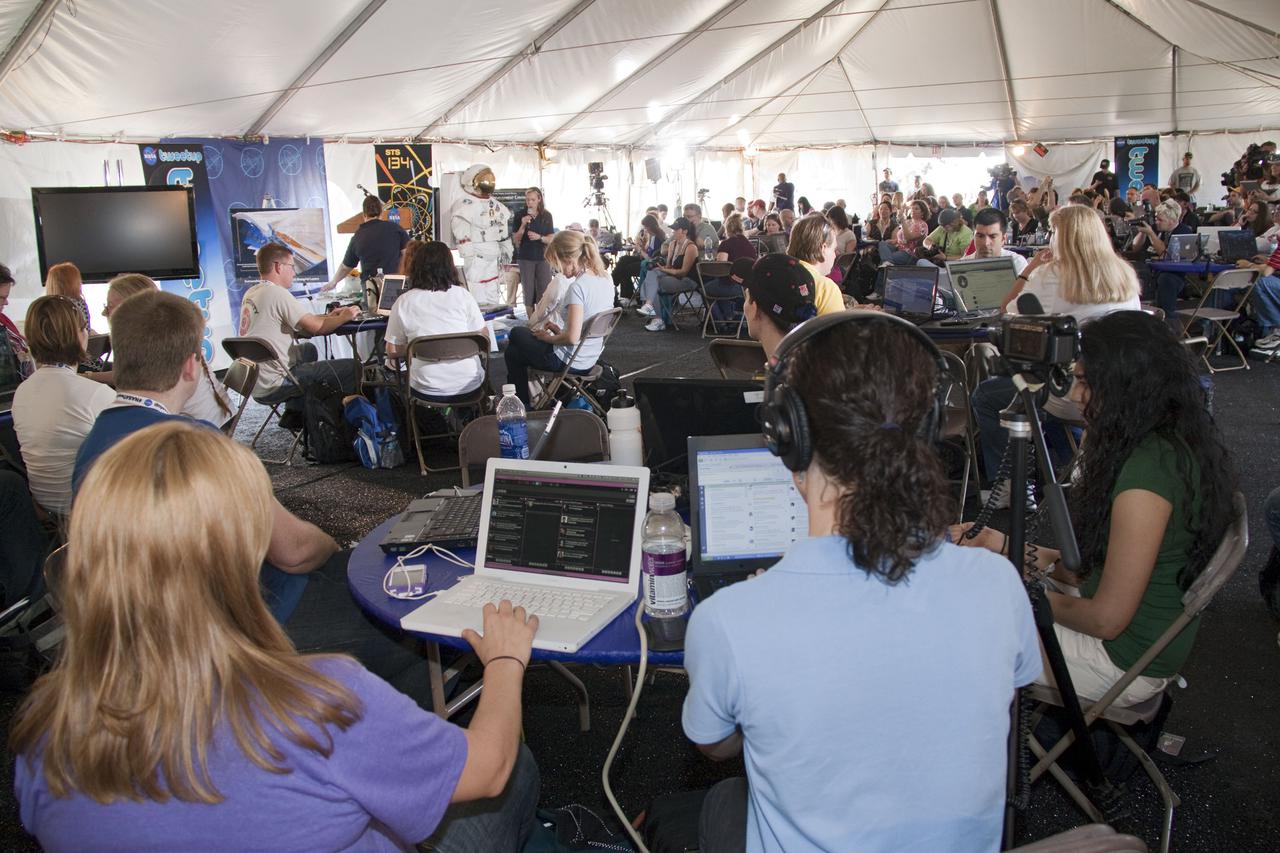
CAPE CANAVERAL, Fla. -- At NASA's Kennedy Space Center in Florida, Mallory Jennings and Heather Paul, aerospace engineers with Johnson Space Center's Spacesuit Life Support, perform a spacesuit demonstration during the STS-134 Tweetup event. About 150 people from 43 states, Washington, D.C., and half a dozen countries are participating in the event. A Tweetup gives followers of @NASA on the social messaging medium Twitter the opportunity to tour the center, view a shuttle launch and speak with NASA managers, astronauts, shuttle technicians and engineers. During the STS-134 mission, space shuttle Endeavour will deliver the Express Logistics Carrier-3, Alpha Magnetic Spectrometer-2 (AMS), a high-pressure gas tank and additional spare parts for the Dextre robotic helper to the International Space Station. Endeavour was scheduled to launch at 3:47 p.m. on April 29, but that attempt was scrubbed for at least 72 hours while engineers assess an issue associated with the shuttle's Auxiliary Power Unit 1. STS-134 will be the final spaceflight for Endeavour. For more information visit, www.nasa.gov_mission_pages_shuttle_shuttlemissions_sts134_index.html. Photo credit: NASA_Jack Pfaller
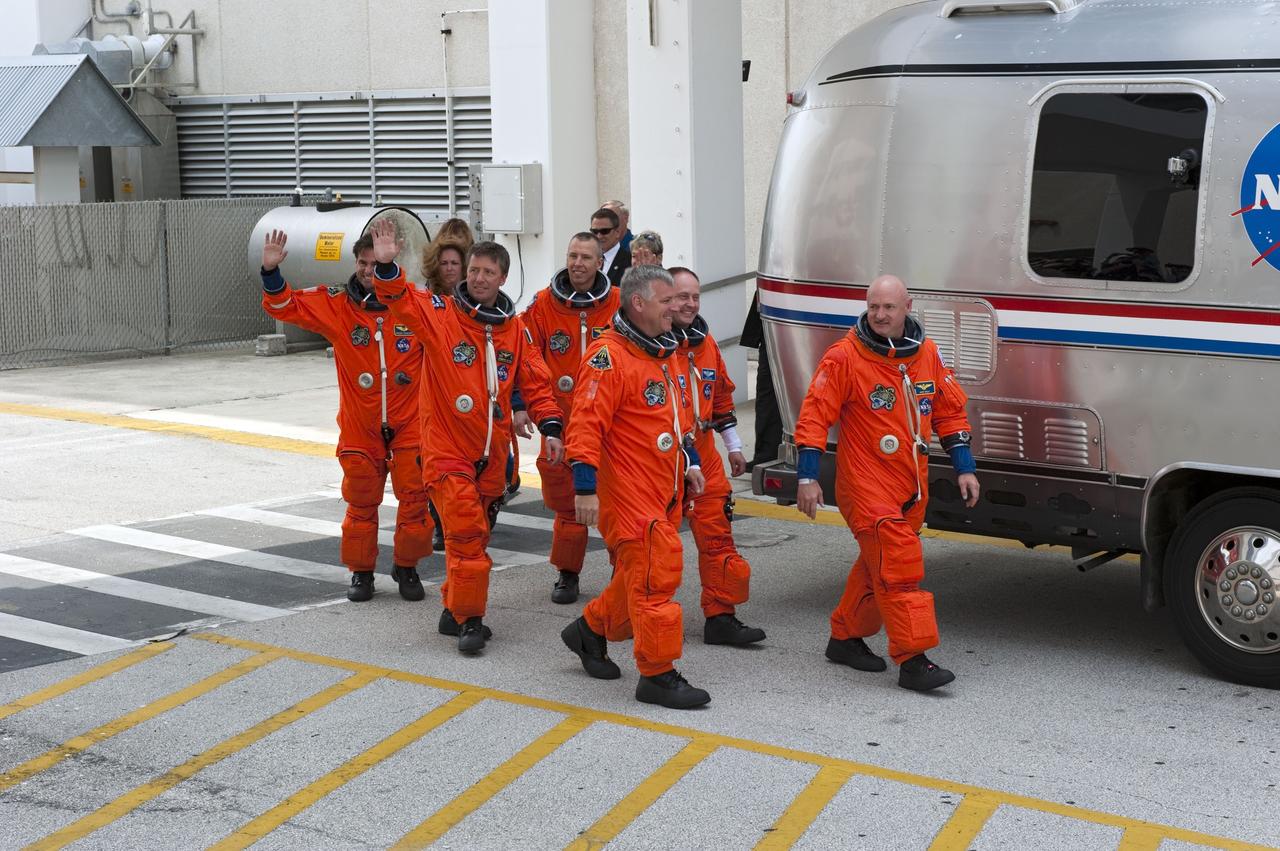
CAPE CANAVERAL, Fla. -- Space shuttle Endeavour's six STS-134 astronauts, dressed in their orange launch-and-entry suits, wave to news media and other spectators as they walk toward the Astrovan parked in front of the Operations and Checkout Building at NASA's Kennedy Space Center in Florida. The modified Airstream recreational vehicle has transported astronauts to their spacecraft since 1984. Leading the way is Commander Mark Kelly, followed by crewmates Greg H. Johnson, Michael Fincke, Andrew Feustel, Roberto Vittori with the European Space Agency and Greg Chamitoff. STS-134 will deliver the Express Logistics Carrier-3, Alpha Magnetic Spectrometer-2 (AMS), a high-pressure gas tank and additional spare parts for the Dextre robotic helper to the space station. Endeavour was scheduled to launch at 3:47 p.m. on April 29, but that attempt was scrubbed for at least 72 hours while engineers assess an issue associated with the shuttle's Auxiliary Power Unit 1. STS-134 will be the final spaceflight for Endeavour. For more information visit, www.nasa.gov/mission_pages/shuttle/shuttlemissions/sts134/index.html. Photo credit: NASA/Kim Shiflett

CAPE CANAVERAL, Fla. -- Space shuttle Endeavour's six STS-134 astronauts, dressed in their orange launch-and-entry suits, wave to news media and other spectators as they walk toward the Astrovan parked in front of the Operations and Checkout Building at NASA's Kennedy Space Center in Florida. The modified Airstream recreational vehicle has transported astronauts to their spacecraft since 1984. Leading the way are Commander Mark Kelly, right, and Pilot Greg H. Johnson. Behind Kelly are crewmates Michael Fincke and Andrew Feustel. Behind Johnson are crewmates Roberto Vittori with the European Space Agency and Greg Chamitoff. STS-134 will deliver the Express Logistics Carrier-3, Alpha Magnetic Spectrometer-2 (AMS), a high-pressure gas tank and additional spare parts for the Dextre robotic helper to the space station. Endeavour was scheduled to launch at 3:47 p.m. on April 29, but that attempt was scrubbed for at least 72 hours while engineers assess an issue associated with the shuttle's Auxiliary Power Unit 1. STS-134 will be the final spaceflight for Endeavour. For more information visit, www.nasa.gov/mission_pages/shuttle/shuttlemissions/sts134/index.html. Photo credit: NASA/Kim Shiflett
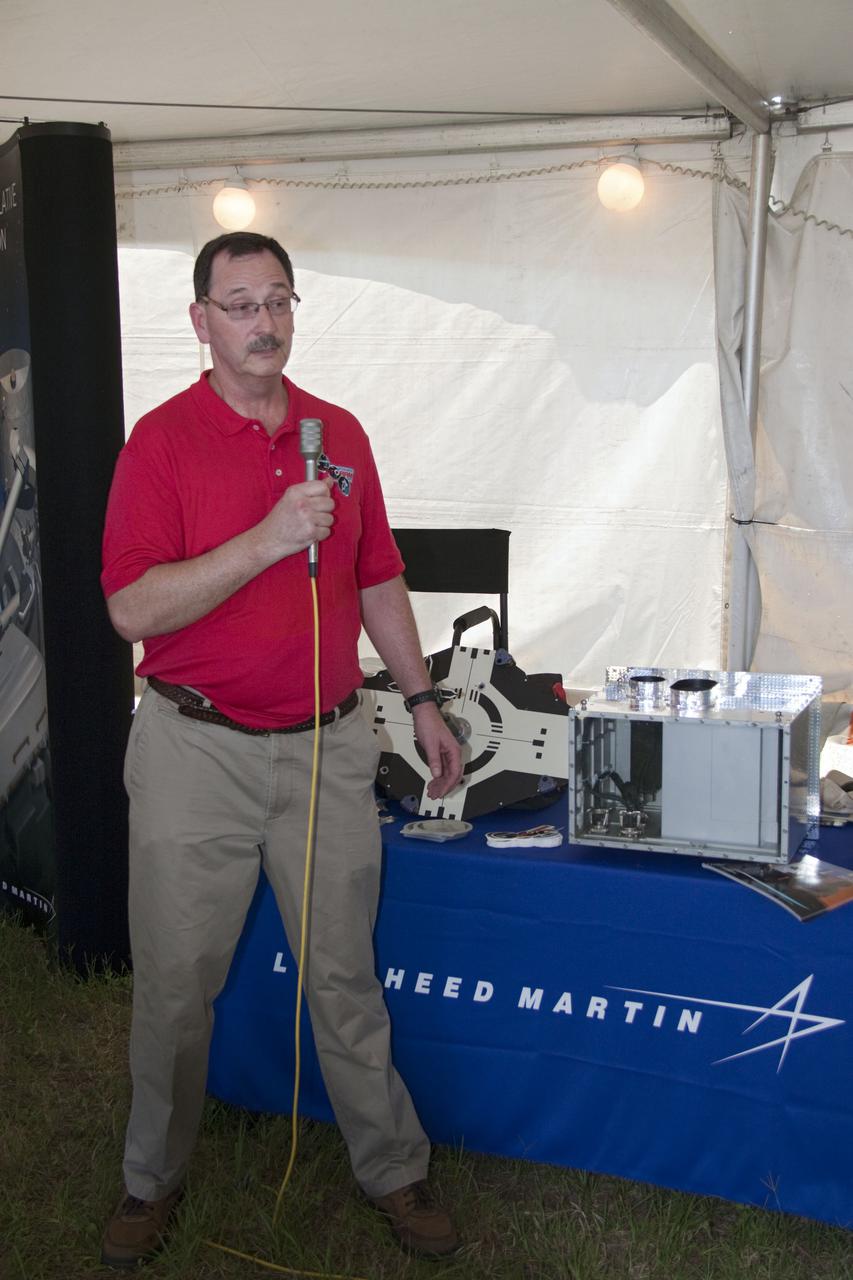
CAPE CANAVERAL, Fla. -- Frank Novak, project manager for the Sensor Test for Orion Relnav Risk Mitigation, or STORRM, at NASA's Langley Research Center in Hampton, Va., provides an overview of the flight test that space shuttle Endeavour will perform on the last on-orbit day of the STS-134 mission. The overview took place at NASA's Kennedy Space Center in Florida where Endeavour is awaiting liftoff. During the mission, Endeavour will fly a dedicated maneuver to simulate an Orion rendezvous trajectory, while two Orion sensors collect visual- and laser-based relative navigation data. This will provide an unprecedented in-flight test opportunity for America's next-generation exploration spacecraft. STS-134 also will deliver the Express Logistics Carrier-3, Alpha Magnetic Spectrometer-2 (AMS), a high-pressure gas tank and additional spare parts for the Dextre robotic helper to the space station. Endeavour was scheduled to launch at 3:47 p.m. on April 29, but that attempt was scrubbed for at least 72 hours while engineers assess an issue associated with the shuttle's Auxiliary Power Unit 1. STS-134 will be the final spaceflight for Endeavour. For more information visit, www.nasa.gov_mission_pages_shuttle_shuttlemissions_sts134_index.html. Photo credit: NASA_Jack Pfaller
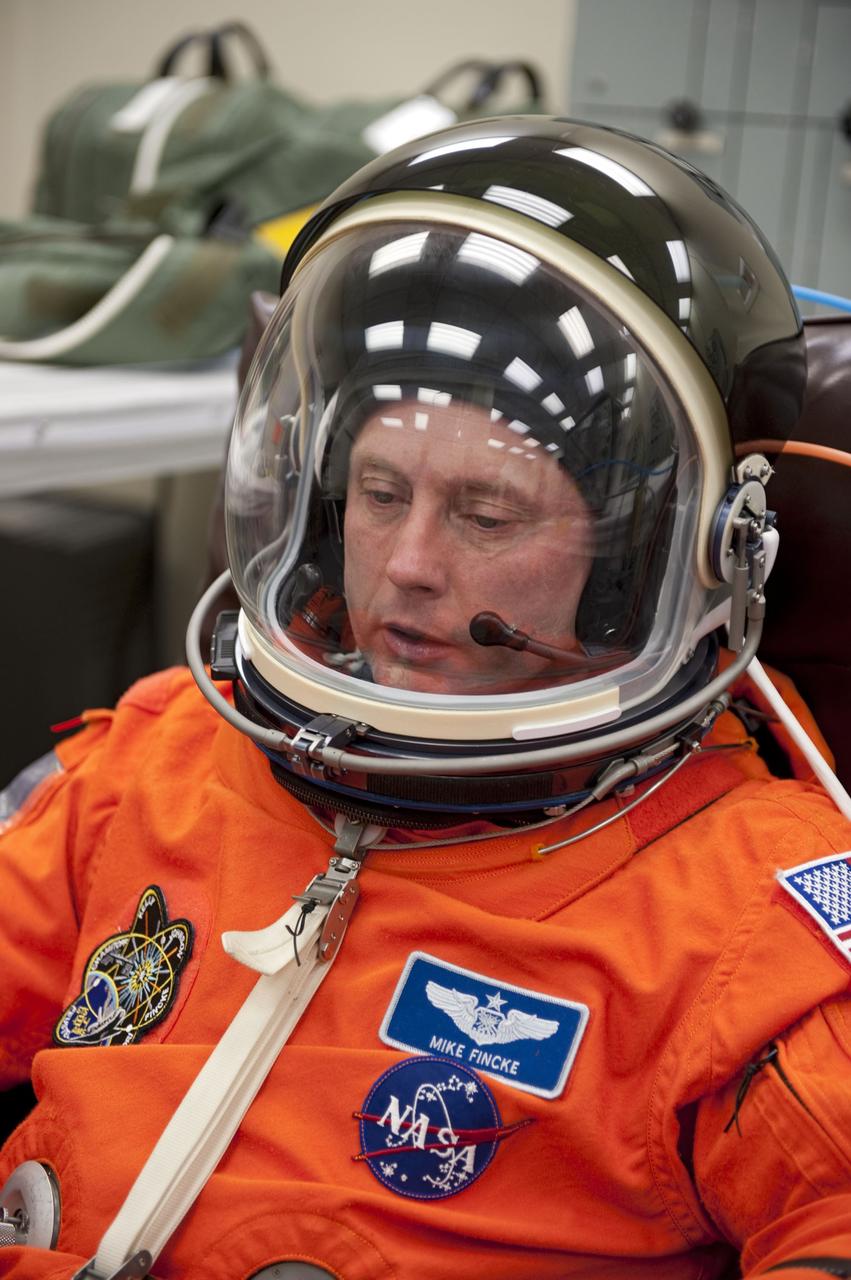
CAPE CANAVERAL, Fla. -- In the Operations and Checkout Building (O&C) at NASA's Kennedy Space Center in Florida, space shuttle Endeavour's STS-134 astronauts put on their launch-and-entry suits and check the fit of their helmets and gloves before heading to the Astrovan for the ride to Launch Pad 39A. Mission Specialist Michael Fincke, seen here, last served as a member of the Expedition 18 crew of the International Space Station in 2009. This will be Fincke's first flight aboard a space shuttle. STS-134 will deliver the Express Logistics Carrier-3, Alpha Magnetic Spectrometer-2 (AMS), a high-pressure gas tank and additional spare parts for the Dextre robotic helper to the space station. Endeavour was scheduled to launch at 3:47 p.m. on April 29, but that attempt was scrubbed for at least 72 hours while engineers assess an issue associated with the shuttle's Auxiliary Power Unit 1. STS-134 will be the final spaceflight for Endeavour. For more information visit, www.nasa.gov/mission_pages/shuttle/shuttlemissions/sts134/index.html. Photo credit: NASA/Kim Shiflett
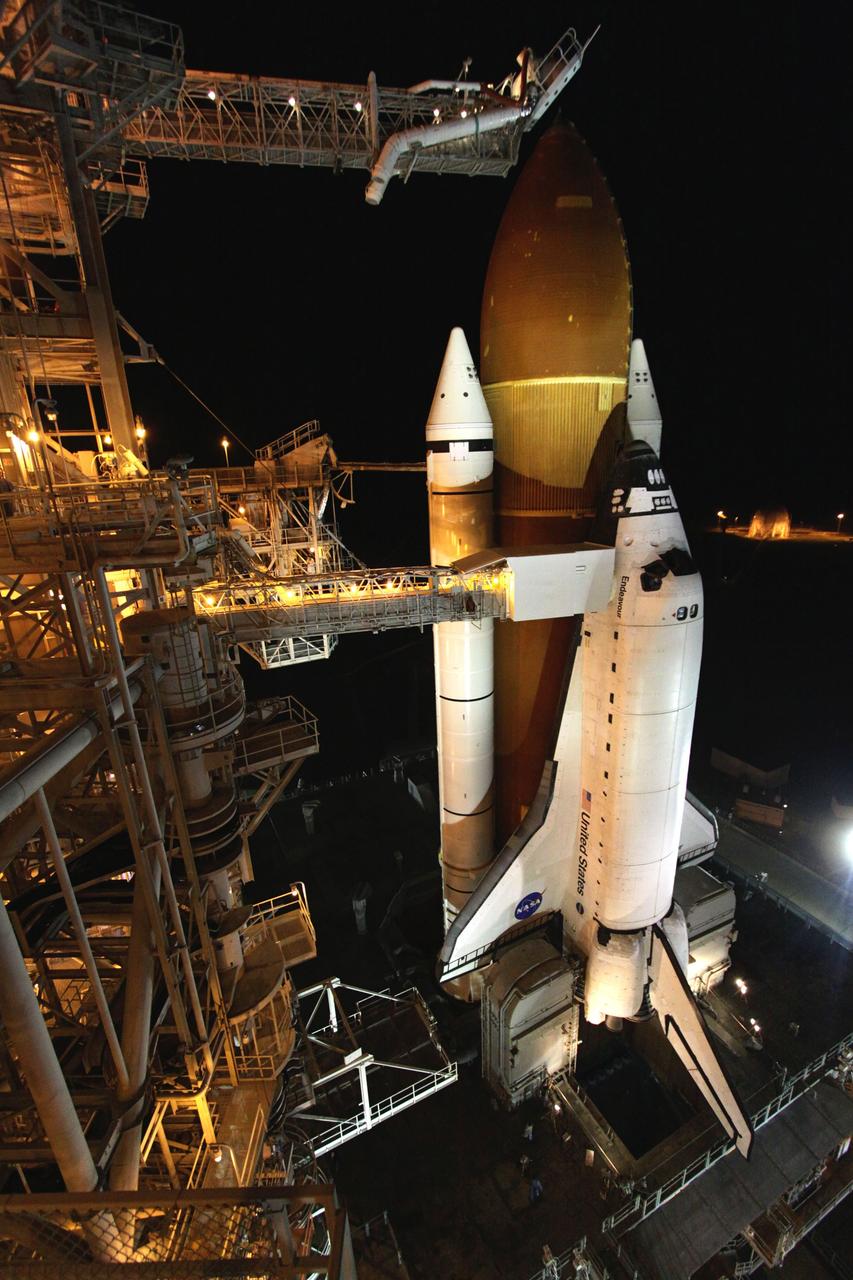
CAPE CANAVERAL, Fla. -- At NASA's Kennedy Space Center in Florida, space shuttle Endeavour is illuminated by bright xenon lights on Launch Pad 39A after the rotating service structure (RSS) was moved away. The structure provides weather protection and access to the shuttle while it awaits lift off on the pad. RSS "rollback," as it's called, began at 11:52 p.m. EDT on April 28. The move was scheduled to begin at 7 p.m., but storms over Kennedy delayed pad operations for a few hours. STS-134 will deliver the Express Logistics Carrier-3, Alpha Magnetic Spectrometer-2 (AMS), a high-pressure gas tank and additional spare parts for the Dextre robotic helper to the International Space Station. Endeavour was scheduled to launch at 3:47 p.m. on April 29, but that attempt was scrubbed for at least 72 hours while engineers assess an issue associated with the shuttle's Auxiliary Power Unit 1. STS-134 will be the final spaceflight for Endeavour. For more information visit, www.nasa.gov/mission_pages/shuttle/shuttlemissions/sts134/index.html. Photo credit: NASA/Ken Thornsley
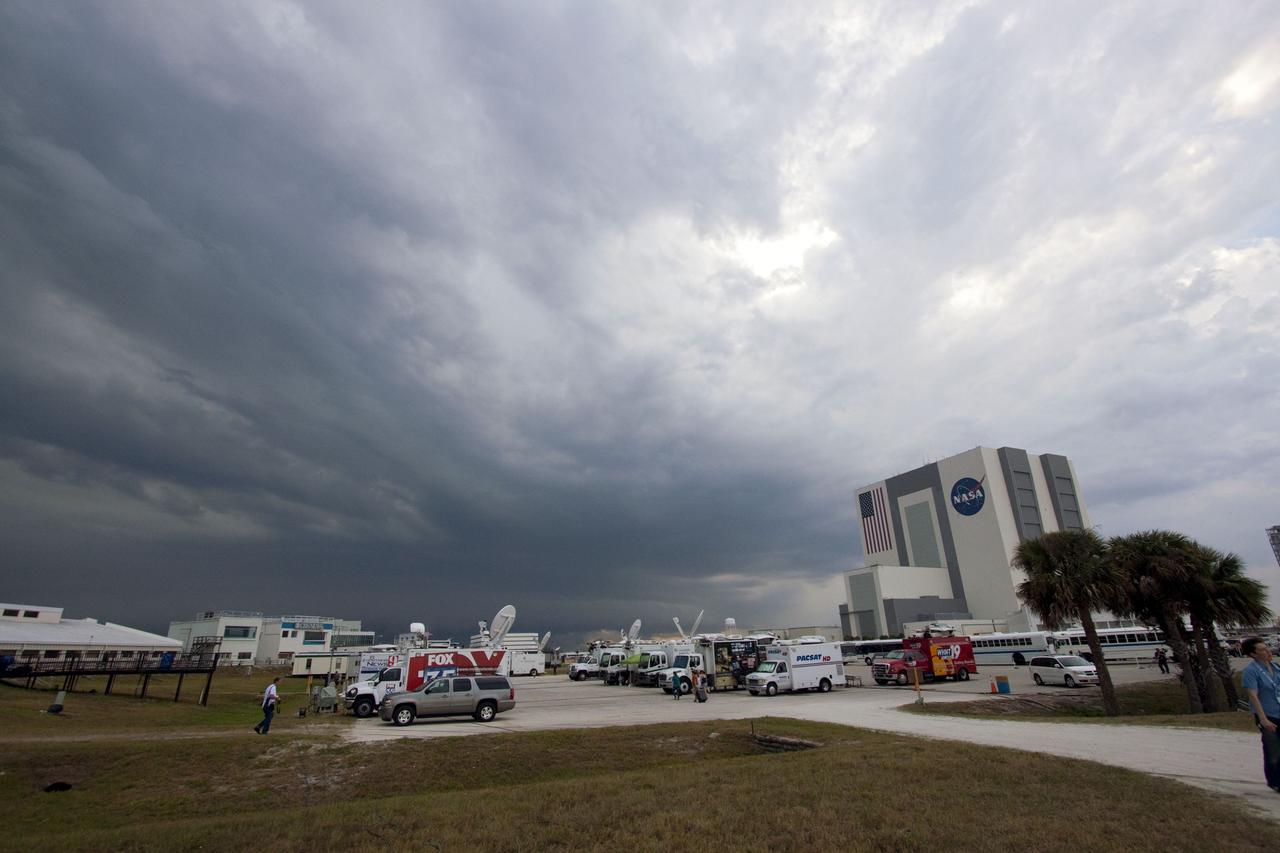
CAPE CANAVERAL, Fla. - Severe weather begins to roll over NASA's Kennedy Space Center in Florida on the night launch teams planned to move the rotating service structure (RSS) away from space shuttle Endeavour on Launch Pad 39A. The structure provides weather protection and access to the shuttle while it awaits lift off on the pad. RSS "rollback," as it's called, was delayed by nearly five hours to allow the storms to move offshore. Endeavour and the STS-134 crew will deliver the Express Logistics Carrier-3, Alpha Magnetic Spectrometer-2 (AMS), a high-pressure gas tank and additional spare parts for the Dextre robotic helper to the International Space Station. Endeavour was scheduled to launch at 3:47 p.m. on April 29, but that attempt was scrubbed for at least 72 hours while engineers assess an issue associated with the shuttle's Auxiliary Power Unit 1. STS-134 will be the final spaceflight for Endeavour. For more information visit, www.nasa.gov/mission_pages/shuttle/shuttlemissions/sts134/index.html. Photo credit: NASA/Jack Pfaller
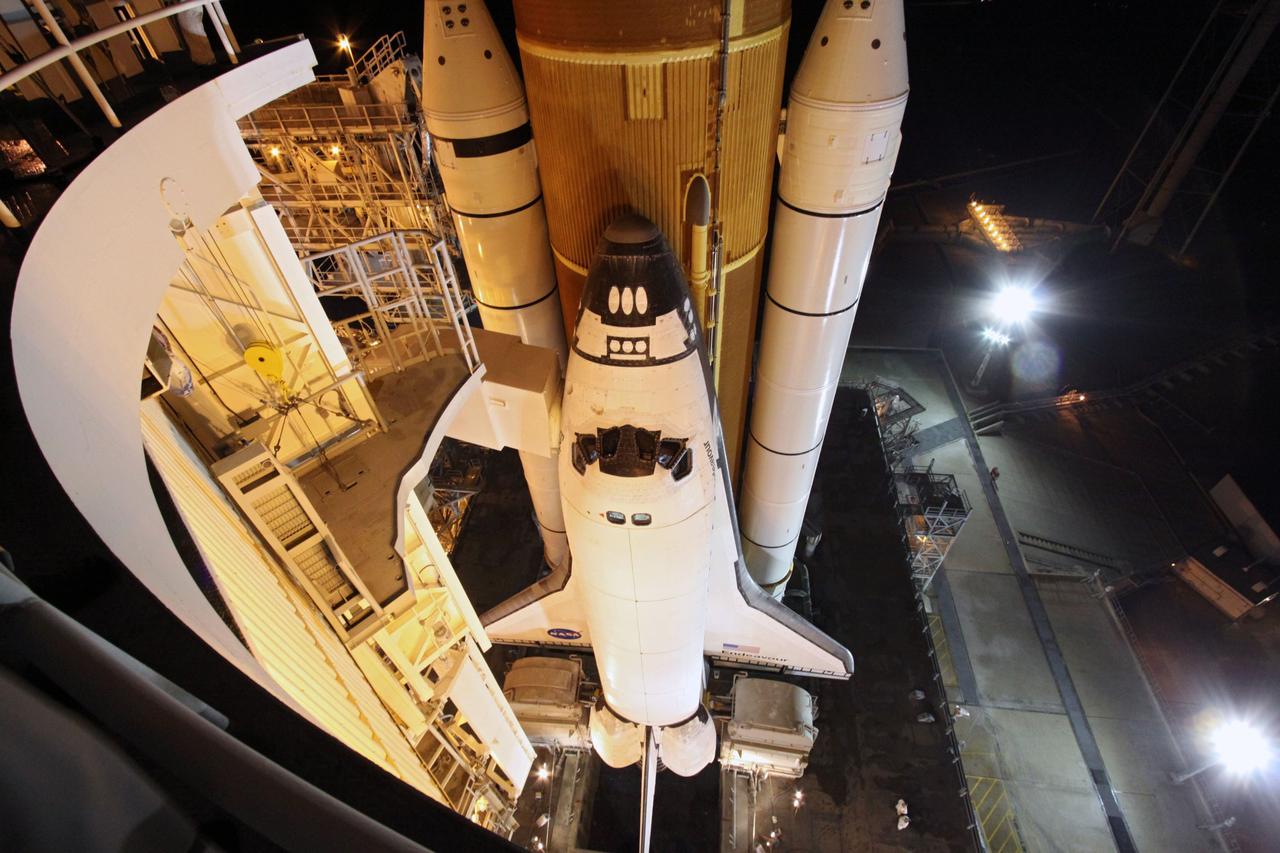
CAPE CANAVERAL, Fla. -- At NASA's Kennedy Space Center in Florida, space shuttle Endeavour is illuminated by bright xenon lights on Launch Pad 39A after the rotating service structure (RSS) was moved away. The structure provides weather protection and access to the shuttle while it awaits lift off on the pad. RSS "rollback," as it's called, began at 11:52 p.m. EDT on April 28. The move was scheduled to begin at 7 p.m., but storms over Kennedy delayed pad operations for a few hours. STS-134 will deliver the Express Logistics Carrier-3, Alpha Magnetic Spectrometer-2 (AMS), a high-pressure gas tank and additional spare parts for the Dextre robotic helper to the International Space Station. Endeavour was scheduled to launch at 3:47 p.m. on April 29, but that attempt was scrubbed for at least 72 hours while engineers assess an issue associated with the shuttle's Auxiliary Power Unit 1. STS-134 will be the final spaceflight for Endeavour. For more information visit, www.nasa.gov/mission_pages/shuttle/shuttlemissions/sts134/index.html. Photo credit: NASA/Ken Thornsley
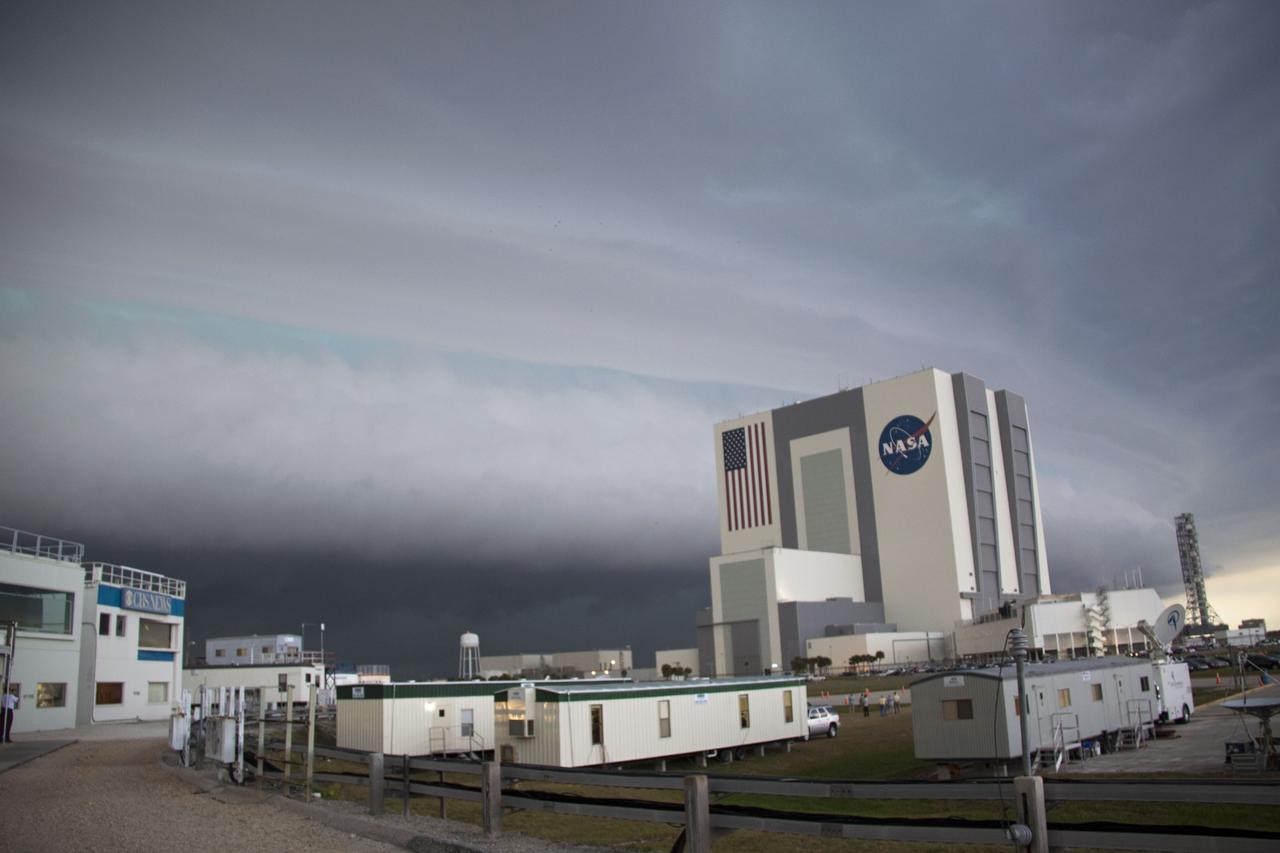
CAPE CANAVERAL, Fla. - Severe weather begins to roll over NASA's Kennedy Space Center in Florida on the night launch teams planned to move the rotating service structure (RSS) away from space shuttle Endeavour on Launch Pad 39A. The structure provides weather protection and access to the shuttle while it awaits lift off on the pad. RSS "rollback," as it's called, was delayed by nearly five hours to allow the storms to move offshore. Endeavour and the STS-134 crew will deliver the Express Logistics Carrier-3, Alpha Magnetic Spectrometer-2 (AMS), a high-pressure gas tank and additional spare parts for the Dextre robotic helper to the International Space Station. Endeavour was scheduled to launch at 3:47 p.m. on April 29, but that attempt was scrubbed for at least 72 hours while engineers assess an issue associated with the shuttle's Auxiliary Power Unit 1. STS-134 will be the final spaceflight for Endeavour. For more information visit, www.nasa.gov/mission_pages/shuttle/shuttlemissions/sts134/index.html. Photo credit: NASA/Troy Cryder
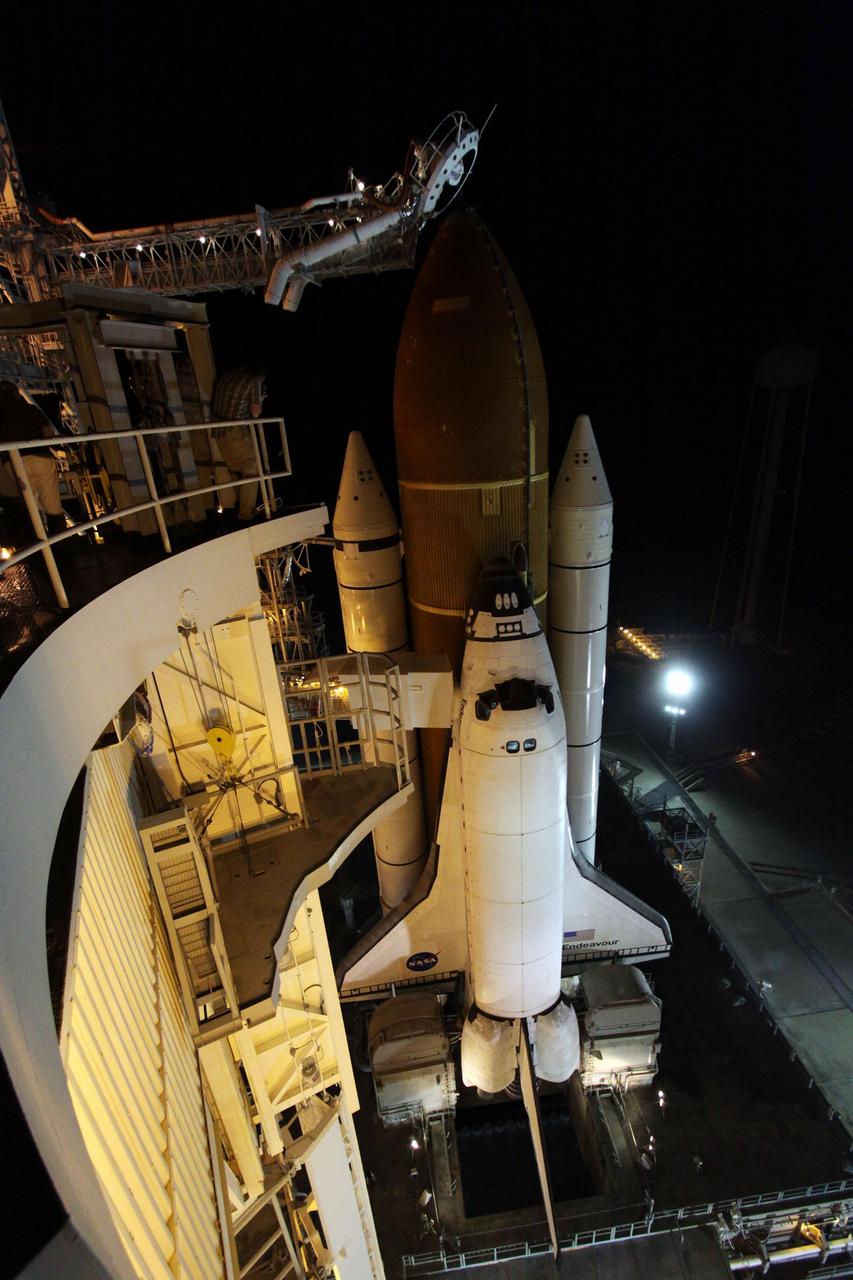
CAPE CANAVERAL, Fla. -- At NASA's Kennedy Space Center in Florida, space shuttle Endeavour is illuminated by bright xenon lights on Launch Pad 39A after the rotating service structure (RSS) was moved away. The structure provides weather protection and access to the shuttle while it awaits lift off on the pad. RSS "rollback," as it's called, began at 11:52 p.m. EDT on April 28. The move was scheduled to begin at 7 p.m., but storms over Kennedy delayed pad operations for a few hours. STS-134 will deliver the Express Logistics Carrier-3, Alpha Magnetic Spectrometer-2 (AMS), a high-pressure gas tank and additional spare parts for the Dextre robotic helper to the International Space Station. Endeavour was scheduled to launch at 3:47 p.m. on April 29, but that attempt was scrubbed for at least 72 hours while engineers assess an issue associated with the shuttle's Auxiliary Power Unit 1. STS-134 will be the final spaceflight for Endeavour. For more information visit, www.nasa.gov/mission_pages/shuttle/shuttlemissions/sts134/index.html. Photo credit: NASA/Ken Thornsley
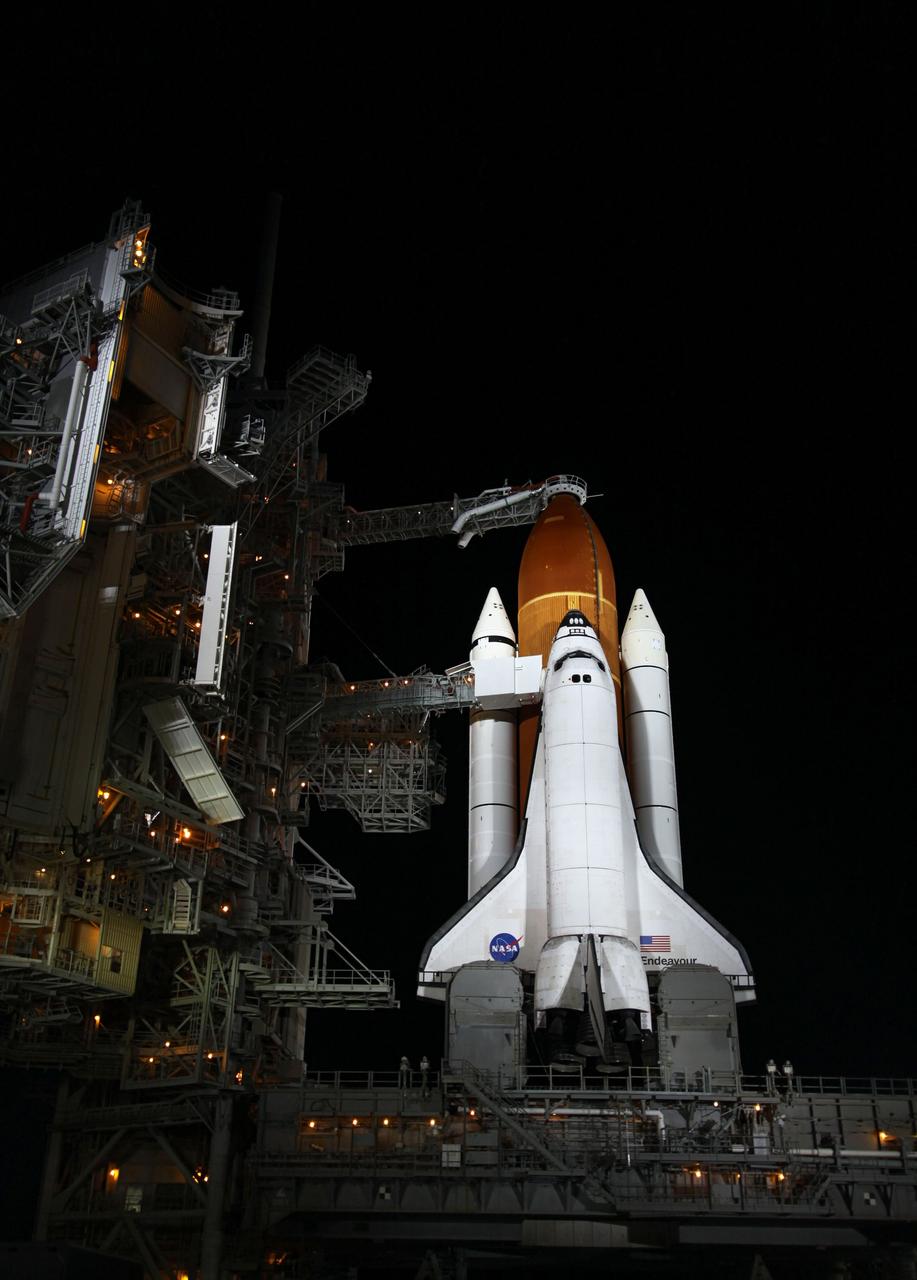
CAPE CANAVERAL, Fla. - At NASA's Kennedy Space Center in Florida, space shuttle Endeavour is illuminated by bright xenon lights on Launch Pad 39A after the rotating service structure (RSS) was moved away. The structure provides weather protection and access to the shuttle while it awaits lift off on the pad. RSS "rollback," as it's called, began at 11:52 p.m. EDT on April 28. The move was scheduled to begin at 7 p.m., but storms over Kennedy delayed pad operations for a few hours. STS-134 will deliver the Express Logistics Carrier-3, Alpha Magnetic Spectrometer-2 (AMS), a high-pressure gas tank and additional spare parts for the Dextre robotic helper to the International Space Station. Endeavour was scheduled to launch at 3:47 p.m. on April 29, but that attempt was scrubbed for at least 72 hours while engineers assess an issue associated with the shuttle's Auxiliary Power Unit 1. STS-134 will be the final spaceflight for Endeavour. For more information visit, www.nasa.gov/mission_pages/shuttle/shuttlemissions/sts134/index.html. Photo credit: NASA/Ken Thornsley
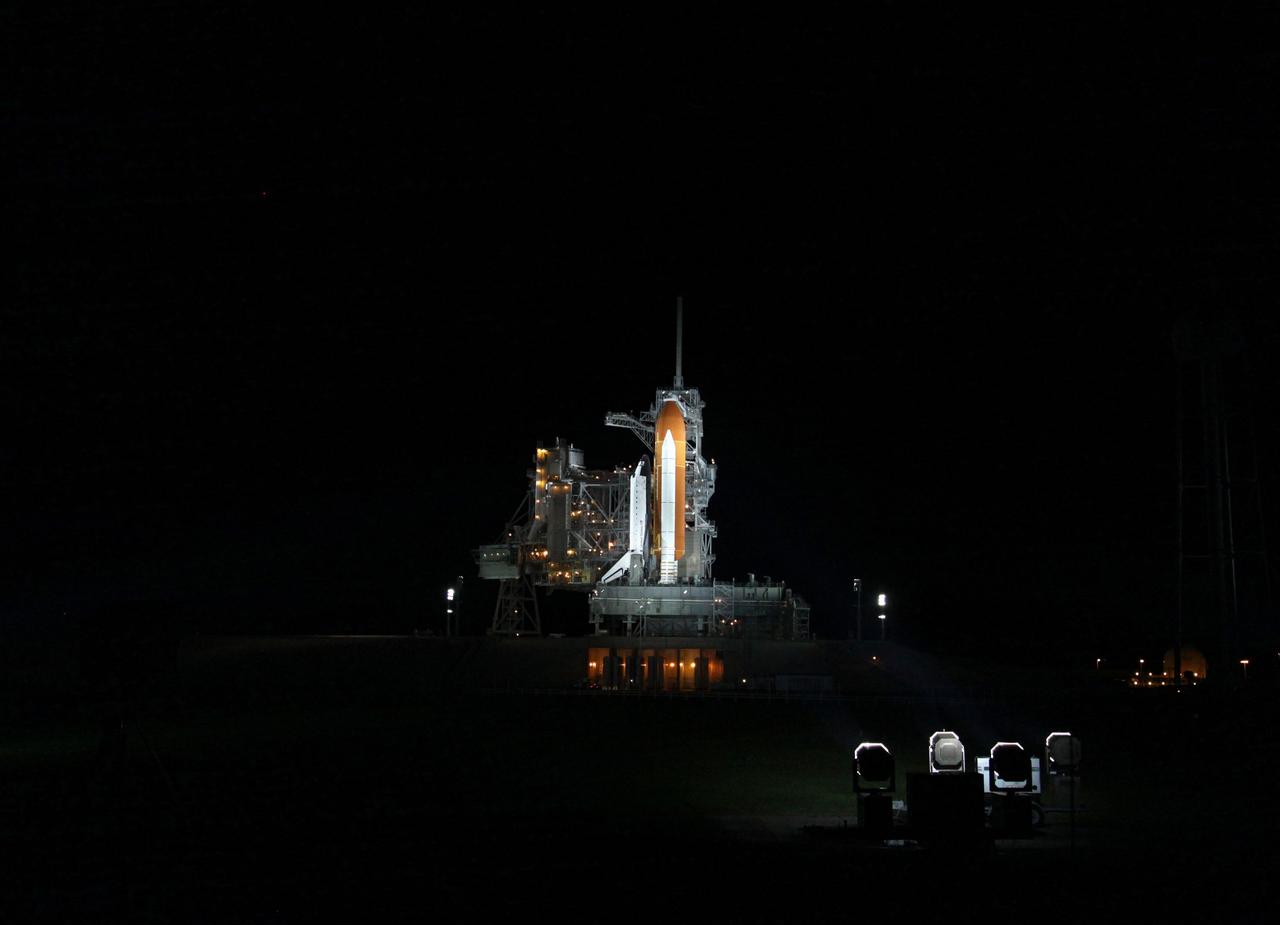
CAPE CANAVERAL, Fla. - At NASA's Kennedy Space Center in Florida, space shuttle Endeavour is illuminated by bright xenon lights on Launch Pad 39A after the rotating service structure (RSS) was moved away. The structure provides weather protection and access to the shuttle while it awaits lift off on the pad. RSS "rollback," as it's called, began at 11:52 p.m. EDT on April 28. The move was scheduled to begin at 7 p.m., but storms over Kennedy delayed pad operations for a few hours. STS-134 will deliver the Express Logistics Carrier-3, Alpha Magnetic Spectrometer-2 (AMS), a high-pressure gas tank and additional spare parts for the Dextre robotic helper to the International Space Station. Endeavour was scheduled to launch at 3:47 p.m. on April 29, but that attempt was scrubbed for at least 72 hours while engineers assess an issue associated with the shuttle's Auxiliary Power Unit 1. STS-134 will be the final spaceflight for Endeavour. For more information visit, www.nasa.gov/mission_pages/shuttle/shuttlemissions/sts134/index.html. Photo credit: NASA/Ken Thornsley
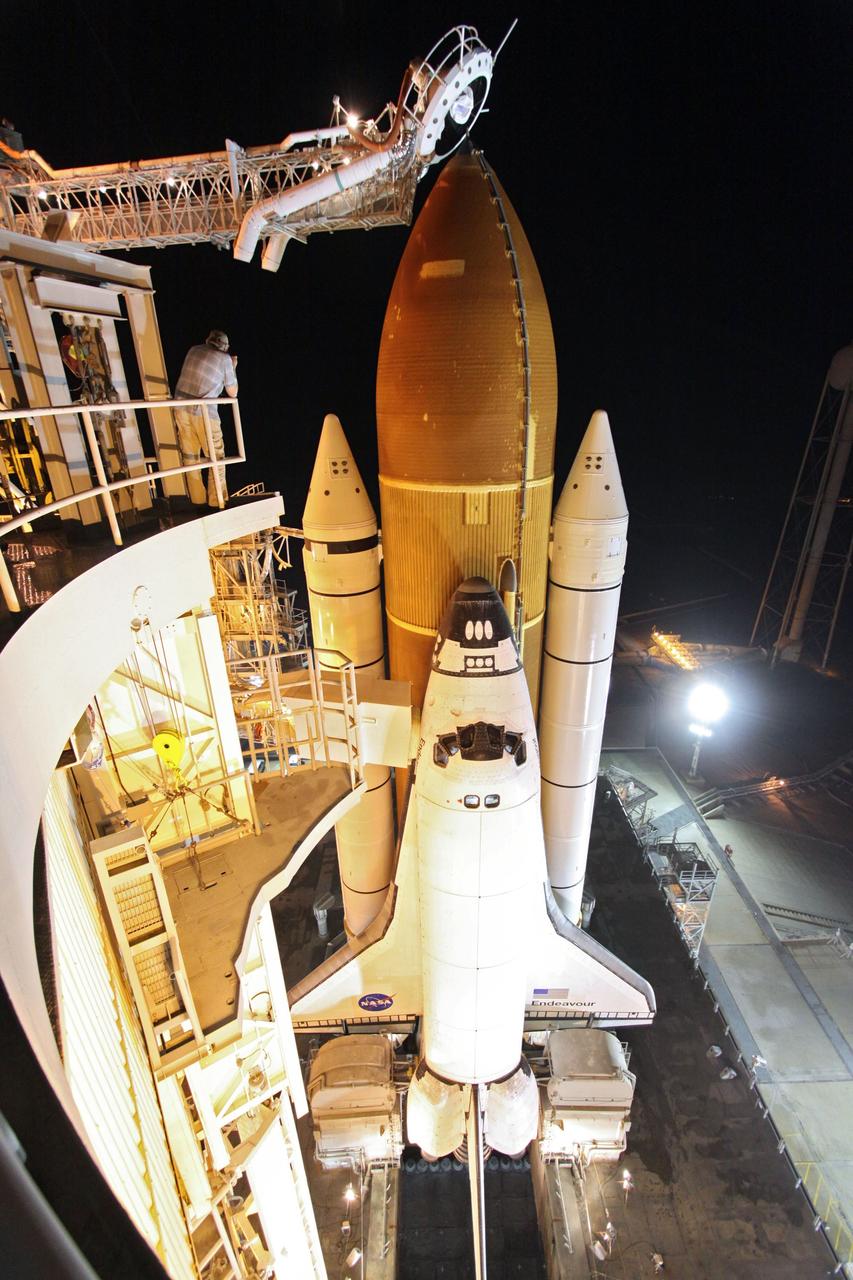
CAPE CANAVERAL, Fla. -- At NASA's Kennedy Space Center in Florida, space shuttle Endeavour is illuminated by bright xenon lights on Launch Pad 39A after the rotating service structure (RSS) was moved away. The structure provides weather protection and access to the shuttle while it awaits lift off on the pad. RSS "rollback," as it's called, began at 11:52 p.m. EDT on April 28. The move was scheduled to begin at 7 p.m., but storms over Kennedy delayed pad operations for a few hours. STS-134 will deliver the Express Logistics Carrier-3, Alpha Magnetic Spectrometer-2 (AMS), a high-pressure gas tank and additional spare parts for the Dextre robotic helper to the International Space Station. Endeavour was scheduled to launch at 3:47 p.m. on April 29, but that attempt was scrubbed for at least 72 hours while engineers assess an issue associated with the shuttle's Auxiliary Power Unit 1. STS-134 will be the final spaceflight for Endeavour. For more information visit, www.nasa.gov/mission_pages/shuttle/shuttlemissions/sts134/index.html. Photo credit: NASA/Ken Thornsley
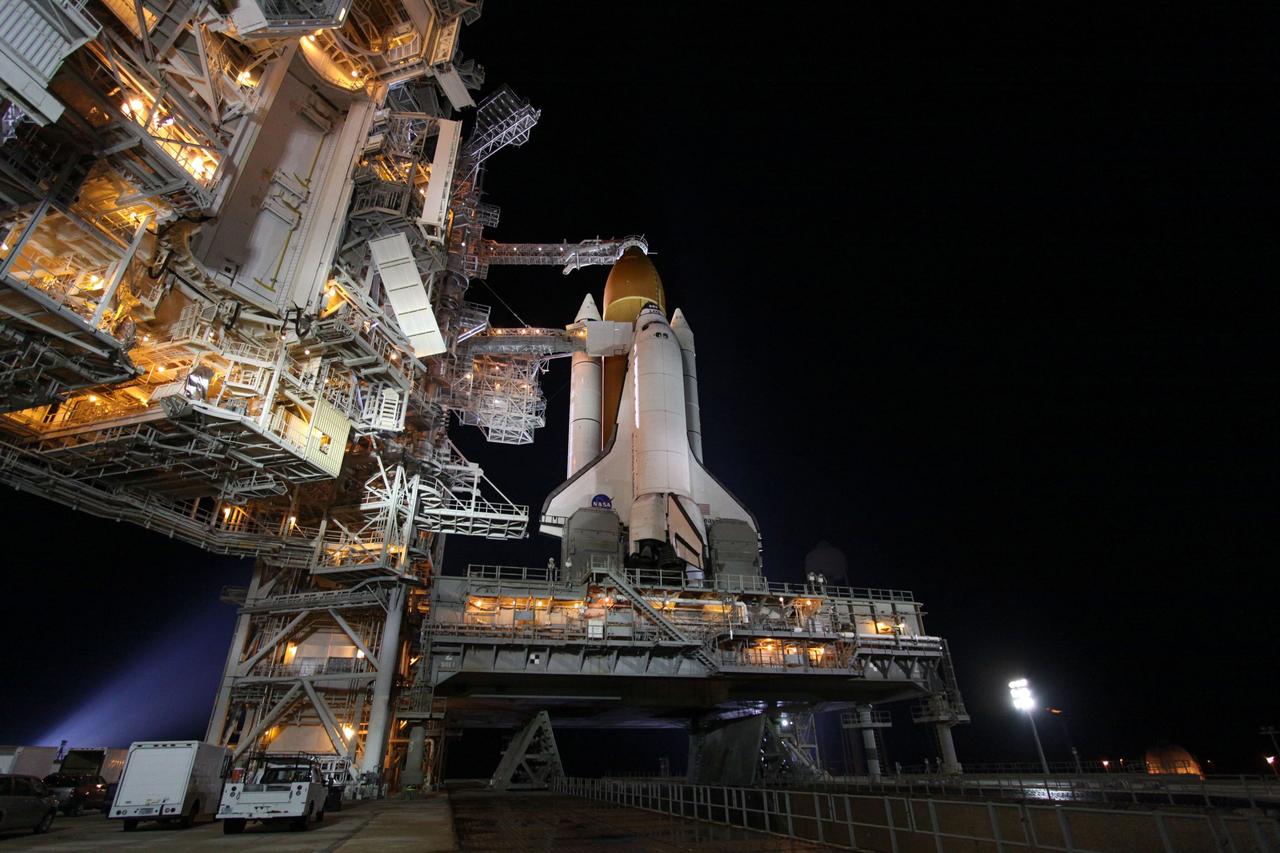
CAPE CANAVERAL, Fla. -- At NASA's Kennedy Space Center in Florida, space shuttle Endeavour is illuminated by bright xenon lights on Launch Pad 39A after the rotating service structure (RSS) was moved away. The structure provides weather protection and access to the shuttle while it awaits lift off on the pad. RSS "rollback," as it's called, began at 11:52 p.m. EDT on April 28. The move was scheduled to begin at 7 p.m., but storms over Kennedy delayed pad operations for a few hours. STS-134 will deliver the Express Logistics Carrier-3, Alpha Magnetic Spectrometer-2 (AMS), a high-pressure gas tank and additional spare parts for the Dextre robotic helper to the International Space Station. Endeavour was scheduled to launch at 3:47 p.m. on April 29, but that attempt was scrubbed for at least 72 hours while engineers assess an issue associated with the shuttle's Auxiliary Power Unit 1. STS-134 will be the final spaceflight for Endeavour. For more information visit, www.nasa.gov/mission_pages/shuttle/shuttlemissions/sts134/index.html. Photo credit: NASA/Ken Thornsley
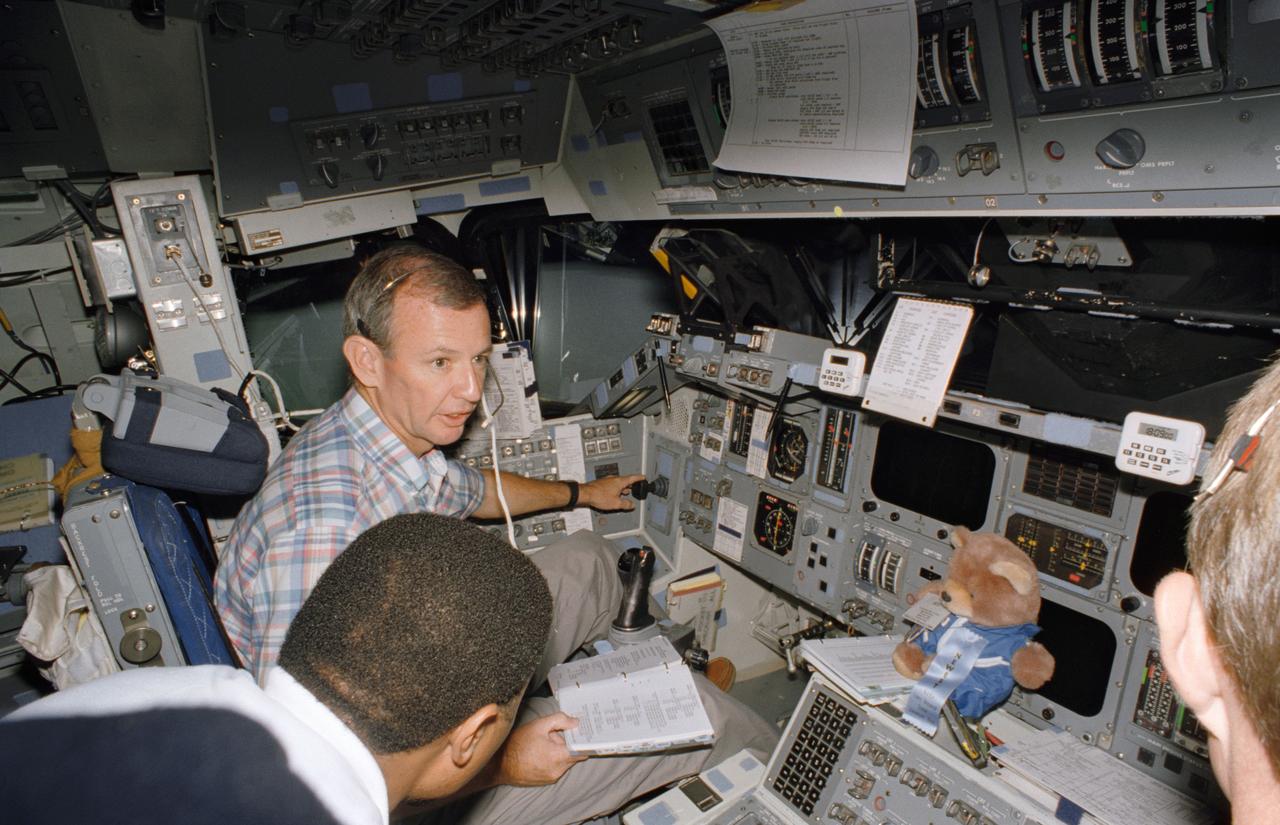
S95-12716 (May 1995) --- Astronauts Brian Duffy, in commander's seat, and Winston E. Scott discuss their scheduled flight aboard the Space Shuttle Endeavour. The two are on the flight deck of the Johnson Space Center's (JSC) fixed base Shuttle Mission Simulator (SMS). Duffy, mission commander, and Scott, mission specialist, will be joined for the winter flight by three other NASA astronauts and an international mission specialist representing NASDA.
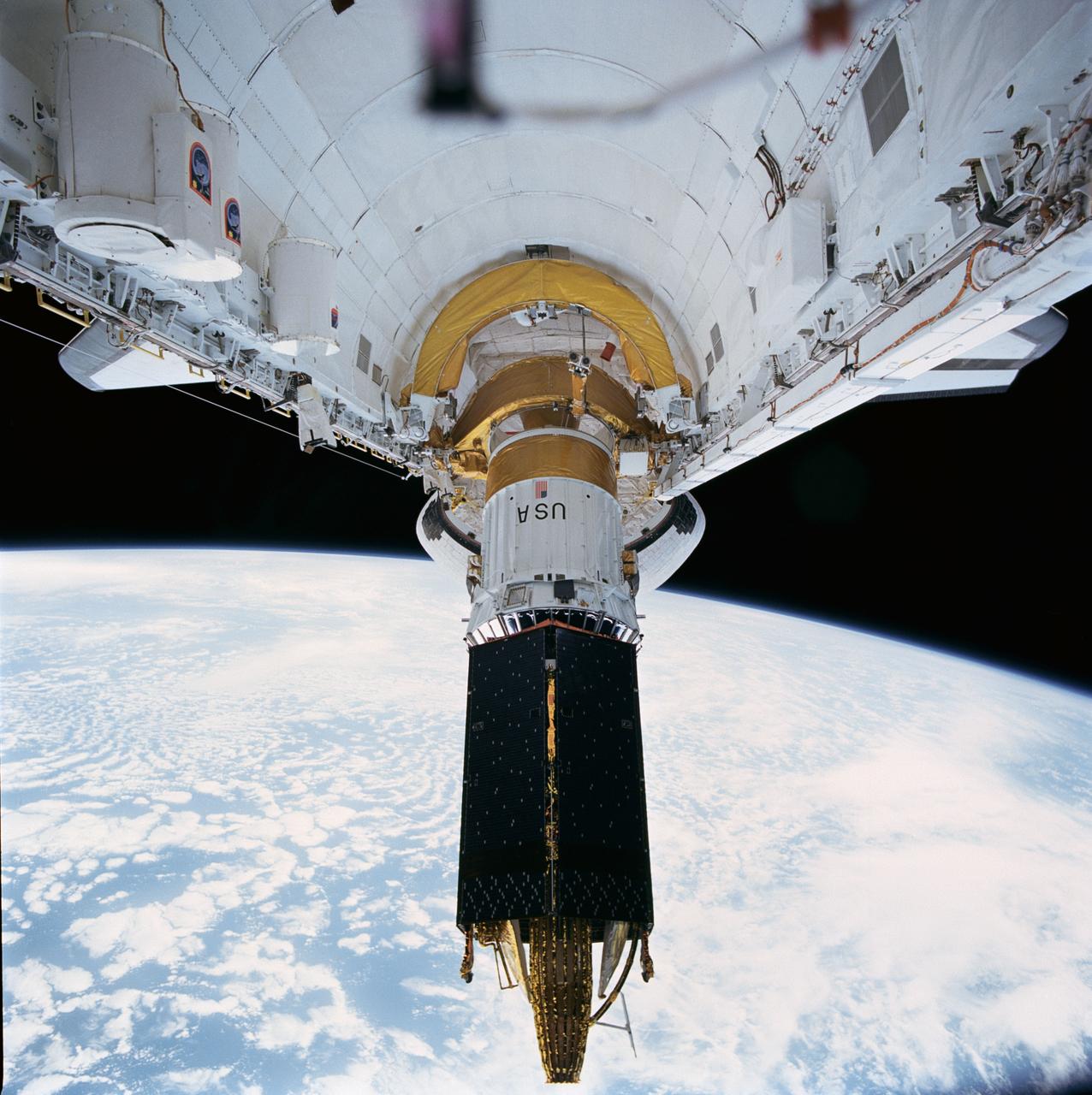
STS043-72-020 (2 Aug 1991) --- The Tracking and Data Relay Satellite (TDRS-E), is loosened from its restraint device and begins to leave the payload bay of the earth-orbiting Atlantis. The deployment came a mere six hours after the Space Shuttle was launched from Pad 39A at Kennedy Space Center, Florida. TDRS, built by TRW, will be placed in a geosynchronous orbit and after on-orbit testing, which requires several weeks, will be designated TDRS-5. The communications satellite will replace TDRS-3 at 174 degrees West longitude. The backbone of NASA's space-to-ground communications, the Tracking and Data Relay satellites have increased NASA's ability to send and receive data to spacecraft in low-earth orbit to more than 85 percent of the time. The five astronauts of the STS 43 mission are John E. Blaha, mission commander, Michael A. Baker, pilot, and Shannon W. Lucid, G. David Low, and James C. Adamson, all mission specialists.
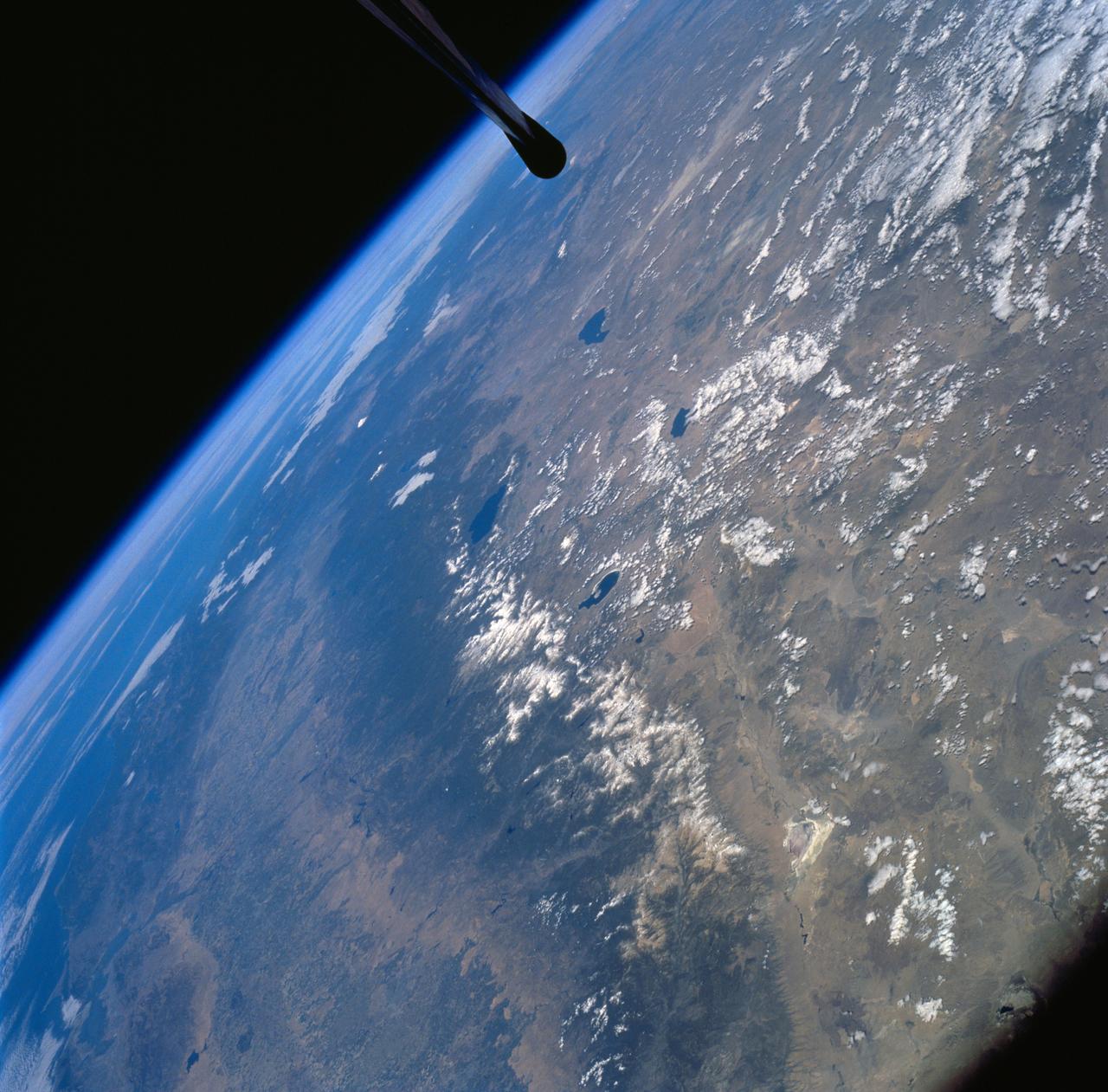
STS058-72-004 (18 Oct-1 Nov 1993) --- The Sierra Nevada Mountain Range can be seen in this north-looking high oblique view taken in October, 1993, by the STS-58 crew. Visible in the view to the west of the Sierra Nevada are the San Joaquin and Sacramento Valleys of central California. The San Francisco/Oakland Bay Area can be seen to the west of the valley at the extreme left of the photograph. To the east or right of the Sierra Nevada, the basin and Range Region of central and northern Nevada is visible. Mono Lake, Lake Tahoe and Pyramid Lake are also visible in this scene. The long northwest/southeast trending Walker Lane Shear Zone, which lies just to the east (right) of the Sierra Nevada is also visible. Near the top of the view (near the horizon), the snow covered volcanic peak Mount Shasta can be seen. Over 645 kilometers (400 miles) long and from 65 to 130 kilometers (40 to 80 miles) wide, the Sierra Nevada have many peaks in excess of 3,300 meters (11,000 feet) above sea level. A titled fault block in structure (the largest in the United States) and shaped by glaciers during the last ice age over 12,000 years ago, the Sierra Nevada eastern front rises sharply from the Great Basin of Nevada, while its western slope descends gradually to the hills bordering the Central Valley of California. Snow-fed streams supply much of the irrigation water to the Central Valley and to western Nevada and also generate hydroelectricity. Recent above normal precipitation (snowfall) of the last two years has helped in alleviating the drought conditions that had prevailed throughout most of California in the mid and late 1980's and early 1990's.
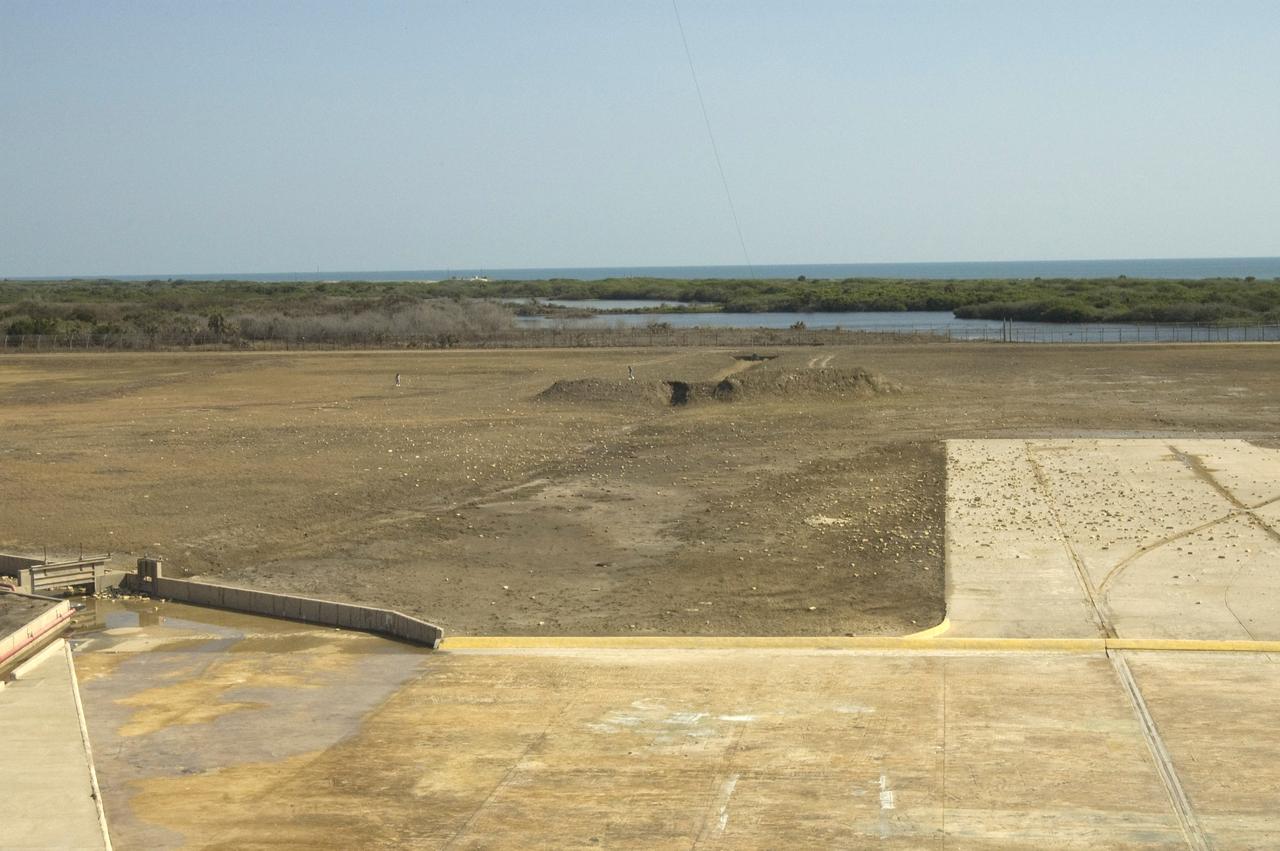
CAPE CANAVERAL, Fla. -- Debris is scattered across Launch Pad 39A at NASA's Kennedy Space Center following launch of space shuttle Discovery on its STS-124 mission. During the post-launch walk down, the pad team noted severe launch damage on a 100’ X 20’ section of the east wall of the north flame trench. Broken sections of the flame trench wall were scattered from the flame trench to the pad perimeter fence. NASA is forming an investigation board. The flame trench transecting the pad's mound at ground level is 490 feet long, 58 feet wide and 40 feet high. It is made of concrete and refractory brick. The top of the solid rocket booster flame deflector abuts with that of the orbiter flame deflector to form a flattened, inverted V-shaped structure beneath the mobile launcher platform's three exhaust holes. The orbiter flame deflector is fixed and is 38 feet high, 72 feet long and 57.6 feet wide. The deflector weighs 1.3 million pounds. The solid rocket booster deflector is 42.5 feet high, 42 feet long and 57 feet wide. The structure weighs 1.1 million pounds. The deflectors are built of steel and covered with a high-temperature concrete surface with an average thickness of 5 inches. There are two movable solid rocket booster side flame deflectors, one located on each side of the flame trench. They are 19.5 feet high, 44 feet long and 17.5 feet wide. Photo credit: NASA/Jim Grossmann
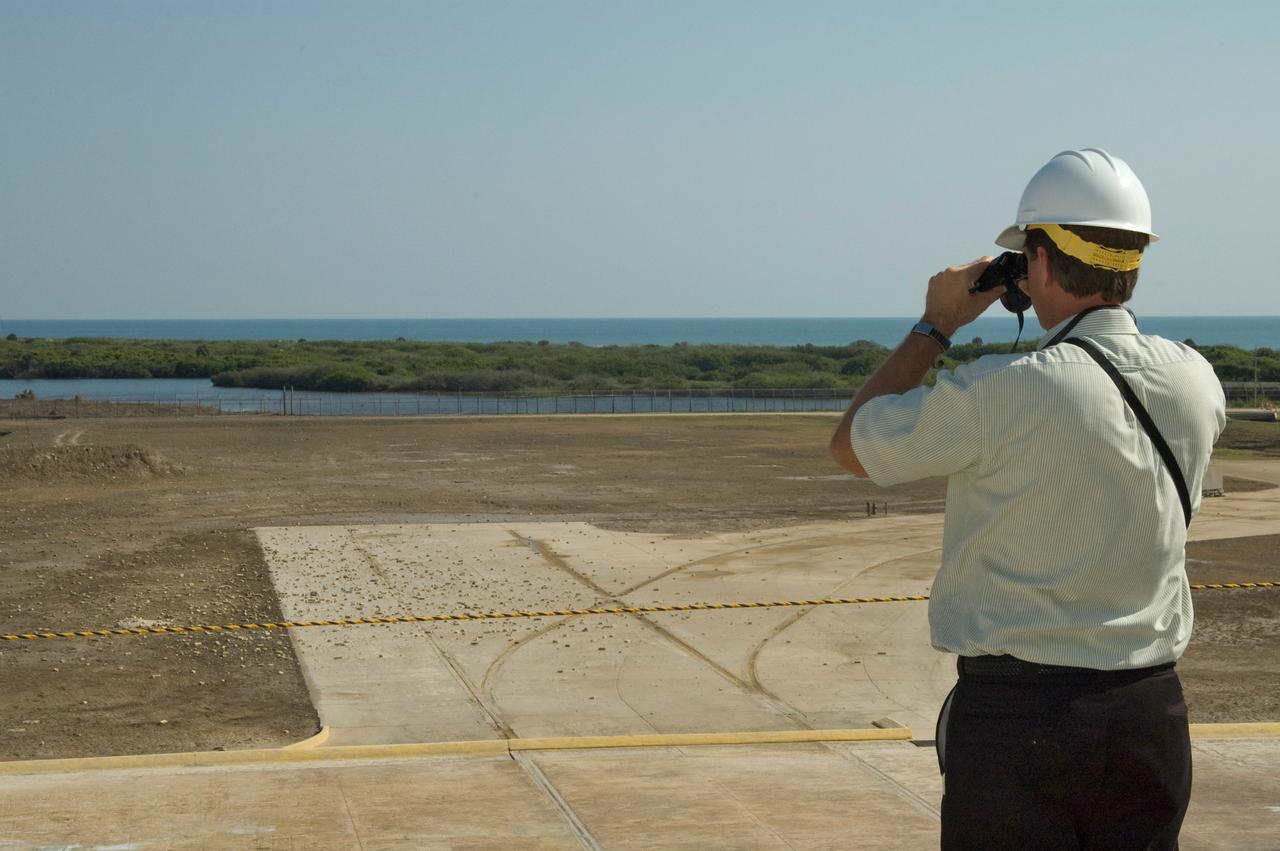
CAPE CANAVERAL, Fla. -- A member of the walk-down team takes a close look at debris scattered across Launch Pad 39A at NASA's Kennedy Space Center following launch of space shuttle Discovery on its STS-124 mission. During the post-launch walk down, the pad team noted severe launch damage on a 100’ X 20’ section of the east wall of the north flame trench. Broken sections of the flame trench wall were scattered from the flame trench to the pad perimeter fence. NASA is forming an investigation board. The flame trench transecting the pad's mound at ground level is 490 feet long, 58 feet wide and 40 feet high. It is made of concrete and refractory brick. The top of the solid rocket booster flame deflector abuts with that of the orbiter flame deflector to form a flattened, inverted V-shaped structure beneath the mobile launcher platform's three exhaust holes. The orbiter flame deflector is fixed and is 38 feet high, 72 feet long and 57.6 feet wide. The deflector weighs 1.3 million pounds. The solid rocket booster deflector is 42.5 feet high, 42 feet long and 57 feet wide. The structure weighs 1.1 million pounds. The deflectors are built of steel and covered with a high-temperature concrete surface with an average thickness of 5 inches. There are two movable solid rocket booster side flame deflectors, one located on each side of the flame trench. They are 19.5 feet high, 44 feet long and 17.5 feet wide. Photo credit: NASA/Jim Grossmann