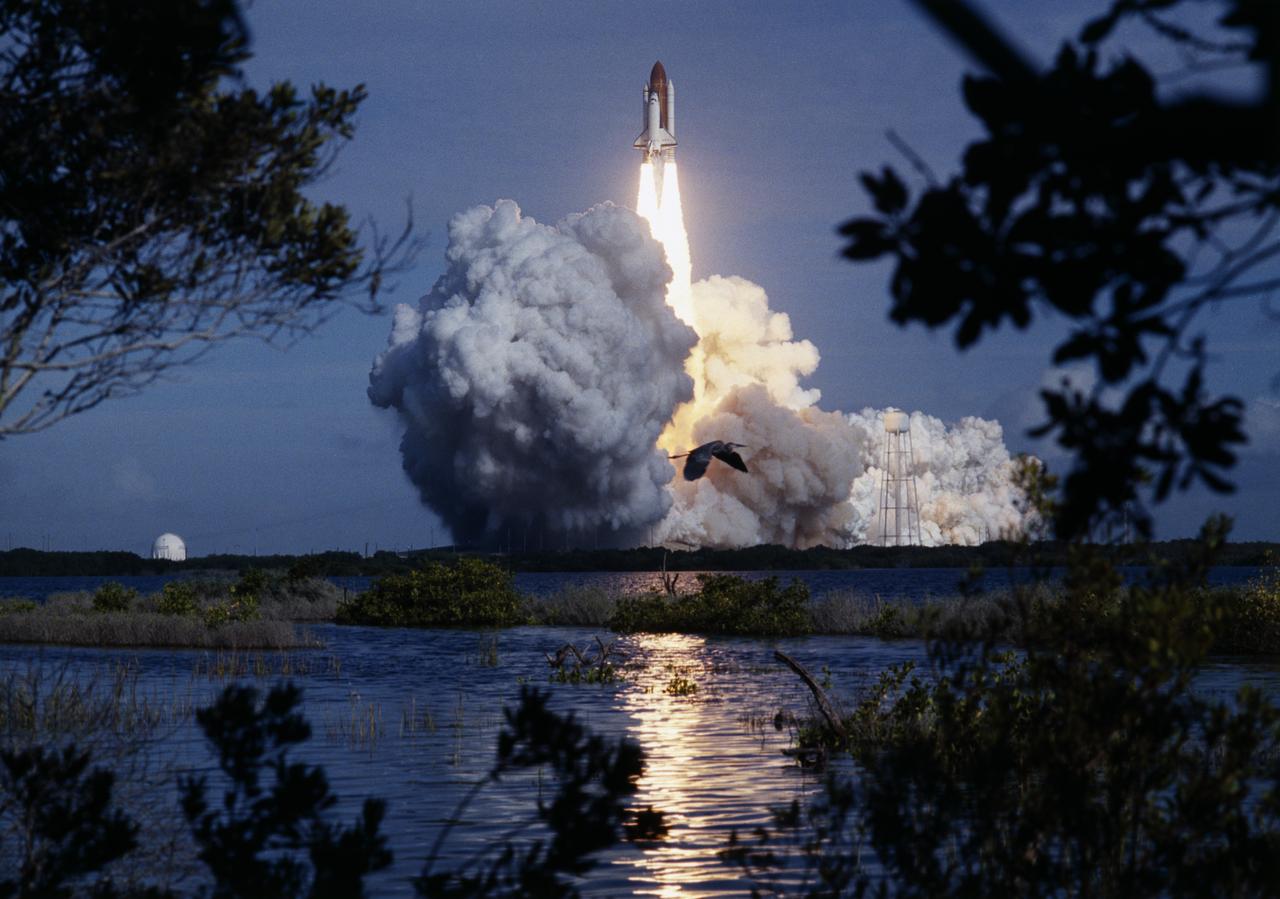
A Great Blue Heron seems oblivious to the tremendous spectacle of light and sound generated by a Shuttle liftoff, as the Space Shuttle Columbia (STS-73) soars skyward from Launch Pad 39B. Columbia's seven member crew's mission included continuing experimentation in the Marshall managed payloads including the United States Microgravity Laboratory 2 (USML-2) and the keel-mounted accelerometer that characterizes the very low frequency acceleration environment of the orbiter payload bay during space flight, known as the Orbital Acceleration Research Experiment (OARE).
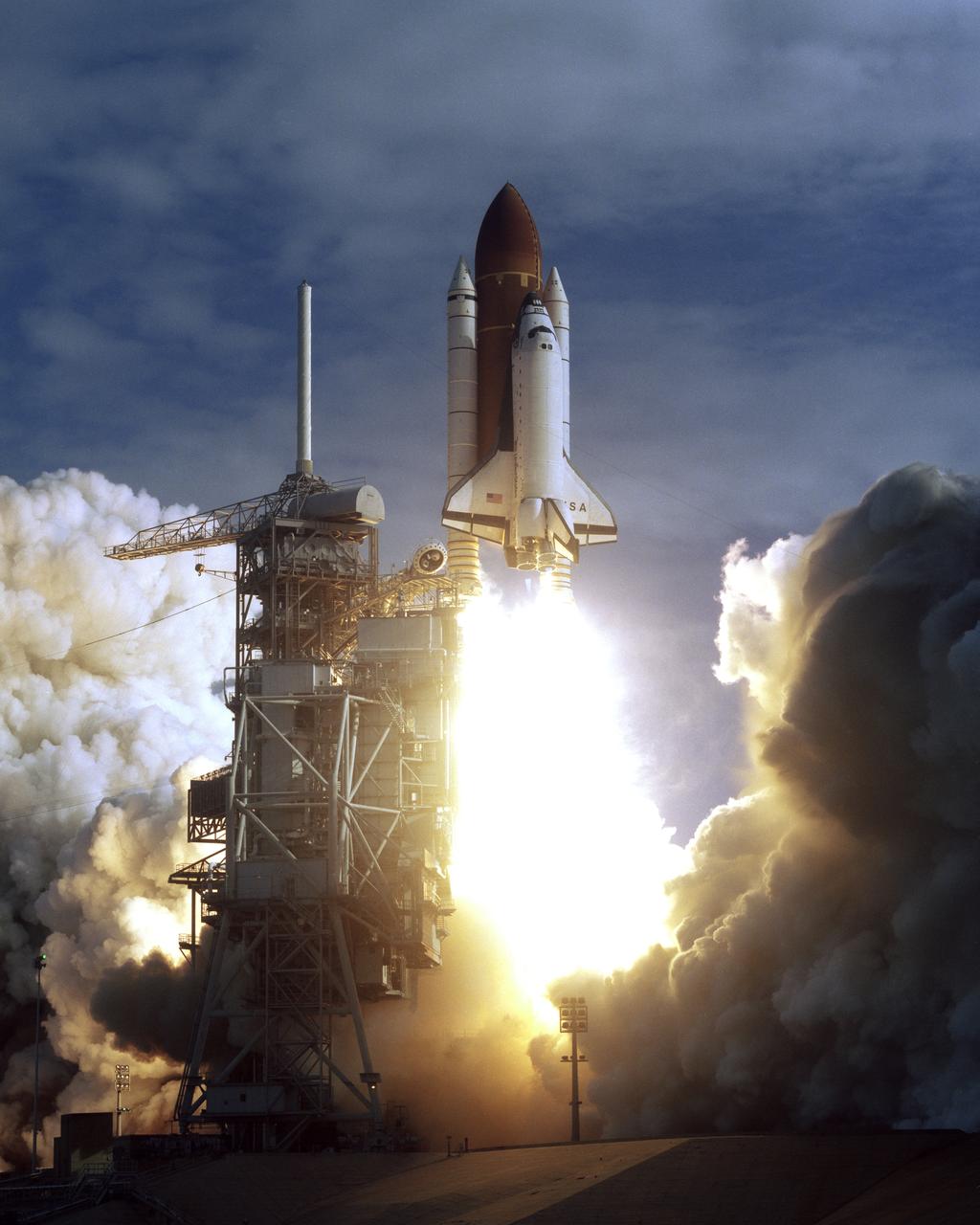
STS073-S-030 (20 Oct. 1995) --- The space shuttle Columbia lifts off from Launch Pad 39B, at the Kennedy Space Center (KSC), to begin a scheduled 16-day mission in Earth orbit in support of the United States Microgravity Laboratory (USML-2). Five NASA astronauts and two scientists from the private sector were onboard. Liftoff occurred at 9:53:00 a.m. (EDT) on Oct. 20, 1995. The mission represents the 72nd space shuttle flight for NASA. The crew will be working around the clock on a diverse assortment of USML-2 experiments located in a science module in Columbia's cargo bay. Fields of study include fluid physics, materials science, biotechnology, combustion science and commercial space processing technologies. The crew is made up of astronauts Kenneth D. Bowersox, commander; Kent V. Rominger, pilot; Kathryn C. Thornton, payload commander; Michael E. Lopez-Alegria and Catherine G. Coleman, both mission specialists; along with Fred W. Leslie and Albert Sacco Jr., payload specialists. Photo credit: NASA
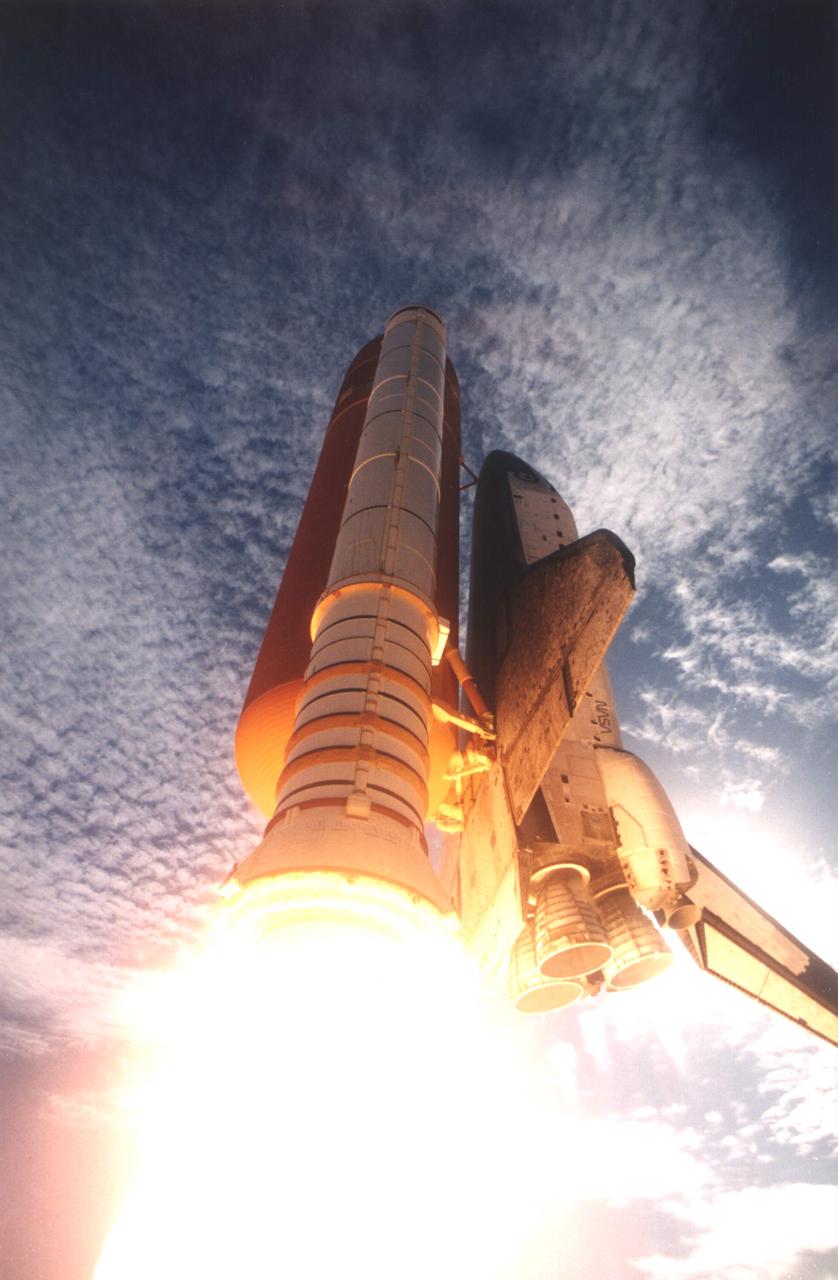
STS073-S-027 (20 October 1995) --- A 35mm camera captured this low-angle view of the Space Shuttle Columbia as it lifted off from Launch Pad 39B, at the Kennedy Space Center (KSC), to begin a scheduled 16-day mission in Earth-orbit in support of the United States Microgravity Laboratory (USML-2). Five NASA astronauts and two scientists from the private sector were onboard. Liftoff occurred at 9:53:00 a.m. (EDT) on October 20, 1995. The mission represents the 72nd Space Shuttle flight for NASA. The crew will be working around the clock on a diverse assortment of USML-2 experiments located in a science module in Columbia's cargo bay. Fields of study include fluid physics, materials science, biotechnology, combustion science and commercial space processing technologies. The crew is made up of astronauts Kenneth D. Bowersox, commander; Kent V. Rominger, pilot; Kathryn C. Thornton, payload commander; Michael E. Lopez-Alegria and Catherine G. Coleman, mission specialists; along with Fred W. Leslie and Albert Sacco Jr., payload specialists.

STS073-S-029 (20 October 1995) --- A stationary 70mm camera captured this wide view of the Space Shuttle Columbia as it lifted off from Launch Pad 39B, at the Kennedy Space Center (KSC), to begin a scheduled 16-day mission in Earth-orbit in support of the United States Microgravity Laboratory (USML-2). Five NASA astronauts and two scientists from the private sector were onboard. Liftoff occurred at 9:53:00 a.m. (EDT) on October 20, 1995. The mission represents the 72nd Space Shuttle flight for NASA. The crew will be working around the clock on a diverse assortment of USML-2 experiments located in a science module in Columbia's cargo bay. Fields of study include fluid physics, materials science, biotechnology, combustion science and commercial space processing technologies. The crew is made up of astronauts Kenneth D. Bowersox, commander; Kent V. Rominger, pilot; Kathryn C. Thornton, payload commander; Michael E. Lopez-Alegria and Catherine G. Coleman, mission specialists; along with Fred W. Leslie and Albert Sacco Jr., payload specialists.
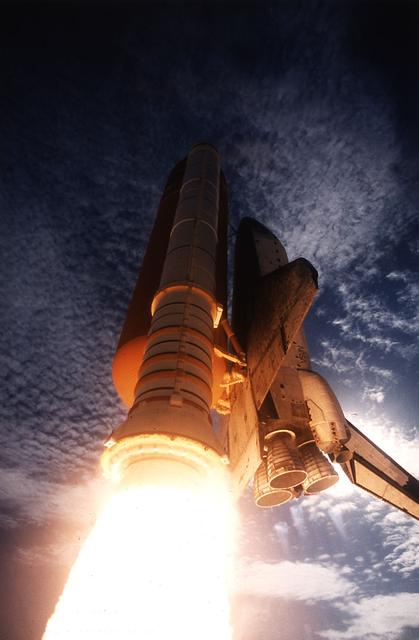
A unique view of the Space Shuttle Columbia (STS-73) moments after bursting into Earth's atmosphere on its way toward space. Onboard the orbiter is the United States Microgravity Laboratory 2 (USML-2), a Marshall managed payload, where Columbia's seven member crew will perform experiments while in orbit.
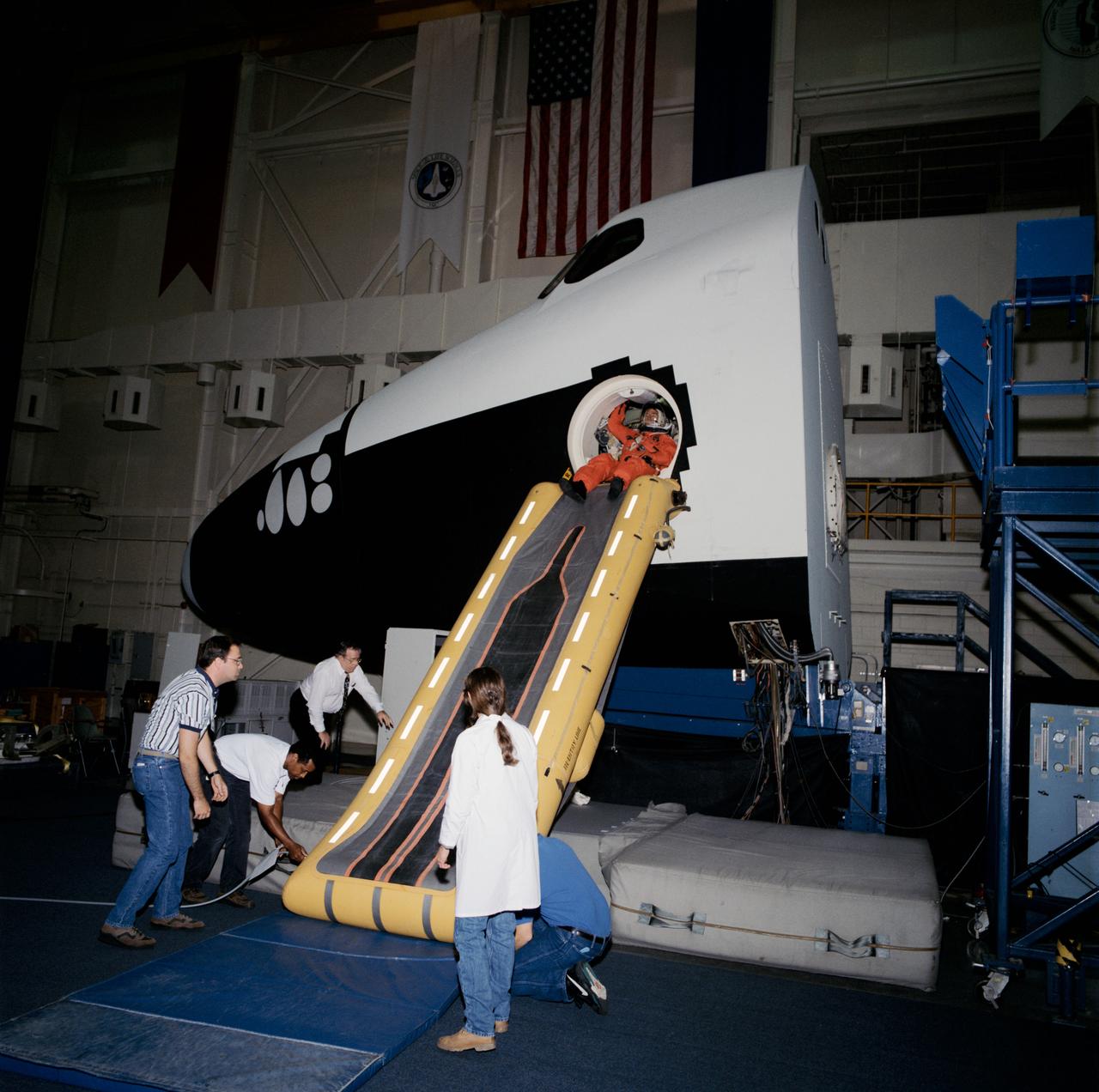
View of the STS-73 crew using the escape slide in the Crew Compartment Trainer (CCT) at bldg 9A. The crew is seen in their launch and entry suits at the top of the slide with trainers at the bottom.
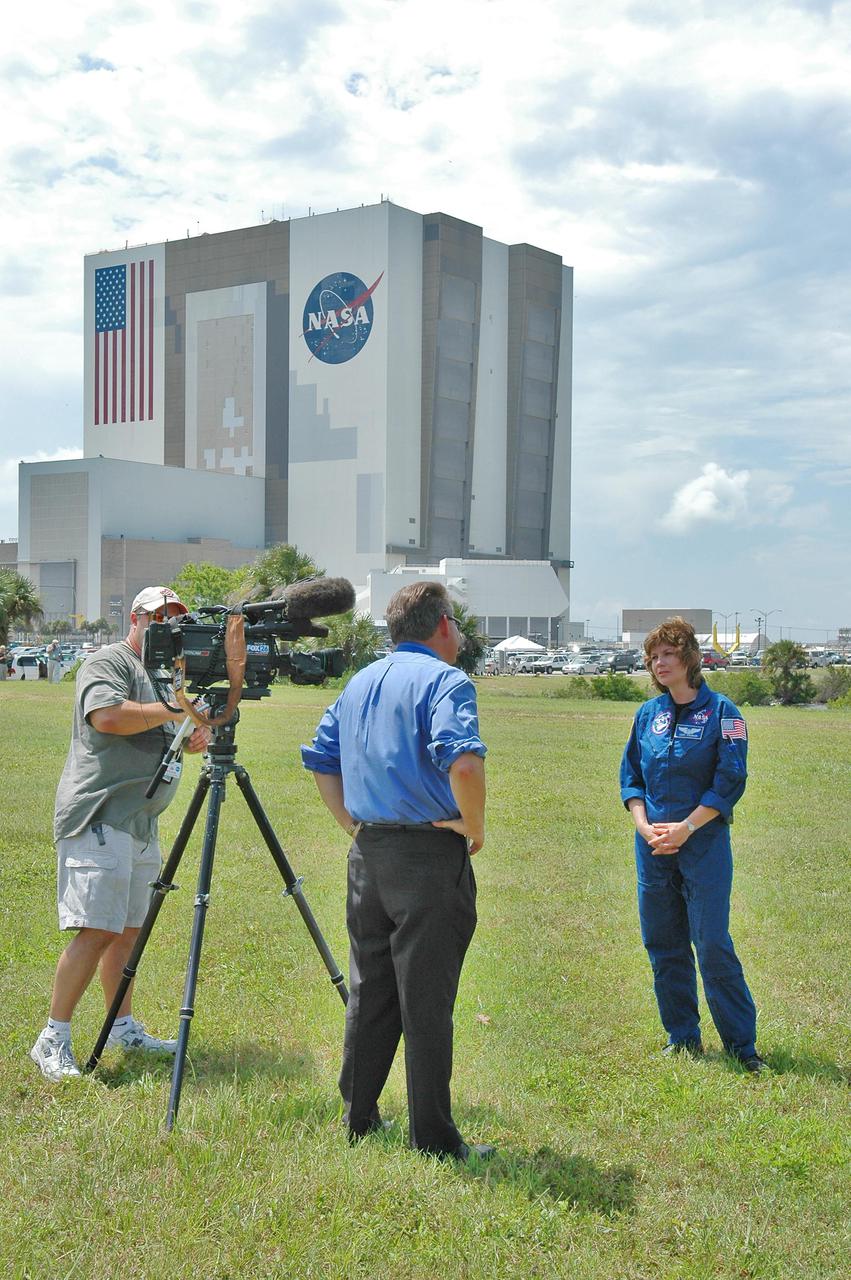
KENNEDY SPACE CENTER, FLA. - Astronaut Catherine “Cady” Coleman is interviewed in the NASA News Center at NASA Kennedy Space Center by a television reporter during launch activities for Return to Flight mission STS-114. Coleman has flown on two Shuttle missions, STS-73 and STS-93. More than a thousand media representatives from 36 states, the District of Columbia and 32 countries converged on the News Center for the historic launch.
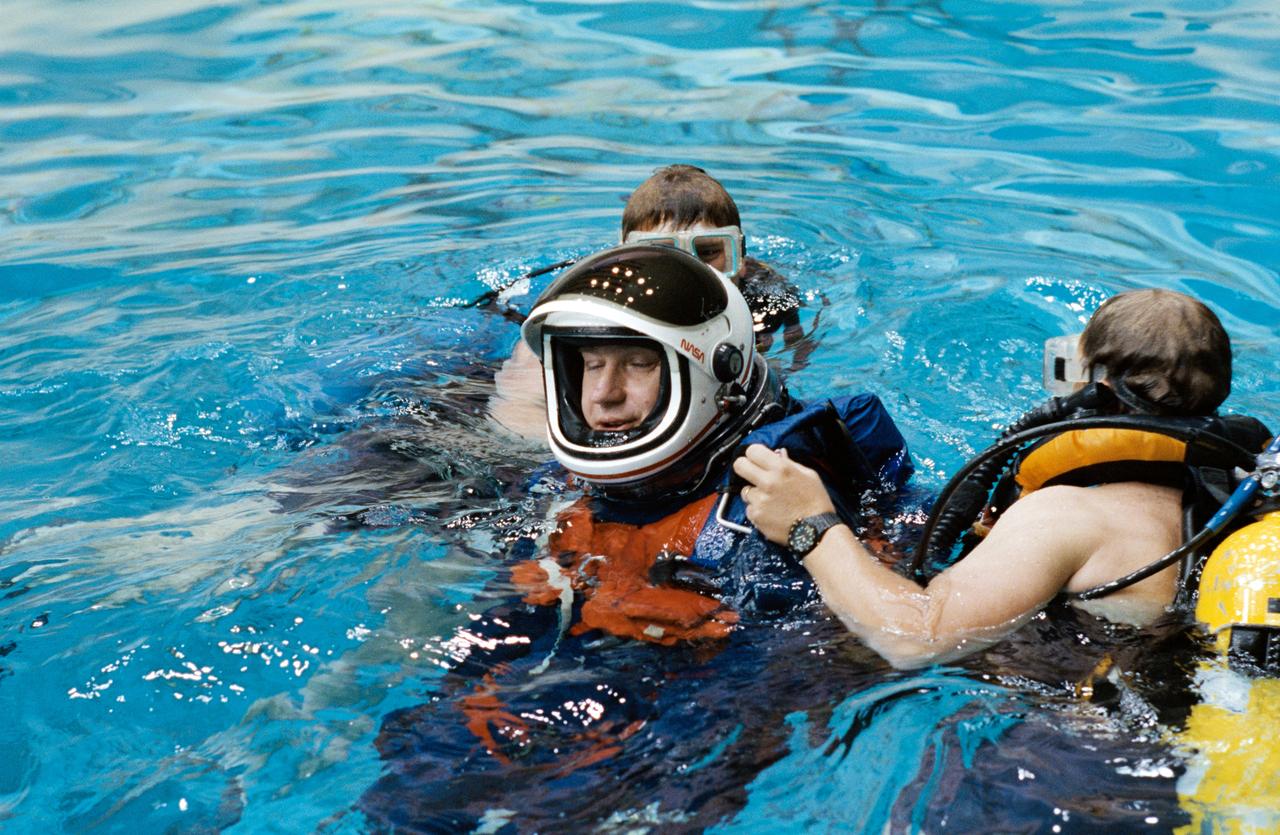
S92-32108 (May 1992) --- Payload specialist Albert Sacco Jr. uses a one-person life raft during emergency bailout training exercises in the Johnson Space Center?s (JSC) Weightless Environment Training Facility (WET-F). Sacco is an alternate payload specialist for the United States Microgravity Laboratory (USML-1) mission, scheduled for launch later this year. EDITOR?S NOTE: Sacco was later named as prime crew payload specialist for the USML-2 mission (STS-73), scheduled for 1995.
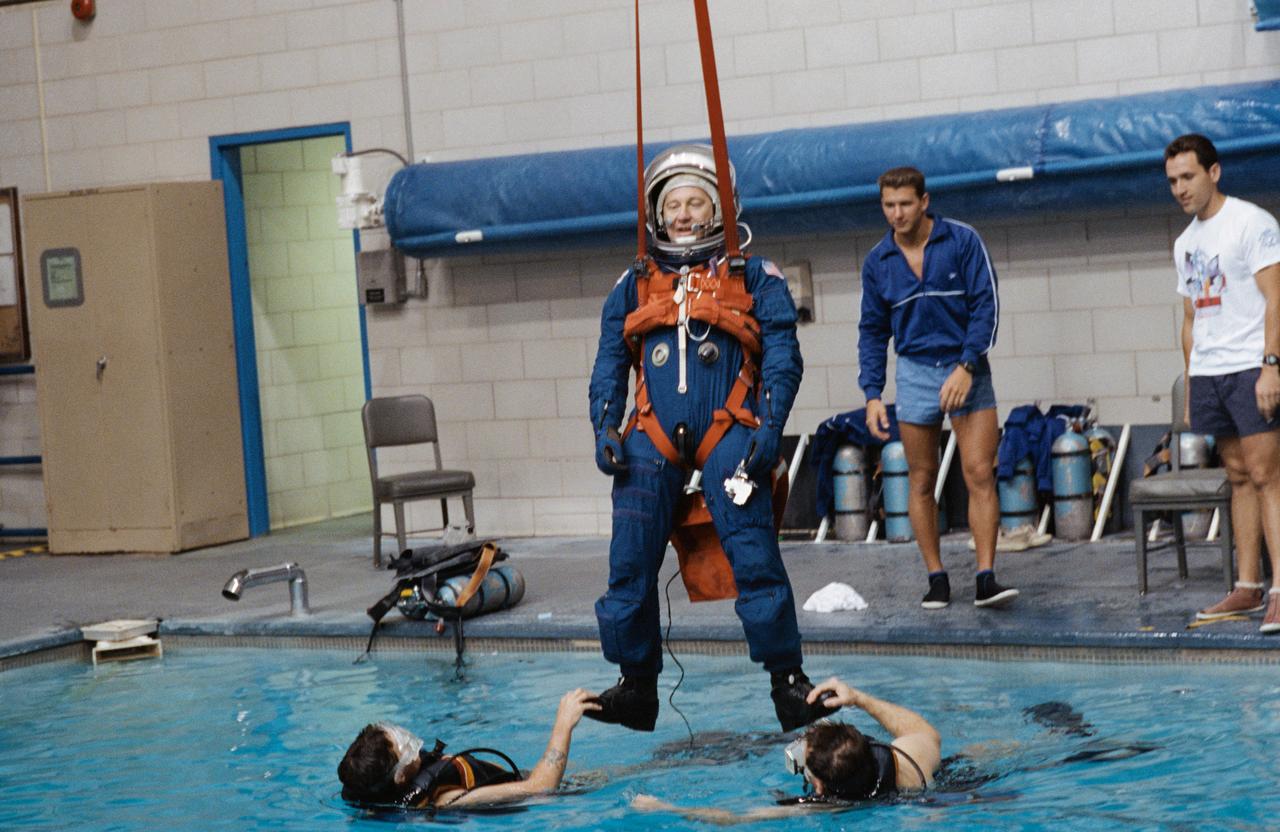
S92-32111 (May 1992) --- Payload specialist Albert Sacco Jr. is assisted by two SCUBA-equipped divers as he hangs by his parachute harness during emergency bailout training exercises in the Johnson Space Center?s (JSC) Weightless Environment Training Facility (WET-F). Sacco is an alternate payload specialist for the United States Microgravity Laboratory (USML-1) mission, scheduled for launch later this year. EDITOR?S NOTE: Sacco was later named as prime crew payload specialist for the USML-2 mission (STS-73), scheduled for 1995.
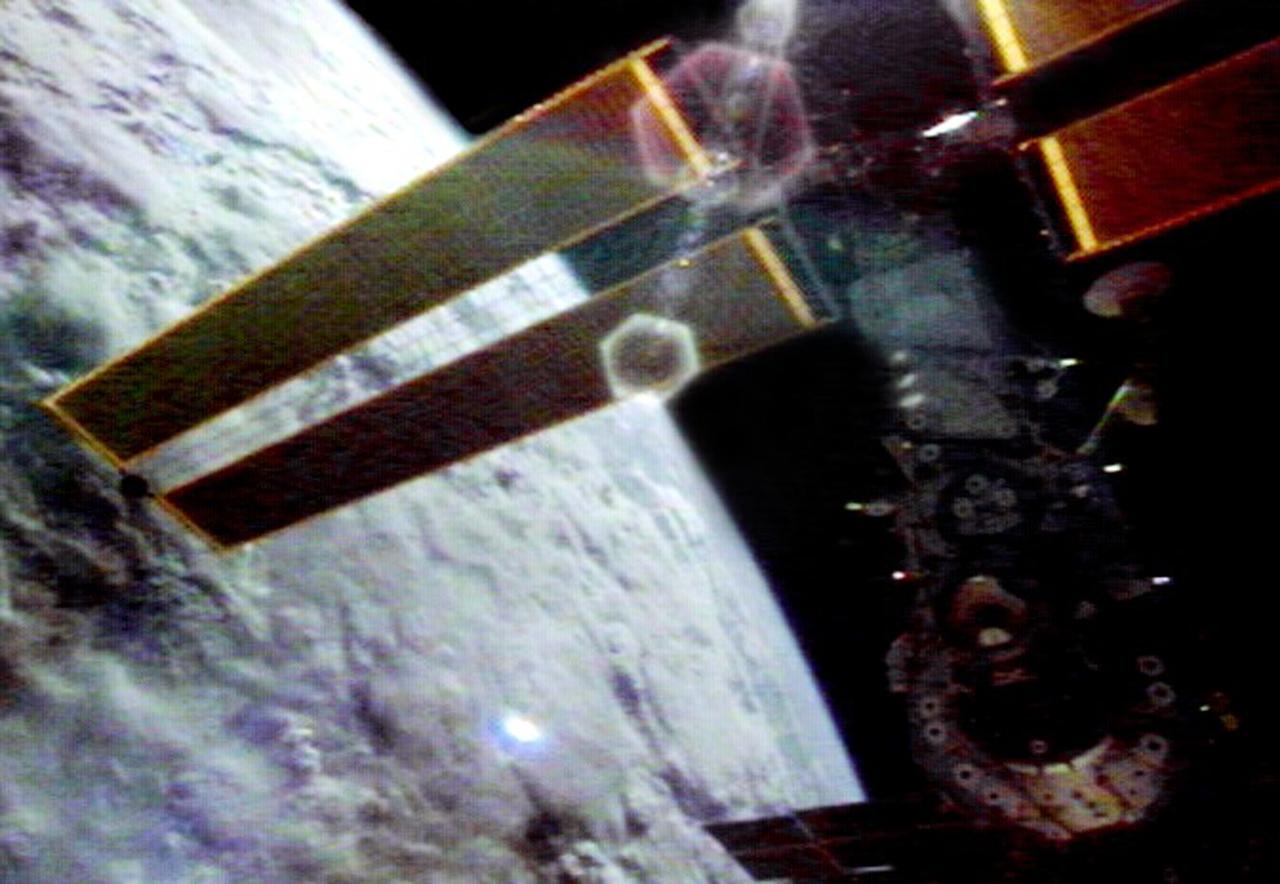
This video still depicts the recently deployed starboard and port solar arrays towering over the International Space Station (ISS). The video was recorded on STS-97's 65th orbit. Delivery, assembly, and activation of the solar arrays was the main mission objective of STS-97. The electrical power system, which is built into a 73-meter (240-foot) long solar array structure consists of solar arrays, radiators, batteries, and electronics, and will provide the power necessary for the first ISS crews to live and work in the U.S. segment. The entire 15.4-metric ton (17-ton) package is called the P6 Integrated Truss Segment, and is the heaviest and largest element yet delivered to the station aboard a space shuttle. The STS-97 crew of five launched aboard the Space Shuttle Orbiter Endeavor on November 30, 2000 for an 11 day mission.
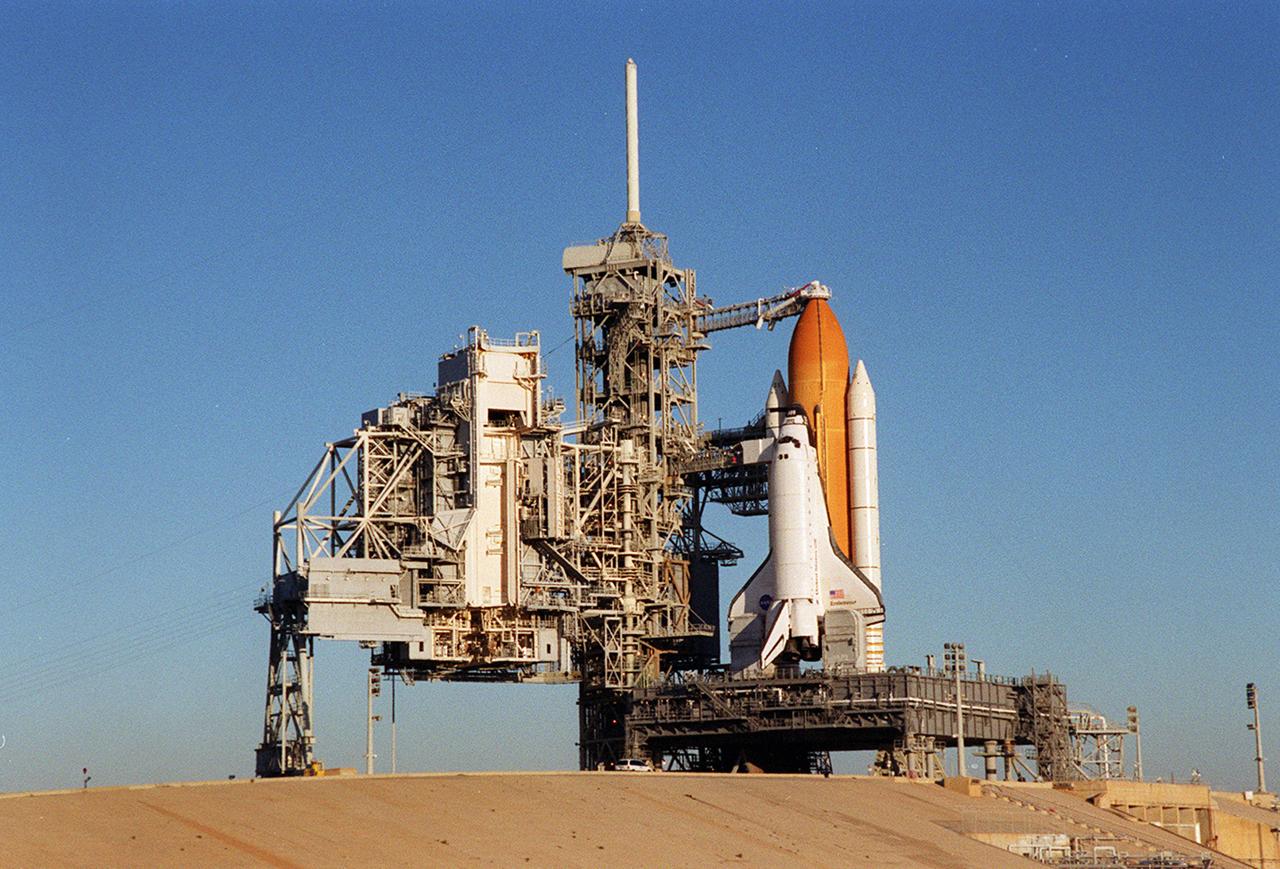
Back dropped by a cloudless blue sky, Space Shuttle Endeavor stands ready for launch after the rollback of the Rotating Service Structure, at left. The orbiter launched that night carrying the STS-97 crew of five. The STS-97 mission's primary objective was the delivery, assembly, and activation of the U.S. electrical power system onboard the International Space Station (ISS). The electrical power system, which is built into a 73-meter (240-foot) long solar array structure, consists of solar arrays, radiators, batteries, and electronics. The entire 15.4-metric ton (17-ton) package is called the P6 Integrated Truss Segment, and is the heaviest and largest element yet delivered to the station aboard a space shuttle. The electric system will eventually provide the power necessary for the first ISS crews to live and work in the U.S. segment.
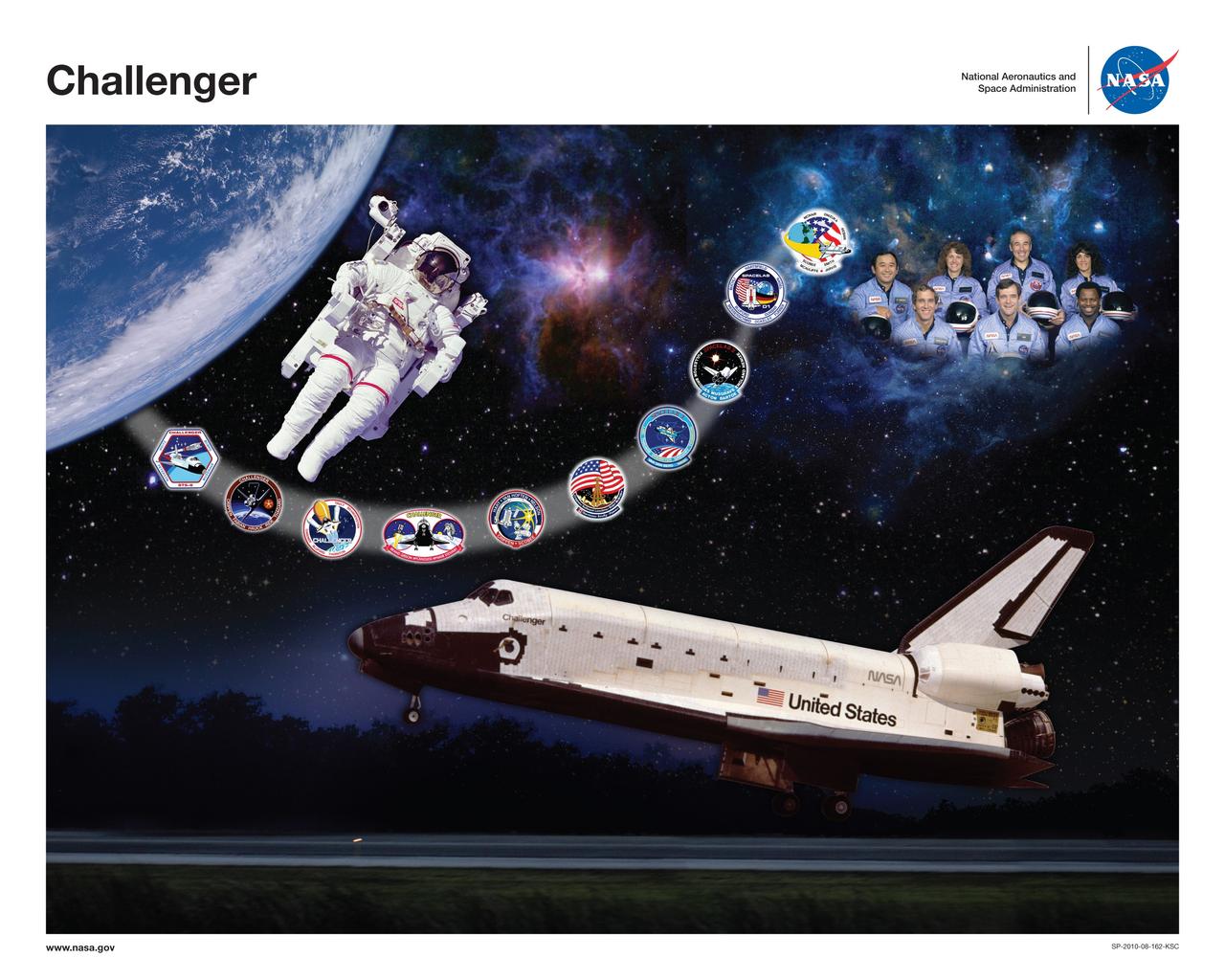
CAPE CANAVERAL, Fla. -- This is a version of space shuttle Challenger's orbiter tribute, or OV-099, which hangs in Firing Room 4 of the Launch Control Center at NASA's Kennedy Space Center in Florida. Challenger's accomplishments include the first night launch and first African-American in space, Guion Bluford, on STS-8, the first in-flight capture, repair and redeployment of an orbiting satellite during STS-41C, the first American woman in space, Sally Ride, on STS-7, and the first American woman to walk in space, Kathryn Sullivan, during STS-41G. Challenger is credited with blazing a trail for NASA's other orbiters with the first night landing at Edwards Air Force Base in California on STS-8 and the first landing at Kennedy on STS-41B. The spacewalker in the tribute represents Challenger’s role in the first spacewalk during STS-6 and the first untethered spacewalk on STS-41B. Crew-designed patches for each of Challenger’s missions lead from Earth toward a remembrance of the STS-51L crew, which was lost 73 seconds after liftoff on Jan. 28, 1986. Five orbiter tributes are on display in the firing room, representing Atlantis, Challenger, Columbia, Endeavour and Discovery. Graphic design credit: NASA/Lynda Brammer. NASA publication number: SP-2010-08-162-KSC
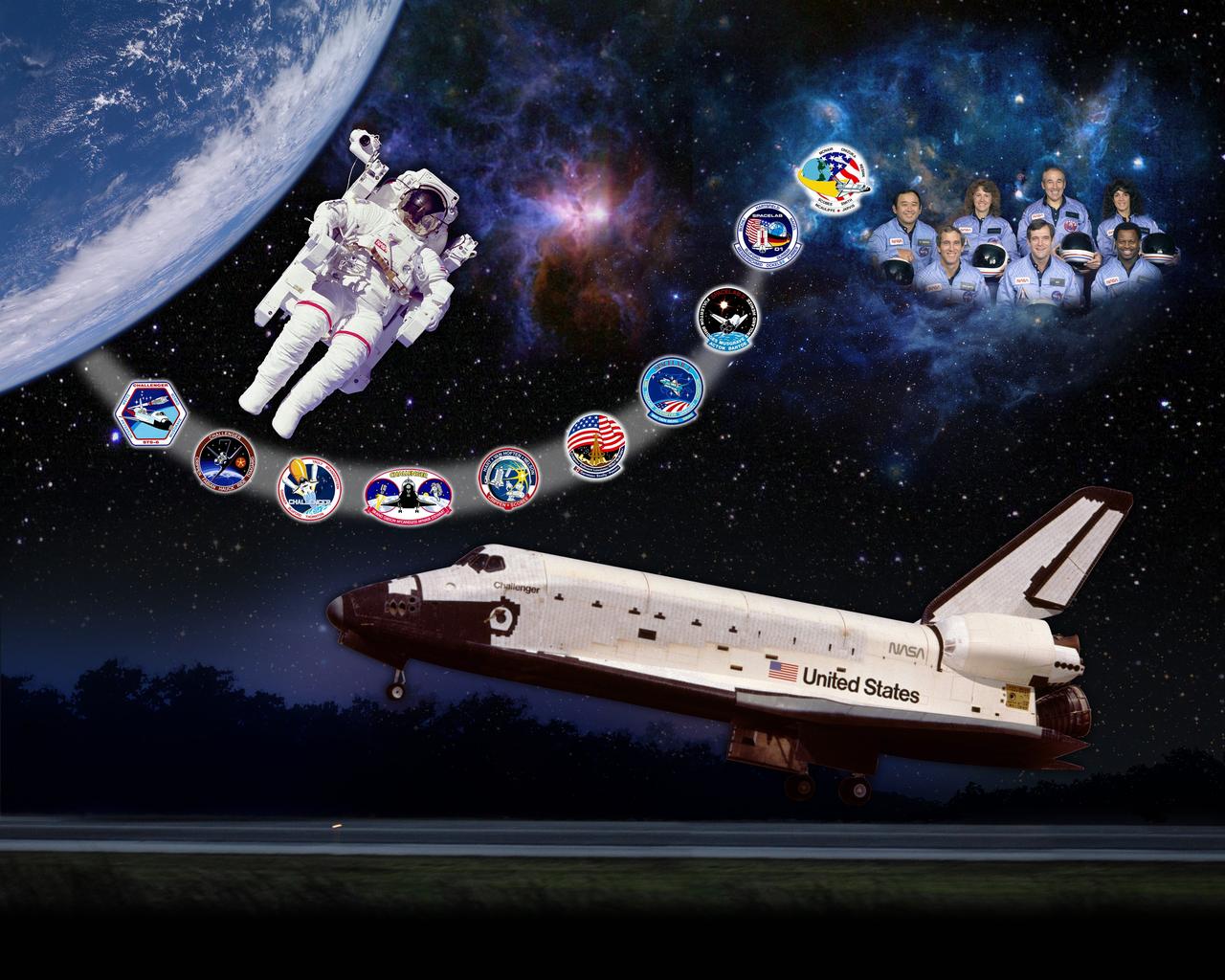
CAPE CANAVERAL, Fla. -- This orbiter tribute of space shuttle Challenger, or OV-099, hangs in Firing Room 4 of the Launch Control Center at NASA's Kennedy Space Center in Florida. Challenger's accomplishments include the first night launch and first African-American in space, Guion Bluford, on STS-8, the first in-flight capture, repair and redeployment of an orbiting satellite during STS-41C, the first American woman in space, Sally Ride, on STS-7, and the first American woman to walk in space, Kathryn Sullivan, during STS-41G. Challenger is credited with blazing a trail for NASA's other orbiters with the first night landing at Edwards Air Force Base in California on STS-8 and the first landing at Kennedy on STS-41B. The spacewalker in the tribute represents Challenger’s role in the first spacewalk during STS-6 and the first untethered spacewalk on STS-41B. Crew-designed patches for each of Challenger’s missions lead from Earth toward a remembrance of the STS-51L crew, which was lost 73 seconds after liftoff on Jan. 28, 1986. Five orbiter tributes are on display in the firing room, representing Atlantis, Challenger, Columbia, Endeavour and Discovery. Graphic design credit: NASA/Lynda Brammer
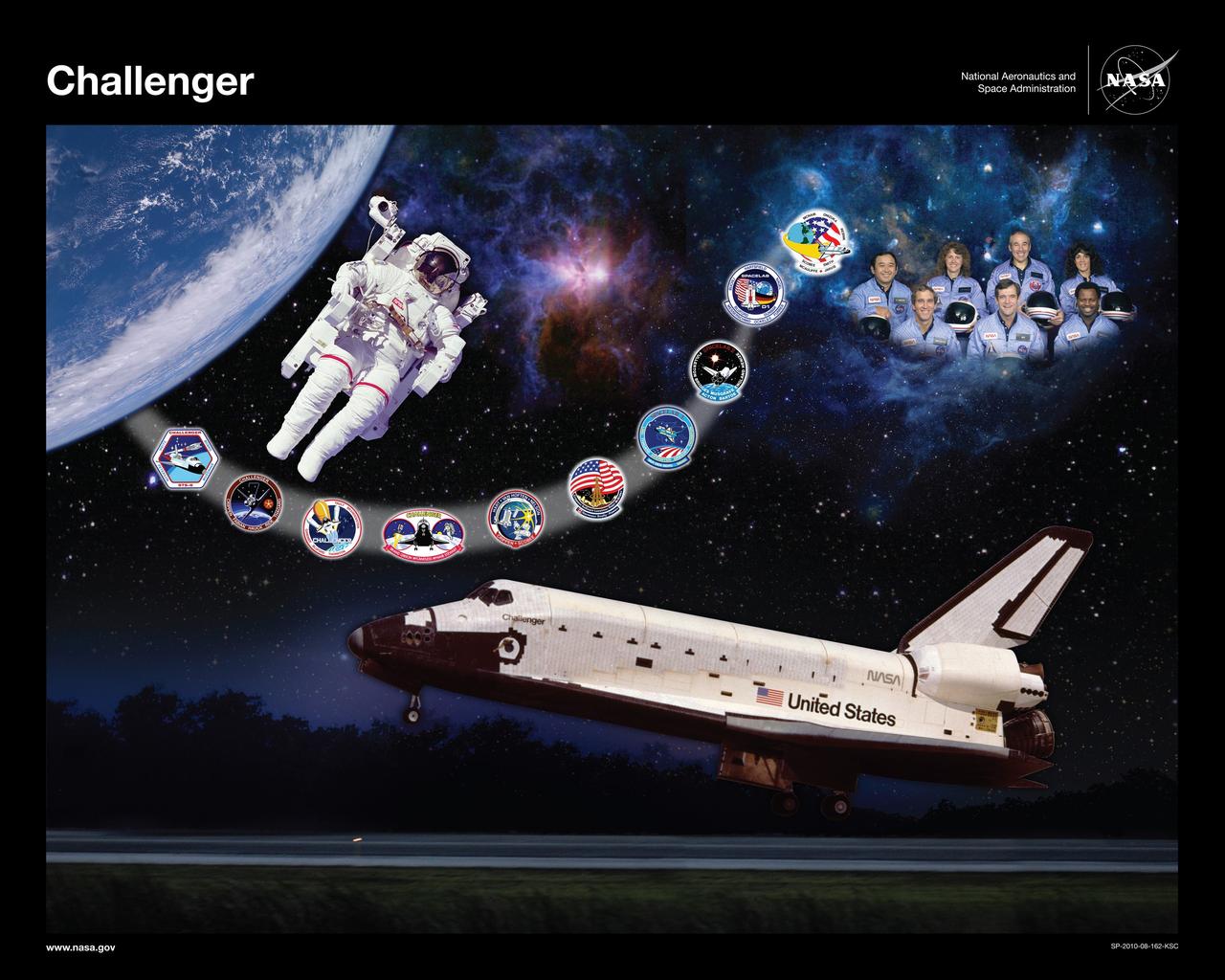
CAPE CANAVERAL, Fla. -- This is a printable version of space shuttle Challenger's orbiter tribute, or OV-099, which hangs in Firing Room 4 of the Launch Control Center at NASA's Kennedy Space Center in Florida. Challenger's accomplishments include the first night launch and first African-American in space, Guion Bluford, on STS-8, the first in-flight capture, repair and redeployment of an orbiting satellite during STS-41C, the first American woman in space, Sally Ride, on STS-7, and the first American woman to walk in space, Kathryn Sullivan, during STS-41G. Challenger is credited with blazing a trail for NASA's other orbiters with the first night landing at Edwards Air Force Base in California on STS-8 and the first landing at Kennedy on STS-41B. The spacewalker in the tribute represents Challenger’s role in the first spacewalk during STS-6 and the first untethered spacewalk on STS-41B. Crew-designed patches for each of Challenger’s missions lead from Earth toward a remembrance of the STS-51L crew, which was lost 73 seconds after liftoff on Jan. 28, 1986. Five orbiter tributes are on display in the firing room, representing Atlantis, Challenger, Columbia, Endeavour and Discovery. Graphic design credit: NASA/Lynda Brammer. NASA publication number: SP-2010-08-162-KSC
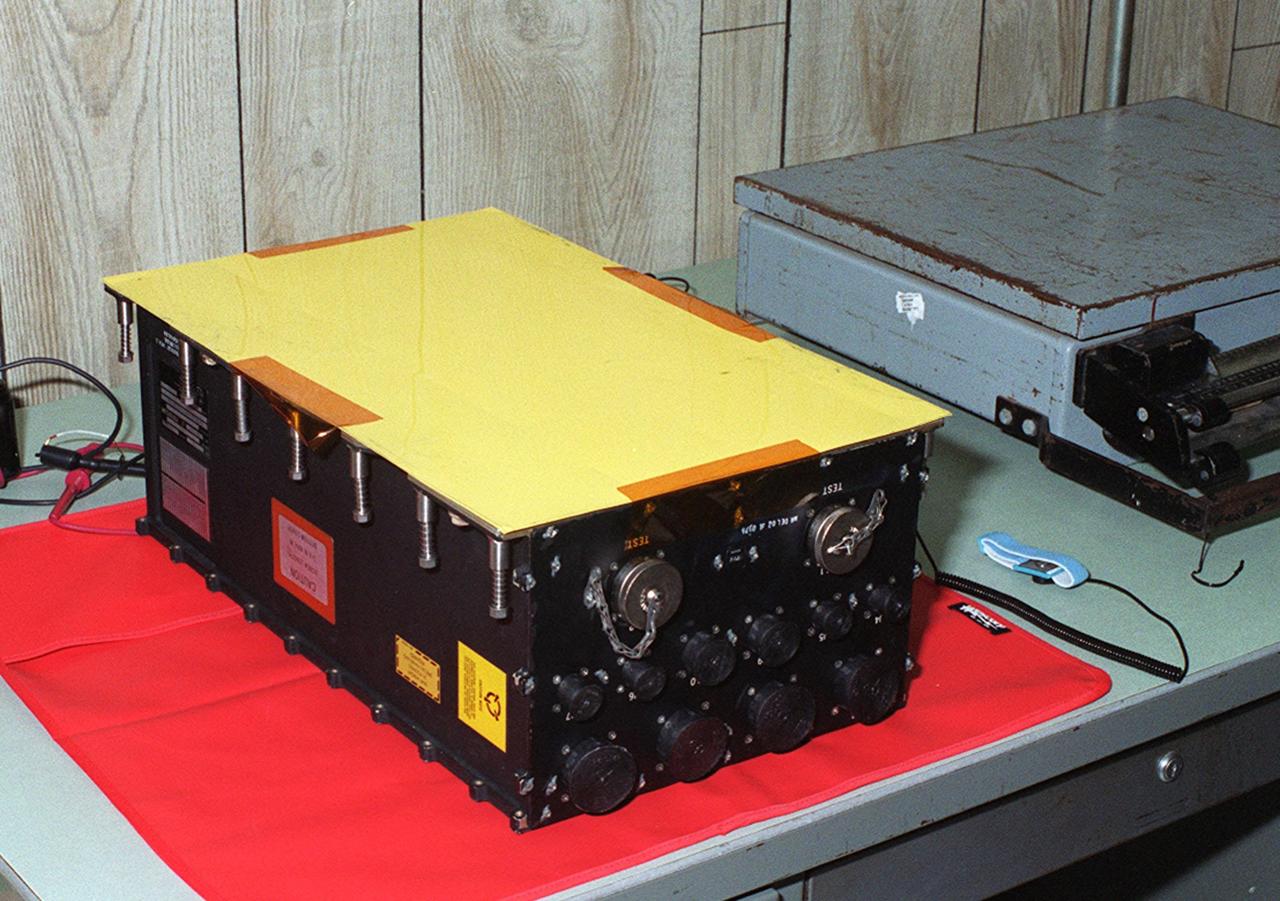
KENNEDY SPACE CENTER, FLA. -- A new Enhanced Main Events Controller (E-MEC) for Shuttle Endeavour sits on a table in a Quality trailer in the Launch Pad 39B area. The original E-MEC in Endeavour became suspect during the Jan. 31 launch countdown and mission STS-99 was delayed when NASA managers decided to replace it. Each Shuttle carries two enhanced master events controllers (E-MECs), which provide relays for onboard flight computers to send signals to arm and fire pyrotechnics that separate the solid rockets and external tank during assent. The E-MECs are located in the orbiter's aft compartment and both are needed for the Shuttle to be cleared for flight. Currently Endeavour and Columbia are the only two orbiters with the E-MECs. Built by Rockwell's Satellite Space Electronics Division, Anaheim, Calif., each unit weighs 65 pounds and is approximately 20 inches long, 13 inches wide and 8 inches tall. Previously, three Shuttle flights have been scrubbed or delayed due to faulty MECs: STS-73, STS-49 and STS-41-D. Before workers can begin E-MEC replacement efforts at the launch pad, cryogenic reactants must be offloaded from the orbiter and Space Shuttle ordnance disconnected. The next scheduled date for launch of STS-99 is Feb. 11 at 12:30 p.m. EST
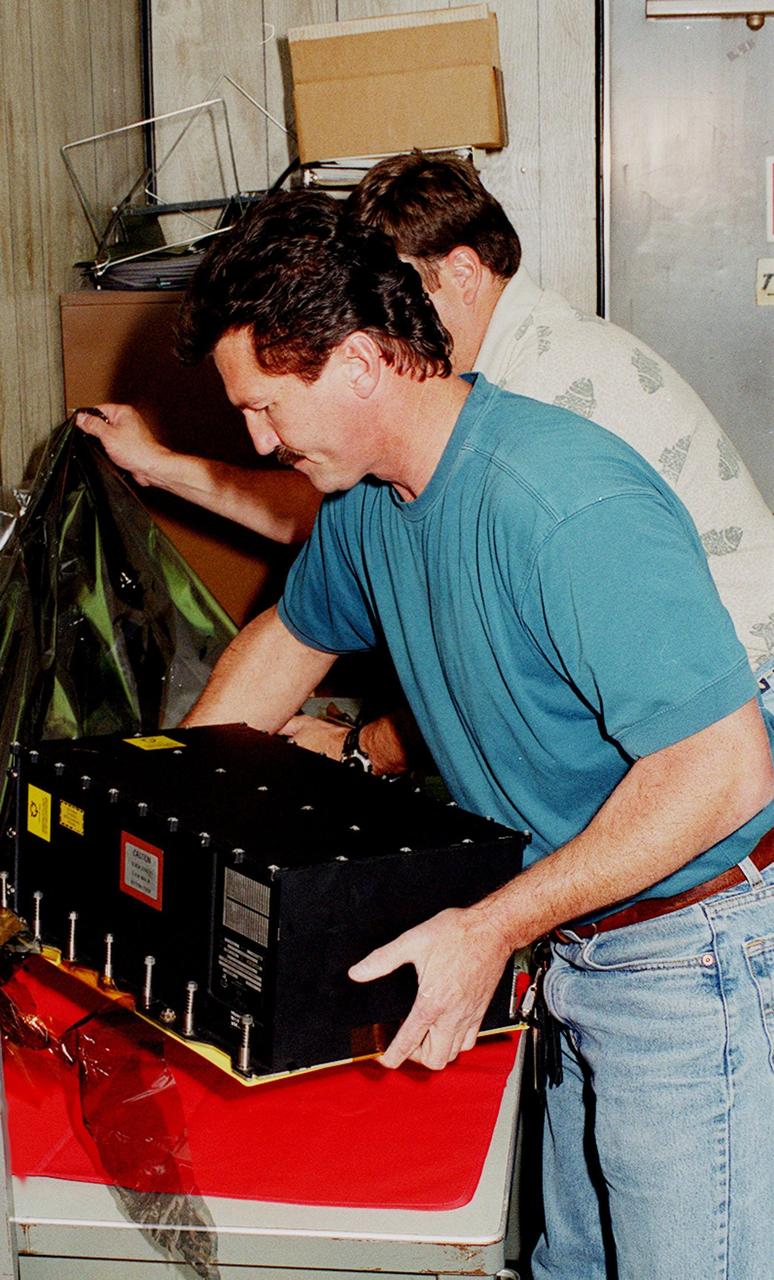
KENNEDY SPACE CENTER, FLA. -- Workers in a Quality trailer in the Launch Pad 39B Area unwrap a new Enhanced Main Events Controller (E-MEC) to be installed in Shuttle Endeavour. The original E-MEC in Endeavour became suspect during the Jan. 31 launch countdown and mission STS-99 was delayed when NASA managers decided to replace it. Each Shuttle carries two enhanced master events controllers (E-MECs), which provide relays for onboard flight computers to send signals to arm and fire pyrotechnics that separate the solid rockets and external tank during assent. The E-MECs are located in the orbiter's aft compartment and both are needed for the Shuttle to be cleared for flight. Currently Endeavour and Columbia are the only two orbiters with the E-MECs. Built by Rockwell's Satellite Space Electronics Division, Anaheim, Calif., each unit weighs 65 pounds and is approximately 20 inches long, 13 inches wide and 8 inches tall. Previously, three Shuttle flights have been scrubbed or delayed due to faulty MECs: STS-73, STS-49 and STS-41-D. Before workers can begin E-MEC replacement efforts at the launch pad, cryogenic reactants must be offloaded from the orbiter and Space Shuttle ordnance disconnected. The next scheduled date for launch of STS-99 is Feb. 11 at 12:30 p.m. EST

KENNEDY SPACE CENTER, FLA. -- Workers in a Quality trailer in the Launch Pad 39B Area unwrap a new Enhanced Main Events Controller (E-MEC) to be installed in Shuttle Endeavour. The original E-MEC in Endeavour became suspect during the Jan. 31 launch countdown and mission STS-99 was delayed when NASA managers decided to replace it. Each Shuttle carries two enhanced master events controllers (E-MECs), which provide relays for onboard flight computers to send signals to arm and fire pyrotechnics that separate the solid rockets and external tank during assent. The E-MECs are located in the orbiter's aft compartment and both are needed for the Shuttle to be cleared for flight. Currently Endeavour and Columbia are the only two orbiters with the E-MECs. Built by Rockwell's Satellite Space Electronics Division, Anaheim, Calif., each unit weighs 65 pounds and is approximately 20 inches long, 13 inches wide and 8 inches tall. Previously, three Shuttle flights have been scrubbed or delayed due to faulty MECs: STS-73, STS-49 and STS-41-D. Before workers can begin E-MEC replacement efforts at the launch pad, cryogenic reactants must be offloaded from the orbiter and Space Shuttle ordnance disconnected. The next scheduled date for launch of STS-99 is Feb. 11 at 12:30 p.m. EST
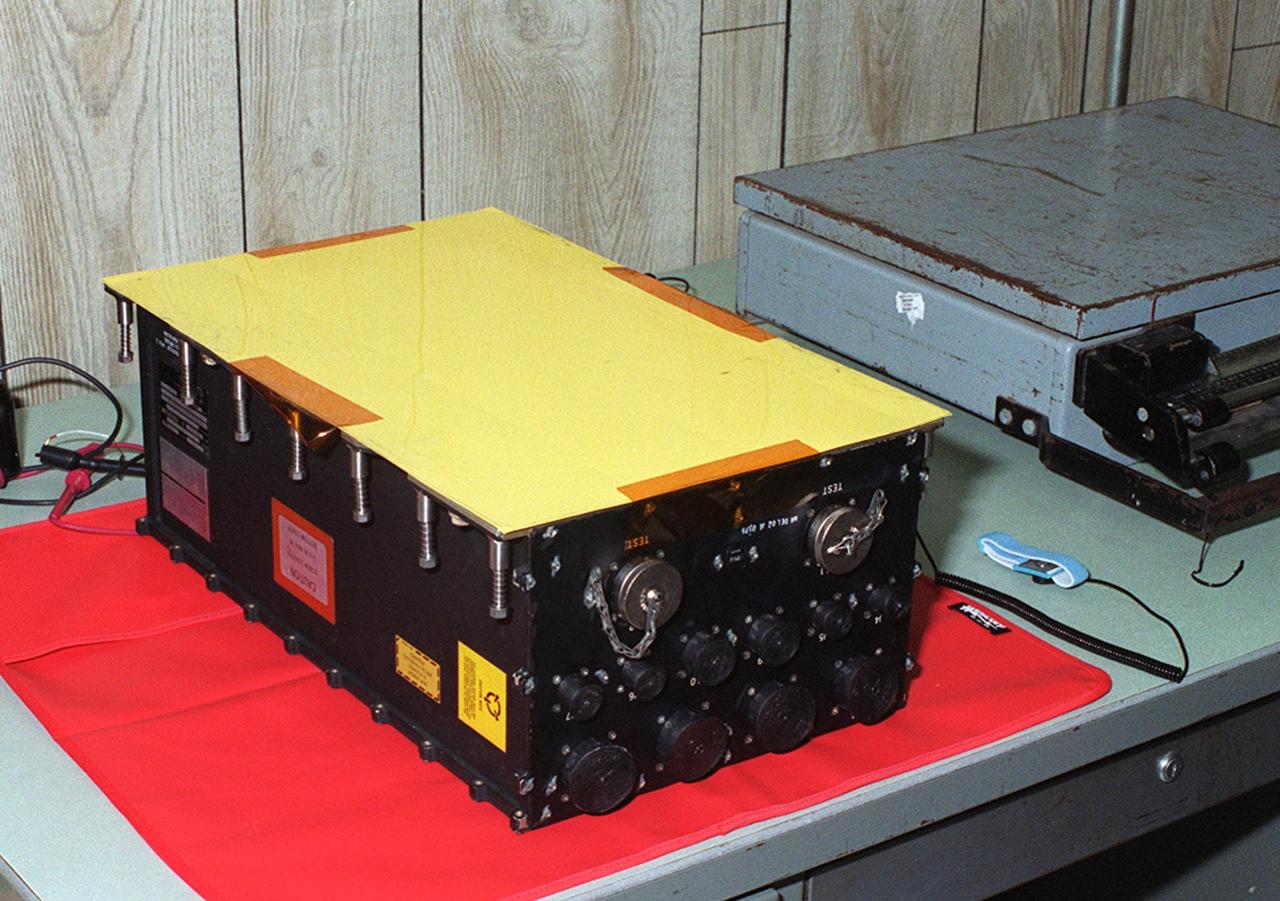
KENNEDY SPACE CENTER, FLA. -- A new Enhanced Main Events Controller (E-MEC) for Shuttle Endeavour sits on a table in a Quality trailer in the Launch Pad 39B area. The original E-MEC in Endeavour became suspect during the Jan. 31 launch countdown and mission STS-99 was delayed when NASA managers decided to replace it. Each Shuttle carries two enhanced master events controllers (E-MECs), which provide relays for onboard flight computers to send signals to arm and fire pyrotechnics that separate the solid rockets and external tank during assent. The E-MECs are located in the orbiter's aft compartment and both are needed for the Shuttle to be cleared for flight. Currently Endeavour and Columbia are the only two orbiters with the E-MECs. Built by Rockwell's Satellite Space Electronics Division, Anaheim, Calif., each unit weighs 65 pounds and is approximately 20 inches long, 13 inches wide and 8 inches tall. Previously, three Shuttle flights have been scrubbed or delayed due to faulty MECs: STS-73, STS-49 and STS-41-D. Before workers can begin E-MEC replacement efforts at the launch pad, cryogenic reactants must be offloaded from the orbiter and Space Shuttle ordnance disconnected. The next scheduled date for launch of STS-99 is Feb. 11 at 12:30 p.m. EST
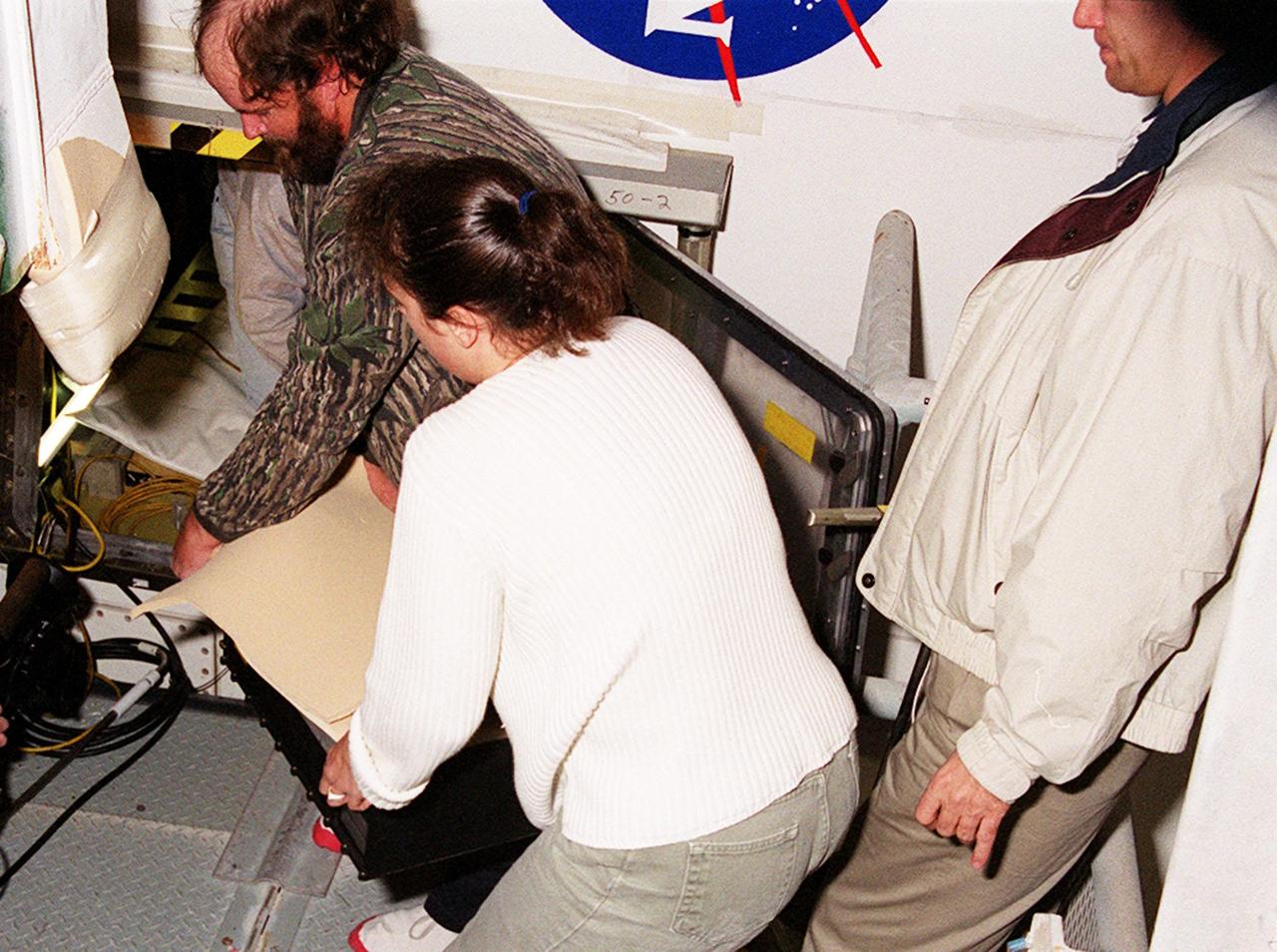
KENNEDY SPACE CENTER, FLA. -- Workers carry away the faulty Enhanced Main Events Controller (E-MEC) from Shuttle Endeavour at Launch Pad 39A. The E-MEC became suspect during the Jan. 31 launch countdown and mission STS-99 was delayed when NASA managers decided to replace it. Each Shuttle carries two enhanced master events controllers (E-MECs), which provide relays for onboard flight computers to send signals to arm and fire pyrotechnics that separate the solid rockets and external tank during assent. Both E-MECs are needed for the Shuttle to be cleared for flight. Currently Endeavour and Columbia are the only two orbiters with the E-MECs. Built by Rockwell's Satellite Space Electronics Division, Anaheim, Calif., each unit weighs 65 pounds and is approximately 20 inches long, 13 inches wide and 8 inches tall. Previously, three Shuttle flights have been scrubbed or delayed due to faulty MECs: STS-73, STS-49 and STS-41-D. The next scheduled date for launch of STS-99 is Feb. 11 at 12:30 p.m. EST
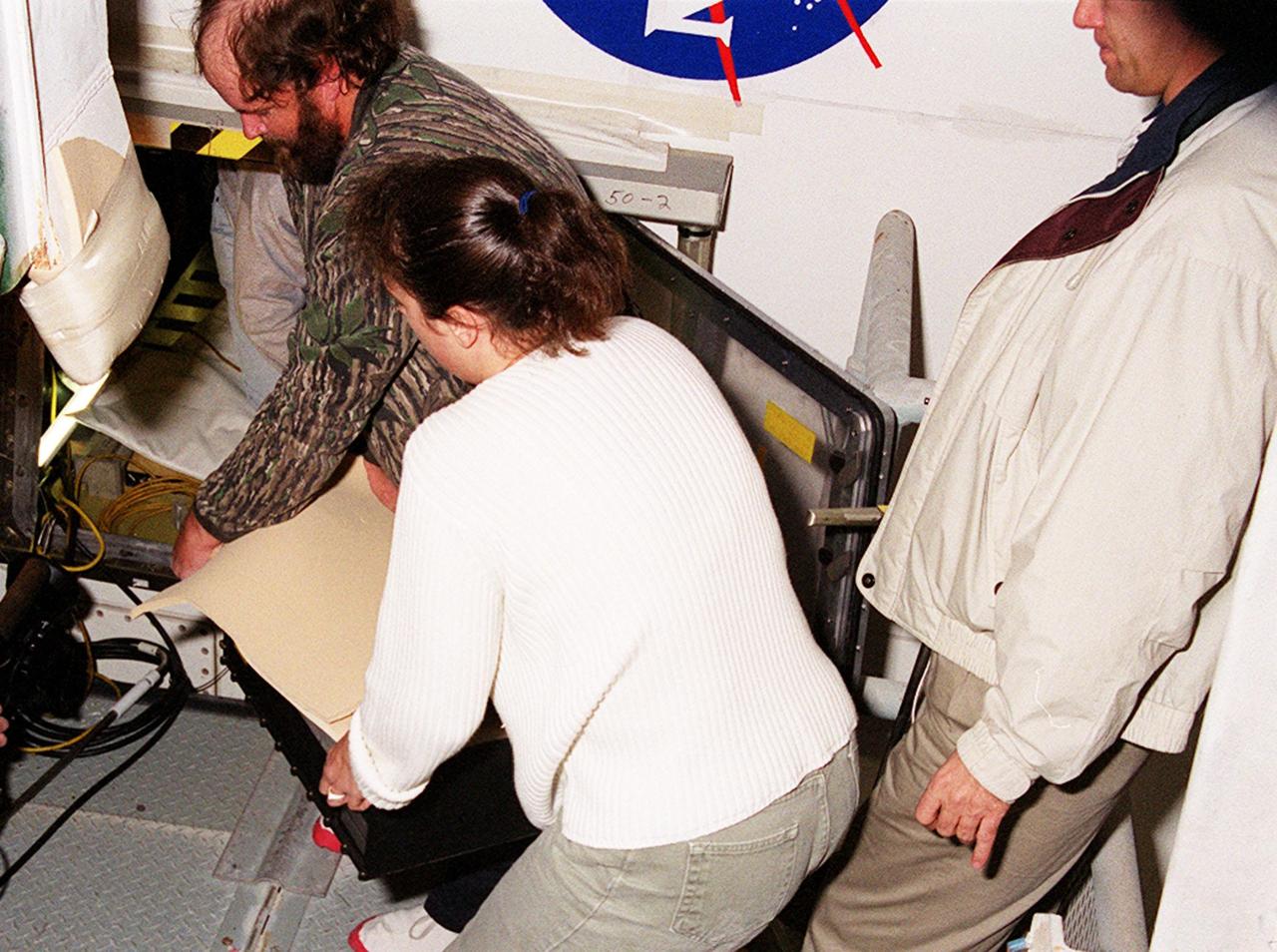
KENNEDY SPACE CENTER, FLA. -- Workers carry away the faulty Enhanced Main Events Controller (E-MEC) from Shuttle Endeavour at Launch Pad 39A. The E-MEC became suspect during the Jan. 31 launch countdown and mission STS-99 was delayed when NASA managers decided to replace it. Each Shuttle carries two enhanced master events controllers (E-MECs), which provide relays for onboard flight computers to send signals to arm and fire pyrotechnics that separate the solid rockets and external tank during assent. Both E-MECs are needed for the Shuttle to be cleared for flight. Currently Endeavour and Columbia are the only two orbiters with the E-MECs. Built by Rockwell's Satellite Space Electronics Division, Anaheim, Calif., each unit weighs 65 pounds and is approximately 20 inches long, 13 inches wide and 8 inches tall. Previously, three Shuttle flights have been scrubbed or delayed due to faulty MECs: STS-73, STS-49 and STS-41-D. The next scheduled date for launch of STS-99 is Feb. 11 at 12:30 p.m. EST
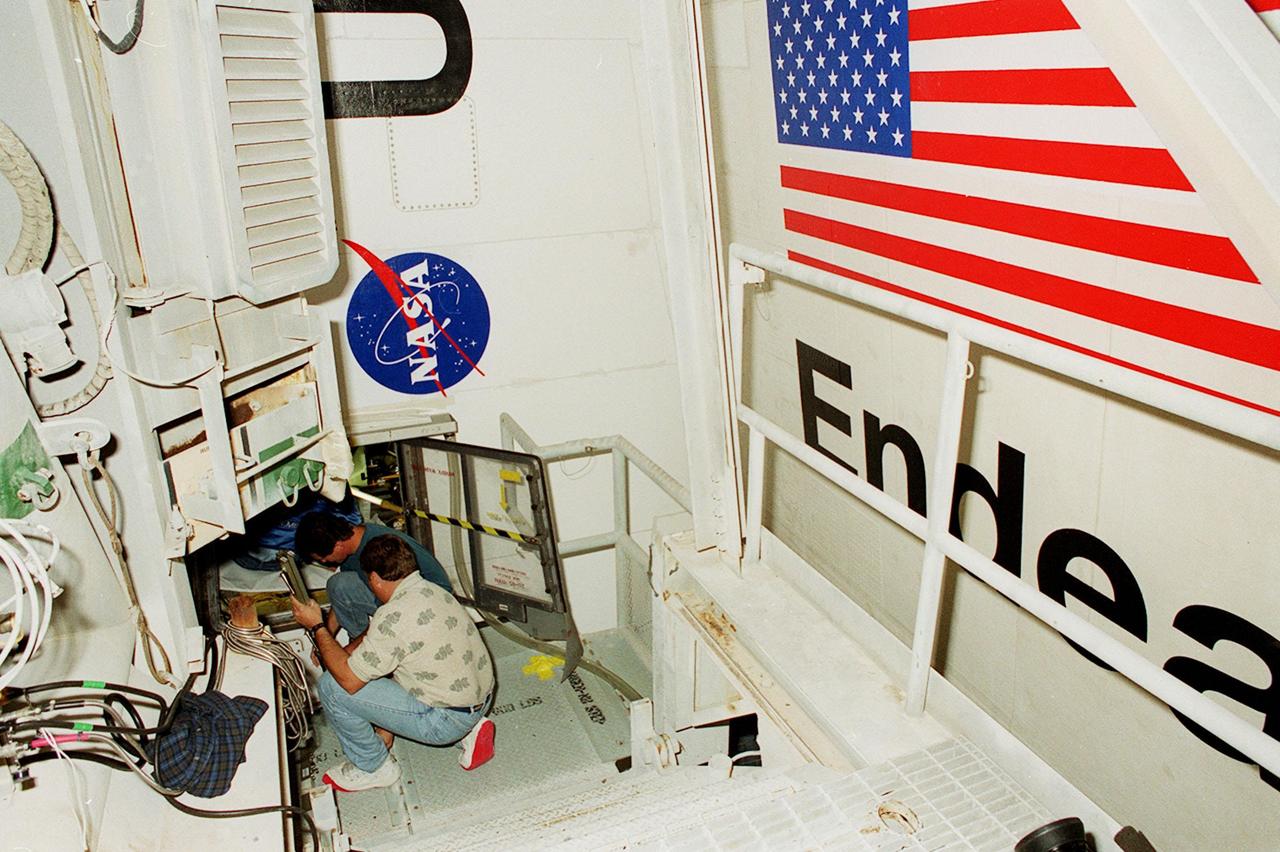
KENNEDY SPACE CENTER, FLA. -- Technicians work in the aft compartment of Shuttle Endeavour's payload bay, where a new Enhanced Main Events Controller (E-MEC) will be installed. The original E-MEC in Endeavour became suspect during the Jan. 31 launch countdown and mission STS-99 was delayed when NASA managers decided to replace it. Each Shuttle carries two enhanced master events controllers (E-MECs), which provide relays for onboard flight computers to send signals to arm and fire pyrotechnics that separate the solid rockets and external tank during assent. Both E-MECs are needed for the Shuttle to be cleared for flight. Currently Endeavour and Columbia are the only two orbiters with the E-MECs. Built by Rockwell's Satellite Space Electronics Division, Anaheim, Calif., each unit weighs 65 pounds and is approximately 20 inches long, 13 inches wide and 8 inches tall. Previously, three Shuttle flights have been scrubbed or delayed due to faulty MECs: STS-73, STS-49 and STS-41-D. Before workers can begin E-MEC replacement efforts at the launch pad, cryogenic reactants had to be offloaded from the orbiter and Space Shuttle ordnance disconnected. The next scheduled date for launch of STS-99 is Feb. 11 at 12:30 p.m. EST
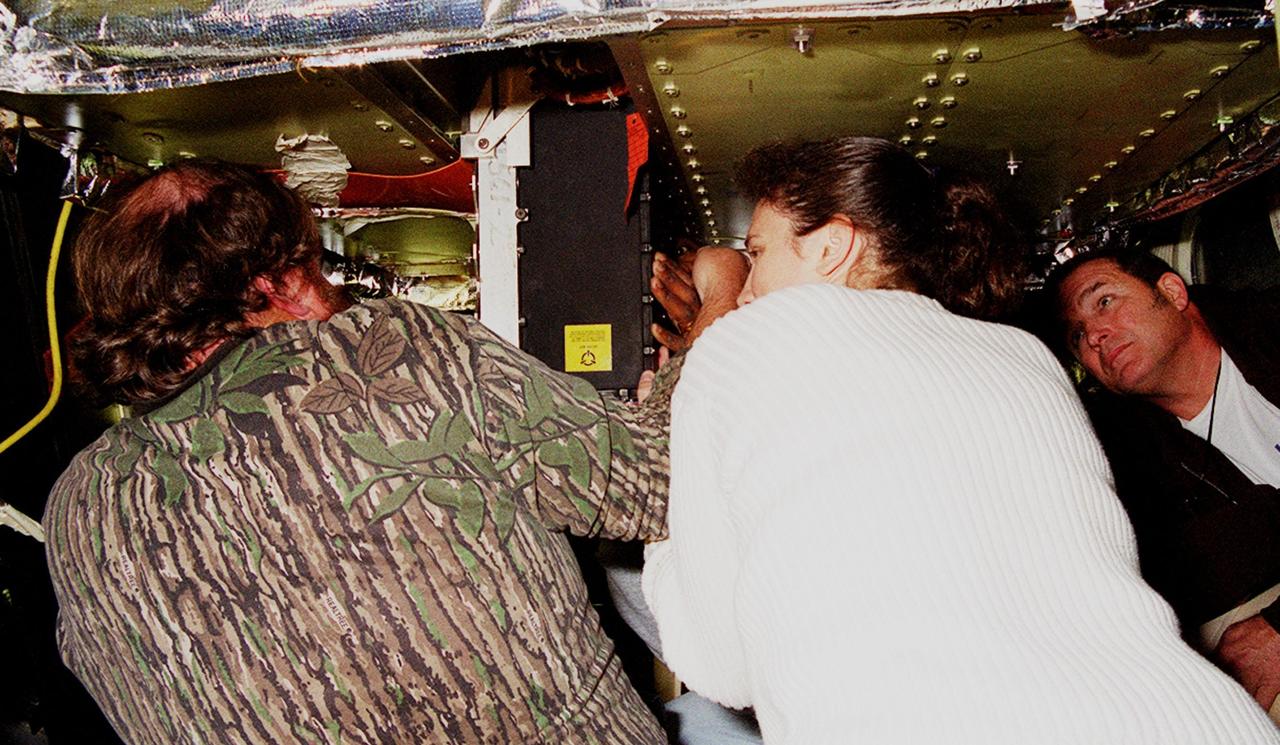
KENNEDY SPACE CENTER, FLA. -- Technicians remove a faulty Enhanced Main Events Controller (E-MEC) from Shuttle Endeavour at Launch Pad 39A. The E-MEC became suspect during the Jan. 31 launch countdown and mission STS-99 was delayed when NASA managers decided to replace it. Each Shuttle carries two enhanced master events controllers (E-MECs), which provide relays for onboard flight computers to send signals to arm and fire pyrotechnics that separate the solid rockets and external tank during assent. Both E-MECs are needed for the Shuttle to be cleared for flight. Currently Endeavour and Columbia are the only two orbiters with the E-MECs. Built by Rockwell's Satellite Space Electronics Division, Anaheim, Calif., each unit weighs 65 pounds and is approximately 20 inches long, 13 inches wide and 8 inches tall. Previously, three Shuttle flights have been scrubbed or delayed due to faulty MECs: STS-73, STS-49 and STS-41-D. The next scheduled date for launch of STS-99 is Feb. 11 at 12:30 p.m. EST
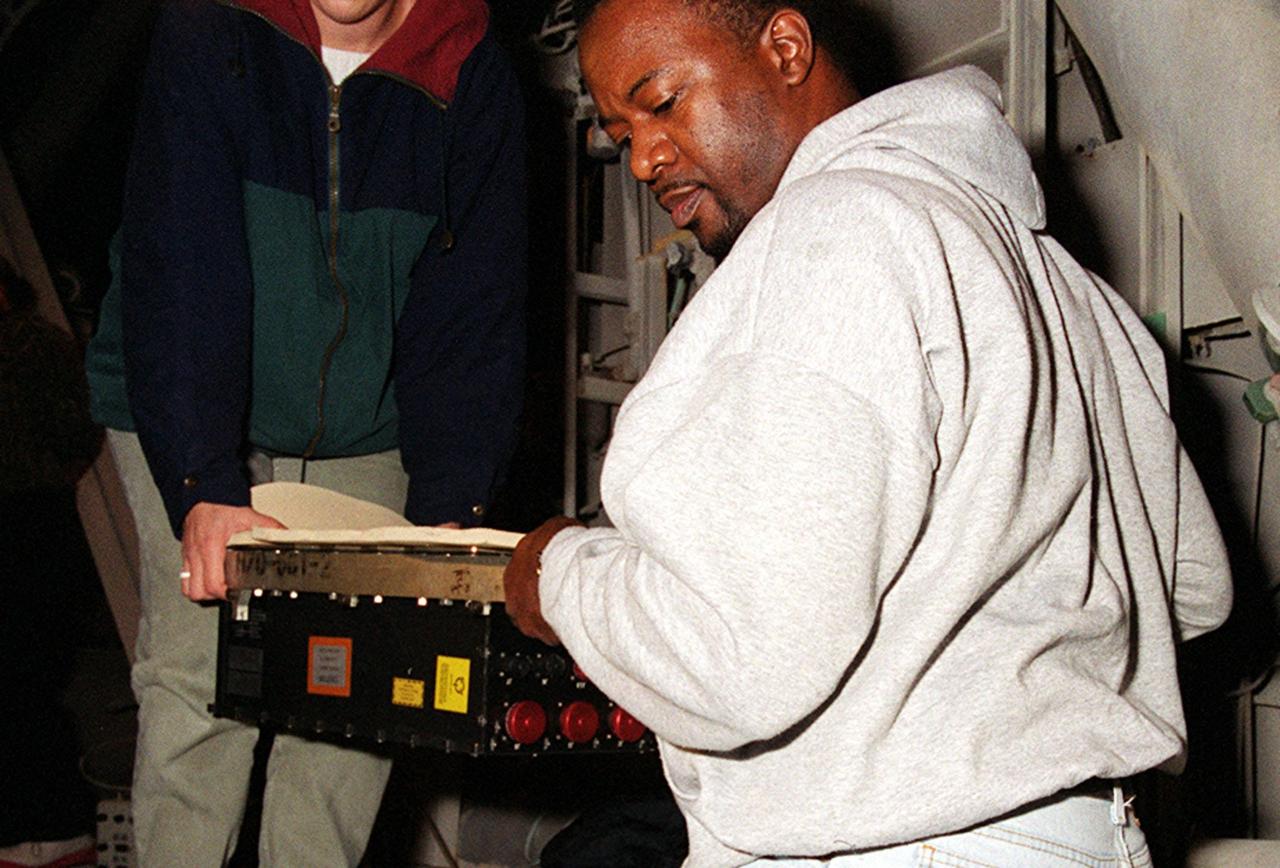
KENNEDY SPACE CENTER, FLA. -- Workers carry the replacement Enhanced Main Events Controller (E-MEC) to Shuttle Endeavour at Launch Pad 39A for installation in the aft compartment of the payload bay. The original E-MEC became suspect during the Jan. 31 launch countdown and mission STS-99 was delayed when NASA managers decided to replace it. Each Shuttle carries two enhanced master events controllers (E-MECs), which provide relays for onboard flight computers to send signals to arm and fire pyrotechnics that separate the solid rockets and external tank during assent. Both E-MECs are needed for the Shuttle to be cleared for flight. Currently Endeavour and Columbia are the only two orbiters with the E-MECs. Built by Rockwell's Satellite Space Electronics Division, Anaheim, Calif., each unit weighs 65 pounds and is approximately 20 inches long, 13 inches wide and 8 inches tall. Previously, three Shuttle flights have been scrubbed or delayed due to faulty MECs: STS-73, STS-49 and STS-41-D. The next scheduled date for launch of STS-99 is Feb. 11 at 12:30 p.m. EST

KENNEDY SPACE CENTER, FLA. -- Technicians work in the aft compartment of Shuttle Endeavour's payload bay, where a new Enhanced Main Events Controller (E-MEC) will be installed. The original E-MEC in Endeavour became suspect during the Jan. 31 launch countdown and mission STS-99 was delayed when NASA managers decided to replace it. Each Shuttle carries two enhanced master events controllers (E-MECs), which provide relays for onboard flight computers to send signals to arm and fire pyrotechnics that separate the solid rockets and external tank during assent. Both E-MECs are needed for the Shuttle to be cleared for flight. Currently Endeavour and Columbia are the only two orbiters with the E-MECs. Built by Rockwell's Satellite Space Electronics Division, Anaheim, Calif., each unit weighs 65 pounds and is approximately 20 inches long, 13 inches wide and 8 inches tall. Previously, three Shuttle flights have been scrubbed or delayed due to faulty MECs: STS-73, STS-49 and STS-41-D. Before workers can begin E-MEC replacement efforts at the launch pad, cryogenic reactants had to be offloaded from the orbiter and Space Shuttle ordnance disconnected. The next scheduled date for launch of STS-99 is Feb. 11 at 12:30 p.m. EST
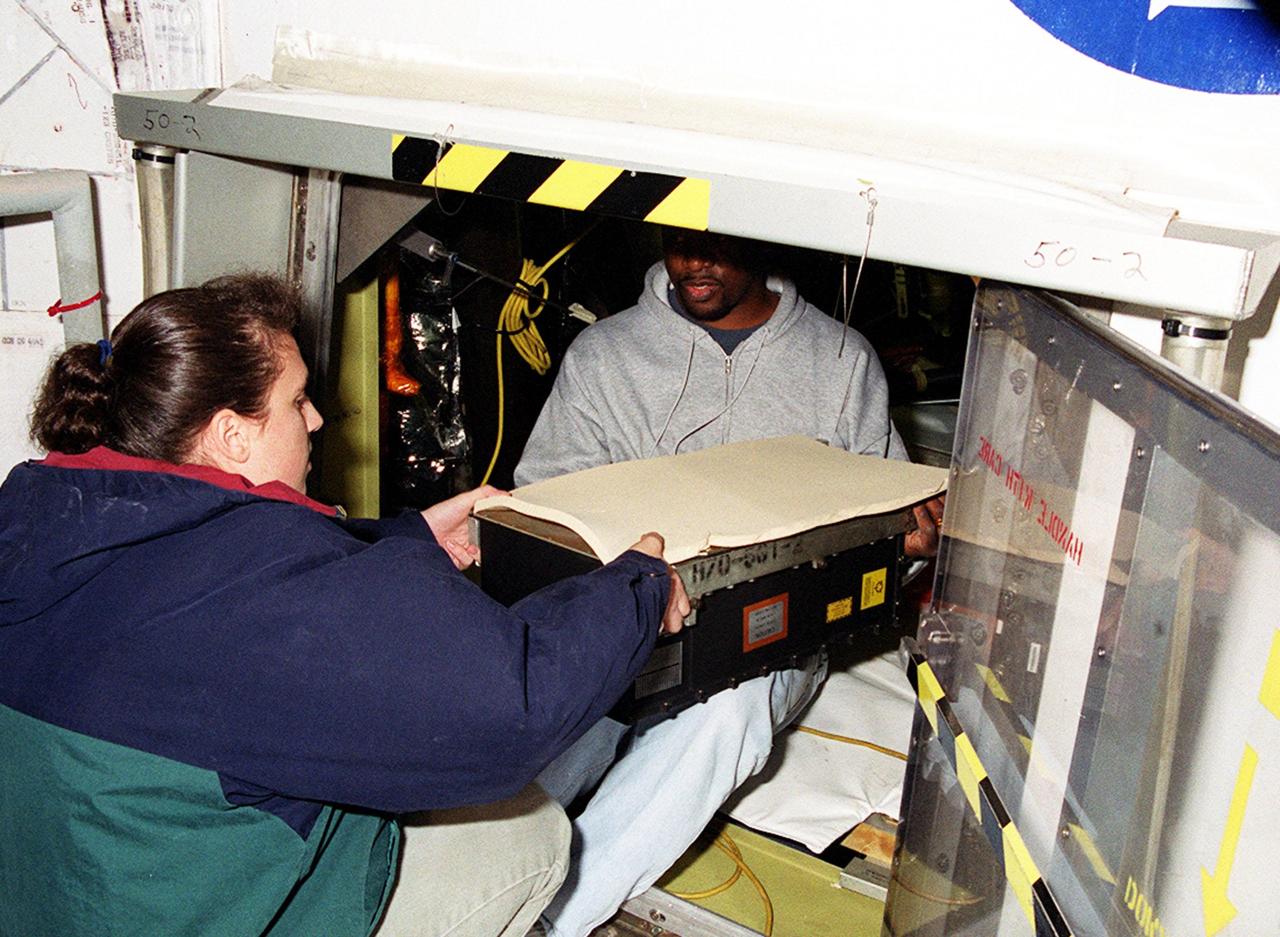
KENNEDY SPACE CENTER, FLA. -- At Launch Pad 39A, workers move the replacement Enhanced Main Events Controller (E-MEC) into Shuttle Endeavour's aft compartment in the payload bay. The original E-MEC became suspect during the Jan. 31 launch countdown and mission STS-99 was delayed when NASA managers decided to replace it. Each Shuttle carries two enhanced master events controllers (E-MECs), which provide relays for onboard flight computers to send signals to arm and fire pyrotechnics that separate the solid rockets and external tank during assent. Both E-MECs are needed for the Shuttle to be cleared for flight. Currently Endeavour and Columbia are the only two orbiters with the E-MECs. Built by Rockwell's Satellite Space Electronics Division, Anaheim, Calif., each unit weighs 65 pounds and is approximately 20 inches long, 13 inches wide and 8 inches tall. Previously, three Shuttle flights have been scrubbed or delayed due to faulty MECs: STS-73, STS-49 and STS-41-D. The next scheduled date for launch of STS-99 is Feb. 11 at 12:30 p.m. EST
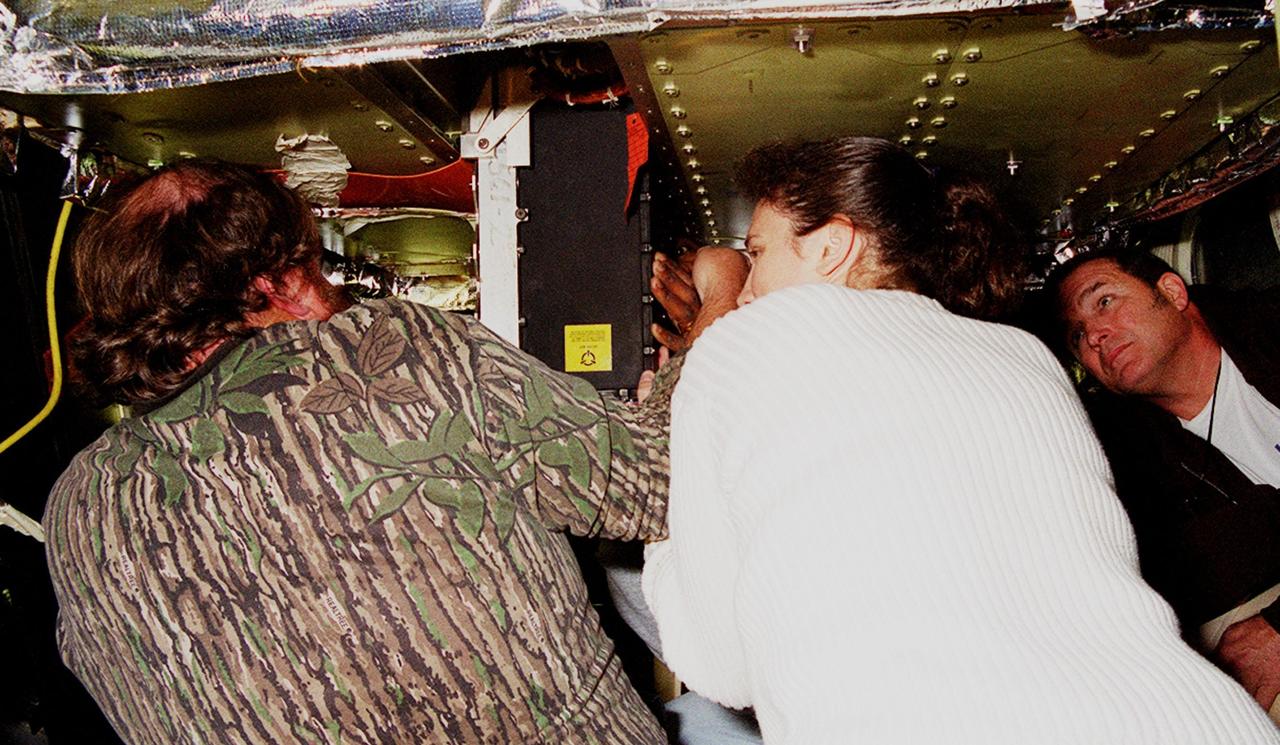
KENNEDY SPACE CENTER, FLA. -- Technicians remove a faulty Enhanced Main Events Controller (E-MEC) from Shuttle Endeavour at Launch Pad 39A. The E-MEC became suspect during the Jan. 31 launch countdown and mission STS-99 was delayed when NASA managers decided to replace it. Each Shuttle carries two enhanced master events controllers (E-MECs), which provide relays for onboard flight computers to send signals to arm and fire pyrotechnics that separate the solid rockets and external tank during assent. Both E-MECs are needed for the Shuttle to be cleared for flight. Currently Endeavour and Columbia are the only two orbiters with the E-MECs. Built by Rockwell's Satellite Space Electronics Division, Anaheim, Calif., each unit weighs 65 pounds and is approximately 20 inches long, 13 inches wide and 8 inches tall. Previously, three Shuttle flights have been scrubbed or delayed due to faulty MECs: STS-73, STS-49 and STS-41-D. The next scheduled date for launch of STS-99 is Feb. 11 at 12:30 p.m. EST
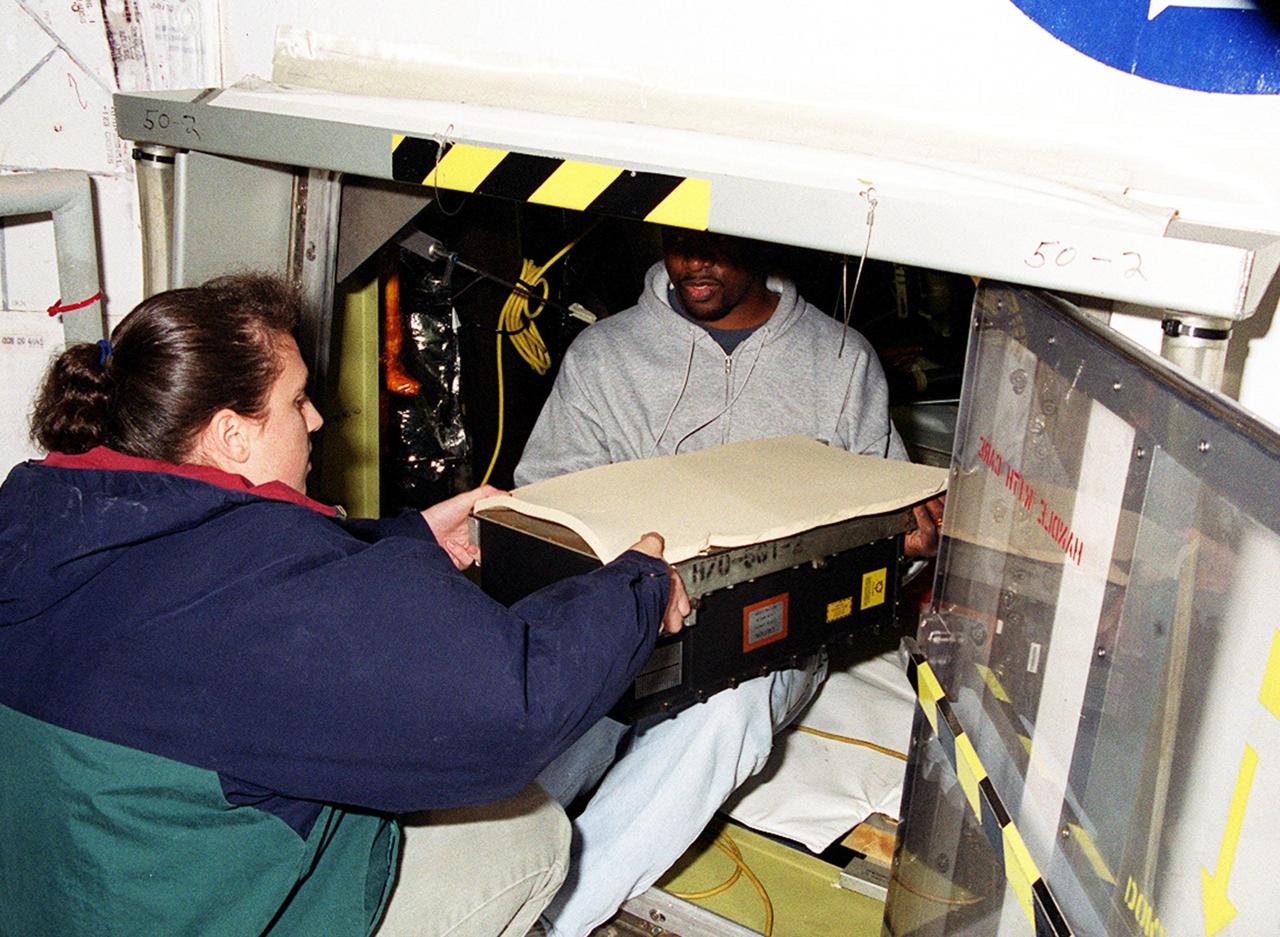
KENNEDY SPACE CENTER, FLA. -- At Launch Pad 39A, workers move the replacement Enhanced Main Events Controller (E-MEC) into Shuttle Endeavour's aft compartment in the payload bay. The original E-MEC became suspect during the Jan. 31 launch countdown and mission STS-99 was delayed when NASA managers decided to replace it. Each Shuttle carries two enhanced master events controllers (E-MECs), which provide relays for onboard flight computers to send signals to arm and fire pyrotechnics that separate the solid rockets and external tank during assent. Both E-MECs are needed for the Shuttle to be cleared for flight. Currently Endeavour and Columbia are the only two orbiters with the E-MECs. Built by Rockwell's Satellite Space Electronics Division, Anaheim, Calif., each unit weighs 65 pounds and is approximately 20 inches long, 13 inches wide and 8 inches tall. Previously, three Shuttle flights have been scrubbed or delayed due to faulty MECs: STS-73, STS-49 and STS-41-D. The next scheduled date for launch of STS-99 is Feb. 11 at 12:30 p.m. EST
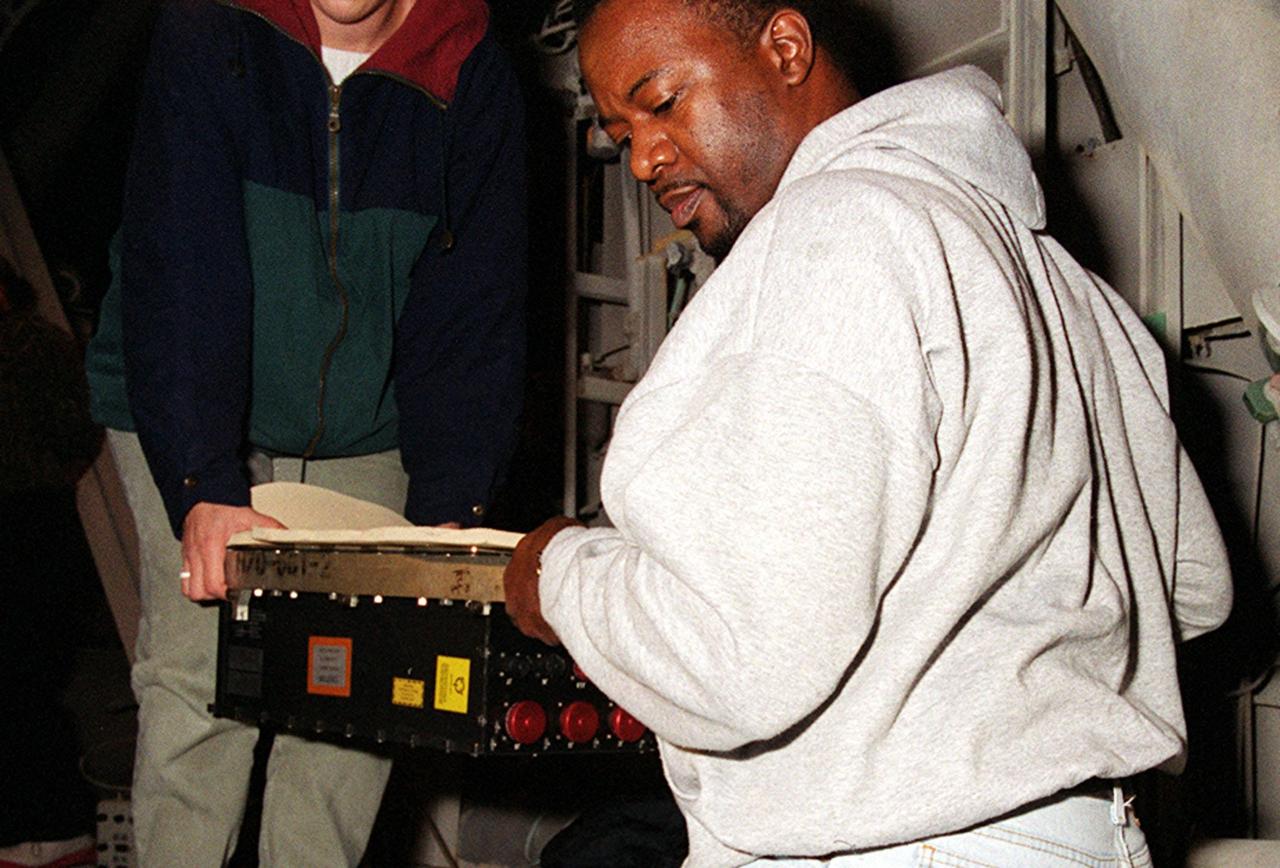
KENNEDY SPACE CENTER, FLA. -- Workers carry the replacement Enhanced Main Events Controller (E-MEC) to Shuttle Endeavour at Launch Pad 39A for installation in the aft compartment of the payload bay. The original E-MEC became suspect during the Jan. 31 launch countdown and mission STS-99 was delayed when NASA managers decided to replace it. Each Shuttle carries two enhanced master events controllers (E-MECs), which provide relays for onboard flight computers to send signals to arm and fire pyrotechnics that separate the solid rockets and external tank during assent. Both E-MECs are needed for the Shuttle to be cleared for flight. Currently Endeavour and Columbia are the only two orbiters with the E-MECs. Built by Rockwell's Satellite Space Electronics Division, Anaheim, Calif., each unit weighs 65 pounds and is approximately 20 inches long, 13 inches wide and 8 inches tall. Previously, three Shuttle flights have been scrubbed or delayed due to faulty MECs: STS-73, STS-49 and STS-41-D. The next scheduled date for launch of STS-99 is Feb. 11 at 12:30 p.m. EST
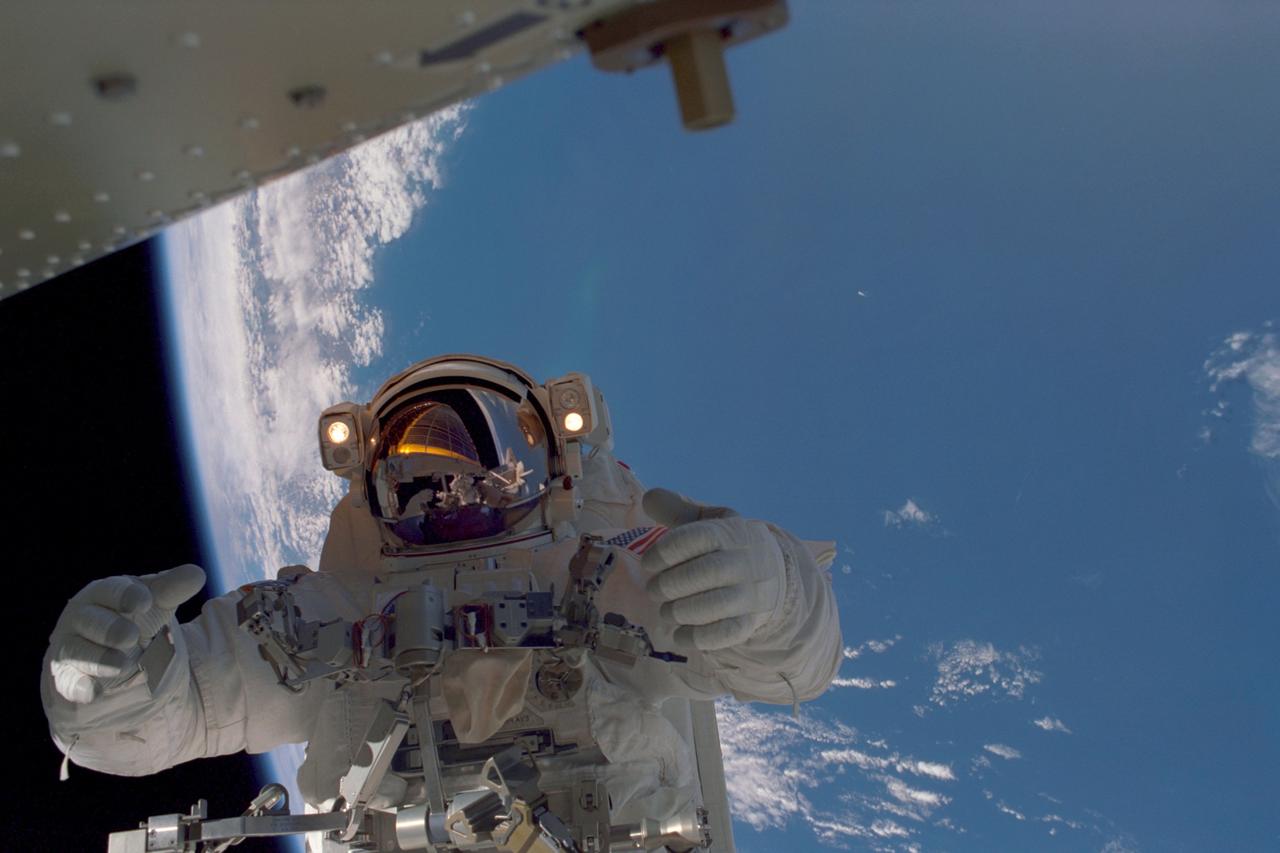
In this image, planet Earth, some 235 statute miles away, forms the back drop for this photo of STS-97 astronaut and mission specialist Joseph R. Tanner, taken during the third of three space walks. The mission's goal was to perform the delivery, assembly, and activation of the U.S. electrical power system onboard the International Space Station (ISS). The electrical power system, which is built into a 73-meter (240-foot) long solar array structure consists of solar arrays, radiators, batteries, and electronics. The entire 15.4-metric ton (17-ton) package is called the P6 Integrated Truss Segment, and is the heaviest and largest element yet delivered to the station aboard a space shuttle. The electrical system will eventually provide the power necessary for the first ISS crews to live and work in the U.S. segment. The STS-97 crew of five launched aboard the Space Shuttle Orbiter Endeavor on November 30, 2000 for an 11 day mission.
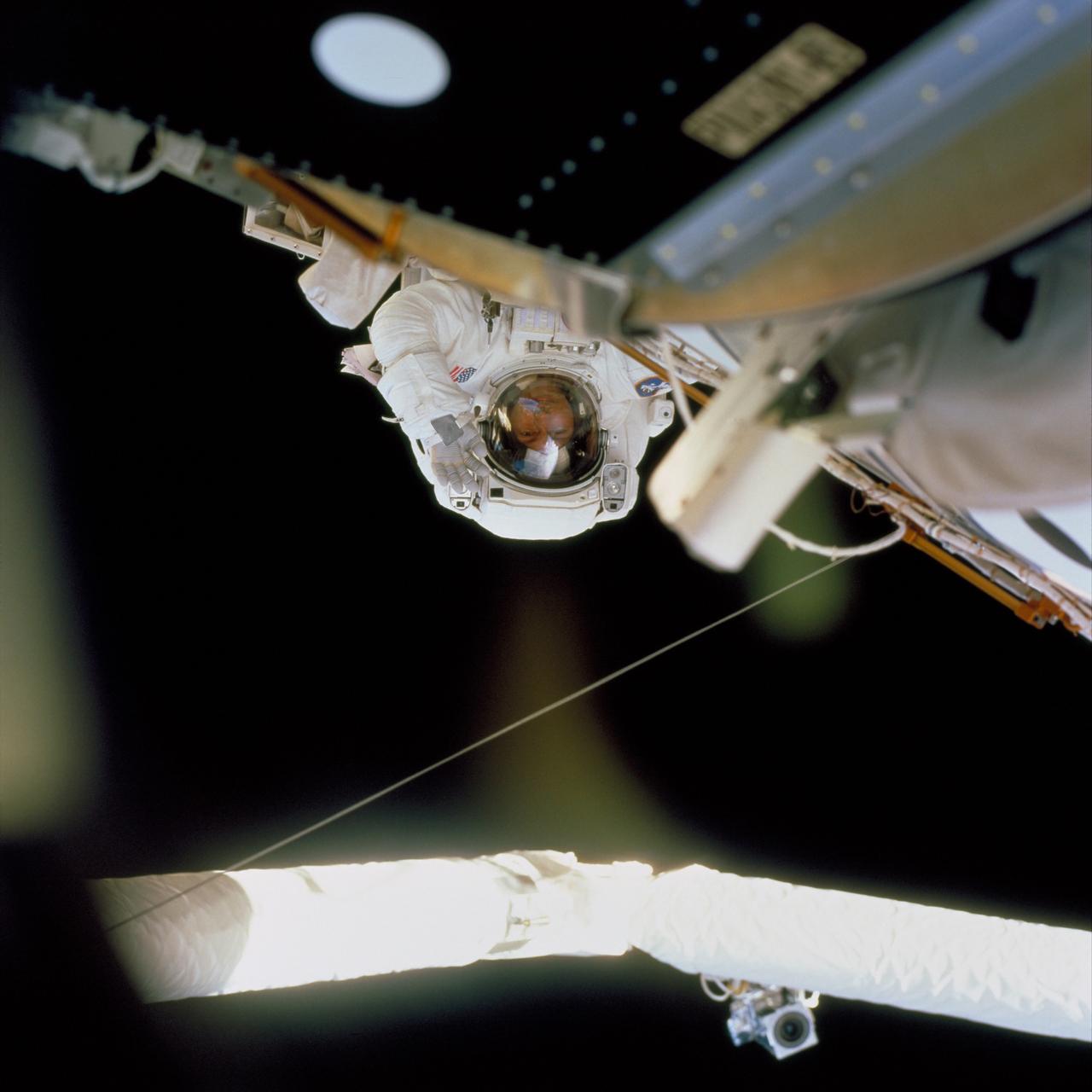
In this image, STS-97 astronaut and mission specialist Carlos I. Noriega waves at a crew member inside Endeavor's cabin during the mission's final session of Extravehicular Activity (EVA). Launched aboard the Space Shuttle Orbiter Endeavor on November 30, 2000, the STS-97 mission's primary objective was the delivery, assembly, and activation of the U.S. electrical power system onboard the International Space Station (ISS). The electrical power system, which is built into a 73-meter (240-foot) long solar array structure consists of solar arrays, radiators, batteries, and electronics. The entire 15.4-metric ton (17-ton) package is called the P6 Integrated Truss Segment, and is the heaviest and largest element yet delivered to the station aboard a space shuttle. The electrical system will eventually provide the power necessary for the first ISS crews to live and work in the U.S. segment.

These five astronauts and two United States Microgravity Laboratory (USML) payload specialists pause from a rigid training schedule for the STS-73 crew portrait. On the front row, left to right, are Albert Sacco Jr., payload specialist; Kent V. Rominger, pilot; and Michael E. Lopez-Alegria, mission specialist. On the back row are, left to right, Catherine G. Coleman, mission specialist; Kenneth D. Bowersox, commander; Fred W. Leslie, payload specialist; and Kathryn C. Thornton, payload commander. The STS-073 crew launched aboard the Space Shuttle Columbia on October 20, 1995 at 9:53:00.069 am (EDT). The mission served as the second flight of the Microgravity Laboratory (USML-2).
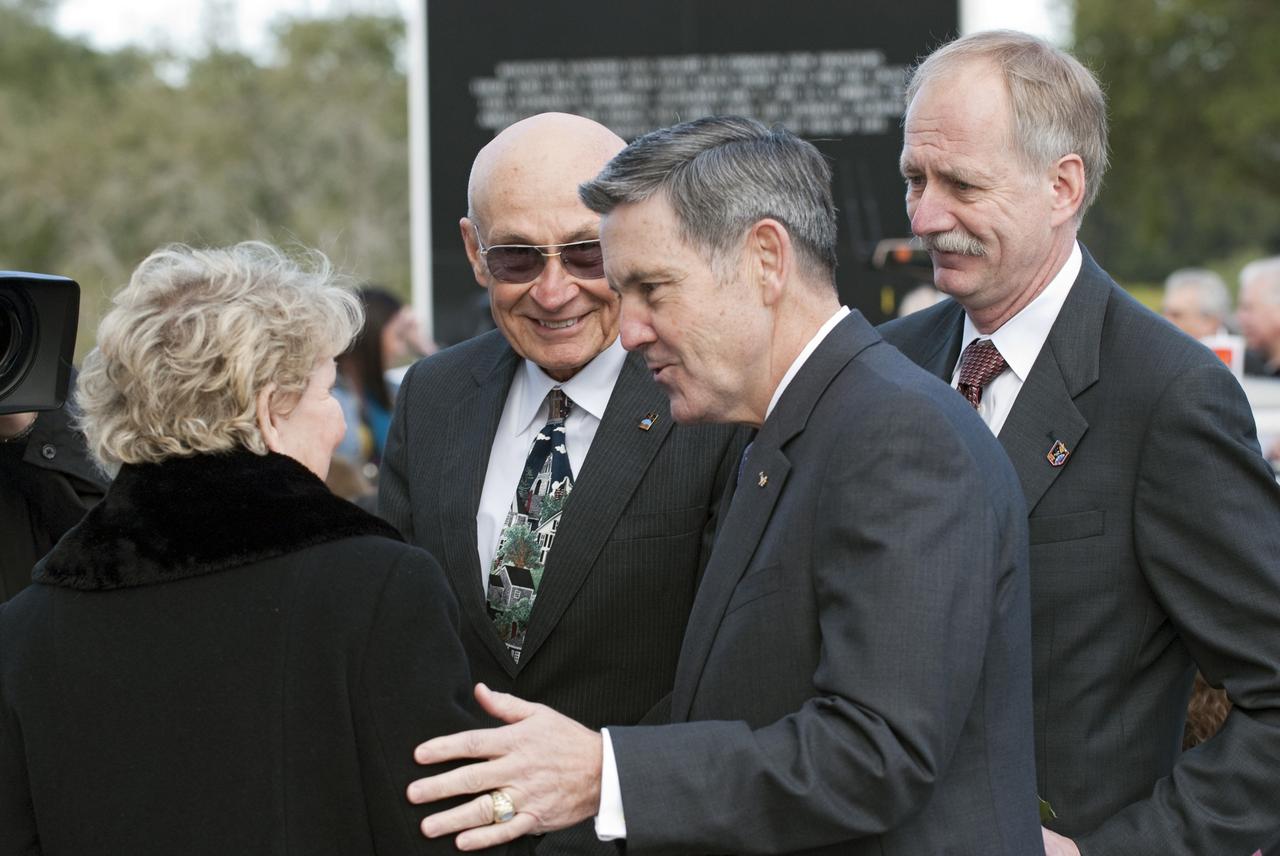
CAPE CANAVERAL, Fla. -- Dr. June Scobee Rodgers, the founding chair of the Challenger Center for Space Science Education and widow of space shuttle Challenger's STS-51L Commander Dick Scobee, left, talks with former Shuttle Launch Director Bob Sieck, NASA Kennedy Space Center Director Bob Cabana and NASA Associate Administrator for Space Operations William Gerstenmaier. They are gathered in front of the Space Mirror Memorial at the Kennedy Space Center Visitor Complex in Florida to honor the Challenger crew members who gave their lives for while furthering the cause of exploration and discovery. 2011 marks the 25th anniversary of the loss of Challenger, which broke apart over the Atlantic Ocean 73 seconds into flight on Jan. 28, 1986. Photo credit: NASA/Kim Shiflett
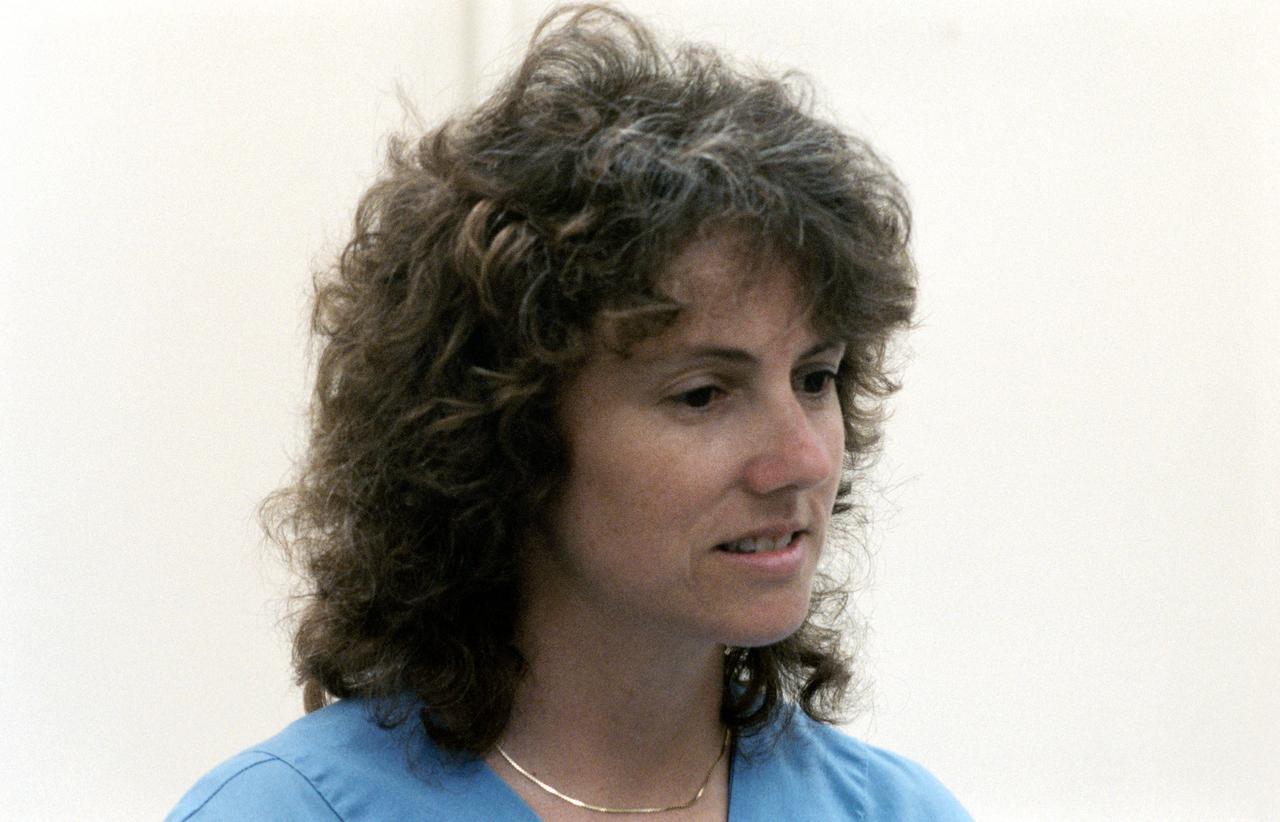
S85-37164 (8-12 July 1985) --- Sharon C. (Christa) McAuliffe of Concord High, Concord, New Hampshire, talks to the media at Johnson Space Center. Christa McAuliffe was eventually chosen as the first Teacher in Space and was a member of the seven-member Challenger shuttle crew which died tragically in the explosion of the spacecraft during the launch of STS-51L from the Kennedy Space Center about 11:40 a.m., EST, on Jan. 28, 1986. The explosion occurred 73 seconds into the flight as a result of a leak in one of two Solid Rocket Boosters that ignited the main liquid fuel tank. The crew members of the Challenger represented a cross-section of the American population in terms of race, gender, geography, background, and religion. The explosion became one of the most significant events of the 1980s, as billions around the world saw the accident on television and empathized with any one of the several crew members killed. Photo credit: NASA
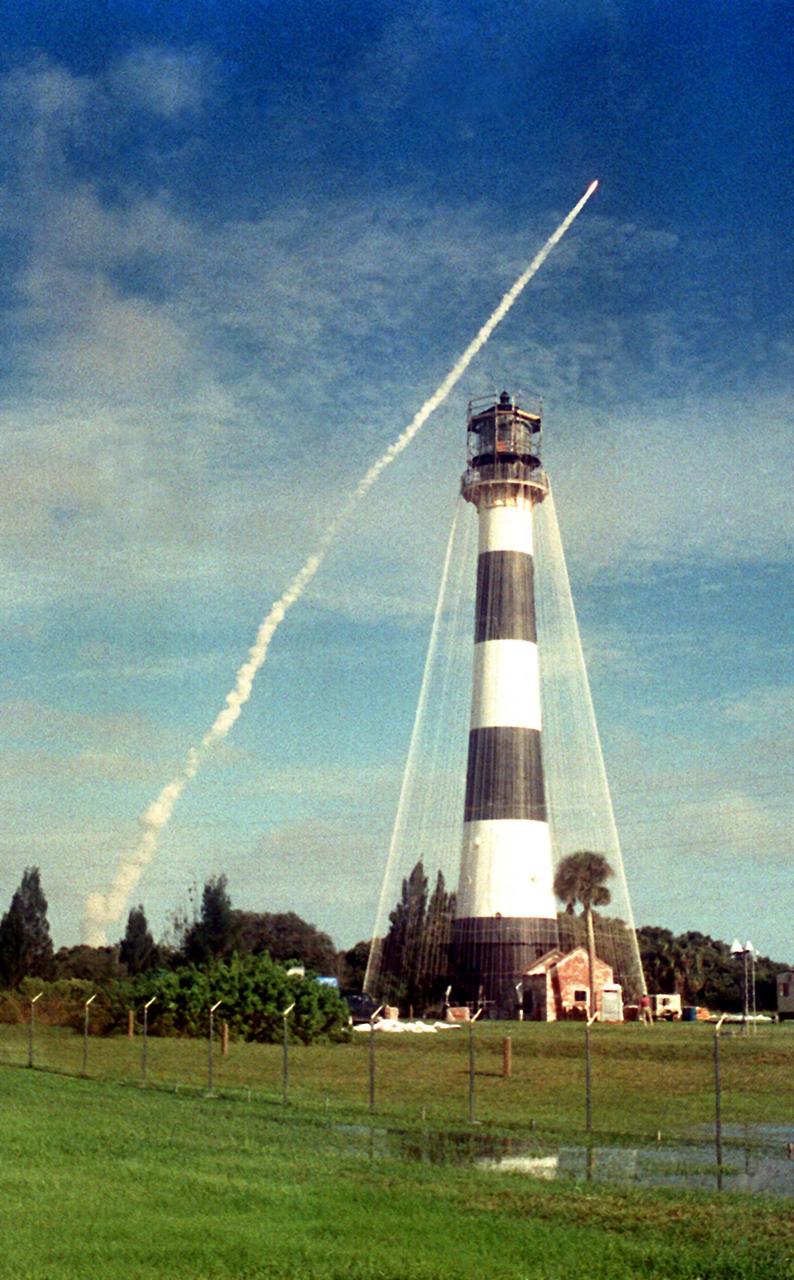
KENNEDY SPACE CENTER, FLA. -- Space Shuttle Columbia soars into the cloud-washed sky above Cape Canaveral Lighthouse. After six scrubs from the original Sept. 25 launch date, liftoff occurred Oct. 20 at 9:53 a.m. EDT. The crew of seven comprises Commander Ken Bowersox, Pilot Kent Rominger, Mission Specialists Kathy Thornton (Payload Commander), Catherine Coleman and Michael Lopez-Alegria, plus Payload Specialists Fred Leslie and Albert Sacco. The 72nd Shuttle mission, STS-73 marks the second flight of the U.S. Microgravity Laboratory. Research is being conducted in five areas: fluid physics, materials science, biotechnology, combustion science, and commercial space processing. The lighthouse, undergoing refurbishment and upgrade, is shown with a network of nylon lines ready for canvas panels to be attached. The canvas shroud will protect the surrounding area during sand-blasting of the lead-based paint.
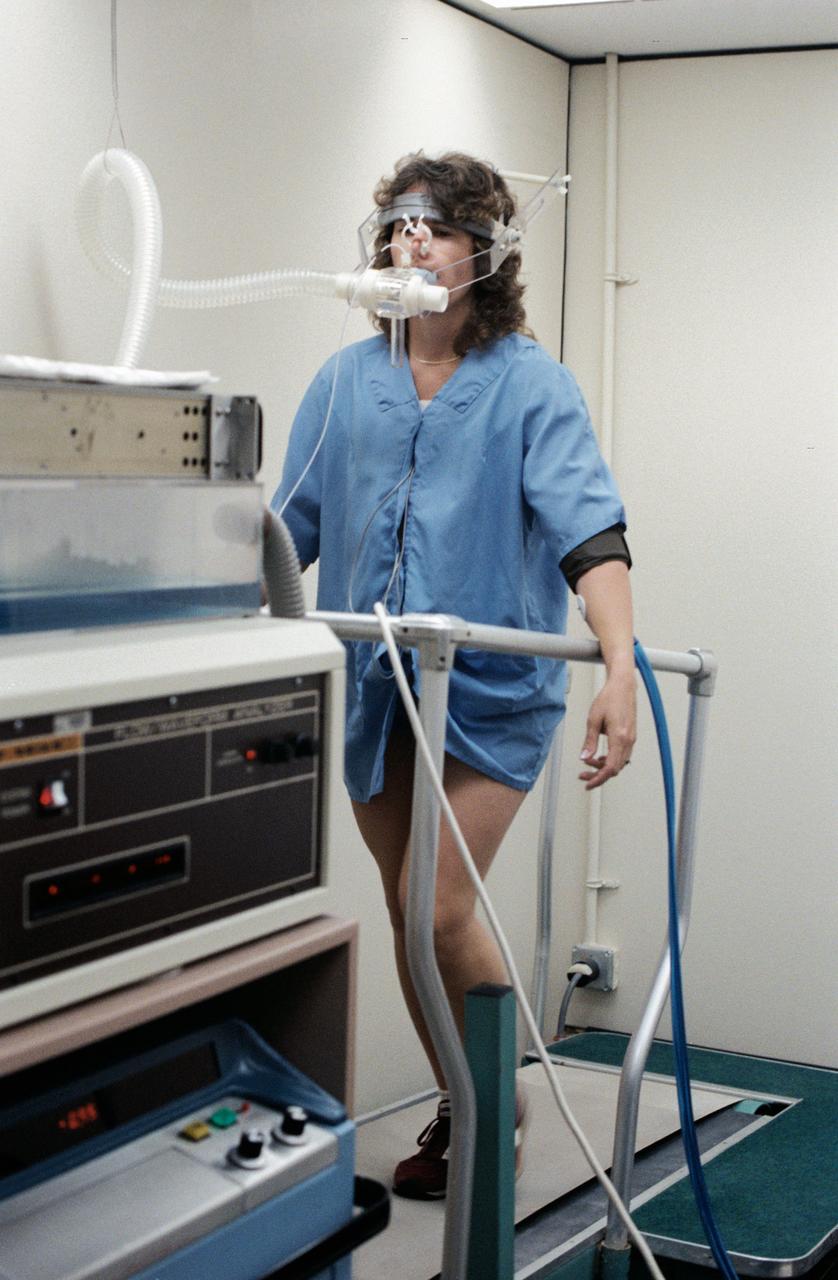
S85-37165 (8-12 July 1985) -- Sharon C. (Christa) McAuliffe of Concord High, Concord, New Hampshire, runs in place on treadmill to test physiological responses at Johnson Space Center. Christa McAuliffe was eventually chosen as the first Teacher in Space and was a member of the seven-member Challenger shuttle crew which died tragically in the explosion of the spacecraft during the launch of STS-51L from the Kennedy Space Center about 11:40 a.m., EST, on Jan. 28, 1986. The explosion occurred 73 seconds into the flight as a result of a leak in one of two Solid Rocket Boosters that ignited the main liquid fuel tank. The crew members of the Challenger represented a cross-section of the American population in terms of race, gender, geography, background, and religion. The explosion became one of the most significant events of the 1980s, as billions around the world saw the accident on television and empathized with any one of the several crew members killed. Photo credit: NASA
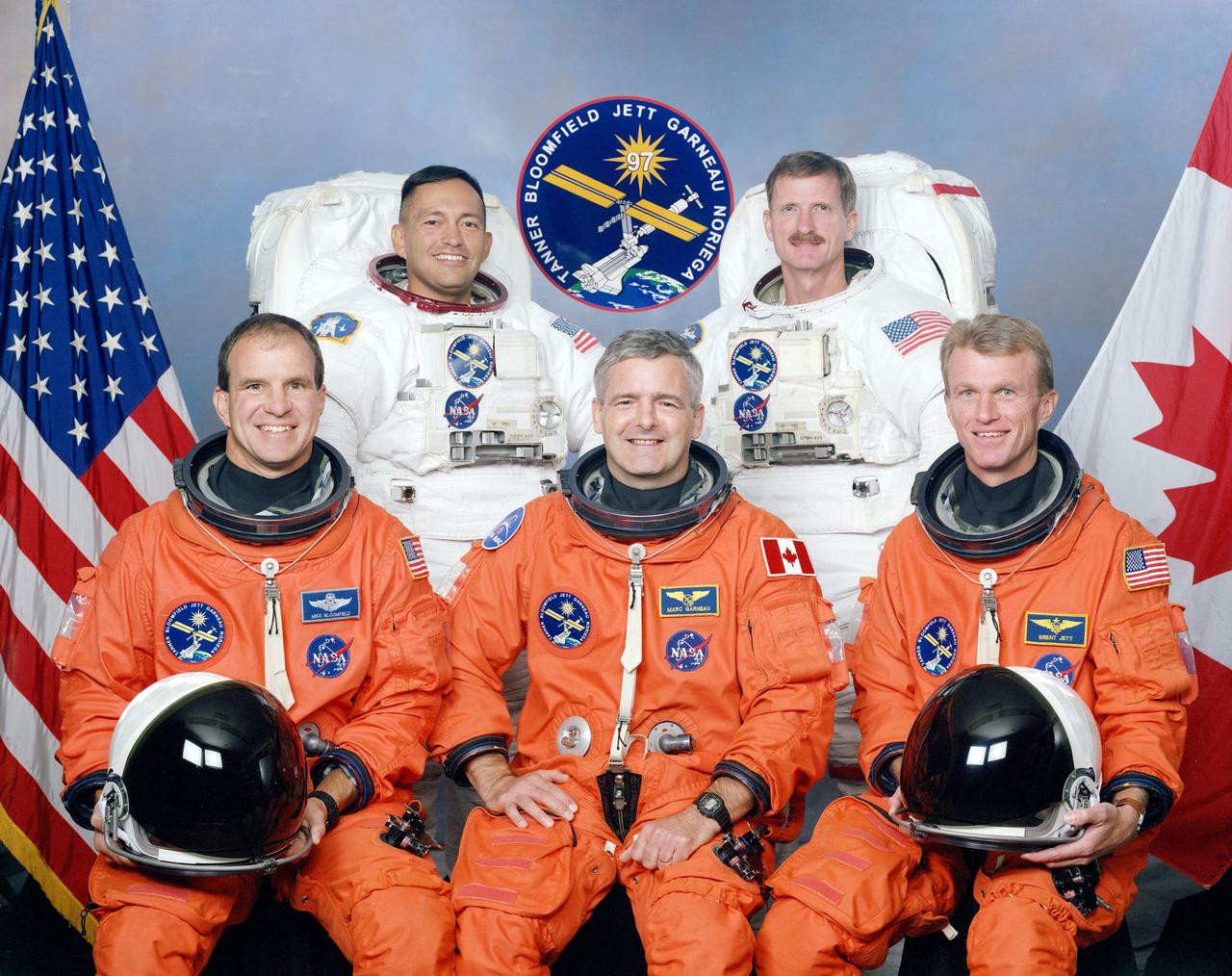
These five STS-97 crew members posed for a traditional portrait during training. On the front row, left to right, are astronauts Michael J. Bloomfield, pilot; Marc Garneau, mission specialist representing the Canadian Space Agency (CSA); and Brent W. Jett, Jr., commander. In the rear, wearing training versions of the extravehicular mobility unit (EMU) space suits, (left to right) are astronauts Carlos I. Noriega, and Joseph R. Tarner, both mission specialists. The primary objective of the STS-97 mission was the delivery, assembly, and activation of the U.S. electrical power system onboard the International Space Station (ISS). The electrical power system, which is built into a 73-meter (240-foot) long solar array structure consists of solar arrays, radiators, batteries, and electronics. The entire 15.4-metric ton (17-ton) package is called the P6 Integrated Truss Segment and is the heaviest and largest element yet delivered to the station aboard a space shuttle. The electrical system will eventually provide the power necessary for the first ISS crews to live and work in the U.S. segment. The STS-97 crew of five launched aboard the Space Shuttle Orbiter Endeavor on November 30, 2000 for an 11 day mission.
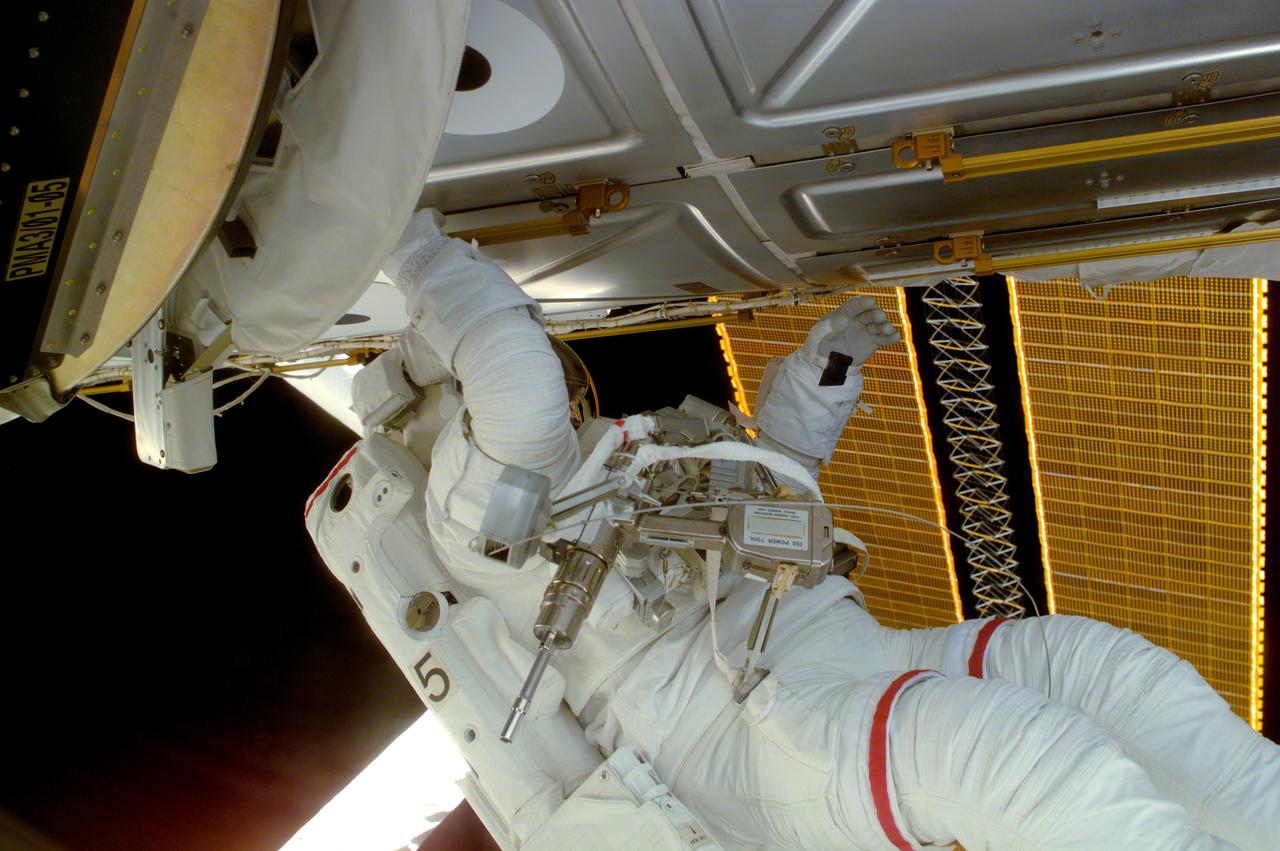
Astronaut Joseph R. Tanner, STS-97 mission specialist, is seen during a session of Extravehicular Activity (EVA), performing work on the International Space Station (ISS). Part of the Remote Manipulator System (RMS) arm and a section of the newly deployed solar array panel are in the background. The primary objective of the STS-97 mission was the delivery, assembly, and activation of the U.S. electrical power system on board the ISS. The electrical power system, which is built into a 73-meter (240-foot) long solar array structure consists of solar arrays, radiators, batteries, and electronics. The entire 15.4-metric ton (17-ton) package is called the P6 Integrated Truss Segment and is the heaviest and largest element yet delivered to the station aboard a space shuttle. The electrical system will eventually provide the power necessary for the first ISS crews to live and work in the U.S. segment. The STS-97 crew of five launched aboard the Space Shuttle Orbiter Endeavor on November 30, 2000 for an 11 day mission.
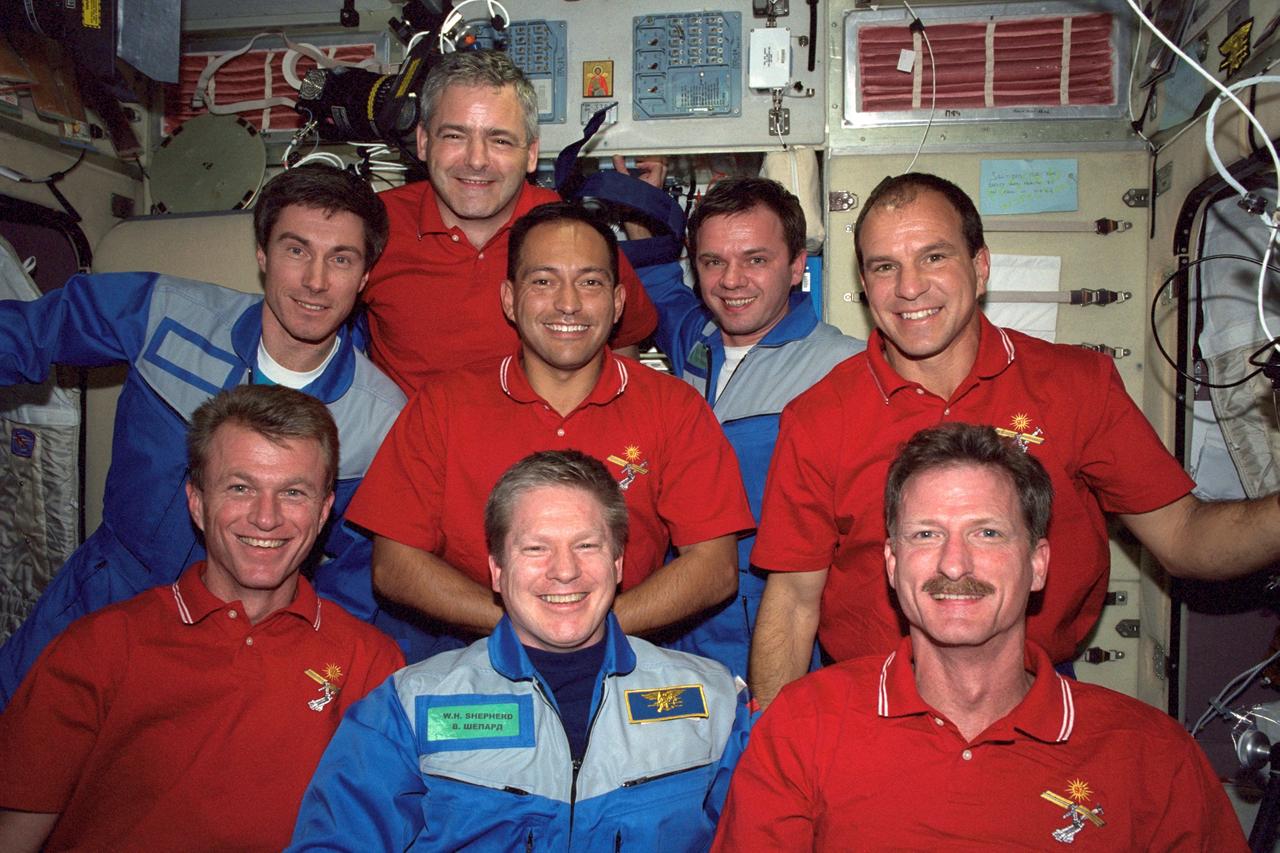
In this image, the five STS-97 crew members pose with the 3 members of the Expedition One crew onboard the International Space Station (ISS) for the first ever traditional onboard portrait taken in the Zvezda Service Module. On the front row, left to right, are astronauts Brent W. Jett, Jr., STS-97 commander; William M. Shepherd, Expedition One mission commander; and Joseph R. Tarner, STS-97 mission specialist. On the second row, from the left are Cosmonaut Sergei K. Krikalev, Expedition One flight engineer; astronaut Carlos I. Noriega, STS-97 mission specialist; cosmonaut Yuri P. Gidzenko, Expedition One Soyuz commander; and Michael J. Bloomfield, STS-97 pilot. Behind them is astronaut Marc Garneau, STS-97 mission specialist representing the Canadian Space Agency (CSA). The primary objective of the STS-97 mission was the delivery, assembly, and activation of the U.S. electrical power system onboard the International Space Station (ISS). The electrical power system, which is built into a 73-meter (240-foot) long solar array structure consists of solar arrays, radiators, batteries, and electronics. The entire 15.4-metric ton (17-ton) package is called the P6 Integrated Truss Segment, and is the heaviest and largest element yet delivered to the station aboard a space shuttle. The electrical system will eventually provide the power necessary for the first ISS crews to live and work in the U.S. segment. The STS-97 crew of five launched aboard the Space Shuttle Orbiter Endeavor on November 30, 2000 for an 11 day mission.
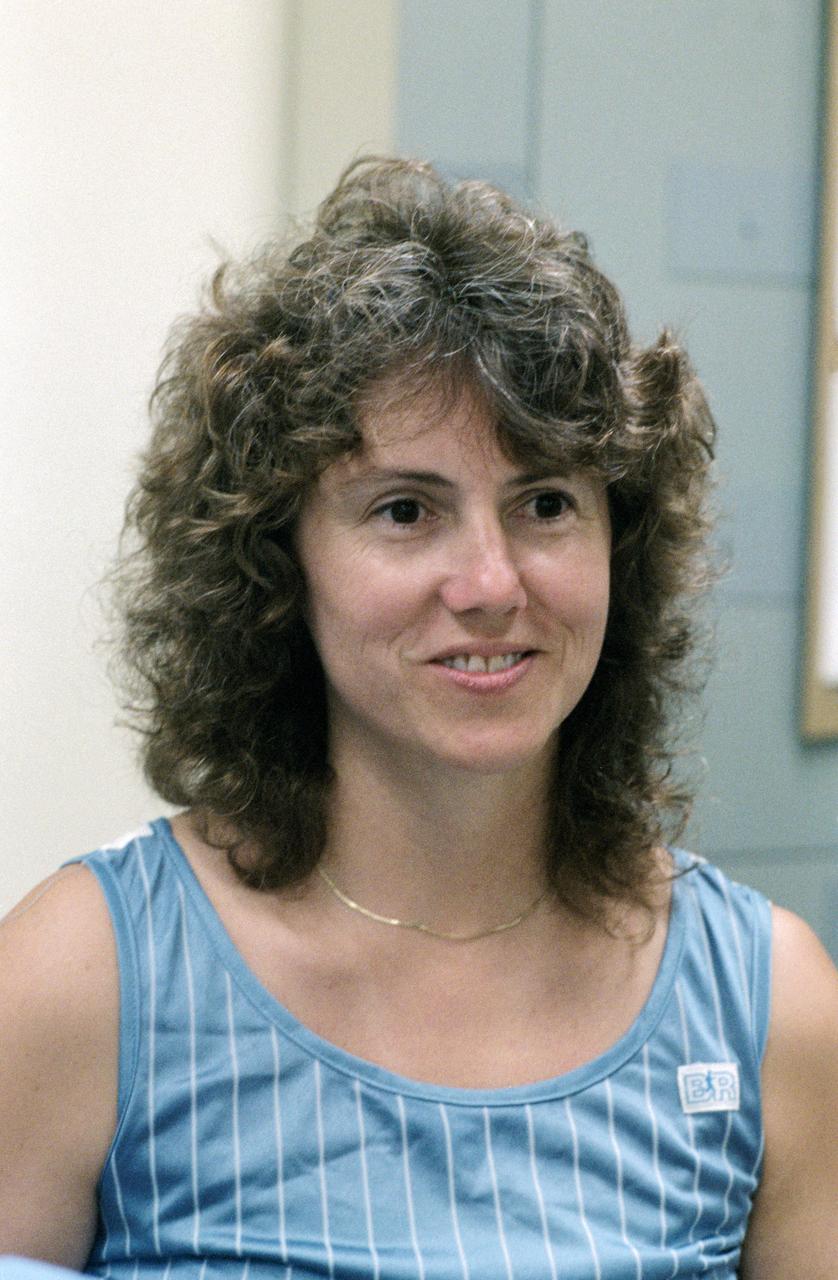
S85-37677 (8-12 July 1985) --- Sharon C. (Christa) McAuliffe of Concord High, Concord, New Hampshire, talks to nurse during physiological testing on first day at Johnson Space Center (JSC). Christa McAuliffe was eventually chosen as the first Teacher in Space and was a member of the seven-member Challenger shuttle crew which died tragically in the explosion of the spacecraft during the launch of STS-51L from the Kennedy Space Center about 11:40 a.m., EST, on Jan. 28, 1986. The explosion occurred 73 seconds into the flight as a result of a leak in one of two Solid Rocket Boosters that ignited the main liquid fuel tank. The crew members of the Challenger represented a cross-section of the American population in terms of race, gender, geography, background, and religion. The explosion became one of the most significant events of the 1980s, as billions around the world saw the accident on television and empathized with any one of the several crew members killed. Photo credit: NASA