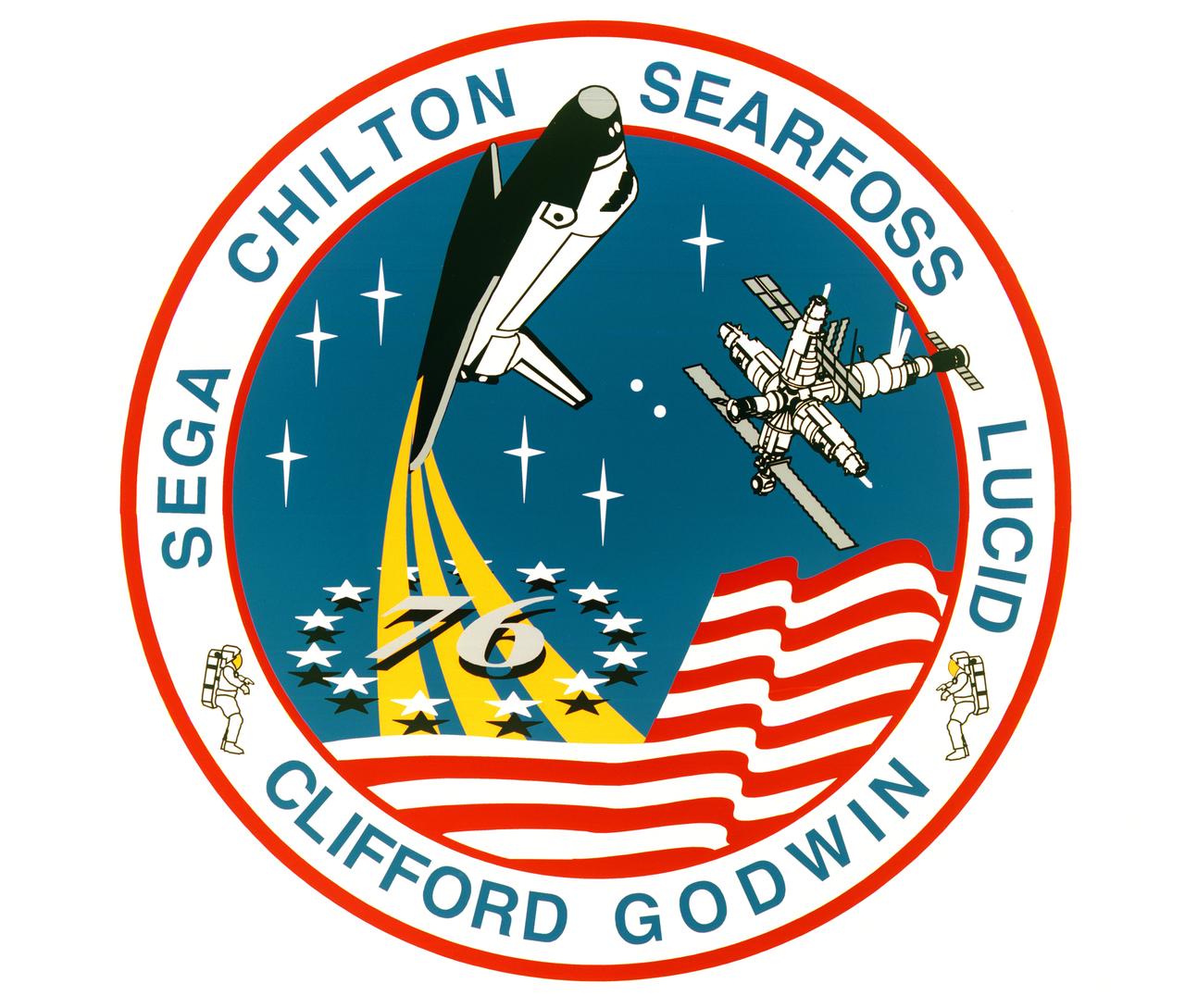
The STS-76 crew patch depicts the Space Shuttle Atlantis and Russia's Mir Space Station as the space ships prepare for a rendezvous and docking. The Spirit of 76, an era of new beginnings, is represented by the Space Shuttle rising through the circle of 13 stars in the Betsy Ross flag. STS-76 begins a new period of international cooperation in space exploration with the first Shuttle transport of a United States astronaut, Shannon W. Lucid, to the Mir Space Station for extended joint space research. Frontiers for future exploration are represented by stars and the planets. The three gold trails and the ring of stars in union form the astronaut logo. Two suited extravehicular activity (EVA) crew members in the outer ring represent the first EVA during Shuttle-Mir docked operations. The EVA objectives were to install science experiments on the Mir exterior and to develop procedures for future EVA's on the International Space Station. The surnames of the crew members encircle the patch: Kevin P. Chilton, mission commander; Richard A. Searfoss, pilot; Ronald M. Sega, Michael R. ( Rich) Clifford, Linda M. Godwin and Lucid, all mission specialists. This patch was designed by Brandon Clifford, age 12, and the crew members of STS-76.

STS-76, Mir Glovebox and NASA-2 (Mir-21) increment. Astronaut Sharnon Lucid, Cosmonaut Yuriy-V Usachov and Flight Engineer/Cosmonaut Yuriy-I Onuufriyenko.
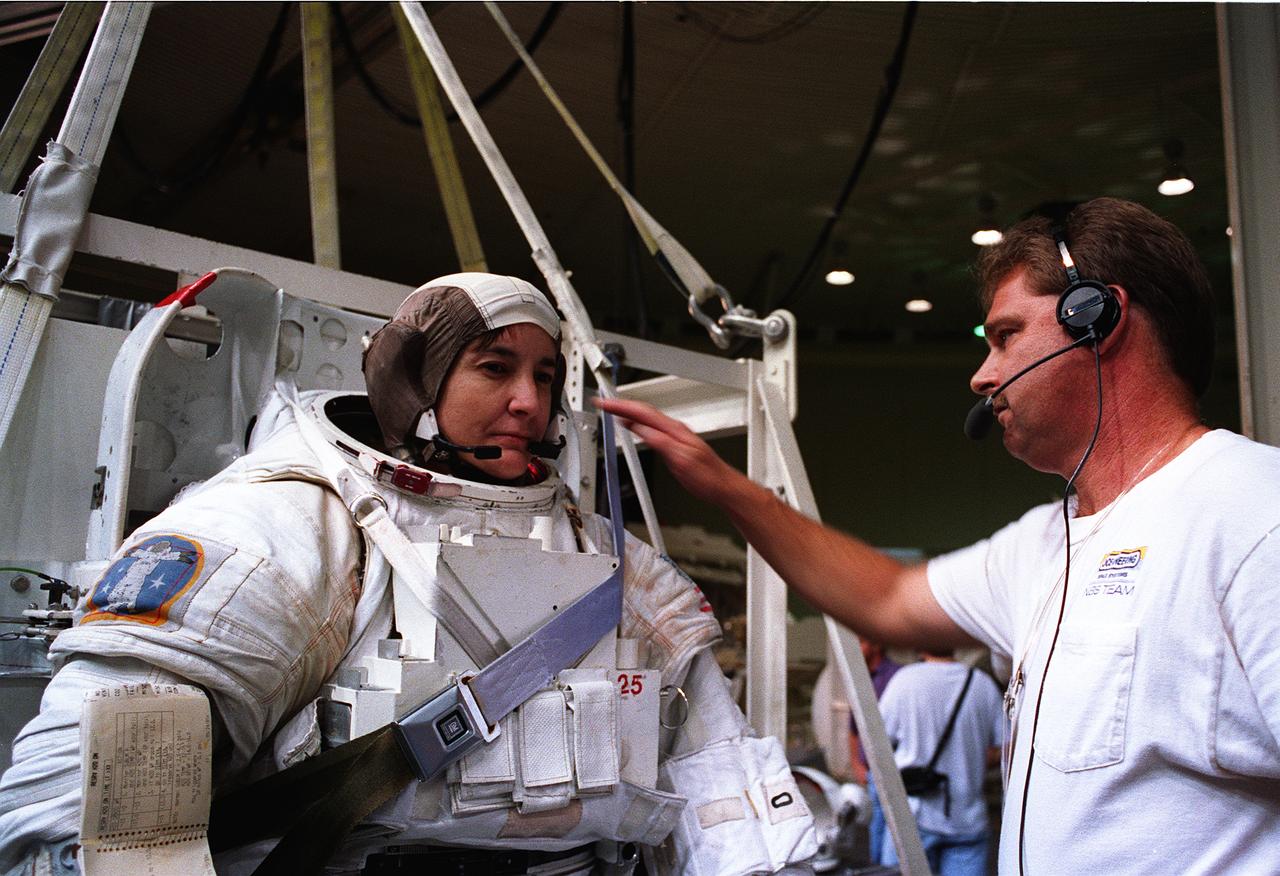
Astronaut and mission specialist, Linda Godwin, checks communications systems before submersion into a 25 ft deep pool at the Johnson Space Center’s (JSC) Weightless Environment Training Facility (WET-F). Wearing a high fidelity training version of the Extravehicular Mobility Unit (EMU) space suit, Godwin simulated STS-76 Extravehicular Activity (EVA) chores in the pool. Launched aboard the Space Shuttle Atlantis in March of 1996, STS-76 marked the third U.S. Shuttle-Mir docking during which Godwin, along with astronaut and mission specialist Michael R. ( Rich) Clifford, performed the first Extravehicular Activity (EVA) during Mir-Shuttle docked operations.
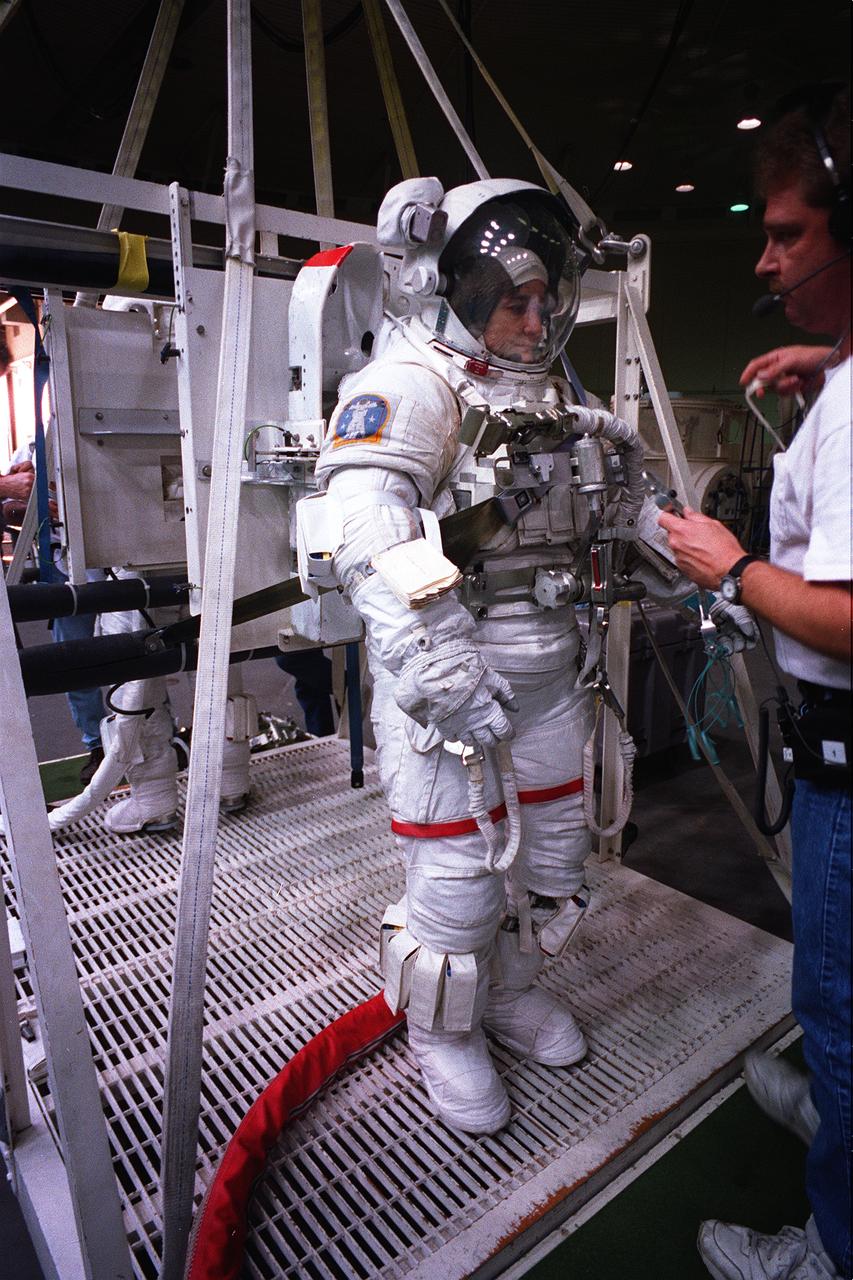
Astronaut and mission specialist, Linda Godwin, makes a final check of her respiration system before submersion into a 25 ft deep pool at the Johnson Space Center’s (JSC) Weightless Environment Training Facility (WET-F). Wearing a high fidelity training version of the Extravehicular Mobility Unit (EMU) space suit, Godwin simulated STS-76 Extravehicular Activity (EVA) chores in the pool. Launched aboard the Space Shuttle Atlantis in March of 1996, STS-76 marked the third U.S. Shuttle-Mir docking during which Godwin, along with astronaut and mission specialist Michael R. (Rich) Clifford, performed the first Extravehicular Activity (EVA) during Mir-Shuttle docked operations.
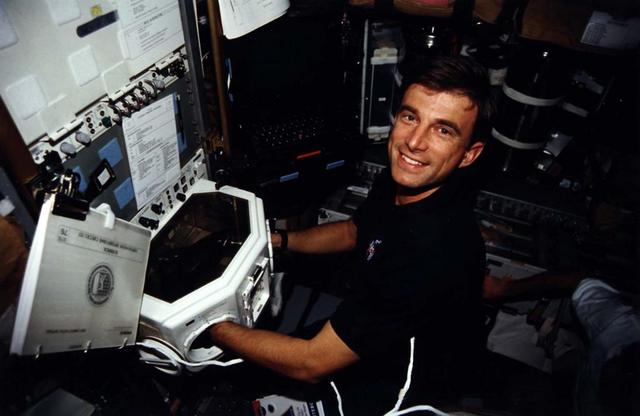
Astronaut Ronald M. Sega, payload commander, works in the glovebox facility in the Spacehab laboratory aboard the Earth-orbiting Space Shuttle Atlantis. The Spacehab facility was one f the busier research areas on Atlantis during the STS-76 mission. Also, some of the gear for transfer to Russia's Mir Space Station was stowed there prior to the March 23, 1996 docking of Atlantis.
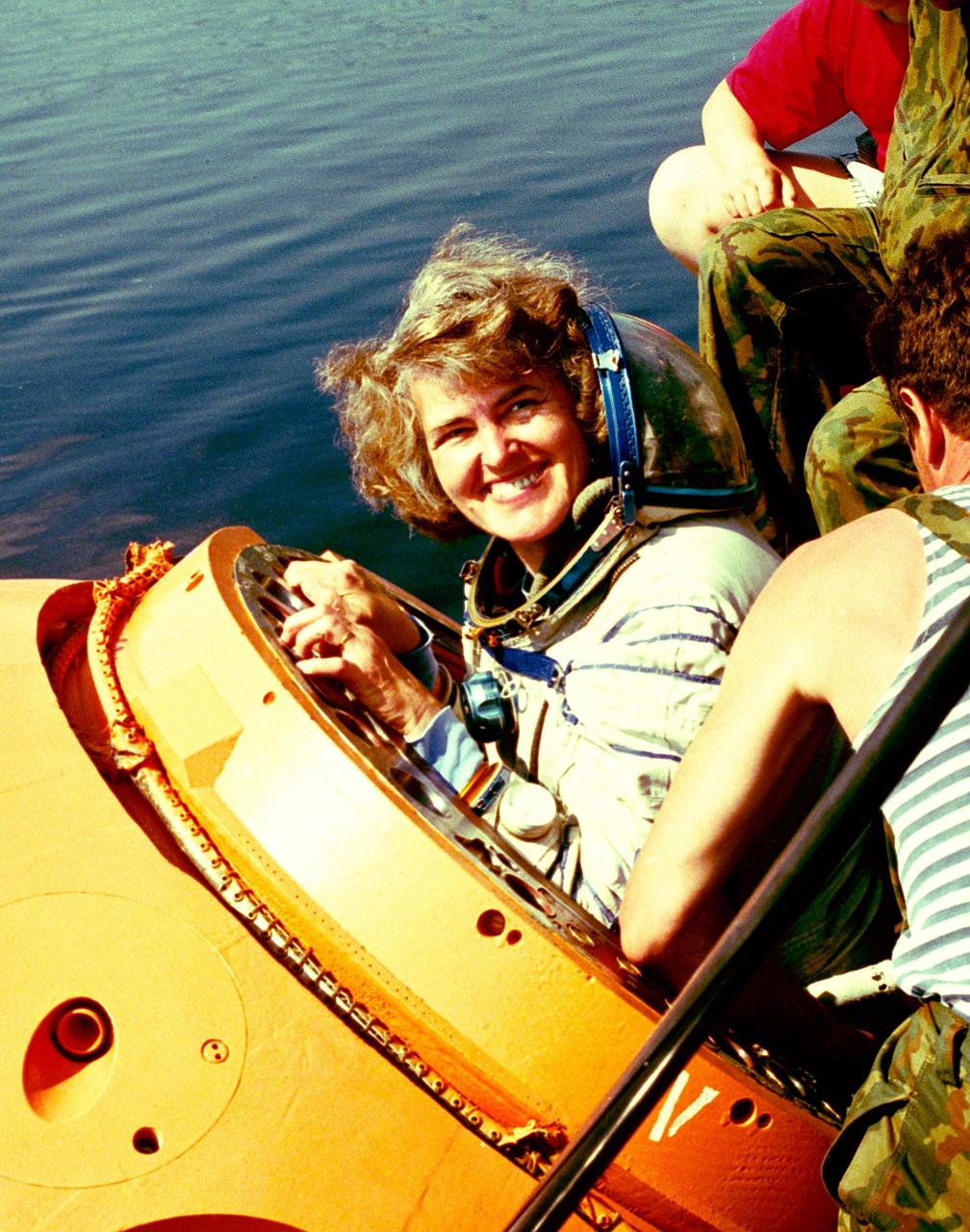
Astronaut Shannon Lucid is seen egressing from a training version of a soyez spacecraft, during a water survival training session in Russia. In March of 1996, Lucid accompanied the STS-76 crew to the Russian space station, Mir, where she stayed for a little over four months before returning to Earth with the STS-79 crew.
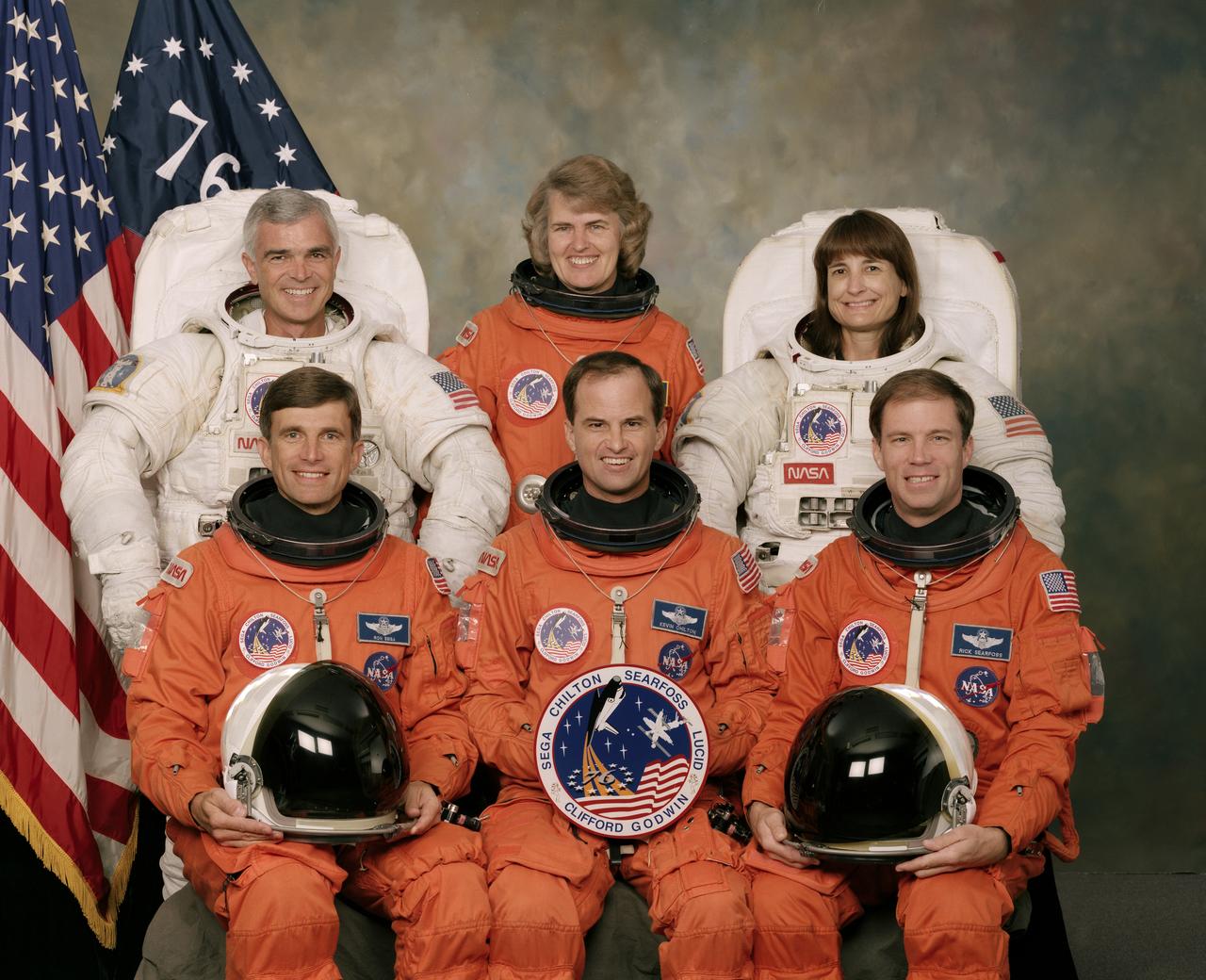
These six NASA astronauts launched into space aboard the Space Shuttle Atlantis on March 22, 1996 for the STS-76 mission. Pictured on the front row, left to right, are astronauts Ronald M. Sega, mission specialist; Kevin P. Chilton, mission commander; and Richard A. Searfoss, pilot. On the back row, left to right, are mission specialists Michael R. (Rich) Clifford, Shannon W. Lucid, and Linda M. Godwin. The third U.S. Shuttle-Mir docking, STS-76 began a new period of international cooperation in space exploration with the first Shuttle transport of a United States astronaut (Lucid) to Russia’s Mir Space Station for extended joint space research. Clifford and Godwin, pictured here in training versions of the Extravehicular Mobility Unit (EMU), performed the first Extravehicular Activity (EVA) during Mir-Shuttle docked operations.

STS076-E-05264 (22-31 March 1996) --- STS-76 KidSat Earth View (Morocco)

STS076-E-05275 (22-31 March 1996) --- STS-76 KidSat Earth View (Canada)
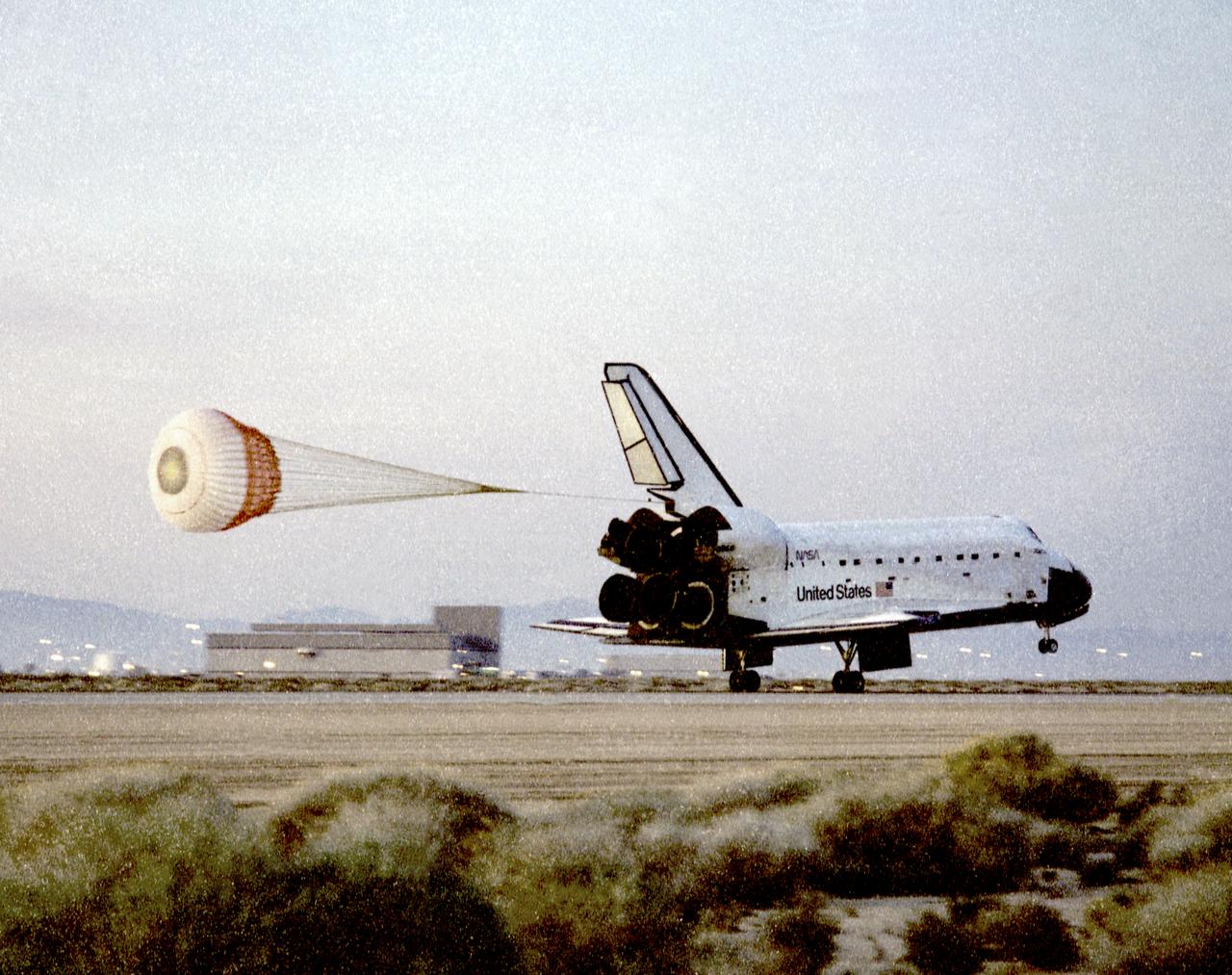
The space shuttle Atlantis touches down on the runway at Edwards, California, at approximately 5:29 a.m. Pacific Standard Time after completing the highly successful STS-76 mission to deliver Astronaut Shannon Lucid to the Russian Space Station Mir. She was the first American woman to serve as a Mir station researcher. Atlantis was originally scheduled to land at Kennedy Space Center, Florida, but bad weather there both 30 and 31 March necessitated a landing at the backup site at Edwards. This photo shows the drag chute deployed to help the shuttle roll to a stop. Mission commander for STS-76 was Kevin P. Chilton, and Richard A. Searfoss was the pilot. Ronald M. Sega was payload commander and mission specialist-1. Mission specialists were Richard Clifford, Linda Godwin and Shannon Lucid. The mission also featured a spacewalk while Atlantis was docked to Mir and experiments aboard the SPACEHAB module.
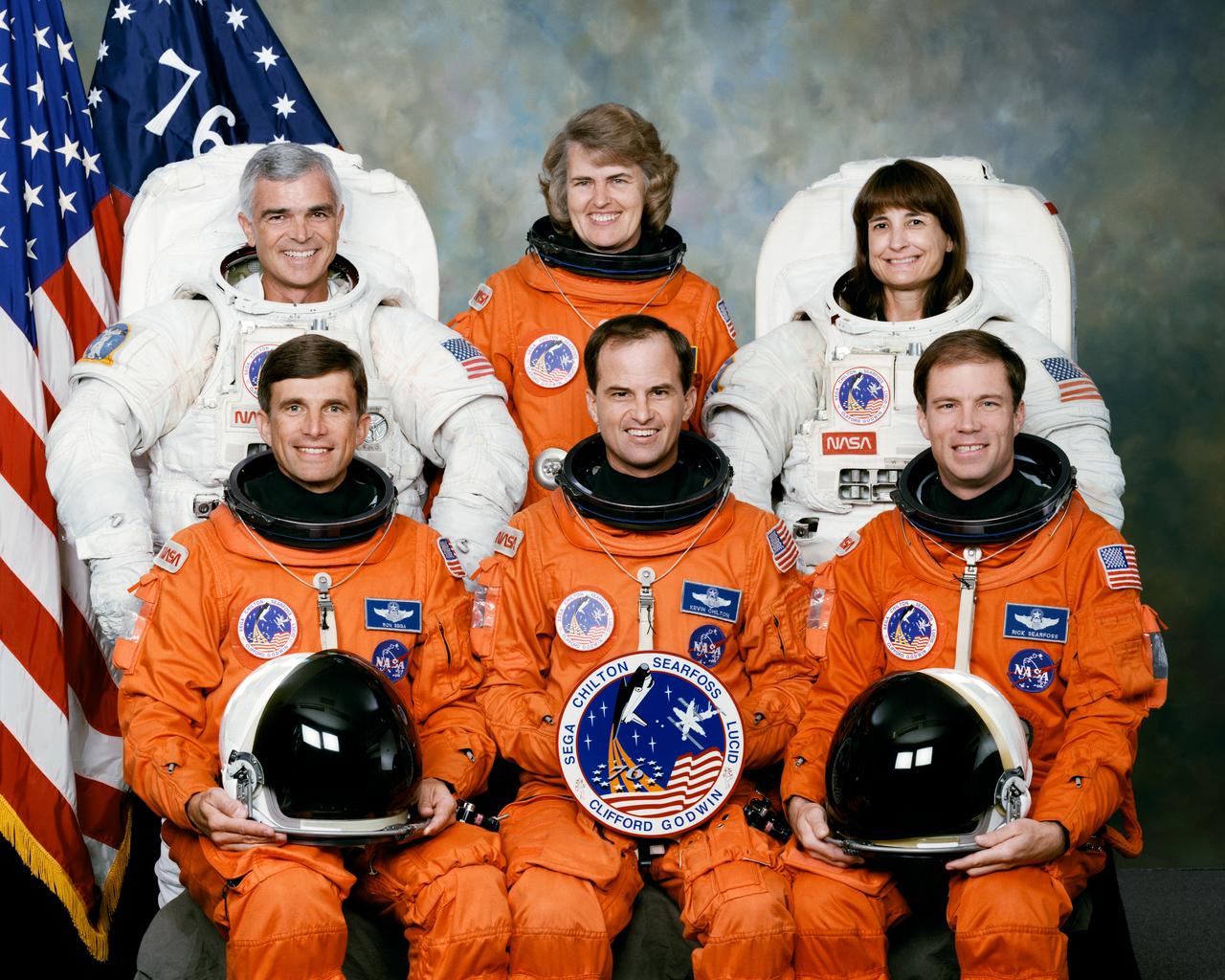
STS076-S-002 (November 1995) --- These six NASA astronauts will be launched into space aboard the Space Shuttle Atlantis early next year. Front row, left to right, are astronauts Ronald M. Sega, mission specialist; Kevin P. Chilton, mission commander; and Richard A. Searfoss, pilot. Back row, left to right, are mission specialists Michael R. (Rich) Clifford, Shannon W. Lucid and Linda M. Godwin. STS-76 begins a new period of international cooperation in space exploration with the first Shuttle transport of a United States astronaut (Lucid) to Russia’s Mir Space Station for extended joint space research. Clifford and Godwin, pictured here in training versions of the Extravehicular Mobility Unit (EMU), are scheduled to perform the first Extravehicular Activity (EVA) during Mir-Shuttle docked operations.
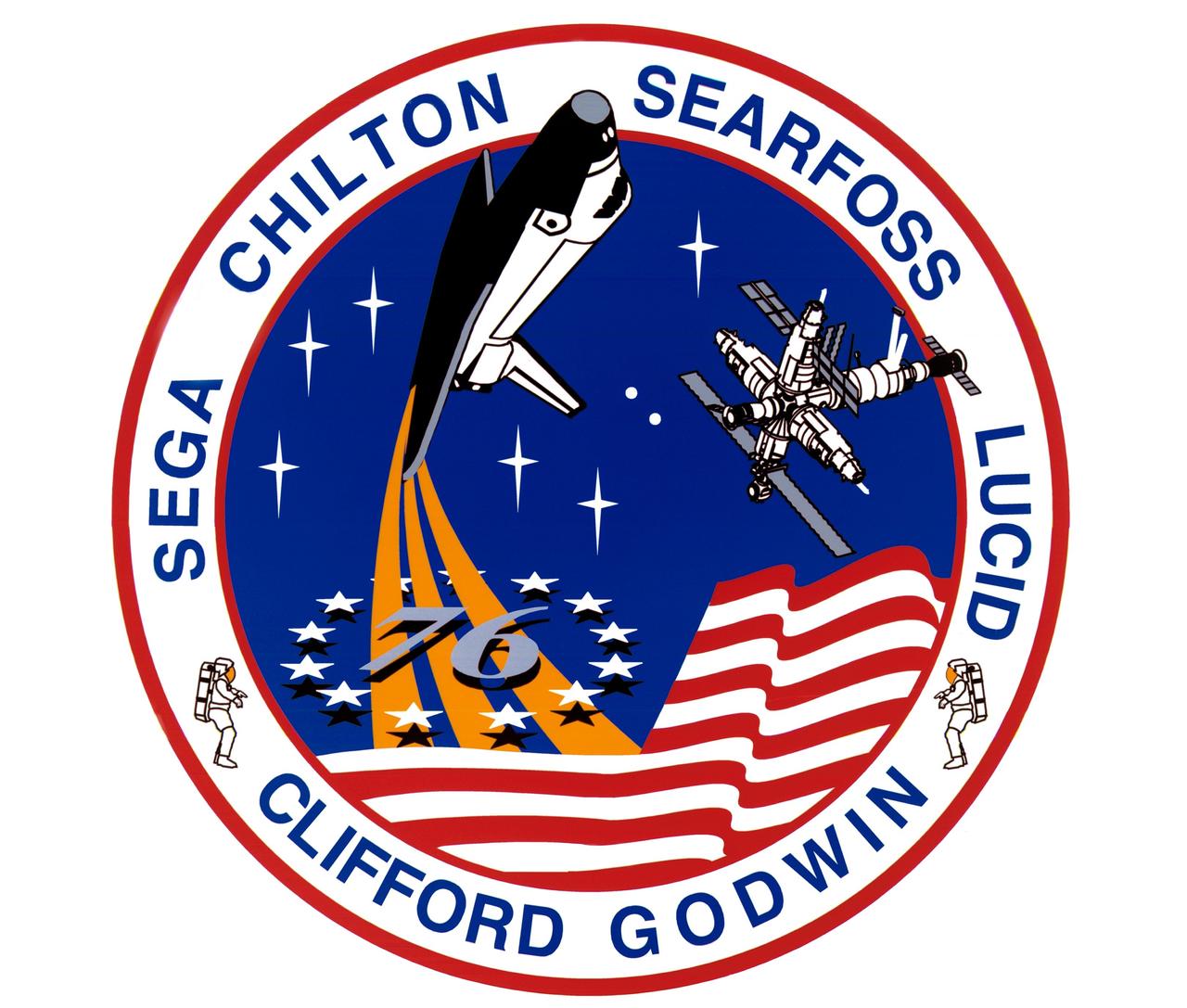
STS076-S-001 (November 1995) --- The STS-76 crew patch depicts the space shuttle Atlantis and Russia's Mir Space Station as the space ships prepare for a rendezvous and docking. The "Spirit of 76," an era of new beginnings, is represented by the space shuttle rising through the circle of 13 stars in the Betsy Ross flag. STS-76 begins a new period of international cooperation in space exploration with the first shuttle transport of a United States astronaut, Shannon W. Lucid, to the Mir Space Station for extended joint space research. Frontiers for future exploration are represented by stars and the planets. The three gold trails and the ring of stars in union form the astronaut logo. Two suited extravehicular activity (EVA) crew members in the outer ring represent the first EVA during Shuttle-Mir docked operations. The EVA objectives are to install science experiments on the Mir exterior and to develop procedures for future EVA's on the International Space Station. The surnames of the crew members encircle the patch: Kevin P. Chilton, mission commander; Richard A. Searfoss, pilot; Ronald M. Sega, Michael R. ( Rich) Clifford, Linda M. Godwin and Lucid, all mission specialists. This patch was designed by Brandon Clifford, age 12, and the crew members of STS-76. The NASA insignia design for space shuttle flights is reserved for use by the astronauts and for other official use as the NASA Administrator may authorize. Public availability has been approved only in the forms of illustrations by the various news media. When and if there is any change in this policy, which is not anticipated, the change will be publicly announced. Photo credit: NASA
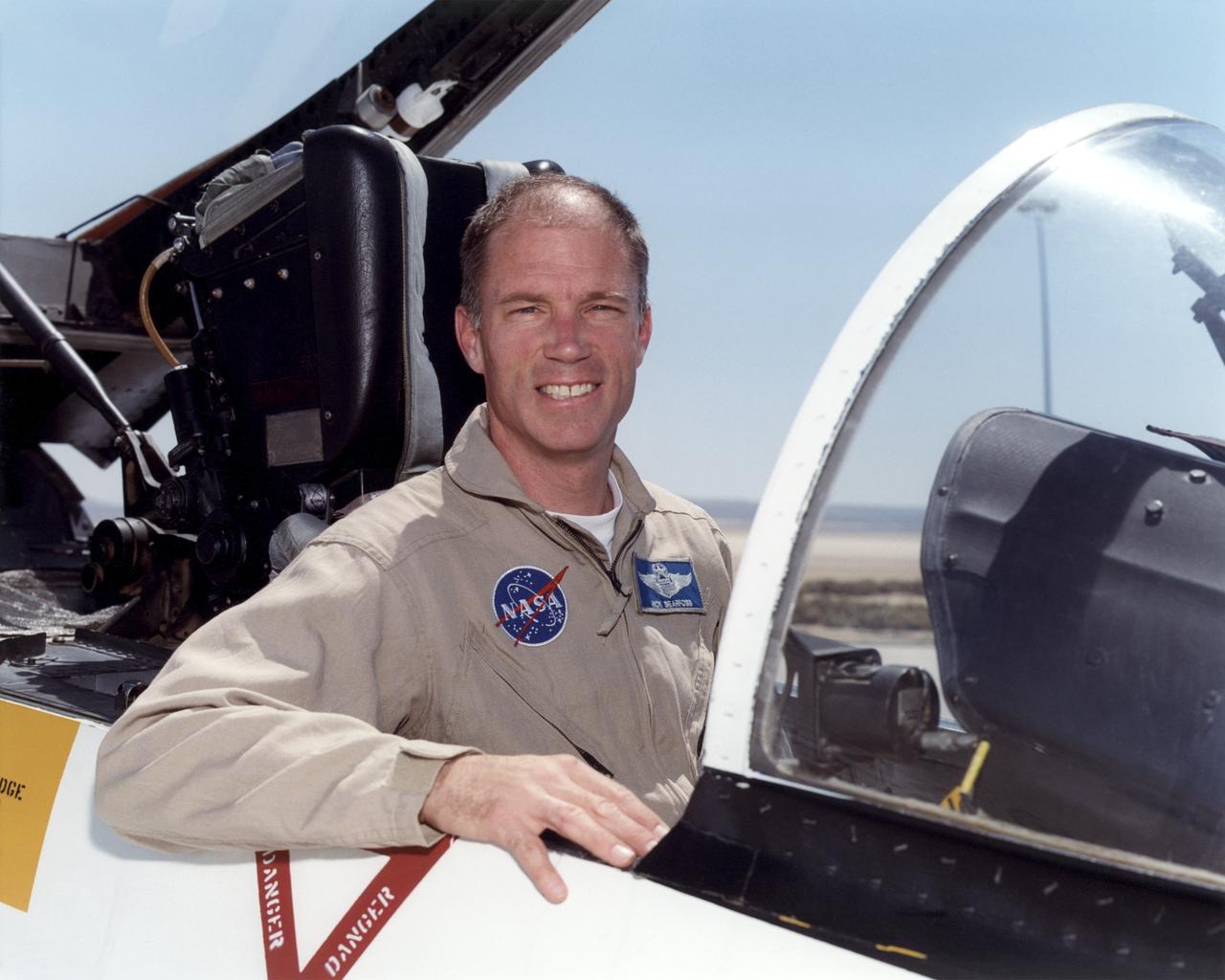
Richard A. Searfoss became a research pilot in the Flight Crew Branch of NASA's Dryden Flight Research Center, Edwards, Calif., in July 2001. He brought to Dryden more than 5,000 hours of military flying time and 939 hours in space. Searfoss served in the U.S. Air Force for more than 20 years, retiring with the rank of colonel. Following graduation in 1980 from Undergraduate Pilot Training at Williams Air Force Base, Ariz., Searfoss flew F-111s at RAF Lakenheath, England, and Mountain Home Air Force Base, Idaho. In 1988 he attended the U.S. Naval Test Pilot School, Patuxent River, Md., as a U.S. Air Force exchange officer. He was an instructor pilot at the U.S. Air Force Test Pilot School, Edwards Air Force Base, Calif., when selected for the astronaut program in January 1990. Searfoss became an astronaut in July 1991. A veteran of three space flights, Searfoss has logged 39 days in space. He served as STS-58 pilot on the seven-person life science research mission aboard Space Shuttle Columbia, launching from NASA's Kennedy Space Center, Fla., on Oct. 18, 1993, and landing at Edwards Air Force Base, Calif., on Nov. 1, 1993. The crew performed a number of medical experiments on themselves and 48 rats, expanding knowledge of human and animal physiology. Searfoss flew his second mission as pilot of STS-76 aboard the Space Shuttle Atlantis. During this nine-day mission, which launched March 22, 1996, the crew preformed the third docking of an American spacecraft with the Russian space station Mir. The crew transported to Mir nearly two tons of water, food, supplies, and scientific equipment, as well as U.S. Astronaut Shannon Lucid to begin her six-month stay in space. Completing 145 orbits, STS-76 landed at Edwards Air Force Base, Calif., on March 31, 1996. Searfoss commanded a seven-person crew on the STS-90 Neurolab mission launched on April 17, 1998. The crew served as both experiment subjects and operators for life science experiments focusing on the effects of m
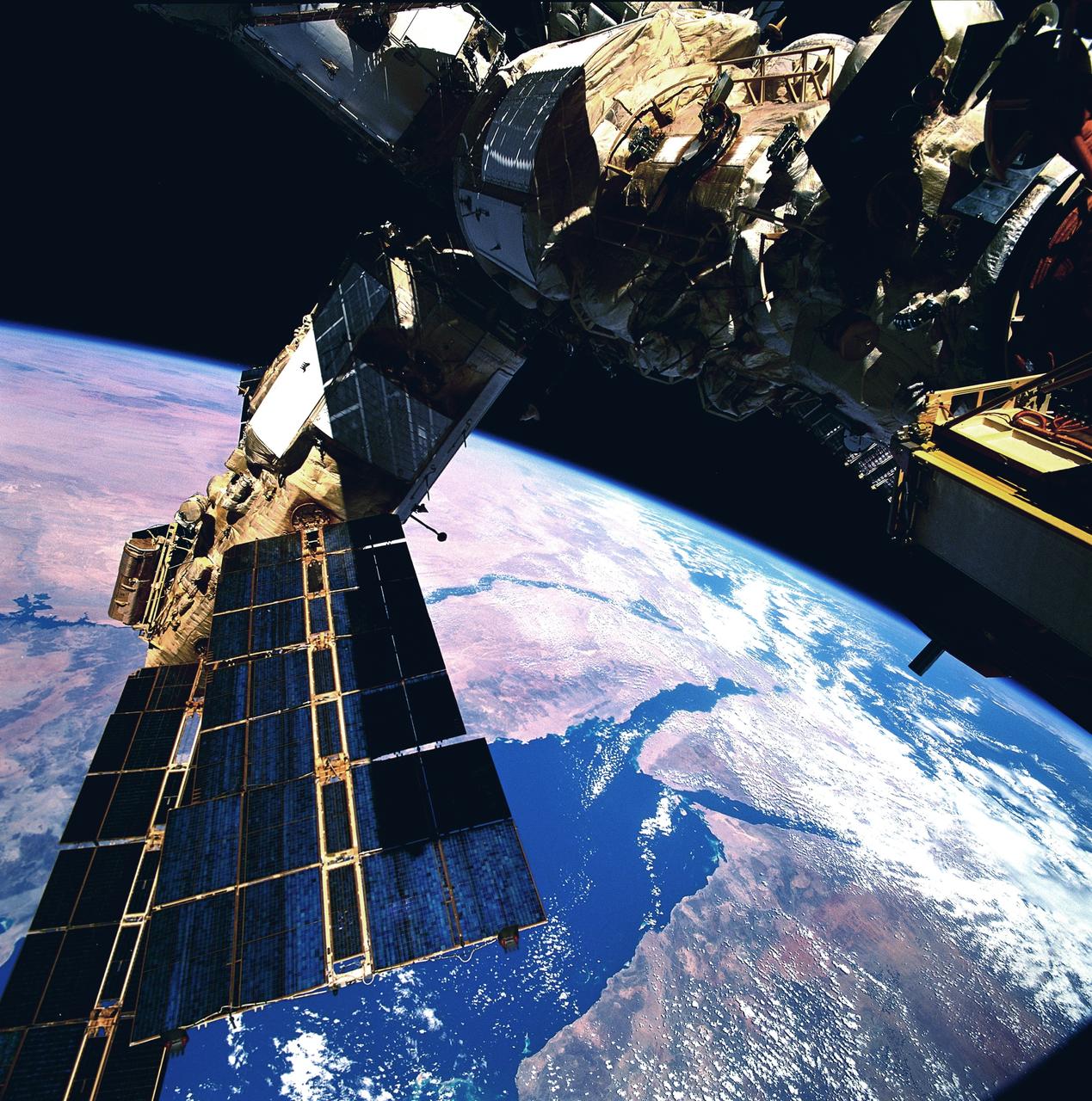
STS076-734-084 (22 - 31 March 1996) --- A clear scene of the Sinai Peninsula and the Nile River Delta forms the backdrop for this 70mm scene of Russia's Mir Space Station, as photographed from the aft flight deck of the Space Shuttle Atlantis. Atlantis docked with Mir on March 23, 1996, and remained linked until March 28, 1996. Astronaut Shannon W. Lucid transferred from the STS-76 crew to the Mir-21 crew, which grew from two to three. She will remain aboard Mir for approximately 140 days, as a cosmonaut guest researcher.
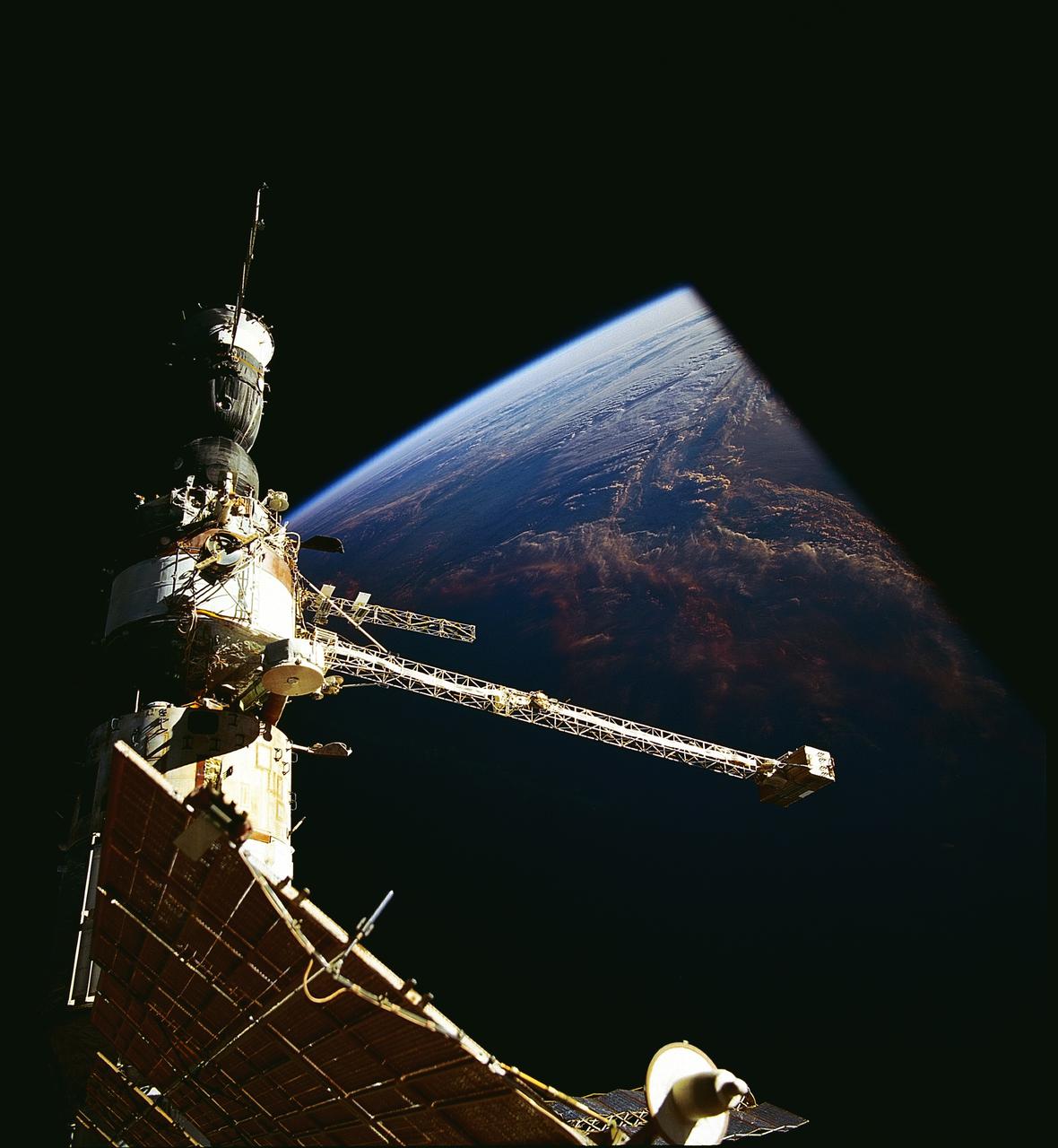
STS076-709-007 (22 - 31 March 1996) --- Earth's terminator forms the backdrop for this scene of Russia Mir Space Station's Soyuz and Kvant 2 Modules, as photographed from the aft flight deck of the Space Shuttle Atlantis. Atlantis docked with the Mir Space Station on March 23, 1996, and remained linked until March 28, 1996. Astronaut Shannon W. Lucid transferred from the STS-76 crew to the Mir-21 crew, which grew from two to three. Lucid will remain aboard Mir for approximately 140 days.
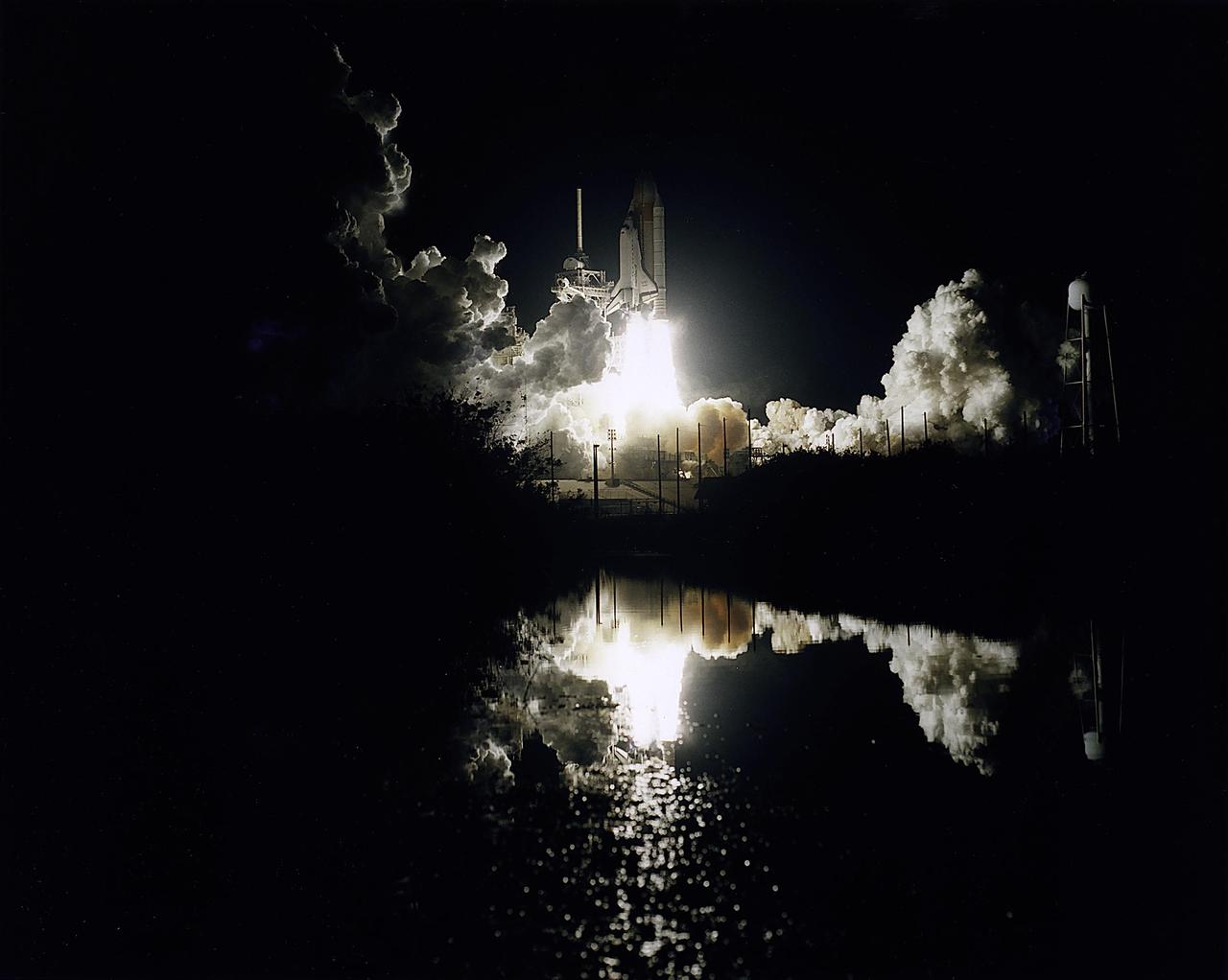
KENNEDY SPACE CENTER, FLA. -- STS-76: Atlantis
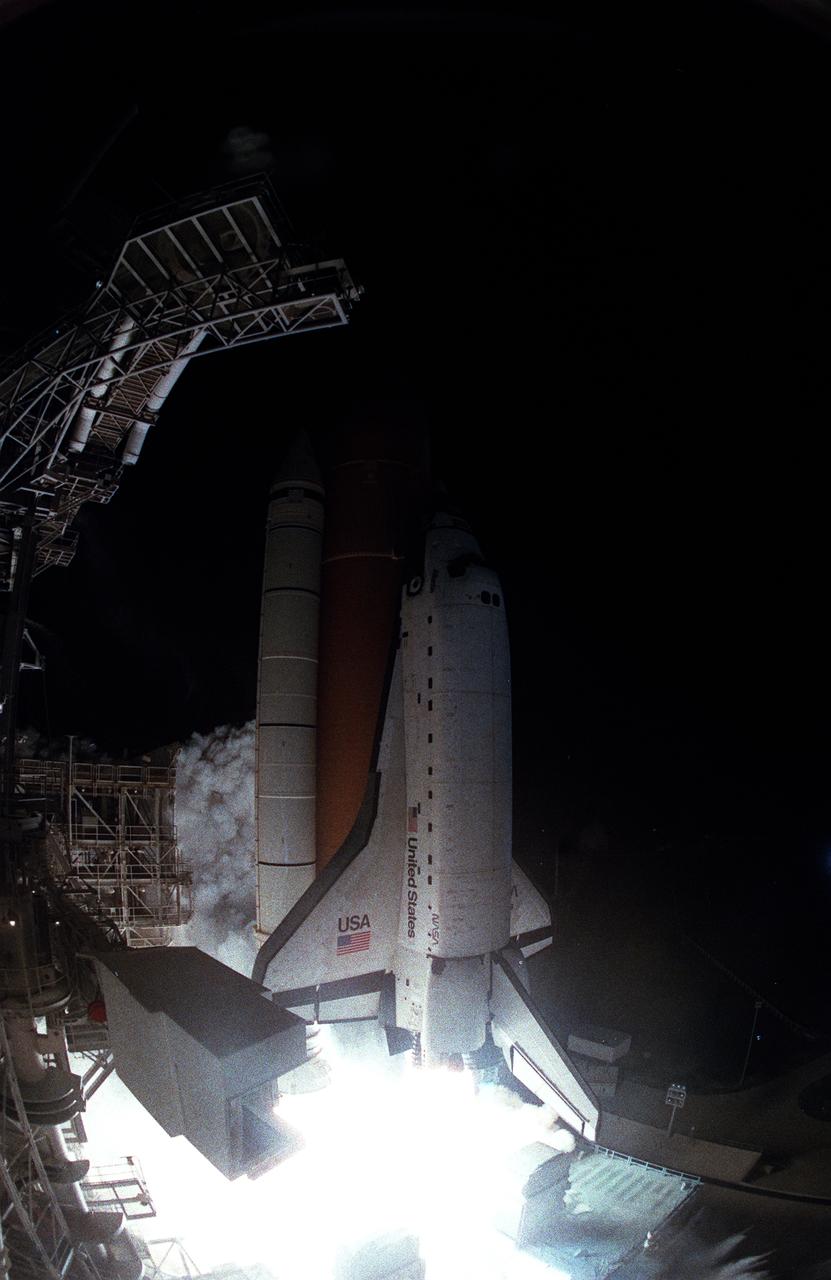
STS076-S-008 (22 March 1996) --- As represented in this fish-eye view from the Kennedy Space Center's (KSC) Launch Pad 39B, the space shuttle Atlantis heads toward Earth-orbit and an eventual docking with Russia's Mir Space Station. Mir has been in space for ten years and a two man crew (Mir-21) currently awaits the arrival of Atlantis. The on-time launch occurred at 3:13:04 a.m. (EST) on March 22, 1996. Onboard for STS-76 are astronauts Kevin P. Chilton, Richard A. Searfoss, Ronald M. Sega, Michael R. (Rich) Clifford, Linda M. Godwin and Shannon W. Lucid. Lucid will remain onboard Mir for just under five months time. Photo credit: NASA or National Aeronautics and Space Administration
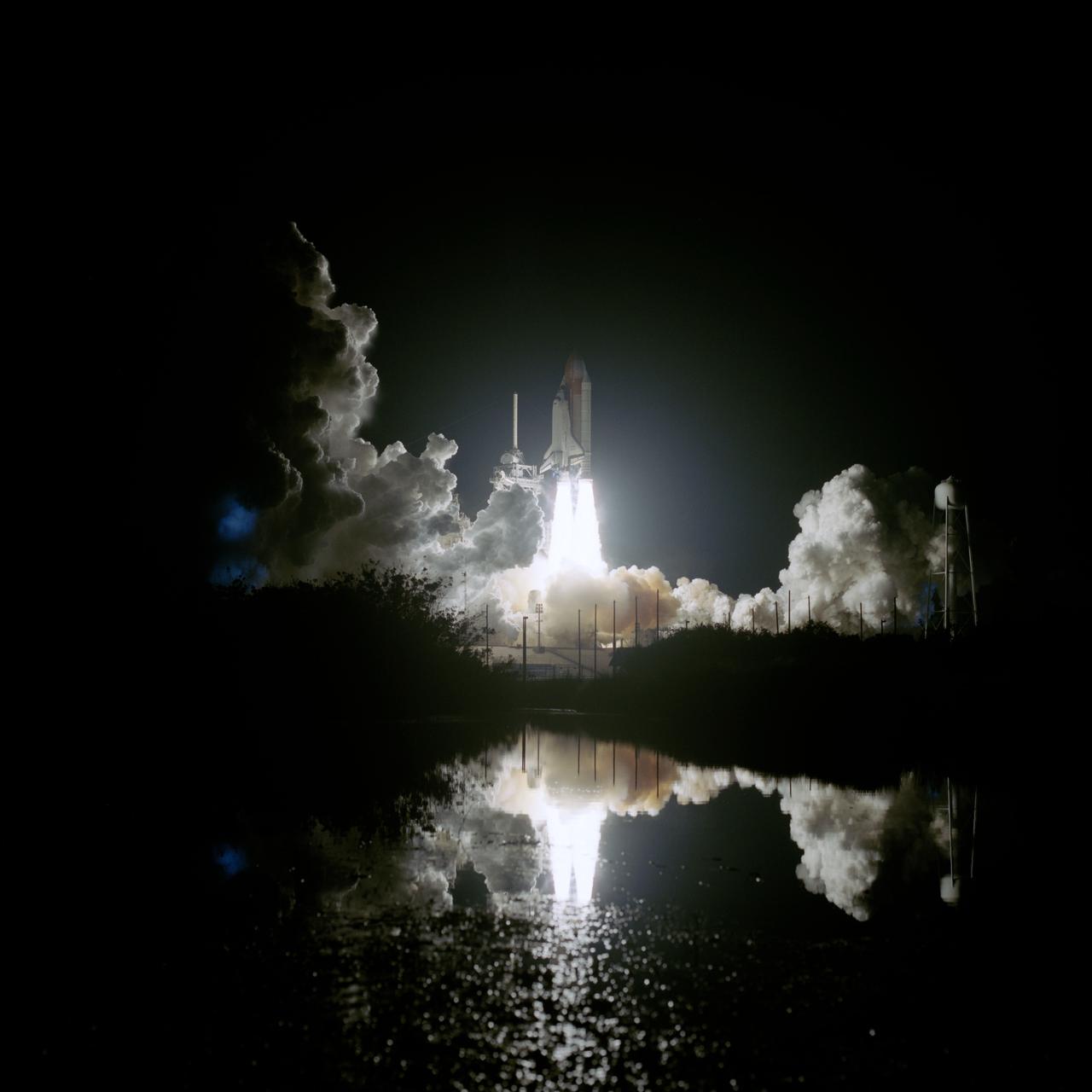
STS076-S-011 (22 March 1996) --- This wide view captures the nocturnal launch of the Space Shuttle Atlantis, as it heads toward Earth-orbit and an eventual docking with Russia?s Mir Space Station. Mir has been in space for ten years and a two-man crew (Mir-21) currently awaits the arrival of Atlantis. The on-time launch occurred at 3:13:04 a.m. (EST) on March 22, 1996. Onboard for STS-76 are astronauts Kevin P. Chilton, Richard A. Searfoss, Ronald M. Sega, Michael R. (Rich) Clifford, Linda M. Godwin and Shannon W. Lucid. Lucid will remain onboard Mir for just under five months? time, as a cosmonaut guest researcher. Photo credit: NASA or National Aeronautics and Space Administration
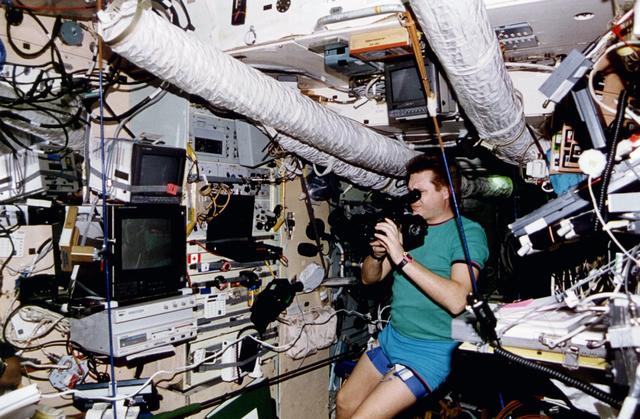
STS076-461-010 (22-31 March 1996) --- The STS-76 crew took this 70mm picture of Russia's Mir-21 mission commander Yury I. Onufrienko using a video camera on the Base Block Module of Russia's Mir Space Station. The STS-76 crew docked the Space Shuttle Atlantis with the Mir Space Station on March 23, 1996, at which time astronaut Shannon W. Lucid (out of frame) joined Onufrienko and the mission's flight engineer, Yury V. Usachev, to begin the first leg of a 140-day stay aboard Mir, as a cosmonaut guest researcher.

NM21-396-024 (23 March 1996) --- Backdropped against the blackness of space the Space Shuttle Atlantis was taken by the two Mir-21 cosmonaut crew members onboard Russia’s Mir Space Station, during rendezvous and docking operations on March 23, 1996. The Orbiter Docking System (ODS), the connective tunnel and the Spacehab Module can be seen in Atlantis’ cargo bay. With the subsequent delivery of astronaut Shannon W. Lucid to the Mir, the Mir-21 crew grew to three, as the mission specialist quickly becomes a cosmonaut guest researcher. She will spend approximately 140 days on Mir before returning to Earth.

S76-E-5215 (28 March 1996) --- Astronaut Kevin P. Chilton, STS-76 mission commander, gets a warm good-bye from cosmonaut Yury V. Usachev, Mir-21 flight engineer, as the Space Shuttle Atlantis is about to be separated from its link with Russia's Mir Space Station.
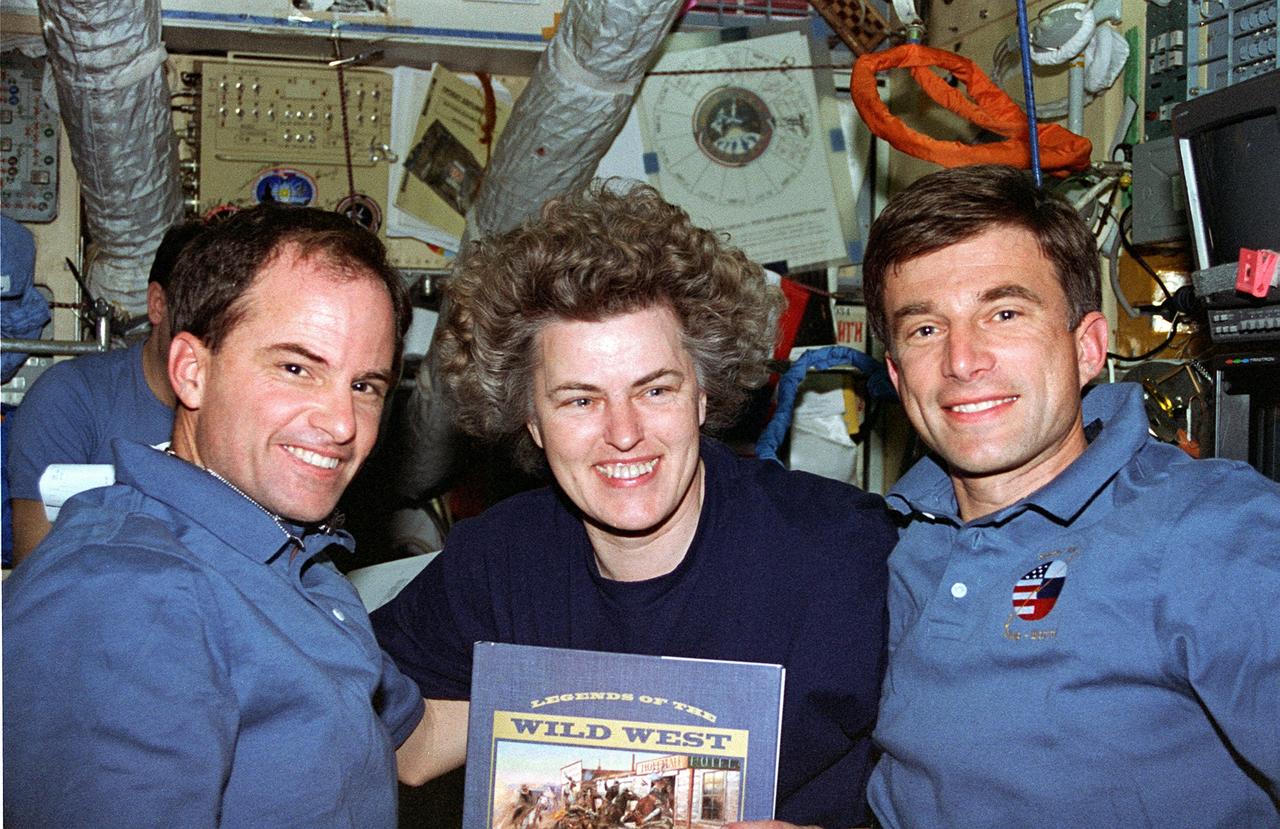
STS076-356-029 (22 - 31 March 1996) --- Astronaut Shannon W. Lucid, cosmonaut guest researcher, shows off a book which will occupy some of her off-duty time and that of her two Mir-21 crew mates aboard Russia's Mir Space Station during the next five months. Lucid was about to bid farewell to STS-76 crew mates Kevin P. Chilton (left), mission commander, and Ronald M. Sega, payload commander. The book was a gift from the STS-76 crew, given to the Mir-21 crew. This photograph was made onboard Mir's Base Block Module. After leaving Lucid to her duties onboard Mir, Chilton, Sega and three other astronauts later returned to Earth aboard the Space Shuttle Atlantis.
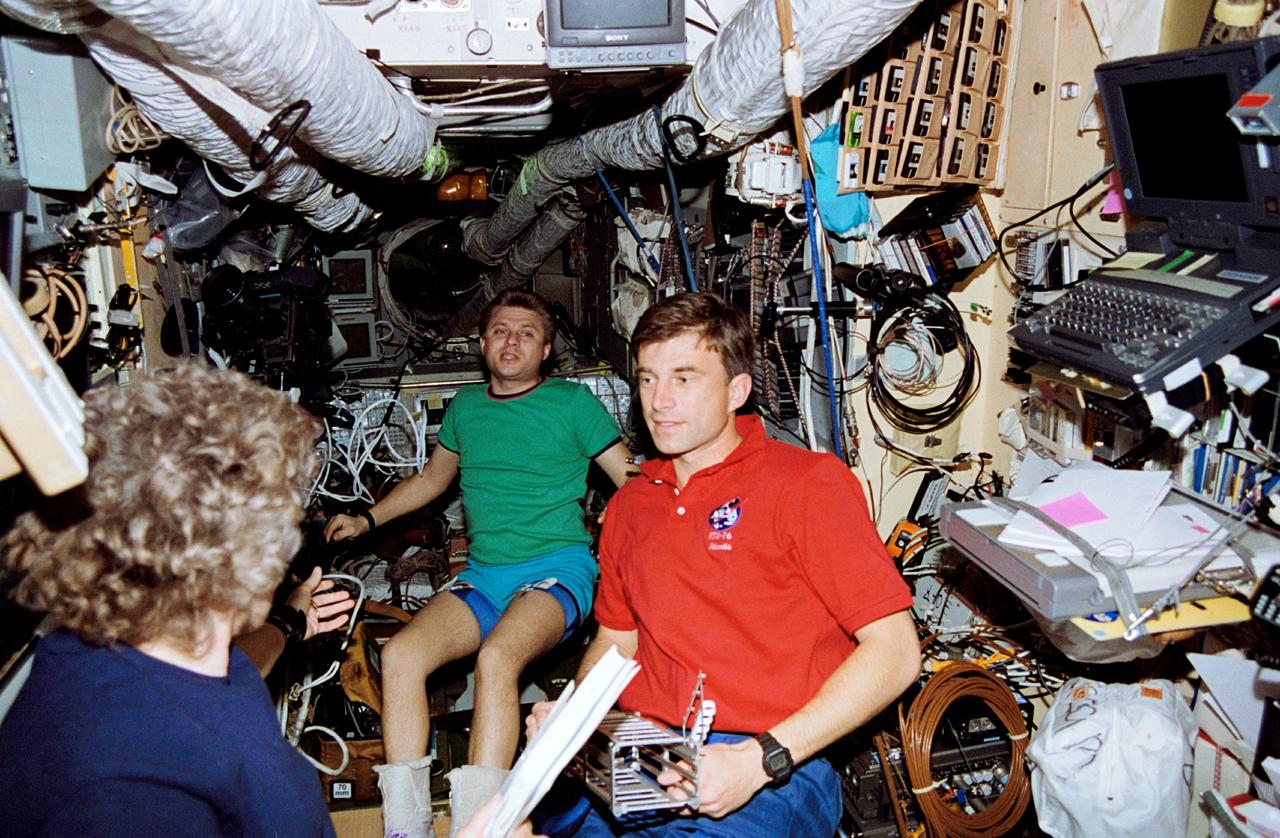
STS076-461-004 (22-31 March 1996) --- Onboard the Base Block Module of Russia's Mir Space Station, astronauts Shannon W. Lucid and Ronald M. Sega, payload commander, discuss final activities between the STS-76 and Mir-21 crews as cosmonaut Yury I. Onufrienko (center) listens. Yury V. Usachev (out of frame) is Mir-21 flight engineer. The Space Shuttle Atlantis docked with Mir on March 23, 1996, and remained linked until March 28, 1996. Lucid was in the process of transferring from STS-76 to the Mir-21 crew, which thereby grew from two to three members. She will remain aboard Mir for approximately 140 days.
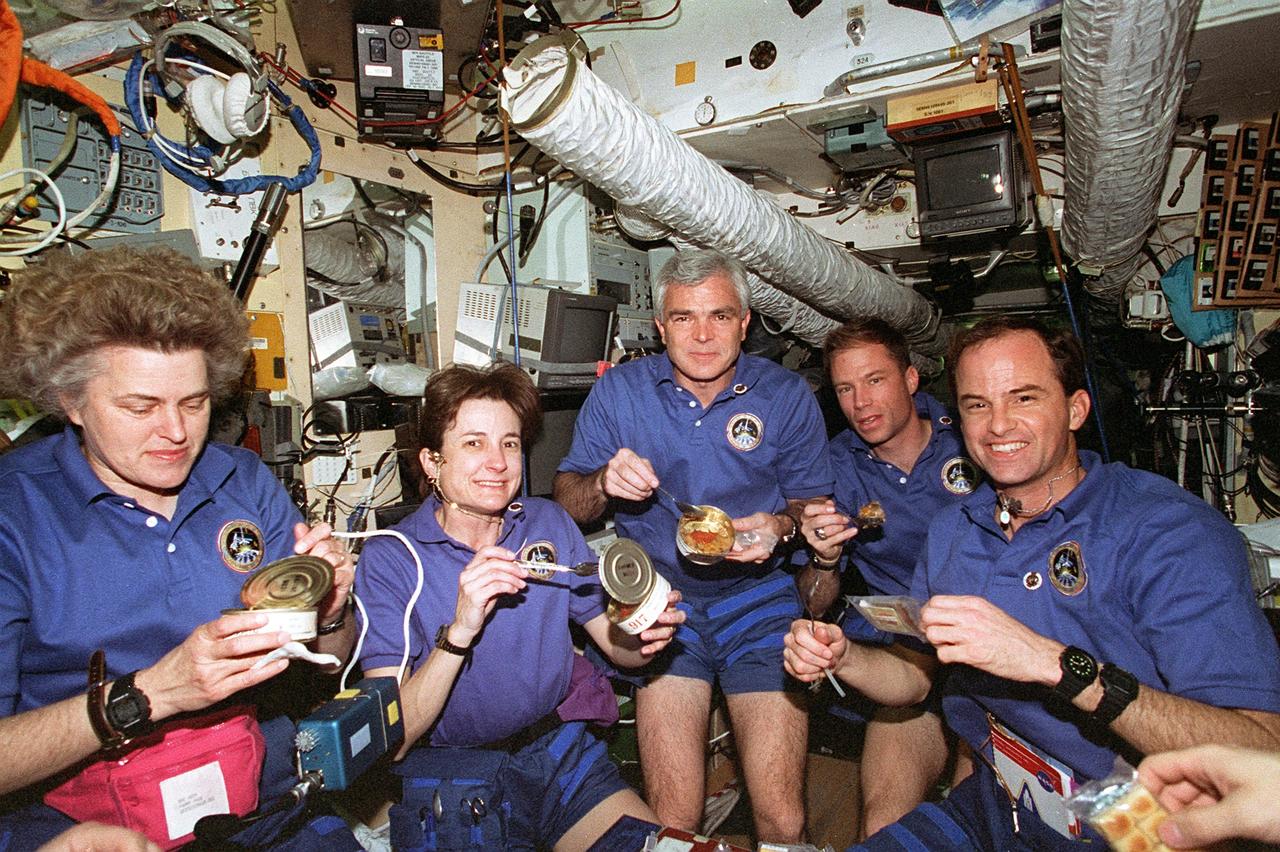
STS076-345-028 (22 - 31 March 1996) --- Onboard the Base Block Module of Russia's Mir Space Station the visiting STS-76 crew members enjoy Russian food. At right is astronaut Kevin P. Chilton, mission commander, who along with his crew mates docked with Mir on March 23, 1996, and remained linked until March 28, 1996. Left to right are astronauts Shannon W. Lucid, Linda M. Godwin and Michael R. (Rich) Clifford, all mission specialists, along with Richard A. Searfoss, pilot. The right hand of payload commander Ronald M. Sega is at right edge. Lucid was in the process of transferring from STS-76 to the Mir-21 crew, which thereby grew from two to three members. Lucid will remain aboard Mir for approximately 140 days, as a cosmonaut guest researcher.
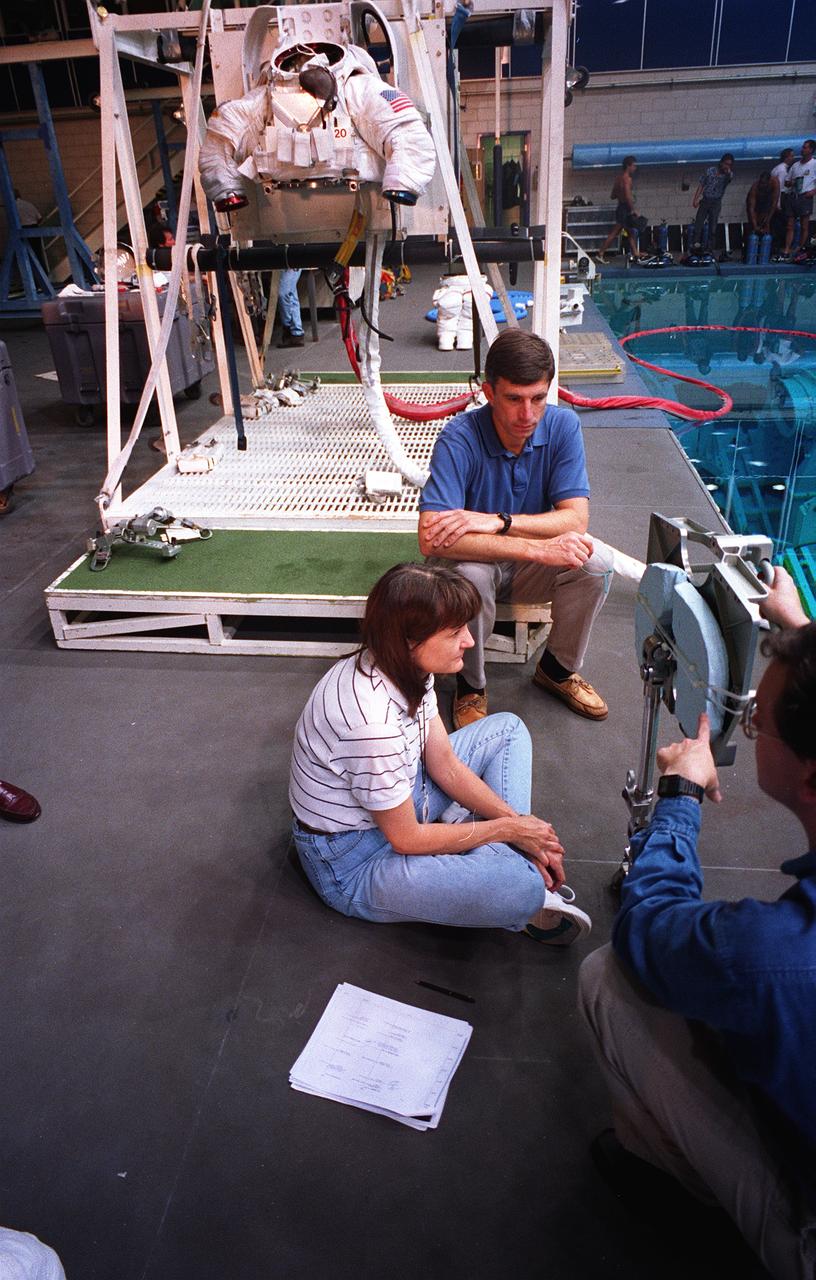
S95-21276 (September 1995) --- Astronaut Linda M. Godwin, mission specialist, is briefed on the Mobile Foot Restraint (MFR) to be used in a scheduled Extravehicular Activity (EVA) during the March mission. Astronaut Ronald M. Sega, mission specialist, looks on. Astronaut Michael R. (Rich) Clifford, mission specialist, who will join Godwin on the EVA, is out of frame. Godwin and Clifford checked out the hardware before donning training versions of the Extravehicular Mobility Unit (EMU) spacesuit (see torso piece in background) in preparation for being submerged in a 25-feet deep pool at the Johnson Space Center's (JSC) Weightless Environment Training Facility (WET-F).
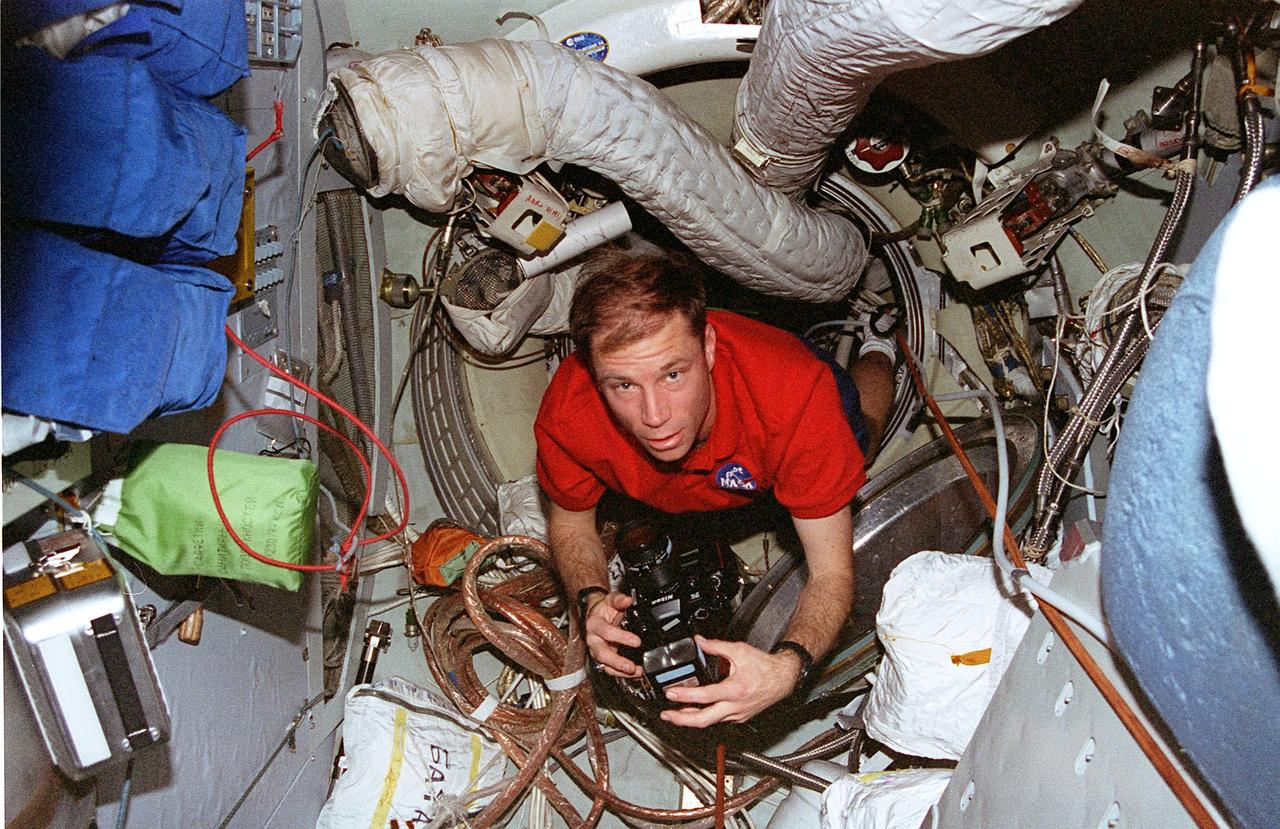
STS076-356-016 (22 - 31 March 1996) --- With camera in hand, astronaut Richard A. Searfoss, pilot, traverses the maze of modules on Russia's Mir Space Station. The photograph was taken with a 35mm camera by one of Searfoss' crew mates. The astronauts were aboard the Mir Space Station for a brief visit following the delivery of astronaut Shannon W. Lucid, cosmonaut guest researcher.
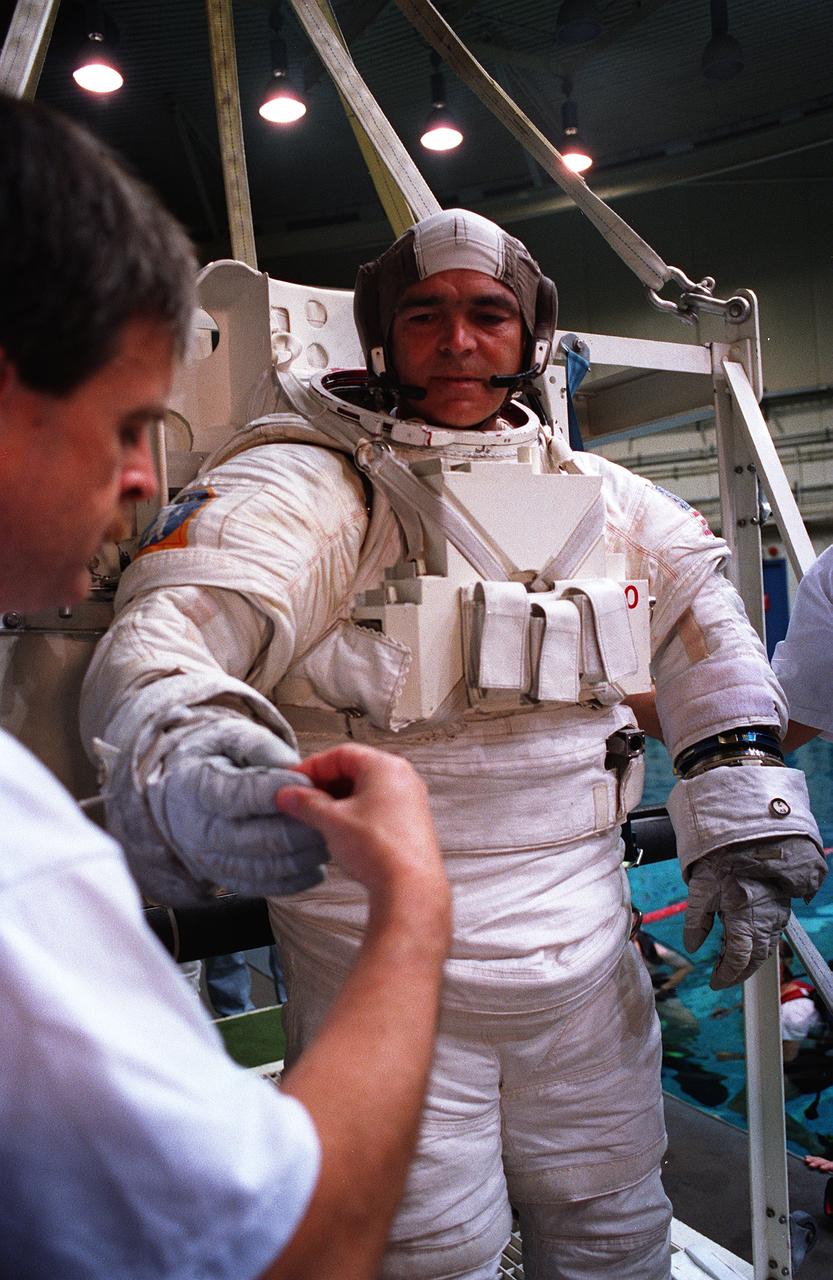
S95-21279 (September 1995) --- Astronaut Michael R. (Rich) Clifford, mission specialist, checks his gloves before being submerged in a 25-feet deep pool at the Johnson Space Center's (JSC) Weightless Environment Training Facility (WET-F). Wearing high fidelity training versions of the Extravehicular Mobility Unit (EMU) spacesuit, both Clifford and Linda M. Godwin were later simulating Extravehicular Activity (EVA) chores in the pool. Launch aboard the Space Shuttle Atlantis is scheduled for March of 1996.
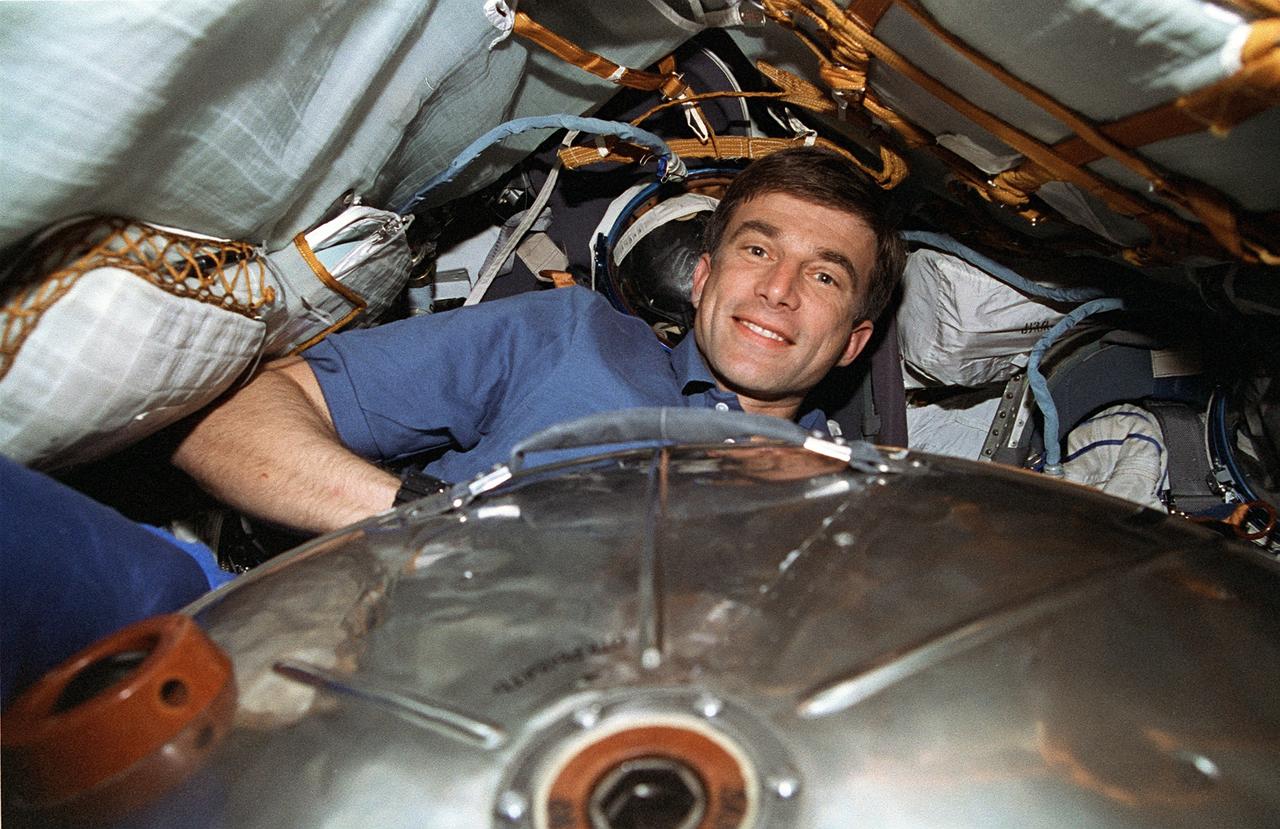
STS076-356-019 (22 - 31 March 1996) --- Astronaut Ronald M. Sega, payload commander, has removed a hatch and enters the Soyuz spacecraft, which is docked with Russia's Mir Space Station. The point of view is from the Kvant Module. The Space Shuttle Atlantis had docked, for the third time, with the Mir Space Station on March 23, 1996.
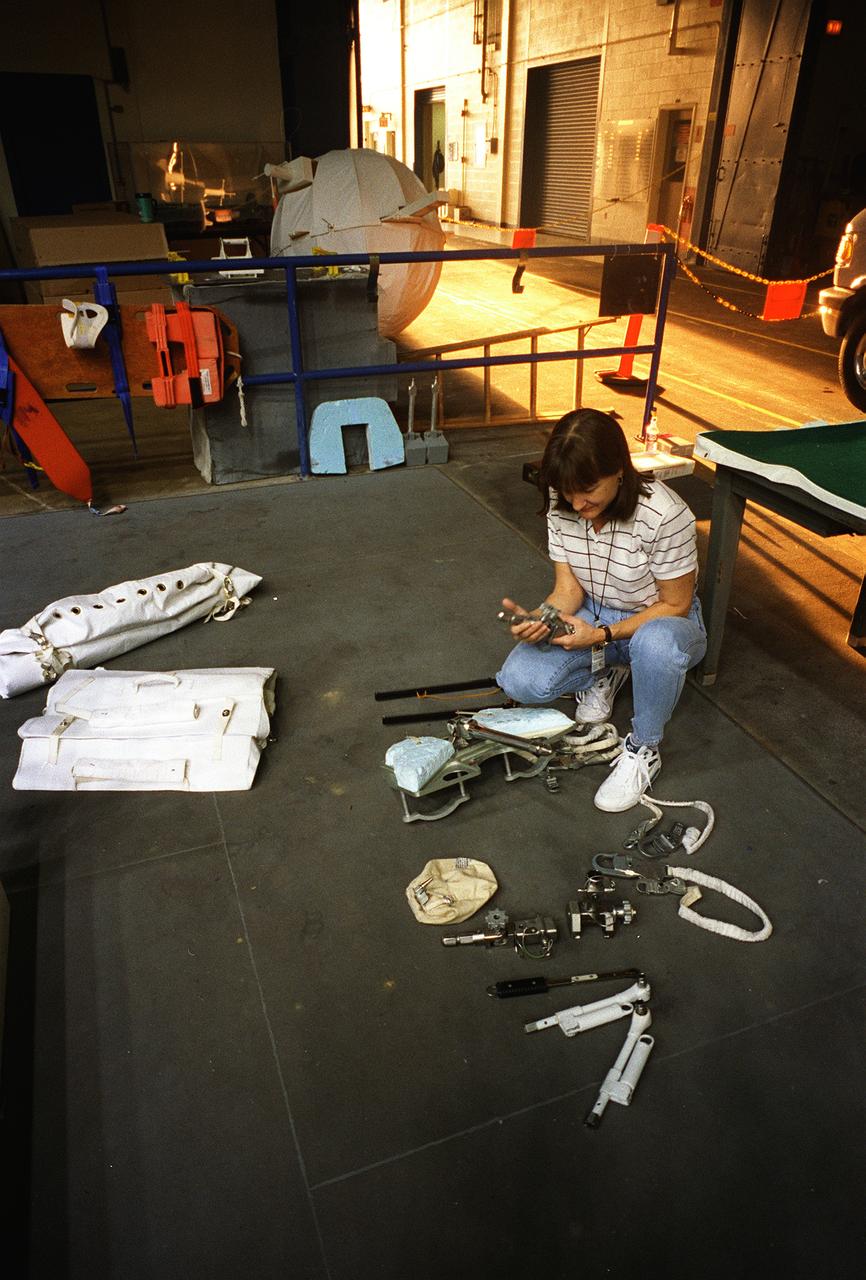
S95-21275 (September 1995) --- Astronaut Linda M. Godwin, mission specialist, checks training versions of tools to be used in a scheduled Extravehicular Activity (EVA) during the March mission. Astronaut Michael R. (Rich) Clifford, mission specialist, who will join Godwin on the EVA, is out of frame. The two checked out the hardware before donning training versions of the Extravehicular Mobility Unit (EMU) spacesuit in preparation for being submerged in a 25-feet deep pool at the Johnson Space Center's (JSC) Weightless Environment Training Facility (WET-F).
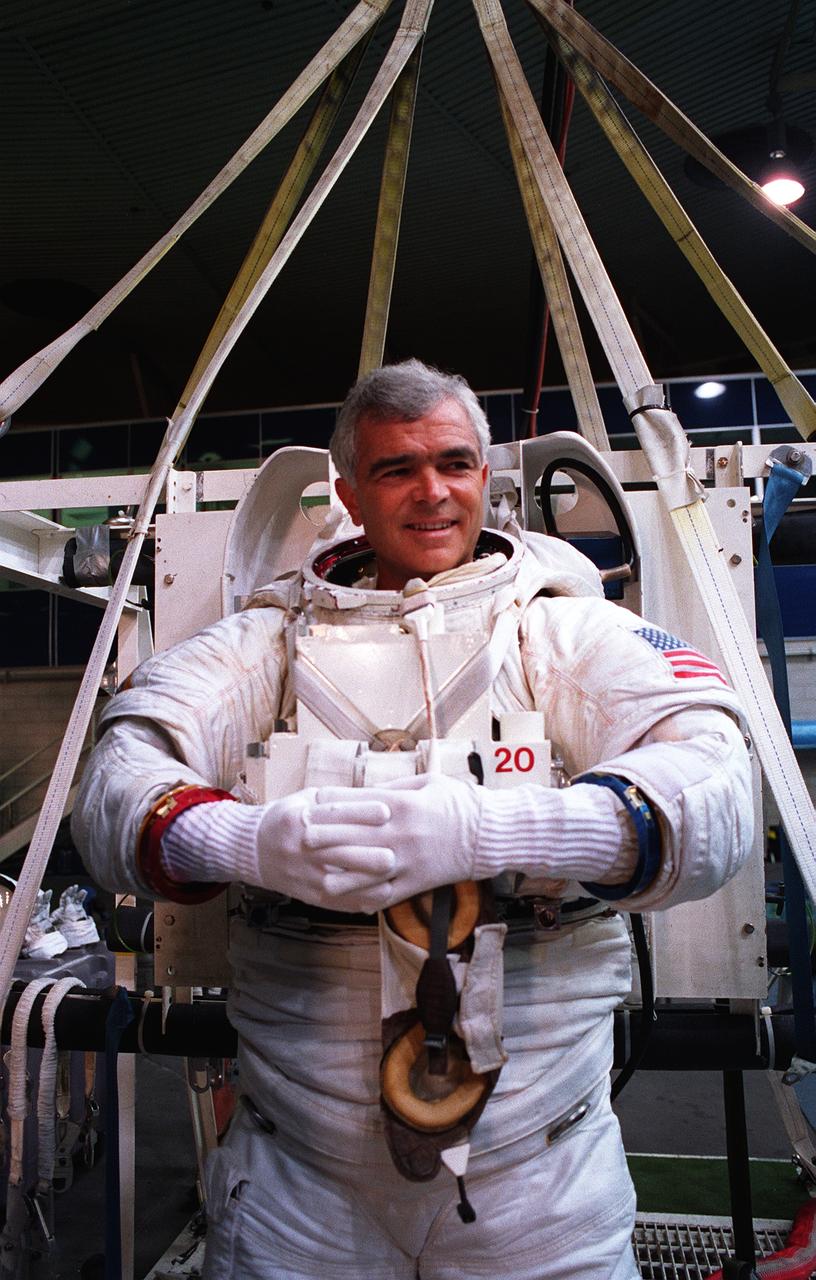
S95-21277 (September 1995) --- Astronaut Michael R. (Rich) Clifford, mission specialist, pauses before donning full suit gear in preparation for being submerged in a 25-feet deep pool at the Johnson Space Center's (JSC) Weightless Environment Training Facility (WET-F). Wearing high fidelity training versions of the Extravehicular Mobility Unit (EMU) spacesuit, both Clifford and Linda M. Godwin were later simulating Extravehicular Activity (EVA) chores in the pool. Launch aboard the Space Shuttle Atlantis is scheduled for March of 1996.
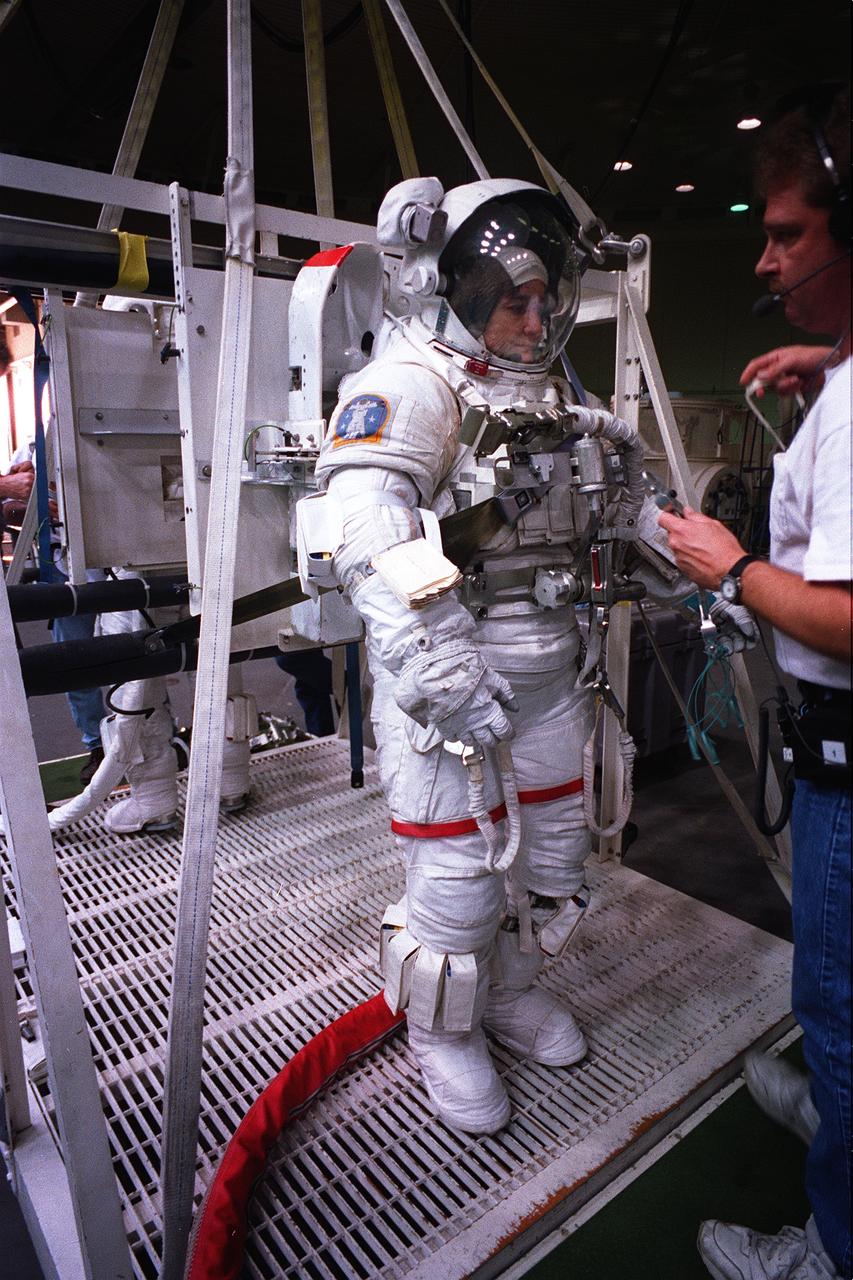
S95-21281 (September 1995) --- Astronaut Linda M. Godwin, mission specialist, makes a final check of her respiration system before being submerged in a 25-feet deep pool at the Johnson Space Center's (JSC) Weightless Environment Training Facility (WET-F). Wearing high fidelity training versions of the Extravehicular Mobility Unit (EMU) spacesuit, both Godwin and Michael R. (Rich) Clifford were later simulating Extravehicular Activity (EVA) chores in the pool. Launch aboard the Space Shuttle Atlantis is scheduled for March of 1996.
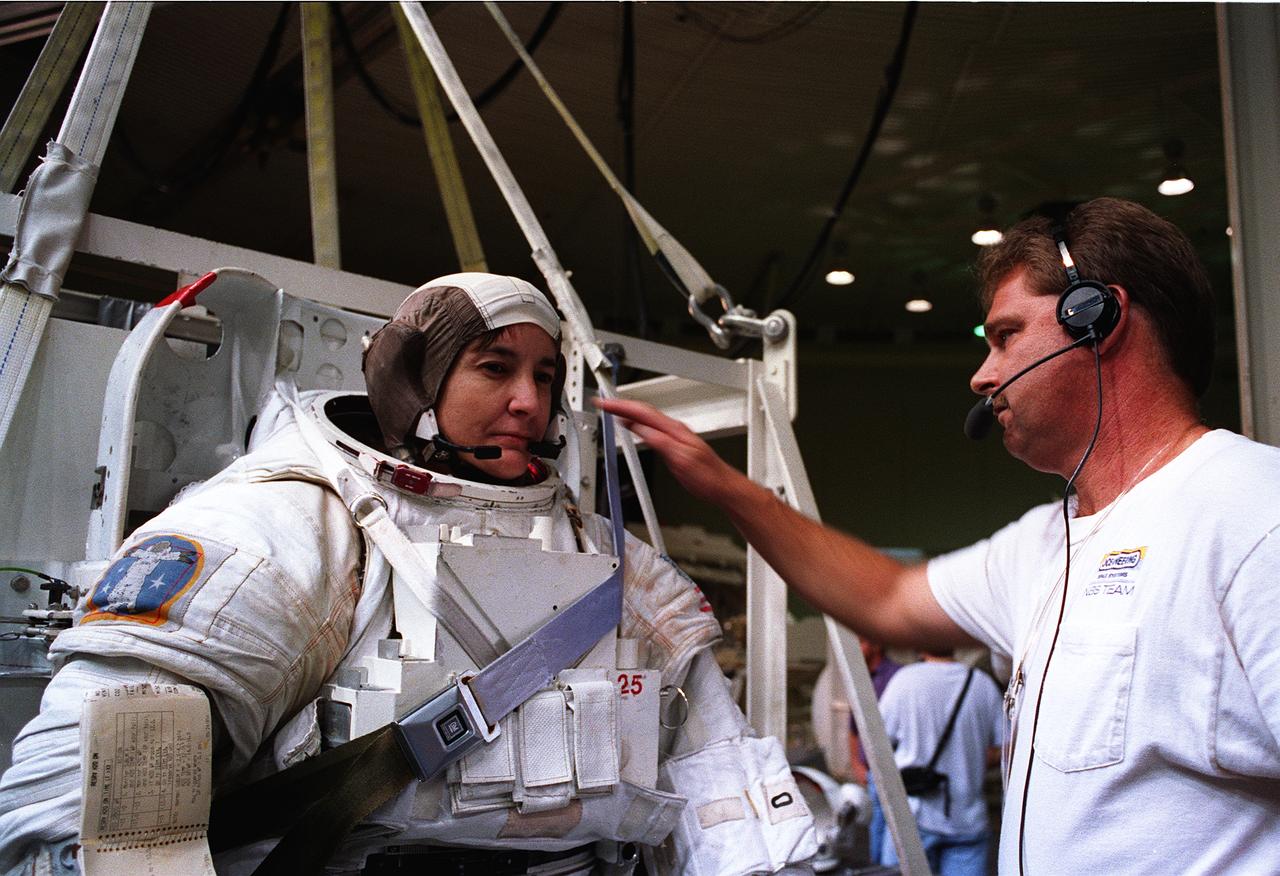
S95-21280 (September 1995) --- Astronaut Linda M. Godwin, mission specialist, checks communications systems before being submerged in a 25-feet deep pool at the Johnson Space Center's (JSC) Weightless Environment Training Facility (WET-F). Wearing high fidelity training versions of the Extravehicular Mobility Unit (EMU) spacesuit, both Godwin and Michael R. (Rich) Clifford were later simulating Extravehicular Activity (EVA) chores in the pool. Launch aboard the Space Shuttle Atlantis is scheduled for March of 1996.
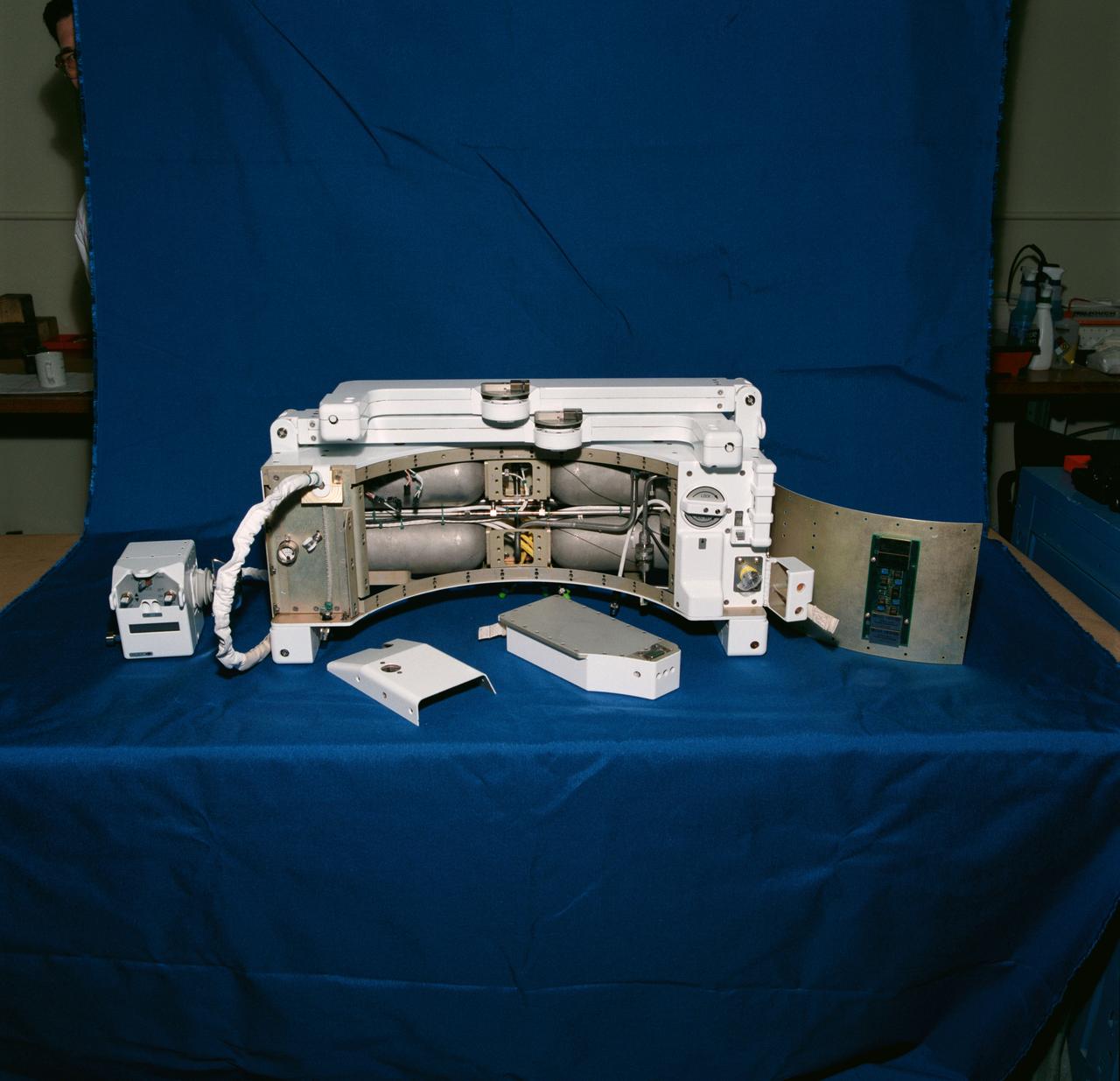
S93-50137 (December 1993) --- This small mobility-aiding back harness, complemented in extravehicular activity (EVA) with a hand controller unit and called the Simplified Aid for EVA Rescue (SAFER) system, will get extensive in-space evaluation and testing during the STS-64 mission. In this view the SAFER is open to reveal the gas supply and thrusters. SAFER is to fly on STS-76 as well.
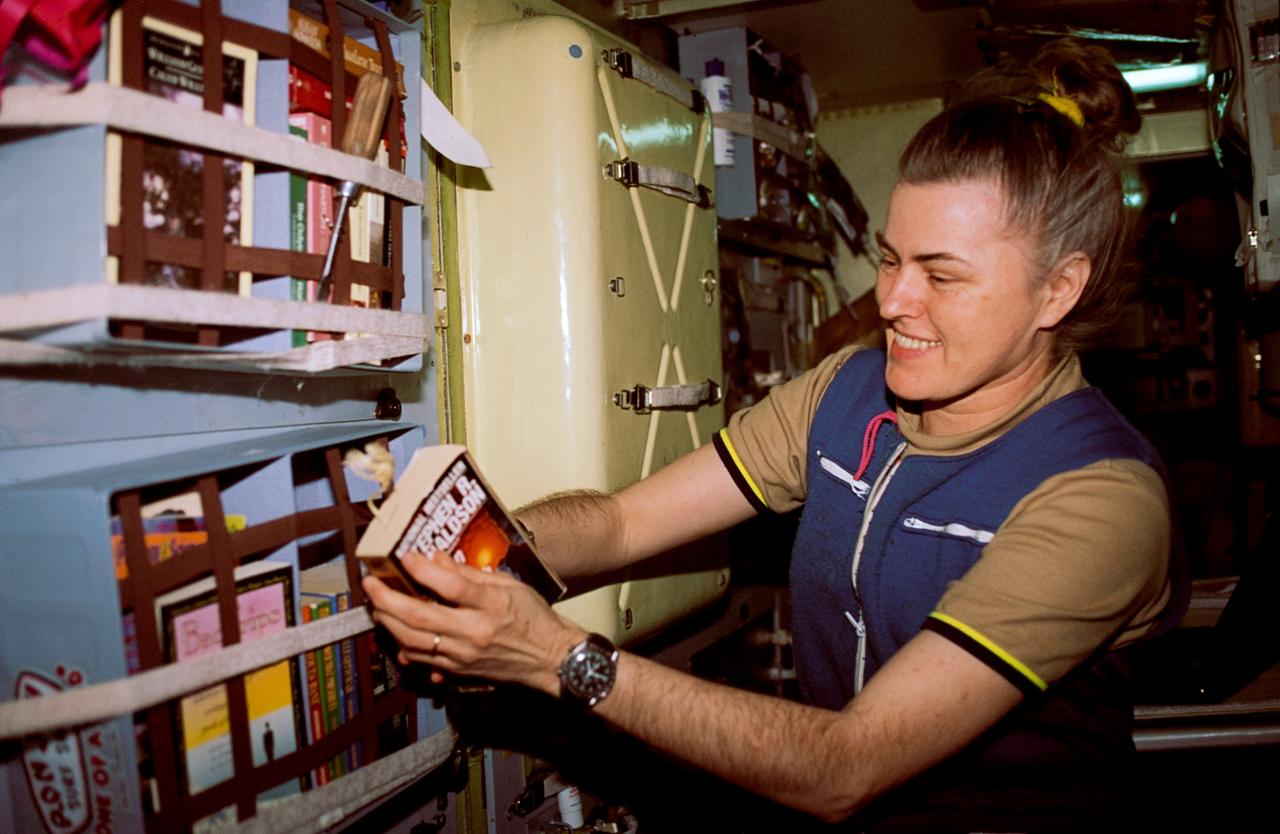
NM22-427-012 (16-26 Sept. 1996) --- During off-duty time on the Spektr Module aboard the Earth-orbiting Mir Space Station, astronaut Shannon W. Lucid, cosmonaut guest researcher, retrieves a book from her personal library. Lucid, dropped off in March by the STS-76 crew members, was nearing the end of 188 consecutive days in space before returning to Earth with the STS-79 crew. She worked with a total of five cosmonauts at various times during that stay.
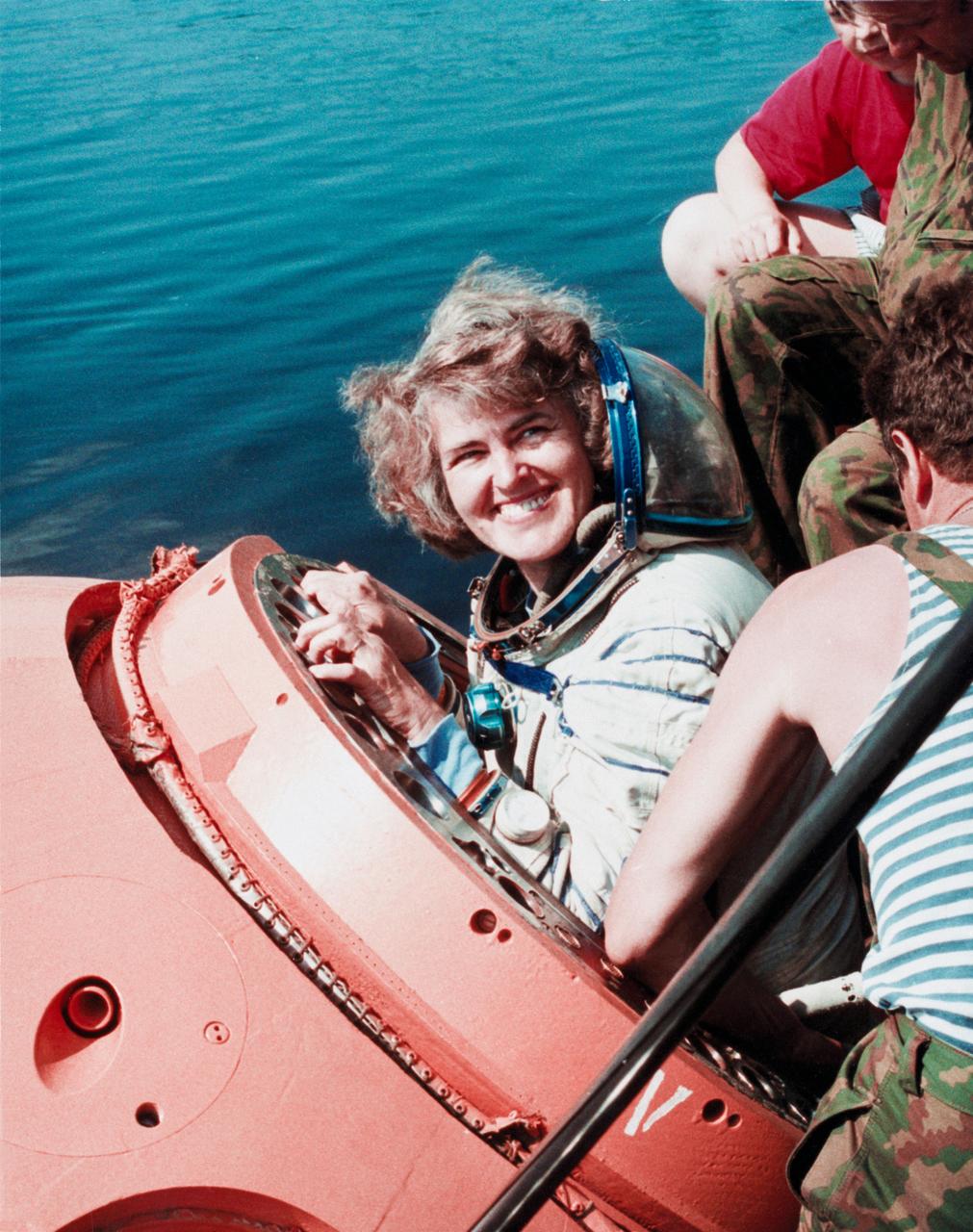
S95-21463 (August 1995) --- Astronaut Shannon W. Lucid, who will go into space in 1996 to spend time aboard Russia?s Mir Space Station, egresses from a training version of a Soyuz spacecraft, during water survival training in Russia. Lucid is to accompany the STS-76 crew in March and spend a little over four months aboard Mir before returning to Earth with the STS-79 crew.
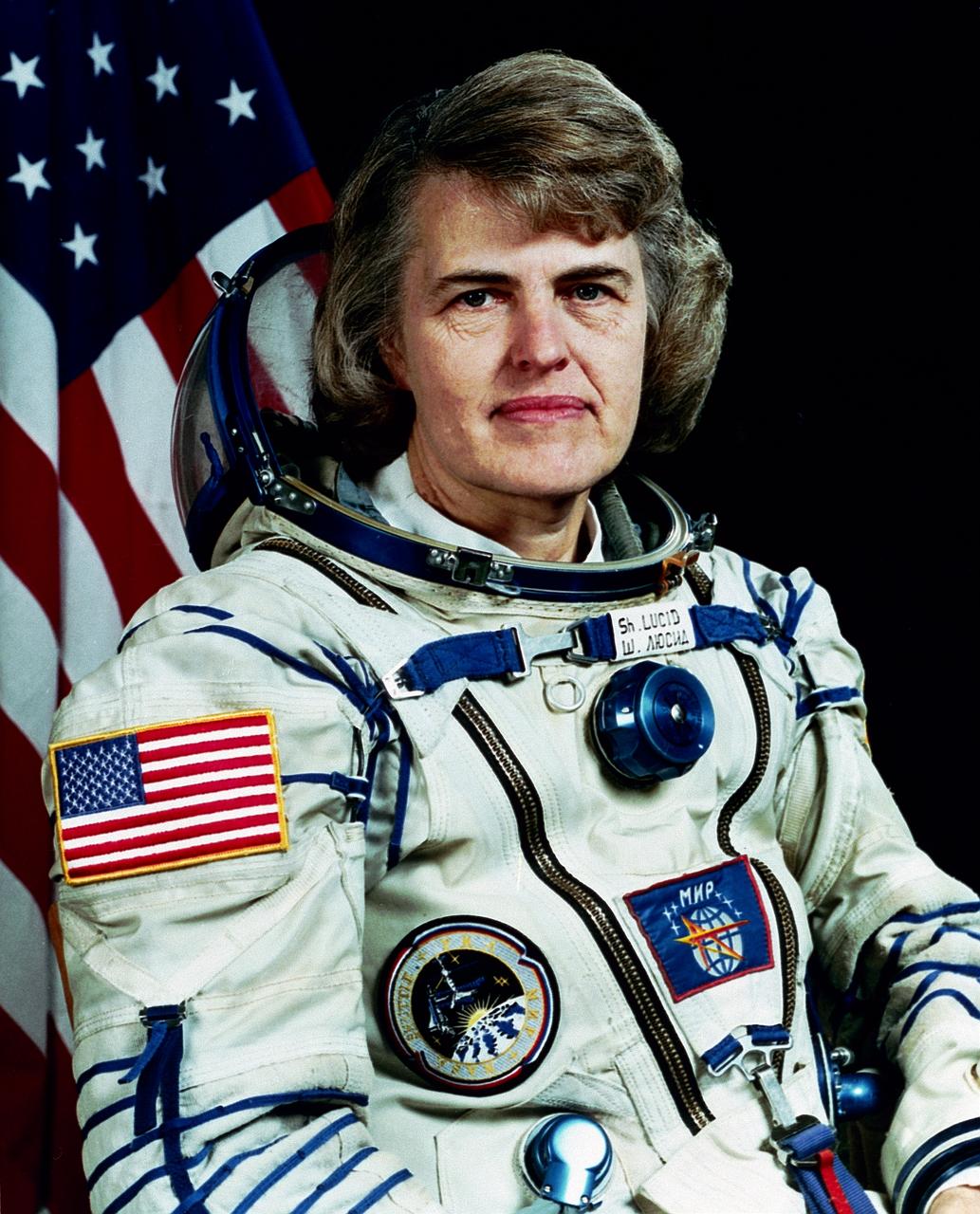
S95-21469 (December 1995) --- Astronaut Shannon W. Lucid, mission specialist, Mir 21/22 flight engineer, cosmonaut guest researcher. EDITOR'S NOTE: Astronaut Lucid will launch aboard the Space Shuttle Atlantis, STS-76 mission, to board the Russian Mir Space Station. After a long duration of cosmonaut guest research duties, she will return to Earth aboard the Space Shuttle Atlantis STS-79 mission.
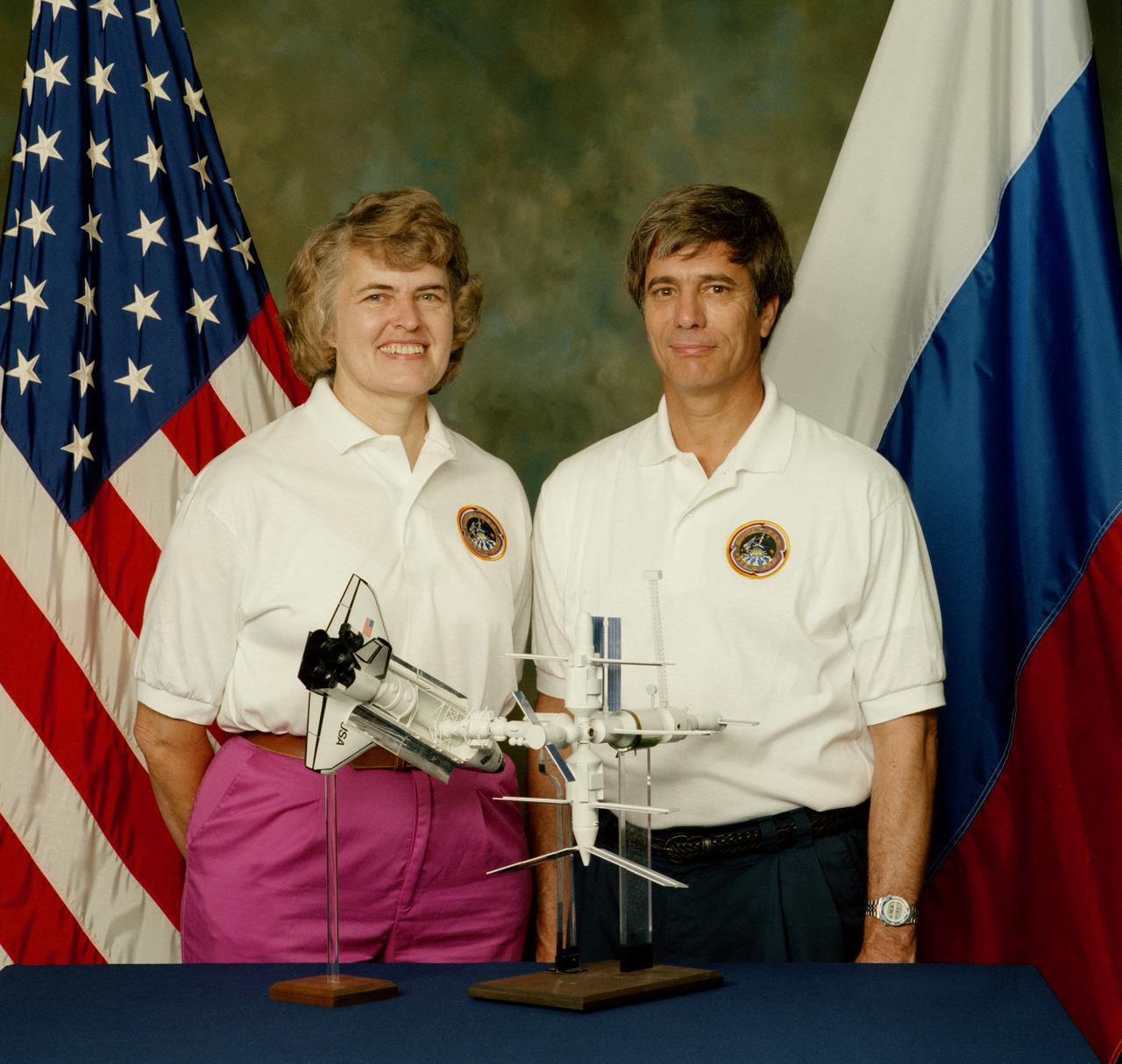
S95-16678 (September 1995) --- NASA astronauts Shannon W. Lucid and John E. Blaha next year will follow the lead of astronaut Norman E. Thagard's 1995 feat of extended stay aboard Russia's Mir Space Station. Lucid is to accompany the STS-76 crew in March and spend a little over four months aboard Mir before returning to Earth with the STS-79 crew. Blaha will go into space on the scheduled August mission of STS-79 and after four months aboard Mir will return to Earth with the STS-81 crew.
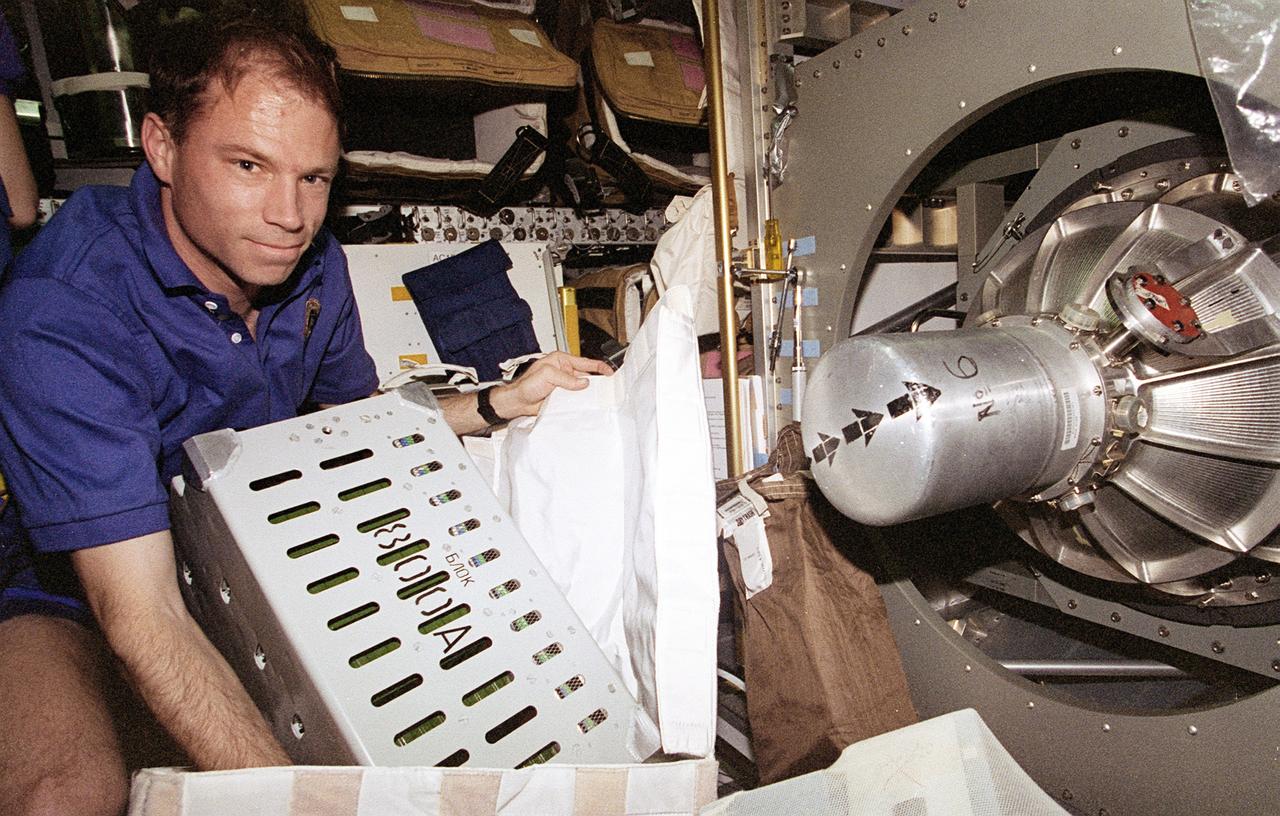
STS076-345-019 (22 - 31 March 1996) --- Onboard the Spacehab Module in the cargo bay of the Earth-orbiting Space Shuttle Atlantis, astronaut Richard A. Searfoss fetches a battery which is to be transferred to Russia's Mir Space Station. The pilot and his crew mates docked with Mir on March 23, 1996, and remained linked until March 28, 1996. At right is a stowed gyrodyne, which earlier had been replaced on Mir with a new one brought up from the ground by the STS-76 crew.
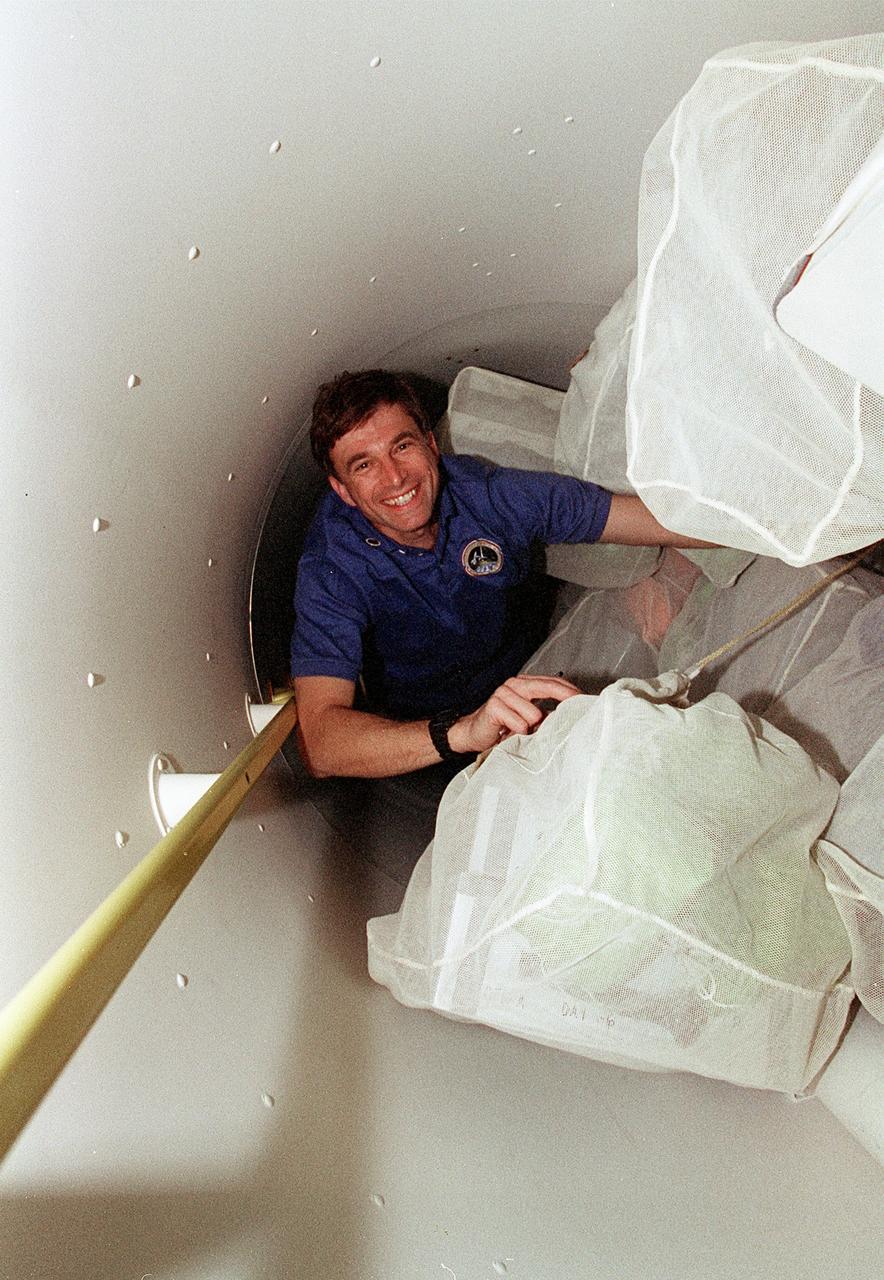
STS076-345-012 (22 - 31 March 1996) --- During the first few hours of the mission, astronaut Ronald M. Sega checks over stowed bags filled with food supplies in the STS-76 tunnel. The payload commander was one of six NASA astronauts aboard the Space Shuttle Atlantis, which later docked with Russia's Mir Space Station. The crew used a tunnel to commute to the Spacehab module and, later, to the Mir via its Docking Module (DM).
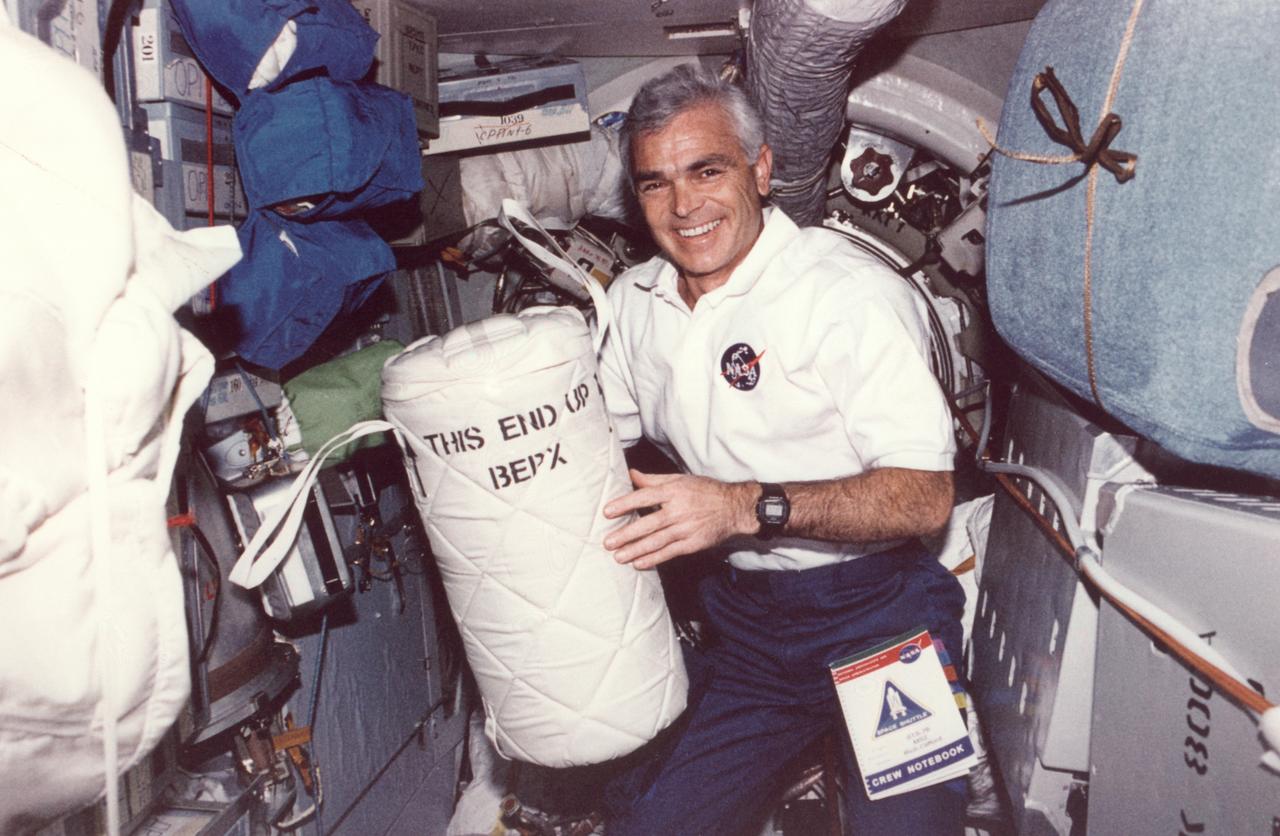
Astronaut Michael Clifford places a liquid nitrogen Dewar containing frozen protein solutions aboard Russia's space station Mir during a visit by the Space Shuttle (STS-76). The protein samples were flash-frozen on Earth and will be allowed to thaw and crystallize in the microgravity environment on Mir Space Station. A later crew will return the Dewar to Earth for sample analysis. Dr. Alexander McPherson of the University of California at Riverside is the principal investigator. Photo credit: NASA/Johnson Space Center.
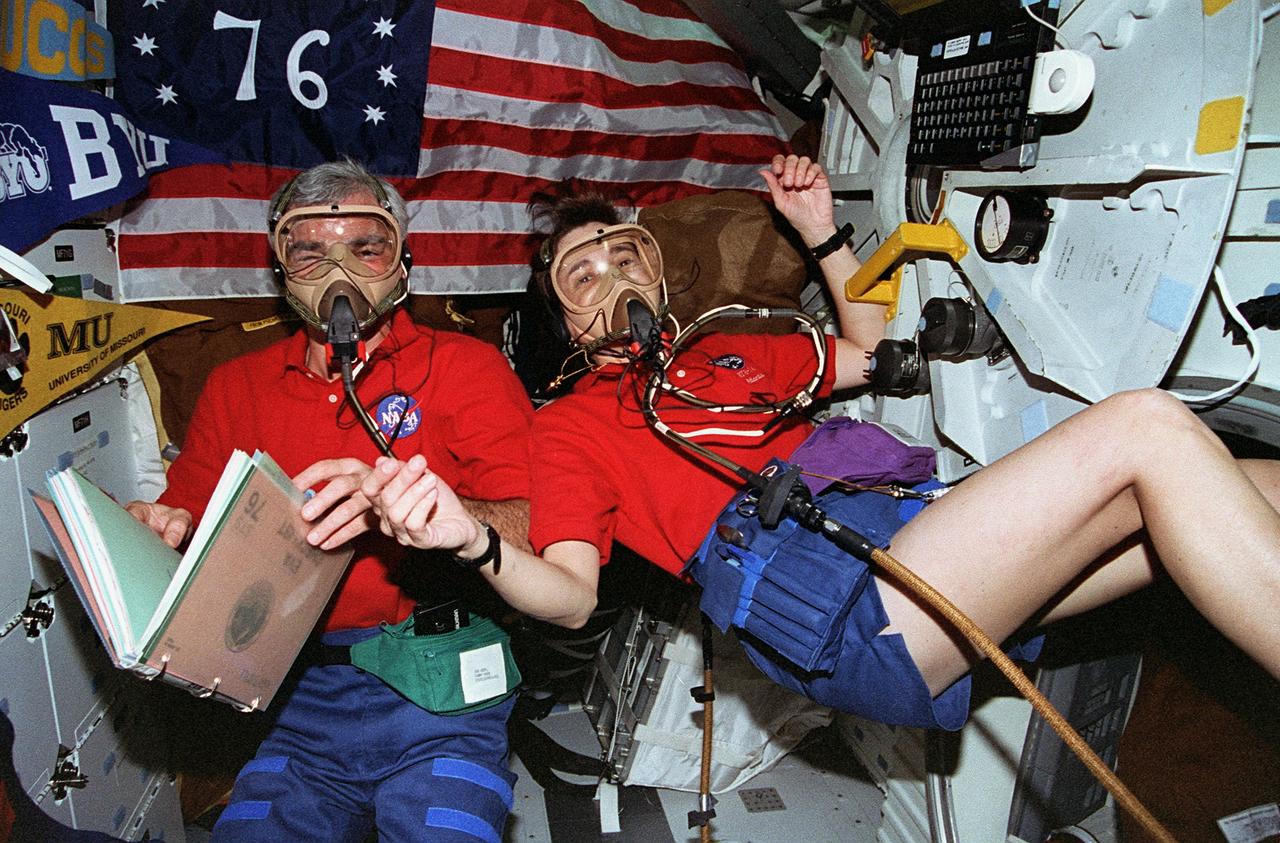
STS076-346-017 (22-31 March 1996) --- Astronauts Michael R. (Rich) Clifford and Linda M. Godwin, the assigned space-walking mission specialists for STS-76, go through a "pre-breathing" period on the Space Shuttle Atlantis' middeck. This practice is normal procedure for space-walkers in preparation for their Extravehicular Activity (EVA) and the wearing of their Extravehicular Mobility Units (EMU). The photograph was taken with a 35mm camera by one of the crew members.
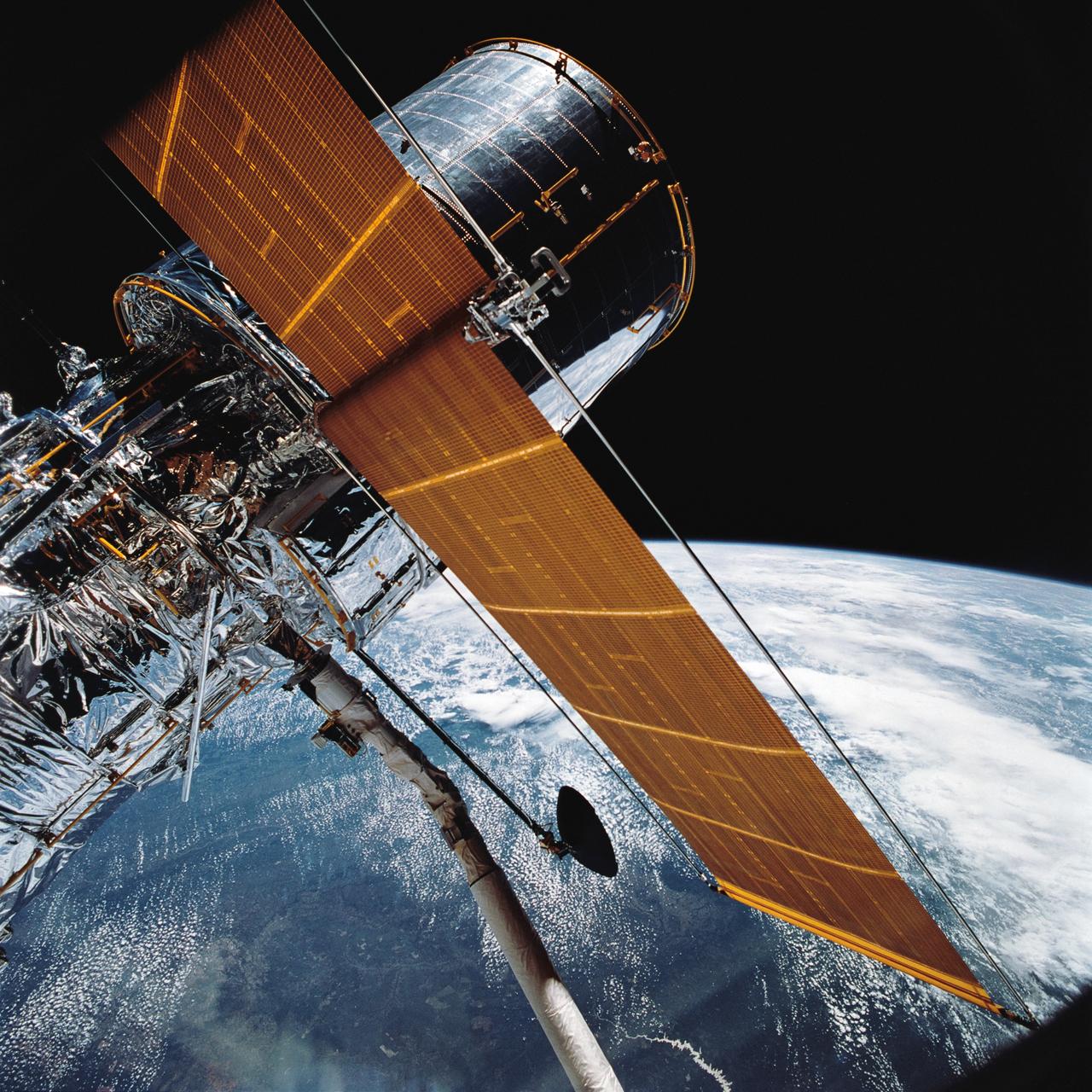
STS031-76-026 (25 April 1990) --- Most of the giant Hubble Space Telescope (HST) can be seen as it is suspended in space by Discovery's Remote Manipulator System (RMS) following the deployment of part of its solar panels and antennae. The photo was taken with a handheld Hasselblad camera. This was among the first photos NASA released on April 30, 1990, from the five-day STS 31 mission.
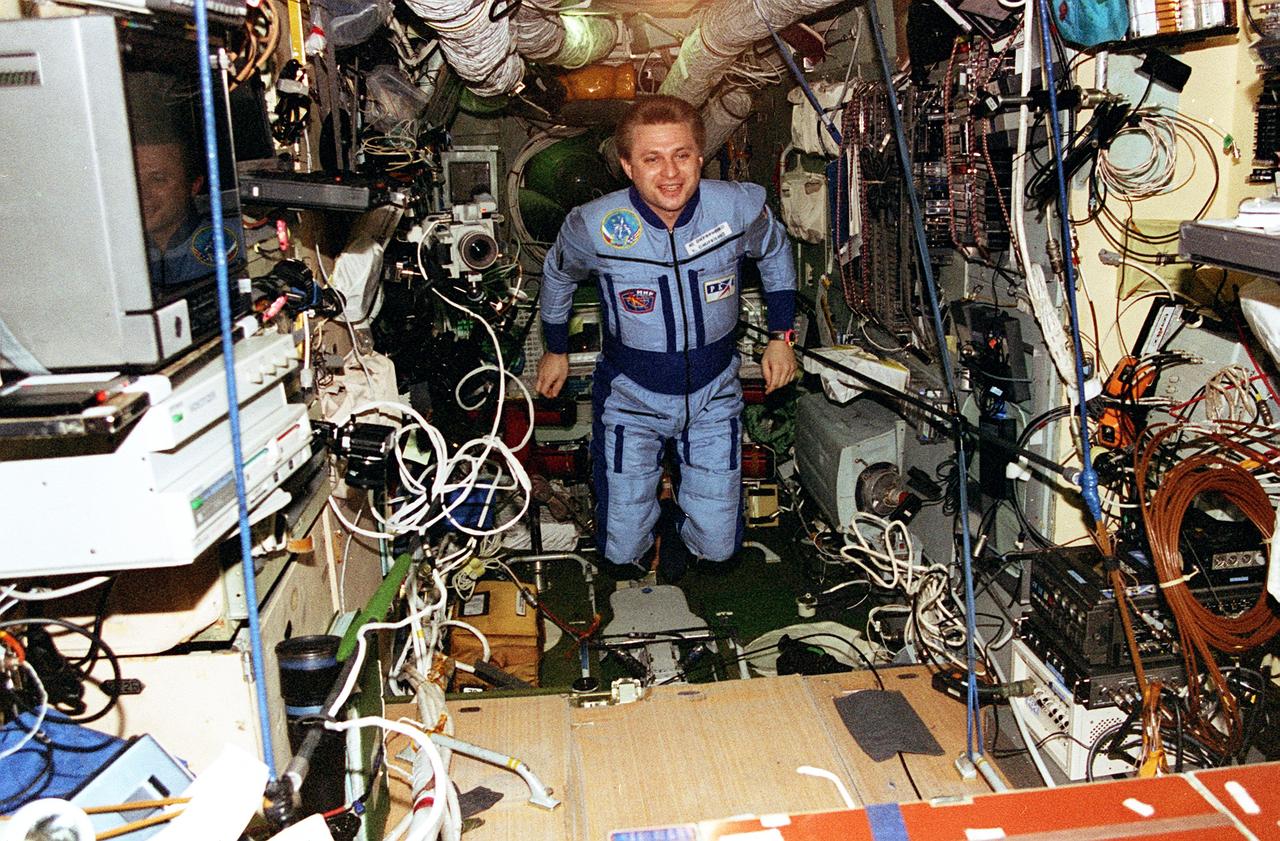
STS076-344-034 (22-31 March 1996) --- Cosmonaut Yury I. Onufrienko, commander for the Mir-21 mission, floats through the Base Block Module on Russia's Mir Space Station. The photograph was taken with a 35mm camera by one of the STS-76 Space Shuttle Atlantis crew members, aboard Mir for a brief visit following the delivery of astronaut Shannon W. Lucid, cosmonaut guest researcher, during the third docking mission.
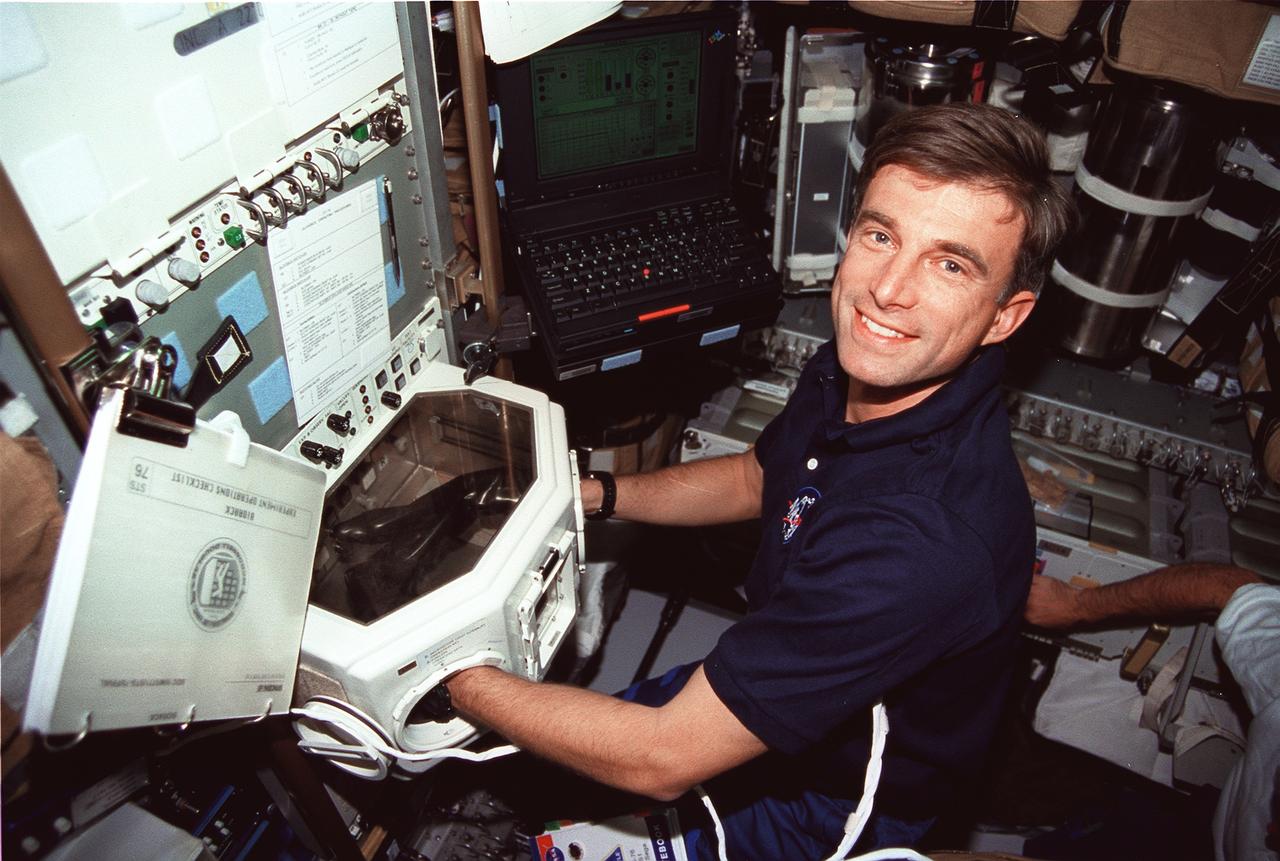
STS076-312-022 (22 - 31 March 1996) --- Astronaut Ronald M. Sega, payload commander, works in the glovebox facility in the Spacehab laboratory aboard the Earth-orbiting Space Shuttle Atlantis. The Spacehab facility was one of the busier research areas on Atlantis during the STS-76 mission. Also, some of the gear for transfer to Russia's Mir Space Station was stowed there prior to the March 23, 1996 docking of Atlantis and Mir.

S76-E-5229 (28 March 1996) --- As she floats from one spacecraft to another, astronaut Shannon W. Lucid, Mir-21 cosmonaut guest researcher, is surrounded by a large delivery of new supplies for the Mir Space Station. Today is the final day for Lucid's five STS-76 astronaut colleagues to spend time with the Mir-21 crew, as they are soon to undock the Space Shuttle Atlantis from Russia's Mir Space Station.
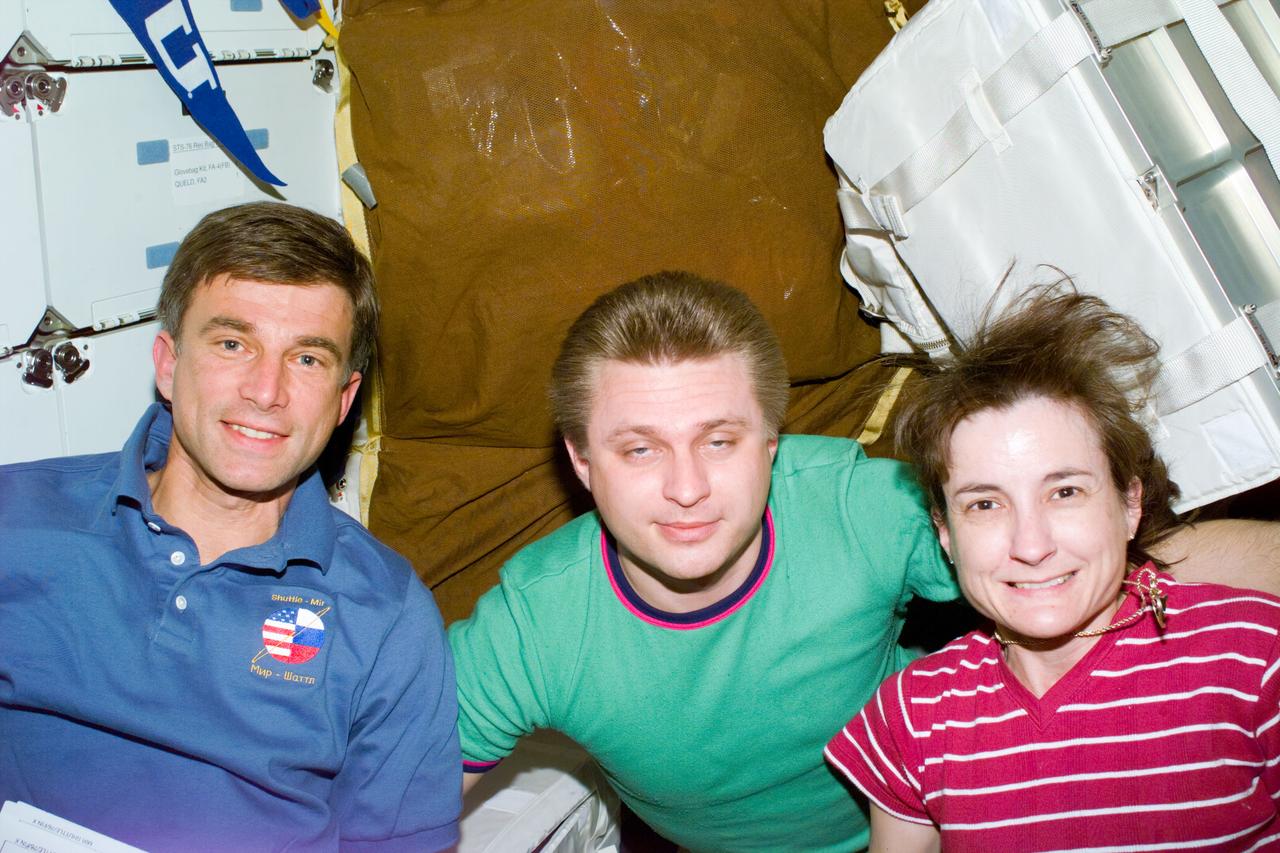
S76-E-5226 (28 March 1996) --- Astronauts Linda M. Godwin and Ronald M. Sega (left), mission specialists, pose for their final in-space photo with cosmonaut Yury I. Onufrienko, Mir-21 mission commander. The Space Shuttle Atlantis was within hours of its separation from its link with Russia's Mir Space Station. Onufrienko's crew has grown by one member, as the STS-76 crew leaves Shannon W. Lucid onboard Mir for the first leg of an almost-five-month stay.
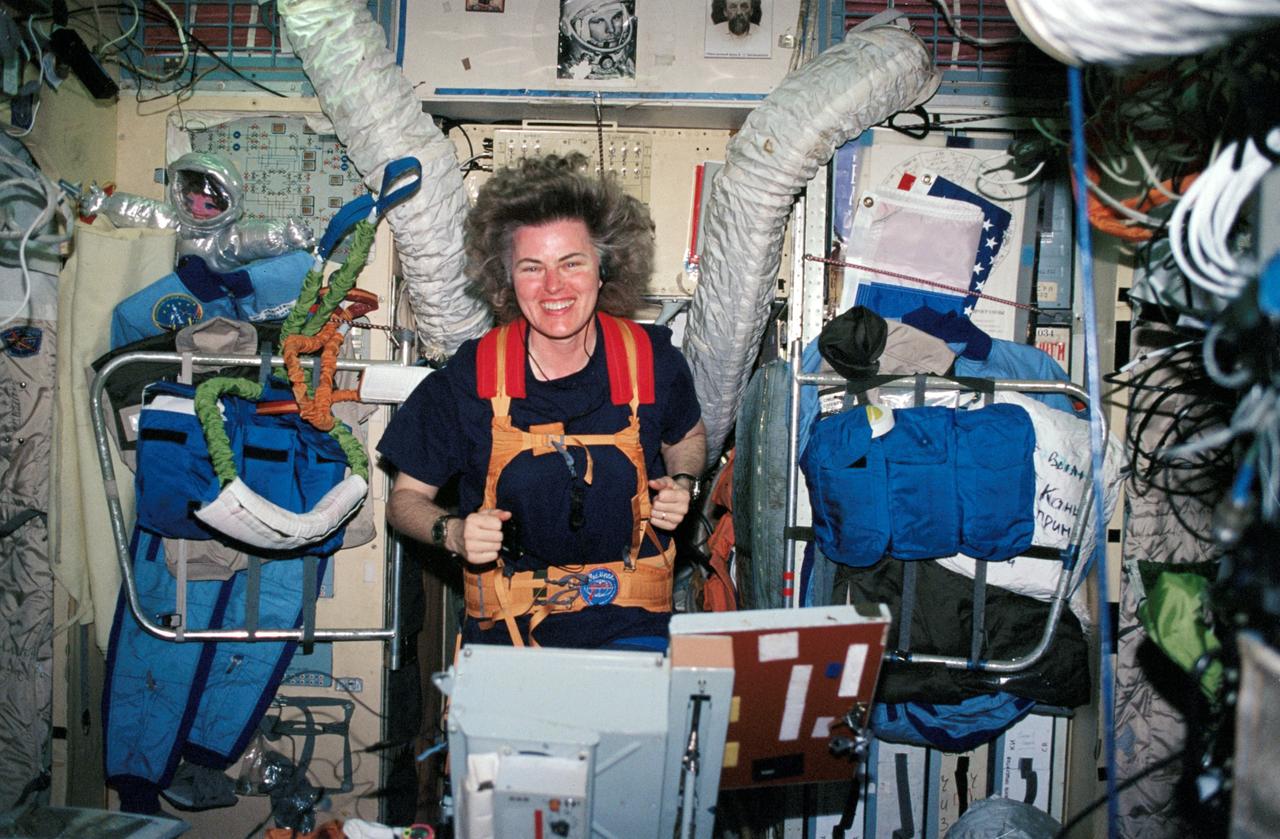
NM21-399-001 (March 1996) --- Aboard the Base Block Module on Russia’s Mir Space Station, astronaut and cosmonaut guest researcher Shannon W. Lucid works out on a treadmill device. With almost six months of a constant microgravity environment ahead of her, Lucid plans regular workouts on the device. Lucid was recently dropped off by NASA’s STS-76 crew of astronauts in the Space Shuttle Atlantis.
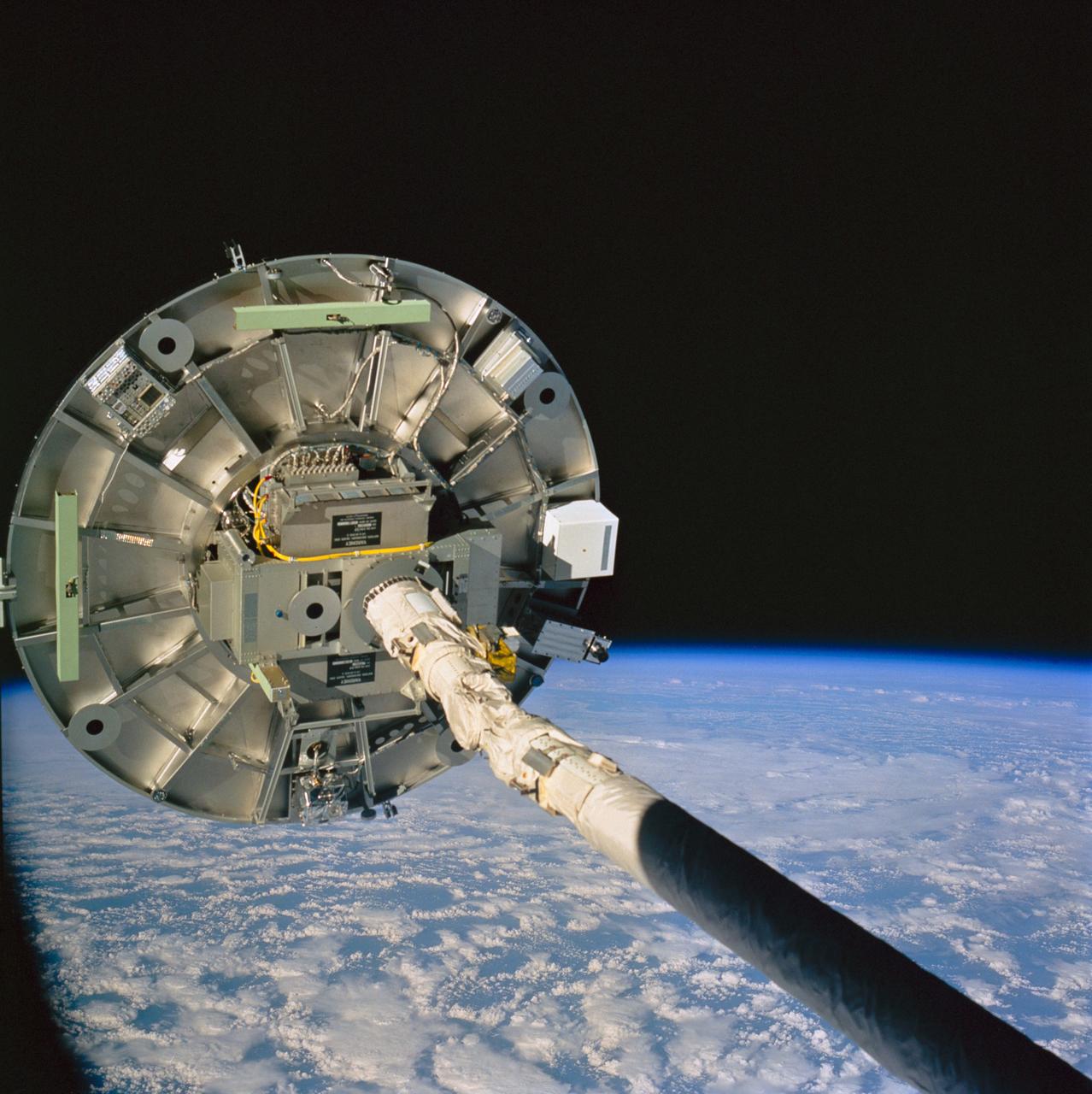
STS060-76-095 (3-11 Feb 1994) --- The ram side of the Wake Shield Facility (WSF) in the grasp of the Space Shuttle Discovery's Remote Manipulator System (RMS) arm is featured in this 70mm frame. Clouds over the Atlantic Ocean and the blackness of space share the backdrop for the picture. Five NASA astronauts and a Russian cosmonaut spent eight days in Earth orbit in support of the STS-60 mission.
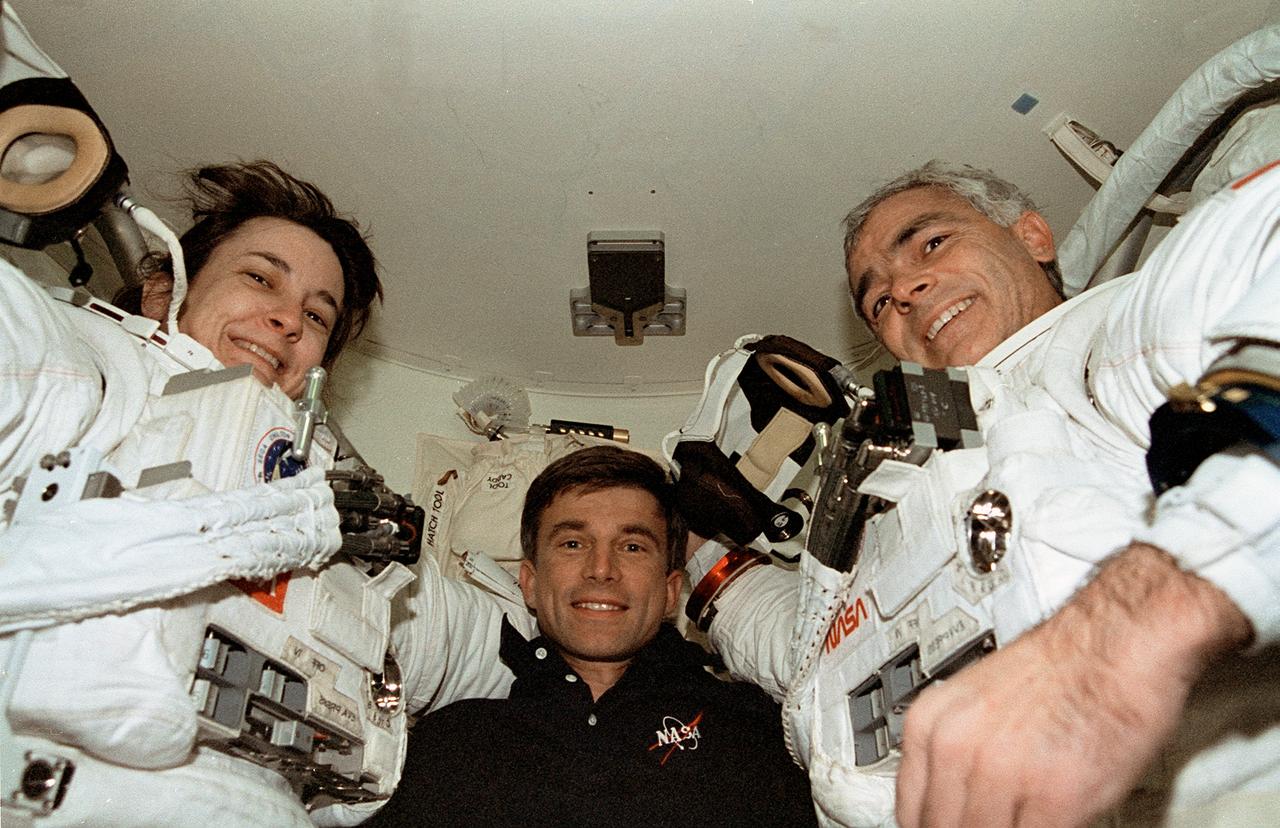
STS076-342-027 (27 March 1996) --- Astronaut Ronald M. Sega, center, shares the airlock of the Space Shuttle Atlantis with the two assigned space walkers for STS-76 - astronauts Linda M. Godwin and Michael R. (Rich) Clifford. Sega, the payload commander, assisted the two mission specialists in preparing for the first ever Extravehicular Activity (EVA) to take place while the Space Shuttle was docked with Russia's Mir Space Station.
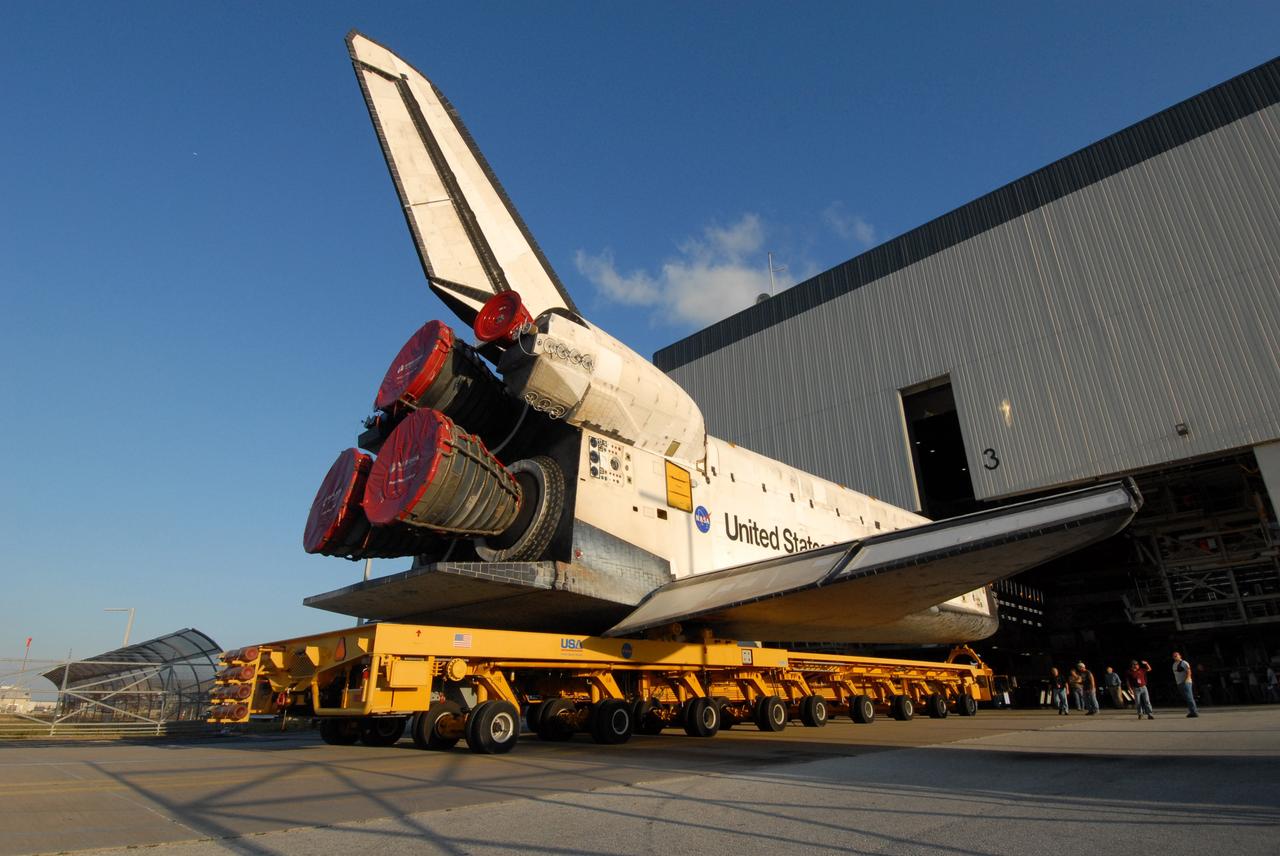
CAPE CANAVERAL, Fla. -- Space shuttle Discovery rolls away from the Orbiter Processing Facility on its 76-wheeled orbiter transporter to make the short trip to the Vehicle Assembly Building, or VAB, at NASA's Kennedy Space Center. The transporter is 106.5 feet long. In high bay 3 of the VAB, Discovery will be attached to its external fuel tank and solid rocket boosters in preparation for its upcoming STS-124 mission to the International Space Station. On the mission, the STS-124 crew will transport the Japanese Experiment Module - Pressurized Module and the Japanese Remote Manipulator System to the space station. Launch of Discovery is targeted for May 31. Photo credit: NASA/Troy Cryder
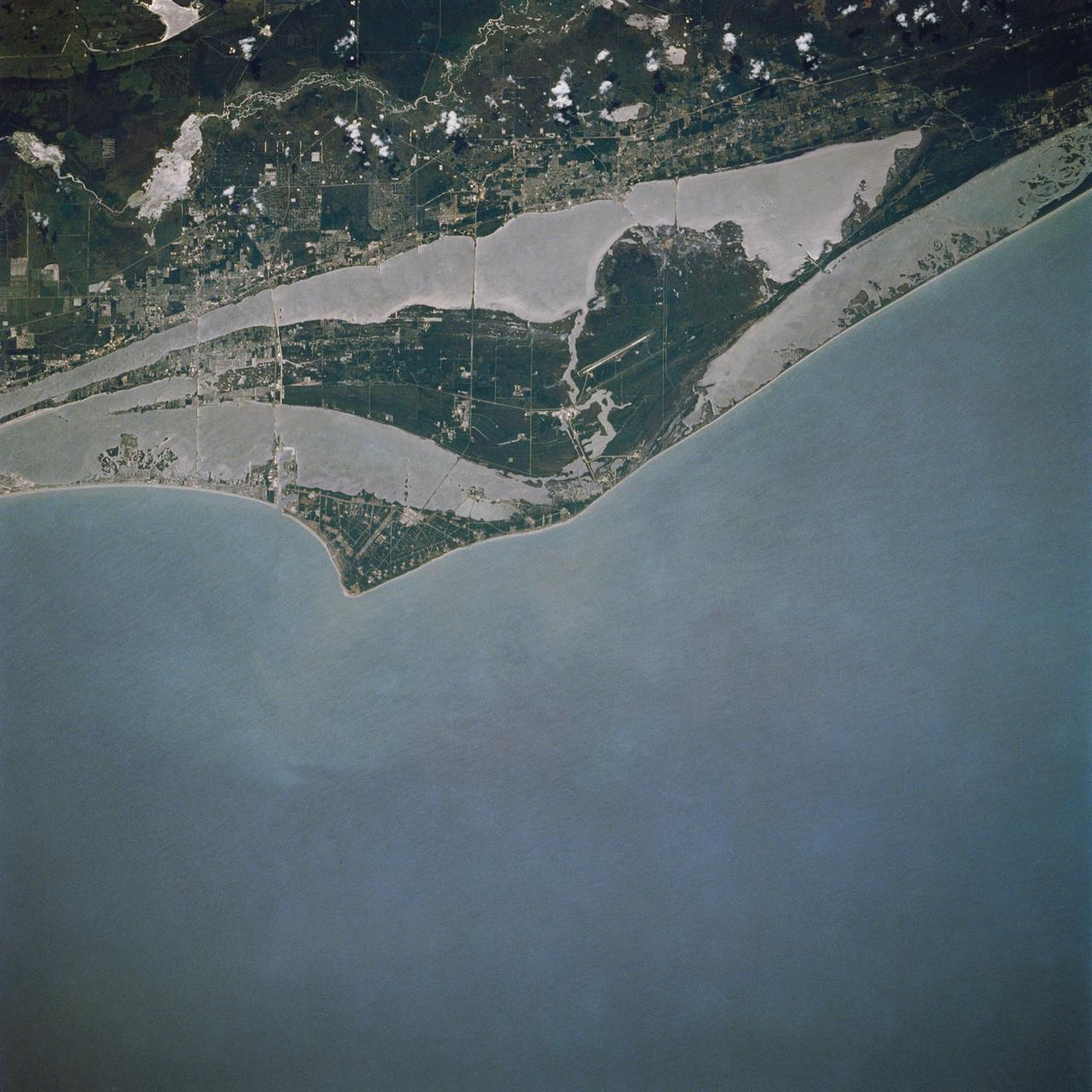
STS030-76-042 (4-8 May 1989) --- For two decades, astronauts have been photographing their launching area from space, but in terms of sharpness and clarity, NASA photo experts feel, few rival this STS-30 vertical scene over the Cape Canaveral area. Sprinkled along the jutting cape feature are a number of launching pads of Kennedy Space Center, and nearby is seen the Shuttle landing facility. Titusville can be seen just above center on the north; Cocoa, Cocoa Beach and Merritt Island are south, near bottom of the frame. St. Johns, Banana and Indian Rivers are easily traced as well.
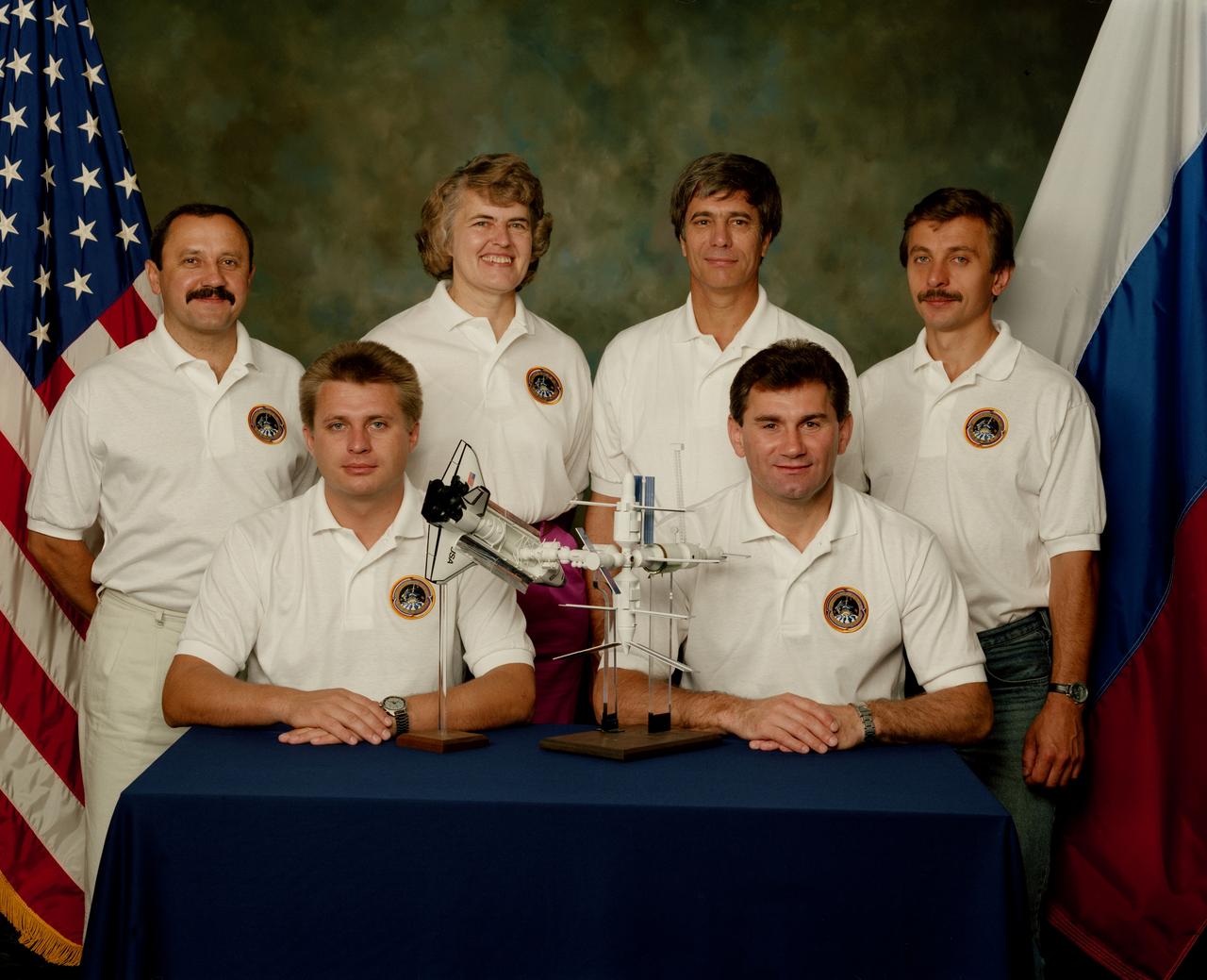
S95-16674 (14 July 1995) --- On the left is the Mir-21 crew consisting of cosmonaut Yuriy V. Usachov (standing), flight engineer; Yuriy I. Onufriyenko (seated), commander; and Shannon W. Lucid, cosmonaut guest researcher. On the right side is the Mir-23 crew consisting of John E. Blaha (standing), cosmonaut guest researcher; Vasili V. Tsibliyev (seated), commander; and Aleksandr I. Lazutkin, flight engineer. NASA astronauts Lucid and Blaha each will go into space to board Russia's Mir Space Station for lengthy research on their respective missions. Lucid will board the Mir during the STS-76 mission. Blaha will replace Lucid onboard the Mir during the STS-79 mission.
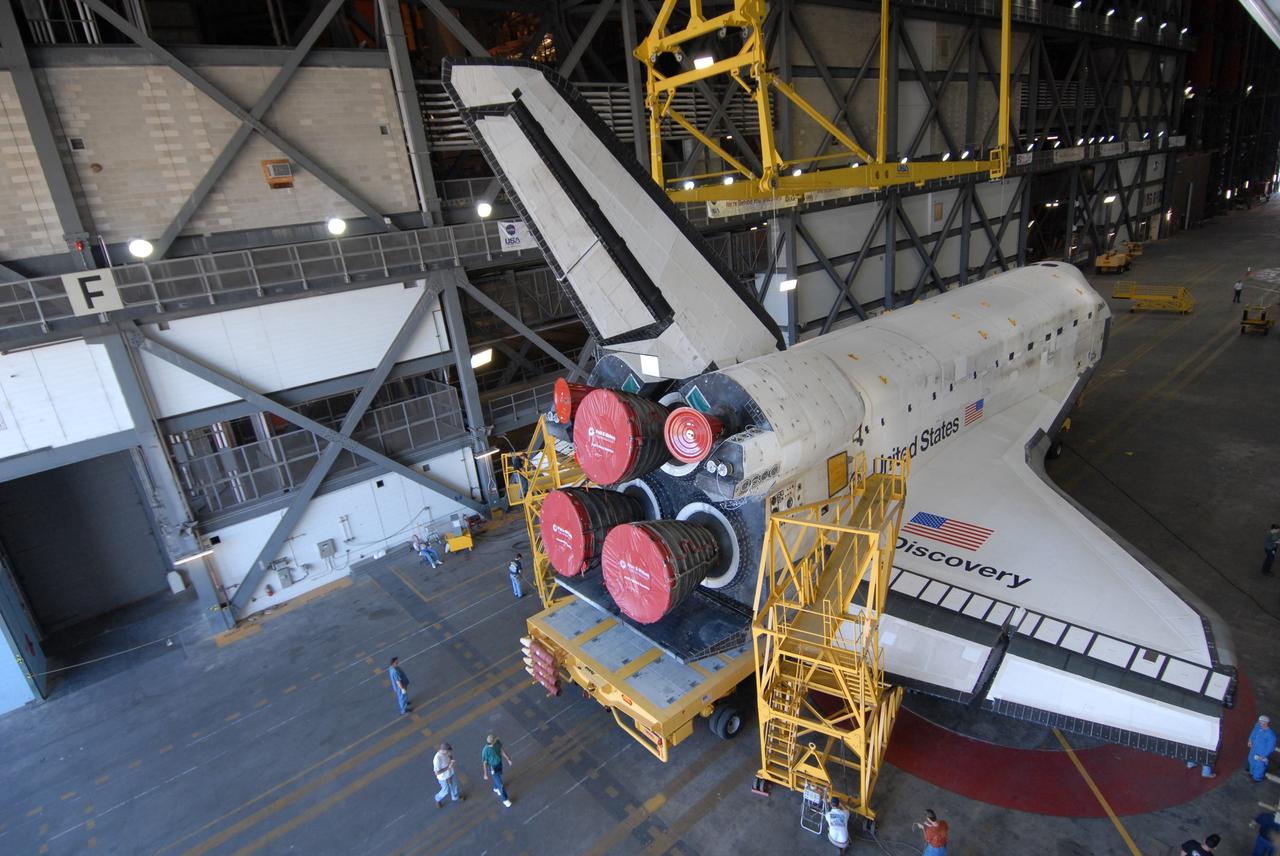
CAPE CANAVERAL, Fla. -- Still on its 76-wheeled orbiter transporter, space shuttle Discovery rests in the transfer aisle of the Vehicle Assembly Building at NASA's Kennedy Space Center. Discovery will be raised from the transporter to a vertical position and lifted into high bay 3. In the bay it will be attached to its external fuel tank and solid rocket boosters in preparation for its upcoming STS-124 mission to the International Space Station. On the mission, the STS-124 crew will transport the Japanese Experiment Module - Pressurized Module and the Japanese Remote Manipulator System to the space station. Launch of Discovery is targeted for May 31. Photo credit: NASA/Troy Cryder
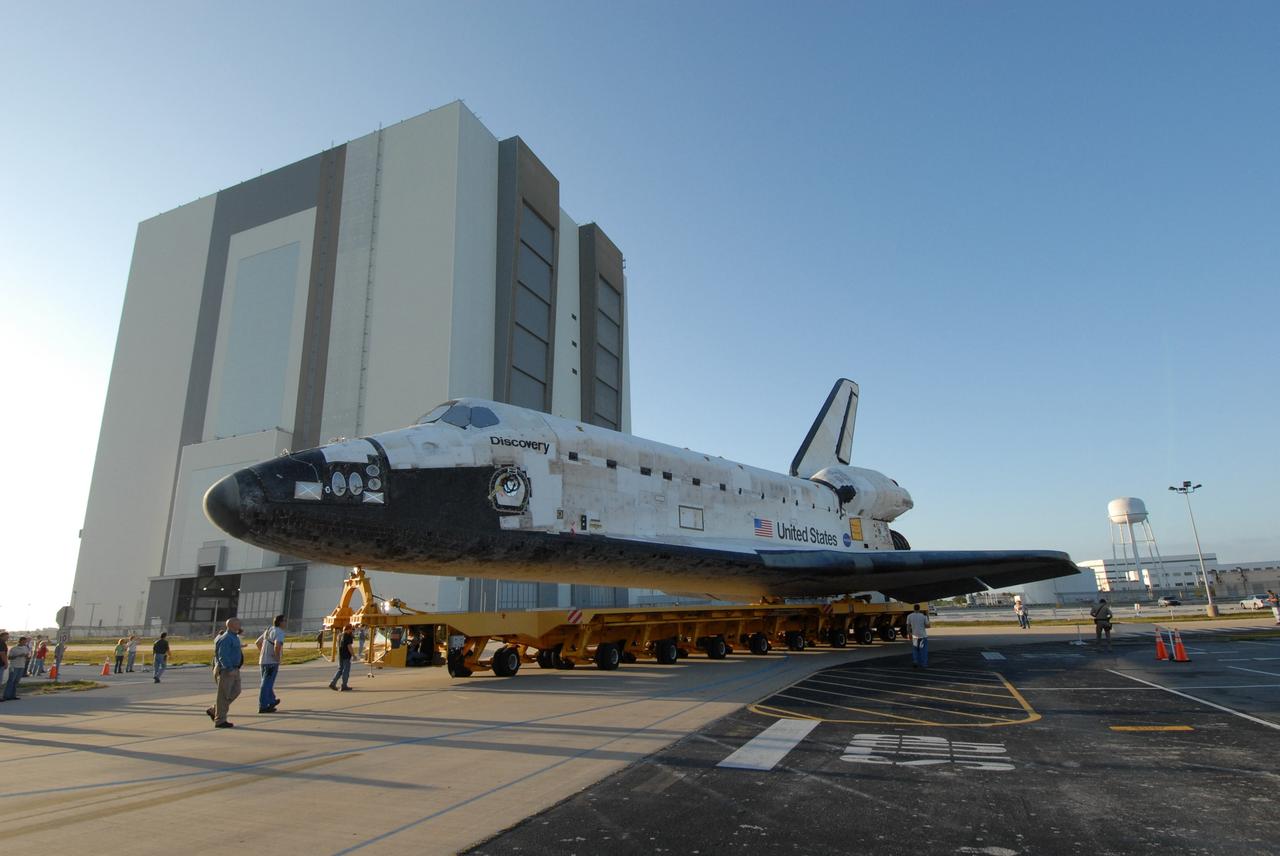
CAPE CANAVERAL, Fla. -- Towed on its 76-wheeled orbiter transporter, space shuttle Discovery begins its turn away from the Orbiter Processing Facility to roll over to the Vehicle Assembly Building, or VAB, at NASA's Kennedy Space Center. In high bay 3 of the VAB, Discovery will be attached to its external fuel tank and solid rocket boosters in preparation for its upcoming STS-124 mission to the International Space Station. On the mission, the STS-124 crew will transport the Japanese Experiment Module - Pressurized Module and the Japanese Remote Manipulator System to the space station. Launch of Discovery is targeted for May 31. Photo credit: NASA/Troy Cryder

CAPE CANAVERAL, Fla. -- Inside the Orbiter Processing Facility, space shuttle Discovery is ready for the rollover to the Vehicle Assembly Building, or VAB, at NASA's Kennedy Space Center. It rests on the orbiter transporter system, which has 76 wheels and measures 106.5 feet long. In high bay 3 of the VAB, Discovery will be attached to its external fuel tank and solid rocket boosters in preparation for its upcoming STS-124 mission to the International Space Station. On the mission, the STS-124 crew will transport the Japanese Experiment Module - Pressurized Module and the Japanese Remote Manipulator System to the space station. Launch of Discovery is targeted for May 31. Photo credit: NASA/Troy Cryder
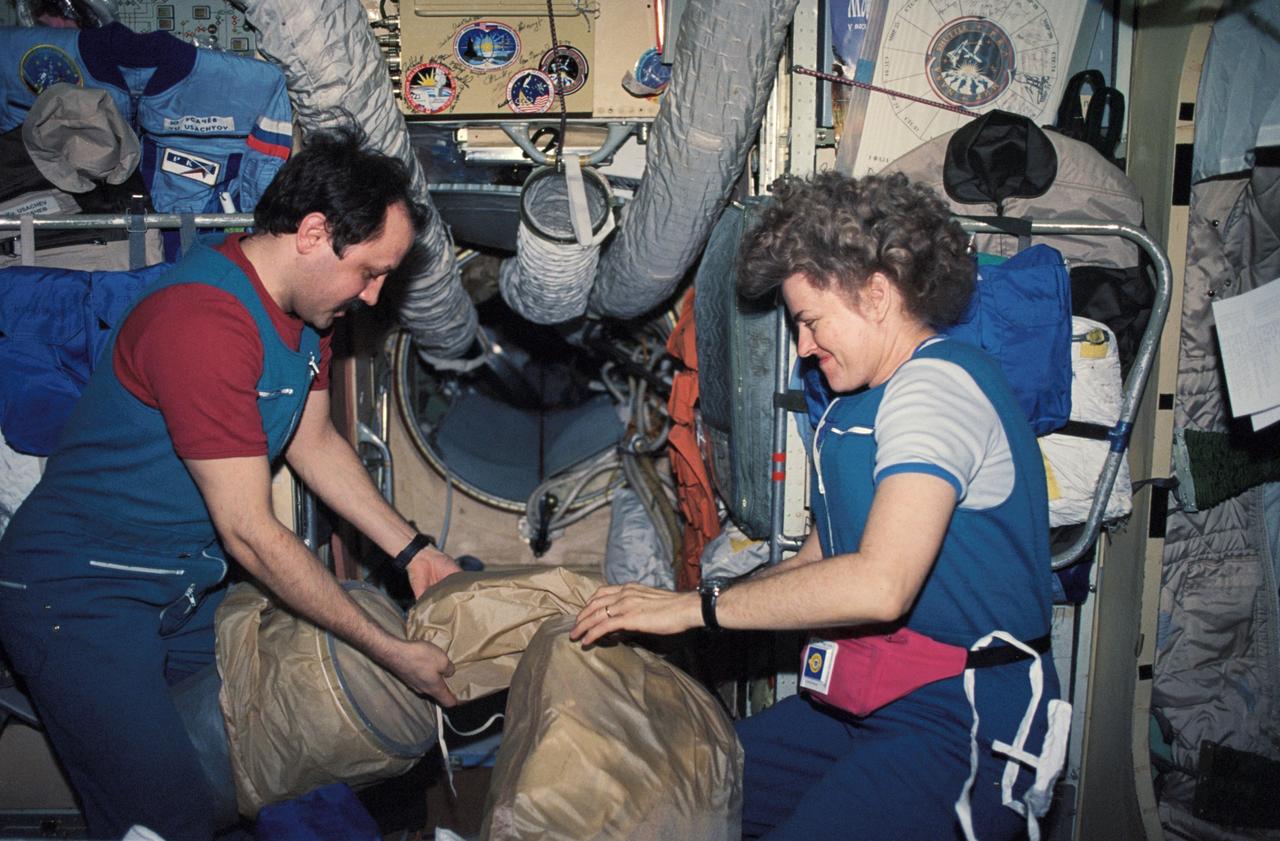
NM21-386-024 (March 1996) --- Onboard the Base Block Module of Russia’s Mir Space Station, as two members of the Mir-21 crew prepare to move supplies to their proper stowage places. Astronaut Shannon W. Lucid, recently dropped off by the STS-76 Space Shuttle Atlantis crew members and now serving as a cosmonaut guest researcher, works with Yury V. Usachev, flight engineer. She went on to spend a total of 188 consecutive days in space before returning to Earth with the STS-79 crew. She worked with a total of five cosmonauts at various times during that stay.
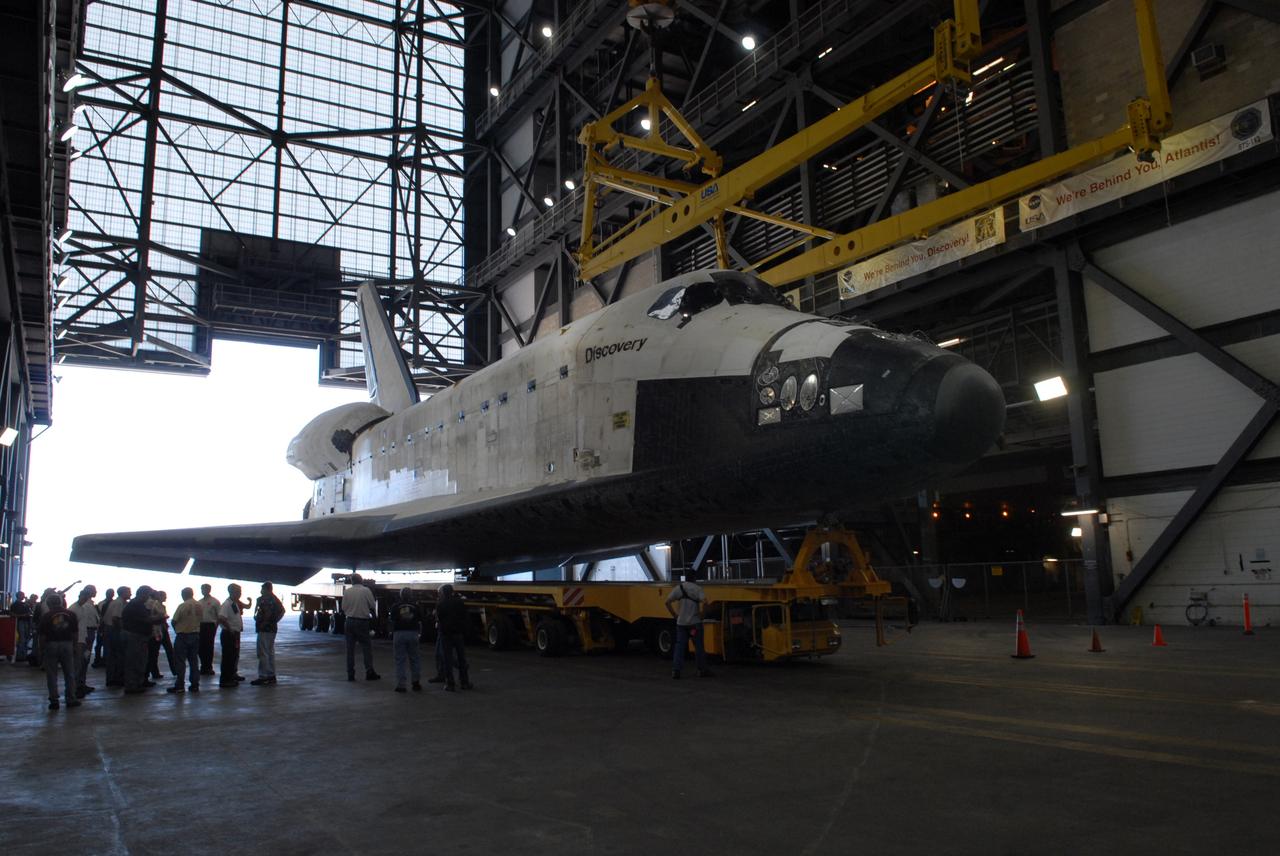
CAPE CANAVERAL, Fla. -- Towed on its 76-wheeled orbiter transporter, space shuttle Discovery rolls into the transfer aisle of the Vehicle Assembly Building at NASA's Kennedy Space Center. Discovery will be raised to vertical and lifted into high bay 3 for attachment to its external fuel tank and solid rocket boosters in preparation for its upcoming STS-124 mission to the International Space Station. On the mission, the STS-124 crew will transport the Japanese Experiment Module - Pressurized Module and the Japanese Remote Manipulator System to the space station. Launch of Discovery is targeted for May 31. Photo credit: NASA/Troy Cryder
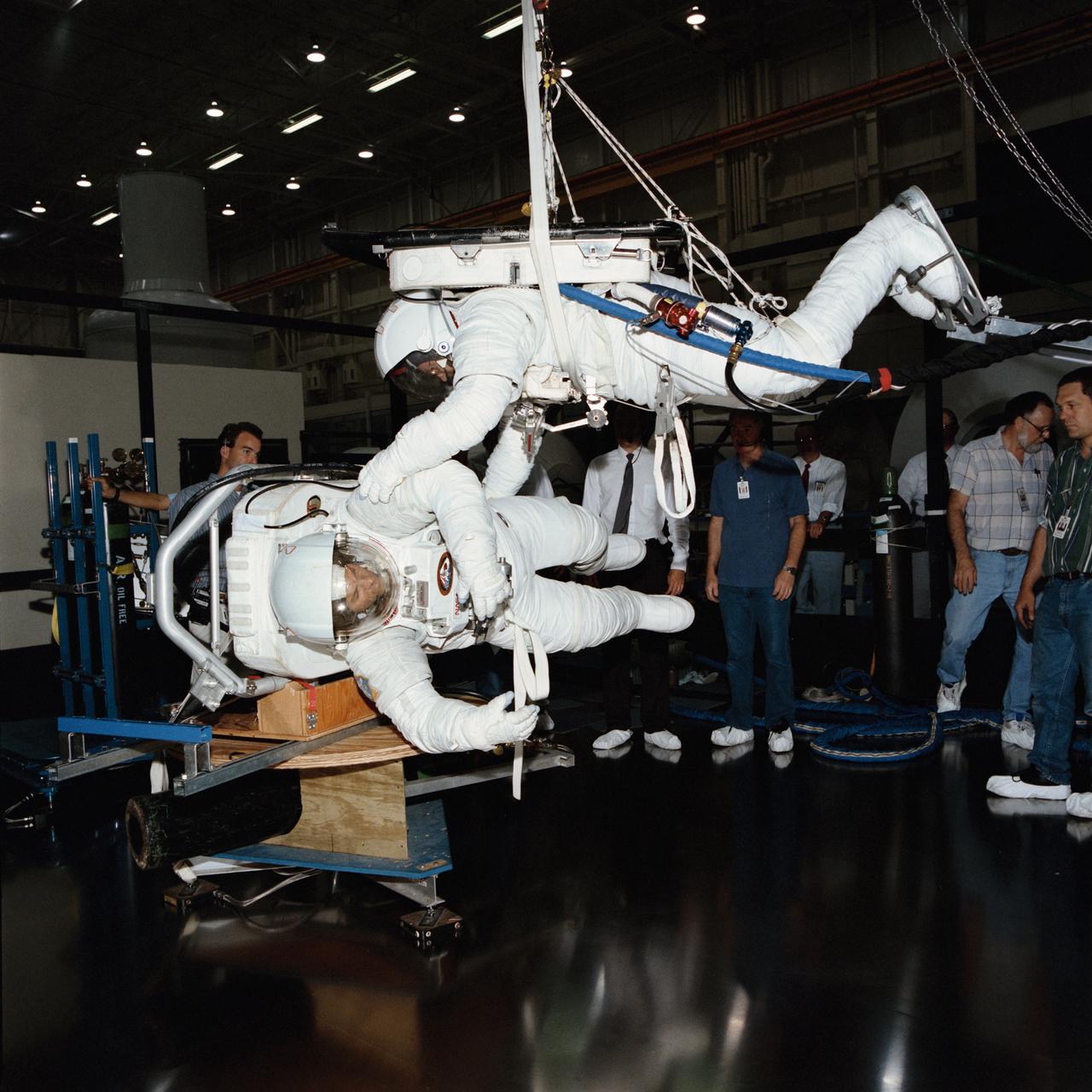
S94-33357 (1994) --- Scott Bleiseth, top, prepares to spin Mike Hess, a fellow EVA engineer, during a test on the air-bearing floor in the Shuttle Mock-up and Integration Laboratory at NASA's Johnson Space Center. The hardware being tested is part of the Simplified Aid for EVA Rescue (SAFER). The pair was developing techniques by which the non-SAFER equipped spacewalker will impart a rotation to the SAFER-using spacewalker during the STS-64 mission. Once the SAFER astronaut is spinning, the device will be activated and its automatic attitude hold capability will be tested. SAFER is to fly on STS-76 as well. Photo credit: NASA or National Aeronautics and Space Administration
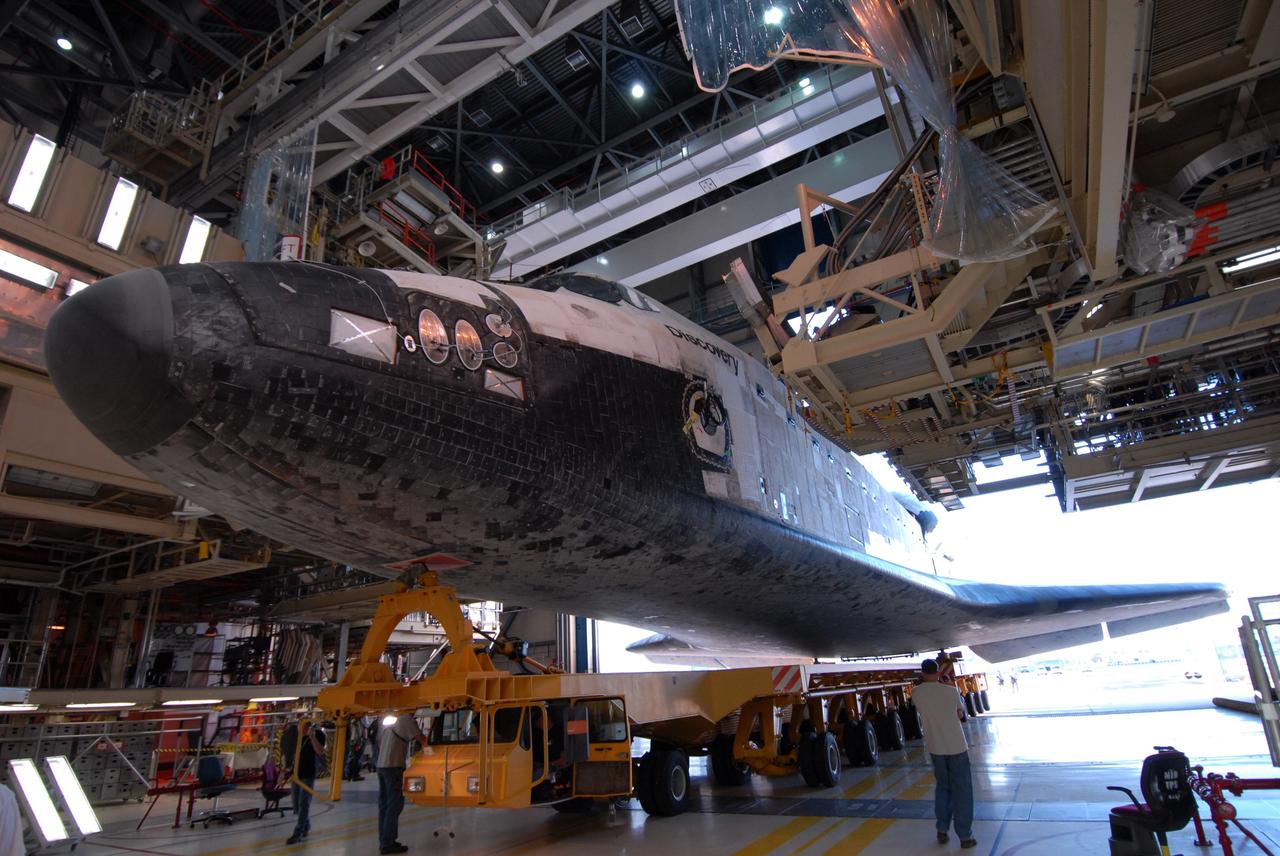
CAPE CANAVERAL, Fla. -- Space shuttle Discovery rolls out from the Orbiter Processing Facility for the short trip to the Vehicle Assembly Building, or VAB, at NASA's Kennedy Space Center. It rests on the orbiter transporter system, which has 76 wheels and measures 106.5 feet long. In high bay 3 of the VAB, Discovery will be attached to its external fuel tank and solid rocket boosters in preparation for its upcoming STS-124 mission to the International Space Station. On the mission, the STS-124 crew will transport the Japanese Experiment Module - Pressurized Module and the Japanese Remote Manipulator System to the space station. Launch of Discovery is targeted for May 31. Photo credit: NASA/Troy Cryder
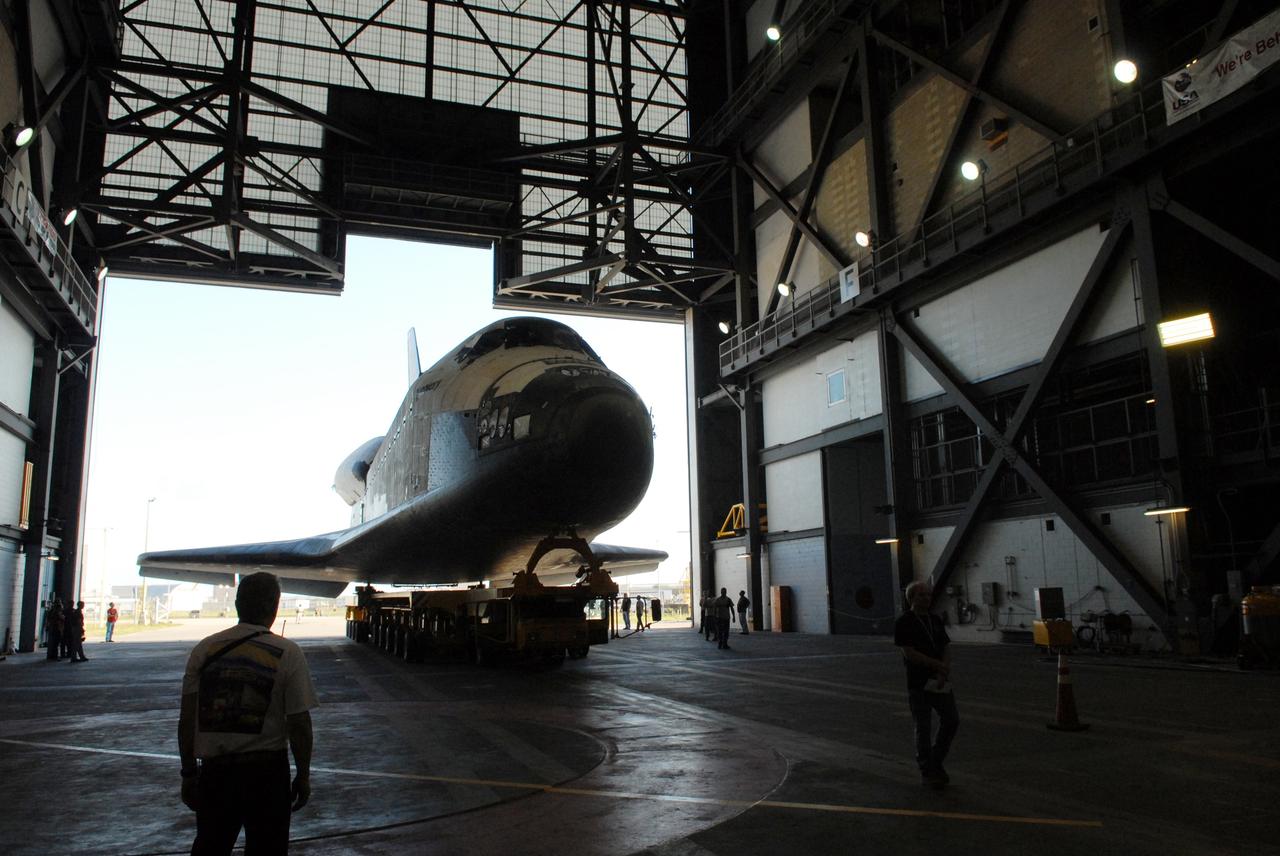
CAPE CANAVERAL, Fla. -- Towed on its 76-wheeled orbiter transporter, space shuttle Discovery rolls into the transfer aisle of the Vehicle Assembly Building at NASA's Kennedy Space Center. Discovery will be raised to vertical and lifted into high bay 3 for attachment to its external fuel tank and solid rocket boosters in preparation for its upcoming STS-124 mission to the International Space Station. On the mission, the STS-124 crew will transport the Japanese Experiment Module - Pressurized Module and the Japanese Remote Manipulator System to the space station. Launch of Discovery is targeted for May 31. Photo credit: NASA/Troy Cryder
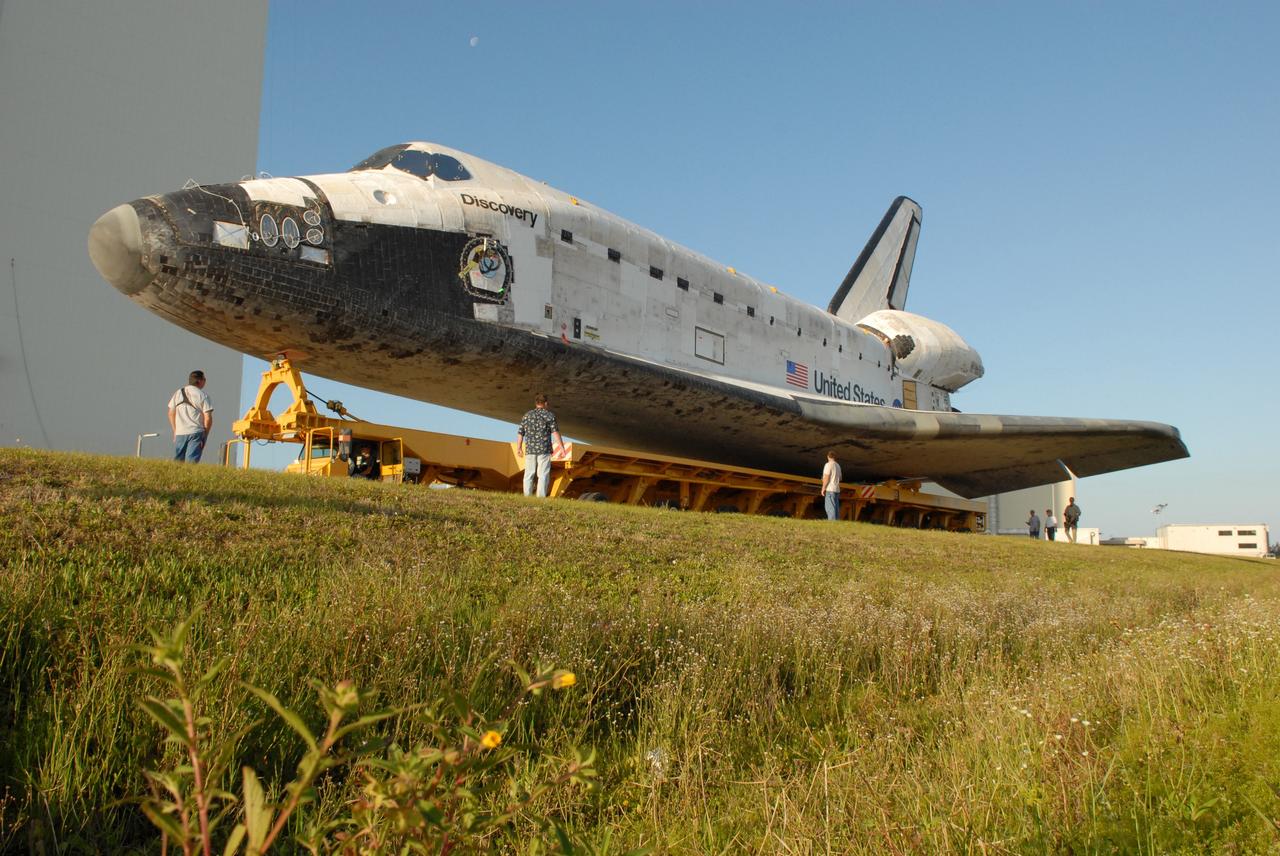
CAPE CANAVERAL, Fla. -- Resting on its 76-wheeled orbiter transporter, space shuttle Discovery rolls toward the Vehicle Assembly Building, or VAB, at NASA's Kennedy Space Center. Inside the VAB, Discovery will be attached to its external fuel tank and solid rocket boosters in high bay 3 in preparation for its upcoming STS-124 mission to the International Space Station. On the mission, the STS-124 crew will transport the Japanese Experiment Module - Pressurized Module and the Japanese Remote Manipulator System to the space station. Launch of Discovery is targeted for May 31. Photo credit: NASA/Troy Cryder
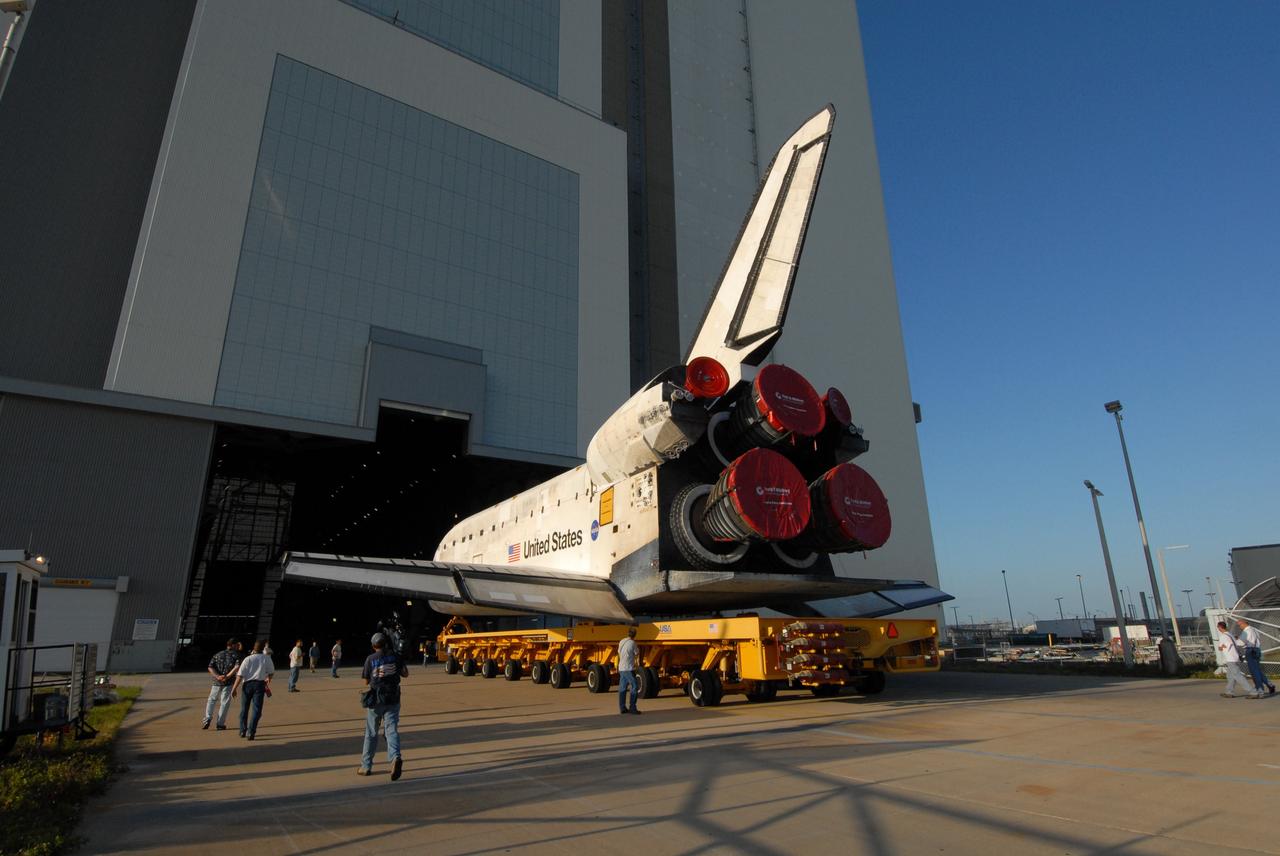
CAPE CANAVERAL, Fla. -- Space shuttle Discovery rolls toward the open doors of the Vehicle Assembly Building, or VAB, at NASA's Kennedy Space Center. It rests on the orbiter transporter system, which has 76 wheels and measures 106.5 feet long. Inside the VAB, Discovery will be attached to its external fuel tank and solid rocket boosters in high bay 3 in preparation for its upcoming STS-124 mission to the International Space Station. On the mission, the STS-124 crew will transport the Japanese Experiment Module - Pressurized Module and the Japanese Remote Manipulator System to the space station. Launch of Discovery is targeted for May 31. Photo credit: NASA/Troy Cryder
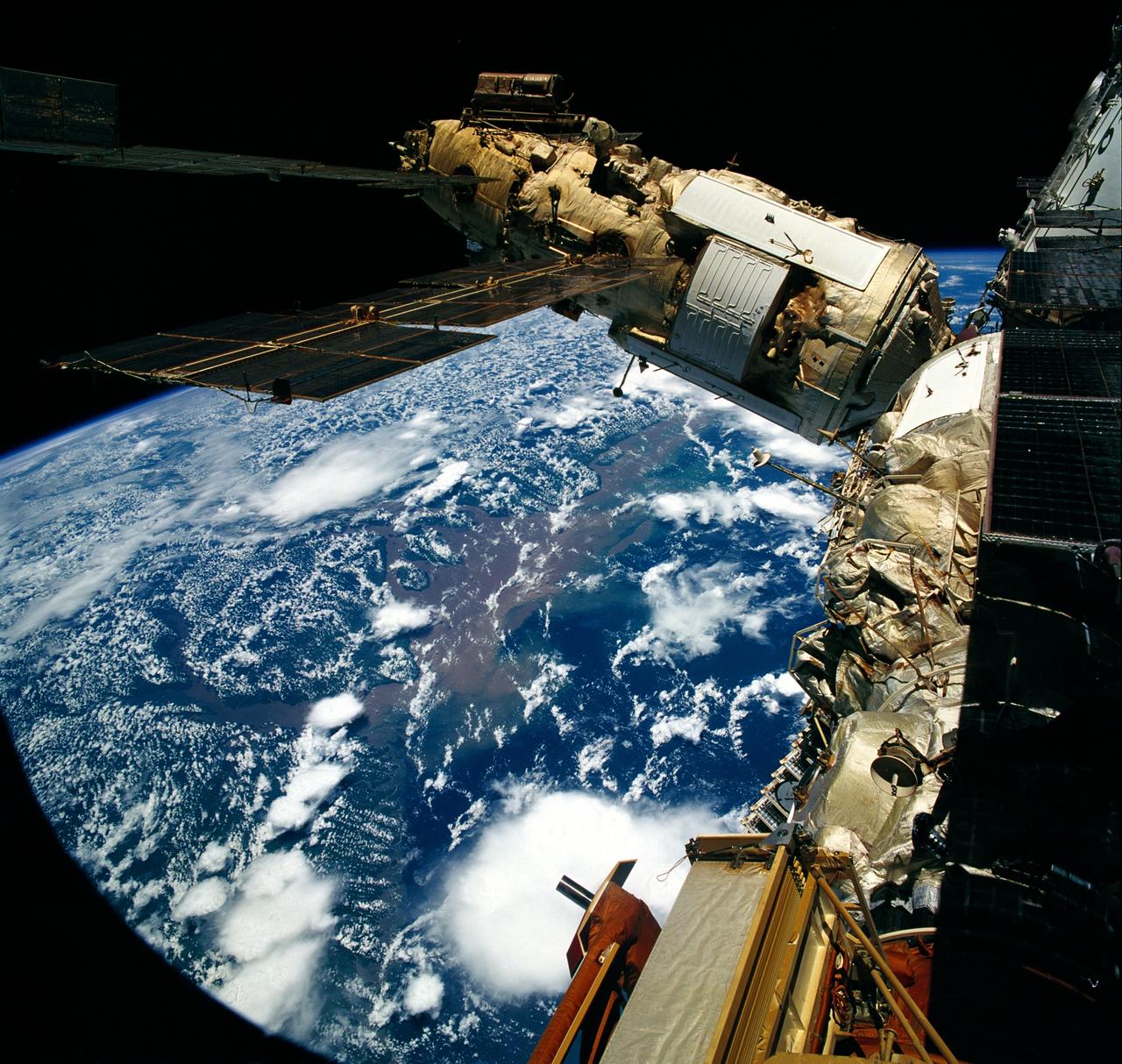
STS076-708-031 (22 - 31 March 1996) --- Clouds over Brazil form the backdrop for this 70mm image showing the Spektr Module and other components of Russia's Mir Space Station. The photograph was taken after Space Shuttle Atlantis docked with the Mir Space Station on March 23, 1996. The delta of the giant Amazon River is at frame center.
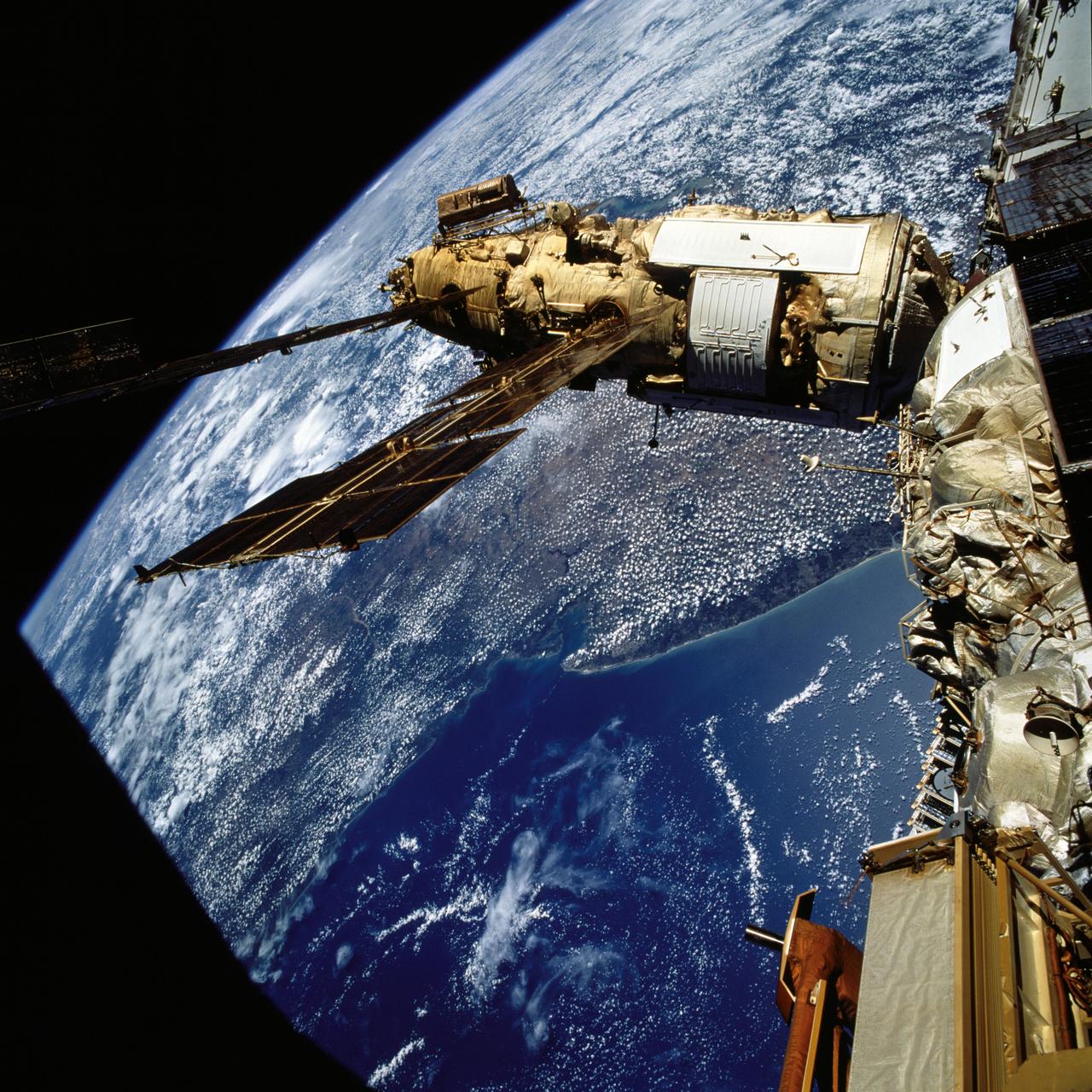
STS076-708-038 (22 - 31 March 1996) --- The crew took this 70mm picture of Russia's Mir Space Station over Australia. The crew docked the Space Shuttle Atlantis with the Mir Space Station on March 23, 1996, at which time astronaut Shannon W. Lucid joined the Mir-21 crew to begin the first leg of her 140-day stay aboard Mir, as a cosmonaut guest researcher. The Spacehab Module shared the cargo bay during part of the mission with the Docking Module (DM). The DM was connected to Mir, following a March 23, 1996, docking. The DM was delivered last year to Mir by the STS-74 crew.
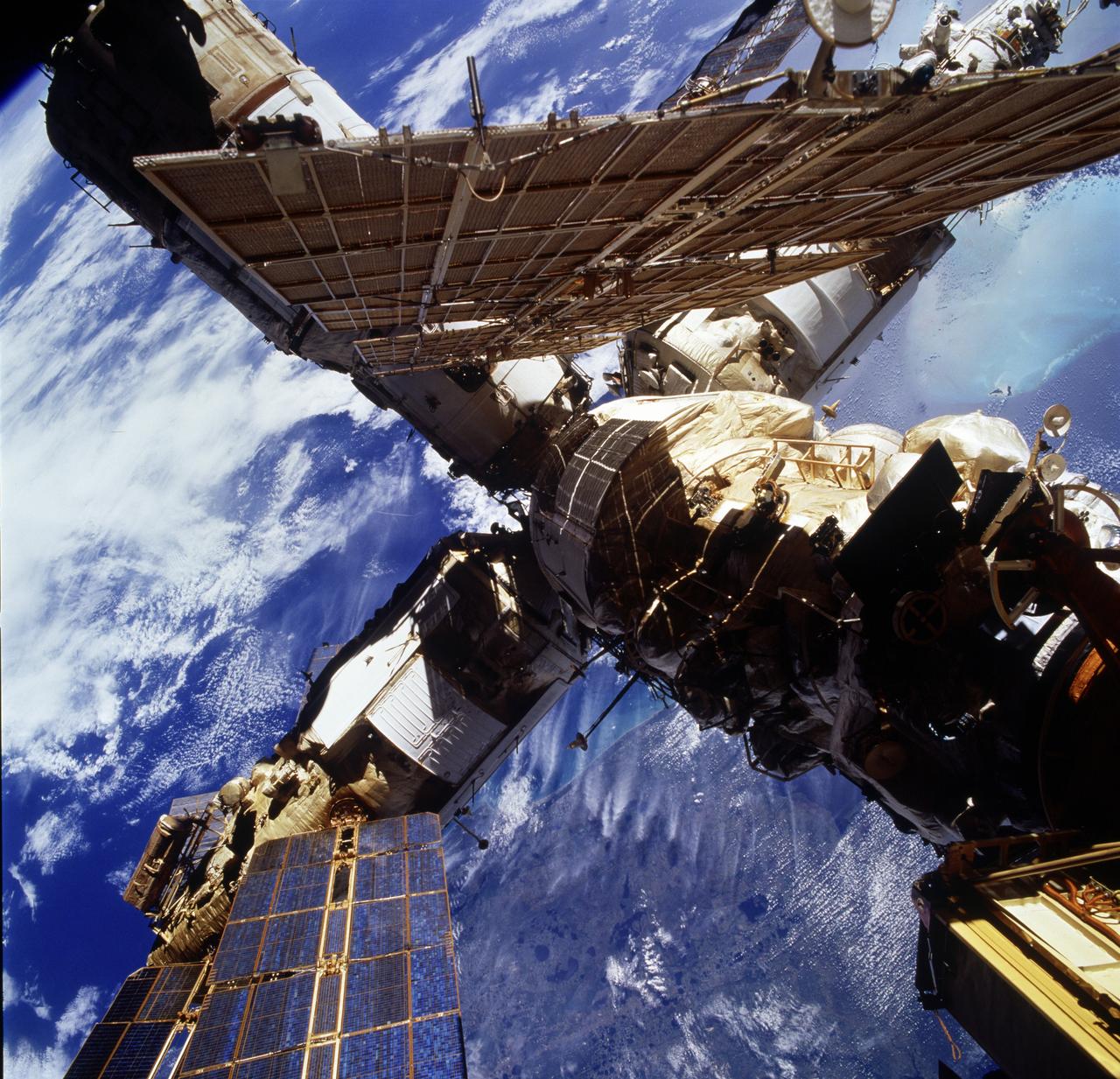
STS076-736-017 (22-31 March 1996) --- Southern Florida and the Atlantic coast form the backdrop for this picture showing most of the components of Russia's Mir Space Station. The photograph was taken from the aft flight deck of the Space Shuttle Atlantis. Mir and Atlantis docked on March 23, 1996, and separated on March 28, 1996. Cape Canaveral and the Kennedy Space Center (KSC) are below one of Mir's solar array panels in the upper left quadrant of the frame.
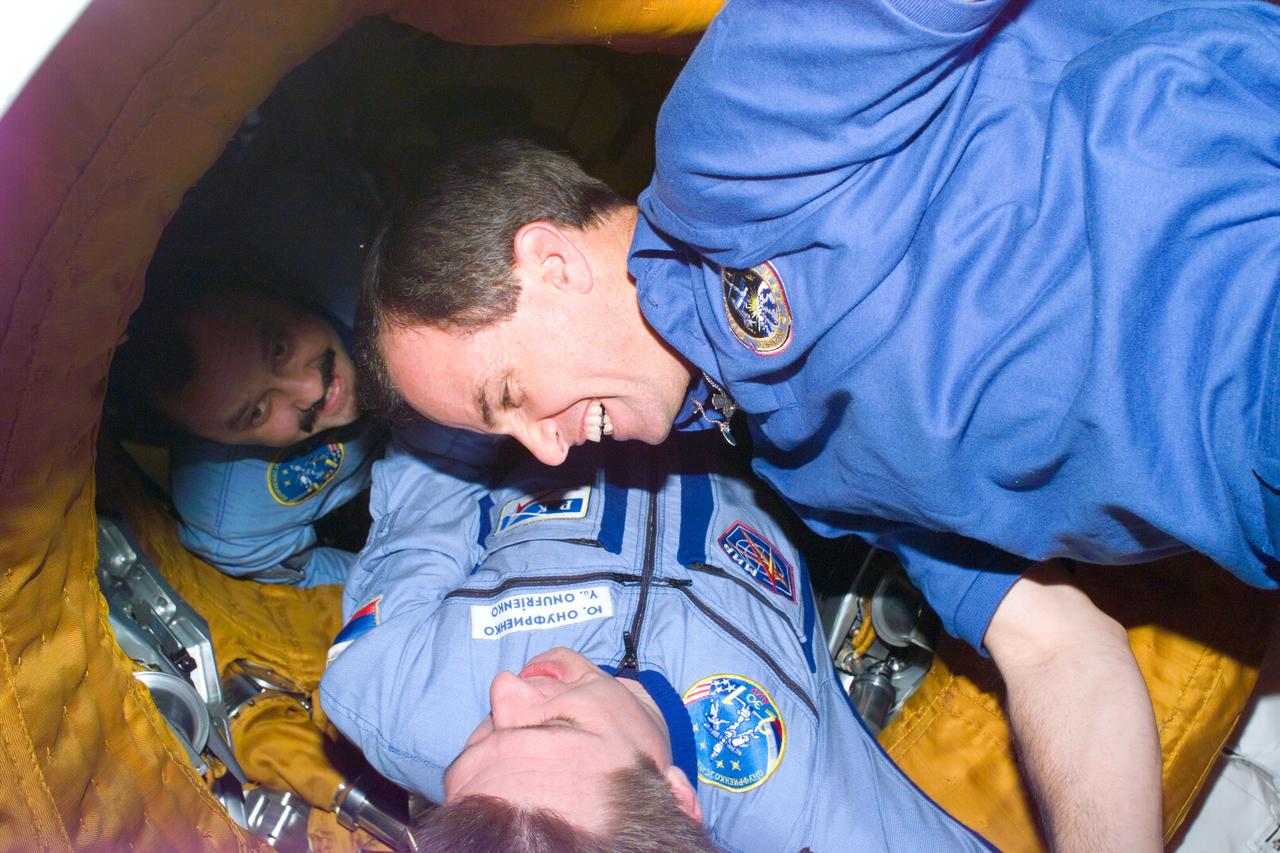
S76-E-5146 (24 March 1996) --- Continuing an in-space tradition, astronaut Kevin P. Chilton (right), STS-76 mission commander, shakes hands with cosmonaut Yury Onufrienko, Mir-21 commander, in the tunnel connecting the Space Shuttle Atlantis and Russia's Mir Space Station. A short time earlier two crews successfully pulled off the third hard-docking of their respective spacecraft. In the background is cosmonaut Yury V. Usachev, Mir-21 flight engineer. The image was recorded with a 35mm Electronic Still Camera (ESC) and downlinked at a later time to ground controllers in Houston, Texas.
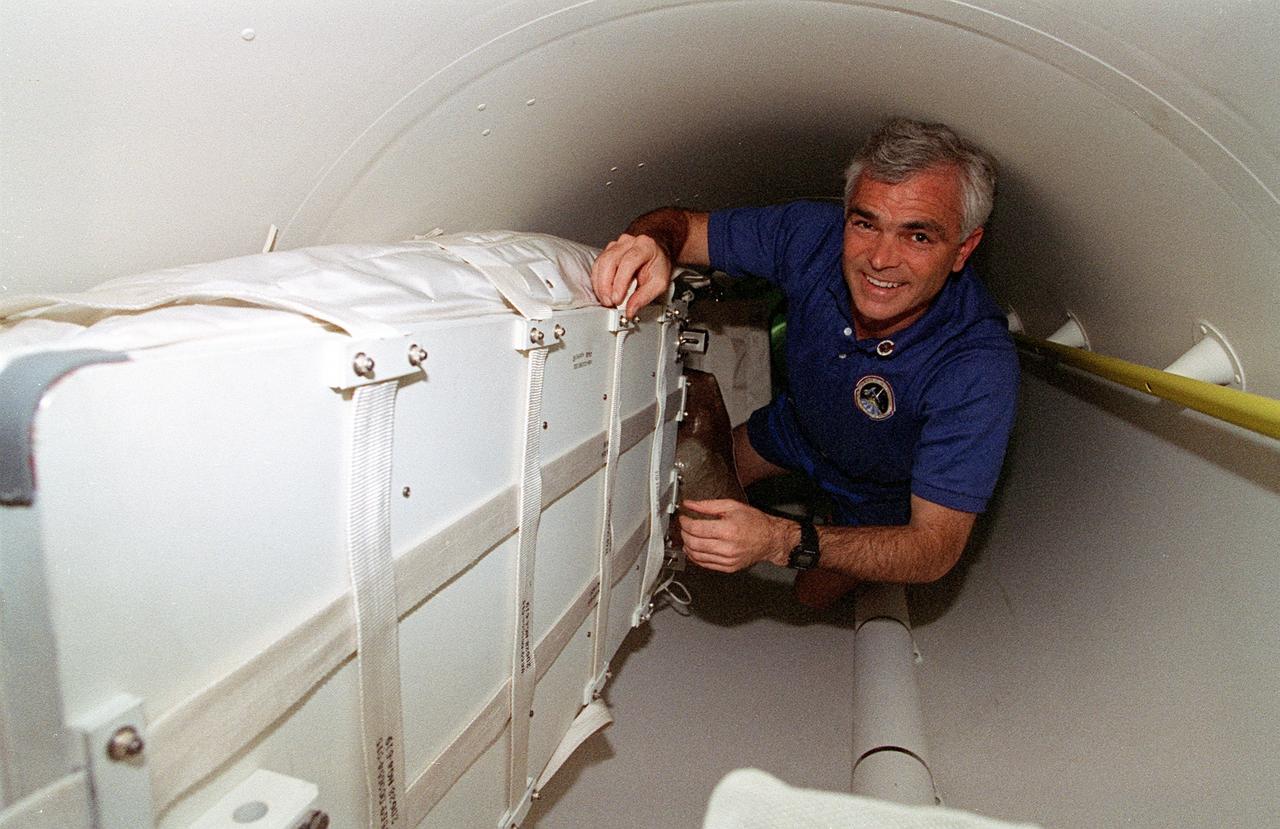
STS076-345-014 (22-31 March 1996) --- During the first few hours of the mission, astronaut Michael R. (Rich) Clifford checks over stowed bags filled Extravehicular Activity (EVA) supplies in the STS-76 tunnel. The mission specialist, one of six NASA astronauts aboard the Space Shuttle Atlantis, later helped move the bags to Atlantis' airlock. Atlantis later docked with Russia's Mir Space Station. The crew used a tunnel to commute to the Spacehab module and, later, to the Mir via its Docking Module (DM).
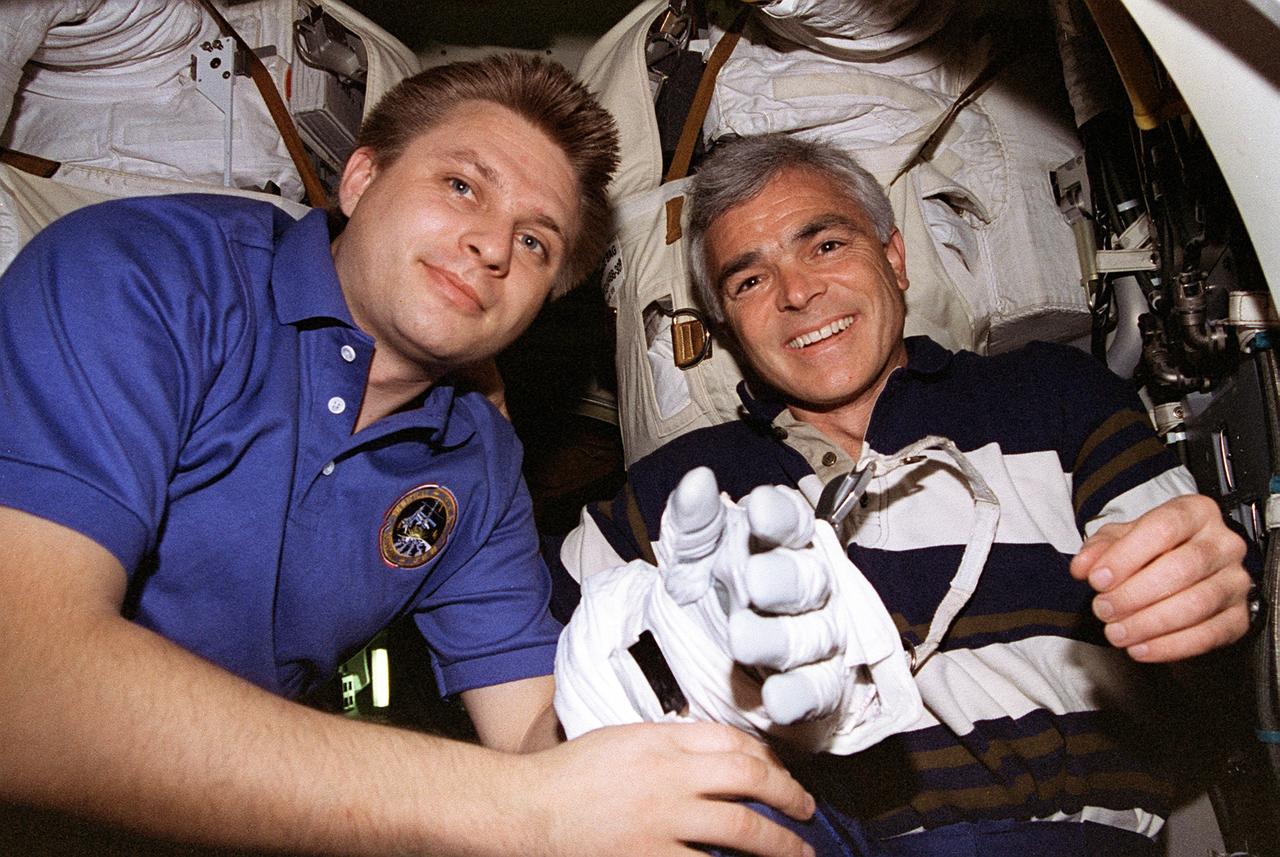
STS076-356-006 (26 March 1996) --- Backdropped against two space suits, a curious cosmonaut Yury I. Onufrienko, left, tries on a glove while visiting astronaut Michael R. (Rich) Clifford in the airlock aboard the Space Shuttle Atlantis. Clifford was in the airlock to check over his gear for tomorrow's Extravehicular Activity (EVA). Onufrienko is Mir-21 mission commander, and Clifford, a STS-76 mission specialist who will be joined by astronaut Linda M. Godwin for the EVA. The EVA of the two mission specialists marks the first EVA while Russia's Mir Space Station was docked with the Space Shuttle Atlantis. This is the third of a series of docking missions involving Mir and the Space Shuttle Atlantis.
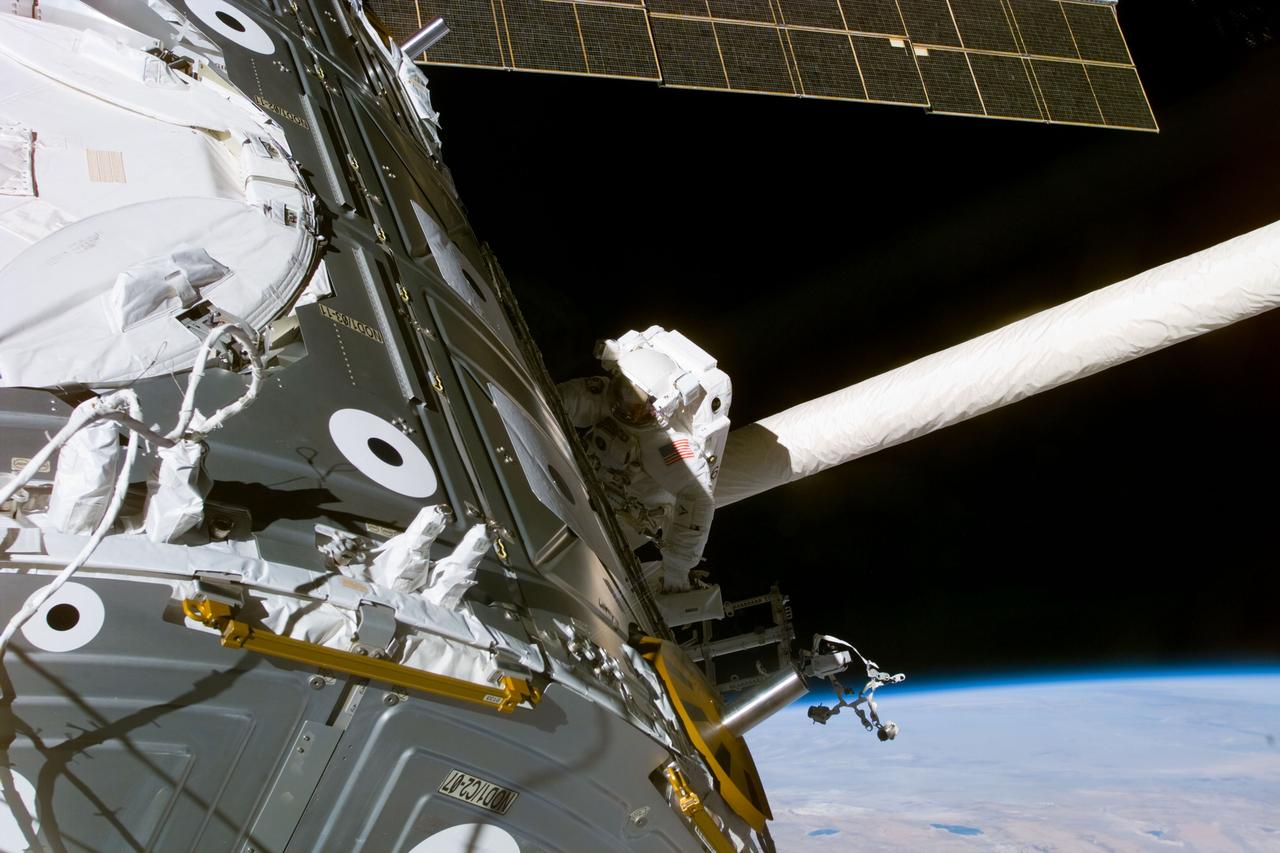
S88-E-5060 (12-08-98) --- Astronaut James H. Newman is seen near the Unity module during late phases of the first of three scheduled spacewalks on STS-88. At the end of the extravehicular activity (EVA), astronauts Newman and Jerry L. Ross, both mission specialists, were successful in mating 40 cables and connectors running 76 feet from the Zarya control module to Unity, with the 35-ton complex towering over Endeavour's cargo bay. The spacewalk last 7 hours and 21 minutes. This photo was taken with an electronic still camera (ESC) at 03:50:28 GMT, Dec. 8.
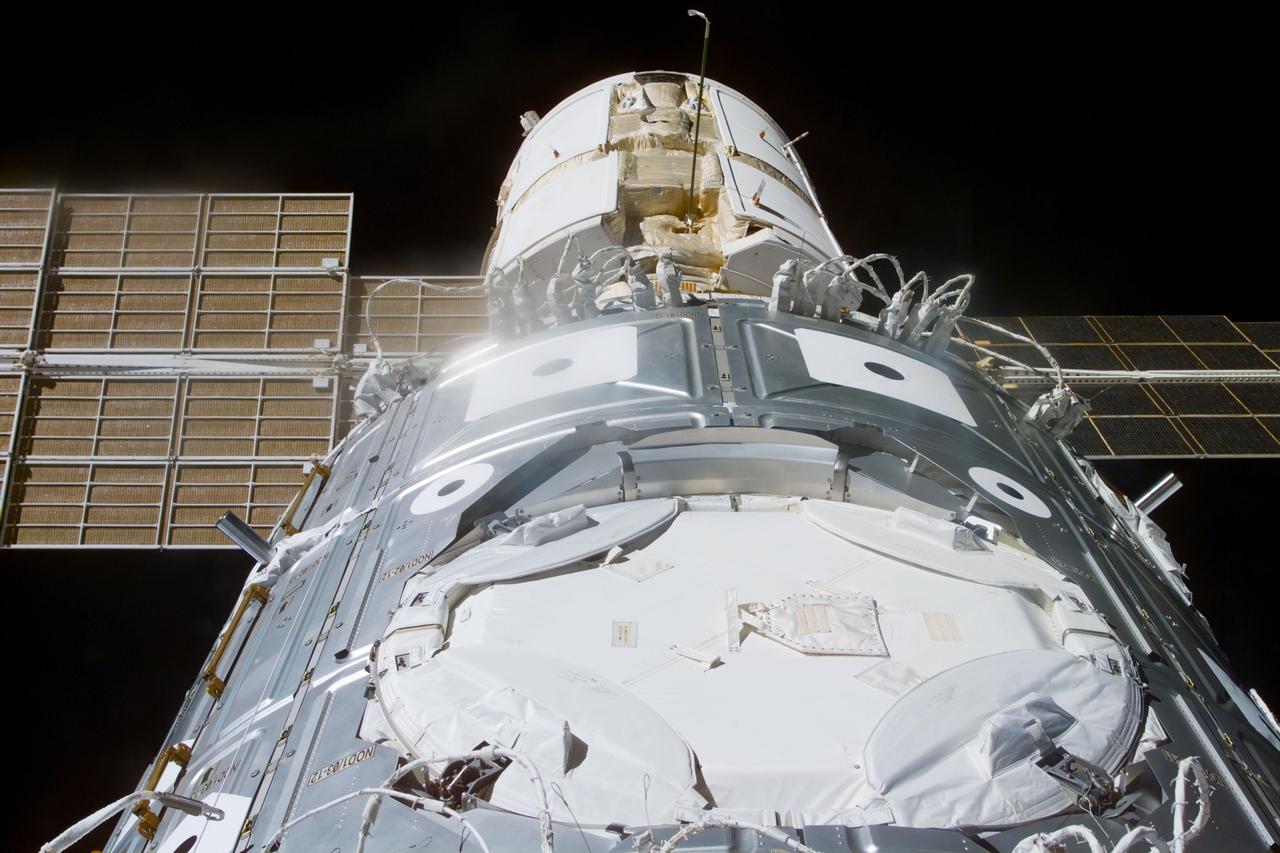
S88-E-5061 (12-08-98) --- Cables and wires in place on the Unity module signify the end of the first of three spacewalks scheduled for the STS-88 mission. Astronauts Jerry L. Ross and James H. Newman, both mission specialists, were succesful in mating 40 cables and connectors running 76 feet from the Zarya control module (seen at top in this photo) to Unity, with the 35-ton complex towering over Endeavour's cargo bay. This photo was taken with an electronic still camera (ESC) at 03:37:35 GMT, Dec. 8.
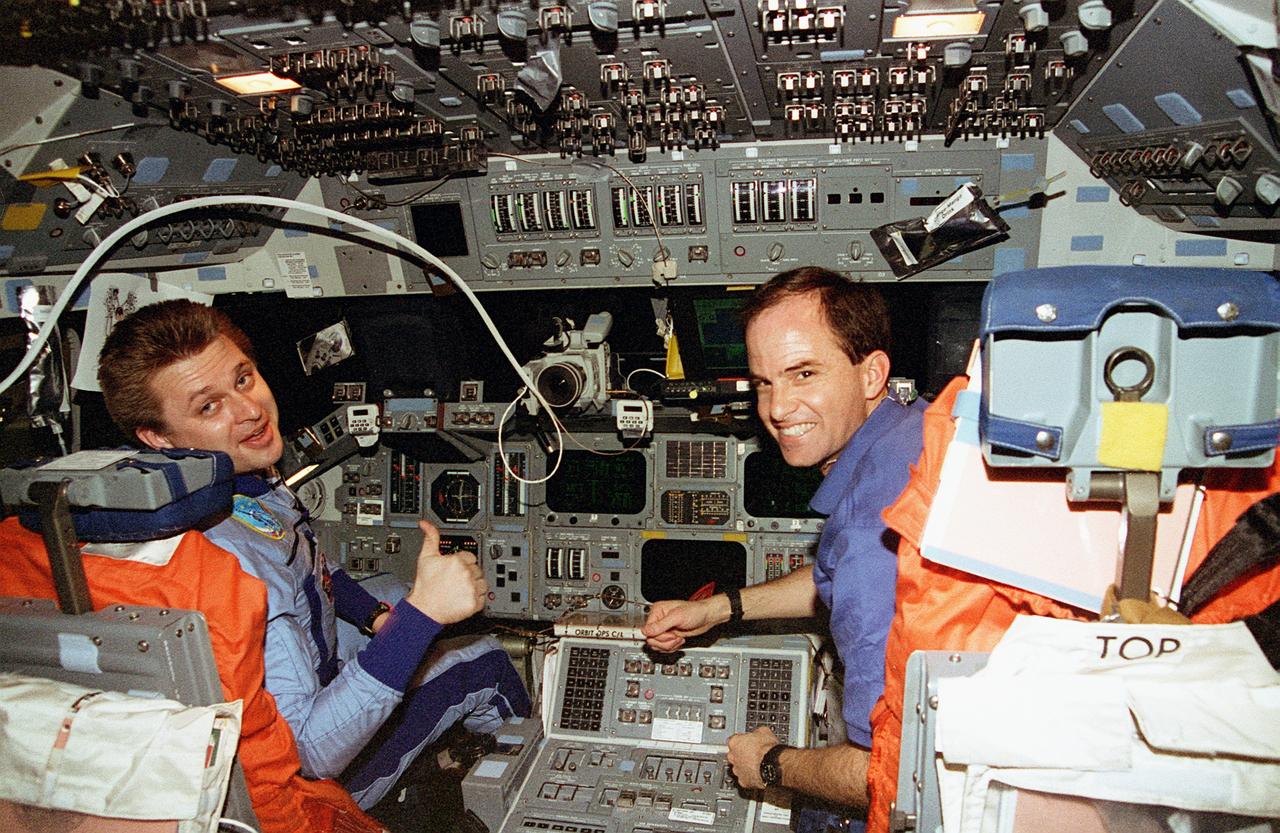
STS076-341-002 (22-31 March 1996)--- As astronaut Kevin P. Chilton looks on, cosmonaut Yury I. Onufrienko gives a thumbs up gesture, signifying successful docking operations between Russia's Mir Space Station and the Space Shuttle Atlantis. The Mir-21 and STS-76 commanders, respectively, earlier headed up the in-space effort which made possible the third link-up of Mir and Atlantis in Earth-orbit. With the delivery of astronaut Shannon W. Lucid to the Mir, the Mir-21 crew grew from two to three, as the mission specialist temporarily became a cosmonaut guest researcher. She is to spend approximately 140 days on Mir before returning to Earth.
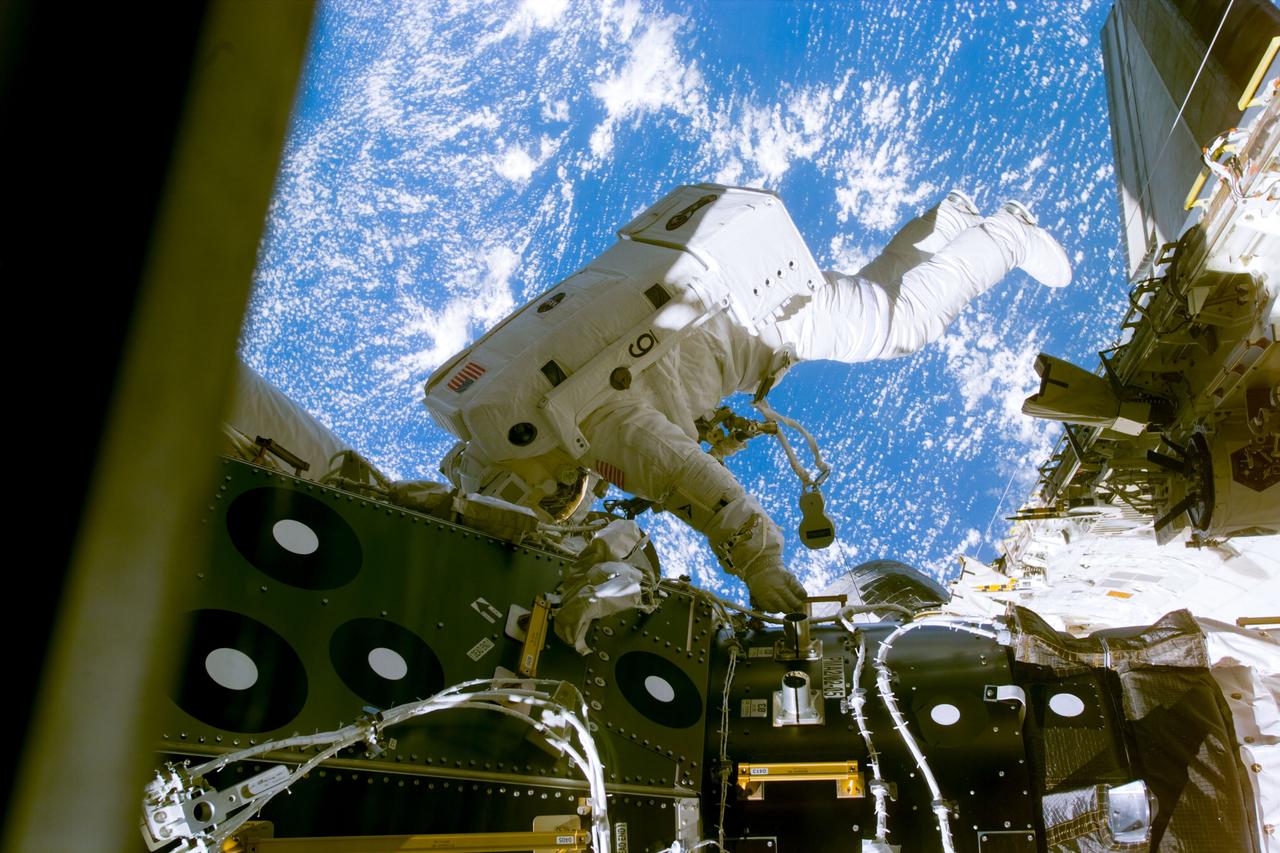
S88-E-5055 (12-07-98) --- Astronaut James H. Newman is seen at a pressurized mating adapter during early moments of the first of three scheduled spacewalks on STS-88. Astronauts Newman and Jerry L. Ross, both mission specialists, went on to mate 40 cables and connectors running 76 feet from the Zarya control module to Unity, with the 35-ton complex towering over Endeavour;'s cargo bay. This photo was taken with an electronic still camera (ESC) at 23:26:22 GMT, Dec. 7.
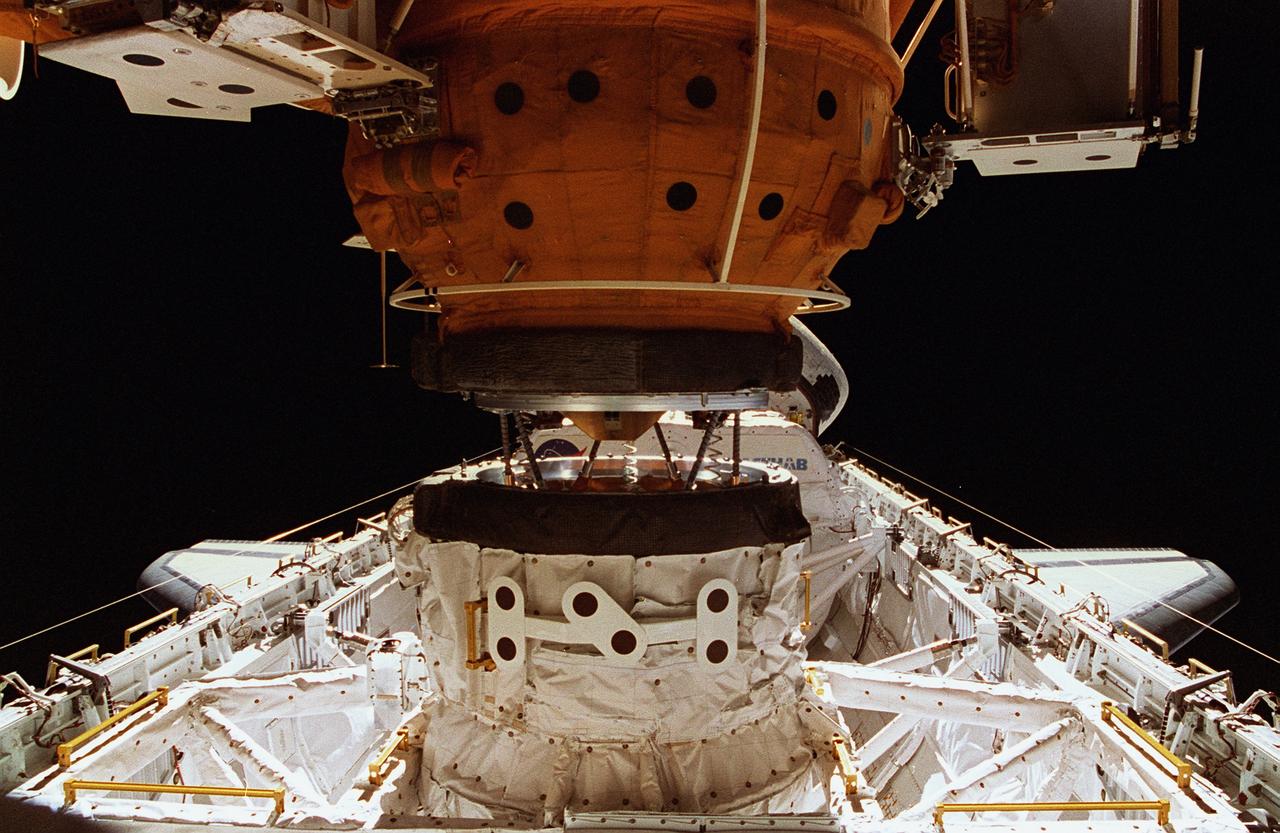
STS076-344-003 (24 March 1996) --- The Space Shuttle Atlantis Orbiter Docking System (ODS) and the Docking Module (DM) on Russia's Mir Space Station appear near the center of this frame, as the Atlantis and Mir link in Earth-orbit, at about 160 nautical miles altitude. The STS-76 crew later diminished by one and the Mir-21 crew grew by one, as astronaut Shannon W. Lucid, mission specialist, went aboard the Mir Space Station and became a cosmonaut guest researcher. She is scheduled to return to Earth in about 140 days.

CAPE CANAVERAL, Fla. -- From inside the Orbiter Processing Facility, space shuttle Discovery begins rolling out on its orbiter transporter for the short trip to the Vehicle Assembly Building, or VAB, at NASA's Kennedy Space Center. The orbiter transporter system has 76 wheels and measures 106.5 feet long. In high bay 3 of the VAB, Discovery will be attached to its external fuel tank and solid rocket boosters in preparation for its upcoming STS-124 mission to the International Space Station. On the mission, the STS-124 crew will transport the Japanese Experiment Module - Pressurized Module and the Japanese Remote Manipulator System to the space station. Launch of Discovery is targeted for May 31. Photo credit: NASA/Troy Cryder
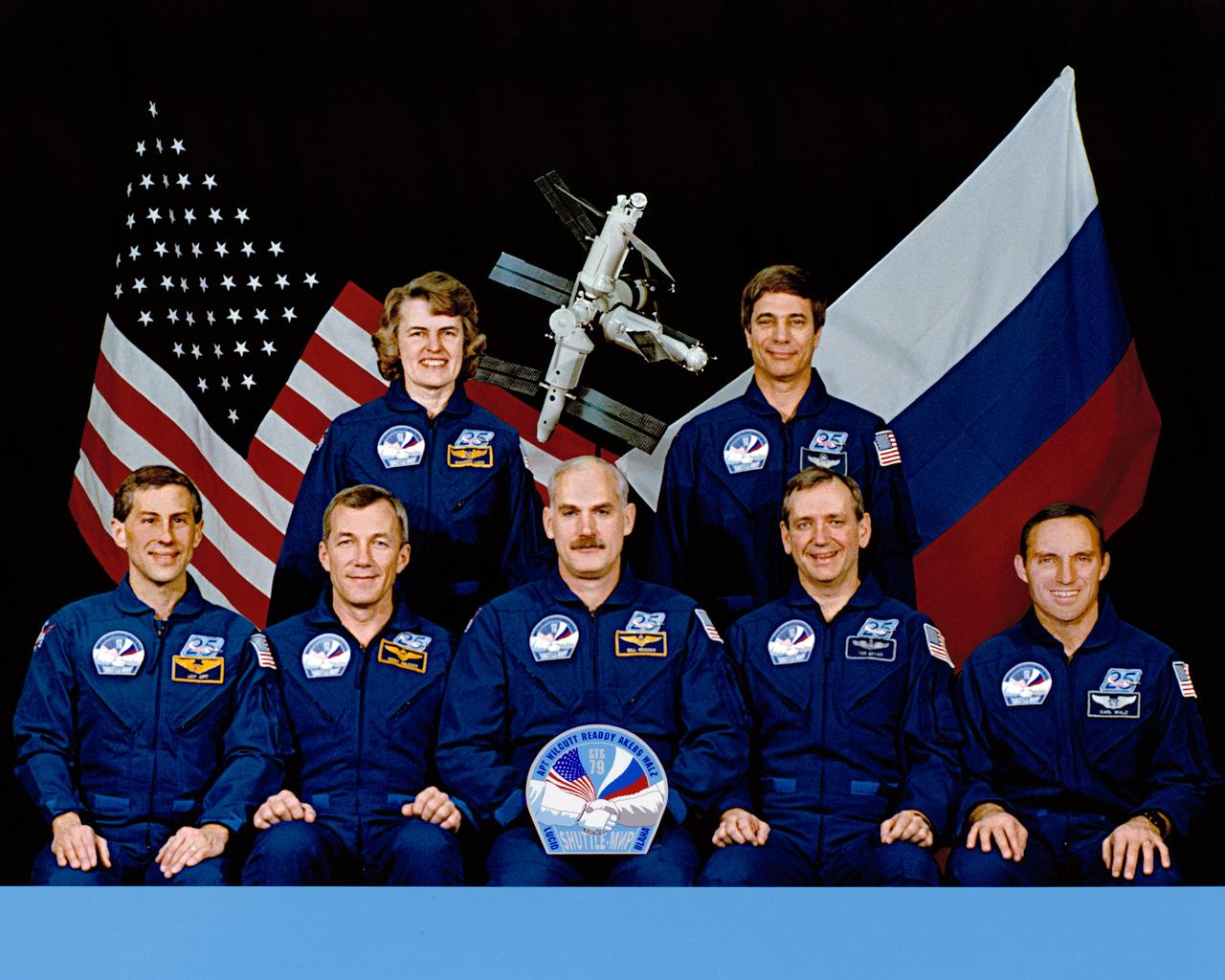
STS079-S-002 (May 1996) --- In various venues, these seven astronauts have been in training for several months for the different phases of the STS-79 mission scheduled for launch in August, 1996. Front row, left to right, are astronauts Jerome (Jay) Apt, mission specialist; Terrence W. Wilcutt, pilot; William F. Readdy, mission commander; Thomas D. Akers and Carl E. Walz, both mission specialists. On the back row are astronauts Shannon W. Lucid and John E. Blaha, both mission specialists. Lucid is currently aboard Russia’s Mir Space Station, having been delivered there by the Space Shuttle Atlantis crew of STS-76 in March, 1996. She will return to Earth with this crew, while Blaha will launch with this crew and remain onboard Mir for a subsequent tour of duty as a cosmonaut guest researcher.
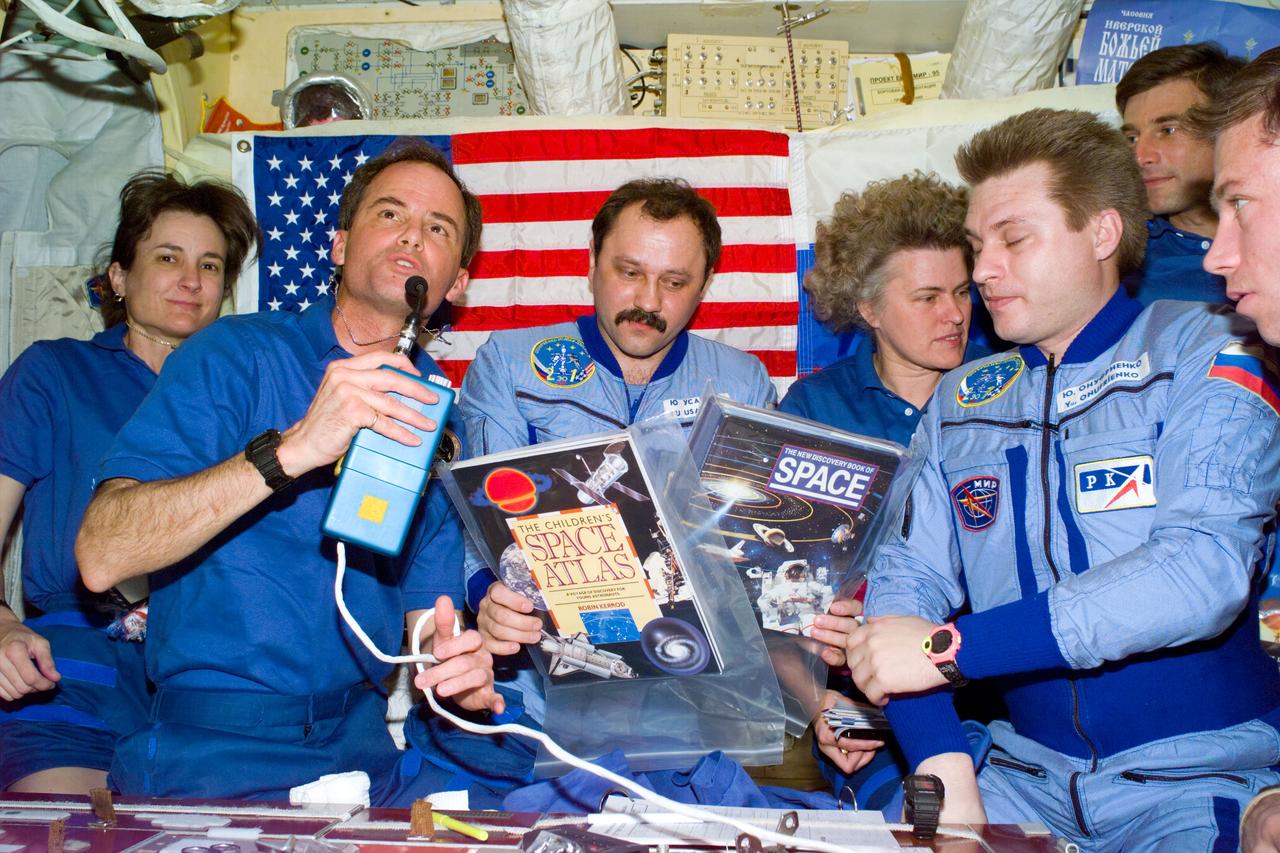
S76-E-5157 (24 March 1996) --- Two Russian cosmonauts and five of six NASA astronauts exchange gifts soon after reuniting in the Base Block Module of Russia's Mir Space Station. From the left are Linda M. Godwin, Kevin P. Chilton, Yury V. Usachev, Shannon W. Lucid, Yury I. Onufrienko, Ronald M. Sega and Richard A. Searfoss. Not pictured is astronaut Michael R. (Rich) Clifford. In a light moment around this time, ground controllers informed Chilton, the STS-76 mission commander, that Lucid, who will spend several months onboard Mir as a cosmonaut guest researcher, should now be considered a Mir-21 crew member, along with Onufrienko and Usachev, Mir-21 flight engineer. The image was recorded with a 35mm Electronic Still Camera (ESC) and downlinked at a later time to ground controllers in Houston, Texas.

NM21-401-012 (28 March 1996) --- The Space Shuttle Atlantis is backdropped over the darkness of space, and partially over clouds and open ocean waters on Earth, as it and Russia’s Mir Space Station begin their relative separation following several days of joint operations. This 35mm film was exposed by astronaut Shannon W. Lucid as she was beginning her record-setting stay aboard Mir, as a cosmonaut guest researcher. Onboard with Lucid were her Mir-21 crew mates, cosmonauts Yuriy I. Onufriyenko, commander; and Yuriy V. Usachov, flight engineer. Onboard Atlantis were Kevin P. Chilton, STS-76 mission commander; Richard A. Searfoss, pilot; along with Linda M. Godwin, Ronald M. Sega and Michael R. (Rich) Clifford, mission specialists.
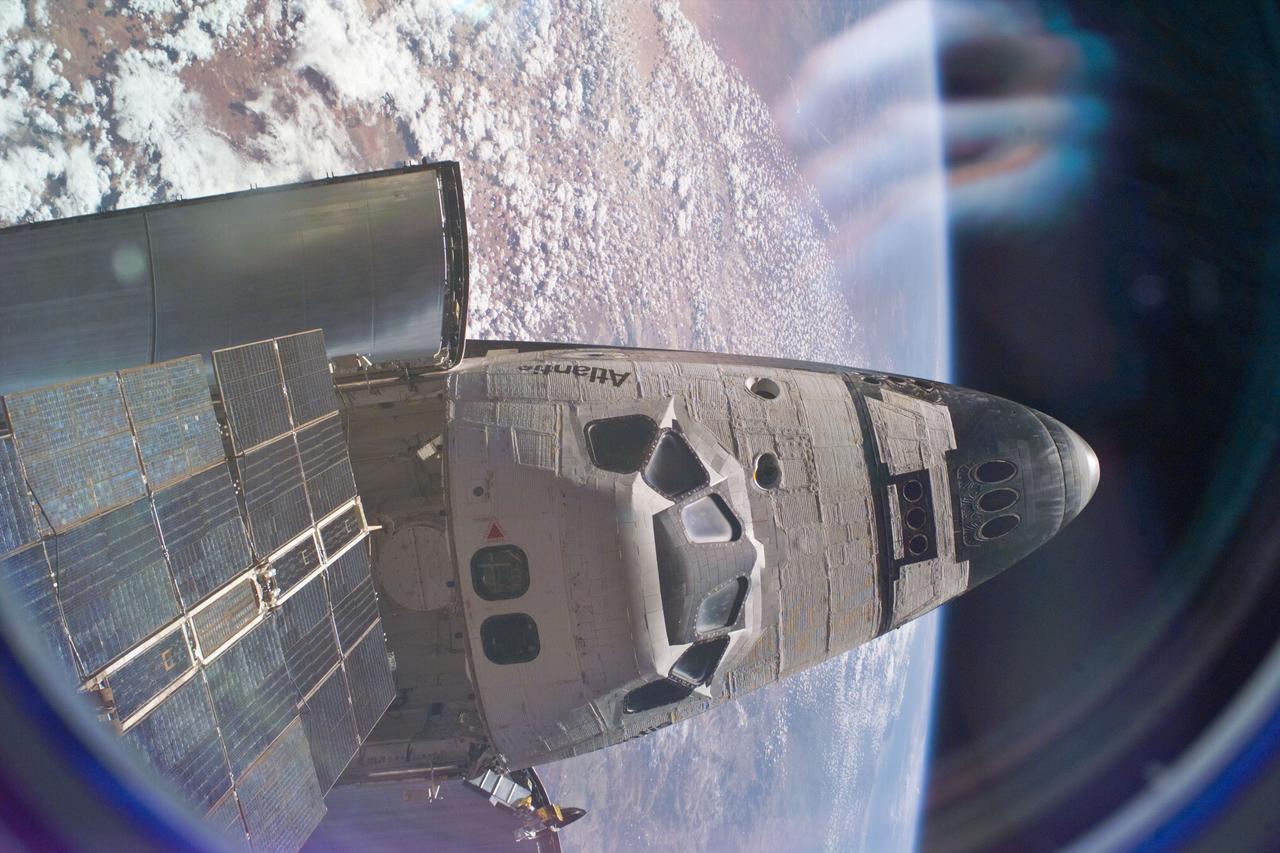
S76-E-5156 (24 March 1996) --- The forward cargo bay and the entire top exterior of the crew cabin of the Space Shuttle Atlantis can be seen in this image, recorded with a 35mm Electronic Still Camera (ESC), positioned in one of the windows aboard Russia's Mir Space Station.
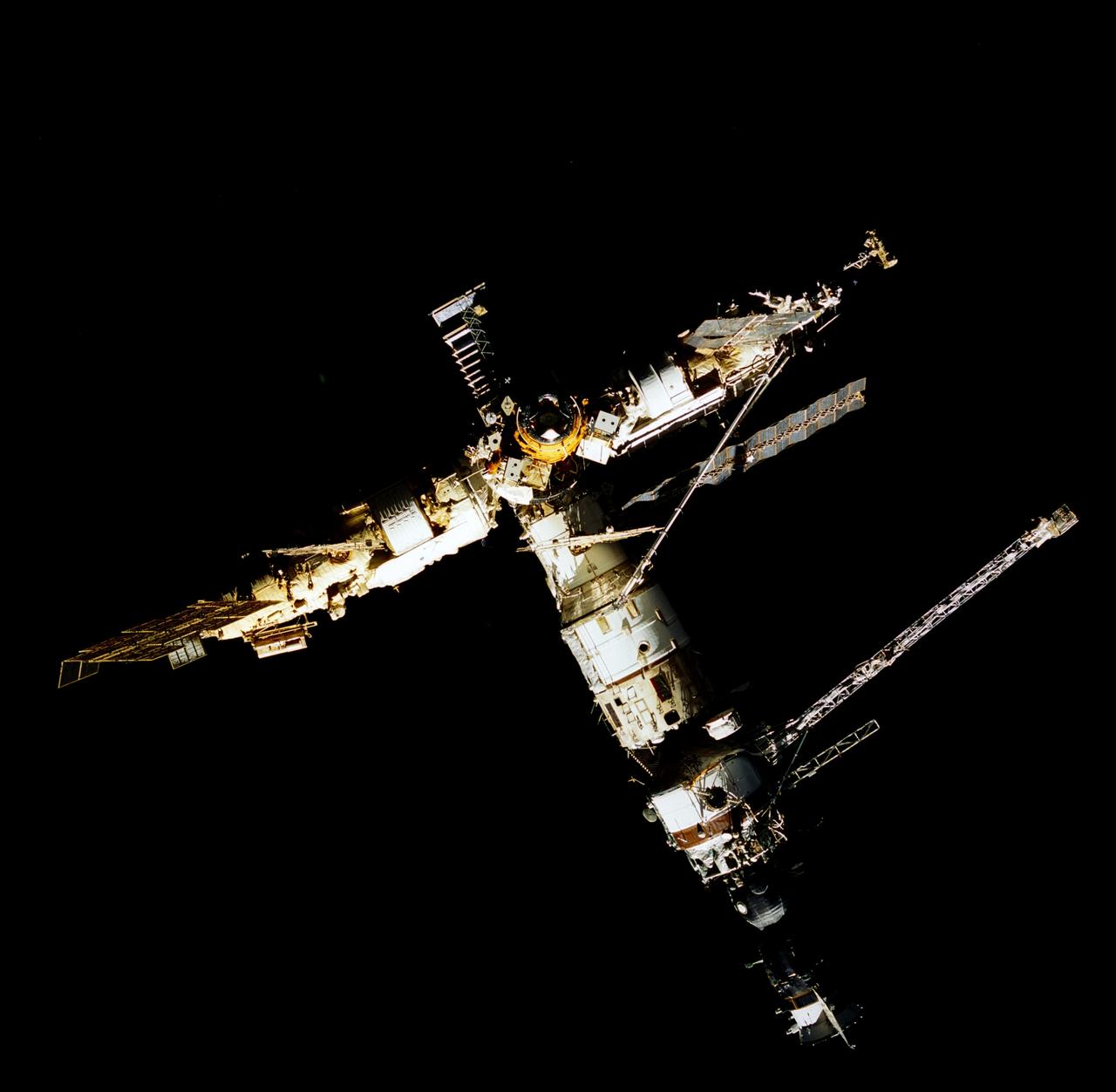
STS076-705-019 (23 March 1996) --- Backdropped against the darkness of space, Russia's Mir Space Station is seen from the aft flight deck window of the Space Shuttle Atlantis. The two spacecraft were about to make their third docking in Earth-orbit. With the subsequent delivery of astronaut Shannon W. Lucid to the Mir Space Station, the Mir-21 crew grew to three, as the mission specialist quickly becomes a cosmonaut guest researcher. She will spend approximately 140 days on Mir before returning to Earth.
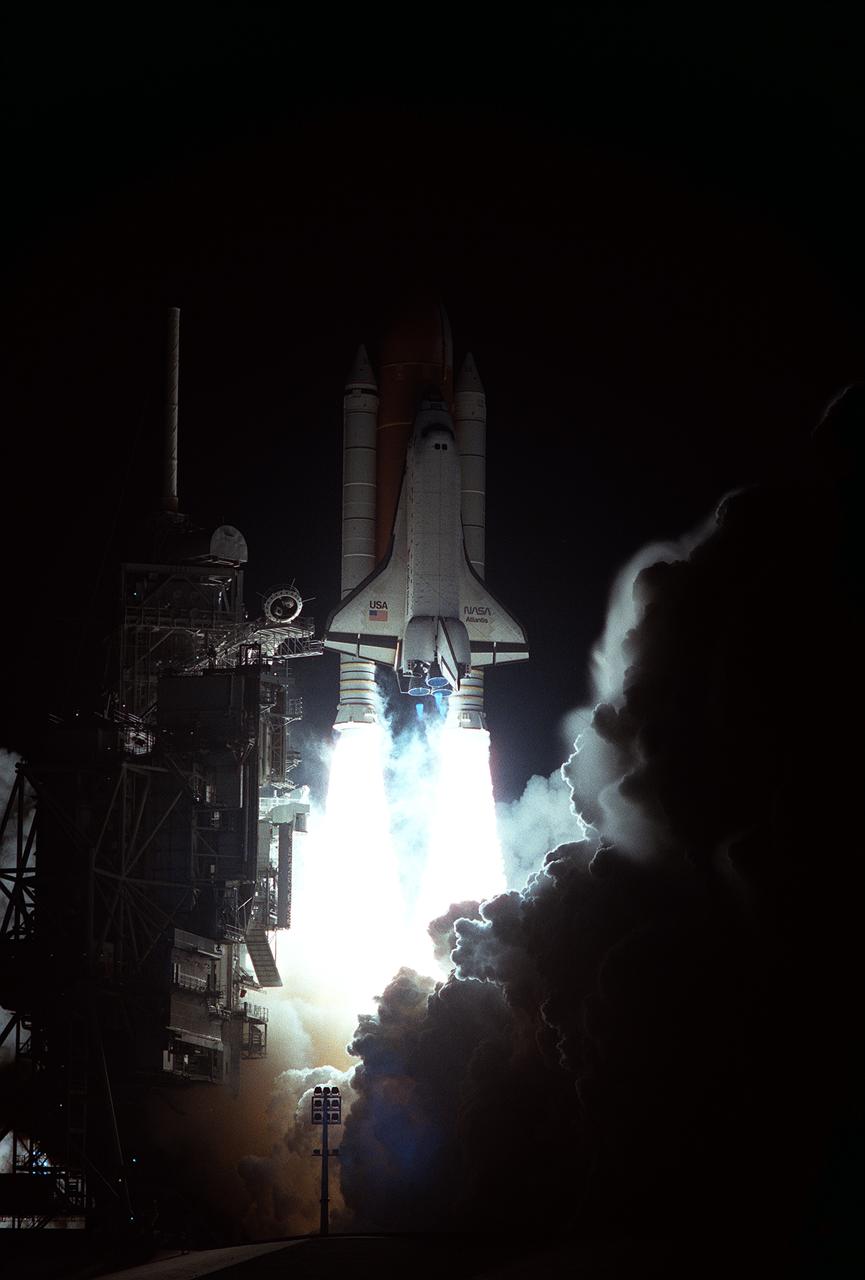
STS076-S-009 (22 March 1996) --- From the Kennedy Space Center's (KSC) Launch Pad 39B, the space shuttle Atlantis heads toward Earth orbit and an eventual docking with Russia's Mir Space Station. Mir has been in space for ten years and a two man crew (Mir-21) currently awaits the arrival of Atlantis. The on-time launch occurred at 3:13:04 a.m. (EST) on March 22, 1996. Onboard are astronauts Kevin P. Chilton, Richard A. Searfoss, Ronald M. Sega, Michael R. (Rich) Clifford, Linda M. Godwin and Shannon W. Lucid. Lucid will remain onboard Mir for just under five months' time, as a cosmonaut guest researcher. Photo credit: NASA or National Aeronautics and Space Administration