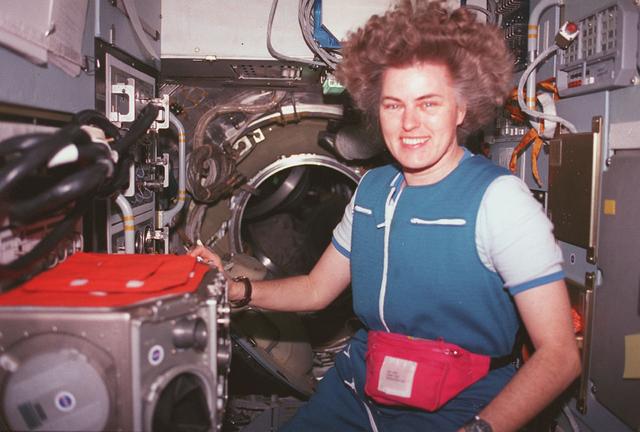
Sharnon Lucid aboard STS-79, with the Glovebox in MIR Priroda module. Priroda is the Russian word for nature.
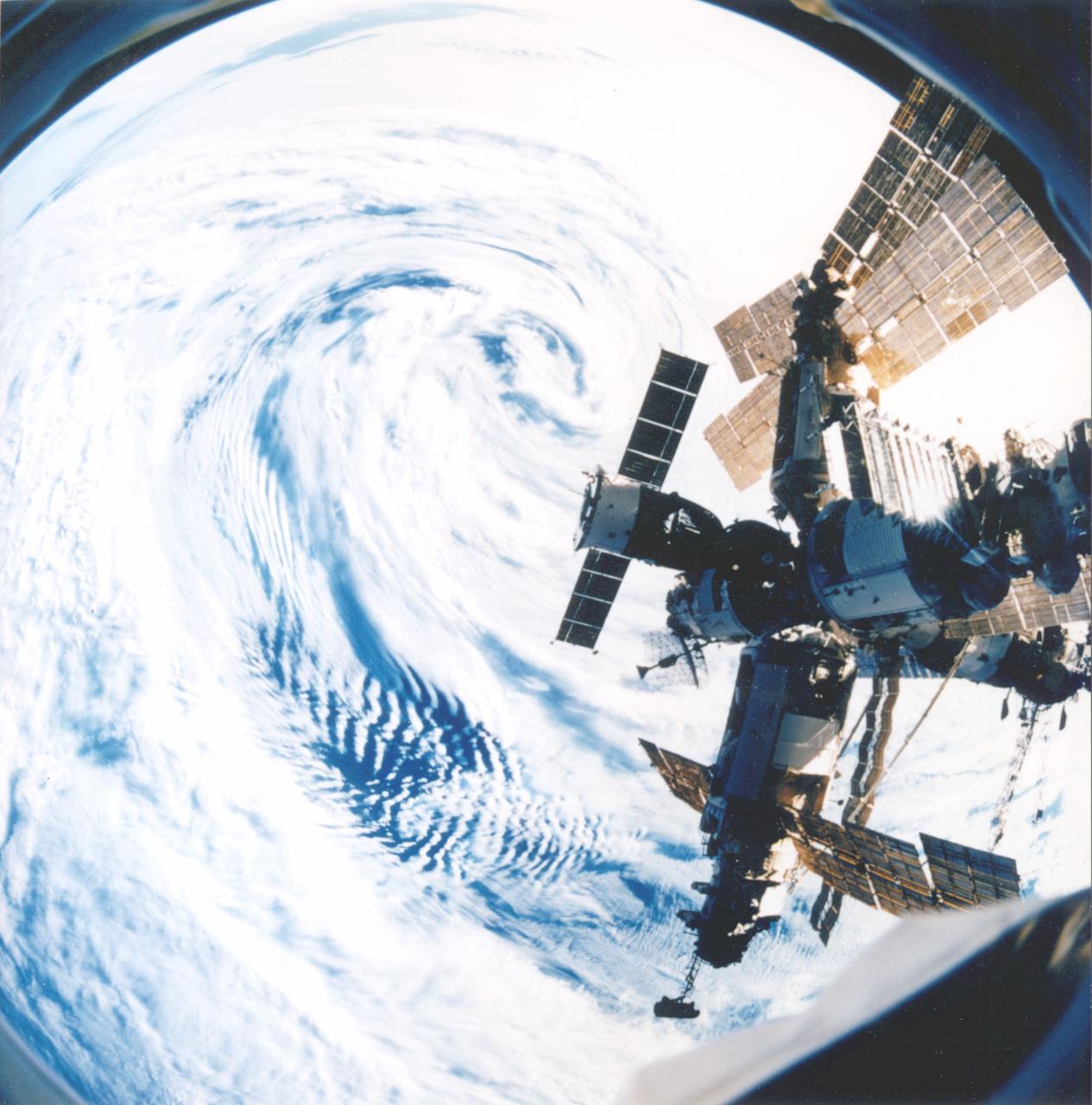
STS-79, Spacelab DM, Mir-docking-4, Shuttle and Mir Docking
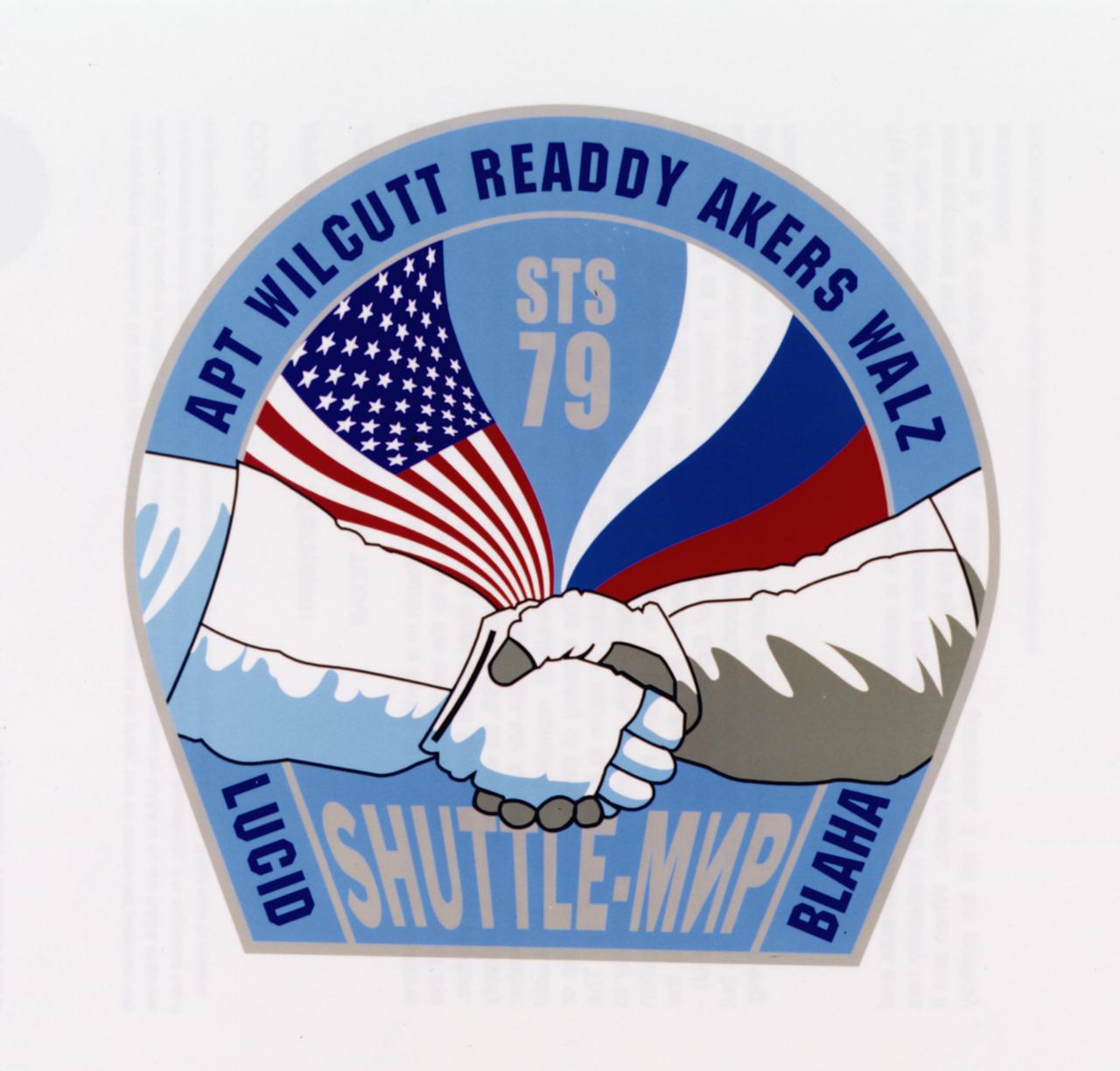
STS-79 was the fourth in a series of NASA docking missions to the Russian Mir Space Station, leading up to the construction and operation of the International Space Station (ISS). As the first flight of the Spacehab Double Module, STS-79 encompassed research, test and evaluation of ISS, as well as logistics resupply for the Mir Space Station. STS-79 was also the first NASA-Mir American crew member exchange mission, with John E. Blaha (NASA-Mir-3) replacing Shannon W. Lucid (NASA-Mir-2) aboard the Mir Space Station. The lettering of their names either up or down denotes transport up to the Mir Space Station or return to Earth on STS-79. The patch is in the shape of the Space Shuttle’s airlock hatch, symbolizing the gateway to international cooperation in space. The patch illustrates the historic cooperation between the United States and Russia in space. With the flags of Russia and the United States as a backdrop, the handshake of Extravehicular Mobility Unit (EMU) which are suited crew members symbolizes mission teamwork, not only of the crew members but also the teamwork between both countries space personnel in science, engineering, medicine and logistics.

STS-79 Shuttle/Mir docking to retrieve Astronaut Sharnon Lucid from Mir Space Station; full shot of Mir Space Station taken from Shuttle.
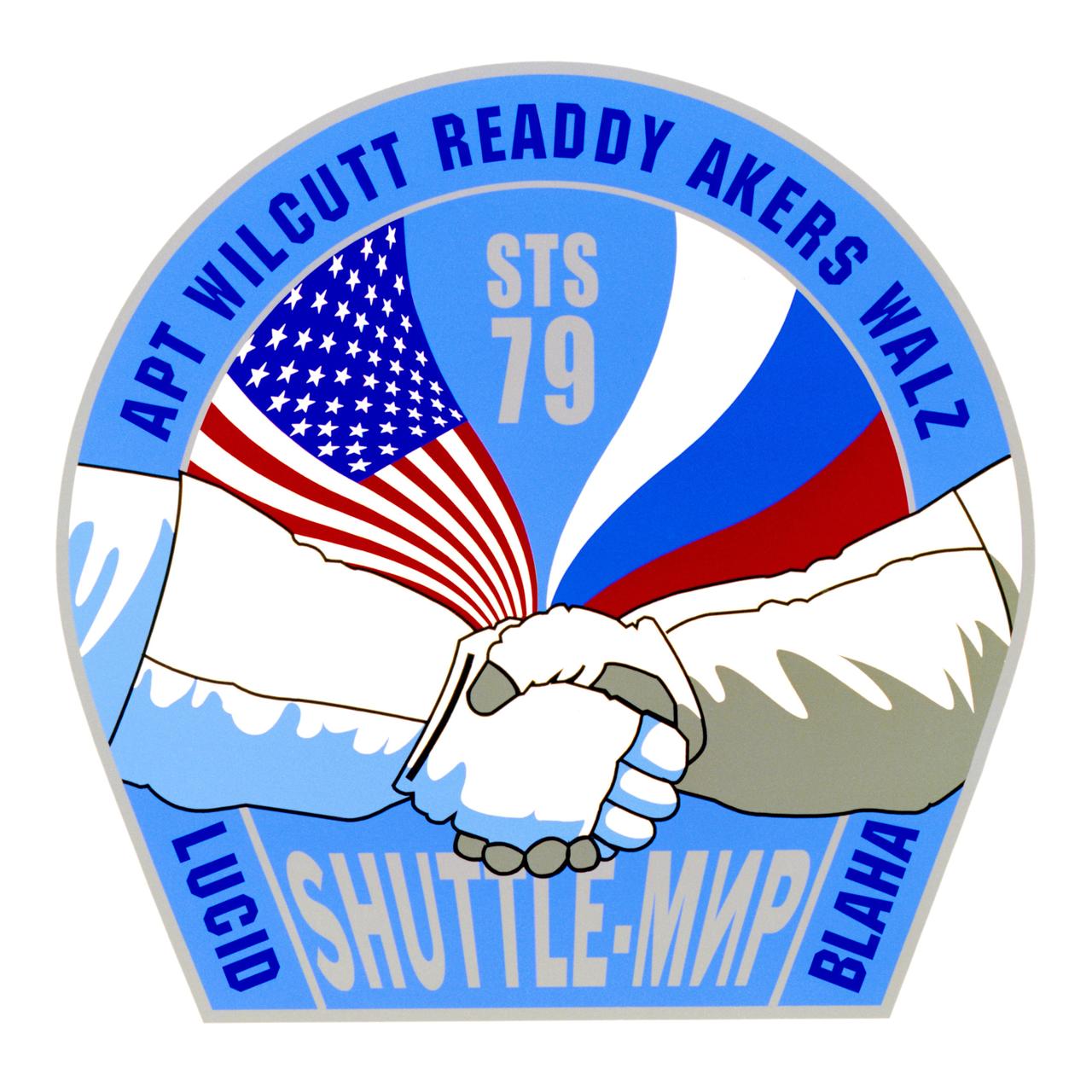
STS79-S-001 (April 1996) --- STS-79 is the fourth in a series of NASA docking missions to the Russian Mir Space Station, leading up to the construction and operation of the International Space Station (ISS). As the first flight of the Spacehab Double Module, STS-79 encompasses research, test and evaluation of ISS, as well as logistics resupply for the Mir Space Station. STS-79 is also the first NASA-Mir American crew member exchange mission, with John E. Blaha (NASA-Mir-3) replacing Shannon W. Lucid (NASA-Mir-2) aboard the Mir Space Station. The lettering of their names either up or down denotes transport up to the Mir Space Station or return to Earth on STS-79. The patch is in the shape of the space shuttle?s airlock hatch, symbolizing the gateway to international cooperation in space. The patch illustrates the historic cooperation between the United States and Russia in space. With the flags of Russia and the United States as a backdrop, the handshake of Extravehicular Mobility Unit (EMU) - suited crew members symbolizes mission teamwork, not only of the crew members but also the teamwork between both countries? space personnel in science, engineering, medicine and logistics. The NASA insignia design for space shuttle flights is reserved for use by the astronauts and for other official use as the NASA Administrator may authorize. Public availability has been approved only in the forms of illustrations by the various news media. When and if there is any change in this policy, which is not anticipated, the change will be publicly announced. Photo credit: NASA
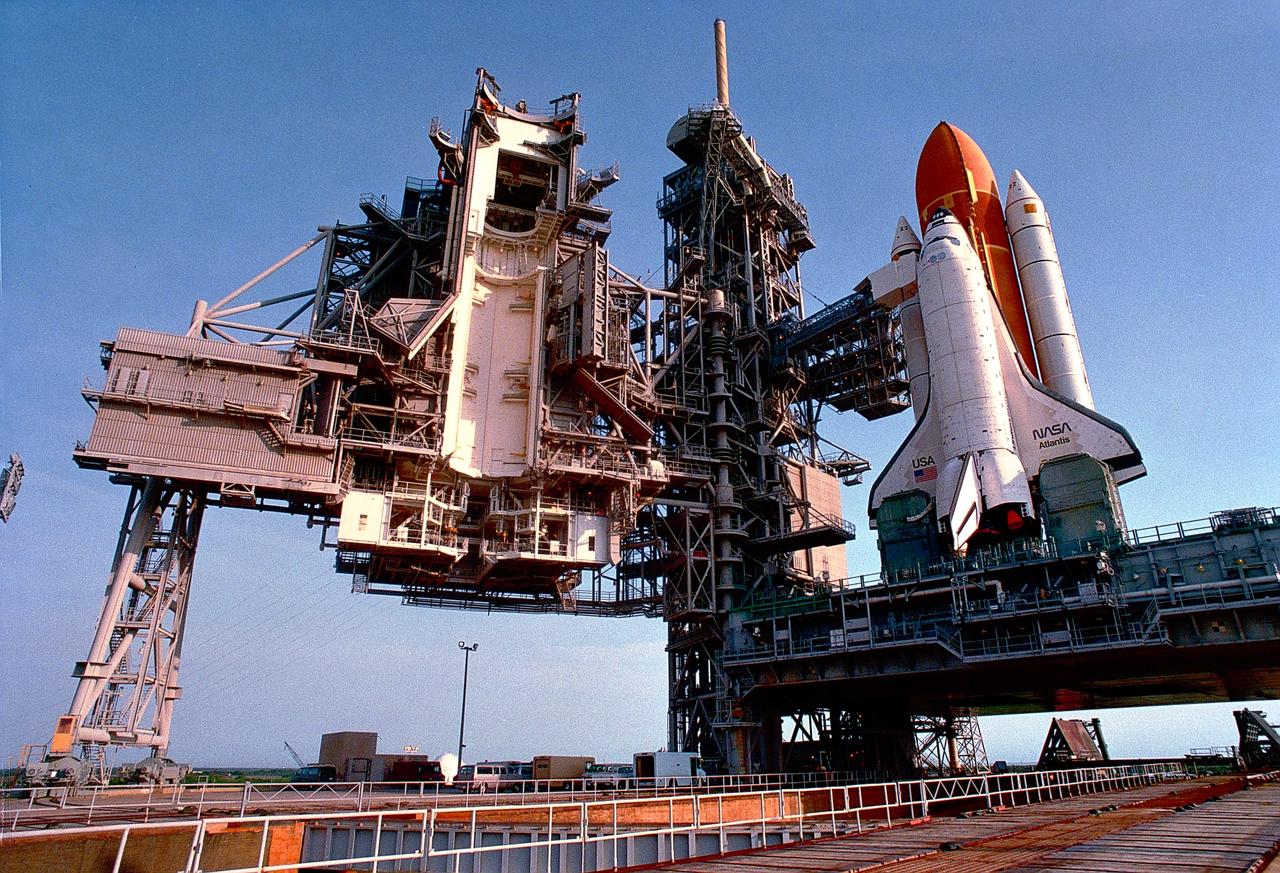
S96-11816 (1 June 1996) --- The space shuttle Atlantis completes the final Earth-bound leg of its journey into space, arriving at the top of the hardstand at Launch Pad 39A. Atlantis is slated for liftoff later this year on the STS-79 mission, the fourth United States Space Shuttle and Russian Mir Space Station docking flight.
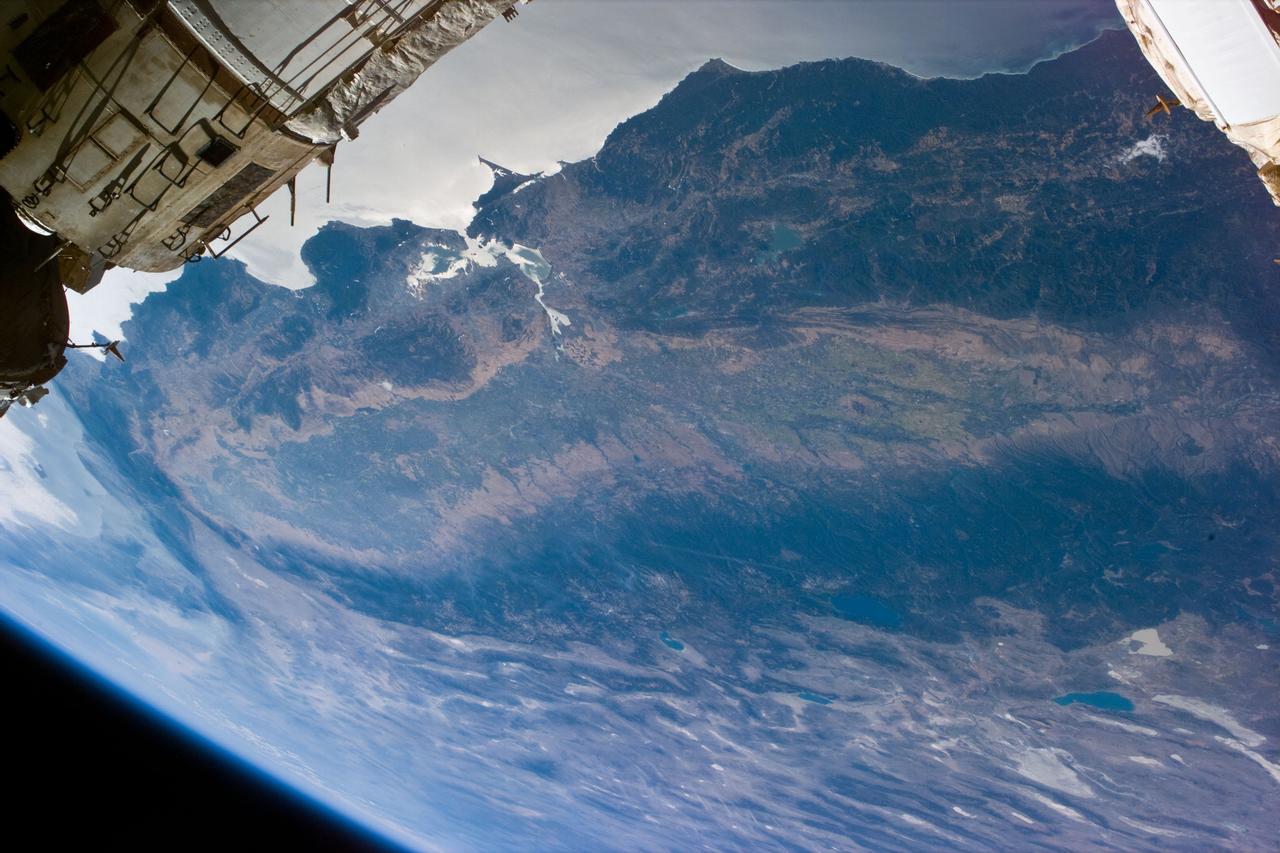
STS79-E-5164 (20 September 1996) --- As the Space Shuttle Atlantis and Russia's Mir Space Station orbited Earth together, the STS-79 crew recorded and downlinked this panorama of the Pacific Coast of the United States of America, during Flight Day 5. Most prominent features are the San Francisco bay area and the Salton Sea.
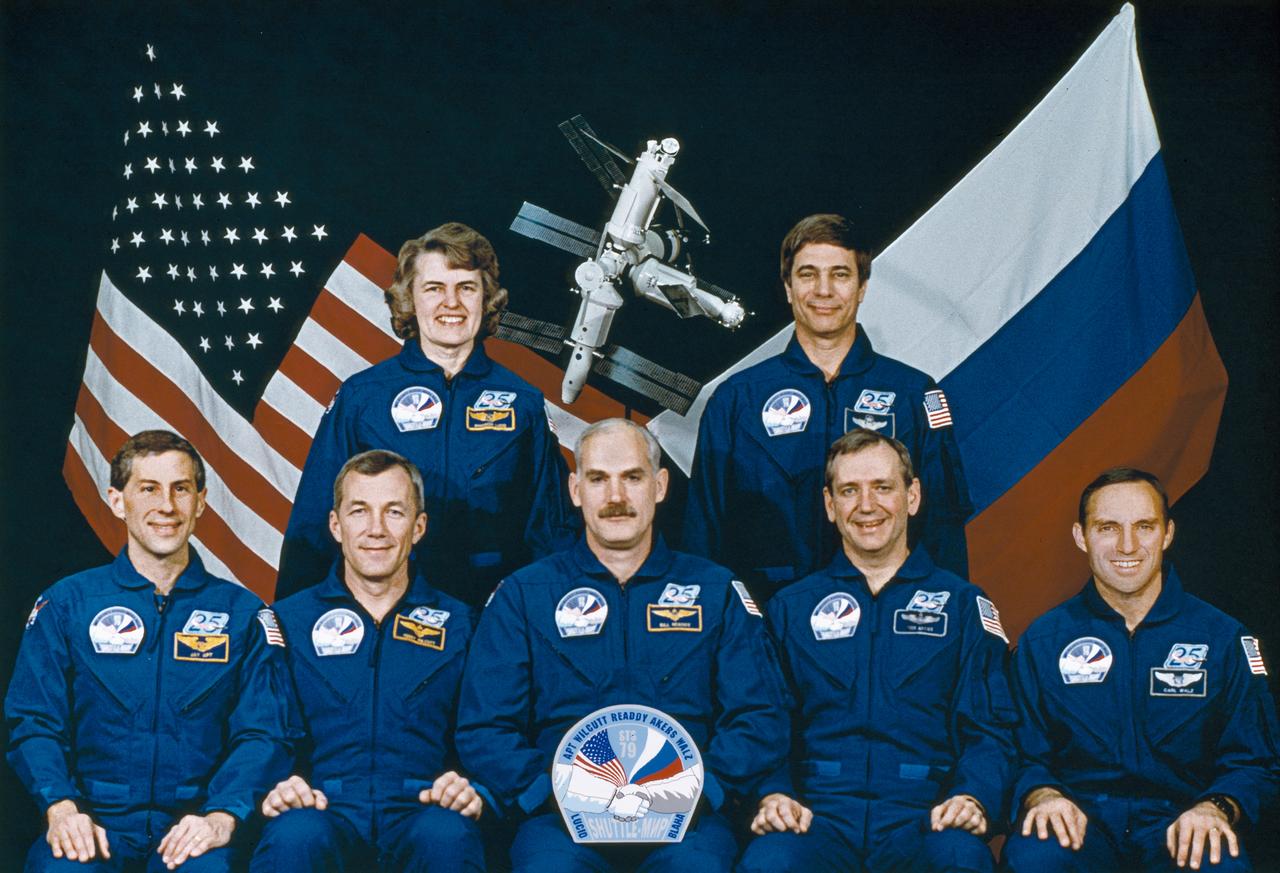
The crew assigned to the STS-79 mission included (seated front left to right) Jerome (Jay) Apt, mission specialist; Terrence W. Wilcutt, pilot; William F. Readdy, commander; Thomas D. Akers, and Carl E. Walz, both mission specialists. On the back row (left to right) are mission specialists Shannon W. Lucid, and John E. Blaha. Launched aboard the Space Shuttle Atlantis on September 16, 1996 at 4:54:49 am (EDT), the STS-79 mission marked the fourth U.S. Space Shuttle-Russian Space Station Mir docking, the second flight of the SPACEHAB module in support of Shuttle-Mir activities and the first flight of the SPACEHAB Double Module Configuration.
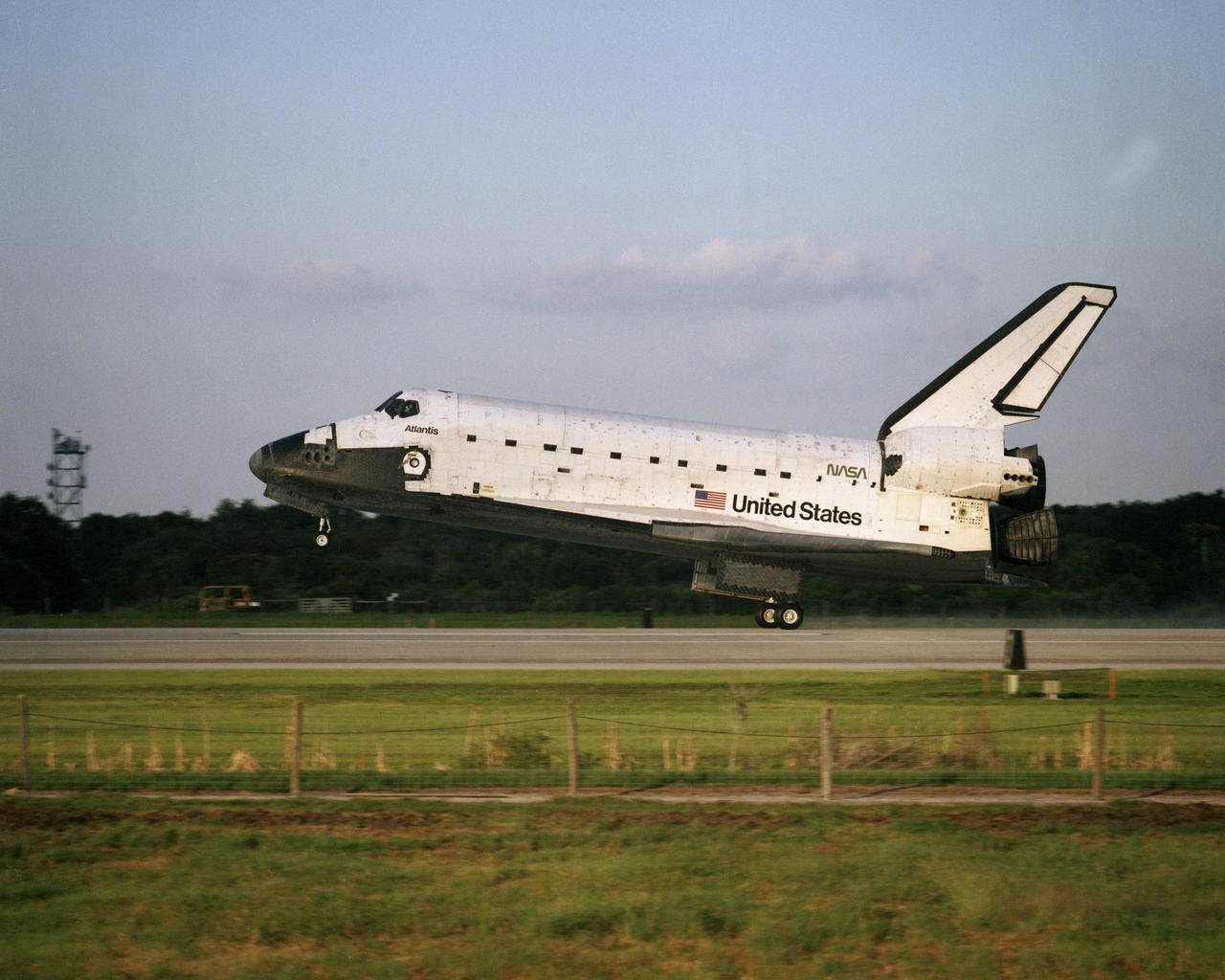
STS079-S-022 (26 Sept. 1996) --- The main landing gear of the space shuttle Atlantis touches down on Runway 15 at the Shuttle Landing Facility (SLF) at the Kennedy Space Center (KSC), bringing an end to the successful ten-day mission. Landing occurred at 8:13:15 a.m. (EDT), Sept. 26, 1996. The touchdown marked the end of 188 days in space for astronaut Shannon W. Lucid, following her in-space exchange with astronaut John E. Blaha, who is now aboard Russia's Mir Space Station. Returning along with Lucid were her STS-79 crew mates - astronauts William F. Readdy, commander; Terrence W. Wilcutt, pilot; and Thomas D. Akers, Jerome (Jay) Apt and Carl E. Walz, mission specialists.
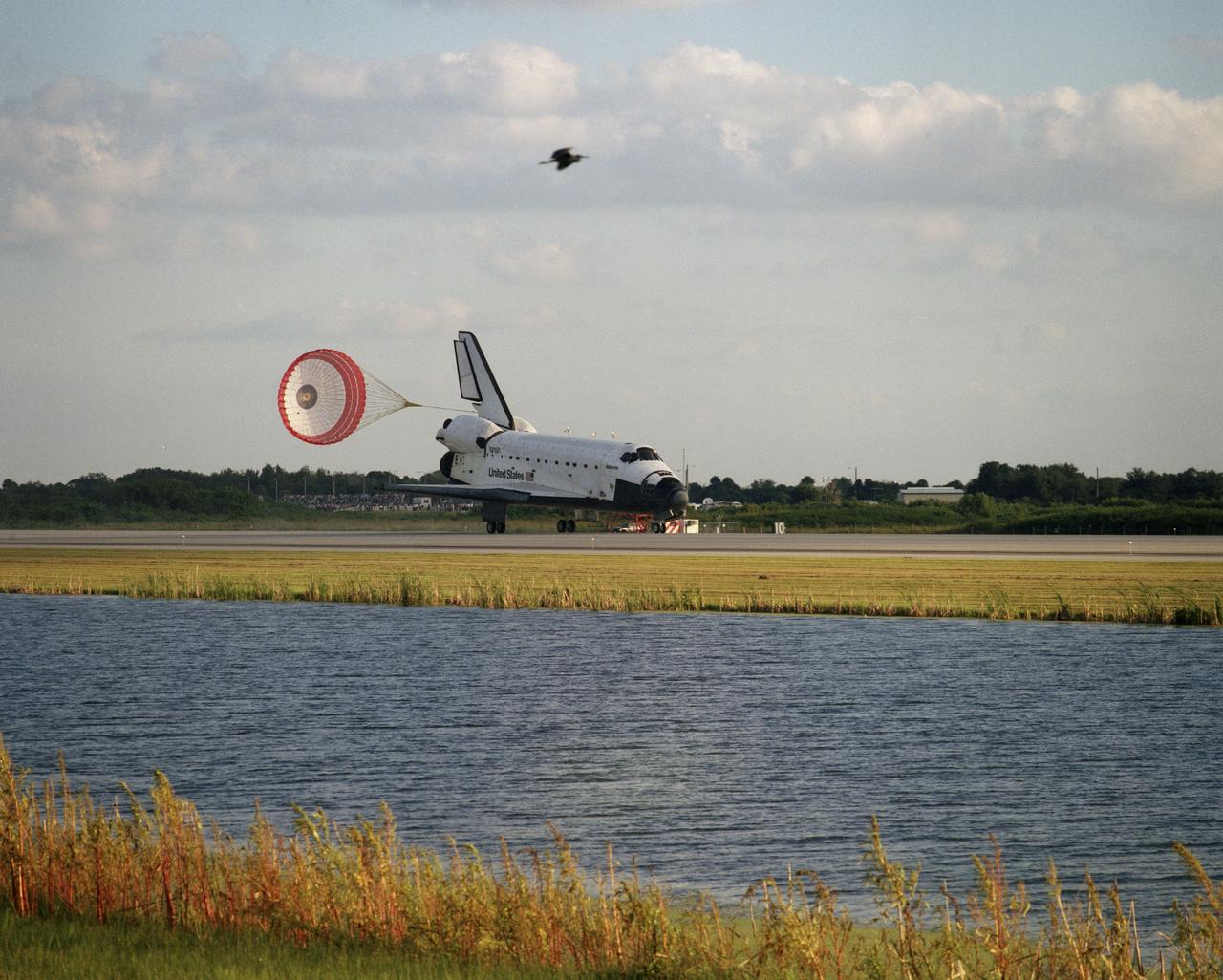
STS079-S-021 (26 Sept. 1996) --- The drag chute on the space shuttle Atlantis is fully deployed as the orbiter rolls down Runway 15 at the Shuttle Landing Facility (SLF) at the Kennedy Space Center (KSC), bringing an end to the successful ten-day mission. Landing occurred at 8:13:15 a.m. (EDT), Sept. 26, 1996. The touchdown marked the end of 188 days in space for astronaut Shannon W. Lucid, following her in-space exchange with astronaut John E. Blaha, who is now aboard Russia's Mir Space Station. Returning along with Lucid were her STS-79 crew mates - astronauts William F. Readdy, commander; Terrence W. Wilcutt, pilot; and Thomas D. Akers, Jerome (Jay) Apt and Carl E. Walz, mission specialists.
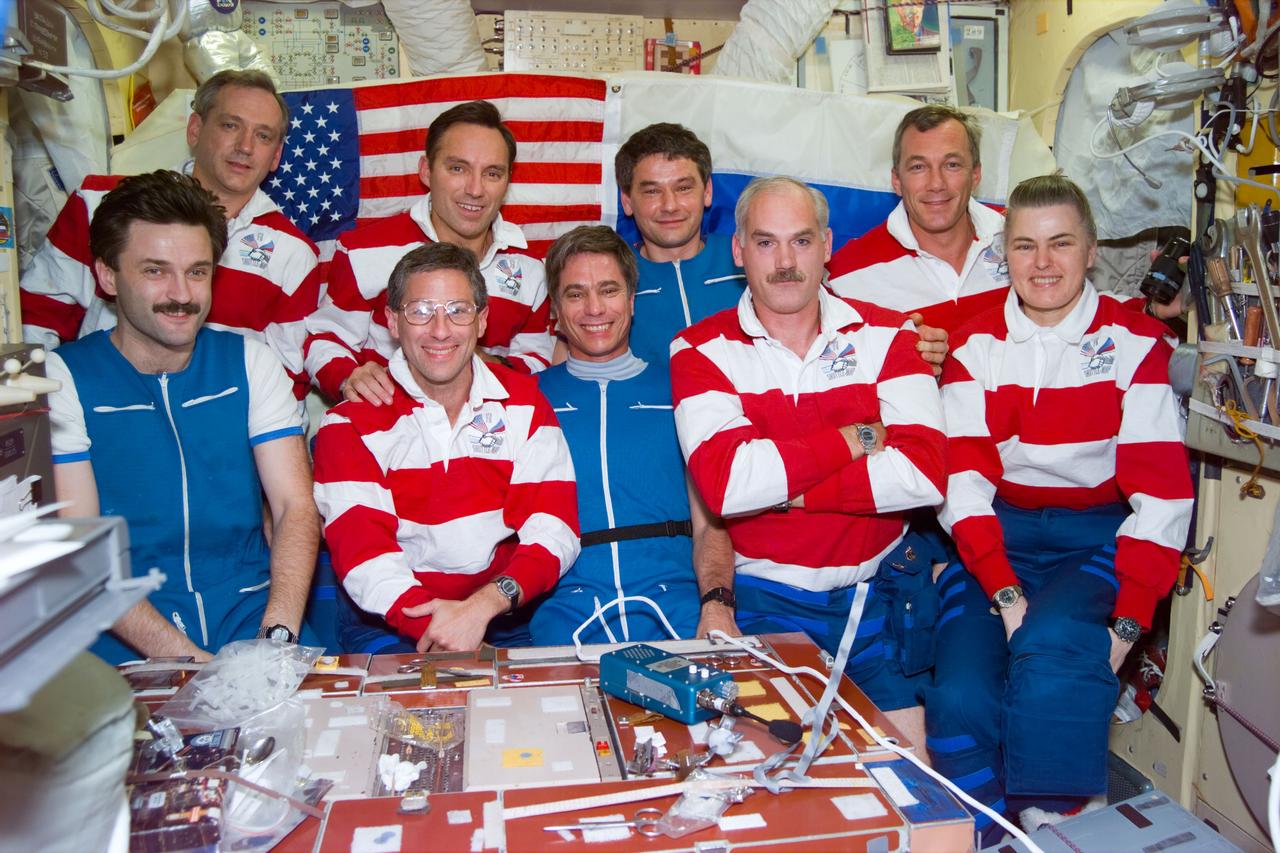
STS79-E-5289 (23 September 1996) --- Crew members of STS-79 and Mir-22 pose for final group portrait aboard Russia's Mir Space Station's Core Module before going separate ways in Earth-orbit, during Flight Day 8. Front row, left to right, are Aleksandr Y. Kaleri, Jerome (Jay) Apt, William F. Readdy and Shannon W. Lucid. On the back row are, left to right, Thomas D. Akers, Carl E. Walz, Valeri G. Korzun and Terrence W. Wilcutt. Note Blaha, the new cosmonaut researcher for Mir-22, is now wearing the uniform of that crew and Lucid's garment is uniform with the STS-79 astronauts.
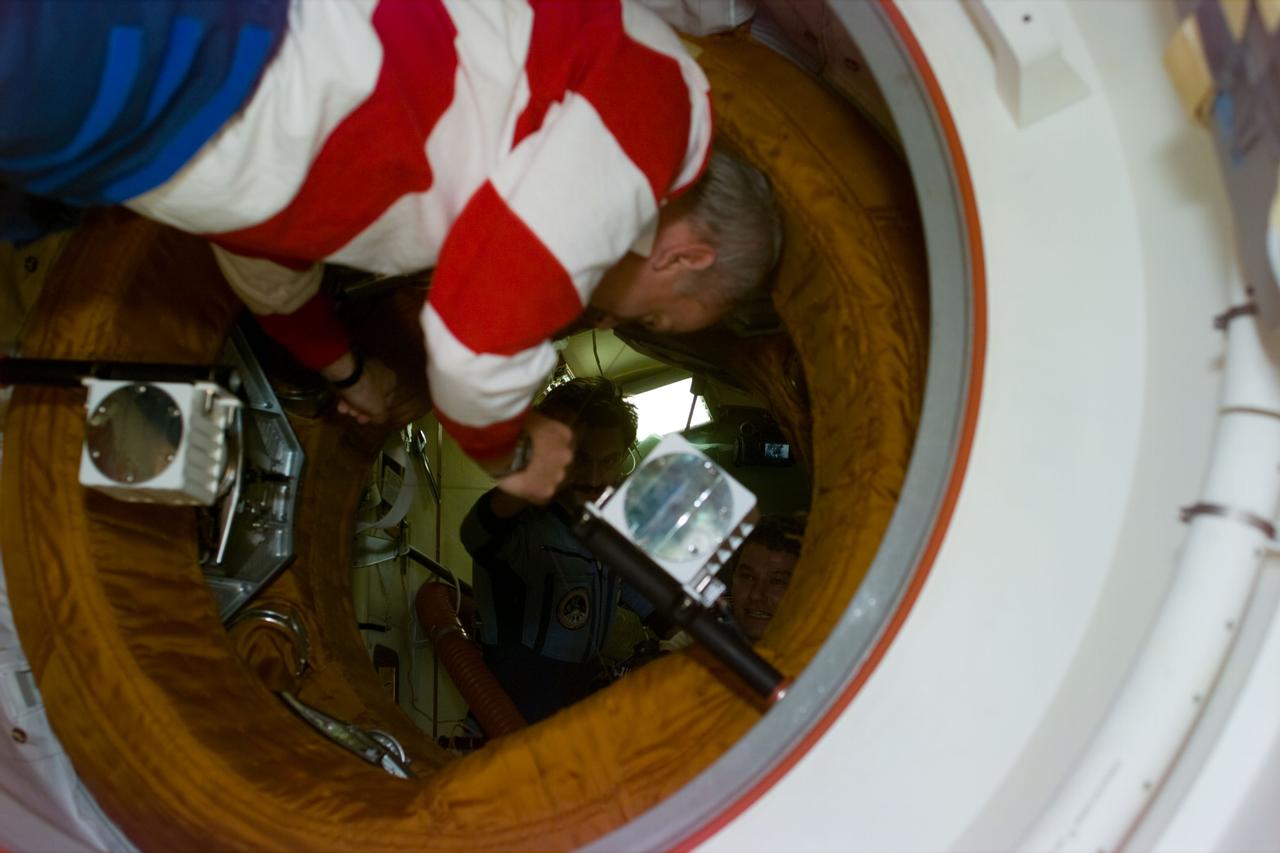
STS79-E-5300 (23 September 1996) --- Astronaut William F. Readdy (foreground), STS-79 commander, bids farewell to Russian cosmonauts Aleksandr Y. Kaleri (left in background), Mir-22 flight engineer, and Valeri G. Korzun, Mir-22 commander, just prior to hatch closing, during Flight Day 8. The Americans and Russians will undock the Space Shuttle Atlantis and the Russia's Mir Space Station later today.
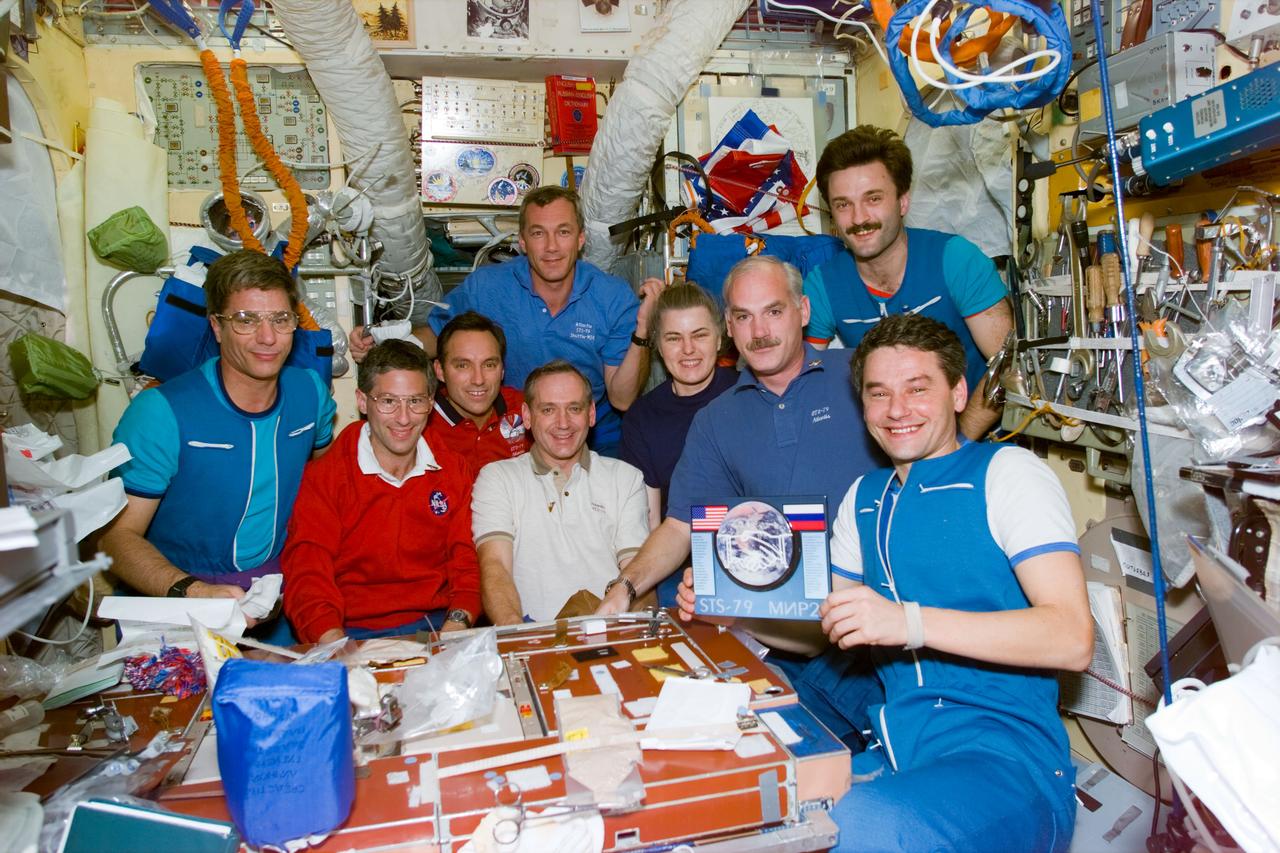
STS79-E-5180 (20 September 1996) --- The entire crews of STS-79 and Mir-22 are shown during a gift exchange ceremony aboard Russia's Mir Space Station's Base Block, during Flight Day 5. Front row, from the left, John E. Blaha, Jerome (Jay) Apt, Carl E. Walz, Thomas D. Akers, Shannon W. Lucid, William F. Readdy and Valeri G. Korzun. Back row: Terrence W. Wilcutt and Aleksandr Y. Kaleri.
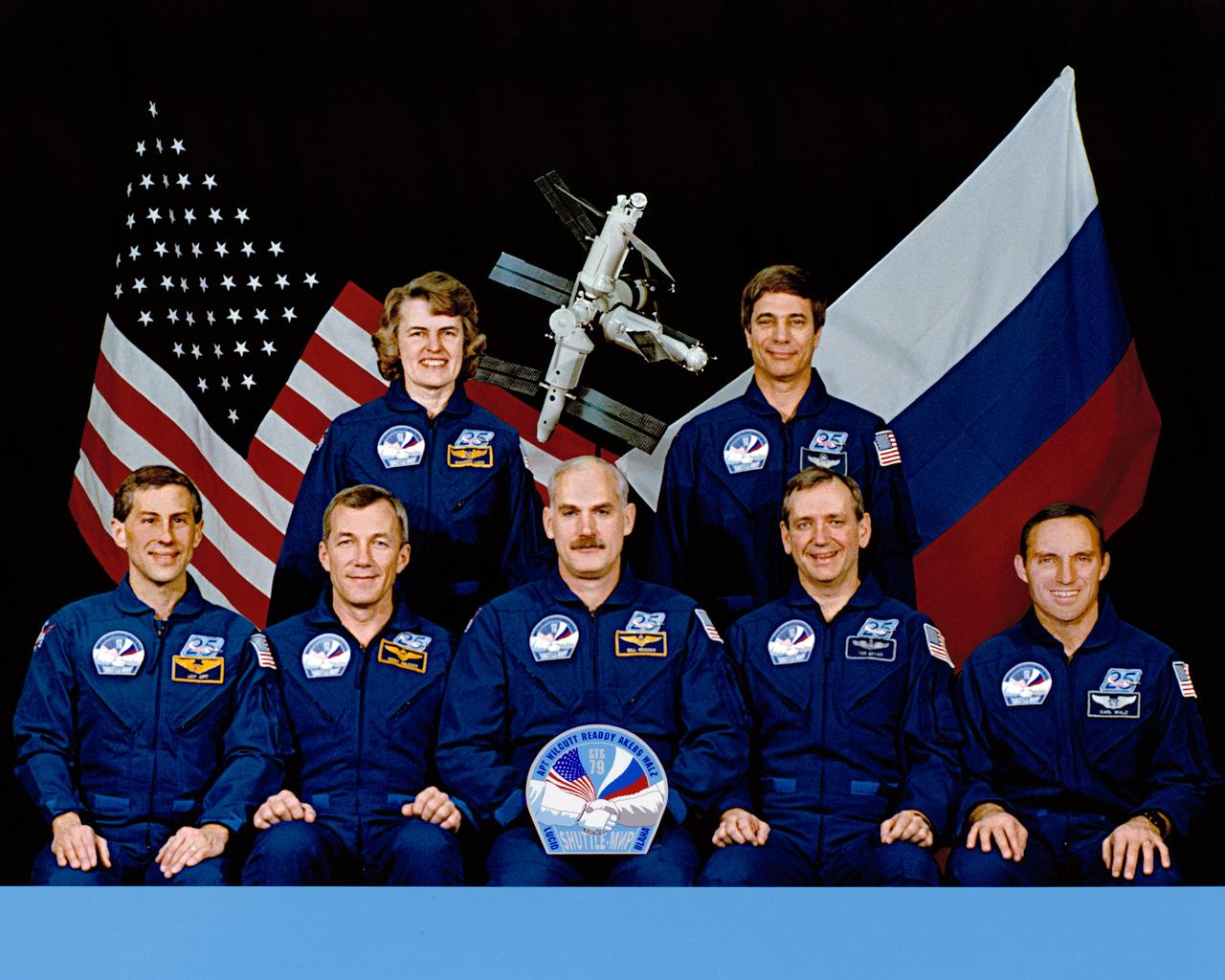
STS079-S-002 (May 1996) --- In various venues, these seven astronauts have been in training for several months for the different phases of the STS-79 mission scheduled for launch in August, 1996. Front row, left to right, are astronauts Jerome (Jay) Apt, mission specialist; Terrence W. Wilcutt, pilot; William F. Readdy, mission commander; Thomas D. Akers and Carl E. Walz, both mission specialists. On the back row are astronauts Shannon W. Lucid and John E. Blaha, both mission specialists. Lucid is currently aboard Russia’s Mir Space Station, having been delivered there by the Space Shuttle Atlantis crew of STS-76 in March, 1996. She will return to Earth with this crew, while Blaha will launch with this crew and remain onboard Mir for a subsequent tour of duty as a cosmonaut guest researcher.
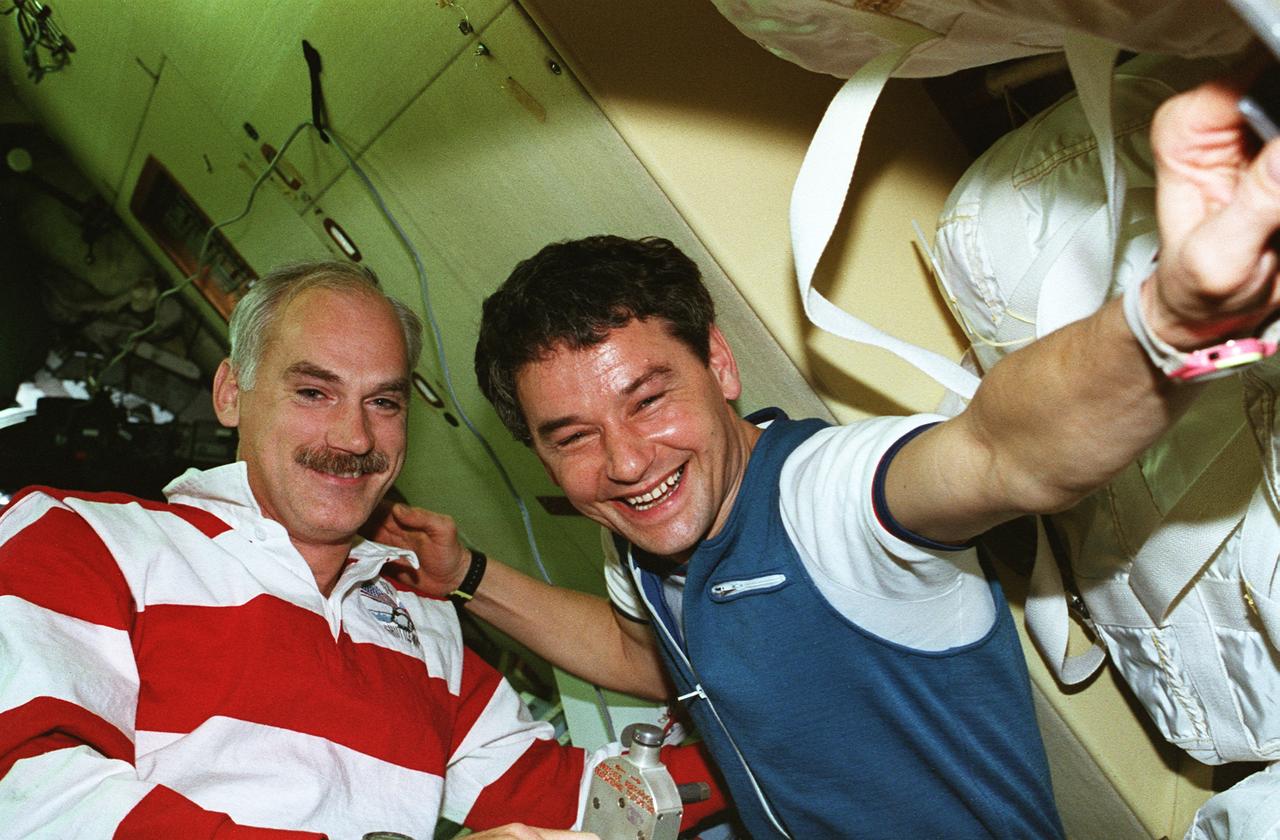
STS079-347-033 (16-26 Sept. 1996) --- Valeri G. Korzun and William F. Readdy, commanders, for Mir-22 and STS-79, respectively, reunite in the Docking Module (DM). The two have shared training experience in both Russia and the United States. This photograph is one of fifteen 35mm frames (along with four 70mm frames) of still photography documenting the activities of NASA's STS-79 mission, which began with a September 16, 1996, liftoff from Launch Pad 39A the Kennedy Space Center (KSC) and ended with a landing at KSC on September 26, 1996. Onboard for the launch were astronauts Readdy; Terrence W. Wilcutt, pilot; John E. Blaha, Jerome (Jay) Apt, Thomas D. Akers and Carl E. Walz, all mission specialists. On flight day 4, the crew docked with Russia's Mir Space Station. Shannon W. Lucid, who had spent six months aboard Mir, switched cosmonaut guest researcher roles with Blaha. The latter joined fellow Mir-22 crewmembers Korzun, and Aleksandr Y. Kaleri, flight engineer.
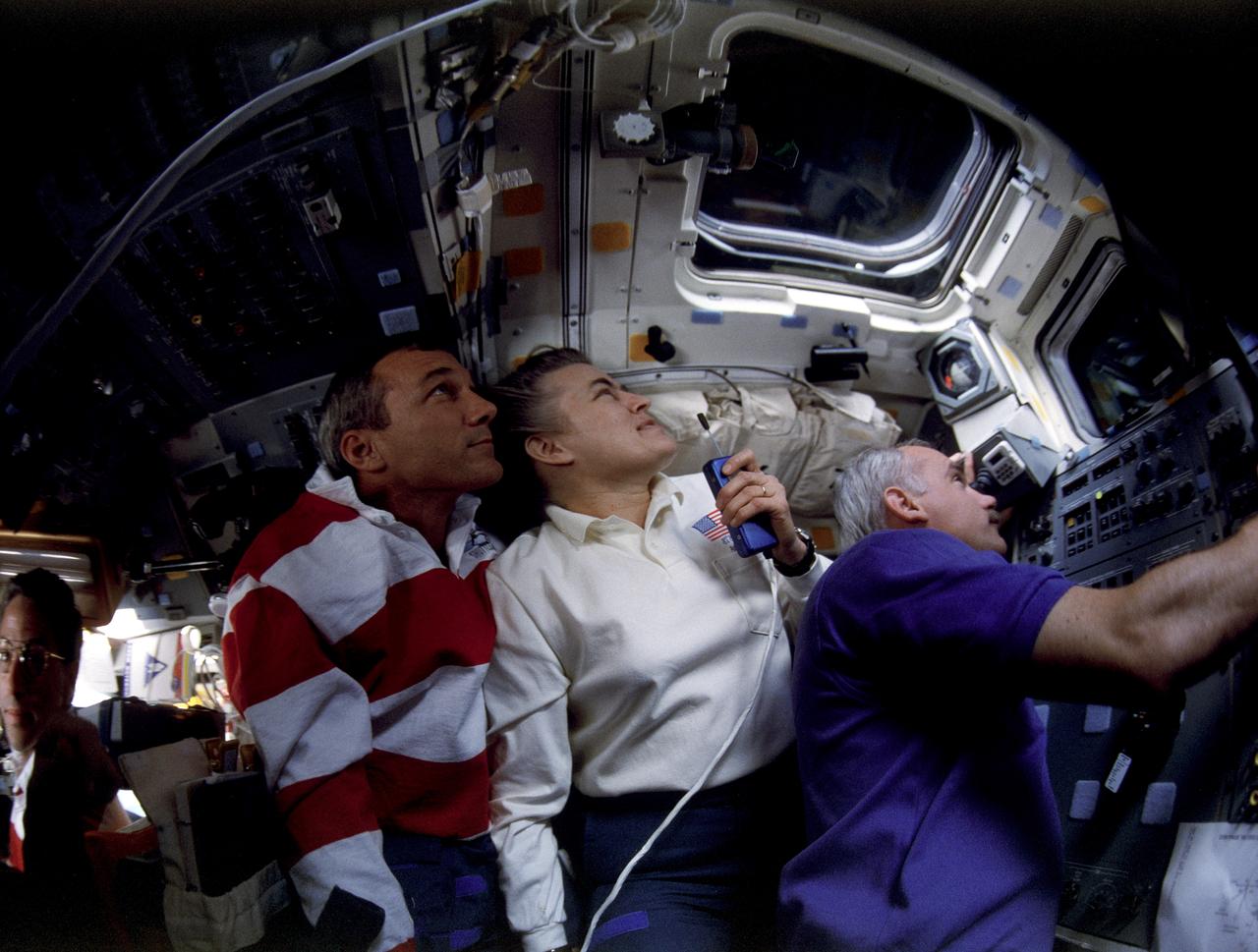
STS079-S-097 (16-26 Sept. 1996) --- Left to right, Terrence W. (Terry) Wilcutt, pilot; Shannon W. Lucid, mission specialist; and William F. Readdy, mission commander, are pictured on the space shuttle Atlantis' aft flight deck during undocking operations with Russia's Mir Space Station. Mir had served as both work and home for Lucid for over six months before greeting her American colleagues upon docking of Mir and Atlantis last week. Following her lengthy stay aboard Mir and several days on Atlantis, Lucid went on to spend 188 consecutive days in space before returning to Earth with the STS-79 crew. During the STS-79 mission, the crew used an IMAX camera to document activities aboard the Space Shuttle Atlantis and the various Mir modules. A hand-held version of the 65mm camera system accompanied the STS-79 crew into space in Atlantis' crew cabin. NASA has flown IMAX camera systems on many Shuttle missions, including a special cargo bay camera's coverage of other recent Shuttle-Mir rendezvous and/or docking missions.

KENNEDY SPACE CENTER, FLA. - STS-79 Commander William F. Readdy arrives at KSC's Shuttle Landing Facility with five fellow astronauts, ready to participate in the Terminal Countdown Demonstration Test (TCDT). The TCDT is a dress rehearsal for launch for the flight crew and launch team. Over the next several days, the astronauts will take part in training exercises at the launch pad that will culminate in a simulated launch countdown. The Space Shuttle Atlantis is being prepared for liftoff on STS-79 around Sept. 12.
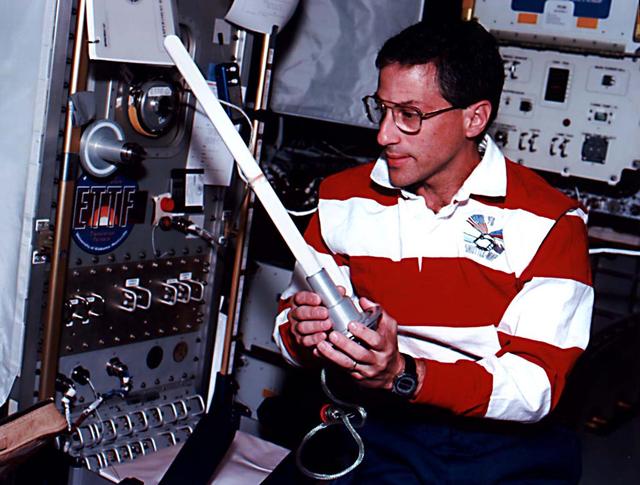
Astronaut Jerome Apt works at the Extreme Temperature Translation Furnace.
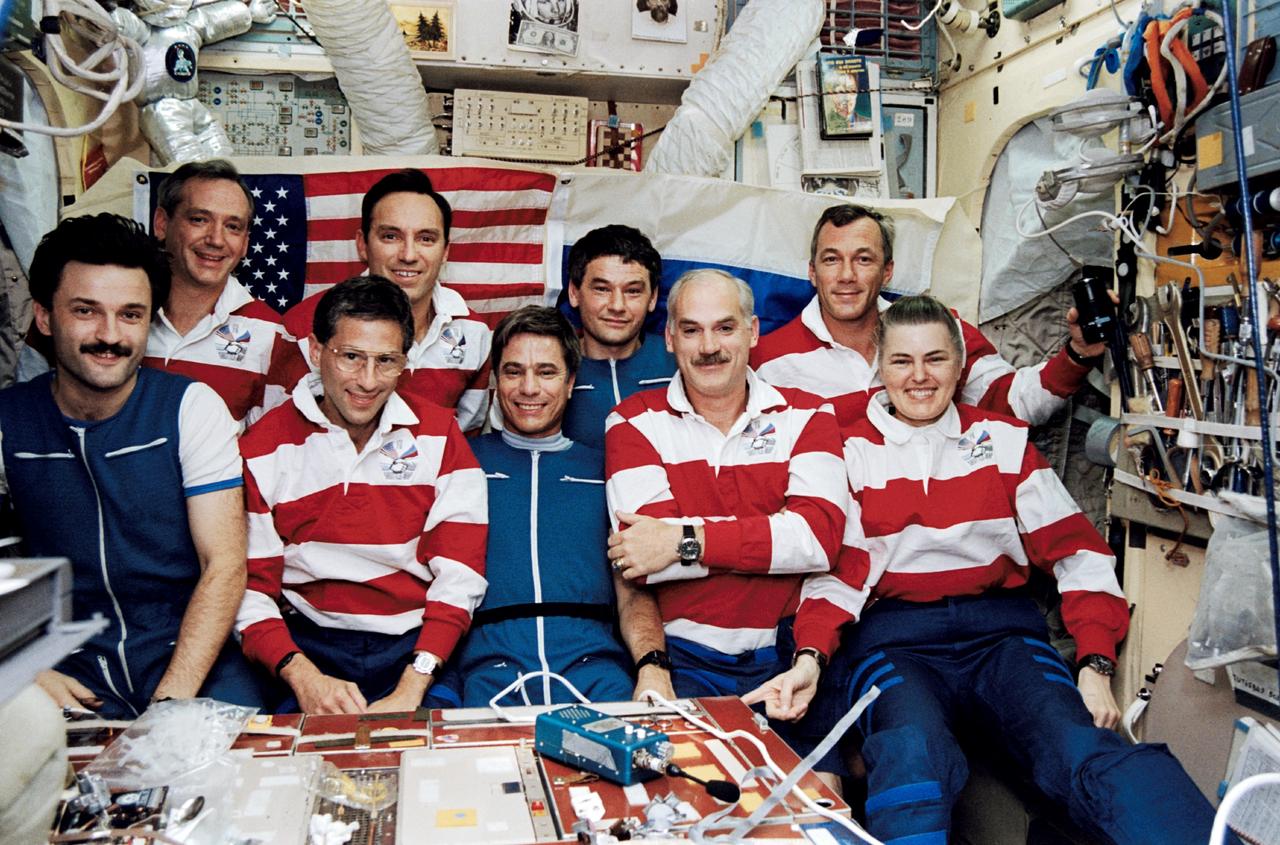
STS079-349-022 (16-26 Sept. 1996) --- The traditional inflight crew portrait, taken in Russia's Mir Space Station base block. Front row, left to right, Aleksandr Y. Kaleri, Jerome (Jay) Apt, John E. Blaha, William F. Readdy and Shannon W. Lucid. Back row, left to right, Thomas D. Akers, Carl E. Walz, Valeri G. Korzun and Terrence W. Wilcutt. This photograph is one of fifteen 35mm frames (along with four 70mm frames) of still photography documenting the activities of NASA's STS-79 mission, which began with a September 16, 1996, liftoff from Launch Pad 39A the Kennedy Space Center (KSC) and ended with a landing at KSC on September 26, 1996. Onboard for the launch were astronauts Readdy, commander; Wilcutt, pilot; Blaha, Apt, Akers and Walz, all mission specialists. On flight day 4, the crew docked with the Mir Space Station. Lucid, who had spent six months aboard Mir, switched cosmonaut guest researcher roles with Blaha. The latter joined fellow Mir-22 crewmembers Korzun, commander, and Kaleri, flight engineer.
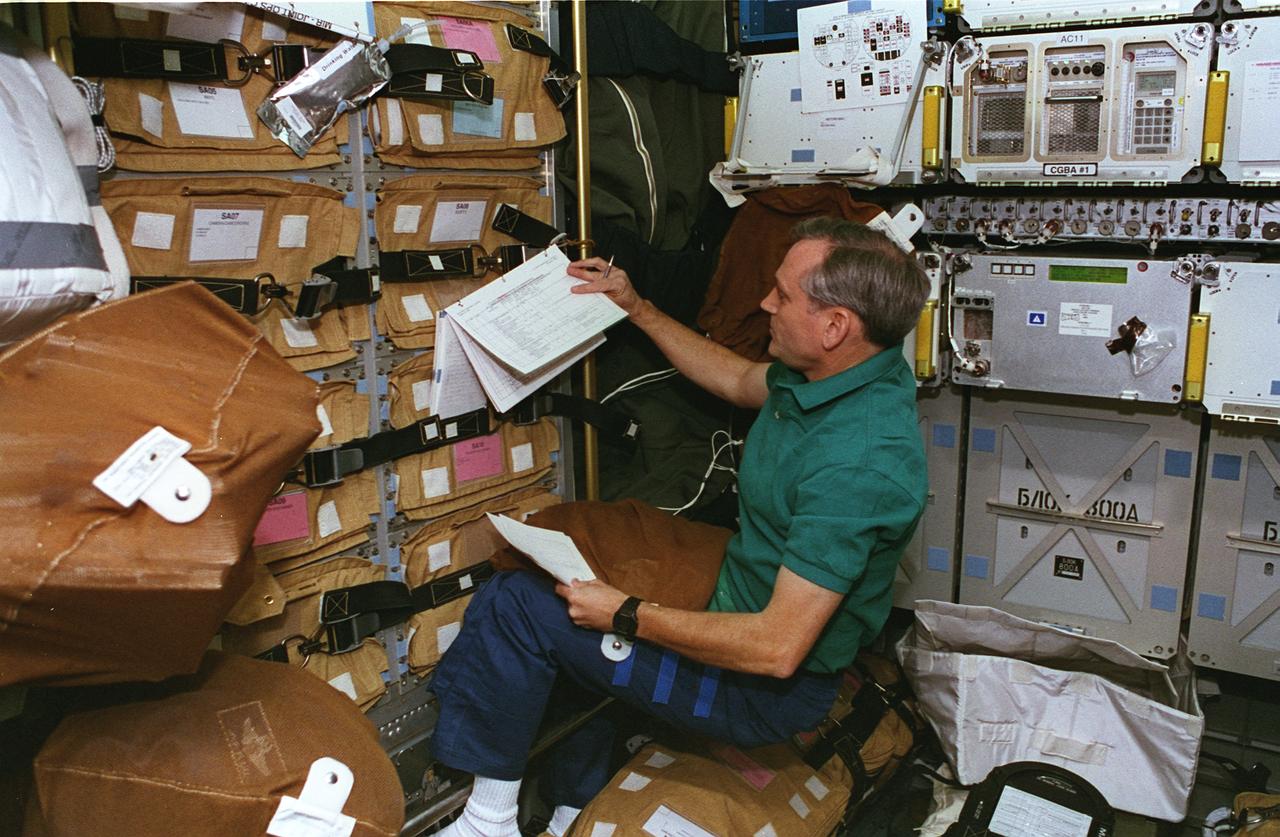
STS079-309-022 (16-26 Sept. 1996) --- Astronaut Thomas D. Akers, in the Spacehab, goes over an inventory of supplies which will be transferred to the Russia's Mir Space Station. This photograph is one of fifteen 35mm frames (along with four 70mm frames) of still photography documenting the activities of NASA's STS-79 mission, which began with a September 16, 1996, liftoff from Launch Pad 39A the Kennedy Space Center (KSC) and ended with a landing at KSC on September 26, 1996. Onboard for the launch were astronauts William F. Readdy, commander; Terrence W. Wilcutt, pilot; John E. Blaha, Jerome (Jay) Apt, Akers and Carl E. Walz, all mission specialists. On flight day 4, the crew docked with the Mir Space Station. Shannon W. Lucid, who had spent six months aboard Mir, switched cosmonaut guest researcher roles with Blaha. The latter joined fellow Mir-22 crew members Valeri G. Korzun, commander, and Aleksandr Y. Kaleri, flight engineer.
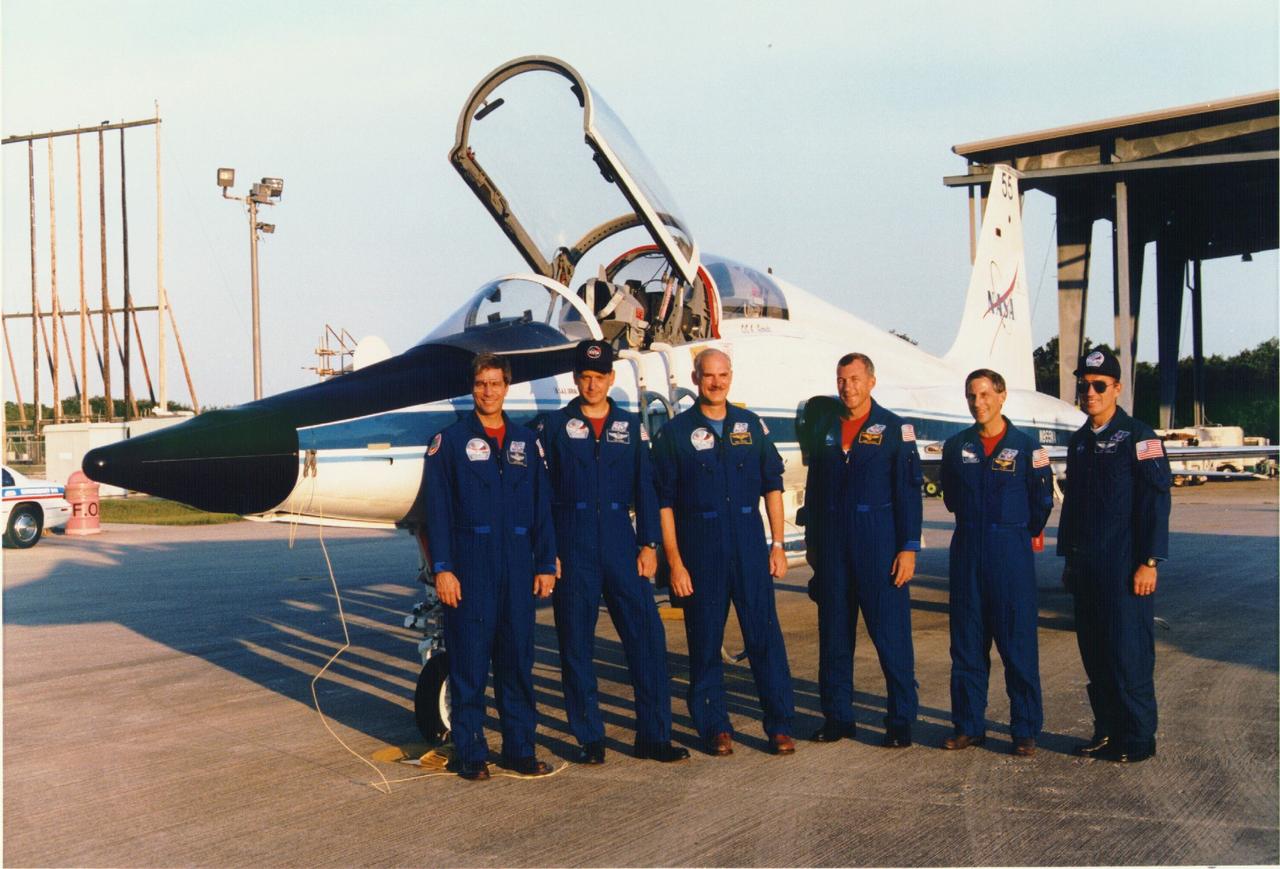
KENNEDY SPACE CENTER, FLA. - The STS-79 astronauts arrive at KSC's Shuttle Landing Facility in their T-38 aircraft from Johnson Space Center in Houston. From left are Mission Specialists John E. Blaha and Tom Akers; Commander William F. Readdy; PIlot Terrence W. Wilcutt; and Mission Specialists Jay Apt and Carl E. Walz. The astronauts are at KSC for the Terminal Countdown Demonstration Test, a dress rehearsal for launch. They are scheduled to lift off around Sept. 12 on Mission STS-79, the fourth docking between the U.S. Shuttle and Russian Space Station Mir.
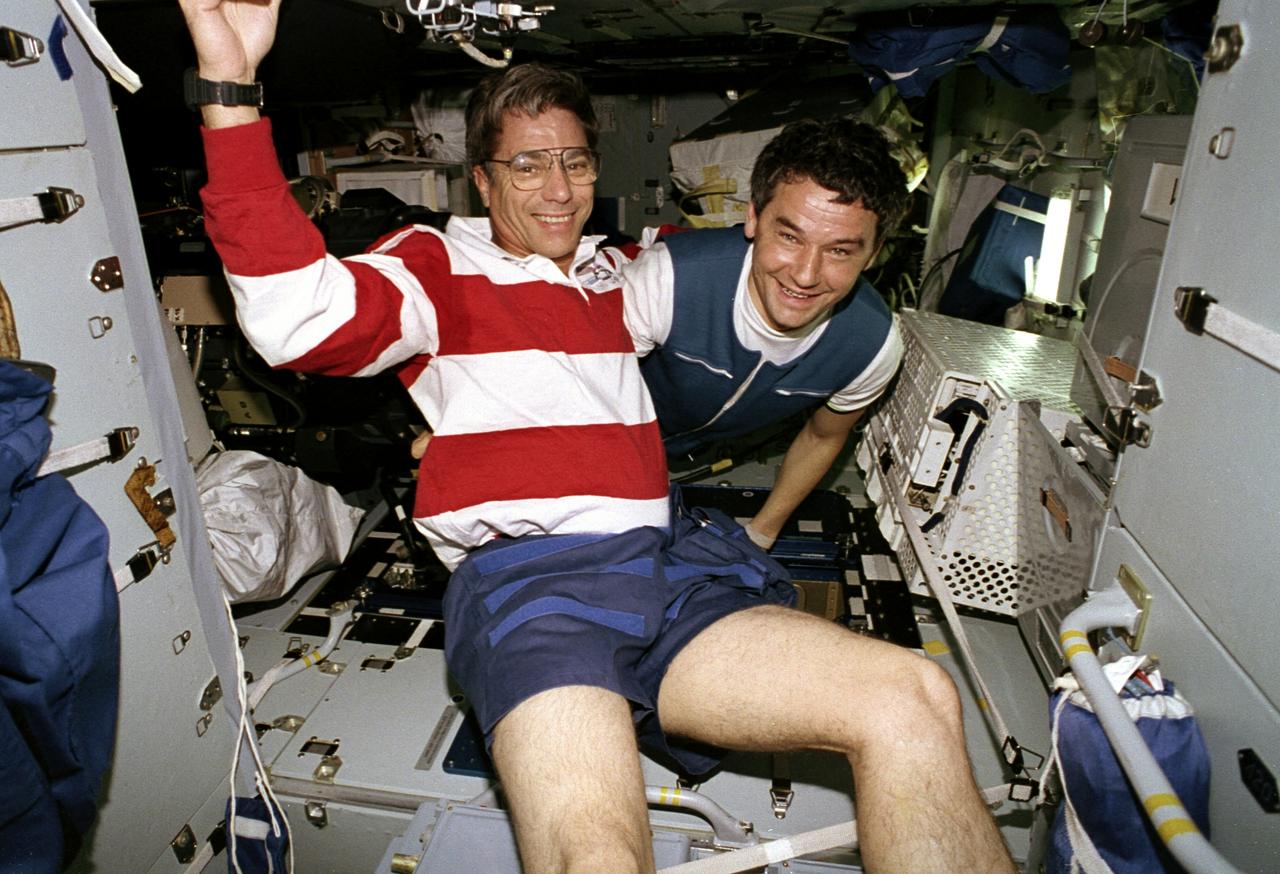
STS079-350-028 (16-26 Sept. 1996) --- Aboard Russian Mir Space Station's Spektr Module, astronaut John E. Blaha, now a cosmonaut guest researcher, visits with Valeri G. Korzun, his mission commander for Mir-22. This photograph is one of fifteen 35mm frames (along with four 70mm frames) of still photography documenting the activities of NASA's STS-79 mission, which began with a Sept. 16, 1996, liftoff from Launch Pad 39A the Kennedy Space Center (KSC) and ended with a landing at KSC on September 26, 1996. Onboard for the launch were astronauts William F. Readdy, commander; Terrence W. Wilcutt, pilot; Blaha, Jerome (Jay) Apt, Thomas D. Akers and Carl E. Walz, all mission specialists. On flight day 4, the crew docked with Mir. Shannon W. Lucid, who had spent six months aboard Mir, switched cosmonaut guest researcher roles with Blaha. The latter joined fellow Mir-22 crewmembers Korzun, and Aleksandr Y. Kaleri, flight engineer.
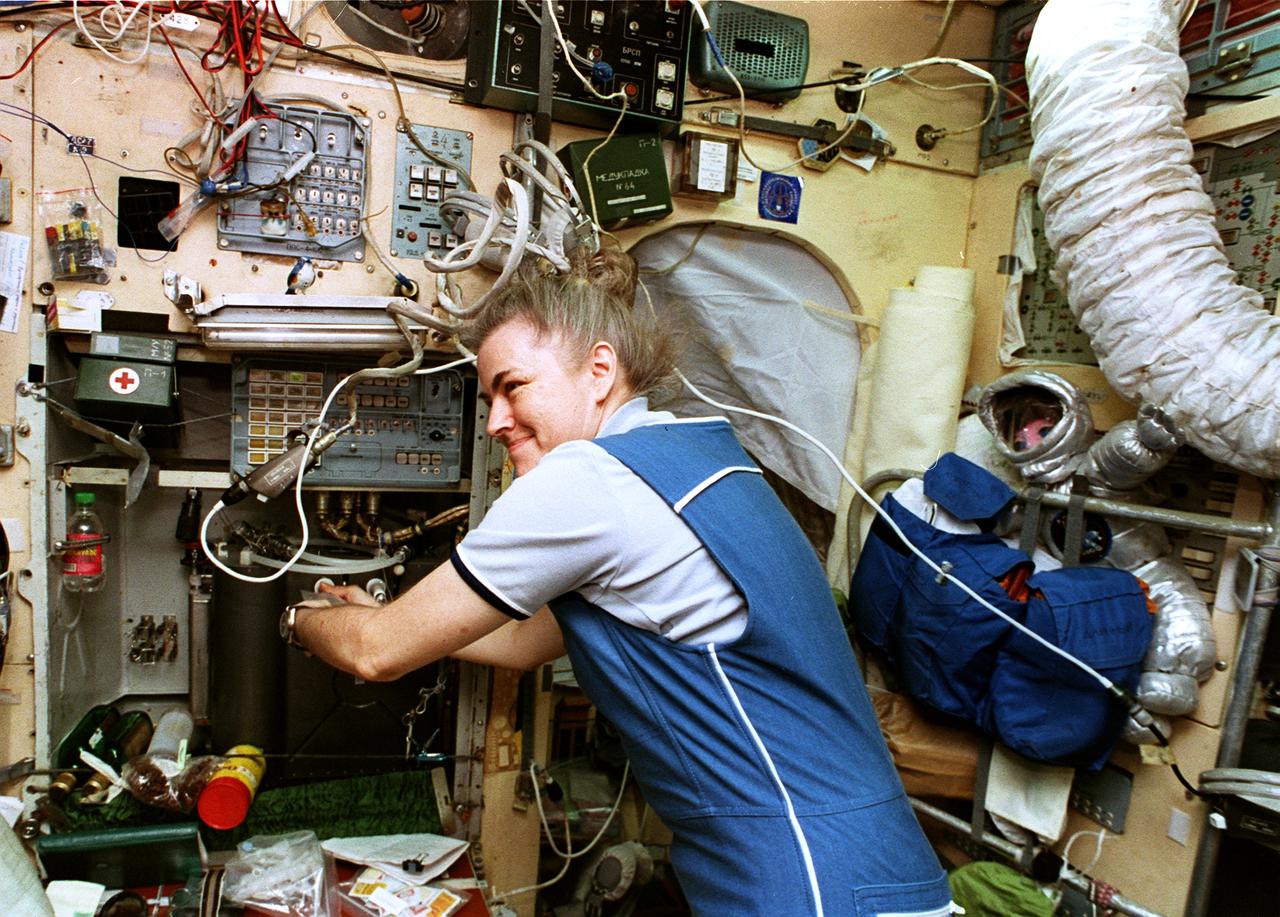
STS079-354-001 (16-26 Sept. 1996) --- Astronaut Shannon W. Lucid gets a beverage at the galley on Russia's Mir Space Station Base Block. This photograph is one of fifteen 35mm frames (along with four 70mm frames) of still photography documenting the activities of NASA's STS-79 mission, which began with a September 16, 1996, liftoff from Launch Pad 39A the Kennedy Space Center (KSC) and ended with a landing at KSC on September 26, 1996. Onboard for the launch were astronauts William F. Readdy, commander; Terrence W. Wilcutt, pilot; John E. Blaha, Jerome (Jay) Apt, Thomas D. Akers and Carl E. Walz, all mission specialists. On flight day 4, the crew docked with Mir. Lucid, who had spent six months aboard Mir, switched cosmonaut guest researcher roles with Blaha. The latter joined fellow Mir-22 crew members Valeri G. Korzun, commander, and Aleksandr Y. Kaleri, flight engineer.

STS079-358-027 (16-26 September 1996) --- Astronaut William F. Readdy looks over a checklist at the commander's station on the Space Shuttle Atlantis' flight deck. Among his many other duties as mission commander, Readdy controlled the Orbiter during a series of maneuvers associated with the docking and undocking operations with Russia's Mir Space Station. This photograph is one of fifteen 35mm frames (along with four 70mm frames) of still photography documenting the activities of NASA's STS-79 mission, which began with a September 16, 1996, liftoff from Launch Pad 39A the Kennedy Space Center (KSC) and ended with a landing at KSC on September 26, 1996. Onboard for the launch were astronauts Readdy; Terrence W. Wilcutt, pilot; John E. Blaha, Jerome (Jay) Apt, Thomas D. Akers and Carl E. Walz, all mission specialists. On flight day 4, the crew docked with Russia's Mir Space Station. Shannon W. Lucid, who had spent six months aboard Mir, switched cosmonaut guest researcher roles with Blaha. The latter joined fellow Mir-22 crewmembers Valeri G. Korzun, commander, and Aleksandr Y. Kaleri, flight engineer.
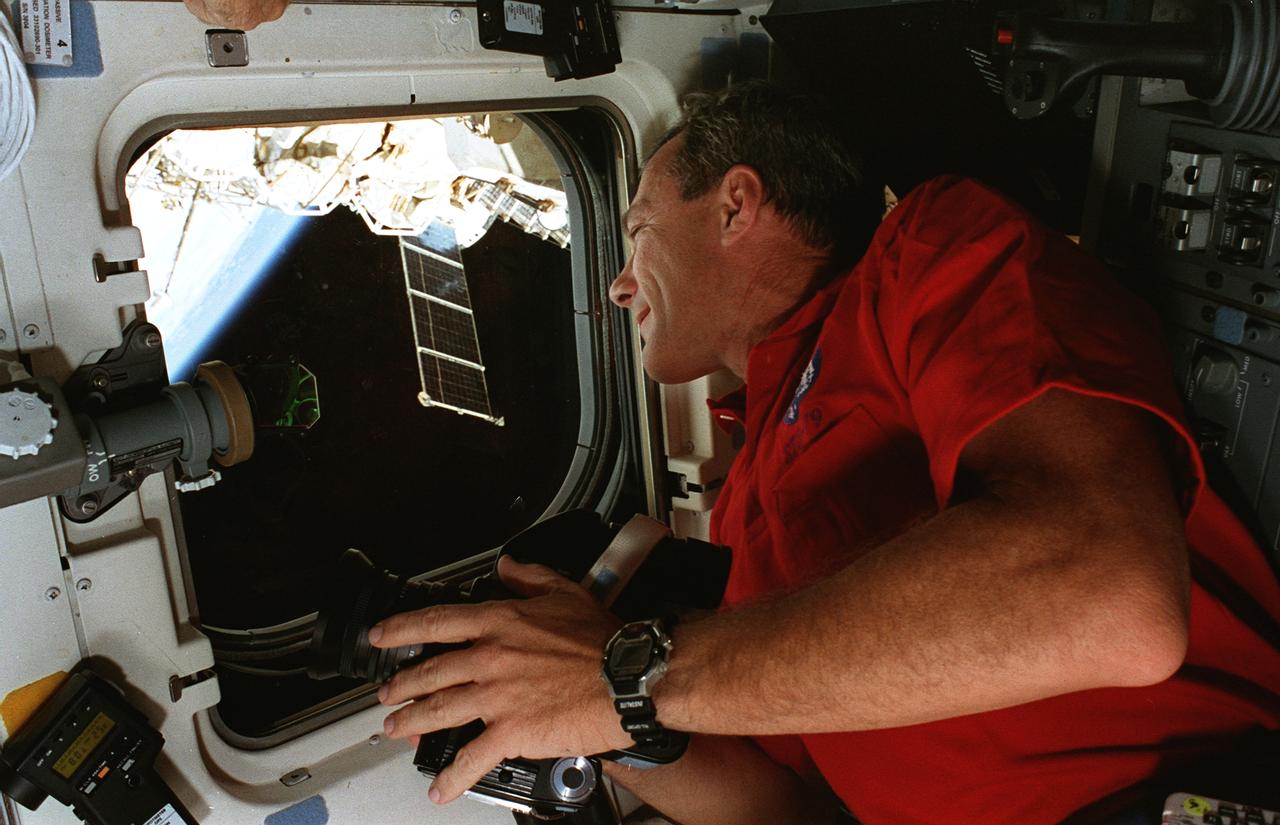
STS079-353-007 (16-26 Sept. 1996) --- Astronaut Terrence W. Wilcutt, on the Space Shuttle Atlantis' aft flight deck, takes pictures of Earth for study by Earth observations scientists at the Johnson Space Center (JSC). Several components of the docked Russia's Mir Space Station can be seen in the background. This photograph is one of fifteen 35mm frames (along with four 70mm frames) of still photography documenting the activities of NASA's STS-79 mission, which began with a September 16, 1996, liftoff from Launch Pad 39A the Kennedy Space Center (KSC) and ended with a landing at KSC on September 26, 1996. Onboard for the launch were astronauts William F. Readdy, commander; Wilcutt, pilot; John E. Blaha, Jerome (Jay) Apt, Thomas D. Akers and Carl E. Walz, all mission specialists. On flight day 4, the crew docked with Russia's Mir Space Station. Shannon W. Lucid, who had spent six months aboard Mir, switched cosmonaut guest researcher roles with Blaha. The latter joined fellow Mir-22 crew members Valeri G. Korzun, commander, and Aleksandr Y. Kaleri, flight engineer.
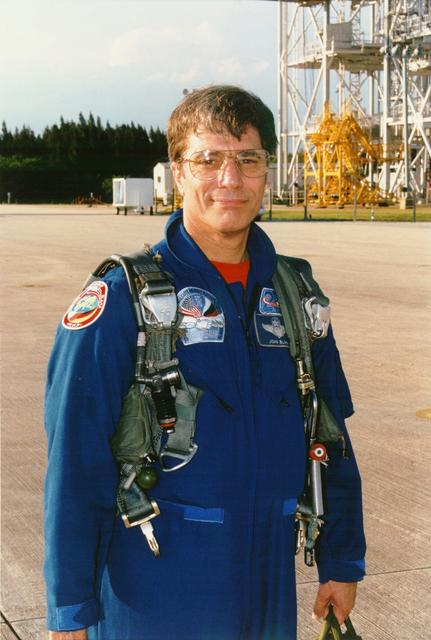
KENNEDY SPACE CENTER, FLA. - STS-79 Mission Specialist John E. Blaha arrives at KSC's Shuttle Landing Facility with five fellow astronauts, ready to participate in the Terminal Countdown Demonstration Test (TCDT). The TCDT is a dress rehearsal for launch for the flight crew and launch team. Over the next several days, the astronauts will take part in training exercises at the launch pad that will culminate in a simulated launch countdown. The Space Shuttle Atlantis is being prepared for liftoff around Sept. 12 on STS-79, the fourth docking between the U.S. Shuttle and Russian Space Station Mir. During the approximately nine-day flight, Blaha will change places with fellow spaceflight veteran Shannon Lucid, who is wrapping up a record-setting stay on Mir. Blaha will remain aboard the Station for about four months, returning to Earth in January 1997 withthe crew of Shuttle Mission STS-81.
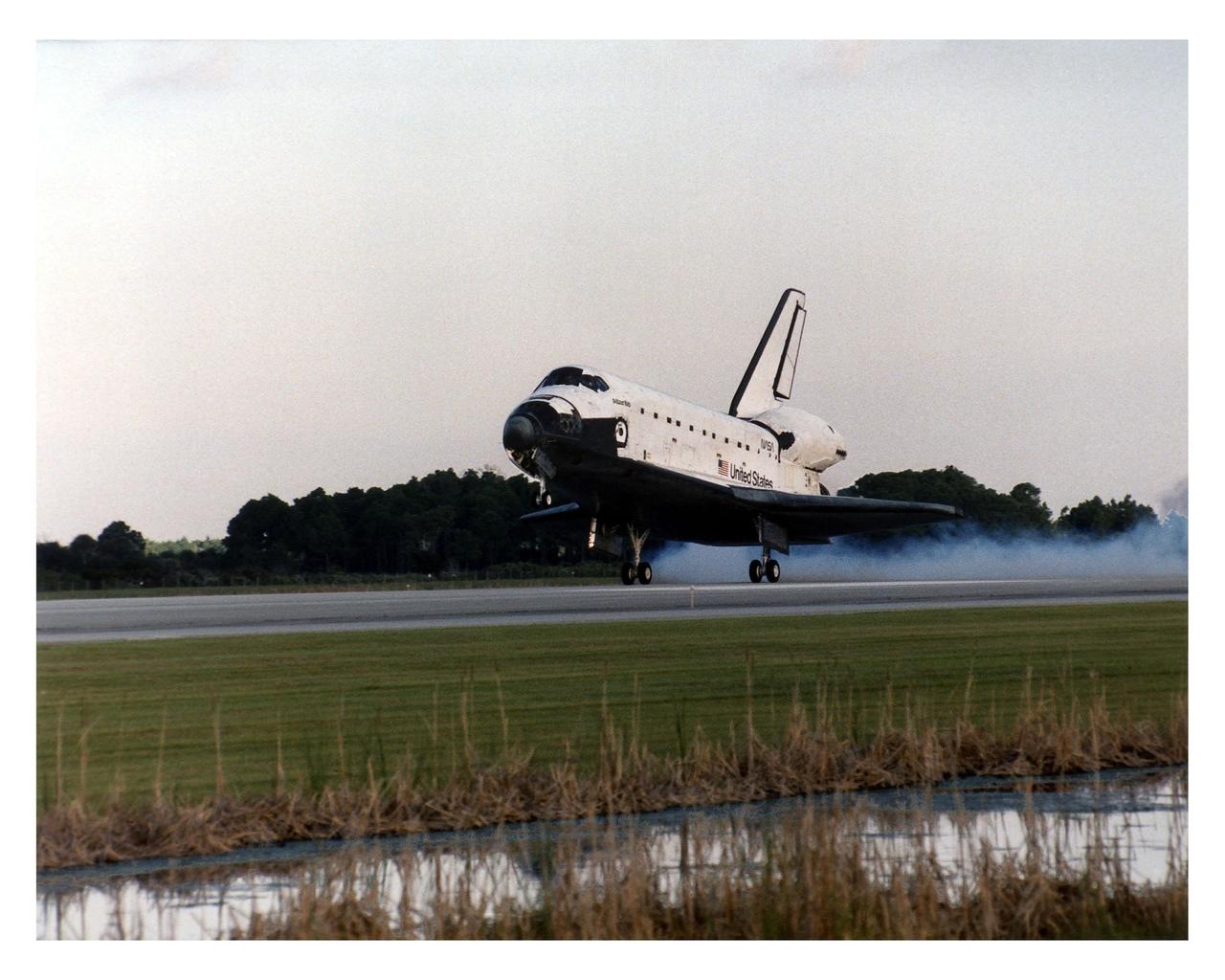
KENNEDY SPACE CENTER, FLA. -- Atlantis returns to KSC's Shuttle Landing Facility from mission STS-79
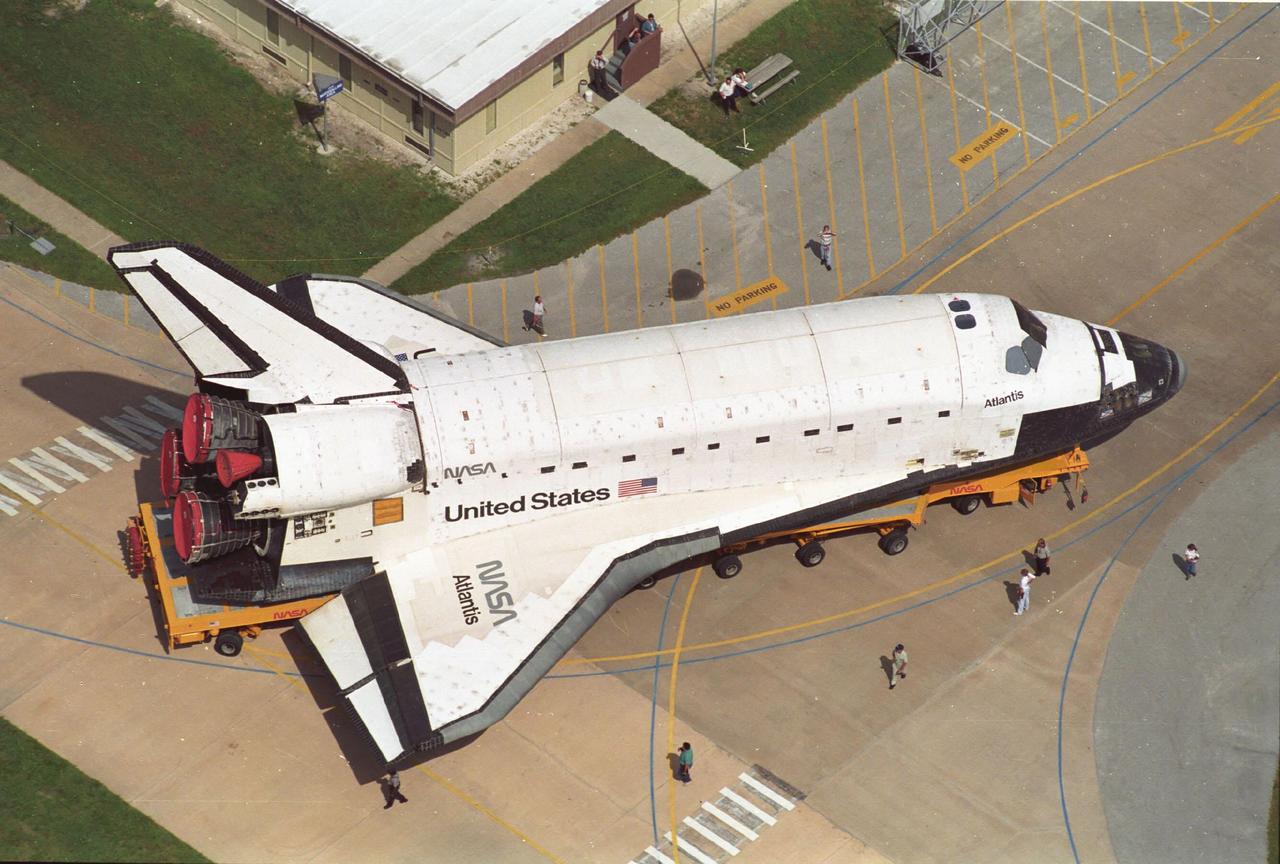
KENNEDY SPACE CENTER, FLA. -- Atlantis rolls to the VAB for stacking before rollout to Pad 39A in preparation for STS-79.
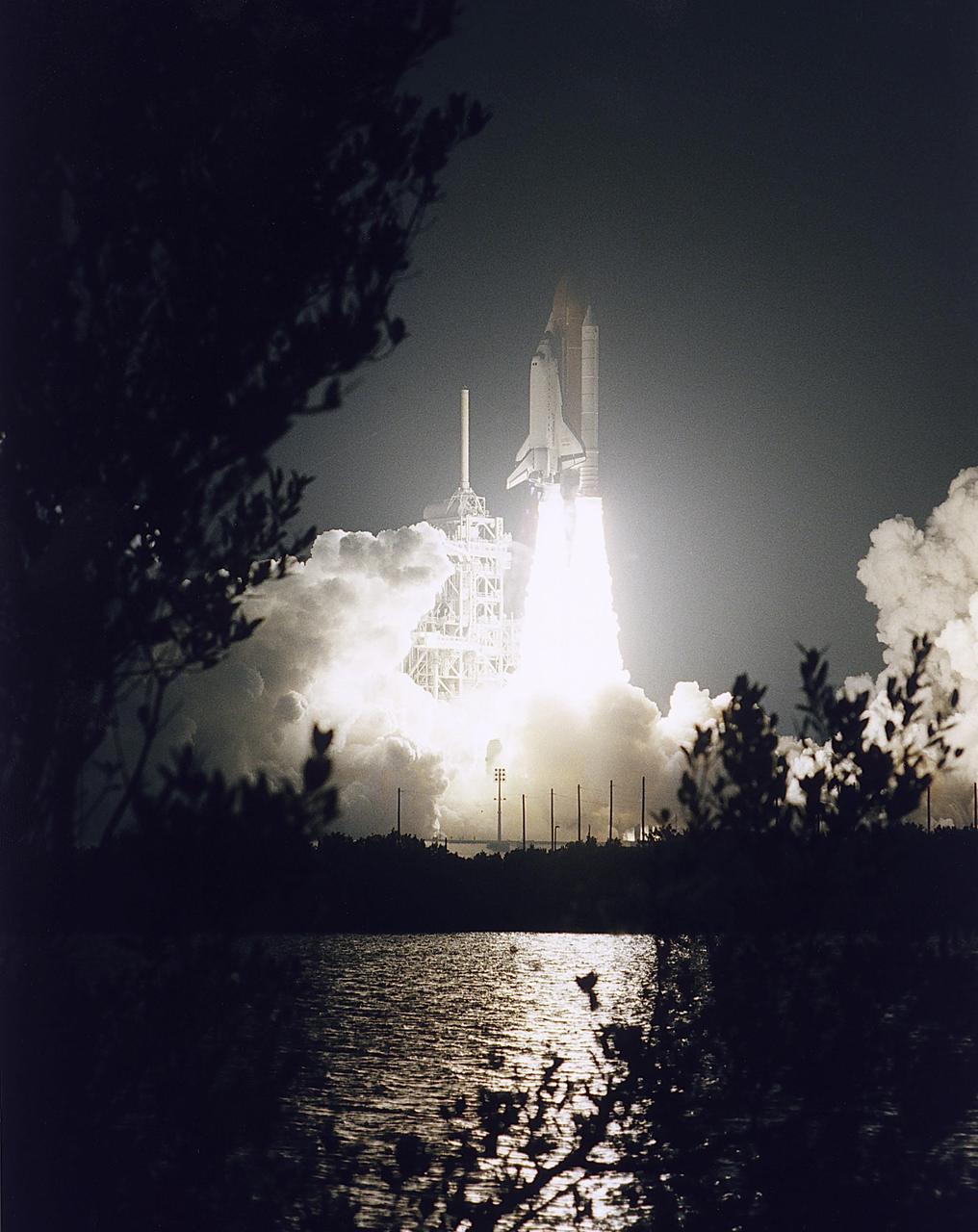
KENNEDY SPACE CENTER, FLA. -- STS-79: Atlantis lifts off from Launch Pad 39A.
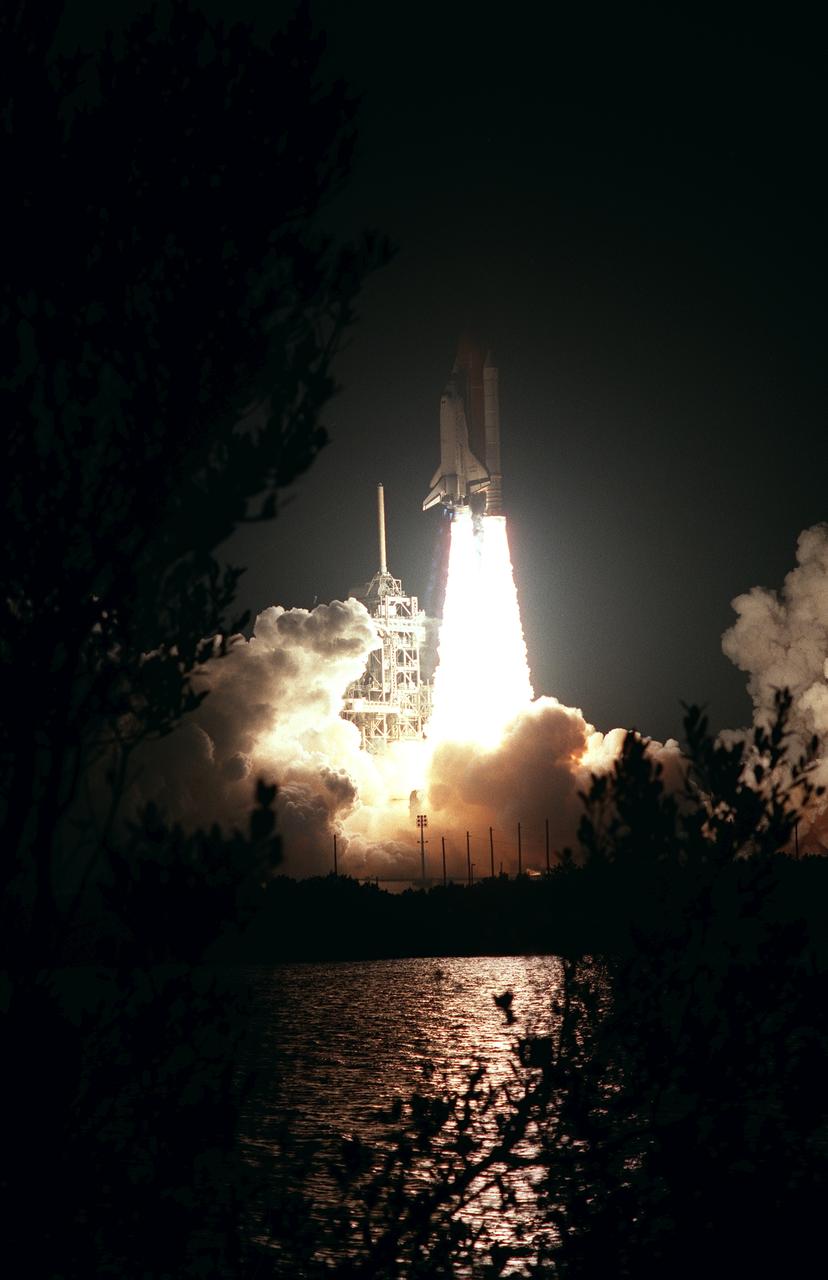
STS079-S-006 (16 Sept. 1996) --- The space shuttle Atlantis lifts off from Launch Pad 39A at the Kennedy Space Center (KSC). The approximately 10-day flight will be highlighted by the fourth docking between the United States Space Shuttle and Russia's Mir Space Station and it will mark the first in a series of NASA-supplied crew exchanges aboard Mir. Liftoff was at 4:54:49 a.m. (EDT) Sept. 16, 1996.
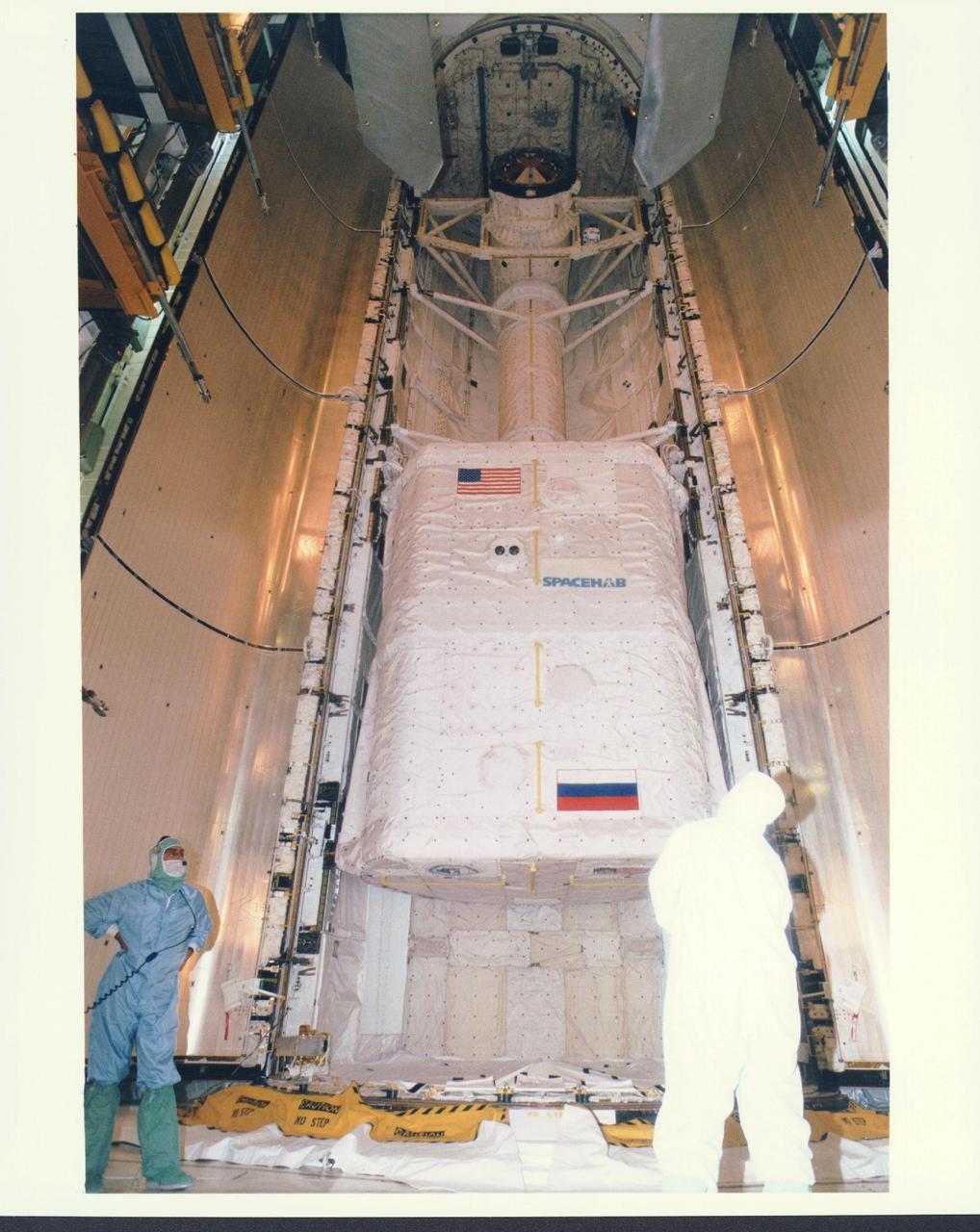
KENNEDY SPACE CENTER, FLA. - Workers in the Payload Changeout Room (PCR) at Launch Pad 39A are preparing to close the payload doors for flight on the Space Shuttle Atlantis, targeted for liftoff on Mission STS-79 around Sept. 12. The SPACEHAB Double Module located in the aft area of the payload bay is filled with supplies and other items slated for transfer to the Russian Space Station Mir. STS-79 marks the second flight of a SPACEHAB in support of the Shuttle-Mir dockings, and the first flight of the double-module configuration. The SPACEHAB is connected by tunnel to the Orbiter Docking System (ODS), with the Androgynous Peripheral Docking System (APDS) clearly visible on top of the ODS. The APDS provides the docking interface for the linkup with Mir, while the ODS provides a passageway from the orbiter to the Russian space station and the SPACEHAB.
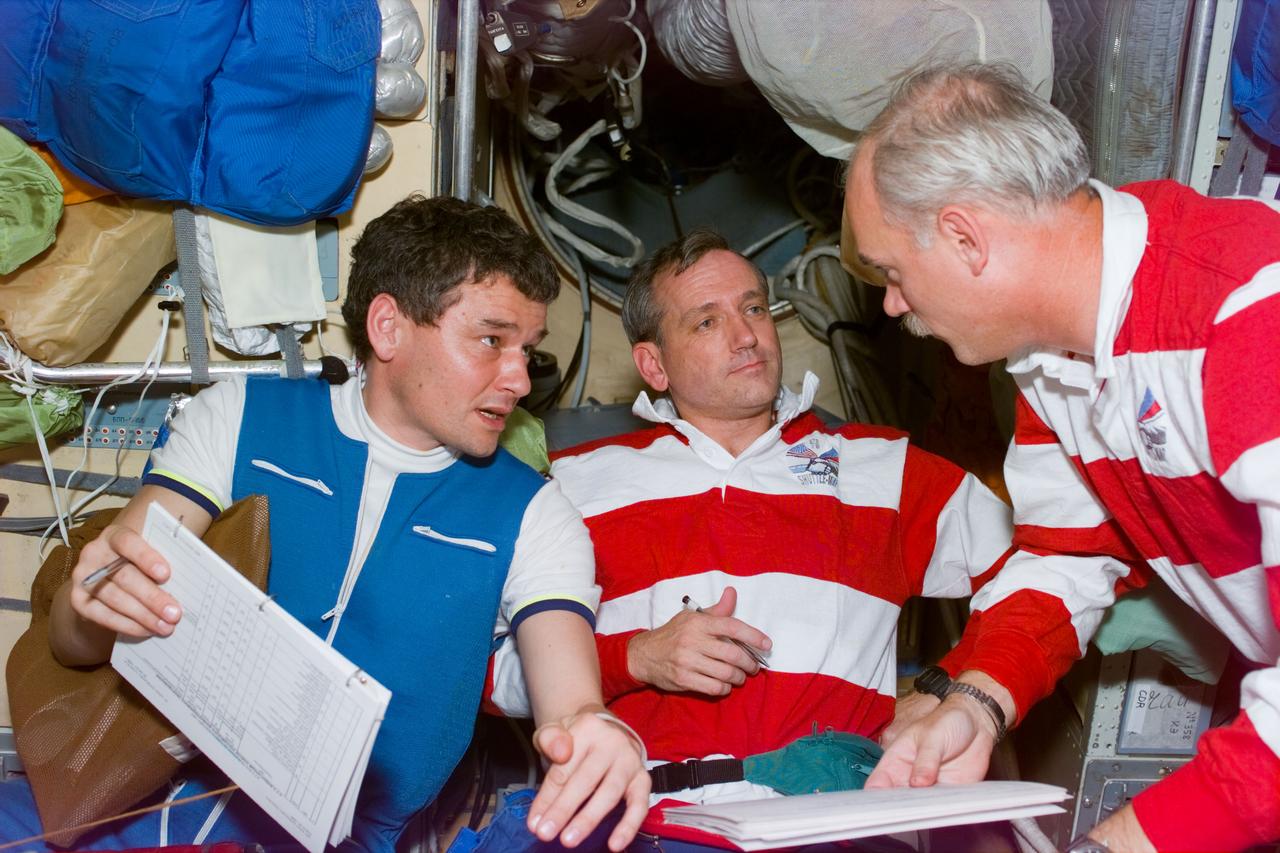
STS79-E-5088 (19 September 1996) --- Left to right, Valeri G. Korzun, Thomas D. Akers and William F. Readdy discuss the agenda of their shared activities for the next few days, on Flight Day 4. Korzun and Readdy share common positions - that of commander - for the Mir-22 and STS-79 missions, respectively. Akers is a STS-79 mission specialist.
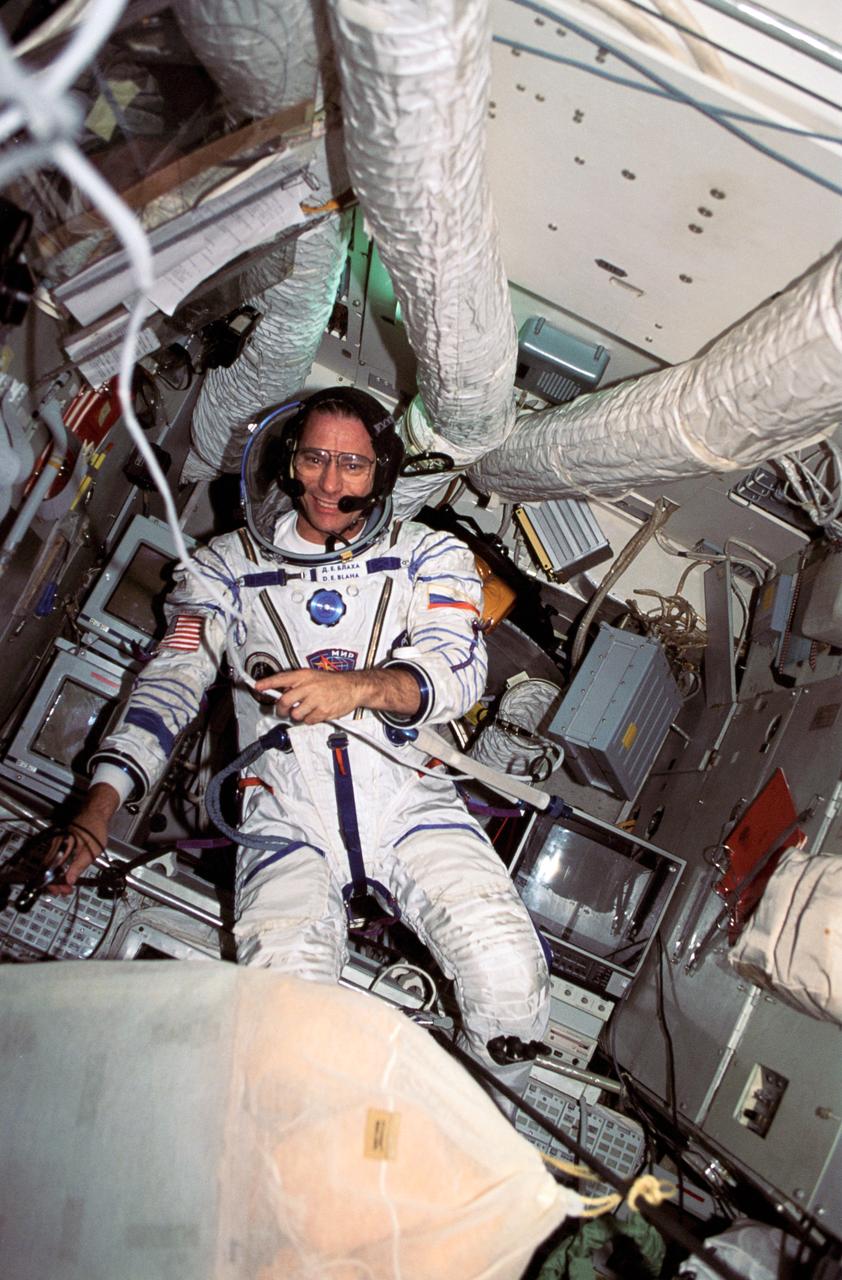
NM22-416-017 (20 Sept. 1996) --- One of the first priorities of astronaut John E. Blaha, mission specialist for STS-79 and soon to be cosmonaut guest researcher for Mir-22, was to get his Sokol space suit pressure-checked for the move aboard Russia’s Mir Space Station. On flight day four, Blaha and his STS-79 crew mates aboard the Space Shuttle Atlantis docked with Mir. Here, seen soon after hatch opening, Blaha prepares for the needed suit tests.
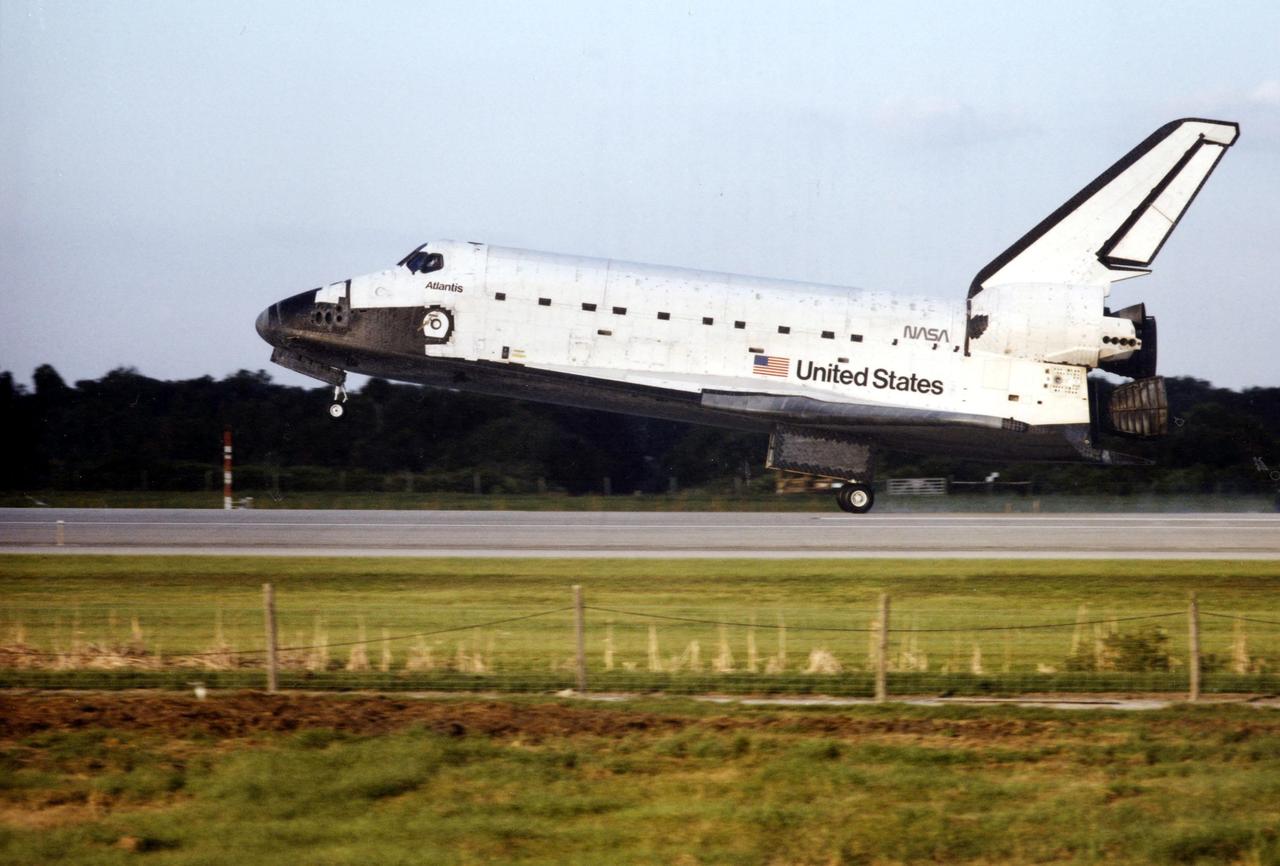
KENNEDY SPACE CENTER, FLA. -- The STS-79 mission comes to a successful conclusion as the orbiter Atlantis touches down on Runway 15 of KSC's Shuttle Landing Facility at 8:13:15 a.m. EDT, September 26. On board is U.S. astronaut Shannon W. Lucid, who has been living and working on the Russian Space Station Mir for about six months. Lucid has spent 188 days in space from launch aboard Atlantis in March to her return today, establishing a U.S. record for long-duration spaceflight as well as representing the longest spaceflight for a woman. Succeeding Lucid on Mir is U.S. astronaut John E. Blaha, who embarked to Mir with the STS-79 crew. The commander of Mission STS-79 is William F. Readdy; Terrence W. Wilcutt is the pilot, and the three mission specialists are Jay Apt, Thomas D. Akers and Carl E. Walz
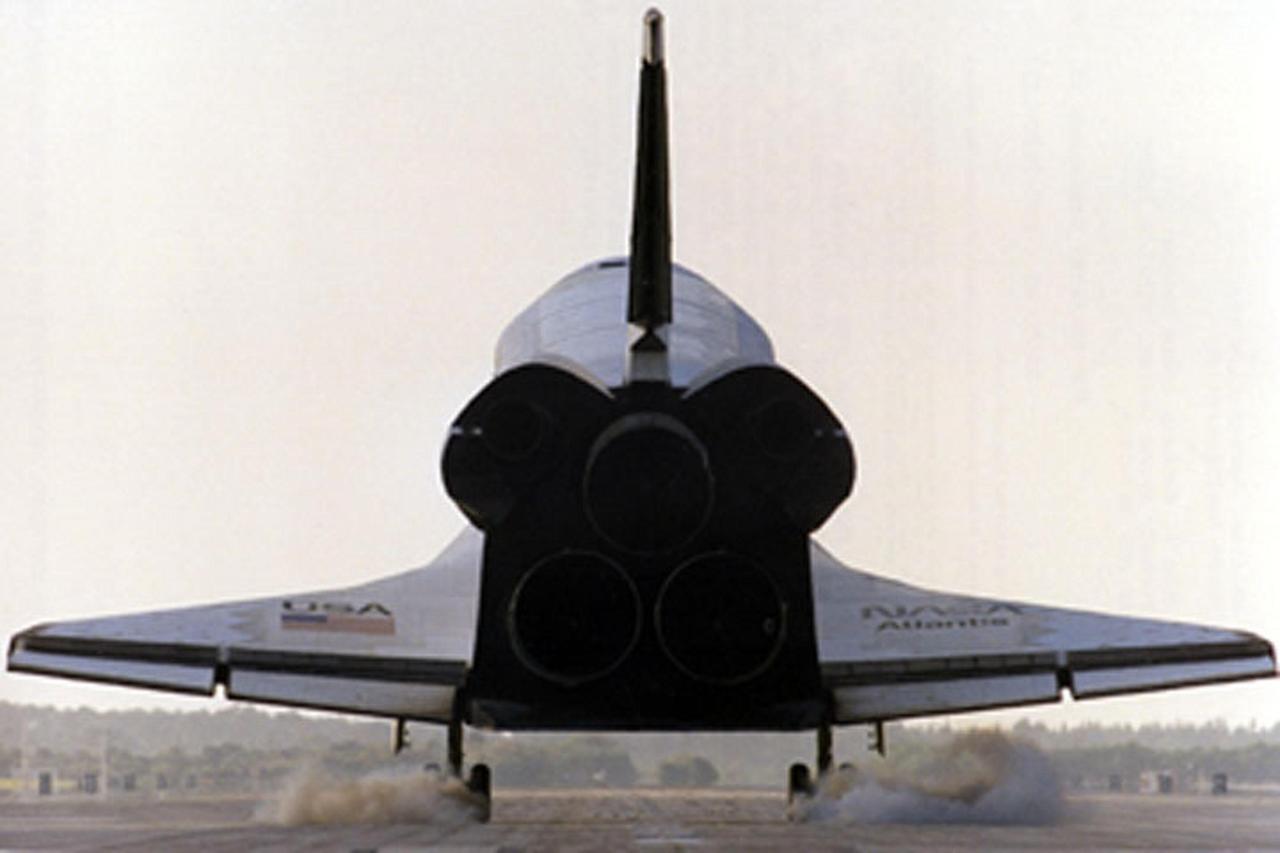
KENNEDY SPACE CENTER, FLA. -- The STS-79 mission comes to a successful conclusion as the orbiter Atlantis touches down on Runway 15 of KSC's Shuttle Landing Facility at 8:13:15 a.m. EDT, September 26. On board is U.S. astronaut Shannon W. Lucid, who has been living and working on the Russian Space Station Mir for about six months. Lucid has spent 188 days in space from launch aboard Atlantis in March to her return today, establishing a U.S. record for long-duration spaceflight as well as representing the longest spaceflight for a woman. Succeeding Lucid on Mir is U.S. astronaut John E. Blaha, who embarked to Mir with the STS-79 crew. The commander of Mission STS-79 is William F. Readdy; Terrence W. Wilcutt is the pilot, and the three mission specialists are Jay Apt, Thomas D. Akers and Carl E. Walz.
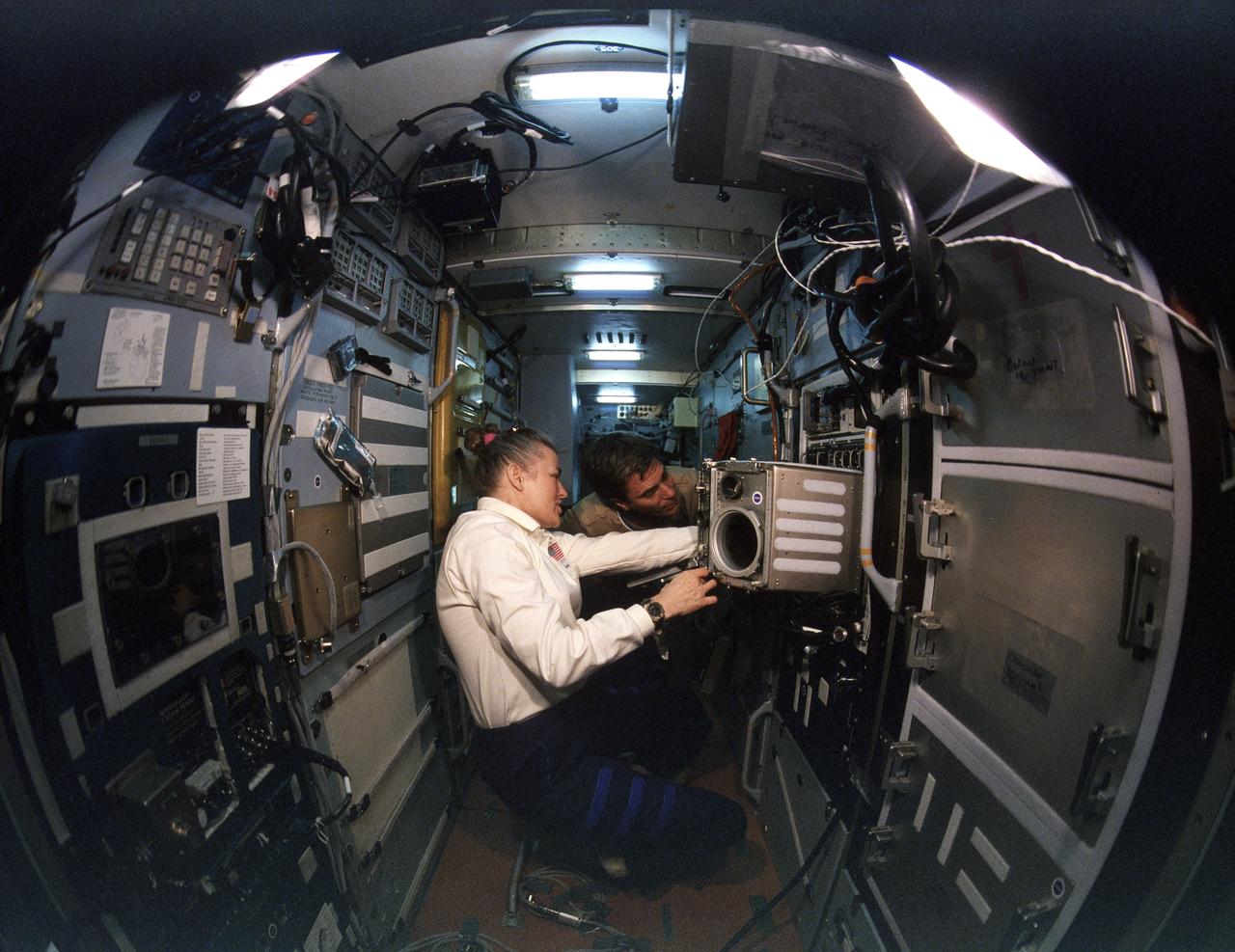
STS079-S-092 (16-26 Sept. 1996) --- Astronauts Shannon W. Lucid and John E. Blaha work at a microgravity glove box on the Priroda Module aboard Russia's Mir Space Station complex. Blaha, who flew into Earth-orbit with the STS-79 crew, and Lucid are the first participants in a series of ongoing exchanges of NASA astronauts serving time as cosmonaut guest researchers onboard Mir. Lucid went on to spend a total of 188 days in space before returning to Earth with the STS-79 crew. During the STS-79 mission, the crew used an IMAX camera to document activities aboard the Space Shuttle Atlantis and the various Mir modules, with the cooperation of the Russian Space Agency (RSA). A hand-held version of the 65mm camera system accompanied the STS-79 crew into space in Atlantis' crew cabin. NASA has flown IMAX camera systems on many Shuttle missions, including a special cargo bay camera's coverage of other recent Shuttle-Mir rendezvous and/or docking missions.
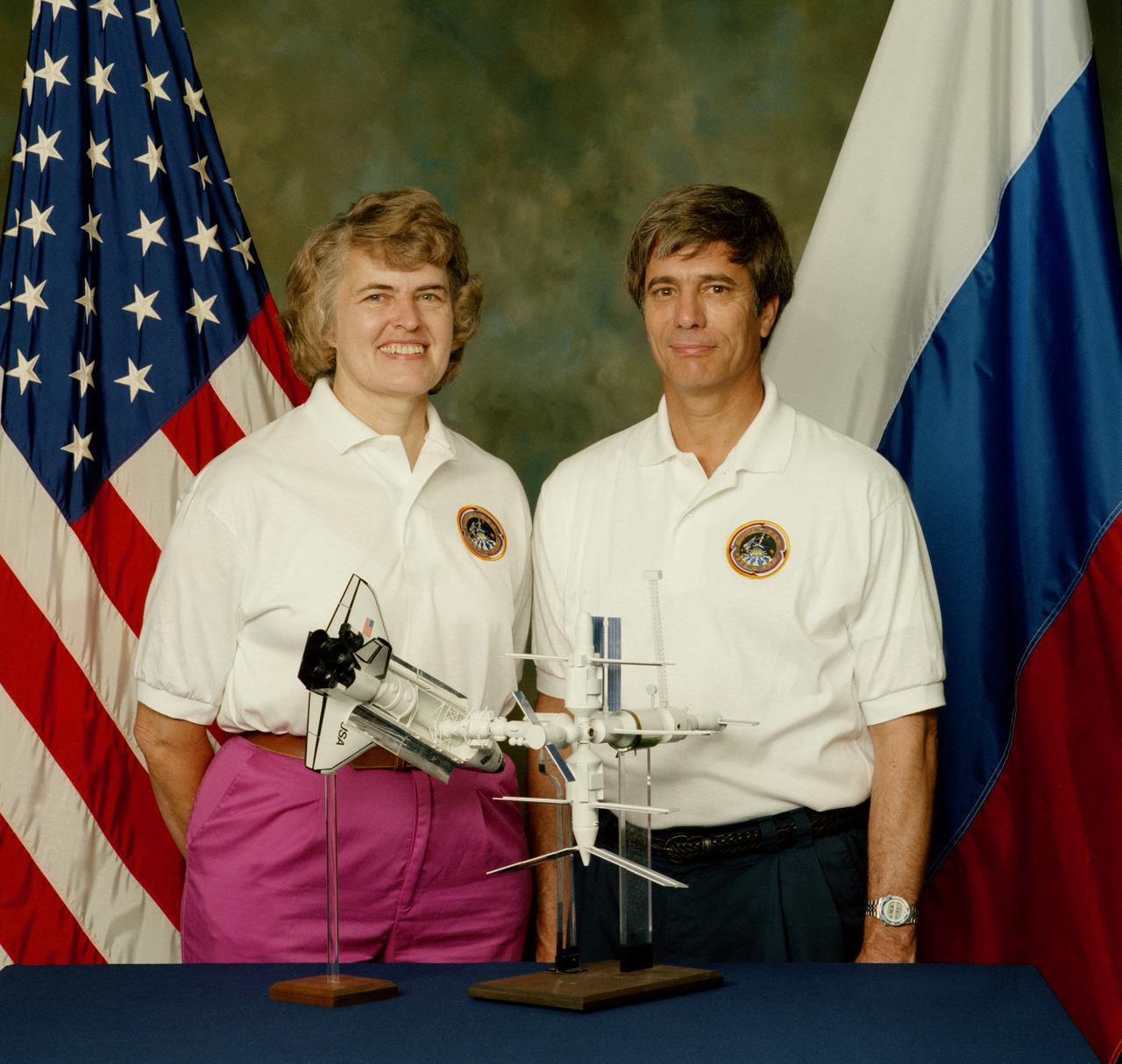
S95-16678 (September 1995) --- NASA astronauts Shannon W. Lucid and John E. Blaha next year will follow the lead of astronaut Norman E. Thagard's 1995 feat of extended stay aboard Russia's Mir Space Station. Lucid is to accompany the STS-76 crew in March and spend a little over four months aboard Mir before returning to Earth with the STS-79 crew. Blaha will go into space on the scheduled August mission of STS-79 and after four months aboard Mir will return to Earth with the STS-81 crew.
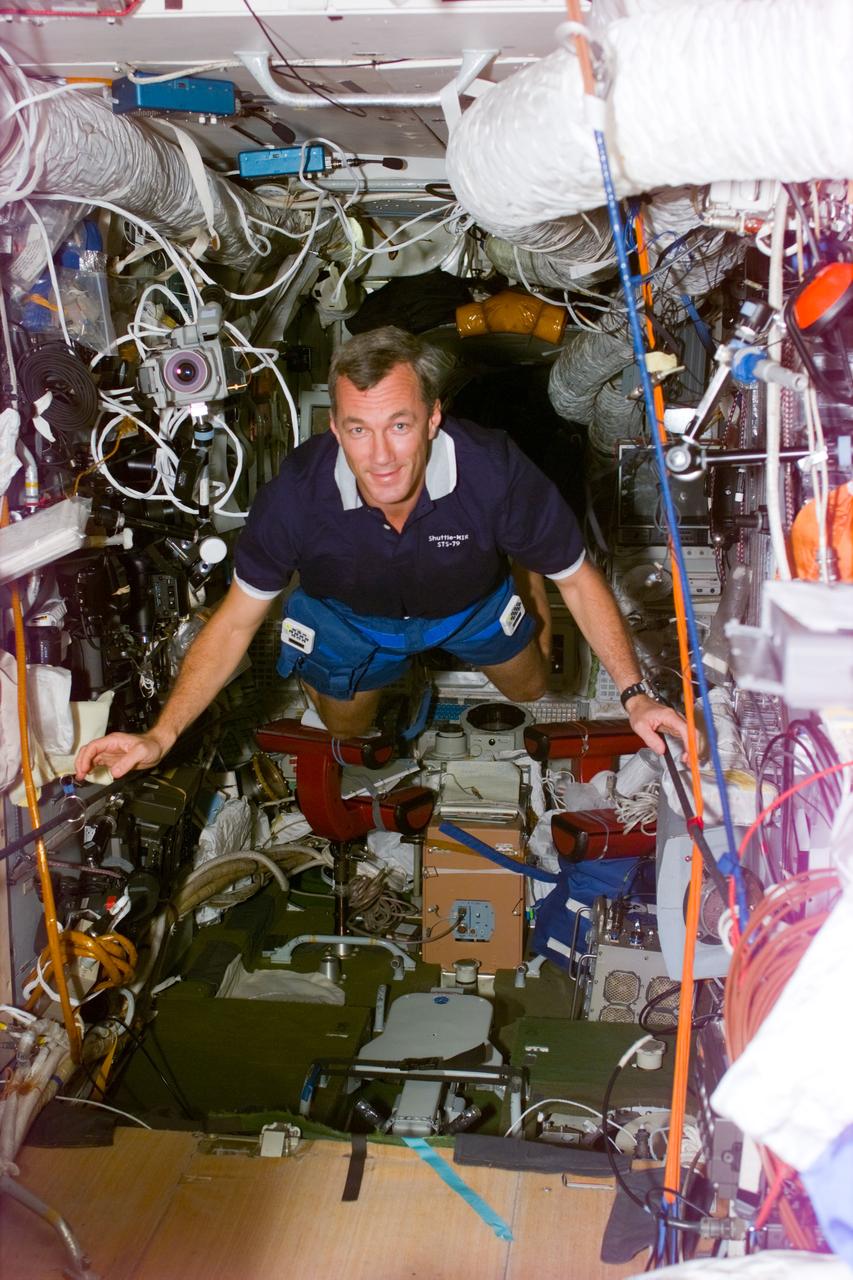
STS79-E-5198 (21 September 1996) --- Astronaut Terrence W. Wilcutt, STS-79 pilot, floats through Russia's Mir Space Station Base Block Module, during Flight Day 6.
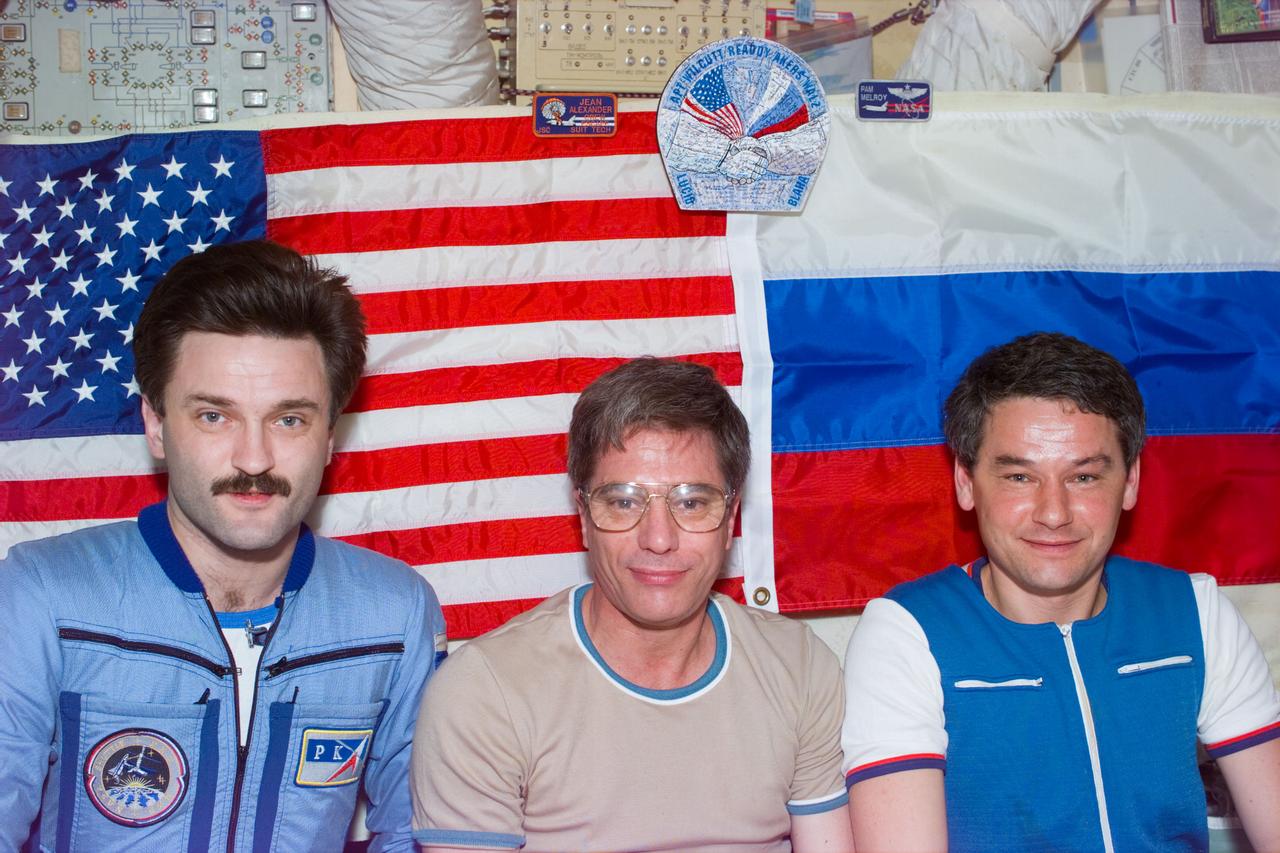
STS79-E-5294 (23 September 1996) --- Left to right, cosmonaut Aleksandr Y. Kaleri, Mir-22 flight engineer; astronaut John E. Blaha, cosmonaut guest researcher; and cosmonaut Valeri G. Korzun, Mir-22 commander, Mir-22 crew members in their final photo aboard Russia's Mir Space Station before bidding farewell to the STS-79 crew members, aboard the Space Shuttle Atlantis, during Flight Day 8. Soon after this Electronic Still Camera (ESC) view was recorded the STS-79 astronauts aboard Atlantis separated from the Mir.
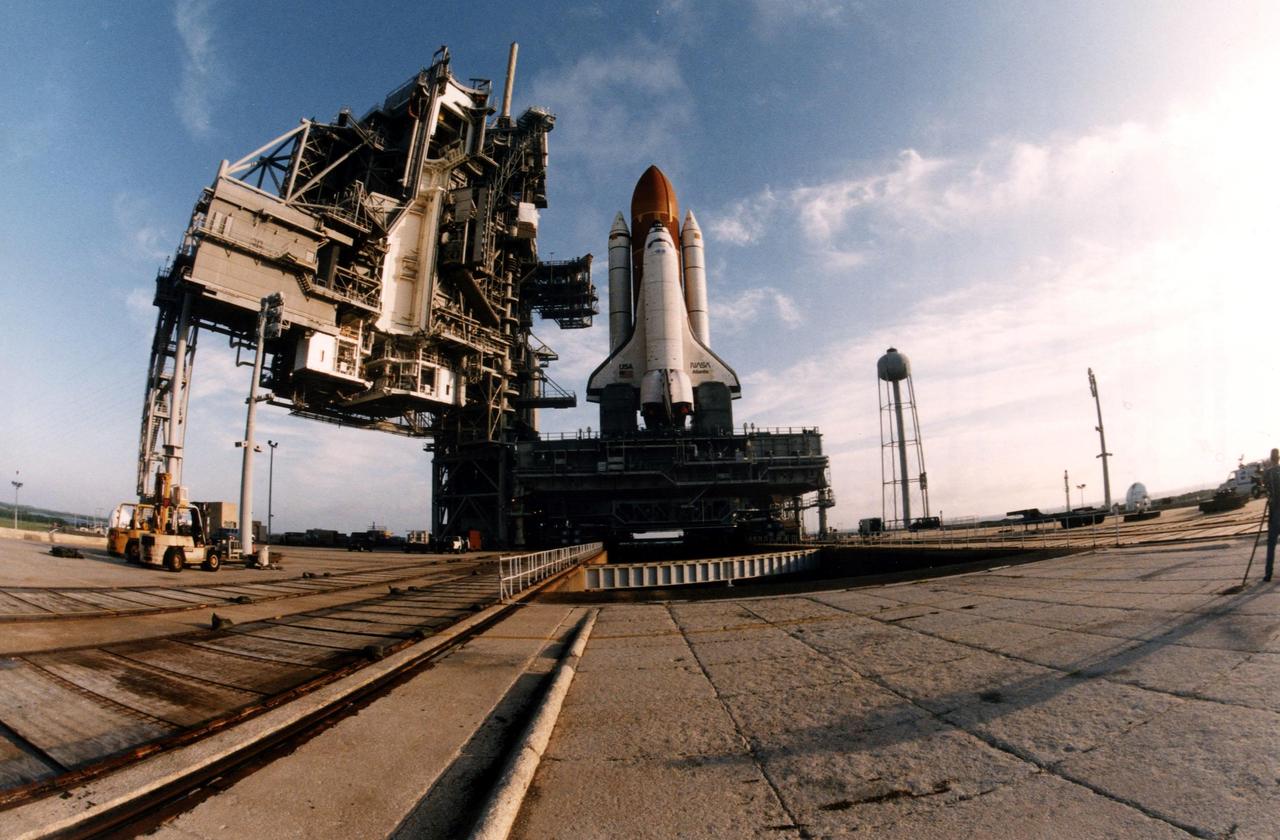
KENNEDY SPACE CENTER, FLA. -- The Space Shuttle Atlantis completes the trip to Launch Pad 39A from the Vehicle Assembly Building for the third time in the STS-79 mission flow. The Shuttle was rolled back from the pad in July due to the threat from Hurricane Bertha, then rolled back again earlier this week because of Hurricane Fran. The targeted launch date for Atlantis on Mission STS-79 -- the fourth docking between the U.S. Shuttle and Russian Space Station Mir -- is now Sept. 16 at 4:54 a.m. EDT. The three rollout dates for Atlantis to Pad 39A are: July 1, Aug. 20 and Sept. 5
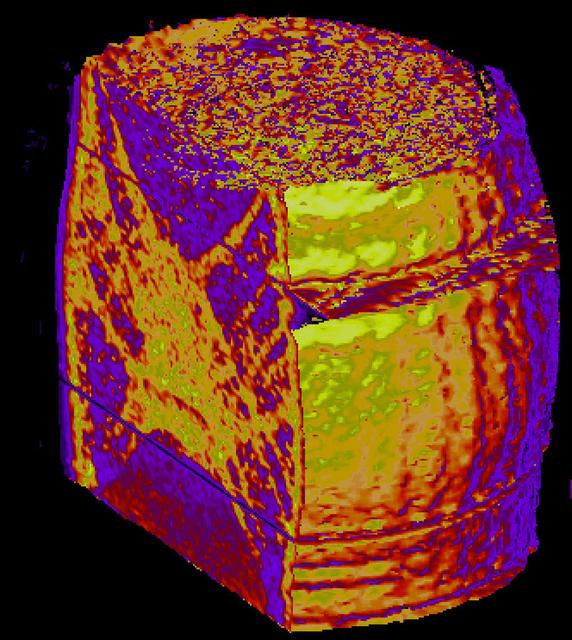
Computed tomography (CT) images of resin-impregnated Mechanics of Granular Materials (MGM) specimens are assembled to provide 3-D volume renderings of density patterns formed by dislocation under the external loading stress profile applied during the experiments. Experiments flown on STS-79 and STS-89. Principal Investigator: Dr. Stein Sture
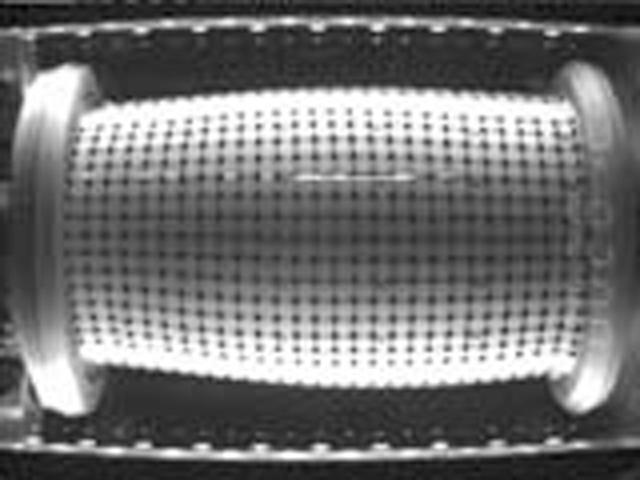
Test cells comprise specimen sand contained in a latex membrane (with a grid pattern for CCD cameras) between metal end plates and housed in a water-filled Lexan jacket. Experiment flown on STS-79 and STS-89. Principal Investigator: Dr. Stein Sture.
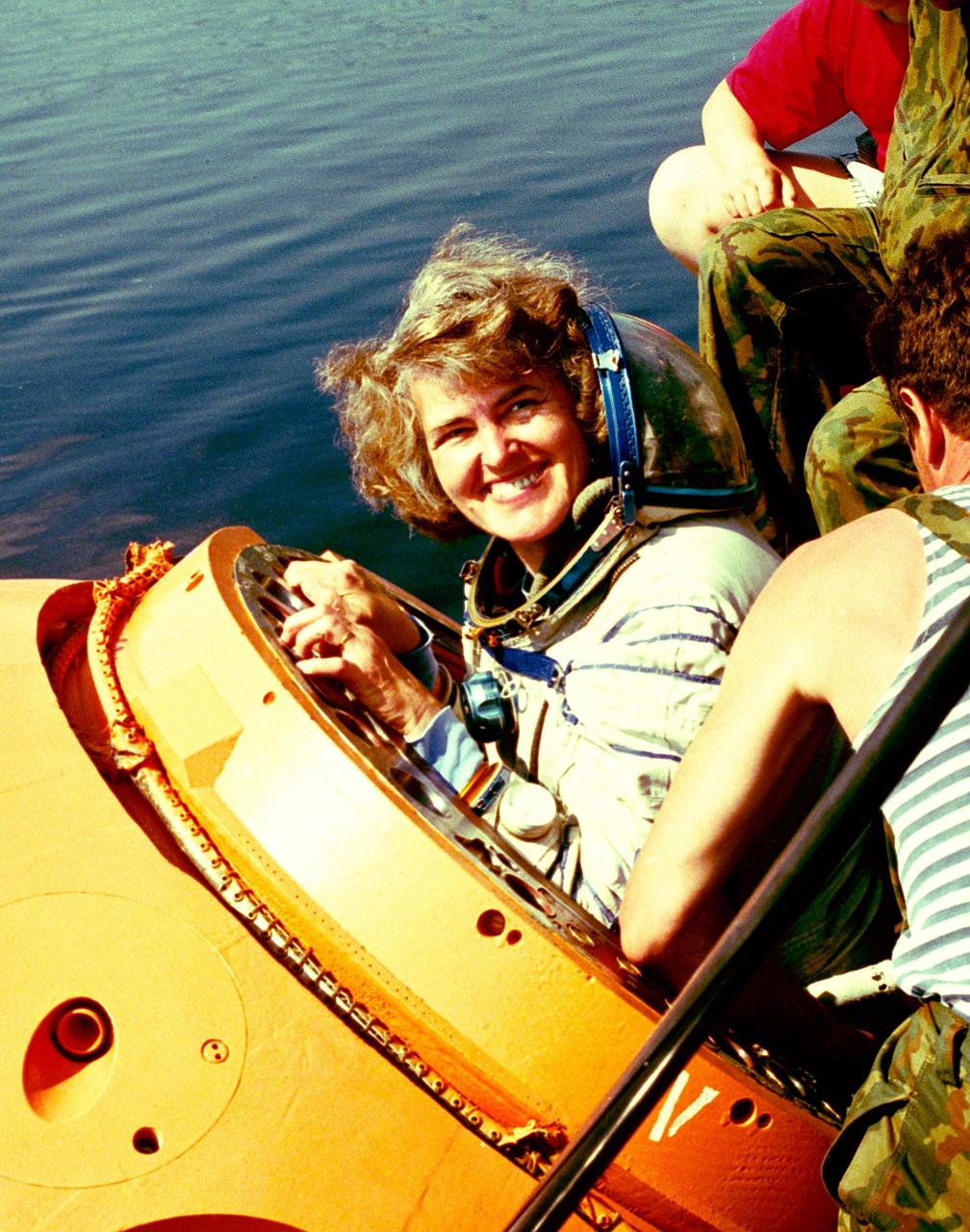
Astronaut Shannon Lucid is seen egressing from a training version of a soyez spacecraft, during a water survival training session in Russia. In March of 1996, Lucid accompanied the STS-76 crew to the Russian space station, Mir, where she stayed for a little over four months before returning to Earth with the STS-79 crew.
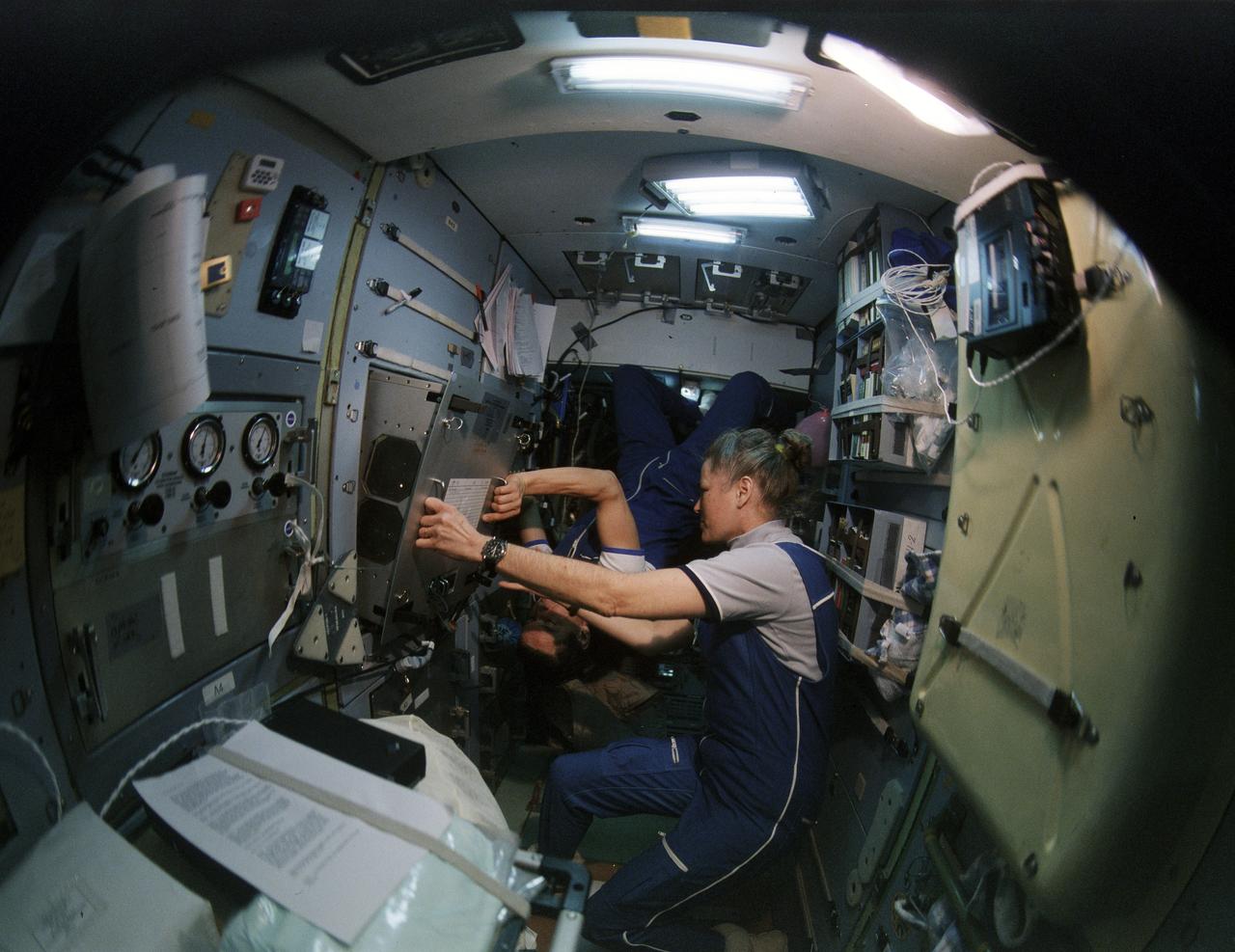
STS079-S-082 (16-26 Sept. 1996) --- Cosmonaut guest researcher Shannon W. Lucid and Valeri G. Korzun, her Mir-22 commander, are pictured on the Spektr Module aboard Russia's Earth-orbiting Mir Space Station. Korzun was the third of four commanders that Lucid served with during her record-setting 188 consecutive days in space. Later, Lucid returned to Earth with her fourth commander-astronaut William F. Readdy-and five other NASA astronauts to complete the STS-79 mission. During the STS-79 mission, the crew used an IMAX camera to document activities aboard the space shuttle Atlantis and the various Mir modules. A hand-held version of the 65mm camera system accompanied the STS-79 crew into space in Atlantis' crew cabin. NASA has flown IMAX camera systems on many Shuttle missions, including a special cargo bay camera's coverage of other recent Shuttle-Mir rendezvous and/or docking missions.
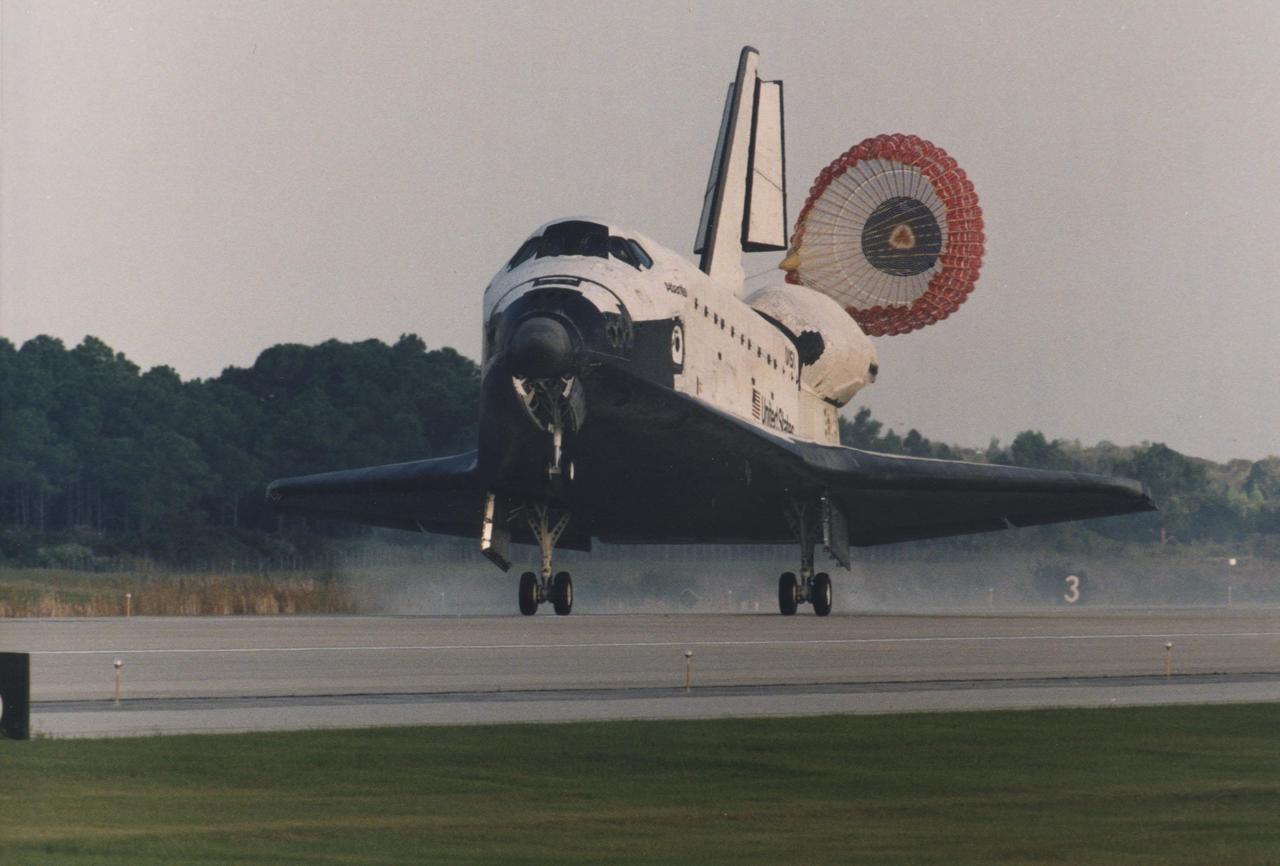
KENNEDY SPACE CENTER, FLA. -- The drag chute is deployed as the orbiter Atlantis swoops down on Runway 15 of KSC's Shuttle Landing Facility at 8:13:15 a.m. EDT, September 26, bringing to a successful conclusion U.S. astronaut Shannon Lucid's record- setting, 188-day stay in space. Lucid's approximately six-month stay aboard the Russian Space Station Mir establishes a new U.S. record for long-duration spaceflight and also is the longest for a woman, surpassing Russian cosmonaut Elena Kondakovaþs 169-day stay on Mir. Lucid returns to Earth with the flight crew of Mission STS-79: Commander William F. Readdy; Pilot Terrence W. Wilcutt; and Mission Specialists Thomas D. Akers, Jay Apt and Carl E. Walz. Succeeding her aboard Mir for an approximately four-month stay is fellow veteran astronaut John E. Blaha, who traveled to the station with the STS-79 flight crew. The STS-79 mission is part of the NASA/Mir program which is now into the Phase 1B portion, consisting of nine Shuttle-Mir dockings and seven long-duration flights of U.S. astronauts aboard the Russian space station between early 1996 and late 1998
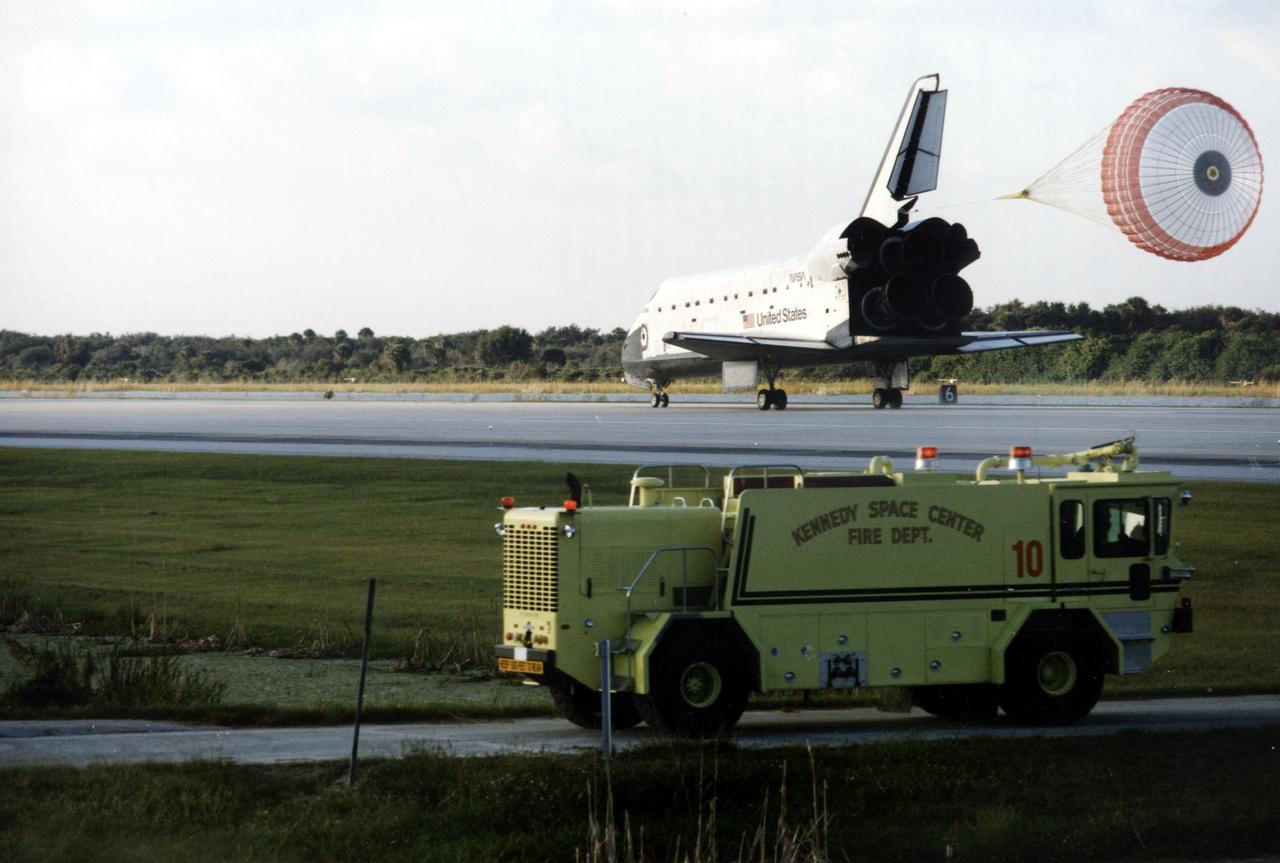
KENNEDY SPACE CENTER, FLA. -- A KSC fire truck stands on alert as the STS-79 Space Shuttle Atlantis hurtles down Runway 15 of KSC's Shuttle Landing Facility, its drag chute billowing behind it. Atlantis touched down at 8:13:15 a.m. EDT, September 26. On board is U.S. astronaut Shannon W. Lucid, who has been living and working on the Russian Space Station Mir for about six months. Lucid has spent 188 days in space from launch aboard Atlantis in March to her return today, establishing a U.S. record for long-duration spaceflight as well as representing the longest spaceflight for a woman. Succeeding Lucid on Mir is U.S. astronaut John E. Blaha, who embarked to Mir with the STS-79 crew. The commander of Mission STS-79 is William F. Readdy; Terrence W. Wilcutt is the pilot, and the three mission specialists are Jay Apt, Thomas D. Akers and Carl E. Walz
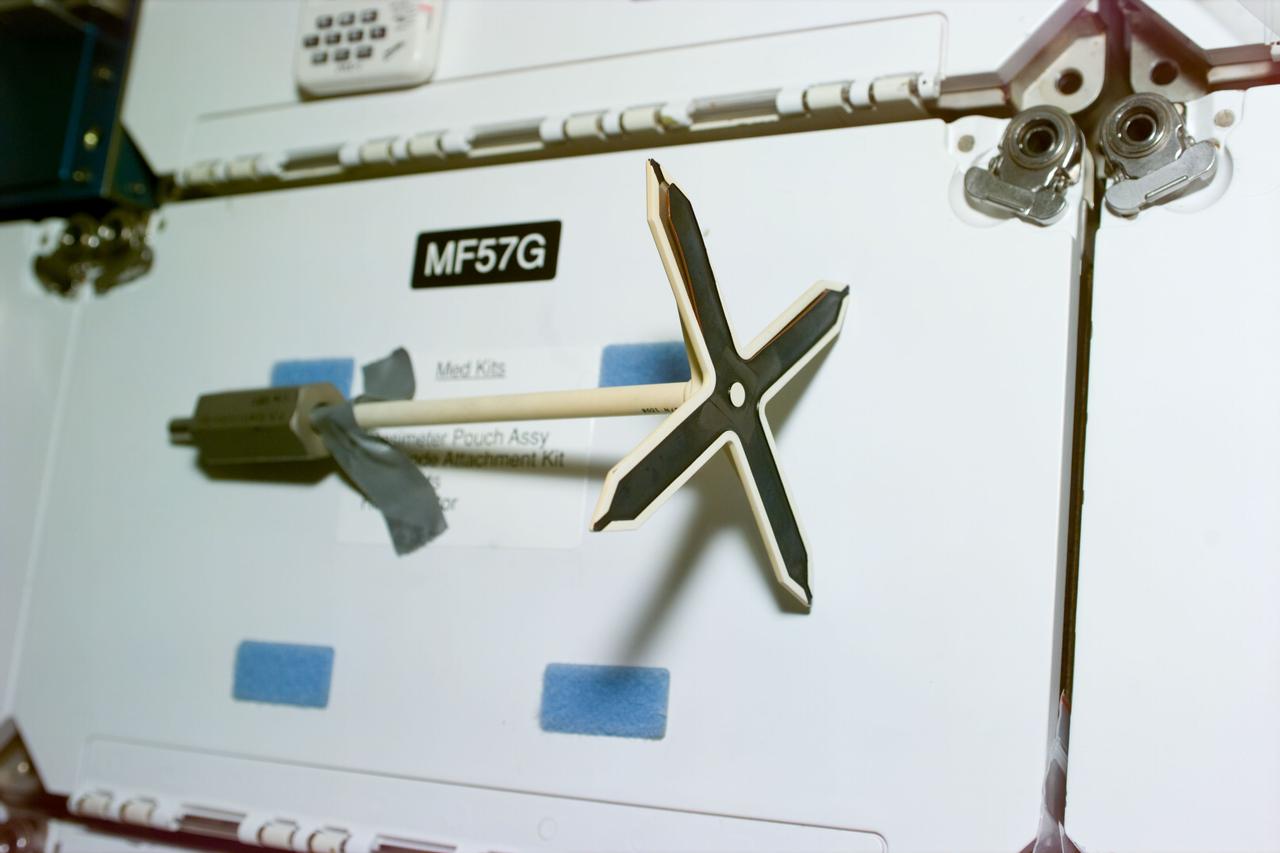
STS79-E-5104 (20 September 1996) --- The STS-79 crew members removed the docking target from the Docking Module (DM) and attached it to a locker door to photograph it and examine a slight peel on the surface, during Flight Day 5.
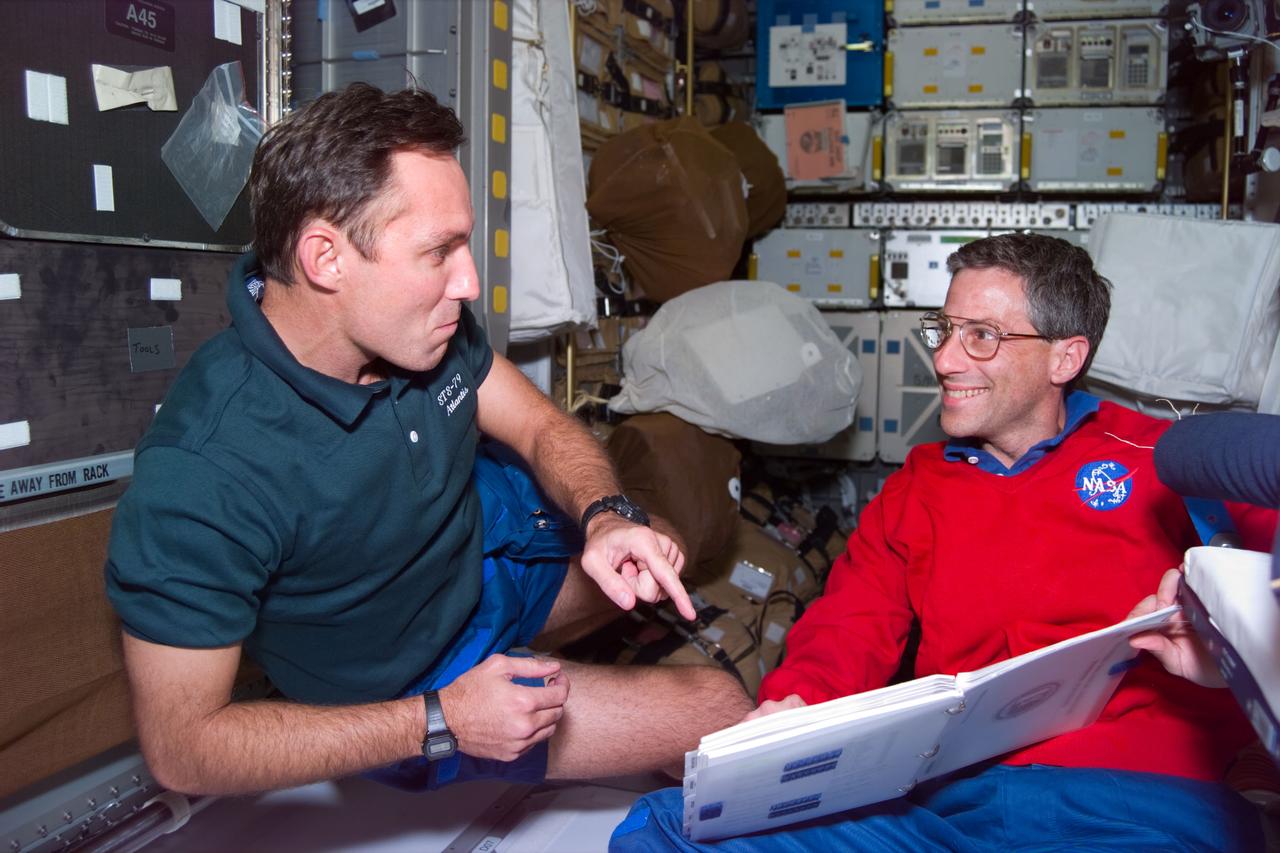
STS79-E-5007 (17 September 1996) --- Astronauts Carl E. Walz and Jerome (Jay) Apt, mission specialists, report to Spacehab Module for early mission experimentation on the first full day of STS-79 operations, on Flight Day 2.
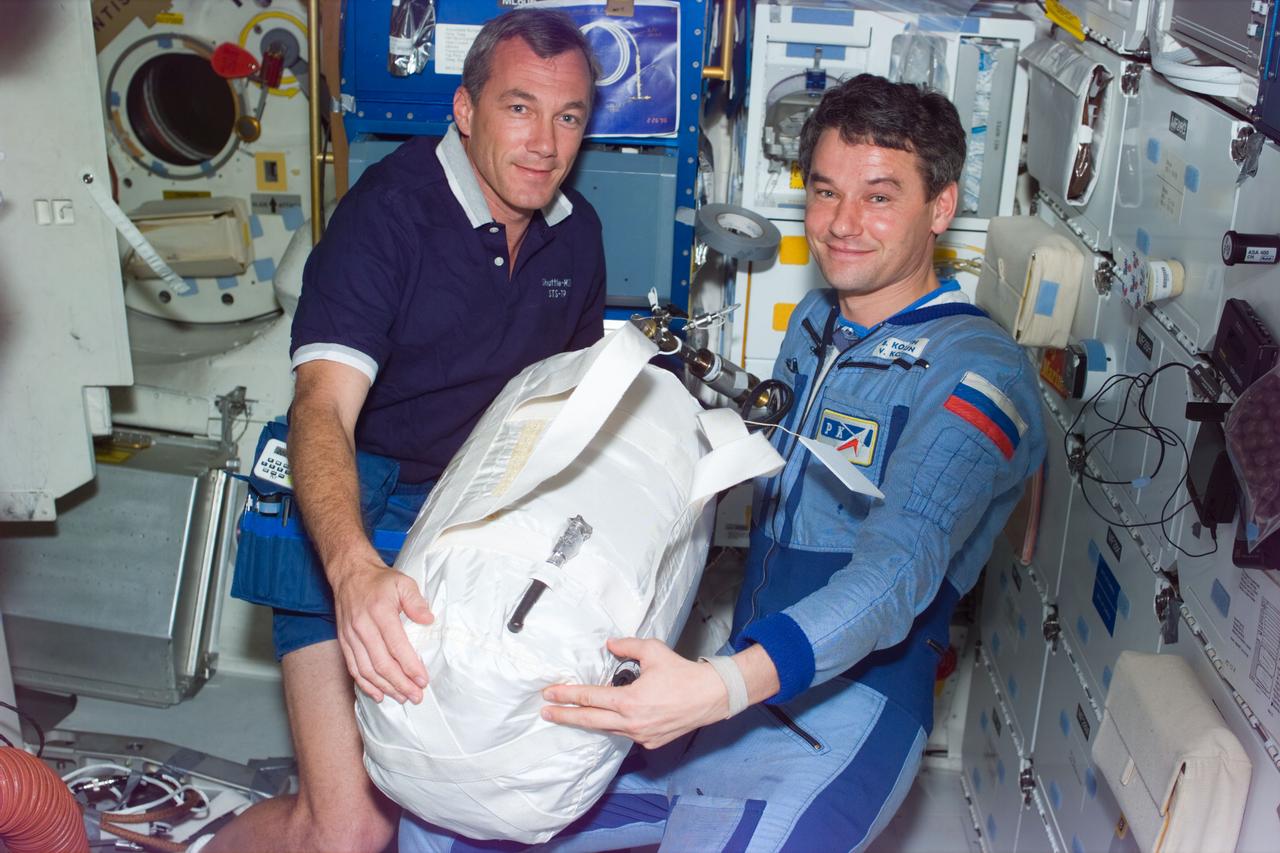
STS79-E-5193 (21 September 1996) --- Astronaut Terrence W. Wilcutt, STS-79 pilot, and cosmonaut Valeri G. Korzun, Mir-22 commander, transfer the Contingency Water Container (CWC), during Flight Day 6.
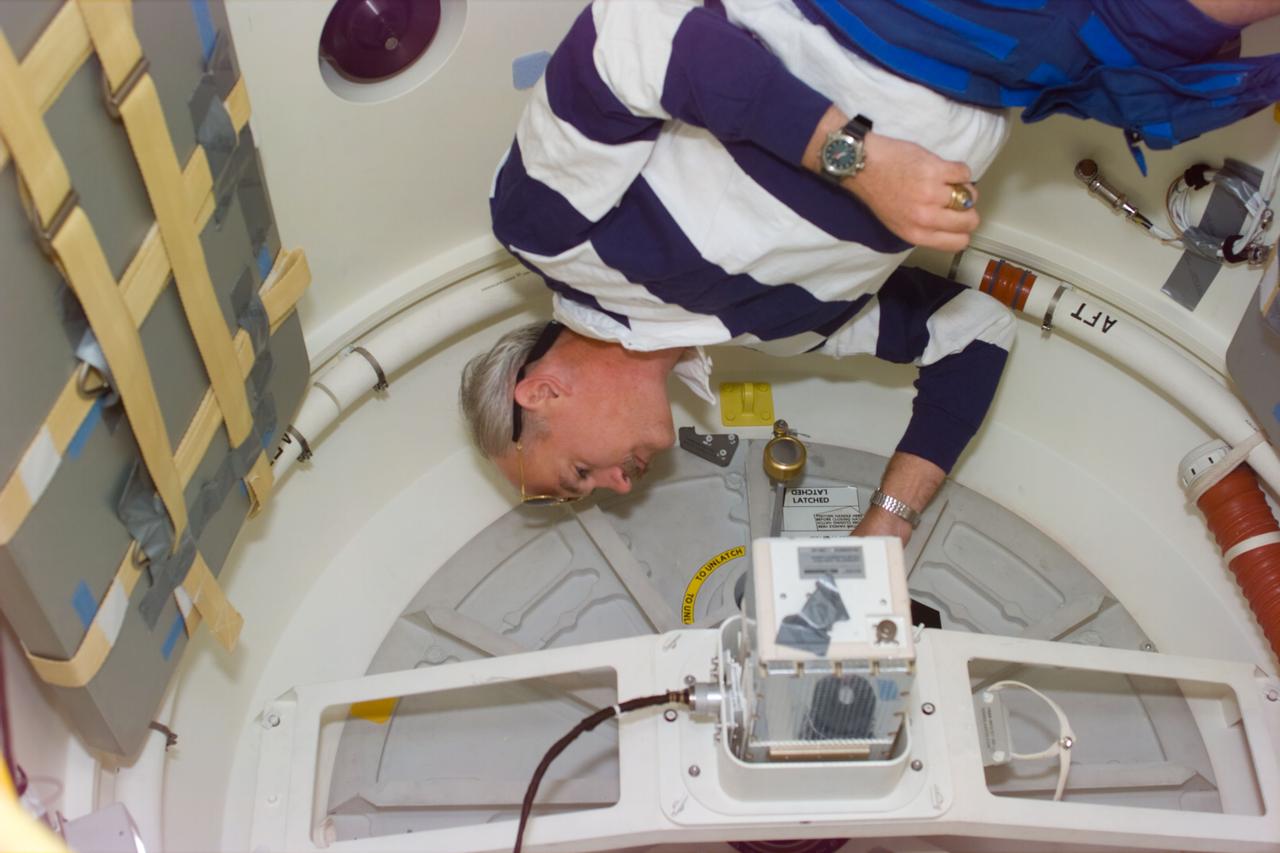
STS-79 mission commander William F. Readdy checks the center-line docking camera in the orbiter docking system (ODS) during flight day 3. The camera will be used on flight day 4 to line up the Atlantis for its docking with the Mir space station.
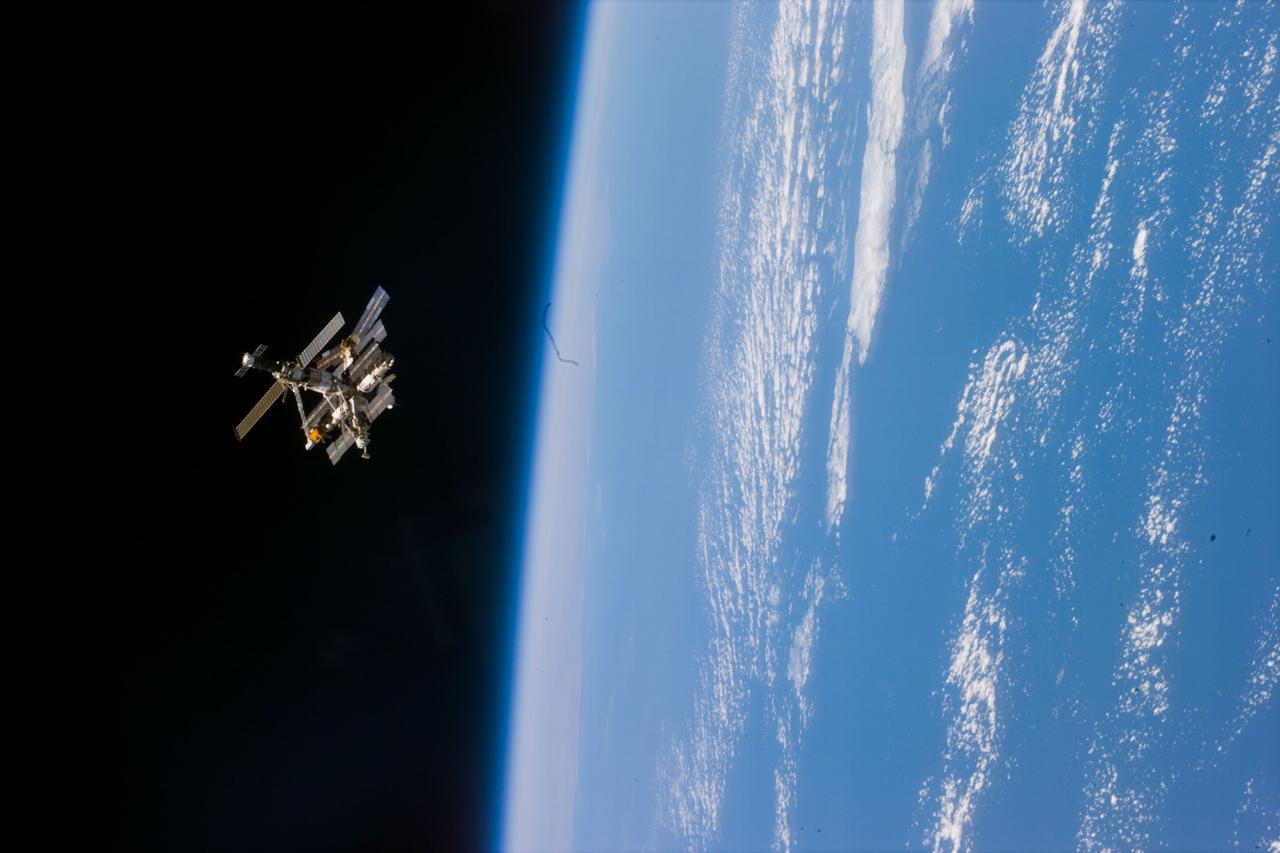
STS79-E-5355 (16-26 September 1996) --- Several minutes later, the STS-79 astronauts enjoyed this view of the Russia's Mir Space Station complex backdropped against the blackness of space over Earth's horizon. A thin blue line of airglow runs parallel with Earth's horizon.
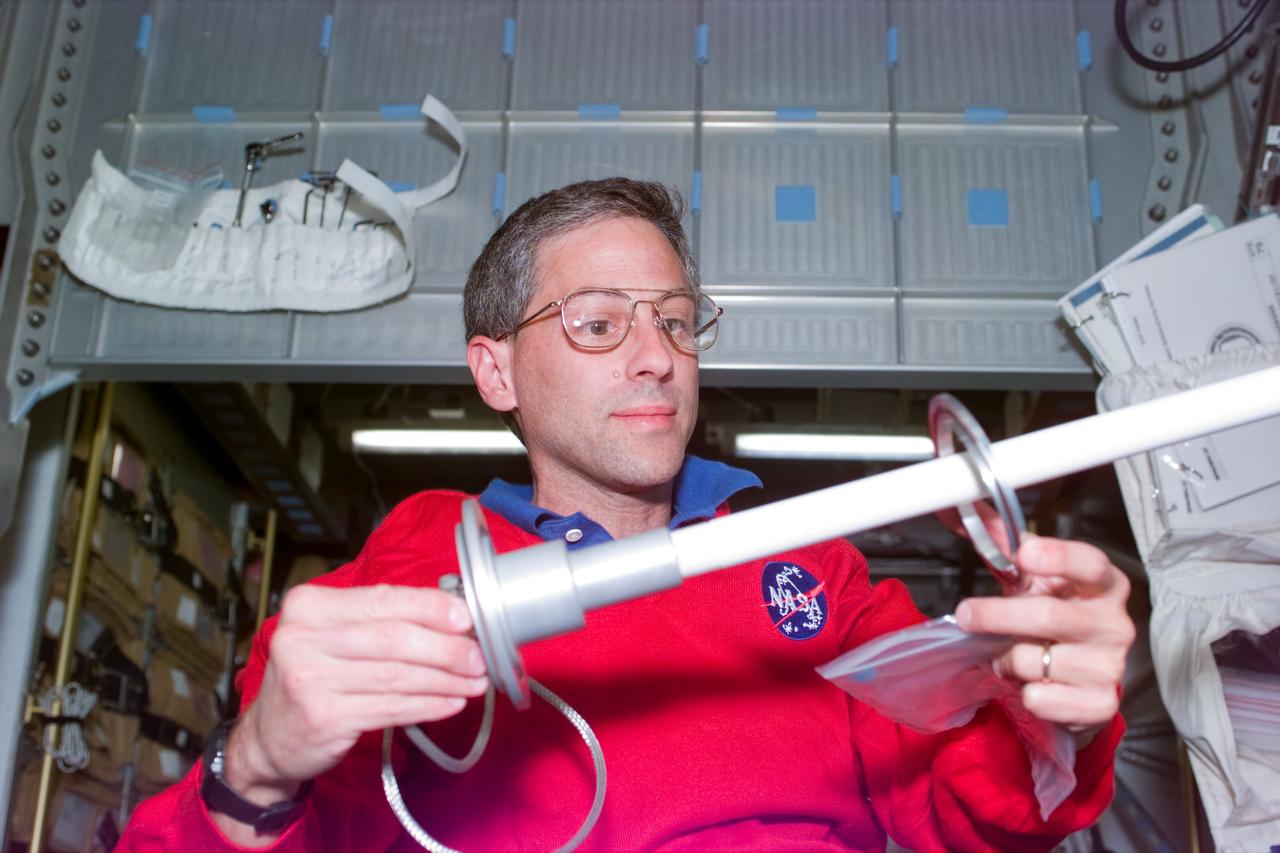
STS79-E-5018 (17 September 1996) --- Astronaut Jerome (Jay) Apt prepares experiment, a rod-like device for insertion into Extreme Temperature Translation Furnace (ETTF) in STS-79-E-5019, during early mission chores aboard Spacehab in the Space Shuttle Atlantis cargo bay, on Flight Day 2.
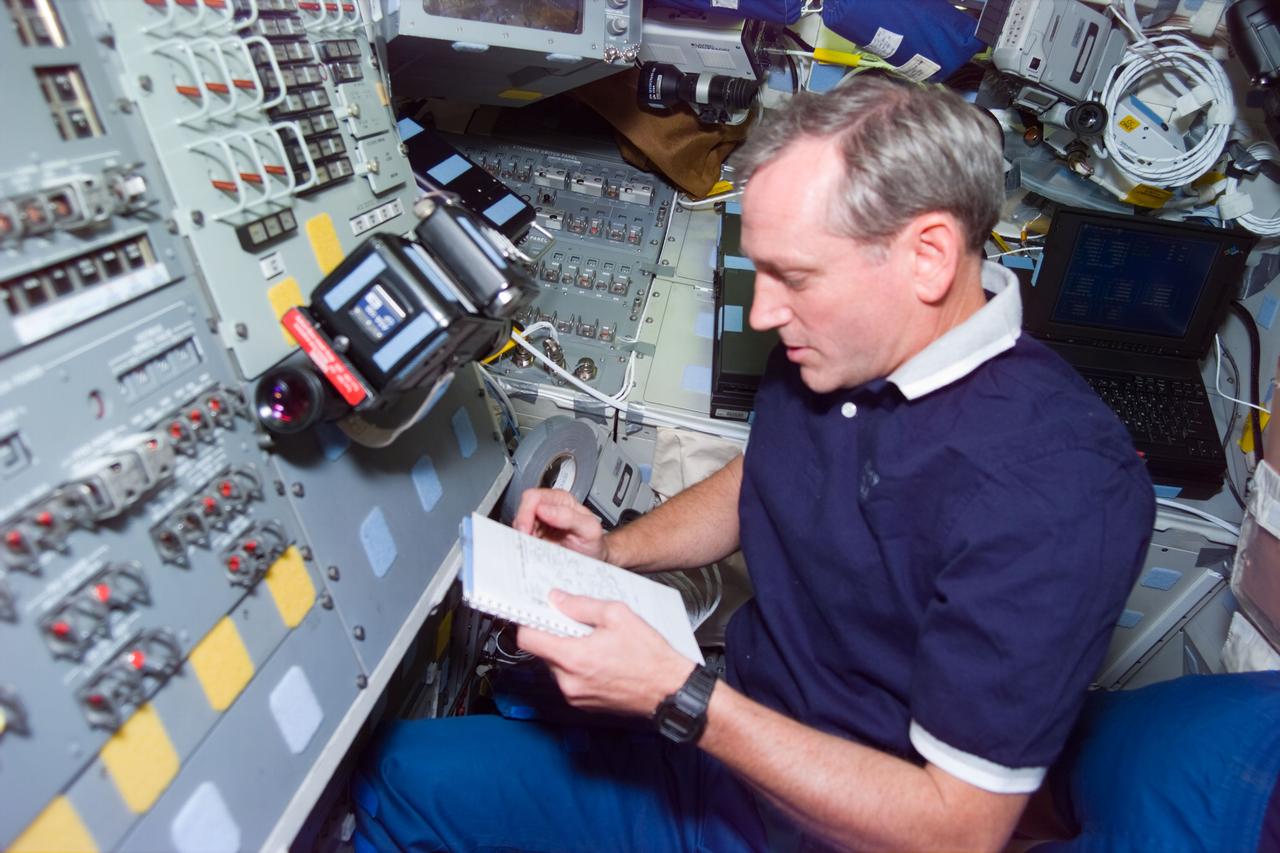
STS79-E-5013 (17 September 1996) --- Astronaut Thomas D. Akers, mission specialist, on the Space Shuttle Atlantis' flight deck soon after STS-79 crew begins its in-space activities, on Flight Day 2.
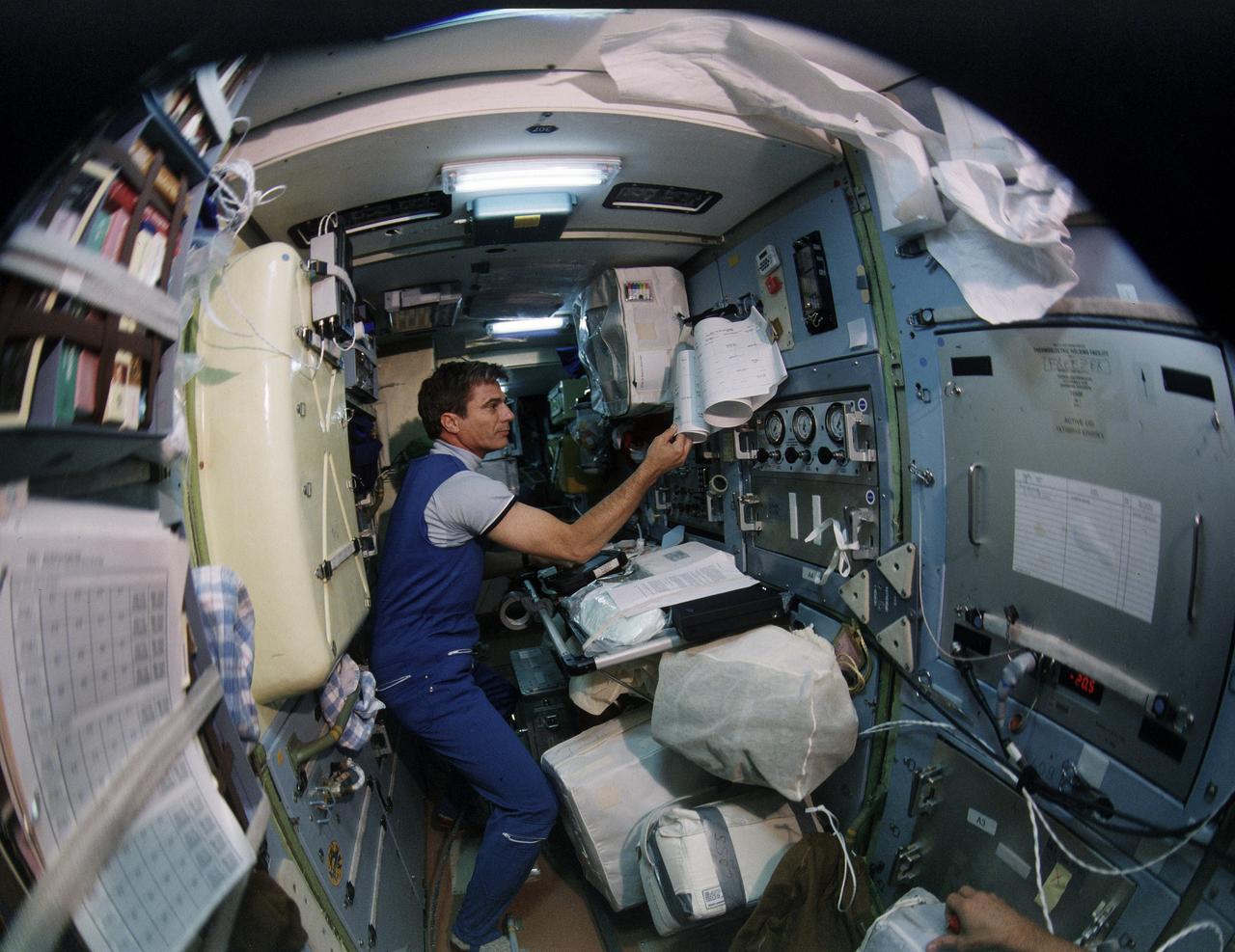
STS079-S-062 (16-26 Sept. 1996) --- Astronaut John E. Blaha, here serving as a cosmonaut guest researcher onboard Russia's Mir Space Station, is pictured on the Spektr Module during his "move" from the Space Shuttle Atlantis. During the STS-79 mission, the crew used an IMAX camera to document activities aboard the space shuttle Atlantis and the various Mir modules. A hand-held version of the 65mm camera system accompanied the STS-79 crew into space in Atlantis' crew cabin. NASA has flown IMAX camera systems on many shuttle missions, including a special cargo bay camera's coverage of other recent Shuttle-Mir rendezvous and/or docking missions.
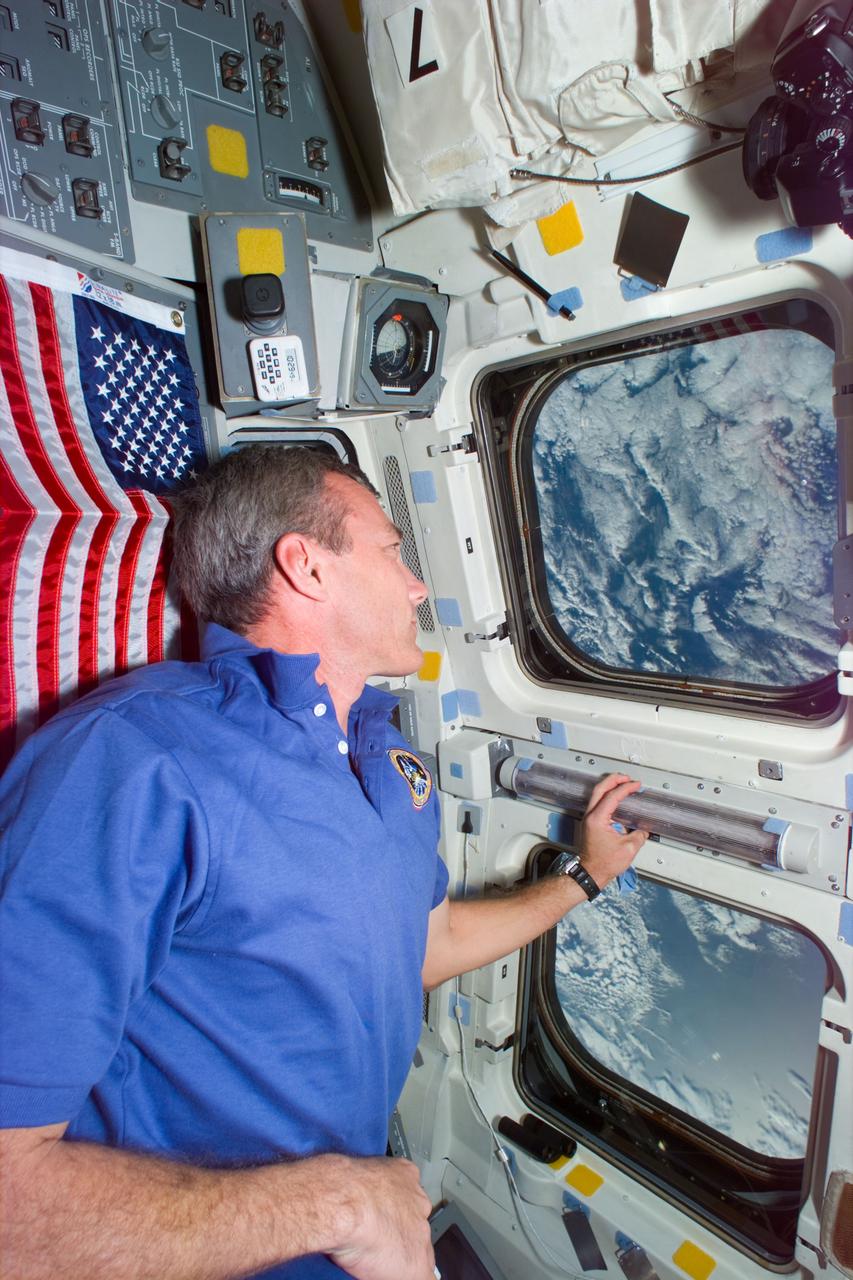
STS79-E-5379 (24 September 1996) --- Astronaut Terrence W. Wilcutt, pilot, watches the Russia's Mir Space Station, with fellow astronaut John E. Blaha, cosmonaut guest researcher onboard, gradually getting further and further away from the Space Shuttle Atlantis, during Flight Day 9.

STS79-E-5390 (24 September 1996) --- Madagascar, off the east coast of Africa, is almost too large to fit into a single frame, but it has long provided NASA astronauts with interesting panoramas as it spans across the horizon, during Flight Day 9.
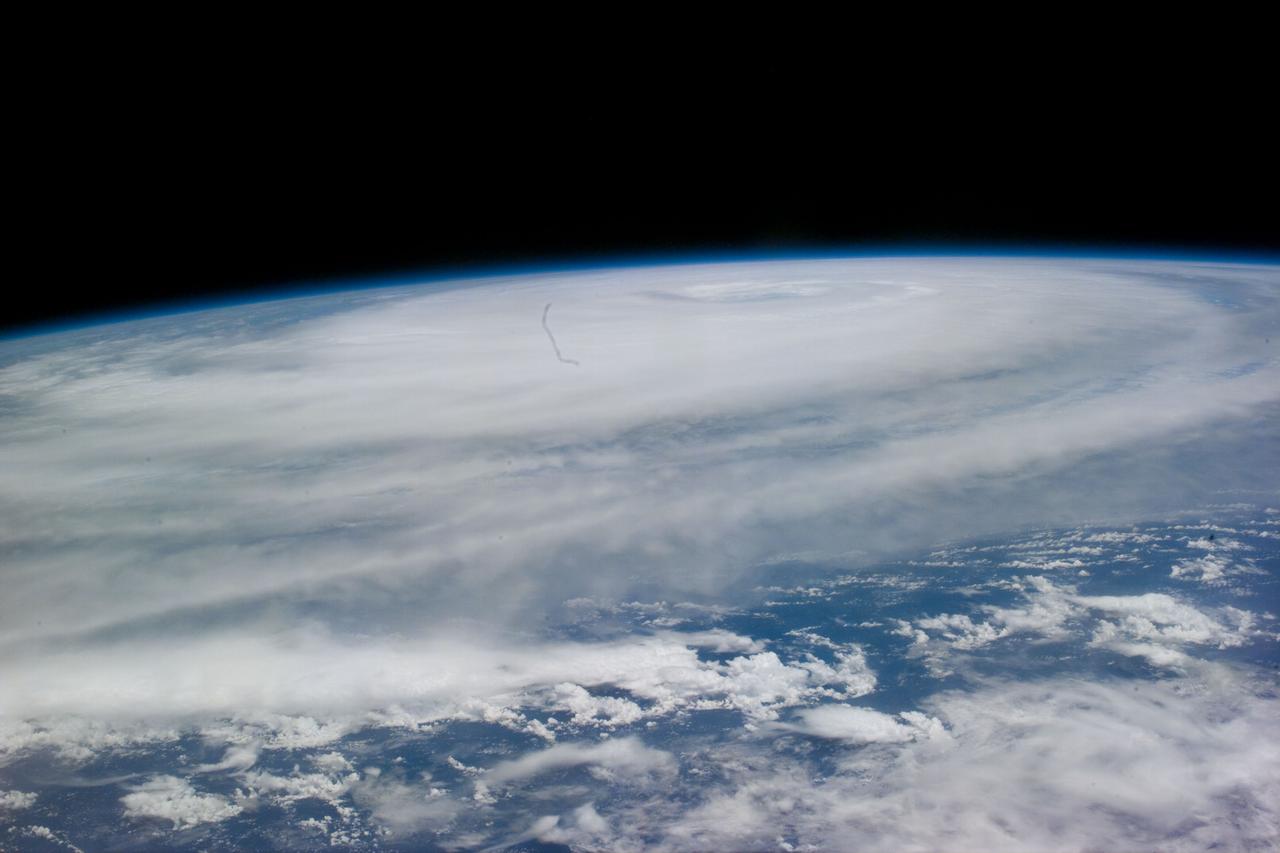
STS079-E-5100 (20 September 1996) --- The crew aboard the Space Shuttle Atlantis was able to track the large Typhoon Violet in the western Pacific Ocean. At the beginning of the mission, Violet was south and west of Japan, and packed winds of 140 - 150 miles per hour. Four days into the flight, about the time this Electronic Still Camera (ESC) view was recorded and downlinked to Earth, Violet became extra-tropical, but she still had winds up to 90 knots (nautical miles per hour).
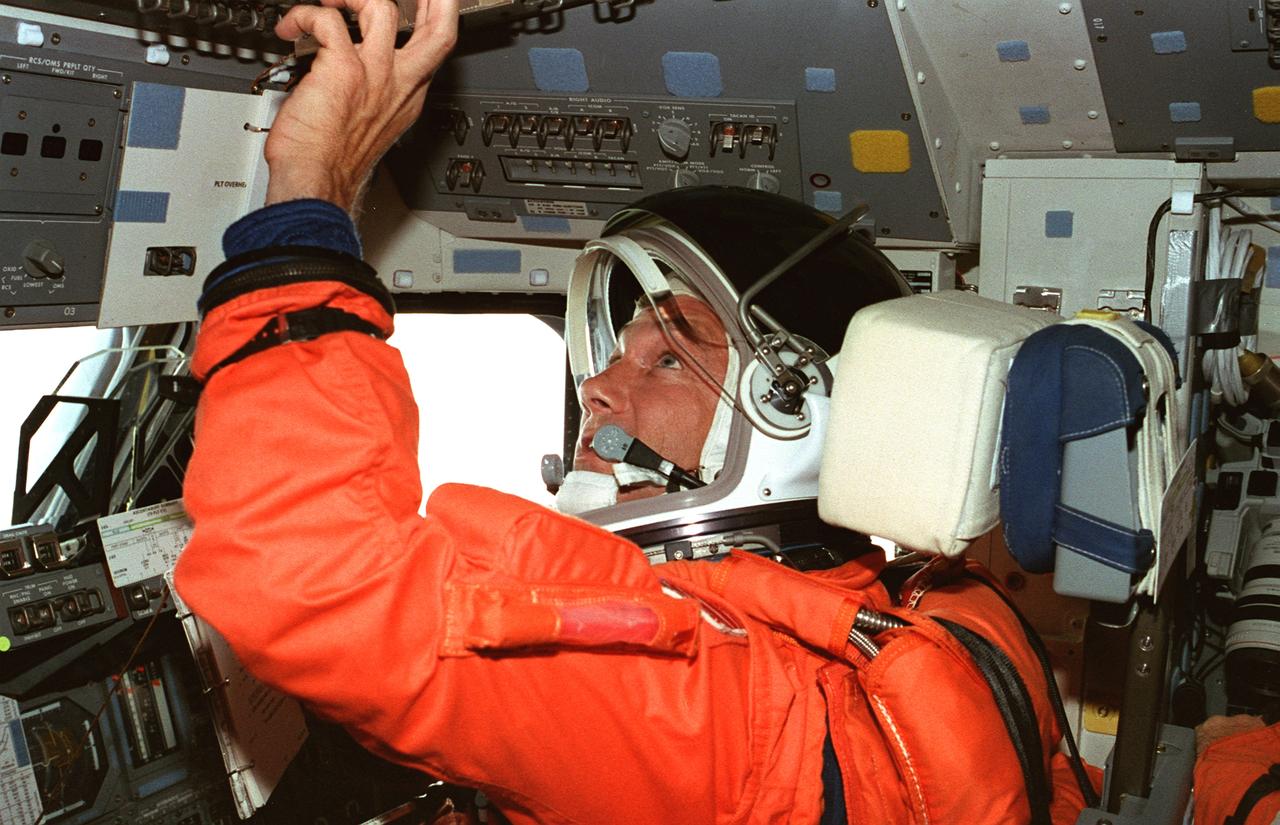
STS079-348-004 (16 Sept. 1996) --- Soon after the space shuttle Atlantis completed its rocket mode ascent to Earth-orbit, astronaut Terrence W. Wilcutt, pilot, begins to ready the Orbiter for ten days of orbiting Earth by activating switches on the flight deck's right overhead panel. Though the launch was a nocturnal one, the crew experienced its first sunrise just after Atlantis achieved its orbital posture.
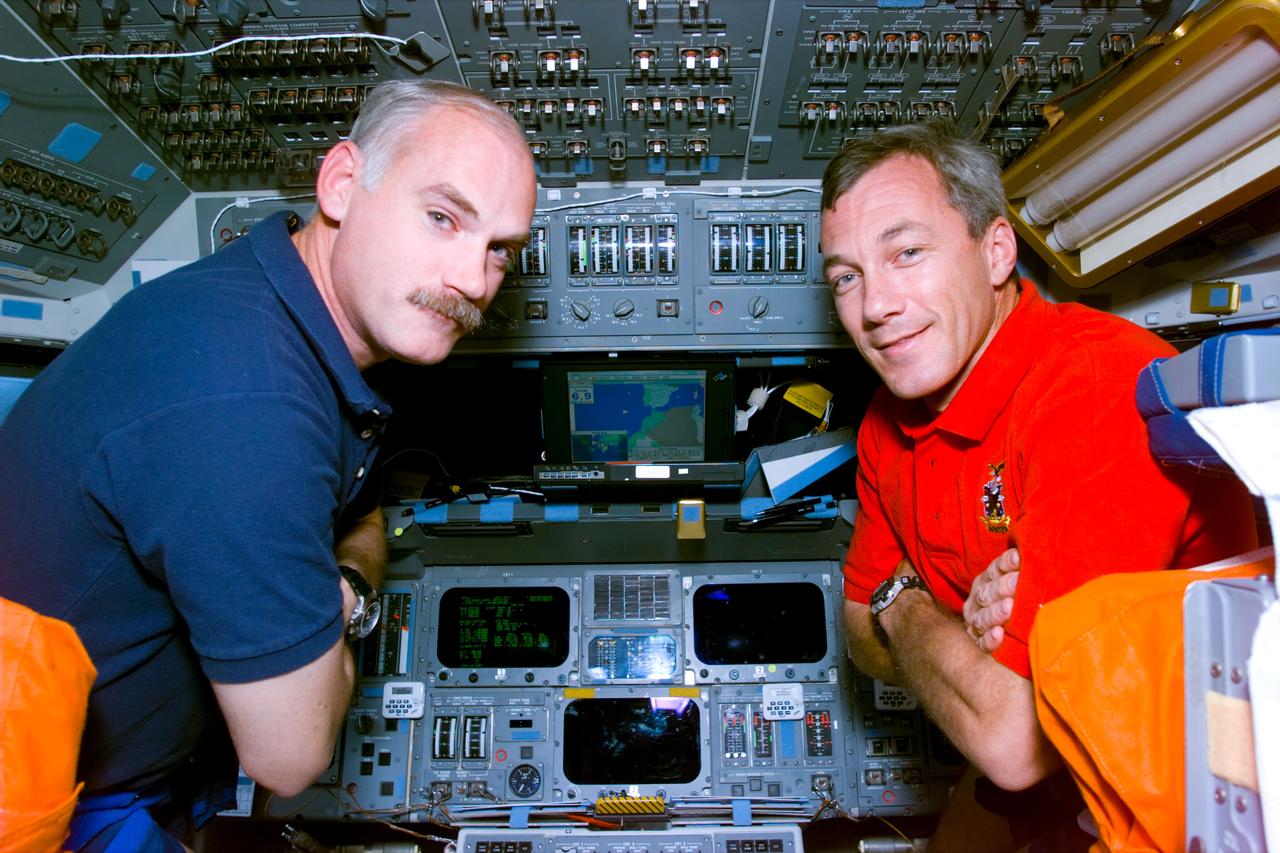
STS79-E-5383 (24 September 1996) --- Astronauts William F. Readdy (left) and Terrence W. Wilcutt sit at the commander and pilot stations, respectively, during undocking operations, during Flight Day 9, onboard the Space Shuttle Atlantis.
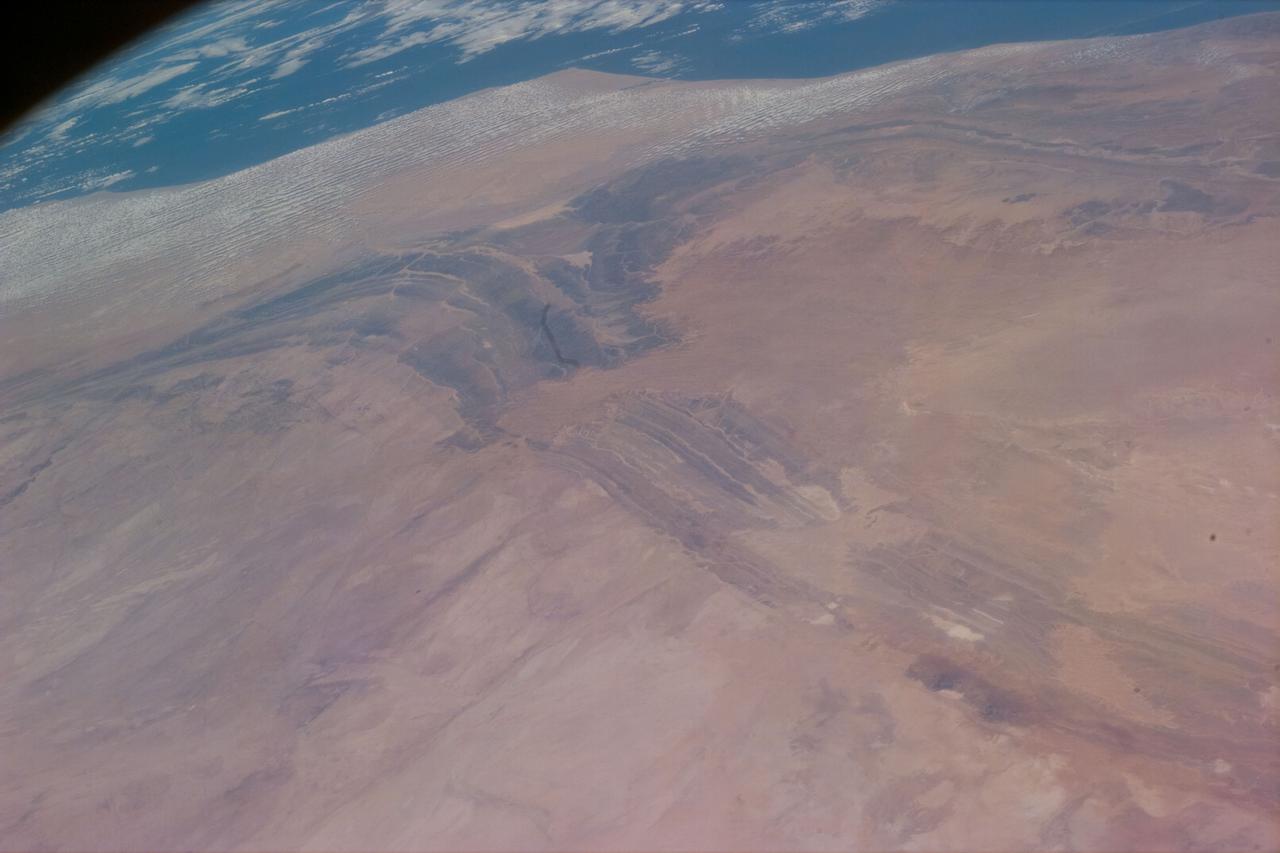
STS79-E-5385 (16 - 26 September 1996) --- The Atlas Mountains, as seen from the Space Shuttle Atlantis, apparently have not changed much in 35 years of Earth observations from space as testified by astronaut Jerome (Jay) Apt, who took this picture with an Electronic Still Camera (ESC). Astronaut John Glenn on NASA's MA-6 mission, took the first image of this area from space.
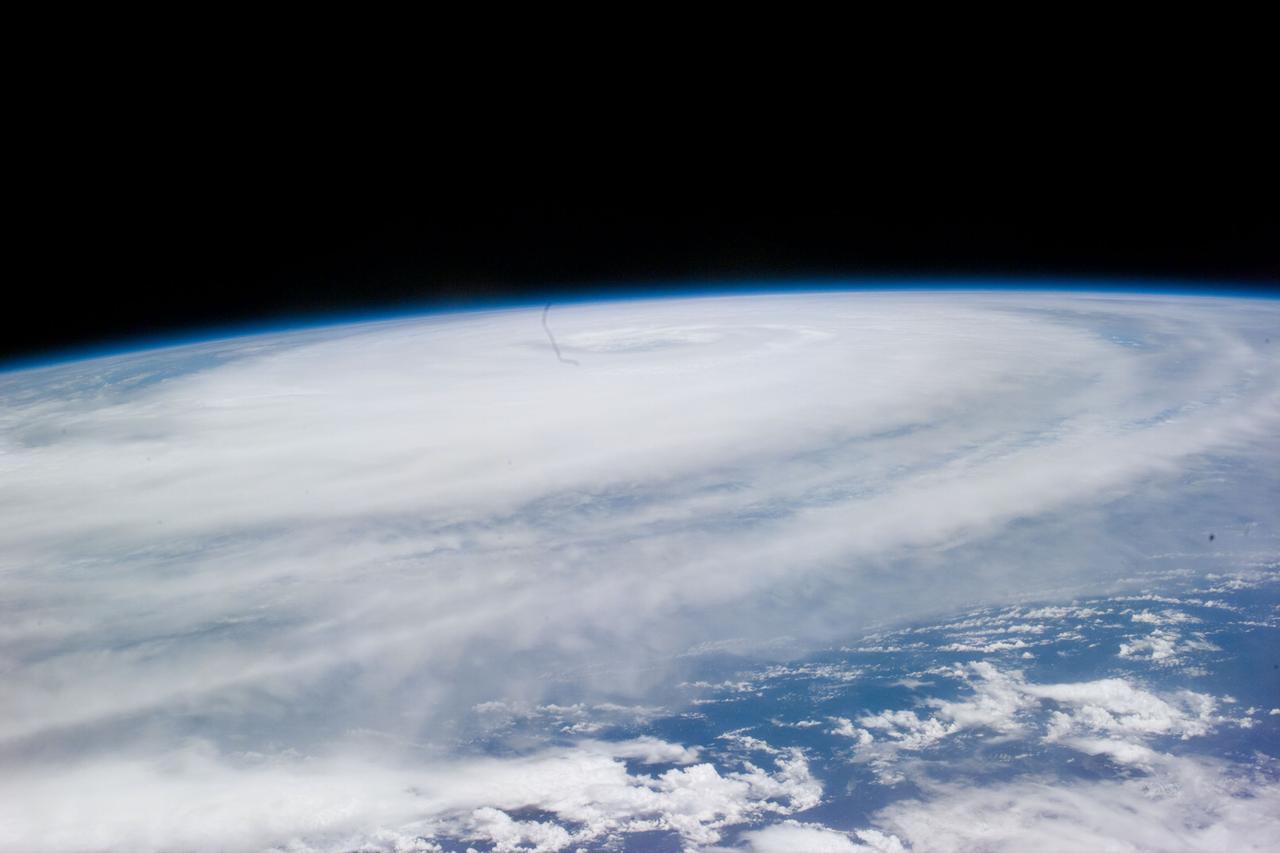
STS79-E-5099 (20 September 1996) --- The crew members have been able to spot two typhoons - the larger Violet, north of the Philippines, and a lesser one called Willie, near Vietnam - and a tropical depression from Earth-orbit, during Flight Day 5. They aimed the Electronic Still Camera (ESC) at this storm, believed to be Violet, during the early hours of September 20, 1996.
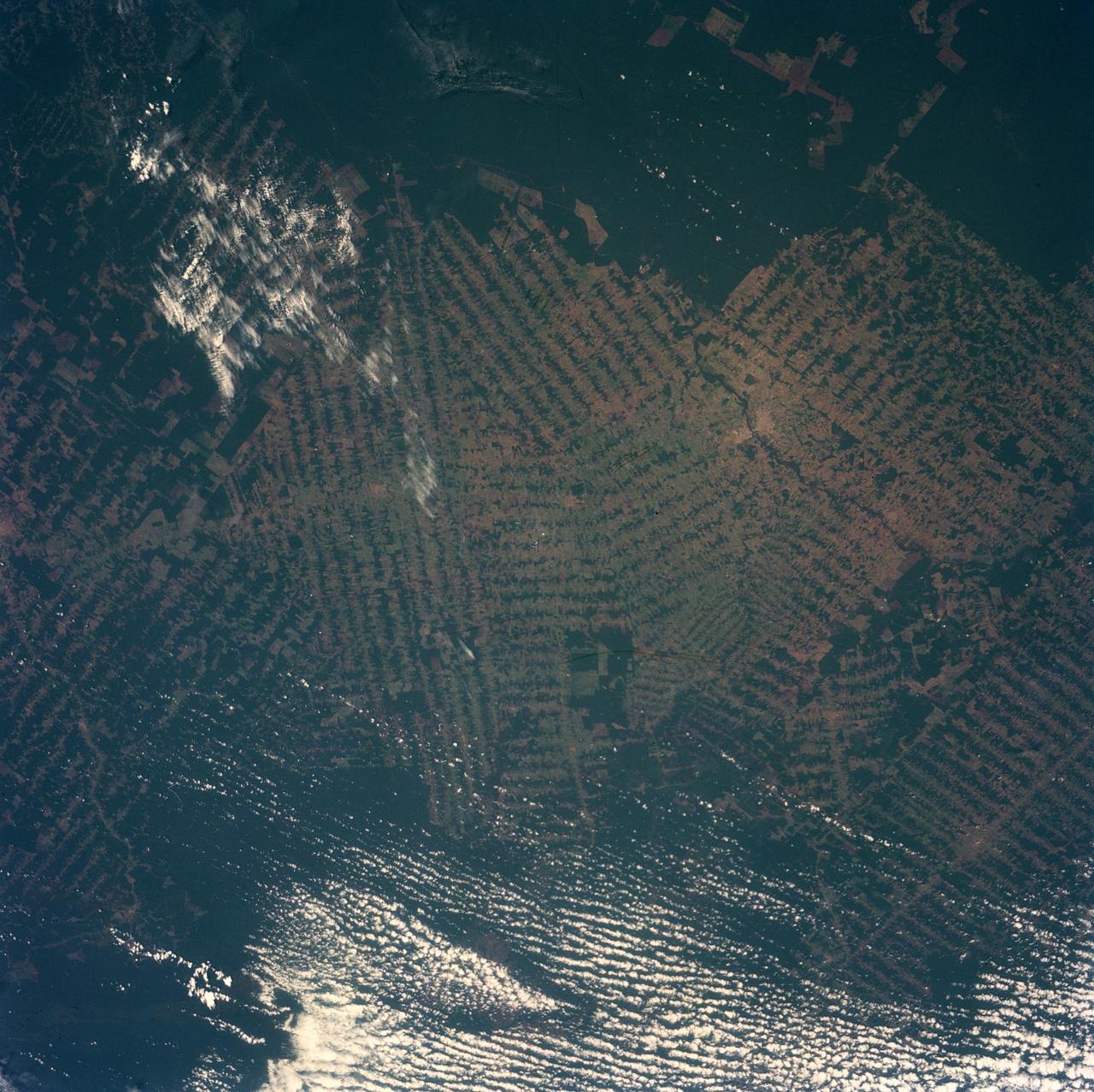
STS079-785-103 (16-26 Sept. 1996) --- In this 70mm frame from the space shuttle Atlantis, the Brazilian state of Rondonia is featured. The photograph shows some of the major settlements and the habitat fragmentation caused by large agriculture programs in Brazil. The Rondonia state in southwestern Brazil is an area of about 240,000 square kilometers (92,000 square miles). Approximately 11.5% of the tropical forests in Rondonia have been cleared since 1970. There are indicators showing that roughly 20% of the cleared land is reverting back to scrub every year due to low fertility. Space Shuttle photography of this region has documented the forest clearing since the mid 1980's. This view adds to the large database of imagery, including other satellite-based imagery, and provides a natural color view of the region.
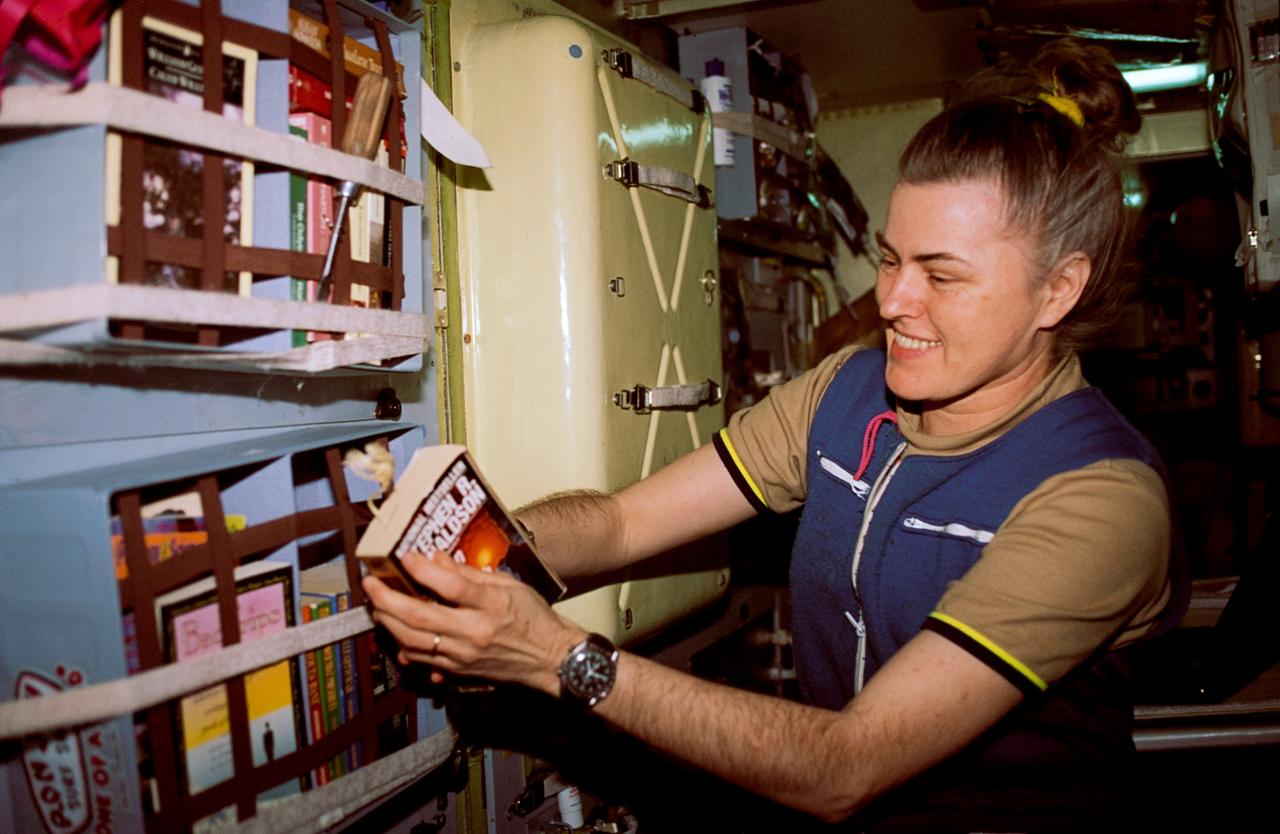
NM22-427-012 (16-26 Sept. 1996) --- During off-duty time on the Spektr Module aboard the Earth-orbiting Mir Space Station, astronaut Shannon W. Lucid, cosmonaut guest researcher, retrieves a book from her personal library. Lucid, dropped off in March by the STS-76 crew members, was nearing the end of 188 consecutive days in space before returning to Earth with the STS-79 crew. She worked with a total of five cosmonauts at various times during that stay.
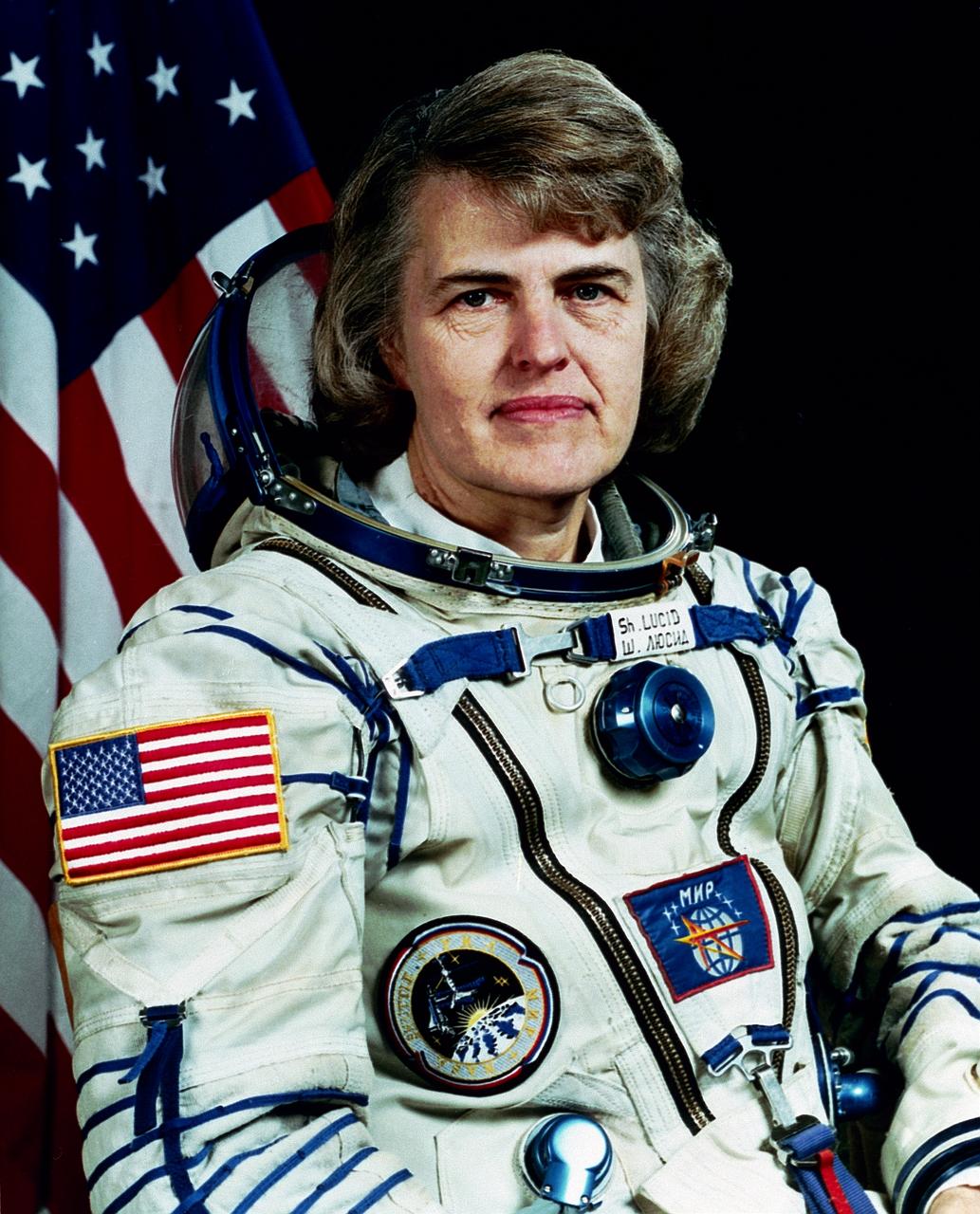
S95-21469 (December 1995) --- Astronaut Shannon W. Lucid, mission specialist, Mir 21/22 flight engineer, cosmonaut guest researcher. EDITOR'S NOTE: Astronaut Lucid will launch aboard the Space Shuttle Atlantis, STS-76 mission, to board the Russian Mir Space Station. After a long duration of cosmonaut guest research duties, she will return to Earth aboard the Space Shuttle Atlantis STS-79 mission.
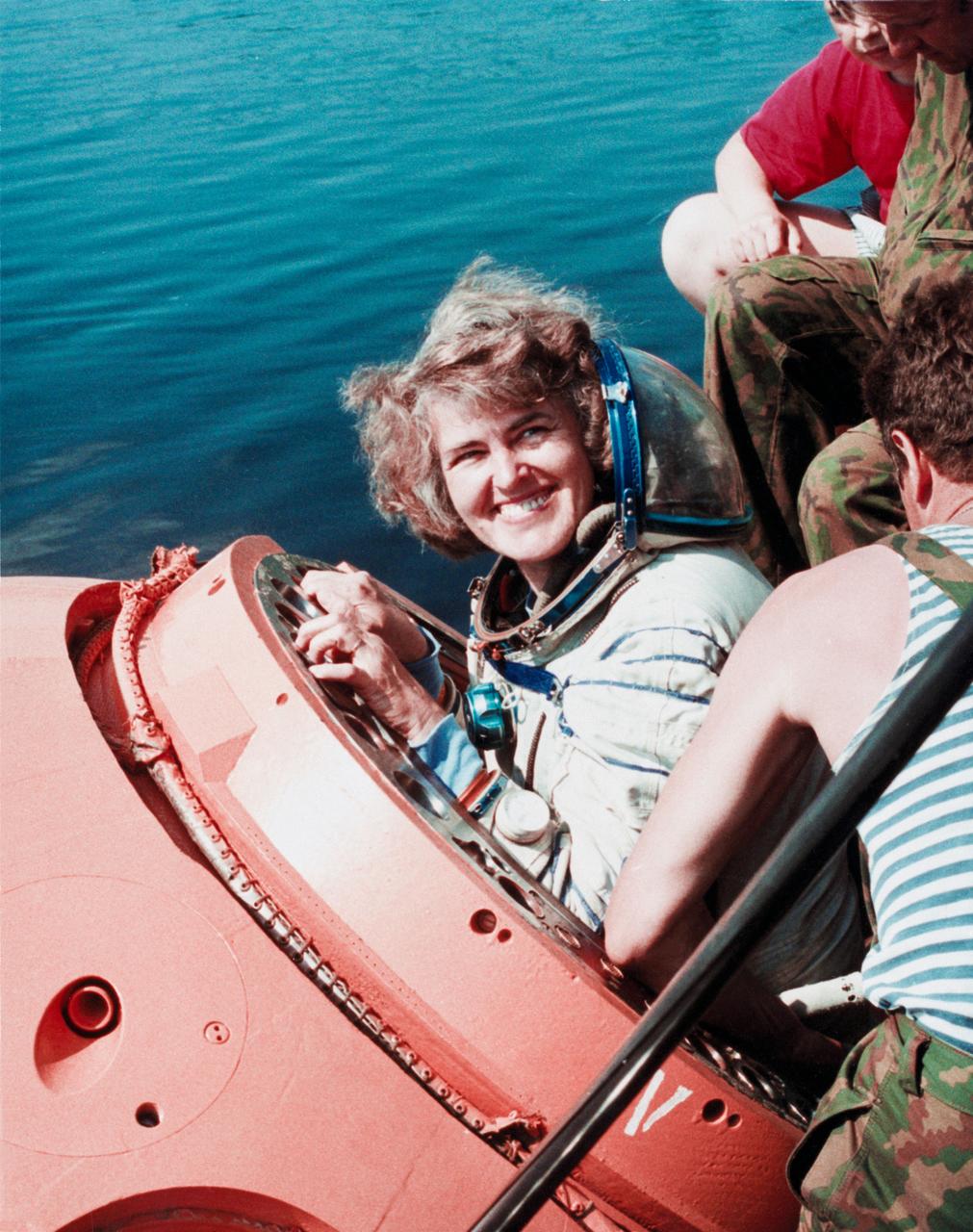
S95-21463 (August 1995) --- Astronaut Shannon W. Lucid, who will go into space in 1996 to spend time aboard Russia?s Mir Space Station, egresses from a training version of a Soyuz spacecraft, during water survival training in Russia. Lucid is to accompany the STS-76 crew in March and spend a little over four months aboard Mir before returning to Earth with the STS-79 crew.
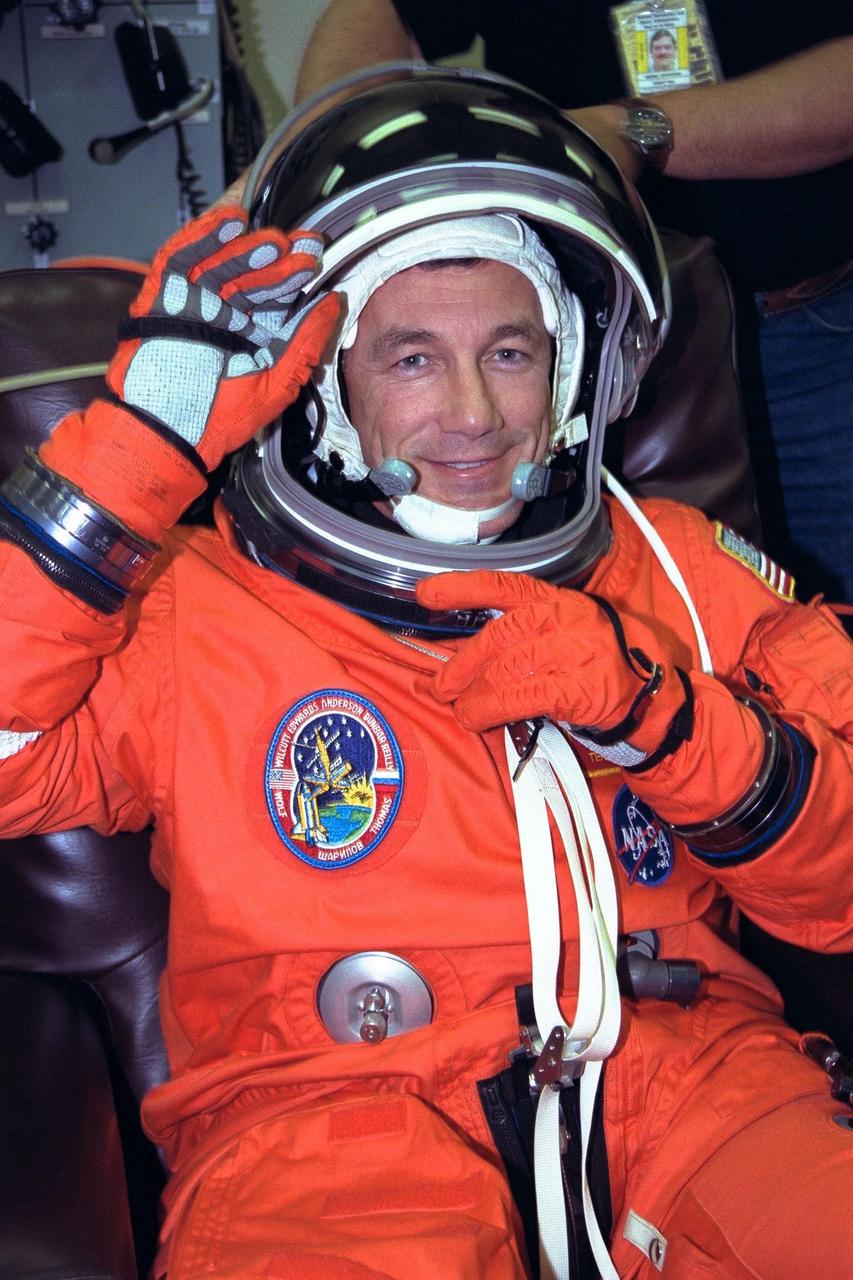
STS-89 Commander Terrence Wilcutt smiles as he completes the donning of his launch/entry suit in the Operations and Checkout (O&C) Building. A veteran of two space flights, he has logged more than 512 hours in space. He served as pilot on STS-68 and STS-79. He and six fellow crew members will soon depart the O&C and head for Launch Pad 39A, where the Space Shuttle Endeavour will lift off during a launch window that opens at 9:43 p.m. EST, Jan. 22. STS-89 is the eighth of nine planned missions to dock the Space Shuttle with Russia's Mir space station
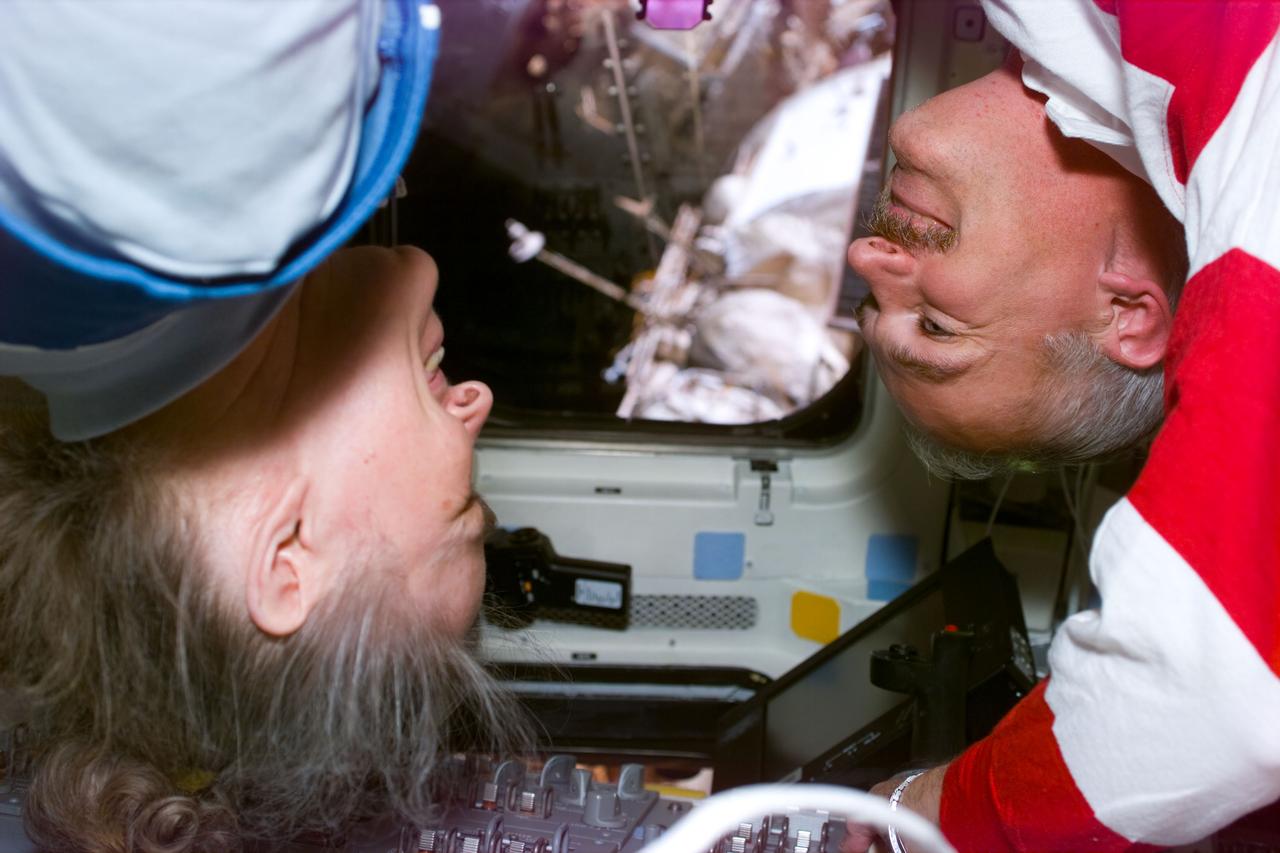
STS79-E-5078 (19 September 1996) --- Astronaut and cosmonaut guest researcher Shannon W. Lucid sees her first astronaut visitors since March 1996, as she greets William F. Readdy, STS-79 commander, during Flight Day 4. Some of Russia's Mir Space Station's components can be seen through the window in background. Lucid is to return to Earth with Readdy's crew in a few days.
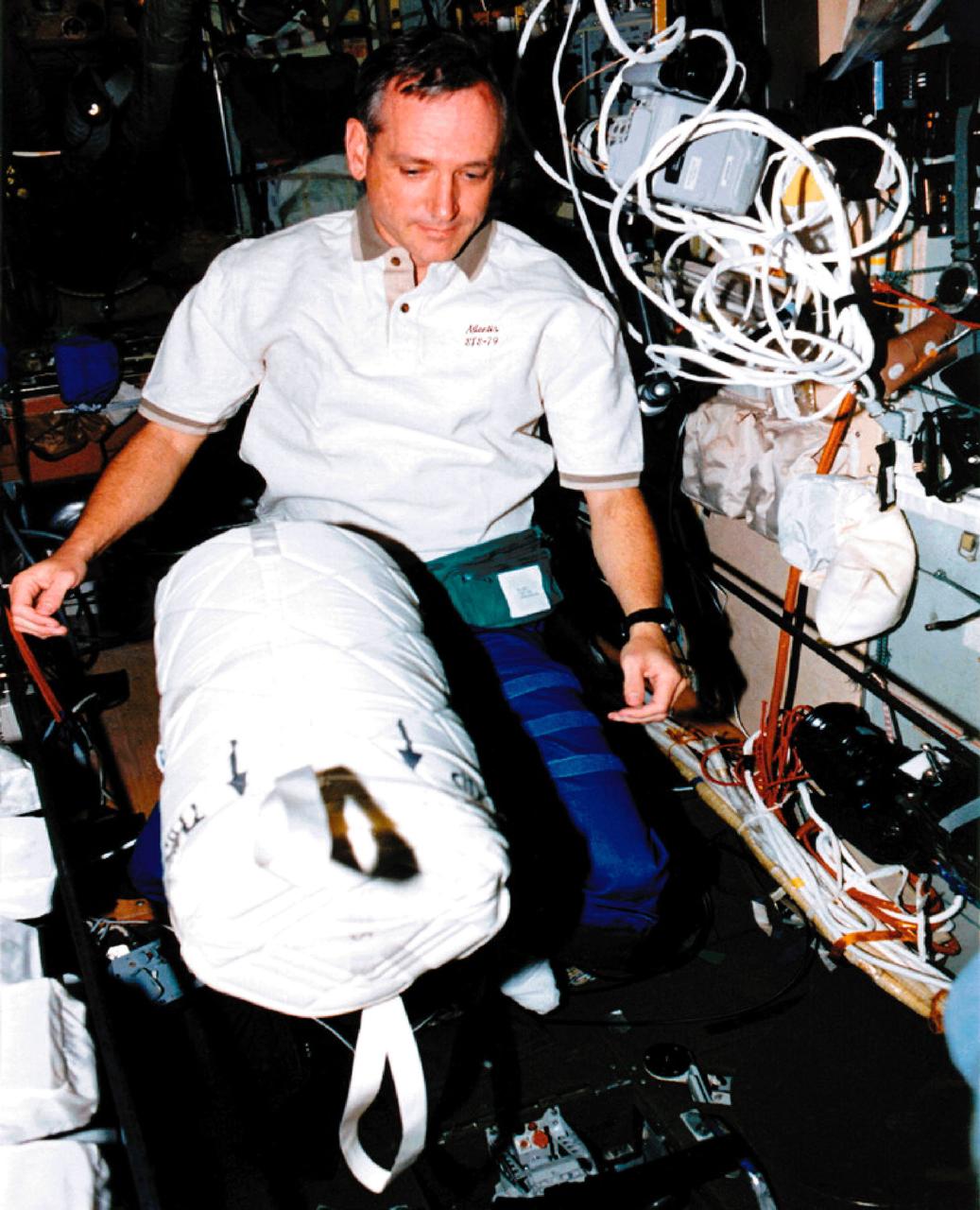
Astronaut Tom Akers places a liquid nitrogen Dewar containing frozen protein solutions aboard Russia's space Station Mir during a visit by the Space Shuttle (STS-79). The protein samples were flash-frozen on Earth and will be allowed to thaw and crystallize in the microgravity environment on Mir Space Station. A later crew will return the Dewar to Earth for sample analysis. Dr. Alexander McPherson of the University of California at Riverside is the principal investigator. Photo credit: NASA/Johnson Space Center.
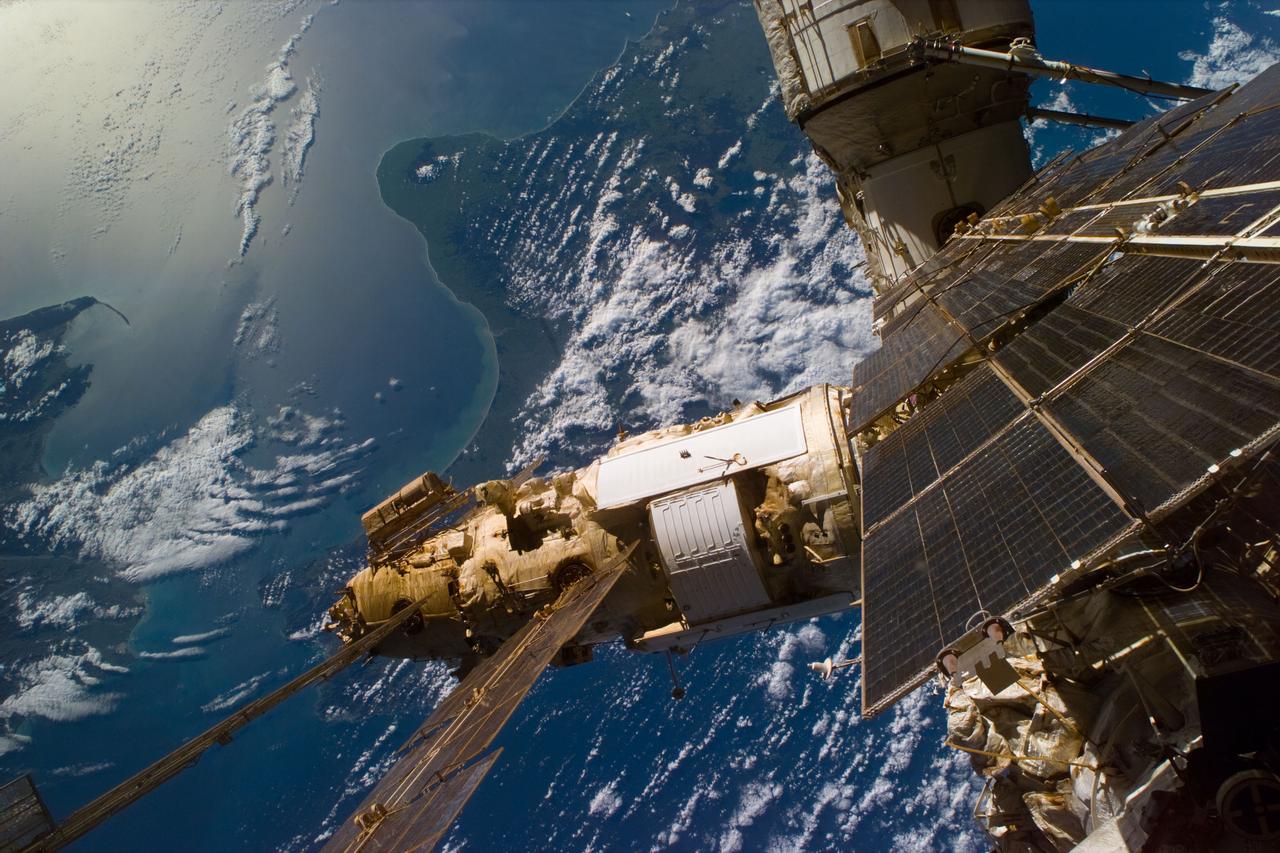
STS79-E-5065 (19 September 1996) --- As seen from the Space Shuttle Atlantis' flight deck, backdropped against Cook Strait, the Tasman Sea and the south Pacific Ocean, several components of Russia's Mir Space Station greet STS-79 crew members looking through aft-flight deck windows. Egmont National Park and Mt. Egmont on New Zealand's North Island can be easily delineated, during Flight Day 4.
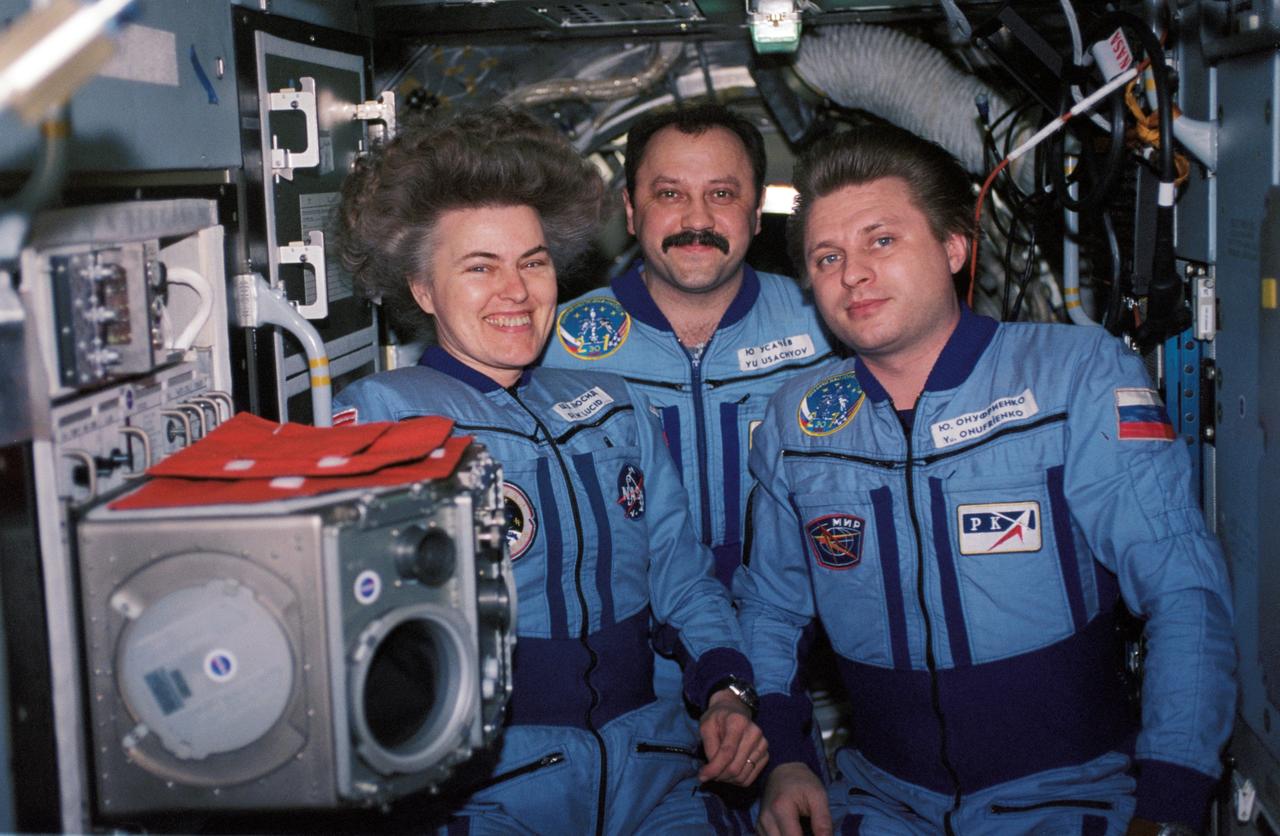
NM21-395-024 (March 1996) --- Posed near a microgravity glove box on the Priroda Module aboard Russia’s Mir Space Station are the Mir-21 crew members. From the left are astronaut Shannon W. Lucid, cosmonaut guest researcher; Yuriy V. Usachov, flight engineer; and Yuriy I. Onufriyenko, commander. Lucid went on to spend a total of 188 consecutive days in space before returning to Earth with the STS-79 crew.

STS79-E-5277 (23 September 1996) --- Astronaut Shannon W. Lucid, former cosmonaut guest researcher, checks on wheat plants aboard Russia's Mir Space Station, during Flight Day 8. Lucid, along with the rest of the STS-79 crew except for John E. Blaha, current cosmonaut guest researcher, is leaving Mir today.
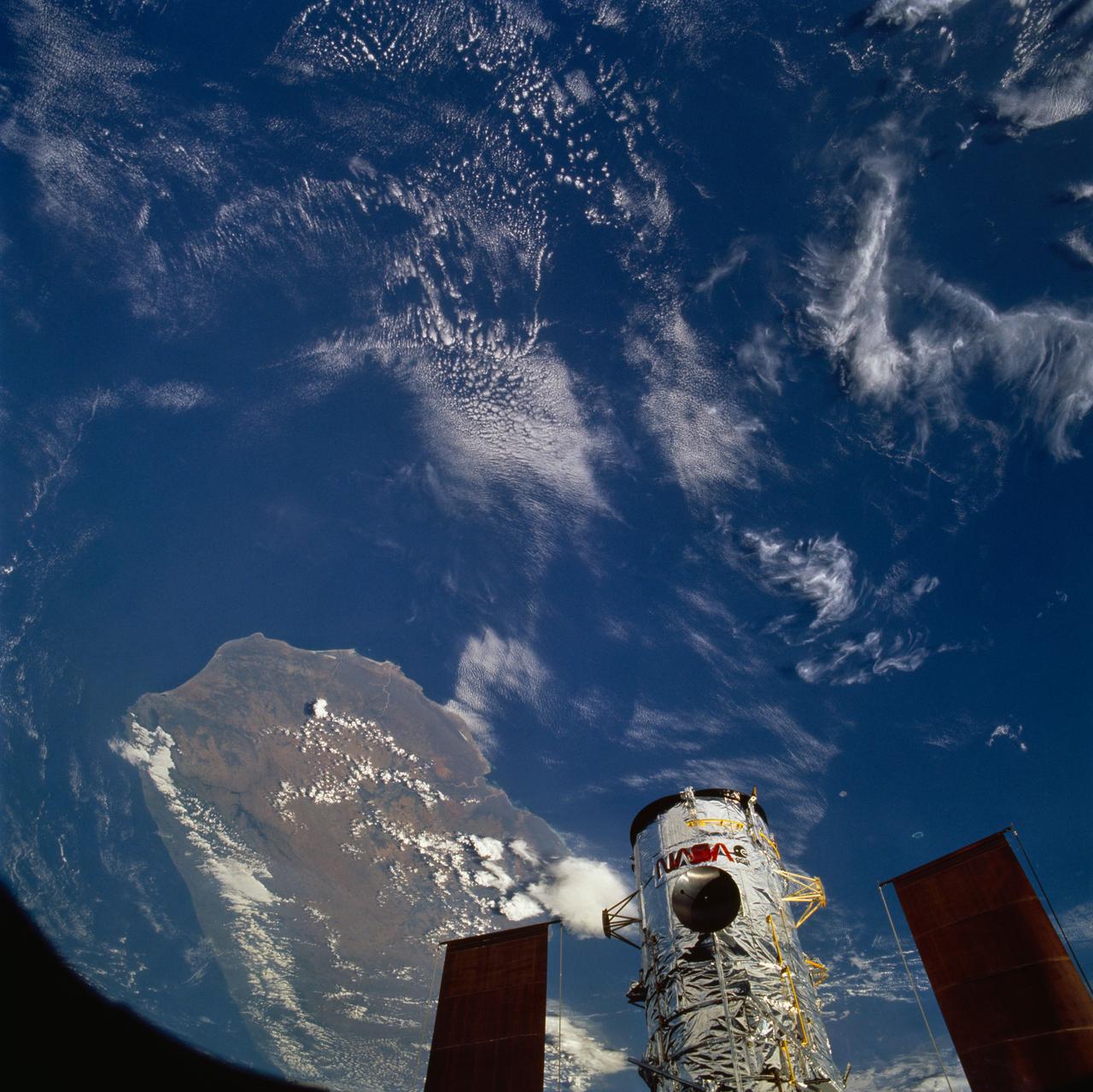
STS061-79-086 (4 Dec 1993) --- The Hubble Space Telescope (HST), backdropped over Madagascar, is berthed in the Space Shuttle Endeavour's cargo bay following its capture by the STS-61 astronauts. The crew used TV cameras to survey the spacecraft before sending out four astronauts on five separate sessions of extravehicular activity (EVA) to perform a variety of servicing tasks.
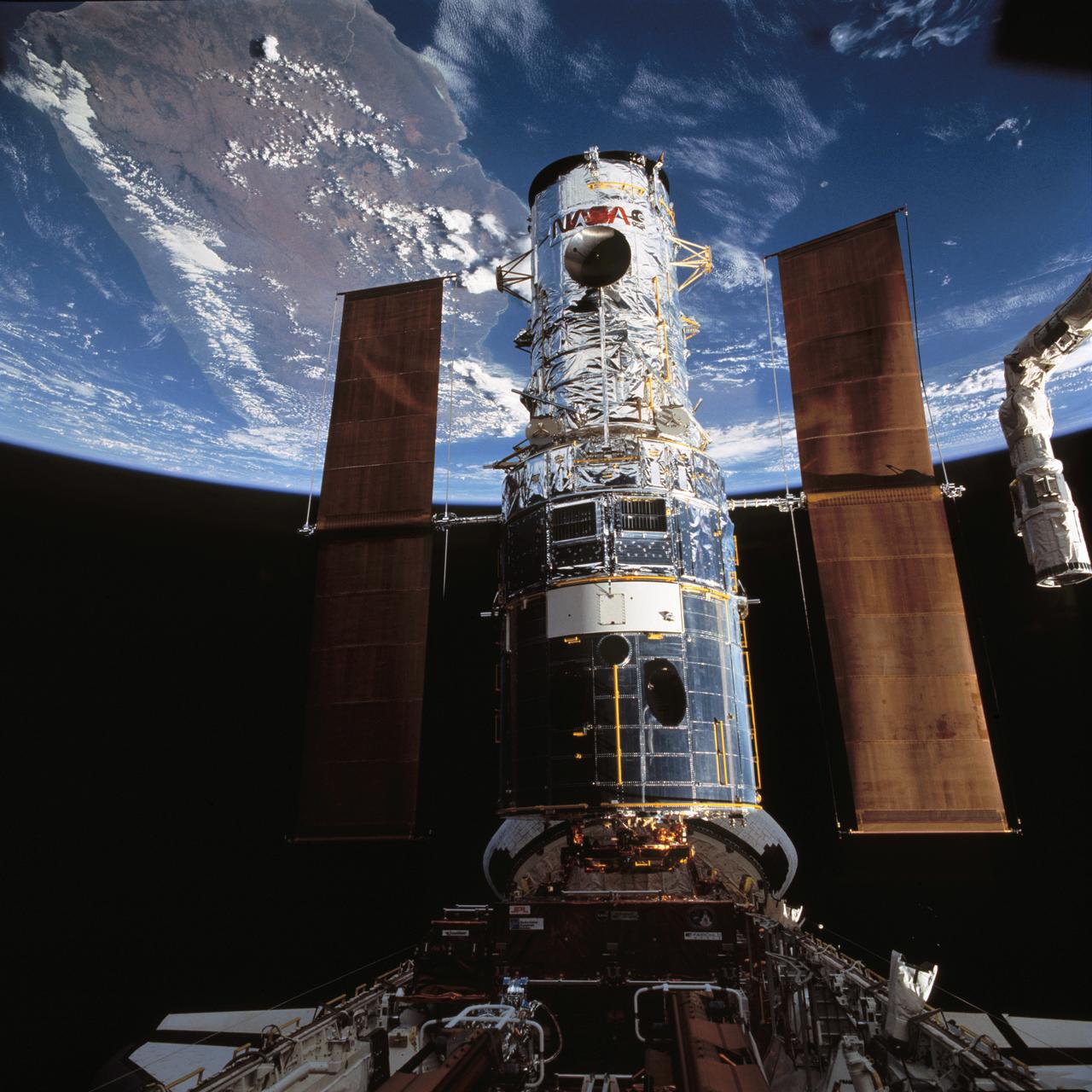
STS061-79-087 (4 Dec. 1993) --- The Hubble Space Telescope (HST), backdropped over Madagascar, is berthed in the space shuttle Endeavour's cargo bay following its capture by the STS-61 astronauts. The crew used TV cameras to survey the spacecraft before sending out four astronauts on five separate sessions of extravehicular activity (EVA) to perform a variety of servicing tasks. Photo credit: NASA
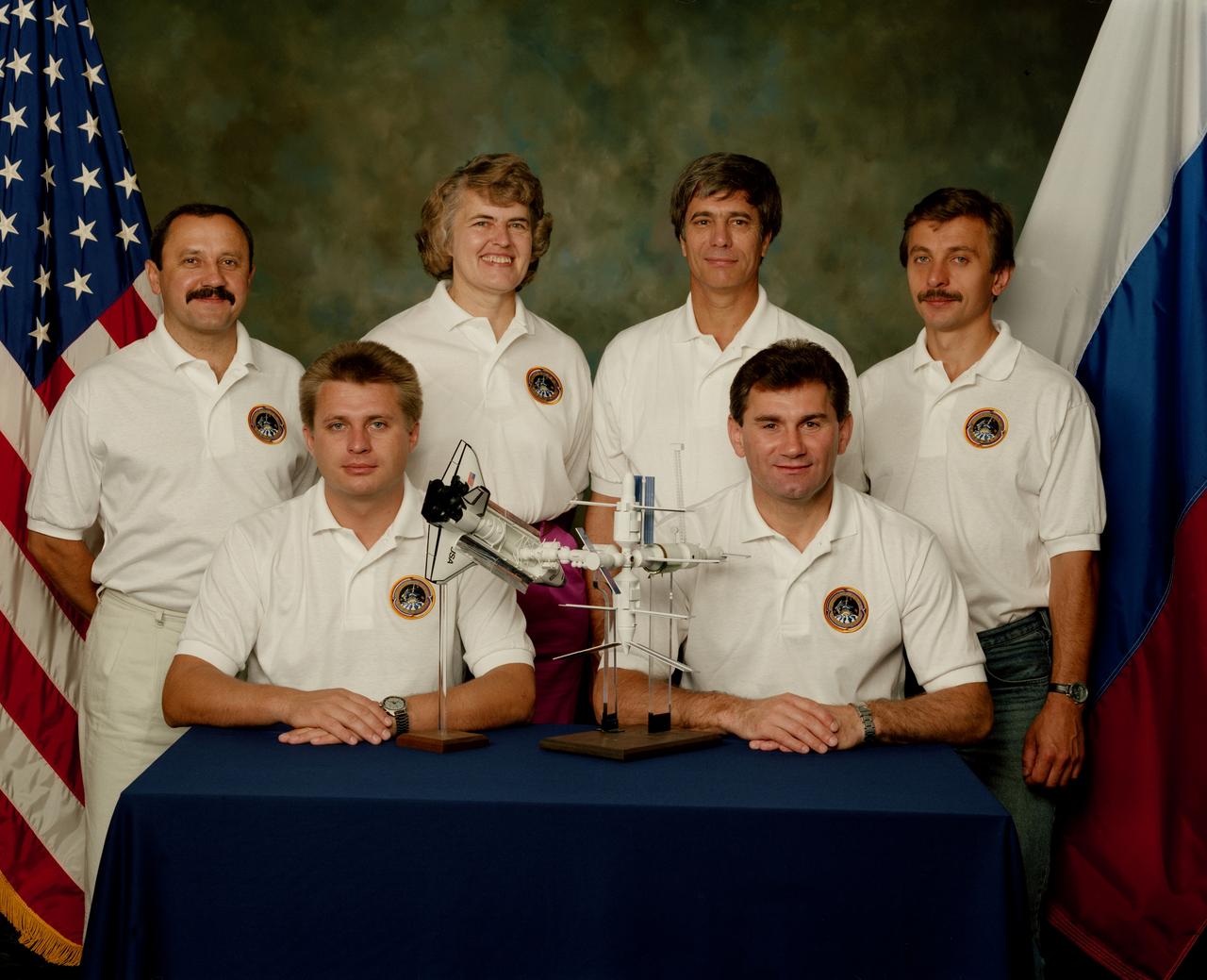
S95-16674 (14 July 1995) --- On the left is the Mir-21 crew consisting of cosmonaut Yuriy V. Usachov (standing), flight engineer; Yuriy I. Onufriyenko (seated), commander; and Shannon W. Lucid, cosmonaut guest researcher. On the right side is the Mir-23 crew consisting of John E. Blaha (standing), cosmonaut guest researcher; Vasili V. Tsibliyev (seated), commander; and Aleksandr I. Lazutkin, flight engineer. NASA astronauts Lucid and Blaha each will go into space to board Russia's Mir Space Station for lengthy research on their respective missions. Lucid will board the Mir during the STS-76 mission. Blaha will replace Lucid onboard the Mir during the STS-79 mission.
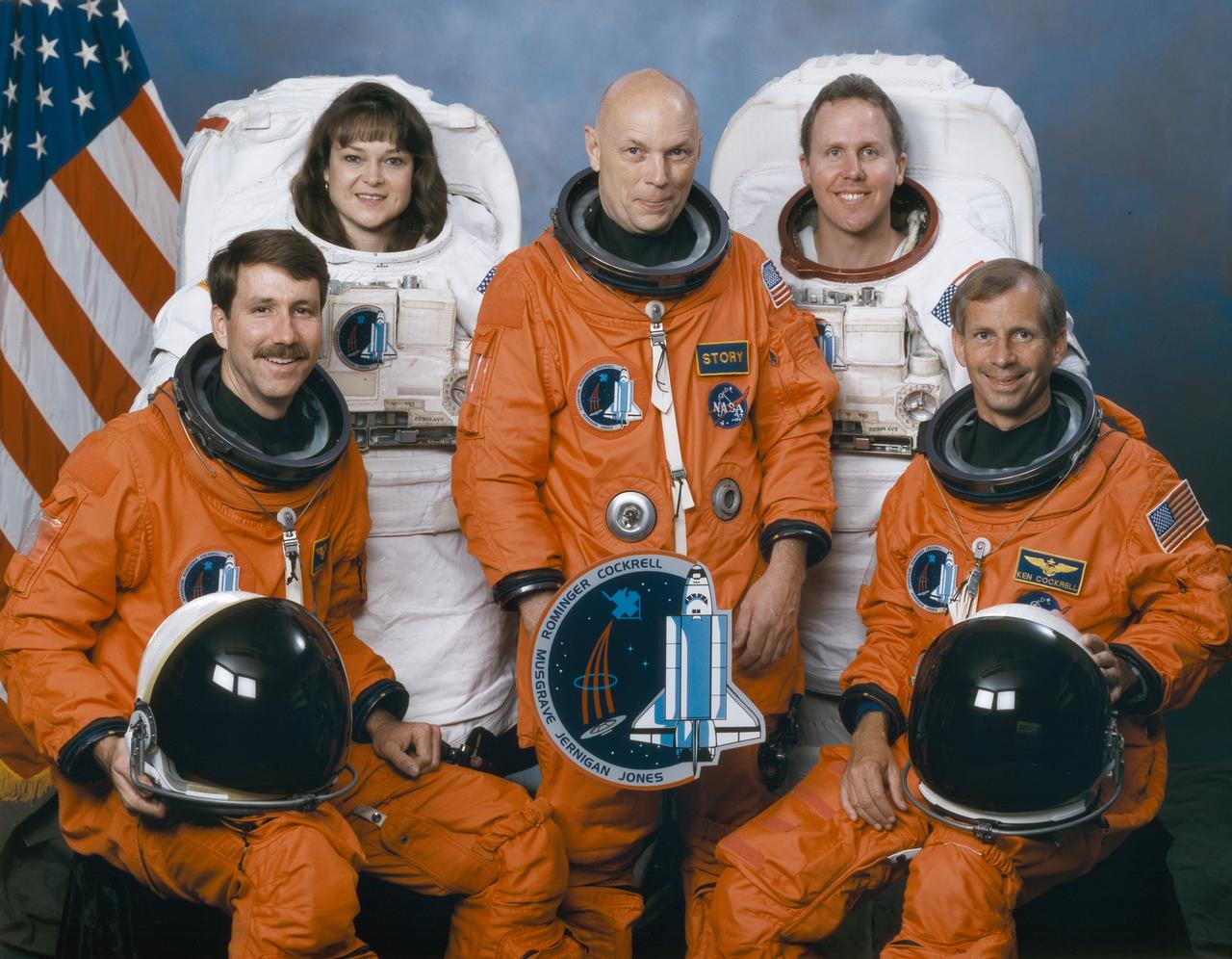
The crew assigned to the STS-79 mission included (seated left to right) Kent V. Rominger, pilot; and Kenneth D. Cockrell, commander. Standing (left to right) are mission specialists Tamara E. Jernigan, F. Story Musgrave, and Thomas D. Jones. Launched aboard the Space Shuttle Columbia on November 19, 1996 at 2:55:47 pm (EST), the STS-80 mission marked the final flight of 1996. The crew successfully deployed and operated the Orbiting and Retrievable Far and Extreme Ultraviolet Spectrometer-Shuttle Pallet Satellite II (ORFEUS-SPAS II), and deployed and retrieved the Wake Shield Facility-3 (WSF-3).
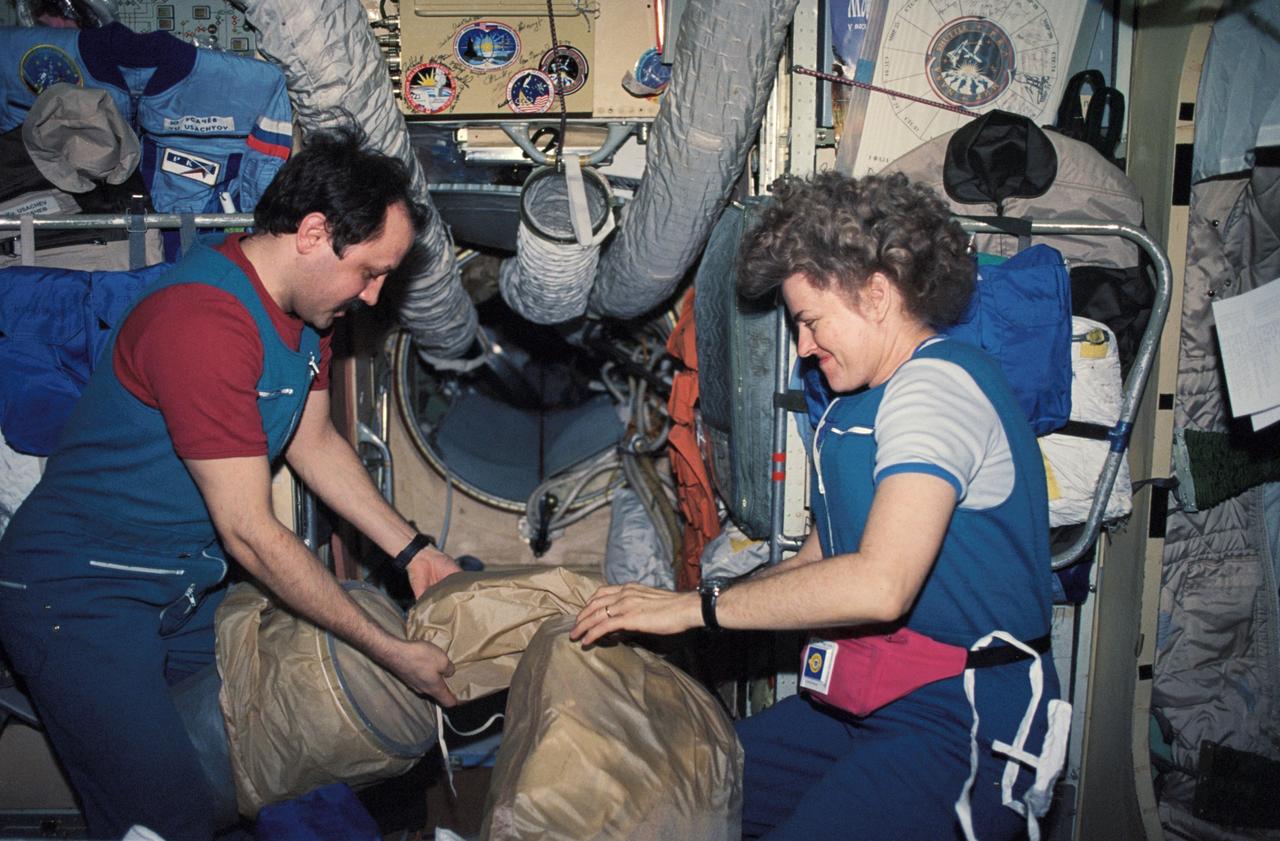
NM21-386-024 (March 1996) --- Onboard the Base Block Module of Russia’s Mir Space Station, as two members of the Mir-21 crew prepare to move supplies to their proper stowage places. Astronaut Shannon W. Lucid, recently dropped off by the STS-76 Space Shuttle Atlantis crew members and now serving as a cosmonaut guest researcher, works with Yury V. Usachev, flight engineer. She went on to spend a total of 188 consecutive days in space before returning to Earth with the STS-79 crew. She worked with a total of five cosmonauts at various times during that stay.
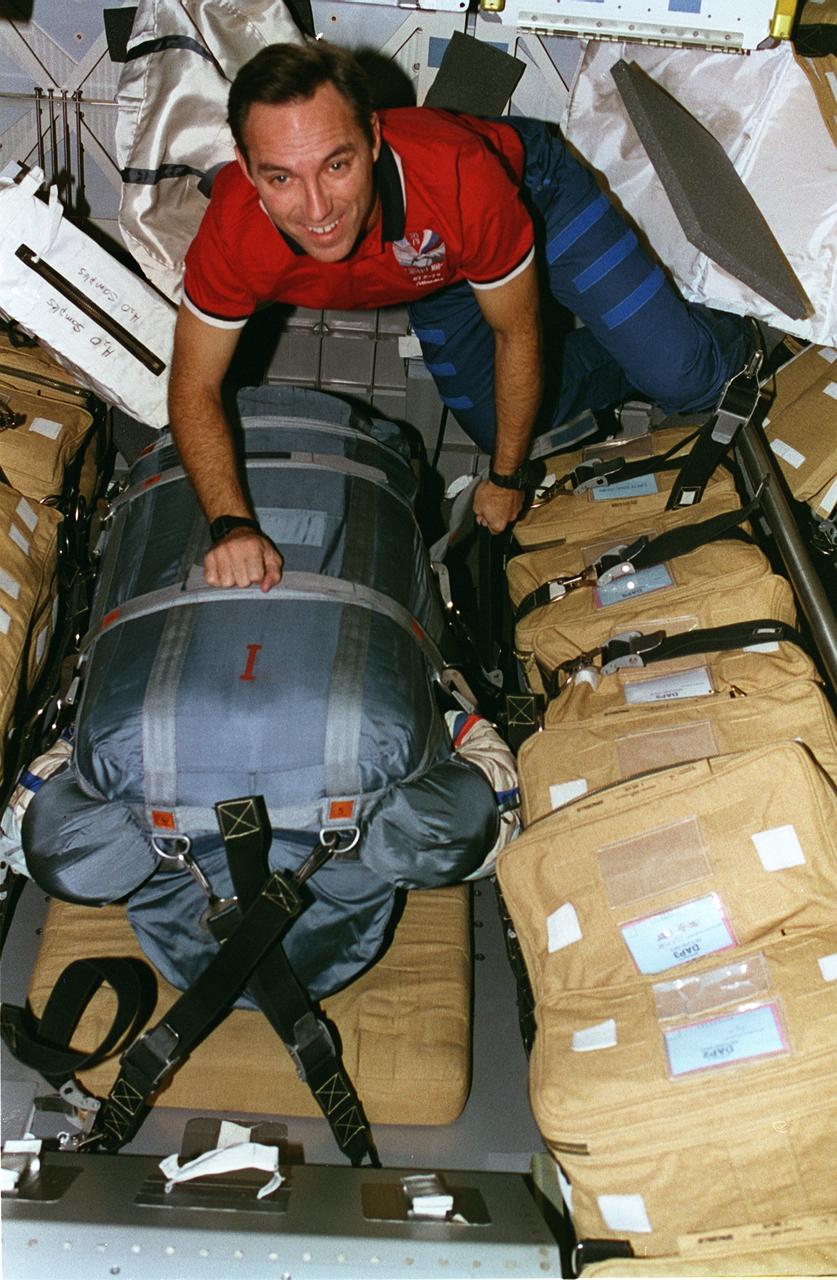
STS079-304-001 (16 Sept. 1996)--- Astronaut Carl E. Walz totes a bag carrying a space suit used by the cosmonauts. At the completion of the STS-79 mission, the suit was brought back to Earth for analysis. This photograph is one of fifteen 35mm frames (along with four 70mm frames) of still photography documenting the activities of NASA's STS-79 mission, which began with a September 16, 1996, liftoff from Launch Pad 39A the Kennedy Space Center (KSC) and ended with a landing at KSC on September 26, 1996. Onboard for the launch were astronauts William F. Readdy, commander; Terrence W. Wilcutt, pilot; John E. Blaha, Jerome (Jay) Apt, Thomas D. Akers and Walz, all mission specialists. On flight day 4, the crew docked with Russia's Mir Space Station. Shannon W. Lucid, who had spent six months aboard Mir, switched cosmonaut guest researcher roles with Blaha. The latter joined fellow Mir-22 crew members Valeri G. Korzun, commander, and Aleksandr Y. Kaleri, flight engineer.
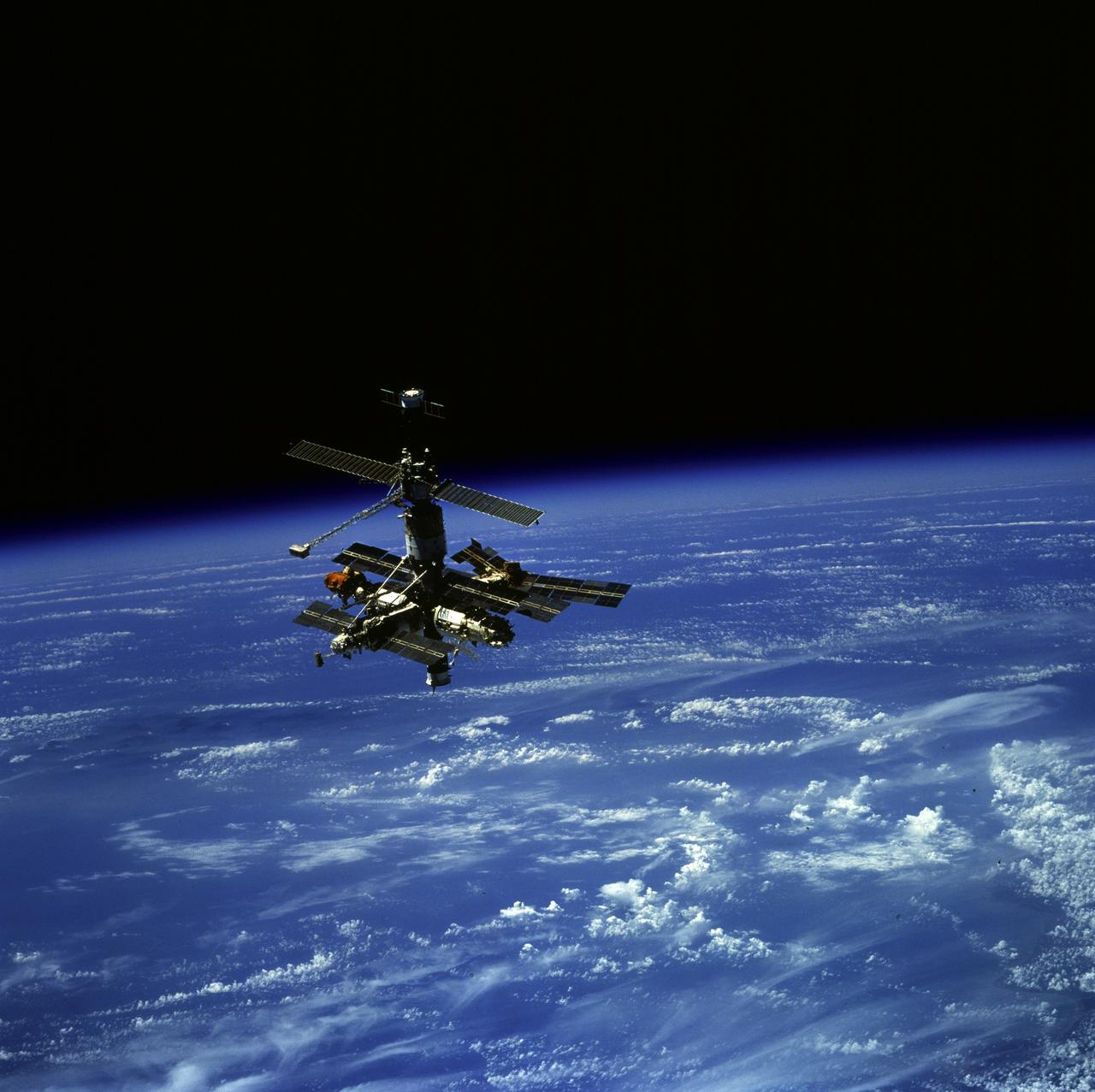
STS079-810-028 (24 Sept. 1996) --- Russia's Mir Space Station, backdropped over Earth's horizon, was photographed by one of the STS-79 crew members aboard the space shuttle Atlantis as it performed its final fly around following undocking operations. The STS-79 flight began with a Sept. 16, 1996, liftoff from Launch Pad 39A at the Kennedy Space Center and ended with a landing at KSC on Sept. 26, 1996. Onboard for the launch were astronauts William F. Readdy, commander; Terrence W. Wilcutt, pilot; John E. Blaha, Jerome (Jay) Apt, Thomas D. Akers and Carl E. Walz, all mission specialists. On flight day four, the crew docked with Mir. Shannon W. Lucid, who had spent six months aboard Mir, switched cosmonaut guest researcher roles with Blaha. The latter joined fellow Mir-22 crew members Valeri G. Korzun, commander, and Aleksandr Y. Kaleri, flight engineer. Photo credit: NASA
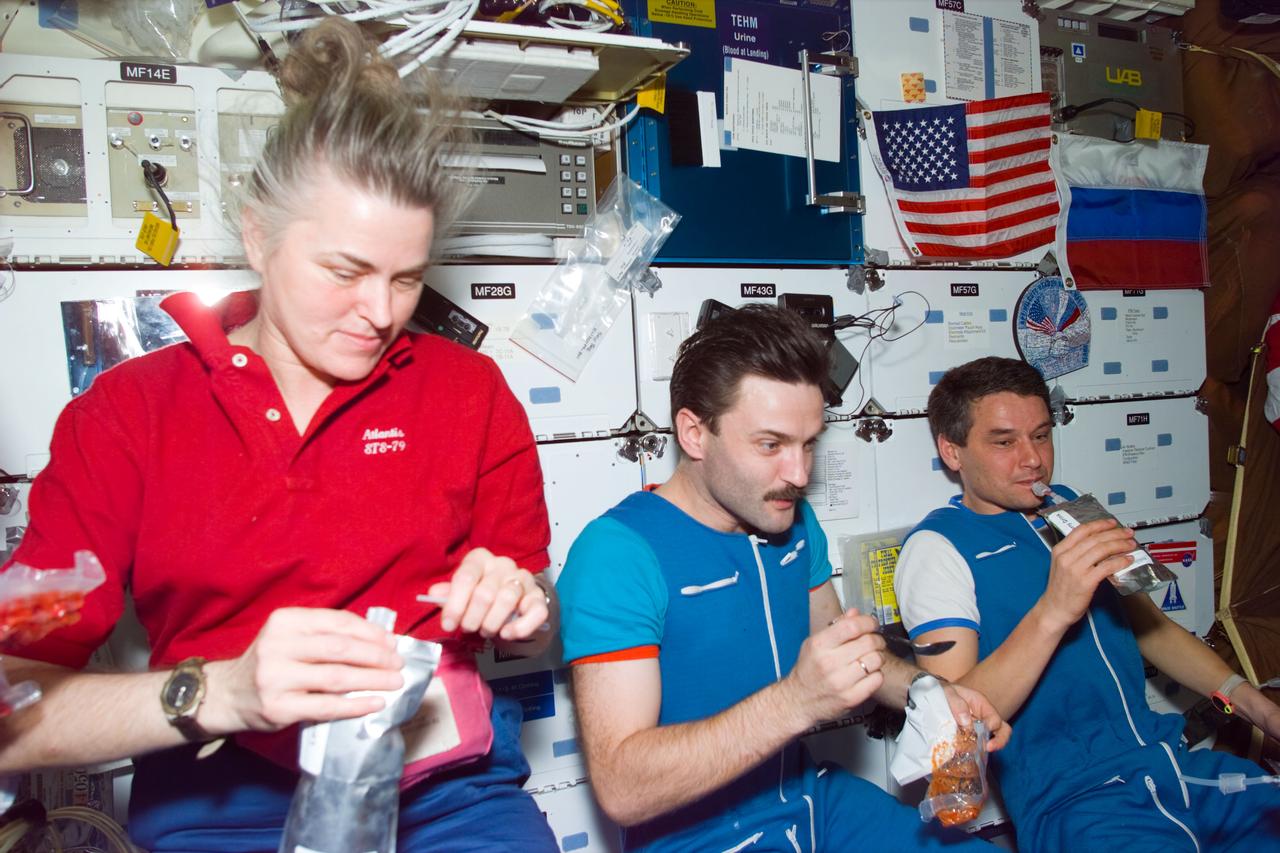
STS79-E-5202 (21 September 1996) --- From the left, astronaut and cosmonaut guest researcher Shannon W. Lucid, cosmonauts Aleksandr Y. Kaleri and Valeri G. Korzun, the Mir-22 crew members, share a meal on the Space Shuttle Atlantis' mid deck, during Flight Day 6. Lucid will bid farewell to the two cosmonauts when she comes back to Earth next week, onboard the Space Shuttle Atlantis.
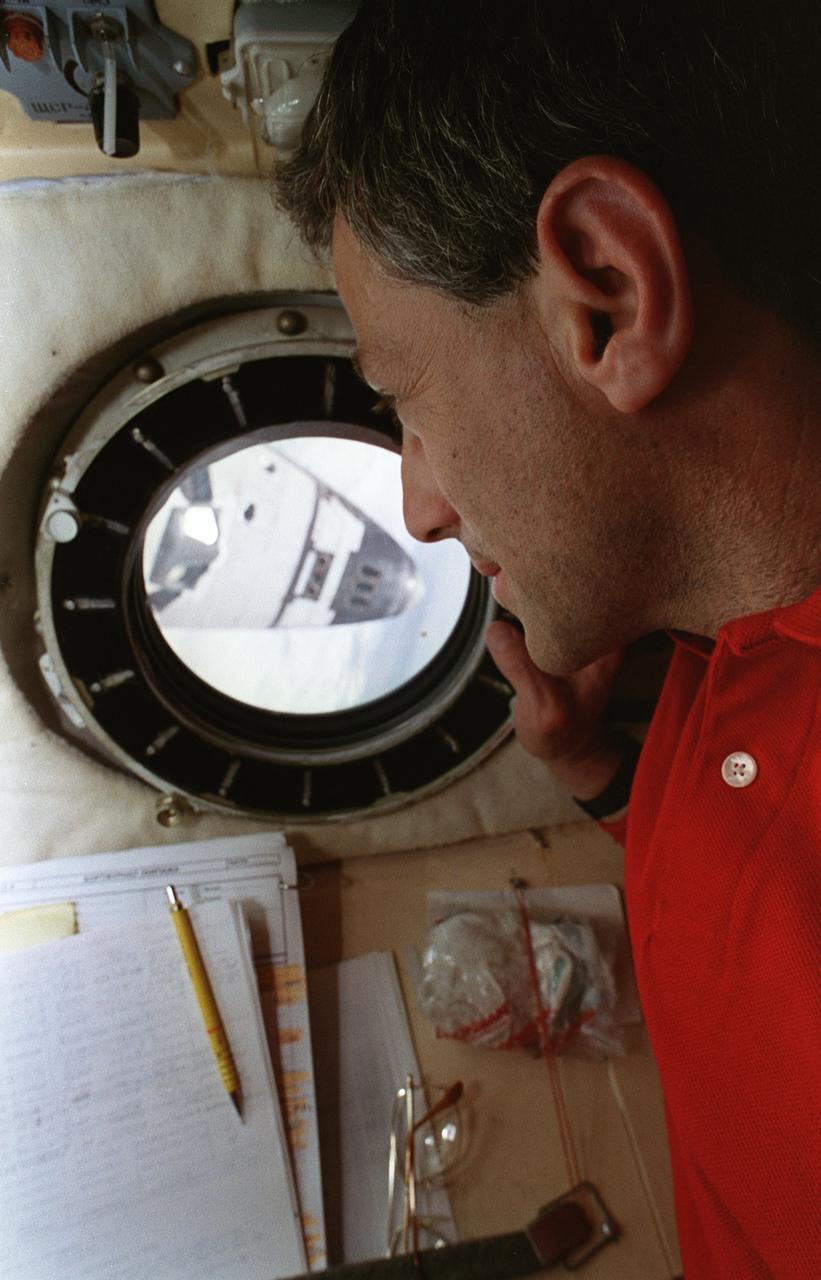
STS079-335-025 (16-26 Sept. 1996) --- Astronaut Jerome (Jay) Apt, in the flight engineer's cabin aboard Russia's Mir Space Station, appears nose to nose with the space shuttle Atlantis as he peers through a viewing port at the forward section of the Orbiter while the two spacecraft were docked in Earth-orbit.

NM22-427-023 (20 Sept. 1996) --- This photograph of the space shuttle Atlantis was taken from approximately 170 feet away by astronaut Shannon W. Lucid, winding up her duties as cosmonaut guest researcher onboard Russia?s Mir Space Station. Lucid was in Mir?s Base Block Module. The Spacehab double module, a first time space flyer, is seen in the aft payload bay. Its tunnel can be seen connecting to both Atlantis? crew cabin and the androgynous docking adapter. Also seen in the forward bay is the Ku-band antenna used for communications. Though not recognizable in this photo, several Atlantis crew members had their ?noses to the windows? as NASA was about to make its first crew member exchange with Mir. Astronaut John E. Blaha was onboard Atlantis as Lucid?s replacement.

STS79-E-5240 (21 September 1996) --- Cosmonaut Valeri G. Korzun (left), Mir-22 commander, and astronaut John E. Blaha, cosmonaut guest researcher, share another mealtime on the Space Shuttle Atlantis' mid deck, during Flight Day 6.
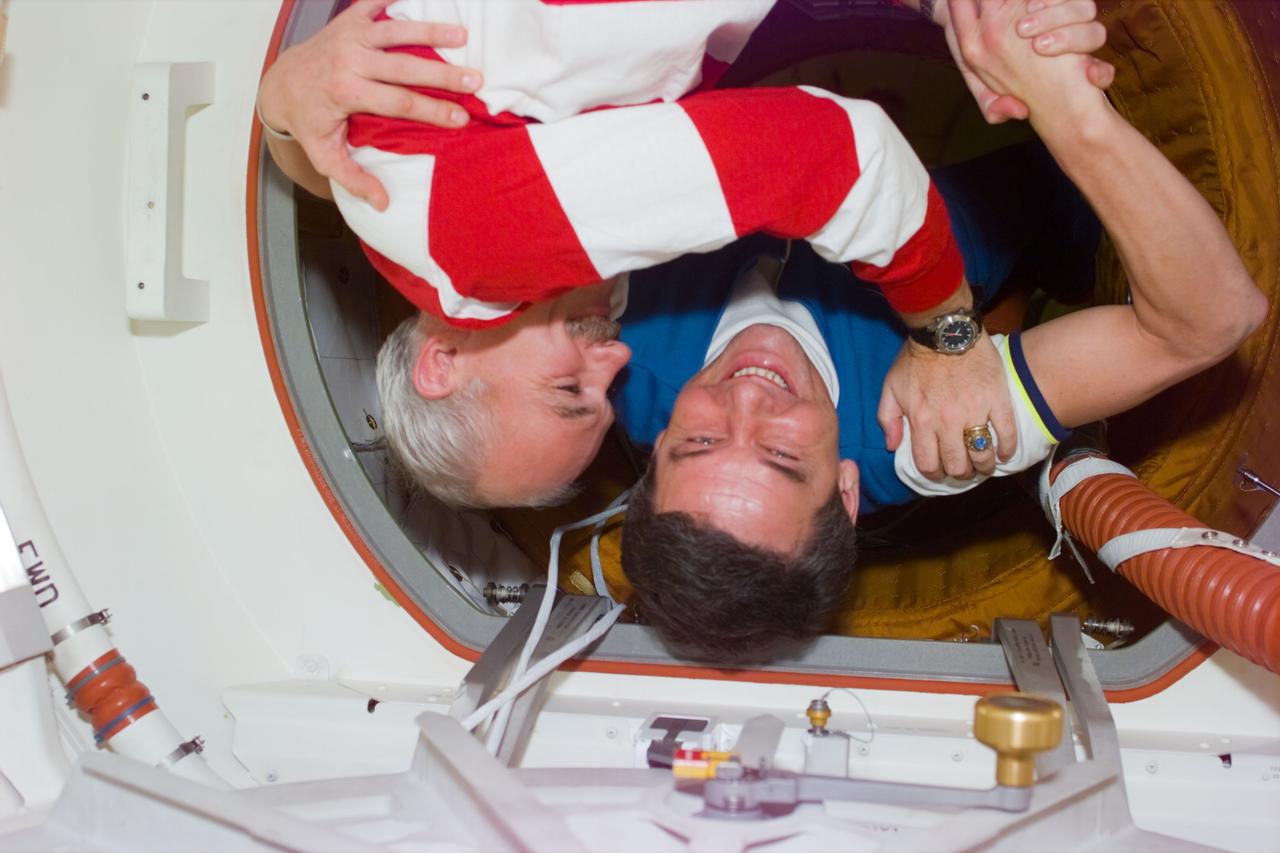
STS79-E-5090 (19 September 1996) --- Cosmonaut Valeri G. Korzun, Mir-22 commander, greets his American counterpart - astronaut William F. Readdy in the tunnel connecting the Space Shuttle Atlantis to Russia's Mir Space Station, during Flight Day 4. This mission marks the fourth such reunion involving astronauts and cosmonauts during the Shuttle era and the fifth overall, going back to the historic Apollo-Soyuz Test Project (ASTP) in 1975.
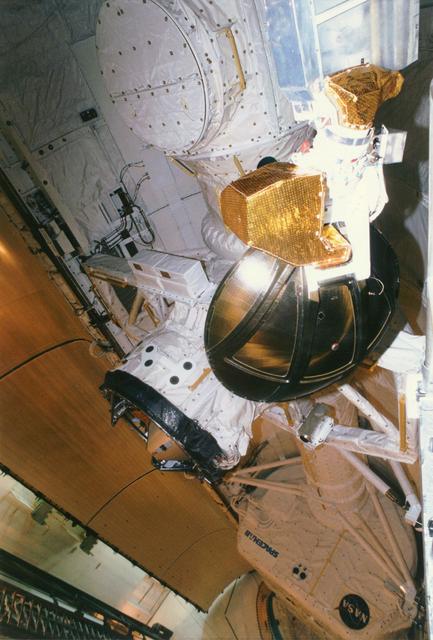
KENNEDY SPACE CENTER, FLA. - The orbiter Ku-band antenna looms large in this view of the Space Shuttle Atlantis' payload bay. Visible just past the antenna system - stowed on the starboard side of the payload bay wall - is the Orbiter Docking System (ODS), and connected to the ODS via a tunnel is the Spacehab Double Module in the aft area of the payload bay. This photograph was taken from the starboard wing platform on the fifth level of the Payload Changeout Room (PCR) at Launch Pad 39A. Work is under way in the PCR to close Atlantis' payload bay doors for flight. Atlantis currently is being targeted for liftoff on Mission STS-79, the fourth docking of the U.S. Shuttle to the Russian Space Station Mir, around Sept. 12.
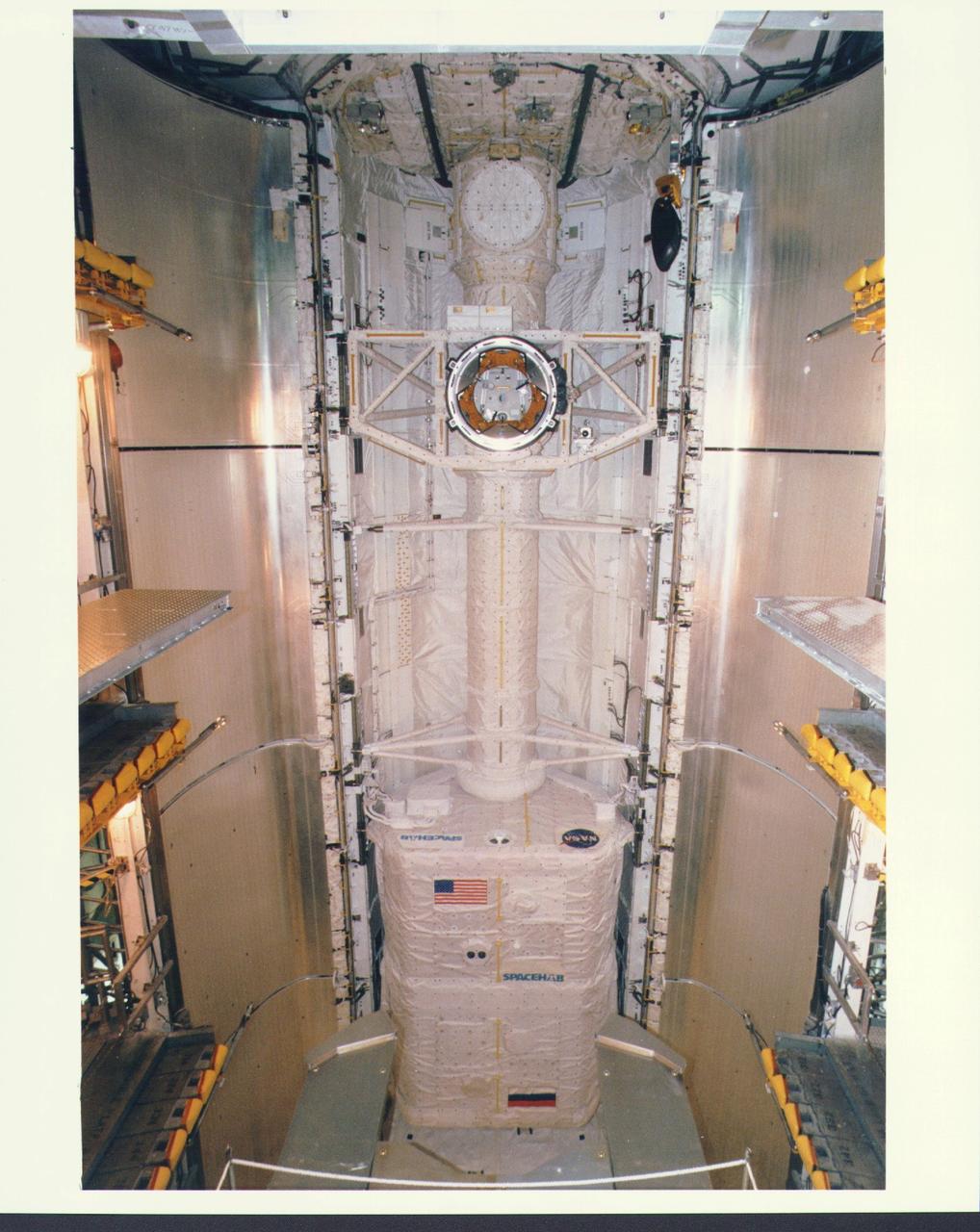
KENNEDY SPACE CENTER, FLA. - Workers in the Payload Changeout Room (PCR) at Launch Pad 39A are preparing to close the payload doors for flight on the Space Shuttle Atlantis, targeted for liftoff on Mission STS-79 around Sept. 12. The payloads in Atlantis' cargo bay will play key roles during the upcoming spaceflight, which will be highlighted by the fourth docking between the U.S. Shuttle and Russian Space Station Mir. Located in the aft (lowermost) area of the payload bay is the SPACEHAB Double Module, filled with supplies and other items slated for transfer to the Russian Space Station Mir as well as research equipment. The SPACEHAB is connected by tunnel to the Orbiter Docking System (ODS). This view looks directly at the top of the ODS and shows clearly the Androgynous Peripheral Docking System (APDS) that interfaces with the Docking Module on Mir to achieve a linkup.
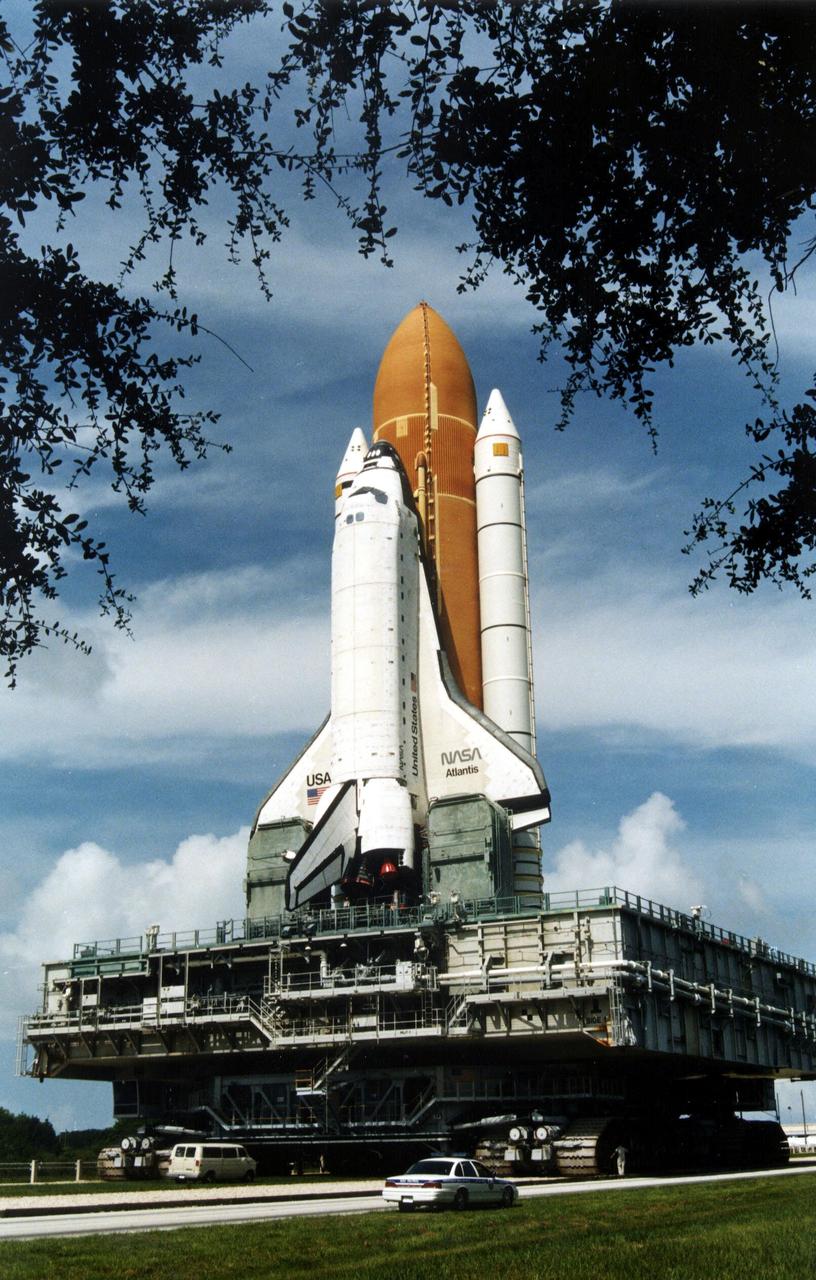
KENNEDY SPACE CENTER, FLA. -- Atlantis, with its new external tank/solid rocket booster stack, rolls out to Pad 39A on August 20, 1996, in preparation for launch of STS-79 on the fourth Mir docking mission. Atlantis will return Astronaut Shannon Lucid to Earth after her record-breaking stay by an American on the Russian space station. Lucid has completed 21 weeks in space this week. Astronaut John Blaha will trade places with Lucid for a planned four-month stay aboard Mir. Atlantis will also carry the first SPACEHAB Double Module
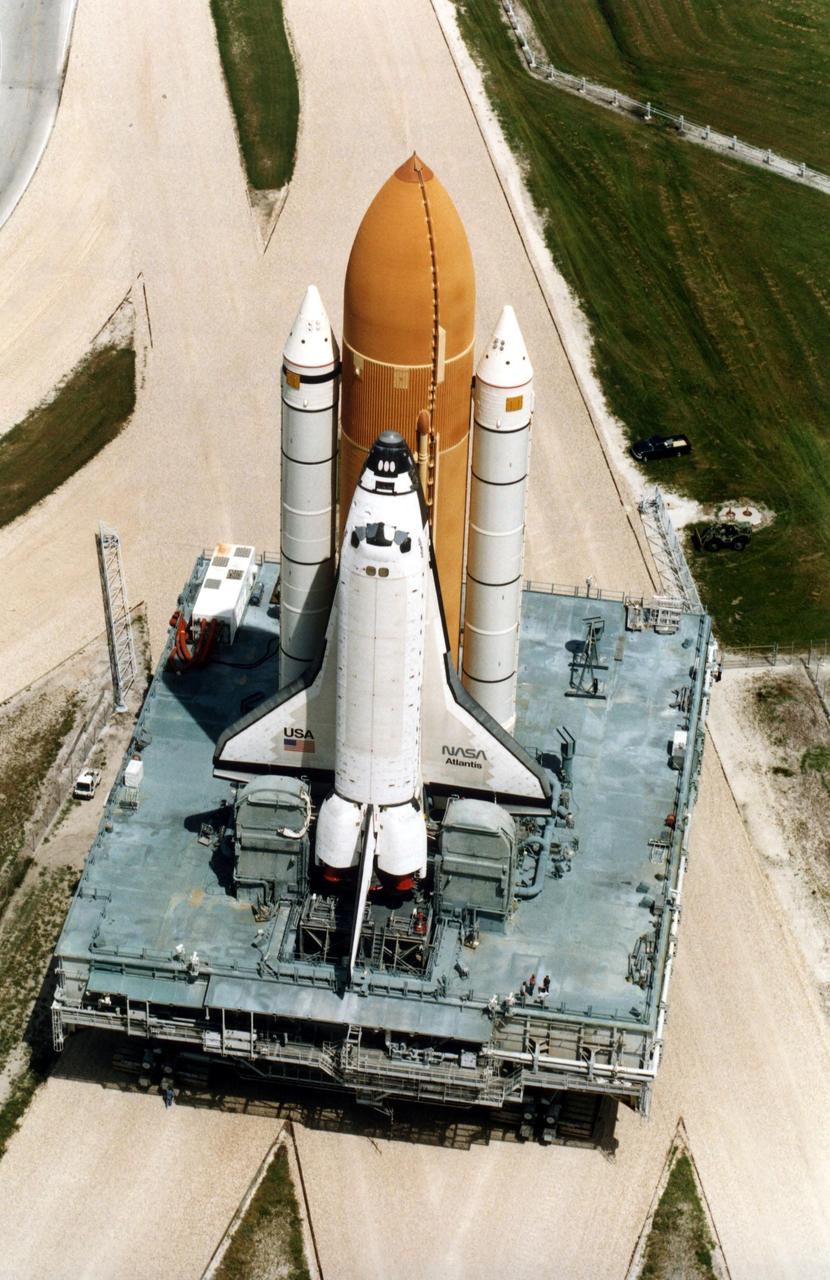
KENNEDY SPACE CENTER, FLA. -- Atlantis, with its new external tank/solid rocket booster stack, rolls out to Pad 39A on August 20, 1996, in preparation for launch of STS-79 on the fourth Mir docking mission. Atlantis will return Astronaut Shannon Lucid to Earth after her record-breaking stay by an American on the Russian space station. Lucid has completed 21 weeks in space this week. Astronaut John Blaha will trade places with Lucid for a planned four-month stay aboard Mir. Atlantis will also carry the first SPACEHAB Double Module.
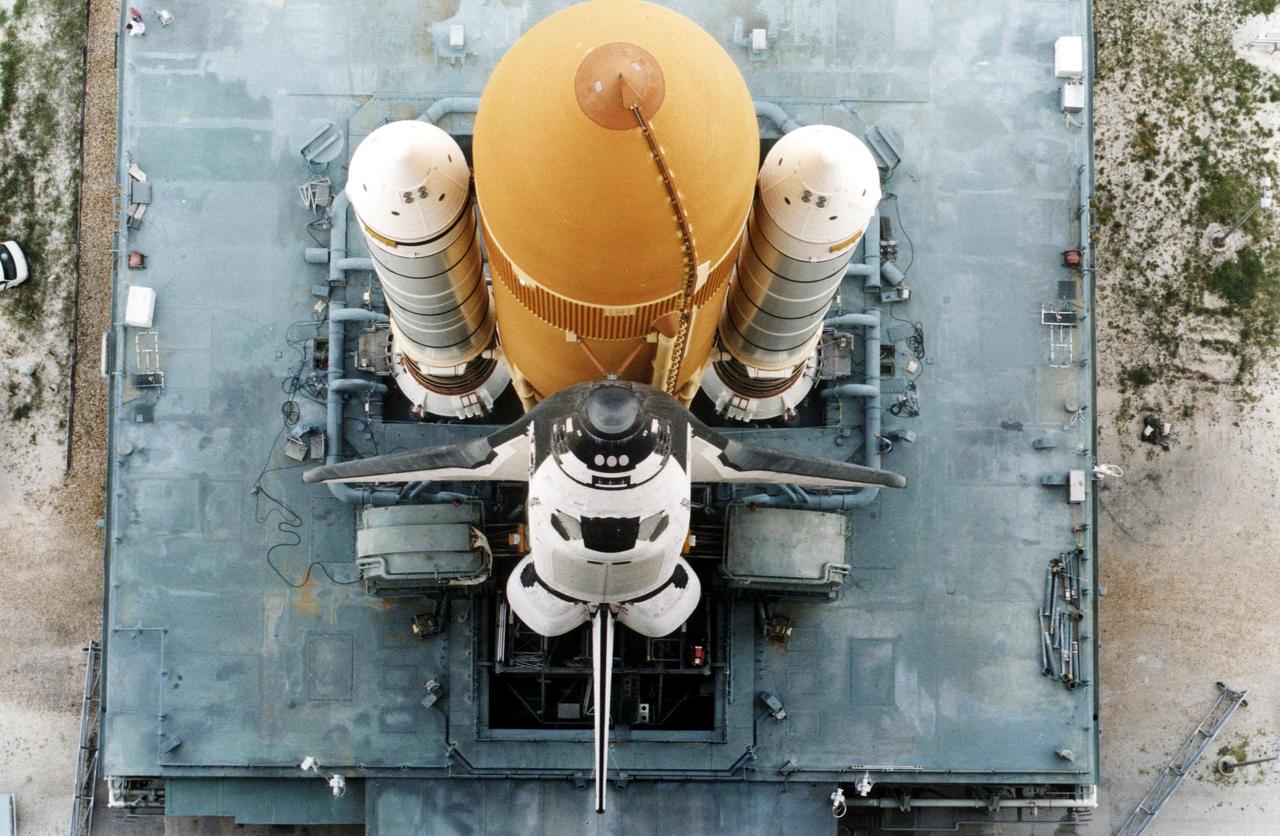
KENNEDY SPACE CENTER, FLA. -- Atlantis, with its new external tank/solid rocket booster stack, rolls out to Pad 39A on August 20, 1996, in preparation for launch of STS-79 on the fourth Mir docking mission. Atlantis will return Astronaut Shannon Lucid to Earth after her record-breaking stay by an American on the Russian space station. Lucid has completed 21 weeks in space this week. Astronaut John Blaha will trade places with Lucid for a planned four-month stay aboard Mir. Atlantis will also carry the first SPACEHAB Double Module
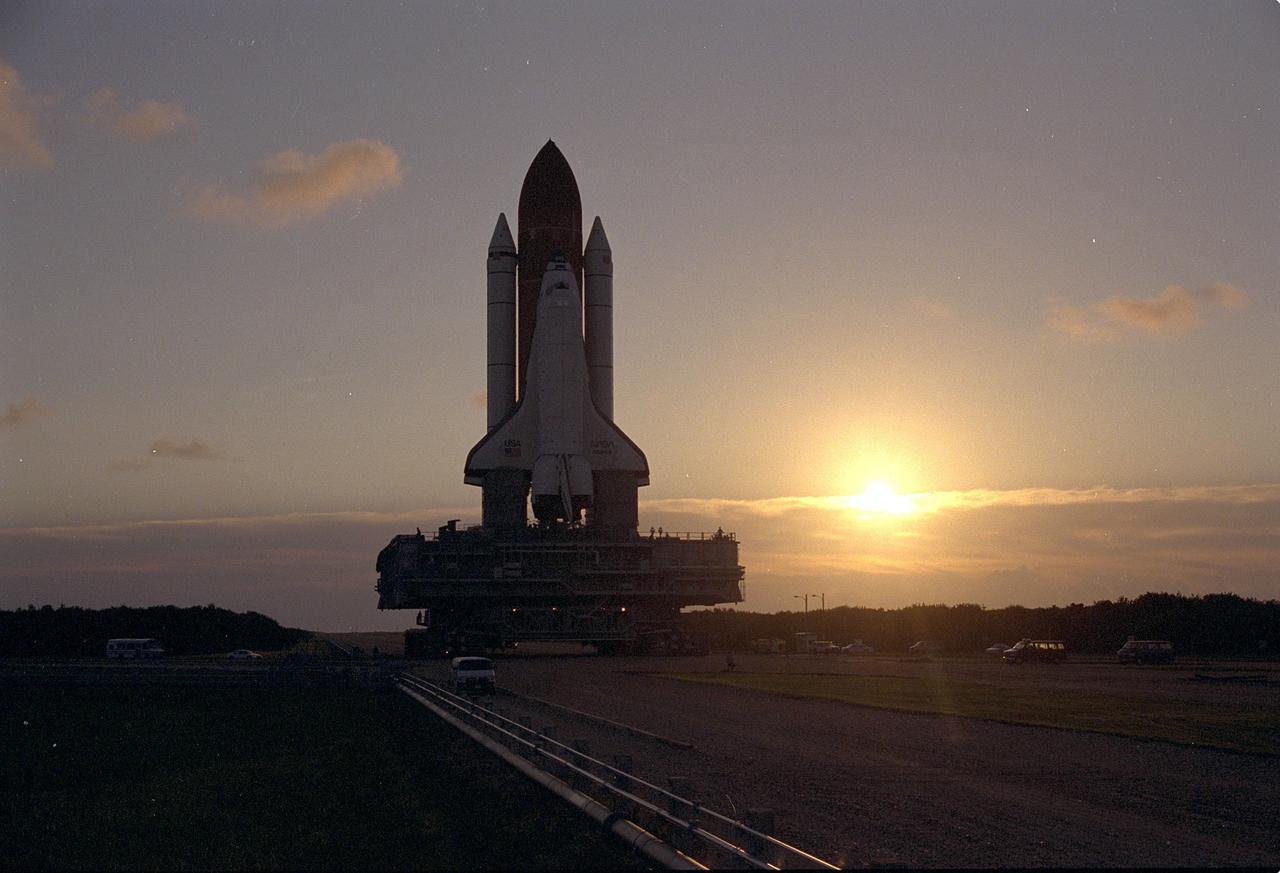
KENNEDY SPACE CENTER, FLA. - As the sun begins to rise in the early-morning sky after its departure from Launch Pad 39A, the Space Shuttle Atlantis slowly travels on the crawlerway toward the Vehicle Assembly Building. This marks the second rollback for Atlantis since July because of hurricane threats. Atlantis, which is targeted fo liftoff later this month on the STS-79 Shuttle mission, is returning to the VAB because of the threat from Hurricane Fran. The threat of Hurricane Bertha forced the rollback of Atlantis in July. Atlantis currently is scheduled for launch on the fourth Shuttle-Mir docking mission around mid-September.
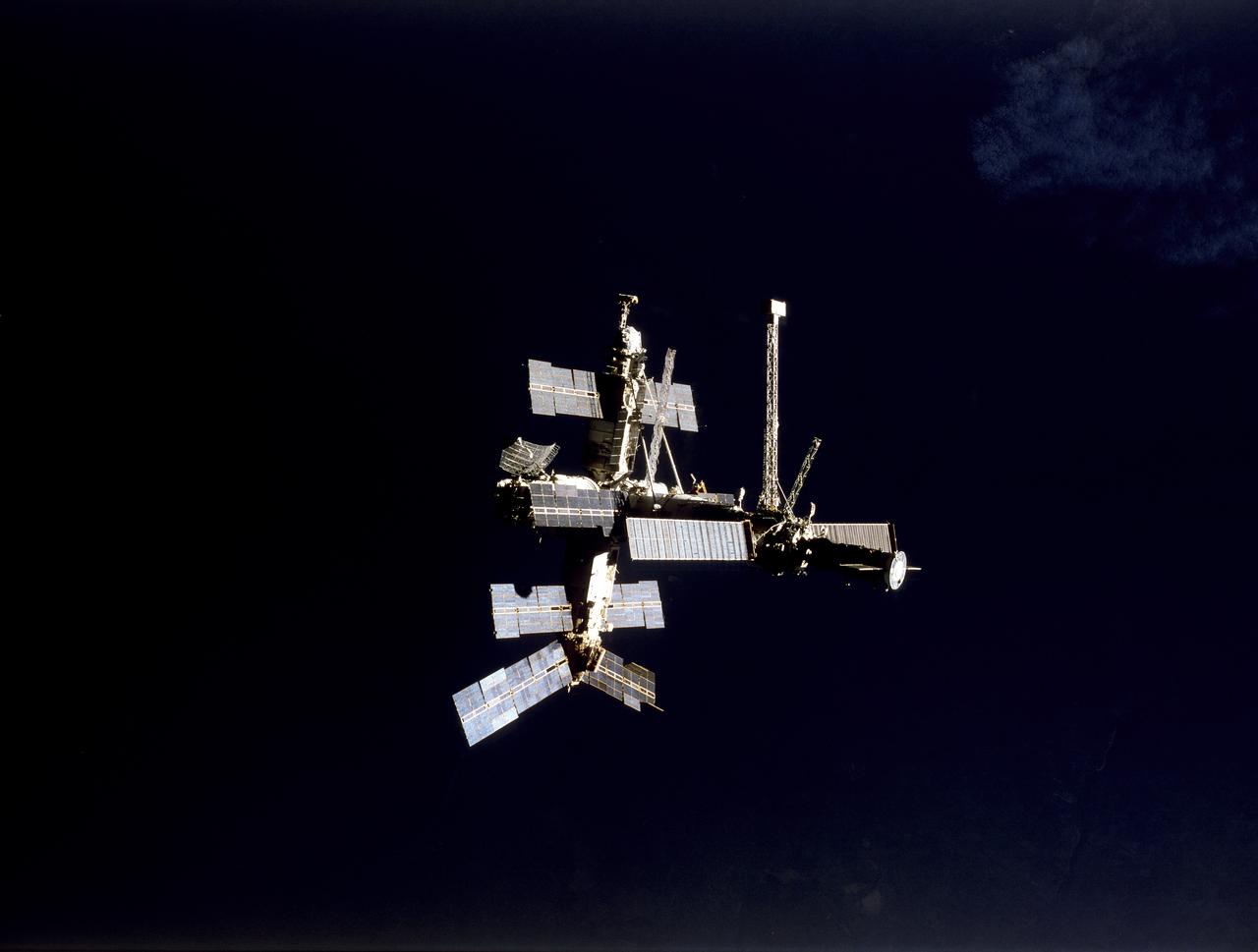
STS079-S-125 (16-26 Sept. 1996) --- Following undocking from the Space Shuttle Atlantis, Russia's Mir Space Station is backdropped against dark blue water on Earth, though it appears to be surrounded by the blackness of space. During the STS-79 mission, the crew used an IMAX camera to document Intravehicular Activities (IVA) aboard the Atlantis and the various Mir modules, as well as to record both docking and undocking activities through Atlantis' windows. NASA has flown IMAX camera systems on many Shuttle missions, including a special cargo bay camera's coverage of other recent Shuttle-Mir rendezvous and/or docking missions.
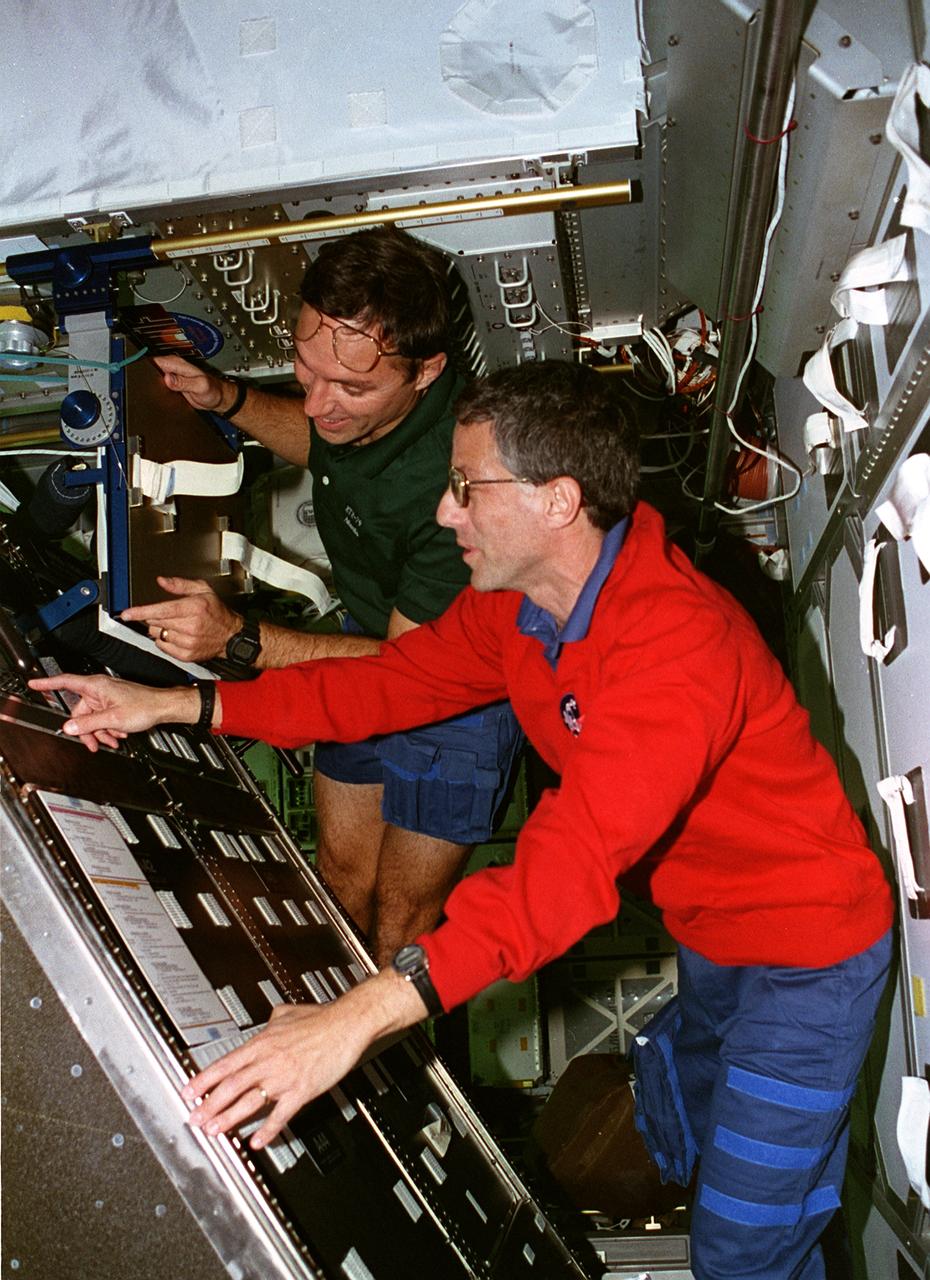
STS079-302-006 (16-26 Sept. 1996) --- Astronauts Jerome (Jay) Apt (right) and Carl E. Walz, both mission specialists, tilt the Active Rack Isolation System (ARIS) hardware which was included on this flight to evaluate conditions and hardware requirements for the International Space Station (ISS). The ARIS is designed to isolate certain experiments from major disturbances that are expected to be found on the ISS, such as vibrations caused by the movement of mechanisms and crew members and the operation of equipment. STS-79 was chosen for the inclusion of the experiment because the Shuttle-Mir complex more closely approximates the acceleration environment of the ISS.
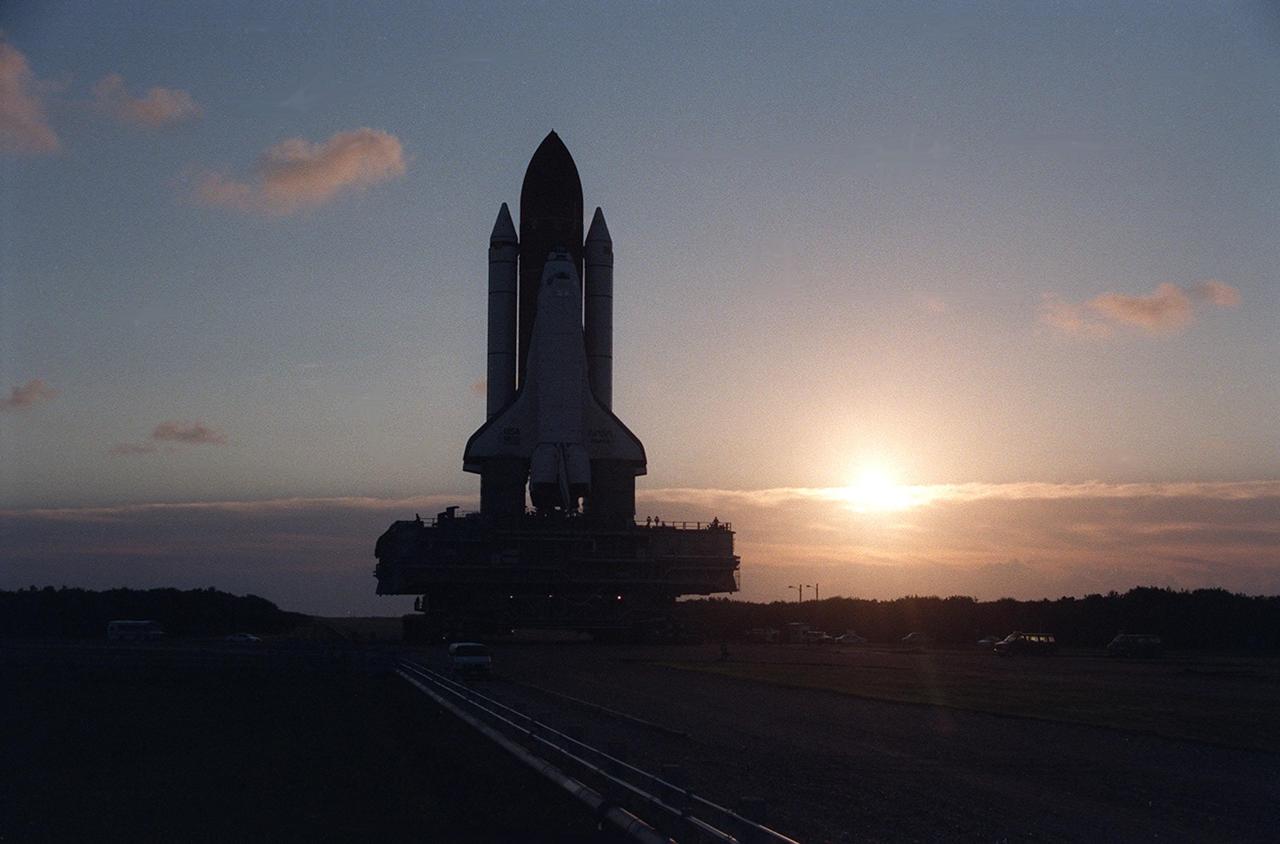
KENNEDY SPACE CENTER, FLA. - As the sun begins to rise in the early-morning sky, the Space Shuttle Atlantis slowly travels on the Crawlerway toward the Vehicle Assembly Building after its departure from Launch Pad 39A. This marks the second rollback for Atlantis since July because of hurricane threats. Atlantis, which is targeted for liftoff later this month on the STS-79 Shuttle mission, is returning to the VAB because of the threat from Hurrican Fran. The threat of Hurrican Bertha forced the rollback of Atlantis in July. Atlantis is currently scheduled for launch on the fourth Shuttle-MIR docking mission around mid-September
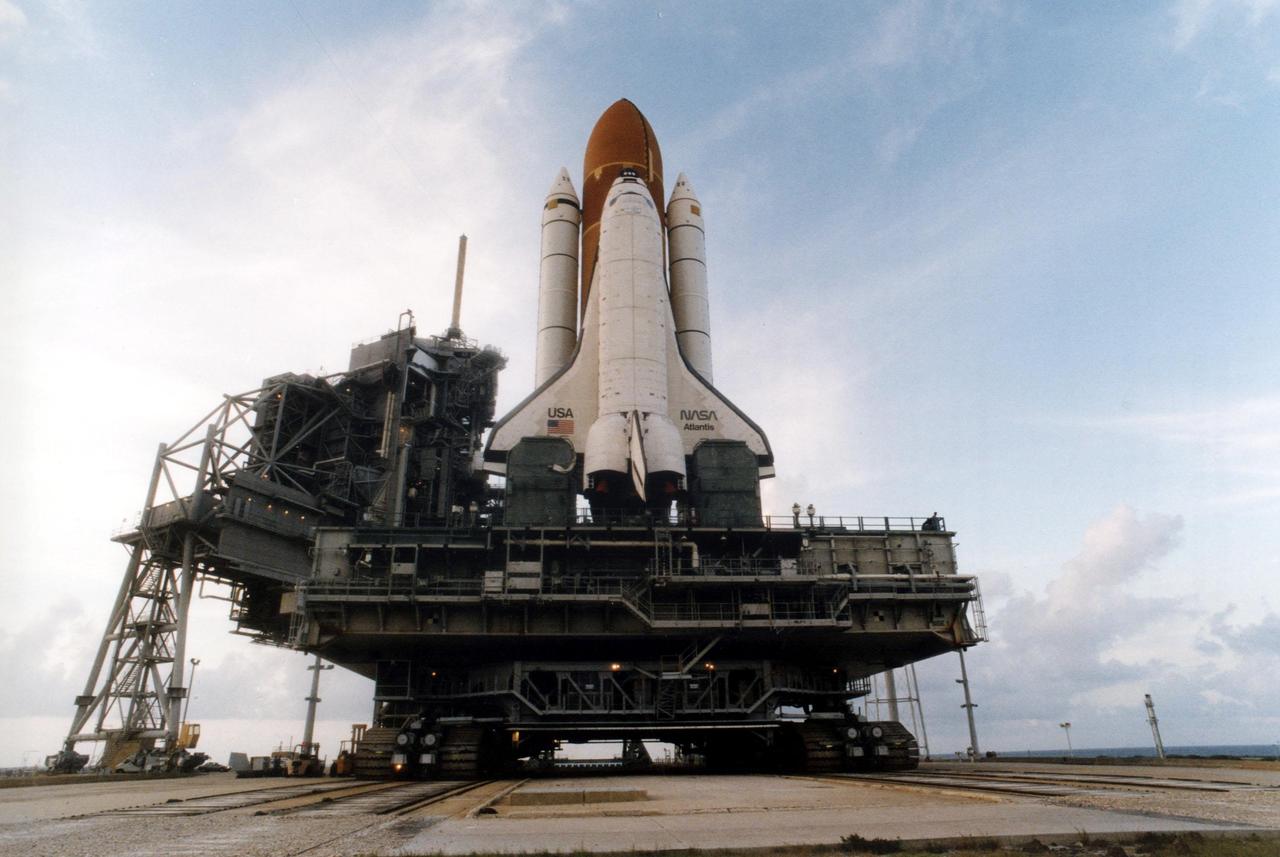
KENNEDY SPACE CENTER, FLA. -- Atlantis, with its new external tank/solid rocket booster stack, rolls out to Pad 39A on August 20, 1996, in preparation for launch of STS-79 on the fourth Mir docking mission. Atlantis will return Astronaut Shannon Lucid to Earth after her record-breaking stay by an American on the Russian space station. Lucid has completed 21 weeks in space this week. Astronaut John Blaha will trade places with Lucid for a planned four-month stay aboard Mir. Atlantis will also carry the first SPACEHAB Double Module.
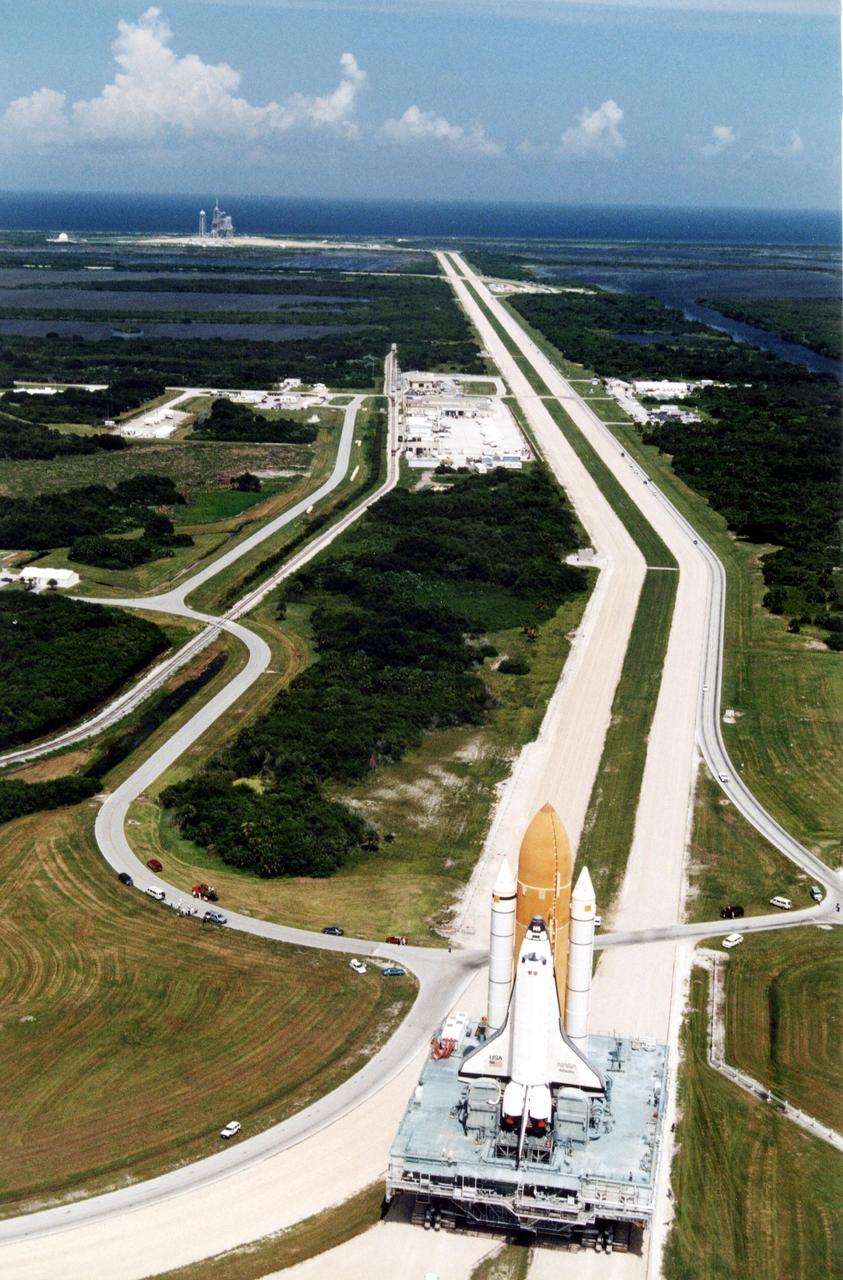
KENNEDY SPACE CENTER, FLA. -- Atlantis, with its new external tank/solid rocket booster stack, rolls out to Pad 39A on August 20, 1996, in preparation for launch of STS-79 on the fourth Mir docking mission. Atlantis will return Astronaut Shannon Lucid to Earth after her record-breaking stay by an American on the Russian space station. Lucid has completed 21 weeks in space this week. Astronaut John Blaha will trade places with Lucid for a planned four-month stay aboard Mir. Atlantis will also carry the first SPACEHAB Double Module
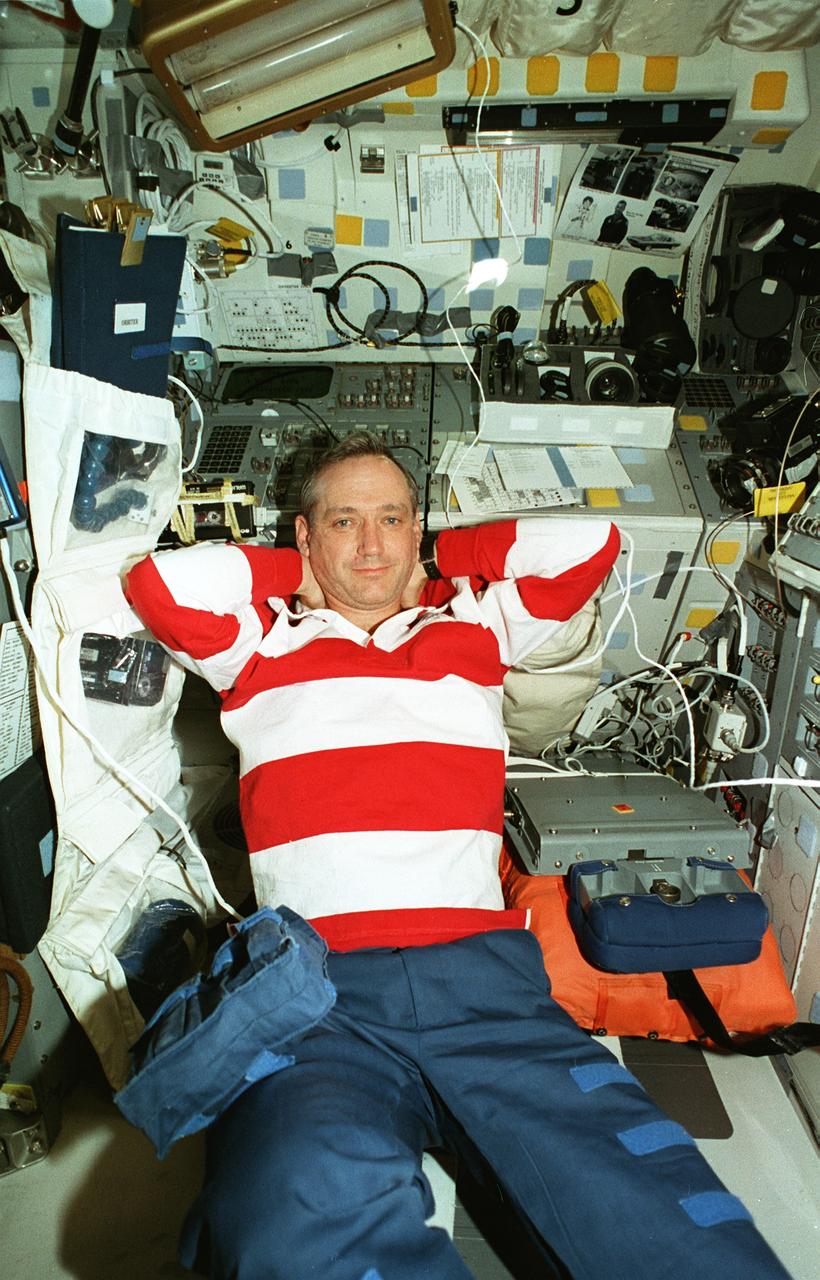
STS079-354-016 (20 Sept. 1996) --- Astronaut Thomas D. Akers, mission specialist, spends a few moments of his off-duty time aboard the Space Shuttle Atlantis in a rare relaxed posture. Akers is on the aft flight deck, looking toward overhead windows (out of frame) through which he could see several of the components of Russia's Mir Space Station, docked for several days to Atlantis. Later, during a post-flight presentation to an assembly of co-workers in Houston, astronaut William F. Readdy, mission commander, recalled this moment as the only one on the STS-79 flight during which he witnessed Akers not busy with transfer chores or Spacehab experiment tasks. Several pieces of camera equipment and a stowed chair used during launch and entry are identifiable among the items on the flight deck.
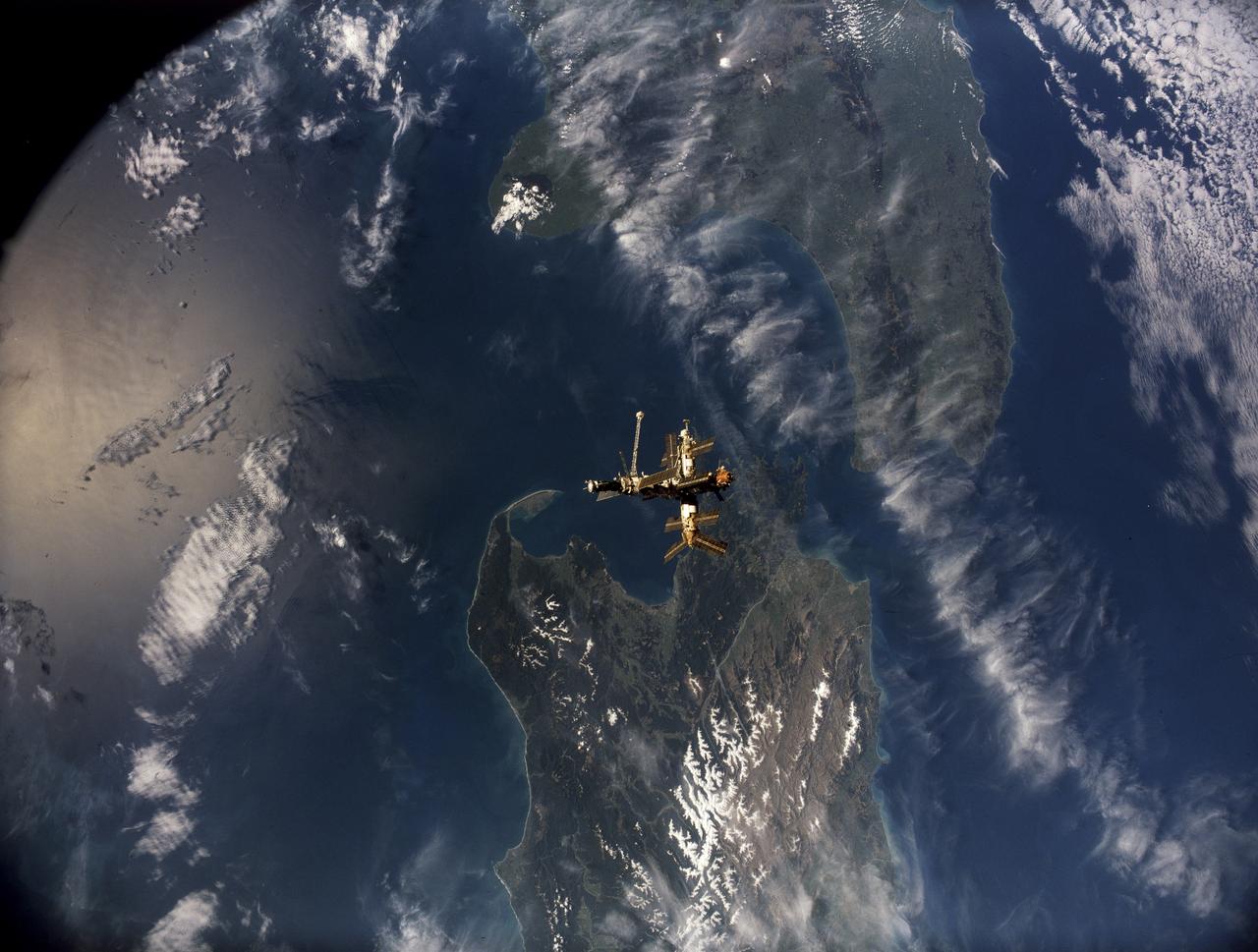
STS079-S-105 (16-26 Sept. 1996) --- Following undocking from the space shuttle Atlantis, Russia's Mir Space Station is backdropped over parts of both of New Zealand's main islands in this motion picture frame. Mt. Egmont and Cook Strait are geologic features that can be easily delineated in the image. During the STS-79 mission, the crew used an IMAX camera to document Intravehicular Activities (IVA) aboard the Space Shuttle Atlantis and the various Mir modules, as well as to record both docking and undocking activities through Atlantis' windows. NASA has flown IMAX camera systems on many Shuttle missions, including a special cargo bay camera's coverage of other recent Shuttle-Mir rendezvous and/or docking missions.
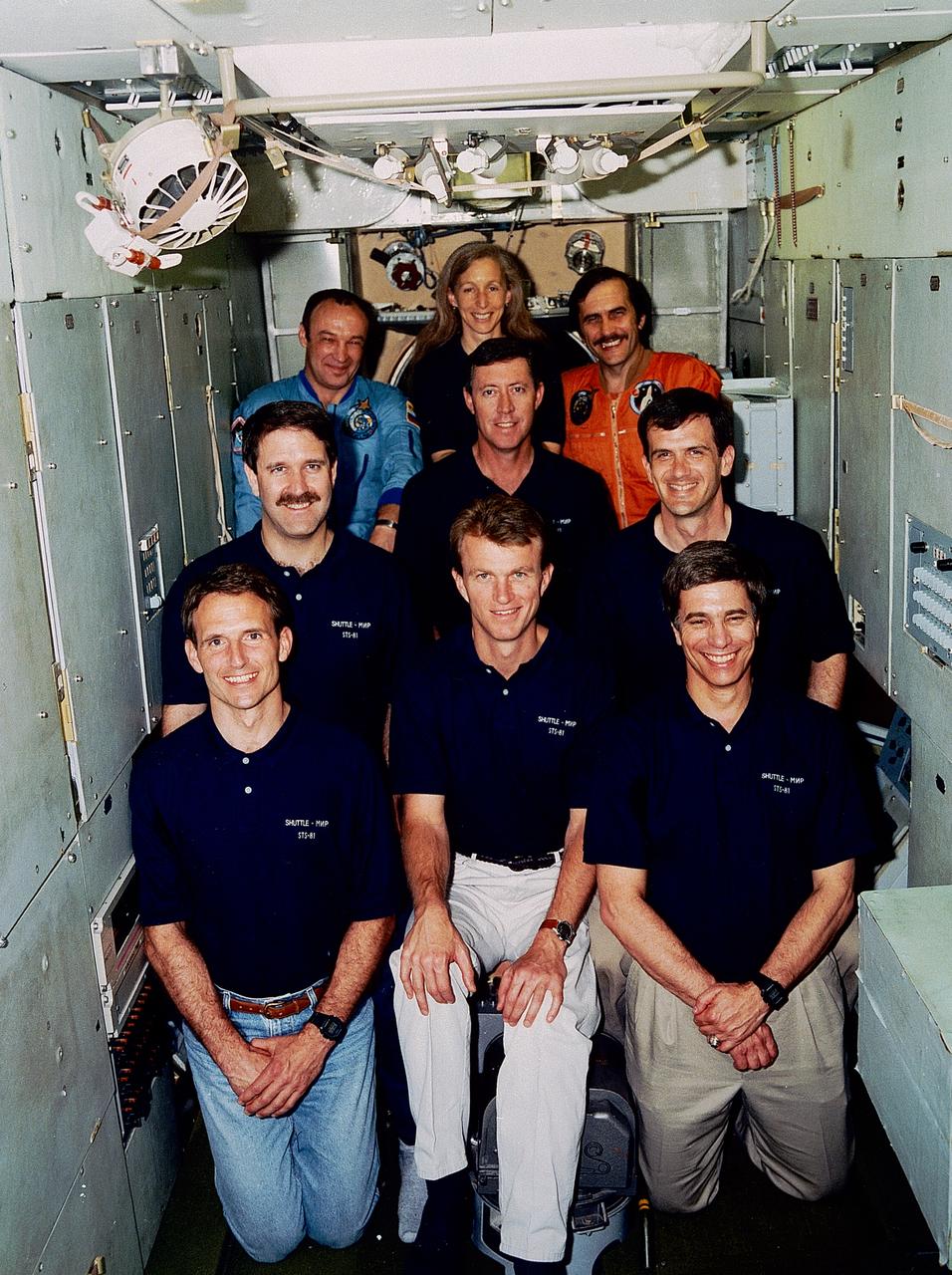
S96-10557 (May 1996) --- The original Mir-22 crew assigned to duty aboard Russia's Mir Space Station poses with the STS-81 crew. The cosmonauts, flanking astronaut Marsha S. Ivins on the top row, are Gennadiy M. Manakov (left) mission commander; and Pavel V. Vinogradov, flight engineer. After this photo was taken, a shift of Russian crew assignments occurred and Manakov and Vinogradov were replaced with Valeri G. Korzun and Aleksandr Y. Kaleri. The astronauts are, front row (left to right): Jerry M. Linenger, Brent W. Jett, Jr., and John E. Blaha. Second row, left to right, John W. Grunsfeld, Michael A. Baker and Peter J. K. (Jeff) Wisoff. All the STS-81 crewmembers except Blaha are scheduled to be launched in December 1996 aboard the Space Shuttle Atlantis and those six will be joined by Mir-22 cosmonaut researcher Blaha when the two spacecraft are joined in Earth-orbit. Blaha will have been launched into Earth-orbit to connect with Russia's Mir Space Station on an earlier mission - STS-79 - of the space shuttle Atlantis, scheduled for launch in the summer of 1996. Linenger will remain onboard Mir for a tour of duty as a cosmonaut researcher.
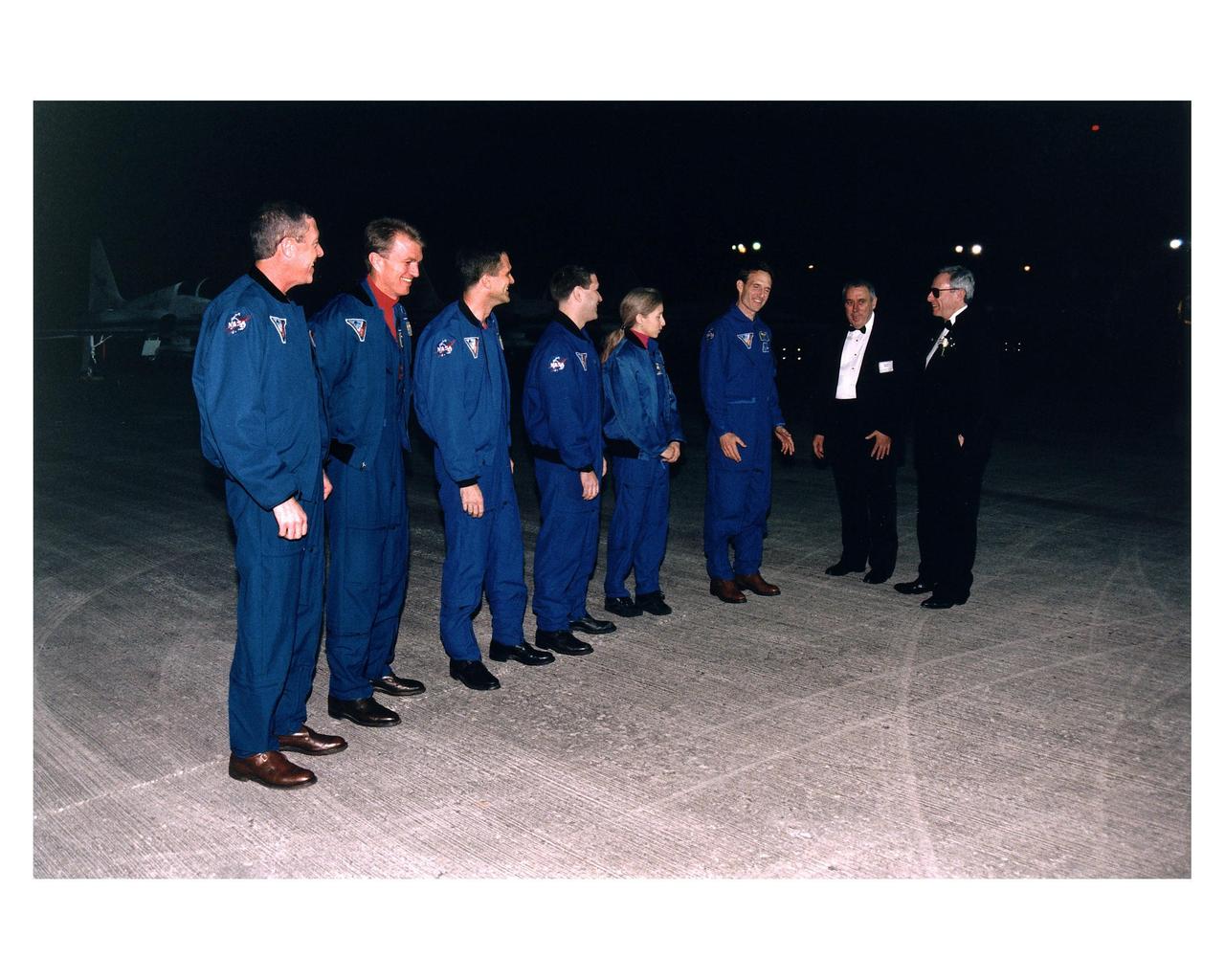
The STS-81 flight crew is welcomed to KSC by NASA Administrator Daniel Goldin (far right) and Johnson Space Center Director George Abbey (second from right) as they arrive at the space center for the final countdown preparations for the fifth Shuttle-Mir docking mission. They are (from left): Mission Commander Michael A. Baker; Pilot Brent W. Jett, Jr.; and Mission Specialists Peter J. K. "Jeff" Wisoff; John M. Grunsfeld, Marsha S. Ivins, and J.M. "Jerry" Linenger. The 10-day mission will feature the transfer of Linenger to Mir to replace astronaut John Blaha, who has been on the orbital laboratory since Sept. 19, 1996 after arrival there during the STS-79 mission. During STS-81, Shuttle and Mir crews will conduct risk mitigation, human life science, microgravity and materials processing experiments that will provide data for the design, development and operation of the International Space Station. The primary payload is the SPACEHAB-DM double module which will provide space for more than 2,000 pounds of hardware, food and water that will be transferred into the Russian space station during five days of docking operations. The SPACEHAB will also be used to return experiment samples from the Mir to Earth for analysis and for microgravity experiments during the mission
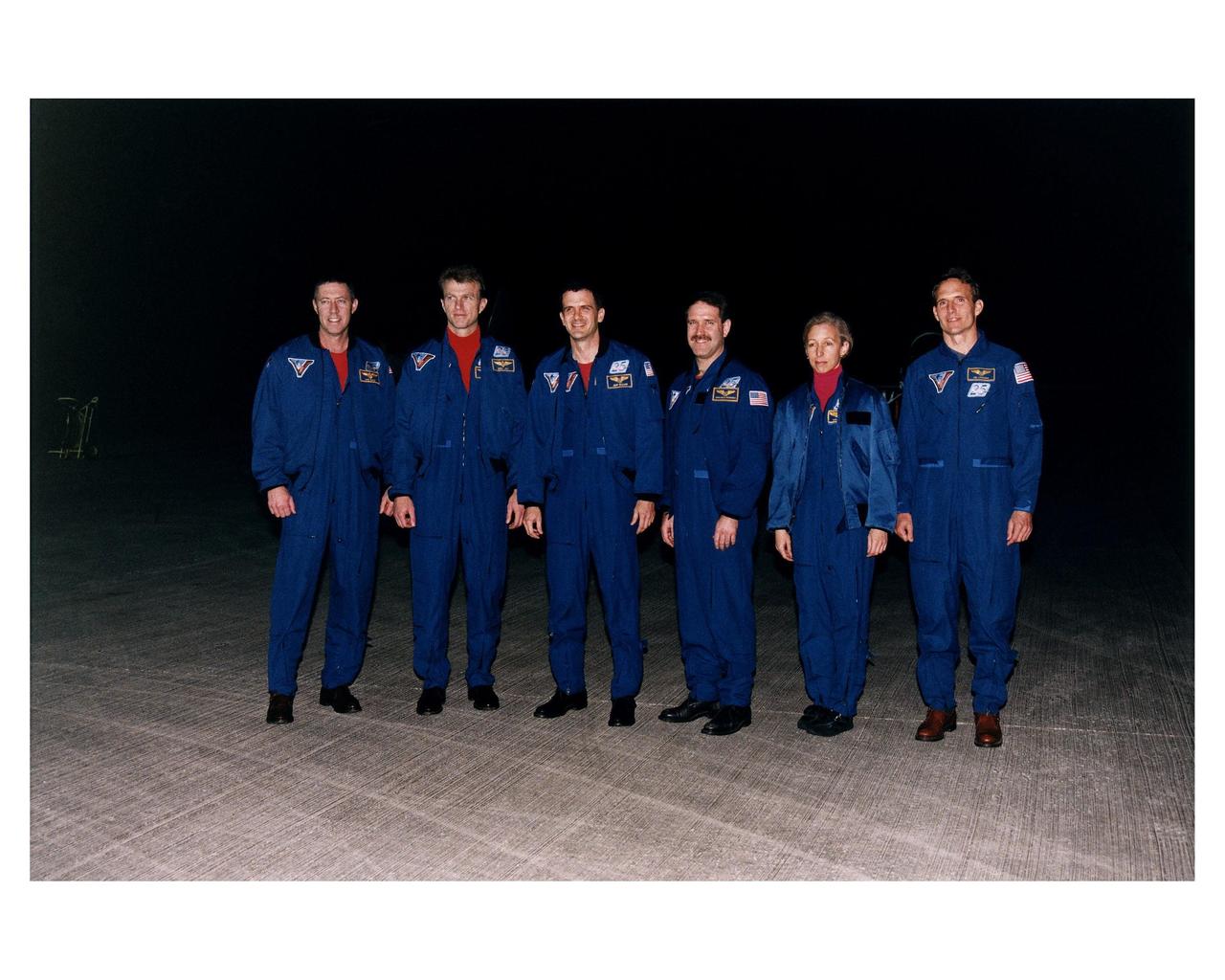
The STS-81 flight crew poses on the runway of KSC Shuttle Landing Facility after they arrive at the space center for the final countdown preparations for the fifth Shuttle-Mir docking mission. They are (from left): Mission Commander Michael A. Baker; Pilot Brent W. Jett, Jr.; and Mission Specialists Peter J. K. "Jeff" Wisoff; John M. Grunsfeld, Marsha S. Ivins, and J.M. "Jerry" Linenger. The 10-day mission will feature the transfer of Linenger to Mir to replace astronaut John Blaha, who has been on the orbital laboratory since Sept. 19, 1996 after arrival there during the STS-79 mission. During STS-81, Shuttle and Mir crews will conduct risk mitigation, human life science, microgravity and materials processing experiments that will provide data for the design, development and operation of the International Space Station. The primary payload is the SPACEHAB-DM double module which will provide space for more than 2,000 pounds of hardware, food and water that will be transferred into the Russian space station during five days of docking operations. The SPACEHAB will also be used to return experiment samples from the Mir to Earth for analysis and for microgravity experiments during the mission
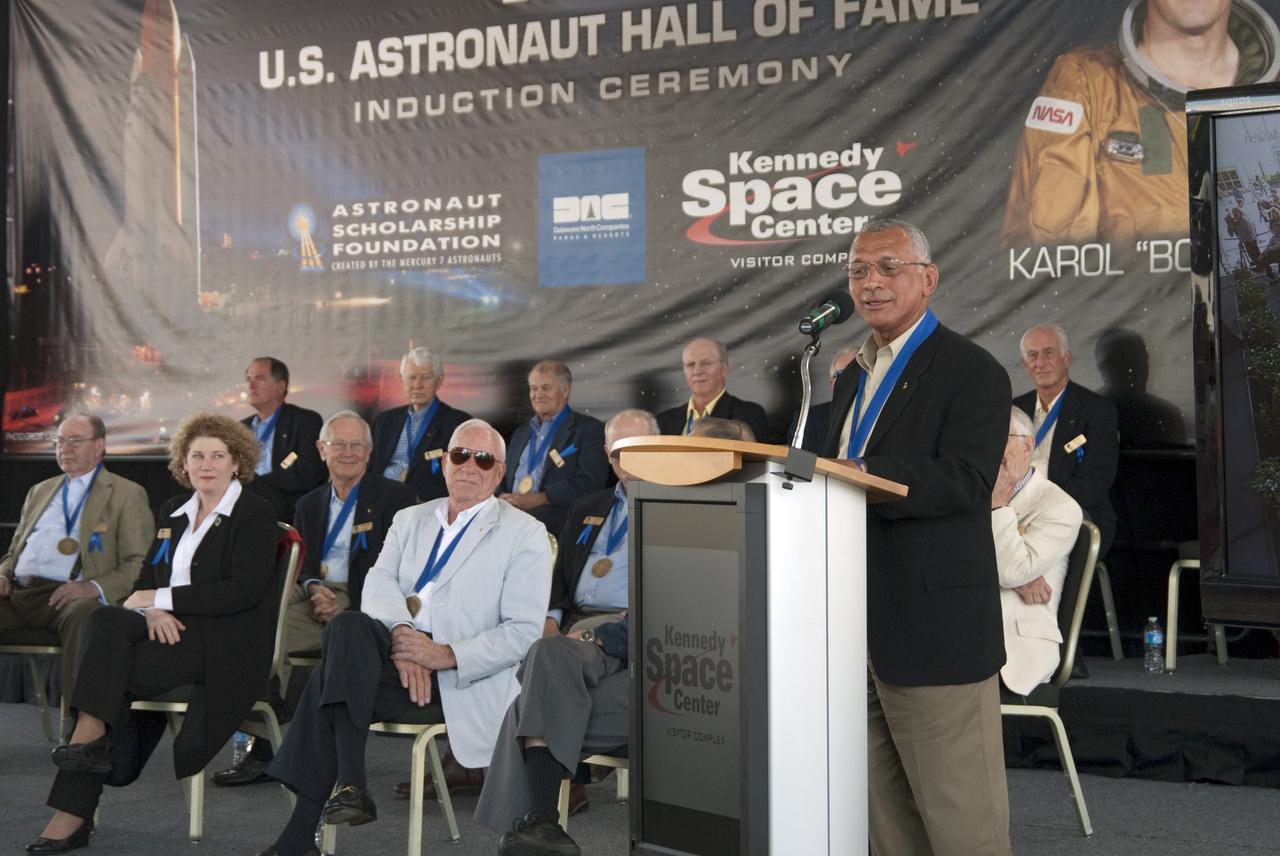
Cape Canaveral, Fla. -- Hall of Fame astronaut and present NASA Administrator Charles Bolden addresses the spectators at the 2011 U.S. Astronaut Hall of Fame ceremony held at NASA's Kennedy Space Center Visitor Complex in Florida. Hall of Fame astronauts and visitors gathered to honor 2011 inductees Karol "Bo" Bobko and Susan Helms. During his 19 years in the astronaut program, Bobko flew on three space shuttle missions and logged more than 386 hours in space. He served as pilot during the first voyage of space shuttle Challenger aboard STS-6 in April 1983 and as commander during the maiden flight of space shuttle Atlantis aboard STS-51J in October 1985. Helms, a five-time space shuttle astronaut, has logged 5,064 hours in space. During her stay onboard the International Space Station as a member of the Expedition-2 crew in 2001, Helms performed a world record 8 hour and 56 minute spacewalk. Bobko and Helms join the ranks of the U.S. Astronaut Hall of Fame bringing the number of space explorers enshrined in the Hall of Fame to 79. Photo Credit: NASA/Jim Grossmann