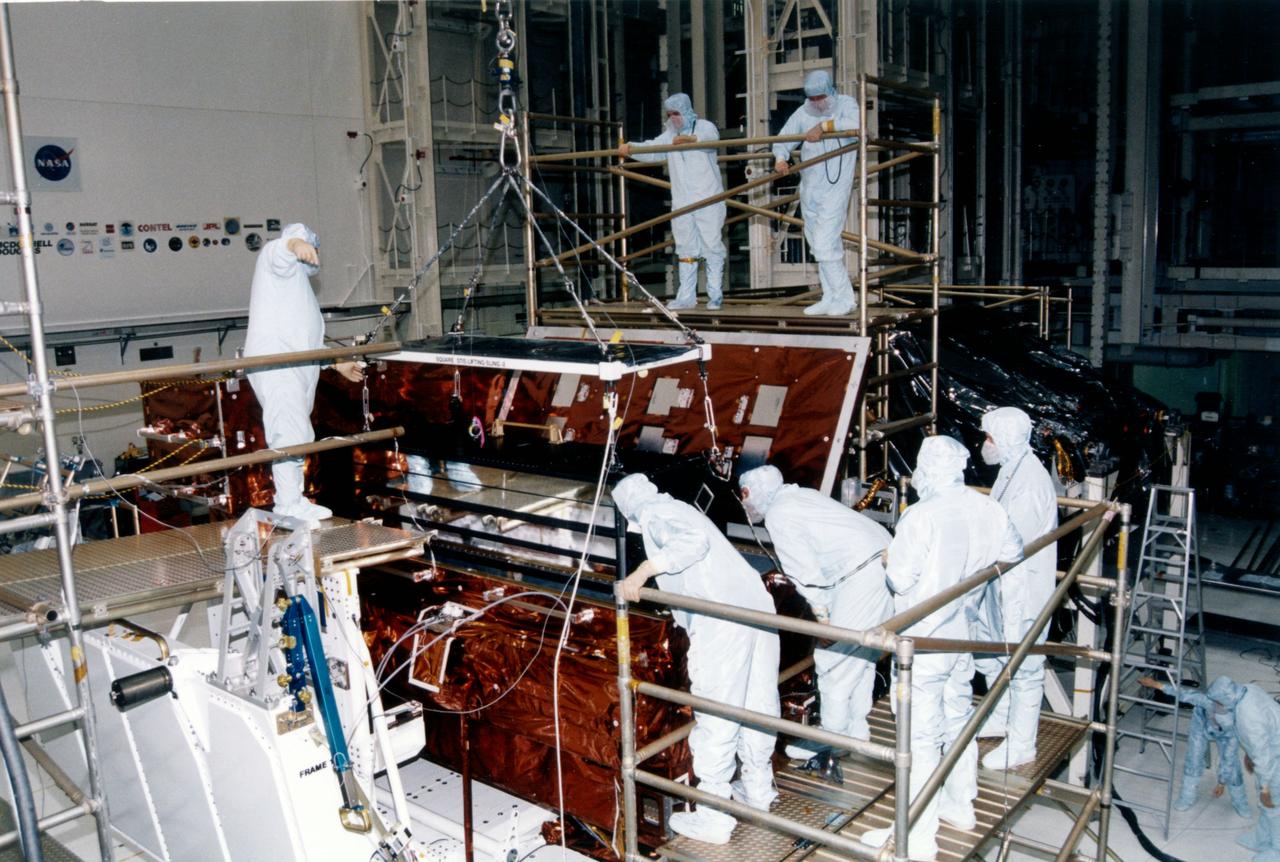
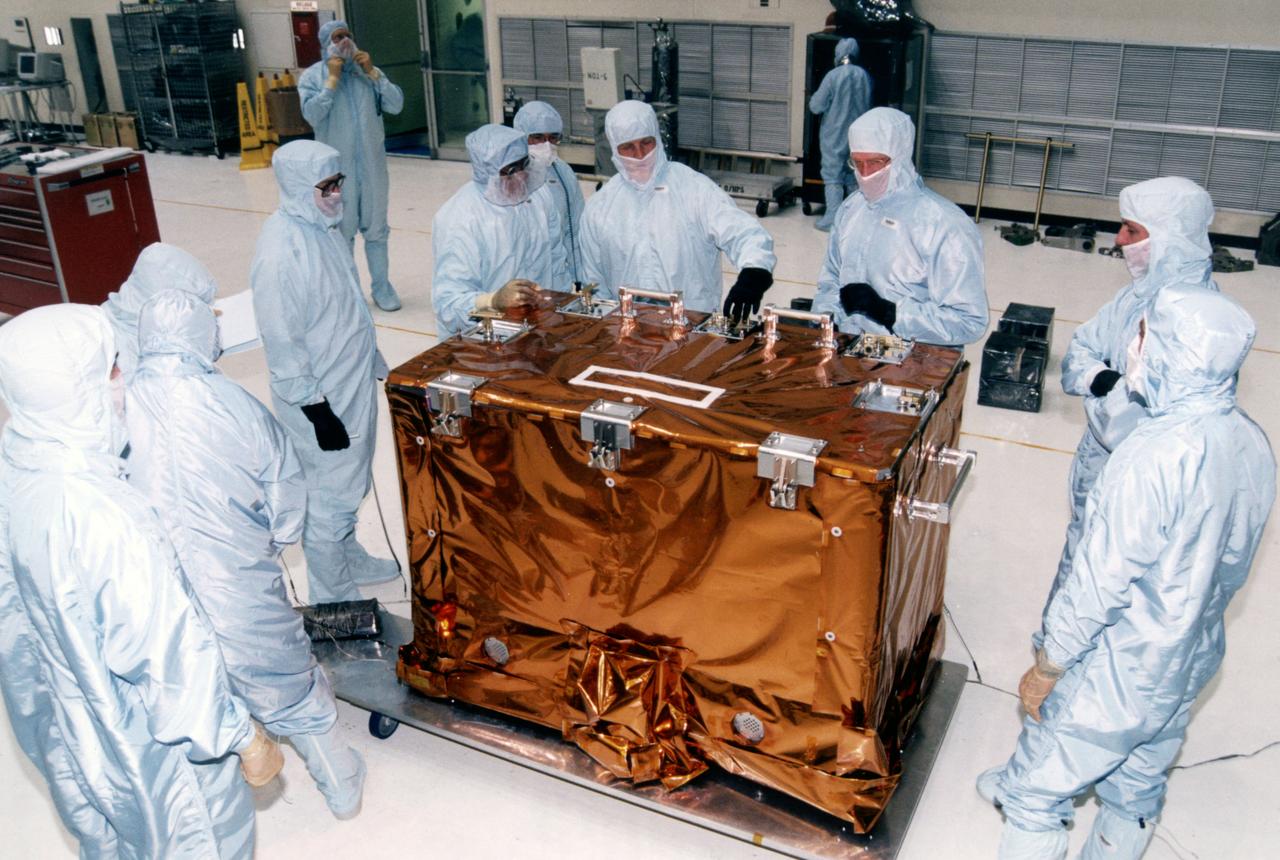
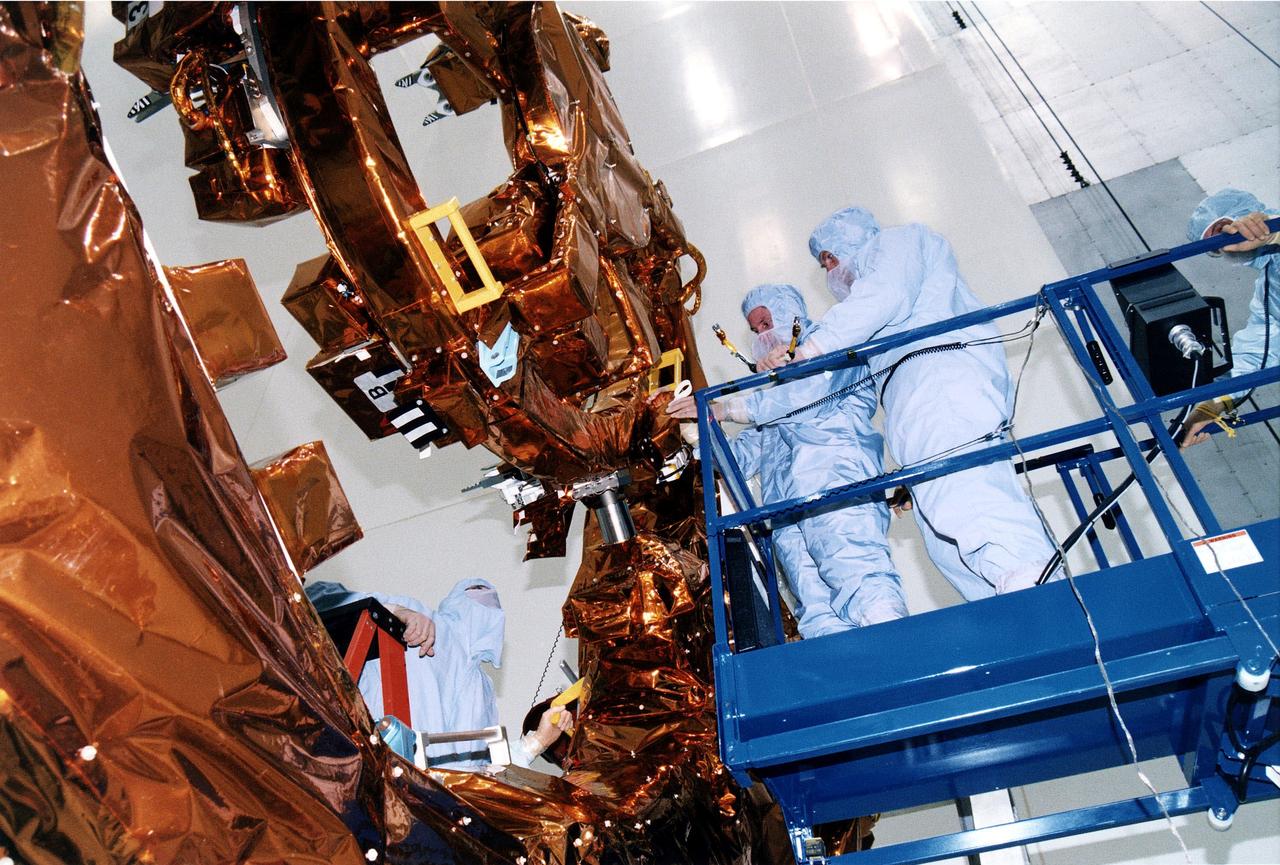
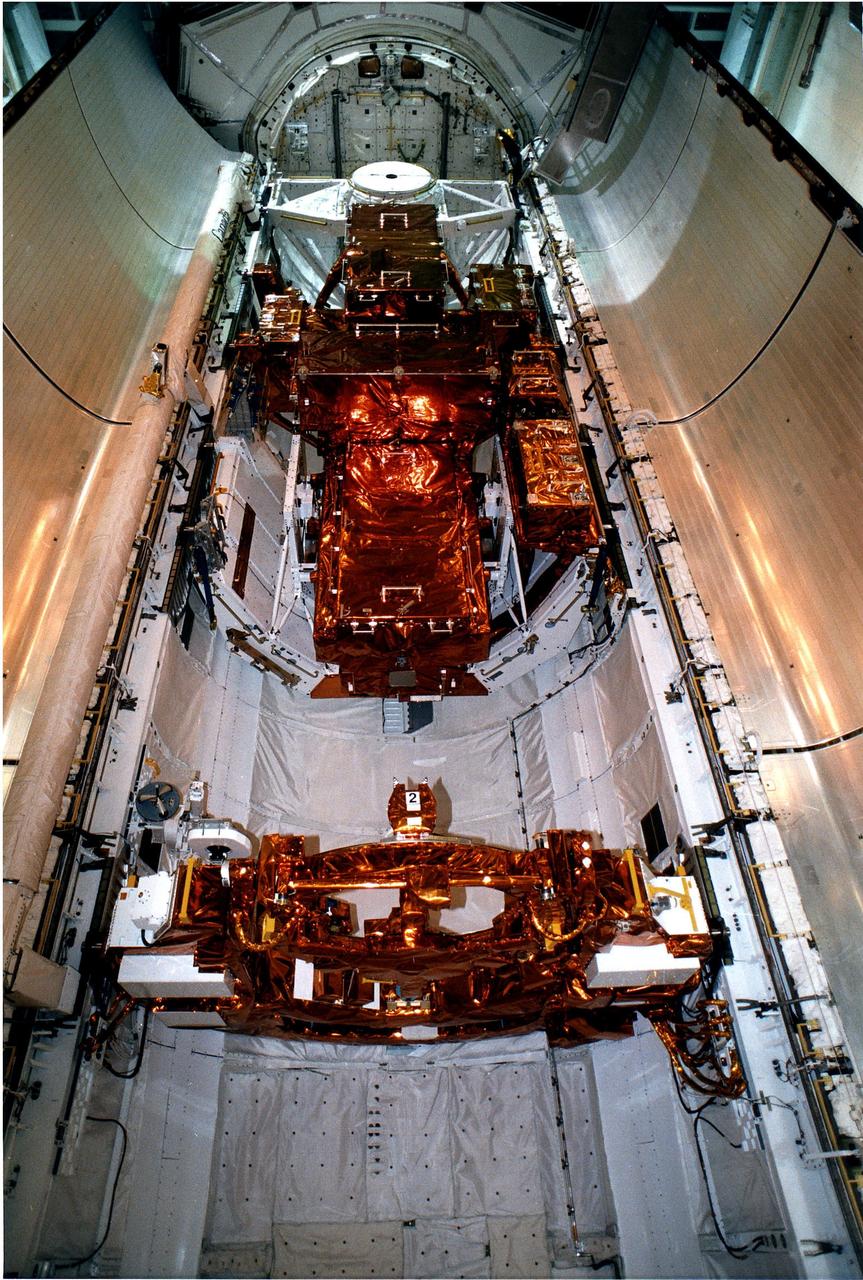
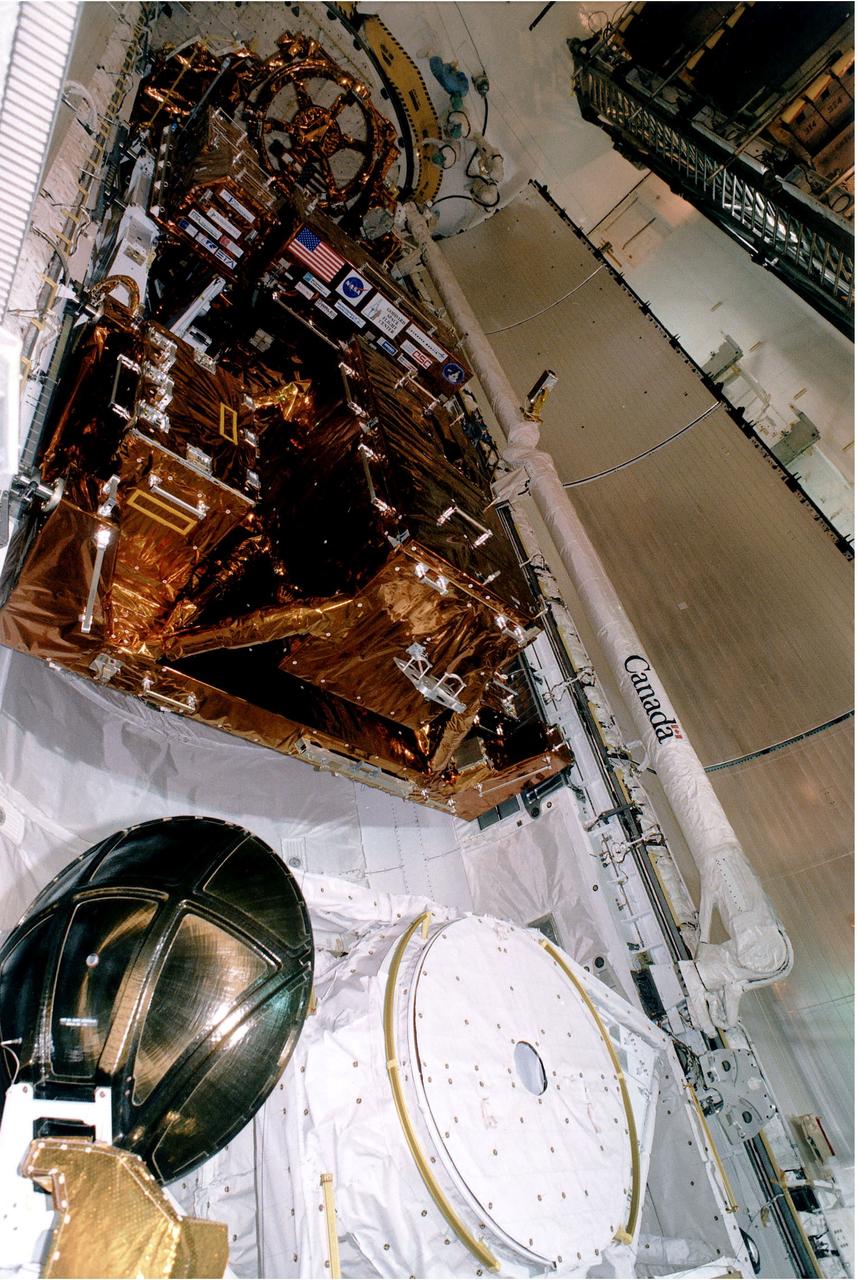
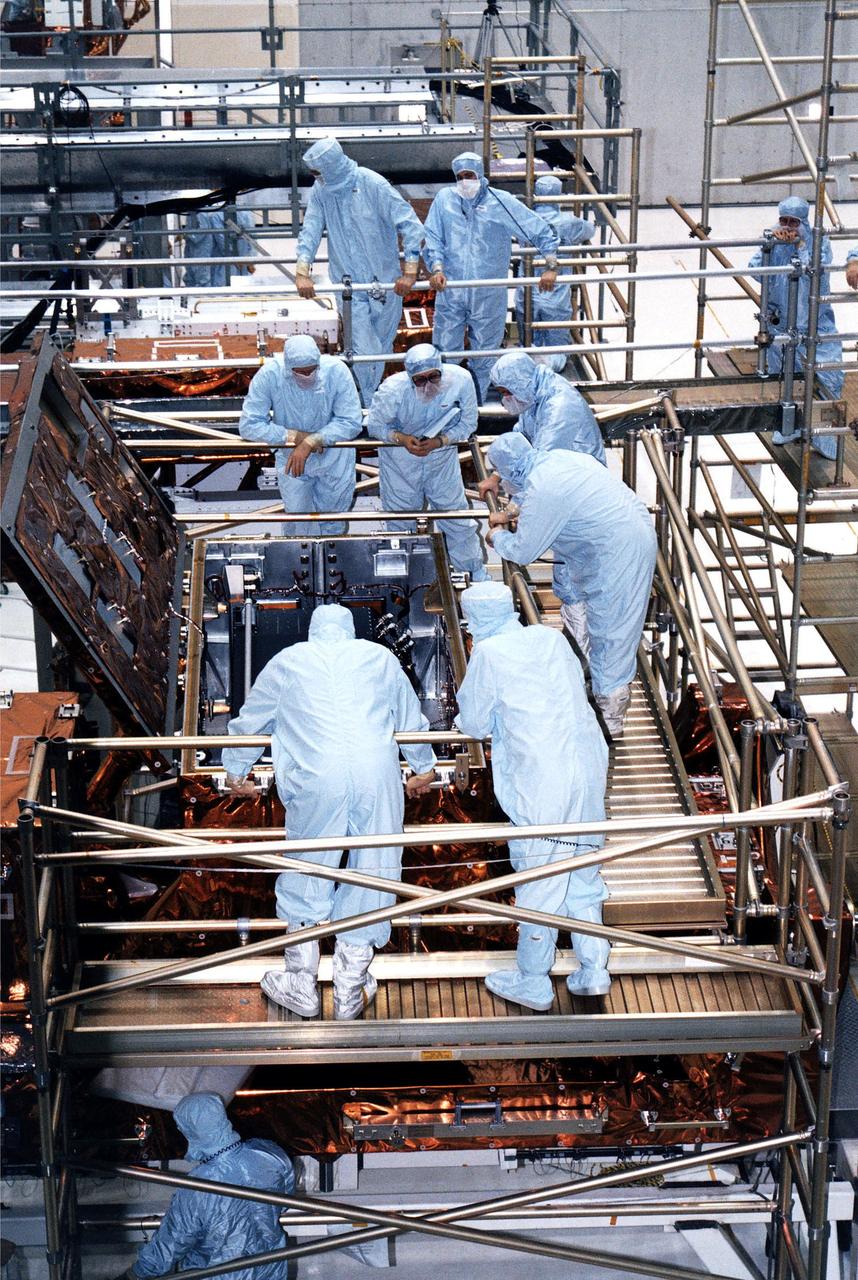
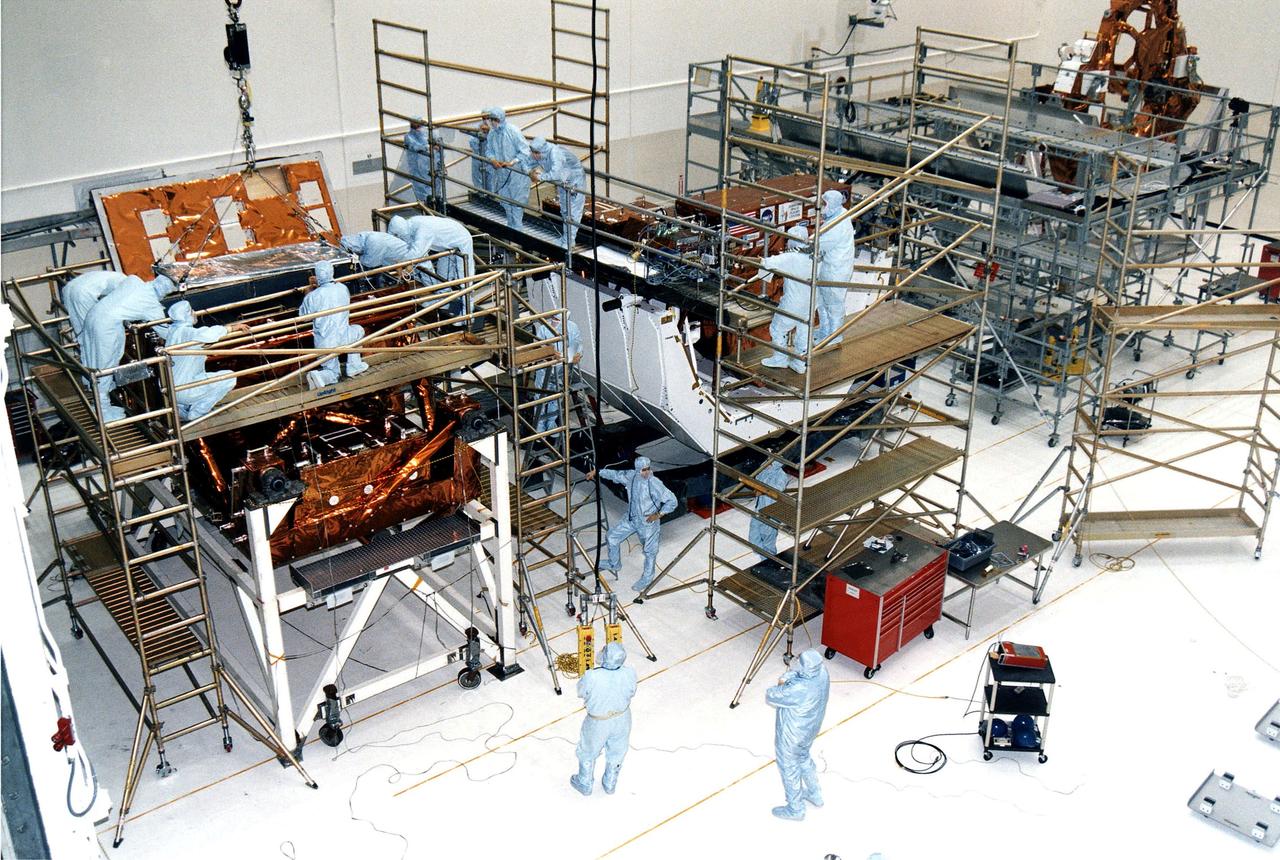
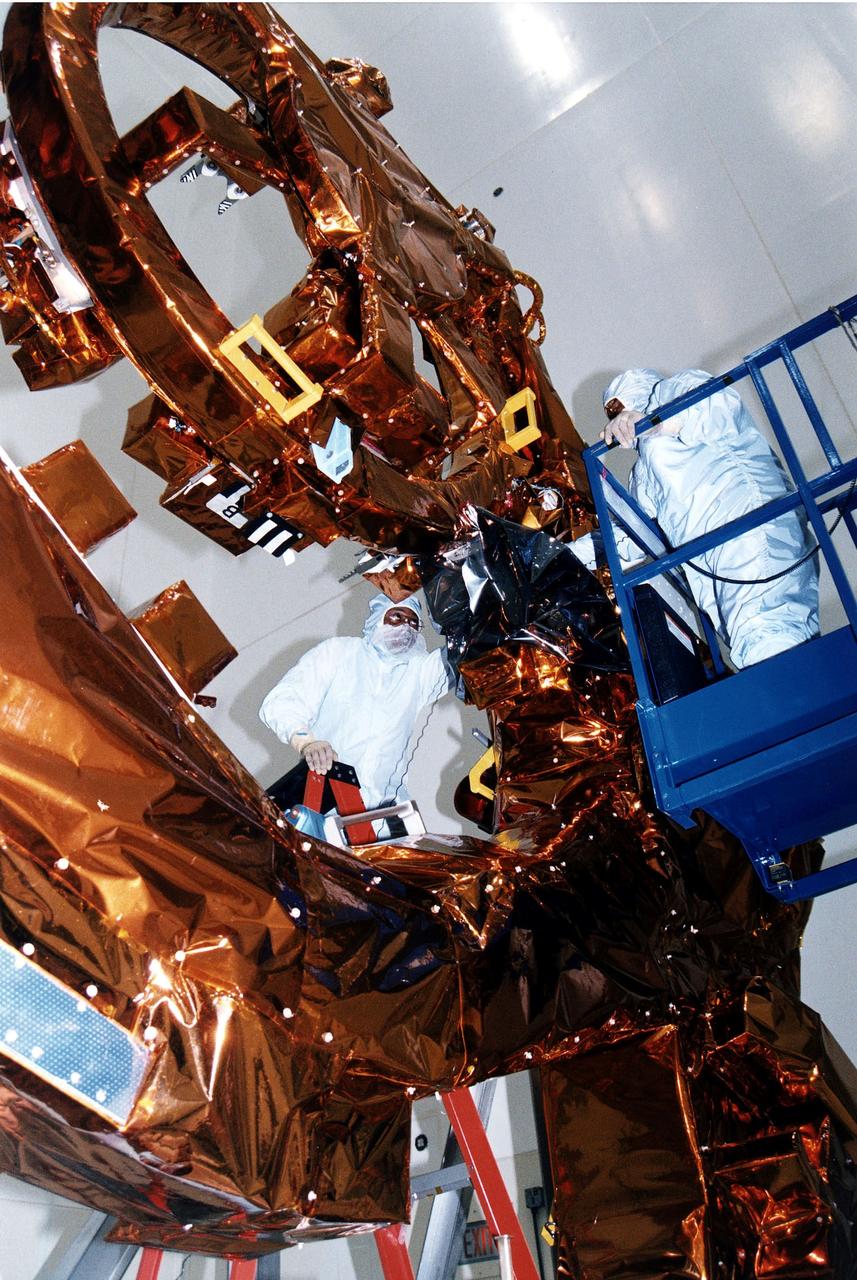
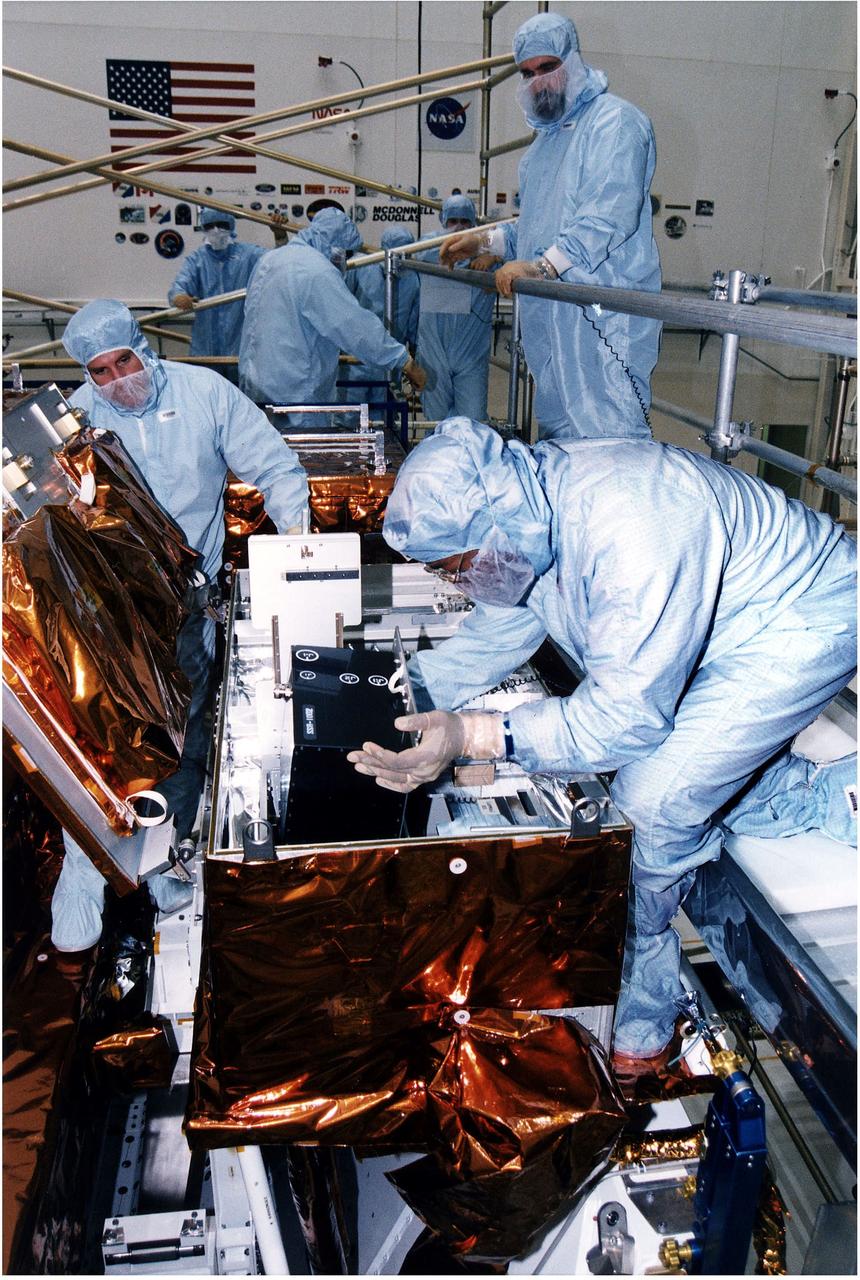
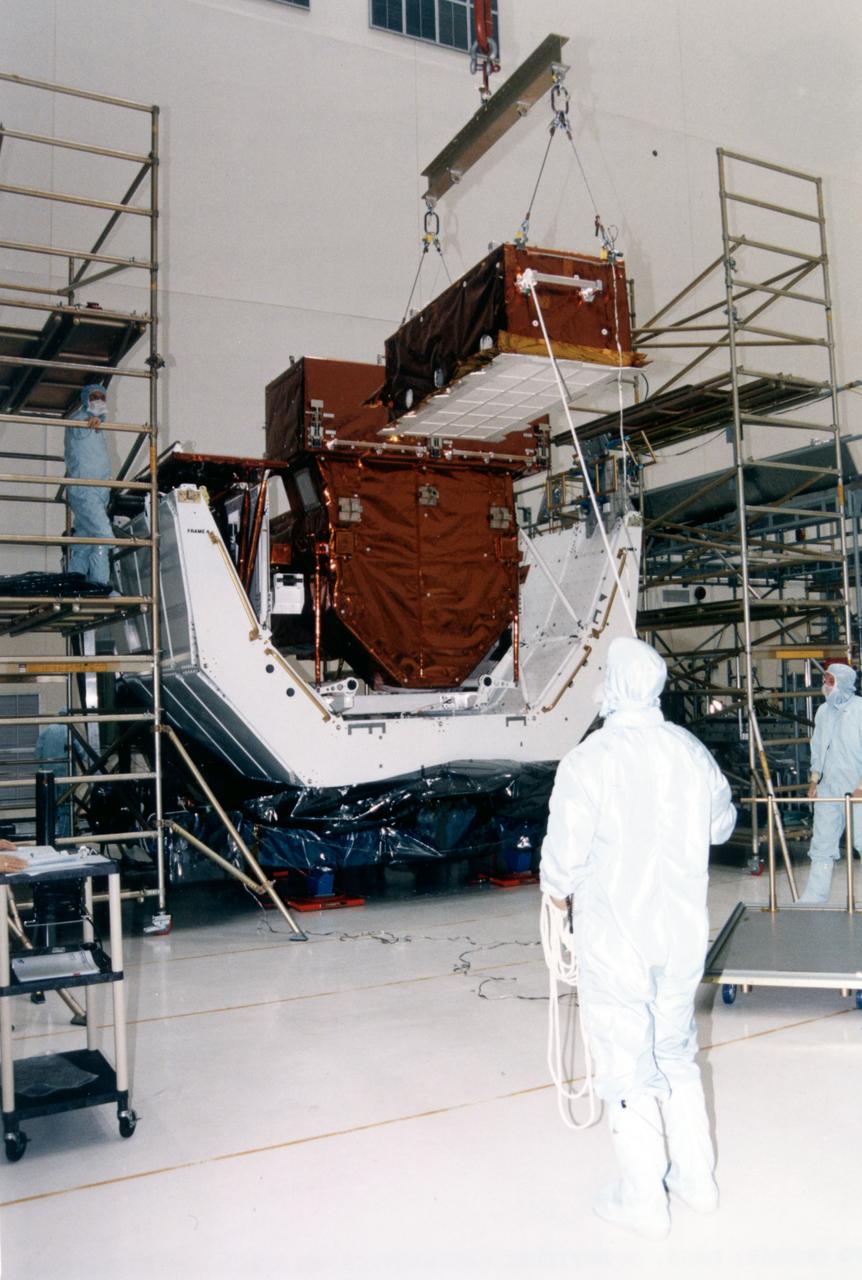
KENNEDY SPACE CENTER, FLORIDA  STS-82 PREPARATIONS VIEW --- Workers in the Kennedy Space Center (KSC) Vertical Processing Facility (VPF) prepare to integrate the Small Orbital Replacement Unit (Oru) Protective Enclosure (Sope), shown here being lifted, with the ORU Carrier shelf, in background, as part of the pre-launch processing for STS-82.  The mission, the second one devoted to servicing of the HST, is targeted for launch on February 11, 1997.
STS-82 Discovery payloads being integrated in VPF
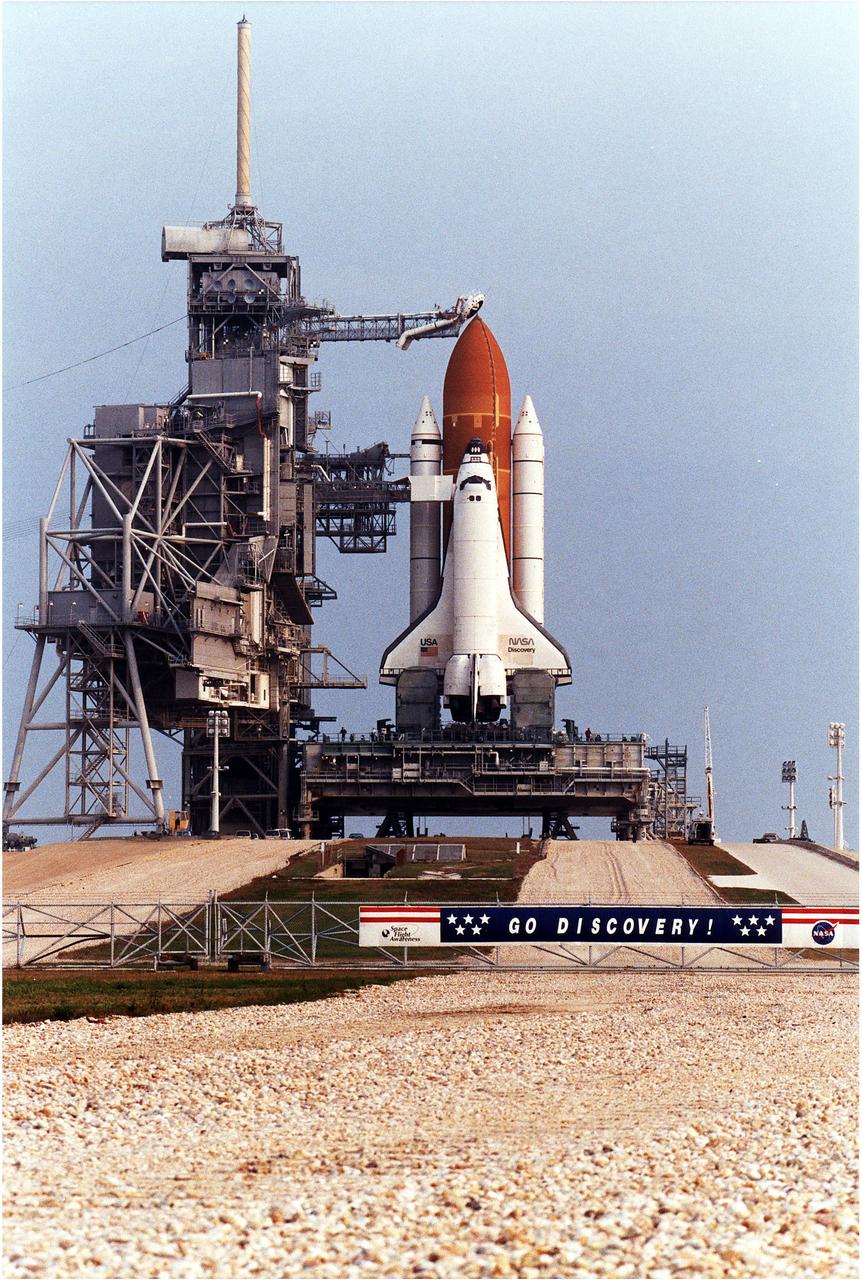
KENNEDY SPACE CENTER, FLORIDA  STS-82 ROLL-OUT VIEW --- After departing the Vehicle Assembly Building (VAB), the Space Shuttle Discovery moves slowly - about one mile per hour - along the Kennedy Space Center (KSC) Crawlerway toward Launch Pad 39A in preparation for the STS-82 mission.  The Shuttle is on a mobile launch platform, and the entire assemblage is being carried by a large tracked vehicle called the Crawler Transporter.  A seven-member crew of astronauts will perform the second servicing of the orbiting Hubble Space Telescope (HST) during the scheduled ten-day STS-82 flight.  Launch is currently targeted for February 11, 1997.
STS-82 Discovery moves toward Launch Pad 39A
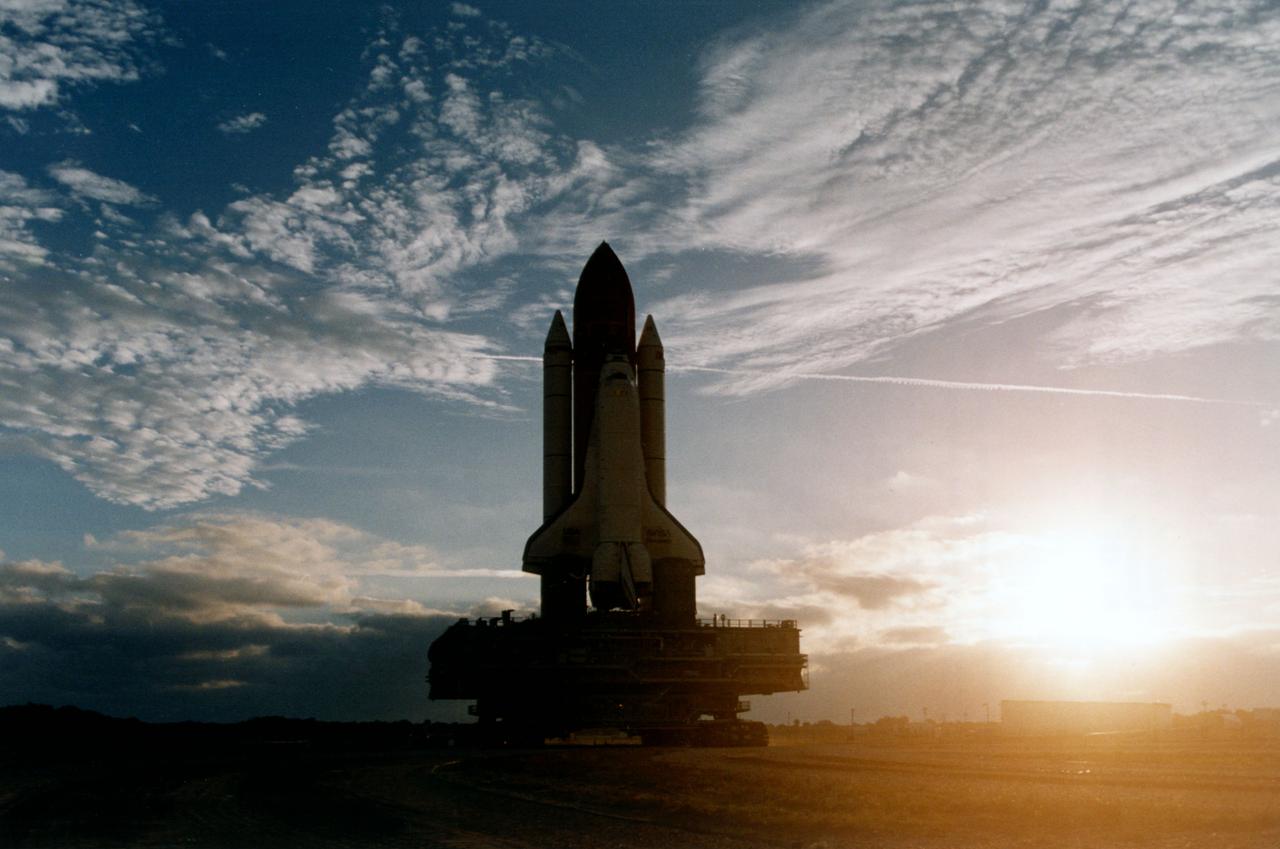
KENNEDY SPACE CENTER, FLORIDA  STS-82 PREPARATIONS VIEW --- Scattered clouds at dawn provide the backdrop for the Space Shuttle Discovery as it moves along the Kennedy Space Center (KSC) Crawlerway toward Launch Pad 39A in preparation for the STS-82 mission.  The Space Shuttle is on a mobile launch platform, and the entire assemblage is being carried by a large tracked vehicle called the Crawler Transporter.  A seven-member crew of astronauts will perform the second servicing of the orbiting Hubble Space Telescope (HST) during the scheduled ten-day STS-82 flight.  Launch is currently targeted for February 11, 1997.
STS-82 Discovery moves toward Launch Pad 39A
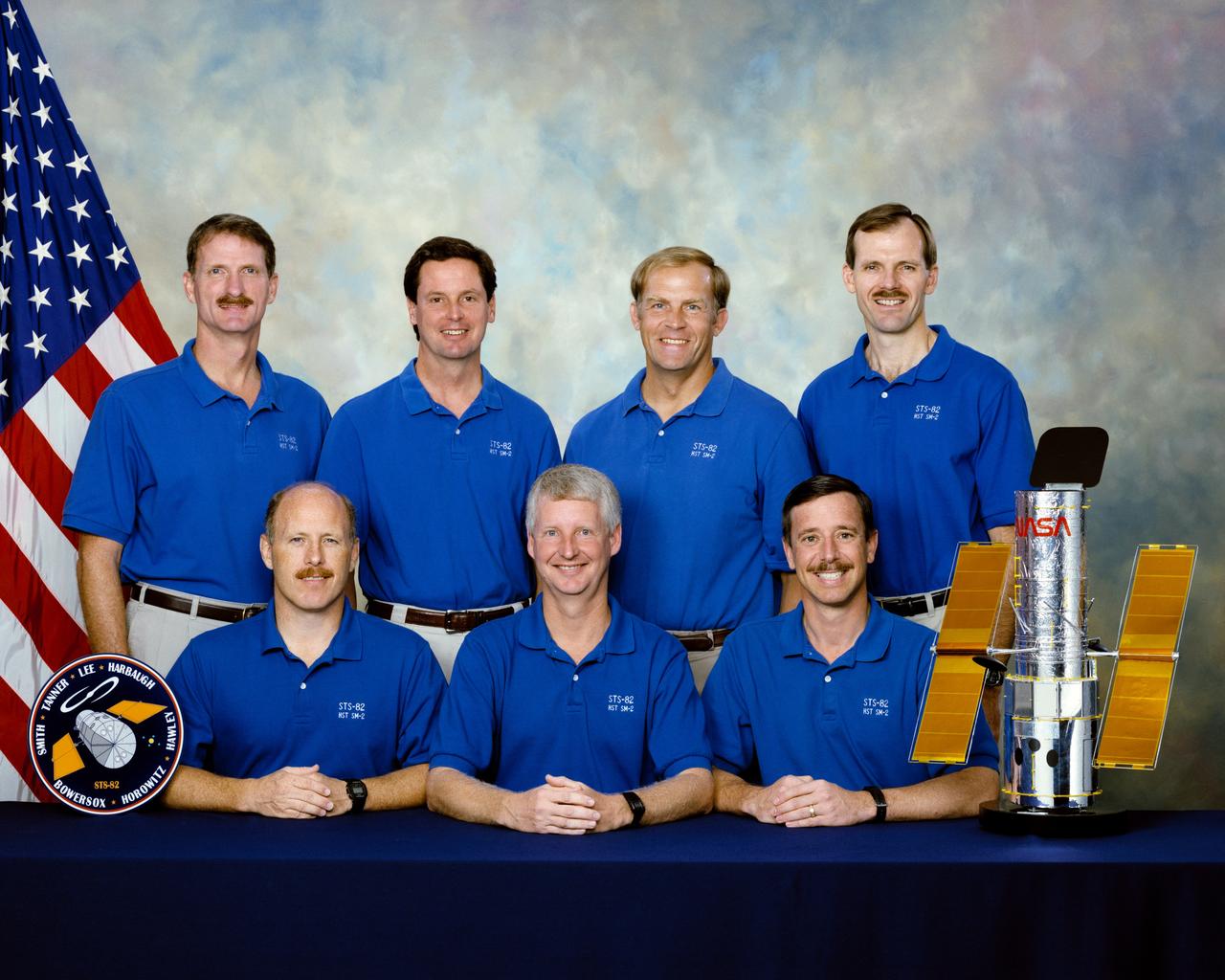
The crew assigned to the STS-82 mission included (seated front left to right) Kenneth D. Bowersox, commander; Steven A. Hawley, mission specialist; and Scott J. Horowitz, pilot.  On the back row (left to right) are Joseph R. Tanner, mission specialist; Gregory J. Harbaugh, mission specialist; Mark C. Lee, payload commander; and Steven L. Smith, mission specialist. Launched aboard the Space Shuttle Discovery on February 11, 1997 at 3:55:17 am (EST), the STS-82 mission served as the second Hubble Space telescope servicing mission.
Space Shuttle Projects
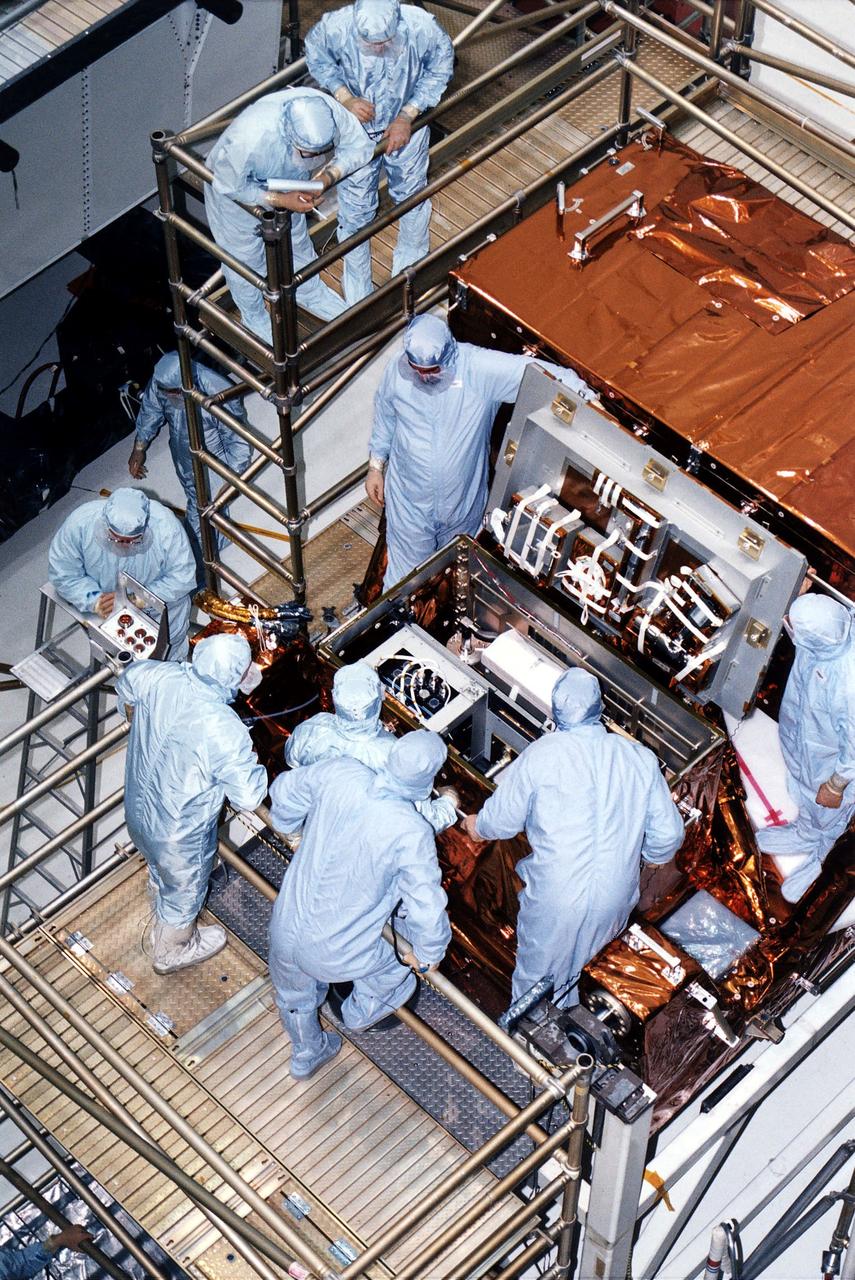
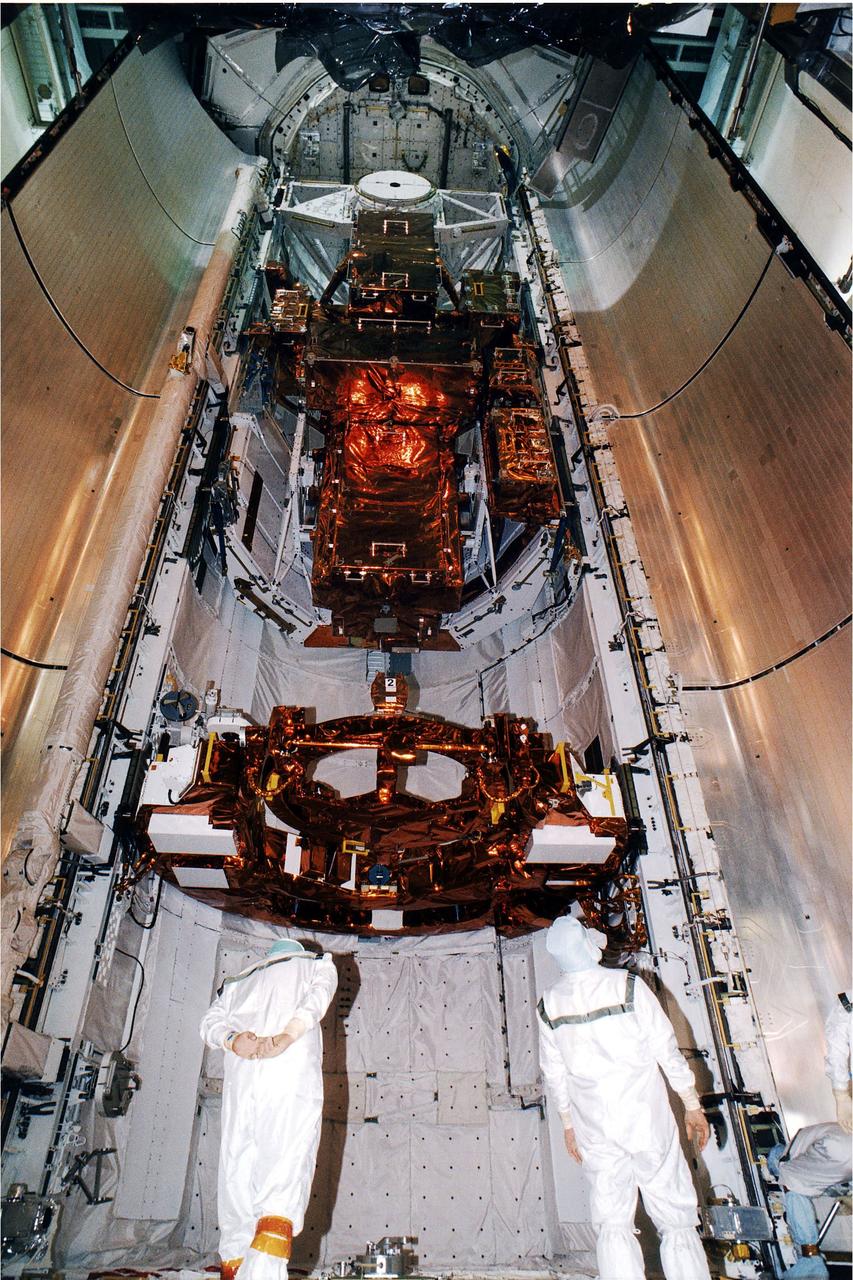
KENNEDY SPACE CENTER, FLORIDA  STS-82 PREPARATIONS VIEW --- Payload processing workers in the Kennedy Space Center (KSC) Vertical Processing Facility (VPF) prepare to integrate the Space Telescope Imaging Spectrograph (STIS), suspended at center, into the Orbiter Replacement Unit (ORU) Carrier and Scientific Instrument Protective Enclosure (SIPE).  STIS will replace the Goddard High Resolution Spectrograph (GHRS) on the Hubble Space Telescope (HST).  Four of the seven STS-82 crew members will perform a series of spacewalks to replace two scientific instruments with two new instruments, including STIS, and perform other tasks during the second HST servicing mission.  HST was deployed nearly seven years ago and was initially serviced in 1993.
STS-82 Discovery payloads being integrated in VPF
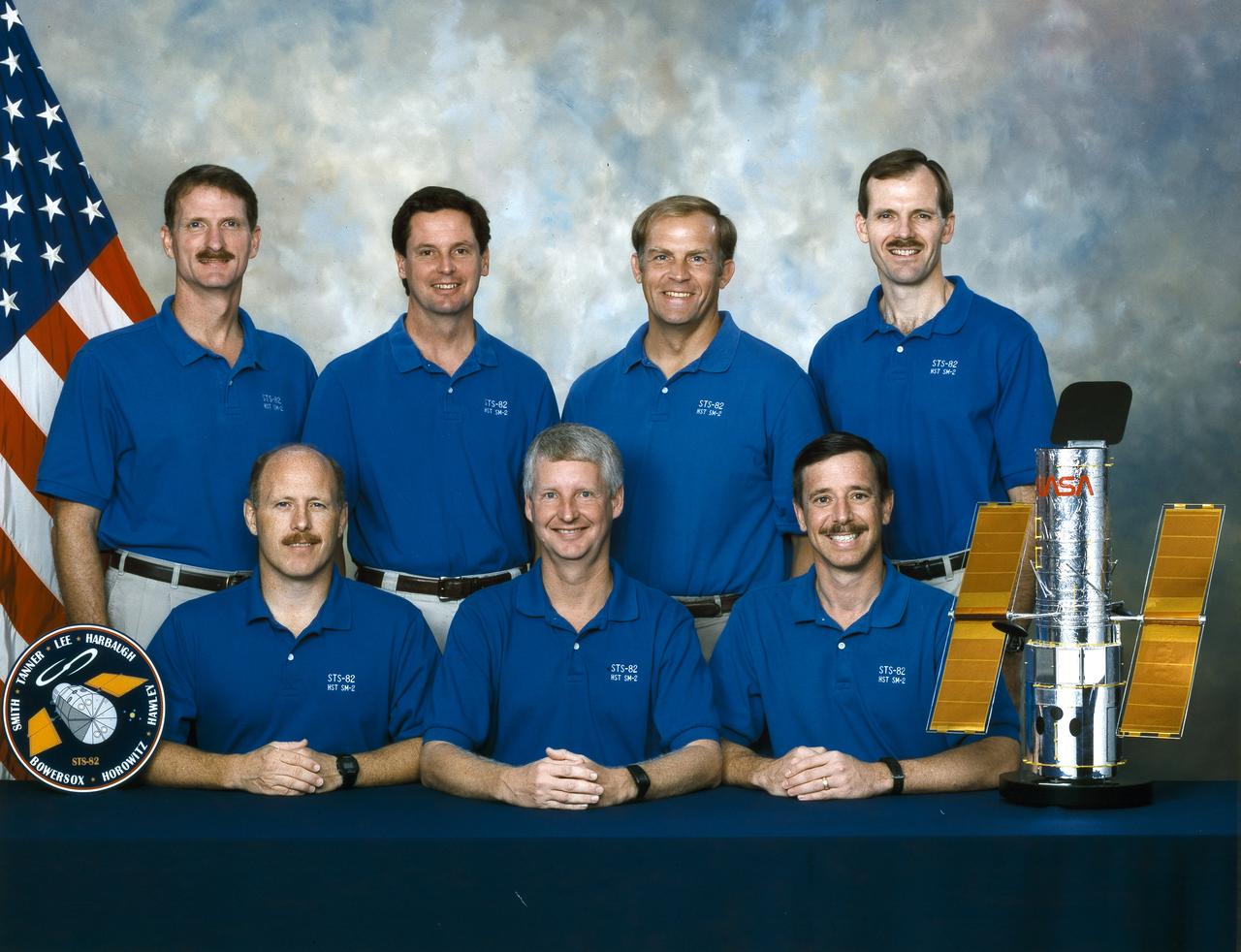
STS082-S-002 (December 1996) --- These seven astronauts are prime crew members for NASA’s STS-82 mission. They are, on the front row, from the left, Kenneth D. Bowersox, Steven A. Hawley and Scott J. Horowitz. On the back row are Joseph R. Tanner, Gregory J. Harbaugh; Mark C. Lee and Steven L. Smith.  Bowersox and Horowitz are commander and pilot, respectively, with Lee assigned as payload commander. Hawley, Harbaugh, Smith and Tanner are mission specialists. The seven are pictured with a small model of the Hubble Space Telescope (HST), which they will be paying a visit representing the second HST maintenance mission.  Bowersox was pilot for the STS-61 mission, which performed the first maintenance on HST. Hawley was a mission specialist on STS-31, the mission whose astronauts originally deployed the HST.
STS-82 official crew portrait
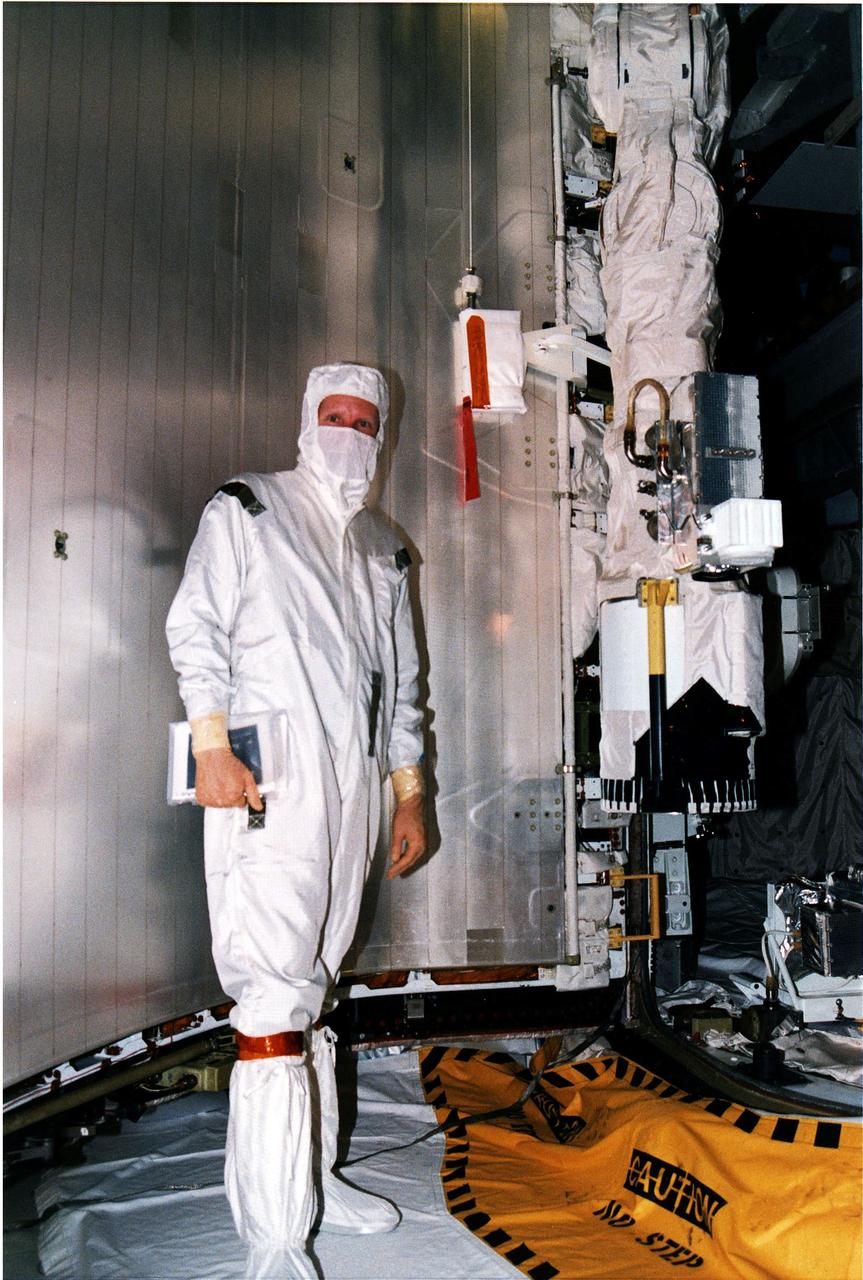
KENNEDY SPACE CENTER, FLORIDA  STS-82 PREPARATIONS VIEW --- In the Kennedy Space Center (KSC) Vertical Processing Facility (VPF), the STS-82 crew members have the opportunity for a "hands-on" preview of some of the hardware they will be utilizing on the second servicing mission to the Hubble Space Telescope (HST).  Astronaut Mark C. Lee (facing camera at center frame), has his gloved hand on the latch for the Multipurpose ORU Protective Enclosure (MOPE).  Observing their payload commander are astronauts Joseph R. Tanner and Gregory J. Harbaugh (second right), as well as several HST technicians.  Four astronauts will perform spacewalks required for servicing of the HST.  The telescope was deployed nearly seven years ago and was initially serviced in 1993.
STS-82 Discovery crew familiarize themselves with hardware for flight
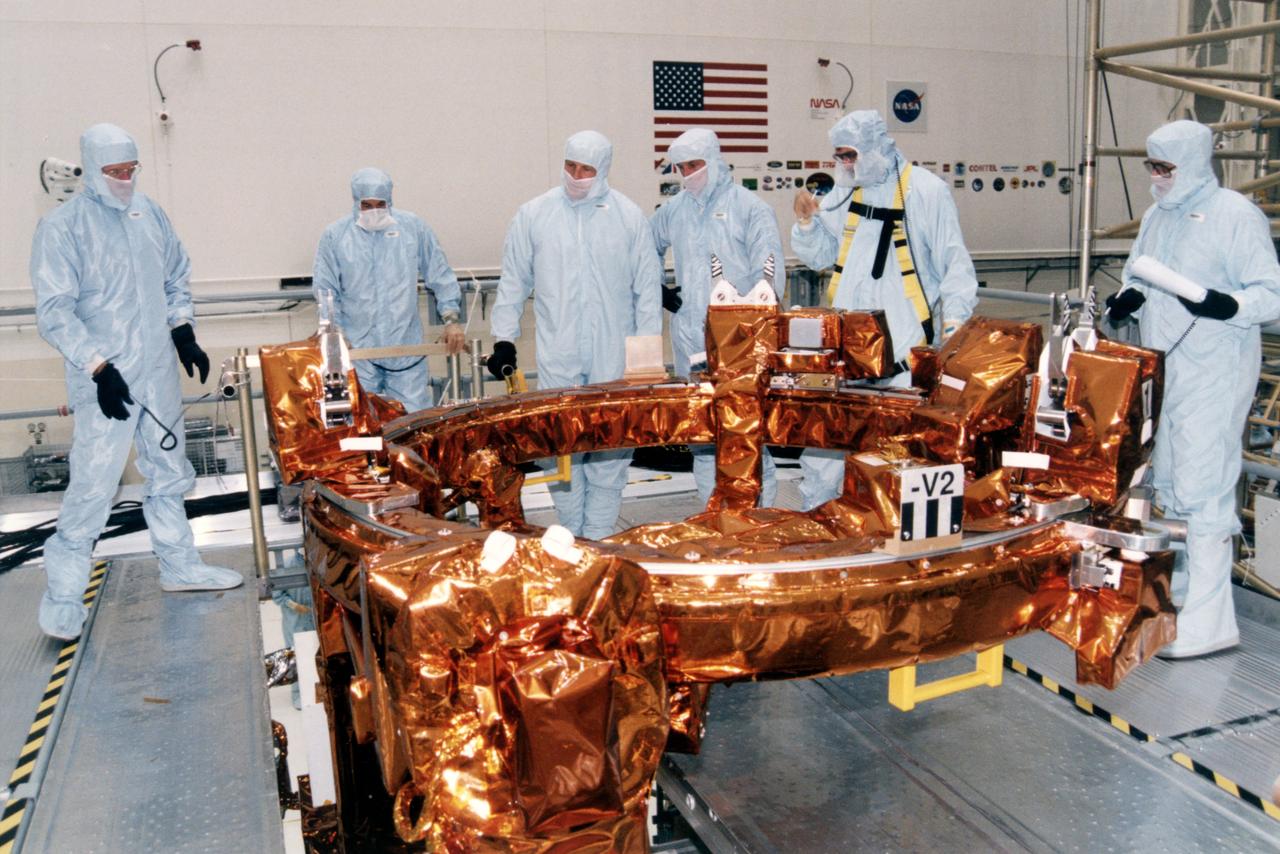
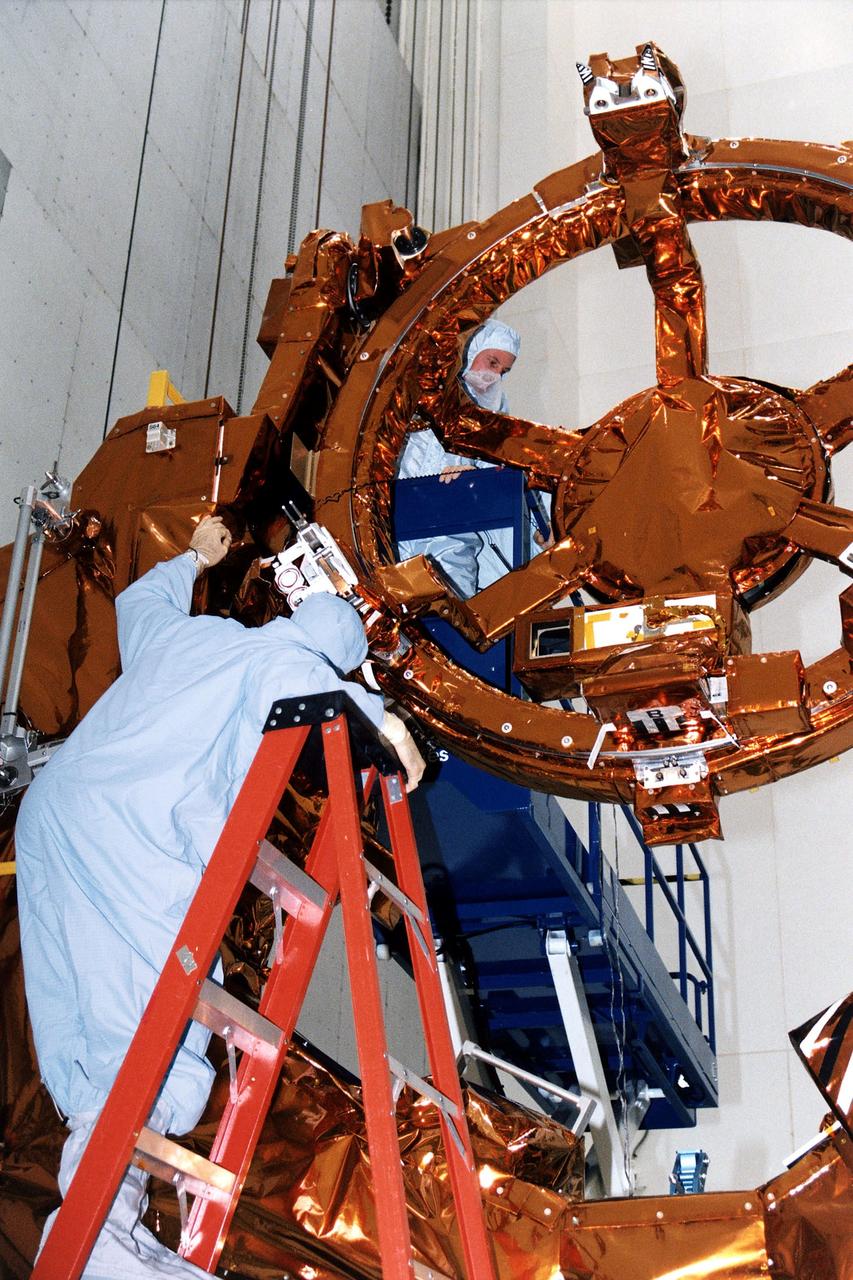
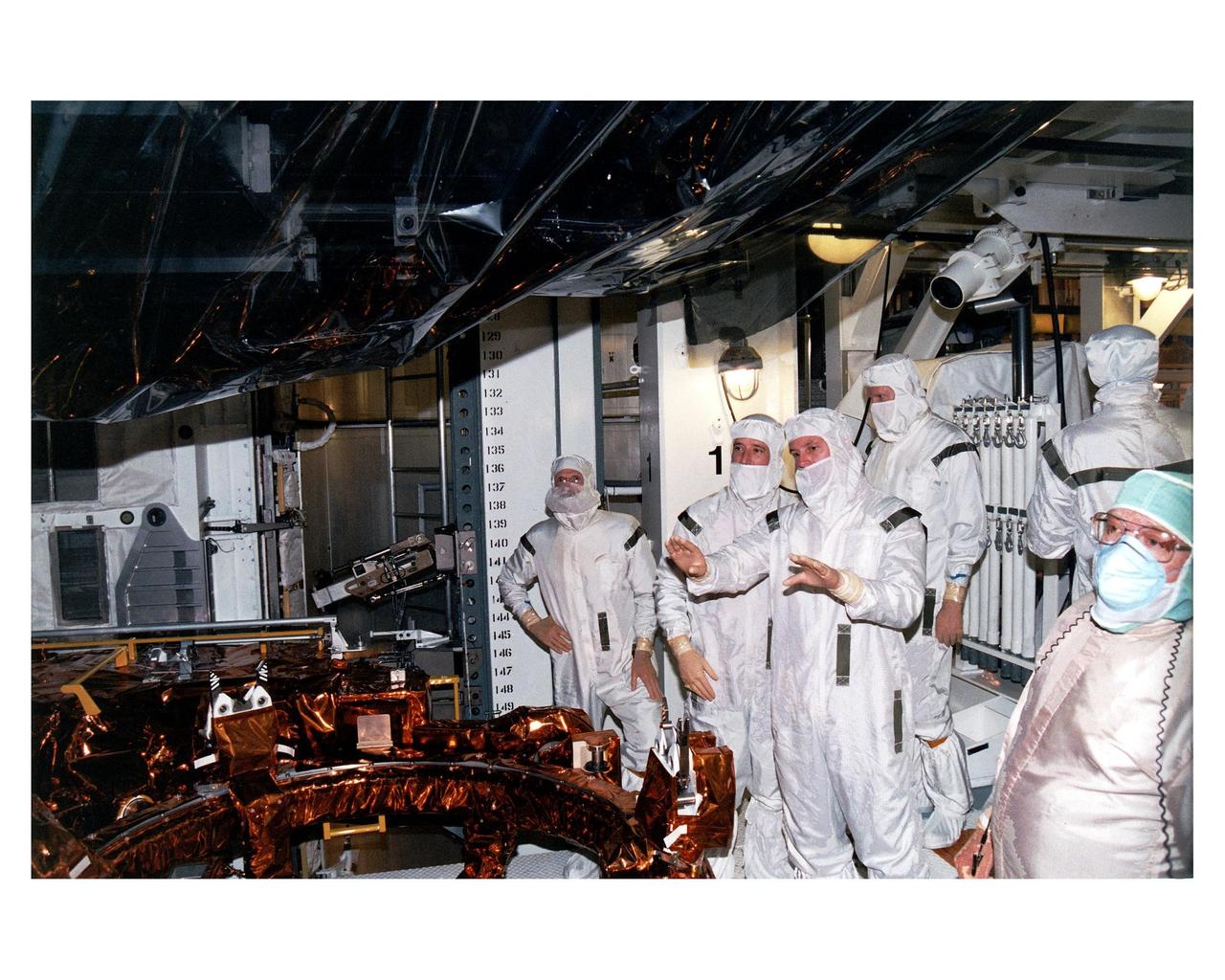
KENNEDY SPACE CENTER, FLORIDA  STS-82 PREPARATIONS VIEW --- In the Kennedy Space Center (KSC) Vertical Processing Facility (VPF), the STS-82 crew members familiarize themselves with some of the hardware they will be handling on the second servicing mission to the Hubble Space Telescope (HST).  Looking over the Flight Support System (FSS) Berthing and Positioning System (BAPS) ring are astronauts Joseph R. Tanner (far left), Mark C. Lee (third left) and Gregory J. Harbaugh (fourth left); along with several HST processing team members.  Tanner, Lee and Harbaugh, along with Steven L. Smith, will perform spacewalks required for servicing of the HST.  The telescope was deployed nearly seven years ago and was initially serviced in 1993.
STS-82 Discovery crew familiarize themselves with hardware for flight
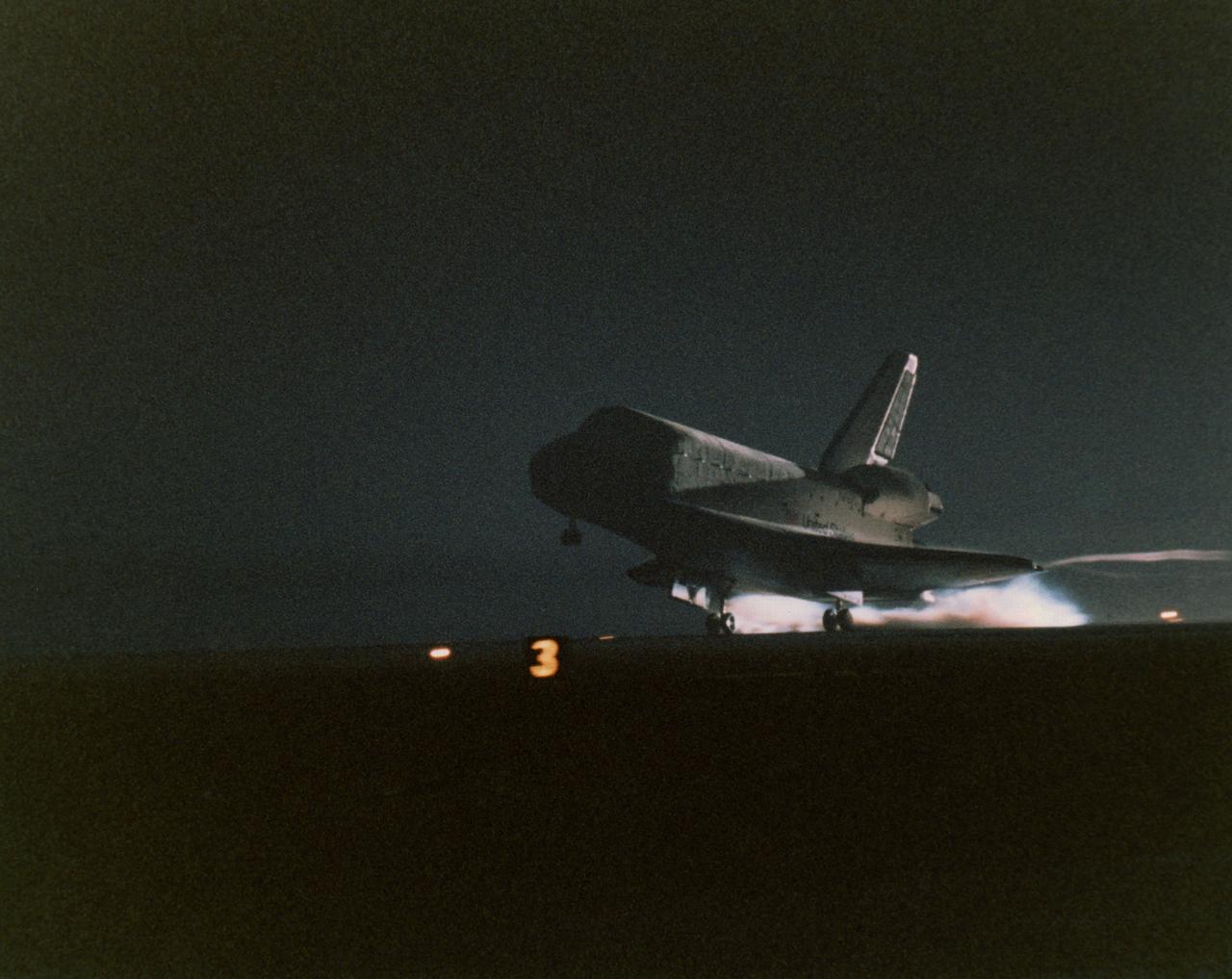
STS082-S-008 (21 Feb 1997) --- The Space Shuttle Discovery partially lights up the early morning sky as it as it lands on Runway 15 at the Kennedy Space Center (KSC), following a 10-day mission in Earth-orbit.  Landing occurred at 3:32:26 a.m.  (EST), February 21, 1997.  The crew members are astronauts Kenneth D. Bowersox, commander; Scott J. Horowitz, pilot; Mark C. Lee, payload commander; and mission specialists Steven A. Hawley, Gregory J. Harbaugh, Steven L. Smith and Joseph R. Tanner.  The primary mission of the flight was to service the Hubble Space Telescope (HST) - a task which required five Extravehicular Activities (EVA) (including an unscheduled EVA) of two alternating two-member teams.  STS-82 represents the 22nd flight of Discovery and the 82nd Space Transportation System (STS) flight, as well as the ninth nocturnal landing in STS history.
STS-82 Discovery OV-103 launch and landing
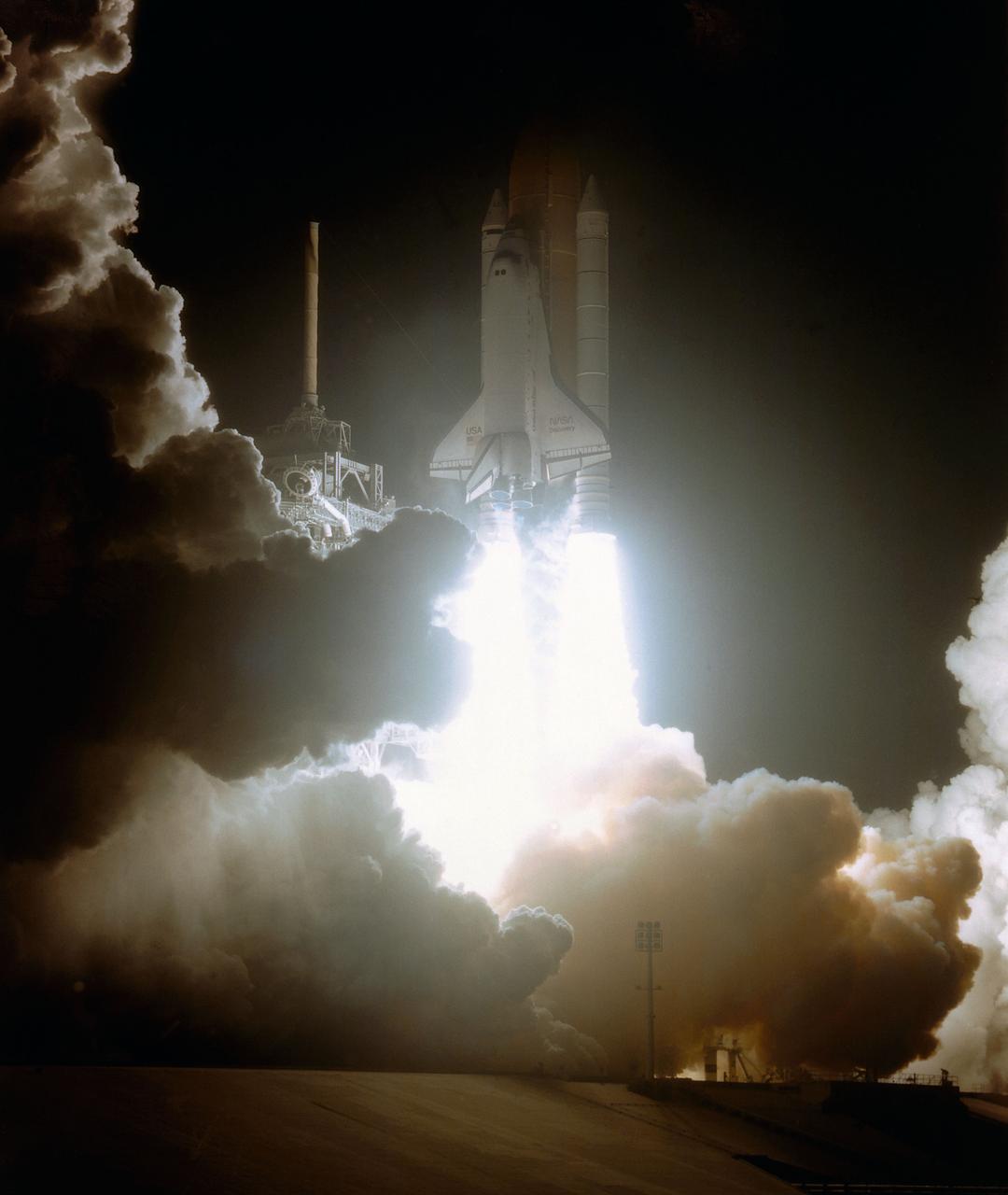
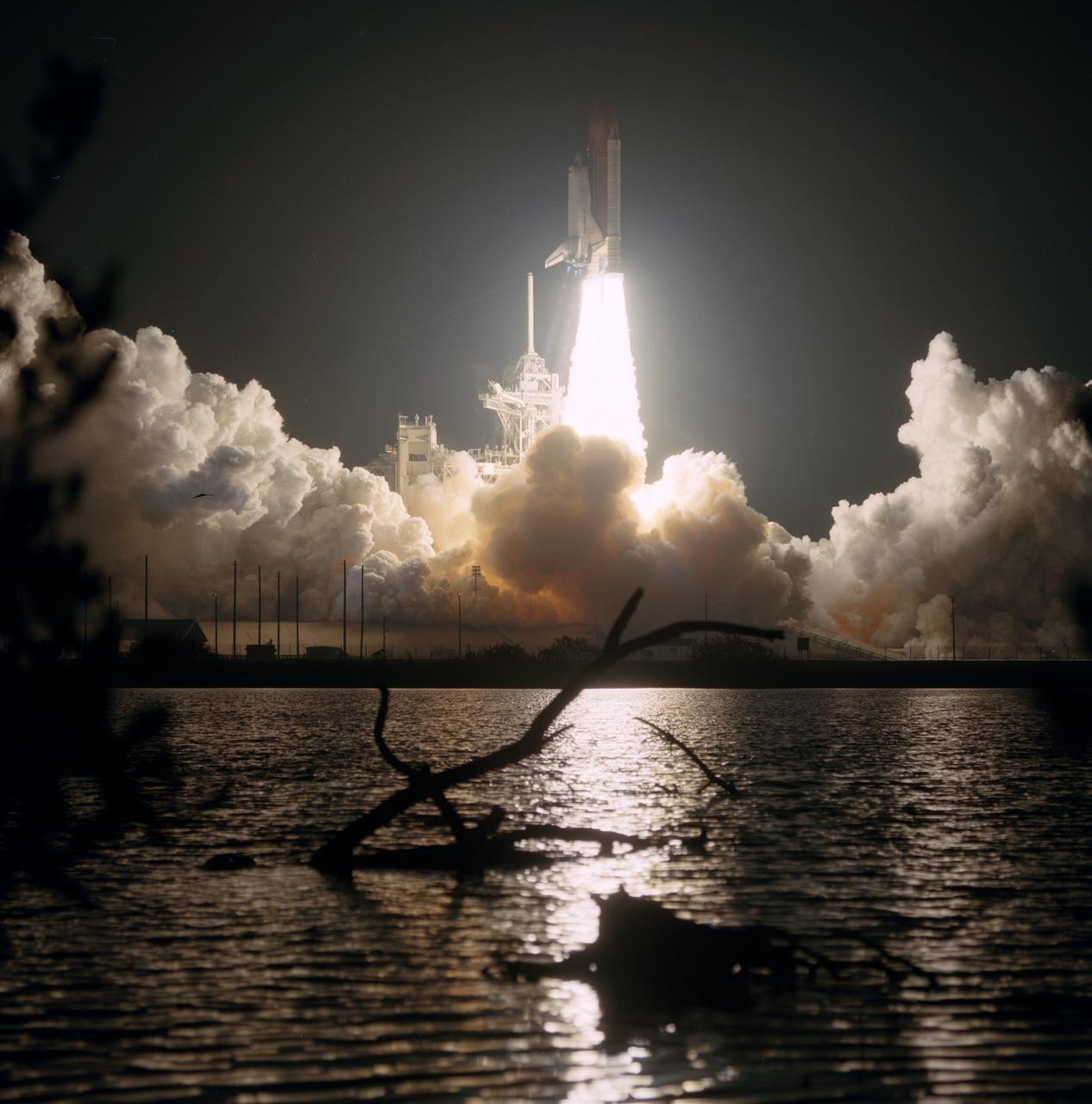
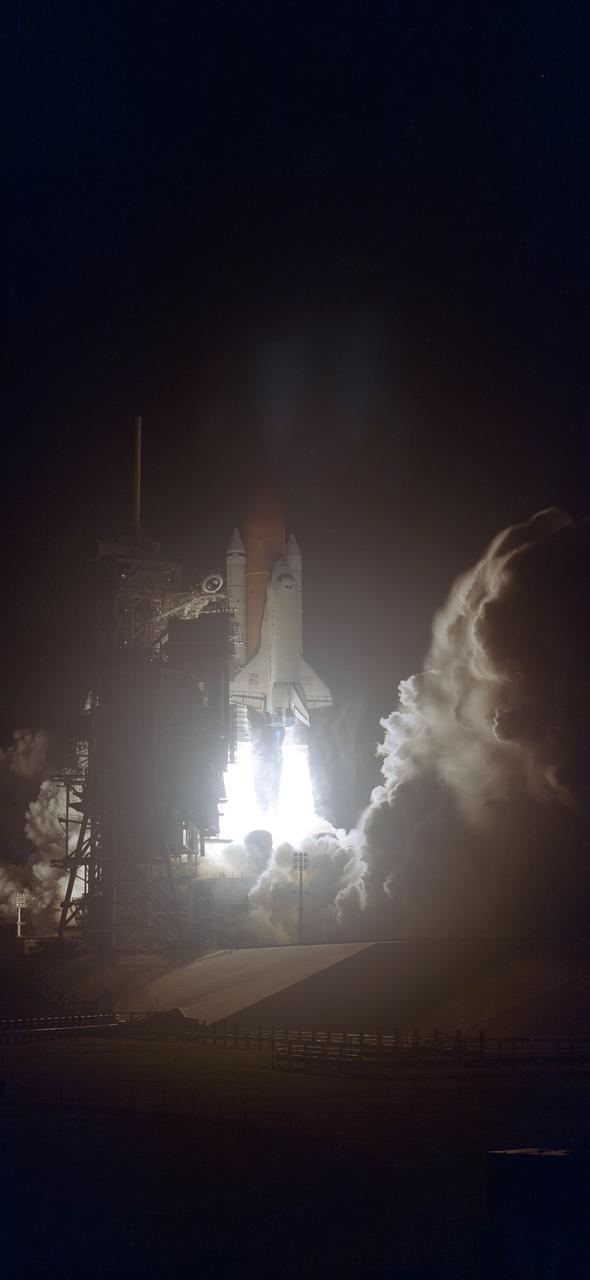
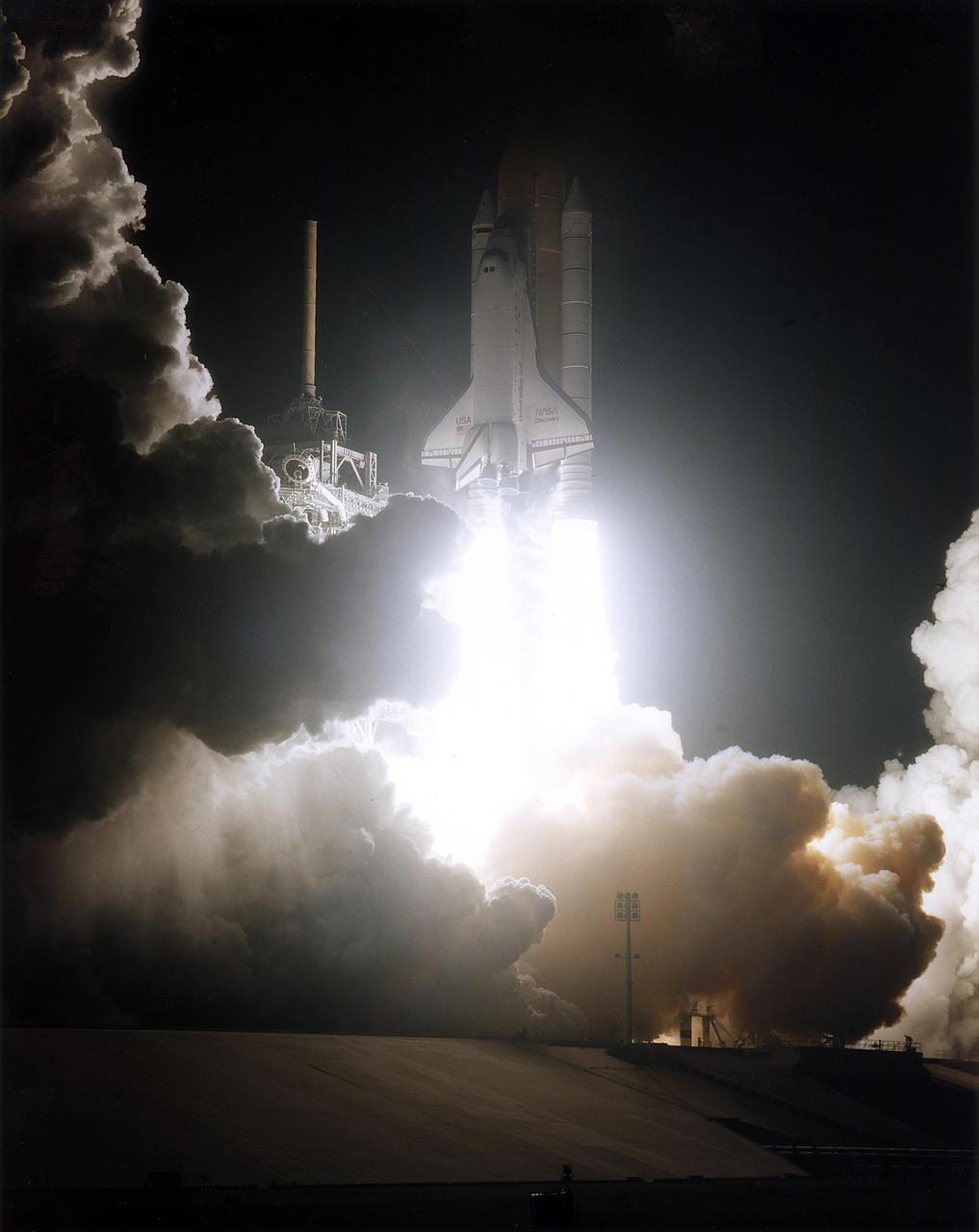
STS082-S-006 (11 Feb 1997) --- A remote camera provides this distant shot of the Space Shuttle Discovery as it lights up the early morning sky around Launch Pad 39A, at the Kennedy Space Center (KSC).  Discovery?s flight is a scheduled 10-day mission in Earth-orbit to service the Hubble Space Telescope (HST).  Launch occurred at 3:55:17 a.m. (EST), February 11, 1997.  The crew members are astronauts Kenneth D. Bowersox, commander; Scott J. Horowitz, pilot; Mark C. Lee, payload commander; and mission specialists Steven A. Hawley, Gregory J. Harbaugh, Steven L. Smith and Joseph R. Tanner.  STS-82 represents the 22nd flight of Discovery and the 82nd Space Transportation System (STS) flight.
STS-82 Discovery, OV-103, launch
STS082-S-009 (11 Feb 1997) --- The Space Shuttle Discovery clears Pad A at Launch Complex 39A, at the Kennedy Space Center (KSC), as it heads for a scheduled 10-day mission in Earth-orbit.  Launch occurred at 3:55:17 a.m. (EST), February 11, 1997.  The crew members are astronauts Kenneth D. Bowersox, commander; Scott J. Horowitz, pilot; Mark C. Lee, payload commander; and mission specialists Steven A. Hawley, Gregory J. Harbaugh, Steven L. Smith and Joseph R. Tanner.  The primary mission of the flight is to service the Hubble Space Telescope (HST).  STS-82 represents the 22nd flight of Discovery and the 82nd Space Transportation System (STS) flight.
STS-82 Discovery OV-103 launch and landing
STS082-S-005 (11 Feb 1997) --- The Space Shuttle Discovery lights up the early morning sky as it leaves Launch Pad 39A, at the Kennedy Space Center (KSC), for a scheduled 10-day mission in Earth-orbit.  Launch occurred at 3:55:17 a.m. (EST), February 11, 1997.  The crew members are astronauts Kenneth D. Bowersox, commander; Scott J. Horowitz, pilot; Mark C. Lee, payload commander; and mission specialists Steven A. Hawley, Gregory J. Harbaugh, Steven L. Smith and Joseph R. Tanner.  The primary mission of the flight is to service the Hubble Space Telescope (HST).  STS-82 represents the 22nd flight of Discovery and the 82nd Space Transportation System (STS) flight.
STS-82 Discovery, OV-103, launch
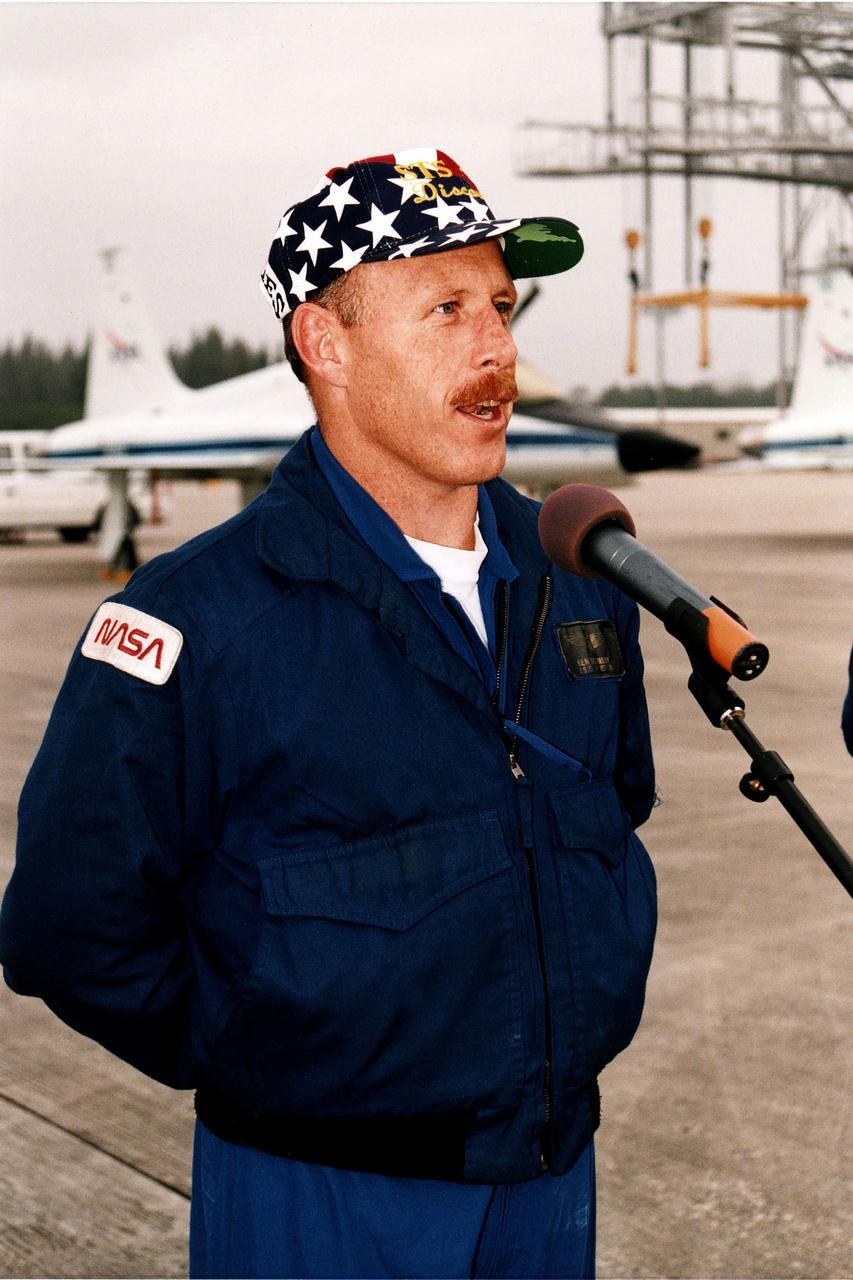
KENNEDY SPACE CENTER, FLA. -   STS-82 Mission Commander Kenneth D. Bowersox greets media representatives after arrival at KSC's Shuttle Landing Facility.  Bowersox and the other six members of the STS-82 crew came from their home base at Johnson Space Center in Houston, Texas, to spend the last few days before launch at KSC.  STS-82 is scheduled for liftoff on Feb. 11 during a 65-minute launch window that opens at 3:56 a.m. EST.  The 10-day flight aboard the Space Shuttle Discovery will be the second Hubble Space Telescope (HST) servicing mission.
KENNEDY SPACE CENTER, FLA. - STS-82 Mission Commander Kenneth D. Bowersox greets media representatives after arrival at KSC's Shuttle Landing Facility. Bowersox and the other six members of the STS-82 crew came from their home base at Johnson Space Center in Houston, Texas, to spend the last few days before launch at KSC. STS-82 is scheduled for liftoff on Feb. 11 during a 65-minute launch window that opens at 3:56 a.m. EST. The 10-day flight aboard the Space Shuttle Discovery will be the second Hubble Space Telescope (HST) servicing mission.
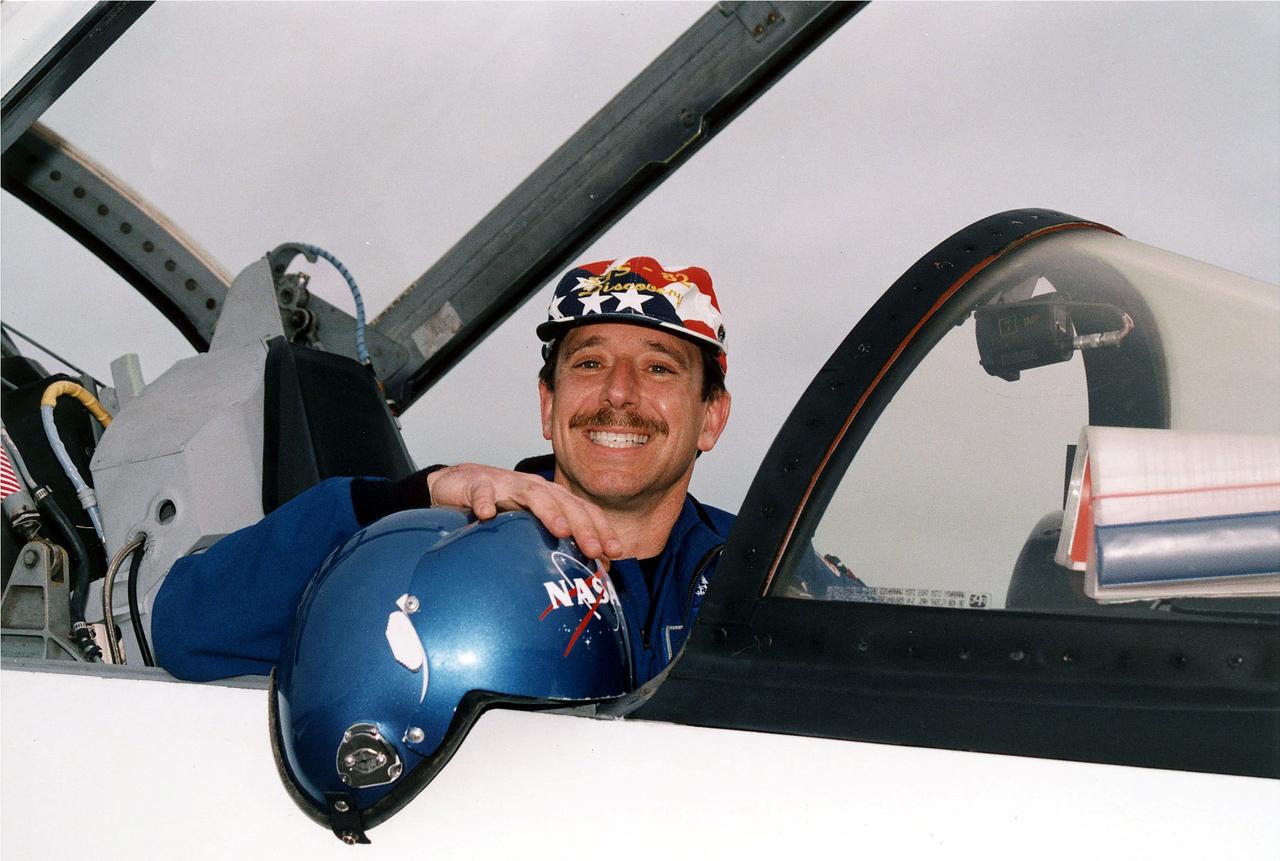
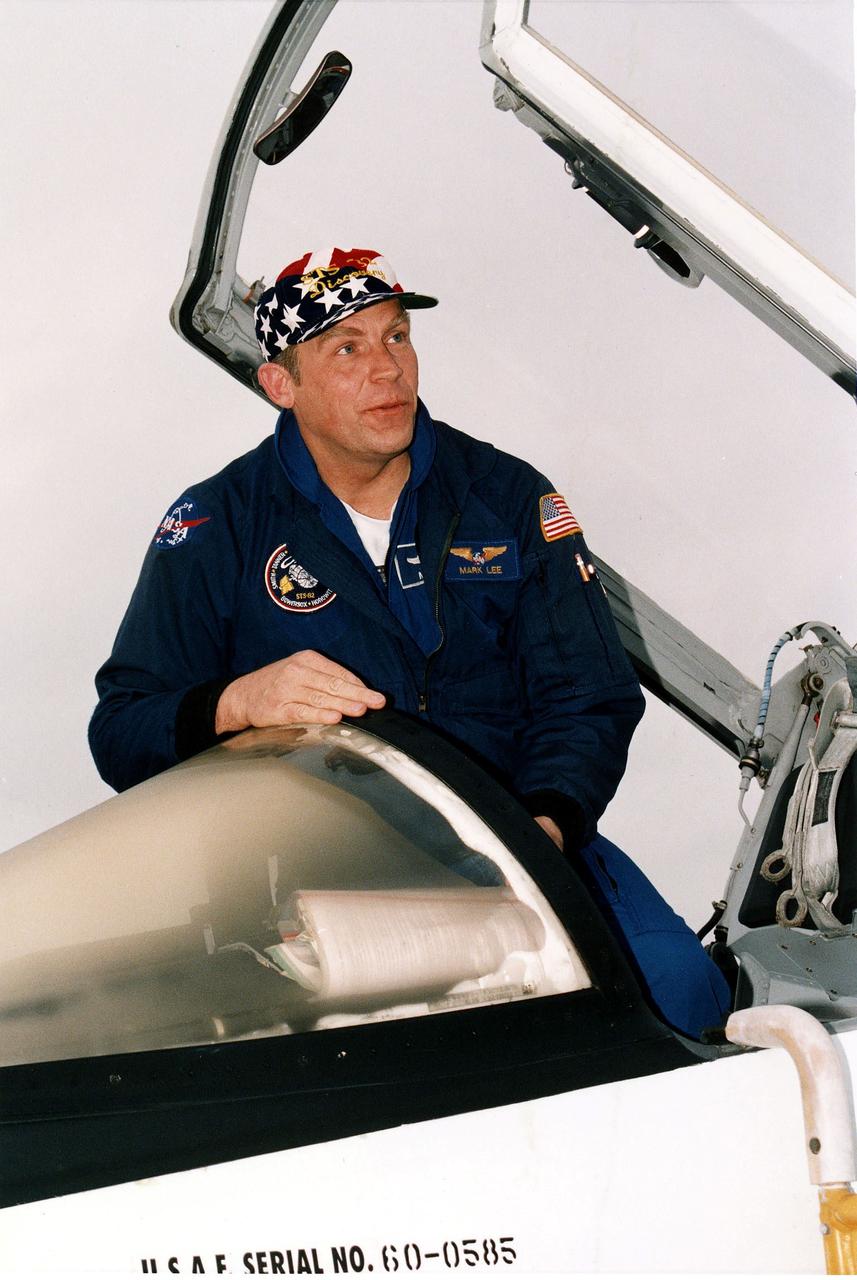
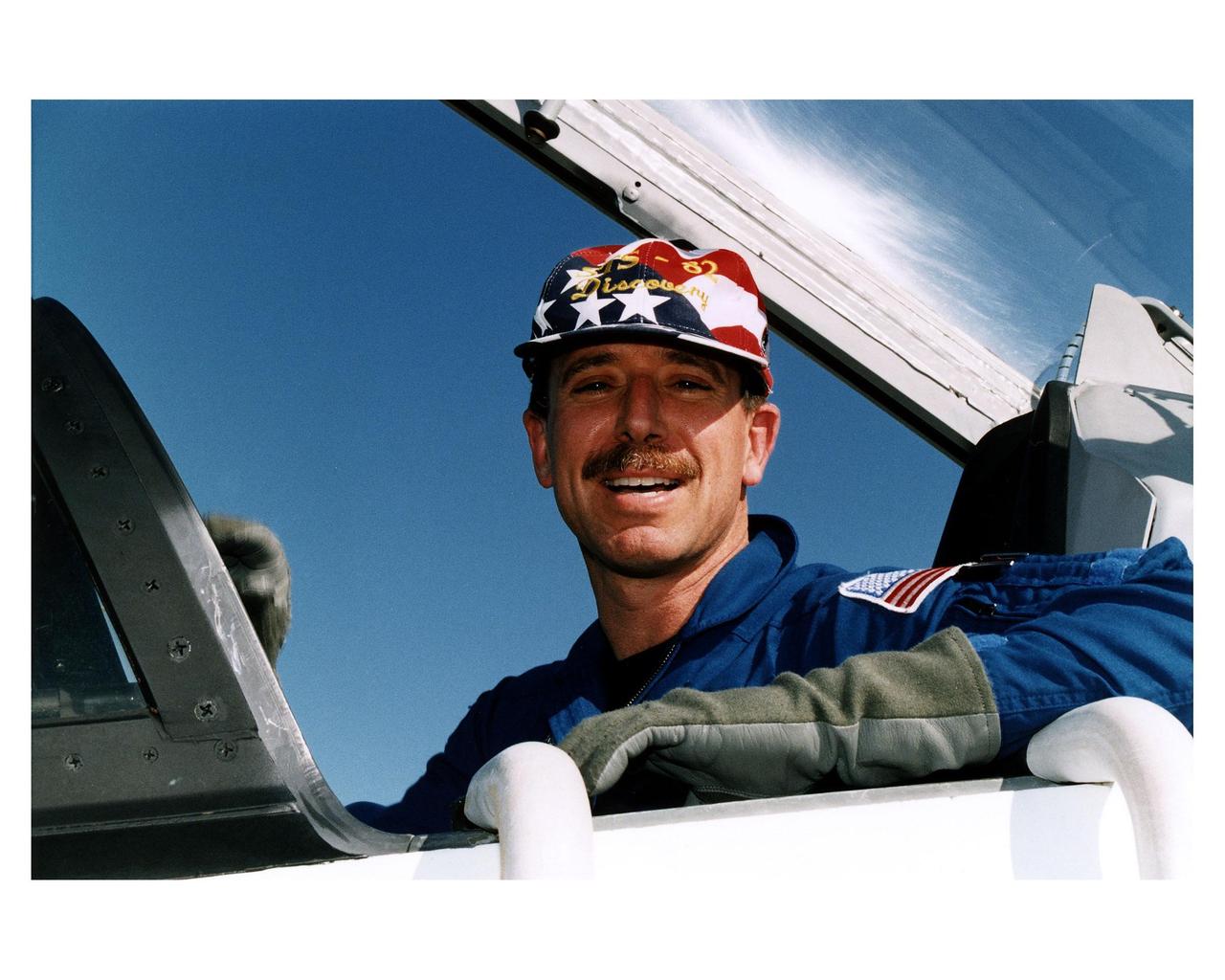
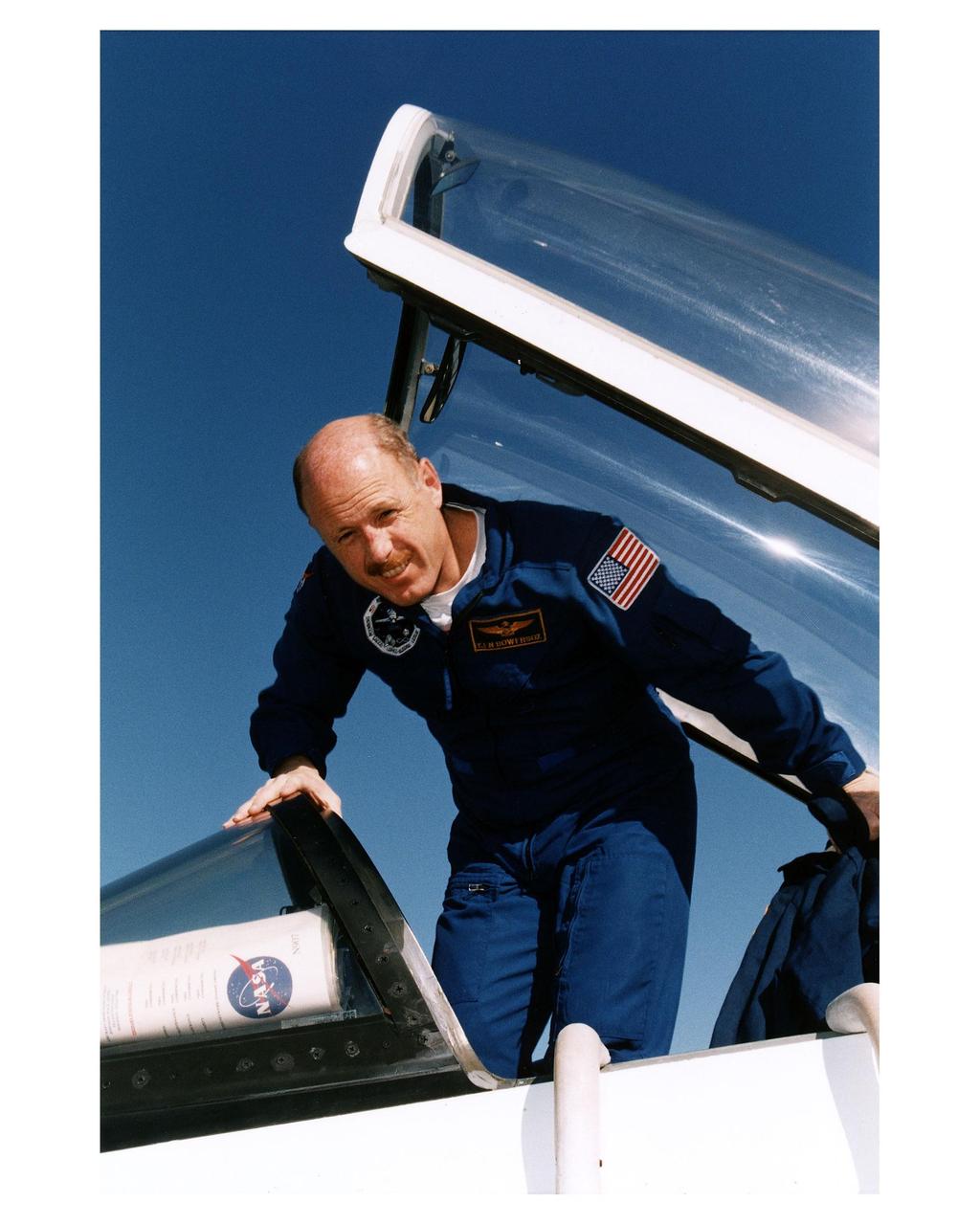
KENNEDY SPACE CENTER, FLA. -  STS-82 Payload Commander Mark C. Lee prepares to step down from the T-38 jet he flew from an air field serving the astronauts' home base at Johnson Space Center, Houston, Texas, to KSC's Shuttle Landing Facility.  Lee and the other six members of the STS-82 crew will spend the last few days before launch at KSC.  STS-82 is scheduled for liftoff on Feb. 11 during a 65-minute launch window that opens at 3:56 a.m. EST.  The 10-day flight aboard the Space Shuttle Discovery will be the second Hubble Space Telescope (HST) servicing mission.
KENNEDY SPACE CENTER, FLA. - STS-82 Payload Commander Mark C. Lee prepares to step down from the T-38 jet he flew from an air field serving the astronauts' home base at Johnson Space Center, Houston, Texas, to KSC's Shuttle Landing Facility. Lee and the other six members of the STS-82 crew will spend the last few days before launch at KSC. STS-82 is scheduled for liftoff on Feb. 11 during a 65-minute launch window that opens at 3:56 a.m. EST. The 10-day flight aboard the Space Shuttle Discovery will be the second Hubble Space Telescope (HST) servicing mission.
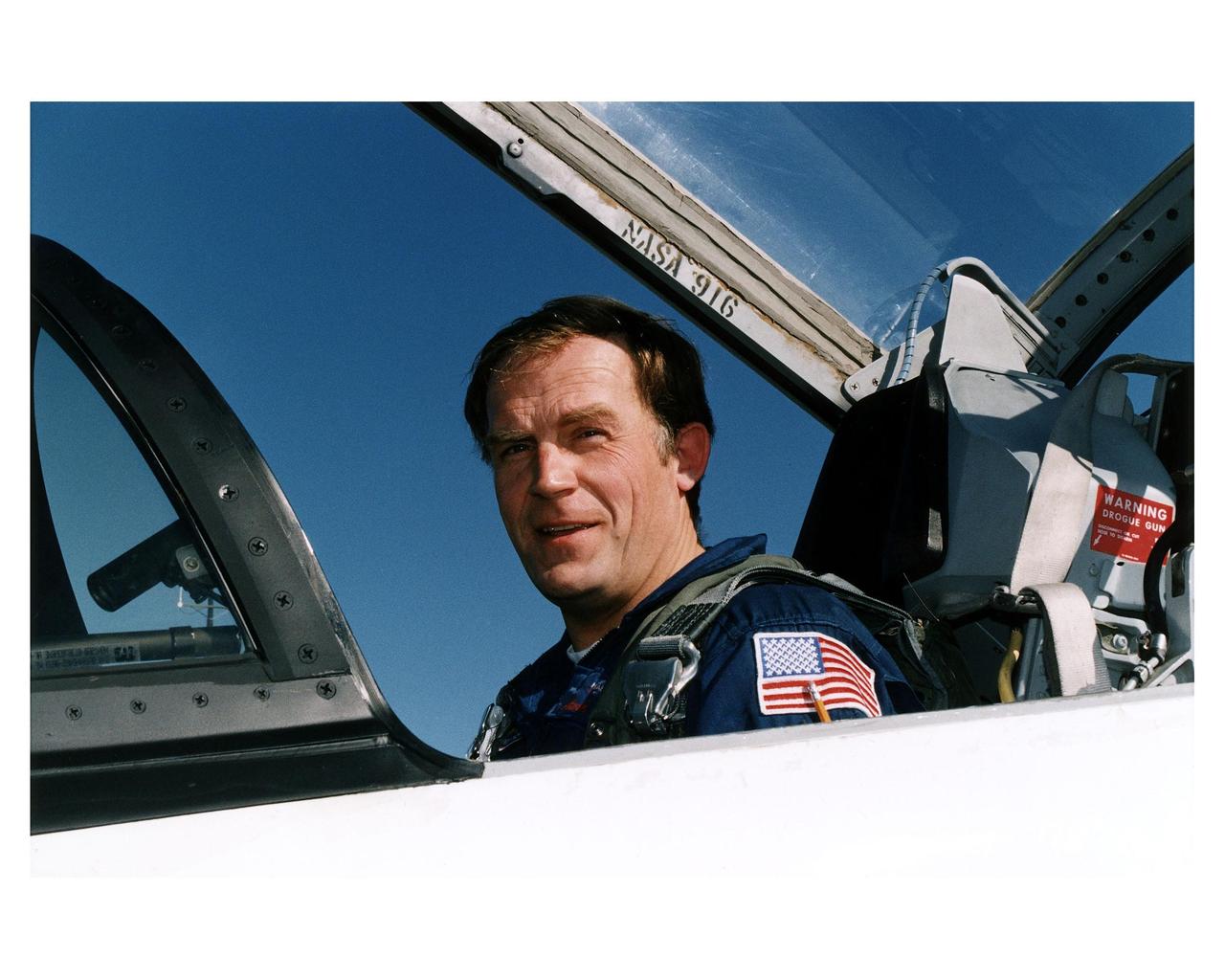
KENNEDY SPACE CENTER, FLA. -  STS-82 Pilot Scott J. "Doc" Horowitz flashes a wide grin for photographers after landing his T-38 jet at KSC's Shuttle Landing Facility.  Horowitz and the other six members of the STS-82 crew came from their home base at Johnson Space Center in Houston, Texas, to spend the last few days before launch at KSC.   STS-82 is scheduled for liftoff on Feb. 11 during a 65-minute launch window that opens at 3:56 a.m. EST.  The 10-day flight aboard the Space Shuttle Discovery will be the second Hubble Space Telescope (HST) servicing mission.
KENNEDY SPACE CENTER, FLA. - STS-82 Pilot Scott J. "Doc" Horowitz flashes a wide grin for photographers after landing his T-38 jet at KSC's Shuttle Landing Facility. Horowitz and the other six members of the STS-82 crew came from their home base at Johnson Space Center in Houston, Texas, to spend the last few days before launch at KSC. STS-82 is scheduled for liftoff on Feb. 11 during a 65-minute launch window that opens at 3:56 a.m. EST. The 10-day flight aboard the Space Shuttle Discovery will be the second Hubble Space Telescope (HST) servicing mission.
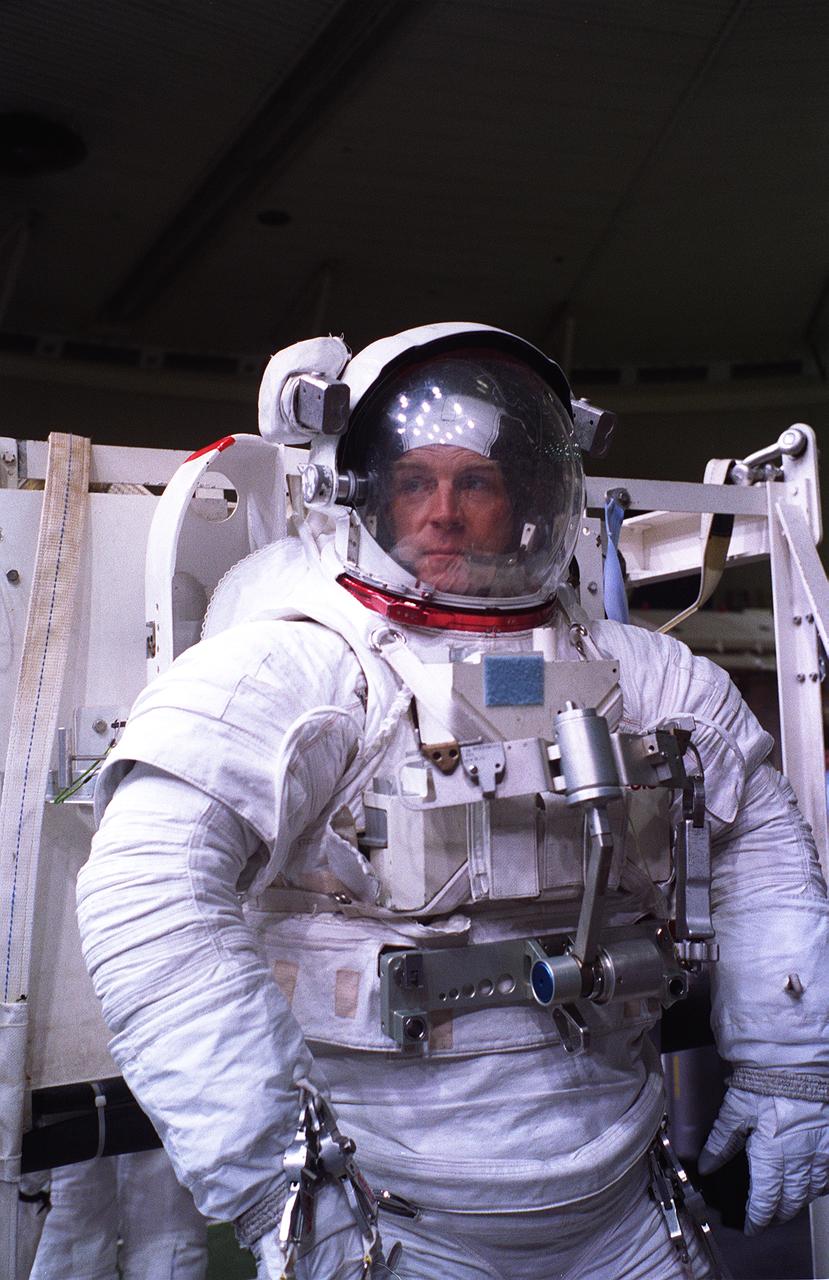
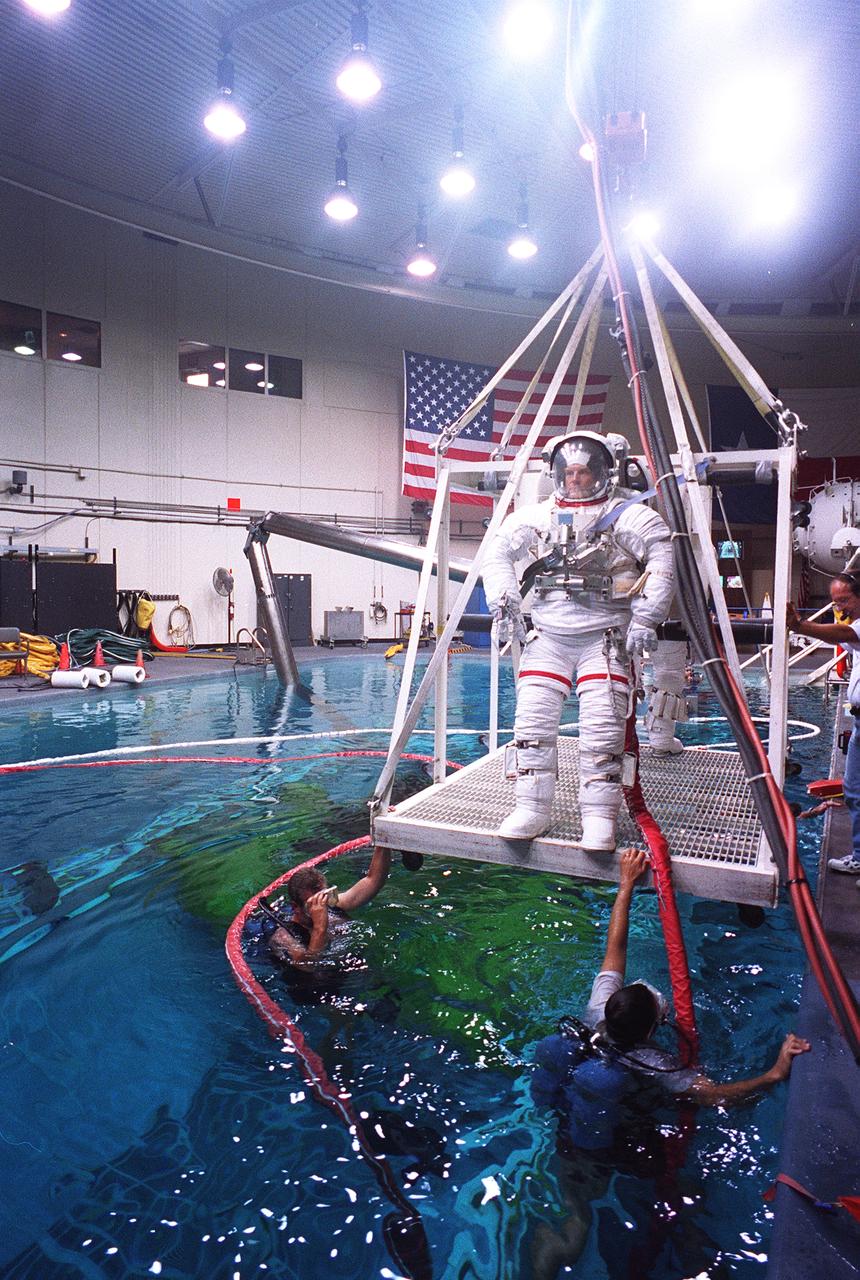
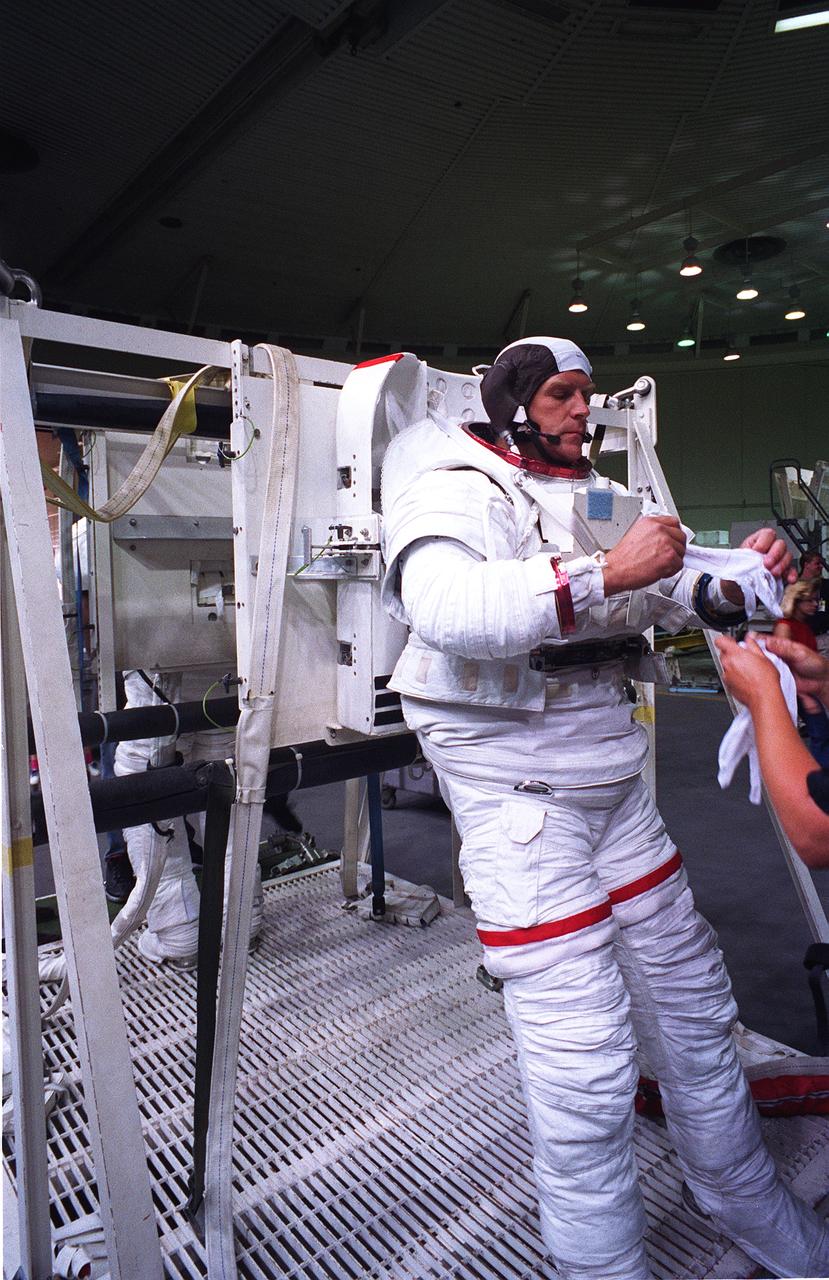
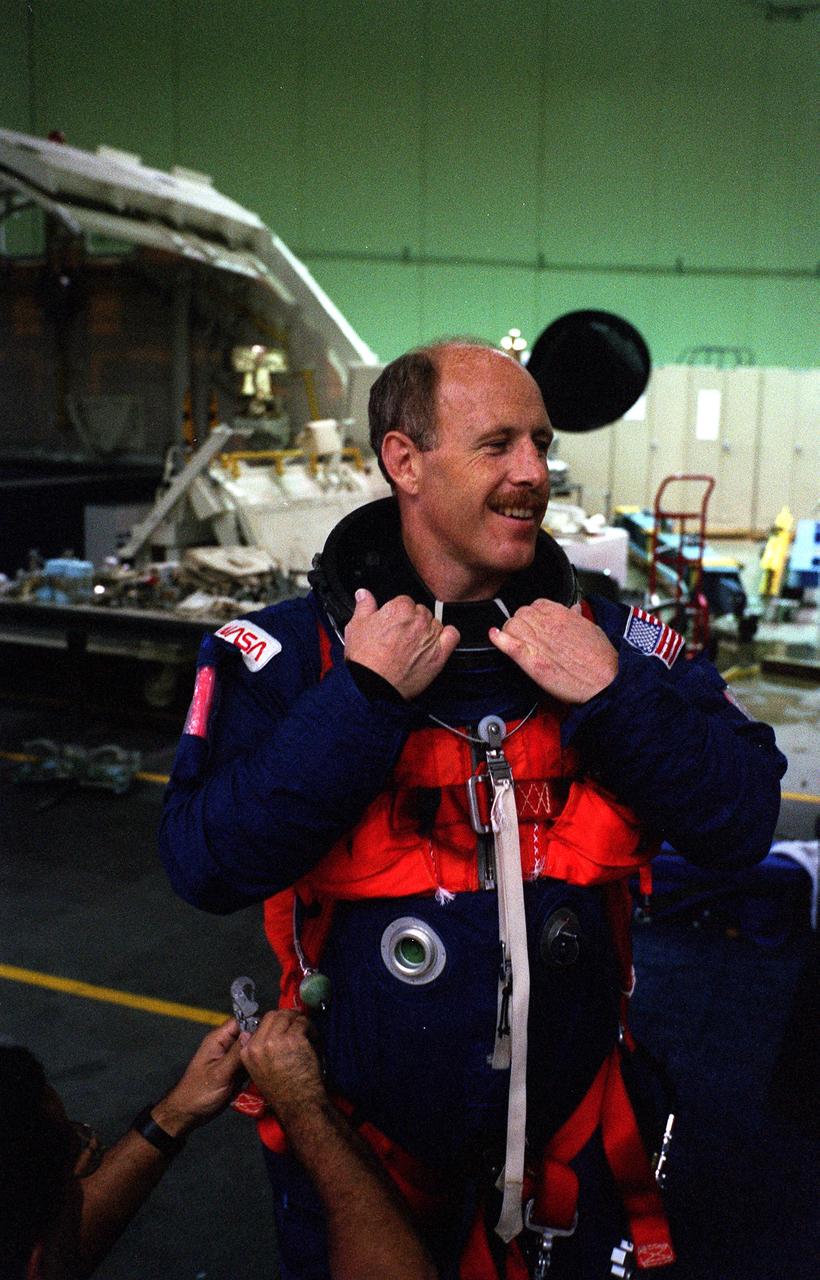
S96-11811 (10 June 1996) --- Astronaut Mark C. Lee, STS-82 payload commander training for extravehicular activity (EVA) involved with the servicing of the Hubble Space Telescope (HST), prepares to enter a water tank at the Johnson Space Center (JSC).  Moments later, Lee was neutrally buoyant, rehearsing some of the HST servicing chores with a crewmate.
STS-82 training in WETF facility with Steve Smith and Mark Lee
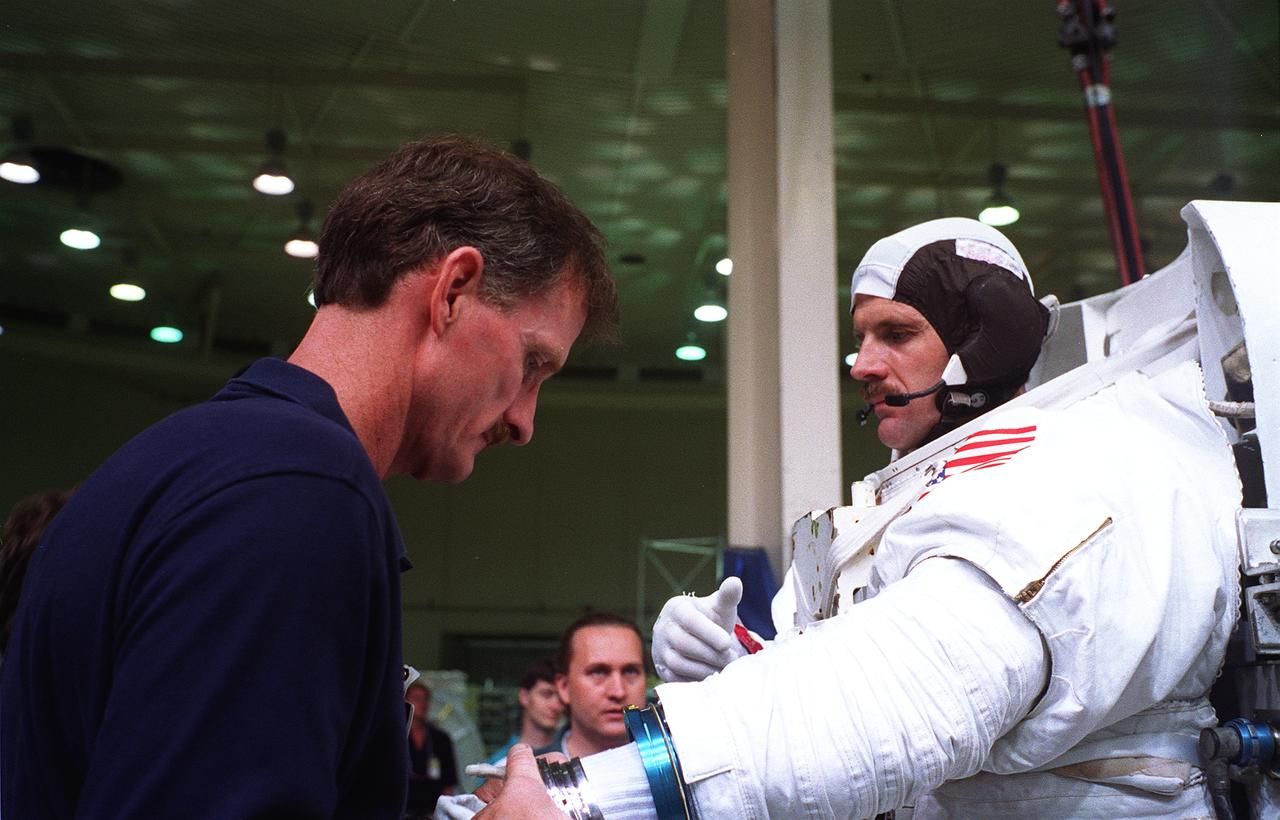
S96-11807 (10 June 1996) --- Astronaut Steven L. Smith (right), STS-82 mission specialist assigned to extravehicular activity (EVA) involved with the servicing of the Hubble Space Telescope (HST), gets help with the final touches of suit donning from crewmate Joseph R. Tanner.  Minutes later, Smith was underwater in a nearby tank and neutrally buoyant, rehearsing some of the HST servicing chores with a crewmate.
STS-82 training in WETF facility with Steve Smith and Mark Lee
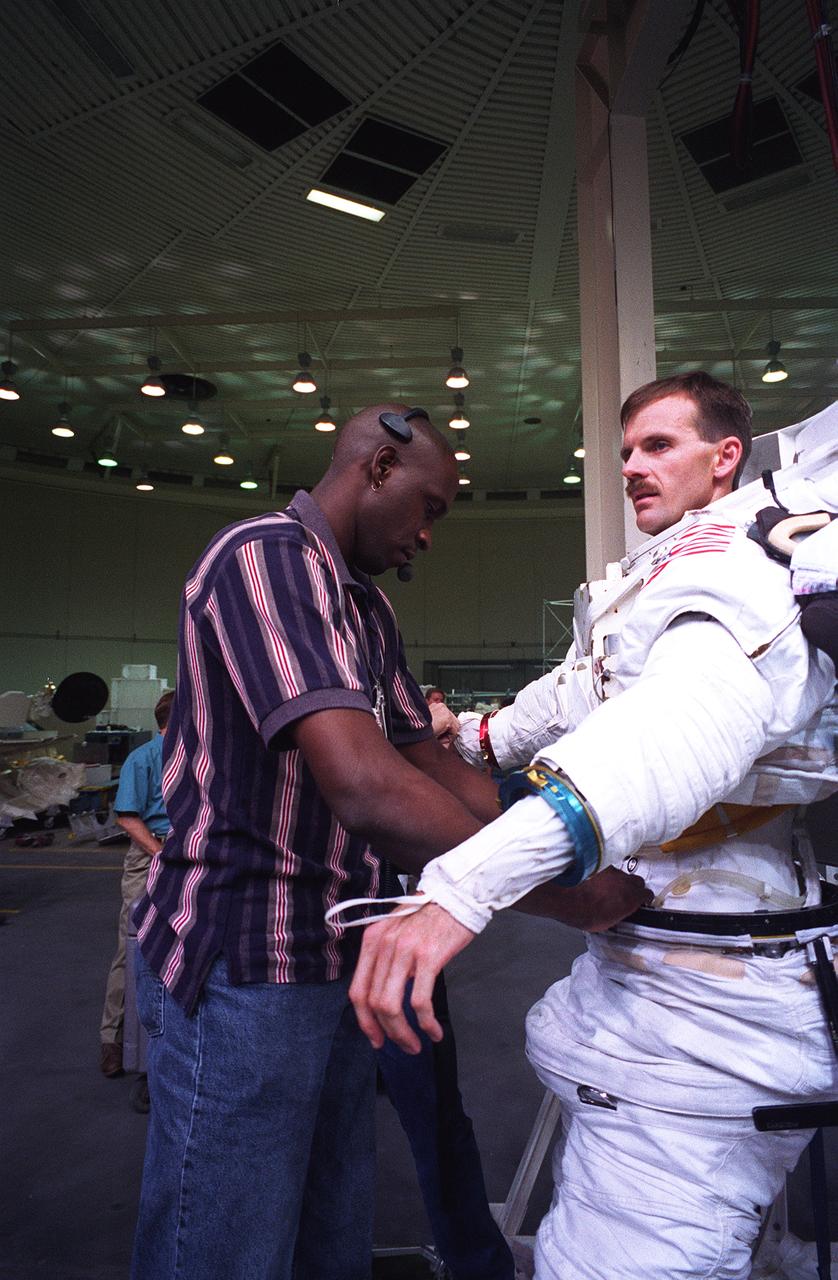
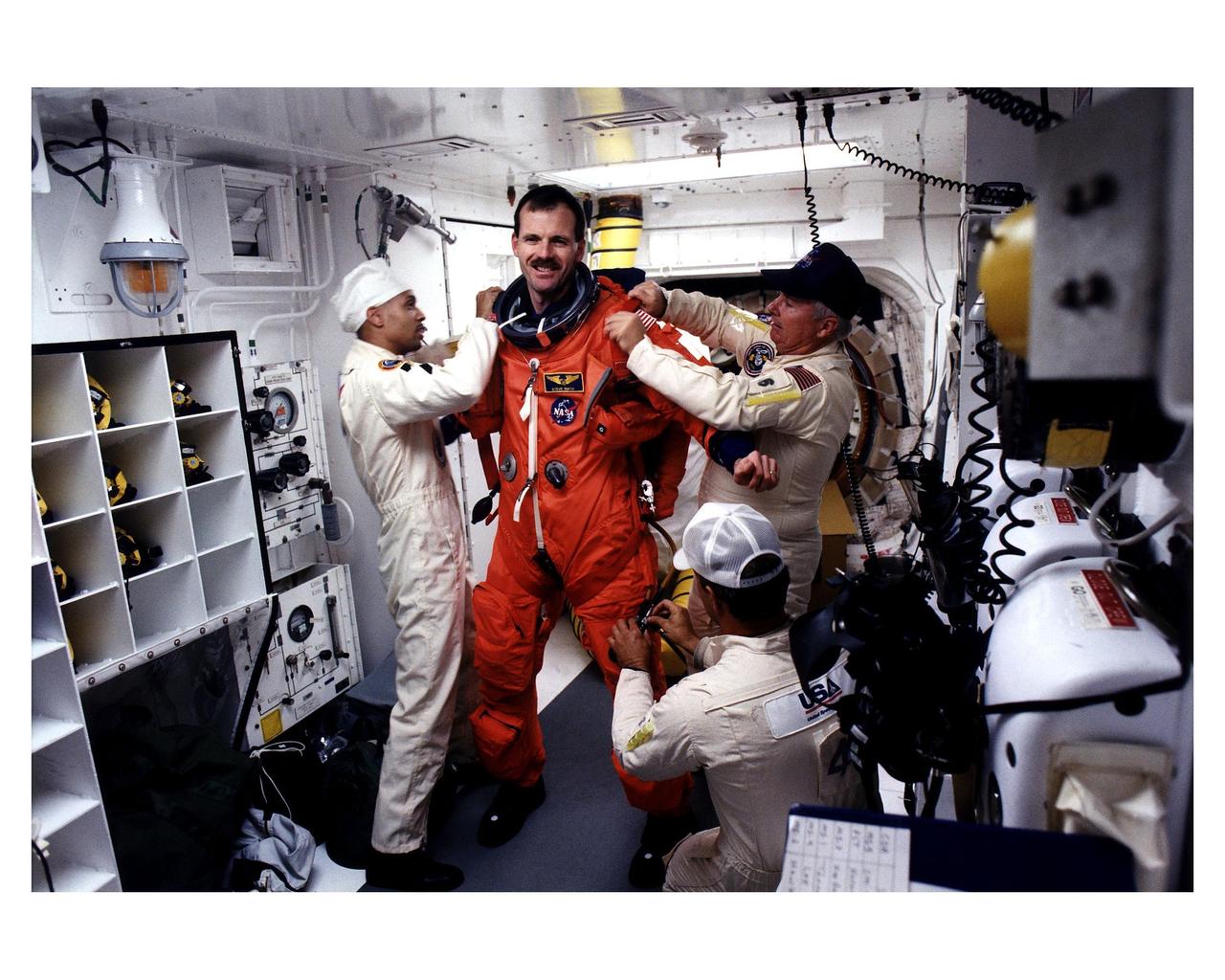
S96-11810 (10 June 1996) --- Astronaut Steven L. Smith, STS-82 mission specialist assigned to extravehicular activity (EVA) involved with the servicing of the Hubble Space Telescope (HST), gets help with the final touches of suit donning from John Williams, an Extravehicular Mobility Unit (EMU) technician.  Minutes later, Smith was underwater in a nearby tank and neutrally buoyant, rehearsing some of the HST servicing chores with a crewmate.
STS-82 training in WETF facility with Steve Smith and Mark Lee
S96-11799 (10 June 1996) --- Astronaut Mark C. Lee, STS-82 payload commander training for extravehicular activity (EVA) involved with the servicing of the Hubble Space Telescope (HST), prepares to enter a water tank at the Johnson Space Center (JSC).  Moments later, Lee was neutrally buoyant, rehearsing some of the HST servicing chores with a crewmate.
STS-82 training in WETF facility with Steve Smith and Mark Lee
S96-11801 (10 June 1996) --- Astronaut Mark C. Lee, STS-82 payload commander assigned to extravehicular activity (EVA) involved with the servicing of the Hubble Space Telescope (HST), checks his communications system prior to being submerged in a water tank at the Johnson Space Center (JSC).  Moments later, Lee was neutrally buoyant, rehearsing some of the HST servicing chores with a crewmate.
STS-82 training in WETF facility with Steve Smith and Mark Lee
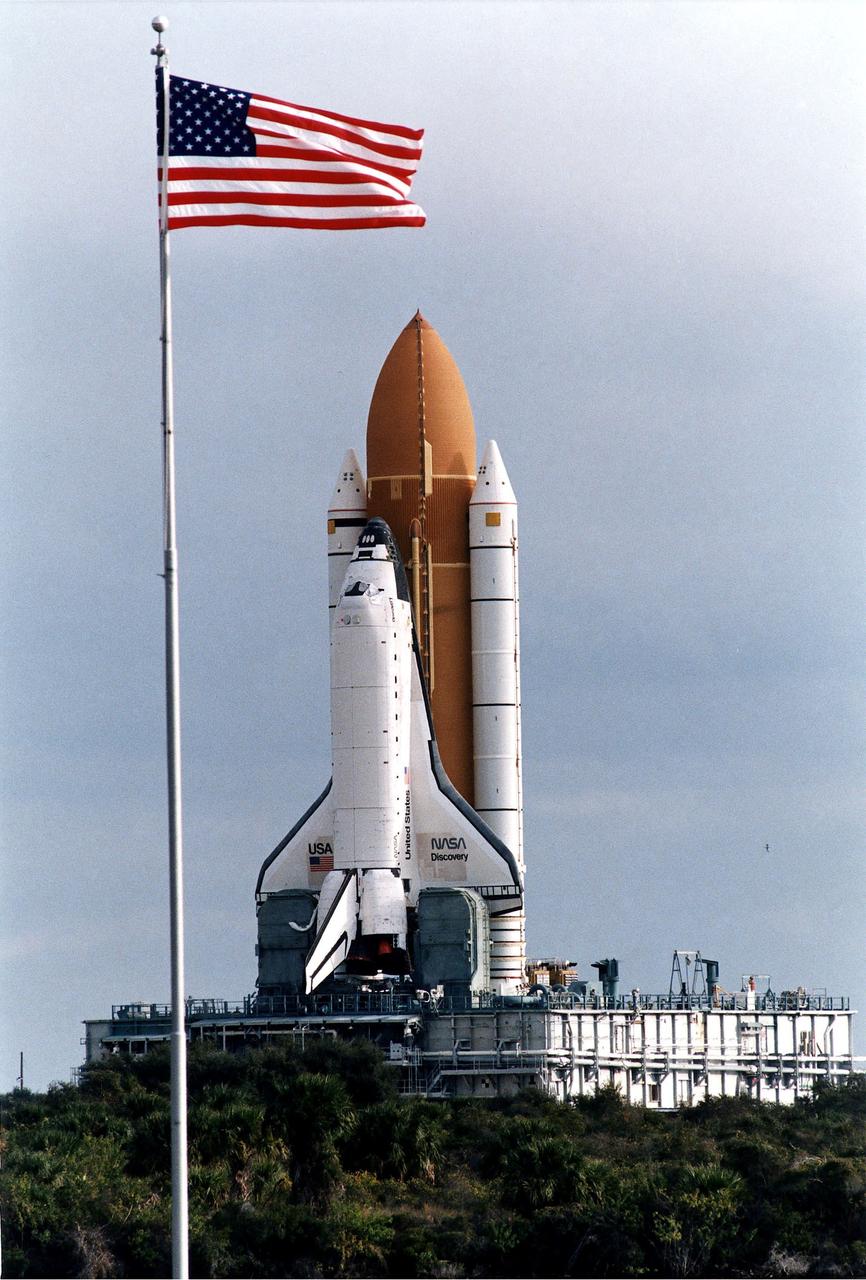
KENNEDY SPACE CENTER, FLA. -  The Space Shuttle Discovery on its Mobile Launcher Platform makes its slow 3.4-mile trek from the Vehicle Assembly Building to Launch Pad 39A in preparation for the STS-82 mission.  In the foreground is the U.S. flag at the Press Site area.  A seven-member crew will perform the second servicing of the orbiting Hubble Space Telescope (HST) during the 10-day STS-82 mission, which is targeted for a Feb. 11 liftoff.
KENNEDY SPACE CENTER, FLA. - The Space Shuttle Discovery on its Mobile Launcher Platform makes its slow 3.4-mile trek from the Vehicle Assembly Building to Launch Pad 39A in preparation for the STS-82 mission. In the foreground is the U.S. flag at the Press Site area. A seven-member crew will perform the second servicing of the orbiting Hubble Space Telescope (HST) during the 10-day STS-82 mission, which is targeted for a Feb. 11 liftoff.
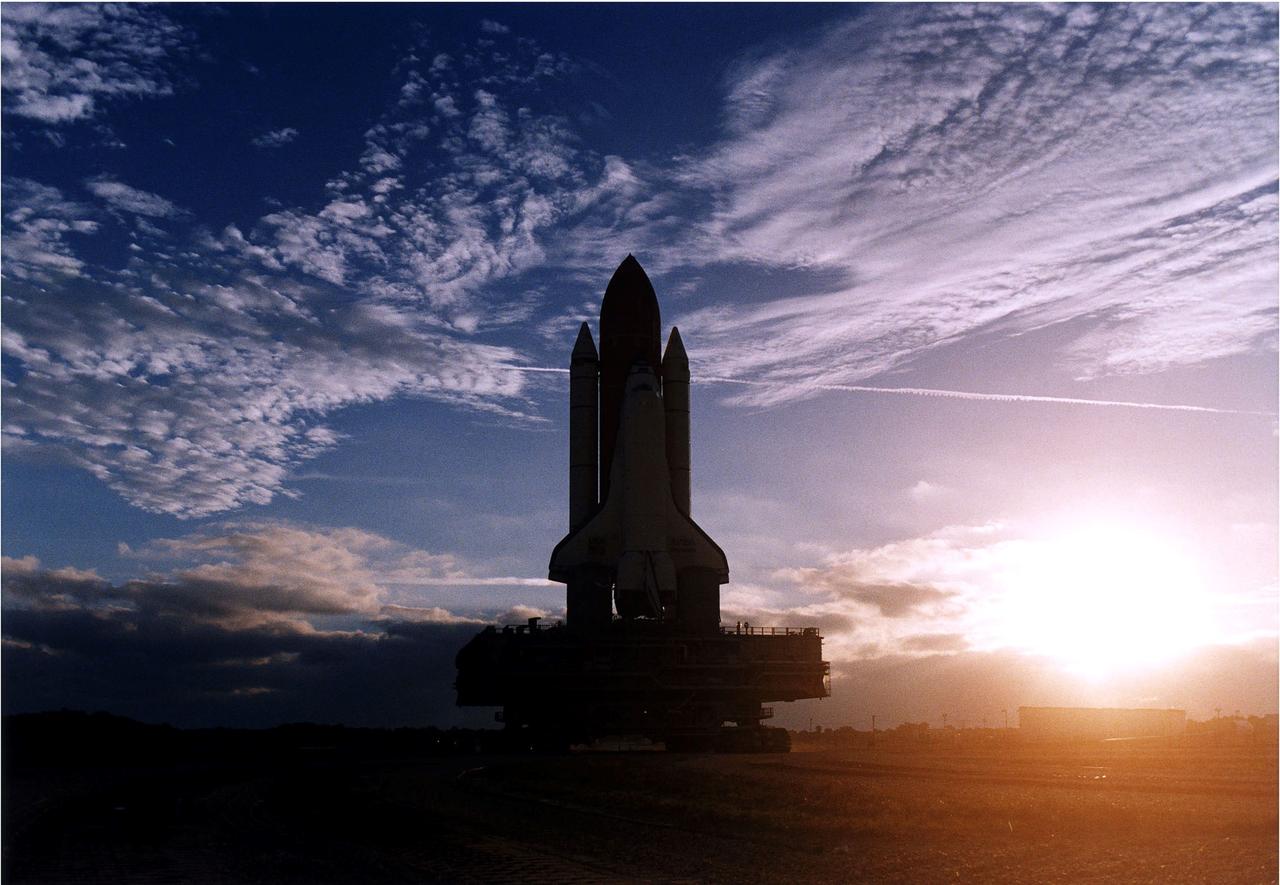
KENNEDY SPACE CENTER, FLA. -  The rising sun and some scattered clouds provide a picturesque backdrop for the Space Shuttle Discovery as it travels along the crawlerway toward Launch Pad 39A in preparation for the STS-82 mission.  The Shuttle is on a Mobile Launcher Platform, and the entire assemblage is being carried by a large, tracked vehicle called the crawler transporter.  A seven-member crew will perform the second servicing of the orbiting Hubble Space Telescope (HST) during the 10-day STS-82 flight, whcih is targeted for a Feb. 11 liftoff.
KENNEDY SPACE CENTER, FLA. - The rising sun and some scattered clouds provide a picturesque backdrop for the Space Shuttle Discovery as it travels along the crawlerway toward Launch Pad 39A in preparation for the STS-82 mission. The Shuttle is on a Mobile Launcher Platform, and the entire assemblage is being carried by a large, tracked vehicle called the crawler transporter. A seven-member crew will perform the second servicing of the orbiting Hubble Space Telescope (HST) during the 10-day STS-82 flight, whcih is targeted for a Feb. 11 liftoff.
KENNEDY SPACE CENTER, FLA. -  The Space Shuttle Discovery on its Mobile Launcher Platform slowly moves through the high bay doors of the Vehicle Assembly Building en route to Launch Pad 39A, where Discovery is scheduled to lift off on the STS-82 mission on Feb. 11.  A seven-member crew will perform the second servicing of the orbiting Hubble Space Telescope (HST) during the 10-day STS-82 mission.
KENNEDY SPACE CENTER, FLA. - The Space Shuttle Discovery on its Mobile Launcher Platform slowly moves through the high bay doors of the Vehicle Assembly Building en route to Launch Pad 39A, where Discovery is scheduled to lift off on the STS-82 mission on Feb. 11. A seven-member crew will perform the second servicing of the orbiting Hubble Space Telescope (HST) during the 10-day STS-82 mission.
KENNEDY SPACE CENTER, FLA. -  STS-82 Mission Specialist Gregory J. Harbaugh, at top, inspects part of the Flight Support System during the Crew Equipment Integration Test (CEIT) at KSC's Vertical Processing Facility.  Harbaugh and the other six STS-82 crew members will conduct the second Hubble Space Telescope (HST) servicing mission aboard the Space Shuttle Discovery.  Harbaugh will be one of four spacewalkers.  Liftoff aboard Discovery is scheduled Feb. 11.
KENNEDY SPACE CENTER, FLA. - STS-82 Mission Specialist Gregory J. Harbaugh, at top, inspects part of the Flight Support System during the Crew Equipment Integration Test (CEIT) at KSC's Vertical Processing Facility. Harbaugh and the other six STS-82 crew members will conduct the second Hubble Space Telescope (HST) servicing mission aboard the Space Shuttle Discovery. Harbaugh will be one of four spacewalkers. Liftoff aboard Discovery is scheduled Feb. 11.
KENNEDY SPACE CENTER, FLA. -  STS-82 crew members and workers at KSC's Vertical Processing Facility look at hardware in the Multipurpose ORU (Orbital Replacement Unit) Protective Enclsoure, also called MOPE.  The crew is participating in the Crew Equipment Integration Test (CEIT).    Liftoff of STS-82, the second Hubble Space Telescope (HST) servicing mission, is scheduled Feb. 11 aboard Discovery with a crew of seven.
KENNEDY SPACE CENTER, FLA. - STS-82 crew members and workers at KSC's Vertical Processing Facility look at hardware in the Multipurpose ORU (Orbital Replacement Unit) Protective Enclsoure, also called MOPE. The crew is participating in the Crew Equipment Integration Test (CEIT). Liftoff of STS-82, the second Hubble Space Telescope (HST) servicing mission, is scheduled Feb. 11 aboard Discovery with a crew of seven.
KENNEDY SPACE CENTER, FLA. -  STS-82 crew members examine part of the Flight Support System during the Crew Equipment Integration Test (CEIT) in KSC's Vertical Processing Facility.  From left are Mission Specialists Steven L. Smith and Gregory J. Harbaugh and Payload Commander Mark C. Lee.  Liftoff of STS-82, the second Hubble Space Telescope (HST) servicing mission, is scheduled Feb. 11 aboard Discovery with a crew of seven.
KENNEDY SPACE CENTER, FLA. - STS-82 crew members examine part of the Flight Support System during the Crew Equipment Integration Test (CEIT) in KSC's Vertical Processing Facility. From left are Mission Specialists Steven L. Smith and Gregory J. Harbaugh and Payload Commander Mark C. Lee. Liftoff of STS-82, the second Hubble Space Telescope (HST) servicing mission, is scheduled Feb. 11 aboard Discovery with a crew of seven.
KENNEDY SPACE CENTER, FLA. -   At the KSC Launch Pad 39A, two members of the payload closeout crew check equipment as the doors are just about ready to be closed.  The Payload inside the bay of Discovery, the orbiter for the STS-82 mission, is ready for the launch of the second Hubble Space Telescope service mission.  The payload consists of the Near Infrared Camera and Multi-Object Spectrometer (NICMOS) that will be installed, Fine Guidance Sensor #1 (FGS-1), and the Space Telescope Imaging Spectrograph (STIS) to be installed. The STS-82 will launch with a crew of seven at 3:54 a.m. EST, Feb. 11, 1997. The launch window is 65 minutes in duration. The Mission Commander for STS-82 is Ken Bowersox. The purpose of the mission is to upgrade the scientific capabilities, service or replace aging components on the Telescope and provide a reboost to the optimum altitude.
KENNEDY SPACE CENTER, FLA. - At the KSC Launch Pad 39A, two members of the payload closeout crew check equipment as the doors are just about ready to be closed. The Payload inside the bay of Discovery, the orbiter for the STS-82 mission, is ready for the launch of the second Hubble Space Telescope service mission. The payload consists of the Near Infrared Camera and Multi-Object Spectrometer (NICMOS) that will be installed, Fine Guidance Sensor #1 (FGS-1), and the Space Telescope Imaging Spectrograph (STIS) to be installed. The STS-82 will launch with a crew of seven at 3:54 a.m. EST, Feb. 11, 1997. The launch window is 65 minutes in duration. The Mission Commander for STS-82 is Ken Bowersox. The purpose of the mission is to upgrade the scientific capabilities, service or replace aging components on the Telescope and provide a reboost to the optimum altitude.
KENNEDY SPACE CENTER, FLA. -  STS-82 crew members and workers at KSC's Vertical Processing Facility get a final look at the Near Infrared Camera and Multi-Object Spectrometer (NICMOS) in its flight configuration for the STS-82 mission.  The crew is participating in the Crew Equipment Integration Test (CEIT).  NICMOS is one of two new scientific instruments that will replace two outdated instruments on the Hubble Space Telescope (HST).  NICMOS will provide HST with the capability for infrared imaging and spectroscopic observations of astronomical targets.  The refrigerator-sized NICMOS also is HST's first cryogenic instrument - its sensitive infrared detectors must operate at very cold temperatures of minus 355 degrees Fahrenheit or 58 degrees Kelvin.  NICMOS will be installed in Hubble during STS-82, the second Hubble Space Telescope servicing mission.  Liftoff is scheduled Feb. 11 aboard Discovery with a crew of seven.
KENNEDY SPACE CENTER, FLA. - STS-82 crew members and workers at KSC's Vertical Processing Facility get a final look at the Near Infrared Camera and Multi-Object Spectrometer (NICMOS) in its flight configuration for the STS-82 mission. The crew is participating in the Crew Equipment Integration Test (CEIT). NICMOS is one of two new scientific instruments that will replace two outdated instruments on the Hubble Space Telescope (HST). NICMOS will provide HST with the capability for infrared imaging and spectroscopic observations of astronomical targets. The refrigerator-sized NICMOS also is HST's first cryogenic instrument - its sensitive infrared detectors must operate at very cold temperatures of minus 355 degrees Fahrenheit or 58 degrees Kelvin. NICMOS will be installed in Hubble during STS-82, the second Hubble Space Telescope servicing mission. Liftoff is scheduled Feb. 11 aboard Discovery with a crew of seven.
KENNEDY SPACE CENTER, FLA. -  The Rotating Service Structure has been retracted at KSC's Launch Pad 39A.   Discovery, the orbiter for the STS-82 mission, is ready for the launch of the second Hubble Space Telescope service mission.  The payload consists of the Near Infrared Camera and Multi-Object Spectrometer (NICMOS) that will be installed, Fine Guidance Sensor #1 (FGS-1), and the Space Telescope Imaging Spectrograph (STIS) to be installed. The STS-82 will launch with a crew of seven at 3:54 a.m. EST, Feb. 11, 1997. The launch window is 65 minutes in duration. The Mission Commander for STS-82 is Ken Bowersox. The purpose of the mission is to upgrade the scientific capabilities, service or replace aging components on the Telescope, and provide a reboost to the optimum altitude.
KENNEDY SPACE CENTER, FLA. - The Rotating Service Structure has been retracted at KSC's Launch Pad 39A. Discovery, the orbiter for the STS-82 mission, is ready for the launch of the second Hubble Space Telescope service mission. The payload consists of the Near Infrared Camera and Multi-Object Spectrometer (NICMOS) that will be installed, Fine Guidance Sensor #1 (FGS-1), and the Space Telescope Imaging Spectrograph (STIS) to be installed. The STS-82 will launch with a crew of seven at 3:54 a.m. EST, Feb. 11, 1997. The launch window is 65 minutes in duration. The Mission Commander for STS-82 is Ken Bowersox. The purpose of the mission is to upgrade the scientific capabilities, service or replace aging components on the Telescope, and provide a reboost to the optimum altitude.
KENNEDY SPACE CENTER, FLA. -  The White Room is seen at the upper left where the astronauts enter the Space Shuttle for flight.  The Rotating Service Structure has been retracted at KSC's Launch Pad 39A.   Discovery, the orbiter for the STS-82 mission, is ready for the launch of the second Hubble Space Telescope service mission.  The payload consists of the Near Infrared Camera and Multi-Object Spectrometer (NICMOS) that will be installed, Fine Guidance Sensor #1 (FGS-1), and the Space Telescope Imaging Spectrograph (STIS) to be installed. The STS-82 will launch with a crew of seven at 3:54 a.m. EST, Feb. 11, 1997. The launch window is 65 minutes in duration. The Mission Commander for STS-82 is Ken Bowersox. The purpose of the mission is to upgrade the scientific capabilities, service or replace aging components on the Telescope, and provide a reboost to the optimum altitude.
KENNEDY SPACE CENTER, FLA. - The White Room is seen at the upper left where the astronauts enter the Space Shuttle for flight. The Rotating Service Structure has been retracted at KSC's Launch Pad 39A. Discovery, the orbiter for the STS-82 mission, is ready for the launch of the second Hubble Space Telescope service mission. The payload consists of the Near Infrared Camera and Multi-Object Spectrometer (NICMOS) that will be installed, Fine Guidance Sensor #1 (FGS-1), and the Space Telescope Imaging Spectrograph (STIS) to be installed. The STS-82 will launch with a crew of seven at 3:54 a.m. EST, Feb. 11, 1997. The launch window is 65 minutes in duration. The Mission Commander for STS-82 is Ken Bowersox. The purpose of the mission is to upgrade the scientific capabilities, service or replace aging components on the Telescope, and provide a reboost to the optimum altitude.
KENNEDY SPACE CENTER, FLA. -   The Payload is seen inside of the Bay just before the doors are closed for flight at Pad 39A, Kennedy Space Center, Fla.  Discovery, the orbiter for STS-82 mission, is ready for the launch of the second Hubble Space Telescope service mission.  The payload consists of the Near Infrared Camera and Multi-Object Spectrometer (NICMOS) that will be installed, Fine Guidance Sensor #1 (FGS-1), and the Space Telescope Imaging Spectrograph (STIS) to be installed.  The STS-82 will launch with a crew of seven at 3:54 a.m. EST, Feb. 11, 1997.  The launch window is 65 minutes in duration.  The Mission Commander for STS-82 is Ken Bowersox.  The purpose of the mission is to upgrade the scientific capabilities, service or replace aging components on the Telescope, and provide a reboost to the optimum altitude.
KENNEDY SPACE CENTER, FLA. - The Payload is seen inside of the Bay just before the doors are closed for flight at Pad 39A, Kennedy Space Center, Fla. Discovery, the orbiter for STS-82 mission, is ready for the launch of the second Hubble Space Telescope service mission. The payload consists of the Near Infrared Camera and Multi-Object Spectrometer (NICMOS) that will be installed, Fine Guidance Sensor #1 (FGS-1), and the Space Telescope Imaging Spectrograph (STIS) to be installed. The STS-82 will launch with a crew of seven at 3:54 a.m. EST, Feb. 11, 1997. The launch window is 65 minutes in duration. The Mission Commander for STS-82 is Ken Bowersox. The purpose of the mission is to upgrade the scientific capabilities, service or replace aging components on the Telescope, and provide a reboost to the optimum altitude.
KENNEDY SPACE CENTER, FLA. -  The Payload is seen inside of the Bay just before the doors are closed for flight at KSC's Launch Pad 39A.   Discovery, the orbiter for the STS-82 mission, is ready for the launch of the second Hubble Space Telescope service mission.  The payload consists of the Near Infrared Camera and Multi-Object Spectrometer (NICMOS) that will be installed, Fine Guidance Sensor #1 (FGS-1), and the Space Telescope Imaging Spectrograph (STIS) to be installed. The STS-82 will launch with a crew of seven at 3:54 a.m. EST, Feb. 11, 1997. The launch window is 65 minutes in duration. The Mission Commander for STS-82 is Ken Bowersox. The purpose of the mission is to upgrade the scientific capabilities, service or replace aging components on the Telescope, and provide a reboost to the optimum altitude.
KENNEDY SPACE CENTER, FLA. - The Payload is seen inside of the Bay just before the doors are closed for flight at KSC's Launch Pad 39A. Discovery, the orbiter for the STS-82 mission, is ready for the launch of the second Hubble Space Telescope service mission. The payload consists of the Near Infrared Camera and Multi-Object Spectrometer (NICMOS) that will be installed, Fine Guidance Sensor #1 (FGS-1), and the Space Telescope Imaging Spectrograph (STIS) to be installed. The STS-82 will launch with a crew of seven at 3:54 a.m. EST, Feb. 11, 1997. The launch window is 65 minutes in duration. The Mission Commander for STS-82 is Ken Bowersox. The purpose of the mission is to upgrade the scientific capabilities, service or replace aging components on the Telescope, and provide a reboost to the optimum altitude.
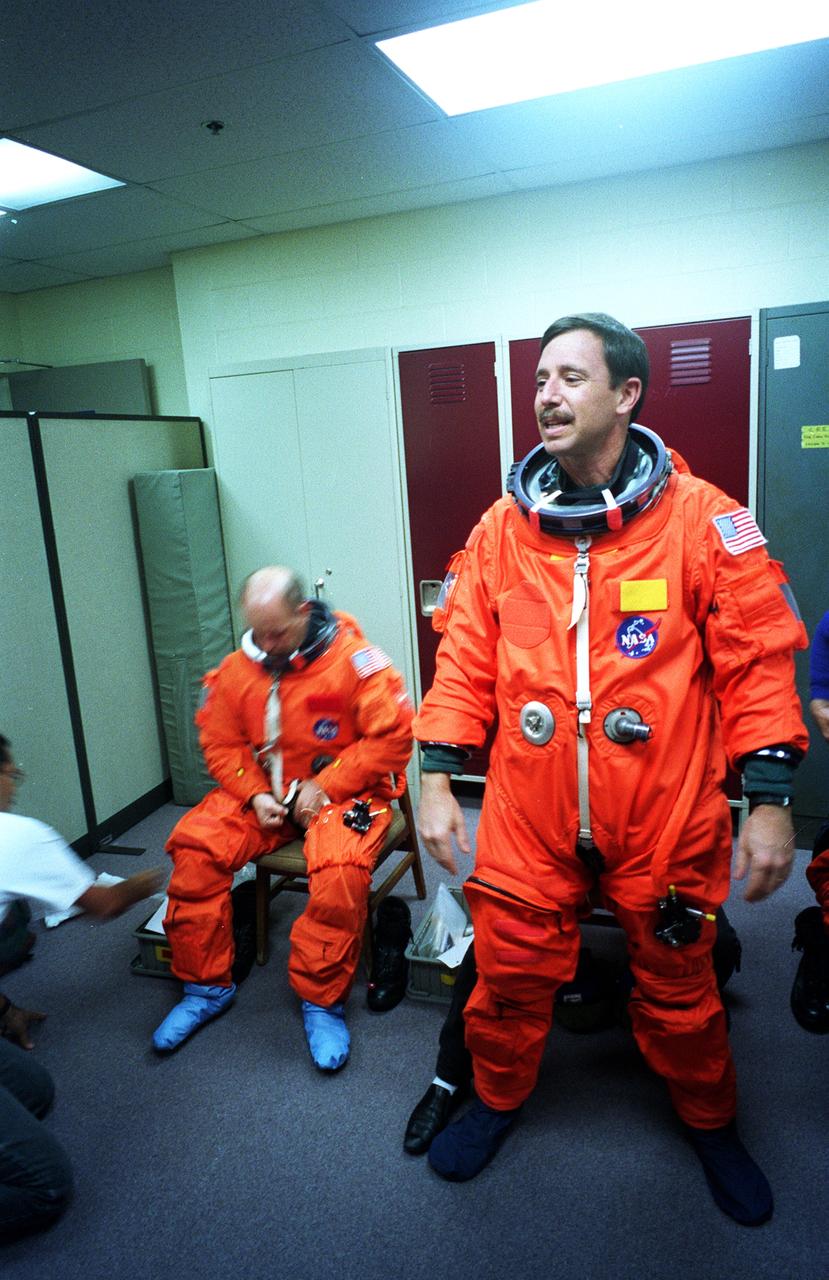
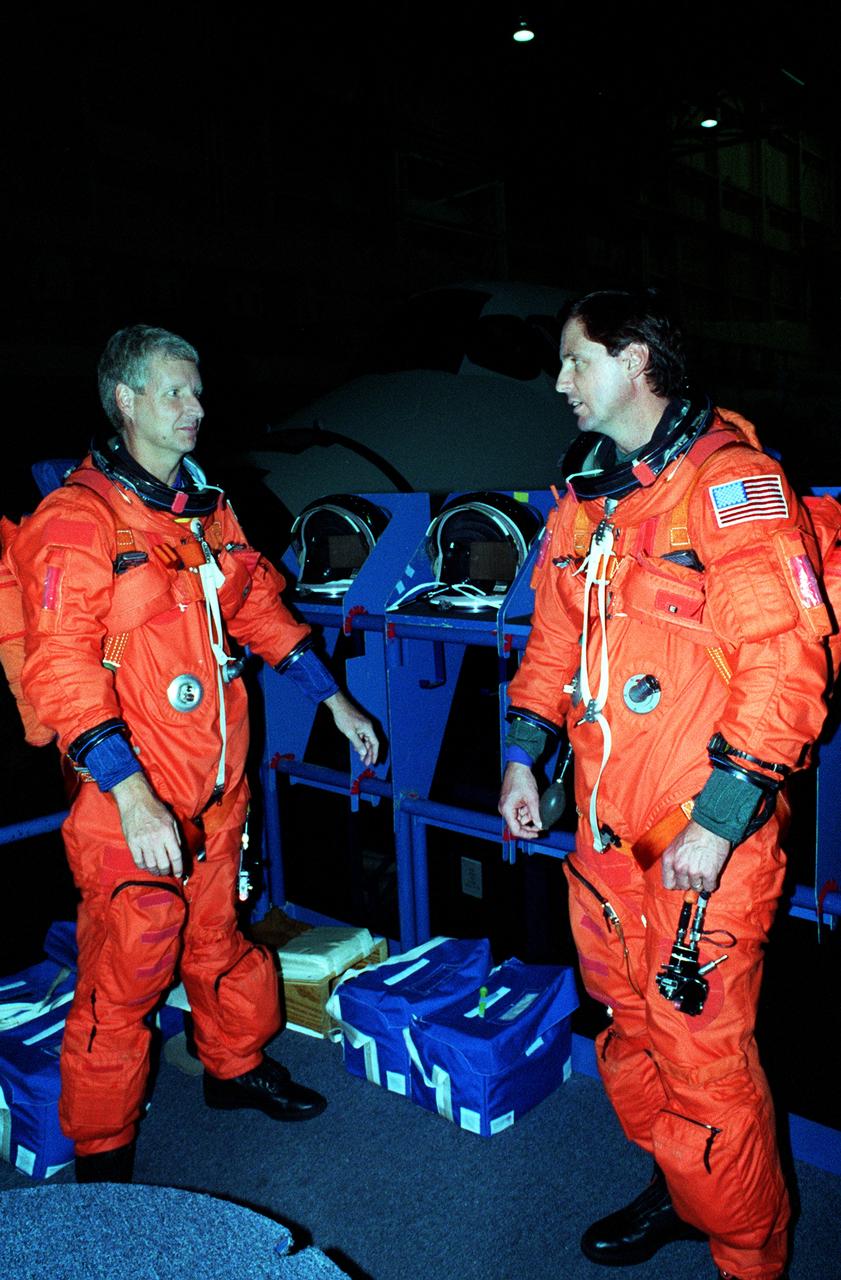
S96-18547 (30 Oct. 1996) --- Astronaut Kenneth D. Bowersox, STS-82 mission commander, chats with a crewmate (out of frame) prior to an emergency bailout training session in JSC's systems integration facility.  Wearing training versions of the partial pressure launch and entry escape suit, Bowersox and his crew simulated an emergency ejection, using the escape pole system on the middeck.
STS-82 Suit-up for Post Insertion Training in Crew Compartment Trainer 2
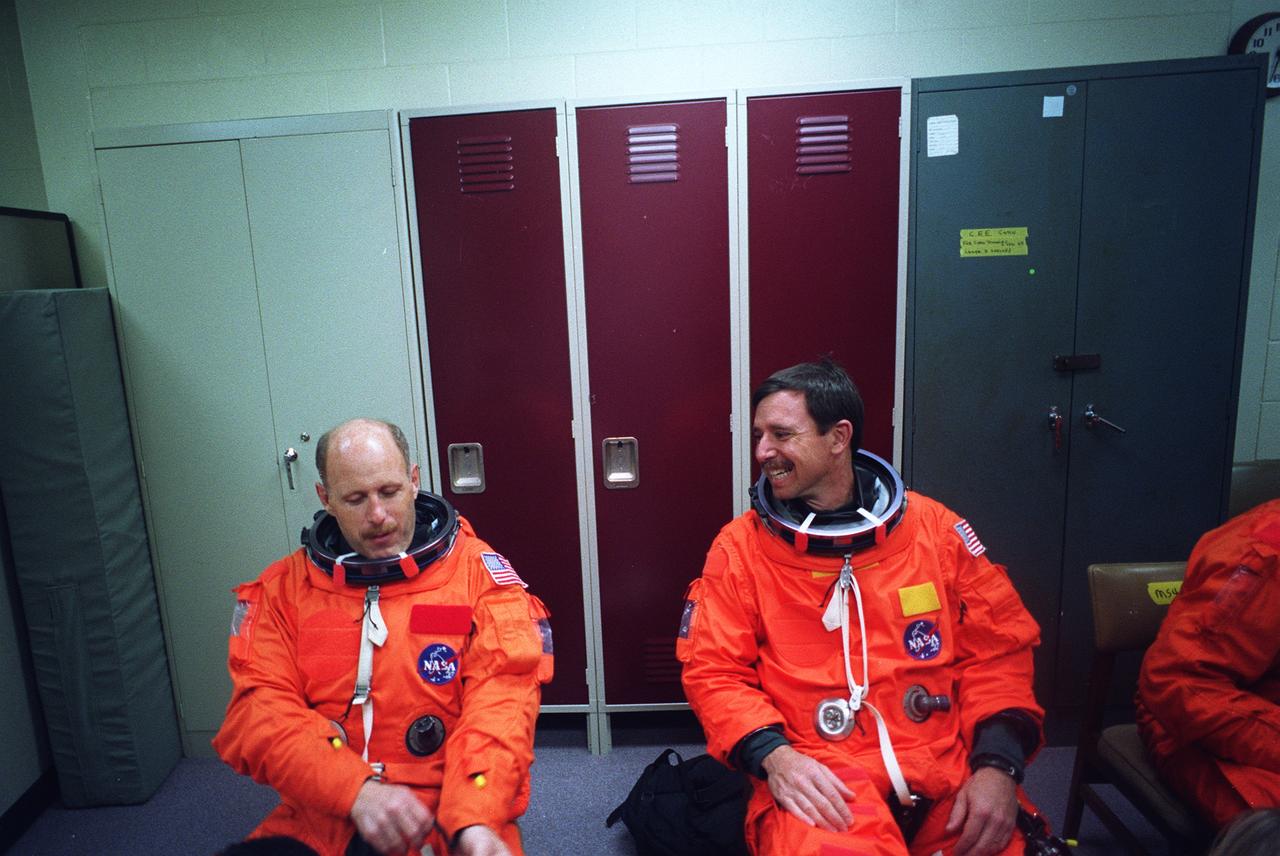
S96-18552 (30 Oct. 1996) --- Astronaut Kenneth D. Bowersox (left), STS-82 mission commander, chats with astronaut Scott J. Horowitz prior to an emergency bailout training session in JSC's systems integration facility.  Wearing training versions of the partial pressure launch and entry escape suit, Bowersox and his crew simulated an emergency ejection, using the escape pole system on the mid deck, as well as other phases of their scheduled February mission.
STS-82 Suit-up for Post Insertion Training in Crew Compartment Trainer 2
S96-18557 (30 Oct. 1996) --- Astronauts Steven A. Hawley (left) and Gregory J. Harbaugh participate in a training session in JSC's systems integration facility.  Wearing training versions of the partial pressure launch and entry escape suit, the two STS-82 mission specialists and their crewmates simulated an emergency ejection, using an escape pole on the mid deck, as well as other phases of their scheduled February mission.
STS-82 Suit-up for Post Insertion Training in Crew Compartment Trainer 2
S96-18556 (30 Oct. 1996) --- Astronauts Scott J. Horowitz (standing) and Kenneth D. Bowersox wind up suit donning for a training session in JSC's systems integration facility.  Wearing training versions of the partial pressure launch and entry escape suit, the STS-82 pilot and mission commander joined their crewmates in simulating an emergency ejection, using an escape pole on the mid deck, as well as other phases of their scheduled February mission.
STS-82 Suit-up for Post Insertion Training in Crew Compartment Trainer 2
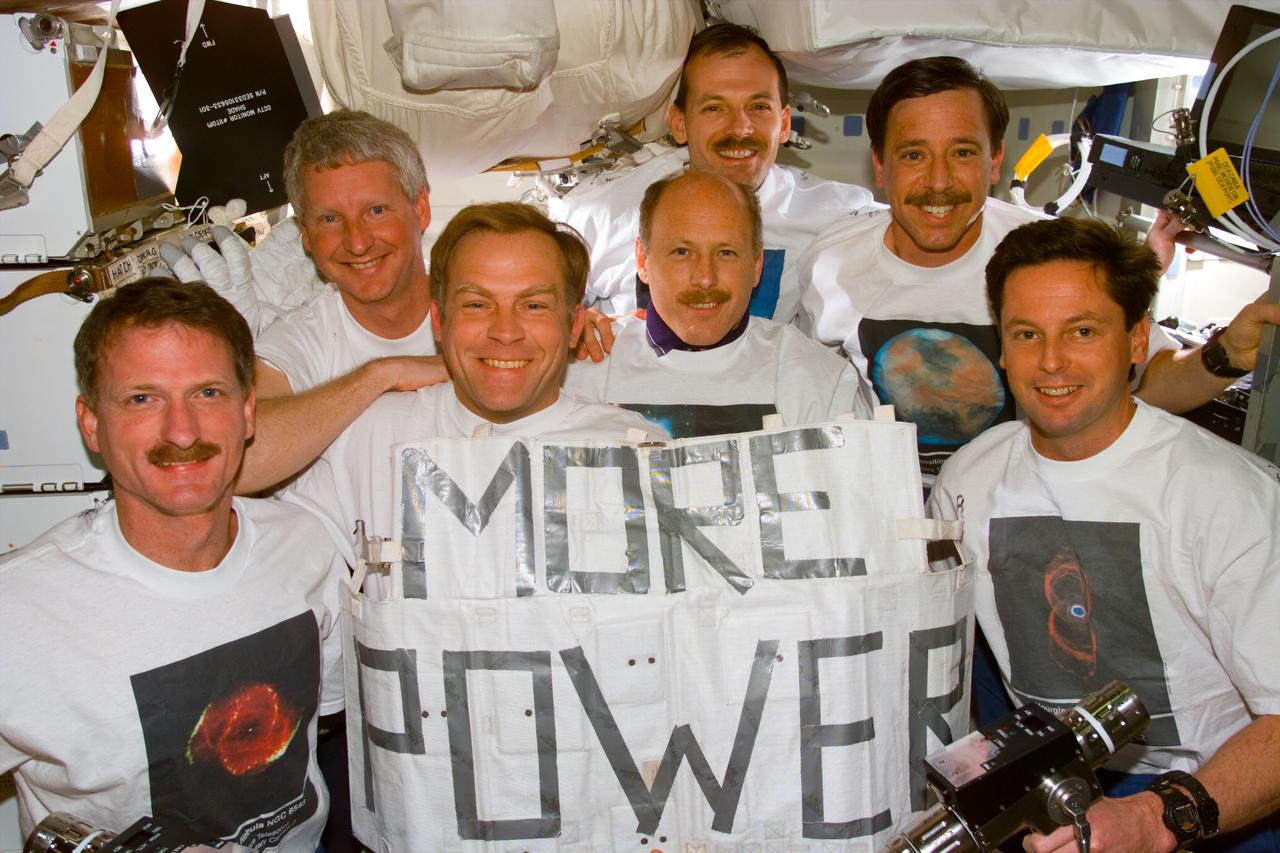
S82-E-5948 (11-21 Feb. 1997) --- The STS-82 crew poses for a traditional in-flight portrait following completion of five Extravehicular Activities (EVA) to service the Hubble Space Telescope (HST).  Both the sign held by the crew and the assortment of apparel pay tribute to the HST and its team of ground supporters.  In front, left to right, are astronauts Joseph R. Tanner, Mark C. Lee and Gregory J. Harbaugh.  Behind them, left to right, are astronauts Steven A. Hawley, Kenneth D. Bowersox and Scott J. Horowitz.  At the very back is astronaut Steven L. Smith.  Each astronaut is wearing a shirt bearing an image of a planet or other celestial body photographed originally by the giant observatory.
STS-82 crew portrait with "More Power" banner and Hubble shirts
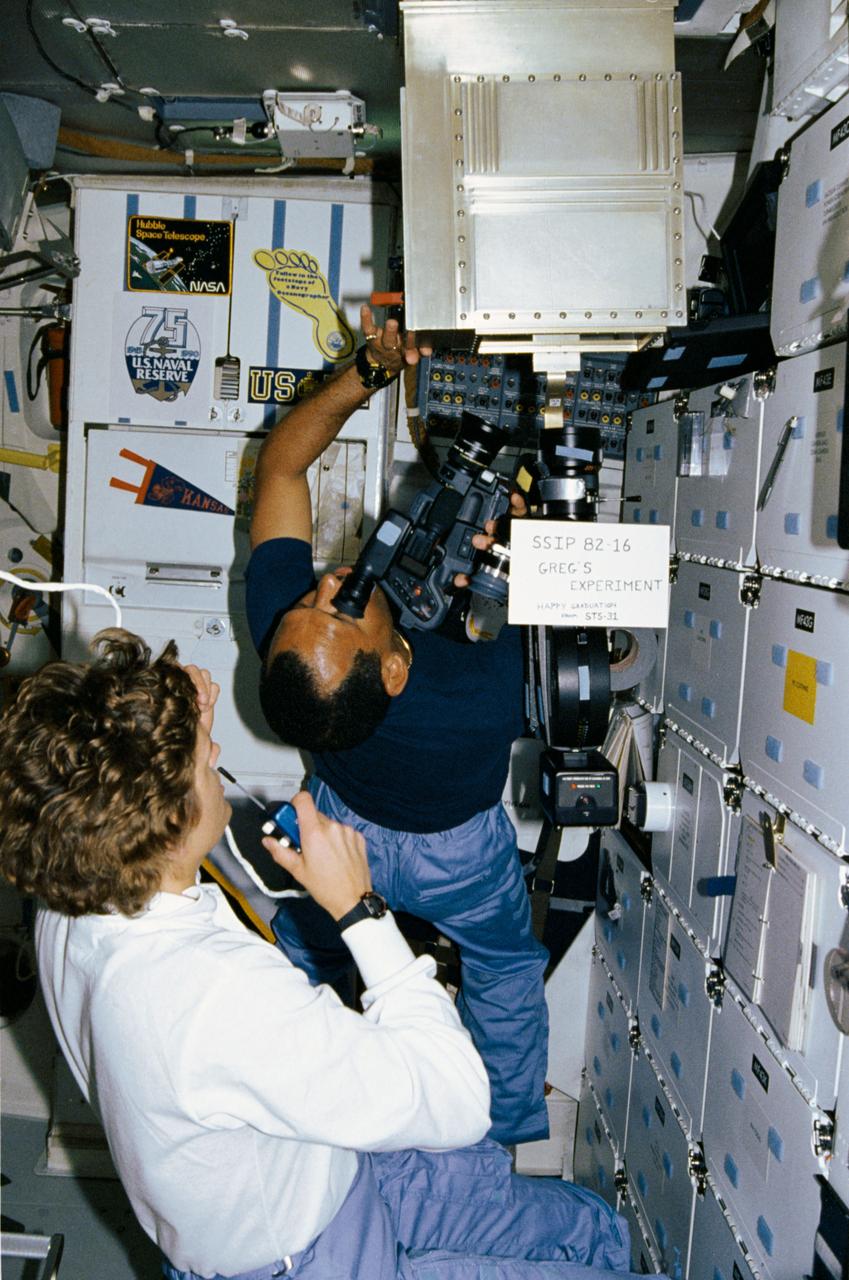
STS-31 Mission Specialist (MS) Kathryn D. Sullivan monitors and advises ground controllers of the activity inside the Student Experiment (SE) 82-16, Ion arc - studies of the effects of microgravity and a magnetic field on an electric arc, mounted in front of the middeck lockers aboard Discovery, Orbiter Vehicle (OV) 103. Pilot Charles F. Bolden uses a video camera and an ARRIFLEX motion picture camera to record the activity inside the special chamber. A sign in front of the experiment reads "SSIP 82-16 Greg's Experiment Happy Graduation from STS-31." SSIP stands for Shuttle Student Involvement Program. Gregory S. Peterson who developed the experiment (Greg's Experiment) is a student at Utah State University and monitored the experiment's operation from JSC's Mission Control Center (MCC) during the flight. Decals displayed in the background on the orbiter galley represent the Hubble Space Telescope (HST), the United States (U.S.) Naval Reserve, Navy Oceanographers, U.S. Navy, and University of Kansas.
STS-31 MS Sullivan & Pilot Bolden monitor SE 82-16 Ion Arc on OV-103 middeck
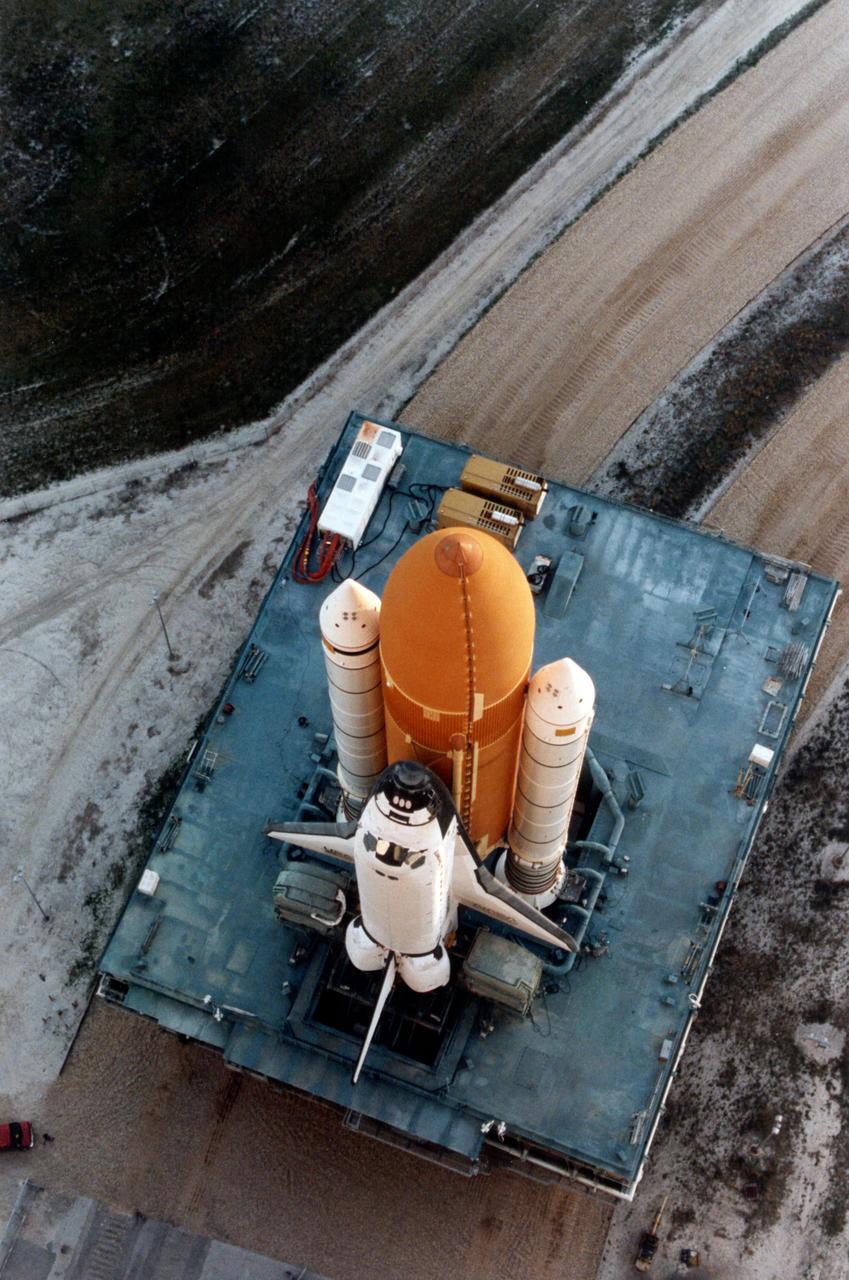
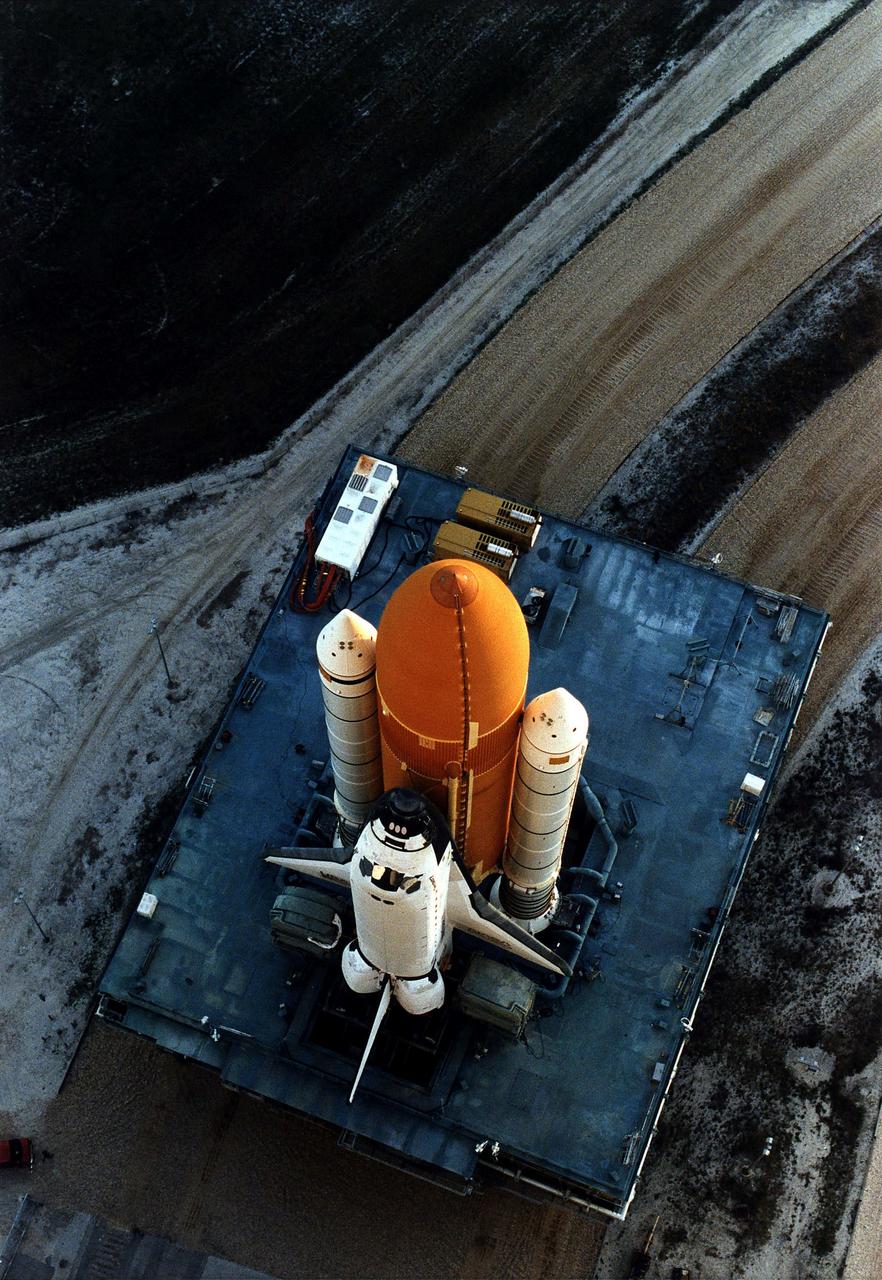
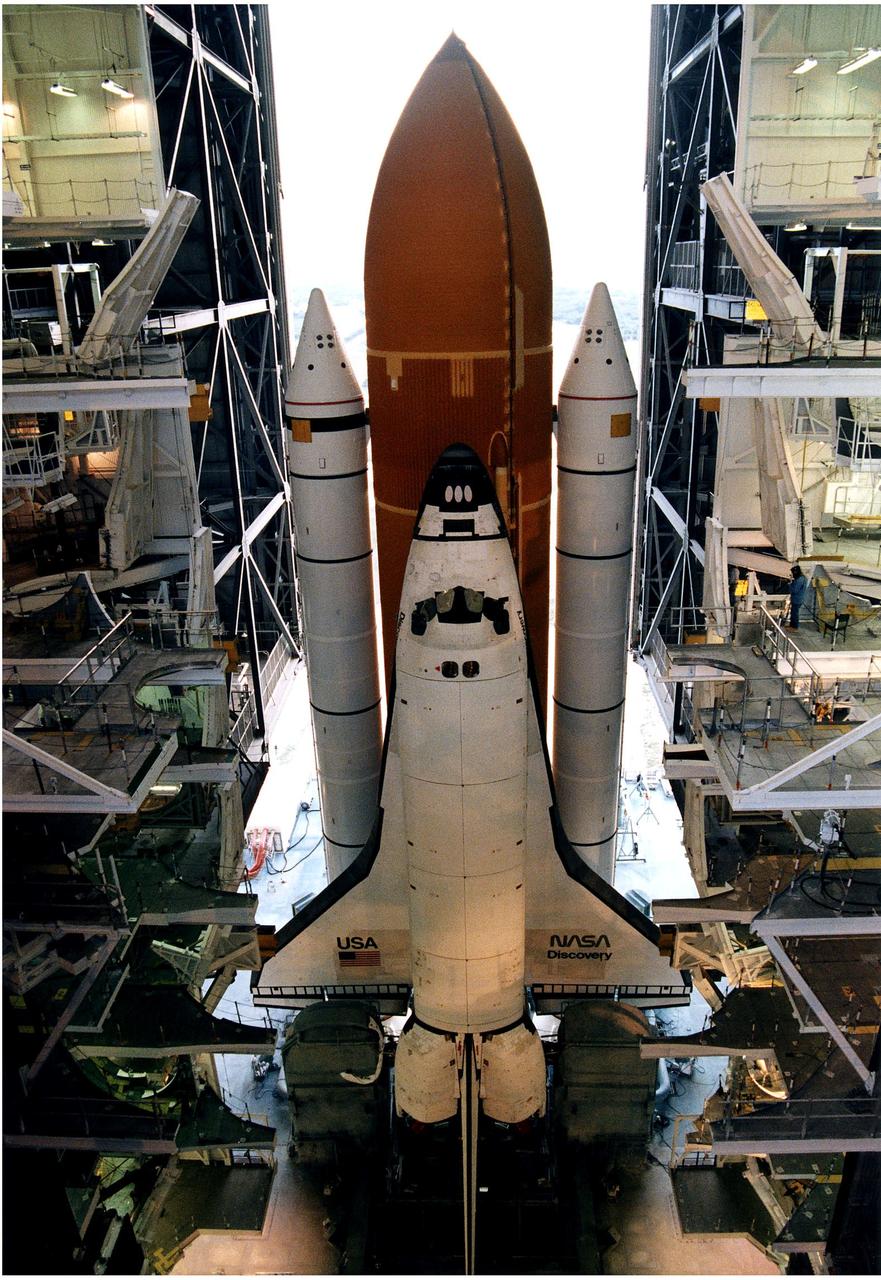
KENNEDY SPACE CENTER, FLA. -  After leaving the Vehicle Assembly Building, the Space Shuttle Discovery makes its slow - up to 1 mile per hour - trek along the crawlerway to Launch Pad 39A in preparation for the STS-82 mission.  The Shuttle is assembled on a Mobile Launcher Platform, seen in this view taken from above, and the entire assemblage is carried out to the launch pad on the crawler transporter, which is underneath the MLP.  A seven-member crew will perform the second servicing of the orbiting Hubble Space Telescope (HST) during the 10-day STS-82 mission, which is targeted for a Feb. 11 liftoff.
KENNEDY SPACE CENTER, FLA. - After leaving the Vehicle Assembly Building, the Space Shuttle Discovery makes its slow - up to 1 mile per hour - trek along the crawlerway to Launch Pad 39A in preparation for the STS-82 mission. The Shuttle is assembled on a Mobile Launcher Platform, seen in this view taken from above, and the entire assemblage is carried out to the launch pad on the crawler transporter, which is underneath the MLP. A seven-member crew will perform the second servicing of the orbiting Hubble Space Telescope (HST) during the 10-day STS-82 mission, which is targeted for a Feb. 11 liftoff.
KENNEDY SPACE CENTER, FLA. -   STS-82 Mission Specialist Steven A Hawley stands beside part of Discovery's Remote Manipulator System (RMS) arm, at right, which he will operate for the capture, berthing and redeployment of the Hubble Space Telescope (HST).  The robotic arm also will be used as work platform for the four spacewalkers.  Hawley is the prime RMS operator on the flight, which will be the second HST servicing mission.  He and the other six members of the crew are making a final inspection of the payload at Launch Pad 39A before launch. STS-82 is scheduled for liftoff on Feb. 11 during a 65-minute launch window that opens at 3:56 a.m. EST.
KENNEDY SPACE CENTER, FLA. - STS-82 Mission Specialist Steven A Hawley stands beside part of Discovery's Remote Manipulator System (RMS) arm, at right, which he will operate for the capture, berthing and redeployment of the Hubble Space Telescope (HST). The robotic arm also will be used as work platform for the four spacewalkers. Hawley is the prime RMS operator on the flight, which will be the second HST servicing mission. He and the other six members of the crew are making a final inspection of the payload at Launch Pad 39A before launch. STS-82 is scheduled for liftoff on Feb. 11 during a 65-minute launch window that opens at 3:56 a.m. EST.
STS-82 Terminal Countdown Demonstration Test (TCDT
KSC-97pc184
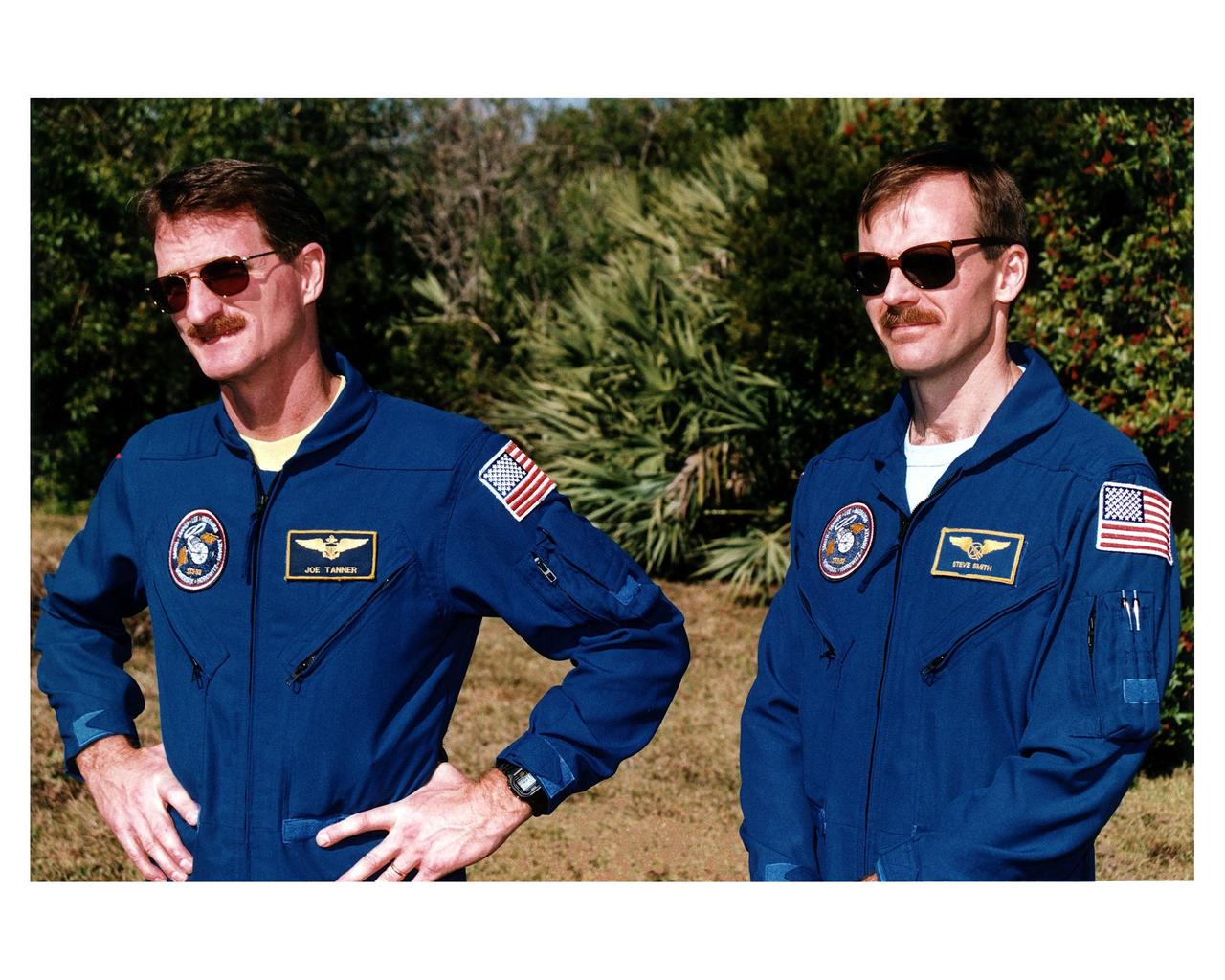
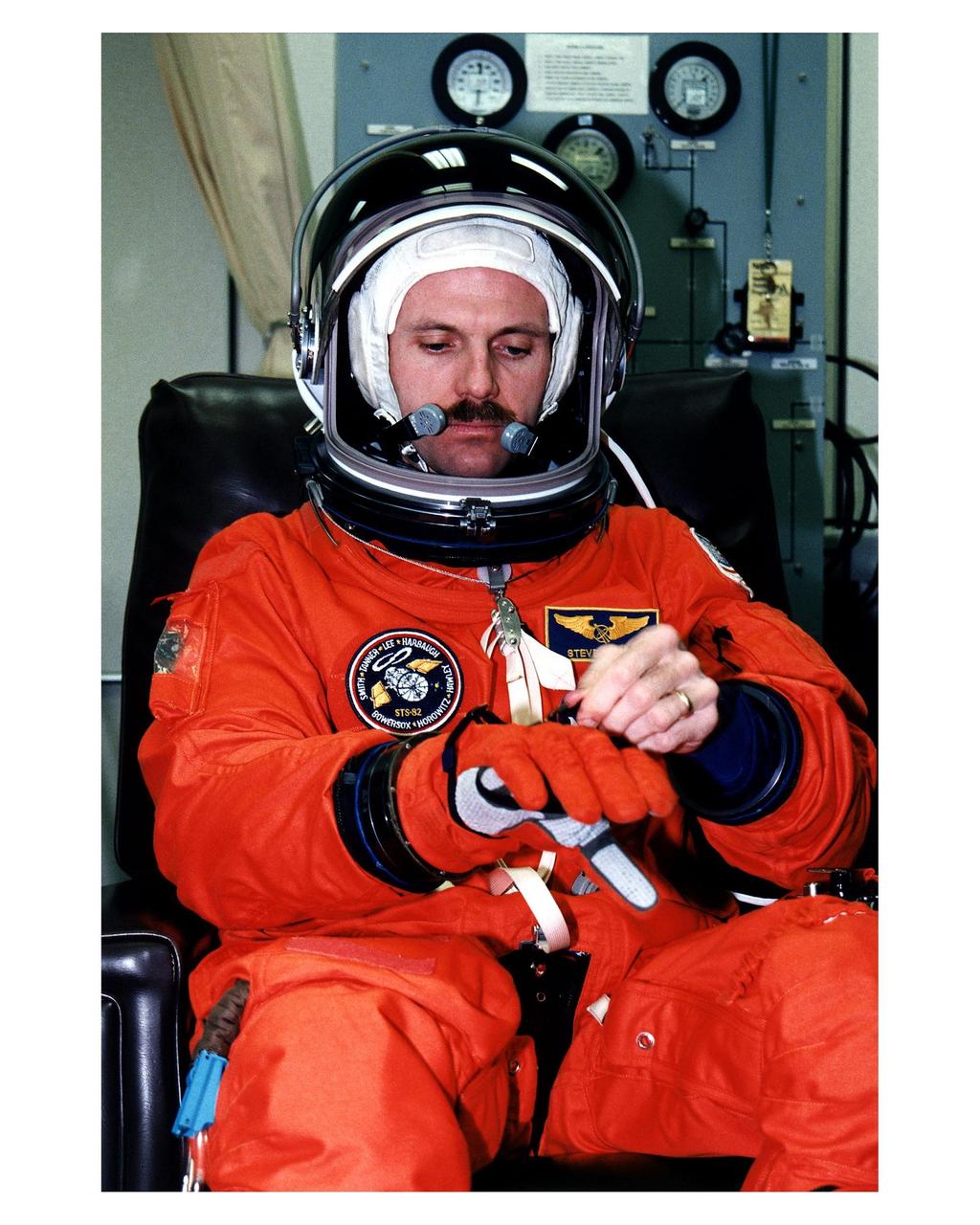
STS-82 Mission Specialist Steven L. Smith adjusts the glove of his launch and entry space suit during a practice countdown at KSC. Smith and the other six STS-82 crew members are at KSC to participate in the Terminal Countdown Demonstration Test (TCDT), a dress rehearsal for launch. STS-82 will be the second Hubble Space Telescope servicing mission. Liftoff is targeted for Feb. 11
KSC-97pc212
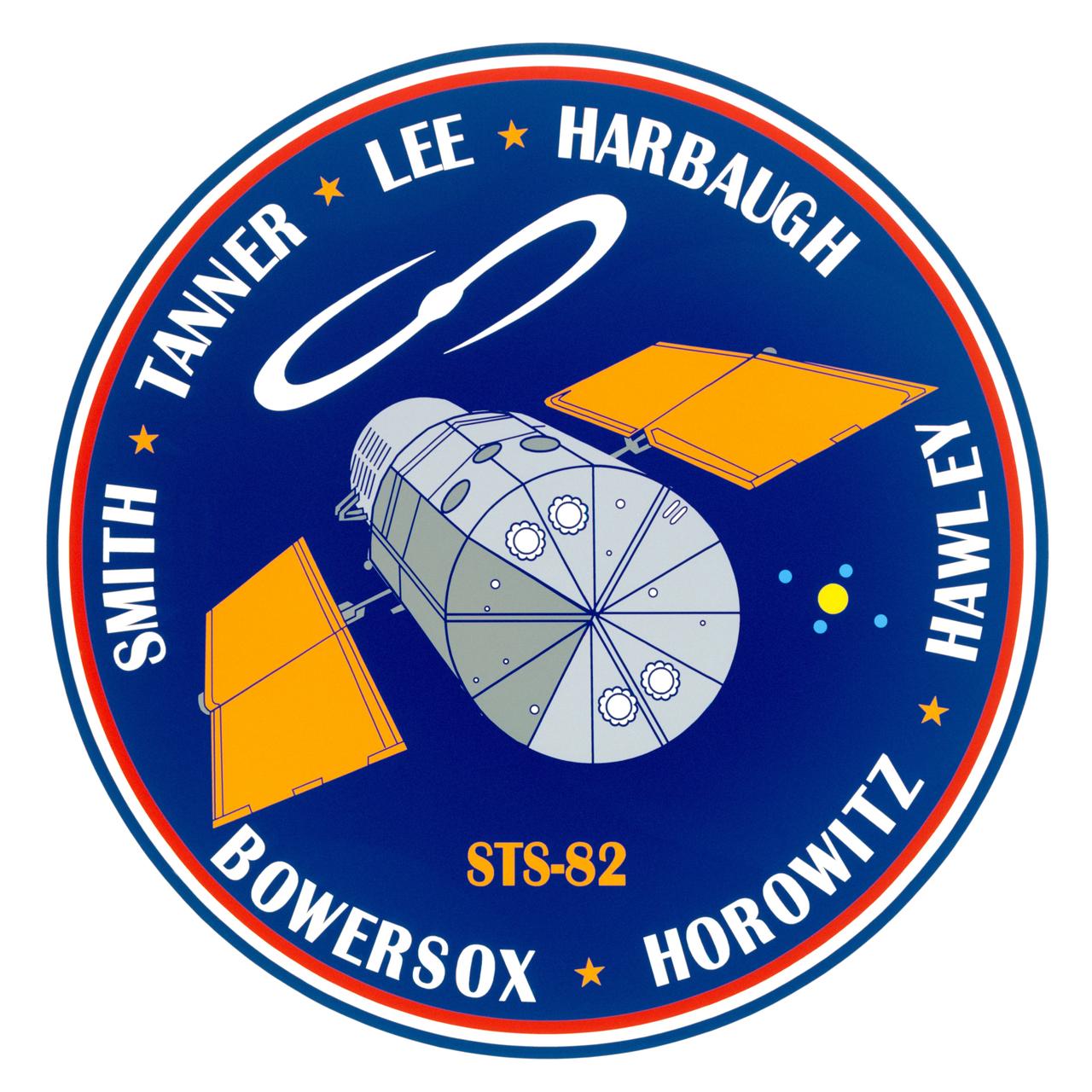
STS082-S-001 (August 1996) --- STS-82 is the second mission to service the Hubble Space Telescope (HST). The central feature of the patch is HST as the crew members will see it through the space shuttle Discovery?s overhead windows when the orbiter approaches for rendezvous, retrieval and a subsequent series of spacewalks to perform servicing tasks. The telescope is pointing toward deep space, observing the cosmos. The spiral galaxy symbolizes one of HST?s important scientific missions, to accurately determine the cosmic distance scale. To the right of the telescope is a cross-like structure known as a gravitational lens, one of the numerous fundamental discoveries made using HST imagery. The names of the crew members are arranged around the perimeter of the patch with the extravehicular activity?s (EVA) participating crew members placed in the upper semicircle and the orbiter crew in the lower one.    The NASA insignia design for space shuttle flights is reserved for use by the astronauts and for other official use as the NASA Administrator may authorize. Public availability has been approved only in the forms of illustrations by the various news media. When and if there is any change in this policy, which is not anticipated, the change will be publicly announced. Photo credit: NASA
STS-82 Discovery, Orbiter Vehicle (OV-103), crew insignia
STS-82 crew arrival for Terminal Countdown Demonstration Test (TCDT
KSC-97pc181
STS-82 crew arrival for Terminal Countdown Demonstration Test (TCDT
KSC-97pc180
STS-82 crew arrival for Terminal Countdown Demonstration Test (TCDT
KSC-97pc182
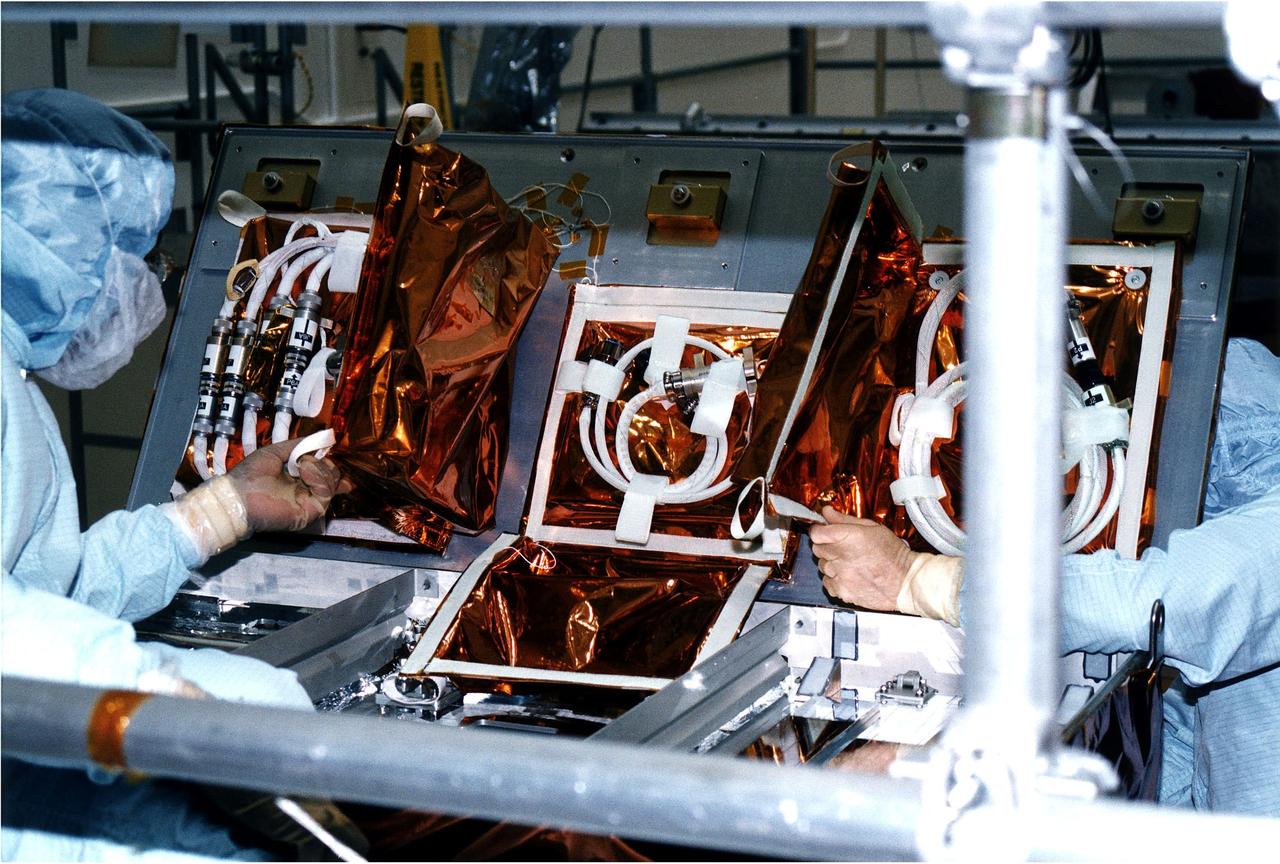
KENNEDY SPACE CENTER, FLA. -  Workers in KSC's Vertical Processing Facility stow cable and adapters into a protective enclosure for the second Hubble Space Telescope servicing mission, STS-82.  Liftoff aboard Discovery is targeted Feb. 11 with a crew of seven.
KENNEDY SPACE CENTER, FLA. - Workers in KSC's Vertical Processing Facility stow cable and adapters into a protective enclosure for the second Hubble Space Telescope servicing mission, STS-82. Liftoff aboard Discovery is targeted Feb. 11 with a crew of seven.
KENNEDY SPACE CENTER, FLA. - Workers in KSC's Vertical Processing Facility make final prelaunch prepartions to various payload elements that are part of the second Hubble Space Telescope (HST) servicing mission, STS-82.  Liftoff is targeted Feb. 11 aboard Discovery with a crew of seven.
KENNEDY SPACE CENTER, FLA. - Workers in KSC's Vertical Processing Facility make final prelaunch prepartions to various payload elements that are part of the second Hubble Space Telescope (HST) servicing mission, STS-82. Liftoff is targeted Feb. 11 aboard Discovery with a crew of seven.
KENNEDY SPACE CENTER, FLA. --  STS-82: Discovery launches on Hubble Servicing Mission 2.
KSC-97pc0283
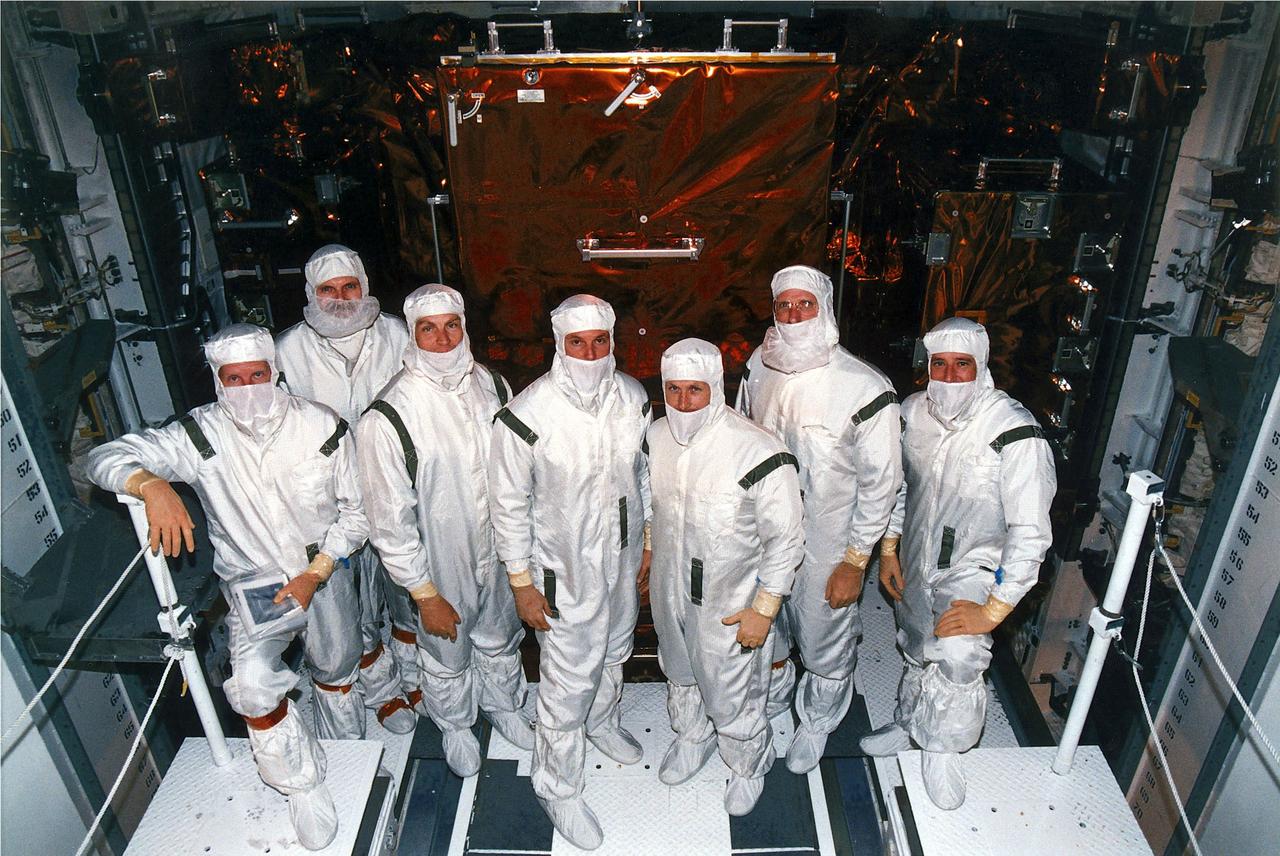
KENNEDY SPACE CENTER, FLA. -   STS-82 crew members pose in their clean room suits at Launch Pad 39A where the Space Shuttle Discovery is undergoing final preparations for liftoff on the second Hubble Space Telescope (HST) servicing mission.  They are making a final inspection of the payload before payload bay closure.  From left are Mission Specialists Steven A. Hawley and Steven L. Smith, Payload Commander Mark C. Lee, Mission Specialist GregoryJ. Harbaugh, Mission Commander Kenneth D. Bowersox, Mission Specialist Joseph R. "Joe" Tanner and Pilot Scott J. "Doc" Horowitz.  STS-82 is scheduled for liftoff on Feb. 11 during a 65-minute launch window that opens at 3:56 a.m. EST.
KENNEDY SPACE CENTER, FLA. - STS-82 crew members pose in their clean room suits at Launch Pad 39A where the Space Shuttle Discovery is undergoing final preparations for liftoff on the second Hubble Space Telescope (HST) servicing mission. They are making a final inspection of the payload before payload bay closure. From left are Mission Specialists Steven A. Hawley and Steven L. Smith, Payload Commander Mark C. Lee, Mission Specialist GregoryJ. Harbaugh, Mission Commander Kenneth D. Bowersox, Mission Specialist Joseph R. "Joe" Tanner and Pilot Scott J. "Doc" Horowitz. STS-82 is scheduled for liftoff on Feb. 11 during a 65-minute launch window that opens at 3:56 a.m. EST.
As white room closeout members look on, STS-82 Payload Commander Mark. C. Lee prepares to enter the Space Shuttle Discovery at Launch Pad 39A
KSC-97pc290
KENNEDY SPACE CENTER, Fla. -- STS-82 crew members practice emergency egress procedures in a slidewire basket at Launch Pad 39A as part of Terminal Countdown Demonstration Test (TCDT) activities. From left, are Mission Specialists Gregory J. Harbaugh and Steven L. Smith and Payload Commander Mark C. Lee. STS-82 will be the second Hubble Space Telescope servicing mission. Liftoff is targeted for Feb. 11
KSC-97pc218
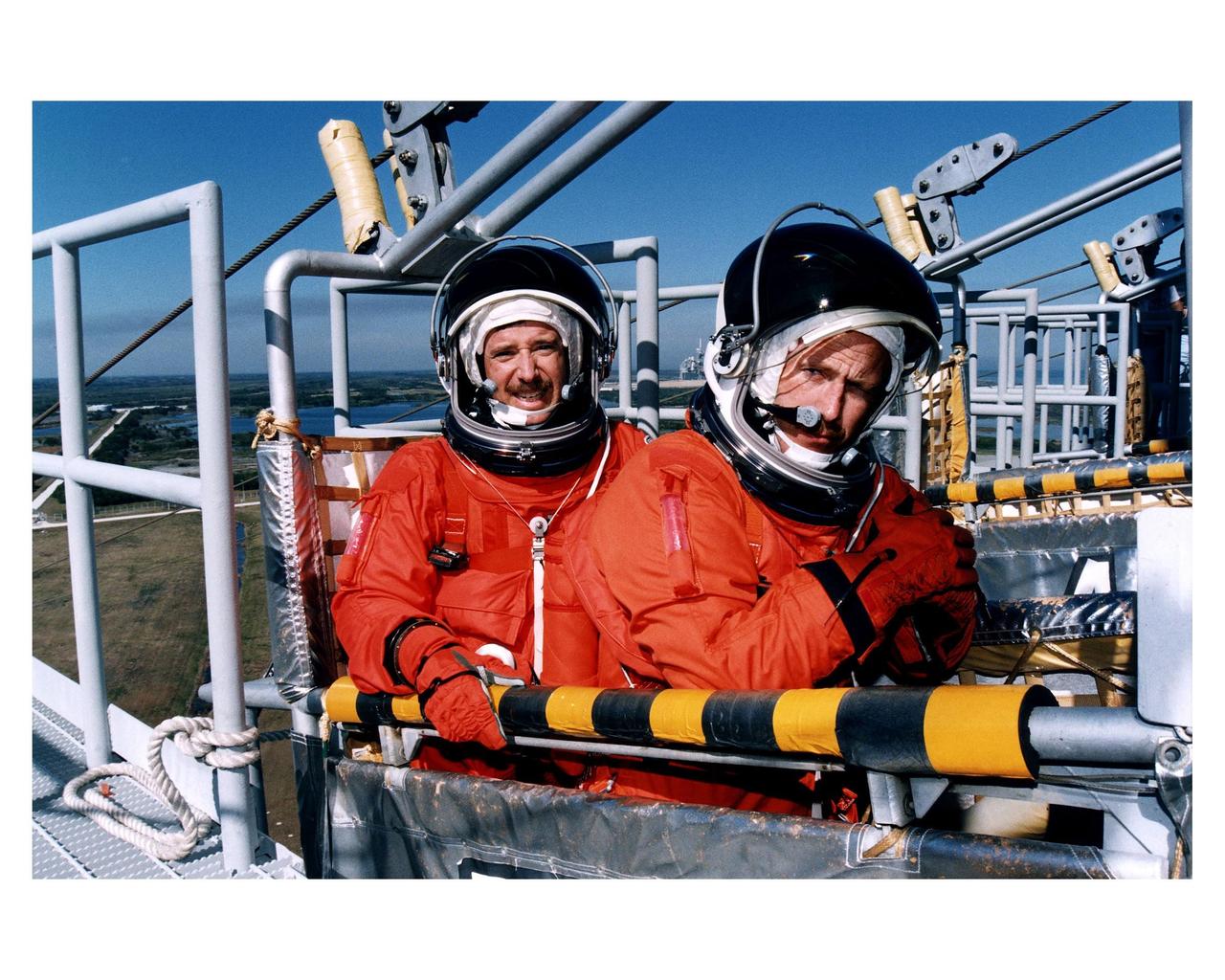
KENNEDY SPACE CENTER, Fla. --STS-82 Mission Commander Kenneth D. Bowersox, at right, and Pilot Scott J. "Doc" Horowitz practice emergency egress procedures in a slidewire basket at Launch Pad 39A as part of Terminal Countdown Demonstration Test (TCDT) activities. STS-82 will be the second Hubble Space Telescope servicing mission. Liftoff is targeted for Feb. 11
KSC-97pc219
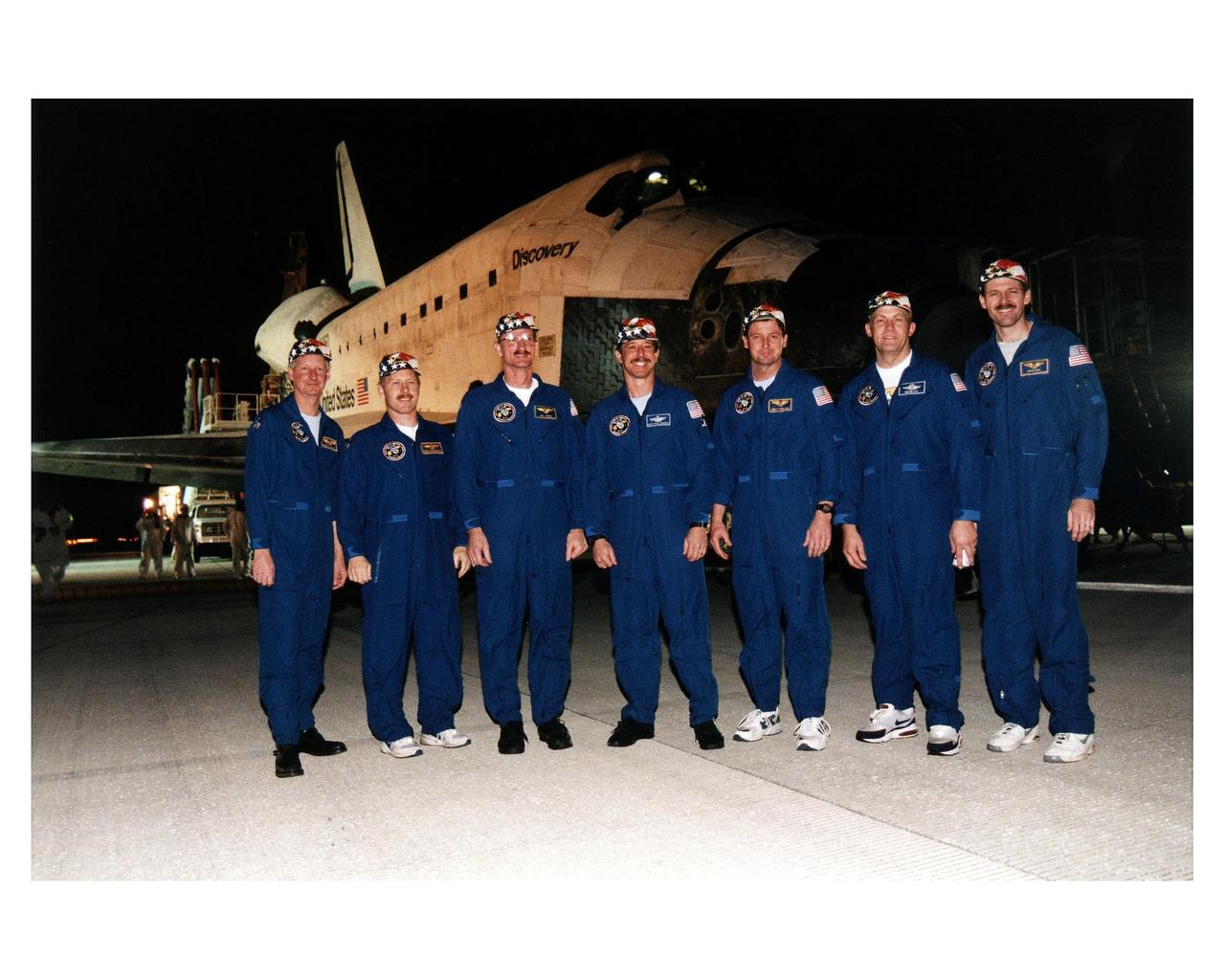
The STS-82 crew stands in front of the Space Shuttle Discovery after landing at KSC's Shuttle Landing Facility on Runway 15 to conclude a 10-day mission to service the orbiting Hubble Space Telescope (HST). Crew members are (from left to right) Mission Specialist Steven A. Hawley, Mission Commander Kenneth D. Bowersox, Mission Specialist Joseph R. "Joe" Tanner, Pilot Scott J. "Doc" Horowitz, Mission Specialist Gregory J. Harbaugh, Payload Commander Mark C. Lee and Mission Specialist Steven L. Smith. STS-82 is the ninth Shuttle nighttime landing, and the fourth nighttime landing at KSC. The seven-member crew performed a record-tying five back-to-back extravehicular activities (EVAs) or spacewalks to service the telescope, which has been in orbit for nearly seven years. Two new scientific instruments were installed, replacing two outdated instruments. Five spacewalks also were performed on the first servicing mission, STS-61, in December 1993. Only four spacewalks were scheduled for STS-82, but a fifth one was added during the flight to install several thermal blankets over some aging insulation covering three HST compartments containing key data processing, electronics and scientific instrument telemetry packages. STS-82 was the 82nd Space Shuttle flight and the second mission of 1997
KSC-97pc354
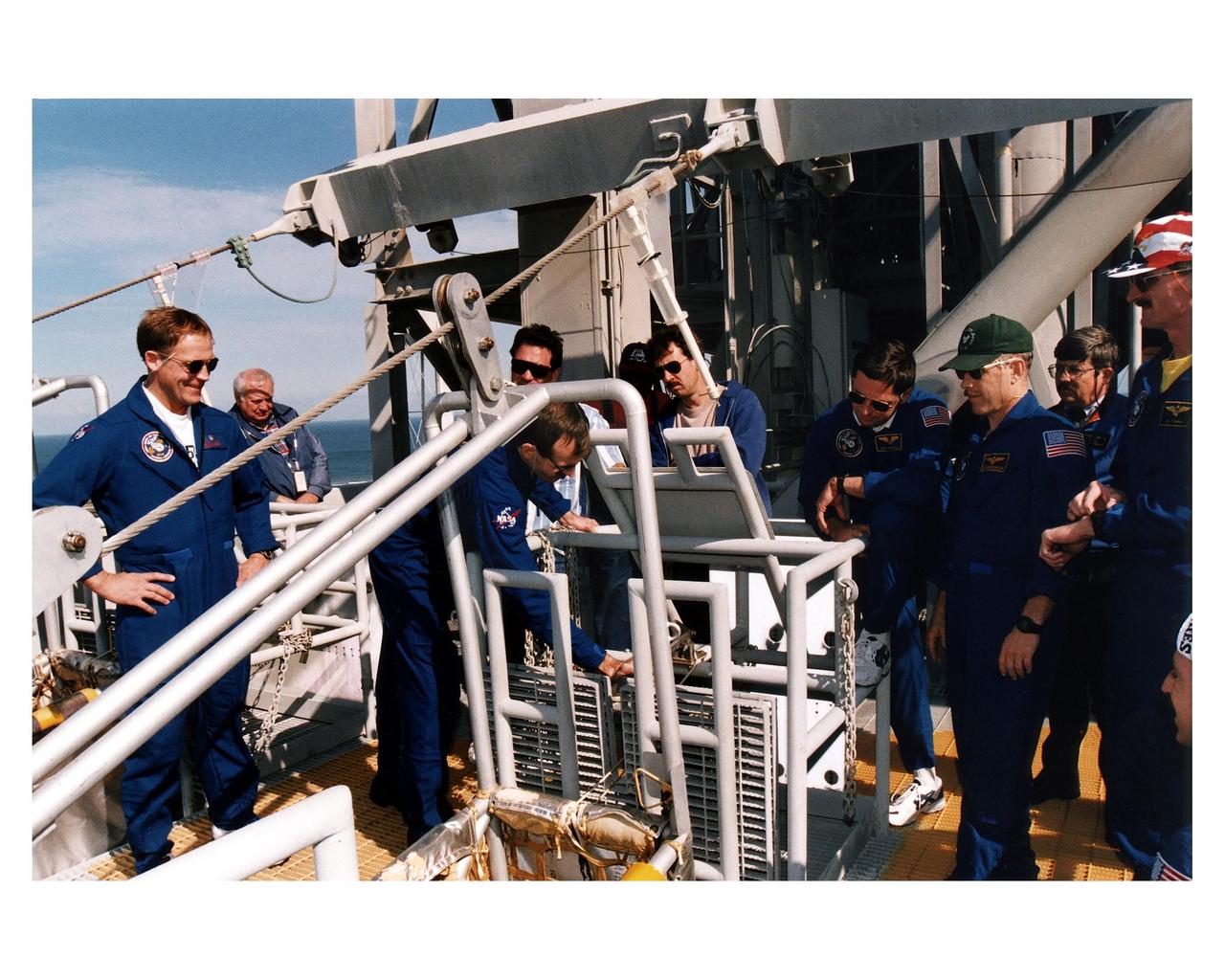
KENNEDY SPACE CENTER, Fla. --STS-82 crew members and other onlookers at Launch Pad 39A watch as STS-82 Mission Specialist Steven L. Smith becomes familiar with operation of the slidewire baskets. The slidewire baskets are part of the emergency egress system at the pad. The crew are at KSC to participate in the Terminal Countdown Demonstration Test (TCDT), a dress rehearsal for launch. In their blue flight suits, from left, are Payload Commander Mark C. Lee, Smith, Mission Specialist Gregory J. Harbaugh, Mission Commander Kenneth D. Bowersox and Mission Specialist Joseph R. "Joe" Tanner. The seven-member STS-82 crew will conduct the second Hubble Space Telescope servicing mission. Liftoff of the 10-day flight is scheduled Feb. 11
KSC-97pc210
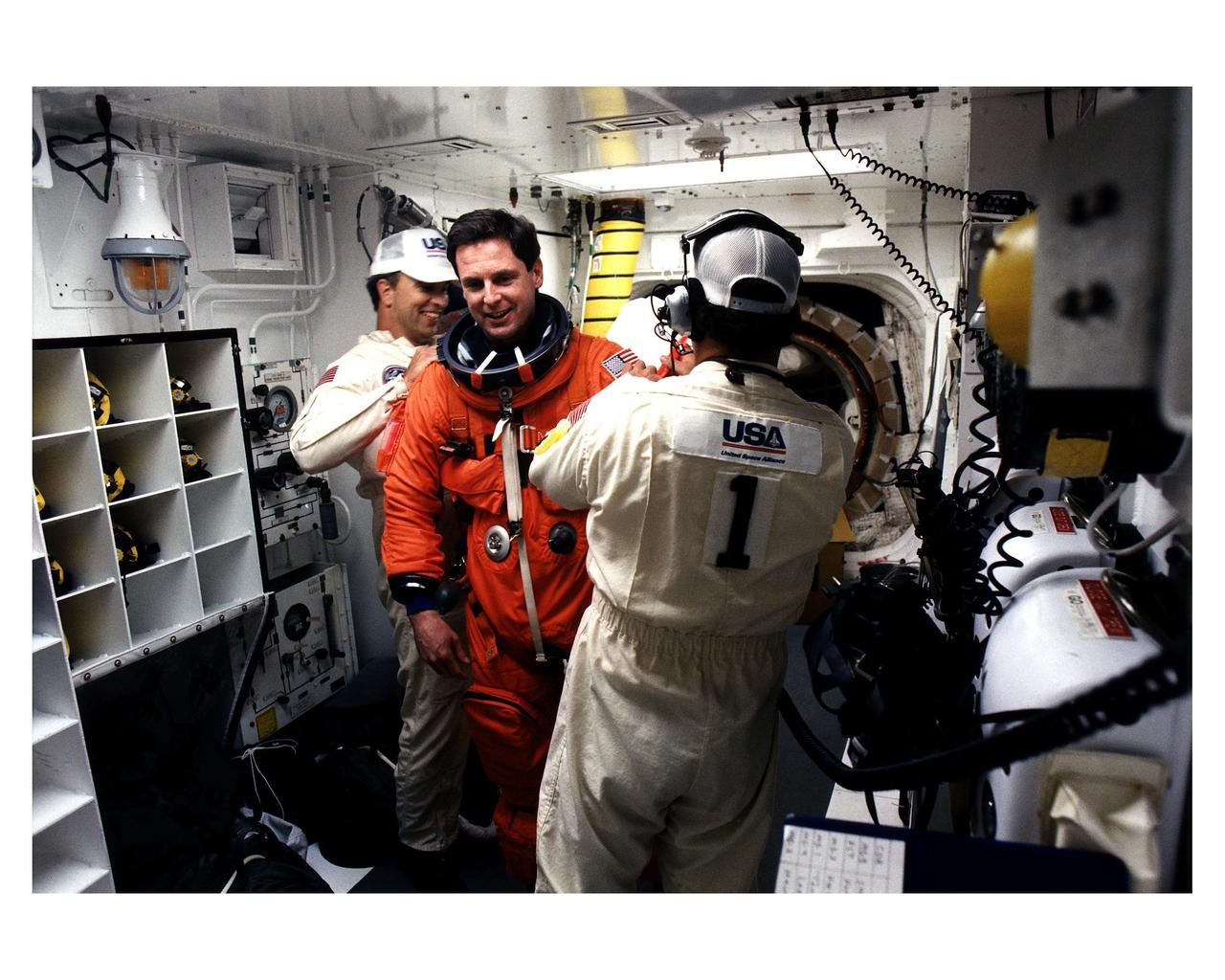
STS-82 Pilot Scott J. "Doc" Horowitz prepares to enter the Space Shuttle Discovery at Launch Pad 39A, with the assistance of white room closeout crew member James Davis
KSC-97pc288
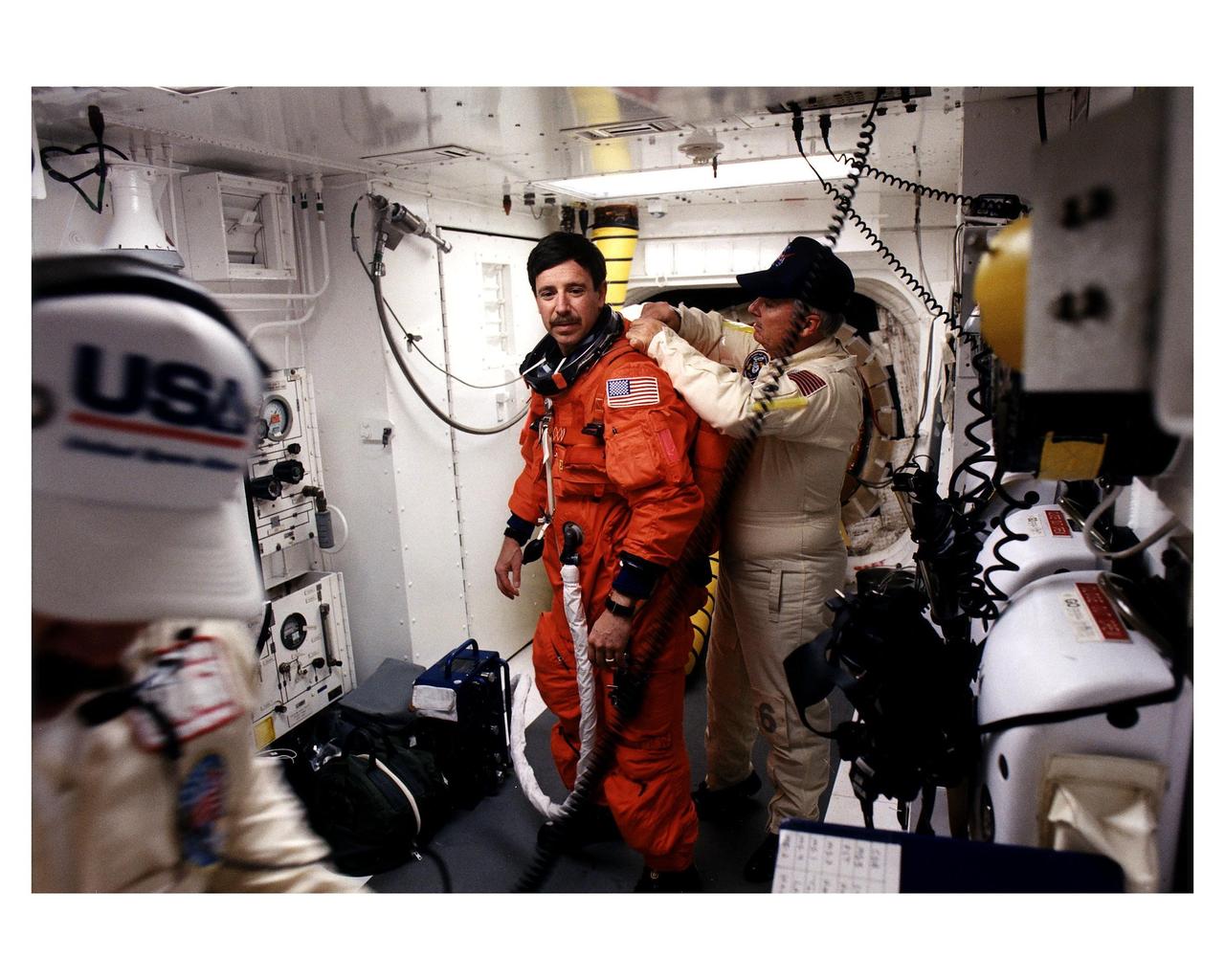
STS-82 Mission Specialist Steven A. Hawley prepares to enter the Space Shuttle Discovery at Launch Pad 39A, with the assistance of white room closeout crew members James Davis, at left, and George Schramm
KSC-97pc286
STS-82 Mission Specialist Gregory J. Harbaugh prepares to enter the Space Shuttle Discovery at Launch Pad 39A, with the assistance of white room closeout crew members Dave Law, at left, and Travis Thompson
KSC-97pc289
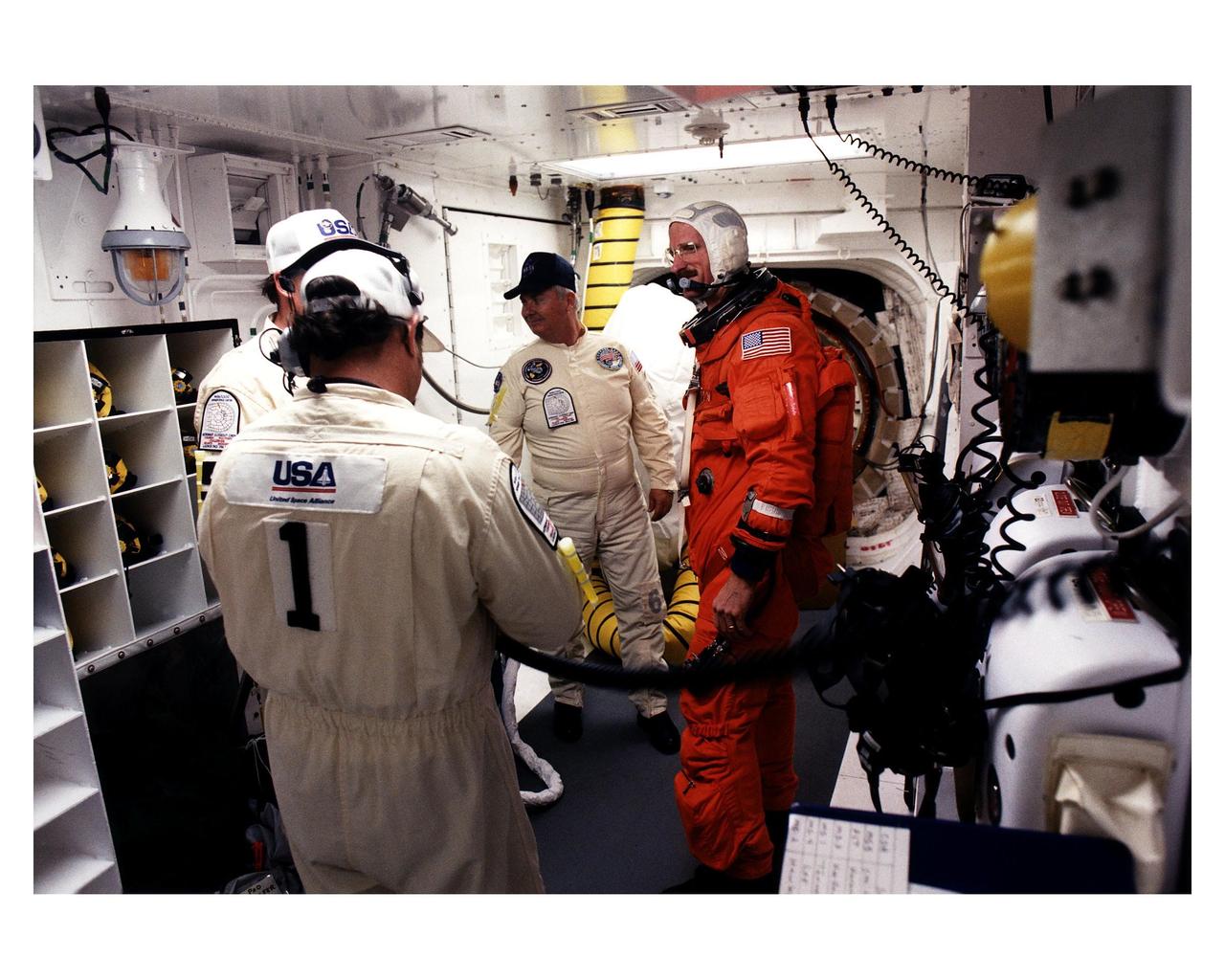
STS-82 Mission Specialist Joseph R. "Joe" Tanner talks to white room closeout crew members before entering the Space Shuttle Discovery at Launch Pad 39A
KSC-97pc285
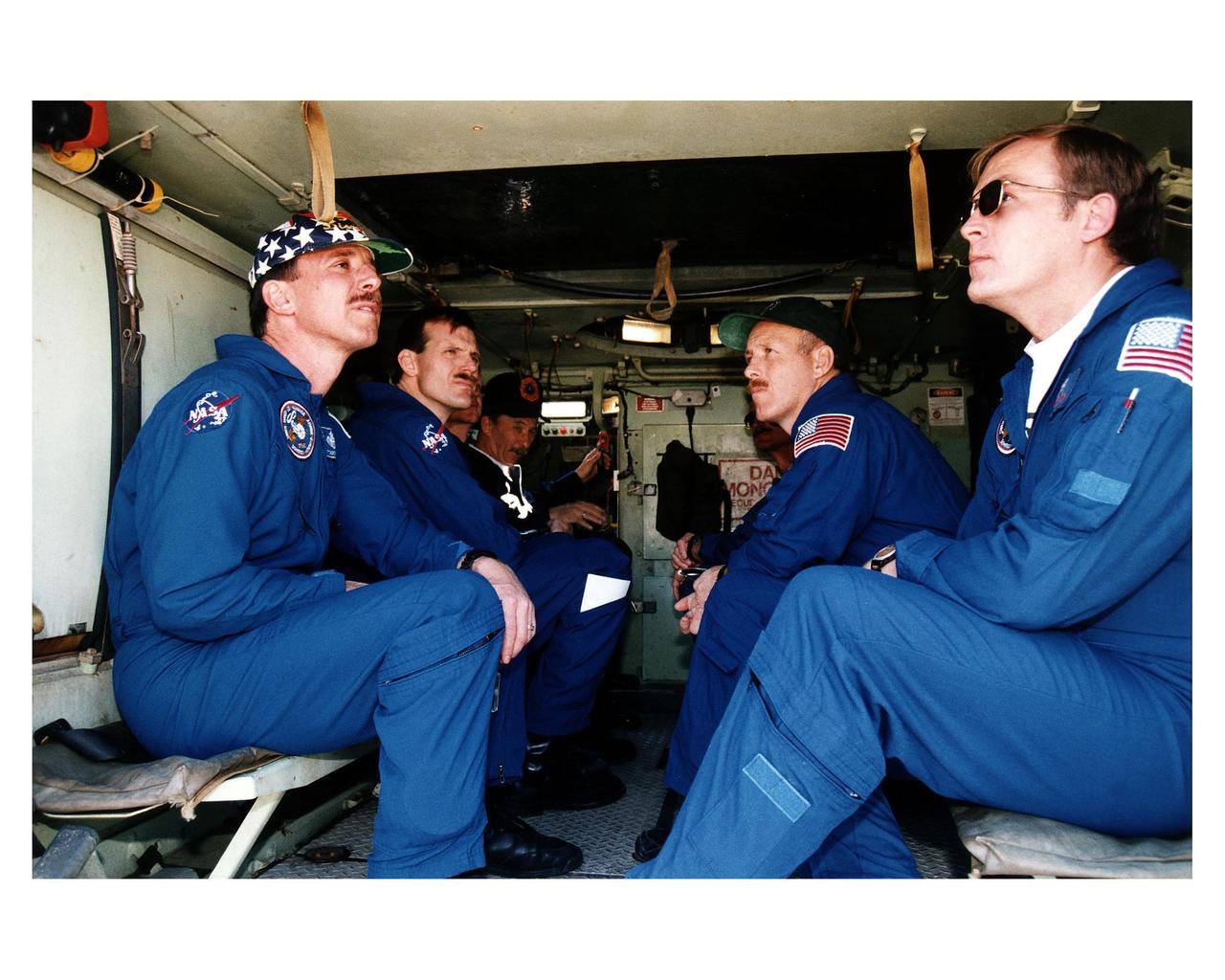
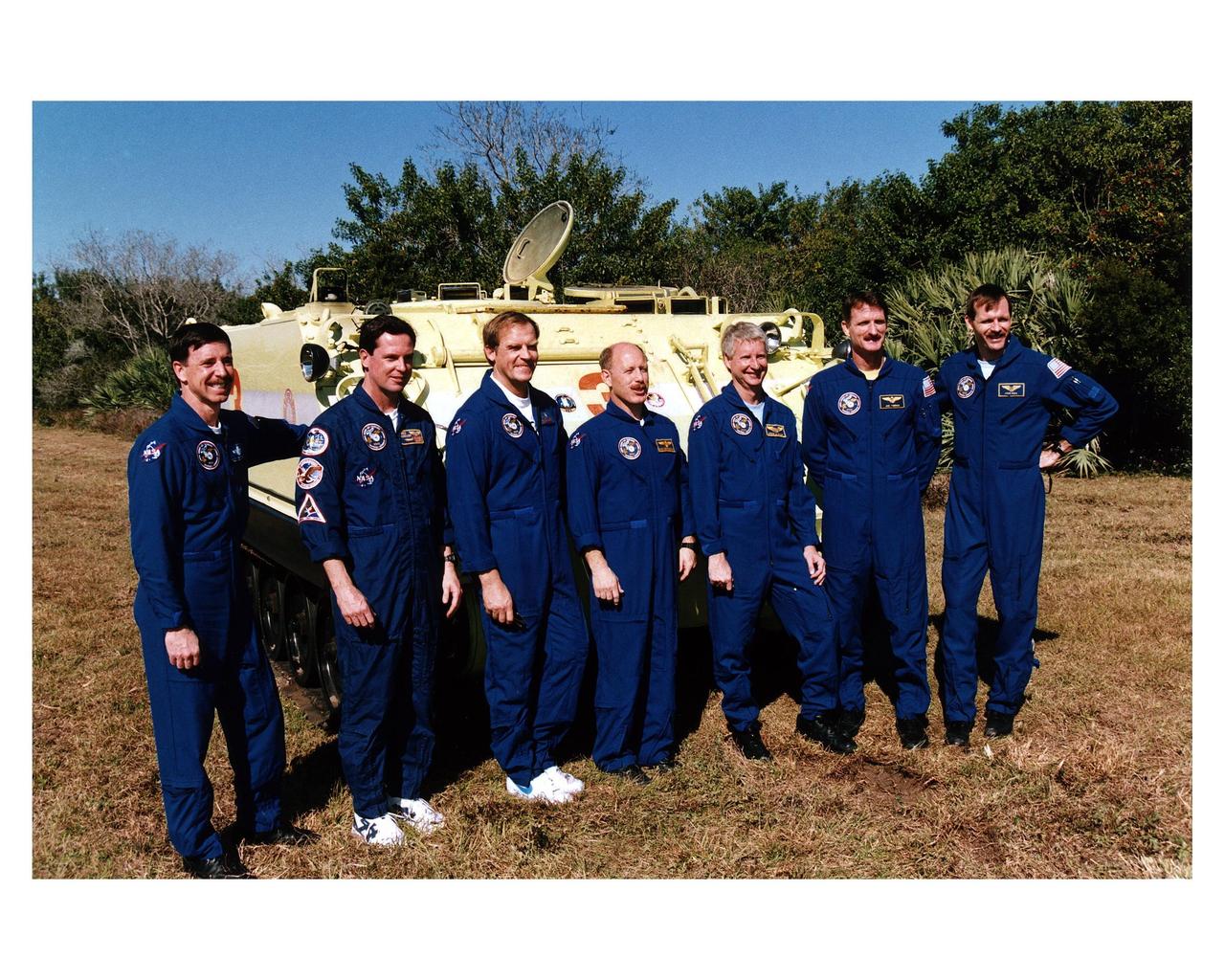
STS-82 crew members ride in and learn how to operate an M-113 armored personnel carrier during Terminal Countdown Demonstration Test (TCDT) activities prior to launch. The four crew members dressed in their blue flight suits and visible here are, from left, Pilot Scott J. "Doc" Horowitz, Mission Specialist Joseph R. "Joe" Tanner, Mission Commander Kenneth D. Bowersox and Payload Commander Mark C. Lee. George Hoggard, a training officer with KSC Fire Services, is visible in the background at left. The 10-day STS-82 flight, which will be the second Hubble Space Telescope servicing mission, is targeted for a Feb. 11 liftoff
KSC-97pc183
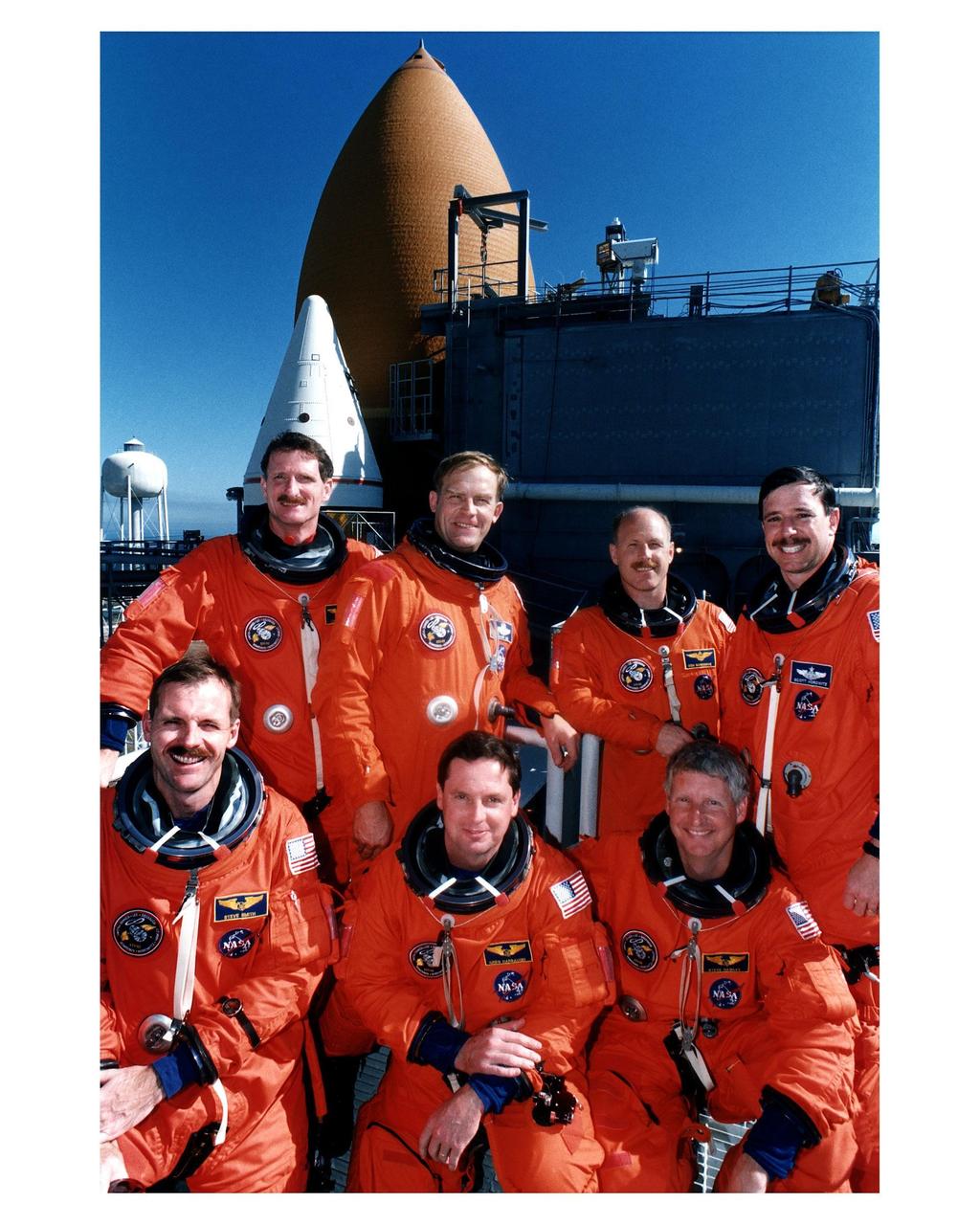
KENNEDY SPACE CENTER, FLA. -- STS-82 crew members are all smiles as they pose for a group photo at Launch Pad 39A in front of the Space Shuttle Discovery. They are participating in the Terminal Countdown Demonstration Test (TCDT), a dress rehearsal for launch. In the front row, from left, are Mission Specialists Steven L. Smith, Gregory J. Harbaugh and Steven A. Hawley. Standing in the back row, from left, are Joseph R. "Joe" Tanner, Payload Commander Mark C. Lee, Mission Commander Kenneth D. Bowersox and Pilot Scott J. "Doc" Horowitz. STS-82 will be the second Hubble Space Telescope servicing mission. Liftoff is targeted for Feb. 11
KSC-97pc221
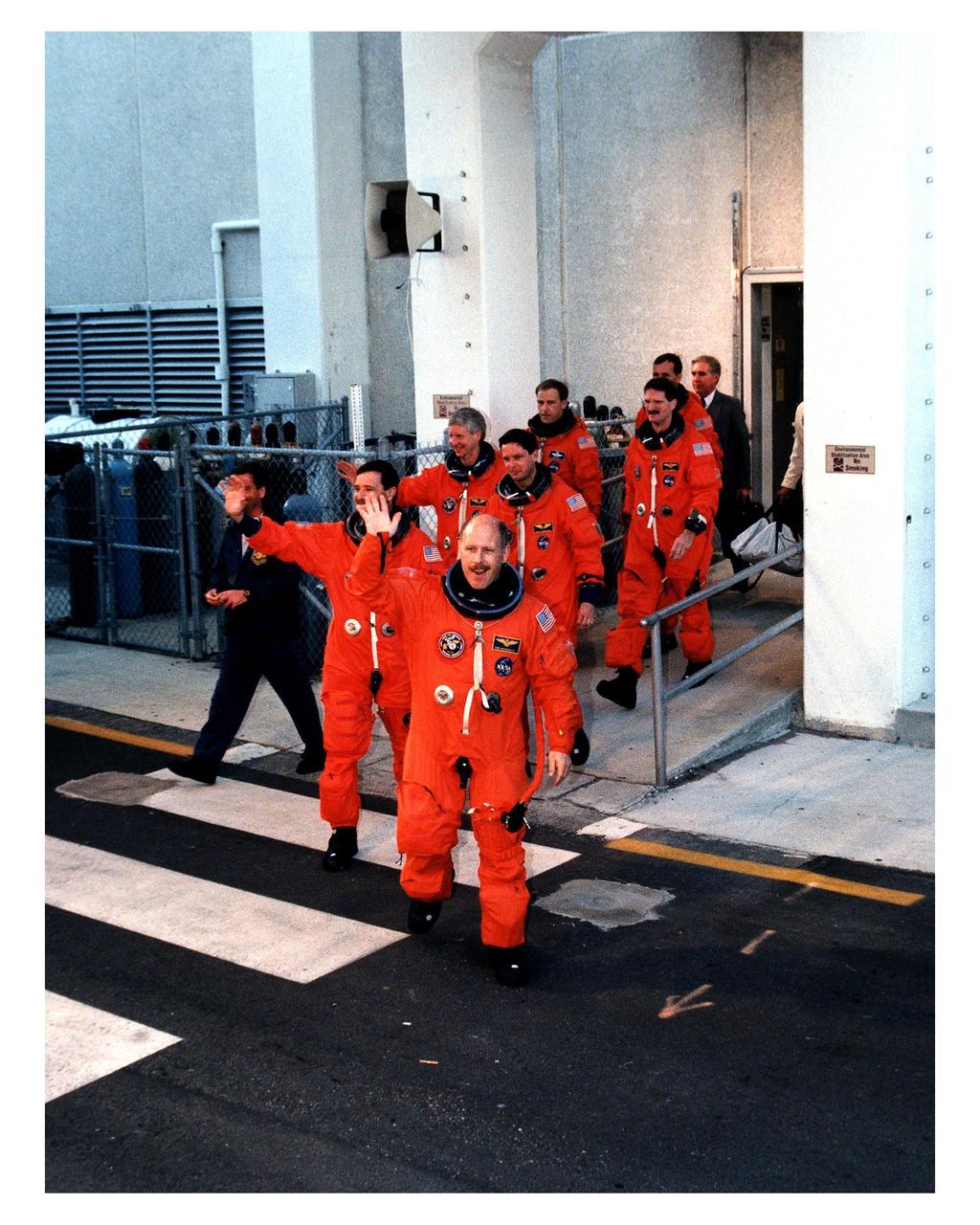
The seven-member STS-82 crew walks out of the KSC Operations and Checkout Building en route to Launch Pad 39A as part of the Terminal Countdown Demonstration Test (TCDT), a dress rehearsal for launch. Leading the way is Mission Commander Kenneth D. Bowersox. Pilot Scott J. "Doc" Horowitz is close behind him at left. Clockwise from left are Mission Specialist Steven A. Hawley, Payload Commander Mark C. Lee, and Mission Specialists Steven L. Smith, Joseph R. "Joe" Tanner and Gregory J. Harbaugh. STS-82 will be the second Hubble Space Telescope servicing mission. Liftoff is targeted for Feb. 11
KSC-97pc213
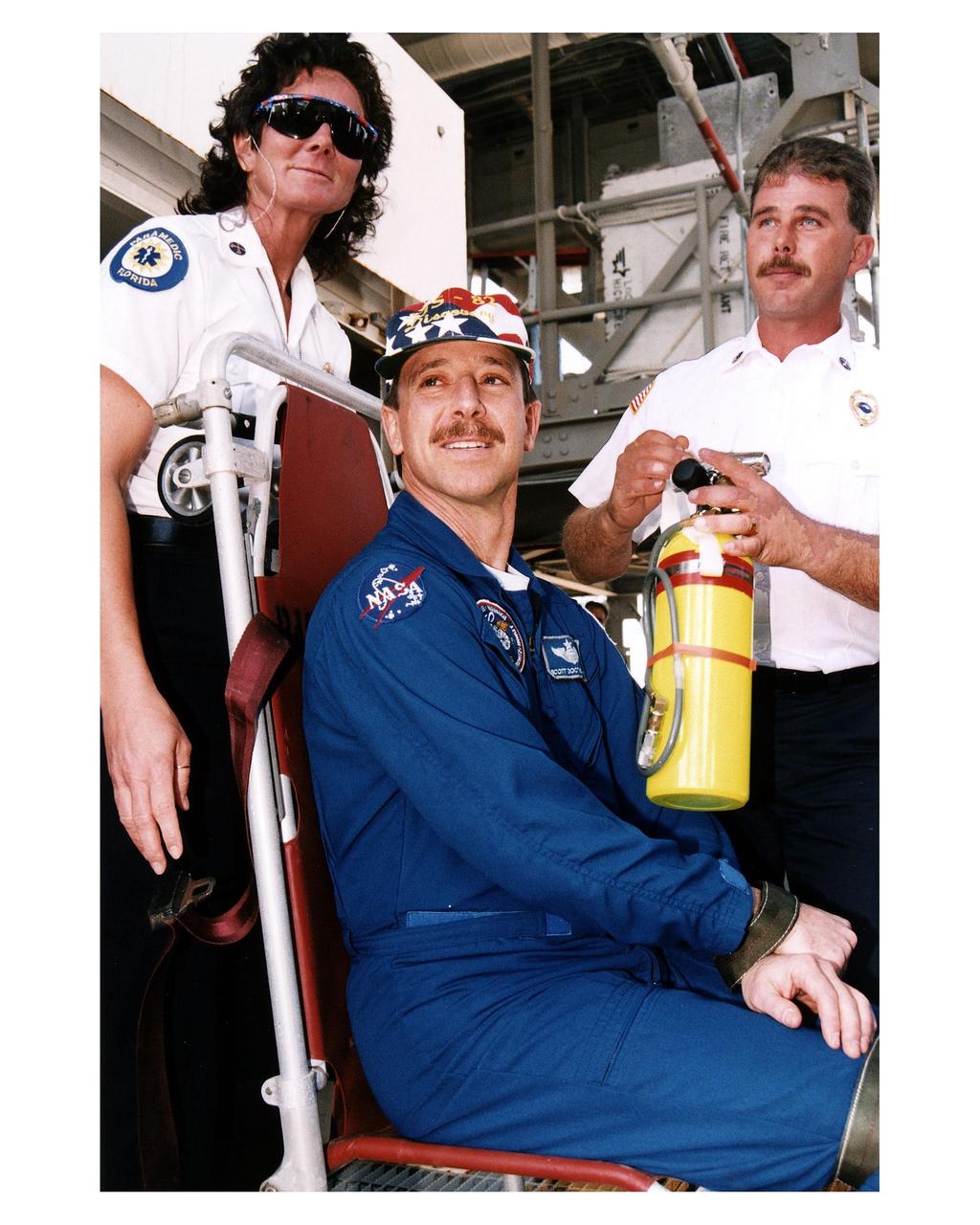
KENNEDY SPACE CENTER, Fla. -- STS-82 Pilot Scott J. "Doc" Horowitz, seated, poses as an immobilized person while pad rescue leaders Kathy Weaver and Steve Kelly of KSC Fire Rescue Services demonstrate the use of flight crew rescue equipment. The demonstration is part of crew training during Terminal Countdown Demonstration Test (TCDT) activities at Launch Pad 39A. The seven-member STS-82 crew will conduct the second Hubble Space Telescope servicing mission. Liftoff of the 10-day flight is scheduled Feb. 11
KSC-97pc209
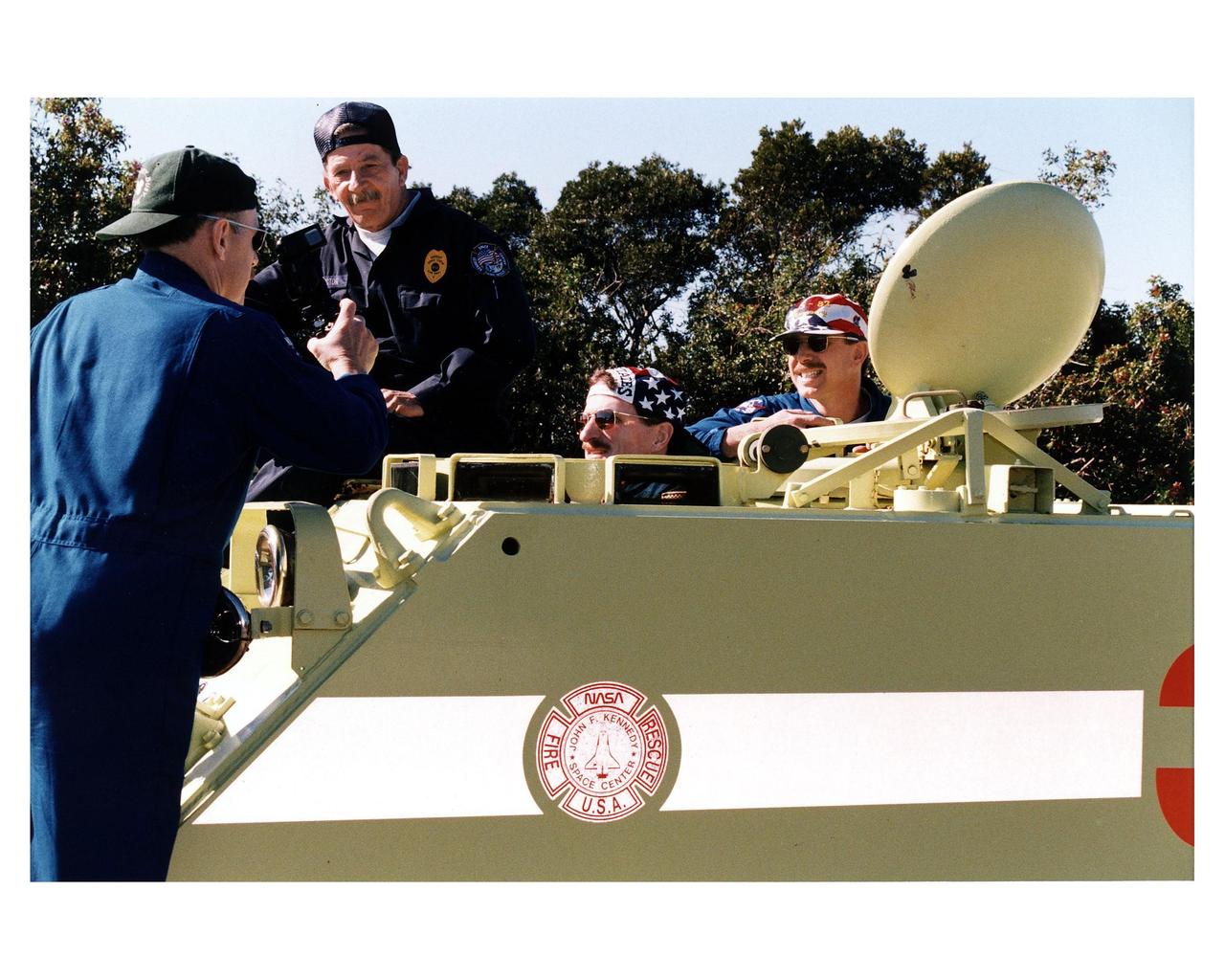
STS-82 Mission Commander, far left, takes a photograph of his fellow crew members Pilot Scott J. "Doc" Horowitz, at far right, and Mission Specialist Joseph R. "Joe" Tanner while they are training in the M-113 armored personnel carrier. George Hoggard, a training officer with KSC Fire Services, looks on. The STS-82 crew is at KSC to participate in the Terminal Countdown Demonstration Test (TCDT), a dress rehearsal for launch. The 10-day flight, which will be the second Hubble Space Telescope servicing mission, is targeted for a Feb. 11 liftoff
KSC-97pc187
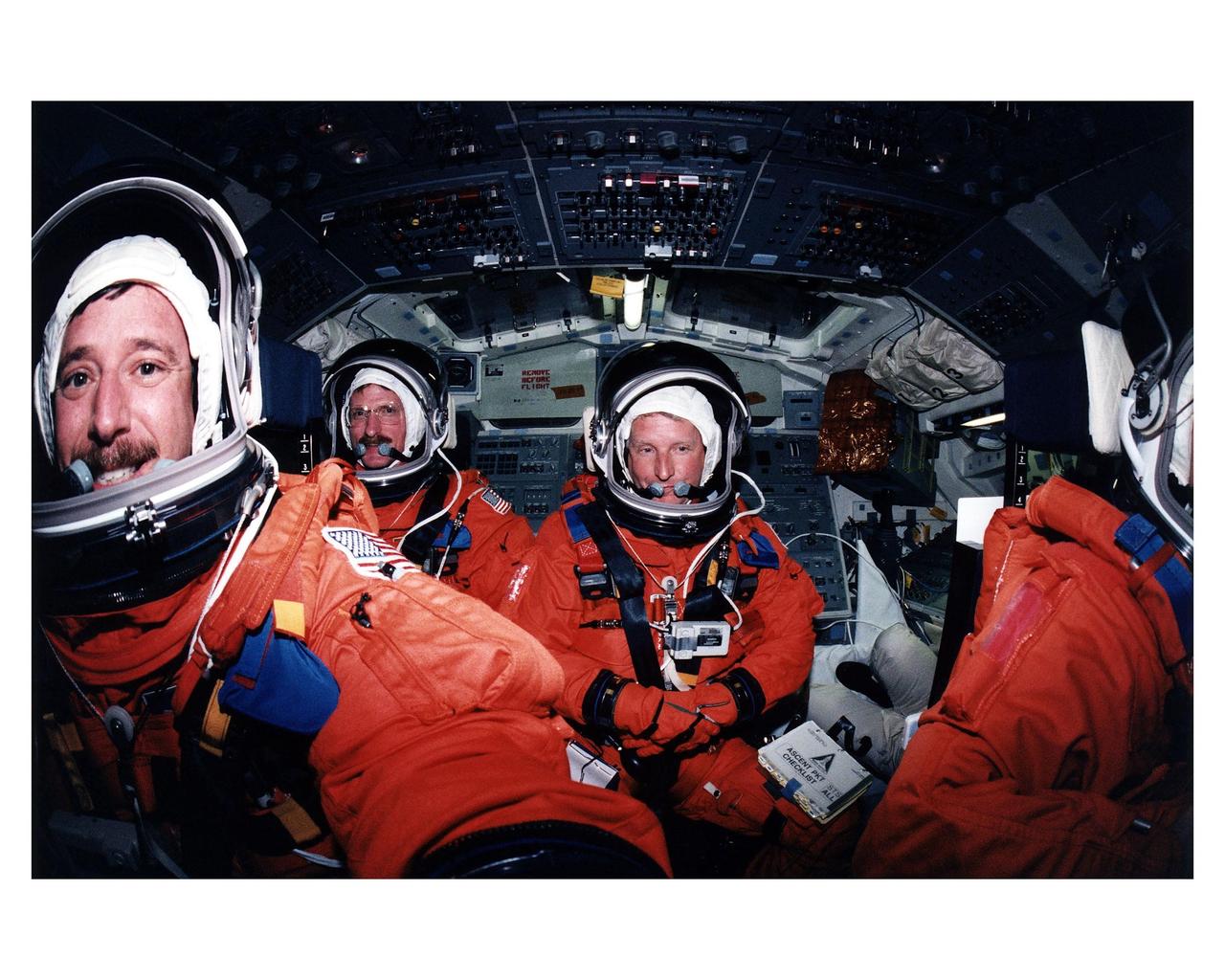
STS-82 crew members participate in a practice launch countdown inside the crew cabin of the Space Shuttle Discovery during Terminal Countdown Demonstration Test (TCDT) activities. Pilot Scott J. "Doc" Horowitz is in foreground at left. Seated across from him, with only an arm and part of his helmet showing, is Mission Commander Kenneth D. Bowersox. At rear, from left, are Mission Specialists Joseph R. "Joe" Tanner and Steven A. Hawley. STS-82 will be the second Hubble Space Telescope servicing mission. Liftoff is targeted for Feb. 11
KSC-97pc220
STS-82 crew members make a final inspection of the payload for the second Hubble Space Telescope (HST) servicing mission at Launch Pad 39A where the Space Shuttle Discovery is undergoing final preparations for launch. From left, are Mission Specialist Joseph R. "Joe" Tanner, Pilot Scott J. "Doc" Horowitz and Mission Specialist Gregory J. Harbaugh. Standing directly behind them is Mission Specialist Steven A. Hawley. STS-82 is scheduled for liftoff on Feb. 11 during a 65-minute launch window which opens at 3:56 a.m. EST
KSC-97pc259
KENNEDY SPACE CENTER, FLA. -  Workers in KSC's Vertical Processing Facility make final adjustments to the Flight Support System (FSS) for STS-82, the second Hubble Space Telescope servicing mission.  The FSS is reusable flight hardware that provides the mechanical, structural and electrical interfaces between HST, the space support equipment and the orbiter for payload retrieval and on-orbit servicing.  Liftoff aboard Discovery is targeted Feb. 11 with a crew of seven.
KENNEDY SPACE CENTER, FLA. - Workers in KSC's Vertical Processing Facility make final adjustments to the Flight Support System (FSS) for STS-82, the second Hubble Space Telescope servicing mission. The FSS is reusable flight hardware that provides the mechanical, structural and electrical interfaces between HST, the space support equipment and the orbiter for payload retrieval and on-orbit servicing. Liftoff aboard Discovery is targeted Feb. 11 with a crew of seven.
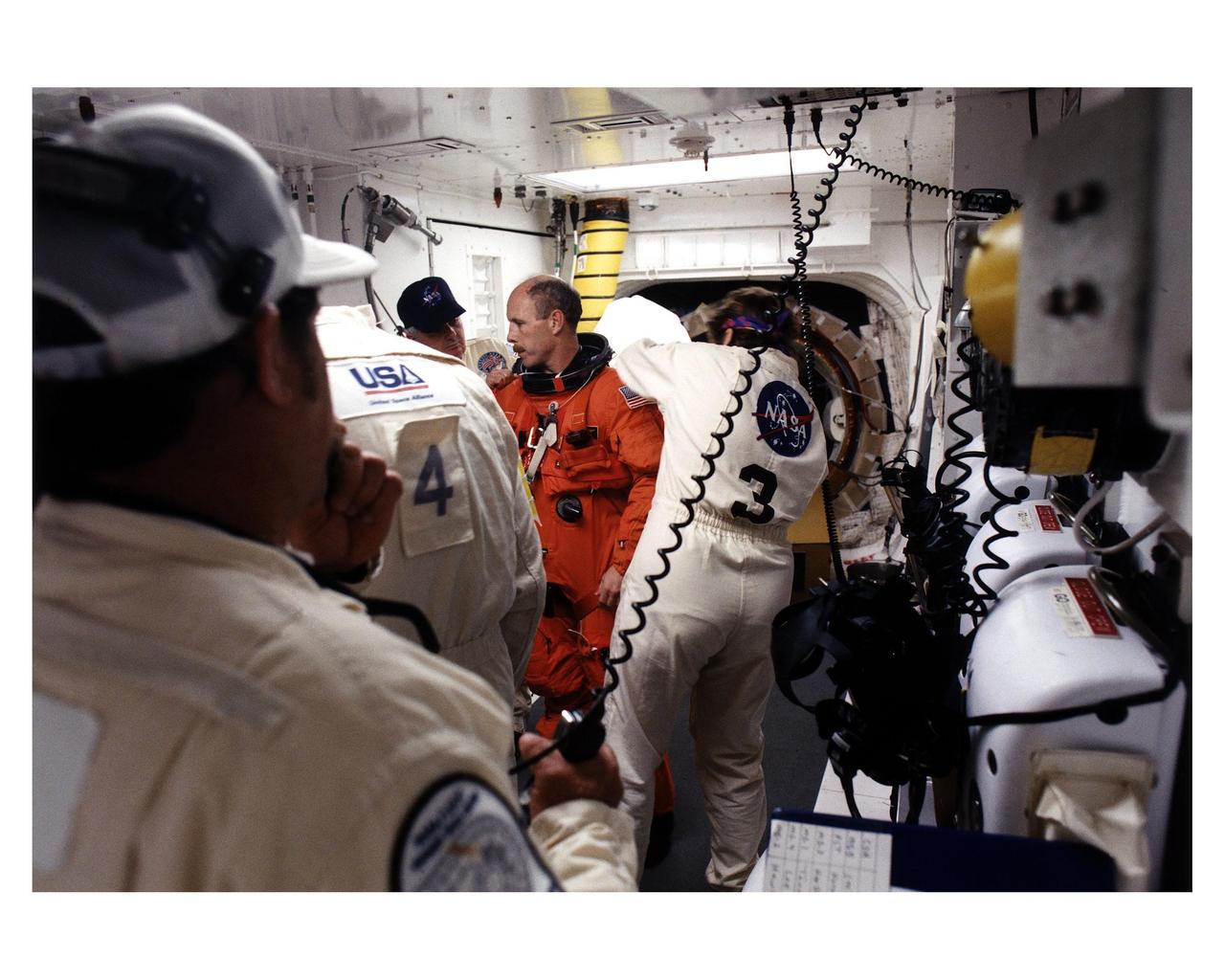
STS-82 Mission Commander Kenneth D. Bowersox gets assistance from white room closeout members before entering the Space Shuttle Discovery at Launch Pad 39A. Making final adjustments to the commander’s launch and entry suit are James Davis, facing camera at left, and Jean Alexander
KSC-97pc291
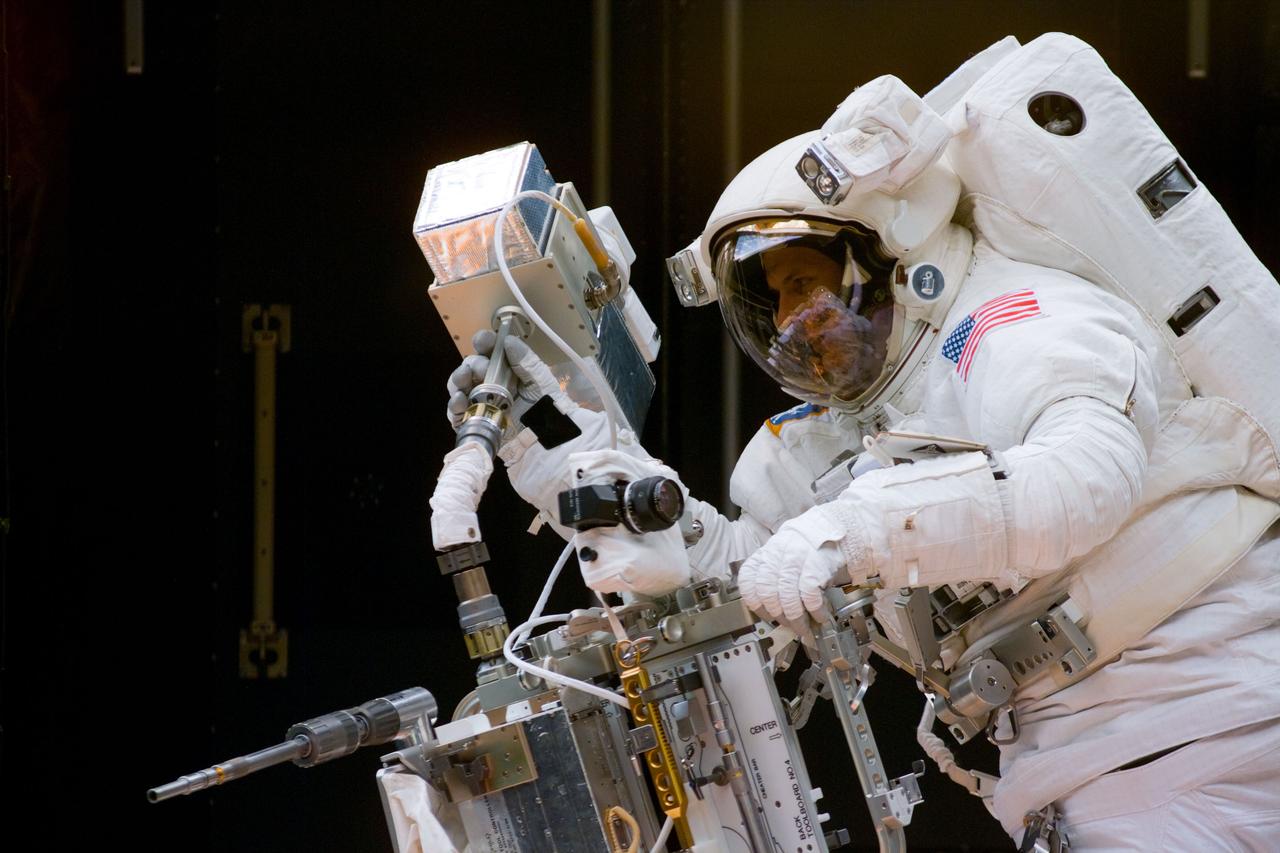
S82-E-5242 (14 Feb. 1997) --- Astronaut Steven L. Smith, STS-82 mission specialist, prepares to open aft shroud of Hubble Space Telescope (HST) for repair. This view was taken with an Electronic Still Camera (ESC).
EVA 1 activity on Flight Day 4 to service the Hubble Space Telescope
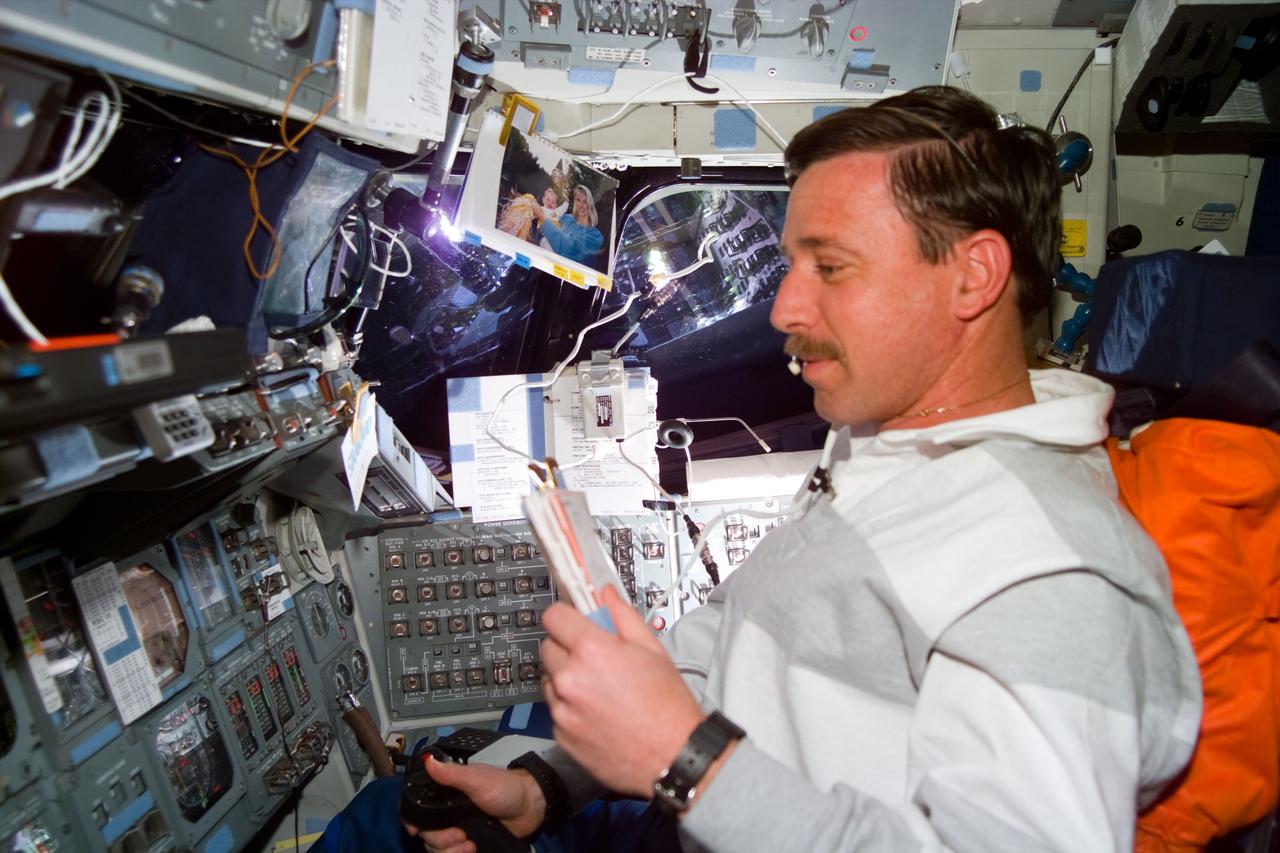
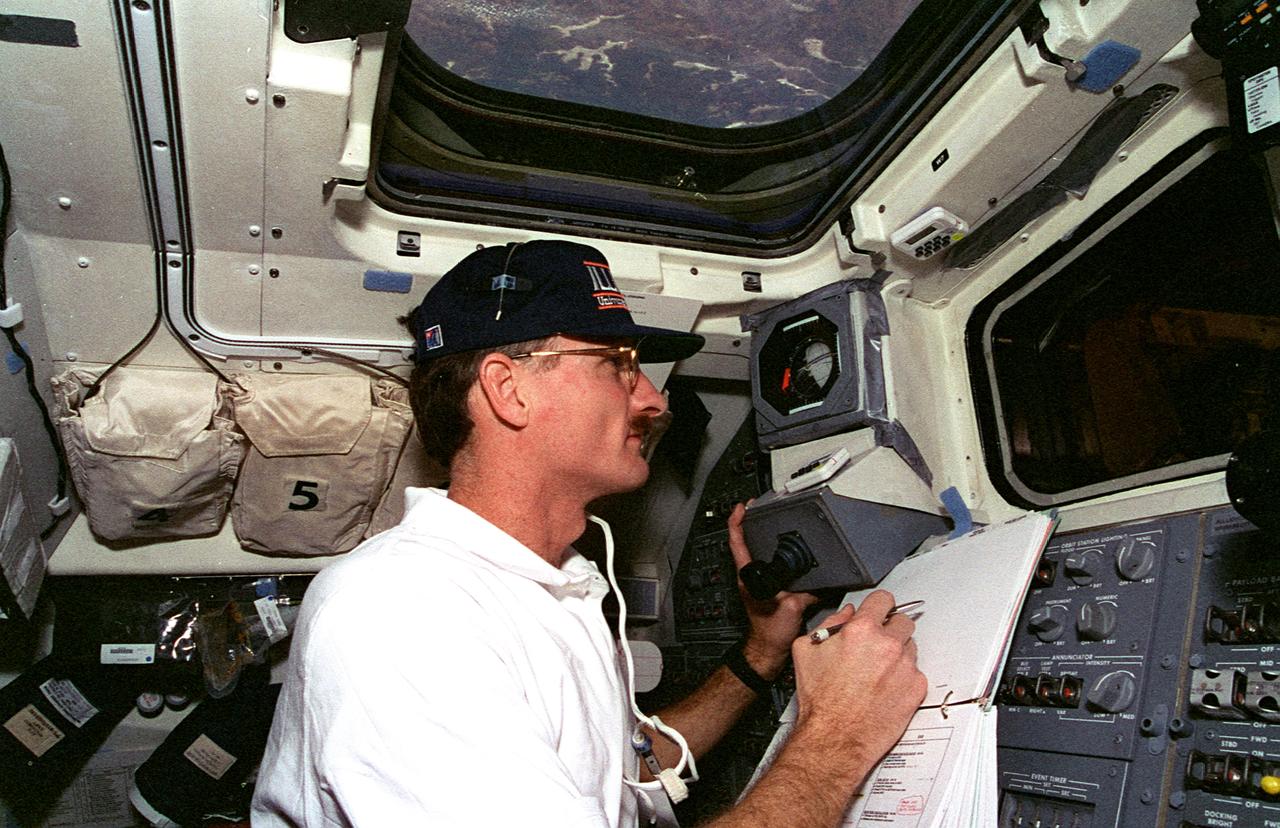
S82-E-5436 (15 Feb. 1997) --- Astronaut Scott J. Horowitz, STS-82 pilot, at pilot's station during second Extravehicular Activity (EVA) by two of his crew mates. This view was taken with an Electronic Still Camera (ESC).
Pilot Scott Horowitz consults a checklist during a Vernier burn
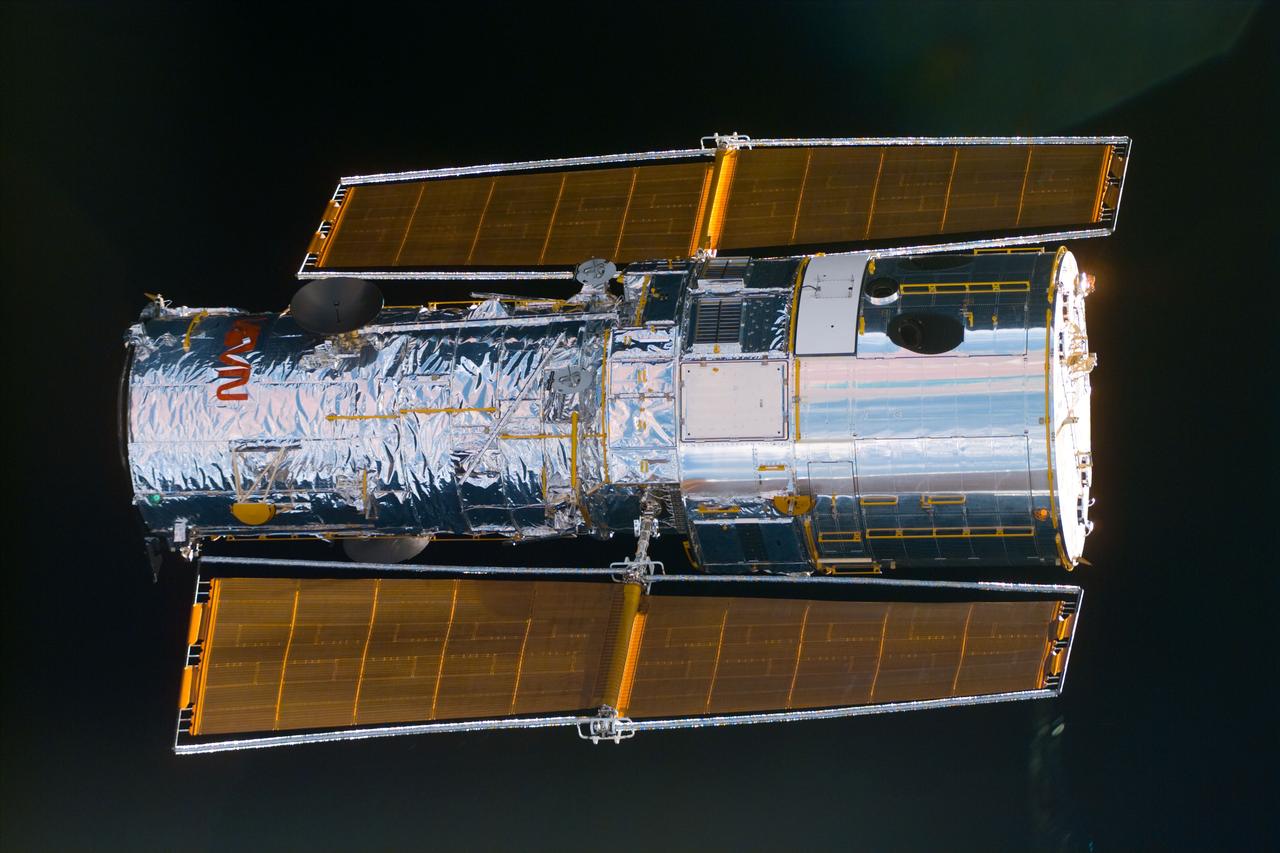
S82-E-5084 (13 Feb. 1997) --- The first close-up look at the Hubble Space Telescope (HST) since 1993 was provided by STS-82 Electronic Still Camera (ESC) during rendezvous with the giant telescope.  This view was taken with an Electronic Still Camera (ESC).
HST,survey views of telescope surfaces during rendezvous and approach
S82-E-5279 (14 Feb. 1997) --- Astronaut Mark C. Lee, STS-82 payload commander (in foreground) and Steven L. Smith during Extravehicular Activity (EVA) setup.  This view was taken with an Electronic Still Camera (ESC).
EVA 1 activity on Flight Day 4 to service the Hubble Space Telescope
S82-E-5320 (14 Feb. 1997) --- Astronaut Steven L. Smith, STS-82 mission specialist, works with close-out camera in the Space Shuttle Discovery's payload bay.  This view was taken with an Electronic Still Camera (ESC).
EVA 1 activity on Flight Day 4 to service the Hubble Space Telescope
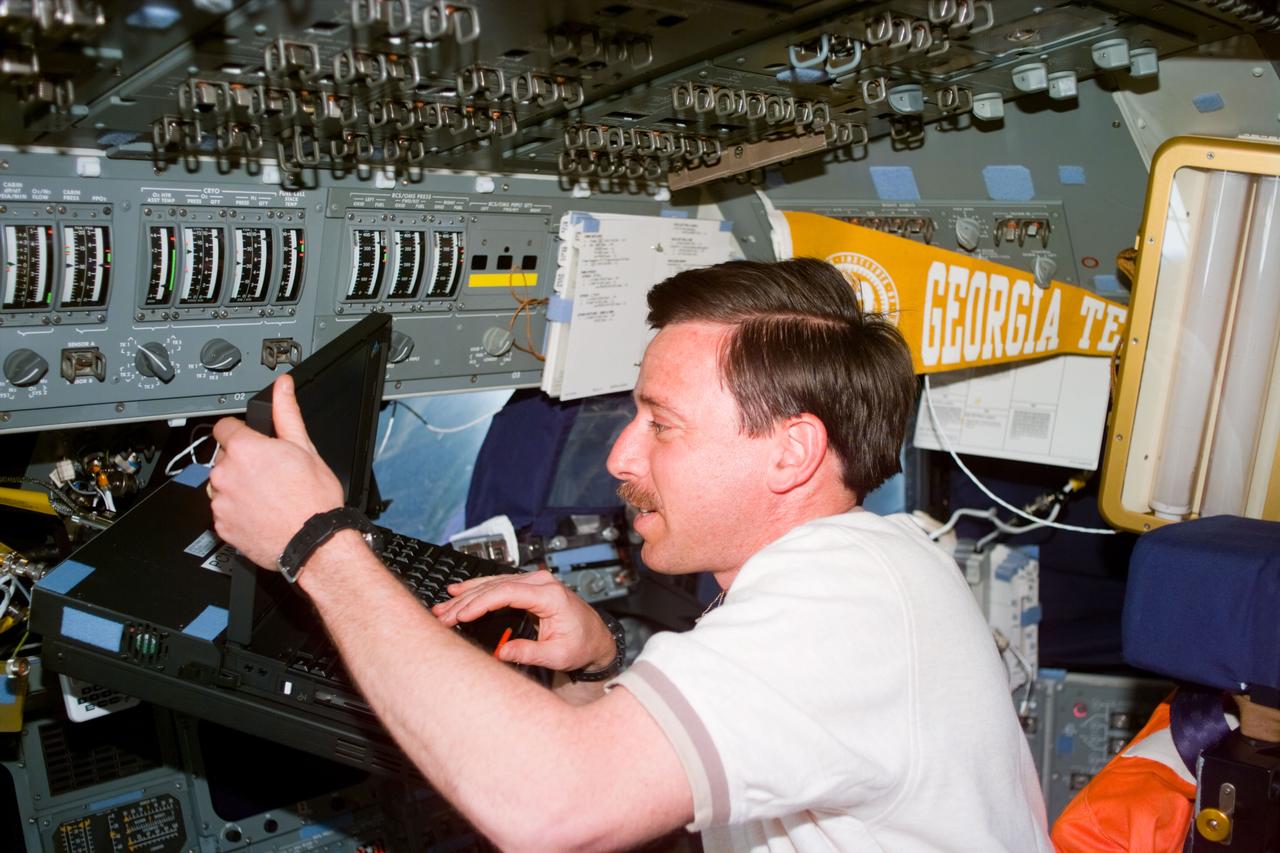
S82-E-5047 (12 Feb. 1997) --- Astronaut Scott J. Horowitz, STS-82 pilot, inputs data on onboard general purpose computer on the Space Shuttle Discovery's flight deck. This view was taken with an Electronic Still Camera (ESC).
Crewmember activity in the flight deck
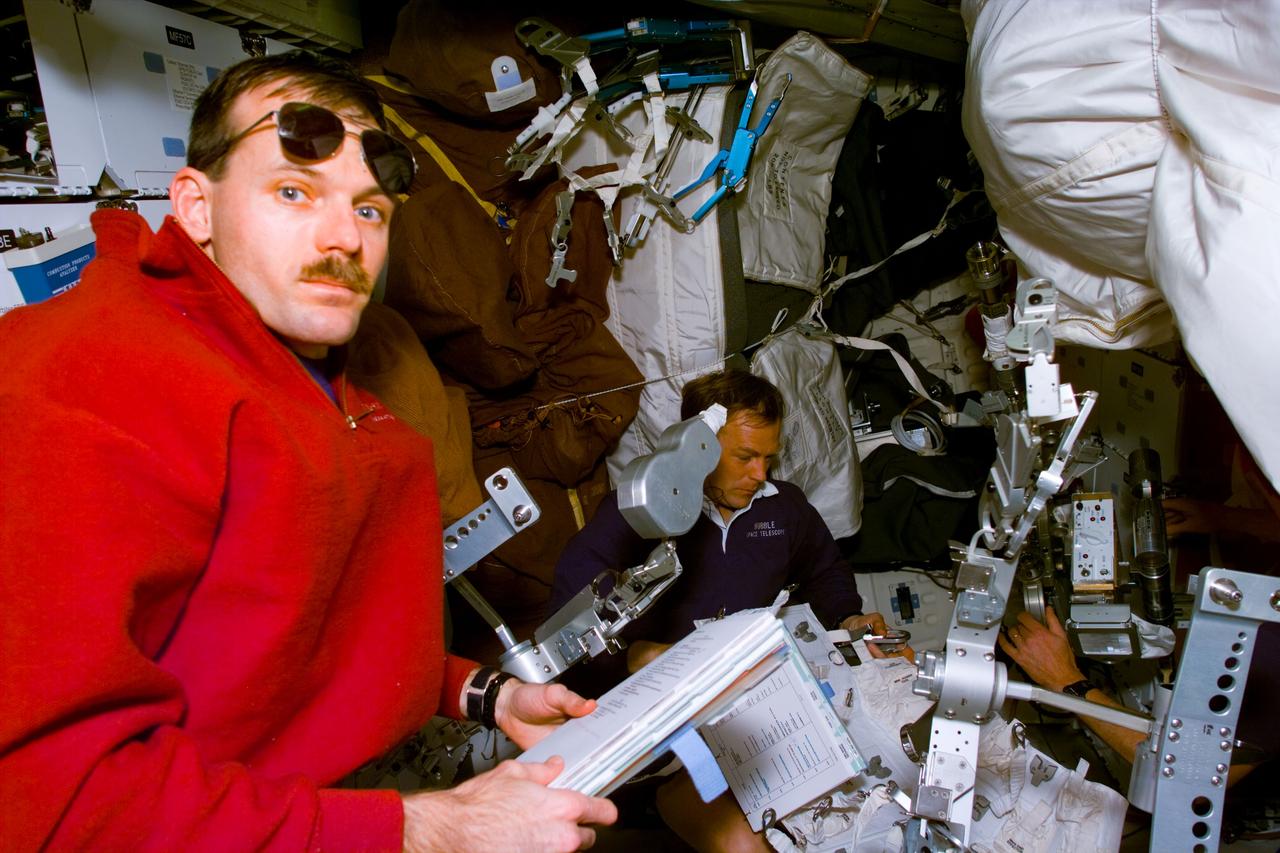
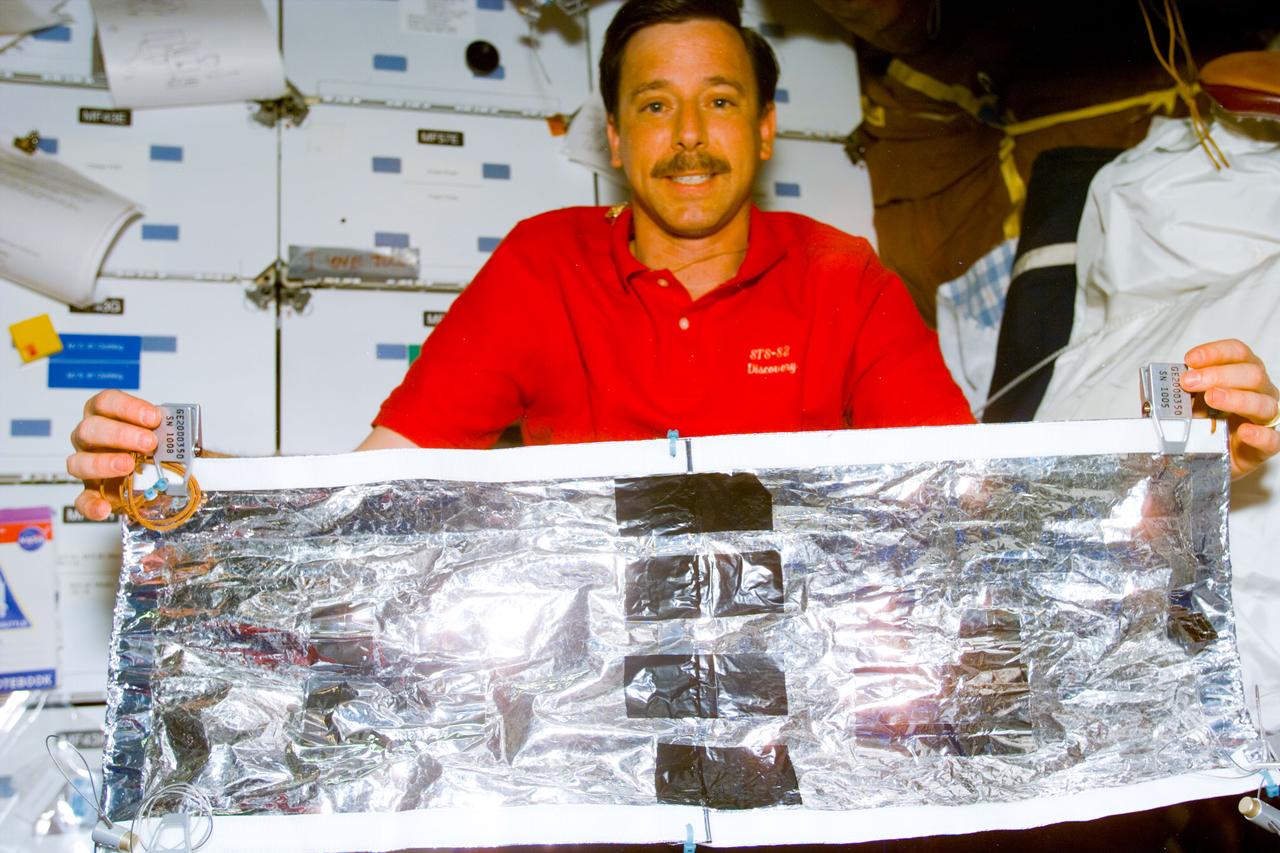
STS082-350-021 (11-21 Feb. 1997) --- On Discovery's middeck, astronaut Scott J. Horowitz, STS-82 pilot, works on one of the multi-layer insulation (MLI) patches to be used by two crew mates on an upcoming space walk to repair worn insulation on the Hubble Space Telescope (HST).
Horowitz fashions MLI patches on Flight Day 7
S82-E-5278 (14 Feb. 1997) --- Astronaut Steven L. Smith, STS-82 mission specialist, during Extravehicular Activity (EVA) setup, for the Hubble Space Telescope (HST) repair.  This view was taken with an Electronic Still Camera (ESC).
EVA 1 activity on Flight Day 4 to service the Hubble Space Telescope
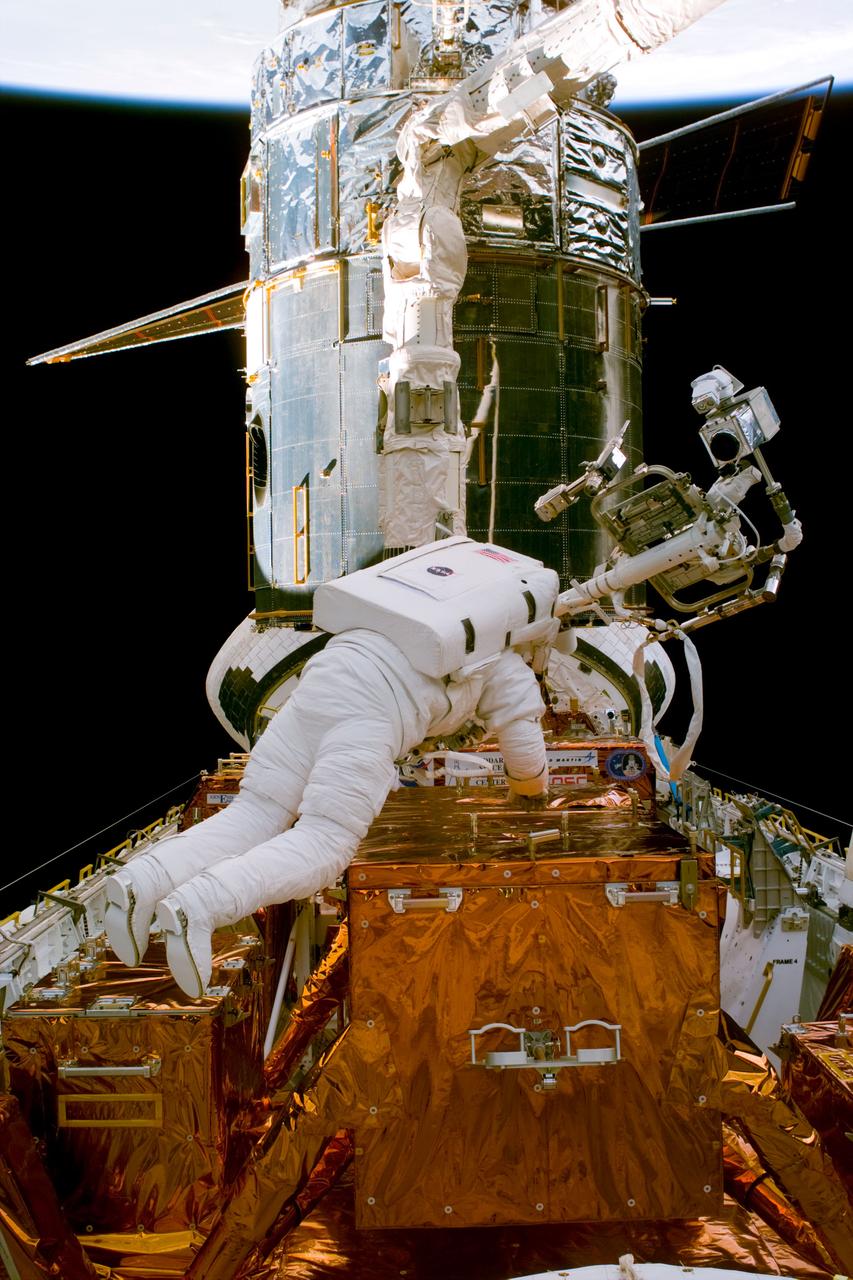
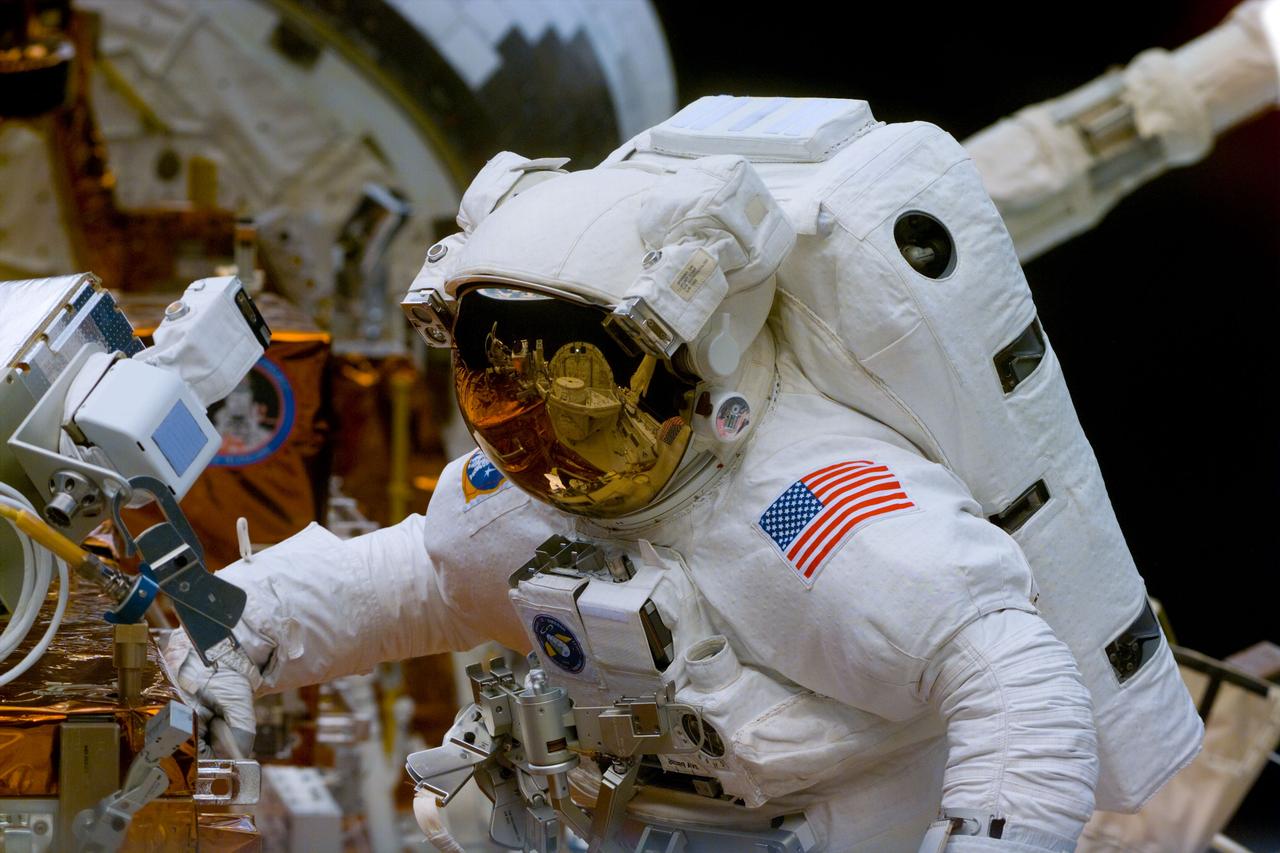
S82-E-5317 (14 Feb. 1997) --- Astronaut Steven L. Smith, STS-82 mission specialist, on arm with Faint Object Spectrograph (FOS) after removal from Hubble Space Telescope (HST).  This view was taken with an Electronic Still Camera (ESC).
EVA 1 activity on Flight Day 4 to service the Hubble Space Telescope
S82-E-5616 (17 Feb. 1997) --- Astronaut Steven A. Hawley, STS-82 mission specialist, controls the Remote Manipulator System (RMS) on the Space Shuttle Atlantis' aft flight deck.  This view was taken with an Electronic Still Camera (ESC).
Activity on the flight deck during EVA on Flight Day 7
S82-E-5303 (14 Feb. 1997) --- Close-up of astronaut Steven L. Smith, STS-82 mission specialist, during Extravehicular Activity (EVA), for the Hubble Space Telescope (HST) repair.  This view was taken with an Electronic Still Camera (ESC).
EVA 1 activity on Flight Day 4 to service the Hubble Space Telescope
STS-82 Mission Specialist Steven L. Smith prepares to enter the Space Shuttle Discovery at Launch Pad 39A, with the assistance of white room closeout crew members Dave Law, in front; Carlous Gillis, at left; and James Davis
KSC-97pc287
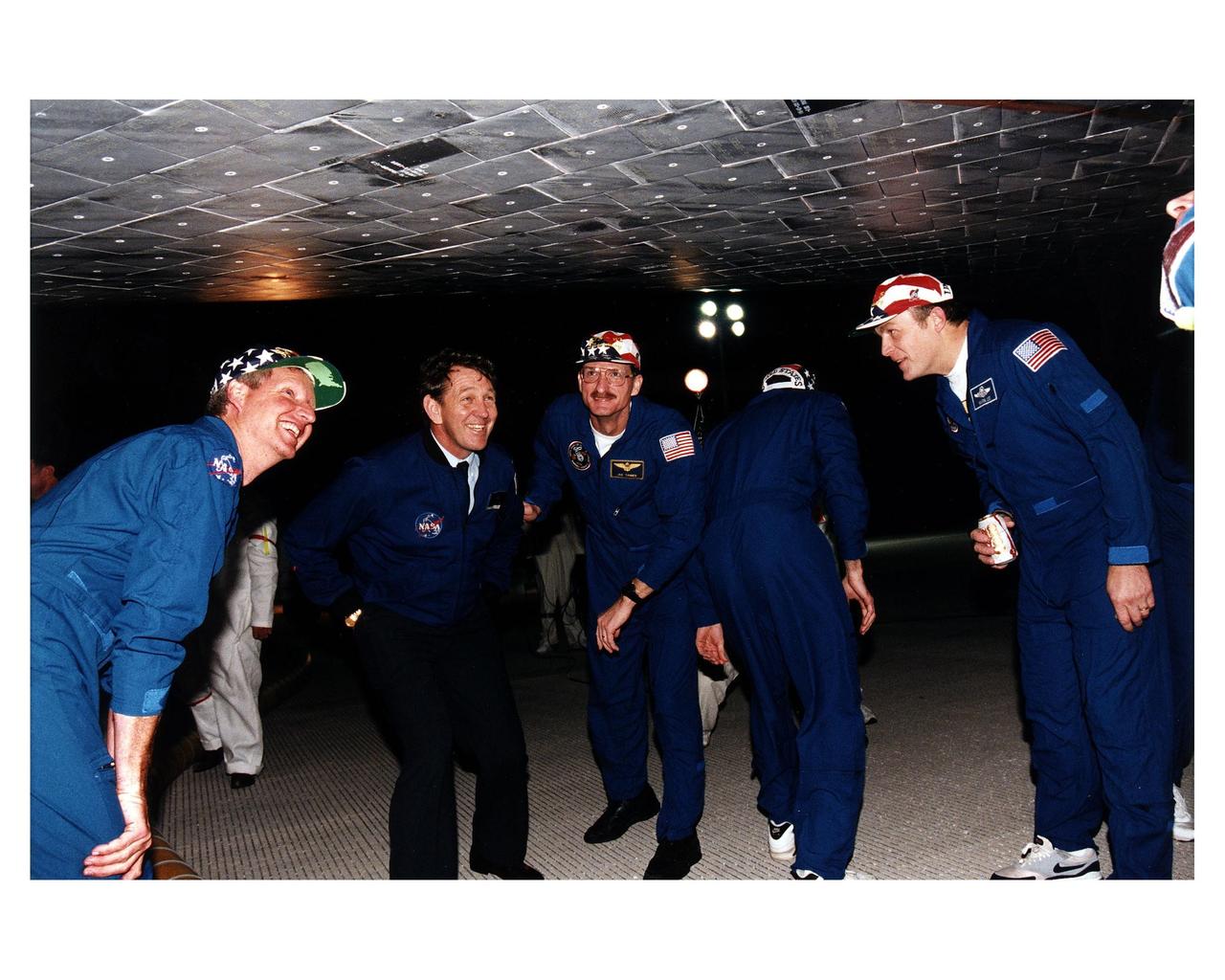
Accompanied by former astronaut Michael J. McCulley, several members of the STS-82 crew look at thermal protection system tile under the Space Shuttle Discovery on the runway at the Shuttle Landing Facility shortly after the conclusion of a 10-day mission to service the orbiting Hubble Space Telescope (HST). From left to right, they are Mission Specialist Steven A. Hawley; Michael J. McCulley, currently vice president and associate program manager for ground operations for the United Space Alliance at KSC; Mission Specialists Joseph R. "Joe" Tanner and Steven L. Smith (back to camera); and Payload Commander Mark C. Lee. STS-82 is the ninth Shuttle nighttime landing, and the fourth nighttime landing at KSC. The seven-member crew performed a record-tying five back-to-back extravehicular activities (EVAs) or spacewalks to service the telescope, which has been in orbit for nearly seven years. Two new scientific instruments were installed, replacing two outdated instruments. Five spacewalks also were performed on the first servicing mission, STS-61, in December 1993. Only four spacewalks were scheduled for STS-82, but a fifth one was added during the flight to install several thermal blankets over some aging insulation covering three HST compartments containing key data processing, electronics and scientific instrument telemetry packages. STS-82 was the 82nd Space Shuttle flight and the second mission of 1997
KSC-97pc355
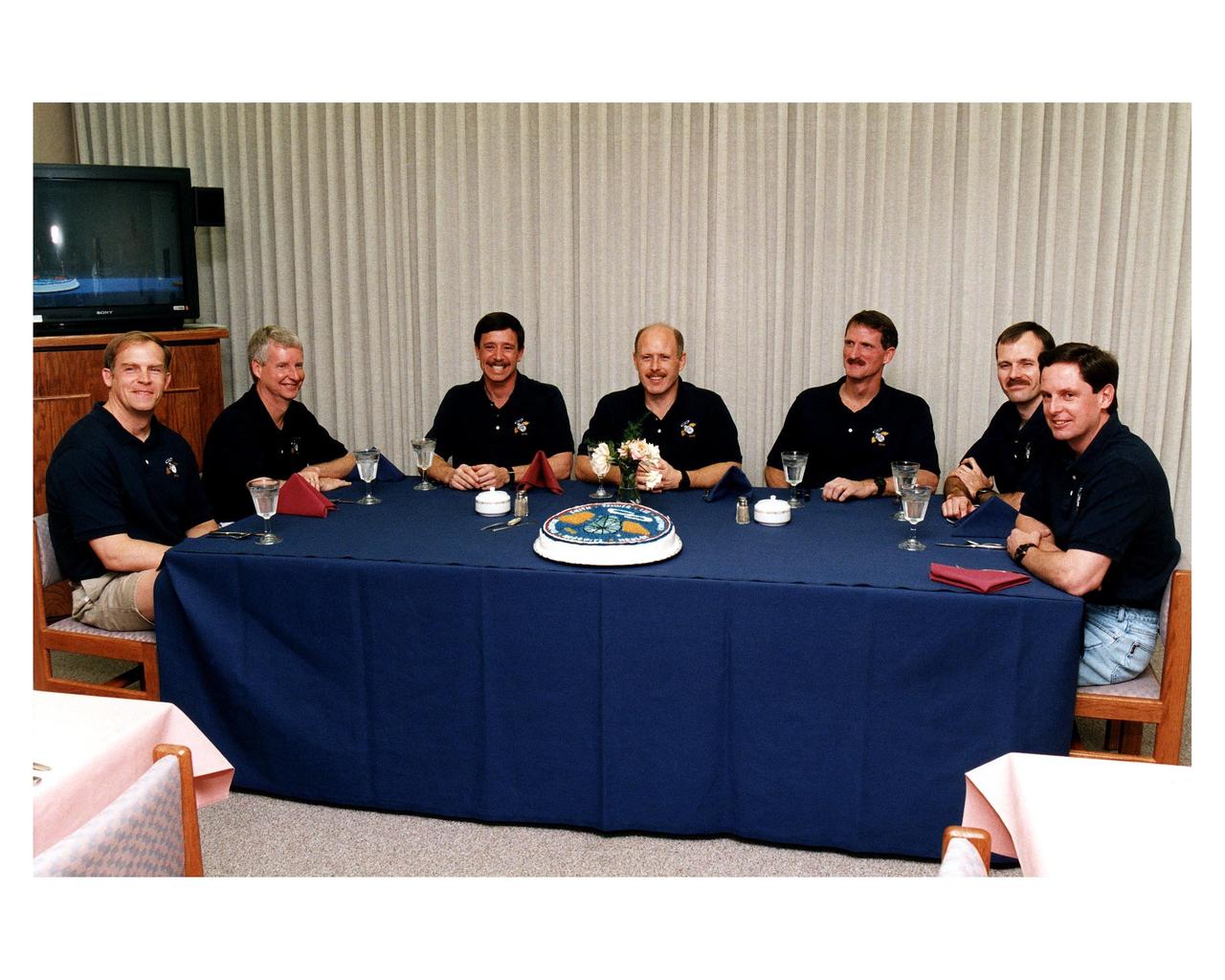
As part of the final STS-82 prelaunch activities, the seven crew members gather for lunch and a photo opportunity in the Operations and Checkout Building. From left, are Payload Commander Mark C. Lee, Mission Specialist Steven A. Hawley, Pilot Scott J. "Doc" Horowitz, Mission Commander Kenneth D. Bowersox, and Mission Specialists Joseph R. "Joe" Tanner, Steven L. Smith and Gregory J. Harbaugh. After a weather briefing, the astronauts will don their launch and entry suits and depart for Launch Pad 39A, where the Space Shuttle Discovery awaits liftoff during a 65-minute launch window which opens at about 3:55 a.m. EST, Feb. 11. The exact opening of the launch window will be announced a few hours before launch based on the final computation of the location of the Hubble Space Telescope (HST). STS-82 will be the second mission to service the HST which was deployed in 1990
KSC-97pc268
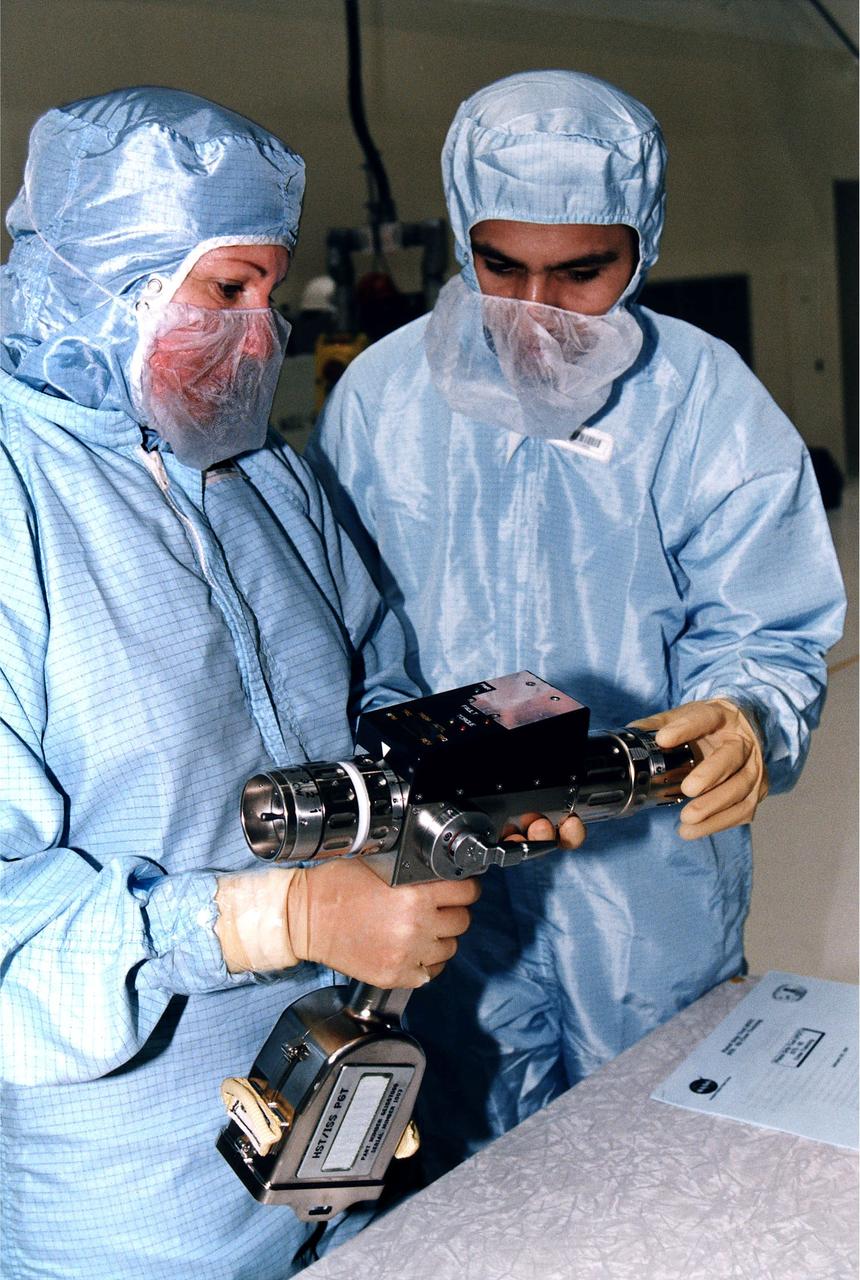
KENNEDY SPACE CENTER, FLA. -  In KSC's Vertical Processing Facility, Louise Kleba of the Vehicle Integration Test Team (VITT) and engineer Devin Tailor of Goddard Space Flight Center examine the Pistol Grip Tool (PGT), which was designed for use by astronauts during spacewalks.  The PGT is a self-contained, micro-processor controlled, battery-powered tool.  It also can be used as a nonpowered ratchet wrench.  The experiences of the astronauts on the first Hubble Space Telescope (HST) servicing mission led to recommendations for this smaller, more efficient tool for precision work during spacewalks.  The PGT will be used on the second HST servicing mission, STS-82.  Liftoff aboard Discovery is scheduled Feb. 11.
KENNEDY SPACE CENTER, FLA. - In KSC's Vertical Processing Facility, Louise Kleba of the Vehicle Integration Test Team (VITT) and engineer Devin Tailor of Goddard Space Flight Center examine the Pistol Grip Tool (PGT), which was designed for use by astronauts during spacewalks. The PGT is a self-contained, micro-processor controlled, battery-powered tool. It also can be used as a nonpowered ratchet wrench. The experiences of the astronauts on the first Hubble Space Telescope (HST) servicing mission led to recommendations for this smaller, more efficient tool for precision work during spacewalks. The PGT will be used on the second HST servicing mission, STS-82. Liftoff aboard Discovery is scheduled Feb. 11.
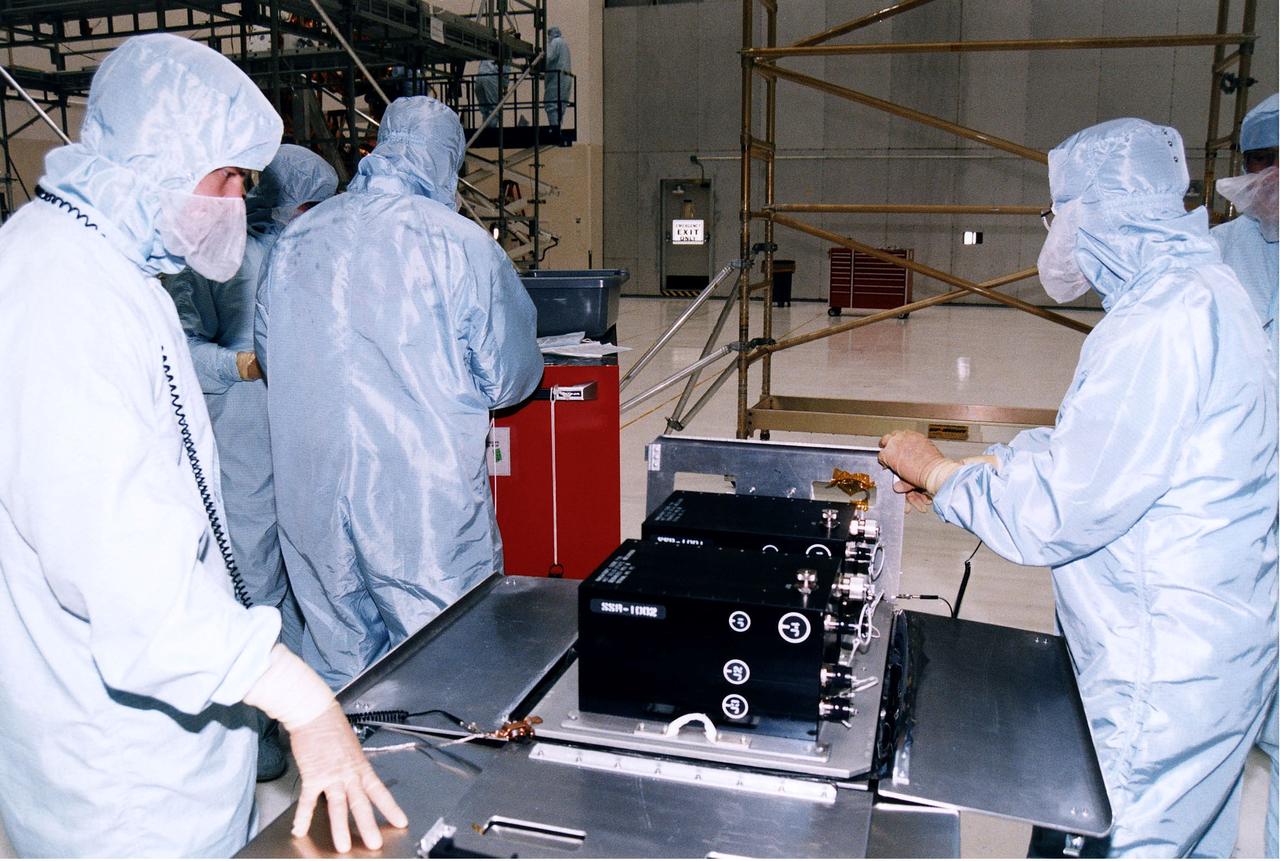
KENNEDY SPACE CENTER, FLA. -  Workers in KSC's Vertical Processing Facility install a solid state recorder into a transport assembly in its protective enclosure as part of the prelaunch preparations for STS-82, the second Hubble Space Telescope servicing mission.  The digital solid state recorder will replace one of three engineering/science tape recorders on Hubble.  The solid state recorder has no moving parts to wear out.  It also is more flexible than a reel-to-reel recorder and can store 10 times as much data.  Liftoff aboard Discovery is targeted Feb. 11 with a crew of seven.
KENNEDY SPACE CENTER, FLA. - Workers in KSC's Vertical Processing Facility install a solid state recorder into a transport assembly in its protective enclosure as part of the prelaunch preparations for STS-82, the second Hubble Space Telescope servicing mission. The digital solid state recorder will replace one of three engineering/science tape recorders on Hubble. The solid state recorder has no moving parts to wear out. It also is more flexible than a reel-to-reel recorder and can store 10 times as much data. Liftoff aboard Discovery is targeted Feb. 11 with a crew of seven.
KENNEDY SPACE CENTER, FLA. -  Workers in KSC's Vertical Processing Facility prepare a solid state recorder for installation in a protective enclosure as part of the prelaunch preparations for STS-82, the second Hubble Space Telescope servicing mission.  The digital solid state recorder will replace one of three engineering/science tape recorders on Hubble.  The solid state recorder has no moving parts to wear out.  It also is more flexible than a reel-to-reel recorder and can store 10 times as much data.  Liftoff aboard Discovery is targeted Feb. 11 with a crew of seven.
KENNEDY SPACE CENTER, FLA. - Workers in KSC's Vertical Processing Facility prepare a solid state recorder for installation in a protective enclosure as part of the prelaunch preparations for STS-82, the second Hubble Space Telescope servicing mission. The digital solid state recorder will replace one of three engineering/science tape recorders on Hubble. The solid state recorder has no moving parts to wear out. It also is more flexible than a reel-to-reel recorder and can store 10 times as much data. Liftoff aboard Discovery is targeted Feb. 11 with a crew of seven.
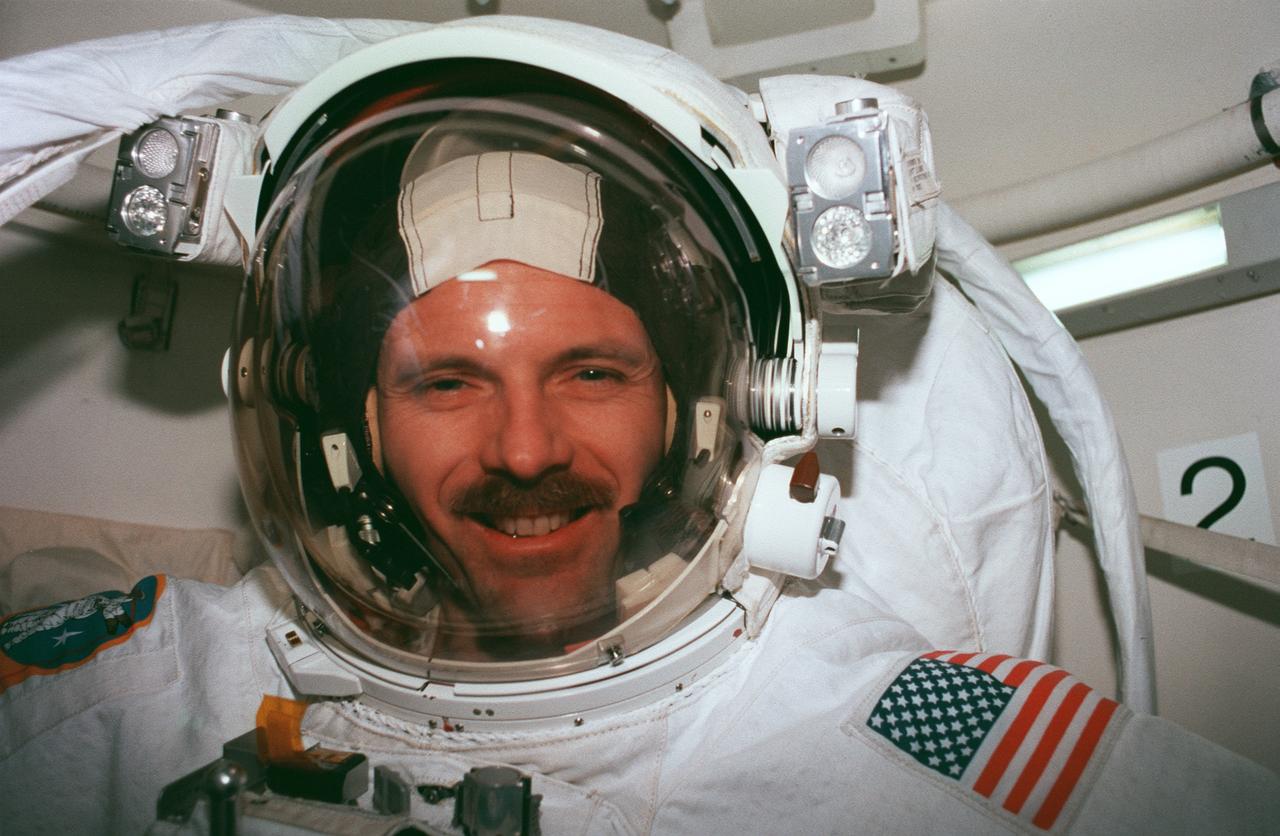
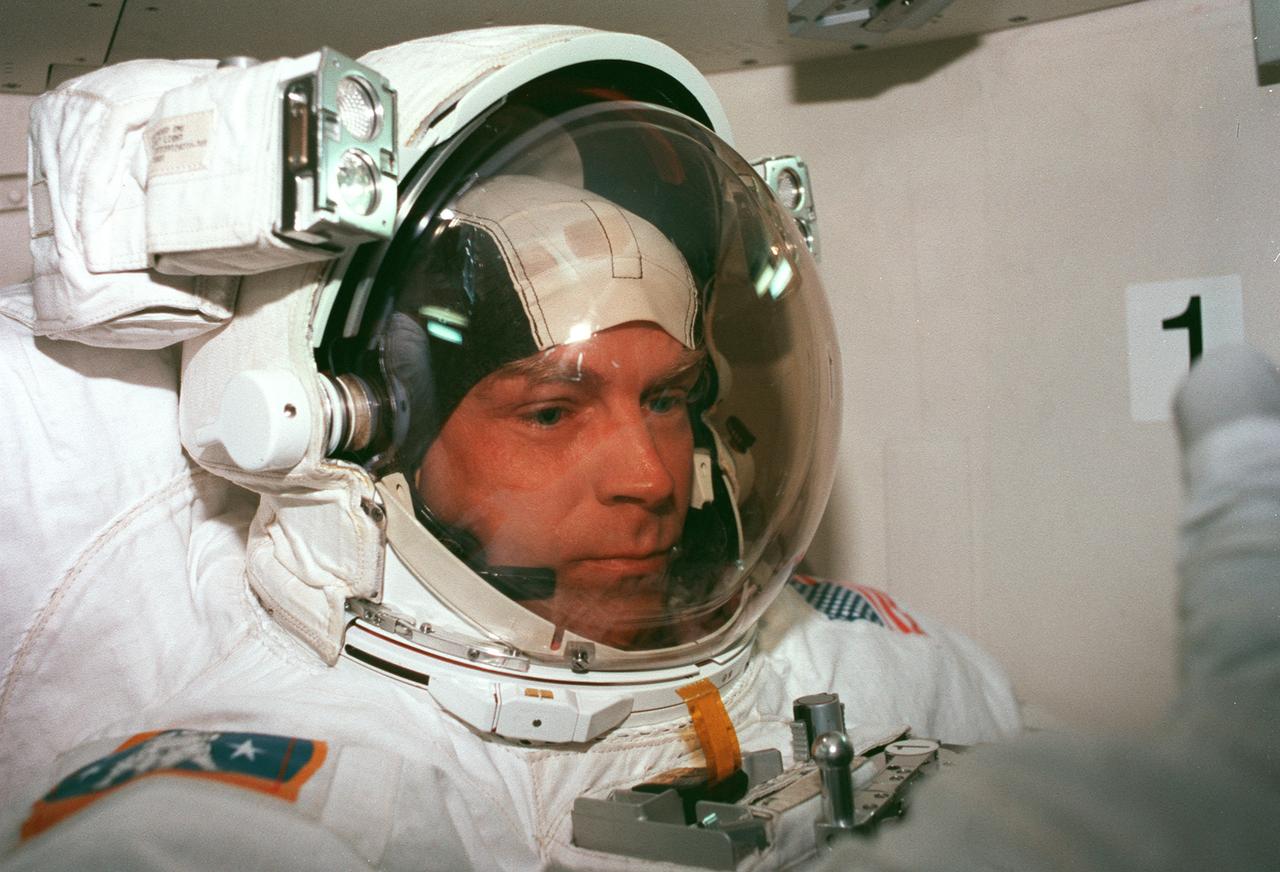
STS082-344-019 (11-21 Feb. 1997) --- Attired in the Extravehicular Mobility Unit (EMU) spacesuit, astronaut Mark C. Lee, payload commander, is in the airlock Discovery preparing for one of five STS-82 space walks. The sessions of extravehicular activity (EVA), of which Lee eventually participated in three, were conducted in order to service the Hubble Space Telescope (HST), temporarily latched in Discovery's payload bay.
Middeck activity during EVA preparations and flight deck activity
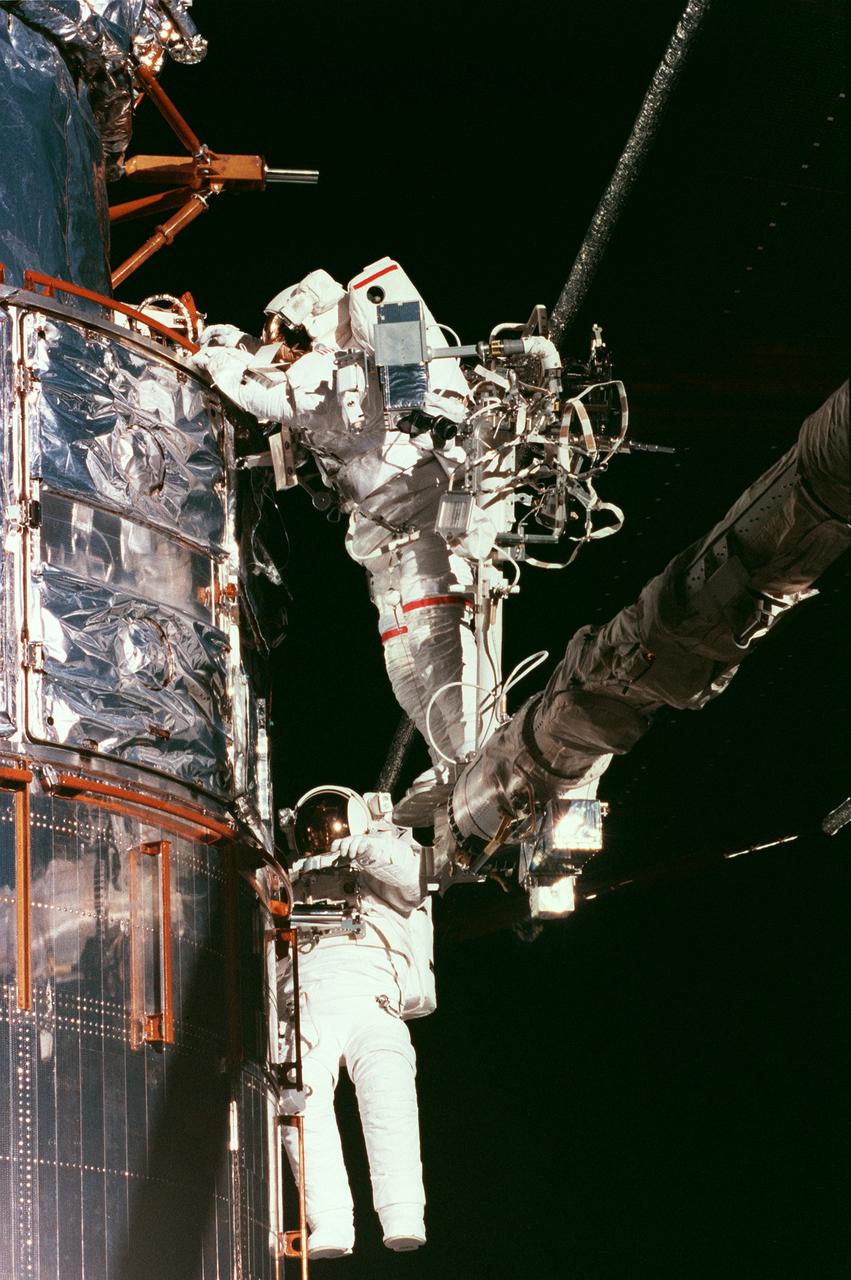
STS082-320-029 (16 Feb. 1997) --- Astronaut Joseph R. Tanner, STS-82 mission specialist, is backdropped against Earth's limb and a sunburst effect in this 35mm frame exposed by astronaut Gregory J. Harbaugh, mission specialist, his extravehicular activity (EVA) crew mate. Harbaugh's torso is reflected in Tanner's helmet visor. The two were making their second EVA and the fourth one of five for the crew, in order to service the Hubble Space Telescope (HST). A checklist of tasks is attached to Tanner's left arm for quick reference.
EVA 4 activity on Flight Day 7 - handheld camera views
S82-E-5644 (17 Feb. 1997) --- Inside the Space Shuttle Discovery's cabin, astronauts Scott J. Horowitz (left), STS-82 pilot, and Mark C. Lee, payload commander, monitor the mission's fourth Extravehicular Activity (EVA) to service Hubble Space Telescope (HST).  This view was taken with an Electronic Still Camera (ESC).
Flight deck activity during EVA on Flight Day 7
STS082-317-003 (11 -21 Feb. 1997) --- Astronaut Joseph R. Tanner, one half of a space walk team on mission STS-82 to service the Hubble Space Telescope (HST), watches the Extravehicular Activity (EVA) of another team from Discovery's aft flight deck.  Through Discovery's overhead window, lakes and a timber area appear almost close enough for Tanner to touch.
Flight deck activity during EVA 3 on Flight Day 6
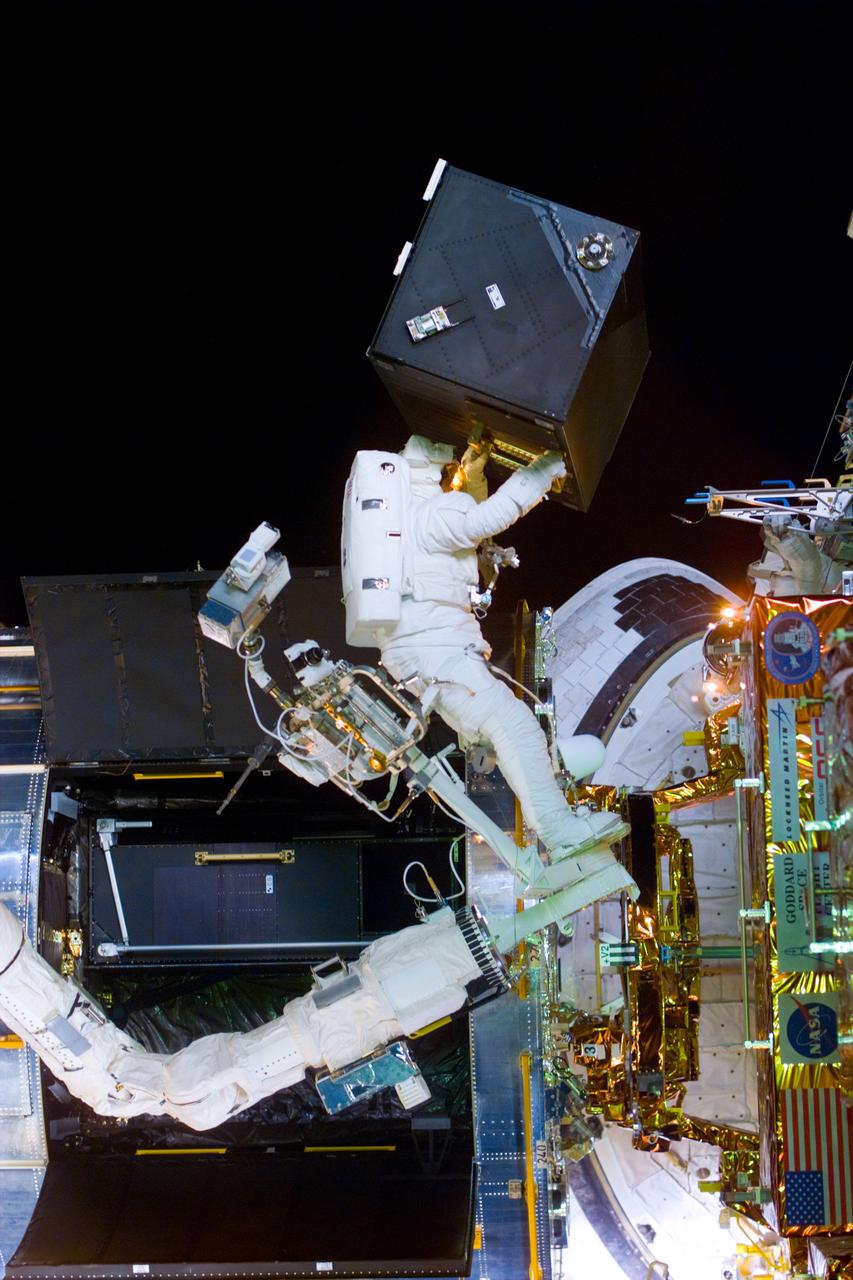
S82-E-5718 (18 Feb. 1997) --- Making use of the Remote Manipulator System (RMS) astronauts Mark C. Lee (left), STS-82 payload commander, and Steven L. Smith, mission specialist, perform the final phases of Extravehicular Activity (EVA) duty.  Lee holds a patch piece for Bay #10, out of view, toward which the two were headed.  A sample of the patch work can be seen on Bay #9 in the upper left quadrant of the picture.  This view was taken with an Electronic Still Camera (ESC).
EVA 5 activity on Flight Day 8 to service the Hubble Space Telescope
STS082-717-026 (13 Feb. 1997) --- Gearing up with tools for the first Extravehicular Activity (EVA-1) to service the Hubble Space Telescope (HST, background) are astronauts Steven L. Smith (left) and Mark C. Lee. They were among four STS-82 crewmembers who are to share several alternating two-member space walking work sessions during the flight.  The photograph was made from inside Discovery's cabin with a 70mm camera.
EVA 1 activity on Flight Day 4 to service the Hubble Space Telescope
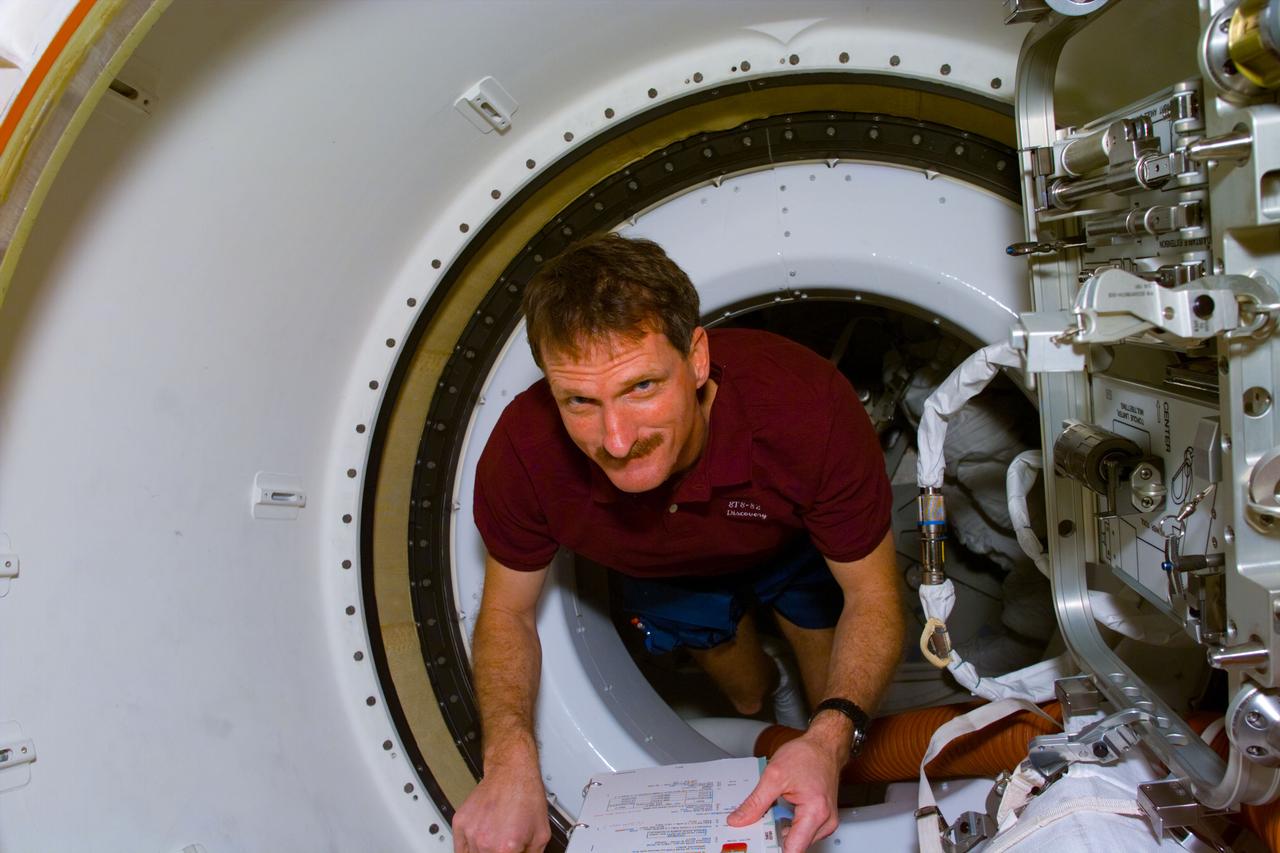
S82-E-5027 (12 Feb. 1997) --- Astronaut Joseph R. Tanner, STS-82 mission specialist, in hatchway to the Space Shuttle Discovery's airlock where he will later don an Extravehicular Mobility Unit (EMU) space suit for servicing tasks on Hubble Space Telescope (HST). This view was taken with an Electronic Still Camera (ESC).
Mission Specialist Joe Tanner floats through the tunnel adapter
STS082-323-017 (17 Feb. 1997) --- Astronaut Mark C. Lee, on the end of the Remote Manipulator System (RMS) arm, photographs a bit of patch work on the worn insulation material of the Hubble Space Telescope (HST). The rectangular patch is on HST's Bay 8.  Astronaut Steven L. Smith (out of frame) assisted with the patch work.  This was the final Extravehicular Activity (EVA) of five performed by two teams of space walkers on the STS-82 crew.
EVA 5 activity on Flight Day 7 - handheld camera views
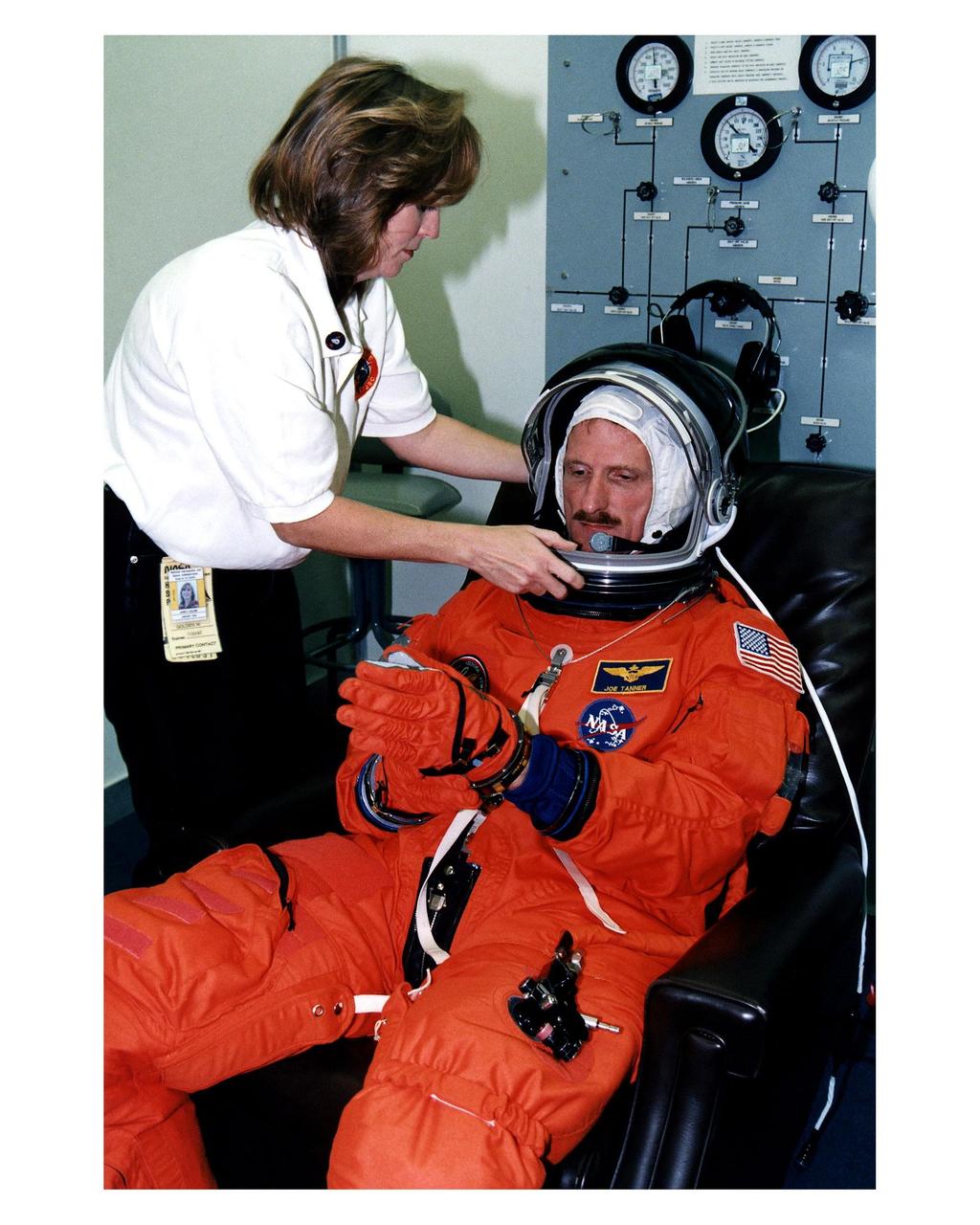
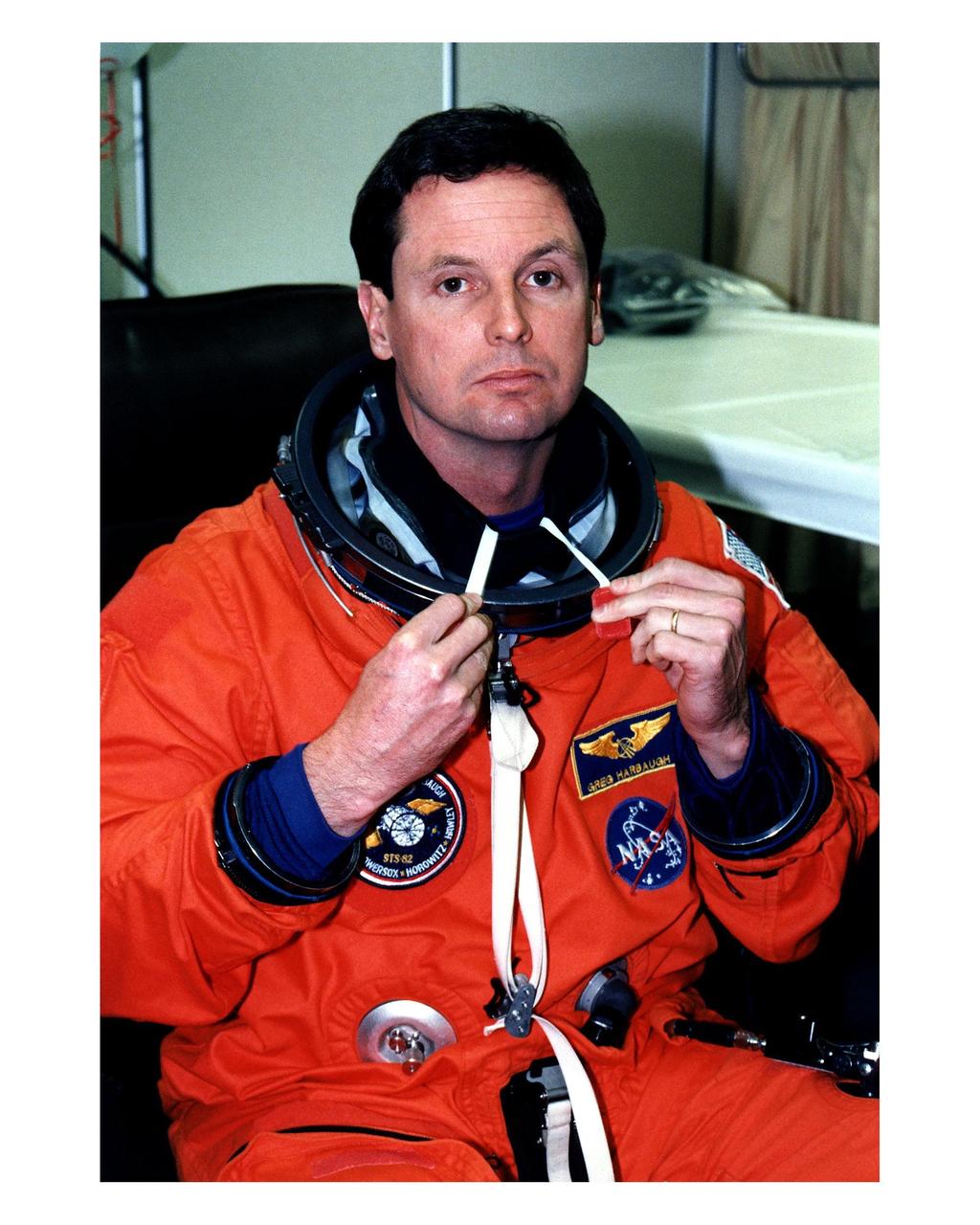
STS-82 Mission Specialist Joseph R. "Joe" Tanner dons his launch and entry suit in the Operations and Checkout Building with assistance from a suit technician. This is Tanner’s second space flight. He and the six other crew members will depart shortly for Launch Pad 39A, where the Space Shuttle Discovery awaits liftoff on a 10-day mission to service the orbiting Hubble Space Telescope (HST). This will be the second HST servicing mission. Four back-to-back spacewalks are planned
KSC-97pc269
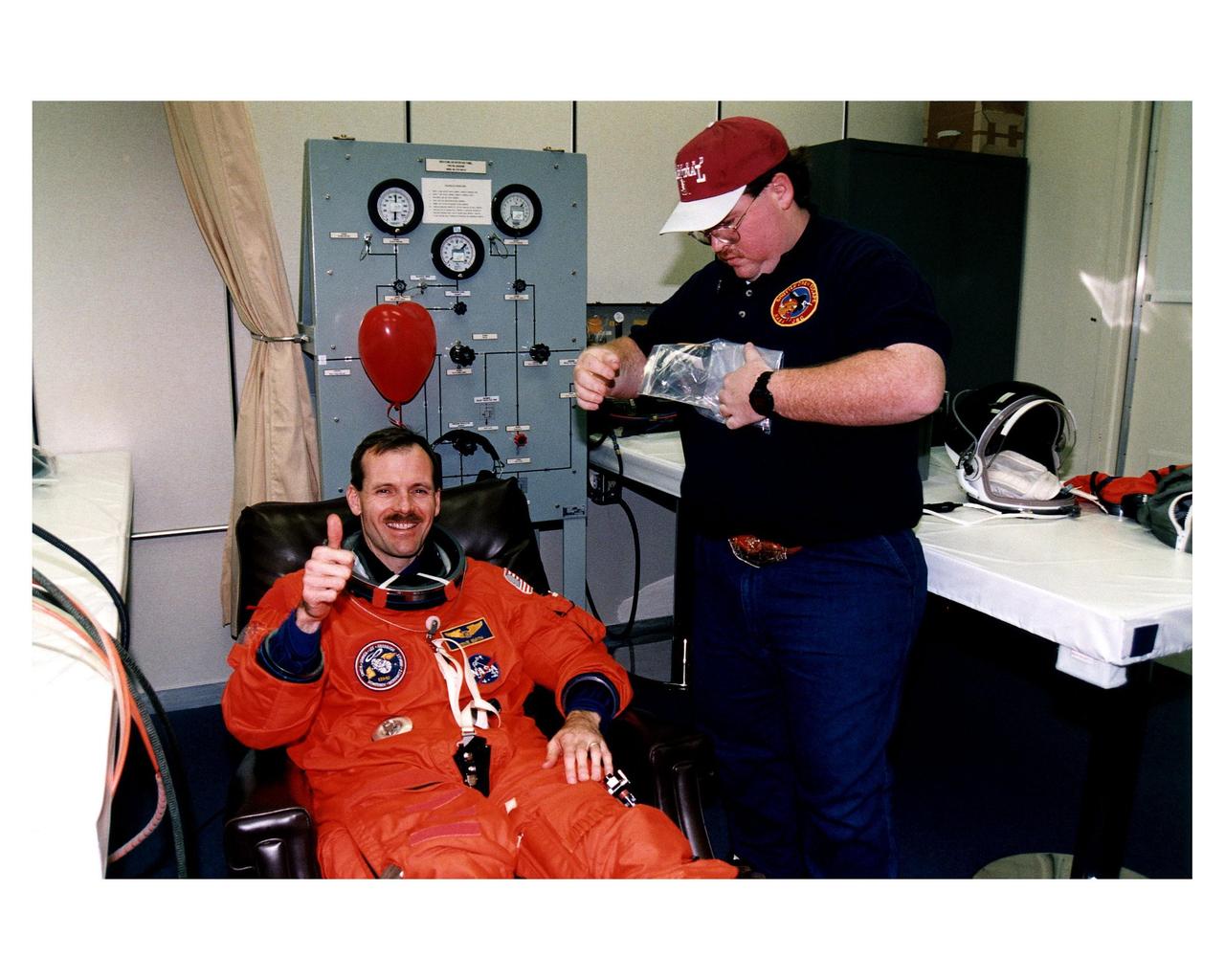
STS-82 Mission Commander Kenneth D. Bowersox makes some final adjustments to his launch and entry suit with assistance from a suit technician in the Operations and Checkout Building. This is his fourth space flight. He and the six other crew members will depart shortly for Launch Pad 39A, where the Space Shuttle Discovery awaits liftoff on a 10-day mission to service the orbiting Hubble Space Telescope (HST). This will be the second HST servicing mission. Four back-toback spacewalks are planned
KSC-97pc275
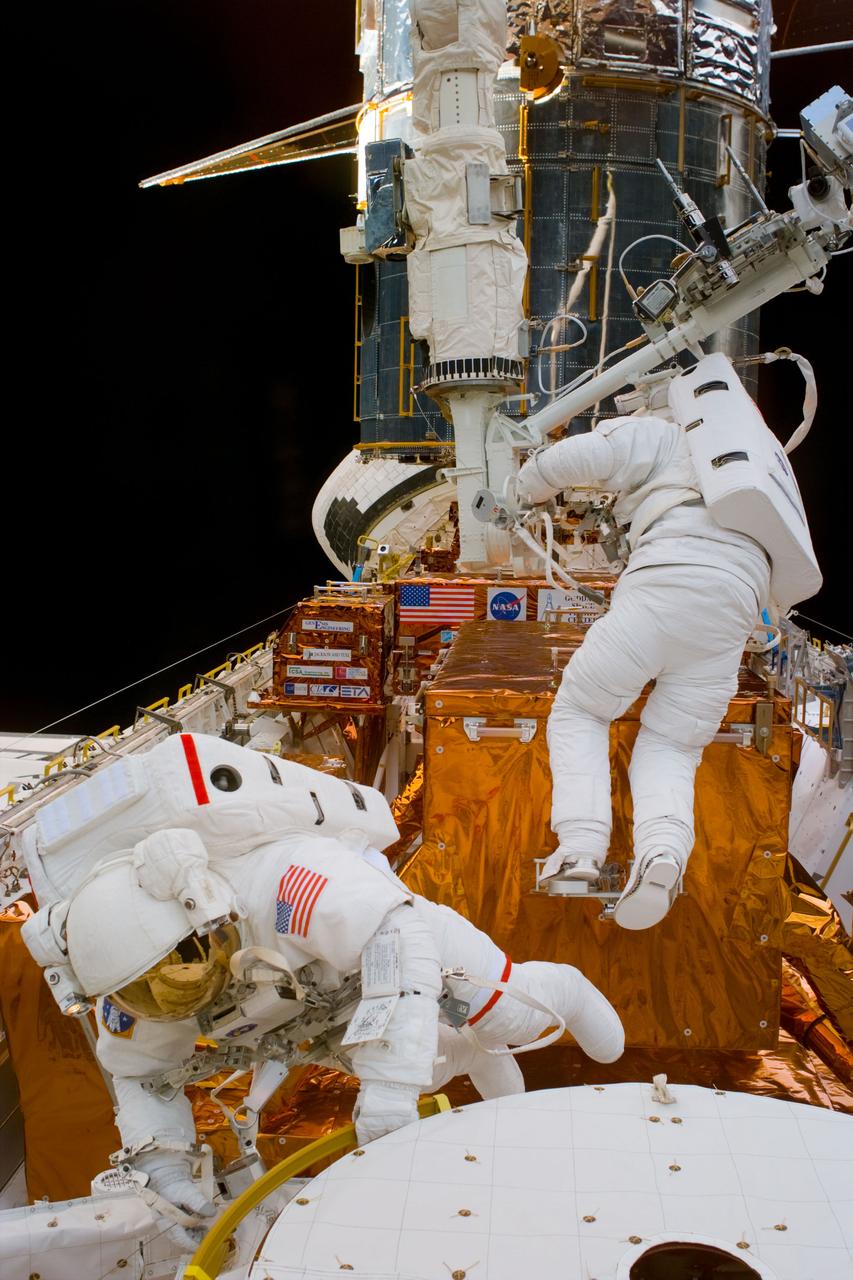
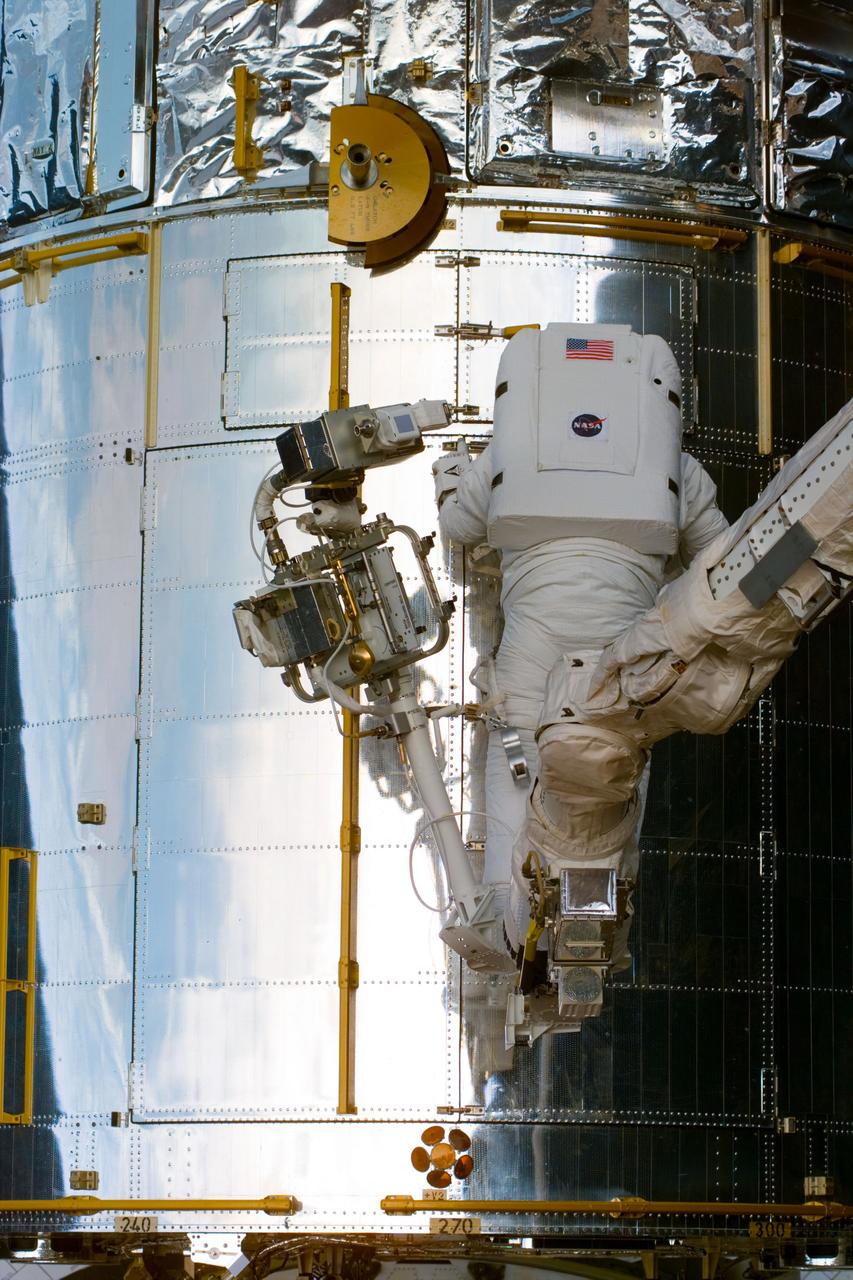
STS082-310-017 (15 Feb. 1997) --- This wide shot of the Hubble Space Telescope (HST) in Discovery's cargo bay, backdropped against Australia, was taken during the third STS-82 space walk to service the orbiting observatory. Astronaut Steven L. Smith (left of center)works near the foot restraint of the Remote Manipulator System (RMS).  Astronaut Mark C. Lee, payload commander who shared space walk chores with Smith, was out of frame.
EVA 3 activity on Flight Day 6 to service the Hubble Space Telescope
STS082-344-018 (11-21 Feb. 1997) --- Attired in the Extravehicular Mobility Unit (EMU) space suit, astronaut Steven L. Smith, mission specialist, is in the airlock of Discovery preparing for one of five STS-82 spacewalks. The sessions of extravehicular activity (EVA), of which Smith eventually participated in three, were conducted in order to service the Hubble Space Telescope (HST), temporarily latched in Discovery's payload bay.
Middeck activity during EVA preparations and flight deck activity
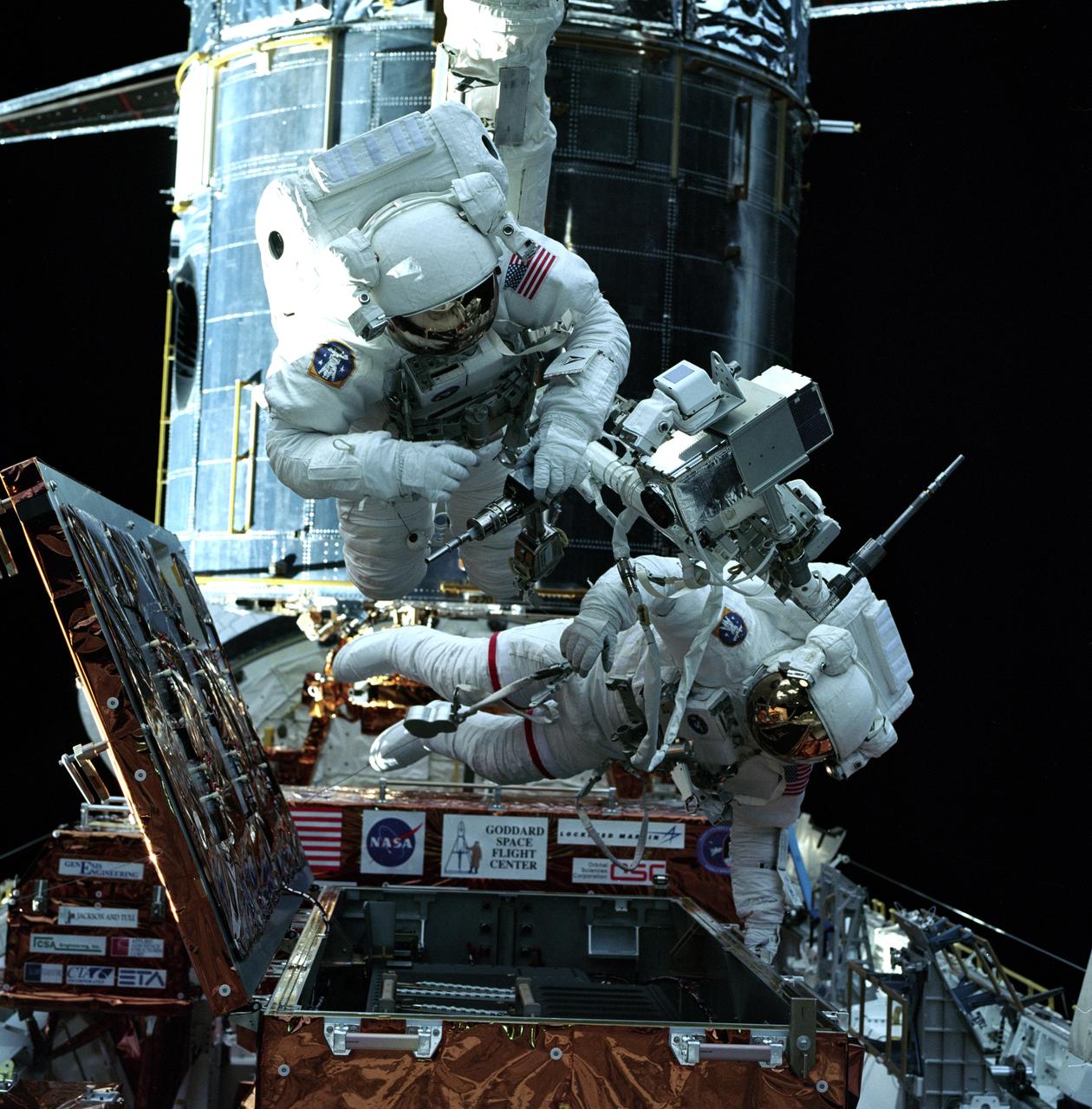
S82-E-5307 (14 Feb. 1997) --- Astronaut Mark C. Lee, STS-82 payload commander, in Hubble Space Telescope (HST) and astronaut Steven L. Smith, mission specialist, on Remote Manipulator System (RMS) during removal of Goddard High Resolution Spectrometer (GHRS).  This view was taken with an Electronic Still Camera (ESC).
EVA 1 activity on Flight Day 4 to service the Hubble Space Telescope
KENNEDY SPACE CENTER, FLA. -- STS-82 Terminal Countdown Demonstration Test (TCDT).   Crew members are Mission Commander Kenneth D. Bowersox, Pilot Scott J. "Doc" Horowitz, Payload Commander Mark C. Lee, and Mission Specialists Steven L. Smith, Gregory J. Harbaugh, Joseph R. "Joe" Tanner and Steven A. Hawley.
KSC-97pc185
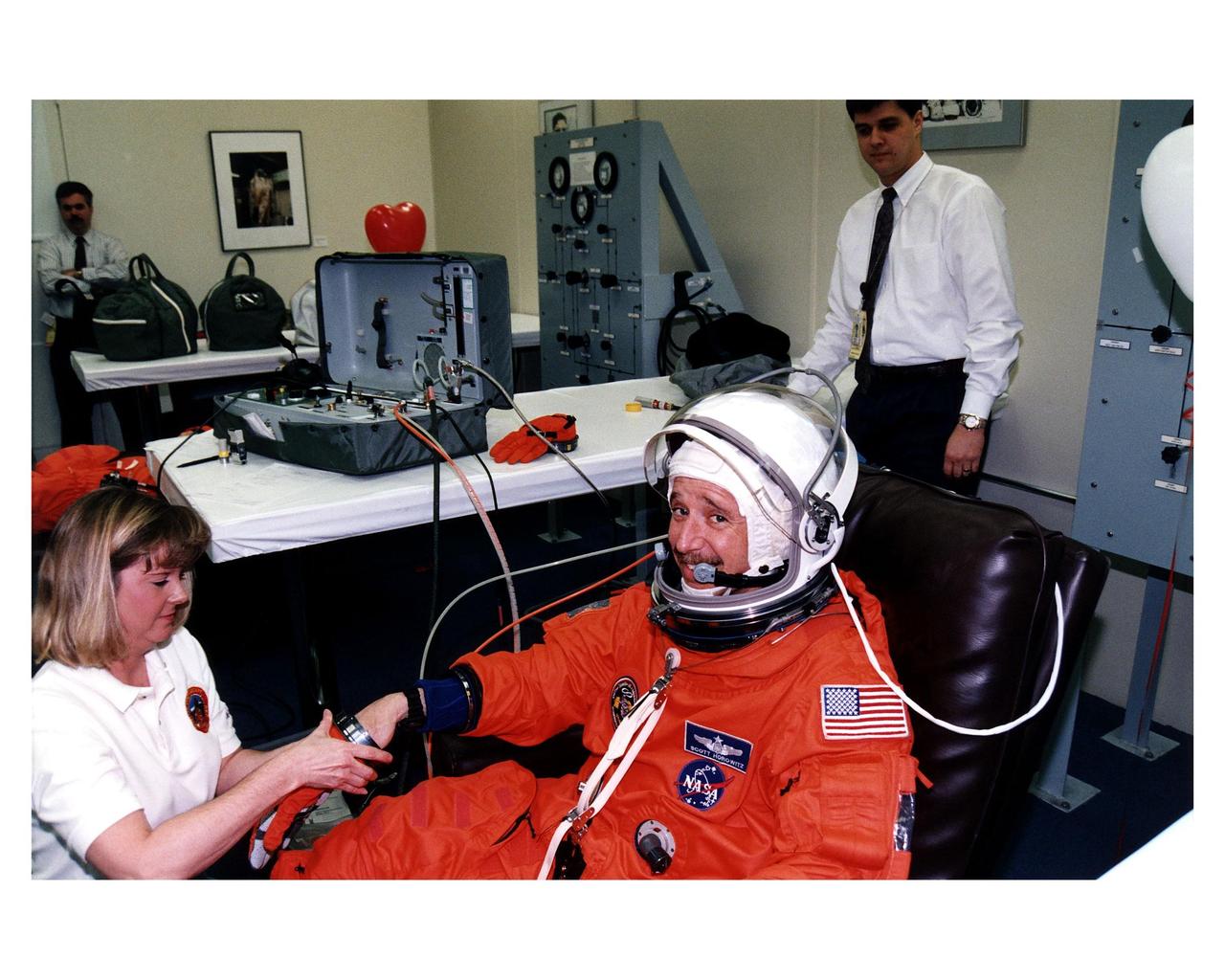
STS-82 Pilot Scott J. "Doc" Horowitz puts on a glove of his launch and entry suit with assistance from a suit technician in the Operations and Checkout Building. This is Horowitz’s second space flight. He and the six other crew members will depart shortly for Launch Pad 39A, where the Space Shuttle Discovery awaits liftoff on a 10-day mission to service the orbiting Hubble Space Telescope (HST). This will be the second HST servicing mission. Four back-to-back spacewalks are planned
KSC-97pc272