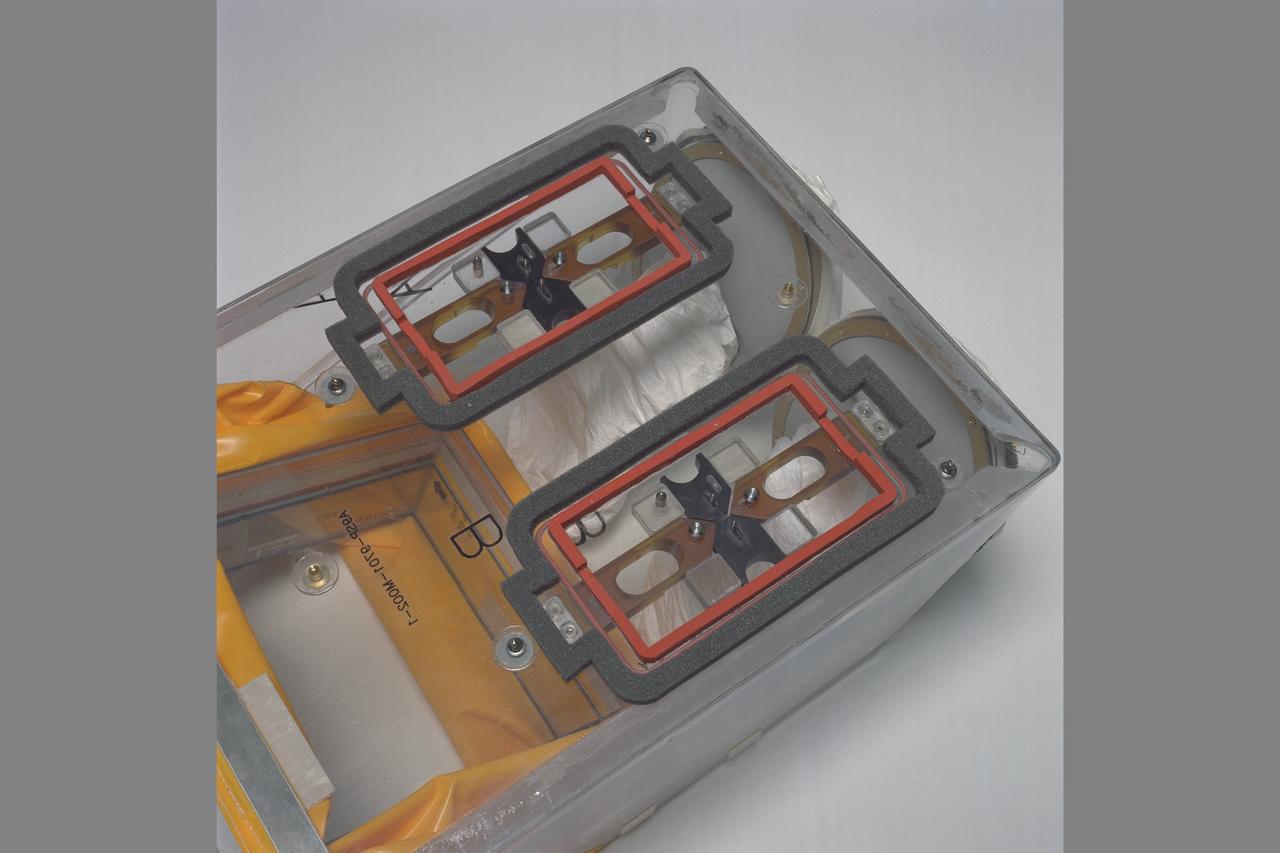
STS-90 Nerolab EVA - AEM
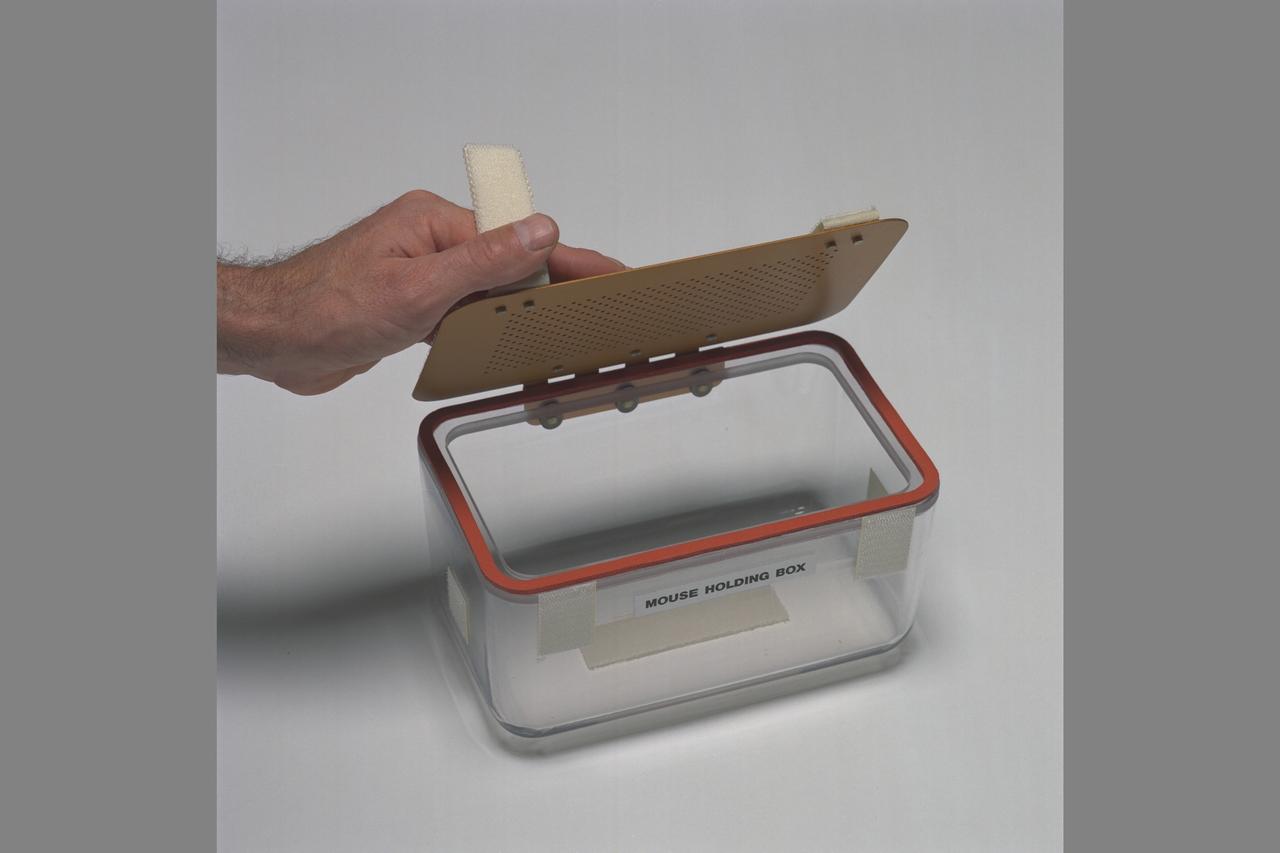
STS-90 Nerolab EVA - AEM
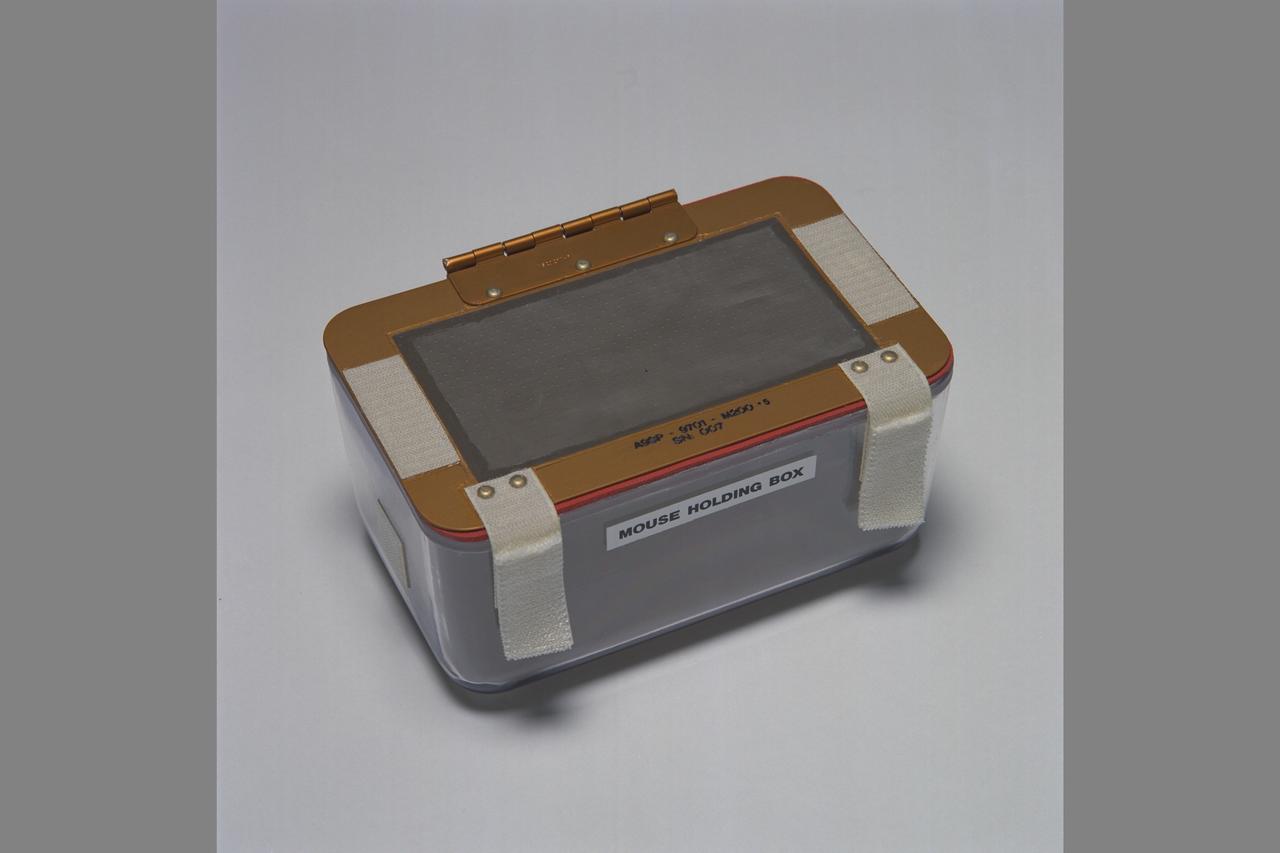
STS-90 Nerolab EVA - AEM
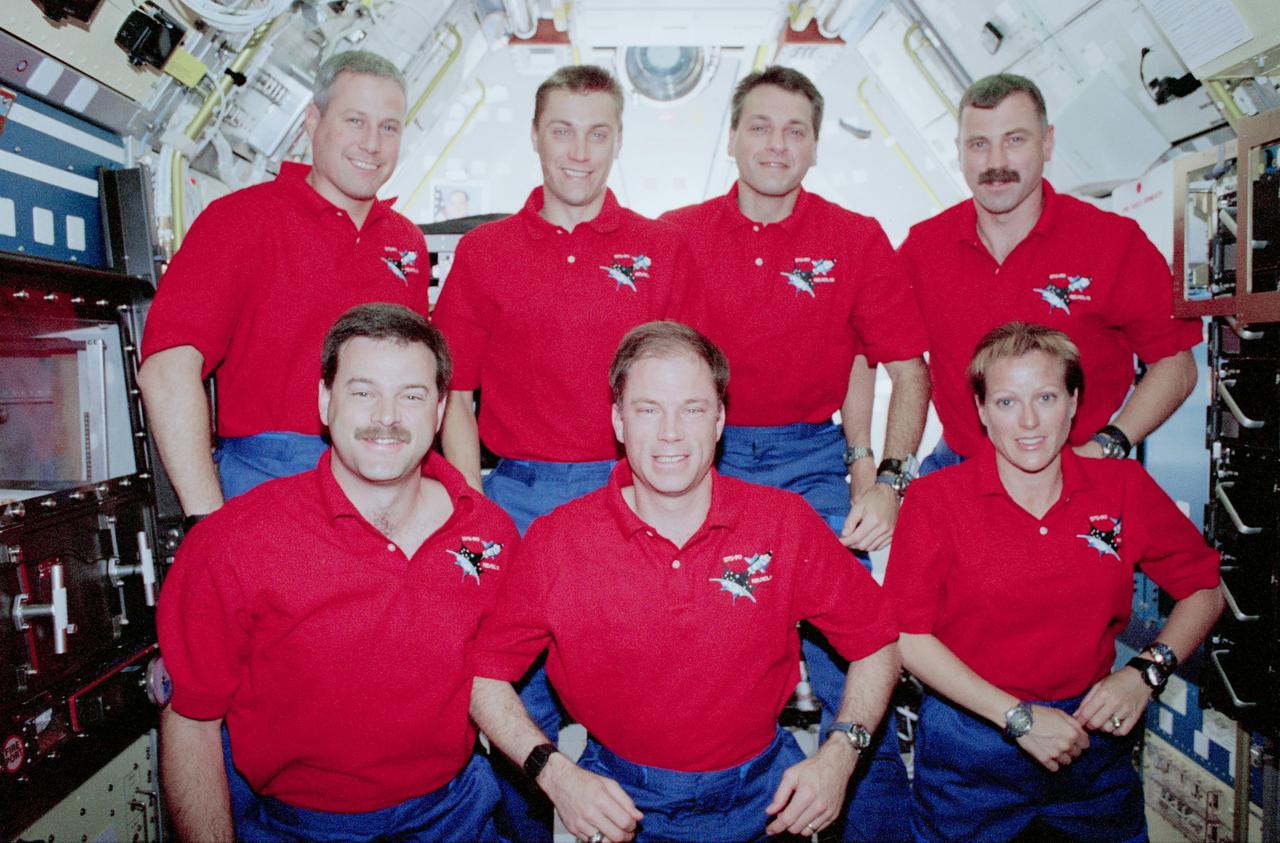
STS-90 crew crew portrait.. The various crew portraits were taken in the Spacelab module and include: back row (l.-r.) Payload specialists Jay Buckey and James Pawelczyk, Payload commander Richard Linnehan and Mission specialist Dafydd Rhys Williams. Bottom row (l.-r.) Pilot Scott Altman, Mission commander Richard Searfoss and Mission specialist Kathryn Hire. View 023 was selected by the crew for use in their postflight presentation.
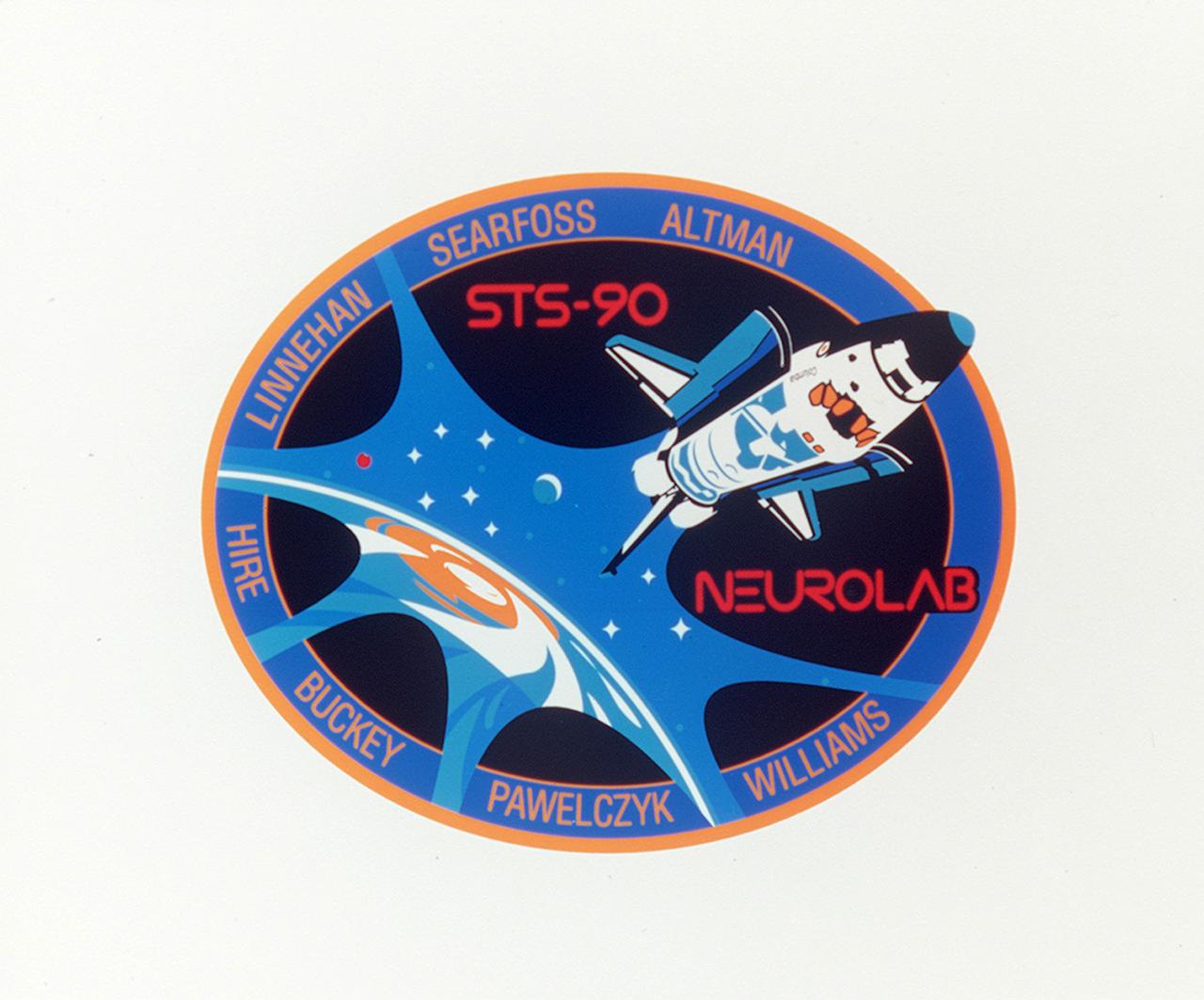
The STS-90 crew patch reflects the dedication of the mission to neuroscience in celebration of the decade of the brain. Earth is revealed through a neuron-shaped window, which symbolizes new perspectives in the understanding of nervous system development, structure and function, both here on Earth and in the microgravity environment of space. The Space Shuttle Columbia is depicted with its open payload bay doors revealing the Spacelab within. An integral component of the mission, the laboratory/science module provided by the European Space Agency (ESA), signifies the strong international involvement in the mission. The seven crew members and two alternate payload specialists, Chiaki Naito-Mukai and Alexander W. Dunlap, are represented by the nine major stars of the constellation Cetus (the whale) in recognition of the International Year of the Ocean. The distant stars illustrate the far reaching implications of the mission science to the many sponsoring agencies, helping prepare for long-duration space flight aboard the International Space Station (ISS). The moon and Mars are depicted to reflect the crew's recognition that those two celestial bodies will be the next great challenges in human exploration of space and represent the key role that life science research will play in supporting such missions.

STS090-774-028 (29 April 1998) --- This view features a 13,980-foot mountain peak in Colorado’s Sangre de Cristo Mountains in Saguache County, photographed by crewmembers of the STS-90 Space Shuttle Columbia mission in April 1998. EDITOR’S NOTE: In June 2003, the summit was named “Columbia Point” by the U.S. Department of Interior in memory of the STS-107 Space Shuttle Columbia crew, lost in an accident on February 1, 2003, and for the scientific exploration, technical excellence, and the dream of spaceflight for which the mission stood. Columbia Point is located on the east side of Kit Carson Mountain. On the northwest shoulder of the same mountain is Challenger Point, a peak previously named in memory of the Space Shuttle Challenger, which exploded soon after liftoff on January 28, 1986.
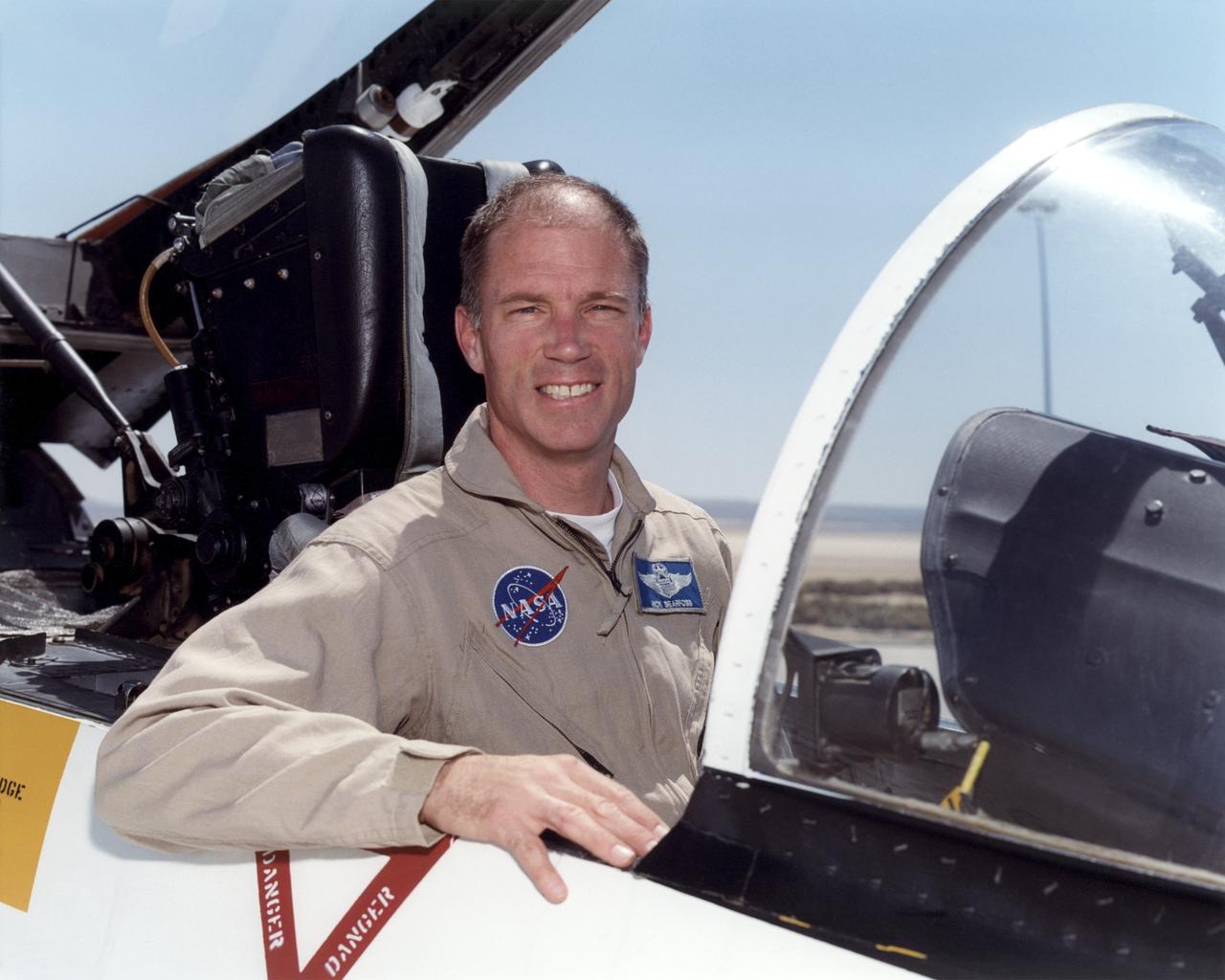
Richard A. Searfoss became a research pilot in the Flight Crew Branch of NASA's Dryden Flight Research Center, Edwards, Calif., in July 2001. He brought to Dryden more than 5,000 hours of military flying time and 939 hours in space. Searfoss served in the U.S. Air Force for more than 20 years, retiring with the rank of colonel. Following graduation in 1980 from Undergraduate Pilot Training at Williams Air Force Base, Ariz., Searfoss flew F-111s at RAF Lakenheath, England, and Mountain Home Air Force Base, Idaho. In 1988 he attended the U.S. Naval Test Pilot School, Patuxent River, Md., as a U.S. Air Force exchange officer. He was an instructor pilot at the U.S. Air Force Test Pilot School, Edwards Air Force Base, Calif., when selected for the astronaut program in January 1990. Searfoss became an astronaut in July 1991. A veteran of three space flights, Searfoss has logged 39 days in space. He served as STS-58 pilot on the seven-person life science research mission aboard Space Shuttle Columbia, launching from NASA's Kennedy Space Center, Fla., on Oct. 18, 1993, and landing at Edwards Air Force Base, Calif., on Nov. 1, 1993. The crew performed a number of medical experiments on themselves and 48 rats, expanding knowledge of human and animal physiology. Searfoss flew his second mission as pilot of STS-76 aboard the Space Shuttle Atlantis. During this nine-day mission, which launched March 22, 1996, the crew preformed the third docking of an American spacecraft with the Russian space station Mir. The crew transported to Mir nearly two tons of water, food, supplies, and scientific equipment, as well as U.S. Astronaut Shannon Lucid to begin her six-month stay in space. Completing 145 orbits, STS-76 landed at Edwards Air Force Base, Calif., on March 31, 1996. Searfoss commanded a seven-person crew on the STS-90 Neurolab mission launched on April 17, 1998. The crew served as both experiment subjects and operators for life science experiments focusing on the effects of m
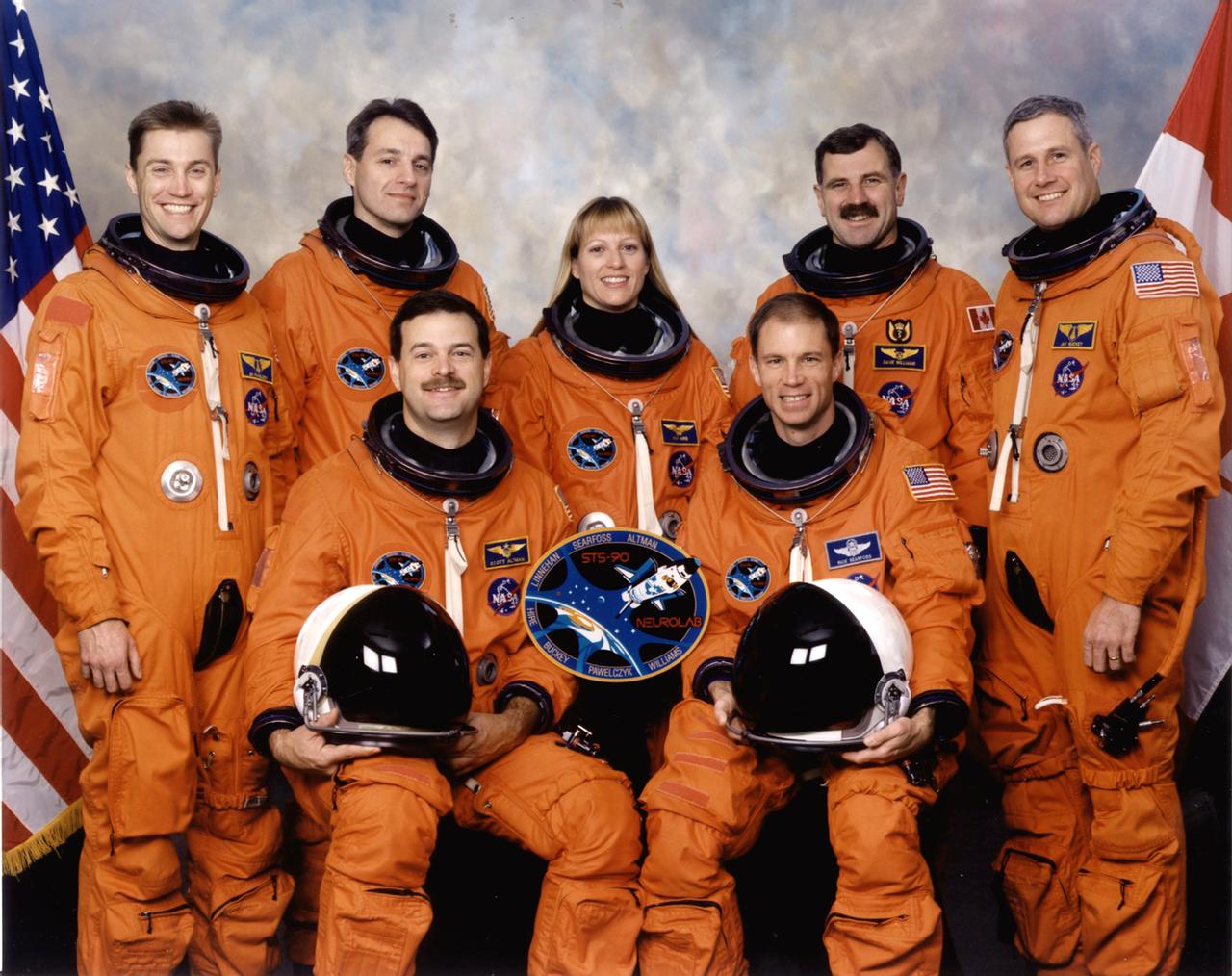
Five astronauts and two payload specialists take a break in training for the Neurolab mission to pause for a crew portrait. The Spacelab mission was conducted aboard the Space Shuttle Columbia on STS-90 which launched on April 17, 1998. Astronauts Richard A. Searfoss, commander (right front); and Scott D. Altman, pilot (left front). Other crew members (back row, left to right) are James A. (Jim) Pawelczyk, Ph.D., payload specialist; and astronauts Richard M. Linnehan, Kathryn P. Hire, and Dafydd R. (Dave) Williams, all mission specialists; along with payload specialist Jay C. Buckey, Jr., MD. Linnehan and Williams, alumnus of the 1995 class of astronaut candidates (ASCAN), represents the Canadian Space Agency (CSA).
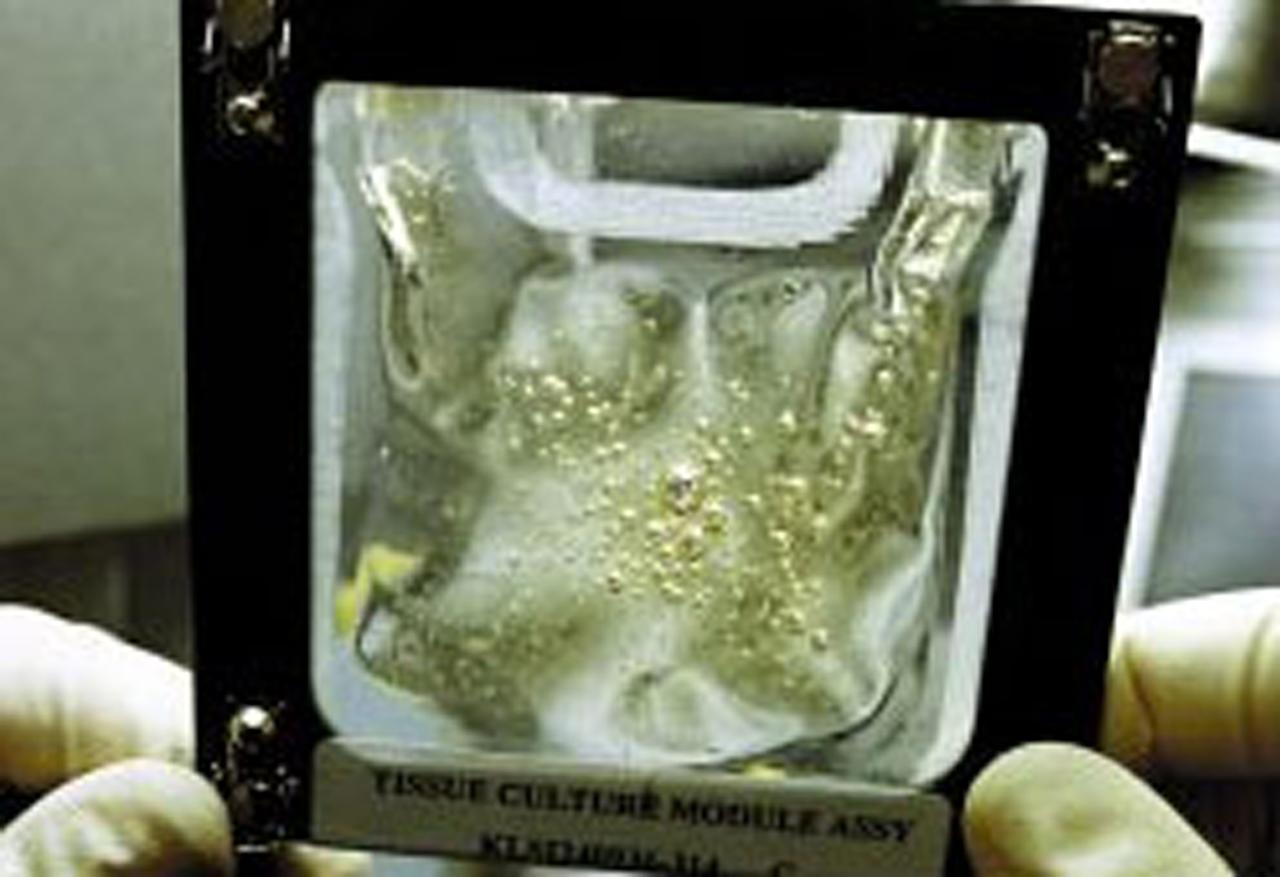
During the STS-90 shuttle flight in April 1998, cultured renal cortical cells revealed new information about genes. Timothy Hammond, an investigator in NASA's microgravity biotechnology program was interested in culturing kidney tissue to study the expression of proteins useful in the treatment of kidney diseases. Protein expression is linked to the level of differentiation of the kidney cells, and Hammond had difficulty maintaining differentiated cells in vitro. Intrigued by the improvement in cell differentiation that he observed in rat renal cells cultured in NASA's rotating wall vessel (a bioreactor that simulates some aspects of microgravity) and during an experiment performed on the Russian Space Station Mir, Hammond decided to sleuth out which genes were responsible for controlling differentiation of kidney cells. To do this, he compared the gene activity of human renal cells in a variety of gravitational environments, including the microgravity of the space shuttle and the high-gravity environment of a centrifuge. Hammond found that 1,632 genes out of 10,000 analyzed changed their activity level in microgravity, more than in any of the other environments. These results have important implications for kidney research as well as for understanding the basic mechanism for controlling cell differentiation.

KENNEDY SPACE CENTER, FLA. -- STS-90: Columbia
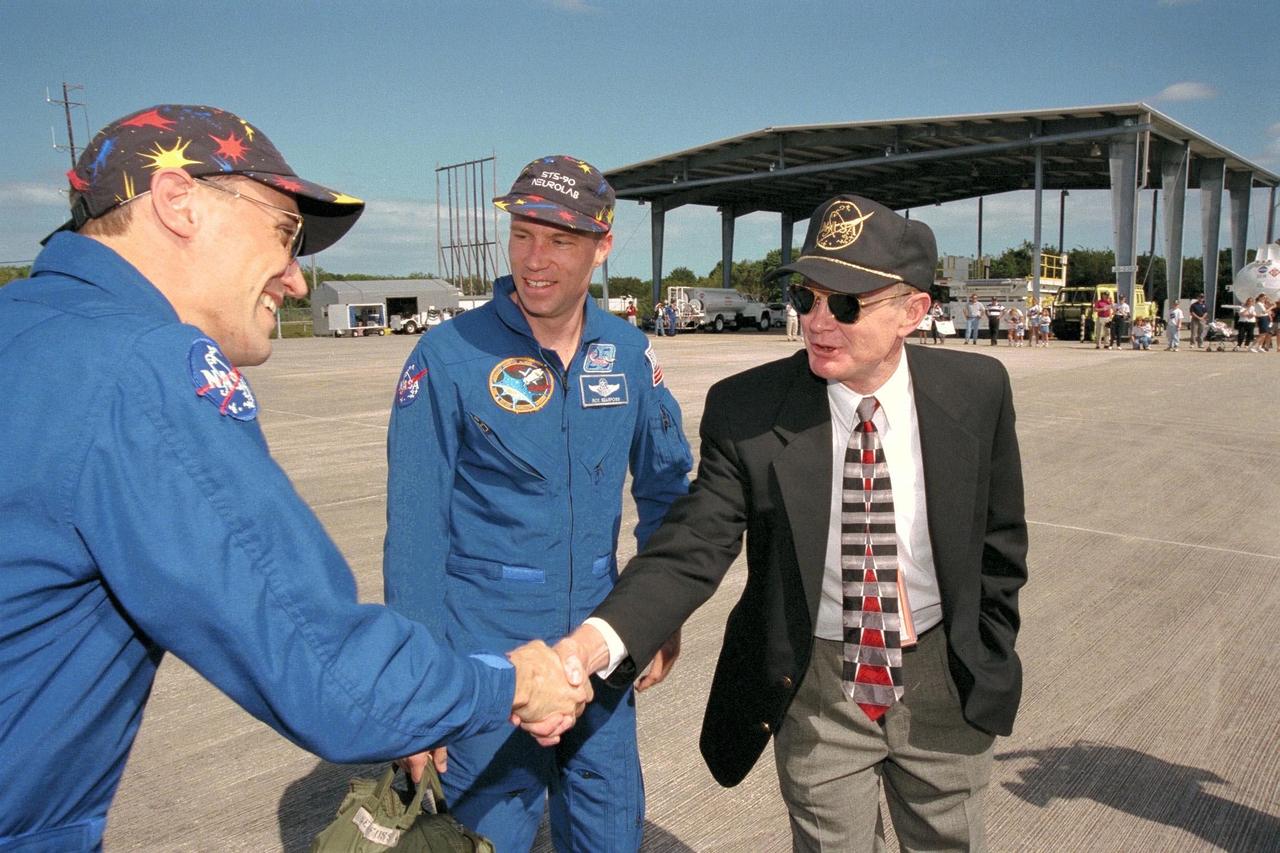
KENNEDY SPACE CENTER, FLA. -- STS-90 Payload Specialist James Pawelczyk, Ph.D. (at left), shakes the hand of KSC Director Roy Bridges as STS-90 Commander Richard Searfoss looks on shortly after the crew's arrival at Kennedy Space Center's Shuttle Landing Facility. The crew arrived to prepare for the launch of Columbia, scheduled for April 16 at 2:19 p.m. EDT from KSC's Launch Pad 39B. The launch of Neurolab on STS-90, which will be the second mission of 1998, is scheduled to last nearly 17 days
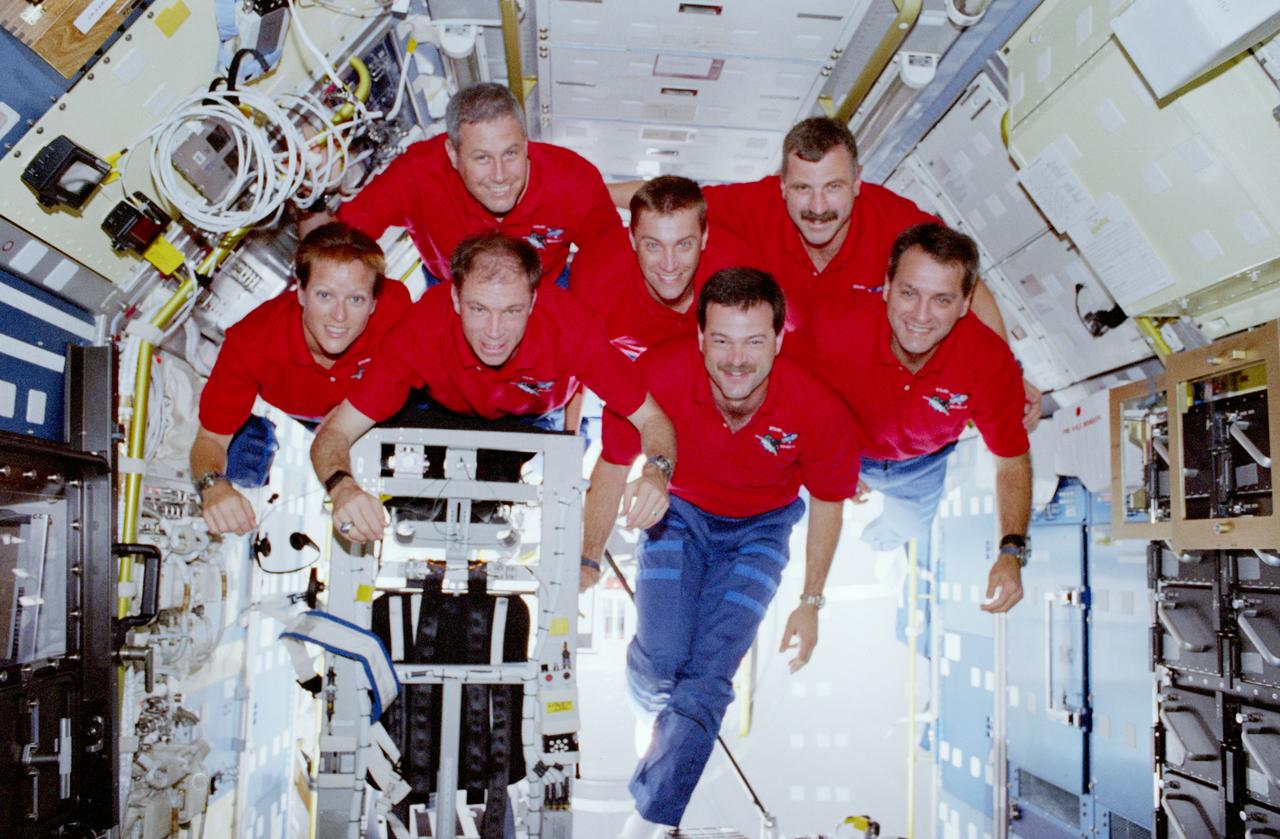
STS090-378-022 (17 April - 3 May 1998) --- During a change of shift for Neurolab duty, the crew floats as a unit onboard the Spacelab Science Module on the Space Shuttle Columbia. From the left are Kathryn P. Hire, mission specialist; Jay C. Buckey, Jr. (top), payload specialist; Richard A. Searfoss, mission commander; James A. (Jim) Pawelczyk, payload specialist; Scott D. Altman, pilot; Dafydd R. (Dave) Williams, mission specialist (top); and Richard M. Linnehan, payload commander. Williams represents the Canadian Space Agency (CSA).
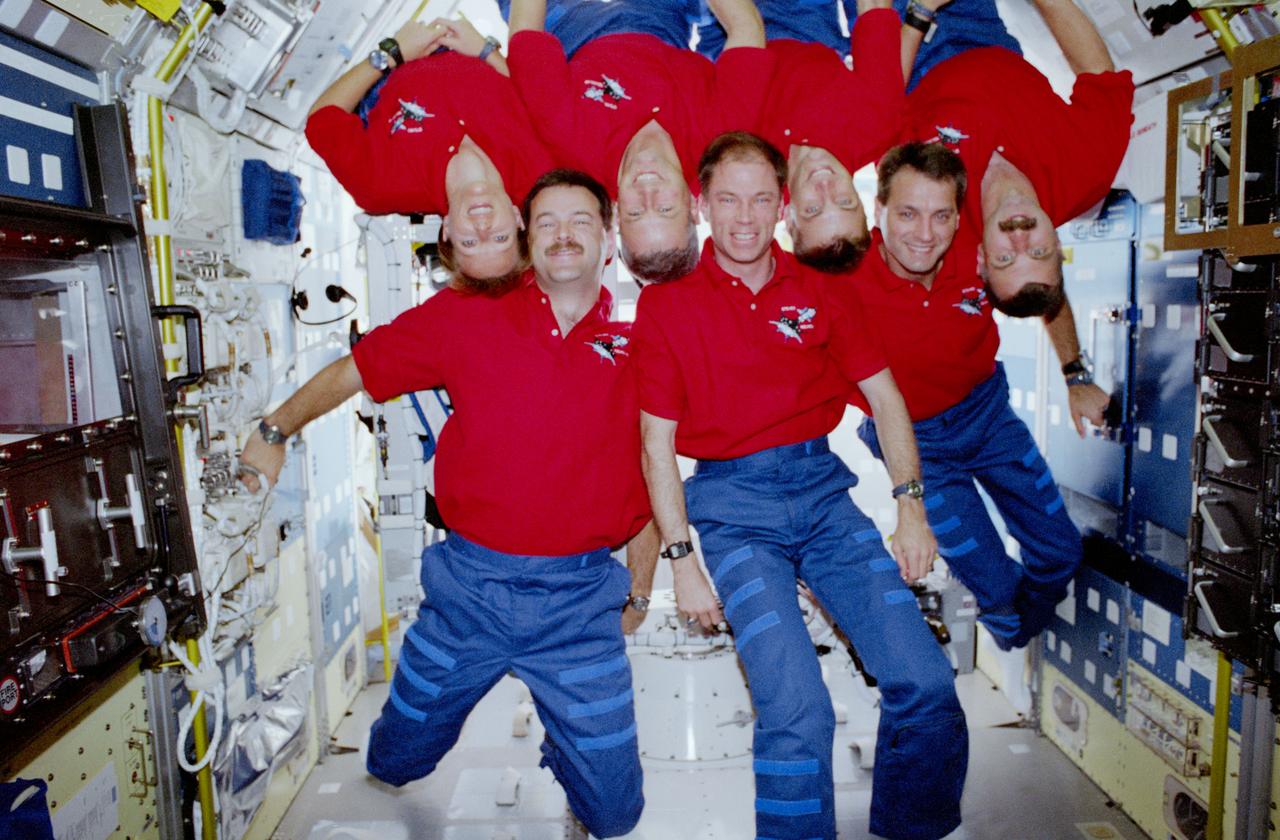
STS090-378-019 (17 April - 3 May 1998) --- The Neurolab crew takes advantage of the weightlessness in the Spacelab Science Module to add a unique twist to one of their traditional in-flight space portraits. From the left (with feet toward the floor) are Scott D. Altman, pilot; Richard A. Searfoss, mission commander; and Richard M. Linnehan, payload commander. Others, from the left, are Kathryn P. Hire, mission specialist; Jay C. Buckey, Jr. and James A. (Jim) Pawelczyk, both payload specialists; and Dafydd R. (Dave) Williams, mission specialist representing the Canadian Space Agency (CSA).
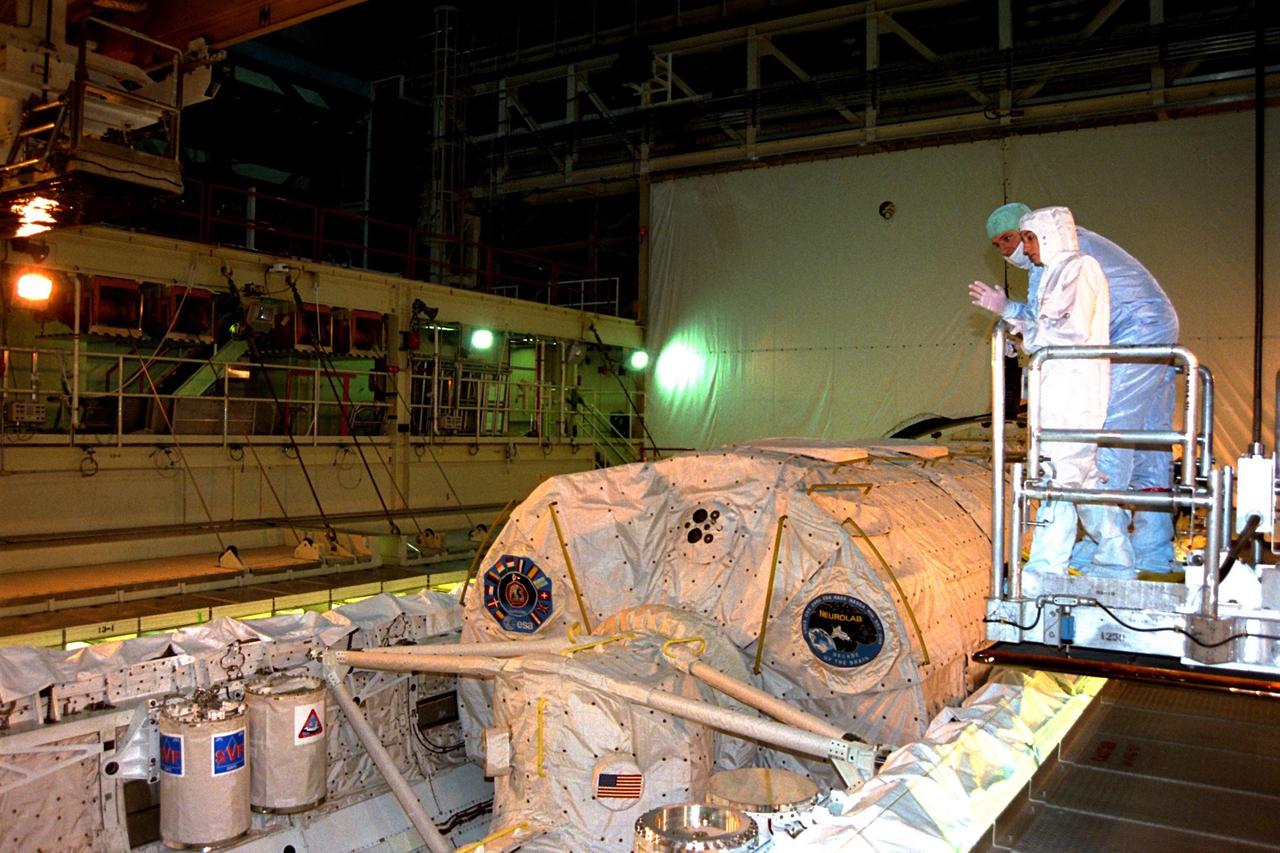
Stacie Greene, an extravehicular activity trainer from Johnson Space Center, discusses the STS-90 Neurolab mission with Mission Specialist Richard Linnehan overlooking Columbia's payload bay. The crew of STS-90 participated in the Crew Equipment Interface Test (CEIT) in Kennedy Space Center's Orbiter Processing Facility Bay 3. The CEIT gives astronauts an opportunity to get a hands-on look at the payloads with which they will be working on-orbit. Investigations during the STS-90 Neurolab mission will focus on the effects of microgravity on the nervous system. Specifically, experiments will study the adaptation of the vestibular system, the central nervous system, and the pathways that control the ability to sense location in the absence of gravity, as well as the effect of microgravity on a developing nervous system. STS-90 is scheduled for launch on April 16 at 2:19 p.m. EDT
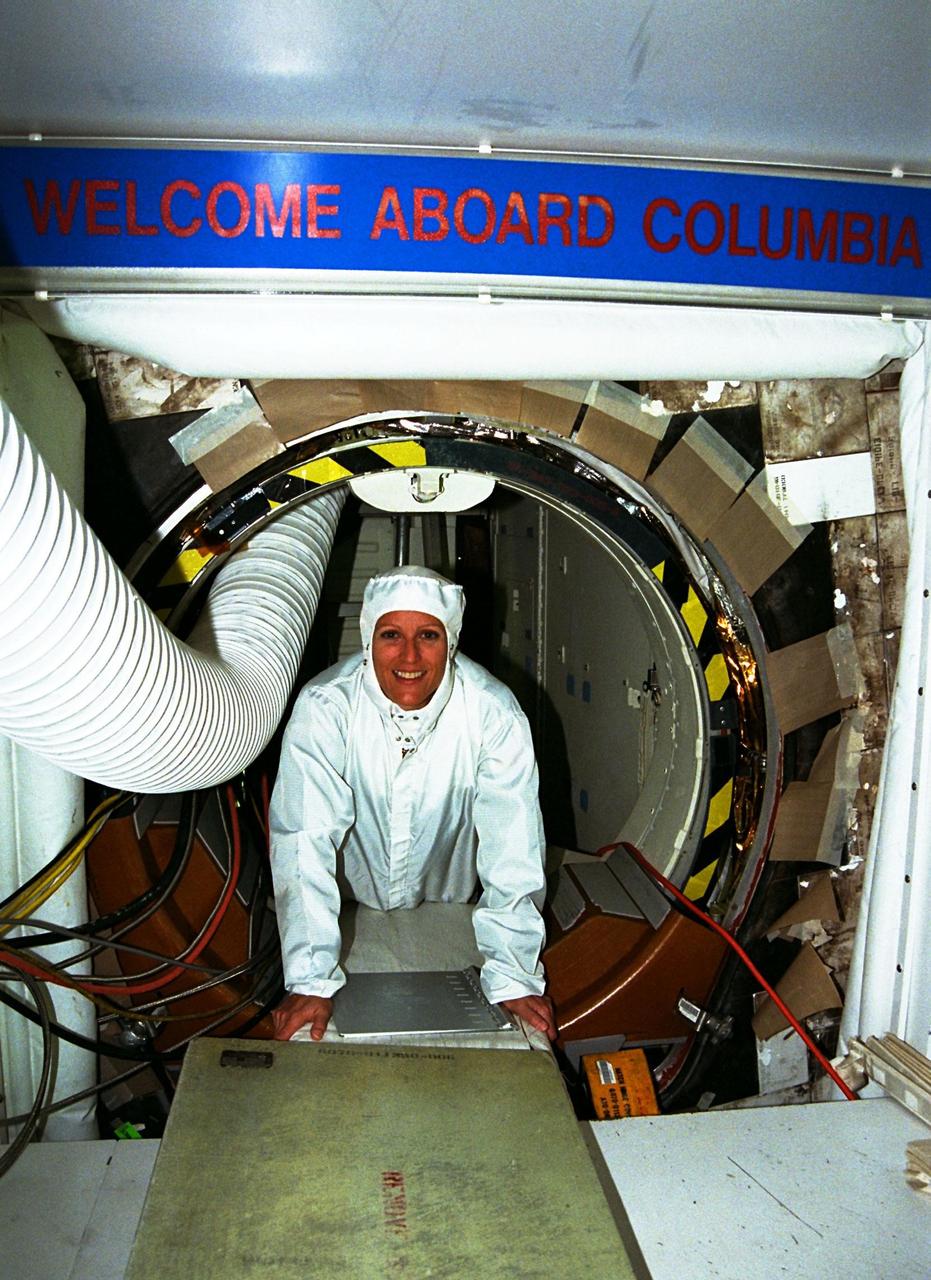
STS-90 Mission Specialist Kathryn (Kay) Hire enjoys the crawl between Columbia and the white room that allows access to the orbiter. The crew of STS-90 recently participated in the Crew Equipment Interface Test (CEIT) in Kennedy Space Center's Orbiter Processing Facility Bay 3. The CEIT gives astronauts an opportunity to get a hands-on look at the payloads with which they will be working on-orbit. Investigations during the STS-90 Neurolab mission will focus on the effects of microgravity on the nervous system. Specifically, experiments will study the adaptation of the vestibular system, the central nervous system, and the pathways that control the ability to sense location in the absence of gravity, as well as the effect of microgravity on a developing nervous system. STS-90, which will be Hire's first Shuttle flight, is scheduled for launch on April 16 at 2:19 p.m. EDT
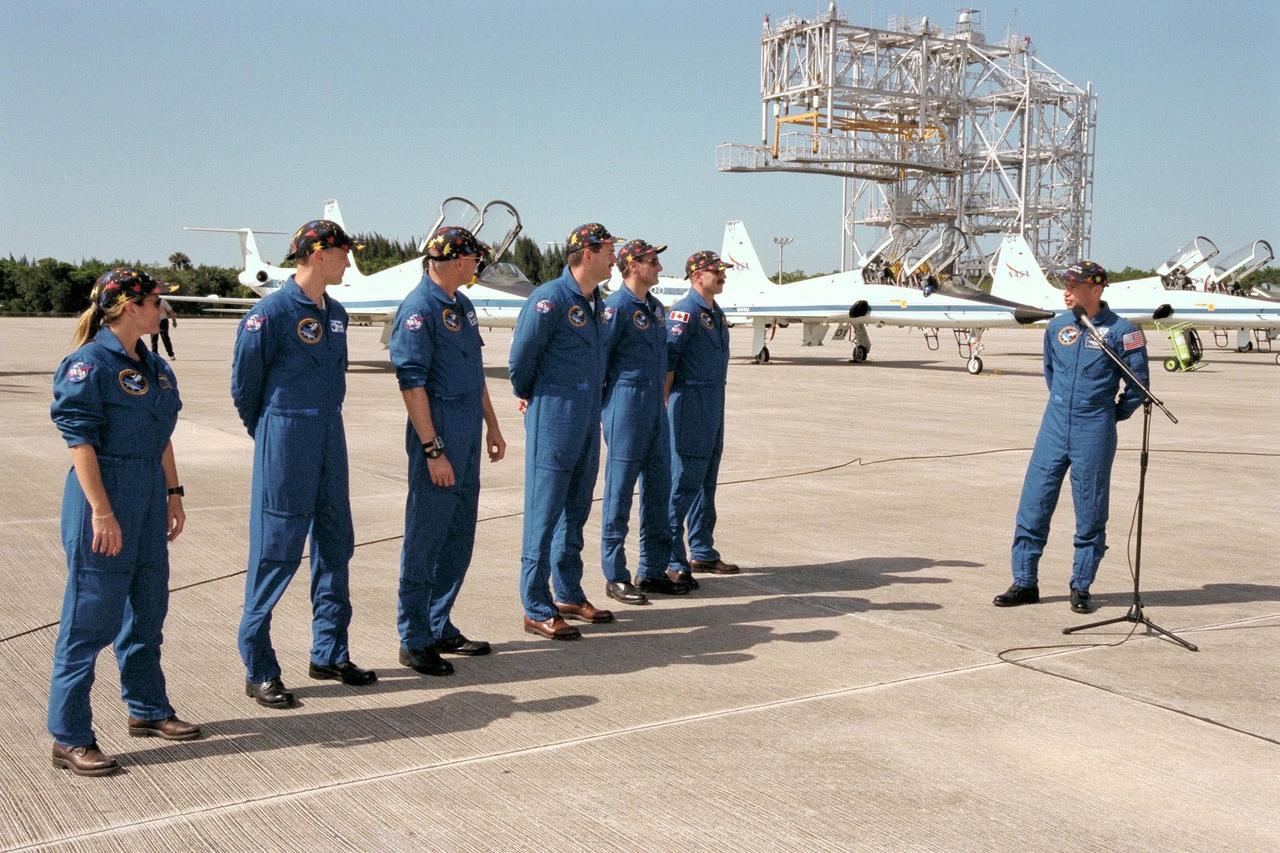
KENNEDY SPACE CENTER, FLA. -- The STS-90 crew arrive at Kennedy Space Center's Shuttle Landing Facility in preparation for the launch of Columbia on April 16 at 2:19 p.m. EDT from KSC's Launch Pad 39B. The crew of STS-90 are, left to right, Mission Specialist Kathryn (Kay) Hire; Payload Specialist James Pawelczyk, Ph.D.; Payload Specialist Jay Buckey, M.D.; Pilot Scott Altman; Mission Specialist Richard Linnehan, D.V.M.; Mission Specialist Dafydd (Dave) Williams with the Canadian Space Agency; and Commander Richard Searfoss. STS-90, which will be the second mission of 1998, is scheduled to last nearly 17 days
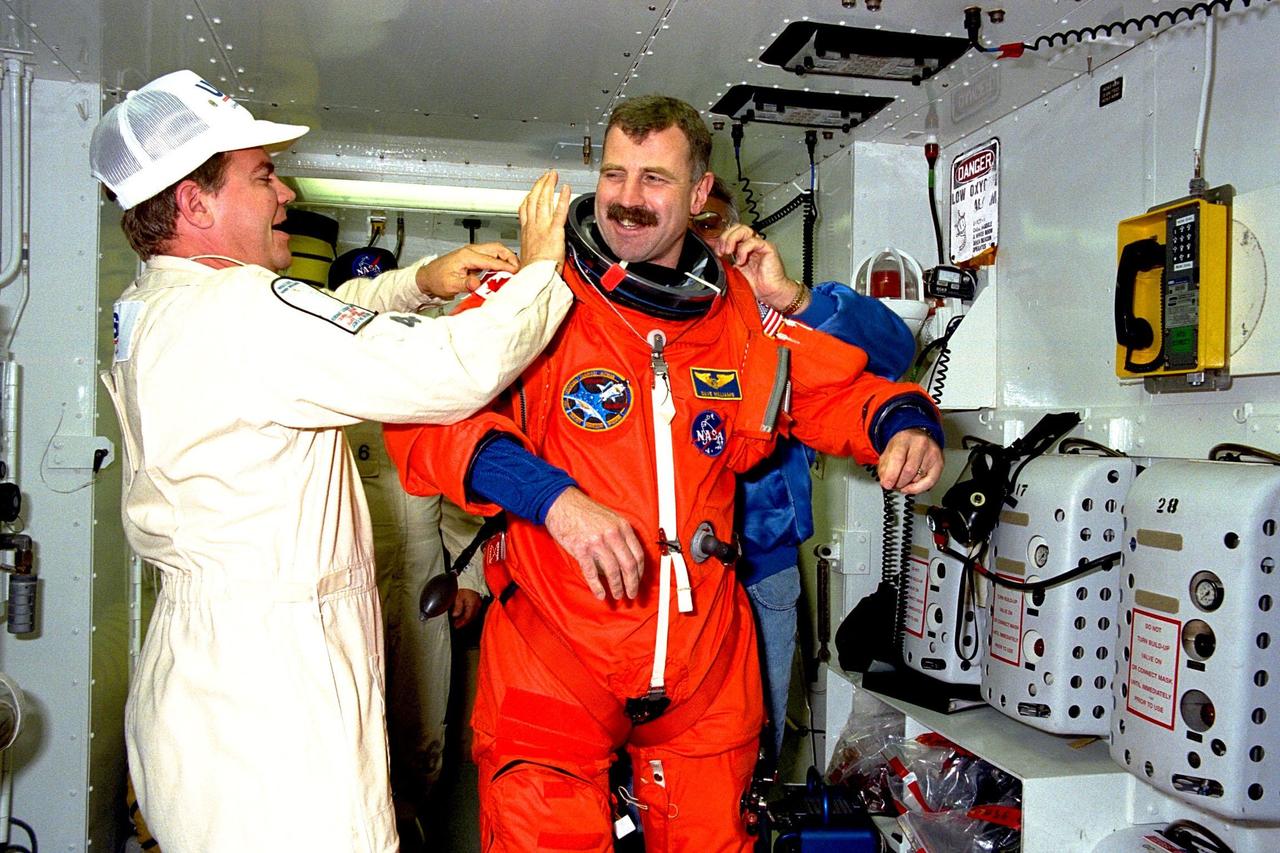
Members of the STS-90 crew participate in Terminal Countdown Demonstration Test (TCDT) activities at KSC's Launch Pad 39B. The TCDT is held at KSC prior to each Space Shuttle flight to provide crews with the opportunity to participate in simulated countdown activities. Here, STS-90 Payload Specialist Dafydd (Dave) Williams with the Canadian Space Agency is assisted into his orange launch and re-entry suit. Columbia is targeted for launch of STS-90 on April 16 at 2:19 p.m. EDT and will be the second mission of 1998. The mission is scheduled to last nearly 17 days
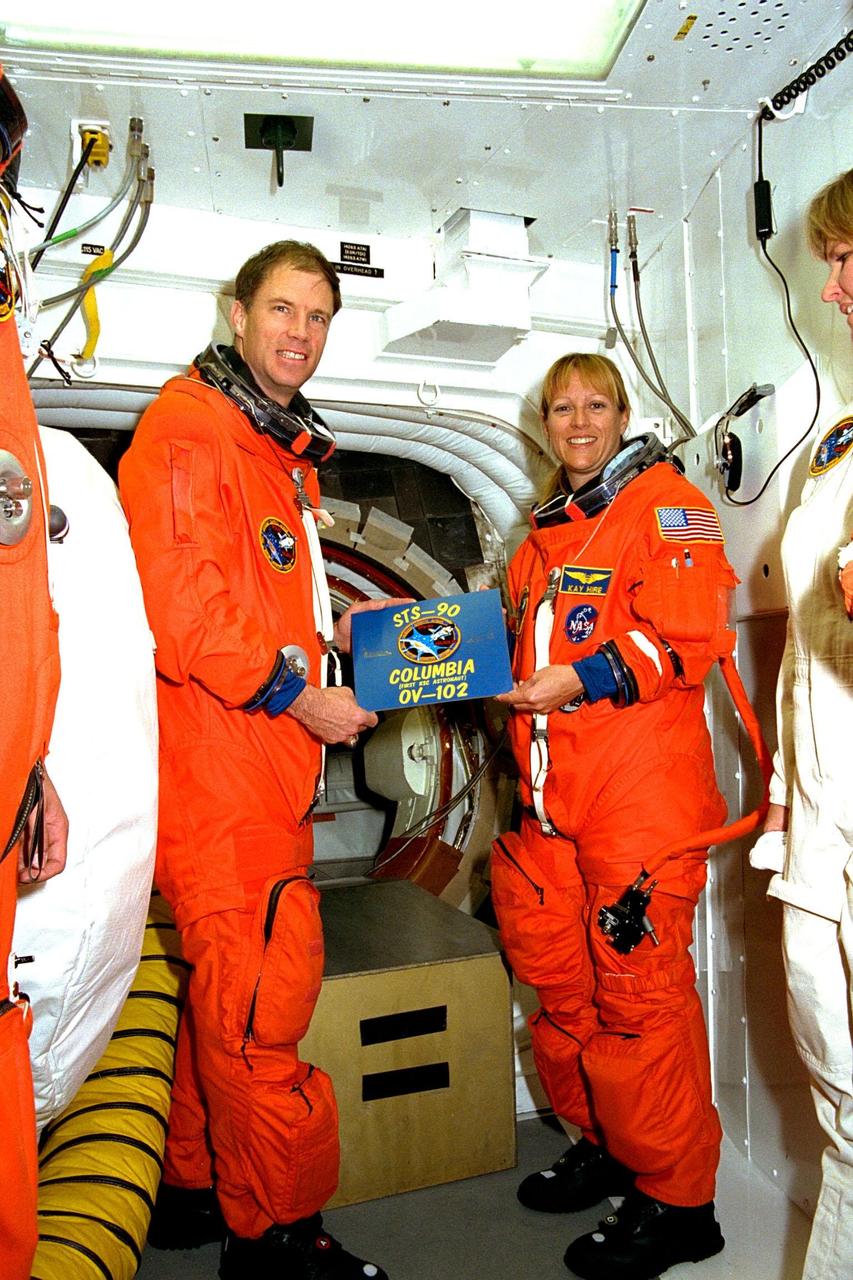
The crew of STS-90 participate in Terminal Countdown Demonstration Test (TCDT) activities at KSC's Launch Pad 39B. The TCDT is held at KSC prior to each Space Shuttle flight to provide crews with the opportunity to participate in simulated countdown activities. Here, STS-90 Commander Richard Searfoss and Mission Specialist Kathryn (Kay) Hire hold the mission patch with orbiter information. Columbia is targeted for launch of STS-90 on April 16 at 2:19 p.m. EDT and will be the second mission of 1998. The mission is scheduled to last nearly 17 days
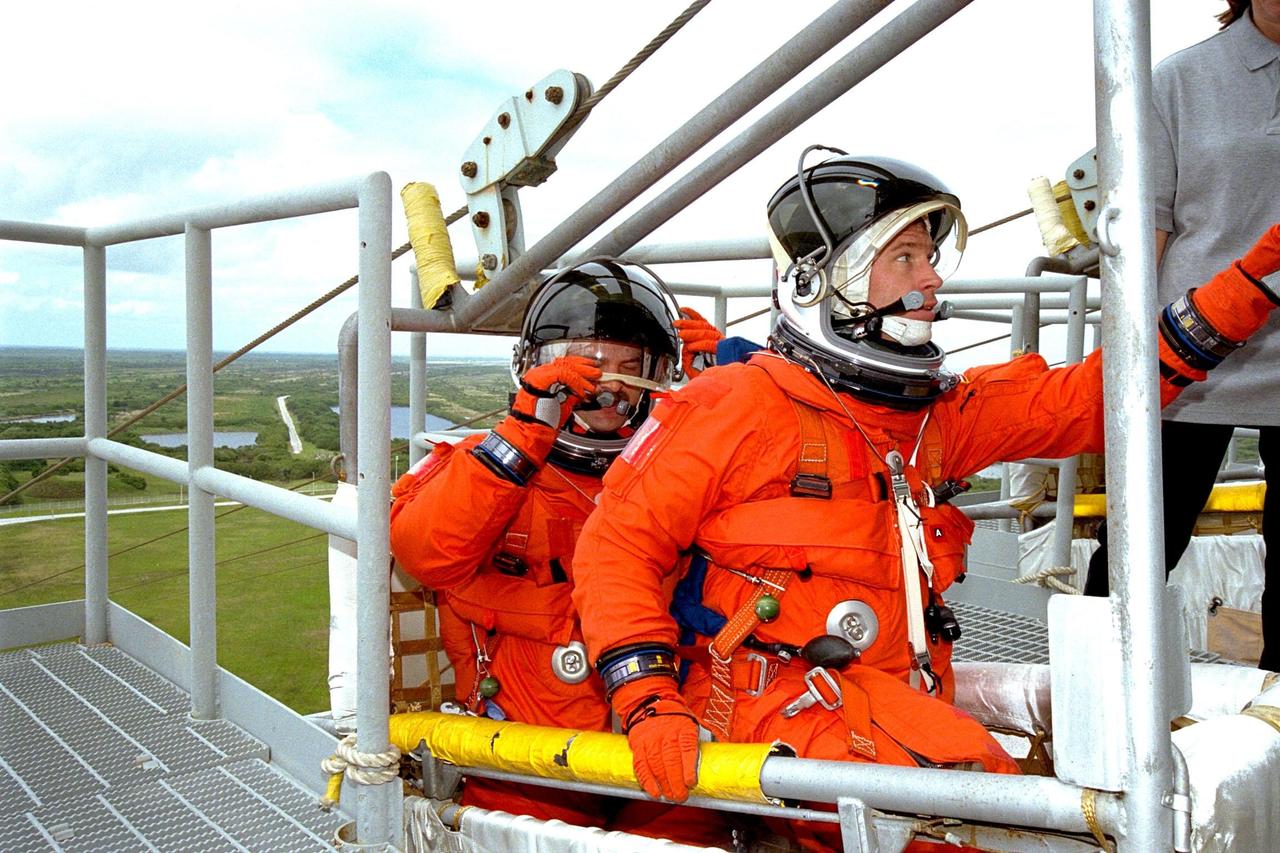
Members of the STS-90 crew participate in mock emergency egress activities during the Terminal Countdown Demonstration Test (TCDT) at KSC's Launch Pad 39B. The TCDT is held at KSC prior to each Space Shuttle flight to provide crews with the opportunity to participate in simulated countdown activities. The STS-90 crew members shown here are Commander Richard Searfoss (front) and Pilot Scott Altman. Columbia is targeted for launch of STS-90 on April 16 at 2:19 p.m. EDT and will be the second mission of 1998. The mission is scheduled to last nearly 17 days
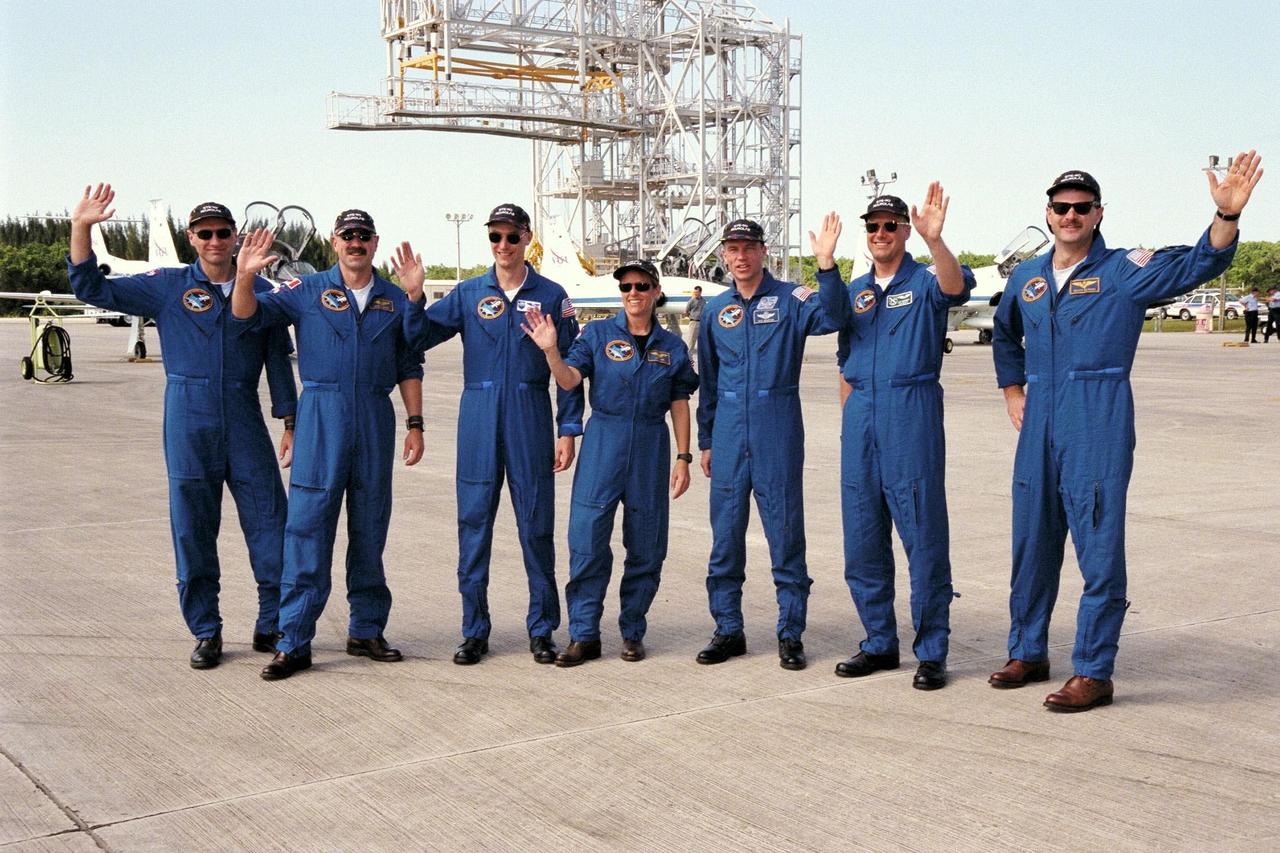
KENNEDY SPACE CENTER, FLA. -- The STS-90 crew arrive at Kennedy Space Center's Shuttle Landing Facility in preparation for the launch of Columbia on April 16 at 2:19 p.m. EDT from KSC's Launch Pad 39B. The crew of STS-90 are, left to right, Mission Specialist Richard Linnehan, D.V.M.; Mission Specialist Dafydd (Dave) Williams with the Canadian Space Agency; Payload Specialist James Pawelczyk, Ph.D.; Mission Specialist Kathryn (Kay) Hire; Commander Richard Searfoss; Payload Specialist Jay Buckey, M.D.; and Pilot Scott Altman. STS-90, which will be the second mission of 1998, is scheduled to last nearly 17 days
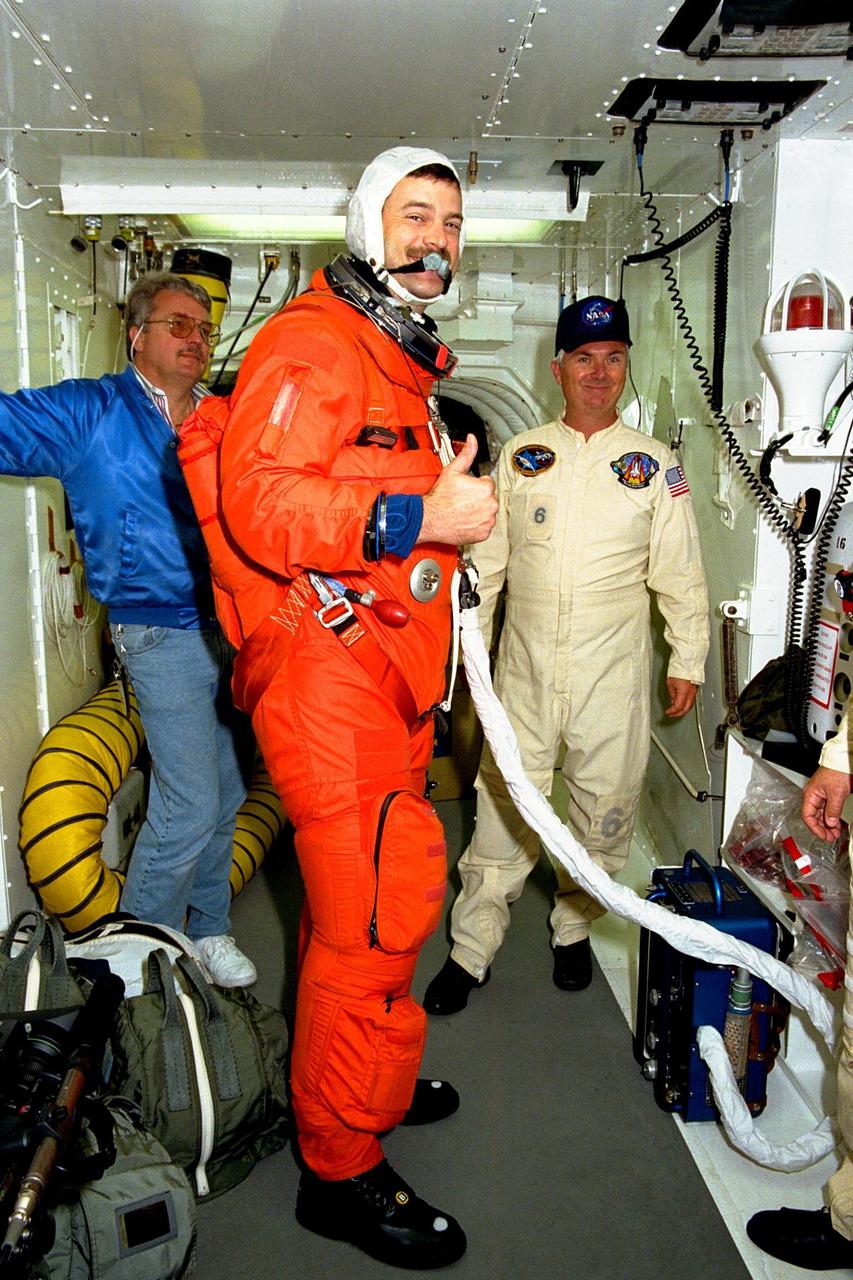
The crew of STS-90 participate in Terminal Countdown Demonstration Test (TCDT) activities at KSC's Launch Pad 39B. The TCDT is held at KSC prior to each Space Shuttle flight to provide crews with the opportunity to participate in simulated countdown activities. Here, STS-90 Pilot Scott Altman gives a "thumbs-up" after being suited up in his orange launch and re-entry suit. Columbia is targeted for launch of STS-90 on April 16 at 2:19 p.m. EDT and will be the second mission of 1998. The mission is scheduled to last nearly 17 days
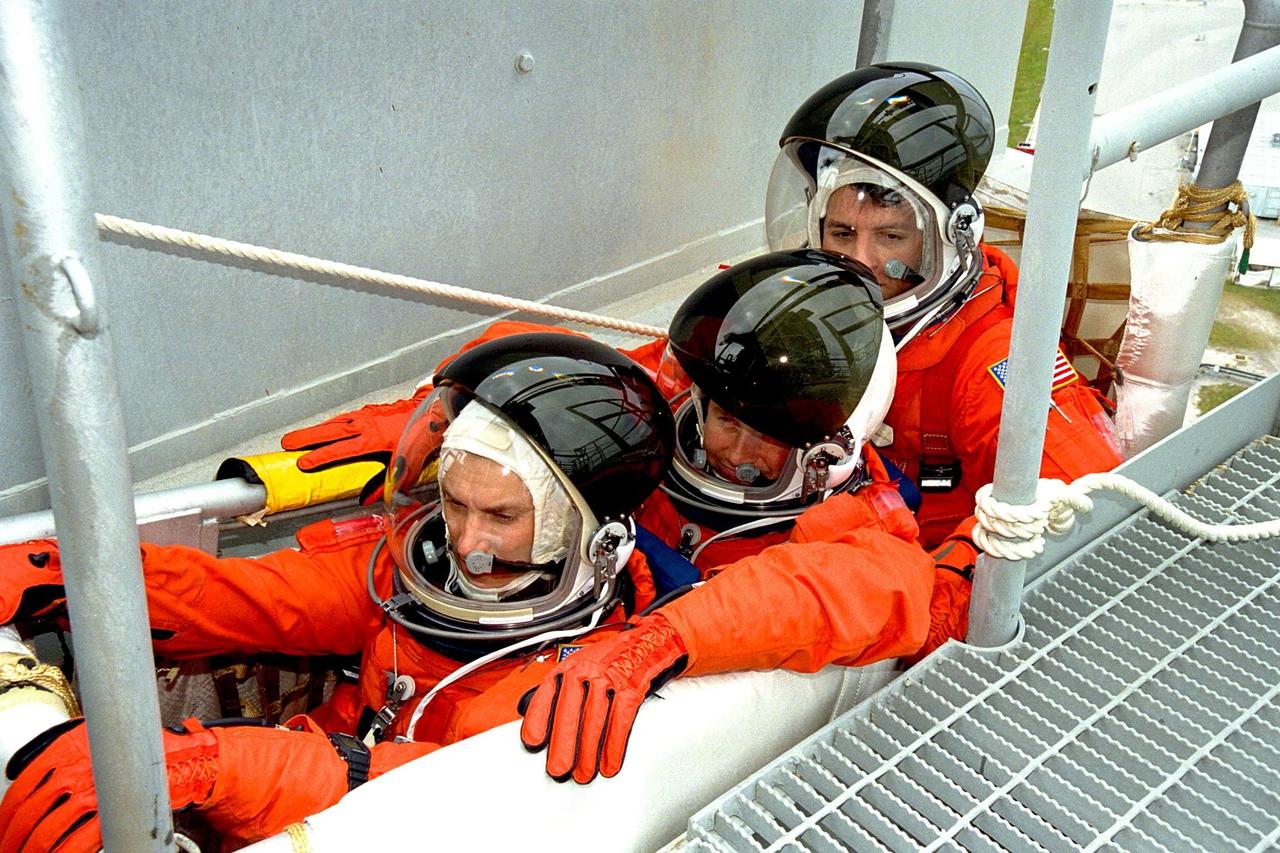
Members of the STS-90 crew participate in mock emergency egress activities during the Terminal Countdown Demonstration Test (TCDT) at KSC's Launch Pad 39B. The TCDT is held at KSC prior to each Space Shuttle flight to provide crews with the opportunity to participate in simulated countdown activities. The STS-90 crew members shown here are, front to back, Payload Specialists James Pawelczyk, Ph.D., and Jay Buckey, M.D., and Mission Specialist Richard Linnehan, D.V.M. Columbia is targeted for launch of STS-90 on April 16 at 2:19 p.m. EDT and will be the second mission of 1998. The mission is scheduled to last nearly 17 days
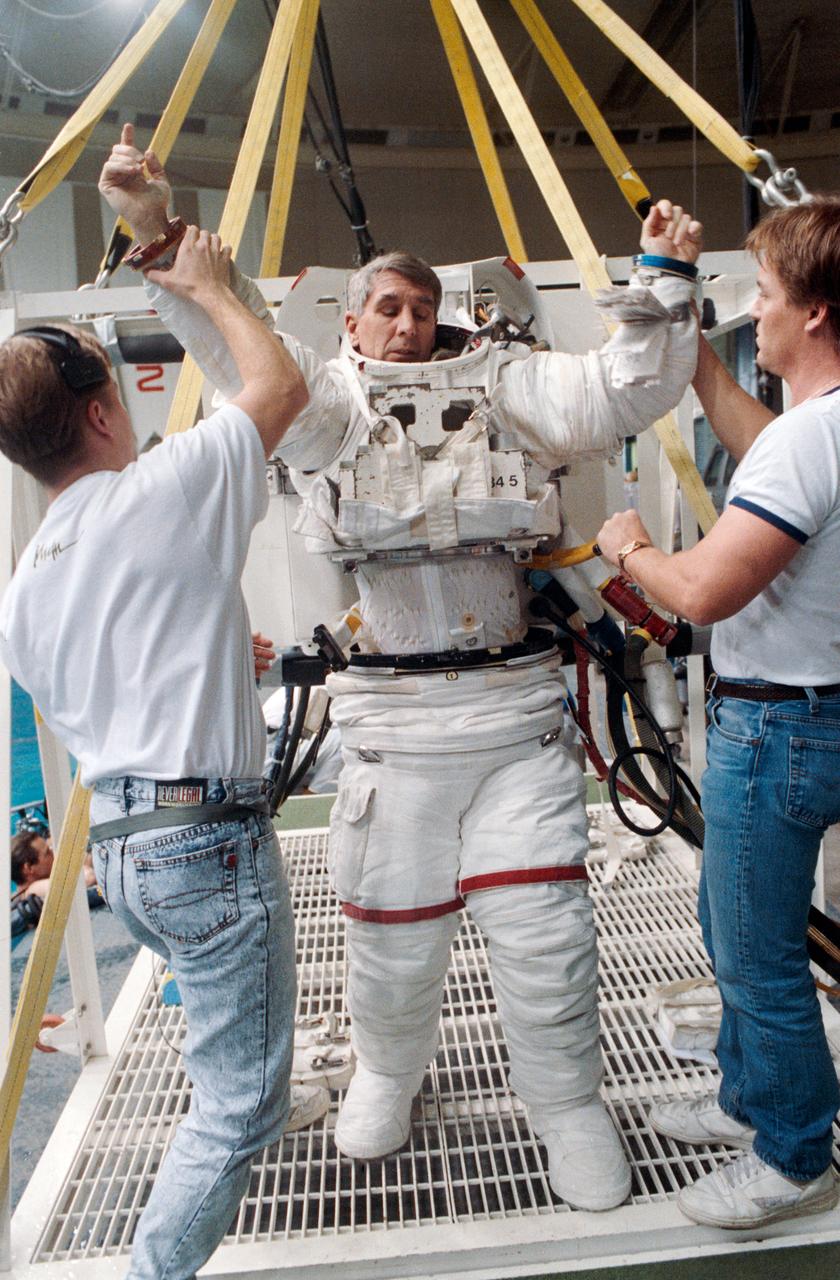
STS-38 ASTRONAUT CREW MEMBERS MEADE AND SPRINGER SUITING UP FOR AND ENTERING WETF TRAINING, TAKEN 02/14/90.
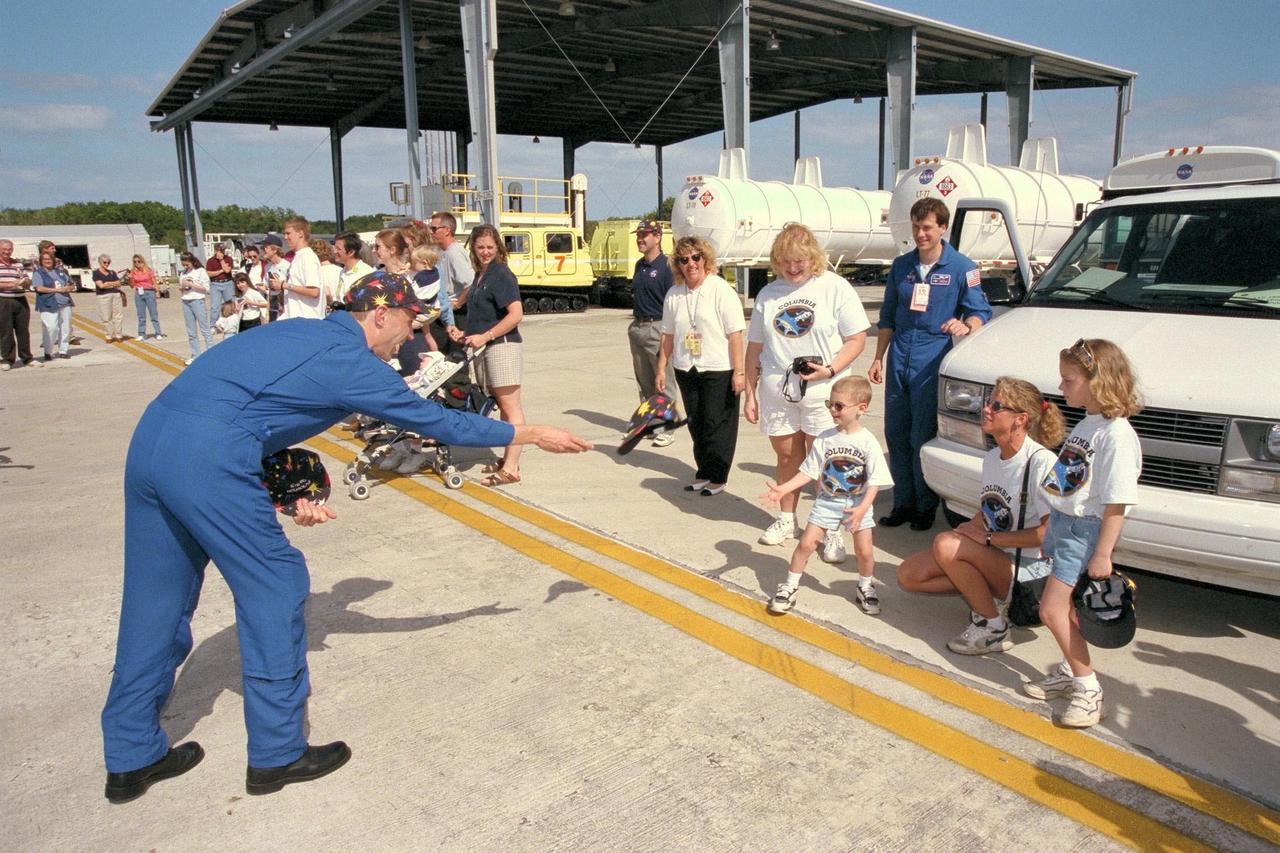
KENNEDY SPACE CENTER, FLA. -- STS-90 Payload Specialist James Pawelczyk, Ph.D., tosses mission hats to his two children shortly after arrival at Kennedy Space Center's Shuttle Landing Facility. The crew of STS-90 arrived at KSC in preparation for their mission, scheduled for launch from KSC's Launch Pad 39B on April 16 at 2:19 p.m. EDT. The flight of Neurolab is scheduled to last nearly 17 days.
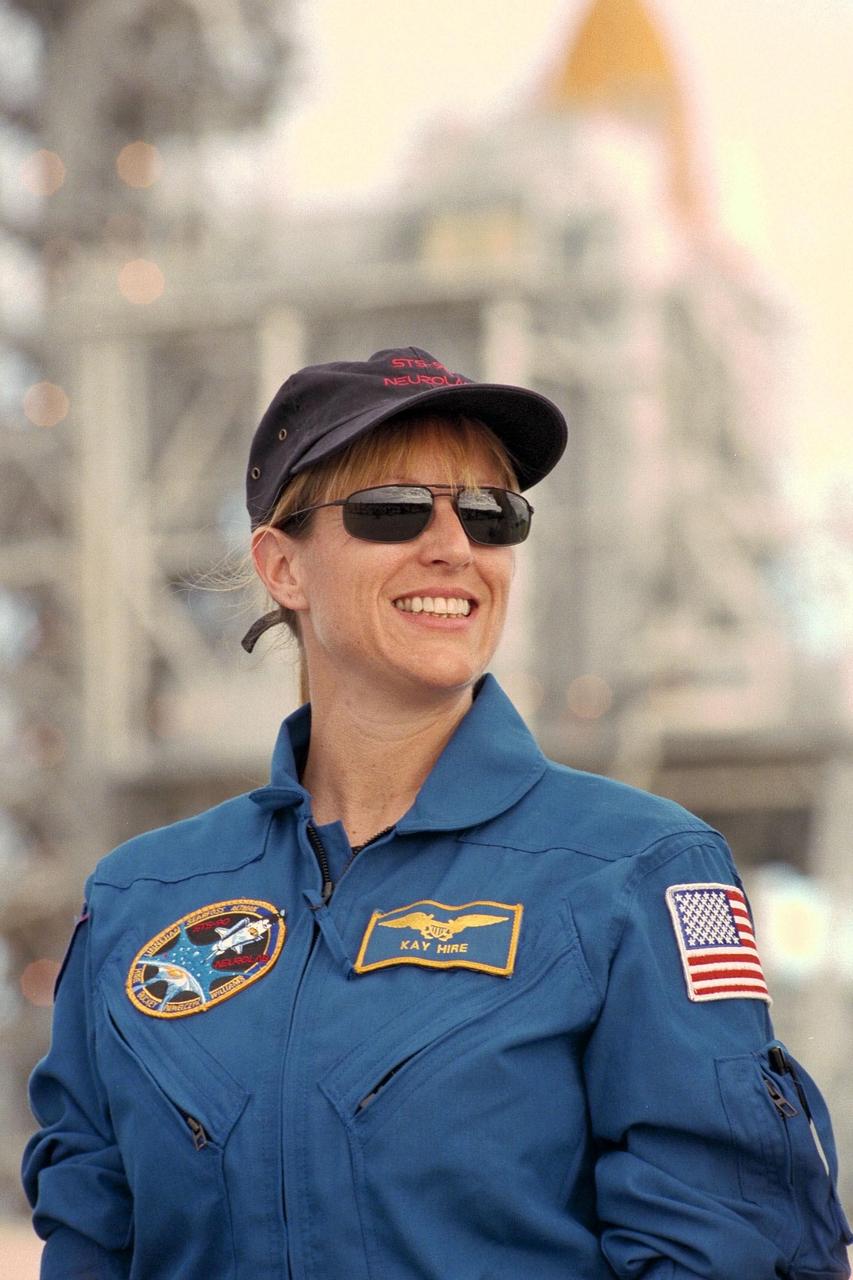
STS-90 Mission Specialist Kathryn (Kay) Hire participates in Terminal Countdown Demonstration Test (TCDT) activities at KSC's Launch Pad 39B. The TCDT is held at KSC prior to each Space Shuttle flight to provide crews with the opportunity to participate in simulated countdown activities. Columbia is targeted for launch of STS-90 on April 16 at 2:19 p.m. EDT and will be the second mission of 1998. The mission is scheduled to last nearly 17 days
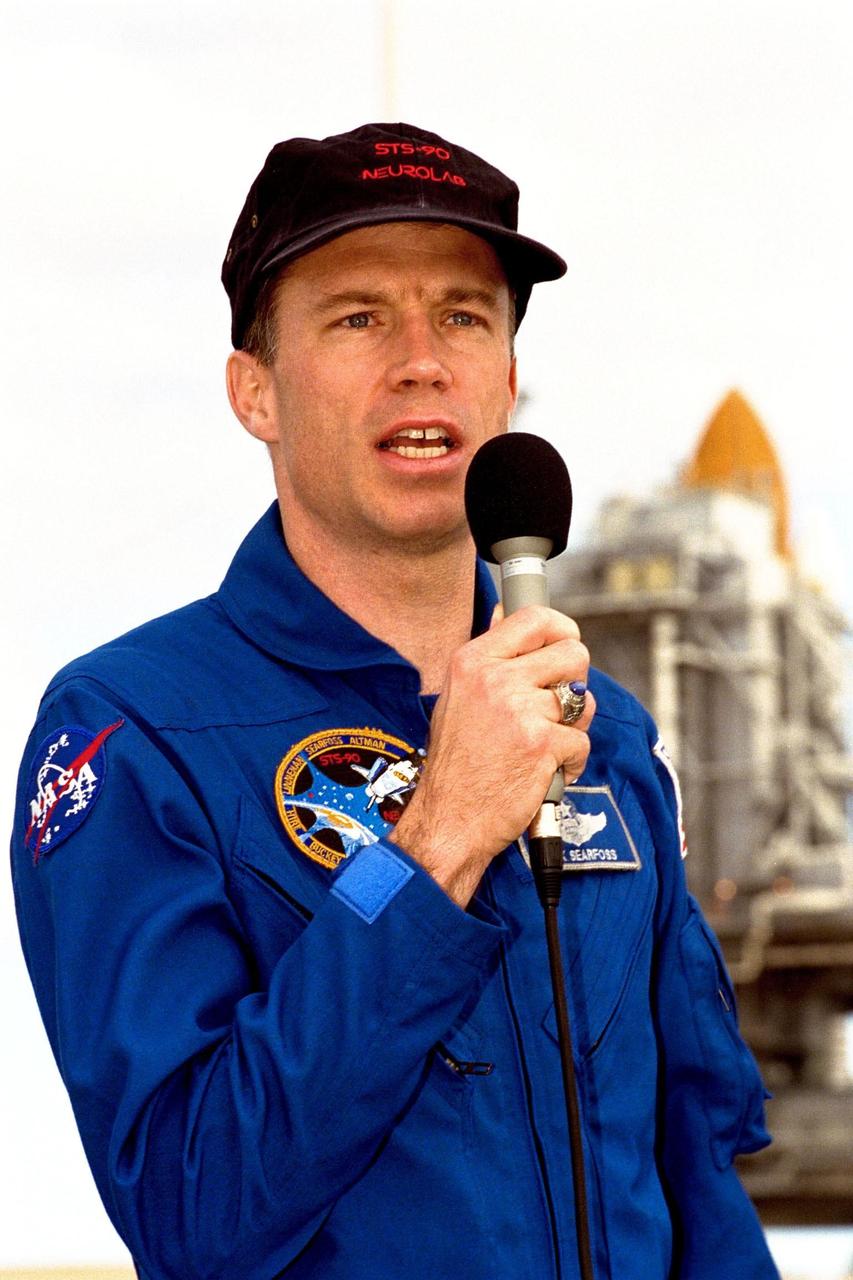
STS-90 Commander Richard Searfoss addresses the media at KSC's Launch Pad 39B, where the crew are participating in Terminal Countdown Demonstration Test (TCDT) activities. The TCDT is held at KSC prior to each Space Shuttle flight to provide crews with the opportunity to participate in simulated countdown activities. Columbia is targeted for launch of STS-90 on April 16 at 2:19 p.m. EDT and will be the second mission of 1998. The mission is scheduled to last nearly 17 days
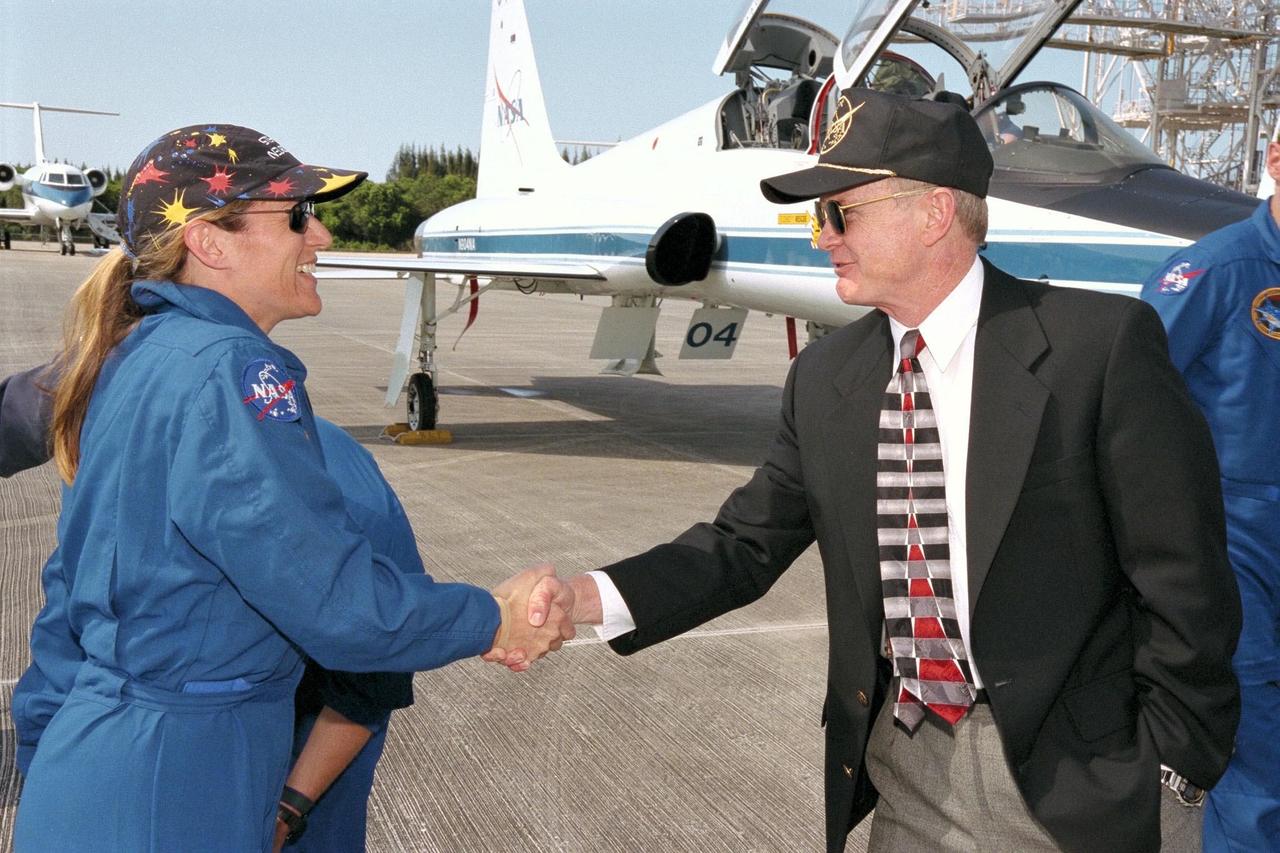
KENNEDY SPACE CENTER, FLA. -- Center Director Roy Bridges greets STS-90 Mission Specialist Kathryn (Kay) Hire shortly after her arrival at Kennedy Space Center's Shuttle Landing Facility in preparation for the launch of Columbia on April 16 at 2:19 p.m. EDT from KSC's Launch Pad 39B. The flight of Neurolab on STS-90, which will be the second mission of 1998, is scheduled to last nearly 17 days.
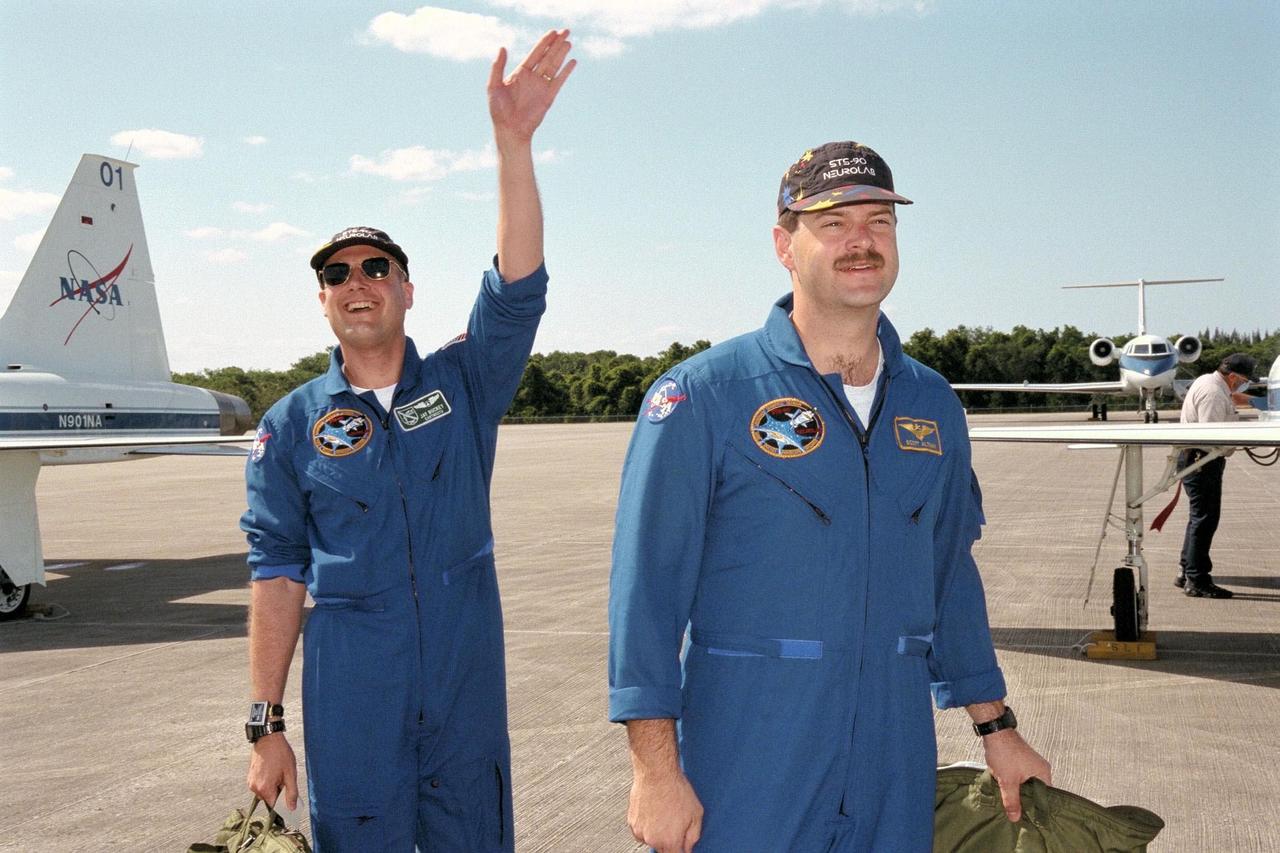
KENNEDY SPACE CENTER, FLA. -- STS-90 Payload Specialist Jay Buckey, M.D. (at left), and Pilot Scott Altman arrive at Kennedy Space Center's Shuttle Landing Facility in preparation for the launch of Columbia on April 16 at 2:19 p.m. EDT from KSC's Launch Pad 39B. The launch of Neurolab on STS-90, which will be the second mission of 1998, is scheduled to last nearly 17 days
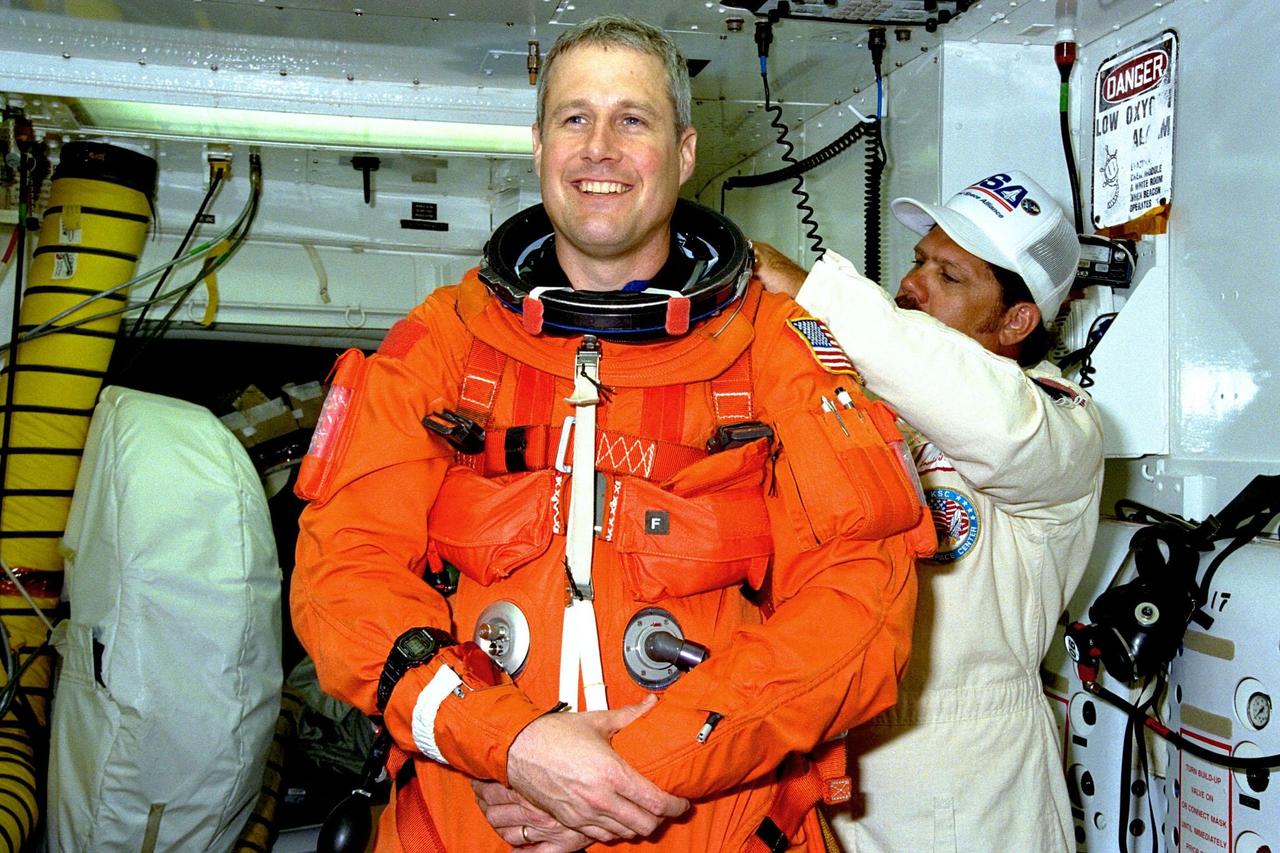
The crew of STS-90 participate in Terminal Countdown Demonstration Test (TCDT) activities at KSC's Launch Pad 39B. The TCDT is held at KSC prior to each Space Shuttle flight to provide crews with the opportunity to participate in simulated countdown activities. Here, Payload Specialist Jay Buckey, M.D., is assisted with his orange launch and re-entry suit by a USA technician. Columbia is targeted for launch of STS-90 on April 16 at 2:19 p.m. EDT and will be the second mission of 1998. The mission is scheduled to last nearly 17 days
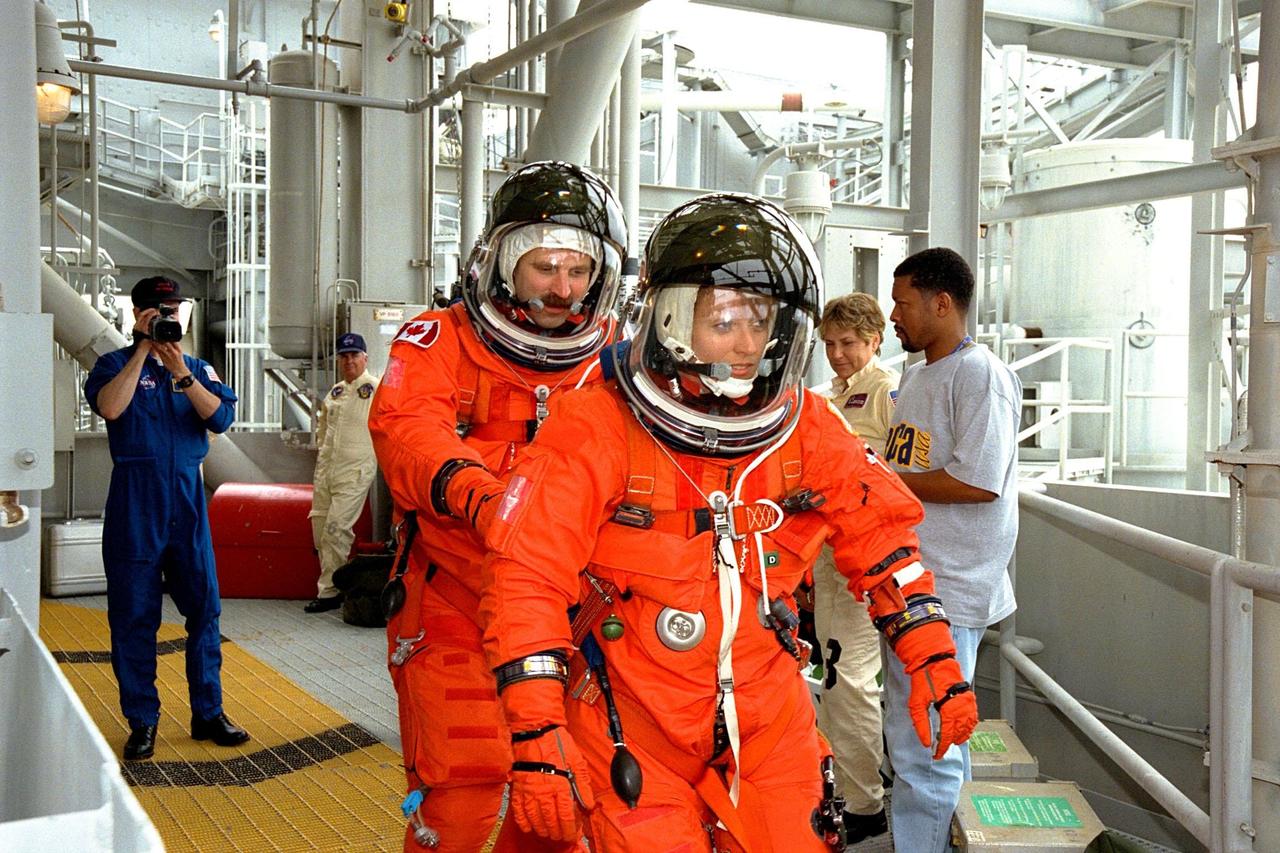
STS-90 Mission Specialists Dafydd (Dave) Williams with the Canadian Space Agency and Kathryn (Kay) Hire participate in Terminal Countdown Demonstration Test (TCDT) activities at KSC's Launch Pad 39B. The TCDT is held at KSC prior to each Space Shuttle flight to provide crews with the opportunity to participate in simulated countdown activities. The Space Shuttle Columbia is targeted for launch of STS-90 on April 16 at 2:19 p.m. EDT and will be the second mission of 1998. The mission is scheduled to last nearly 17 days
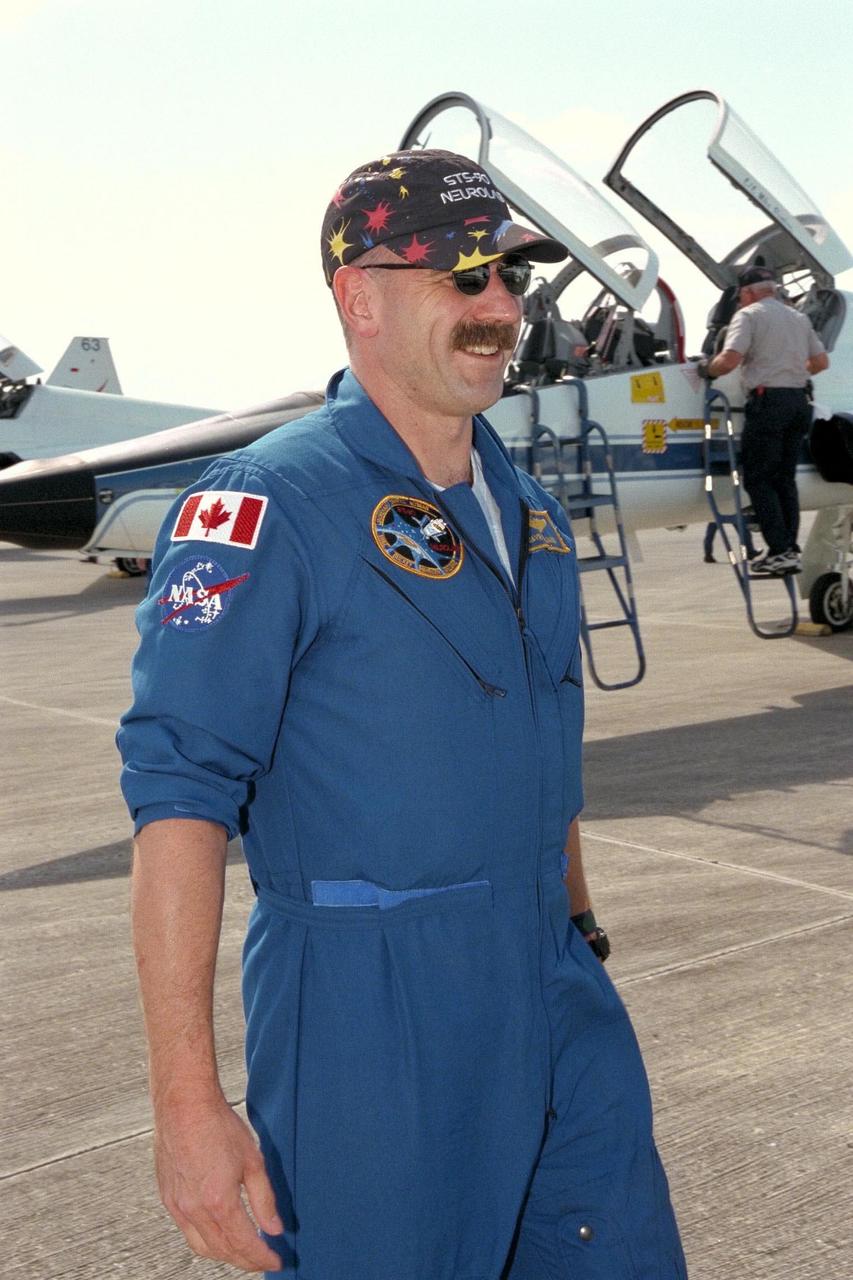
KENNEDY SPACE CENTER, FLA. -- STS-90 Mission Specialist Dafydd (Dave) Williams with the Canadian Space Agency smiles at the media shortly after his arrival at Kennedy Space Center's Shuttle Landing Facility. The crew arrived to prepare for the launch of Columbia, scheduled for April 16 at 2:19 p.m. EDT from KSC's Launch Pad 39B. The launch of Neurolab on STS-90, which will be the second mission of 1998, is scheduled to last nearly 17 days
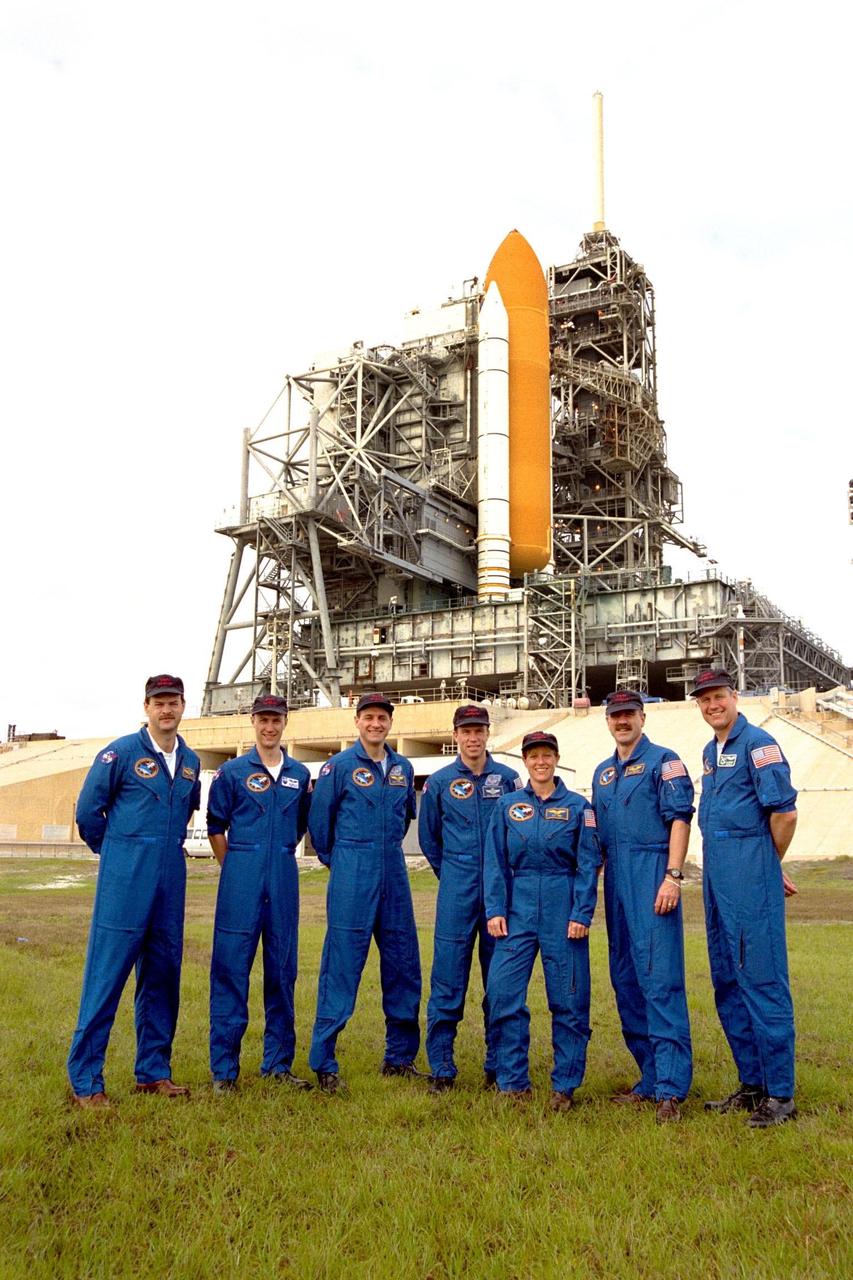
The crew of STS-90 participate in Terminal Countdown Demonstration Test (TCDT) activities at KSC's Launch Pad 39B. The TCDT is held at KSC prior to each Space Shuttle flight to provide crews with the opportunity to participate in simulated countdown activities. The STS-90 crew, left to right, are Pilot Scott Altman, Payload Specialist James Pawelczyk, Ph.D., Mission Specialist Richard Linnehan, D.V.M., Commander Richard Searfoss, Mission Specialists Kathryn (Kay) Hire and Dafydd (Dave) Williams with the Canadian Space Agency, and Payload Specialist Jay Buckey, M.D. Columbia is targeted for launch of STS-90 on April 16 at 2:19 p.m. EST and will be the second mission of 1998. The mission is scheduled to last nearly 17 days
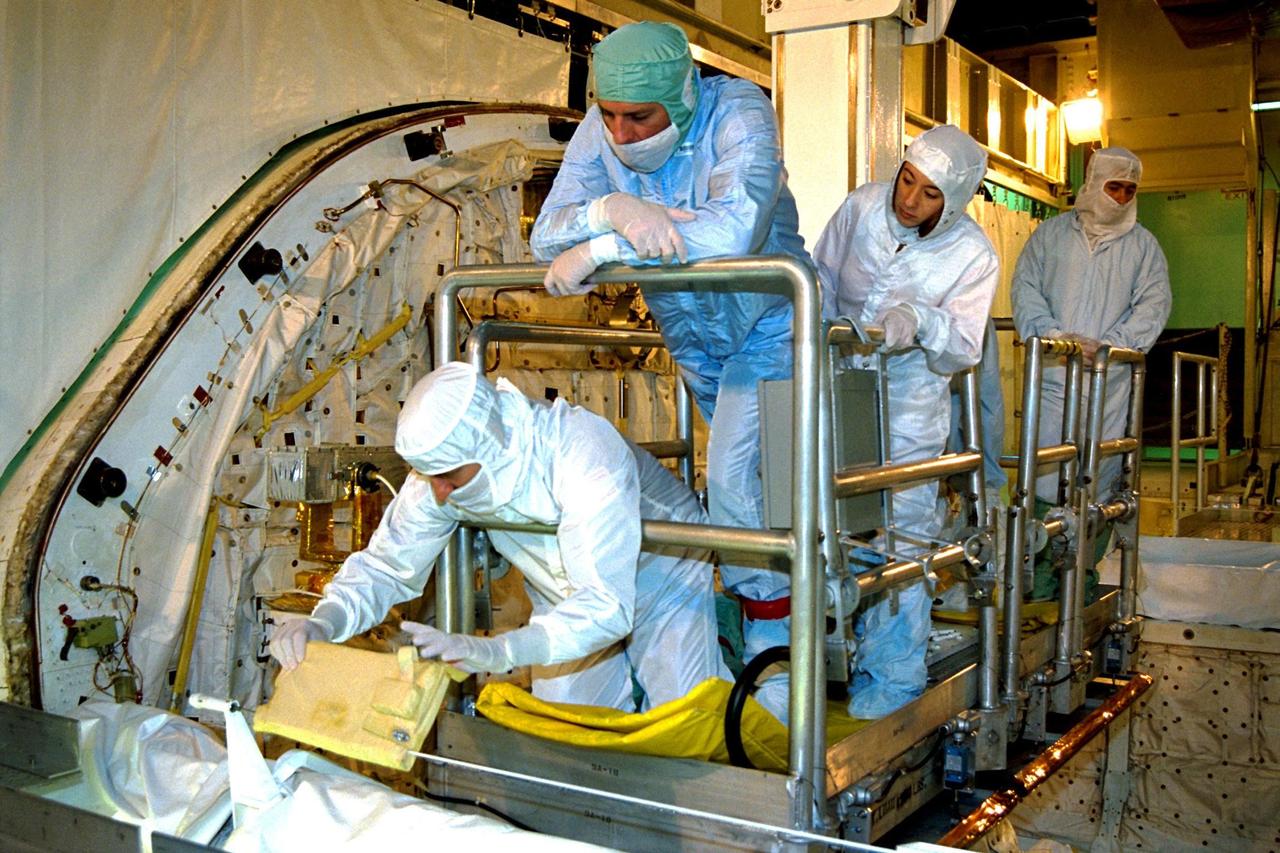
Members of the STS-90 crew participate in the Crew Equipment Interface Test (CEIT) in Kennedy Space Center's Orbiter Processing Facility Bay 3. The CEIT gives astronauts an opportunity to get a hands-on look at the payloads with which they will be working on-orbit. Investigations during the STS-90 Neurolab mission will focus on the effects of microgravity on the nervous system. Specifically, experiments will study the adaptation of the vestibular system, the central nervous system, and the pathways that control the ability to sense location in the absence of gravity, as well as the effect of microgravity on a developing nervous system. The crew of STS-90, slated for launch in April, will include Commander Richard Searfoss, Pilot Scott Altman, Mission Specialists Richard Linnehan, Dafydd (Dave) Williams, M.D., and Kathryn (Kay) Hire, and Payload Specialists Jay Buckey, M.D., and James Pawelczyk, Ph.D
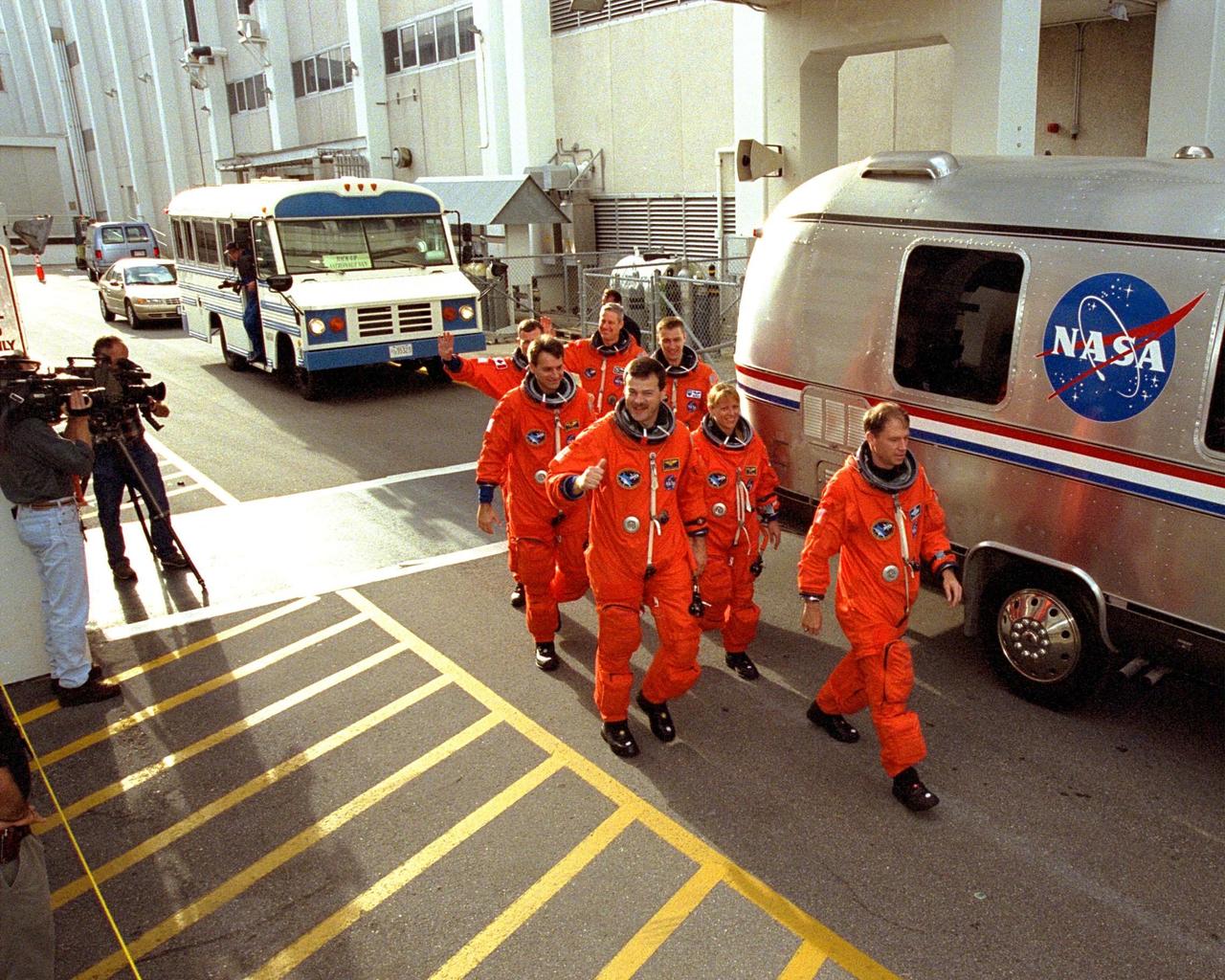
The crew of STS-90 leave the Operations and Checkout Building for Launch Pad 39B during Terminal Countdown Demonstration Test (TCDT) activities. The TCDT is held at KSC prior to each Space Shuttle flight to provide crews with the opportunity to participate in simulated countdown activities. The STS-90 crew members are, front to back and left to right, Commander Richard Searfoss, Pilot Scott Altman, Mission Specialist Kathryn (Kay) Hire, Mission Specialist Richard Linnehan, D.V.M., Payload Specialist James Pawelczyk, Ph.D., Mission Specialist Dafydd (Dave) Williams with the Canadian Space Agency, and Payload Specialist Jay Buckey, M.D. Columbia is targeted for launch of STS-90 on April 16 at 2:19 p.m. EDT and will be the second mission of 1998. The mission is scheduled to last nearly 17 days

Members of the STS-90 crew participate in Terminal Countdown Demonstration Test (TCDT) activities at KSC's Launch Pad 39B. The TCDT is held at KSC prior to each Space Shuttle flight to provide crews with the opportunity to participate in simulated countdown activities. The STS-90 crew members are, from left to right, Payload Specialist Jay Buckey, M.D., Pilot Scott Altman, Mission Specialist Kathryn (Kay) Hire, Commander Richard Searfoss, Payload Specialist James Pawelczyk, Ph.D., Mission Specialist Dafydd (Dave) Williams with the Canadian Space Agency, and Mission Specialist Richard Linnehan, D.V.M. Columbia is targeted for launch of STS-90 on April 16 at 2:19 p.m. EDT and will be the second mission of 1998. The mission is scheduled to last nearly 17 days
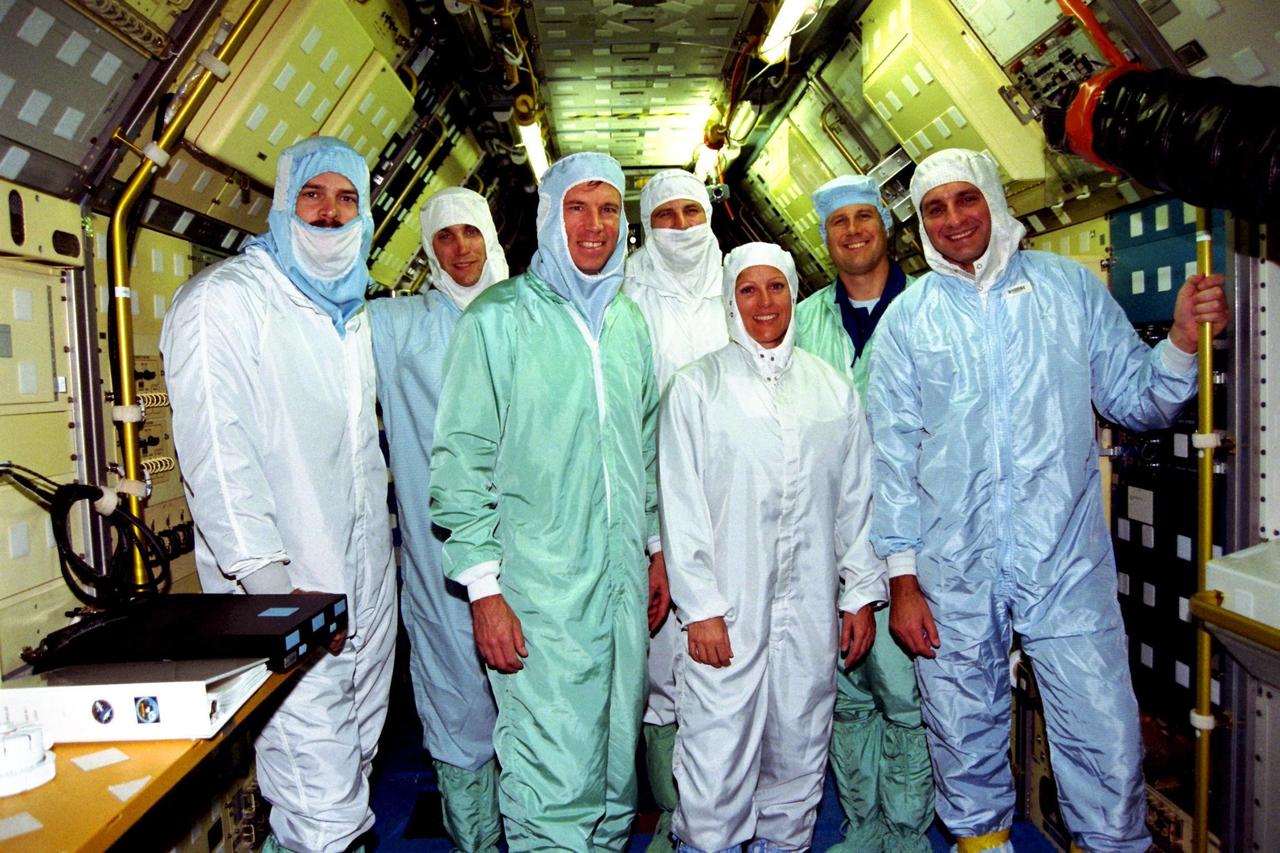
Members of the STS-90 crew participate in the Crew Equipment Interface Test (CEIT) in Kennedy Space Center's Orbiter Processing Facility Bay 3. The CEIT gives astronauts an opportunity to get a hands-on look at the payloads with which they will be working on-orbit. Investigations during the STS-90 Neurolab mission will focus on the effects of microgravity on the nervous system. Specifically, experiments will study the adaptation of the vestibular system, the central nervous system, and the pathways that control the ability to sense location in the absence of gravity, as well as the effect of microgravity on a developing nervous system. The crew of STS-90, slated for launch in April, are, left to right, Pilot Scott Altman; Payload Specialist James Pawelczyk, Ph.D.; Commander Richard Searfoss; Mission Specialists Dafydd (Dave) Williams, M.D., and Kathryn (Kay) Hire; Payload Specialist Jay Buckey, M.D.; and Mission Specialist Richard Linnehan
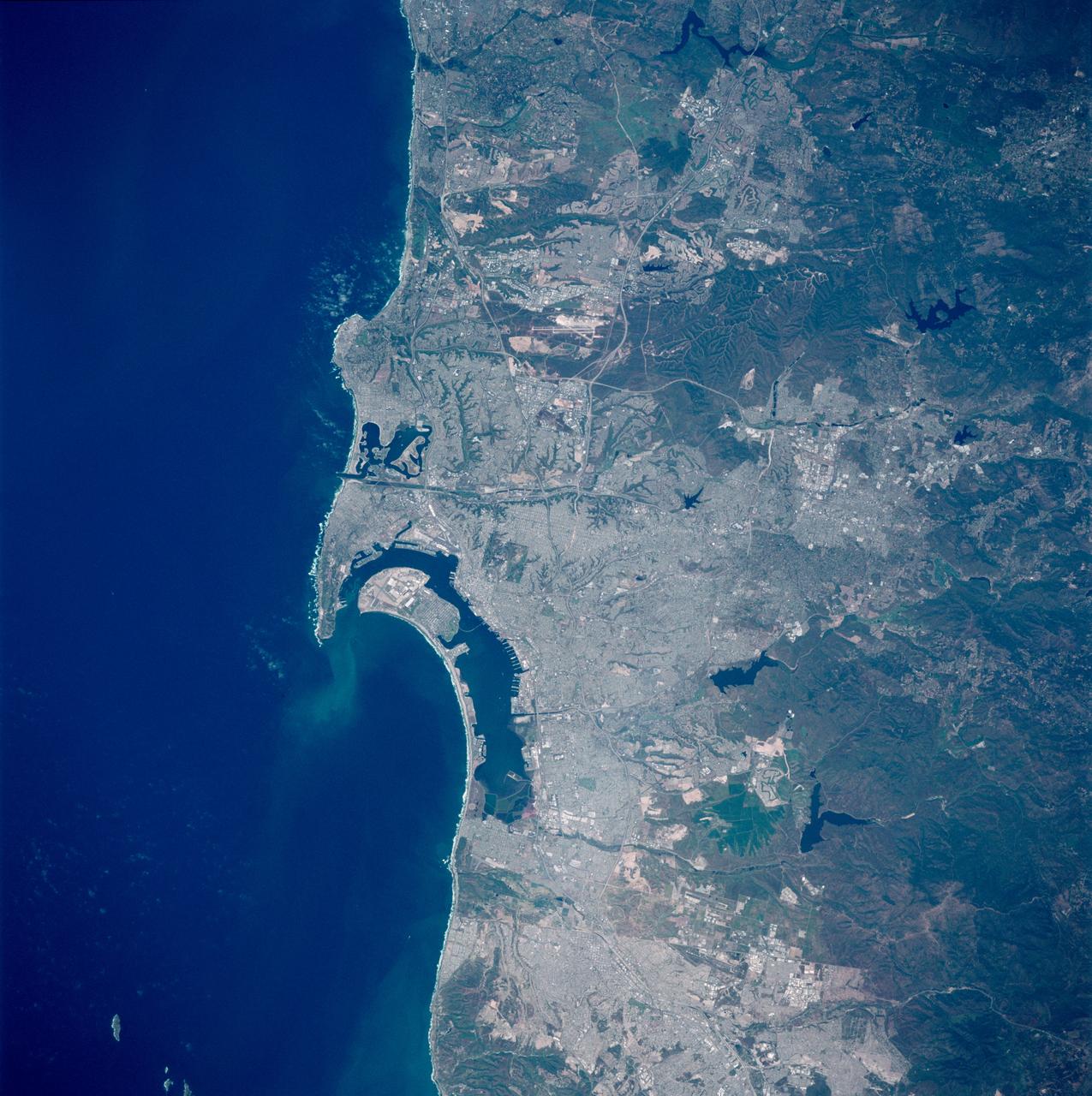
STS090-758-018 (17 April - 3 May 1998) --- The Space Shuttle Columbia was almost directly over the San Diego, California, area when this scene was captured with a 70mm handheld camera. In order for north to appear toward the top of the frame, it should be held with the Pacific Ocean waters to the left. The United States Naval Air Station, the United States Naval Training Center, United States Marine Corps (USMC) Recruit Depot and the United States Naval Station are all visible just left of center on or near the island and peninsula features. Among the many bodies of water visible in the photo are Mission Bay, San Diego Bay, Lower Otay Reservoir, Sweetwater Reservoir and El Capitan Reservoir.

STS090-756-046 (17 April - 3 May 1998) --- A 70mm view of the Las Vegas, Nevada area, including the western-most tip of Lake Mead. The flight track of the Space Shuttle Columbia and lack of heavy cloud cover during the 16-day Neurolab mission allowed the astronauts a number of opportunities to photograph North American cities.
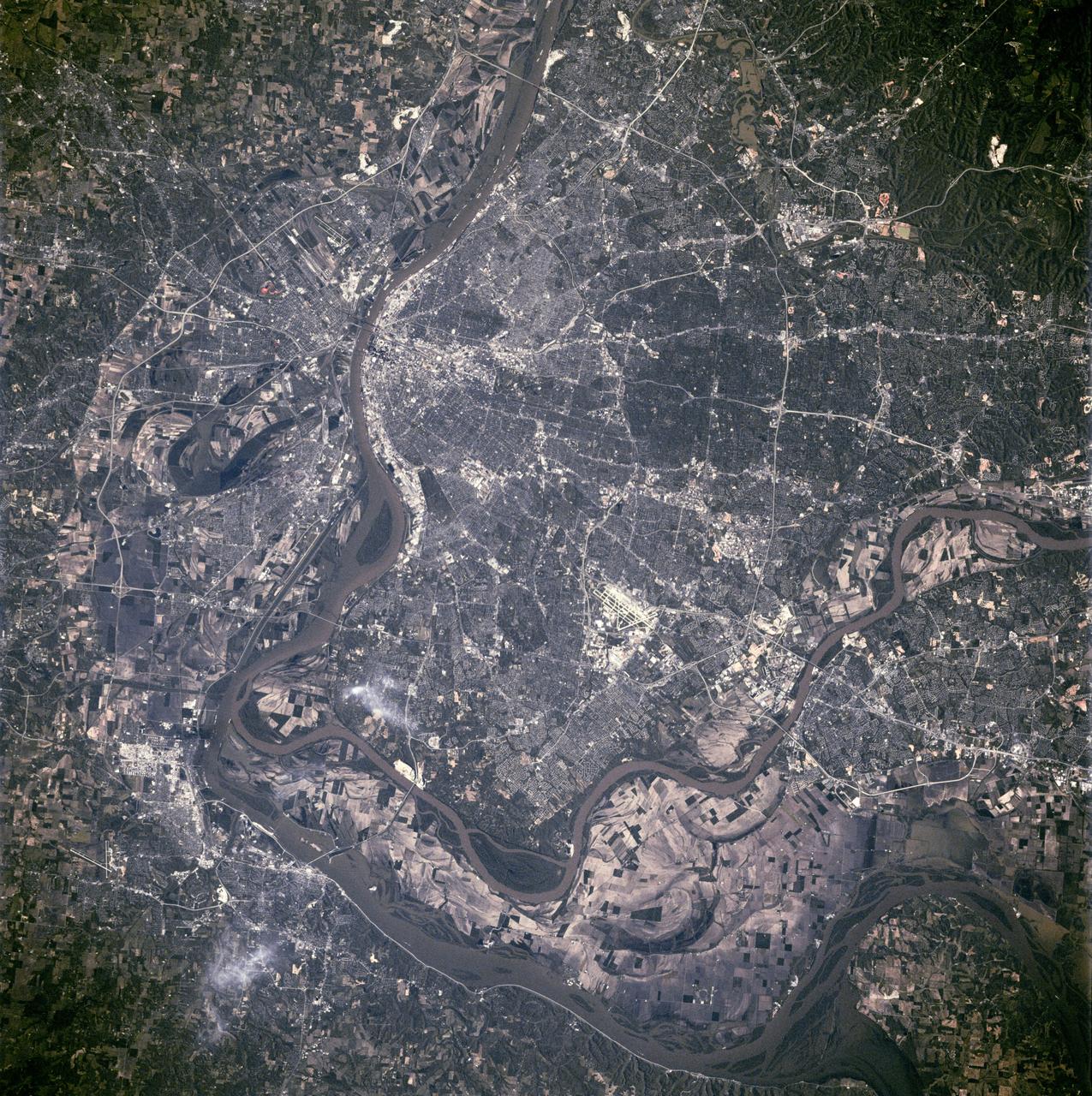
STS090-755-062 (17 April - 3 May 1998) --- The Mississippi River stands out among the geographic features in this view of the St. Louis, Missouri and East St. Louis, Illinois area as photographed with a 70mm handheld camera from the Space Shuttle Columbia. The Shuttle was flying at almost a nadir position to the area when the photo was taken. The picture should be held with the two major rivers at the top of the frame in order for north to be toward the top. The Illinois-Missouri Border is easily delineated by following the Mississippi River from upper left to bottom center. The Missouri River separates St. Charles and St. Louis counties several miles inside the Mississippi at top center.

STS090-736-037 (17 April - 3 May 1998) --- Phoenix, Arizona as photographed with a 70mm handheld camera from the Earth-orbiting Space Shuttle Columbia. Sunglint makes canals and pools very easily identifiable in the frame. Minimal cloud cover during the 16-day Neurolab mission and the flight track of Columbia opened the way for the crew members to photograph more North American cities than most Shuttle missions.
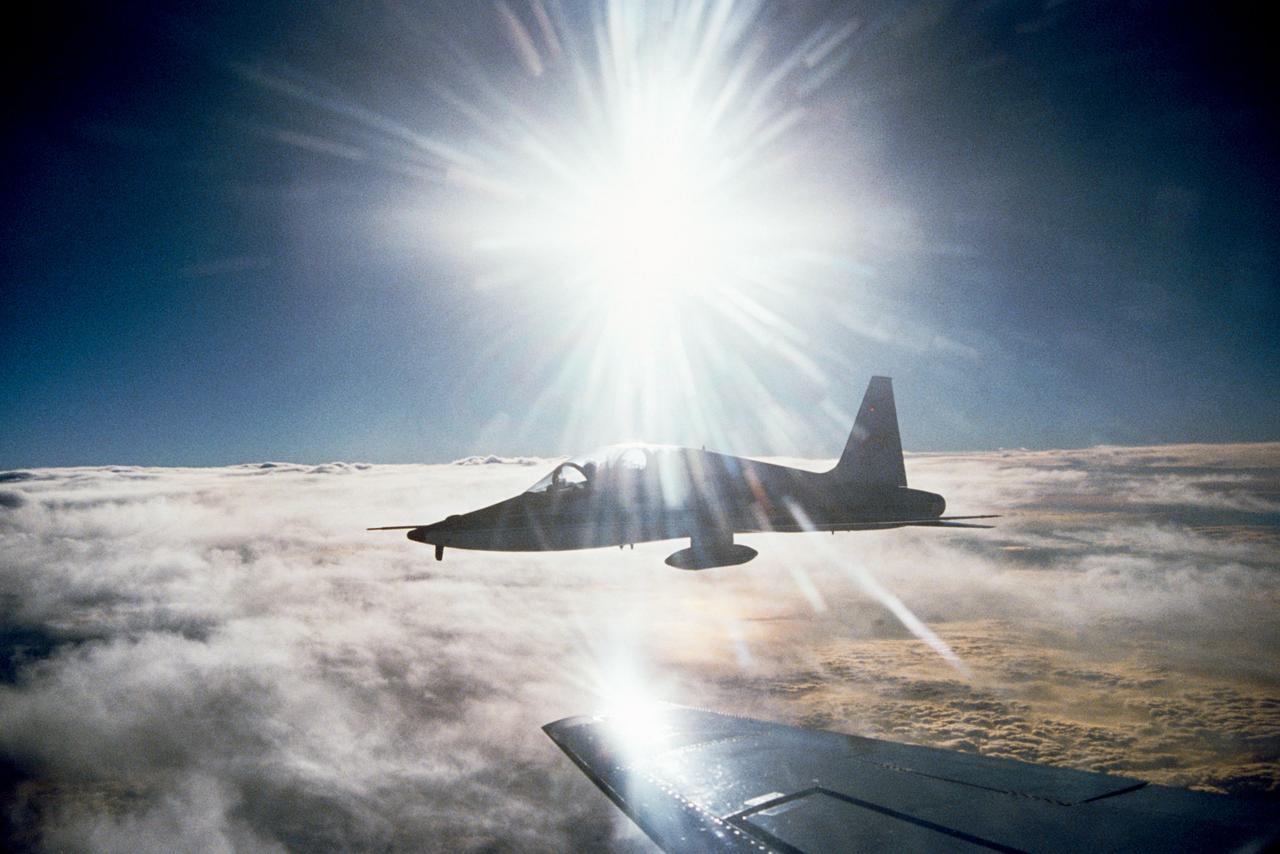
An airborne view of a T-38 taken from the Atlantis (STS-36) while landing at Edwards Air Force Base, California 03/04/90 by Mission Specialist Richard M. "Mike" Mullane.

The crew of STS-90 participate in Terminal Countdown Demonstration Test (TCDT) activities at KSC's Launch Pad 39B. The TCDT is held at KSC prior to each Space Shuttle flight to provide crews with the opportunity to participate in simulated countdown activities. Here, Mission Specialist Kathryn (Kay) Hire gives a "thumbs-up" to the mission after being suited up in her orange launch and re-entry suit. Columbia is targeted for launch of STS-90 on April 16 at 2:19 p.m. EDT and will be the second mission of 1998. The mission is scheduled to last nearly 17 days
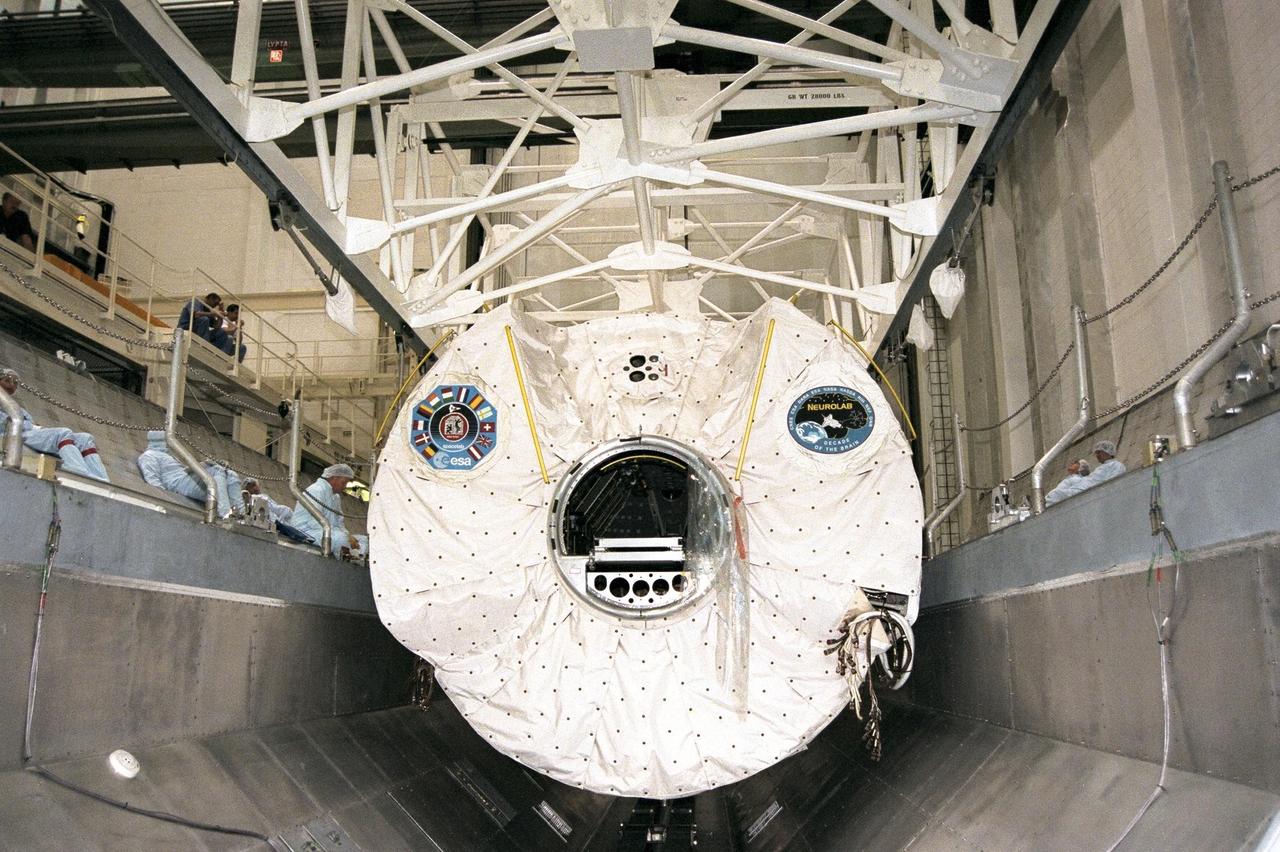
KENNEDY SPACE CENTER, FLA. -- The STS-90 Neurolab payload is lowered into its payload canister in KSC's Operations and Checkout Building. Investigations during the Neurolab mission will focus on the effects of microgravity on the nervous system. Specifically, experiments will study the adaptation of the vestibular system, the central nervous system, and the pathways that control the ability to sense location in the absence of gravity, as well as the effect of microgravity on a developing nervous system. The crew of STS-90, slated for launch in April, will include Commander Richard Searfoss, Pilot Scott Altman, Mission Specialists Richard Linnehan, Dafydd (Dave) Williams, M.D., and Kathryn (Kay) Hire, and Payload Specialists Jay Buckey, M.D., and James Pawelczyk, Ph.D
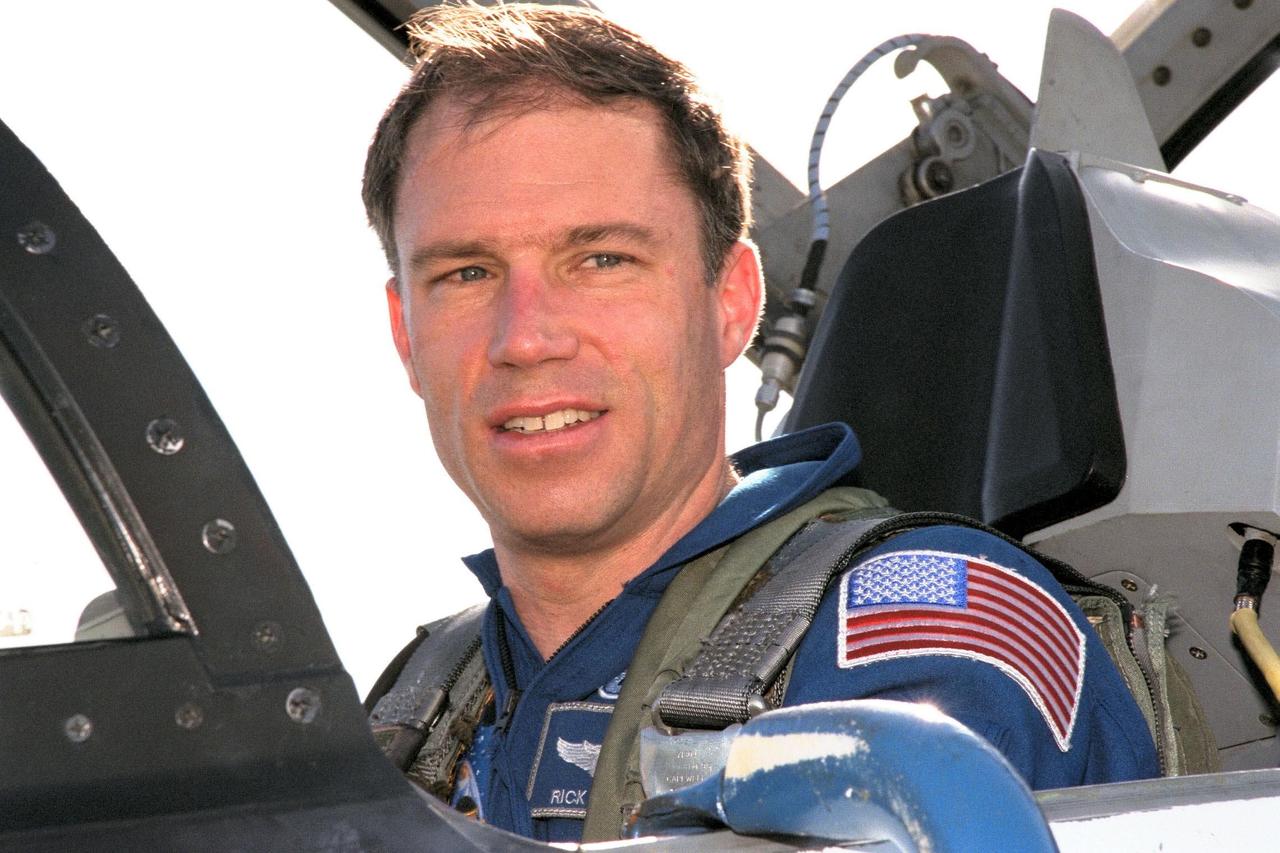
STS-90 Mission Commander Richard Searfoss poses in the cockpit of his T-38 jet trainer aircraft after arriving at the KSC Shuttle Landing Facility along with other members of the crew from NASA’s Johnson Space Center to begin Terminal Countdown Demonstration Test (TCDT) activities. The TCDT is held at KSC prior to each Space Shuttle flight to provide crews with the opportunity to participate in simulated countdown activities. Columbia is targeted for launch of STS-90 on April 16 at 2:19 p.m. EDT and will be the second mission of 1998. The mission is scheduled to last nearly 17 days
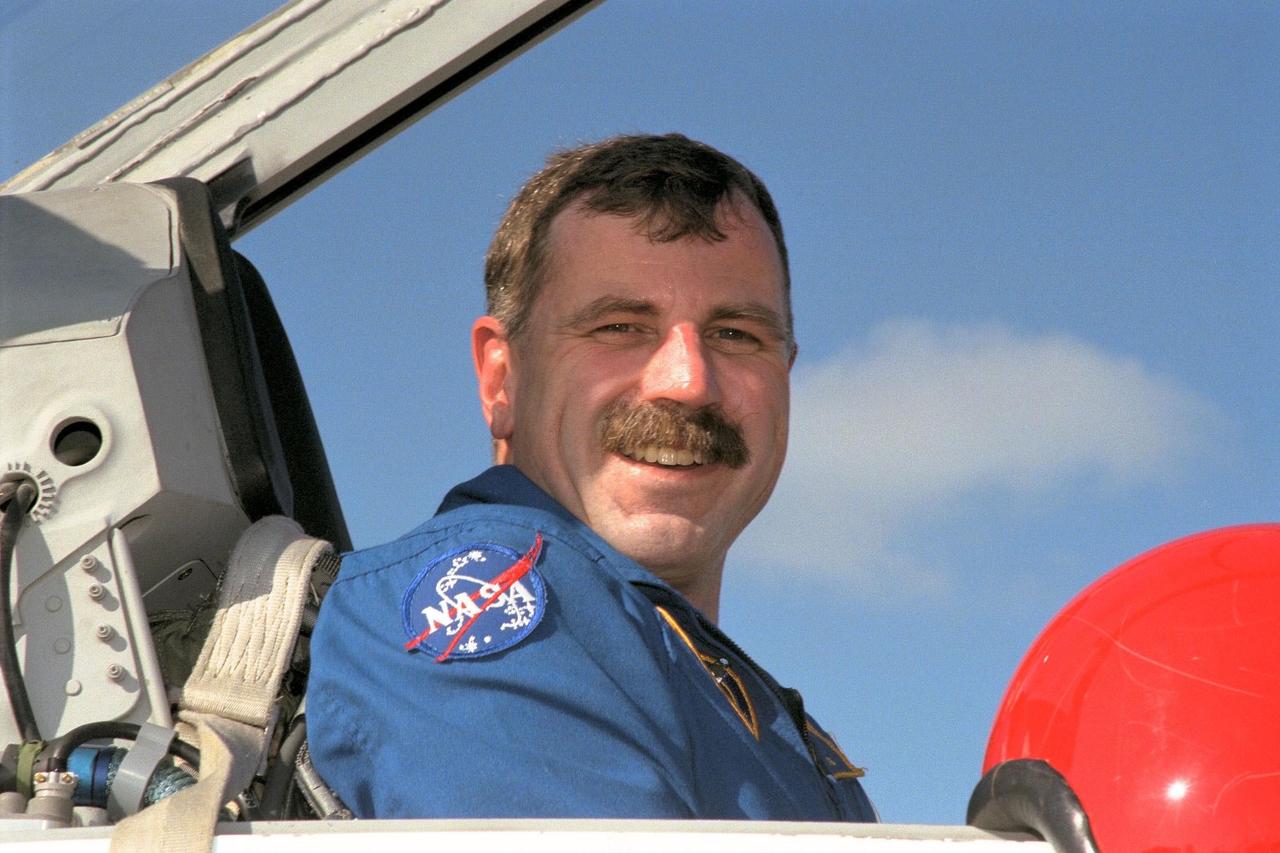
STS-90 Mission Specialist Dafydd (Dave) Williams with the Canadian Space Agency poses in the cockpit of his T-38 jet trainer aircraft after arriving at the KSC Shuttle Landing Facility along with other members of the crew from NASA’s Johnson Space Center to begin Terminal Countdown Demonstration Test (TCDT) activities. The TCDT is held at KSC prior to each Space Shuttle flight to provide crews with the opportunity to participate in simulated countdown activities. Columbia is targeted for launch of STS-90 on April 16 at 2:19 p.m. EDT and will be the second mission of 1998. The mission is scheduled to last nearly 17 days
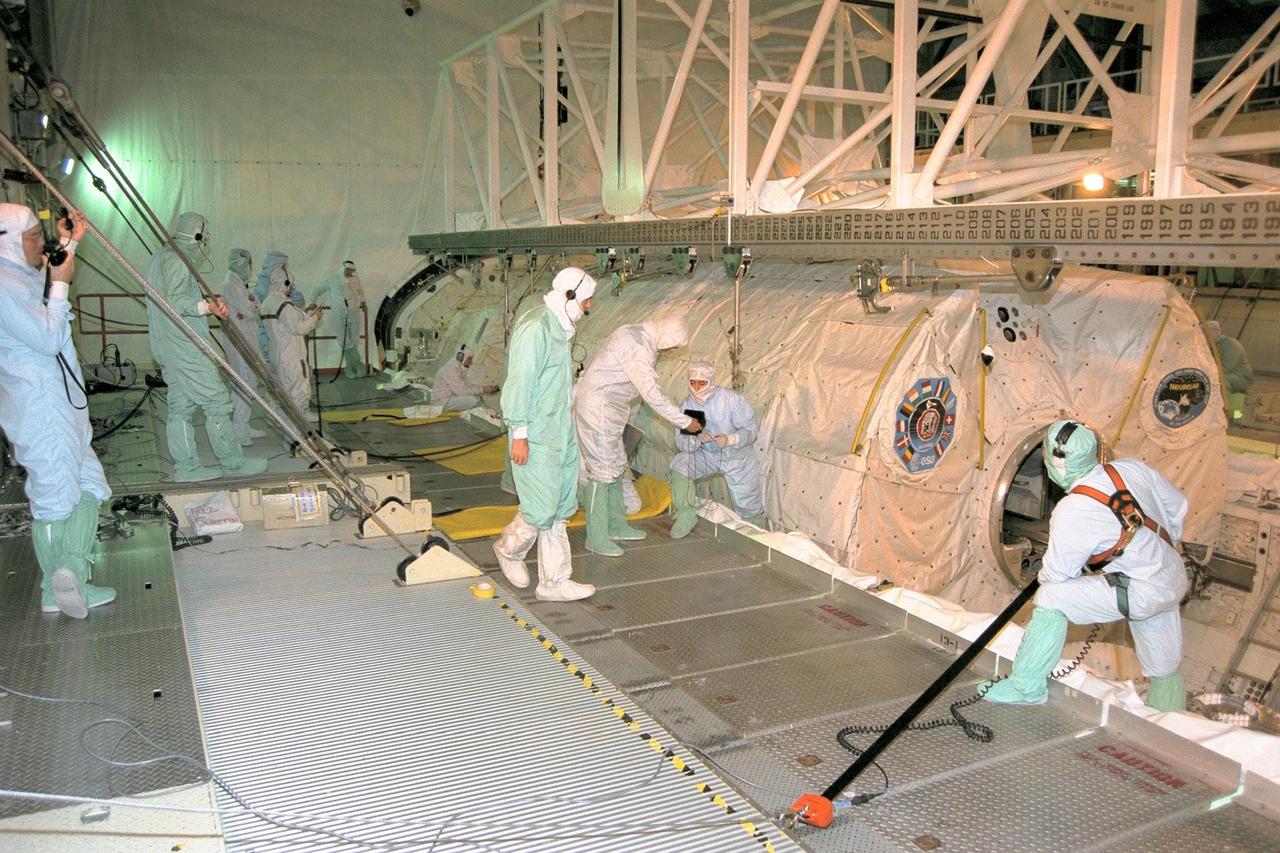
The STS-90 Neurolab payload is positioned into the cargo bay of Space Shuttle Columbia today in Orbiter Processing Facility bay 3. Investigations during the Neurolab mission will focus on the effects of microgravity on the nervous system. Specifically, experiments will study the adaptation of the vestibular system, the central nervous system, and the pathways that control the ability to sense location in the absence of gravity, as well as the effect of microgravity on a developing nervous system. The crew of STS-90, slated for launch in April, will include Commander Richard Searfoss, Pilot Scott Altman, Mission Specialists Richard Linnehan, Dafydd (Dave) Williams, M.D., and Kathryn (Kay) Hire, and Payload Specialists Jay Buckey, M.D., and James Pawelczyk, Ph.D
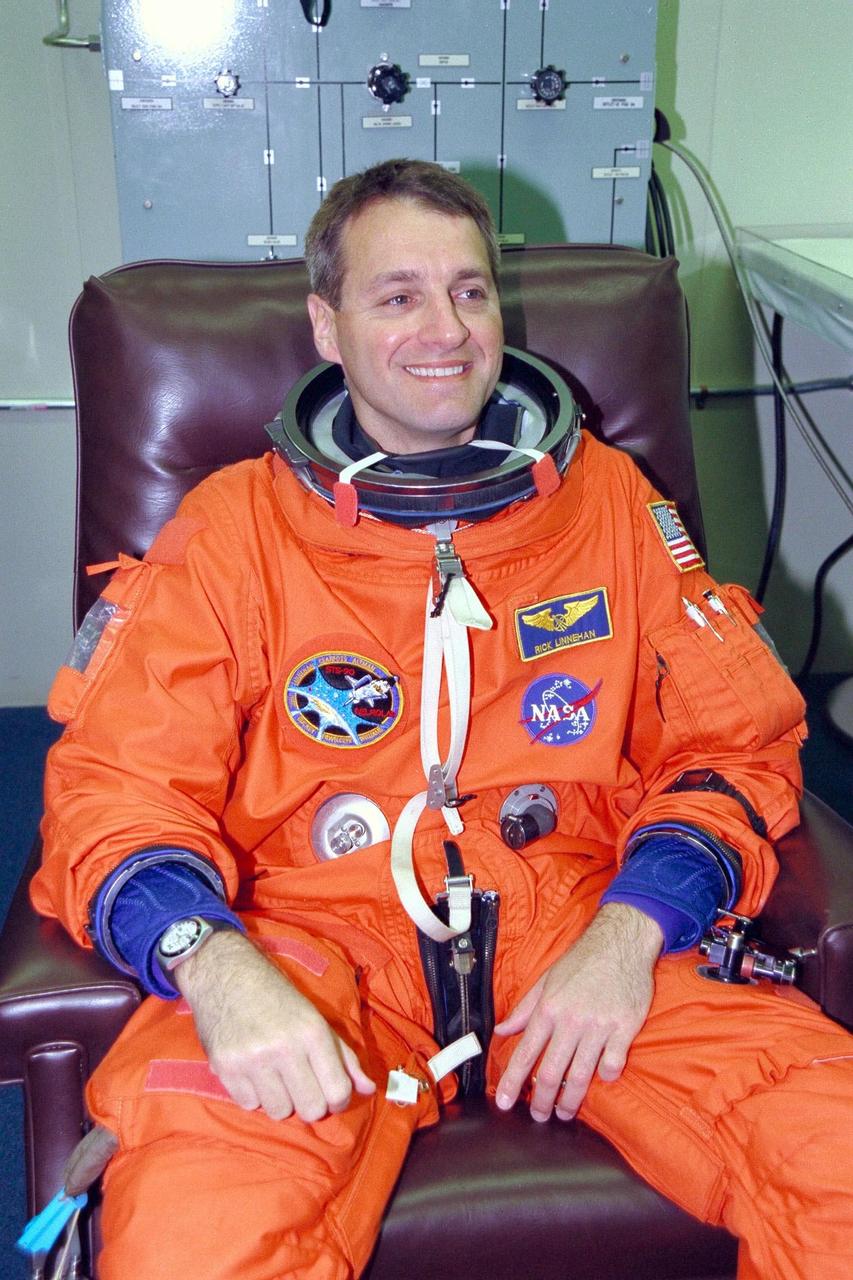
STS-90 Mission Specialist Richard Linnehan, D.V.M., sits in a chair during suitup activities in the Operations and Checkout Building. Linnehan and the rest of the STS-90 crew will shortly depart for Launch Pad 39B, where the Space Shuttle Columbia awaits a second liftoff attempt at 2:19 p.m. EDT. His second trip into space, Linnehan is participating in a life sciences research flight that will focus on the most complex and least understood part of the human body the nervous system. Neurolab will examine the effects of spaceflight on the brain, spinal cord, peripheral nerves and sensory organs in the human body
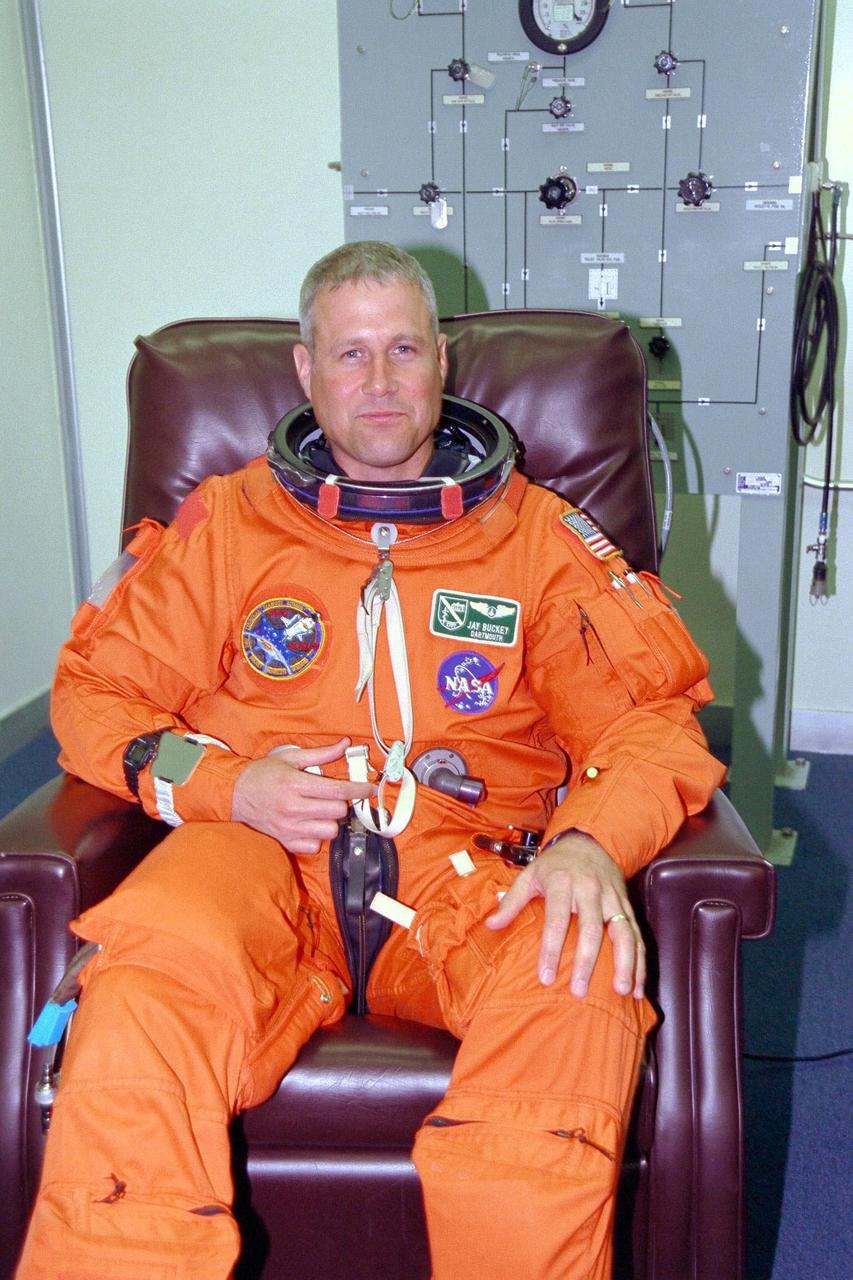
STS-90 Payload Specialist Jay Buckey, M.D., prepares for launch during suit-up activities in KSC's Operations and Checkout Building. Buckey and the rest of the STS-90 crew will shortly depart for Launch Pad 39B, where the Space Shuttle Columbia awaits a second liftoff attempt at 2:19 p.m. EDT. His first trip into space, Buckey is participating in a life sciences research flight that will focus on the most complex and least understood part of the human body the nervous system. Neurolab will examine the effects of spaceflight on the brain, spinal cord, peripheral nerves and sensory organs in the human body
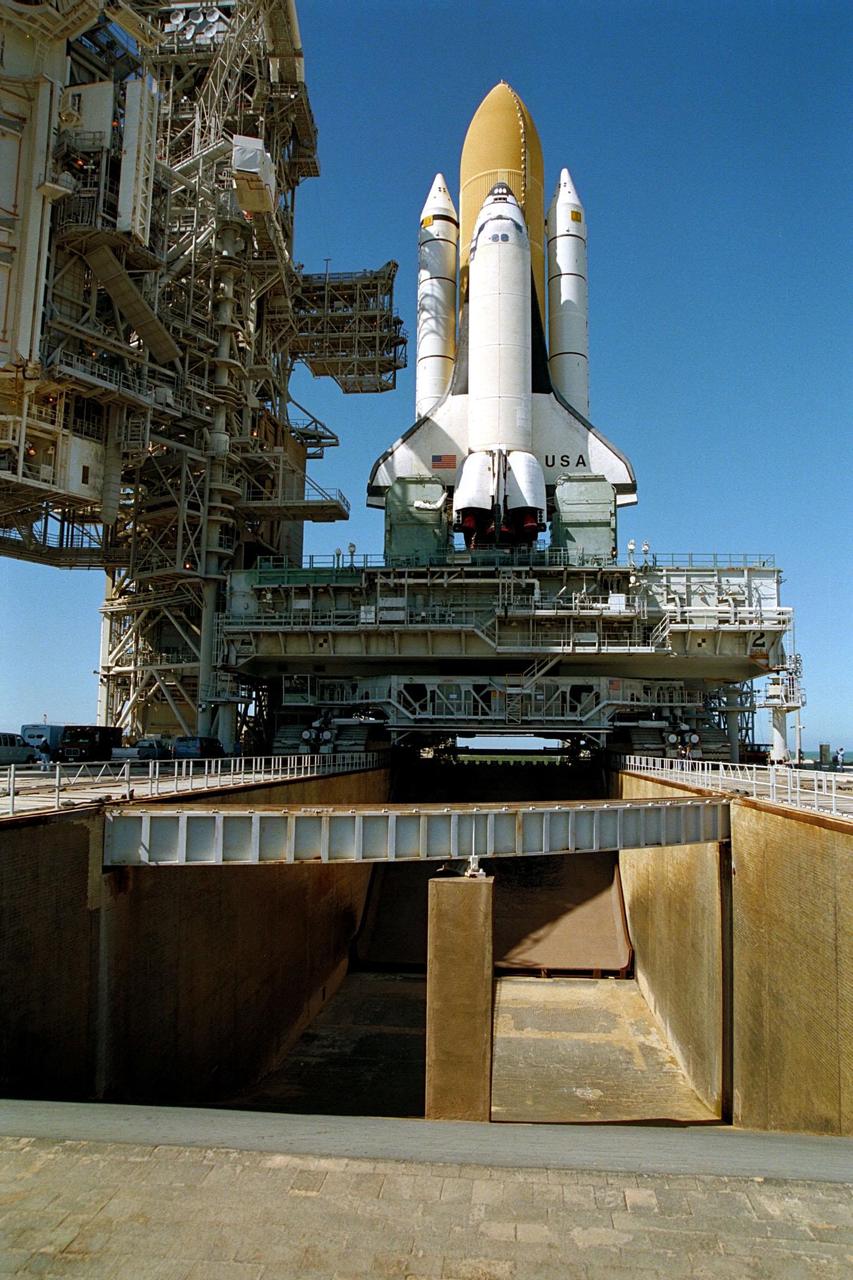
KENNEDY SPACE CENTER, FLA. -- The Space Shuttle Columbia arrives at the top of Launch Pad 39B after its morning rollout prior to STS-90. The Neurolab experiments are the primary payload on this nearly 17-day space flight. Investigations during the Neurolab mission will focus on the effects of microgravity on the nervous system. The crew of STS-90, slated for launch April 16 at 2:19 p.m. EDT, includes Commander Richard Searfoss, Pilot Scott Altman, Mission Specialists Richard Linnehan, Dafydd (Dave) Williams, M.D., and Kathryn (Kay) Hire, and Payload Specialists Jay Buckey, M.D., and James Pawelczyk, Ph.D
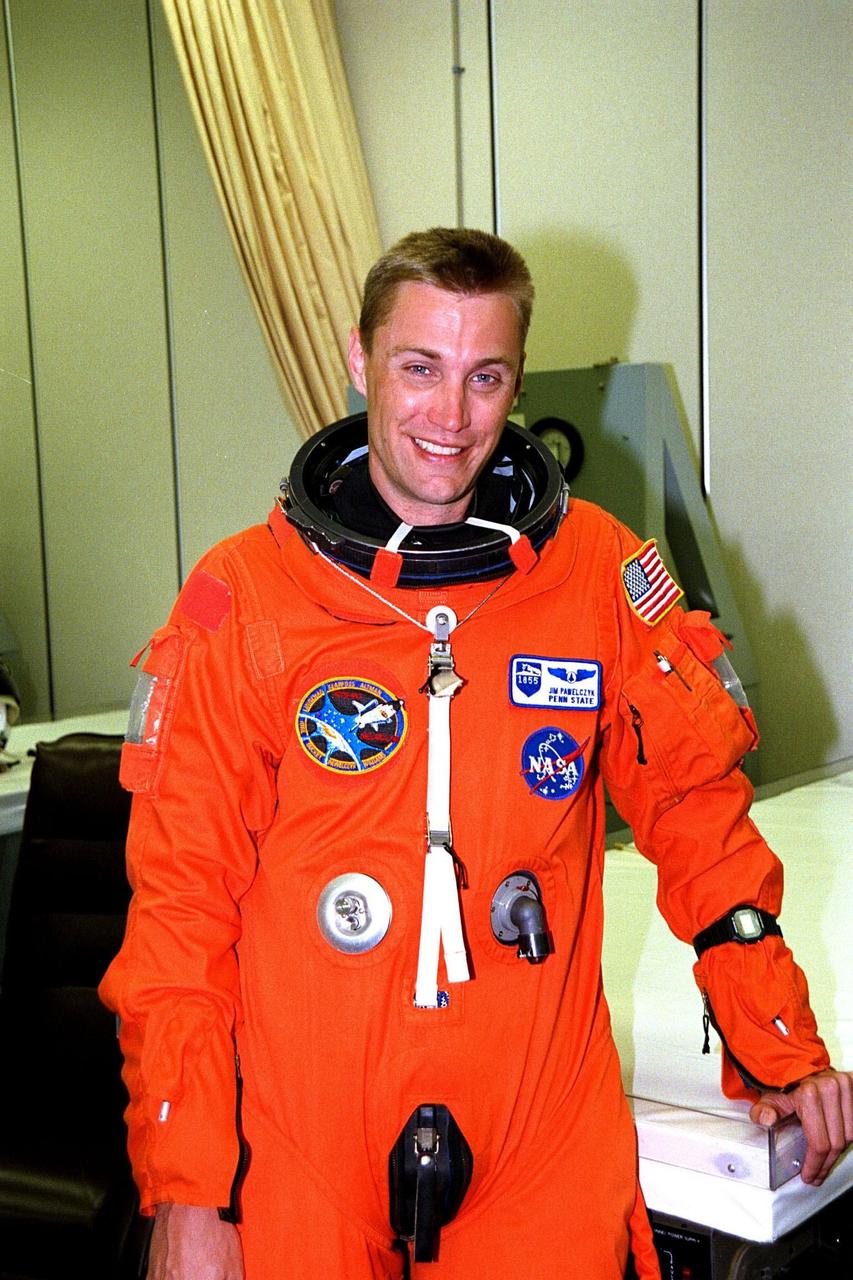
KENNEDY SPACE CENTER, FLA. -- STS-90 Payload Specialist James Pawelczyk, Ph.D., stands ready for launch during suitup activities in the Operations and Checkout Building. Pawelczyk and the rest of the STS-90 crew will shortly depart for Launch Pad 39B, where the Space Shuttle Columbia awaits a second liftoff attempt at 2:19 p.m. EDT. His first trip into space, Pawelczyk is participating in this life sciences research flight that will focus on the most complex and least understood part of the human body the nervous system. Neurolab will examine the effects of spaceflight on the brain, spinal cord, peripheral nerves and sensory organs in the human body.

KENNEDY SPACE CENTER, FLA. -- Technicians gather around the STS-90 Neurolab payload during weight and center-of-gravity measurements in KSC's Operations and Checkout Building. Investigations during the Neurolab mission will focus on the effects of microgravity on the nervous system. Specifically, experiments will study the adaptation of the vestibular system, the central nervous system, and the pathways that control the ability to sense location in the absence of gravity, as well as the effect of microgravity on a developing nervous system. The crew of STS-90, slated for launch in April, will include Commander Richard Searfoss, Pilot Scott Altman, Mission Specialists Richard Linnehan, Dafydd (Dave) Williams, M.D., and Kathryn (Kay) Hire, and Payload Specialists Jay Buckey, M.D., and James Pawelczyk, Ph.D
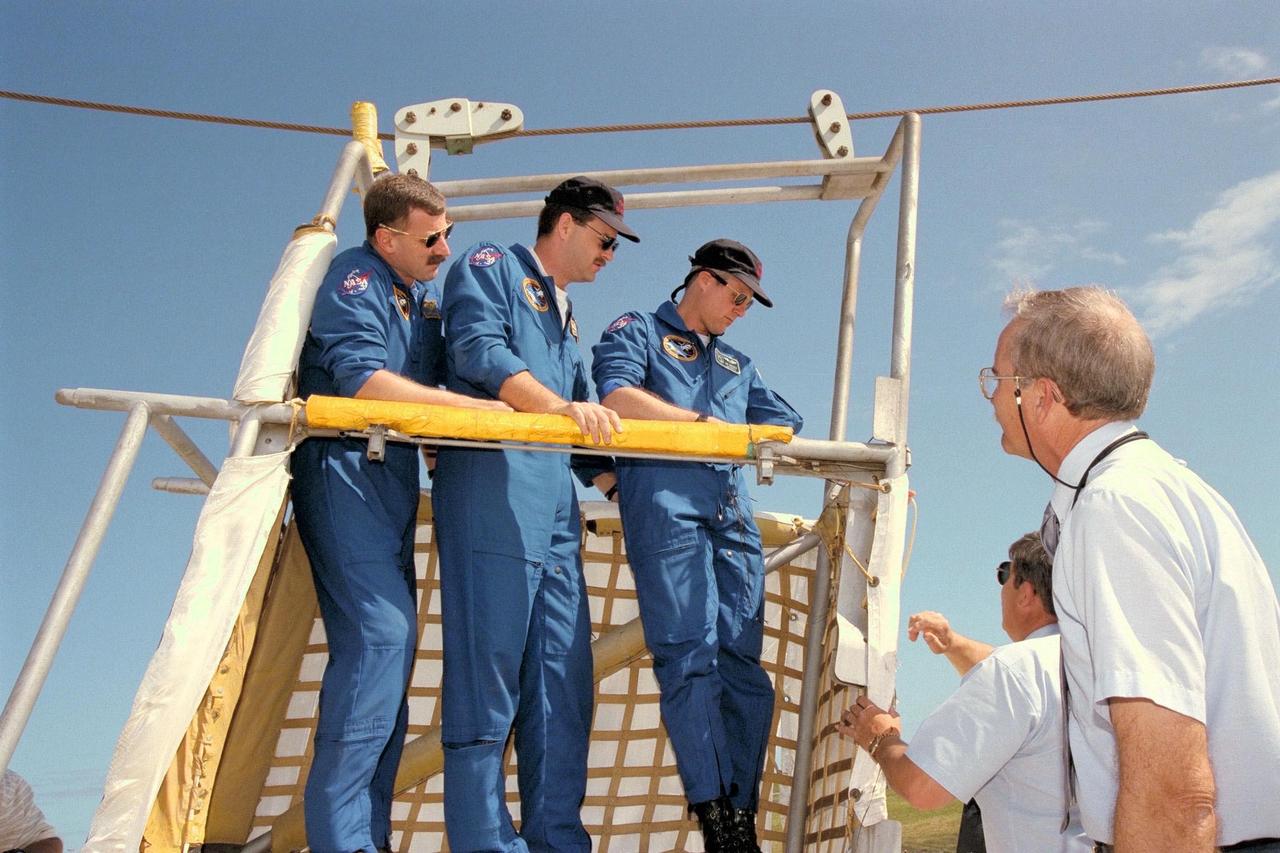
STS-90 Mission Specialist Dafydd (Dave) Williams, M.D., with the Canadian Space Agency, Pilot Scott Altman, and Payload Specialist Jay Buckey, M.D., train in an emergency egress system slidewire basket at Launch Pad 39B during Terminal Countdown Demonstration Test (TCDT) activities. The TCDT is held at KSC prior to each Space Shuttle flight to provide crews with the opportunity to participate in simulated countdown activities. Columbia is targeted for launch of STS-90 on April 16 at 2:19 p.m. EDT and will be the second mission of 1998. The mission is scheduled to last nearly 17 days
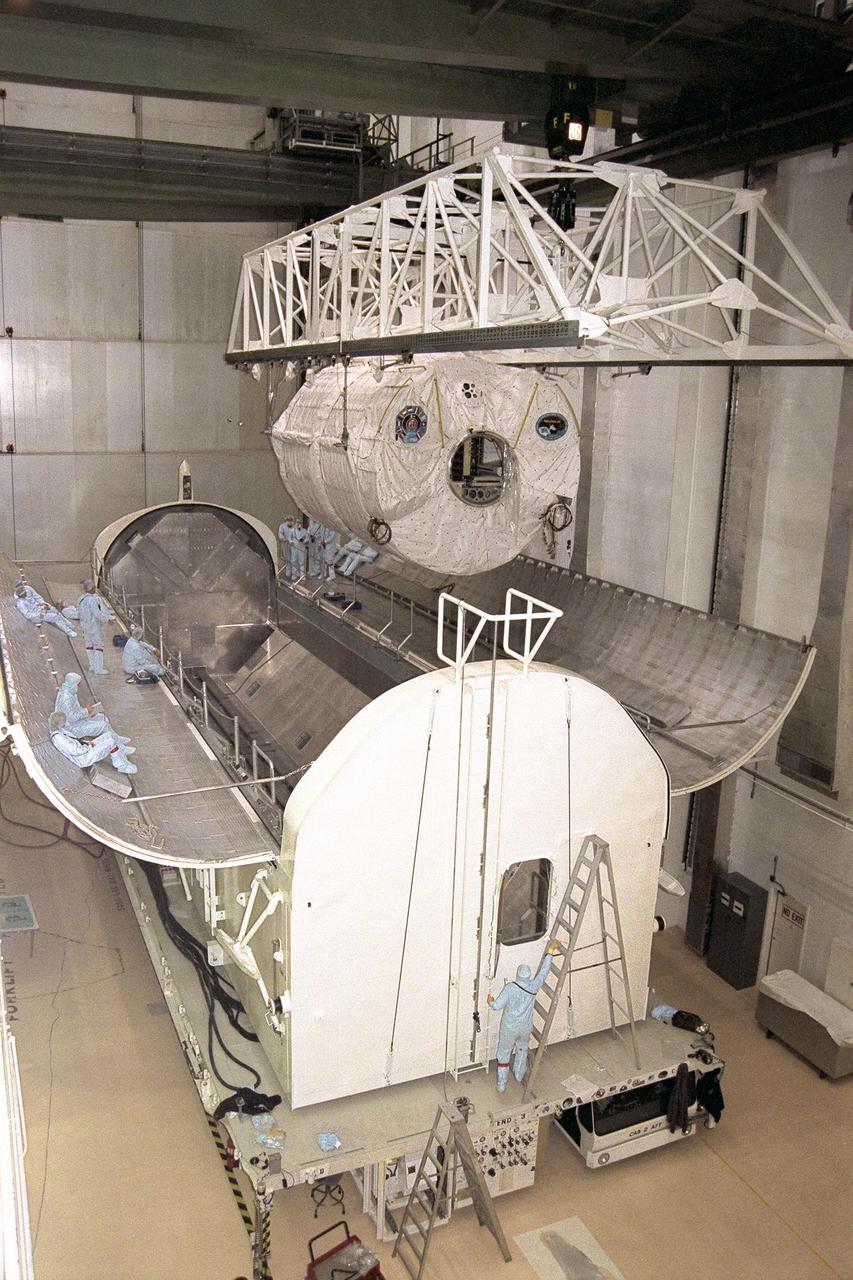
KENNEDY SPACE CENTER, FLA. -- The STS-90 Neurolab payload is lowered into its payload canister in KSC's Operations and Checkout Building. Investigations during the Neurolab mission will focus on the effects of microgravity on the nervous system. Specifically, experiments will study the adaptation of the vestibular system, the central nervous system, and the pathways that control the ability to sense location in the absence of gravity, as well as the effect of microgravity on a developing nervous system. The crew of STS-90, slated for launch in April, will include Commander Richard Searfoss, Pilot Scott Altman, Mission Specialists Richard Linnehan, Dafydd (Dave) Williams, M.D., and Kathryn (Kay) Hire, and Payload Specialists Jay Buckey, M.D., and James Pawelczyk, Ph.D

The STS-90 Neurolab payload is lowered into position into the cargo bay of Space Shuttle Columbia today in Orbiter Processing Facility bay 3. Investigations during the Neurolab mission will focus on the effects of microgravity on the nervous system. Specifically, experiments will study the adaptation of the vestibular system, the central nervous system, and the pathways that control the ability to sense location in the absence of gravity, as well as the effect of microgravity on a developing nervous system. The crew of STS-90, slated for launch in April, will include Commander Richard Searfoss, Pilot Scott Altman, Mission Specialists Richard Linnehan, Dafydd (Dave) Williams, M.D., and Kathryn (Kay) Hire, and Payload Specialists Jay Buckey, M.D., and James Pawelczyk, Ph.D
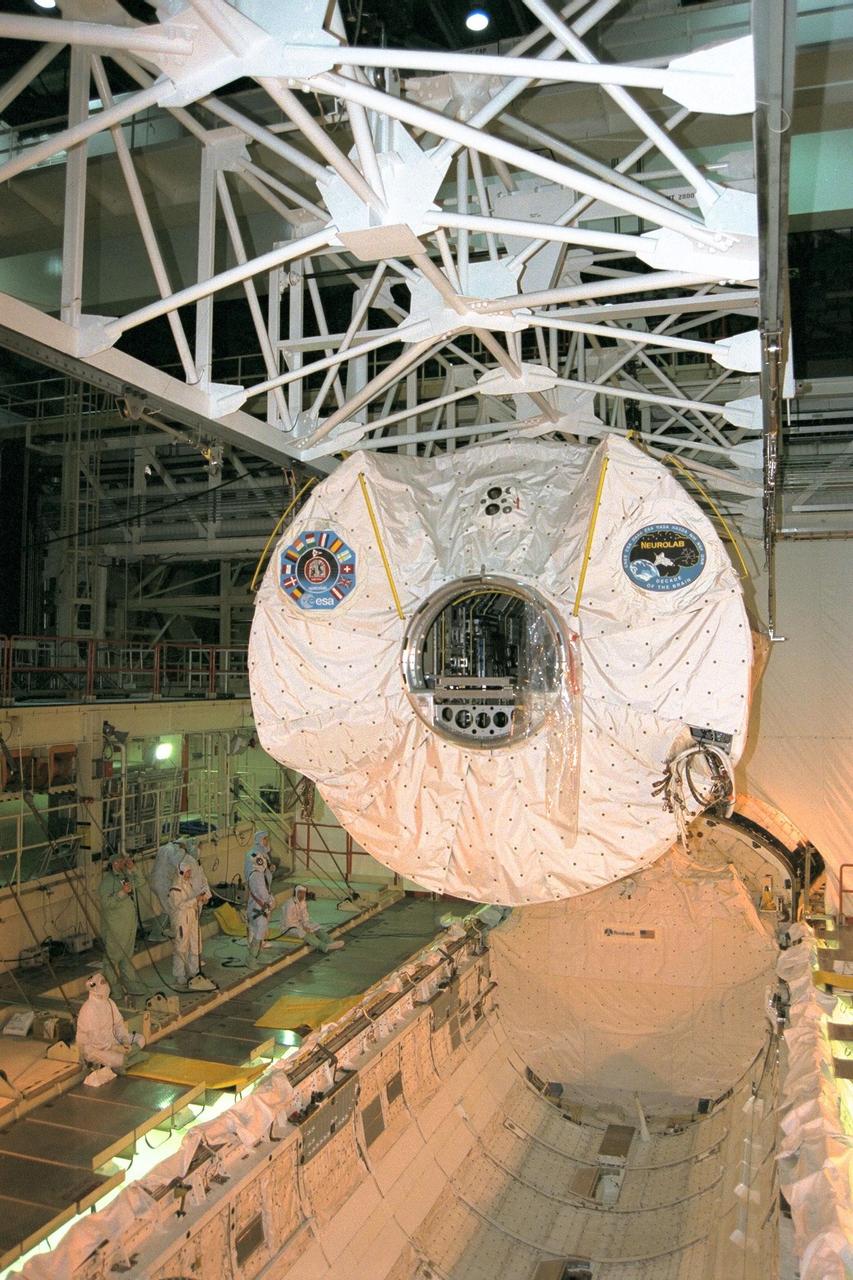
The STS-90 Neurolab payload is lowered into position into the cargo bay of Space Shuttle Columbia today in Orbiter Processing Facility bay 3. Investigations during the Neurolab mission will focus on the effects of microgravity on the nervous system. Specifically, experiments will study the adaptation of the vestibular system, the central nervous system, and the pathways that control the ability to sense location in the absence of gravity, as well as the effect of microgravity on a developing nervous system. The crew of STS-90, slated for launch in April, will include Commander Richard Searfoss, Pilot Scott Altman, Mission Specialists Richard Linnehan, Dafydd (Dave) Williams, M.D., and Kathryn (Kay) Hire, and Payload Specialists Jay Buckey, M.D., and James Pawelczyk, Ph.D
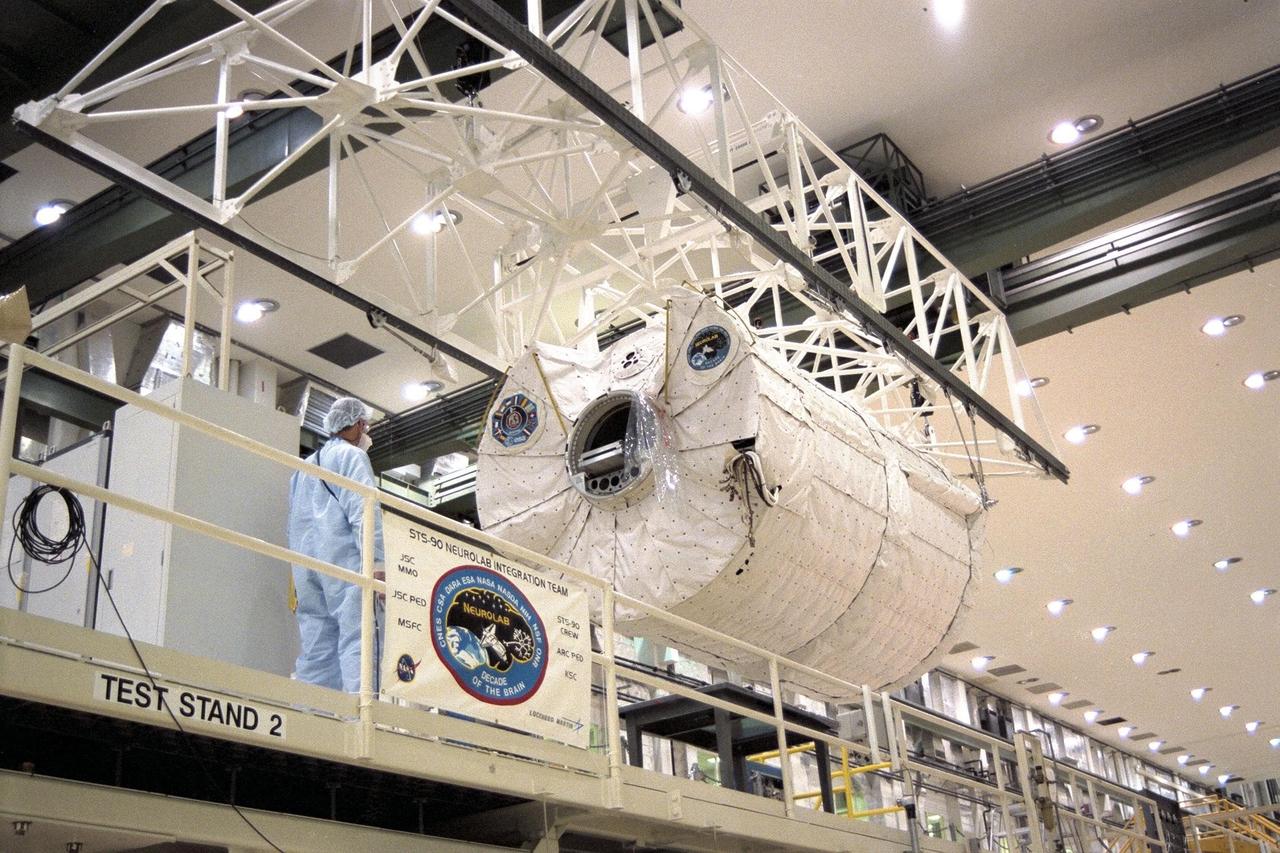
KENNEDY SPACE CENTER, FLA. -- A technician looks at the STS-90 Neurolab payload as it is moved from its test stand in KSC's Operations and Checkout Building. Investigations during the Neurolab mission will focus on the effects of microgravity on the nervous system. Specifically, experiments will study the adaptation of the vestibular system, the central nervous system, and the pathways that control the ability to sense location in the absence of gravity, as well as the effect of microgravity on a developing nervous system. The crew of STS-90, slated for launch in April, will include Commander Richard Searfoss, Pilot Scott Altman, Mission Specialists Richard Linnehan, Dafydd (Dave) Williams, M.D., and Kathryn (Kay) Hire, and Payload Specialists Jay Buckey, M.D., and James Pawelczyk, Ph.D
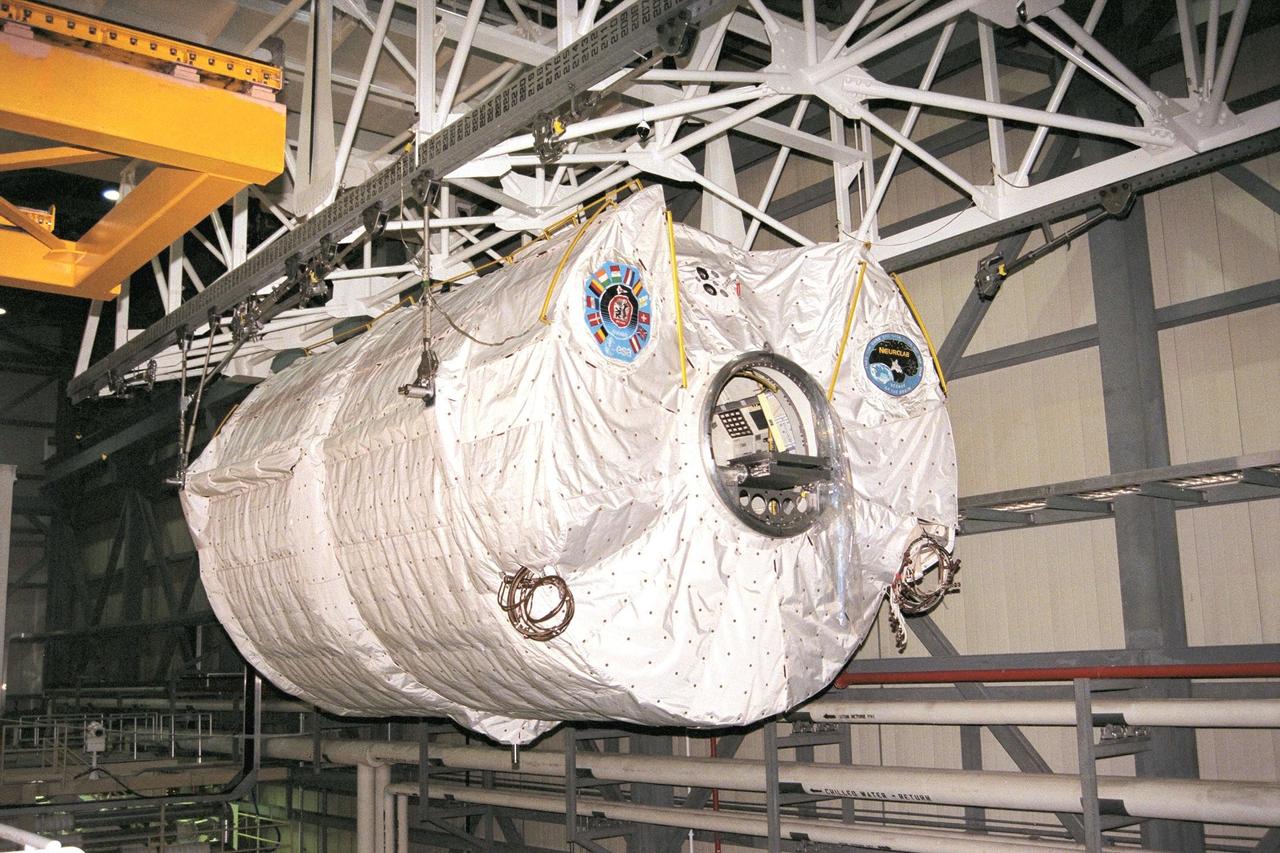
The STS-90 Neurolab payload is prepared to be positioned into the cargo bay of Space Shuttle Columbia today in Orbiter Processing Facility bay 3. Investigations during the Neurolab mission will focus on the effects of microgravity on the nervous system. Specifically, experiments will study the adaptation of the vestibular system, the central nervous system, and the pathways that control the ability to sense location in the absence of gravity, as well as the effect of microgravity on a developing nervous system. The crew of STS-90, slated for launch in April, will include Commander Richard Searfoss, Pilot Scott Altman, Mission Specialists Richard Linnehan, Dafydd (Dave) Williams, M.D., and Kathryn (Kay) Hire, and Payload Specialists Jay Buckey, M.D., and James Pawelczyk, Ph.D
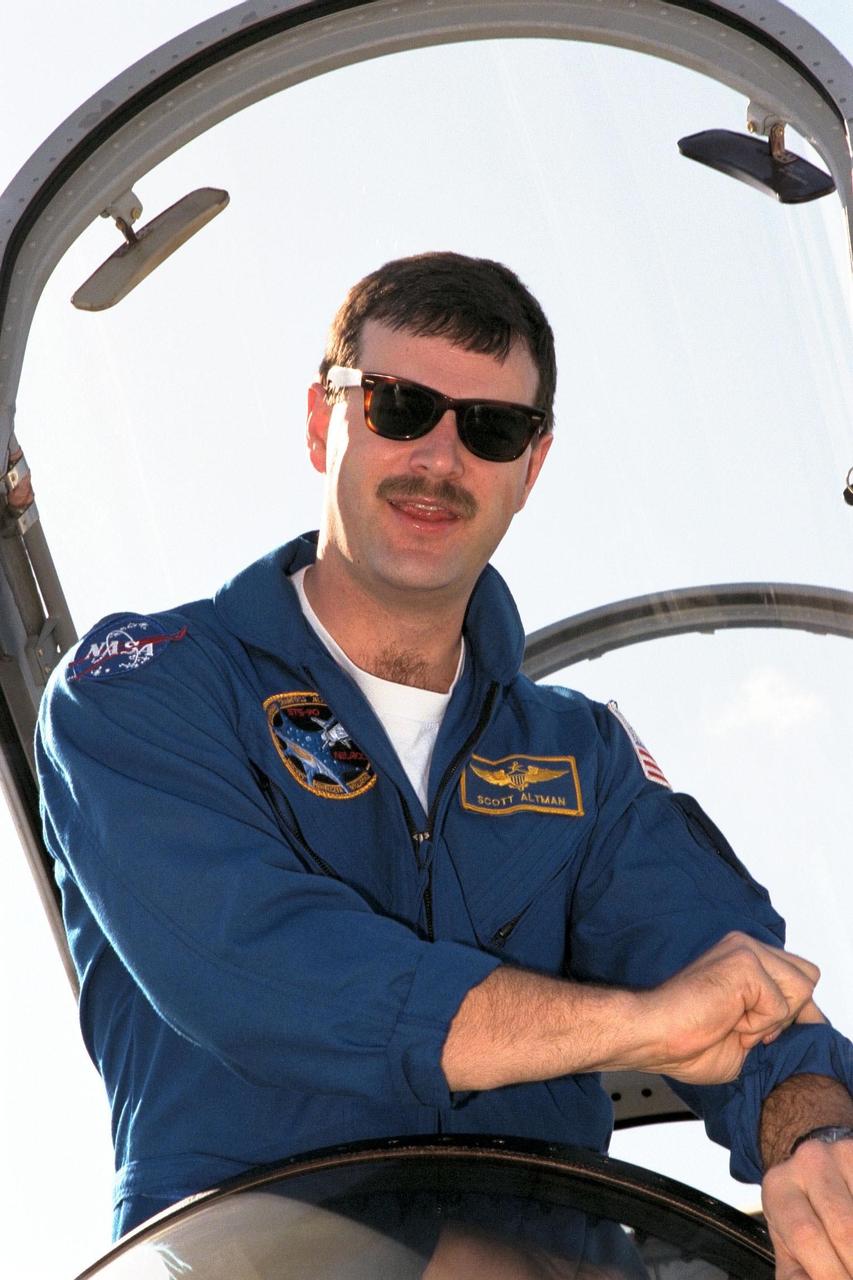
STS-90 Pilot Scott Altman poses in the cockpit of his T-38 jet trainer aircraft after arriving at the KSC Shuttle Landing Facility along with other members of the crew from NASA’s Johnson Space Center to begin Terminal Countdown Demonstration Test (TCDT) activities. The TCDT is held at KSC prior to each Space Shuttle flight to provide crews with the opportunity to participate in simulated countdown activities. Columbia is targeted for launch of STS-90 on April 16 at 2:19 p.m. EDT and will be the second mission of 1998. The mission is scheduled to last nearly 17 days
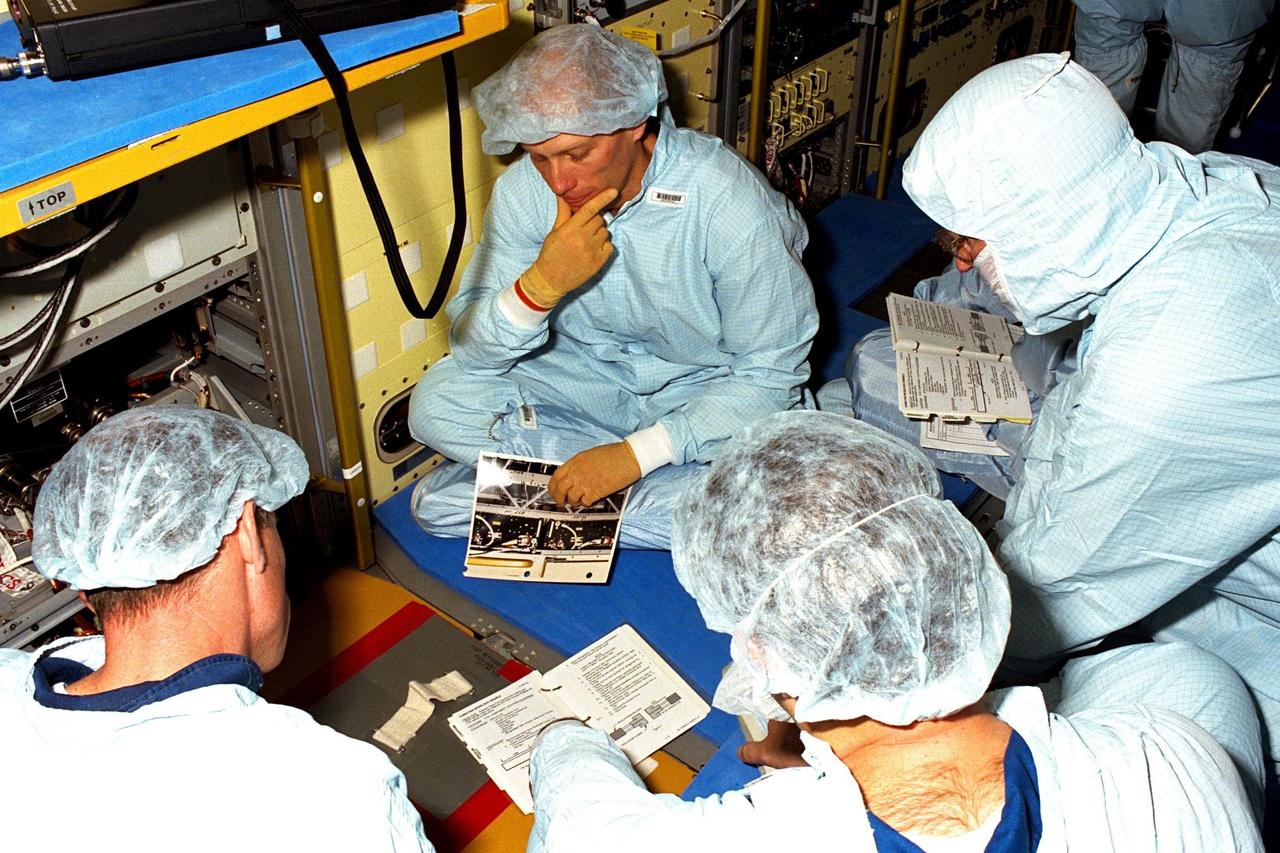
STS-90 crew members study manuals and drawings for the mission's Neurolab payload during the Crew Equipment Interface Test (CEIT) in Kennedy Space Center's (KSC's) Operations and Checkout Building, where the payload is undergoing processing. The CEIT gives astronauts an opportunity to get a hands-on look at the payloads with which they will be working on-orbit. STS-90 is scheduled to launch aboard the Shuttle Columbia from KSC on April 2. Investigations during the Neurolab mission will focus on the effects of microgravity on the nervous system. Specifically, experiments will study the adaptation of the vestibular system, the central nervous system, and the pathways that control the ability to sense location in the absence of gravity, as well as the effect of microgravity on a developing nervous system
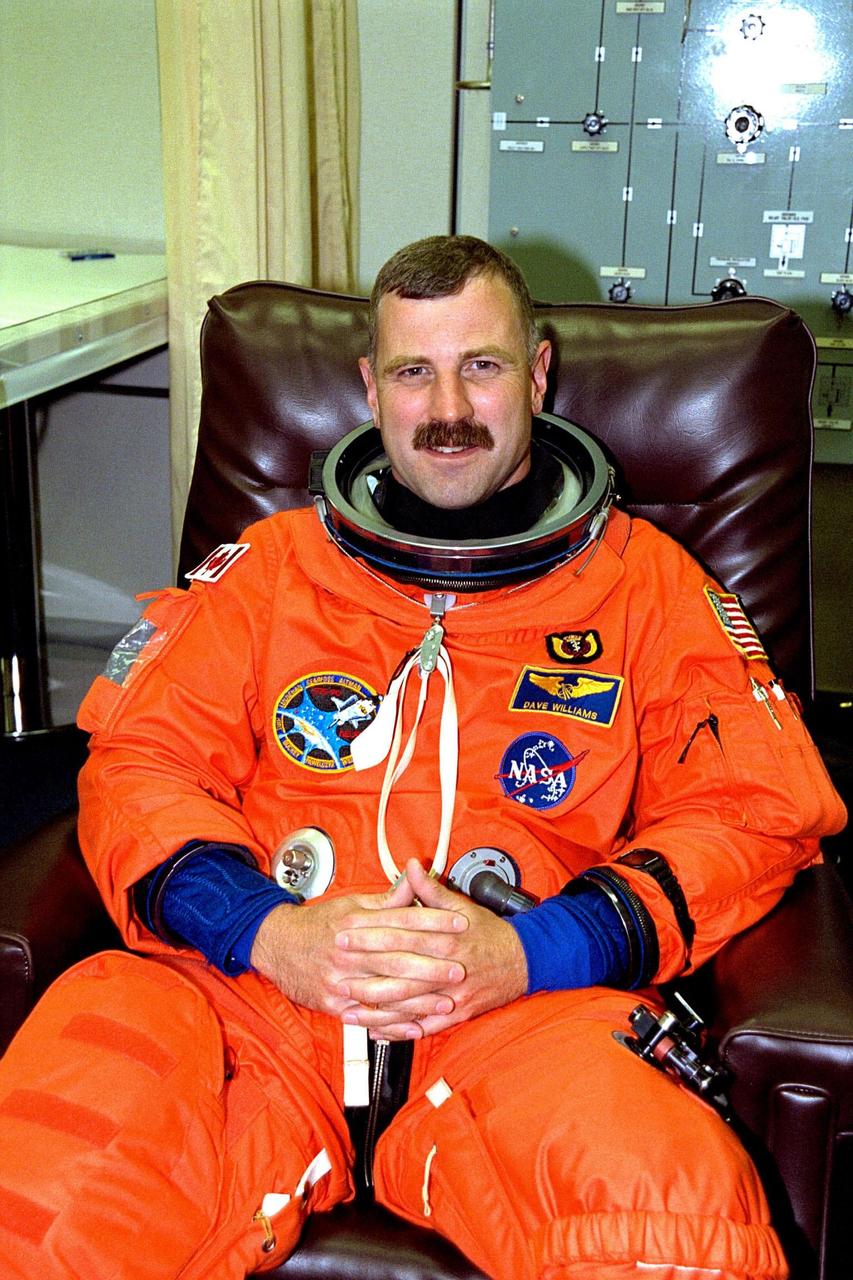
KENNEDY SPACE CENTER, FLA. -- STS-90 Mission Specialist Dafydd (Dave) Williams, M.D., with the Canadian Space Agency sits in a chair during suitup activities in the Operations and Checkout Building. Williams and the rest of the STS-90 crew will shortly depart for Launch Pad 39B, where the Space Shuttle Columbia awaits a second liftoff attempt at 2:19 p.m. EDT. His first trip into space, Williams is participating in this life sciences research flight that will focus on the most complex and least understood part of the human body the nervous system. Neurolab will examine the effects of spaceflight on the brain, spinal cord, peripheral nerves and sensory organs in the human body
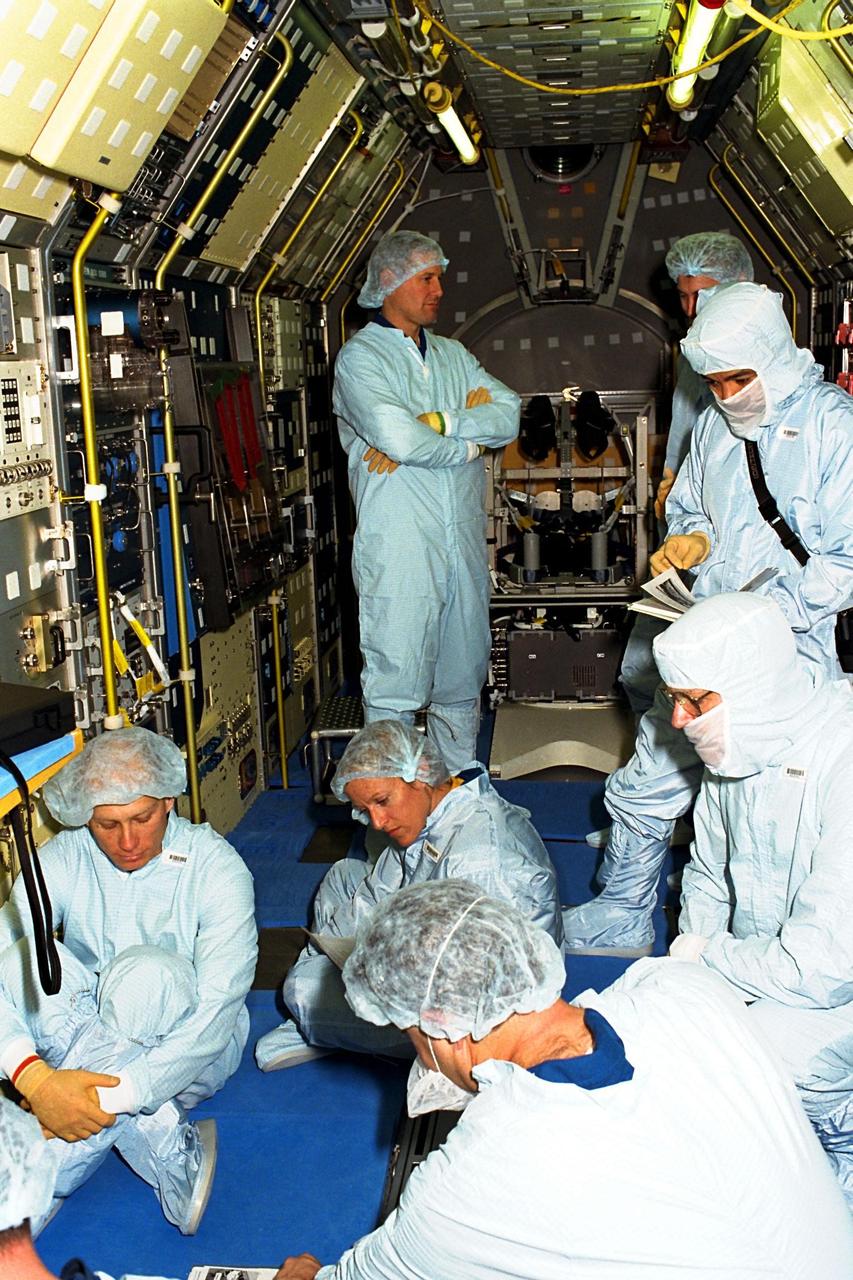
STS-90 crew members check out the inside of the module for the mission's Neurolab payload during the Crew Equipment Interface Test (CEIT) in Kennedy Space Center's (KSC's) Operations and Checkout Building, where the payload is undergoing processing. The CEIT gives astronauts an opportunity to get a hands-on look at the payloads with which they will be working on-orbit. STS-90 is scheduled to launch aboard the Shuttle Columbia from KSC on April 2. Investigations during the Neurolab mission will focus on the effects of microgravity on the nervous system. Specifically, experiments will study the adaptation of the vestibular system, the central nervous system, and the pathways that control the ability to sense location in the absence of gravity, as well as the effect of microgravity on a developing nervous system
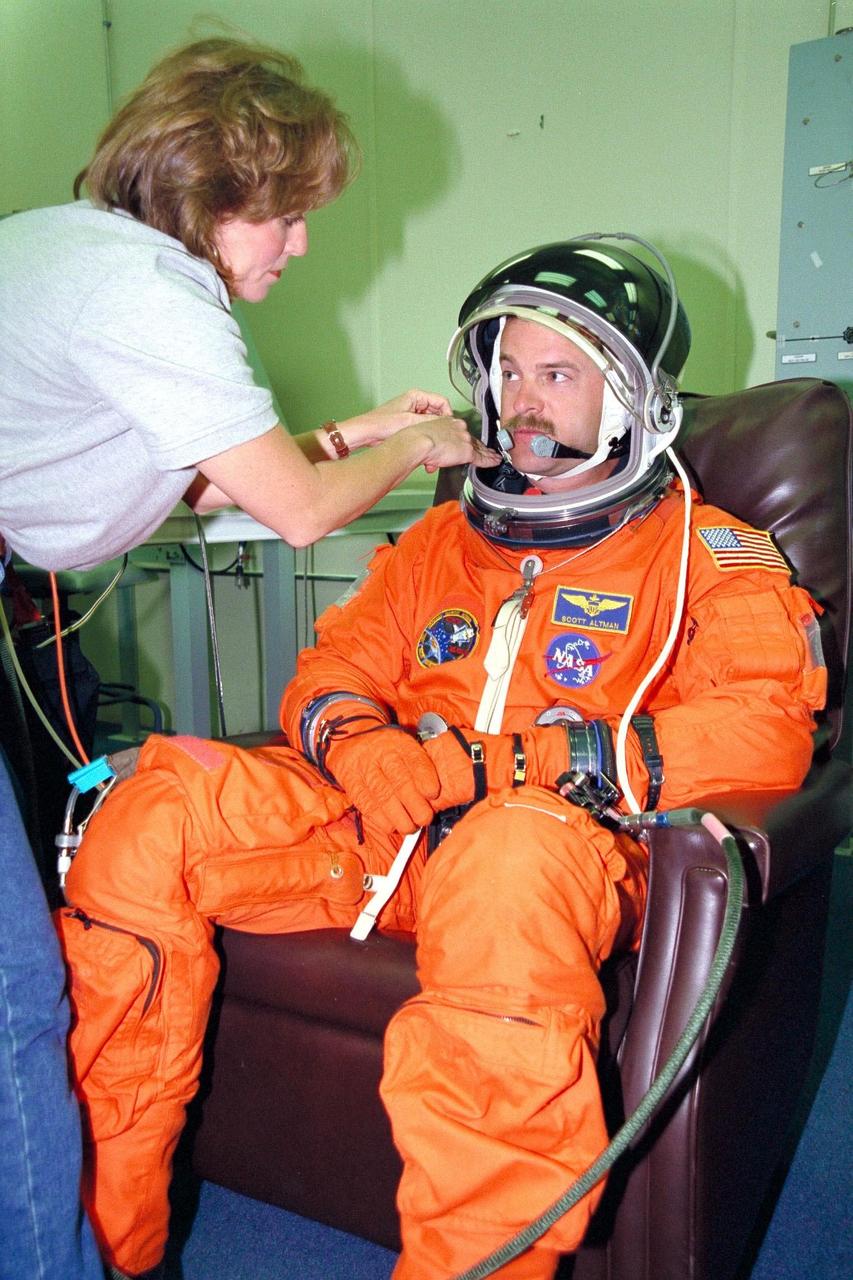
KENNEDY SPACE CENTER, FLA. -- STS-90 Pilot Scott Altman is assisted during suit-up activities by Lockheed Suit Technician Valerie McNeil from Johnson Space Center in KSC's Operations and Checkout Building. Altman and the rest of the STS-90 crew will shortly depart for Launch Pad 39B, where the Space Shuttle Columbia awaits a second liftoff attempt at 2:19 p.m. EDT. His first trip into space, Altman is participating in a life sciences research flight that will focus on the most complex and least understood part of the human body the nervous system. Neurolab will examine the effects of spaceflight on the brain, spinal cord, peripheral nerves and sensory organs in the human body
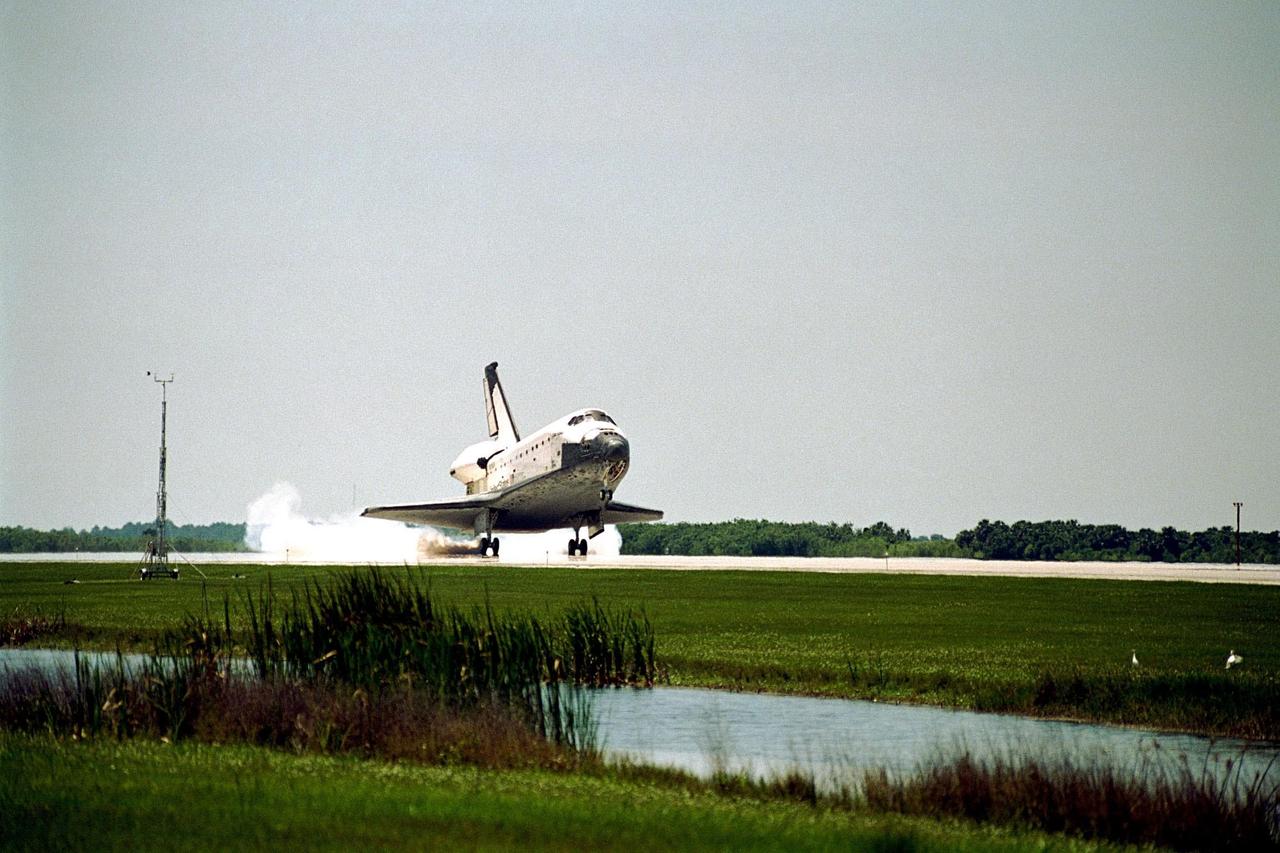
The orbiter Columbia touches down on Runway 33 of KSC's Shuttle Landing Facility to complete the nearly 16-day STS-90 mission. Main gear touchdown was at 12:08:59 p.m. EDT on May 3, 1998, landing on orbit 256 of the mission. The wheels stopped at 12:09:58 EDT, completing a total mission time of 15 days, 21 hours, 50 minutes and 58 seconds. The 90th Shuttle mission was Columbia's 13th landing at the space center and the 43rd KSC landing in the history of the Space Shuttle program. During the mission, the crew conducted research to contribute to a better understanding of the human nervous system. The crew of the STS-90 Neurolab mission include Commander Richard Searfoss; Pilot Scott Altman; Mission Specialists Richard Linnehan, D.V.M., Dafydd (Dave) Williams, M.D., with the Canadian Space Agency, and Kathryn (Kay) Hire; and Payload Specialists Jay Buckey, M.D., and James Pawelczyk, Ph.D
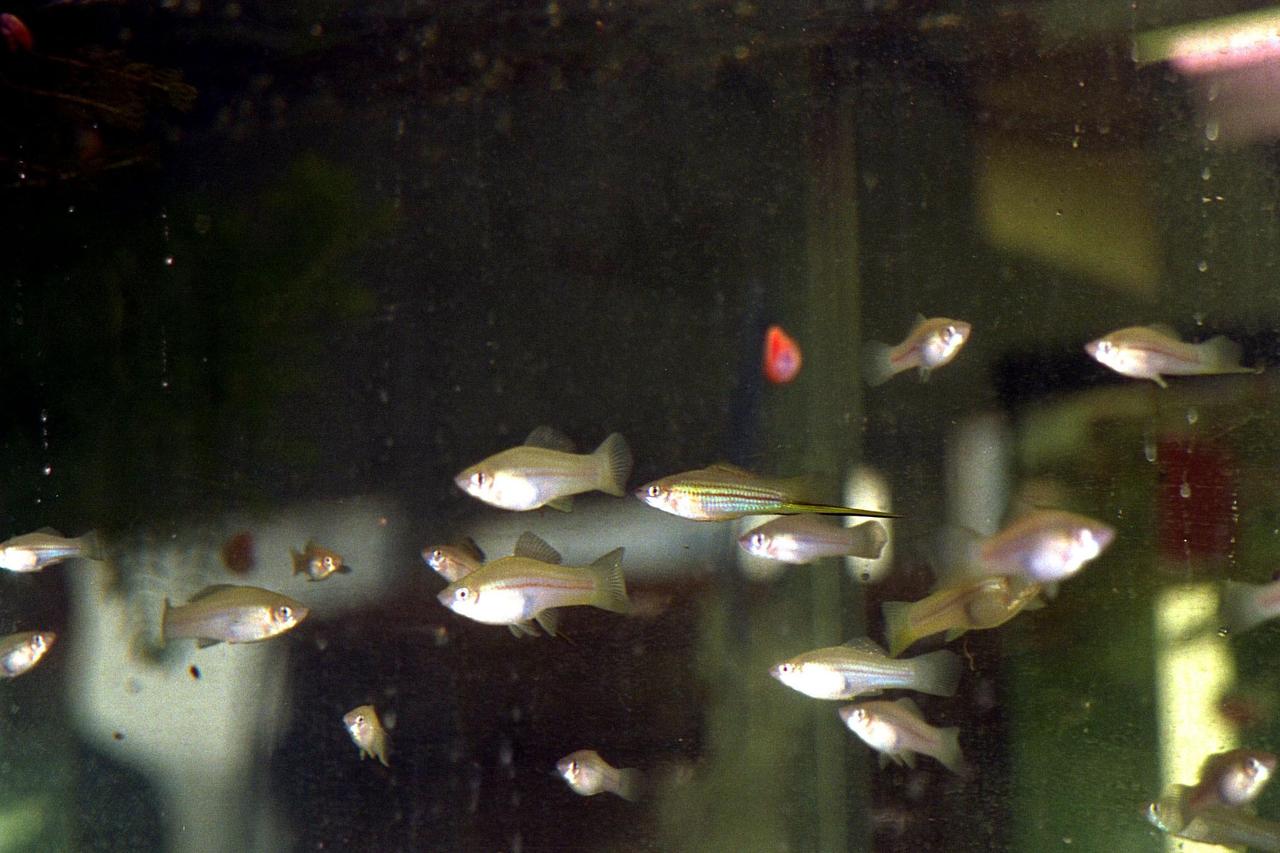
KENNEDY SPACE CENTER, FLA. -- Swordtail fish (Xiphophorus helleri), like those that are part of the Neurolab payload on Space Shuttle Mission STS-90, are shown in their holding tank in the Operations and Checkout Building. The fish will fly in the Closed Equilibrated Biological Aquatic System (CEBAS) Minimodule, a middeck locker-sized fresh water habitat, designed to allow the controlled incubation of aquatic species in a self-stabilizing, artifical ecosystem for up to three weeks under space conditions. Investigations during the Neurolab mission will focus on the effects of microgravity on the nervous system. The crew of STS-90, slated for launch April 16 at 2:19 p.m. EDT, include Commander Richard Searfoss, Pilot Scott Altman, Mission Specialists Richard Linnehan, D.V.M., Dafydd (Dave) Williams, M.D., and Kathryn (Kay) Hire, and Payload Specialists Jay Buckey, M.D., and James Pawelczyk, Ph.D
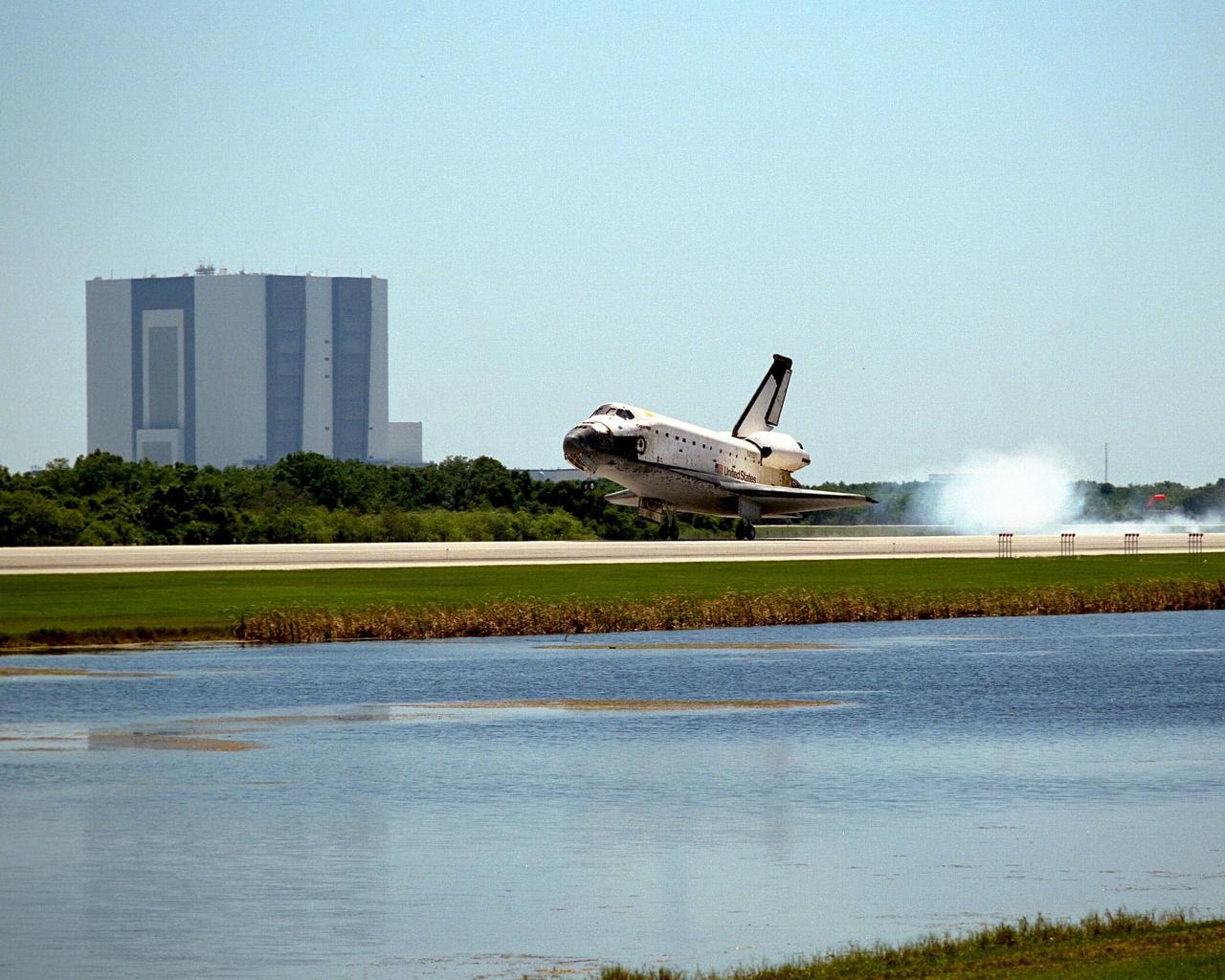
The orbiter Columbia touches down on Runway 33 of KSC's Shuttle Landing Facility to complete the nearly 16-day STS-90 mission. Main gear touchdown was at 12:08:59 p.m. EDT on May 3, 1998, landing on orbit 256 of the mission. The wheels stopped at 12:09:58 EDT, completing a total mission time of 15 days, 21 hours, 50 minutes and 58 seconds. The 90th Shuttle mission was Columbia's 13th landing at the space center and the 43rd KSC landing in the history of the Space Shuttle program. During the mission, the crew conducted research to contribute to a better understanding of the human nervous system. The crew of the STS-90 Neurolab mission include Commander Richard Searfoss; Pilot Scott Altman; Mission Specialists Richard Linnehan, D.V.M., Dafydd (Dave) Williams, M.D., with the Canadian Space Agency, and Kathryn (Kay) Hire; and Payload Specialists Jay Buckey, M.D., and James Pawelczyk, Ph.D
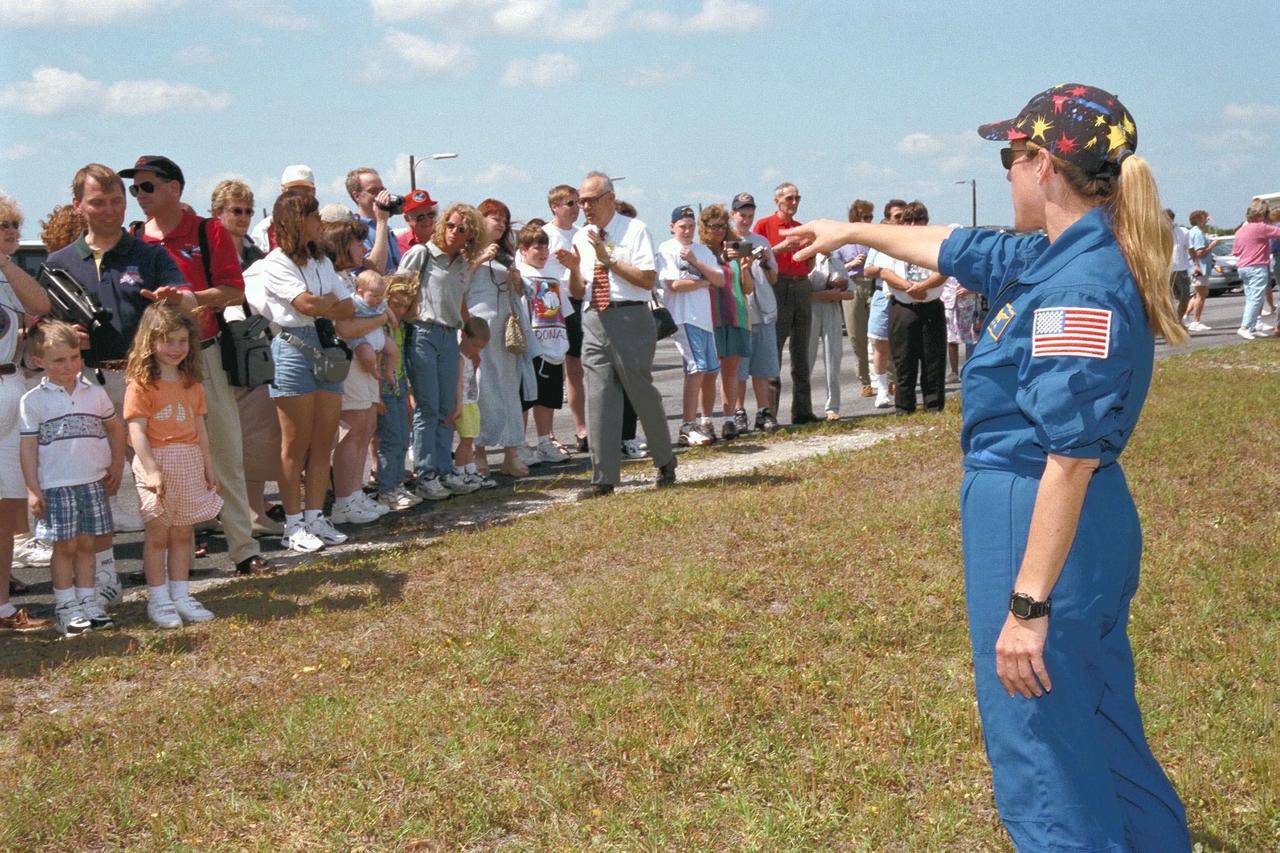
KENNEDY SPACE CENTER, FLA. -- STS-90 Mission Specialist Kathryn (Kay) Hire waves to friends and family members near Launch Pad 39B, from which she and the rest of the seven-member crew are scheduled to launch aboard Columbia on May 16 at 2:19 p.m. EDT. The astronauts are under strict health stabilization guidelines to protect them from close contact with persons who do not have health stabilization clearance. This is the 25th flight of Columbia and the 90th mission flown since the start of the Space Shuttle program. STS-90 is a nearly 17-day life sciences research flight that will focus on the most complex and least understood part of the human body the nervous system. Neurolab will examine the effects of spaceflight on the brain, spinal cord, peripheral nerves and sensory organs in the human body
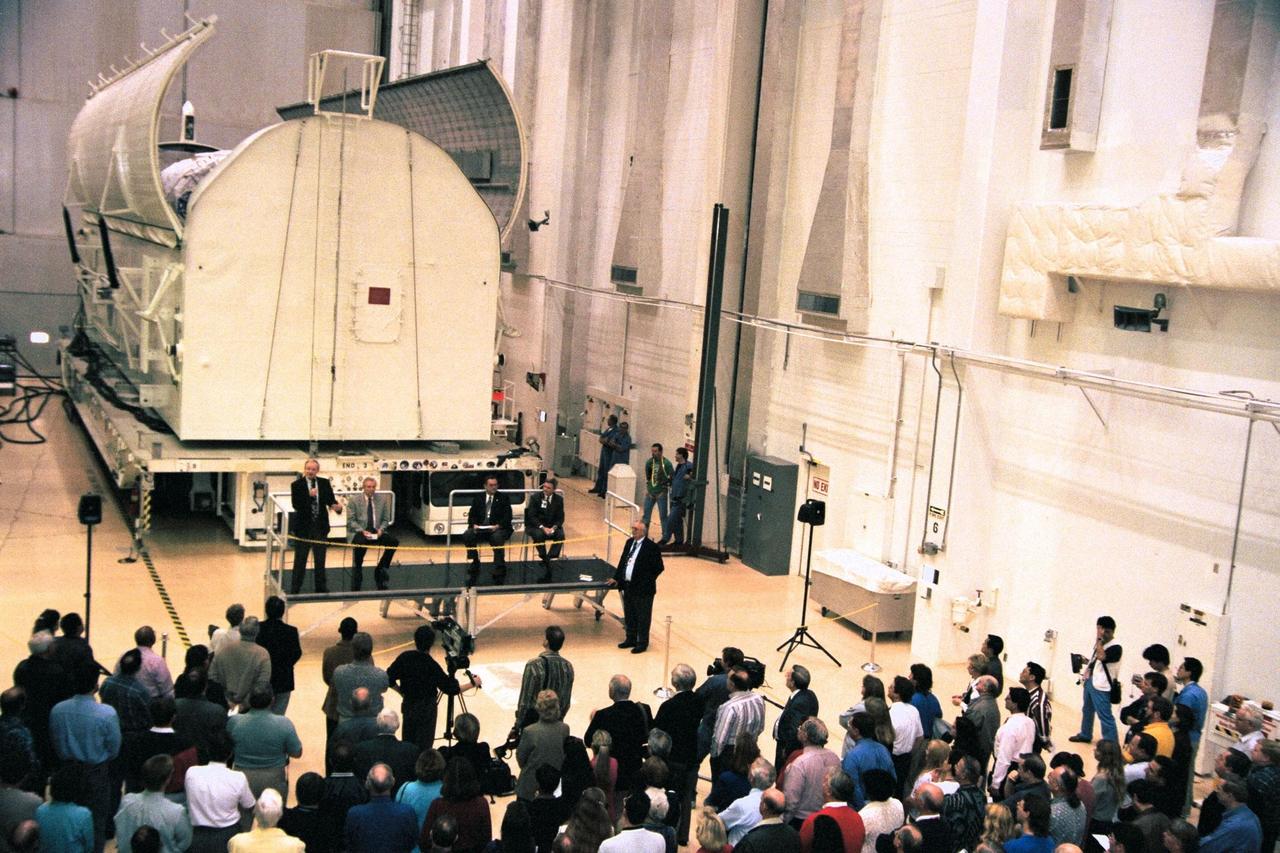
The STS-90 Neurolab payload is honored with a ceremony after being lowered into its payload canister in KSC's Operations and Checkout Building for the last time. This phase of the Shuttle program is winding down as the second phase of the International Space Station (ISS) program gets under way. Microgravity and life science research that formerly was conducted in Spacelab modules, such as Neurolab, will eventually be conducted inside the completed ISS. Investigations during the Neurolab mission will focus on the effects of microgravity on the nervous system. The crew of STS-90, slated for launch in April, will include Commander Richard Searfoss, Pilot Scott Altman, Mission Specialists Richard Linnehan, Dafydd (Dave) Williams, M.D., and Kathryn (Kay) Hire, and Payload Specialists Jay Buckey, M.D., and James Pawelczyk, Ph.D
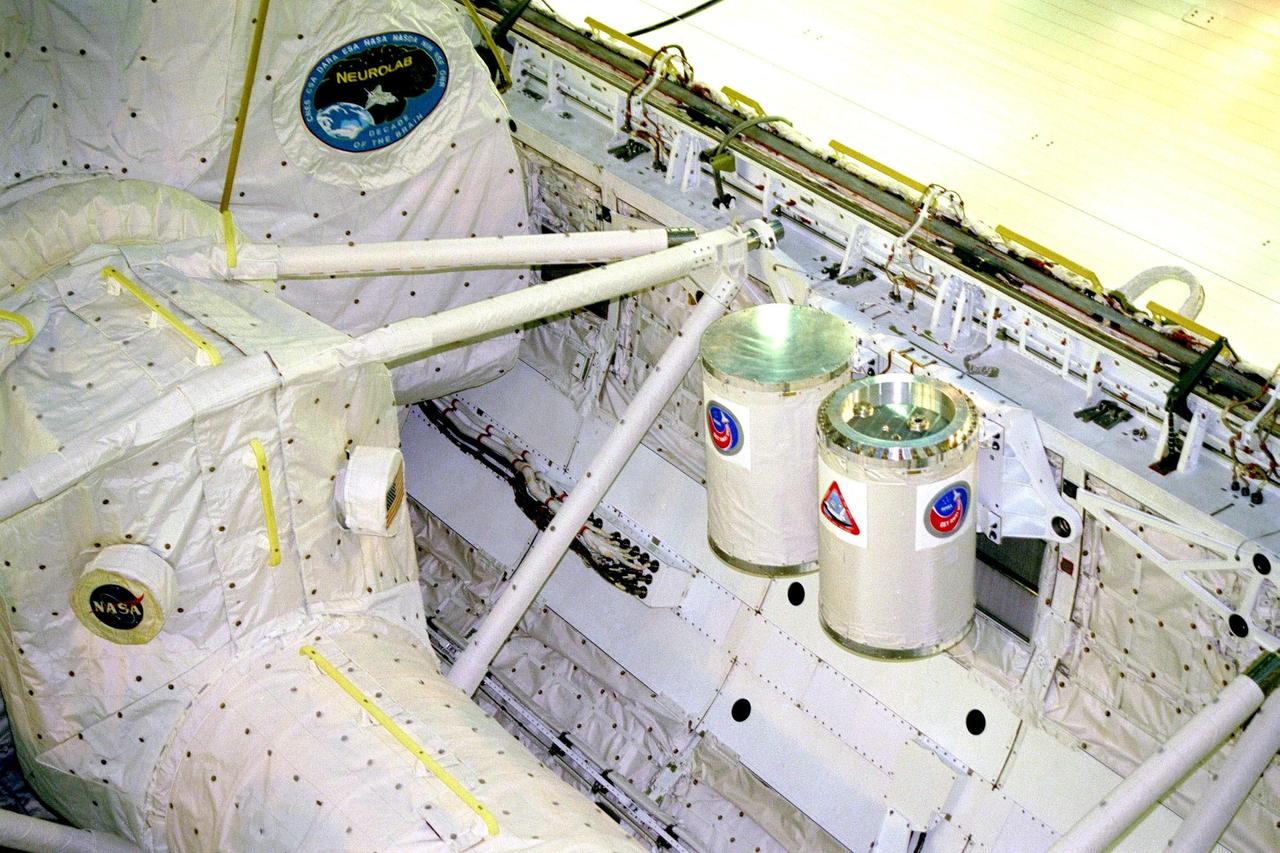
KENNEDY SPACE CENTER, FLA. -- The STS-90 Neurolab payload and two of the four Getaway Specials (GAS) await payload bay door closure in the orbiter Columbia today in Orbiter Processing Facility bay 3. Investigations during the Neurolab mission will focus on the effects of microgravity on the nervous system. The GAS container on the left contains the COLLisions Into Dust Experiment, or COLLIDE, which will study low velocity collisions between space-borne particles in an attempt to better understand planetary ring dynamics. The STS-90 mission is a joint venture of six space agencies and seven U.S. research agencies. Agencies participating in this mission include six institutes of the National Institutes of Health, the National Science Foundation, and the Office of Naval Research, as well as the space agencies of Canada, France, Germany, and Japan, and the European Space Agency (ESA)
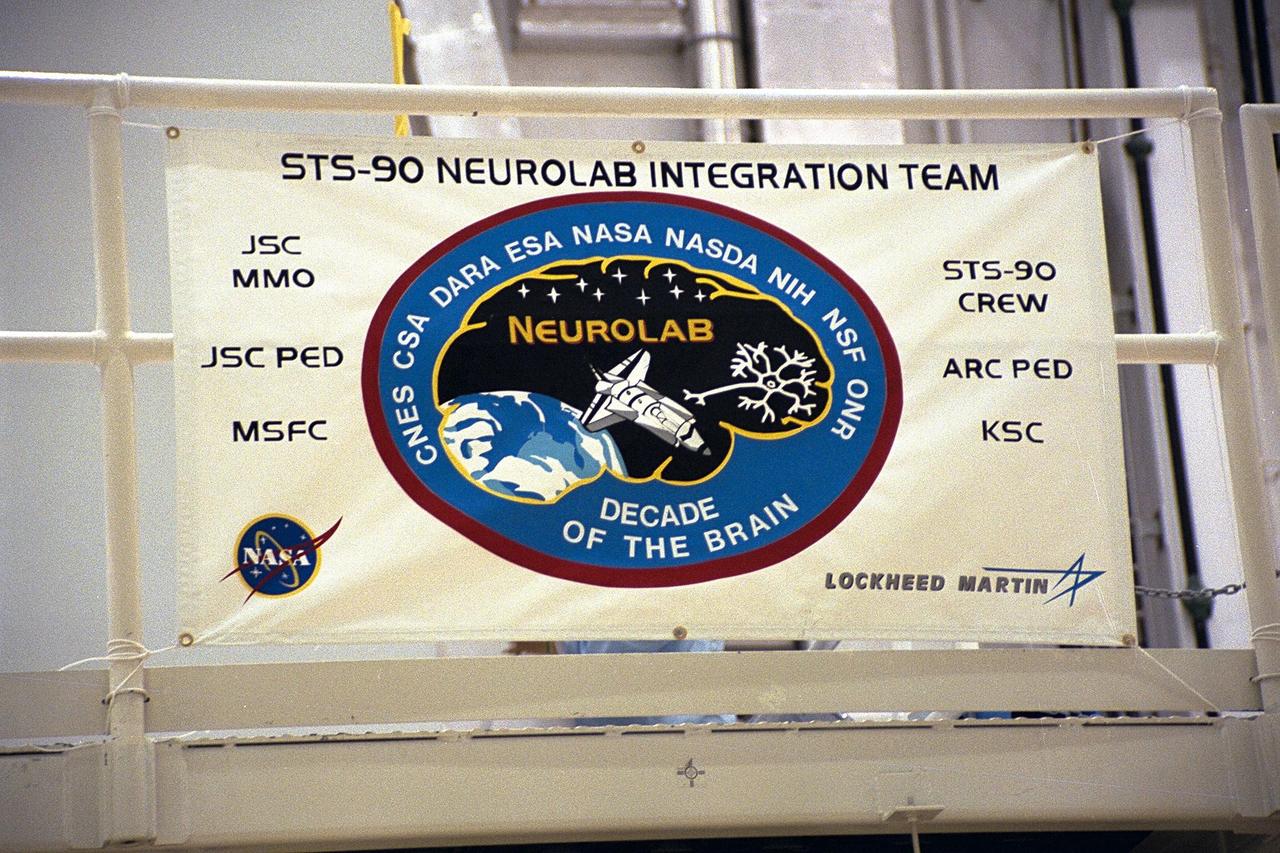
The Neurolab payload for STS-90, scheduled to launch aboard the Shuttle Columbia from Kennedy Space Center (KSC) on April 2, 1998, undergoes further processing in the Operations and Checkout Building at KSC. Investigations during the Neurolab mission will focus on the effects of microgravity on the nervous system. Specifically, experiments will study the adaptation of the vestibular system, the central nervous system, and the pathways that control the ability to sense location in the absence of gravity, as well as the effect of microgravity on a developing nervous system. The crew of STS-90 will include Commander Richard Searfoss, Pilot Scott Altman, Mission Specialists Richard Linnehan, Dafydd (Dave) Williams, M.D., and Kathryn (Kay) Hire, and Payload Specialists Jay Buckey, M.D., and James Pawelczyk, Ph.D
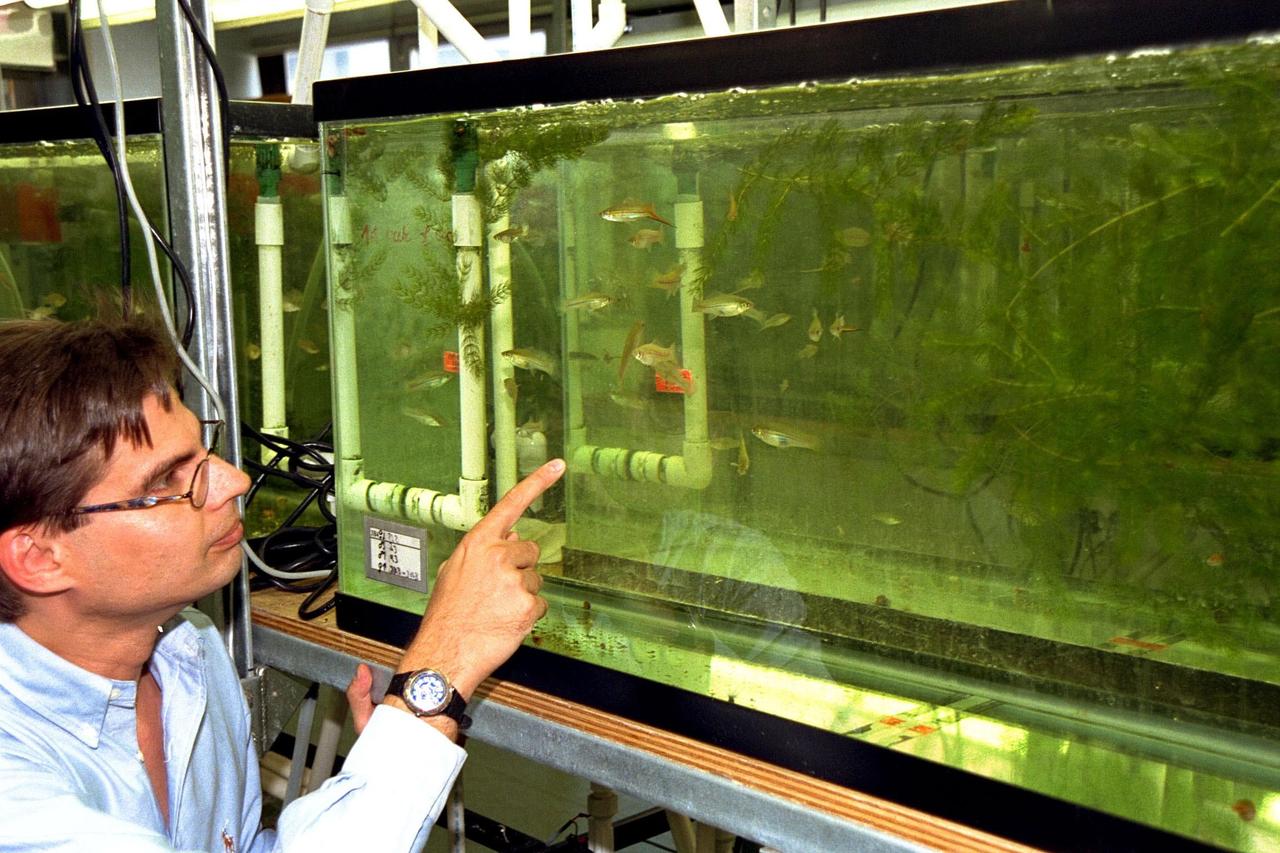
KENNEDY SPACE CENTER, FLA. -- Dr. Dirk Voeste, a scientist with Ruhr-University of Bochum, Germany, examines some swordtail fish (Xiphophorus helleri), like those that are part of the Neurolab payload on Space Shuttle Mission STS-90, in their holding tank in the Operations and Checkout Building. The fish will fly in the Closed Equilibrated Biological Aquatic System (CEBAS) Minimodule, a middeck locker-sized fresh water habitat, designed to allow the controlled incubation of aquatic species in a self-stabilizing, artifical ecosystem for up to three weeks under space conditions. Investigations during the Neurolab mission will focus on the effects of microgravity on the nervous system. The crew of STS-90, slated for launch April 16 at 2:19 p.m. EDT, include Commander Richard Searfoss, Pilot Scott Altman, Mission Specialists Richard Linnehan, D.V.M., Dafydd (Dave) Williams, M.D., and Kathryn (Kay) Hire, and Payload Specialists Jay Buckey, M.D., and James Pawelczyk, Ph.D

The Neurolab payload for STS-90, scheduled to launch aboard the Shuttle Columbia from Kennedy Space Center (KSC) on April 2, 1998, is ready for processing after being placed in its workstand in the Operations and Checkout Building at KSC. Investigations during the Neurolab mission will focus on the effects of microgravity on the nervous system. Specifically, experiments will study the adaptation of the vestibular system, the central nervous system, and the pathways that control the ability to sense location in the absence of gravity, as well as the effect of microgravity on a developing nervous system. The crew of STS-90 will include Commander Richard Searfoss, Pilot Scott Altman, Mission Specialists Richard Linnehan, Dafydd (Dave) Williams, M.D., and Kathryn (Kay) Hire, and Payload Specialists Jay Buckey, M.D., and James Pawelczyk, Ph.D
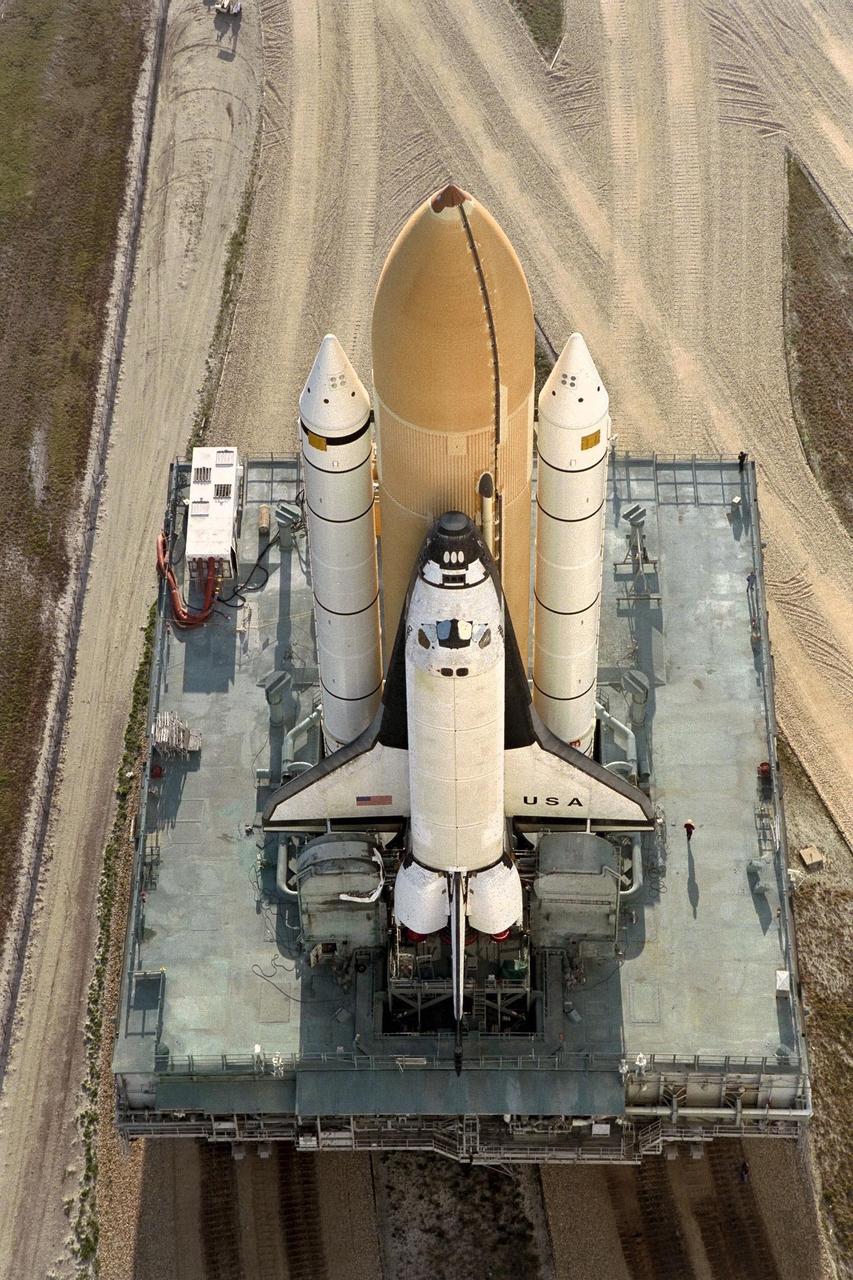
KENNEDY SPACE CENTER, FLA. -- The Space Shuttle Columbia continues its morning rollout from the Vehicle Assembly Building to Launch Pad 39B in preparation for the STS-90 mission. The Neurolab experiments are the primary payload on this nearly 17-day space flight. Investigations during the Neurolab mission will focus on the effects of microgravity on the nervous system. Specifically, experiments will study the adaptation of the vestibular system, the central nervous system, and the pathways that control the ability to sense location in the absence of gravity, as well as the effect of microgravity on a developing nervous system. The crew of STS-90, slated for launch April 16 at 2:19 p.m. EDT, includes Commander Richard Searfoss, Pilot Scott Altman, Mission Specialists Richard Linnehan, Dafydd (Dave) Williams, M.D., and Kathryn (Kay) Hire, and Payload Specialists Jay Buckey, M.D., and James Pawelczyk, Ph.D
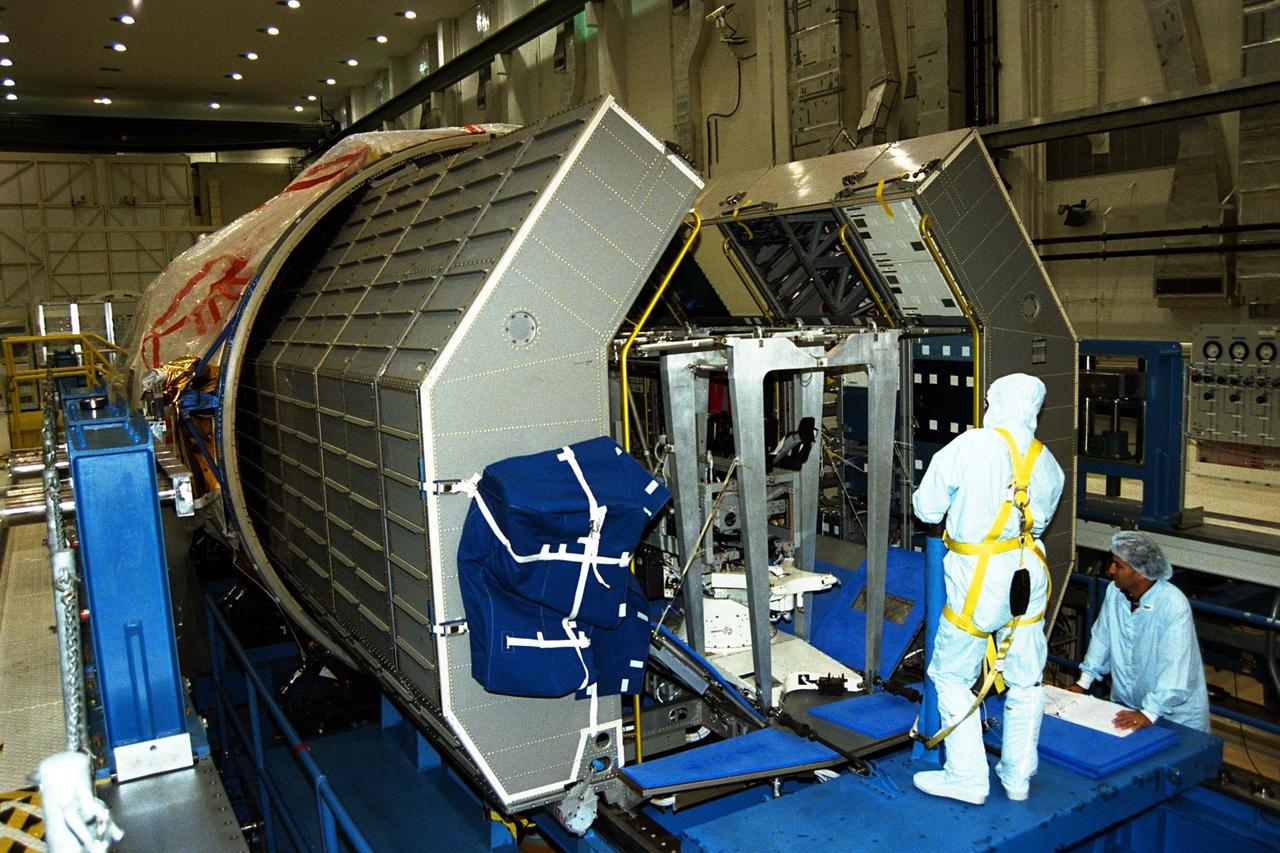
The Neurolab payload for STS-90, scheduled to launch aboard the Shuttle Columbia from Kennedy Space Center (KSC) on April 2, 1998, is installed in the Spacelab module by Boeing technicians in the Operations and Checkout Building at KSC. Investigations during the Neurolab mission will focus on the effects of microgravity on the nervous system. Specifically, experiments will study the adaptation of the vestibular system, the central nervous system, and the pathways that control the ability to sense location in the absence of gravity, as well as the effect of microgravity on a developing nervous system. The crew of STS-90 will include Commander Richard Searfoss, Pilot Scott Altman, Mission Specialists Richard Linnehan, Dafydd (Dave) Williams, M.D., and Kathryn (Kay) Hire, and Payload Specialists Jay Buckey, M.D., and James Pawelczyk, Ph.D

The Neurolab payload for STS-90, scheduled to launch aboard the Shuttle Columbia from Kennedy Space Center (KSC) on April 2, 1998, is installed in the Spacelab module by Boeing technicians in the Operations and Checkout Building at KSC. Investigations during the Neurolab mission will focus on the effects of microgravity on the nervous system. Specifically, experiments will study the adaptation of the vestibular system, the central nervous system, and the pathways that control the ability to sense location in the absence of gravity, as well as the effect of microgravity on a developing nervous system. The crew of STS-90 will include Commander Richard Searfoss, Pilot Scott Altman, Mission Specialists Richard Linnehan, Dafydd (Dave) Williams, M.D., and Kathryn (Kay) Hire, and Payload Specialists Jay Buckey, M.D., and James Pawelczyk, Ph.D
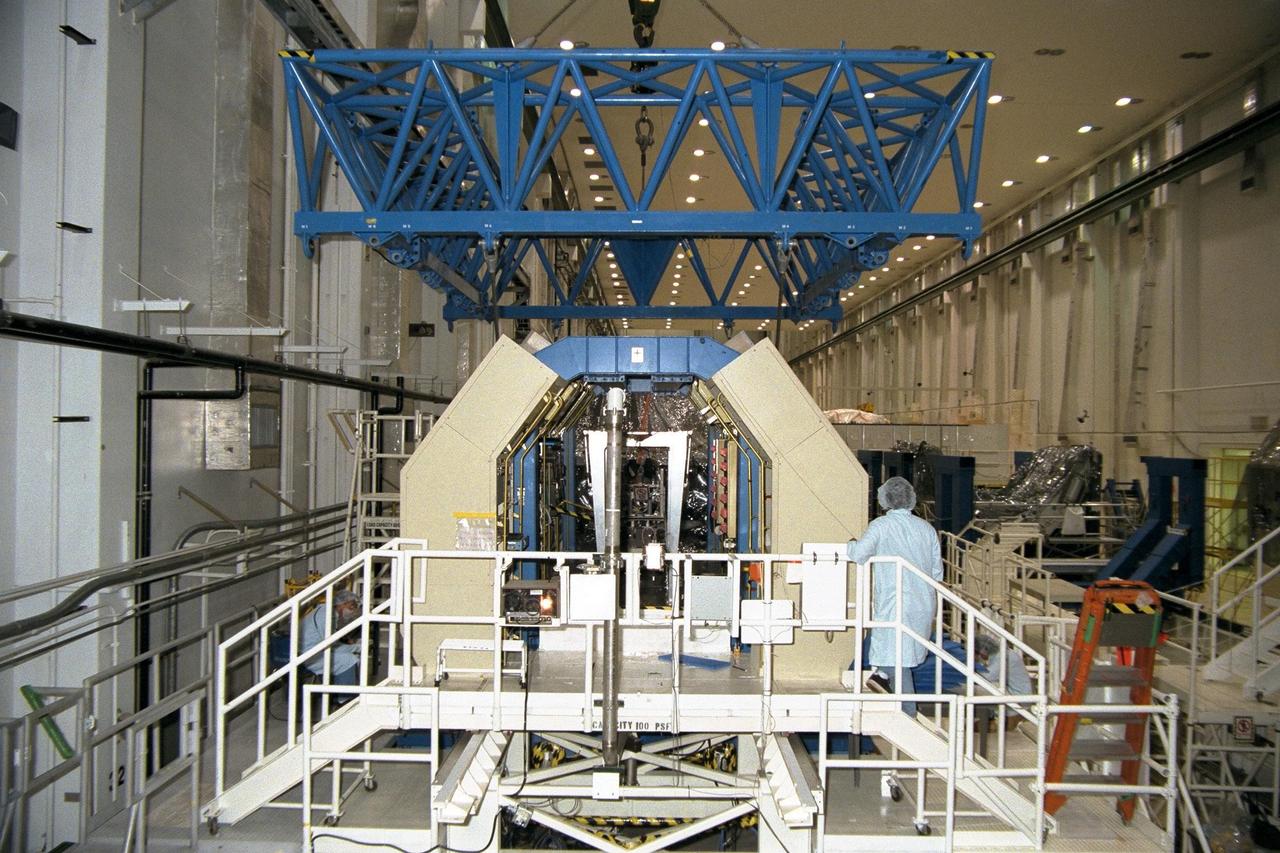
The Neurolab payload for STS-90, scheduled to launch aboard the Shuttle Columbia from Kennedy Space Center (KSC) on April 2, 1998, is ready for processing after being placed in its workstand in the Operations and Checkout Building at KSC. Investigations during the Neurolab mission will focus on the effects of microgravity on the nervous system. Specifically, experiments will study the adaptation of the vestibular system, the central nervous system, and the pathways that control the ability to sense location in the absence of gravity, as well as the effect of microgravity on a developing nervous system. The crew of STS-90 will include Commander Richard Searfoss, Pilot Scott Altman, Mission Specialists Richard Linnehan, Dafydd (Dave) Williams, M.D., and Kathryn (Kay) Hire, and Payload Specialists Jay Buckey, M.D., and James Pawelczyk, Ph.D
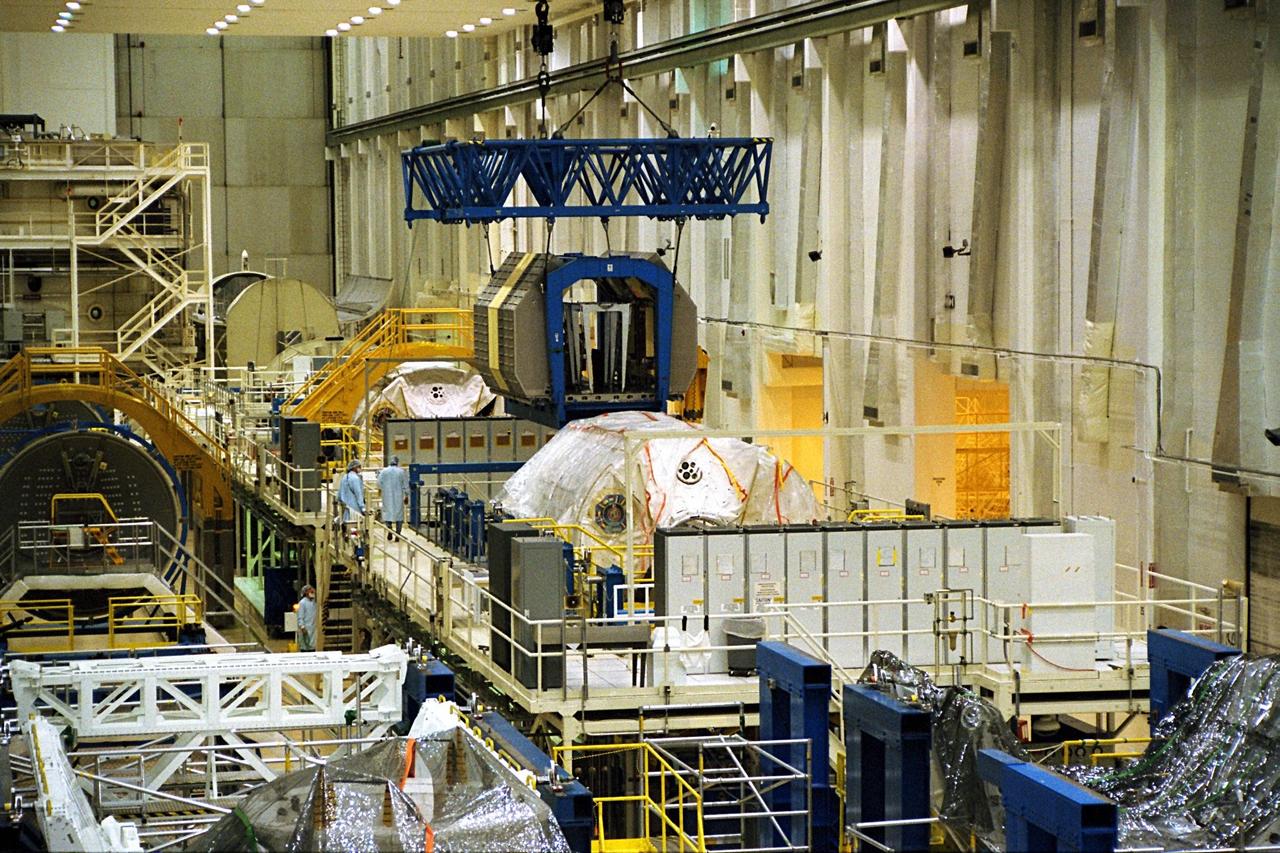
The Neurolab payload for STS-90, scheduled to launch aboard the Shuttle Columbia from Kennedy Space Center (KSC) on April 2, 1998, is moved to its workstand in the Operations and Checkout Building at KSC. Investigations during the Neurolab mission will focus on the effects of microgravity on the nervous system. Specifically, experiments will study the adaptation of the vestibular system, the central nervous system, and the pathways that control the ability to sense location in the absence of gravity, as well as the effect of microgravity on a developing nervous system. The crew of STS-90 will include Commander Richard Searfoss, Pilot Scott Altman, Mission Specialists Richard Linnehan, Dafydd (Dave) Williams, M.D., and Kathryn (Kay) Hire, and Payload Specialists Jay Buckey, M.D., and James Pawelczyk, Ph.D
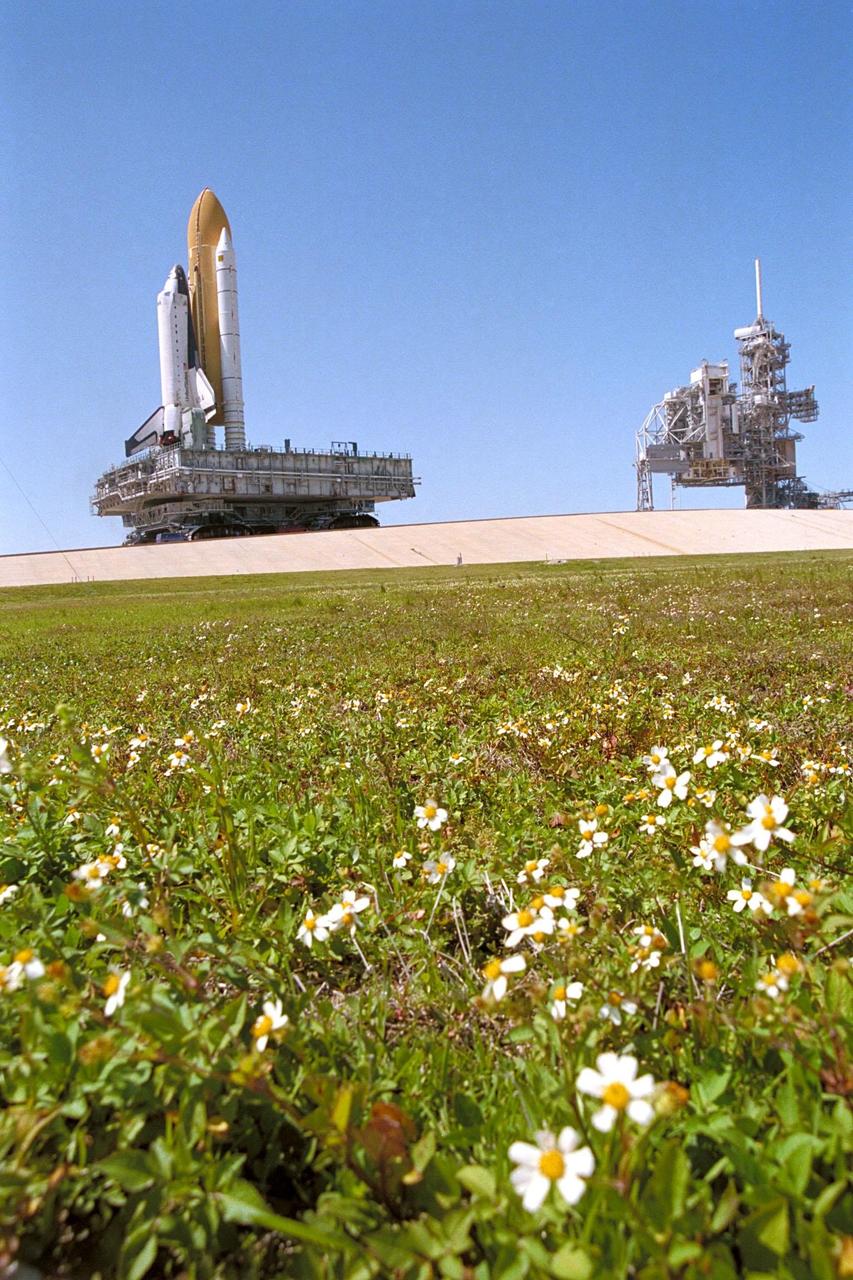
KENNEDY SPACE CENTER, FLA. -- The Space Shuttle Columbia continues up the ramp to Launch Pad 39B in its morning rollout prior to STS-90. Leveling systems within the crawler-transporter underneath the Shuttle keep the platform level while negotiating the five percent ramp leading up to the pad surface. The top of the orbiter is kept vertical within plus or minus 10 minutes of arc, about the diameter of a basketball during the journey. The Neurolab experiments are the primary payload on this nearly 17-day space flight. Investigations during the Neurolab mission will focus on the effects of microgravity on the nervous system. The crew of STS-90, slated for launch April 16 at 2:19 p.m. EDT, includes Commander Richard Searfoss, Pilot Scott Altman, Mission Specialists Richard Linnehan, Dafydd (Dave) Williams, M.D., and Kathryn (Kay) Hire, and Payload Specialists Jay Buckey, M.D., and James Pawelczyk, Ph.D
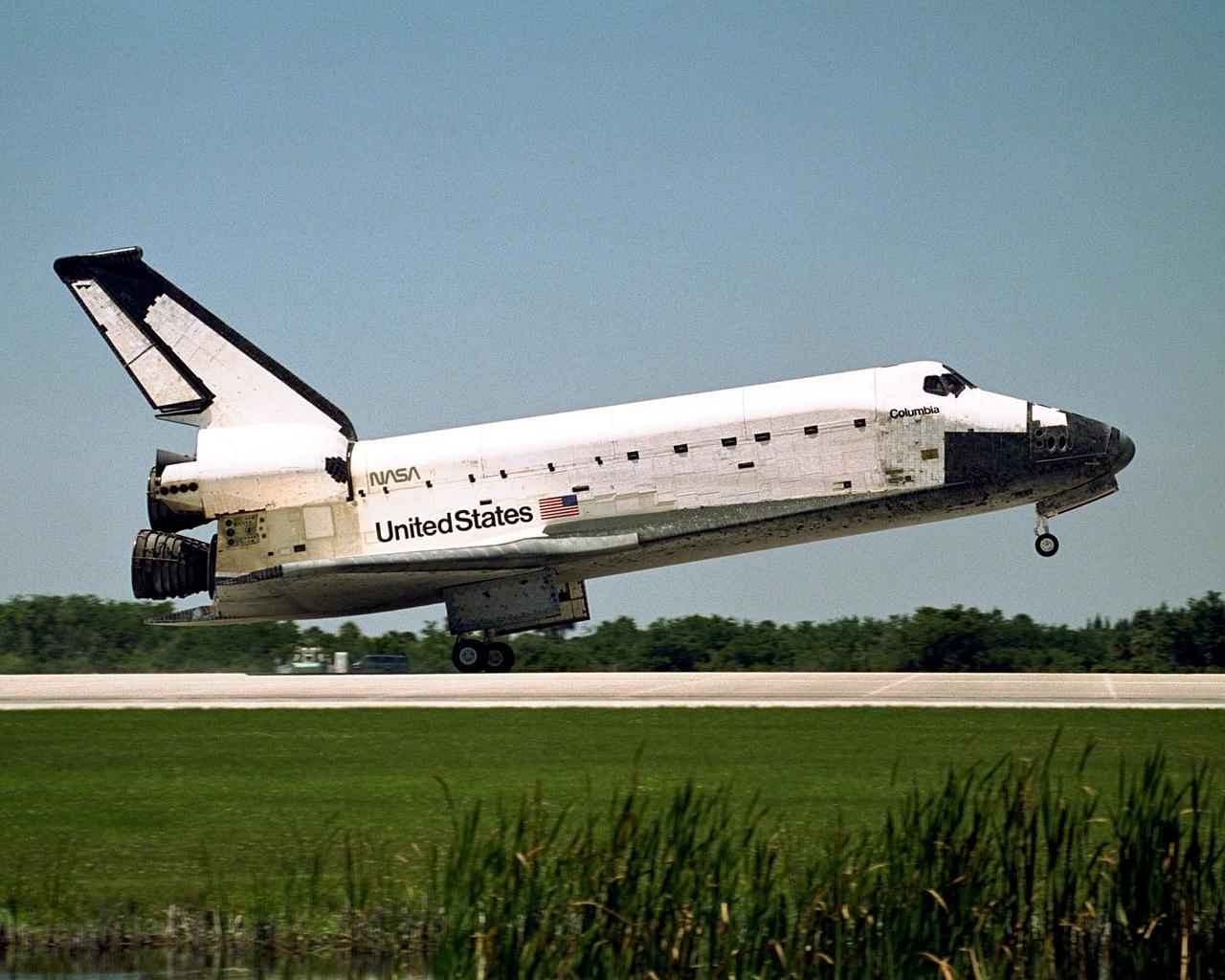
The orbiter Columbia approaches touchdown on Runway 33 of KSC's Shuttle Landing Facility to complete the nearly 16-day STS-90 mission. Main gear touchdown was at 12:08:59 p.m. EDT on May 3, 1998, landing on orbit 256 of the mission. The wheels stopped at 12:09:58 EDT, completing a total mission time of 15 days, 21 hours, 50 minutes and 58 seconds. The 90th Shuttle mission was Columbia's 13th landing at the space center and the 43rd KSC landing in the history of the Space Shuttle program. During the mission, the crew conducted research to contribute to a better understanding of the human nervous system. The crew of the STS-90 Neurolab mission include Commander Richard Searfoss; Pilot Scott Altman; Mission Specialists Richard Linnehan, D.V.M., Dafydd (Dave) Williams, M.D., with the Canadian Space Agency, and Kathryn (Kay) Hire; and Payload Specialists Jay Buckey, M.D., and James Pawelczyk, Ph.D
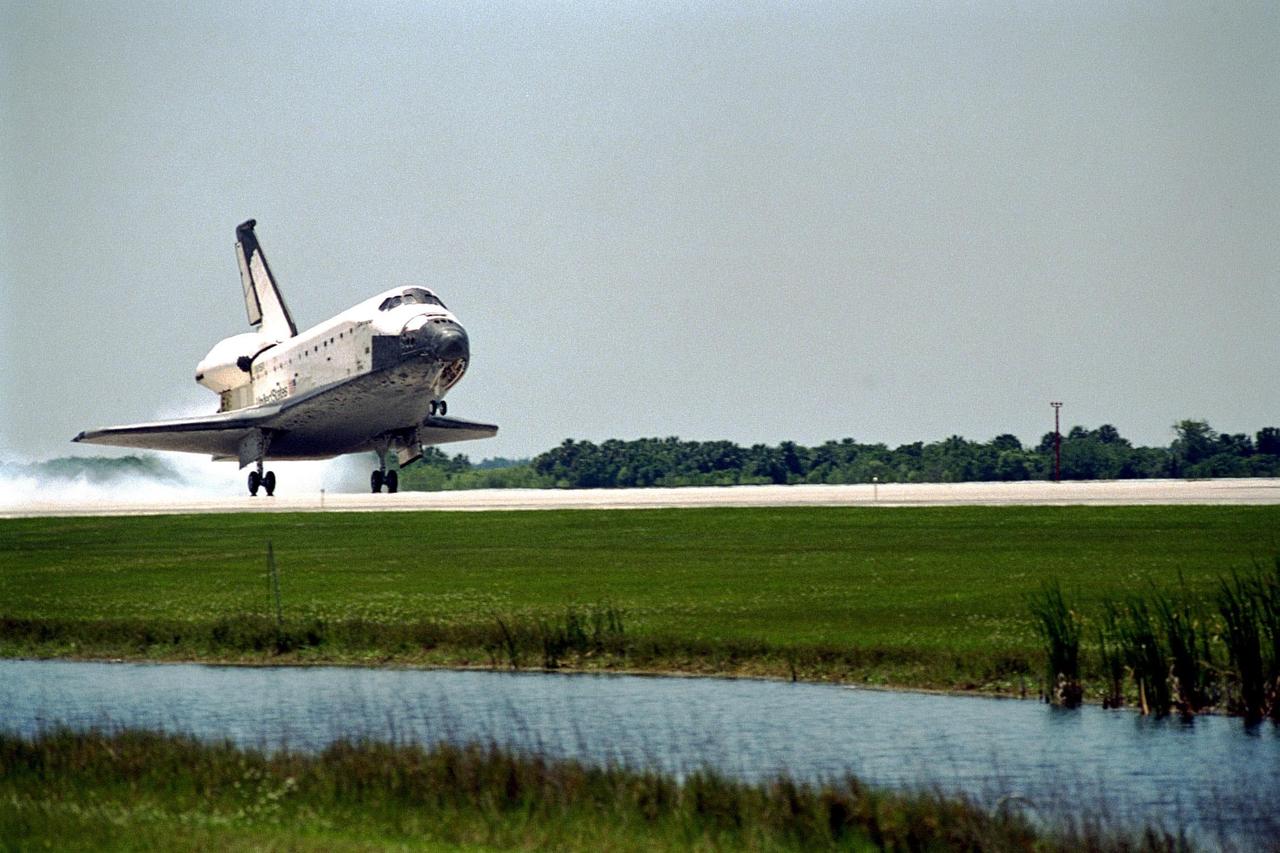
The orbiter Columbia touches down on Runway 33 of KSC's Shuttle Landing Facility to complete the nearly 16-day STS-90 mission. Main gear touchdown was at 12:08:59 p.m. EDT on May 3, 1998, landing on orbit 256 of the mission. The wheels stopped at 12:09:58 EDT, completing a total mission time of 15 days, 21 hours, 50 minutes and 58 seconds. The 90th Shuttle mission was Columbia's 13th landing at the space center and the 43rd KSC landing in the history of the Space Shuttle program. During the mission, the crew conducted research to contribute to a better understanding of the human nervous system. The crew of the STS-90 Neurolab mission include Commander Richard Searfoss; Pilot Scott Altman; Mission Specialists Richard Linnehan, D.V.M., Dafydd (Dave) Williams, M.D., with the Canadian Space Agency, and Kathryn (Kay) Hire; and Payload Specialists Jay Buckey, M.D., and James Pawelczyk, Ph.D
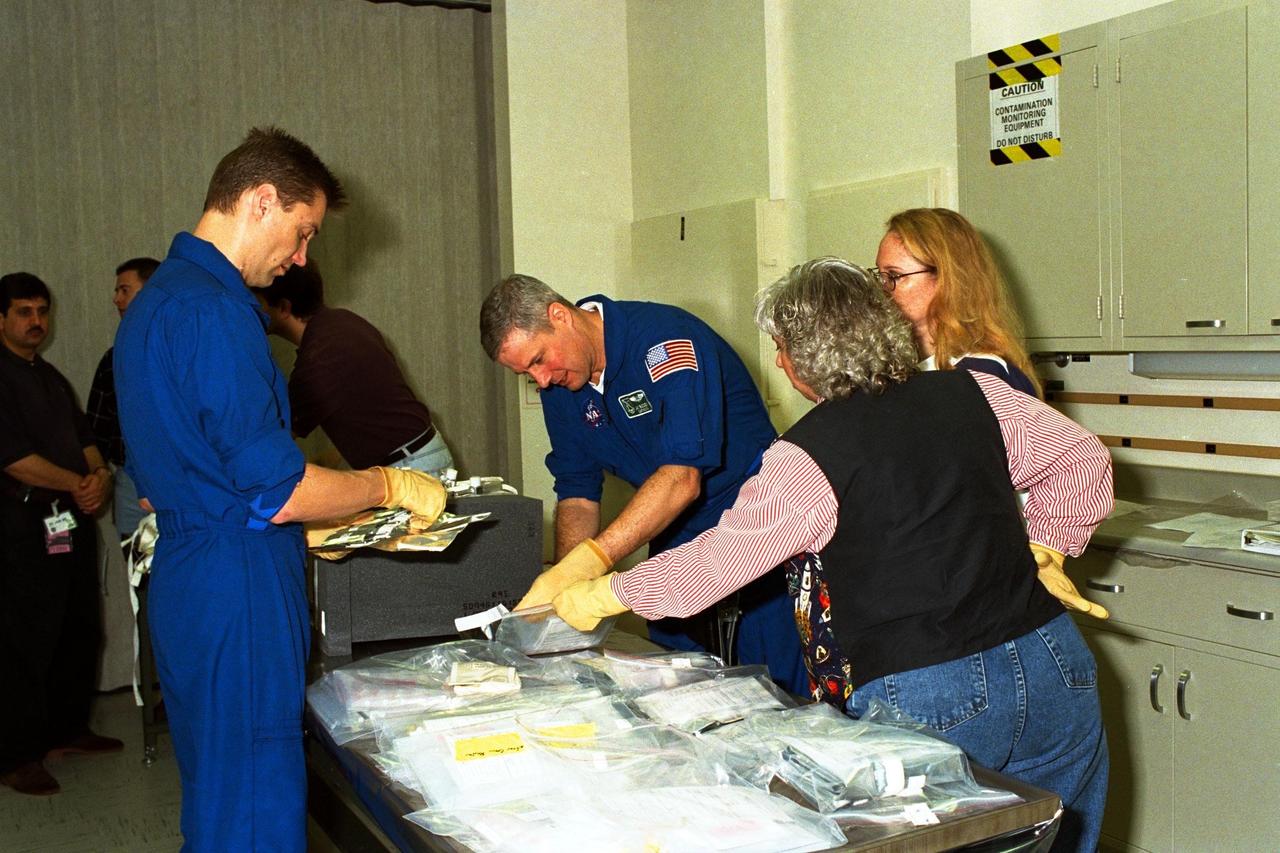
STS-90 Payload Specialists James Pawelczyk, Ph.D. (at left), and Jay Buckey Jr., M.D., examine items to be used during the Crew Equipment Interface Test (CEIT) in Kennedy Space Center's (KSC's) Operations and Checkout Building, where the Neurolab payload is undergoing processing. The CEIT gives astronauts an opportunity to get a hands-on look at the payloads with which they will be working on-orbit. STS-90 is scheduled to launch aboard the Shuttle Columbia from KSC on April 2. Investigations during the Neurolab mission will focus on the effects of microgravity on the nervous system. Specifically, experiments will study the adaptation of the vestibular system, the central nervous system, and the pathways that control the ability to sense location in the absence of gravity, as well as the effect of microgravity on a developing nervous system
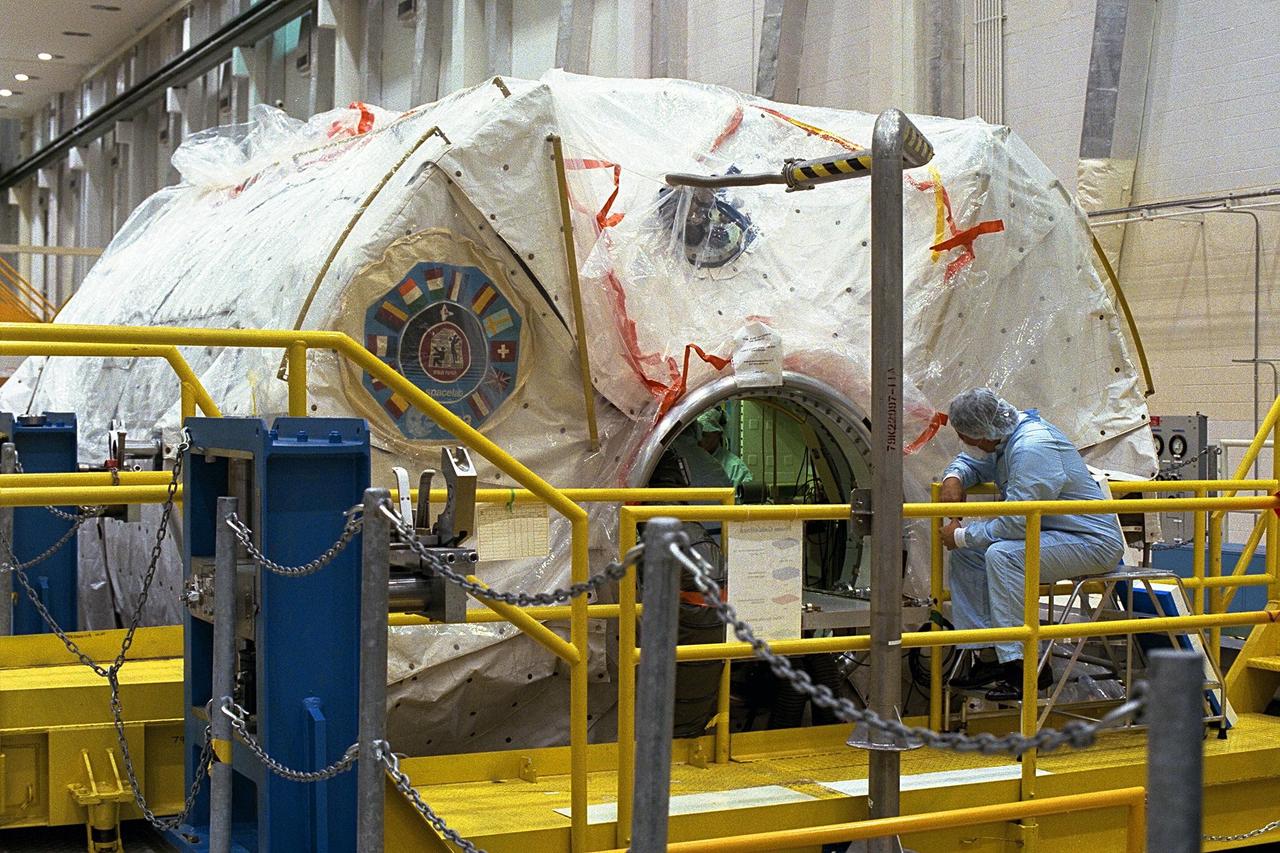
The Neurolab payload for STS-90, scheduled to launch aboard the Shuttle Columbia from Kennedy Space Center (KSC) on April 2, 1998, undergoes further processing in the Operations and Checkout Building at KSC. Investigations during the Neurolab mission will focus on the effects of microgravity on the nervous system. Specifically, experiments will study the adaptation of the vestibular system, the central nervous system, and the pathways that control the ability to sense location in the absence of gravity, as well as the effect of microgravity on a developing nervous system. The crew of STS-90 will include Commander Richard Searfoss, Pilot Scott Altman, Mission Specialists Richard Linnehan, Dafydd (Dave) Williams, M.D., and Kathryn (Kay) Hire, and Payload Specialists Jay Buckey, M.D., and James Pawelczyk, Ph.D
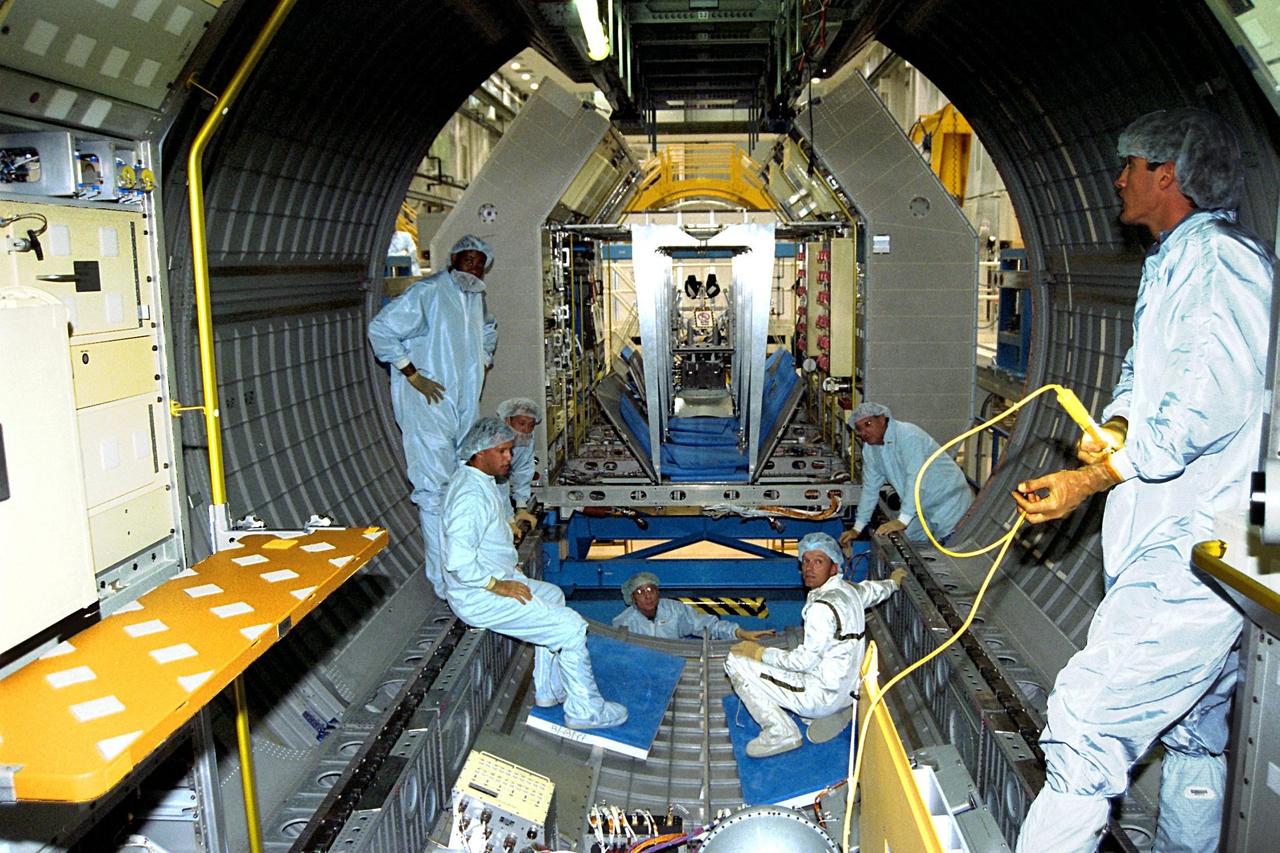
The Neurolab payload for STS-90, scheduled to launch aboard the Shuttle Columbia from Kennedy Space Center (KSC) on April 2, 1998, is installed in the Spacelab module by Boeing technicians in the Operations and Checkout Building at KSC. Investigations during the Neurolab mission will focus on the effects of microgravity on the nervous system. Specifically, experiments will study the adaptation of the vestibular system, the central nervous system, and the pathways that control the ability to sense location in the absence of gravity, as well as the effect of microgravity on a developing nervous system. The crew of STS-90 will include Commander Richard Searfoss, Pilot Scott Altman, Mission Specialists Richard Linnehan, Dafydd (Dave) Williams, M.D., and Kathryn (Kay) Hire, and Payload Specialists Jay Buckey, M.D., and James Pawelczyk, Ph.D
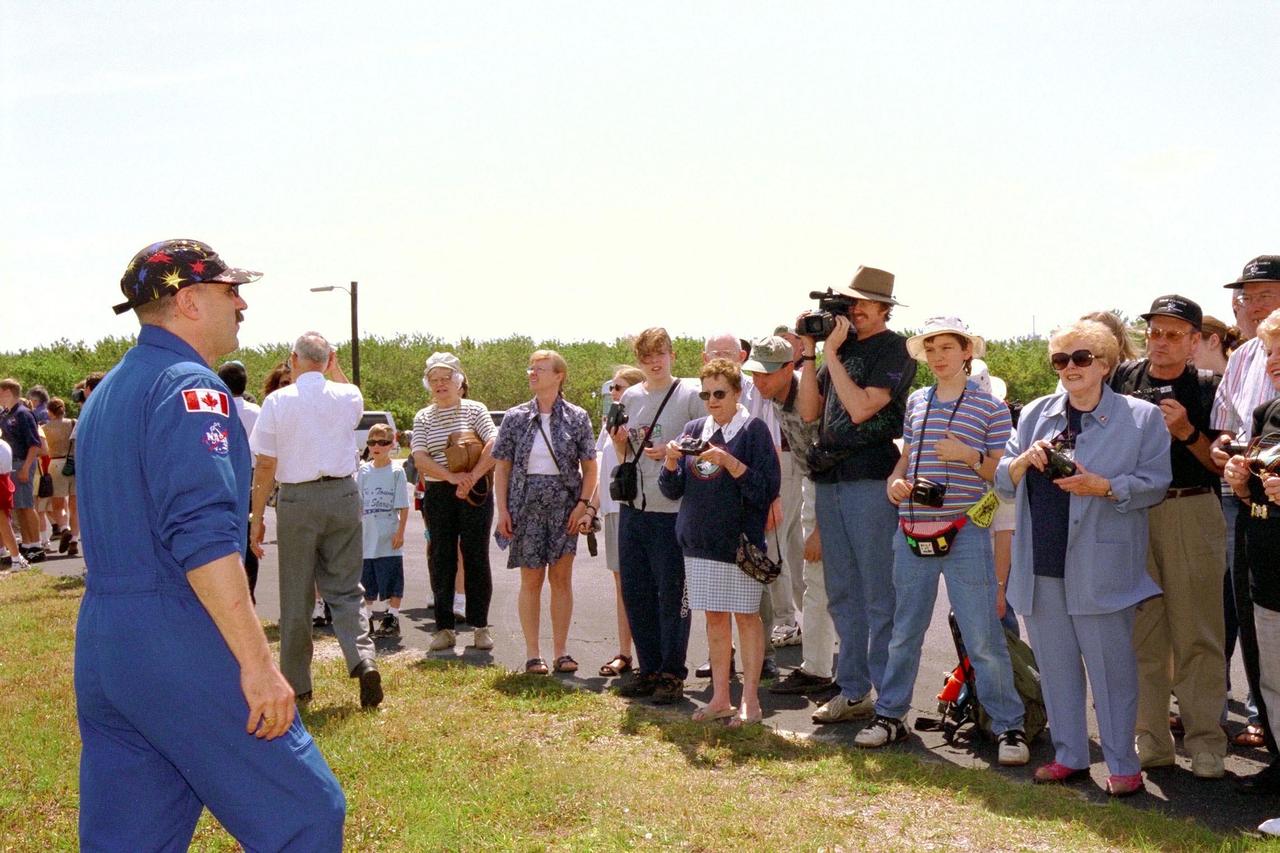
KENNEDY SPACE CENTER, FLA. -- STS-90 Mission Specialist Dafydd (Dave) Williams, M.D., with the Canadian Space Agency speaks with friends and family members near Launch Pad 39B, from which he and the rest of the seven-member crew are scheduled to launch aboard Columbia on May 16 at 2:19 p.m. EDT. The astronauts are under strict health stabilization guidelines to protect them from close contact with persons who do not have health stabilization clearance. This is the 25th flight of Columbia and the 90th mission flown since the start of the Space Shuttle program. STS-90 is a nearly 17-day life sciences research flight that will focus on the most complex and least understood part of the human body the nervous system. Neurolab will examine the effects of spaceflight on the brain, spinal cord, peripheral nerves and sensory organs in the human body

The crew of STS-90 pose in the white room at KSC's Launch Pad 39B, where they are participating in Terminal Countdown Demonstration Test (TCDT) activities. The TCDT is held at KSC prior to each Space Shuttle flight to provide crews with the opportunity to participate in simulated countdown activities. The crew include, left to right, Commander Richard Searfoss, Pilot Scott Altman, Mission Specialist Kathryn (Kay) Hire, Richard Linnehan, D.V.M., Payload Specialists James Pawelczyk, Ph.D., and Jay Buckey, M.D., and Mission Specialist Dafydd (Dave) Williams, M.D., with the Canadian Space Agency. Columbia is targeted for launch of STS-90 on April 16 at 2:19 p.m. EDT and will be the second mission of 1998. The mission is scheduled to last nearly 17 days
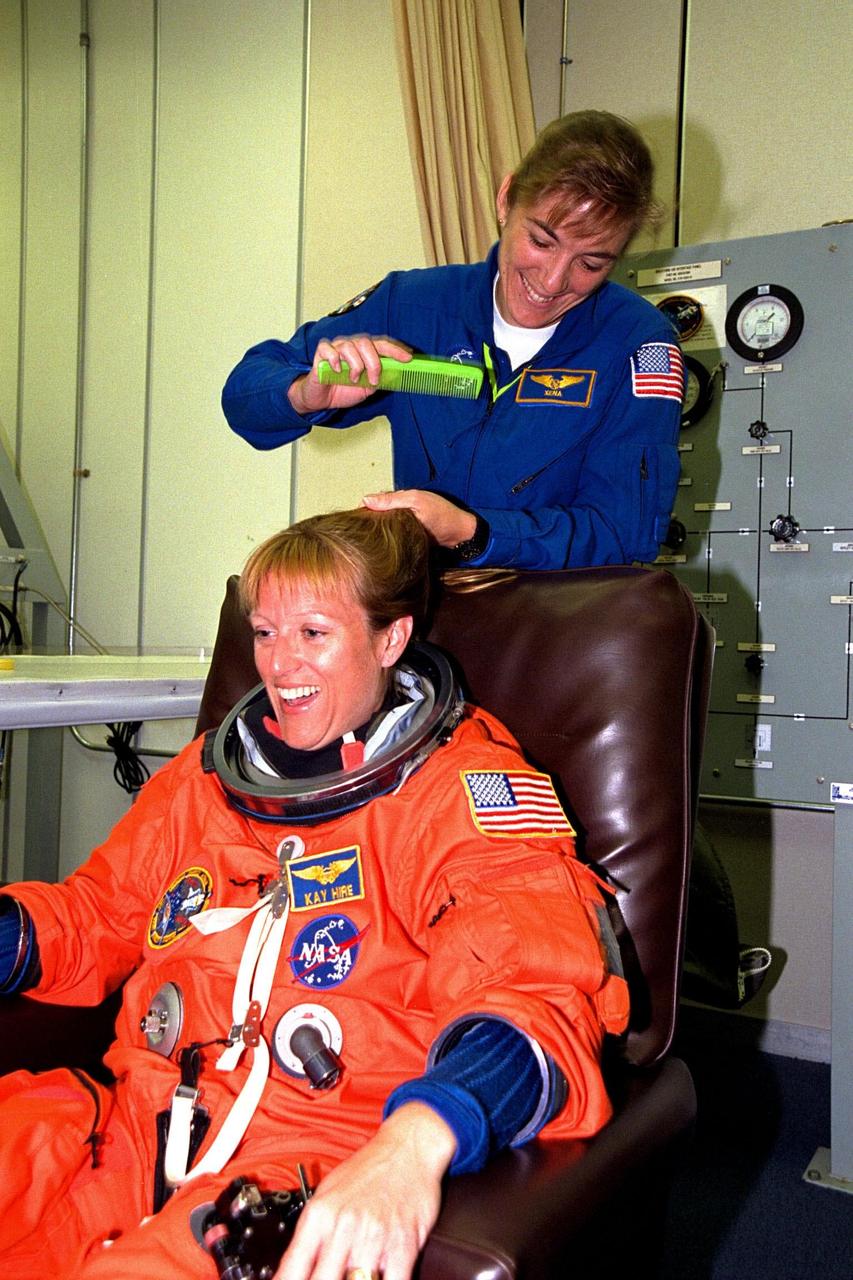
KENNEDY SPACE CENTER, FLA. -- STS-90 Mission Specialist Kathryn (Kay) Hire prepares for launch during suitup activities in the Operations and Checkout Building as Astronaut Support Personnel team member Heide Piper braids Hire's hair. Hire and the rest of the STS-90 crew will shortly depart for Launch Pad 39B, where the Space Shuttle Columbia awaits a second liftoff attempt at 2:19 p.m. EDT. Her first trip into space, Hire is participating in this life sciences research flight that will focus on the most complex and least understood part of the human body the nervous system. Neurolab will examine the effects of spaceflight on the brain, spinal cord, peripheral nerves and sensory organs in the human body.

The Neurolab payload for STS-90, scheduled to launch aboard the Shuttle Columbia from Kennedy Space Center (KSC) on April 2, 1998, is moved to its workstand in the Operations and Checkout Building at KSC. Investigations during the Neurolab mission will focus on the effects of microgravity on the nervous system. Specifically, experiments will study the adaptation of the vestibular system, the central nervous system, and the pathways that control the ability to sense location in the absence of gravity, as well as the effect of microgravity on a developing nervous system. The crew of STS-90 will include Commander Richard Searfoss, Pilot Scott Altman, Mission Specialists Richard Linnehan, Dafydd (Dave) Williams, M.D., and Kathryn (Kay) Hire, and Payload Specialists Jay Buckey, M.D., and James Pawelczyk, Ph.D
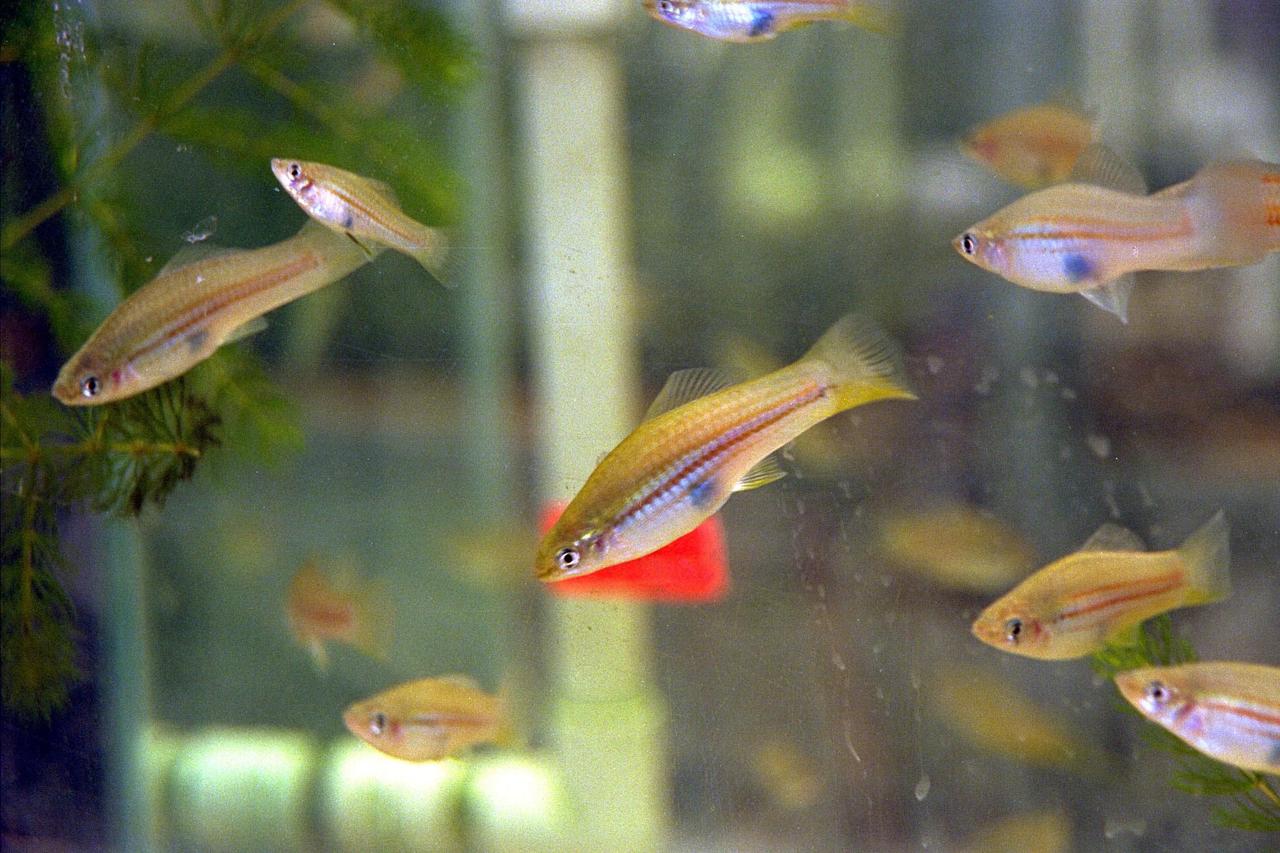
KENNEDY SPACE CENTER, FLA. -- Swordtail fish (Xiphophorus helleri), like those that are part of the Neurolab payload on Space Shuttle Mission STS-90, are shown in their holding tank in the Operations and Checkout Building. The fish will fly in the Closed Equilibrated Biological Aquatic System (CEBAS) Minimodule, a middeck locker-sized fresh water habitat, designed to allow the controlled incubation of aquatic species in a self-stabilizing, artifical ecosystem for up to three weeks under space conditions. Investigations during the Neurolab mission will focus on the effects of microgravity on the nervous system. The crew of STS-90, slated for launch April 16 at 2:19 p.m. EDT, include Commander Richard Searfoss, Pilot Scott Altman, Mission Specialists Richard Linnehan, D.V.M., Dafydd (Dave) Williams, M.D., and Kathryn (Kay) Hire, and Payload Specialists Jay Buckey, M.D., and James Pawelczyk, Ph.D.
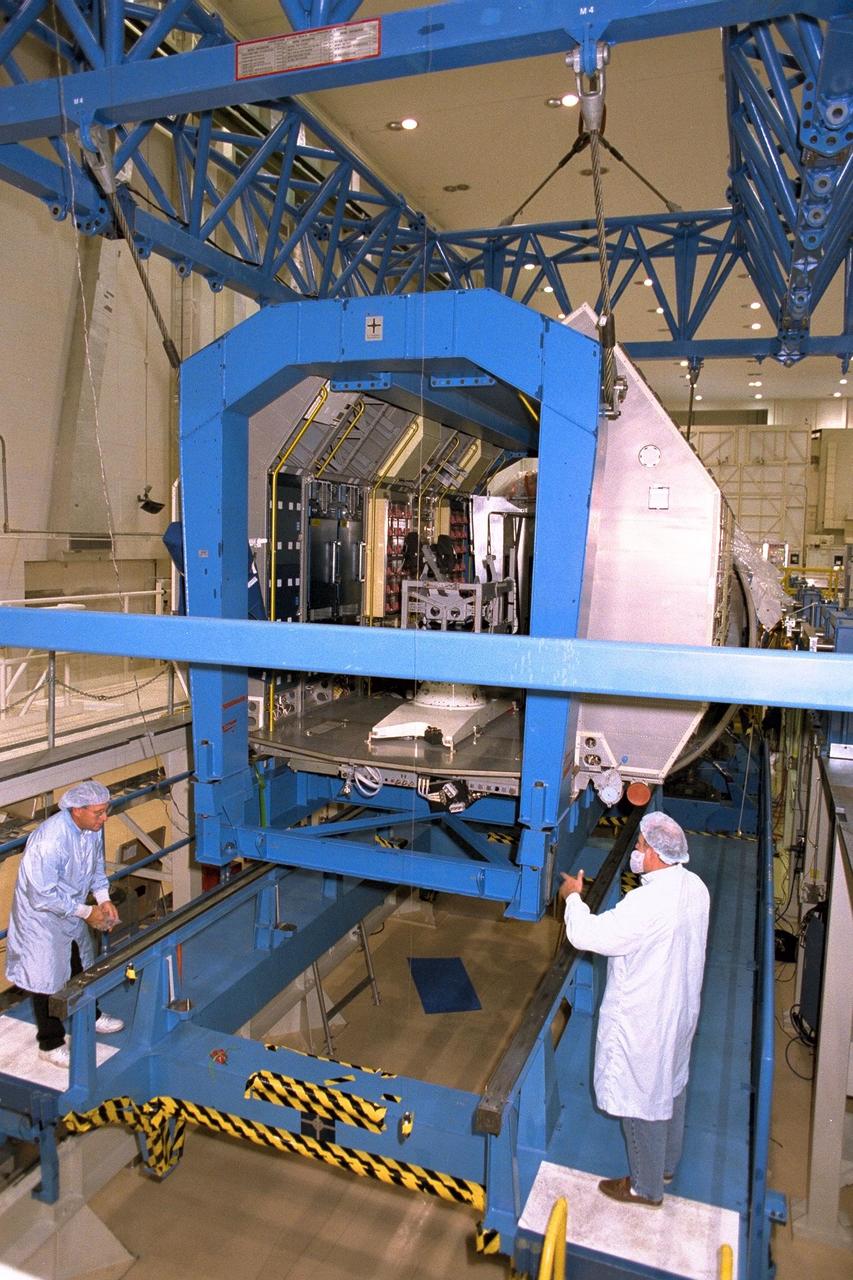
The Neurolab payload for STS-90, scheduled to launch aboard the Shuttle Columbia from Kennedy Space Center (KSC) on April 2, 1998, is moved to its workstand in the Operations and Checkout Building at KSC. Investigations during the Neurolab mission will focus on the effects of microgravity on the nervous system. Specifically, experiments will study the adaptation of the vestibular system, the central nervous system, and the pathways that control the ability to sense location in the absence of gravity, as well as the effect of microgravity on a developing nervous system. The crew of STS-90 will include Commander Richard Searfoss, Pilot Scott Altman, Mission Specialists Richard Linnehan, Dafydd (Dave) Williams, M.D., and Kathryn (Kay) Hire, and Payload Specialists Jay Buckey, M.D., and James Pawelczyk, Ph.D
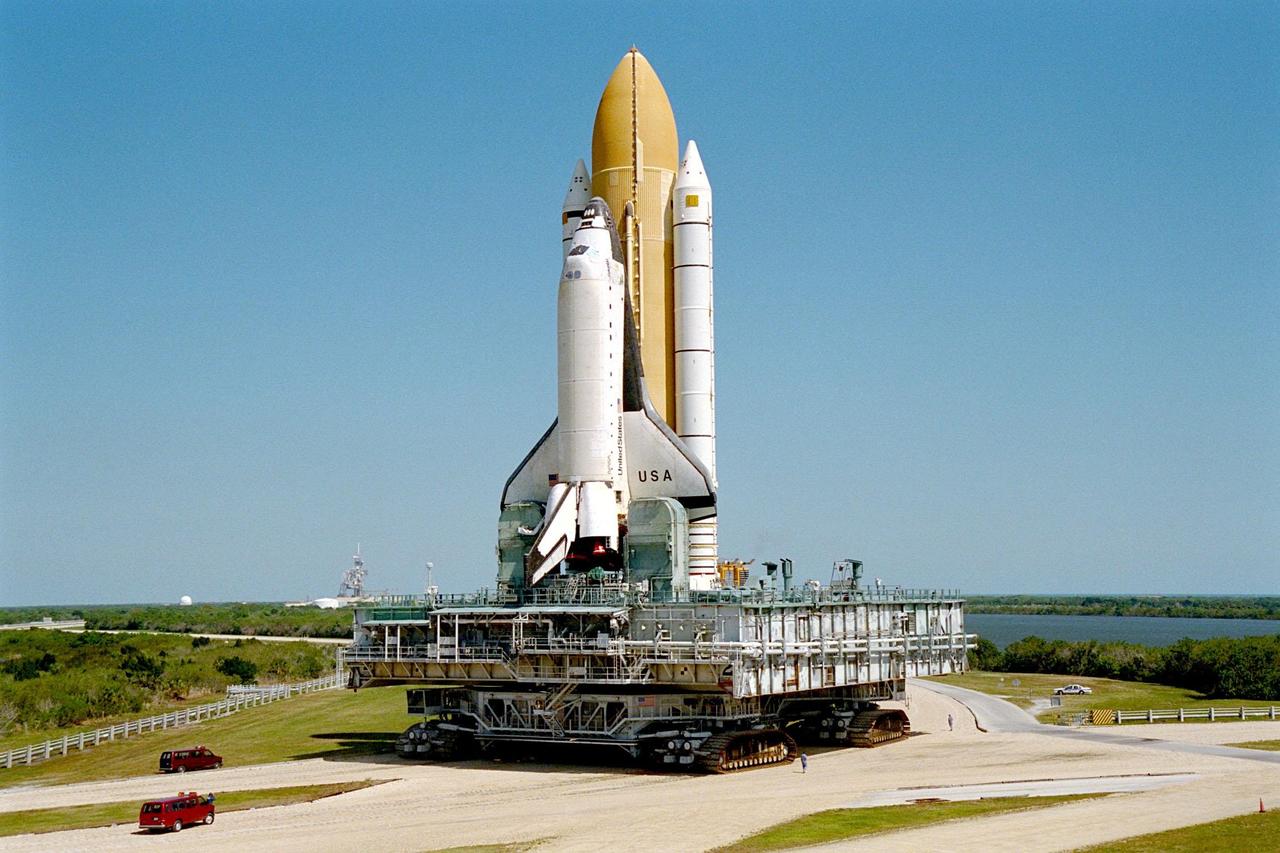
KENNEDY SPACE CENTER, FLA. -- The Space Shuttle Columbia continues its morning rollout from the Vehicle Assembly Building to Launch Pad 39B in preparation for the STS-90 mission. The Neurolab experiments are the primary payload on this nearly 17-day space flight. Investigations during the Neurolab mission will focus on the effects of microgravity on the nervous system. Specifically, experiments will study the adaptation of the vestibular system, the central nervous system, and the pathways that control the ability to sense location in the absence of gravity, as well as the effect of microgravity on a developing nervous system. The crew of STS-90, slated for launch April 16 at 2:19 p.m. EDT, includes Commander Richard Searfoss, Pilot Scott Altman, Mission Specialists Richard Linnehan, Dafydd (Dave) Williams, M.D., and Kathryn (Kay) Hire, and Payload Specialists Jay Buckey, M.D., and James Pawelczyk, Ph.D

KENNEDY SPACE CENTER, FLA. -- The Space Shuttle Columbia arrives at the top of Launch Pad 39B after its morning rollout prior to STS-90. The white room of the Orbiter Access Arm where astronauts suit up for launch can be seen to the left of the orbiter. The Neurolab experiments are the primary payload on this nearly 17-day space flight. Investigations during the Neurolab mission will focus on the effects of microgravity on the nervous system. The crew of STS-90, slated for launch April 16 at 2:19 p.m. EDT, includes Commander Richard Searfoss, Pilot Scott Altman, Mission Specialists Richard Linnehan, Dafydd (Dave) Williams, M.D., and Kathryn (Kay) Hire, and Payload Specialists Jay Buckey, M.D., and James Pawelczyk, Ph.D
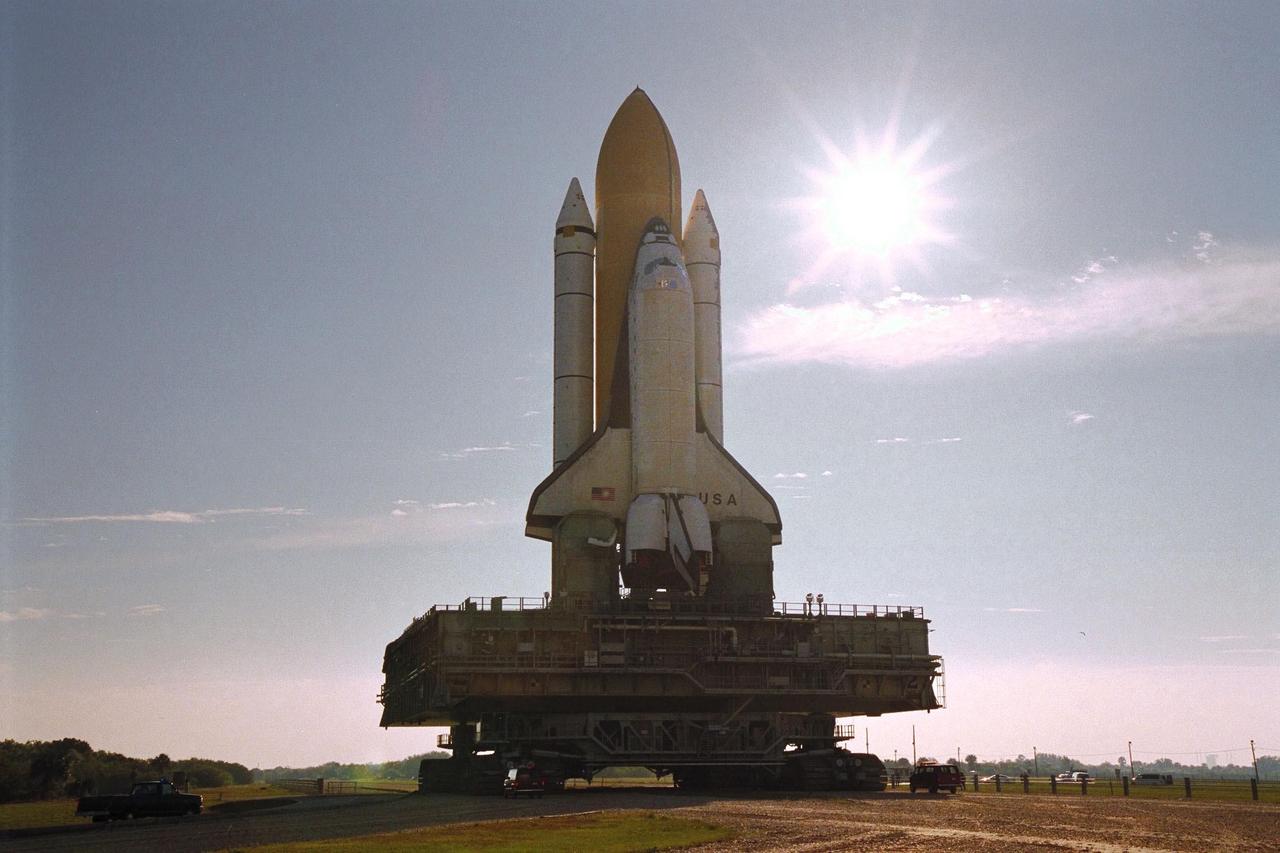
KENNEDY SPACE CENTER, Fla. -- The Space Shuttle Columbia continues its morning rollout from the Vehicle Assembly Building to Launch Pad 39B in preparation for the STS-90 mission. The Neurolab experiments are primary payload on this nearly 17-day space flight. Investigations during the Neurolab mission will focus on the effects of microgravity on the nervous system. Specifically, experiments will study the adaptation of the vestibular system, the central nervous system, and the pathways that control the ability to sense location in the absence of gravity, as well as the effect of microgravity on a developing nervous system. The crew of STS-90, slated for launch April 16 at 2:19 p.m. EDT, includes Commander Richard Searfoss, Pilot Scott Altman, Mission Specialists Richard Linnehan, Dafydd (Dave) Williams, M.D., and Kathryn (Kay) Hire, and Payload Specialists Jay Buckey, M.D., and James Pawelczyk, Ph.D
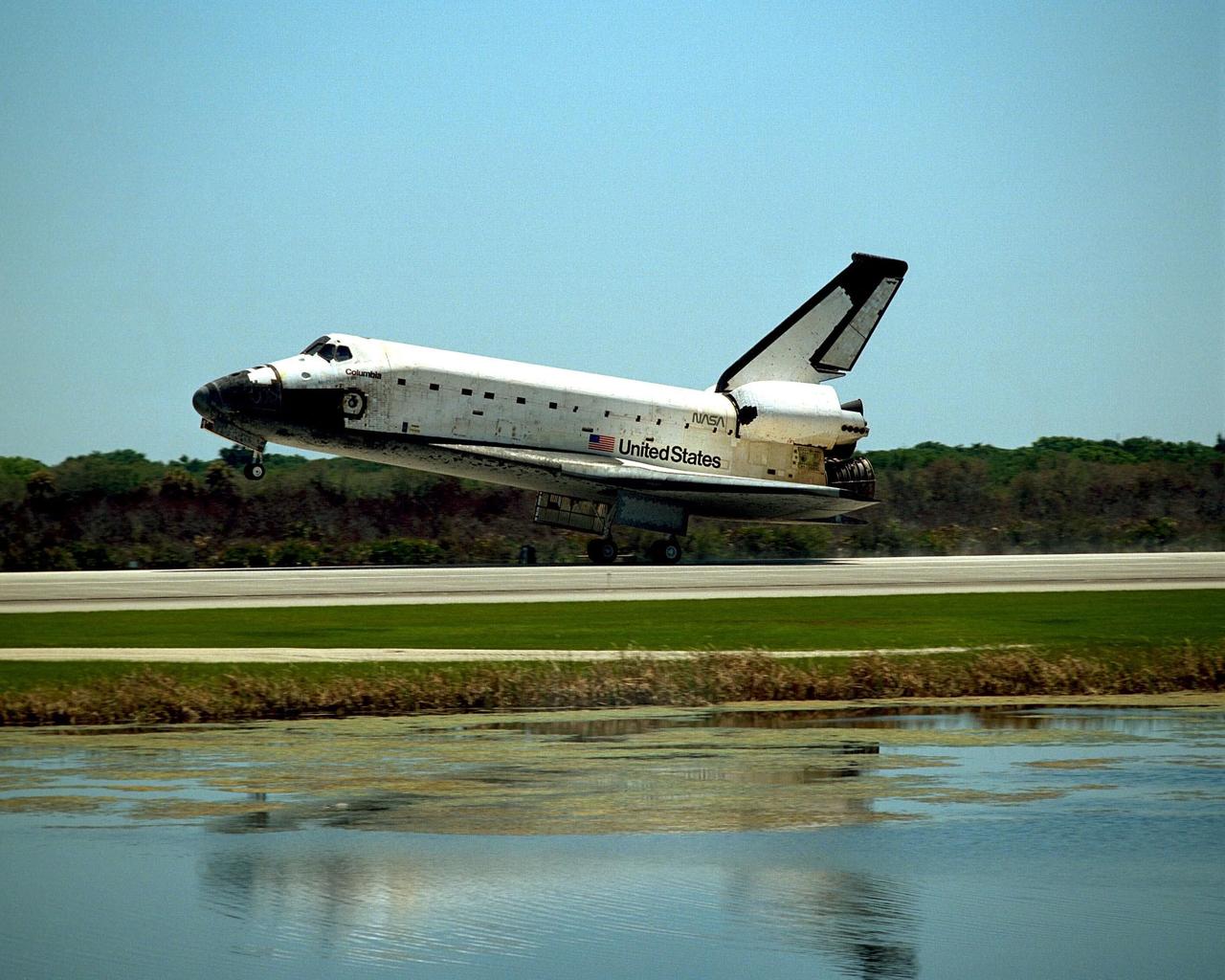
The orbiter Columbia approaches touchdown on Runway 33 of KSC's Shuttle Landing Facility to complete the nearly 16-day STS-90 mission. Main gear touchdown was at 12:08:59 p.m. EDT on May 3, 1998, landing on orbit 256 of the mission. The wheels stopped at 12:09:58 EDT, completing a total mission time of 15 days, 21 hours, 50 minutes and 58 seconds. The 90th Shuttle mission was Columbia's 13th landing at the space center and the 43rd KSC landing in the history of the Space Shuttle program. During the mission, the crew conducted research to contribute to a better understanding of the human nervous system. The crew of the STS-90 Neurolab mission include Commander Richard Searfoss; Pilot Scott Altman; Mission Specialists Richard Linnehan, D.V.M., Dafydd (Dave) Williams, M.D., with the Canadian Space Agency, and Kathryn (Kay) Hire; and Payload Specialists Jay Buckey, M.D., and James Pawelczyk, Ph.D
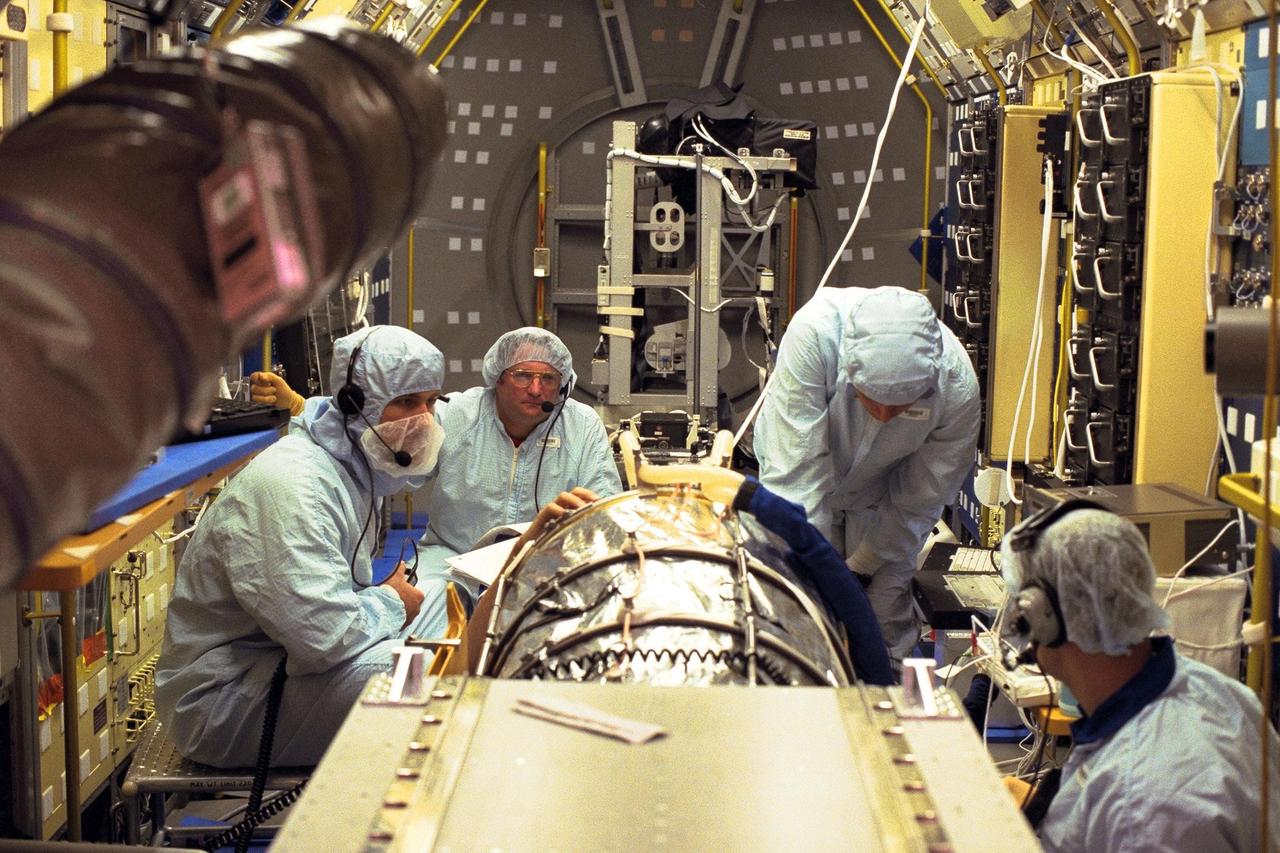
The Neurolab payload for STS-90, scheduled to launch aboard the Shuttle Columbia from Kennedy Space Center (KSC) on April 2, 1998, undergoes further processing in the Operations and Checkout Building at KSC. Investigations during the Neurolab mission will focus on the effects of microgravity on the nervous system. Specifically, experiments will study the adaptation of the vestibular system, the central nervous system, and the pathways that control the ability to sense location in the absence of gravity, as well as the effect of microgravity on a developing nervous system. The crew of STS-90 will include Commander Richard Searfoss, Pilot Scott Altman, Mission Specialists Richard Linnehan, Dafydd (Dave) Williams, M.D., and Kathryn (Kay) Hire, and Payload Specialists Jay Buckey, M.D., and James Pawelczyk, Ph.D
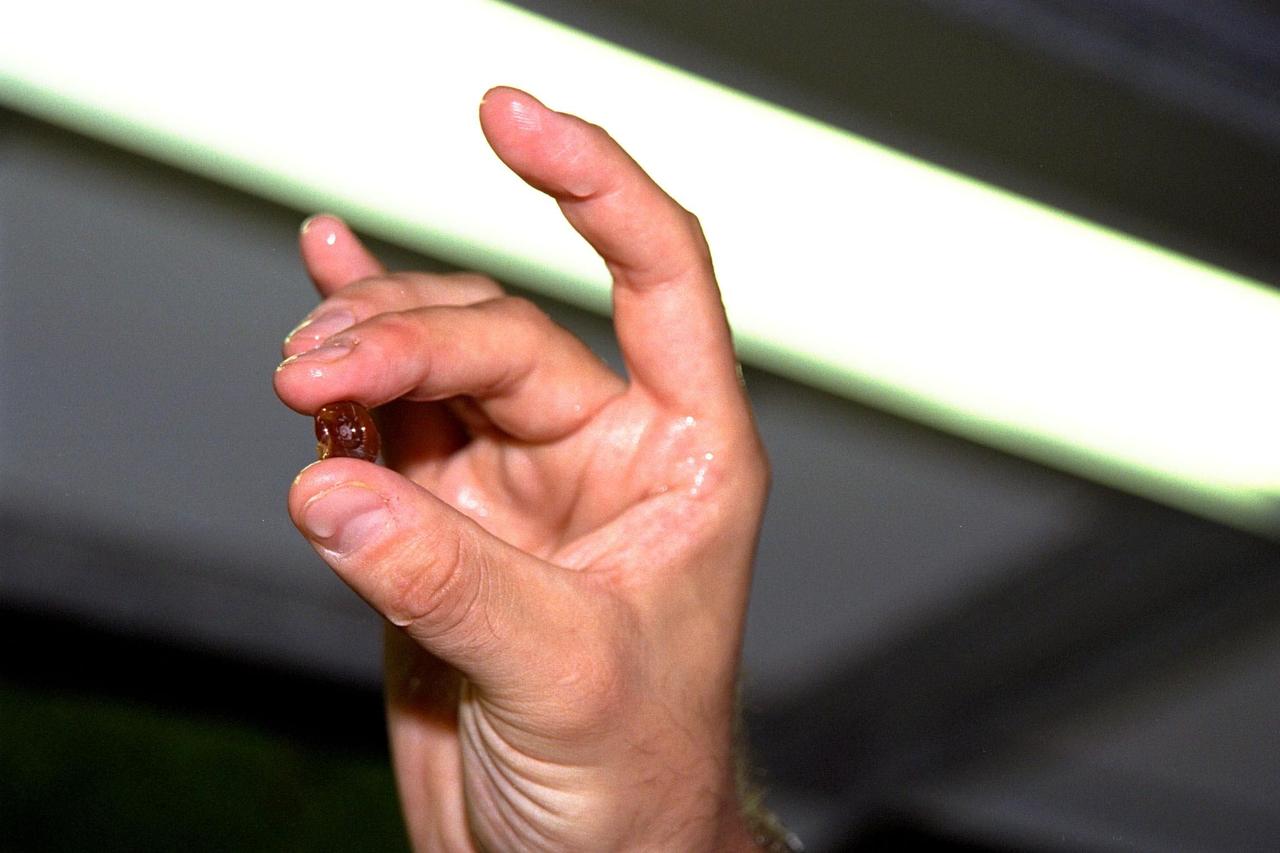
KENNEDY SPACE CENTER, FLA. -- A water snail (Biomphalaria glabrata), like those that are part of the Neurolab payload on Space Shuttle Mission STS-90, is held up for inspection in the Operations and Checkout Building. The snails will fly in the Closed Equilibrated Biological Aquatic System (CEBAS) Minimodule, a middeck locker-sized fresh water habitat, designed to allow the controlled incubation of aquatic species in a self-stabilizing, artifical ecosystem for up to three weeks under space conditions. Investigations during the Neurolab mission will focus on the effects of microgravity on the nervous system. The crew of STS-90, slated for launch April 16 at 2:19 p.m. EDT, includes Commander Richard Searfoss, Pilot Scott Altman, Mission Specialists Richard Linnehan, D.V.M., Dafydd (Dave) Williams, M.D., and Kathryn (Kay) Hire, and Payload Specialists Jay Buckey, M.D., and James Pawelczyk, Ph.D
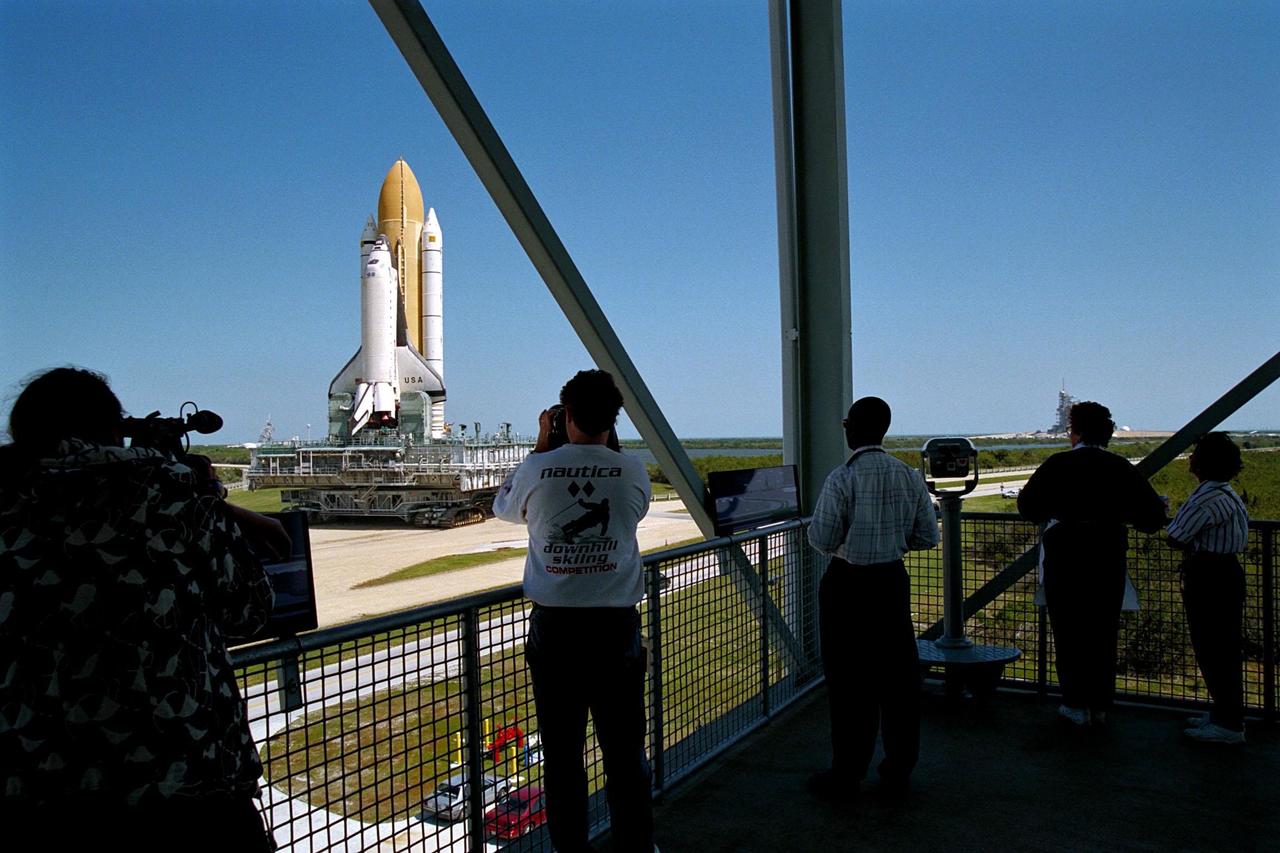
KENNEDY SPACE CENTER, FLA. -- The Space Shuttle Columbia continues its morning rollout past the newly opened tour stop, the Launch Complex 39 Observation Gantry, to Launch Pad 39B in preparation for the STS-90 mission. The Neurolab experiments are the primary payload on this nearly 17-day space flight. Investigations during the Neurolab mission will focus on the effects of microgravity on the nervous system. Specifically, experiments will study the adaptation of the vestibular system, the central nervous system, and the pathways that control the ability to sense location in the absence of gravity, as well as the effect of microgravity on a developing nervous system. The crew of STS-90, slated for launch April 16 at 2:19 p.m. EDT, includes Commander Richard Searfoss, Pilot Scott Altman, Mission Specialists Richard Linnehan, Dafydd (Dave) Williams, M.D., and Kathryn (Kay) Hire, and Payload Specialists Jay Buckey, M.D., and James Pawelczyk, Ph.D

KENNEDY SPACE CENTER, FLA. -- The STS-90 flight crew enjoy the traditional pre-liftoff breakfast in the crew quarters of the Operations and Checkout Building. They are, from left, Payload Specialist Jay Buckey, M.D., Mission Specialist Dafydd (Dave) Williams, M.D., with the Canadian Space Agency, Pilot Scott Altman, Commander Richard Searfoss, Mission Specialist Kathryn (Kay) Hire, Mission Specialist Richard Linnehan, D.V.M., and Payload Specialist James Pawelczyk, Ph.D. After a weather briefing, the flight crew will be fitted with their launch and entry suits and depart for Launch Pad 39B. Once there, they will take their positions in the crew cabin of the Space Shuttle Columbia to await liftoff during a two-and-a-half-hour window that will open at 2:19 p.m. EDT, Apr. 17. STS-90 is the launch of Neurolab, a nearly 17-day mission to examine the effects of spaceflight on the brain, spinal cord, peripheral nerves and sensory organs in the human body

KENNEDY SPACE CENTER, FLA. -- The Space Shuttle Columbia begins its rollout from the Vehicle Assembly Building to Launch Pad 39B in preparation for the STS-90 mission. The Neurolab experiments are the primary payload on this nearly 17-day space flight. Investigations during the Neurolab mission will focus on the effects of microgravity on the nervous system. Specifically, experiments will study the adaptation of the vestibular system, the central nervous system, and the pathways that control the ability to sense location in the absence of gravity, as well as the effect of microgravity on a developing nervous system. The crew of STS-90, slated for launch April 16 at 2:19 p.m. EDT, includes Commander Richard Searfoss, Pilot Scott Altman, Mission Specialists Richard Linnehan, Dafydd (Dave) Williams, M.D., and Kathryn (Kay) Hire, and Payload Specialists Jay Buckey, M.D., and James Pawelczyk, Ph.D
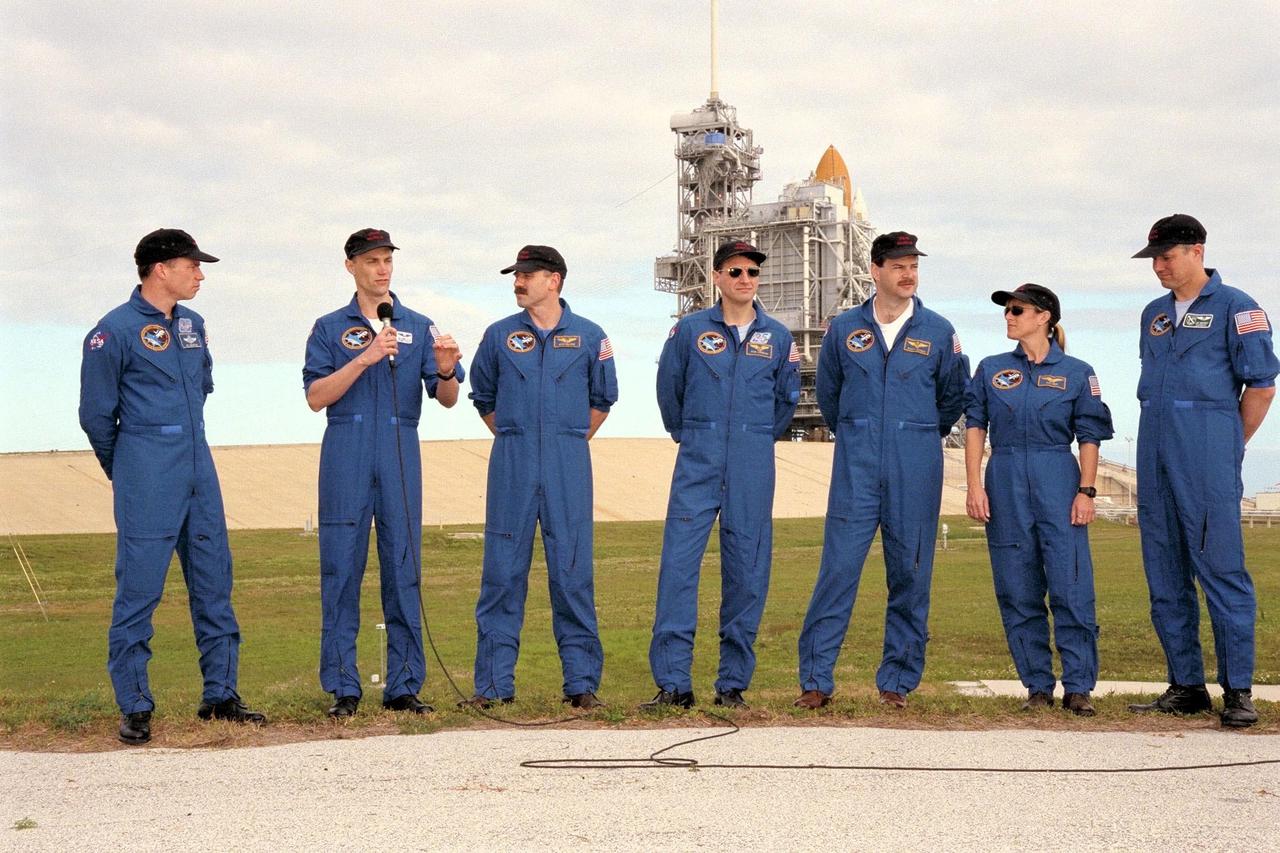
The crew of STS-90 participate in Terminal Countdown Demonstration Test (TCDT) activities at KSC's Launch Pad 39B. The TCDT is held at KSC prior to each Space Shuttle flight to provide crews with the opportunity to participate in simulated countdown activities. The crew include, left to right, Commander Richard Searfoss, Payload Specialist James Pawelczyk, Ph.D., Mission Specialist Dafydd (Dave) Williams, M.D., with the Canadian Space Agency, Mission Specialist Richard Linnehan, D.V.M., Pilot Scott Altman, Mission Specialist Kathryn (Kay) Hire, and Payload Specialist Jay Buckey, M.D. Columbia is targeted for launch of STS-90 on April 16 at 2:19 p.m. EDT and will be the second mission of 1998. The mission is scheduled to last nearly 17 days
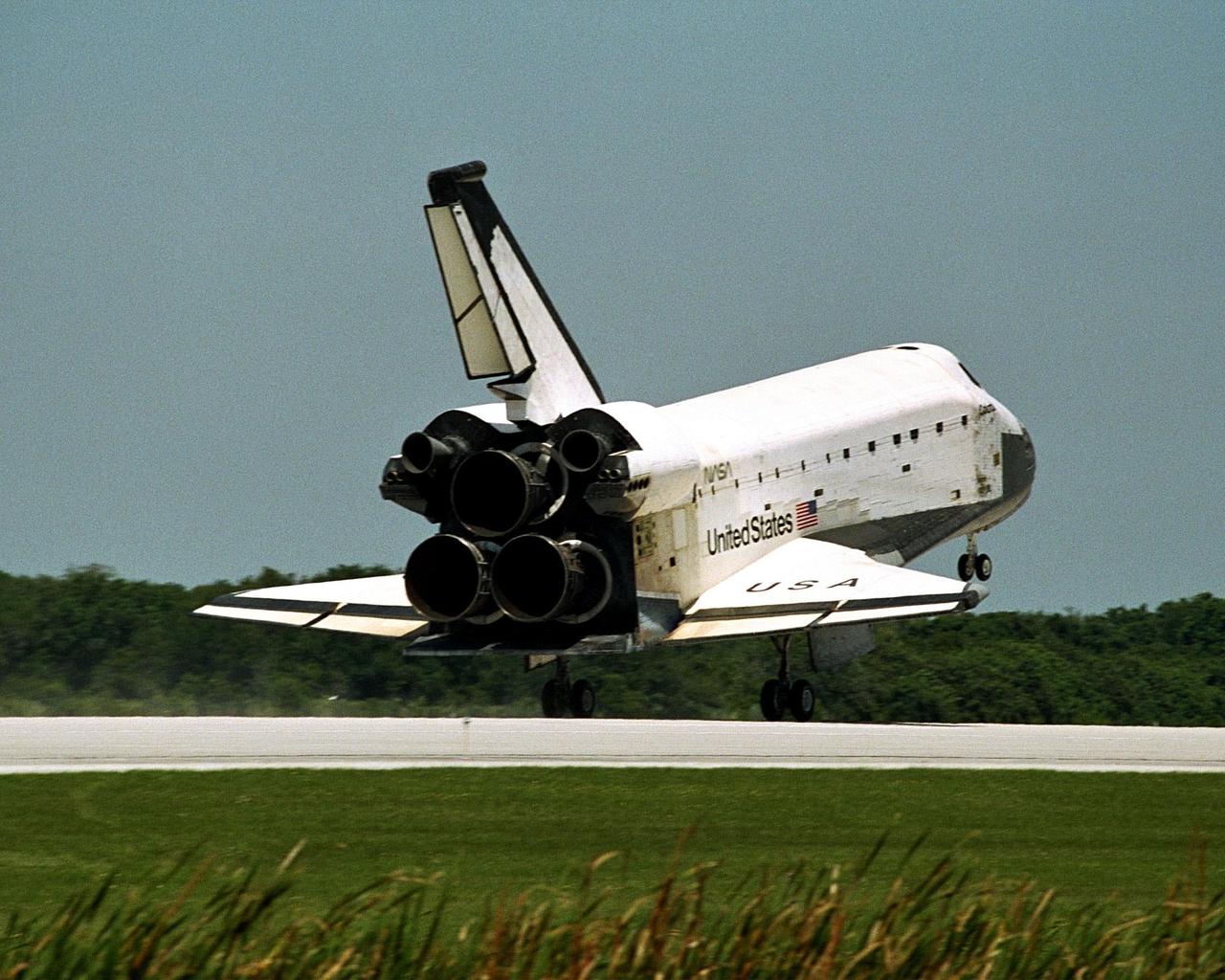
The orbiter Columbia approaches touchdown on Runway 33 of KSC's Shuttle Landing Facility to complete the nearly 16-day STS-90 mission. Main gear touchdown was at 12:08:59 p.m. EDT on May 3, 1998, landing on orbit 256 of the mission. The wheels stopped at 12:09:58 EDT, completing a total mission time of 15 days, 21 hours, 50 minutes and 58 seconds. The 90th Shuttle mission was Columbia's 13th landing at the space center and the 43rd KSC landing in the history of the Space Shuttle program. During the mission, the crew conducted research to contribute to a better understanding of the human nervous system. The crew of the STS-90 Neurolab mission include Commander Richard Searfoss; Pilot Scott Altman; Mission Specialists Richard Linnehan, D.V.M., Dafydd (Dave) Williams, M.D., with the Canadian Space Agency, and Kathryn (Kay) Hire; and Payload Specialists Jay Buckey, M.D., and James Pawelczyk, Ph.D
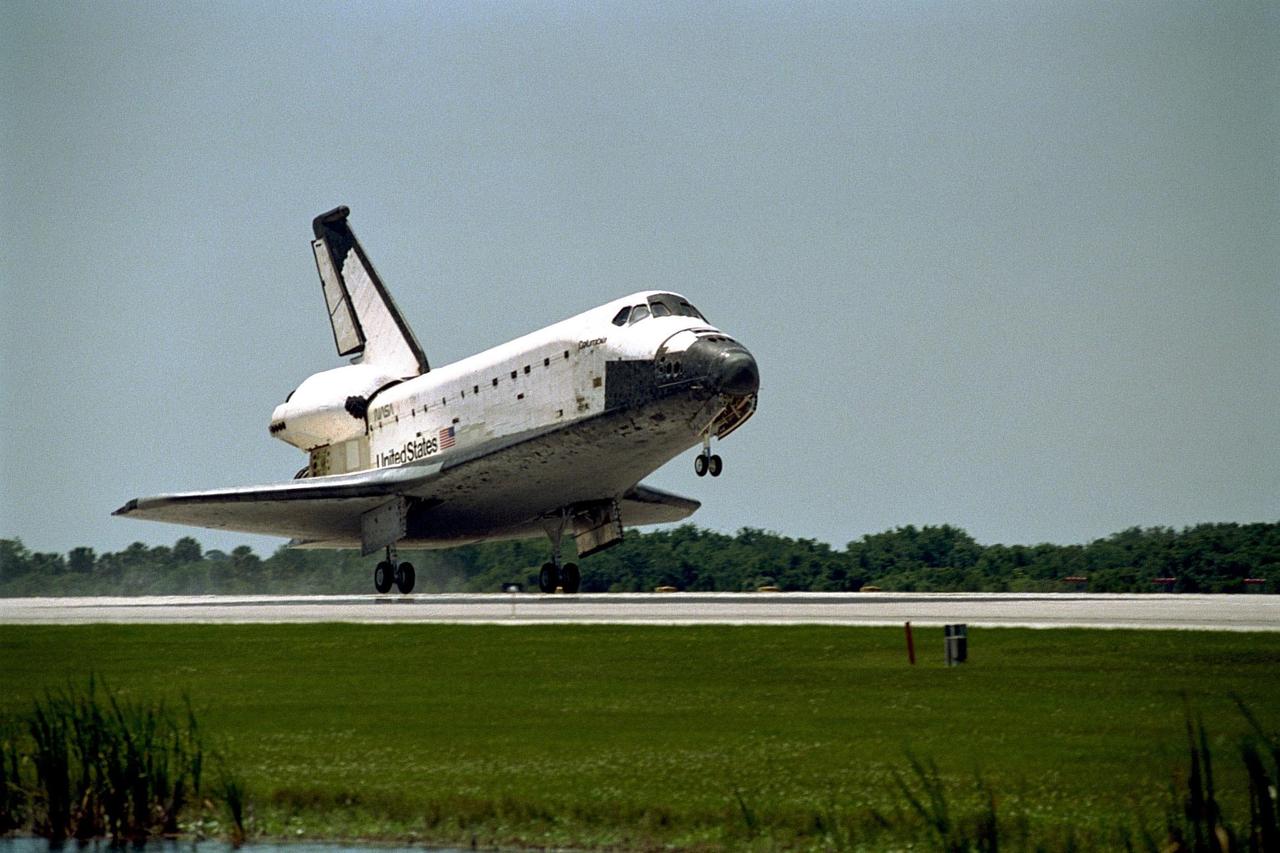
The orbiter Columbia approaches touchdown on Runway 33 of KSC's Shuttle Landing Facility to complete the nearly 16-day STS-90 mission. Main gear touchdown was at 12:08:59 p.m. EDT on May 3, 1998, landing on orbit 256 of the mission. The wheels stopped at 12:09:58 EDT, completing a total mission time of 15 days, 21 hours, 50 minutes and 58 seconds. The 90th Shuttle mission was Columbia's 13th landing at the space center and the 43rd KSC landing in the history of the Space Shuttle program. During the mission, the crew conducted research to contribute to a better understanding of the human nervous system. The crew of the STS-90 Neurolab mission include Commander Richard Searfoss; Pilot Scott Altman; Mission Specialists Richard Linnehan, D.V.M., Dafydd (Dave) Williams, M.D., with the Canadian Space Agency, and Kathryn (Kay) Hire; and Payload Specialists Jay Buckey, M.D., and James Pawelczyk, Ph.D