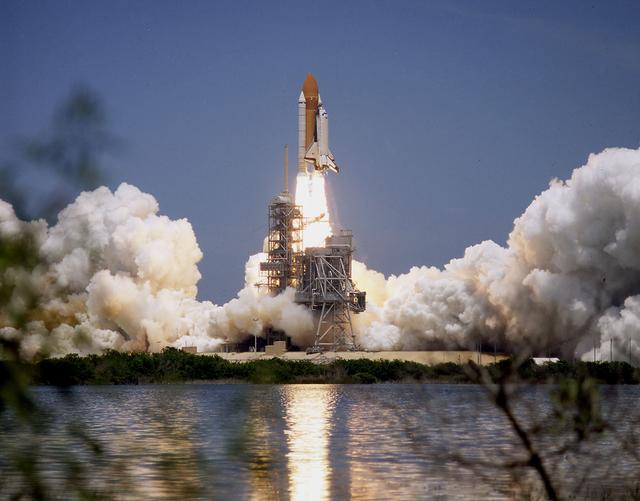
The Space Shuttle Columbia (STS-94) soared from Launch Pad 39A begirning its 16-day Microgravity Science Laboratory -1 (MSL-1) mission. The launch window was opened 47 minutes earlier than the originally scheduled time to improve the opportunity to lift off before Florida summer rain showers reached the space center. During the space flight, the MSL-1 was used to test some of the hardware, facilities and procedures that were planned for use on the International Space Station which were managed by scientists and engineers from the Marshall Space Flight Center, while the flight crew conducted combustion, protein crystal growth and materials processing experiments. Also onboard was the Hitchhiker Cryogenic Flexible Diode (CRYOFD) experiment payload, which was attached to the right side of Columbia's payload bay. These payloads had previously flown on the STS-83 mission in April, which was cut short after nearly four days because of indications of a faulty fuel cell. STS-94 was a reflight of that mission.
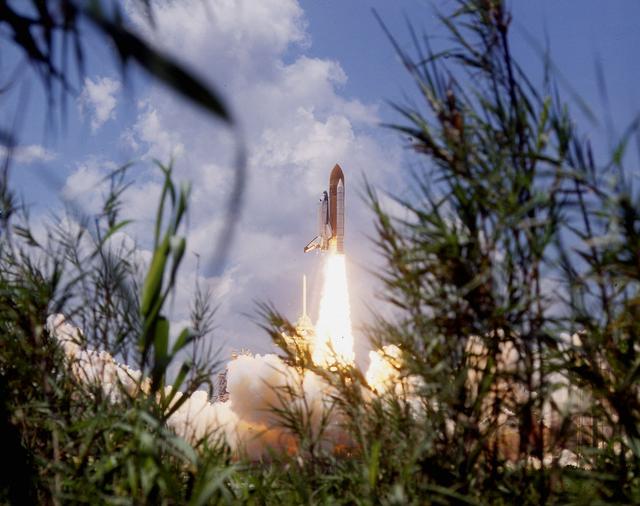
The Space Shuttle Columbia (STS-94) soared from Launch Pad 39A begirning its 16-day Microgravity Science Laboratory -1 (MSL-1) mission. The launch window was opened 47 minutes earlier than the originally scheduled time to improve the opportunity to lift off before Florida summer rain showers reached the space center. During the space flight, the MSL-1 was used to test some of the hardware, facilities and procedures that were planned for use on the International Space Station which were managed by scientists and engineers from the Marshall Space Flight Center, while the flight crew conducted combustion, protein crystal growth and materials processing experiments. Also onboard was the Hitchhiker Cryogenic Flexible Diode (CRYOFD) experiment payload, which was attached to the right side of Columbia's payload bay. These payloads had previously flown on the STS-83 mission in April, which was cut short after nearly four days because of indications of a faulty fuel cell. STS-94 was a reflight of that mission.
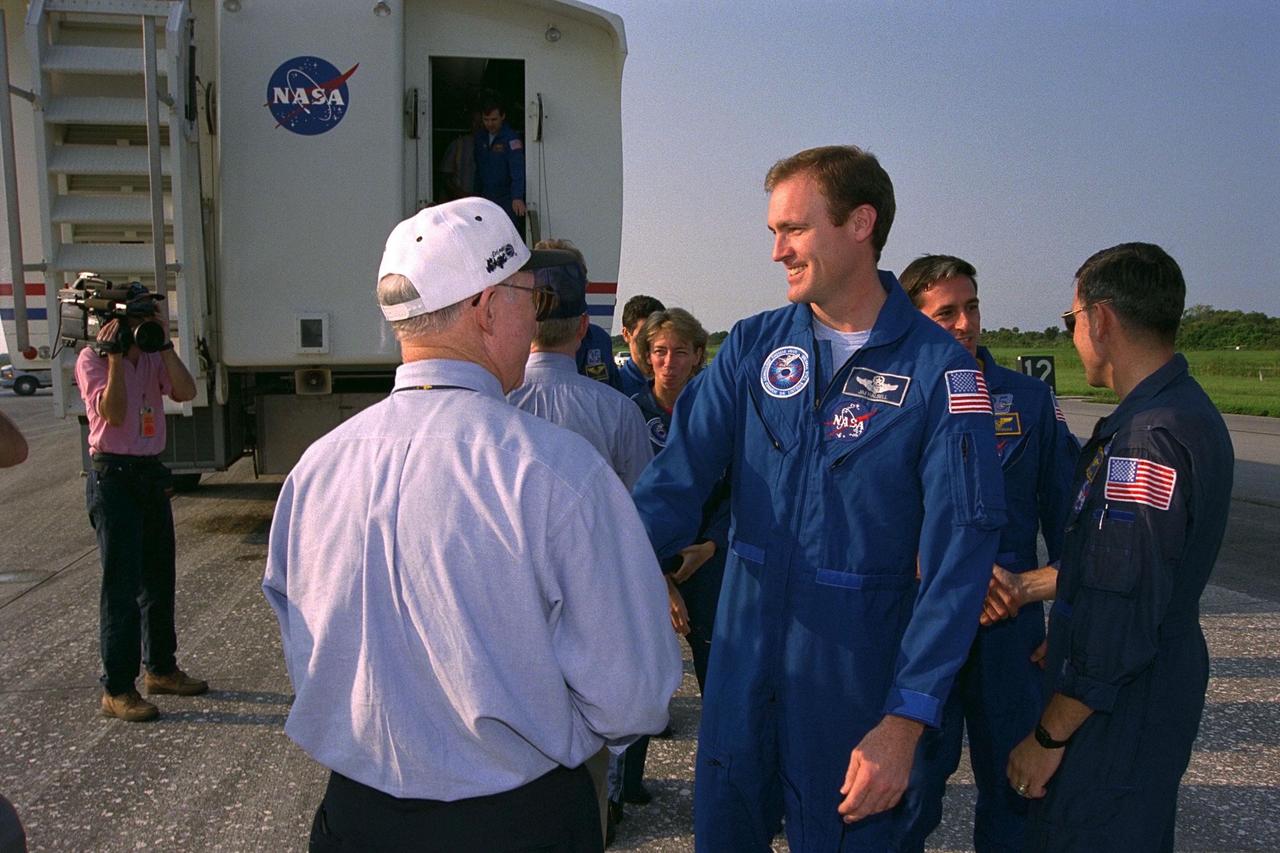
STS-94 Mission Commander James D. Halsell Jr. (center) shakes hands with KSC Shuttle Launch Director James F. Harrington (in white cap) after an end-of-mission landing on Runway 33 of KSC’s Shuttle Landing Facility July 17 to complete the Microgravity Science Laboratory-1 (MSL-1) mission. Main gear touchdown occurred at 6:46:34 a.m. EDT, July 17. At right, STS-88 Mission Commander and Shuttle Training Aircraft (STA) pilot Robert D. Cabana greets STS-94 Mission Specialist Donald A. Thomas. In the background, KSC Center Director Roy D. Bridges Jr. meets with other members of the STS-94 crew
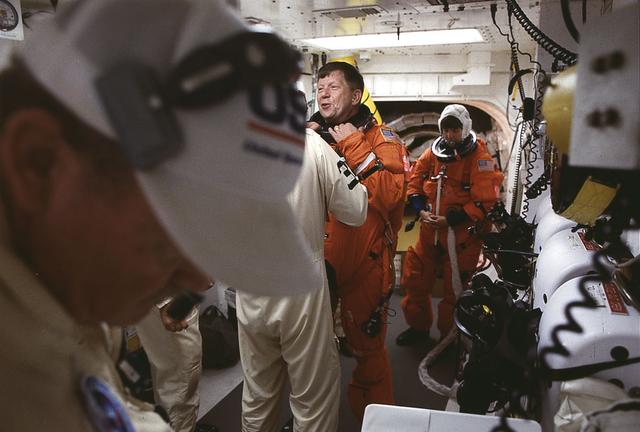
STS-94 Payload Specialist Roger K. Crouch and Payload Commander Janice E. Voss prepare to enter the Space Shuttle Columbia at Launch Pad 39a with assistance from white room closeout crew members.
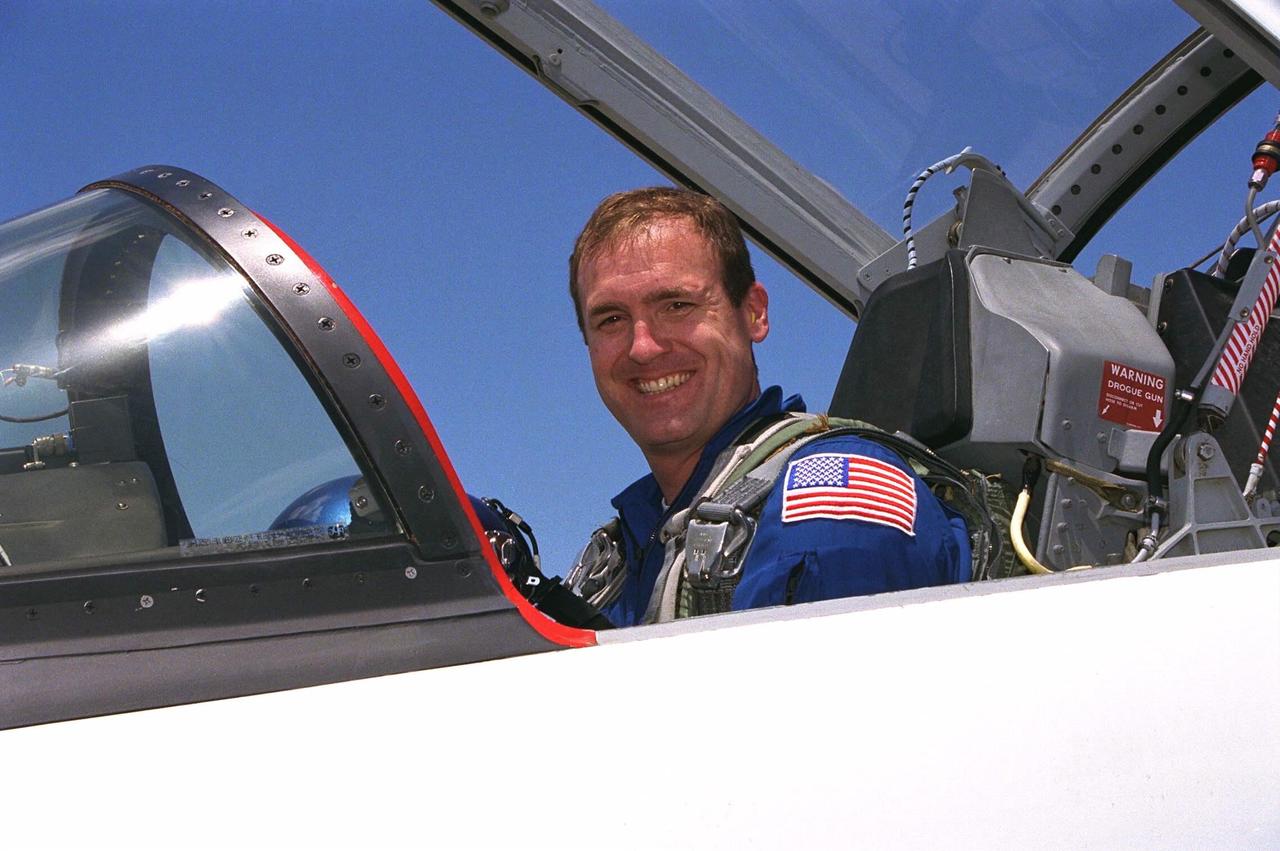
STS-94 Commander James D. Halsell, Jr., arrives at the Shuttle Landing Facility aboard a T-38 jet in preparation for the reflight of the Microgravity Science Laboratory-1 mission. Launch is scheduled for July 1, 1997, at 2:37 p.m. EDT. The laboratory was scheduled to fly again with the full complement of STS-83 experiments after that mission was cut short due to a faulty fuel cell. During the scheduled 16-day STS-94 mission, the experiments will be used to test some of the hardware, facilities and procedures that are planned for use on the International Space Station while the flight crew conducts combustion, protein crystal growth and materials processing experiments
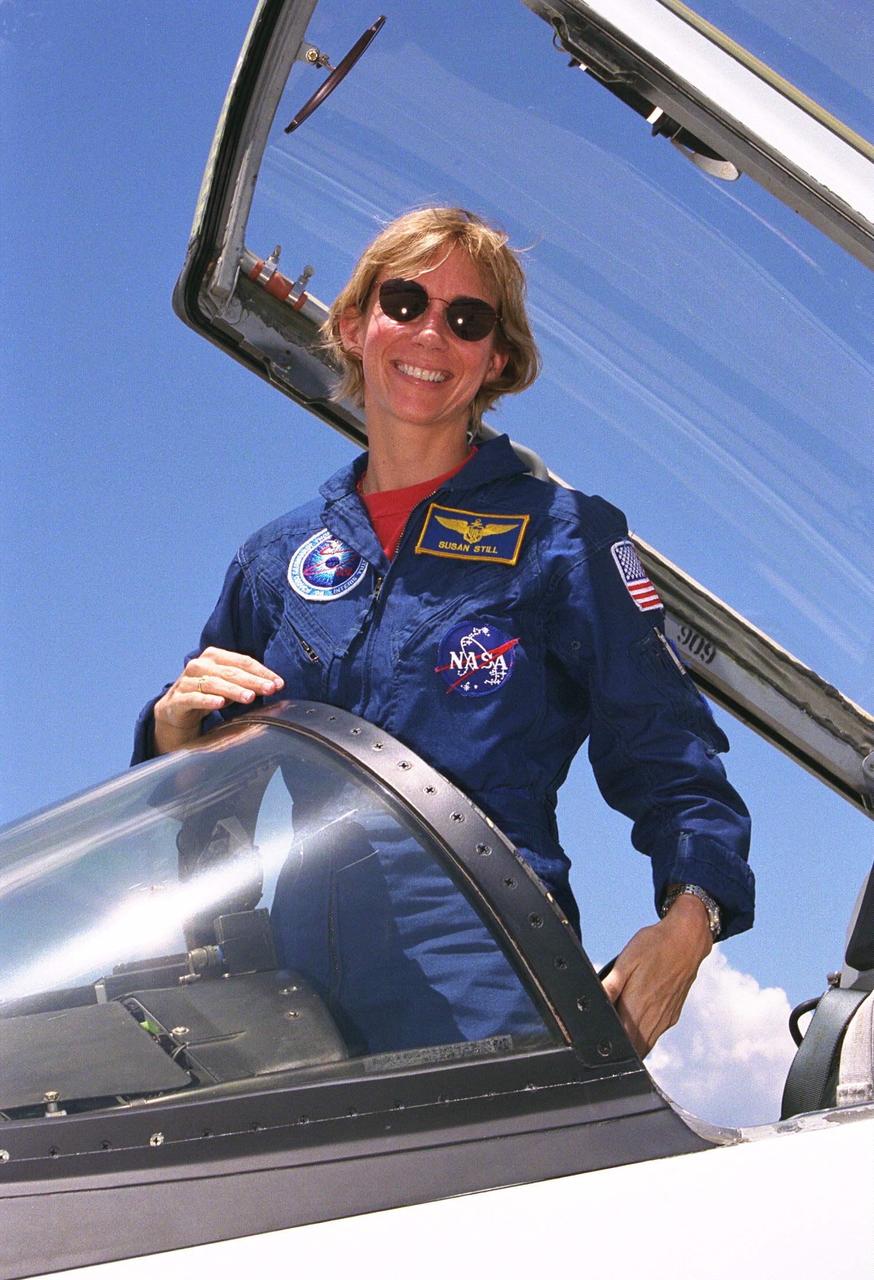
STS-94 Pilot Susan Leigh Still arrives at the Shuttle Landing Facility aboard a T-38 jet in preparation for the reflight of the Microgravity Science Laboratory-1 mission. Launch is scheduled for July 1, 1997, at 2:37 p.m. EDT. The laboratory was scheduled to fly again with the full complement of STS-83 experiments after that mission was cut short due to a faulty fuel cell. During the scheduled 16-day STS-94 mission, the experiments will be used to test some of the hardware, facilities and procedures that are planned for use on the International Space Station while the flight crew conducts combustion, protein crystal growth and materials processing experiments
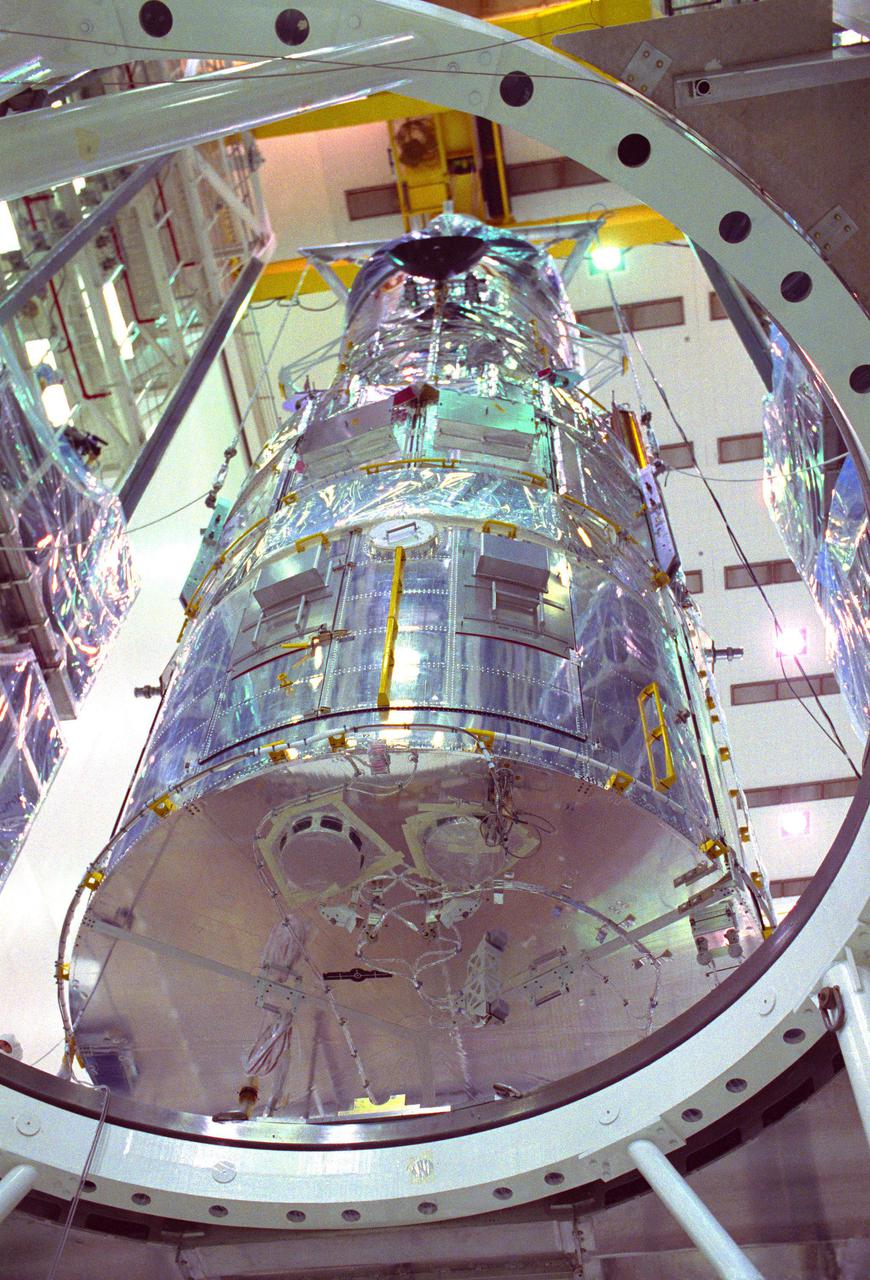
KENNEDY SPACE CENTER, FLA. -- The Hubble Space Telescope (HST) is lifted into the workstands in the Vertical Processing Facility as work begins at KSC to process the 94-inch primary mirror telescope for launch on Discovery on Space Shuttle Mission STS-31 in March 1990.
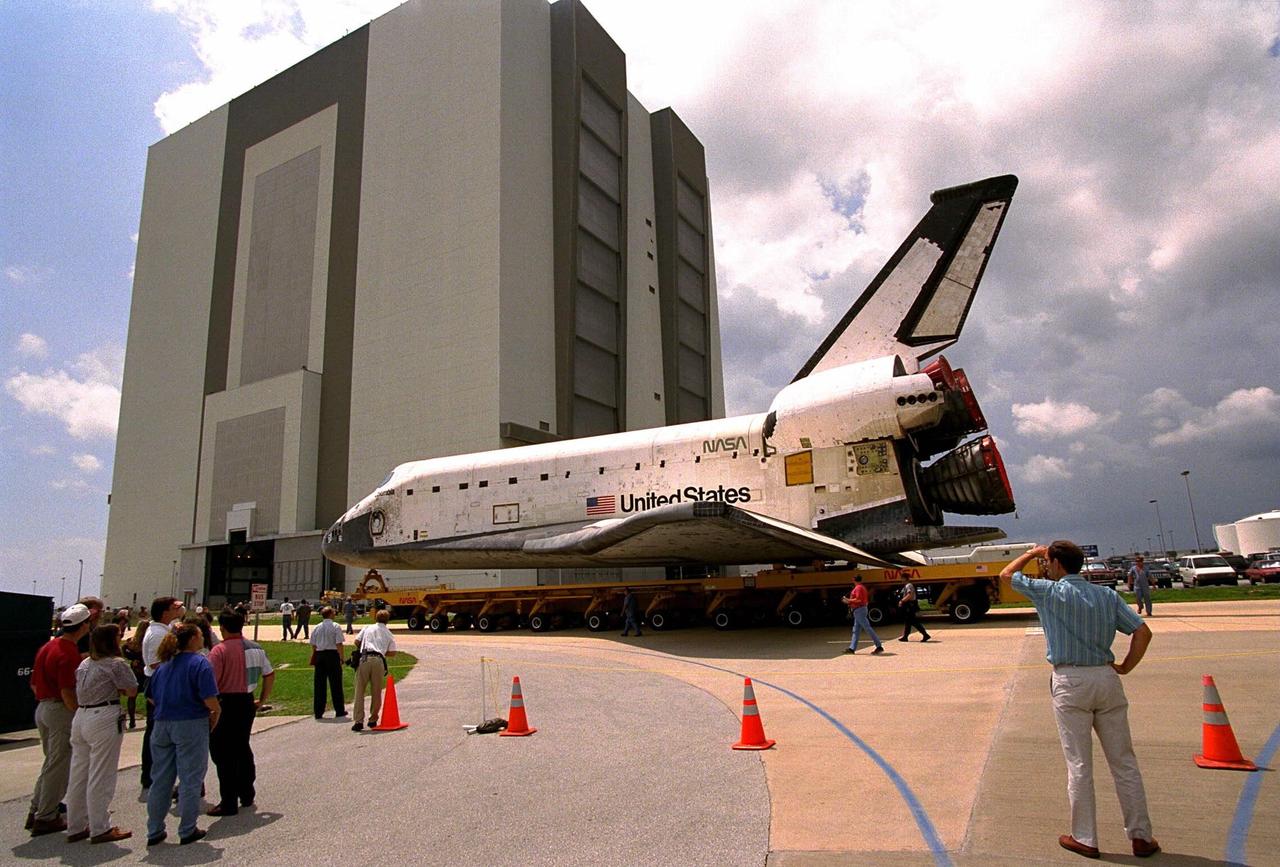
While KSC workers in the Launch Complex 39 Area watch, The Space Shuttle Orbiter Columbia rolls over to the Vehicle Assembly Building (VAB) June 4 from Orbiter Processing Facility (OPF)1 atop its transporter in preparation for the STS-94 mission. Once inside the VAB, Columbia will be hoisted to be mated with its solid rocket boosters and external tank. Columbia was moved to the OPF April 8 after the completion of the STS-83 mission. KSC payloads processing employees then began work to reservice the Microgravity Science Laboratory-1 (MSL-1) Spacelab module in the orbiter’s payload bay for the STS-94 mission. This was the first time that this type of payload was reserviced without removing it from the payload bay. This new procedure pioneers processing efforts for possible quick relaunch turnaround times for future payloads. The MSL-1 module will fly again with the full complement of STS-83 experiments after that mission was cut short due to indications of a faulty fuel cell. During the scheduled 16-day STS-94 mission, the experiments will be used to test some of the hardware, facilities and procedures that are planned for use on the International Space Station while the flight crew conducts combustion, protein crystal growth and materials processing experiments
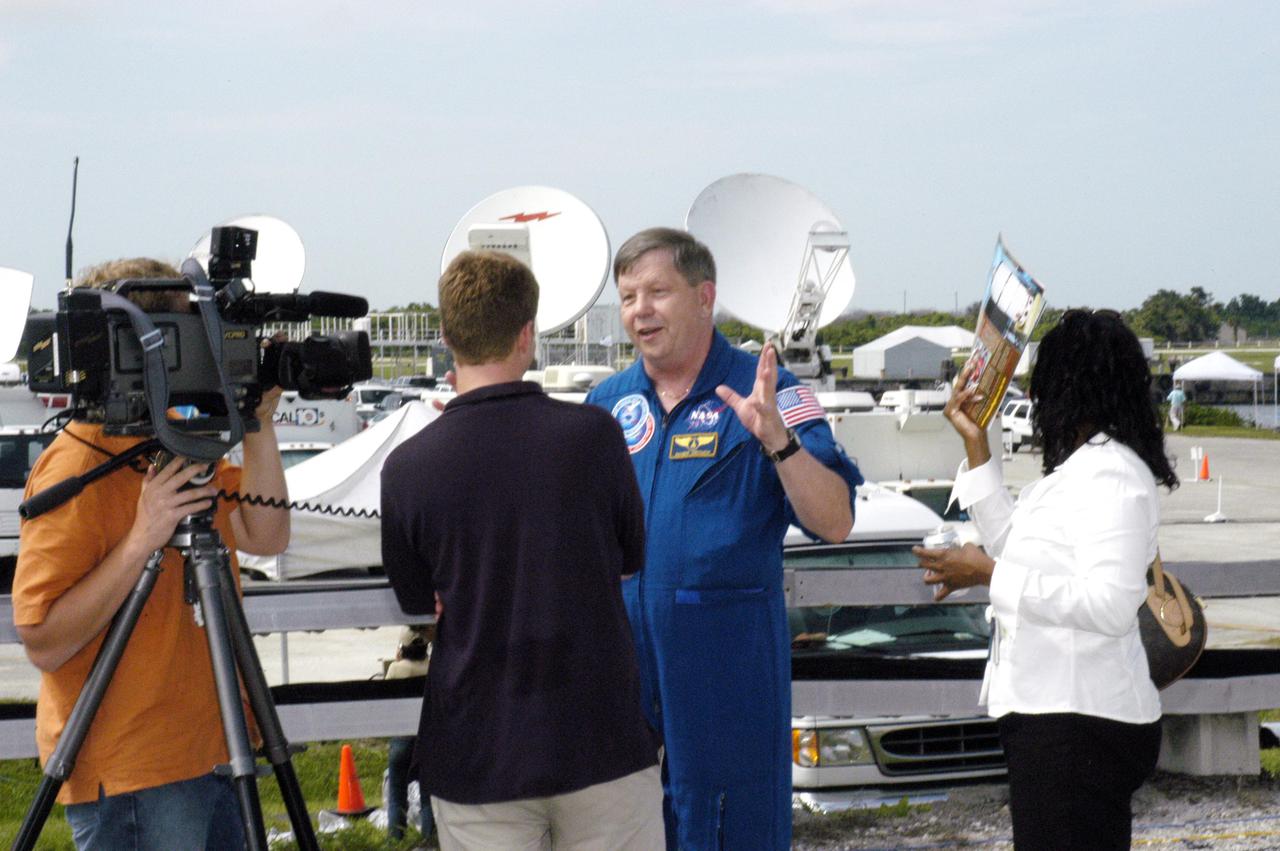
KENNEDY SPACE CENTER, FLA. - Roger Crouch (center), a payload specialist, talks to the media prior to the launch of Space Shuttle Discovery on the historic Return to Flight mission STS-114. He has flown on two Shuttle missions, STS-83 and STS-94. STS-114 is the 114th Space Shuttle flight and the 31st for Discovery. More than a thousand media representatives from 36 states, the District of Columbia and 32 countries converged on the News Center for the historic launch.
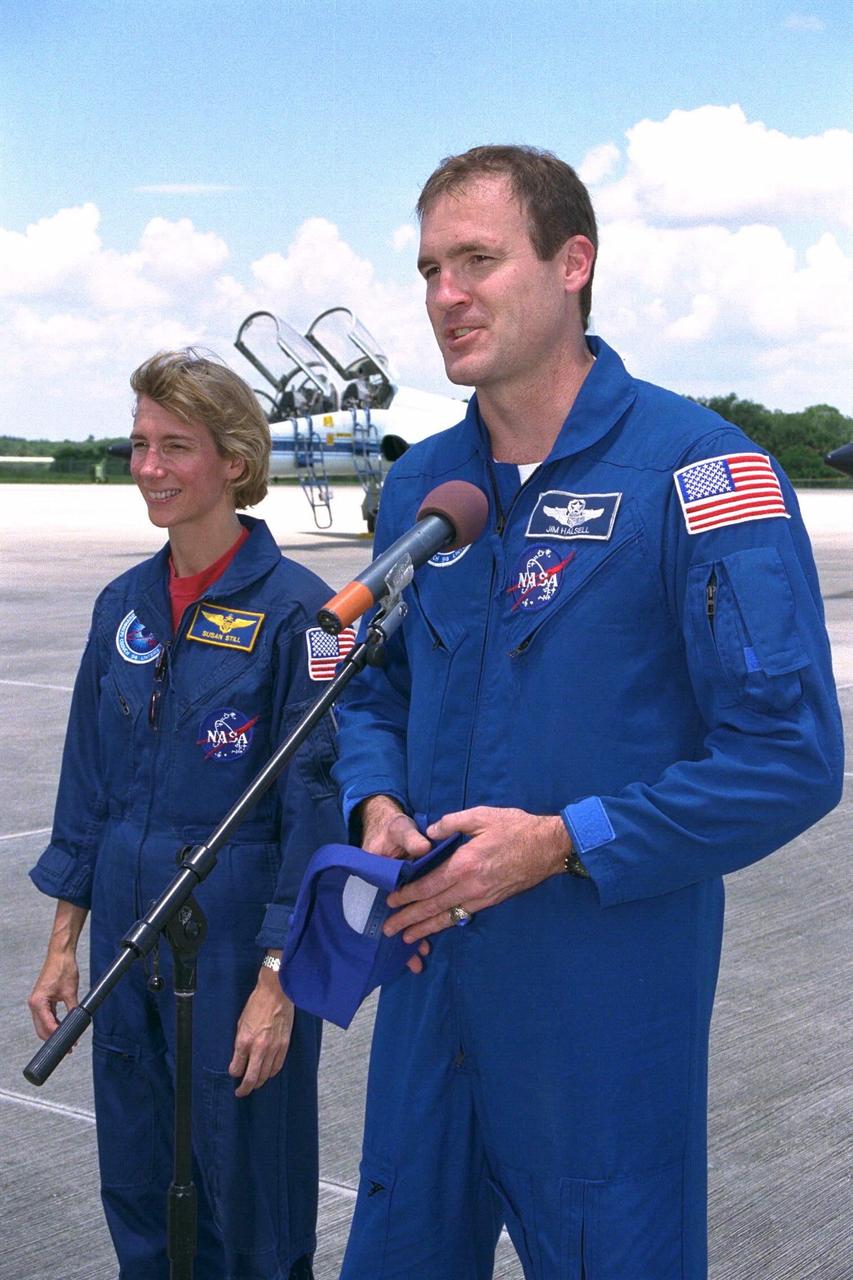
STS-94 Pilot Susan Leigh Still watches as Commander James D. Halsell, Jr., speaks to the media after the crew arrived at the Shuttle Landing Facility at Kennedy Space Center in preparation for the reflight of the Microgravity Science Laboratory-1 mission. Launch is scheduled for July 1, 1997, at 2:37 p.m. EDT. The laboratory was scheduled to fly again with the full complement of STS-83 experiments after that mission was cut short due to a faulty fuel cell. During the scheduled 16-day STS-94 mission, the experiments will be used to test some of the hardware, facilities and procedures that are planned for use on the International Space Station while the flight crew conducts combustion, protein crystal growth and materials processing experiments
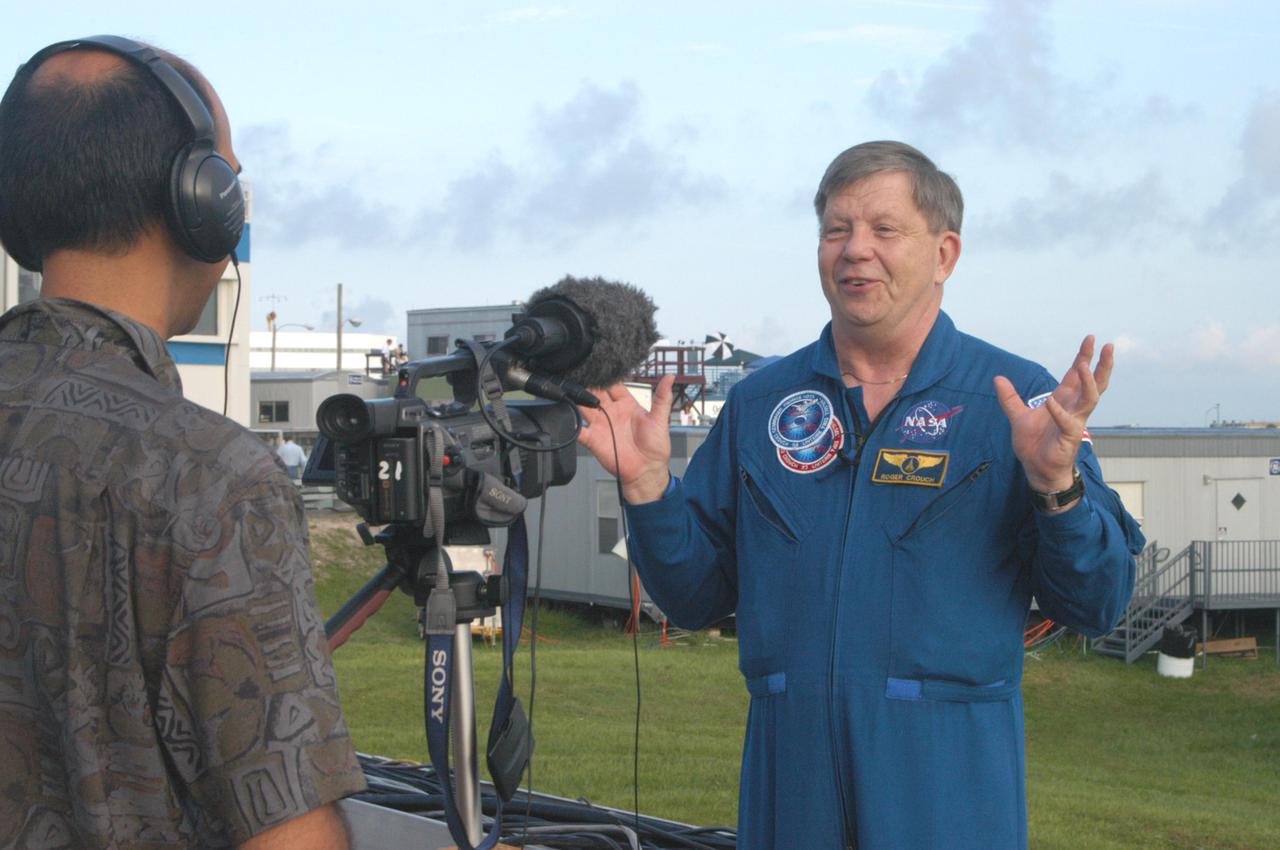
KENNEDY SPACE CENTER, FLA. - Roger Crouch, a payload specialist, talks to the media prior to the launch at 3:51 p.m. of Space Shuttle Discovery on the historic Return to Flight mission STS-114. He has flown on two Shuttle missions, STS-83 and STS-94. STS-114 is the 114th Space Shuttle flight and the 31st for Discovery. The 12-day mission is expected to end with touchdown at the Shuttle Landing Facility at 11:06 a.m. July 25.
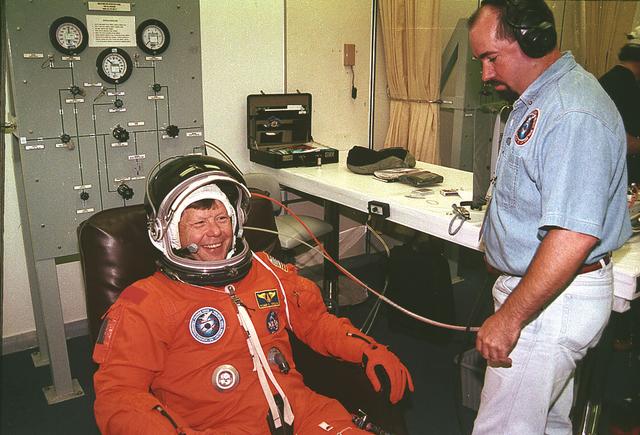
STS-94 Payload Specialist Roger K. Crouch is helped into his launch/entry suit by a suit technician in the Operations and Checkout (OC) building after the suit has been given a pressure test. He is the Chief Scientist of the NASA Microgravity Space and Applications Division. He also has served as a Program Scientist for previous missions and is an expert in semiconductor crystal growth. Crouch and six other crewmembers prepare to depart the OC and head for Launch Pad 39a, where the Space Shuttle Columbia will lift off.
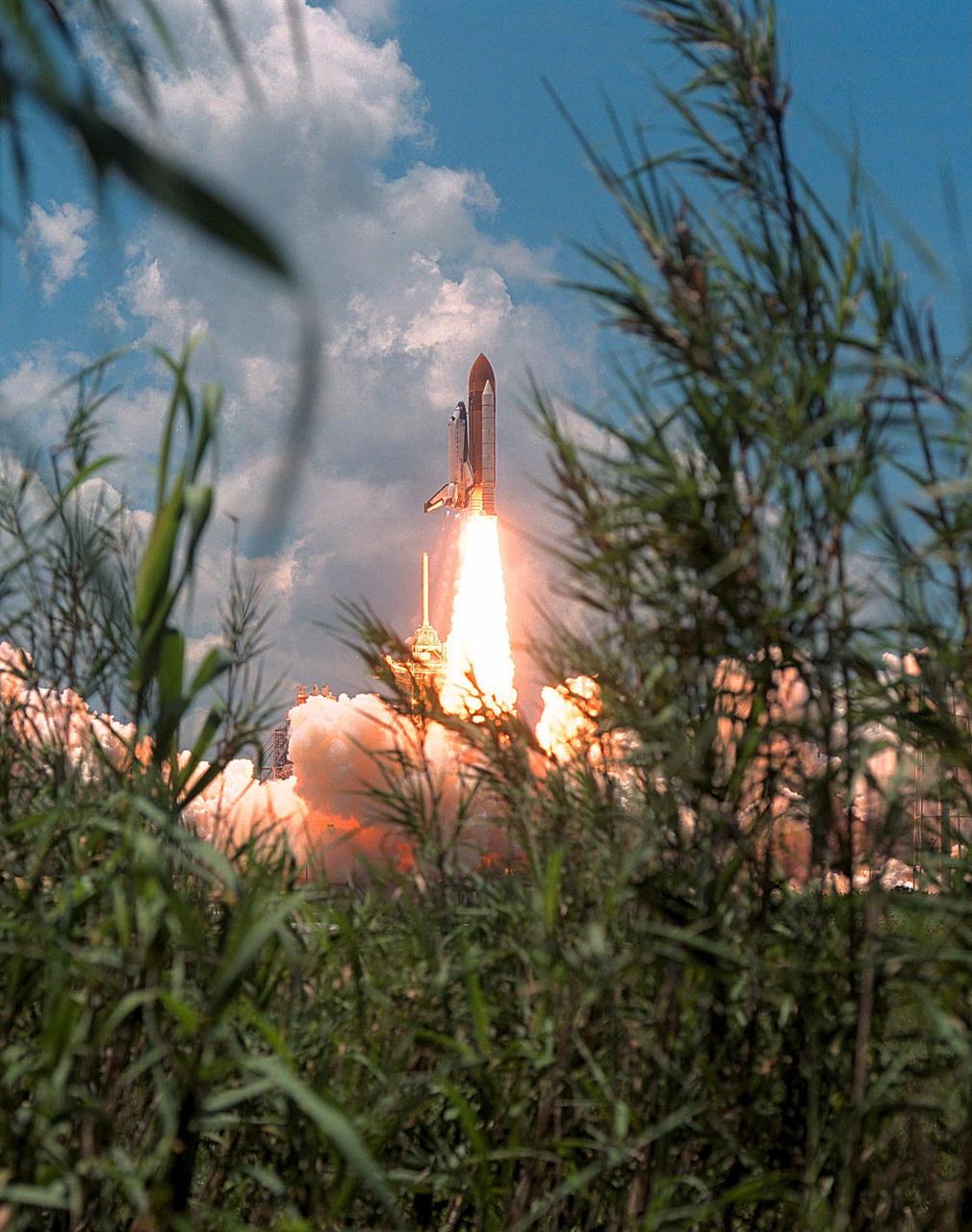
KENNEDY SPACE CENTER, Fla. -- The Space Shuttle Columbia soars from Launch Pad 39A at 2:02 p.m. EDT July 1 to begin the 16-day STS-94 Microgravity Science Laboratory-1 (MSL-1) mission. The launch window was opened 47 minutes earlier than the originally scheduled time of 2:37 p.m. to improve the opportunity to lift off before Florida summer rain showers reached the space center. The crew members are Mission Commander James D. Halsell Jr.; Pilot Susan L. Still; Payload Commander Janice Voss; Mission Specialists Michael L.Gernhardt and Donald A. Thomas; and Payload Specialists Roger K. Crouch and Gregory T. Linteris. During the space flight, the MSL-1 will be used to test some of the hardware, facilities and procedures that are planned for use on the International Space Station while the flight crew conducts combustion, protein crystal growth and materials processing experiments. Also onboard is the Hitchhiker Cryogenic Flexible Diode (CRYOFD) experiment payload, which is attached to the right side of Columbia’s payload bay. These payloads had previously flown on the STS-83 mission in April, which was cut short after nearly four days because of indications of a faulty fuel cell. STS-94 is a reflight of that mission
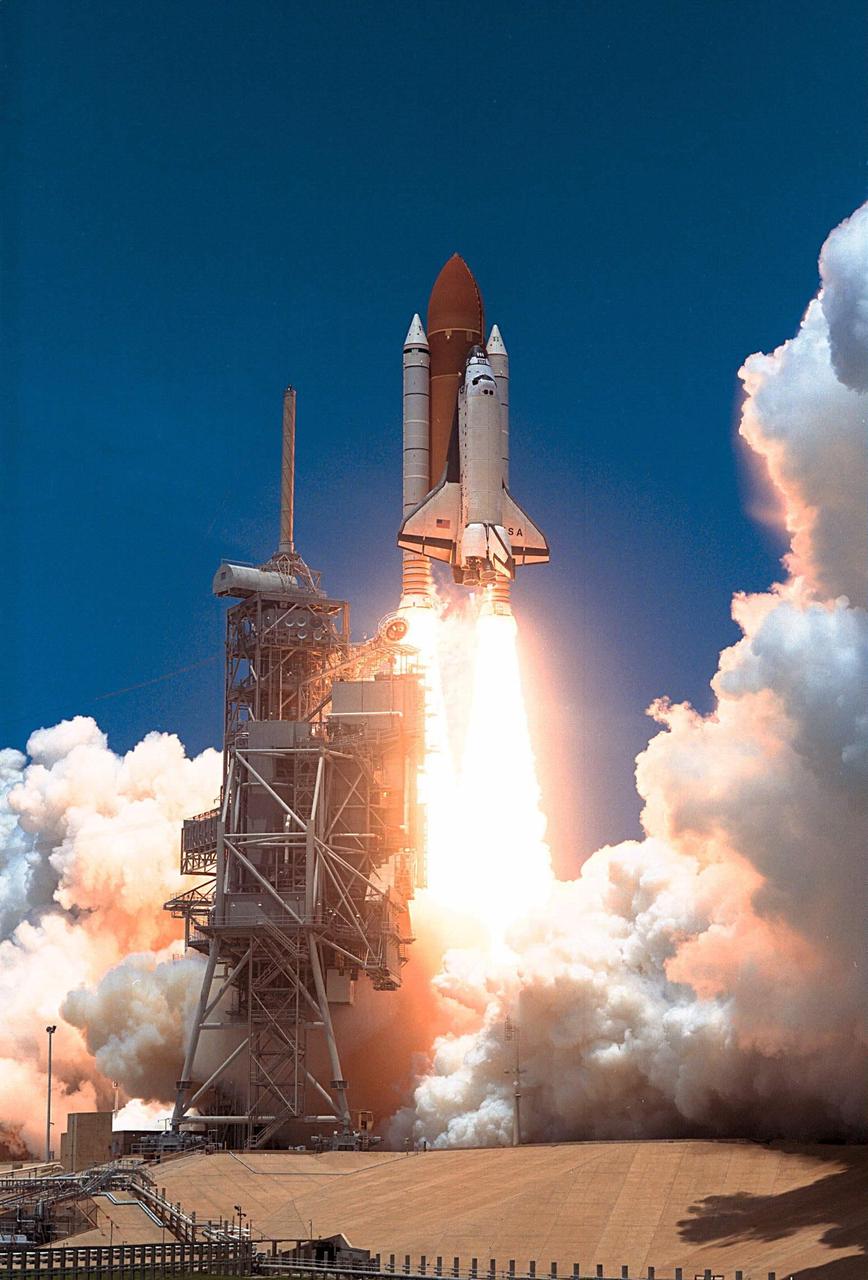
KENNEDY SPACE CENTER, Fla. -- The Space Shuttle Columbia soars from Launch Pad 39A at 2:02 p.m. EDT July 1 to begin the 16-day STS-94 Microgravity Science Laboratory-1 (MSL-1) mission. The launch window was opened 47 minutes earlier than the originally scheduled time of 2:37 p.m. to improve the opportunity to lift off before Florida summer rain showers reached the space center. The crew members are Mission Commander James D. Halsell Jr.; Pilot Susan L. Still; Payload Commander Janice Voss; Mission Specialists Michael L.Gernhardt and Donald A. Thomas; and Payload Specialists Roger K. Crouch and Gregory T. Linteris. During the space flight, the MSL-1 will be used to test some of the hardware, facilities and procedures that are planned for use on the International Space Station while the flight crew conducts combustion, protein crystal growth and materials processing experiments. Also onboard is the Hitchhiker Cryogenic Flexible Diode (CRYOFD) experiment payload, which is attached to the right side of Columbia’s payload bay. These payloads had previously flown on the STS-83 mission in April, which was cut short after nearly four days because of indications of a faulty fuel cell. STS-94 is a reflight of that mission
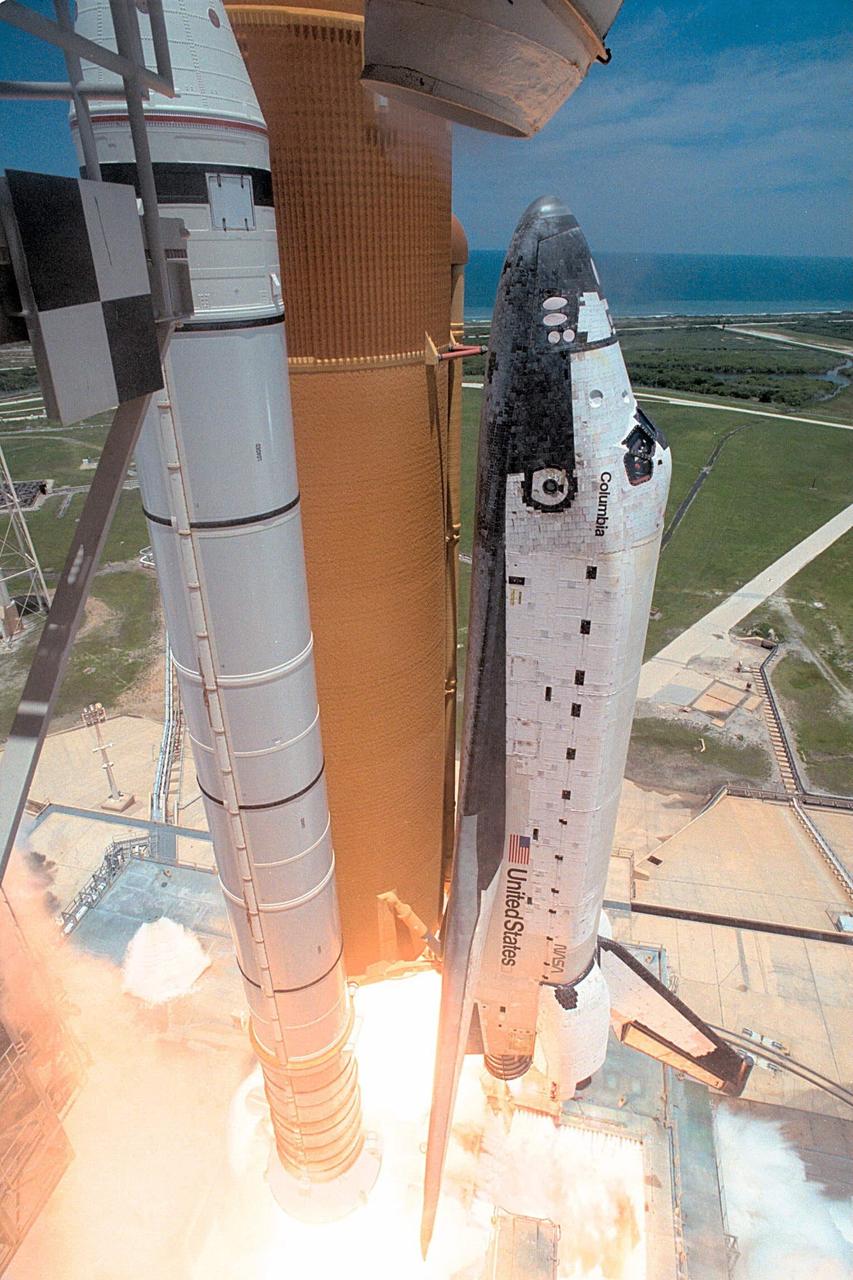
KENNEDY SPACE CENTER, Fla. -- The Space Shuttle Columbia soars from Launch Pad 39A at 2:02 p.m. EDT July 1 to begin the 16-day STS-94 Microgravity Science Laboratory-1 (MSL-1) mission. The launch window was opened 47 minutes earlier than the originally scheduled time of 2:37 p.m. to improve the opportunity to lift off before Florida summer rain showers reached the space center. The crew members are Mission Commander James D. Halsell Jr.; Pilot Susan L. Still; Payload Commander Janice Voss; Mission Specialists Michael L.Gernhardt and Donald A. Thomas; and Payload Specialists Roger K. Crouch and Gregory T. Linteris. During the space flight, the MSL-1 will be used to test some of the hardware, facilities and procedures that are planned for use on the International Space Station while the flight crew conducts combustion, protein crystal growth and materials processing experiments. Also onboard is the Hitchhiker Cryogenic Flexible Diode (CRYOFD) experiment payload, which is attached to the right side of Columbia’s payload bay. These payloads had previously flown on the STS-83 mission in April, which was cut short after nearly four days because of indications of a faulty fuel cell. STS-94 is a reflight of that mission
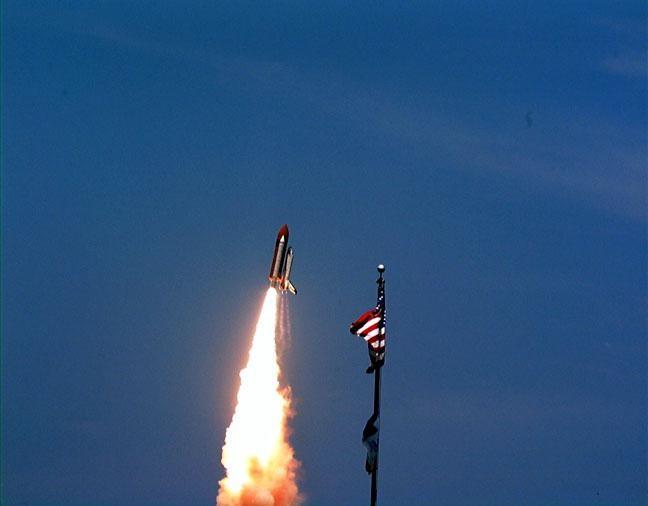
The Space Shuttle Columbia soars from Launch Pad 39A at 2:02 p.m. EDT July 1 to begin the 16-day STS-94 Microgravity Science Laboratory-1 (MSL-1) mission. The launch window was opened 47 minutes earlier than the originally scheduled time of 2:37 p.m. to improve the opportunity to lift off before Florida summer rain showers reached the space center. The crew members are Mission Commander James D. Halsell Jr.; Pilot Susan L. Still; Payload Commander Janice Voss; Mission Specialists Michael L.Gernhardt and Donald A. Thomas; and Payload Specialists Roger K. Crouch and Gregory T. Linteris. During the space flight, the MSL-1 will be used to test some of the hardware, facilities and procedures that are planned for use on the International Space Station while the flight crew conducts combustion, protein crystal growth and materials processing experiments. Also onboard is the Hitchhiker Cryogenic Flexible Diode (CRYOFD) experiment payload, which is attached to the right side of Columbia’s payload bay. These payloads had previously flown on the STS-83 mission in April, which was cut short after nearly four days because of indications of a faulty fuel cell. STS-94 is a reflight of that mission
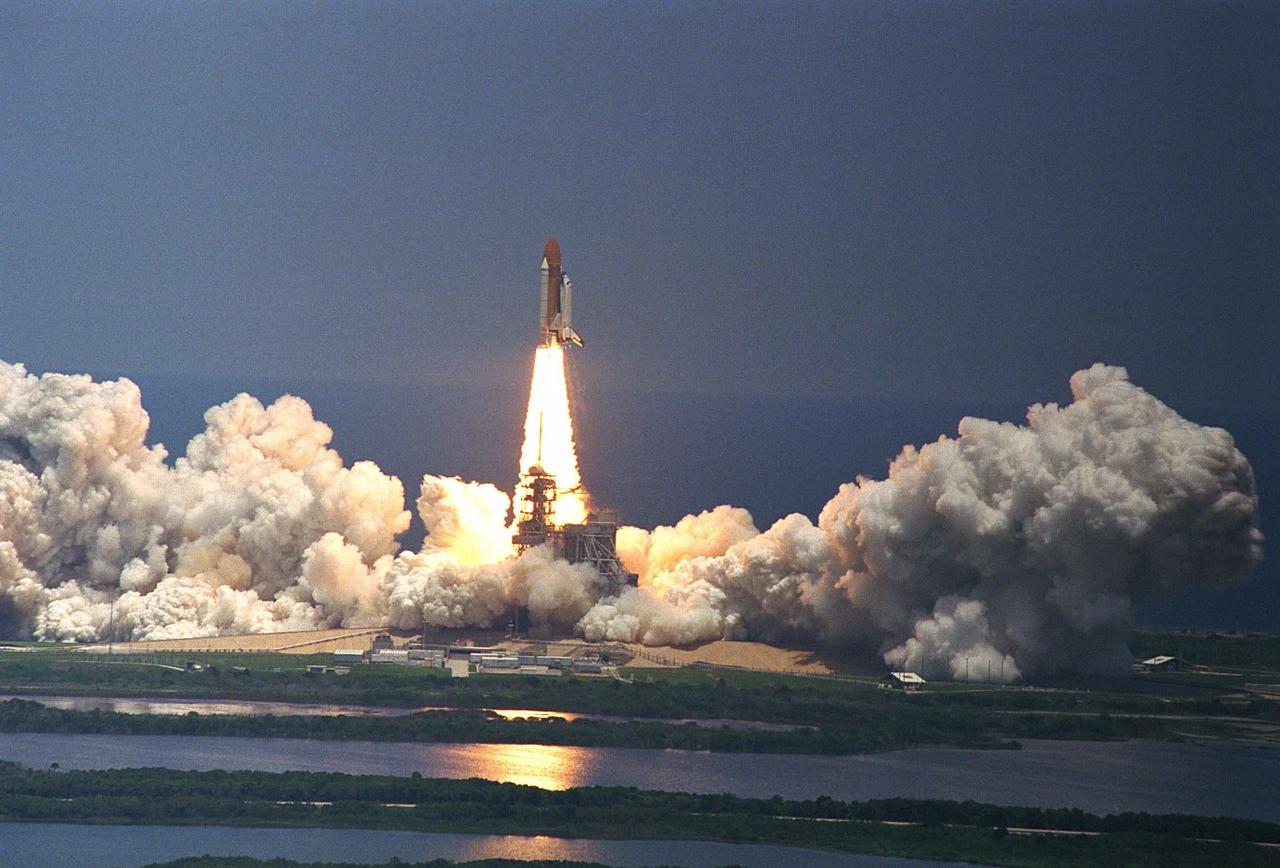
KENNEDY SPACE CENTER, Fla. -- The Space Shuttle Columbia soars from Launch Pad 39A at 2:02 p.m. EDT July 1 to begin the 16-day STS-94 Microgravity Science Laboratory-1 (MSL-1) mission. The launch window was opened 47 minutes earlier than the originally scheduled time of 2:37 p.m. to improve the opportunity to lift off before Florida summer rain showers reached the space center. The crew members are Mission Commander James D. Halsell Jr.; Pilot Susan L. Still; Payload Commander Janice Voss; Mission Specialists Michael L.Gernhardt and Donald A. Thomas; and Payload Specialists Roger K. Crouch and Gregory T. Linteris. During the space flight, the MSL-1 will be used to test some of the hardware, facilities and procedures that are planned for use on the International Space Station while the flight crew conducts combustion, protein crystal growth and materials processing experiments. Also onboard is the Hitchhiker Cryogenic Flexible Diode (CRYOFD) experiment payload, which is attached to the right side of Columbia’s payload bay. These payloads had previously flown on the STS-83 mission in April, which was cut short after nearly four days because of indications of a faulty fuel cell. STS-94 is a reflight of that mission
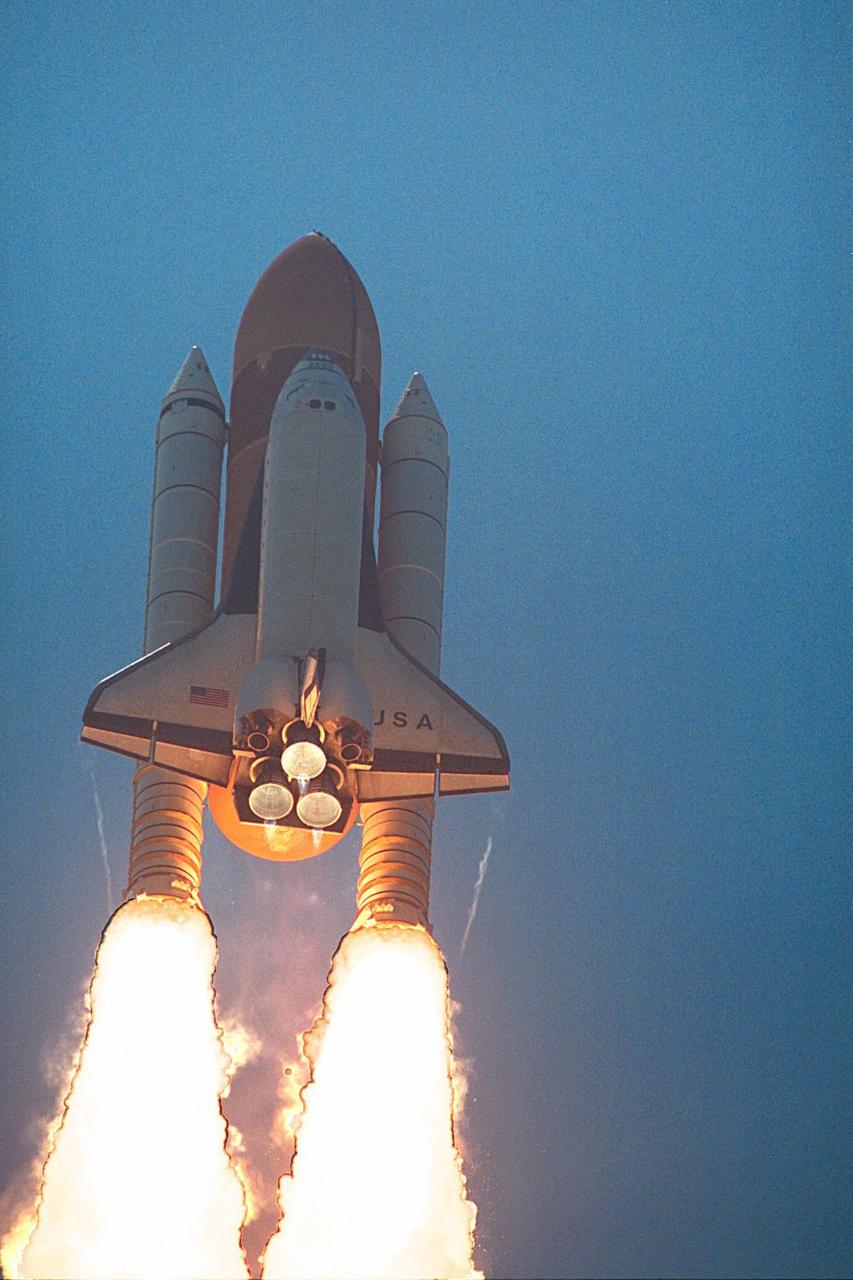
KENNEDY SPACE CENTER, Fla. -- The Space Shuttle Columbia soars from Launch Pad 39A at 2:02 p.m. EDT July 1 to begin the 16-day STS-94 Microgravity Science Laboratory-1 (MSL-1) mission. The launch window was opened 47 minutes earlier than the originally scheduled time of 2:37 p.m. to improve the opportunity to lift off before Florida summer rain showers reached the space center. The crew members are Mission Commander James D. Halsell Jr.; Pilot Susan L. Still; Payload Commander Janice Voss; Mission Specialists Michael L.Gernhardt and Donald A. Thomas; and Payload Specialists Roger K. Crouch and Gregory T. Linteris. During the space flight, the MSL-1 will be used to test some of the hardware, facilities and procedures that are planned for use on the International Space Station while the flight crew conducts combustion, protein crystal growth and materials processing experiments. Also onboard is the Hitchhiker Cryogenic Flexible Diode (CRYOFD) experiment payload, which is attached to the right side of Columbia’s payload bay. These payloads had previously flown on the STS-83 mission in April, which was cut short after nearly four days because of indications of a faulty fuel cell. STS-94 is a reflight of that mission
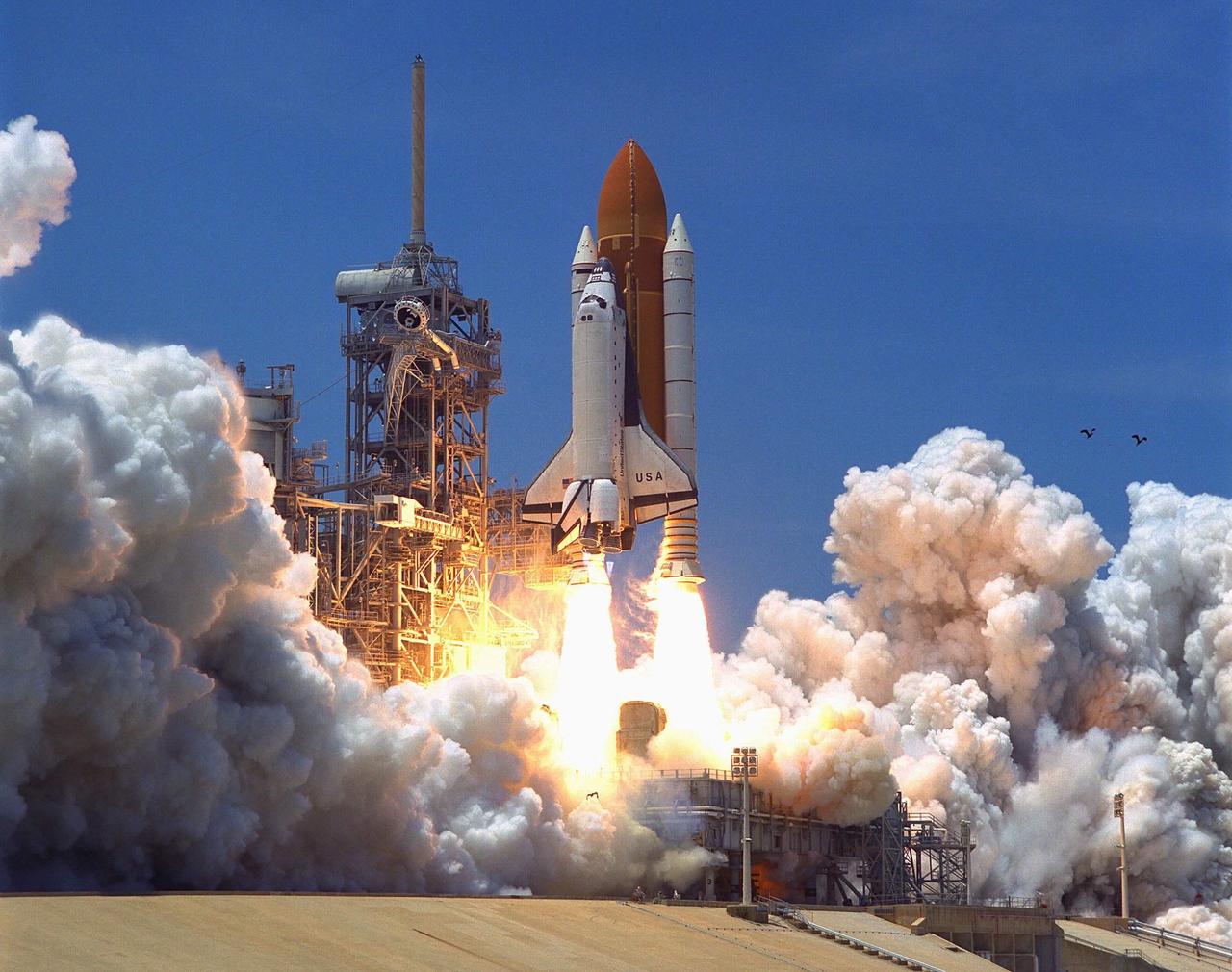
KENNEDY SPACE CENTER, Fla. -- The Space Shuttle Columbia soars from Launch Pad 39A at 2:02 p.m. EDT July 1 to begin the 16-day STS-94 Microgravity Science Laboratory-1 (MSL-1) mission. The launch window was opened 47 minutes earlier than the originally scheduled time of 2:37 p.m. to improve the opportunity to lift off before Florida summer rain showers reached the space center. The crew members are Mission Commander James D. Halsell Jr.; Pilot Susan L. Still; Payload Commander Janice Voss; Mission Specialists Michael L.Gernhardt and Donald A. Thomas; and Payload Specialists Roger K. Crouch and Gregory T. Linteris. During the space flight, the MSL-1 will be used to test some of the hardware, facilities and procedures that are planned for use on the International Space Station while the flight crew conducts combustion, protein crystal growth and materials processing experiments. Also onboard is the Hitchhiker Cryogenic Flexible Diode (CRYOFD) experiment payload, which is attached to the right side of Columbia’s payload bay. These payloads had previously flown on the STS-83 mission in April, which was cut short after nearly four days because of indications of a faulty fuel cell. STS-94 is a reflight of that mission
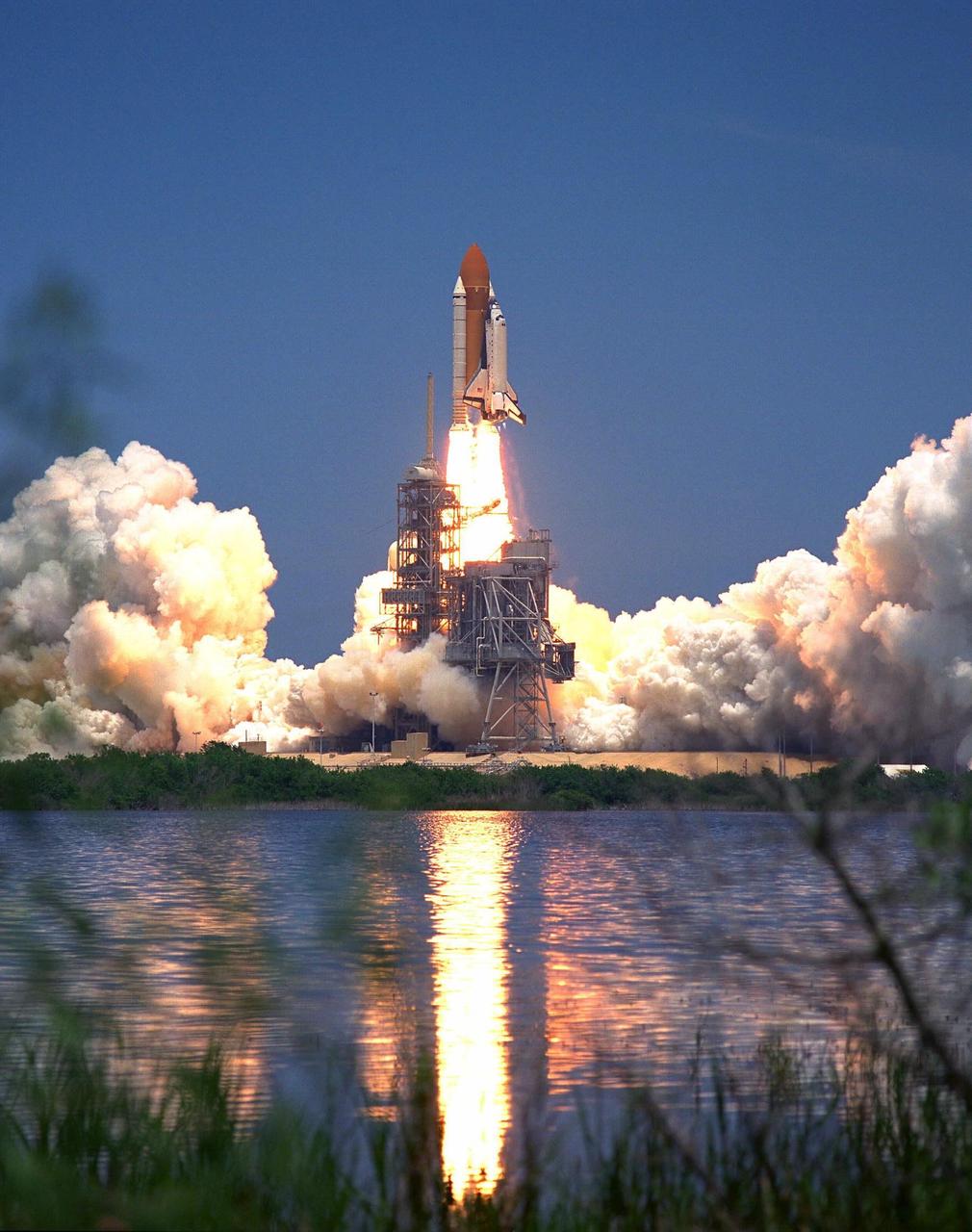
KENNEDY SPACE CENTER, Fla. -- The Space Shuttle Columbia soars from Launch Pad 39A at 2:02 p.m. EDT July 1 to begin the 16-day STS-94 Microgravity Science Laboratory-1 (MSL-1) mission. The launch window was opened 47 minutes earlier than the originally scheduled time of 2:37 p.m. to improve the opportunity to lift off before Florida summer rain showers reached the space center. The crew members are Mission Commander James D. Halsell Jr.; Pilot Susan L. Still; Payload Commander Janice Voss; Mission Specialists Michael L.Gernhardt and Donald A. Thomas; and Payload Specialists Roger K. Crouch and Gregory T. Linteris. During the space flight, the MSL-1 will be used to test some of the hardware, facilities and procedures that are planned for use on the International Space Station while the flight crew conducts combustion, protein crystal growth and materials processing experiments. Also onboard is the Hitchhiker Cryogenic Flexible Diode (CRYOFD) experiment payload, which is attached to the right side of Columbia’s payload bay. These payloads had previously flown on the STS-83 mission in April, which was cut short after nearly four days because of indications of a faulty fuel cell. STS-94 is a reflight of that mission
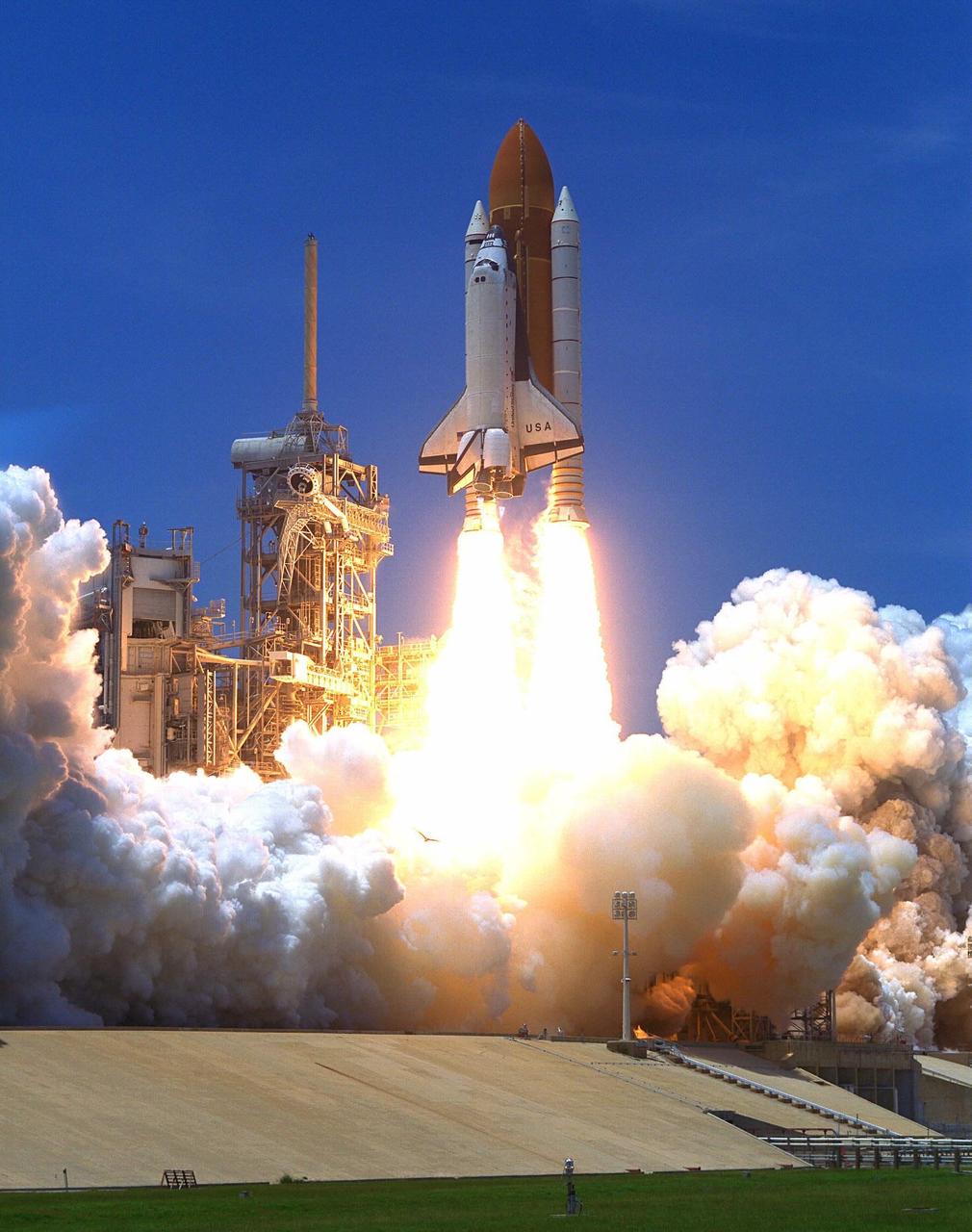
KENNEDY SPACE CENTER, Fla. -- The Space Shuttle Columbia soars from Launch Pad 39A at 2:02 p.m. EDT July 1 to begin the 16-day STS-94 Microgravity Science Laboratory-1 (MSL-1) mission. The launch window was opened 47 minutes earlier than the originally scheduled time of 2:37 p.m. to improve the opportunity to lift off before Florida summer rain showers reached the space center. The crew members are Mission Commander James D. Halsell Jr.; Pilot Susan L. Still; Payload Commander Janice Voss; Mission Specialists Michael L.Gernhardt and Donald A. Thomas; and Payload Specialists Roger K. Crouch and Gregory T. Linteris. During the space flight, the MSL-1 will be used to test some of the hardware, facilities and procedures that are planned for use on the International Space Station while the flight crew conducts combustion, protein crystal growth and materials processing experiments. Also onboard is the Hitchhiker Cryogenic Flexible Diode (CRYOFD) experiment payload, which is attached to the right side of Columbia’s payload bay. These payloads had previously flown on the STS-83 mission in April, which was cut short after nearly four days because of indications of a faulty fuel cell. STS-94 is a reflight of that mission
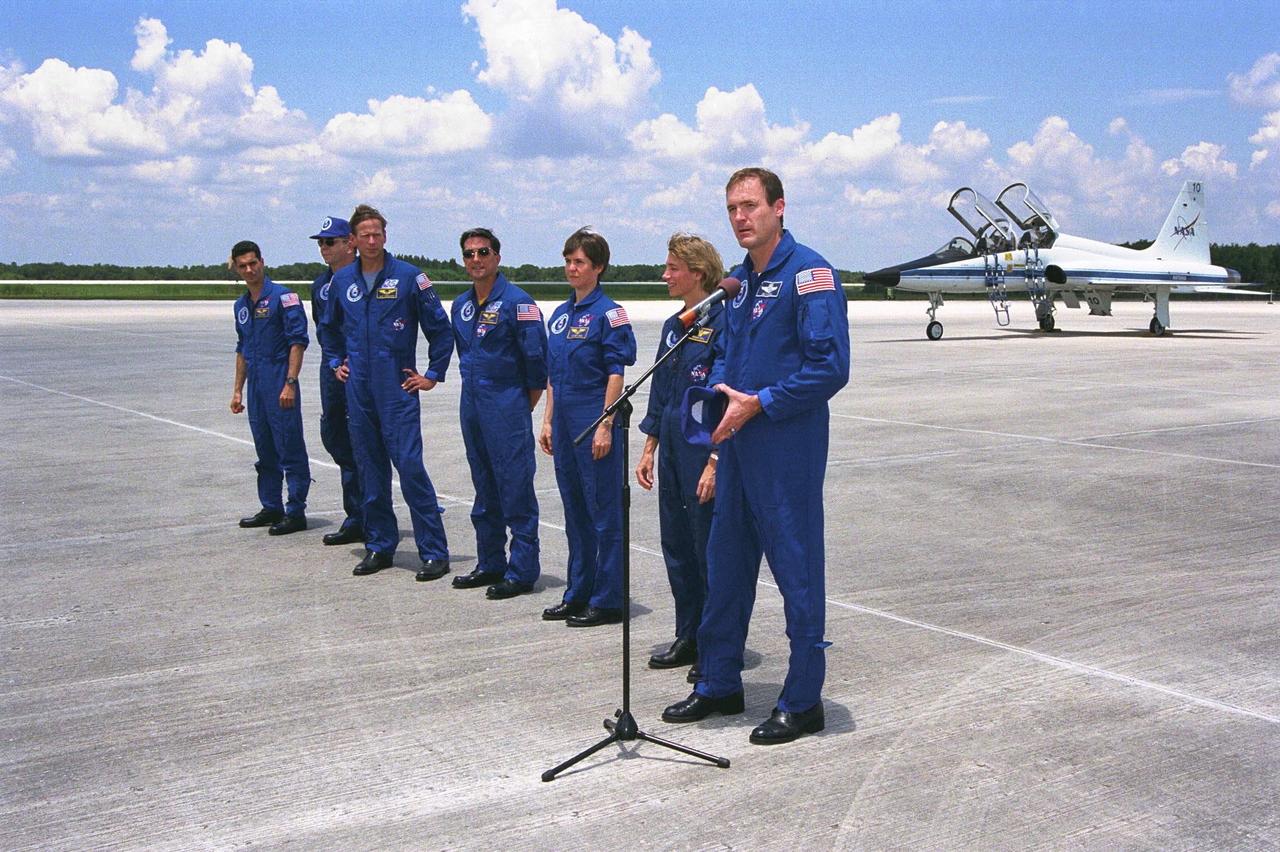
STS-94 Commander James D. Halsell, Jr., speaks to the media at the Shuttle Landing Facility after the crew arrived at Kennedy Space Center in preparation for the reflight of the Microgravity Science Laboratory-1 mission. Launch is scheduled for July 1, 1997, at 2:37 p.m. EDT. From left to right, the crew members are Payload Specialists Gregory T. Linteris and Roger K. Crouch; Mission Specialists Michael L. Gernhardt and Donald A. Thomas; Payload Commander Janice E. Voss; Pilot Susan Leigh Still and Commander James D. Halsell, Jr. One of the T-38 jets aboard which the crew arrived can be seen in the background. The laboratory was scheduled to fly again with the full complement of STS-83 experiments after that mission was cut short due to a faulty fuel cell. During the scheduled 16-day STS-94 mission, the experiments will be used to test some of the hardware, facilities and procedures that are planned for use on the International Space Station while the flight crew conducts combustion, protein crystal growth and materials processing experiments
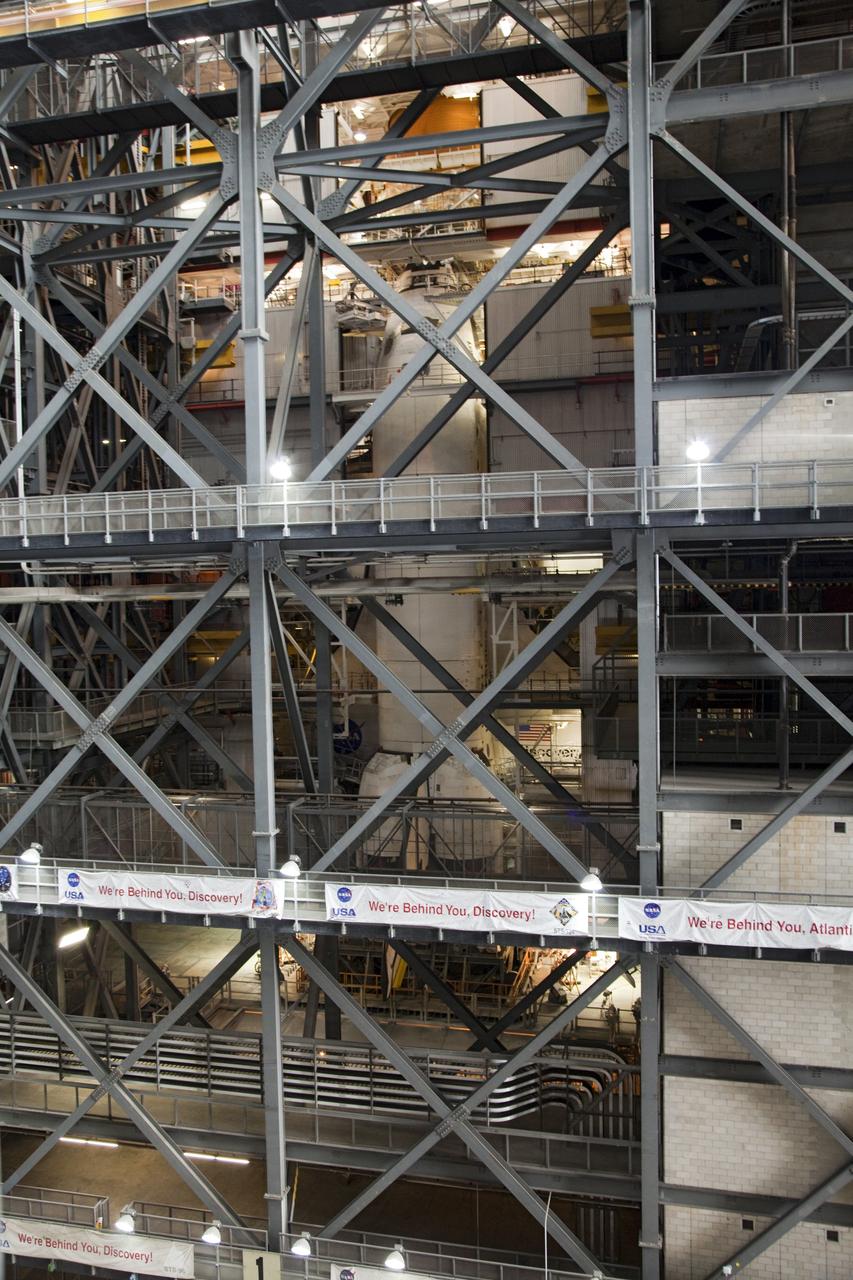
CAPE CANAVERAL, Fla. -- Repair work to space shuttle Discovery's external fuel tank continues in the Vehicle Assembly Building at NASA's Kennedy Space Center in Florida. Technicians are modifying 94 support beams, called stringers, on the tank's intertank region by fitting pieces of metal, called radius blocks, over the stringers' edges. After modifications to the stringers are complete, foam insulation will be re-applied to the tank. Discovery's next launch opportunity to the International Space Station on the STS-133 mission is targeted for Feb. 24. For more information on STS-133, visit www.nasa.gov/mission_pages/shuttle/shuttlemissions/sts133/. Photo credit: NASA/Frank Michaux
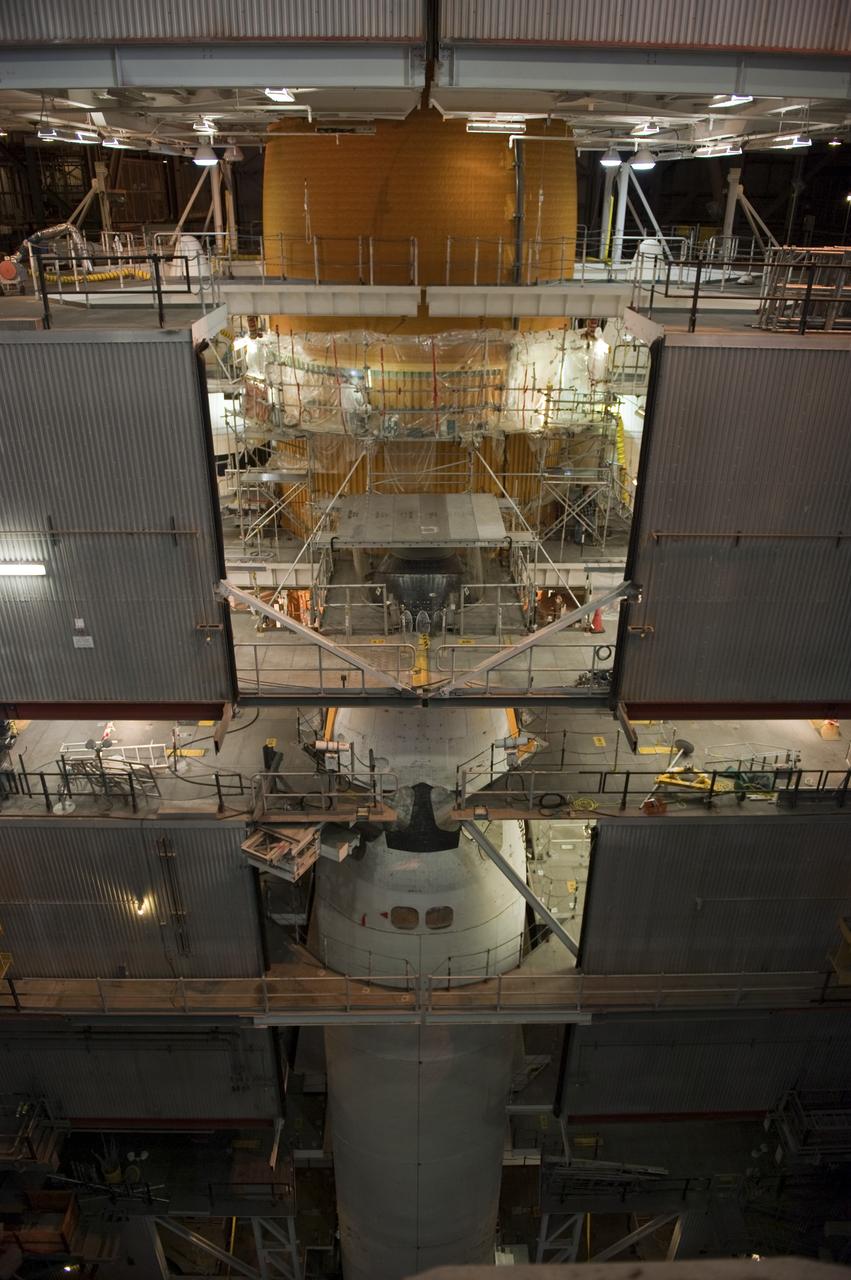
CAPE CANAVERAL, Fla. -- Repair work to space shuttle Discovery's external fuel tank continues in the Vehicle Assembly Building at NASA's Kennedy Space Center in Florida. Technicians are modifying 94 support beams, called stringers, on the tank's intertank region by fitting pieces of metal, called radius blocks, over the stringers' edges. After the modifications of the stringers are complete, foam insulation will be re-applied to the tank. Discovery's next launch opportunity to the International Space Station on the STS-133 mission is targeted for Feb. 24, 2011. For more information on STS-133, visit www.nasa.gov/mission_pages/shuttle/shuttlemissions/sts133/. Photo credit: NASA/Kim Shiflett

CAPE CANAVERAL, Fla. -- Repair work to space shuttle Discovery's external fuel tank continues in the Vehicle Assembly Building at NASA's Kennedy Space Center in Florida. Technicians are modifying 94 support beams, called stringers, on the tank's intertank region by fitting pieces of metal, called radius blocks, over the stringers' edges. After the modifications of the stringers are complete, foam insulation will be re-applied to the tank. Discovery's next launch opportunity to the International Space Station on the STS-133 mission is targeted for Feb. 24, 2011. For more information on STS-133, visit www.nasa.gov/mission_pages/shuttle/shuttlemissions/sts133/. Photo credit: NASA/Kim Shiflett
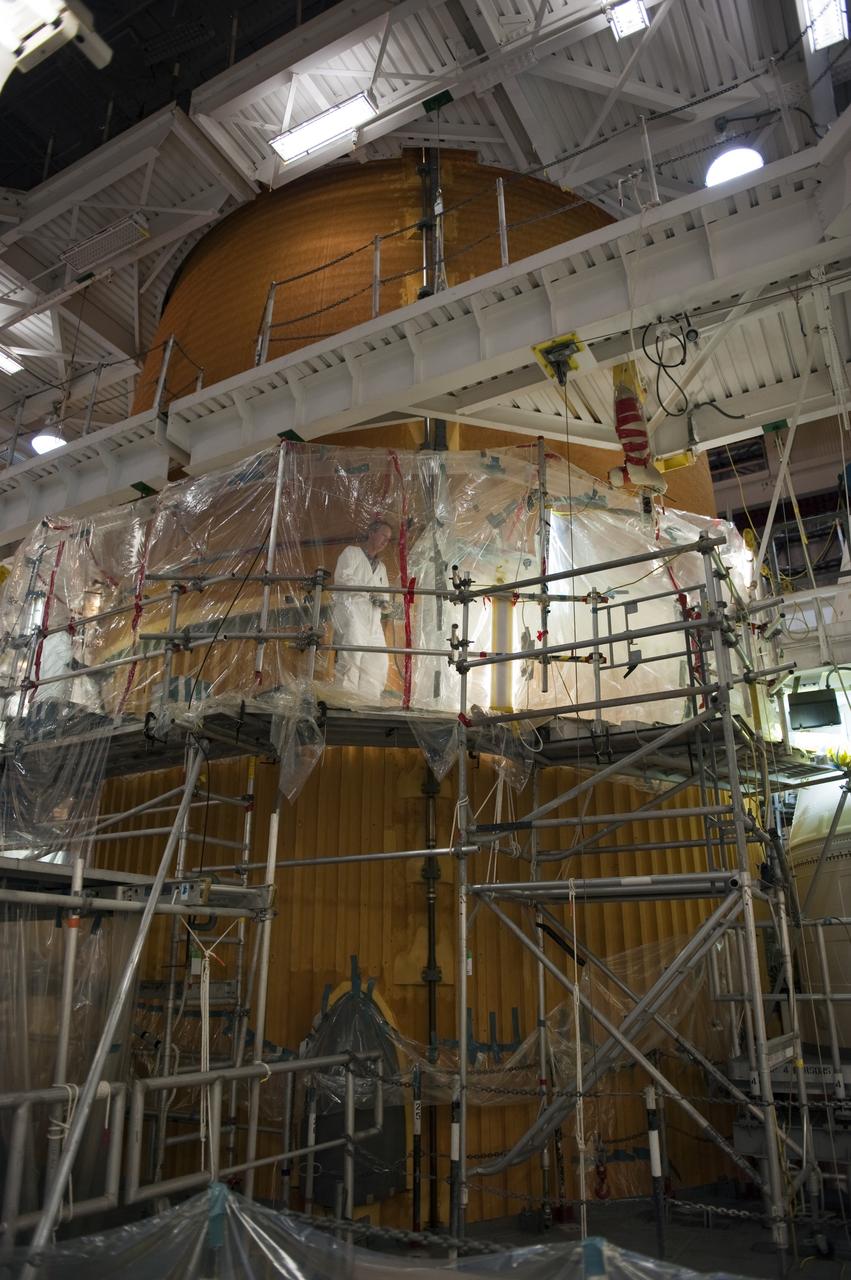
CAPE CANAVERAL, Fla. -- Repair work to space shuttle Discovery's external fuel tank continues in the Vehicle Assembly Building at NASA's Kennedy Space Center in Florida. Technicians are modifying 94 support beams, called stringers, on the tank's intertank region by fitting pieces of metal, called radius blocks, over the stringers' edges. After the modifications of the stringers are complete, foam insulation will be re-applied to the tank. Discovery's next launch opportunity to the International Space Station on the STS-133 mission is targeted for Feb. 24, 2011. For more information on STS-133, visit www.nasa.gov/mission_pages/shuttle/shuttlemissions/sts133/. Photo credit: NASA/Kim Shiflett
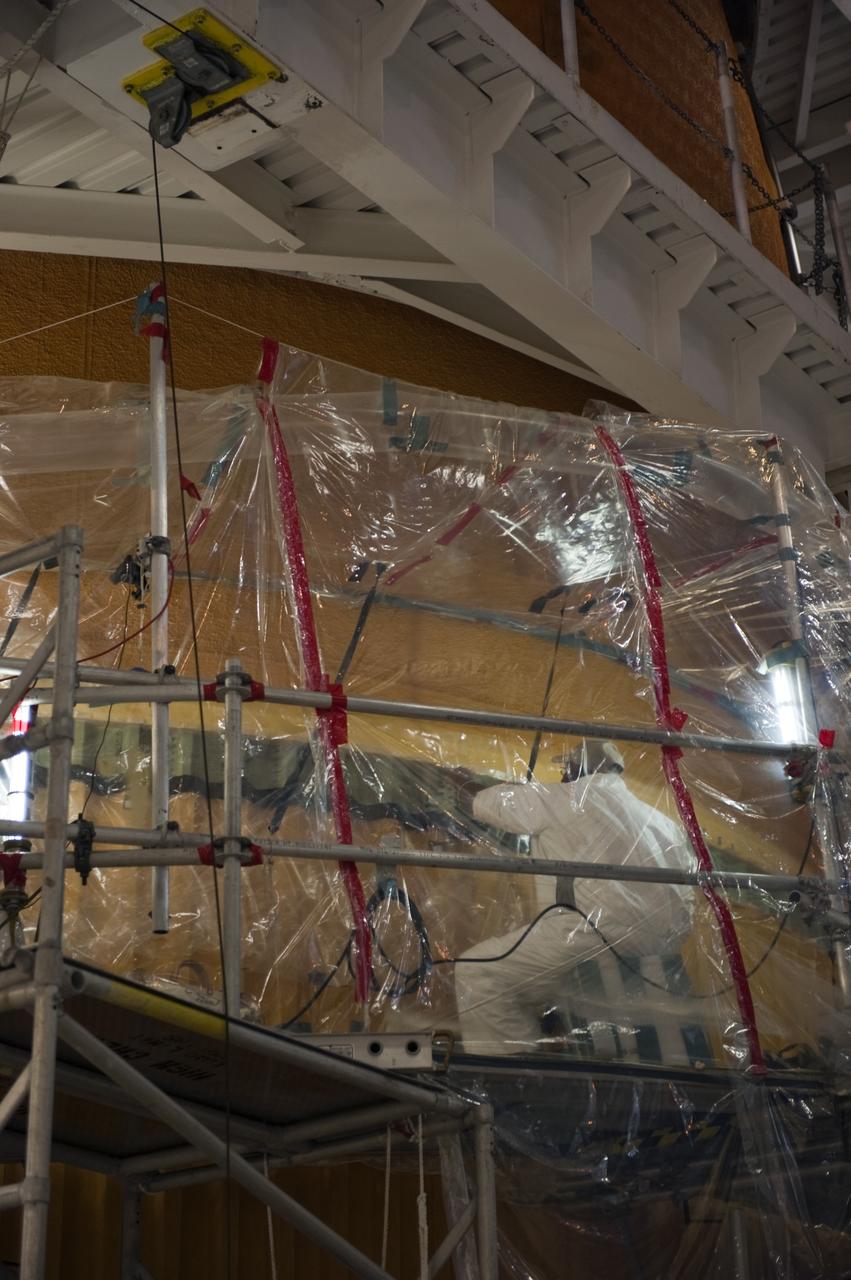
CAPE CANAVERAL, Fla. -- Repair work to space shuttle Discovery's external fuel tank continues in the Vehicle Assembly Building at NASA's Kennedy Space Center in Florida. Technicians are modifying 94 support beams, called stringers, on the tank's intertank region by fitting pieces of metal, called radius blocks, over the stringers' edges. After the modifications of the stringers are complete, foam insulation will be re-applied to the tank. Discovery's next launch opportunity to the International Space Station on the STS-133 mission is targeted for Feb. 24, 2011. For more information on STS-133, visit www.nasa.gov/mission_pages/shuttle/shuttlemissions/sts133/. Photo credit: NASA/Kim Shiflett
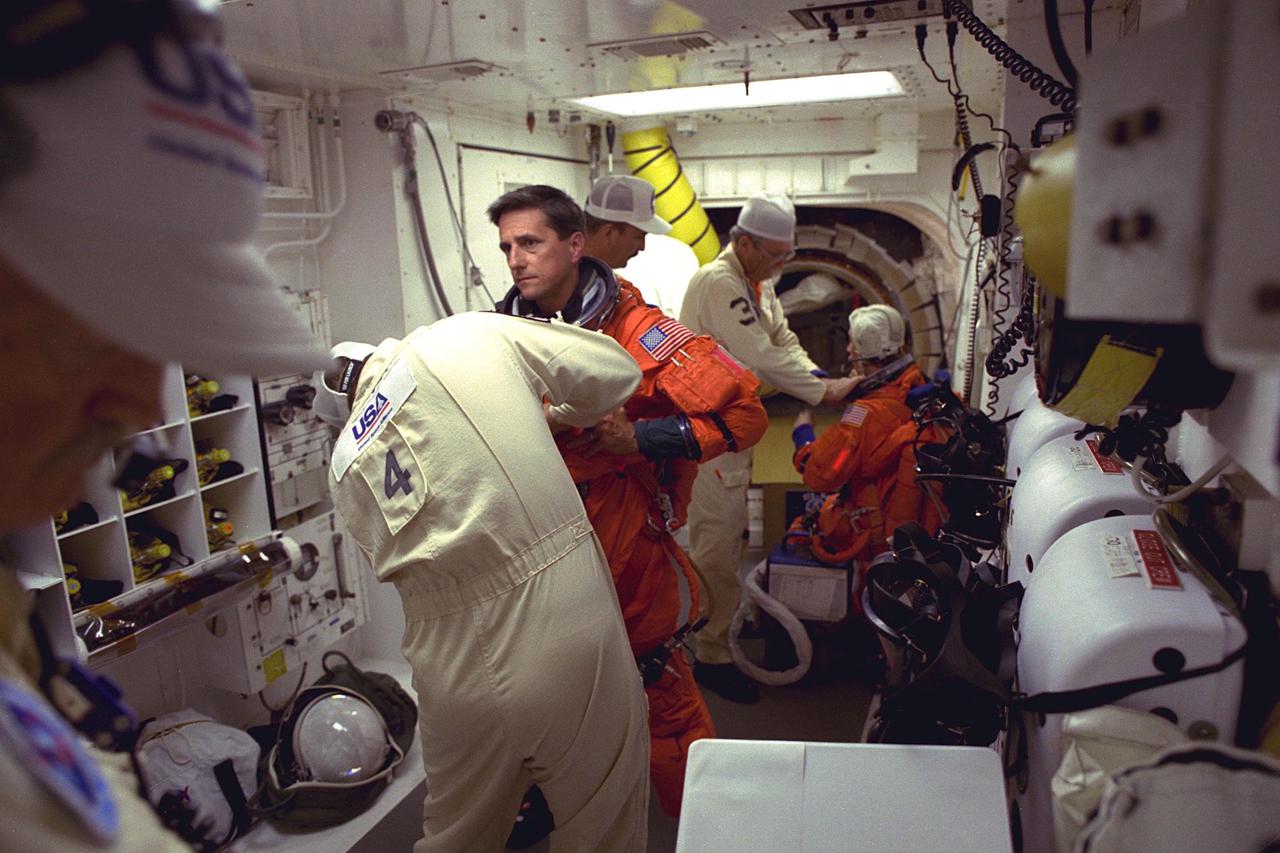
STS-94 Mission Specialist Donald A. Thomas prepares to enter the Space Shuttle Columbia at Launch Pad 39A in preparation for launch. He has flown on STS-83, STS-70 and STS-65. He holds a doctorate in materials science and has been the Principal Investigator for a Space Shuttle crystal growth experiment. Because of his background in materials science, Thomas will be concentrating his efforts during the Red shift on the five experiments in this discipline in the Large Isothermal Furnace. He also will work on the ten materials science investigations in the Electromagnetic Containerless Processing Facility and four that will be measuring the effects of microgravity and motion in the orbiter on the experiments. Thomas and six fellow crew members will lift off during a launch window that opens at 1:50 p.m. EDT, July 1. The launch window will open 47 minutes early to improve the opportunity to lift off before Florida summer rain showers reach the space center
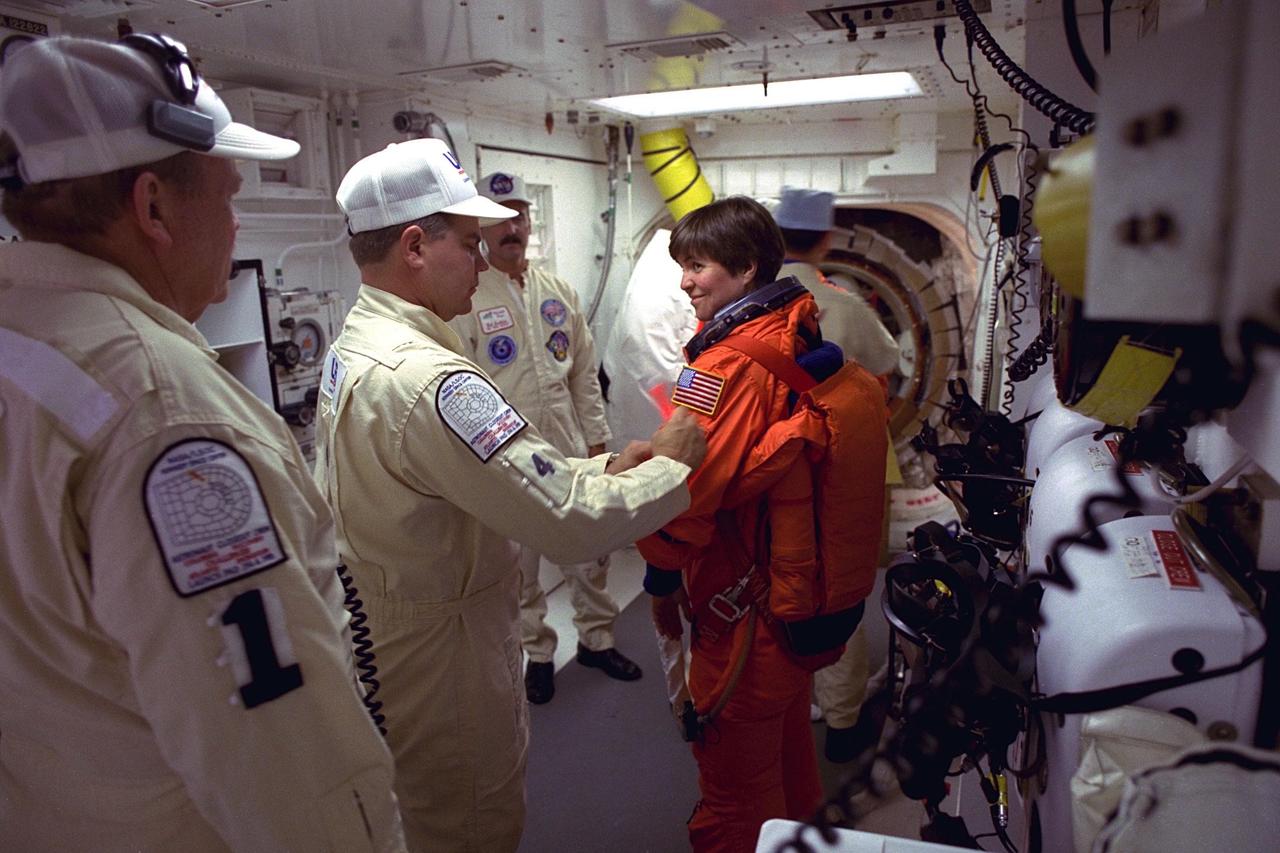
STS-94 Payload Commander Janice Voss prepares to enter the Space Shuttle Columbia at Launch Pad 39A in preparation for launch. She has flown on STS-83, STS-63 and STS-57. Voss holds a doctorate degree in aeronautics/astronautics from the Massachusetts Institute of Technology and has earned two NASA Space Flight Medals. As Payload Commander and a member of the Blue team, Voss will have overall responsibility for the operation of all of the MSL-1 experiments. During the experimentation phase of the mission, she be working primarily with three combustion experiments. She and six fellow crew members will lift off during a launch window that opens at 1:50 p.m. EDT, July 1. The launch window will open 47 minutes early to improve the opportunity to lift off before Florida summer rain showers reach the space center
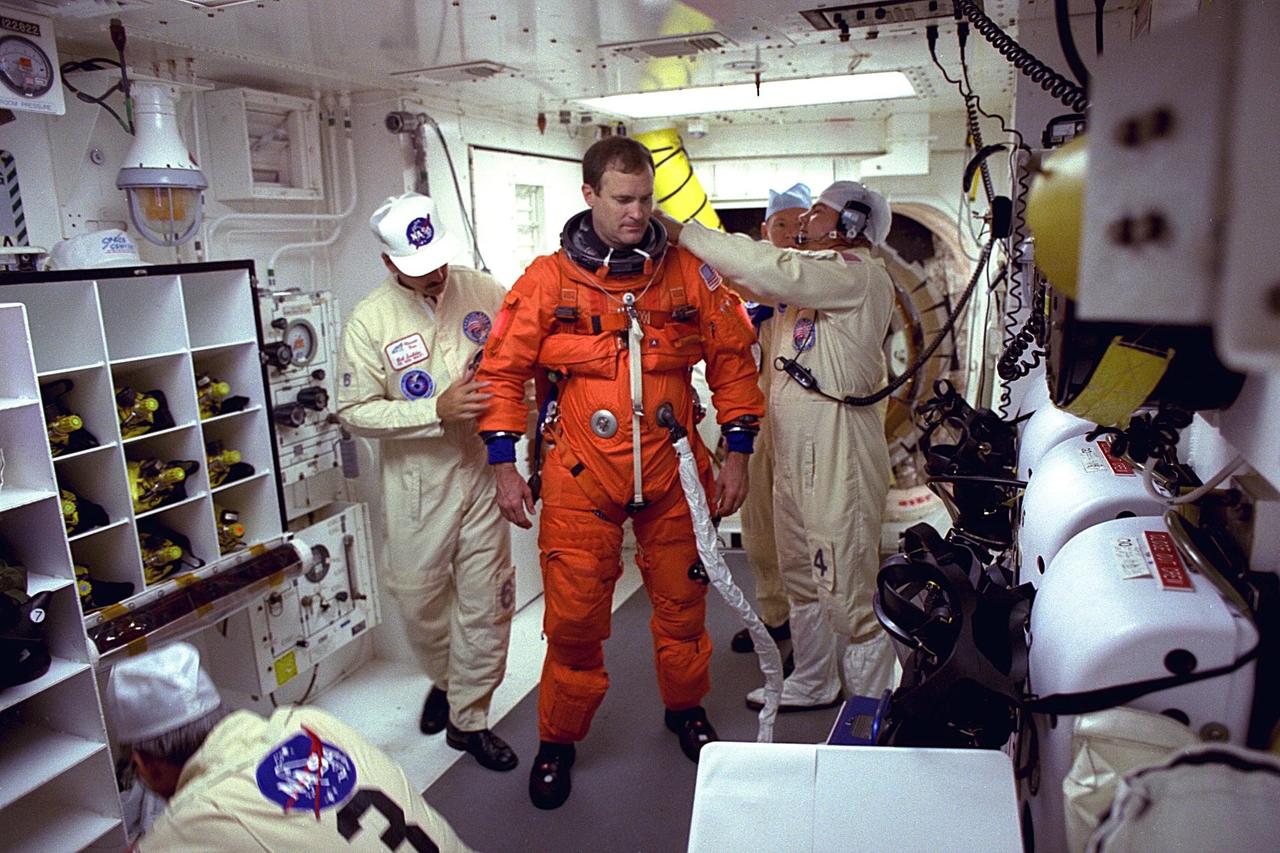
STS-94 Mission Commander James D. Halsell, Jr., prepares to enter the Space Shuttle Columbia at Launch Pad 39A in preparation for launch. Halsell is on his fourth space flight, having served as commander of STS-83 and pilot of both STS-74 and STS-65. He is a lieutenant colonel in the Air Force and a former SR-71 Blackbird test pilot and holds master’s degrees in management and space operations. Halsell will have responsibility for the success of the mission and will operate and maintain Columbia during the Red, or second shift. He will also assist with a materials science experiment and a protein crystal growth payload during the 16-day mission. Halsell and six fellow crew members will lift off during a launch window that opens at 1:50 p.m. EDT, July 1. The launch window will open 47 minutes early to improve the opportunity to lift off before Florida summer rain showers reach the space center
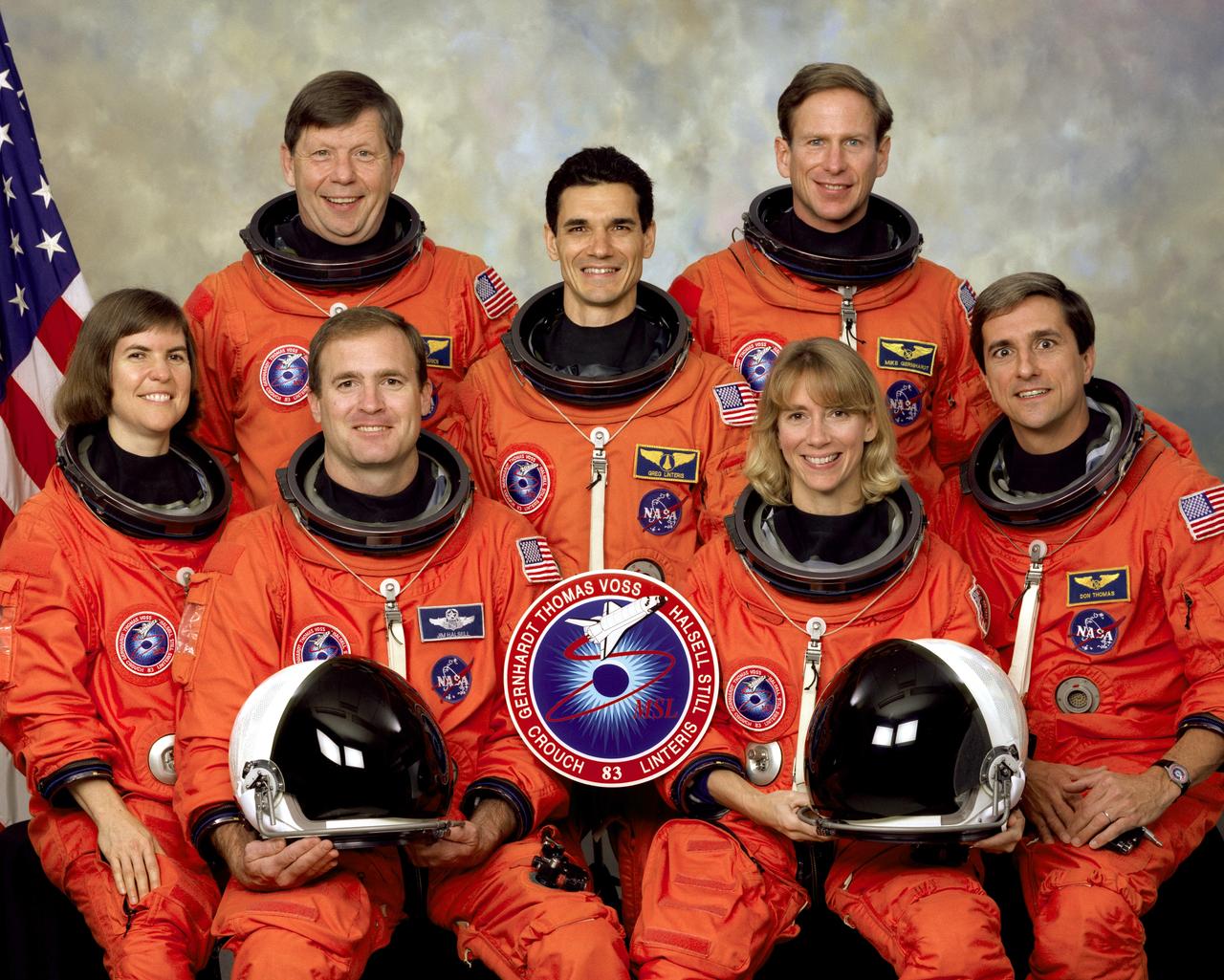
Five NASA astronauts and two scientists comprised the crew for the STS-83 mission in support of the first Microgravity Sciences Laboratory 1 (MSL-1). Pictured on the front row (left to right) are Janice E. Voss, payload commander; James D. Halsell, commander; Susan L. Still, pilot; and Donald A. Thomas, mission specialist. On the back row (left to right) are payload specialists Roger K. Crouch, and Gregory T. Linteris; and Michael L. Gernhardt, mission specialist. Dr. Crouch and Dr. Linteris are experts in several disciplines treated on MSL-1. STS-83 launched aboard the Space Shuttle Columbia on April 4, 1997. The five launched again in July 1997 for the STS-94 mission.
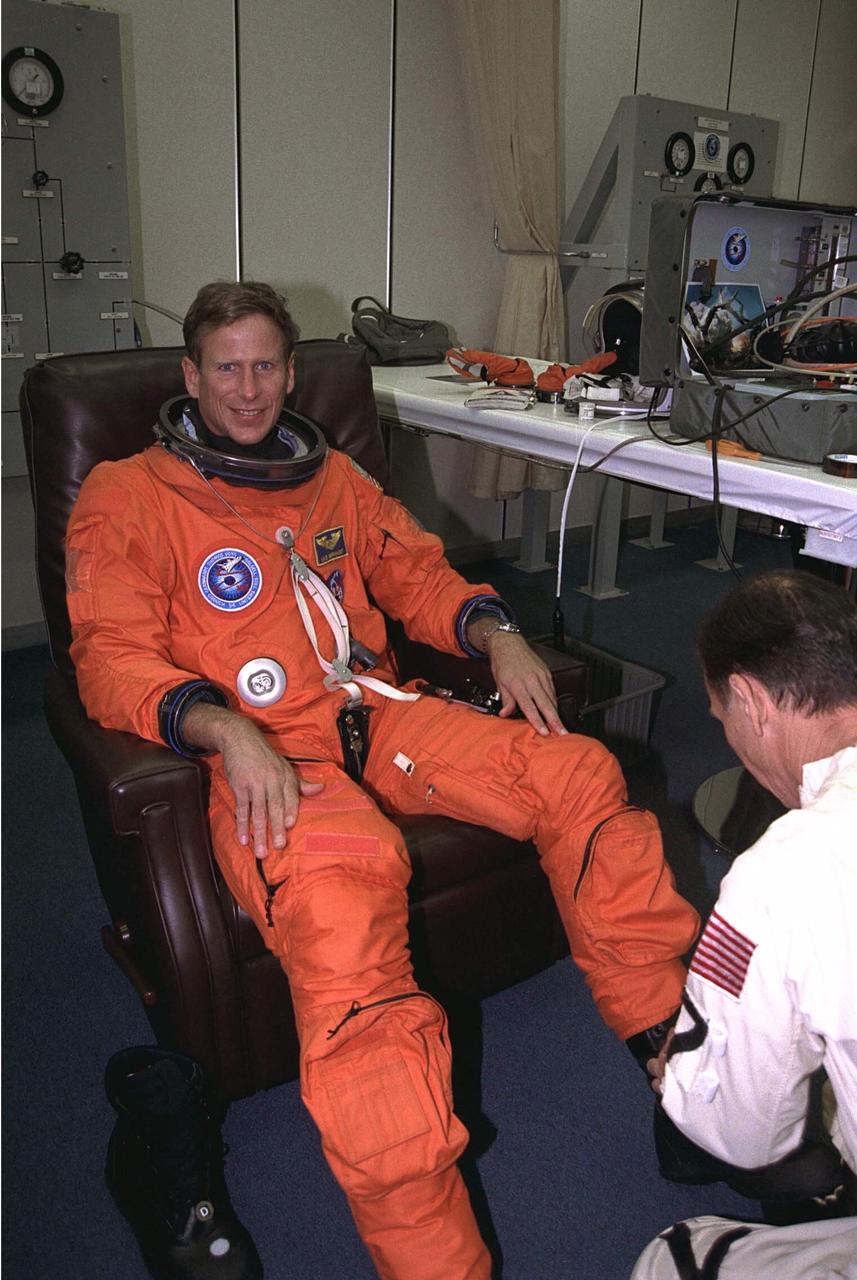
STS-94 Mission Specialist Michael L. Gernhardt is assisted into his launch/entry suit by a suit technician in the Operations and Checkout (O&C) Building. He first flew in this capacity on STS-69. He has been a professional deep sea diver and engineer and holds a doctorate in bioengineering. Gernhardt will be in charge of the Blue shift and as flight engineer will operate and maintain the orbiter while Halsell and Still are asleep as members of the Red shift. He will also back them up on the flight deck during the ascent and re-entry phases of the mission. Gernhardt and six fellow crew members will shortly depart the O&C and head for Launch Pad 39A, where the Space Shuttle Columbia will lift off during a launch window that opens at 1:50 p.m. EDT, July 1. The launch window was opened 47 minutes early to improve the opportunity to lift off before Florida summer rain showers reached the space center
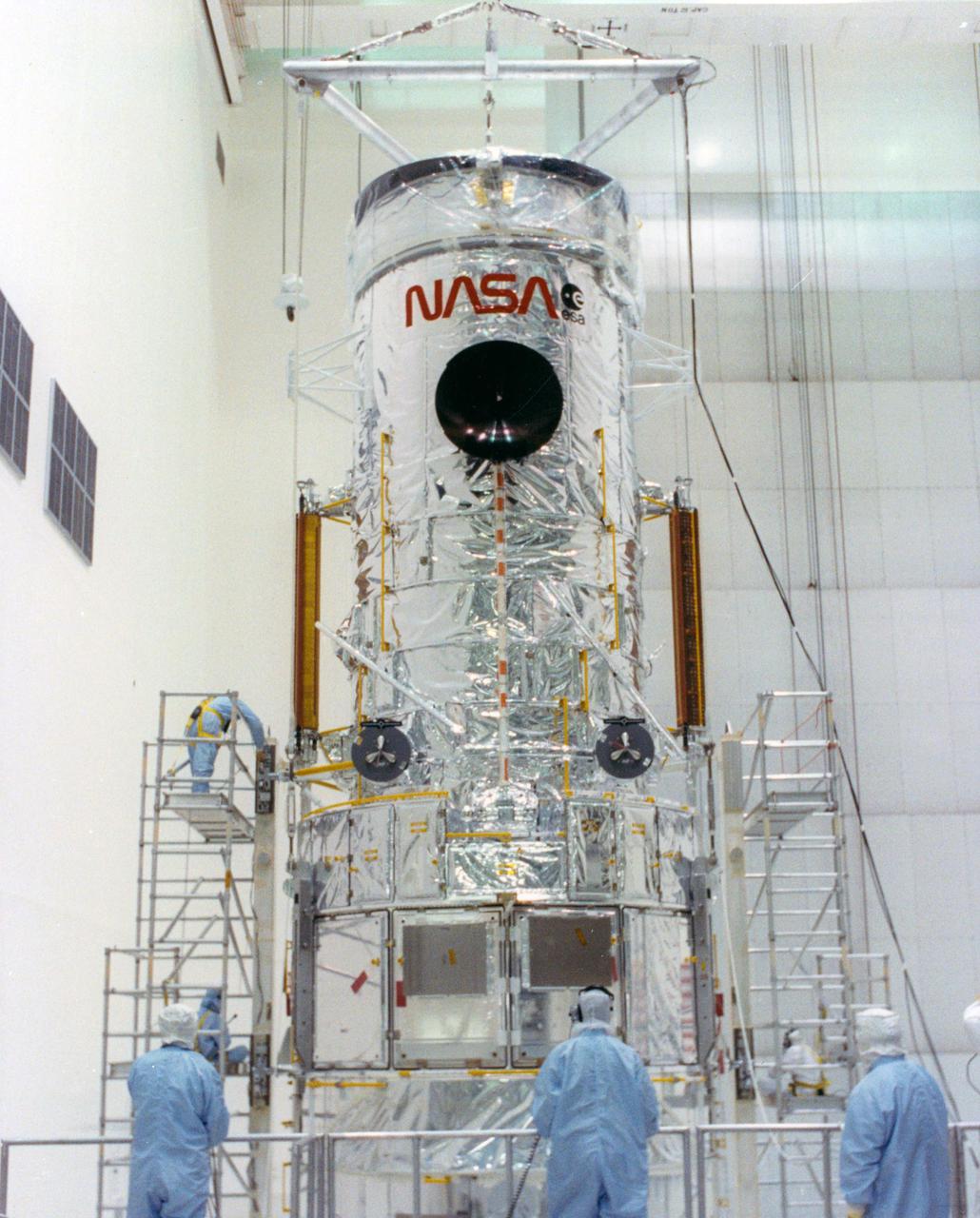
KENNEDY SPACE CENTER, FLA. -- The Hubble Space Telescope (HST) is lifted into the workstands in the Vertical Processing Facility as work begins at KSC to process the 94-inch primary mirror telescope for launch on Discovery on Space Shuttle Mission STS-31 in March 1990. With HST, astronomers will be able to view 97 percent of the known universe, and will be able to get pictures unlimited and undistorted by the Earth's atmosphere. Compared with earth-based observatories, the HST will be able to view celestial objects that are 50 times fainter, provide images that are 10 times sharper, and see objects that are seven times farther away. .
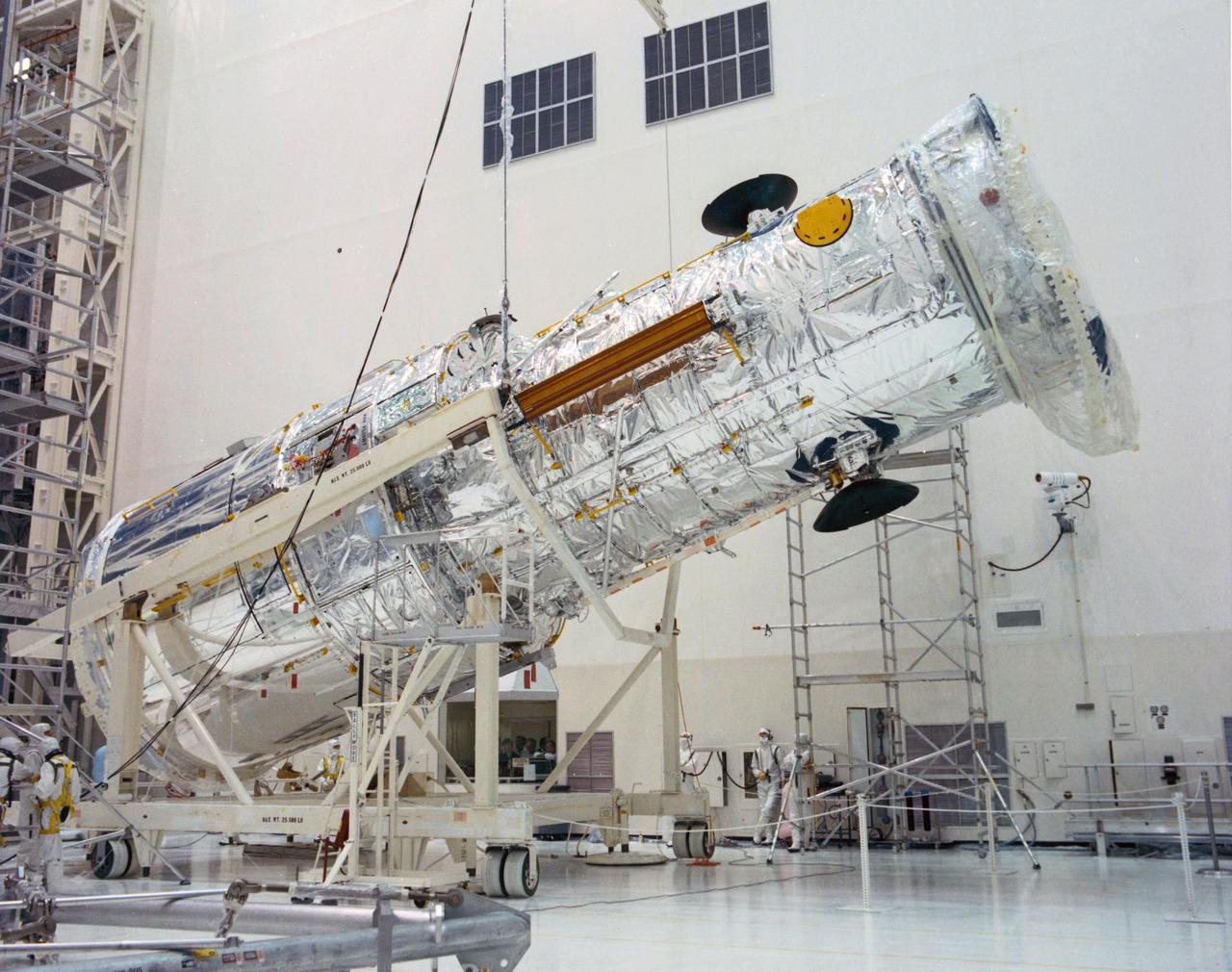
KENNEDY SPACE CENTER, FLA. -- The Hubble Space Telescope (HST) is lifted into the vertical position in the Vertical Processing Facility as work begins at KSC to process the 94-inch primary mirror telescope for launch on Discovery on Space Shuttle Mission STS-31 in March 1990. With HST, astronomers will be able to view 97 percent of the known universe, and will be able to get pictures unlimited and undistorted by the Earth's atmosphere. Compared with earth-based observatories, the HST will be able to view celestial objects that are 50 times fainter, provide images that are 10 times sharper, and see objects that are seven times farther away. .
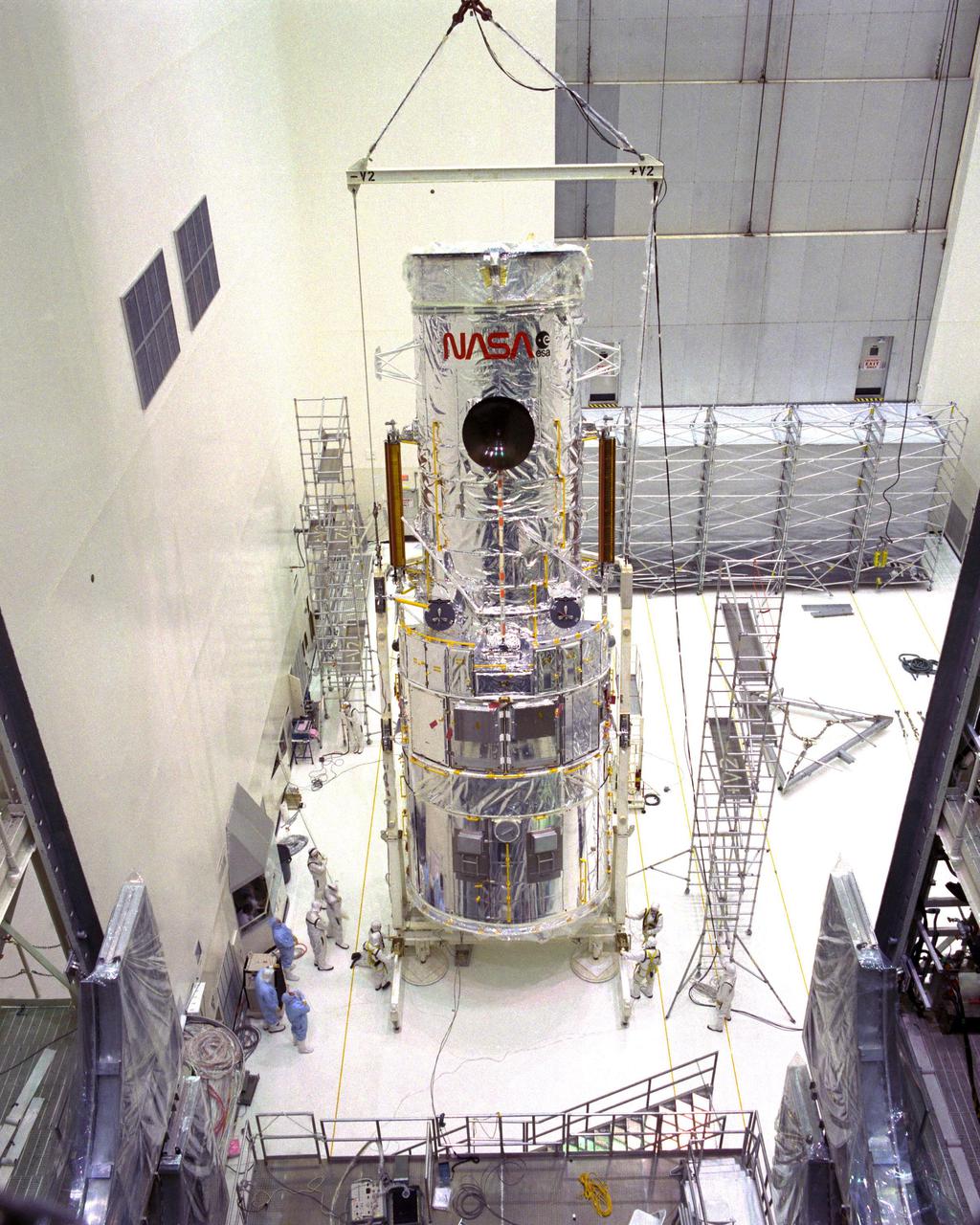
CAPE CANAVERAL, Fla. -- At the Kennedy Space Center in Florida, the Hubble Space Telescope is lifted into the vertical position in the Vertical Processing Facility as work begins to process the 94-inch primary mirror telescope for launch on the Discovery on STS-31 in March 1990. With Hubble, astronomers will be able to view 97 percent of the known universe, and will be able to get pictures unlimited and undistorted by the Earth’s atmosphere. Compared with Earth-based observatories, Hubble will be able to view celestial objects that are 50 times fainter, provide images that are 10 times sharper, and see objects that are seven times further away. Photo Credit: NASA
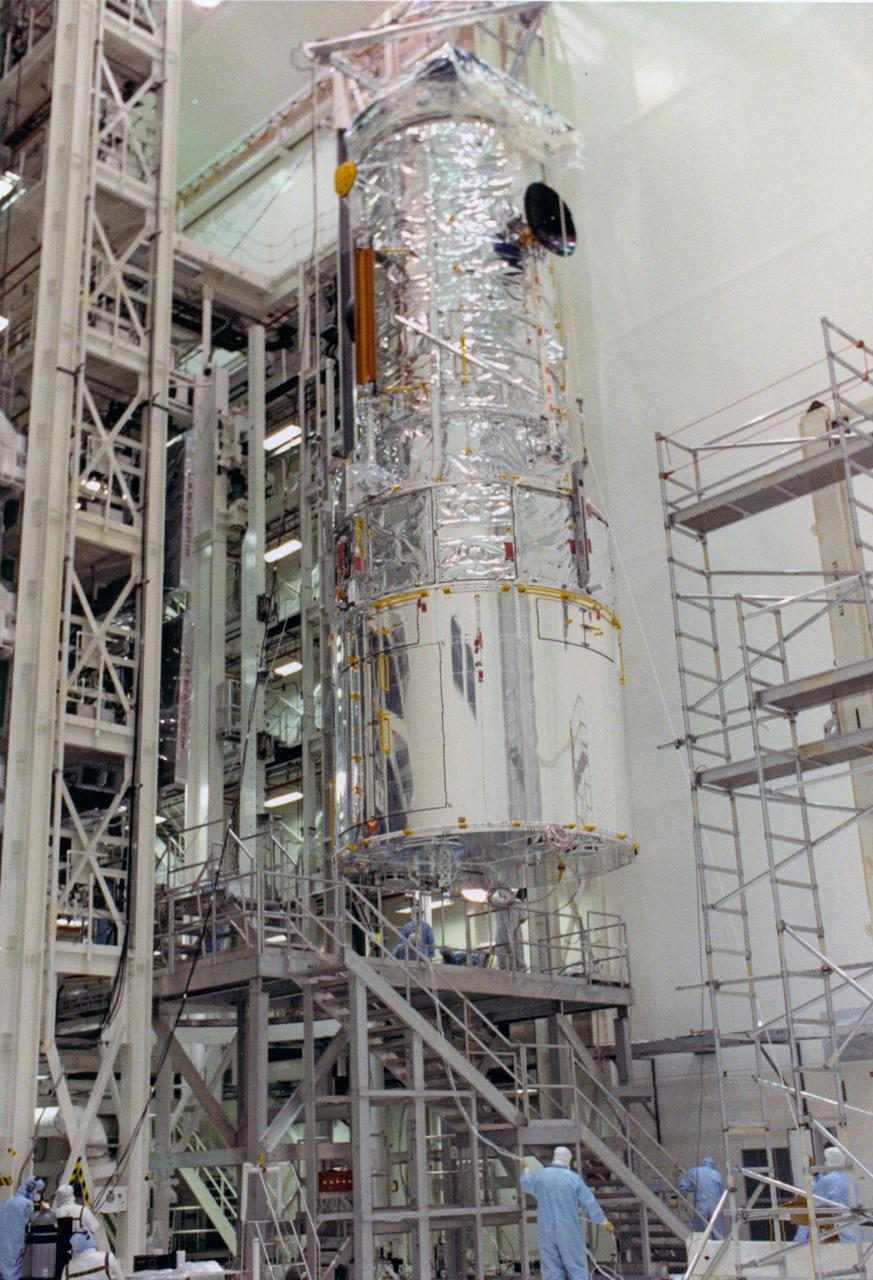
KENNEDY SPACE CENTER, FLA. -- The Hubble Space Telescope (HST) is lifted into the workstands in the Vertical Processing Facility as work begins at KSC to process the 94-inch primary mirror telescope for launch on Discovery on Space Shuttle Mission STS-31 in March 1990. With HST, astronomers will be able to view 97 percent of the known universe, and will be able to get pictures unlimited and undistorted by the Earth's atmosphere. Compared with earth-based observatories, the HST will be able to view celestial objects that are 50 times fainter, provide images that are 10 times sharper, and see objects that are seven times farther away. .
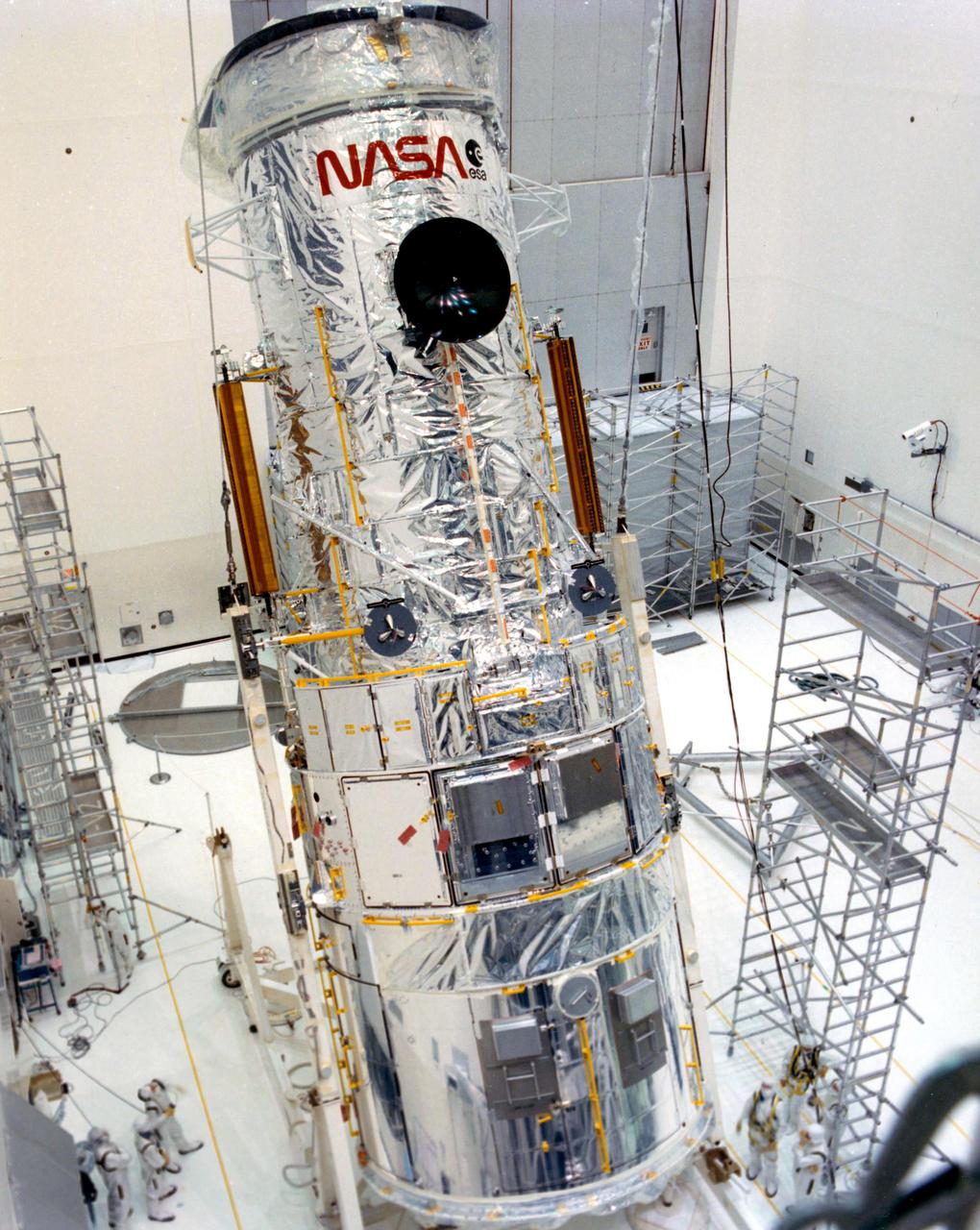
KENNEDY SPACE CENTER, FLA. -- The Hubble Space Telescope (HST) is lifted into the vertical position in the Vertical Processing Facility as work begins at KSC to process the 94-inch primary mirror telescope for launch on Discovery on Space Shuttle Mission STS-31 in March 1990. With HST, astronomers will be able to view 97 percent of the known universe, and will be able to get pictures unlimited and undistorted by the Earth's atmosphere. Compared with earth-based observatories, the HST will be able to view celestial objects that are 50 times fainter, provide images that are 10 times sharper, and see objects that are seven times farther away. .
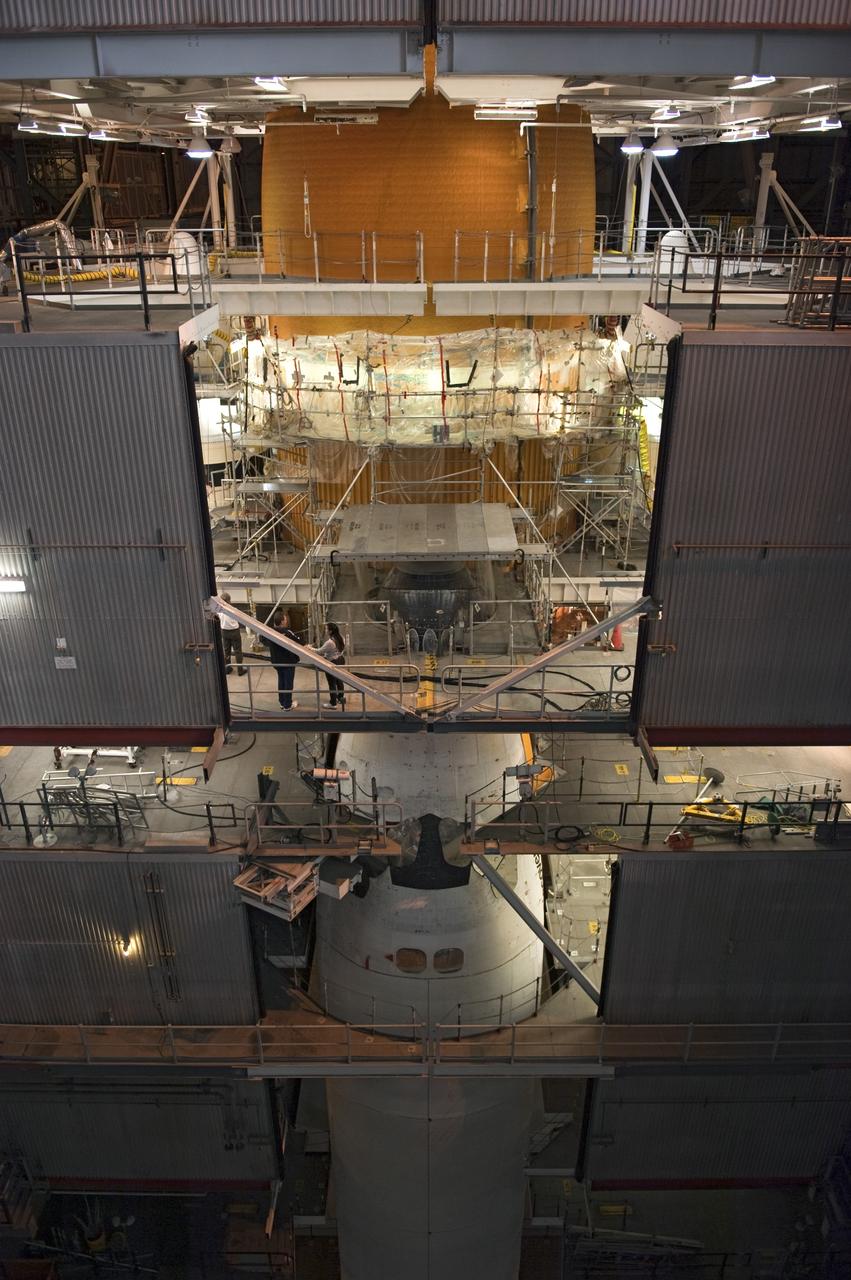
CAPE CANAVERAL, Fla. -- Repair work to space shuttle Discovery's external fuel tank begins to wrap up in the Vehicle Assembly Building at NASA's Kennedy Space Center in Florida. Technicians modified 94 support beams, called stringers, on the tank's intertank region by fitting pieces of metal, called radius blocks, over the stringers' edges. They also were re-applying foam to the modified areas of the tank. Attached to its fuel tank and two solid rocket boosters, Discovery is scheduled to roll out to Launch Pad 39A atop a giant crawler-transporter on Jan. 31. Discovery's next launch opportunity to the International Space Station on the STS-133 mission is targeted for Feb. 24. For more information on STS-133, visit www.nasa.gov/mission_pages/shuttle/shuttlemissions/sts133/. Photo credit: NASA/Kim Shiflett
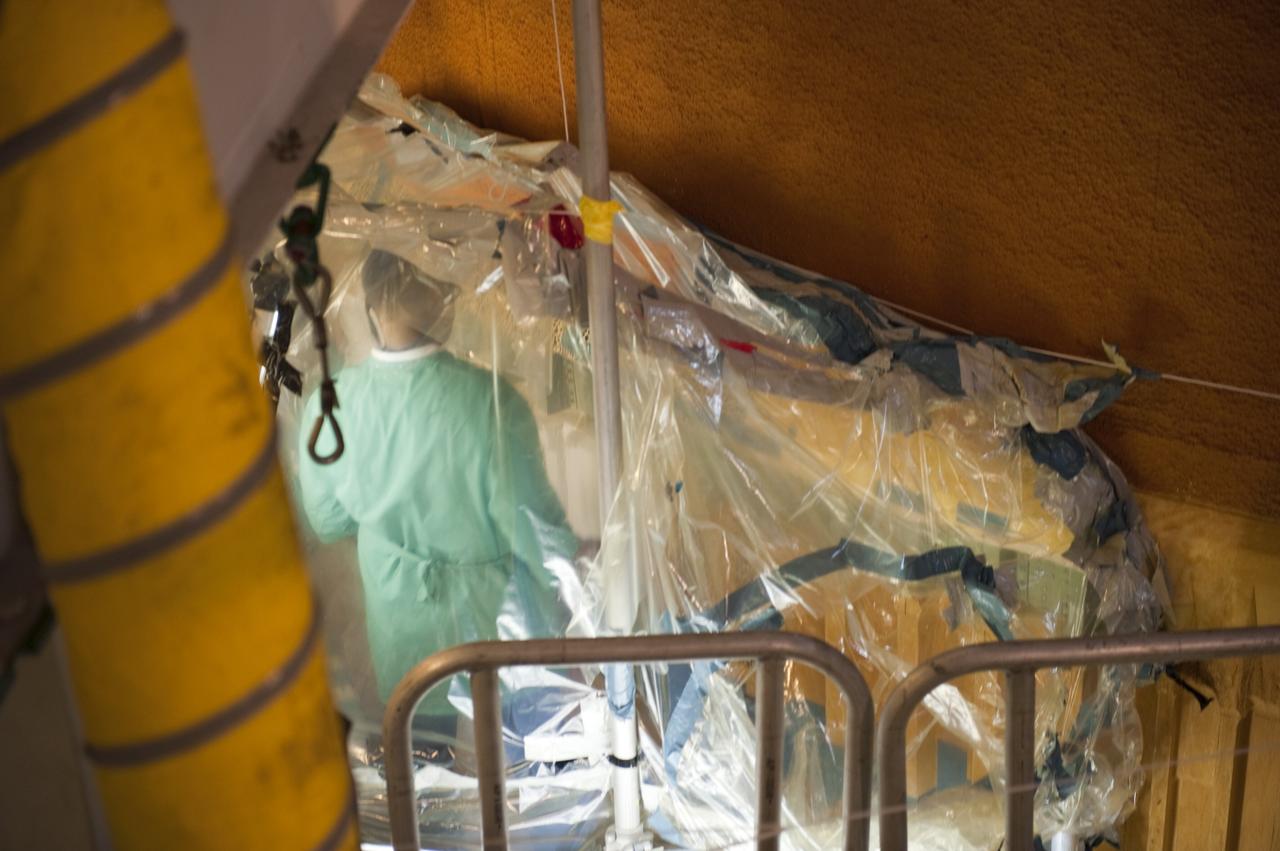
CAPE CANAVERAL, Fla. -- Repair work to space shuttle Discovery's external fuel tank begins to wrap up in the Vehicle Assembly Building at NASA's Kennedy Space Center in Florida. Technicians modified 94 support beams, called stringers, on the tank's intertank region by fitting pieces of metal, called radius blocks, over the stringers' edges. They also were re-applying foam to the modified areas of the tank. Attached to its fuel tank and two solid rocket boosters, Discovery is scheduled to roll out to Launch Pad 39A atop a giant crawler-transporter on Jan. 31. Discovery's next launch opportunity to the International Space Station on the STS-133 mission is targeted for Feb. 24. For more information on STS-133, visit www.nasa.gov/mission_pages/shuttle/shuttlemissions/sts133/. Photo credit: NASA/Kim Shiflett
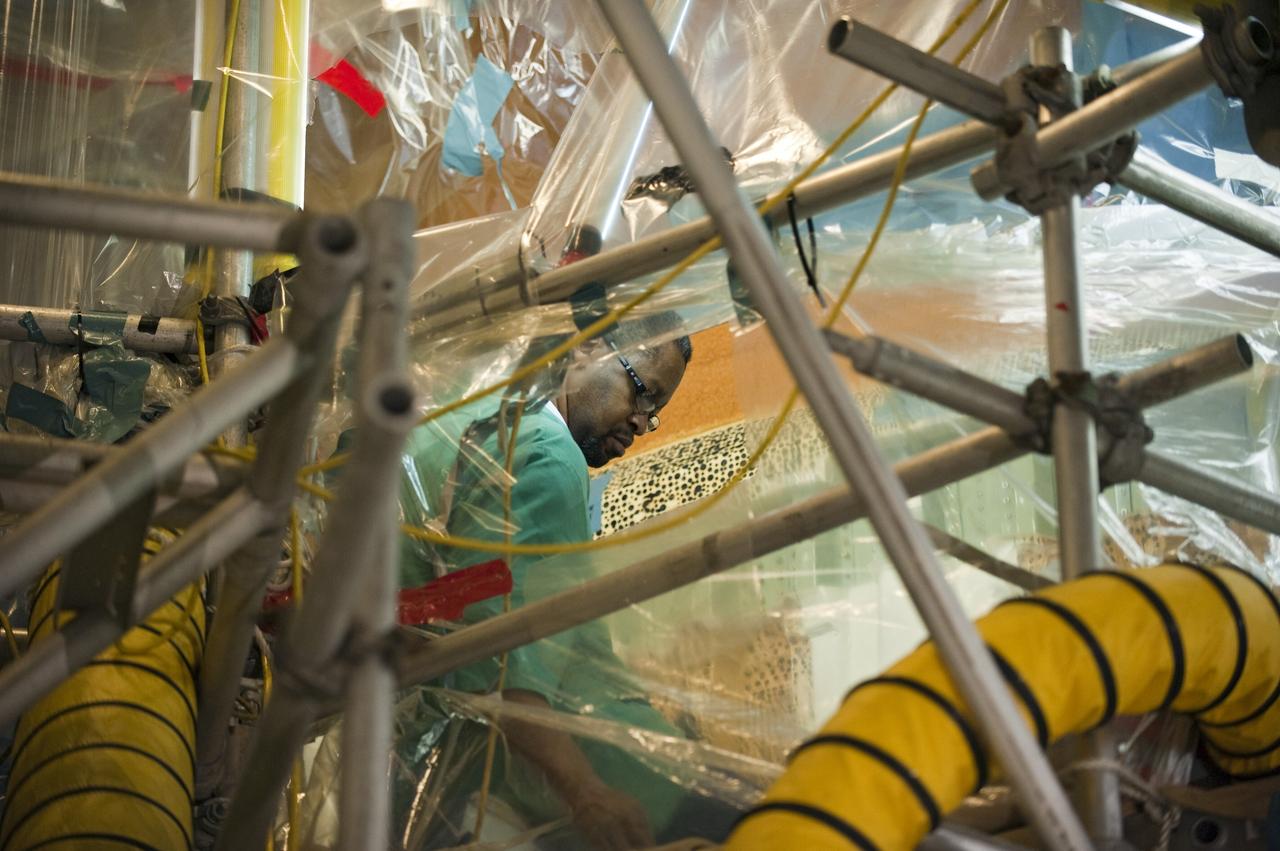
CAPE CANAVERAL, Fla. -- Repair work to space shuttle Discovery's external fuel tank begins to wrap up in the Vehicle Assembly Building at NASA's Kennedy Space Center in Florida. Technicians modified 94 support beams, called stringers, on the tank's intertank region by fitting pieces of metal, called radius blocks, over the stringers' edges. They also were re-applying foam to the modified areas of the tank. Attached to its fuel tank and two solid rocket boosters, Discovery is scheduled to roll out to Launch Pad 39A atop a giant crawler-transporter on Jan. 31. Discovery's next launch opportunity to the International Space Station on the STS-133 mission is targeted for Feb. 24. For more information on STS-133, visit www.nasa.gov/mission_pages/shuttle/shuttlemissions/sts133/. Photo credit: NASA/Kim Shiflett
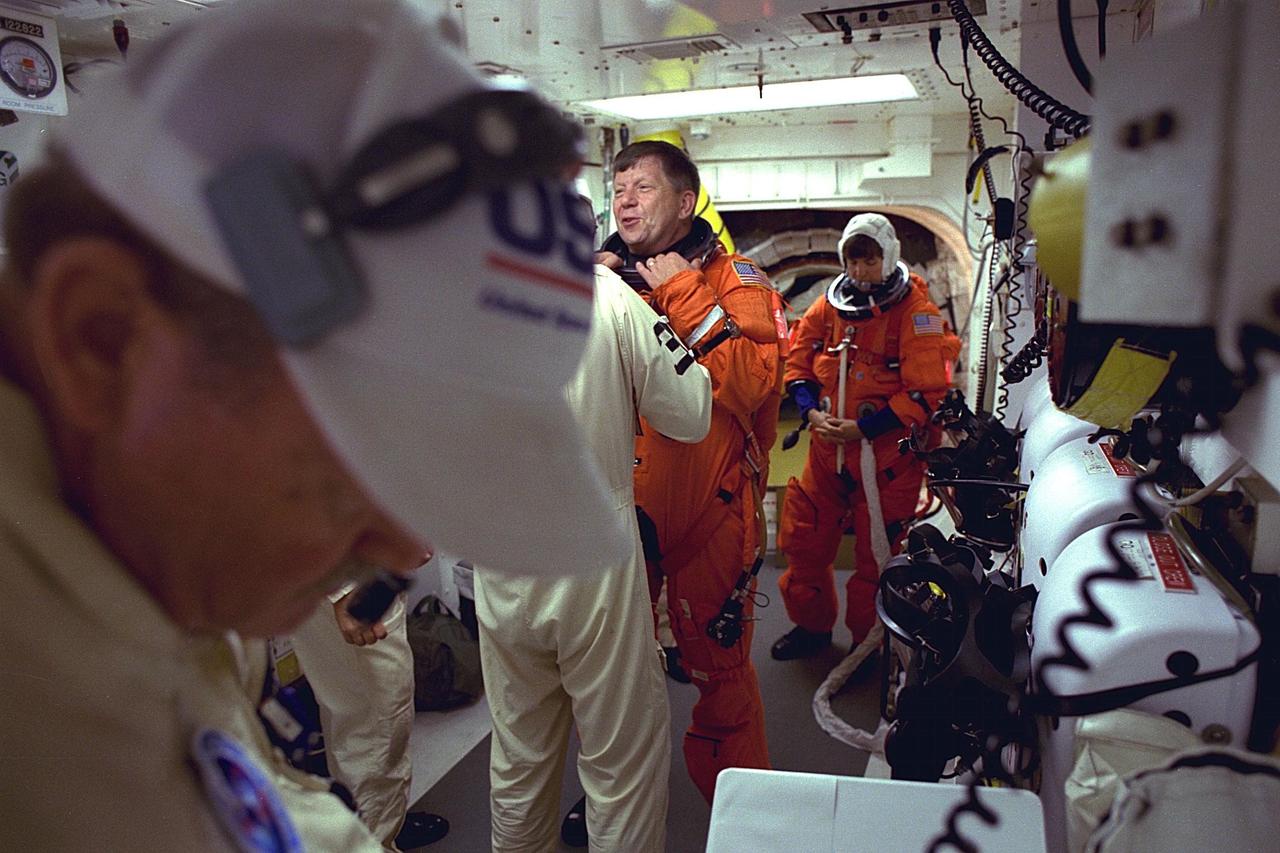
STS-94 Payload Specialist Roger K. Crouch prepares to enter the Space Shuttle Columbia at Launch Pad 39A in preparation for launch. He is the Chief Scientist of the NASA Microgravity Space and Applications Division. He also has served as a Program Scientist for previous Spacelab microgravity missions and is an expert in semiconductor crystal growth. Since Crouch has more than 25 years of experience as a materials scientist, he will be concentrating on the five physics of materials processing experiments in the Middeck Glovebox Facility on the Blue shift. He will also share the workload with Thomas by monitoring the materials furnace experiments during this time. Crouch and six fellow crew members will lift off during a launch window that opens at 1:50 p.m. EDT, July 1. The launch window will open 47 minutes early to improve the opportunity to lift off before Florida summer rain showers reach the space center
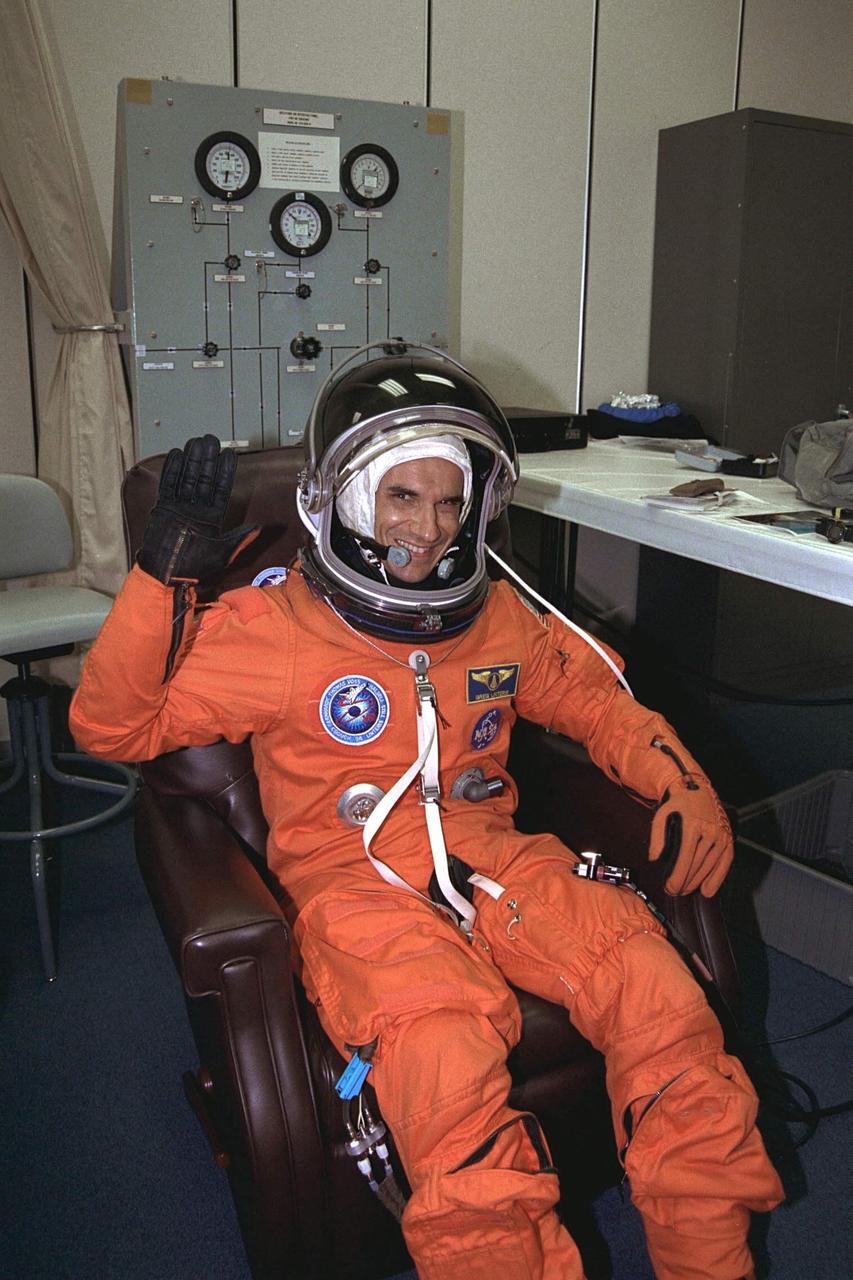
STS-94 Payload Specialist Gregory T. Linteris waves as he completes the donning of his launch/entry suit in the Operations and Checkout (O&C) Building. He holds a doctorate in mechanical and aerospace engineering. Linteris has worked at the National Institute of Standards and Technology and is the Principal Investigator on a NASA microgravity combustion experiment. As a member of the Red team, Linteris will concentrate on three combustion experiments. Two of these experiments are housed in the Combustion Module. He will also be backing up crew members on the other Microgravity Science Laboratory-1 (MSL-1) investigations. He and six fellow crew members will shortly depart the O&C and head for Launch Pad 39A, where the Space Shuttle Columbia will lift off during a launch window that opens at 1:50 p.m. EDT, July 1. The launch window was opened 47 minutes early to improve the opportunity to lift off before Florida summer rain showers reached the space center
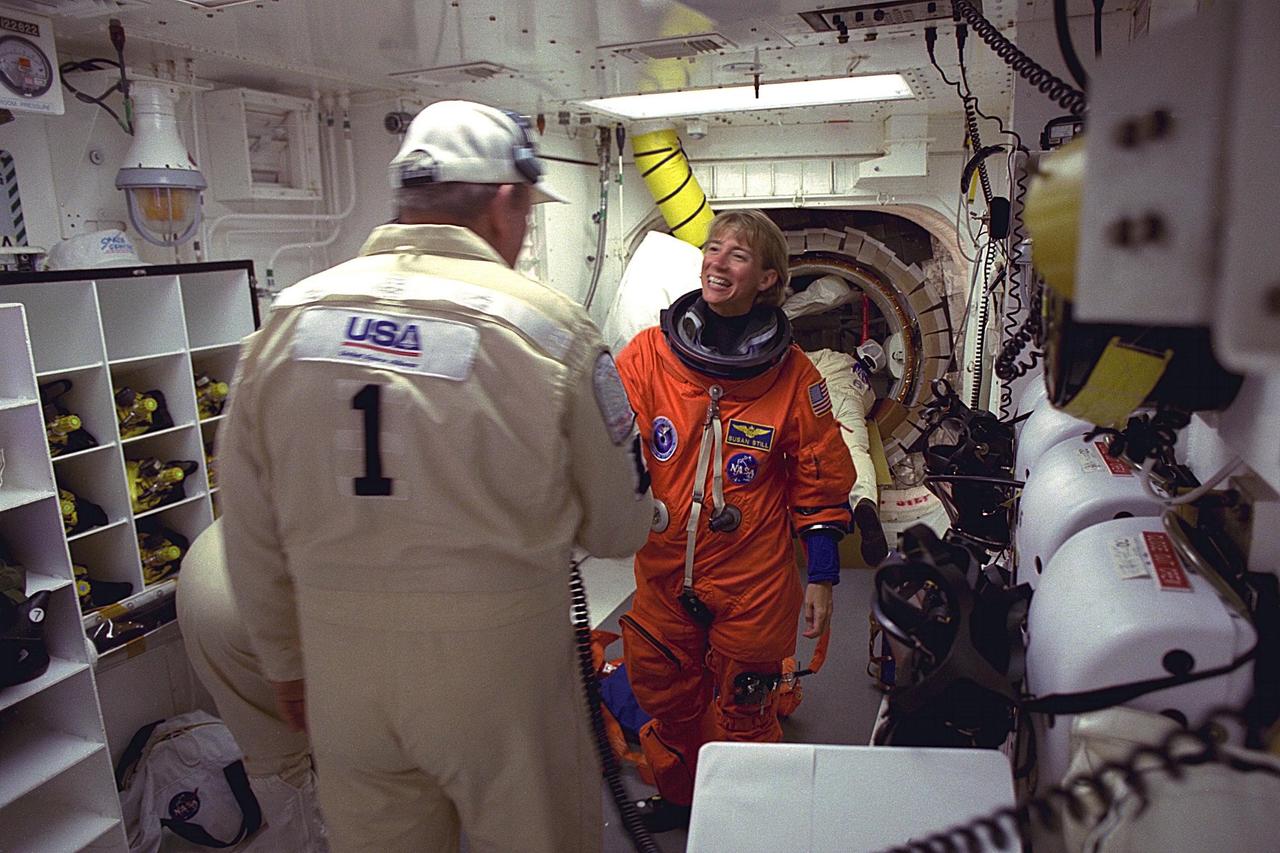
STS-94 Pilot Susan L. Still prepares to enter the Space Shuttle Columbia at Launch Pad 39A in preparation for launch. She is the second woman to fly in this capacity on a Space Shuttle. Still is a lieutenant colonel in the Navy and has more than 2,000 flight hours in 30 different types of aircraft. She also holds a master’s degree in aerospace engineering. Still will assist Halsell with all phases of the space flight and will have primary responsibility to take action in the event of an emergency. After Columbia reaches orbit, Still will be busy with the many and varied tasks associated with monitoring and maintaining the orbiter. She and six fellow crew members will lift off during a launch window that opens at 1:50 p.m. EDT, July 1. The launch window will open 47 minutes early to improve the opportunity to lift off before Florida summer rain showers reach the space center
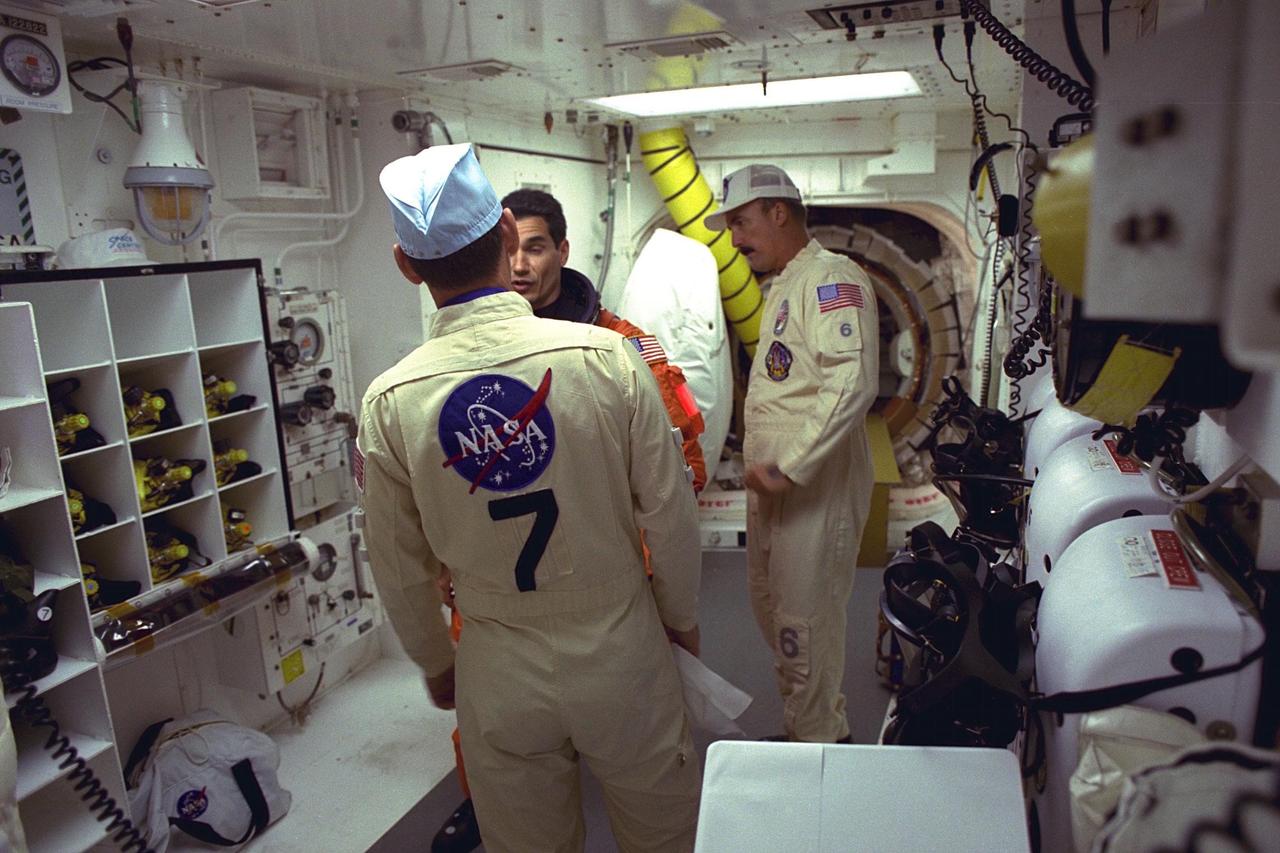
STS-94 Payload Specialist Gregory T. Linteris prepares to enter the Space Shuttle Columbia at Launch Pad 39A in preparation for launch. He holds a doctorate in mechanical and aerospace engineering. Linteris has worked at the National Institute of Standards and Technology and is the Principal Investigator on a NASA microgravity combustion experiment. As a member of the Red team, Linteris will concentrate on three combustion experiments. Two of these experiments are housed in the Combustion Module. He will also be backing up crew members on the other Microgravity Science Laboratory-1 (MSL-1) investigations. He and six fellow crew members will lift off during a launch window that opens at 1:50 p.m. EDT, July 1. The launch window will open 47 minutes early to improve the opportunity to lift off before Florida summer rain showers reach the space center
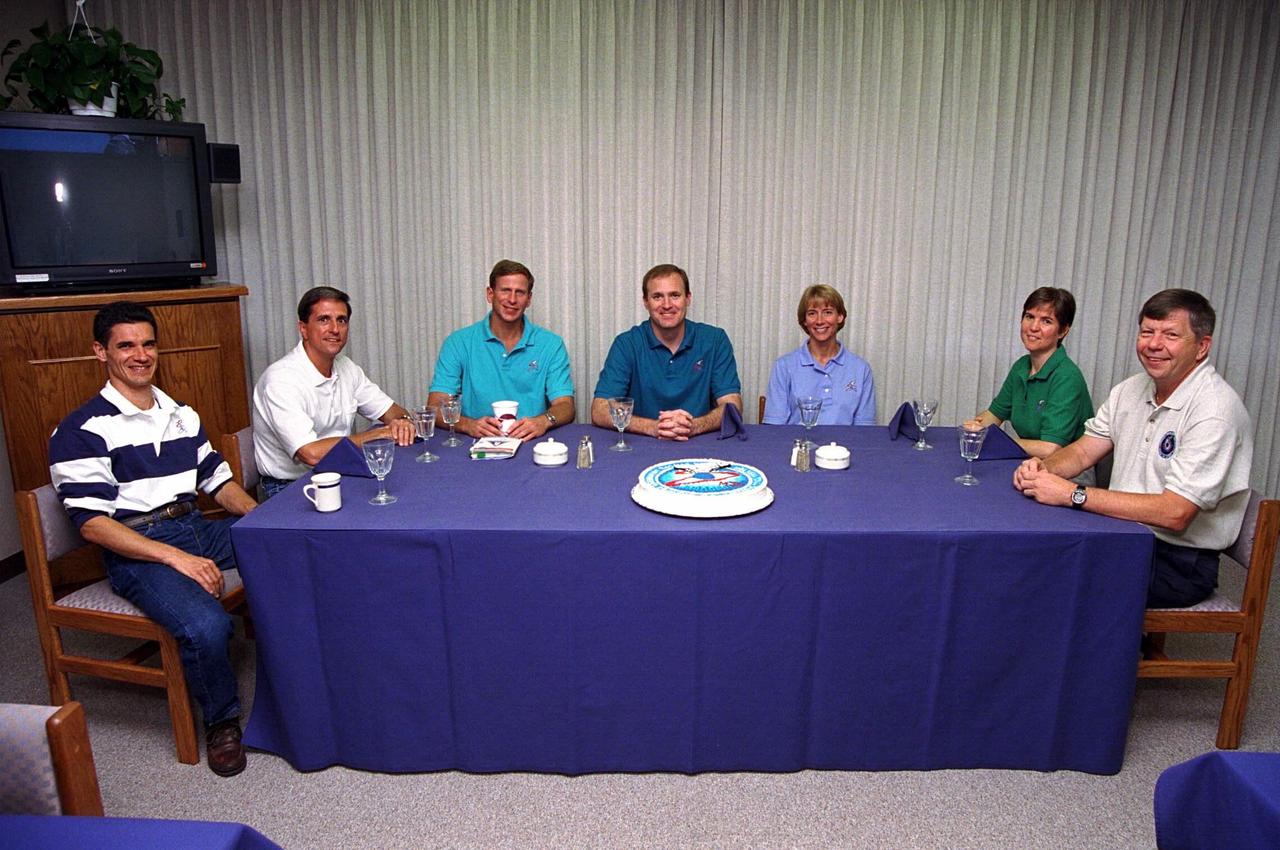
The STS-94 flight crew enjoys the traditional preliftoff breakfast in the crew quarters of the Operations and Checkout Building. They are (from left): Payload Specialist Gregory T. Linteris; Mission Specialist Donald A. Thomas; Mission Specialist Michael L. Gernhardt; Mission Commander James D. Halsell, Jr.; Pilot Susan L. Still; Payload Commander Janice Voss; and Payload Specialist Roger K. Crouch. After a weather briefing, the flight crew will be fitted with their launch/entry suits and depart for Launch Pad 39A. Once there, they will take their positions in the crew cabin of the Space Shuttle Columbia to await a liftoff during a window that will open at 1:50 p.m. EDT, July 1. The launch window was opened 47 minutes early to improve the opportunity to lift off before Florida summer rain showers reached the space center
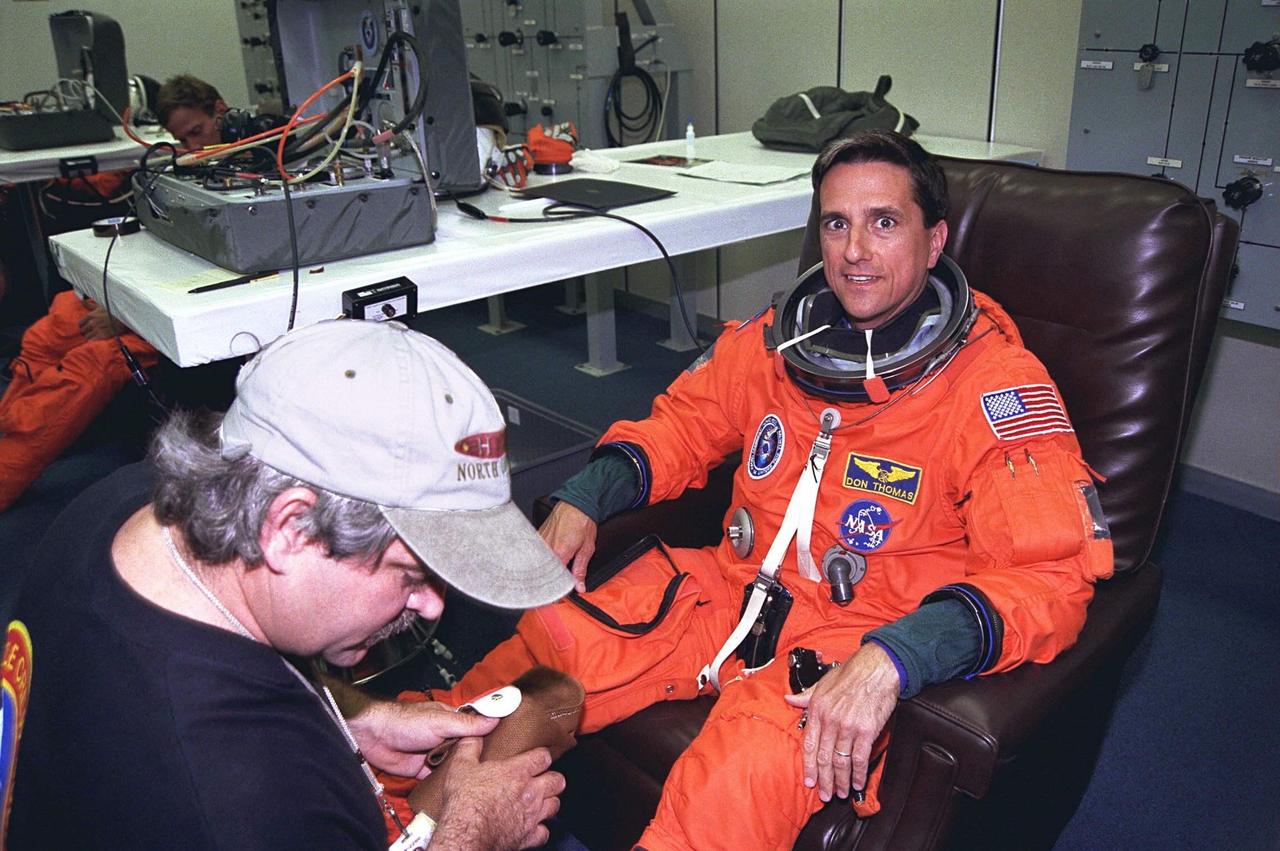
STS-94 Mission Specialist Donald A. Thomas smiles as a suit technician helps him into his launch/entry suit in the Operations and Checkout (O&C) Building. He has flown on STS-83, STS-70 and STS-65. He holds a doctorate in materials science and has been the Principal Investigator for a Space Shuttle crystal growth experiment. Because of his background in materials science, Thomas will be concentrating his efforts during the Red shift on the five experiments in this discipline in the Large Isothermal Furnace. He also will work on the ten materials science investigations in the Electromagnetic Containerless Processing Facility and four that will be measuring the effects of microgravity and motion in the orbiter on the experiments. Thomas and six fellow crew members will shortly depart the O&C and head for Launch Pad 39A, where the Space Shuttle Columbia will lift off during a launch window that opens at 1:50 p.m. EDT, July 1. The launch window was opened 47 minutes early to improve the opportunity to lift off before Florida summer rain showers reached the space center
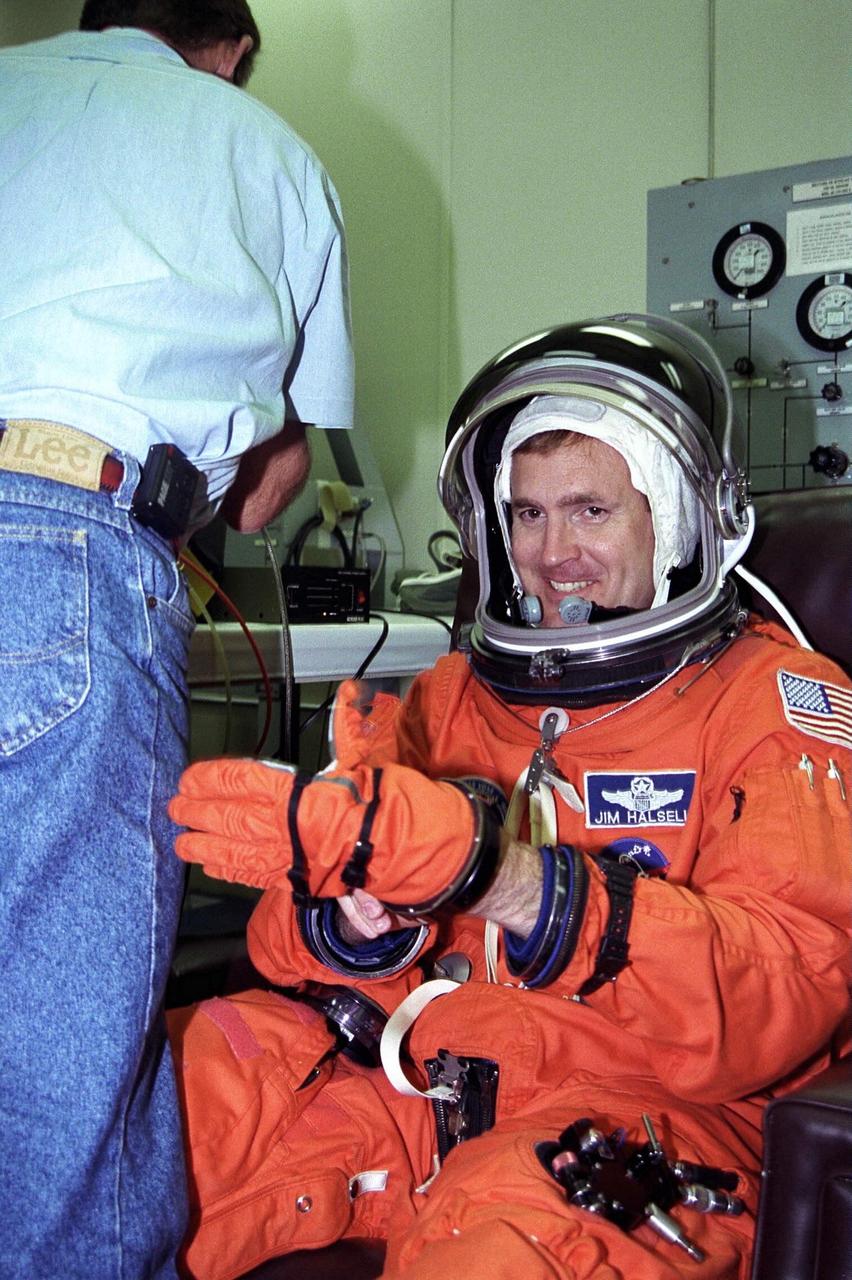
STS-94 Mission Commander James D. Halsell, Jr., puts his left glove on while he is assisted into his launch/entry suit in the Operations and Checkout (O&C) Building. Halsell is on his fourth space flight, having served as commander of STS-83 and pilot of both STS-74 and STS-65. He is a lieutenant colonel in the Air Force and a former SR-71 Blackbird test pilot and holds master’s degrees in management and space operations. Halsell will have responsibility for the success of the mission and will operate and maintain Columbia during the Red, or second shift. He will also assist with a materials science experiment and a protein crystal growth payload during the 16-day mission. Halsell and six fellow crew members will shortly depart the O&C and head for Launch Pad 39A, where the Space Shuttle Columbia will lift off during a launch window that opens at 1:50 p.m. EDT, July 1. The launch window was opened 47 minutes early to improve the opportunity to lift off before Florida summer rain showers reached the space center
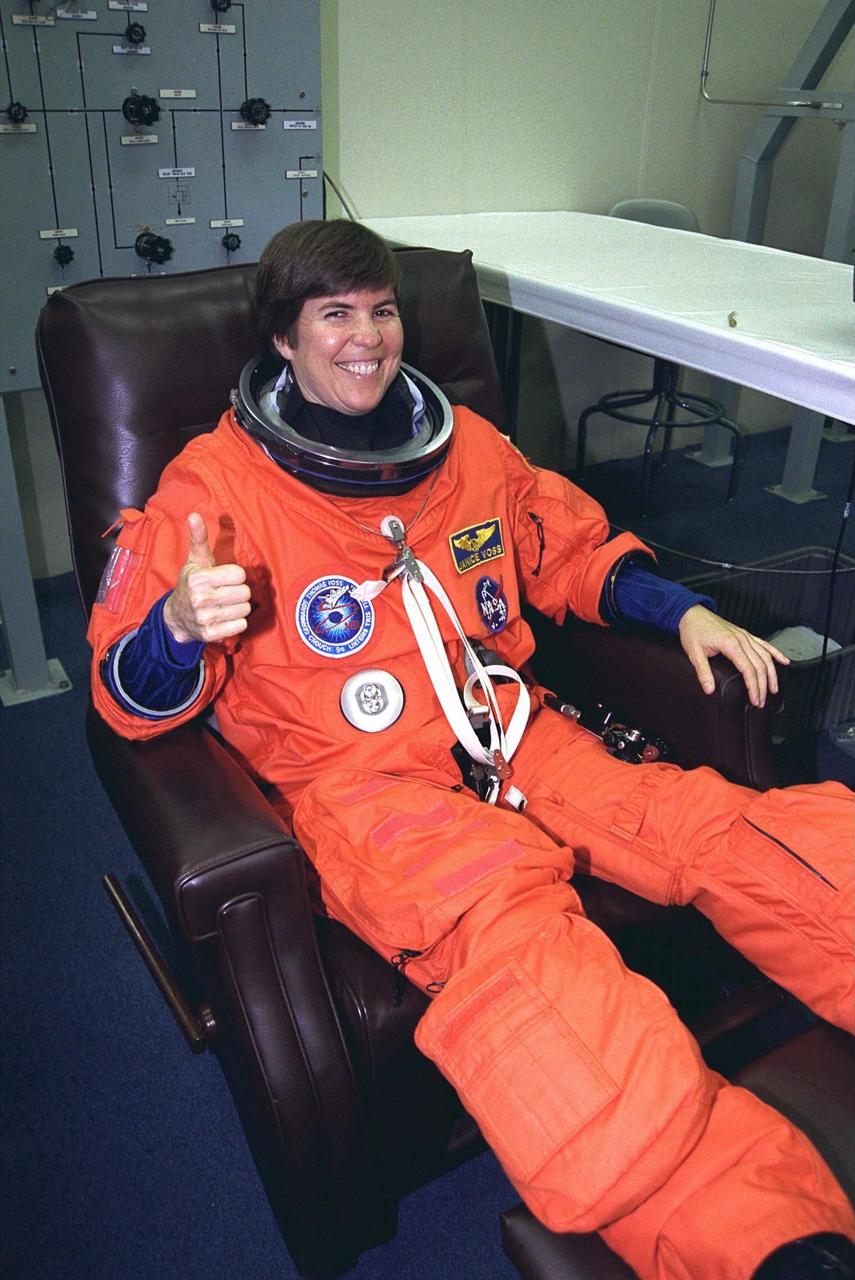
STS-94 Payload Commander Janice Voss smiles and gives a thumbs-up as she is assisted into her launch/entry suit in the Operations and Checkout (O&C) Building. She has flown on STS-83, STS-63 and STS-57. Voss holds a doctorate degree in aeronautics/astronautics from the Massachusetts Institute of Technology and has earned two NASA Space Flight Medals. As Payload Commander and a member of the Blue team, Voss will have overall responsibility for the operation of all of the MSL-1 experiments. During the experimentation phase of the mission, she be working primarily with three combustion experiments. She and six fellow crew members will shortly depart the O&C and head for Launch Pad 39A, where the Space Shuttle Columbia will lift off during a launch window that opens at 1:50 p.m. EDT, July 1. The launch window was opened 47 minutes early to improve the opportunity to lift off before Florida summer rain showers reached the space center
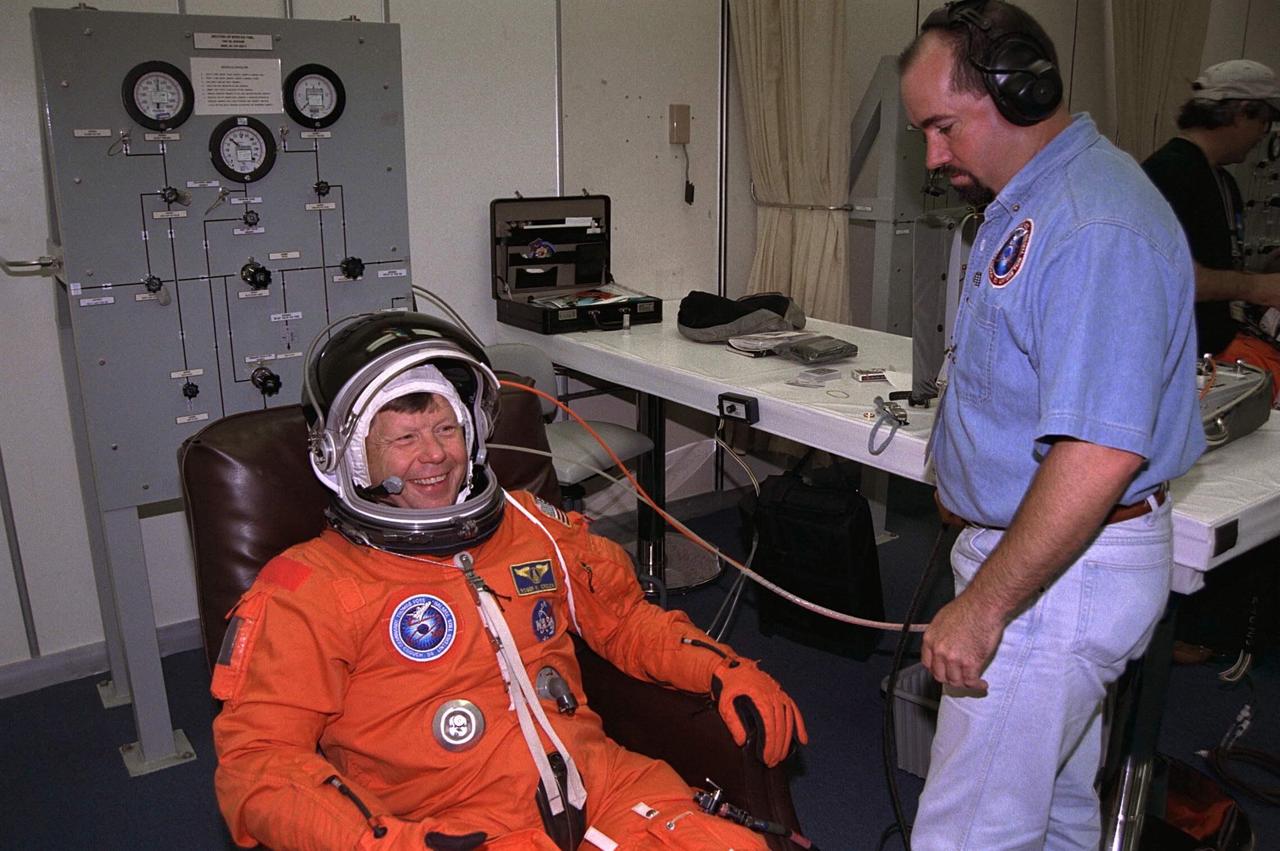
STS-94 Payload Specialist Roger K. Crouch is helped into his launch/entry suit by a suit technician in the Operations and Checkout (O&C) Building after the suit has been given a pressure test. He is the Chief Scientist of the NASA Microgravity Space and Applications Division. He also has served as a Program Scientist for previous Spacelab microgravity missions and is an expert in semiconductor crystal growth. Since Crouch has more than 25 years of experience as a materials scientist, he will be concentrating on the five physics of materials processing experiments in the Middeck Glovebox Facility on the Blue shift. He will also share the workload with Thomas by monitoring the materials furnace experiments during this time. Crouch and six fellow crew members will shortly depart the O&C and head for Launch Pad 39A, where the Space Shuttle Columbia will lift off during a launch window that opens at 1:50 p.m. EDT, July 1. The launch window was opened 47 minutes early to improve the opportunity to lift off before Florida summer rain showers reached the space center
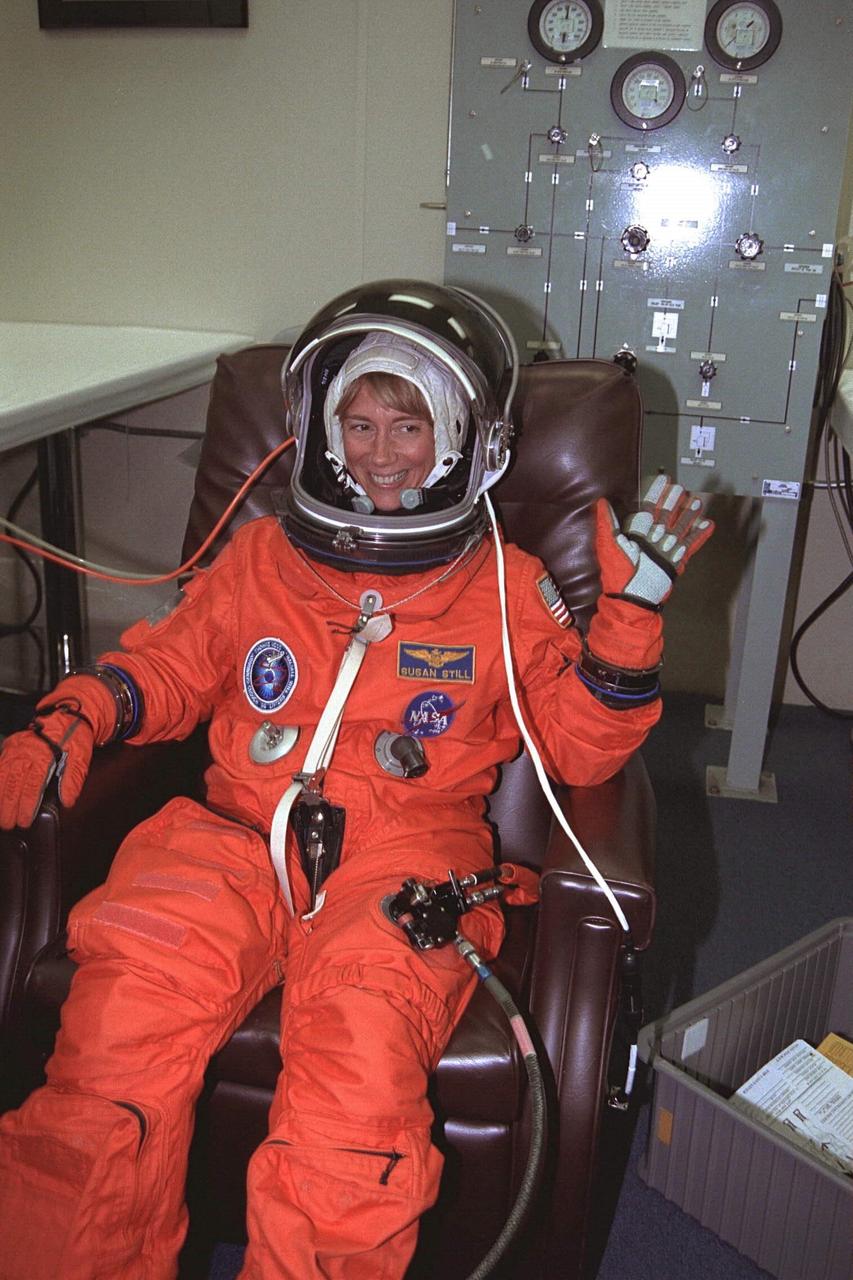
STS-94 Pilot Susan L. Still waves as she is assisted into her launch/entry suit in the Operations and Checkout (O&C) Building. She is the second woman to fly in this capacity on a Space Shuttle. Still is a lieutenant colonel in the Navy and has more than 2,000 flight hours in 30 different types of aircraft. She also holds a master’s degree in aerospace engineering. Still will assist Halsell with all phases of the space flight and will have primary responsibility to take action in the event of an emergency. After Columbia reaches orbit, Still will be busy with the many and varied tasks associated with monitoring and maintaining the orbiter. She and six fellow crew members will shortly depart the O&C and head for Launch Pad 39A, where the Space Shuttle Columbia will lift off during a launch window that opens at 1:50 p.m. EDT, July 1. The launch window was opened 47 minutes early to improve the opportunity to lift off before Florida summer rain showers reached the space center
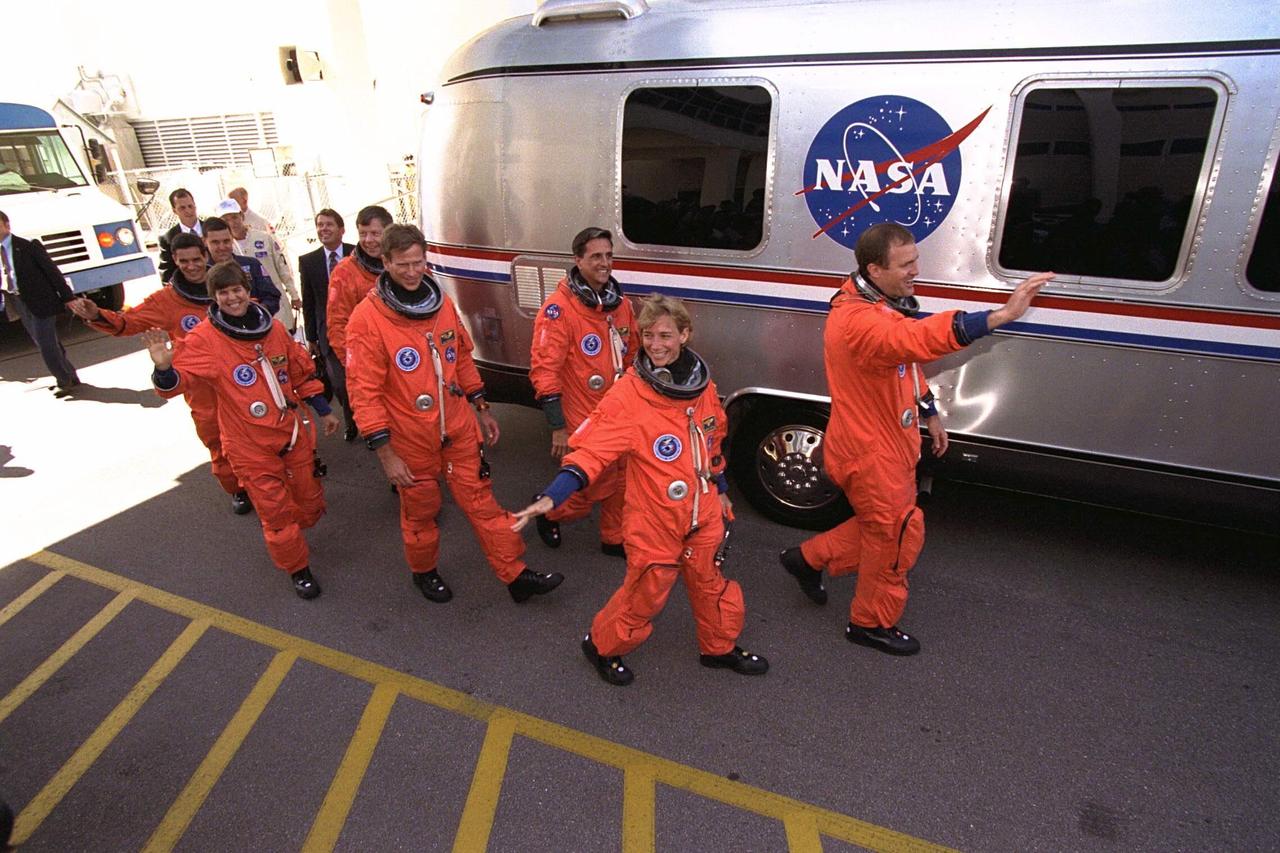
The STS-94 crew walks out of the Operations and Checkout Building and heads for the Astrovan that will transport them to Launch Pad 39A as KSC employees show their support. Waving to the crowd and leading the way are Mission Commander James D. Halsell, Jr. and Pilot Susan L. Still. Behind Still is Mission Specialist Donald A.Thomas, followed by Mission Specialist Michael L. Gernhardt , Payload Commander Janice Voss, and Payload Specialists Roger K.Crouch and Gregory T. Linteris. During the scheduled 16-day Microgravity Science Laboratory-1 (MSL-1) mission, the Spacelab module will be used to test some of the hardware, facilities and procedures that are planned for use on the International Space Station while the flight crew conducts combustion, protein crystal growth and materials processing experiments. Also onboard is the Hitchhiker Cryogenic Flexible Diode (CRYOFD) experiment payload, which is attached to the right side of Columbia’s payload bay.The Space Shuttle Columbia is scheduled to lift off when the launch window opens at 1:50 p.m. EDT, July 1. The launch window was opened 47 minutes early to improve the opportunity to lift off before Florida summer rain showers reached the space center