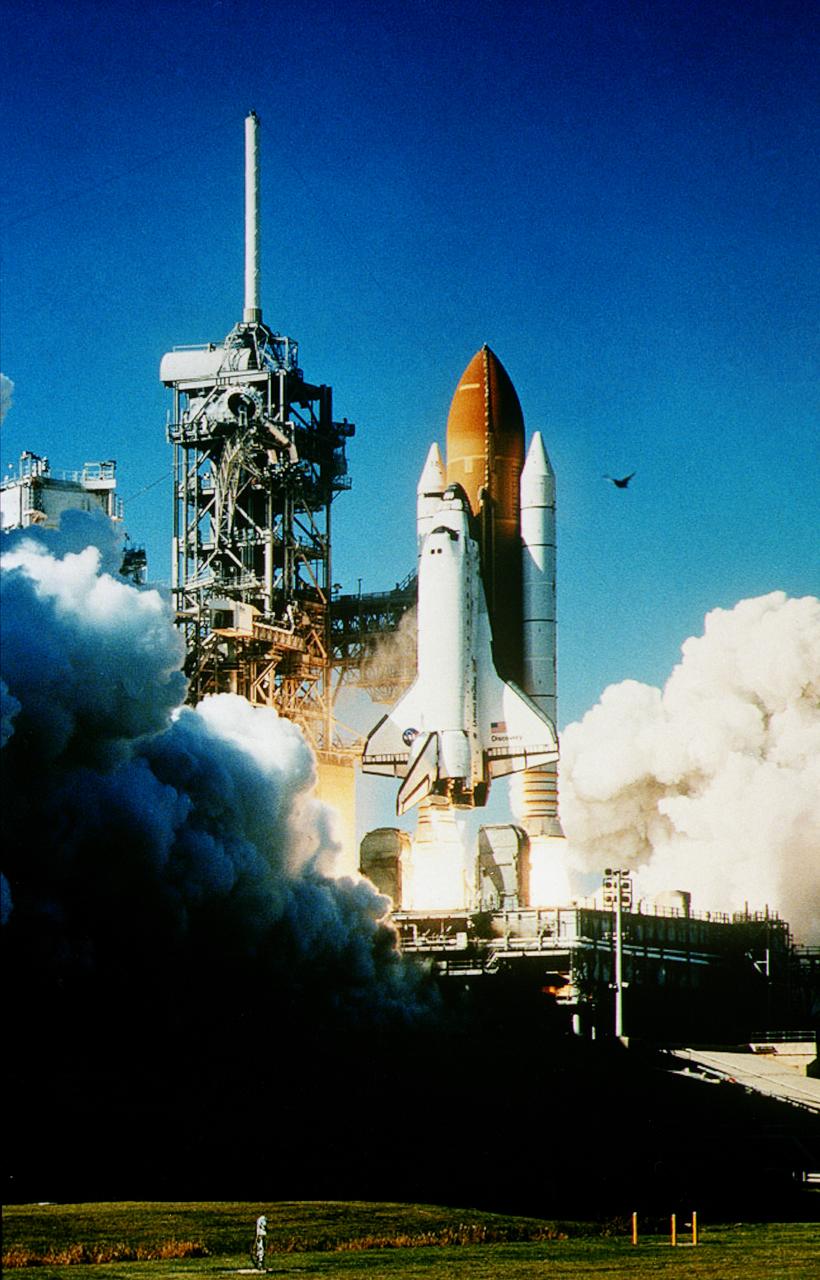
Blast off of NASA's Shuttle Discovery STS-95
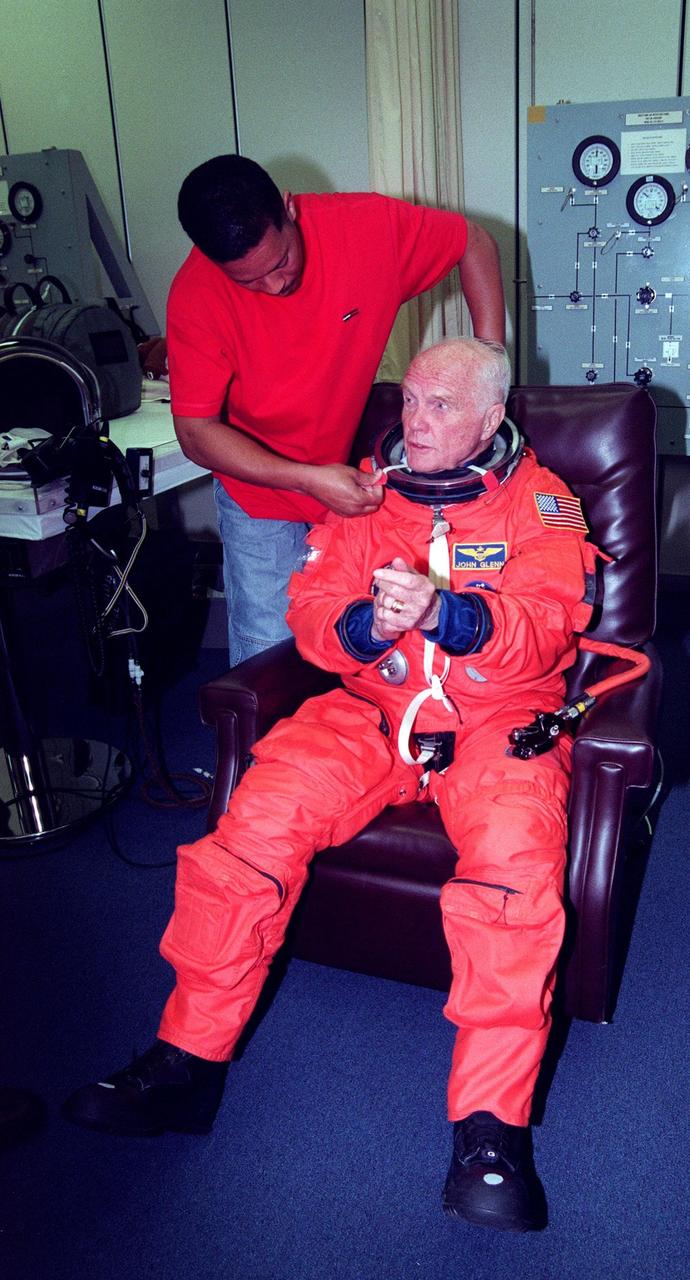
In the Operations and Checkout Building, suit technician George Brittingham helps STS-95 Payload Specialist John H. Glenn Jr., senator from Ohio, with his suit. The STS-95 crew were conducting flight crew equipment fit checks prior to launch on Oct. 29. STS-95 is expected to launch at 2 p.m. EST on Oct. 29, last 8 days, 21 hours and 49 minutes, and land at 11:49 a.m. EST on Nov. 7
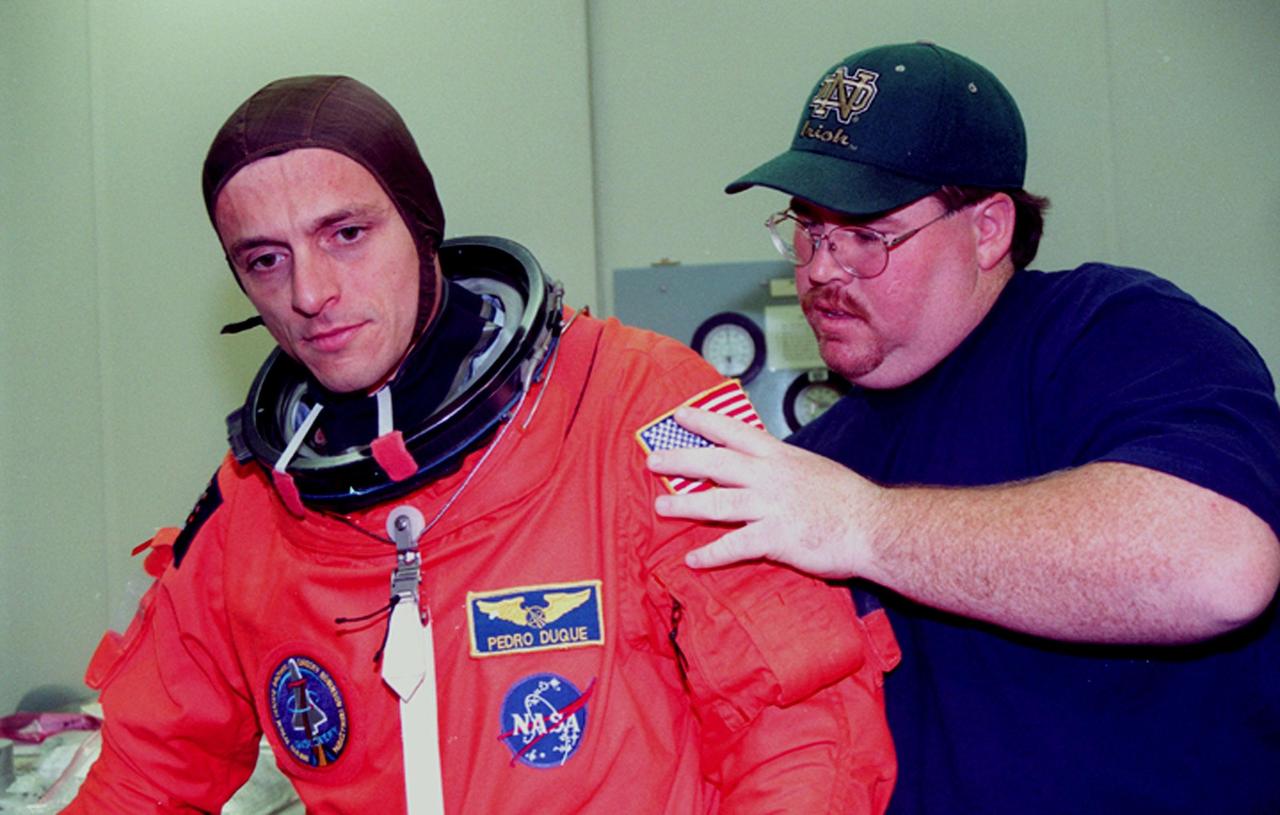
In the Operations and Checkout Building, STS-95 Mission Specialist Pedro Duque of Spain, with the European Space Agency, gets help with his suit from suit technician Tommy McDonald. The STS-95 crew were conducting flight crew equipment fit checks prior to launch on Oct. 29. STS-95 is expected to launch at 2 p.m. EST on Oct. 29, last 8 days, 21 hours and 49 minutes, and land at 11:49 a.m. EST on Nov. 7
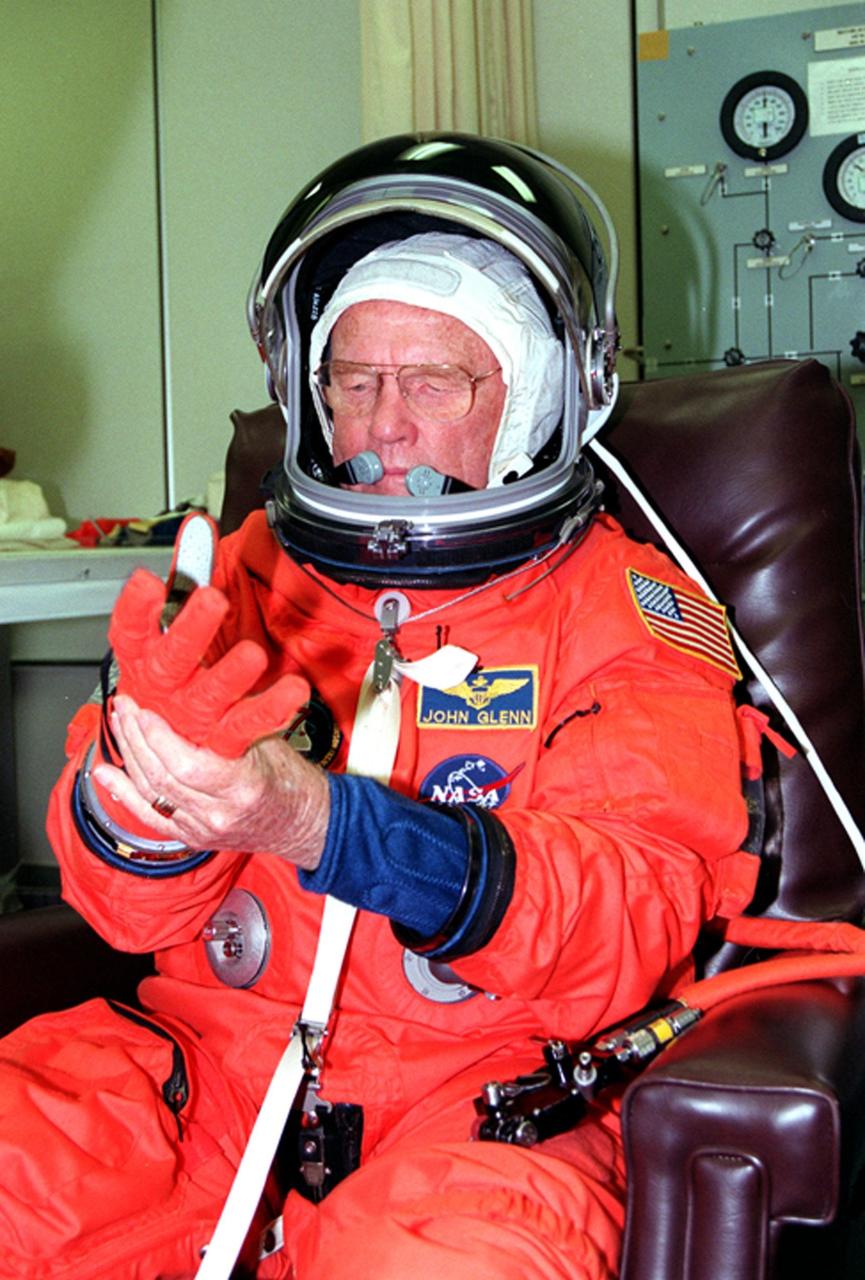
In the Operations and Checkout Building, STS-95 Payload Specialist John H. Glenn Jr. pulls on a glove, part of his equipment check. The STS-95 crew were conducting flight crew equipment fit checks prior to launch on Oct. 29. STS-95 is expected to launch at 2 p.m. EST on Oct. 29, last 8 days, 21 hours and 49 minutes, and land at 11:49 a.m. EST on Nov. 7
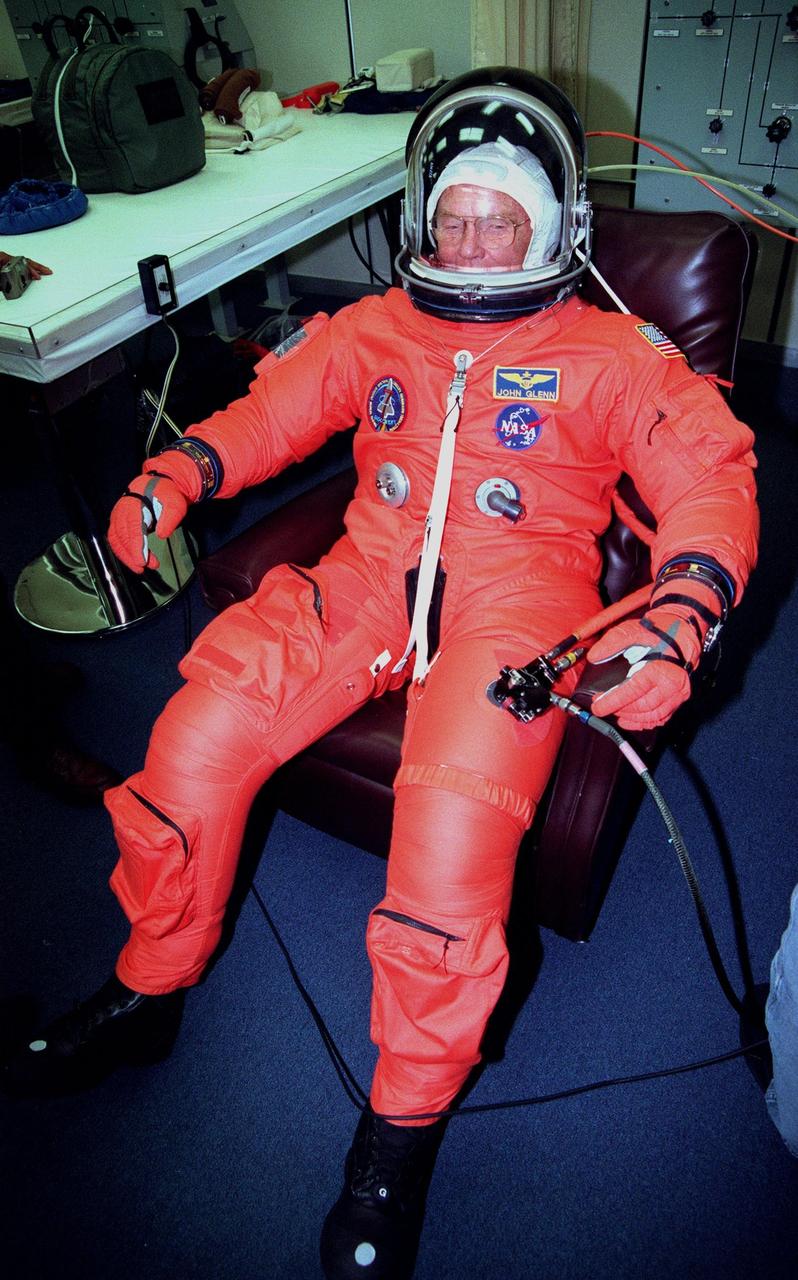
In the Operations and Checkout Building, STS-95 Payload Specialist John H. Glenn Jr., senator from Ohio, participates in a complete suit check. The STS-95 crew were conducting flight crew equipment fit checks prior to launch on Oct. 29. STS-95 is expected to launch at 2 p.m. EST on Oct. 29, last 8 days, 21 hours and 49 minutes, and land at 11:49 a.m. EST on Nov. 7
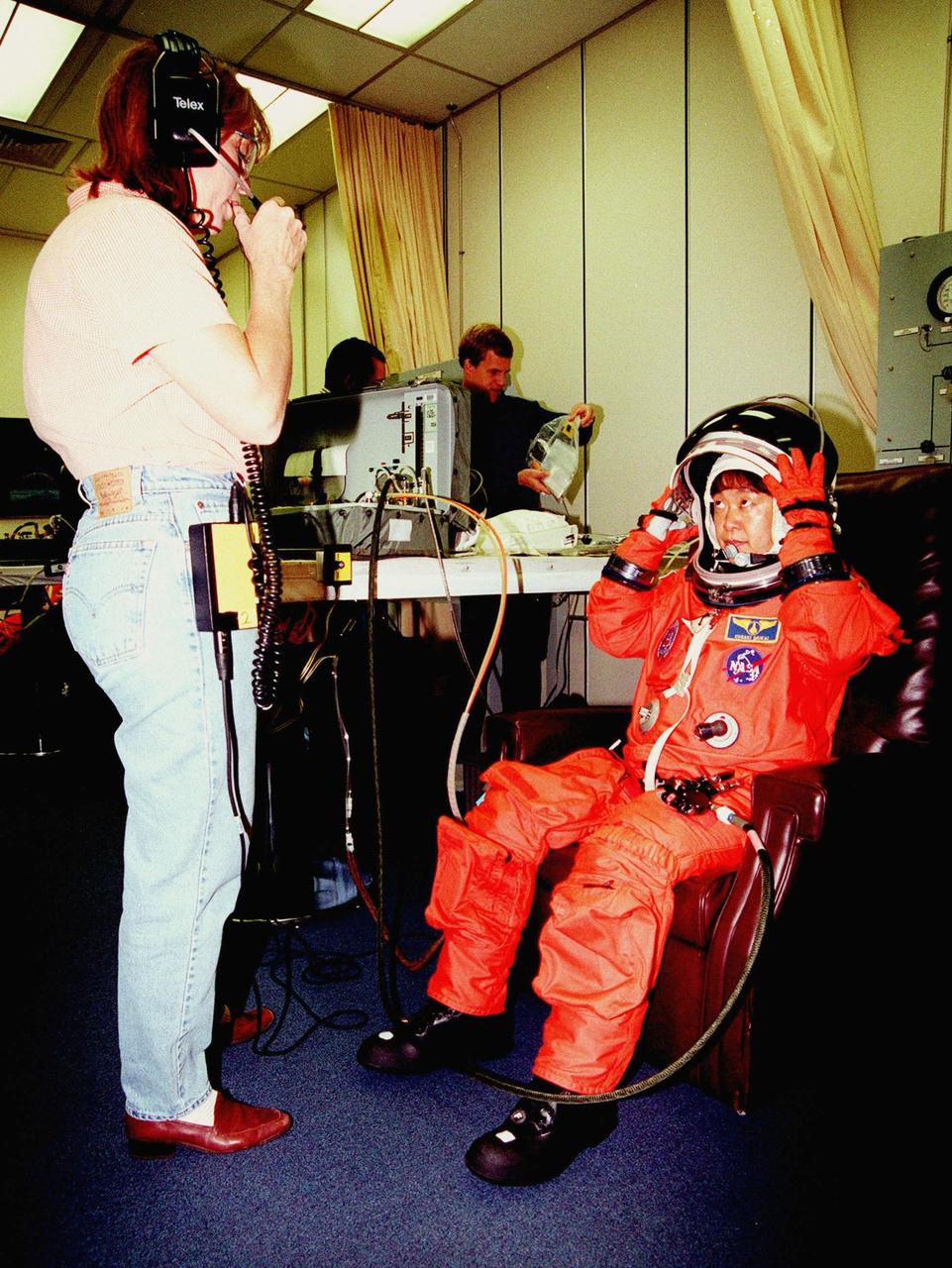
In the Operations and Checkout Building, STS-95 Payload Specialist Chiaki Mukai, with the National Space Development Agency of Japan (NASDA), gets help with her suit from suit technician Monica Golden. The STS-95 crew were conducting flight crew equipment fit checks prior to launch on Oct. 29. STS-95 is expected to launch at 2 p.m. EST on Oct. 29, last 8 days, 21 hours and 49 minutes, and land at 11:49 a.m. EST on Nov. 7
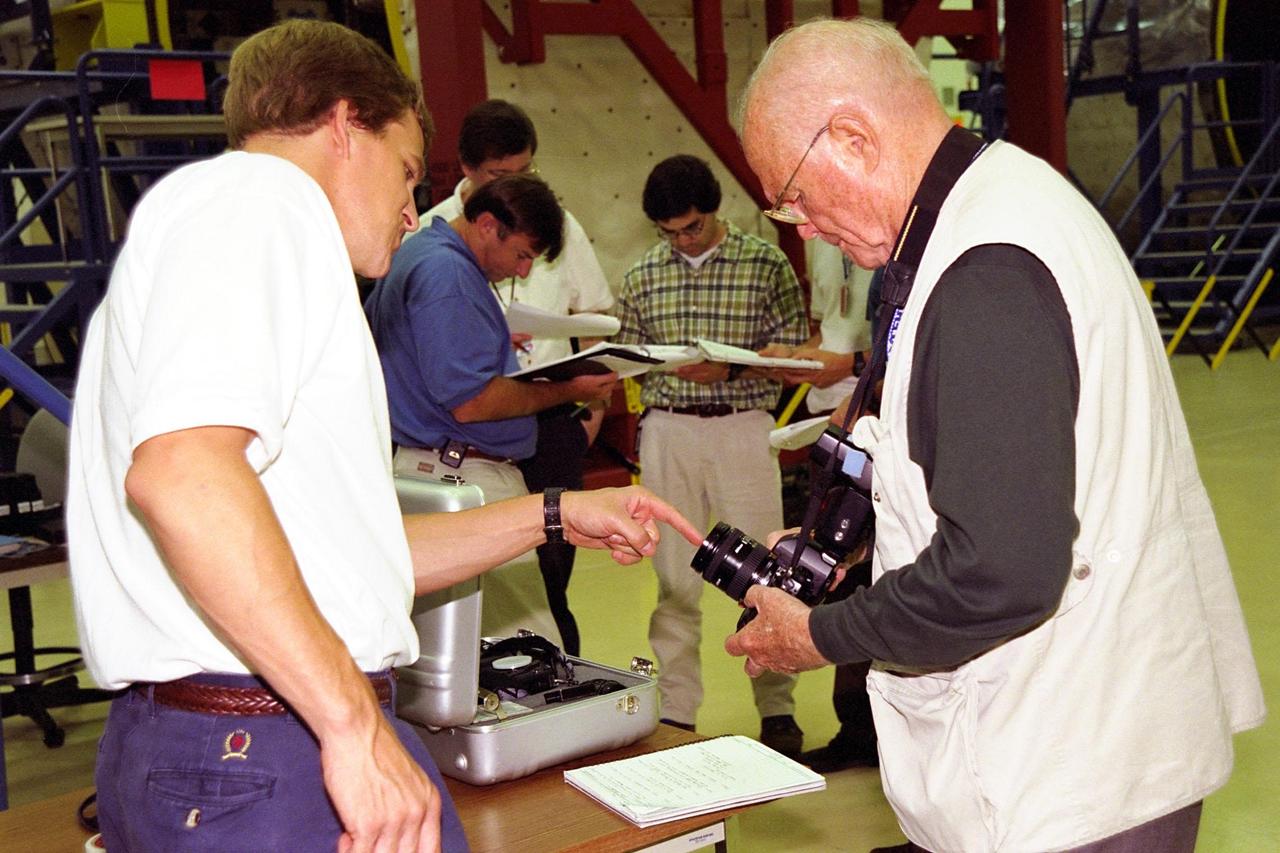
KENNEDY SPACE CENTER, FLA. -- STS-95 Payload Specialist John H. Glenn Jr., at right, and Mission Specialist Scott E. Parazynski examine a camera at the SPACEHAB Payload Processing Facility in Cape Canaveral. STS-95 will feature a variety of research payloads, including the Spartan solar-observing deployable spacecraft, the Hubble Space Telescope Orbital Systems Platform, the International Extreme Ultraviolet Hitchhiker, and experiments on space flight and the aging process. STS-95 is targeted for an Oct. 29 launch aboard the Space Shuttle Discovery
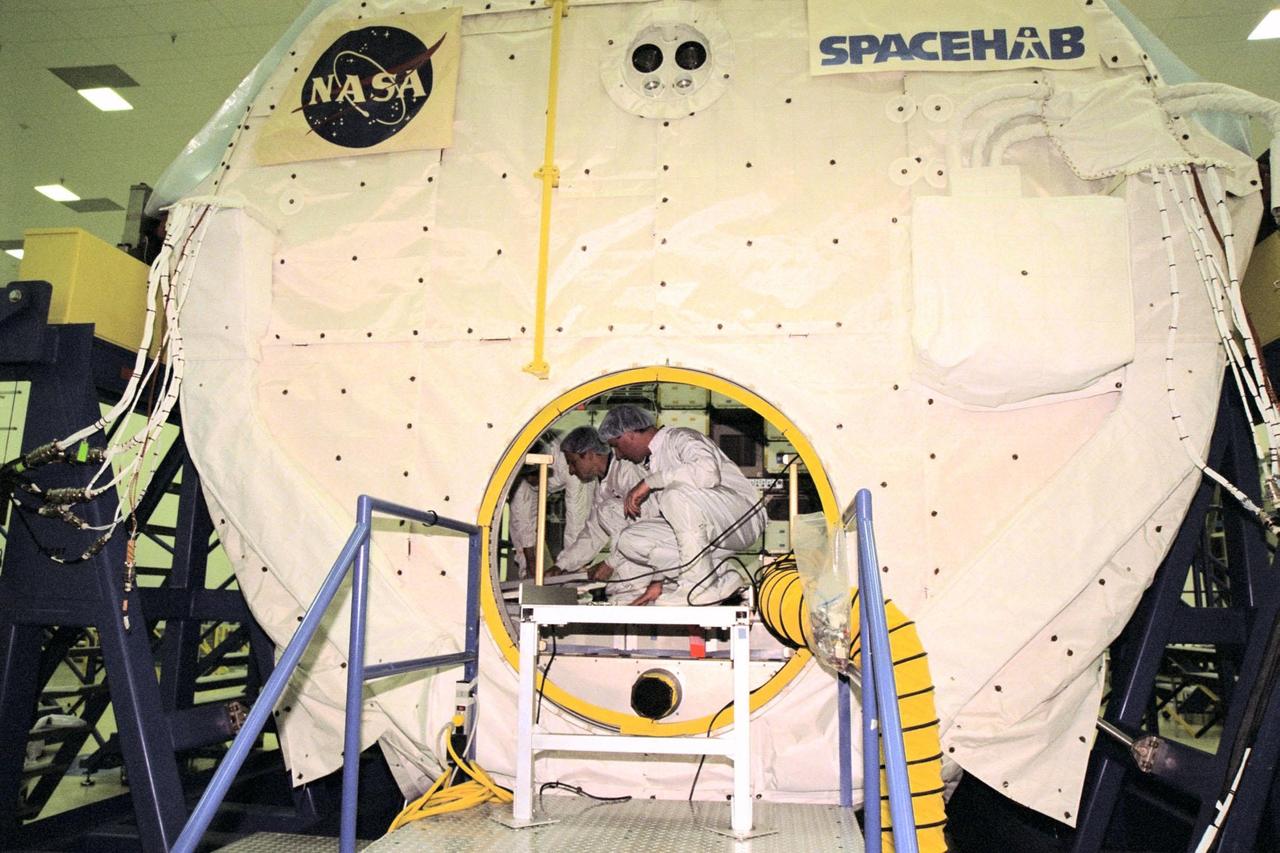
KENNEDY SPACE CENTER, FLA. -- Members of the STS-95 crew familiarize themselves with equipment inside the SPACEHAB module at the SPACEHAB Payload Processing Facility in Cape Canaveral. STS-95 will feature a variety of research payloads, including the Spartan solar-observing deployable spacecraft, the Hubble Space Telescope Orbital Systems Platform, the International Extreme Ultraviolet Hitchhiker, and experiments on space flight and the aging process. STS-95 is targeted for an Oct. 29 launch aboard the Space Shuttle Discovery
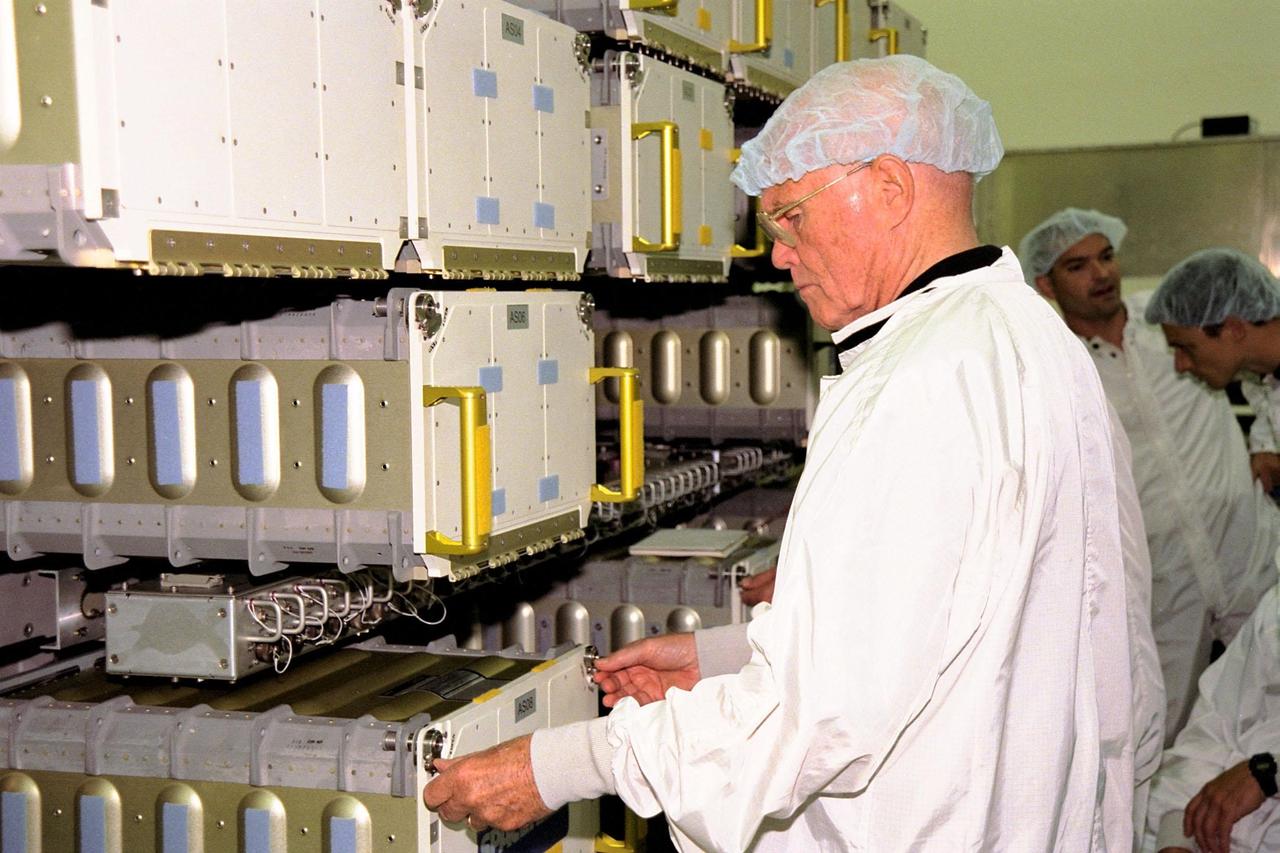
STS-95 Payload Specialist John H. Glenn Jr., who also is a senator from Ohio, works with equipment inside the SPACEHAB module at the SPACEHAB Payload Processing Facility in Cape Canaveral. STS-95 will feature a variety of research payloads, including the Spartan solar-observing deployable spacecraft, the Hubble Space Telescope Orbital Systems Platform, the International Extreme Ultraviolet Hitchhiker, and experiments on space flight and the aging process. STS-95 is targeted for an Oct. 29 launch aboard the Space Shuttle Discovery

S98-16081 (10-29-98) --- Profile view of rear of Mission Control Center (MCC) featuring Mission Operations Director (MOD) console (foreground) and Spacecraft Communicator (CAPCOM) and Flight Director (FD) consoles (left background). Astronaut Linda M. Godwin is at lower right foreground.
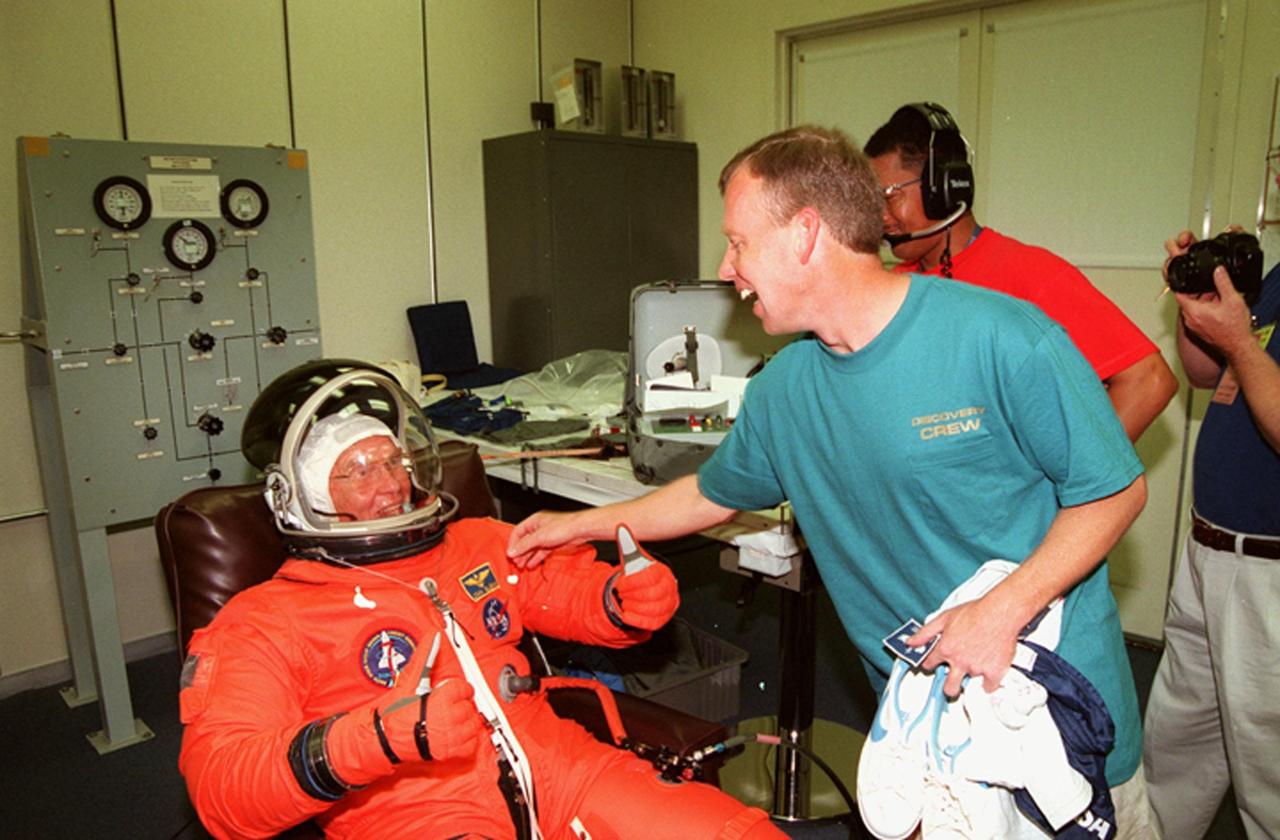
KENNEDY SPACE CENTER, FLA. -- In the Operations and Checkout Building, STS-95 Pilot Steven W. Lindsey (right) reaches playfully for the name tag on the flight suit of Payload Specialist John H. Glenn Jr., senator from Ohio, seated in the chair. The STS-95 crew were conducting flight crew equipment fit checks prior to launch on Oct. 29. STS-95 is expected to launch at 2 p.m. EST on Oct. 29, last 8 days, 21 hours and 49 minutes, and land at 11:49 a.m. EST on Nov. 7
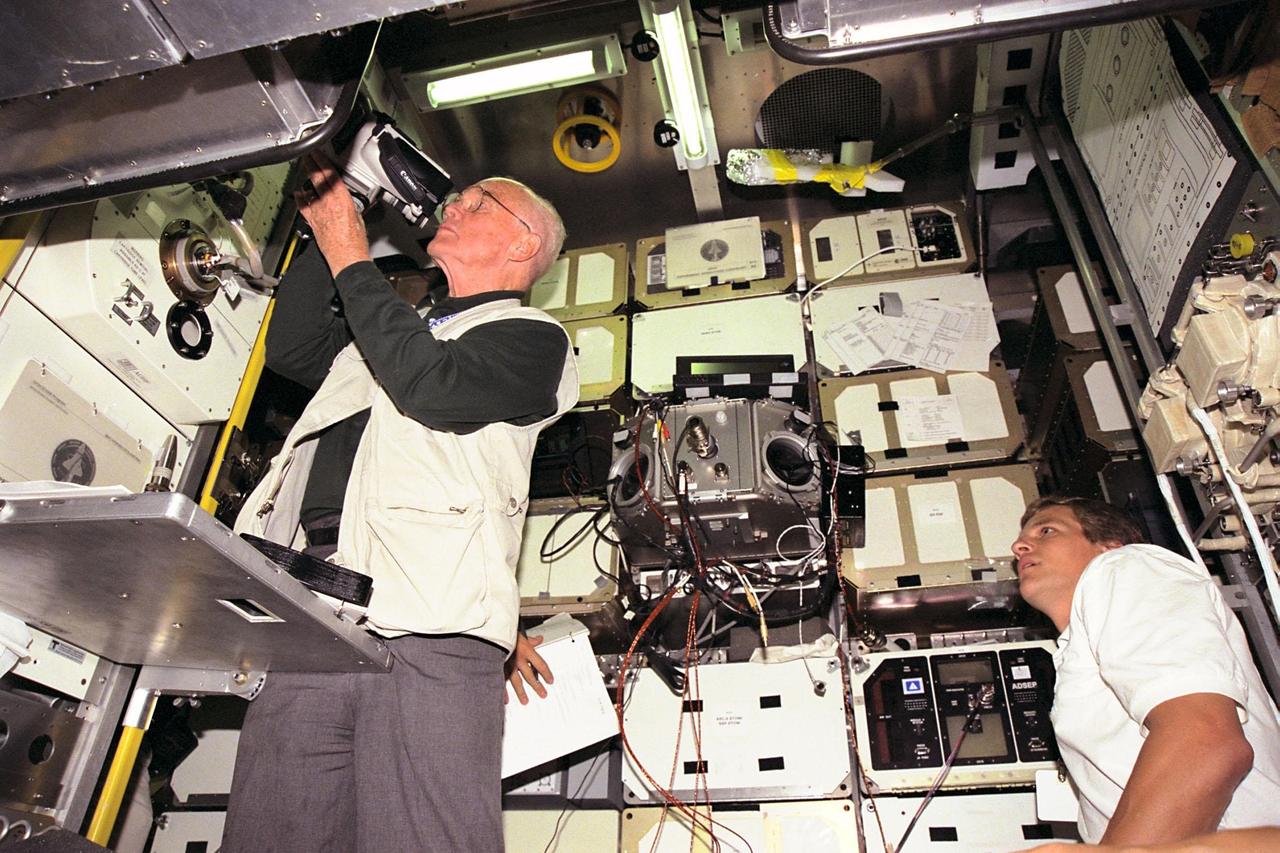
KENNEDY SPACE CENTER, FLA. -- STS-95 Payload Specialist John H. Glenn Jr., who also is a senator from Ohio, adjusts a a video camera in the SPACEHAB trainer at the SPACEHAB Payload Processing Facility in Cape Canaveral. Mission Specialist Scott E. Parazynski looks on at right. STS-95 will feature a variety of research payloads, including the Spartan solar-observing deployable spacecraft, the Hubble Space Telescope Orbital Systems Platform, the International Extreme Ultraviolet Hitchhiker, and experiments on space flight and the aging process. STS-95 is targeted for an Oct. 29 launch aboard the Space Shuttle Discovery
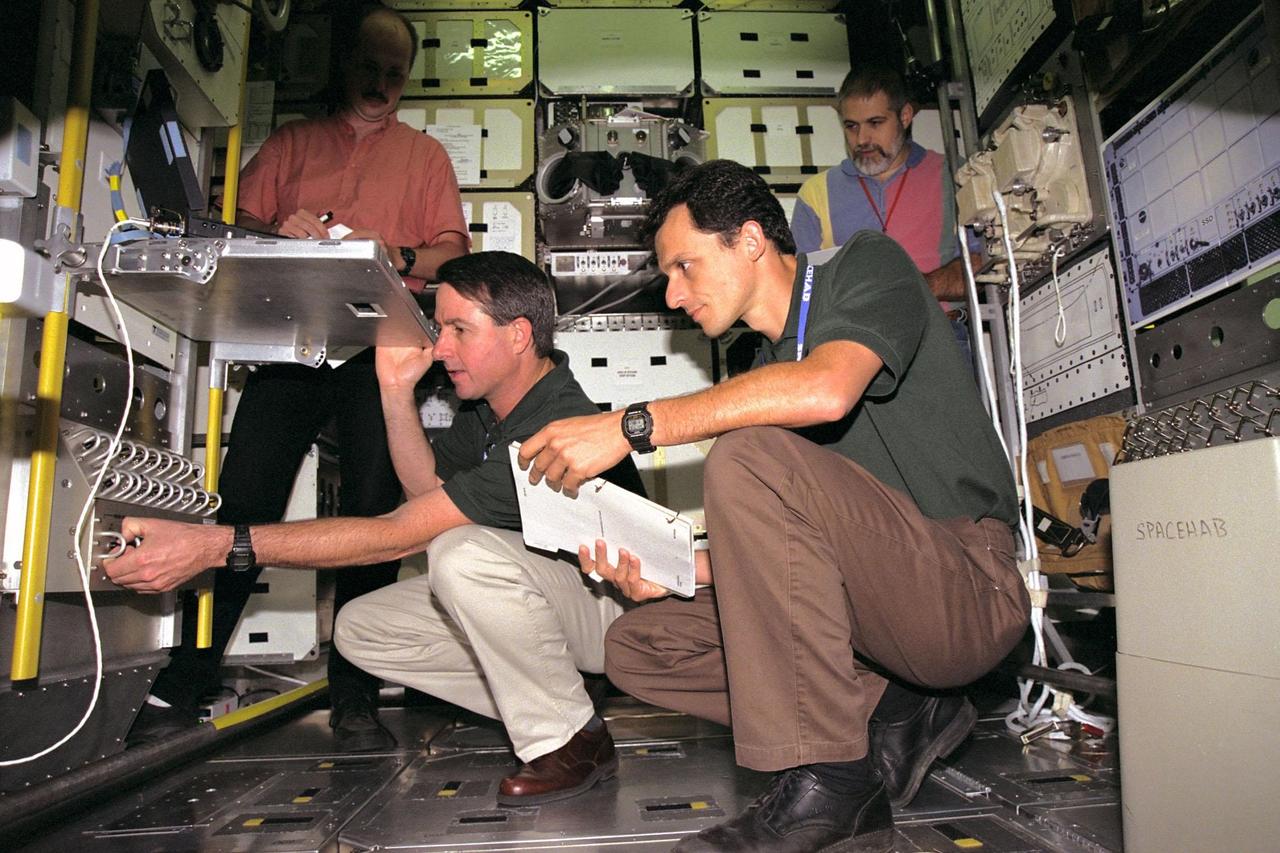
KENNEDY SPACE CENTER, FLA. -- While workers look on, STS-95 Mission Specialists Stephen K. Robinson, kneeling at left, and Pedro Duque inspect equipment inside the SPACEHAB module trainer at the SPACEHAB Payload Processing Facility in Cape Canaveral. STS-95 will feature a variety of research payloads, including the Spartan solar-observing deployable spacecraft, the Hubble Space Telescope Orbital Systems Platform, the International Extreme Ultraviolet Hitchhiker, and experiments on space flight and the aging process. STS-95 is targeted for an Oct. 29 launch aboard the Space Shuttle Discovery

KENNEDY SPACE CENTER, FLA. -- STS-95 Mission Specialist Stephen K. Robinson inspects experiment equipment in the SPACEHAB trainer at the SPACEHAB Payload Processing Facility in Cape Canaveral. He and other members of the crew are familiarizing themselves with the SPACEHAB experiments. STS-95 will feature a variety of research payloads, including the Spartan solar-observing deployable spacecraft, the Hubble Space Telescope Orbital Systems Platform, the International Extreme Ultraviolet Hitchhiker, and experiments on space flight and the aging process. STS-95 is targeted for an Oct. 29 launch aboard the Space Shuttle Discovery
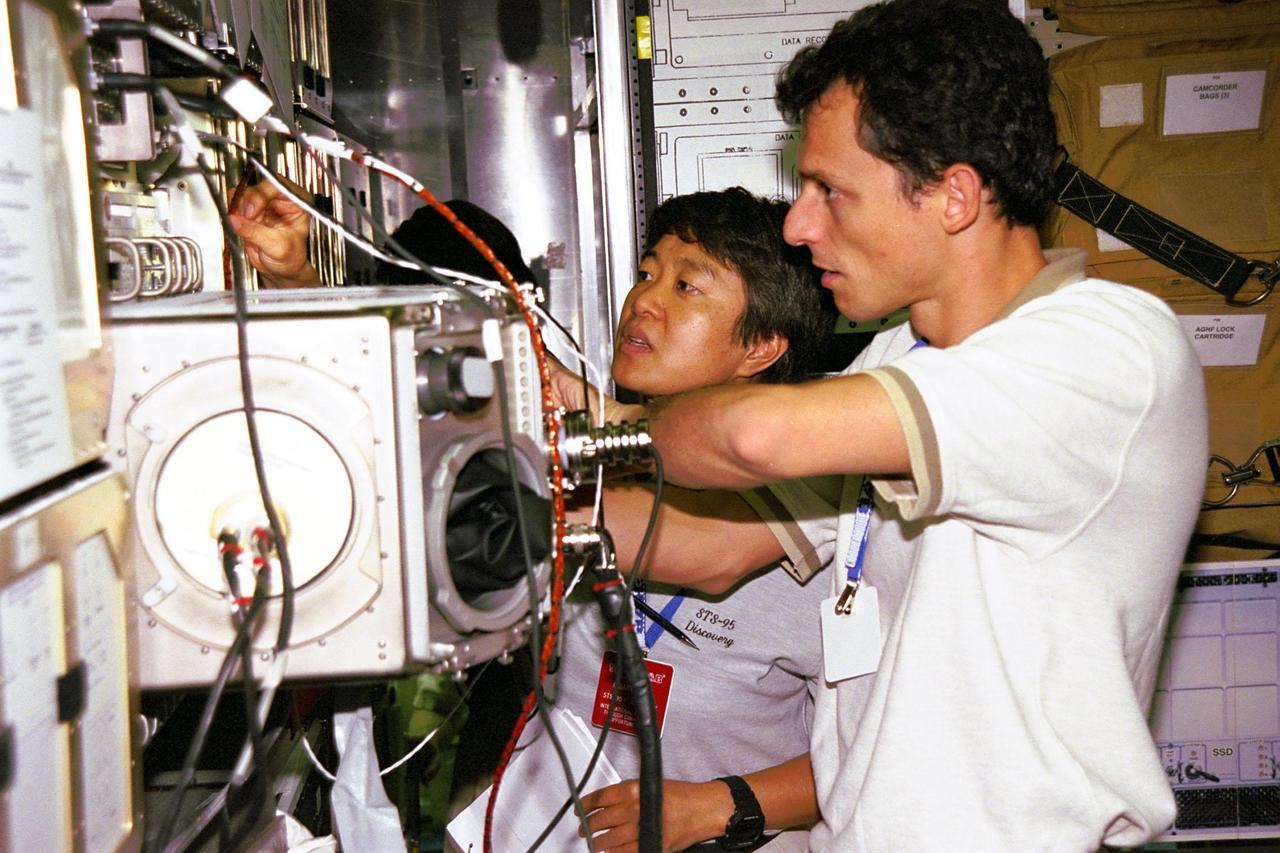
KENNEDY SPACE CENTER, F LA. -- STS-95 Payload Specialists Chiaki Mukai, at left, representing the National Space Development Agency of Japan (NASDA), and Mission Specialist Pedro Duque of Spain, representing the European Space Agency (ESA), practice using equipment in the SPACEHAB trainer at the SPACEHAB Payload Processing Facility in Cape Canaveral. STS-95 will feature a variety of research payloads, including the Spartan solar-observing deployable spacecraft, the Hubble Space Telescope Orbital Systems Platform, the International Extreme Ultraviolet Hitchhiker, and experiments on space flight and the aging process. STS-95 is targeted for an Oct. 29 launch aboard the Space Shuttle Discovery.
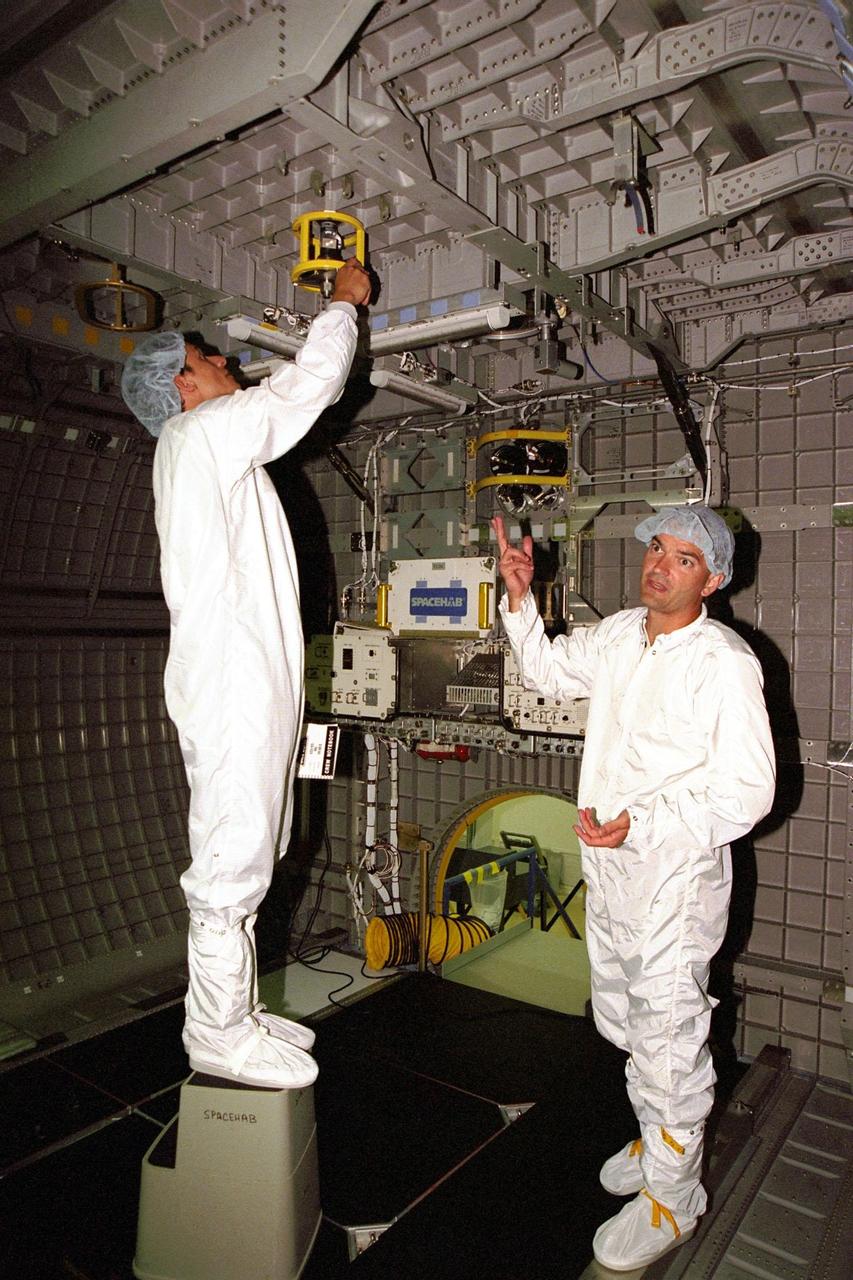
STS-95 Mission Specialist Stephen K.Robinson (left) looks at equipment in the SPACEHAB module as Chris Jaskolka, of Boeing SPACEHAB, explains the equipment during a familiarization tour for the STS-95 crew at SPACEHAB Payload Processing Facility at Cape Canaveral, Fla. The STS-95 is scheduled to launch Oct. 29, 1998. The mission includes research payloads such as the Spartan solar-observing deployable spacecraft, the Hubble Space Telescope Orbital Systems Test Platform, the International Extreme Ultraviolet Hitchhiker, as well as the SPACEHAB single module with experiments on space flight and the aging process
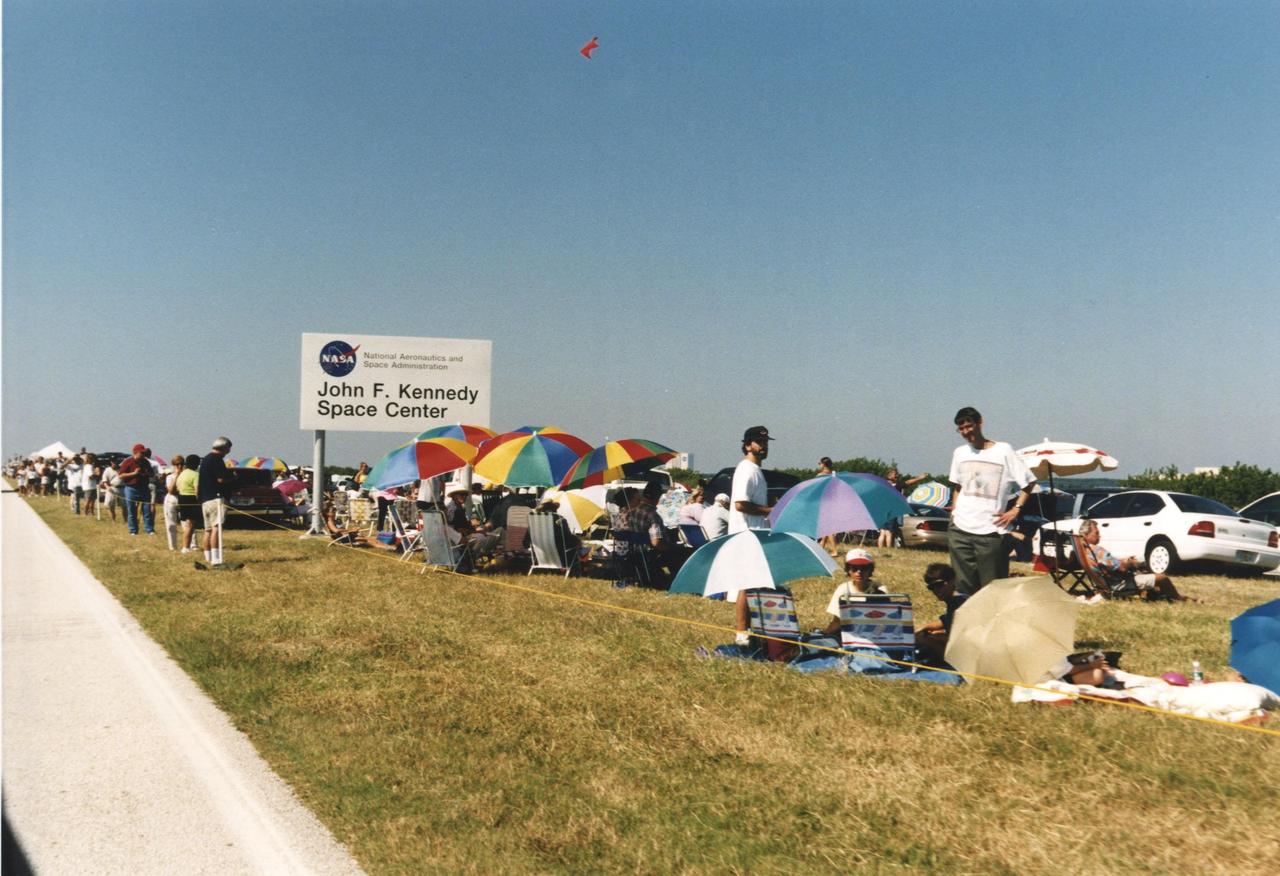
Crowds of thousands line the grassy shoulders of the parkways at Kennedy Space Center to view the launch of STS-95. Extra attention has been drawn to the mission due to the addition to the crew of John H. Glenn Jr., a senator from Ohio. STS-95 is Glenn's second flight into space after 36 years; he was one of the original Project Mercury astronauts and flew his first mission in February 1962. The STS-95 mission includes research payloads such as the Spartan solar-observing deployable spacecraft, the Hubble Space Telescope Orbital Systems Test Platform, the International Extreme Ultraviolet Hitchhiker, as well as a SPACEHAB single module with experiments on space flight and the aging process
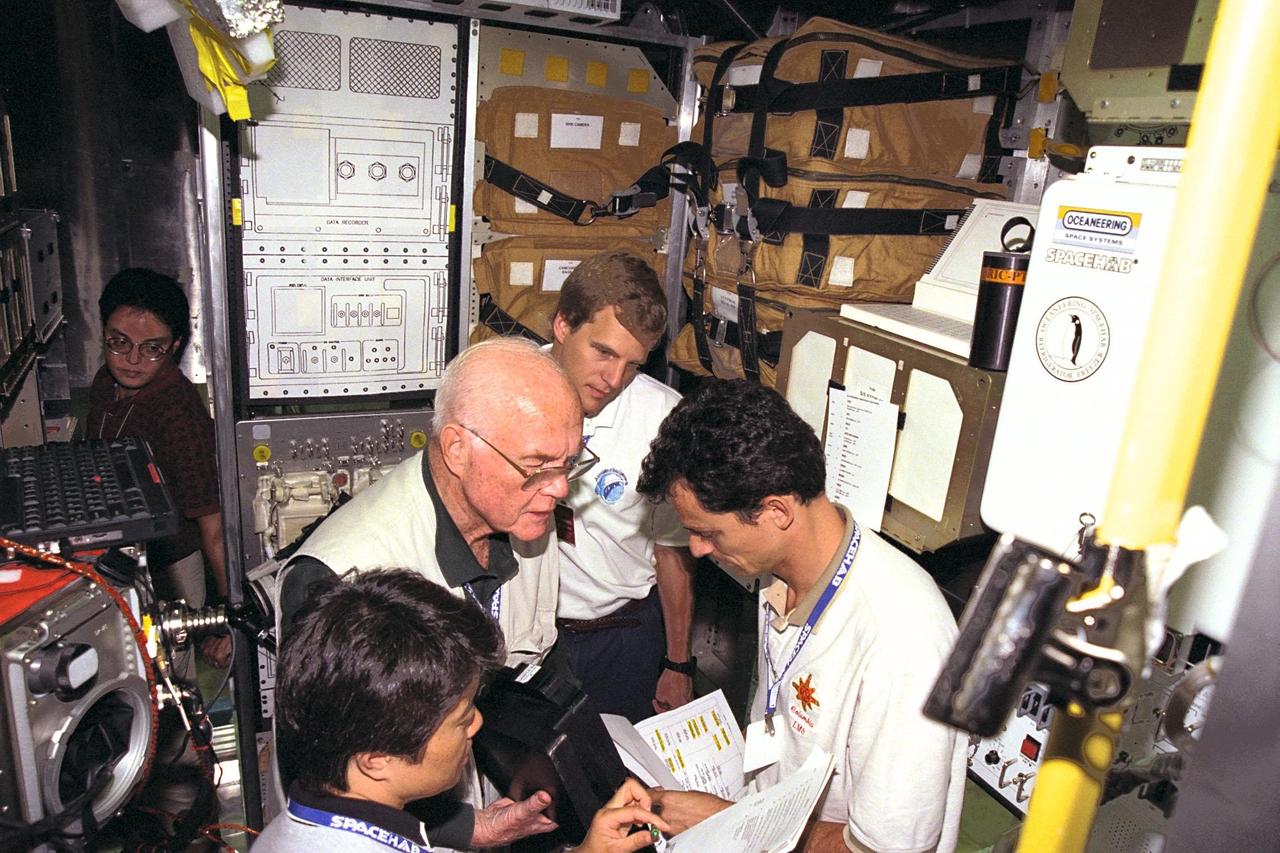
KENNEDY SPACE CENTER, FLA. -- STS-95 crew members review procedures in the SPACEHAB trainer at the SPACEHAB Payload Processing Facility in Cape Canaveral. From left, are Payload Specialists Chiaki Mukai and John H. Glenn Jr., and Mission Specialists Scott E. Parazynski and Pedro Duque. STS-95 will feature a variety of research payloads, including the Spartan solar-observing deployable spacecraft, the Hubble Space Telescope Orbital Systems Platform, the International Extreme Ultraviolet Hitchhiker, and experiments on space flight and the aging process. STS-95 is targeted for an Oct. 29 launch aboard the Space Shuttle Discovery
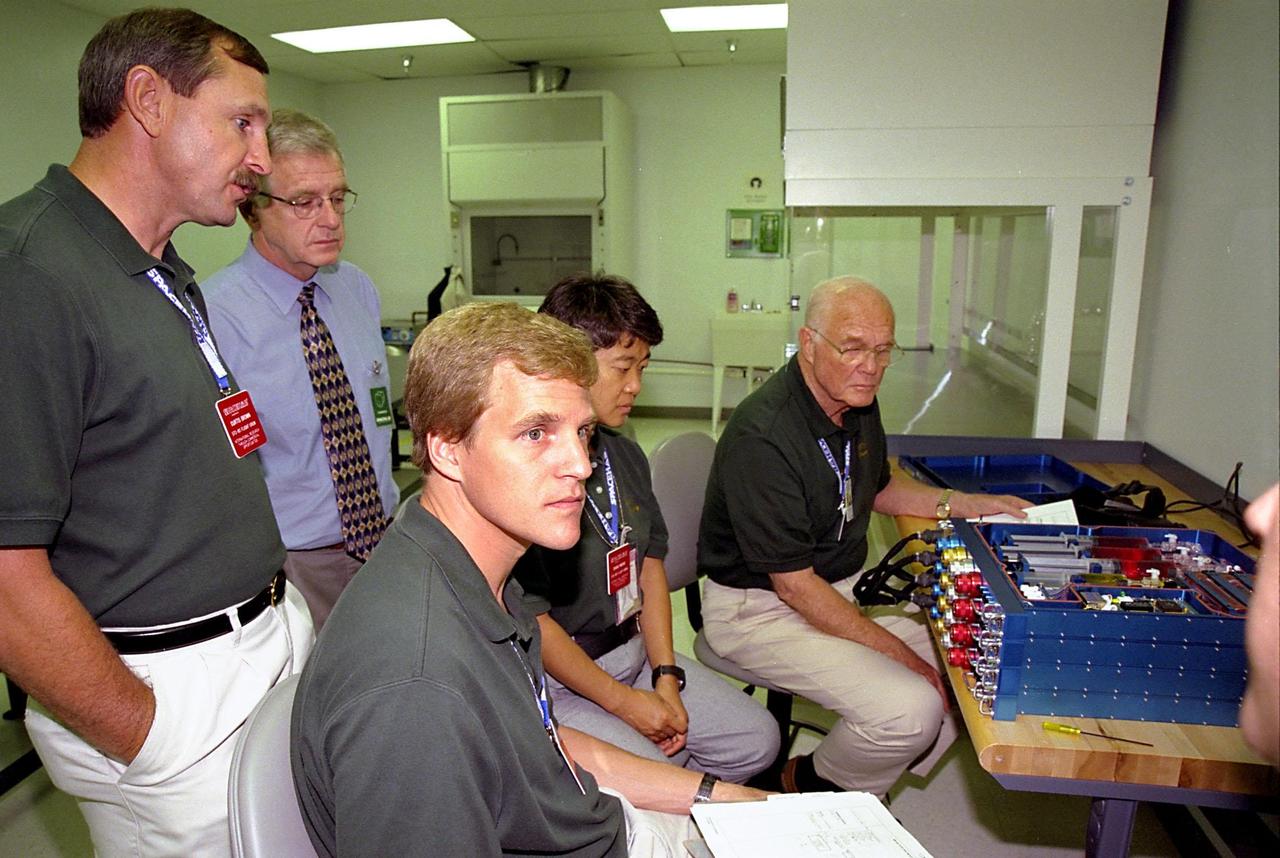
KENNEDY SPACE CENTER, FLA. -- STS-95 crew members look over the Osteoporosis Experiment in Orbit (OSTEO) during a SPACEHAB familiarization tour and briefing in the SPACEHAB Payload Processing Facility in Cape Canaveral. Seated from left are Mission Specialist Scott E. Parazynski, Payload Specialist Chiaki Mukai of the National Space Development Agency of Japan (NASDA), and Payload Specialist John H. Glenn Jr., who also is a senator from Ohio. Standing, from left, are STS-95 Commander Curtis L. Brown and Canadian Space Agency representative Duncan Burnside. STS-95 will feature a variety of research payloads, including the Spartan solar-observing deployable spacecraft, the Hubble Space Telescope Orbital Systems Platform, the International Extreme Ultraviolet Hitchhiker, and experiments on space flight and the aging process. STS-95 is targeted for an Oct. 29 launch aboard the Space Shuttle Discovery
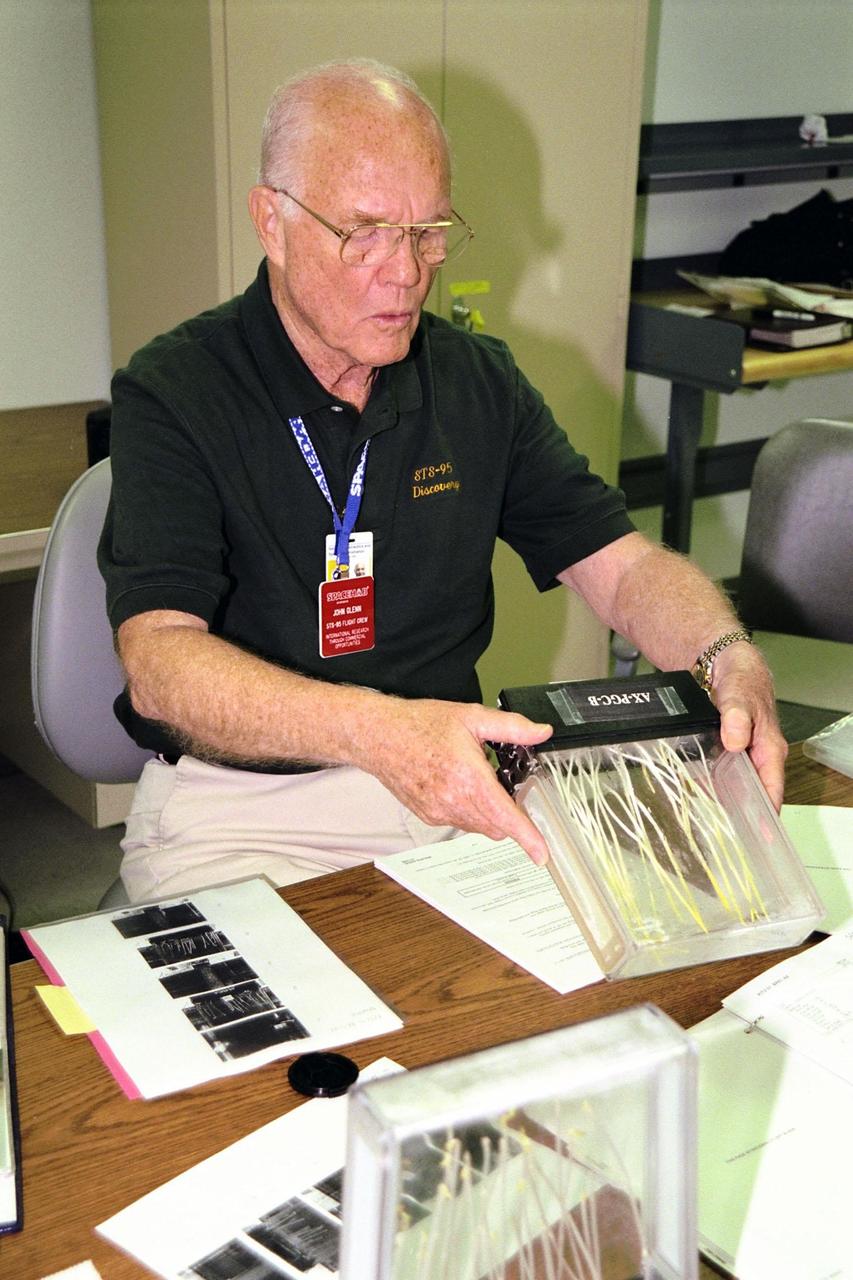
KENNEDY SPACE CENTER, FLA. -- STS-95 Payload Specialist John H. Glenn Jr., who also is a senator from Ohio, works with the Biological Research in Canisters (BRIC) experiment which will be flown on the mission. Glenn and other STS-95 crew members were at KSC and the adjacent SPACEHAB Payload Processing Facility in Cape Canaveral to familiarize themselves with the payloads which will fly on the mission. STS-95 will feature a variety of research payloads, including the Spartan solar-observing deployable spacecraft, the Hubble Space Telescope Orbital Systems Platform, the International Extreme Ultraviolet Hitchhiker, and experiments on space flight and the aging process. STS-95 is targeted for an Oct. 29 launch aboard the Space Shuttle Discovery

KENNEDY SPACE CENTER, FLA. -- STS-95 Payload Specialist Chiaki Mukai, representing the National Space Development Agency of Japan (NASDA), handles part of the Biological Research in Canisters (BRIC) experiment which will fly on the planned nine-day mission. She and other crew members, including Mission Specialist Scott E. Parazynski, at right, are at KSC and the adjacent SPACEHAB Payload Processing Facility in Cape Canaveral to familiarize themselves with the STS-95 payloads. Standing behind the two astronauts is Steve Pyle of Boeing in Huntsville, Ala. STS-95 will feature a variety of research payloads, including the Spartan solar-observing deployable spacecraft, the Hubble Space Telescope Orbital Systems Platform, the International Extreme Ultraviolet Hitchhiker, and experiments on space flight and the aging process. STS-95 is targeted for an Oct. 29 launch aboard the Space Shuttle Discovery.
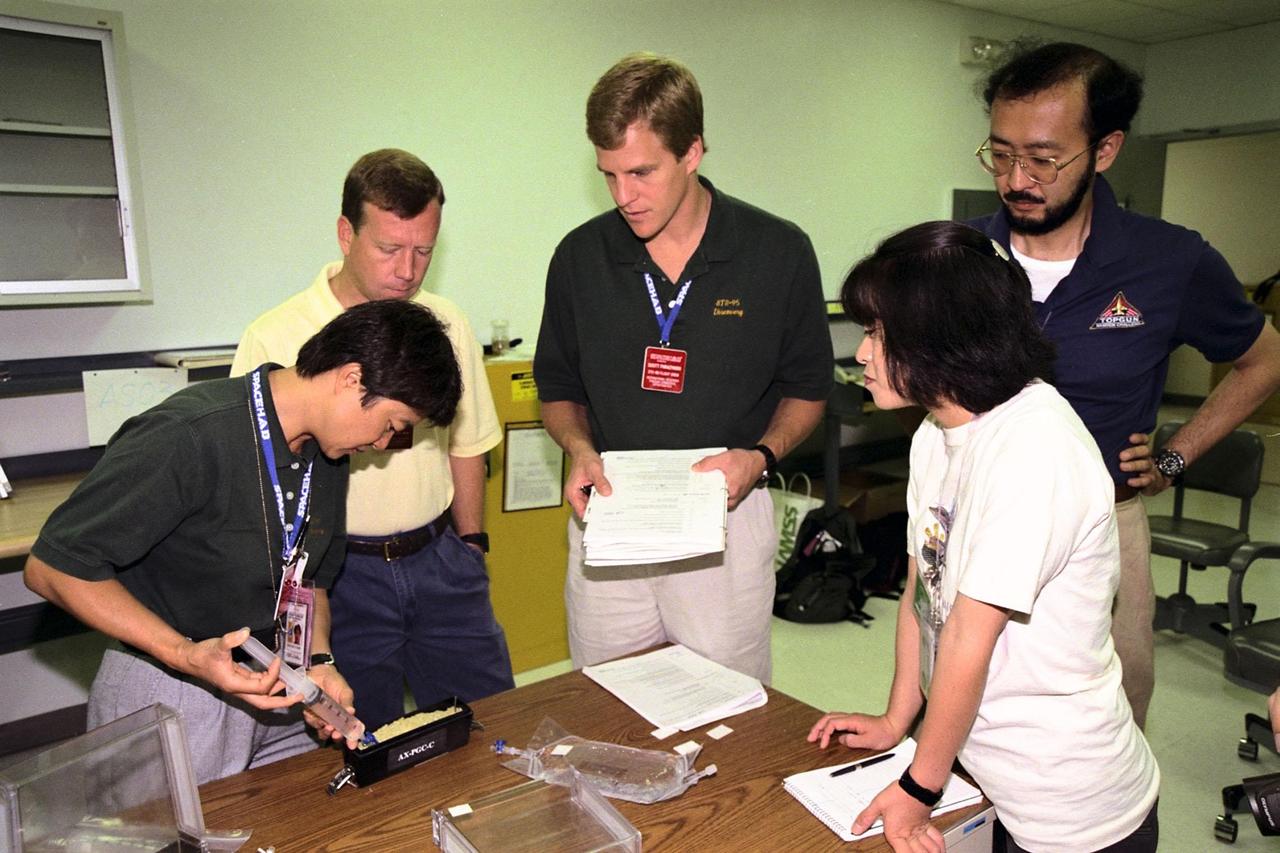
STS-95 Payload Specialist Chiaki Mukai, at far left, of the National Space Development Agency of Japan (NASDA) works on the Biological Research in Canisters (BRIC) experiment which will fly on the scheduled nine-day mission. Watching her, starting with second from left, are STS-95 Pilot Steven W. Lindsey, Mission Specialist Scott E. Parazynski, and NASDA representatives Sachiko Aizawa and Shigeki Kamigaichi. STS-95 will feature a variety of research payloads, including the Spartan solar-observing deployable spacecraft, the Hubble Space Telescope Orbital Systems Platform, the International Extreme Ultraviolet Hitchhiker, and experiments on space flight and the aging process. STS-95 is targeted for an Oct. 29 launch aboard the Space Shuttle Discovery
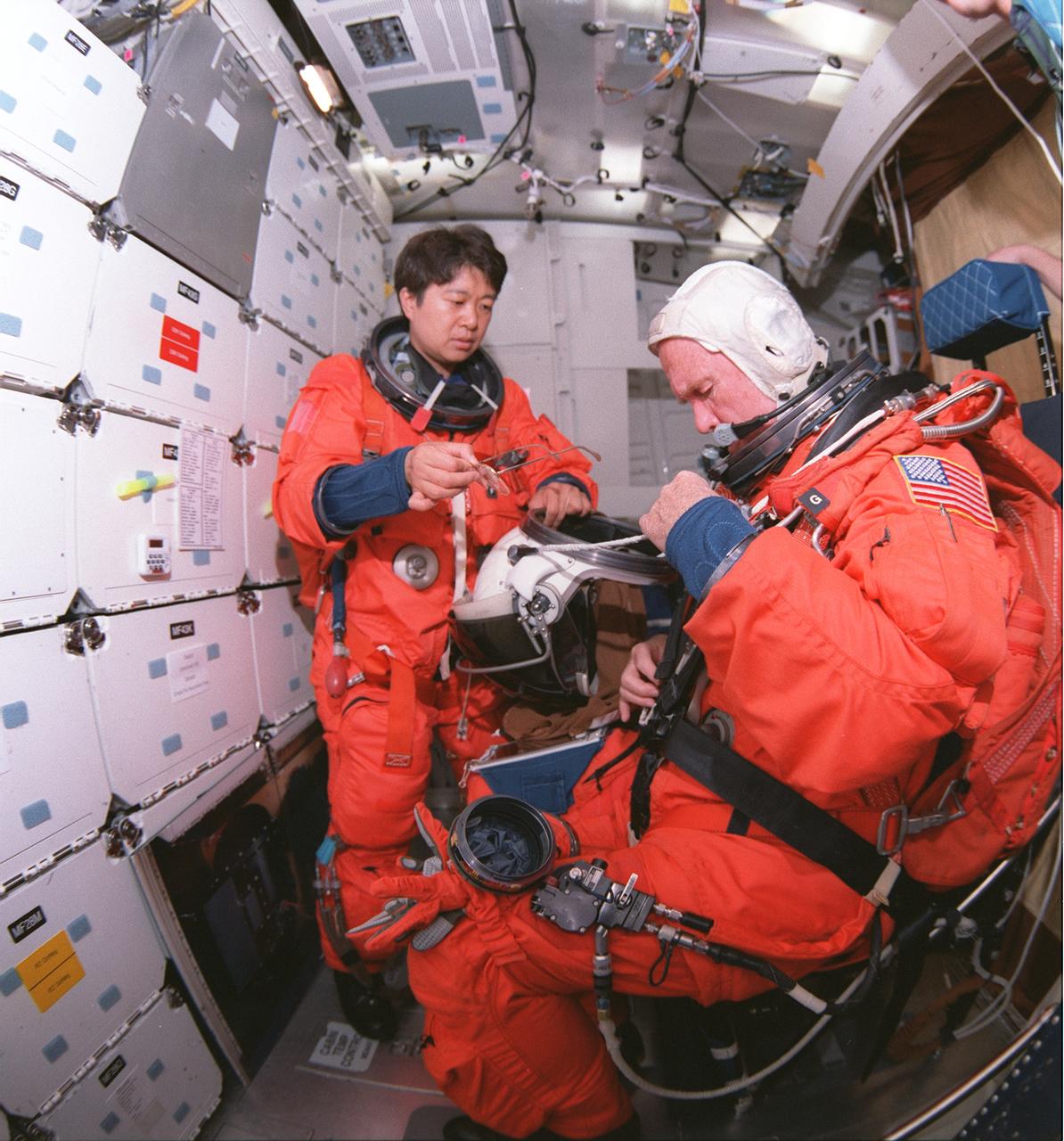
S98-07970 (5 June 1998) --- The two payload specialists in training for the STS-95 mission aboard the Space Shuttle Discovery prepare to take their assigned launch and entry seats on the mid deck of one of the shutte training mockups in JSC's systems integration facility. Wearing training versions of the shuttle partial pressure launch and entry suits, the two were joined by the other five STS-95 crew members for the training session, one of many planned in preparation for the scheduled October launch aboard Discovery.
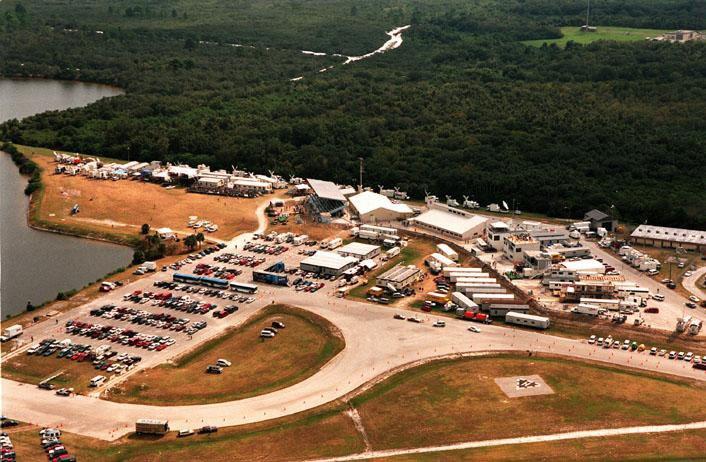
Aerial view of Press Site, October 28, 1998, the day before the launch of STS-95, which carried Mercury Astronaut, John Glenn, back into space
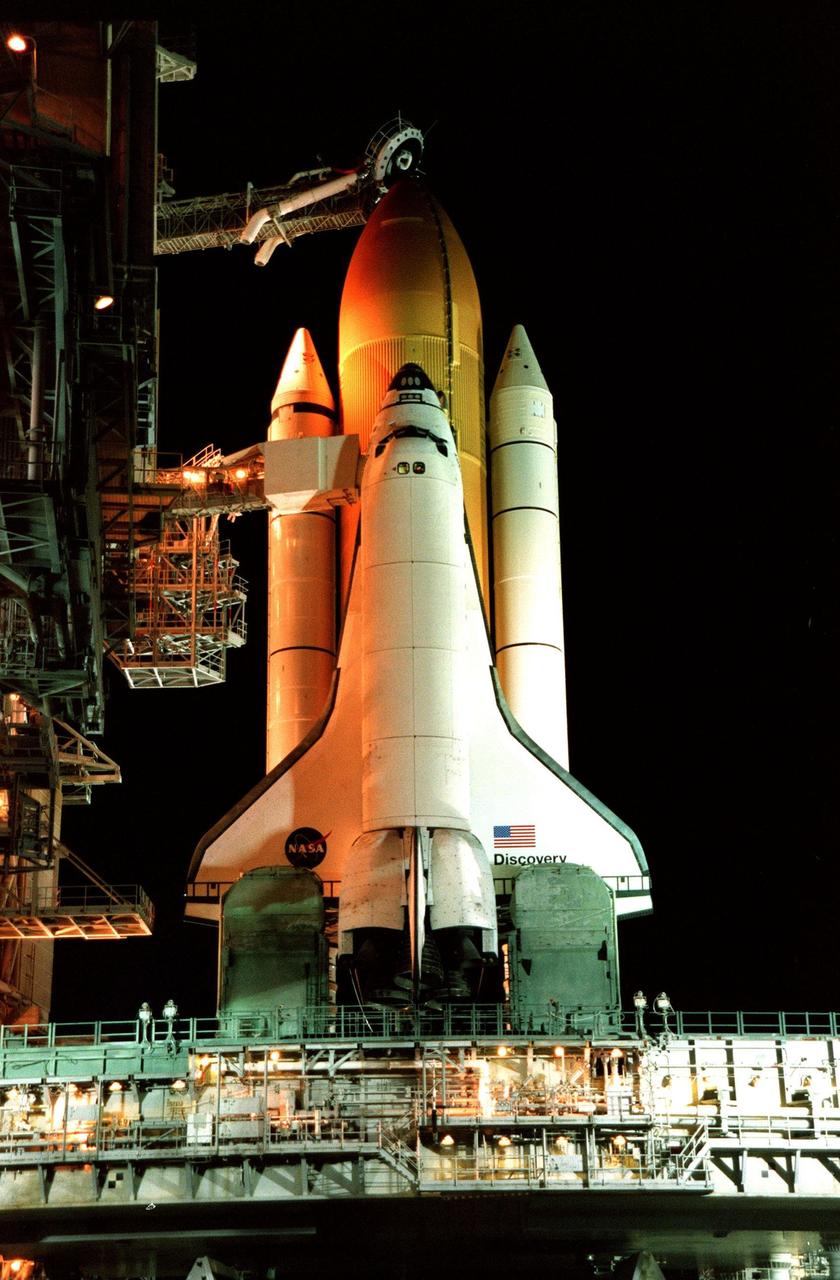
After its Rotational Service Structure is rolled back, the Space Shuttle Discovery awaits the dawn of day on its scheduled day of launch on mission STS-95 at Launch Pad 39B. Liftoff is scheduled for 2 p.m. on Oct. 29. The STS-95 mission is expected to last almost 9 days, with a landing at KSC at 11:49 a.m. EST on Nov. 7
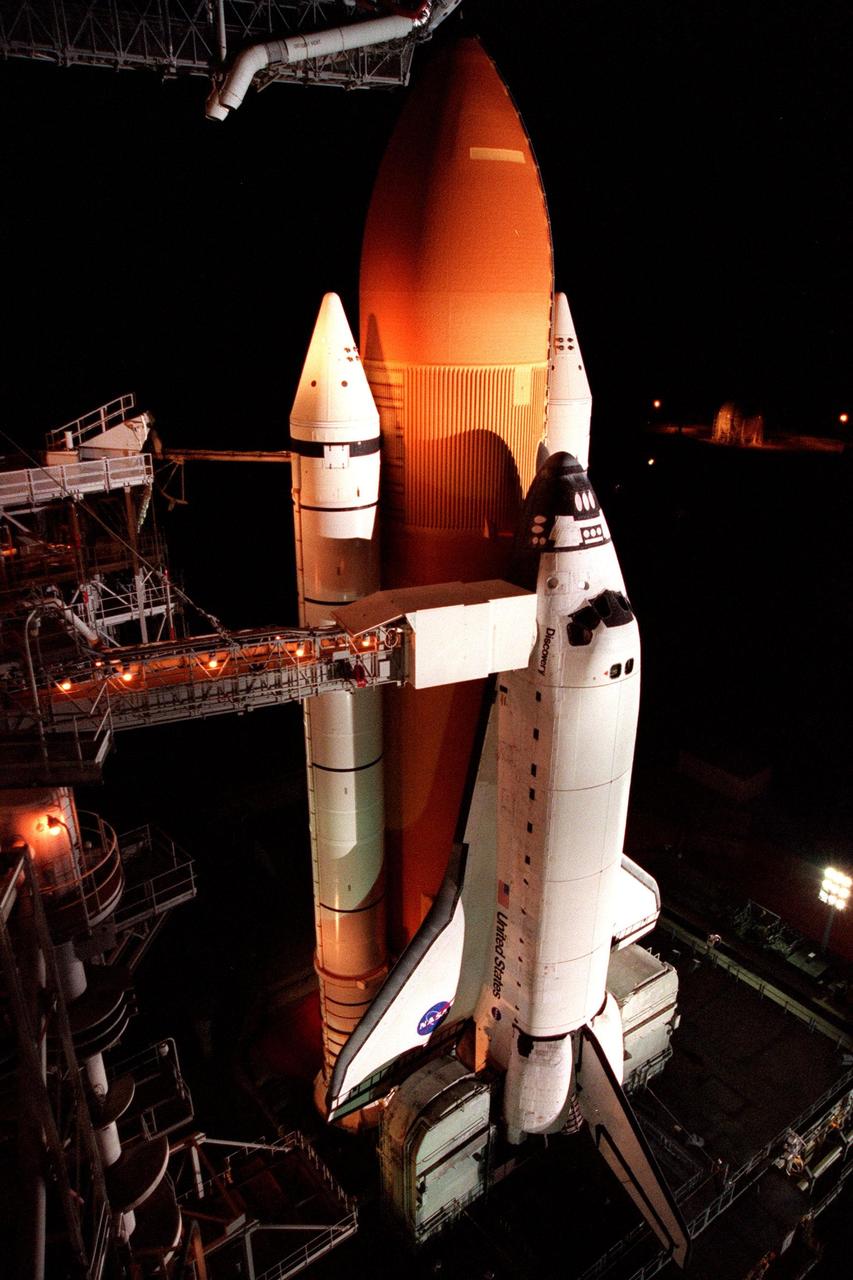
After its Rotational Service Structure is rolled back, the Space Shuttle Discovery awaits the dawn of day on its scheduled day of launch on mission STS-95 at Launch Pad 39B. Liftoff is scheduled for 2 p.m. on Oct. 29. The STS-95 mission is expected to last almost 9 days, with a landing at KSC at 11:49 a.m. EST on Nov. 7
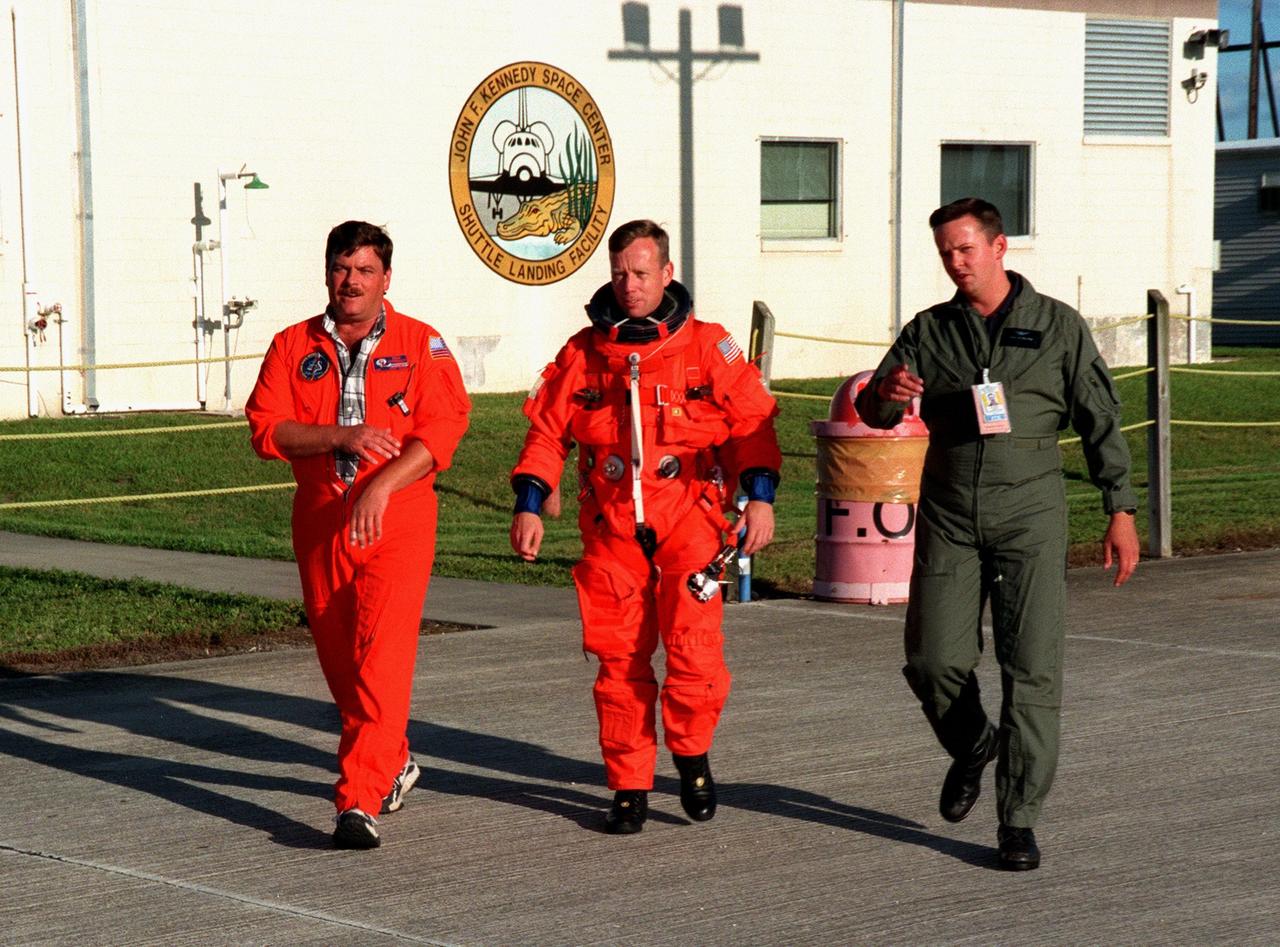
STS-95 Pilot Steven K. Lindsey leaves the Shuttle Landing Facility (SLF) enroute to the Shuttle Training Aircraft (STA). He is accompanied by two suit technicians, Mike Birkenseher (left) and Paul Reylea (right). Lindsey will be practicing Shuttle landing and takeoffs at the SLF on the STA, which is designed to fly like the Shuttle, prior to launch. STS-95 is expected to launch at 2 p.m. EST on Oct. 29, last 8 days, 21 hours and 49 minutes, and land at 11:49 a.m. EST on Nov. 7
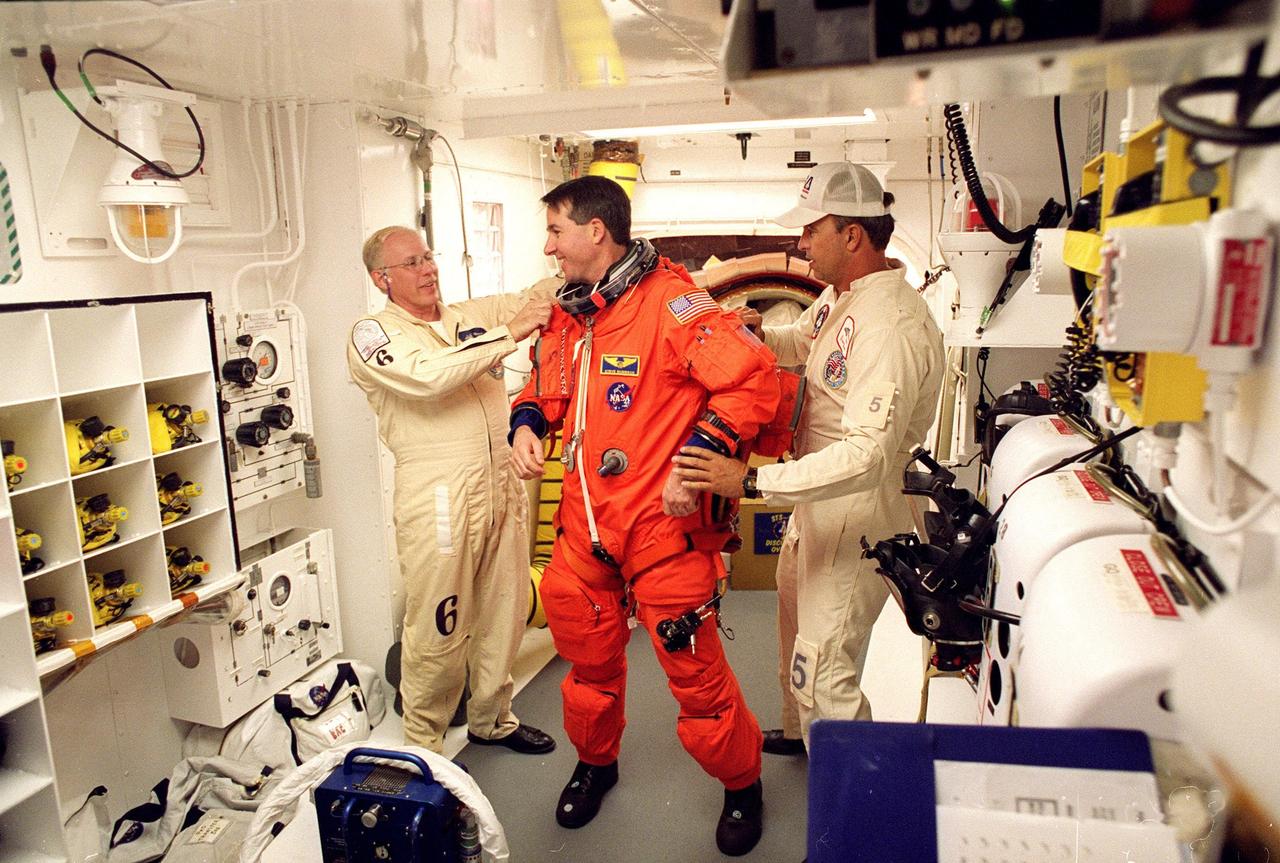
In the environmental chamber known as the white room, STS-95 Mission Specialist Stephen K. Robinson is prepared by closeout room crew members (left) Danny Wyatt and Dave Law (right) for entry into the Space Shuttle Discovery for his second flight into space. The STS-95 mission, targeted for launch at 2 p.m. EST on Oct. 29, is expected to last 8 days, 21 hours and 49 minutes, and return to KSC at 11:49 a.m. EST on Nov. 7
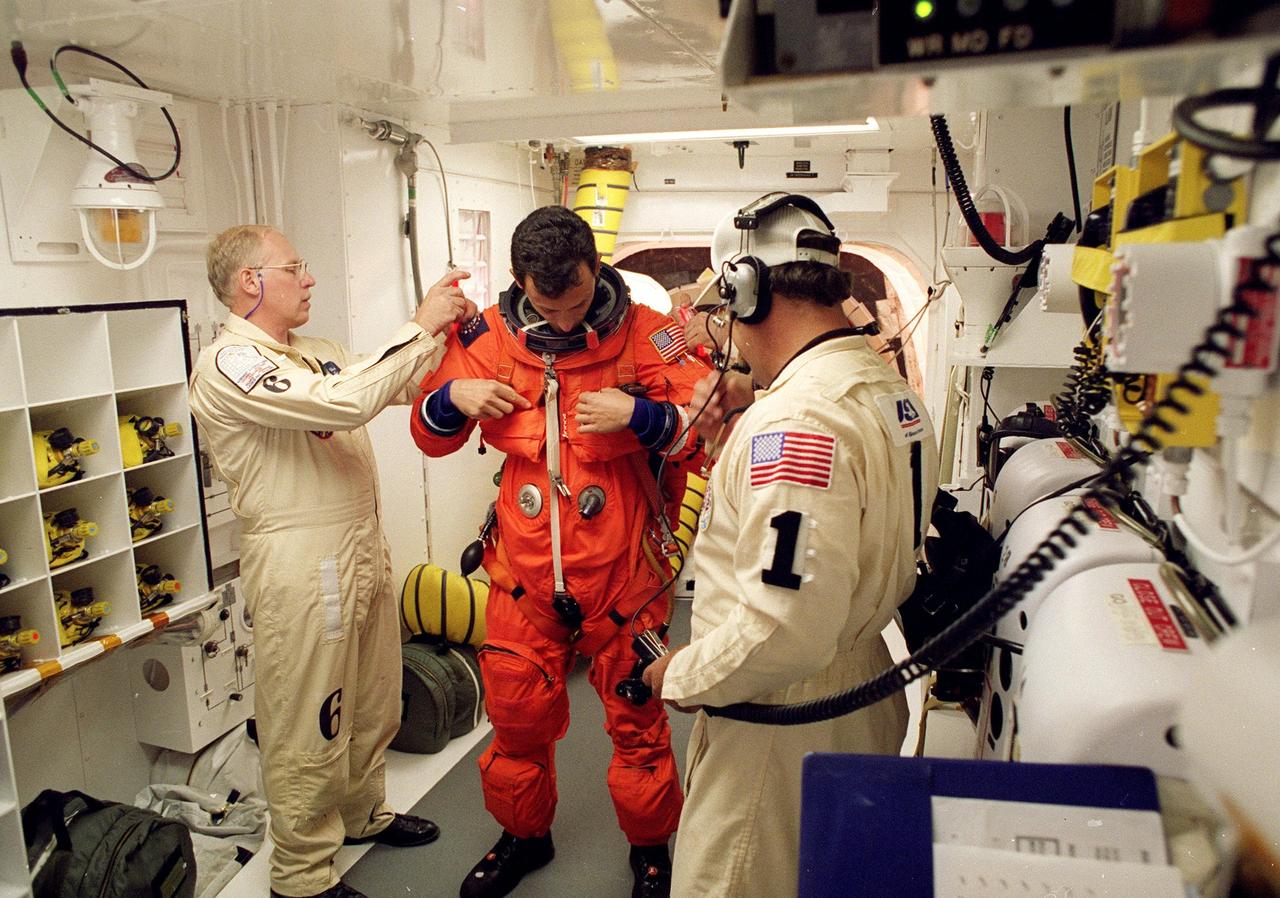
In the environmental chamber known as the white room, STS-95 Mission Specialist Pedro Duque of Spain, with the European Space Agency, is prepared by closeout room crew members Danny Wyatt (left) and Travis Thompson (right) for entry into the Space Shuttle Discovery for his first flight into space. The STS-95 mission, targeted for launch at 2 p.m. EST on Oct. 29, is expected to last 8 days, 21 hours and 49 minutes, and return to KSC at 11:49 a.m. EST on Nov. 7
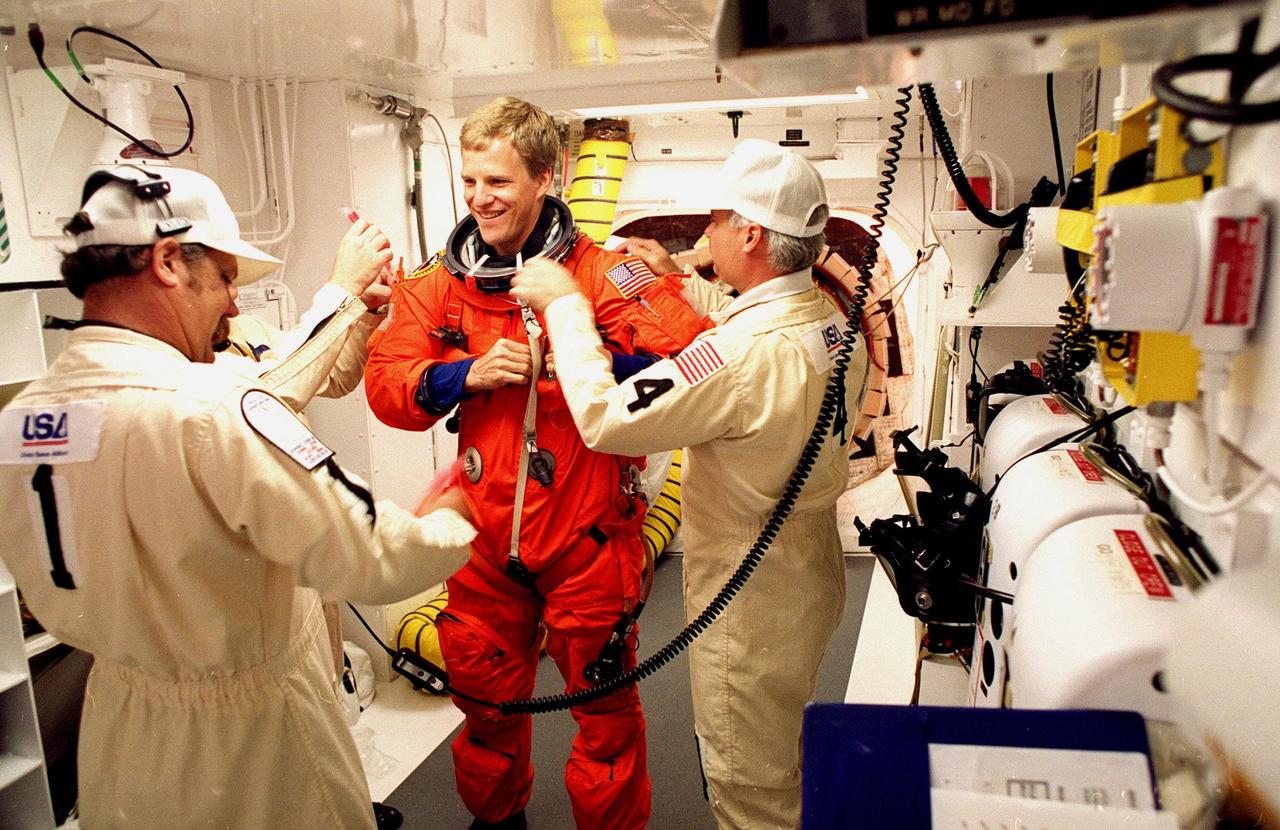
In the environmental chamber known as the white room, STS-95 Mission Specialist Scott E. Parazynski is prepared by closeout room crew members Travis Thompson (left), Danny Wyatt (partially hidden) and Chris Meinert (right) for entry into the Space Shuttle Discovery for his third flight into space. The STS-95 mission, targeted for launch at 2 p.m. EST on Oct. 29, is expected to last 8 days, 21 hours and 49 minutes, and return to KSC at 11:49 a.m. EST on Nov. 7
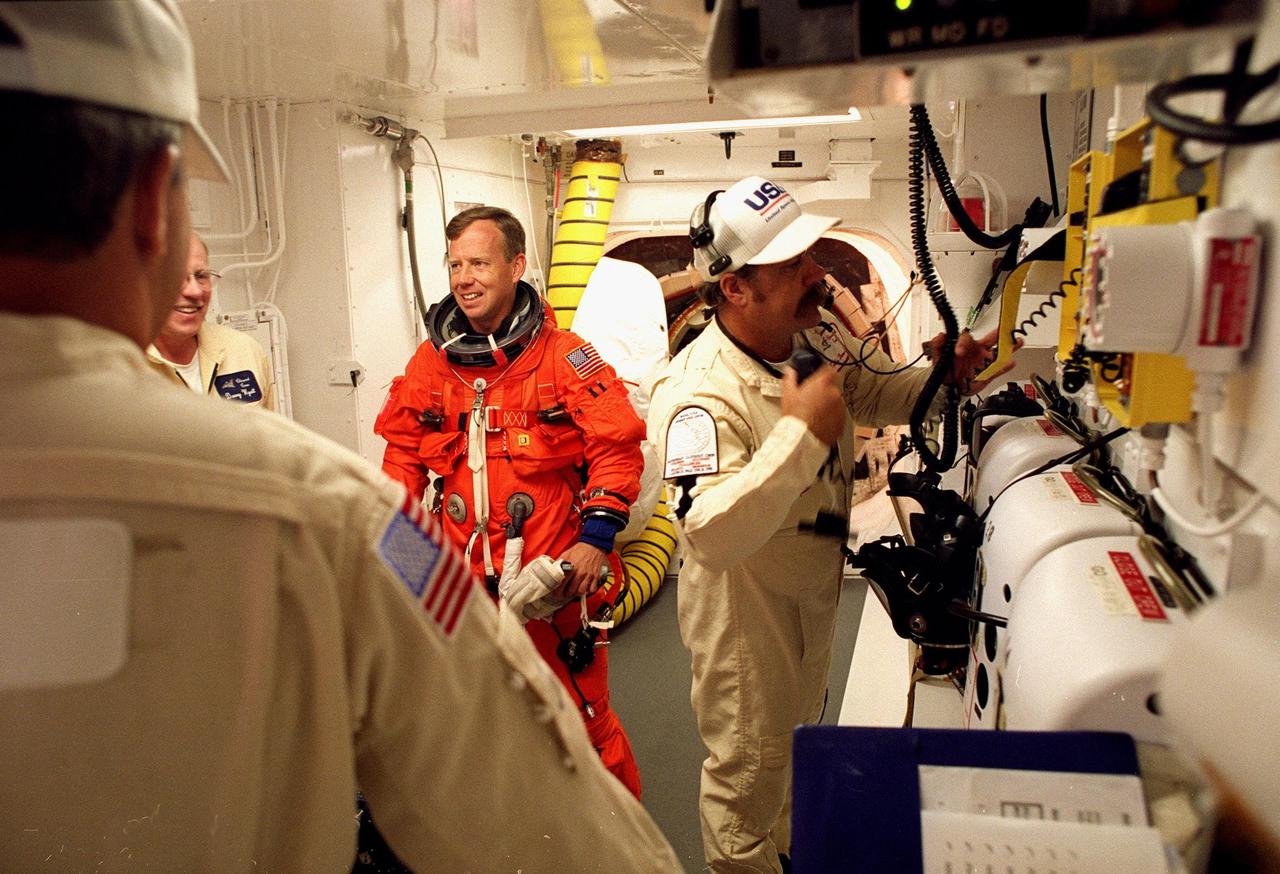
In the environmental chamber known as the white room, STS-95 Pilot Steven W. Lindsey is prepared by closeout room crew members Dave Law(left), Danny Wyatt and Travis Thompson (right) for entry into the Space Shuttle Discovery for his second flight into space. The STS-95 mission, targeted for launch at 2 p.m. EST on Oct. 29, is expected to last 8 days, 21 hours and 49 minutes, and return to KSC at 11:49 a.m. EST on Nov. 7
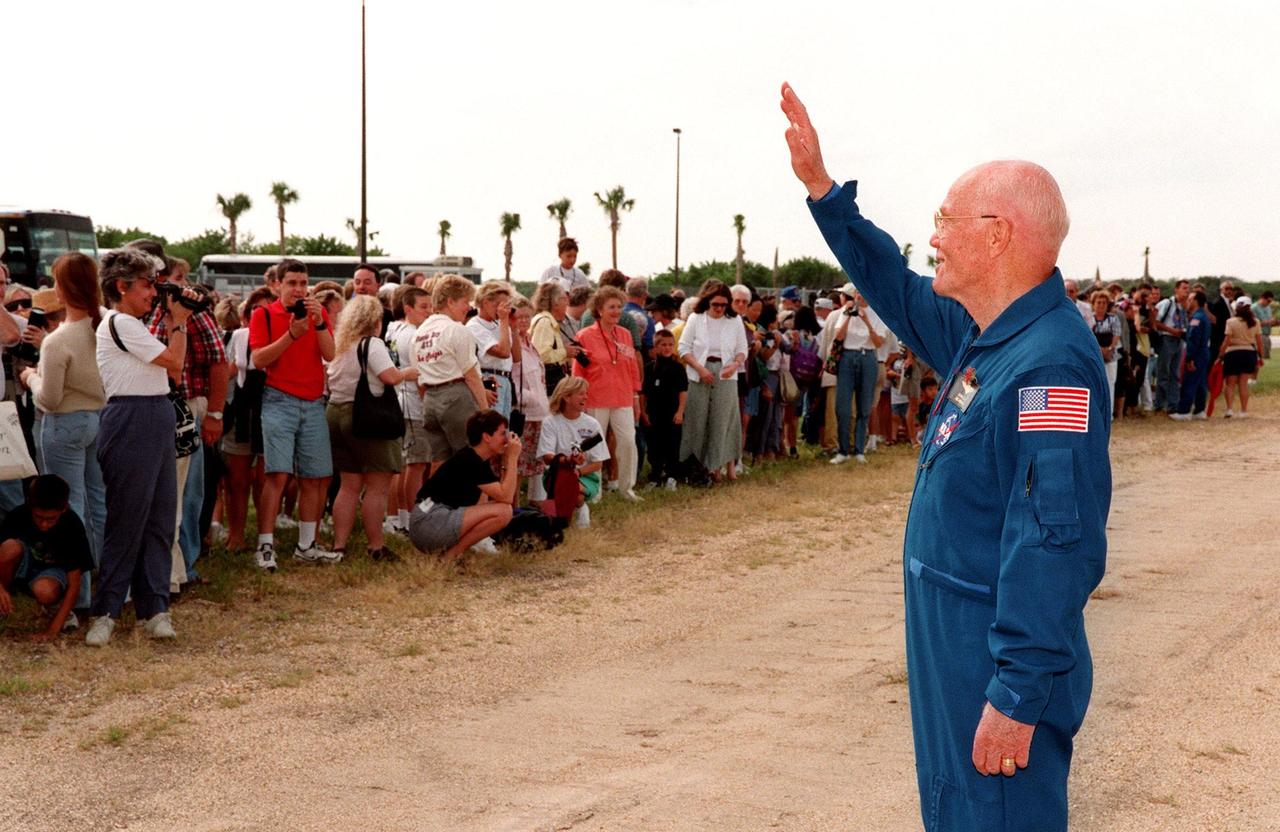
STS-95 Payload Specialist John H. Glenn Jr., senator from Ohio, waves at well-wishers from Launch Pad 39B. The STS-95 crew were making final preparations for launch, targeted for liftoff at 2 p.m. on Oct. 29. Other crew members not shown are Mission Commander Curtis L. Brown Jr., Pilot Steven W. Lindsey, Mission Specialists Scott E. Parazynski, Stephen K. Robinsion, and Pedro Duque of Spain, with the European Space Agency (ESA), and Payload Specialist Chiaki Mukai, with the National Space Development Agency of Japan (NASDA). The STS-95 mission is expected to last 8 days, 21 hours and 49 minutes, returning to KSC at 11:49 a.m. EST on Nov. 7
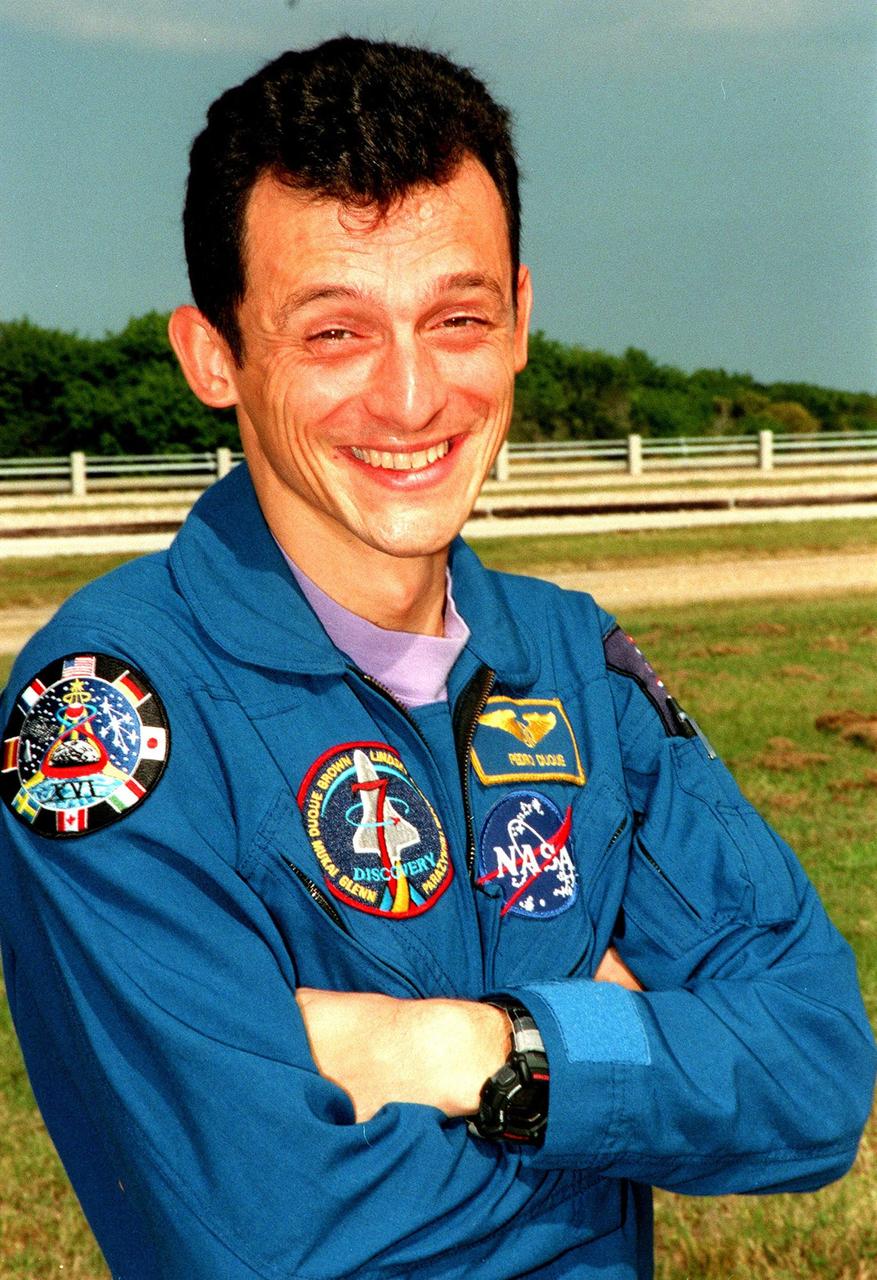
STS-95 Mission Specialist Pedro Duque of Spain, with the European Space Agency (ESA), smiles for the camera from Launch Pad 39B. The STS-95 crew were making final preparations for launch, targeted for liftoff at 2 p.m. on Oct. 29. Other crew members not shown are Mission Commander Curtis L. Brown Jr., Pilot Steven W. Lindsey, Mission Specialists Scott E. Parazynski, Stephen K. Robinsion, and and Payload Specialists John H. Glenn Jr., senator from Ohio, and Chiaki Mukai, with the National Space Development Agency of Japan (NASDA). The STS-95 mission is expected to last 8 days, 21 hours and 49 minutes, returning to KSC at 11:49 a.m. EST on Nov. 7
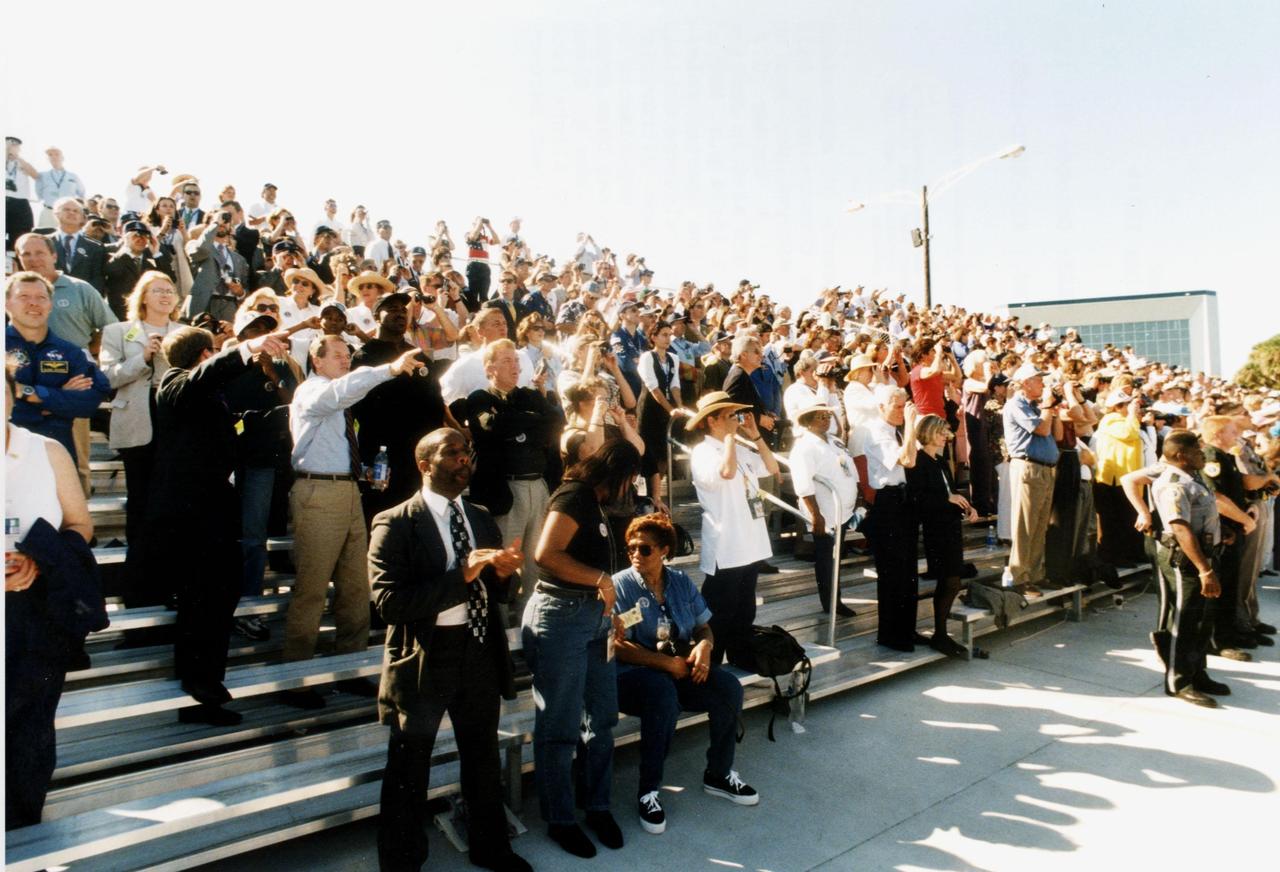
Amid the thousands of spectators watching the launch of STS-95 are Insurance Commissioner Bill Nelson (second from left, pointing) and Heavyweight Boxing Champion Evander Holyfield (next to him). A former U.S. representative, Nelson flew as a crew member on STS 61-C in January 1986. The STS-95 mission, which lifted off at 2:19:34 p.m. EST on Oct. 29, includes research payloads such as the Spartan solar-observing deployable spacecraft, the Hubble Space Telescope Orbital Systems Test Platform, the International Extreme Ultraviolet Hitchhiker, as well as a SPACEHAB single module with experiments on space flight and the aging process. Extra attention has been drawn to the mission due to the addition to the crew of John H. Glenn Jr., a senator from Ohio. STS-95 is Glenn's second flight into space after 36 years; he was one of the original Project Mercury astronauts and flew his first mission in February 1962
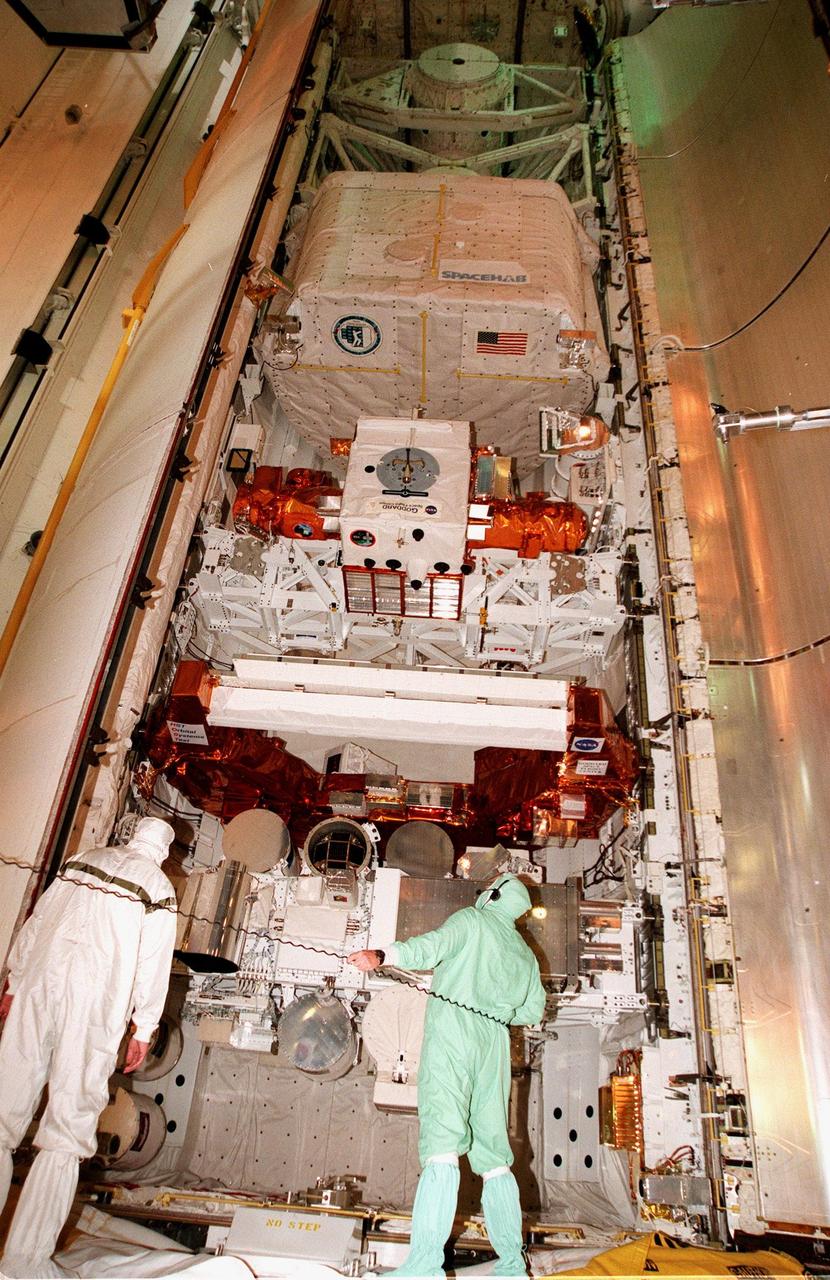
KENNEDY SPACE CENTER, FLA. -- On Launch Complex 39B, KSC workers check the payloads for mission STS-95 which were loaded into the orbiter Discovery payload bay before launch. The mission includes the SPACEHAB single module (seen at the top of the bay) with experiments on space flight and the aging process, the International Extreme Ultraviolet Hitchhiker (IEH-3), the Hubble Space Telescope Orbital Systems Test Platform, and the Spartan solar-observing deployable spacecraft. STS-95 is expected to launch at 2 p.m. EST on Oct. 29, last 8 days, 21 hours and 49 minutes, and land at 11:49 a.m. EST on Nov. 7
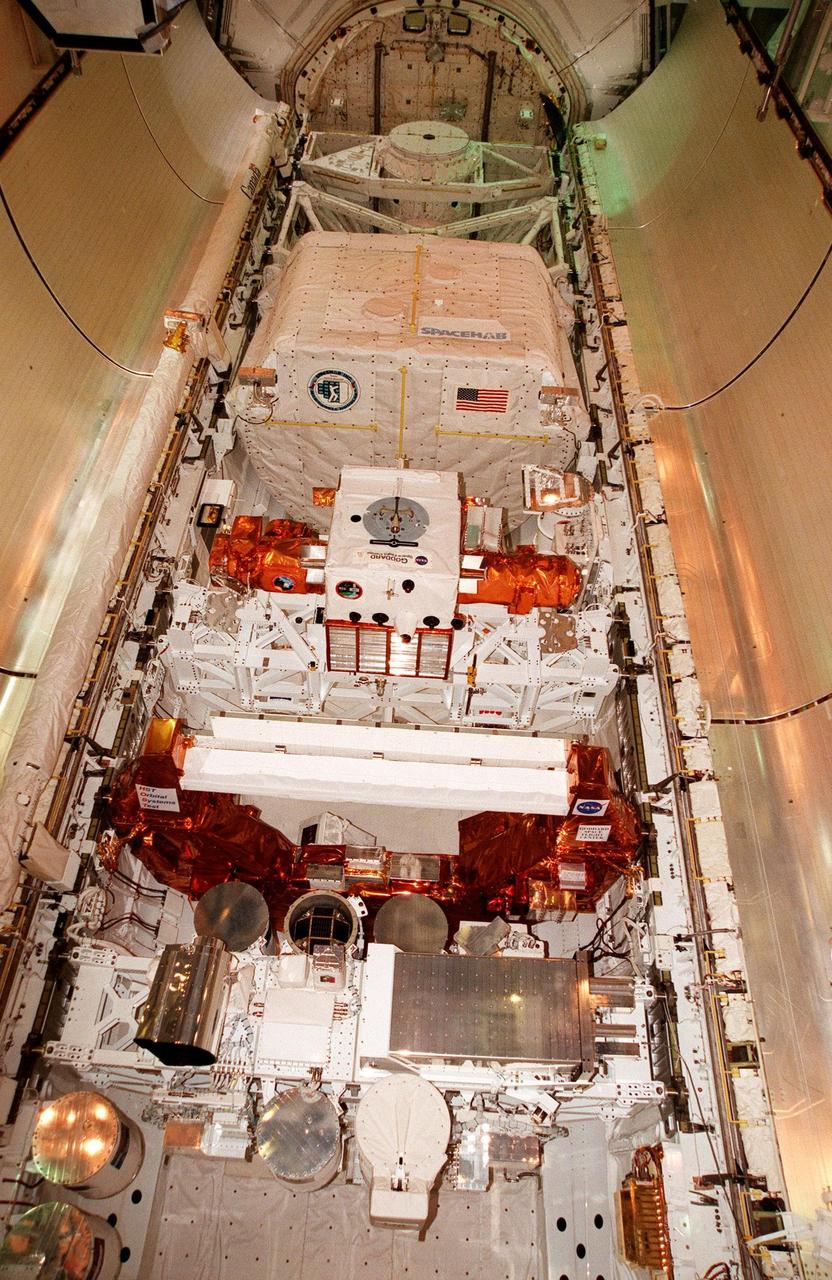
KENNEDY SPACE CENTER, FLA. -- On Launch Complex 39B, the payload bay doors on the orbiter Discovery, scheduled to launch mission STS-95, are poised for closure. The mission includes the SPACEHAB single module (seen at the top of the bay) with experiments on space flight and the aging process, the International Extreme Ultraviolet Hitchhiker (IEH-3), the Hubble Space Telescope Orbital Systems Test Platform, and the Spartan solar-observing deployable spacecraft. STS-95 is expected to launch at 2 p.m. EST on Oct. 29, last 8 days, 21 hours and 49 minutes, and land at 11:49 a.m. EST on Nov. 7
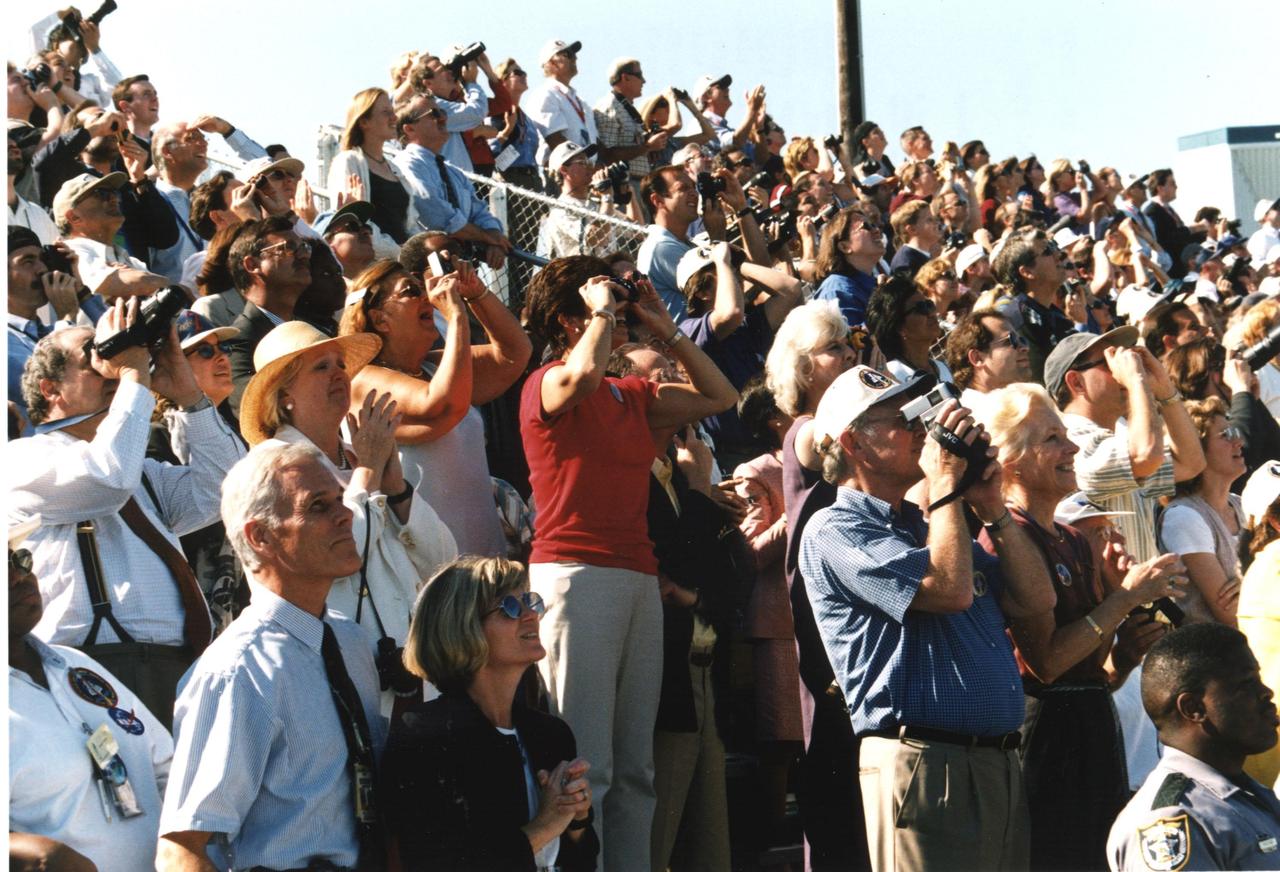
These stands are filled with spectators watching and photographing the launch of STS-95. The viewing sites and roadways at Kennedy Space Center bulge with people and vehicles wanting to see Space Shuttle Discovery lift off. Extra attention has been drawn to the mission due to the addition to the crew of John H. Glenn Jr., a senator from Ohio. STS-95 is Glenn's second flight into space after 36 years; he was one of the original Project Mercury astronauts and flew his first mission in February 1962. The STS-95 mission includes research payloads such as the Spartan solar-observing deployable spacecraft, the Hubble Space Telescope Orbital Systems Test Platform, the International Extreme Ultraviolet Hitchhiker, as well as a SPACEHAB single module with experiments on space flight and the aging process
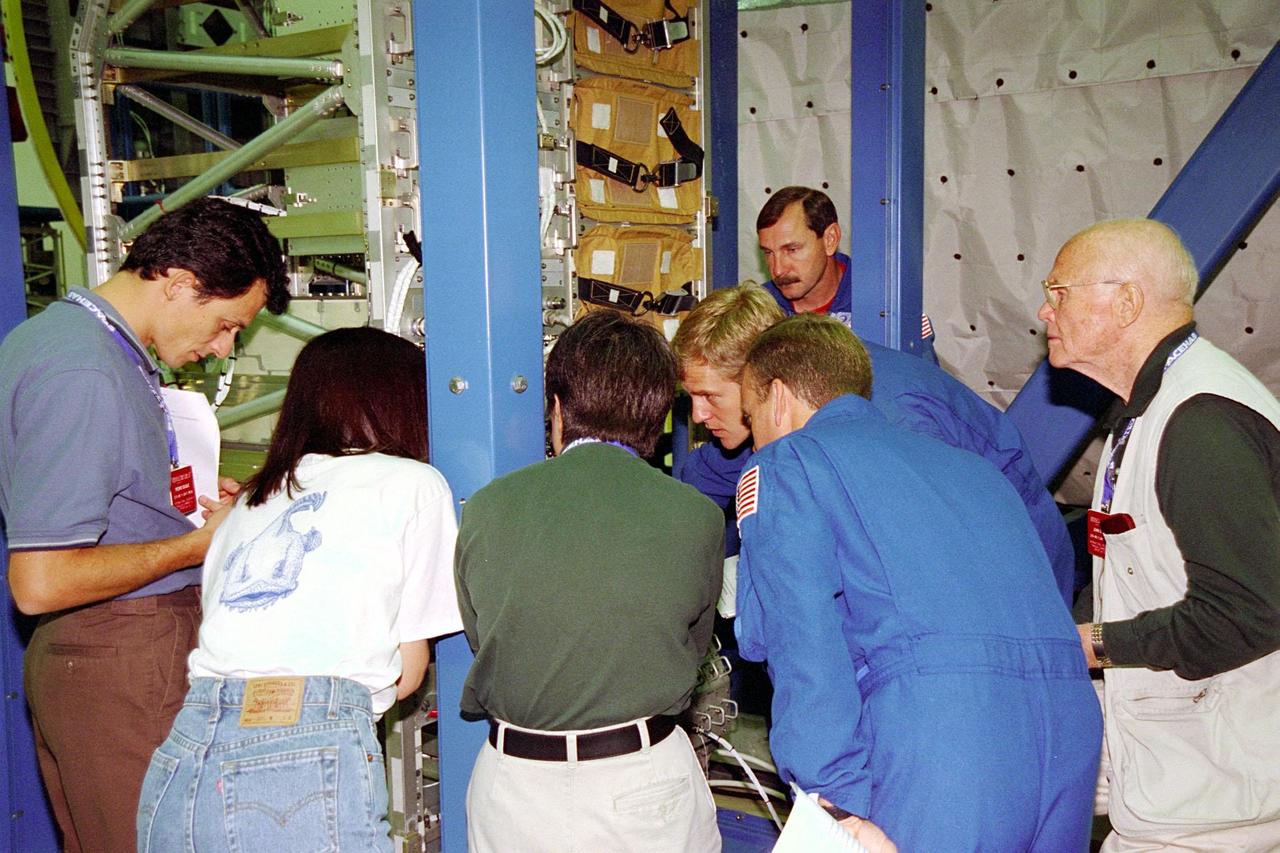
STS-95 crew members gather around the Vestibular Function Experiment Unit (VFEU) which includes marine fish called toadfish. In foreground, from left, are Mission Specialist Pedro Duque of the European Space Agency (ESA), a technician from the National Space Development Agency of Japan (NASDA), Payload Specialist Chiaki Mukai of NASDA, Pilot Steven W. Lindsey, and Payload Specialist John H. Glenn Jr., who also is a senator from Ohio. At center, facing the camera, are Mission Specialist Scott E. Parazynski and Commander Curtis L. Brown Jr., in back. STS-95 will feature a variety of research payloads, including the Spartan solar-observing deployable spacecraft, the Hubble Space Telescope Orbital Systems Platform, the International Extreme Ultraviolet Hitchhiker, and experiments on space flight and the aging process. STS-95 is targeted for an Oct. 29 launch aboard the Space Shuttle Discovery
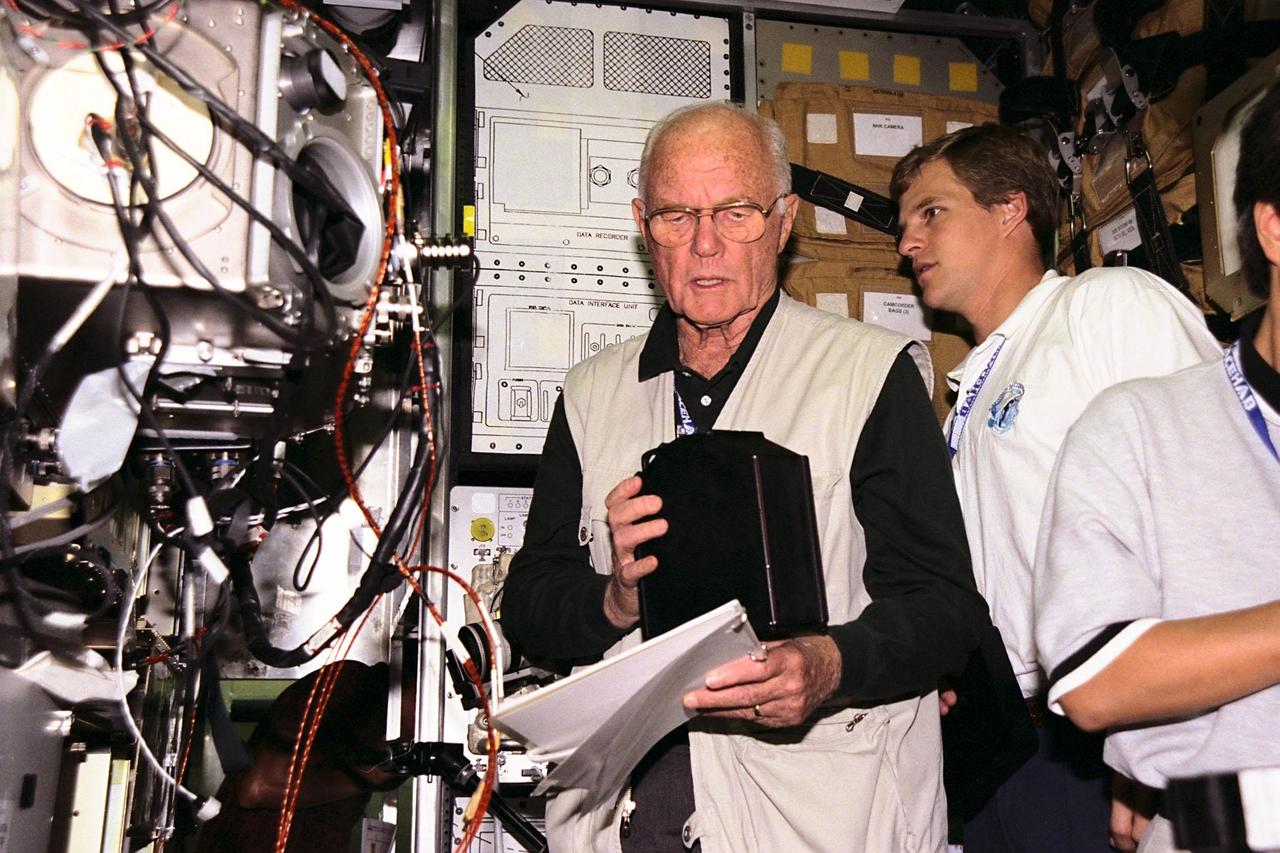
KENNEDY SPACE CENTER, FLA. -- STS-95 Mission Specialist Scott E. Parazynski, at center, takes some experiment equipment from Payload Specialist John H. Glenn Jr., while in the SPACEHAB trainer at the SPACEHAB Payload Processing Facility in Cape Canaveral. Payload Specialist Chiaki Mukai, representing the National Space Development Agency of Japan (NASDA), sets up a camera in the foreground. STS-95 will feature a variety of research payloads, including the Spartan solar-observing deployable spacecraft, the Hubble Space Telescope Orbital Systems Platform, the International Extreme Ultraviolet Hitchhiker, and experiments on space flight and the aging process. STS-95 is targeted for an Oct. 29 launch aboard the Space Shuttle Discovery
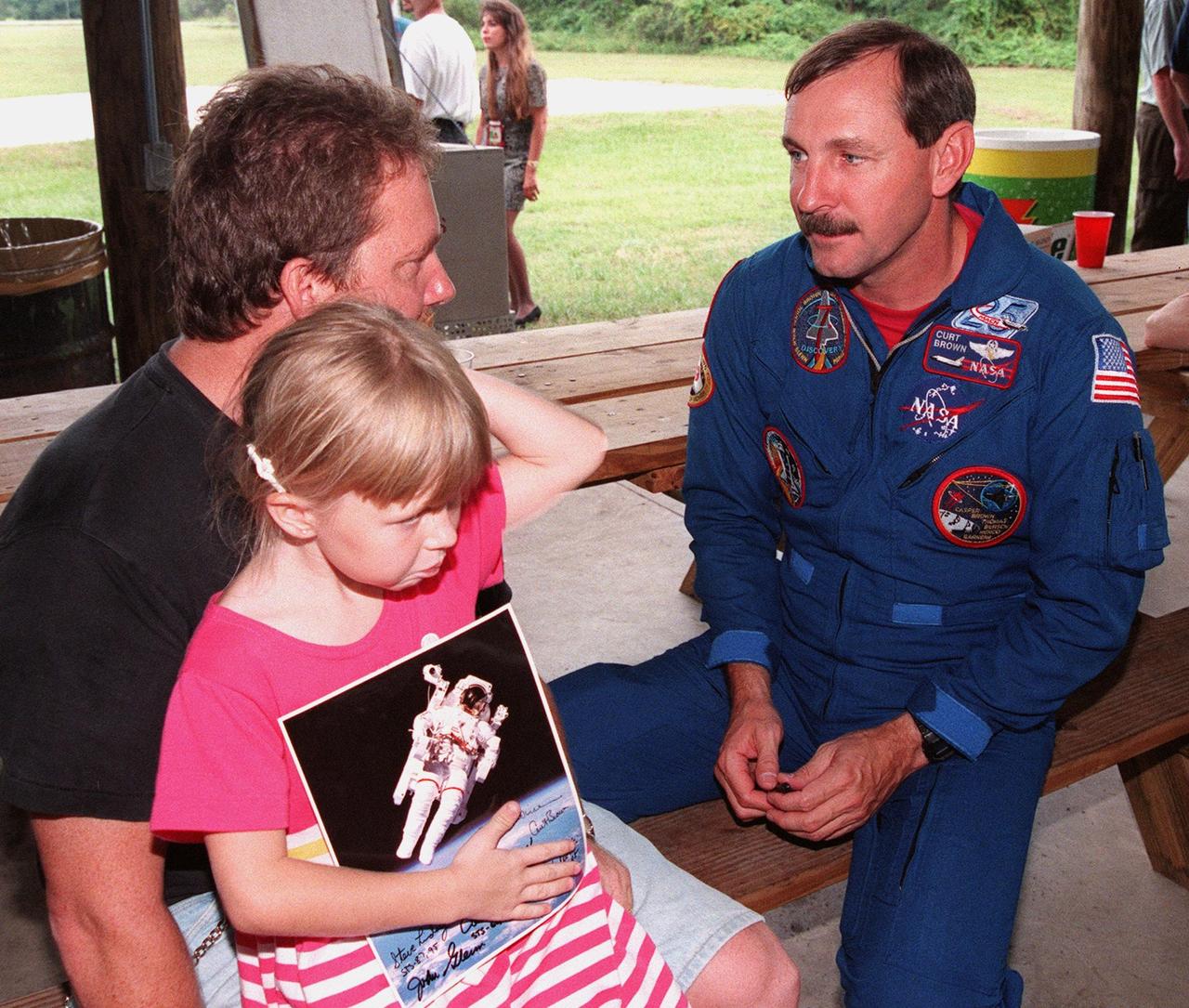
During a break in the Crew Equipment Interface Test (CEIT) at KSC, STS-95 Mission Commander Curtis L. Brown Jr. talks to Mark King, a Space Shuttle midbody mechanical technician with United Space Alliance, and his daughter Jilianne. King is working in the Orbiter Processing Facility Bay 2 on STS-95 payloads. The CEIT gives astronauts an opportunity for a hands-on look at the payloads and equipment which they will be working with on orbit. The launch of the STS-95 mission is scheduled for Oct. 29, 1998, on the Space Shuttle Discovery. The mission includes research payloads such as the Spartan solar-observing deployable spacecraft, the Hubble Space Telescope Orbital Systems Test Platform, the International Extreme Ultraviolet Hitchhiker, as well as the SPACEHAB single module with experiments on space flight and the aging process
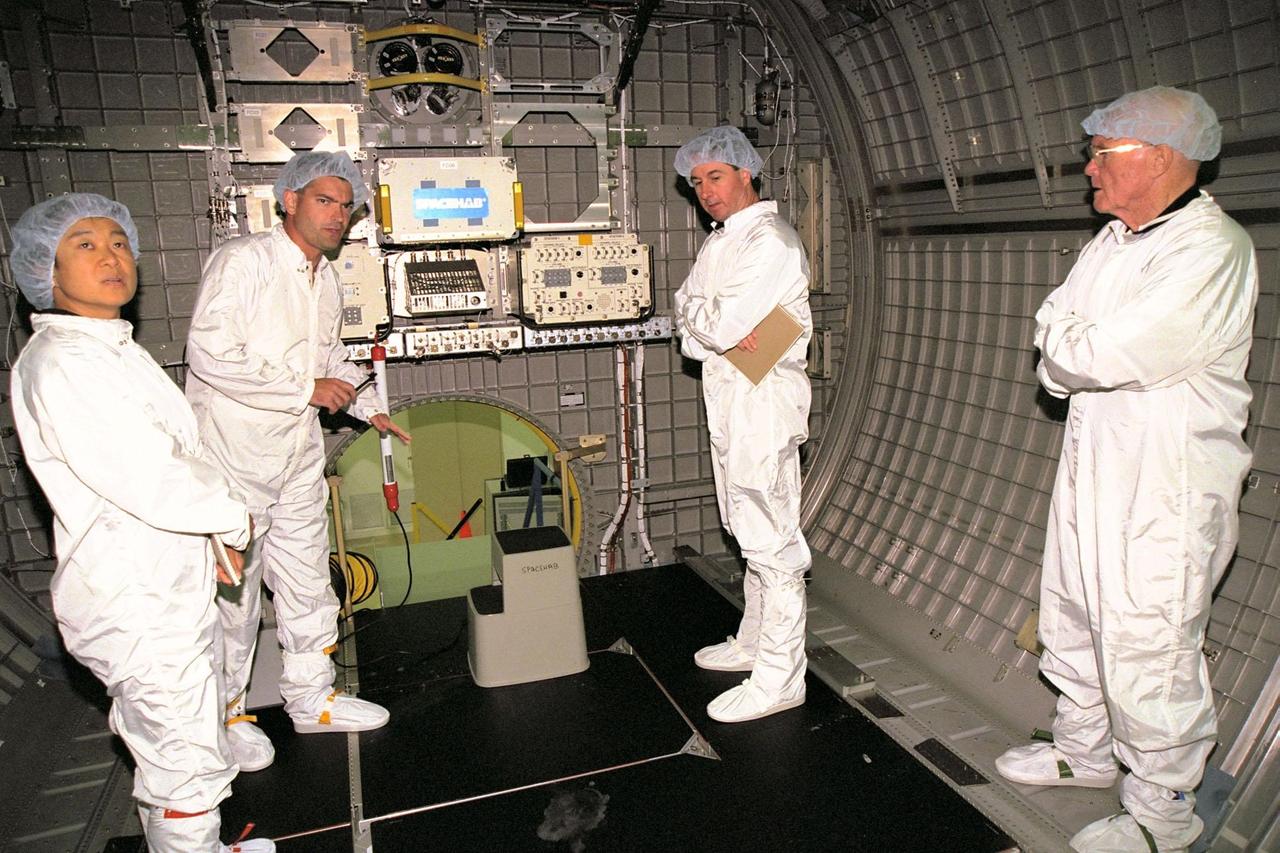
KENNEDY SPACE CENTER, FLA. -- STS-95 crew members get a briefing on equipment inside the SPACEHAB module from Chris Jaskolka of Boeing, second from left. Listening intently are crew members, from left, Payload Specialist Chiaki Mukai, representing the National Space Development Agency of Japan (NASDA); Mission Specialist Stephen K. Robinson; and Payload Specialist John H. Glenn Jr., who also is a senator from Ohio. STS-95 will feature a variety of research payloads, including the Spartan solar-observing deployable spacecraft, the Hubble Space Telescope Orbital Systems Platform, the International Extreme Ultraviolet Hitchhiker, and experiments on space flight and the aging process. STS-95 is targeted for an Oct. 29 launch aboard the Space Shuttle Discovery
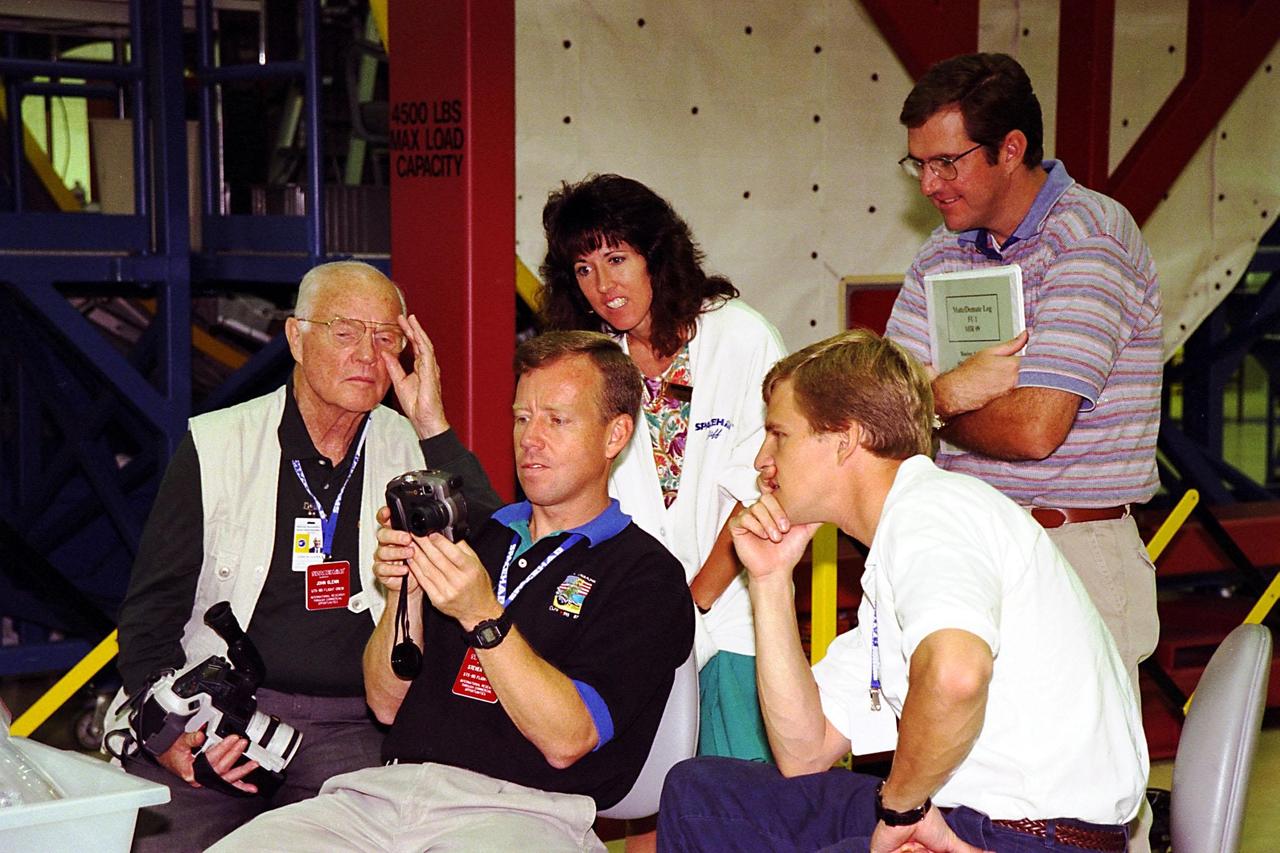
KENNEDY SPACE CENTER, FLA. -- STS-95 crew members check out camera equipment they will use on the mission during a SPACEHAB familiarization tour and briefing at the SPACEHAB Payload Processing Facility in Cape Canaveral. Seated, from left, are Payload Specialist John H. Glenn Jr., who also is a senator from Ohio; Pilot Steven W. Lindsey; and Mission Specialist Scott E. Parazynski. Standing in back are Boeing employees LaDonna Neterer and Scott Clark. STS-95 will feature a variety of research payloads, including the Spartan solar-observing deployable spacecraft, the Hubble Space Telescope Orbital Systems Platform, the International Extreme Ultraviolet Hitchhiker, and experiments on space flight and the aging process. STS-95 is targeted for an Oct. 29 launch aboard the Space Shuttle Discovery
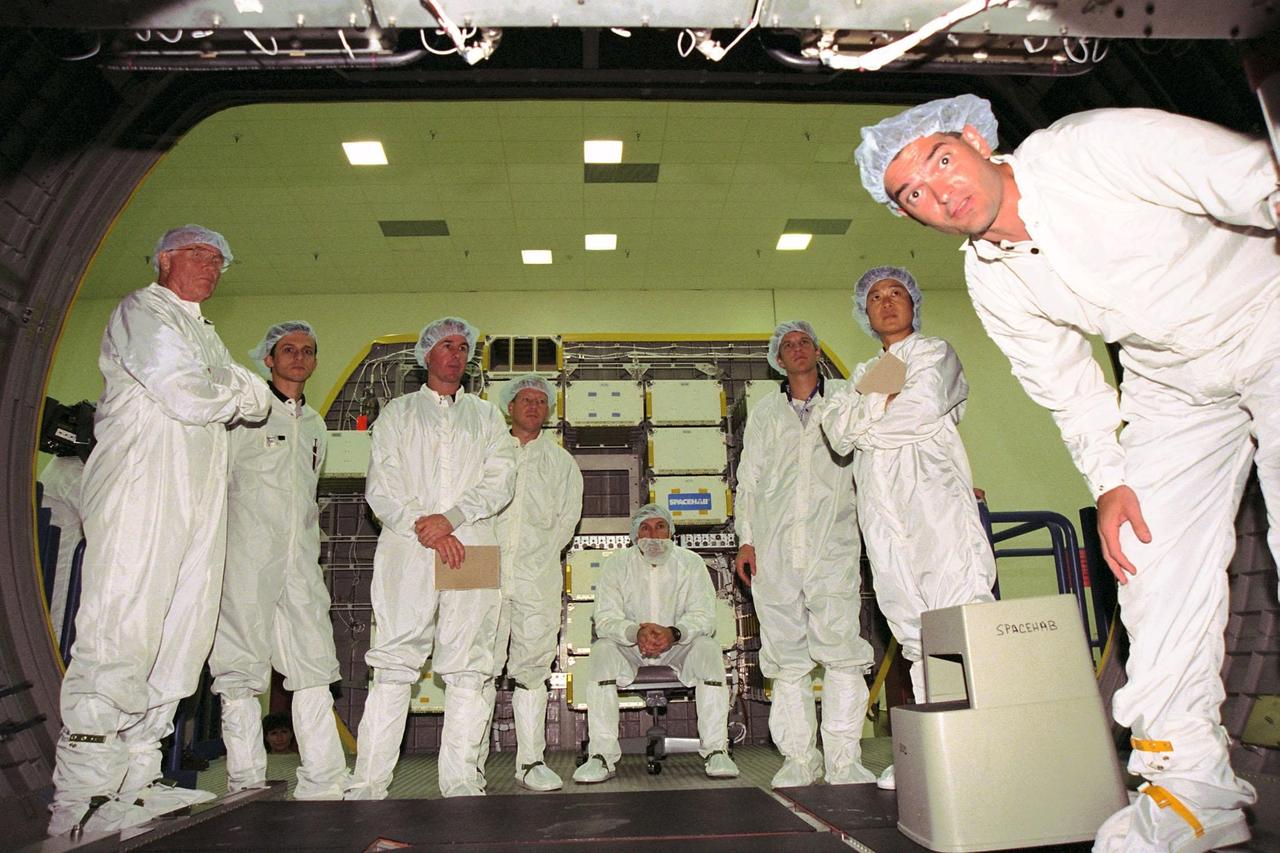
KENNEDY SPACE CENTER, FLA. -- STS-95 crew members get a briefing on the SPACEHAB module from Chris Jaskoika of Boeing, in foreground at far right. From left, are Payload Specialist John H. Glenn Jr., who also is a senator from Ohio; Mission Specialist Pedro Duque of Spain, representing the European Space Agency (ESA); Mission Specialist Stephen K. Robinson; Pilot Steven W. Lindsey; Commander Curtis L. Brown Jr. (seated); Mission Specialist Scott E. Parazynski; and Payload Specialist Chiaki Mukai, representing the National Space Development Agency of Japan (NASDA). STS-95 will feature a variety of research payloads, including the Spartan solar-observing deployable spacecraft, the Hubble Space Telescope Orbital Systems Platform, the International Extreme Ultraviolet Hitchhiker, and experiments on space flight and the aging process. STS-95 is targeted for an Oct. 29 launch aboard the Space Shuttle Discovery
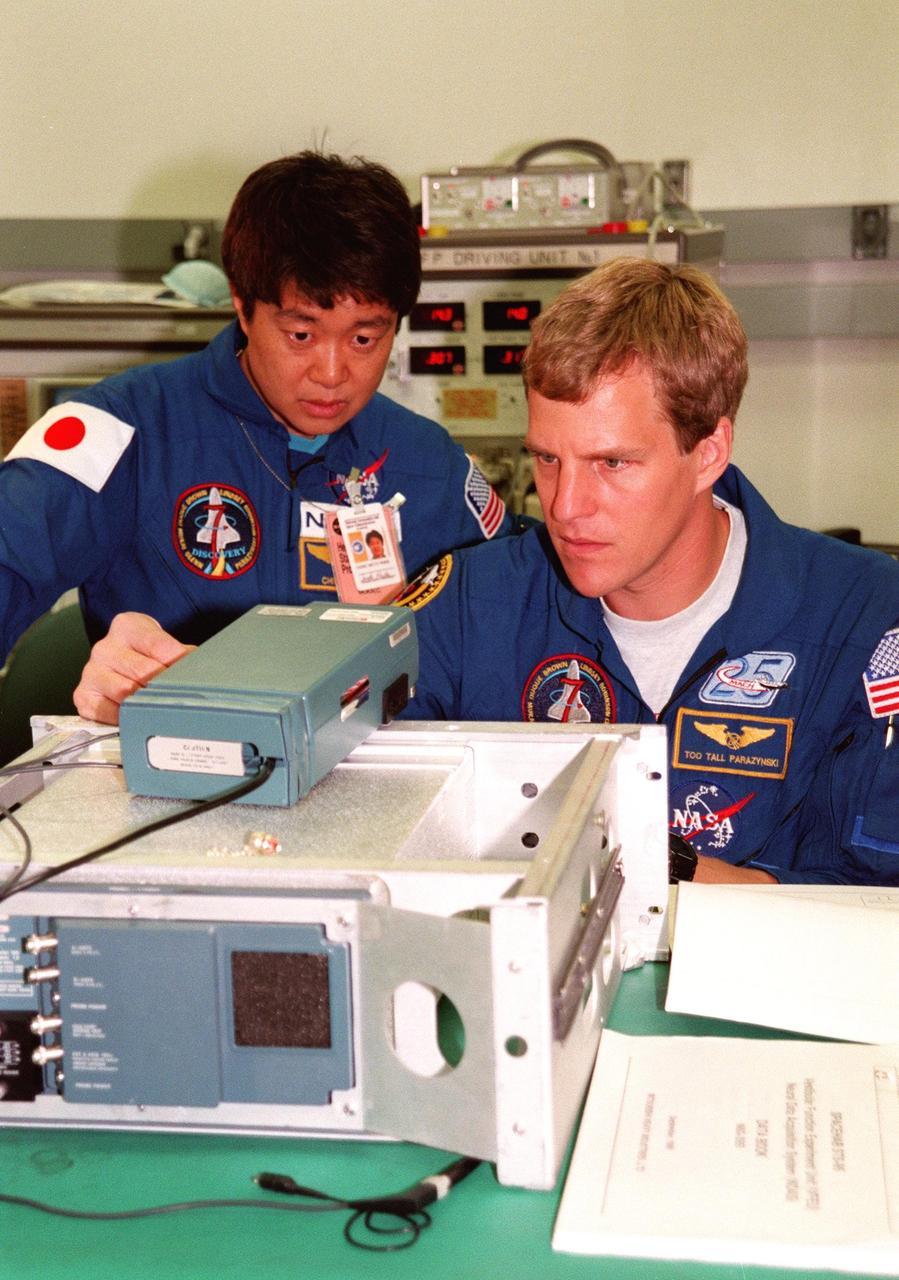
STS-95 Payload Specialist Chiaki Mukai (left), with the National Space Development Agency of Japan (NASDA) and Mission Specialist Scott E. Parazynski (right) look over equipment being used on an experiment with toadfish on mission STS-95. The fish will be electronically monitored to determine the effect of gravitational changes on the inner-ear system. Mukai and Parazynski and other crewmembers were making final preparations for launch, targeted for liftoff at 2 p.m. on Oct. 29. The STS-95 crew also includes Mission Commander Curtis L. Brown Jr., Pilot Steven W. Lindsey, Mission Specialist Stephen K. Robinson, Payload Specialist John H. Glenn Jr., senator from Ohio, and Mission Specialist Pedro Duque, with the European Space Agency (ESA). The mission is expected to last 8 days, 21 hours and 49 minutes, returning to KSC at 11:49 a.m. EST on Nov. 7
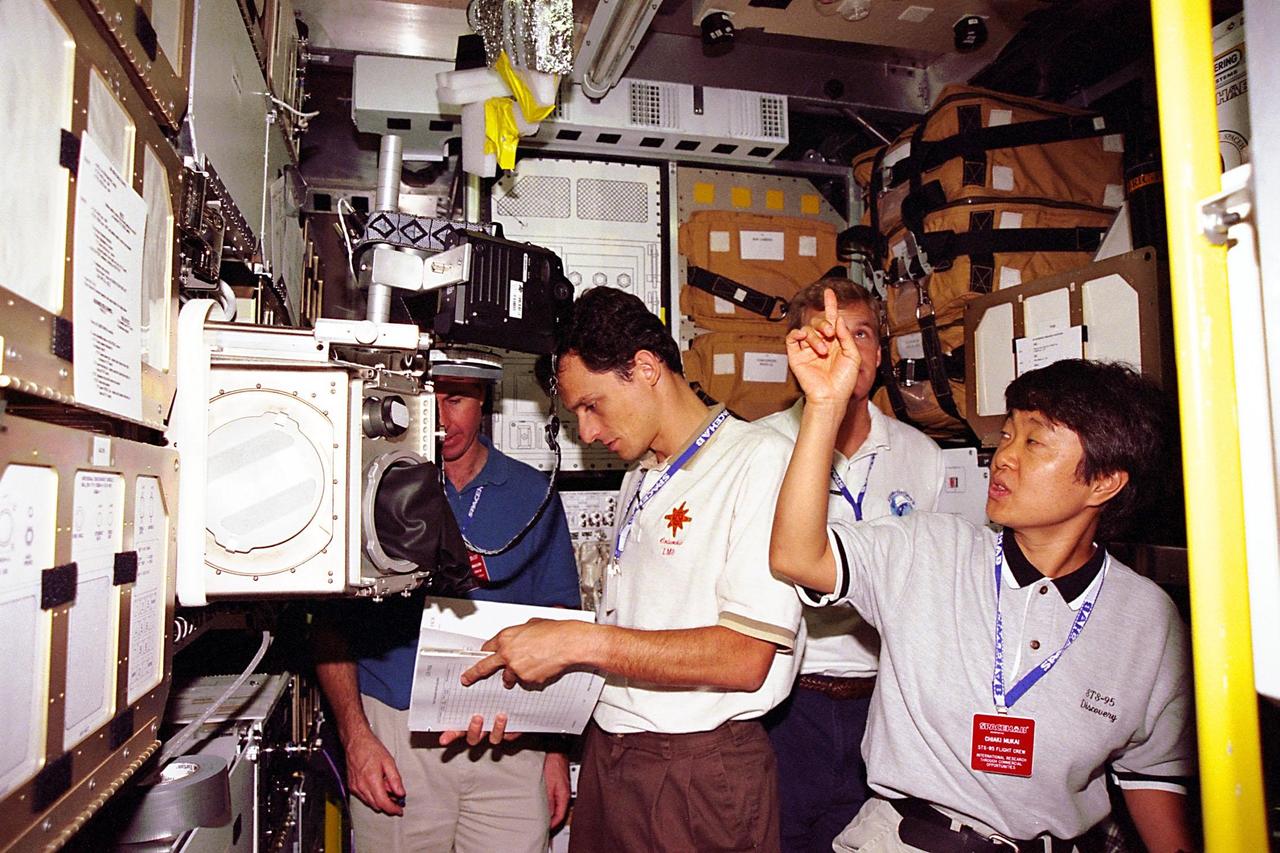
KENNEDY SPACE CENTER, FLA. -- STS-95 crew members inspect equipment in the SPACEHAB trainer at the SPACEHAB Payload Processing Facility in Cape Canaveral. From left, are Mission Specialist Stephen K. Robinson (partially obscured); Mission Specialist Pedro Duque of Spain, who represents the European Space Agency (ESA); and Payload Specialist Chiaki Mukai, who represents the National Space Development Agency of Japan (NASDA). Standing in back is Mission Specialist Scott E. Parazynski. STS-95 will feature a variety of research payloads, including the Spartan solar-observing deployable spacecraft, the Hubble Space Telescope Orbital Systems Platform, the International Extreme Ultraviolet Hitchhiker, and experiments on space flight and the aging process. STS-95 is targeted for an Oct. 29 launch aboard the Space Shuttle Discovery
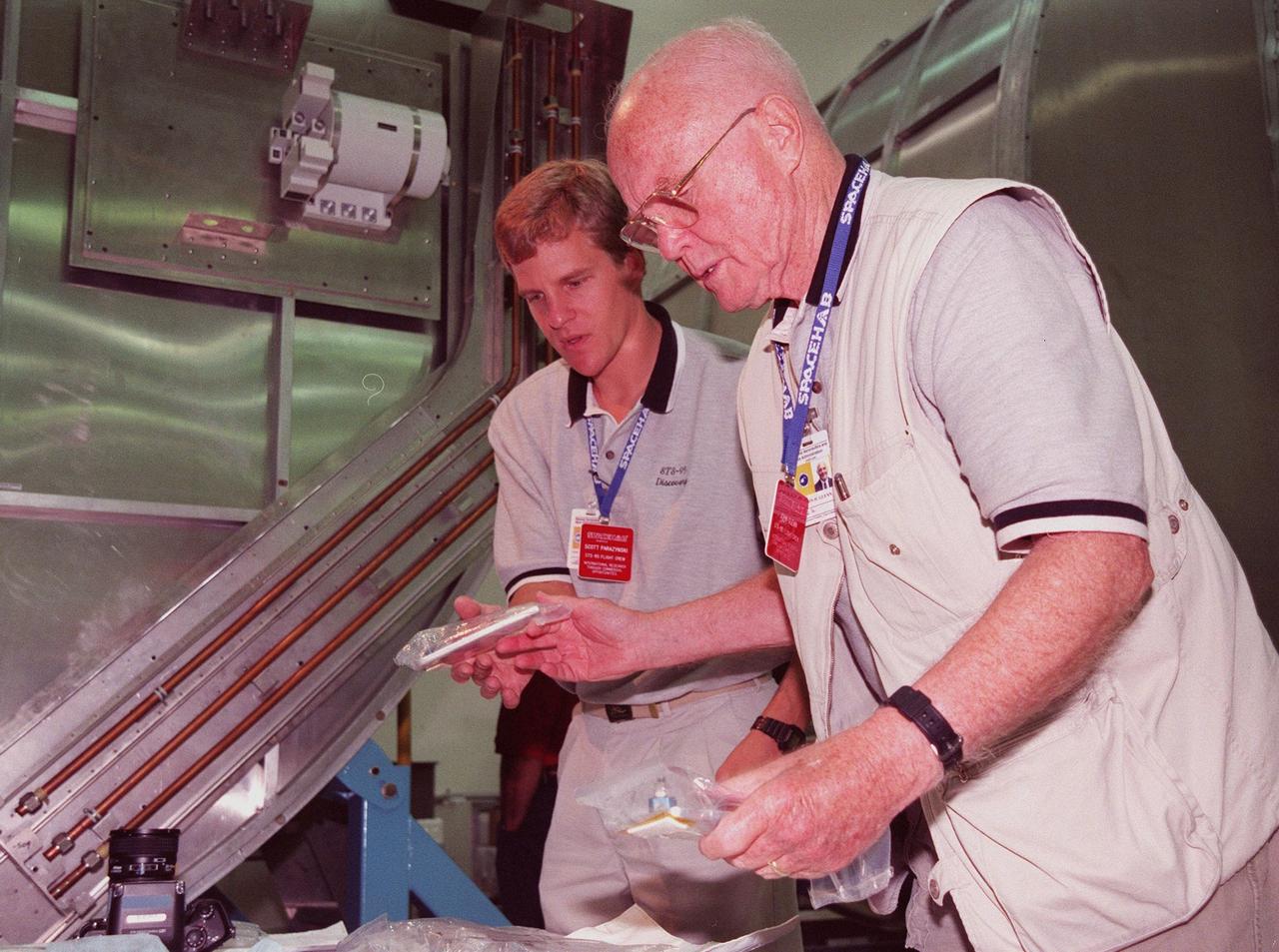
KENNEDY SPACE CENTER, FLA. -- STS-95 Mission Specialist Scott Parazynski, M.D., (left) and Payload Specialist John Glenn (right), who is a senator from Ohio, look over experiments in the SPACEHAB Payload Processing Facility (SPPF) for the mission scheduled to launch Oct. 29. STS-95 crew members have been participating in SPACEHAB familiarization in the SPPF. Scheduled to launch Oct. 29, the mission includes research payloads such as the Spartan solar-observing deployable spacecraft, the Hubble Space Telescope Orbital Systems Test Platform, the International Extreme Ultraviolet Hitchhiker, as well as the SPACEHAB single module with experiments on space flight and the aging process
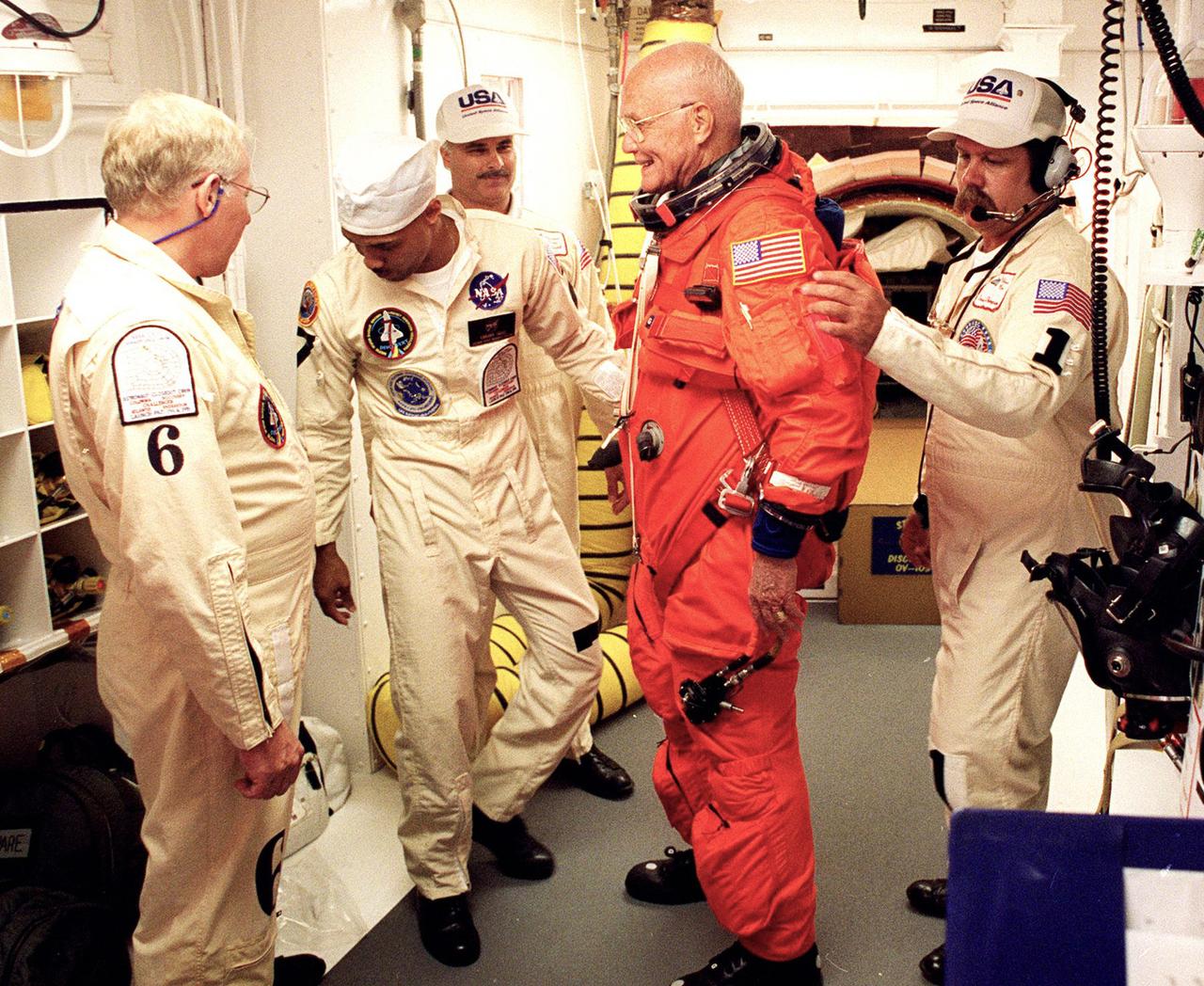
In the white room at the Kenndy Space Center's Launch Pad 39B, STS-95 Payload Specialist John H. Glenn Jr., senator from Ohio, is prepared by closeout room crew members Danny Wyatt (left to right), Carlous Gillis, Jim Kelly and Travis Thompson for entry into the Space Shuttle Discovery for his second flight into space after 36 years. The STS-95 mission, targeted for launch at 2 p.m. EST on Oct. 29, is expected to last 8 days, 21 hours and 49 minutes, and return to KSC at 11:49 a.m. EST on Nov. 7.
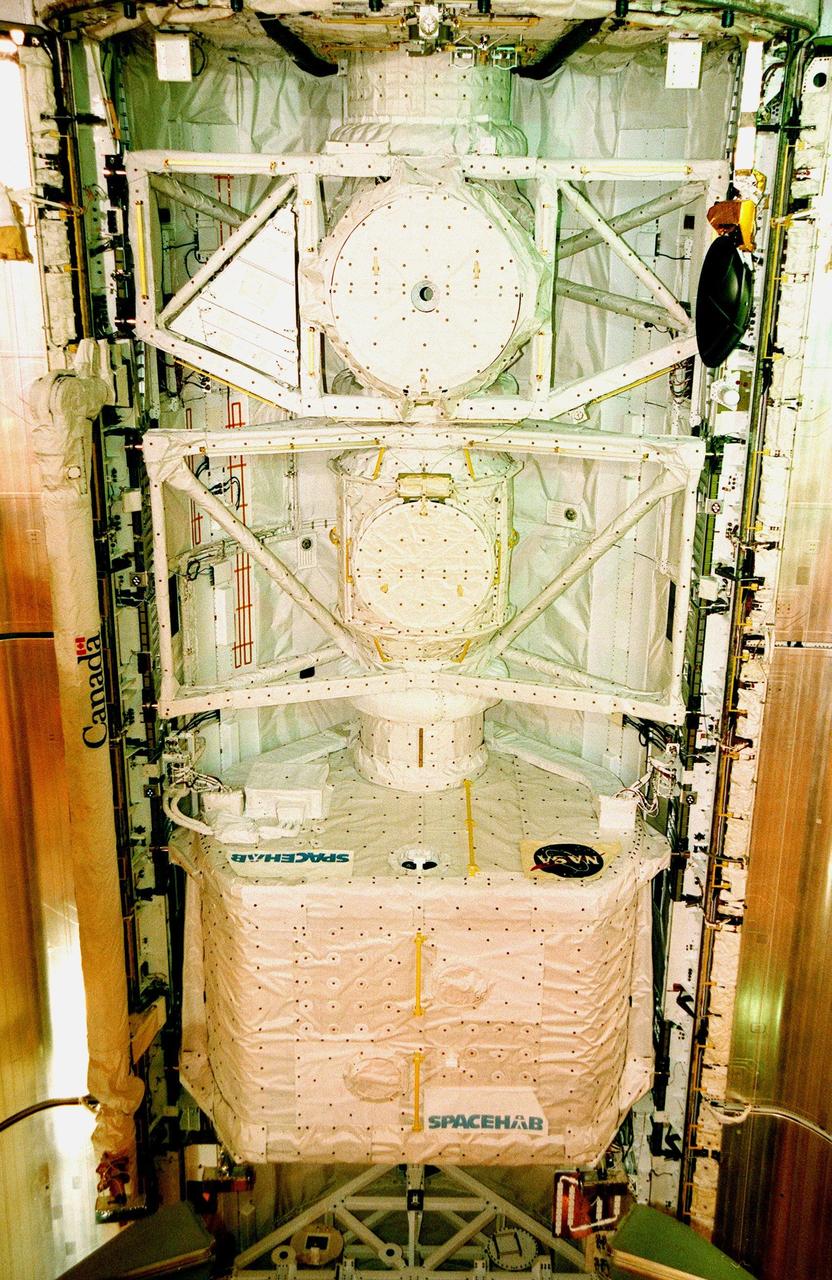
KENNEDY SPACE CENTER, FLA. -- On Launch Complex 39B, the open payload bay doors on the orbiter Discovery reveal the SPACEHAB single module, one of the payloads for mission STS-95. SPACEHAB contains experiments on space flight and the aging process. Other payloads to be added include the International Extreme Ultraviolet Hitchhiker (IEH-3), the Hubble Space Telescope Orbital Systems Test Platform, and the Spartan solar-observing deployable spacecraft. STS-95 is expected to launch at 2 p.m. EST on Oct. 29, last 8 days, 21 hours and 49 minutes, and land at 11:49 a.m. EST on Nov. 7
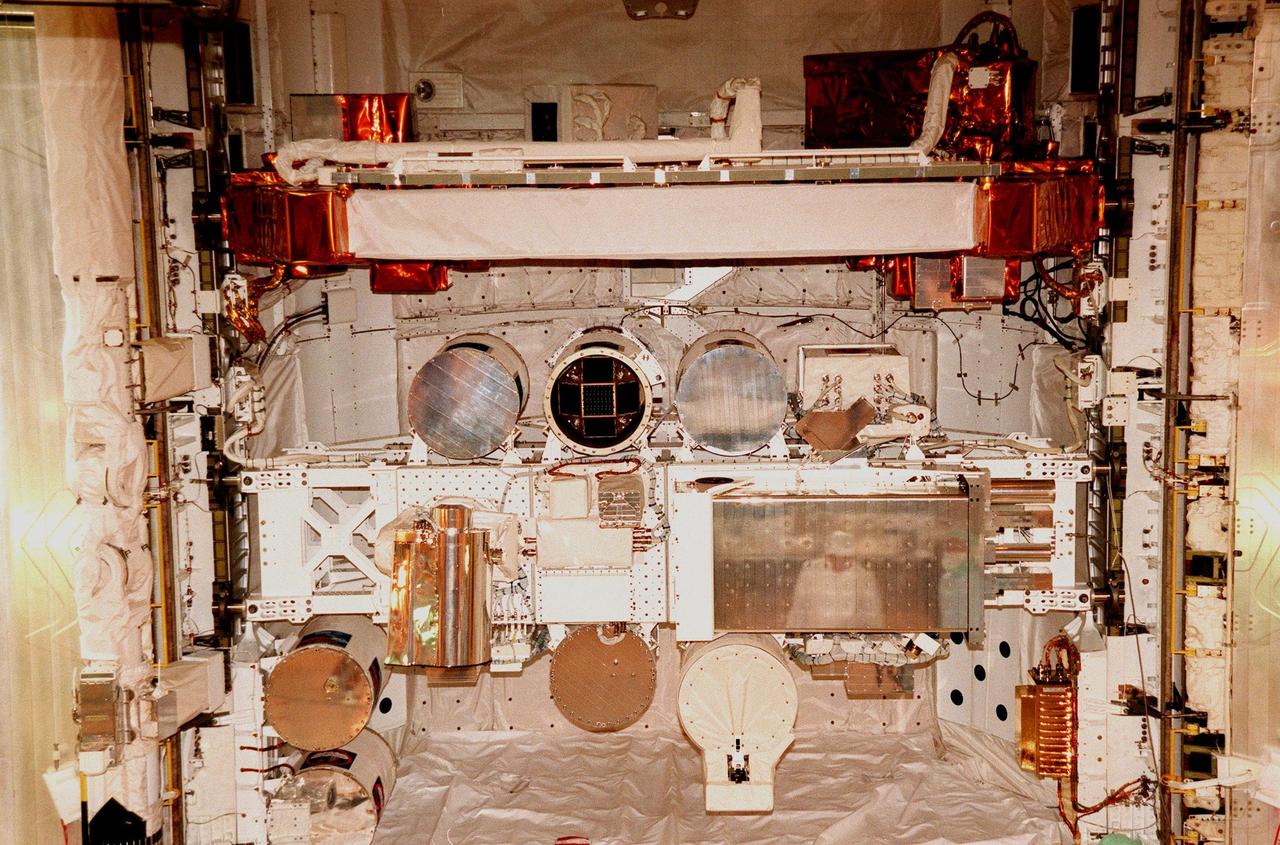
KENNEDY SPACE CENTER, FLA. -- On Launch Complex 39B, the open payload bay doors on the orbiter Discovery reveal (bottom) International Extreme Ultraviolet Hitchhiker (IEH-3) and (above it) Hubble Space Telescope Orbital Systems Test Platform (HOST), two of the payloads for mission STS-95. The other payloads include the Spartan solar-observing deployable spacecraft and SPACEHAB, a single module containing experiments on space flight and the aging process. STS-95 is expected to launch at 2 p.m. EST on Oct. 29, last 8 days, 21 hours and 49 minutes, and land at 11:49 a.m. EST on Nov. 7
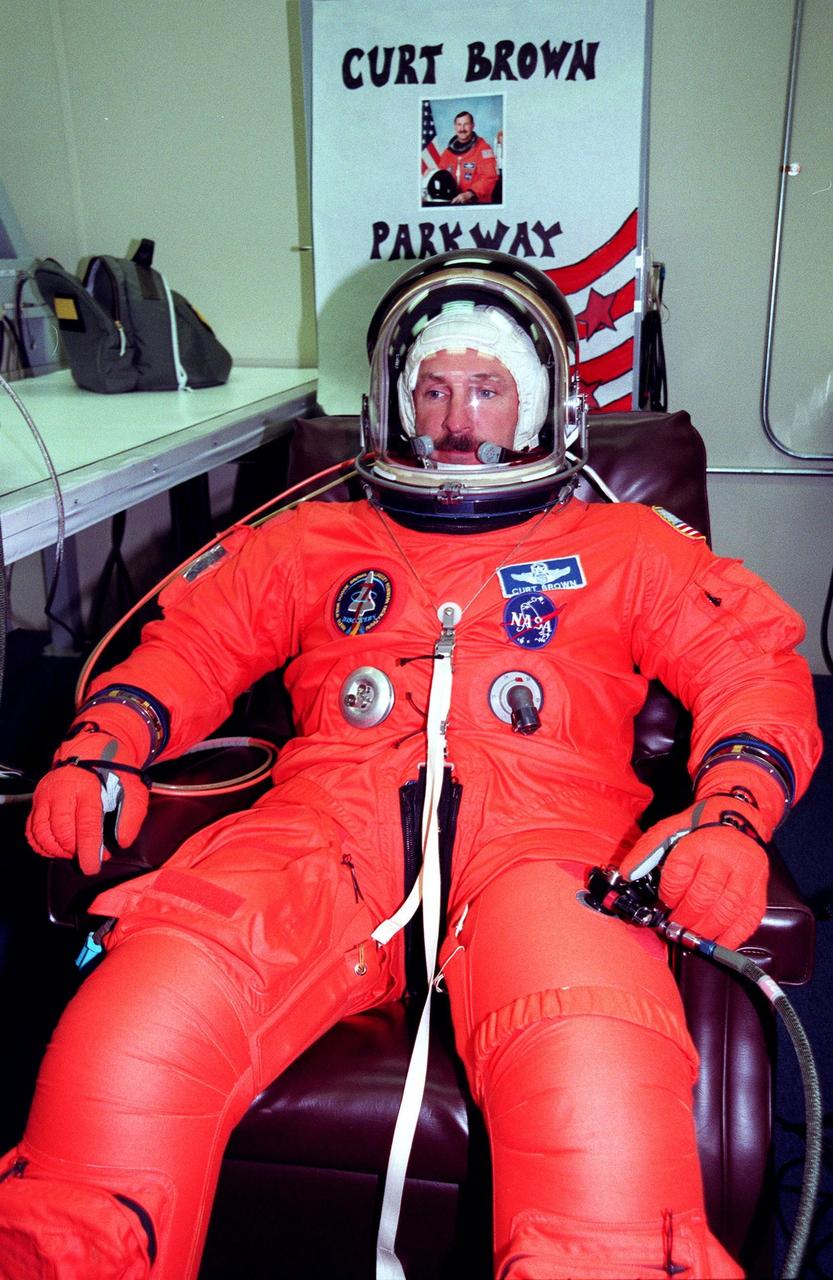
STS-95 Mission Commander Curtis L. Brown Jr. tests his flight suit in the Operations and Checkout Building. The final fitting takes place prior to the crew walkout and transport to Launch Pad 39B. Targeted for launch at 2 p.m. EST on Oct. 29, the mission is expected to last 8 days, 21 hours and 49 minutes, and return to KSC at 11:49 a.m. EST on Nov. 7. The STS-95 mission includes research payloads such as the Spartan solar-observing deployable spacecraft, the Hubble Space Telescope Orbital Systems Test Platform, the International Extreme Ultraviolet Hitchhiker, as well as the SPACEHAB single module with experiments on space flight and the aging process
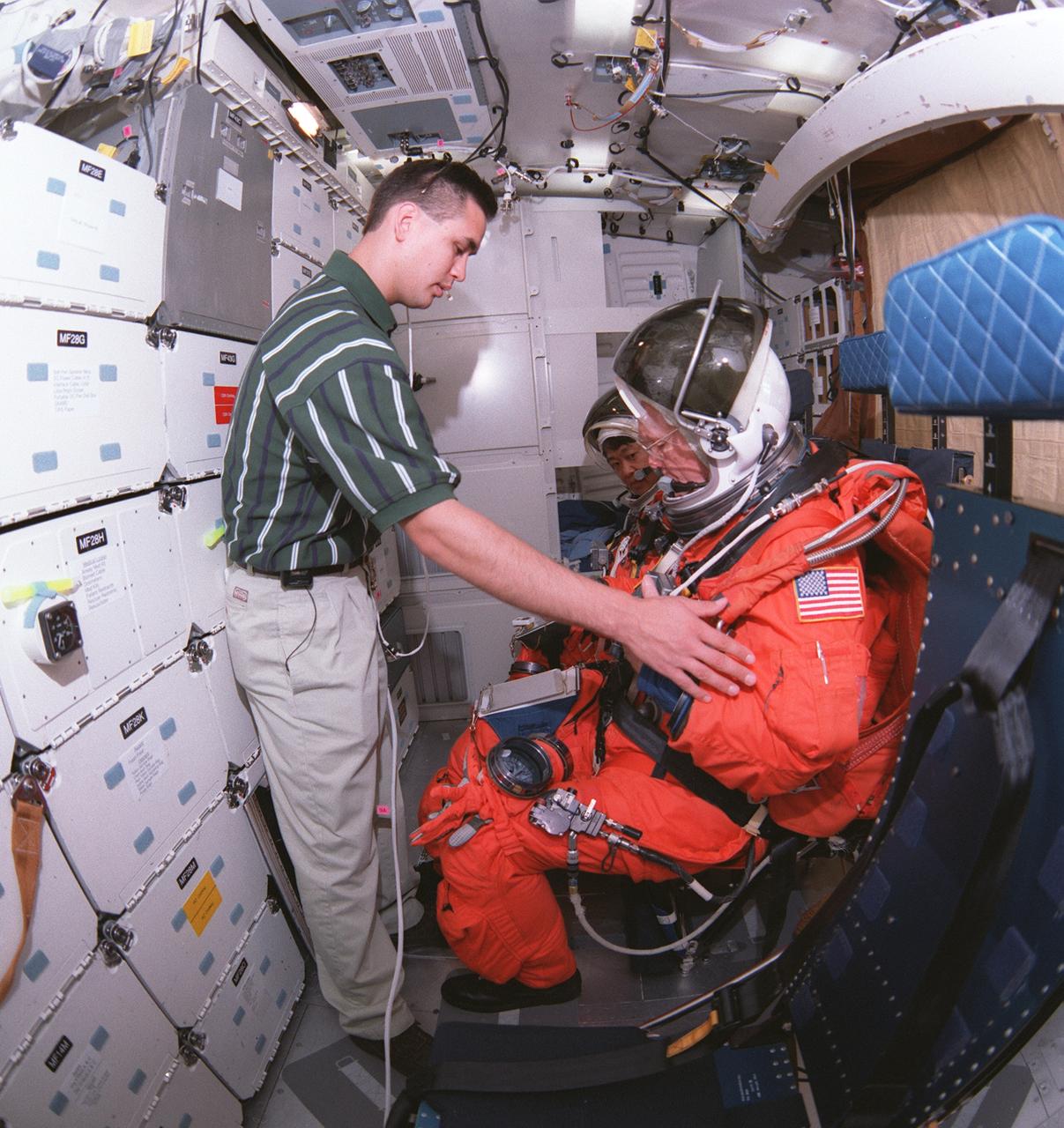
S98-07969 (5 June 1998) --- Crew trainer Adam Flagan (left) checks out STS-95 payload specialists Chiaki Naito-Mukai and John H. Glenn Jr. as they practice launch and entry procedures on the middeck of one of the training mockups in the Johnson Space Center's Space Vehicle Mockup Facility. The STS-95 mission, tentatively scheduled for launch on Oct. 29, will involve a variety of science experiments being carried in the pressurized Spacehab module, deployment and retrieval of the Spartan free-flyer payload, and operations with the HST Orbiting Systems Test and the International Extreme Ultraviolet Hitchhiker payloads.
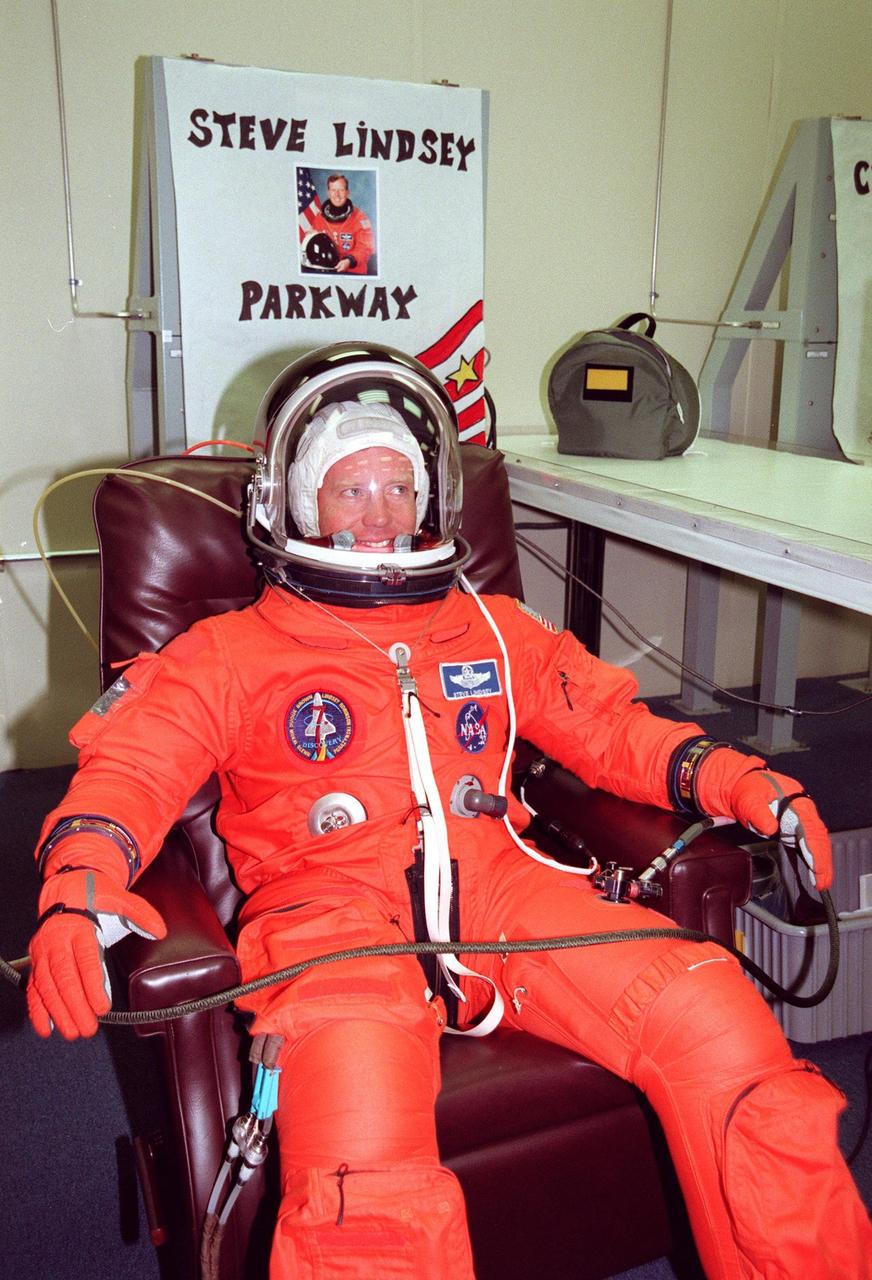
STS-95 Pilot Steven W. Lindsey tests his flight suit in the Operations and Checkout Building. The final fitting takes place prior to the crew walkout and transport to Launch Pad 39B. Targeted for launch at 2 p.m. EST on Oct. 29, the mission is expected to last 8 days, 21 hours and 49 minutes, and return to KSC at 11:49 a.m. EST on Nov. 7. The STS-95 mission includes research payloads such as the Spartan solar-observing deployable spacecraft, the Hubble Space Telescope Orbital Systems Test Platform, the International Extreme Ultraviolet Hitchhiker, as well as the SPACEHAB single module with experiments on space flight and the aging process
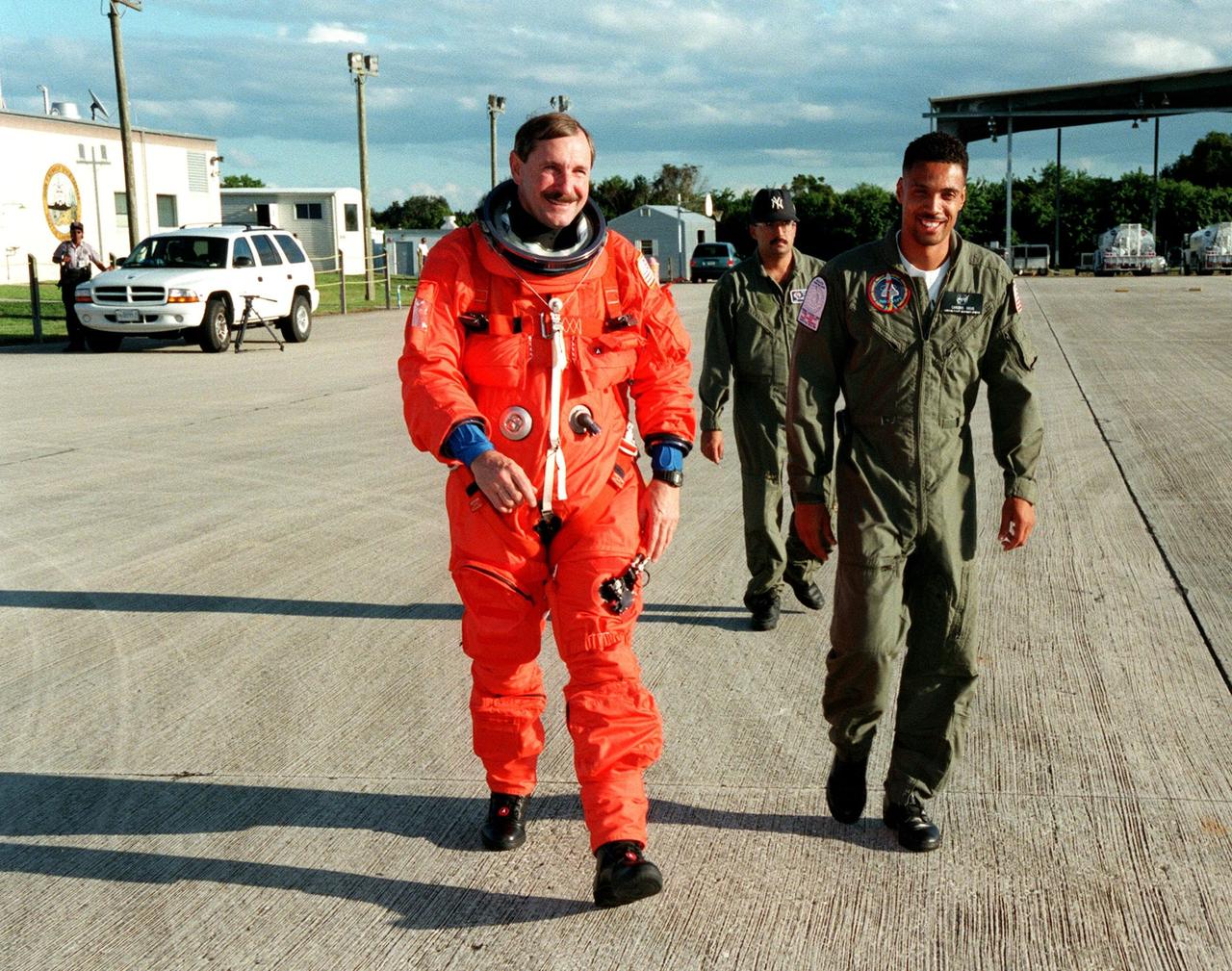
STS-95 Mission Commander Curtis L. Brown Jr. (left) leaves the Shuttle Landing Facility (SLF) enroute to the Shuttle Training Aircraft (STA). He is accompanied by two suit technicians, Ray Cuevas (middle) and Carlous Gillis (right). Brown will be practicing Shuttle landing and takeoffs at the SLF prior to launch. The STA is designed to fly like the Shuttle. STS-95 is expected to launch at 2 p.m. EST on Oct. 29, last 8 days, 21 hours and 49 minutes, and land at 11:49 a.m. EST on Nov. 7
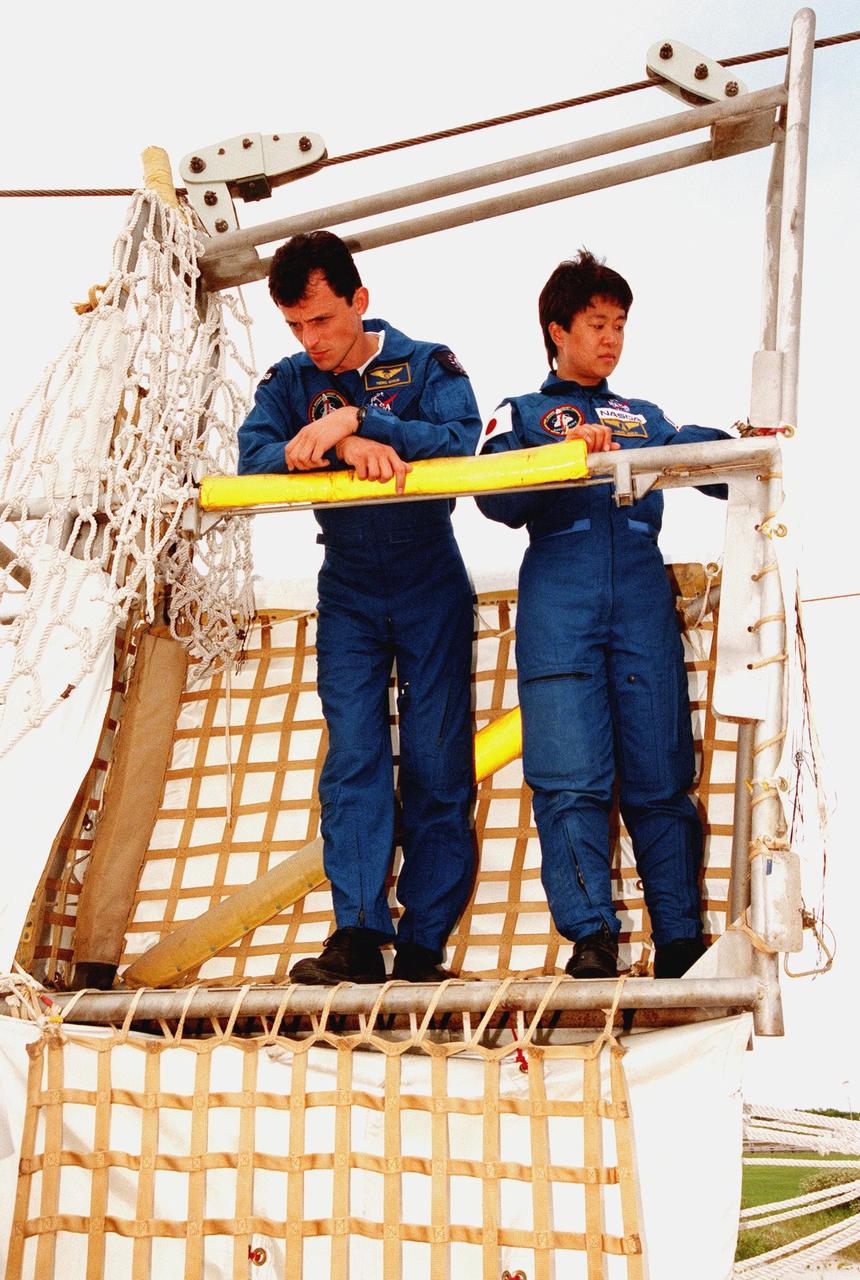
At Launch Pad 39-B, STS-95 Mission Specialist Pedro Duque of Spain (left) and Payload Specialist Chiaki Mukai look over the gate for the slidewire basket, part of the emergency egress system on the pad. Mukai represents the National Space Development Agency of Japan (NASDA), and Duque the European Space Agency (ESA). The STS-95 crew are at KSC to participate in a Terminal Countdown Demonstration Test (TCDT) which includes mission familiarization activities, emergency egress training, and a simulated main engine cut-off exercise. Other STS-95 crew members are Mission Specialist Stephen K. Robinson, Mission Commander Curtis L. Brown, Pilot Steven W. Lindsey, Payload Specialists John H. Glenn Jr., senator from Ohio, and Mission Specialist Scott E. Parazynski. The STS-95 mission, targeted for liftoff on Oct. 29, includes research payloads such as the Spartan solar-observing deployable spacecraft, the Hubble Space Telescope Orbital Systems Test Platform, the International Extreme Ultraviolet Hitchhiker, as well as the SPACEHAB single module with experiments on space flight and the aging process. Following the TCDT, the crew will be returning to Houston for final flight preparations
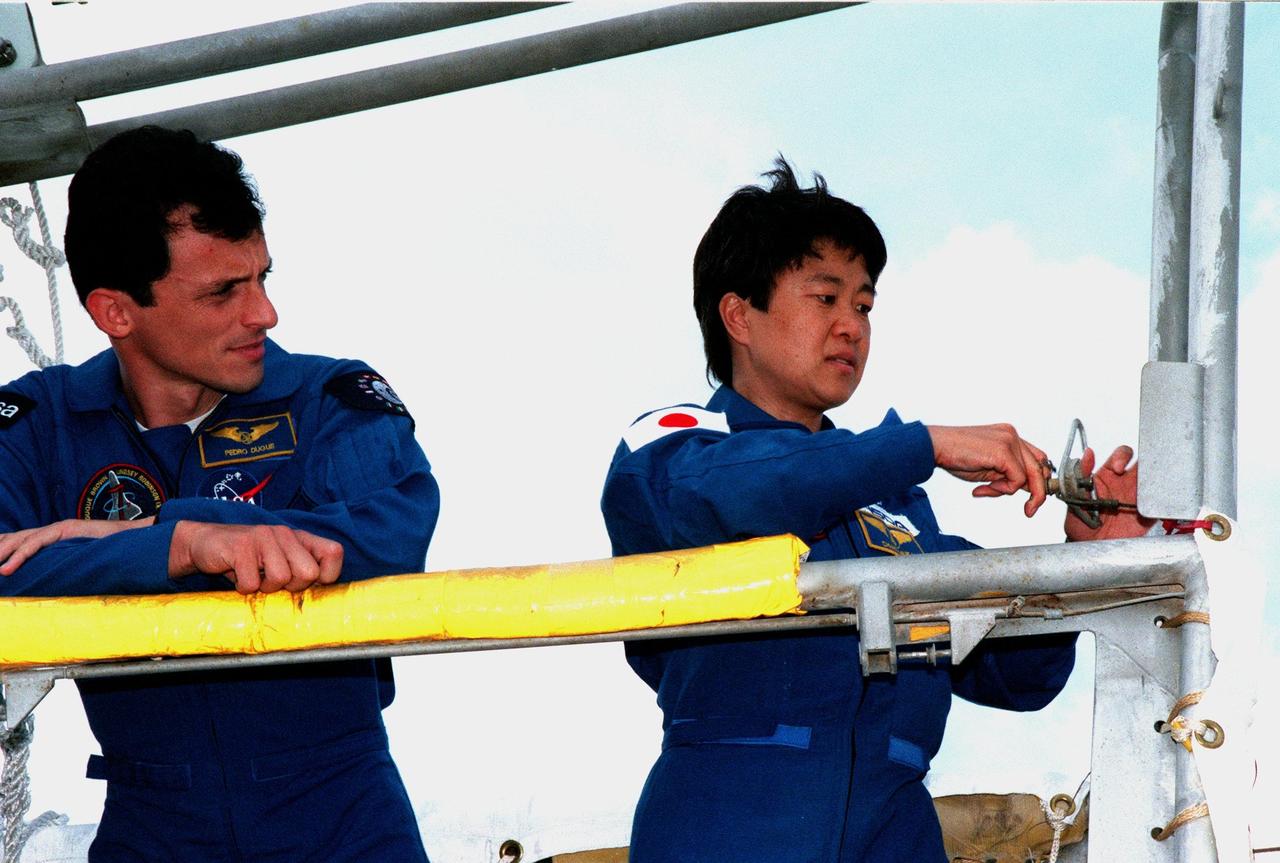
At Launch Pad 39-B, STS-95 Payload Specialist Chiaki Mukai (right) pulls the pin that releases the gate for the slidewire basket, part of the emergency egress system on the pad, while Mission Specialist Pedro Duque of Spain watches. Mukai represents the National Space Development Agency of Japan (NASDA), and Duque the European Space Agency (ESA). The STS-95 crew are at KSC to participate in a Terminal Countdown Demonstration Test (TCDT) which includes mission familiarization activities, emergency egress training, and a simulated main engine cut-off exercise. Other STS-95 crew members are Mission Specialist Stephen K. Robinson, Mission Commander Curtis L. Brown, Pilot Steven W. Lindsey, Payload Specialists John H. Glenn Jr., senator from Ohio, and Mission Specialist Scott E. Parazynski. The STS-95 mission, targeted for liftoff on Oct. 29, includes research payloads such as the Spartan solar-observing deployable spacecraft, the Hubble Space Telescope Orbital Systems Test Platform, the International Extreme Ultraviolet Hitchhiker, as well as the SPACEHAB single module with experiments on space flight and the aging process. Following the TCDT, the crew will be returning to Houston for final flight preparations
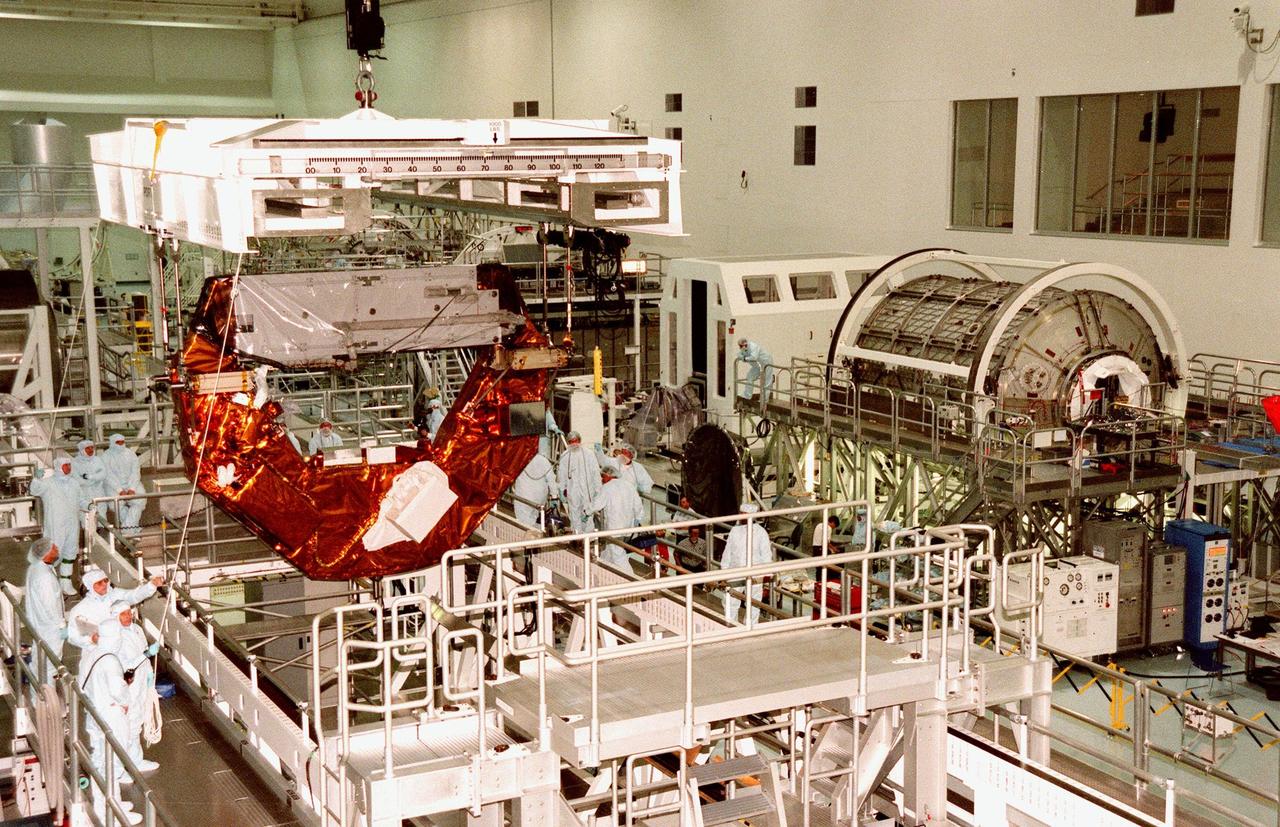
KENNEDY SPACE CENTER, FLA. -- The Hubble Space Telescope Orbiting Systems Test Platform (HOST) is lifted off its work stand in the Space Station Processing Facility before moving it to its payload canister. One of the payloads on the STS-95 mission, the HOST platform is carrying four experiments to validate components planned for installation during the third Hubble Space Telescope servicing mission and to evaluate new technologies in an Earth-orbiting environment. The STS-95 mission is scheduled to launch Oct. 29. It will carry other payloads such as the Spartan solar-observing deployable spacecraft, the International Extreme Ultraviolet Hitchhiker (IEH-3), and the SPACEHAB single module with experiments on space flight and the aging process
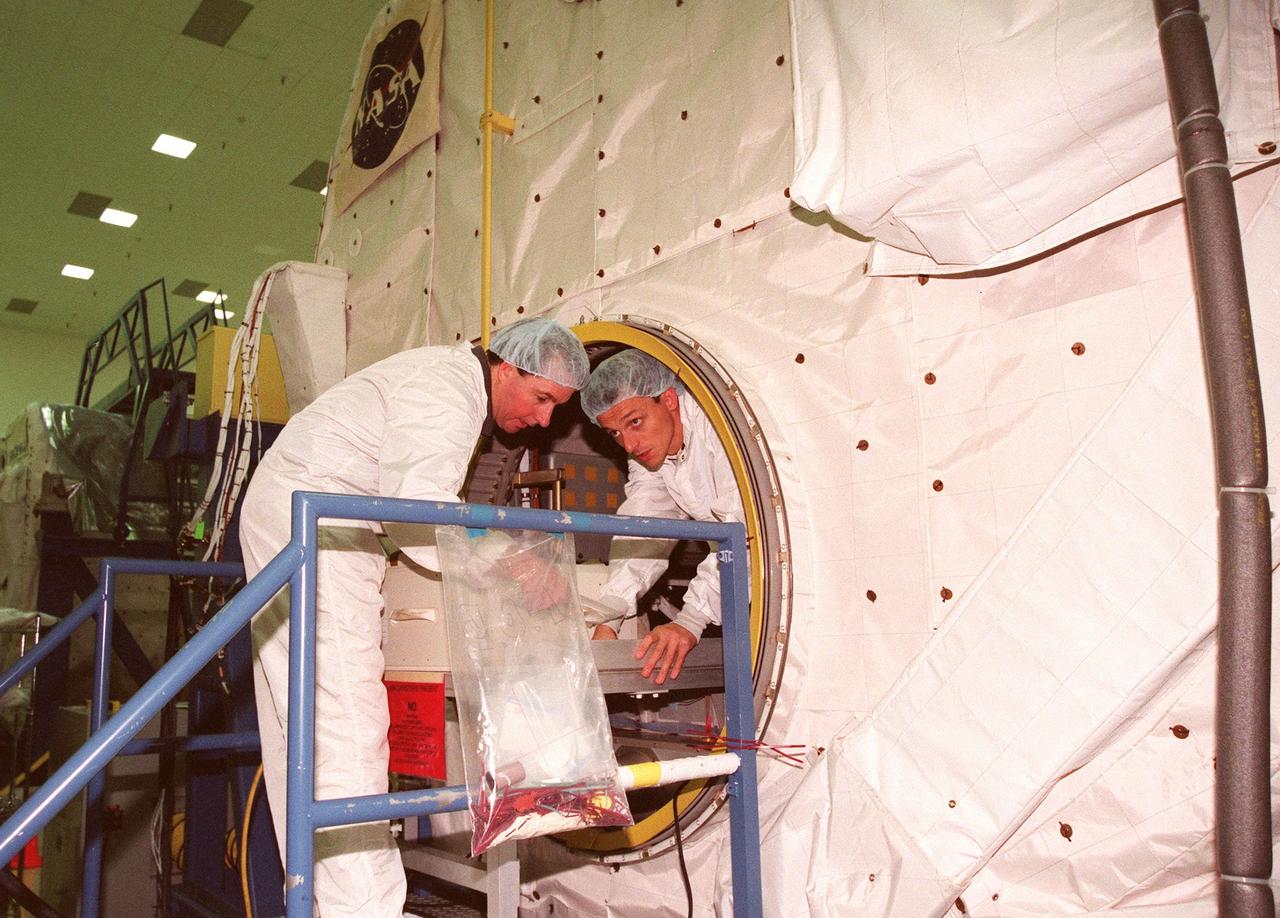
KENNEDY SPACE CENTER, FLA. -- STS-95 Mission Specialist Stephen Robinson, Ph.D., (left) and Mission Specialist Pedro Duque (right) of Spain, who represents the European Space Agency (ESA), enter the SPACEHAB in the SPACEHAB Payload Processing Facility (SPPF). STS-95 crew members have been participating in SPACEHAB familiarization in the SPPF. Scheduled to launch Oct. 29, the mission includes research payloads such as the Spartan solar-observing deployable spacecraft, the Hubble Space Telescope Orbital Systems Test Platform, the International Extreme Ultraviolet Hitchhiker, as well as the SPACEHAB single module with experiments on space flight and the aging process
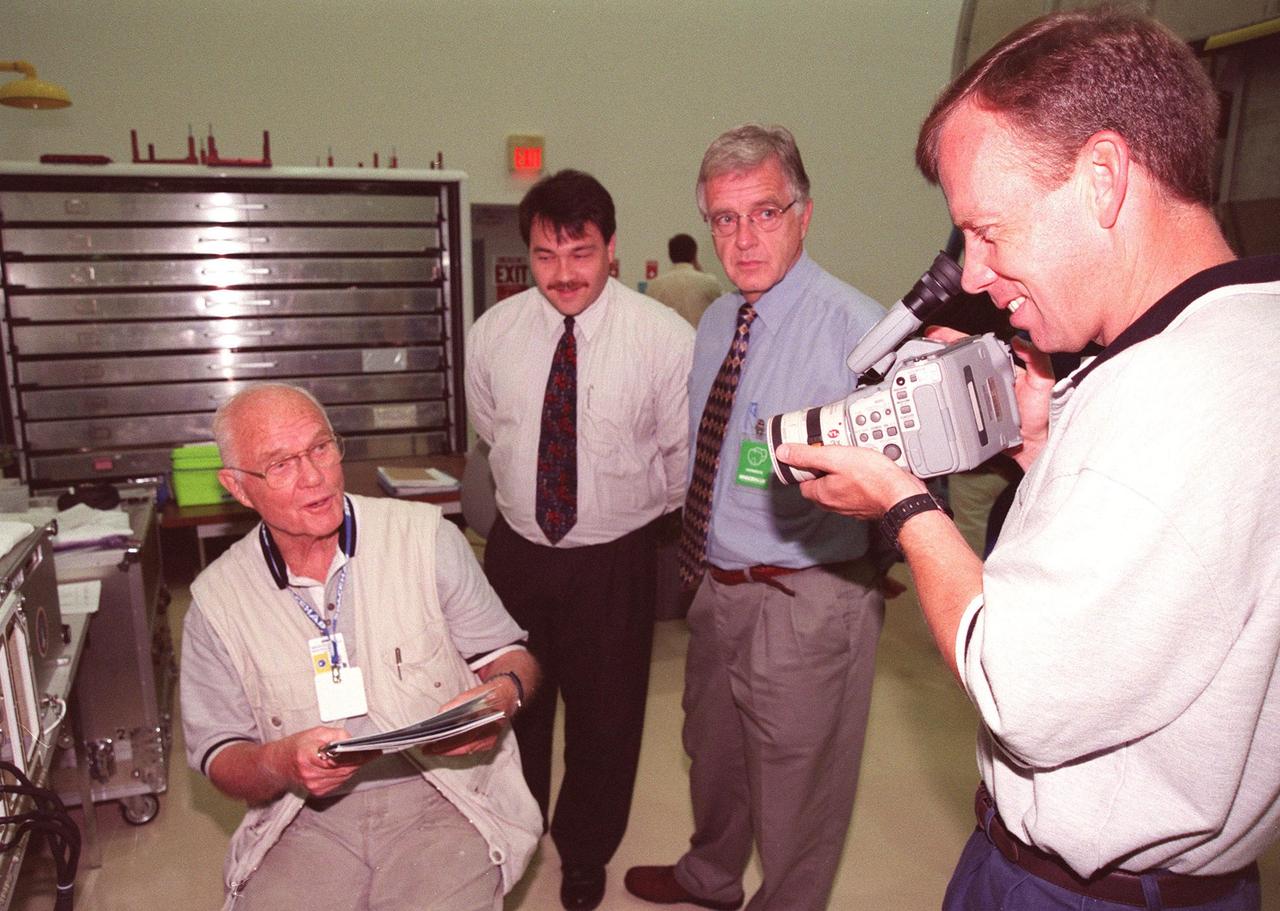
KENNEDY SPACE CENTER, FLA. -- In the SPACEHAB Payload Processing Facility (SPPF), Cape Canaveral, STS-95 Payload Specialist John Glenn, who is a senator from Ohio, is a willing subject for Pilot Steven Lindsey, who practices his camera technique while KSC workers watch. STS-95 crew members have been participating in SPACEHAB familiarization in the SPPF. Scheduled to launch Oct. 29, the mission includes research payloads such as the Spartan solar-observing deployable spacecraft, the Hubble Space Telescope Orbital Systems Test Platform, the International Extreme Ultraviolet Hitchhiker, as well as the SPACEHAB single module with experiments on space flight and the aging process
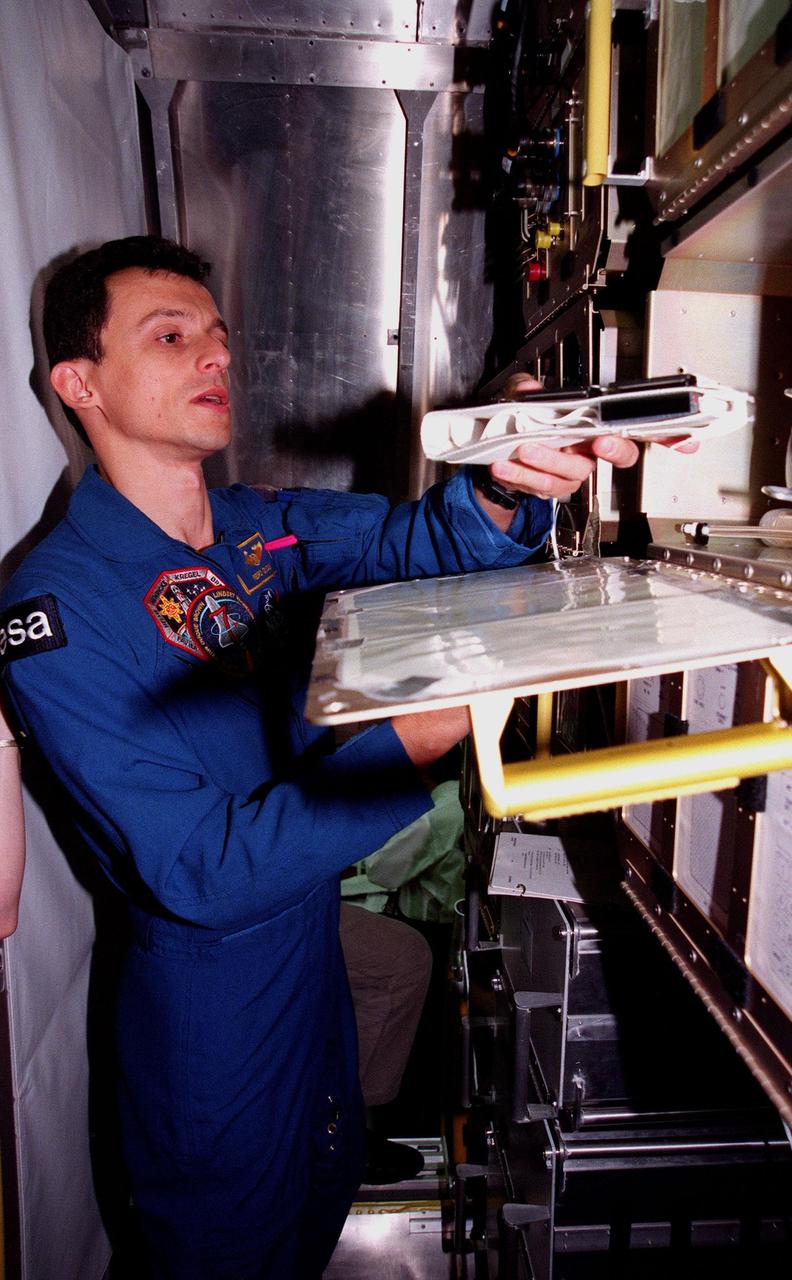
KENNEDY SPACE CENTER, FLA. -- STS-95 Mission Specialist Pedro Duque of Spain, representing the European Space Agency (ESA), checks out equipment inside the SPACEHAB module at the SPACEHAB Payload Processing Facility (SPPF), Cape Canaveral. The STS-95 crew are participating in SPACEHAB familiarization at the SPPF. The mission, scheduled to launch Oct. 29, includes research payloads such as the Spartan solar-observing deployable spacecraft, the Hubble Space Telescope Orbital Systems Test Platform, the International Extreme Ultraviolet Hitchhiker, as well as the SPACEHAB single module with experiments on space flight and the aging process
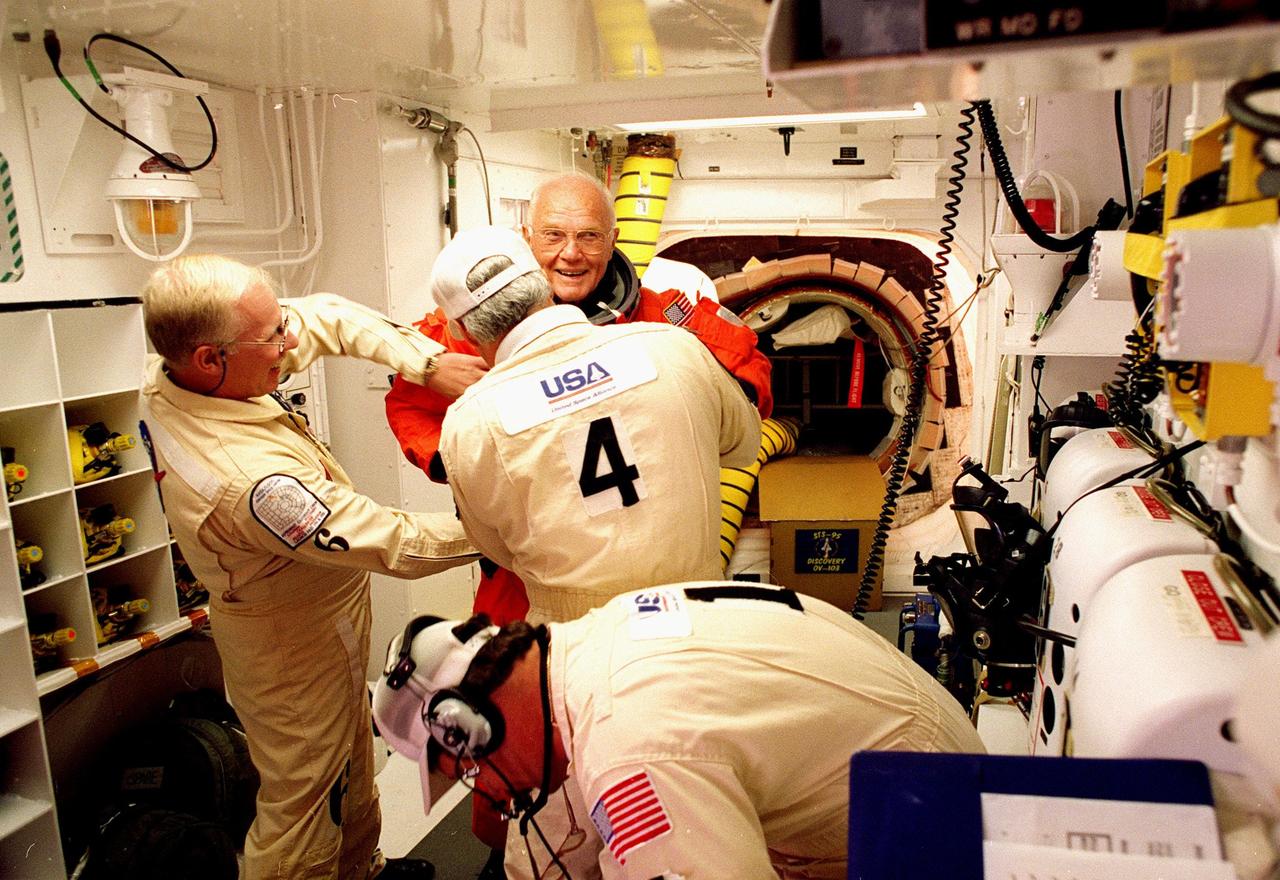
In the environmental chamber known as the white room, an eager STS-95 Payload Specialist John H. Glenn Jr., senator from Ohio, has his flight suit checked by closeout room crew members Danny Wyatt (left to right), Chris Meinert and Travis Thompson (foreground) for entry into the Space Shuttle Discovery for his second flight into space after 36 years. The STS-95 mission, targeted for launch at 2 p.m. EST on Oct. 29, is expected to last 8 days, 21 hours and 49 minutes, and return to KSC at 11:49 a.m. EST on Nov. 7
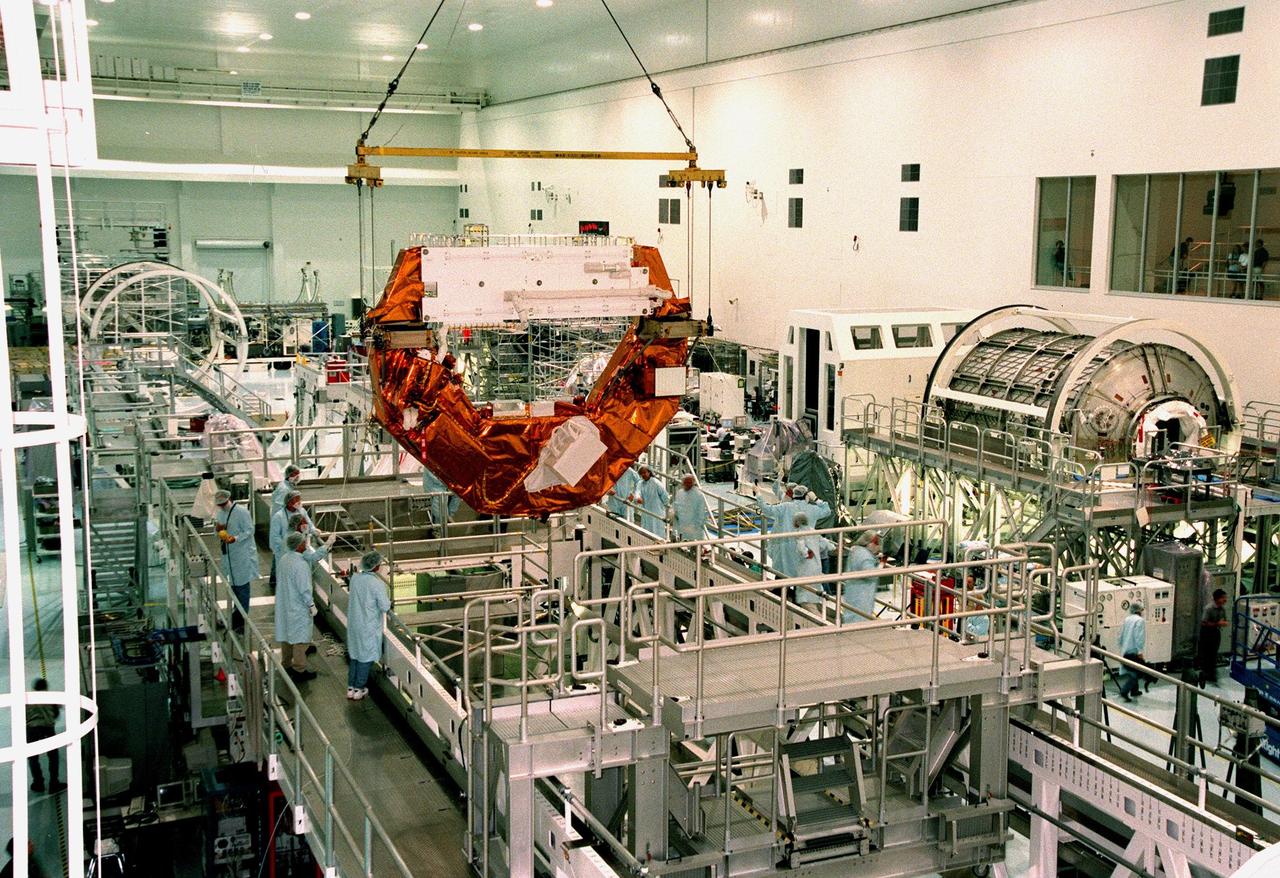
Workers watch as the Hubble Space Telescope Orbiting Systems Test (HOST)is lowered onto a workstand in the Space Shuttle Processing Facility. To the right can be seen the Rack Insertion Device and Leonardo, a Multi-Purpose Logistics Module. The HOST platform, one of the payloads on the STS-95 mission, is carrying four experiments to validate components planned for installation during the third Hubble Space Telescope servicing mission and to evaluate new technologies in an earth orbiting environment. The STS-95 mission is scheduled to launch Oct. 29. It will carry three other payloads: the Spartan solar-observing deployable spacecraft, the International Extreme Ultraviolet Hitchhiker, and the SPACEHAB single module with experiments on space flight and the aging process
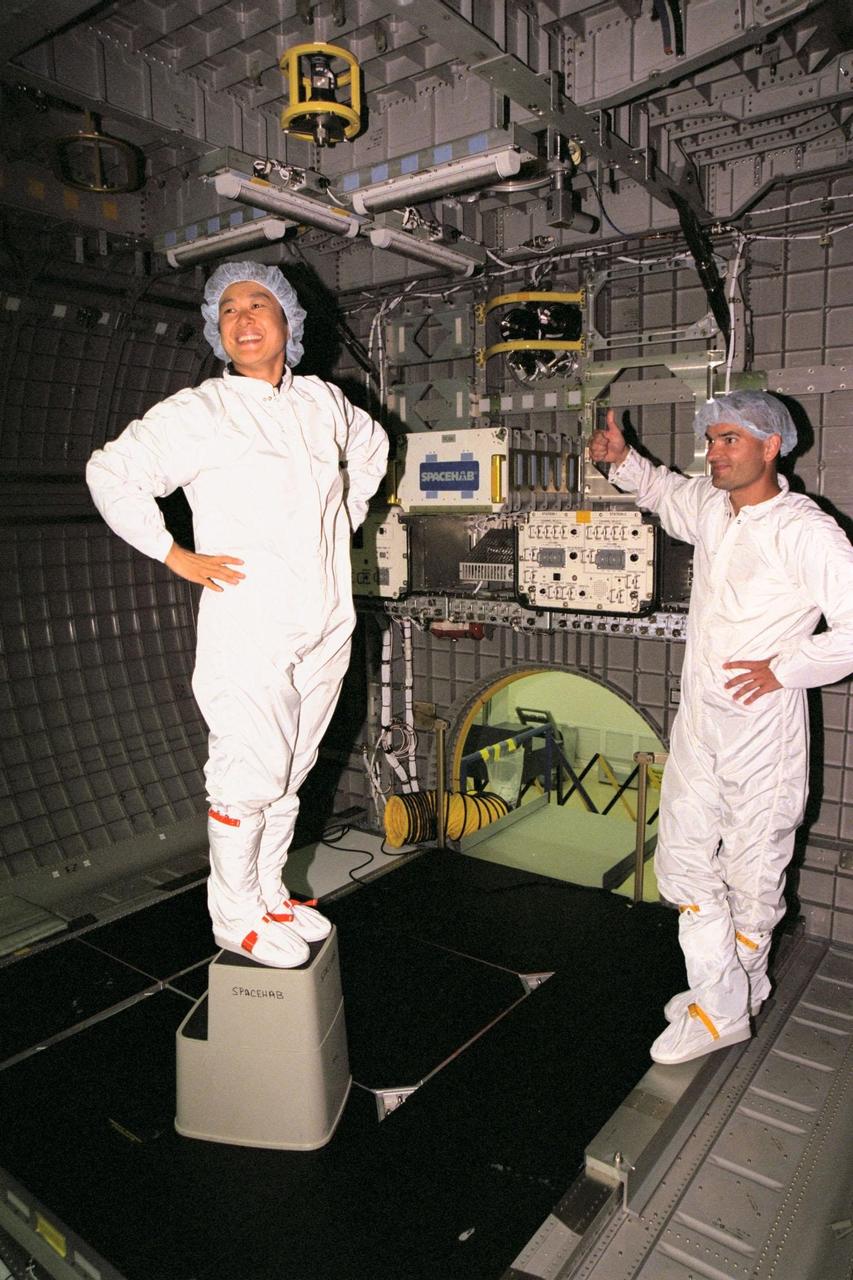
STS-95 Payload Specialist Chiaki Mukai, representing National Space Development Agency of Japan (NASDA), grins for the camera after looking at equipment in the SPACEHAB module while Chris Jaskolka, of Boeing SPACEHAB, gives her a thumbs up. The STS-95 crew is at KSC for a familiarization tour of the SPACEHAB module and the equipment that will fly with them on the Space Shuttle Discovery scheduled to launch Oct. 29, 1998. The mission includes research payloads such as the Spartan solar-observing deployable spacecraft, the Hubble Space Telescope Orbital Systems Test Platform, the International Extreme Ultraviolet Hitchhiker, as well as the SPACEHAB single module with experiments on space flight and the aging process
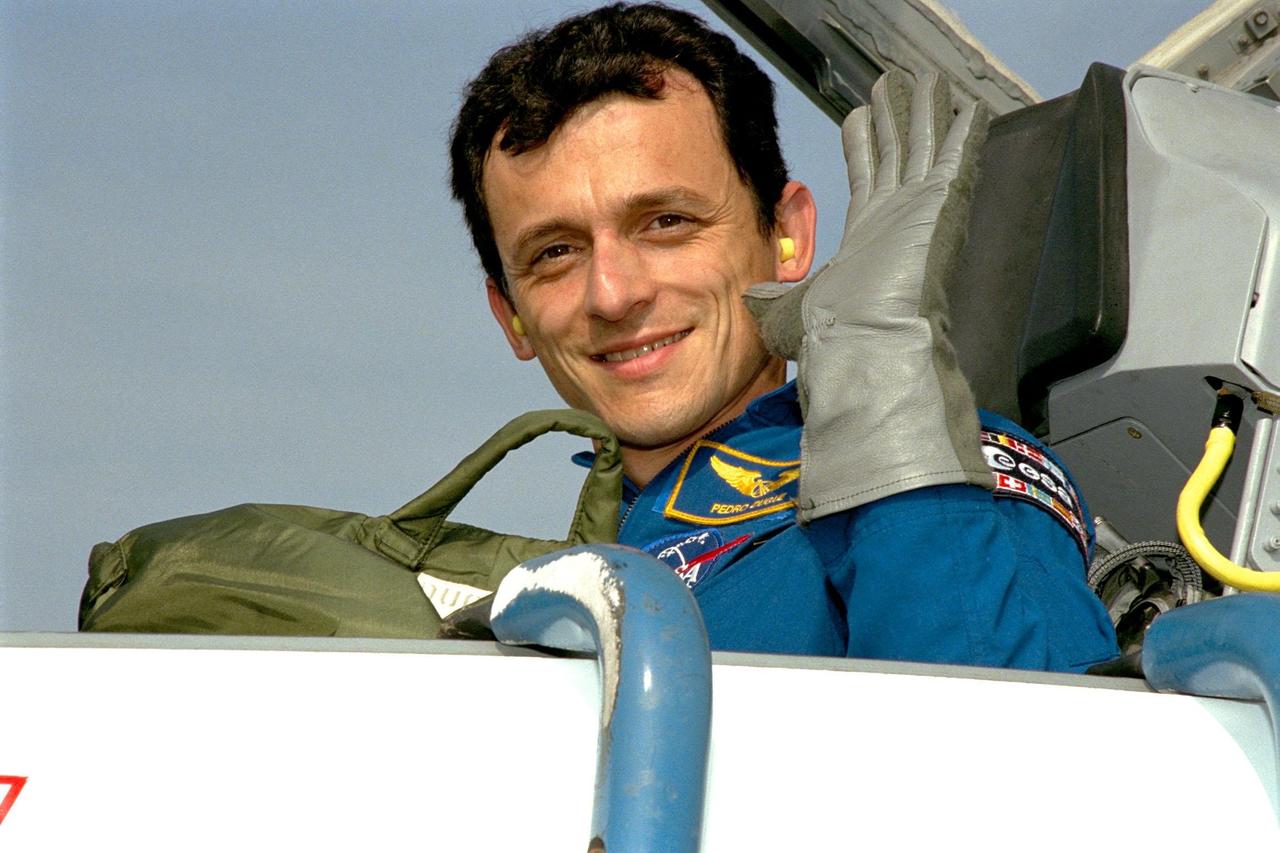
STS-95 Payload Specialist Pedro Duque of Spain, who represents the European Space Agency (ESA), waves after arriving in a T-38 jet aircraft at the Shuttle Landing Facility at KSC. He is joining other STS-95 crew members in a familiarization tour of the SPACEHAB module and the equipment that will fly with them on the Space Shuttle Discovery scheduled to launch Oct. 29, 1998. The mission includes research payloads such as the Spartan solar-observing deployable spacecraft, the Hubble Space Telescope Orbital Systems Test Platform, the International Extreme Ultraviolet Hitchhiker, as well as the SPACEHAB single module with experiments on space flight and the aging process
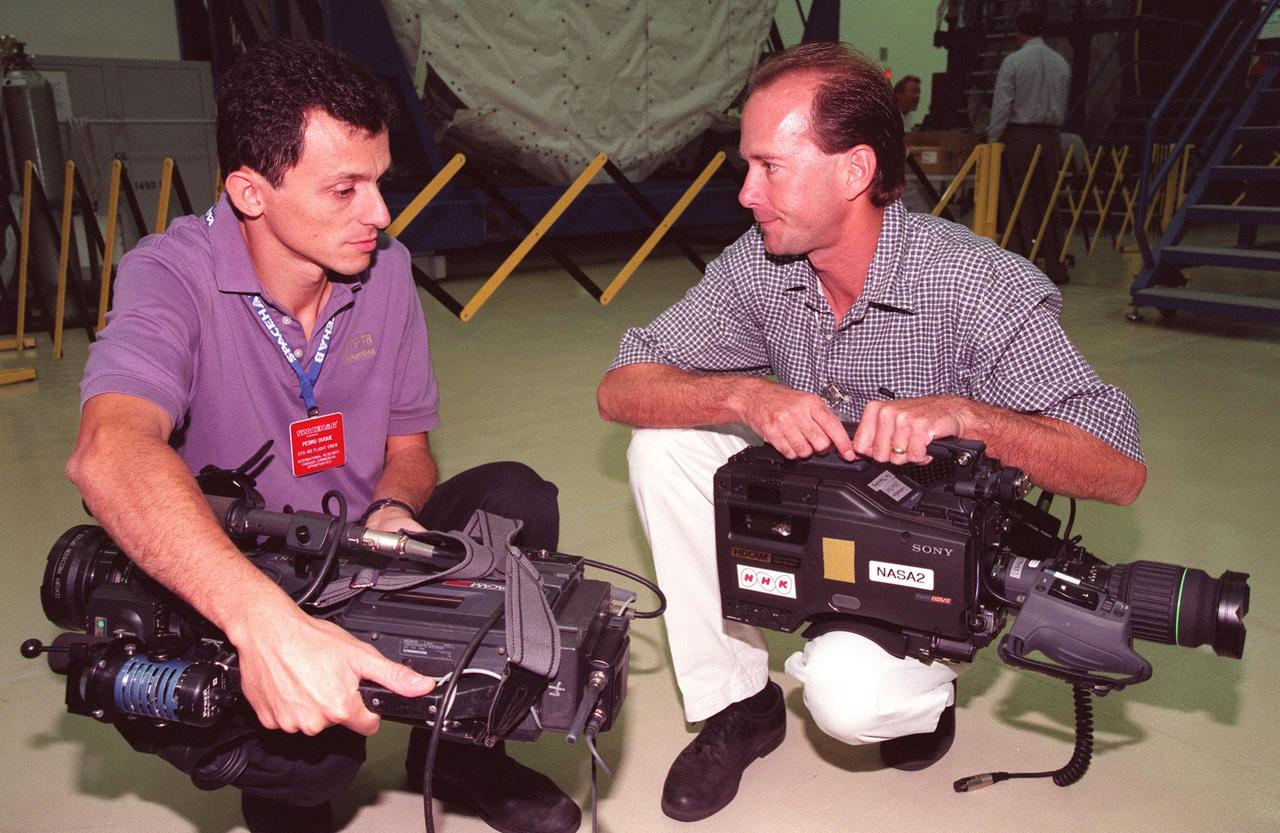
KENNEDY SPACE CENTER, FLA. -- STS-95 Mission Specialist Pedro Duque (left) of Spain, who represents the European Space Agency (ESA), talks to KSC photographer Glen Benson in the SPACEHAB Payload Processing Facility (SPPF) about video cameras to be used on the mission. STS-95 crew members have been participating in SPACEHAB familiarization in the SPPF. Scheduled to launch Oct. 29, the mission includes research payloads such as the Spartan solar-observing deployable spacecraft, the Hubble Space Telescope Orbital Systems Test Platform, the International Extreme Ultraviolet Hitchhiker, as well as the SPACEHAB single module with experiments on space flight and the aging process
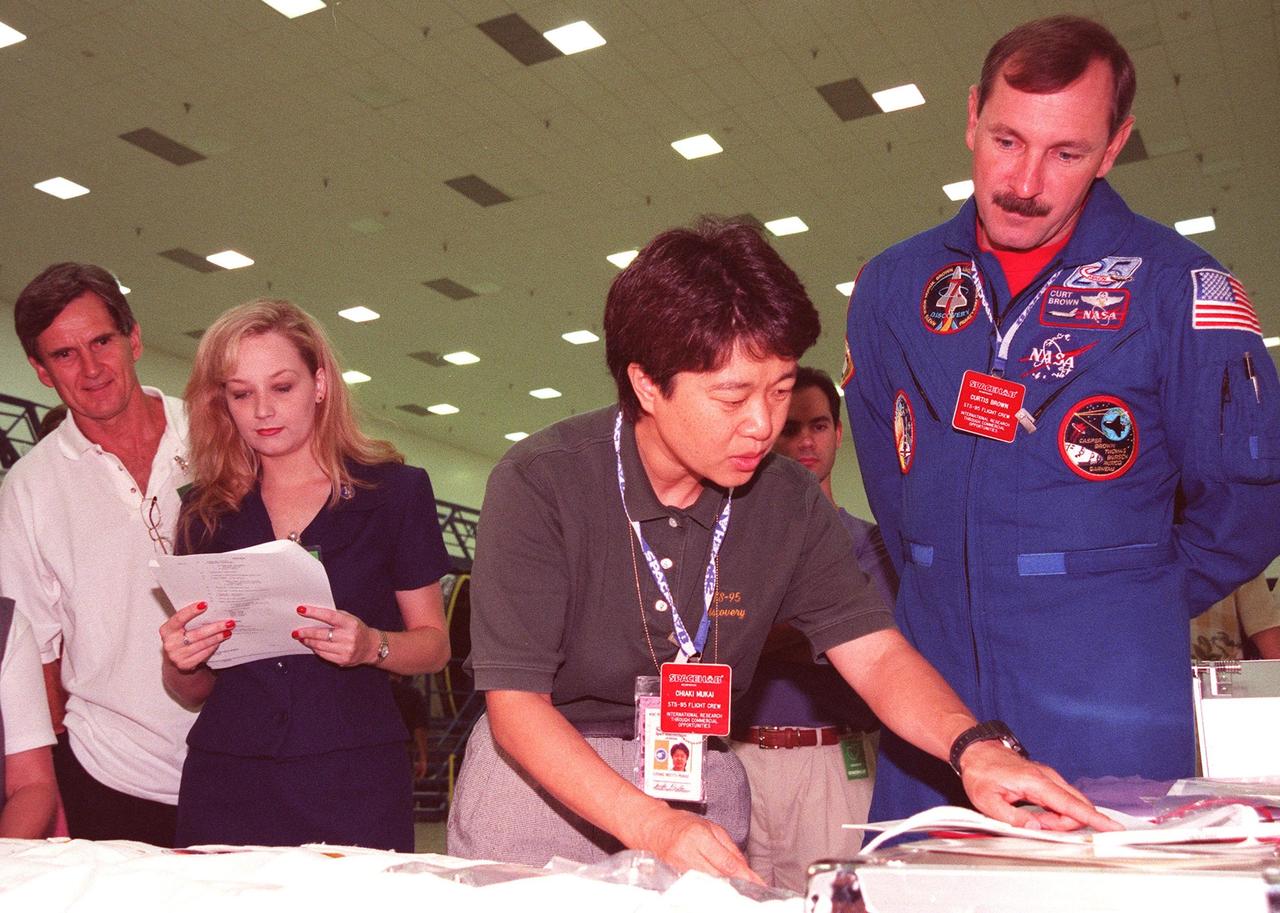
KENNEDY SPACE CENTER, FLA. -- STS-95 Payload Specialist Chiaki Mukai (center), representing the National Space Development Agency of Japan (NASDA) and Mission Commander Curtis L. Brown Jr. review equipment and documentation for the SPACEHAB at the SPACEHAB Payload Processing Facility (SPPF), Cape Canaveral. Onlookers behind them provide support. The STS-95 crew are participating in SPACEHAB familiarization at the SPPF. The mission, scheduled to launch Oct. 29, includes research payloads such as the Spartan solar-observing deployable spacecraft, the Hubble Space Telescope Orbital Systems Test Platform, the International Extreme Ultraviolet Hitchhiker, as well as the SPACEHAB single module with experiments on space flight and the aging process
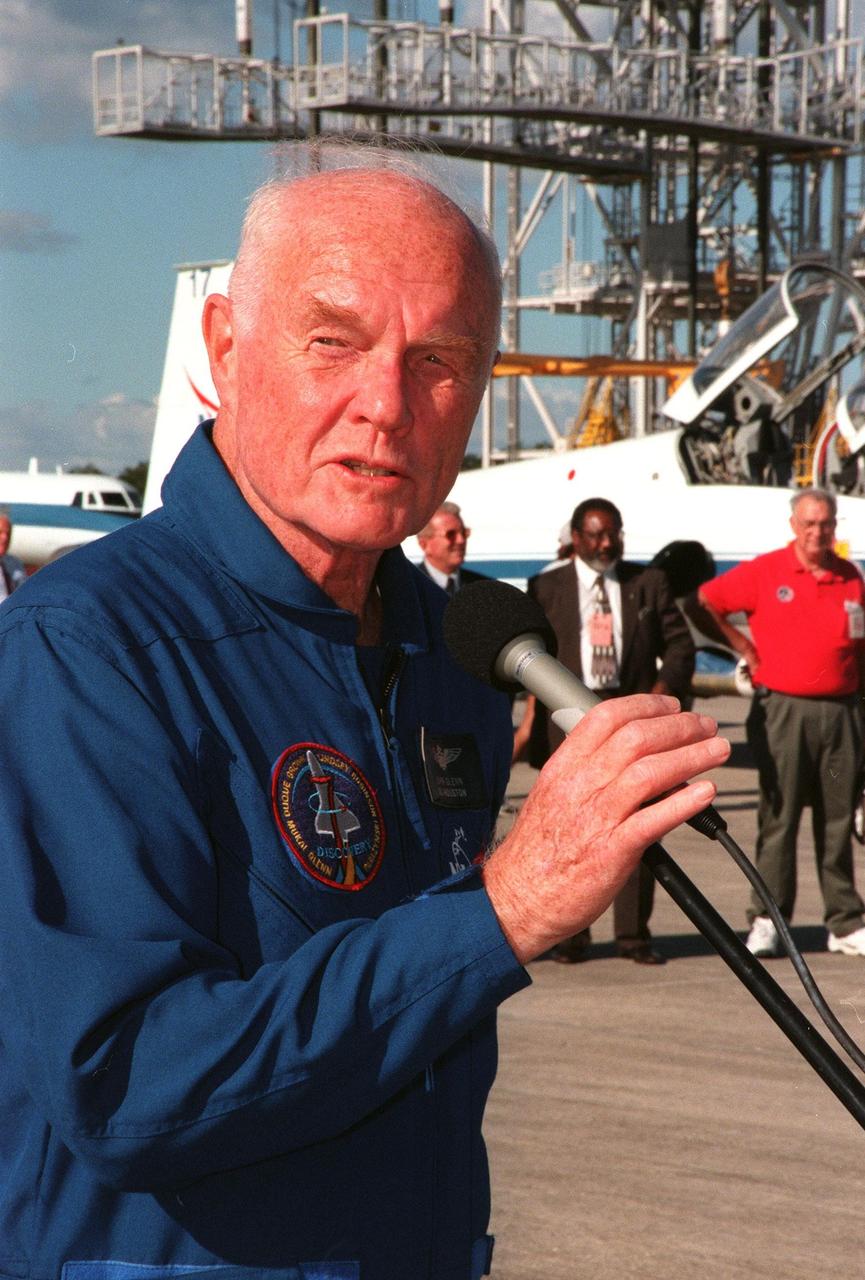
STS-95 Payload Specialist John H. Glenn Jr., senator from Ohio, talks to the media after the crew's arrival at the Shuttle Landing Facility to make final preparations for their launch. Targeted for liftoff at 2 p.m. on Oct. 29, the STS-95 mission includes research payloads such as the Spartan solar-observing deployable spacecraft, the Hubble Space Telescope Orbital Systems Test Platform, the International Extreme Ultraviolet Hitchhiker, as well as the SPACEHAB single module with experiments on space flight and the aging process. The mission is expected to last 8 days, 21 hours and 49 minutes, and return to KSC on Nov. 7
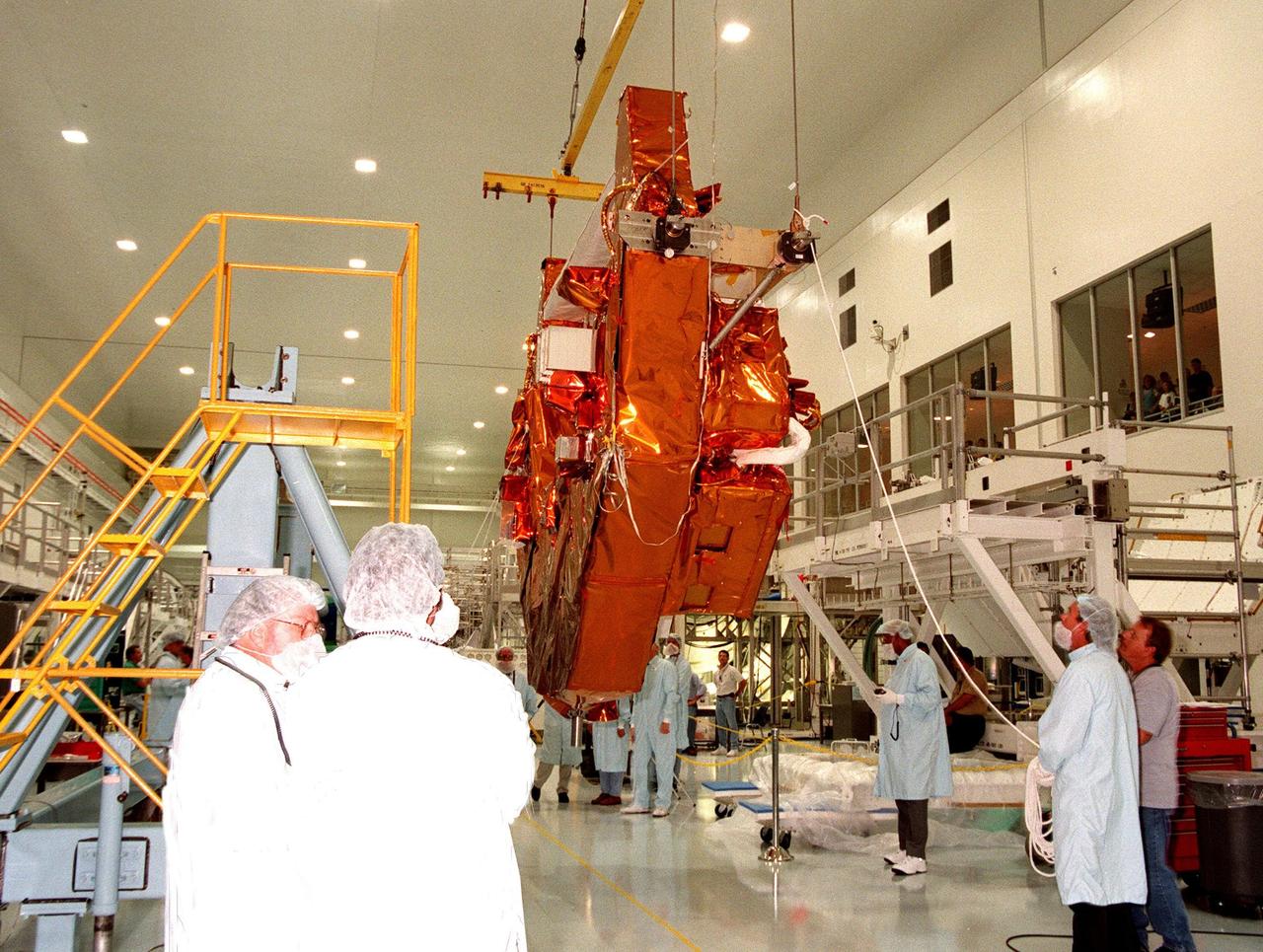
Workers watch as the Hubble Space Telescope Orbiting Systems Test (HOST)is moved inside the Space Shuttle Processing Facility. The HOST platform, one of the payloads on the STS-95 mission, is carrying four experiments to validate components planned for installation during the third Hubble Space Telescope servicing mission and to evaluate new technologies in an earth orbiting environment. The STS-95 mission is scheduled to launch Oct. 29. It will carry three other payloads: the Spartan solar-observing deployable spacecraft, the International Extreme Ultraviolet Hitchhiker, and the SPACEHAB single module with experiments on space flight and the aging process
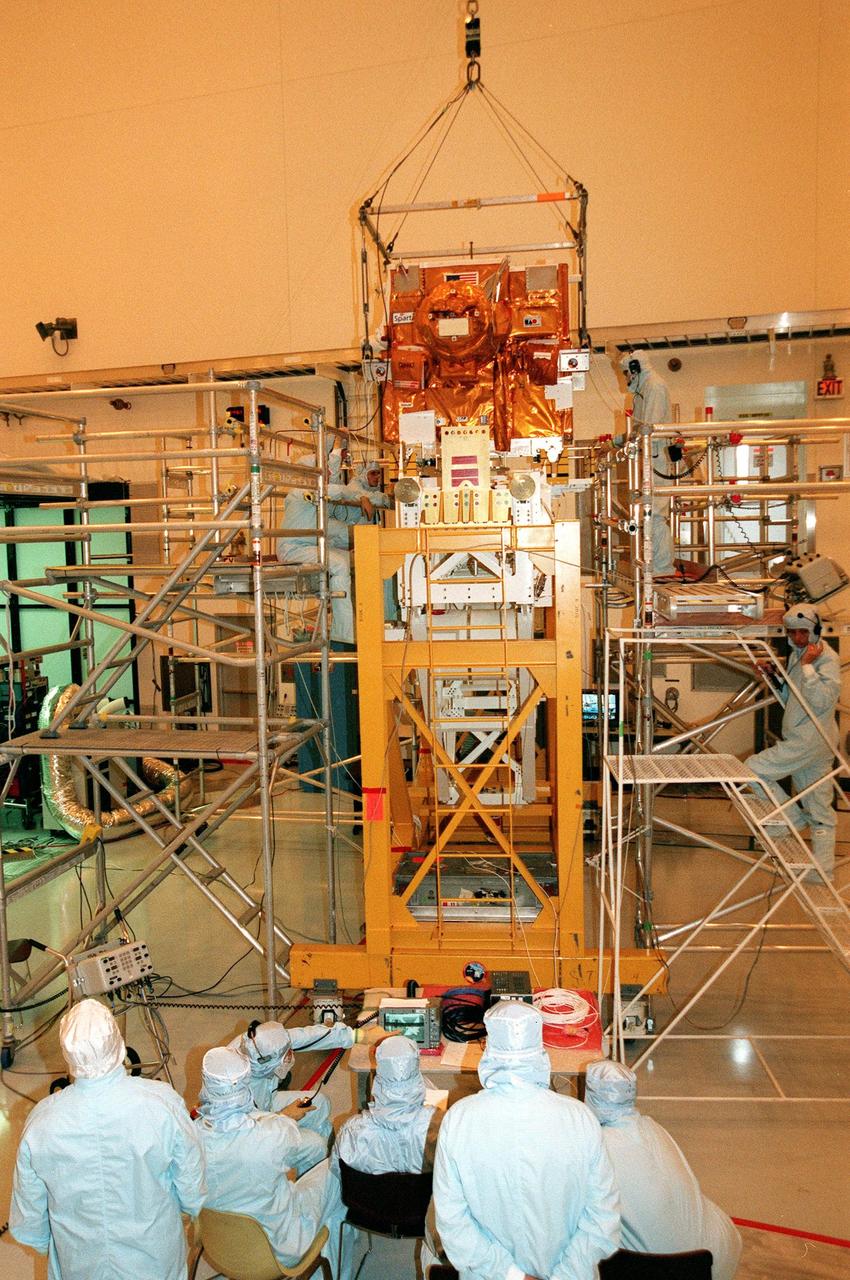
During Crew Equipment Interface Test (CEIT), STS-95 crew members watch a monitor displaying the Spartan payload above as it is maneuvered on a stand. The CEIT gives astronauts an opportunity for a hands-on look at the payloads and equipment with which they will be working on orbit. The launch of the STS-95 mission is scheduled for Oct. 29, 1998. The mission includes research payloads such as the Spartan solar-observing deployable spacecraft, the Hubble Space Telescope Orbital Systems Test Platform, the International Extreme Ultraviolet Hitchhiker, as well as the SPACEHAB single module with experiments on space flight and the aging process
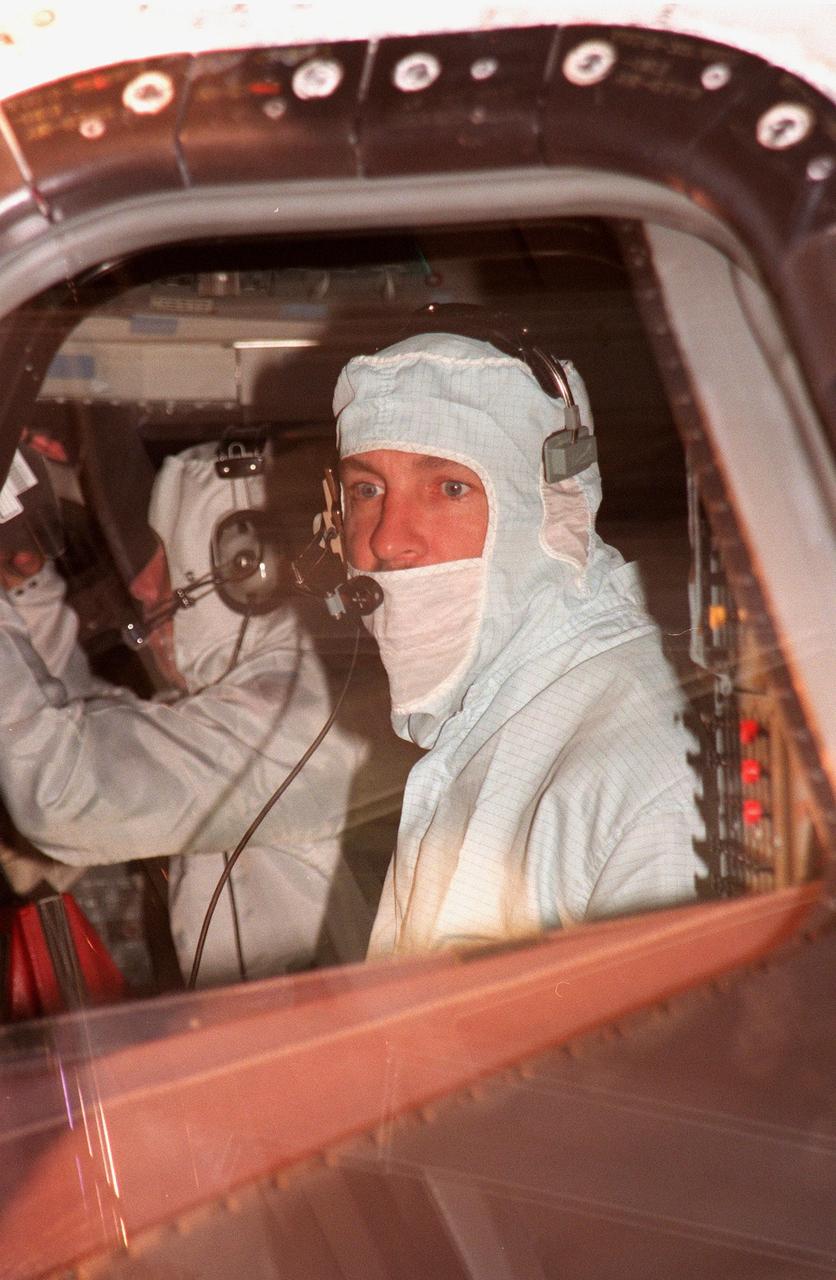
(Foreground) STS-95 Mission Commander Curtis L. Brown Jr. inspects the window of the orbiter Discovery during a Crew Equipment Interface Test (CEIT) for their mission. Pilot Steven Lindsey is in the background. The CEIT gives astronauts an opportunity for a hands-on look at the payloads on which they will be working on orbit. The launch of the STS-95 mission, aboard Space Shuttle Discovery, is scheduled for Oct. 29, 1998. The mission includes research payloads such as the Spartan solar-observing deployable spacecraft, the Hubble Space Telescope Orbital Systems Test Platform, the International Extreme Ultraviolet Hitchhiker, as well as the SPACEHAB single module with experiments on space flight and the aging process
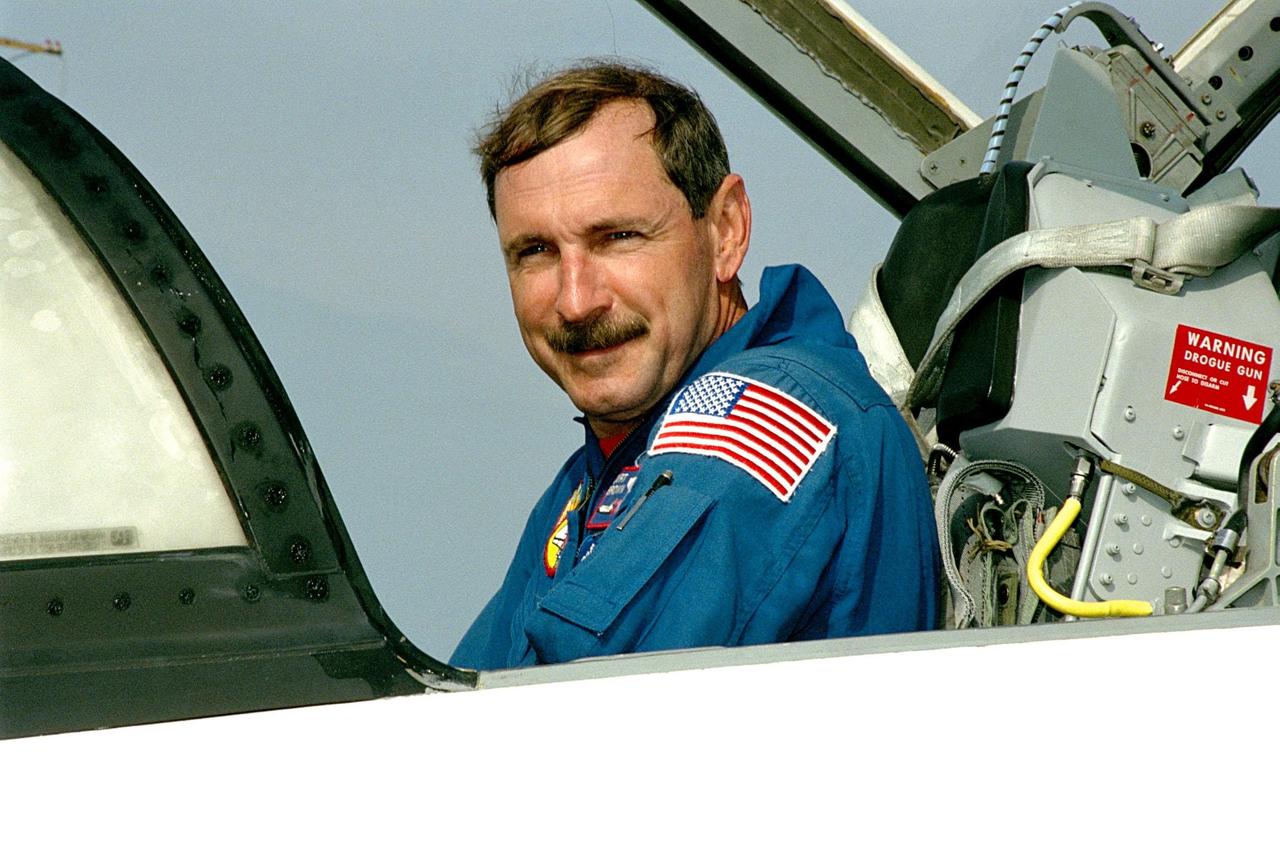
STS-95 Mission Commander Curtis L. Brown Jr. arrives aboard a T-38 jet aircraft at the Shuttle Landing Facility at KSC. The STS-95 crew is at KSC to look at the SPACEHAB module and the equipment that will fly with them on the Space Shuttle Discovery scheduled to launch Oct. 29, 1998. The mission includes research payloads such as the Spartan solar-observing deployable spacecraft, the Hubble Space Telescope Orbital Systems Test Platform, the International Extreme Ultraviolet Hitchhiker, as well as the SPACEHAB single module with experiments on space flight and the aging process
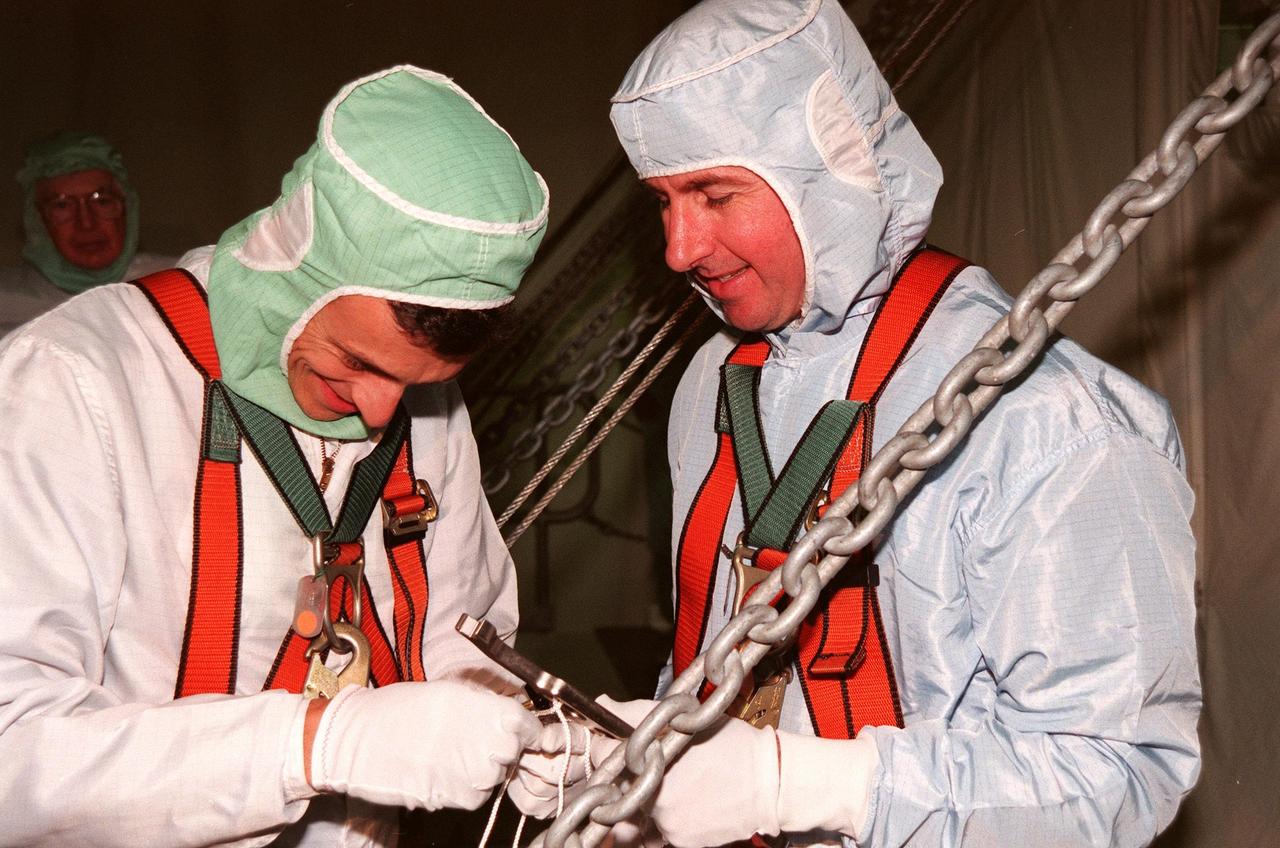
During the Crew Equipment Interface Test (CEIT) in the payload bay of Discovery, STS-95 Mission Specialist Pedro Duque (left), of the European Space Agency, tethers a wrench held by Mission Specialist Stephen K. Robinson (right) that they will use during the mission. The CEIT gives astronauts an opportunity for a hands-on look at the payloads and equipment with which they will be working on orbit. The launch of the STS-95 mission is scheduled for Oct. 29, 1998. The mission includes research payloads such as the Spartan solar-observing deployable spacecraft, the Hubble Space Telescope Orbital Systems Test Platform, the International Extreme Ultraviolet Hitchhiker, as well as the SPACEHAB single module with experiments on space flight and the aging process
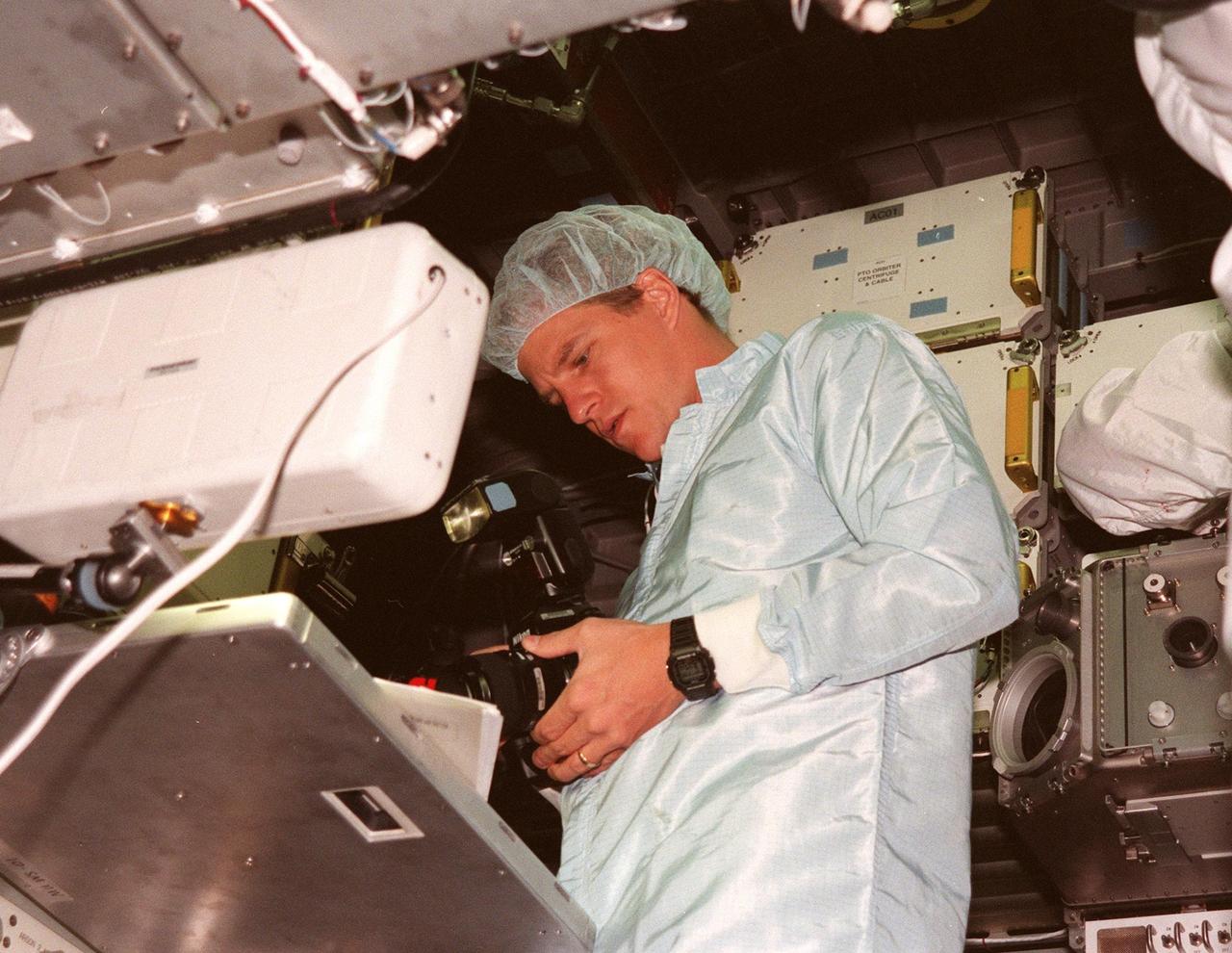
KENNEDY SPACE CENTER, FLA. -- Inside the SPACEHAB in the SPACEHAB Payload Processing Facility (SPPF), STS-95 Mission Specialist Scott Parazynski, M.D., checks out a camera, part of the equipment to fly on the mission scheduled to launch Oct. 29. He and other STS-95 crew members have been participating in SPACEHAB familiarization in the SPPF. The mission includes research payloads such as the Spartan solar-observing deployable spacecraft, the Hubble Space Telescope Orbital Systems Test Platform, the International Extreme Ultraviolet Hitchhiker, as well as the SPACEHAB single module with experiments on space flight and the aging process
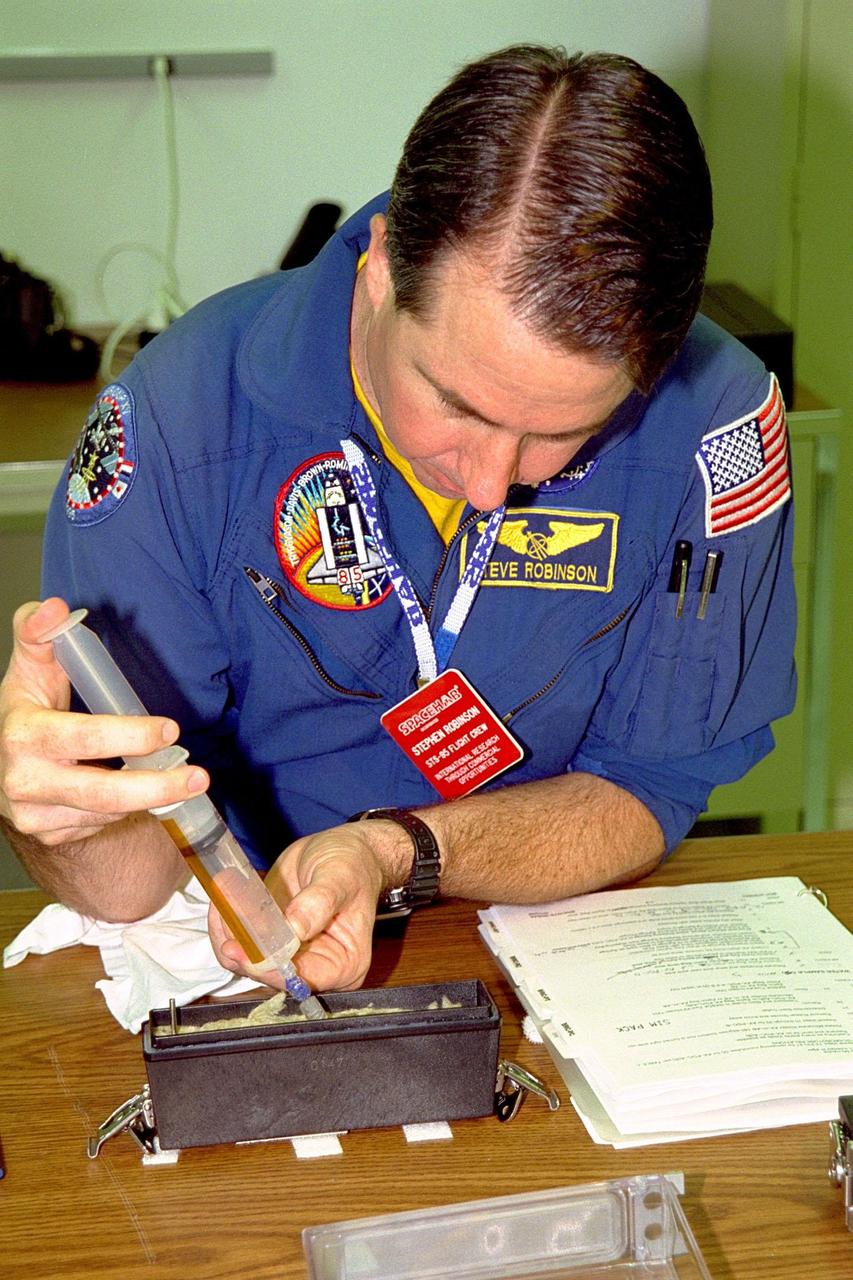
KENNEDY SPACE CENTER, FLA. -- STS-95 Mission Specialist Stephen K. Robinson injects water into the base of the seed container where plants will grow during the upcoming mission. This is part of the Biological Research in Canisters (BRIC) experiment which is at the SPACEHAB Payload Processing Facility, Cape Canaveral, Fla. This experiment will fly in SPACEHAB in Discovery’s payload bay. STS-95 is scheduled to launch from pad 39B at KSC on Oct. 29, 1998. The mission also includes research payloads such as the Spartan solar-observing deployable spacecraft, the Hubble Space Telescope Orbital Systems Test Platform, the International Extreme Ultraviolet Hitchhiker, as well as experiments on space flight and the aging process
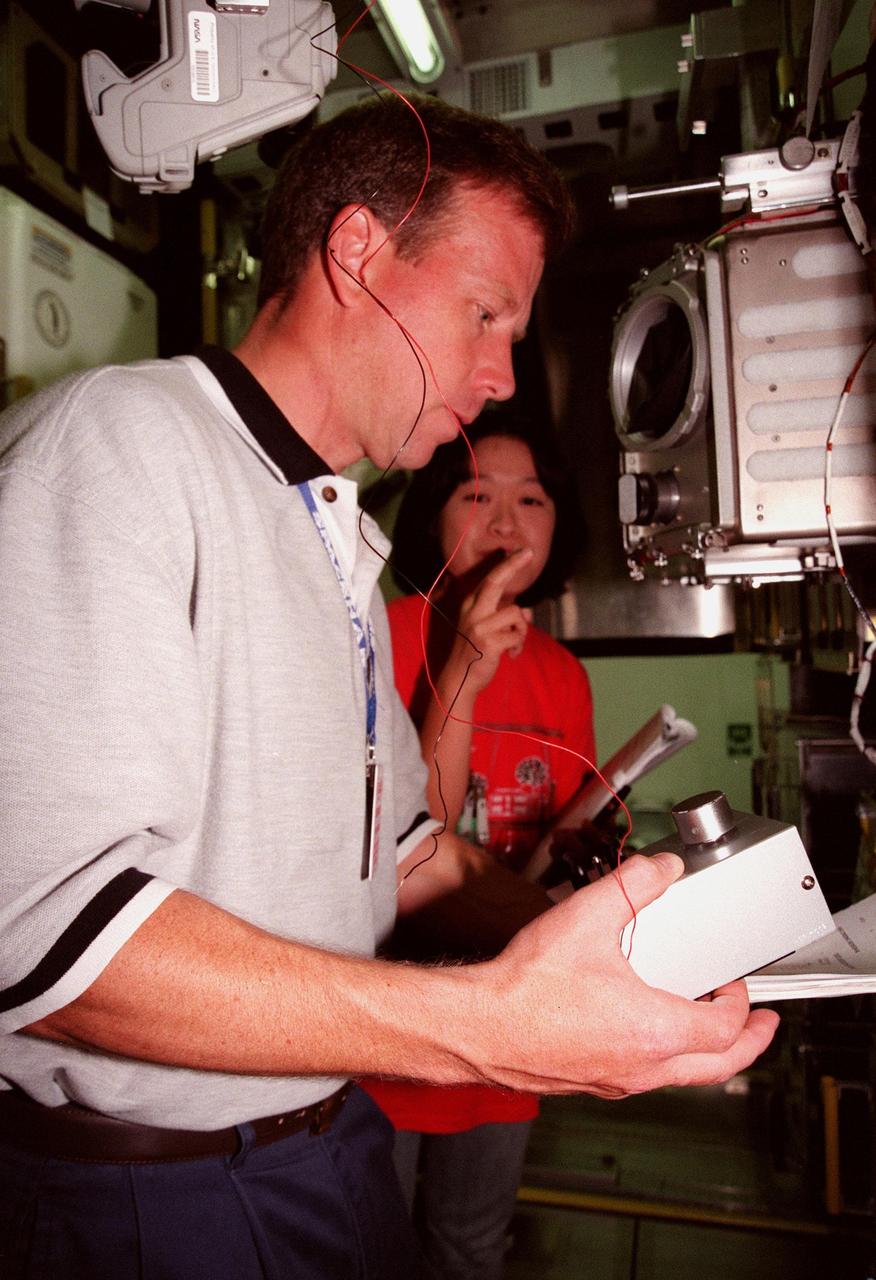
KENNEDY SPACE CENTER, FLA. -- STS-95 Pilot Stephen Lindsey checks out equipment in the SPACEHAB Payload Processing Facility (SPPF), Cape Canaveral, while a representative of the National Space Development Agency of Japan (NASDA) watches. STS-95 crew members have been participating in SPACEHAB familiarization in the SPPF. Scheduled to launch Oct. 29, the mission includes research payloads such as the Spartan solar-observing deployable spacecraft, the Hubble Space Telescope Orbital Systems Test Platform, the International Extreme Ultraviolet Hitchhiker, as well as the SPACEHAB single module with experiments on space flight and the aging process

KENNEDY SPACE CENTER, FLA. -- Boeing SPACEHAB representatives Rick Rodriguez and Amy Haas watch STS-95 Mission Specialist Pedro Duque of Spain, representing the European Space Agency (ESA), maneuver inside a glove box which will be part of the mission, scheduled to launch Oct. 29. The STS-95 crew are participating in SPACEHAB familiarization at the SPACEHAB Payload Processing Facility. The mission includes research payloads such as the Spartan solar-observing deployable spacecraft, the Hubble Space Telescope Orbital Systems Test Platform, the International Extreme Ultraviolet Hitchhiker, as well as the SPACEHAB single module with experiments on space flight and the aging process
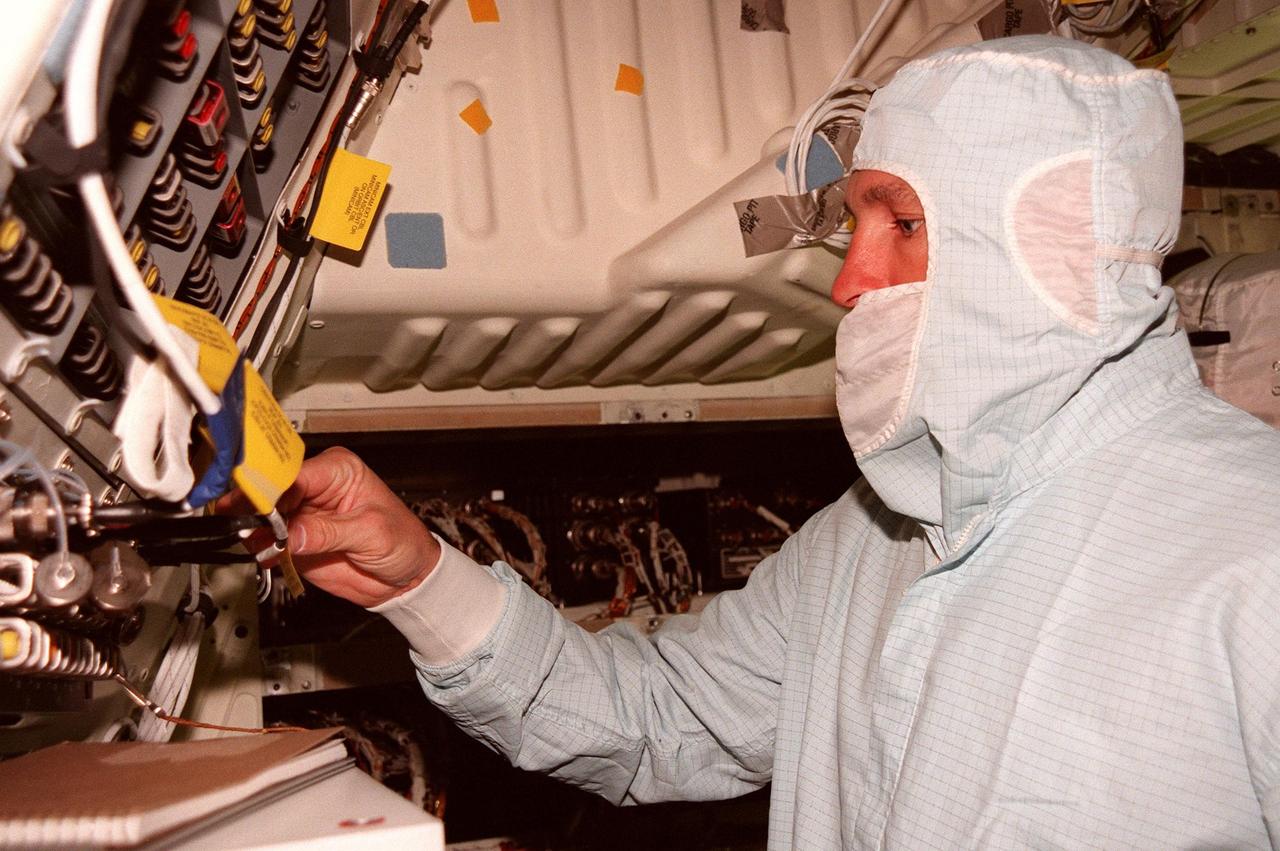
(Foreground) STS-95 Mission Commander Curtis L. Brown Jr. inspects equipment in the orbiter Discovery during a Crew Equipment Interface Test (CEIT) for their mission. The CEIT gives astronauts an opportunity for a hands-on look at the payloads on which they will be working on orbit. The launch of the STS-95 mission, aboard Space Shuttle Discovery, is scheduled for Oct. 29, 1998. The mission includes research payloads such as the Spartan solar-observing deployable spacecraft, the Hubble Space Telescope Orbital Systems Test Platform, the International Extreme Ultraviolet Hitchhiker, as well as the SPACEHAB single module with experiments on space flight and the aging process
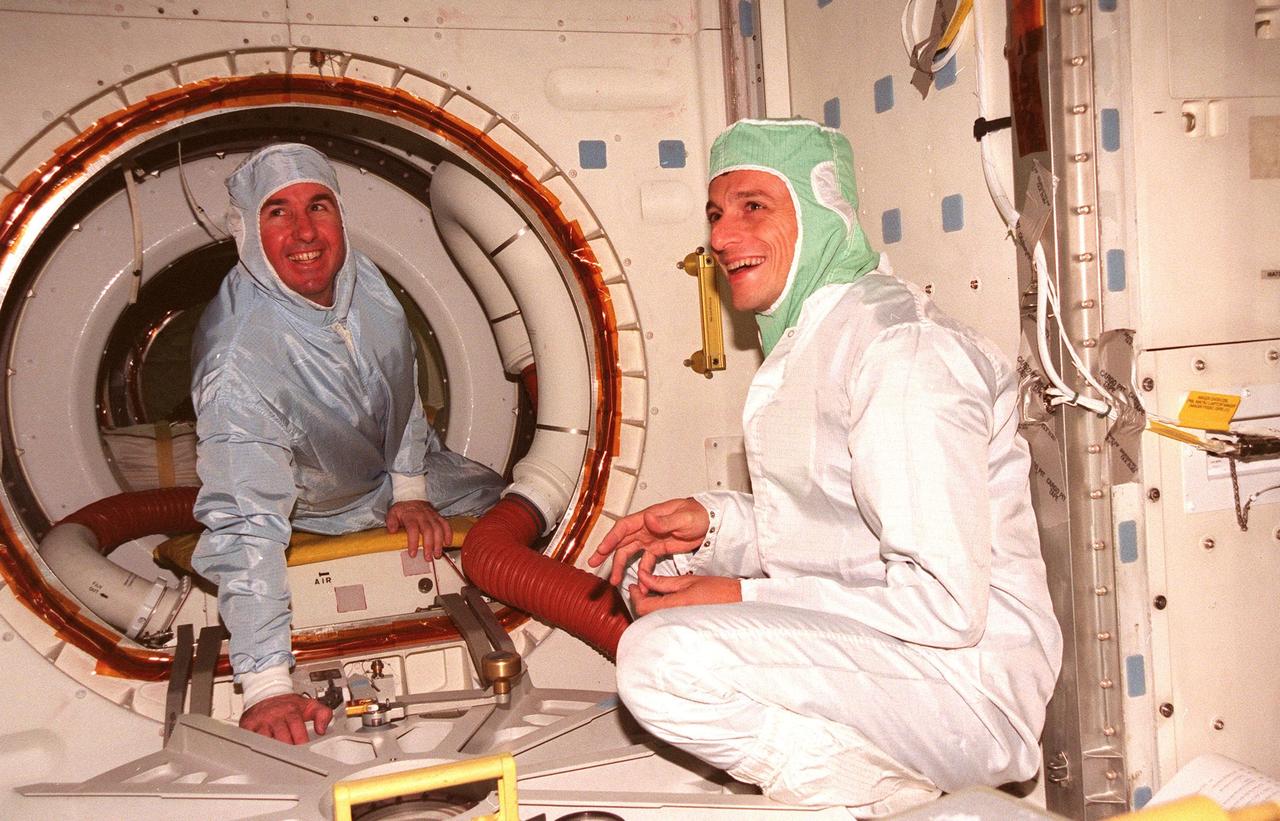
STS-95 Mission Specialists Stephen Robinson and Pedro Duque, with the European Space Agency, take part in a Crew Equipment Interface Test (CEIT) for their mission. The CEIT gives astronauts an opportunity for a hands-on look at the payloads on whcih they will be working on orbit. The launch of the STS-95 mission, aboard Space Shuttle Discovery, is scheduled for Oct. 29, 1998. The mission includes research payloads such as the Spartan solar-observing deployable spacecraft, the Hubble Space Telescope Orbital Systems Test Platform, the International Extreme Ultraviolet Hitchhiker, as well as the SPACEHAB single module with experiments on space flight and the aging process
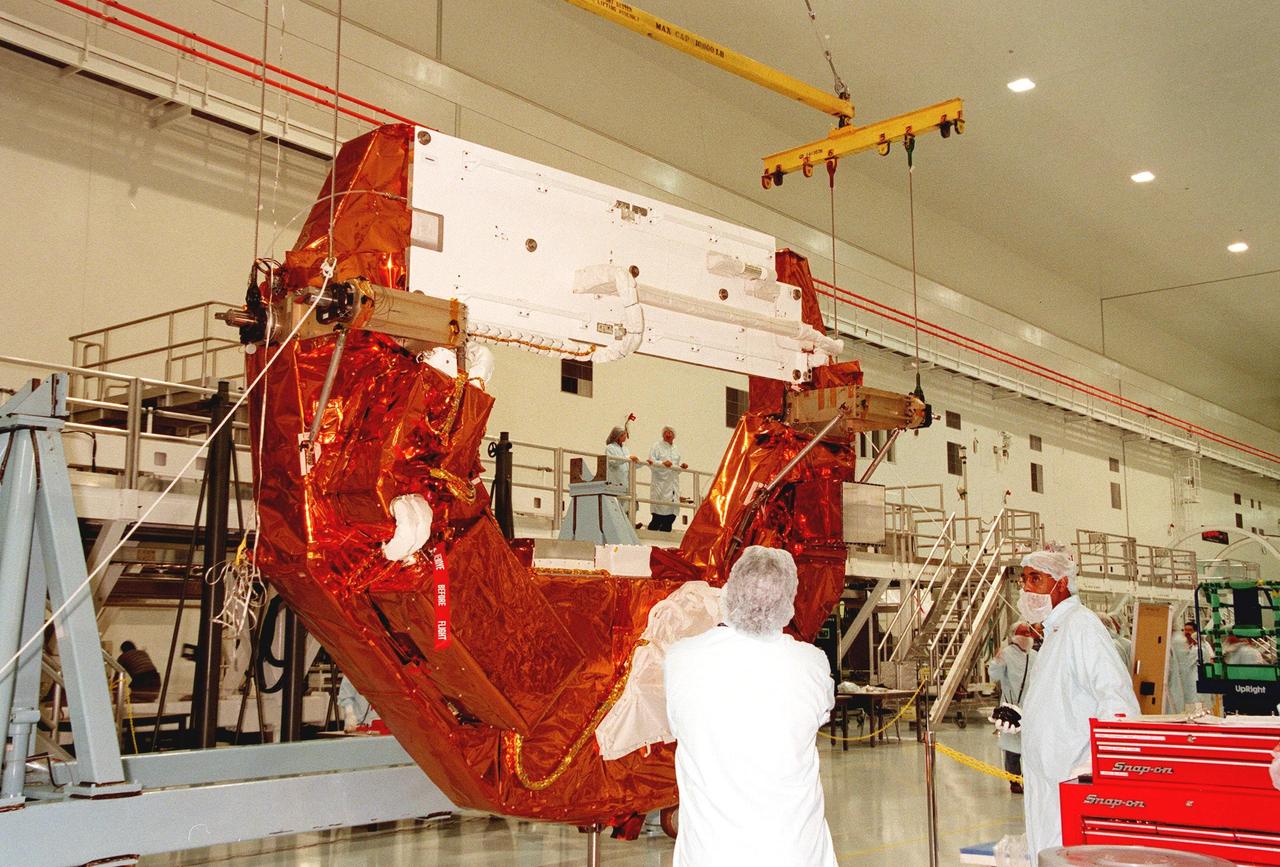
The Hubble Space Telescope Orbiting Systems Test (HOST)is being raised to a workstand by technicians in the Space Shuttle Processing Facility. One of the payloads on the STS-95 mission, the HOST platform is carrying four experiments to validate components planned for installation during the third Hubble Space Telescope servicing mission and to evaluate new technologies in an earth orbiting environment. The STS-95 mission is scheduled to launch Oct. 29. It will carry three other payloads: the Spartan solar-observing deployable spacecraft, the International Extreme Ultraviolet Hitchhiker, and the SPACEHAB single module with experiments on space flight and the aging process
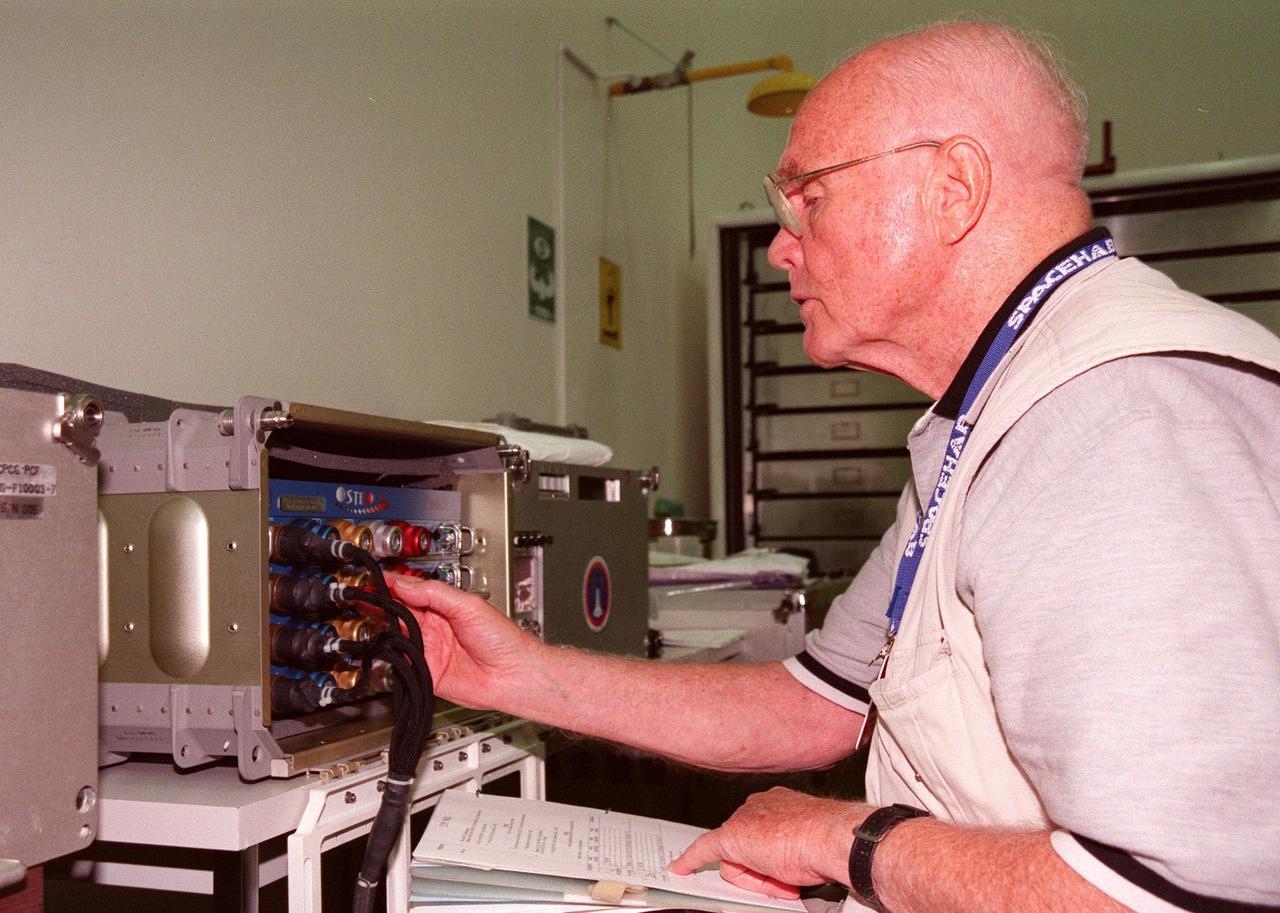
KENNEDY SPACE CENTER, FLA. -- In the SPACEHAB Payload Processing Facility (SPPF), STS-95 Payload Specialist John Glenn, who is a senator from Ohio, checks out equipment for the mission scheduled to launch Oct. 29. He and other STS-95 crew members have been participating in SPACEHAB familiarization in the SPPF. The mission includes research payloads such as the Spartan solar-observing deployable spacecraft, the Hubble Space Telescope Orbital Systems Test Platform, the International Extreme Ultraviolet Hitchhiker, as well as the SPACEHAB single module with experiments on space flight and the aging process

(Foreground) STS-95 Pilot Steven Lindsey inspects the window of the orbiter Discovery during a Crew Equipment Interface Test (CEIT) for their mission. The CEIT gives astronauts an opportunity for a hands-on look at the payloads on which they will be working on orbit. The launch of the STS-95 mission, aboard Space Shuttle Discovery, is scheduled for Oct. 29, 1998. The mission includes research payloads such as the Spartan solar-observing deployable spacecraft, the Hubble Space Telescope Orbital Systems Test Platform, the International Extreme Ultraviolet Hitchhiker, as well as the SPACEHAB single module with experiments on space flight and the aging process
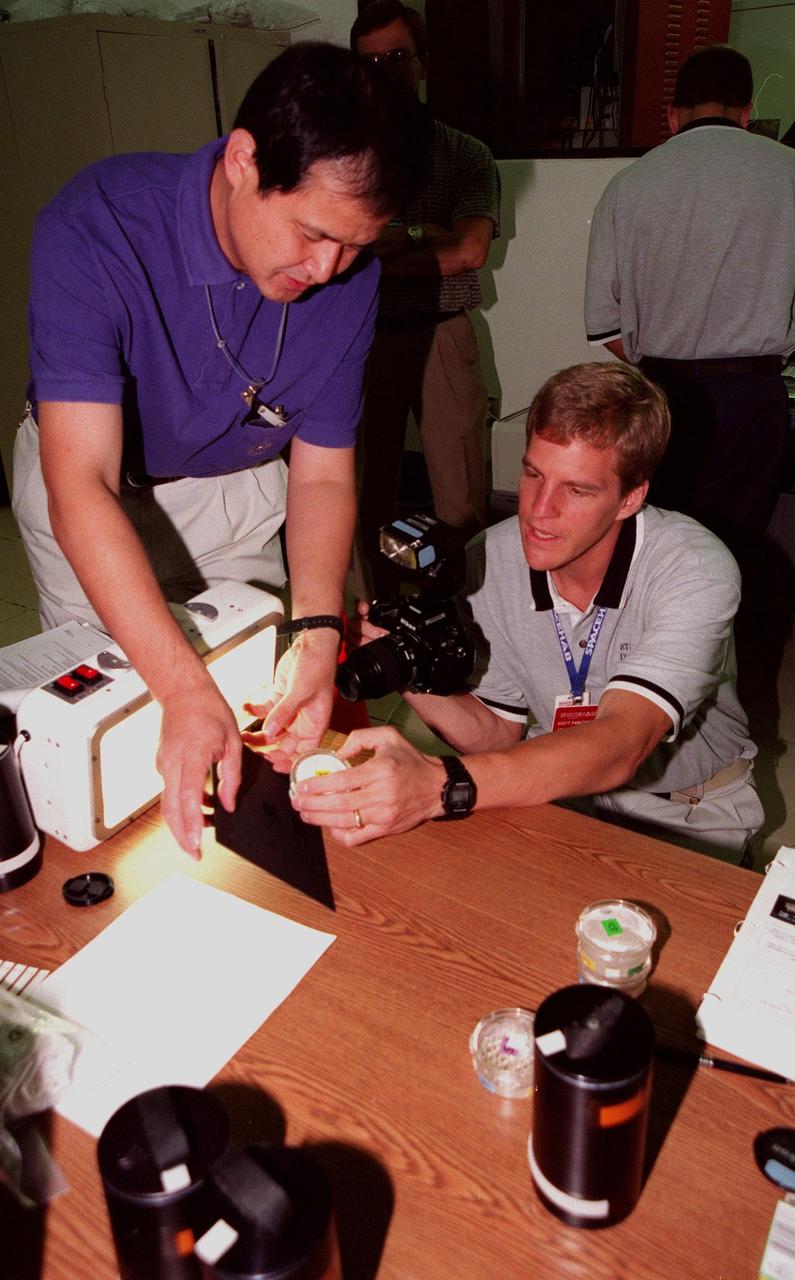
KENNEDY SPACE CENTER, FLA. -- In the SPACEHAB Payload Processing Facility (SPPF) a representative of the National Space Agency of Japan (NASDA) and STS-95 Mission Specialist Scott Parazynski, M.D. (right), check out BRIC (Biological Research in Canisters) experiments to be part of the mission scheduled to launch Oct. 29. STS-95 crew members have been participating in SPACEHAB familiarization in the SPPF. The mission includes research payloads such as the Spartan solar-observing deployable spacecraft, the Hubble Space Telescope Orbital Systems Test Platform, the International Extreme Ultraviolet Hitchhiker, as well as the SPACEHAB single module with experiments on space flight and the aging process

KENNEDY SPACE CENTER, FLA. -- STS-95 Mission Specialist Stephen K. Robinson, Ph.D., (left) checks out a container inside the SPACEHAB at the SPACEHAB Payload Processing Facility (SPPF), while KSC workers look over documentation. Robinson and other STS-95 crew members have been participating in SPACEHAB familiarization in the SPPF. Scheduled to launch Oct. 29, the mission includes research payloads such as the Spartan solar-observing deployable spacecraft, the Hubble Space Telescope Orbital Systems Test Platform, the International Extreme Ultraviolet Hitchhiker, as well as the SPACEHAB single module with experiments on space flight and the aging process
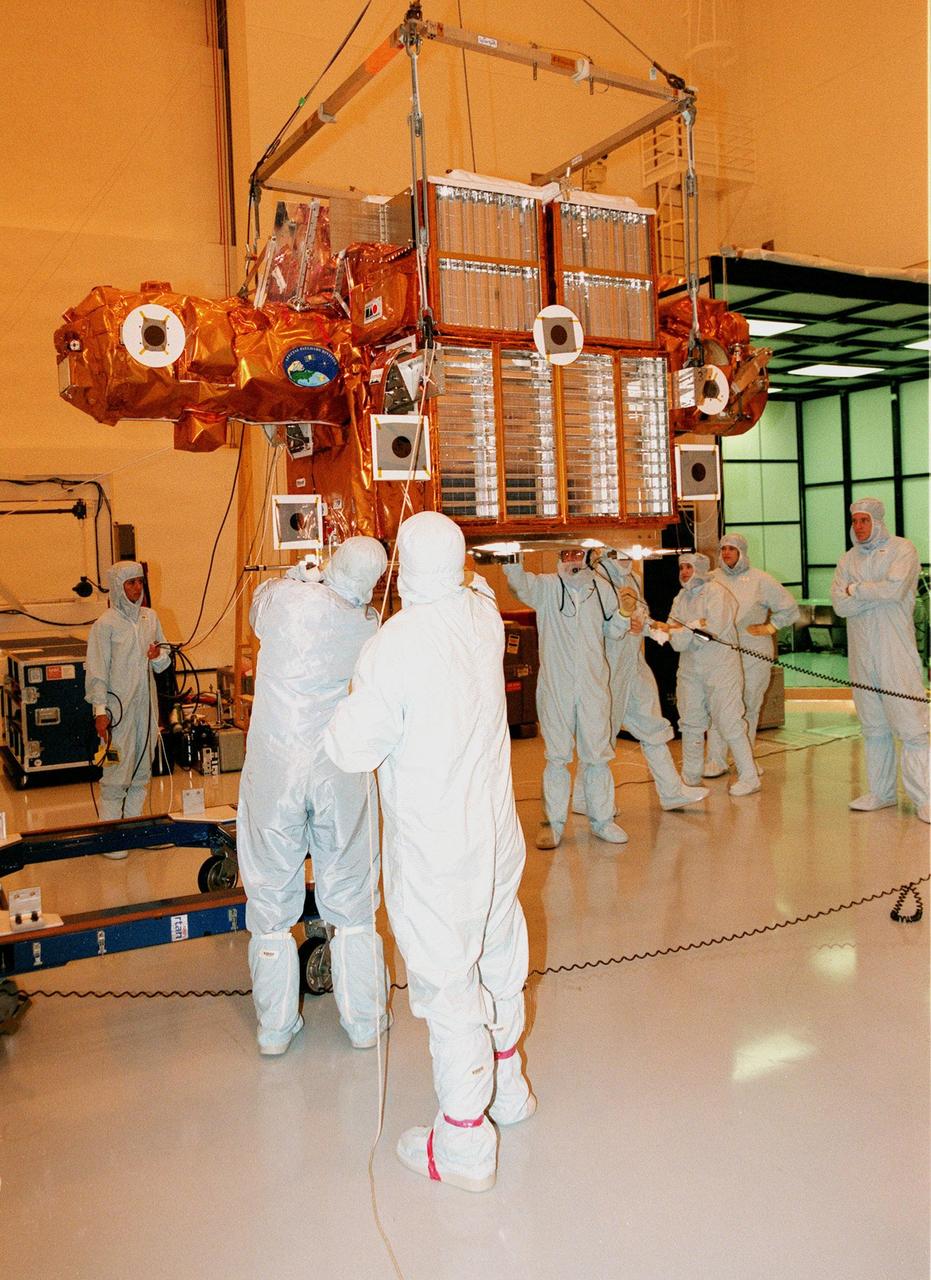
During Crew Equipment Interface Test (CEIT), STS-95 crew members watch as workers move the Spartan payload inside the Multi-Payload Processing Facility. At far right is Mission Specialist Scott E. Parazynski. The CEIT gives astronauts an opportunity for a hands-on look at the payloads and equipment with which they will be working on orbit. The launch of the STS-95 mission is scheduled for Oct. 29, 1998. The mission includes research payloads such as the Spartan solar-observing deployable spacecraft, the Hubble Space Telescope Orbital Systems Test Platform, the International Extreme Ultraviolet Hitchhiker, as well as the SPACEHAB single module with experiments on space flight and the aging process
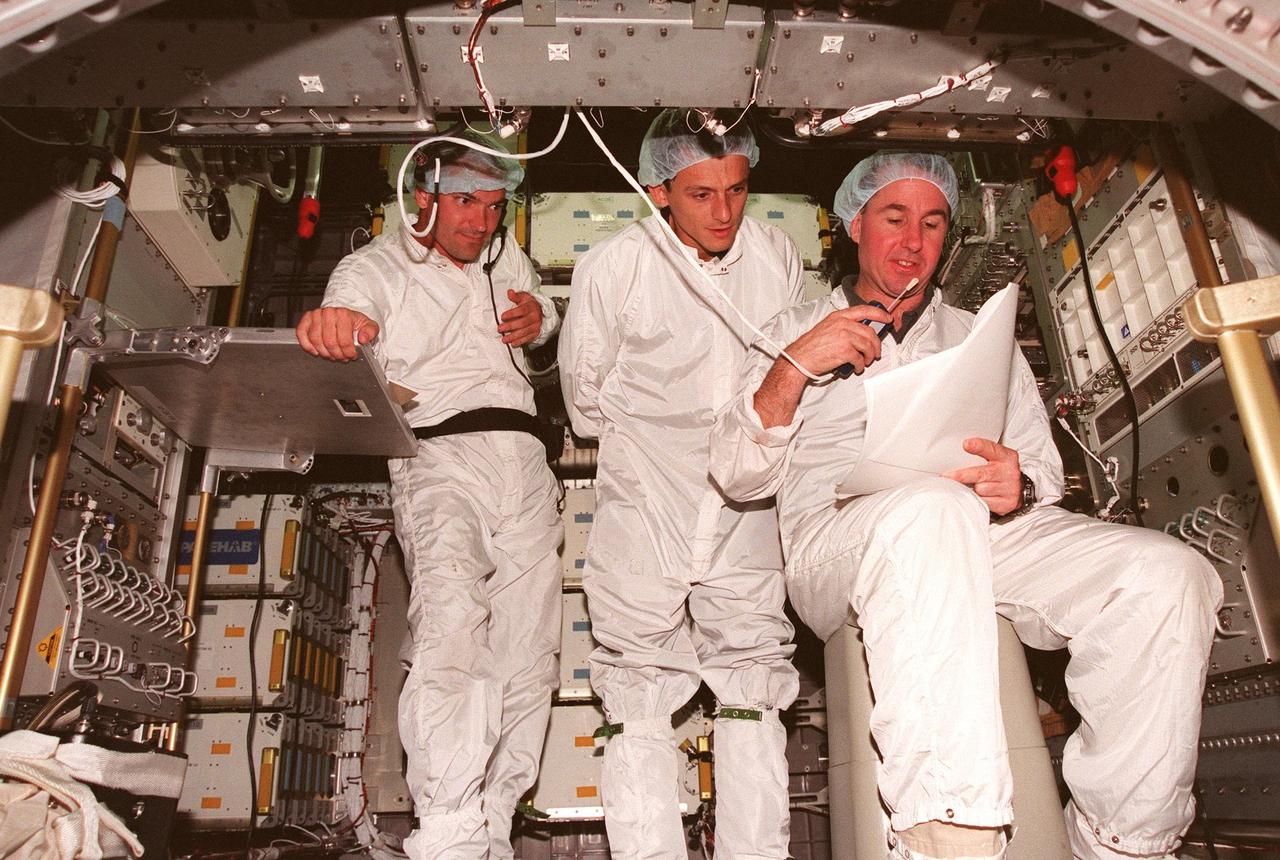
KENNEDY SPACE CENTER, FLA. -- Chris Jaskolka, of Boeing SPACEHAB, and STS-95 Mission Specialists Pedro Duque of Spain, who represents the European Space Agency (ESA), and Stephen Robinson, Ph.D., test equipment inside the SPACEHAB in the SPACEHAB Payload Processing Facility (SPPF). STS-95 crew members have been participating in SPACEHAB familiarization in the SPPF. Scheduled to launch Oct. 29, the mission includes research payloads such as the Spartan solar-observing deployable spacecraft, the Hubble Space Telescope Orbital Systems Test Platform, the International Extreme Ultraviolet Hitchhiker, as well as the SPACEHAB single module with experiments on space flight and the aging process
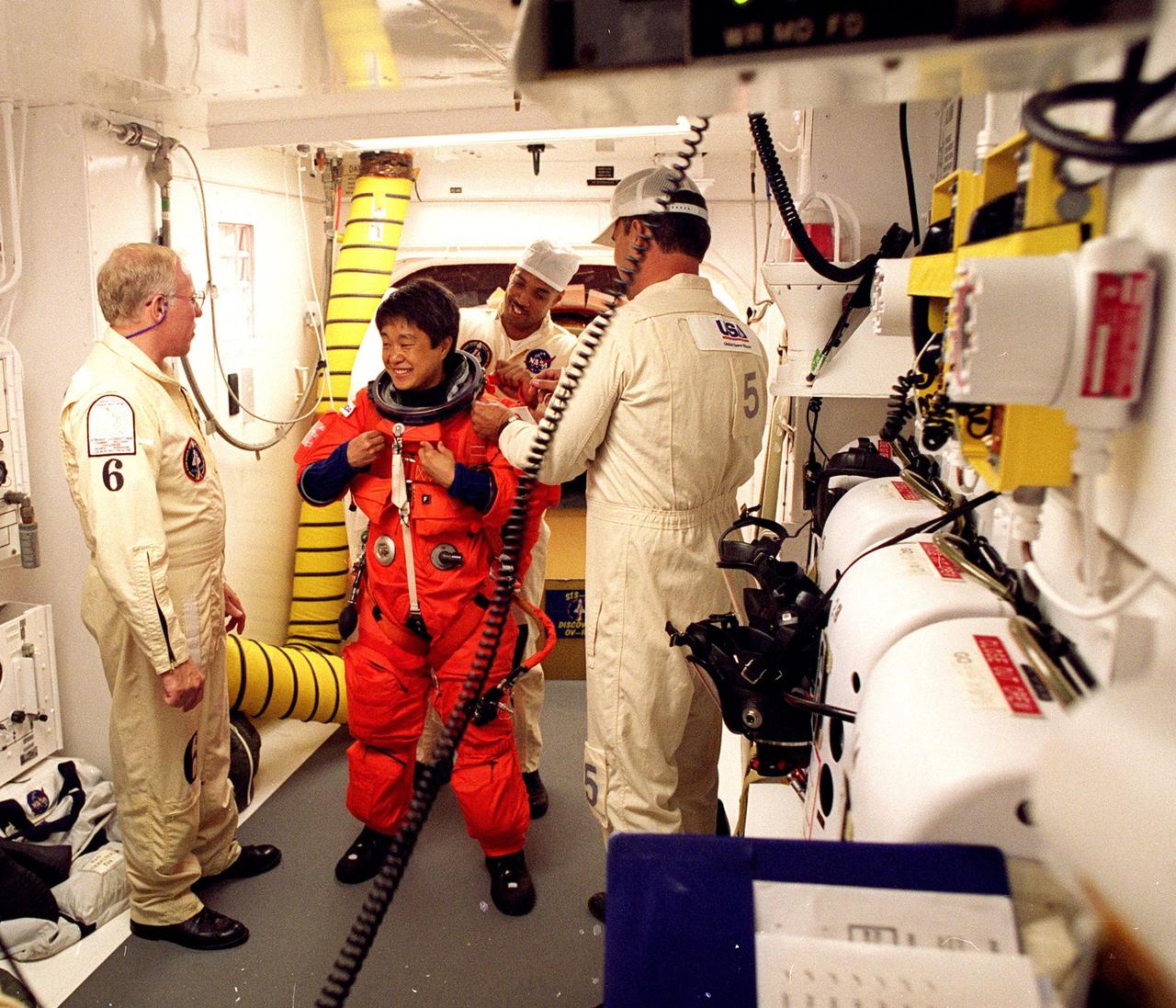
In the environmental chamber known as the white room, STS-95 Payload Specialist Chiaki Mukai, with the National Space Development Agency of Japan (NASDA), is prepared by closeout room crew members Danny Wyatt (left), Carlous Gillis (behind her) and Dave Law (right) for entry into the Space Shuttle Discovery for her second flight into space. The STS-95 mission, targeted for launch at 2 p.m. EST on Oct. 29, is expected to last 8 days, 21 hours and 49 minutes, and return to KSC at 11:49 a.m. EST on Nov. 7
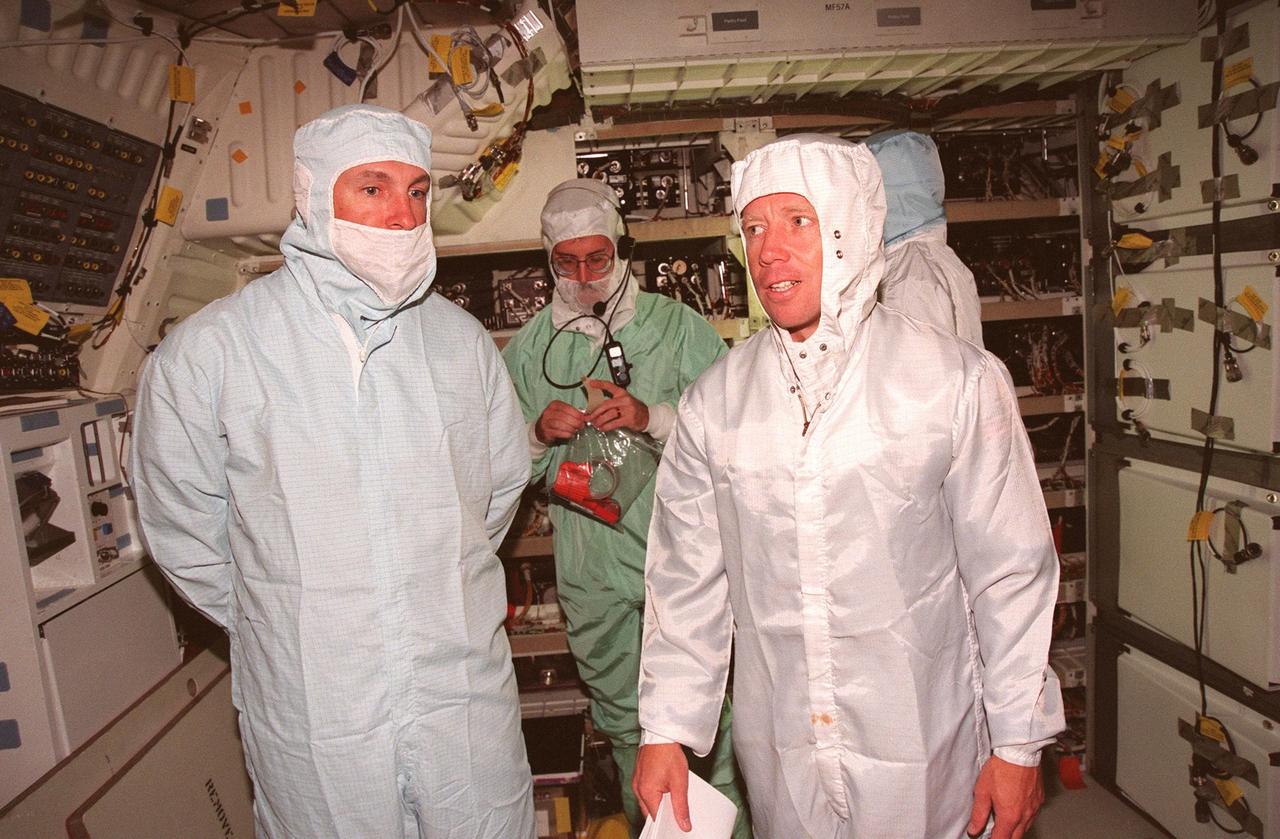
STS-95 Mission Commander Curtis L. Brown Jr. (left) and Pilot Steven Lindsey (right) are in Discovery's midbody checking electrical connections during a Crew Equipment Interface Test (CEIT) for their mission. The CEIT gives astronauts an opportunity for a hands-on look at the payloads on which they will be working on orbit. The launch of the STS-95 mission, aboard Space Shuttle Discovery, is scheduled for Oct. 29, 1998. The mission includes research payloads such as the Spartan solar-observing deployable spacecraft, the Hubble Space Telescope Orbital Systems Test Platform, the International Extreme Ultraviolet Hitchhiker, as well as the SPACEHAB single module with experiments on space flight and the aging process
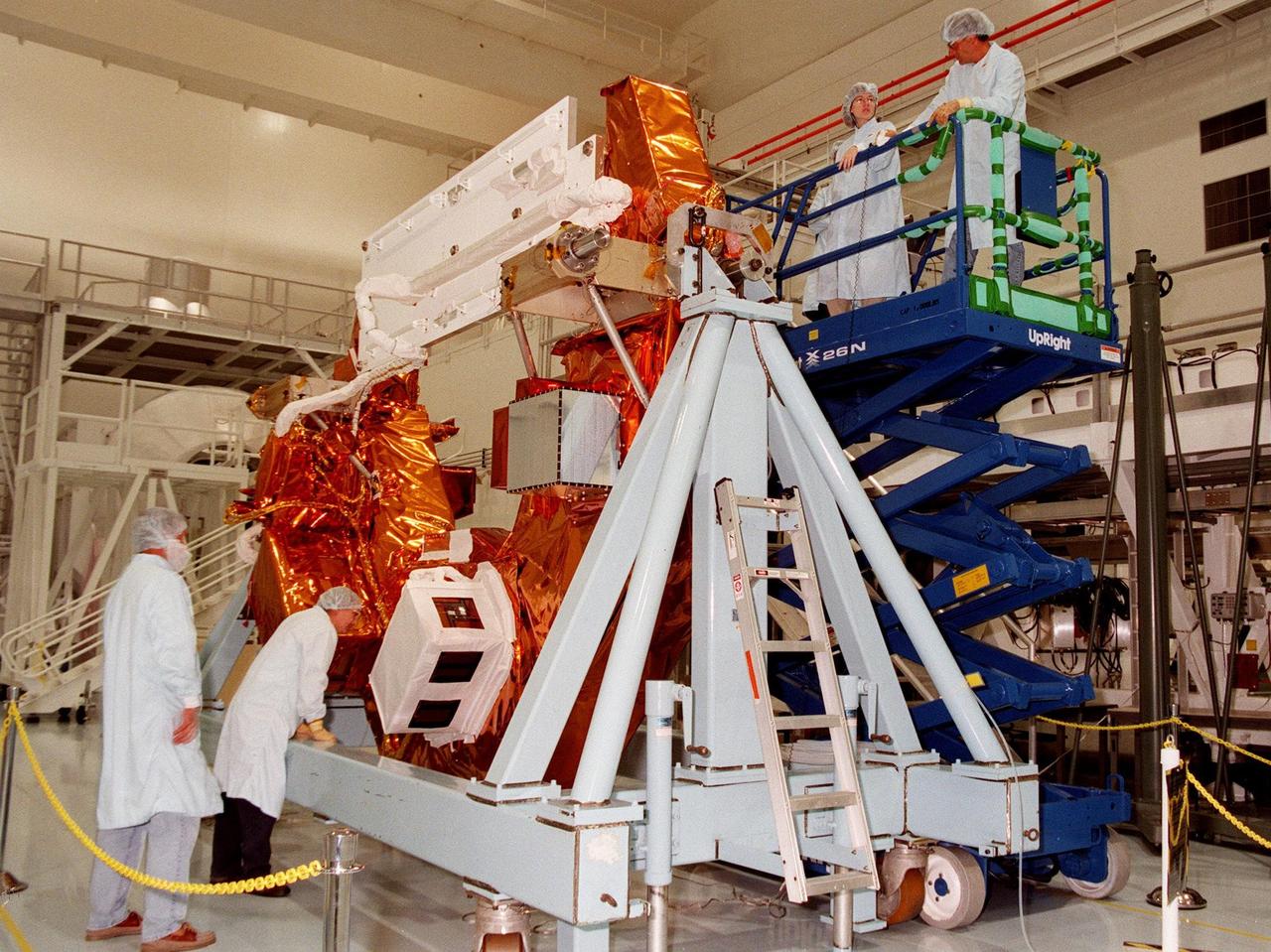
KENNEDY SPACE CENTER, FLA. -- The Hubble Space Telescope Orbiting Systems Test (HOST) is checked out by technicians in the Space Shuttle Processing Facility. One of the payloads on the STS-95 mission, the HOST platform is carrying four experiments to validate components planned for installation during the third Hubble Space Telescope servicing mission and to evaluate new technologies in an earth orbiting environment. The STS-95 mission is scheduled to launch Oct. 29. It will carry three other payloads: the Spartan solar-observing deployable spacecraft, the International Extreme Ultraviolet Hitchhiker, and the SPACEHAB single module with experiments on space flight and the aging process
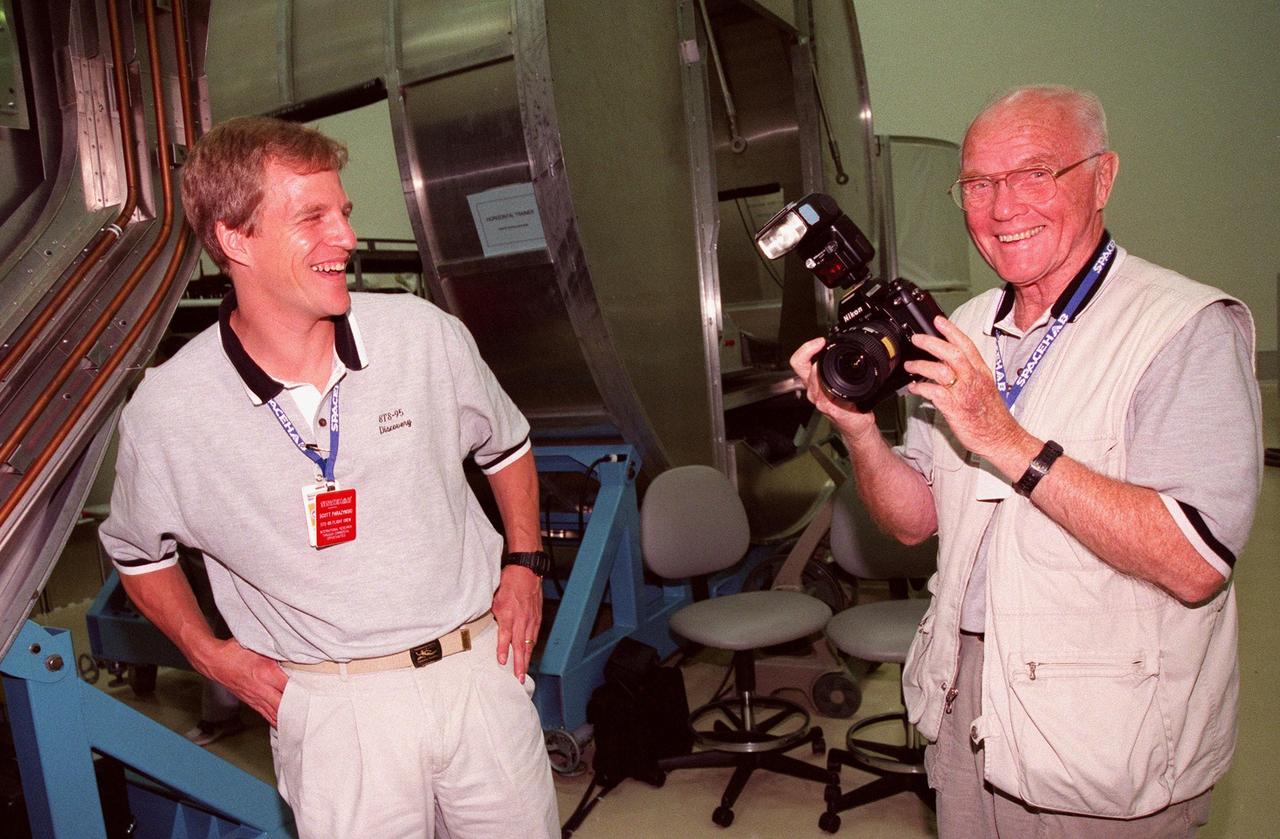
KENNEDY SPACE CENTER, FLA. -- In the SPACEHAB Payload Processing Facility (SPPF), STS-95 Mission Specialist Scott Parazynski, M.D., (left) and Payload Specialist John Glenn (right), who is a senator from Ohio, share a light moment while checking out equipment for the mission, scheduled to launch Oct. 29. STS-95 crew members have been participating in SPACEHAB familiarization in the SPPF. The mission includes research payloads such as the Spartan solar-observing deployable spacecraft, the Hubble Space Telescope Orbital Systems Test Platform, the International Extreme Ultraviolet Hitchhiker, as well as the SPACEHAB single module with experiments on space flight and the aging process
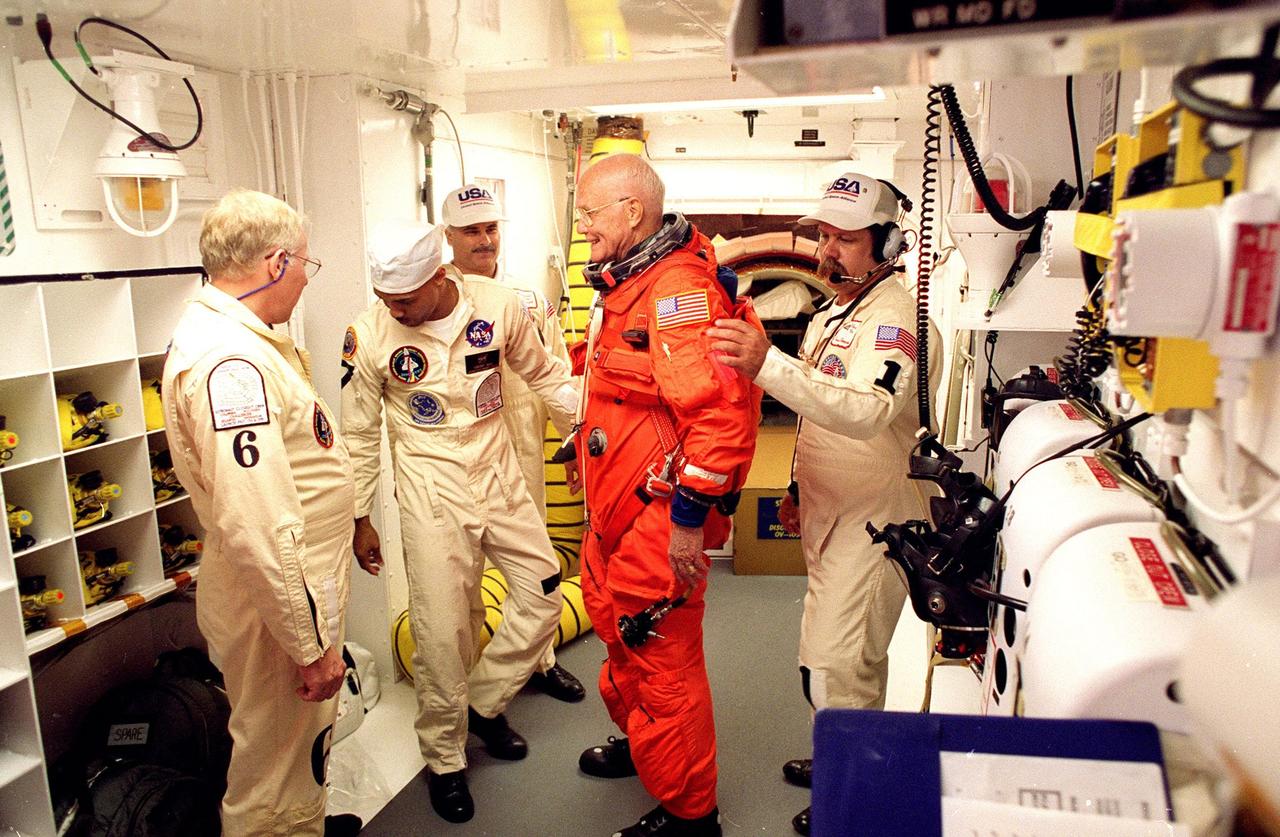
In the environmental chamber known as the white room, STS-95 Payload Specialist John H. Glenn Jr., senator from Ohio, is prepared by closeout room crew members Danny Wyatt (left to right), Carlous Gillis, Jim Kelly and Travis Thompson for entry into the Space Shuttle Discovery for his second flight into space after 36 years. The STS-95 mission, targeted for launch at 2 p.m. EST on Oct. 29, is expected to last 8 days, 21 hours and 49 minutes, and return to KSC at 11:49 a.m. EST on Nov. 7
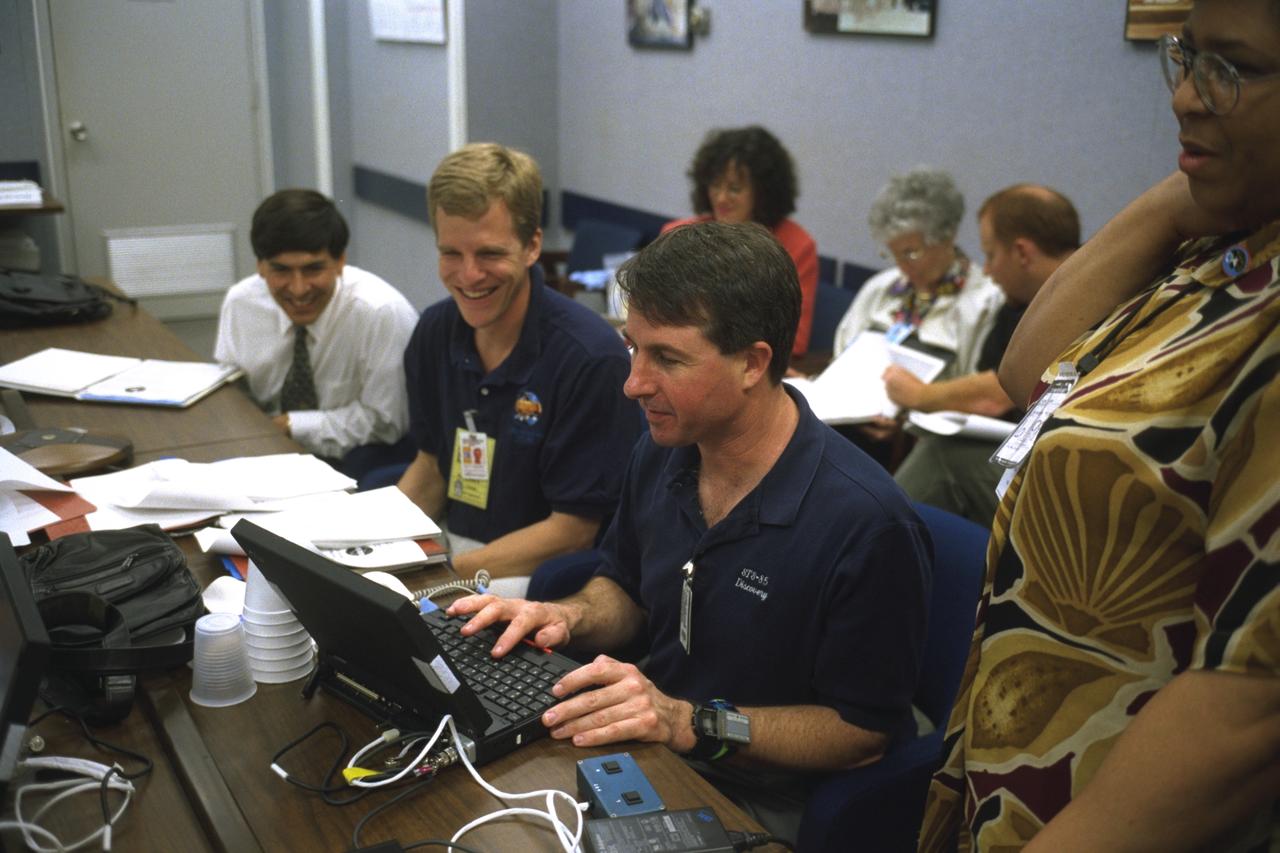
S98-08742 (May 1998) --- Two mission specialists assigned to the STS-95 flight rehearse some of their duties for the scheduled late October launch of the Space Shuttle Discovery. Stephen K. Robinson inputs data on the laptop computer while Scott E. Parazynski looks on. The photo was taken by Joe McNally, National Geographic, for NASA.
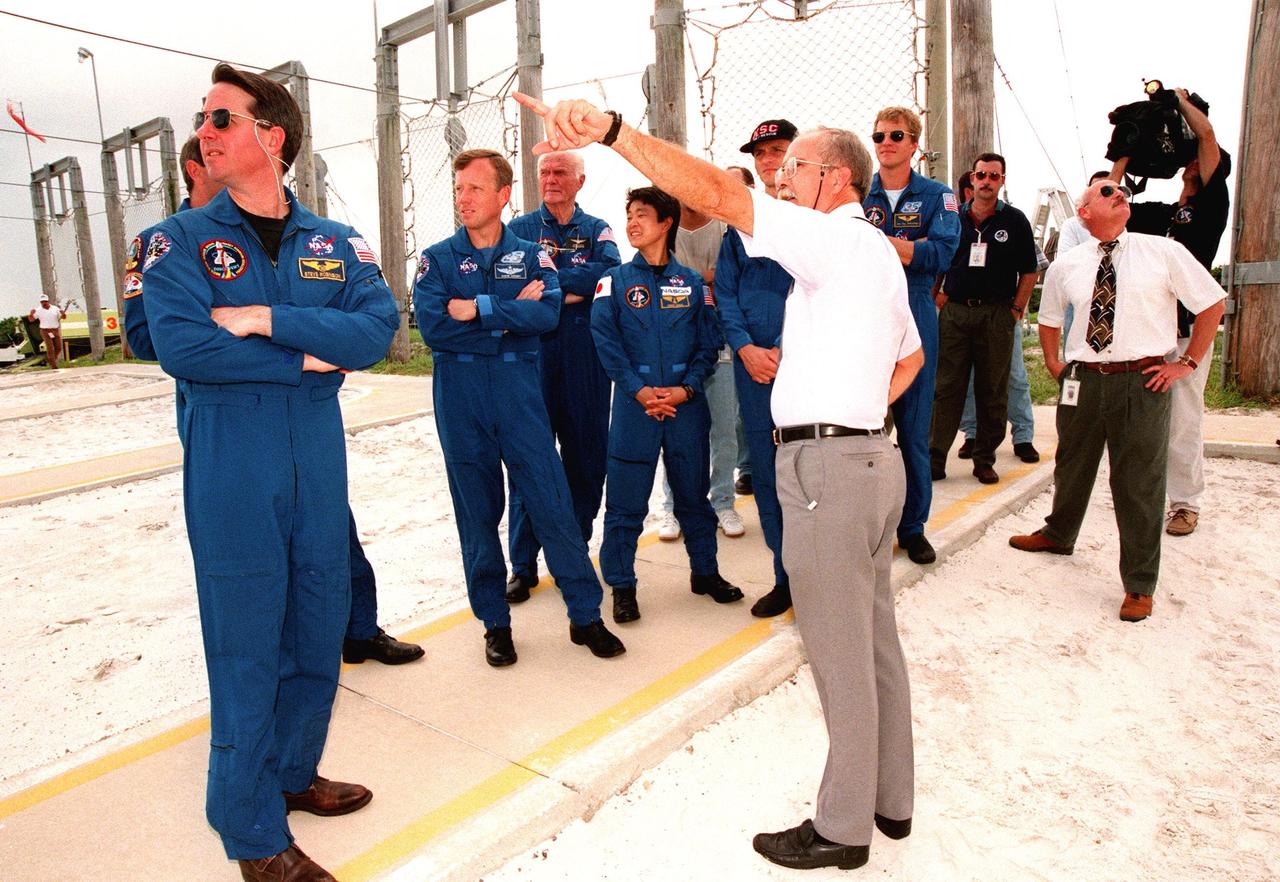
On Launch Pad 39-B, a Safety Egress trainer points out to the STS-95 crew the path the slidewire baskets, emergency egress vehicles, will take if the crew needs to use them before launch. Watching are (left to right) Mission Specialist Stephen K. Robinson, Mission Commander Curtis L. Brown (partially hidden behind Robinson), Pilot Steven W. Lindsey, Payload Specialists John H. Glenn Jr., senator from Ohio, and Chiaki Mukai, representing the National Space Development Agency of Japan (NASDA), Mission Specialist Pedro Duque of Spain, representing the European Space Agency (ESA), and Mission Specialist Scott E. Parazynski. The STS-95 crew are at KSC to participate in a Terminal Countdown Demonstration Test (TCDT) which includes mission familiarization activities, emergency egress training, and a simulated main engine cut-off exercise. The STS-95 mission, targeted for liftoff on Oct. 29, includes research payloads such as the Spartan solar-observing deployable spacecraft, the Hubble Space Telescope Orbital Systems Test Platform, the International Extreme Ultraviolet Hitchhiker, as well as the SPACEHAB single module with experiments on space flight and the aging process. Following the TCDT, the crew will be returning to Houston for final flight preparations
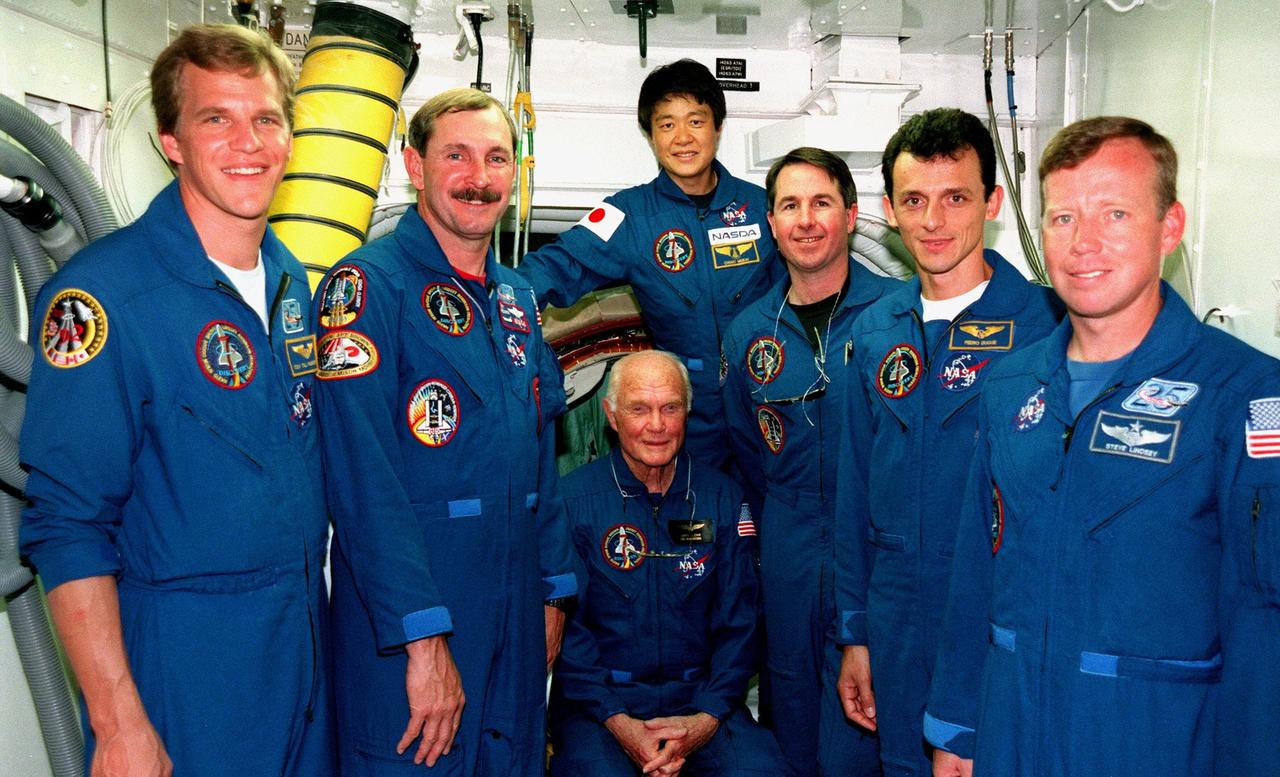
At Launch Pad 39-B, the STS-95 crew pose for a closeup photo while in the white room, an environmental chamber that mates with the orbiter and can provide emergency egress for the flight crew before launch. The white room is the outer end of the orbiter access arm, which is part of the fixed service structure on the pad. Pictured are (left to right) Mission Specialist Scott E. Parazynski, Mission Commander Curtis L. Brown, Payload Specialist John H. Glenn Jr. (seated), senator from Ohio, Payload Specialist Chiaki Mukai (behind Glenn), representing the National Space Development Agency of Japan (NASDA), Mission Specialist Stephen K. Robinson, Mission Specialist Pedro Duque of Spain, representing the European Space Agency (ESA), and Pilot Steven W. Lindsey. The STS-95 crew are at KSC to participate in a Terminal Countdown Demonstration Test (TCDT) which includes mission familiarization activities, emergency egress training, and a simulated main engine cut-off exercise. The STS-95 mission, targeted for liftoff on Oct. 29, includes research payloads such as the Spartan solar-observing deployable spacecraft, the Hubble Space Telescope Orbital Systems Test Platform, the International Extreme Ultraviolet Hitchhiker, as well as the SPACEHAB single module with experiments on space flight and the aging process. Following the TCDT, the crew will be returning to Houston for final flight preparations
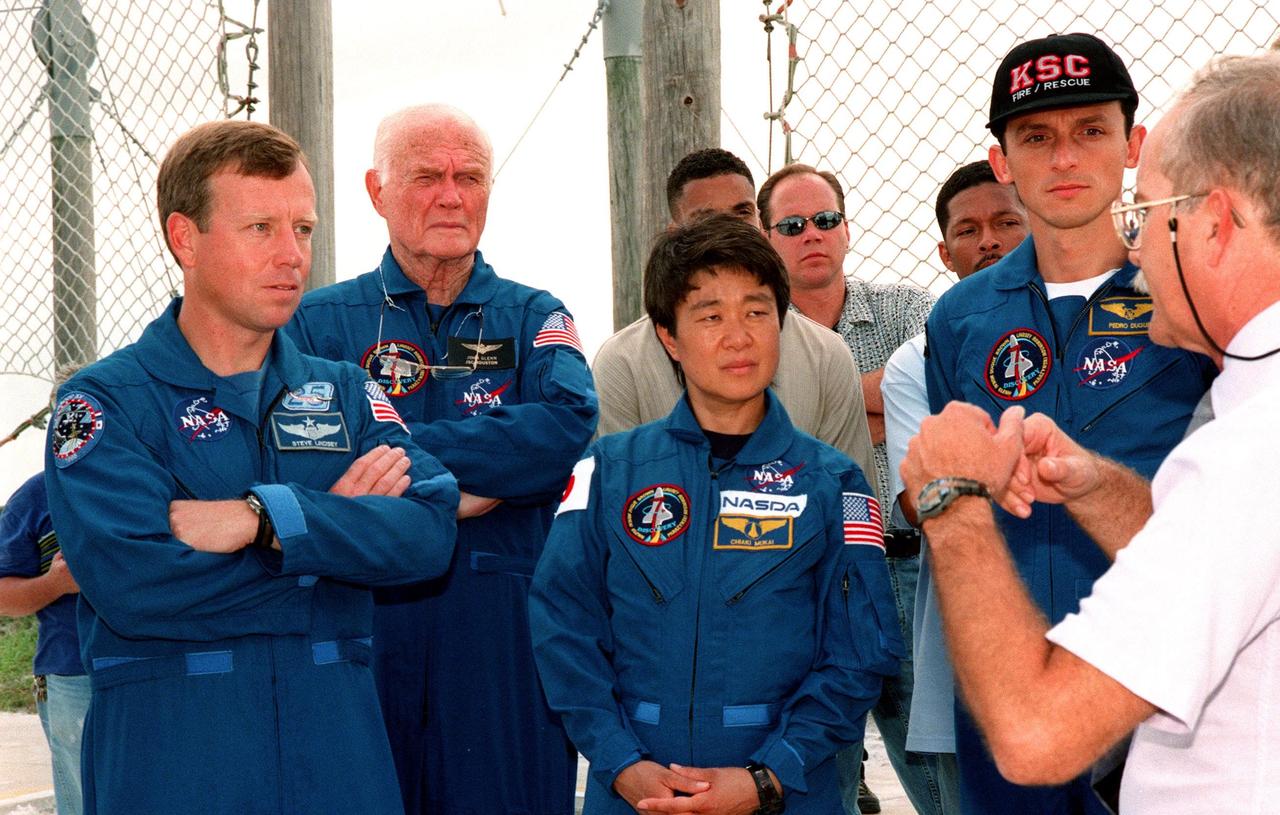
At Launch Pad 39-B, a Safety Egress trainer explains the use of the slidewire basket system for emergency egress before launch to STS-95 crew members (left to right) Pilot Steven W. Lindsey, Payload Specialists John H. Glenn Jr., senator from Ohio, and Chiaki Mukai, representing the National Space Development Agency of Japan (NASDA), and Mission Specialist Pedro Duque of Spain, representing the European Space Agency. The STS-95 crew are at KSC to participate in a Terminal Countdown Demonstration Test (TCDT) which includes mission familiarization activities, emergency egress training, and a simulated main engine cut-off exercise. Other members of the crew not shown are Mission Specialist Scott E. Parazynski, Mission Commander Curtis L. Brown, and Mission Specialist Stephen K. Robinson. The STS-95 mission, targeted for liftoff on Oct. 29, includes research payloads such as the Spartan solar-observing deployable spacecraft, the Hubble Space Telescope Orbital Systems Test Platform, the International Extreme Ultraviolet Hitchhiker, as well as the SPACEHAB single module with experiments on space flight and the aging process. Following the TCDT, the crew will be returning to Houston for final flight preparations
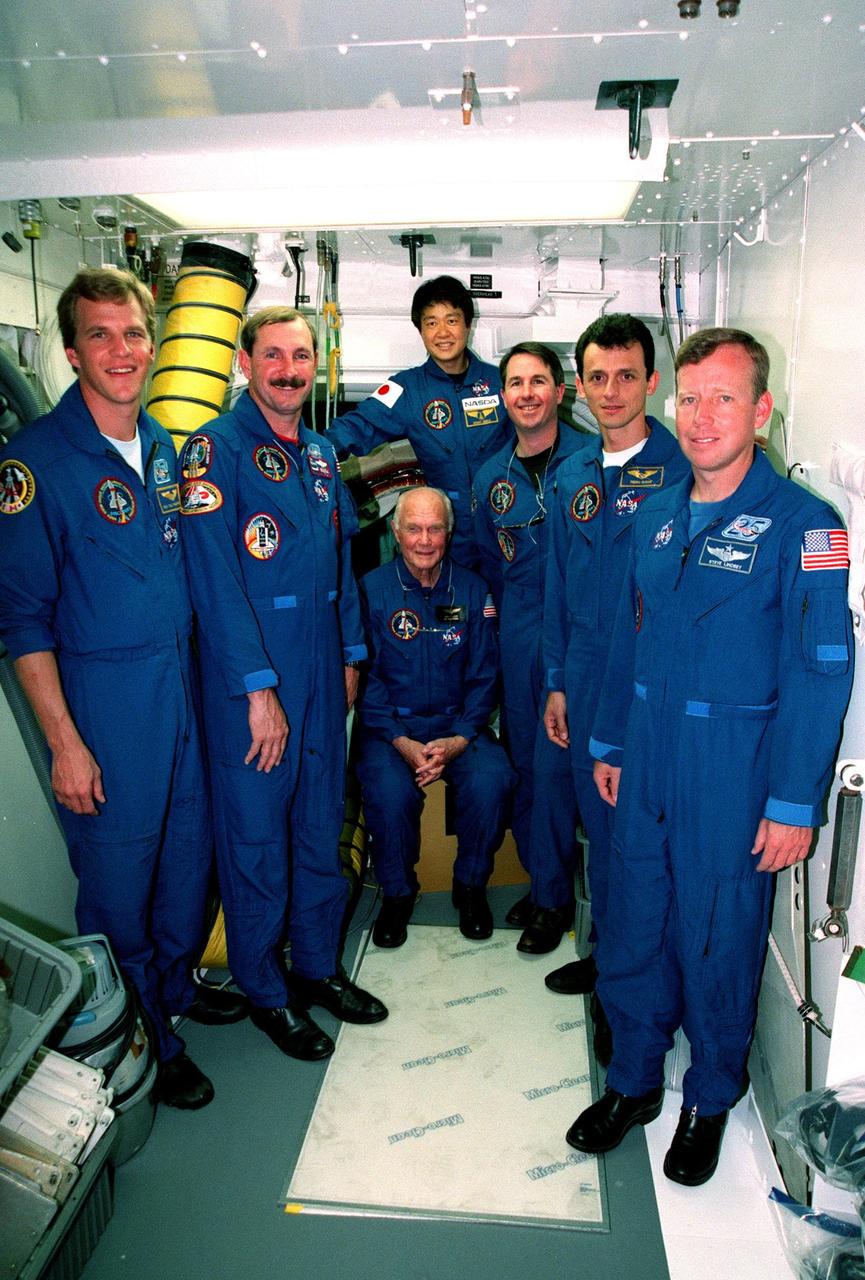
At Launch Pad 39-B, the STS-95 crew gather in the white room, an environmental chamber that mates with the orbiter and can provide emergency egress for the flight crew before launch. The white room is the outer end of the orbiter access arm, which is part of the fixed service structure on the pad. Pictured are (left to right) Mission Specialist Scott E. Parazynski, Mission Commander Curtis L. Brown, Payload Specialist John H. Glenn Jr. (seated), senator from Ohio, Payload Specialist Chiaki Mukai (behind Glenn), representing the National Space Development Agency of Japan (NASDA), Mission Specialist Stephen K. Robinson, Mission Specialist Pedro Duque of Spain, representing the European Space Agency (ESA), and Pilot Steven W. Lindsey. The STS-95 crew are at KSC to participate in a Terminal Countdown Demonstration Test (TCDT) which includes mission familiarization activities, emergency egress training, and a simulated main engine cut-off exercise. The STS-95 mission, targeted for liftoff on Oct. 29, includes research payloads such as the Spartan solar-observing deployable spacecraft, the Hubble Space Telescope Orbital Systems Test Platform, the International Extreme Ultraviolet Hitchhiker, as well as the SPACEHAB single module with experiments on space flight and the aging process. Following the TCDT, the crew will be returning to Houston for final flight preparations

On Launch Pad 39B, the STS-95 crew pose after successfully completing a pre-launch countdown exercise on Space Shuttle Discovery. Standing from left to right are Mission Specialist Scott E. Parazynski, Mission Specialist Stephen K. Robinson, Payload Specialist John H. Glenn Jr., senator from Ohio, Payload Specialist Chiaki Mukai (M.D., Ph.D.), representing the National Space Development Agency in Japan (NASDA), Mission Commander Curtis L. Brown, Pilot Steven W. Lindsey, and Mission Specialist Pedro Duque of Spain, representing the European Space Agency (ESA). In the background (left) can be seen one of the solid rocket boosters and the external tank. The STS-95 crew are at KSC to participate in the Terminal Countdown Demonstration Test (TCDT) which includes mission familiarization activities, emergency egress training, and a simulated main engine cutoff. The STS-95 mission, targeted for liftoff on Oct. 29, includes research payloads such as the Spartan solar-observing deployable spacecraft, the Hubble Space Telescope Orbital Systems Test Platform, the International Extreme Ultraviolet Hitchhiker, as well as the SPACEHAB single module with experiments on space flight and the aging process. Following the TCDT, the crew will be returning to Houston for final flight preparations

At Launch Pad 39-B, at the 195-foot level, STS-95 crew members learn about the slidewire basket, lower right, that is part of the emergency egress system from the orbiter before launch. Shown are (left to right) Mission Specialist Scott E. Parazynski, Pilot Steven W. Lindsey, Mission Specialist Pedro Duque of Spain, representing the European Space Agency (ESA), Mission Specialist Stephen K. Robinson, Payload Specialist Chiaki Mukai, representing the National Space Development Agency of Japan (NASDA), Payload Specialist John H. Glenn Jr., senator from Ohio, and Mission Commander Curtis L. Brown. The STS-95 crew are at KSC to participate in a Terminal Countdown Demonstration Test (TCDT) which includes mission familiarization activities, emergency egress training, and a simulated main engine cut-off exercise. The STS-95 mission, targeted for liftoff on Oct. 29, includes research payloads such as the Spartan solar-observing deployable spacecraft, the Hubble Space Telescope Orbital Systems Test Platform, the International Extreme Ultraviolet Hitchhiker, as well as the SPACEHAB single module with experiments on space flight and the aging process. Following the TCDT, the crew will be returning to Houston for final flight preparations

At Launch Pad 39-B, a Safety Egress trainer explains the use of the slidewire basket system for emergency egress before launch to STS-95 crew members (left to right) Mission Specialist Stephen K. Robinson, , Mission Commander Curtis L. Brown (behind Robinson), Pilot Steven W. Lindsey, Payload Specialists John H. Glenn Jr., senator from Ohio, Chiaki Mukai (in front of Glenn), representing the National Space Development Agency of Japan (NASDA), Mission Specialist Pedro Duque of Spain, representing the European Space Agency, and Mission Specialist Scott E. Parazynski . The STS-95 crew are at KSC to participate in a Terminal Countdown Demonstration Test (TCDT) which includes mission familiarization activities, emergency egress training, and a simulated main engine cut-off exercise. The STS-95 mission, targeted for liftoff on Oct. 29, includes research payloads such as the Spartan solar-observing deployable spacecraft, the Hubble Space Telescope Orbital Systems Test Platform, the International Extreme Ultraviolet Hitchhiker, as well as the SPACEHAB single module with experiments on space flight and the aging process. Following the TCDT, the crew will be returning to Houston for final flight preparations
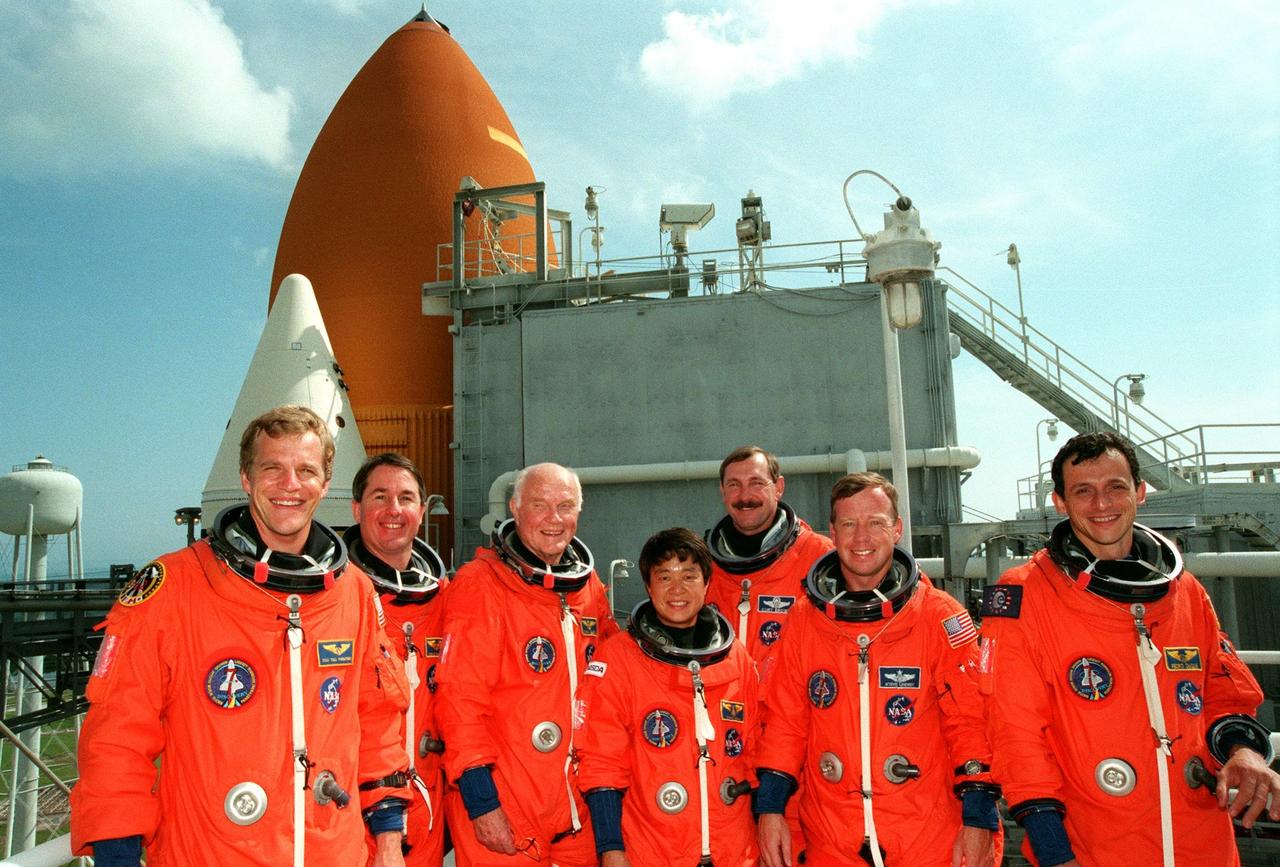
On Launch Pad 39B, the STS-95 crew pose after successfully completing a pre-launch countdown exercise on Space Shuttle Discovery. Standing from left to right are Mission Specialist Scott E. Parazynski, Mission Specialist Stephen K. Robinson, Payload Specialist John H. Glenn Jr., senator from Ohio, Payload Specialist Chiaki Mukai (M.D., Ph.D.), representing the National Space Development Agency in Japan (NASDA), Mission Commander Curtis L. Brown, Pilot Steven W. Lindsey, and Mission Specialist Pedro Duque of Spain, representing the European Space Agency (ESA). In the background can be seen one of the solid rocket boosters and the external tank. The STS-95 crew are at KSC to participate in the Terminal Countdown Demonstration Test (TCDT) which includes mission familiarization activities, emergency egress training, and a simulated main engine cutoff. The STS-95 mission, targeted for liftoff on Oct. 29, includes research payloads such as the Spartan solar-observing deployable spacecraft, the Hubble Space Telescope Orbital Systems Test Platform, the International Extreme Ultraviolet Hitchhiker, as well as the SPACEHAB single module with experiments on space flight and the aging process. Following the TCDT, the crew will be returning to Houston for final flight preparations
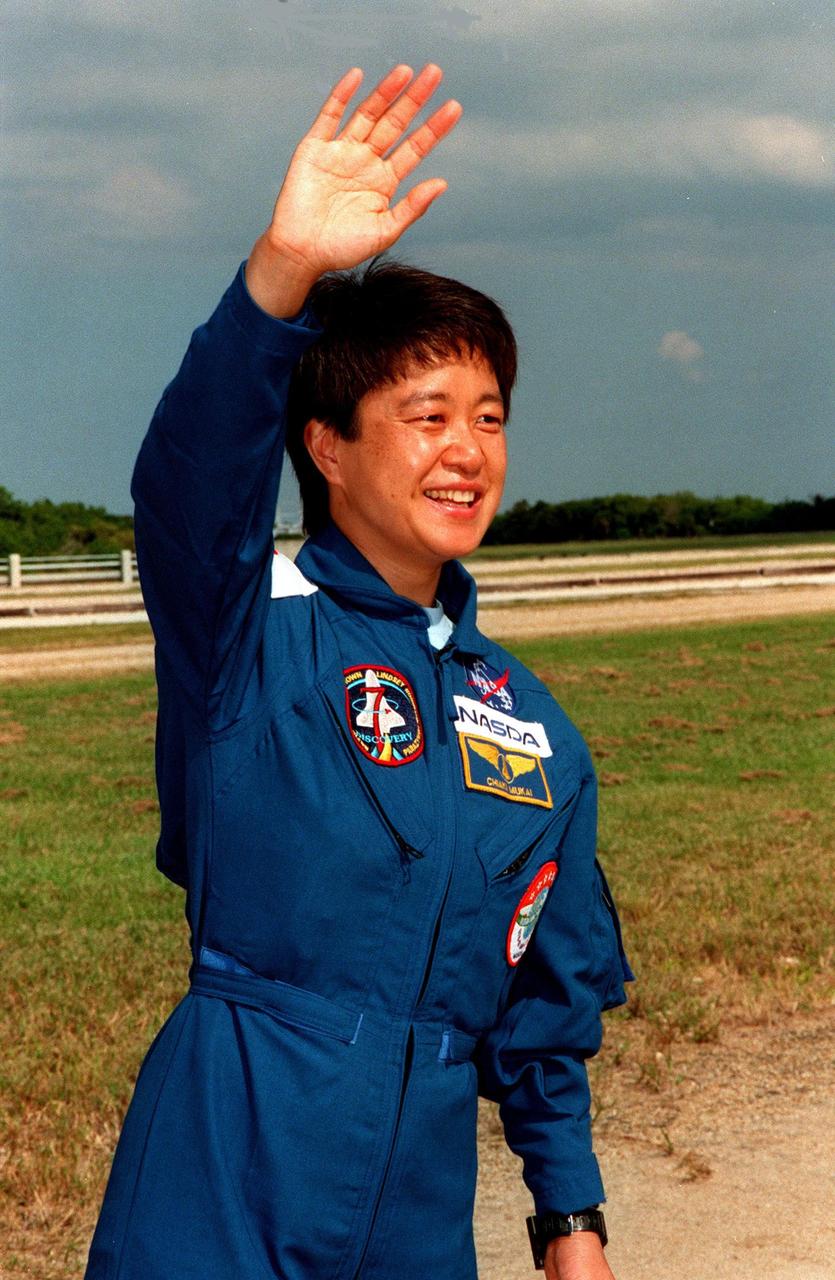
STS-95 Payload Specialist Chiaki Mukai, with the National Space Development Agency of Japan (NASDA), smiles at well-wishers while at Launch Pad 39B. The crew were making final preparations for launch, targeted for liftoff at 2 p.m. on Oct. 29. Other crew members not shown are Mission Commander Curtis L. Brown Jr., Pilot Steven W. Lindsey, Mission Specialist Pedro Duque of Spain, with the European Space Agency (ESA), Mission Specialist Scott E. Parazynski, Mission Specialist Stephen K. Robinson, and Payload Specialist John H. Glenn Jr., senator from Ohio. The STS-95 mission is expected to last 8 days, 21 hours and 49 minutes, returning to KSC at 11:49 a.m. EST on Nov. 7
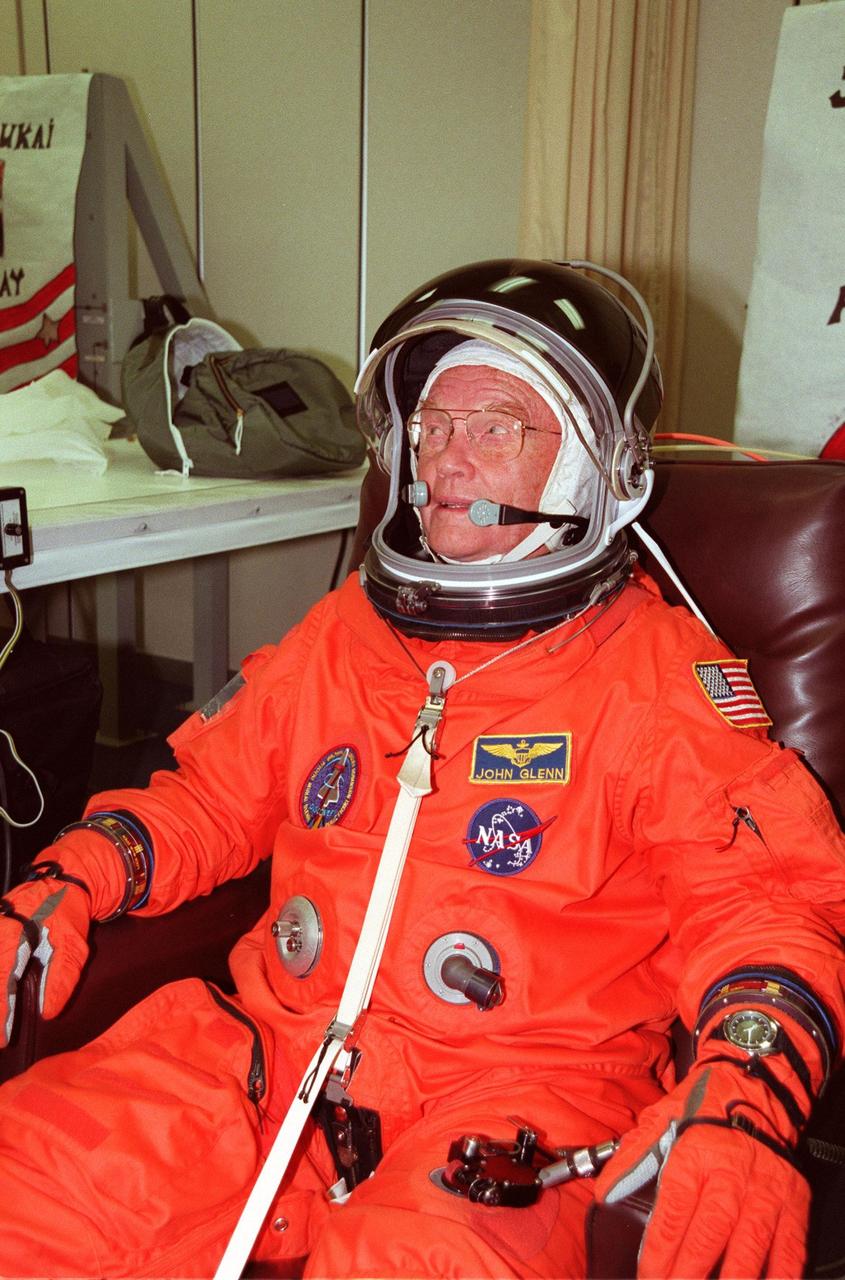
STS-95 Payload Specialist John H. Glenn Jr., senator from Ohio, smiles as he dons his flight suit in the Operations and Checkout Building. The final fitting takes place prior to the crew walkout and transport to Launch Pad 39B. Targeted for launch at 2 p.m. EST on Oct. 29, the mission is expected to last 8 days, 21 hours and 49 minutes, and return to KSC at 11:49 a.m. EST on Nov. 7. The STS-95 mission includes research payloads such as the Spartan solar-observing deployable spacecraft, the Hubble Space Telescope Orbital Systems Test Platform, the International Extreme Ultraviolet Hitchhiker, as well as the SPACEHAB single module with experiments on space flight and the aging process