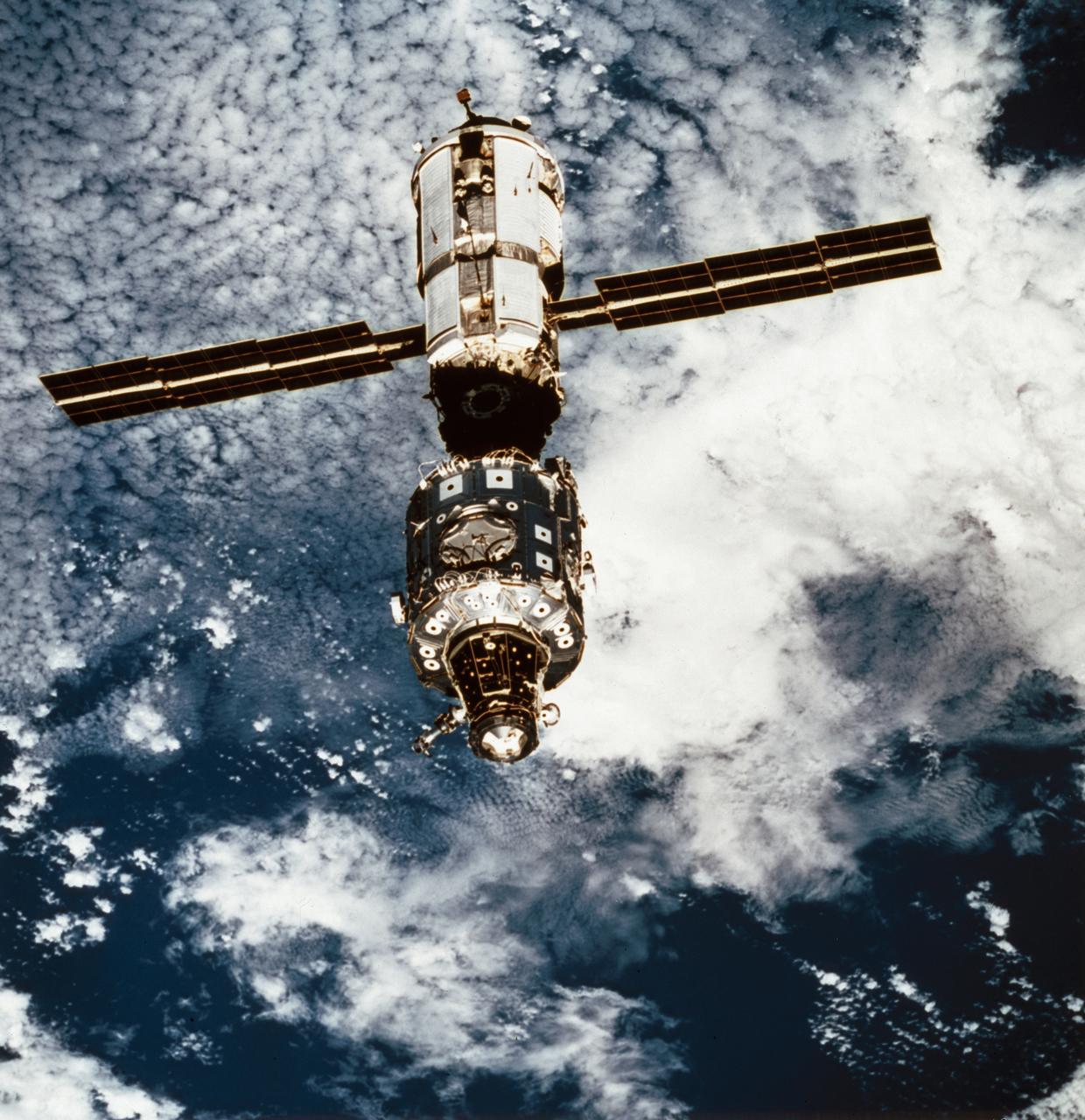
This STS-96 onboard photo of the International Space Station (ISS) was taken from Orbiter Discovery during a fly-around following separation of the two spacecraft. STS-96, the second Space Station assembly and resupply flight, launched on May 27, 1999 for an almost 10 day mission. The Shuttle's SPACEHAB double module carried internal and resupply cargo for station outfitting. Evident in the photo is the newly mounted Russian cargo crane, known as STRELA, which was carried aboard the shuttle in the integrated Cargo Carrir (ICC). The STS-96 flight was the first to perform docking with the ISS.
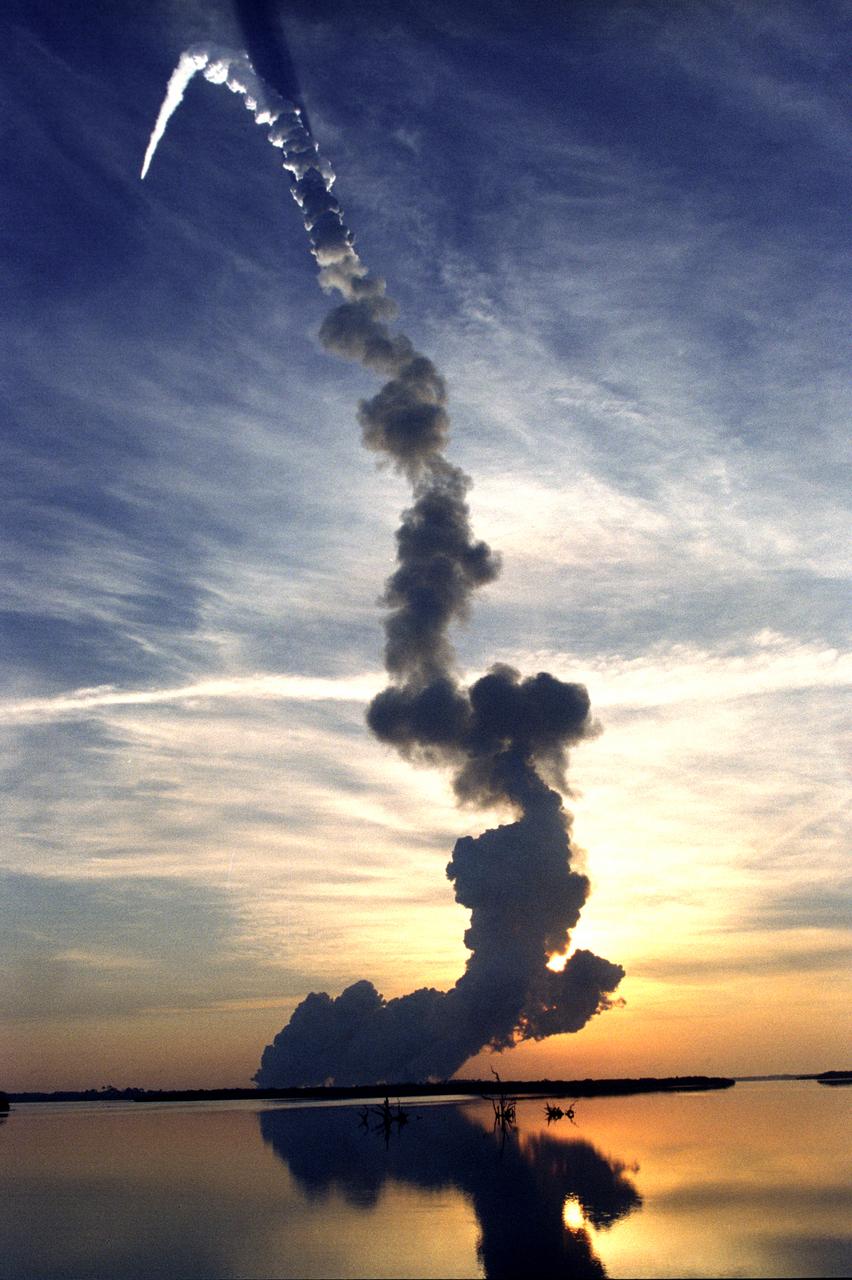
This spectacular photo is of the May 27, 1999 liftoff of the Orbiter Discovery (STS-96). The STS-96 mission, of almost 10 days, was the second International Space Station (ISS) assembly and resupply flight and the first flight to dock with the station. The crew installed foot restraints and the Russian built crane, STRELA. The Shuttle's SPACEHAB double module carried internal and resupply cargo for station outfitting and the Russian cargo crane was carried aboard the shuttle in the integrated Cargo Carrier (ICC).
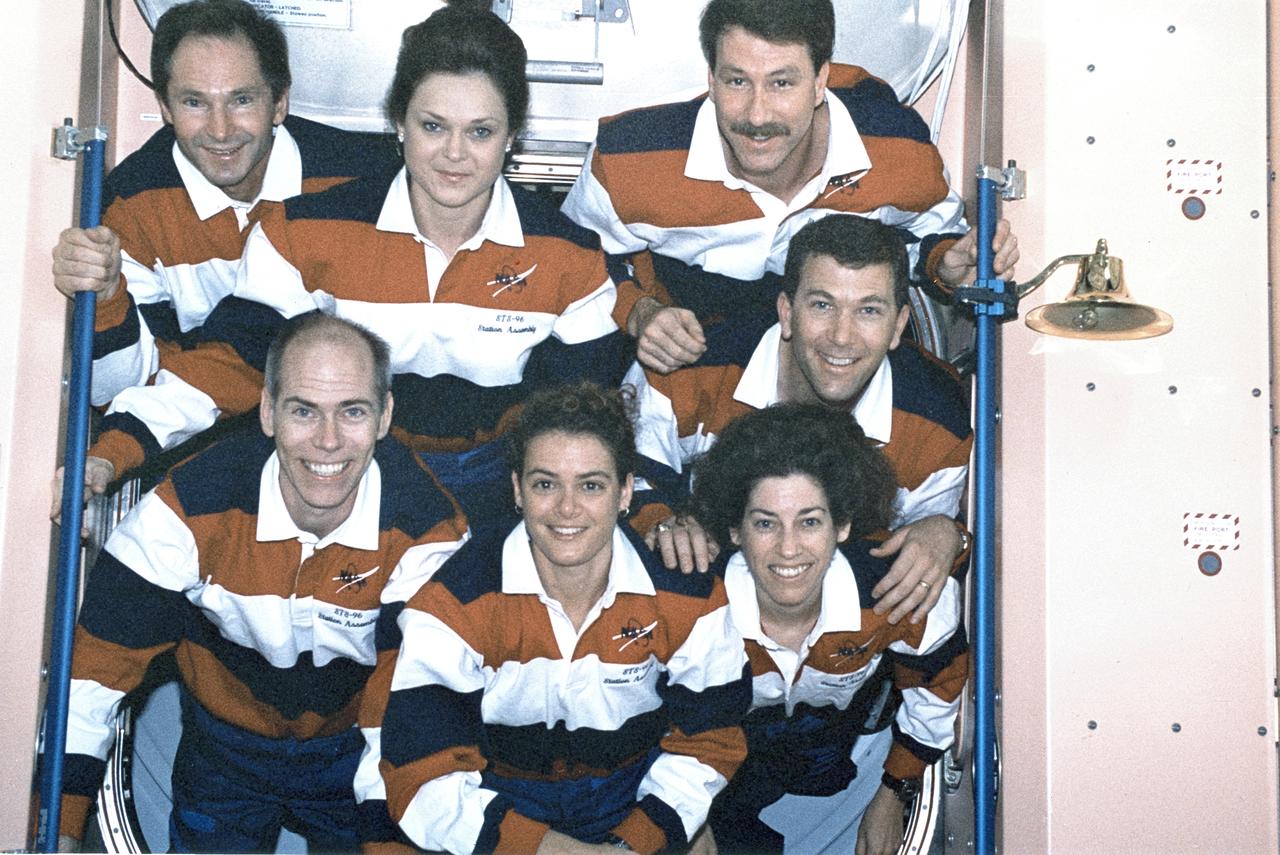
The STS-96 crew paused for an International Space Station (ISS) onboard group photo. Pictured on the bottom row (left to right) are Mission Specialists Daniel Barry, Julie Payette, and Ellen Ochoa. Pictured on the top row (left to right) are Cosmonaut Valery Ivanovich Tokarev, and Tamara Jernigan, Mission Specialists; Kent Rominger, Commander; and Rick Husband, Pilot. STS-96 was the second ISS assembly flight and the first flight to dock with the station. The 10 day mission crew launched aboard the Space Shuttle Orbiter Discovery on May 27, 1999.
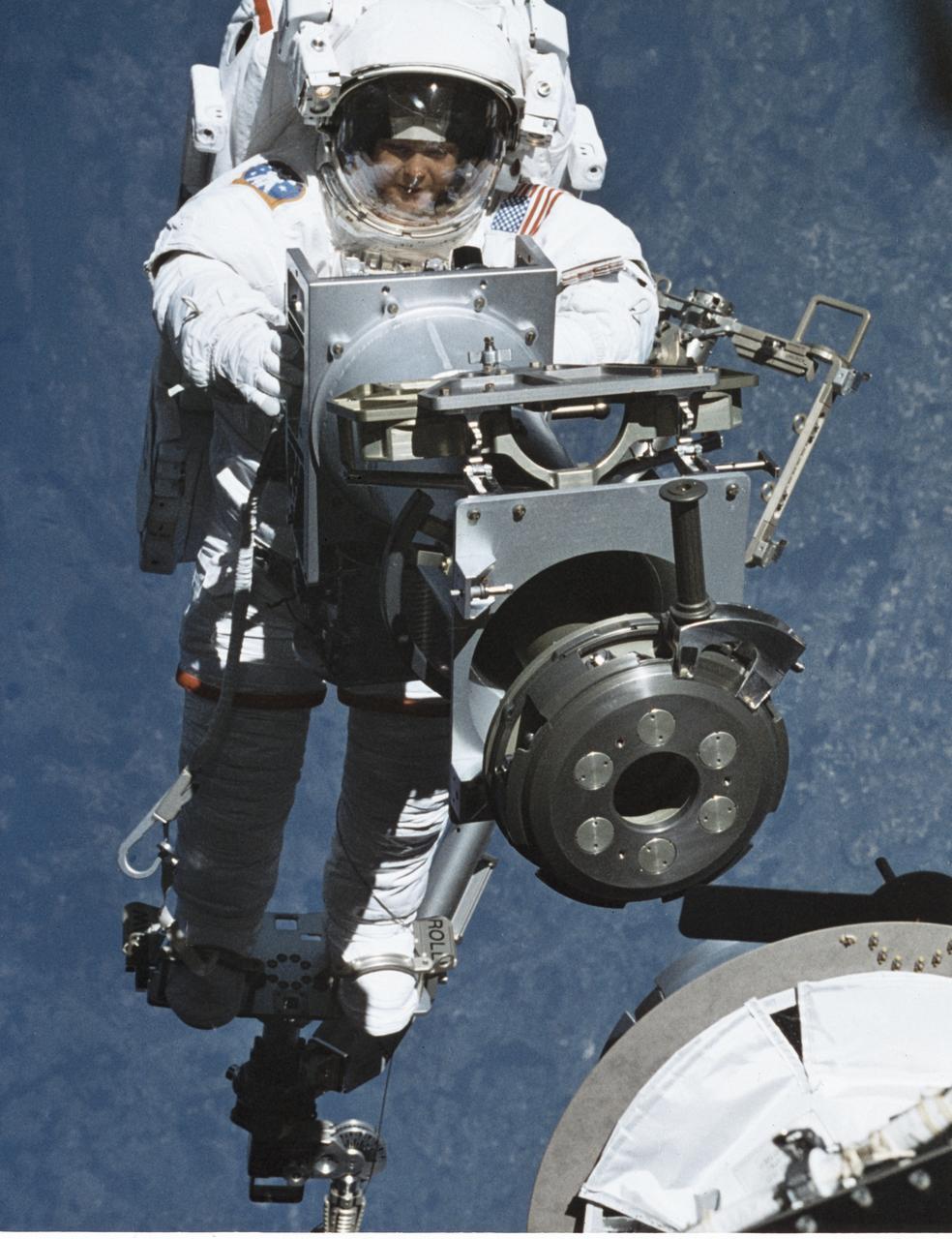
The STS-96 mission, the second International Space Station (ISS) assembly and resupply flight, launched on May 27, 1999 aboard the Orbiter Discovery for an almost 10 day mission. The Shuttle's SPACEHAB double module carried internal and resupply cargo for station outfitting and the Russian cargo crane, STRELA, was carried aboard the shuttle in the integrated Cargo Carrier (ICC). In this STS-96 onboard photo of the first Extra Vehicular Activity (EVA), Mission Specialist Tamara Jernigan totes part of the Russian built crane. Jernigans' feet are anchored on a mobile foot restraint cornected to the Shuttle's Remote Manipulator System (RMS) operated by Mission Specialist Ellen Ochoa. The STS-96 flight was the first to perform docking with the ISS.
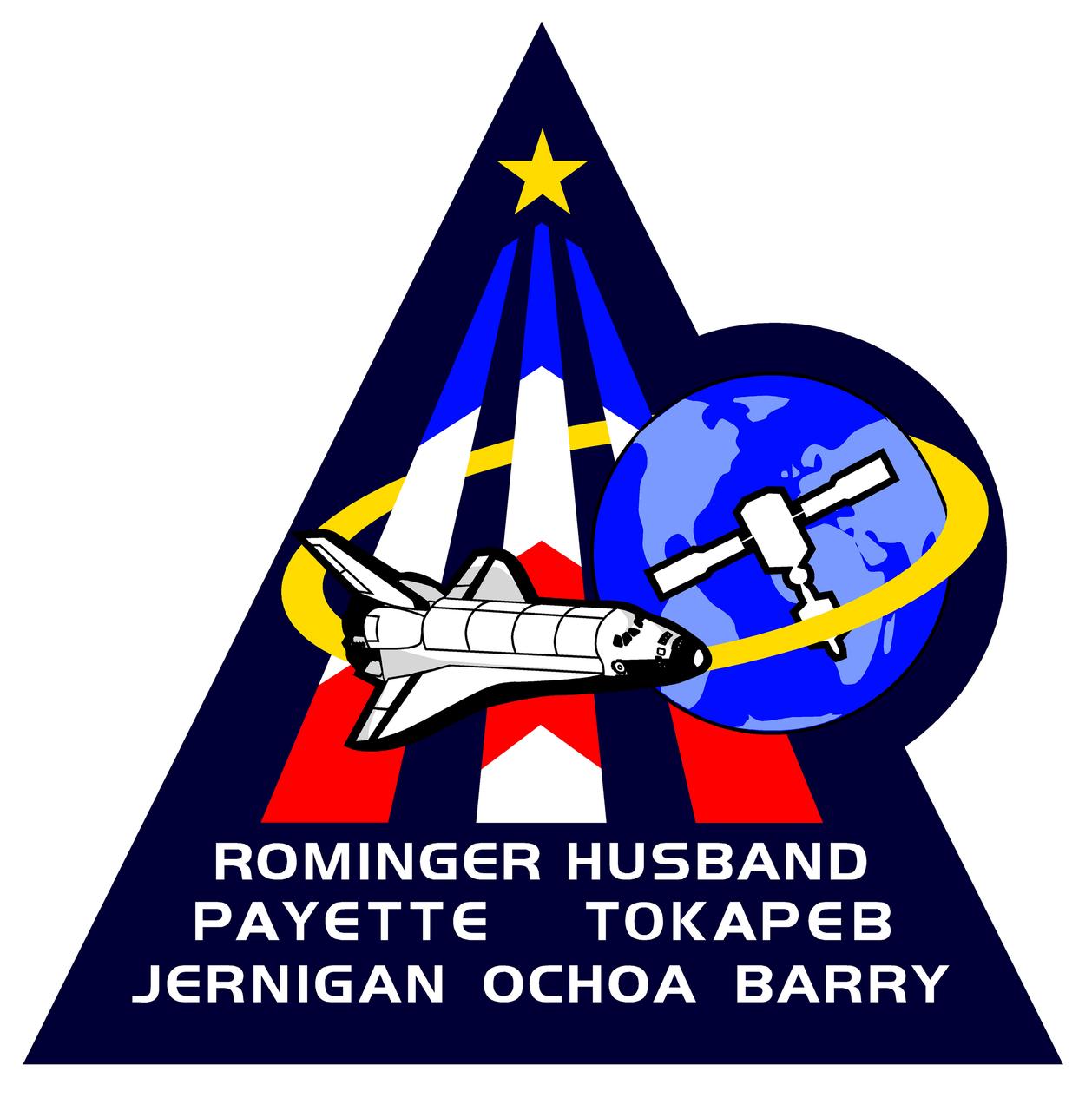
This is the astronaut designed mission insignia for the STS-96 space flight, the second Space Shuttle Mission dedicated to the assembly of the International Space Station (ISS). The crew member designed patch highlights the major themes of the Station program: Earth-directed research, the advancement of human space exploration, and international cooperation. The Space Shuttle Discovery is depicted shortly after reaching orbit as the crew prepares for the first docking with the new station. At this early stage in its construction, the ISS consisted of two modules; The Russian Zarya and the U.S. Unity, shown orbiting the Earth. The triangular shape represents building on the knowledge and experience of earlier missions, while the three vertical bars point toward future human endeavors in space. The five pointed star is symbolic of the five space agencies participating in the development of the ISS: NASA, the Russian Space Agency, the European Space Agency, the National Space Development Agency of Japan, and the Canadian Space Agency. The blend of red, white, and blue is a tribute to the nationalities of the STS-96 crew members who are from the United States, Russia, and Canada.
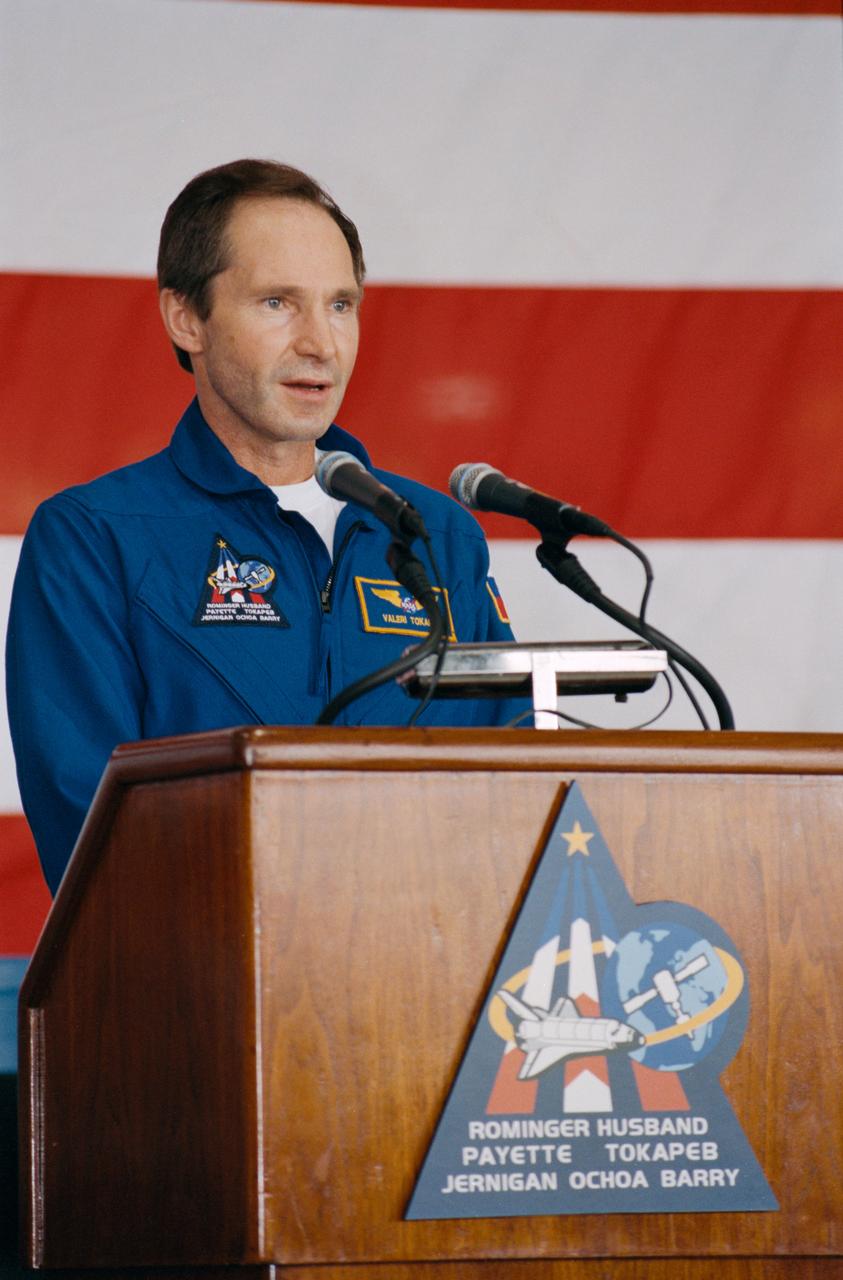
S99-05970 (7 June 1999) --- Cosmonaut Valery I. Tokarev, mission specialist representing the Russian Space Agency (RSA), speaks to the crowd that turned out for STS-96 welcome home ceremonies at Ellington Field.
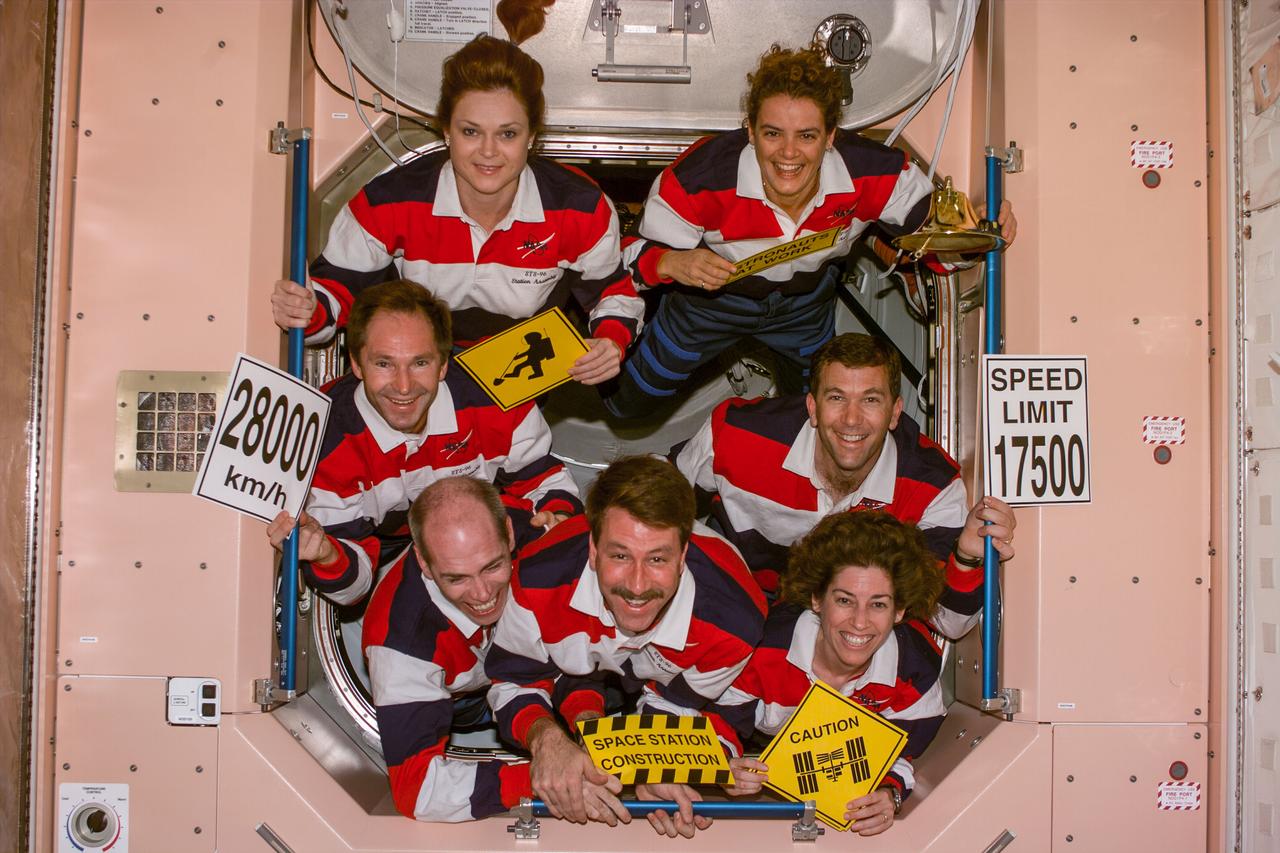
S96-E-5168 (02 June 1999) --- The seven crew members for STS-96 pose for an inflight crew portrait at the completion of their assigned chores on the International Space Station (ISS). At bottom center is astronaut Kent V. Rominger, mission commander. He is flanked by astronauts Daniel T. Barry and Ellen Ochoa, mission specialists. Also pictured are cosmonaut Valery I. Tokaerev (just above Barry at left); and astronauts Tamara Jernigan and Julie Payette, all mission specialists. Astronaut Rick D. Husband, pilot, is between Payette and Ochoa. Tokarev represents the Russian Space Agency (RSA) and Payette is with the Canadian Space Agency (CSA). The photograph was taken with an electronic still camera (ESC) at 11:02:32 GMT, June 2, 1999.
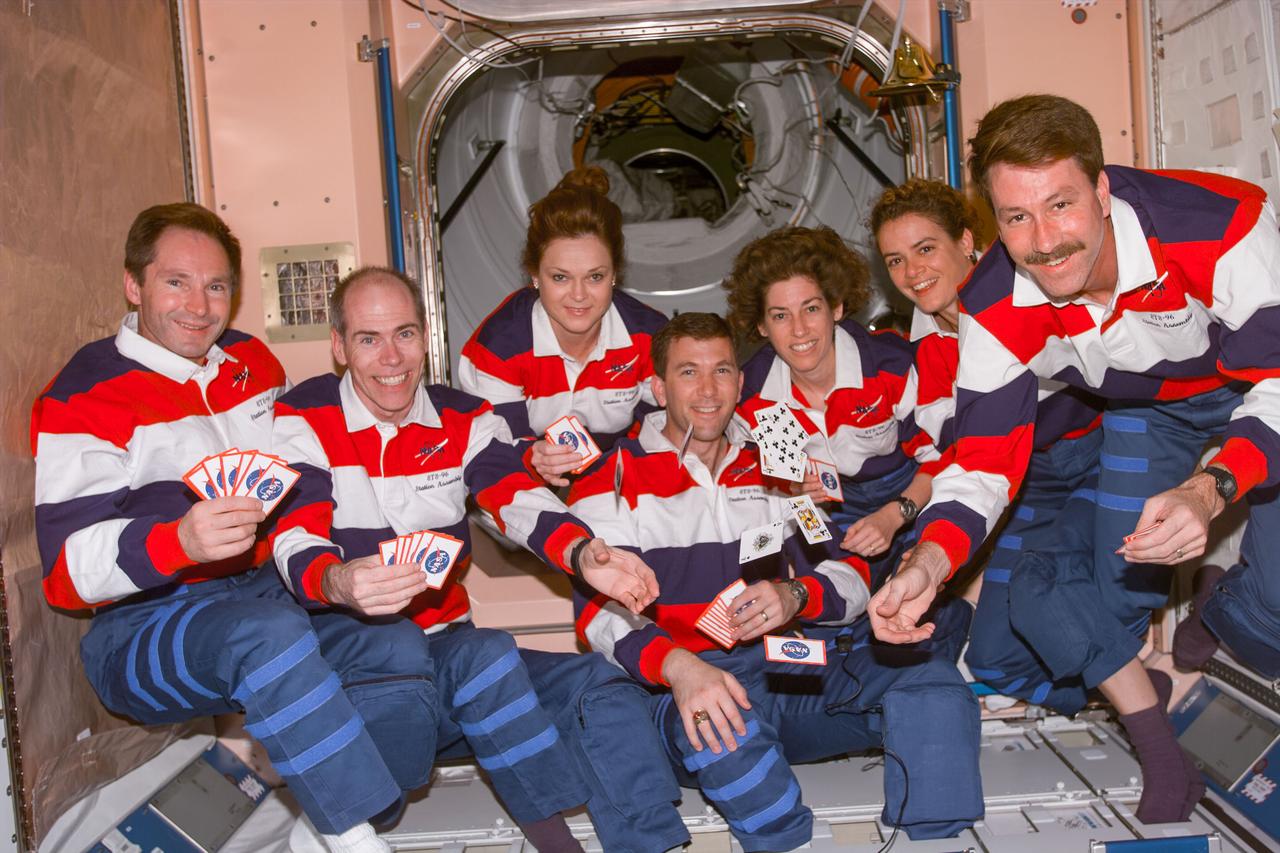
S96-E-5173 (2 June 1999) --- A pre-set electronic still camera (ESC) recorded this image of the STS-96 crewmembers playing cards on a break aboard the International Space Station (ISS). From the left are cosmonaut Valery I. Tokarev, Daniel T. Barry, Tamara E. Jernigan, Rick D. Husband, Ellen Ochoa, Julie Payette and Kent V. Rominger. Tokarev represents the Russian Space Agency (RSA) and Payette represents the Canadian Space Agency (CSA). The photograph was taken at 11:13:59 GMT, June 2, 1999.
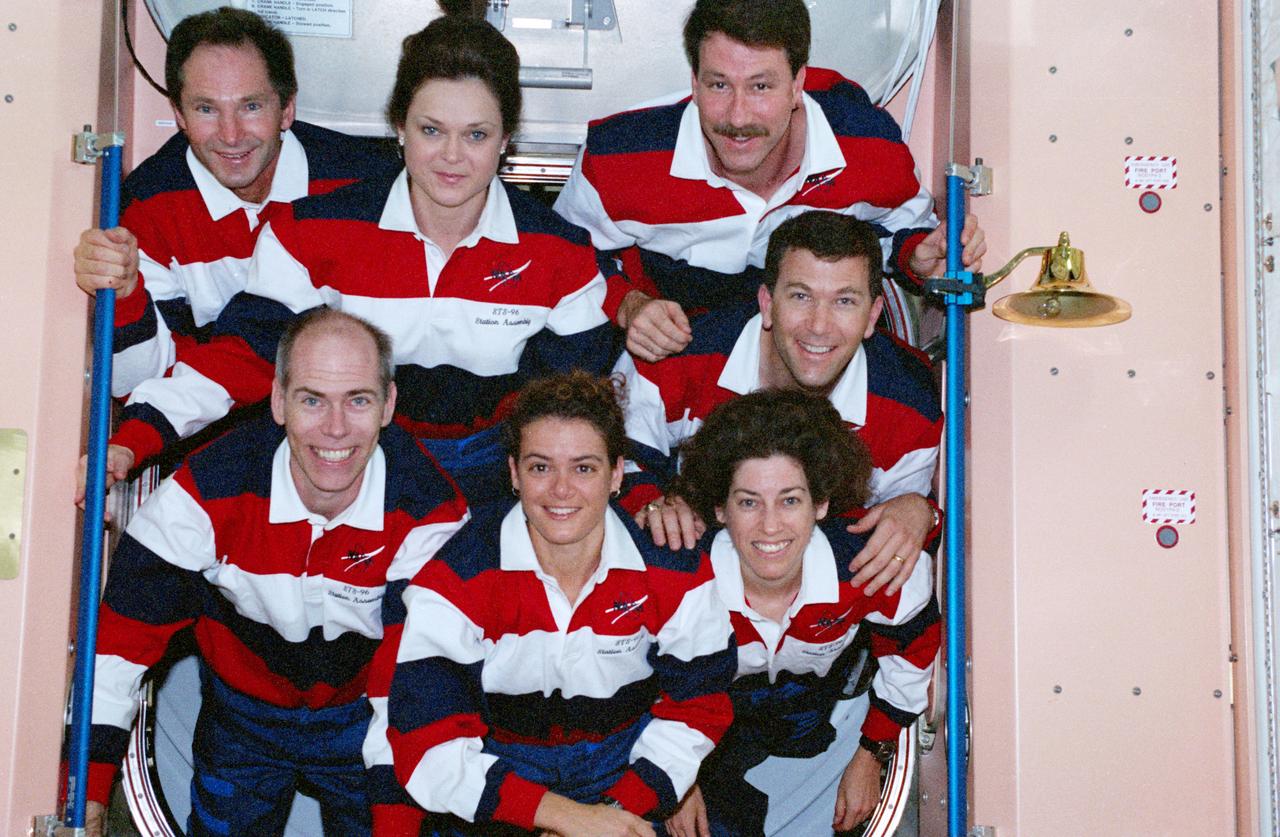
STS096-380-019 (27 May - 6 June 1999) --- The seven crew members for the STS-96 mission pose for the traditional inflight crew portrait in the hatch way of the U.S.-built Unity node for the International Space Station (ISS). From to left to right, bottom, are astronauts Daniel T. Barry, Julie Payette and Ellen Ochoa. On top are cosmonaut Valery I. Tokarev, along with astronauts Tamara E. Jernigan and Kent V. Rominger. Astronaut Rick D. Husband is between Rominger and Ochoa. Payette represents the Canadian Space Agency (CSA) and Tokarev is with the Russian Space Agency (RSA).
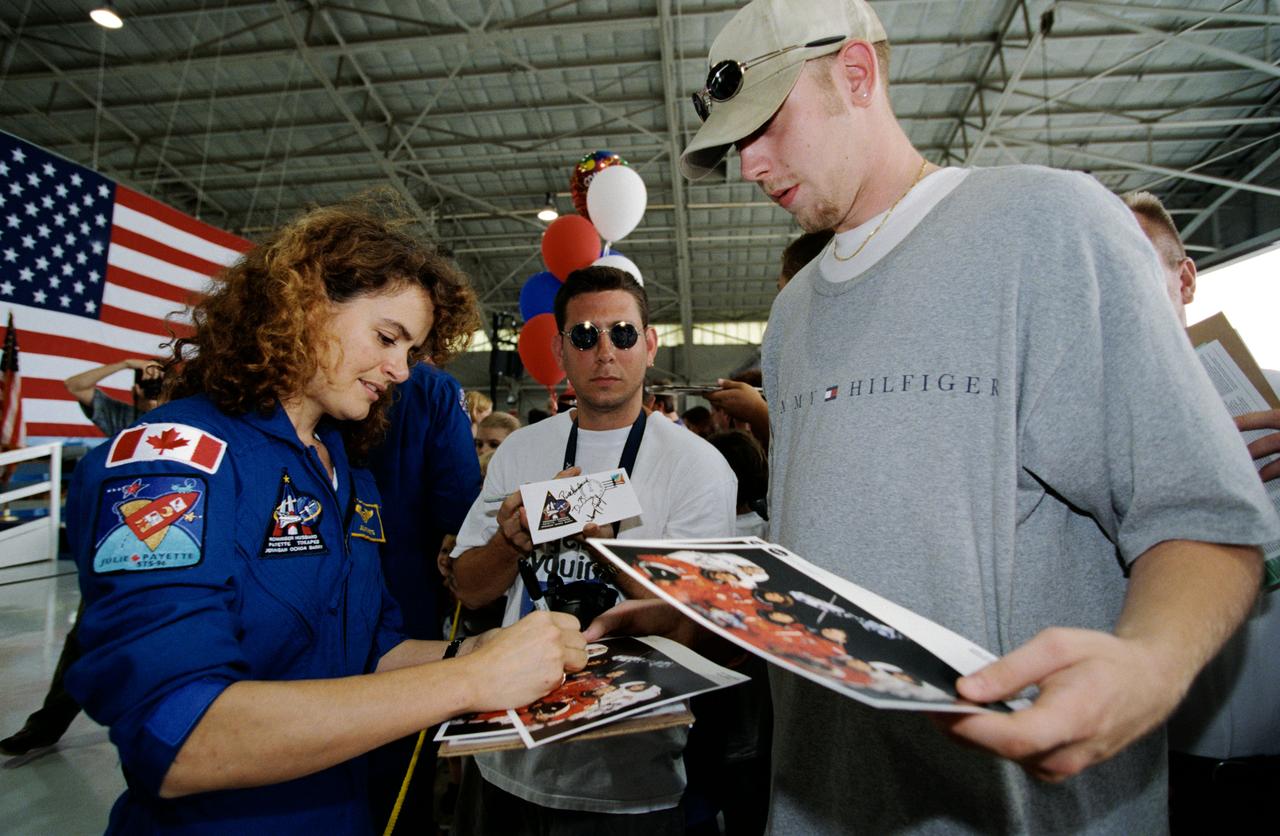
Photographic documentation showing the STS-96 crew return ceremony at Ellington Field. Views include: pilot Rick D. Husband with his two children, Mission Specialist (MS) Daniel T. Barry is partially visible behind him (05966); MS Ellen Ochoa holds a baby (05967); slanted side view of the stage with mission commander Kent V. Rominger at the podium, and seated behind him (left to right): Mr. George Abbey, JSC director, MS Valery Tokarev, MS Julie Payette, MS Daniel T. Barry, MS Ellen Ochoa, MS Tamara E. Jernigan and pilot Rick D. Husband (05968); Payette sign photographs for visitors (05969); Tokarev at the podium (05970); Husband at the podium (05971); Ochoa at the podium (05972); Rominger at the podium (05973); Tokarev signs photographs for visitors (05974); front, wide shot showing MS Tamara E. Jernigan at the podium, and seated behind her (left to right); Mr. George Abbey, MS Valery Tokarev, MS Julie Payette, MS Daniel T. Barry, MS Ellen Ochoa, pilot Rick D. Husband and mission commander Kent V. Rominger (05975); Jernigan signs photographs for visitors (05976).
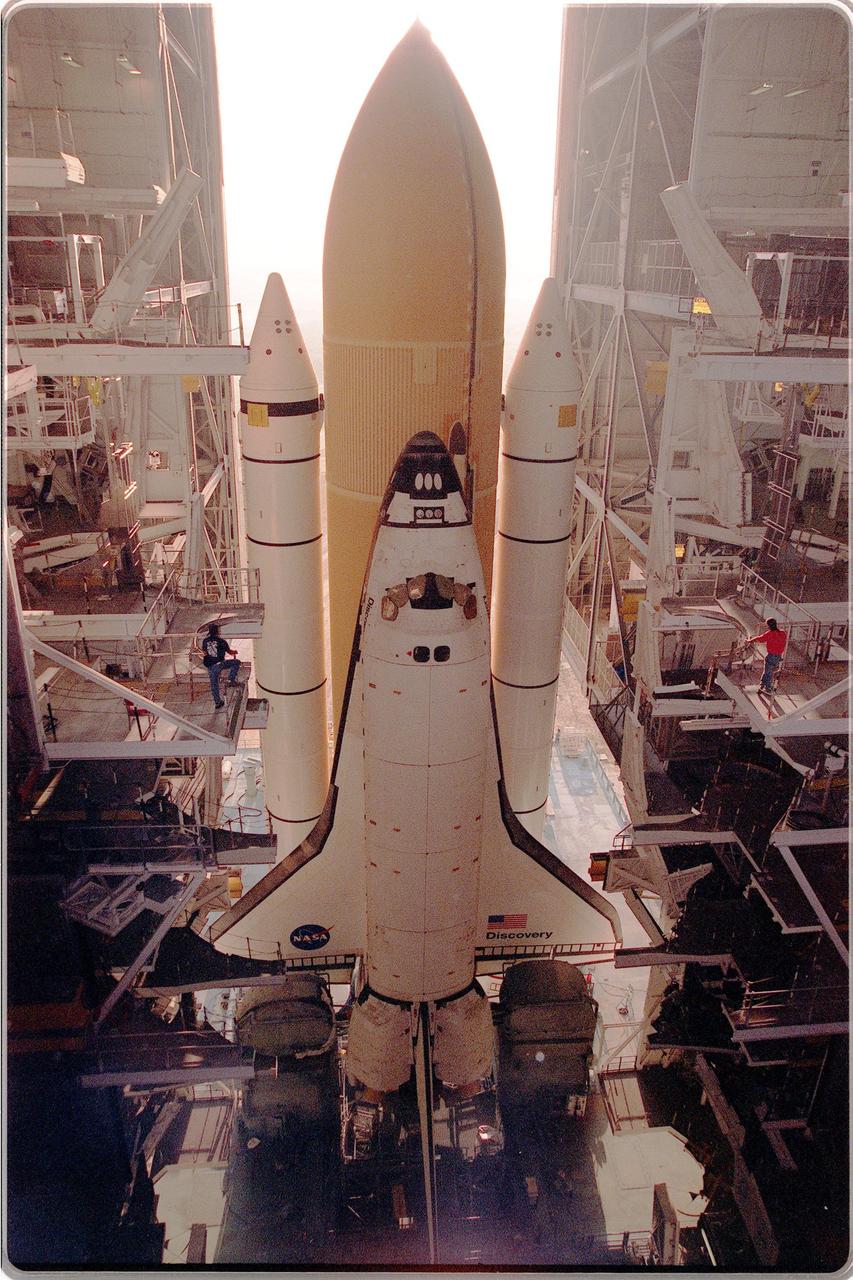
KENNEDY SPACE CENTER, Fla. -- Inside the Vehicle Assembly Building, Space Shuttle Discovery stands ready for rollout to Launch Pad 39B in preparation for mission STS-96. Liftoff of Discovery on mission STS-96 is targeted for May 20 at 9:32 a.m. EDT. STS-96 is a logistics and resupply mission for the International Space Station, carrying such payloads as a Russian crane, the Strela; a U.S.-built crane; the Spacehab Oceaneering Space System Box (SHOSS), a logistics items carrier; and STARSHINE, a student-led experiment
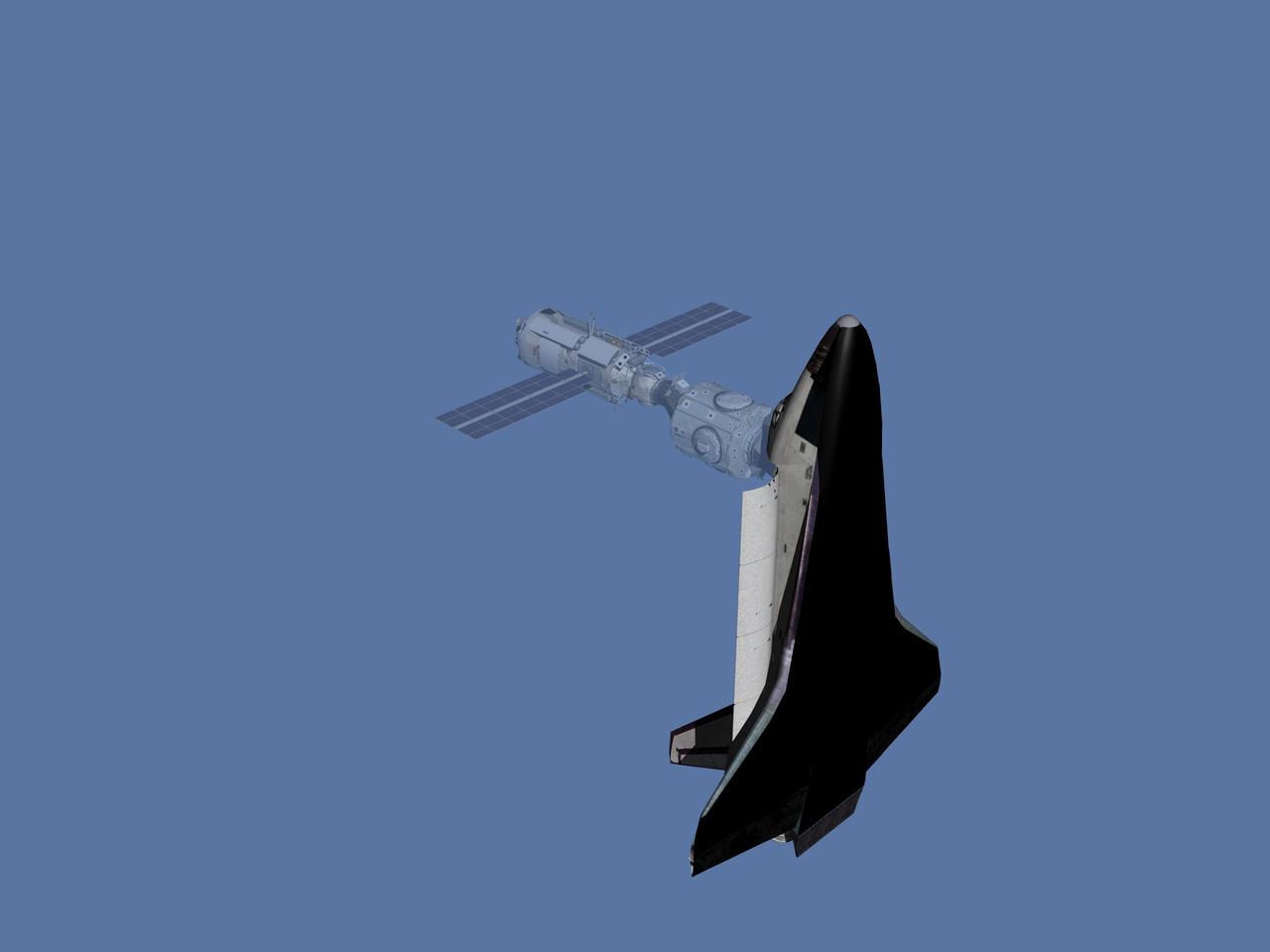
JSC2006-E-43478 (May 1999) --- Computer-generated artist's rendering of the International Space Station after flight STS-96/2A.1. Space Shuttle Discovery with the STS-96 crew delivered and outfitted the station with logistics and supplies.
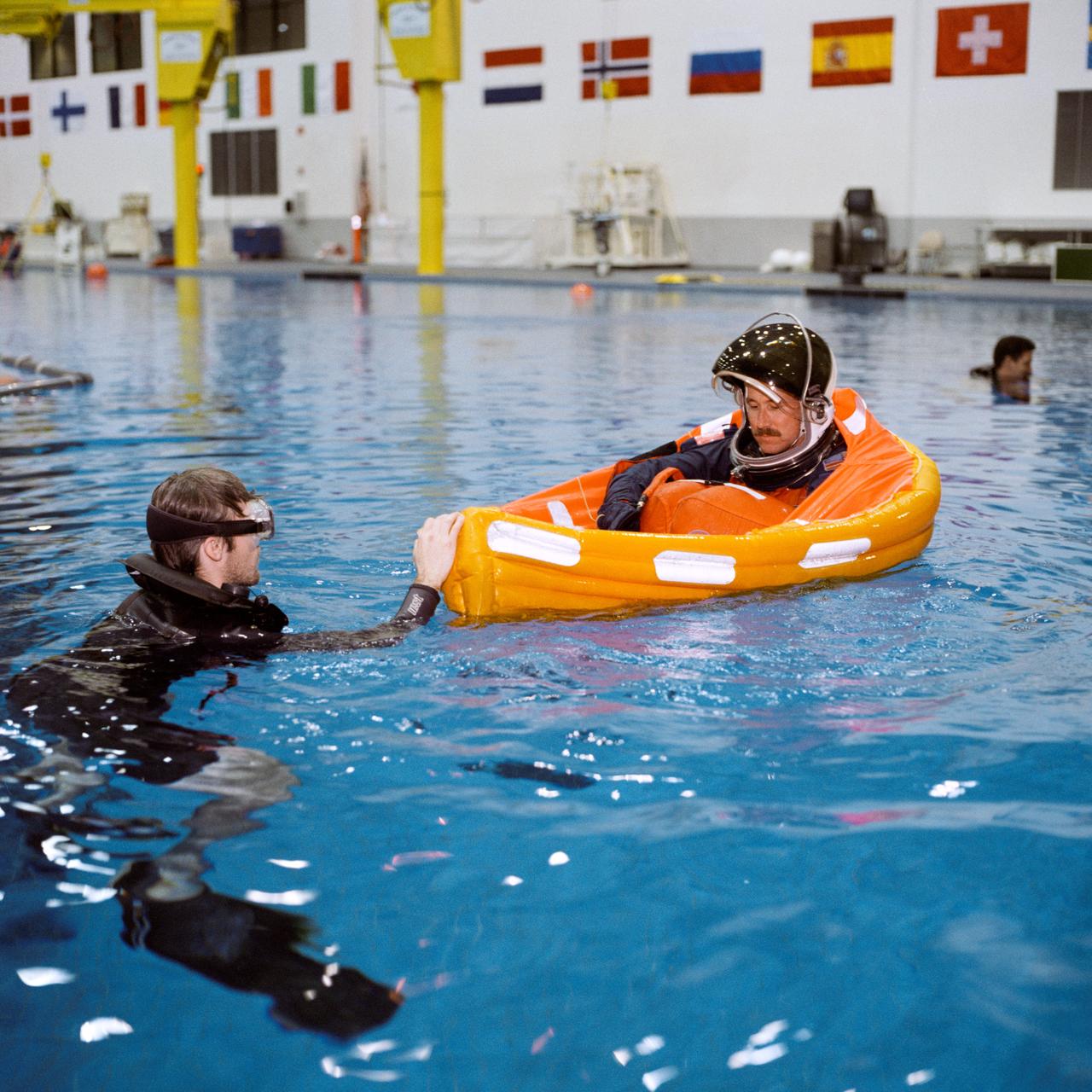
Photographic documentation of the crew of STS-96 conducting bailout training in the Neutral Buoyancy Lab (NBL) pool. Images include: an unidentifiable astronaut in an orange Launch and Entry Suit and helmet being dropped into the pool during training (00580); Mission Specialist (MS) Julie Payette being suspended above the NBL pool prior to being dropped (00581); Julie Payette in her floatation device in the NBL pool (00582-7); Flight Commander Kent Rominger in a blue Launch and Entry Suit (LES) being suspended over the NBL pool prior to being dropped (00589); Mission Specialist (MS) Ellen Ochoa in an orange LES being suspended over the NBL pool prior to being dropped (00590); Pilot Rick D. Husband and MS Daniel T. Barry in floatation devices (00591); closeups of Julie Payette prior to being lifted above the NBL pool (00592-3); MS Tamara E. Jernigan in her floatation device (00594); Julie Payette talking with a NASA employee prior to being raised over the pool (00595); Husband in an orange LES and helmet seated at the poolside talking with a NASA employee (00596); Kominger in his floatation device (00597-8); Barry being assisted with his floatation device at the poolside (00599); Ochoa in her orange LES with helmet talking to NASA personnel at the poolside (00600); Husband in his floatation device operating a transmitter (00601); Rominger splashing Husband (00602); Husband in his floatation device (00603); Barry in an orange LES suspended over the NBL pool prior to being dropped (00604); Ochoa in her floatation device (00605, 00607-8); and Ochoa suspended over the NBL pool with part of her floatation device already inflated (00606).
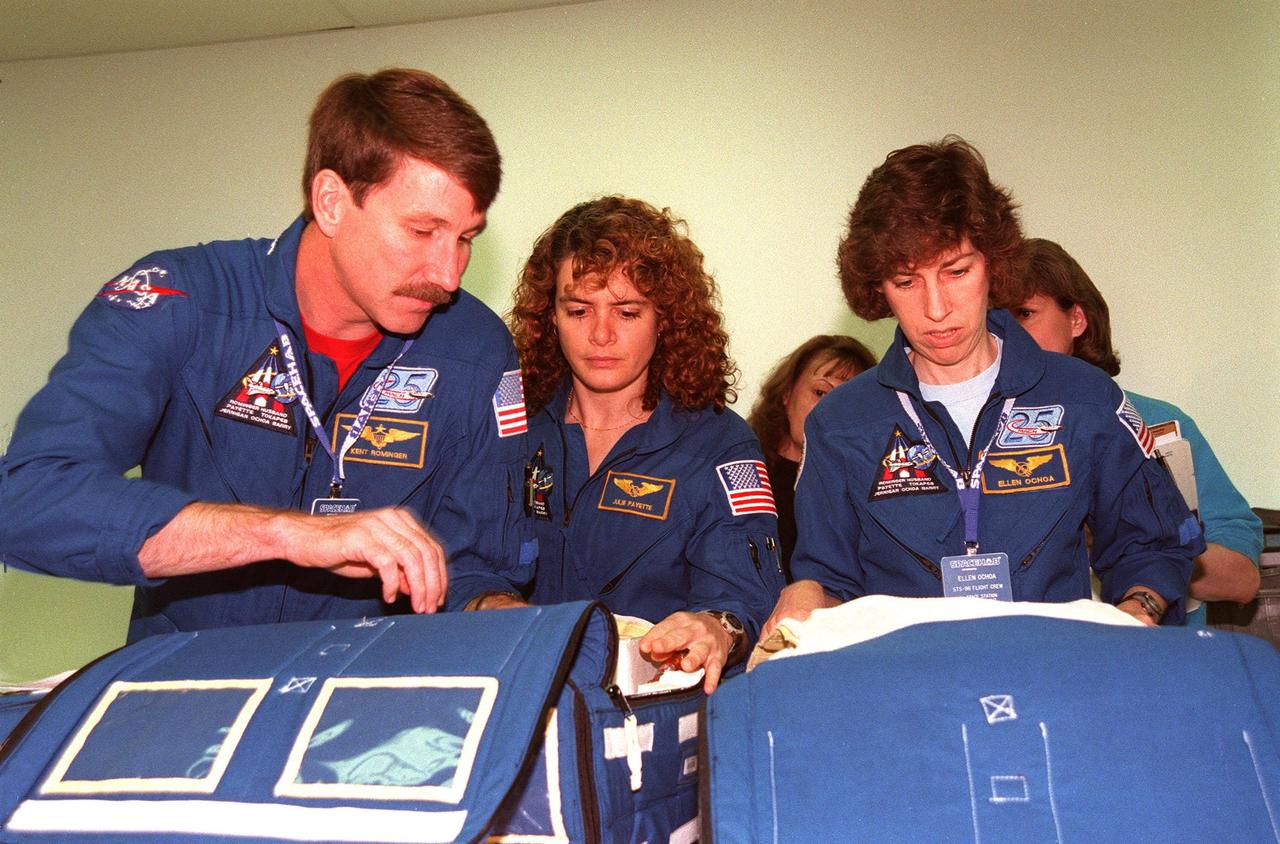
KENNEDY SPACE CENTER, FLA. -- (From left) STS-96 Commander Kent V. Rominger and Mission Specialists Julie Payette and Ellen Ochoa look over equipment at the SPACEHAB Facility. Members of the STS-96 crew are taking part in a bench review at SPACEHAB as part of familiarization activities for their upcoming mission. The crew also includes Pilot Rick Husband and Mission Specialists Tamara E. Jernigan, Daniel Barry, and Valery Ivanovich Tokarev. Payette is with the Canadian Space Agency and Tokarev with the Russian Space Agency. Mission STS-96 is the second flight in construction of the International Space Station and will include the SPACEHAB. The 10-day mission is targeted for launch on May 24, 1999, at Launch Pad 39B
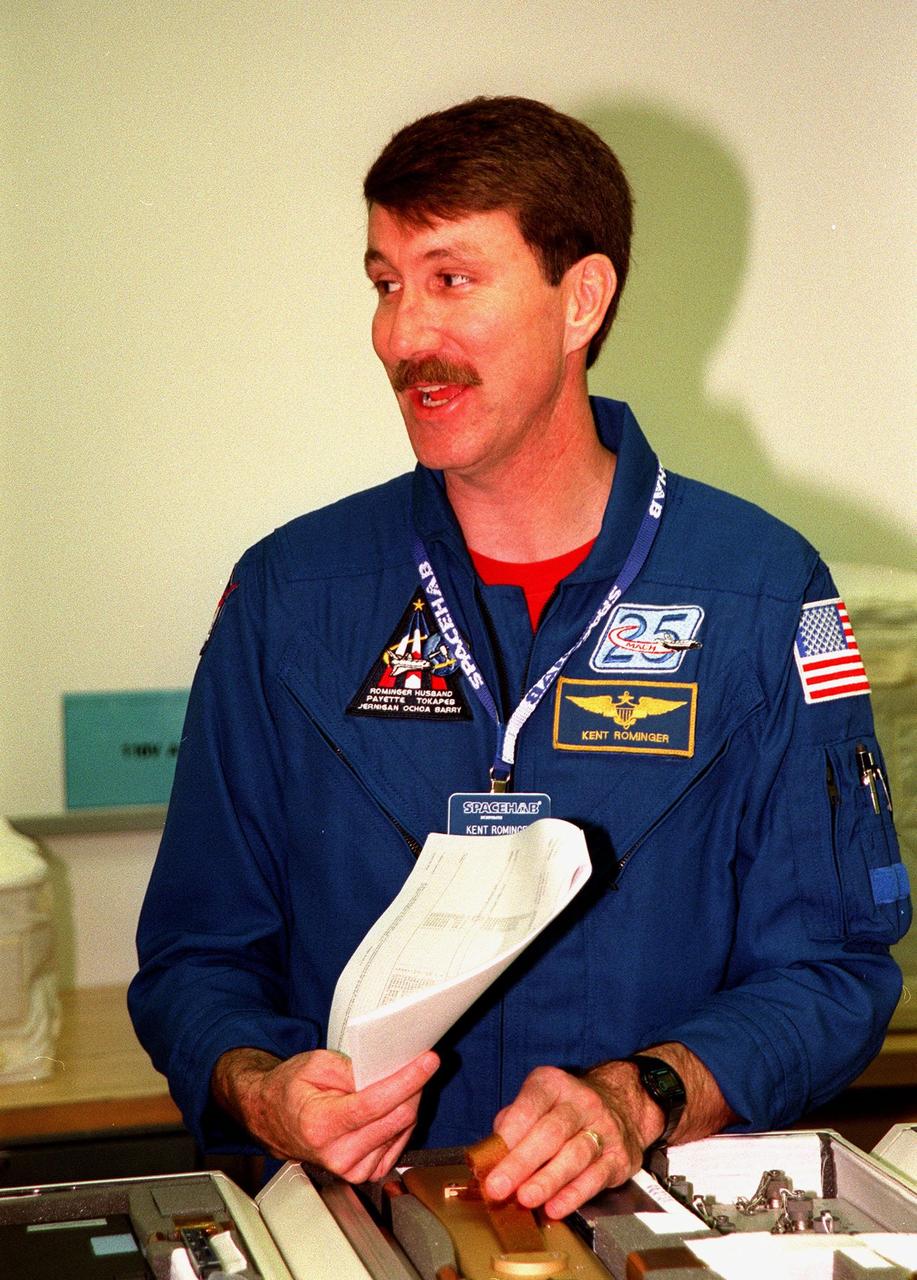
KENNEDY SPACE CENTER, FLA. -- STS-96 Commander Kent V. Rominger gets a hands-on look at equipment at the SPACEHAB Facility. Members of the STS-96 crew are taking part in a bench review at SPACEHAB as part of familiarization activities for their upcoming mission. The crew also includes Pilot Rick Husband and Mission Specialists Ellen Ochoa, Tamara E. Jernigan, Daniel Barry, Julie Payette and Valery Ivanovich Tokarev. Payette is with the Canadian Space Agency and Tokarev with the Russian Space Agency. Mission STS-96 is the second flight in construction of the International Space Station and will include the SPACEHAB. The 10-day mission is targeted for launch on May 24, 1999, at Launch Pad 39B
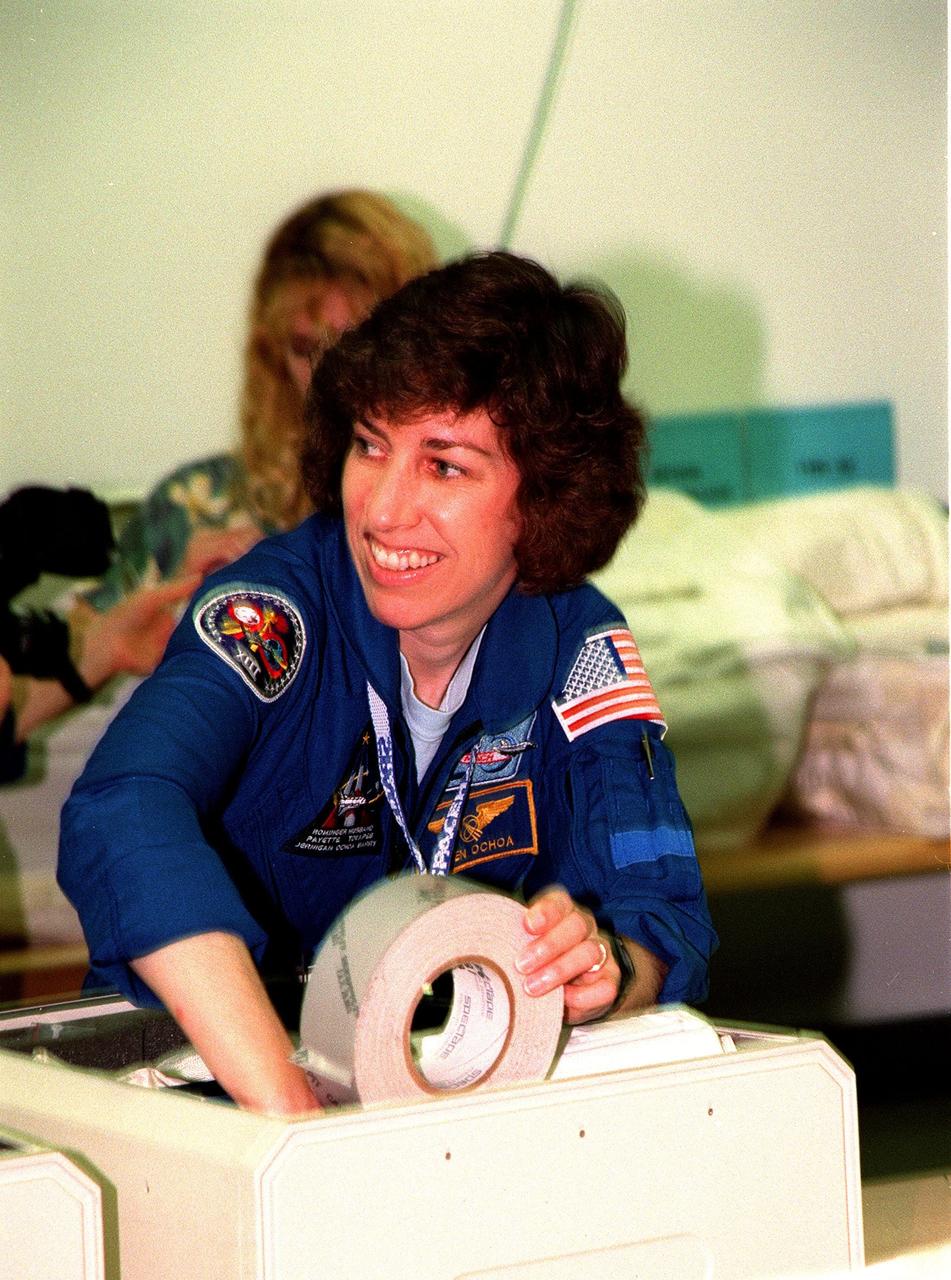
KENNEDY SPACE CENTER, FLA. -- STS-96 Mission Specialist Ellen Ochoa gets a hands-on look at equipment at the SPACEHAB Facility. Members of the STS-96 crew are taking part in a bench review at SPACEHAB as part of familiarization activities for their upcoming mission. The crew also includes Commander Kent V. Rominger, Pilot Rick Husband and Mission Specialists Tamara E. Jernigan, Daniel Barry, Julie Payette and Valery Ivanovich Tokarev. Payette is with the Canadian Space Agency and Tokarev with the Russian Space Agency. Mission STS-96 is the second flight in construction of the International Space Station and will include the SPACEHAB. The 10-day mission is targeted for launch on May 24, 1999, at Launch Pad 39B

KENNEDY SPACE CENTER, FLA. -- In the SPACEHAB Facility for a payload Interface Verification Test (IVT) for their upcoming mission to the International Space Station are (kneeling) STS-96 Mission Specialists Julie Payette and Ellen Ochoa, Pilot Rick Husband, and (standing at right) Mission Specialist Dan Barry. At the left is James Behling, with Boeing, explaining some of the equipment that will be on board STS-96. Other STS-96 crew members at KSC for the IVT are Commander Kent Rominger and Mission Specialists Tamara Jernigan and Valery Tokarev of Russia. Mission STS-96 carries the SPACEHAB Logistics Double Module, which will have equipment to further outfit the International Space Station service module and equipment that can be off-loaded from the early U.S. assembly flights. It carries internal logistics and resupply cargo for station outfitting, plus an external Russian cargo crane to be mounted to the exterior of the Russian station segment and used to perform space walking maintenance activities. The double module stowage provides capacity of up to 10,000 lbs. with the ability to accommodate powered payloads, four external rooftop stowage locations, four double-rack locations (two powered), up to 61 bulkhead-mounted middeck locker locations, and floor storage for large unique items and Soft Stowage. STS-96 is targeted to launch May 20 about 9:32 a.m
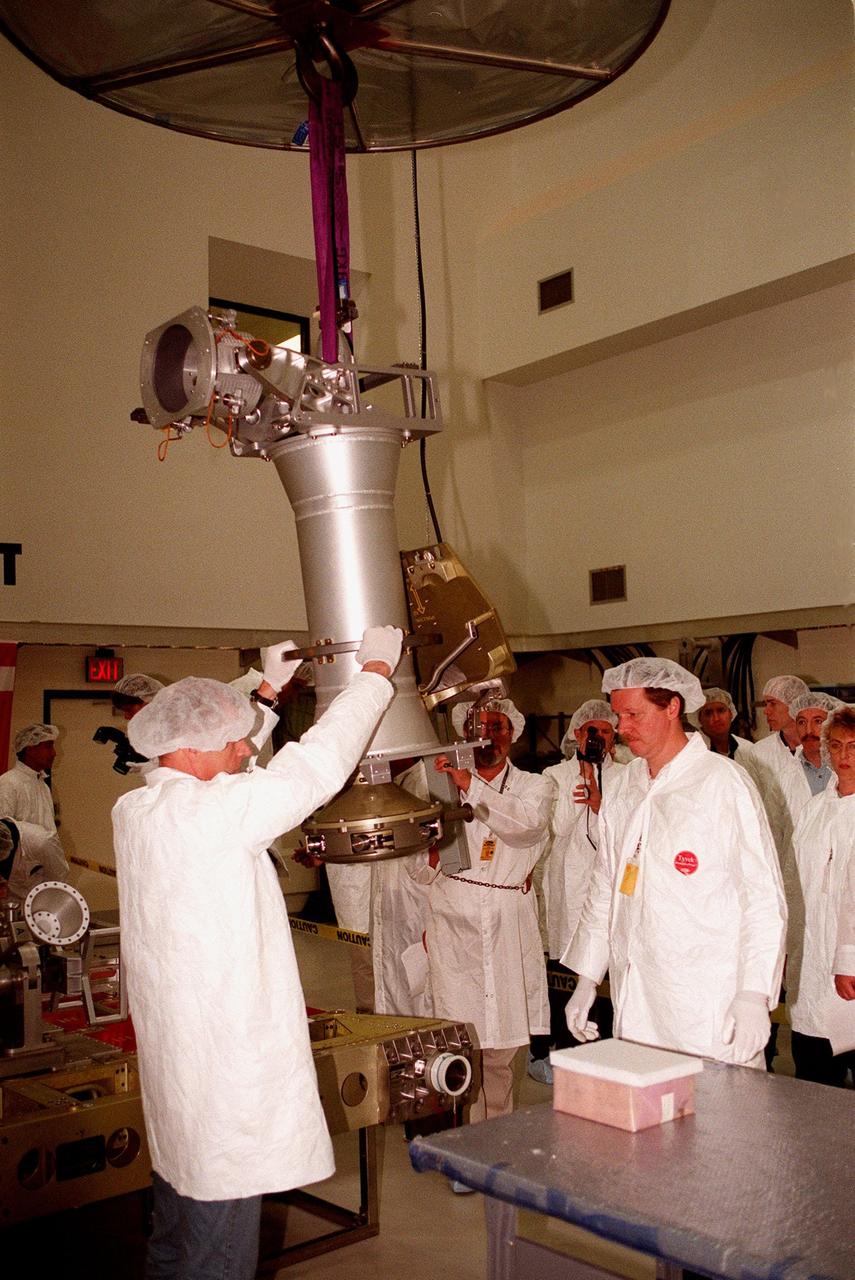
At Astrotech in Titusville, Fla., technicians with DaimlerChrysler Aerospace and RSC Energia of Korolev, Russia, maneuver a Russian cargo crane, the Strela, which is to be mounted to the exterior of the Russian station segment on the International Space Station (ISS). The Strehla has been the focus for two Shuttle crews, STS-96 who are at KSC for a Crew Equipment Interface Test, and STS-101, for payload familiarization. For the first time, STS-96 will include an Integrated Cargo Carrier (ICC) that will carry the Russian cargo crane; the SPACEHAB Oceaneering Space System Box (SHOSS), which is a logistics items carrier; and a U.S.-built crane (ORU Transfer Device, or OTD) that will be stowed on the station for use during future ISS assembly missions. The ICC can carry up to 6,000 lb of unpressurized payload. It was built for SPACEHAB by DaimlerChrysler Aerospace and RSC Energia. STS-96 is targeted for launch on May 24 from Launch Pad 39B. STS-101 is scheduled to launch in early December 1999
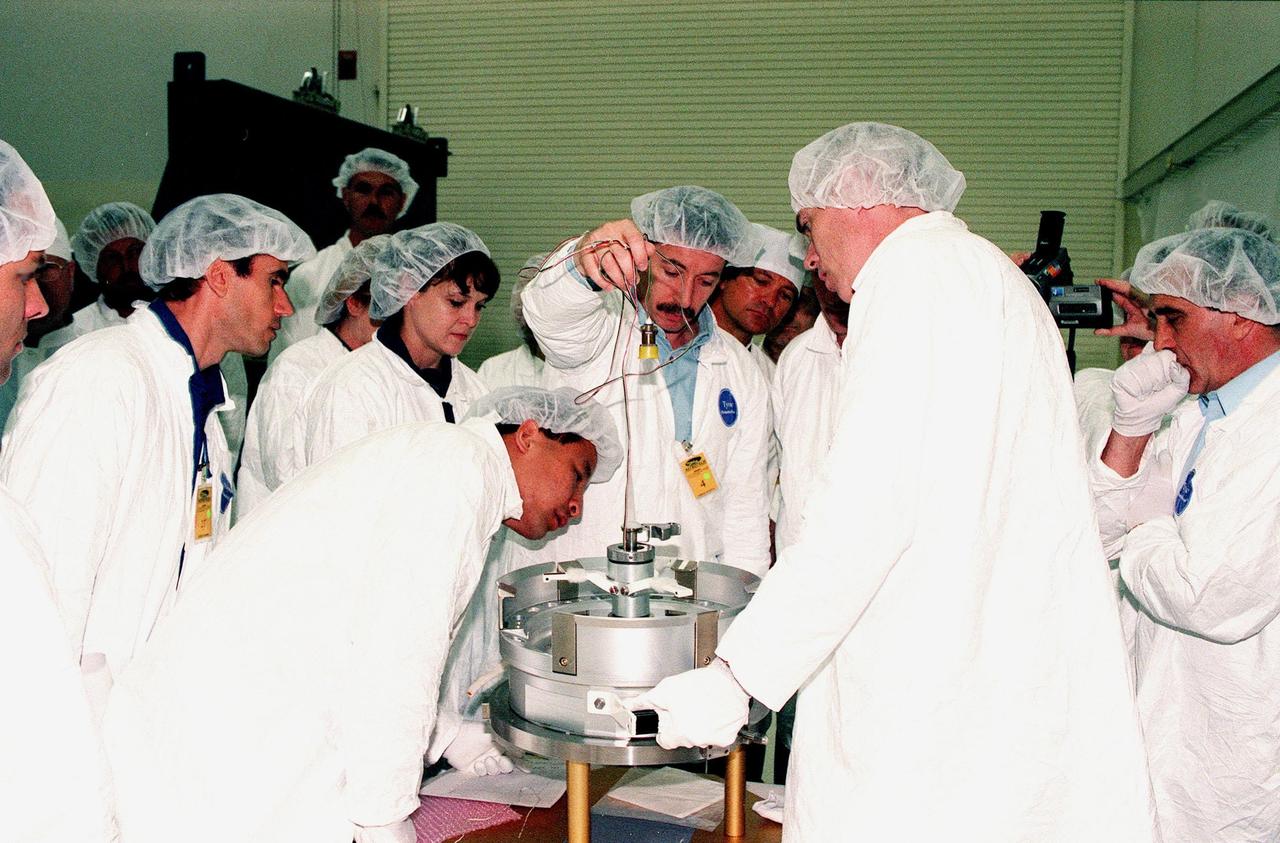
Two Shuttle crews take part in familiarization activities at Astrotech in Titusville, Fla. From left are STS-101 Mission Specialist Jeffrey N. Williams and Yuri Ivanovich Malenchenko, with the Russian Space Agency; STS-96 Mission Specialist Tamara E. Jernigan; STS-101 Mission Specialist Edward Tsang Lu (leaning over); a technician with RSC Energia of Korolev, Russia; Manfred Nordhoff, with DaimlerChrysler Aerospace; STS-96 Mission Specialist Daniel T. Barry; and another technician with RSC Energia. They are looking at components of the Russian cargo crane, Strela, to be mounted to the exterior of the Russian station segment on the International Space Station (ISS). Both missions include the SPACEHAB Double Module, carrying internal and resupply cargo for Station outfitting. For the first time, STS-96 will include an Integrated Cargo Carrier (ICC) that will carry the Strela; the SPACEHAB Oceaneering Space System Box (SHOSS), which is a logistics items carrier; and a U.S.-built crane (ORU Transfer Device, or OTD) that will be stowed on the station for use during future ISS assembly missions. The ICC can carry up to 6,000 lb of unpressurized payload. It was built for SPACEHAB by DaimlerChrysler Aerospace of Bremen and RSC Energia of Korolev, Russia. STS-96 is targeted for launch on May 24 from Launch Pad 39B. STS-101 is scheduled to launch in early December 1999
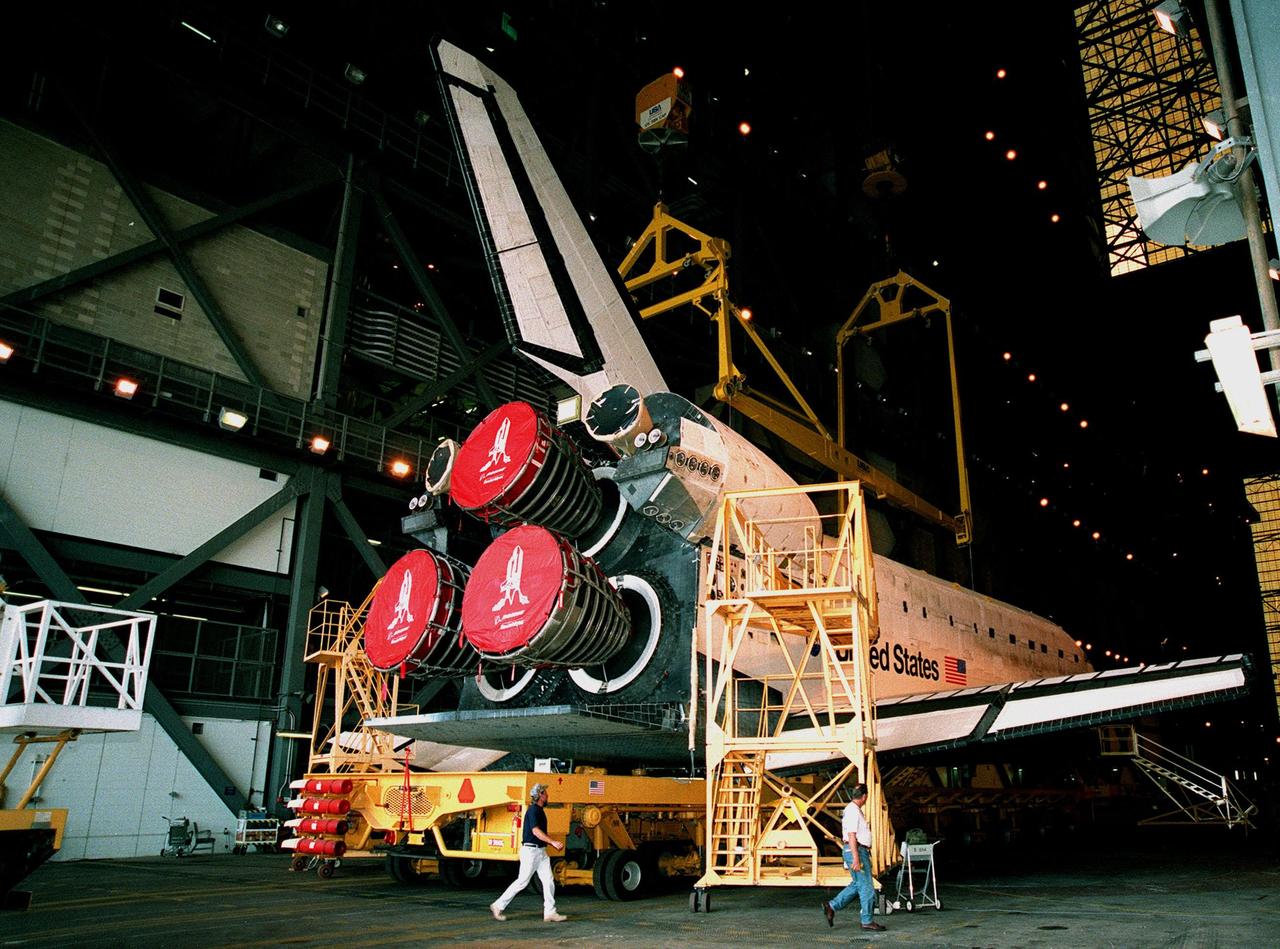
KENNEDY SPACE CENTER, FLA. -- The Space Shuttle orbiter Discovery rests inside the Vehicle Assembly Building after rollover from the Orbiter Processing Facility bay 1. Discovery is being readied for the next mission, STS-96, which is targeted for launch on May 20 from Launch Pad 39B. STS-96 is a logistics and resupply mission for the International Space Station, carrying such payloads as a Russian crane, the Strehla; a U.S.-built crane; a Shuttle Vibration Forces experiment; and STARSHINE, a student-led experiment
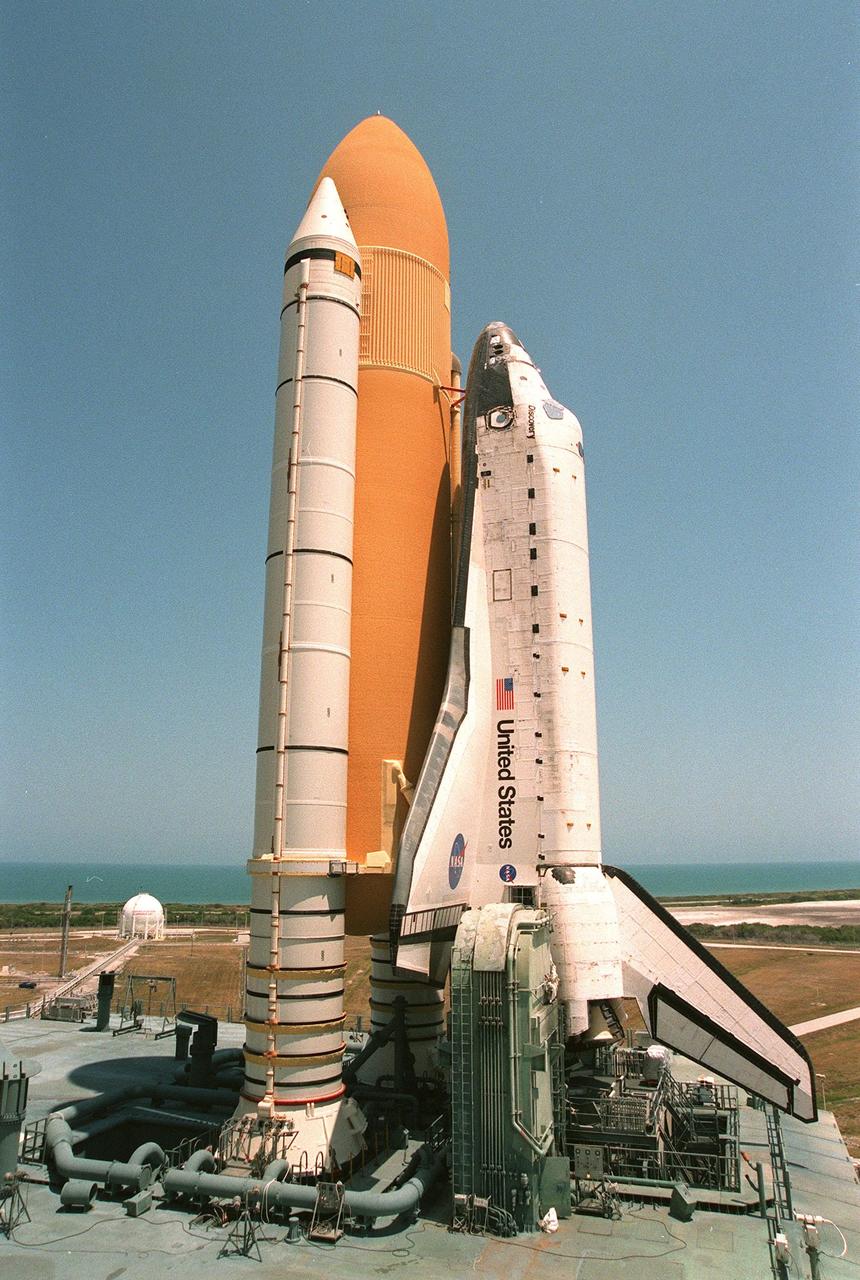
KENNEDY SPACE CENTER, FLA. -- Against the backdrop of a clear blue sky and the bluer Atlantic Ocean, the Space Shuttle Discovery, on its mobile launcher platform, sits on Launch Pad 39B. Liftoff of Discovery on mission STS-96 is targeted for May 20 at 9:32 a.m. EDT. STS-96 is a logistics and resupply mission for the International Space Station, carrying such payloads as a Russian crane, the Strela; a U.S.-built crane; the Spacehab Oceaneering Space System Box (SHOSS), a logistics items carrier; and STARSHINE, a student-led experiment
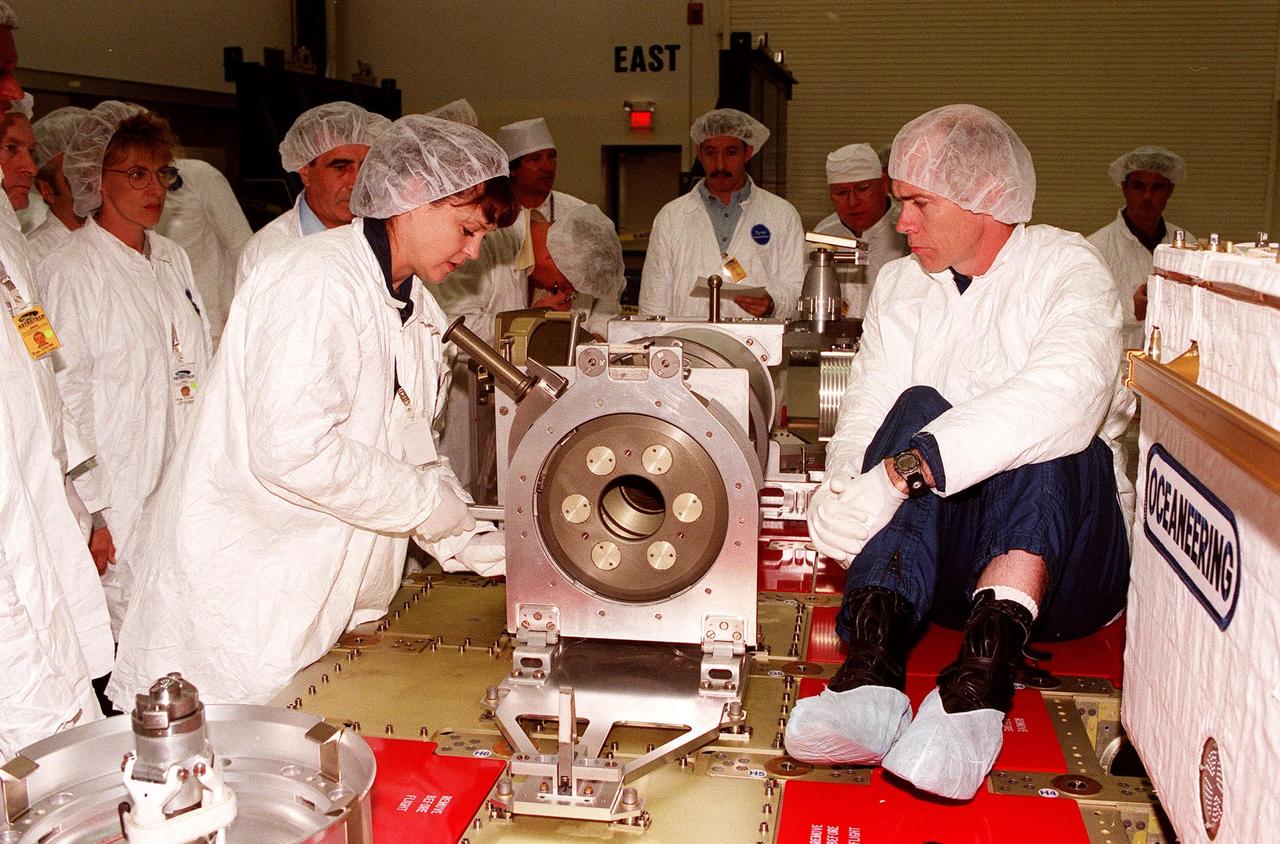
At Astrotech in Titusville, Fla., STS-96 Mission Specialists Tamara E. Jernigan and Daniel T. Barry take turns working with a Russian cargo crane, the Strela, which is to be mounted to the exterior of the Russian station segment on the International Space Station (ISS). Technicians around the table observe. The STS-96 crew is taking part in a Crew Equipment Interface Test. Other members participating are Commander Kent V. Rominger, Pilot Rick Douglas Husband, and Mission Specialists Julie Payette, with the Canadian Space Agency, and Valery Ivanovich Tokarev, with the Russian Space Agency. For the first time, STS-96 will include an Integrated Cargo Carrier (ICC) that will carry the Russian cargo crane; the SPACEHAB Oceaneering Space System Box (SHOSS), which is a logistics items carrier; and a U.S.-built crane (ORU Transfer Device, or OTD) that will be stowed on the station for use during future ISS assembly missions. The ICC can carry up to 6,000 lb of unpressurized payload. It was built for SPACEHAB by DaimlerChrysler Aerospace and RSC Energia of Korolev, Russia. STS-96 is targeted for launch on May 24 from Launch Pad 39B. STS-101 is scheduled to launch in early December 1999
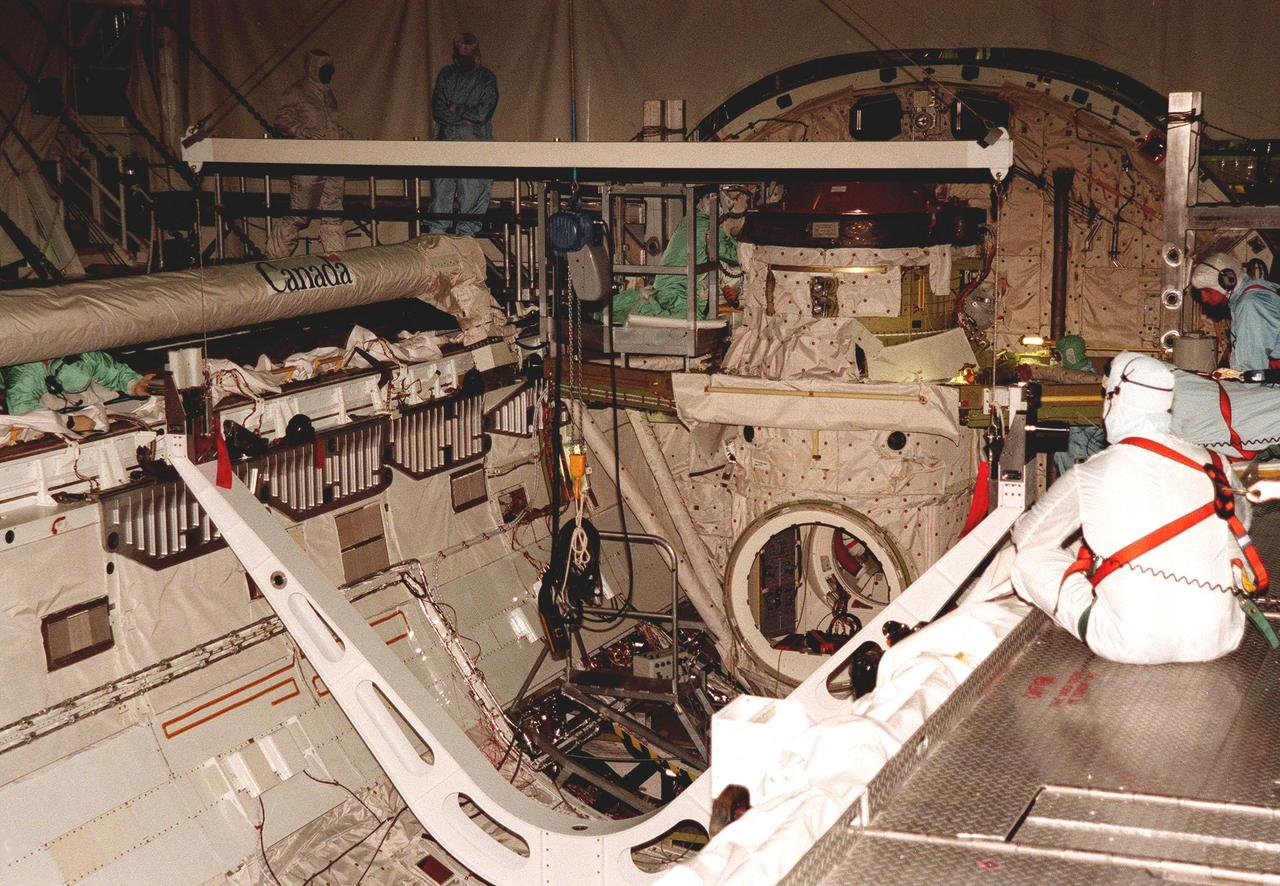
KENNEDY SPACE CENTER, FLA. -- Workers in the Orbiter Processing Facility (OPF) Bay 1 check the Keel Yoke Device (KYD) installed in the orbiter Discovery. The KYD will support the International Cargo Carrier (ICC) to be fitted in the orbiter for mission STS-96. The ICC will carry unpressurized cargo such as the external Russian cargo crane known as STRELA, the SPACEHAB Oceaneering Space System Box (SHOSS), which is a logistics items carrier, and an ORU Transfer Device (OTD), a U.S.-built crane that will be stowed on the station for use during future ISS assembly missions. The primary payload of STS-96 is the SPACEHAB Double Module, an element of the International Space Station. STS-96 is targeted for launch on May 20 at 9:32 a.m. from Launch Pad 39B
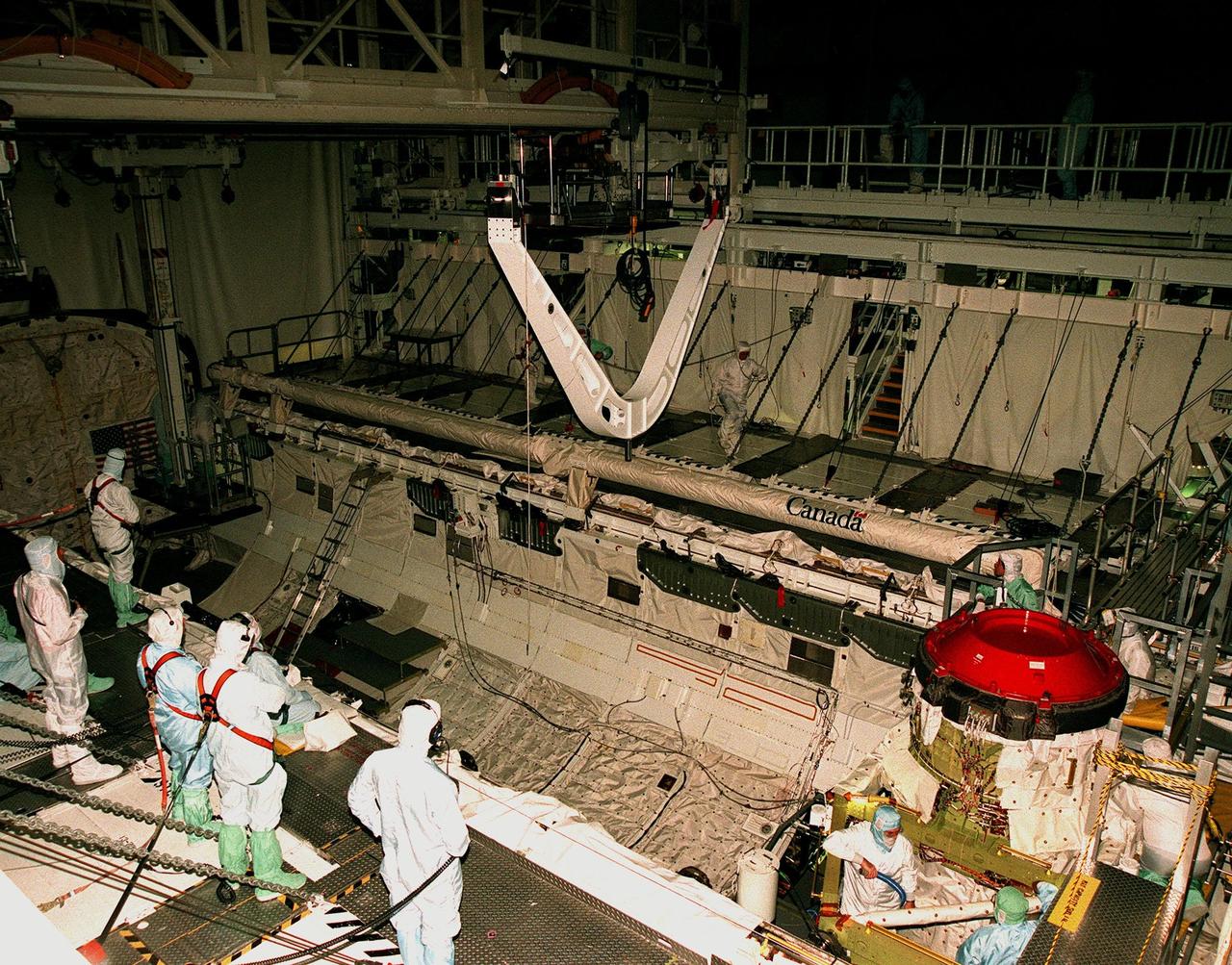
KENNEDY SPACE CENTER, FLA. -- Workers in the Orbiter Processing Facility (OPF) Bay 1 watch as the Keel Yoke Device (KYD) is lowered by crane into the open payload bay of the orbiter Discovery. The KYD will support the International Cargo Carrier (ICC) to be installed in the orbiter for mission STS-96. The ICC will carry unpressurized cargo such as the external Russian cargo crane known as STRELA, the SPACEHAB Oceaneering Space System Box (SHOSS), which is a logistics items carrier, and an ORU Transfer Device (OTD), a U.S.-built crane that will be stowed on the station for use during future ISS assembly missions. The primary payload of STS-96 is the SPACEHAB Double Module, an element of the International Space Station. . STS-96 is targeted for launch on May 20 at 9:32 a.m. from Launch Pad 39B
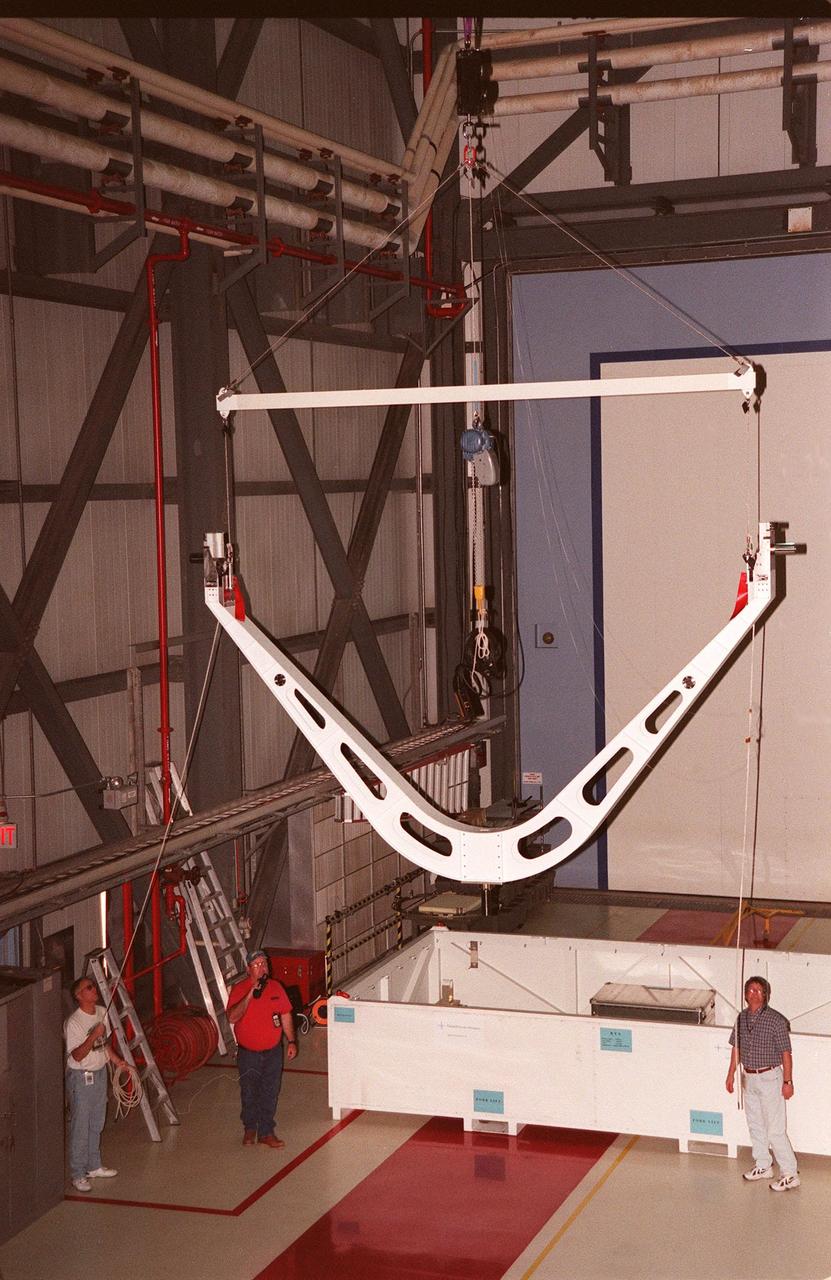
KENNEDY SPACE CENTER, FLA. -- In the Orbiter Processing Facility (OPF) Bay 1, workers lift the Keel Yoke Device (KYD) that will be fitted inside the payload bay of orbiter Discovery. The KYD will support the International Cargo Carrier (ICC) to be installed in the orbiter for mission STS-96. The ICC will carry unpressurized cargo such as the external Russian cargo crane known as STRELA, the SPACEHAB Oceaneering Space System Box (SHOSS), which is a logistics items carrier, and an ORU Transfer Device (OTD), a U.S.-built crane that will be stowed on the station for use during future ISS assembly missions. The primary payload of STS-96 is the SPACEHAB Double Module, an element of the International Space Station. STS-96 is targeted for launch on May 20 at 9:32 a.m. from Launch Pad 39B
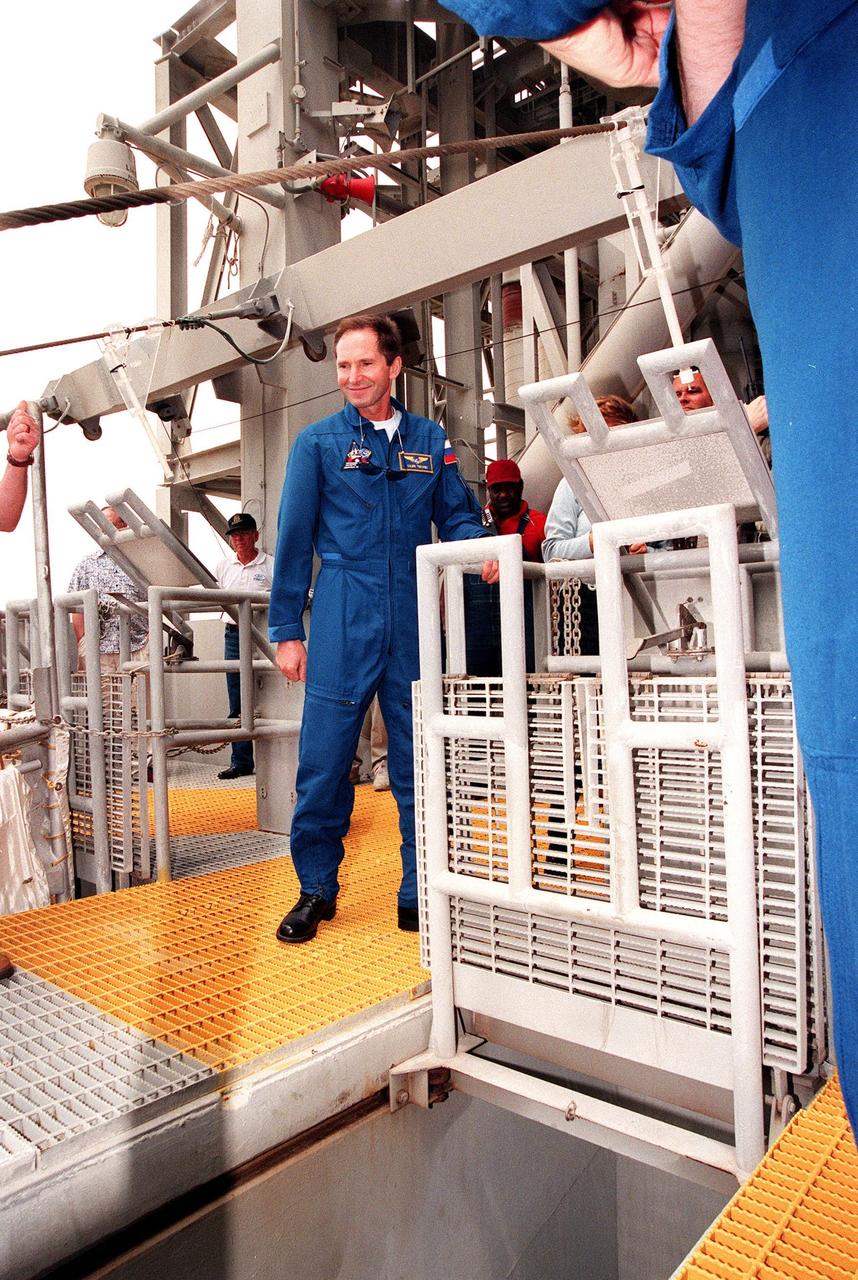
At the 195-foot level of Launch Pad 39B, STS-96 Mission Specialist Valery Ivanovich Tokarev releases a slidewire basket, part of emergency egress training. The STS-96 crew are taking part in Terminal Countdown Demonstration Test activities which also provide simulated countdown exercises and opportunities to inspect the mission payloads in the orbiter's payload bay. The other crew members are Commander Kent V. Rominger, Pilot Rick Douglas Husband and Mission Specialists Ellen Ochoa (Ph.D.), Tamara E. Jernigan (Ph.D.), Daniel Barry (M.D., Ph.D.) and Julie Payette, with the Canadian Space. STS-96, which is scheduled for liftoff on May 20 at 9:32 a.m., is a logistics and resupply mission for the International Space Station, carrying such payloads as a Russian crane, the Strela; a U.S.-built crane; the Spacehab Oceaneering Space System Box (SHOSS), a logistics items carrier; and STARSHINE, a student-led experiment

KENNEDY SPACE CENTER, FLA. -- Workers in the Orbiter Processing Facility (OPF) Bay 1 make final adjustments to the Keel Yoke Device (KYD) being installed in the orbiter Discovery. The KYD will support the International Cargo Carrier (ICC) to be fitted in the orbiter for mission STS-96. The ICC will carry unpressurized cargo such as the external Russian cargo crane known as STRELA, the SPACEHAB Oceaneering Space System Box (SHOSS), which is a logistics items carrier, and an ORU Transfer Device (OTD), a U.S.-built crane that will be stowed on the station for use during future ISS assembly missions. The primary payload of STS-96 is the SPACEHAB Double Module, an element of the International Space Station. STS-96 is targeted for launch on May 20 at 9:32 a.m. from Launch Pad 39B
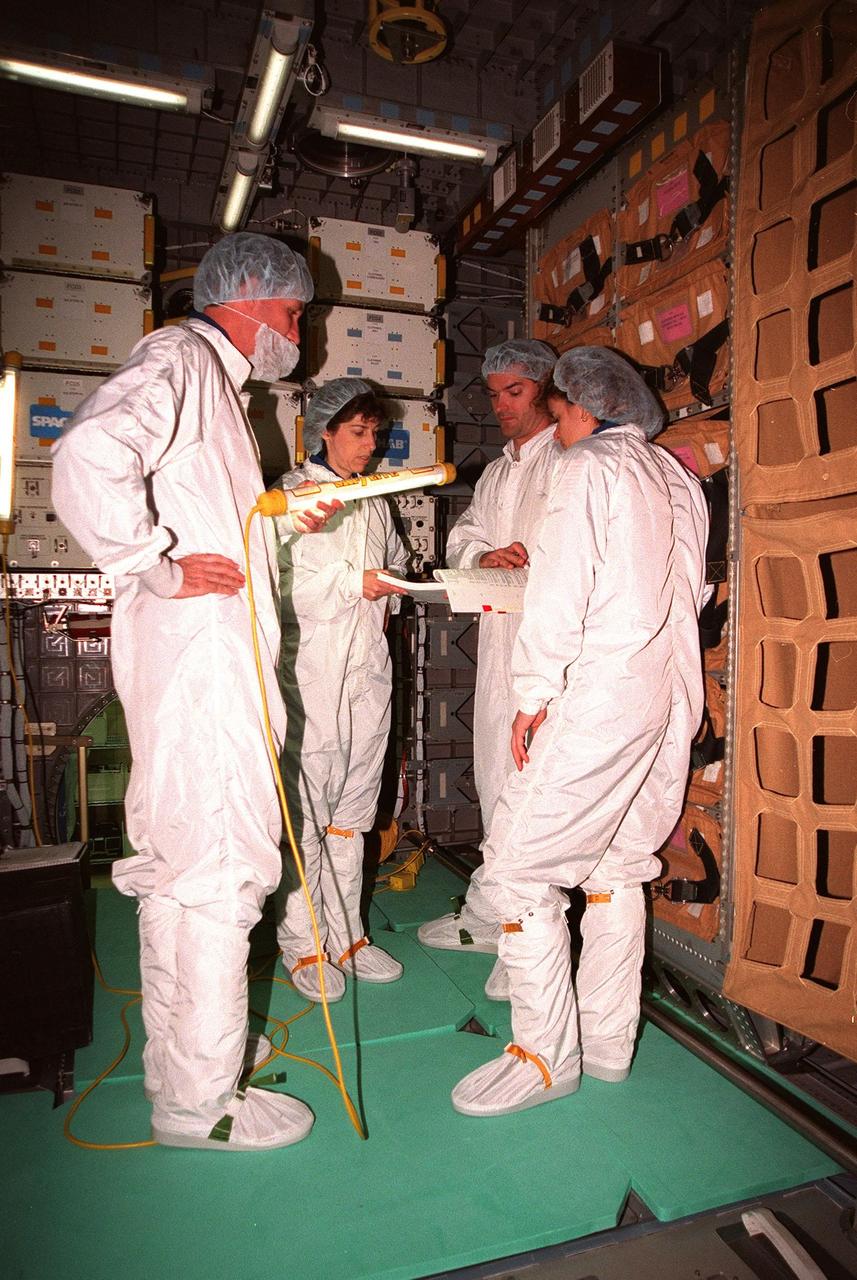
KENNEDY SPACE CENTER, FLA. -- Inside the SPACEHAB module, (left to right) STS-96 Commander Kent V. Rominger and Mission Specialists Ellen Ochoa and Julie Payette (far right) review equipment use with Chris Jaskoika (second from right), of Boeing SPACEHAB. Members of the STS-96 crew are taking part in a bench review at SPACEHAB as part of familiarization activities for their upcoming mission. The crew also includes Pilot Rick Husband and Mission Specialists Tamara E. Jernigan, Daniel Barry, and Valery Ivanovich Tokarev. Payette is with the Canadian Space Agency and Tokarev with the Russian Space Agency. Mission STS-96 is the second flight in construction of the International Space Station and will include the SPACEHAB. The 10-day mission is targeted for launch on May 24, 1999, at Launch Pad 39B
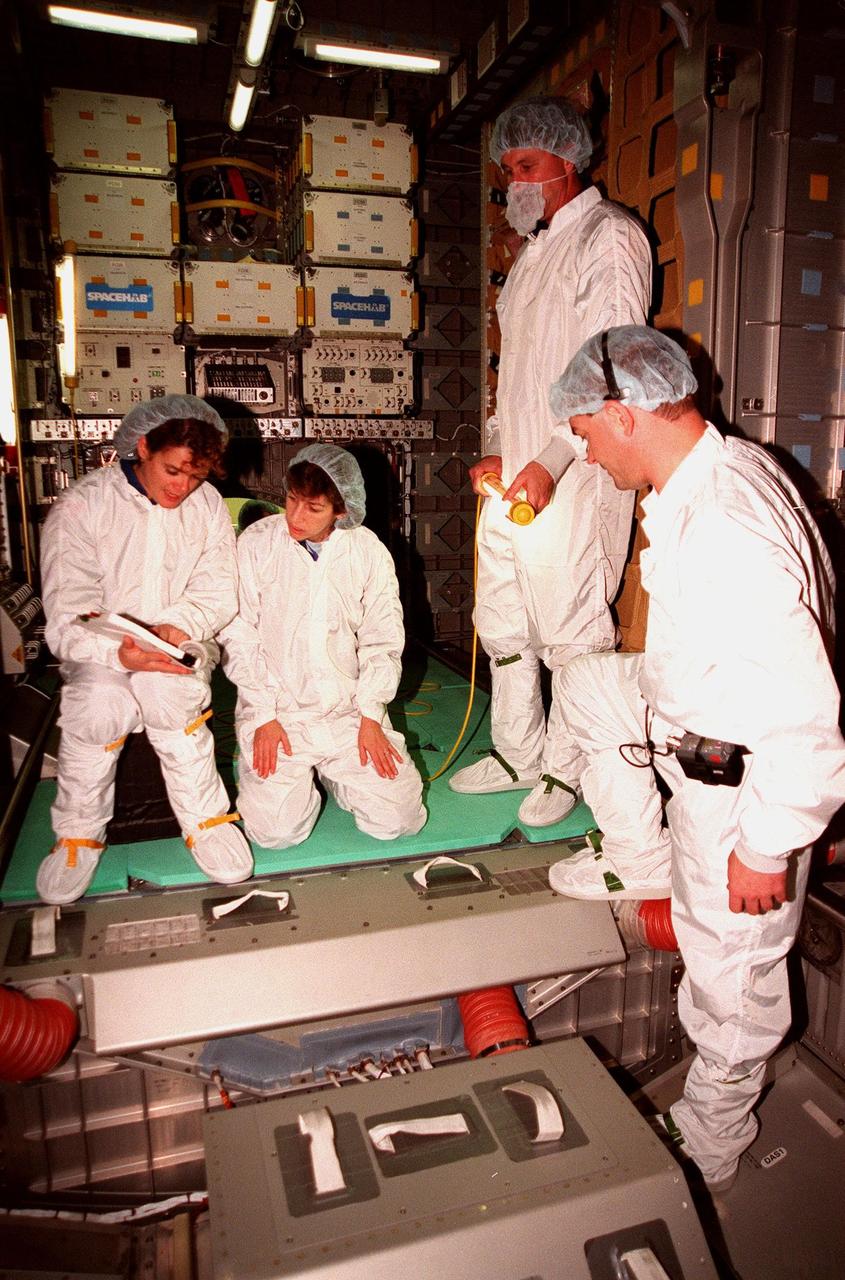
KENNEDY SPACE CENTER, FLA. -- (From left) STS-96 Mission Specialists Julie Payette and Ellen Ochoa, and Commander Kent V. Rominger check out equipment inside the SPACEHAB module. At right is Chris Jaskoika with Boeing SPACEHAB. Members of the STS-96 crew are taking part in a bench review at SPACEHAB as part of familiarization activities for their upcoming mission. The crew also includes Pilot Rick Husband and Mission Specialists Tamara E. Jernigan, Daniel Barry, and Valery Ivanovich Tokarev. Payette is with the Canadian Space Agency and Tokarev with the Russian Space Agency. Mission STS-96 is the second flight in construction of the International Space Station and will include the SPACEHAB. The 10-day mission is targeted for launch on May 24, 1999, at Launch Pad 39B
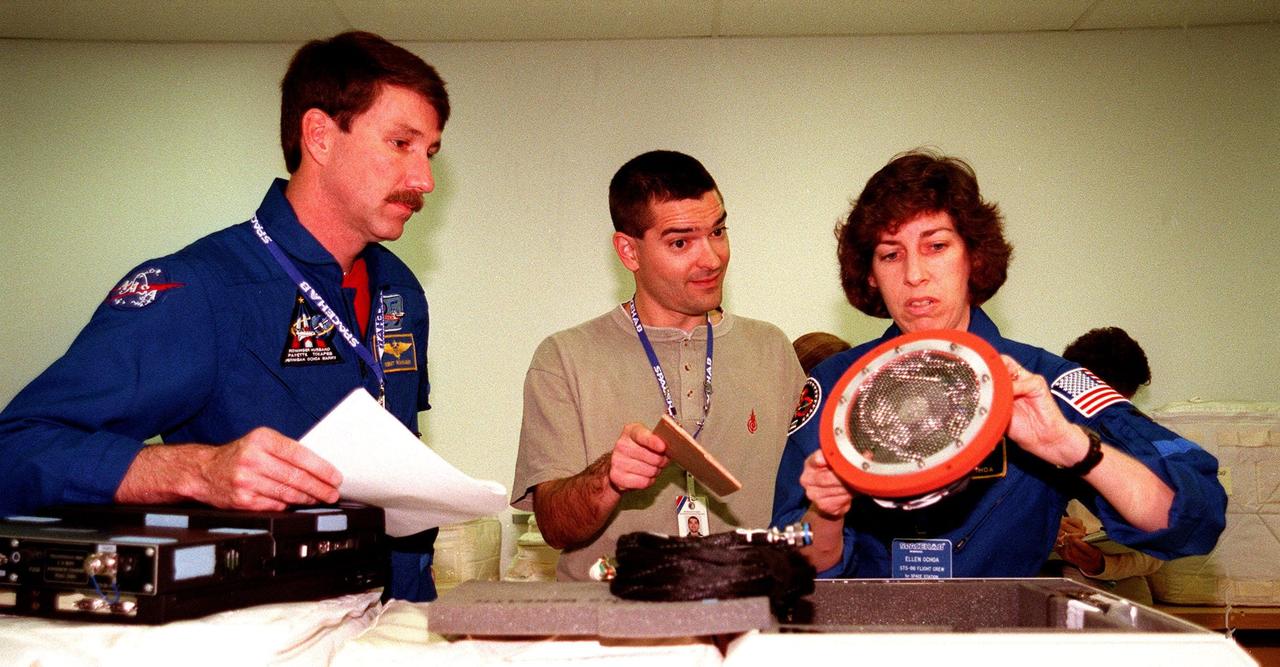
KENNEDY SPACE CENTER, FLA. -- STS-96 Commander Kent V. Rominger (left) and Mission Specialist Ellen Ochoa (right) look over equipment with Chris Jaskoika (center), of Boeing SPACEHAB. Members of the STS-96 crew are taking part in a bench review at SPACEHAB as part of familiarization activities for their upcoming mission. The crew also includes Pilot Rick Husband and Mission Specialists Tamara E. Jernigan, Daniel Barry, Julie Payette, and Valery Ivanovich Tokarev. Payette is with the Canadian Space Agency and Tokarev with the Russian Space Agency. Mission STS-96 is the second flight in construction of the International Space Station and will include the SPACEHAB. The 10-day mission is targeted for launch on May 24, 1999, at Launch Pad 39B
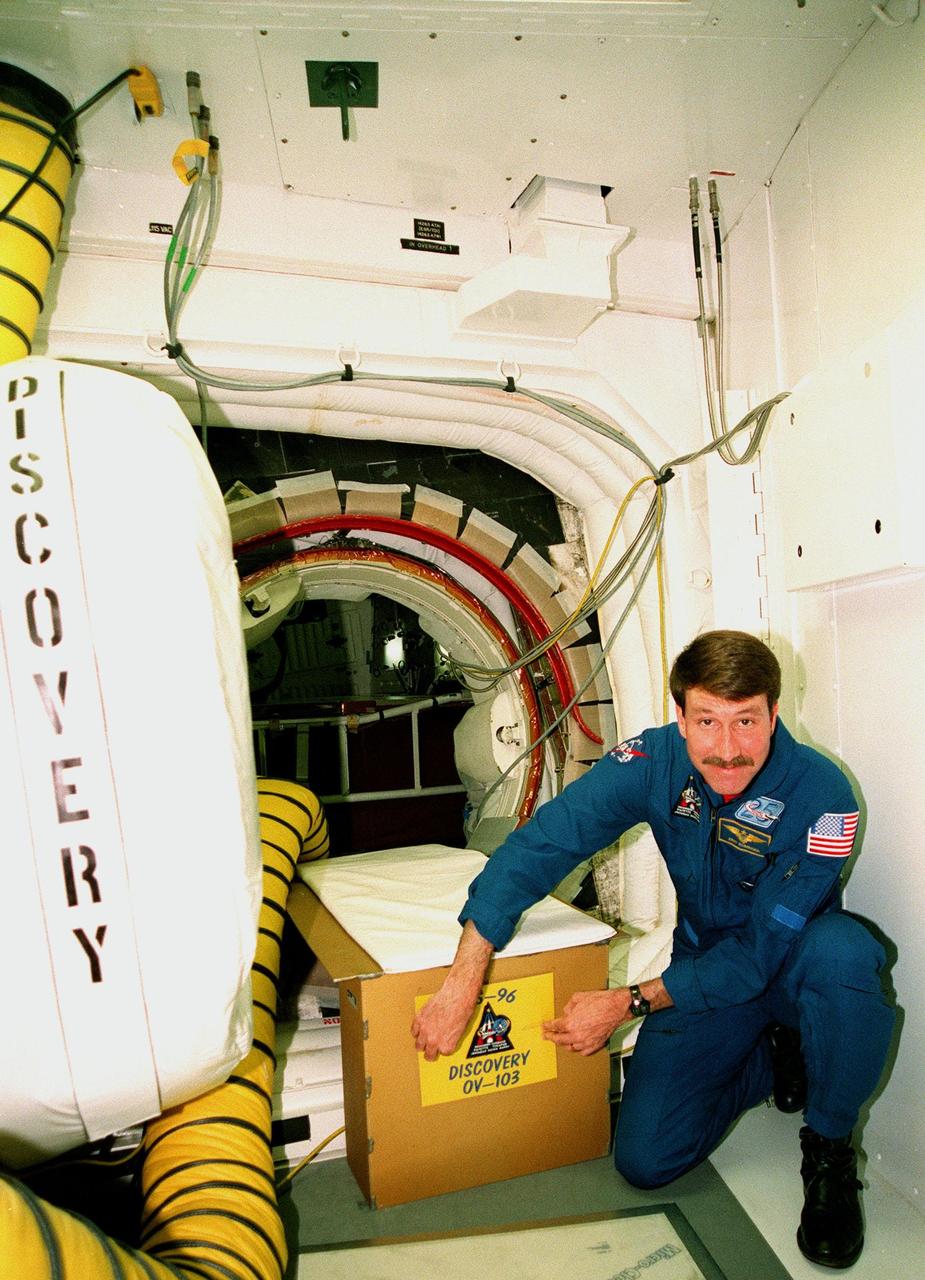
At Launch Pad 39B, STS-96 Commander Kent V. Rominger places a crew patch on the entry into Discovery. The STS-96 crew are taking part in Terminal Countdown Demonstration Test activities which provide simulated countdown exercises, emergency egress training and opportunities to inspect the mission payloads in the orbiter's payload bay. The other crew members are Pilot Rick Douglas Husband and Mission Specialists Ellen Ochoa (Ph.D.), Tamara E. Jernigan (Ph.D.), Daniel Barry (M.D., Ph.D.), Julie Payette, with the Canadian Space Agency, and Valery Ivanovich Tokarev, with the Russian Space Agency. STS-96, which is scheduled for liftoff on May 20 at 9:32 a.m., is a logistics and resupply mission for the International Space Station, carrying such payloads as a Russian crane, the Strela; a U.S.-built crane; the Spacehab Oceaneering Space System Box (SHOSS), a logistics items carrier; and STARSHINE, a student-led experiment
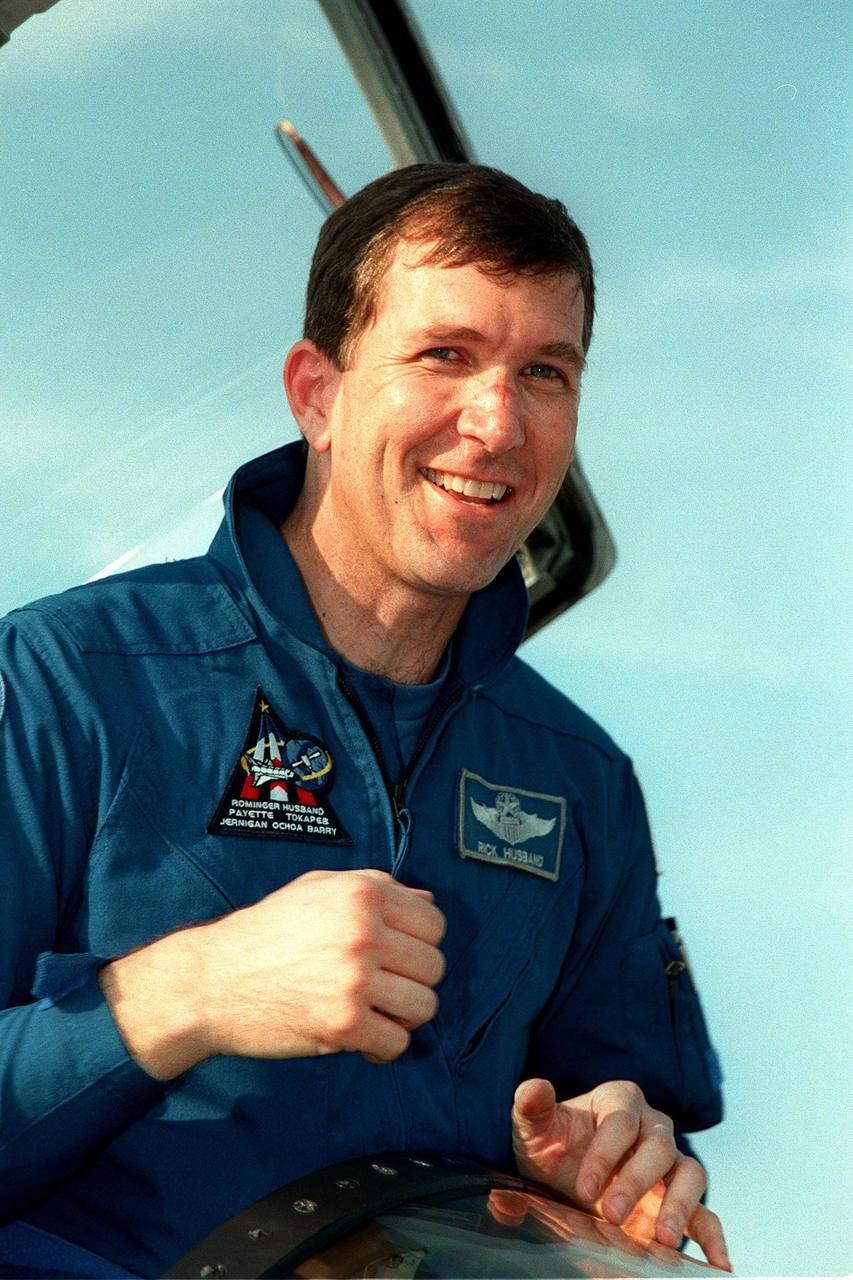
STS-96 Pilot Rick Douglas Husband arrives at the Shuttle Landing Facility in a T-38 jet aircraft. The STS-96 crew are taking part in Terminal Countdown Demonstration Test (TCDT) activities. The TCDT provides the crew with simulated countdown exercises, emergency egress training, and opportunities to inspect the mission payloads in the orbiter's payload bay. Mission STS-96, which is targeted for launch on May 20 at 9:32 a.m., is a logistics and resupply mission for the International Space Station, carrying such payloads as a Russian crane, the Strela; a U.S.-built crane; the Spacehab Oceaneering Space System Box (SHOSS), a logistics items carrier; and STARSHINE, a student-led experiment. Others in the STS-96 crew are Commander Kent V. Rominger and Mission Specialists Ellen Ochoa (Ph.D.), Tamara E. Jernigan (Ph.D.), Daniel Barry (M.D., Ph.D.), Julie Payette and Valery Ivanovich Tokarev. Payette represents the Canadian Space Agency and Tokarev the Russian Space Agency

In the Orbiter Processing Facility bay 1, STS-96 Mission Specialist Julie Payette, with the Canadian Space Agency, poses next to the Canadian arm in the payload bay of the orbiter Discovery. The STS-96 crew is at KSC for a Crew Equipment Interface Test. Other crew members are Commander Kent V. Rominger, Pilot Rick Douglas Husband, and Mission Specialists Ellen Ochoa (Ph.D), Tamara E. Jernigan (Ph.D.), Daniel Barry (M.D., Ph.D.), and Valery Ivanovich Tokarev, who represents the Russian Space Agency. The primary payload of STS-96 is the SPACEHAB Double Module. In addition, the Space Shuttle will carry unpressurized cargo such as the external Russian cargo crane known as STRELA; the Spacehab Oceaneering Space System Box (SHOSS), which is a logistics items carrier; and an ORU Transfer Device (OTD), a U.S.-built crane that will be stowed on the station for use during future ISS assembly missions. These cargo items will be stowed on the International Cargo Carrier, fitted inside the payload bay behind the SPACEHAB module. STS-96 is targeted for launch on May 24 from Launch Pad 39B

CAPE CANAVERAL, Fla. -- In bay 1 of the Orbiter Processing Facility at NASA's Kennedy Space Center in Florida, STS-96 mission specialist Julie Payette of the Canadian Space Agency poses next to the Canadian arm in the payload bay of the space shuttle Discovery. The STS-96 crew is at Kennedy for a Crew Equipment Interface Test. Other crew members are Commander Kent Rominger, Pilot Rick Douglas Husband, and Mission Specialists Ellen Ochoa, Tamara Jernigan, Daniel Barry, and Valery Tokarev of the Russian Space Agency. The primary payload of STS-96 is the SPACEHAB Double Module. In addition, the space shuttle will carry unpressurized cargo such as the external Russian cargo crane known as STRELA the Spacehab Oceaneering Space System Box, which is a logistics items carrier and an ORU Transfer Device, a U.S.-built crane that will be stowed on the station for use during future ISS assembly missions. These cargo items will be stowed on the International Cargo Carrier, fitted inside the payload bay behind the SPACEHAB module. STS-96 is targeted for launch on May 24, from Launch Pad 39B. Photo Credit: NASA
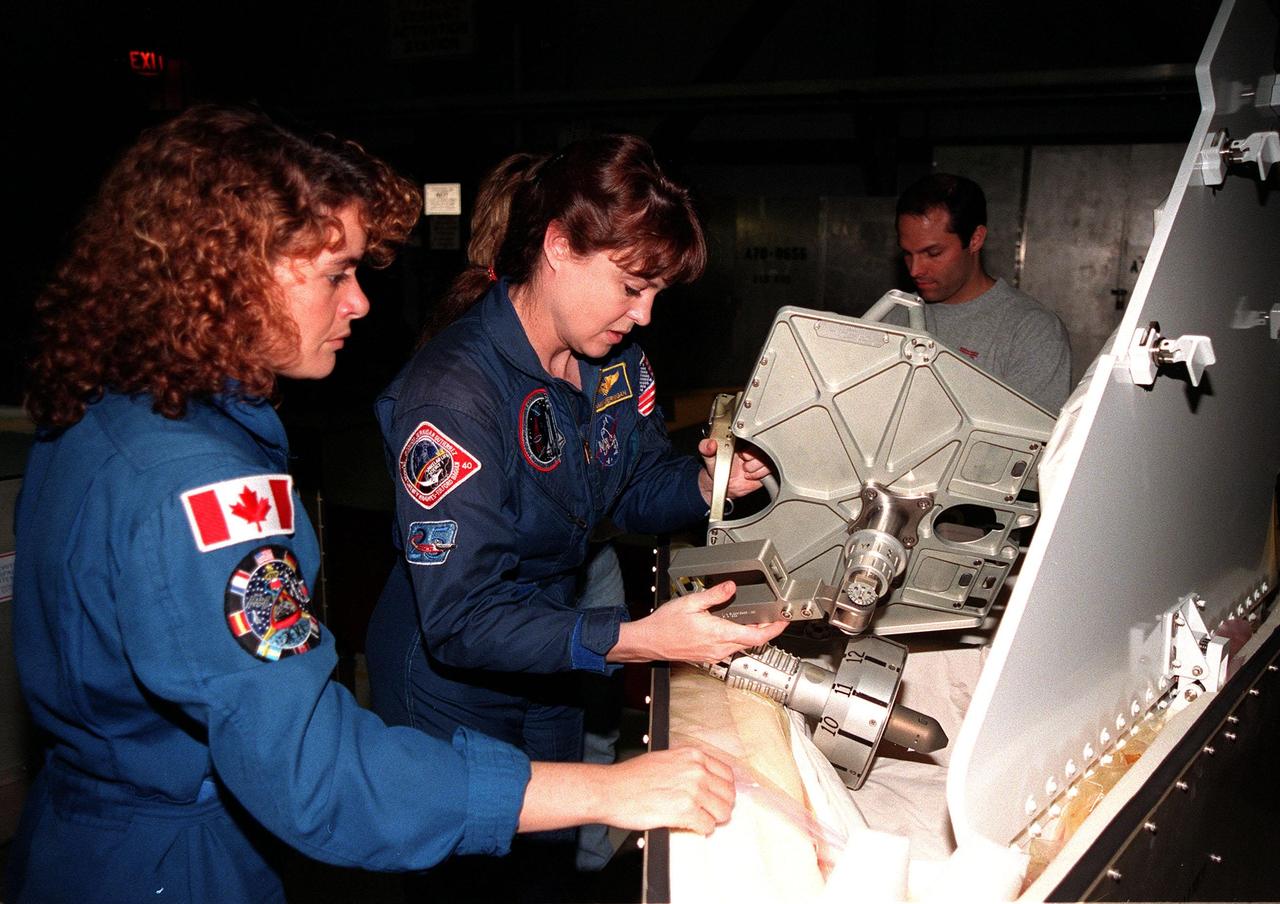
In the Orbiter Processing Facility bay 1, STS-96 Mission Specialists (left) Julie Payette, with the Canadian Space Agency, and Tamara Jernigan, Ph.D., look over the foot restraint used during space walks. The STS-96 crew is at KSC to take part in a Crew Equipment Interface Test. The other crew members are Commander Kent V. Rominger, Pilot Rick Douglas Husband, and Mission Specialists Ellen Ochoa (Ph.D), Daniel Barry (M.D., Ph.D.), and Valery Ivanovich Tokarev, who represents the Russian Space Agency. The primary payload of STS-96 is the SPACEHAB Double Module. In addition, the Space Shuttle will carry unpressurized cargo such as the external Russian cargo crane known as STRELA; the Spacehab Oceaneering Space System Box (SHOSS), which is a logistics items carrier; and an ORU Transfer Device (OTD), a U.S.-built crane that will be stowed on the station for use during future ISS assembly missions. These cargo items will be stowed on the International Cargo Carrier, fitted inside the payload bay behind the SPACEHAB module. STS-96 is targeted for launch on May 24 from Launch Pad 39B
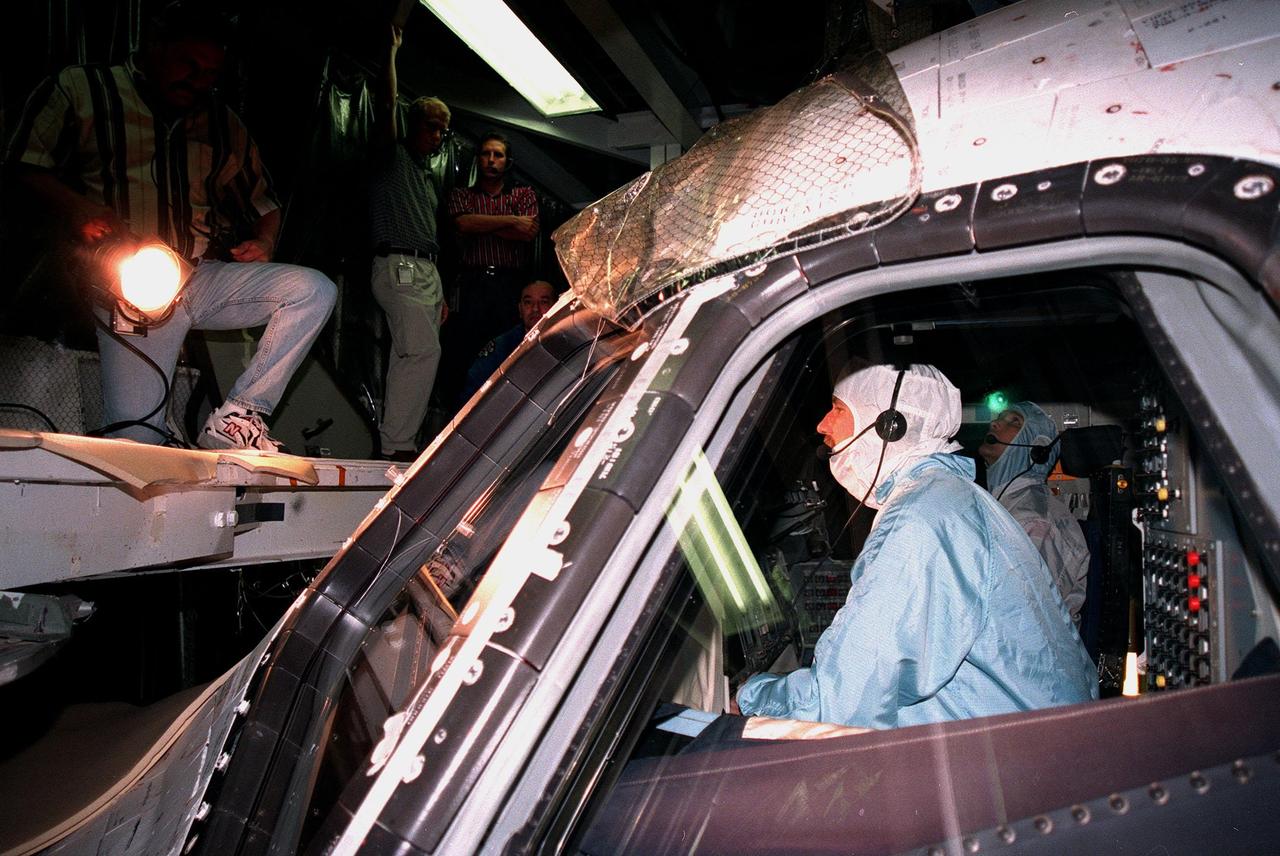
In the Orbiter Processing Facility bay 1, STS-96 Commander Kent V. Rominger checks the windows of the orbiter Discovery as a worker shines a bright light through them. The STS-96 crew is at KSC to take part in a Crew Equipment Interface Test. The other crew members are Pilot Rick Douglas Husband and Mission Specialists Ellen Ochoa (Ph.D.), Tamara E. Jernigan (Ph.D.), Daniel T. Barry (M.D., Ph.D.), Julie Payette and Valery Ivanovich Tokarev. Payette represents the Canadian Space Agency and Tokarev the Russian Space Agency. The primary payload of STS-96 is the SPACEHAB Double Module. In addition, the Space Shuttle will carry unpressurized cargo such as the external Russian cargo crane known as STRELA; the Spacehab Oceaneering Space System Box (SHOSS), which is a logistics items carrier; and an ORU Transfer Device (OTD), a U.S.-built crane that will be stowed on the station for use during future ISS assembly missions. These cargo items will be stowed on the International Cargo Carrier, fitted inside the payload bay behind the SPACEHAB module. STS-96 is targeted for launch on May 24 from Launch Pad 39B
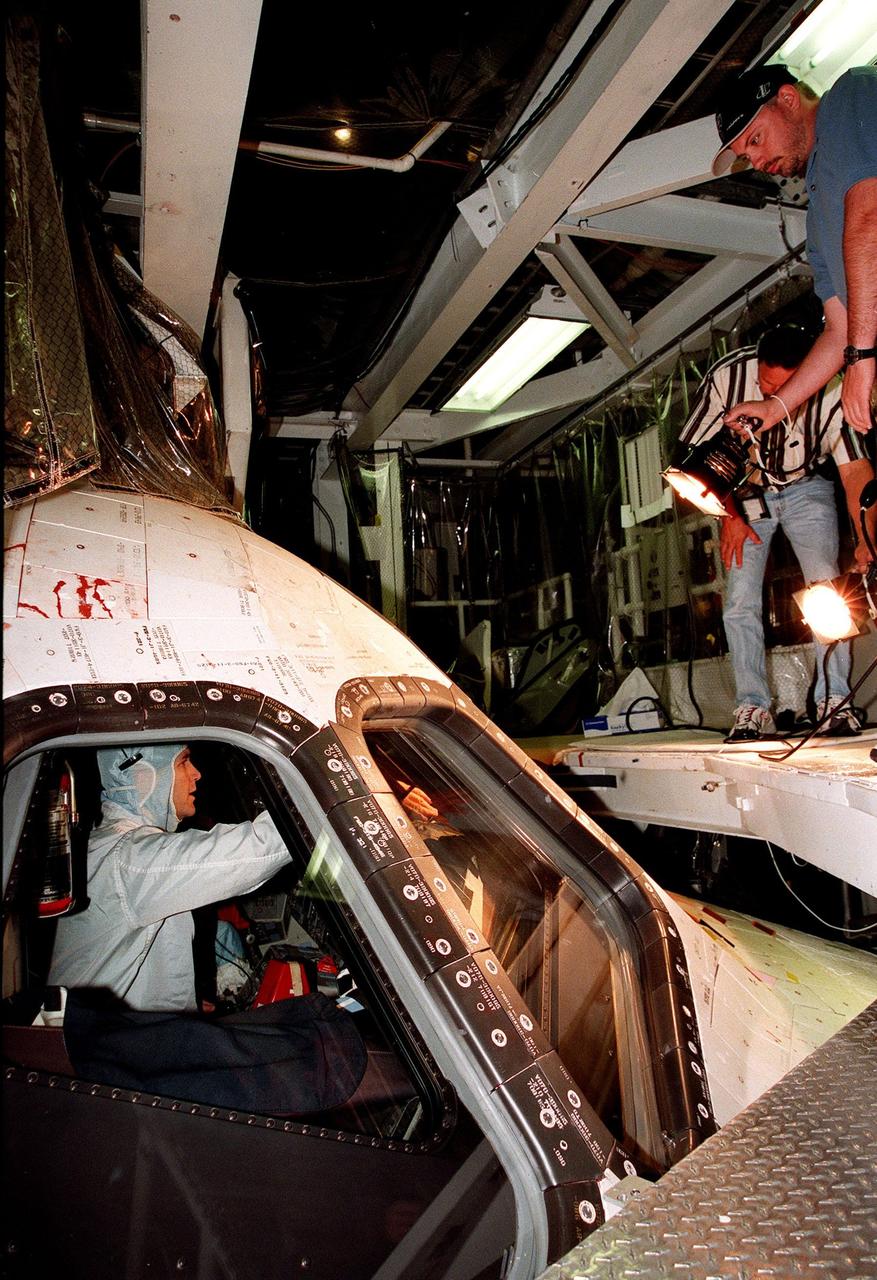
STS-96 Pilot Rick Douglas Husband checks the windows of the orbiter Discovery in the Orbiter Processing Facility bay 1 as a worker shines a light through them. The STS-96 crew is at KSC to take part in a Crew Equipment Interface Test. The other crew members are Pilot Rick Douglas Husband and Mission Specialists Ellen Ochoa (Ph.D.), Tamara E. Jernigan (Ph.D.), Daniel Barry (M.D., Ph.D.), Julie Payette and Valery Ivanovich Tokarev. Payette represents the Canadian Space Agency and Tokarev the Russian Space Agency. The primary payload of STS-96 is the SPACEHAB Double Module. In addition, the Space Shuttle will carry unpressurized cargo such as the external Russian cargo crane known as STRELA; the Spacehab Oceaneering Space System Box (SHOSS), which is a logistics items carrier; and an ORU Transfer Device (OTD), a U.S.-built crane that will be stowed on the station for use during future ISS assembly missions. These cargo items will be stowed on the International Cargo Carrier, fitted inside the payload bay behind the SPACEHAB module. STS-96 is targeted for launch on May 24 from Launch Pad 39B
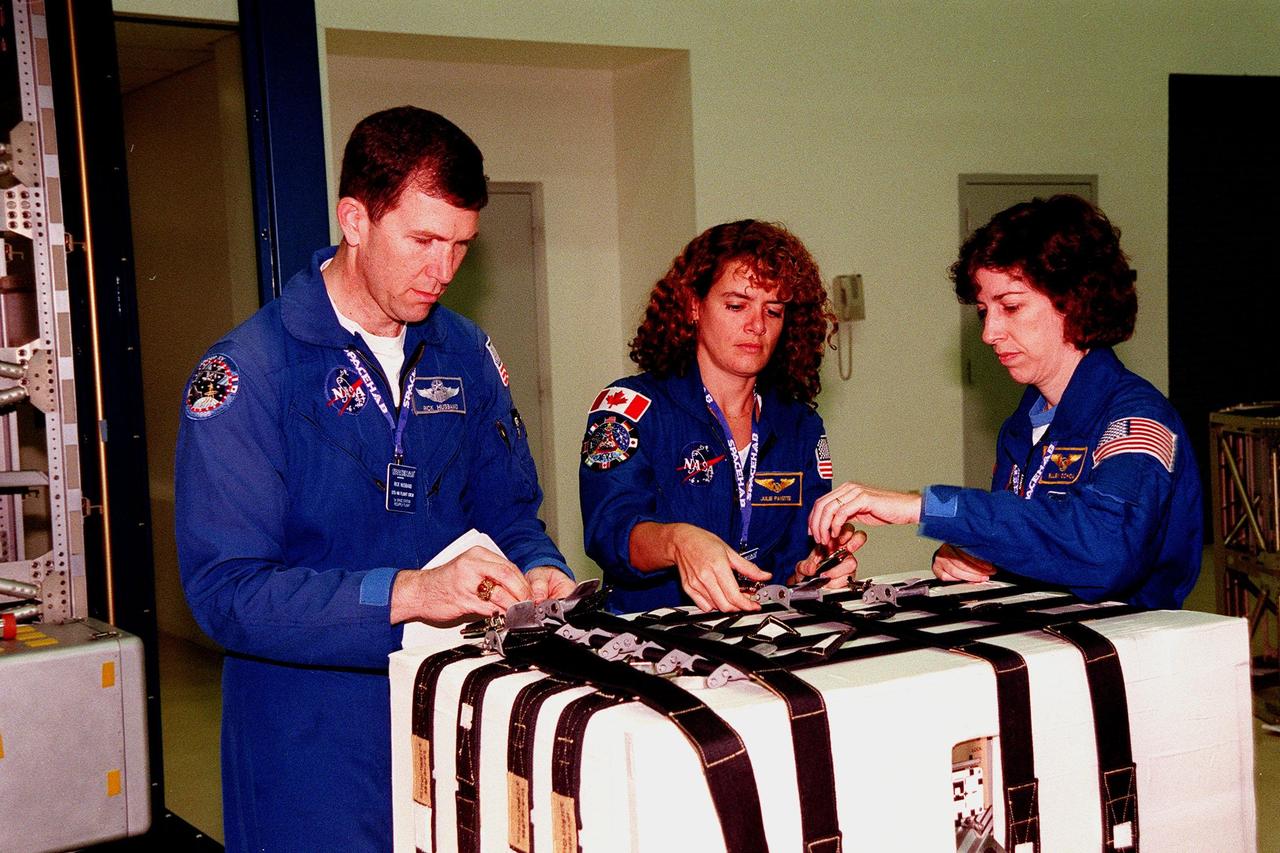
KENNEDY SPACE CENTER, FLA. -- In the SPACEHAB Facility, (left to right) STS-96 Pilot Rick Husband and Mission Specialists Julie Payette and Ellen Ochoa work the straps on the Sequential Shunt Unit (SSU) in front of them. The STS-96 crew is at KSC for a payload Interface Verification Test (IVT) for its upcoming mission to the International Space Station . Other crew members at KSC for the IVT are Commander Kent Rominger and Mission Specialists Tamara Jernigan, Dan Barry and Valery Tokarev of Russia. The SSU is part of the cargo on Mission STS-96, which carries the SPACEHAB Logistics Double Module, with equipment to further outfit the International Space Station service module and equipment that can be off-loaded from the early U.S. assembly flights. The SPACEHAB carries internal logistics and resupply cargo for station outfitting, plus an external Russian cargo crane to be mounted to the exterior of the Russian station segment and used to perform space walking maintenance activities. The double module stowage provides capacity of up to 10,000 lbs. with the ability to accommodate powered payloads, four external rooftop stowage locations, four double-rack locations (two powered), up to 61 bulkhead-mounted middeck locker locations, and floor storage for large unique items and Soft Stowage. STS-96 is targeted to launch May 20 about 9:32 a.m
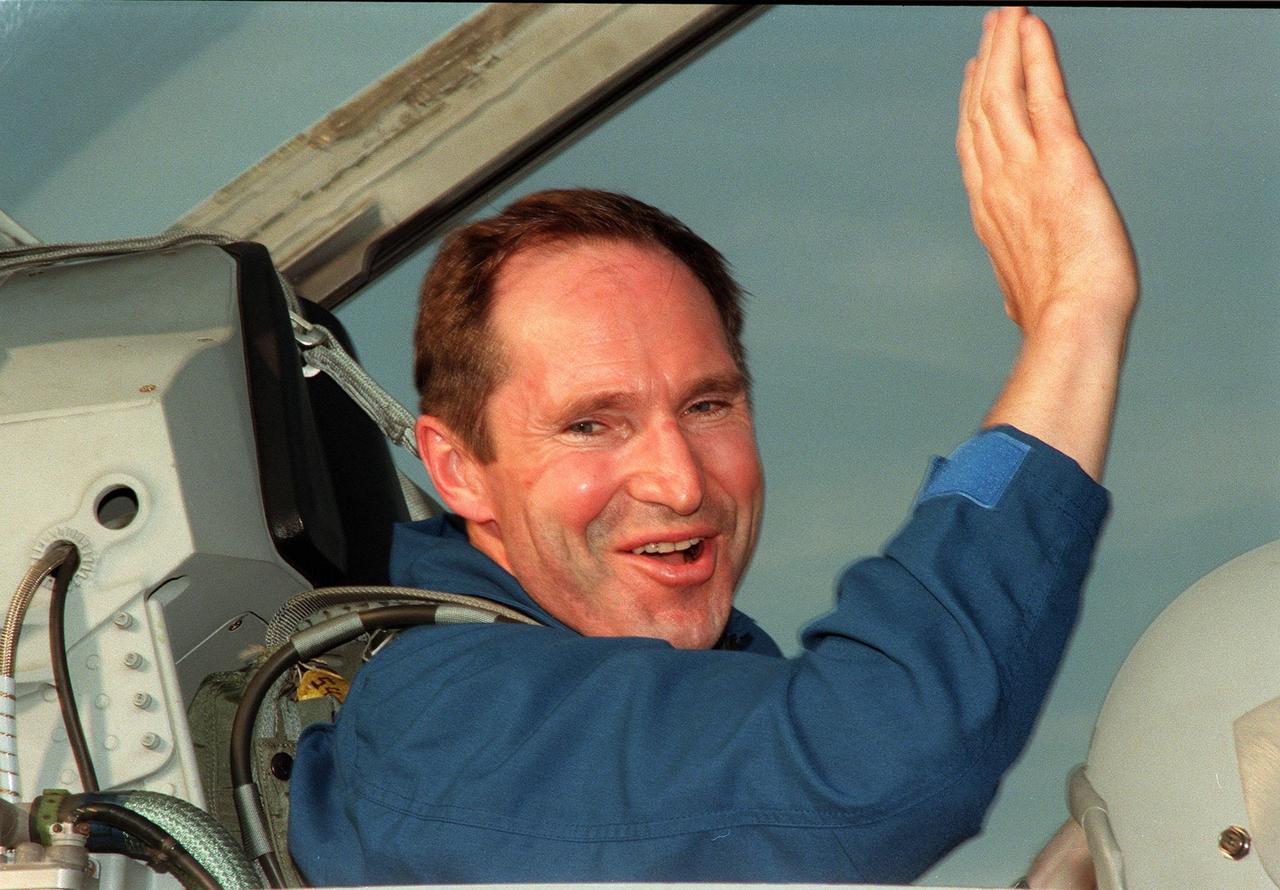
STS-96 Mission Specialist Valery Ivanovich Tokarev, who represents the Russian Space Agency, arrives at the Shuttle Landing Facility in a T-38 jet aircraft. The STS-96 crew are taking part in Terminal Countdown Demonstration Test (TCDT) activities. The TCDT provides the crew with simulated countdown exercises, emergency egress training, and opportunities to inspect the mission payloads in the orbiter's payload bay. Mission STS-96, which is targeted for launch on May 20 at 9:32 a.m., is a logistics and resupply mission for the International Space Station, carrying such payloads as a Russian crane, the Strela; a U.S.-built crane; the Spacehab Oceaneering Space System Box (SHOSS), a logistics items carrier; and STARSHINE, a student-led experiment. Others in the STS-96 crew are Commander Kent V. Rominger, Pilot Rick Douglas Husband, and Mission Specialists Ellen Ochoa (Ph.D.), Tamara E. Jernigan (Ph.D.), Daniel Barry (M.D., Ph.D.), and Julie Payette, who represents the Canadian Space Agency
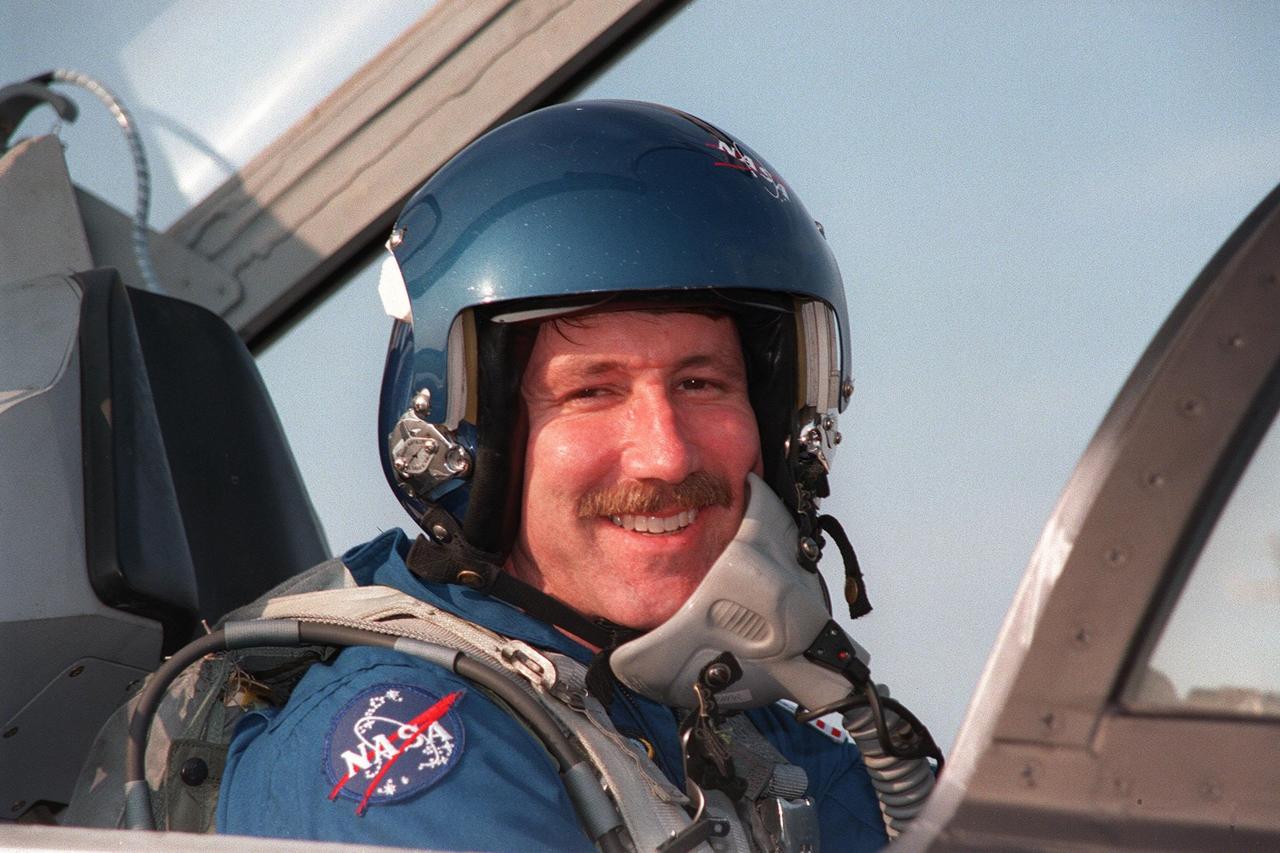
STS-96 Commander Kent V. Rominger arrives at the Shuttle Landing Facility in a T-38 jet aircraft. The STS-96 crew are taking part in Terminal Countdown Demonstration Test (TCDT) activities. The TCDT provides the crew with simulated countdown exercises, emergency egress training, and opportunities to inspect the mission payloads in the orbiter's payload bay. Mission STS-96, which is targeted for launch on May 20 at 9:32 a.m., is a logistics and resupply mission for the International Space Station, carrying such payloads as a Russian crane, the Strela; a U.S.-built crane; the Spacehab Oceaneering Space System Box (SHOSS), a logistics items carrier; and STARSHINE, a student-led experiment. Others in the STS-96 crew are Pilot Rick Douglas Husband, and Mission Specialists Ellen Ochoa (Ph.D.), Tamara E. Jernigan (Ph.D.), Daniel Barry (M.D., Ph.D.), Julie Payette and Valery Ivanovich Tokarev. Payette represents the Canadian Space Agency and Tokarev the Russian Space Agency
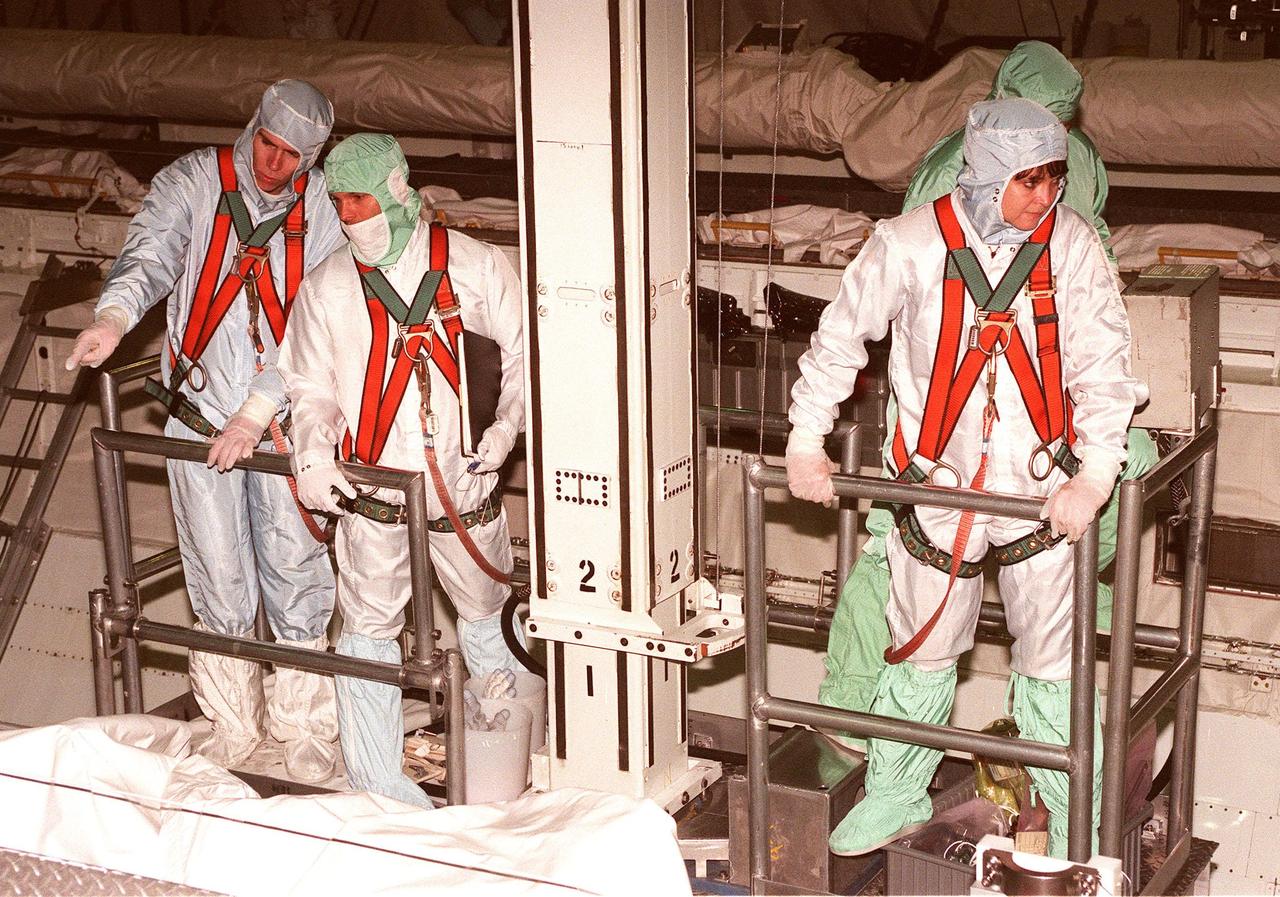
In the Orbiter Processing Facility bay 1, STS-96 Mission Specialists Daniel Barry (M.D., Ph.D.), Valery Ivanovich Tokarev and Tamara E. Jernigan (Ph.D.) look into the payload bay of the orbiter Discovery. The STS-96 crew is at KSC for a Crew Equipment Interface Test. Other crew members participating are Commander Kent V. Rominger, Pilot Rick Douglas Husband, and Mission Specialists Ellen Ochoa (Ph.D.) and Julie Payette, with the Canadian Space Agency. The primary payload of STS-96 is the SPACEHAB Double Module. In addition, the Space Shuttle will carry unpressurized cargo such as the external Russian cargo crane known as STRELA; the Spacehab Oceaneering Space System Box (SHOSS), which is a logistics items carrier; and an ORU Transfer Device (OTD), a U.S.-built crane that will be stowed on the station for use during future ISS assembly missions. These cargo items will be stowed on the International Cargo Carrier, fitted inside the payload bay behind the SPACEHAB module. STS-96 is targeted for launch on May 24 from Launch Pad 39B
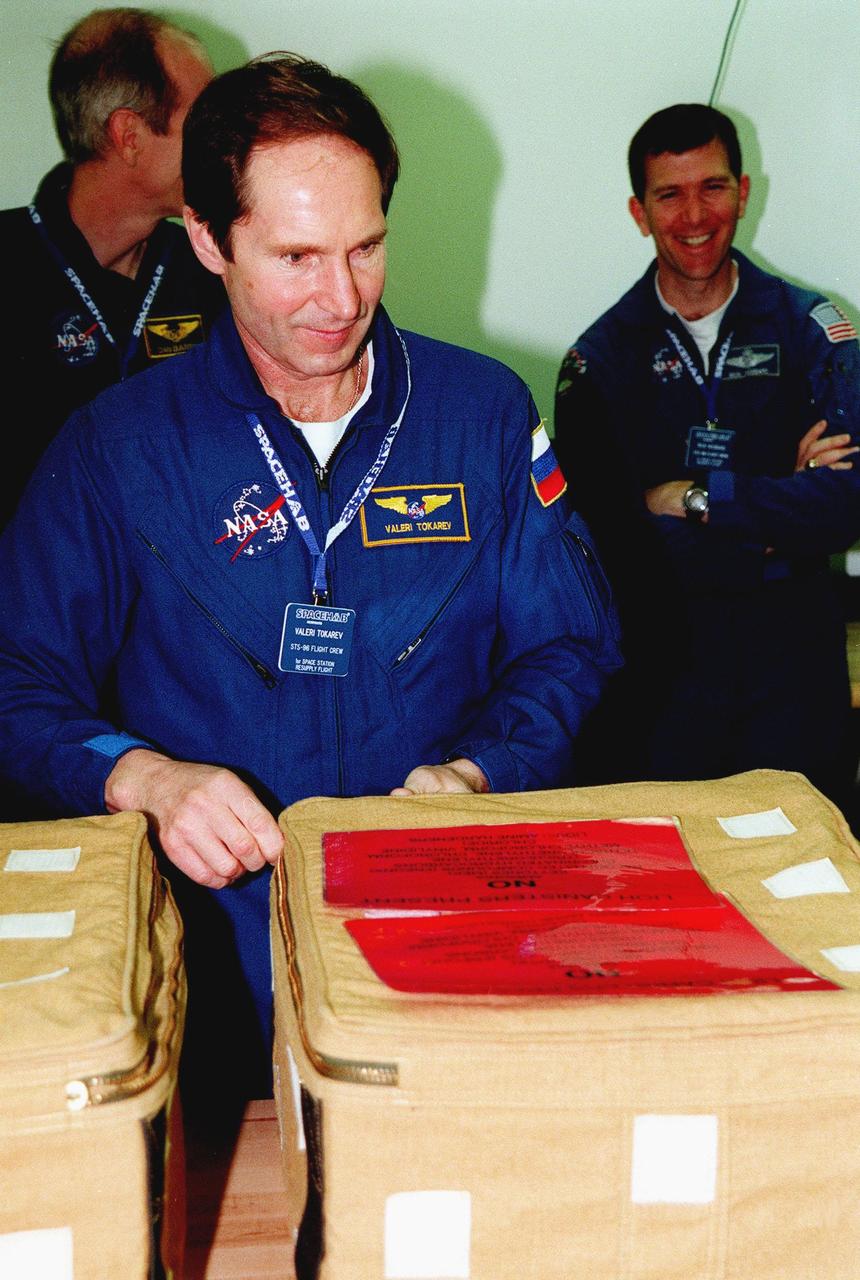
KENNEDY SPACE CENTER, FLA. -- In the SPACEHAB Facility, STS-96 Mission Specialist Valery Tokarev (in foreground) of the Russian Space Agency closes a container, part of the equipment that will be in the SPACEHAB module on mission STS-96. Behind Tokarev are Mission Specialist Dan Barry (left) and Pilot Rick Husband right). Other crew members at KSC for a payload Interface Verification Test for the upcoming mission to the International Space Station are Commander Kent Rominger and Mission Specialists Ellen Ochoa, Tamara Jernigan and Julie Payette. Mission STS-96 carries the SPACEHAB Logistics Double Module, which has equipment to further outfit the International Space Station service module and equipment that can be off-loaded from the early U.S. assembly flights. The SPACEHAB carries internal logistics and resupply cargo for station outfitting, plus an external Russian cargo crane to be mounted to the exterior of the Russian station segment and used to perform space walking maintenance activities. The double module stowage provides capacity of up to 10,000 lbs. with the ability to accommodate powered payloads, four external rooftop stowage locations, four double-rack locations (two powered), up to 61 bulkhead-mounted middeck locker locations, and floor storage for large unique items and Soft Stowage. STS-96 is targeted to launch May 20 about 9:32 a.m
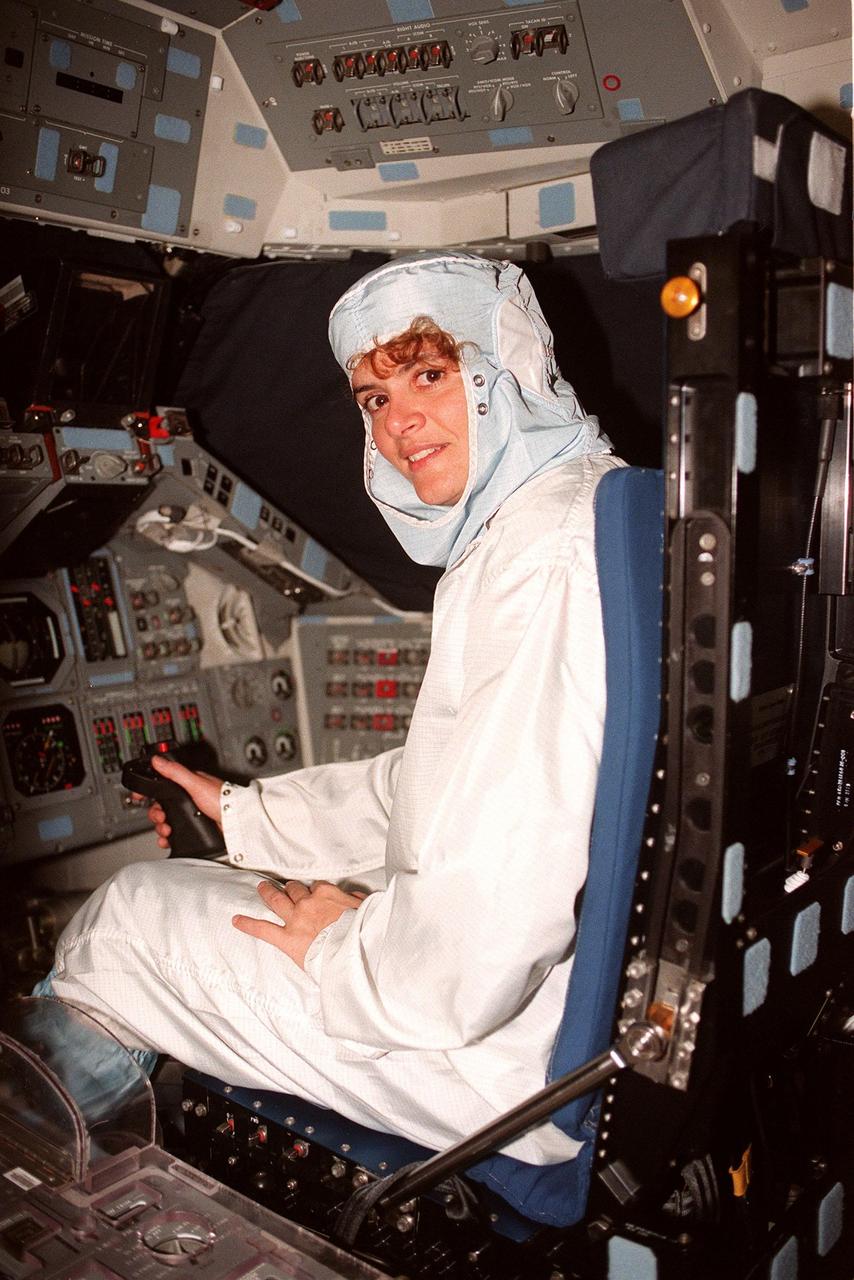
In the Orbiter Processing Facility bay 1, STS-96 Mission Specialist Julie Payette, with the Canadian Space Agency, sits in the pilot's seat inside the orbiter Discovery. The STS-96 crew is at KSC to take part in a Crew Equipment Interface Test. Other members participating are Commander Kent V. Rominger, Pilot Rick Douglas Husband and Mission Specialists Ellen Ochoa (Ph.D.), Tamara E. Jernigan (Ph.D.), Daniel Barry (M.D., Ph.D.) and Valery Ivanovich Tokarev, who represents the Russian Space Agency. The primary payload of STS-96 is the SPACEHAB Double Module. In addition, the Space Shuttle will carry unpressurized cargo such as the external Russian cargo crane known as STRELA; the Spacehab Oceaneering Space System Box (SHOSS), which is a logistics items carrier; and an ORU Transfer Device (OTD), a U.S.-built crane that will be stowed on the station for use during future ISS assembly missions. These cargo items will be stowed on the International Cargo Carrier, fitted inside the payload bay behind the SPACEHAB module. STS-96 is targeted for launch on May 24 from Launch Pad 39B
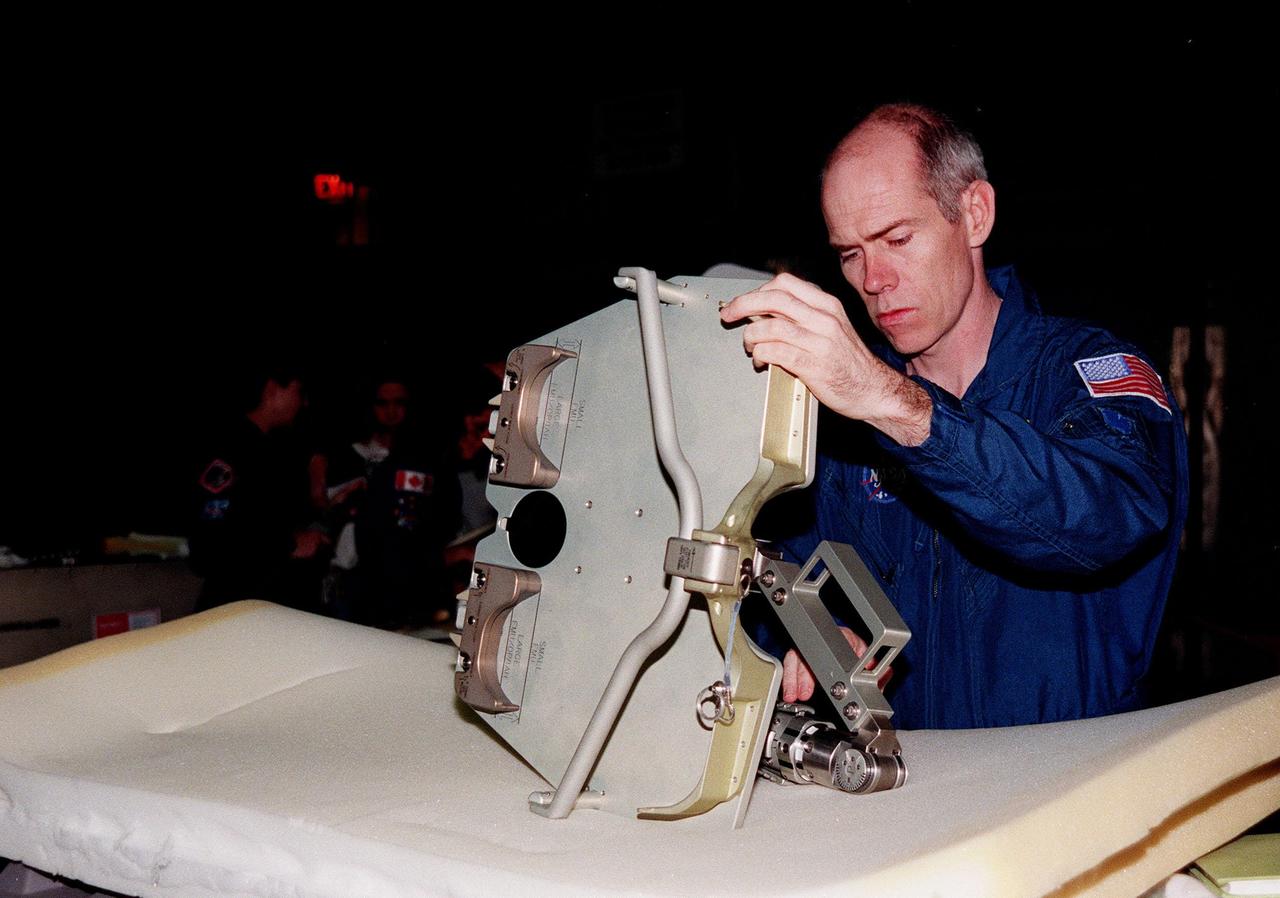
In the Orbiter Processing Facility bay 1, STS-96 Mission Specialist Daniel Barry, M.D., Ph.D., looks at one of the foot restraints used for extravehicular activity, or space walks. The STS-96 crew is at KSC to take part in a Crew Equipment Interface Test. The other crew members are Commander Kent V. Rominger, Pilot Rick Douglas Husband, and Mission Specialists Ellen Ochoa (Ph.D.), Tamara E. Jernigan (Ph.D.), Julie Payette and Valery Ivanovich Tokarev. Payette represents the Canadian Space Agency and Tokarev the Russian Space Agency. The primary payload of STS-96 is the SPACEHAB Double Module. In addition, the Space Shuttle will carry unpressurized cargo such as the external Russian cargo crane known as STRELA; the Spacehab Oceaneering Space System Box (SHOSS), which is a logistics items carrier; and an ORU Transfer Device (OTD), a U.S.-built crane that will be stowed on the station for use during future ISS assembly missions. These cargo items will be stowed on the International Cargo Carrier, fitted inside the payload bay behind the SPACEHAB module. STS-96 is targeted for launch on May 24 from Launch Pad 39B
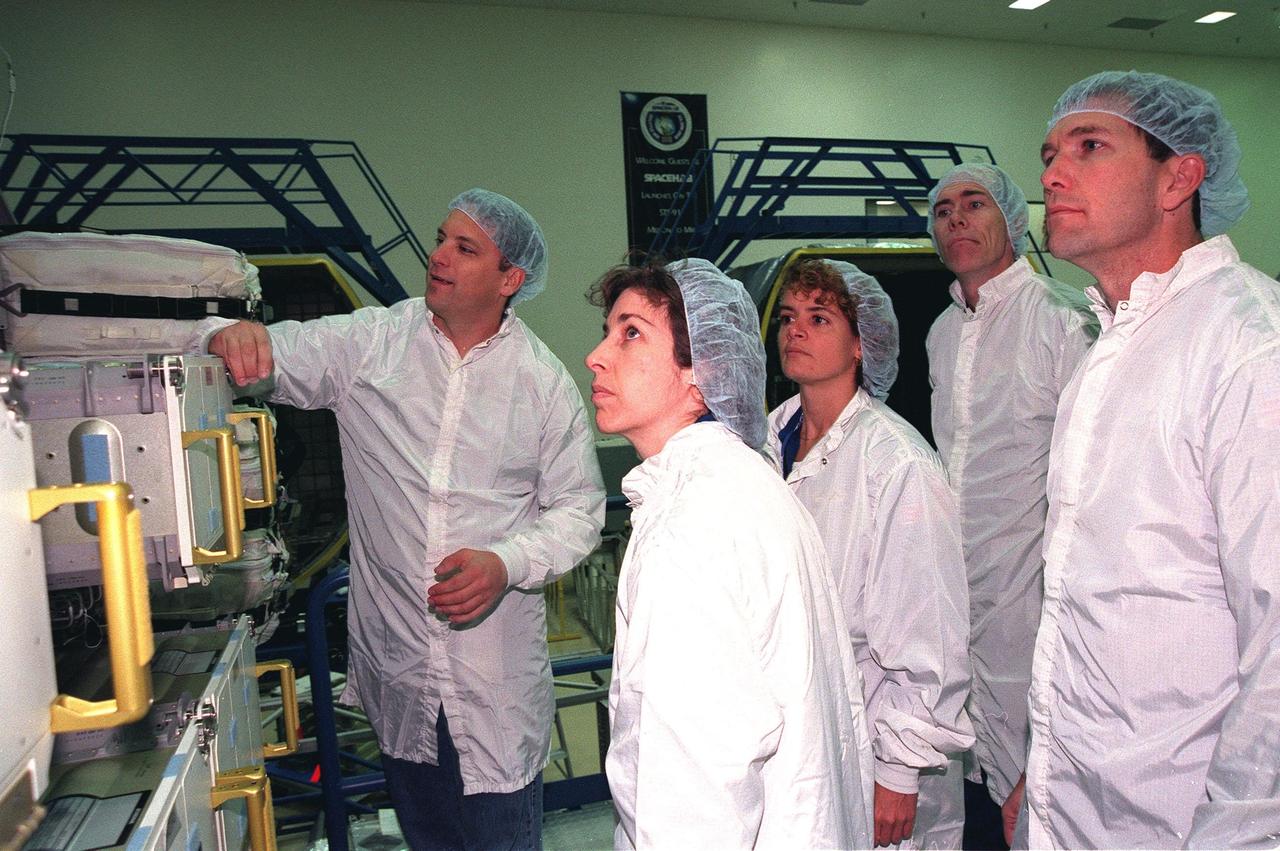
KENNEDY SPACE CENTER, FLA. -- In the SPACEHAB Facility, James Behling, with Boeing, talks about equipment for mission STS-96 during a payload Interface Verification Test (IVT). Watching are (from left) Mission Specialists Ellen Ochoa, Julie Payette and Dan Berry, and Pilot Rick Husband. Other STS-96 crew members at KSC for the IVT are Commander Kent Rominger and Mission Specialists Tamara Jernigan and Valery Tokarev of Russia. Mission STS-96 carries the SPACEHAB Logistics Double Module, which will have equipment to further outfit the International Space Station service module and equipment that can be off-loaded from the early U.S. assembly flights. It carries internal logistics and resupply cargo for station outfitting, plus an external Russian cargo crane to be mounted to the exterior of the Russian station segment and used to perform space walking maintenance activities. The double module stowage provides capacity of up to 10,000 lbs. with the ability to accommodate powered payloads, four external rooftop stowage locations, four double-rack locations (two powered), up to 61 bulkhead-mounted middeck locker locations, and floor storage for large unique items and Soft Stowage. STS-96 is targeted to launch May 20 about 9:32 a.m
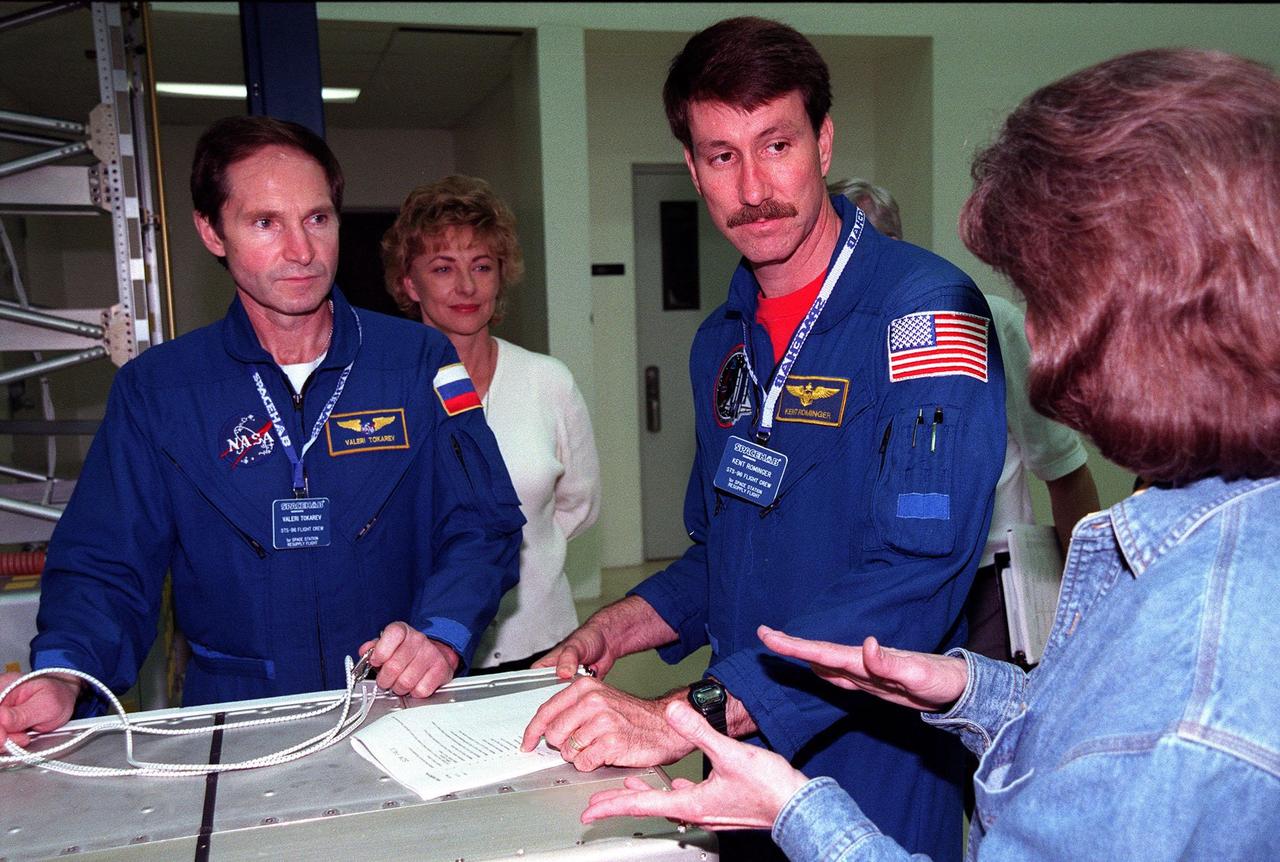
KENNEDY SPACE CENTER, FLA. -- In the SPACEHAB Facility, STS-96 Mission Specialist Valery Tokarev of Russia (left) and Commander Kent Rominger (second from right) listen to Lynn Ashby (far right), with JSC, talking about the SPACEHAB equipment in front of them during a payload Interface Verification Test (IVT). In the background behind Tokarev is TTI interpreter Valentina Maydell. Other STS-96 crew members at KSC for the IVT are Pilot Rick Husband and Mission Specialists Dan Barry, Ellen Ochoa, Tamara Jernigan and Julie Payette. Mission STS-96 carries the SPACEHAB Logistics Double Module, which will have equipment to further outfit the International Space Station service module and equipment that can be off-loaded from the early U.S. assembly flights. It carries internal logistics and resupply cargo for station outfitting, plus an external Russian cargo crane to be mounted to the exterior of the Russian station segment and used to perform space walking maintenance activities. The double module stowage provides capacity of up to 10,000 lbs. with the ability to accommodate powered payloads, four external rooftop stowage locations, four double-rack locations (two powered), up to 61 bulkhead-mounted middeck locker locations, and floor storage for large unique items and Soft Stowage. STS-96 is targeted to launch May 20 about 9:32 a.m
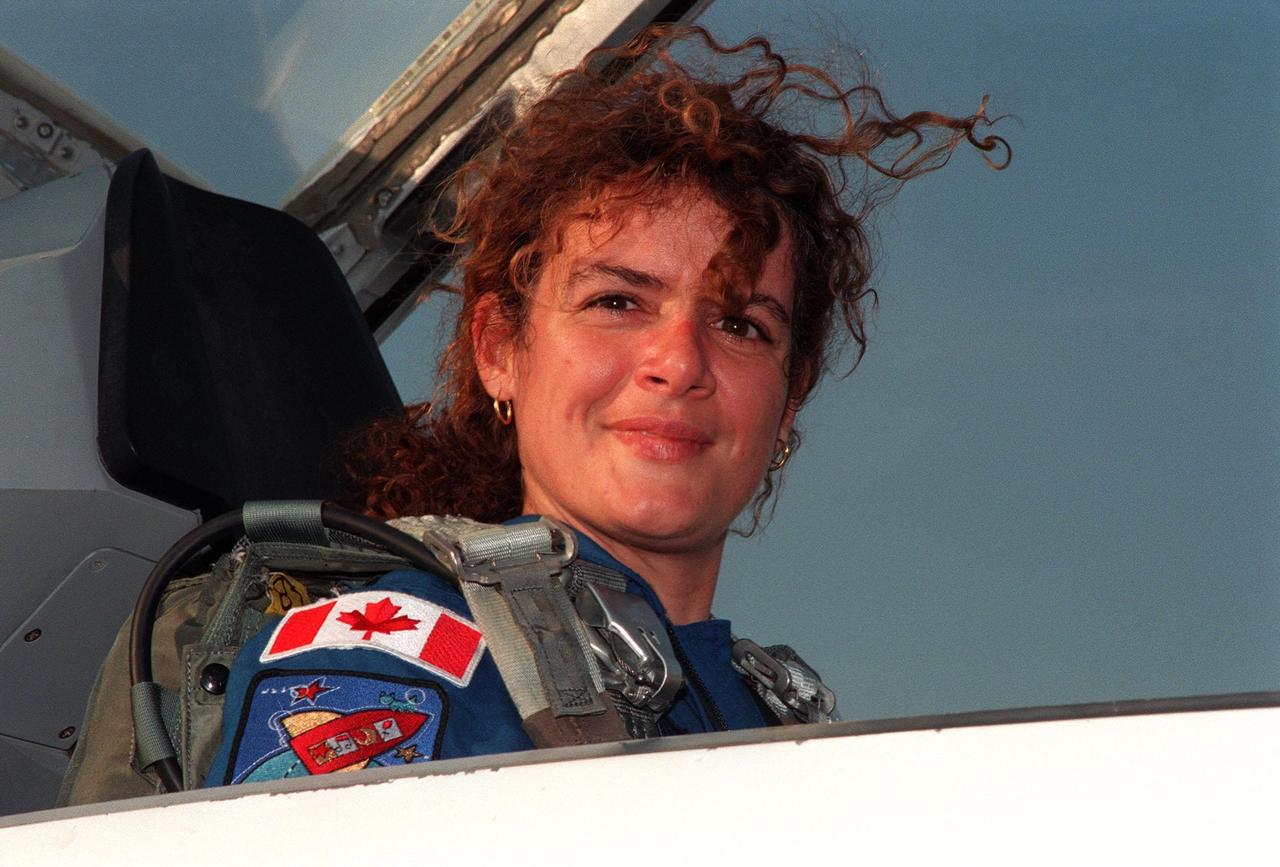
STS-96 Mission Specialist Julie Payette, who represents the Canadian Space Agency, arrives at the Shuttle Landing Facility in a T-38 jet aircraft. The STS-96 crew are taking part in Terminal Countdown Demonstration Test (TCDT) activities. The TCDT provides the crew with simulated countdown exercises, emergency egress training, and opportunities to inspect the mission payloads in the orbiter's payload bay. Mission STS-96, which is targeted for launch on May 20 at 9:32 a.m., is a logistics and resupply mission for the International Space Station, carrying such payloads as a Russian crane, the Strela; a U.S.-built crane; the Spacehab Oceaneering Space System Box (SHOSS), a logistics items carrier; and STARSHINE, a student-led experiment. Others in the STS-96 crew are Commander Kent V. Rominger, Pilot Rick Douglas Husband, and Mission Specialists Ellen Ochoa (Ph.D.), Tamara E. Jernigan (Ph.D.), Daniel Barry (M.D., Ph.D.), and Valery Ivanovich Tokarev, who represents the Russian Space Agency
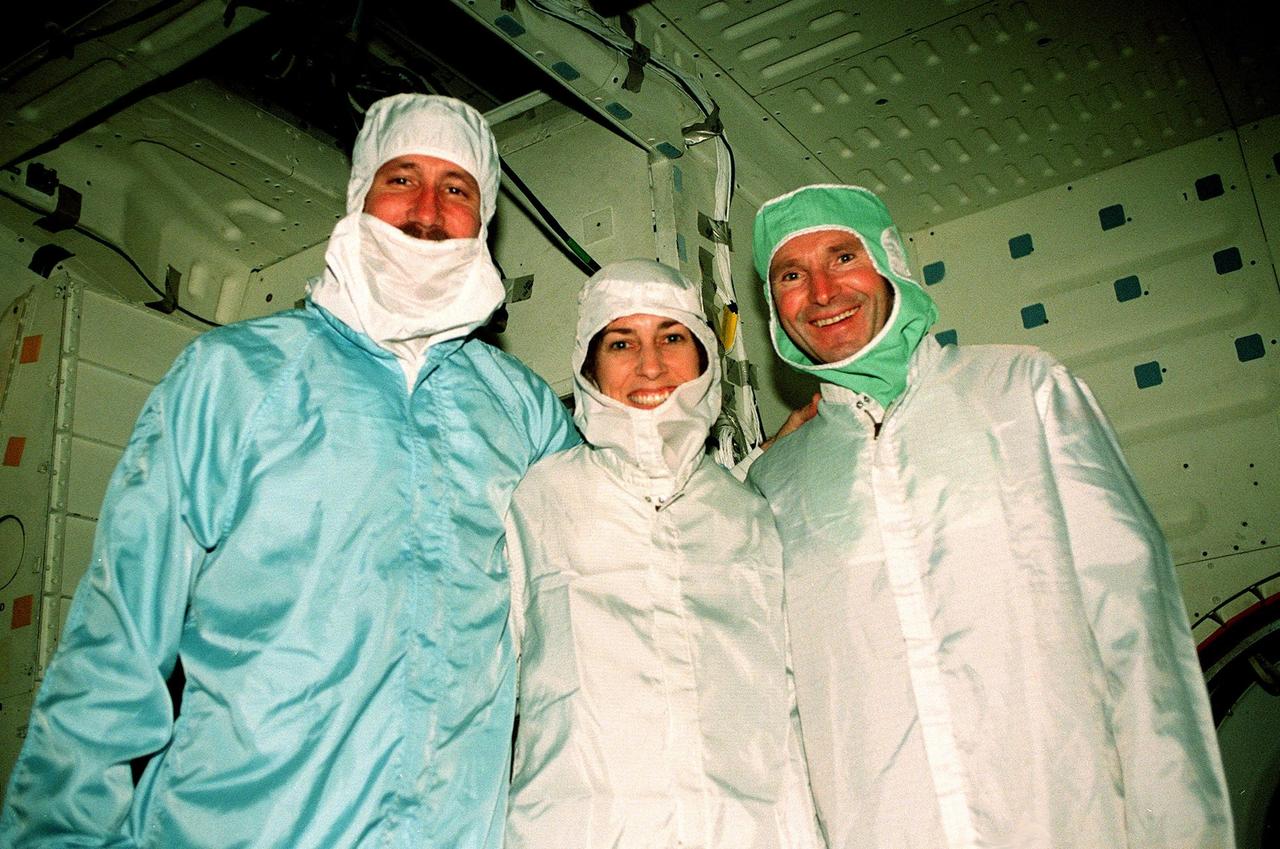
In the Orbiter Processing Facility bay 1, STS-96 Commander Kent V. Rominger and Mission Specialists Ellen Ochoa (Ph.D.) and Valery Ivanovich Tokarev pose inside the orbiter Discovery. The STS-96 crew is at KSC to take part in a Crew Equipment Interface Test. Other members participating are Pilot Rick Douglas Husband and Mission Specialists Tamara E. Jernigan (Ph.D.), Daniel Barry (M.D., Ph.D.) and Julie Payette, who is with the Canadian Space Agency. Tokarev represents the Russian Space Agency. The primary payload of STS-96 is the SPACEHAB Double Module. In addition, the Space Shuttle will carry unpressurized cargo such as the external Russian cargo crane known as STRELA; the Spacehab Oceaneering Space System Box (SHOSS), which is a logistics items carrier; and an ORU Transfer Device (OTD), a U.S.-built crane that will be stowed on the station for use during future ISS assembly missions. These cargo items will be stowed on the International Cargo Carrier, fitted inside the payload bay behind the SPACEHAB module. STS-96 is targeted for launch on May 24 from Launch Pad 39B
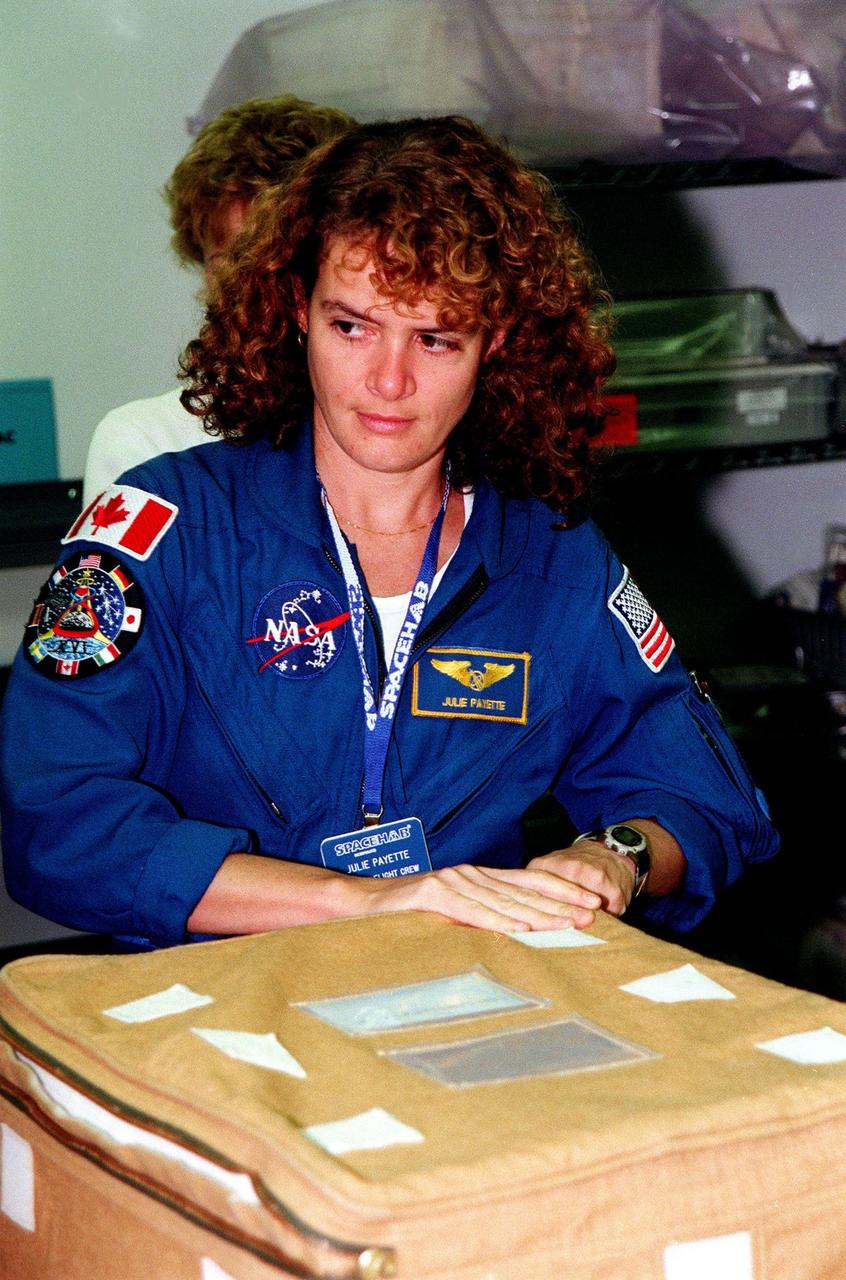
KENNEDY SPACE CENTER, FLA. -- In the SPACEHAB Facility, STS-96 Mission Specialist Julie Payette closes a container, part of the equipment to be carried on the SPACEHAB and mission STS-96. She and other crew members Commander Kent Rominger, Pilot Rick Husband, and Mission Speciaists Ellen Ochoa, Tamara Jernigan, Dan Barry and Valery Tokarev of Russia are at KSC for a payload Interface Verification Test for the upcoming mission to the International Space Station . Mission STS-96 carries the SPACEHAB Logistics Double Module, which has equipment to further outfit the International Space Station service module and equipment that can be off-loaded from the early U.S. assembly flights. The SPACEHAB carries internal logistics and resupply cargo for station outfitting, plus an external Russian cargo crane to be mounted to the exterior of the Russian station segment and used to perform space walking maintenance activities. The double module stowage provides capacity of up to 10,000 lbs. with the ability to accommodate powered payloads, four external rooftop stowage locations, four double-rack locations (two powered), up to 61 bulkhead-mounted middeck locker locations, and floor storage for large unique items and Soft Stowage. STS-96 is targeted to launch May 20 about 9:32 a.m
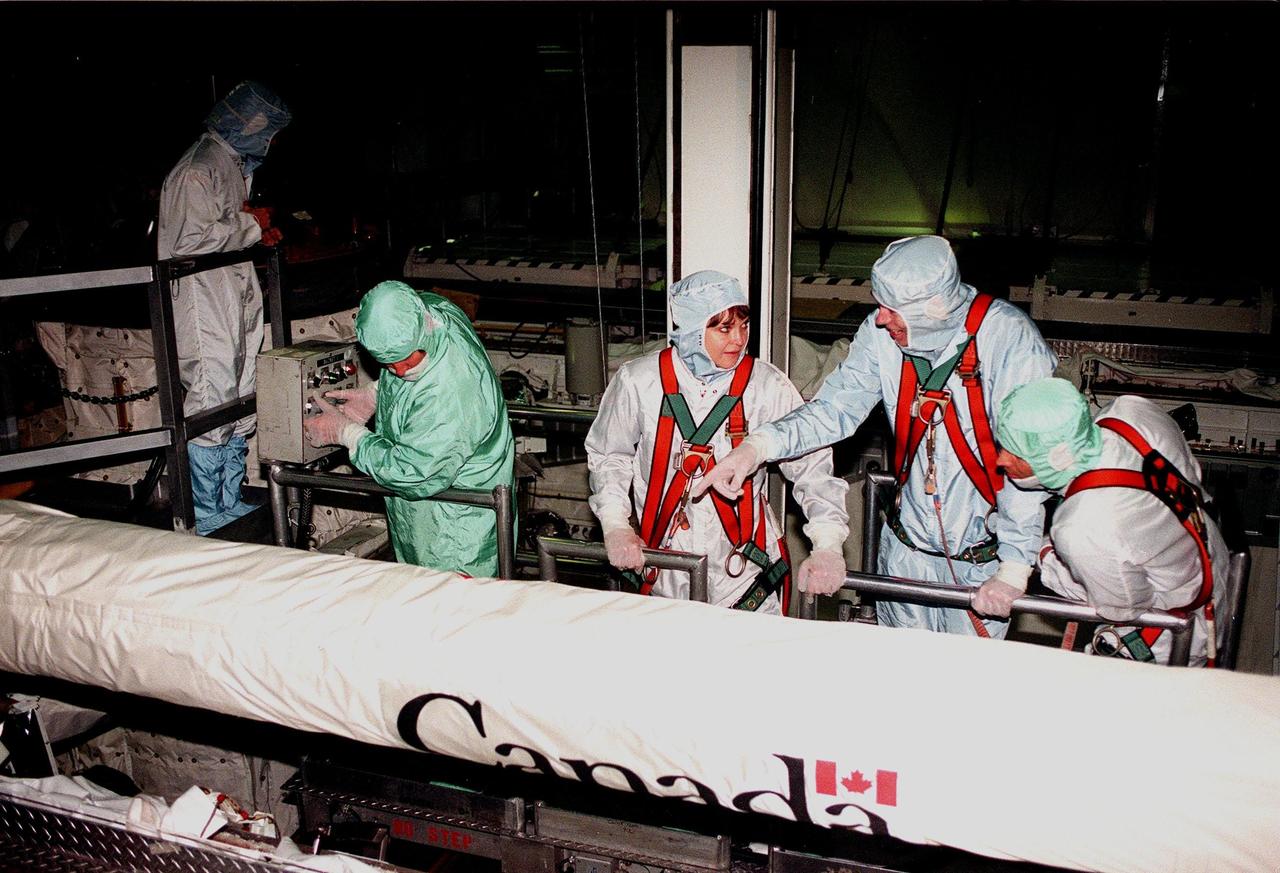
In the Orbiter Processing Facility bay 1, STS-96 crew members look at the Canadian arm in the payload bay of the orbiter Discovery. Standing in a bucket controlled by a KSC worker, are (from left) Mission Specialist Tamara E. Jernigan (Ph.D), Daniel Barry (M.D., Ph.D.), and Valery Ivanovich Tokarev, who represents the Russian Space Agency. The STS-96 crew is at KSC to take part in a Crew Equipment Interface Test. The other crew members are Commander Kent V. Rominger, Pilot Rick Douglas Husband and Mission Specialists Ellen Ochoa (Ph.D.) and Julie Payette, with the Canadian Space Agency. The primary payload of STS-96 is the SPACEHAB Double Module. In addition, the Space Shuttle will carry unpressurized cargo such as the external Russian cargo crane known as STRELA; the Spacehab Oceaneering Space System Box (SHOSS), which is a logistics items carrier; and an ORU Transfer Device (OTD), a U.S.-built crane that will be stowed on the station for use during future ISS assembly missions. These cargo items will be stowed on the International Cargo Carrier, fitted inside the payload bay behind the SPACEHAB module. STS-96 is targeted for launch on May 24 from Launch Pad 39B
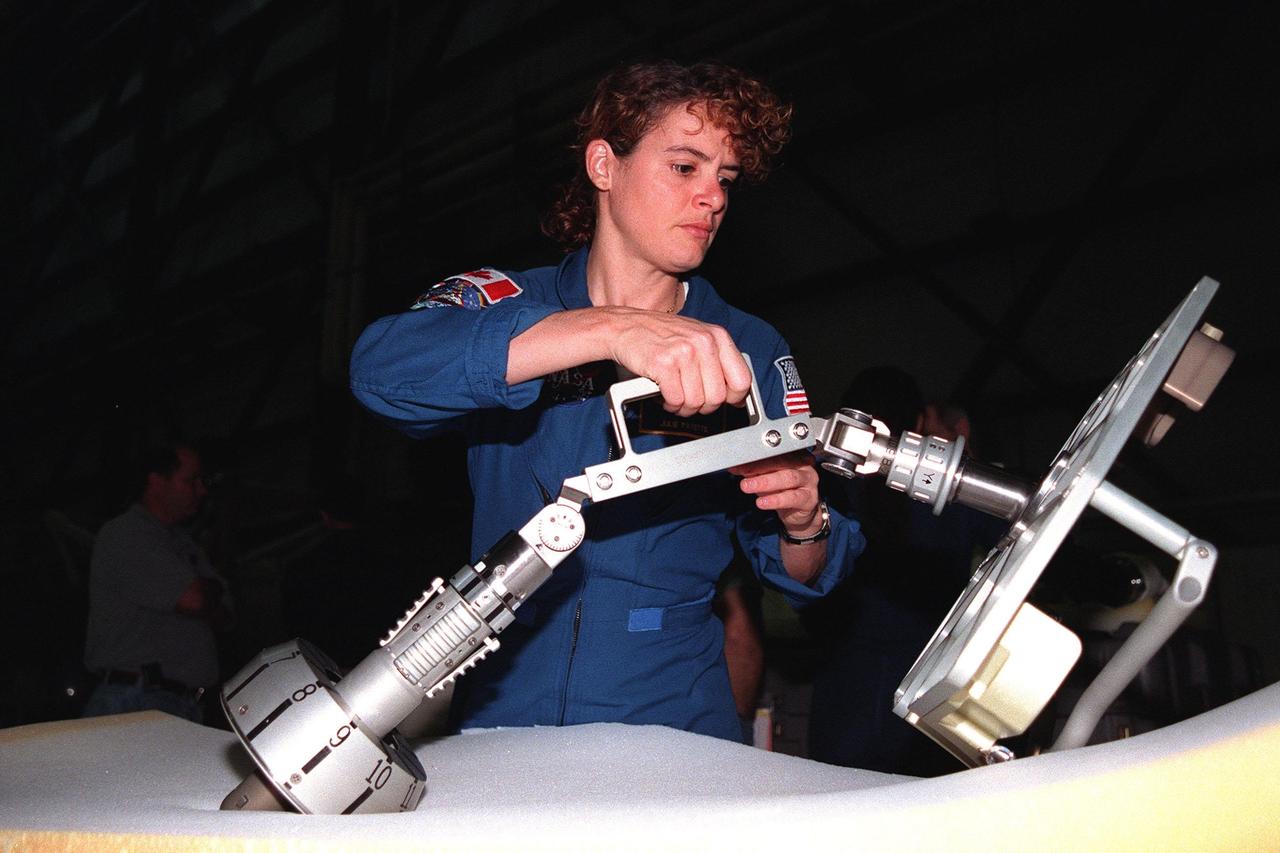
In the Orbiter Processing Facility bay 1, STS-96 Mission Specialist Julie Payette, with the Canadian Space Agency, maneuvers a foot restraint used during space walks. The STS-96 crew is at KSC to take part in a Crew Equipment Interface Test. The other crew members are Commander Kent V. Rominger, Pilot Rick Douglas Husband and Mission Specialists Ellen Ochoa (Ph.D.), Tamara E. Jernigan (Ph.D.), Daniel Barry (M.D., Ph.D.), and Valery Ivanovich Tokarev, who represents the Russian Space Agency. The primary payload of STS-96 is the SPACEHAB Double Module. In addition, the Space Shuttle will carry unpressurized cargo such as the external Russian cargo crane known as STRELA; the Spacehab Oceaneering Space System Box (SHOSS), which is a logistics items carrier; and an ORU Transfer Device (OTD), a U.S.-built crane that will be stowed on the station for use during future ISS assembly missions. These cargo items will be stowed on the International Cargo Carrier, fitted inside the payload bay behind the SPACEHAB module. STS-96 is targeted for launch on May 24 from Launch Pad 39B

In the SPACEHAB Facility, STS-96 Mission Specialists Dan Barry and Tamara Jernigan discuss procedures during a payload Interface Verification Test (IVT) for their upcoming mission to the International Space Station. Other STS-96 crew members at KSC for the IVT are Commander Kent Rominger, Pilot Rick Husband and Mission Specialists Ellen Ochoa, Julie Payette and Valery Tokarev of Russia. Mission STS-96 carries the SPACEHAB Logistics Double Module, which will have equipment to further outfit the International Space Station service module and equipment that can be off-loaded from the early U.S. assembly flights. It carries internal logistics and resupply cargo for station outfitting, plus an external Russian cargo crane to be mounted to the exterior of the Russian station segment and used to perform space walking maintenance activities. The double module stowage provides capacity of up to 10,000 lbs. with the ability to accommodate powered payloads, four external rooftop stowage locations, four double-rack locations (two powered), up to 61 bulkhead-mounted middeck locker locations, and floor storage for large unique items and Soft Stowage. STS-96 is targeted to launch May 20 about 9:32 a.m
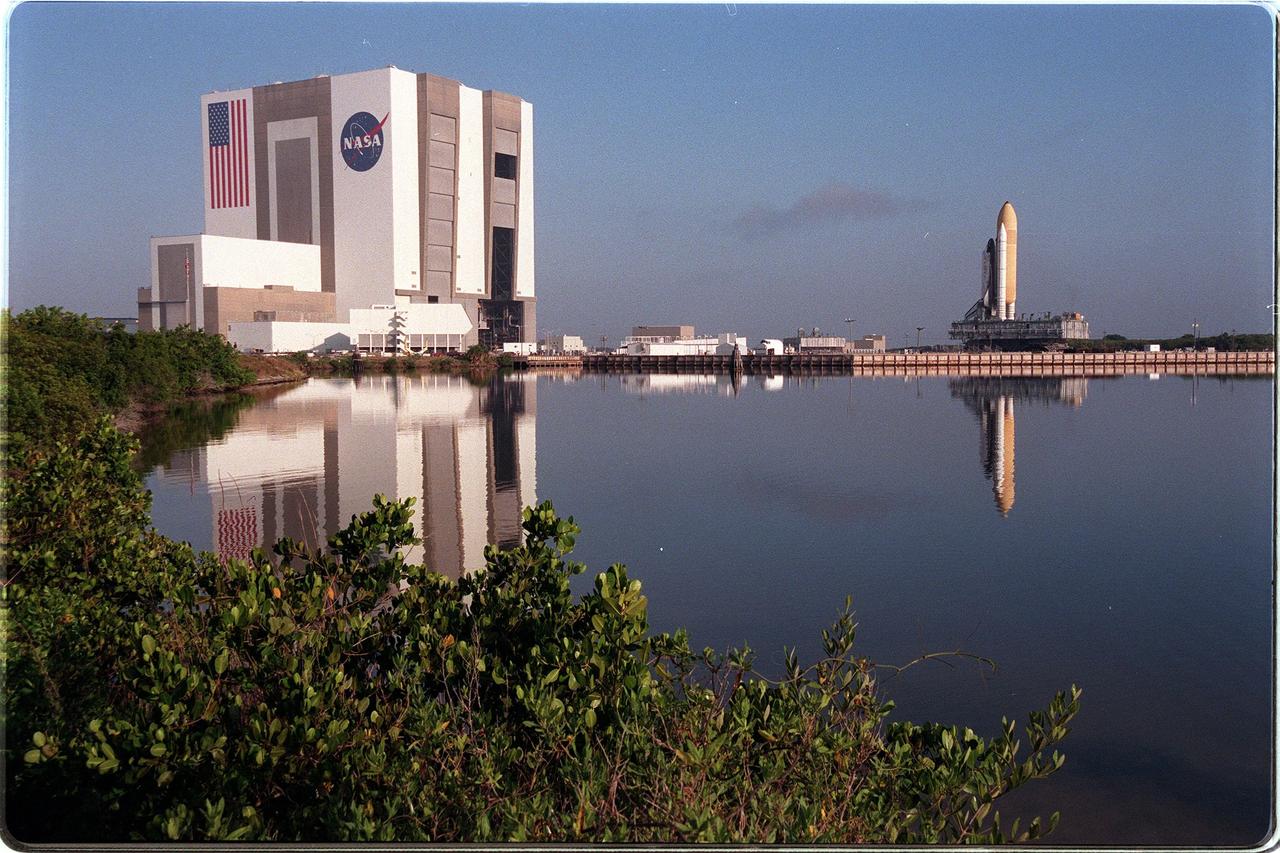
KENNEDY SPACE CENTER, Fla. -- Reflected in the turn basin at Launch Complex 39 Area, the Space Shuttle Discovery stands atop the crawler-transporter, which carries its cargo at 1 mph to Launch Pad 39B. The vehicle takes about five hours to cover the journey from the Vehicle Assembly Building to the launch pad. Liftoff of Discovery on mission STS-96 is targeted for May 20 at 9:32 a.m. EDT. STS-96 is a logistics and resupply mission for the International Space Station, carrying such payloads as a Russian crane, the Strela; a U.S.-built crane; the Spacehab Oceaneering Space System Box (SHOSS), a logistics items carrier; and STARSHINE, a student-led experiment

KENNEDY SPACE CENTER, FLA. -- The morning sun radiates through an opening between the orbiter Discovery and its external tank at Launch Pad 39B. The Shuttle is returning to the pad after repairs to the hail-damaged external tank. STS-96 is scheduled for liftoff May 27 at 6:48 a.m. EDT, the 94th launch in the Space Shuttle Program. A logistics and resupply mission for the International Space Station, STS-96 is carrying such payloads as a Russian crane, the Strela; a U.S.-built crane; the Spacehab Oceaneering Space System Box (SHOSS), a logistics items carrier; and STARSHINE, a student-shared experiment
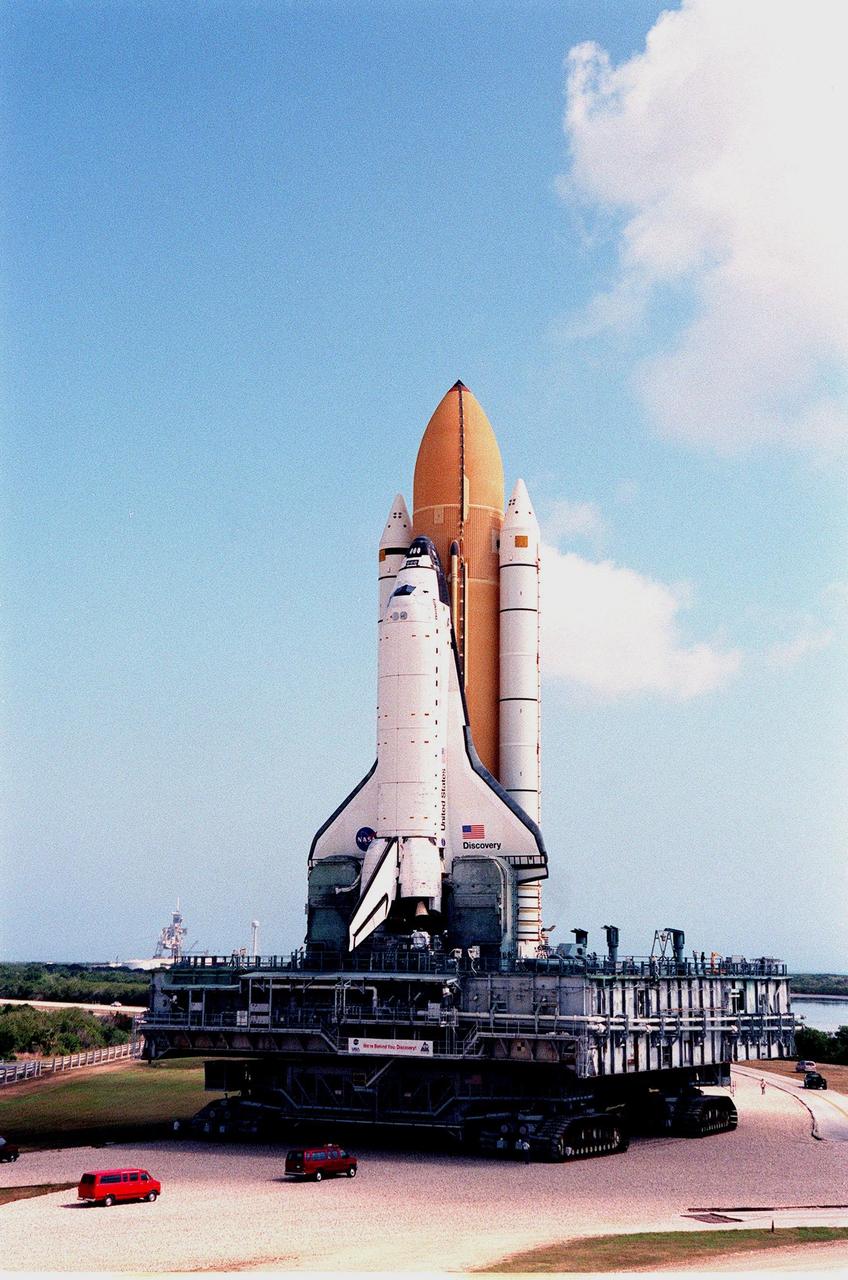
KENNEDY SPACE CENTER, Fla. -- The Space Shuttle Discovery, atop the mobile launcher platform and crawler-transporter, approaches the turn in the crawlerway as it creeps to Launch Pad 39B at 1 mph. The crawler-transporter takes about five hours to cover the journey from the Vehicle Assembly Building to the launch pad. Liftoff of Discovery on mission STS-96 is targeted for May 20 at 9:32 a.m. EDT. STS-96 is a logistics and resupply mission for the International Space Station, carrying such payloads as a Russian crane, the Strela; a U.S.-built crane; the Spacehab Oceaneering Space System Box (SHOSS), a logistics items carrier; and STARSHINE, a student-led experiment
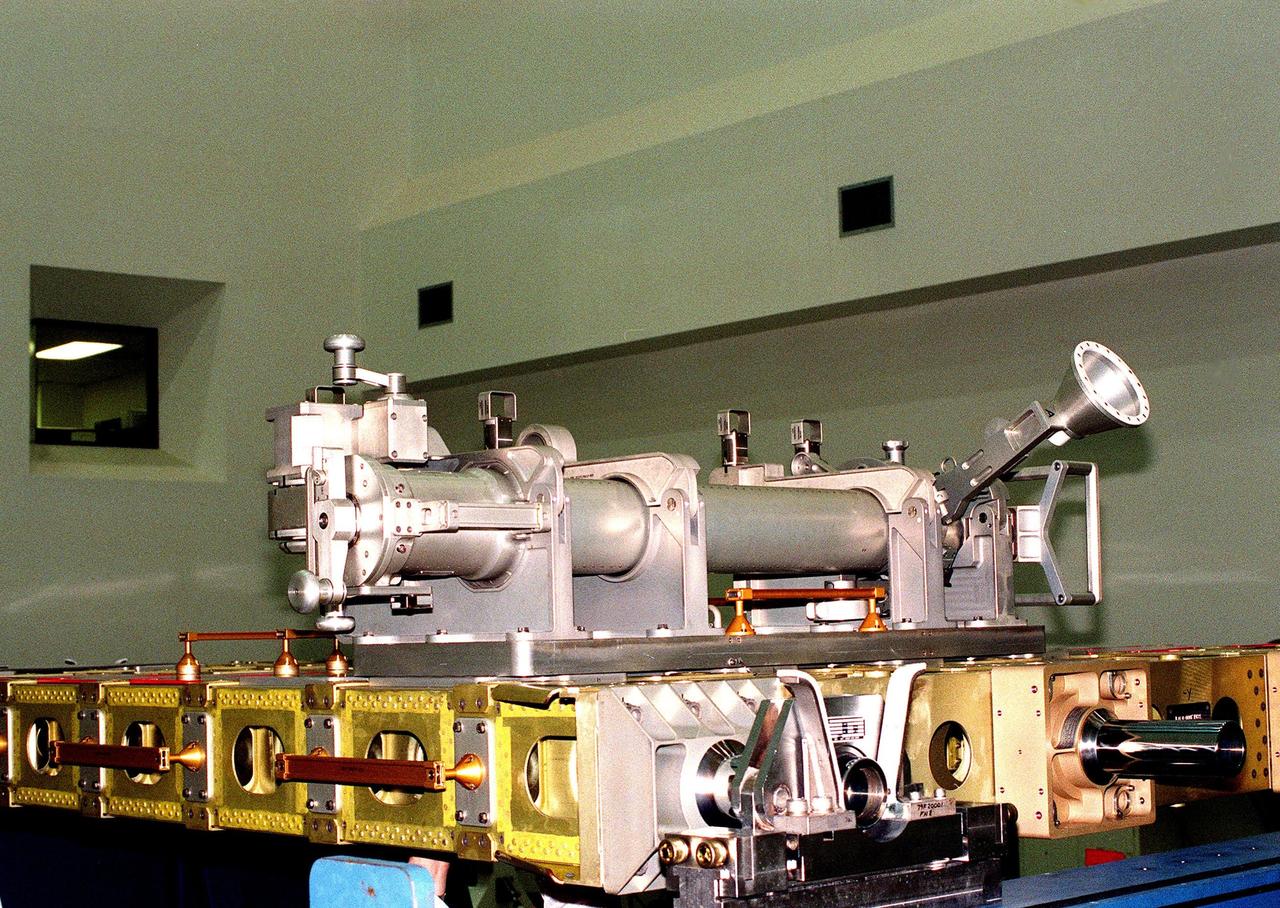
An ORU Transfer Device (OTD) sits secured on top of the International Cargo Carrier (ICC). The OTD is a U.S.-built crane that will be stowed on the International Space Station's Unity module for use during future ISS assembly missions. The nonpressurized ICC fits inside the payload bay of the orbiter. The ICC will also carry the SPACEHAB Oceaneering Space System Box (SHOSS), a logistics items carrier. SHOSS can hold a maximum of 400 pounds of equipment and will carry items to be used during STS-96 and future ISS assembly flights. The ICC will fly on mission STS-96, targeted for launch on May 20
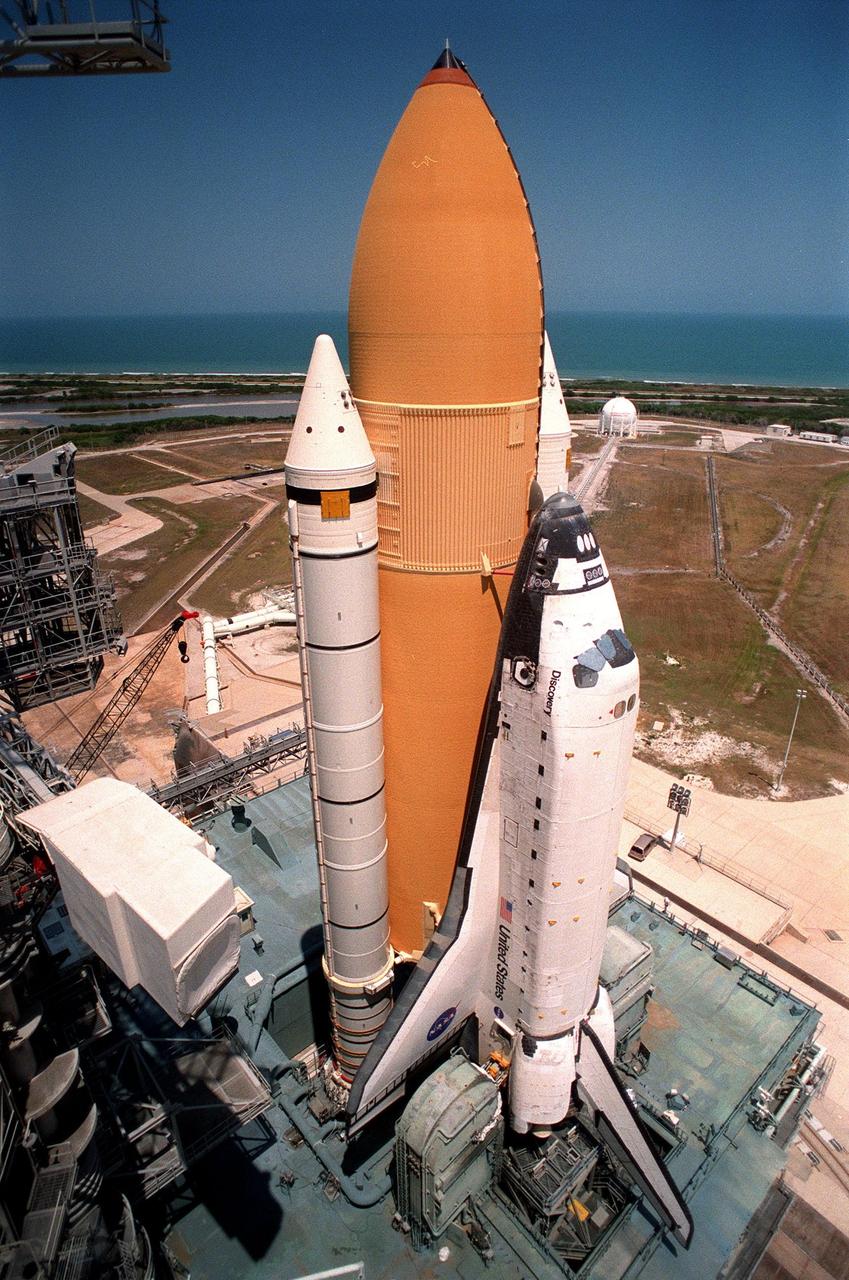
KENNEDY SPACE CENTER, FLA. -- Space Shuttle Discovery sits on launch Pad 39B, waiting for the rotating service structure to be moved into place for final launch preparations. At the top left of the photo is the end of the hammerhead crane, on the fixed service structure, that provides hoisting services required in pad operations. Liftoff of Discovery on mission STS-96 is targeted for May 20 at 9:32 a.m. EDT. STS-96 is a logistics and resupply mission for the International Space Station, carrying such payloads as a Russian crane, the Strela; a U.S.-built crane; the Spacehab Oceaneering Space System Box (SHOSS), a logistics items carrier; and STARSHINE, a student-led experiment
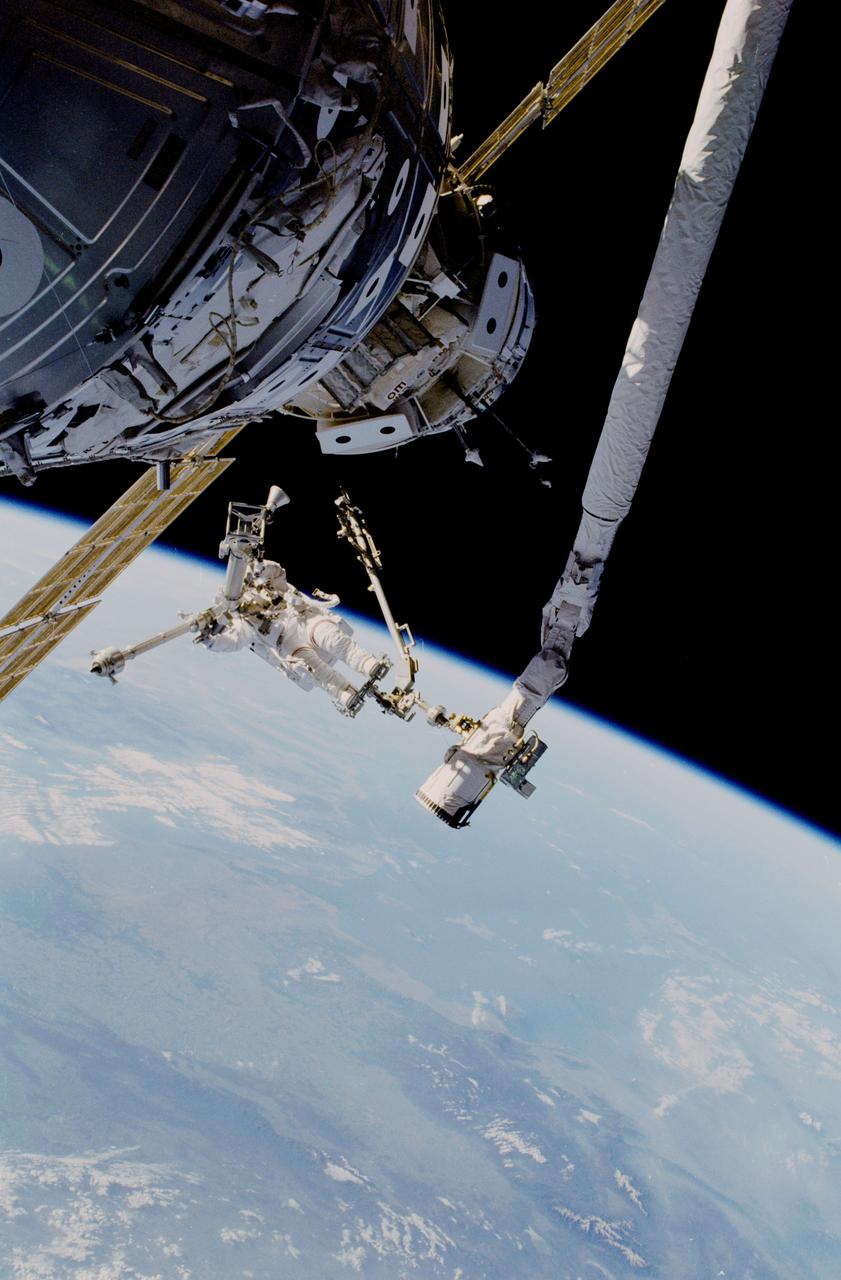
STS096-330-004 (30 May 1999) --- Astronaut Tamara E. Jernigan, mission specialist, is backdropped over the Aegean Sea as she handles the American-built crane which she helped to install on the International Space Station (ISS) during the May 30th space walk. Jernigan's feet are anchored to a mobile foot restraint connected to the Space Shuttle Discovery's Canadian-built Remote Manipulator System (RMS). Jernigan was joined by astronaut Daniel T. Barry, mission specialist, for the lengthy extravehicular activity (EVA). Parts of Greece, Turkey and the Dardenelles are visible some 171 nautical miles below the docked tandem of Discovery and the ISS.
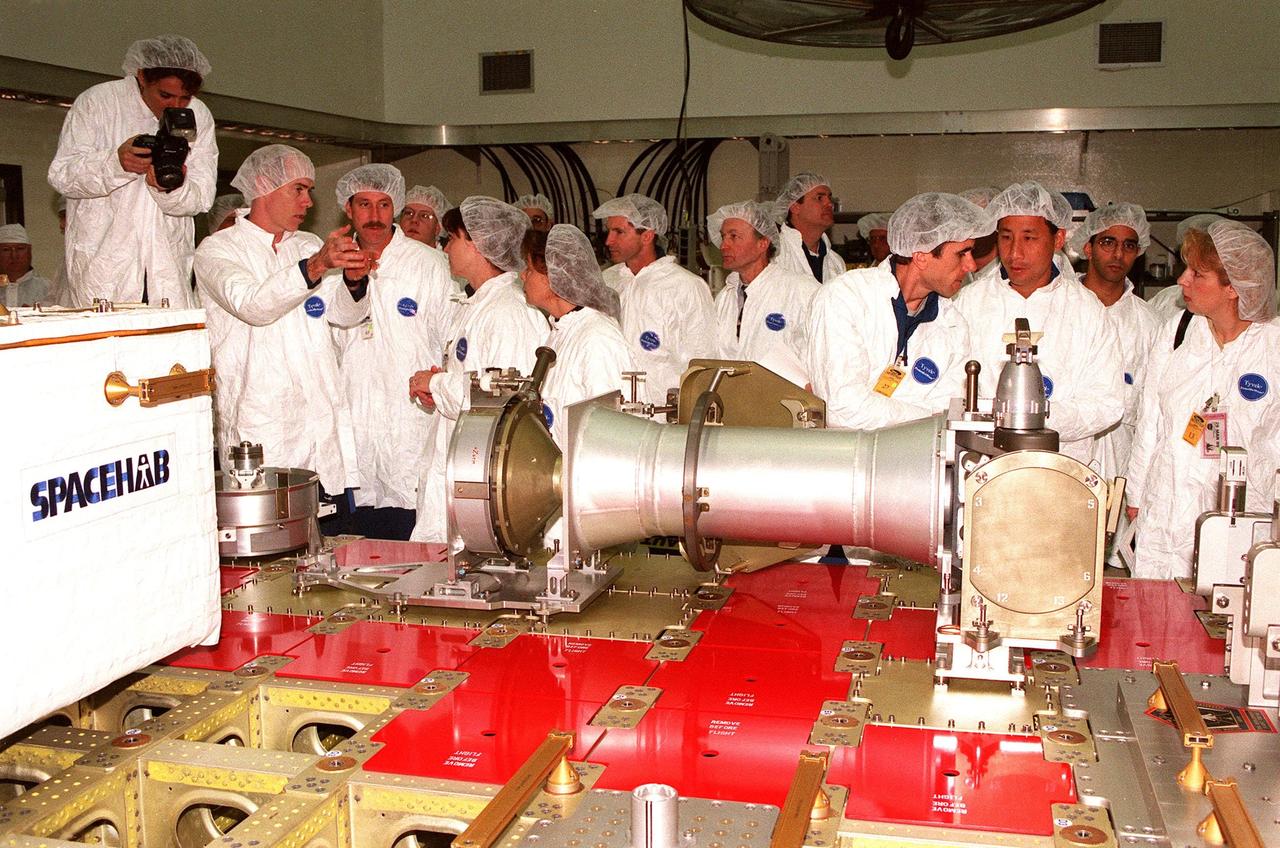
At Astrotech in Titusville, Fla., members of two Shuttle crews look at components of a Russian cargo crane, the Strela, to be mounted to the exterior of the Russian station segment on the International Space Station (ISS). From left are STS-96 Mission Specialist Julie Payette and Daniel T. Barry, Commander Kent V. Rominger and Mission Specialist Tamara E. Jernigan; three technicians from DaimlerChrysler Aerospace; (in the background, facing right) STS-101 Commander James Donald Halsell Jr.; STS-101 Mission Specialists Yuri Ivanovich Malenchenko, with the Russian Space Agency, and Edward Tsang Lu; and two more technicians from DaimlerChrysler. Both missions include the SPACEHAB Double Module, carrying internal and resupply cargo for Station outfitting. For the first time, STS-96 will include an Integrated Cargo Carrier (ICC) that will carry the Strela; the SPACEHAB Oceaneering Space System Box (SHOSS), which is a logistics items carrier; and a U.S.-built crane (ORU Transfer Device, or OTD) that will be stowed on the station for use during future ISS assembly missions. The ICC can carry up to 6,000 lb of unpressurized payload. It was built for SPACEHAB by DaimlerChrysler and RSC Energia of Korolev, Russia. STS-96 is targeted for launch on May 24 from Launch Pad 39B. STS-101 is scheduled to launch in early December 1999
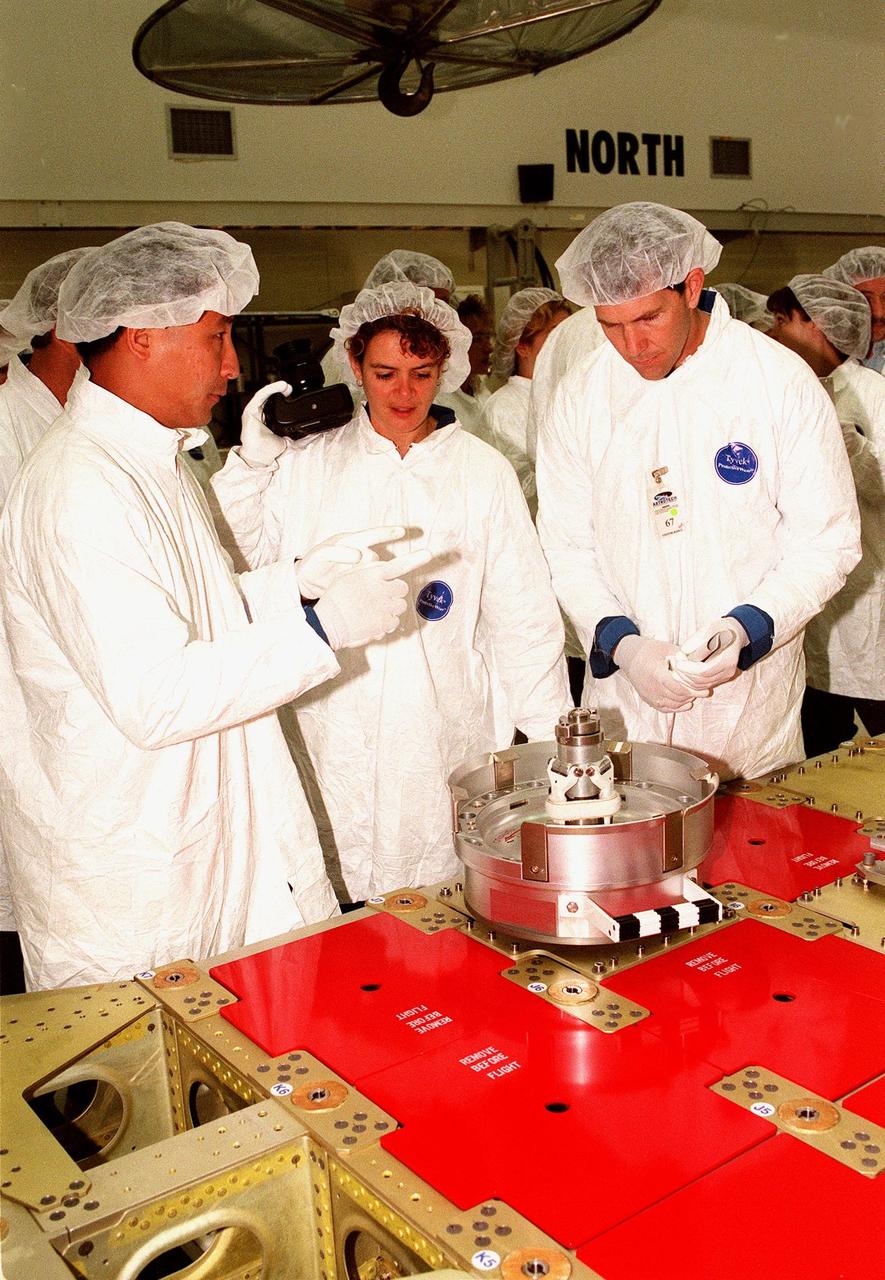
At Astrotech in Titusville, Fla., members of two Shuttle crews take a close look at a component of a Russian cargo crane, the Strela, to be mounted to the exterior of the Russian station segment on the International Space Station (ISS). From left, they are STS-101 Mission Specialist Edward Tsang Lu, plus STS-96 Mission Specialist Julie Payette and Pilot Rick Douglas Husband. Payette represents the Canadian Space Agency. Both missions include the SPACEHAB Double Module, carrying internal and resupply cargo for Station outfitting. For the first time, STS-96 will include an Integrated Cargo Carrier (ICC) that will carry the Strela; the SPACEHAB Oceaneering Space System Box (SHOSS), which is a logistics items carrier; and a U.S.-built crane (ORU Transfer Device, or OTD) that will be stowed on the station for use during future ISS assembly missions. The ICC can carry up to 6,000 lb of unpressurized payload. It was built for SPACEHAB by DaimlerChrysler and RSC Energia of Korolev, Russia. STS-96 is targeted for launch on May 24 from Launch Pad 39B. STS-101 is scheduled to launch in early December 1999
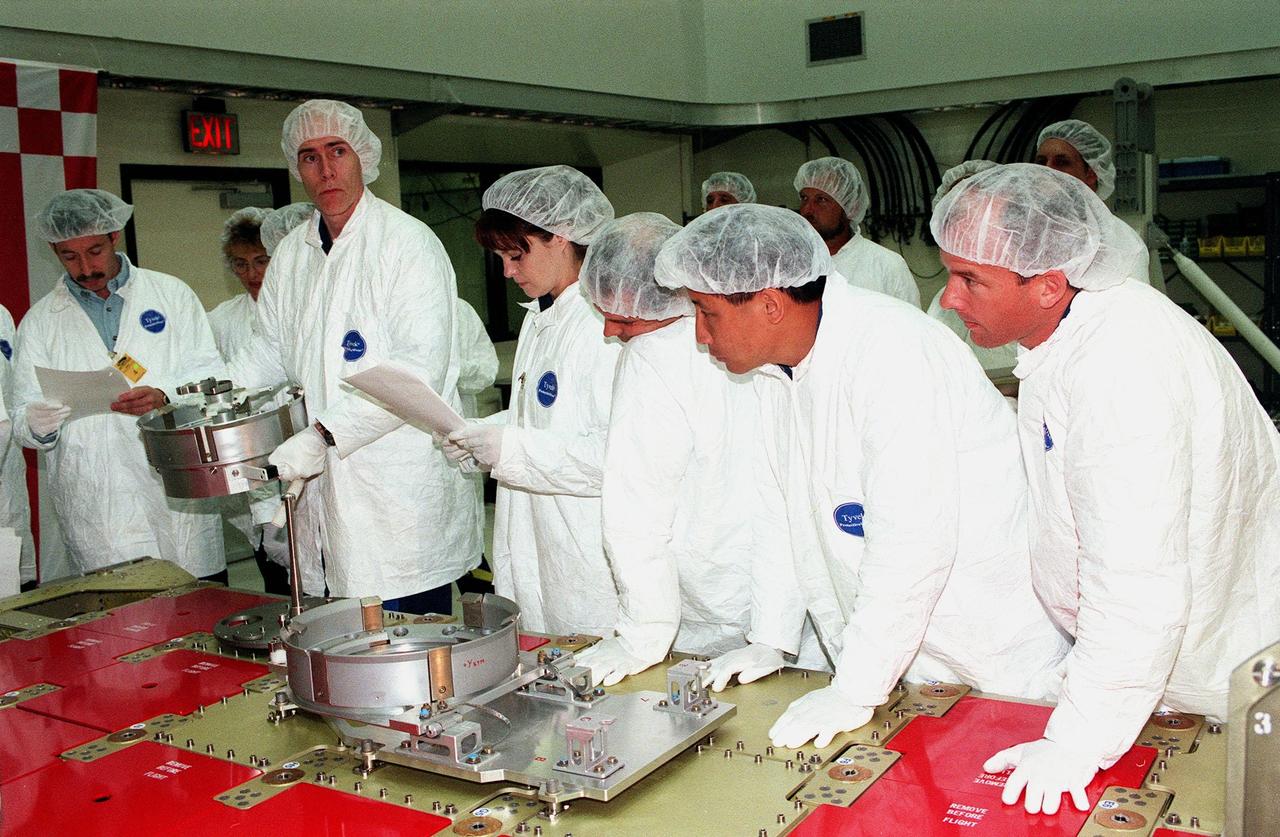
Two Shuttle crews take part in familiarization activities at Astrotech in Titusville, Fla. From left are STS-96 Mission Specialists Daniel T. Barry and Tamara E. Jernigan, and Pilot Rick Douglas Husband; plus STS-101 Mission Specialists Edward Tsang Lu and Jeffrey N. Williams. They are looking at components of a Russian cargo crane, the Strela, to be mounted to the exterior of the Russian station segment on the International Space Station (ISS). Both missions include the SPACEHAB Double Module, carrying internal and resupply cargo for Station outfitting. For the first time, STS-96 will include an Integrated Cargo Carrier (ICC) that will carry the Strela; the SPACEHAB Oceaneering Space System Box (SHOSS), which is a logistics items carrier; and a U.S.-built crane (ORU Transfer Device, or OTD) that will be stowed on the station for use during future ISS assembly missions. The ICC can carry up to 6,000 lb of unpressurized payload. It was built for SPACEHAB by DaimlerChrysler Aerospace of Bremen and RSC Energia of Korolev, Russia. STS-96 is targeted for launch on May 24 from Launch Pad 39B. STS-101 is scheduled to launch in early December 1999
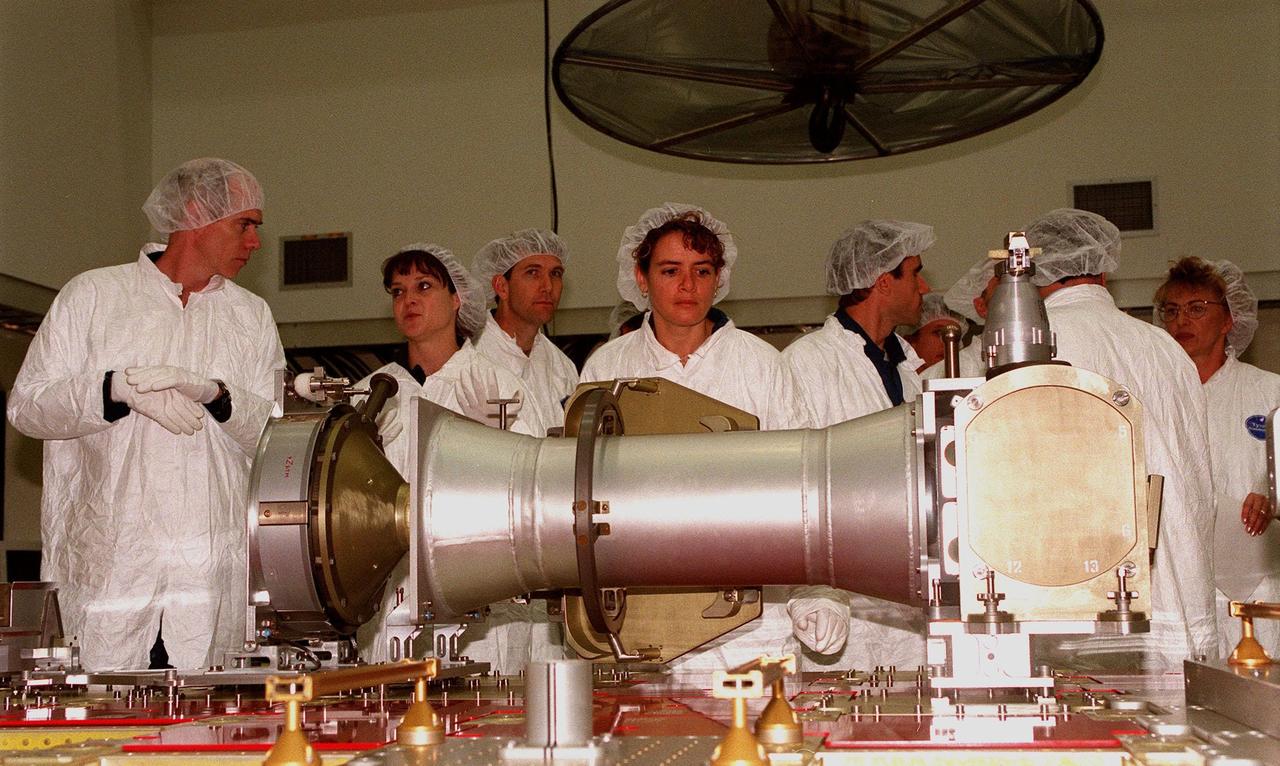
At Astrotech in Titusville, Fla., members of two Shuttle crews take a close look at components of a Russian cargo crane, the Strela, to be mounted to the exterior of the Russian station segment on the International Space Station (ISS). From left are STS-96 Mission Specialists Daniel T. Barry and Tamara E. Jernigan, Pilot Rick Douglas Husband, and Mission Specialist Julie Payette; next to them is STS-101 Mission Specialist Yuri Ivanovich Malenchenko, with the Russian Space Agency. Both missions include the SPACEHAB Double Module, carrying internal and resupply cargo for Station outfitting. For the first time, STS-96 will include an Integrated Cargo Carrier (ICC) that will carry the Strela; the SPACEHAB Oceaneering Space System Box (SHOSS), which is a logistics items carrier; and a U.S.-built crane (ORU Transfer Device, or OTD) that will be stowed on the station for use during future ISS assembly missions. The ICC can carry up to 6,000 lb of unpressurized payload. It was built for SPACEHAB by DaimlerChrysler and RSC Energia of Korolev, Russia. STS-96 is targeted for launch on May 24 from Launch Pad 39B. STS-101 is scheduled to launch in early December 1999
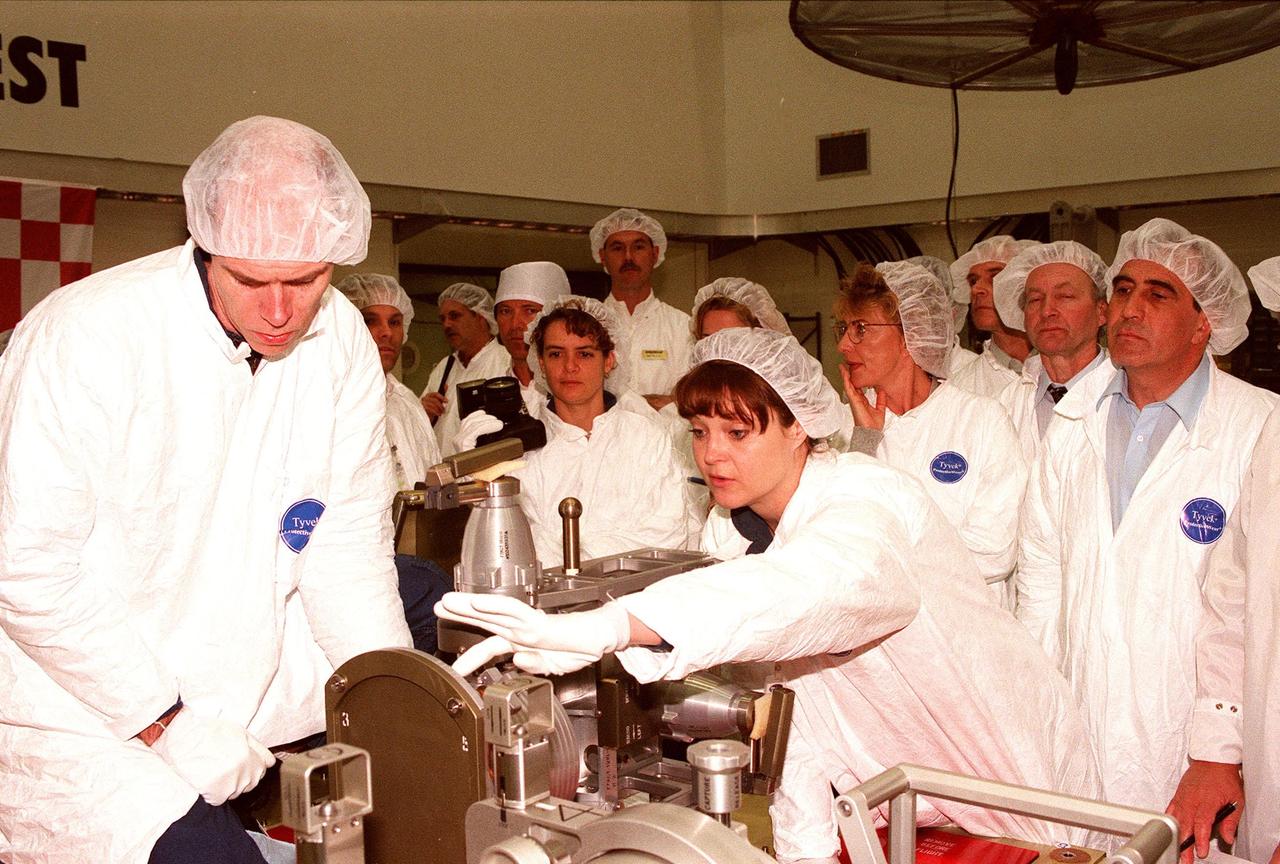
At Astrotech in Titusville, Fla., STS-96 Mission Speciaists Daniel T. Barry (left), Julie Payette (center, with camera), and Tamara E. Jernigan (right, pointing) get a close look at one of the payloads on their upcoming mission. Other crew members are Commander Kent V. Rominger, and Mission Specialists Ellen Ochoa and Valery Ivanovich Tokarev, with the Russian Space Agency. Payette is with the Canadian Space Agency. For the first time, STS-96 will include an Integrated Cargo Carrier (ICC) that will carry a Russian cargo crane, the Strela, to be mounted to the exterior of the Russian station segment on the International Space Station (ISS); the SPACEHAB Oceaneering Space System Box (SHOSS), which is a logistics items carrier; and a U.S.-built crane (ORU Transfer Device, or OTD) that will be stowed on the station for use during future ISS assembly missions. The ICC can carry up to 6,000 lb of unpressurized payload. It was built for SPACEHAB by DaimlerChrysler and RSC Energia of Korolev, Russia. STS-96 is targeted for launch on May 24 from Launch Pad 39B. STS-101 is scheduled to launch in early December 1999
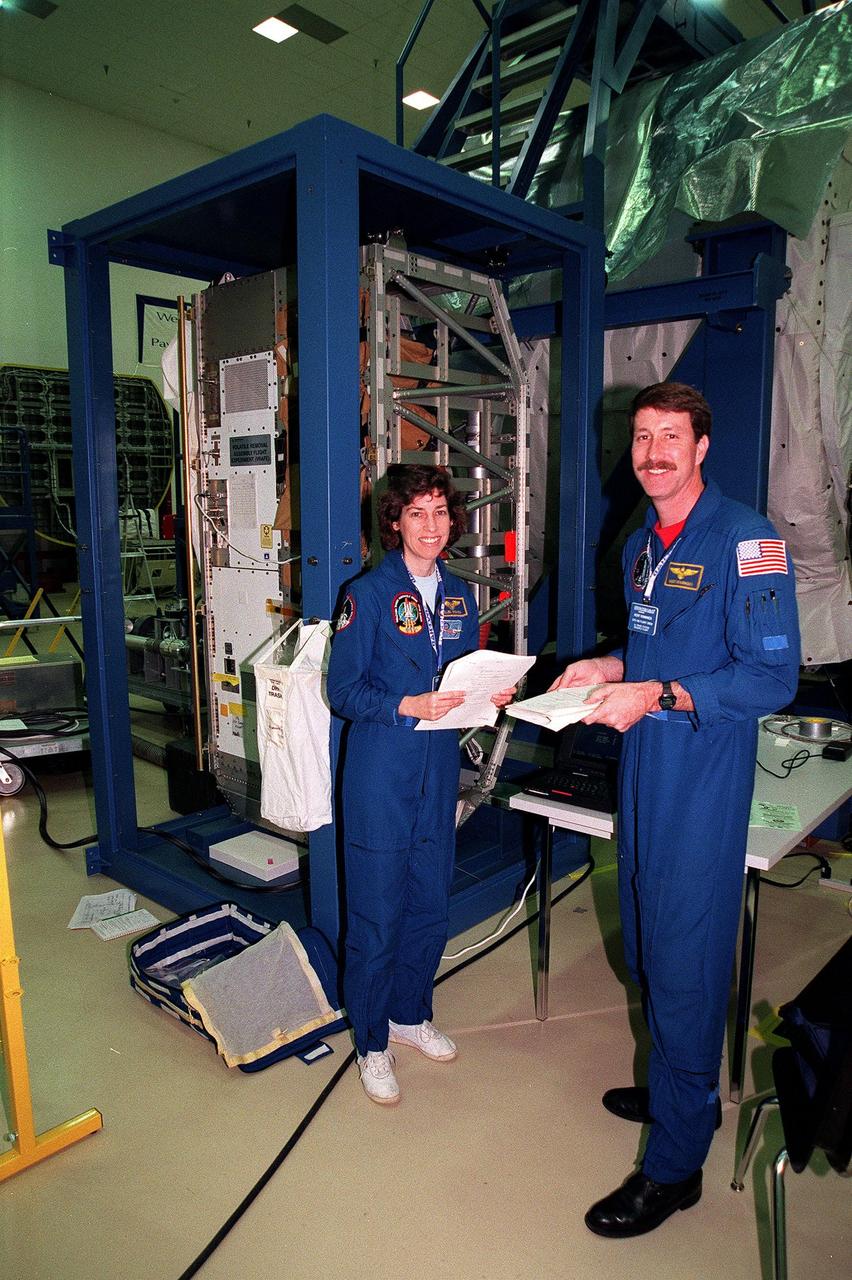
At the SPACEHAB Facility, STS-96 Mission Specialist Ellen Ochoa and Commander Kent Rominger pause during a payload Interface Verification Test (IVT) for their upcoming mission to the International Space Station. Other crew members at KSC for the IVT are Pilot Rick Husband and Mission Specialists Tamara Jernigan, Dan Barry, Julie Payette and Valery Tokarev of Russia. Mission STS-96 carries the SPACEHAB Logistics Double Module, which will have equipment to further outfit the International Space Station service module and equipment that can be off-loaded from the early U.S. assembly flights. It carries internal logistics and resupply cargo for station outfitting, plus an external Russian cargo crane to be mounted to the exterior of the Russian station segment and used to perform space walking maintenance activities. The double module stowage provides capacity of up to 10,000 lbs. with the ability to accommodate powered payloads, four external rooftop stowage locations, four double-rack locations (two powered), up to 61 bulkhead-mounted middeck locker locations, and floor storage for large unique items and Soft Stowage. STS-96 is targeted to launch May 20 about 9:32 a.m. EDT
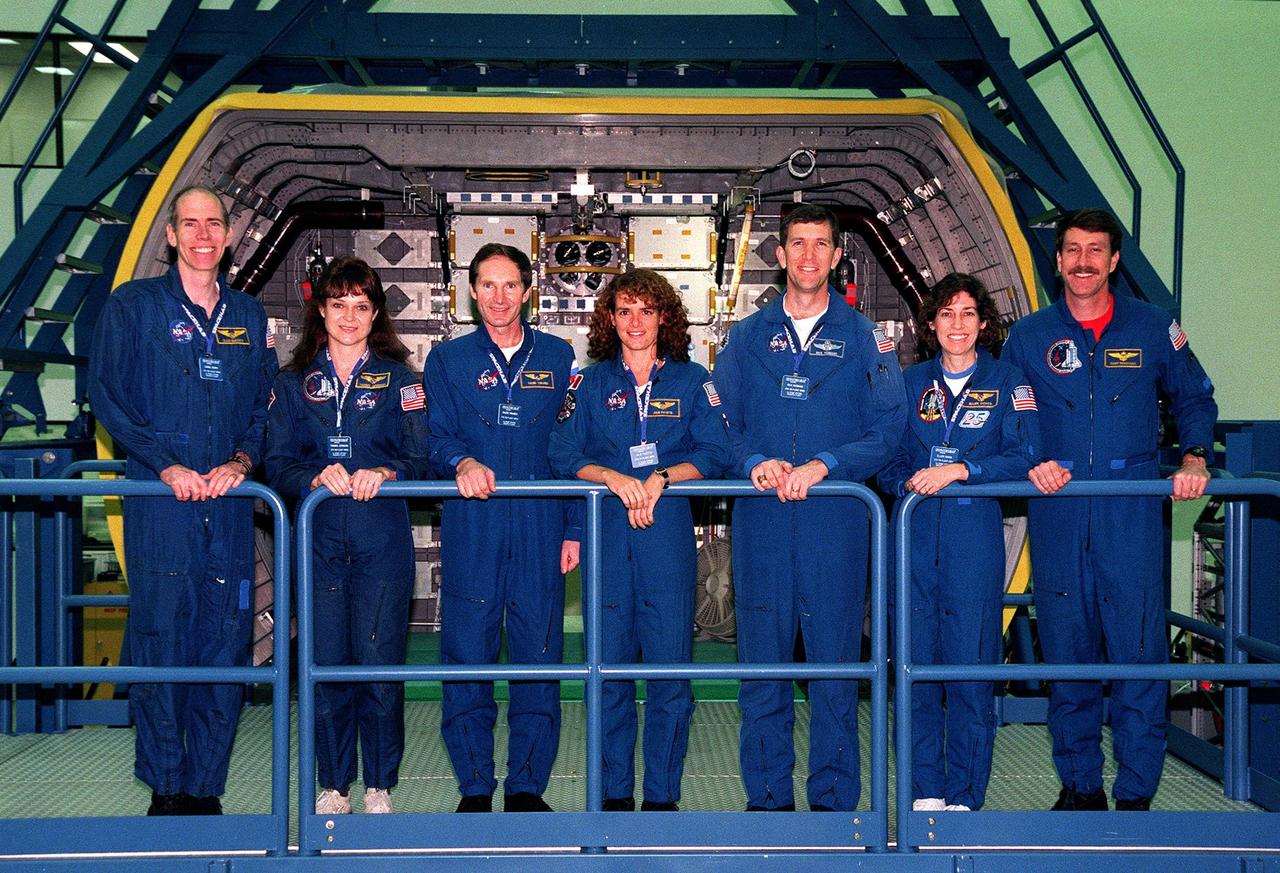
KENNEDY SPACE CENTER, FLA. -- Posing on the platform next to the SPACEHAB Logistics Double Module in the SPACEHAB Facility are the STS-96 crew (from left) Mission Specialists Dan Barry, Tamara Jernigan, Valery Tokarev of Russia, and Julie Payette; Pilot Rick Husband; Mission Specialist Ellen Ochoa; and Commander Kent Rominger. The crew is at KSC for a payload Interface Verification Test for their upcoming mission to the International Space Station. Mission STS-96 carries the SPACEHAB Logistics Double Module, which will have equipment to further outfit the International Space Station service module and equipment that can be off-loaded from the early U.S. assembly flights. It carries internal logistics and resupply cargo for station outfitting, plus an external Russian cargo crane to be mounted to the exterior of the Russian station segment and used to perform space walking maintenance activities. The double module stowage provides capacity of up to 10,000 lbs. with the ability to accommodate powered payloads, four external rooftop stowage locations, four double-rack locations (two powered), up to 61 bulkhead-mounted middeck locker locations, and floor storage for large unique items and Soft Stowage. STS-96 is targeted to launch May 20 about 9:32 a.m
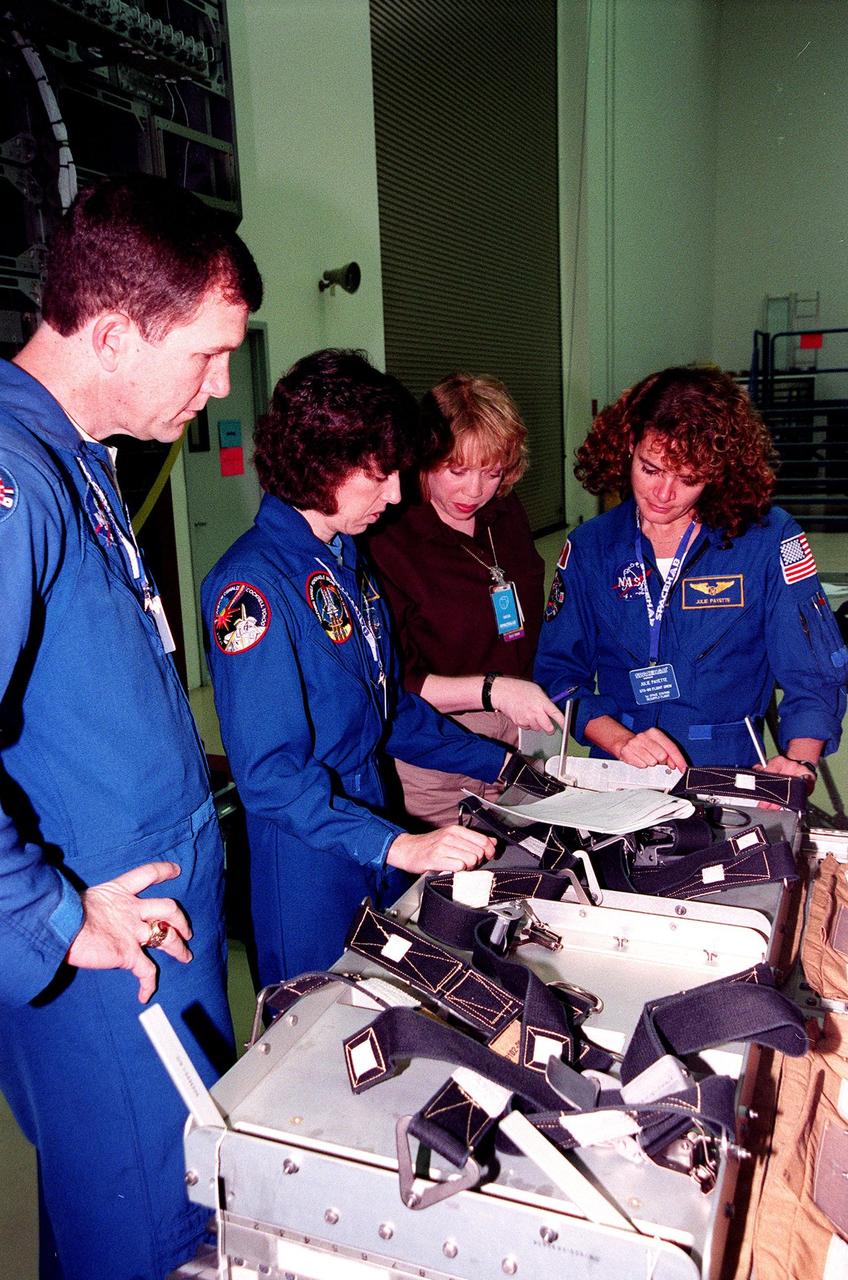
KENNEDY SPACE CENTER, FLA. -- During a payload Interface Verification Test (IVT) in the SPACEHAB Facility, STS-96 Pilot Rick Husband and Mission Specialist Ellen Ochoa (on the left) and Mission Specialist Julie Payette (on the far right) listen to Khristal Parker (second from right), with Boeing, explain about the equipment in front of them. Other crew members at KSC for the IVT are Commander Kent Rominger and Mission Specialists Tamara Jernigan, Dan Barry and Valery Tokarev of Russia. The SSU is part of the cargo on Mission STS-96, which carries the SPACEHAB Logistics Double Module, with equipment to further outfit the International Space Station service module and equipment that can be off-loaded from the early U.S. assembly flights. The SPACEHAB carries internal logistics and resupply cargo for station outfitting, plus an external Russian cargo crane to be mounted to the exterior of the Russian station segment and used to perform space walking maintenance activities. The double module stowage provides capacity of up to 10,000 lbs. with the ability to accommodate powered payloads, four external rooftop stowage locations, four double-rack locations (two powered), up to 61 bulkhead-mounted middeck locker locations, and floor storage for large unique items and Soft Stowage. STS-96 is targeted to launch May 20 about 9:32 a.m
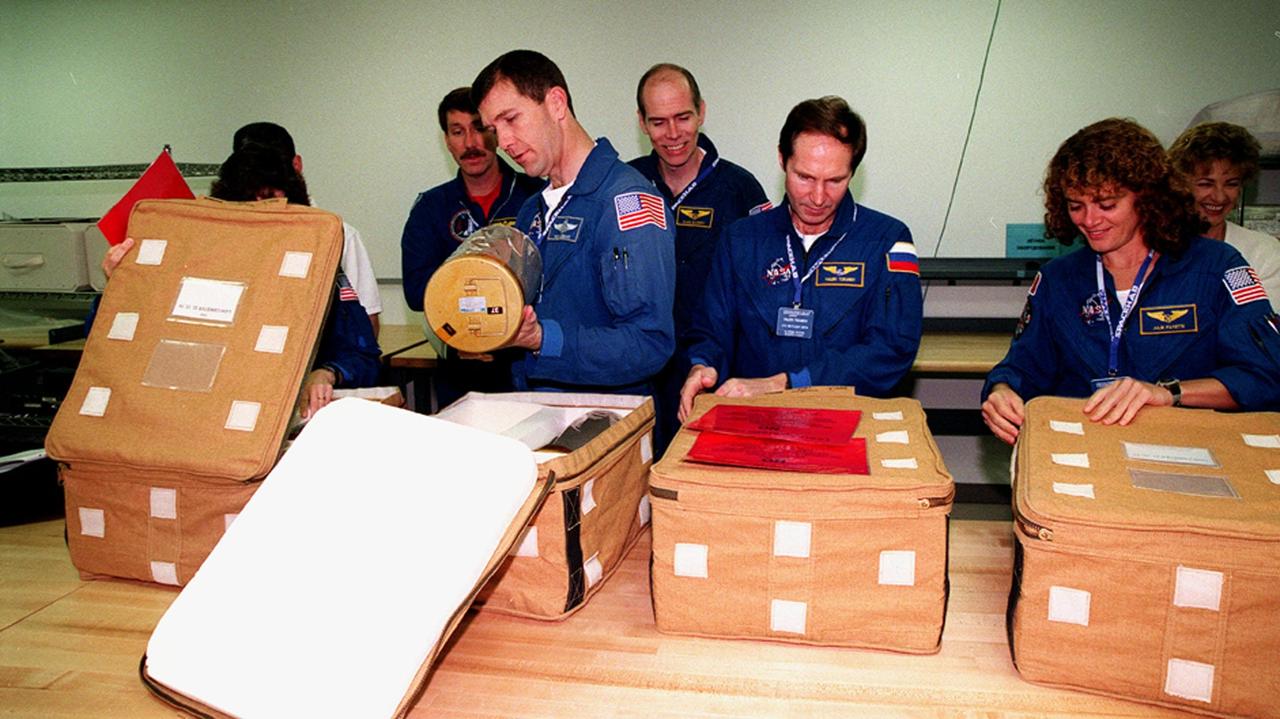
KENNEDY SPACE CENTER, FLA. -- In the SPACEHAB Facility, the STS-96 crew looks at equipment as part of a payload Interface Verification Test (IVT) for their upcoming mission to the International Space Station . From left are Mission Specialist Ellen Ochoa (behind the opened storage cover ), Commander Kent Rominger, Pilot Rick Husband (holding a lithium hydroxide canister) and Mission Specialists Dan Barry, Valery Tokarev of Russia and Julie Payette. In the background is TTI interpreter Valentina Maydell. The other crew member at KSC for the IVT is Mission Specialist Tamara Jernigan. Mission STS-96 carries the SPACEHAB Logistics Double Module, which has equipment to further outfit the International Space Station service module and equipment that can be off-loaded from the early U.S. assembly flights. The SPACEHAB carries internal logistics and resupply cargo for station outfitting, plus an external Russian cargo crane to be mounted to the exterior of the Russian station segment and used to perform space walking maintenance activities. The double module stowage provides capacity of up to 10,000 lbs. with the ability to accommodate powered payloads, four external rooftop stowage locations, four double-rack locations (two powered), up to 61 bulkhead-mounted middeck locker locations, and floor storage for large unique items and Soft Stowage. STS-96 is targeted to launch May 20 about 9:32 a.m

At Launch Pad 39B, Capt. Steve Kelly, with Fire Services, explains part of the emergency egress procedure to the STS-96 crew. Mission Specialist Daniel Barry (M.D., Ph.D.) is in the evacuation seat and training officer Gina Tucker behind him. In the background, workers at the pad look on. The STS-96 crew are taking part in Terminal Countdown Demonstration Test activities which also provide simulated countdown exercises and opportunities to inspect the mission payloads in the orbiter's payload bay. The other crew members are Commander Kent V. Rominger, Pilot Rick Douglas Husband and Mission Specialists Ellen Ochoa (Ph.D.), Tamara E. Jernigan (Ph.D.), Julie Payette, with the Canadian Space Agency, and Valery Ivanovich Tokarev, with the Russian Space Agency. STS-96, which is scheduled for liftoff on May 20 at 9:32 a.m., is a logistics and resupply mission for the International Space Station, carrying such payloads as a Russian crane, the Strela; a U.S.-built crane; the Spacehab Oceaneering Space System Box (SHOSS), a logistics items carrier; and STARSHINE, a student-led experiment
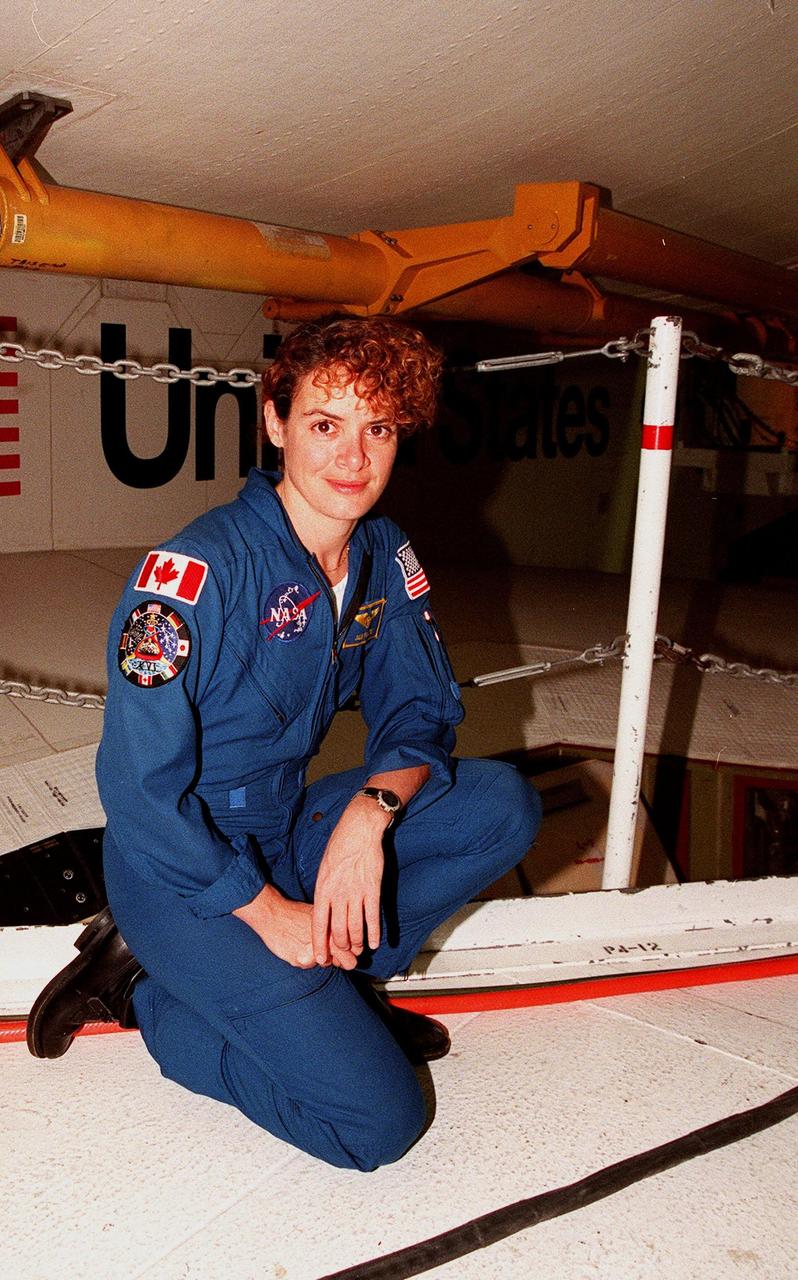
In the Orbiter Processing Facility bay 1, STS-96 Mission Specialist Julie Payette, with the Canadian Space Agency, poses during a break in a Crew Equipment Interface Test. The other crew members participating are Commander Kent V. Rominger, Pilot Rick Douglas Husband, and Mission Specialists Ellen Ochoa (Ph.D), Tamara E. Jernigan (Ph.D.), Daniel Barry (M.D., Ph.D.), and Valery Ivanovich Tokarev, who represents the Russian Space Agency. The primary payload of STS-96 is the SPACEHAB Double Module. In addition, the Space Shuttle will carry unpressurized cargo such as the external Russian cargo crane known as STRELA; the Spacehab Oceaneering Space System Box (SHOSS), which is a logistics items carrier; and an ORU Transfer Device (OTD), a U.S.-built crane that will be stowed on the station for use during future ISS assembly missions. These cargo items will be stowed on the International Cargo Carrier, fitted inside the payload bay behind the SPACEHAB module. STS-96 is targeted for launch on May 24 from Launch Pad 39B
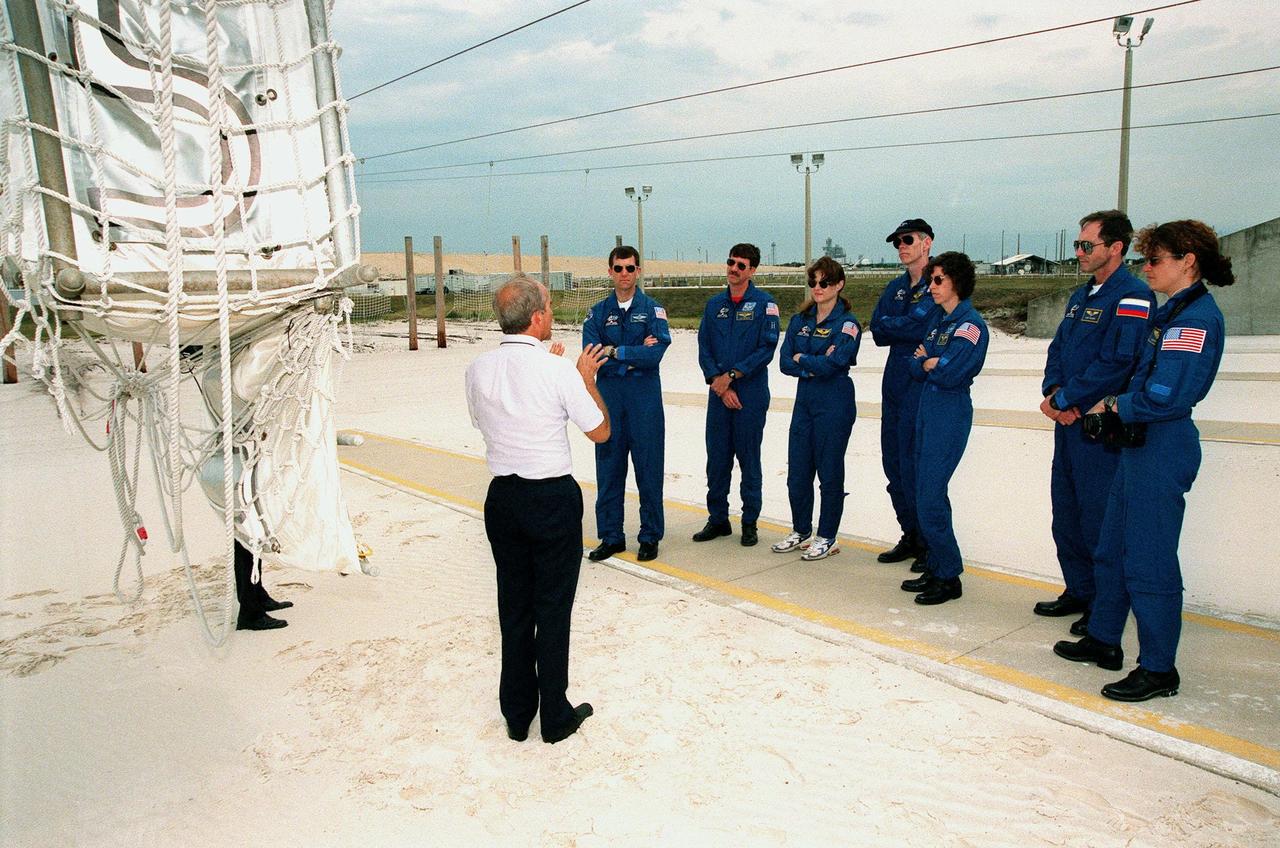
At Launch Pad 39B, the STS-96 crew listens to tech trainer Ken Clark, with United Space Alliance, about the use of the slidewire basket at left during emergency egress training. Standing left to right are Pilot Rick Douglas Husband, Commander Kent V. Rominger, and Mission Specialists Tamara E. Jernigan (Ph.D.), Daniel Barry (M.D., Ph.D.), Ellen Ochoa (Ph.D.), Valery Ivanovich Tokarev, with the Russian Space Agency, and Julie Payette, with the Canadian Space Agency. The STS-96 crew are taking part in Terminal Countdown Demonstration Test activities which also provide simulated countdown exercises and opportunities to inspect the mission payloads in the orbiter's payload bay. Scheduled for liftoff on May 20 at 9:32 a.m., STS-96 is a logistics and resupply mission for the International Space Station, carrying such payloads as a Russian crane, the Strela; a U.S.-built crane; the Spacehab Oceaneering Space System Box (SHOSS), a logistics items carrier; and STARSHINE, a student-led experiment
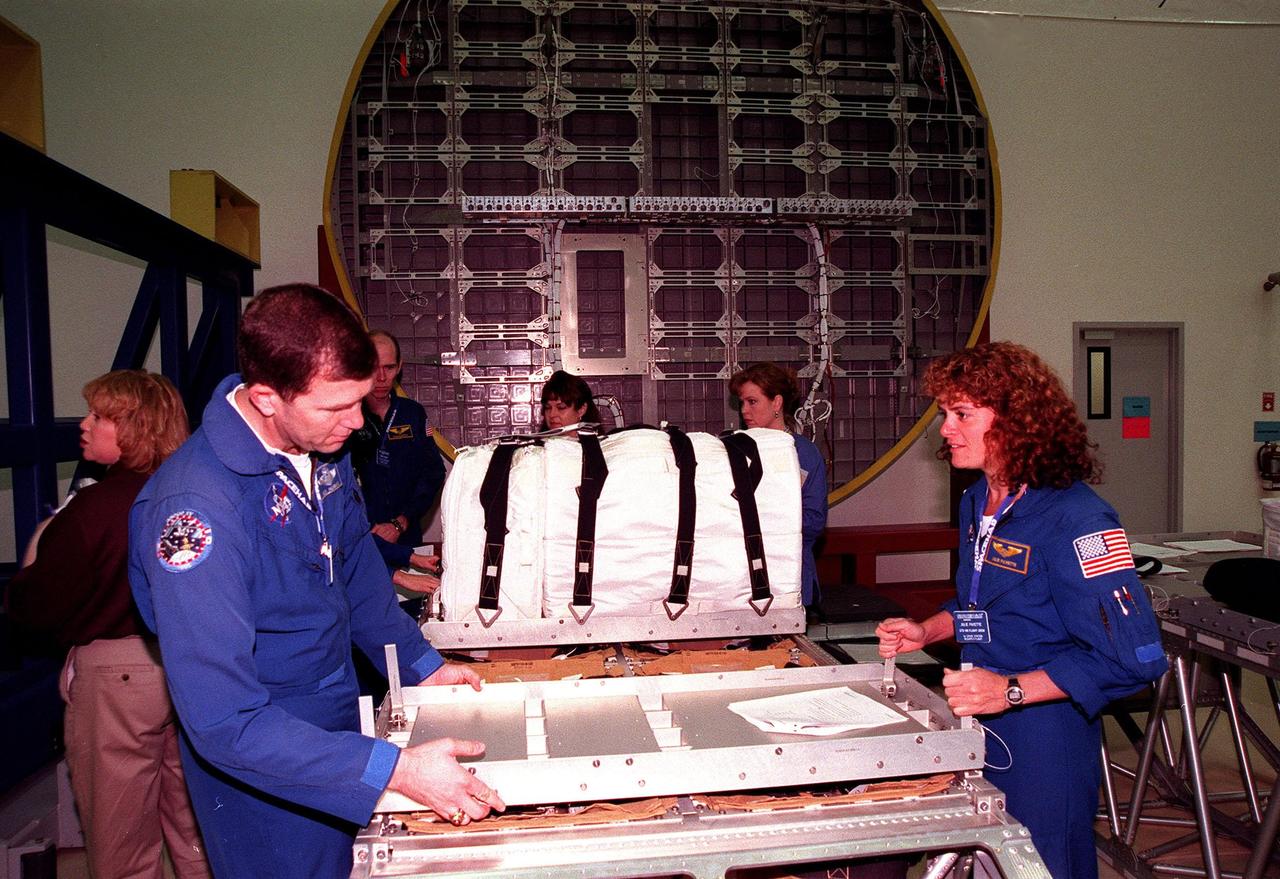
KENNEDY SPACE CENTER, FLA. -- In the SPACEHAB Facility, STS-96 crew members look over equipment during a payload Interface Verification Test (IVT) for their upcoming mission to the International Space Station. From left are Khristal Parker, with Boeing; Mission Specialist Dan Barry, Pilot Rick Husband, Mission Specialist Tamara Jernigan, and at the far right, Mission Specialist Julie Payette. An unidentified worker is in the background. Also at KSC for the IVT are Commander Kent Rominger and Mission Specialists Ellen Ochoa and Valery Tokarev of Russia. Mission STS-96 carries the SPACEHAB Logistics Double Module, which will have equipment to further outfit the International Space Station service module and equipment that can be off-loaded from the early U.S. assembly flights. It carries internal logistics and resupply cargo for station outfitting, plus an external Russian cargo crane to be mounted to the exterior of the Russian station segment and used to perform space walking maintenance activities. The double module stowage provides capacity of up to 10,000 lbs. with the ability to accommodate powered payloads, four external rooftop stowage locations, four double-rack locations (two powered), up to 61 bulkhead-mounted middeck locker locations, and floor storage for large unique items and Soft Stowage. STS-96 is targeted to launch May 20 about 9:32 a.m
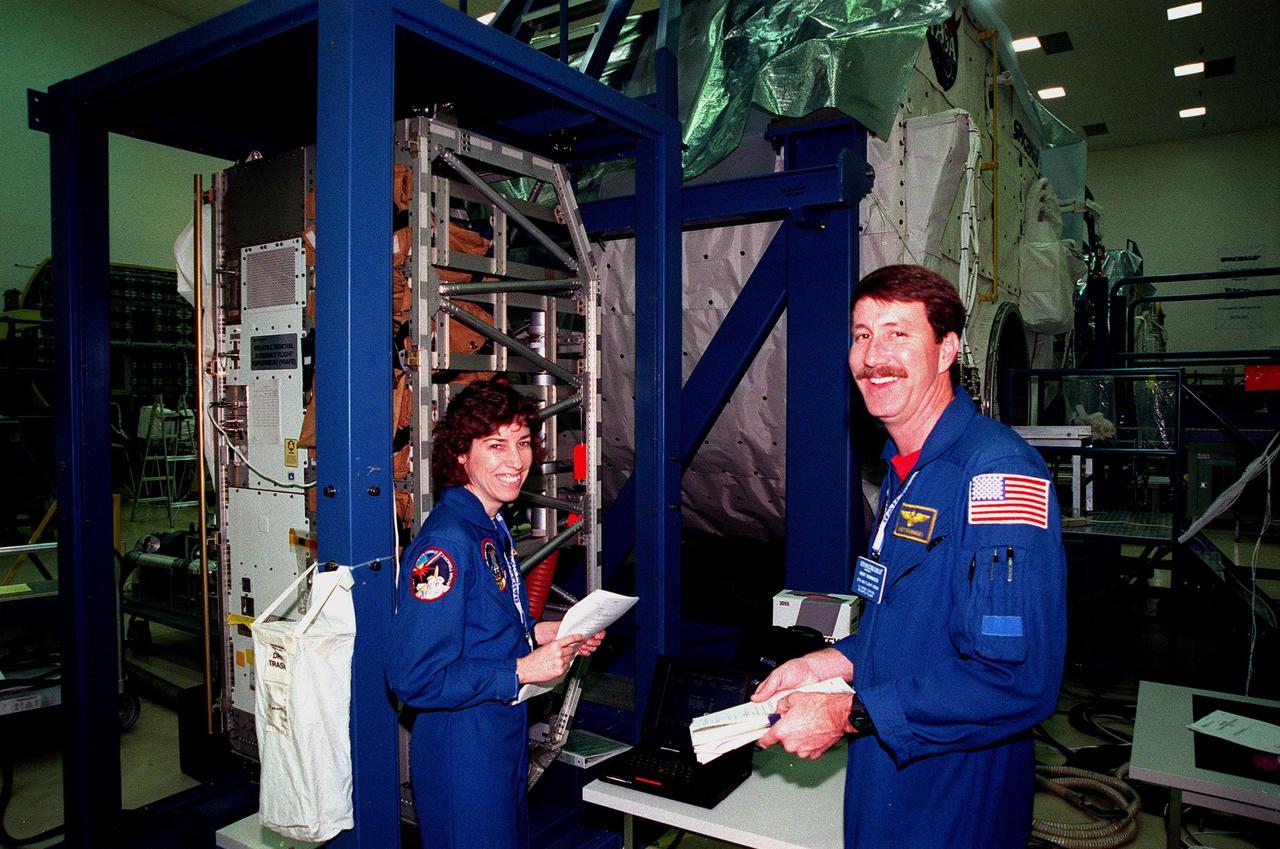
At the SPACEHAB Facility, STS-96 Mission Specialist Ellen Ochoa and Commander Kent Rominger smile for the camera during a payload Interface Verification Test (IVT) for their upcoming mission to the International Space Station. Other crew members at KSC for the IVT are Pilot Rick Husband and Mission Specialists Tamara Jernigan, Dan Barry, Julie Payette and Valery Tokarev of Russia. Mission STS-96 carries the SPACEHAB Logistics Double Module, which will have equipment to further outfit the International Space Station service module and equipment that can be off-loaded from the early U.S. assembly flights. It carries internal logistics and resupply cargo for station outfitting, plus an external Russian cargo crane to be mounted to the exterior of the Russian station segment and used to perform space walking maintenance activities. The double module stowage provides capacity of up to 10,000 lbs. with the ability to accommodate powered payloads, four external rooftop stowage locations, four double-rack locations (two powered), up to 61 bulkhead-mounted middeck locker locations, and floor storage for large unique items and Soft Stowage. STS-96 is targeted to launch May 20 about 9:32 a.m. EDT

KENNEDY SPACE CENTER, FLA. -- During a payload Interface Verification Test (IVT) for their upcoming mission to the International Space Station, STS-96 Mission Specialists Julie Payette, Dan Barry, and Valery Tokarev of Russia, look at a Sequential Shunt Unit in the SPACEHAB Facility. Other crew members at KSC for the IVT are Commander Kent Rominger, Pilot Rick Husband, and Mission Specialists Ellen Ochoa and Tamara Jernigan. Mission STS-96 carries the SPACEHAB Logistics Double Module, which will have equipment to further outfit the International Space Station service module and equipment that can be off-loaded from the early U.S. assembly flights. It carries internal logistics and resupply cargo for station outfitting, plus an external Russian cargo crane to be mounted to the exterior of the Russian station segment and used to perform space walking maintenance activities. The double module stowage provides capacity of up to 10,000 lbs. with the ability to accommodate powered payloads, four external rooftop stowage locations, four double-rack locations (two powered), up to 61 bulkhead-mounted middeck locker locations, and floor storage for large unique items and Soft Stowage. STS-96 is targeted to launch May 20 about 9:32 a.m. EDT

KENNEDY SPACE CENTER, FLA. -- In the SPACEHAB Facility, the STS-96 crew looks over equipment during a payload Interface Verification Test for the upcoming mission to the International Space Station. From left are Commander Kent Rominger, Mission Specialists Tamara Jernigan and Valery Tokarev of Russia, Pilot Rick Husband, and Mission Specialists Ellen Ochoa and Julie Payette (backs to the camera). They are listening to Chris Jaskolka of Boeing talk about the equipment. Mission STS-96 carries the SPACEHAB Logistics Double Module, which will have equipment to further outfit the International Space Station service module and equipment that can be off-loaded from the early U.S. assembly flights. It carries internal logistics and resupply cargo for station outfitting, plus an external Russian cargo crane to be mounted to the exterior of the Russian station segment and used to perform space walking maintenance activities. The double module stowage provides capacity of up to 10,000 lbs. with the ability to accommodate powered payloads, four external rooftop stowage locations, four double-rack locations (two powered), up to 61 bulkhead-mounted middeck locker locations, and floor storage for large unique items and Soft Stowage. STS-96 is targeted to launch May 20 about 9:32 a.m. EDT

In the Orbiter Processing Facility bay 1, the STS-96 crew (foreground) looks into the payload bay of the orbiter Discovery. Standing in the bucket in the foreground are (left to right) Mission Specialists Daniel Barry (M.D., Ph.D.), Valery Ivanovich Tokarev, and Tamara E. Jernigan (Ph.D.), with a KSC worker at the controls of the bucket. In the background (center) pointing is Mission Specialist Julie Payette. Tokarev represents the Russian Space Agency and Payette the Canadian Space Agency. They are at KSC for a Crew Equipment Interface Test. The other crew members participating in the test are Commander Kent V. Rominger, Pilot Rick Douglas Husband and Mission Specialist Ellen Ochoa (Ph.D.). The primary payload of STS-96 is the SPACEHAB Double Module. In addition, the Space Shuttle will carry unpressurized cargo such as the external Russian cargo crane known as STRELA; the Spacehab Oceaneering Space System Box (SHOSS), which is a logistics items carrier; and an ORU Transfer Device (OTD), a U.S.-built crane that will be stowed on the station for use during future ISS assembly missions. These cargo items will be stowed on the International Cargo Carrier, fitted inside the payload bay behind the SPACEHAB module. STS-96 is targeted for launch on May 24 from Launch Pad 39B
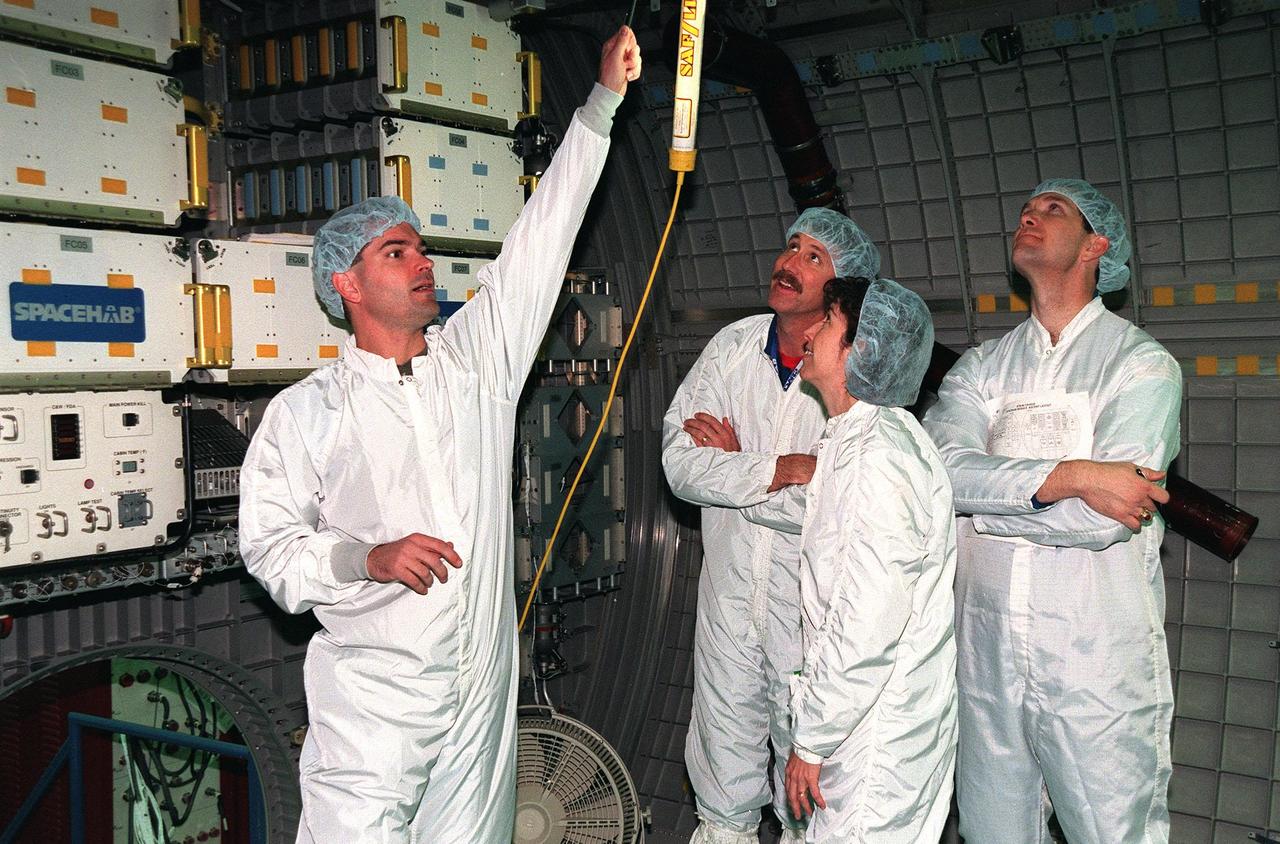
KENNEDY SPACE CENTER, FLA. -- During a payload Interface Verification Test (IVT) for the upcoming mission to the International Space Station , Chris Jaskolka of Boeing points out a piece of equipment in the SPACEHAB module to STS-96 Commander Kent Rominger, Mission Specialist Ellen Ochoa and Pilot Rick Husband. Other crew members visiting KSC for the IVT are Mission Specialists Tamara Jernigan, Dan Barry, Julie Payette and Valery Tokarev of Russia. Mission STS-96 carries the SPACEHAB Logistics Double Module, which will have equipment to further outfit the International Space Station service module and equipment that can be off-loaded from the early U.S. assembly flights. It carries internal logistics and resupply cargo for station outfitting, plus an external Russian cargo crane to be mounted to the exterior of the Russian station segment and used to perform space walking maintenance activities. The double module stowage provides capacity of up to 10,000 lbs. with the ability to accommodate powered payloads, four external rooftop stowage locations, four double-rack locations (two powered), up to 61 bulkhead-mounted middeck locker locations, and floor storage for large unique items and Soft Stowage. STS-96 is targeted to launch May 20 about 9:32 a.m. EDT
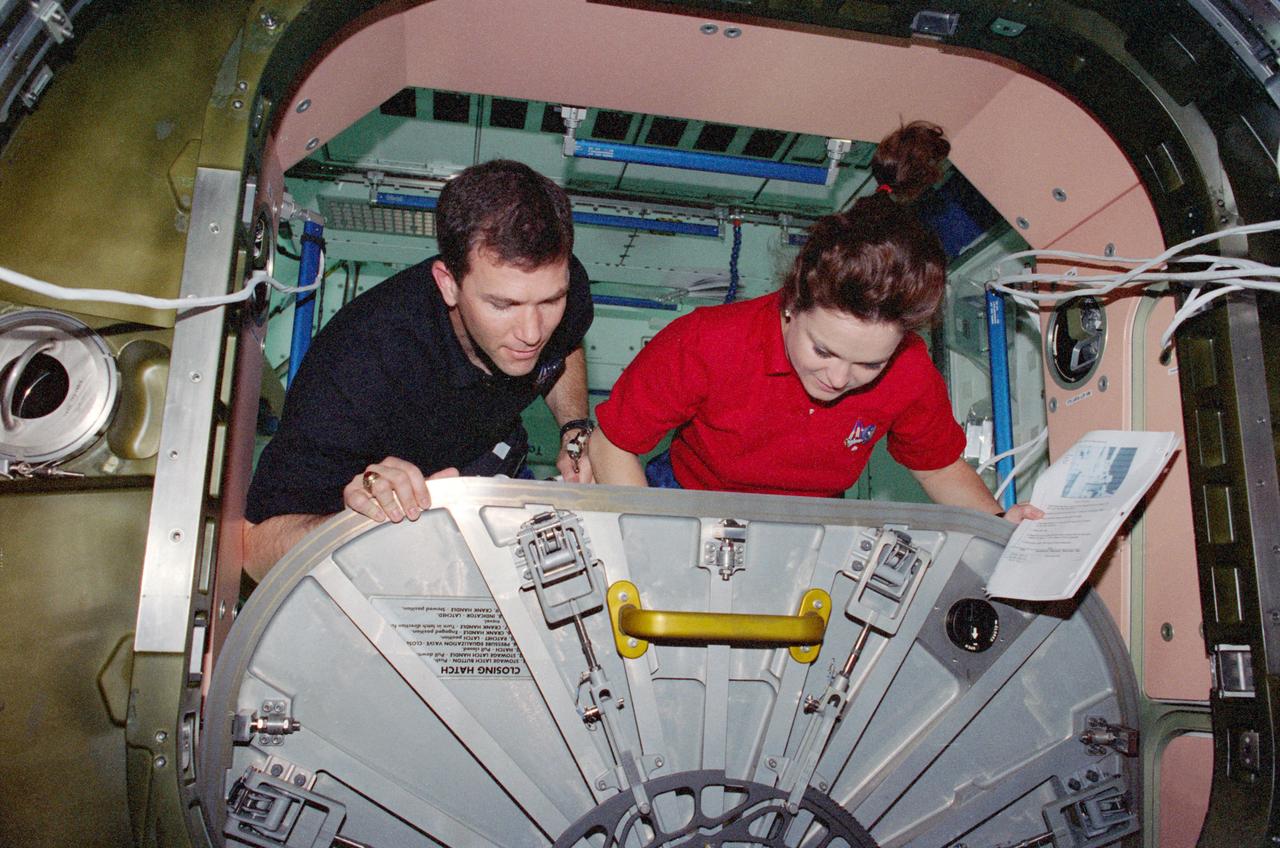
STS096-383-021 (27 May - 6 June 1999) -- Astronauts Rick D. Husband and Tamara E. Jernigan adjust the hatch for the U.S.-built Unity node. The task was part of the overall effort by the seven-member STS-96 crew to prepare the existing portion of the International Space Station (ISS).

S96-E-5234 (3 June 1999) --- A STS-96 crew member handling an electronic still camera (ESC) recorded this image of the International Space Station (ISS) during a flyaround following separation of the two spacecraft. The image was recorded at 23:12:29 GMT, June 3, 1999.
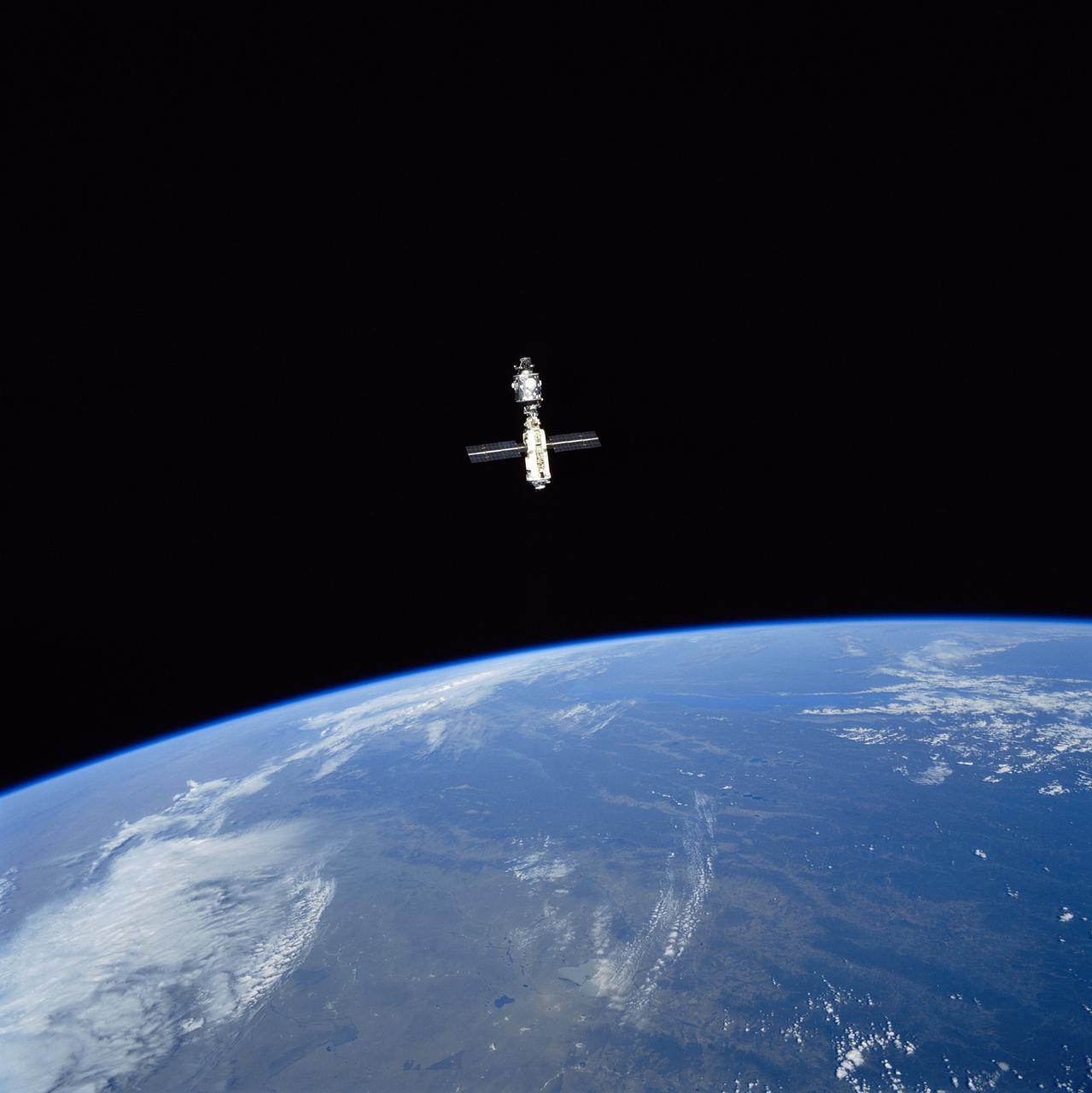
STS096-715-028 (3 June 1999) --- A STS-96 crew member aboard Discovery recorded this distant image of the International Space Station (ISS) with a 70mm camera following separation of the two spacecraft. Russia's Lake Baykal, not far from the Mongolian border, can be seen in the background of the horizon view of Earth.
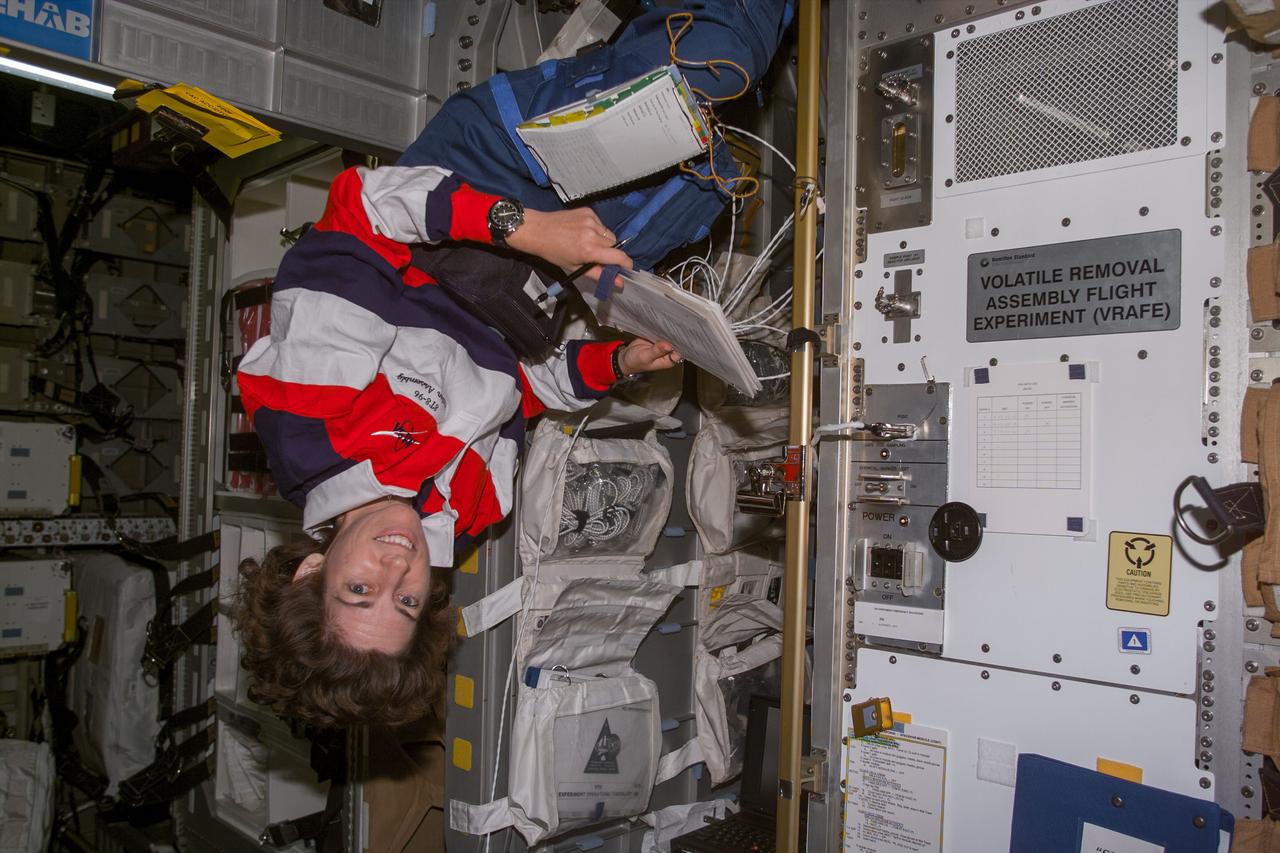
S96-E-5150 (02 June 1999) --- Astronaut Ellen Ochoa, STS-96 mission specialist, in the SpaceHab module aboard the Earth-orbiting Space Shuttle Discovery. The photograph was taken with an electronic still camera (ESC) at 01:14:12, June 2, 1999.
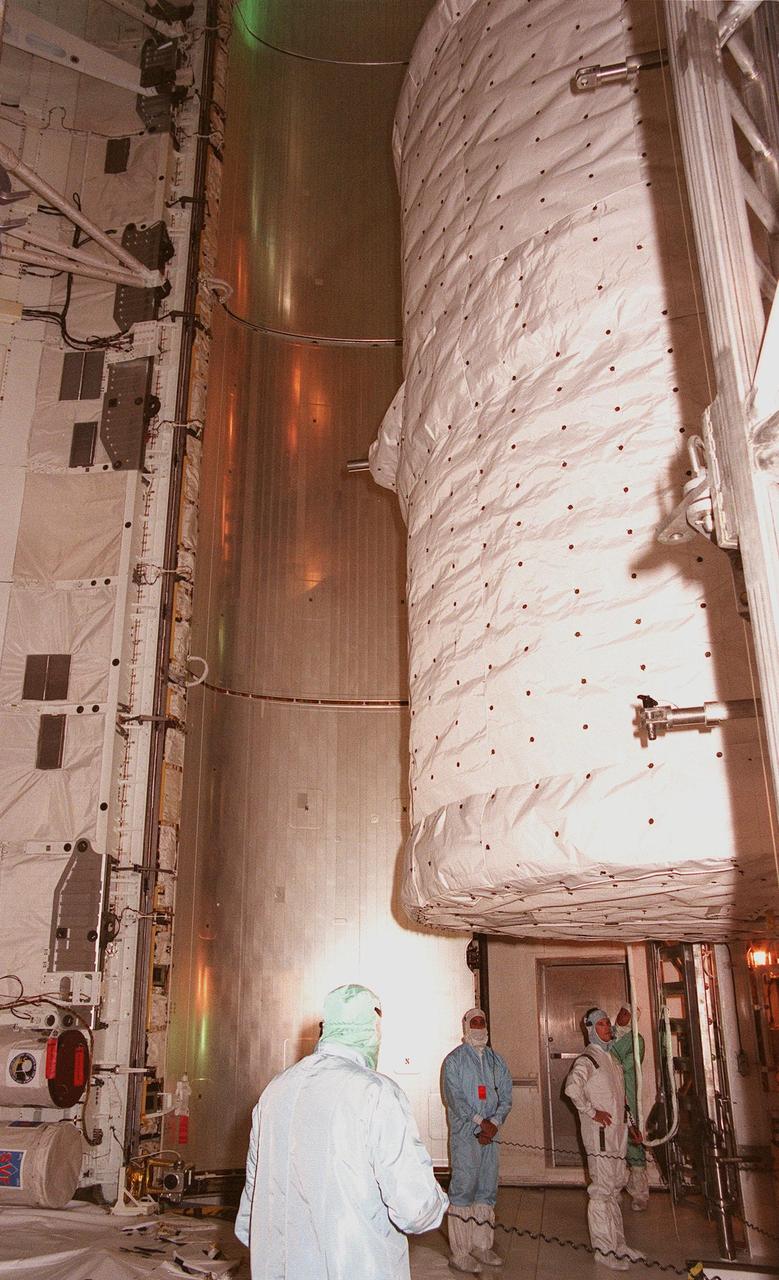
KENNEDY SPACE CENTER, FLA. -- In the payload changeout room at Launch Pad 39B, the SPACEHAB Double module is moved from the payload canister before being placed in Space Shuttle Discovery's payload bay for mission STS-96. The second flight supporting construction of the International Space Station, STS-96 is a logistics and resupply mission, carrying more than 5,000 pounds of supplies, a Russian-built crane and a U.S.-built crane, plus experiments such as STARSHINE, which was developed by and for students. Comprising the crew are Commander Kent V. Rominger, Pilot Rick Douglas Husband, and Mission Specialists Ellen Ochoa (Ph.D.), Tamara E. Jernigan (Ph.D.), Daniel Barry (M.D., Ph.D.), Julie Payette, with the Canadian Space Agency, and Valery Ivanovich Tokarev, with the Russian Space Agency. Liftoff is scheduled for May 20 at 9:32 a.m. EDT
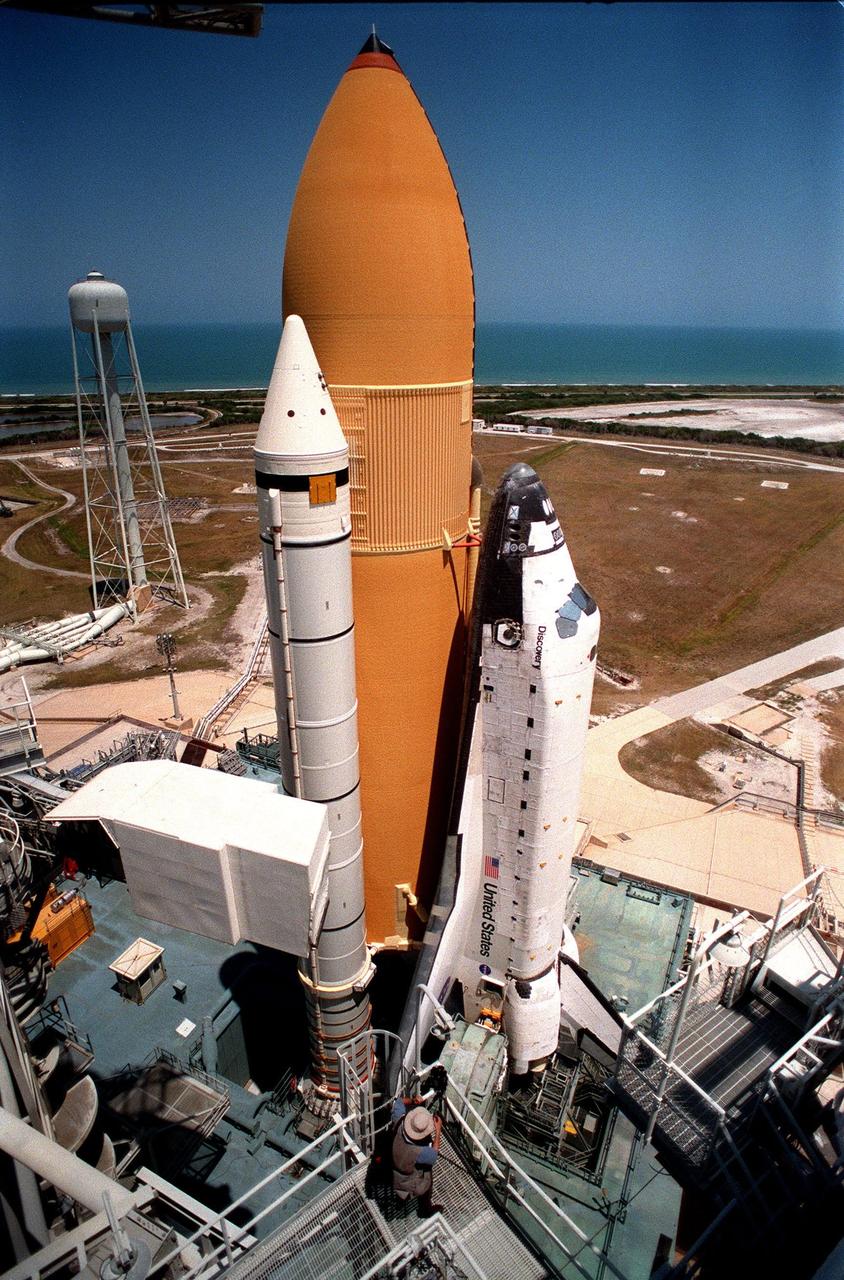
KENNEDY SPACE CENTER, FLA. -- Space Shuttle Discovery sits on Launch Pad 39B against a backdrop of blue sky and the blue-green Atlantic Ocean. At the top left is the 290-foot-high water tank that holds 300,000 gallons of water for the sound suppression system during liftoff. At the bottom, on the Rotating Service Structure, is photographer John Sexton, taking photos for a book. Liftoff of Discovery on mission STS-96 is targeted for May 20 at 9:32 a.m. EDT. STS-96 is a logistics and resupply mission for the International Space Station, carrying such payloads as a Russian crane, the Strela; a U.S.-built crane; the Spacehab Oceaneering Space System Box (SHOSS), a logistics items carrier; and STARSHINE, a student-led experiment
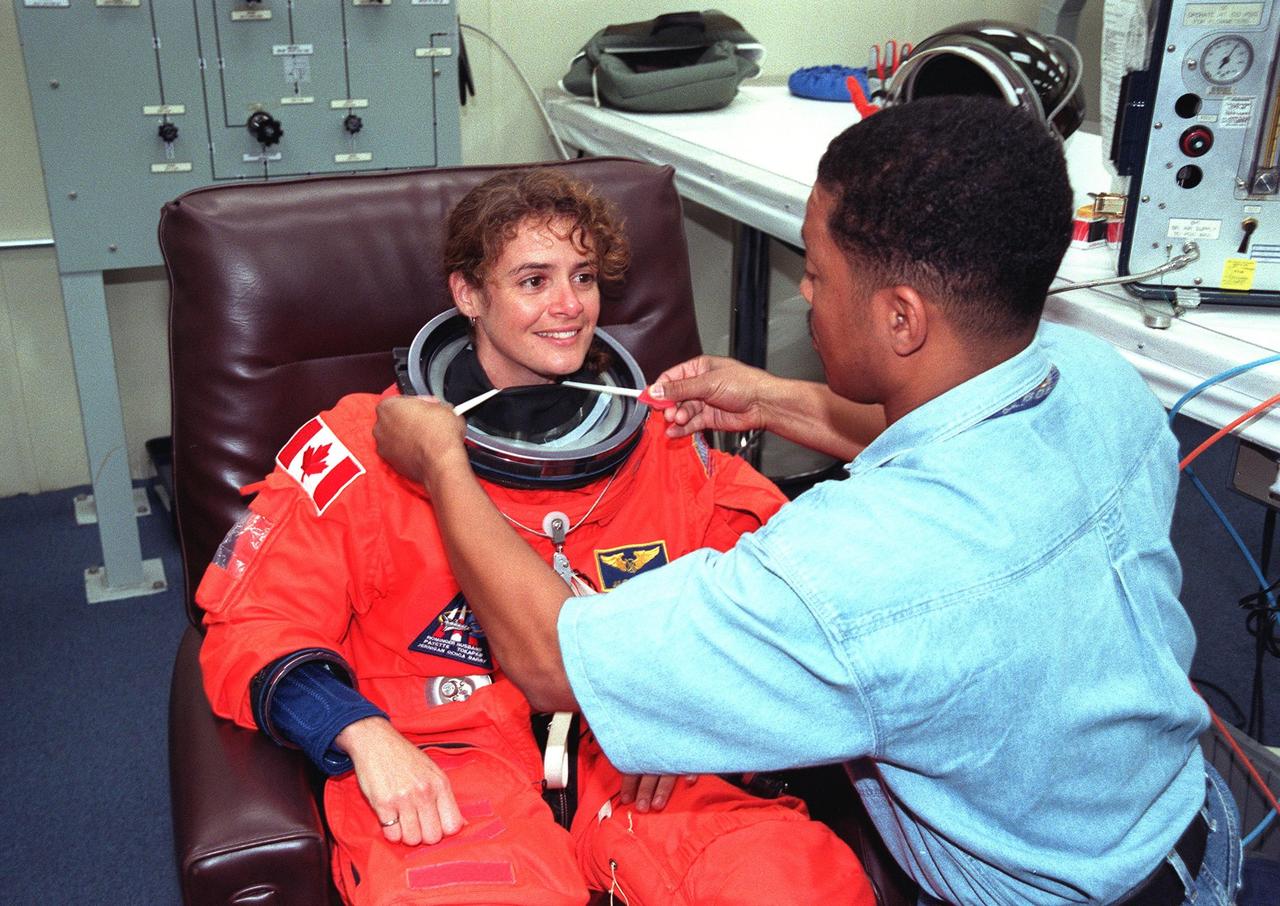
In the Operations and Checkout Building, STS-96 Mission Specialist Julie Payette is assisted by a suit technician in donning her launch and entry suit during final launch preparations. Payette is with the Canadian Space Agency. STS-96 is a 10-day logistics and resupply mission for the International Space Station, carrying about 4,000 pounds of supplies, to be stored aboard the station for use by future crews, including laptop computers, cameras, tools, spare parts, and clothing. The mission also includes such payloads as a Russian crane, the Strela; a U.S.-built crane; the Spacehab Oceaneering Space System Box (SHOSS), a logistics items carrier; and STARSHINE, a student-involved experiment. It will include a space walk to attach the cranes to the outside of the ISS for use in future construction.. Space Shuttle Discovery is due to launch today at 6:49 a.m. EDT. Landing is expected at the SLF on June 6 about 1:58 a.m. EDT
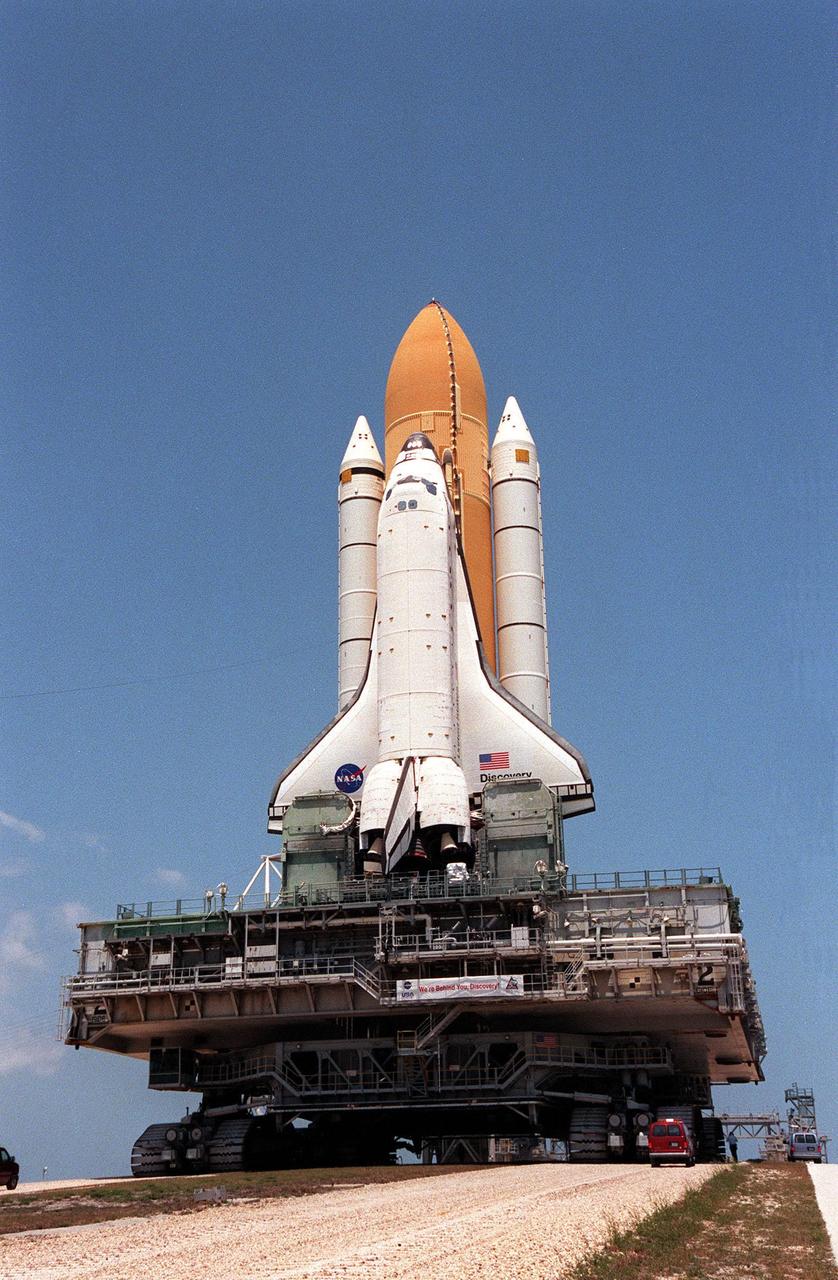
KENNEDY SPACE CENTER, Fla. -- The Space Shuttle Discovery, atop the mobile launcher platform and crawler-transporter, begins the climb up the ramp to Launch Pad 39B. Traveling at 1 mph, the crawler-transporter takes about five hours to cover the journey from the Vehicle Assembly Building to the launch pad. Special levelers on the crawler-transporter keep the Space Shuttle vertical within plus or minus 10 minutes of arc about the dimensions of a basketball. Liftoff of Discovery on mission STS-96 is targeted for May 20 at 9:32 a.m. EDT. STS-96 is a logistics and resupply mission for the International Space Station, carrying such payloads as a Russian crane, the Strela; a U.S.-built crane; the Spacehab Oceaneering Space System Box (SHOSS), a logistics items carrier; and STARSHINE, a student-led experiment
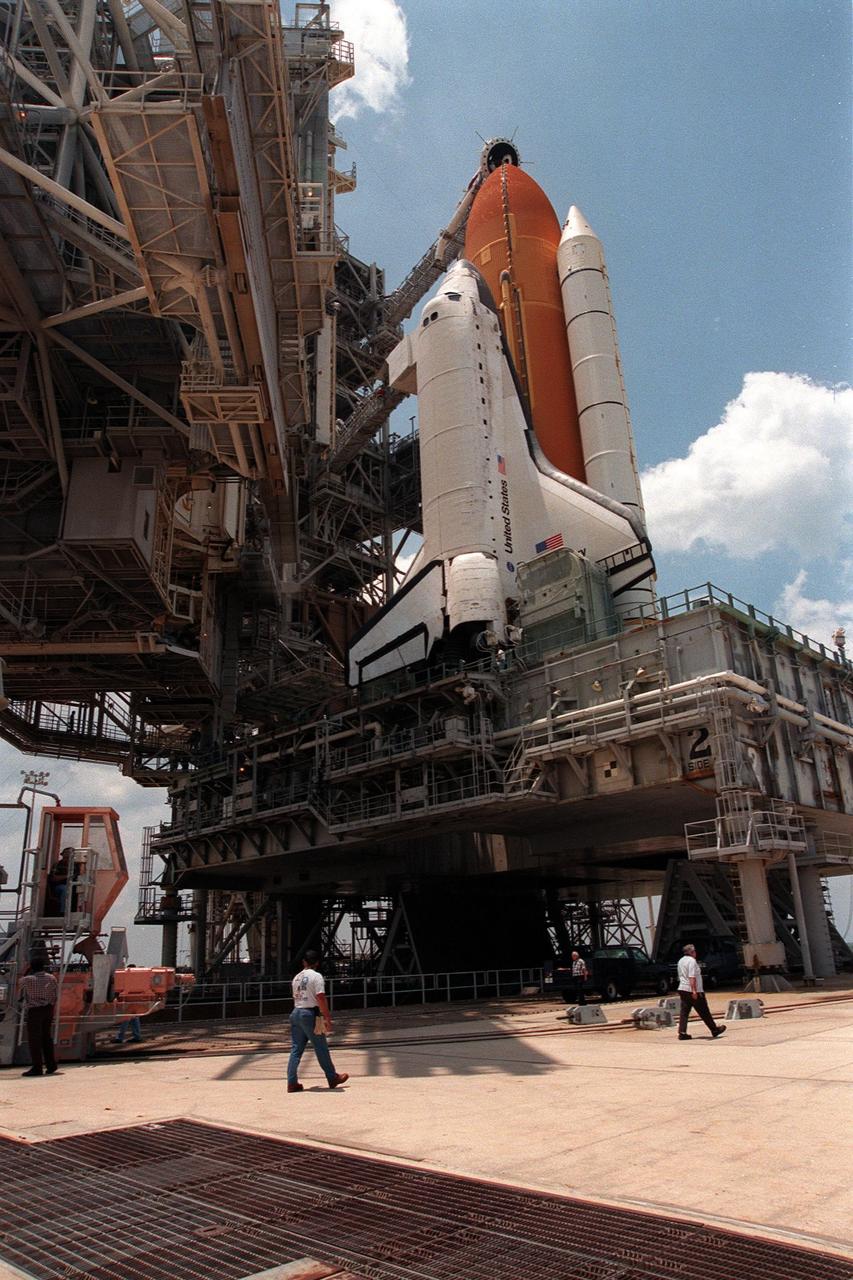
KENNEDY SPACE CENTER, FLA. -- The Rotating Service Structure is rolled back at Launch Pad 39B to reveal the Space Shuttle Discovery, scheduled to launch on mission STS-96 at 6:49 a.m. EDT on May 27. STS-96 is a 10-day logistics and resupply mission for the International Space Station, carrying about 4,000 pounds of supplies to be stored aboard the station, for use by future crews, including laptop computers, cameras, tools, spare parts, and clothing. The mission also includes such payloads as a Russian crane, the Strela; a U.S.-built crane; the Spacehab Oceaneering Space System Box (SHOSS), a logistics items carrier; and STARSHINE, a student-involved experiment. The mission will include a space walk to attach the cranes to the outside of the ISS for use in future construction. Space Shuttle Discovery is due to launch on May 27 at 6:49 a.m. EDT. Landing is expected at the SLF on June 6 about 1:58 a.m. EDT
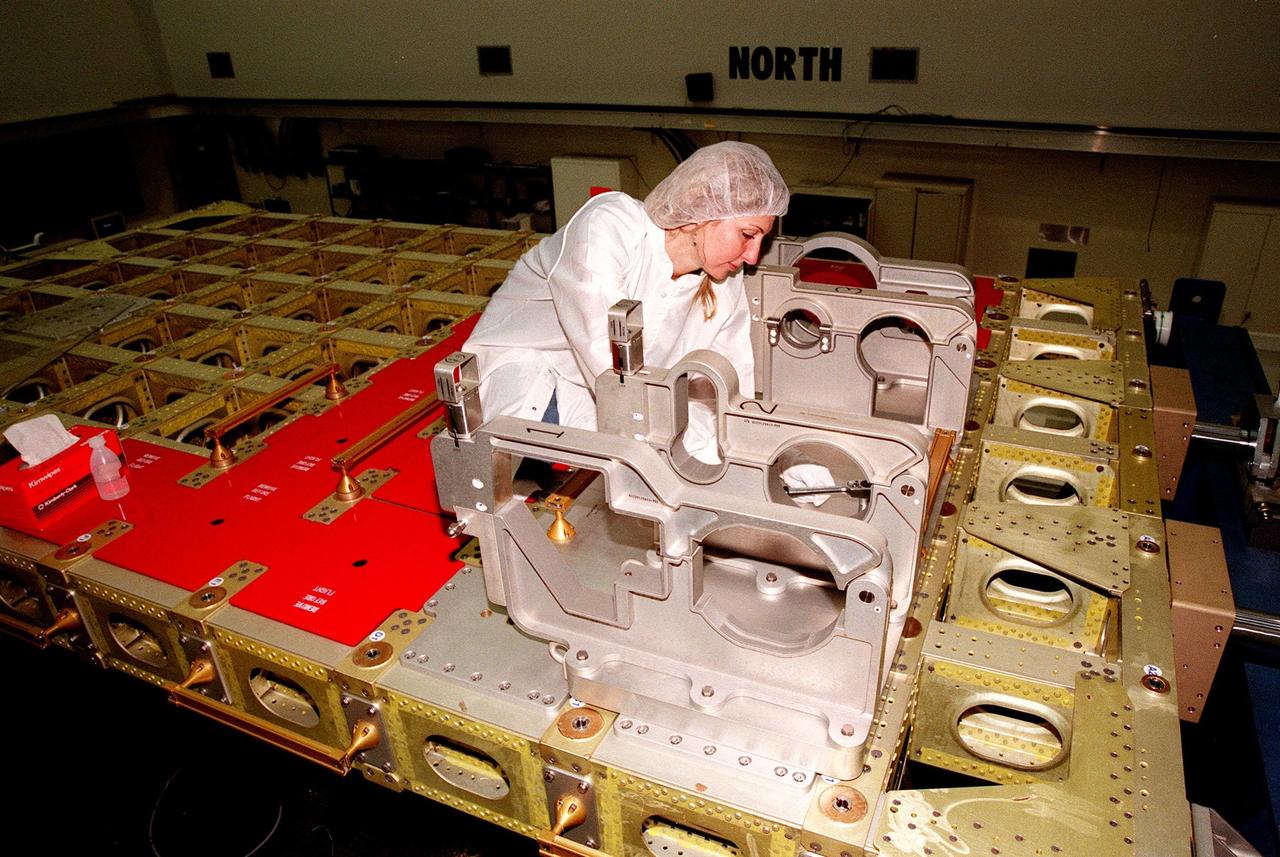
At Astrotech, Titusville, Fla., Lora Lawrence, with Johnson Space Center, makes a bonding check on the International Cargo Carrier that will be used during future International Space Station (ISS) assembly missions. The nonpressurized ICC fits inside the payload bay of the orbiter. The ICC will carry the SPACEHAB Oceaneering Space System Box (SHOSS), a logistics items carrier. SHOSS can hold a maximum of 400 pounds of equipment and will carry items to be used during STS-96 and future ISS assembly flights. Also aboard the ICC will be the ORU Transfer Device (OTD), a U.S.-built crane that will be stowed on Unity for use during future ISS assembly missions. The ICC will fly on mission STS-96, targeted for launch on May 20

KENNEDY SPACE CENTER, FLA. -- This fish-eye view shows the SPACEHAB Double module being moved into the payload changeout room at Launch Pad 39B before being transferred to Space Shuttle Discovery's payload bay for mission STS-96. The second flight supporting construction of the International Space Station, STS-96 is a logistics and resupply mission, carrying more than 5,000 pounds of supplies, a Russian-built crane and a U.S.-built crane, plus experiments such as STARSHINE, which was developed by and for students. Comprising the crew are Commander Kent V. Rominger, Pilot Rick Douglas Husband, and Mission Specialists Ellen Ochoa (Ph.D.), Tamara E. Jernigan (Ph.D.), Daniel Barry (M.D., Ph.D.), Julie Payette, with the Canadian Space Agency, and Valery Ivanovich Tokarev, with the Russian Space Agency. Liftoff is scheduled for May 20 at 9:32 a.m. EDT

KENNEDY SPACE CENTER, FLA. -- In the early light of dawn, a crawler transporter moves Space Shuttle Discovery, with its external tank and solid rocket boosters, from Pad 39B back to the Vehicle Assembly Building for repair of damage to the external tank foam insulation caused by hail. The necessary repair work could not be performed at the pad due to limited access to the damaged areas. The work is expected to take two to three days, allowing Discovery to roll back to the pad by midweek for launch of mission STS-96, the 94th launch in the Space Shuttle Program. This is only the 13th time since 1981 that a Shuttle has had to roll back from the pad. Liftoff will occur no earlier than May 27. STS-96 is a logistics and resupply mission for the International Space Station, carrying such payloads as a Russian crane, the Strela; a U.S.-built crane; the Spacehab Oceaneering Space System Box (SHOSS), a logistics items carrier; and STARSHINE, a student-shared experiment
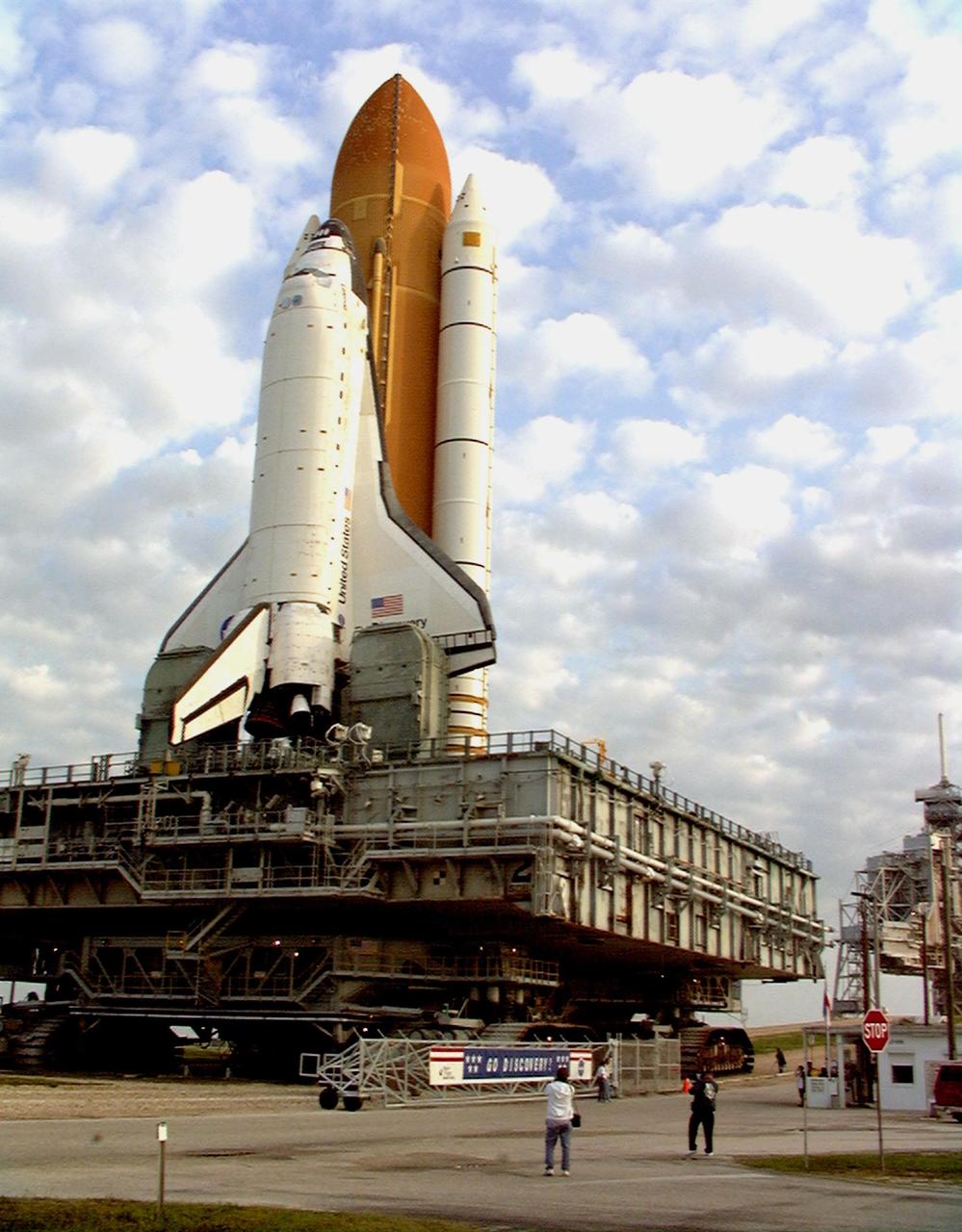
Against a popcorn-clouded blue sky, Space Shuttle Discovery, atop the mobile launcher platform and crawler transporter, ends its five-hour trek from the Vehicle Assembly Building as it crosses through the gate at Launch Pad 39B. Earlier in the week, the Shuttle was rolled back to the VAB from the pad to repair hail damage on the external tank's foam insulation. The 4.2-mile trek takes about five hours at the 1-mph speed of the crawler. Mission STS-96, the 94th launch in the Space Shuttle Program, is scheduled for liftoff May 27 at 6:48 a.m. EDT STS-96 is a logistics and resupply mission for the International Space Station, carrying such payloads as a Russian crane, the Strela; a U.S.-built crane; the Spacehab Oceaneering Space System Box (SHOSS), a logistics items carrier; and STARSHINE, a student-shared experiment
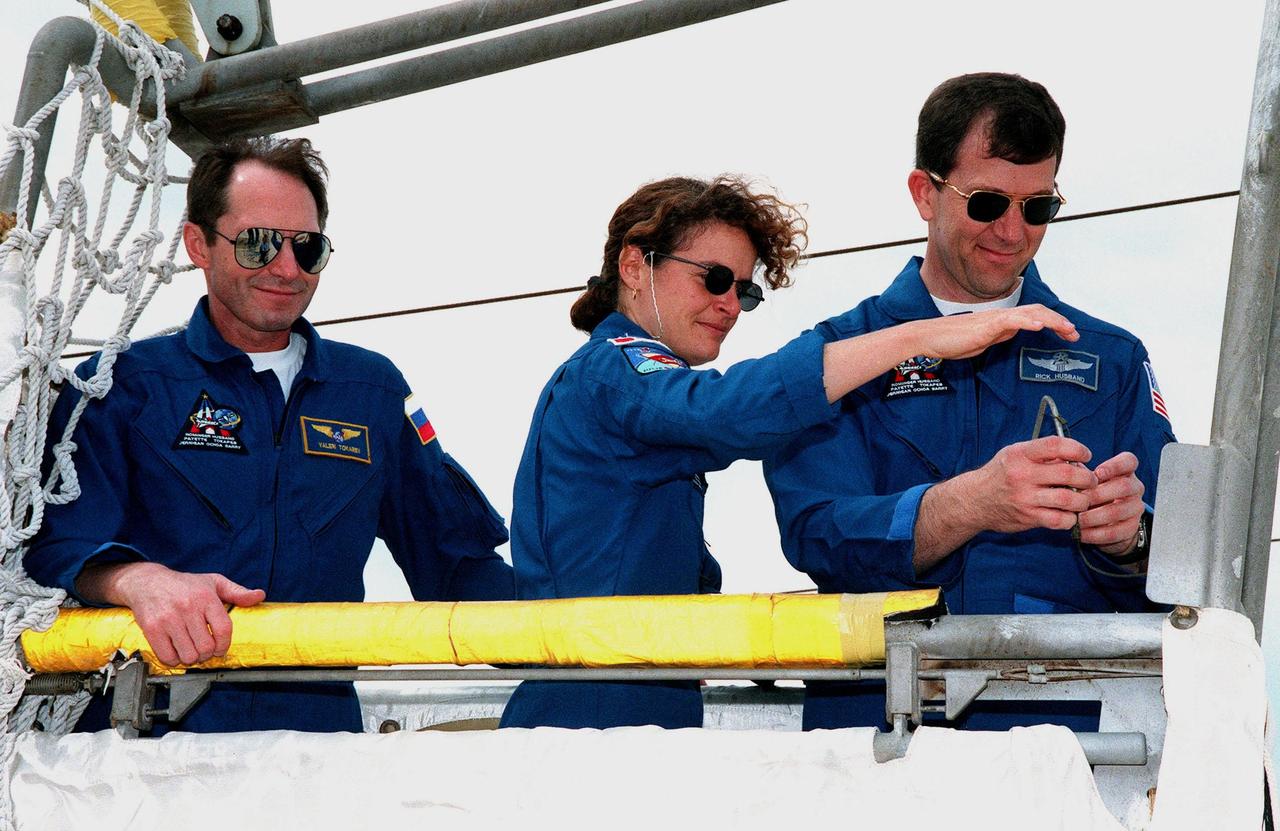
At the 195-foot level of Launch Pad 39B, STS-96 Mission Specialists Valery Ivanovich Tokarev and Julie Payette, plus Pilot Rick Douglas Husband, inspect the slidewire basket used for emergency egress. The training is part of Terminal Countdown Demonstration Test (TCDT) activities, which also provide the crew with simulated countdown exercises and opportunities to inspect the mission payloads in the orbiter's payload bay. Other crew members taking part in the TCDT are Commander Kent V. Rominger and Mission Specialists Tamara E. Jernigan (Ph.D.), Daniel Barry (M.D., Ph.D.), and Ellen Ochoa (Ph.D.). Scheduled for liftoff on May 20 at 9:32 a.m., STS-96 is a logistics and resupply mission for the International Space Station, carrying such payloads as a Russian crane, the Strela; a U.S.-built crane; the Spacehab Oceaneering Space System Box (SHOSS), a logistics items carrier; and STARSHINE, a student-led experiment
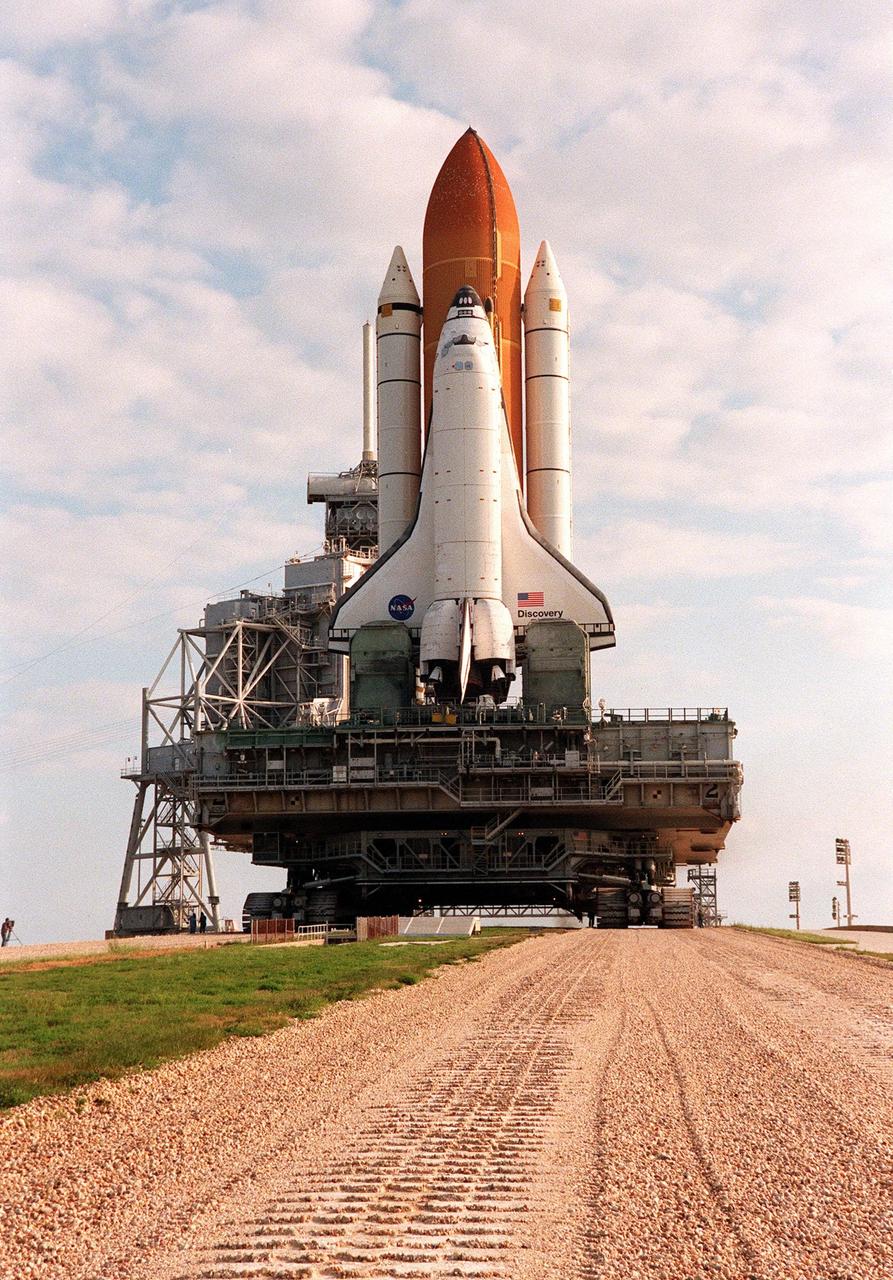
KENNEDY SPACE CENTER, FLA. -- The crawler transporter, with its cargo of Space Shuttle Discovery and mobile launcher platform, leaves tracks on the crawlerway as it makes its way up Launch Pad 39B. Behind the Shuttle can be seen part of the rotating service structure and the 82-foot lightning mast (next to the solid rocket booster) on top of the fixed service structure. The two structures are used during prelaunch preparations at the pad. Earlier in the week, the Shuttle was rolled back to the VAB from the pad to repair hail damage on the external tank's foam insulation. Mission STS-96, the 94th launch in the Space Shuttle Program, is scheduled for liftoff May 27 at 6:48 a.m. EDT. STS-96 is a logistics and resupply mission for the International Space Station, carrying such payloads as a Russian crane, the Strela; a U.S.-built crane; the Spacehab Oceaneering Space System Box (SHOSS), a logistics items carrier; and STARSHINE, a student-shared experiment
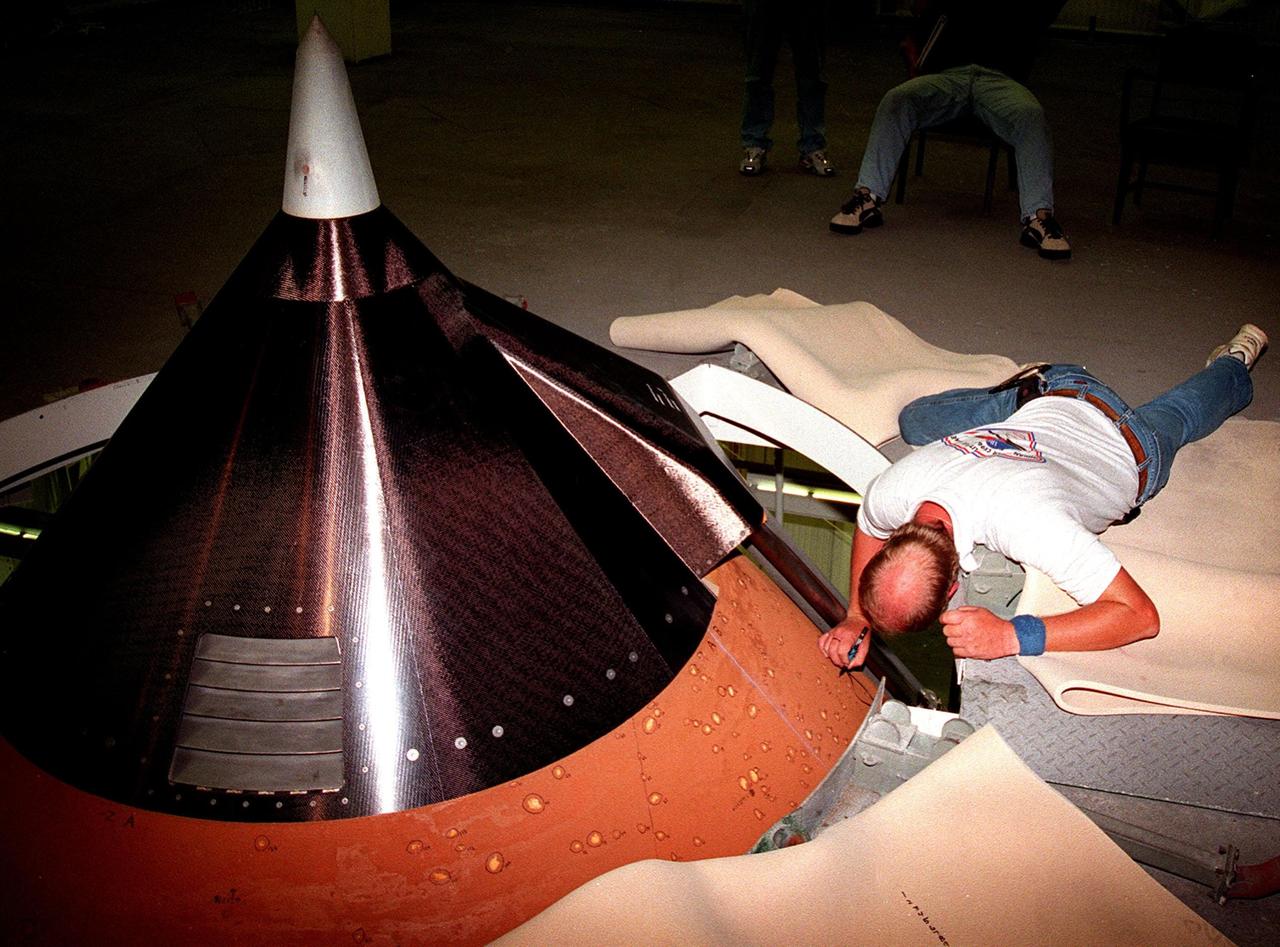
KENNEDY SPACE CENTER, FLA. -- Inside High Bay 1 of the Vehicle Assembly Building (VAB) Mike Sestile, with United Space Alliance, draws circles around divots in the foam insulation on the top of the external tank of Space Shuttle Discovery. About 150 divots were caused by hail during recent storms. The Shuttle was rolled back from Pad 39B to the VAB for repairs because access to all of the damaged areas was not possible at the pad. The work is expected to take two to three days, allowing Discovery to roll back to the pad as early as May 20 for launch of mission STS-96, the 94th launch in the Space Shuttle Program. Liftoff will occur no earlier than May 27. STS-96 is a logistics and resupply mission for the International Space Station, carrying such payloads as a Russian crane, the Strela; a U.S.-built crane; the Spacehab Oceaneering Space System Box (SHOSS), a logistics items carrier; and STARSHINE, a student-shared experiment
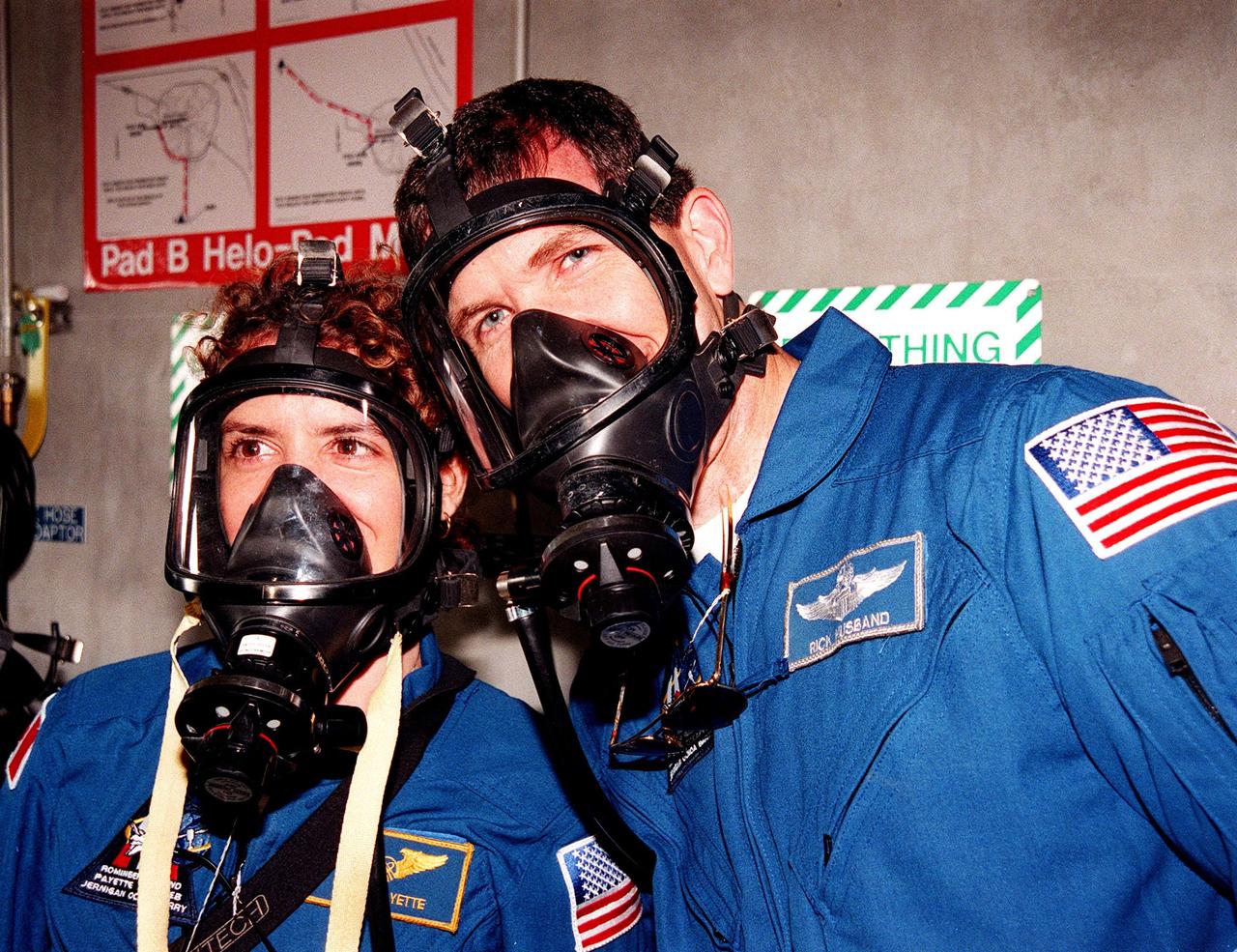
At Launch Pad 39B, STS-96 Mission Specialist Julie Payette, with the Canadian Space Agency, and Pilot Rick Douglas Husband practice putting on oxygen gas masks as part of Terminal Countdown Demonstration Test (TCDT) activities. The TCDT provides the crew with emergency egress traiing, simulated countdown exercises and opportunities to inspect the mission payloads in the orbiter's payload bay. Other crew members taking part in the TCDT are Commander Kent V. Rominger and Mission Specialists Tamara E. Jernigan (Ph.D.), Daniel Barry (M.D., Ph.D.), Ellen Ochoa (Ph.D.) and Valery Ivanovich Tokarev, with the Russian Space Agency. Scheduled for liftoff on May 20 at 9:32 a.m., STS-96 is a logistics and resupply mission for the International Space Station, carrying such payloads as a Russian crane, the Strela; a U.S.-built crane; the Spacehab Oceaneering Space System Box (SHOSS), a logistics items carrier; and STARSHINE, a student-led experiment
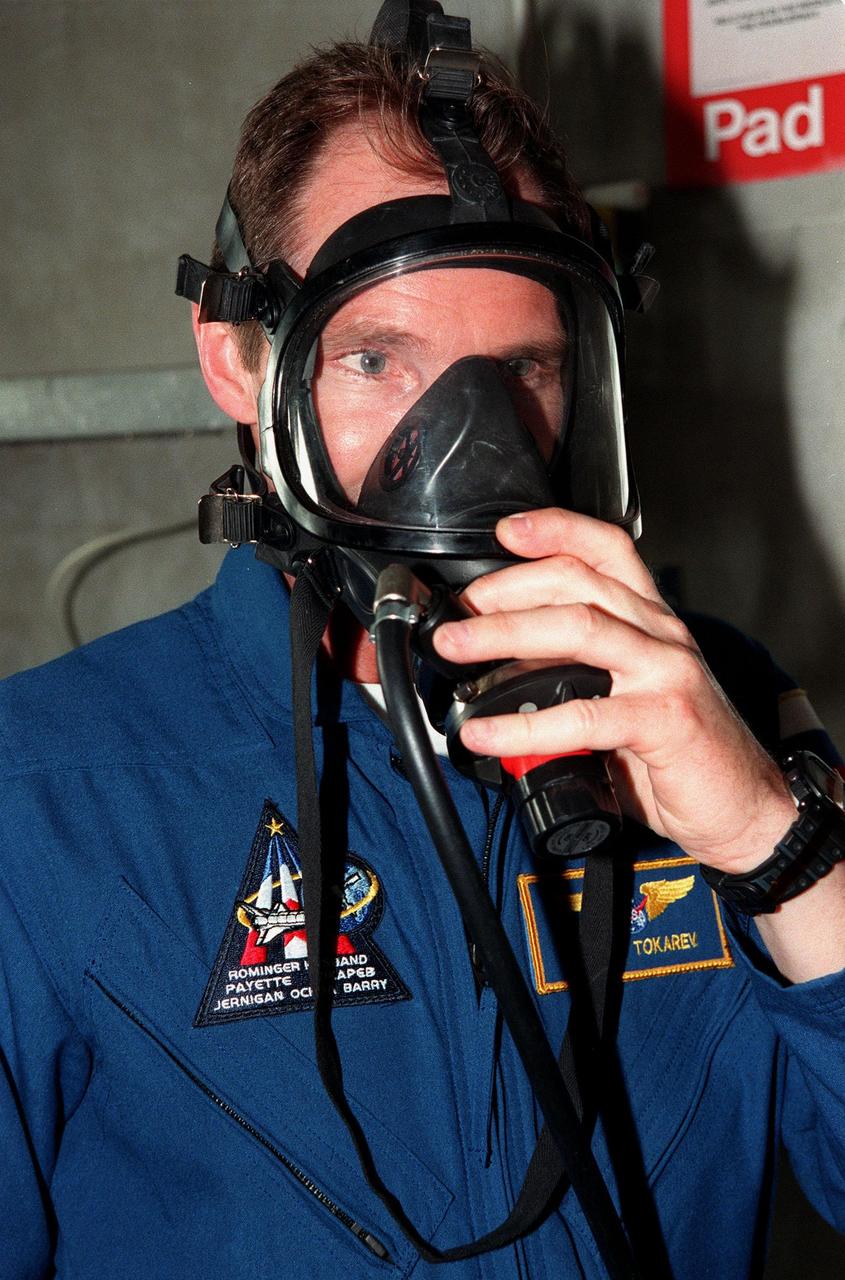
STS-96 Mission Specialist Valery Ivanovich Tokarev, with the Russian Space Agency, tries on an oxygen gas mask during Terminal Countdown Demonstration Test (TCDT) activities at Launch Pad 39B. The TCDT provides the crew with simulated countdown exercises, emergency egress training and opportunities to inspect the mission payloads in the orbiter's payload bay. Other crew members taking part in the TCDT are Commander Kent V. Rominger, Pilot Rick Douglas Husband, and Mission Specialists Tamara E. Jernigan (Ph.D.), Daniel Barry (M.D., Ph.D.), Ellen Ochoa (Ph.D.) and Julie Payette, with the Canadian Space Agency. Scheduled for liftoff on May 20 at 9:32 a.m., STS-96 is a logistics and resupply mission for the International Space Station, carrying such payloads as a Russian crane, the Strela; a U.S.-built crane; the Spacehab Oceaneering Space System Box (SHOSS), a logistics items carrier; and STARSHINE, a student-led experiment
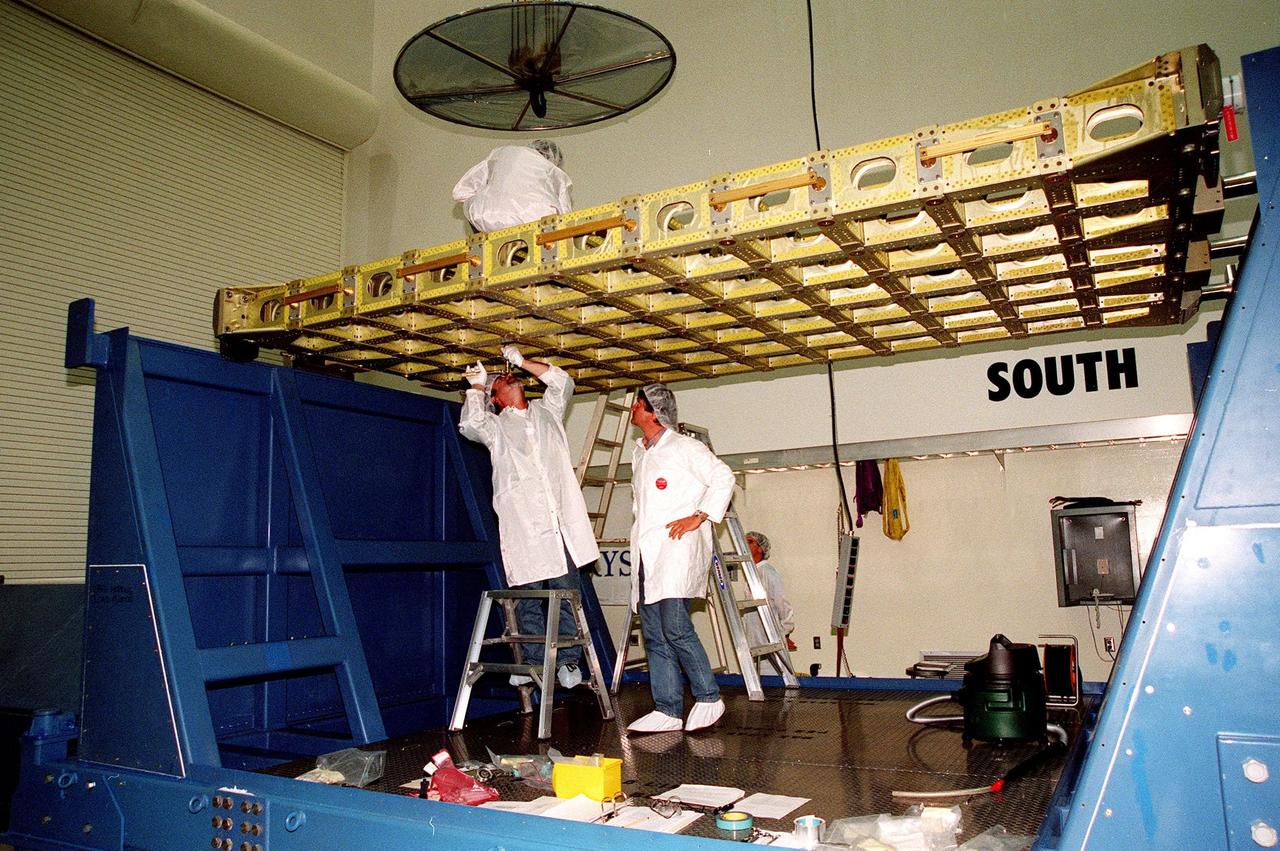
At Astrotech, Titusville, Fla., Harald Schnier and Manfred Nordhoff, with Daimler-Chrysler Aerospace (DASA), look over the International Cargo Carrier that will be used during future International Space Station (ISS) assembly missions. On top is Robert Wilkes, with Lockheed Martin. Behind the ladder in the background is Ben Greene, with Lockheed Martin. The nonpressurized ICC fits inside the payload bay of the orbiter. The ICC will carry the SPACEHAB Oceaneering Space System Box (SHOSS), a logistics items carrier. SHOSS can hold a maximum of 400 pounds of equipment and will carry items to be used during STS-96 and future ISS assembly flights. Also aboard the ICC will be the ORU Transfer Device (OTD), a U.S.-built crane that will be stowed on Unity for use during future ISS assembly missions. The ICC will fly on mission STS-96, targeted for launch on May 20
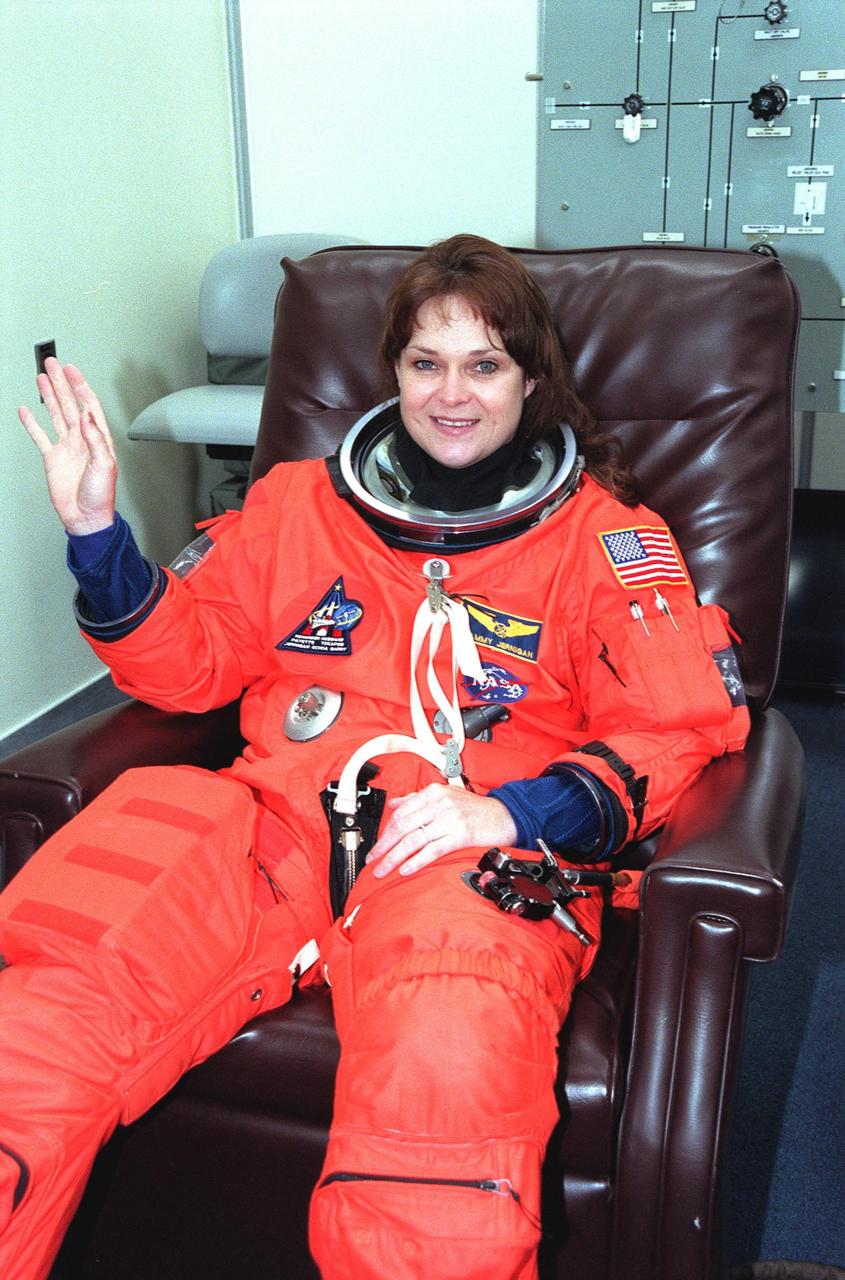
In the Operations and Checkout Building, STS-96 Mission Specialist Tamara E. Jernigan waves after donning her launch and entry suit during final launch preparations. STS-96 is a 10-day logistics and resupply mission for the International Space Station, carrying about 4,000 pounds of supplies, to be stored aboard the station for use by future crews, including laptop computers, cameras, tools, spare parts, and clothing. The mission also includes such payloads as a Russian crane, the Strela; a U.S.-built crane; the Spacehab Oceaneering Space System Box (SHOSS), a logistics items carrier; and STARSHINE, a student-involved experiment. It will include a space walk to attach the cranes to the outside of the ISS for use in future construction.. Space Shuttle Discovery is due to launch today at 6:49 a.m. EDT. Landing is expected at the SLF on June 6 about 1:58 a.m. EDT
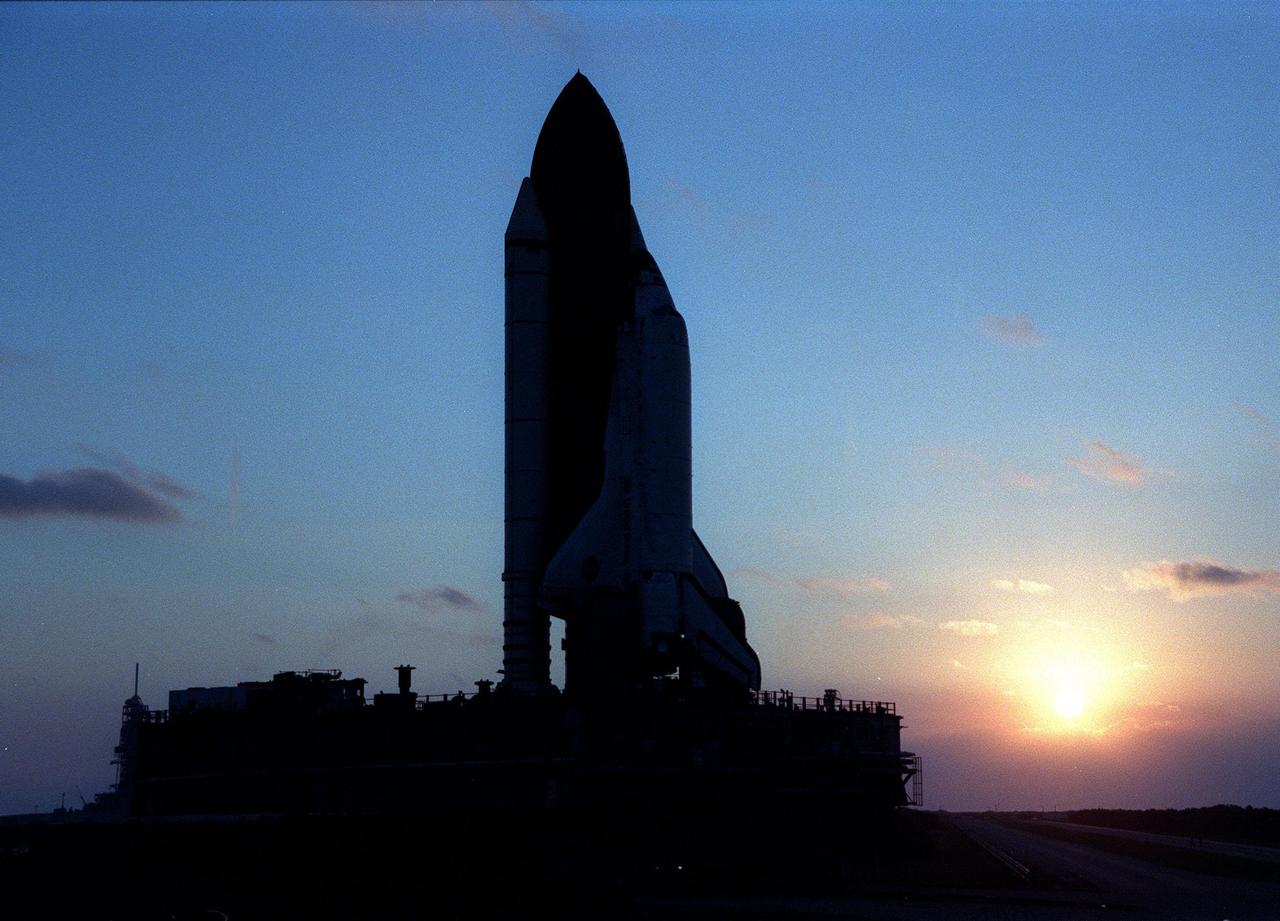
KENNEDY SPACE CENTER, FLA. -- As the sun begins to rise, a crawler transporter moves Space Shuttle Discovery from Pad 39B back to the Vehicle Assembly Building for repair of damage to the external tank foam insulation caused by hail. The necessary repair work could not be performed at the pad due to limited access to the damaged areas. The work is expected to take two to three days, allowing Discovery to roll back to the pad by midweek for launch of mission STS-96, the 94th launch in the Space Shuttle Program. This is only the 13th time since 1981 that a Shuttle has had to roll back from the pad. Liftoff will occur no earlier than May 27. STS-96 is a logistics and resupply mission for the International Space Station, carrying such payloads as a Russian crane, the Strela; a U.S.-built crane; the Spacehab Oceaneering Space System Box (SHOSS), a logistics items carrier; and STARSHINE, a student-shared experiment
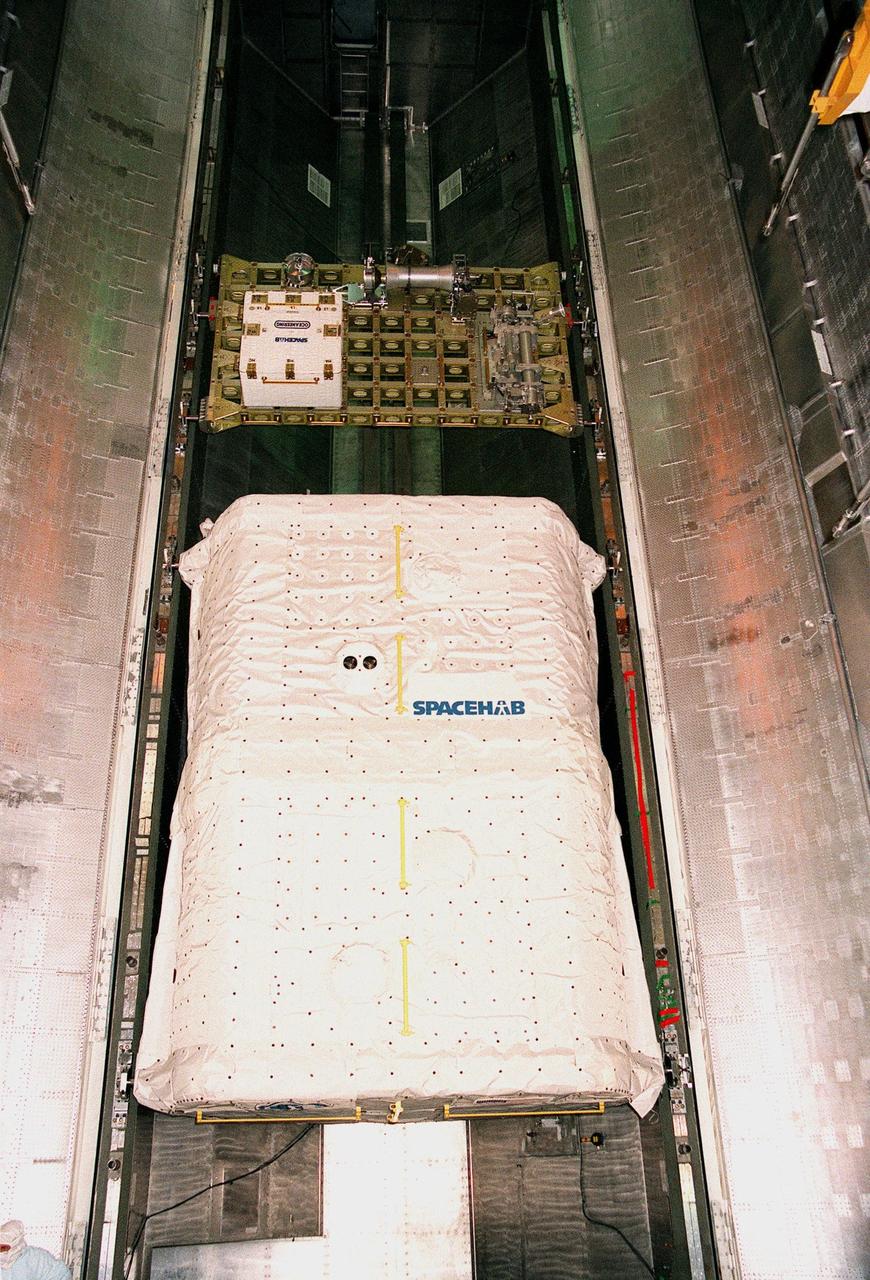
KENNEDY SPACE CENTER, FLA. -- The SPACEHAB Double module arrives at the payload changeout room at Launch Pad 39B before being transferred to Space Shuttle Discovery's payload bay for mission STS-96. Above it is the Integrated Cargo Carrier, which holds nonpressurized payloads such as a Russian crane, the Strela, and a U.S.-built crane. The second flight supporting construction of the International Space Station, STS-96 is a logistics and resupply mission, carrying more than 5,000 pounds of supplies, plus experiments such as STARSHINE, which was developed by and for students. The crew of seven are Commander Kent V. Rominger, Pilot Rick Douglas Husband, and Mission Specialists Ellen Ochoa (Ph.D.), Tamara E. Jernigan (Ph.D.), Daniel Barry (M.D., Ph.D.), Julie Payette, with the Canadian Space Agency, and Valery Ivanovich Tokarev, with the Russian Space Agency. Liftoff is scheduled for May 20 at 9:32 a.m. EDT
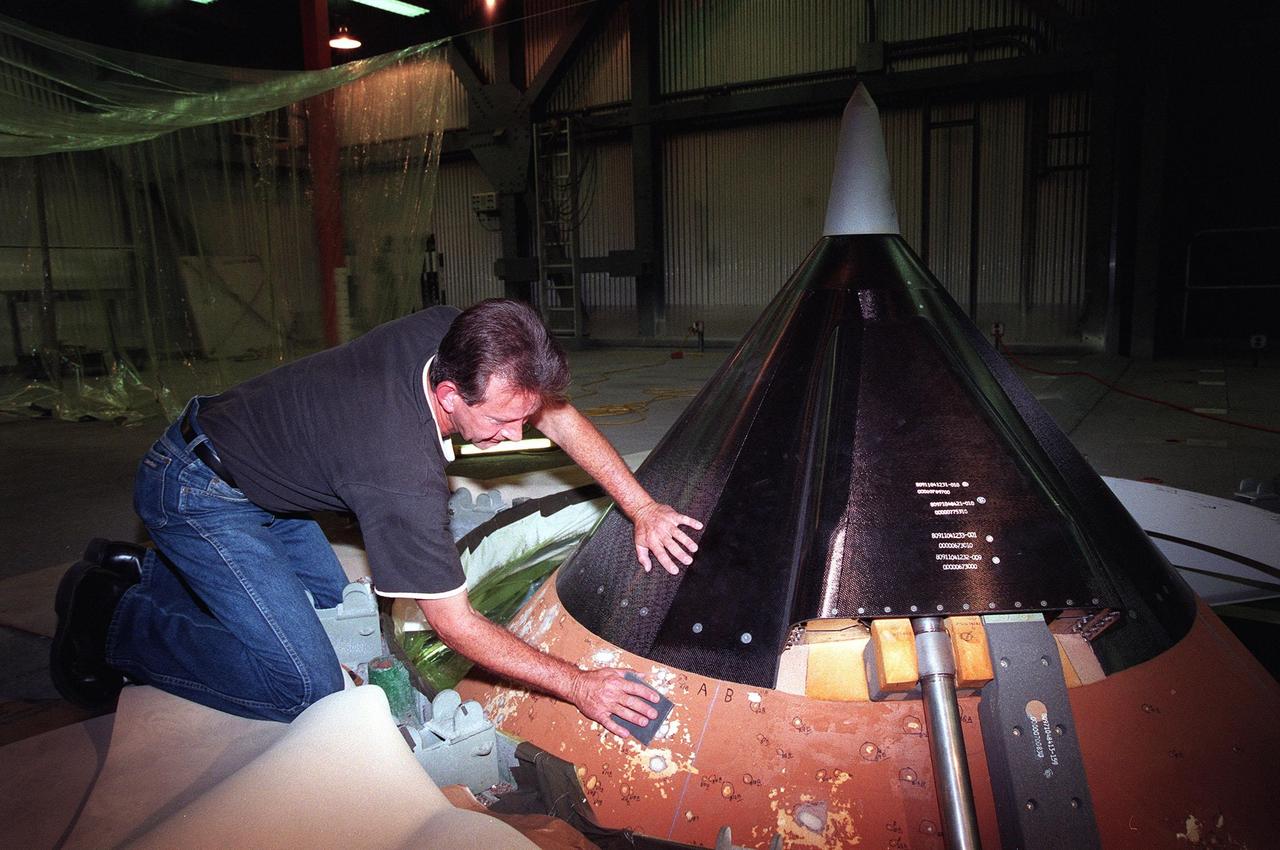
KENNEDY SPACE CENTER, FLA. -- In the Vehicle Assembly Building (VAB), United Space Alliance technician Robert Williams sands the repaired areas near the top of Space Shuttle Discovery's external tank. Repairs were required for damage caused by hail during recent storms. Because access to all of the damaged areas was not possible at the pad, the Shuttle was rolled back from Pad 39B to the VAB. The work is expected to take two to three days, allowing Discovery to roll back to the pad late this week for launch of mission STS-96, the 94th launch in the Space Shuttle Program. Liftoff will occur no earlier than May 27. STS-96 is a logistics and resupply mission for the International Space Station, carrying such payloads as a Russian crane, the Strela; a U.S.-built crane; the Spacehab Oceaneering Space System Box (SHOSS), a logistics items carrier; and STARSHINE, a student-shared experiment
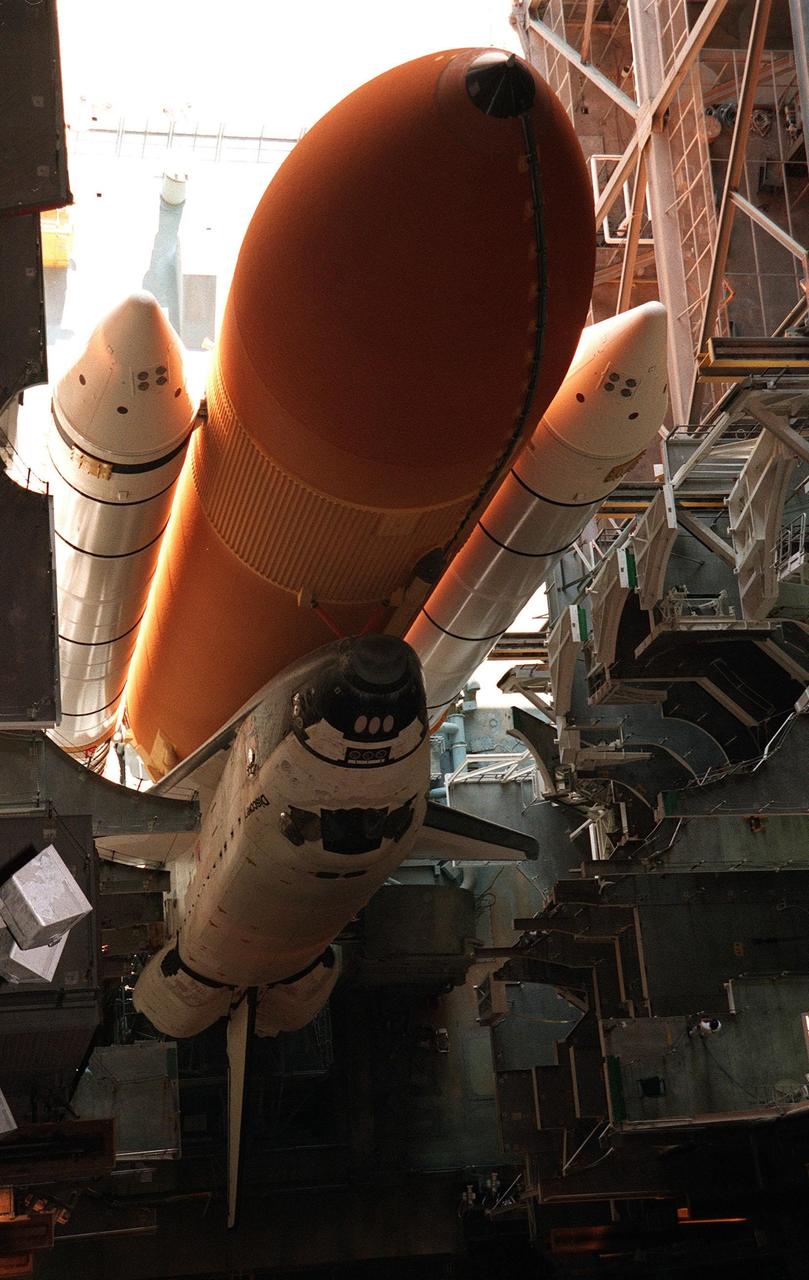
KENNEDY SPACE CENTER, FLA. -- The Space Shuttle Discovery, dwarfed by its external tank and solid rocket boosters, is in position in High Bay 1 of the Vehicle Assembly Building for repair of damage to the external tank's foam insulation caused by hail. The Shuttle was rolled back from Pad 39B this morning because access to all of the damaged areas was not possible at the pad. The work is expected to take two to three days, allowing Discovery to roll back to the pad by midweek for launch of mission STS-96, the 94th launch in the Space Shuttle Program. This is only the 13th time since 1981 that a Shuttle has had to roll back from the pad. Liftoff will occur no earlier than May 27. STS-96 is a logistics and resupply mission for the International Space Station, carrying such payloads as a Russian crane, the Strela; a U.S.-built crane; the Spacehab Oceaneering Space System Box (SHOSS), a logistics items carrier; and STARSHINE, a student-shared experiment