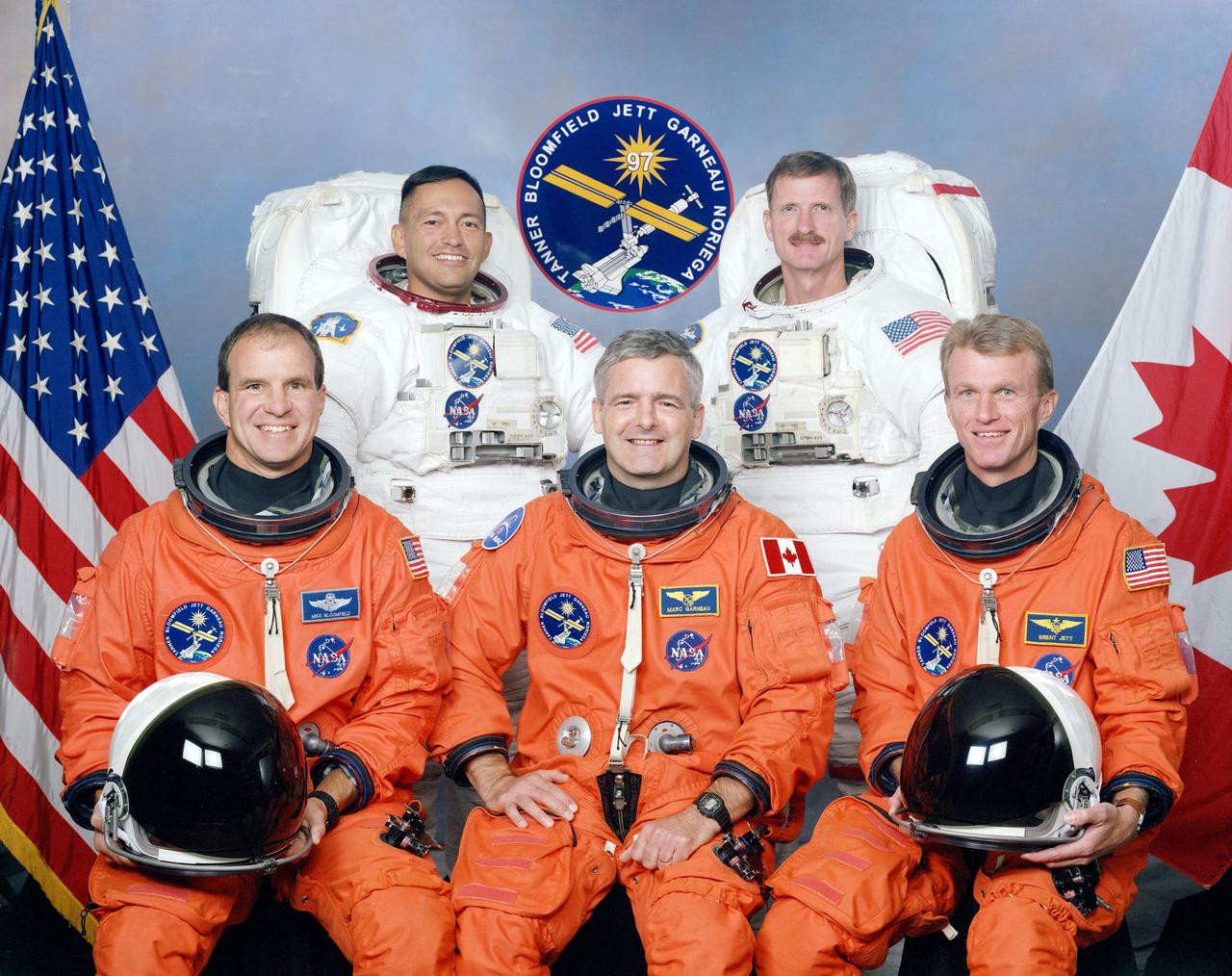
These five STS-97 crew members posed for a traditional portrait during training. On the front row, left to right, are astronauts Michael J. Bloomfield, pilot; Marc Garneau, mission specialist representing the Canadian Space Agency (CSA); and Brent W. Jett, Jr., commander. In the rear, wearing training versions of the extravehicular mobility unit (EMU) space suits, (left to right) are astronauts Carlos I. Noriega, and Joseph R. Tarner, both mission specialists. The primary objective of the STS-97 mission was the delivery, assembly, and activation of the U.S. electrical power system onboard the International Space Station (ISS). The electrical power system, which is built into a 73-meter (240-foot) long solar array structure consists of solar arrays, radiators, batteries, and electronics. The entire 15.4-metric ton (17-ton) package is called the P6 Integrated Truss Segment and is the heaviest and largest element yet delivered to the station aboard a space shuttle. The electrical system will eventually provide the power necessary for the first ISS crews to live and work in the U.S. segment. The STS-97 crew of five launched aboard the Space Shuttle Orbiter Endeavor on November 30, 2000 for an 11 day mission.
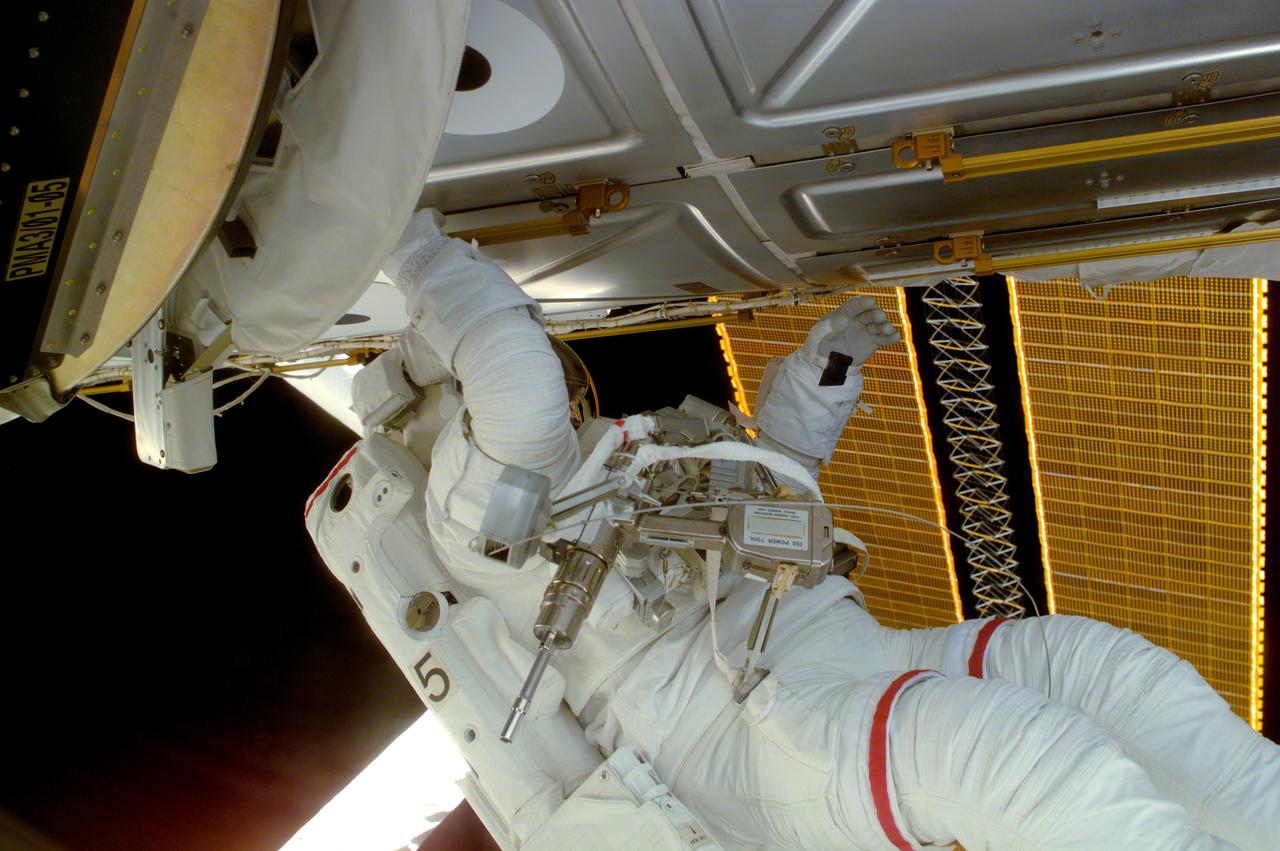
Astronaut Joseph R. Tanner, STS-97 mission specialist, is seen during a session of Extravehicular Activity (EVA), performing work on the International Space Station (ISS). Part of the Remote Manipulator System (RMS) arm and a section of the newly deployed solar array panel are in the background. The primary objective of the STS-97 mission was the delivery, assembly, and activation of the U.S. electrical power system on board the ISS. The electrical power system, which is built into a 73-meter (240-foot) long solar array structure consists of solar arrays, radiators, batteries, and electronics. The entire 15.4-metric ton (17-ton) package is called the P6 Integrated Truss Segment and is the heaviest and largest element yet delivered to the station aboard a space shuttle. The electrical system will eventually provide the power necessary for the first ISS crews to live and work in the U.S. segment. The STS-97 crew of five launched aboard the Space Shuttle Orbiter Endeavor on November 30, 2000 for an 11 day mission.
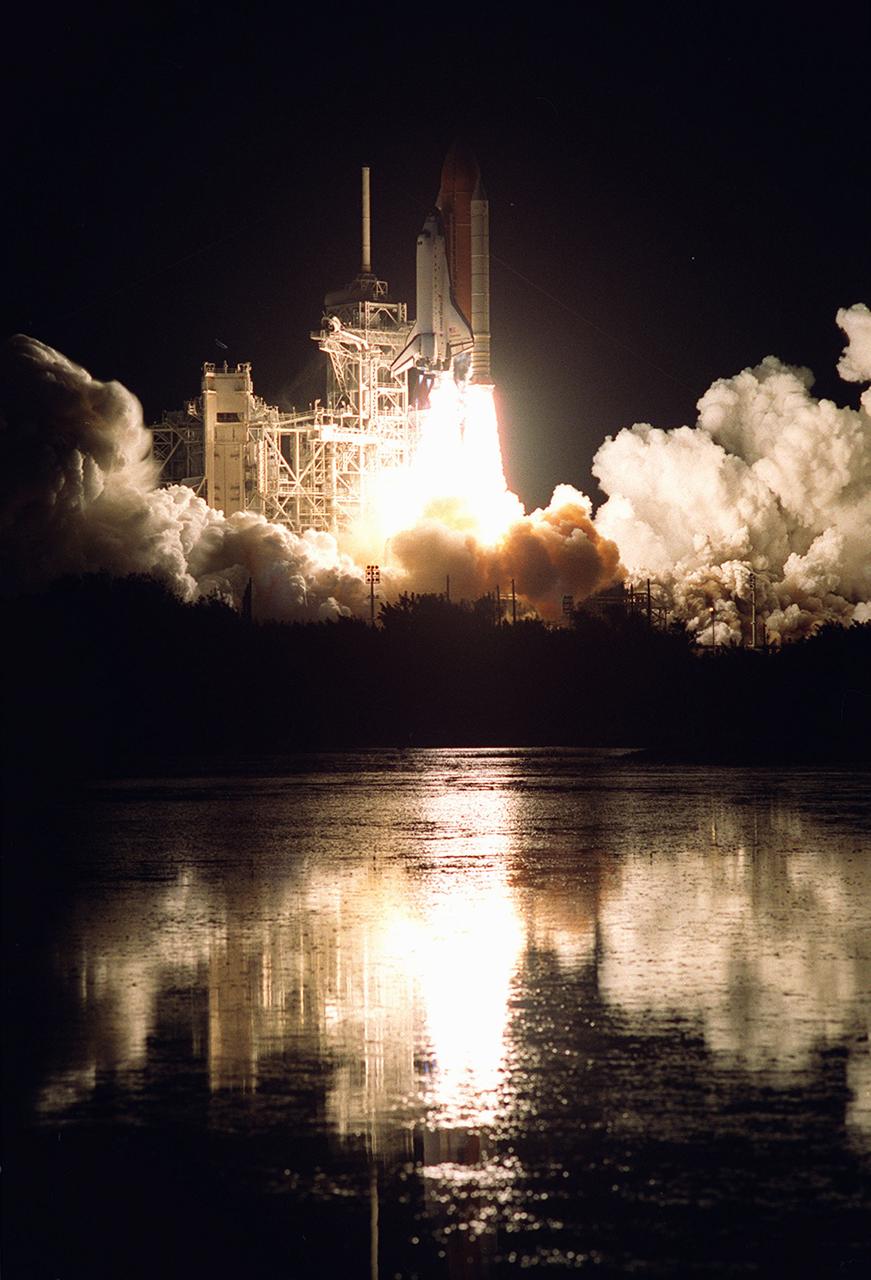
Nearby waters reflect the flames of the Space Shuttle Endeavor as she lifts off November 30, 2000, carrying the STS-97 crew of five. The STS-97 mission's primary objective was the delivery, assembly, and activation of the U.S. electrical power system onboard the International Space Station (ISS). The electrical power system, which is built into a 73-meter (240-foot) long solar array structure, consists of solar arrays, radiators, batteries, and electronics. The entire 15.4-metric ton (17-ton) package is called the P6 Integrated Truss Segment and is the heaviest and largest element yet delivered to the station aboard a space shuttle. The electrical system will eventually provide the power necessary for the first ISS crews to live and work in the U.S. segment.
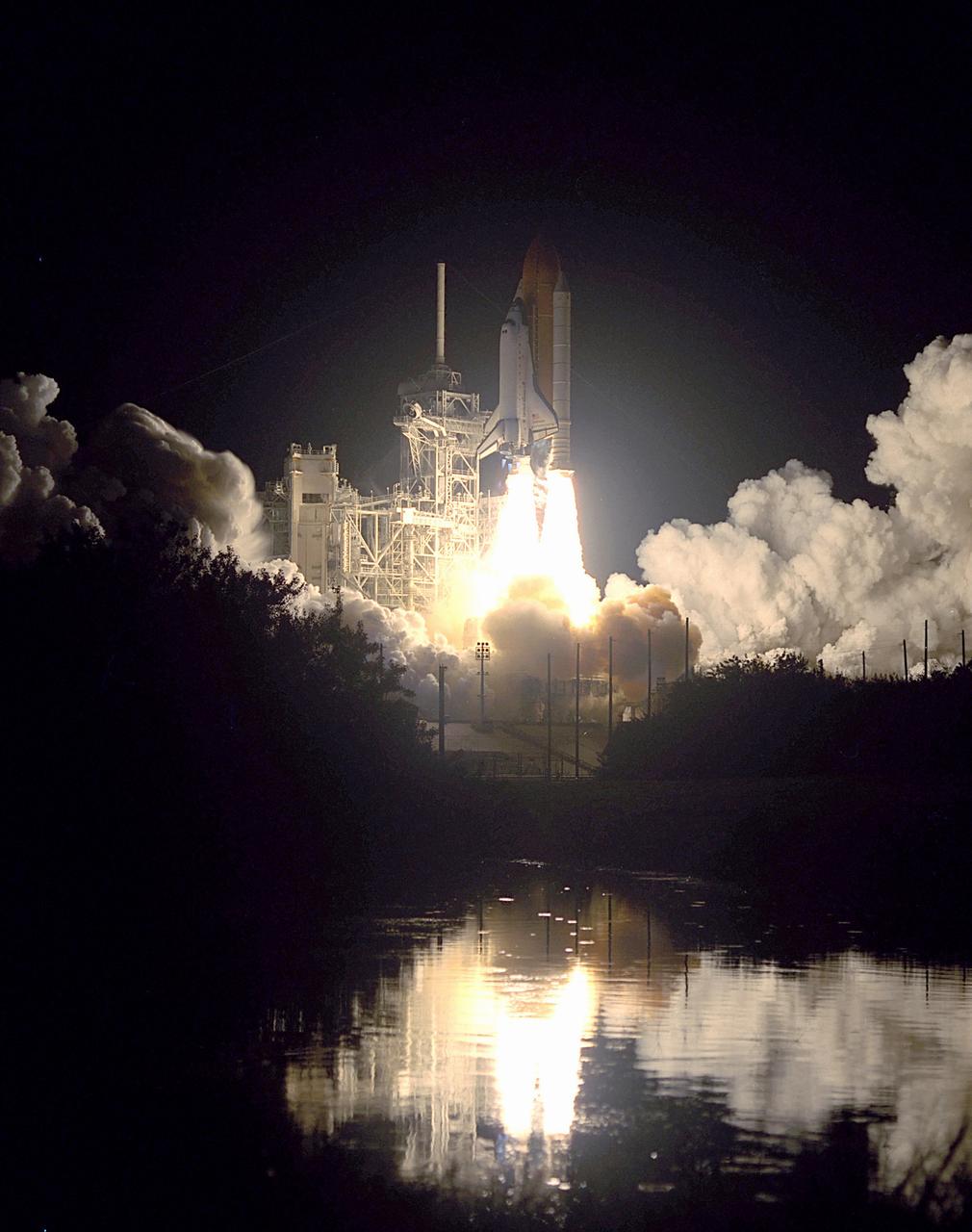
Nearby waters reflect the flames of the Space Shuttle Endeavor as she lifts off November 30, 2000 carrying the STS-97 crew of five. The STS-97 mission's primary objective was the delivery, assembly, and activation of the U.S. electrical power system onboard the International Space Station (ISS). The electrical power system, which is built into a 73-meter (240-foot) long solar array structure, consists of solar arrays, radiators, batteries, and electronics. The entire 15.4-metric ton (17-ton) package is called the P6 Integrated Truss Segment, and is the heaviest and largest element yet delivered to the station aboard a space shuttle. The electrical system will eventually provide the power necessary for the first ISS crews to live and work in the U.S. segment.

This is the crew insignia for STS-97 which delivered, assembled, and activated the U.S. electrical power system onboard the International Space Station (ISS). The electrical power system, which is built into a 47-foot integrated truss structure known as P6, consists of solar arrays, radiators, batteries, and electronics. P6 was prepared for subsequent deployments of larger solar arrays and radiator, a critical step in the activation of the electrical power system that will eventually provide the power necessary for the first ISS crews to live and work in the U.S. segment. The crew patch depicts the space shuttle docked to the ISS in low Earth orbit after the activation of the P6 electrical power system. Gold and silver were used to highlight the portion of the ISS that were installed by the STS-97 crew. The sun, central to the design, is the source of energy for the ISS. The crew member names surround the outer border of the patch.
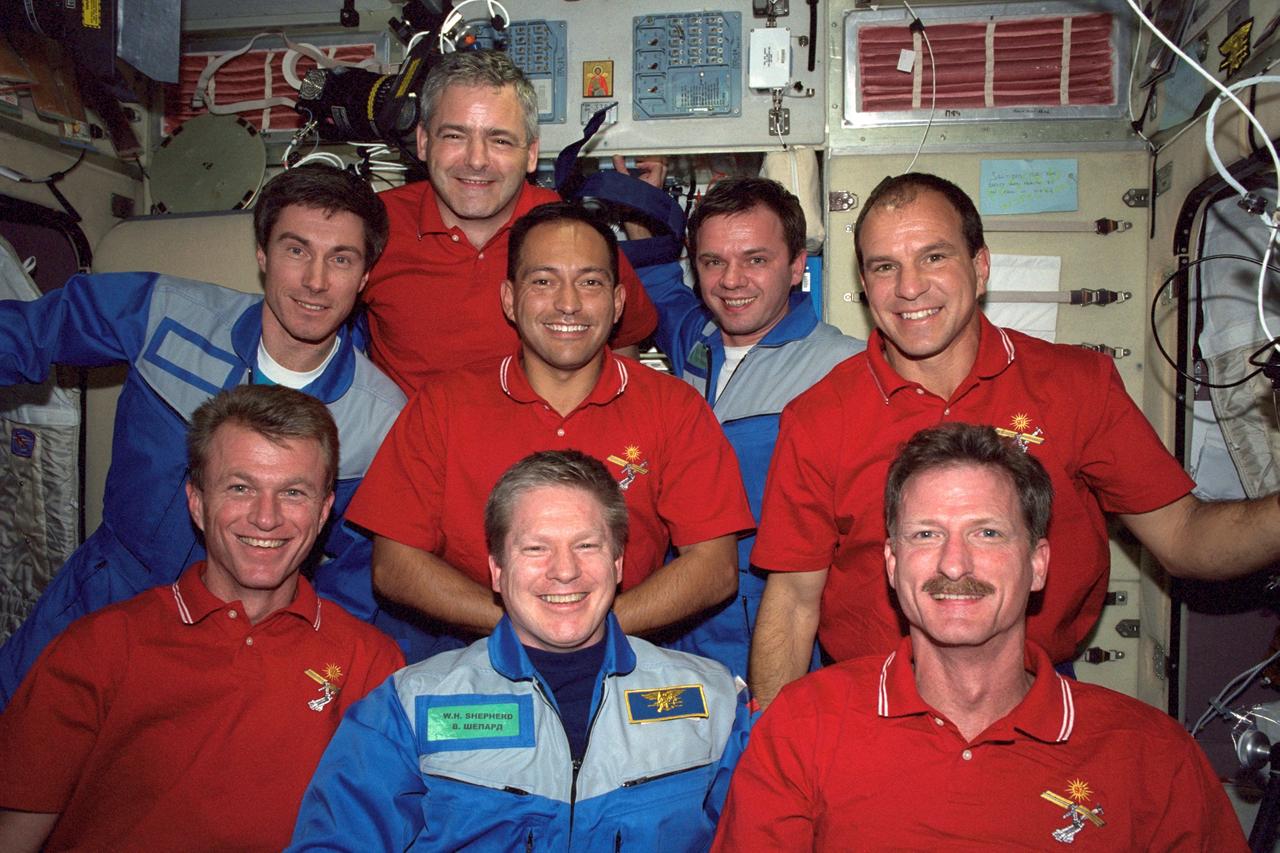
In this image, the five STS-97 crew members pose with the 3 members of the Expedition One crew onboard the International Space Station (ISS) for the first ever traditional onboard portrait taken in the Zvezda Service Module. On the front row, left to right, are astronauts Brent W. Jett, Jr., STS-97 commander; William M. Shepherd, Expedition One mission commander; and Joseph R. Tarner, STS-97 mission specialist. On the second row, from the left are Cosmonaut Sergei K. Krikalev, Expedition One flight engineer; astronaut Carlos I. Noriega, STS-97 mission specialist; cosmonaut Yuri P. Gidzenko, Expedition One Soyuz commander; and Michael J. Bloomfield, STS-97 pilot. Behind them is astronaut Marc Garneau, STS-97 mission specialist representing the Canadian Space Agency (CSA). The primary objective of the STS-97 mission was the delivery, assembly, and activation of the U.S. electrical power system onboard the International Space Station (ISS). The electrical power system, which is built into a 73-meter (240-foot) long solar array structure consists of solar arrays, radiators, batteries, and electronics. The entire 15.4-metric ton (17-ton) package is called the P6 Integrated Truss Segment, and is the heaviest and largest element yet delivered to the station aboard a space shuttle. The electrical system will eventually provide the power necessary for the first ISS crews to live and work in the U.S. segment. The STS-97 crew of five launched aboard the Space Shuttle Orbiter Endeavor on November 30, 2000 for an 11 day mission.
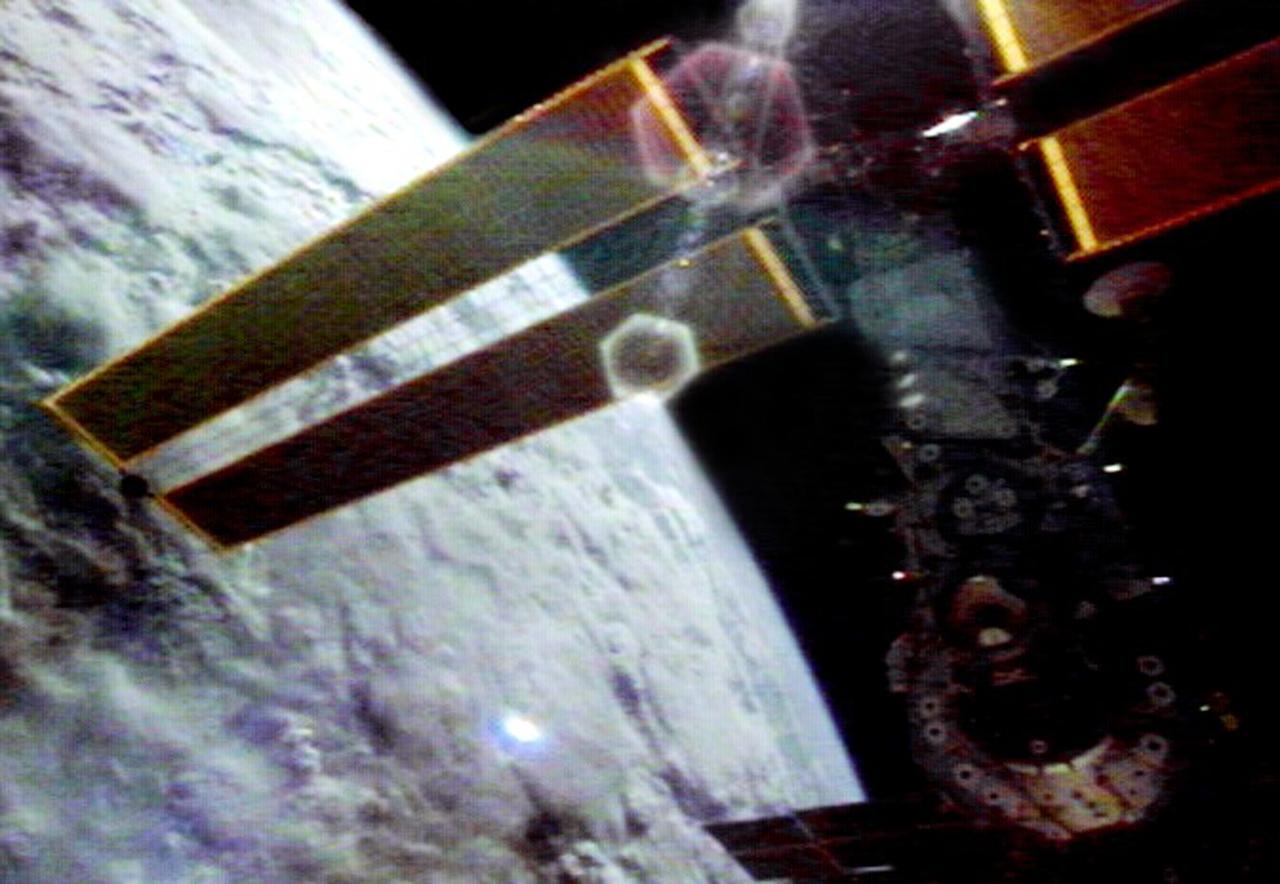
This video still depicts the recently deployed starboard and port solar arrays towering over the International Space Station (ISS). The video was recorded on STS-97's 65th orbit. Delivery, assembly, and activation of the solar arrays was the main mission objective of STS-97. The electrical power system, which is built into a 73-meter (240-foot) long solar array structure consists of solar arrays, radiators, batteries, and electronics, and will provide the power necessary for the first ISS crews to live and work in the U.S. segment. The entire 15.4-metric ton (17-ton) package is called the P6 Integrated Truss Segment, and is the heaviest and largest element yet delivered to the station aboard a space shuttle. The STS-97 crew of five launched aboard the Space Shuttle Orbiter Endeavor on November 30, 2000 for an 11 day mission.
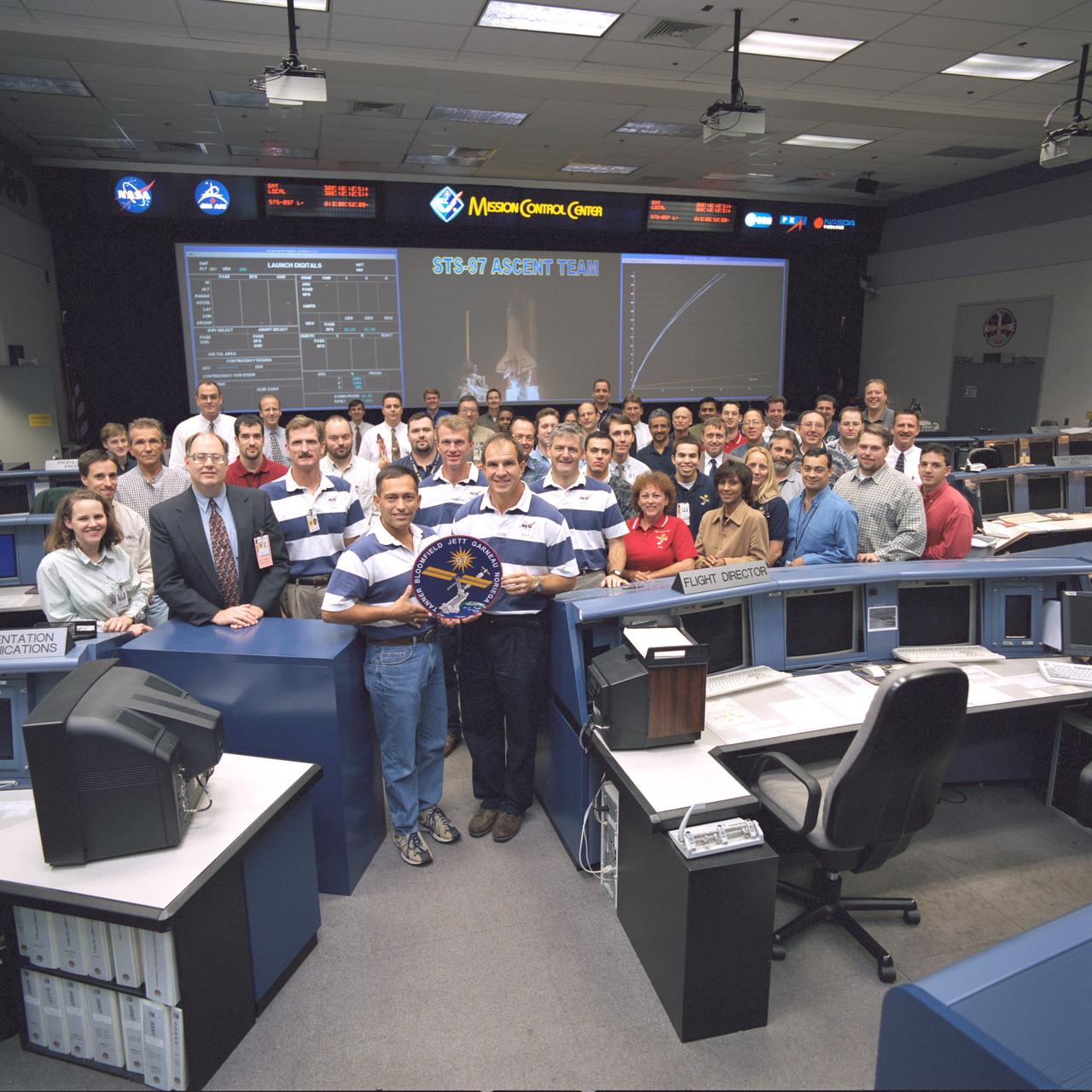
JSC2000-07294 (20 November 2000) --- The 40-odd flight controllers assigned to the STS-97 ascent team and some special guests pose for a group portrait in the shuttle flight control room in Houston's Mission Control Center (JSC). The five guests attired in the blue and white shirts are the flight crew members for the STS-97 crew, scheduled to be launched from Florida on the last day of this month. The astronauts are, from the left, Joseph R. Tanner, Carlos I. Noriega, Brent W. Jett, Jr., Michael J. Bloomfield and Marc Garneau, who represents the Canadian Space Agency (CSA). Ascent shift flight director Wayne Hale stands next to Tanner.
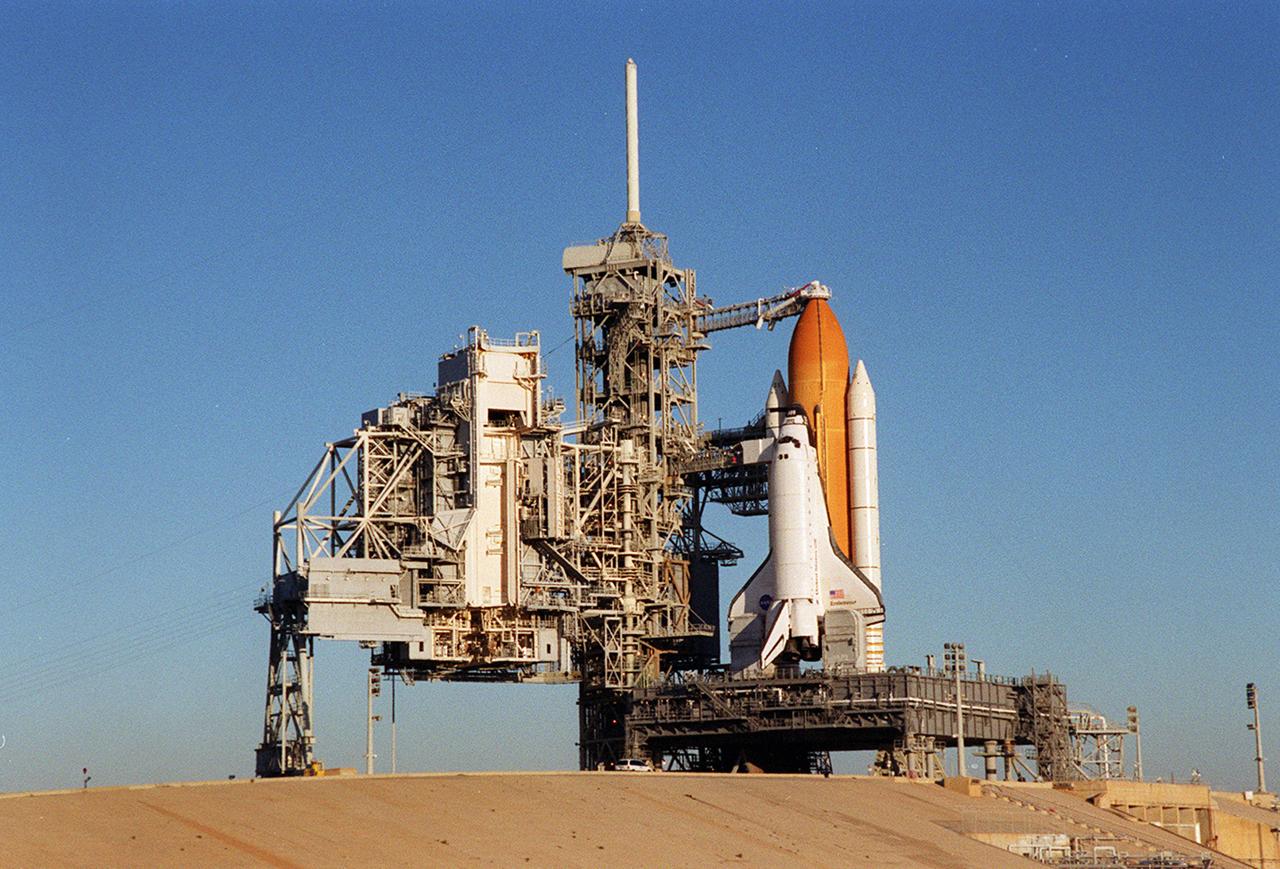
Back dropped by a cloudless blue sky, Space Shuttle Endeavor stands ready for launch after the rollback of the Rotating Service Structure, at left. The orbiter launched that night carrying the STS-97 crew of five. The STS-97 mission's primary objective was the delivery, assembly, and activation of the U.S. electrical power system onboard the International Space Station (ISS). The electrical power system, which is built into a 73-meter (240-foot) long solar array structure, consists of solar arrays, radiators, batteries, and electronics. The entire 15.4-metric ton (17-ton) package is called the P6 Integrated Truss Segment, and is the heaviest and largest element yet delivered to the station aboard a space shuttle. The electric system will eventually provide the power necessary for the first ISS crews to live and work in the U.S. segment.
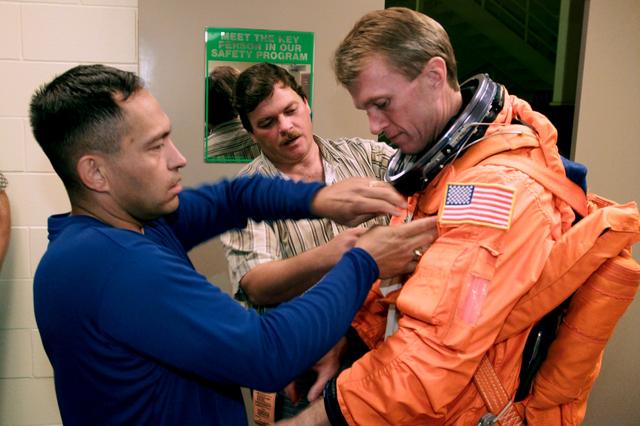
JSC2000-E-23526 (October 2000) --- Astronaut Carlos I. Noriega, attired in a blue thermal undergarment, and USA suit technician Mike Birkenseher help astronaut Brent W. Jett, STS-97 mission commander, with final touches of suit donning. The five STS-97 crew members were participating in a training session for their scheduled November launch aboard the Space Shuttle Endeavour.
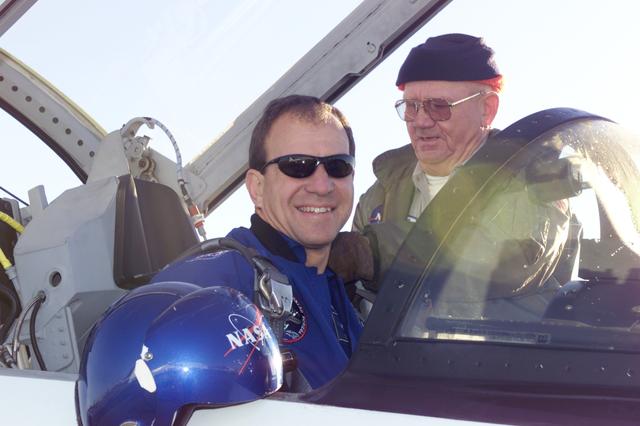
JSC2000-E-29123 (27 November 2000) --- Astronaut Michael J. Bloomfield, STS-97 pilot, is pictured in the cockpit of a NASA T-38 jet trainer at Ellington Field. The five-member crew was minutes away from departure to Florida, where it will continue preparations for launch later this week aboard the Space Shuttle Endeavour.
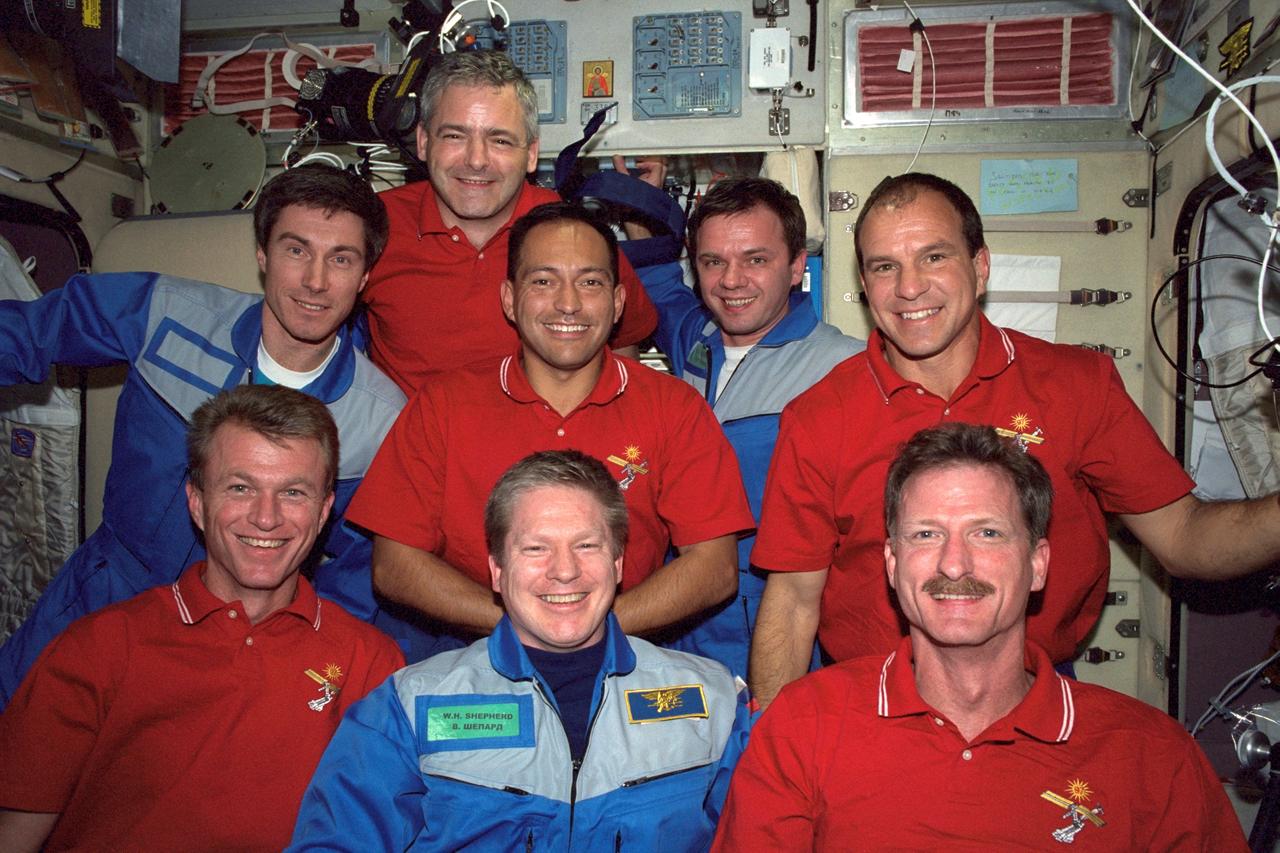
STS097-326-031 (8 December 2000)--- When the five STS-97 astronauts paid a visit to the three Expedition 1 crew members onboard the International Space Station (ISS), they all posed for a traditional in-flight portrait, albeit for the first time in the Zvezda Service Module. On the front row are (left to right) astronauts Brent W. Jett, Jr., STS-97 commander; William M. Shepherd, Expedition 1 mission commander; and Joseph R. Tanner, STS-97 mission specialist. On the second row are (from the left) cosmonaut Sergei K. Krikalev, Expedition 1 flight engineer; astronaut Carlos I. Noriega, STS-97 mission specialist; cosmonaut Yuri P. Gidzenko, Expedition 1 Soyuz commander; and astronaut Michael J. Bloomfield, STS-97 pilot. Behind them is astronaut Marc Garneau, STS-97 mission specialist representing the Canadian Space Agency (CSA). Krikalev and Gidzenko represent the Russian Aviation and Space Agency.
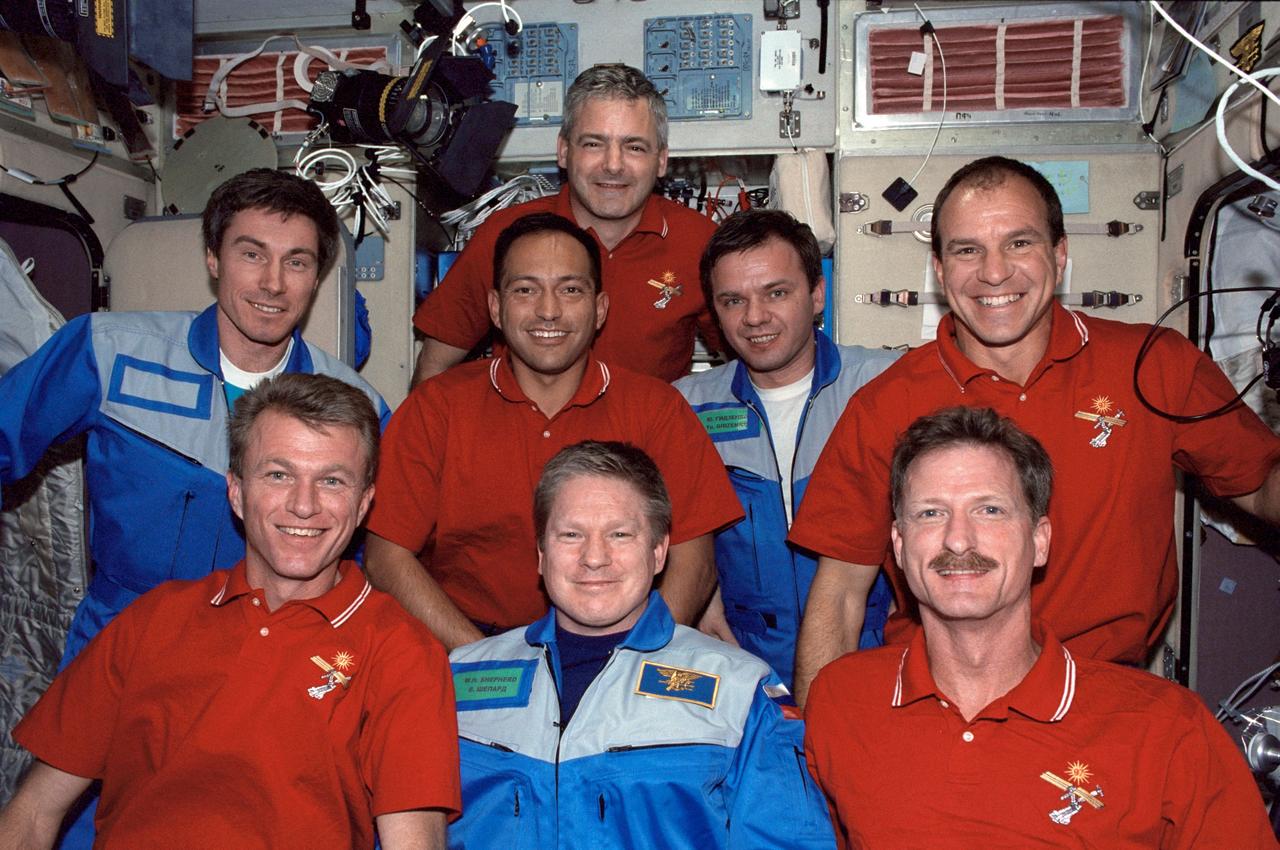
STS097-313-001 (8 December 2000)--- When the five STS-97 astronauts paid a visit to the three Expedition 1 crew members onboard the International Space Station (ISS), they all posed for a traditional in-flight portrait, albeit for the first time in the Zvezda Service Module. On the front row are (left to right) astronauts Brent W. Jett, Jr., STS-97 commander; William M. Shepherd, Expedition 1 mission commander; and Joseph R. Tanner, STS-97 mission specialist. On the second row are (from the left) cosmonaut Sergei K. Krikalev, Expedition 1 flight engineer; astronaut Carlos I. Noriega, STS-97 mission specialist; cosmonaut Yuri P. Gidzenko, Expedition 1 Soyuz commander; and astronaut Michael J. Bloomfield, STS-97 pilot. Behind them is astronaut Marc Garneau, STS-97 mission specialist representing the Canadian Space Agency (CSA). Krikalev and Gidzenko represent the Russian Aviation and Space Agency.
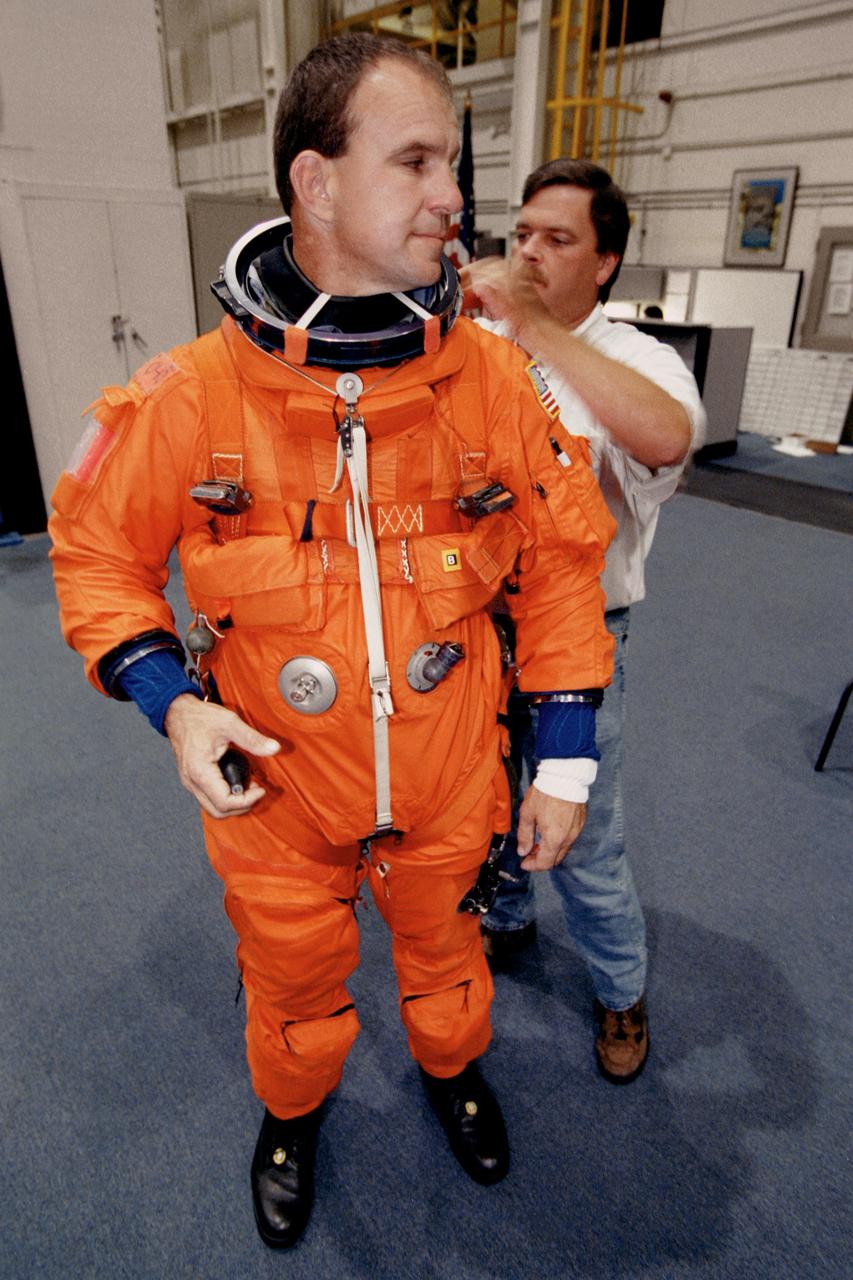
JSC2000-04753 (15 June 2000) --- Mike Birkenseher, a suit technician for the United Space Alliance, assists astronaut Michael J. Bloomfield, STS-97 pilot, with his launch and entry garment. Bloomfield was about to join his four STS-97 crew mates for a rehearsal of launch procedures in a nearby shuttle trainer.
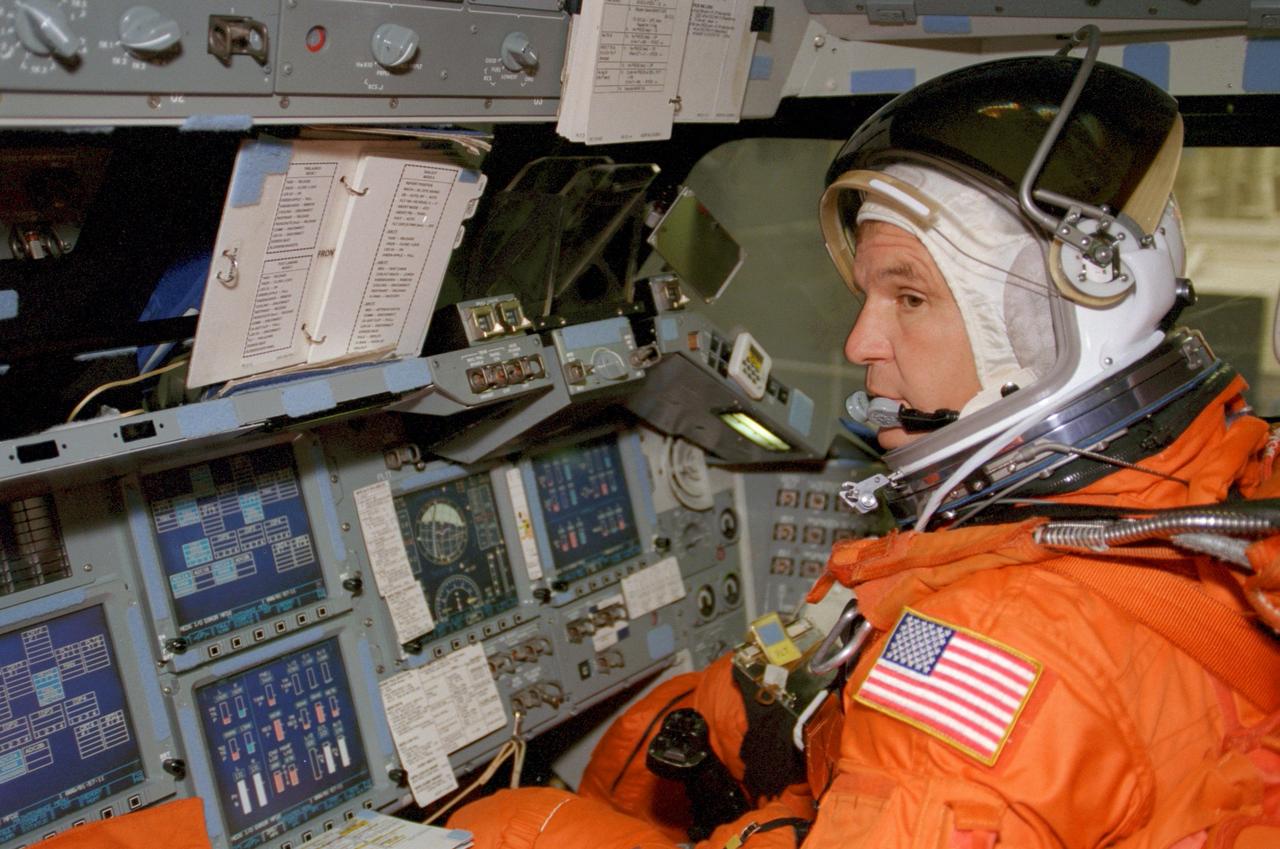
S99-07624 (15 July 1999) --- Astronaut Michael J. Bloomfield, STS-97 pilot, mans the pilot's station of a crew compartment trainer (CCT) during a training exercise at the Johnson Space Center's Systems Integration Facility.
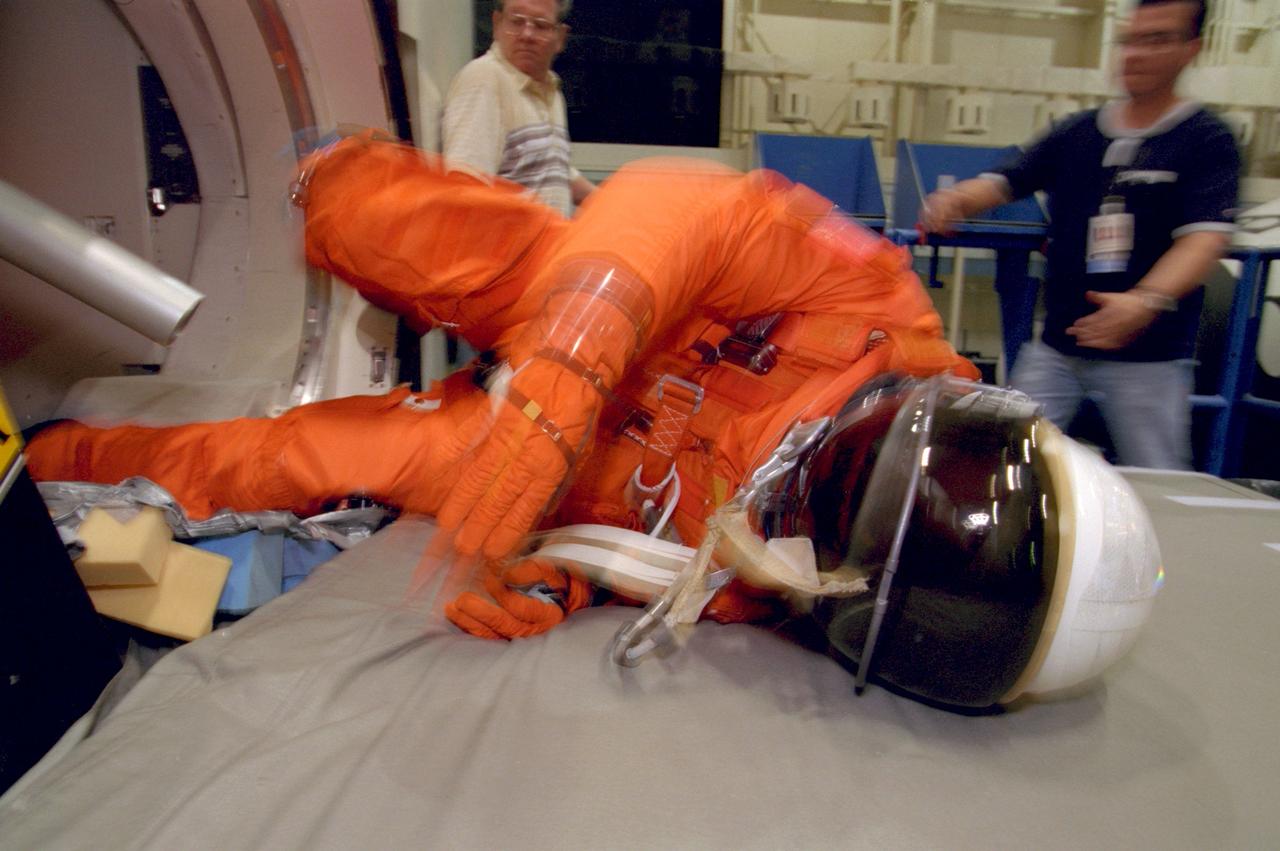
S99-07632 (15 July 1999) --- An unidentified STS-97 crew member simulates a bailout from a shuttle-in-trouble during an emergency egress exercise in the Systems Integration Facility at the Johnson Space Center.
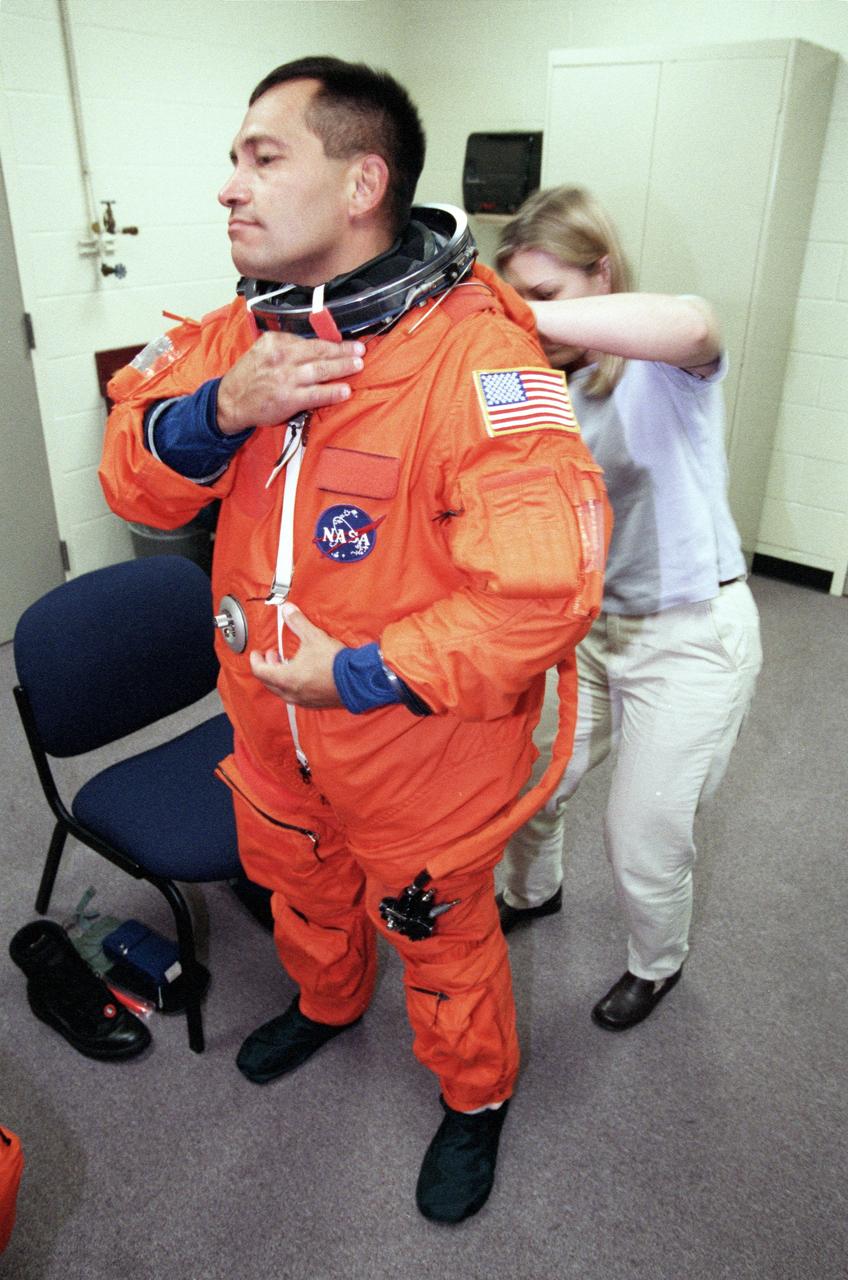
Photographic documentation showing the STS-97 crew training in the Crew Compartment Trainer II (CCT II) in bldg. 9. Views include: STS-97 pilot Michael J. Bloomfield wearing a Launch and Entry Suit (LES) with no helmet (04749); STS-97 Mission Specialist (MS) Carlos I. Noriega with personnel helping him with his LES 904750); Left to right in a locker room, with all wearing LES: STS-97 mission commaner Brett W. Jett, Bloomfield, MS Joseph R. Tanner and MS Marc Garneau (04751); Noriega, wearing LES and helmet, strapped down in CCT II (04752); personnel help Bloomfield with his LES (04753). CCTII mockup. Crew includes: Brent Jett, Michael Bloomfield, Joseph Tanner, Carlos Noriega, Marc Garneau
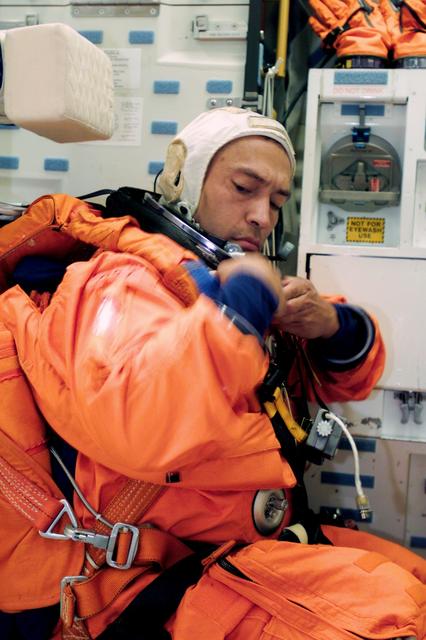
Photographic documentation of the STS-97 preflight training which occurred in Building 9 Crew Compartment Trainer II (CCTII). Views include: Astronaut Brent W. Jett (center), STS-97 mission commander, shares a light moment with two of the mission specialists on his crew, astronauts Joseph R. Tanner (left) and Carlos I. Noriega. The three are about to don training versions of the orange Launch and entry suit (LES) prior to a dry run of countdown procedures (23524). Astronaut Joseph R. Tanner (left), mission specialist, helps astronaut Michael J. Bloomfield, pilot, with final touches on his suit-donning process as USA suit technicians Bill Todd (standing) and Brad Milling look on (23525). Astronaut Carlos I. Noriega, attired in a blue thermal undergarment, and USA suit technician Mike Birkenseher help astronaut Brent W. Jett, STS-97 mission commander, with final touches of suit donning (23526). Astronaut Marc Garneau, mission specialist representing the Canadian Space Agency (CSA), looks on as two crew mates assist him with final touches of suit-donning prior to a training session in the Johnson Space Center's Systems Integration Facility. Helping out are astronauts Carlos I. Noriega (left) and Joseph R. Tanner, mission specialists (23527). Astronaut Michael J. Bloomfield, left, discusses his launch and entry suit with USA technician Bill Todd prior to a training session (23528). Astronaut Joseph R. Tanner lends a helping hand to astronaut Carlos I. Noriega as the two STS-97 mission specialists prepare for a dry run going over launch procedures in a nearby simulator (23529). Astronaut Joseph R. Tanner receives a helping hand from astronaut Carlos I. Noriega as the two STS-97 mission specialists don training versions of their pressure ascent and entry garments (23530). Noriega adjusts his LES while in the CCTII middeck mock-up (23531).
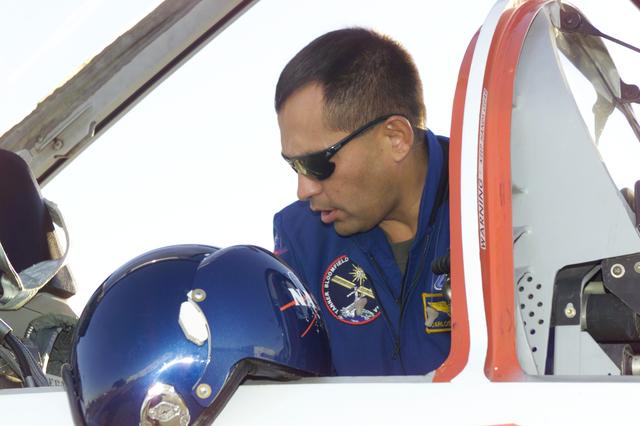
JSC2000-E-29120 (27 November 2000) --- Astronaut Carlos I. Noriega, STS-97 mission specialist, climbs into the cockpit of a NASA T-38 jet trainer at Ellington Field. The five-member crew was minutes away from departure to Florida, where it will continue preparations for launch later this week aboard the Space Shuttle Endeavour.
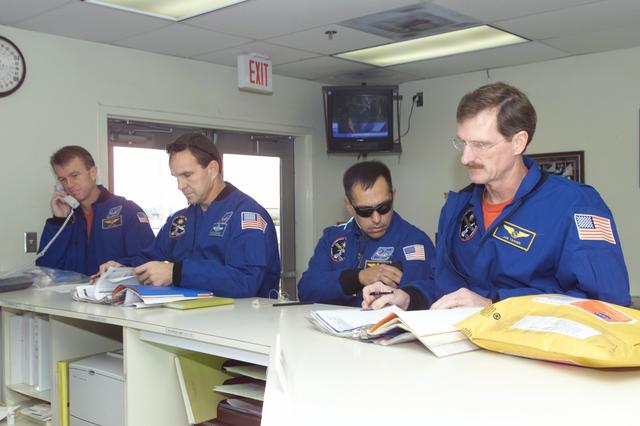
JSC2000-E-29119 (27 November 2000) --- Performing final tasks prior to leaving Ellington Field for Florida are four members of the STS-97 crew. From the left are astronauts Brent W. Jett, Jr., Michael J. Bloomfield, Carlos I. Noriega and Joseph R. Tanner. Marc Garneau, who represents the Canadian Space Agency (CSA), is not pictured. Launch from Florida's Kennedy Space Center (KSC) is scheduled for November 30.
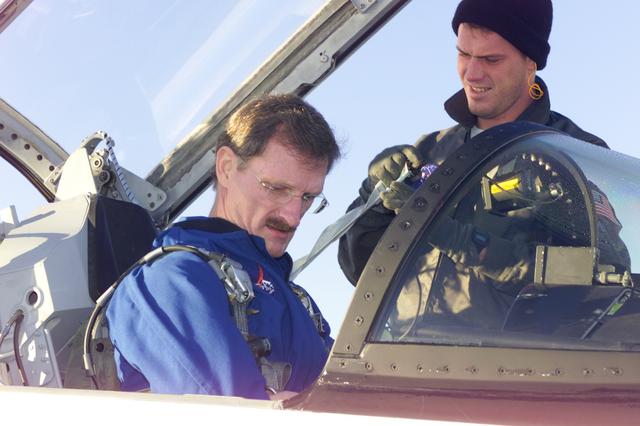
JSC2000-E-29121 (27 November 2000) --- Astronaut Joseph R. Tanner, STS-97 mission specialist, goes over a readiness check in the cockpit of a NASA T-38 jet trainer at Ellington Field. The five-member crew was minutes away from departure to Florida, where it will continue preparations for launch later this week aboard the Space Shuttle Endeavour.
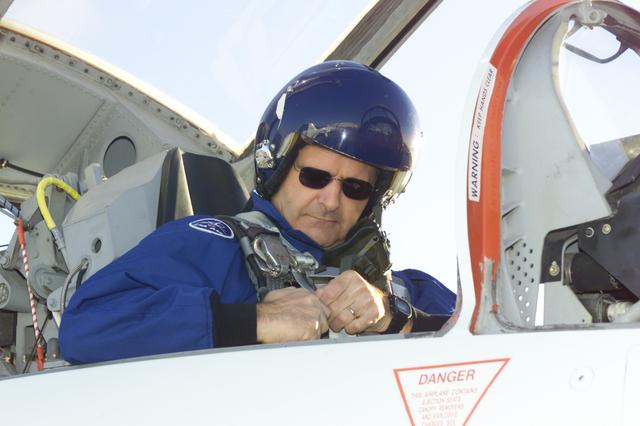
JSC2000-E-29124 (27 November 2000) --- Astronaut Marc Garneau, mission specialist representing the Canadian Space Agency (CSA), is pictured in the cockpit of a NASA T-38 jet trainer at Ellington Field. The five-member STS-97 crew was minutes away from departure to Florida, where it will continue preparations for launch later this week aboard the Space Shuttle Endeavour.
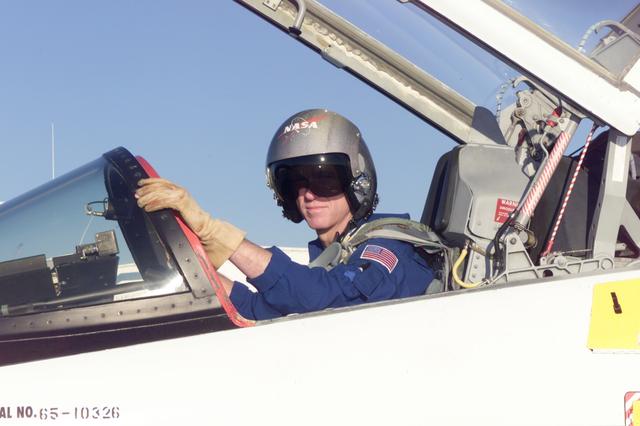
JSC2000-E-29131 (27 November 2000) --- Astronaut Brent W. Jett, Jr., mission commander, is pictured in the cockpit of a NASA T-38 jet trainer at Ellington Field. The five-member STS-97 crew was minutes away from departure to Florida, where it will continue preparations for launch later this week aboard the Space Shuttle Endeavour.
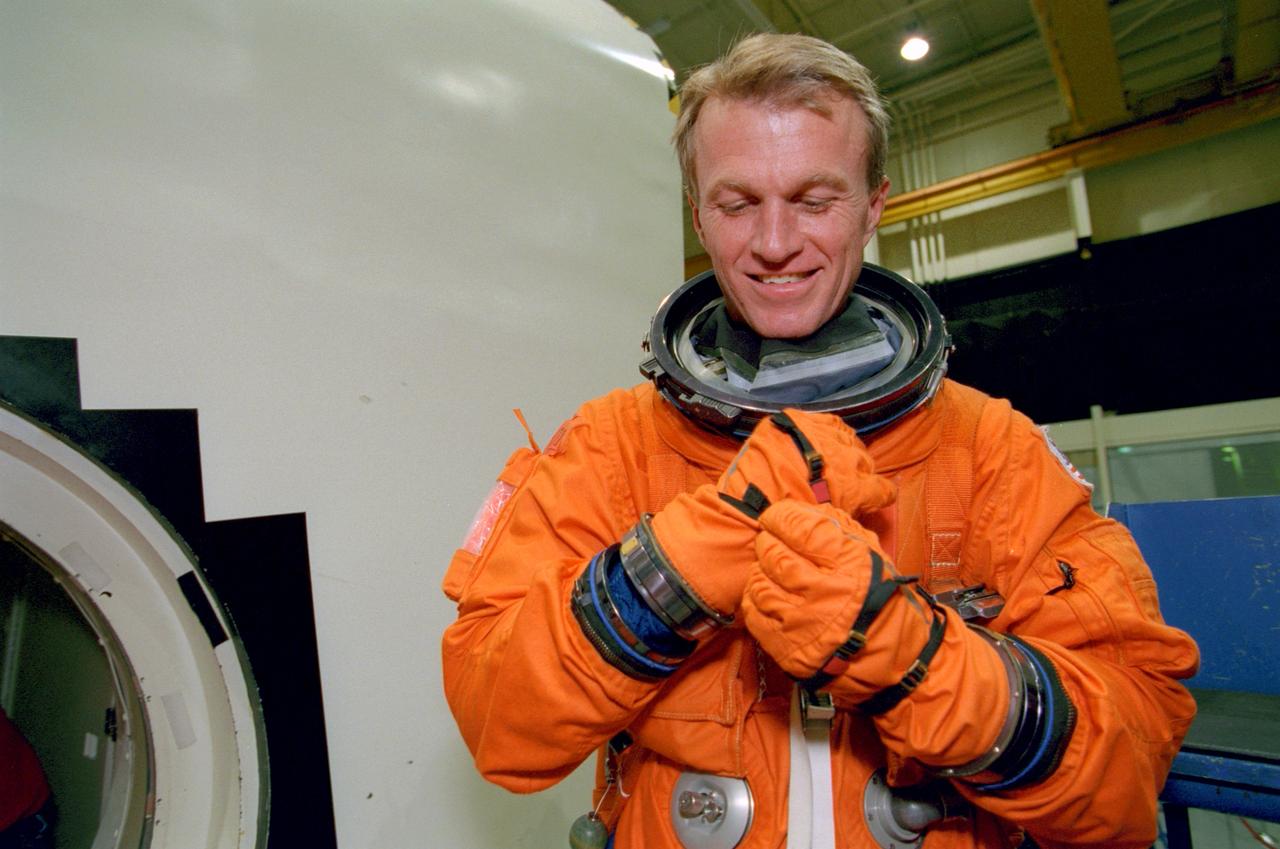
S99-07627 (15 July 1999) --- Astronant Brent W. Jett, STS-97 mission commander, adjusts a glove on his pressure suit during an emergency egress training excercise with the crew compartment trainer (CCT) in the Johnson Space Center's Systems Integration Facility.
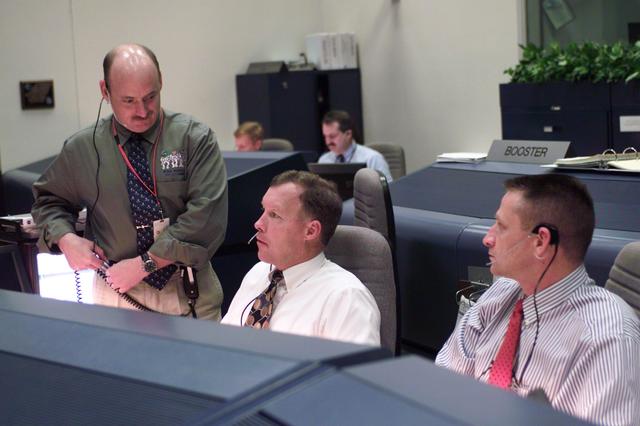
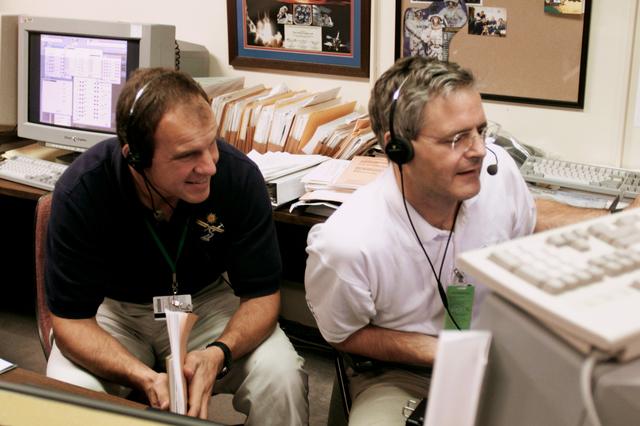
2000-E-29788 (30 November 2000) --- Astronauts Scott J. Kelly, from the left, Dominic L. Gorie and Christopher J. Loria at the spacecraft communicator (CAPCOM) console during STS-97 pre-launch activity in the shuttle flight control room (WFCR) of Houston's Mission Control Center (MCC).
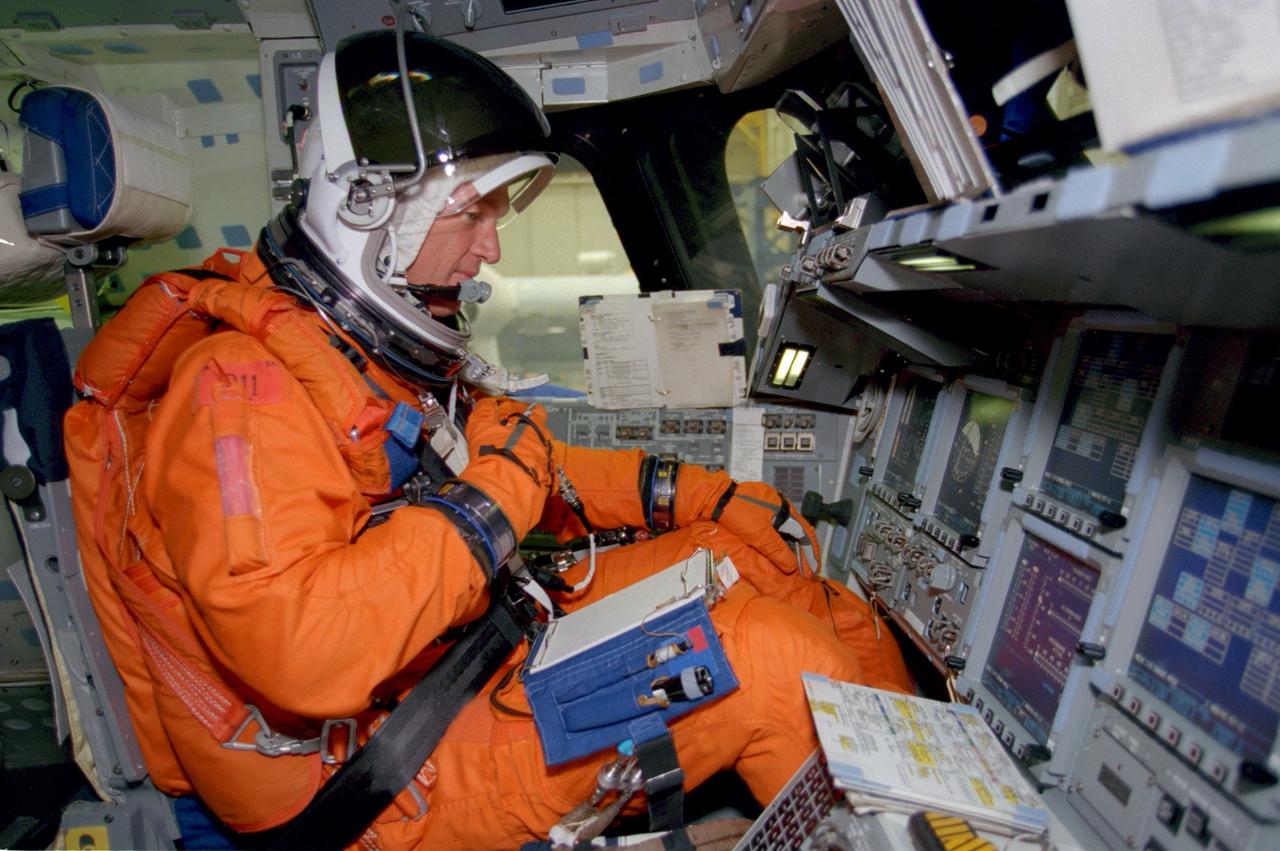
S99-07639 (15 July 1999) --- Astronaut Brent W. Jett, Jr., STS-97 mission commander, goes over a checklist while seated at the commander's station of a trainer/mockup during a dry-run of launch countdown procedures.
JSC2000-E-26589 (October 2000) --- Astronauts Michael J. Bloomfield (left), STS-97 pilot, looks on as astronaut Marc Garneau, mission specialist representing the Canadian Space Agency (CSA), rehearses assigned duties for the upcoming Endeavour mission. The training took place in the Johnson Space Center's virtual reality laboratory.
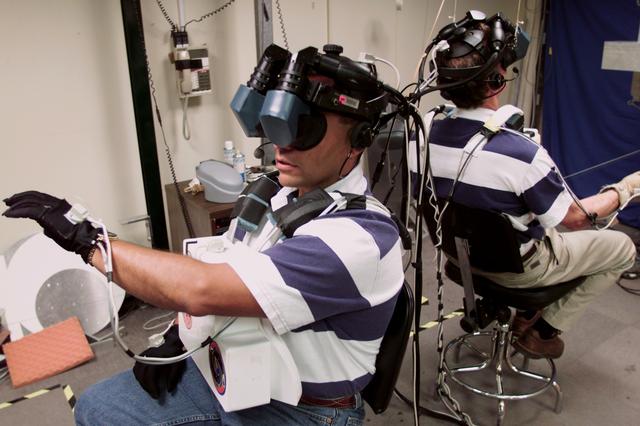
JSC2000-E-26587 (October 2000) --- The two assigned space-walking astronauts for the STS-97 mission train for their scheduled extravehicular activity (EVA) in the virtual reality laboratory at the Johnson Space Center (JSC). They are astronauts Carlos I. Noriega (left) and Joseph R. Tanner, both mission specialists.
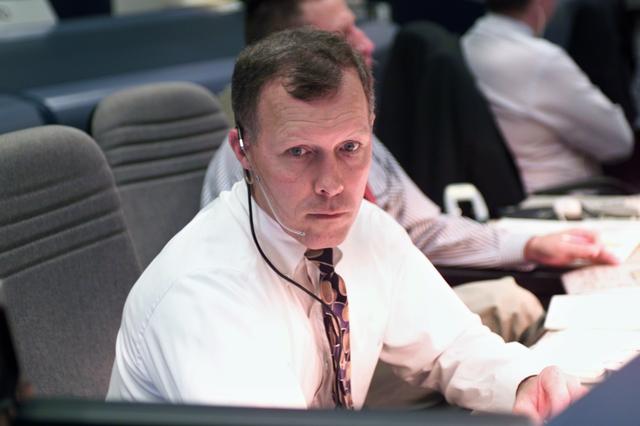
JSC2000-E-29791 (30 November 2000) --- Astronaut Dominic L. Gorie, spacecraft communicator (CAPCOM), follows STS-97 pre-launch activity from the CAPCOM console in the shuttle flight control room (WFCR) at Houston's Mission Control Center (MCC).
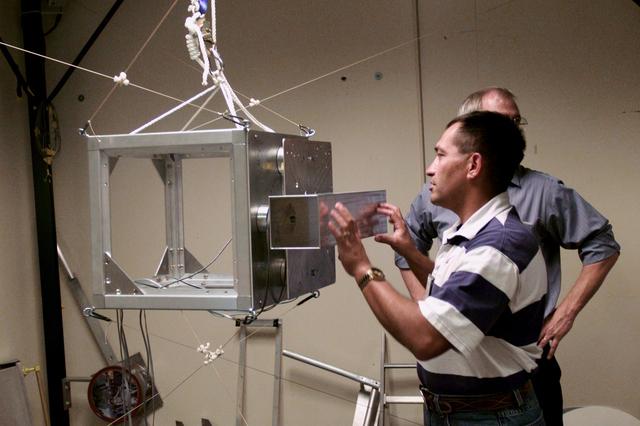
JSC2000-E-26591 (October 2000) --- Astronaut Carlos I. Noriega, one of two STS-97 astronauts assigned to extravehicular activity (EVA) duty, participates in training for the upcoming mission. Noriega and four other astronauts will visit the International Space Station (ISS) via the Space Shuttle Endeavour.
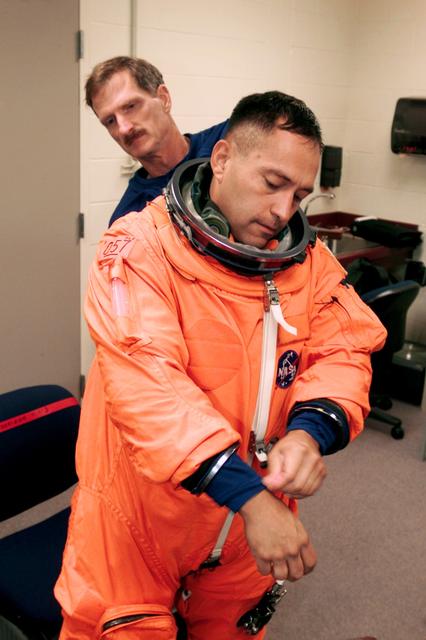
JSC2000-E-23529 (October 2000) --- Astronaut Joseph R. Tanner lends a helping hand to astronaut Carlos I. Noriega as the two STS-97 mission specialists prepare for a "dry run" going over launch procedures in a nearby simulator, in the Johnson Space Center's Systems Integration Facility.
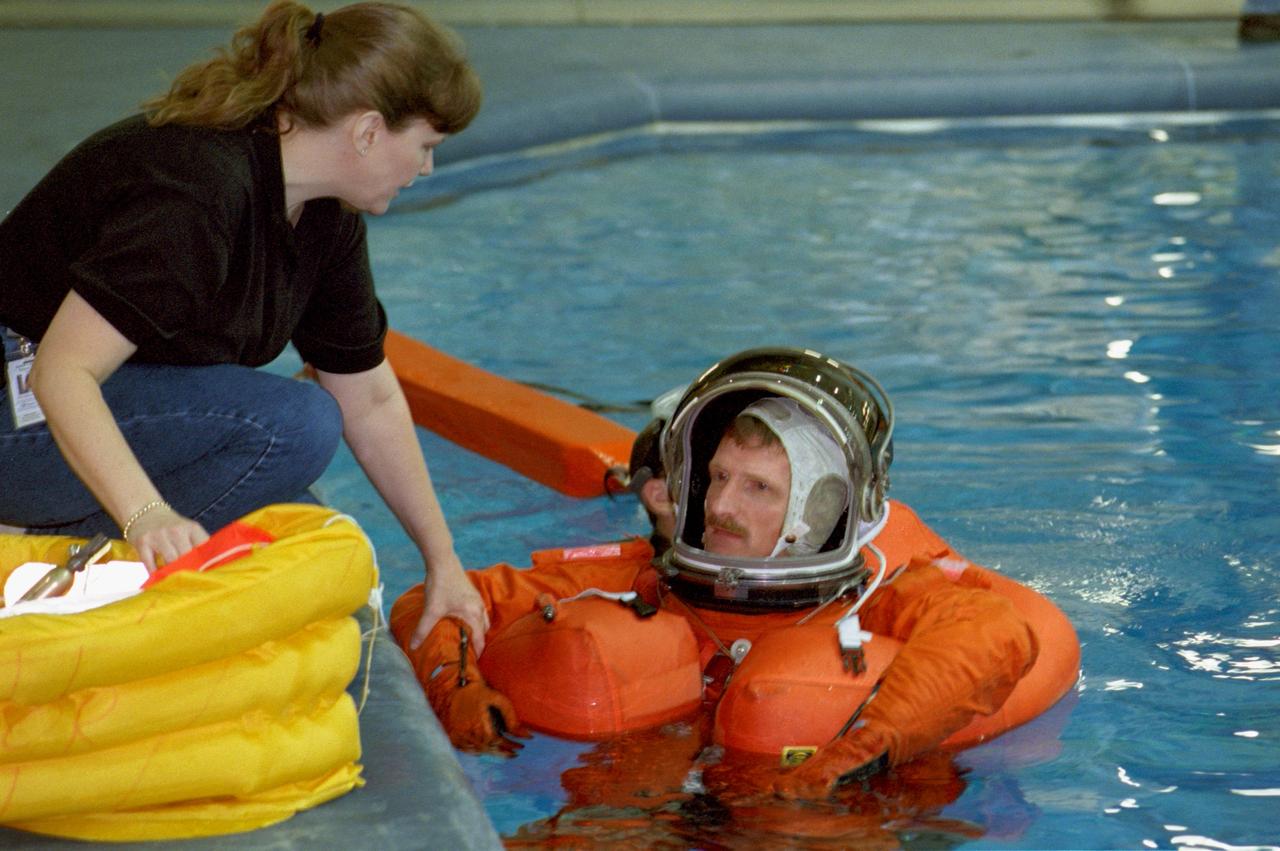
S99-07006 (9 July 1999) --- Sharon Jones, a member of the crew training staff, briefs astronaut Joseph R. Tanner during a bailout training exercise for the STS-97 crew in the Neutral Buoyancy Laboratory (NBL) at the Sonny Carter Training Center. Tanner is a mission specialist on the five-man STS-97 crew, scheduled for a visit to the International Space Station (ISS) next autumn.
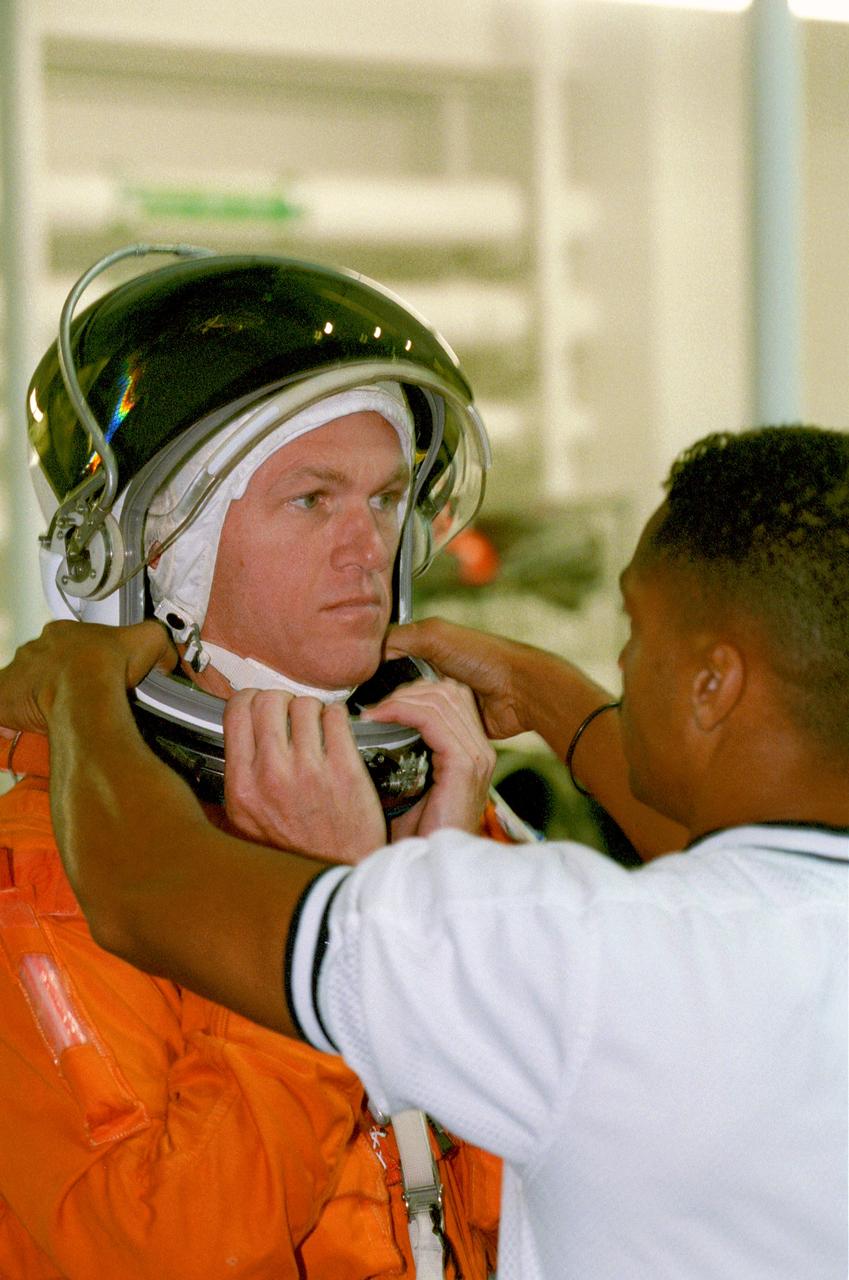
S99-07010 (9 July 1999) --- Astronaut Brent W. Jett, Jr., STS-97 mission commander, looks on as Carlous Gillis, a United Space Alliance suit technician, checks the collar on his launch and entry garment. The five-man STS-97 crew was about to participate in a rehearsal of emergency bailout procedures in the Neutral Buoyancy Laboratory (NBL).
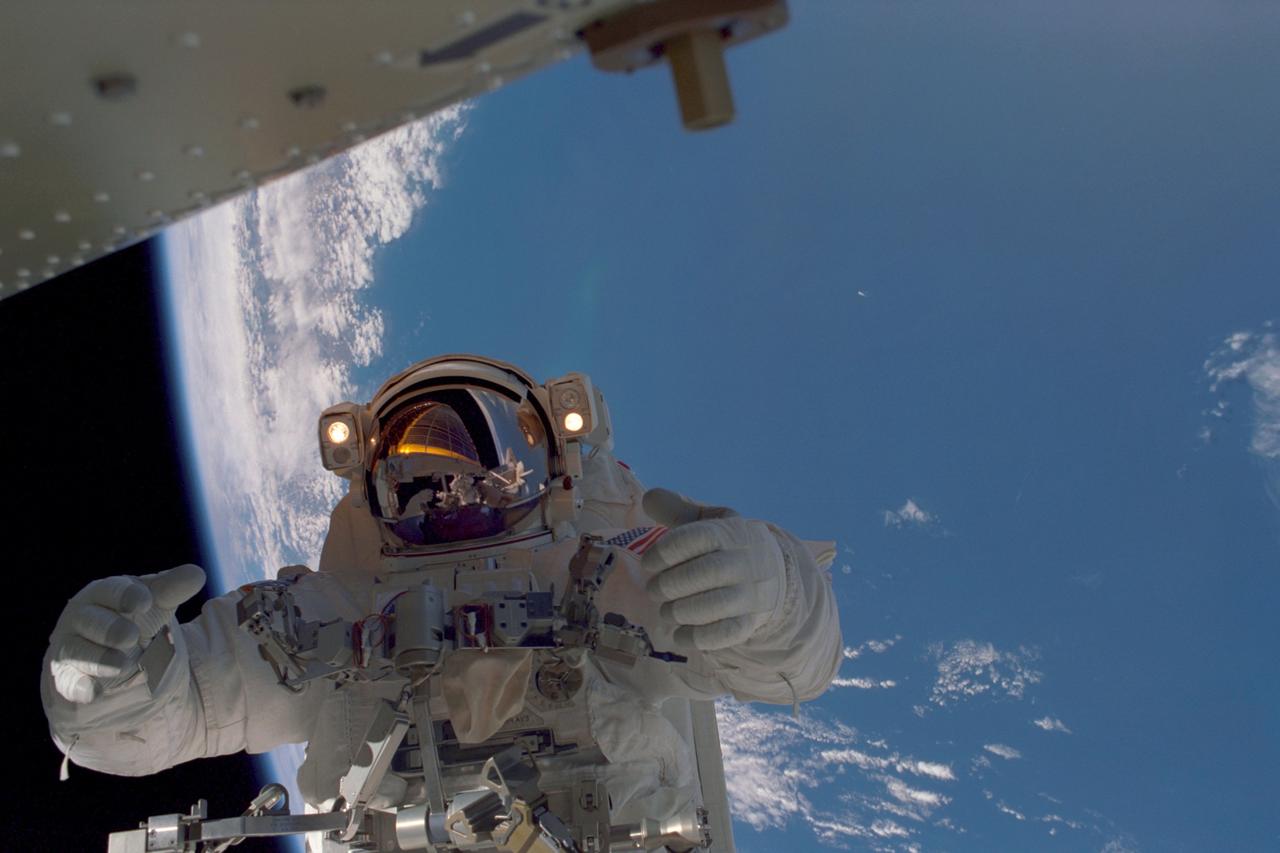
In this image, planet Earth, some 235 statute miles away, forms the back drop for this photo of STS-97 astronaut and mission specialist Joseph R. Tanner, taken during the third of three space walks. The mission's goal was to perform the delivery, assembly, and activation of the U.S. electrical power system onboard the International Space Station (ISS). The electrical power system, which is built into a 73-meter (240-foot) long solar array structure consists of solar arrays, radiators, batteries, and electronics. The entire 15.4-metric ton (17-ton) package is called the P6 Integrated Truss Segment, and is the heaviest and largest element yet delivered to the station aboard a space shuttle. The electrical system will eventually provide the power necessary for the first ISS crews to live and work in the U.S. segment. The STS-97 crew of five launched aboard the Space Shuttle Orbiter Endeavor on November 30, 2000 for an 11 day mission.
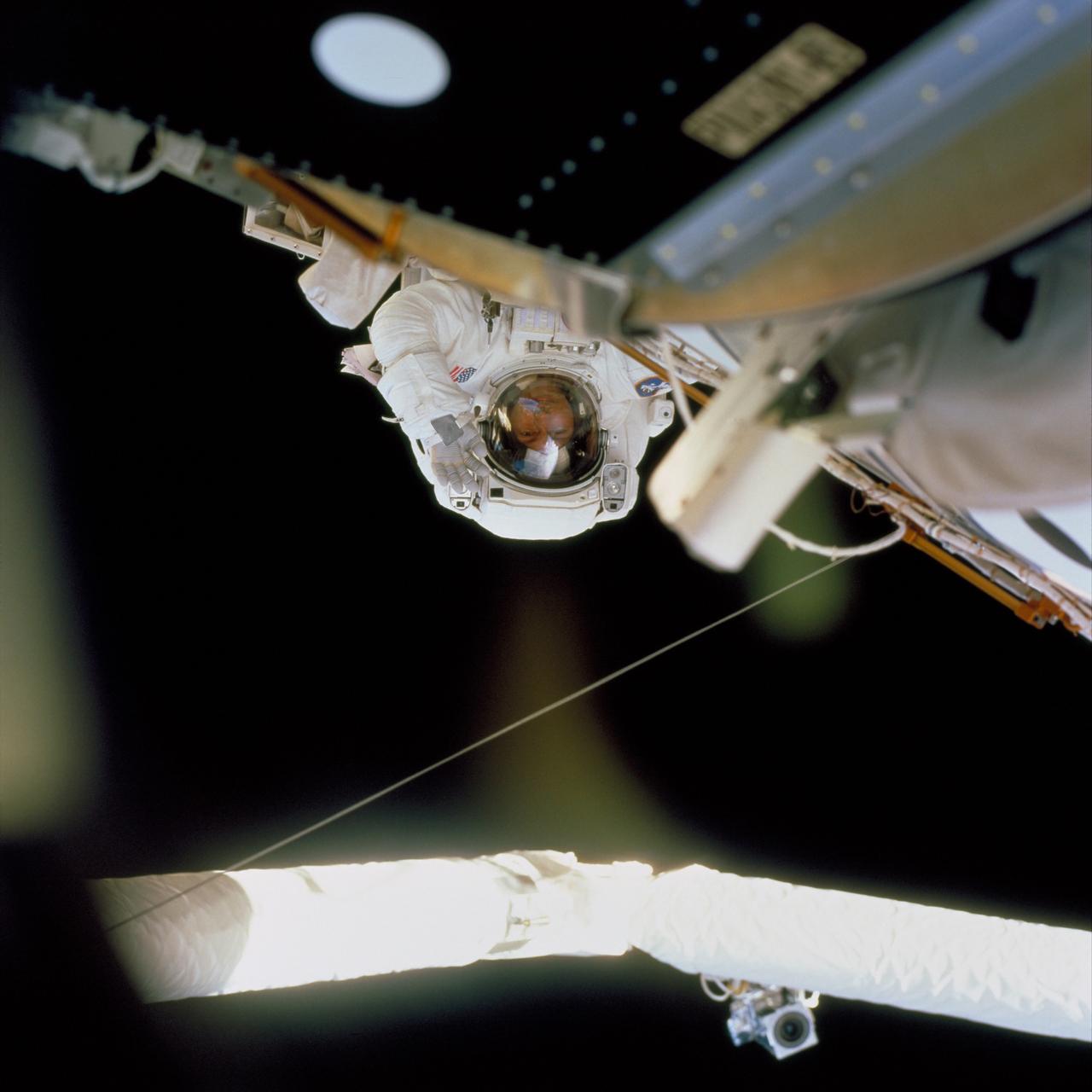
In this image, STS-97 astronaut and mission specialist Carlos I. Noriega waves at a crew member inside Endeavor's cabin during the mission's final session of Extravehicular Activity (EVA). Launched aboard the Space Shuttle Orbiter Endeavor on November 30, 2000, the STS-97 mission's primary objective was the delivery, assembly, and activation of the U.S. electrical power system onboard the International Space Station (ISS). The electrical power system, which is built into a 73-meter (240-foot) long solar array structure consists of solar arrays, radiators, batteries, and electronics. The entire 15.4-metric ton (17-ton) package is called the P6 Integrated Truss Segment, and is the heaviest and largest element yet delivered to the station aboard a space shuttle. The electrical system will eventually provide the power necessary for the first ISS crews to live and work in the U.S. segment.
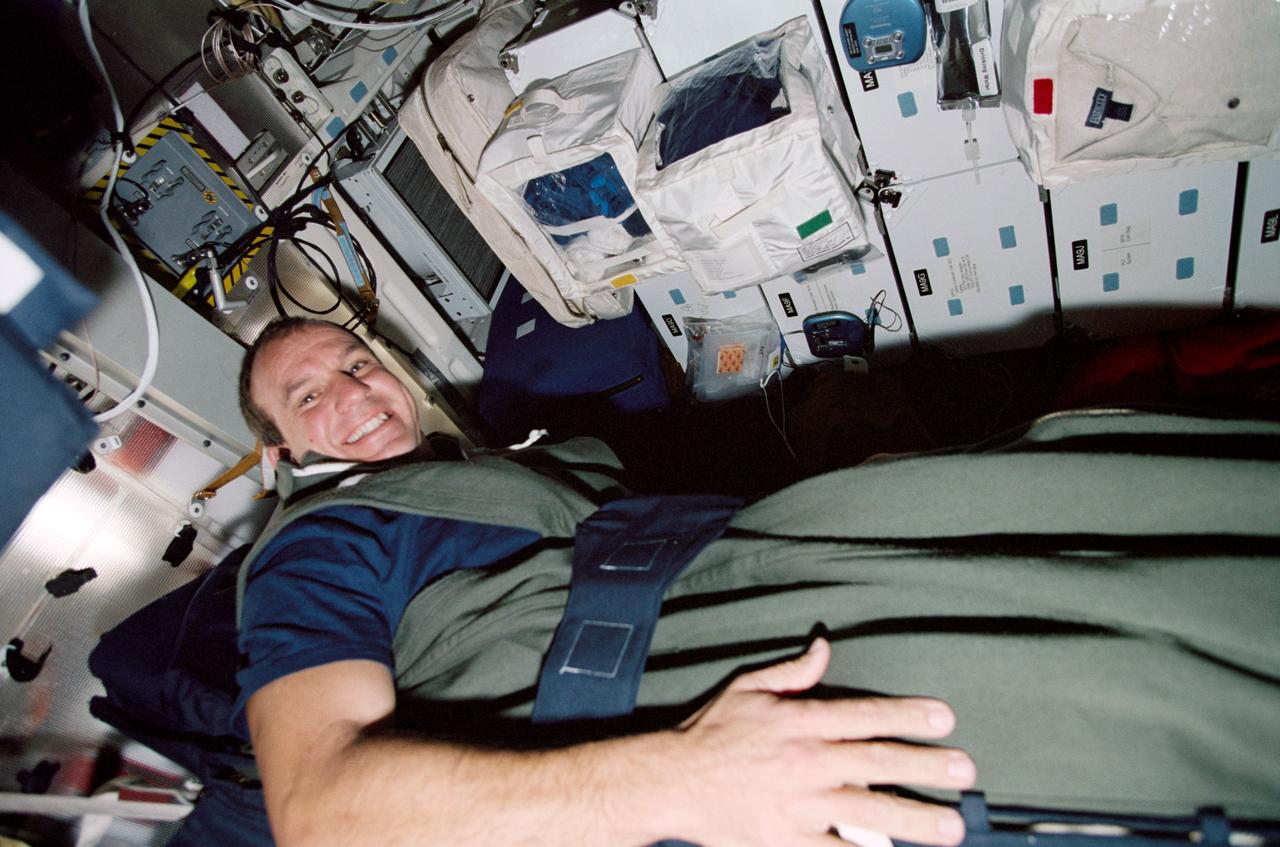
STS097-327-027 (30 Nov.-11 Dec. 2000) --- Astronaut Michael J. Bloomfield, STS-97 pilot, prepares for his sleep shift on the middeck of the Earth-orbiting Space Shuttle Endeavour.
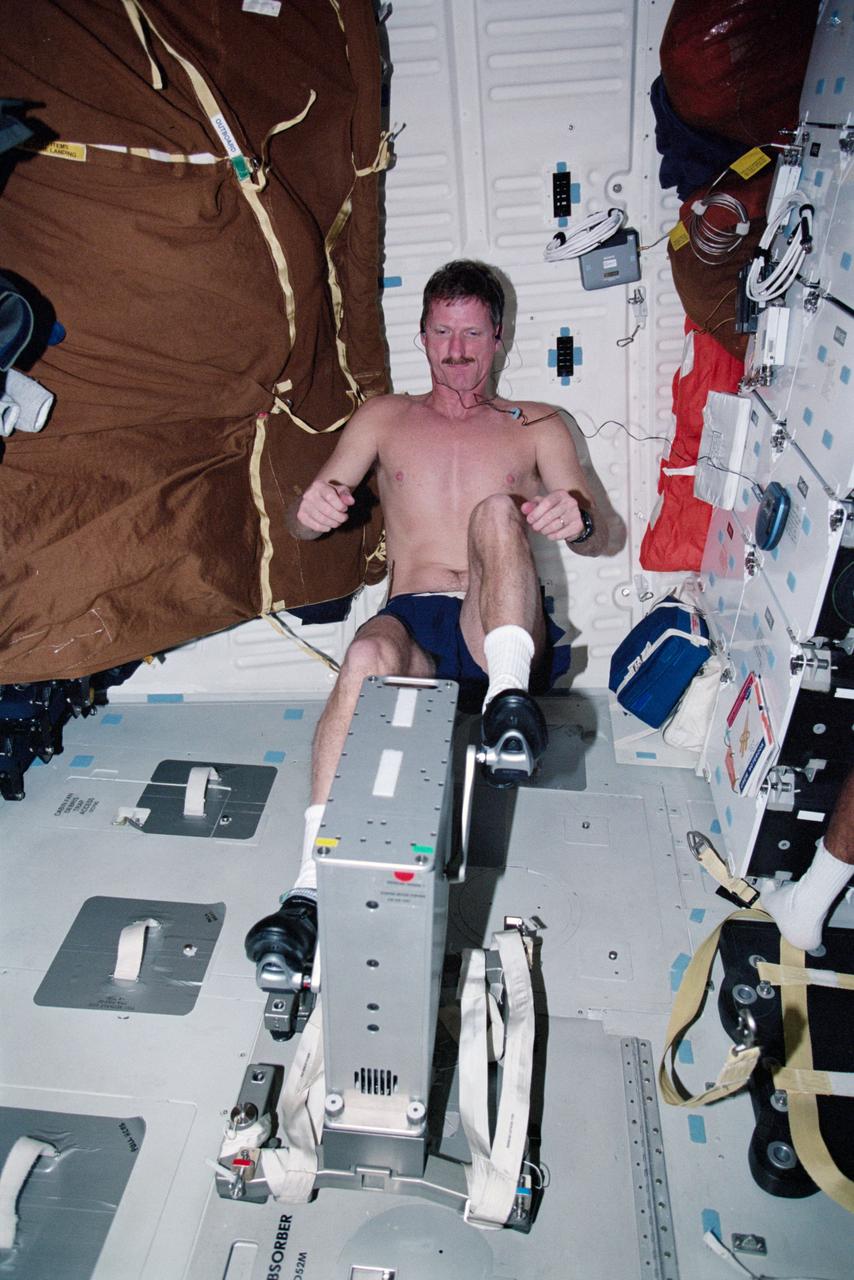
STS097-317-017 (30 Nov. - 11 Dec. 2000) Astronaut Joseph R. Tanner, STS-97 mission specialist, works out on the bicycle ergometer aboard the Space Shuttle Endeavour.
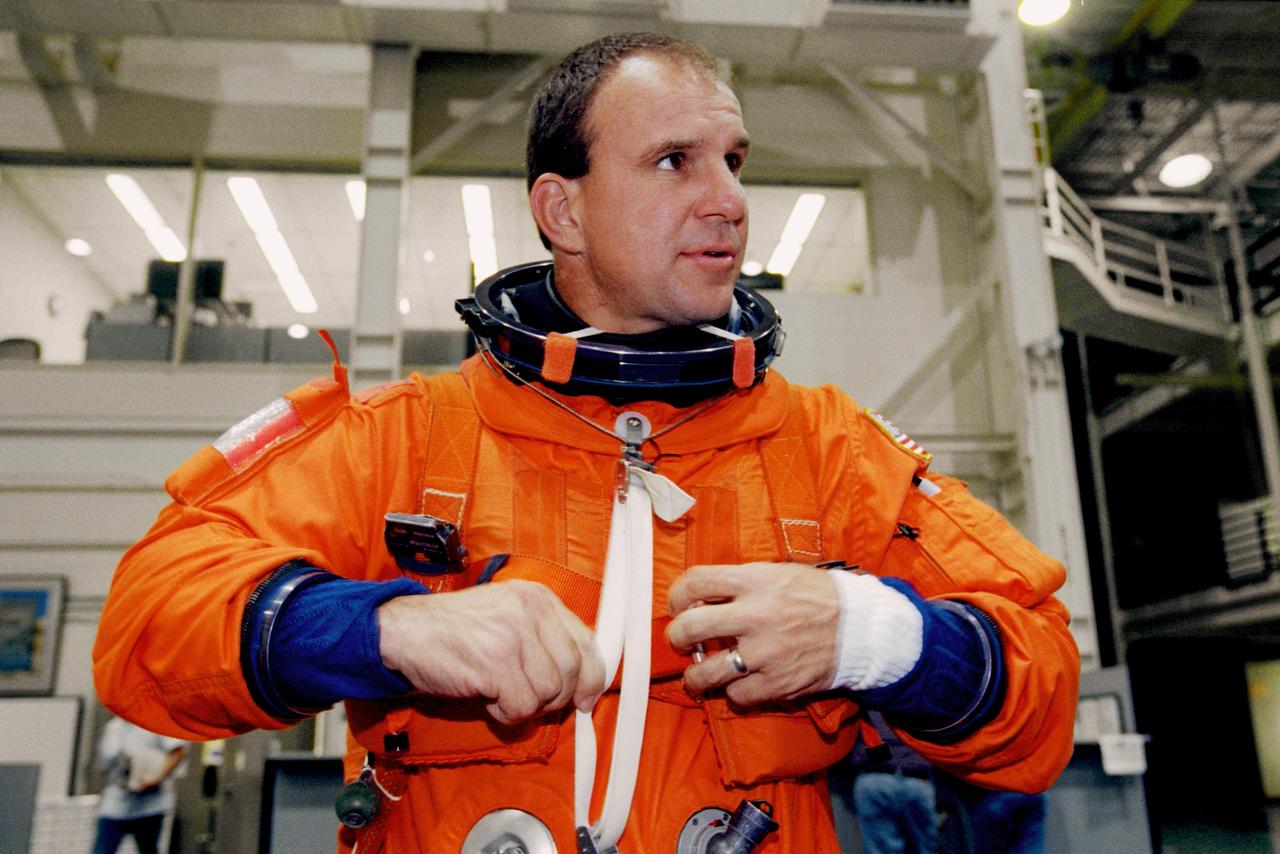
JSC2000-04749 (15 June 2000) --- Astronaut Michael J. Bloomfield, STS-97 pilot, prepares to participate in a 'dry run' of launch countdown procedures in the Systems Integration Facility at the Johnson Space Center (JSC).
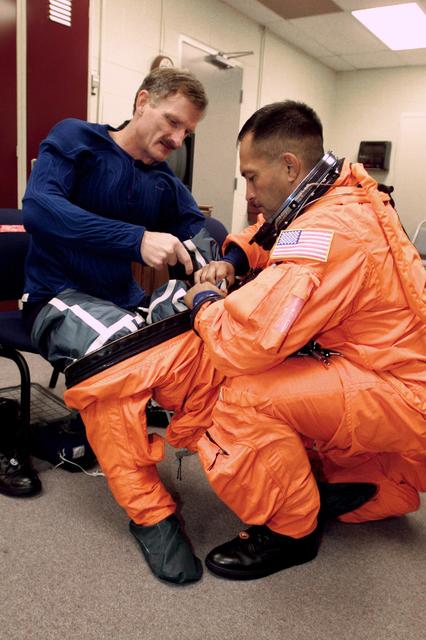
JSC2000-E-23530 (October 2000) --- Astronaut Joseph R. Tanner receives a helping hand from astronaut Carlos I. Noriega as the two STS-97 mission specialists don training versions of their pressure ascent and entry garments. The two were about to participate in a simulation of various parts of their scheduled November mission aboard the Space Shuttle Endeavour.
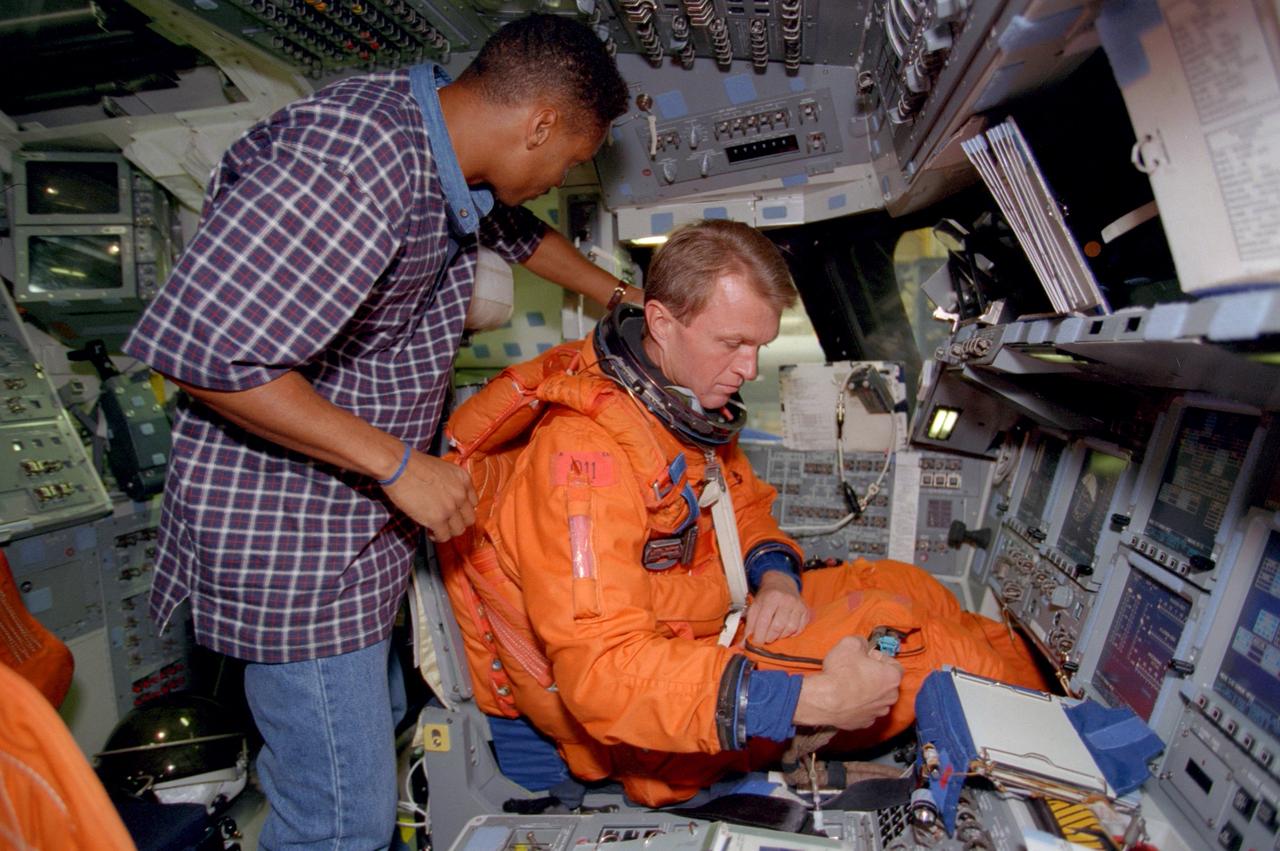
S99-07641 (15 July 1999)--- Carlous Gillis, a technician for United Space Alliance, assists astronaut Brent W. Jett, STS-97 commander, with his launch and entry garment during a training session in the Systems Integration Facility at the Johnson Space Center (JSC). Jett, pictured here in the commander's station on the port side of a shuttle crew compartment trainer (CCT), and four other astronauts are to visit the International Space Station (ISS) late next year
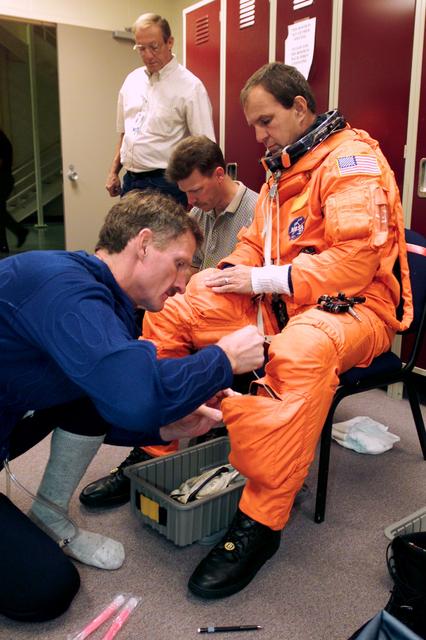
JSC2000-E-23525 (October 2000) --- Astronaut Joseph R. Tanner (left), mission specialist, helps astronaut Michael J. Bloomfield, pilot, with final touches on his suit-donning process as USA suit technicians Bill Todd (standing) and Brad Milling look on. The two were about to join the other three STS-97 crew members for a training session in the Johnson Space Center's Systems Integration Facility.
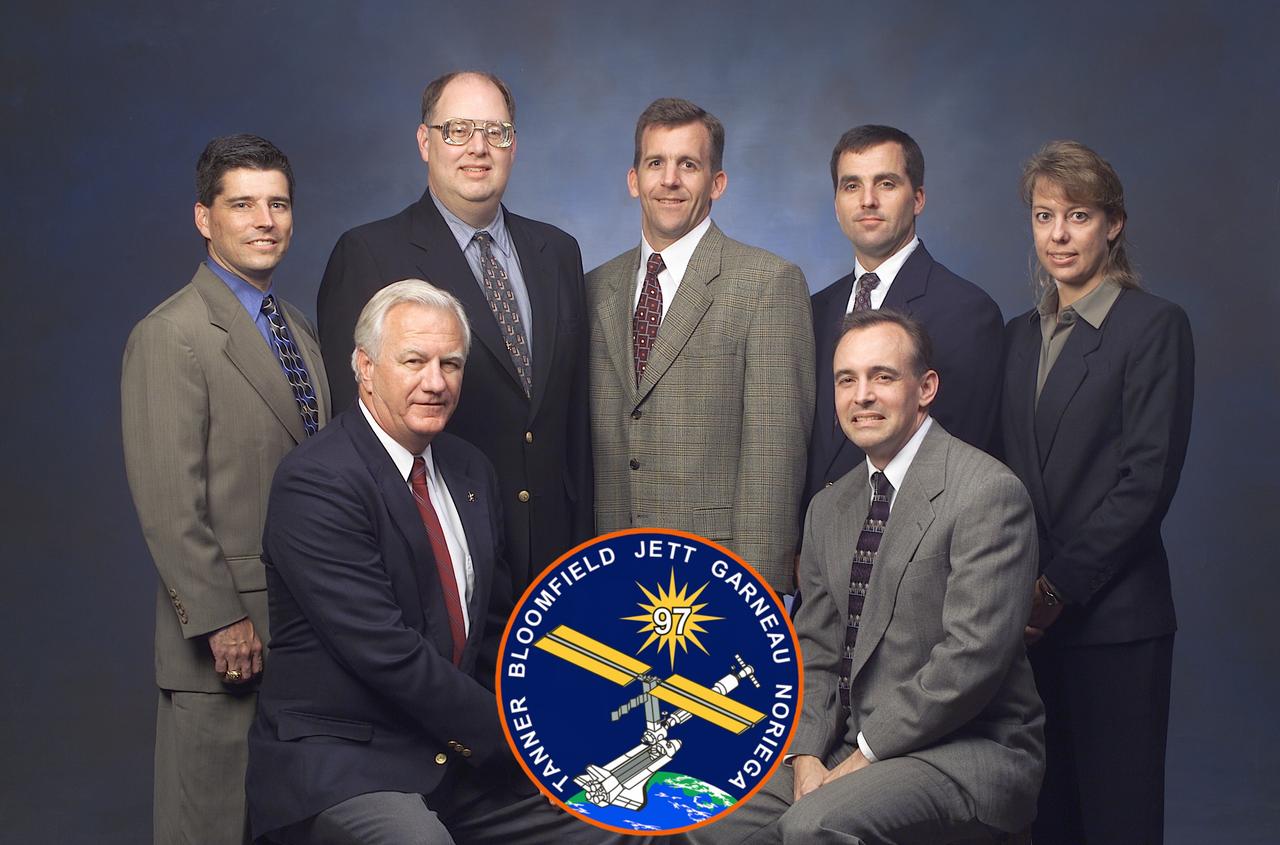
JSC2000-E-29413 (November 2000) --- Flight directors (FD) for the STS-97 mission pose for a pre-flight group portrait with the mission's insignia. Front row: Lead FD Bill Reeves (left), and Jeff Hanley. Back row, from the left: John Curry, Wayne Hale, LeRoy Cain, Paul Hill and Kelly Beck.
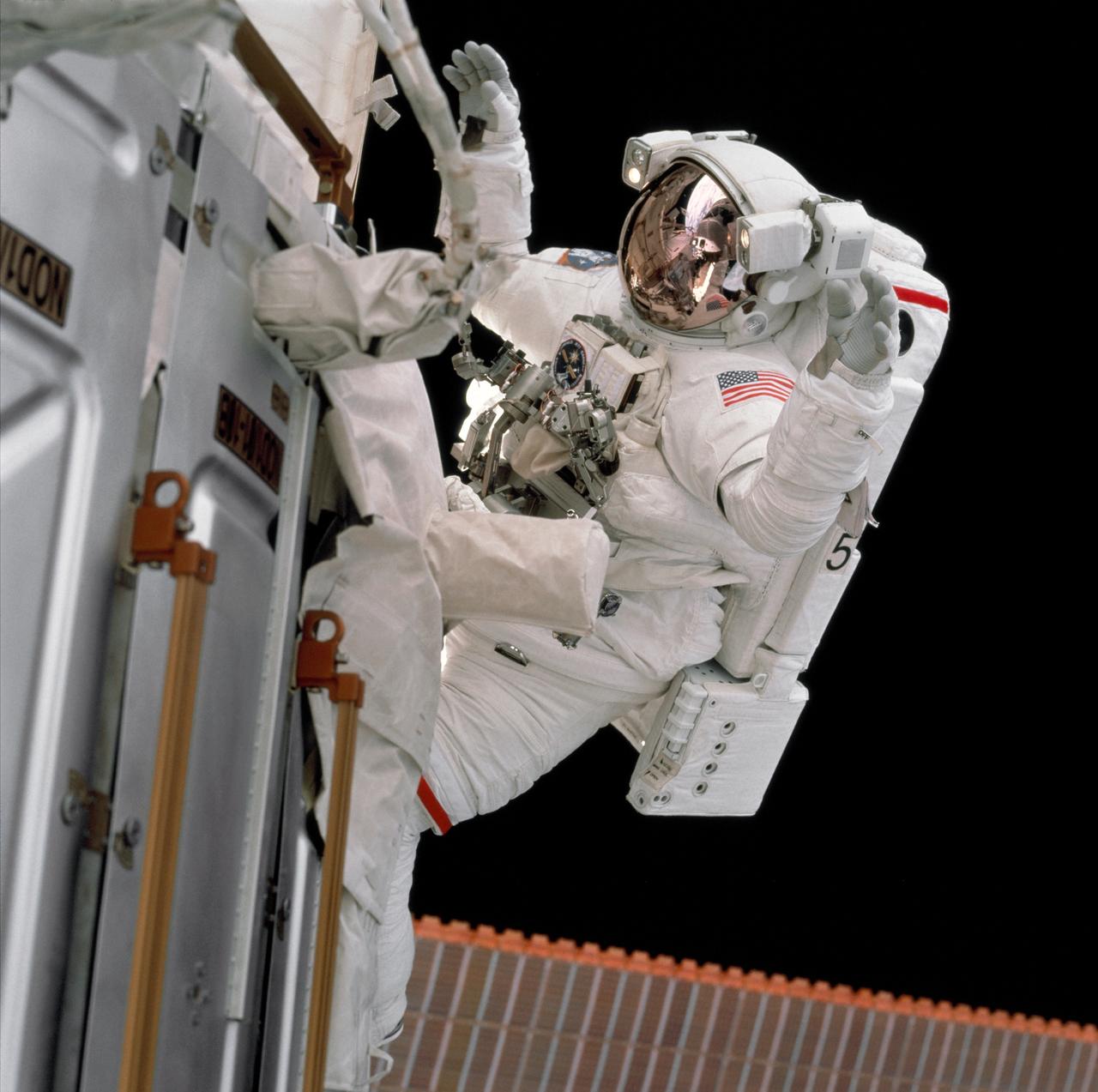
STS097-703-001 (7 December 2000) --- Astronaut Joseph R. Tanner participates in the December 7 extravehicular activity (EVA), one of three space walks involving him and astronaut Carlos I. Noriega. The photograph was taken by one of the non-EVA STS-97 crew members, using a 70mm camera.
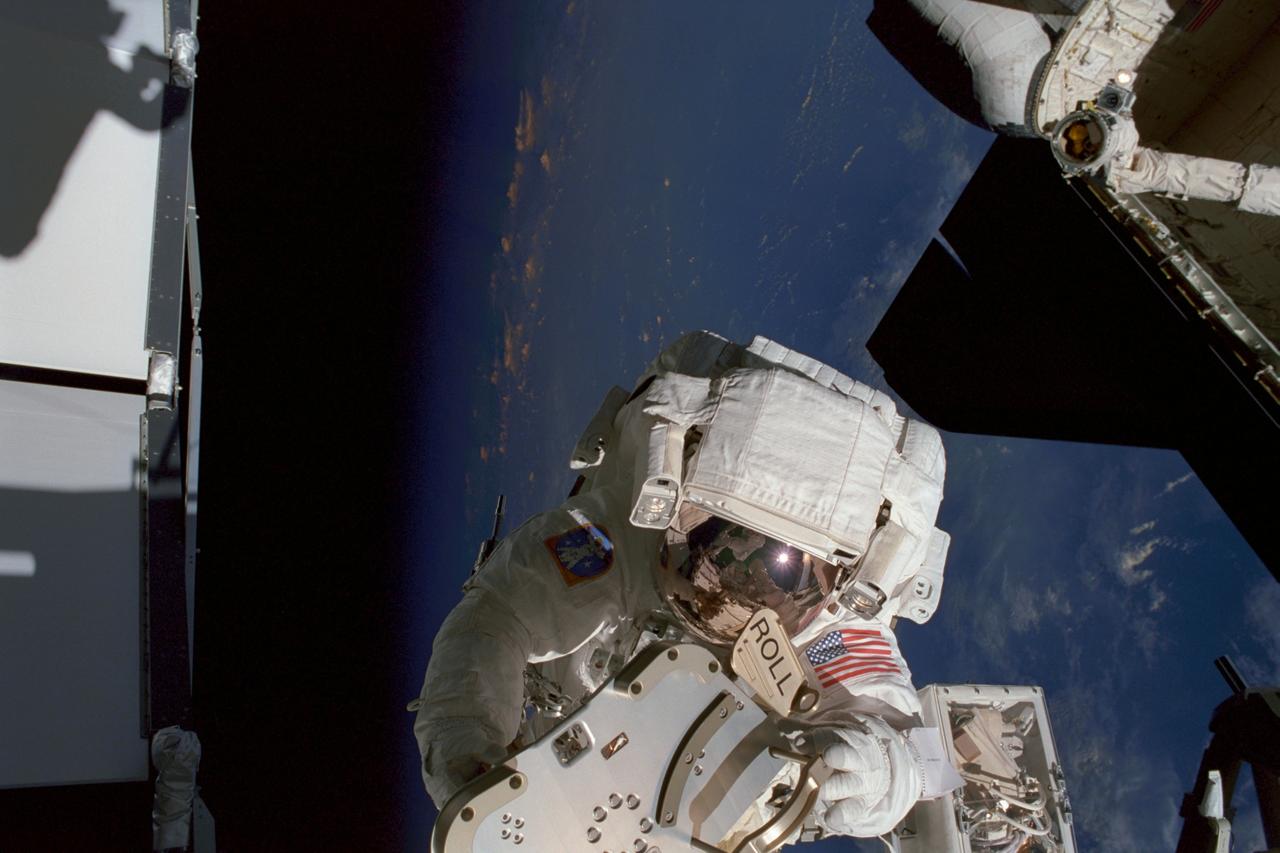
STS097-376-003 (7 December 2000) --- Astronaut Carlo I. Noriega, mission specialist, is pictured during the third of three STS-97 space walks to perform work on the International Space Station (ISS). The photo was taken by astronaut Joseph R. Tanner, mission specialist.
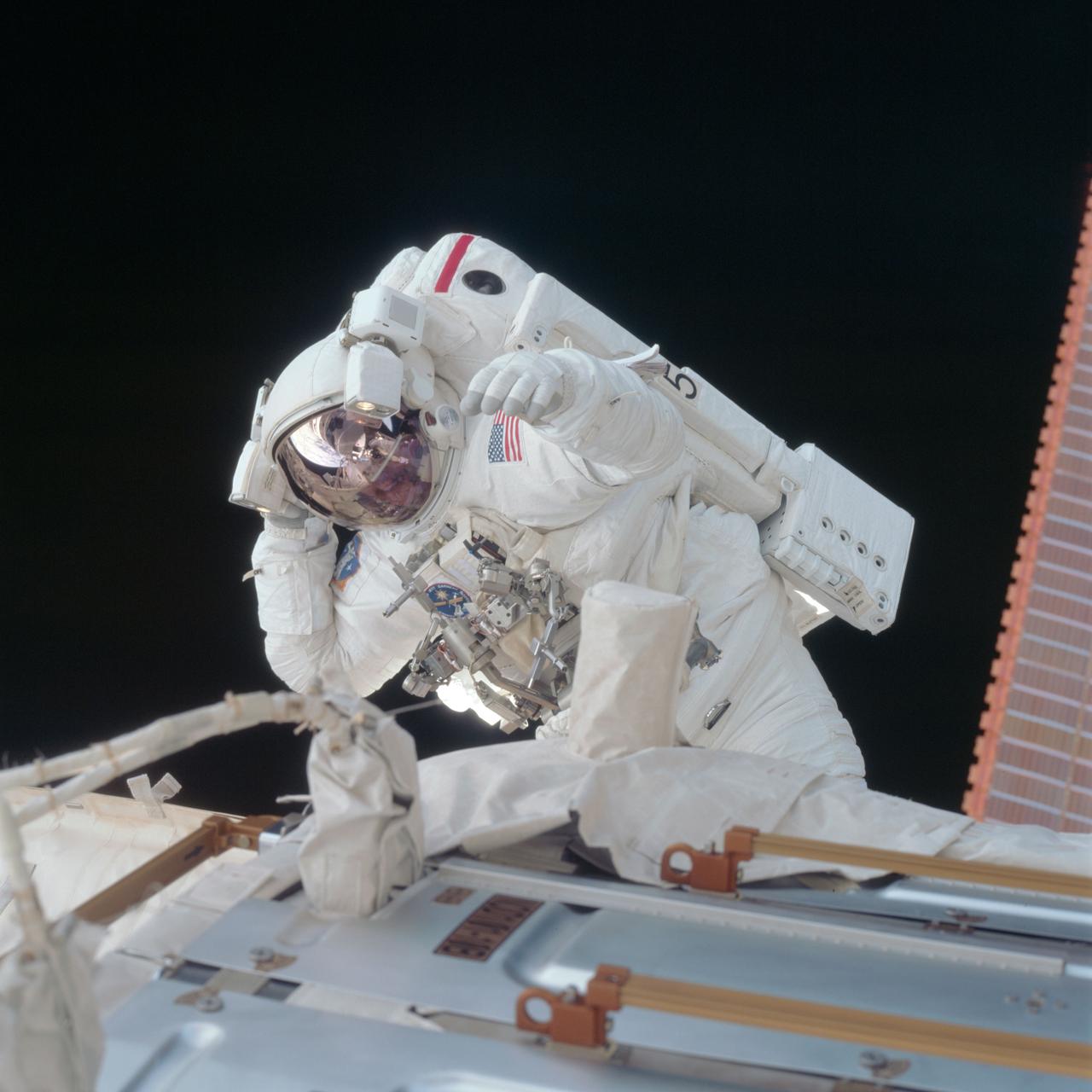
STS097-703-004 (7 December 2000) --- Astronaut Joseph R. Tanner participates in the December 7 extravehicular activity (EVA), one of three space walks involving him and astronaut Carlos I. Noriega. The photograph was taken by one of the non-EVA STS-97 crew members, using a 70mm camera.
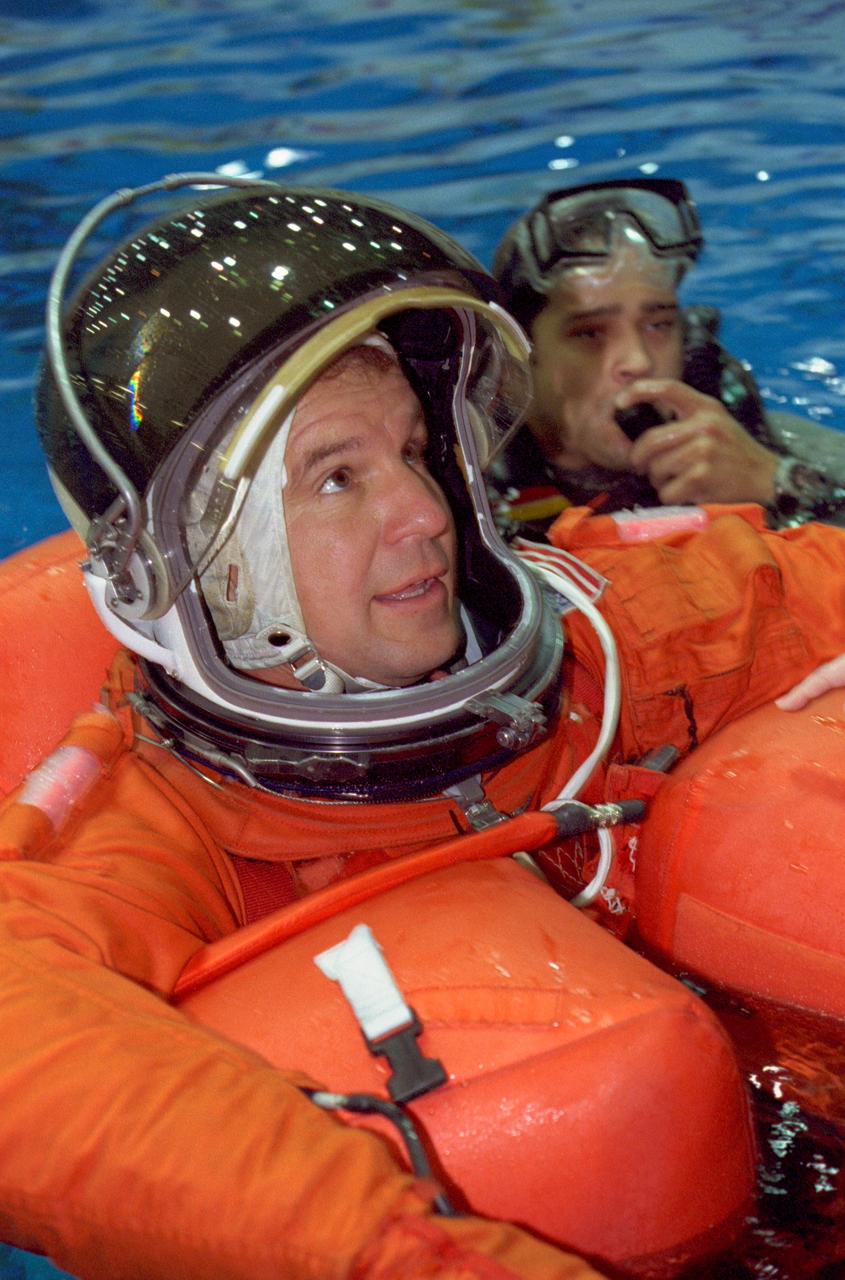
S99-07004 (9 July 1999) --- Astronaut Michael J. Bloomfield, STS-97 pilot, awaits "rescue" during an emergency bailout training exercise in the Neutral Buoyancy Laboratory (NBL) at the Sonny Carter Training Center.
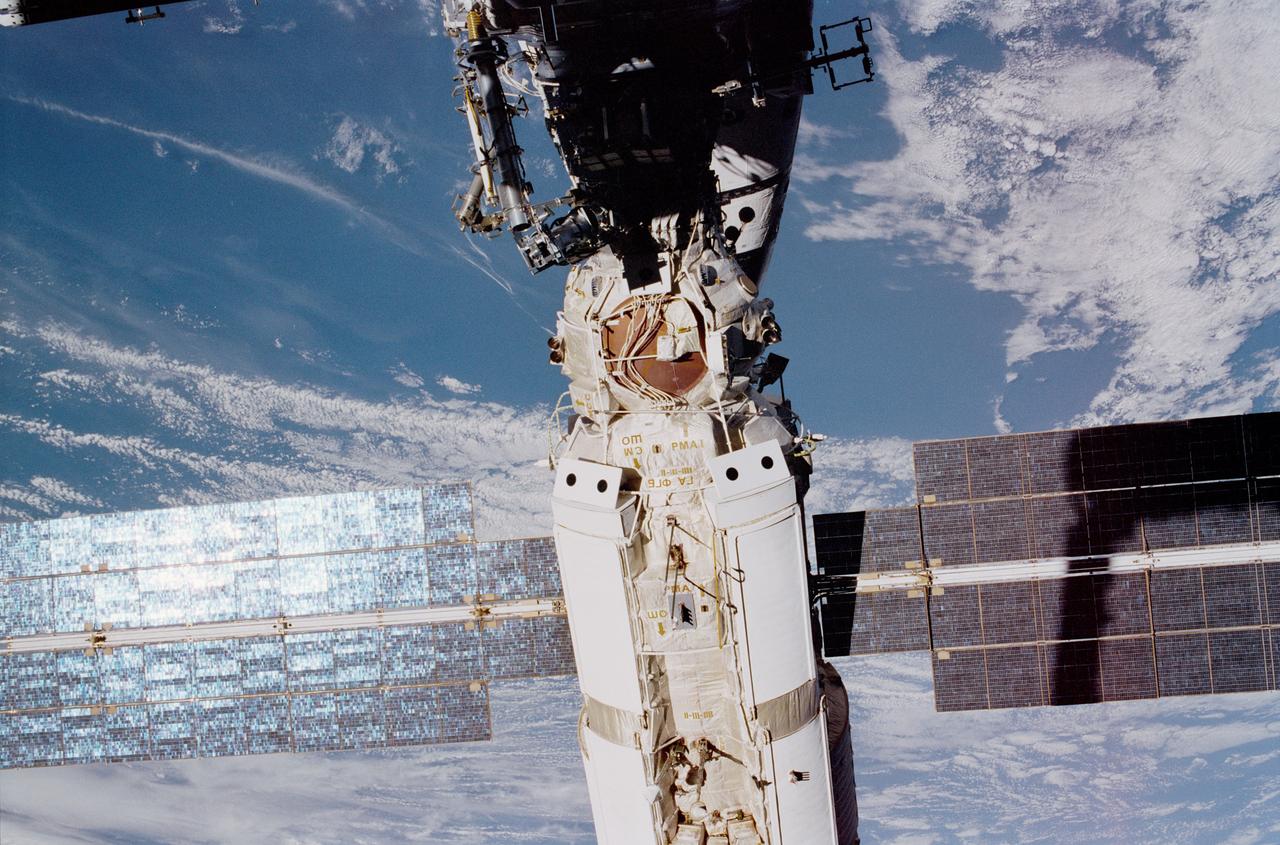
STS097-374-024 (3 December 2000) --- Backdropped by the Earth with partial cloud cover, the Functional Cargo Block (FGB) or Zarya is photographed with sunglint on the array. The photo was taken by astronaut Joseph R. Tanner during the first STS-97 space walk.
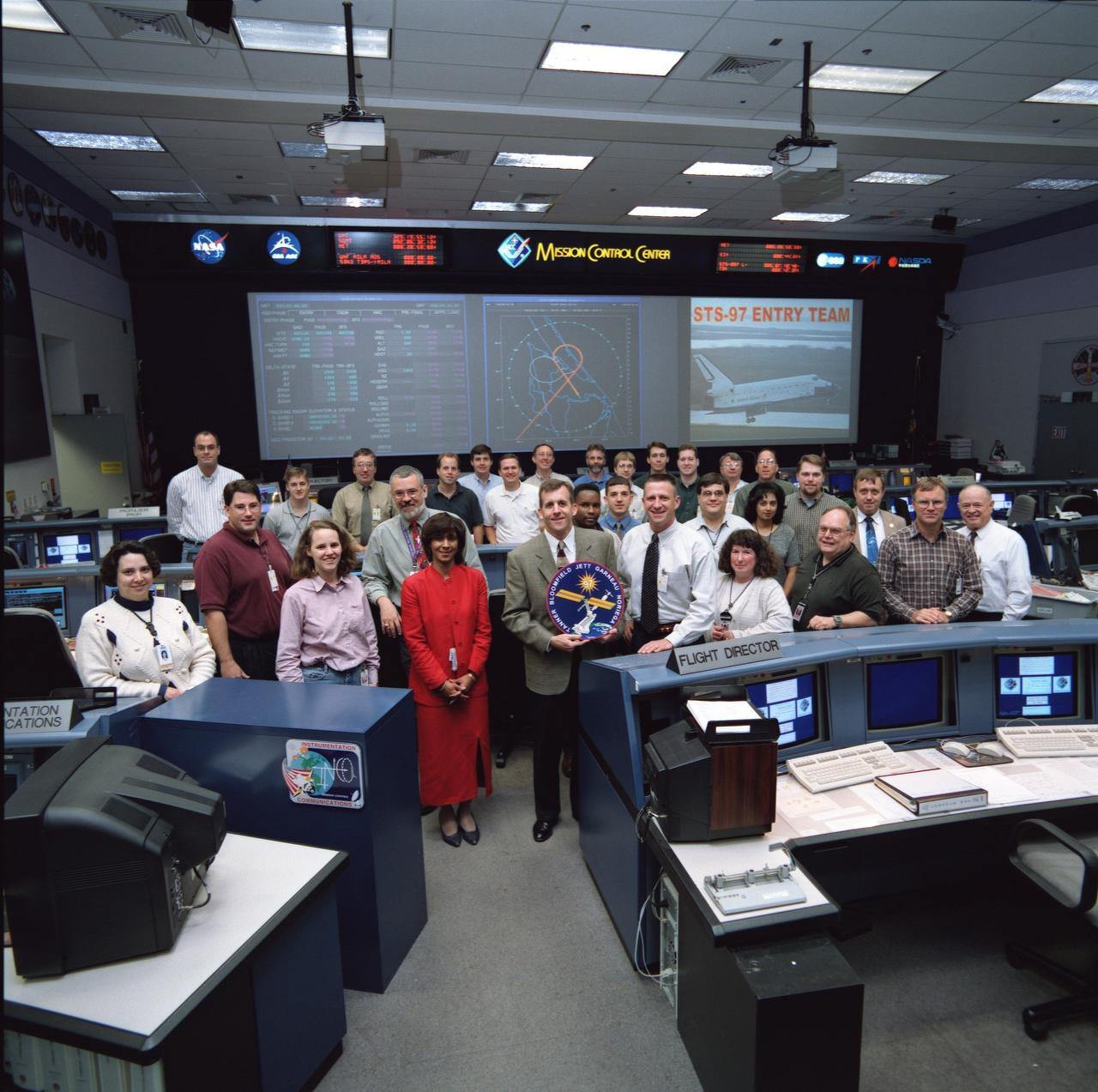
JSC2000-07303 (24 November 2000) --- The 30-odd flight controllers supporting the STS-97 entry shift pose for a pre-flight group portrait in the shuttle flight control room in Houston's Mission Control Center (JSC). Entry flight director LeRoy Cain (front center) holds a mission logo.
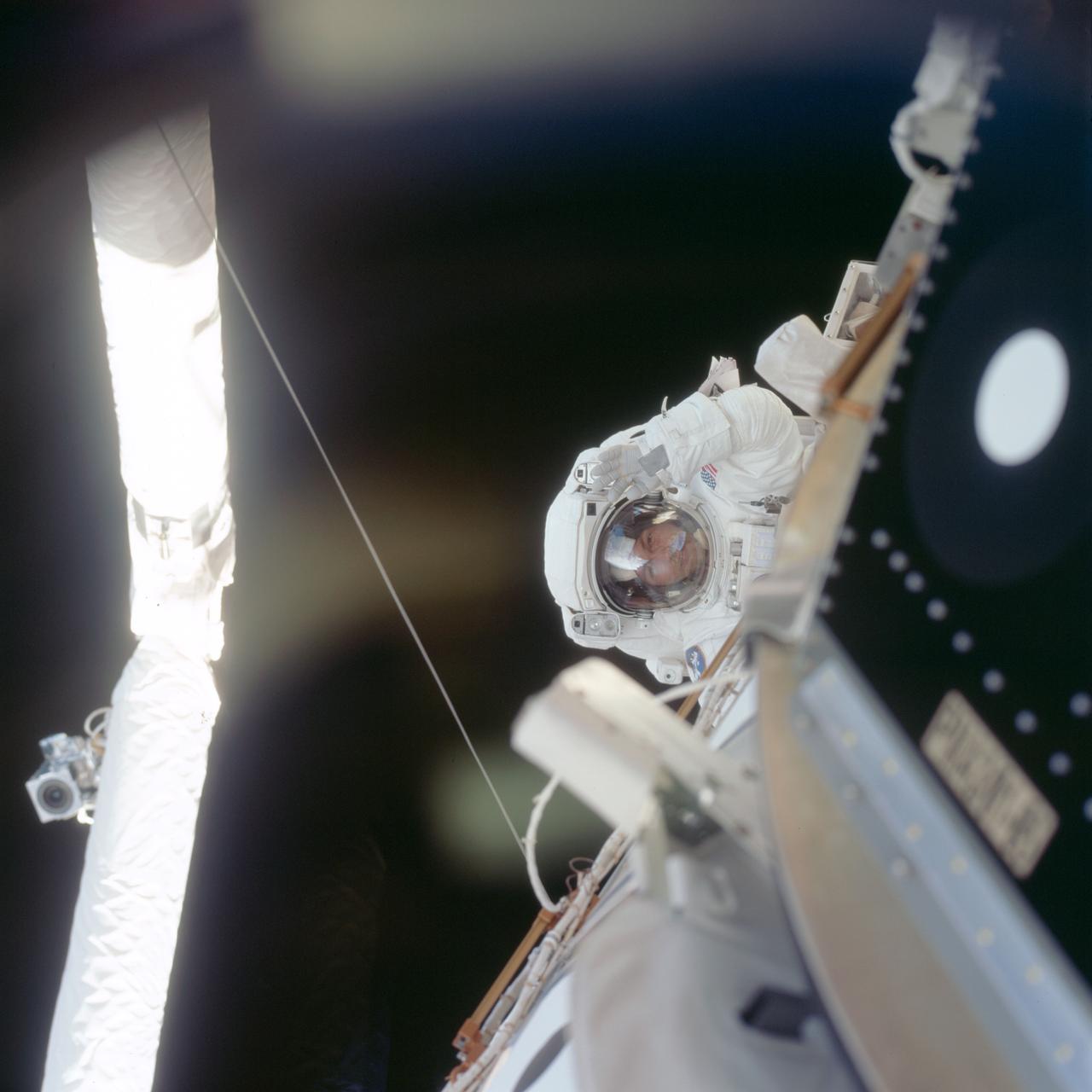
STS097-703-014 (7 December 2000) --- Astronaut Carlos I. Noriega, one of two space walking STS-97 mission specialists, waves at a crew member inside Endeavour's cabin during the mission's final session of extravehicular activity (EVA).
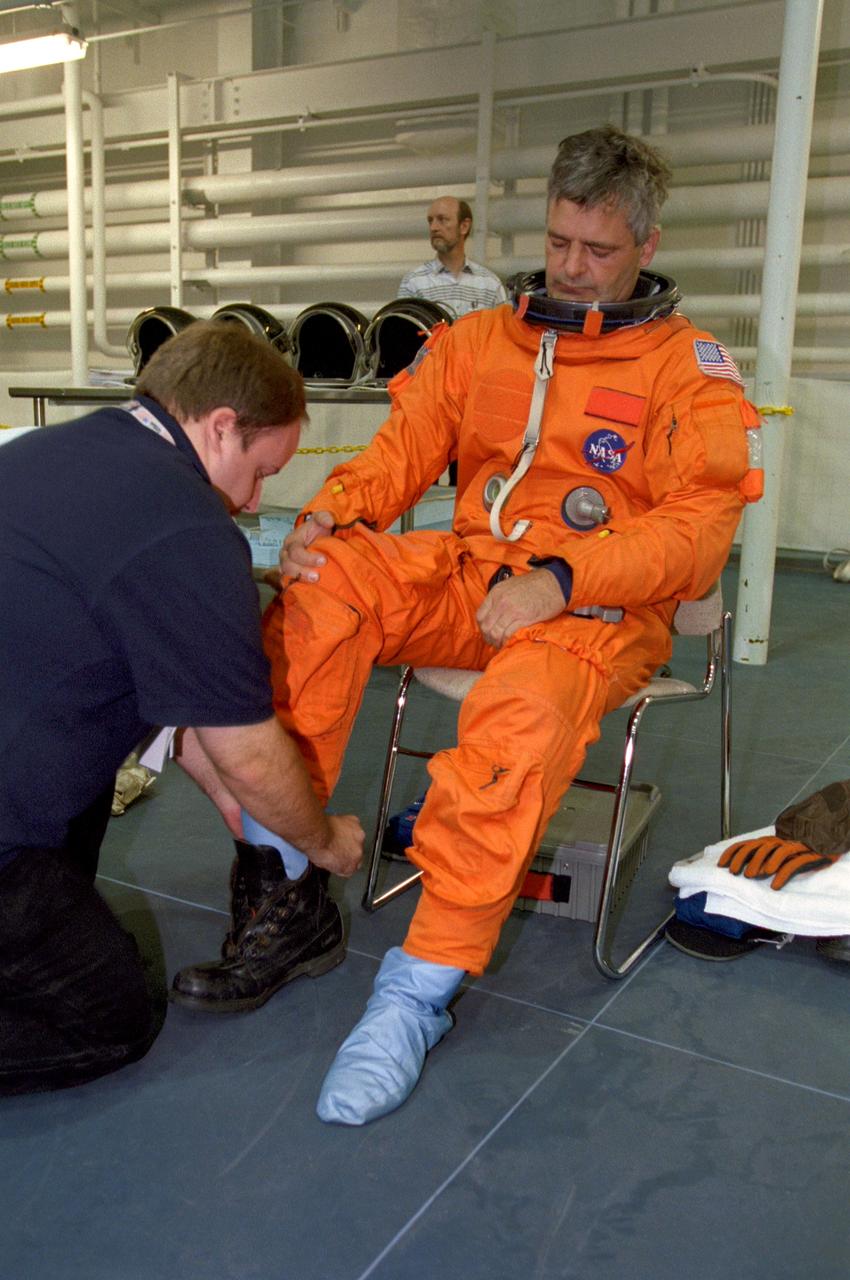
S99-07013 (9 July 1999) --- Astronaut Marc Garneau, mission specialist representing the Canadian Space Agency, with the aid of a United Space Alliance suit technician, dons his shoes while suiting up for a STS-97 training session in the Neutral Buoyancy Laboratory at the Sonny Carter Training Center.
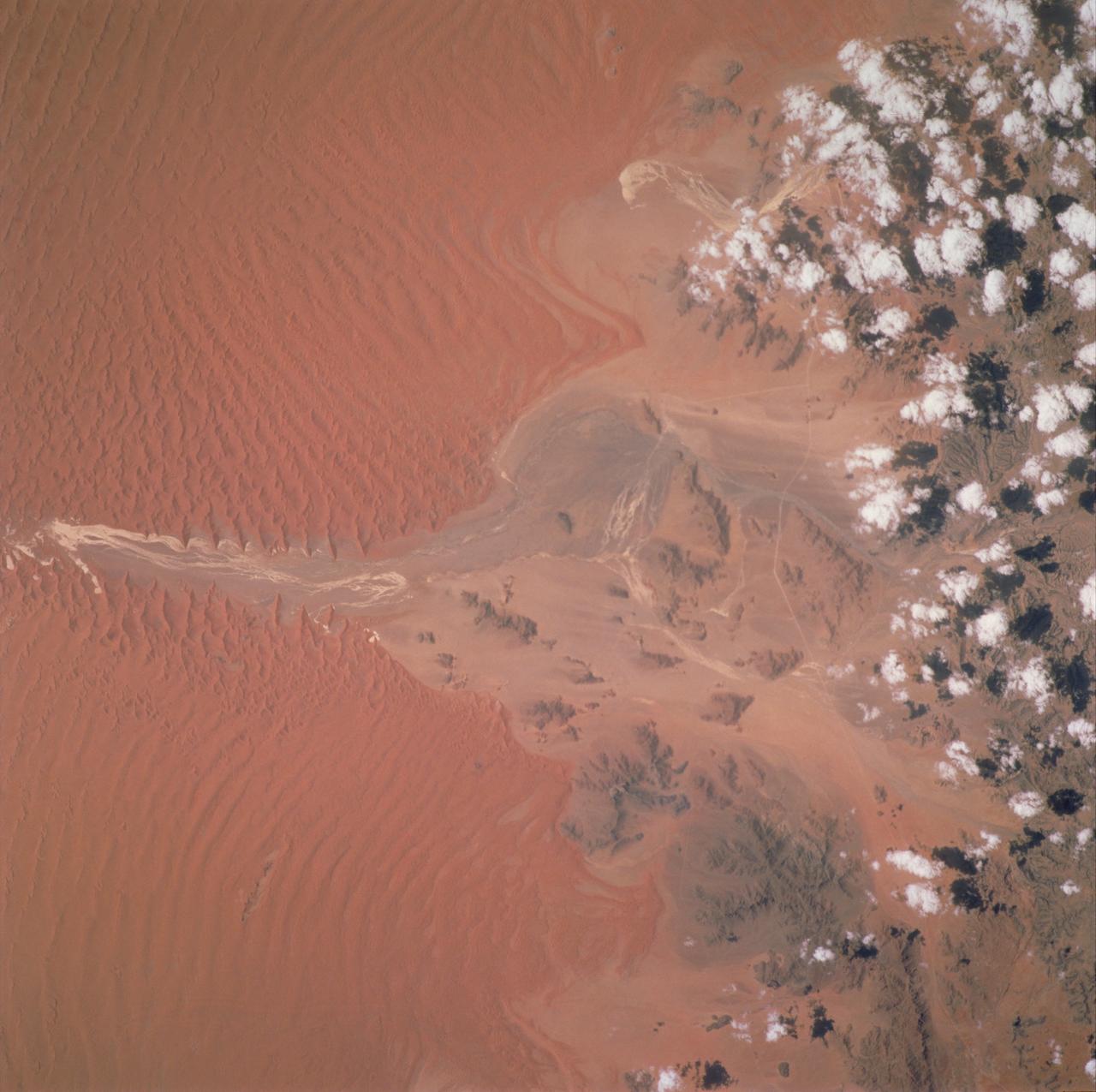
STS097-717-089 (December 2000) --- Sossus Vlei, Namibia, was photographed by one the STS-97 astronauts using a handheld 70mm camera. The long, parallel, deep red dunes at Sossus Vlei ("vlei" is Dutch for marsh), central Namibia, are constructed by the prevailing winds moving northward up the coast, according to NASA scientists studying the STS-97 photo collection. Along the course of the ephemeral stream (white strands at center), the ground-water table is at or near the land surface, and the damp sand disrupts or prevents dune formation. Where winds are deflected around bedrock outliers, smaller and less continuous dunes result. Similar aeolian features can be seen in images of the floor of Hebes Chasma, Herschel impact basin, and the north polar region of Mars, taken with the Mars Orbital Camera.
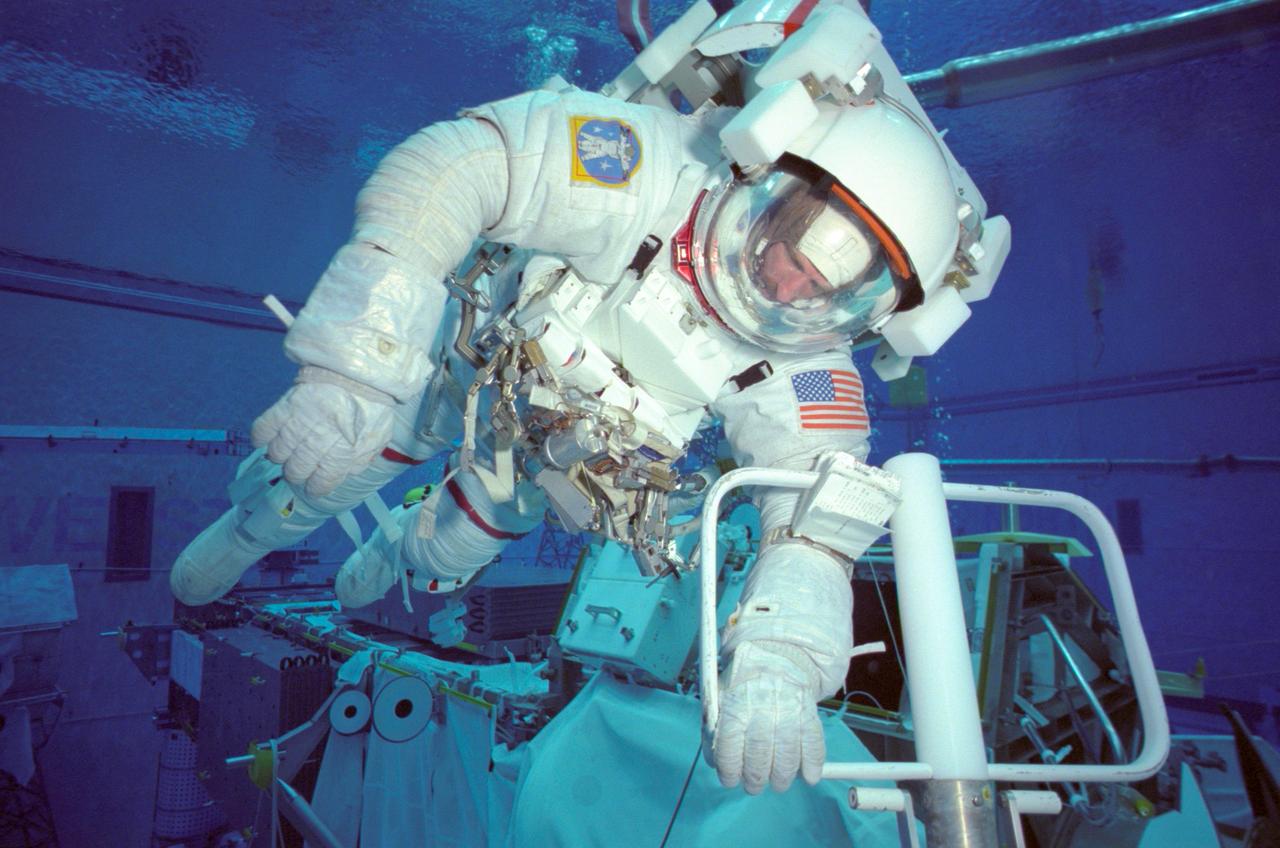
JSC2000-07082 (October 2000)--- Wearing a training version of the shuttle extravehicular mobility unit (EMU) space suit, astronaut Joseph R. Tanner, STS-97 mission specialist, simulates a space walk underwater in the giant Neutral Buoyancy Laboratory (NBL). Tanner was there, along with astronaut Carlos I. Noriega, to rehearse one of three scheduled space walks to make additions to the International Space Station (ISS). The five-man crew in early December will deliver the P6 Integrated Truss Segment, which includes the first US Solar arrays and a power distribution system.
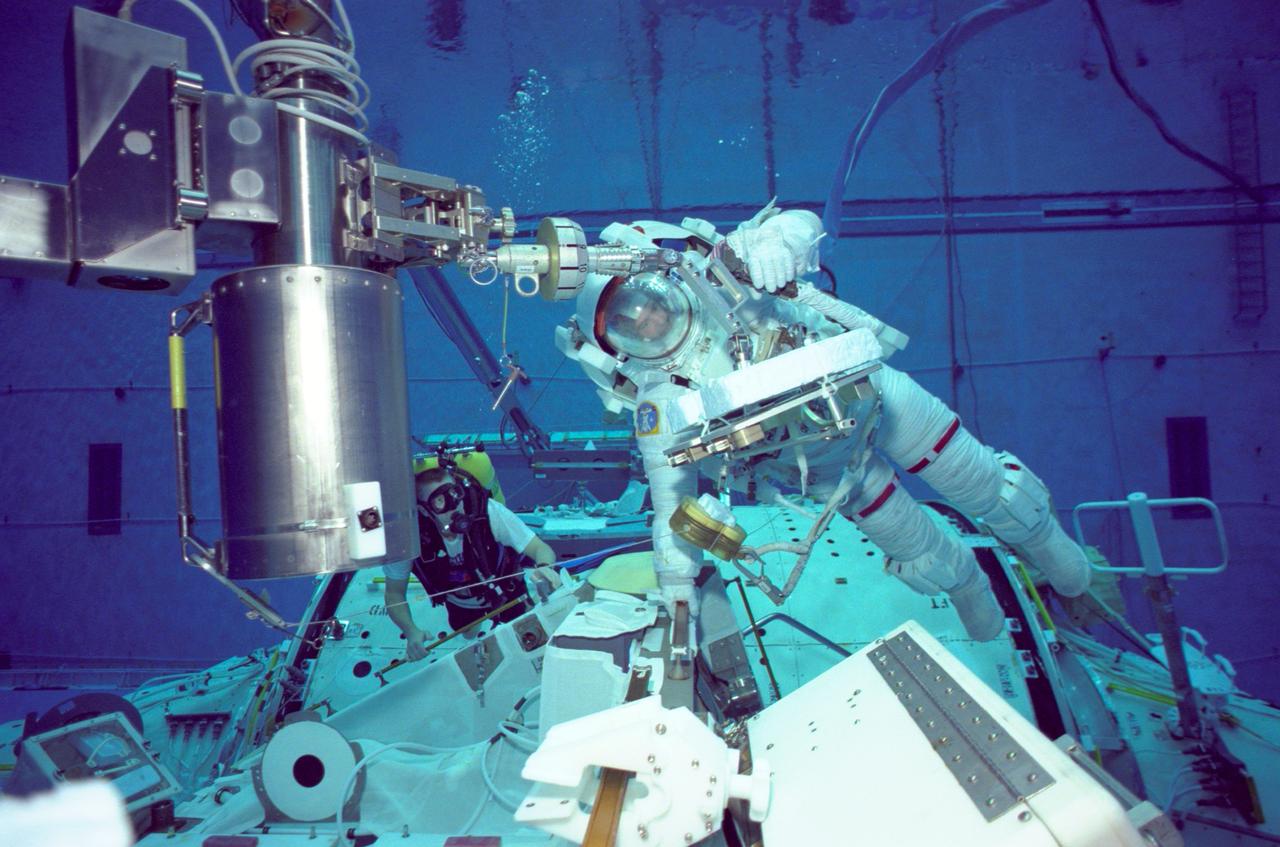
Photographic documentation showing astronauts in Extravehicular Mobility Units (EMU) participating in STS-97 (4A) EVA training in the Neutral Buoyancy Lab (NBL) pool in the Sonny Carter Training Facility (SCTF). Views include: various views of a person in an EMU (07069-71, 07077); various views of a person in an EMU with stripes on an Articulated Portable Foot Restraint (APFR) (07072, 07079) ; various views of a person in an EMU using a Pistol Grip Tool (PGT) (07073-74, 07080); person in an EMU with stripes poses with divers (07075); two persons in EMUs on APFRs (07076); person in an EMU with stripes (07078, 07081-83).
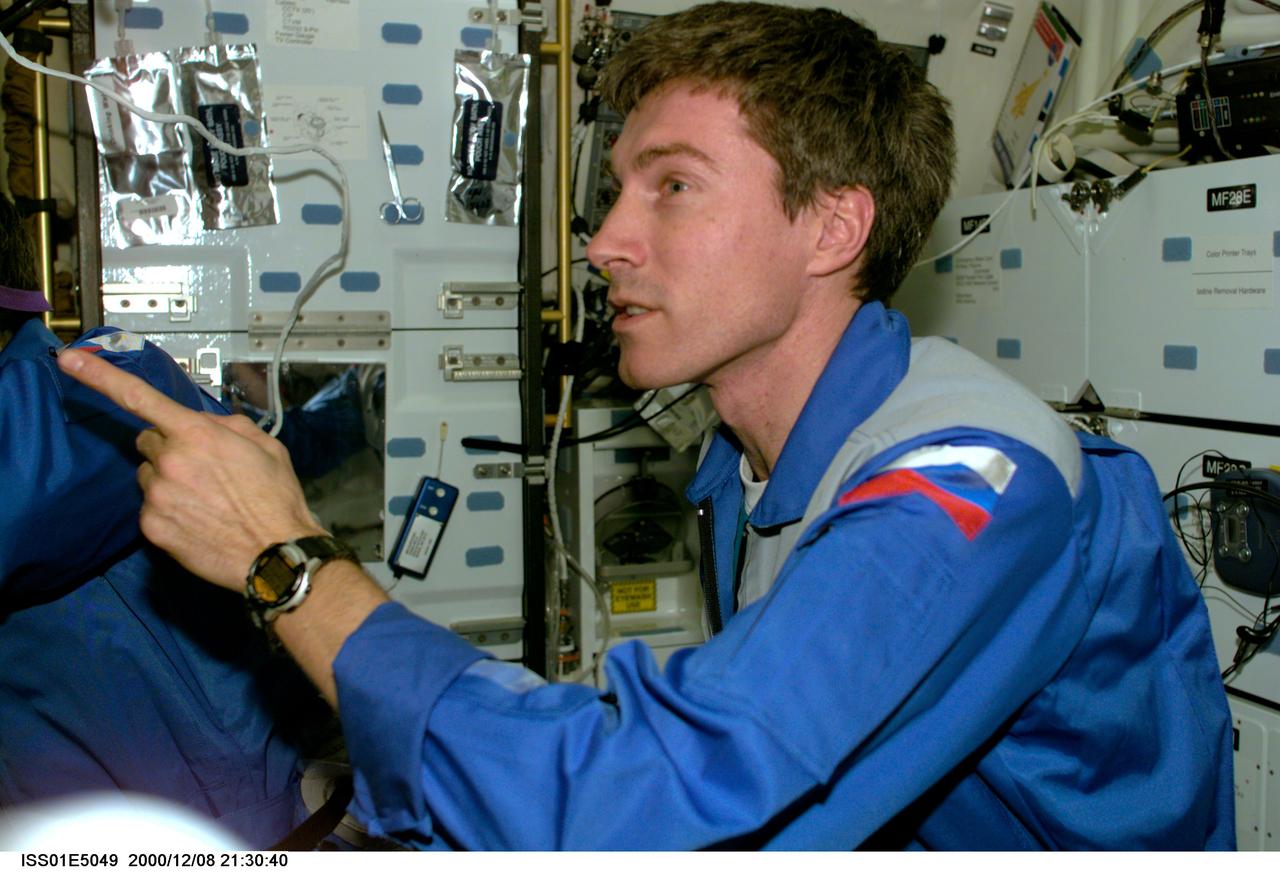
ISS01-E-5049 (8 December 2000) --- Expedition One flight engineer Sergei K. Krikalev reminisces for a brief moment during his visit aboard the Space Shuttle Endeavour. Krikalev is on the mid deck in this scene. Now assigned to a three-month stint aboard the International Space Station (ISS), the cosmonaut and his two Expedition One crew mates enjoyed a reunion with the STS-97 astronauts on Flight Day 9. In his cosmonaut career Krikalev has been assigned duty on missions aboard the shuttle, ISS, and the Russian Aviation and Space Agency's space station Mir.
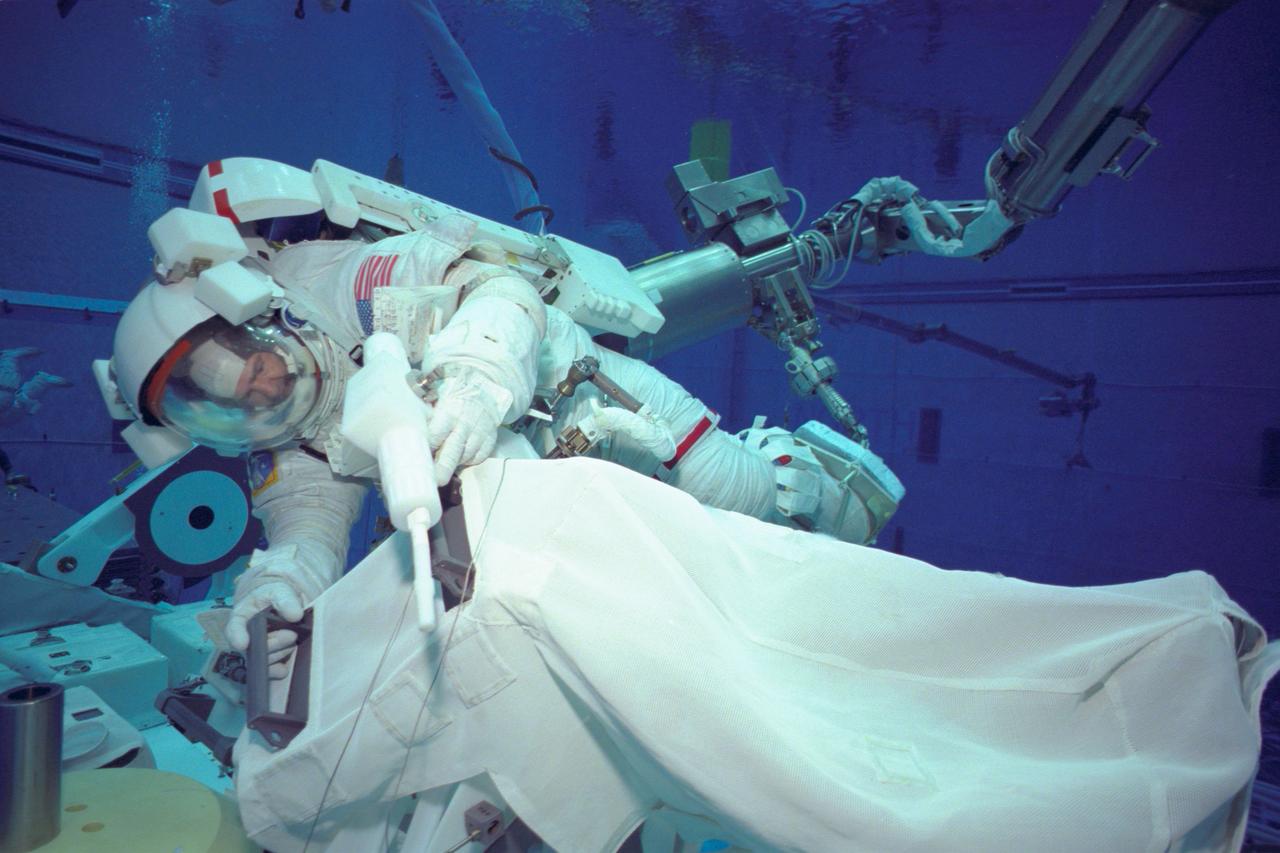
JSC2000-07072 (23 October 2000) --- Equipped with mockup tools and attached to a training version of the shuttle's remote manipulator system (RMS)robotic arm, astronaut Marc Garneau simulates a space walk task in the Neutral Buoyancy Laboratory (NBL). Garneau, an STS-97 mission specialist representing the Canadian Space Agency (CSA), has been assigned an alternate's role for extravehicular activity (EVA) on the ISS 4a mission. The prime EVA crew is composed of astronauts Joseph R. Tanner and Carlos I. Noriega, who are expected to share three different days of space walks during the December mission.

S97-E-5144 (8 December 2000) --- The STS-97 astronauts and the Expedition 1 crew members pose for an historic portrait onboard the International Space Station (ISS) shortly after hatches were opened between the Space Shuttle Endeavour and the station. In front, from the left, are Sergei K. Krikalev, Brent W. Jett, Jr., William M. Shepherd and Joseph R. Tanner. In back, from the left, are Marc Garneau, Carlos I. Noriega, Yuri P. Gidzenko and Michael J. Bloomfield. A pre-set digital still camera was used to record the scene.
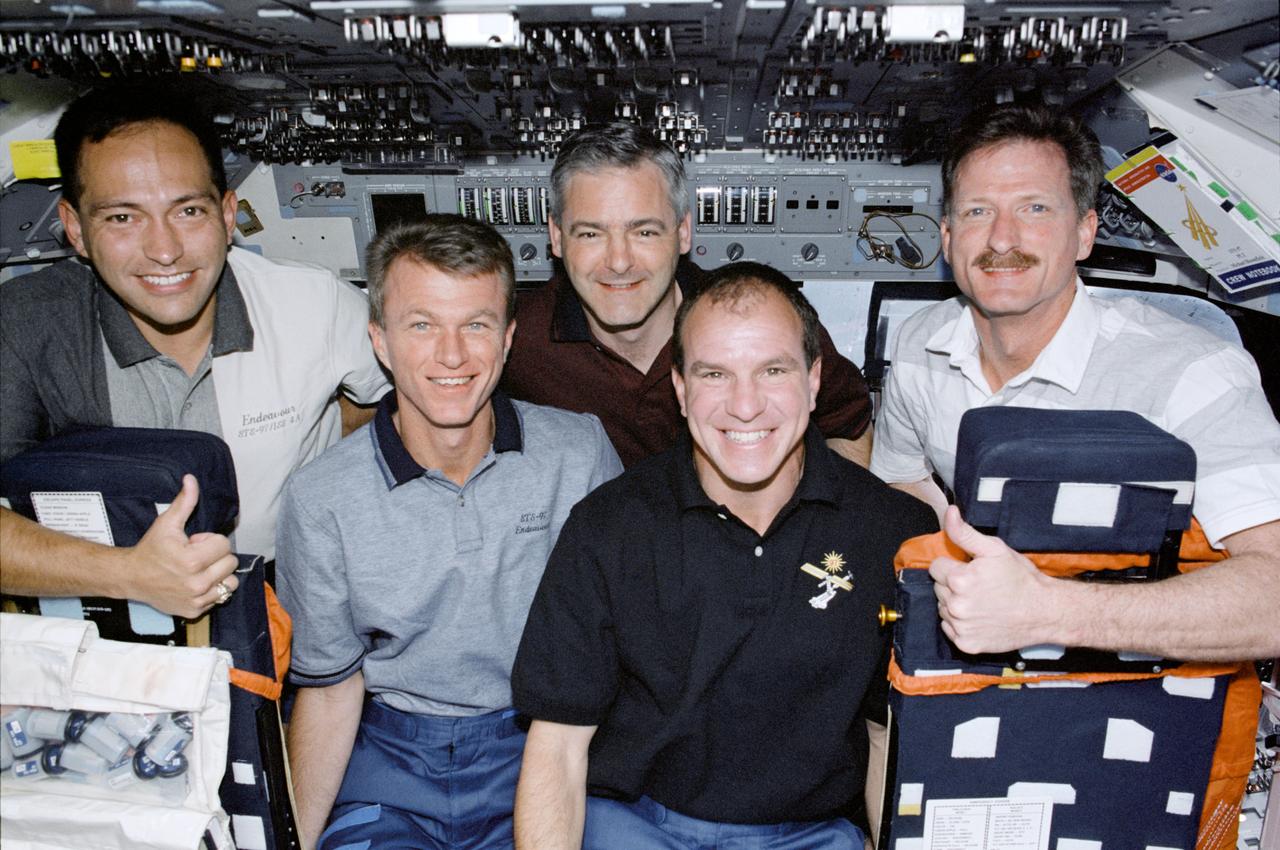
STS097-321-024 (30 Nov. - 11 Dec. 2000) --- The five astronauts comprising the STS-97 crew pause for a brief moment for an in-flight crew portrait during the busy ISS 4a mission in December 2000. They are, from the left, astronauts Carlos I. Noriega, mission specialist; Brent W. Jett, Jr., mission commander; Marc Garneau, mission specialist representing the Canadian Space Agency (ESA); Michael J. Bloomfield, pilot; and Joseph R. Tanner, mission specialist. They are on the forward flight deck of the Earth-orbiting Space Shuttle Endeavour.
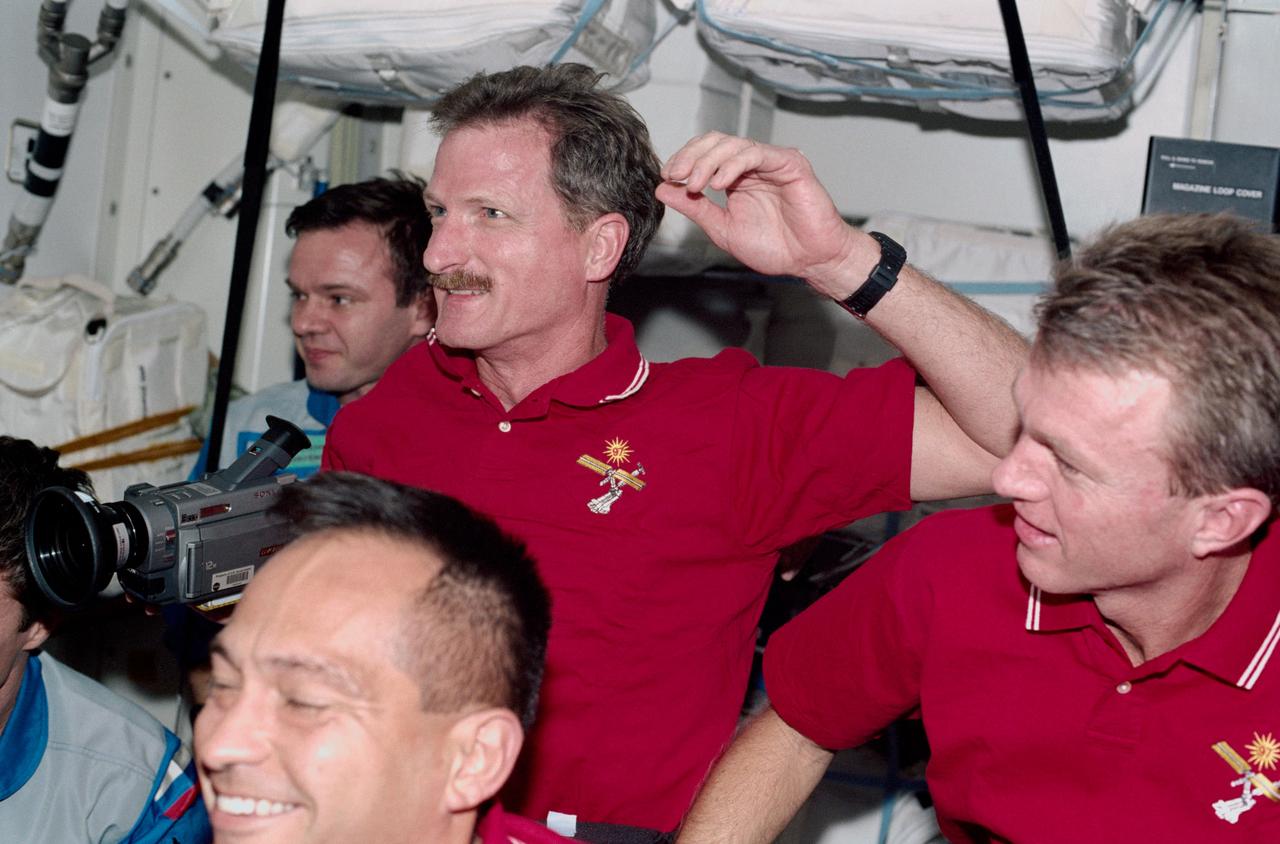
STS097-315-004 (30 Nov. - 11 Dec. 2000) Three STS-97 astronauts reunite with Expedition One crew members in the appropriately-named Unity node aboard the International Space Station (ISS), temporarily docked to the Space Shuttle Endeavour. Dressed in blue flight suits on left side of the frame are cosmonauts Sergei Krikalev (partially out of frame), Expedition One flight engineer; and Yuri P. Gidzenko, Soyuz commander for Expedition One. The visitors are (from left) astronauts Carlos I. Noriega and Joseph R. Tanner, both STS-97 mission specialists, along with Brent W. Jett, Jr., mission commander.
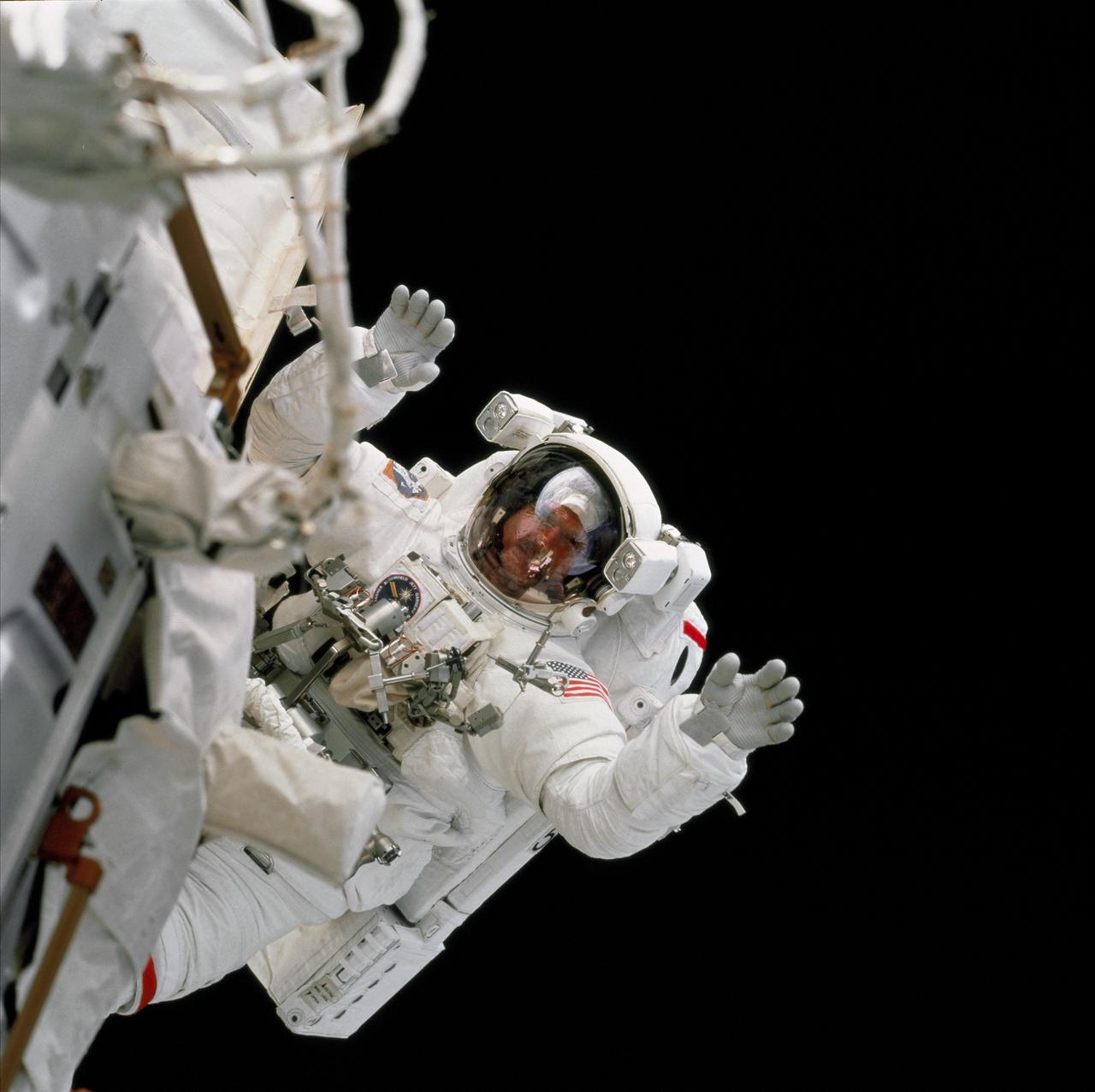
STS097-703-011 (7 December 2000) --- Astronaut Joseph R. Tanner waves to his cabin-bound crewmates during the December 7 extravehicular activity (EVA), one of three space walks involving him and astronaut Carlos I. Noriega. The photograph was taken by one of the non-EVA STS-97 crew members, using a 70mm camera.
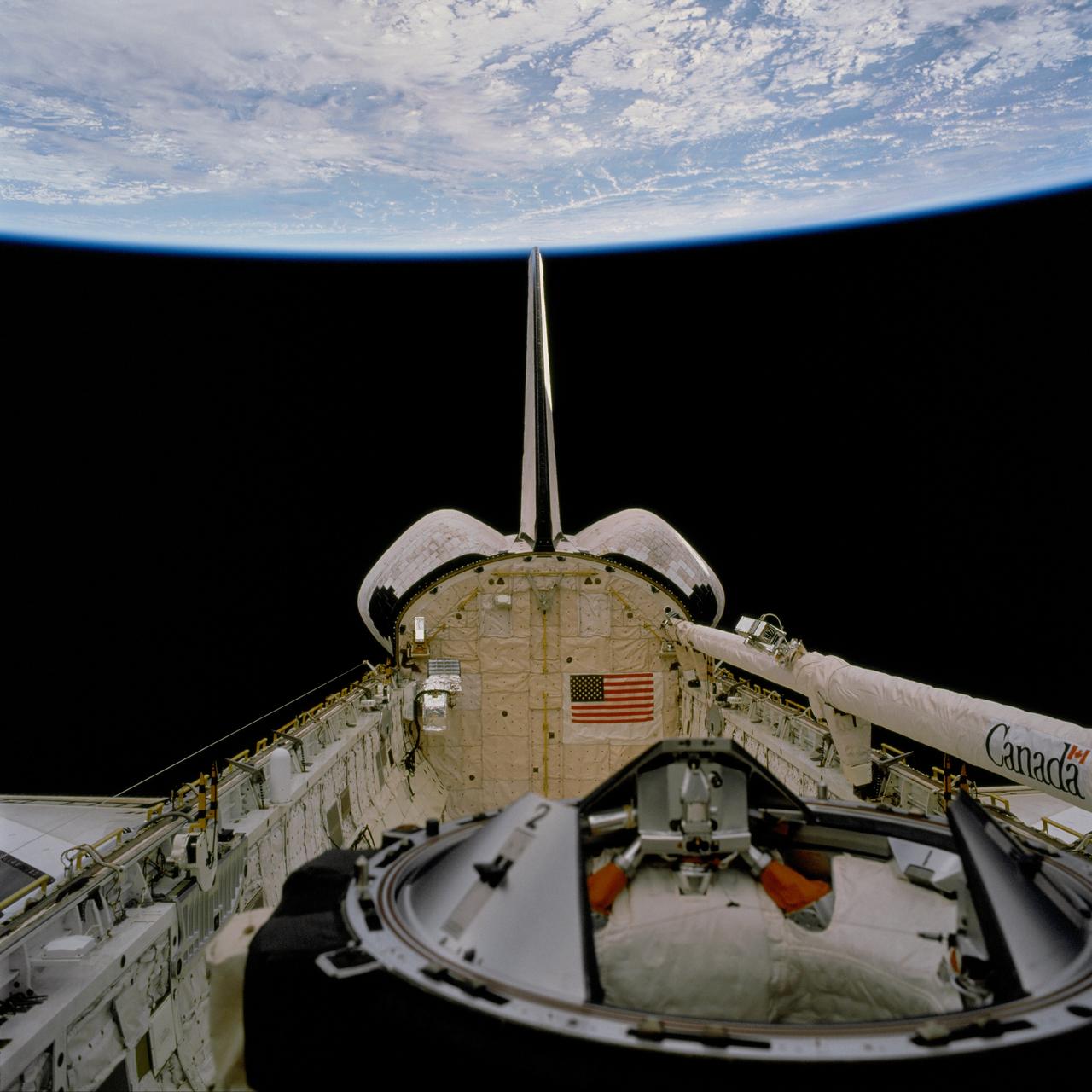
STS097-715-090 (30 Nov.-11 Dec. 2000) --- The horizon of a blue and white Earth and the blackness of space form the backdrop for this view of the cargo bay of the Space Shuttle Endeavour, as seen through windows on the aft flight deck during the STS-97 mission. Pictured in the cargo bay is the Orbital Docking System (ODS) in the foreground. In its stowed position at right center of the frame is the Canadian-built Remote Manipulator System (RMS) arm.
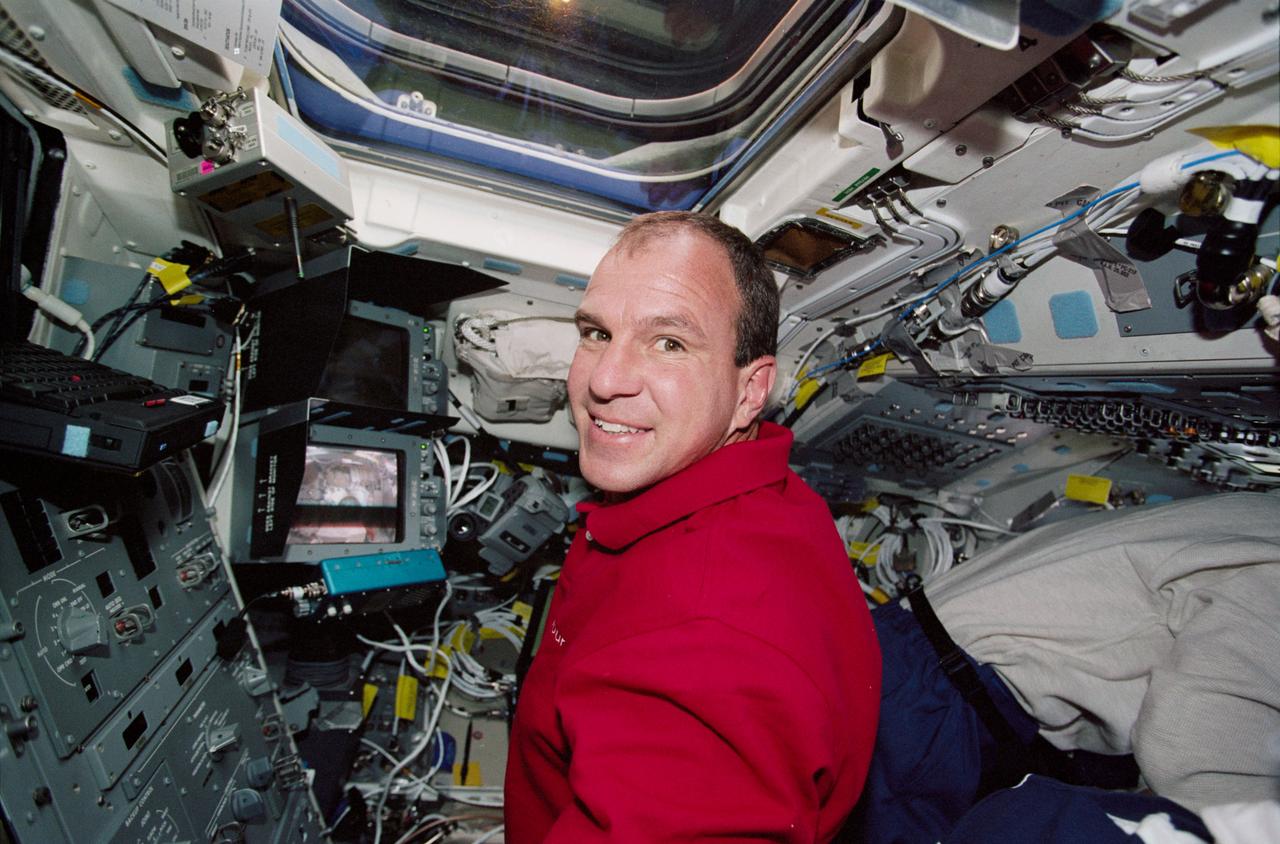
STS097-330-028 (30 Nov.-11 Dec. 2000) --- Astronaut Michael J. Bloomfield, STS-97 pilot, occupies himself with an operational task on the aft flight deck of the Earth-orbiting Space Shuttle Endeavour. During the second space walk, Bloomfield spent a majority of his mission assignment near this area, as he was in charge of the controls for the remote manipulator system (RMS), located on the nearby panel.
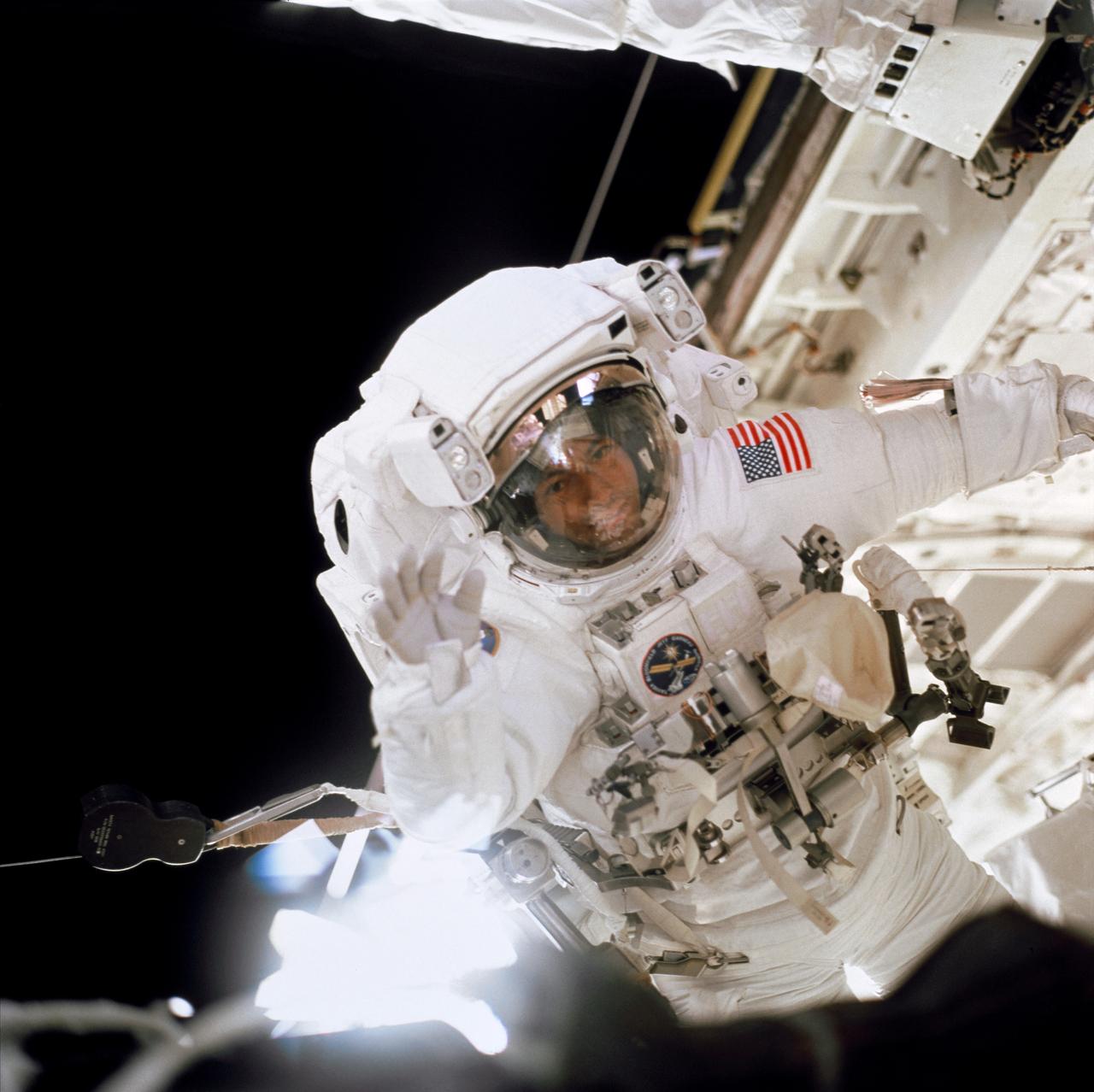
STS097-703-021 (30 Nov.-11 Dec. 2000) --- Astronaut Carlos I. Noriega, mission specialist, is photographed during one of the three space walks scheduled for the STS-97 mission to the International Space Station (ISS). The photo was taken through an aft flight deck window on the Space Shuttle Endeavour by a crew mate using a 70mm camera.
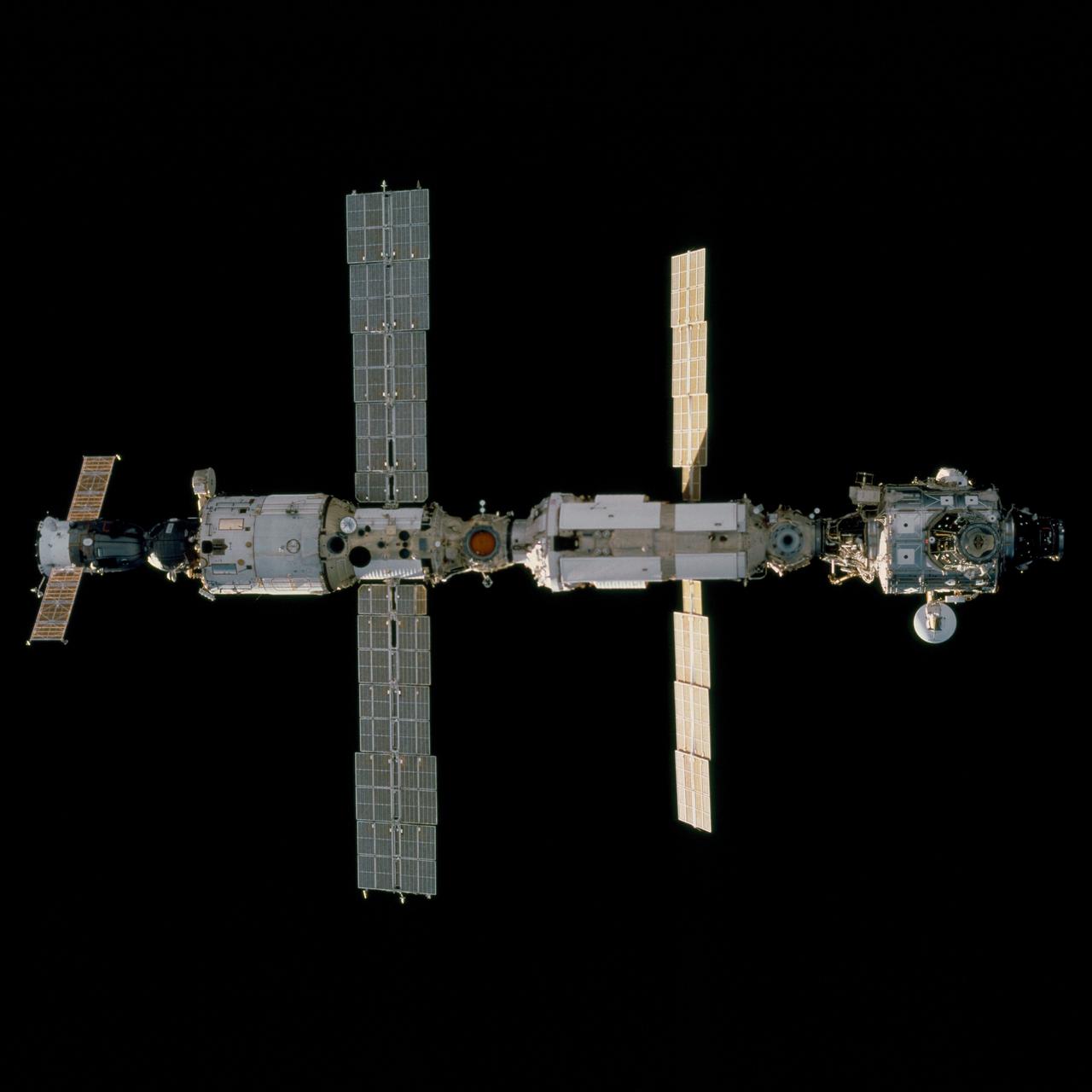
STS097-702-061 (2 December 2000) --- The International Space Station (ISS) moves in position for docking with the Space Shuttle Endeavour, in this 70mm frame photographed by one of the STS-97 astronauts on the flight deck of the shuttle. Most of the station's components are clearly visible in the frame, with the Soyuz spacecraft docked at left to the Zvezda Service Module, which is linked to the Zarya or Functional Cargo Block (FGB). The Unity node is at right, sporting the additions from the recent STS-92 mission of the Z1 truss structure (largely obscured) and a Pressurized Mating Adapter (PMA-3).
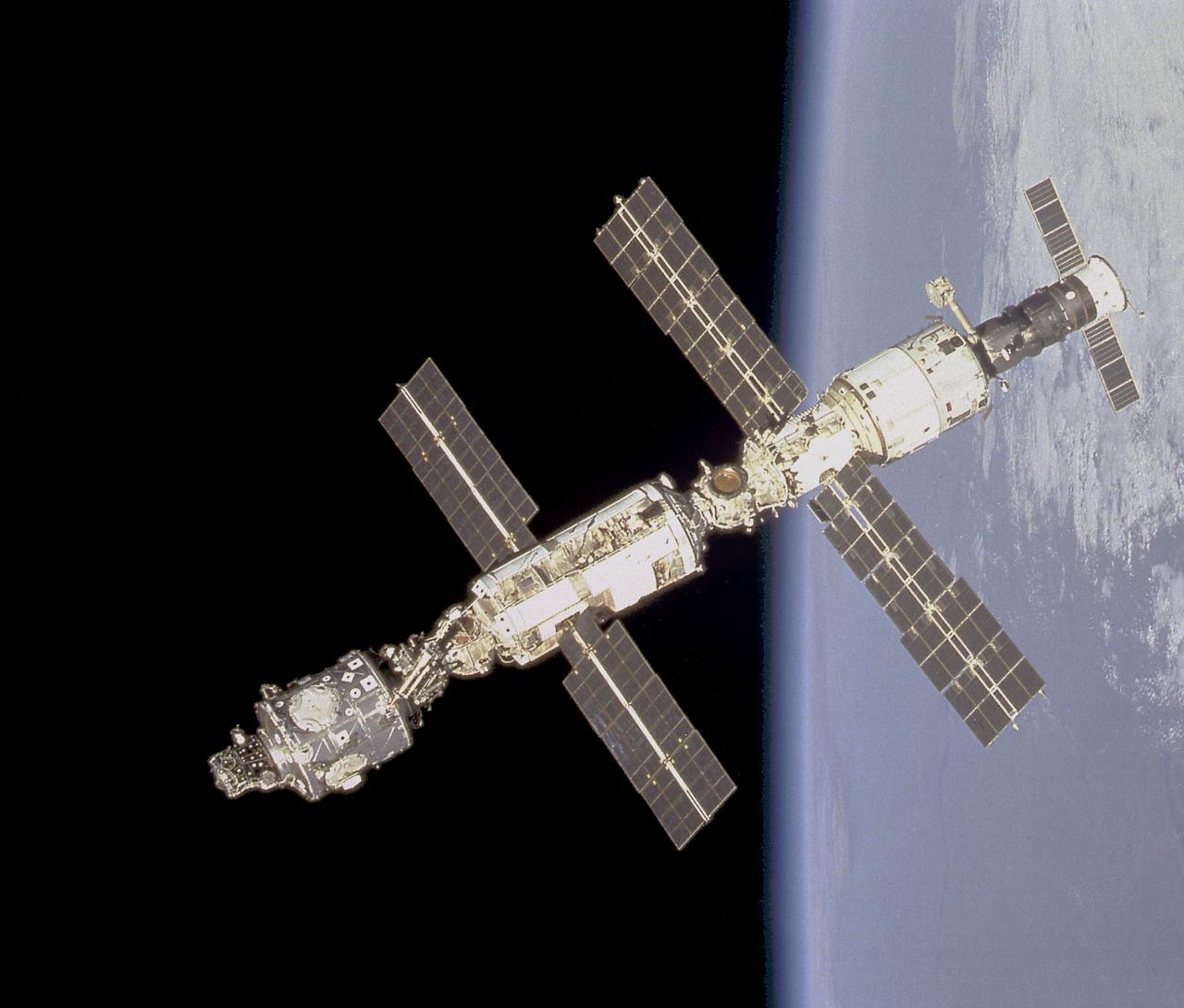
This image of the International Space Station in orbit was taken from the Space Shuttle Endeavour prior to docking. Most of the Station's components are clearly visible in this photograph. They are the Node 1 or Unity Module docked with the Functional Cargo Block or Zarya (top) that is linked to the Zvezda Service Module. The Soyuz spacecraft is at the bottom.
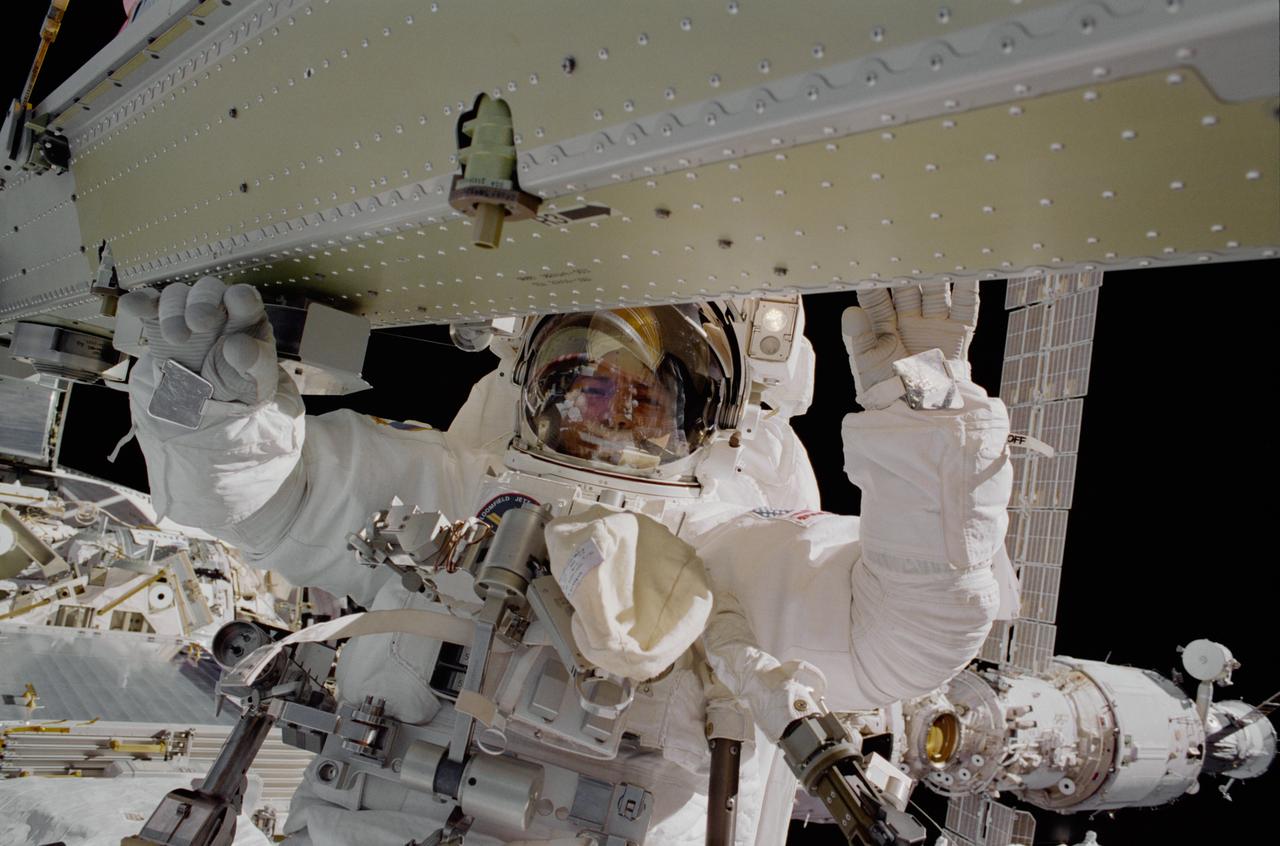
STS097-376-018 (7 December 2000) --- Astronaut Carlos I. Noriega, mission specialist, is photographed during the final of the three space walks scheduled for the STS-97 mission to the International Space Station (ISS). Astronaut Joseph R. Tanner, mission specialist, was nearby when he exposed the 35mm frame.
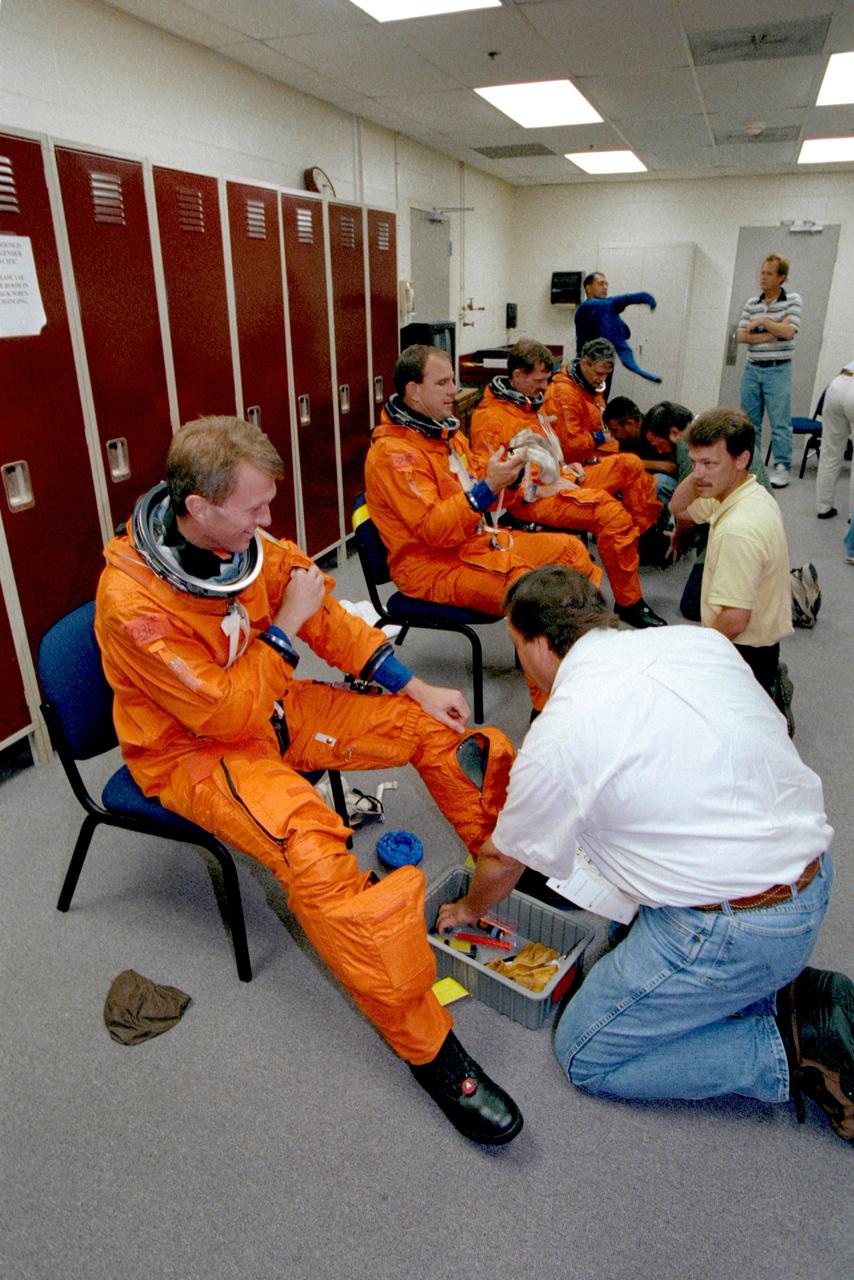
JSC2000-04751 (15 June 2000) --- Members of the STS-97 crew don training versions of the ascent and entry suits for a training session in the Johnson Space Center's Systems Integration Facility. Wearing the burnt-orange pressure suits, from the left, are astronauts Brent W. Jett, mission commander; Michael J. Bloomfield, pilot; and Joseph R. Tanner and Marc Garneau, both mission specialists. Garneau represents the Canadian Space Agency (CSA). Suit technicians assisting are Mike Birkenseher, Brad Milling, Steve Clendenin and Rudy Molina. In the background Carlos I. Noriega, mission specialist, prepares to put on his suit with the assistance of suit tech John Hazelhurt.
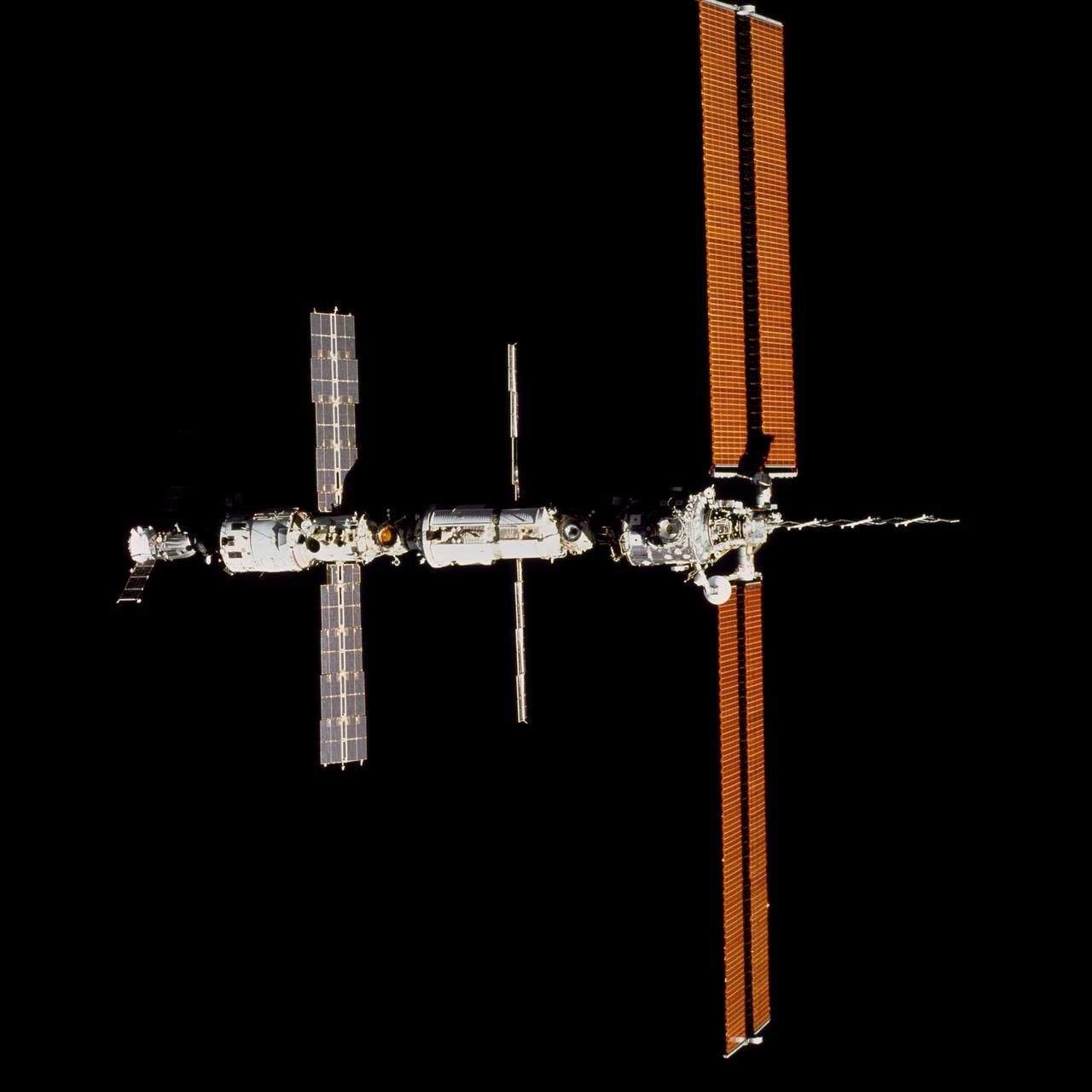
STS097-703-030 (30 Nov.-11 Dec. 2000) --- The International Space Station (ISS) is photographed during a fly-around by the Space Shuttle Endeavour. The 240-foot-long, 38-foot-wide solar array (top) is the newest part and one of the most prominent components of the station. Onboard ISS for about 40 days at the time of this photo were astronaut William M. Shepherd and cosmonauts Yuri P. Gidzenko and Sergei K. Krikalev. Onboard the shuttle were STS-97 astronauts – commander Brent W. Jett, Jr., pilot Mike Bloomfield and mission specialists Marc Garneau of the Canadian Space Agency (CSA), Carlos I. Noriega and Joseph R. Tanner.
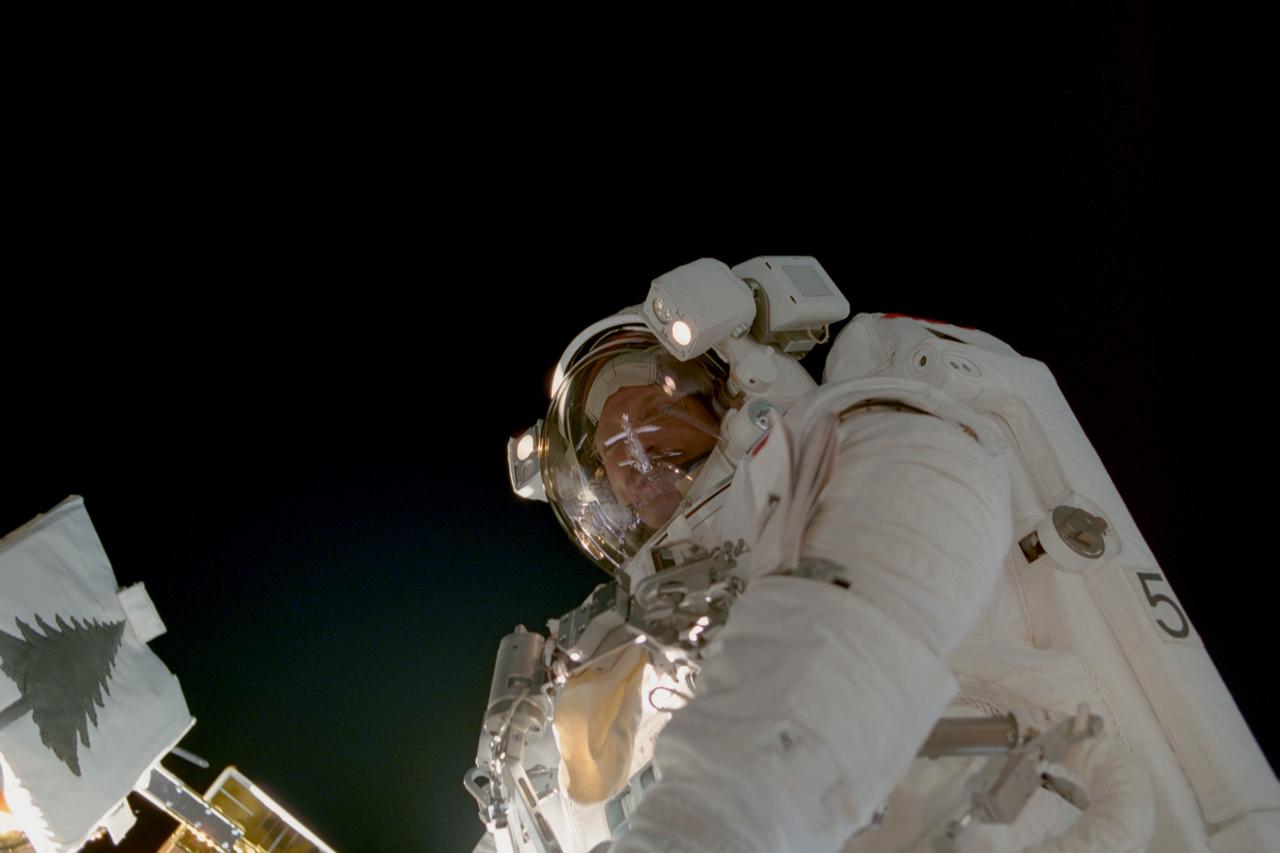
STS097-377-006 (7 December 2000) --- --- Space walking Endeavour astronauts topped off their scheduled space walk activities with an image of an evergreen tree (left) placed atop the P6 solar array structure, the highest point in their construction project. Astronaut Joseph R. Tanner, mission specialist, then posed for this photo with the "tree" before returning to the shirt-sleeve environment of the Space Shuttle Endeavour. Astronaut Carlos I. Noriega, mission specialist who shared three STS-97 space walks with Tanner, took the photo with a 35mm camera.
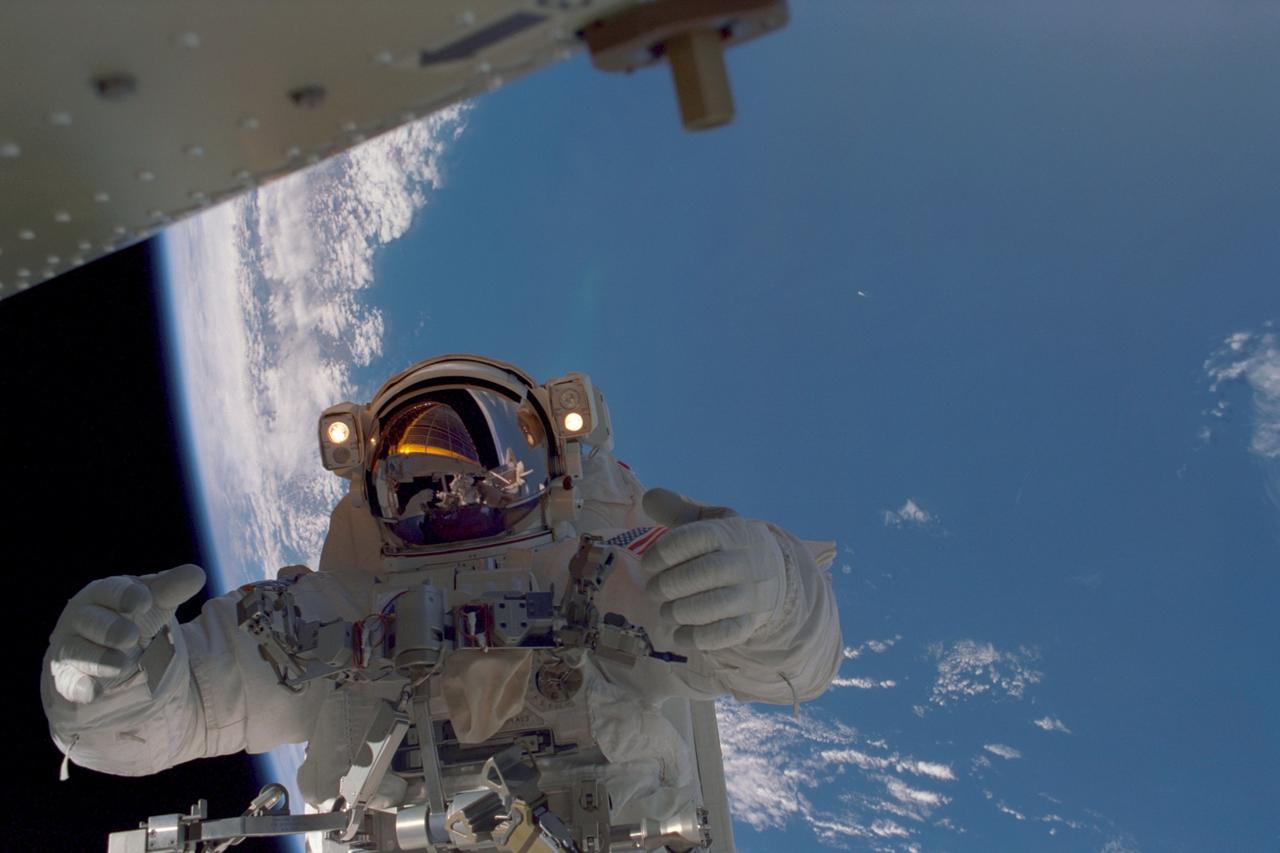
STS097-376-013 (7 December 2000) --- Planet Earth, some 235 statute miles away, forms the backdrop for this 35mm photo of astronaut Joseph R. Tanner, mission specialist, taken during the third of three STS-97 space walks to perform work on the International Space Station (ISS). The photo was taken by astronaut Carlos I. Noriega, mission specialist, whose reflection can be seen in Tanner's helmet visor.
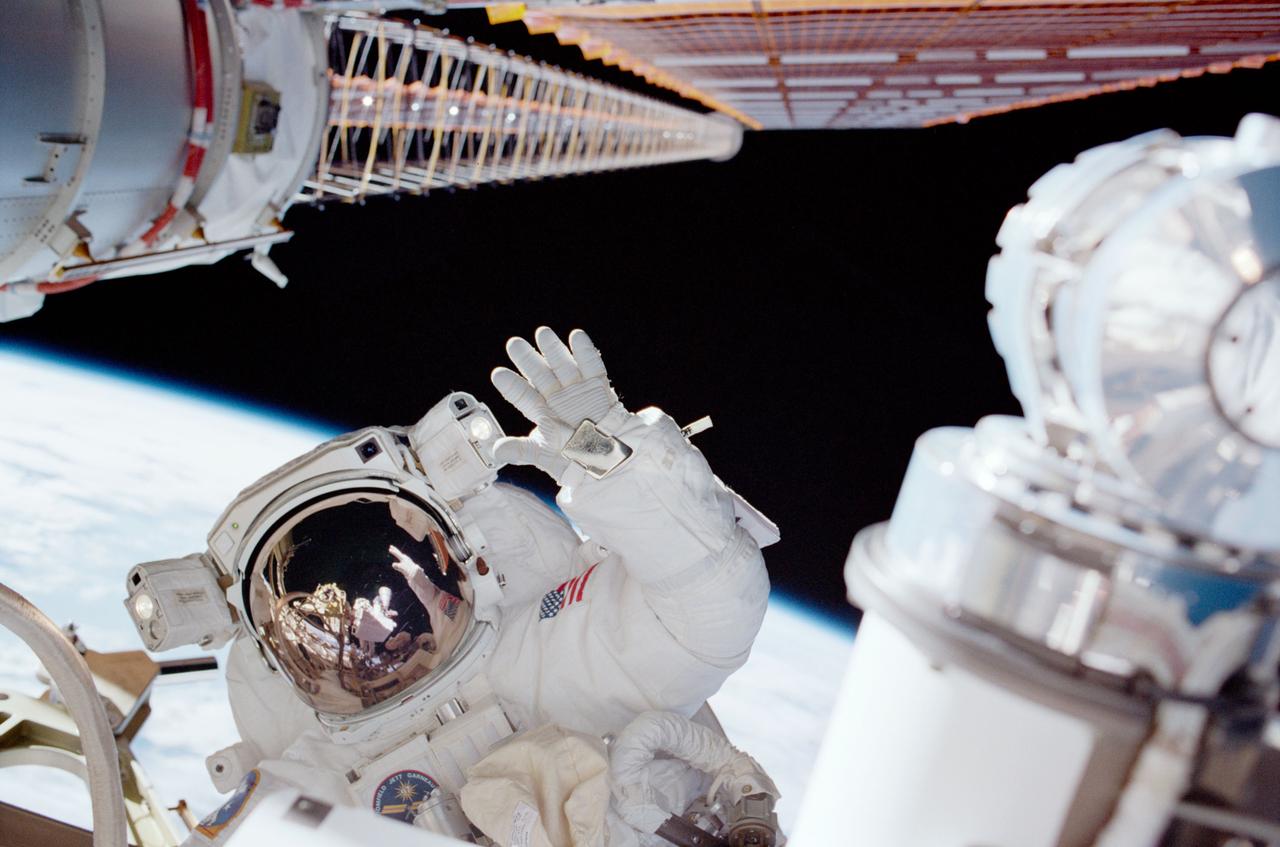
STS097-375-012 (5 December 2000) --- Astronaut Carlos I. Noriega, mission specialist, waves toward his space walk partner, astronaut Joseph R. Tanner, as Tanner snaps a 35mm frame during the second of three STS-97 sessions of extravehicular activity (EVA). Part of the newly-deployed solar array structure is at the top of the frame.
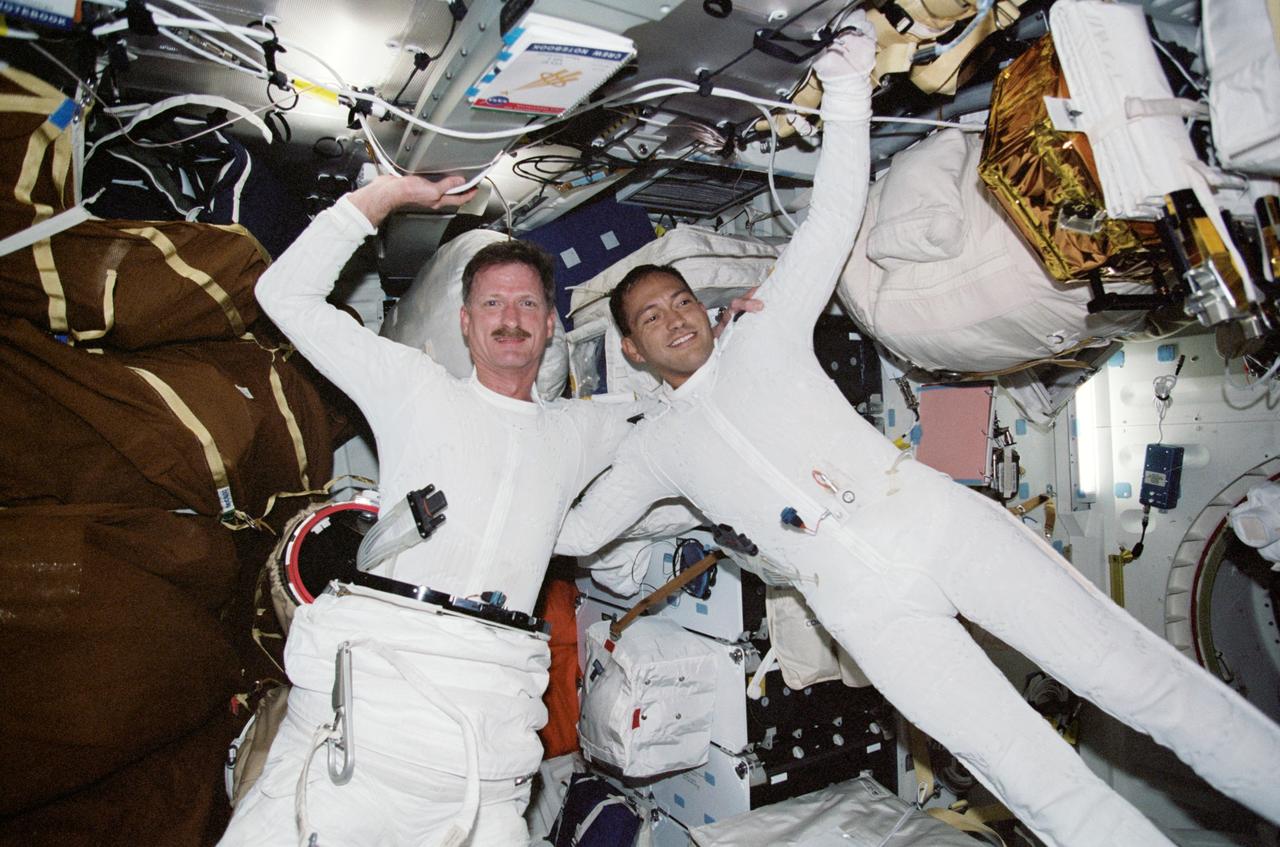
STS097-327-033 (30 Nov.-11 Dec. 2000) --- Astronauts Joseph R. Tanner (left) and Carlos I. Noriega, both mission specialists, who participated in three STS-97 space walks, don their extravehicular mobility unit (EMU) space suits for one of the walks. Tanner and Noriega are wearing the liquid cooling and ventilation garment that complements the EMU.
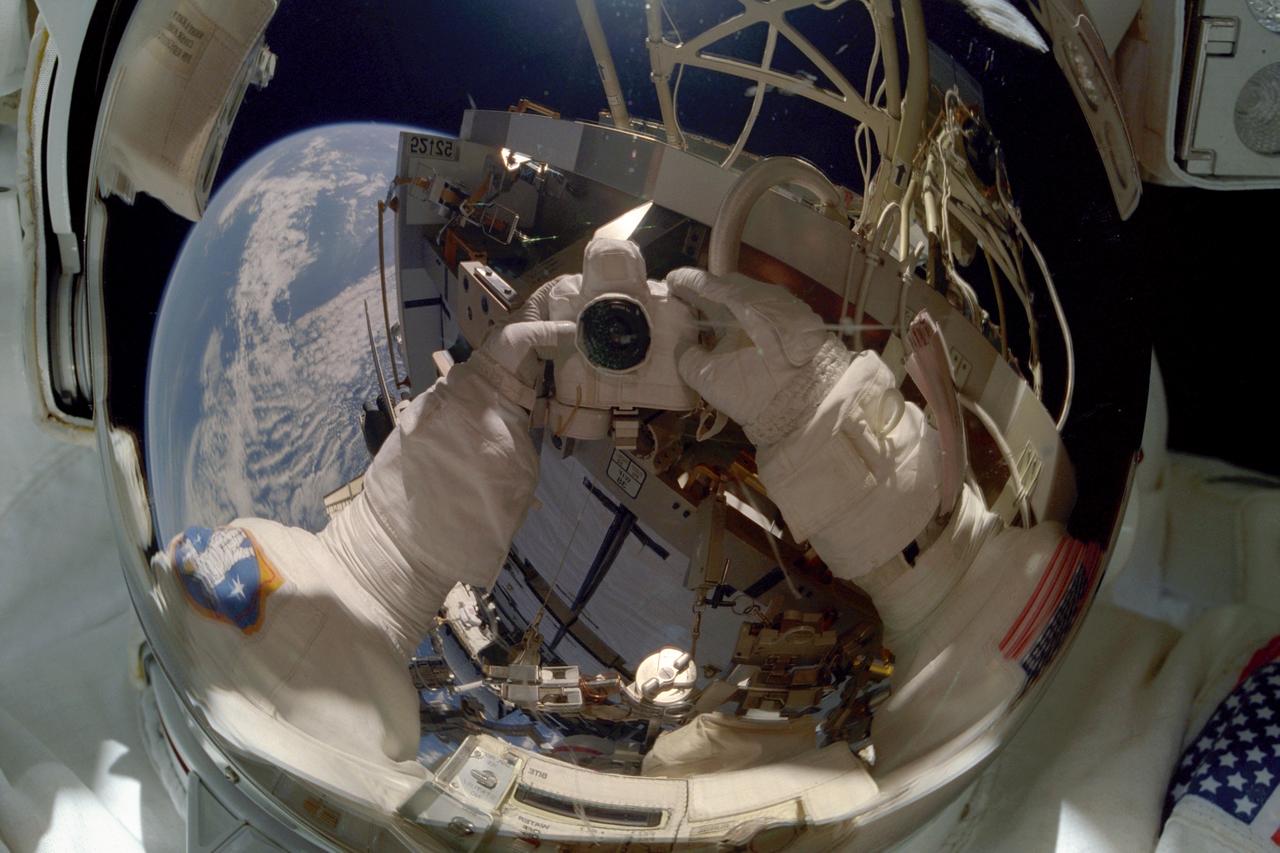
STS097-374-021 (3 December 2000) --- Astronaut Joseph P. Tanner, STS-97 mission specialist, used the pictured 35mm camera to expose a photo of his helmet visor during the flight's first space walk on Dec. 3, 2000. Among the objects visible among the reflections in the visor is part of the blue and white Earth, some 235 miles below.
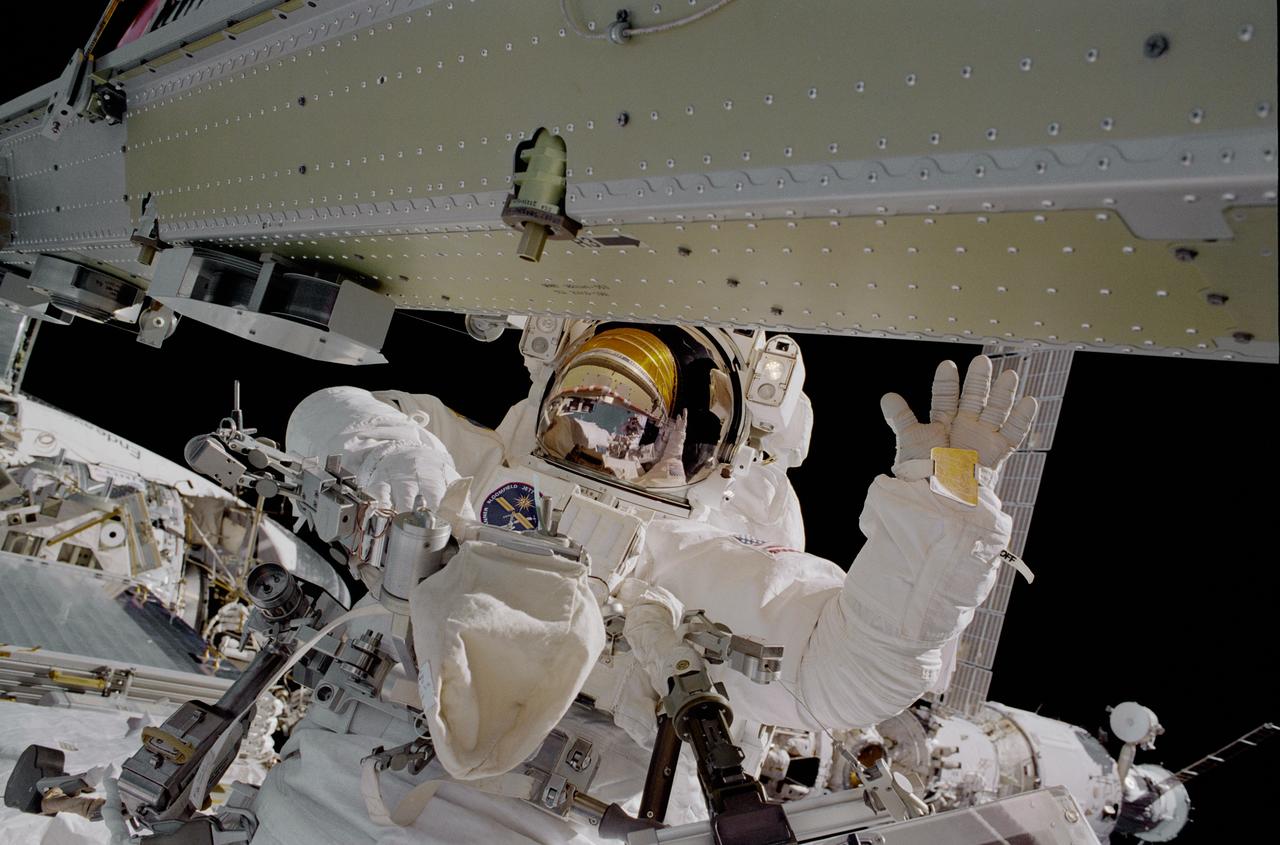
STS097-376-009 (7 December 2000) --- Astronaut Carlos I. Noriega, mission specialist, during the final of the three space walks scheduled for the STS-97 mission to the International Space Station (ISS), waves to his fellow space walker, astronaut Joseph R. Tanner, mission specialist. A small reflection of Tanner can be seen in the helmet as he captures this 35mm image.
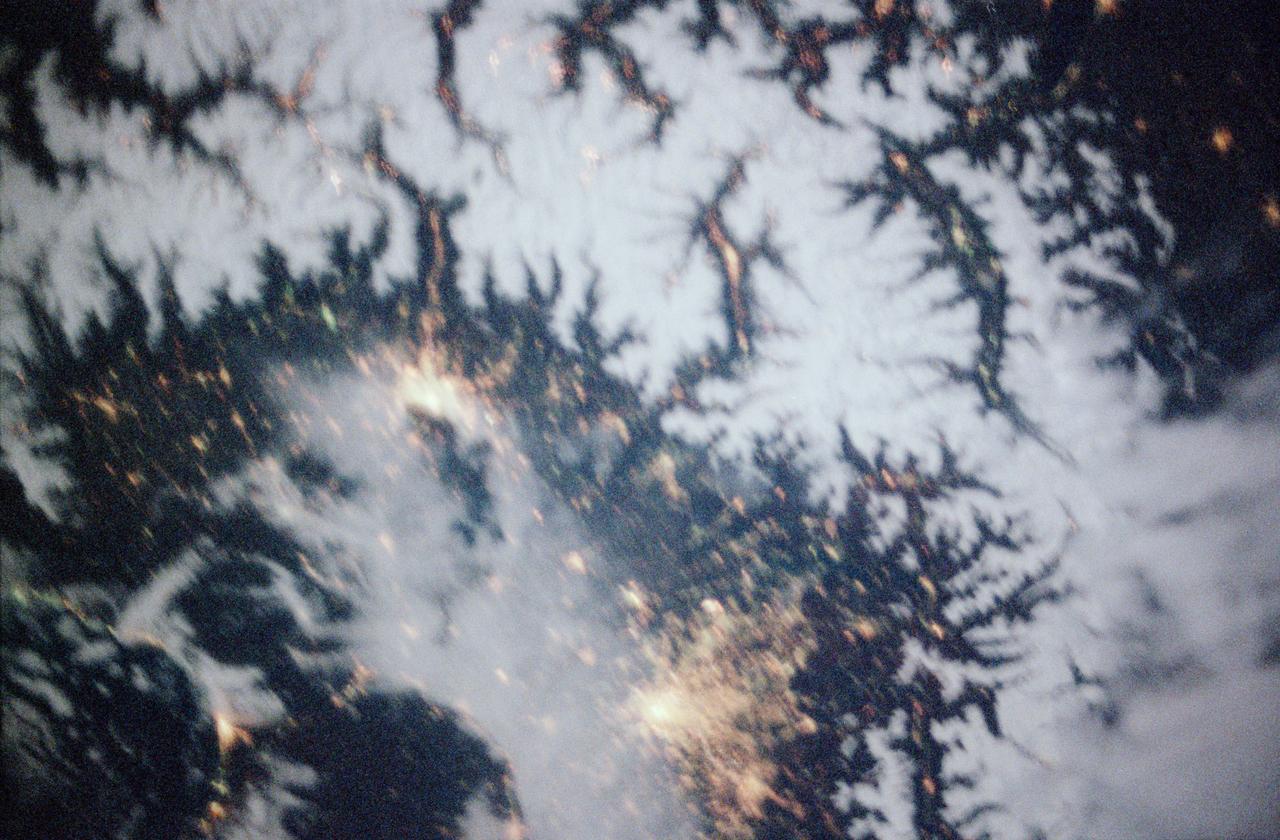
STS097-355-011 (30 Nov. -11 Dec. 2000) --- This vertical scene showing Torino and Milano, Italy, at night, was photographed with a 35mm camera by one of the STS-97 crew members aboard the Earth-orbiting Space Shuttle Endeavour. The night lights of Torino and Milano (two larger illuminated areas) are visible in the view, which covers the western end of the Po River Valley. Torino is the bright spot slightly left of center and Milano is the larger bright spot towards the bottom center of the image. The deeply eroded flanks of the snow-covered Alps Mountains (serrated-looking, light-colored terrain top half of the image) is visible north of the two large cities. Several mountain passes that connect the Po River Valley with France and Switzerland can be identified by the string of lights in the narrow, linear valleys. A translucent-looking cloud (bottom center) somewhat obscures the nighttime landscape south of Torino and Milano. The northwest coast of Italy, including the Italian city of Genova, can be identified in the lower left corner of the image. This photography was taken by astronauts using high speed film and long exposure on a night with a full moon illuminating the surface of the Earth.
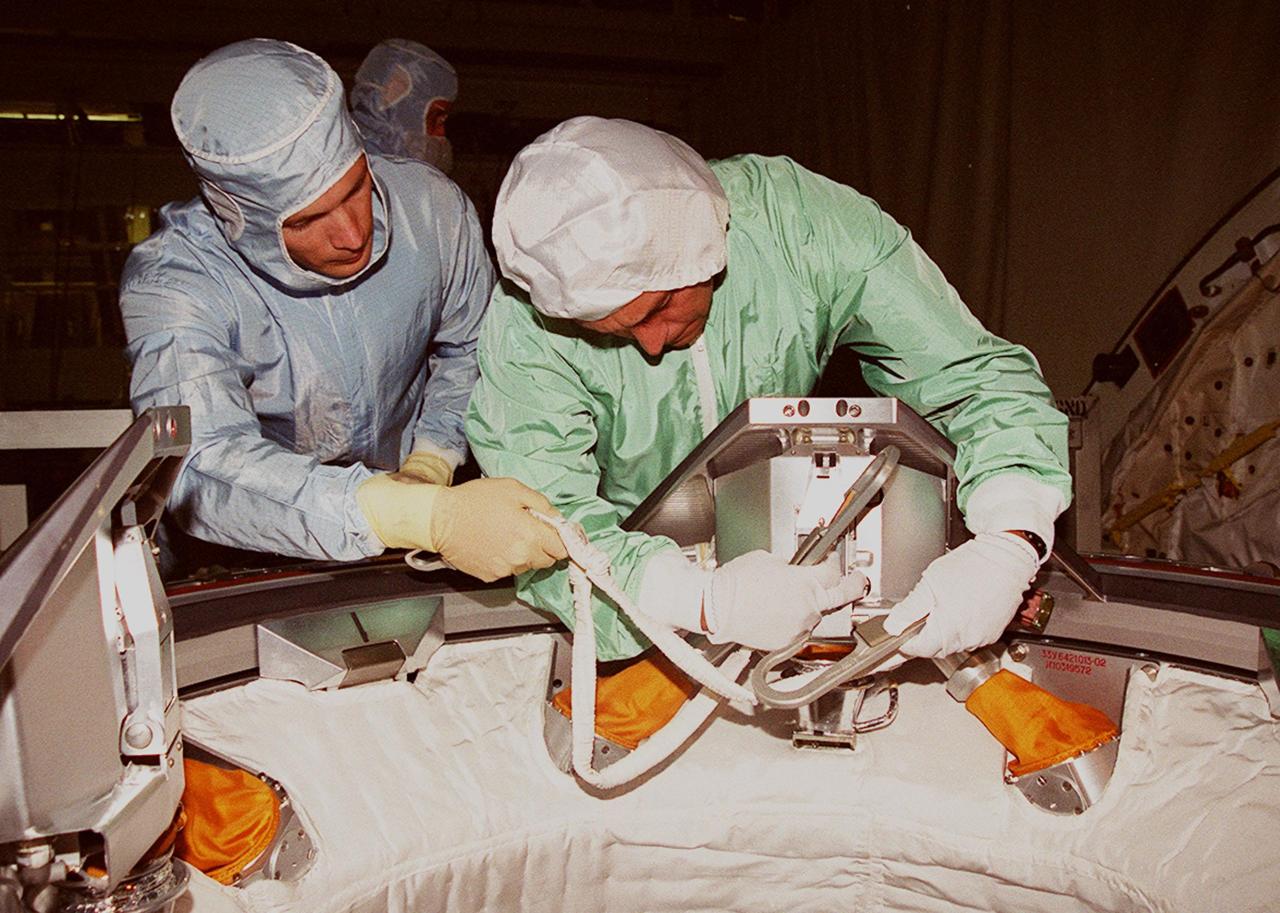
During the STS-97 Crew Equipment Interface Test (CEIT), Mission Specialist Carlos Noriega (right) gets hands-on experience with parts of the Orbital Docking System in Endeavour’s payload bay. The CEIT provides an opportunity for crew members to check equipment and facilities that will be on board the orbiter during their mission. The STS-97 mission will be the sixth construction flight to the International Space Station. The payload includes a photovoltaic (PV) module, providing solar power to the Station. STS-97 is scheduled to launch Nov. 30 from KSC for the 10-day mission
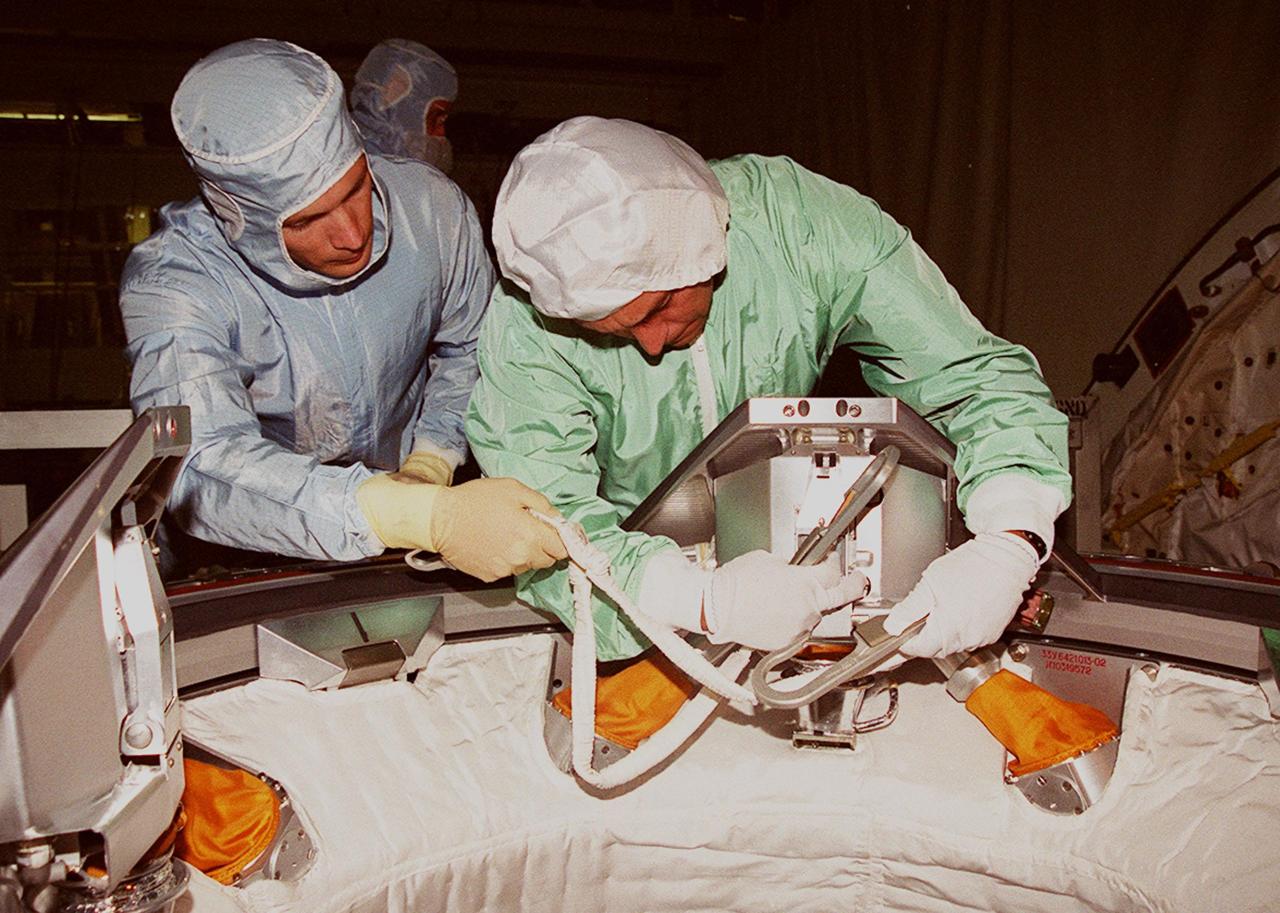
During the STS-97 Crew Equipment Interface Test (CEIT), Mission Specialist Carlos Noriega (right) gets hands-on experience with parts of the Orbital Docking System in Endeavour’s payload bay. The CEIT provides an opportunity for crew members to check equipment and facilities that will be on board the orbiter during their mission. The STS-97 mission will be the sixth construction flight to the International Space Station. The payload includes a photovoltaic (PV) module, providing solar power to the Station. STS-97 is scheduled to launch Nov. 30 from KSC for the 10-day mission
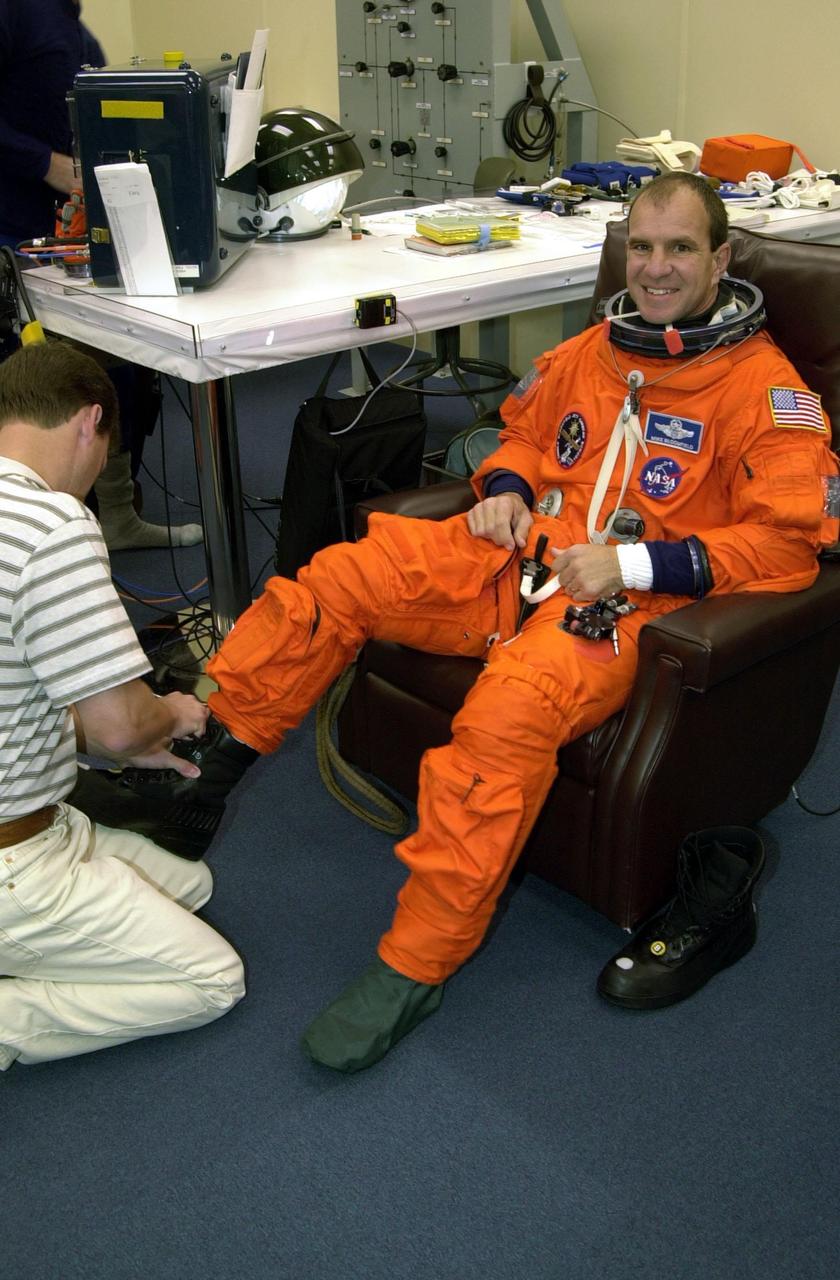
STS-97 Pilot Michael Bloomfield gets help with his boots from suit technician Steve Clendenin during pre-pack and fit check. Mission STS-97 is the sixth construction flight to the International Space Station. Its payload includes the P6 Integrated Truss Structure and a photovoltaic (PV) module, with giant solar arrays that will provide power to the Station. The mission includes two spacewalks to complete the solar array connections. STS-97 is scheduled to launch Nov. 30 at about 10:06 p.m. EST
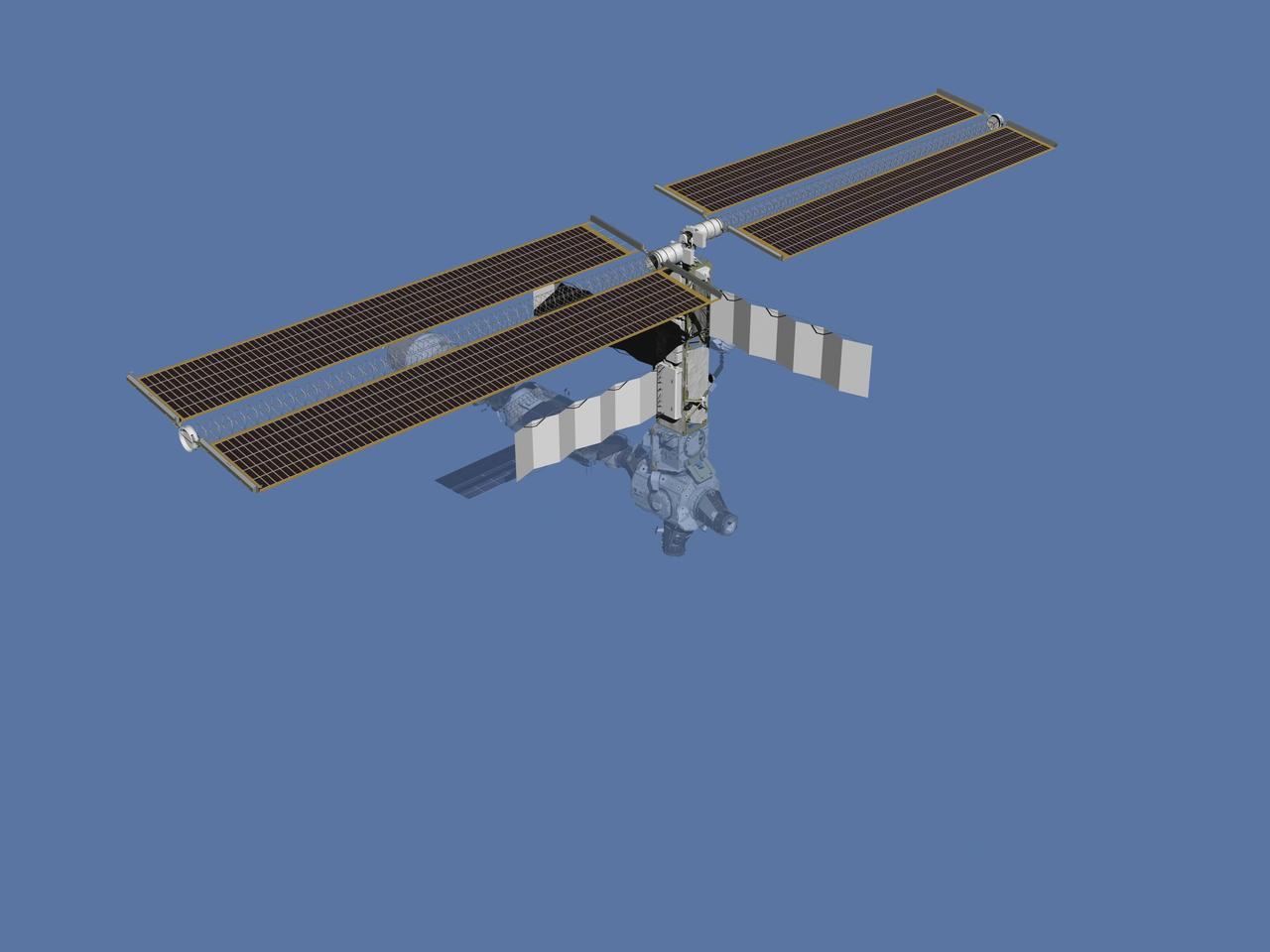
JSC2006-E-43484 (November 2000) --- Computer-generated artist's rendering of the International Space Station after flight STS-97/4A. The STS-97 crew delivered and installed the P6 truss, which support the first U.S. solar arrays.
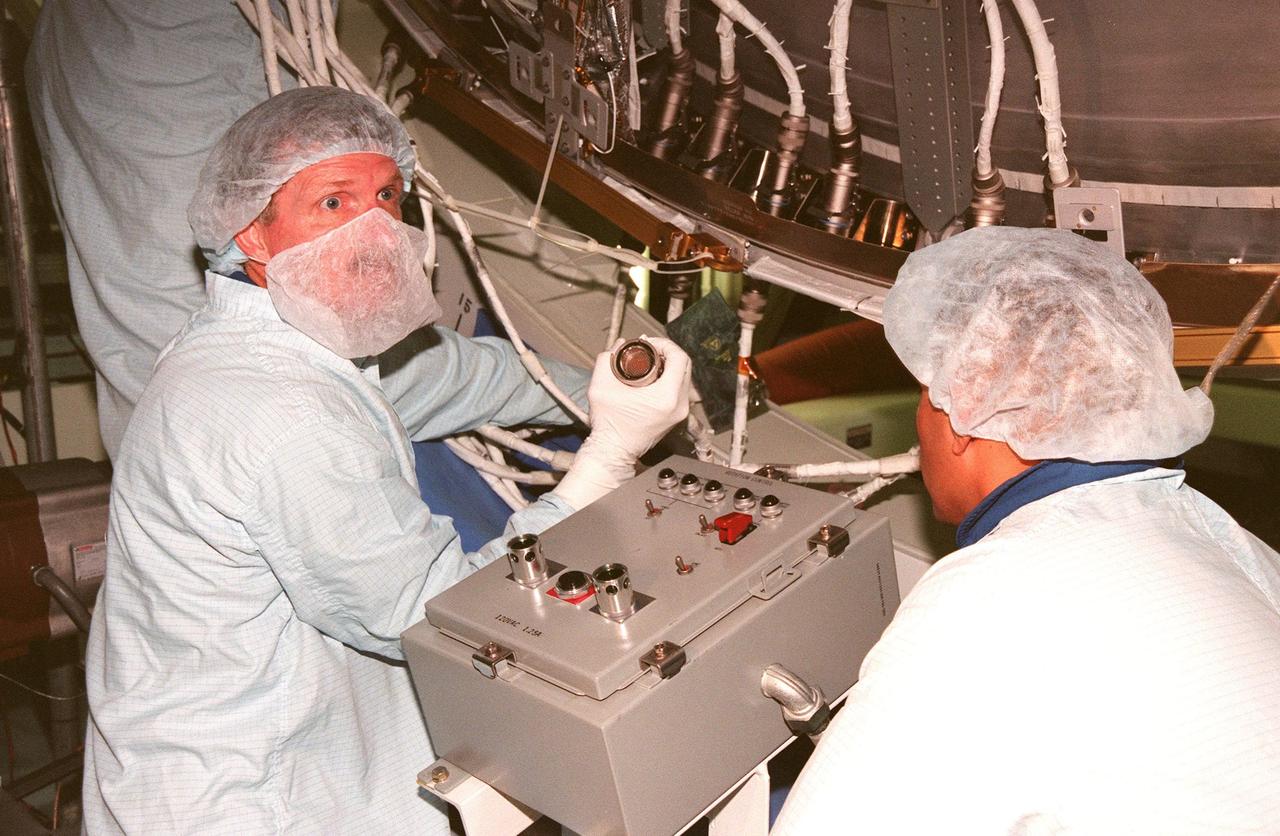
STS-97 Mission Specialists Joseph R. Tanner and Carlos I. Noriega check equipment of the International Space Station inside the Space Station Processing Facility. STS-97, targeted to launch on Aug. 5, 1999, is scheduled to carry integrated truss structure P6, photovoltaic module and radiators
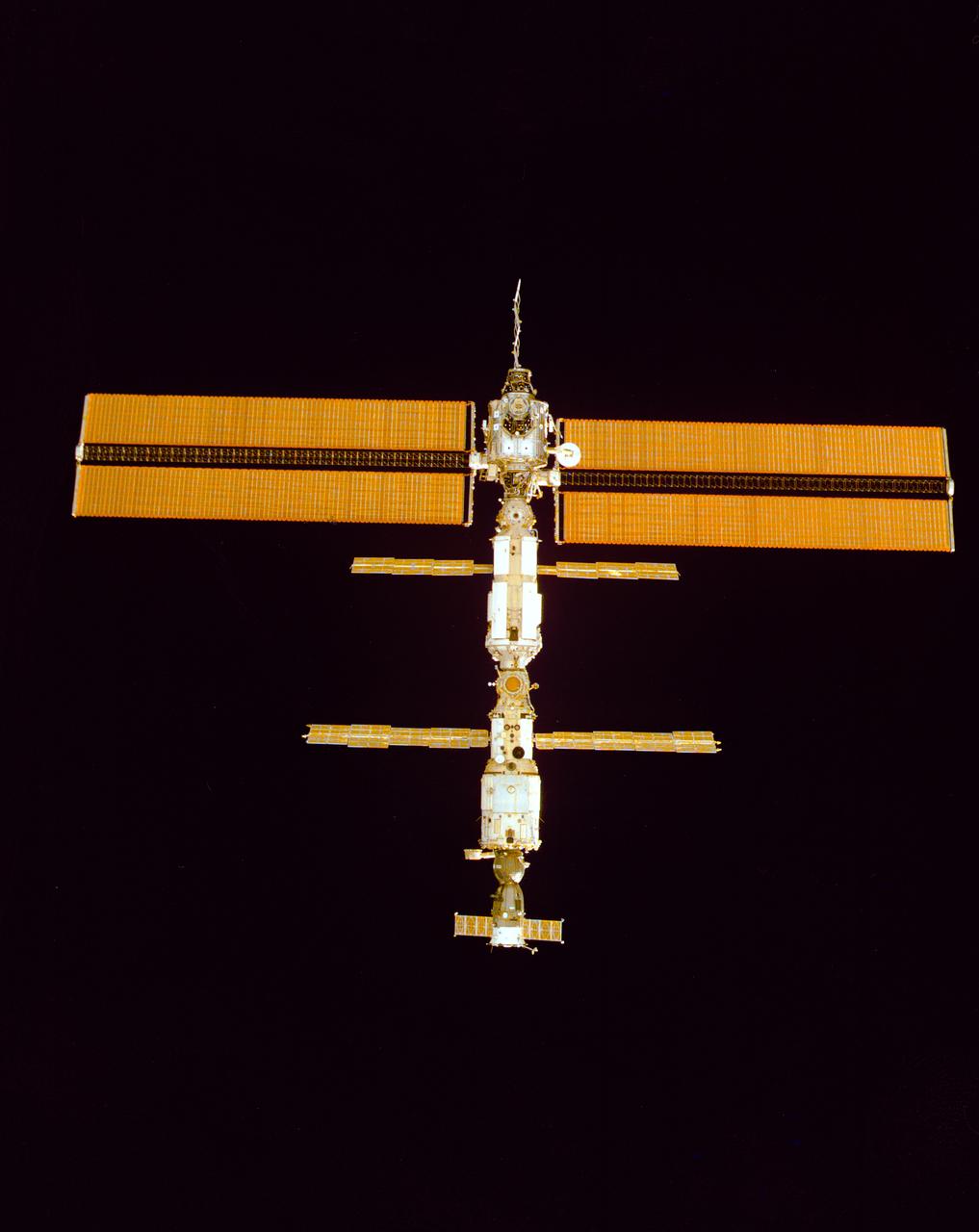
This image of the International Space Station (ISS) in orbit was taken during a fly-around inspection by the Space Shuttle Endeavour after successfull attachment of the 240-foot-long, 38-foot-wide solar array.
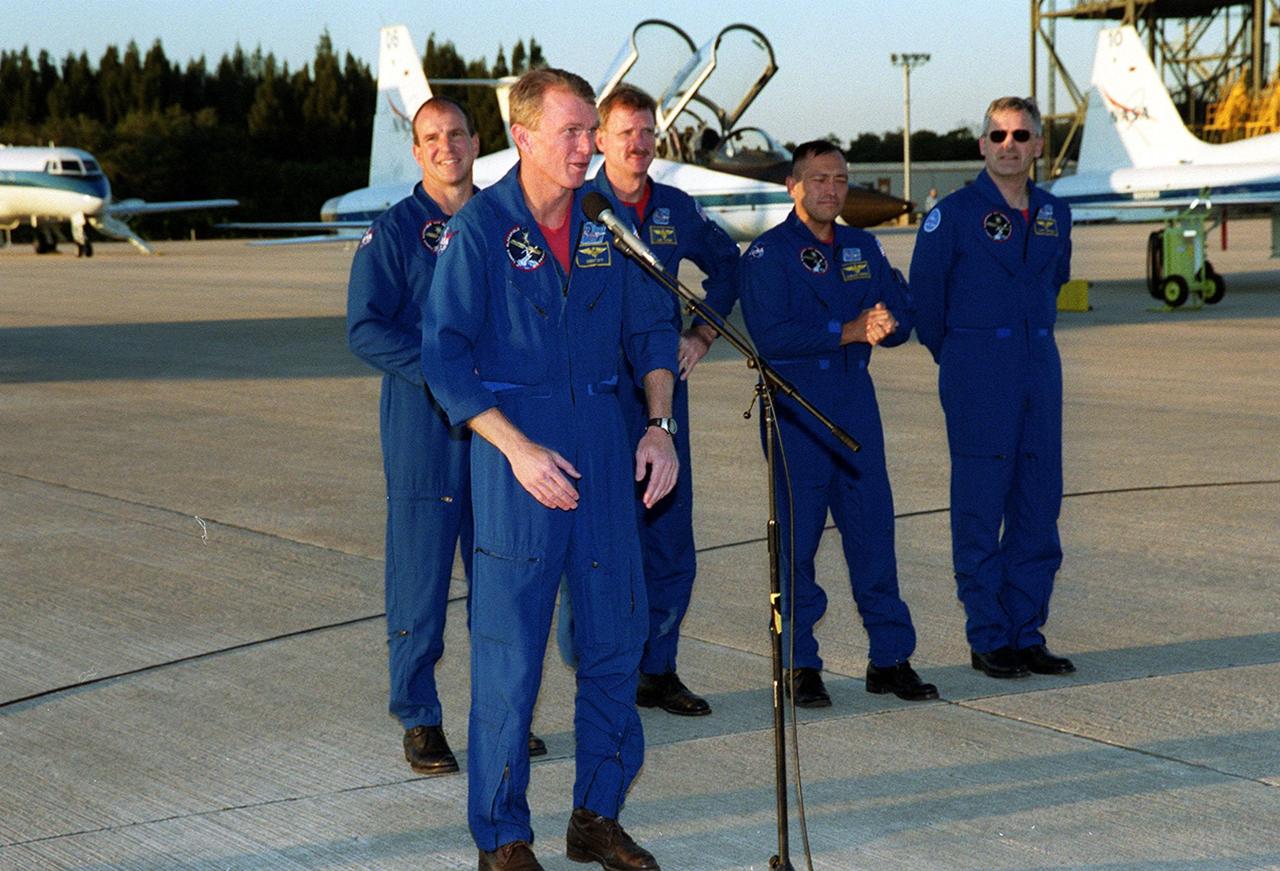
After arriving at the Shuttle Landing Facility, the STS-97 crew gather to address the media. At the microphone, Commander Brent Jett praises the efforts of the KSC workers to get ready for the launch. Behind Jett are Pilot Michael Bloomfield and Mission Specialists Joseph Tanner, Carlos Noriega and Marc Garneau, who is with the Canadian Space Agency. Mission STS-97 is the sixth construction flight to the International Space Station. Its payload includes the P6 Integrated Truss Structure and a photovoltaic (PV) module, with giant solar arrays that will provide power to the Station. The mission includes two spacewalks to complete the solar array connections. STS-97 is scheduled to launch Nov. 30 at about 10:06 p.m. EST
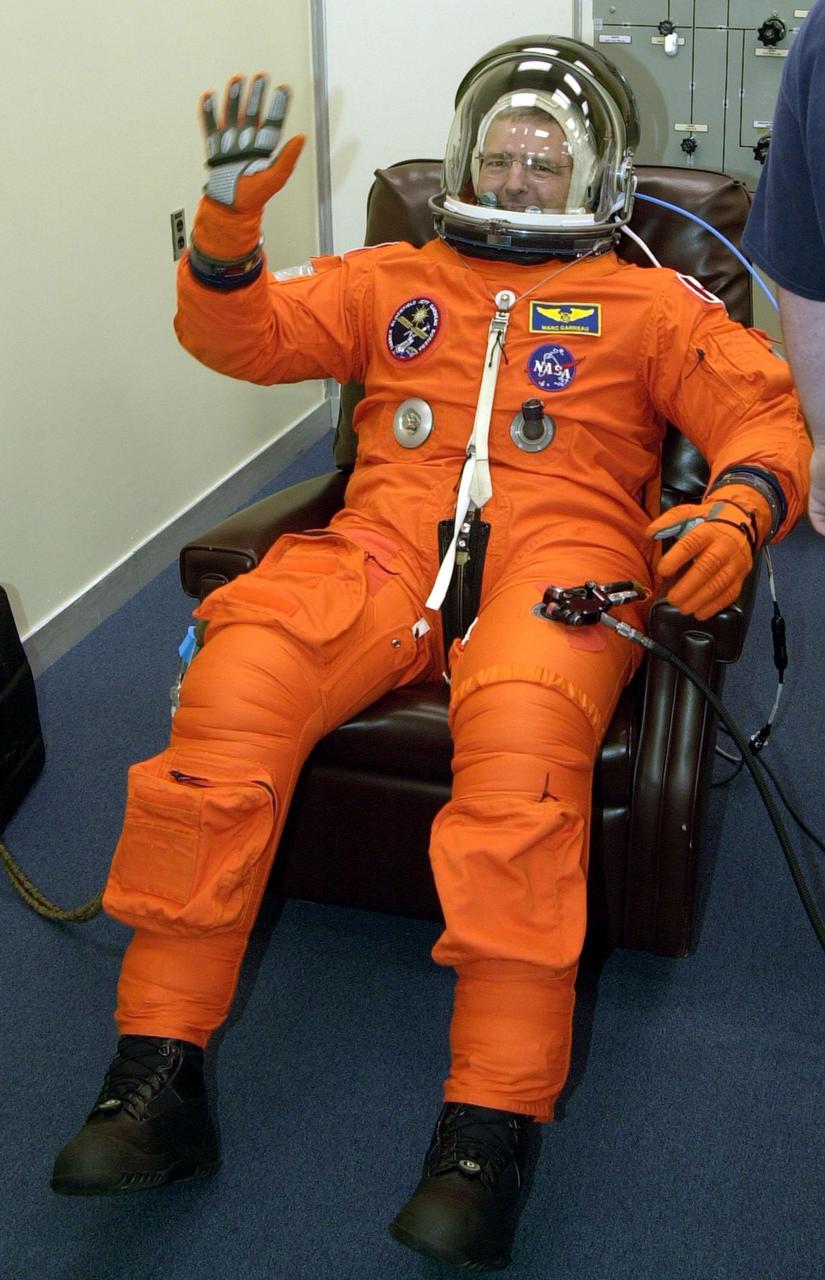
During pre-pack and fit check in the Operations and Checkout Building, STS-97 Mission Specialist Marc Garneau waves after getting his helmet on. Garneau is with the Canadian Space Agency. Mission STS-97 is the sixth construction flight to the International Space Station. Its payload includes the P6 Integrated Truss Structure and a photovoltaic (PV) module, with giant solar arrays that will provide power to the Station. The mission includes two spacewalks to complete the solar array connections. STS-97 is scheduled to launch Nov. 30 at about 10:06 p.m. EST
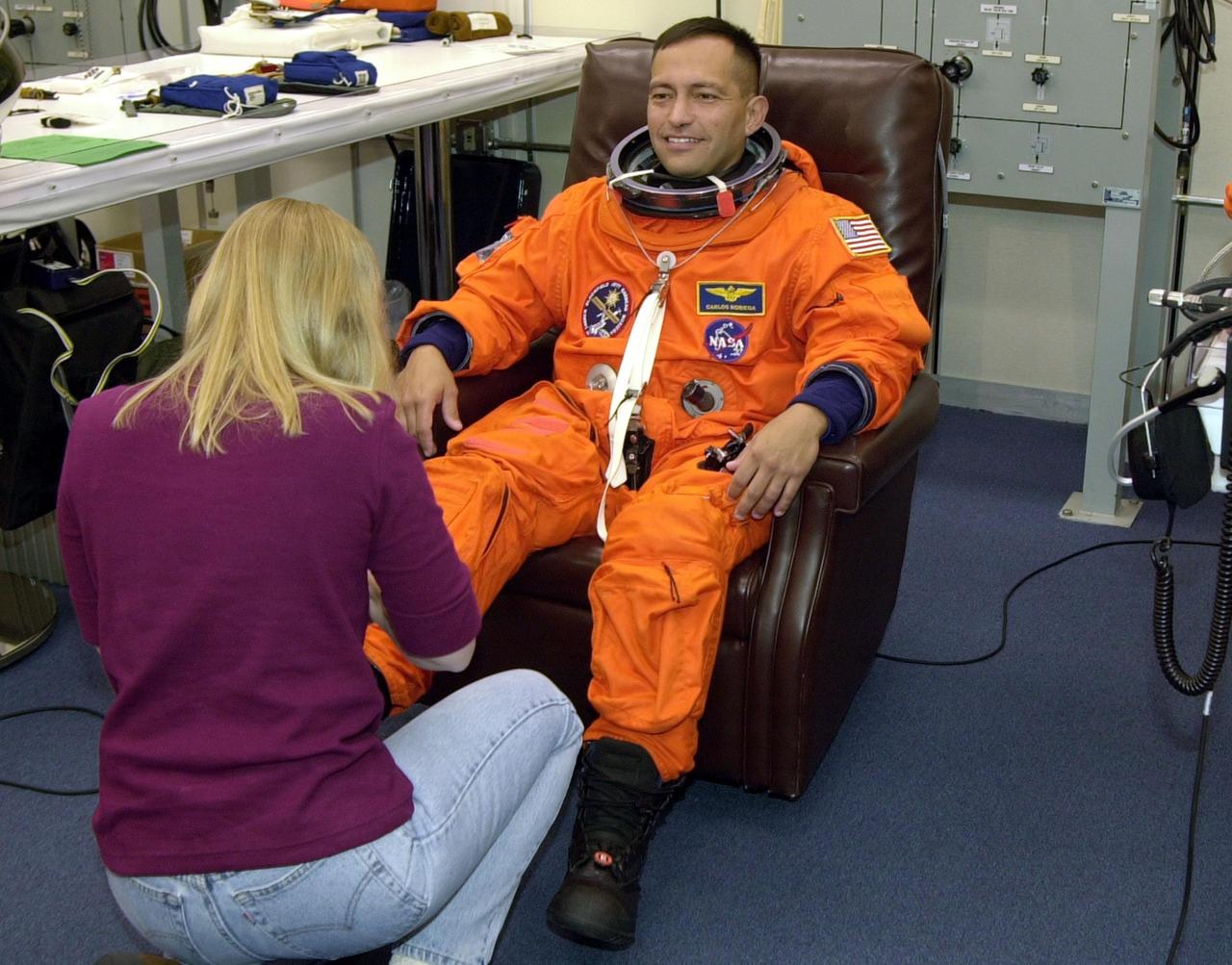
STS-97 Mission Specialist Carlos Noriega gets help with his boots from suit technician Shelly Grick-Agrella during pre-pack and fit check. Mission STS-97 is the sixth construction flight to the International Space Station. Its payload includes the P6 Integrated Truss Structure and a photovoltaic (PV) module, with giant solar arrays that will provide power to the Station. The mission includes two spacewalks to complete the solar array connections. STS-97 is scheduled to launch Nov. 30 at about 10:06 p.m. EST
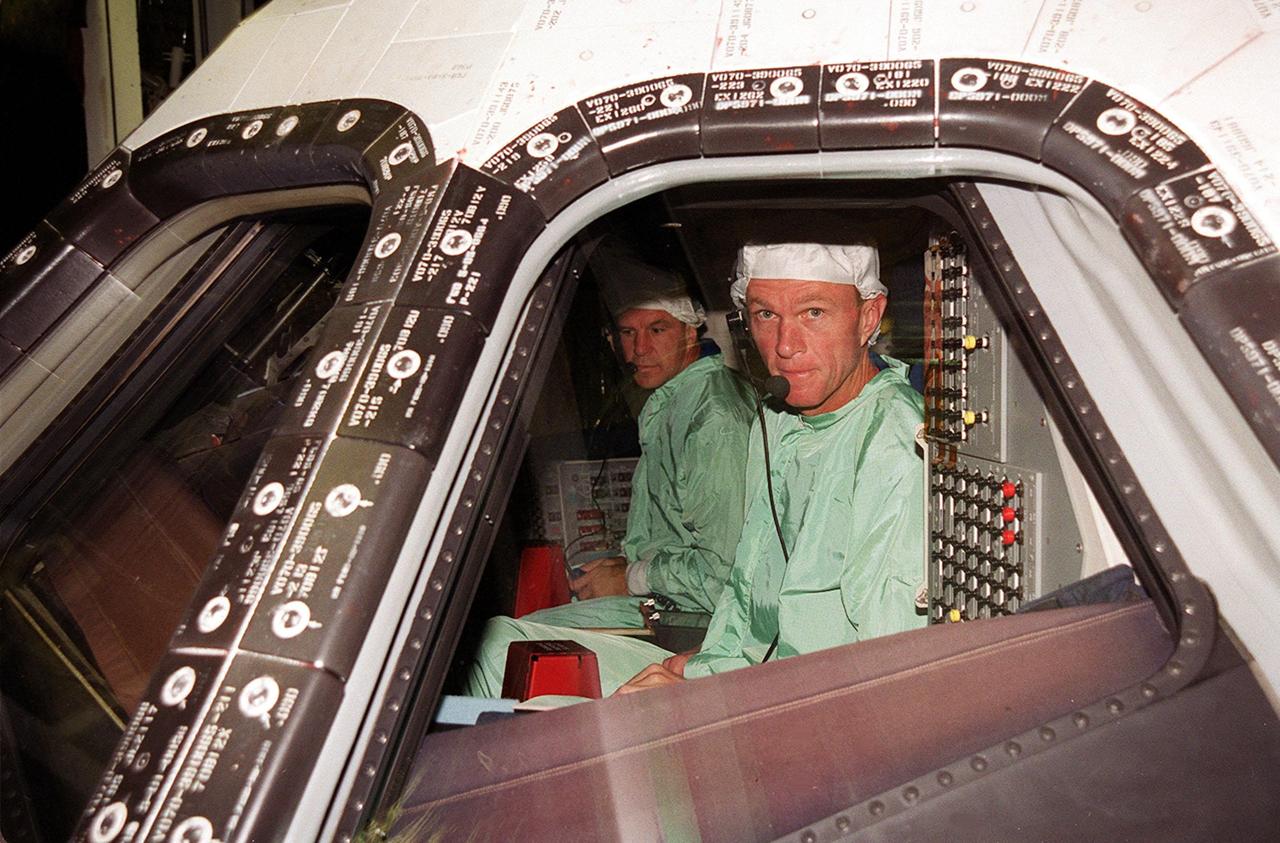
In Orbiter Processing Facility bay 2 during a Crew Equipment Interface Test (CEIT), STS-97 Pilot Michael Bloomfied (left) and Commander Brent Jett (right) check out the cockpit of orbiter Endeavour as part of preflight preparations. The CEIT provides an opportunity for crew members to check equipment and facilities that will be on board the orbiter during their mission. The STS-97 mission will be the sixth construction flight to the International Space Station. The payload includes a photovoltaic (PV) module, providing solar power to the Station. STS-97 is scheduled to launch Nov. 30 from KSC for the 10-day mission
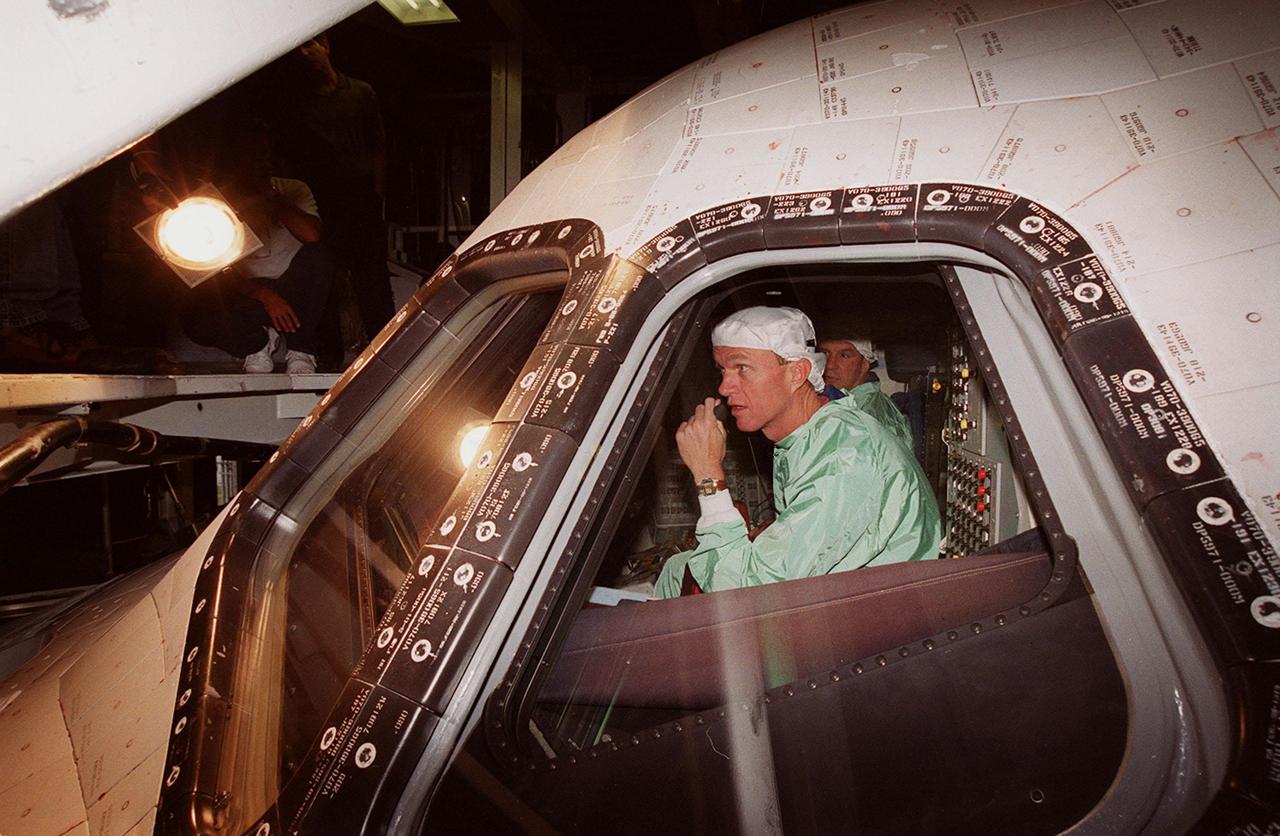
In Orbiter Processing Facility bay 2 during a Crew Equipment Interface Test (CEIT), STS-97 Commander Brent Jett (left) and Pilot Michael Bloomfied (right) check out the cockpit of orbiter Endeavour as part of preflight preparations. The CEIT provides an opportunity for crew members to check equipment and facilities that will be on board the orbiter during their mission. The STS-97 mission will be the sixth construction flight to the International Space Station. The payload includes a photovoltaic (PV) module, providing solar power to the Station. STS-97 is scheduled to launch Nov. 30 from KSC for the 10-day mission
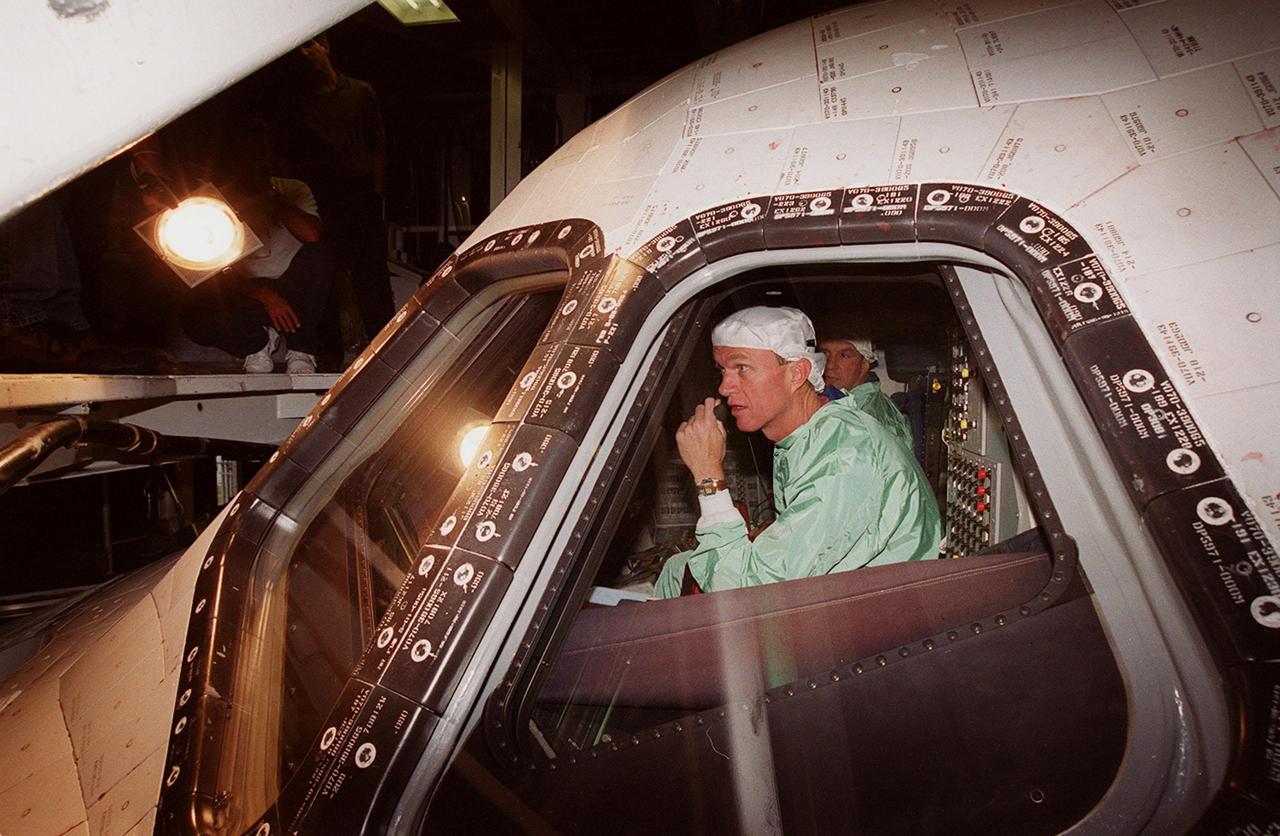
In Orbiter Processing Facility bay 2 during a Crew Equipment Interface Test (CEIT), STS-97 Commander Brent Jett (left) and Pilot Michael Bloomfied (right) check out the cockpit of orbiter Endeavour as part of preflight preparations. The CEIT provides an opportunity for crew members to check equipment and facilities that will be on board the orbiter during their mission. The STS-97 mission will be the sixth construction flight to the International Space Station. The payload includes a photovoltaic (PV) module, providing solar power to the Station. STS-97 is scheduled to launch Nov. 30 from KSC for the 10-day mission
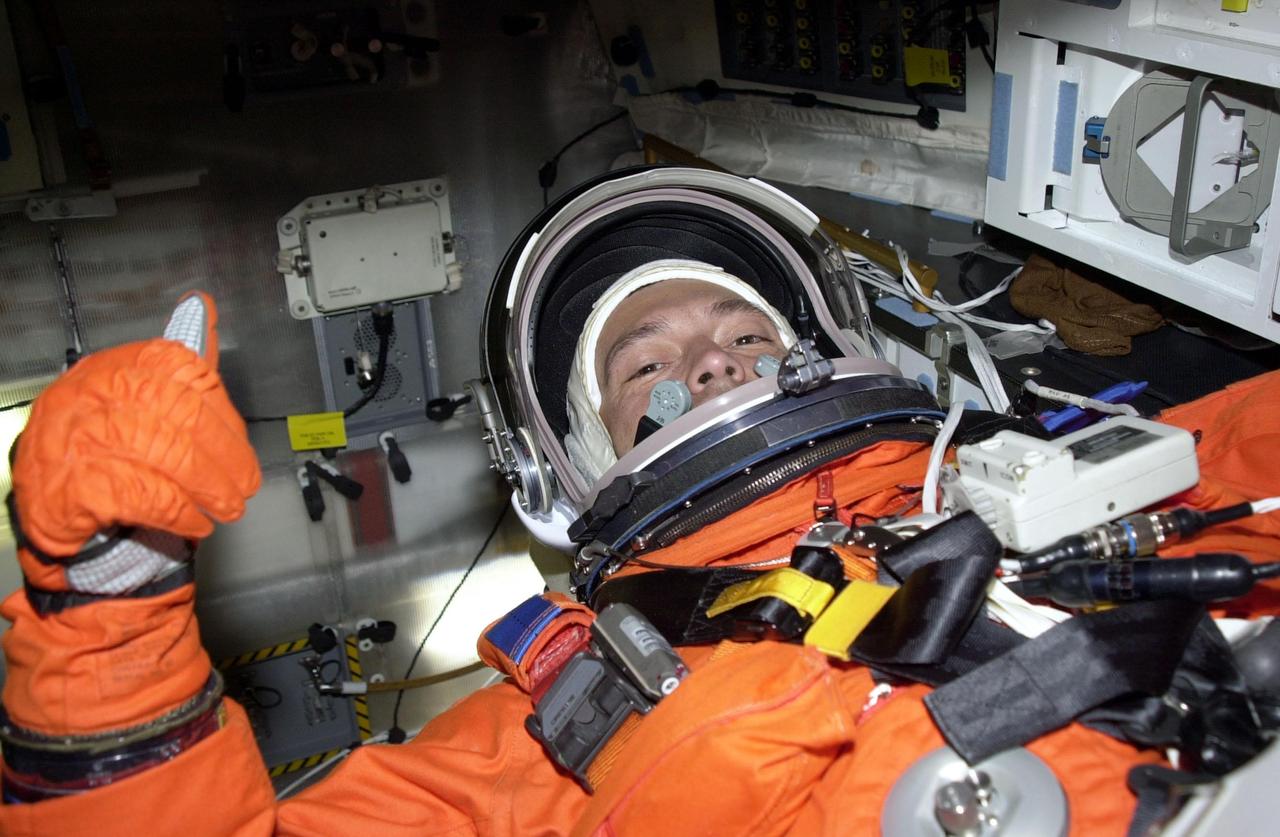
STS-97 Mission Specialist Carlos Noriega settles into his seat in Space Shuttle Endeavour on Launch Pad 39B. He and the rest of the crew are taking part in a simulated launch countdown, part of Terminal Countdown Demonstration Test activities that also include emergency egress training and familiarization with the payload. Mission STS-97 is the sixth construction flight to the International Space Station. Its payload includes the P6 Integrated Truss Structure and a photovoltaic (PV) module, with giant solar arrays that will provide power to the Station. The mission includes two spacewalks to complete the solar array connections. STS-97 is scheduled to launch Nov. 30 at about 10:05 p.m. EST
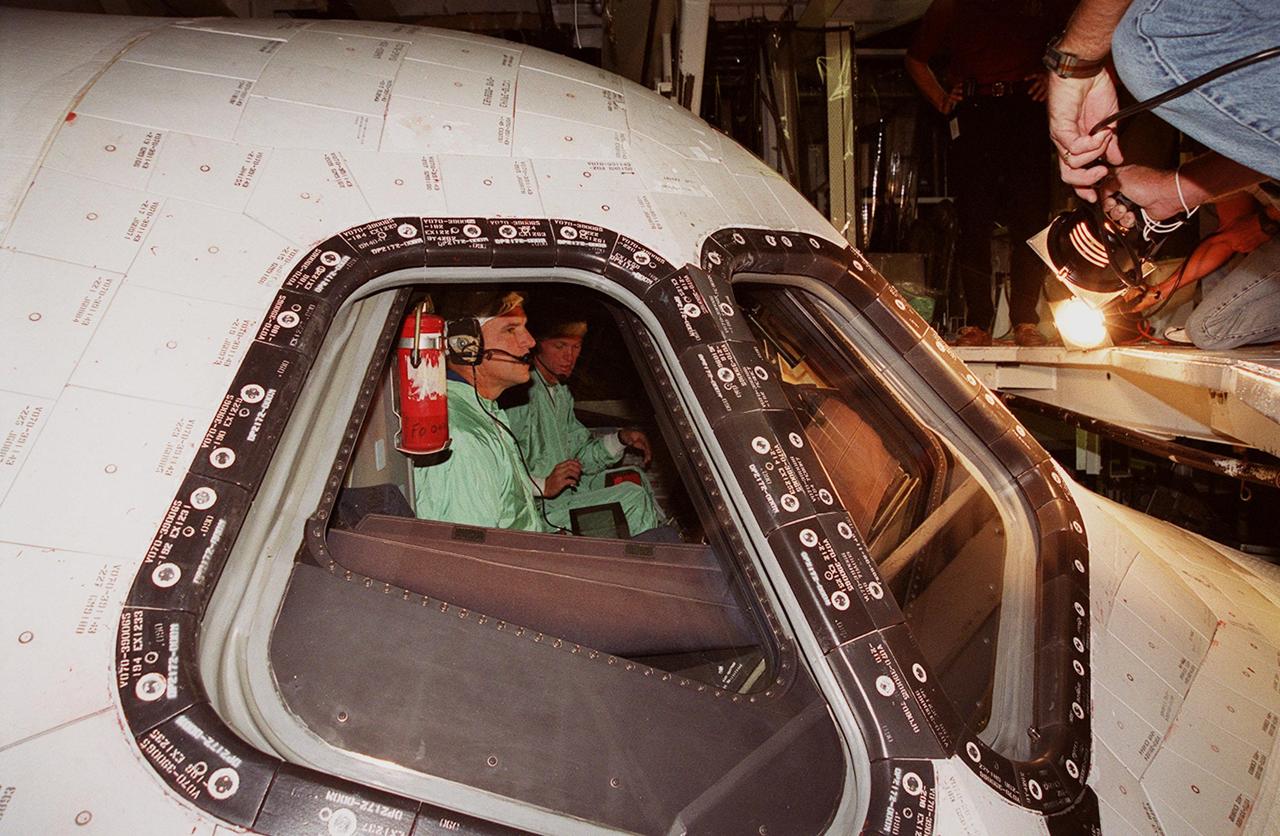
During a Crew Equipment Interface Test (CEIT), STS-97 Commander Brent Jett (left) and Pilot Michael Bloomfied (right) check out the cockpit of orbiter Endeavour in Orbiter Processing Facility bay 2 as part of preflight preparations. The CEIT provides an opportunity for crew members to check equipment and facilities that will be on board the orbiter during their mission. The STS-97 mission will be the sixth construction flight to the International Space Station. The payload includes a photovoltaic (PV) module, providing solar power to the Station. STS-97 is scheduled to launch Nov. 30 from KSC for the 10-day mission
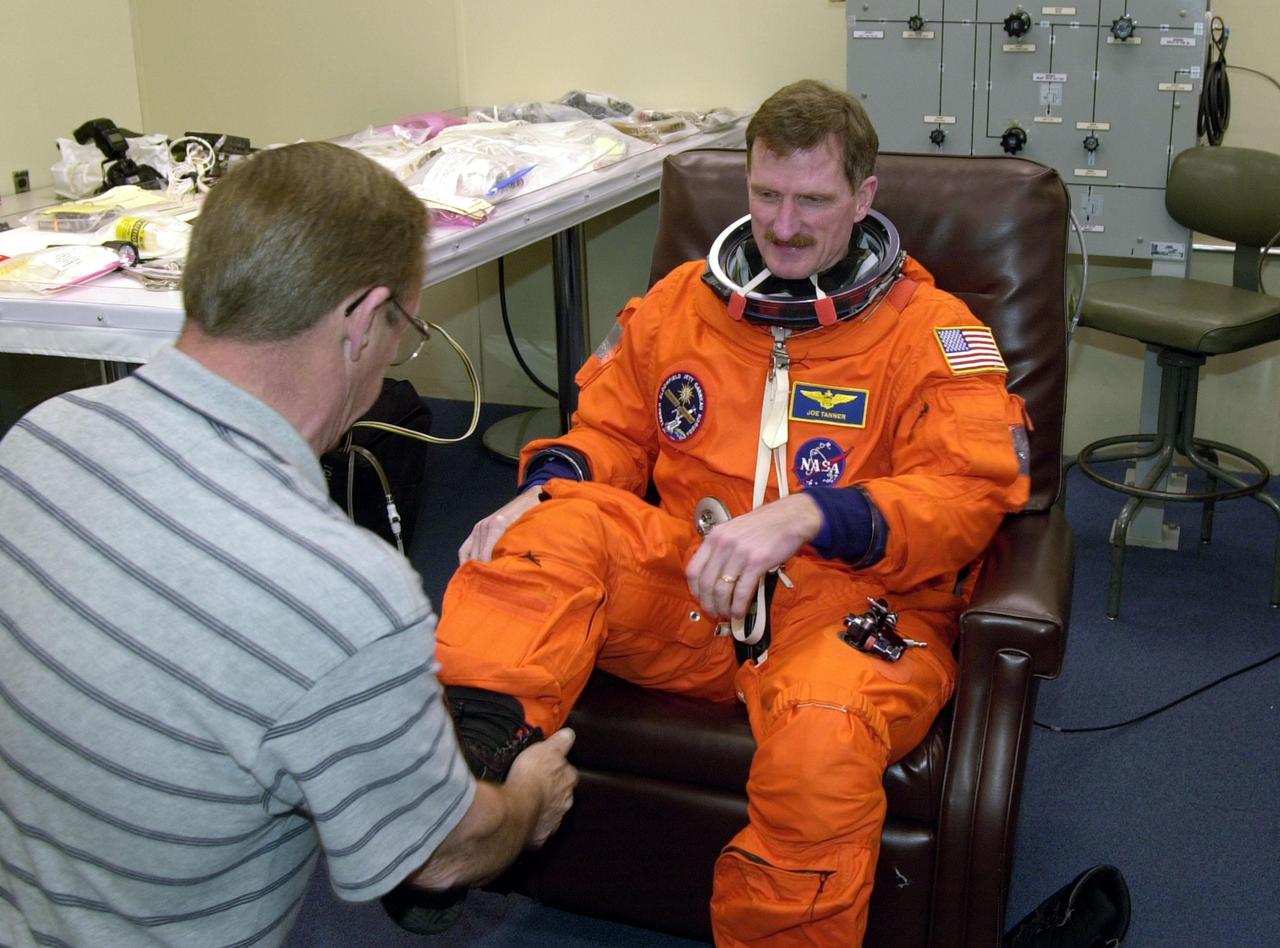
STS-97 Mission Specialist Joseph Tanner gets help with his boots from suit technician Erin Canlon during check pre-pack and fit check. Mission STS-97 is the sixth construction flight to the International Space Station. Its payload includes the P6 Integrated Truss Structure and a photovoltaic (PV) module, with giant solar arrays that will provide power to the Station. The mission includes two spacewalks to complete the solar array connections. STS-97 is scheduled to launch Nov. 30 at about 10:06 p.m. EST
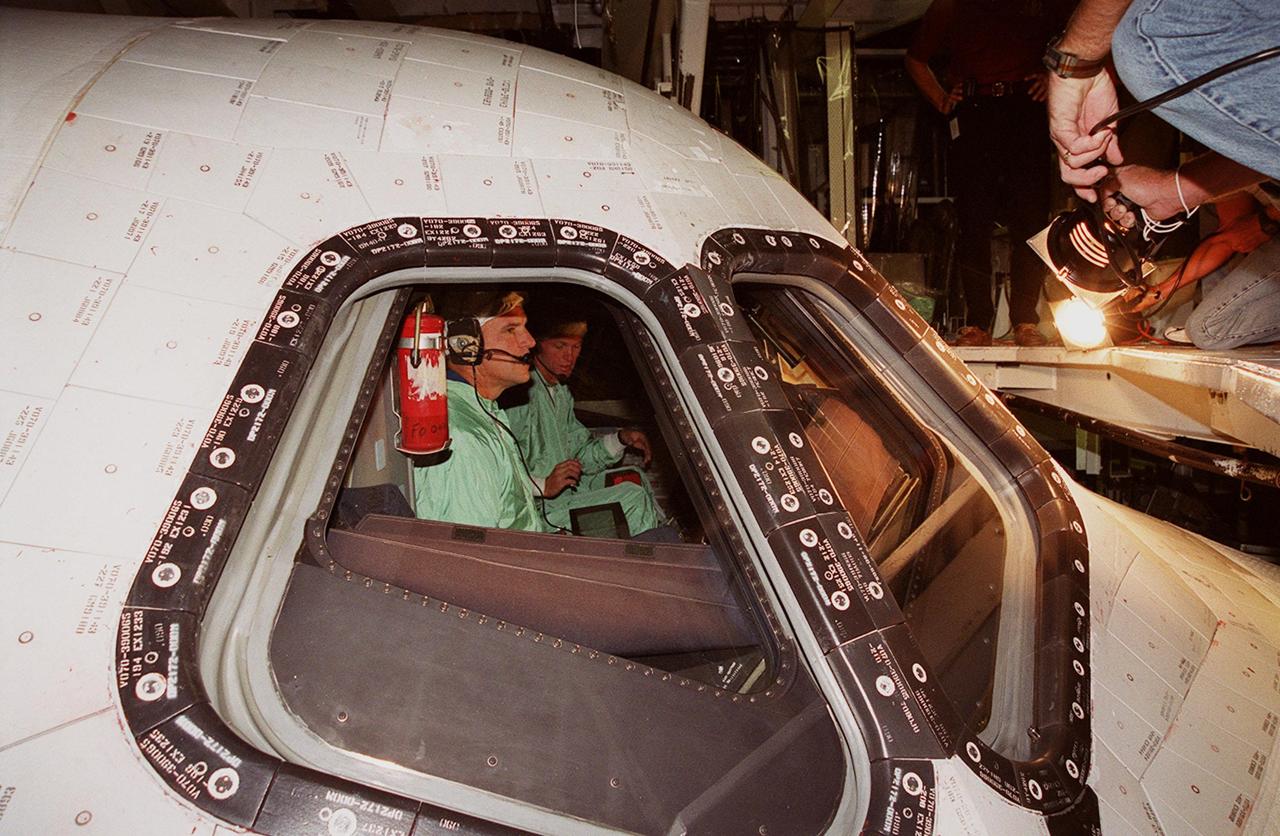
During a Crew Equipment Interface Test (CEIT), STS-97 Commander Brent Jett (left) and Pilot Michael Bloomfied (right) check out the cockpit of orbiter Endeavour in Orbiter Processing Facility bay 2 as part of preflight preparations. The CEIT provides an opportunity for crew members to check equipment and facilities that will be on board the orbiter during their mission. The STS-97 mission will be the sixth construction flight to the International Space Station. The payload includes a photovoltaic (PV) module, providing solar power to the Station. STS-97 is scheduled to launch Nov. 30 from KSC for the 10-day mission
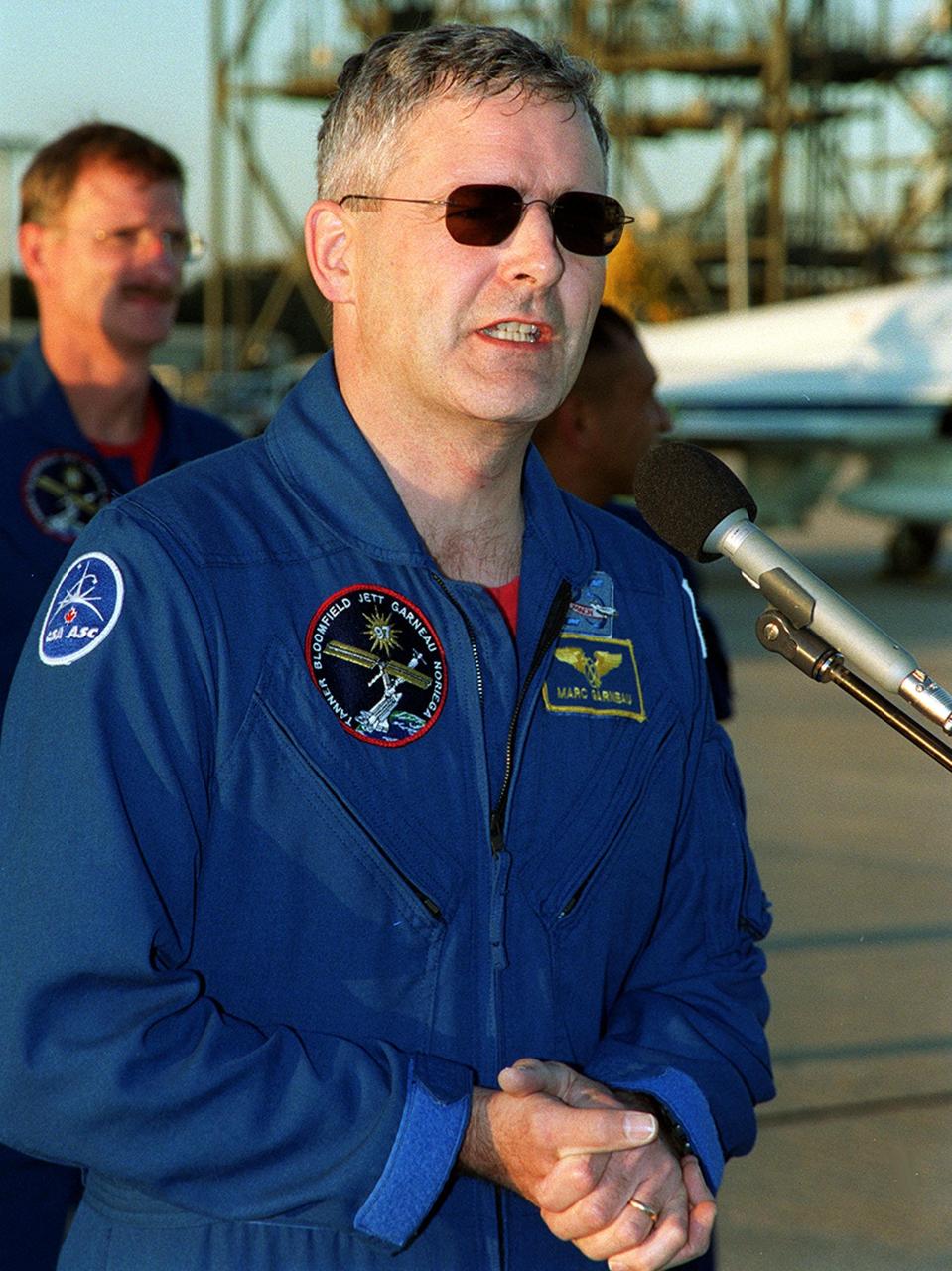
After arriving at the Shuttle Landing Facility, the STS-97 crew gather to address the media. At the microphone is Mission Specialist Marc Garneau, who is with the Canadian Space Agency. Behind him can be seen Mission Specialists Joseph Tanner (left) and Carlos Noriega. Mission STS-97 is the sixth construction flight to the International Space Station. Its payload includes the P6 Integrated Truss Structure and a photovoltaic (PV) module, with giant solar arrays that will provide power to the Station. The mission includes two spacewalks to complete the solar array connections. STS-97 is scheduled to launch Nov. 30 at about 10:06 p.m. EST
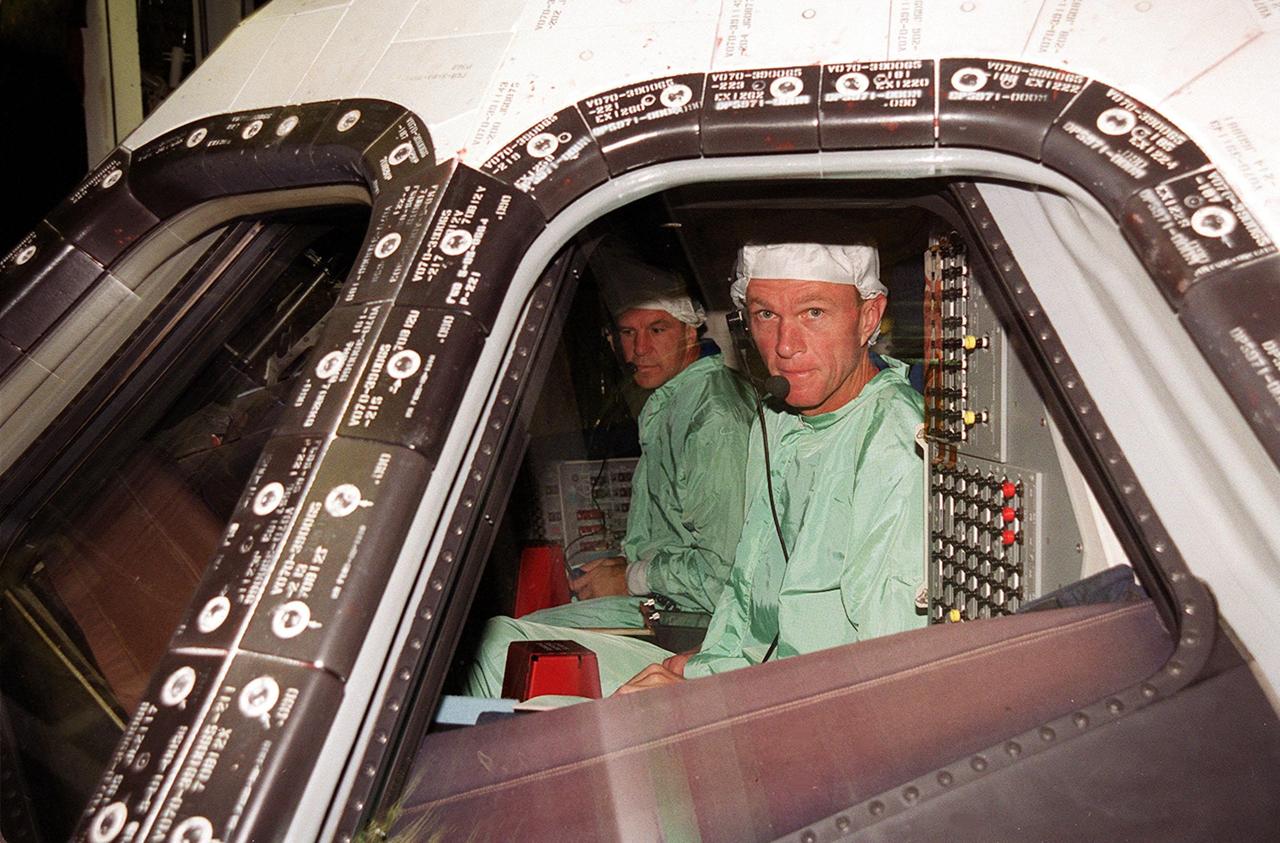
In Orbiter Processing Facility bay 2 during a Crew Equipment Interface Test (CEIT), STS-97 Pilot Michael Bloomfied (left) and Commander Brent Jett (right) check out the cockpit of orbiter Endeavour as part of preflight preparations. The CEIT provides an opportunity for crew members to check equipment and facilities that will be on board the orbiter during their mission. The STS-97 mission will be the sixth construction flight to the International Space Station. The payload includes a photovoltaic (PV) module, providing solar power to the Station. STS-97 is scheduled to launch Nov. 30 from KSC for the 10-day mission
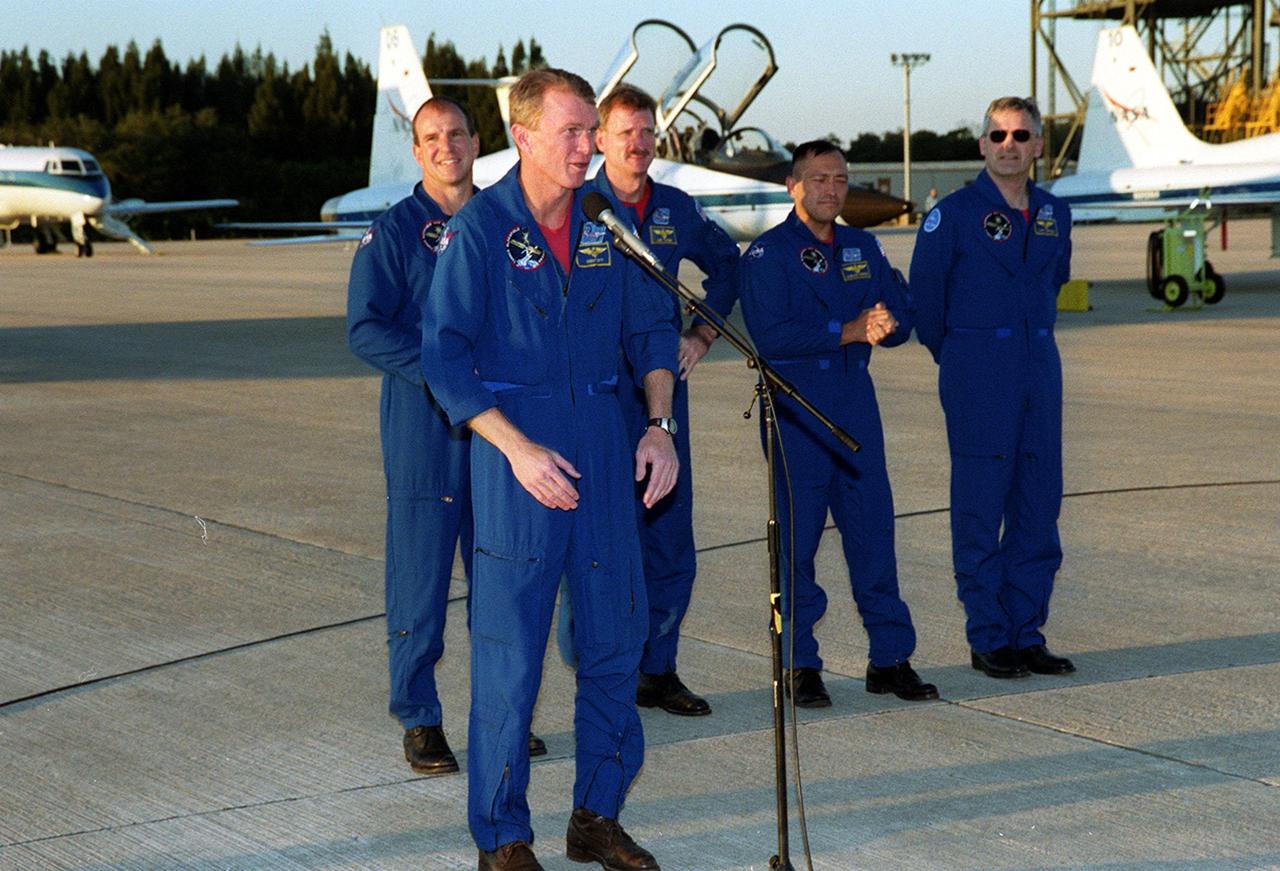
After arriving at the Shuttle Landing Facility, the STS-97 crew gather to address the media. At the microphone, Commander Brent Jett praises the efforts of the KSC workers to get ready for the launch. Behind Jett are Pilot Michael Bloomfield and Mission Specialists Joseph Tanner, Carlos Noriega and Marc Garneau, who is with the Canadian Space Agency. Mission STS-97 is the sixth construction flight to the International Space Station. Its payload includes the P6 Integrated Truss Structure and a photovoltaic (PV) module, with giant solar arrays that will provide power to the Station. The mission includes two spacewalks to complete the solar array connections. STS-97 is scheduled to launch Nov. 30 at about 10:06 p.m. EST
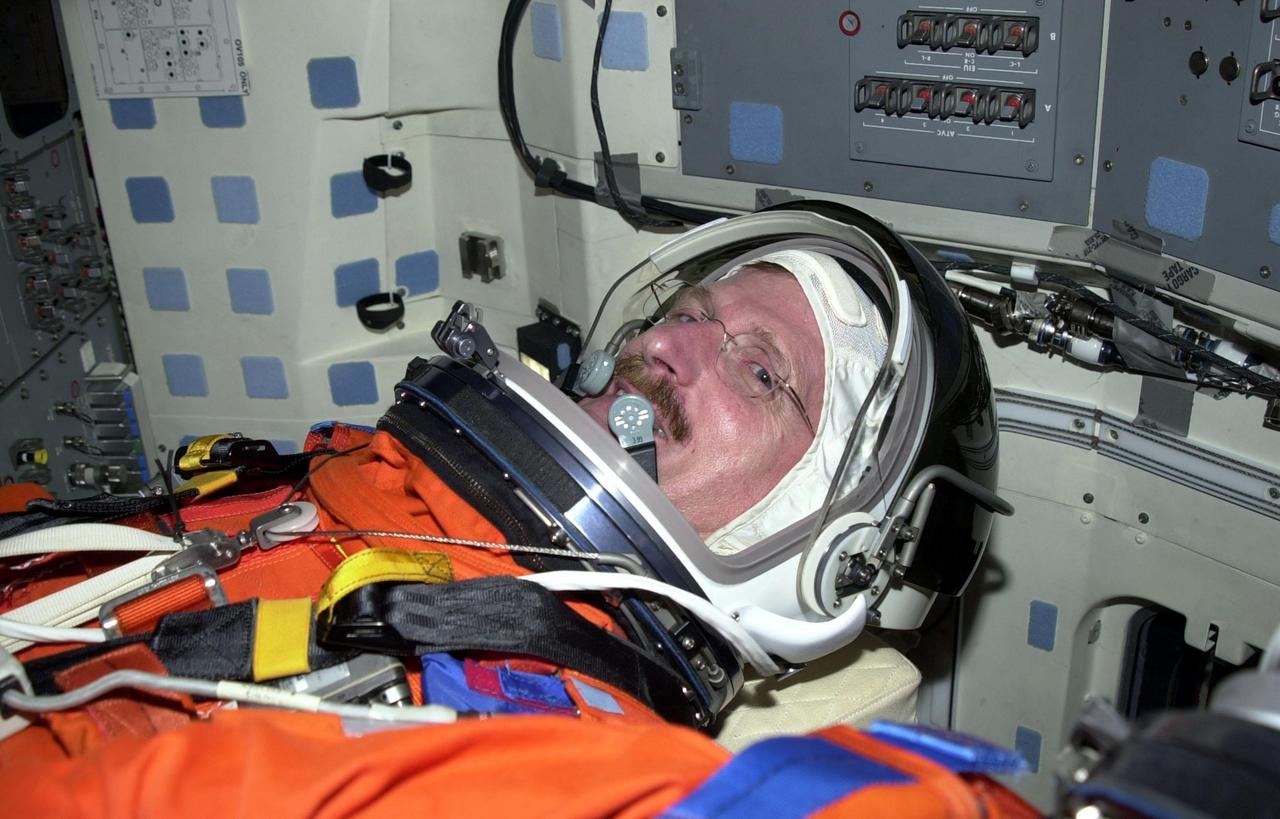
STS-97 Mission Specialist Joe Tanner settles into his seat in Space Shuttle Endeavour on Launch Pad 39B. He and the rest of the crew are taking part in a simulated launch countdown, part of Terminal Countdown Demonstration Test activities that also include emergency egress training and familiarization with the payload. Mission STS-97 is the sixth construction flight to the International Space Station. Its payload includes the P6 Integrated Truss Structure and a photovoltaic (PV) module, with giant solar arrays that will provide power to the Station. The mission includes two spacewalks to complete the solar array connections. STS-97 is scheduled to launch Nov. 30 at 10:05 p.m. EST
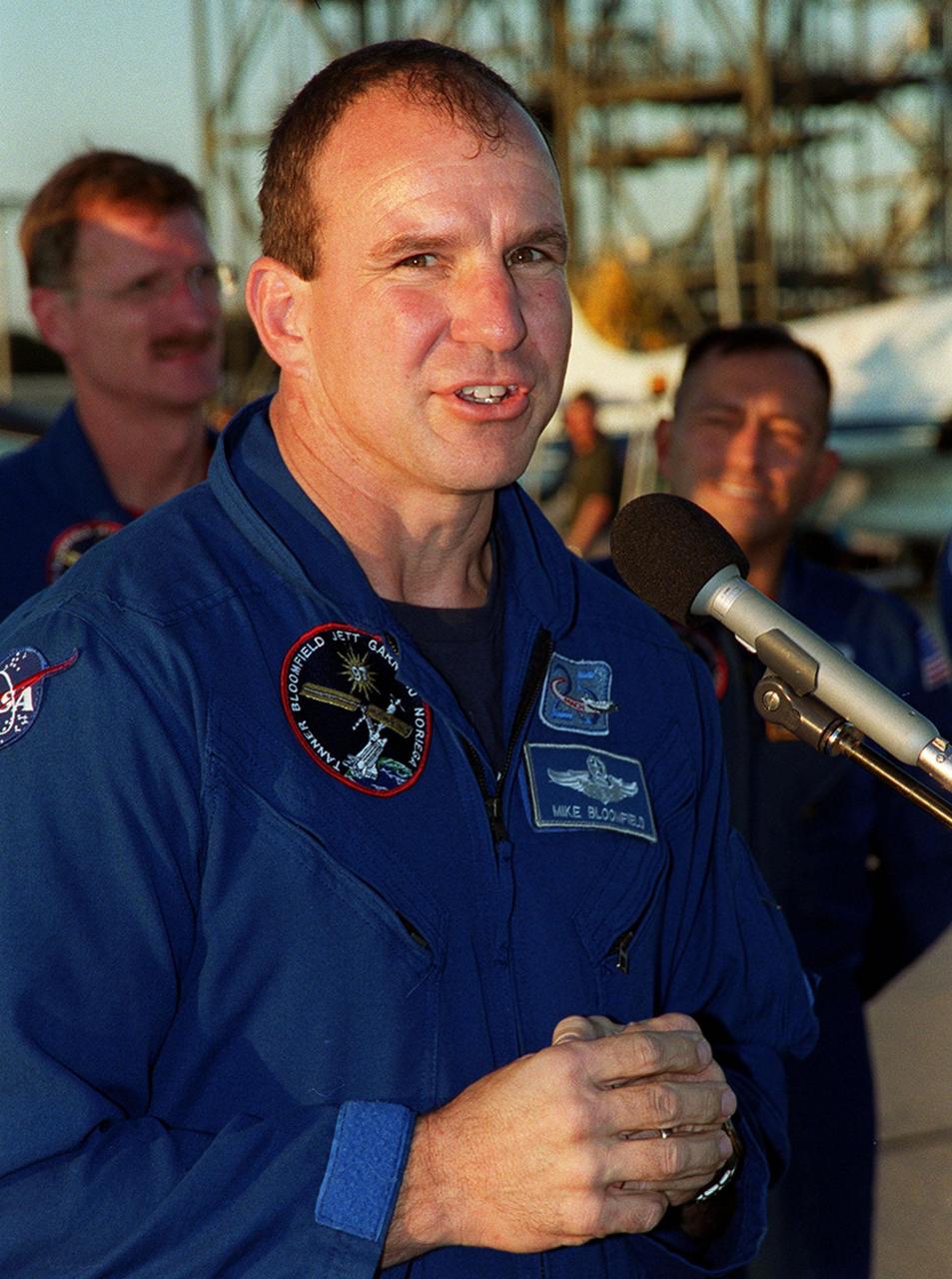
After arriving at the Shuttle Landing Facility, the STS-97 crew gather to address the media. At the microphone is Pilot Michael Bloomfield. Behind him can be seen Mission Specialists Joseph Tanner and Carlos Noriega. Mission STS-97 is the sixth construction flight to the International Space Station. Its payload includes the P6 Integrated Truss Structure and a photovoltaic (PV) module, with giant solar arrays that will provide power to the Station. The mission includes two spacewalks to complete the solar array connections. STS-97 is scheduled to launch Nov. 30 at about 10:06 p.m. EST
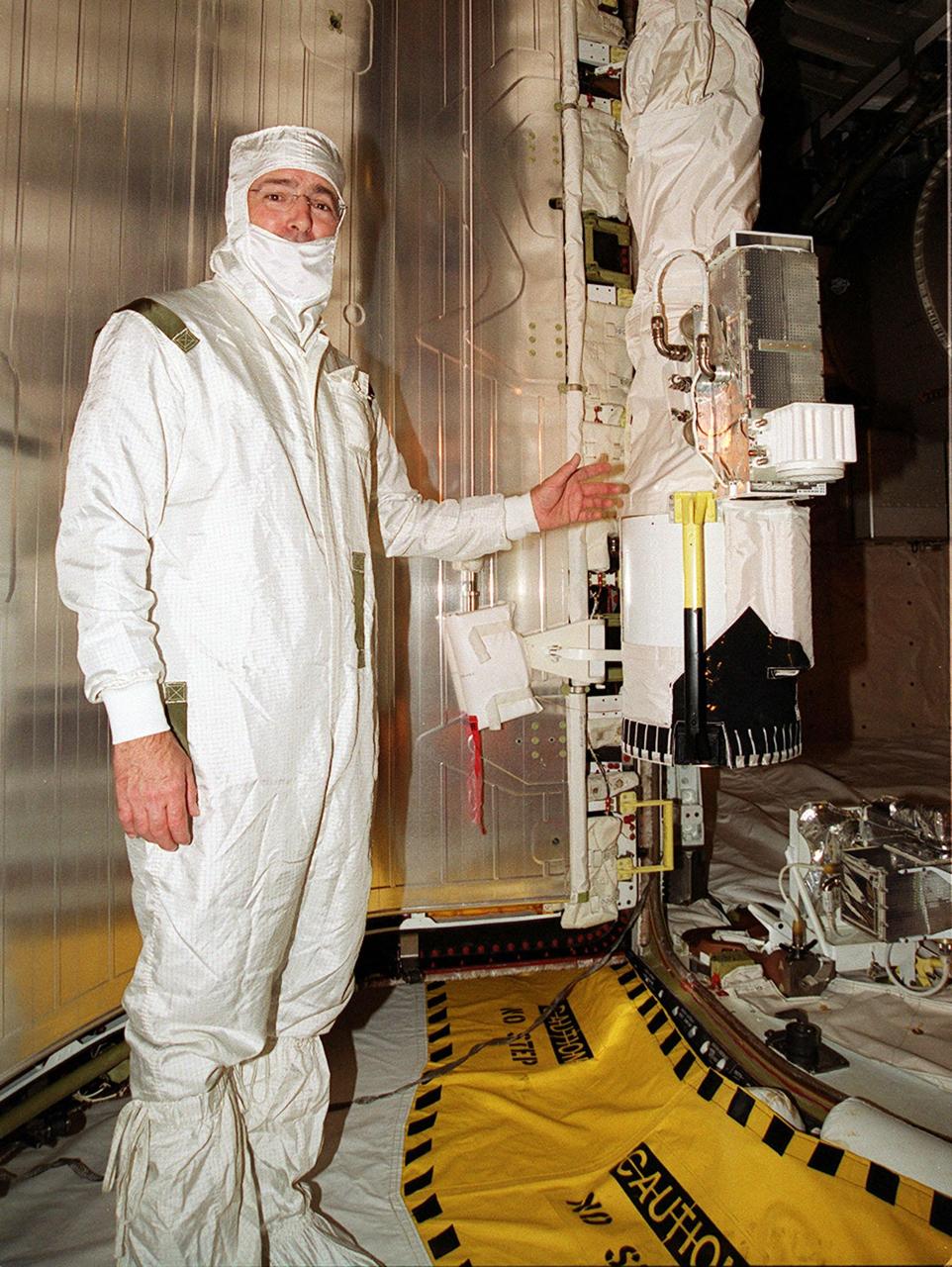
STS-97 Mission Specialist Marc Garneau points to Endeavour's robotic arm that he will use during a spacewalk on the mission. Members of the STS-97 crew are taking part in a payload walkdown from the payload changeout room at Launch Pad 39B. The payload comprises the P6 Integrated Truss Segment, with solar arrays that will be temporarily installed on the recently delivered Z1 truss, connecting them to the Unity module, and batteries. The two solar arrays are each more than 100 feet long. They will capture energy from the sun and convert it to power for the Station. Two spacewalks will be required to install the solar array connections. STS-97 is scheduled to launch Nov. 30 at about 10:06 p.m. EST
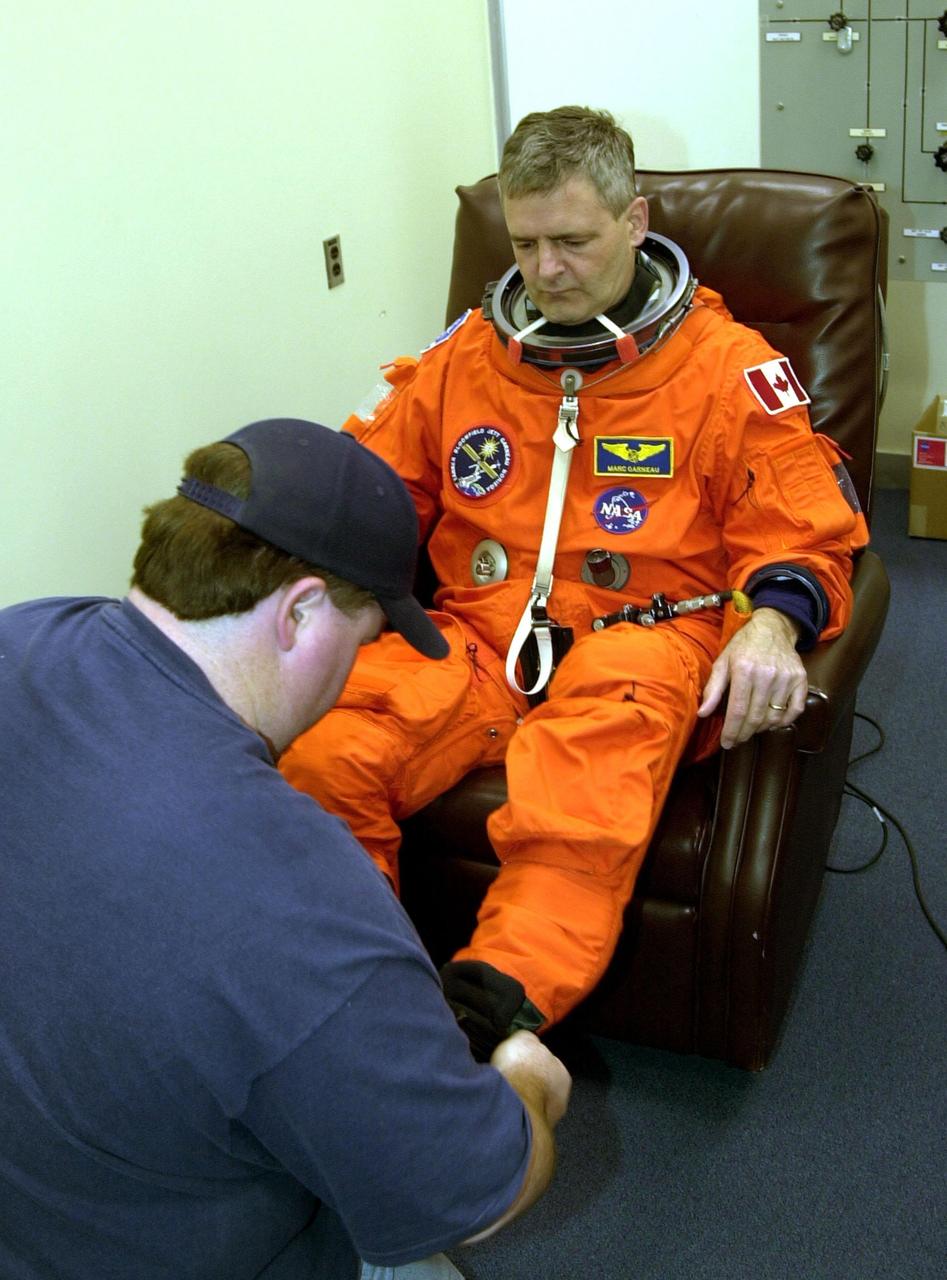
STS-97 Mission Specialist Marc Garneau gets help with his boots from suit technician Tommy McDonald during pre-pack and fit check. Garneau is with the Canadian Space Agency. Mission STS-97 is the sixth construction flight to the International Space Station. Its payload includes the P6 Integrated Truss Structure and a photovoltaic (PV) module, with giant solar arrays that will provide power to the Station. The mission includes two spacewalks to complete the solar array connections. STS-97 is scheduled to launch Nov. 30 at about 10:06 p.m. EST
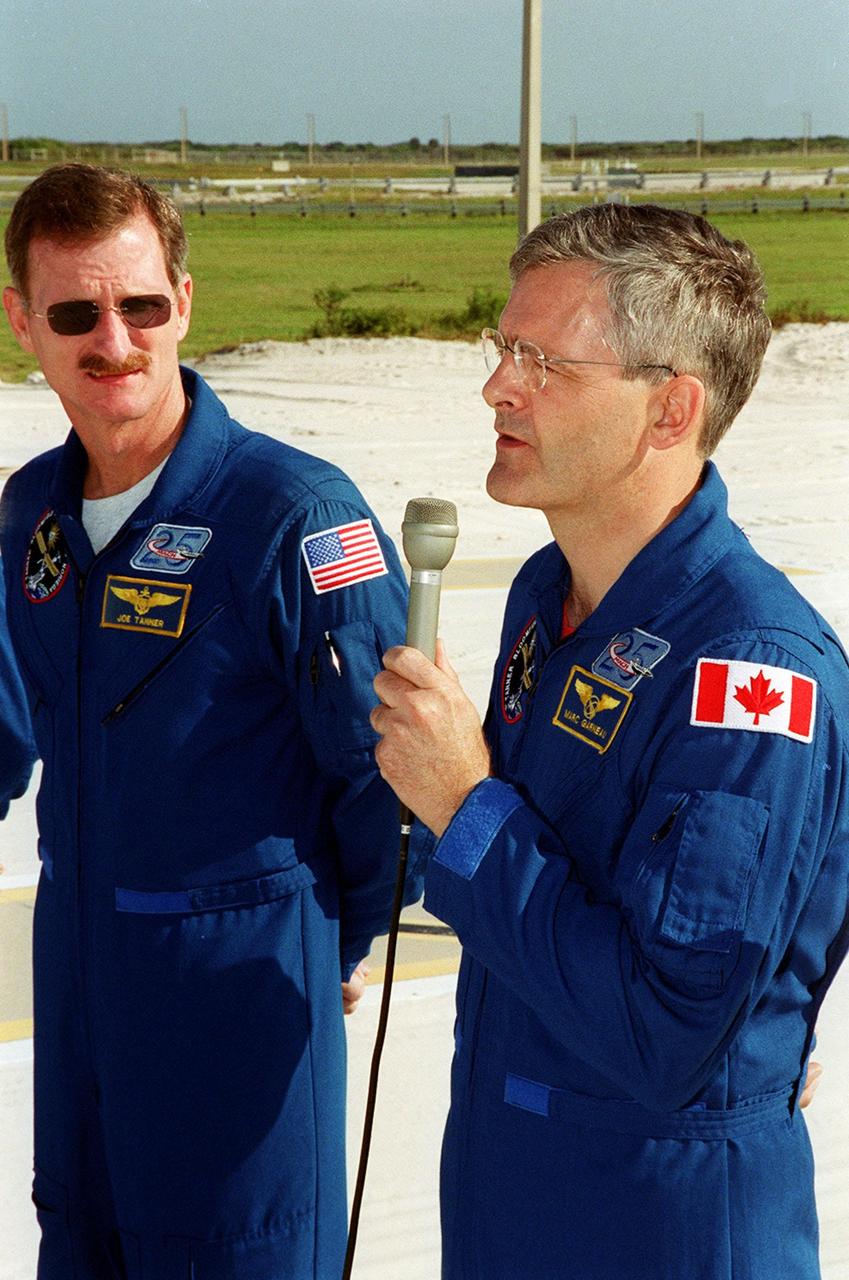
STS-97 Mission Specialist Marc Garneau (right) answers a question from the media. At left is Mission Specialist Joe Tanner. They and the other crew members are meeting with the media before beginning emergency egress training at Launch Pad 39B. The training is part of Terminal Countdown Demonstration Test activities that include a simulated launch countdown. Mission STS-97 is the sixth construction flight to the International Space Station. Its payload includes the P6 Integrated Truss Structure and a photovoltaic (PV) module, with giant solar arrays that will provide power to the Station. The mission includes two spacewalks to complete the solar array connections. STS-97 is scheduled to launch Nov. 30 at 10:05 p.m. EST
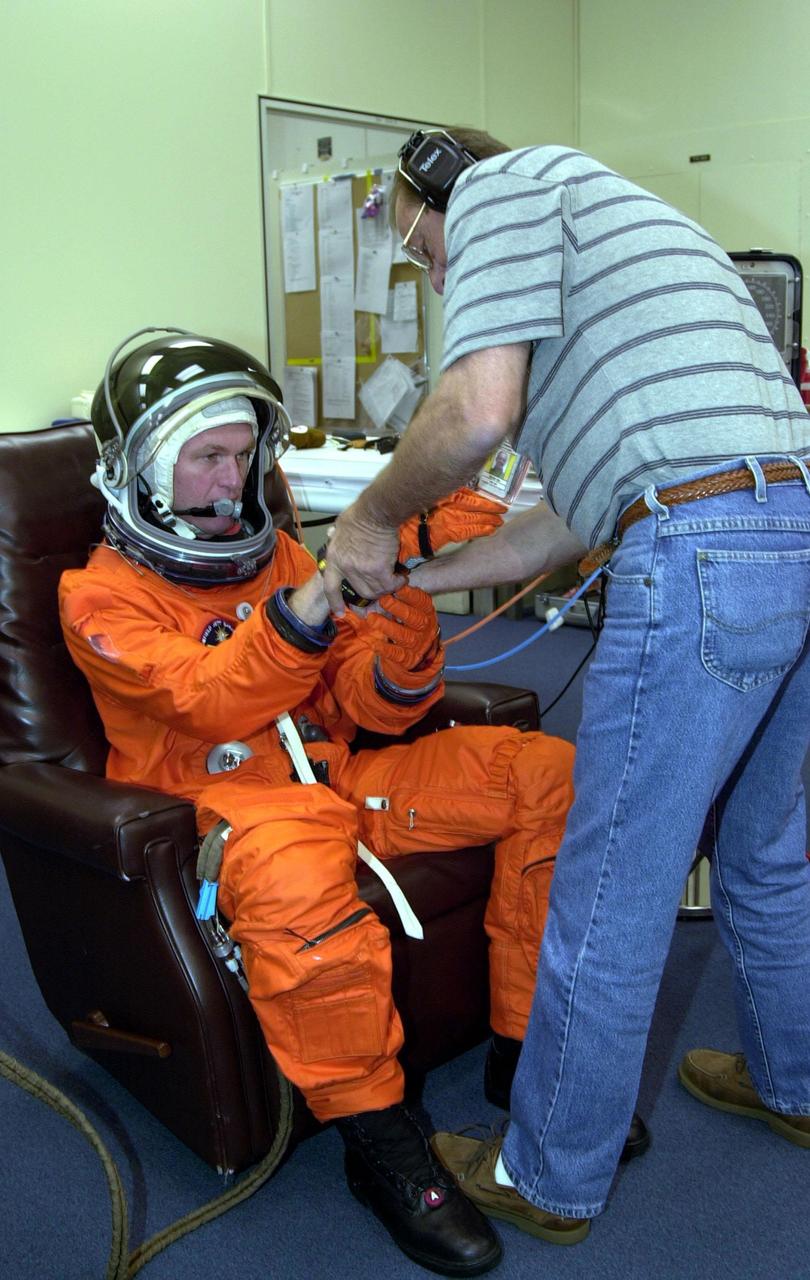
During pre-pack and fit check in the Operations and Checkout Building, STS-97 Commander Brent Jett gets help with his gloves from suit technician Bill Todd. Mission STS-97 is the sixth construction flight to the International Space Station. Its payload includes the P6 Integrated Truss Structure and a photovoltaic (PV) module, with giant solar arrays that will provide power to the Station. The mission includes two spacewalks to complete the solar array connections. STS-97 is scheduled to launch Nov. 30 at about 10:06 p.m. EST
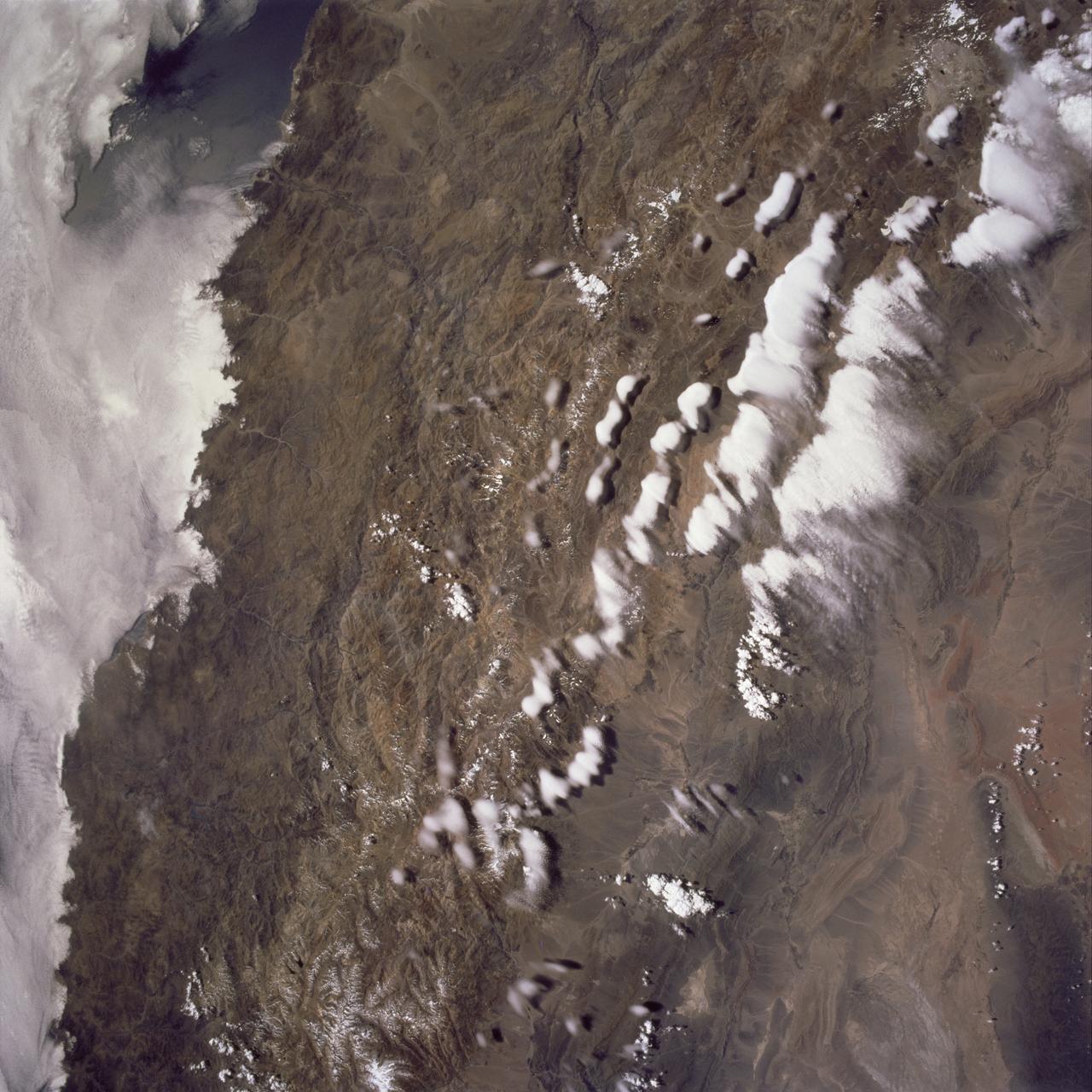
STS097-715-061 (10 December 2000) This view over the Central Andes Mountains in Argentina and Chile was taken on December 10, 2000 by one of the astronauts aboard the Earth-orbiting Space Shuttle Endeavour. Extending 5500 miles (8850 kilometers) along the western coast of South America from northern Colombia to Cape Horn in southern Chile, the Andes are the longest mountain range, above sea level, and the second highest range in the world. According to NASA scientists studying the STS-97 photo collection, this immense system came into existence nearly 70 million years ago. With numerous active volcanoes and a slow uplift, the building of the Andes Mountains continues today rising four inches (10 centimeters) per century, the scientists say. In this north-looking view, snow covers the higher peaks of the range, some of which rise to over 20000 feet (6100 meters) above sea level. Along the left or western portion of the view, clouds can be seen along coastal areas of Chile. In the bottom left quadrant of the scene, the blue waters of the Paloma Reservoir, a recreational lake, are visible. The folded Tontal Range (bottom center) and the Valle Fertil Range (upper right quadrant and partially cloud covered) of western Argentina can be seen. The rocks of these ranges, the scientists point out, are ancient compared to the younger volcanic peaks and ranges of the Andes. The city of San Juan, Argentina is visible on the eastern (right) base of the Tontal Range in the lower right quadrant of the view.