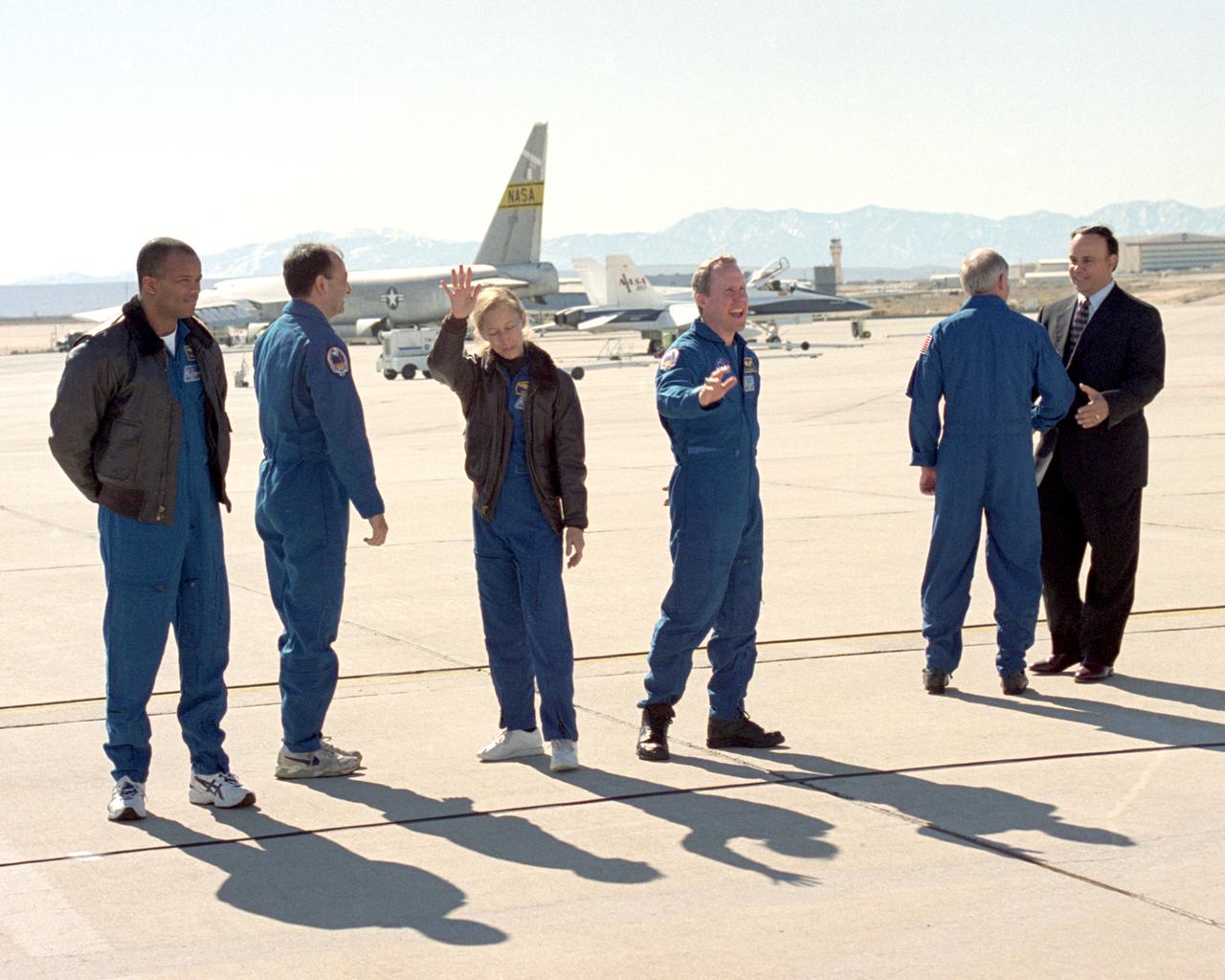
The five crew members of the Space Shuttle Atlantis on the STS-98 mission depart NASA Dryden to return to the Johnson Space Center at Houston. They briefly extended greetings to Dryden staff members on the ramp area behind Dryden's Main Building at a crew ceremony on February 21, 2001.
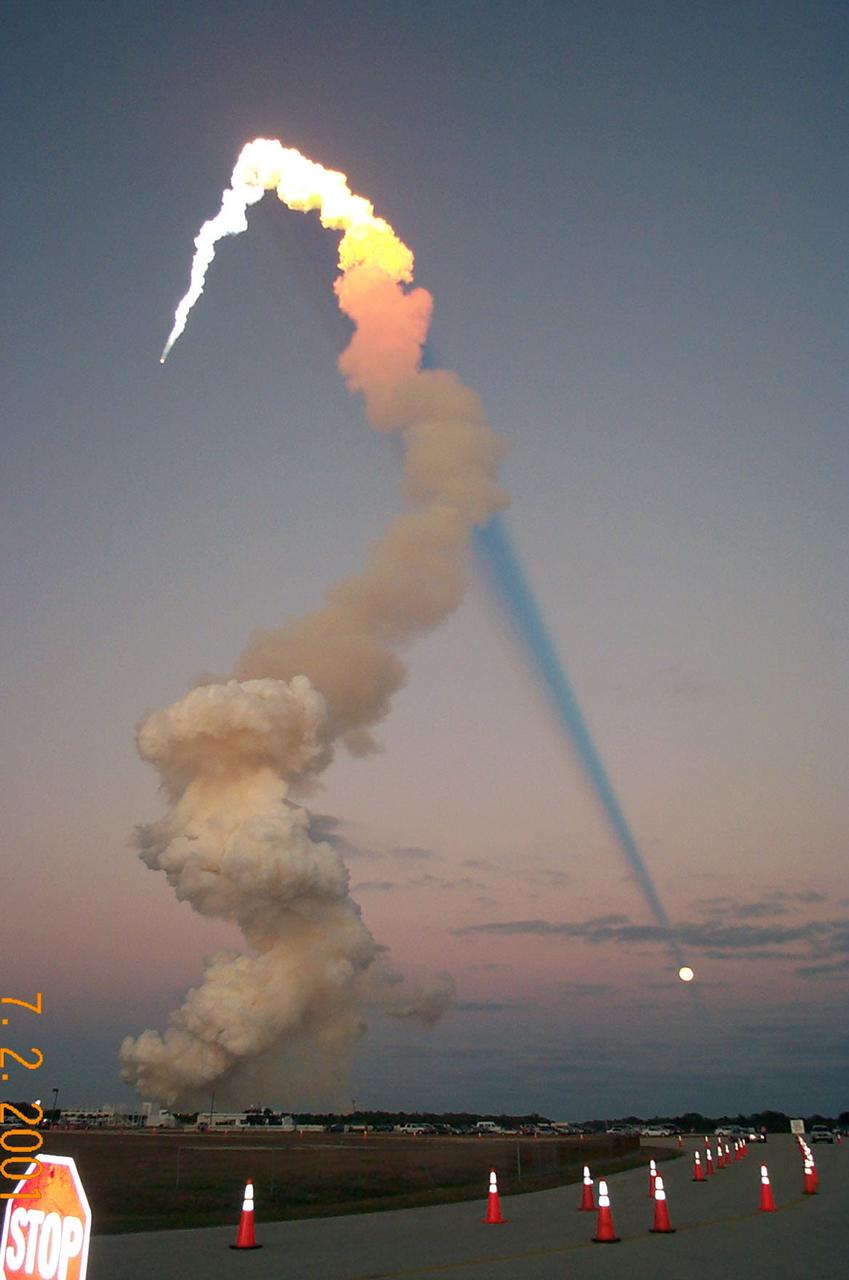
This awesome image depicts the full moon, sunset launch of the Space Shuttle Orbiter Atlantis STS-98 mission on February 7, 2001 at 6:13 p.m. eastern time. The large white plume is the pillar of smoke and stream left behind by the solid rocket boosters. The very bright dot that exists above the plume is the flame still visible at the base of the rocket boosters. The top of the plume is being directly illuminated by sunlight whereas the bottom portion lies within the Earth's shadow. The bright orb in the lower right-hand corner of the image is the full sunlit face of the moon which has already risen above the eastern horizon. The dark cone-shaped feature extending downward towards the moon is the smoke plume shadow, known as the Bugeron Effect (common during sunrise and sunset launches). The Earth, Moon, and Sun were naturally in alignment causing the shadow to appear to end at the moon. (Photo courtesy Patrick McCracken, NASA Headquarters)
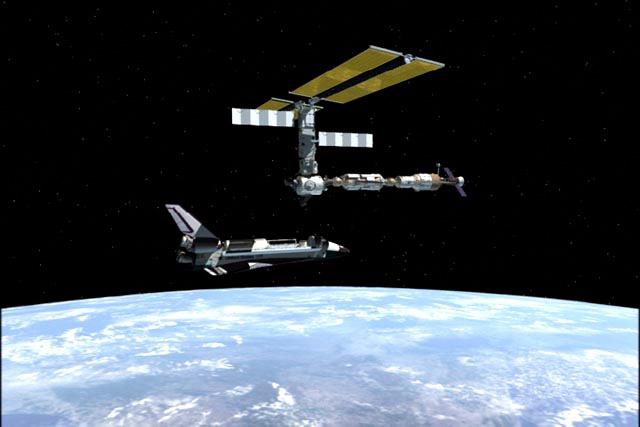
JSC2001-E-00356 (January 2001) --- Artist's rendering of early STS-98/ISS 5A with the Space Shuttle Atlantis in view during rendezvous and docking operations.
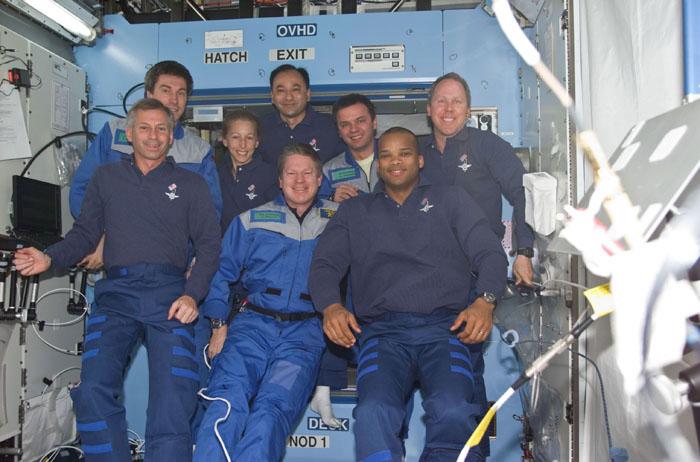
STS98-E-5276 (15 February 2001) --- Six NASA astronauts and two Russian cosmonauts pose for a group portrait representing both shuttle and station crews near the end of several days of joint work aboard the International Space Station (ISS). In front, from the left, are astronauts Kenneth D. Cockrell, STS-98 commander; William M. (Bill) Shepherd, Expedition One commander; and Robert L. Curbeam, STS-98 mission specialist. In the rear, from the left, are cosmonaut Sergei K. Krikalev, Expedition One flight engineer; astronaut Marsha S. Ivins, STS-98 mission specialist; astronaut Mark L. Polansky, shuttle pilot; cosmonaut Yuri P. Gidzenko, Soyuz commander for Expedition One; and astronaut Thomas D. Jones, shuttle mission specialist.
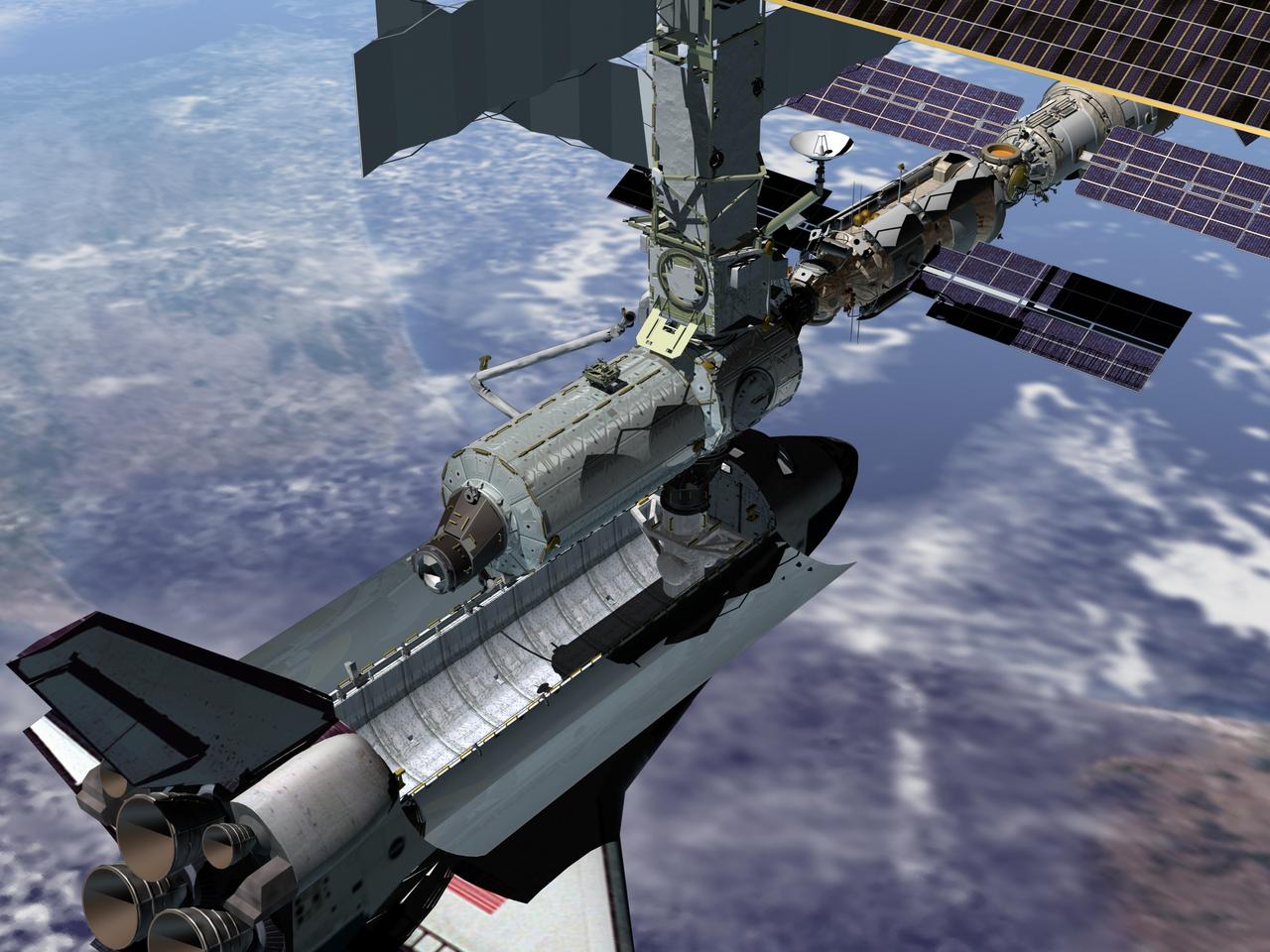
JSC2001-E-00359 (January 2001) --- Artist's rendering of Space Shuttle Atlantis (STS-98) docked with International Space Station (ISS) during 5A. Note new position of U.S. Laboratory Destiny.
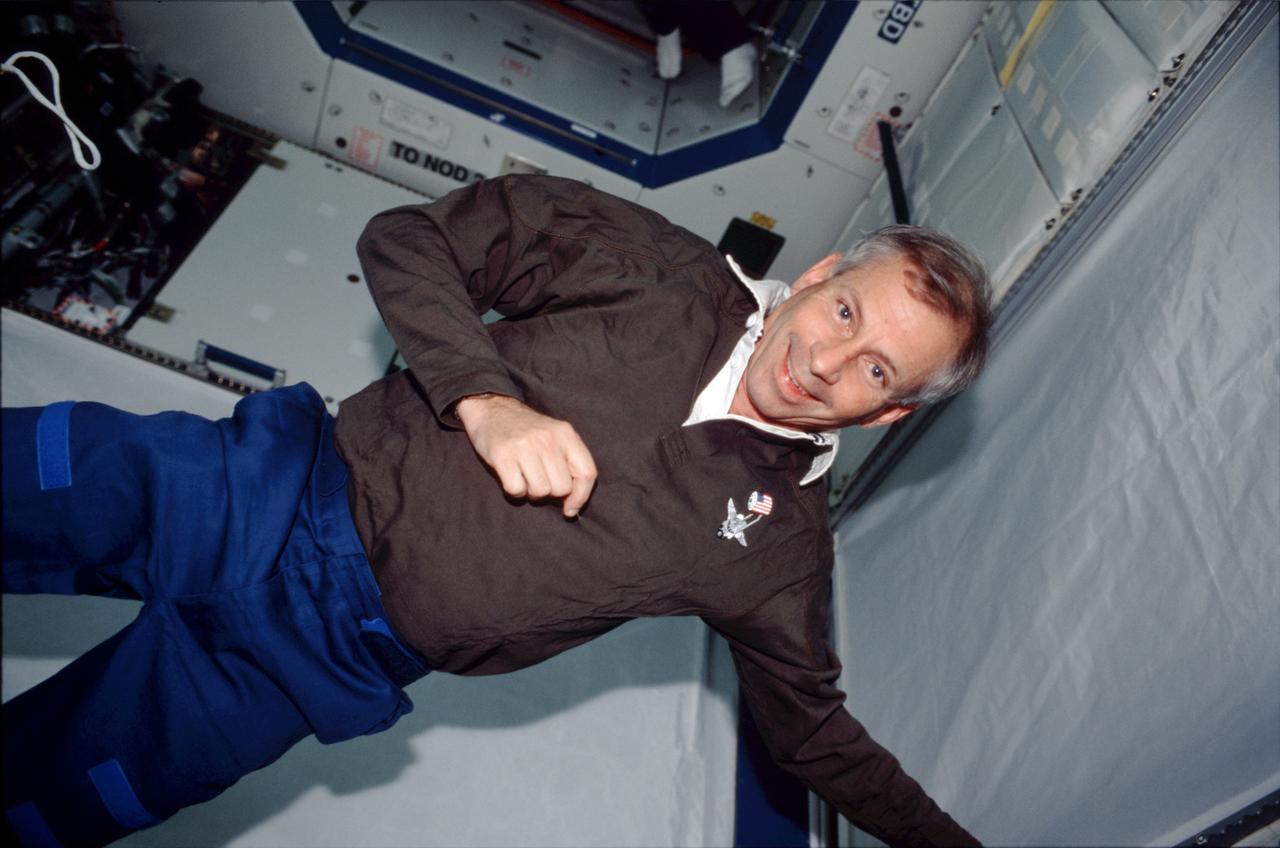
STS098-323-0005 (7-20 February 2001) --- Astronaut Kenneth D. Cockrell, STS-98 mission commander, floats in the newly attached Destiny laboratory onboard the International Space Station (ISS).
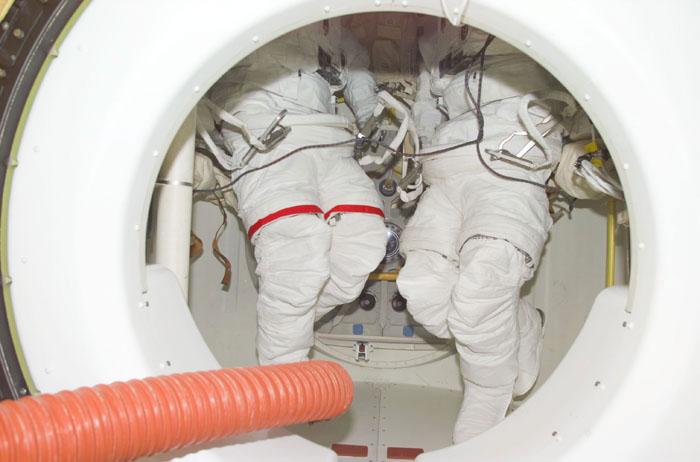
STS98-E-5012 (8 February 2001) --- The bottom portions of the extravehicular mobility units (EMU) for STS-98's two space walkers are seen in the airlock aboard the Space Shuttle Atlantis during early stages of the STS-98 mission. Astronaut Thomas D. Jones will be using the suit on the left, and astronaut Robert L. Curbeam will don the one on the right. The two mission specialists are scheduled for extravehicular activity (EVA) once the shuttle is docked with the International Space Station (ISS) later in the week. The scene was recorded with a digital still camera.
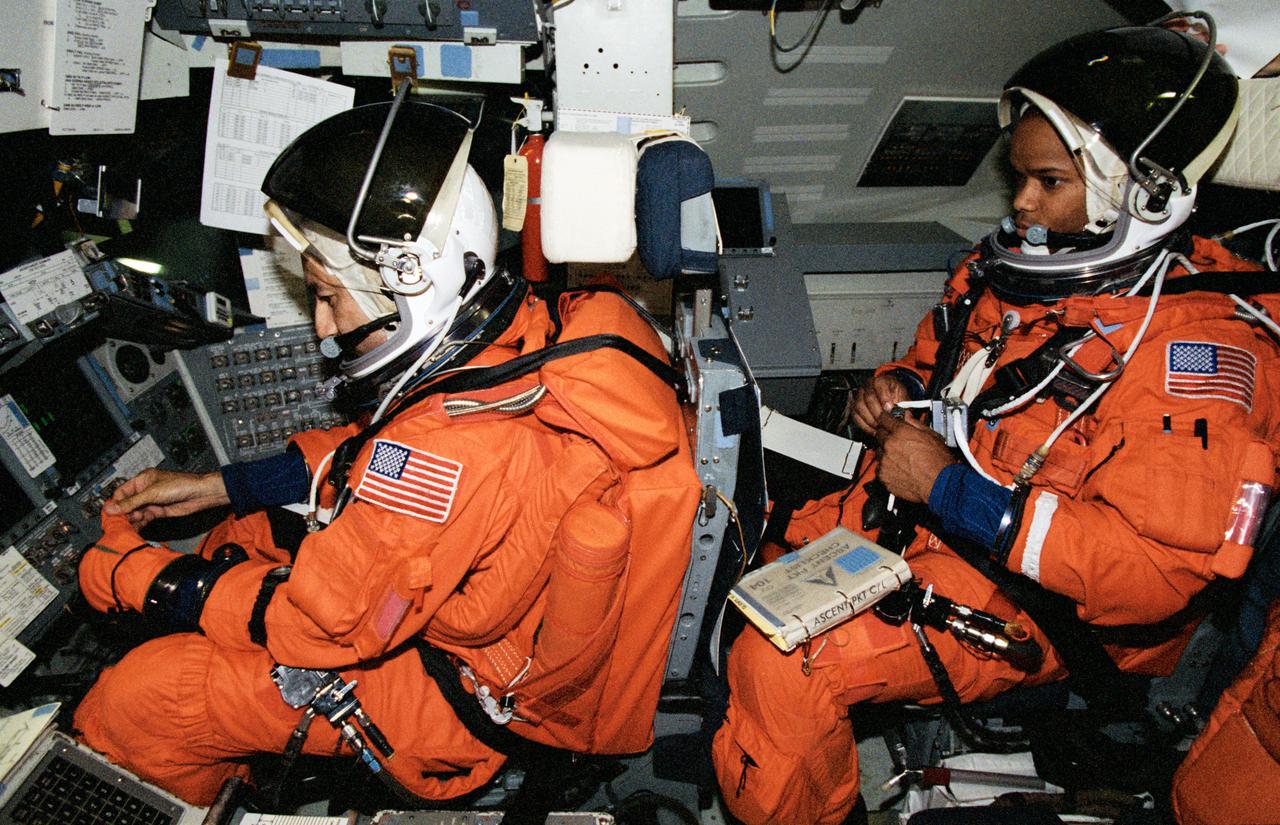
Photographic documentation showing STS-98 crewmembers engaging in preflight training in bldg. 5. Views include: STS-98 mission commander Kenneth D. Cockrell, wearing a Launch Entry Suit (LES) and a helmet, sits in the commanders station on the flight deck of the mobile-based Shuttle Mission Simulator (SMS) (04774); STS-98 pilot Mark L. Polansky, wearing LES and helmet, sits in the pilots station, with STS-98 Mission Specialist (MS) Robert L. Curbeam seated behind him on the flight deck (04775); Polansky in the pilots station (04776); Curbeam in a LES and wearing a Communications Carrier Assembly (CCA) (04777); Polansky and Curbeam pose, wearing LES and no helmets, in bldg. 5 (04778); Polansky, wearing a LES, fastens his CCA (04779); Cockrell, Polansky, Curbeam and STS-98 MS Marsha S. Ivins, wearing LES, sit in locker room (04780); Ivins and suit techs (04781); suit techs and Polansky (04782); suit techs and Cockrell (04783).
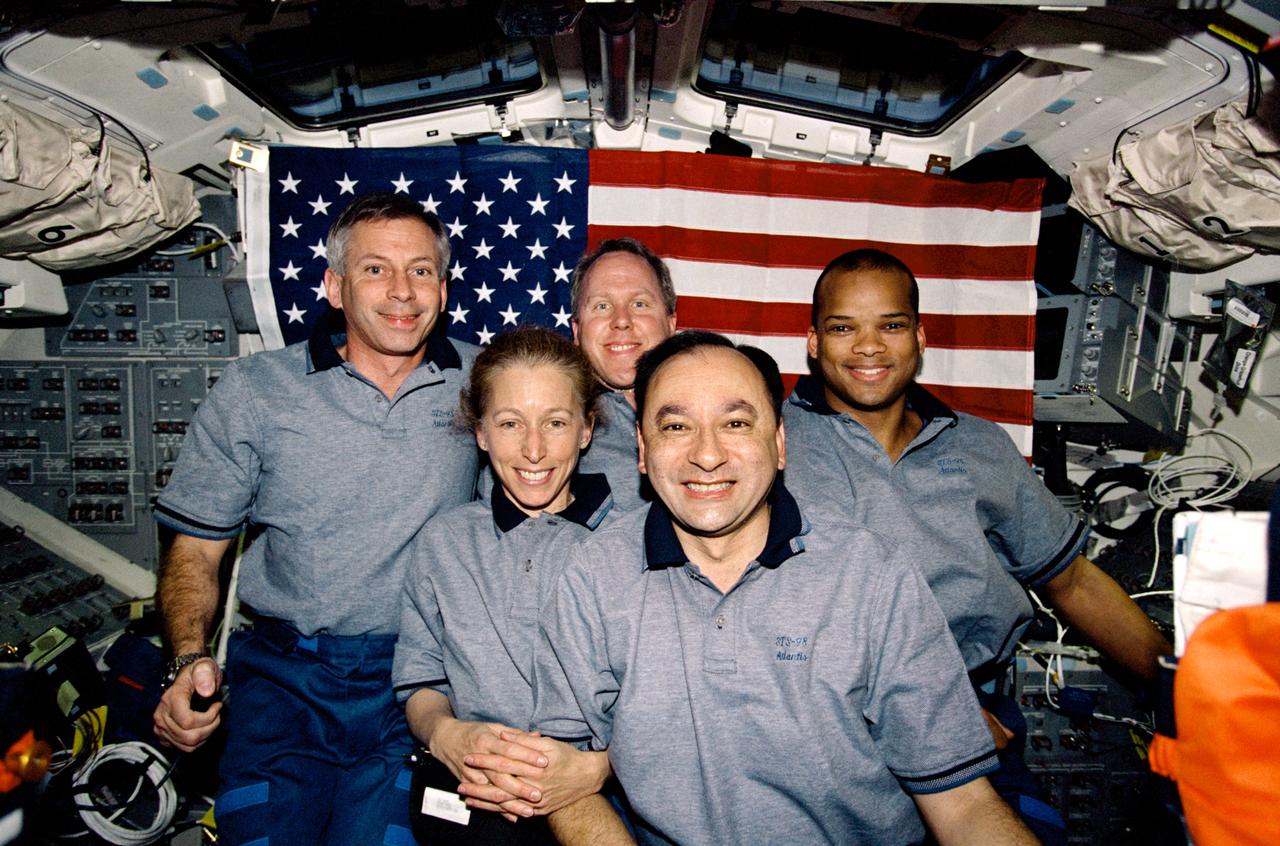
STS098-365-0034 (7-20 February 2001) --- The crew of the STS-98 mission poses for the traditional inflight portrait on the flight deck of the Space Shuttle Atlantis. From left are astronauts Kenneth D. Cockrell, mission commander; Marsha S. Ivins, mission specialist; Thomas D. Jones, mission specialist; Mark L. Polansky, pilot; and Robert L. Curbeam, mission specialist.
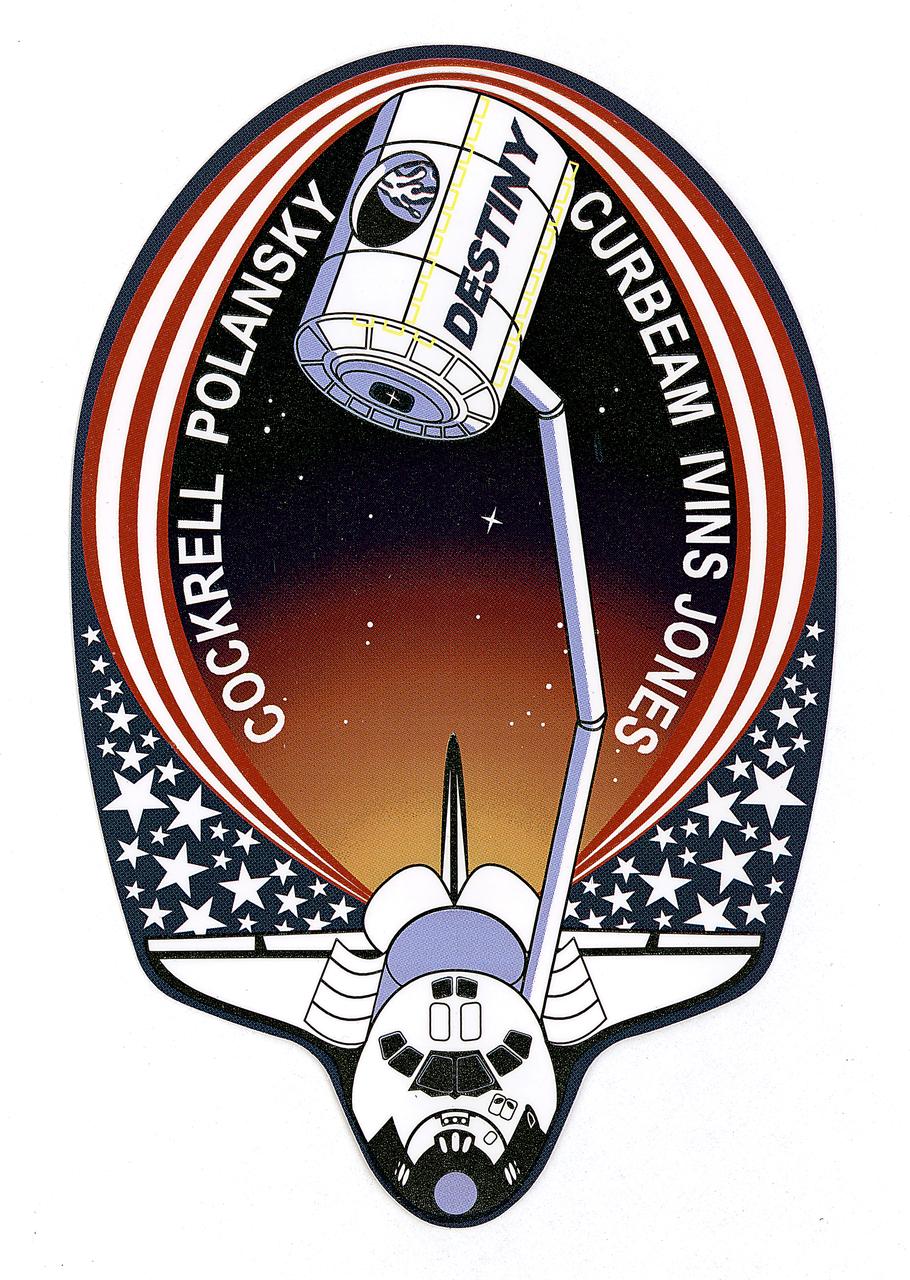
This is the insignia for STS-98, which marks a major milestone in assembly of the International Space Station (ISS). Atlantis' crew delivered the United States Laboratory, Destiny, to the ISS. Destiny will be the centerpiece of the ISS, a weightless laboratory where expedition crews will perform unprecedented research in the life sciences, materials sciences, Earth sciences, and microgravity sciences. The laboratory is also the nerve center of the Station, performing guidance, control, power distribution, and life support functions. With Destiny's arrival, the Station will begin to fulfill its promise of returning the benefits of space research to Earth's citizens. The crew patch depicts the Space Shuttle with Destiny held high above the payload bay just before its attachment to the ISS. Red and white stripes, with a deep blue field of white stars, border the Shuttle and Destiny to symbolize the continuing contribution of the United States to the ISS. The constellation Hercules, seen just below Destiny, captures the Shuttle and Station's team efforts in bringing the promise of orbital scientific research to life. The reflection of Earth in Destiny's window emphasizes the connection between space exploration and life on Earth.
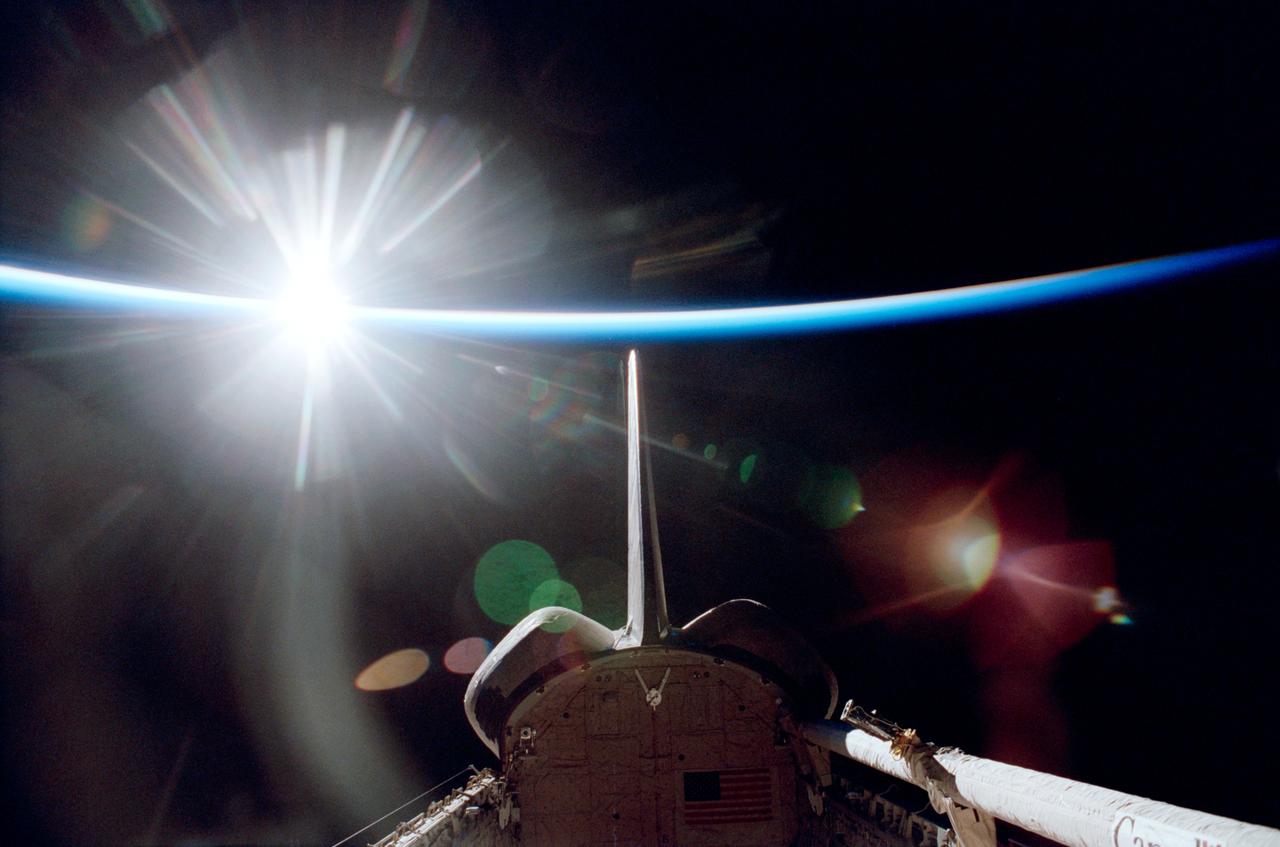
STS098-333-0007 (7-20 February 2001) --- A "sunburst" at Earth's limb caught the attention of one of the STS-98 astronauts who was standing on the aft flight deck of the Space Shuttle Atlantis at the time. Various colors are reflected at different points in the 35mm frame.
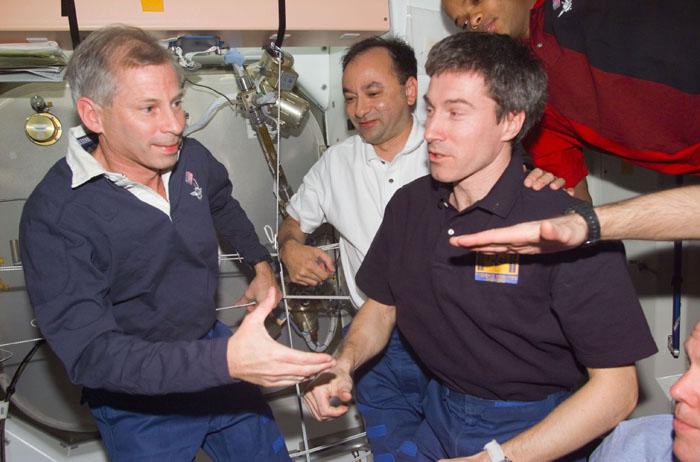
STS98-E-5295 (16 February 2001) --- Astronaut Kenneth D. Cockrell (left), STS-98 mission commander, participates in farewells with Expedition One crew members. Cosmonaut Sergei K. Krikalev (right foreground), Expedition One flight engineer, is one of three crew members who will stay behind for several weeks prior to return to Earth. Astronauts Mark L. Polansky, STS-98 pilot, and Robert L. Curbeam, mission specialist, are also pictured. The scene was recorded with a digital still camera.

JSC2000-04779 (16 June 2000) --- Astronaut Mark Polansky, STS-98 pilot, secures the head gear on a training version of the shuttle full-pressure launch and entry garment. He was about to join his crew mates for a simulation exercise in the motion-base shuttle mission simulator in the Johnson Space Center's Mission Simulation and Training Facility. Launch for STS-98 is scheduled for early next year.
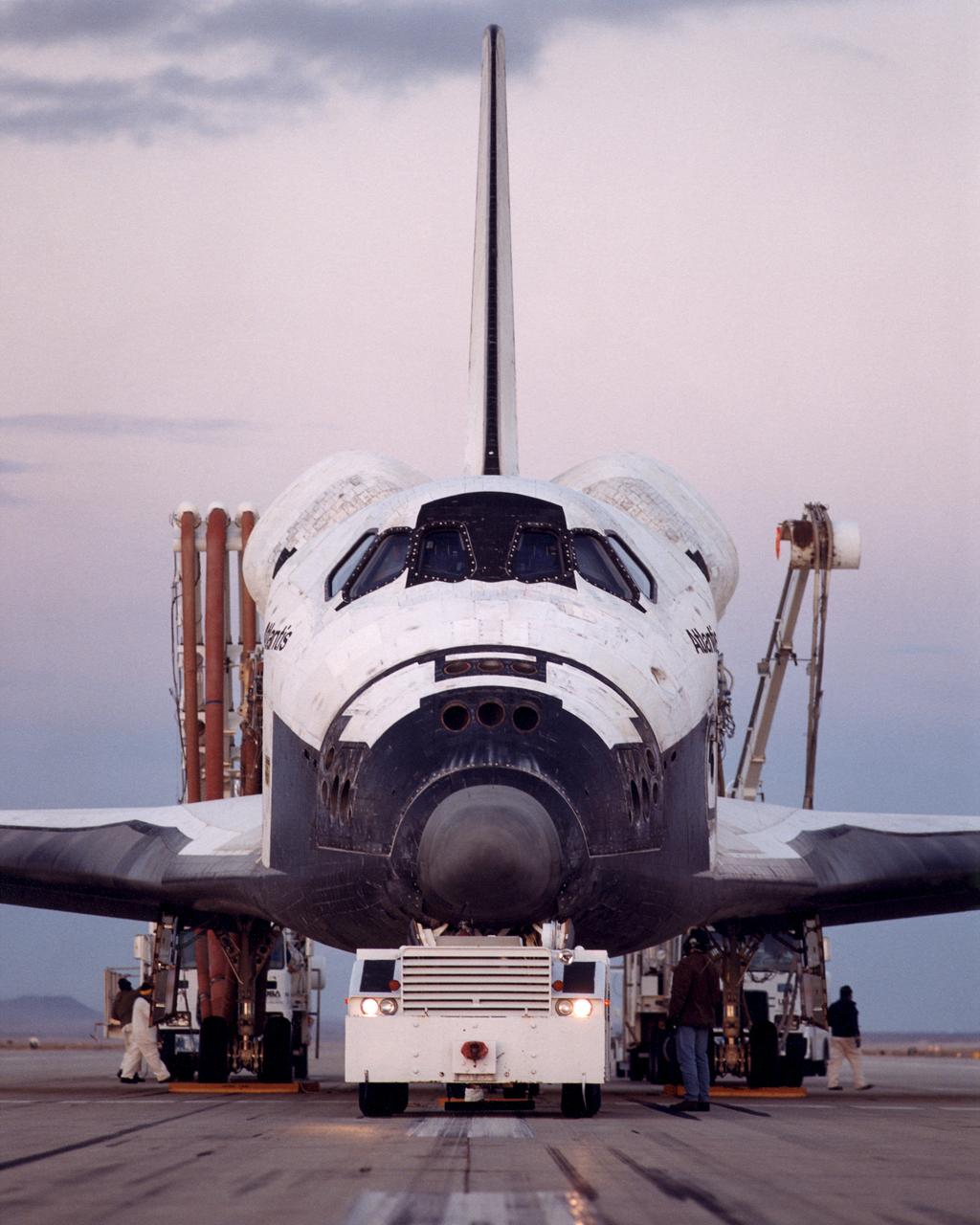
Space Shuttle Atlantis landed at 12:33 p.m. February 20, 2001, on the runway at Edwards Air Force Base, California, where NASA's Dryden Flight Research Center is located. The mission, which began February 7, logged 5.3 million miles as the shuttle orbited earth while delivering the Destiny science laboratory to the International Space Station. Inclement weather conditions in Florida prompted the decision to land Atlantis at Edwards. The last time a space shuttle landed at Edwards was Oct. 24, 2000.
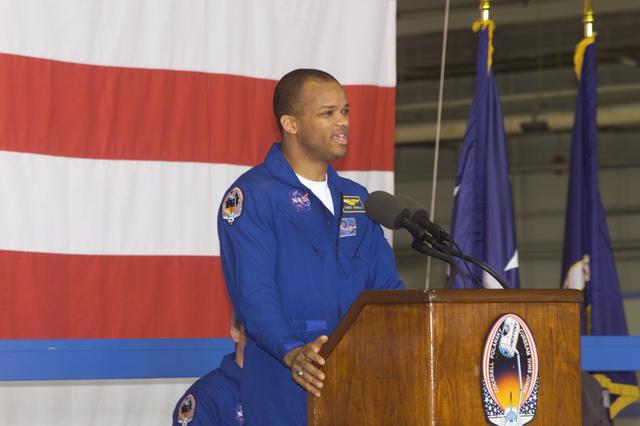
JSC2001-E-04809 (21 February 2001) --- Astronaut Robert L. Curbeam, mission specialist, speaks to a crowd at the welcome home ceremony for the five STS-98 crew members.
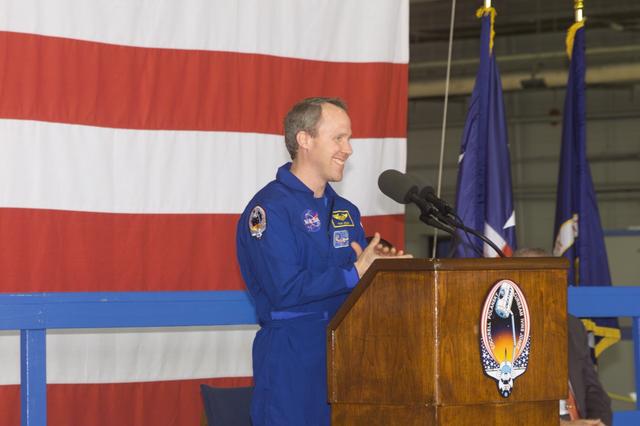
JSC2001-E-04808 (21 February 2001) --- Astronaut Thomas D. Jones, mission specialist, speaks to a crowd at the welcome home ceremony for the five STS-98 crew members.
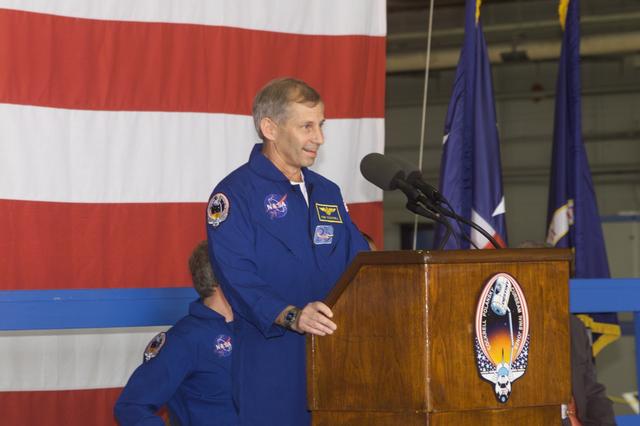
JSC2001-E-04806 (21 February 2001) --- Astronaut Kenneth D. Cockrell, mission commander, speaks to a crowd at the welcome home ceremony for the five STS-98 astronauts.
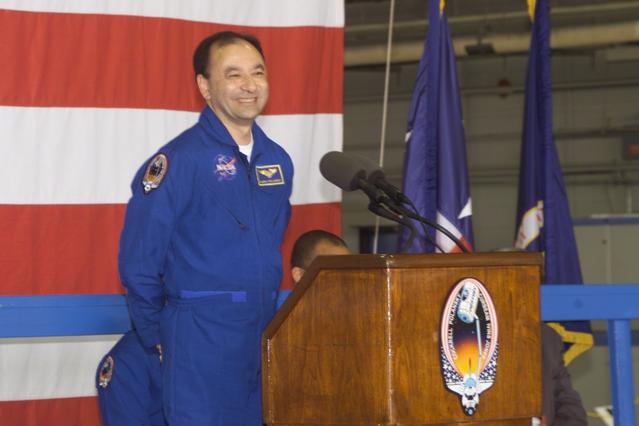
JSC2001-E-04807 (21 February 2001) --- Astronaut Mark L. Polansky, pilot, shares a few thoughts about his first space mission with well wishers on hand at the STS-98 crew's return at Ellington Field.
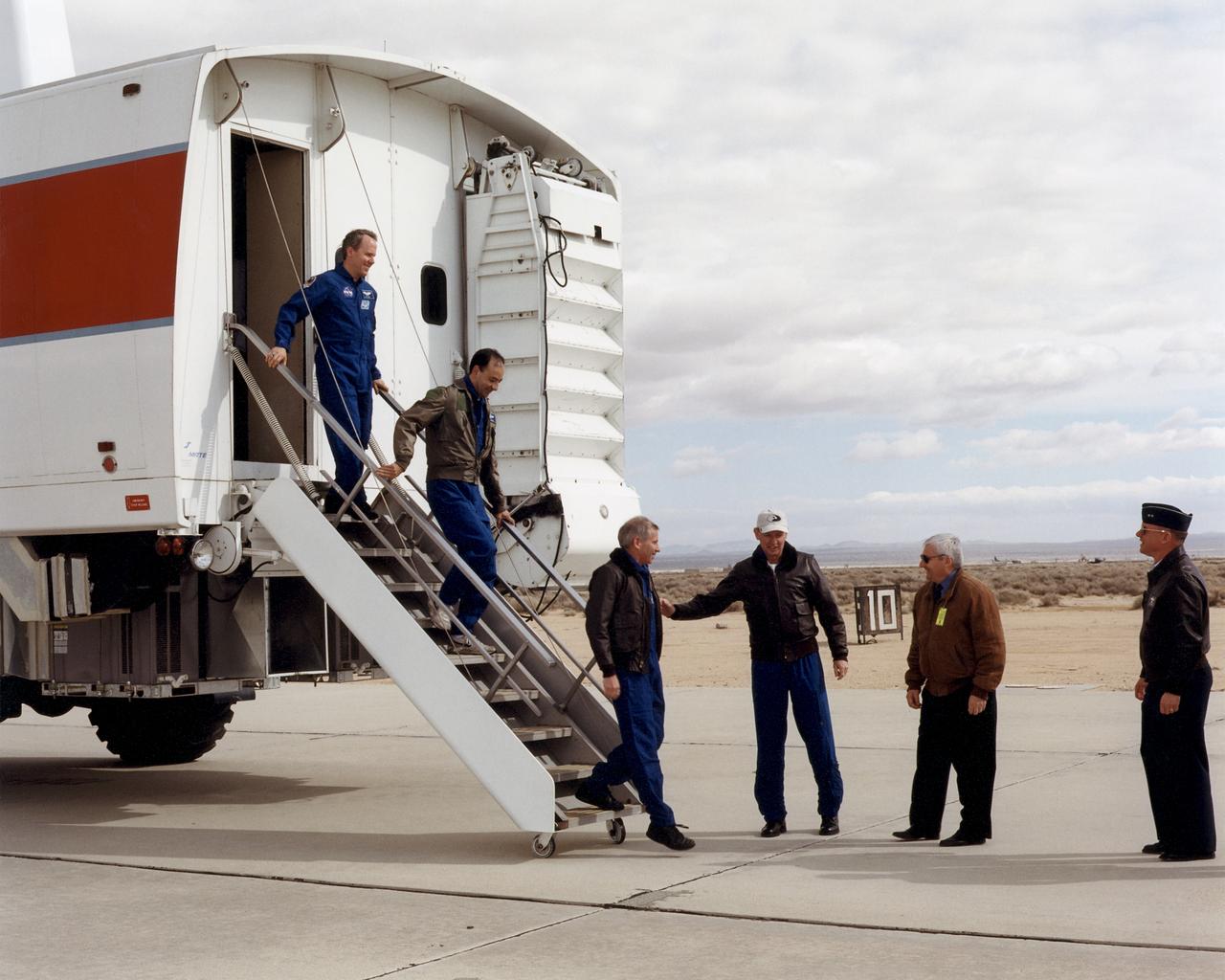
L to R: STS-98 Mission Specialist Thomas Jones, Pilot Mark Polansky, and Commander Kenneth Cockrell greet STS-92 Commander Brian Duffy, Dryden Center Director Kevin Petersen, and AFFTC Commander Major General Richard Reynolds after landing on the runway at Edwards Air Force Base, California, where NASA's Dryden Flight Research Center is located.
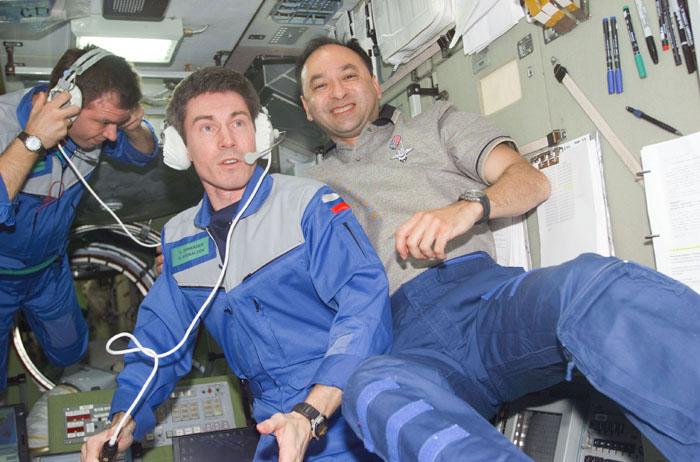
STS98-E-5061 (9 February 2001) --- Cosmonauts Sergei K. Krikalev (center), Expedition One flight engineer, and Yuri P. Gidzenko (left), Soyuz commander for the first station expedition crew, are pictured with astronaut Mark L. Polansky, STS-98 pilot, in the Zvezda Service Module of the International Space Station. The cosmonauts, who represent the Russian Aviation and Space Agency, are communicating with ground controllers in Russia. The scene was recorded with a digital still camera shortly after the outpost's hatches were opened on STS-98 Flight Day 3.
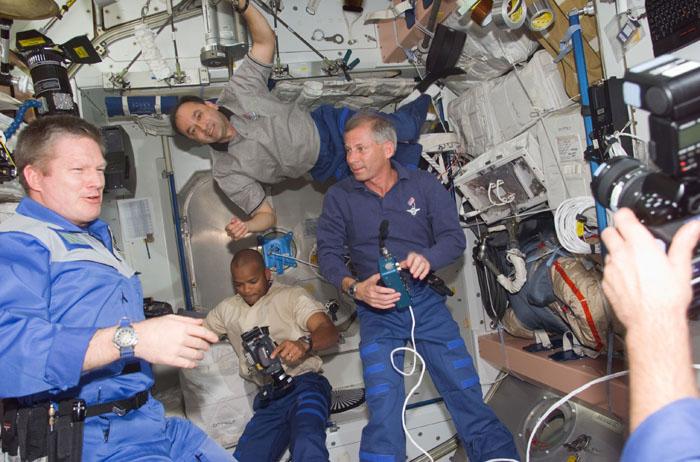
S98-E-5051 (9 February 2001) --- Astronaut William M. (Bill) Shepherd (left foreground), Expedition One commander, looks into the camera lens of a fellow crew member while three STS-98 visitors check out the International Space Station (ISS). Astronaut Kenneth D. Cockrell, STS-98 mission commander, is at right; astronaut Mark L. Polansky, pilot, floats above and behind the shuttle commander; and astronaut Robert L. Curbeam, mission specialist, inspects a camera at bottom center. This scene was recorded with a digital still camera.
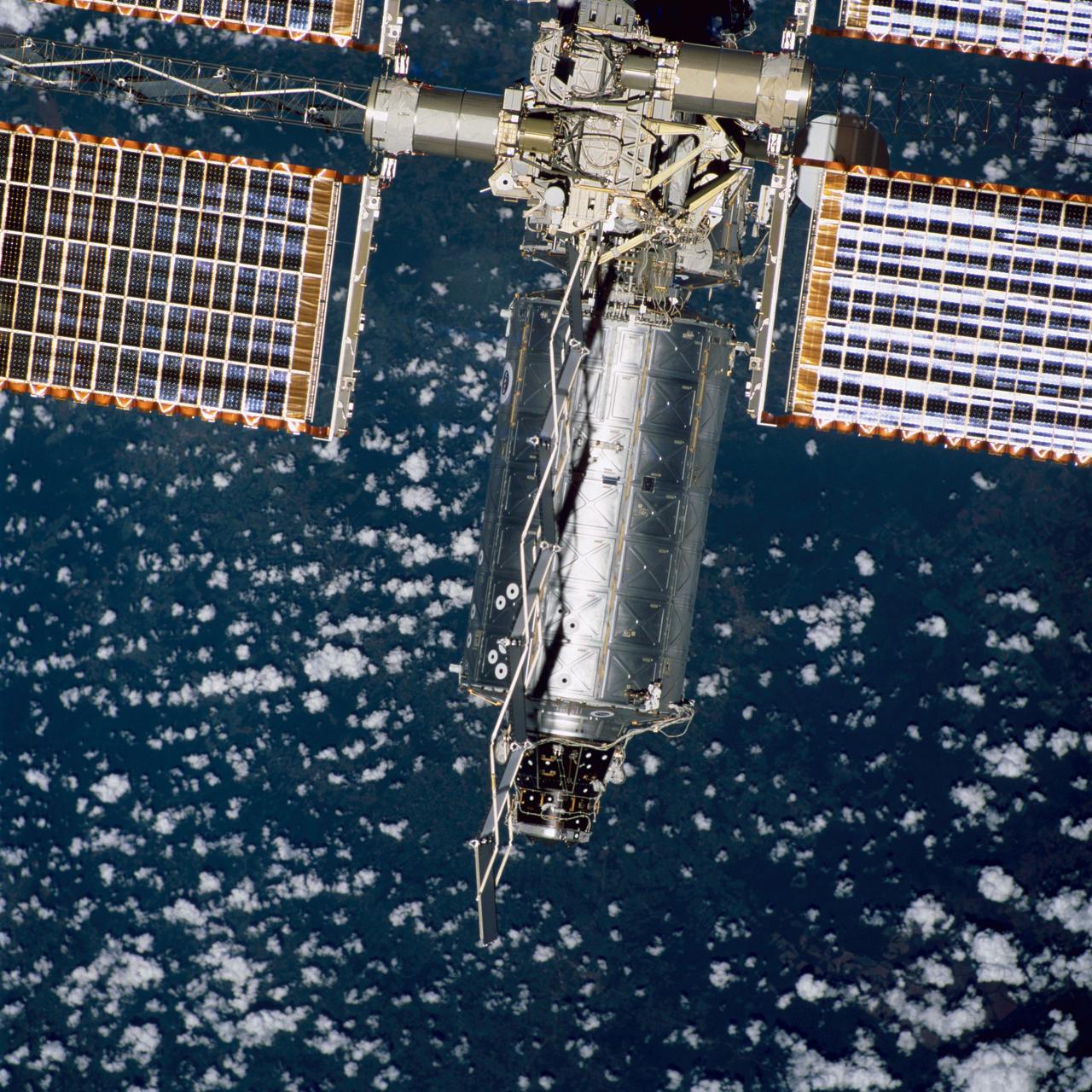
STS098-706-026 (7-20 February 2001) --- Backdropped by Earth dotted with clouds, this close-up view of the newly-attached Destiny laboratory on the International Space Station (ISS) was photographed by one of the astronauts onboard Atlantis. As the primary payload for the STS-98 mission, Destiny is the centerpiece of the ISS, where unprecedented science experiments will be performed in space. The shuttle and the station parted company at 8:06 a.m. (CST), Feb. 16, as Polansky flew the shuttle halfway around the outpost and its new Destiny laboratory before moving off.
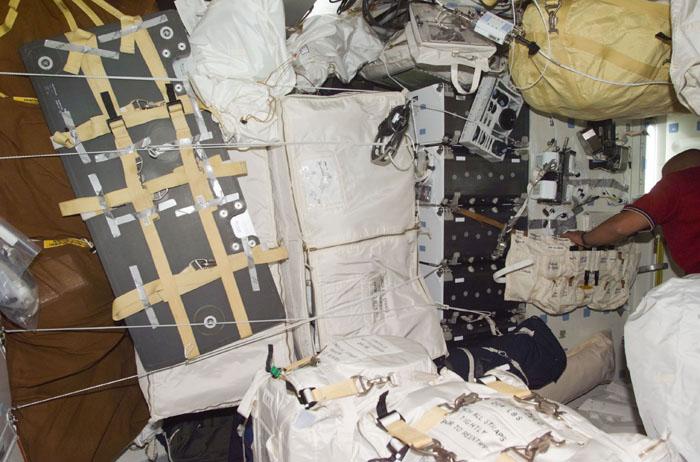
STS98-E-5010 (8 February 2001) --- This mid deck scene on the Earth-orbiting Space Shuttle Atlantis resembles the interior of a moving van, with equipment and supplies temporarily stored there. The STS-98 crew will transfer much of the gear over to the International Space Station (ISS) once the shuttle and station are docked later in the week. The scene was recorded with a digital still camera.
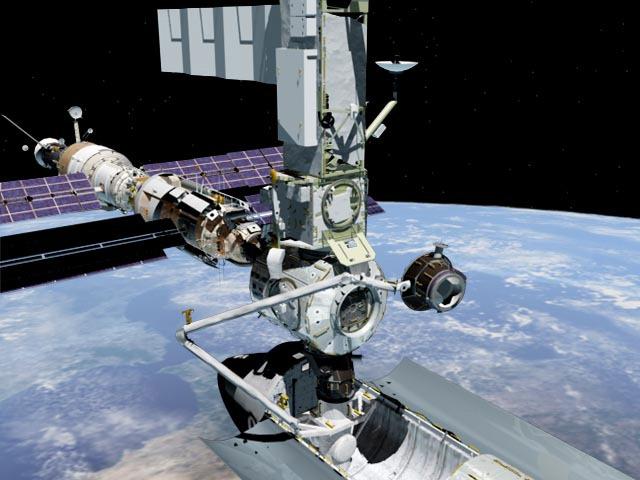
JSC2001-E-00357 (January 2001) --- Artist's rendering of Space Shuttle Atlantis (STS-98) docked with International Space Station (ISS) during 5A. Remote Manipulator System (RMS) has removed the Pressurized Mating Adapter (PMA) from Unity. U.S. Laboratory Destiny is partially visible (lower right) in shuttle cargo bay.
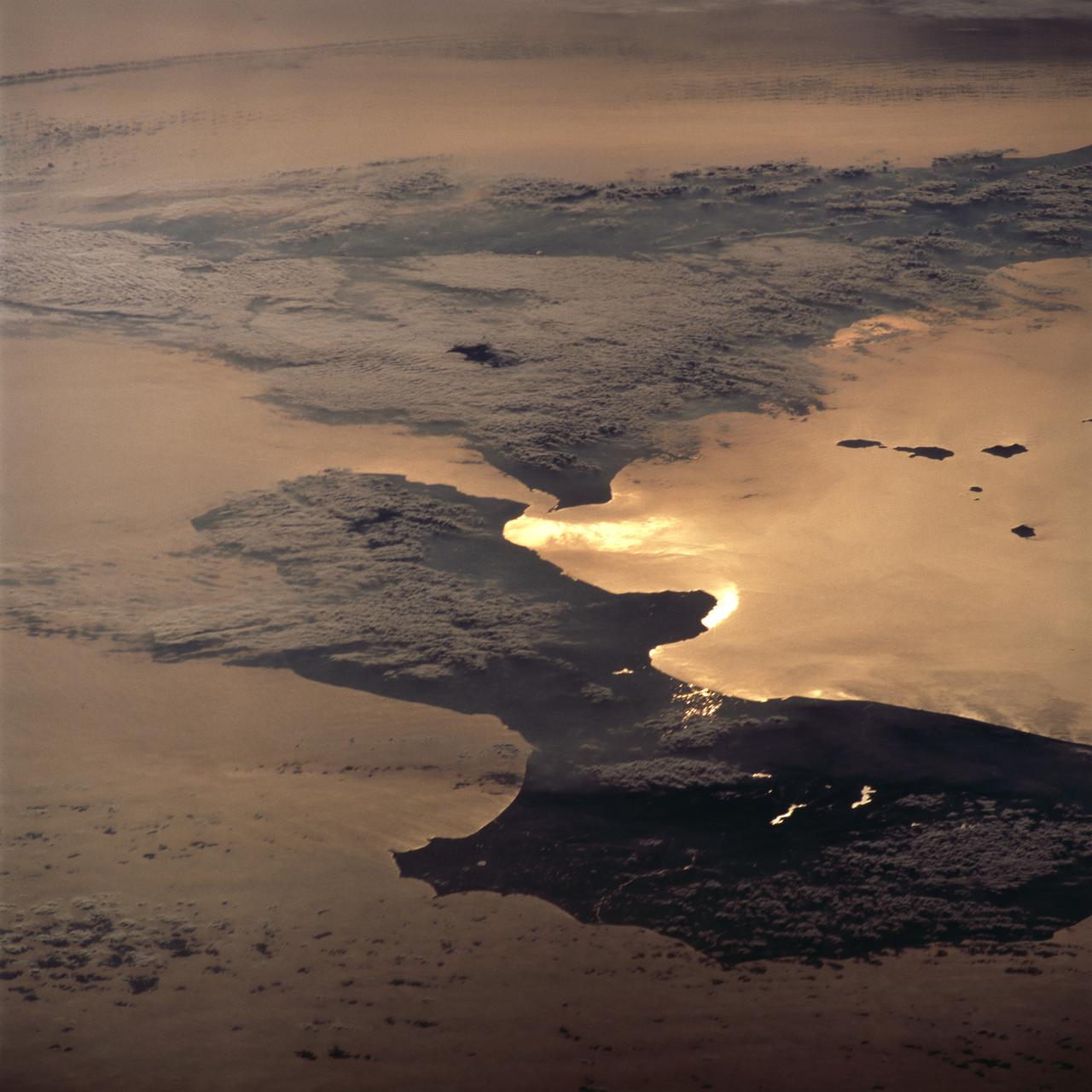
STS098-713-011 (15 February 2001) --- An oblique, westerly-looking view over the Strait of Messini (center), which runs between Italy's "foot" part of the so-called "boot" (bottom) and the heavily cloud-covered Sicily (top). The image was recorded with a handheld 70mm camera by one of the STS-98 crew members aboard the Earth-orbiting Space Shuttle Atlantis. Parts of the Tyrrhenian Sea (right center), Ionian Sea (lower right) and the Mediterranean Sea (left) are covered in the picture.
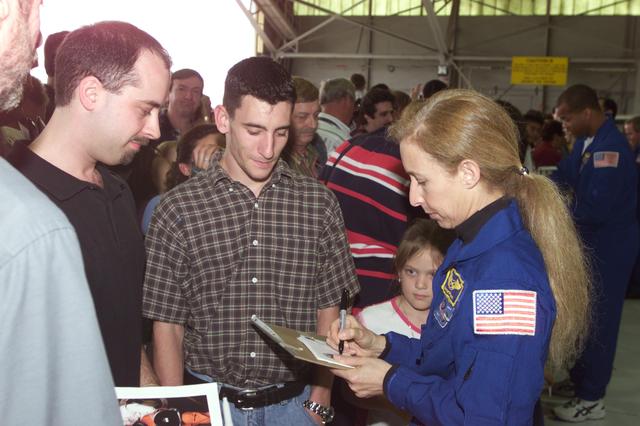
JSC2001-E-04813 (21 February 2001) --- Astronaut Marsha S. Ivins, STS-98 mission specialist, signs some photos and mementoes for members of the crowd on hand at Ellington Field for a brief welcome hom eceremony for the five Atlantis crew members.
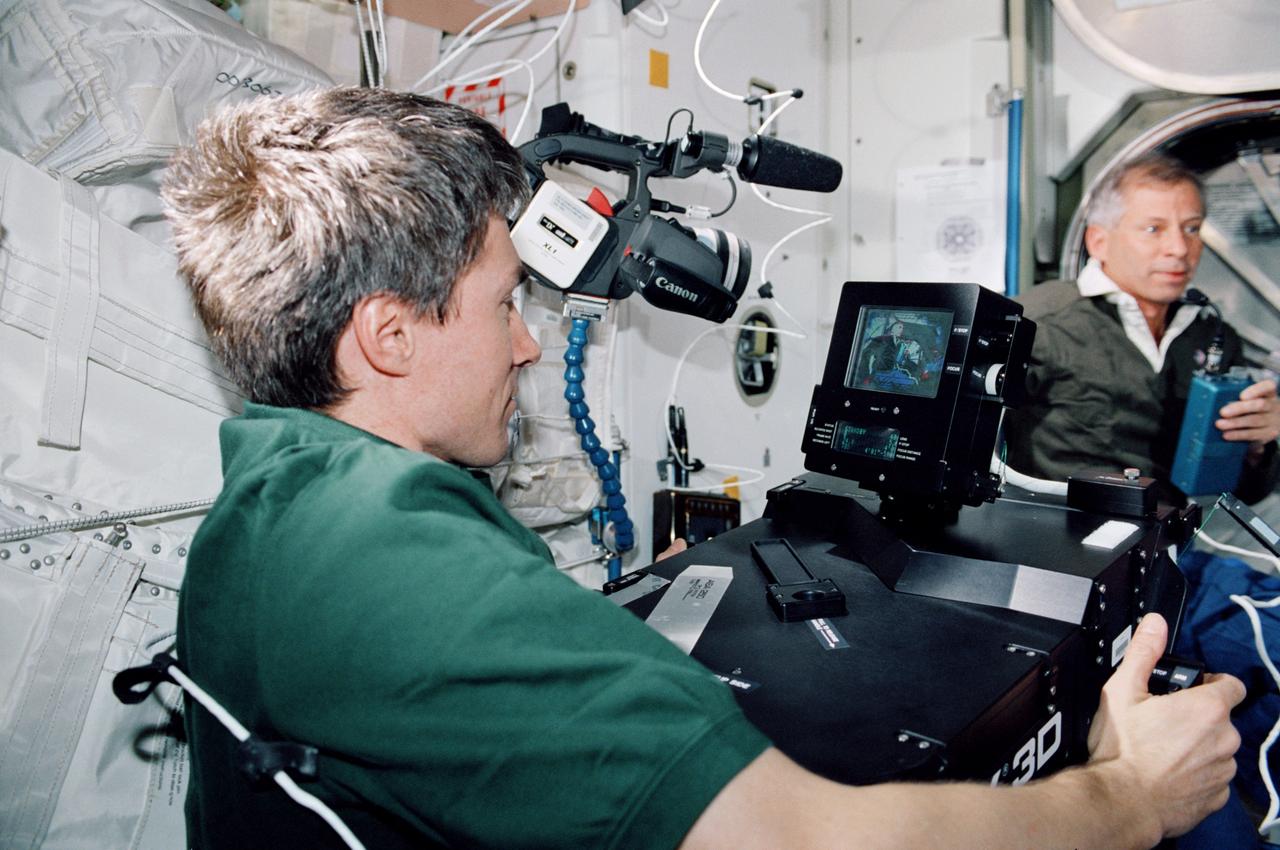
STS098-352-021 (7-20 February 2001) --- Cosmonaut Sergei K. Krikalev, Expedition One flight engineer, photographs astronaut Kenneth D. Cockrell, STS-98 mission commander, using an IMAX camera aboard the newly-attached Destiny laboratory on the International Space Station (ISS). Krikalev represents Rosaviakosmos.
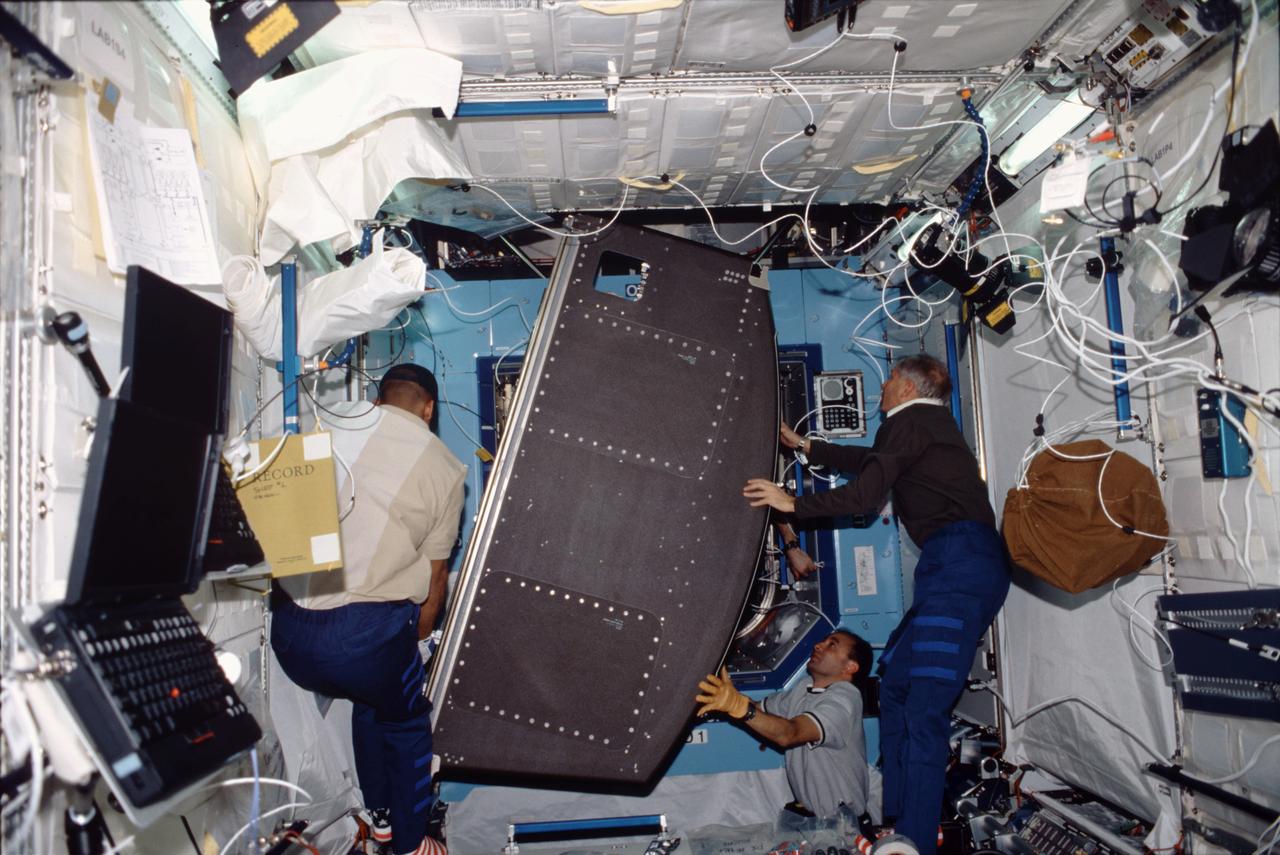
STS098-322-0001 (7-20 February 2001) --- Three STS-98 astronauts move a rack into position aboard the newly attached Destiny laboratory. From the left to right are astronauts Robert L. Curbeam, mission specialist; Mark L. Polansky, pilot; and Kenneth D. Cockrell, mission commander.
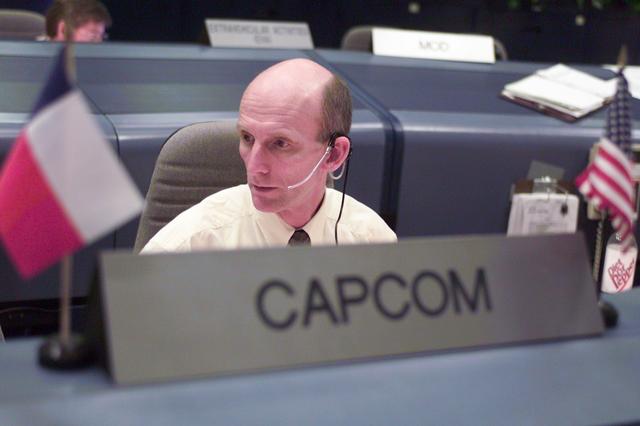
JSC2001-E-04137 (7 February 2001) --- Astronaut Gerhard P.J. Thiele, representing the European Space Agency, monitors information from the Kennedy Space Center (KSC) on STS-98 launch day. Thiele serves as spacecraft communicator (CAPCOM) in the Johnson Space Center's Mission Control Center (MCC).
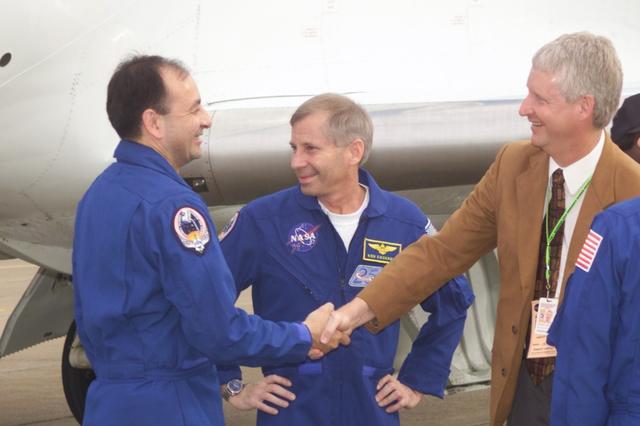
JSC2001-E-04804 (21 February 2001) --- Astronauts Mark L. Polansky (left) and Kenneth D. Cockrell (center), pilot and commander, respectively, for the STS-98 mission, are greeted by Steven A. Hawley of the Flight Crew Operations Directorate upon their return to Houston. The greetings took place prior to a welcoming ceremony at Ellington Field.
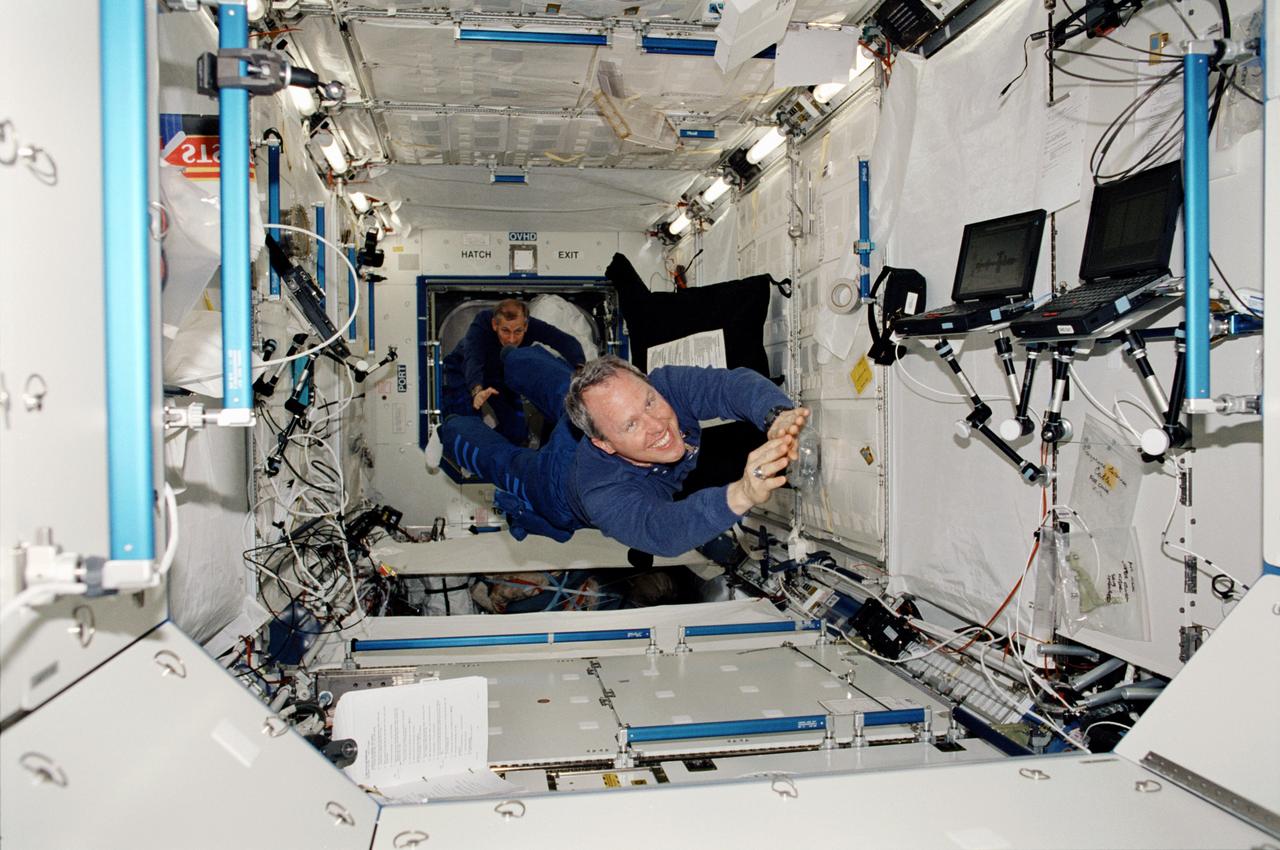
This STS-98 mission photograph shows astronauts Thomas D. Jones (foreground) and Kerneth D. Cockrell floating inside the newly installed Laboratory aboard the International Space Station (ISS). The American-made Destiny module is the cornerstone for space-based research aboard the orbiting platform and the centerpiece of the ISS, where unprecedented science experiments will be performed in the near-zero gravity of space. Destiny will also serve as the command and control center for the ISS. The aluminum module is 8.5-meters (28-feet) long and 4.3-meters (14-feet) in diameter. The laboratory consists of three cylindrical sections and two endcones with hatches that will be mated to other station components. A 50.9-centimeter (20-inch-) diameter window is located on one side of the center module segment. This pressurized module is designed to accommodate pressurized payloads. It has a capacity of 24 rack locations. Payload racks will occupy 15 locations especially designed to support experiments. The Destiny module was built by the Boeing Company under the direction of the Marshall Space Flight Center.
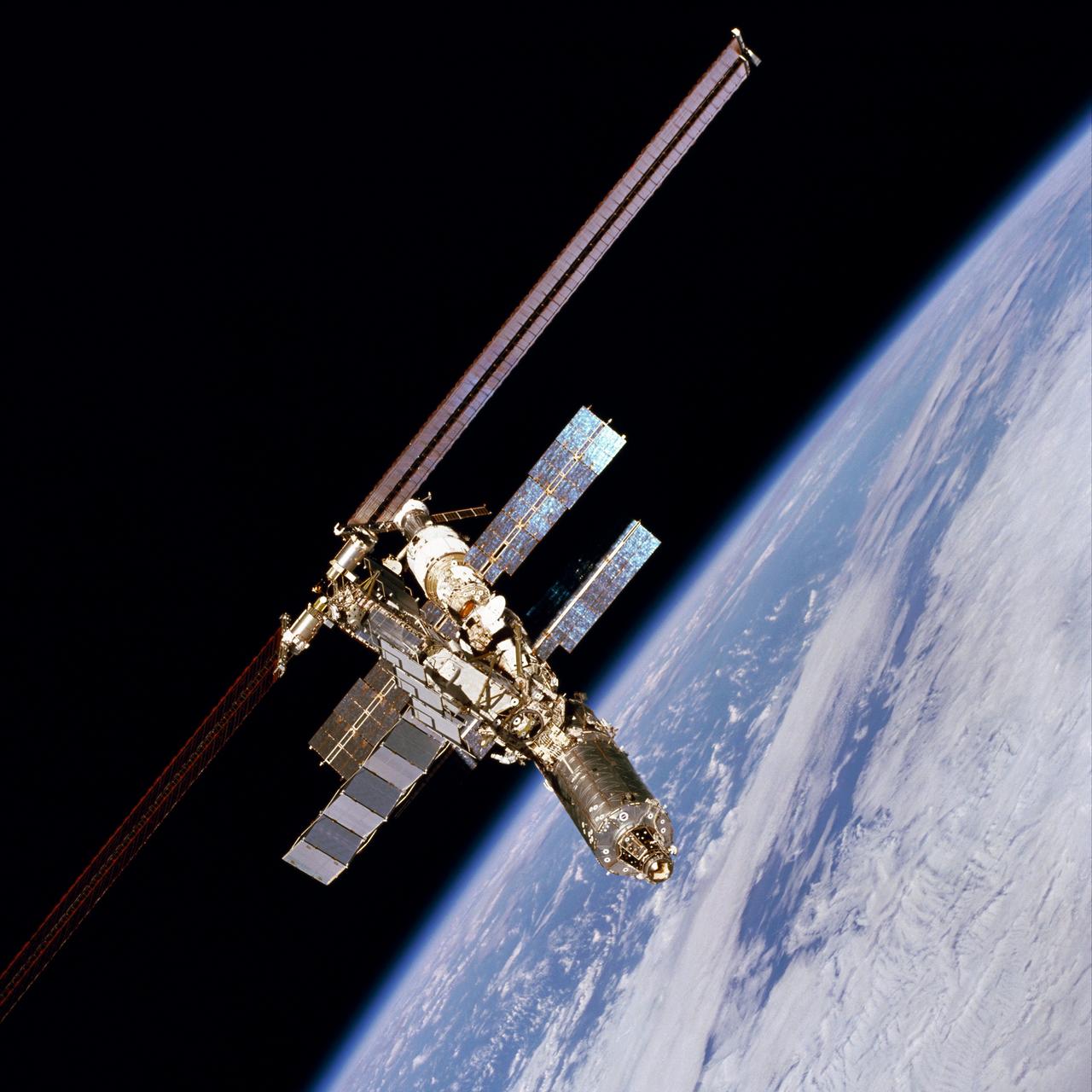
With its new U.S. Laboratory, Destiny, contrasted over a blue and white Earth, the International Space Station (ISS) was photographed by one of the STS-98 crew members aboard the Space Shuttle Atlantis following separation of the Shuttle and Station. The Laboratory is shown at the lower right of the Station. The American-made Destiny module is the cornerstone for space-based research aboard the orbiting platform and the centerpiece of the ISS, where unprecedented science experiments will be performed in the near-zero gravity of space. Destiny will also serve as the command and control center for the ISS. The aluminum module is 8.5- meters (28-feet) long and 4.3-meters (14-feet) in diameter. The laboratory consists of three cylindrical sections and two endcones with hatches that will be mated to other station components. A 50.9-centimeter (20-inch-) diameter window is located on one side of the center module segment. This pressurized module is designed to accommodate pressurized payloads. It has a capacity of 24 rack locations. Payload racks will occupy 15 locations especially designed to support experiments. The Destiny module was built by the Boeing Company under the direction of the Marshall Space Flight Center.
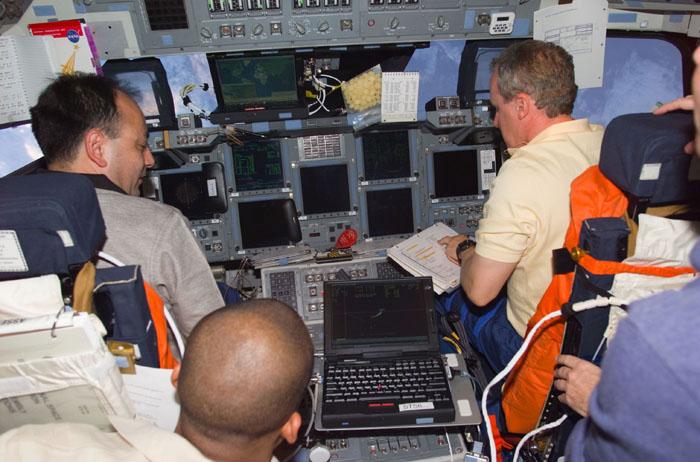
STS98-E-5030 (9 February 2001) --- Three members of the STS-98 crew prepare for rendezvous with the International Space Station (ISS). Astronaut Thomas D. Jones (right), mission specialist, temporarily mans the pilot's station on the flight deck of the Space Shuttle Atlantis. Astronaut Mark L. Polansky, left, sits at the commander's station for this maneuver. At lower left is Astronaut Robert L. Curbeam, mission specialist. Astronaut Kenneth D. Cockrell, mission commander, is just out of frame at right. The photograph was recorded with a digital still camera.
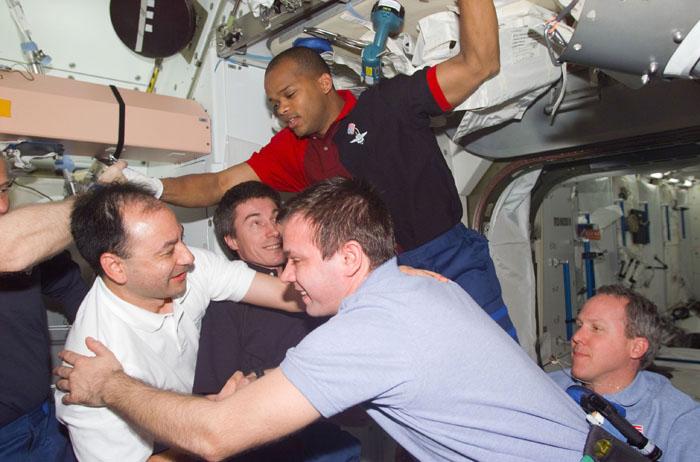
STS98-E-5297 (16 February 2001) --- Goodbyes are plentiful as five astronauts prepare to depart the International Space Station (ISS) and return to the Space Shuttle Atlantis. Cosmonauts Sergei K. Krikalev, Expedition One flight engineer; and Yuri P. Gidzenko, Soyuz commander for the station crew, appear in the center of the scene. They are surrounded by astronauts Mark L. Polansky, STS-98 pilot; and Robert L. Curbeam (top) and Thomas D. Jones, right, both shuttle mission specialists. The cosmonauts, along with astronaut William M. (Bill) Shepherd (out of frame), Expedition One commander, will stay aboard the outpost for several more weeks and return to Earth with the next shuttle visitors.
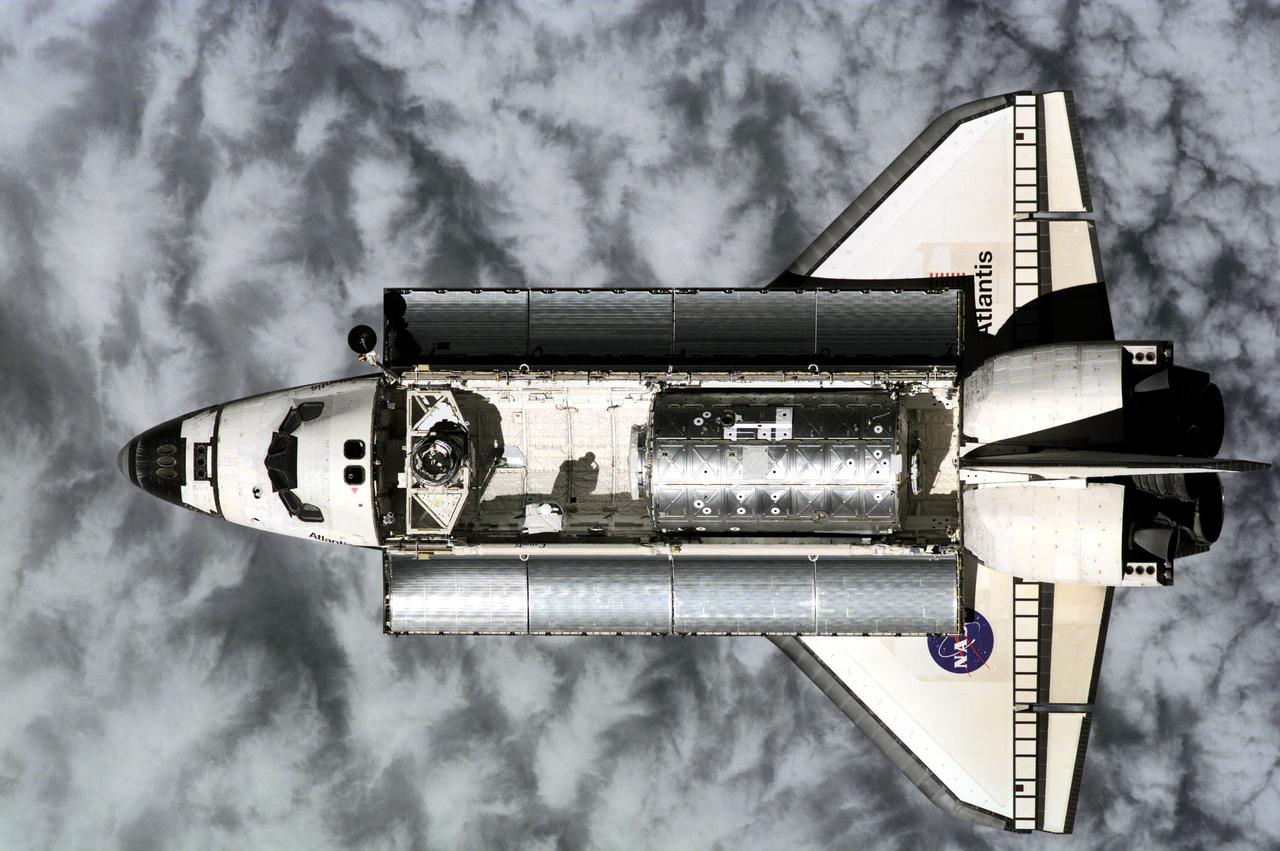
ISS001-E-6128 (9 February 2001) --- Atlantis was photographed from the International Space Station (ISS) prior to link-up with international outpost at 10:50 a.m. (CST), Feb. 9, 2001, as the two craft flew over the Western Pacific northeast of New Guinea. About ninety minutes later, hatches were swung open between Atlantis and the ISS, enabling the STS-98 and station crews to greet each other and transfer critical gear before re-closure later in preparation for the first (Feb. 10) of three planned space walks to help in the installation and hookup of Destiny on the station. The photograph was taken with a digital still camera.
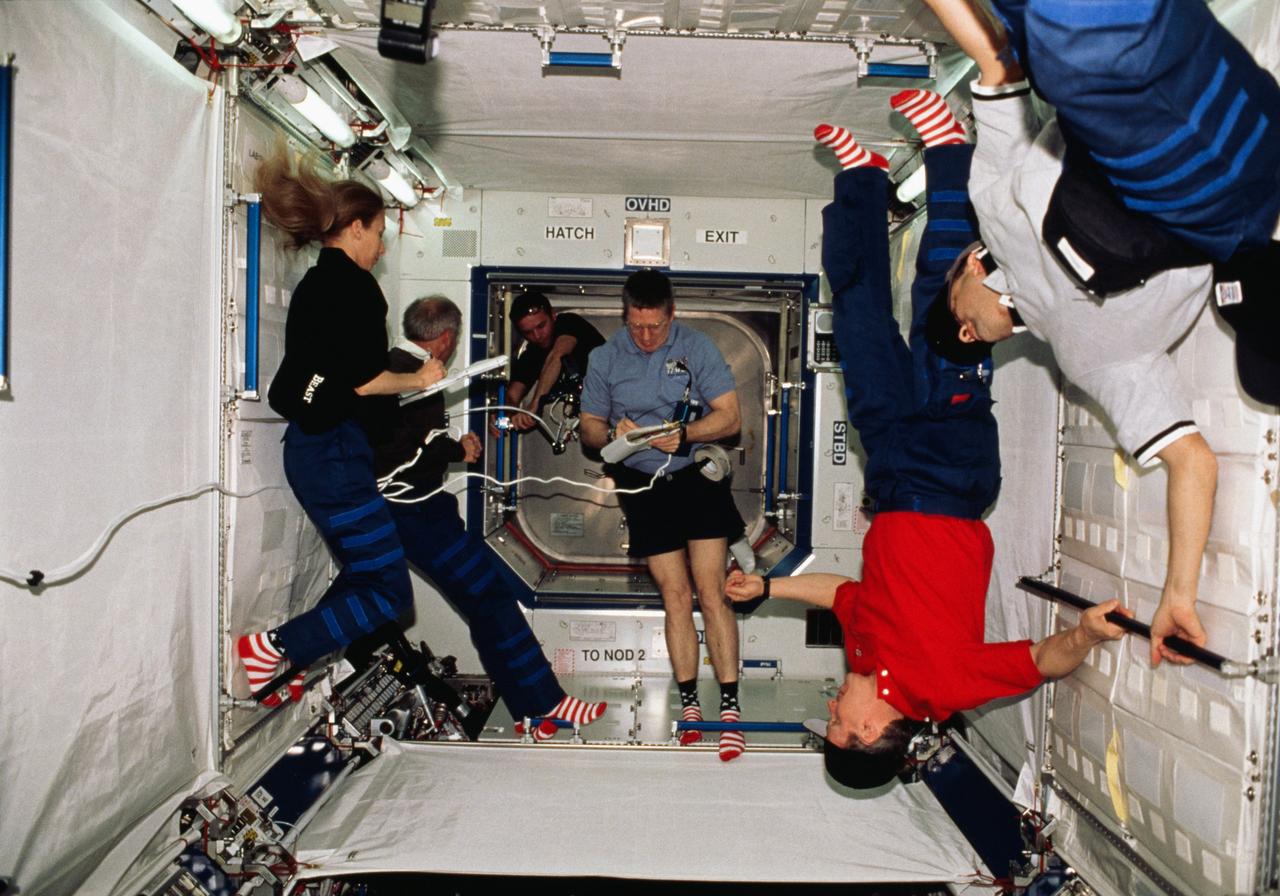
STS098-323-015 (7-20 February 2001) --- Astronauts and cosmonauts from the Expedition One and STS-98 crews are photographed in the newly-attached Destiny laboratory on the International Space Station (ISS). From the left are Marsha S. Ivins, mission specialist; Kenneth D. Cockrell, mission commander; Yuri P. Gidzenko, Expedition One Soyuz commander; William M. (Bill) Shepherd, Expedition One mission commander; Thomas D. Jones, mission specialist; and Mark L. Polansky, pilot. Out of view are Robert L. Curbeam, mission specialist, and Sergei K. Krikalev, Expedition One flight engineer. Gidzenko and Krikalev represent Rosaviakosmos.
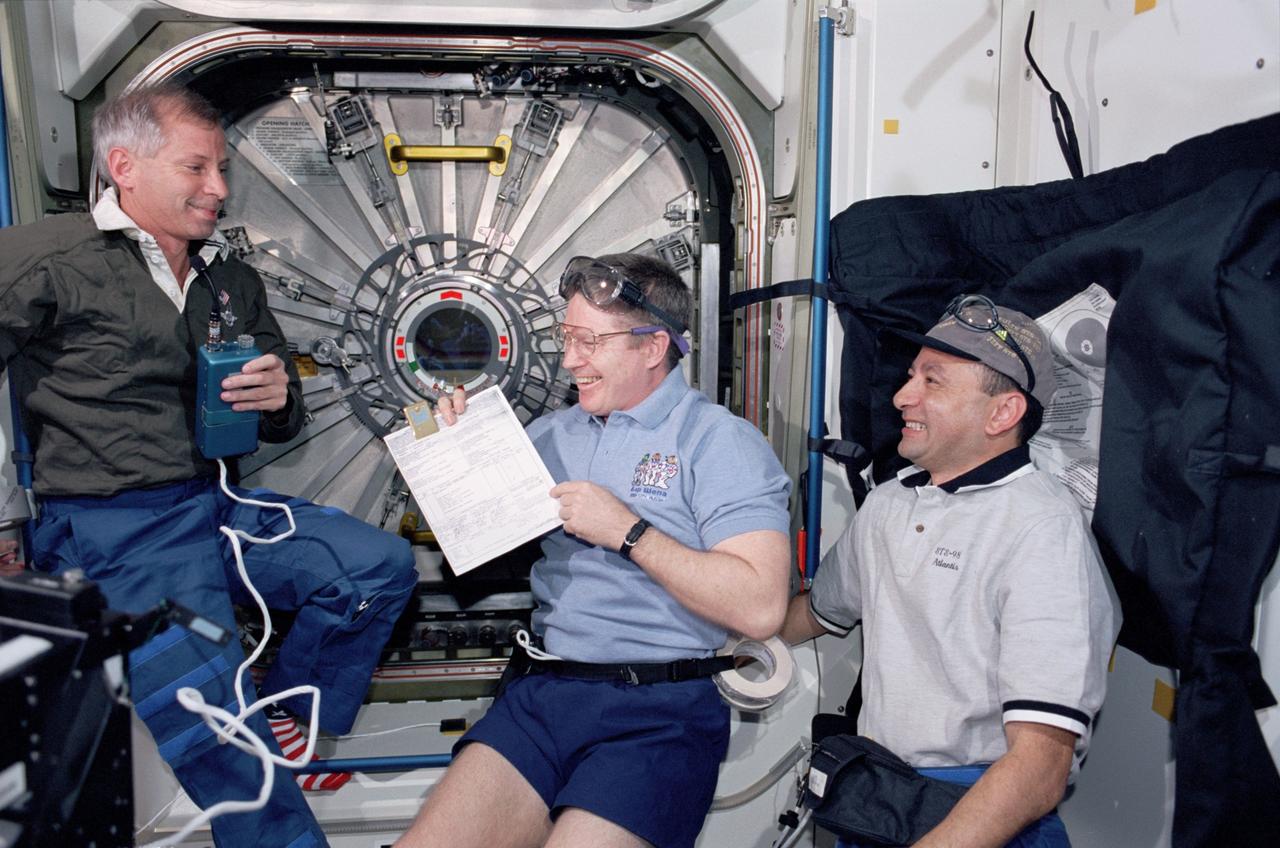
STS098-352-0019 (11 February 2001) --- Inside the Unity node, astronaut William M. (Bill) Shepherd (center), Expedition One commander, holds a document of receipt of the U.S. laboratory, called Destiny, as part of the International Space Station (ISS). Looking on are astronauts Kenneth D. Cockrell (left) and Mark L. Polansky, commander and pilot, respectively, for STS-98. The hatch to Destiny, not yet opened, is in the background.
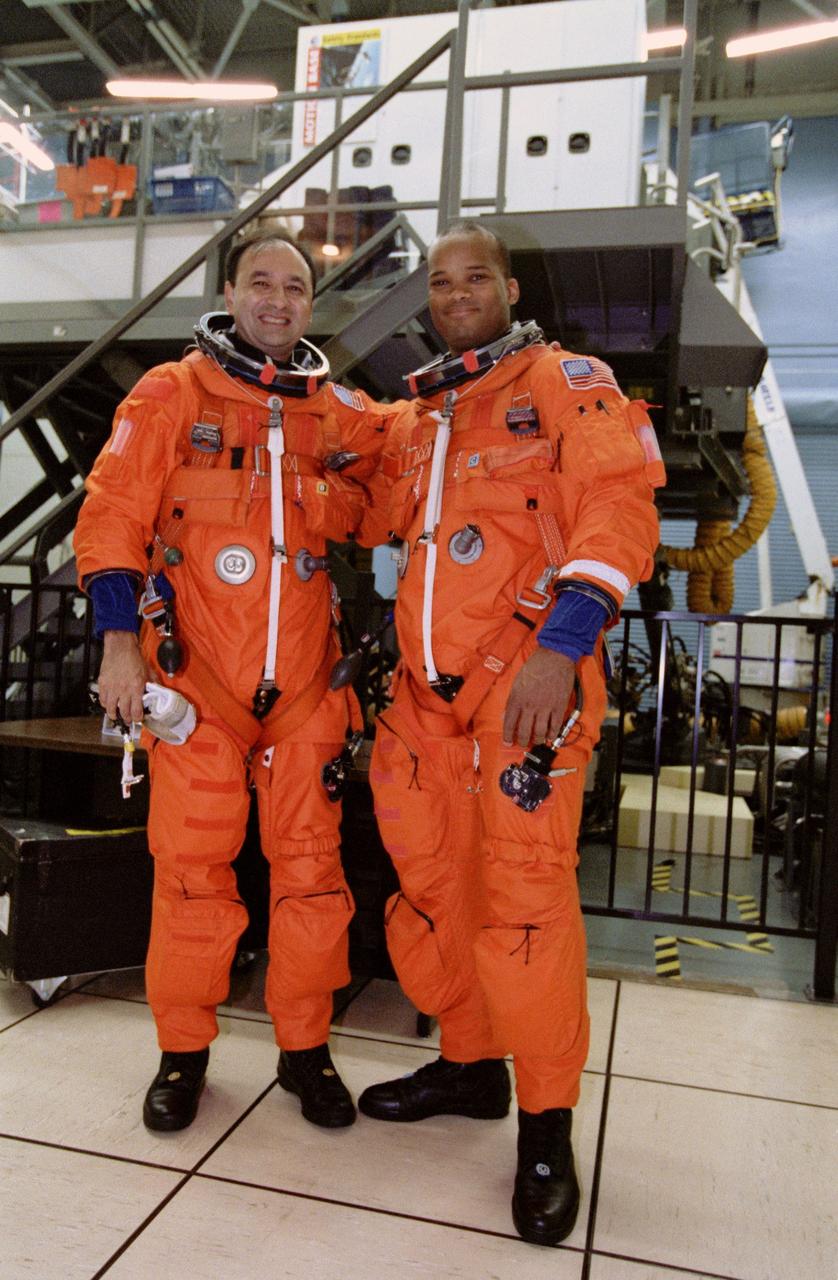
JSC2000-04778 (16 June 2000) --- Attired in training versions of the shuttle launch and entry garment, astronauts Mark Polansky (left) and Robert L. Curbeam take a break from a simulation exercise in the motion-base shuttle mission simulator (seen in the background) at the Johnson Space Center (JSC). Polansky is STS-98 pilot and Curbeam doubles as a mission specialist and flight engineer for the scheduled January 2000 5a mission to the International Space Station (ISS).

STS098-716-034 (18 February 2001) --- This east-to-west orbital view of the Inn River Valley of southern Austria was photographed by one the crew members of Atlantis during Space Shuttle Mission STS-98 on February 18, 2001, as the spacecraft orbited Earth at an altitude of 173 nautical miles (320 kilometers). Despite the heavy ground fog in the lower valleys, this 70mm handheld camera's photo provides a strikingly detailed view of the Italian, Swiss and Austrian Alps of central Europe. For example, the famous Brenner Pass, an historic gateway connecting Italy to the rest of Europe, can be seen in the left central foreground. The Austrian city of Innsbruck on the Inn River, scene of the 1964 and 1976 Winter Olympics, and normally visible in great detail, is completely masked by heavy ground fog. Center coordinates of the pictured area are located at 47.5 degrees north latitude and 12.5 degrees east longitude.

STS098-714A-049 (16 February 2001) --- Demonstrating the power of water erosion, this orbital view photographed by the crew of Atlantis during STS-98 on February 16, 2001, as the spacecraft orbited the earth at an altitude of 173 nautical miles (320 kilometers), shows Lake Powell at the headwaters of the Colorado River in southwestern Utah. The river over eons has carved out Arizona's mile deep and 270 mile long Grand Canyon. Prominent in this scene is the Kaibab Plateau at the head of the canyon where the big bend of the Colorado River has eroded the plateau into a peninsula. This plateau, directly across the canyon from the South Rim Visitor's Center, is at the widest part of the canyon, about 12 miles. The Kaibab Indian Reservation and the Kaibab National Forest are visible in the picture.

JSC2001-00310 (February 2001) --- These sixty-plus flight controllers support the STS-98/5a mission's orbit 1 shift from various consoles in the shuttle flight control room in the Johnson Space Center's Mission Control Center (MCC). Flight director Robert Castle holds the crew insignia near center frame.
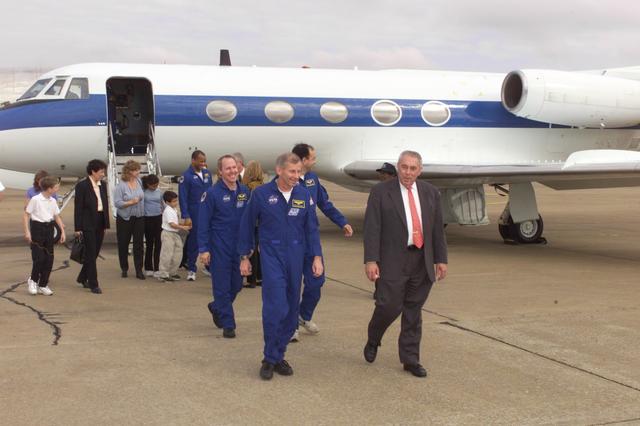
JSC2001-E-04805 (21 February 2001) --- JSC director George W.S. Abbey talks with the STS-98 crew members following the arrival of the Gulfstream Aircraft which transported the astronauts from their landing at Dryden Flight Research Center (DFRC) in Edwards, California. Pictured along side Mr. Abbey is astronaut Kenneth D. Cockrell, mission commander. Behind him (from the left distant background) are astronauts Robert L. Curbeam and Thomas D. Jones (both mission specialists) and Mark L. Polansky, pilot. Astronaut Marsha S. Ivins, mission specialist, is out of the frame.
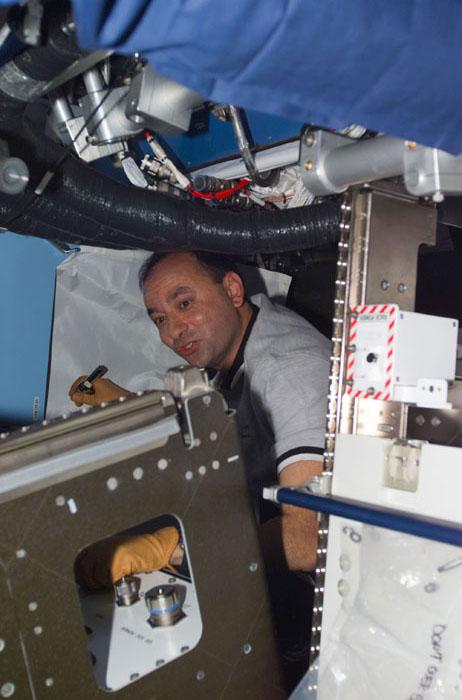
STS98-E-5159 (11 February 2001) --- Astronaut Mark L. Polansky, STS-98 pilot, works inside the newly attached Destiny laboratory onboard the International Space Station (ISS). After the Destiny hatch was opened early in the day, members of both the shuttle and station crews went to work quickly inside the new module, activating air systems, fire extinguishers, alarm systems, computers and internal communications. The crews also took some photos and continued equipment transfers from the shuttle to the station. The scene was taken with a digital still camera.

STS098-714A-020 (7-20 February 2001) ---One of the STS-98 astronauts aboard the Earth-orbiting Space Shuttle Atlantis used a 70mm handheld camera to record this image of Southern California. Snow blanketing the higher elevations in the Los Padres National Forest (center of the image) and that covering the Angeles National Forest (right middle) help to accentuate and separate three major landform regions in southern California. The northern Los Angeles Basin that includes the San Fernando Valley and the Santa Monica Mountains is visible in the lower right quadrant of the image. The western end of the Mojave Desert (upper right) shows the two distinctive mountain boundaries along the southwest and northwest edge of the desert. The San Andreas Fault and the Garlock Fault converge (snow covered in this scene) at the western end of the desert. The intensively irrigated and cultivated southern end of the San Joaquin Valley that includes Bakersfield is visible (upper left) north of the snow-covered, northeast-southwest trending Tehachapi Mountains. The island off of the California coast (bottom left) is Santa Cruz Island.
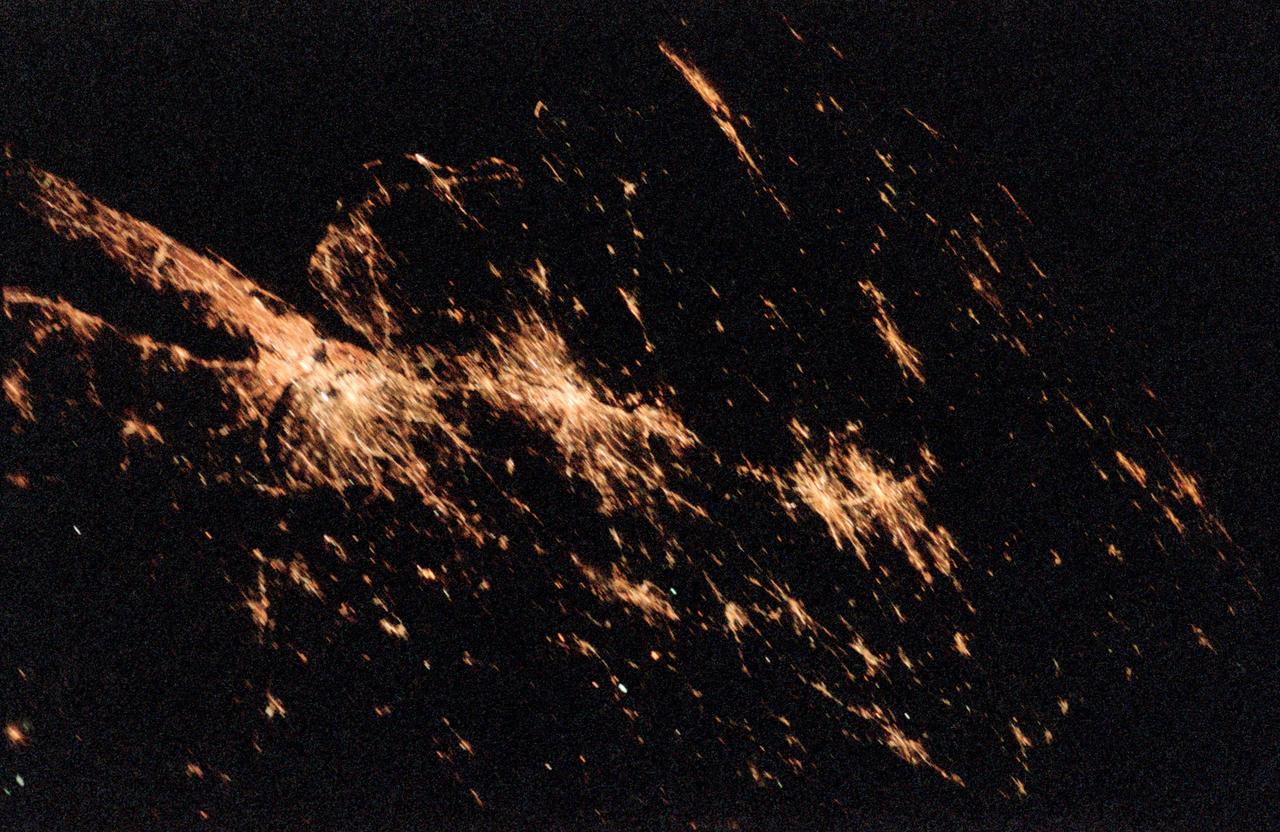
STS098-382-0014 (7-20 February 2001) City Lights of the Northeastern Seaboard of the U.S. were captured with a 35mm camera by one of the STS-98 astronauts aboard the Space Shuttle Atlantis. The nighttime scene shows the bright lights of several major cities that span a distance from Connecticut (left middle) to states south of Virginia (right middle). Lights from both very large urban areas as well as smaller towns and cities are visible. The largest cluster of brightness emanates from the greater New York metropolitan area (left center) and then a series of bright spots progress southwesterly to include Philadelphia (PA), Baltimore (MD), Washington (D.C.), Richmond (VA), and finally ending with the Newport News/ Norfolk (VA) lights (top center). Many of the major ground transportation arteries can be seen as radial, linear features that radiate outward from the central business districts of the cities. Even the lights of smaller cities such as Allentown, Reading, Lancaster, York, and Harrisburg (PA) are visible (bottom center).
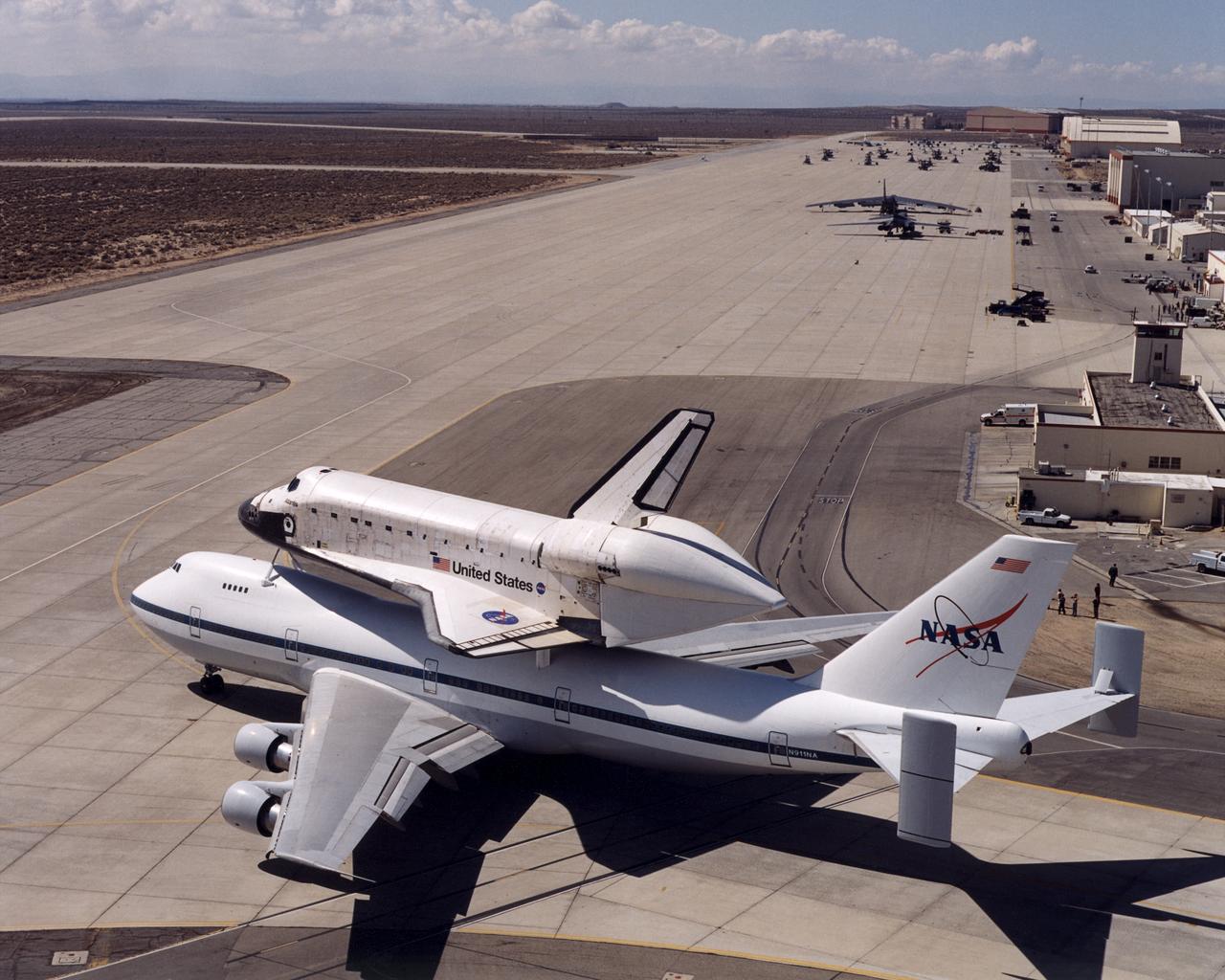
NASA's space shuttle Atlantis and its 747 carrier taxied on the Edwards Air Force Base flightline as the unusual combination left for Kennedy Space Center, Florida, on March 1, 2001. Atlantis and the shuttle Columbia were both airborne on the same day as they migrated from California to Florida. Columbia underwent refurbishing at nearby Palmdale, California.
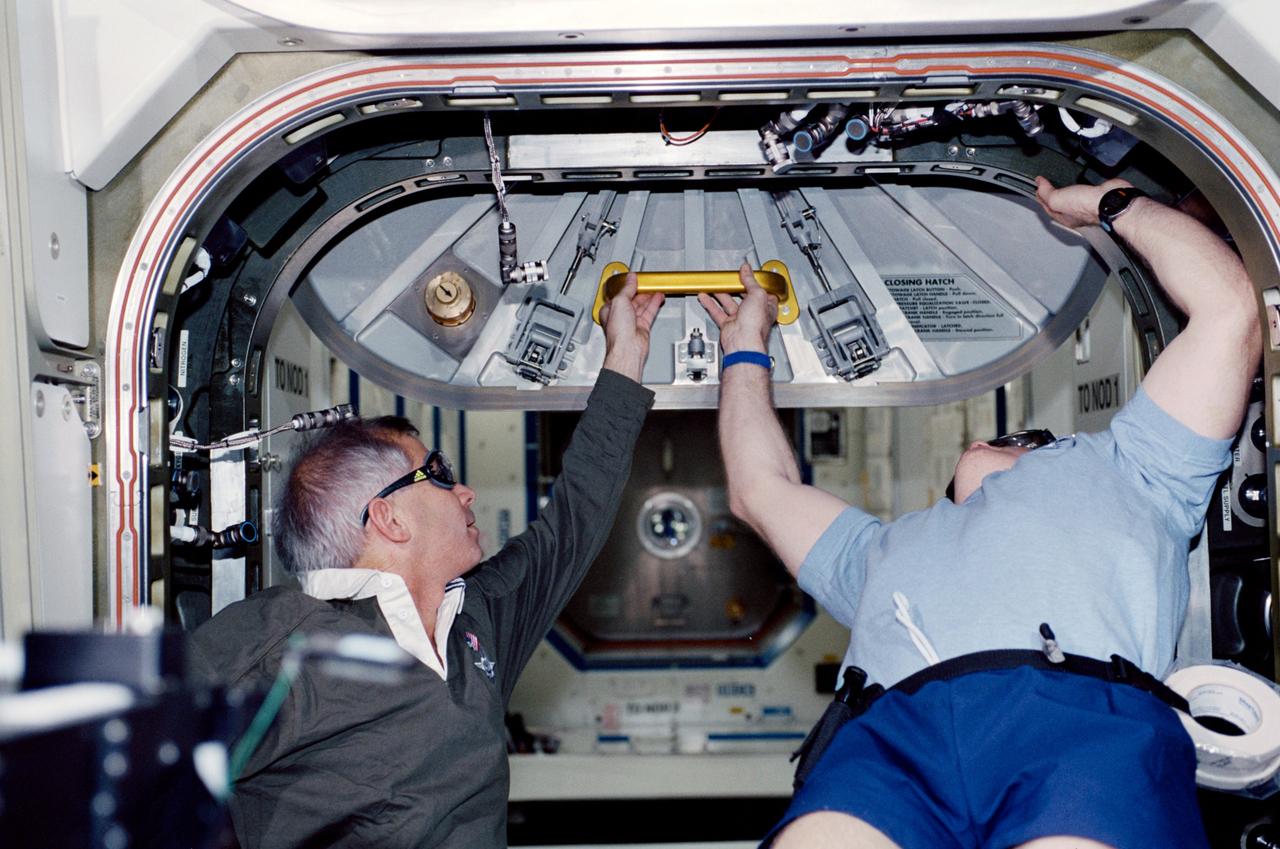
STS098-352-0025 (11 February 2001) --- STS-98 mission commander Kenneth D. Cockrell (left) assists as Expedition One commander William M. (Bill) Shepherd opens the hatch to the newly attached Destiny laboratory. The crews of Atlantis and the International Space Station entered the laboratory shortly after this photo was made on February 11; and the astronauts and cosmonauts spent the first full day of what are planned to be years of work ahead inside the orbiting science and command center. Members of both crews went to work quickly inside the new module, activating air systems, fire extinguishers, alarm systems, computers and internal communications. The crew also continued equipment transfers from the shuttle to the station.
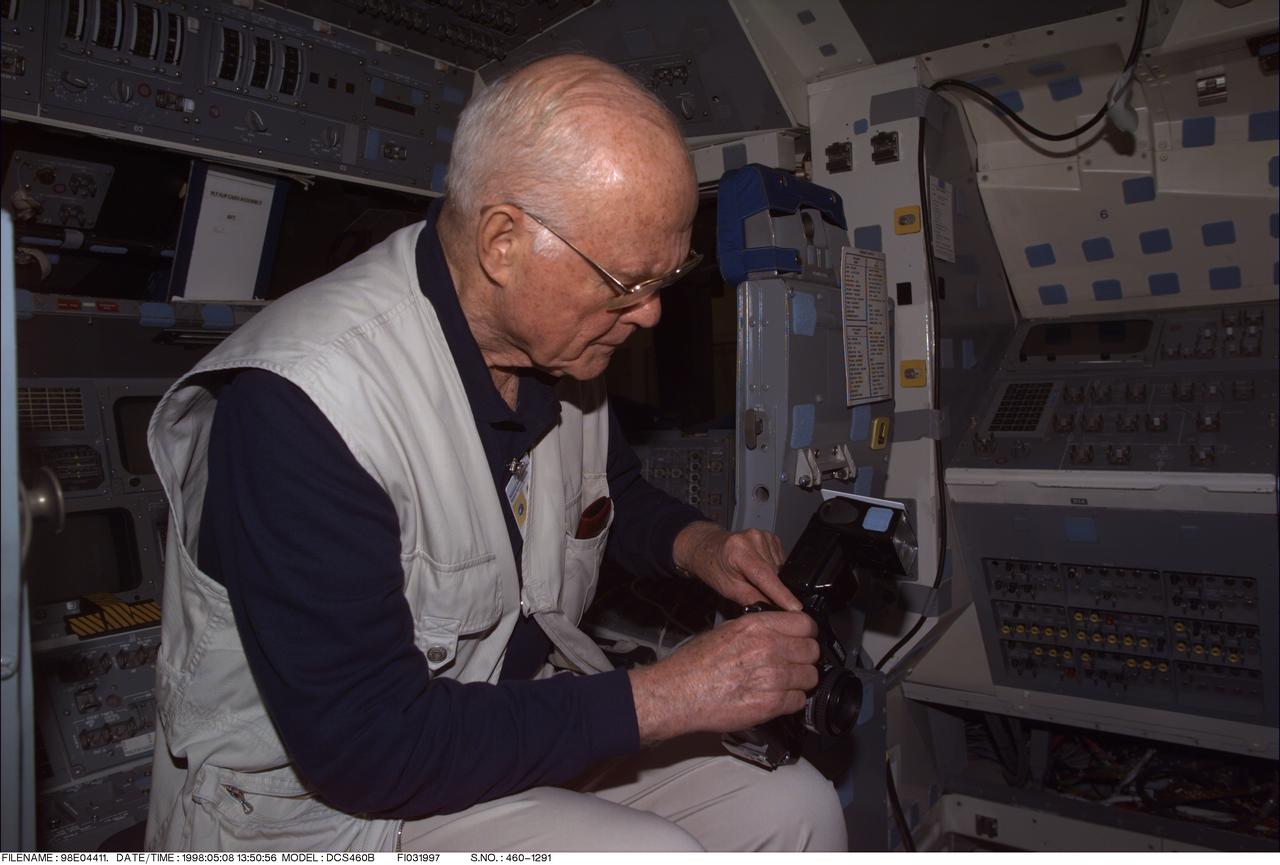
98-E-04411 (8 May 1998) --- U.S. Sen. John H. Glenn Jr., assigned as payload specialist aboard the Space Shuttle Discovery for NASA's STS-95 mission, checks a 35mm during a training session at the Johnson Space Center (JSC). He is on the flight deck of the full fuselage trainer (FFT) in the Systems Integration Facility.
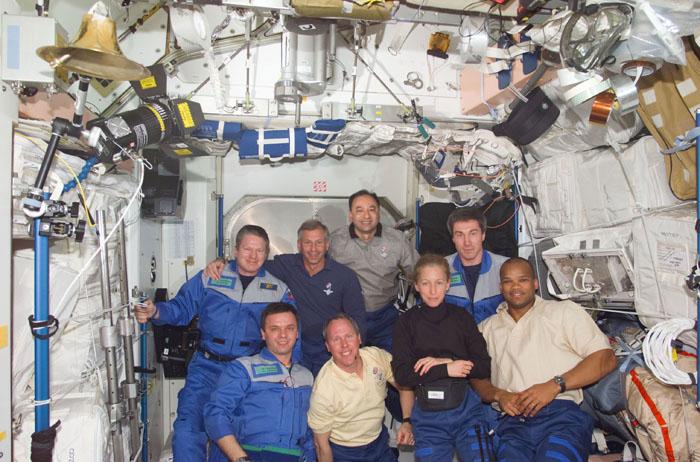
STS98-E-5053 (9 February 2001) --- The three-man Expedition One crew hosts its second group of visitors since beginning occupancy of the International Space Station in November of last year. A pre-set digital still camera was used to record the gathering. Wearing blue flight suits for the reunion are the station's first fulltime occupants--astronaut William M. (Bill) Shepherd (rear left), Expedition One commander;cosmonaut Yuri P. Gidzenko (front left), Soyuz commander; and cosmonaut Sergei K. Krikalev (rear right), flight engineer. Astronauts Kenneth D. Cockrell (second left, rear) and Mark L. Polansky (second right, rear) are STS-98 mission commander and pilot, respectively. Astronauts Thomas D. Jones, Marsha S. Ivins and Robert L. Curbeam--all mission specialists--are in front. Atlantis docked to the station on schedule at 10:51 a.m. (CST), Feb. 9 and the station and shuttle crews opened hatches between the spacecraft at 1:03 p.m., promptly beginning to unload supplies. The three-member station crew, on the eve of their 100th day aboard the outpost, greeted their first visitors in almost two months. The hatches were open for about four hours before they were closed in preparation for the first of three upcoming space walks, a six-hour sojourn scheduled for the following day from Atlantis by Jones and Curbeam.
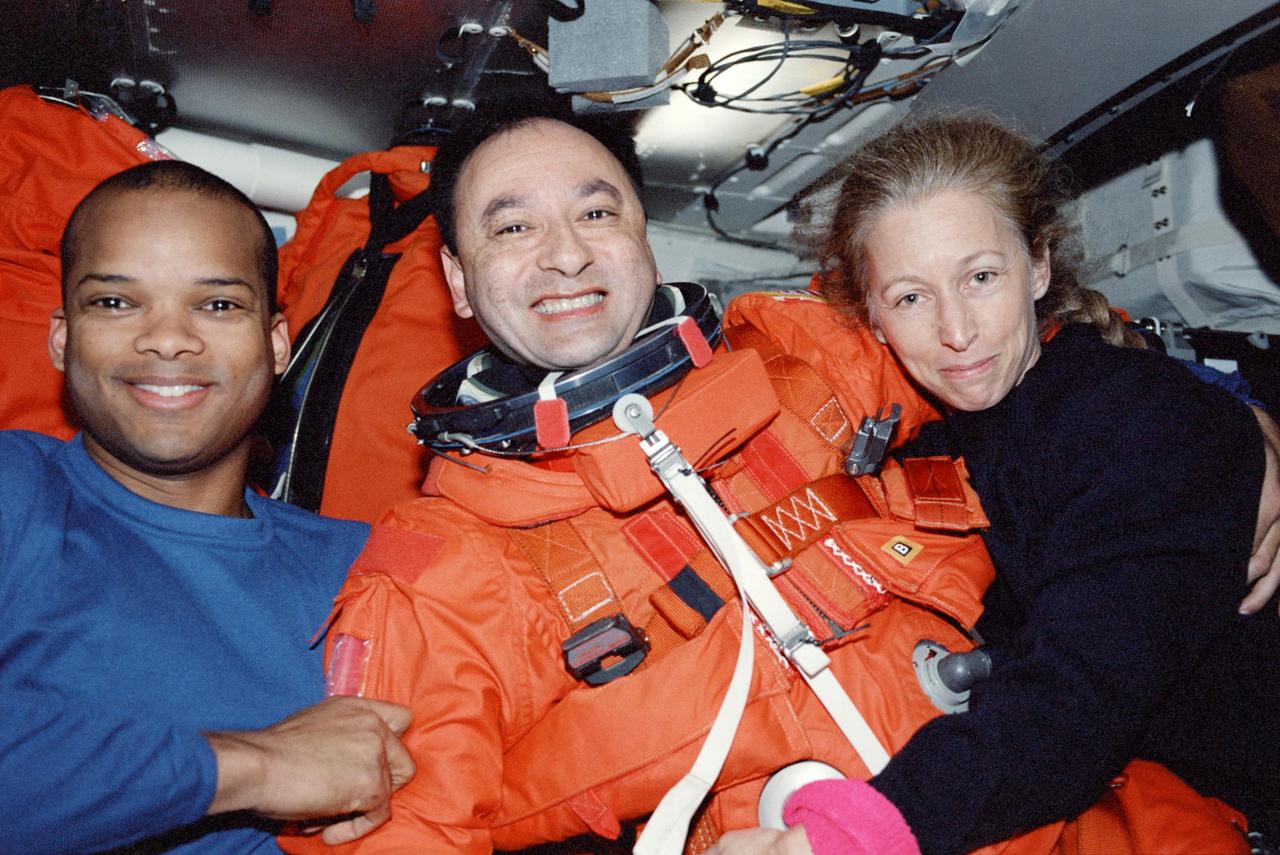
STS098-358-005 (7-20 February 2001) --- Astronauts Mark L. Polansky (center), pilot, Robert L. Curbeam, and Marsha S. Ivins, both mission specialists, paused for this photograph as they prepared to suit up in their full-pressure launch and entry suits on the mid deck of the Space Shuttle Atlantis during de-orbit preparations.
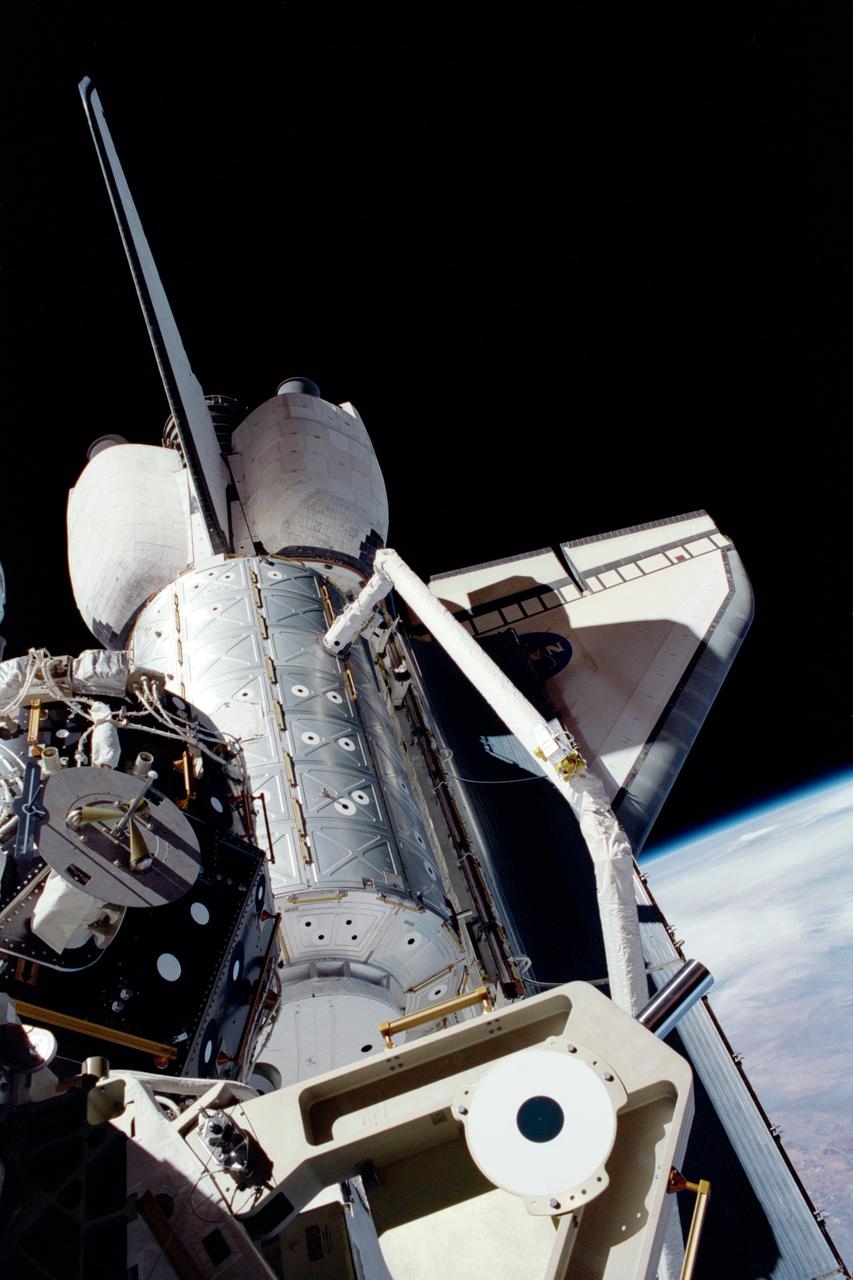
In the grasp of the Shuttle's Remote Manipulator System (RMS) robot arm, the U.S. Laboratory, Destiny, is moved from its stowage position in the cargo bay of the Space Shuttle Atlantis. This photograph was taken by astronaut Thomas D. Jones during his Extravehicular Activity (EVA). The American-made Destiny module is the cornerstone for space-based research aboard the orbiting platform and the centerpiece of the International Space Station (ISS), where unprecedented science experiments will be performed in the near-zero gravity of space. Destiny will also serve as the command and control center for the ISS. The aluminum module is 8.5- meters (28-feet) long and 4.3-meters (14-feet) in diameter. The laboratory consists of three cylindrical sections and two endcones with hatches that will be mated to other station components. A 50.9-centimeter- (20-inch-) diameter window is located on one side of the center module segment. This pressurized module is designed to accommodate pressurized payloads. It has a capacity of 24 rack locations. Payload racks will occupy 15 locations especially designed to support experiments. The Destiny module was built by the Boeing Company under the direction of the Marshall Space Flight Center.
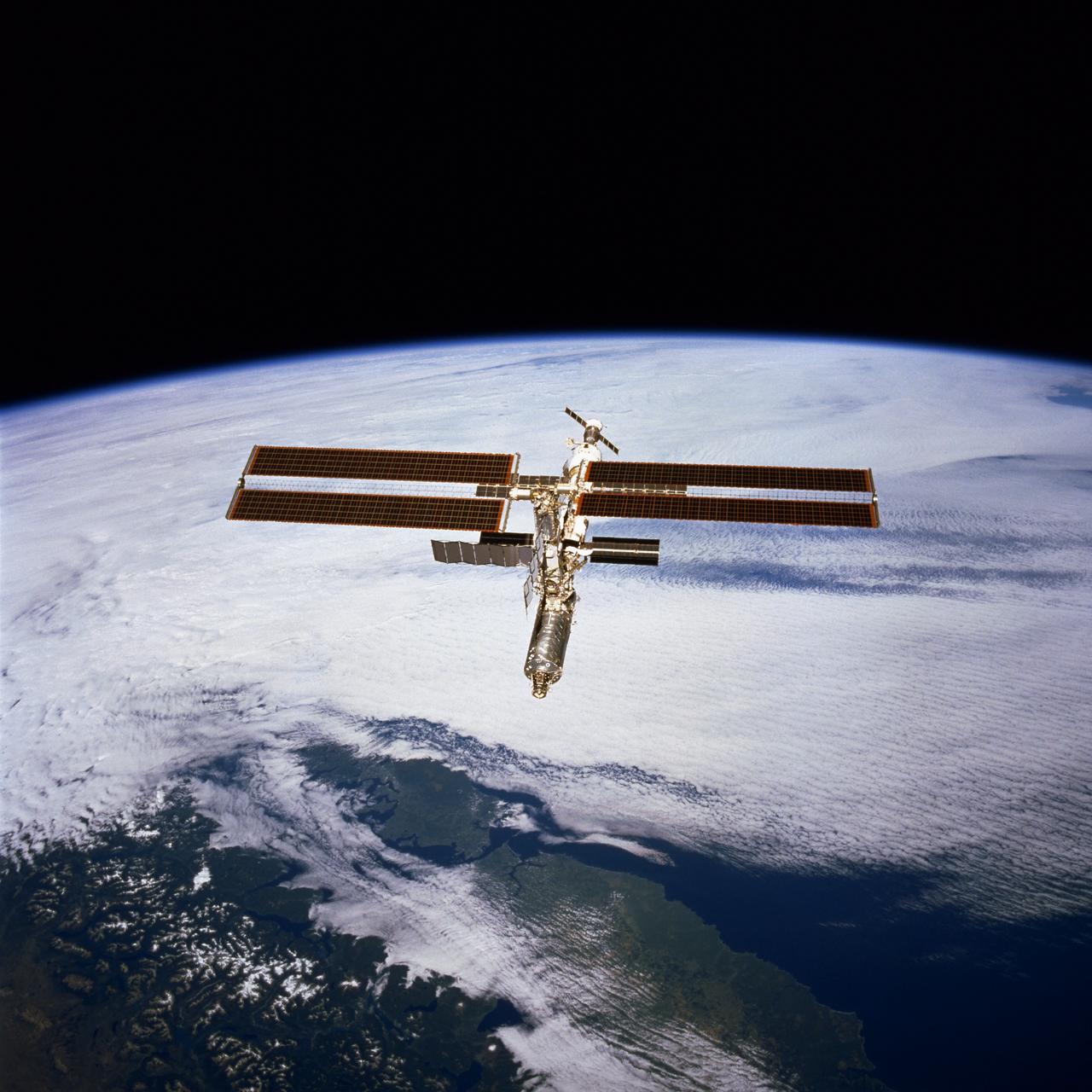
The International Space Station (ISS), with the newly installed U.S. Laboratory, Destiny, is backdropped over clouds, water and land in South America. South Central Chile shows up at the bottom of the photograph. Just below the Destiny, the Chacao Charnel separates the large island of Chile from the mainland and connects the Gulf of Coronado on the Pacific side with the Gulf of Ancud, southwest of the city of Puerto Montt. The American-made Destiny module is the cornerstone for space-based research aboard the orbiting platform and the centerpiece of the ISS, where unprecedented science experiments will be performed in the near-zero gravity of space. Destiny will also serve as the command and control center for the ISS. The aluminum module is 8.5-meters (28-feet) long and 4.3-meters (14-feet) in diameter. The laboratory consists of three cylindrical sections and two endcones with hatches that will be mated to other station components. A 50.9-centimeter (20-inch-) diameter window is located on one side of the center module segment. This pressurized module is designed to accommodate pressurized payloads. It has a capacity of 24 rack locations. Payload racks will occupy 15 locations especially designed to support experiments. The Destiny module was built by the Boeing Company under the direction of the Marshall Space Flight Center.
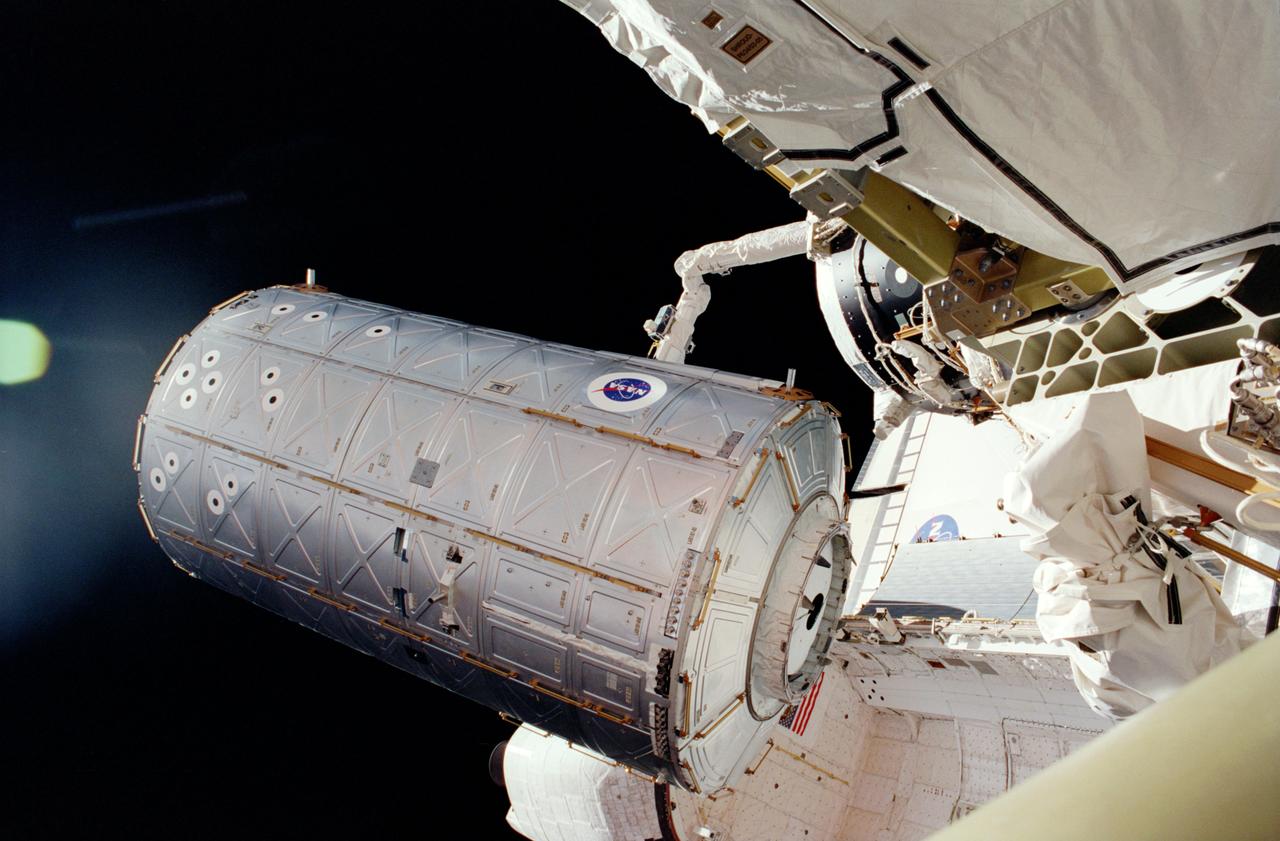
In the grasp of the Shuttle's Remote Manipulator System (RMS) robot arm, the U.S. Laboratory, Destiny, is moved from its stowage position in the cargo bay of the Space Shuttle Atlantis. This photograph was taken by astronaut Thomas D. Jones during his Extravehicular Activity (EVA). The American-made Destiny module is the cornerstone for space-based research aboard the orbiting platform and the centerpiece of the International Space Station (ISS), where unprecedented science experiments will be performed in the near-zero gravity of space. Destiny will also serve as the command and control center for the ISS. The aluminum module is 8.5- meters (28-feet) long and 4.3-meters (14-feet) in diameter. The laboratory consists of three cylindrical sections and two endcones with hatches that will be mated to other station components. A 50.9-centimeter (20-inch-) diameter window is located on one side of the center module segment. This pressurized module is designed to accommodate pressurized payloads. It has a capacity of 24 rack locations. Payload racks will occupy 15 locations especially designed to support experiments. The Destiny module was built by the Boeing Company under the direction of the Marshall Space Flight Center.
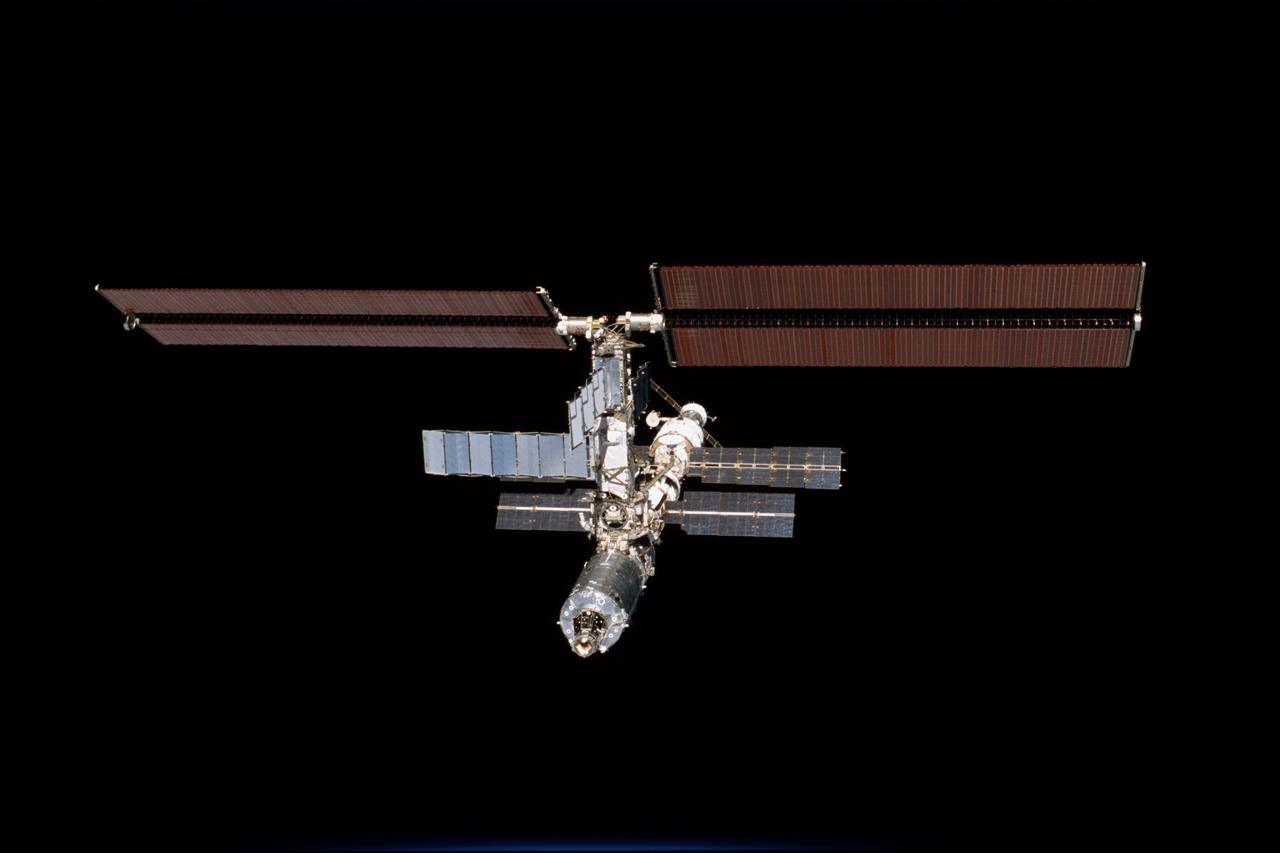
The International Space Station (ISS), with its newly attached U.S. Laboratory, Destiny, was photographed by a crew member aboard the Space Shuttle Orbiter Atlantis during a fly-around inspection after Atlantis separated from the Space Station. The Laboratory is shown in the foreground of this photograph. The American-made Destiny module is the cornerstone for space-based research aboard the orbiting platform and the centerpiece of the International Space Station (ISS), where unprecedented science experiments will be performed in the near-zero gravity of space. Destiny will also serve as the command and control center for the ISS. The aluminum module is 8.5-meters (28-feet) long and 4.3-meters (14-feet) in diameter. The laboratory consists of three cylindrical sections and two endcones with hatches that will be mated to other station components. A 50.9-centimeter (20-inch-) diameter window is located on one side of the center module segment. This pressurized module is designed to accommodate pressurized payloads. It has a capacity of 24 rack locations. Payload racks will occupy 15 locations especially designed to support experiments. The Destiny module was built by the Boeing Company under the direction of the Marshall Space Flight Center.
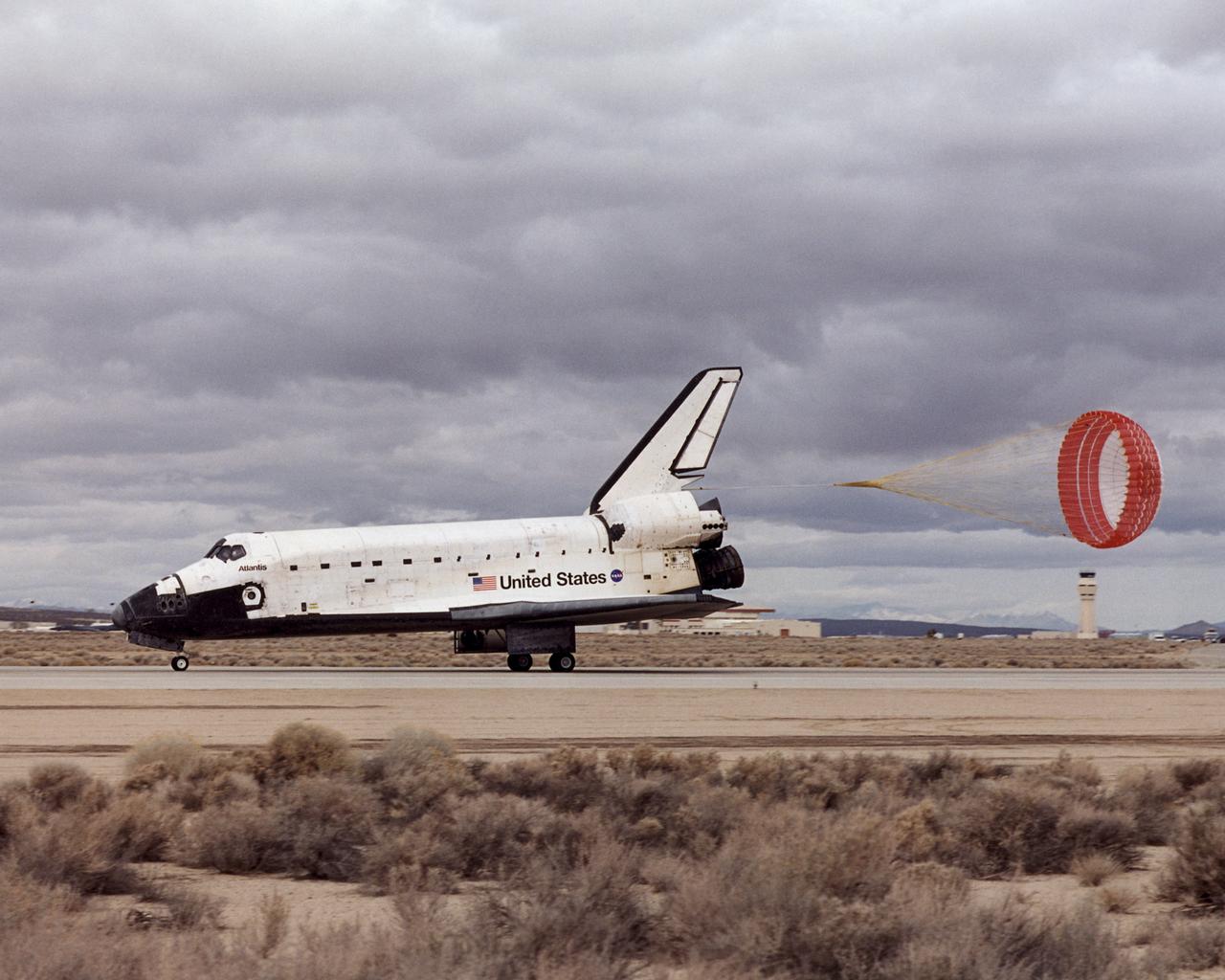
Space Shuttle Atlantis landed at 12:33 p.m. February 20, 2001, on the runway at Edwards Air Force Base, California, where NASA's Dryden Flight Research Center is located. The mission, which began February 7, logged 5.3 million miles as the shuttle orbited earth while delivering the Destiny science laboratory to the International Space Station. Inclement weather conditions in Florida prompted the decision to land Atlantis at Edwards. The last time a space shuttle landed at Edwards was Oct. 24, 2000.
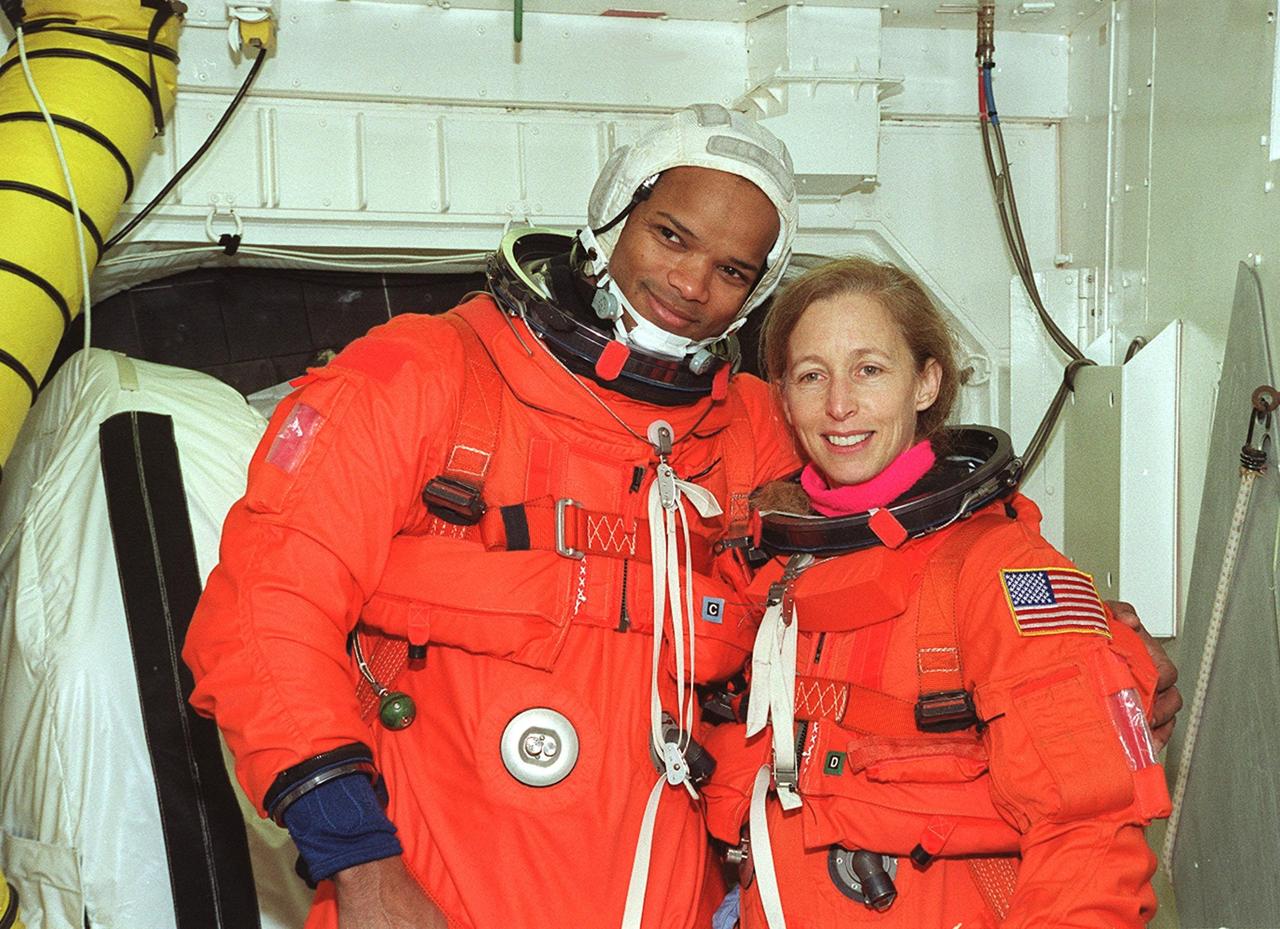
In the White Room, STS-98 Mission Specialists Robert Curbeam and Marsha Ivins pose for a photo before entering Atlantis for a simulated launch countdown. The White Room is an environmental chamber at the end of the orbiter access arm that mates with the orbiter to allow personnel to enter the orbiter’s crew compartment. The STS-98 crew is taking part in Terminal Countdown Demonstration Test activities, which also include emergency egress training at the pad. STS-98 is the seventh construction flight to the International Space Station, carrying as payload the U.S. Lab Destiny, a key element in the construction of the ISS. Launch of STS-98 is scheduled for Jan. 19 at 2:11 a.m. EST

In the White Room, STS-98 Mission Specialist Thomas Jones gets help with his launch and entry suit before entering Atlantis for a simulated launch countdown. The White Room is an environmental chamber at the end of the orbiter access arm that mates with the orbiter to allow personnel to enter the orbiter’s crew compartment. The STS-98 crew is taking part in Terminal Countdown Demonstration Test activities, which also include emergency egress training at the pad. STS-98 is the seventh construction flight to the International Space Station, carrying as payload the U.S. Lab Destiny, a key element in the construction of the ISS. Launch of STS-98 is scheduled for Jan. 19 at 2:11 a.m. EST
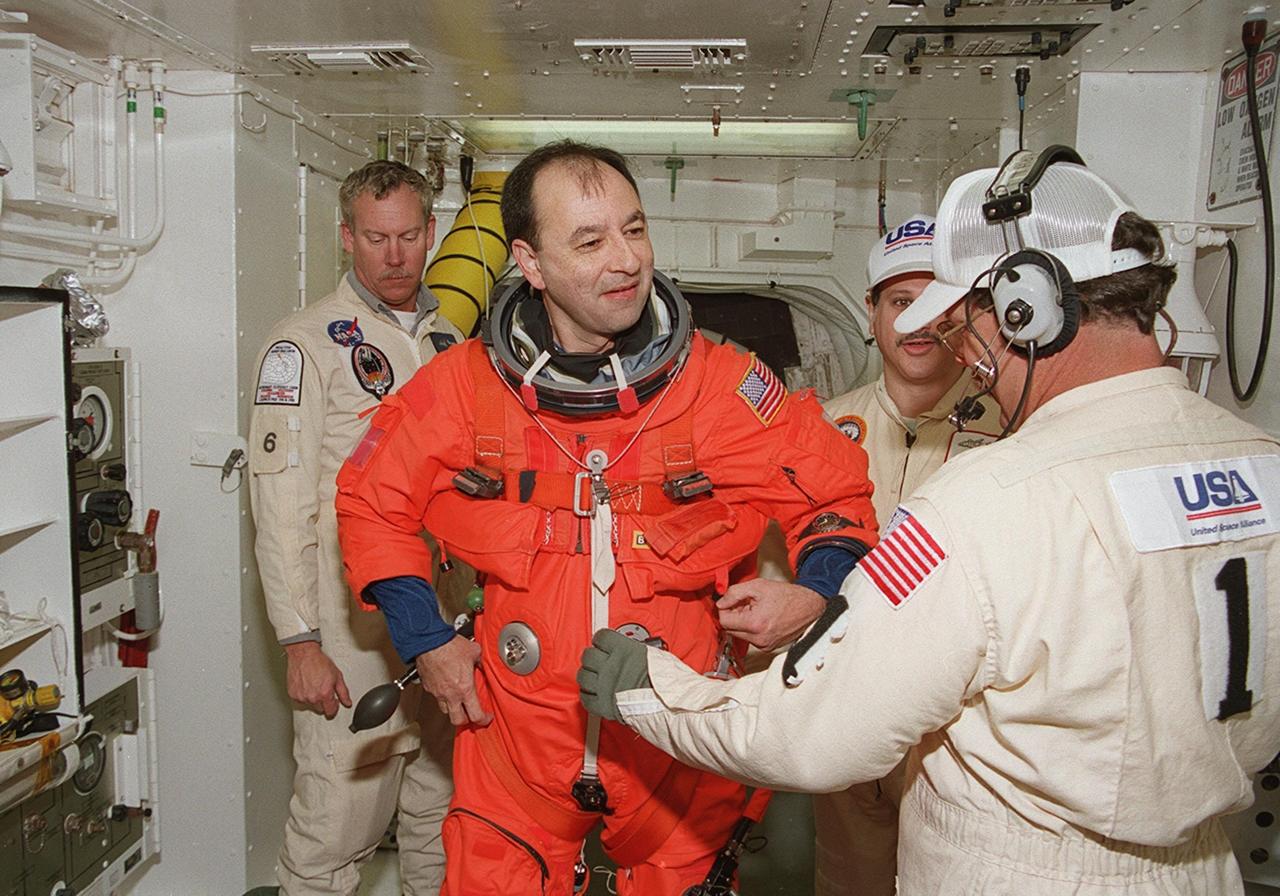
In the White Room, STS-98 Pilot Mark Polansky gets help with his launch and entry suit before entering Atlantis for a simulated launch countdown. The White Room is an environmental chamber at the end of the orbiter access arm that mates with the orbiter to allow personnel to enter the orbiter’s crew compartment. The STS-98 crew is taking part in Terminal Countdown Demonstration Test activities, which also include emergency egress training at the pad. STS-98 is the seventh construction flight to the International Space Station, carrying as payload the U.S. Lab Destiny, a key element in the construction of the ISS. Launch of STS-98 is scheduled for Jan. 19 at 2:11 a.m. EST
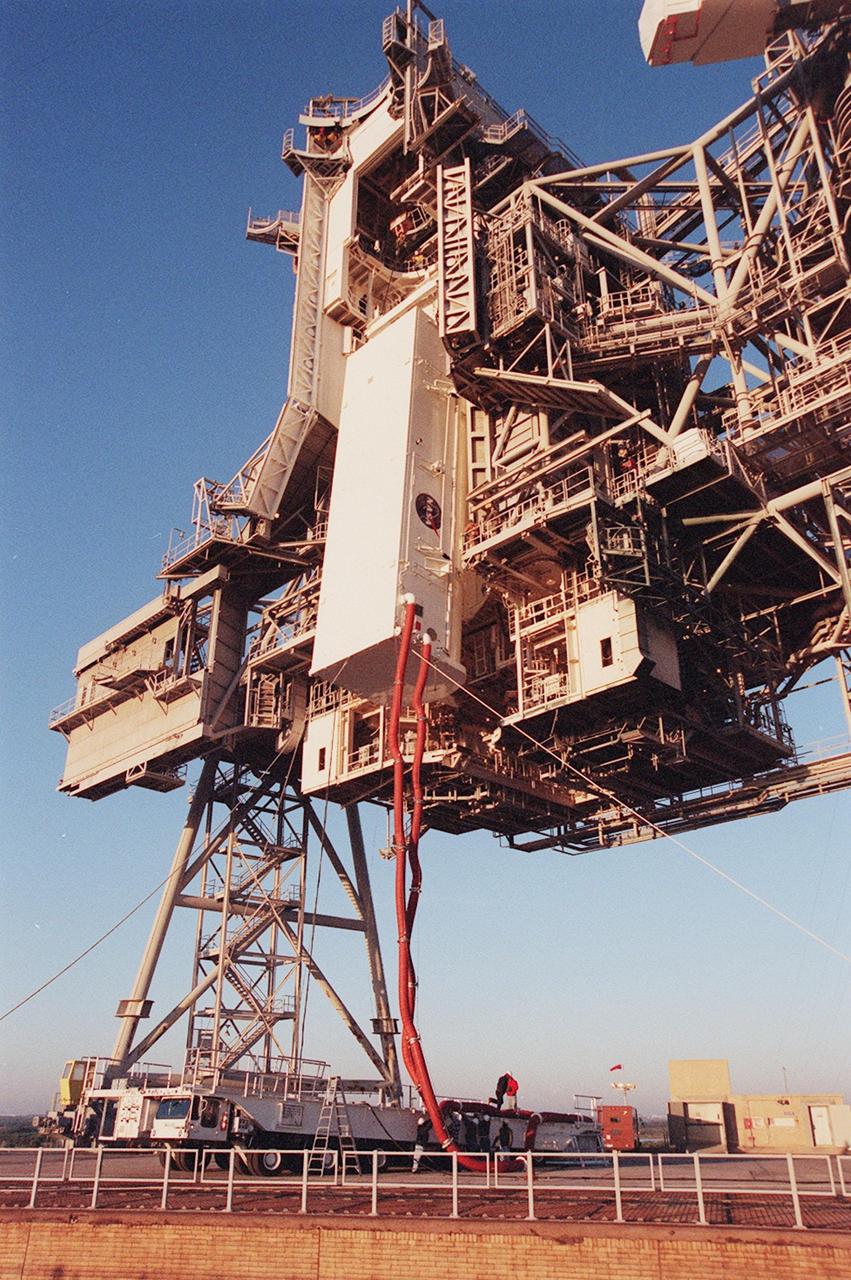
KENNEDY SPACE CENTER, FLA. -- The payload canister containing the U.S. Lab Destiny rises up the Rotating Service Structure to the payload changeout room at Launch Pad 39A. Umbilical hoses are still attached. In the PCR Destiny will be removed and transferred to the payload bay of Atlantis for mission STS-98. Destiny, a key element in the construction of the International Space Station is designed for space science experiments. STS-98 is the seventh construction flight to the ISS. Launch of STS-98 is scheduled for Jan. 19 at 2:11 a.m. EST
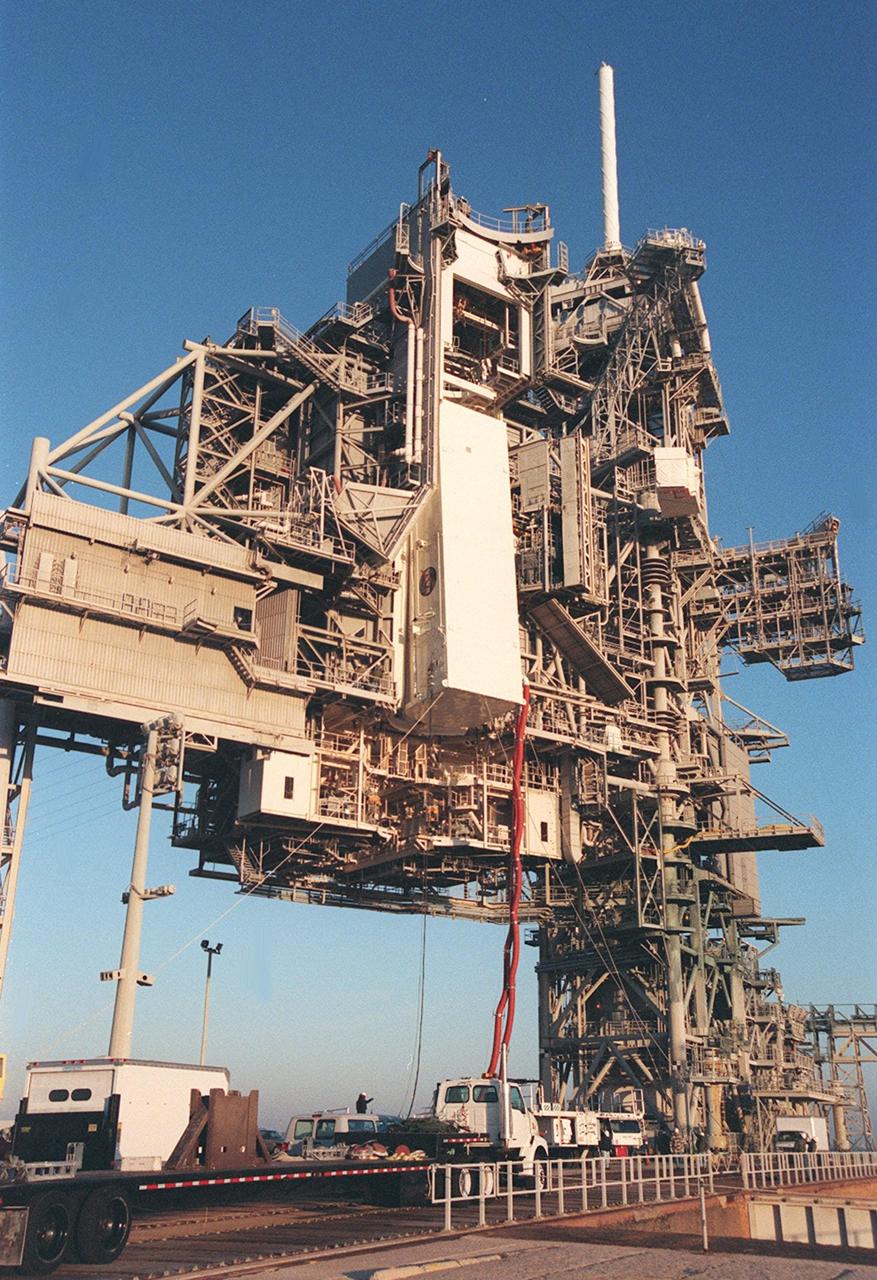
KENNEDY SPACE CENTER, FLA. -- The payload canister containing the U.S. Lab Destiny nears the payload changeout room on the Rotating Service Structure at Launch Pad 39A. Umbilical hoses are still attached. In the PCR Destiny will be removed and transferred to the payload bay of Atlantis for mission STS-98. Destiny, a key element in the construction of the International Space Station is designed for space science experiments. STS-98 is the seventh construction flight to the ISS. Launch of STS-98 is scheduled for Jan. 19 at 2:11 a.m. EST
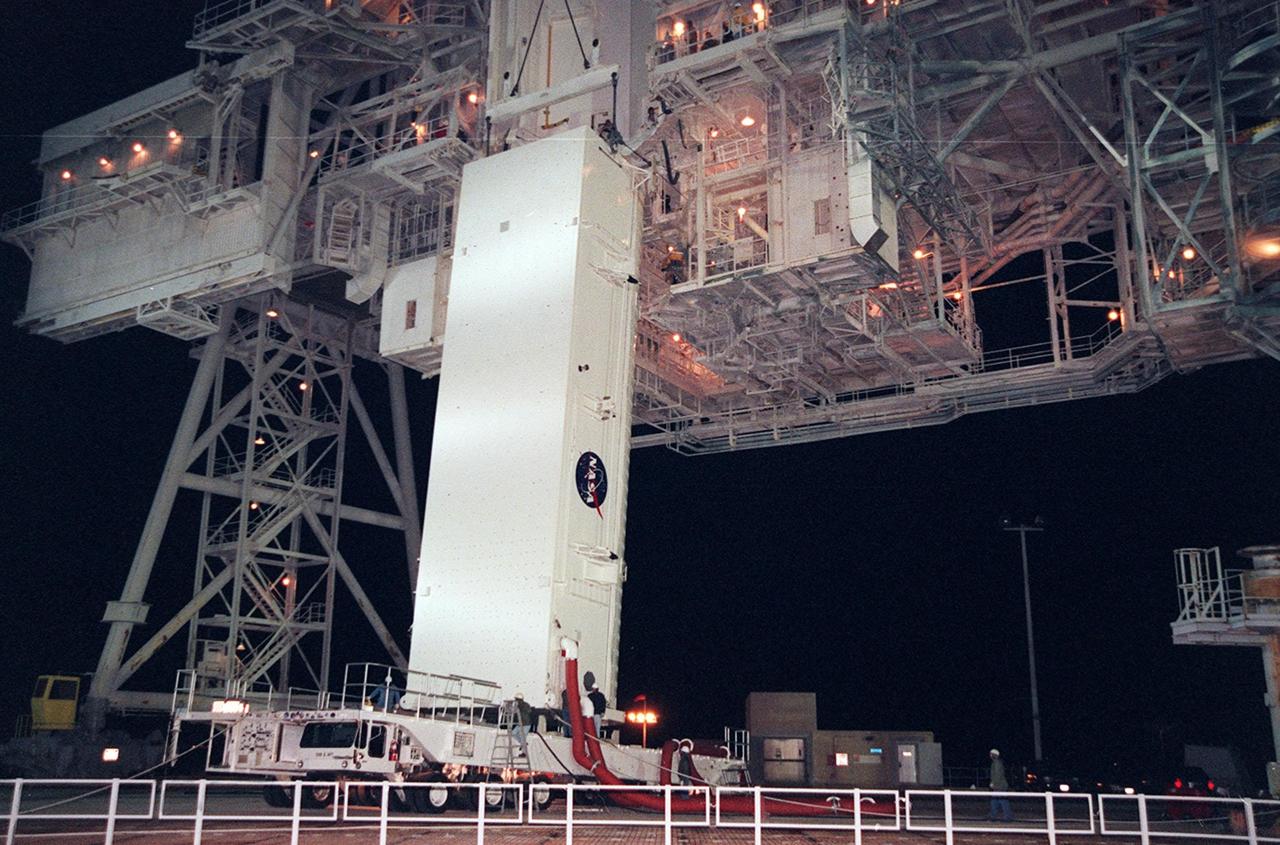
KENNEDY SPACE CENTER, FLA. -- In the early morning, the payload canister containing the U.S. Lab Destiny arrives at the Rotating Service Structure at Launch Pad 39A. The canister will be lifted to the payload changeout room above and Destiny removed, then transferred to the payload bay of Atlantis for mission STS-98. Destiny, a key element in the construction of the International Space Station, is designed for space science experiments. STS-98 is the seventh construction flight to the ISS. Launch of STS-98 is scheduled for Jan. 19 at 2:11 a.m. EST
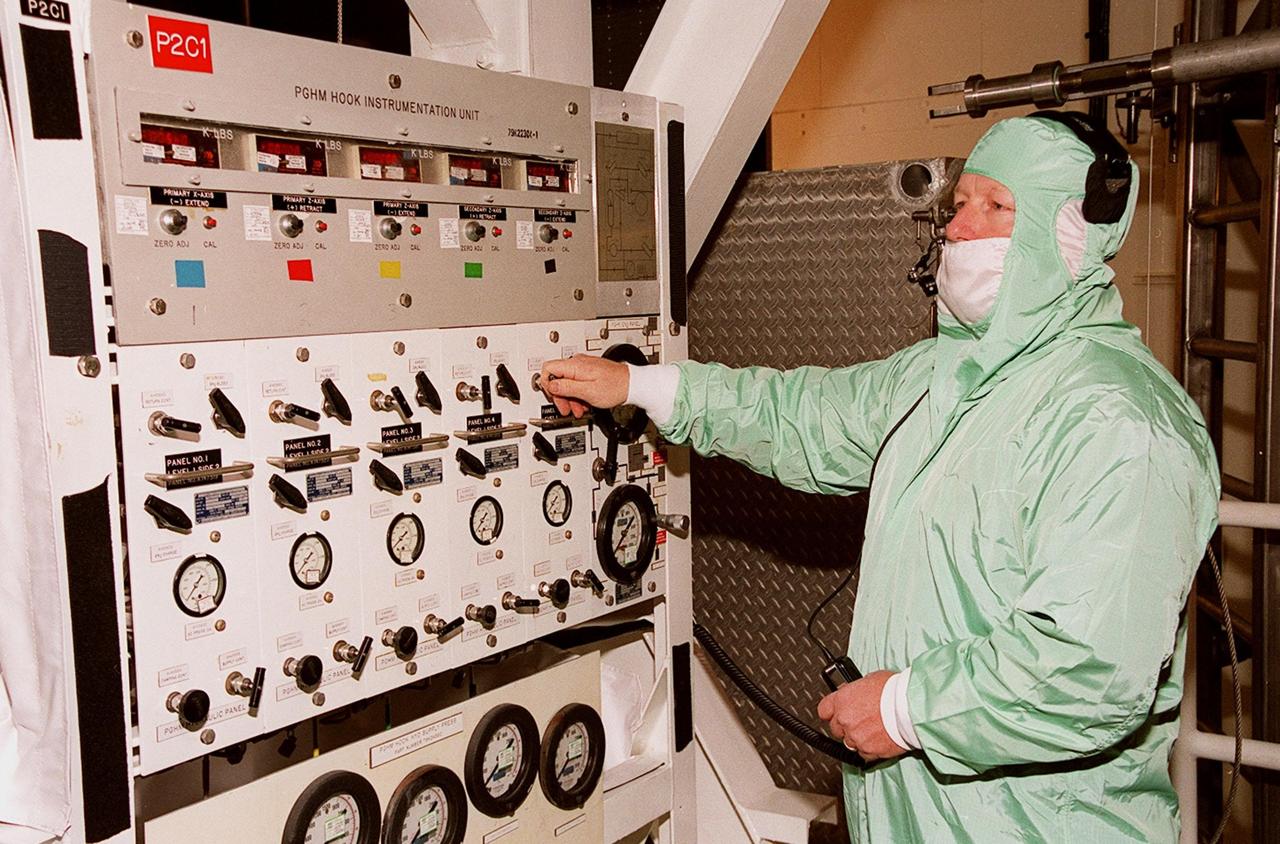
KENNEDY SPACE CENTER, FLA. -- In the Payload Changeout Room at Launch Pad 39A, a technician works switches on the Payload Ground-Handling Mechanism hook instrumentation unit that will move the U.S. Lab Destiny out of the payload canister and into the PCR. Destiny will then be transferred to the payload bay of Atlantis for mission STS-98. Destiny, a key element in the construction of the International Space Station is designed for space science experiments. STS-98 is the seventh construction flight to the ISS. Launch of STS-98 is scheduled for Jan. 19 at 2:11 a.m. EST
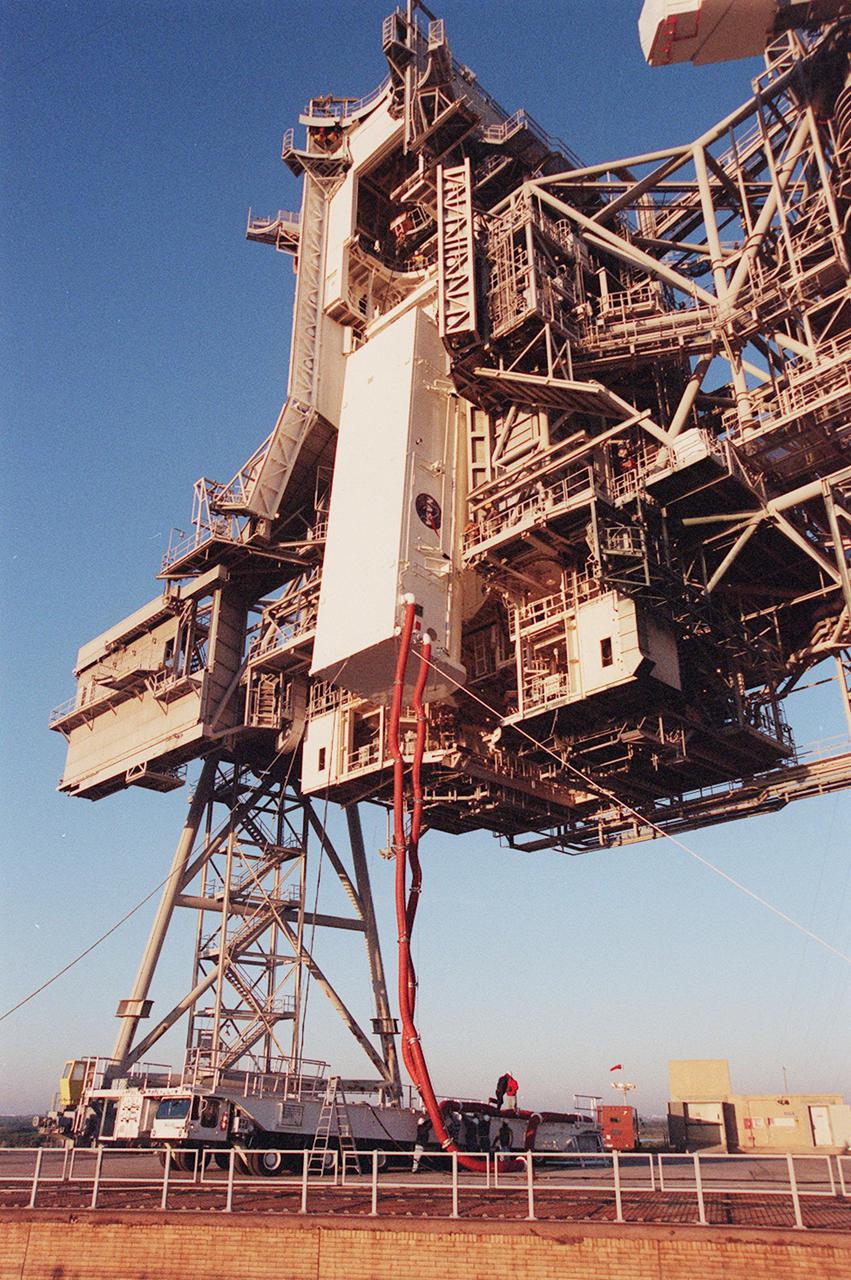
KENNEDY SPACE CENTER, FLA. -- The payload canister containing the U.S. Lab Destiny rises up the Rotating Service Structure to the payload changeout room at Launch Pad 39A. Umbilical hoses are still attached. In the PCR Destiny will be removed and transferred to the payload bay of Atlantis for mission STS-98. Destiny, a key element in the construction of the International Space Station is designed for space science experiments. STS-98 is the seventh construction flight to the ISS. Launch of STS-98 is scheduled for Jan. 19 at 2:11 a.m. EST
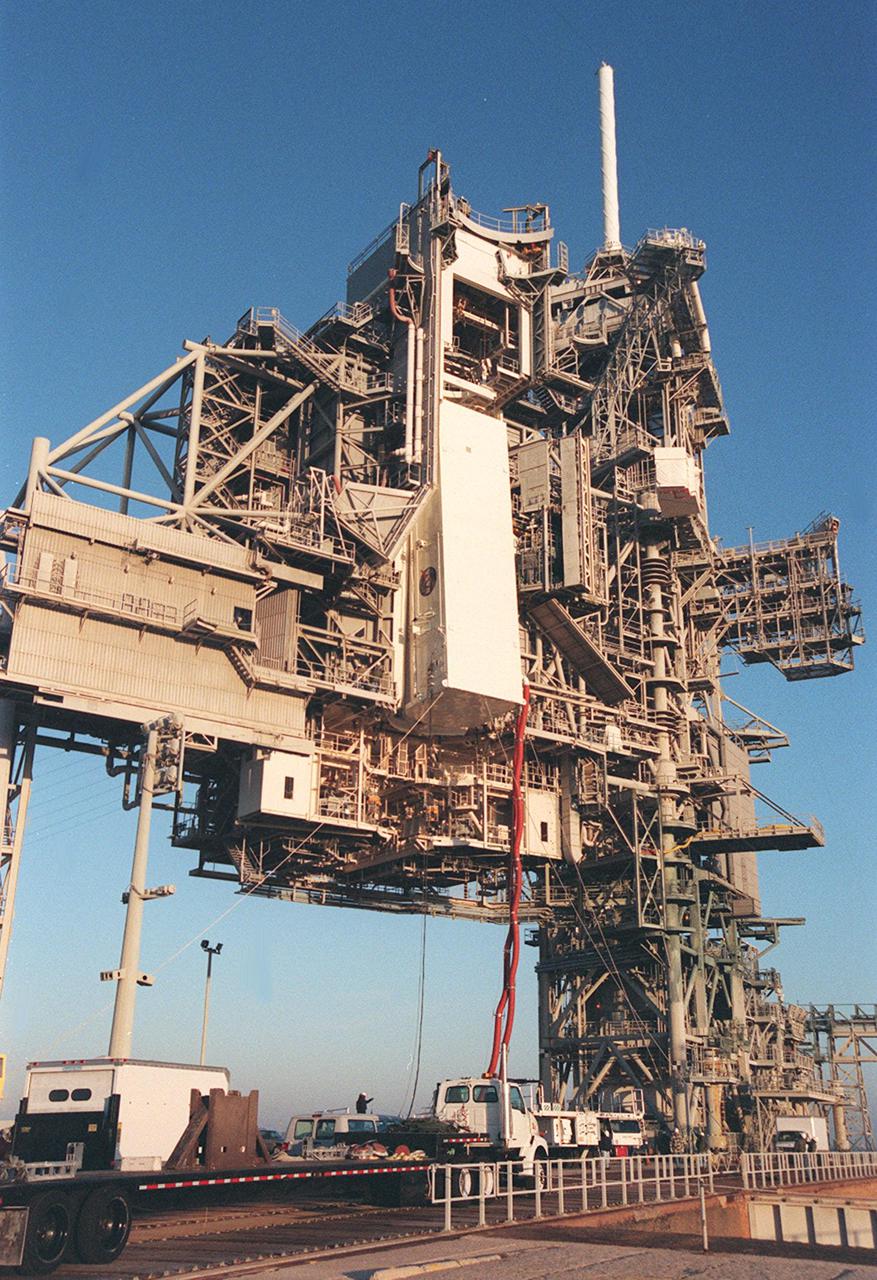
KENNEDY SPACE CENTER, FLA. -- The payload canister containing the U.S. Lab Destiny nears the payload changeout room on the Rotating Service Structure at Launch Pad 39A. Umbilical hoses are still attached. In the PCR Destiny will be removed and transferred to the payload bay of Atlantis for mission STS-98. Destiny, a key element in the construction of the International Space Station is designed for space science experiments. STS-98 is the seventh construction flight to the ISS. Launch of STS-98 is scheduled for Jan. 19 at 2:11 a.m. EST
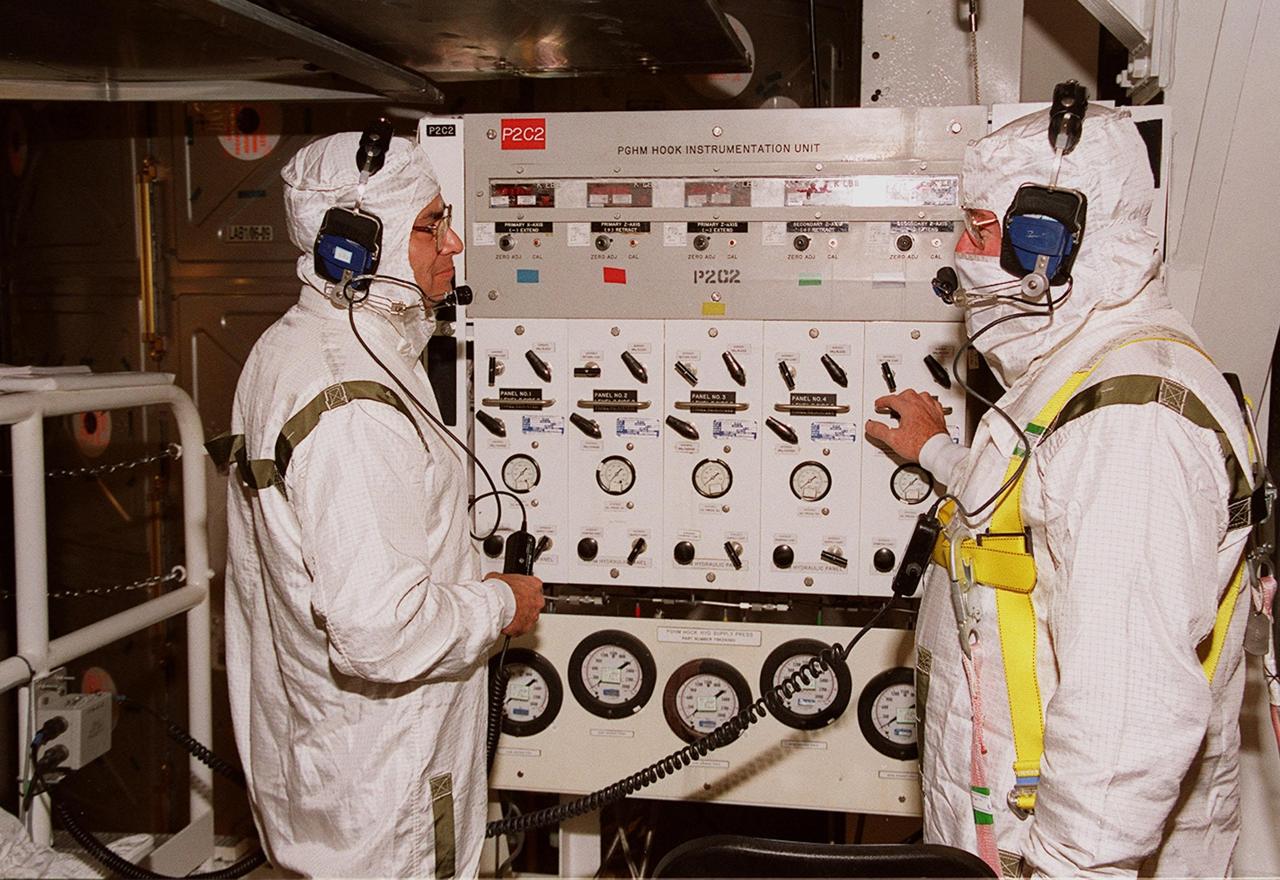
KENNEDY SPACE CENTER, FLA. -- In the Payload Changeout Room at Launch Pad 39A, technicians work the Payload Ground-Handling Mechanism hook instrumentation unit to move the U.S. Lab Destiny out of the payload canister and into the PCR. The Lab will then be transferred to the payload bay of Atlantis for mission STS-98. Destiny, a key element in the construction of the International Space Station is designed for space science experiments. STS-98 is the seventh construction flight to the ISS. Launch of STS-98 is scheduled for Jan. 19 at 2:11 a.m. EST
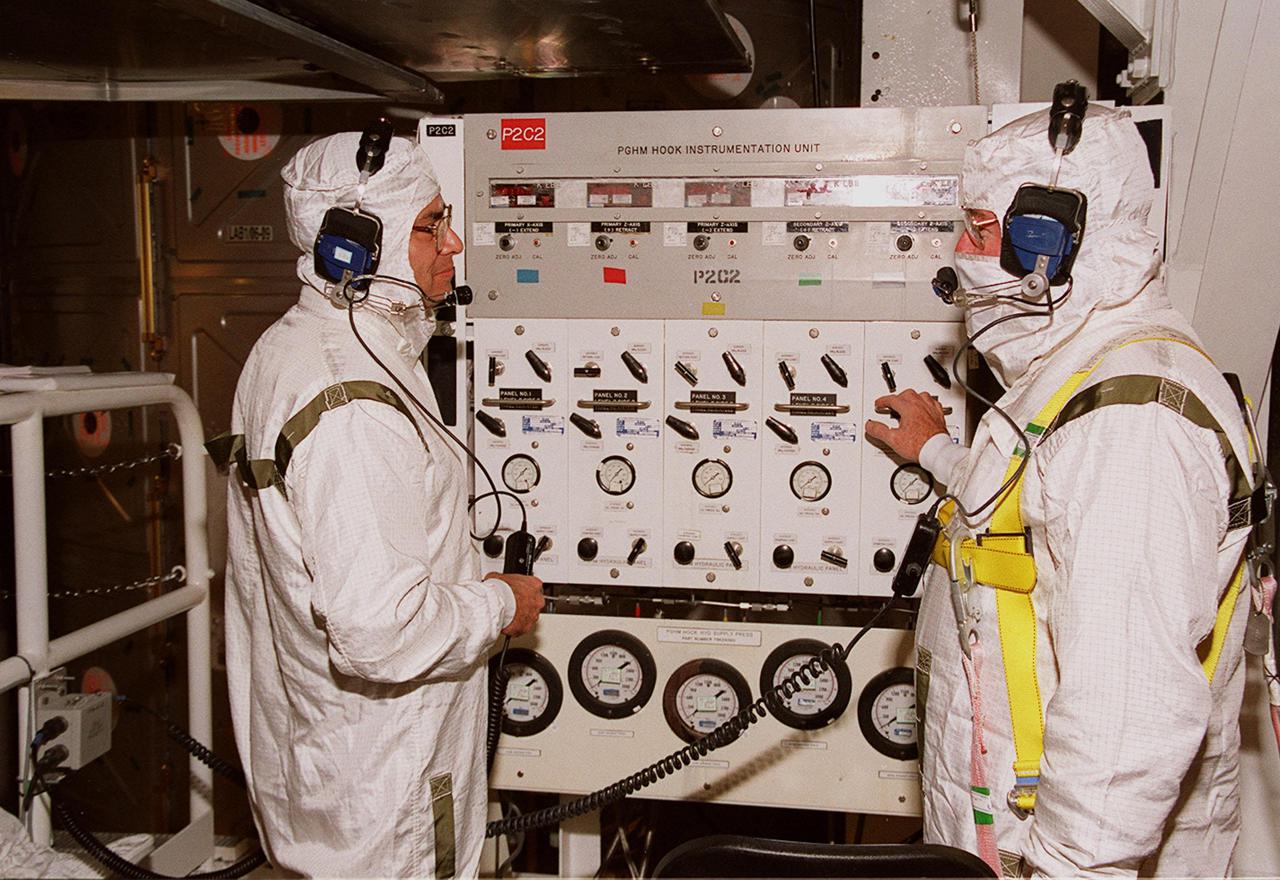
KENNEDY SPACE CENTER, FLA. -- In the Payload Changeout Room at Launch Pad 39A, technicians work the Payload Ground-Handling Mechanism hook instrumentation unit to move the U.S. Lab Destiny out of the payload canister and into the PCR. The Lab will then be transferred to the payload bay of Atlantis for mission STS-98. Destiny, a key element in the construction of the International Space Station is designed for space science experiments. STS-98 is the seventh construction flight to the ISS. Launch of STS-98 is scheduled for Jan. 19 at 2:11 a.m. EST
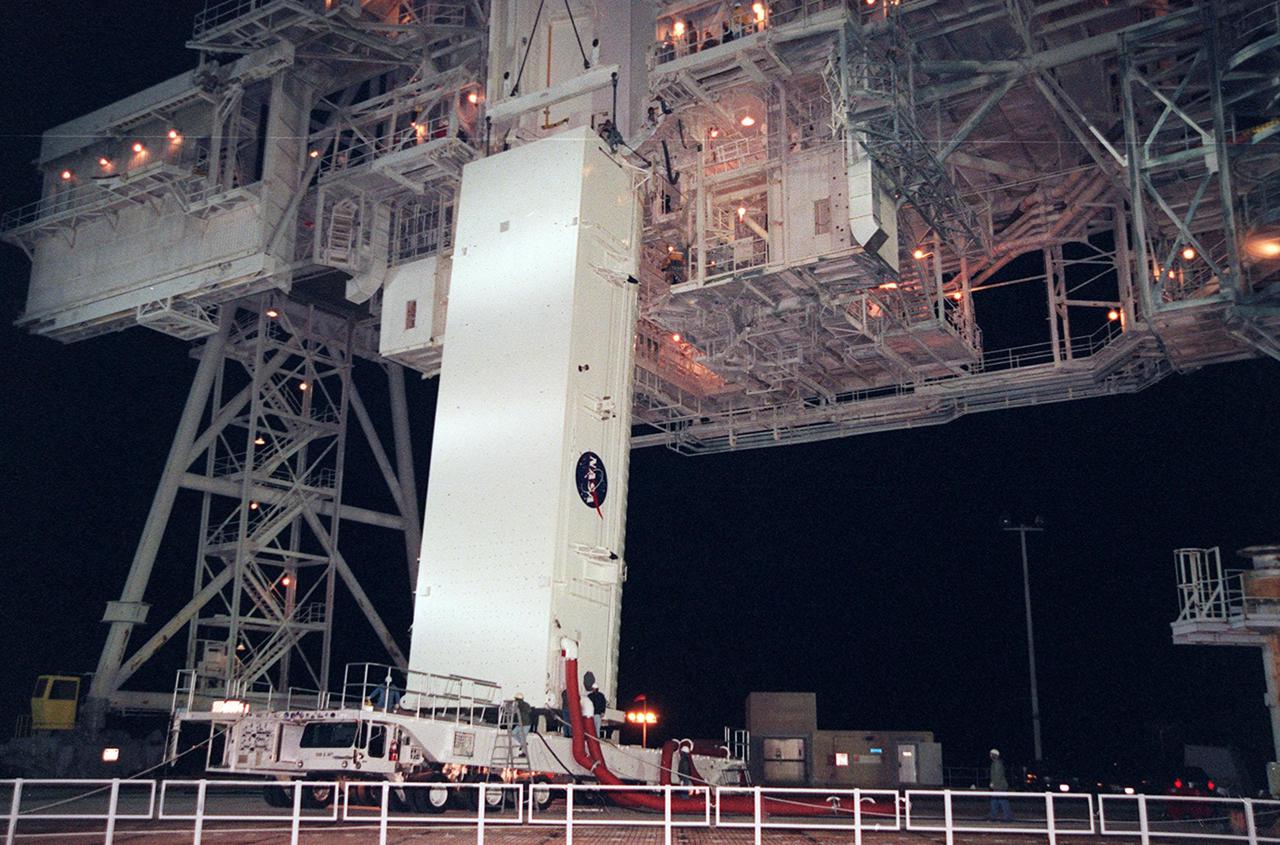
KENNEDY SPACE CENTER, FLA. -- In the early morning, the payload canister containing the U.S. Lab Destiny arrives at the Rotating Service Structure at Launch Pad 39A. The canister will be lifted to the payload changeout room above and Destiny removed, then transferred to the payload bay of Atlantis for mission STS-98. Destiny, a key element in the construction of the International Space Station, is designed for space science experiments. STS-98 is the seventh construction flight to the ISS. Launch of STS-98 is scheduled for Jan. 19 at 2:11 a.m. EST
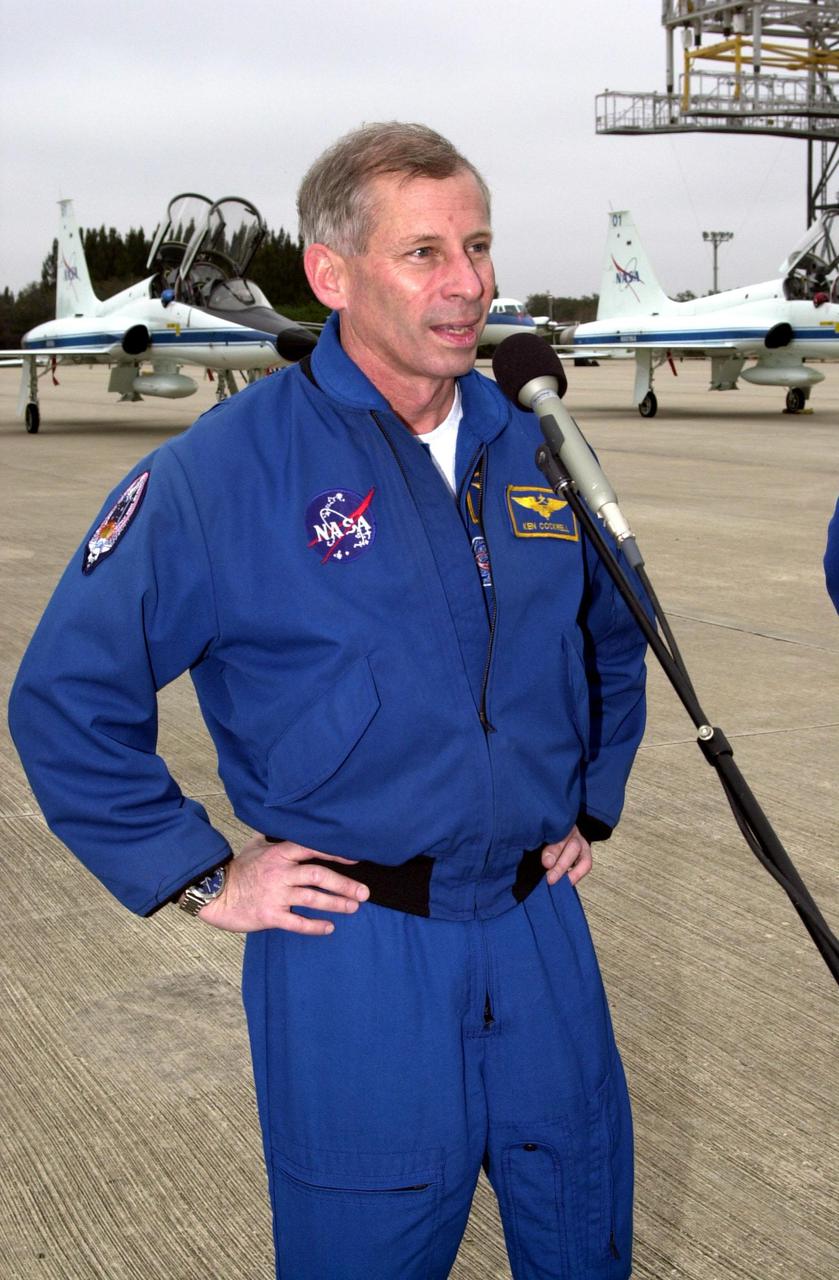
KENNEDY SPACE CENTER, FLA. -- STS-98 Mission Commander Kenneth Cockrell speaks to the media at the Shuttle Landing Facility after the crew's arrival Sunday to complete preparations for launch. The crew also includes Pilot Mark Polansky and Mission Specialists Thomas Jones, Marsha Ivins and Robert Curbeam.; STS-98 is the seventh construction flight to the International Space Station, carrying as payload the U.S. Lab Destiny, a key element in the construction of the ISS. Launch of STS-98 is scheduled for Feb. 7 at 6:11 p.m. EST
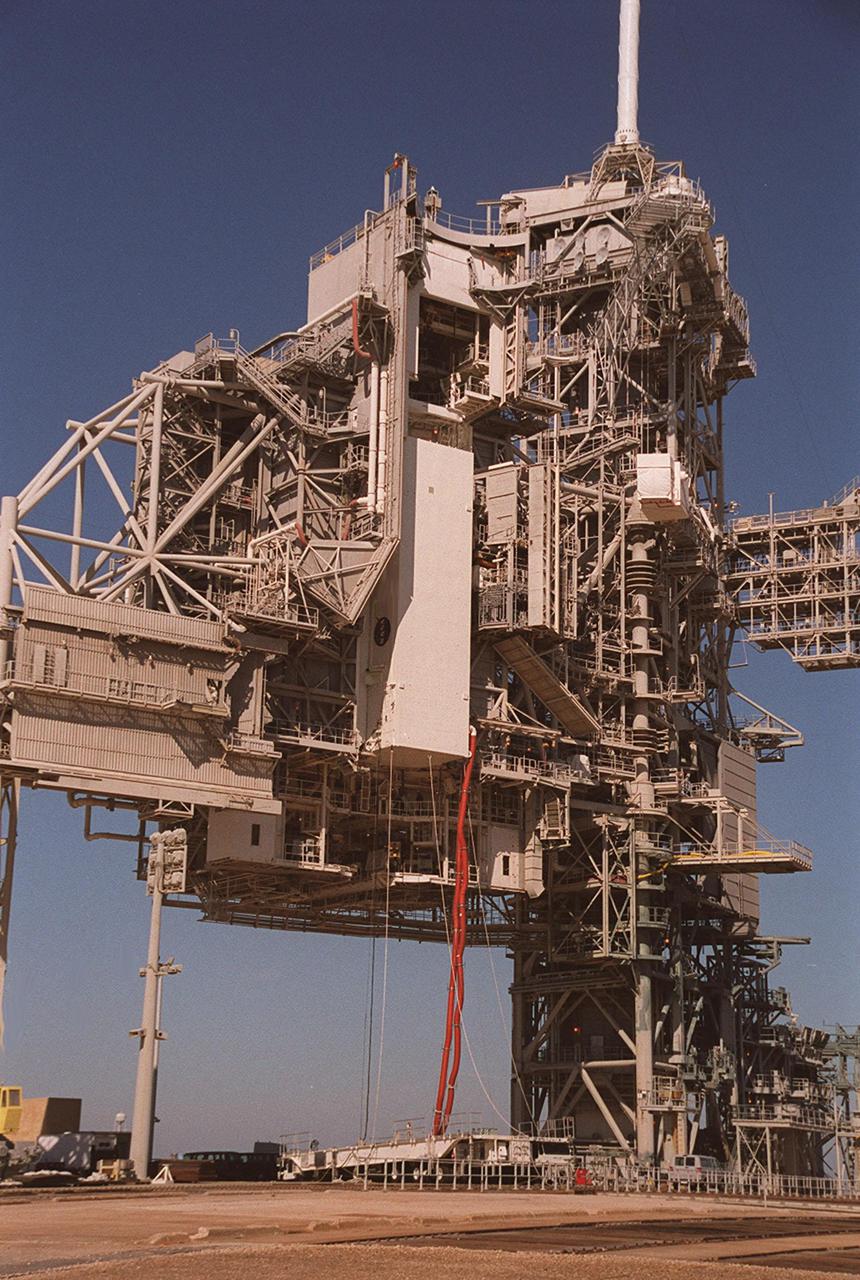
KENNEDY SPACE CENTER, FLA. -- The payload canister containing the U.S. Lab Destiny rises up the Rotating Service Structure to the payload changeout room at Launch Pad 39A. There Destiny will be removed and transferred to the payload bay of Atlantis for mission STS-98. Destiny, a key element in the construction of the International Space Station is designed for space science experiments. STS-98 is the seventh construction flight to the ISS. Launch of STS-98 is scheduled for Jan. 19 at 2:11 a.m. EST
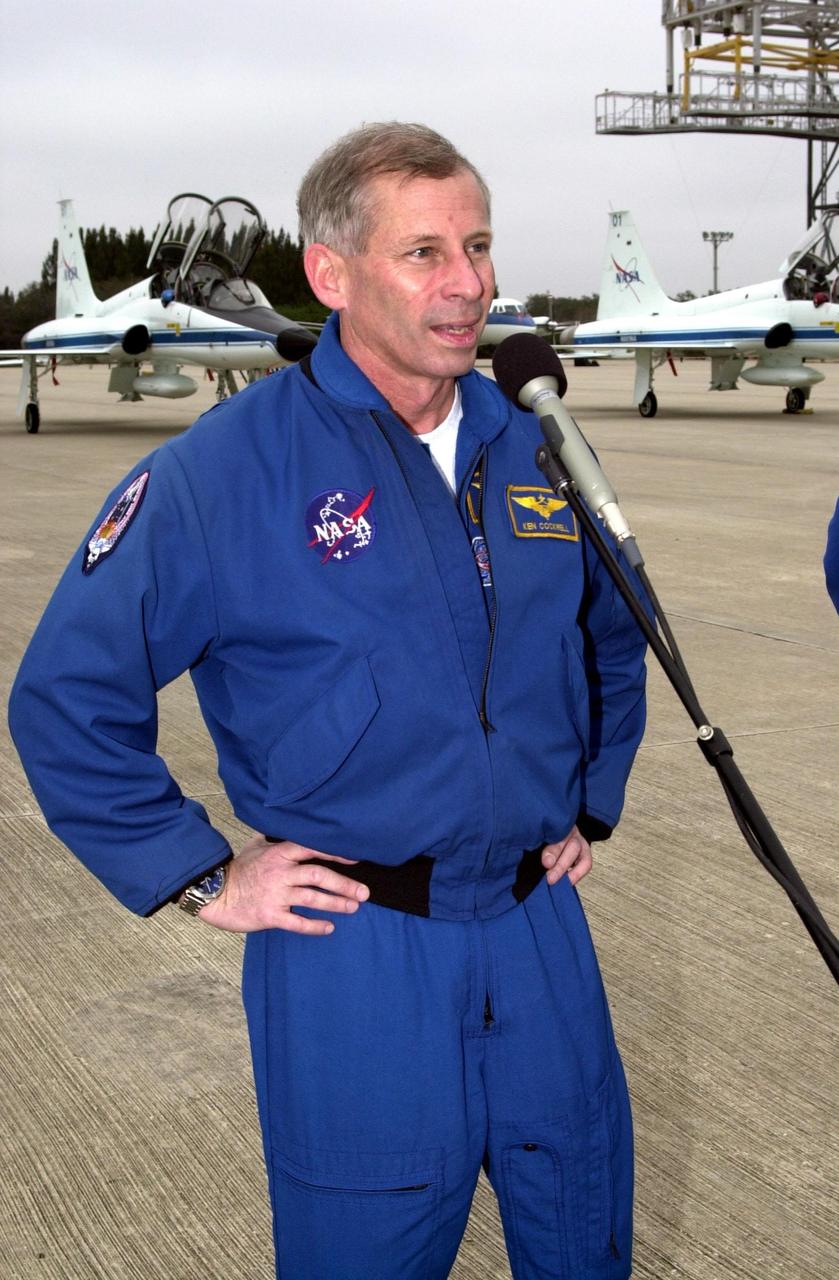
KENNEDY SPACE CENTER, FLA. -- STS-98 Mission Commander Kenneth Cockrell speaks to the media at the Shuttle Landing Facility after the crew's arrival Sunday to complete preparations for launch. The crew also includes Pilot Mark Polansky and Mission Specialists Thomas Jones, Marsha Ivins and Robert Curbeam.; STS-98 is the seventh construction flight to the International Space Station, carrying as payload the U.S. Lab Destiny, a key element in the construction of the ISS. Launch of STS-98 is scheduled for Feb. 7 at 6:11 p.m. EST
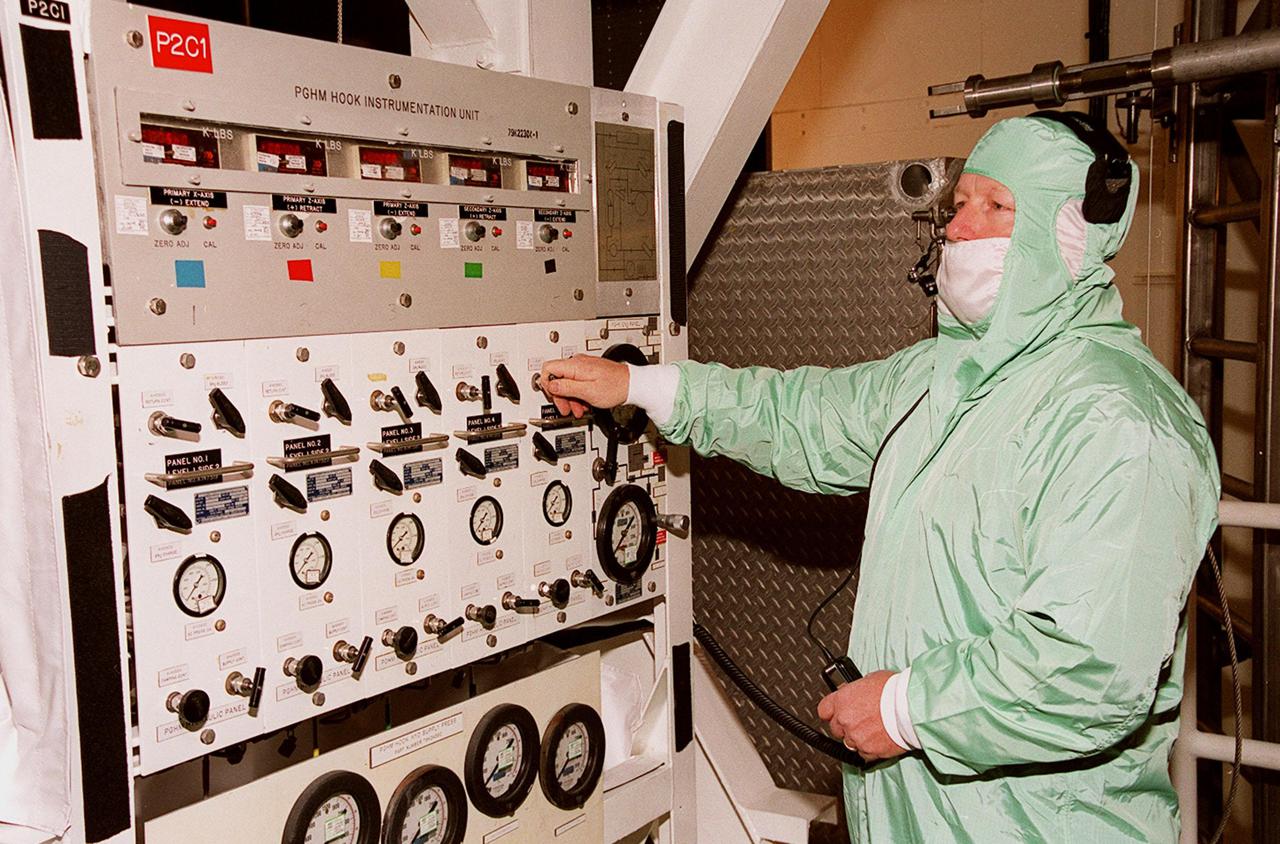
KENNEDY SPACE CENTER, FLA. -- In the Payload Changeout Room at Launch Pad 39A, a technician works switches on the Payload Ground-Handling Mechanism hook instrumentation unit that will move the U.S. Lab Destiny out of the payload canister and into the PCR. Destiny will then be transferred to the payload bay of Atlantis for mission STS-98. Destiny, a key element in the construction of the International Space Station is designed for space science experiments. STS-98 is the seventh construction flight to the ISS. Launch of STS-98 is scheduled for Jan. 19 at 2:11 a.m. EST
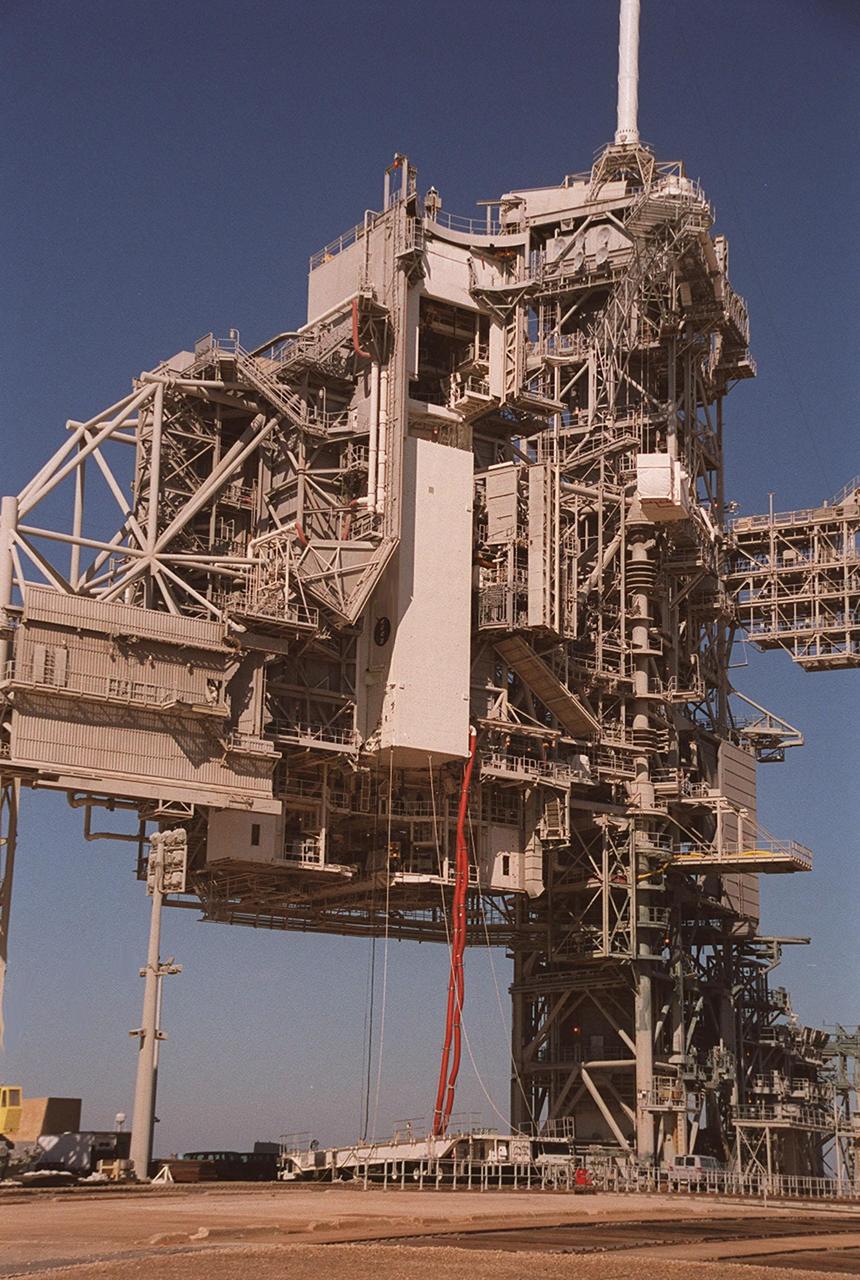
KENNEDY SPACE CENTER, FLA. -- The payload canister containing the U.S. Lab Destiny rises up the Rotating Service Structure to the payload changeout room at Launch Pad 39A. There Destiny will be removed and transferred to the payload bay of Atlantis for mission STS-98. Destiny, a key element in the construction of the International Space Station is designed for space science experiments. STS-98 is the seventh construction flight to the ISS. Launch of STS-98 is scheduled for Jan. 19 at 2:11 a.m. EST
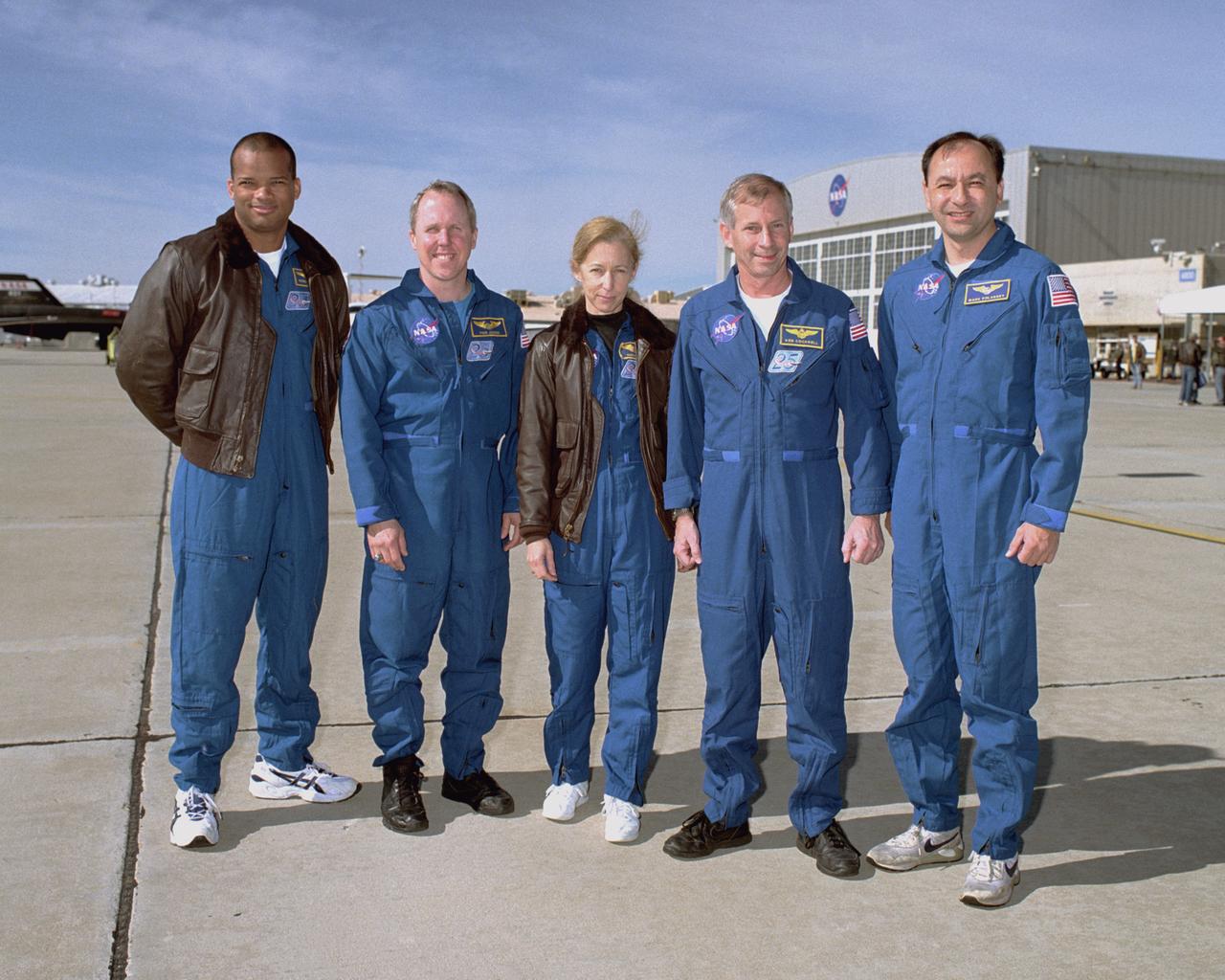
The crew of STS-98 poses for a group photo shortly before leaving NASA's Dryden Flight Research Center after a successful landing of the Space Shuttle Atlantis the day before. L to R: Mission Specialists Robert L. Curbeam, Thomas D. Jones, and Marsha S. Ivins, Commander Kenneth D. Cockrell, and Pilot Mark L. Polansky.
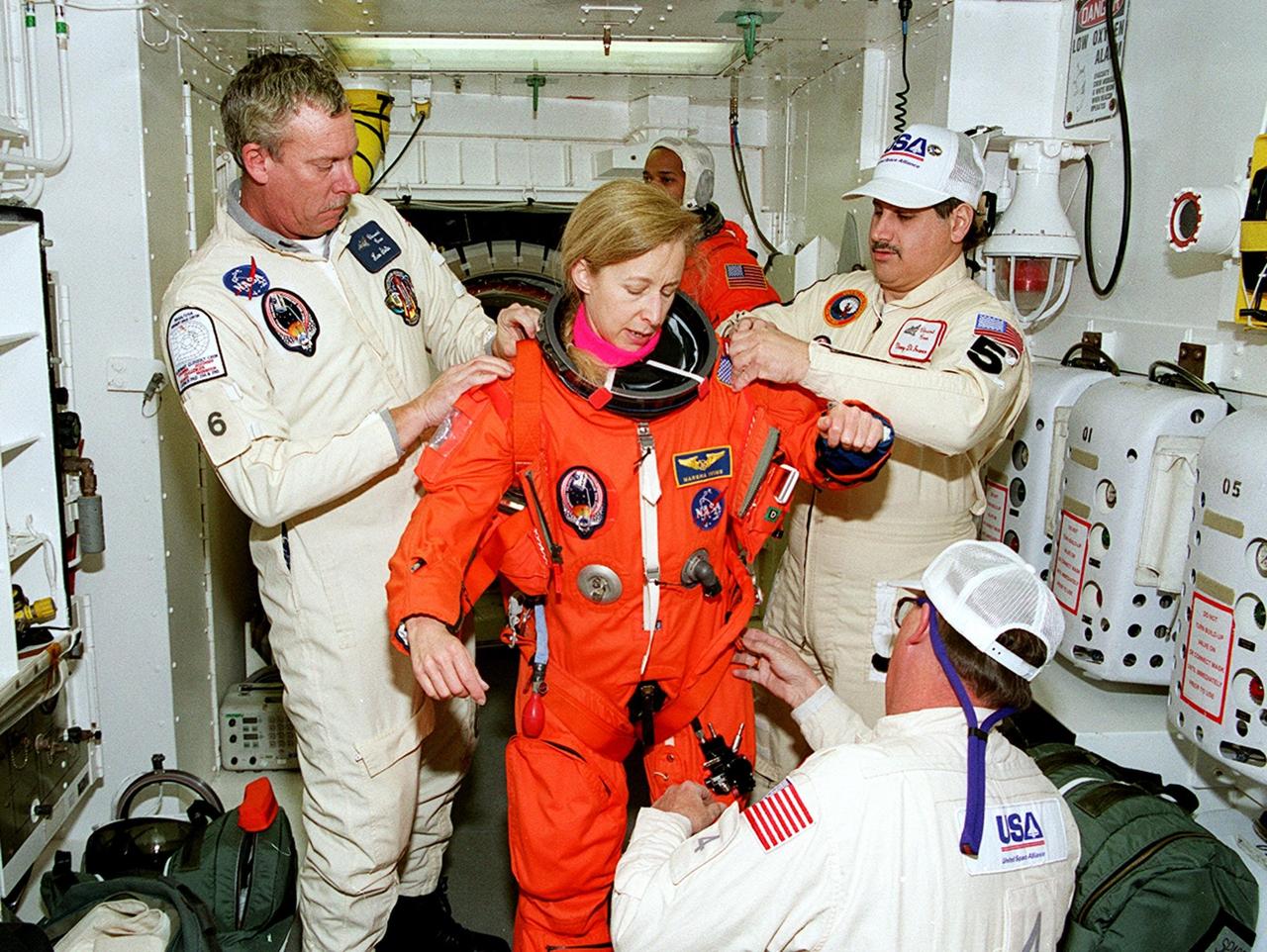
In the White Room, members of the closeout crew help STS-98 Mission Specialist Marsha Ivins (center) with her launch and entry suit before she enters Atlantis for a simulated launch countdown. The White Room is an environmental chamber at the end of the orbiter access arm that mates with the orbiter to allow personnel to enter the orbiter’s crew compartment. The STS-98 crew is taking part in Terminal Countdown Demonstration Test activities, which also include emergency egress training at the pad. STS-98 is the seventh construction flight to the International Space Station, carrying as payload the U.S. Lab Destiny, a key element in the construction of the ISS. Launch of STS-98 is scheduled for Jan. 19 at 2:11 a.m. EST

The closeout crew in the White Room pose with two of the STS-98 crew. Kneeling in front is United Space Alliance Mechanical Technician George Schramm. Standing, left to right, are USA Mechanical Technician Vinny Difranzo, Mission Specialist Robert Curbeam, NASA Quality Assurance Specialist Ken Strite, Mission Specialist Marsha Ivins, and USA Orbiter Vehicle Closeout Chief Travis Thompson. The White Room is an environmental chamber at the end of the orbiter access arm that mates with the orbiter to allow personnel to enter the orbiter’s crew compartment. The STS-98 crew is getting ready to enter Atlantis for a simulated launch countdown, part of Terminal Countdown Demonstration Test activities. STS-98 is the seventh construction flight to the International Space Station, carrying as payload the U.S. Lab Destiny, a key element in the construction of the ISS. Launch of STS-98 is scheduled for Jan. 19 at 2:11 a.m. EST
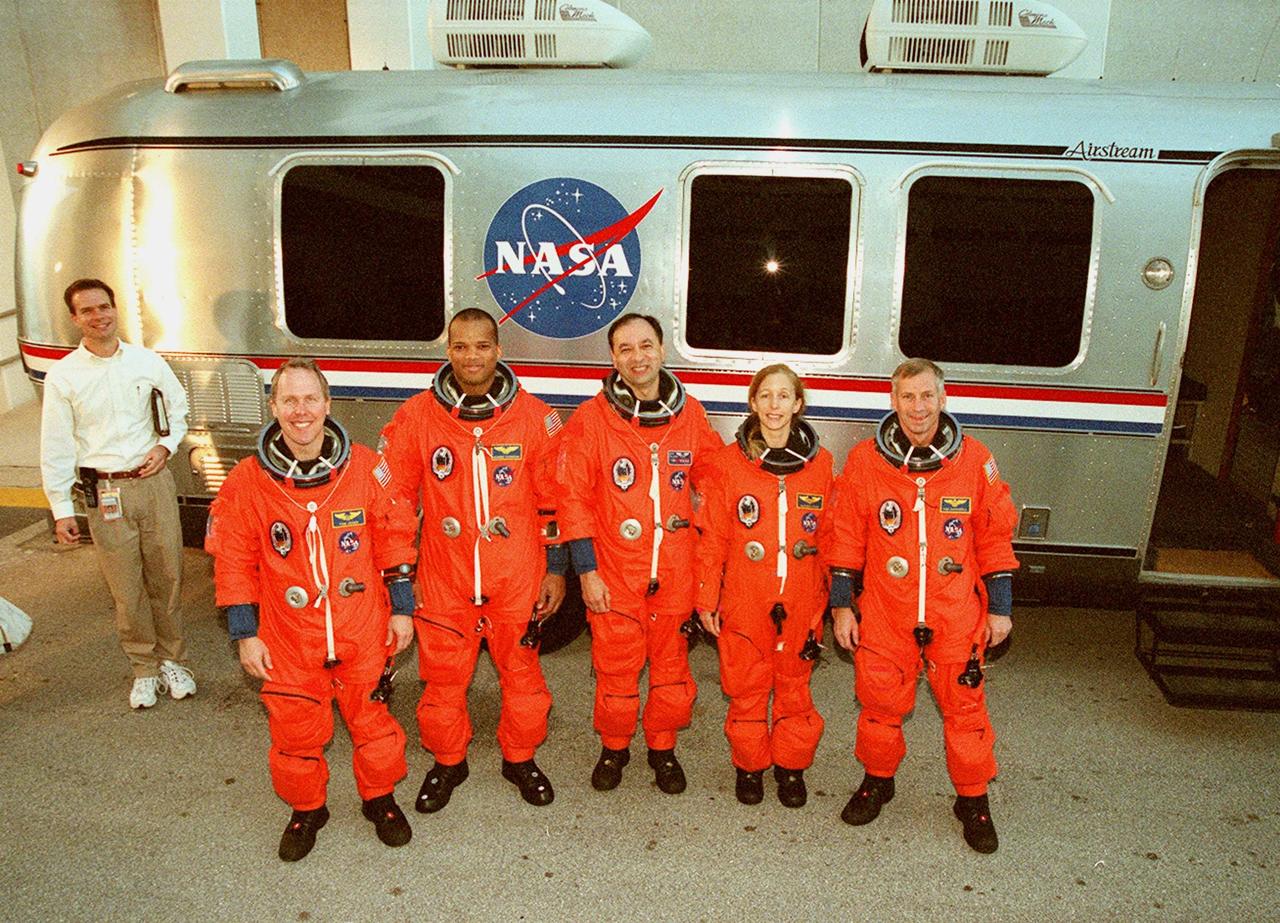
After walkout from the Operations and Checkout Building, the <a href="../../subjects/sts-98.htm"> STS-98</a> crew stops for a photograph in front of the Astrovan that will take them to <a href="../../subjects/lc39a.htm"> Launch Pad 39A</a> for a simulated launch countdown. Standing left to right are Mission Specialists Thomas Jones and Robert Curbeam, Pilot Mark Polansky, Mission Specialist Marsha Ivins and Commander Ken Cockrell. The crew has been taking part in Terminal Countdown Demonstration Test activities, which include the simulated countdown and emergency egress training at the pad. STS-98 is the seventh construction flight to the International Space Station, carrying as payload the U.S. Lab <a href="../../subjects/destiny.htm">Destiny</a>, a key element in the construction of the ISS. Launch of STS-98 is scheduled for Jan. 19 at 2:11 a.m. EST

Before entering Atlantis from the White Room for a simulated launch countdown, STS-98 Pilot Mark Polansky (left) poses with Travis Thompson, who is the orbiter vehicle closeout chief. The White Room is an environmental chamber at the end of the orbiter access arm that mates with the orbiter to allow personnel to enter the orbiter’s crew compartment. Thompson is with United Space Alliance. The STS-98 crew is taking part in Terminal Countdown Demonstration Test activities, which also include emergency egress training at the pad. STS-98 is the seventh construction flight to the International Space Station, carrying as payload the U.S. Lab Destiny, a key element in the construction of the ISS. Launch of STS-98 is scheduled for Jan. 19 at 2:11 a.m. EST
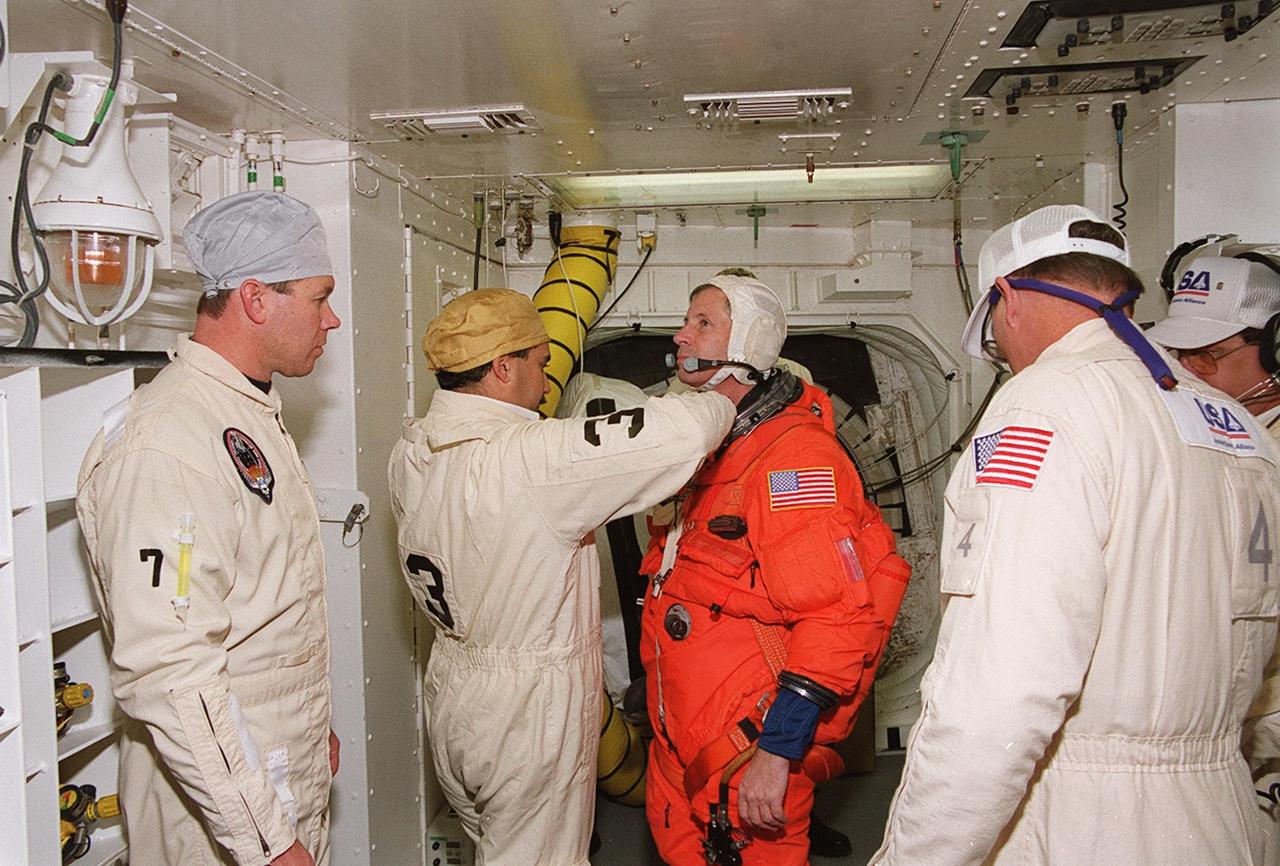
In the White Room at Launch Pad 39A, STS-98 Commander Ken Cockrell (center) gets help from the closeout crew with his launch and entry suit before entering Atlantis for a simulated launch countdown. The White Room is an environmental chamber at the end of the orbiter access arm that mates with the orbiter to allow personnel to enter the orbiter’s crew compartment. The STS-98 crew is taking part in Terminal Countdown Demonstration Test activities, which also include emergency egress training at the pad. STS-98 is the seventh construction flight to the International Space Station, carrying as payload the U.S. Lab Destiny, a key element in the construction of the ISS. Launch of STS-98 is scheduled for Jan. 19 at 2:11 a.m. EST
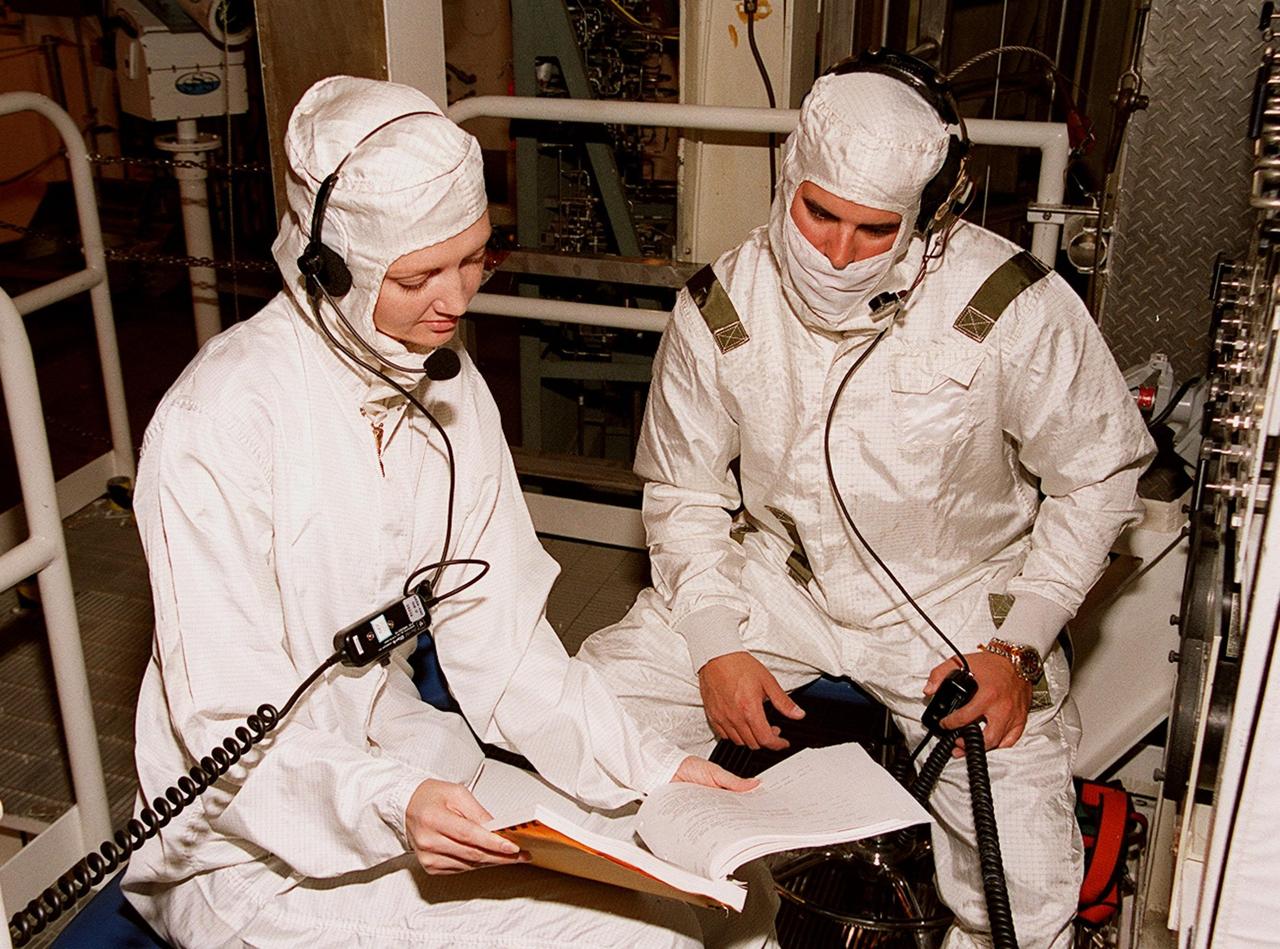
KENNEDY SPACE CENTER, FLA. -- In the Payload Changeout Room at Launch Pad 39A, technicians read a manual on the Payload Ground-Handling Mechanism hook instrumentation unit. The PGHM will be used in moving the U.S. Lab Destiny out of the payload canister and into the PCR. Destiny will then be transferred to the payload bay of Atlantis for mission STS-98. A key element in the construction of the International Space Station, Destiny is designed for space science experiments. STS-98 is the seventh construction flight to the ISS. Launch of STS-98 is scheduled for Jan. 19 at 2:11 a.m. EST
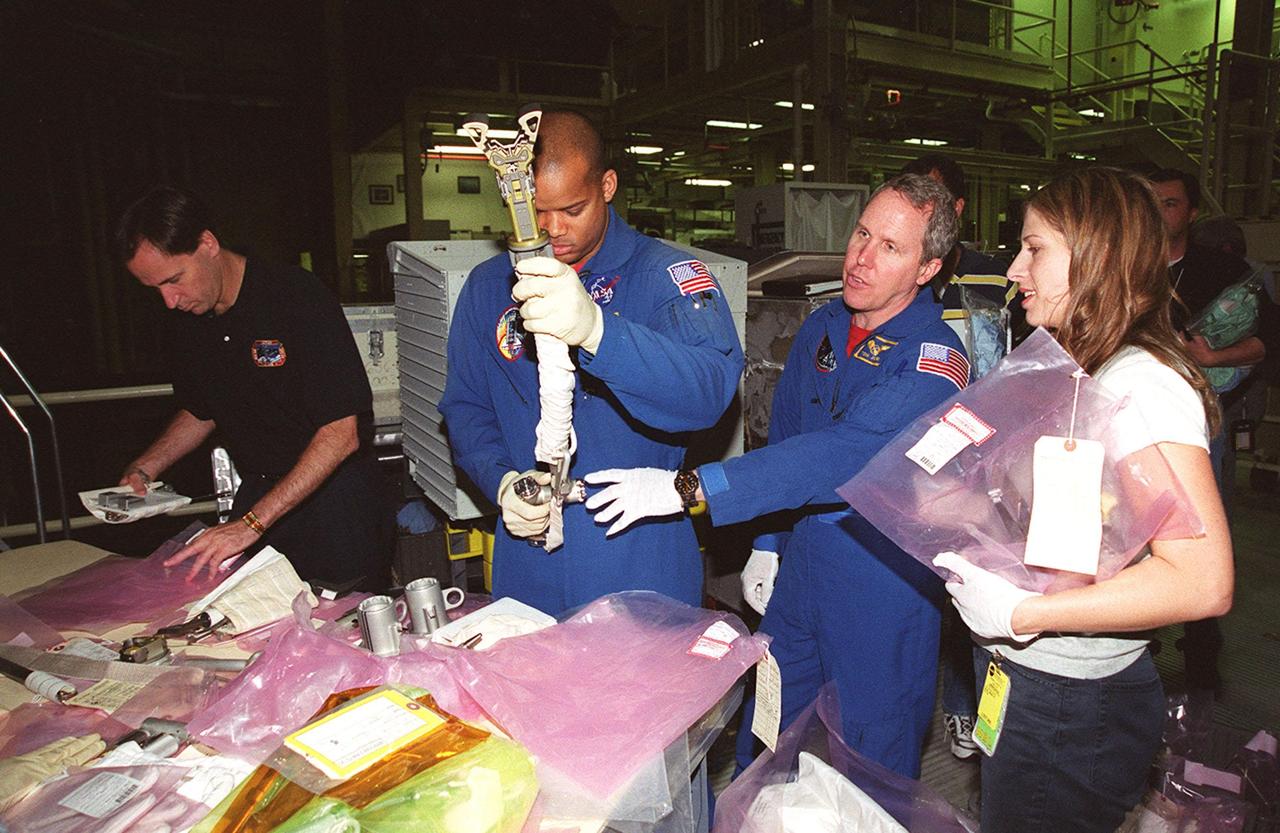
KENNEDY SPACE CENTER, FLA. -- In the Orbiter Processing Facility, STS-98 Mission Specialists Robert Curbeam (center left) and Tom Jones (center right) practice with tools that will be used on extravehicular activities on their mission. The STS-98 crew is at KSC for Crew Equipment Interface Test activities. Launch on mission STS-98 is scheduled for Jan. 18, 2001. It will be transporting the U.S. Lab, Destiny, to the International Space Station with five system racks already installed inside of the module. After delivery of electronics in the lab, electrically powered attitude control for Control Moment Gyroscopes will be activated
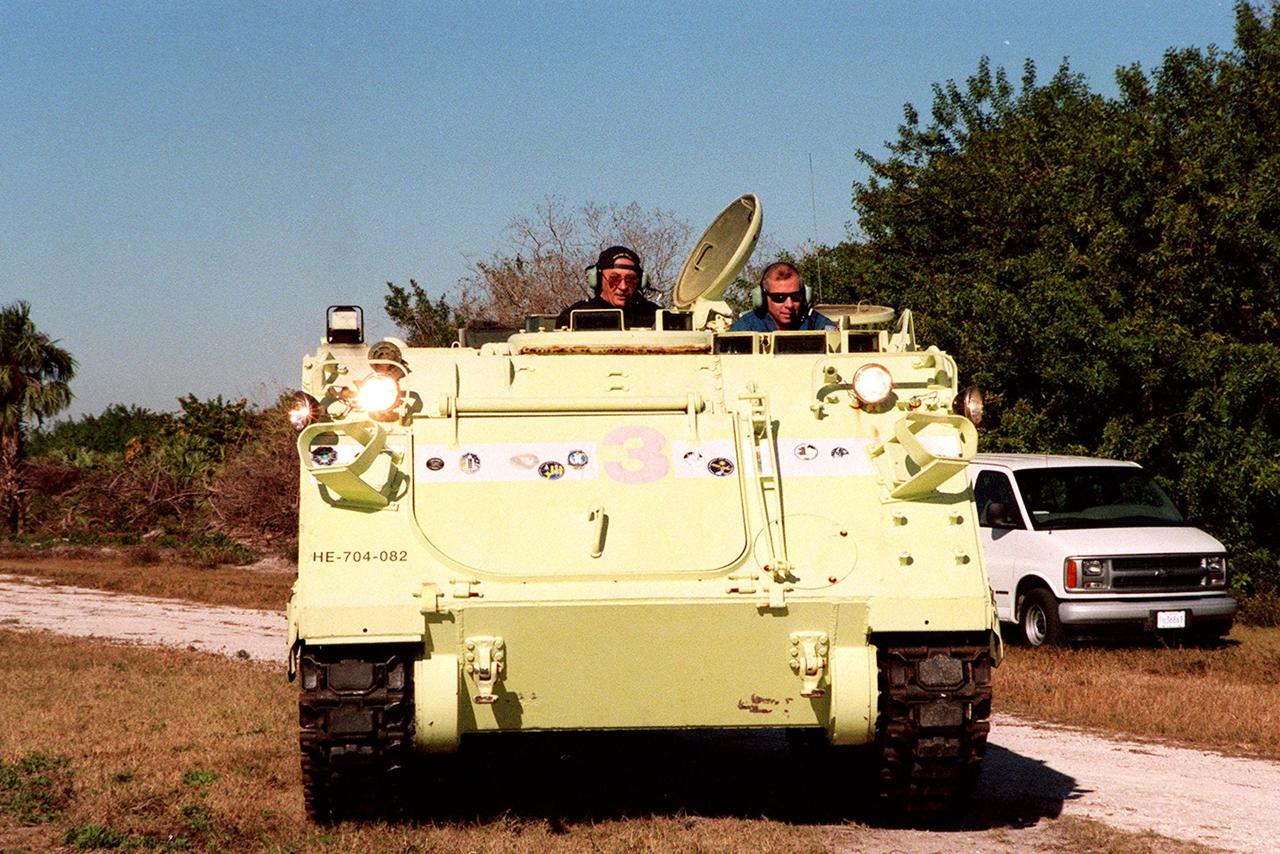
Capt. George Hoggard (left), a training officer with SGS Fire Services, sits alongside STS-98 Commander Ken Cockrell, who practices driving an M-113 armored carrier. In the event of an emergency at the pad prior to launch, the carrier could be used to transport the crew to a nearby bunker or farther. The vehicle is part of emergency egress training at Launch Pad 39A. The STS-98 crew is at KSC to take part in Terminal Countdown Demonstration Test activities, which also includes a simulated launch countdown. STS-98 is the seventh construction flight to the International Space Station, carrying as payload the U.S. Lab Destiny, a key element in the construction of the ISS
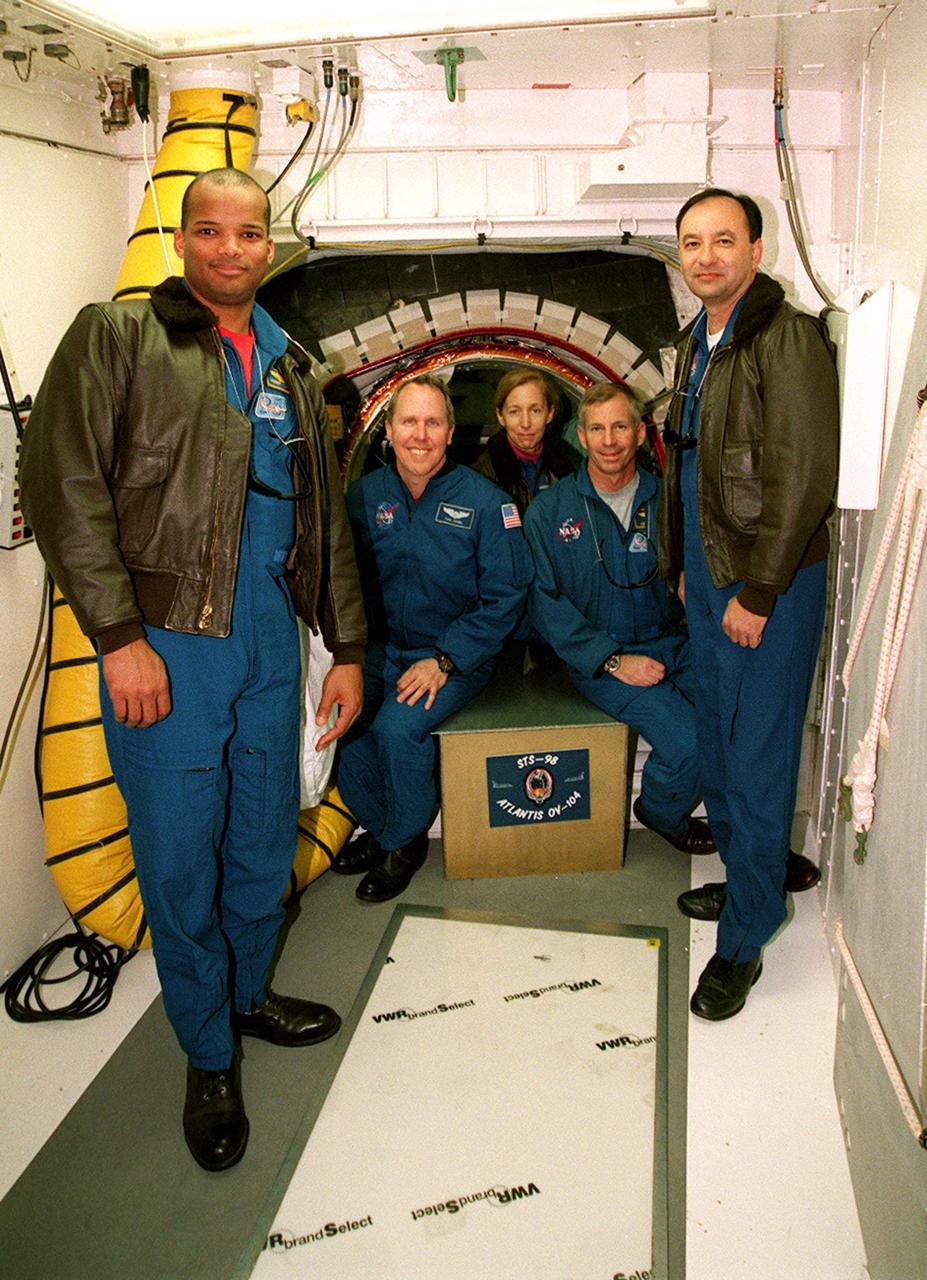
KENNEDY SPACE CENTER, FLA. -- Sitting in the entrance to the orbiter Atlantis are (left to right) STS-98 Mission Specialists Thomas Jones and Marsha Ivins and Commander Ken Cockrell. Below them is the mission patch just placed there by Cockrell. Standing at left is Mission Specialist Robert Curbeam and at right Pilot Mark Polansky. The crew is at KSC to take part in Terminal Countdown Demonstration Test activities, which include emergency egress training and a simulated launch countdown. STS-98 is the seventh construction flight to the International Space Station, carrying as payload the U.S. Lab Destiny, a key element in the construction of the ISS. Launch of STS-98 is scheduled for Jan. 19 at 2:11 a.m

KENNEDY SPACE CENTER, FLA. -- In the Space Station Processing Facility, workers and the STS-98 crew gather for a ceremony that turns over the “key” for the U.S. Lab Destiny to NASA. Holding the key (left) is STS-98 Commander Ken Cockrell. To his left is Mission Specialist Thomas Jones; at right (in uniform) is Mission Specialist Marsha Ivins. Also in the group are Pilot Mark Polansky and Mission Specialist Robert Curbeam. . Launch of mission STS-98 on Space Shuttle Atlantis is scheduled for Jan. 18, 2001. The mission will carry the U.S. Lab Destiny to the International Space Station with five system racks and experiments already installed inside the module
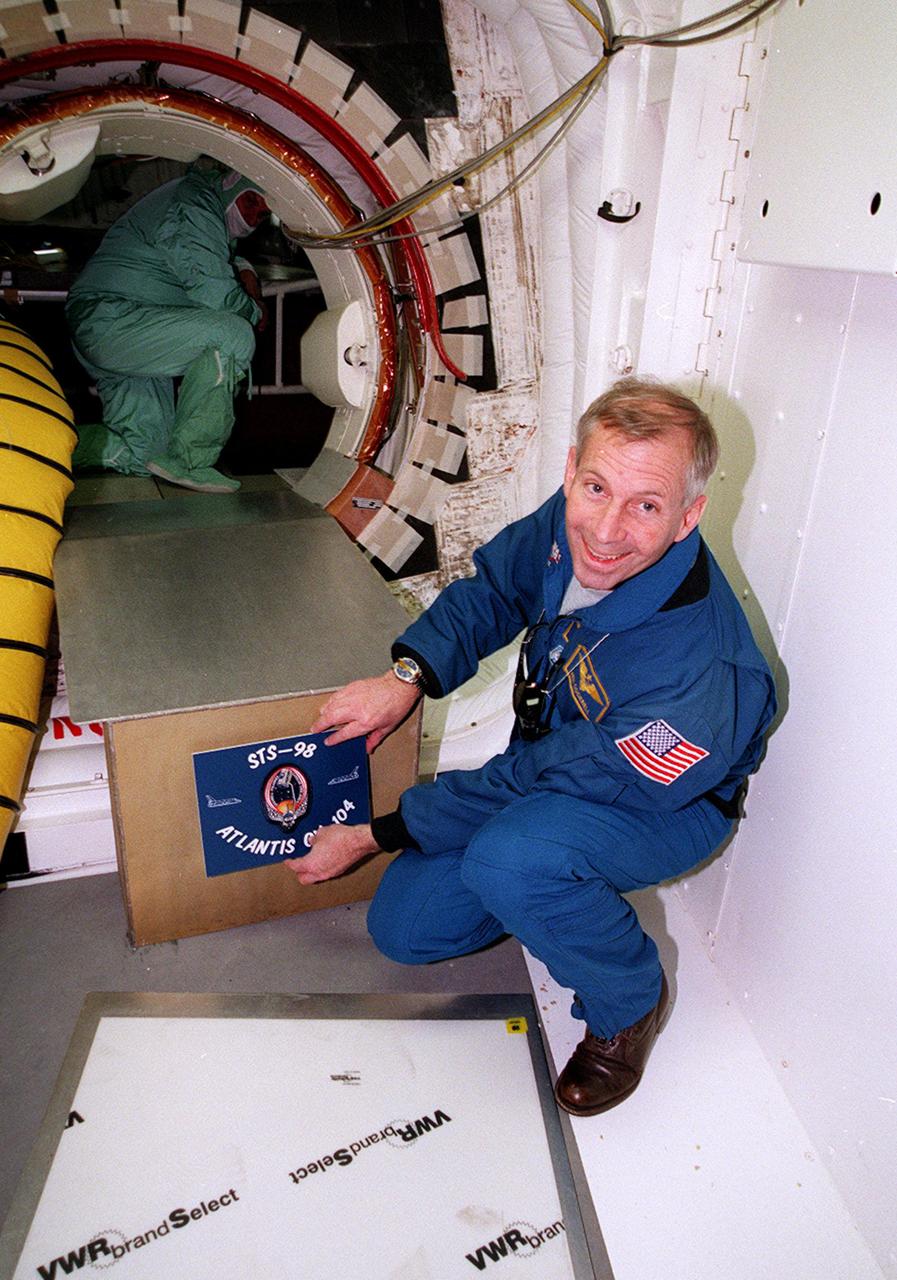
KENNEDY SPACE CENTER, FLA. -- STS-98 Commander Ken Cockrell places the mission patch on the entrance to the orbiter Atlantis. He and the rest of the crew Pilot Mark Polansky and Mission Specialists Thomas Jones, Marsha Ivins and Robert Curbeam are t KSC to take part in Terminal Countdown Demonstration Test activities, which include emergency egress training and a simulated launch countdown. STS-98 is the seventh construction flight to the International Space Station, carrying as payload the U.S. Lab Destiny, a key element in the construction of the ISS. Launch of STS-98 is scheduled for Jan. 19 at 2:11 a.m
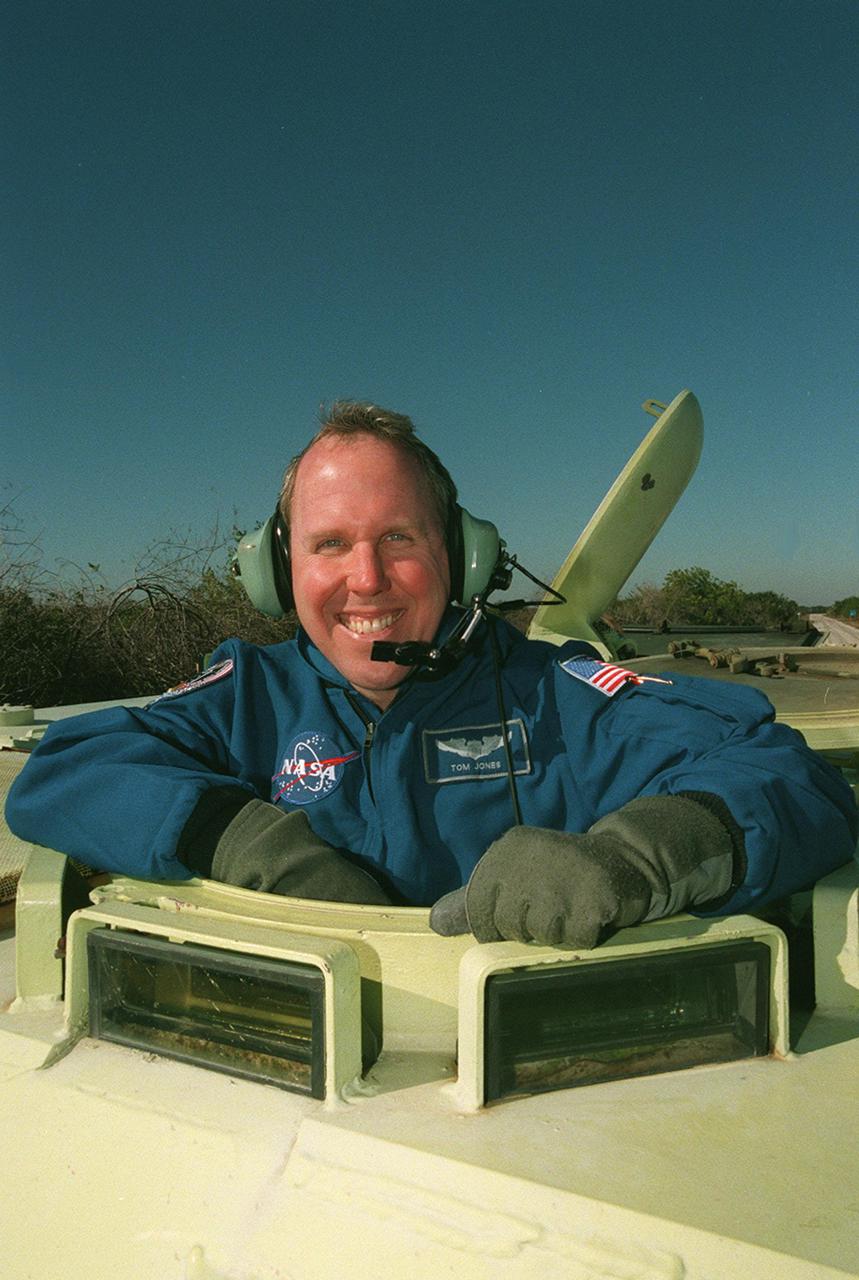
A smiling Thomas Jones, one of the mission specialists on STS-98, gets ready to take the driver’s seat in an M-113 armored carrier, part of emergency egress training at Launch Pad 39A. In the event of an emergency at the pad prior to launch, the carrier could be used to transport the crew to a nearby bunker or farther. The STS-98 crew is at KSC to take part in Terminal Countdown Demonstration Test activities, which also includes a simulated launch countdown. STS-98 is the seventh construction flight to the International Space Station, carrying as payload the U.S. Lab Destiny, a key element in the construction of the ISS
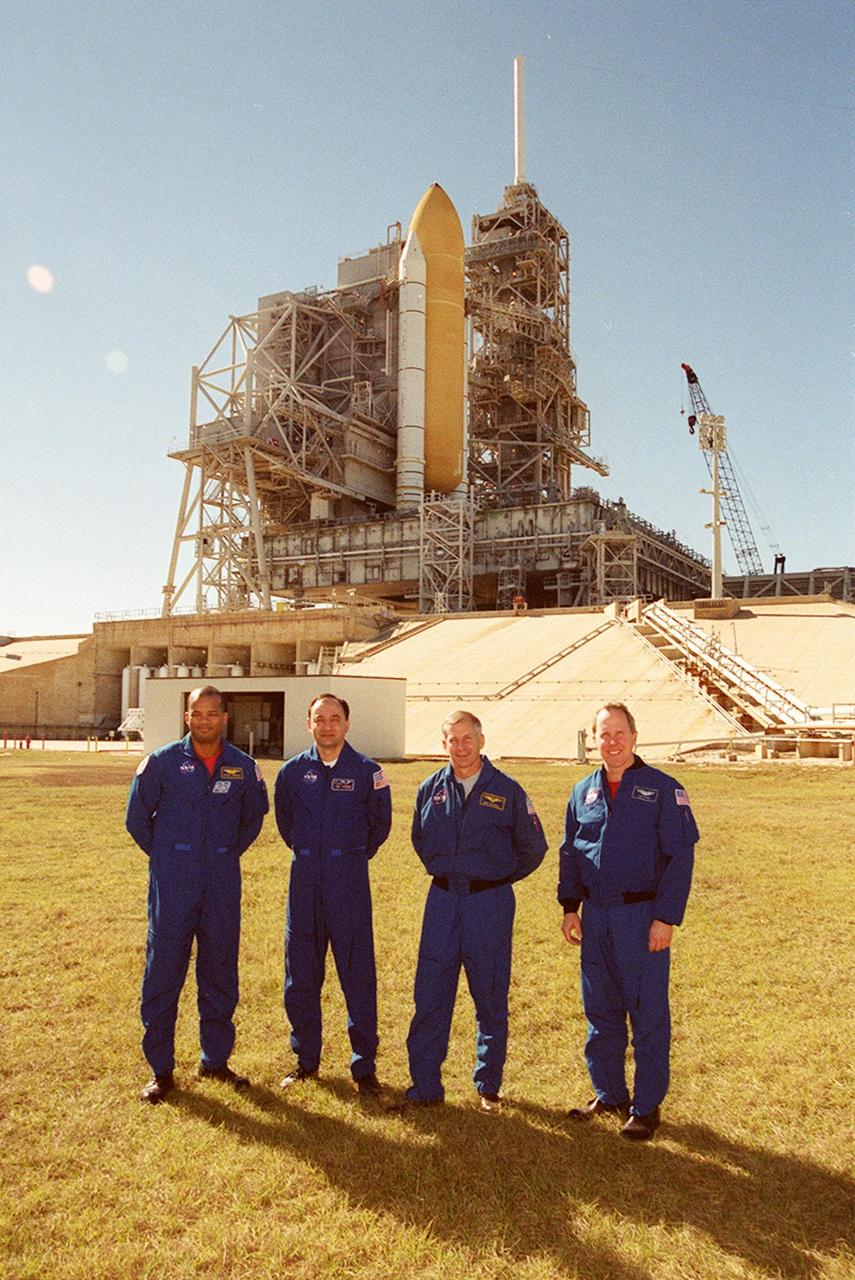
KENNEDY SPACE CENTER, FLA. -- Four members of the STS-98 crew pose for a photo at Launch Pad 39A. Standing, left to right, are Mission Specialist Robert Curbeam, Pilot Mark Polansky, Commander Ken Cockrell and Mission Specialist Thomas Jones. Not pictured is Mission Specialist Marsha Ivins. The crew is at KSC to take part in Terminal Countdown Demonstration Test activities, which include emergency egress training and a simulated launch countdown. STS-98 is the seventh construction flight to the International Space Station, carrying as payload the U.S. Lab Destiny, a key element in the construction of the ISS. Launch of STS-98 is scheduled for Jan. 19 at 2:11 a.m
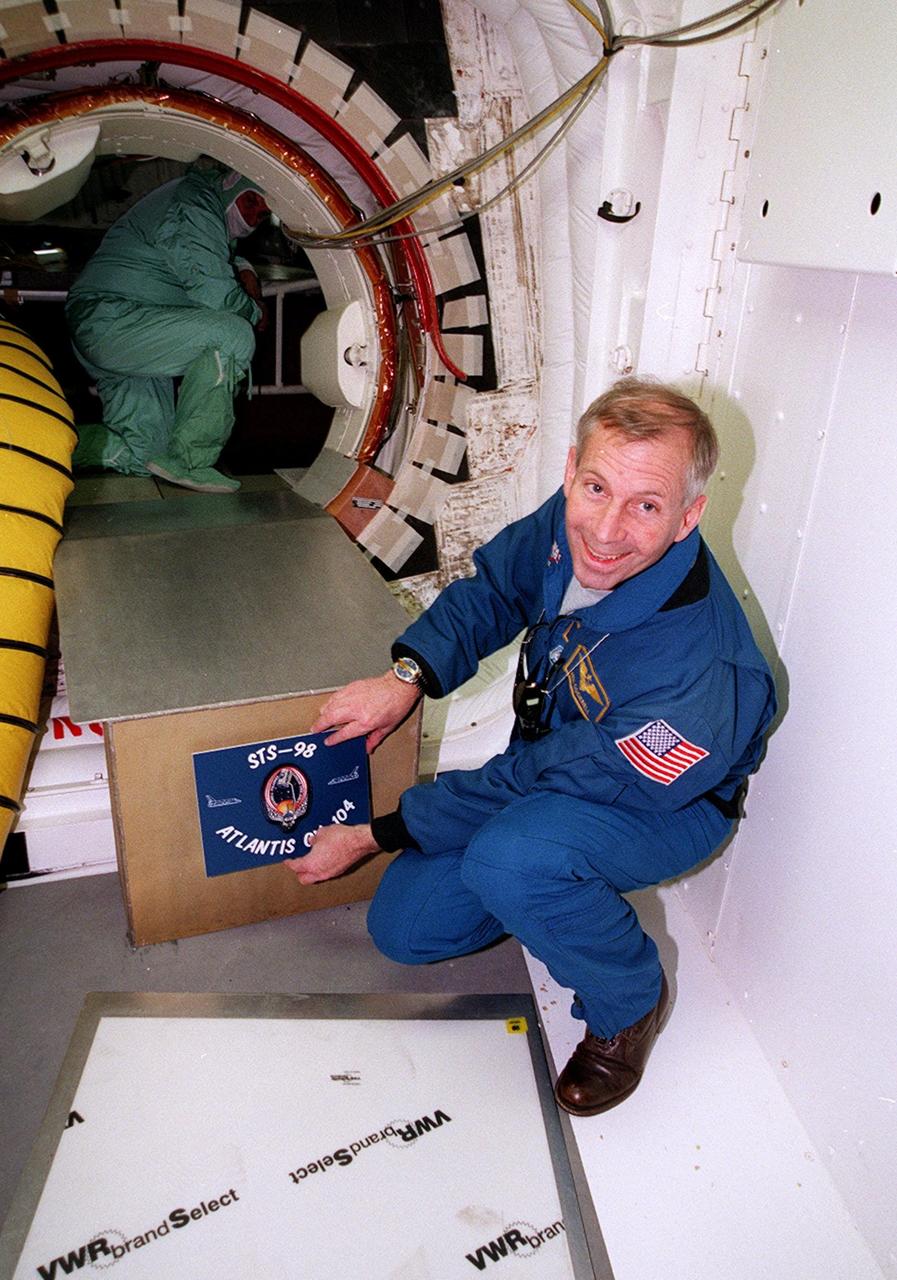
KENNEDY SPACE CENTER, FLA. -- STS-98 Commander Ken Cockrell places the mission patch on the entrance to the orbiter Atlantis. He and the rest of the crew Pilot Mark Polansky and Mission Specialists Thomas Jones, Marsha Ivins and Robert Curbeam are t KSC to take part in Terminal Countdown Demonstration Test activities, which include emergency egress training and a simulated launch countdown. STS-98 is the seventh construction flight to the International Space Station, carrying as payload the U.S. Lab Destiny, a key element in the construction of the ISS. Launch of STS-98 is scheduled for Jan. 19 at 2:11 a.m
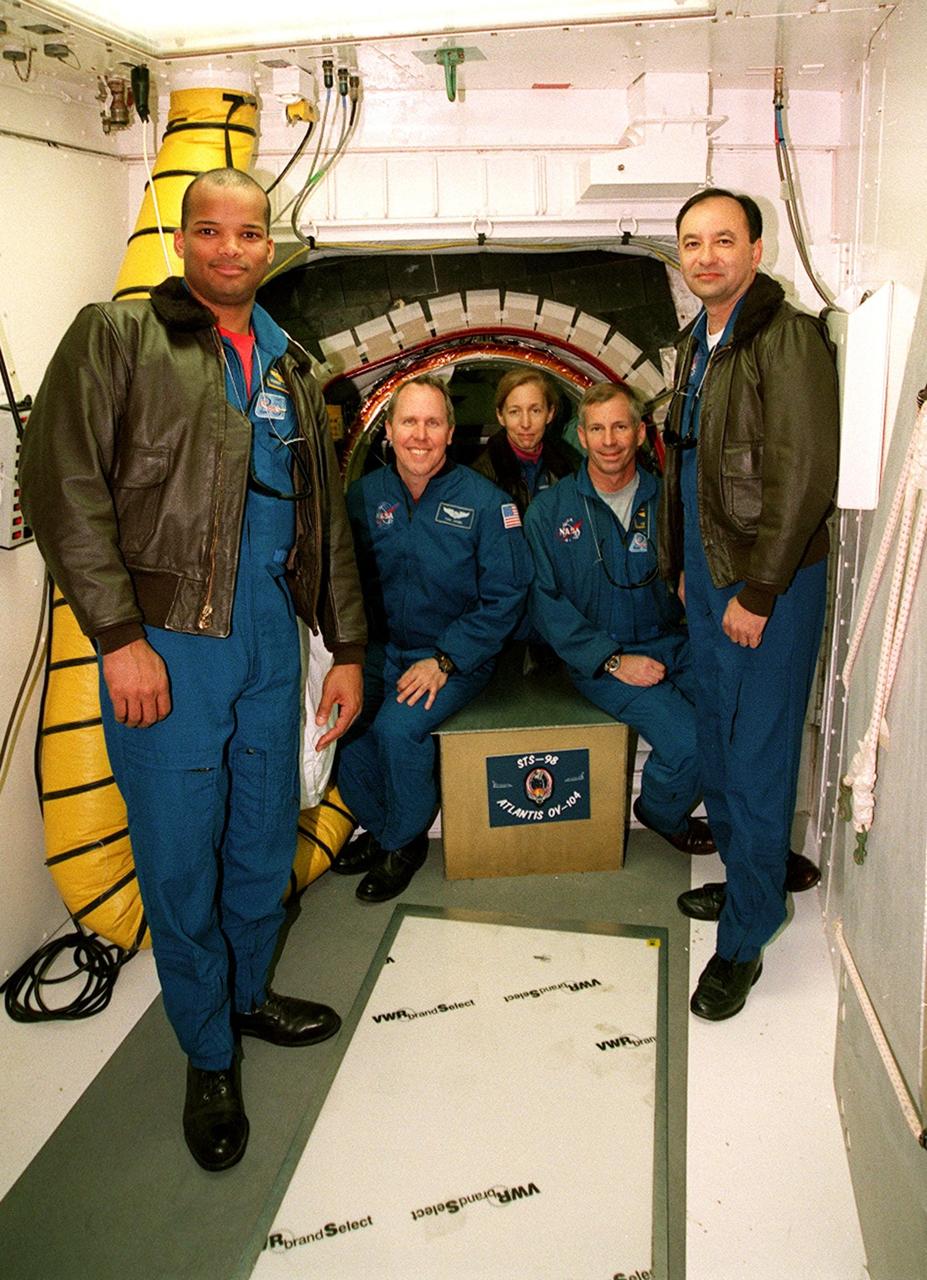
KENNEDY SPACE CENTER, FLA. -- Sitting in the entrance to the orbiter Atlantis are (left to right) STS-98 Mission Specialists Thomas Jones and Marsha Ivins and Commander Ken Cockrell. Below them is the mission patch just placed there by Cockrell. Standing at left is Mission Specialist Robert Curbeam and at right Pilot Mark Polansky. The crew is at KSC to take part in Terminal Countdown Demonstration Test activities, which include emergency egress training and a simulated launch countdown. STS-98 is the seventh construction flight to the International Space Station, carrying as payload the U.S. Lab Destiny, a key element in the construction of the ISS. Launch of STS-98 is scheduled for Jan. 19 at 2:11 a.m
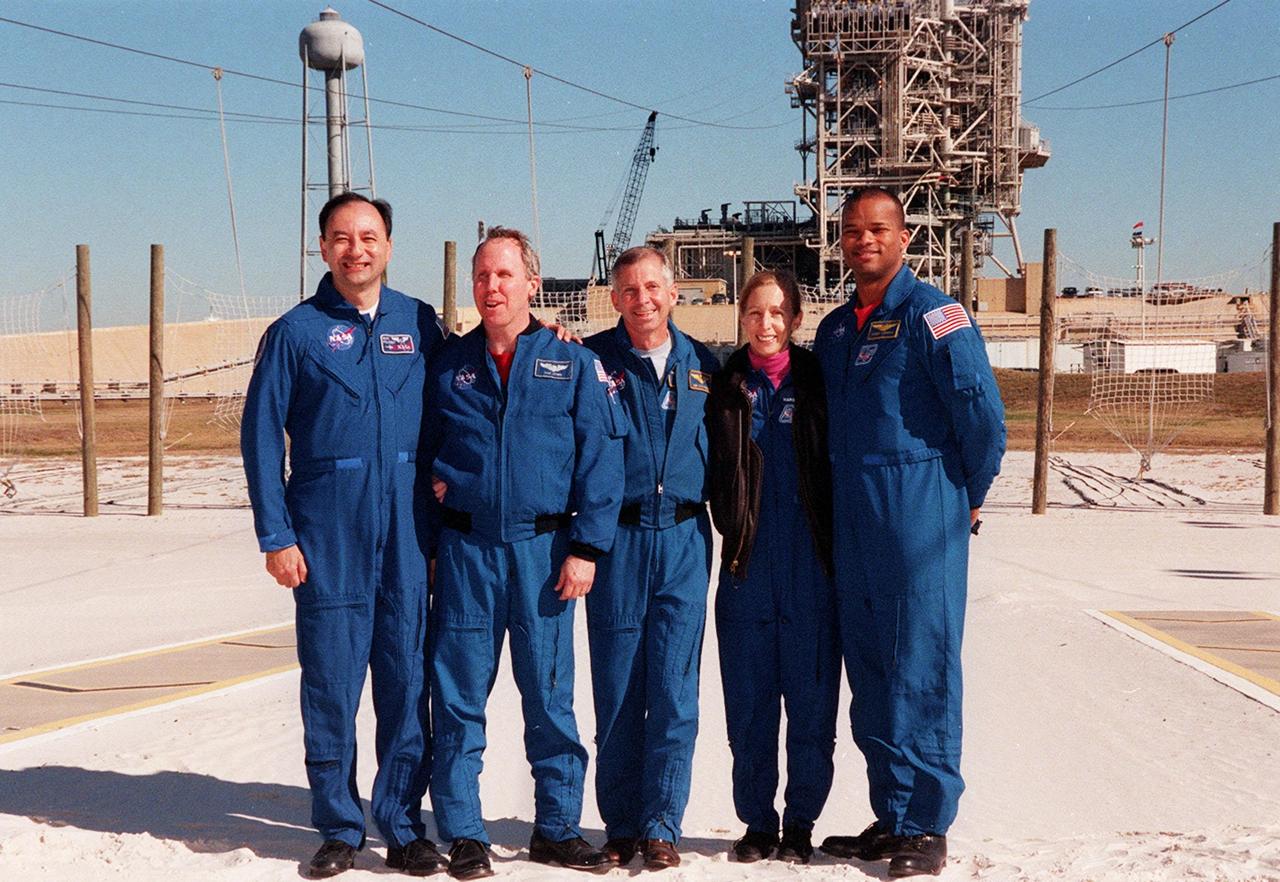
KENNEDY SPACE CENTER, FLA -- After a media briefing at Launch Pad 39A, the STS-98 crew poses in the slidewire basket landing zone. Standing, left to right, are Pilot Mark Polansky, Mission Specialist Thomas Jones, Commander Ken Cockrell and Mission Specialists Marsha Ivins and Robert Curbeam. All are at KSC to take part in Terminal Countdown Demonstration Test activities, which include emergency egress training and a simulated launch countdown. STS-98 is the seventh construction flight to the International Space Station, carrying as payload the U.S. Lab Destiny, a key element in the construction of the ISS. Launch of STS-98 is scheduled for Jan. 19 at 2:11 a.m
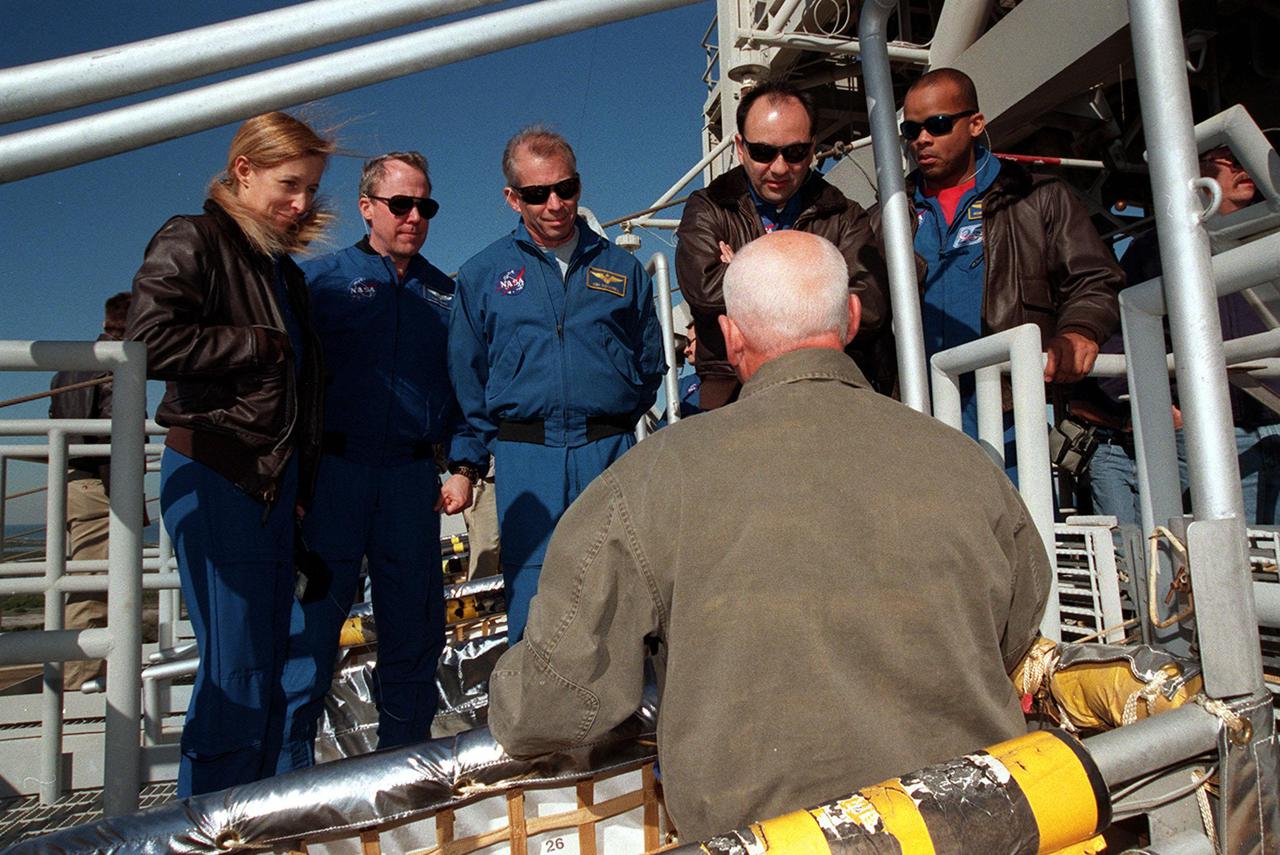
The STS-98 crew listens to instructions on use of the slidewire basket, part of emergency egress equipment from the launch pad. At the 195-foot level of the Fixed Service Structure are Mission Specialists Marsha Ivins and Thomas Jones, Commander Ken Cockrell, Pilot Mark Polansky and Mission Specialist Robert Curbeam. The crew is at KSC to take part in Terminal Countdown Demonstration Test activities, which include emergency egress training and a simulated launch countdown at the pad. STS-98 is the seventh construction flight to the International Space Station, carrying as payload the U.S. Lab Destiny, a key element in the construction of the ISS. Launch of STS-98 is scheduled for Jan. 19 at 2:11 a.m
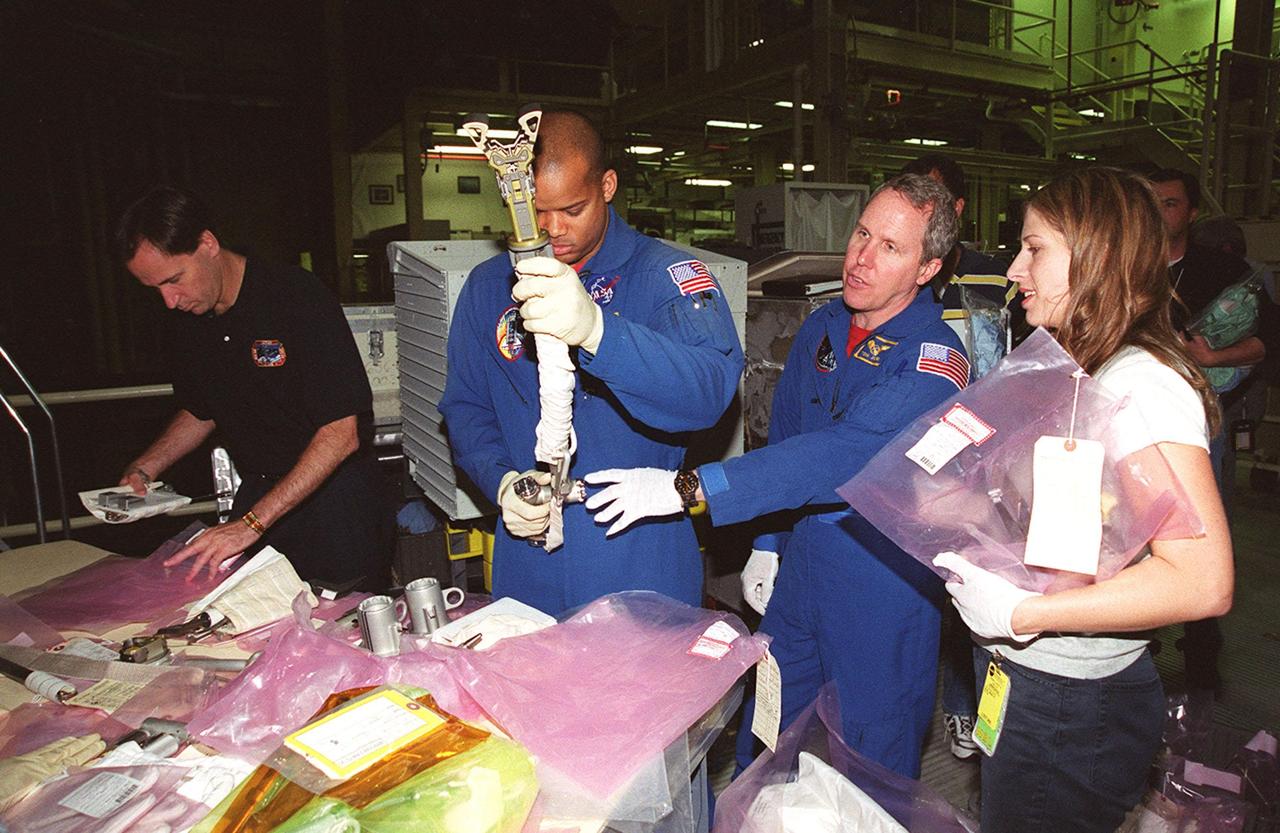
KENNEDY SPACE CENTER, FLA. -- In the Orbiter Processing Facility, STS-98 Mission Specialists Robert Curbeam (center left) and Tom Jones (center right) practice with tools that will be used on extravehicular activities on their mission. The STS-98 crew is at KSC for Crew Equipment Interface Test activities. Launch on mission STS-98 is scheduled for Jan. 18, 2001. It will be transporting the U.S. Lab, Destiny, to the International Space Station with five system racks already installed inside of the module. After delivery of electronics in the lab, electrically powered attitude control for Control Moment Gyroscopes will be activated
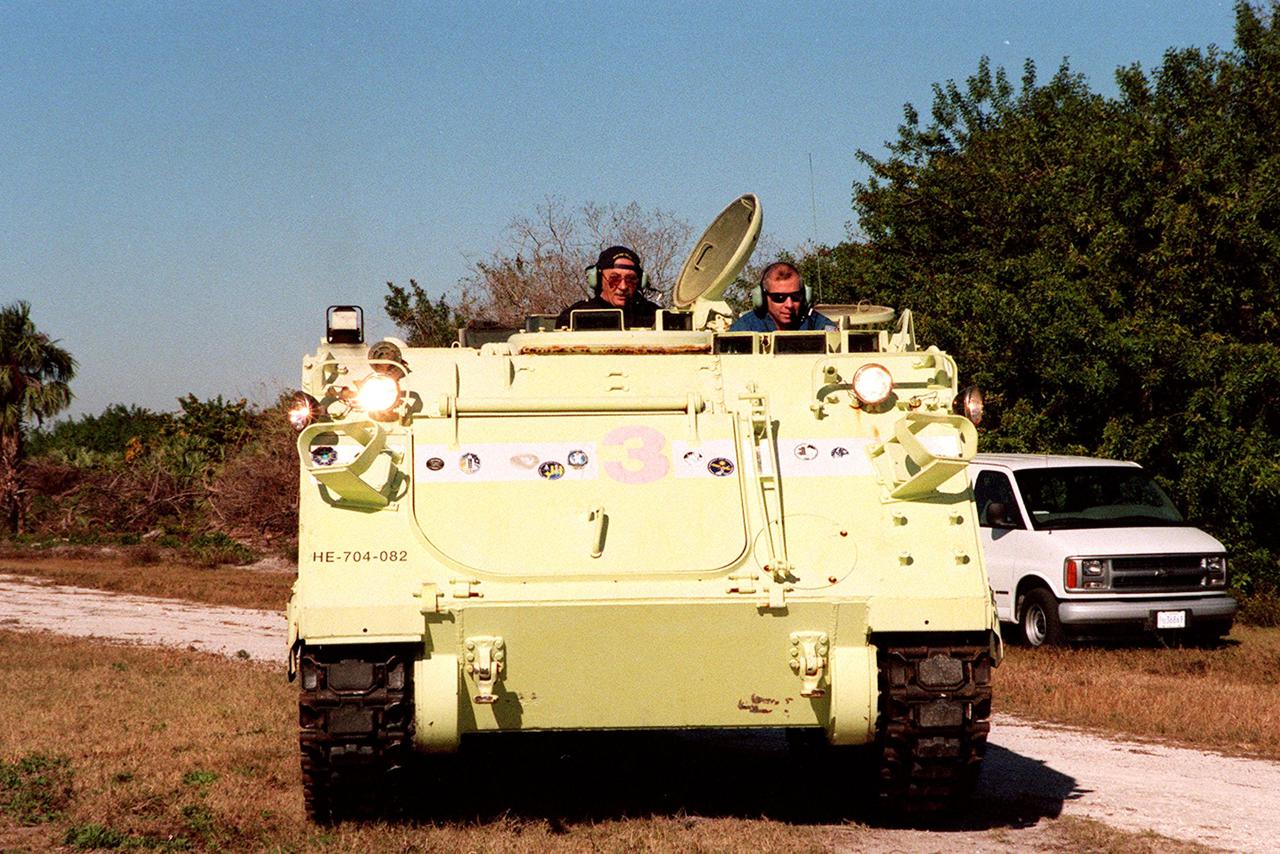
Capt. George Hoggard (left), a training officer with SGS Fire Services, sits alongside STS-98 Commander Ken Cockrell, who practices driving an M-113 armored carrier. In the event of an emergency at the pad prior to launch, the carrier could be used to transport the crew to a nearby bunker or farther. The vehicle is part of emergency egress training at Launch Pad 39A. The STS-98 crew is at KSC to take part in Terminal Countdown Demonstration Test activities, which also includes a simulated launch countdown. STS-98 is the seventh construction flight to the International Space Station, carrying as payload the U.S. Lab Destiny, a key element in the construction of the ISS
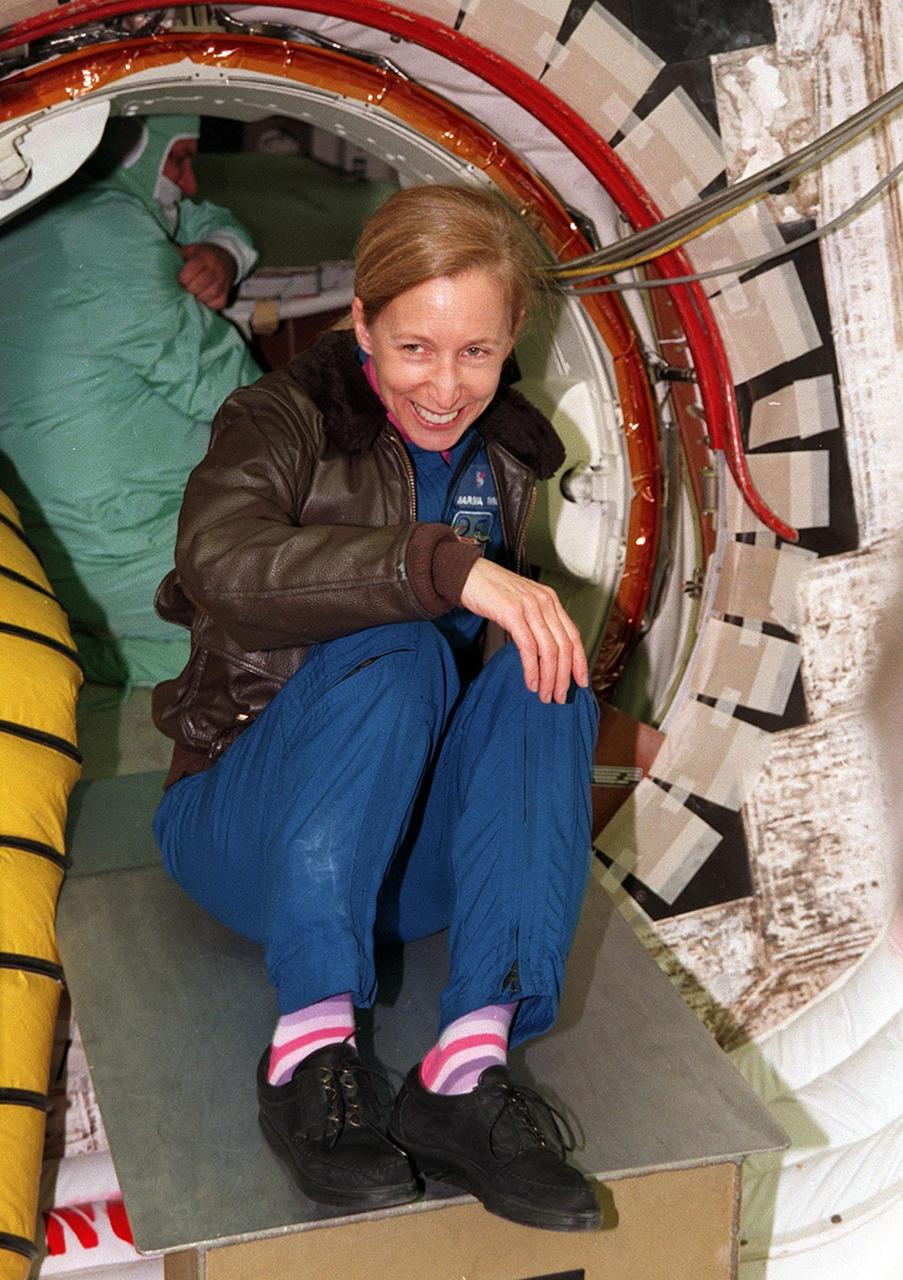
STS-98 Mission Specialist Marsha Ivins waits in the White Room outside the entrance into Atlantis. The crew is at KSC to take part in Terminal Countdown Demonstration Test activities, which include emergency egress training and a simulated launch countdown. The other crew members are Pilot Mark Polansky, Mission Specialist Thomas Jones, Commander Ken Cockrell and Mission Specialist Robert Curbeam. STS-98 is the seventh construction flight to the International Space Station, carrying as payload the U.S. Lab Destiny, a key element in the construction of the ISS. Launch of STS-98 is scheduled for Jan. 19 at 2:11 a.m
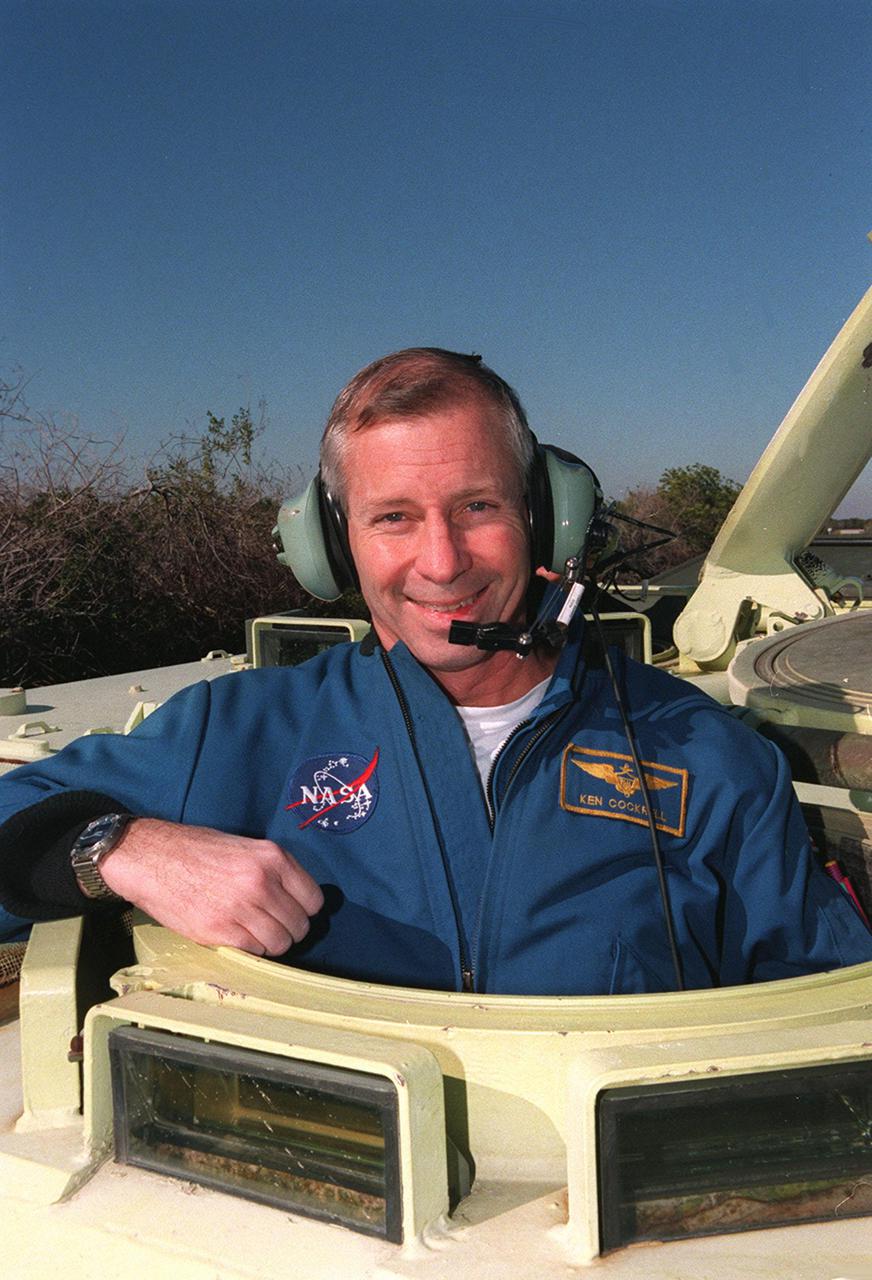
A smiling Ken Cockrell, commander on STS-98, gets ready to take the driver’s seat in an M-113 armored carrier, part of emergency egress training at Launch Pad 39A. In the event of an emergency at the pad prior to launch, the carrier could be used to transport the crew to a nearby bunker or farther. The STS-98 crew is at KSC to take part in Terminal Countdown Demonstration Test activities, which also includes a simulated launch countdown. STS-98 is the seventh construction flight to the International Space Station, carrying as payload the U.S. Lab Destiny, a key element in the construction of the ISS

A smiling Mark Polansky, the pilot on STS-98, gets ready to take the driver’s seat in an M-113 armored carrier, part of emergency egress training at Launch Pad 39A. In the event of an emergency at the pad prior to launch, the carrier could be used to transport the crew to a nearby bunker or farther. The STS-98 crew is at KSC to take part in Terminal Countdown Demonstration Test activities, which also includes a simulated launch countdown. STS-98 is the seventh construction flight to the International Space Station, carrying as payload the U.S. Lab Destiny, a key element in the construction of the ISS

STS-98 Mission Specialists Robert Curbeam, Marsha Ivins and Thomas Jones try out the three-person slidewire basket, part of the equipment used for emergency egress from the launch pad. The basket slides along a 1200-foot wire to the landing zone below and nearby bunker. The crew has been taking part in Terminal Countdown Demonstration Test activities, which include the simulated countdown and emergency egress training at the pad. STS-98 is the seventh construction flight to the International Space Station, carrying as payload the U.S. Lab Destiny, a key element in the construction of the ISS. Launch of STS-98 is scheduled for Jan. 19 at 2:11 a.m. EST
![KENNEDY SPACE CENTER, FLA. -- STS-98 Commander Ken Cockrell answers a question from the media during a briefing at Launch Pad 39A. Other crew members present are Pilot Mark Polansky, Mission Specialist Thomas Jones, [Cockrell], and Mission Specialists Marsha Ivins and Robert Curbeam. All are at KSC to take part in Terminal Countdown Demonstration Test activities, which include emergency egress training and a simulated launch countdown. STS-98 is the seventh construction flight to the International Space Station, carrying as payload the U.S. Lab Destiny, a key element in the construction of the ISS. Launch of STS-98 is scheduled for Jan. 19 at 2:11 a.m](https://images-assets.nasa.gov/image/01pp0044/01pp0044~medium.jpg)
KENNEDY SPACE CENTER, FLA. -- STS-98 Commander Ken Cockrell answers a question from the media during a briefing at Launch Pad 39A. Other crew members present are Pilot Mark Polansky, Mission Specialist Thomas Jones, [Cockrell], and Mission Specialists Marsha Ivins and Robert Curbeam. All are at KSC to take part in Terminal Countdown Demonstration Test activities, which include emergency egress training and a simulated launch countdown. STS-98 is the seventh construction flight to the International Space Station, carrying as payload the U.S. Lab Destiny, a key element in the construction of the ISS. Launch of STS-98 is scheduled for Jan. 19 at 2:11 a.m
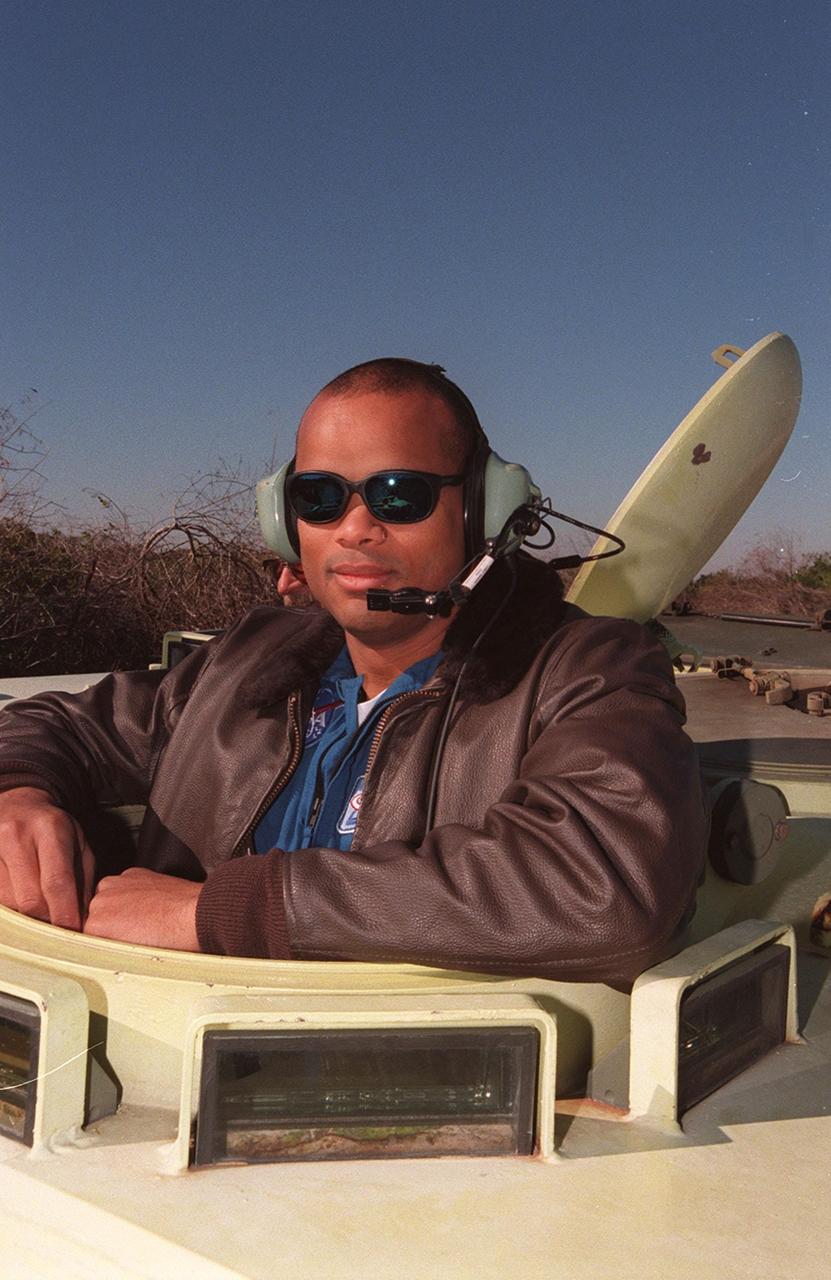
Robert Curbeam, a Mission Specialist on STS-98, gets ready to take the driver’s seat in an M-113 armored carrier, part of emergency egress training at Launch Pad 39A. In the event of an emergency at the pad prior to launch, the carrier could be used to transport the crew to a nearby bunker or farther,. The STS-98 crew is at KSC to take part in Terminal Countdown Demonstration Test activities, which also includes a simulated launch countdown. STS-98 is the seventh construction flight to the International Space Station, carrying as payload the U.S. Lab Destiny, a key element in the construction of the ISS
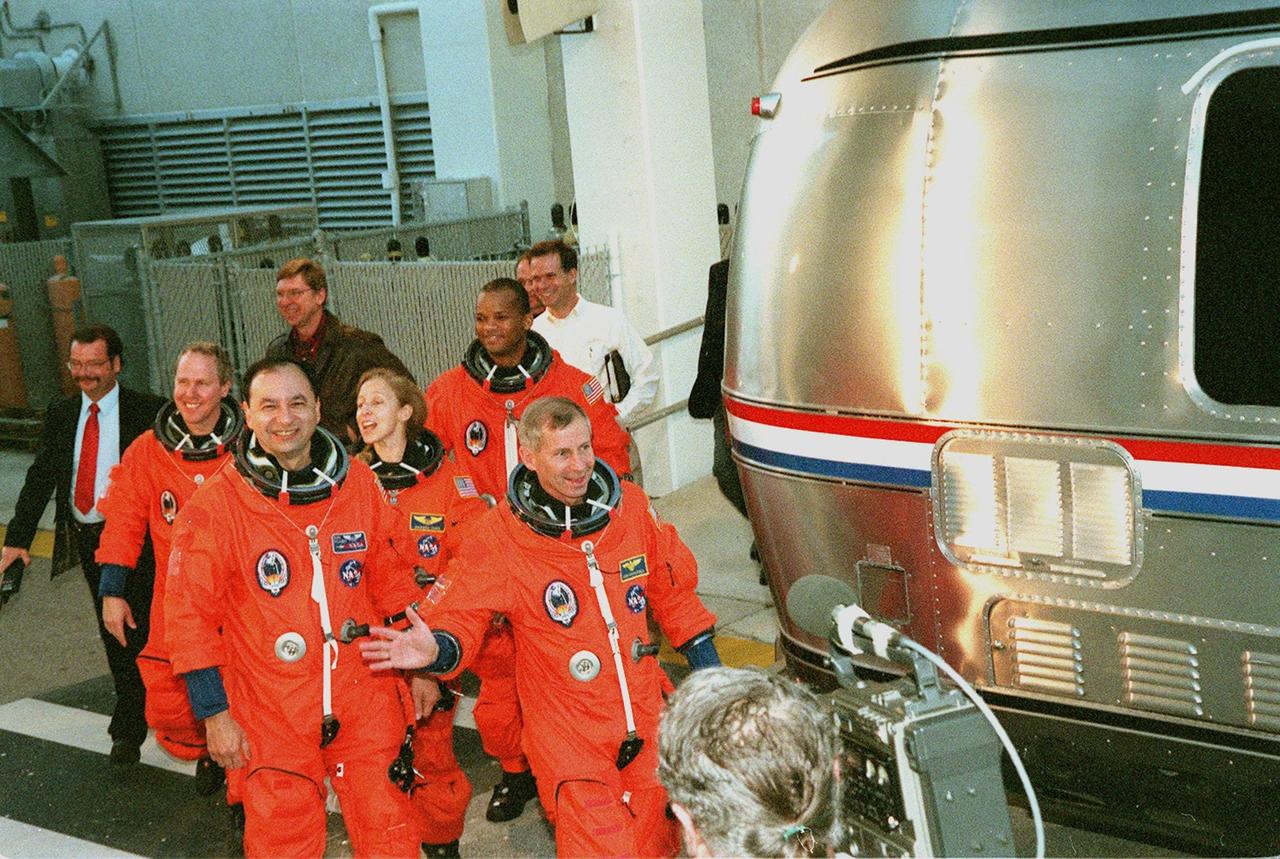
The STS-98 crew wave to onlookers as they walk out of the Operations and Checkout Building dressed for a simulated launch countdown at Launch Pad 39A. From left to right, they are Mission Specialist Thomas Jones, Pilot Mark Polansky, Mission Specialists Marsh Ivins and Robert Curbeam, being led by Commander Ken Cockrell. The crew is taking part in Terminal Countdown Demonstration Test activities, which include the countdown and emergency egress training at the pad. STS-98 is the seventh construction flight to the International Space Station, carrying as payload the U.S. Lab Destiny, a key element in the construction of the ISS. Launch of STS-98 is scheduled for Jan. 19 at 2:11 a.m. EST
![KENNEDY SPACE CENTER, Fla. -- The STS-98 crew talks to the press at a briefing at Launch Pad 39A. With the microphone is Commander Ken Cockrell, who discusses the EVAs on the mission. The other crew members are (left to right) Pilot Mark Polansky, Mission Specialist Thomas Jones, [Cockrell], and Mission Specialists Marsha Ivins and Robert Curbeam. They are at KSC to take part in Terminal Countdown Demonstration Test activities, which also include a simulated launch countdown. STS-98 is the seventh construction flight to the International Space Station, carrying as payload the U.S. Lab Destiny, a key element in the construction of the ISS. Launch of STS-98 is scheduled for Jan. 19 at 2:11 a.m](https://images-assets.nasa.gov/image/KSC01padig014/KSC01padig014~medium.jpg)
KENNEDY SPACE CENTER, Fla. -- The STS-98 crew talks to the press at a briefing at Launch Pad 39A. With the microphone is Commander Ken Cockrell, who discusses the EVAs on the mission. The other crew members are (left to right) Pilot Mark Polansky, Mission Specialist Thomas Jones, [Cockrell], and Mission Specialists Marsha Ivins and Robert Curbeam. They are at KSC to take part in Terminal Countdown Demonstration Test activities, which also include a simulated launch countdown. STS-98 is the seventh construction flight to the International Space Station, carrying as payload the U.S. Lab Destiny, a key element in the construction of the ISS. Launch of STS-98 is scheduled for Jan. 19 at 2:11 a.m