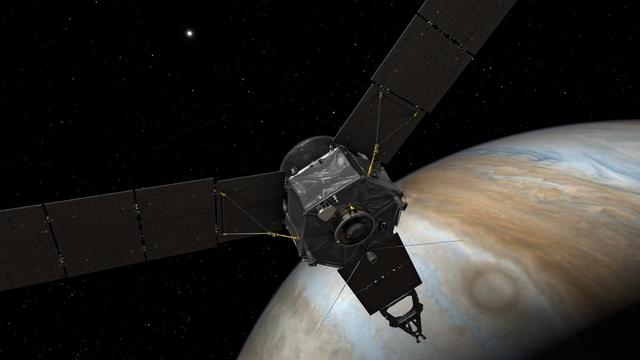
This illustration depicts NASA's Juno spacecraft at Jupiter, with its solar arrays and main antenna pointed toward the distant sun and Earth. http://photojournal.jpl.nasa.gov/catalog/PIA20703
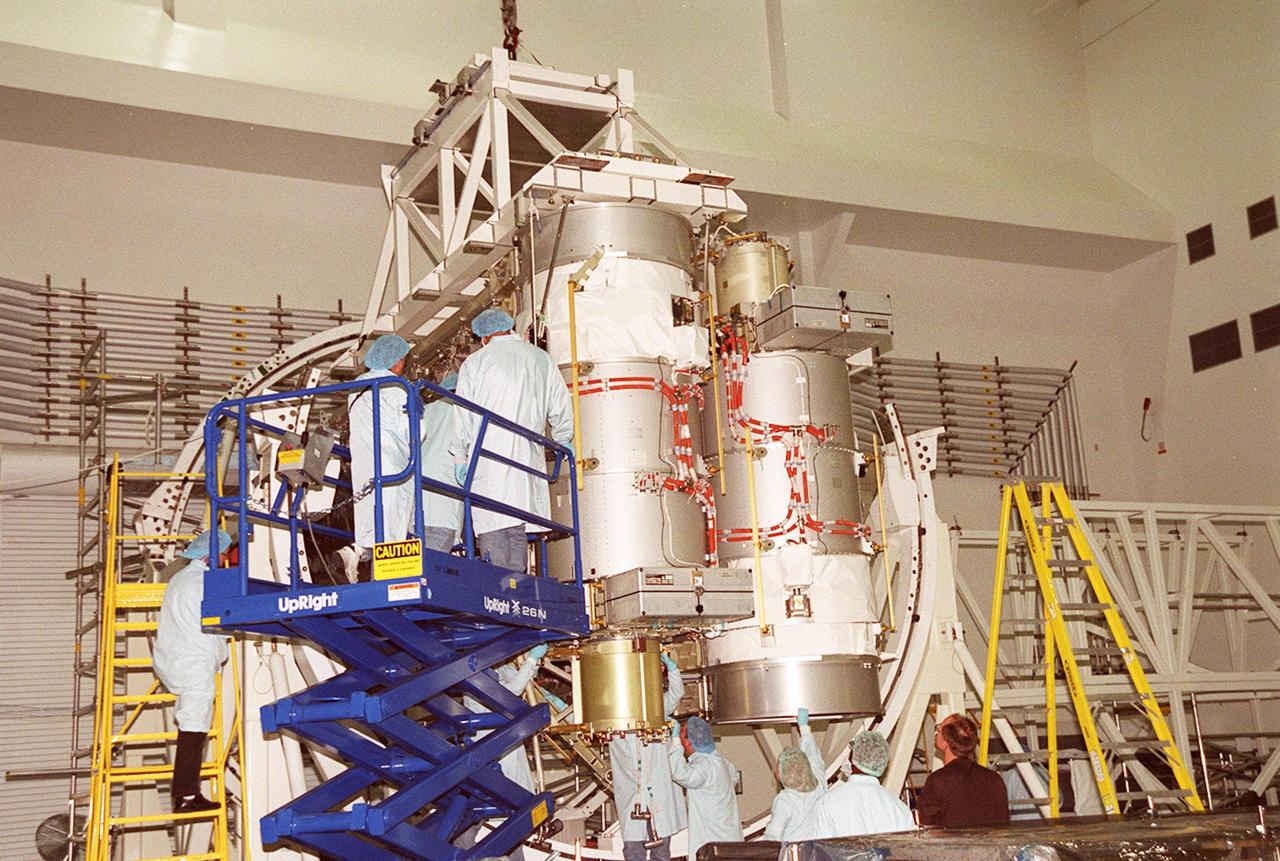
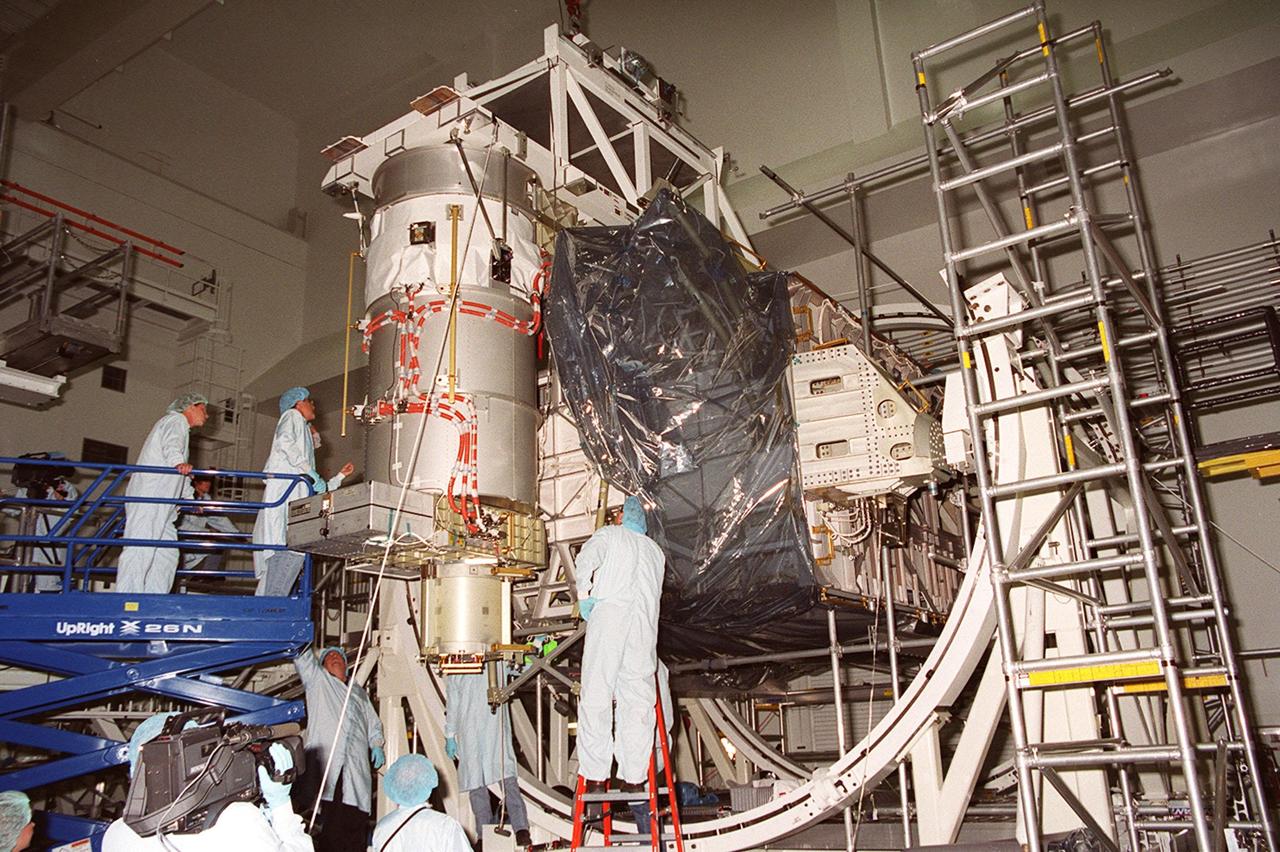
A solar array is nearly in place on the Integrated Equipment Assembly, next to Solar Array Wing-3, which is already installed. Components of the International Space Station, the arrays are scheduled to be launched on mission STS-97 in late November along with the P6 truss. The Station’s electrical power system (EPS) will use eight photovoltaic solar arrays to convert sunlight to electricity. Each of the eight solar arrays will be 112 feet long by 39 feet wide. The solar arrays are mounted on a “blanket” that can be folded like an accordion for delivery. Once in orbit, astronauts will deploy the blankets to their full size. Gimbals will be used to rotate the arrays so that they will face the Sun to provide maximum power to the Space Station
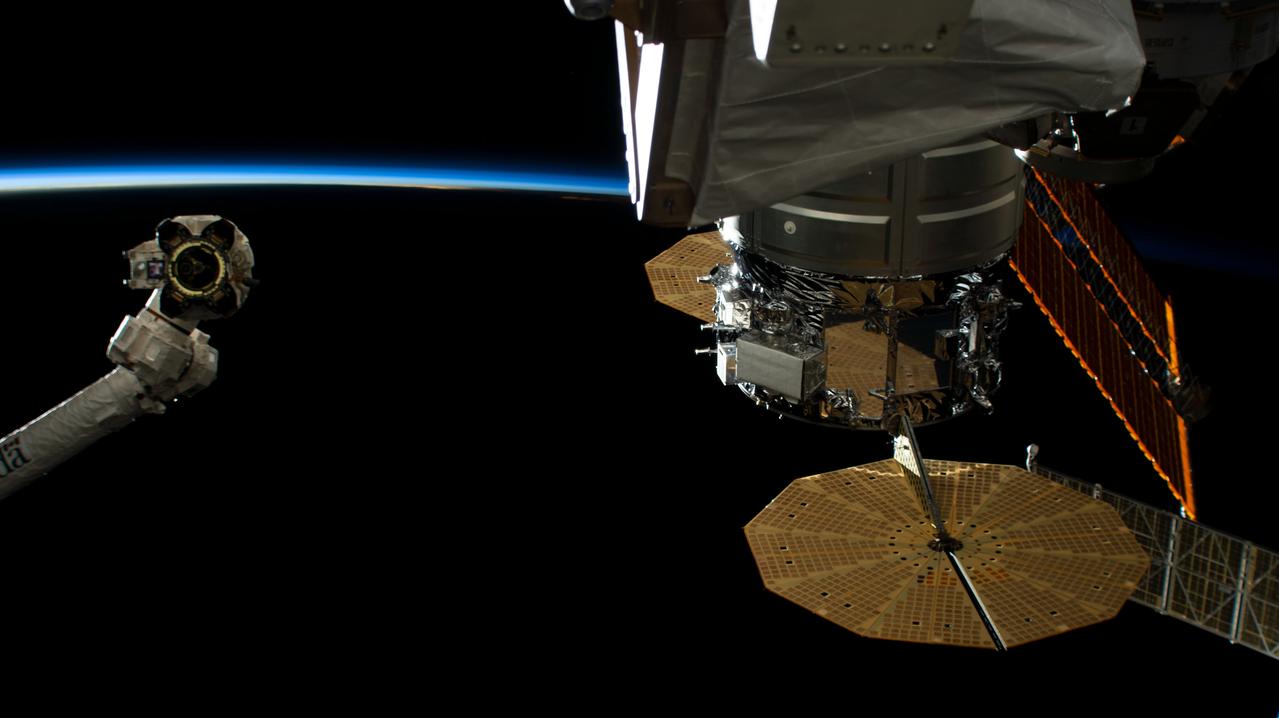
iss060e007151 (July 14, 2019) --- The tip of the Canadarm2 robotic arm (left), or the Leading End Effector, seemingly stares at the camera as the Sun's rays light up Earth's blue atmosphere. At right, a variety of solar arrays criss-cross the view, including the cymbal-shaped Ultra-Flex solar arrays attached to the Cygnus space freighter, a portion of one of the International Space Station's main solar arrays, and (at bottom right) part of a docked Russian spacecraft's solar array.
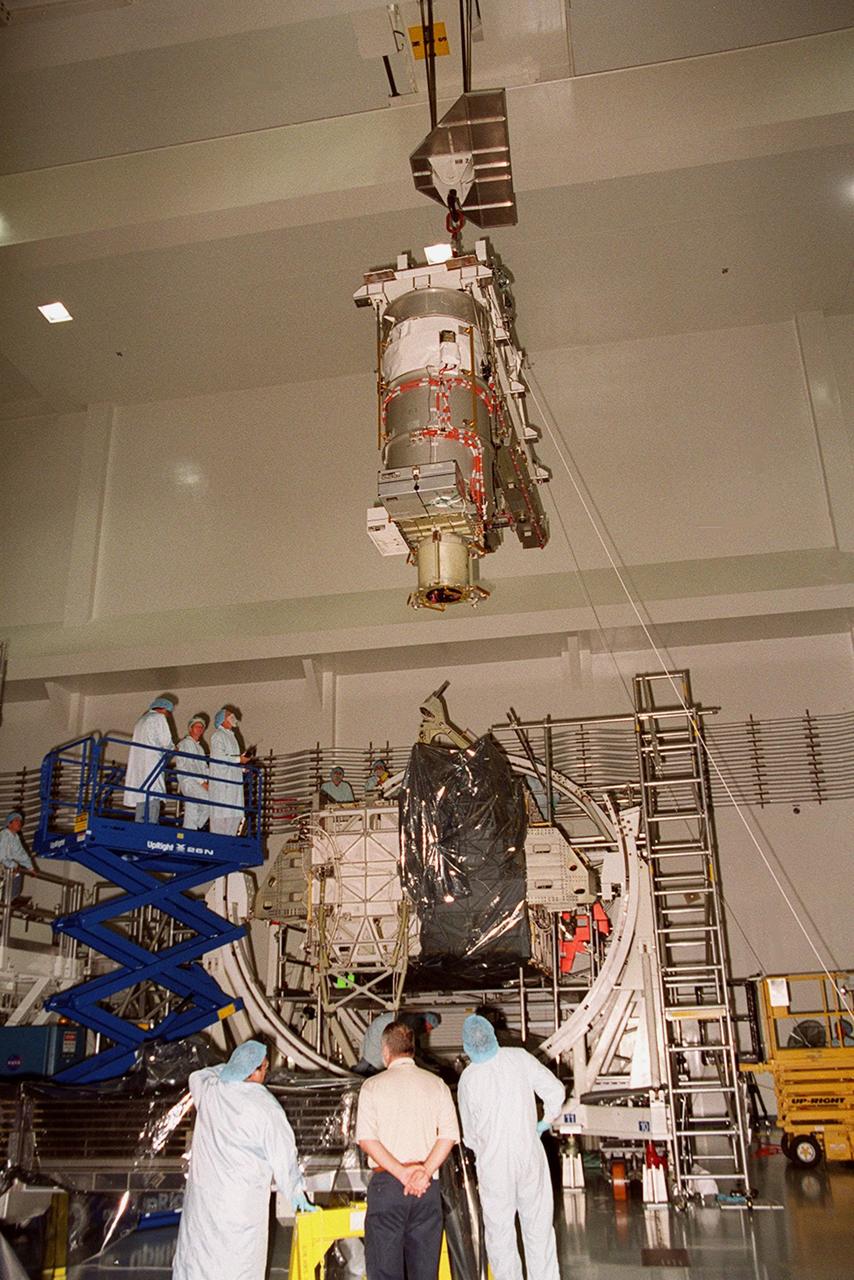
In the Space Station Processing Facility, Solar Array Wing-3 (at top), a component of the International Space Station, hovers above the Integrated Electronic Assembly where it will be installed for testing. The solar array is scheduled to be launched on STS-97 in late November along with the P6 truss. The Station’s electrical power system (EPS) will use eight photovoltaic solar arrays to convert sunlight to electricity. Each of the eight solar arrays will be 112 feet long by 39 feet wide. The solar arrays are mounted on a “blanket” that can be folded like an accordion for delivery. Once in orbit, astronauts will deploy the blankets to their full size. Gimbals will be used to rotate the arrays so that they will face the Sun to provide maximum power to the Space Station
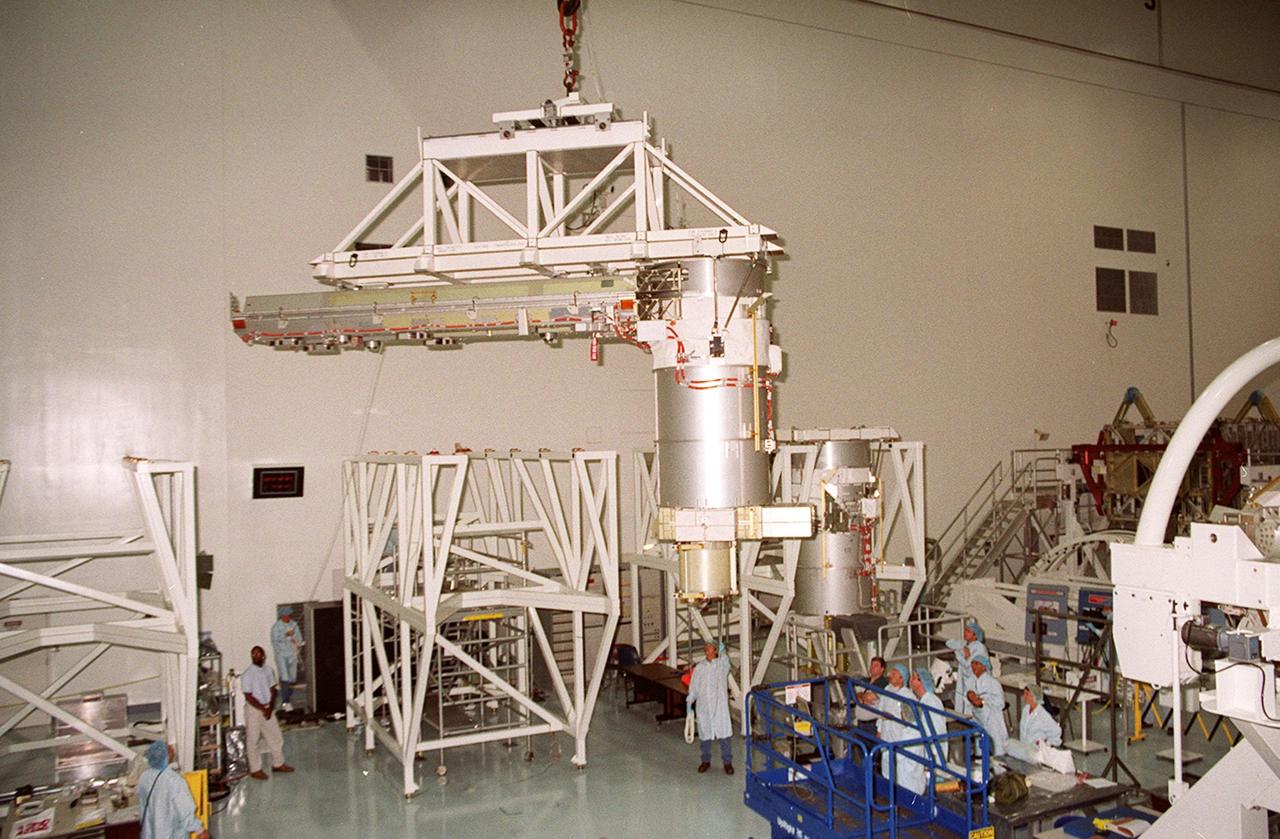
In the Space Station Processing Facility, Solar Array Wing-3, an element of the International Space Station, is lifted from a work stand to move it to the Integrated Electronic Assembly for testing. The solar array is scheduled to be launched on STS-97 in late November along with the P6 truss. The Station’s electrical power system (EPS) will use eight photovoltaic solar arrays to convert sunlight to electricity. Each of the eight solar arrays will be 112 feet long by 39 feet wide. The solar arrays are mounted on a “blanket” that can be folded like an accordion for delivery. Once in orbit, astronauts will deploy the blankets to their full size. Gimbals will be used to rotate the arrays so that they will face the Sun to provide maximum power to the Space Station
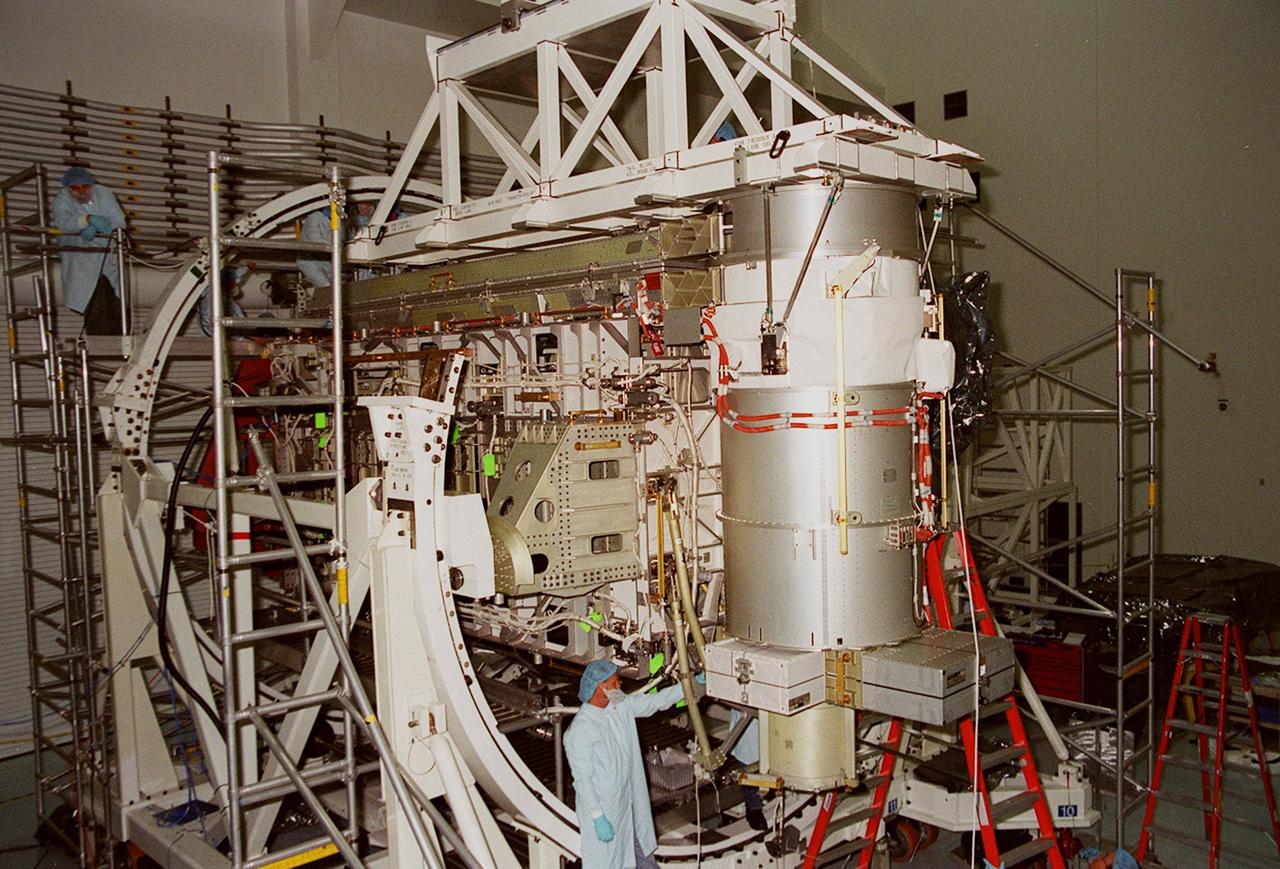
In the Space Station Processing Facility, Solar Array Wing-3, a component of the International Space Station, is installed in the Integrated Electronic Assembly where it will be tested. The solar array is scheduled to be launched on STS-97 in late November along with the P6 truss. The Station’s electrical power system (EPS) will use eight photovoltaic solar arrays to convert sunlight to electricity. Each of the eight solar arrays will be 112 feet long by 39 feet wide. The solar arrays are mounted on a “blanket” that can be folded like an accordion for delivery. Once in orbit, astronauts will deploy the blankets to their full size. Gimbals will be used to rotate the arrays so that they will face the Sun to provide maximum power to the Space Station
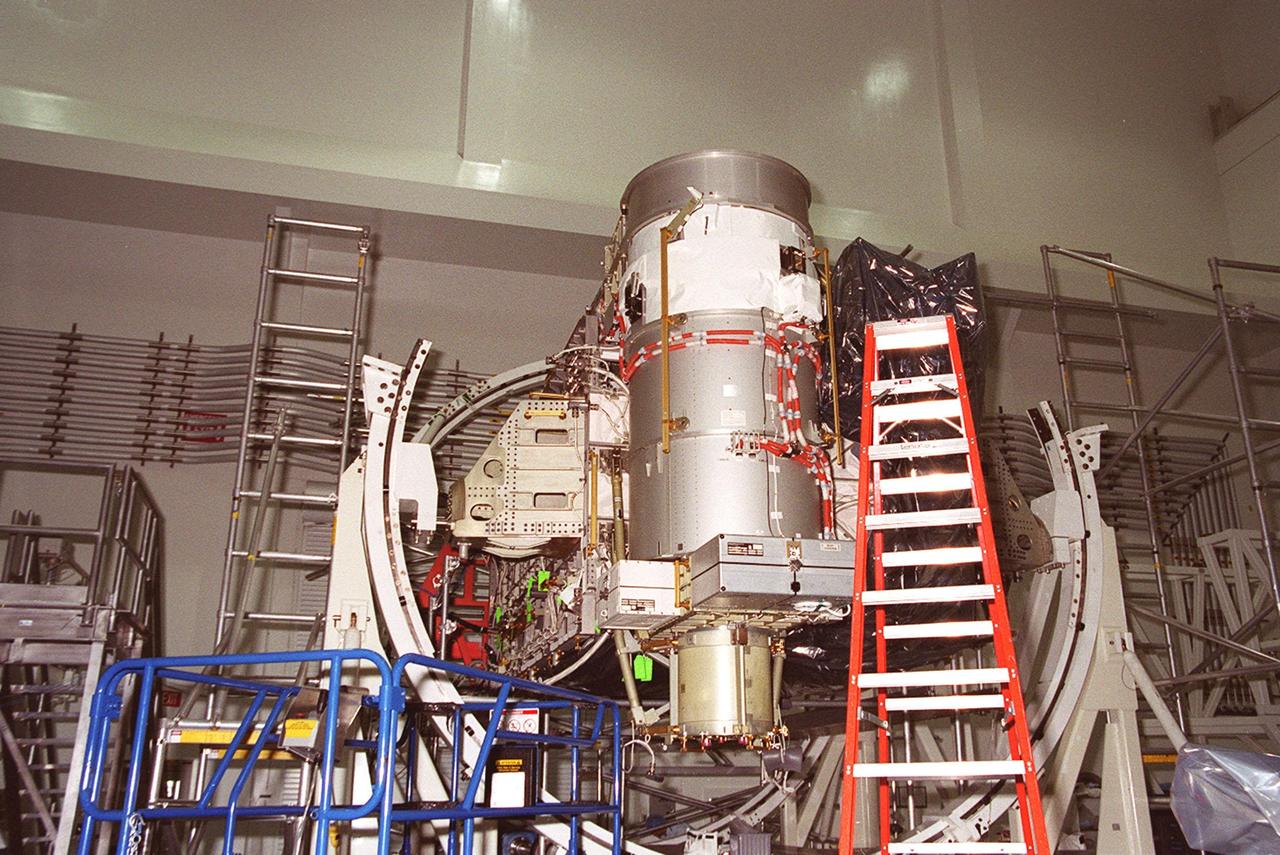
In the Space Station Processing Facility, Solar Array Wing-3, a component of the International Space Station, is installed in the Integrated Electronic Assembly where it will be tested. The solar array is scheduled to be launched on STS-97 in late November along with the P6 truss. The Station’s electrical power system (EPS) will use eight photovoltaic solar arrays to convert sunlight to electricity. Each of the eight solar arrays will be 112 feet long by 39 feet wide. The solar arrays are mounted on a “blanket” that can be folded like an accordion for delivery. Once in orbit, astronauts will deploy the blankets to their full size. Gimbals will be used to rotate the arrays so that they will face the Sun to provide maximum power to the Space Station

A rising sun illuminates the coastal waters beyond Space Shuttle Endeavour, poised for launch on Nov. 30 at about 10:06 p.m. EST on mission STS-97. On the left, extending toward the orbiter, is the orbiter access arm. The mission to the International Space Station carries the P6 Integrated Truss Segment containing solar arrays and batteries that will be temporarily installed to the Unity connecting module by the Z1 truss, recently delivered to and installed on the Station on mission STS-92. The two solar arrays are each more than 100 feet long. They will capture energy from the sun and convert it to power for the Station. Two spacewalks will be required to install the solar array connections
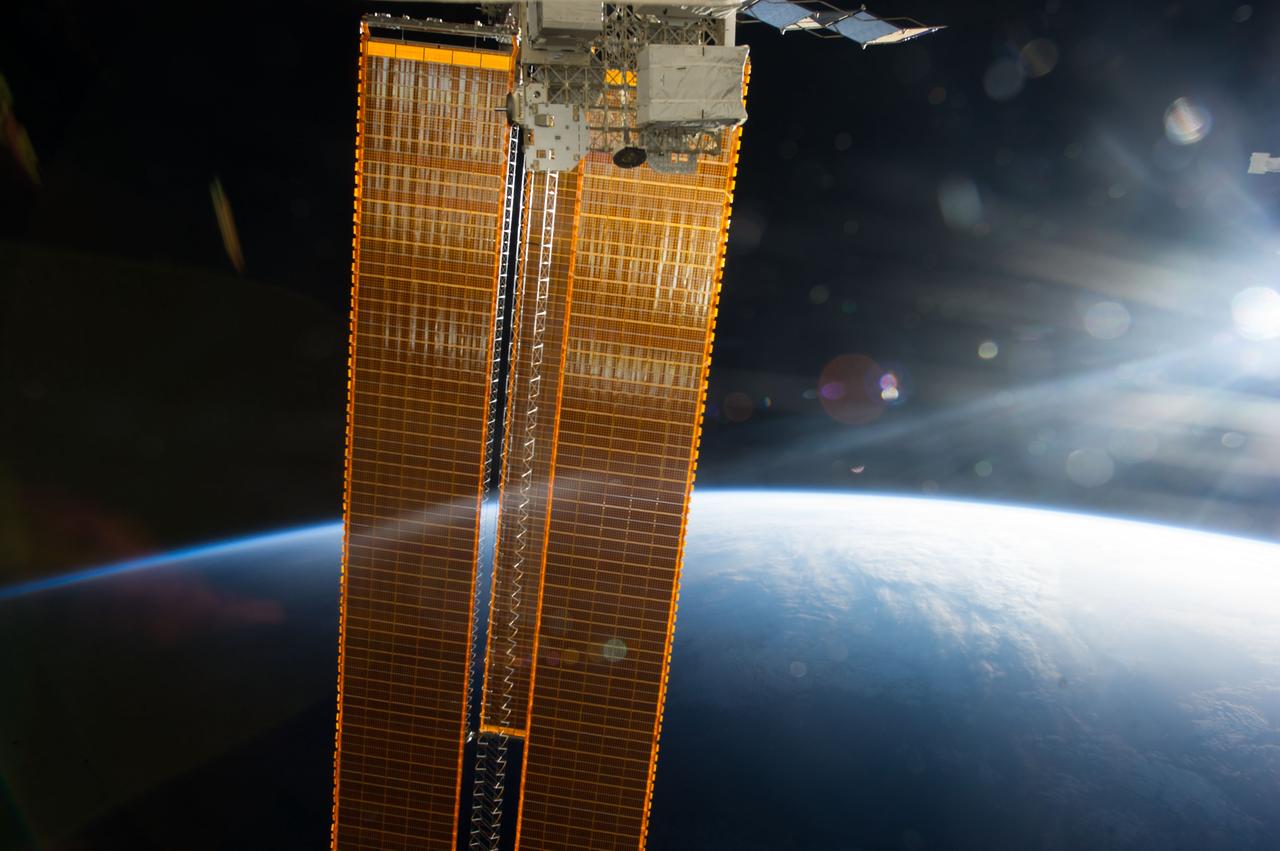
Earth observation taken by the Expedition 35 crew aboard the ISS. The terminator, glare from the rising Sun, and solar array wings (SAWs) are in view.
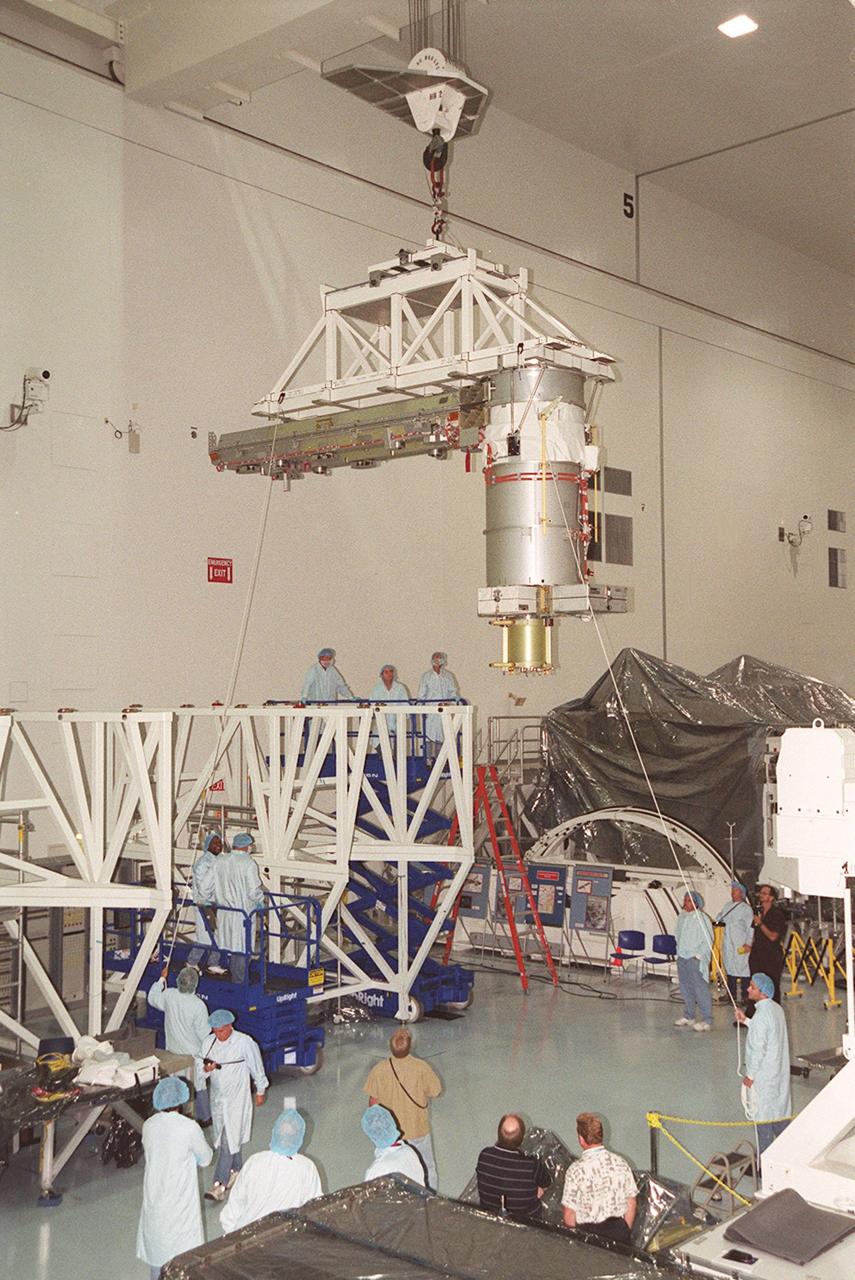
An overhead crane in the Space Station Processing Facility lifts a solar array as workers stand by to help guide it. The solar array will be installed onto the Integrated Equipment Assembly (IEA). A component of the International Space Station, the solar array is the second one being installed on the IEA. The arrays are scheduled to be launched on mission STS-97 in late November along with the P6 truss. The Station’s electrical power system (EPS) will use eight photovoltaic solar arrays to convert sunlight to electricity. Each of the eight solar arrays will be 112 feet long by 39 feet wide. The solar arrays are mounted on a “blanket” that can be folded like an accordion for delivery. Once in orbit, astronauts will deploy the blankets to their full size. Gimbals will be used to rotate the arrays so that they will face the Sun to provide maximum power to the Space Station
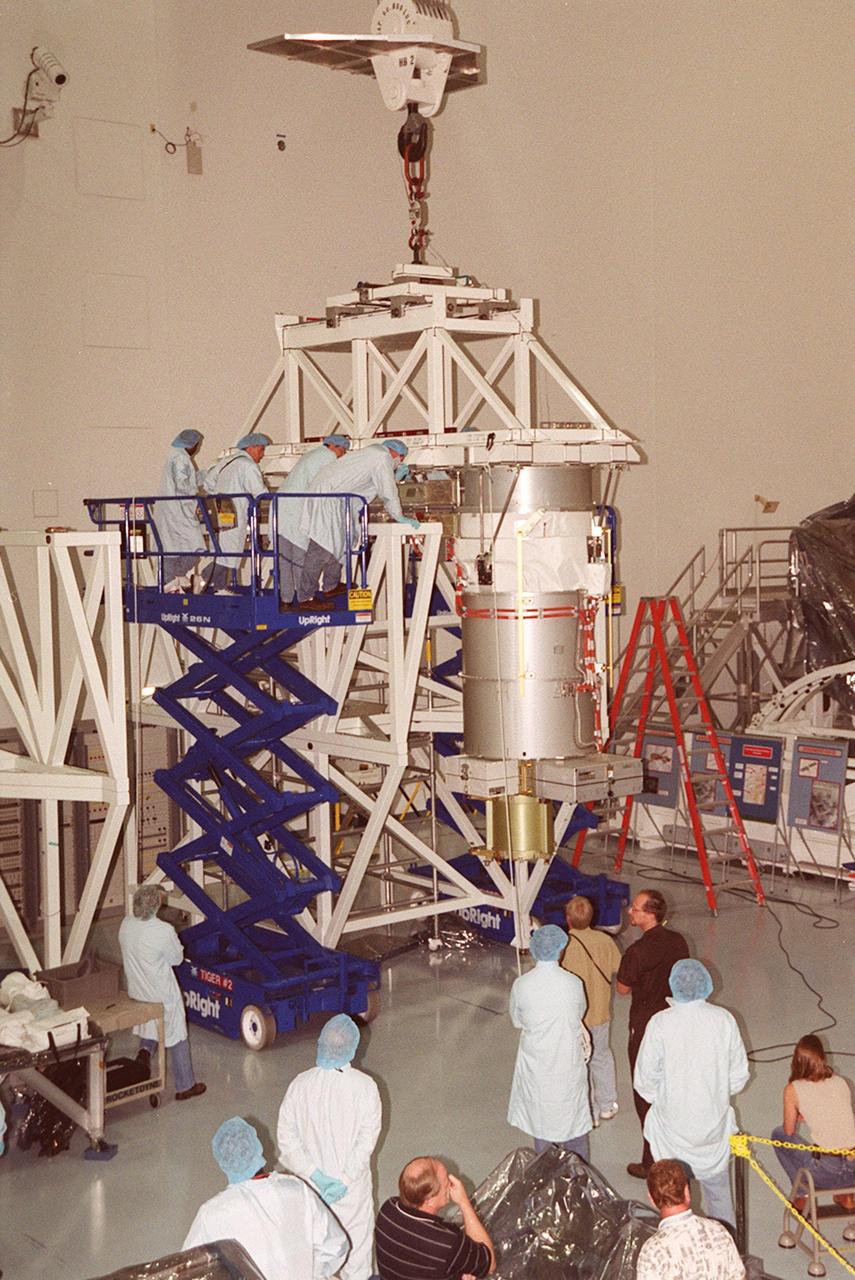
Workers rise to the occasion on accordion lifts as they oversee the movement of solar array in front of them. The solar array will be installed onto the Integrated Equipment Assembly (IEA). A component of the International Space Station, the solar array is the second one being installed on the IEA. The arrays are scheduled to be launched on mission STS-97 in late November along with the P6 truss. The Station’s electrical power system (EPS) will use eight photovoltaic solar arrays to convert sunlight to electricity. Each of the eight solar arrays will be 112 feet long by 39 feet wide. The solar arrays are mounted on a “blanket” that can be folded like an accordion for delivery. Once in orbit, astronauts will deploy the blankets to their full size. Gimbals will be used to rotate the arrays so that they will face the Sun to provide maximum power to the Space Station
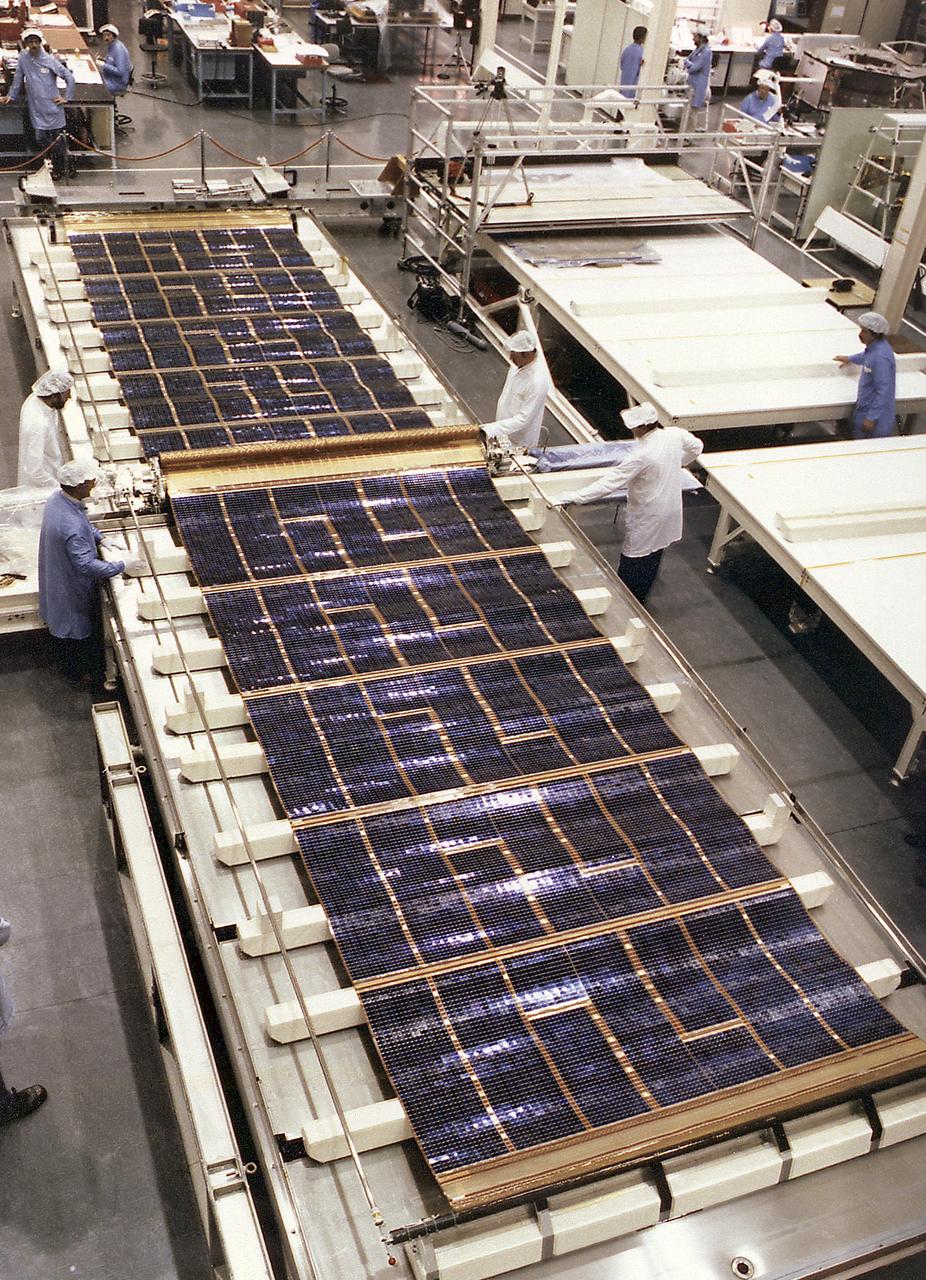
This is a view of a solar cell blanket deployed on a water table during the Solar Array deployment test. The Hubble Space Telescope (HST) Solar Arrays provide power to the spacecraft. The arrays are mounted on opposite sides of the HST, on the forward shell of the Support Systems Module. Each array stands on a 4-foot mast that supports a retractable wing of solar panels 40-feet (12.1-meters) long and 8.2-feet (2.5-meters) wide, in full extension. The arrays rotate so that the solar cells face the Sun as much as possible to harness the Sun's energy. The Space Telescope Operations Control Center at the Goddard Space Center operates the array, extending the panels and maneuvering the spacecraft to focus maximum sunlight on the arrays. The purpose of the HST, the most complex and sensitive optical telescope ever made, is to study the cosmos from a low-Earth orbit. By placing the telescope in space, astronomers are able to collect data that is free of the Earth's atmosphere. The HST Solar Array was designed by the European Space Agency and built by British Aerospace. The Marshall Space Flight Center had overall responsibility for design, development, and construction of the HST.
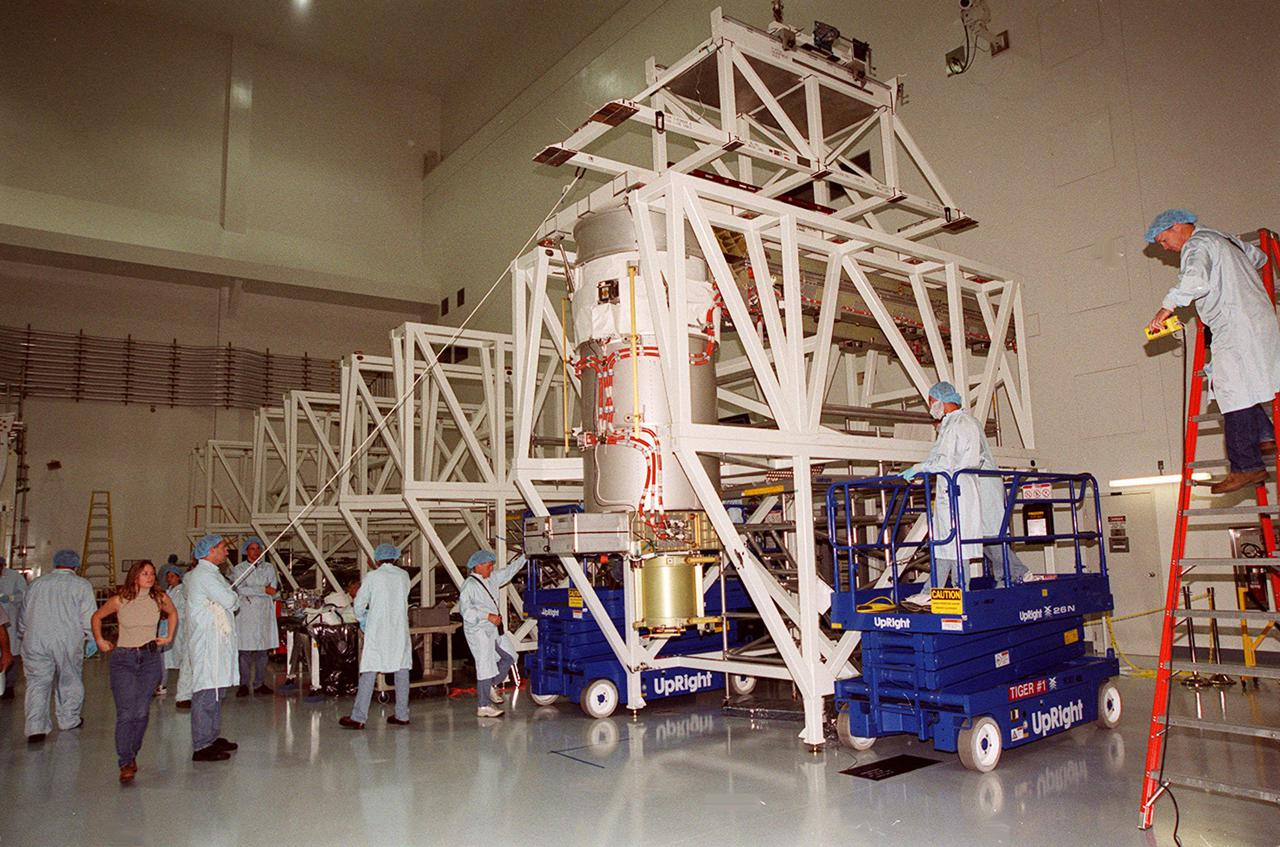
Workers in the Space Station Processing Facility get ready to attach an overhead crane (center top) to the solar array below it to move the array for installation onto the Integrated Equipment Assembly (IEA). A component of the International Space Station, the solar array is the second one being installed on the IEA. The arrays are scheduled to be launched on mission STS-97 in late November along with the P6 truss. The Station’s electrical power system (EPS) will use eight photovoltaic solar arrays to convert sunlight to electricity. Each of the eight solar arrays will be 112 feet long by 39 feet wide. The solar arrays are mounted on a “blanket” that can be folded like an accordion for delivery. Once in orbit, astronauts will deploy the blankets to their full size. Gimbals will be used to rotate the arrays so that they will face the Sun to provide maximum power to the Space Station
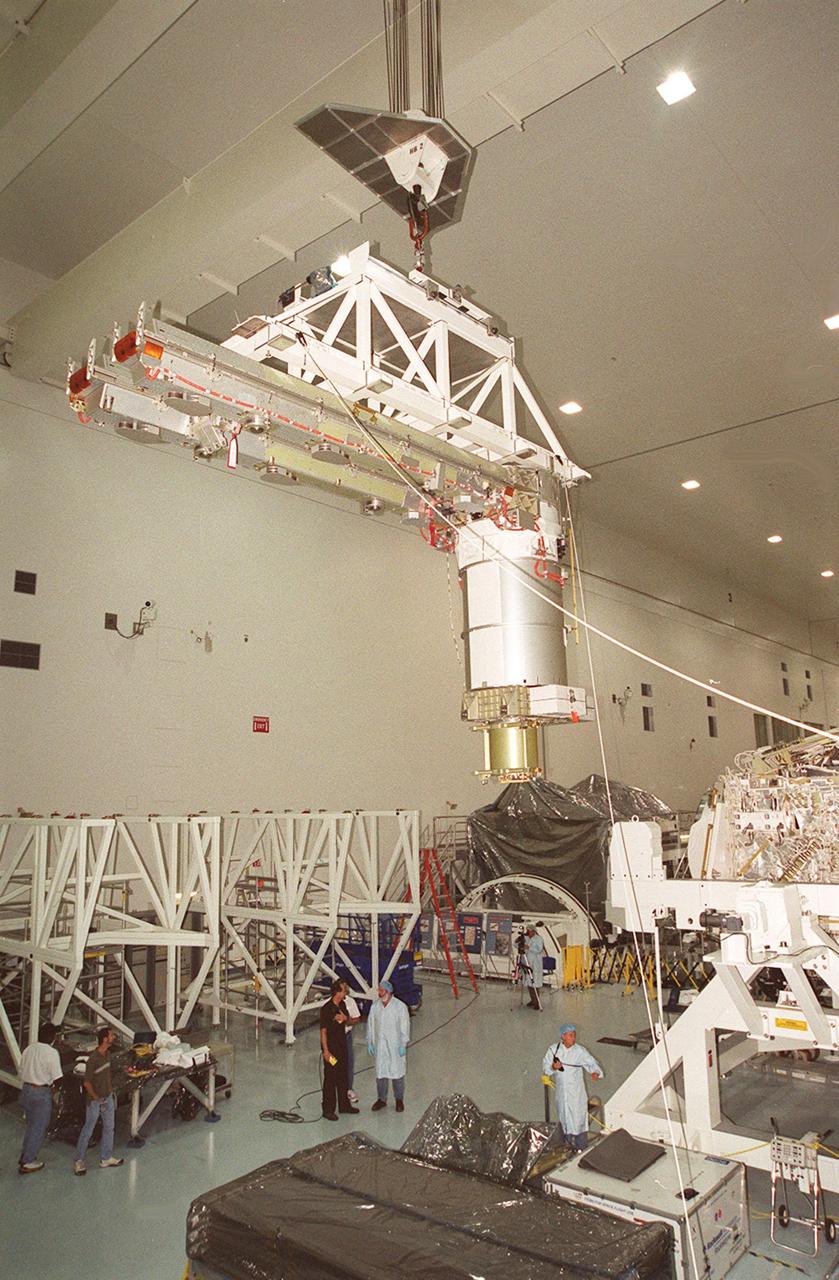
The overhead crane carrying a solar array turns on its axis to move the array to the Integrated Equipment Assembly (IEA) for installation. A component of the International Space Station, the solar array is the second one being installed on the IEA. The arrays are scheduled to be launched on mission STS-97 in late November along with the P6 truss. The Station’s electrical power system (EPS) will use eight photovoltaic solar arrays to convert sunlight to electricity. Each of the eight solar arrays will be 112 feet long by 39 feet wide. The solar arrays are mounted on a “blanket” that can be folded like an accordion for delivery. Once in orbit, astronauts will deploy the blankets to their full size. Gimbals will be used to rotate the arrays so that they will face the Sun to provide maximum power to the Space Station
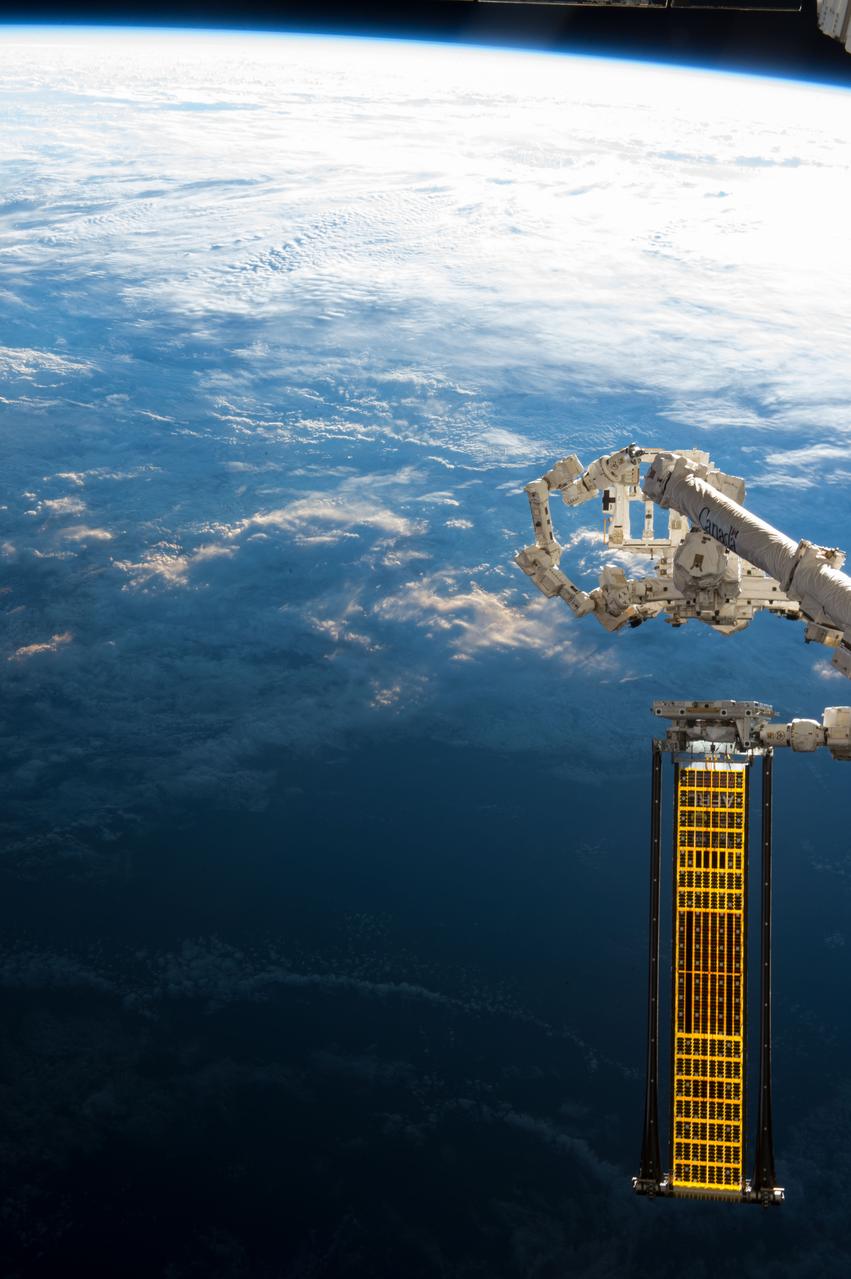
iss052e004379 (6/18/2017) --- The Roll-Out Solar Array (ROSA) is a new type of solar panel that rolls open in space like a party favor and is more compact than current rigid panel designs. The ROSA investigation tests deployment and retraction, shape changes when the Earth blocks the sun, and other physical challenges to determine the array’s strength and durability. ROSA has the potential to replace solar arrays on future satellites, making them more compact and lighter weight. Satellite radio and television, weather forecasting, GPS and other services used on Earth would all benefit from high-performance solar arrays.
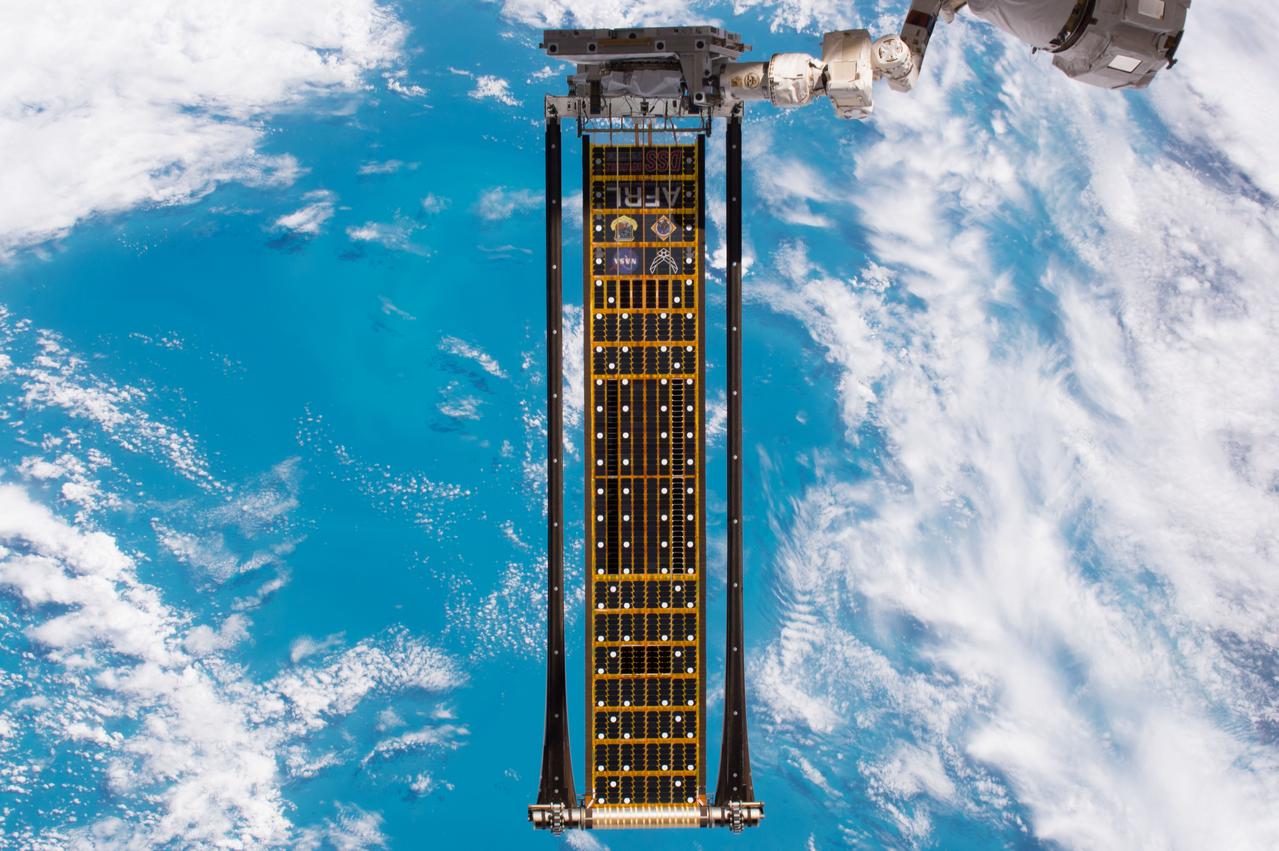
iss052e002871 (6/18/2017) --- The Roll-Out Solar Array (ROSA) is a new type of solar panel that rolls open in space like a party favor and is more compact than current rigid panel designs. The ROSA investigation tests deployment and retraction, shape changes when the Earth blocks the sun, and other physical challenges to determine the array’s strength and durability. ROSA has the potential to replace solar arrays on future satellites, making them more compact and lighter weight. Satellite radio and television, weather forecasting, GPS and other services used on Earth would all benefit from high-performance solar arrays.
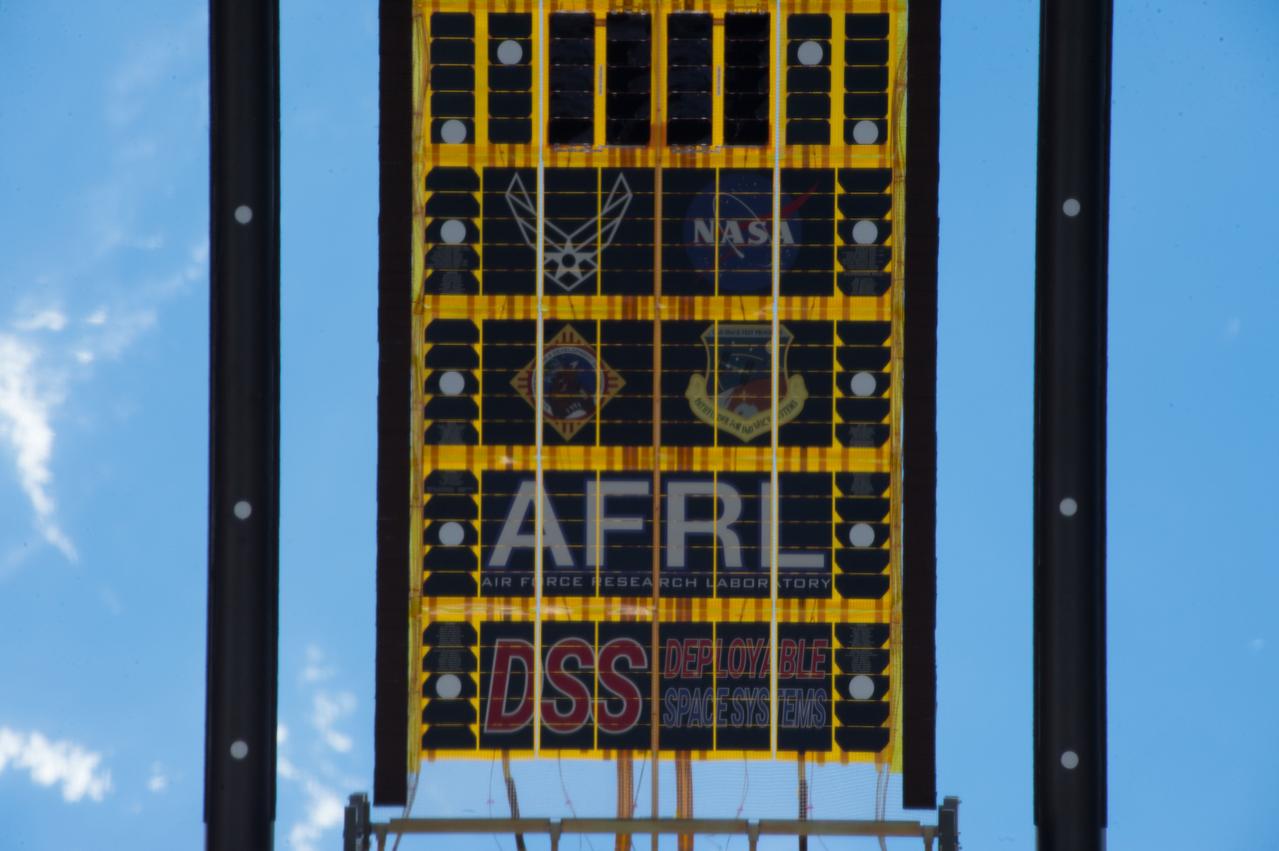
iss052e002857 (6/18/2017) --- The Roll-Out Solar Array (ROSA) is a new type of solar panel that rolls open in space like a party favor and is more compact than current rigid panel designs. The ROSA investigation tests deployment and retraction, shape changes when the Earth blocks the sun, and other physical challenges to determine the array’s strength and durability. ROSA has the potential to replace solar arrays on future satellites, making them more compact and lighter weight. Satellite radio and television, weather forecasting, GPS and other services used on Earth would all benefit from high-performance solar arrays.
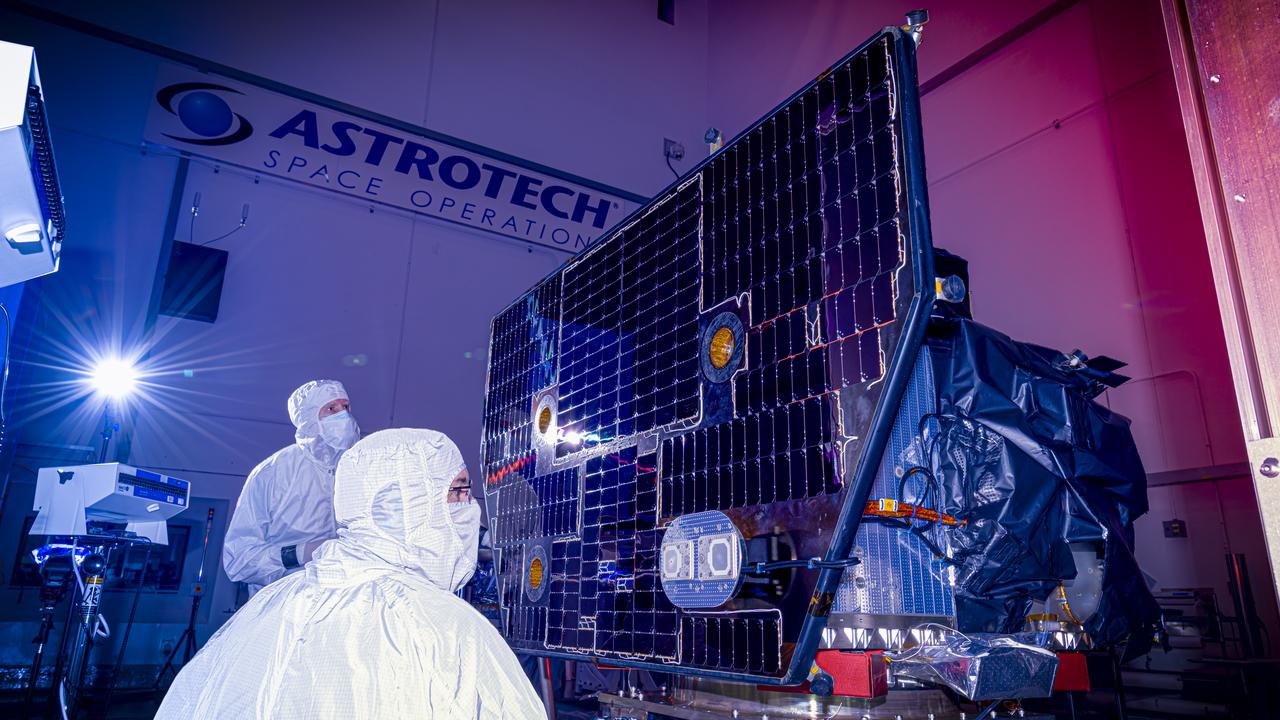
Technicians inspect the solar array panel attached to NASA’s Carruthers Geocorona Observatory on Wednesday, July 23, 2025, at the Astrotech Space Operations Facility near the agency’s Kennedy Space Center in Florida. The solar array will use the Sun to help power Carruthers Geocorona Observatory as it operates at Lagrange Point 1 (L1), an orbit point between the Earth and Sun about one million miles away. Carruthers will use its ultraviolet cameras to monitor how space weather from the Sun impacts the exosphere, the outermost part of Earth’s atmosphere. The observatory will launch as a rideshare with NASA’s IMAP (Interstellar Mapping and Acceleration Probe) no earlier than September 2025.
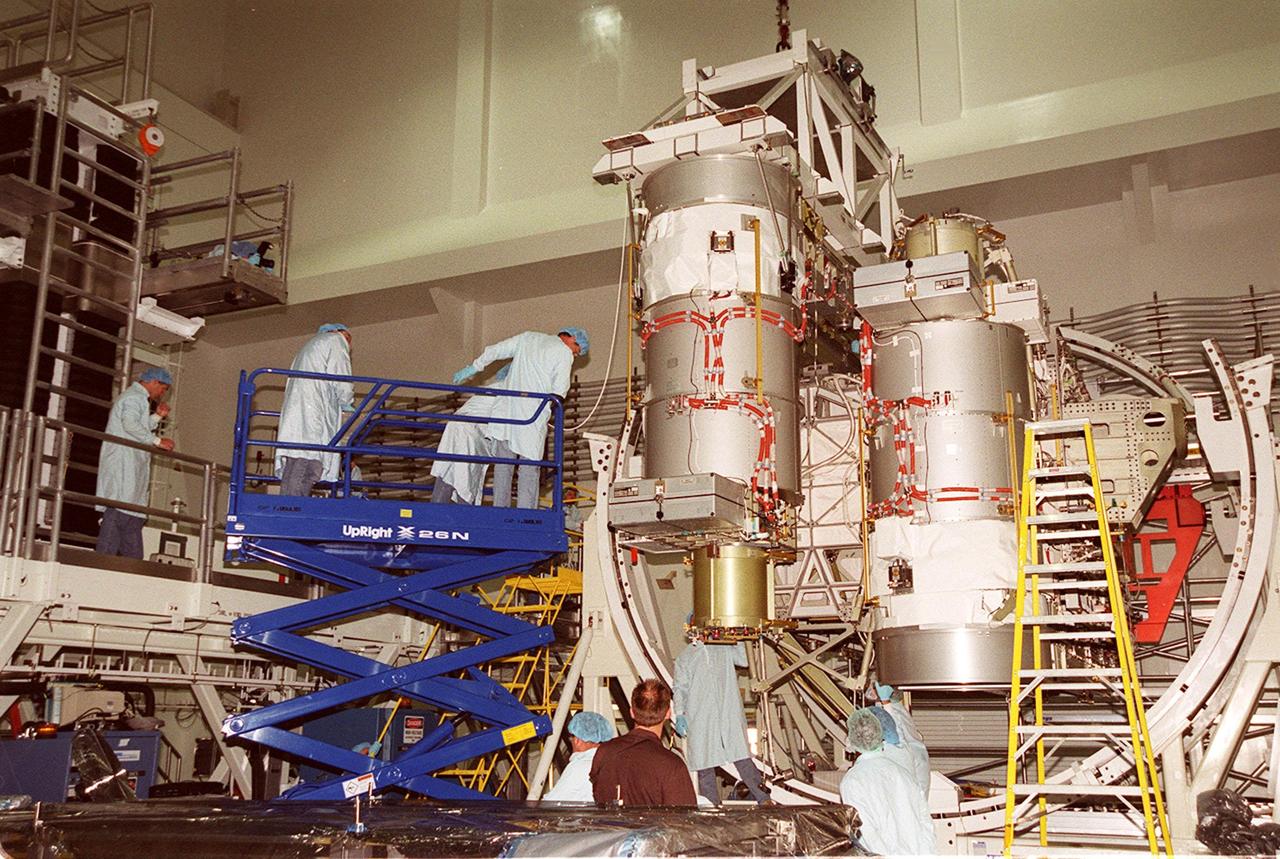
Workers in the Space Station Processing Facility give close attention to the placement of a solar array on the Integrated Equipment Assembly. Solar Array Wing-3 is already in place. Components of the International Space Station, the arrays are scheduled to be launched on mission STS-97 in late November along with the P6 truss. The Station’s electrical power system (EPS) will use eight photovoltaic solar arrays to convert sunlight to electricity. Each of the eight solar arrays will be 112 feet long by 39 feet wide. The solar arrays are mounted on a “blanket” that can be folded like an accordion for delivery. Once in orbit, astronauts will deploy the blankets to their full size. Gimbals will be used to rotate the arrays so that they will face the Sun to provide maximum power to the Space Station
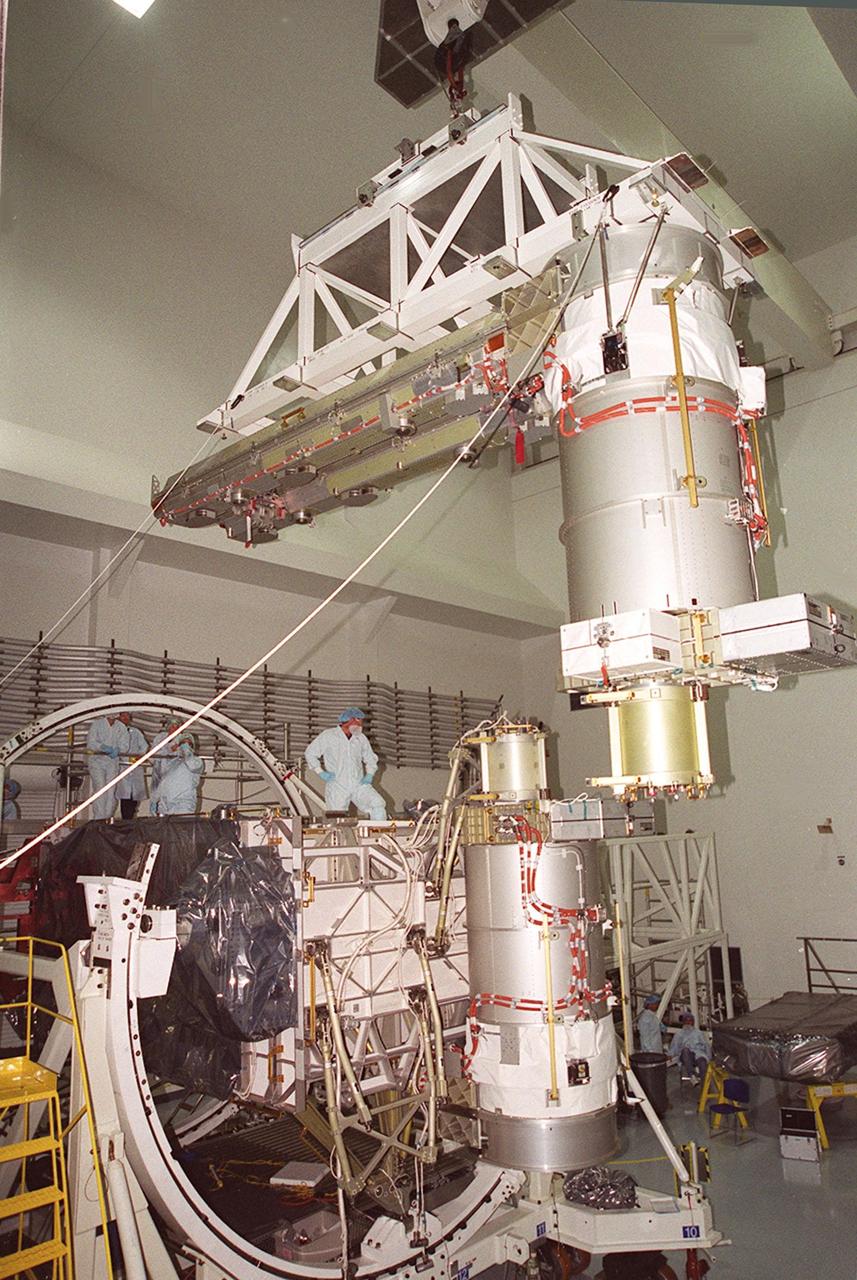
In the Space Station Processing Facility, the overhead crane carrying a solar array arrives at the Integrated Equipment Assembly (IEA) on which it will be installed. Solar Array Wing-3 is already in place. Components of the International Space Station, the arrays are scheduled to be launched on mission STS-97 in late November along with the P6 truss. The Station’s electrical power system (EPS) will use eight photovoltaic solar arrays to convert sunlight to electricity. Each of the eight solar arrays will be 112 feet long by 39 feet wide. The solar arrays are mounted on a “blanket” that can be folded like an accordion for delivery. Once in orbit, astronauts will deploy the blankets to their full size. Gimbals will be used to rotate the arrays so that they will face the Sun to provide maximum power to the Space Station
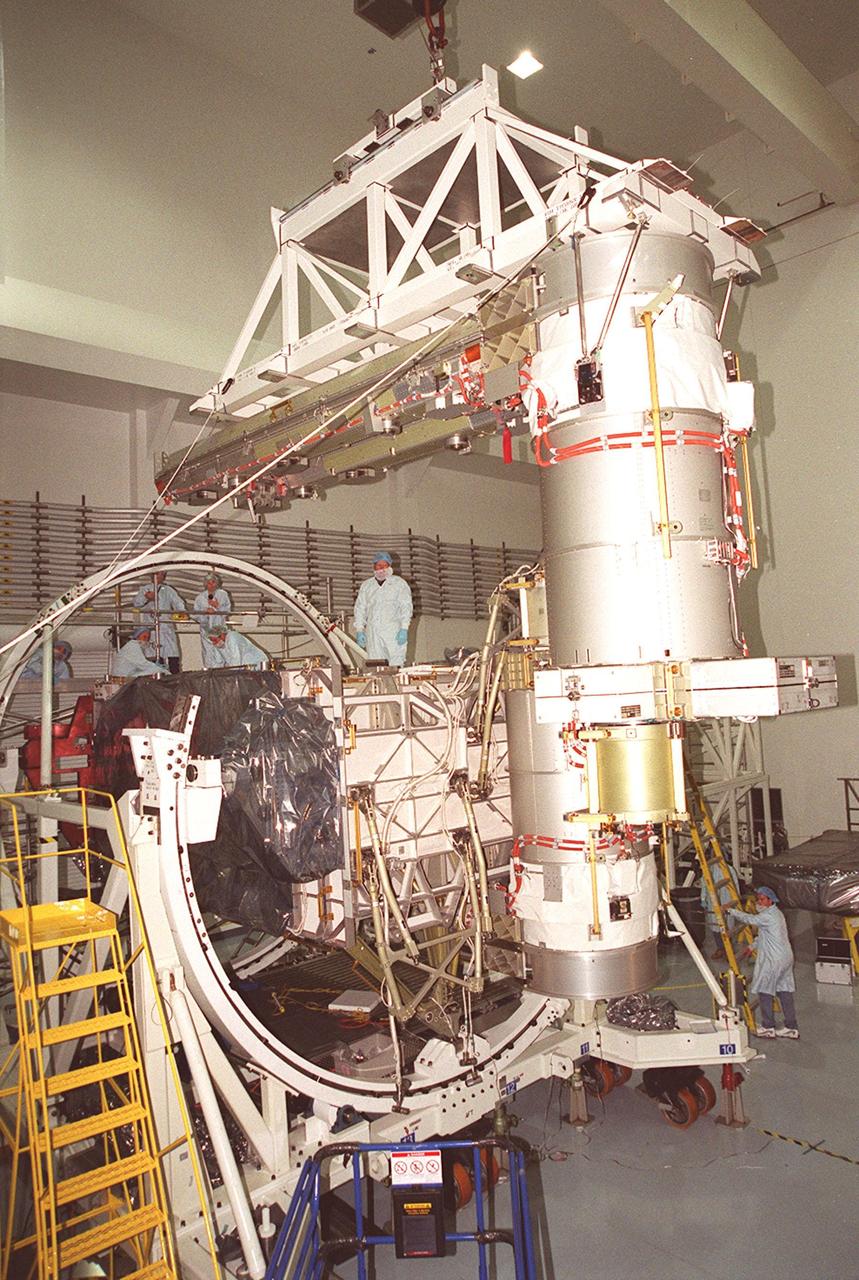
In the Space Station Processing Facility, the overhead crane carrying a solar array maneuvers its cargo into position on the Integrated Equipment Assembly on which it will be installed. Solar Array Wing-3 is already in place. Components of the International Space Station, the arrays are scheduled to be launched on mission STS-97 in late November along with the P6 truss. The Station’s electrical power system (EPS) will use eight photovoltaic solar arrays to convert sunlight to electricity. Each of the eight solar arrays will be 112 feet long by 39 feet wide. The solar arrays are mounted on a “blanket” that can be folded like an accordion for delivery. Once in orbit, astronauts will deploy the blankets to their full size. Gimbals will be used to rotate the arrays so that they will face the Sun to provide maximum power to the Space Station
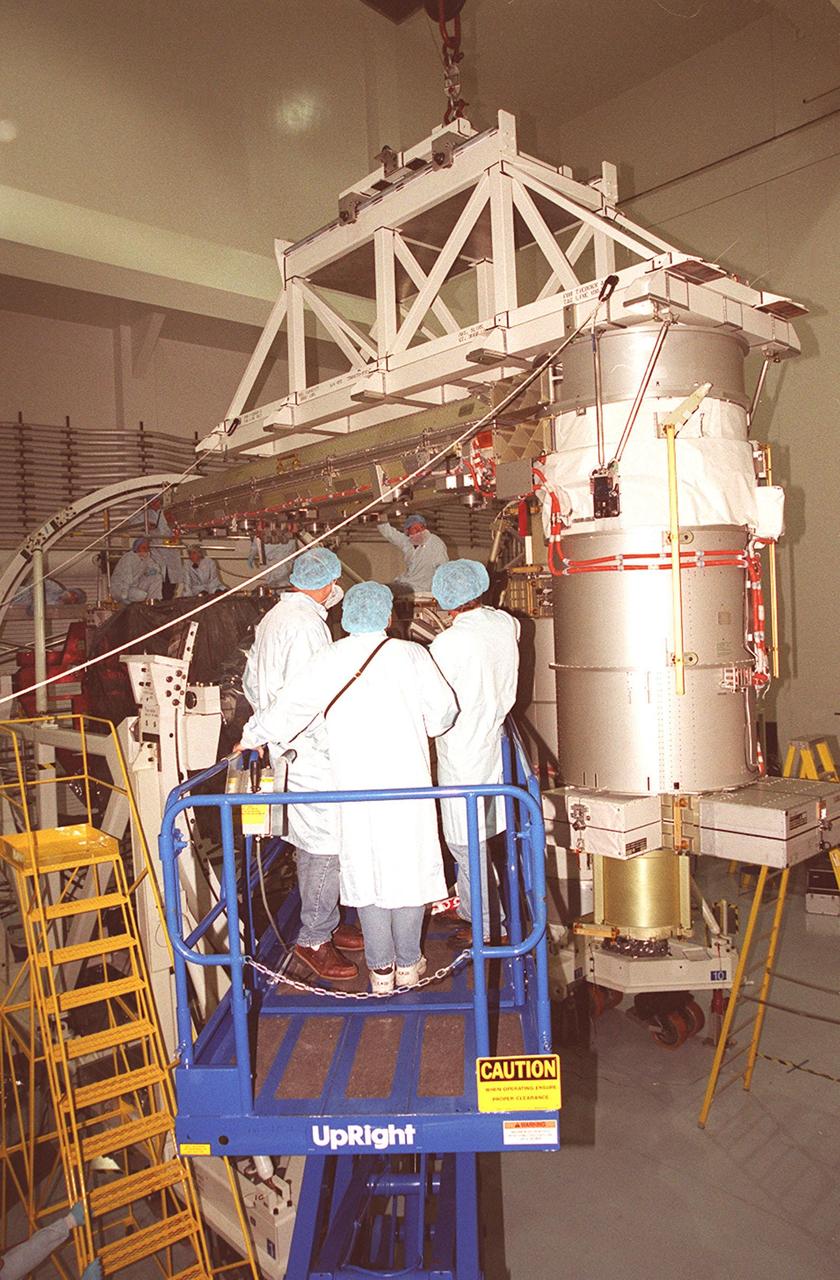
In the Space Station Processing Facility, workers help guide a solar array into position for installation on the Integrated Equipment Assembly. Solar Array Wing-3 is already in place. Components of the International Space Station, the arrays are scheduled to be launched on mission STS-97 in late November along with the P6 truss. The Station’s electrical power system (EPS) will use eight photovoltaic solar arrays to convert sunlight to electricity. Each of the eight solar arrays will be 112 feet long by 39 feet wide. The solar arrays are mounted on a “blanket” that can be folded like an accordion for delivery. Once in orbit, astronauts will deploy the blankets to their full size. Gimbals will be used to rotate the arrays so that they will face the Sun to provide maximum power to the Space Station
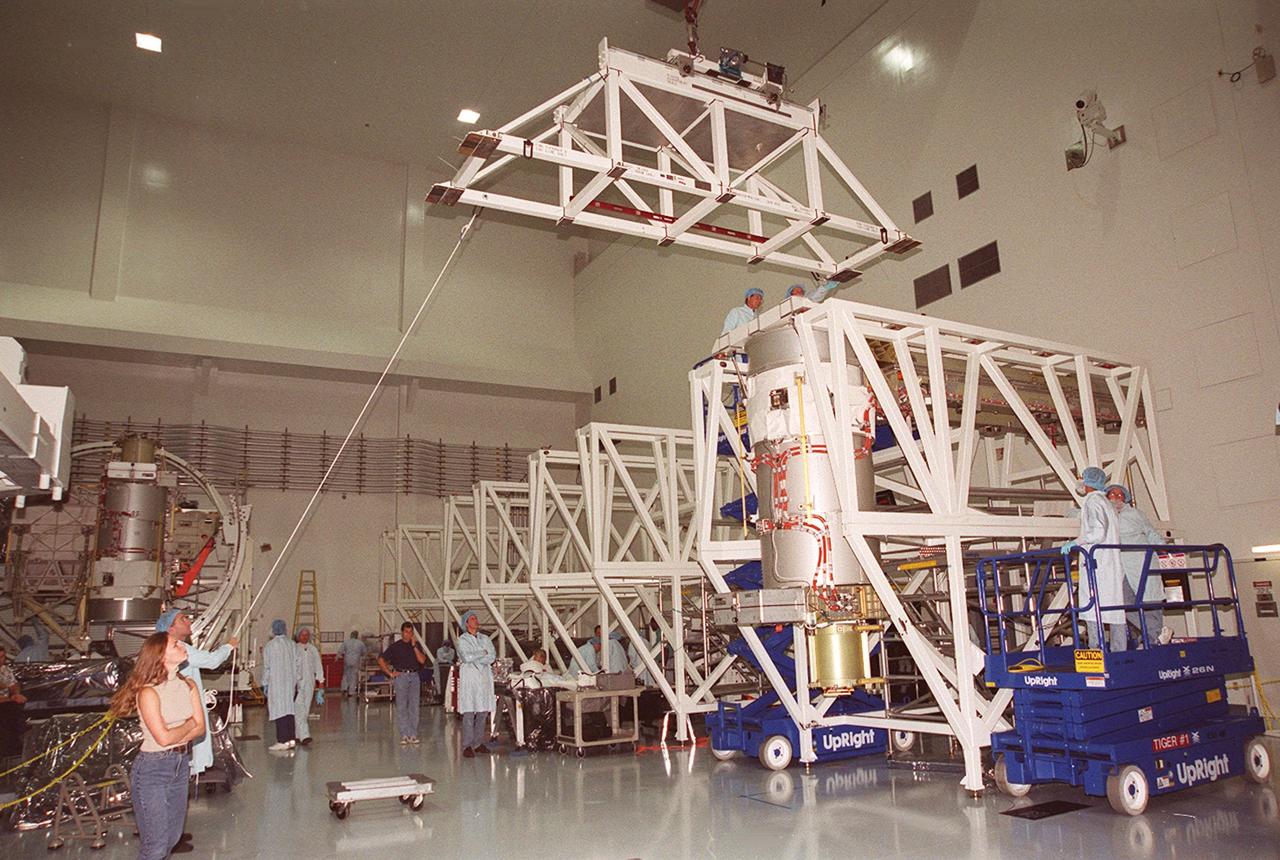
Workers in the Space Station Processing Facility help guide an overhead crane toward a workstand containing a solar array in order to move it for installation onto the Integrated Equipment Assembly (IEA). A component of the International Space Station, the solar array is the second one being installed on the IEA. The arrays are scheduled to be launched on mission STS-97 in late November along with the P6 truss. The Station’s electrical power system (EPS) will use eight photovoltaic solar arrays to convert sunlight to electricity. Each of the eight solar arrays will be 112 feet long by 39 feet wide. The solar arrays are mounted on a “blanket” that can be folded like an accordion for delivery. Once in orbit, astronauts will deploy the blankets to their full size. Gimbals will be used to rotate the arrays so that they will face the Sun to provide maximum power to the Space Station
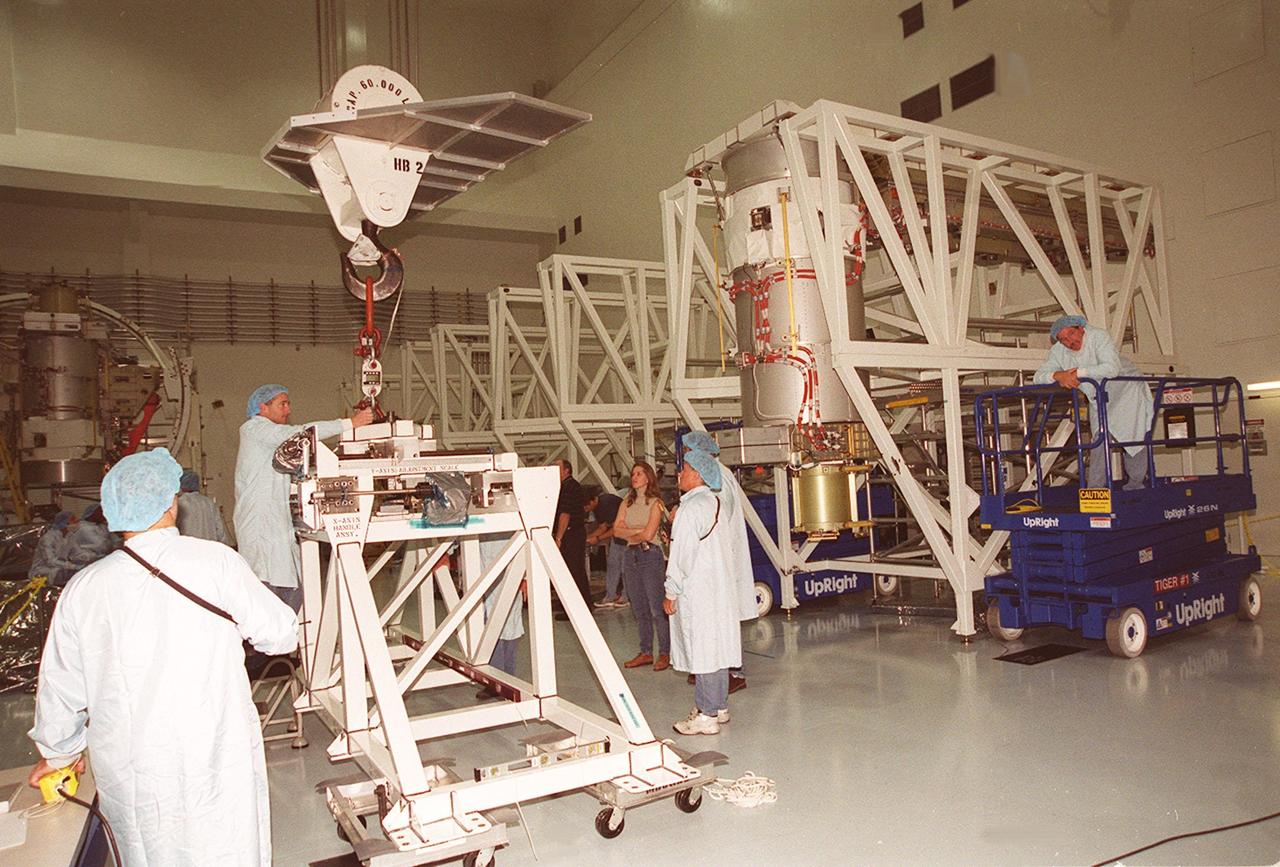
Workers in the Space Station Processing Facility prepare an overhead crane they will use to move a solar array, a component of the International Space Station, for installation onto the Integrated Equipment Assembly. The solar array is the second one being installed. They are scheduled to be launched on mission STS-97 in late November along with the P6 truss. The Station’s electrical power system (EPS) will use eight photovoltaic solar arrays to convert sunlight to electricity. Each of the eight solar arrays will be 112 feet long by 39 feet wide. The solar arrays are mounted on a “blanket” that can be folded like an accordion for delivery. Once in orbit, astronauts will deploy the blankets to their full size. Gimbals will be used to rotate the arrays so that they will face the Sun to provide maximum power to the Space Station
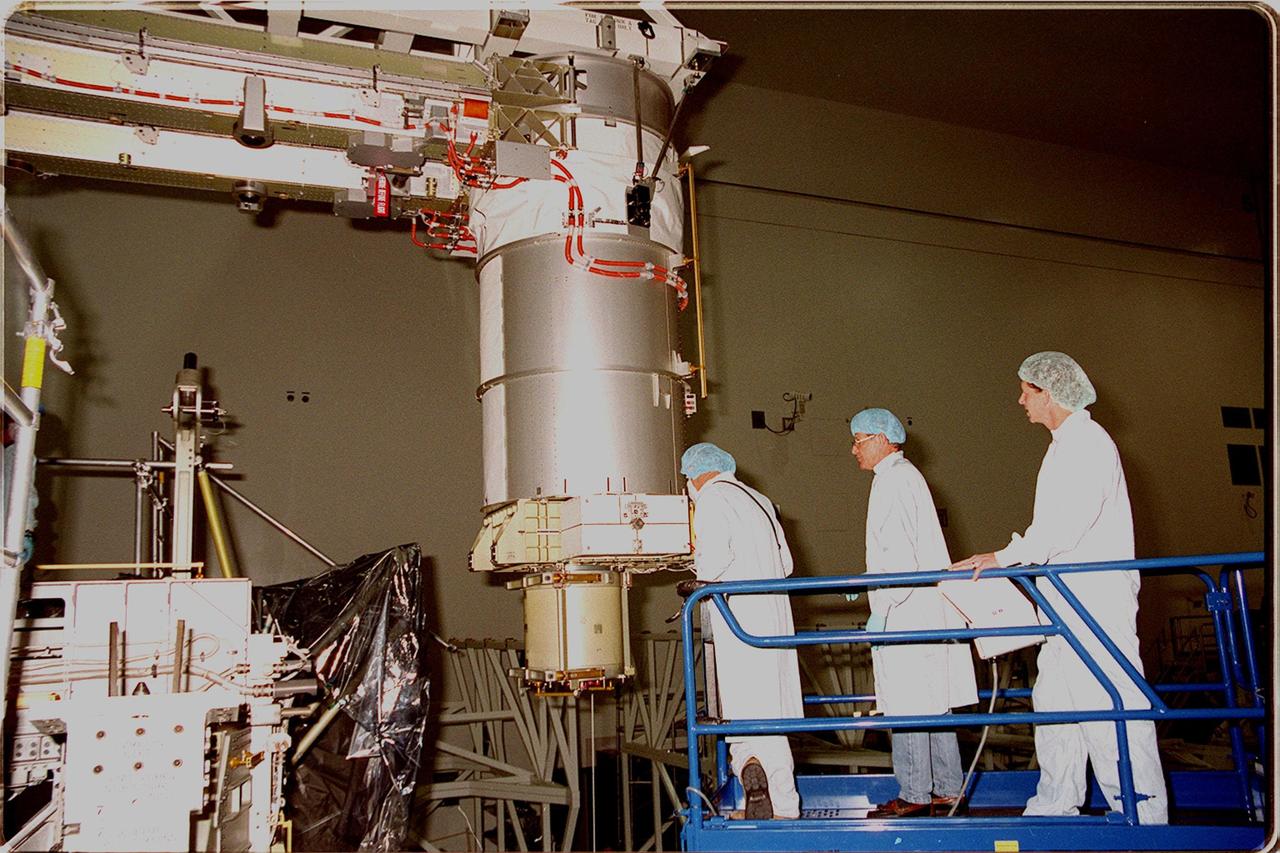
Workers in the Space Station Processing Facility watch closely as Solar Array Wing-3, a component of the International Space Station, is lowered toward the Integrated Electronic Assembly where it will be installed for testing. The solar array is scheduled to be launched on STS-97 in late November along with the P6 truss. The Station’s electrical power system (EPS) will use eight photovoltaic solar arrays to convert sunlight to electricity. Each of the eight solar arrays will be 112 feet long by 39 feet wide. The solar arrays are mounted on a “blanket” that can be folded like an accordion for delivery. Once in orbit, astronauts will deploy the blankets to their full size. Gimbals will be used to rotate the arrays so that they will face the Sun to provide maximum power to the Space Station
Workers in the Space Station Processing Facility watch closely as Solar Array Wing-3, a component of the International Space Station, is moved toward the Integrated Electronic Assembly where it will be installed for testing. The solar array is scheduled to be launched on STS-97 in late November along with the P6 truss. The Station’s electrical power system (EPS) will use eight photovoltaic solar arrays to convert sunlight to electricity. Each of the eight solar arrays will be 112 feet long by 39 feet wide. The solar arrays are mounted on a “blanket” that can be folded like an accordion for delivery. Once in orbit, astronauts will deploy the blankets to their full size. Gimbals will be used to rotate the arrays so that they will face the Sun to provide maximum power to the Space Station
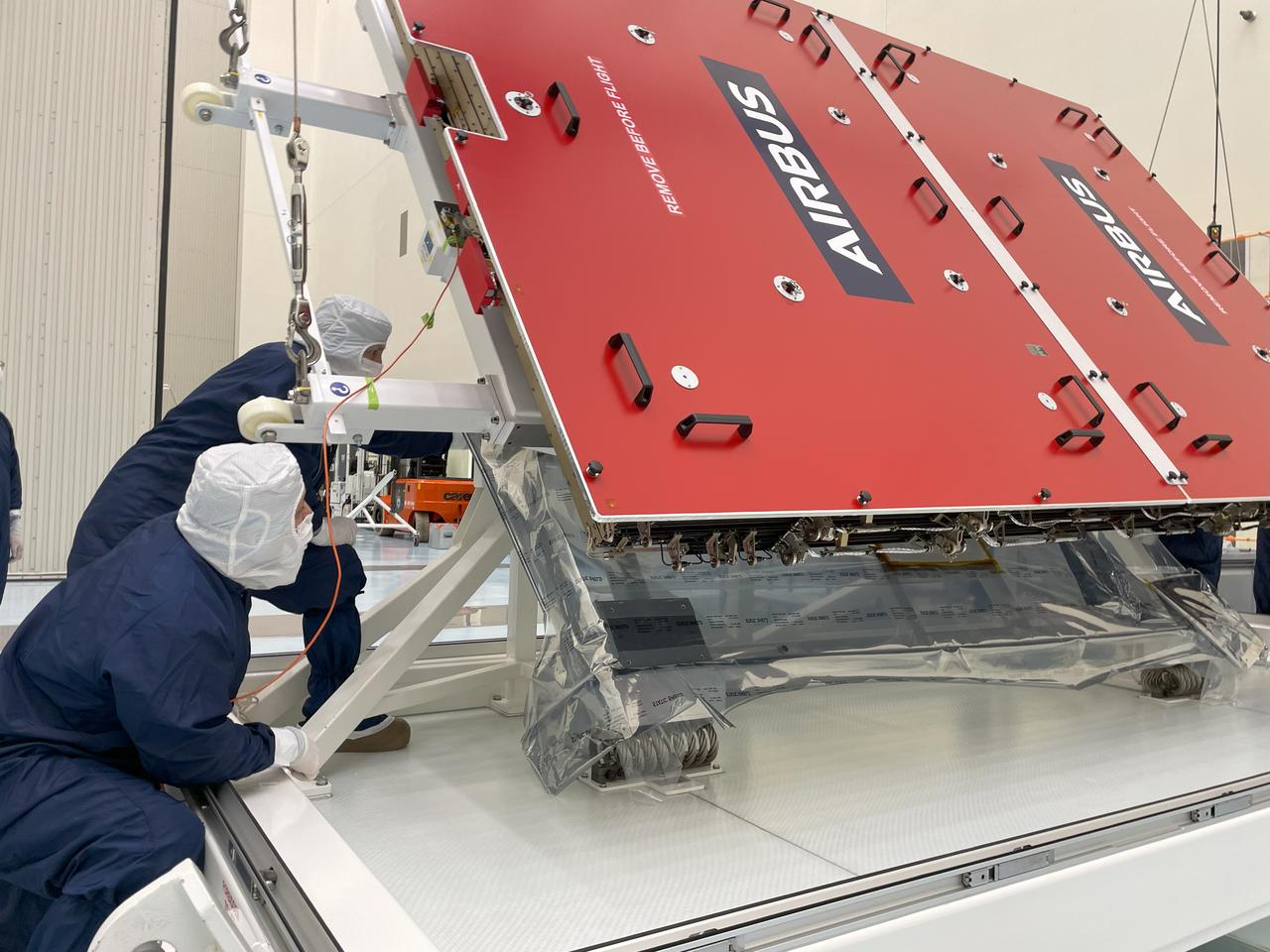
Technicians hoist a five-panel solar array protected by a lid for NASA’s Europa Clipper spacecraft at the Payload Hazardous Servicing Facility at the agency’s Kennedy Space Center in Florida on Tuesday, Feb. 27, 2024. The arrays are each 46.5 feet long (14.2 meters). With both solar arrays deployed, Europa Clipper will span more than 100 feet long, about the length of a basketball court. The solar arrays power the spacecraft so it can study Jupiter’s icy moon, Europa, which is more than five times as far from the Sun as the Earth. Launch on a SpaceX Falcon Heavy rocket is no earlier than October 2024.
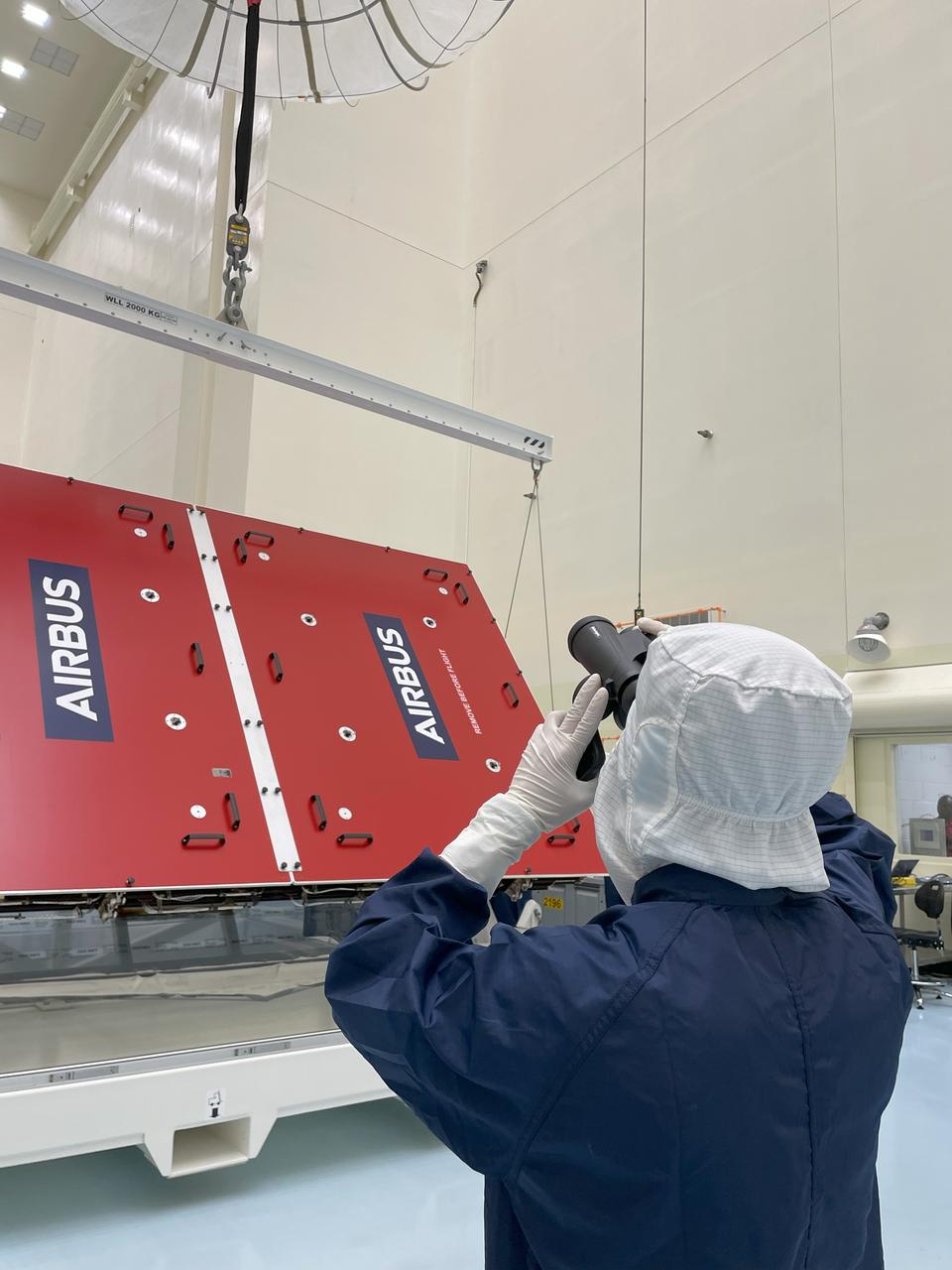
Technicians hoist a five-panel solar array protected by a lid for NASA’s Europa Clipper spacecraft at the Payload Hazardous Servicing Facility at the agency’s Kennedy Space Center in Florida on Tuesday, Feb. 27, 2024. The arrays are each 46.5 feet long (14.2 meters). With both solar arrays deployed, Europa Clipper will span more than 100 feet long, about the length of a basketball court. The solar arrays power the spacecraft so it can study Jupiter’s icy moon, Europa, which is more than five times as far from the Sun as the Earth. Launch on a SpaceX Falcon Heavy rocket is no earlier than October 2024.
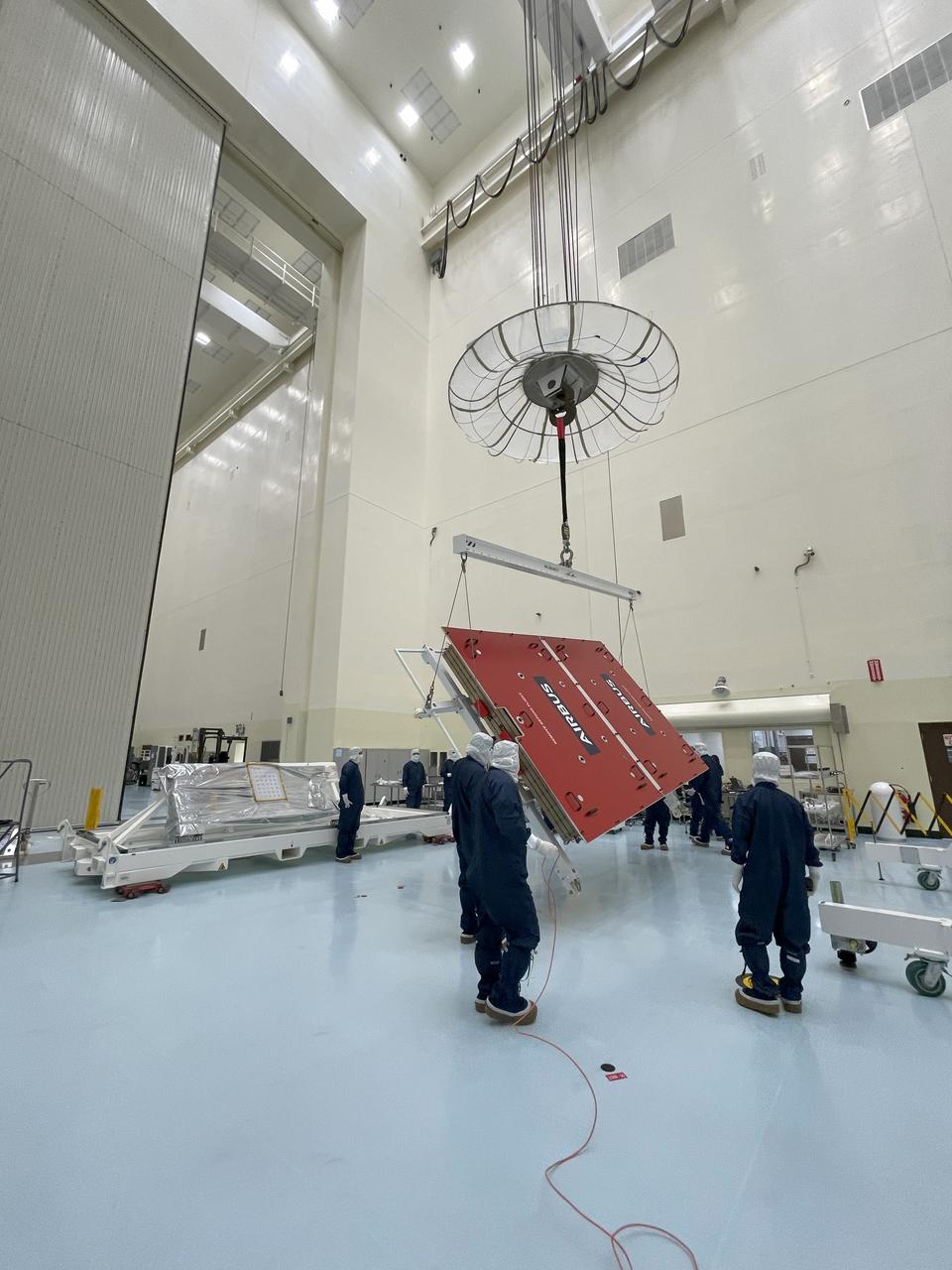
Technicians hoist a five-panel solar array protected by a lid for NASA’s Europa Clipper spacecraft at the Payload Hazardous Servicing Facility at the agency’s Kennedy Space Center in Florida on Tuesday, Feb. 27, 2024. The arrays are each 46.5 feet long (14.2 meters). With both solar arrays deployed, Europa Clipper will span more than 100 feet long, about the length of a basketball court. The solar arrays power the spacecraft so it can study Jupiter’s icy moon, Europa, which is more than five times as far from the Sun as the Earth. Launch on a SpaceX Falcon Heavy rocket is no earlier than October 2024.
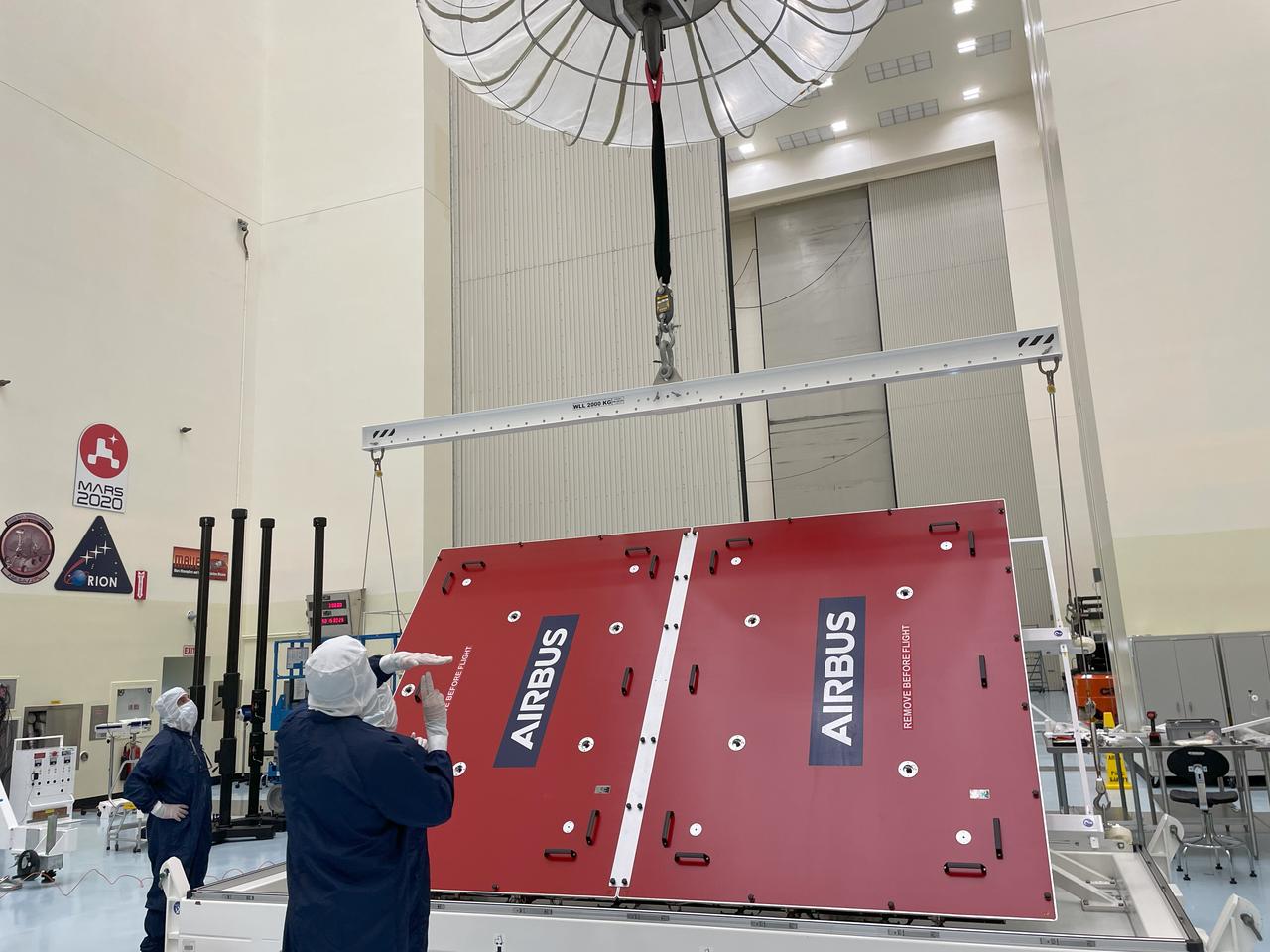
Technicians hoist a five-panel solar array protected by a lid for NASA’s Europa Clipper spacecraft at the Payload Hazardous Servicing Facility at the agency’s Kennedy Space Center in Florida on Tuesday, Feb. 27, 2024. The arrays are each 46.5 feet long (14.2 meters). With both solar arrays deployed, Europa Clipper will span more than 100 feet long, about the length of a basketball court. The solar arrays power the spacecraft so it can study Jupiter’s icy moon, Europa, which is more than five times as far from the Sun as the Earth. Launch on a SpaceX Falcon Heavy rocket is no earlier than October 2024.
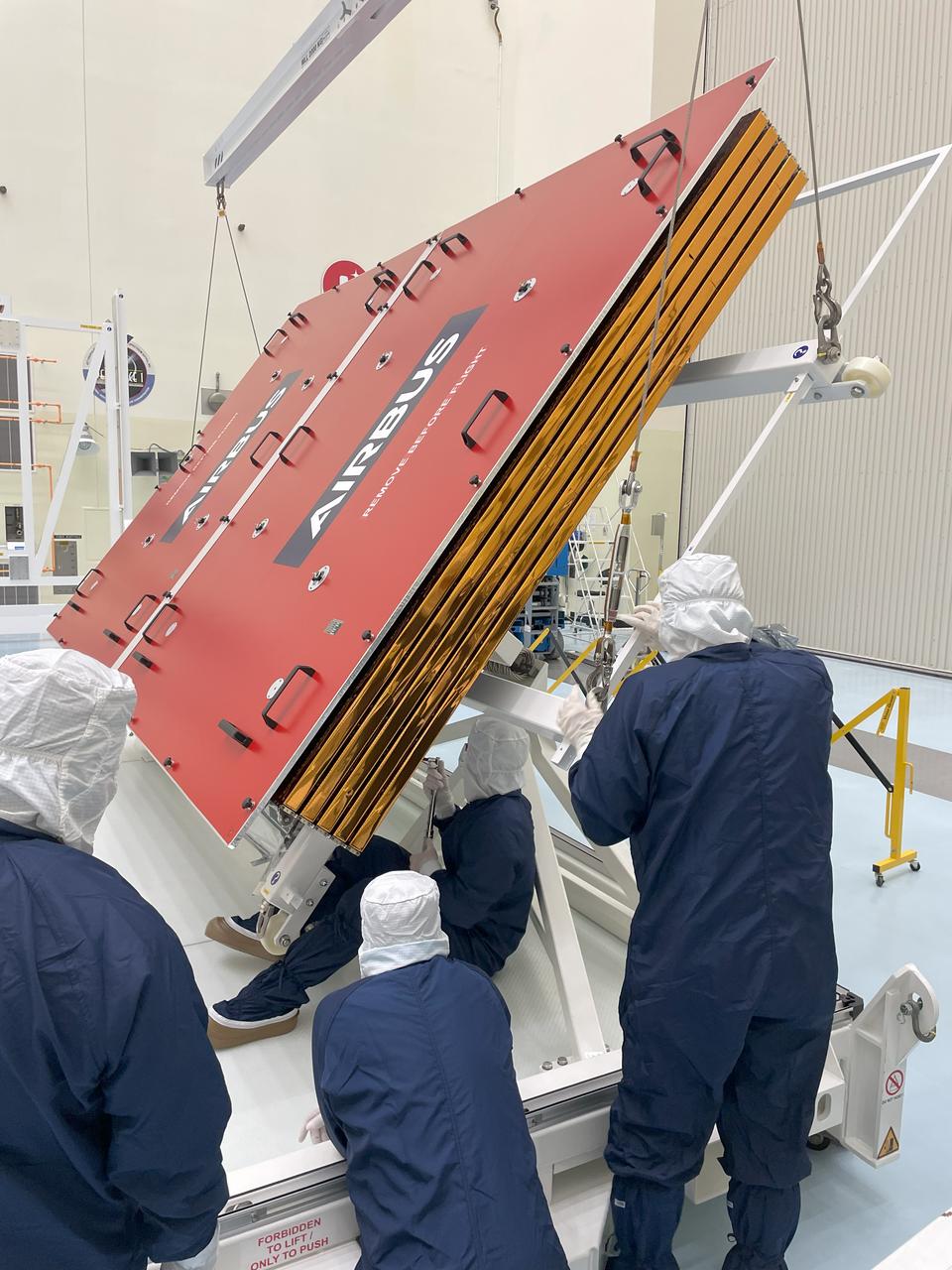
Technicians hoist a five-panel solar array protected by a lid for NASA’s Europa Clipper spacecraft at the Payload Hazardous Servicing Facility at the agency’s Kennedy Space Center in Florida on Tuesday, Feb. 27, 2024. The arrays are each 46.5 feet long (14.2 meters). With both solar arrays deployed, Europa Clipper will span more than 100 feet long, about the length of a basketball court. The solar arrays power the spacecraft so it can study Jupiter’s icy moon, Europa, which is more than five times as far from the Sun as the Earth. Launch on a SpaceX Falcon Heavy rocket is no earlier than October 2024.
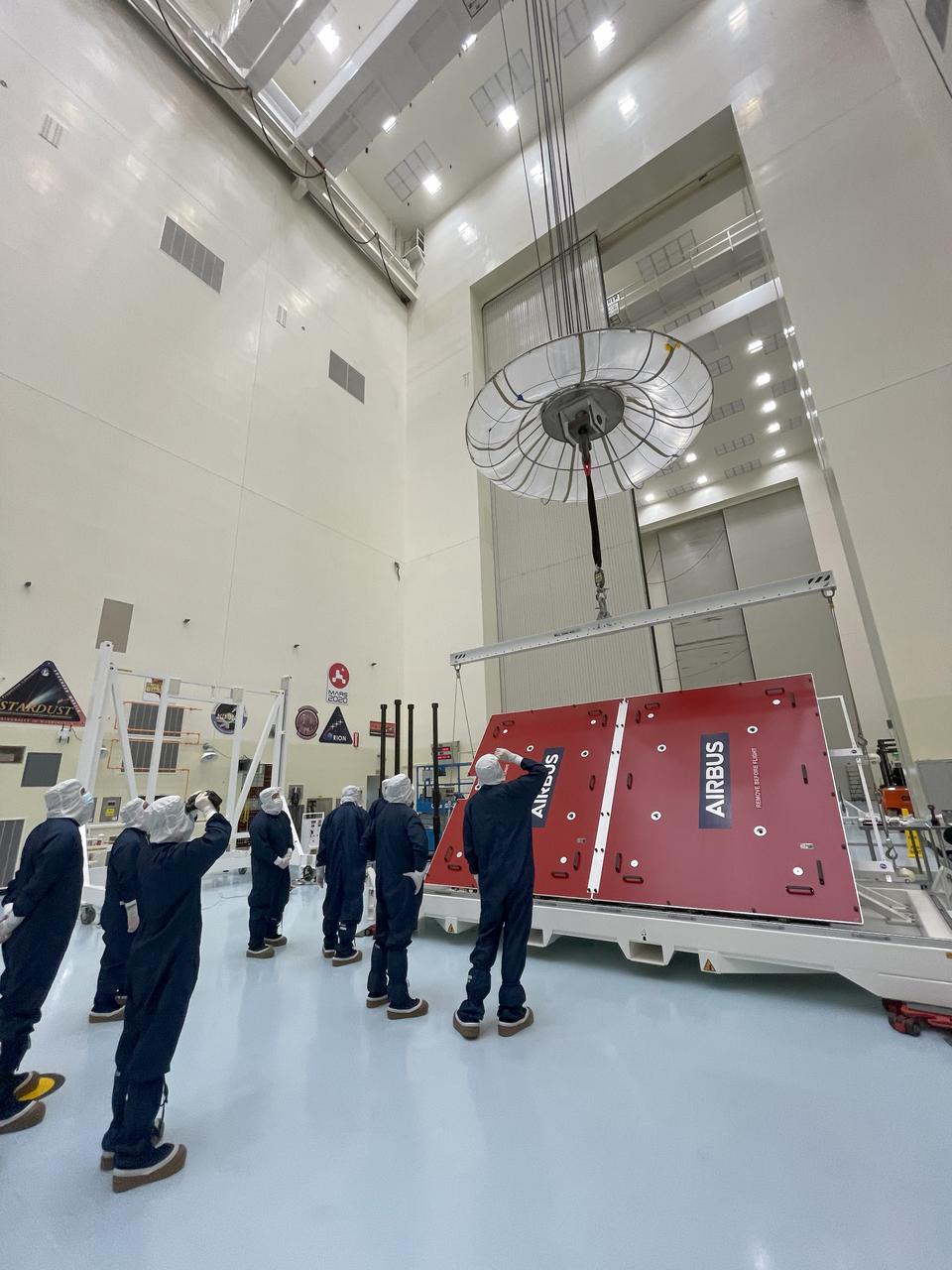
Technicians hoist a five-panel solar array protected by a lid for NASA’s Europa Clipper spacecraft at the Payload Hazardous Servicing Facility at the agency’s Kennedy Space Center in Florida on Tuesday, Feb. 27, 2024. The arrays are each 46.5 feet long (14.2 meters). With both solar arrays deployed, Europa Clipper will span more than 100 feet long, about the length of a basketball court. The solar arrays power the spacecraft so it can study Jupiter’s icy moon, Europa, which is more than five times as far from the Sun as the Earth. Launch on a SpaceX Falcon Heavy rocket is no earlier than October 2024.
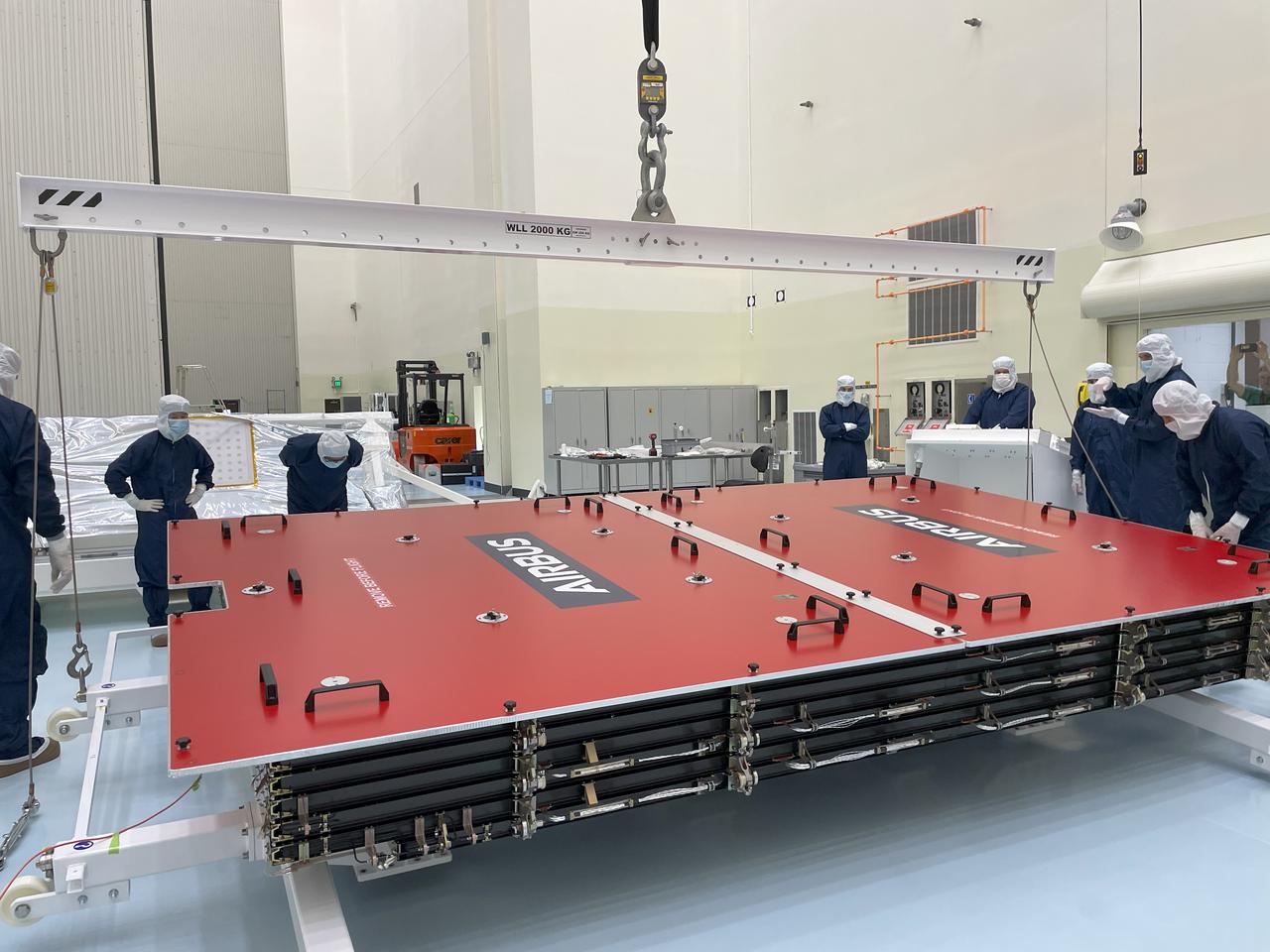
Technicians hoist a five-panel solar array protected by a lid for NASA’s Europa Clipper spacecraft at the Payload Hazardous Servicing Facility at the agency’s Kennedy Space Center in Florida on Tuesday, Feb. 27, 2024. The arrays are each 46.5 feet long (14.2 meters). With both solar arrays deployed, Europa Clipper will span more than 100 feet long, about the length of a basketball court. The solar arrays power the spacecraft so it can study Jupiter’s icy moon, Europa, which is more than five times as far from the Sun as the Earth. Launch on a SpaceX Falcon Heavy rocket is no earlier than October 2024.
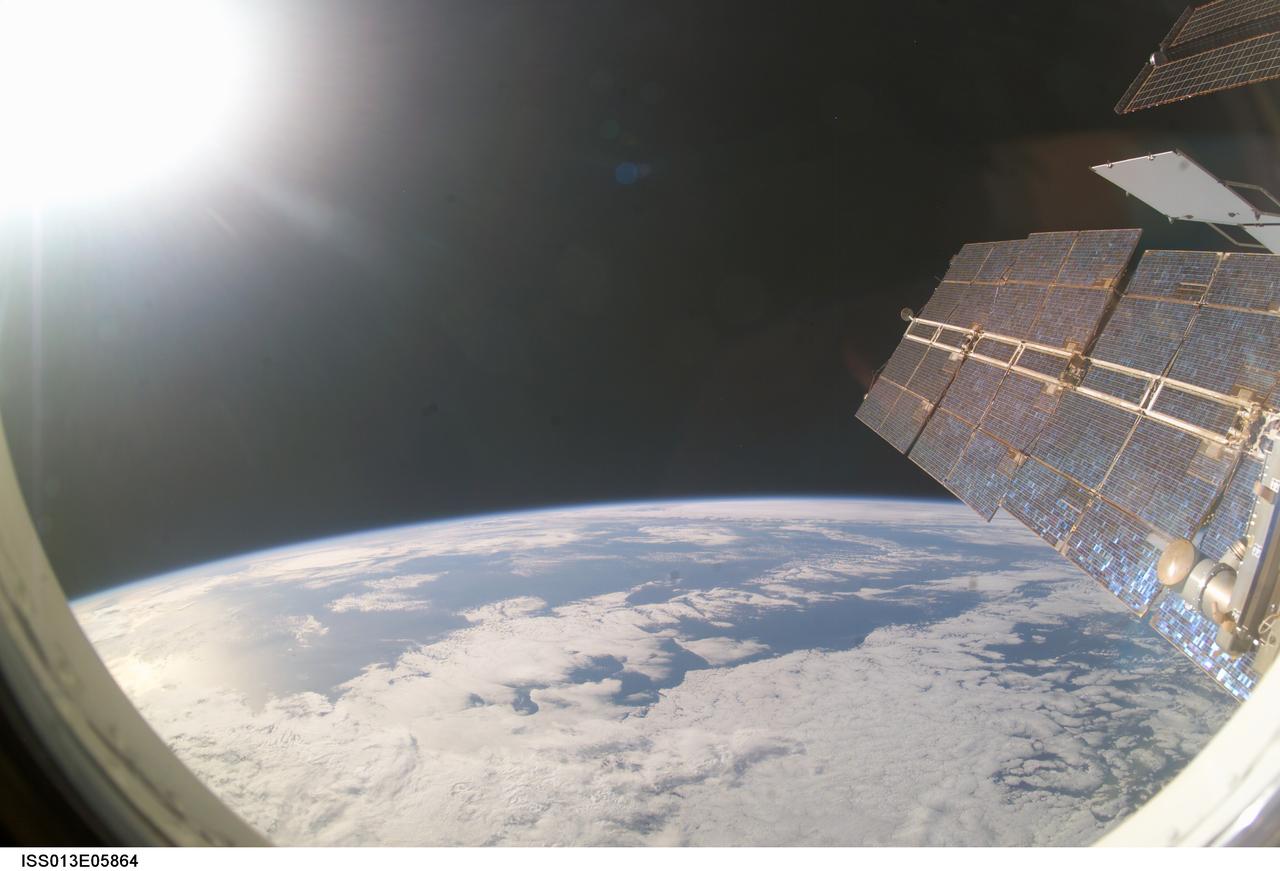
ISS013-E-05864 (11 April 2006) --- A setting sun on Earth’s horizon and station solar array panels are featured in this image photographed by an Expedition 13 crewmember from a window on the International Space Station.
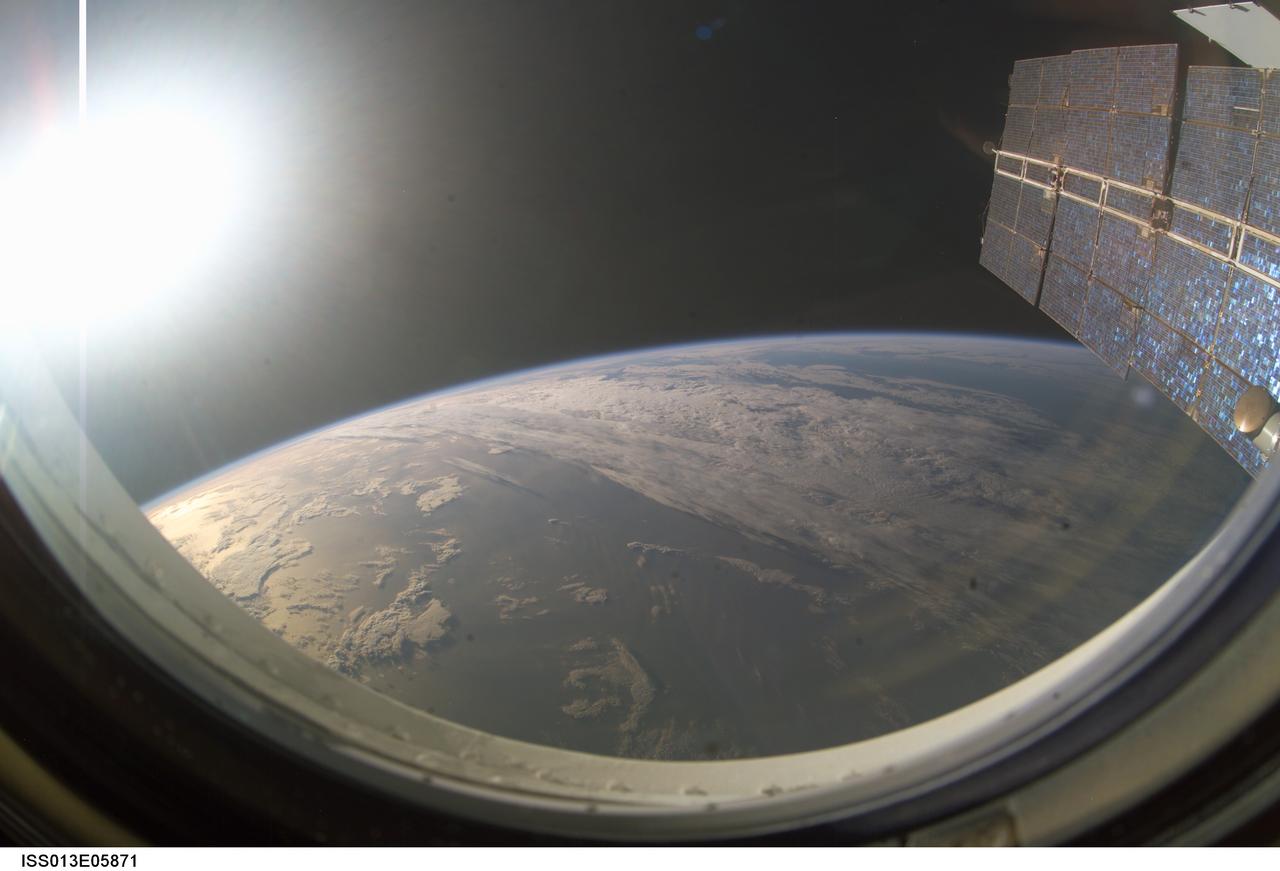
ISS013-E-05871 (11 April 2006) --- A setting sun on Earth’s horizon and station solar array panels are featured in this image photographed by an Expedition 13 crewmember from a window on the International Space Station.
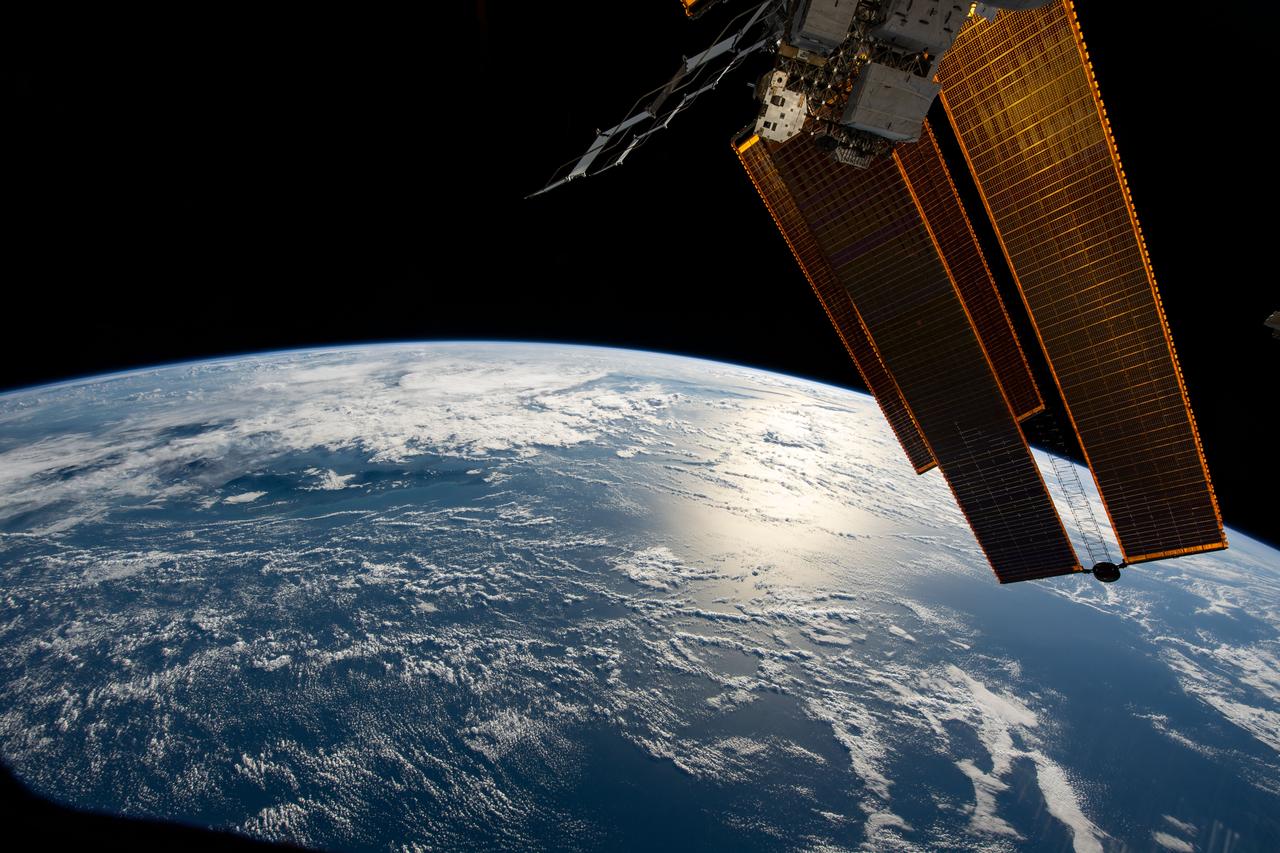
iss067e185220 (July 11, 2022) --- The sun's glint beams off the Coral Sea northeast of Australia as the International Space Station orbited 264 miles above. Pictured in the right foreground, are a pair of the station's main solar arrays and a radiator.
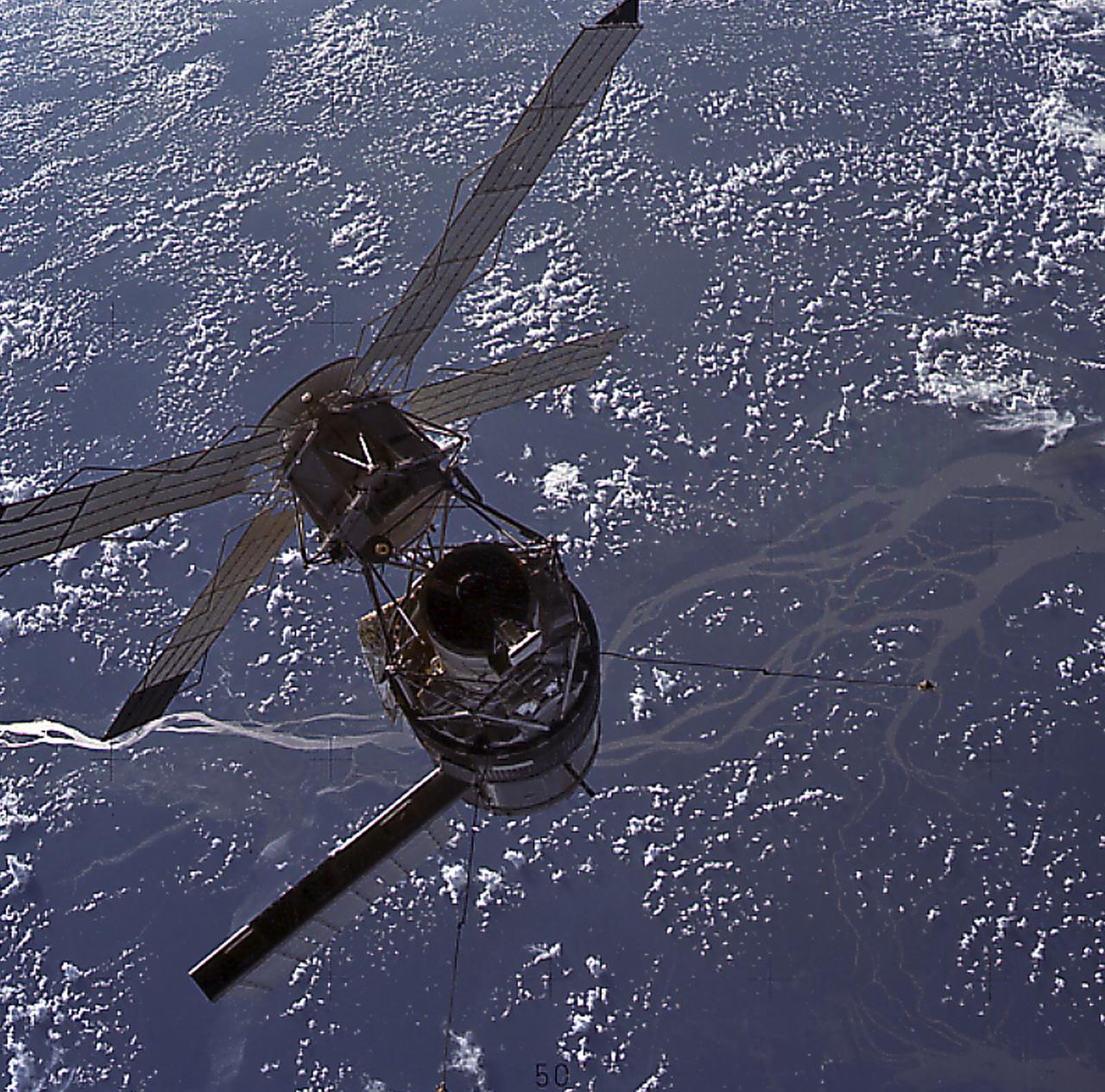
This striking image of Skylab was photographed by Astronaut Jack Lousma (Skylab-3), as the second crew reached the orbiting laboratory over the delta of the mighty Amazon River. Skylab's solar arrays were exposed directly to the Sun's rays. Solar energy was transformed into electrical power for operation of all spacecraft systems. The proper operation of these solar arrays was vital to the mission.
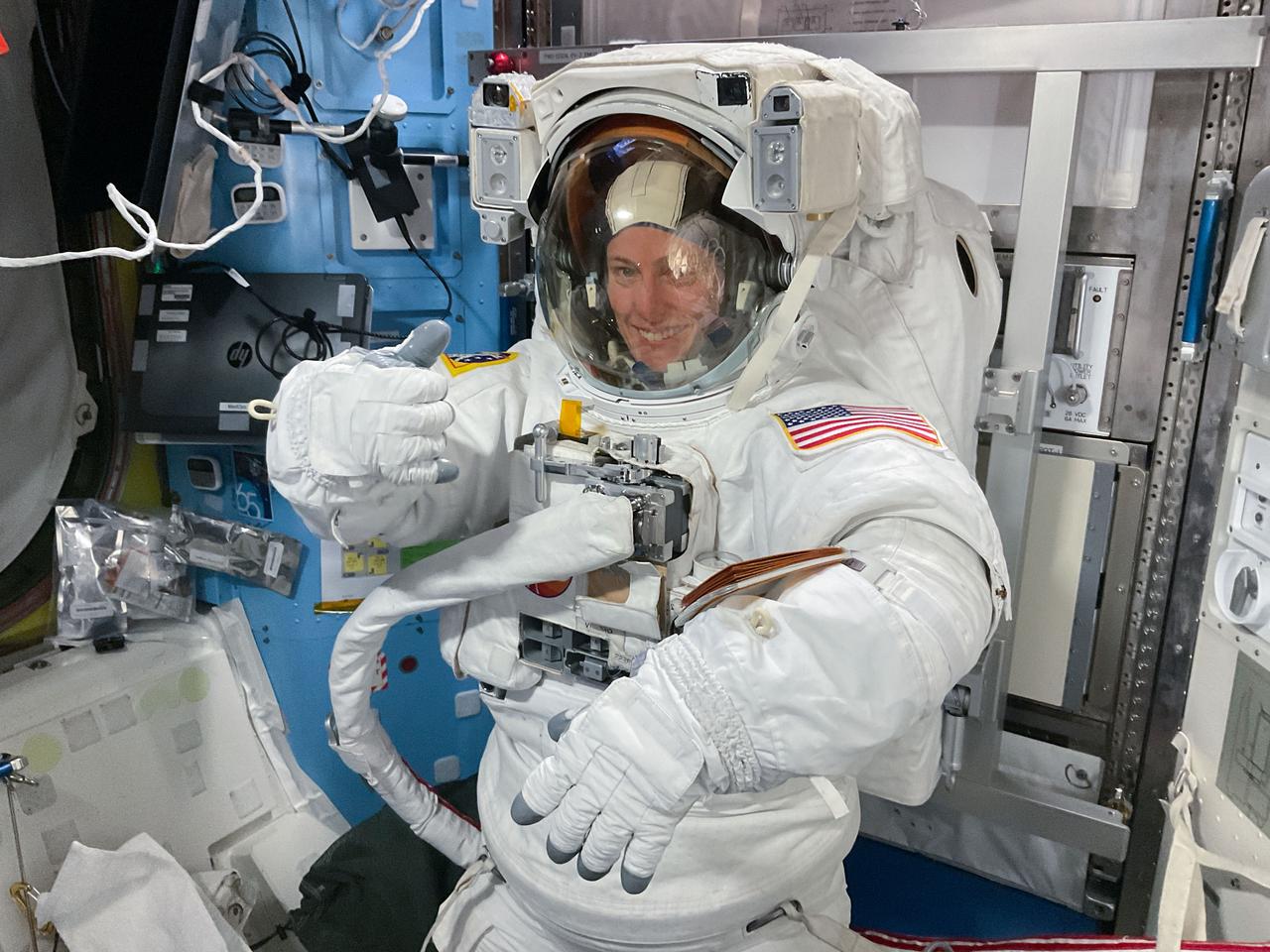
iss070e37272 (Nov. 1, 2023) --- Expedition 70 Flight Engineer and NASA astronaut Loral O'Hara is pictured in her spacesuit before beginning a spacewalk for maintenance on the International Space Station's port solar alpha rotary joint, which allows the solar arrays to track the Sun and generate electricity to power the orbital outpost.
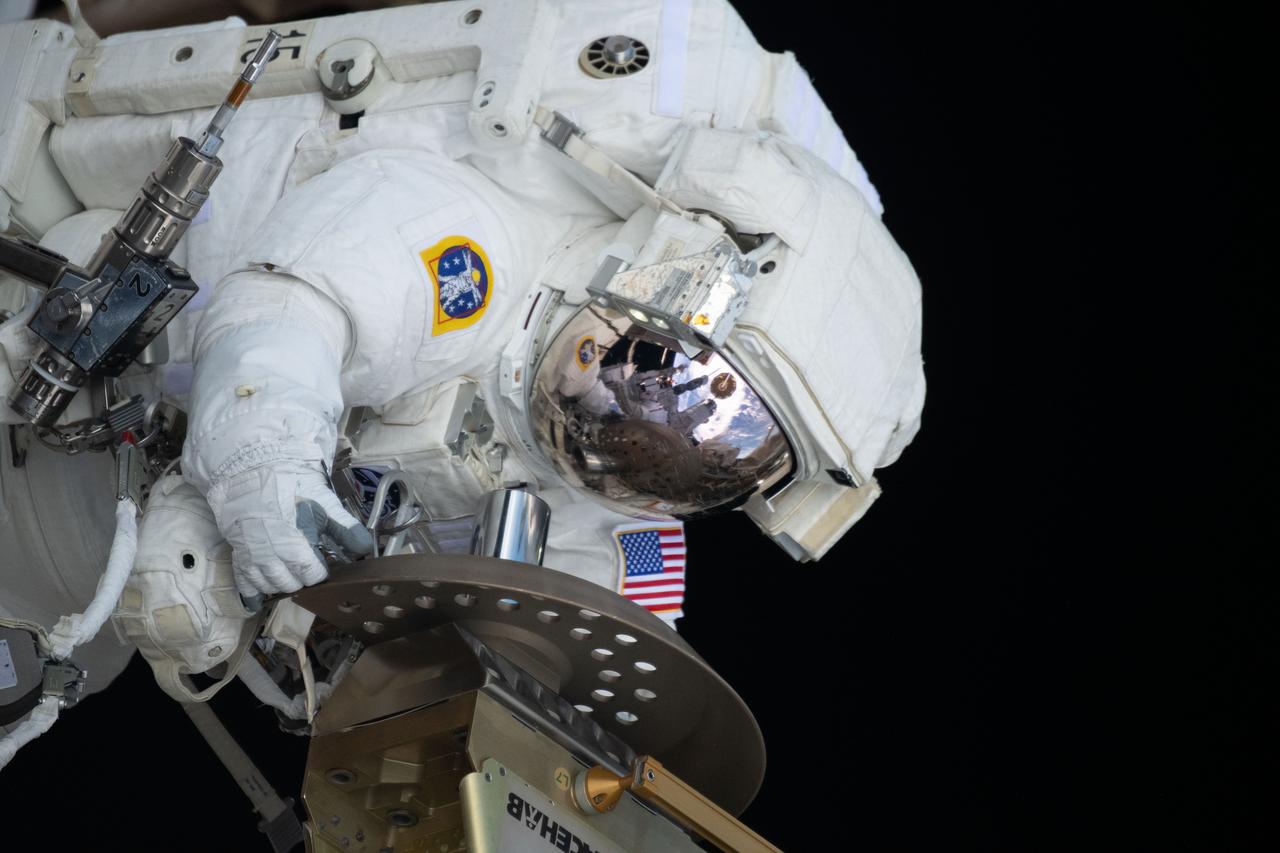
iss070e37241 (Nov. 1, 2023) --- Expedition 70 Flight Engineer and NASA astronaut Loral O'Hara is pictured during a spacewalk for maintenance on the International Space Station's port solar alpha rotary joint, which allows the solar arrays to track the Sun and generate electricity to power the orbital outpost.
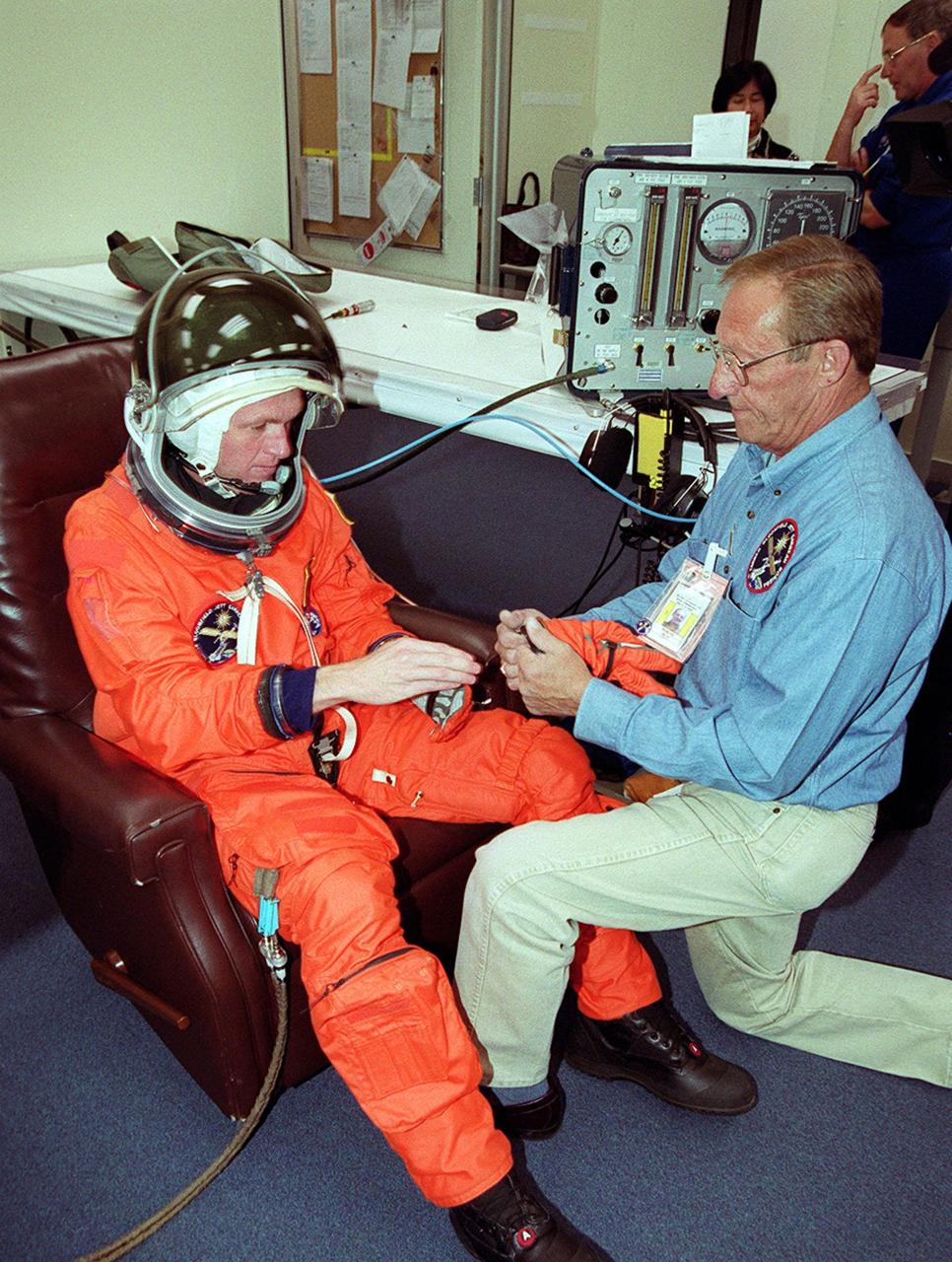
With the help of a suit technician, STS-97 Commander Brent Jett dons his launch and entry suit. This is his third Shuttle flight.; Mission STS-97 is the sixth construction flight to the International Space Station. It is transporting the P6 Integrated Truss Structure that comprises Solar Array Wing-3 and the Integrated Electronic Assembly, to be installed on the Space Station. The solar arrays are mounted on a “blanket” that can be folded like an accordion for delivery. Once in orbit, astronauts will deploy the blankets to their full size. The 11-day mission includes two spacewalks to complete the solar array connections. The Station’s electrical power system will use eight photovoltaic solar arrays, each 112 feet long by 39 feet wide, to convert sunlight to electricity. Gimbals will be used to rotate the arrays so that they will face the Sun to provide maximum power to the Space Station. Launch is scheduled for Nov. 30 at 10:06 p.m. EST
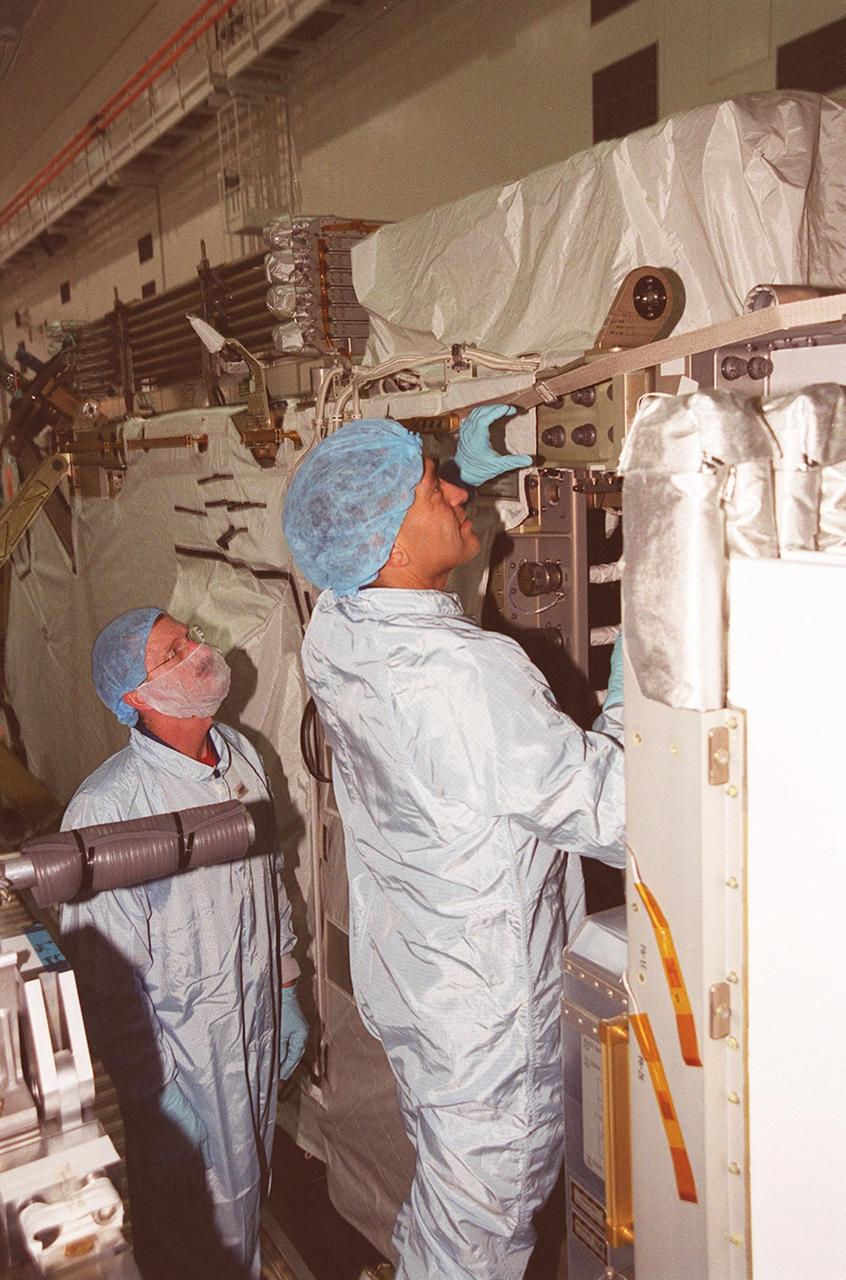
In the Space Station Processing Facility, STS-97 Mission Specialists Carlos Noriega (left) and Joe Tanner check out the mission payload, the P6 integrated truss segment. Mission STS-97 is the sixth construction flight to the International Space Station. The P6 comprises Solar Array Wing-3 and the Integrated Electronic Assembly, to be installed on the International Space Station. The Station’s electrical power system will use eight photovoltaic solar arrays, each 112 feet long by 39 feet wide, to convert sunlight to electricity. The solar arrays are mounted on a “blanket” that can be folded like an accordion for delivery. Once in orbit, astronauts will deploy the blankets to their full size. Gimbals will be used to rotate the arrays so that they will face the Sun to provide maximum power to the Space Station. The mission includes two spacewalks by Noriega and Tanner to complete the solar array connections. STS-97 is scheduled to launch Nov. 30 at about 10:06 p.m. EST

STS-97 Mission Specialist Carlos Noriega appears relaxed as he dons his launch and entry suit. This is his second Shuttle flight. Mission STS-97 is the sixth construction flight to the International Space Station. It is transporting the P6 Integrated Truss Structure that comprises Solar Array Wing-3 and the Integrated Electronic Assembly, to be installed on the Space Station. The solar arrays are mounted on a “blanket” that can be folded like an accordion for delivery. Once in orbit, astronauts will deploy the blankets to their full size. The 11-day mission includes two spacewalks to complete the solar array connections. The Station’s electrical power system will use eight photovoltaic solar arrays, each 112 feet long by 39 feet wide, to convert sunlight to electricity. Gimbals will be used to rotate the arrays so that they will face the Sun to provide maximum power to the Space Station. Launch is scheduled for Nov. 30 at 10:06 p.m. EST
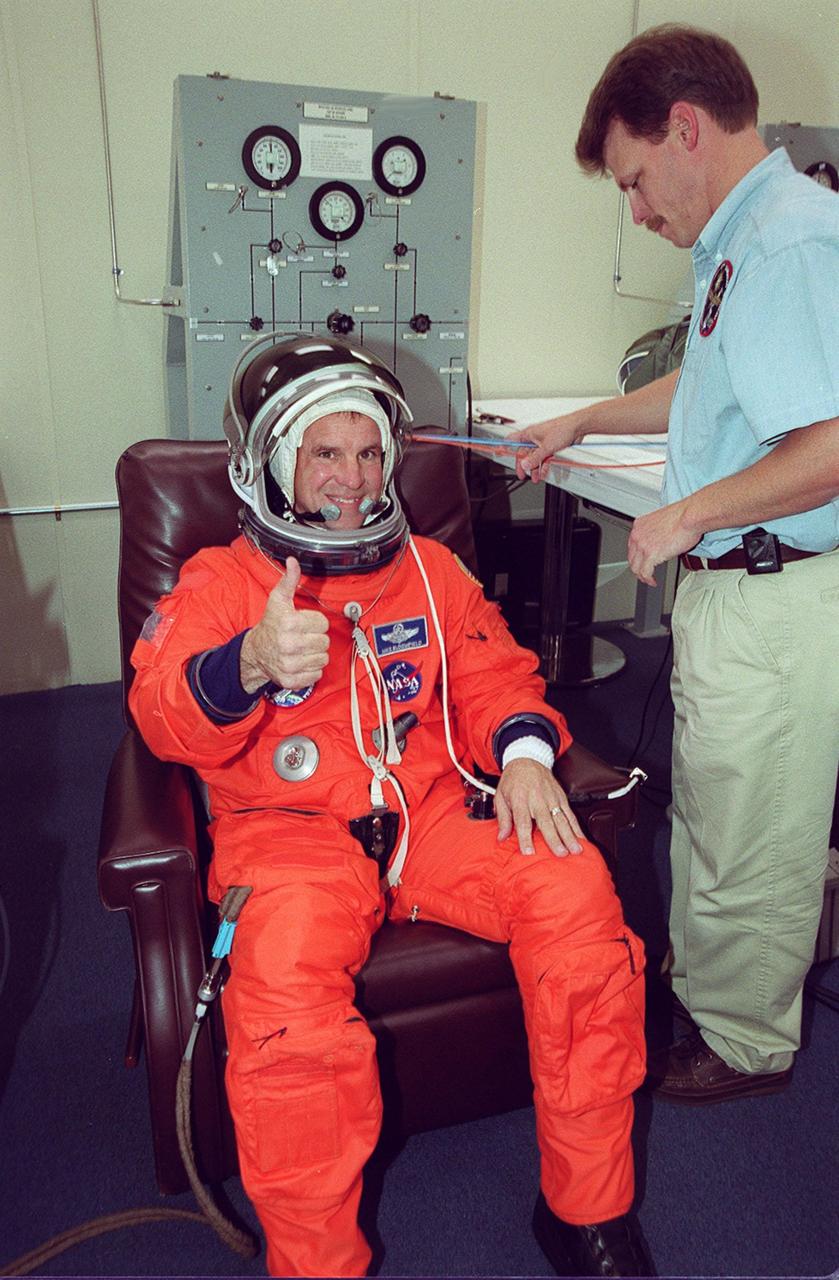
STS-97 Pilot Michael Bloomfield signals thumbs up for launch after donning his launch and entry suit. This is his second Shuttle flight. Mission STS-97 is the sixth construction flight to the International Space Station. It is transporting the P6 Integrated Truss Structure that comprises Solar Array Wing-3 and the Integrated Electronic Assembly, to be installed on the Space Station. The solar arrays are mounted on a “blanket” that can be folded like an accordion for delivery. Once in orbit, astronauts will deploy the blankets to their full size. The 11-day mission includes two spacewalks to complete the solar array connections. The Station’s electrical power system will use eight photovoltaic solar arrays, each 112 feet long by 39 feet wide, to convert sunlight to electricity. Gimbals will be used to rotate the arrays so that they will face the Sun to provide maximum power to the Space Station. Launch is scheduled for Nov. 30 at 10:06 p.m. EST
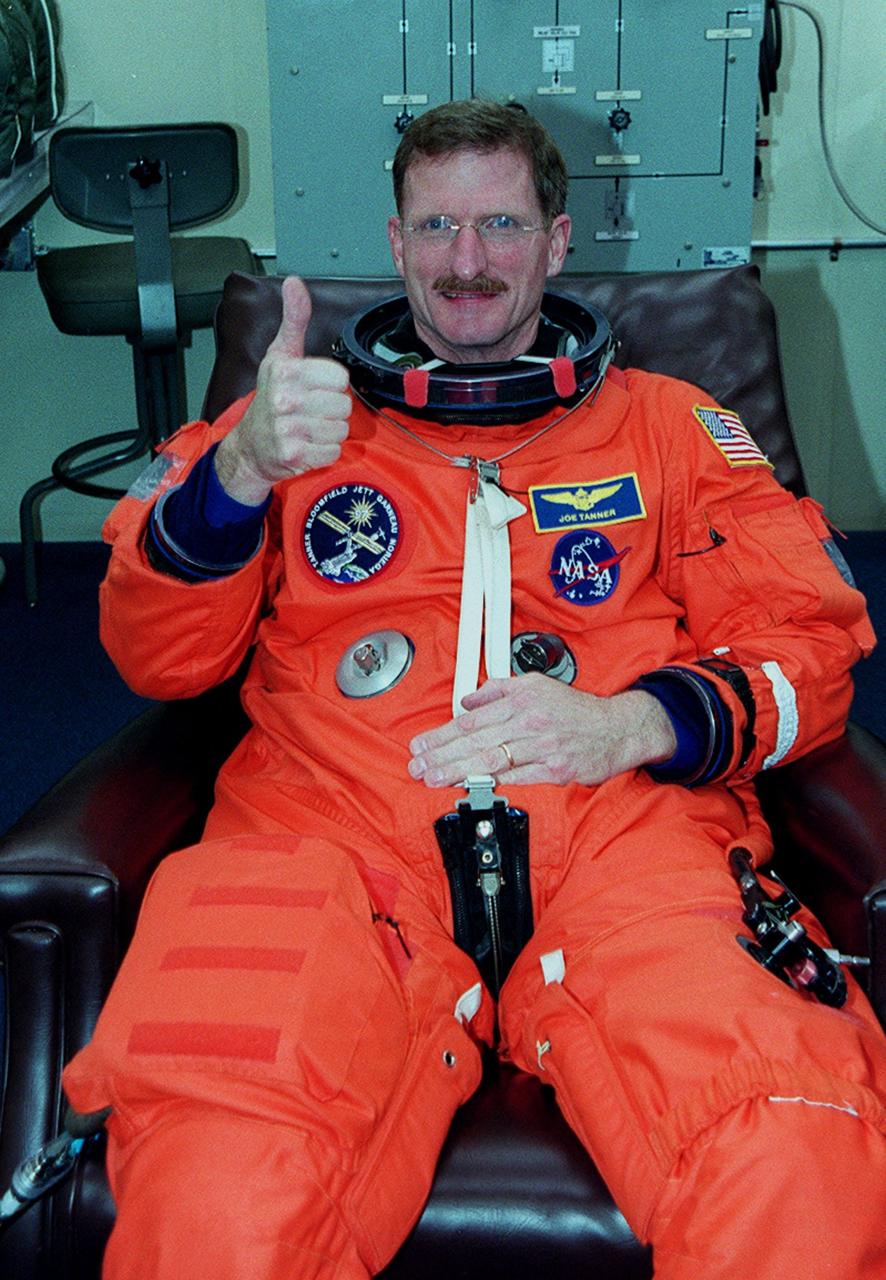
STS-97 Mission Specialist Joseph Tanner signals thumbs up for launch as he dons his launch and entry suit. this is his third Shuttle flight.; Mission STS-97 is the sixth construction flight to the International Space Station. It is transporting the P6 Integrated Truss Structure that comprises Solar Array Wing-3 and the Integrated Electronic Assembly, to be installed on the Space Station. The solar arrays are mounted on a “blanket” that can be folded like an accordion for delivery. Once in orbit, astronauts will deploy the blankets to their full size. The 11-day mission includes two spacewalks to complete the solar array connections. The Station’s electrical power system will use eight photovoltaic solar arrays, each 112 feet long by 39 feet wide, to convert sunlight to electricity.. Gimbals will be used to rotate the arrays so that they will face the Sun to provide maximum power to the Space Station. Launch is scheduled for Nov. 30 at 10:06 p.m. EST
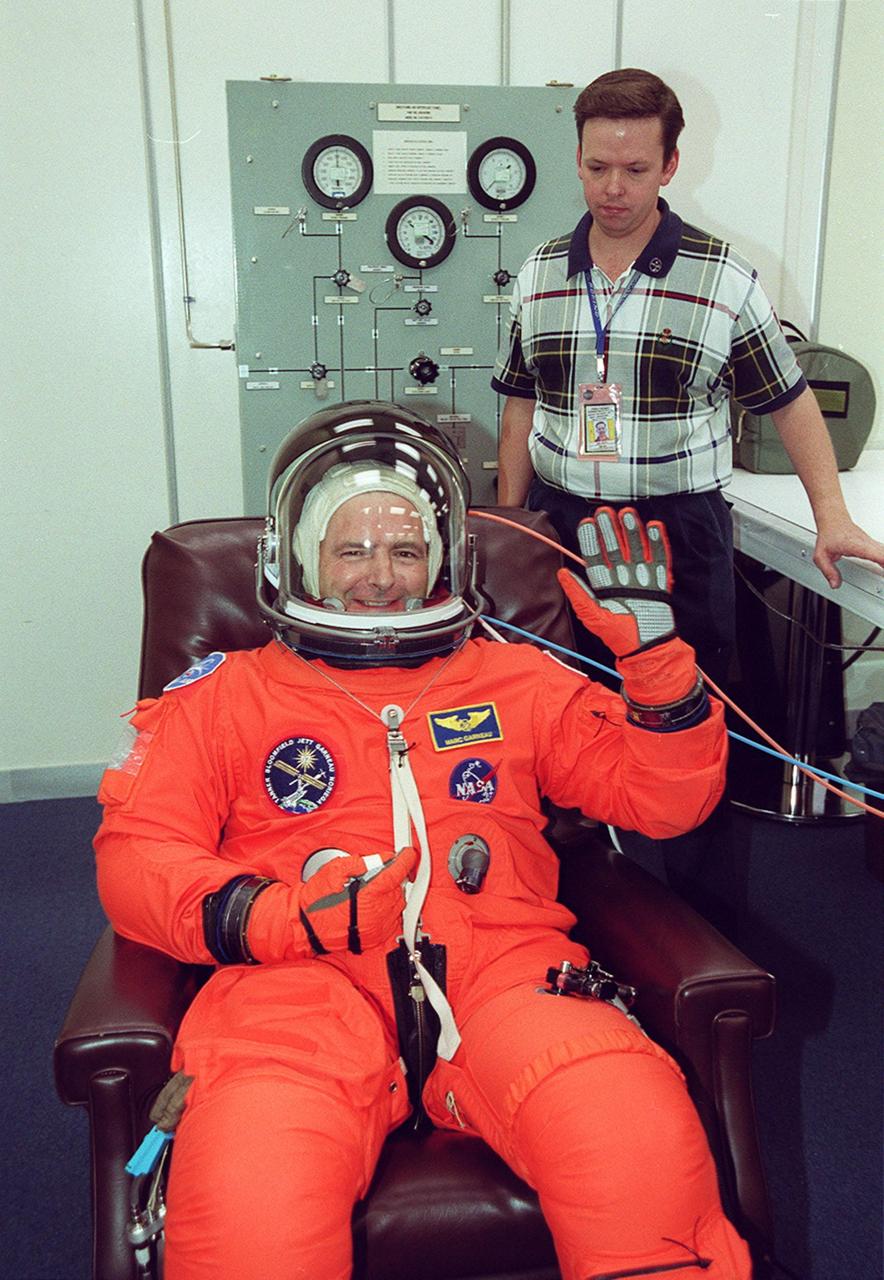
STS-97 Mission Specialist Marc Garneau, who is with the Canadian Space Agency, waves after donning his launch and entry suit. This is his third Shuttle flight.; Mission STS-97 is the sixth construction flight to the International Space Station. It is transporting the P6 Integrated Truss Structure that comprises Solar Array Wing-3 and the Integrated Electronic Assembly, to be installed on the Space Station. The solar arrays are mounted on a “blanket” that can be folded like an accordion for delivery. Once in orbit, astronauts will deploy the blankets to their full size. The 11-day mission includes two spacewalks to complete the solar array connections. The Station’s electrical power system will use eight photovoltaic solar arrays, each 112 feet long by 39 feet wide, to convert sunlight to electricity.. Gimbals will be used to rotate the arrays so that they will face the Sun to provide maximum power to the Space Station. Launch is scheduled for Nov. 30 at 10:06 p.m. EST
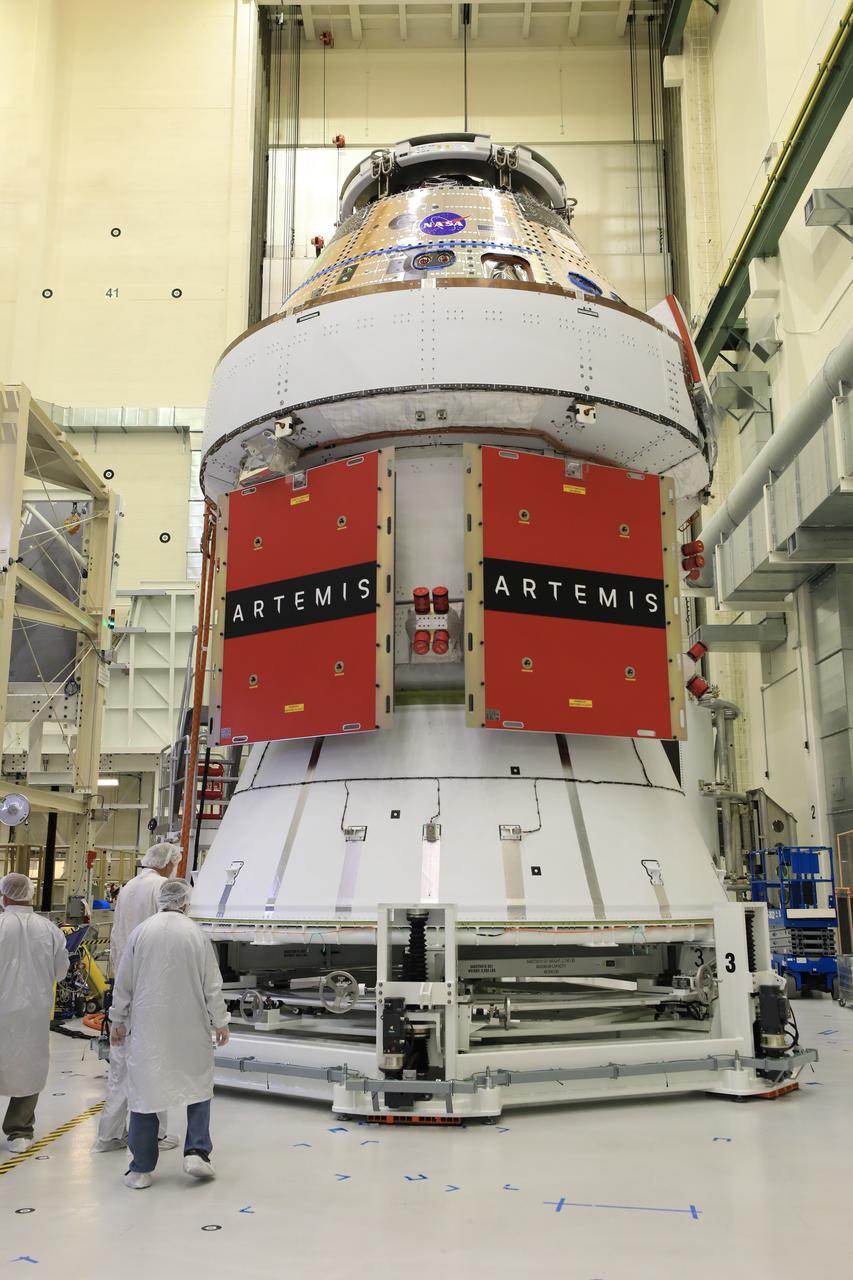
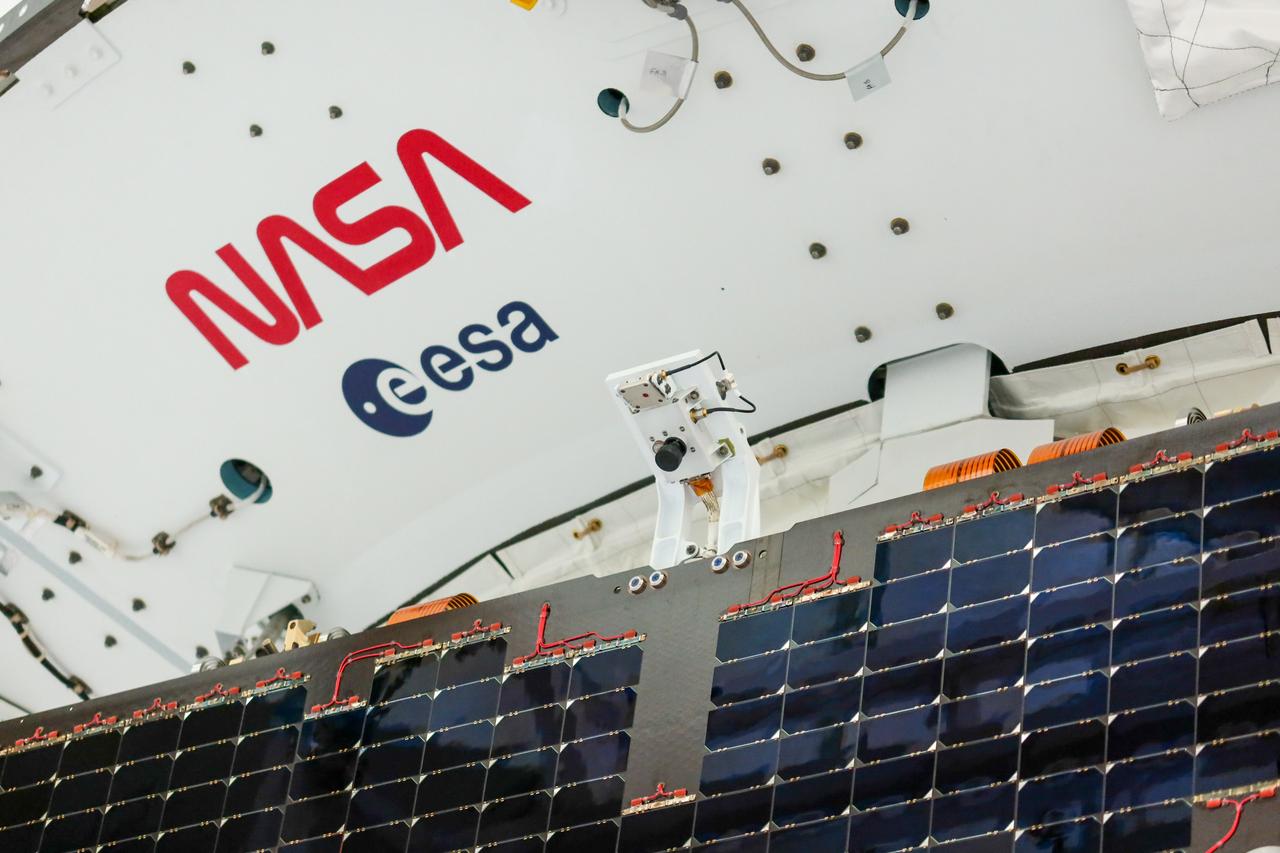
Technicians install four solar array wings on NASA’s Artemis II Orion spacecraft inside the Neil A. Armstrong Operations and Checkout Building at NASA’s Kennedy Space Center in Florida on Monday, March 3, 2025. Each solar array is nearly 23 feet long and can turn on two axes to remain aligned with the Sun for maximum power. Orion’s solar arrays, manufactured and installed by ESA (European Space Agency) and its contractor Airbus, will deliver power to the service module that provides propulsion, thermal control, and electrical power to the spacecraft, as well as air and water for the crew.
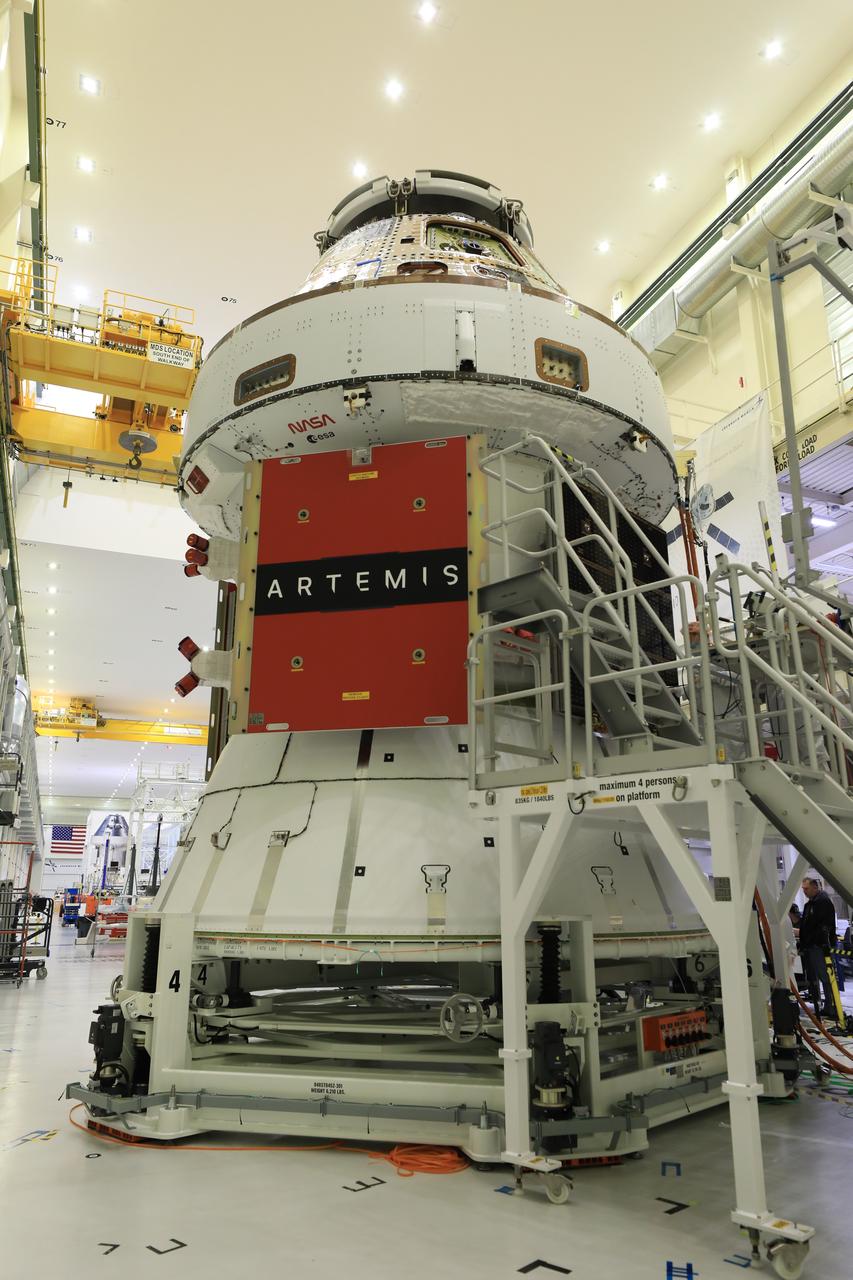
Technicians install four solar array wings on NASA’s Artemis II Orion spacecraft inside the Neil A. Armstrong Operations and Checkout Building at NASA’s Kennedy Space Center in Florida on Monday, March 3, 2025. Each solar array is nearly 23 feet long and can turn on two axes to remain aligned with the Sun for maximum power. Orion’s solar arrays, manufactured and installed by ESA (European Space Agency) and its contractor Airbus, will deliver power to the service module that provides propulsion, thermal control, and electrical power to the spacecraft, as well as air and water for the crew.
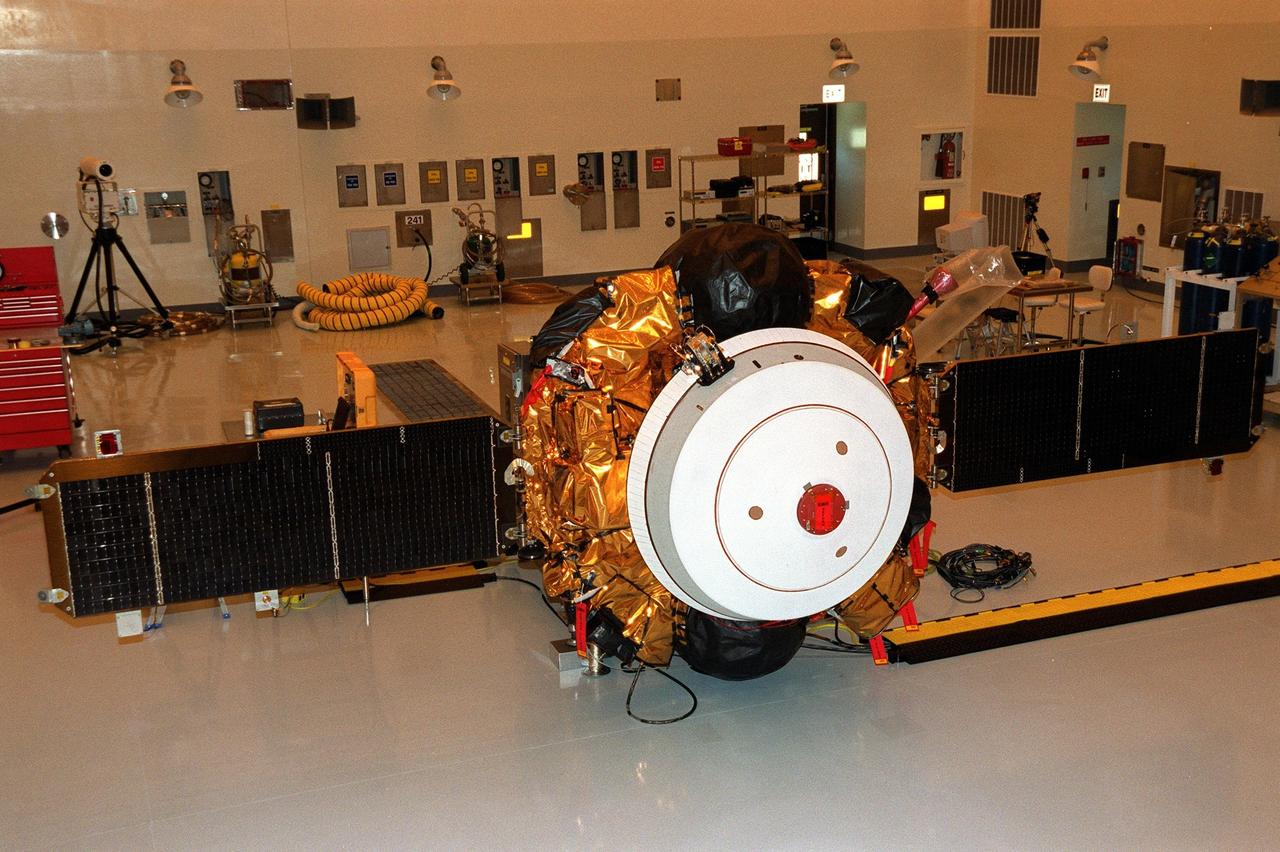
KENNEDY SPACE CENTER, Fla. -- In the Payload Hazardous Servicing Facility, both solar arrays on the Genesis spacecraft are deployed. Genesis is designed to collect samples of solar wind particles and return them to Earth so that scientists can study the exact composition of the Sun and probe the solar system’s origin. The white object on the end in front of the arrays is the Sample Return Canister backshell, inside of which are the collector arrays. Genesis is scheduled to be launched on a Delta II Lite launch vehicle from Complex 17-A, Cape Canaveral Air Force Station, July 30, at 12:36 p.m. EDT
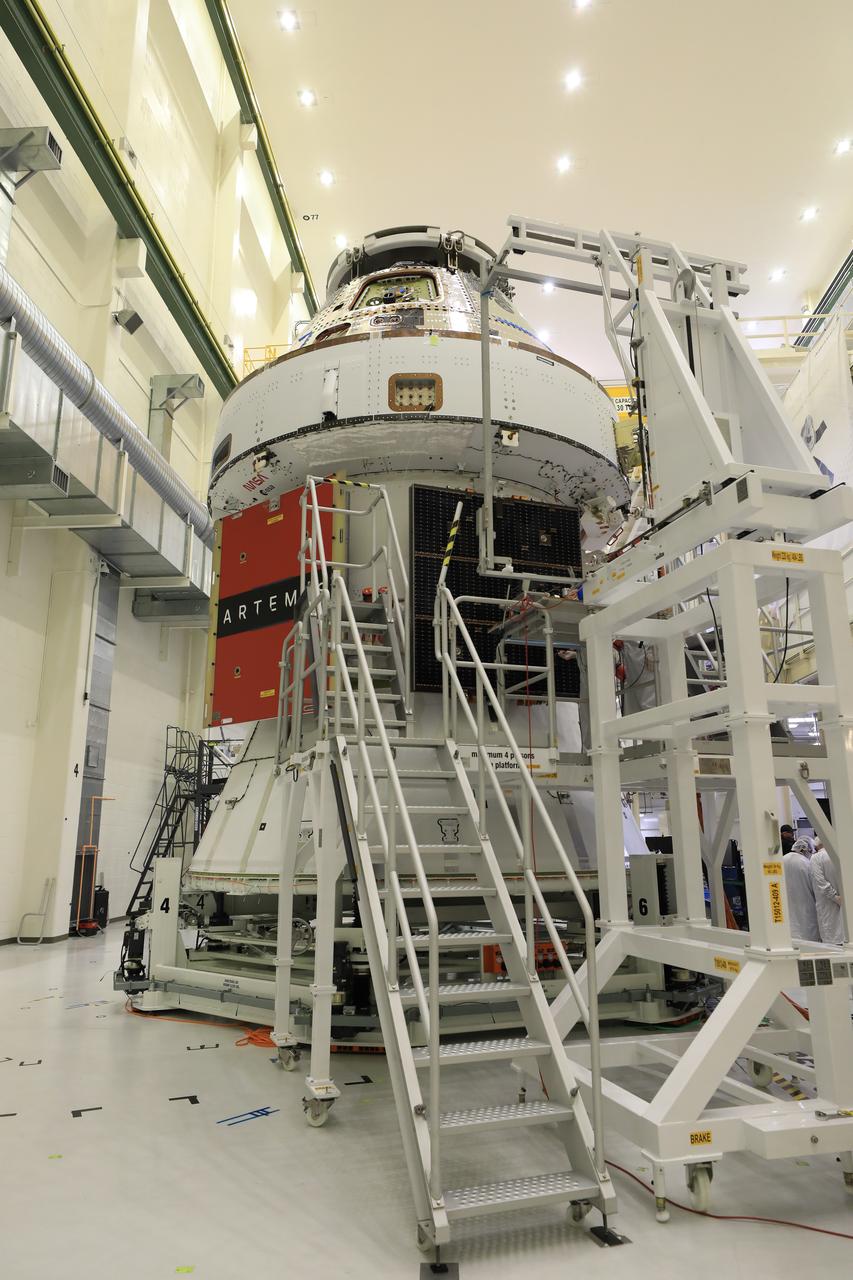
Technicians install four solar array wings on NASA’s Artemis II Orion spacecraft inside the Neil A. Armstrong Operations and Checkout Building at NASA’s Kennedy Space Center in Florida on Monday, March 3, 2025. Each solar array is nearly 23 feet long and can turn on two axes to remain aligned with the Sun for maximum power. Orion’s solar arrays, manufactured and installed by ESA (European Space Agency) and its contractor Airbus, will deliver power to the service module that provides propulsion, thermal control, and electrical power to the spacecraft, as well as air and water for the crew.
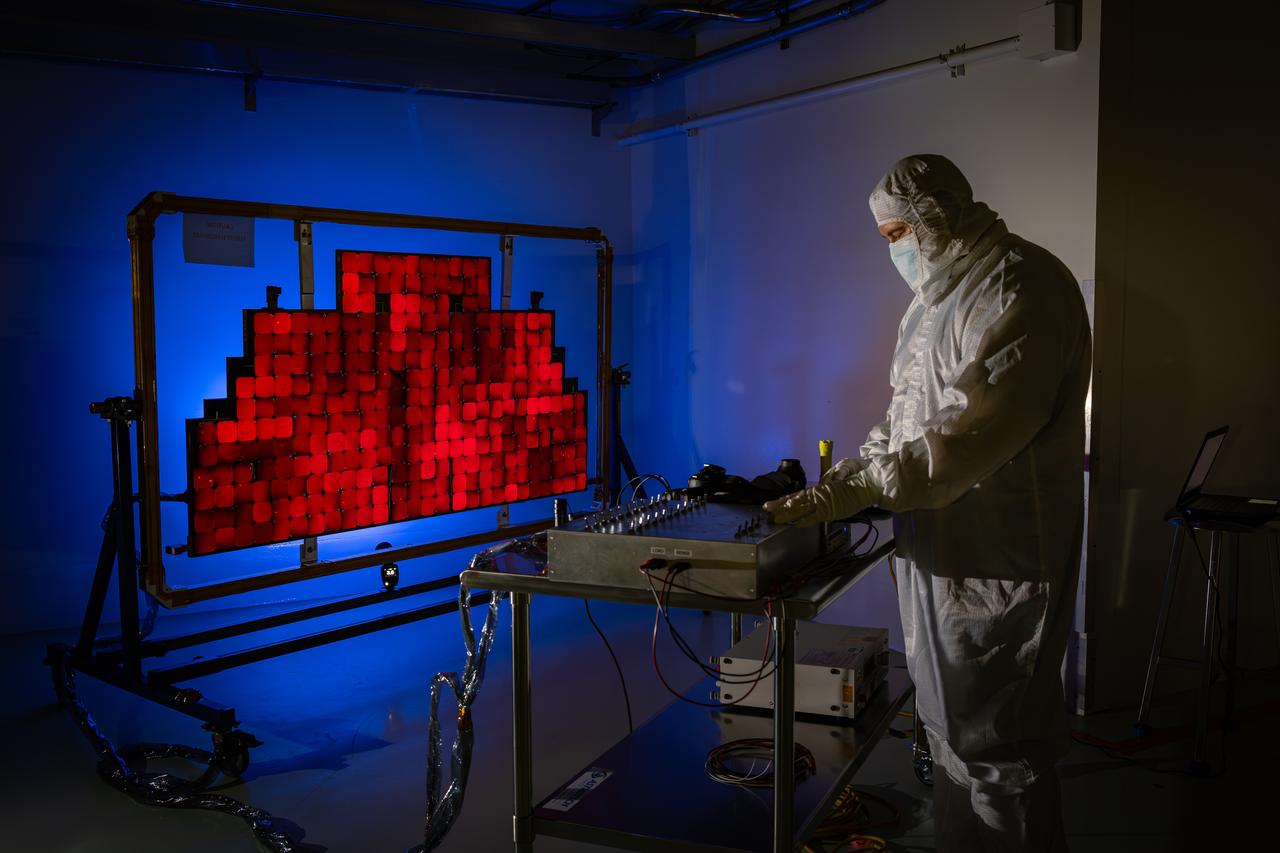
Technicians conduct an illumination test by flashing a bright light that simulates the Sun into the solar array for NASA’s IMAP (Interstellar Mapping and Acceleration Probe) observatory inside the high bay at the Astrotech Space Operations Facility near the agency’s Kennedy Space Center in Florida on Friday, June 20, 2025. The IMAP solar array converts sunlight into approximately 500 watts of power, and IMAP’s spin axis, which comes through the center of the solar arrays, points sunward to provide constant power. Launch is targeted for no earlier than September 2025 aboard a SpaceX Falcon 9 rocket from Launch Complex 39A at NASA Kennedy.
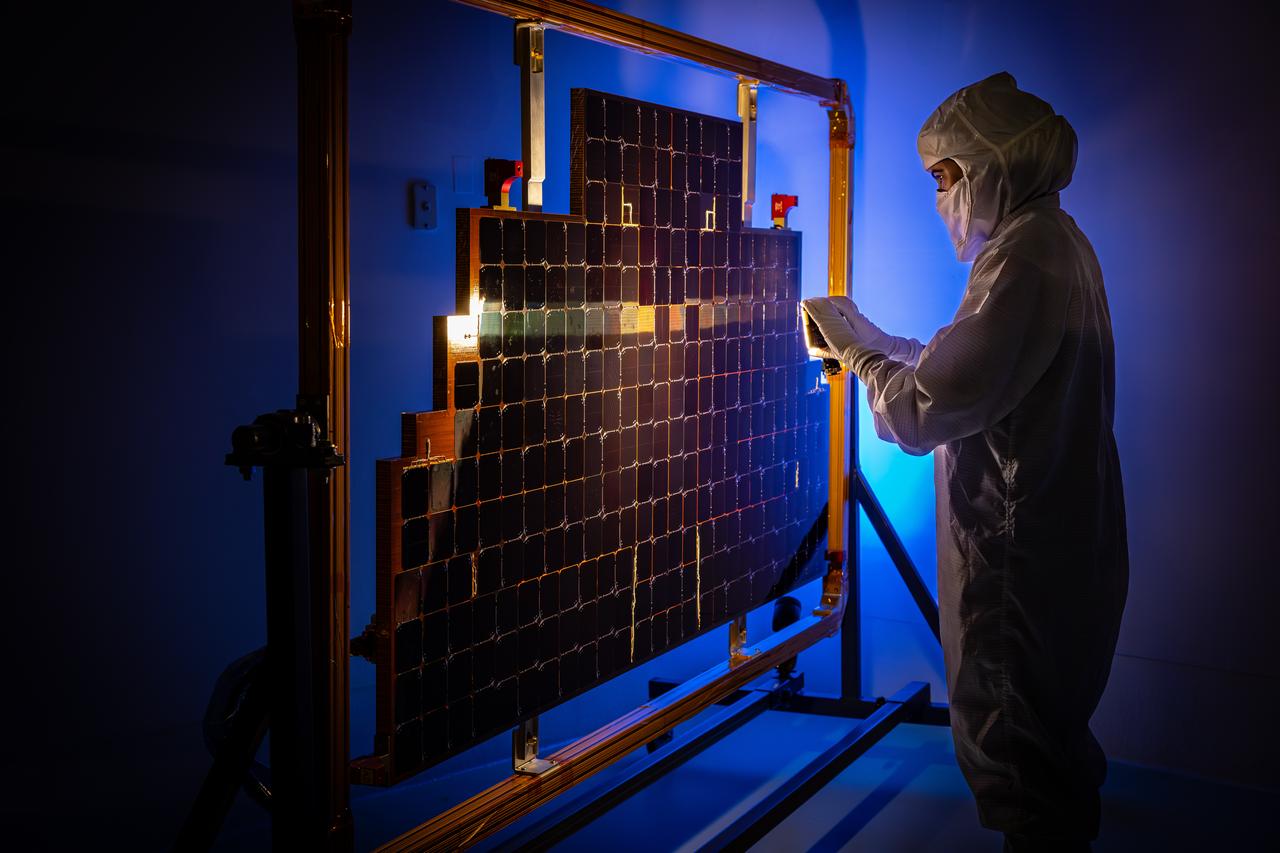
Technicians conduct an illumination test by flashing a bright light that simulates the Sun into the solar array for NASA’s IMAP (Interstellar Mapping and Acceleration Probe) observatory inside the high bay at the Astrotech Space Operations Facility near the agency’s Kennedy Space Center in Florida on Friday, June 20, 2025. The IMAP solar array converts sunlight into approximately 500 watts of power, and IMAP’s spin axis, which comes through the center of the solar arrays, points sunward to provide constant power. Launch is targeted for no earlier than September 2025 aboard a SpaceX Falcon 9 rocket from Launch Complex 39A at NASA Kennedy.
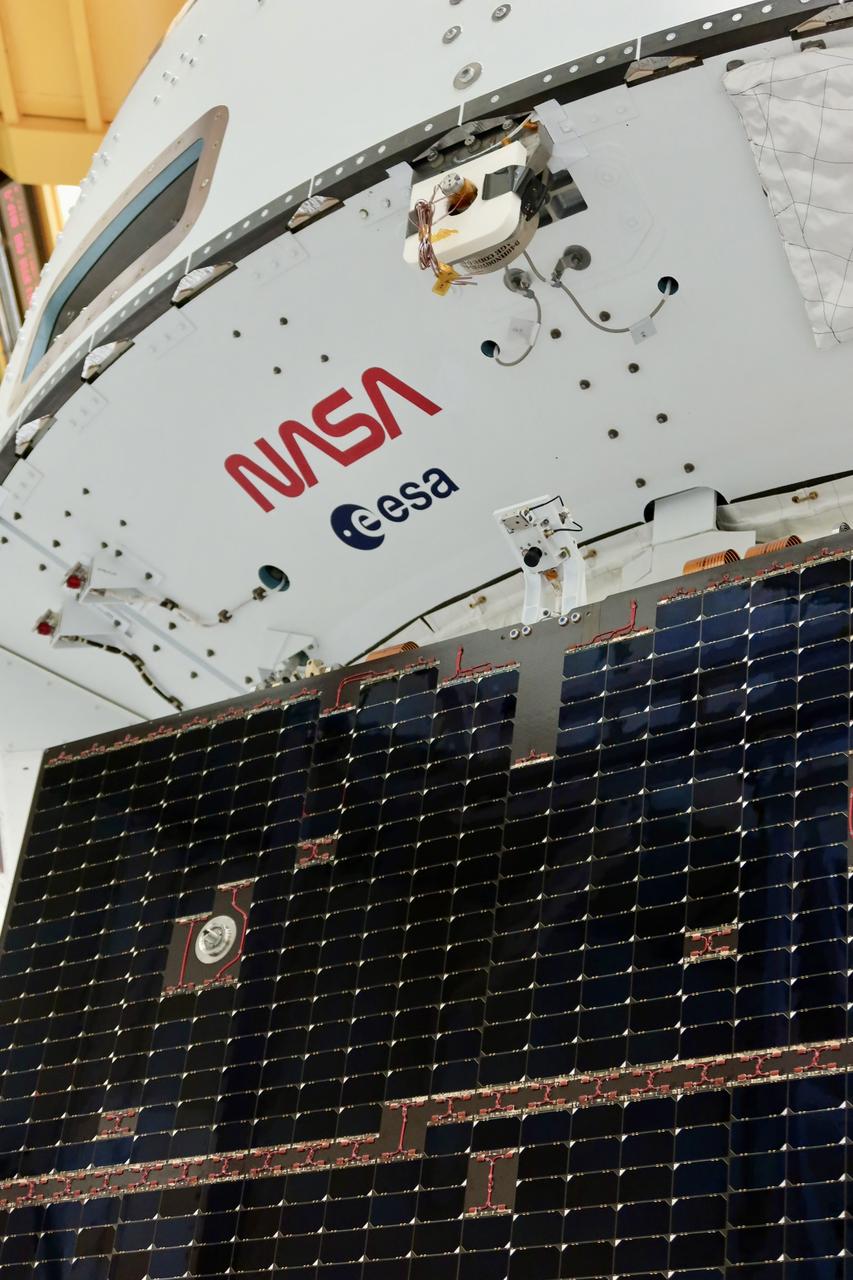
Technicians install four solar array wings on NASA’s Artemis II Orion spacecraft inside the Neil A. Armstrong Operations and Checkout Building at NASA’s Kennedy Space Center in Florida on Monday, March 3, 2025. Each solar array is nearly 23 feet long and can turn on two axes to remain aligned with the Sun for maximum power. Orion’s solar arrays, manufactured and installed by ESA (European Space Agency) and its contractor Airbus, will deliver power to the service module that provides propulsion, thermal control, and electrical power to the spacecraft, as well as air and water for the crew.
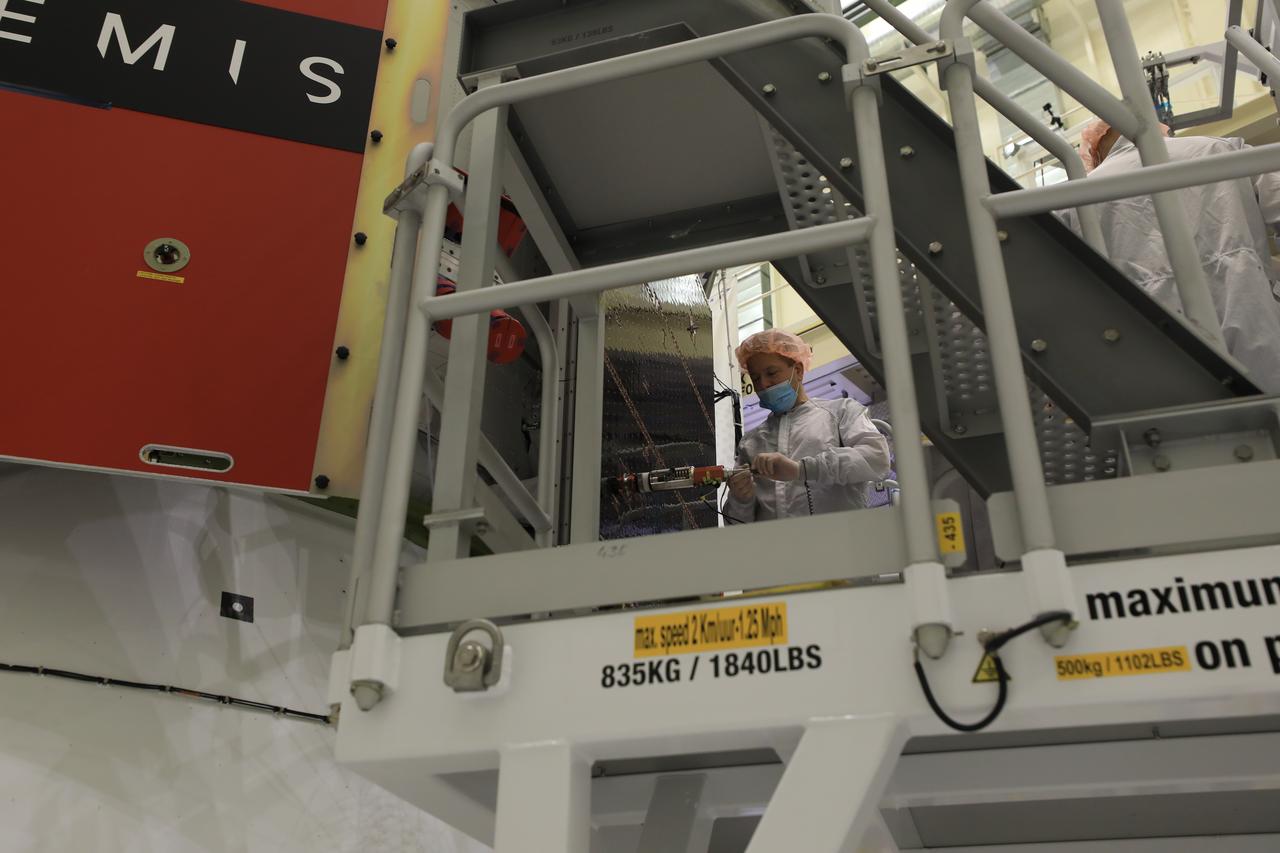
Technicians install four solar array wings on NASA’s Artemis II Orion spacecraft inside the Neil A. Armstrong Operations and Checkout Building at NASA’s Kennedy Space Center in Florida on Monday, March 3, 2025. Each solar array is nearly 23 feet long and can turn on two axes to remain aligned with the Sun for maximum power. Orion’s solar arrays, manufactured and installed by ESA (European Space Agency) and its contractor Airbus, will deliver power to the service module that provides propulsion, thermal control, and electrical power to the spacecraft, as well as air and water for the crew.
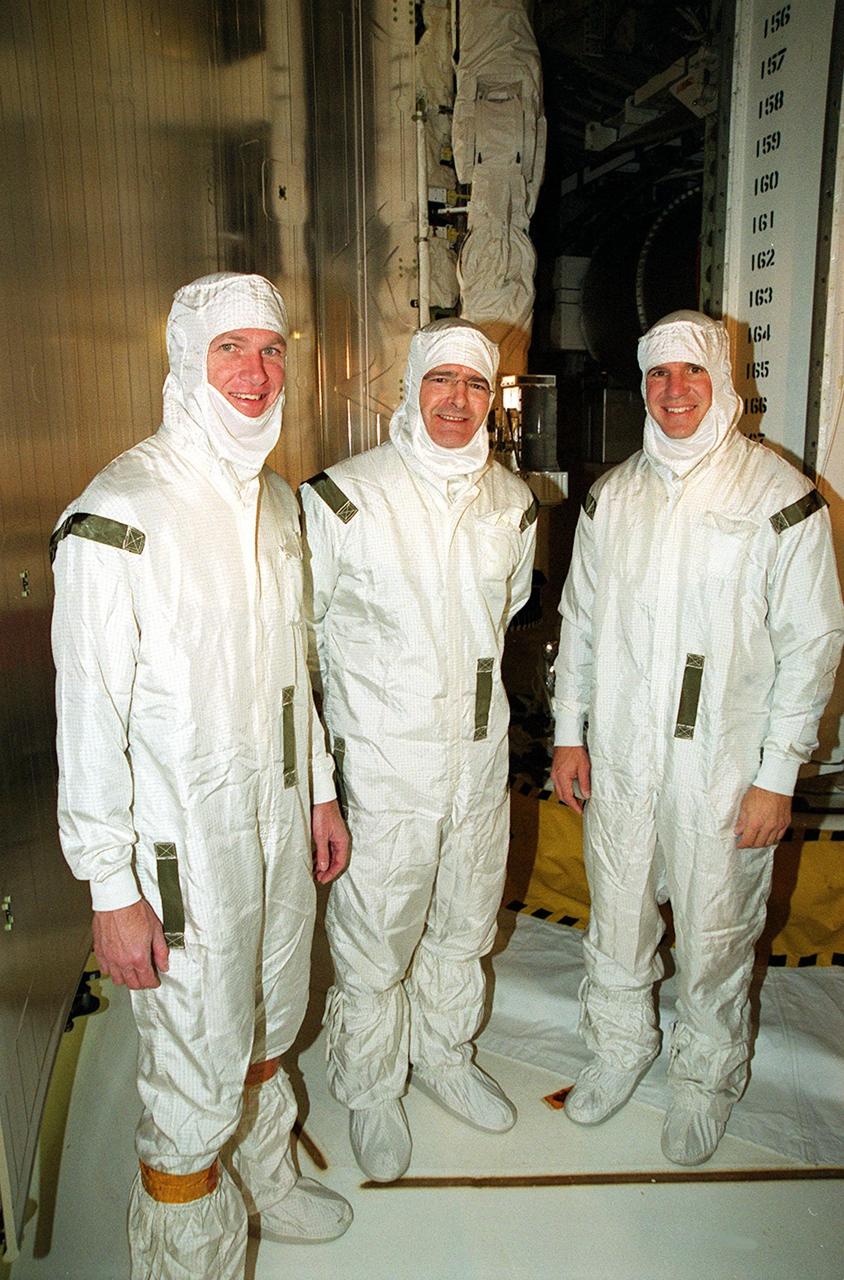
In the payload changeout room at Launch Pad 39B, STS-97 Commander Brent Jett (left), Mission Specialist Marc Garneau (center) and Pilot Michael Bloomfield (right) pause during a payload walkdown. The payload comprises the P6 Integrated Truss Segment, with solar arrays and batteries that will be temporarily installed on the recently delivered Z1 truss, connecting them to the Unity module. The two solar arrays are each more than 100 feet long. They will capture energy from the sun and convert it to power for the Station. Two spacewalks will be required to install the solar array connections. STS-97 is scheduled to launch Nov. 30 at about 10:06 p.m. EST
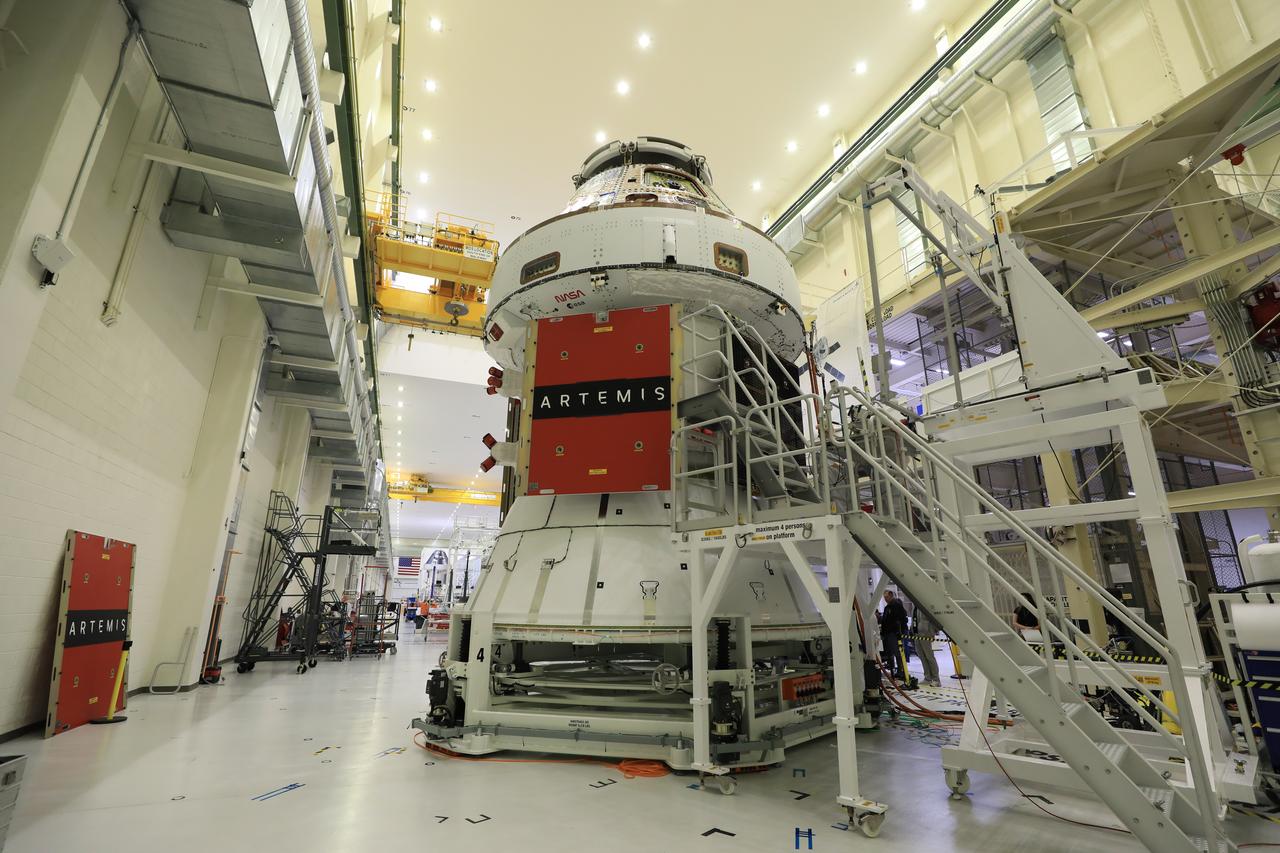
Technicians install four solar array wings on NASA’s Artemis II Orion spacecraft inside the Neil A. Armstrong Operations and Checkout Building at NASA’s Kennedy Space Center in Florida on Monday, March 3, 2025. Each solar array is nearly 23 feet long and can turn on two axes to remain aligned with the Sun for maximum power. Orion’s solar arrays, manufactured and installed by ESA (European Space Agency) and its contractor Airbus, will deliver power to the service module that provides propulsion, thermal control, and electrical power to the spacecraft, as well as air and water for the crew.
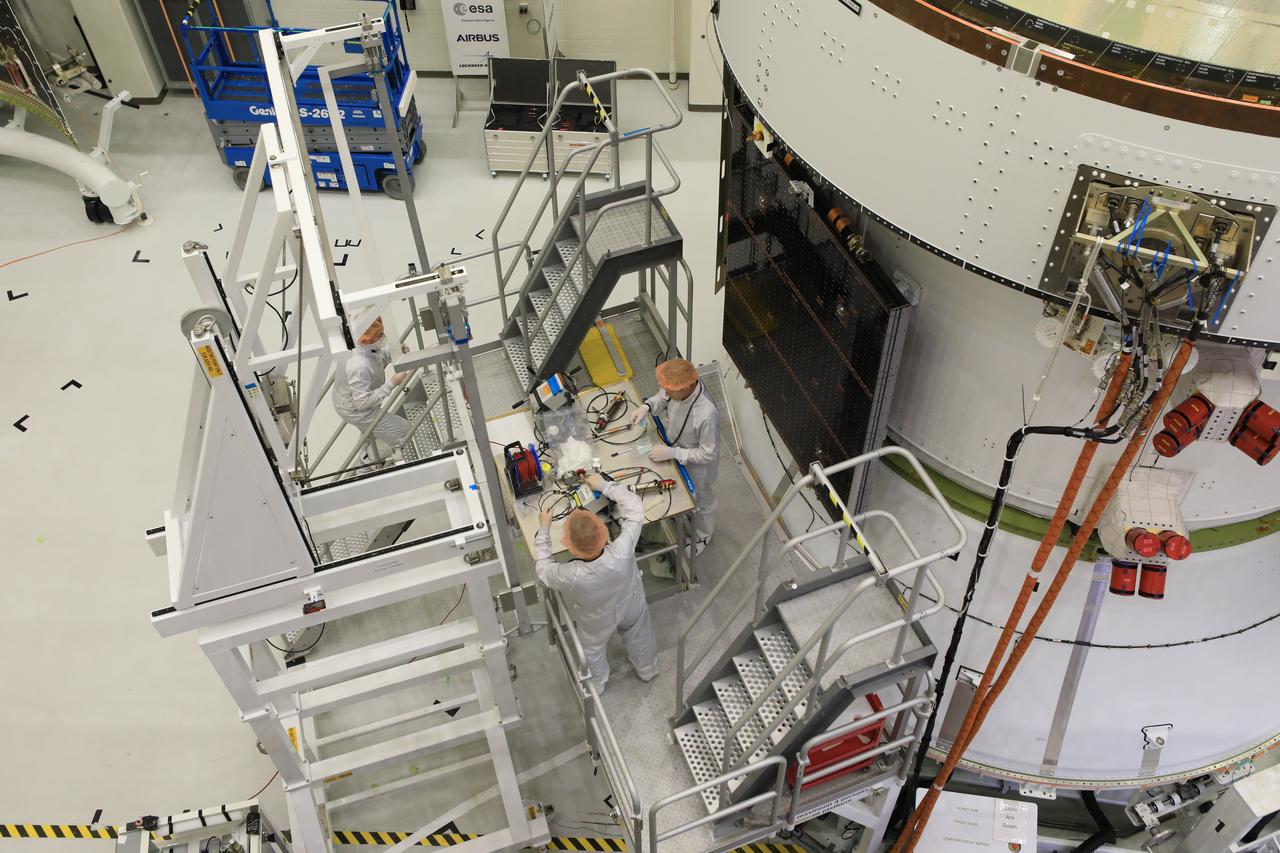
Technicians install four solar array wings on NASA’s Artemis II Orion spacecraft inside the Neil A. Armstrong Operations and Checkout Building at NASA’s Kennedy Space Center in Florida on Monday, March 3, 2025. Each solar array is nearly 23 feet long and can turn on two axes to remain aligned with the Sun for maximum power. Orion’s solar arrays, manufactured and installed by ESA (European Space Agency) and its contractor Airbus, will deliver power to the service module that provides propulsion, thermal control, and electrical power to the spacecraft, as well as air and water for the crew.
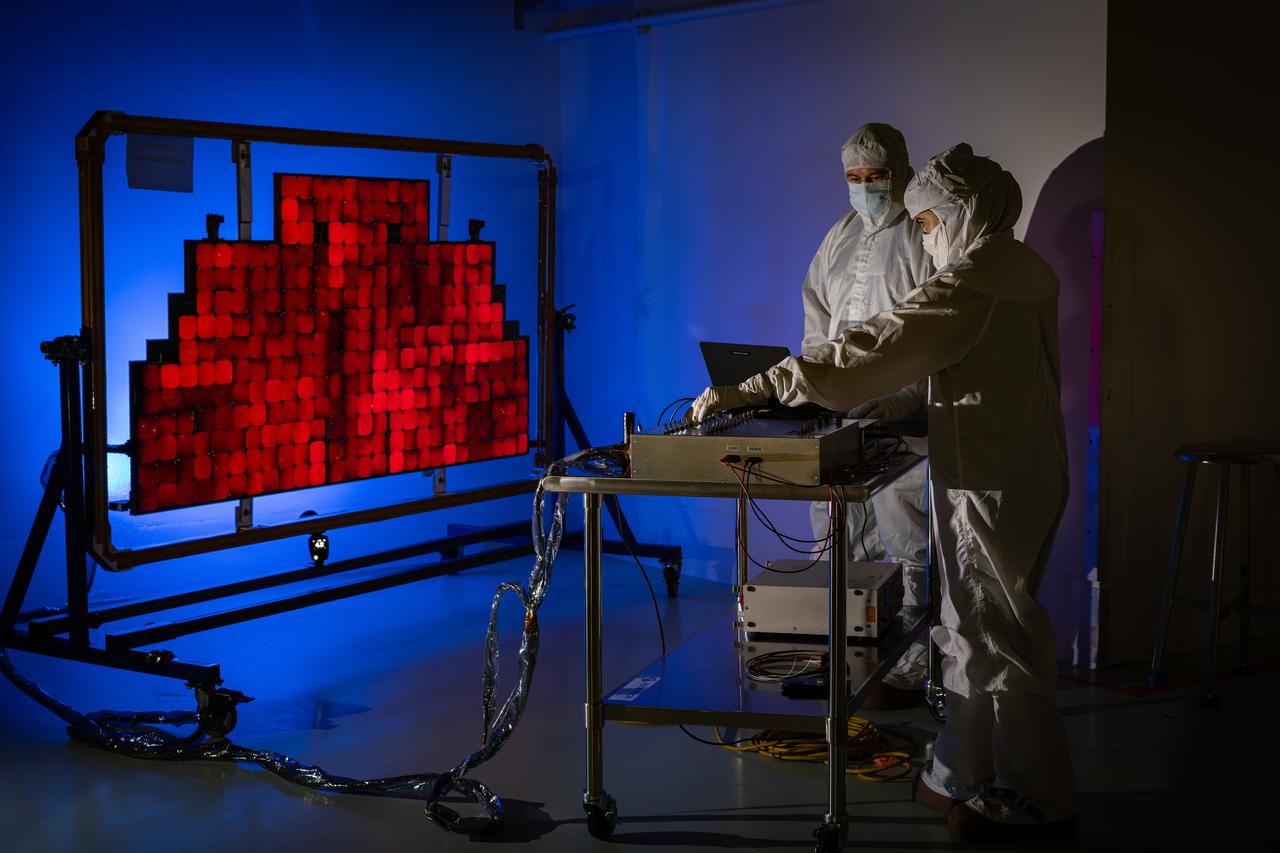
Technicians conduct an illumination test by flashing a bright light that simulates the Sun into the solar array for NASA’s IMAP (Interstellar Mapping and Acceleration Probe) observatory inside the high bay at the Astrotech Space Operations Facility near the agency’s Kennedy Space Center in Florida on Friday, June 20, 2025. The IMAP solar array converts sunlight into approximately 500 watts of power, and IMAP’s spin axis, which comes through the center of the solar arrays, points sunward to provide constant power. Launch is targeted for no earlier than September 2025 aboard a SpaceX Falcon 9 rocket from Launch Complex 39A at NASA Kennedy.
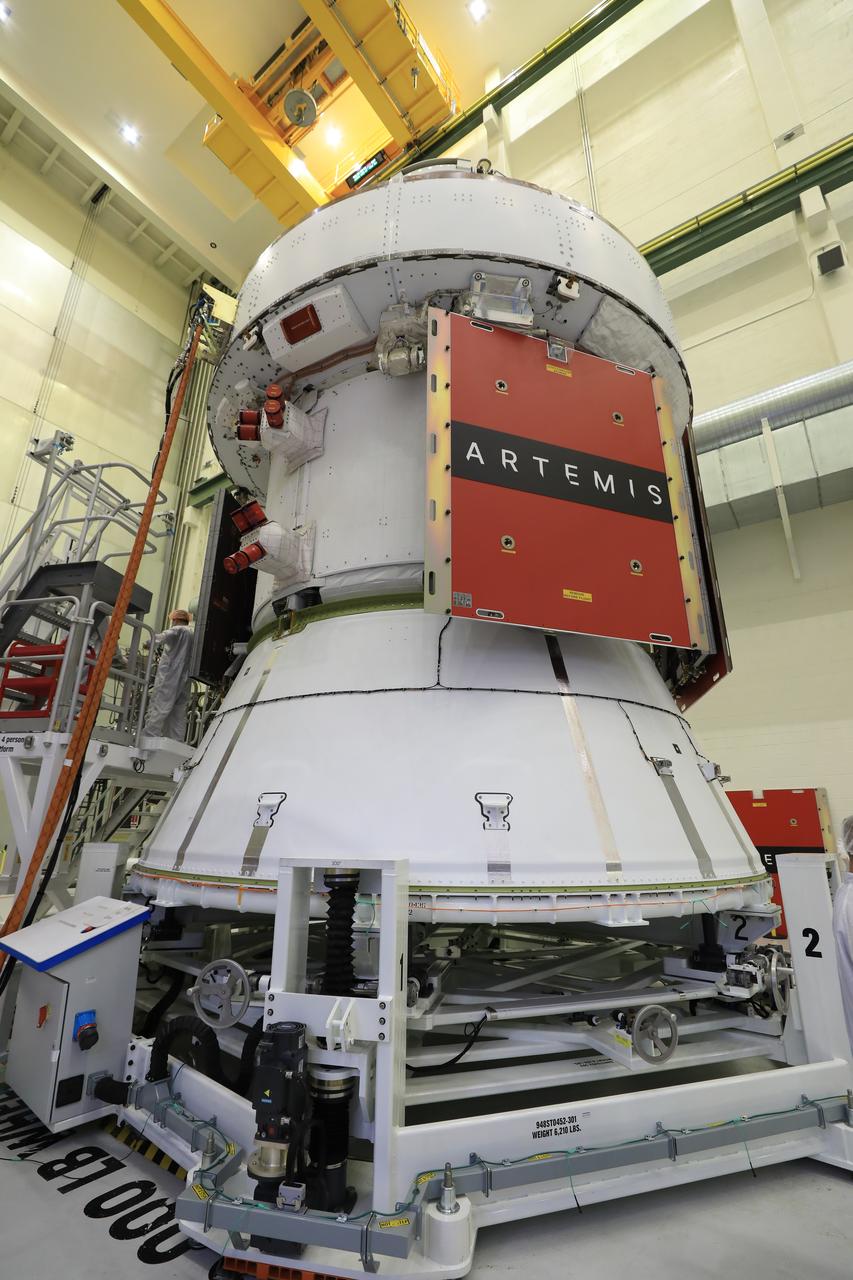
Technicians install four solar array wings on NASA’s Artemis II Orion spacecraft inside the Neil A. Armstrong Operations and Checkout Building at NASA’s Kennedy Space Center in Florida on Monday, March 3, 2025. Each solar array is nearly 23 feet long and can turn on two axes to remain aligned with the Sun for maximum power. Orion’s solar arrays, manufactured and installed by ESA (European Space Agency) and its contractor Airbus, will deliver power to the service module that provides propulsion, thermal control, and electrical power to the spacecraft, as well as air and water for the crew.
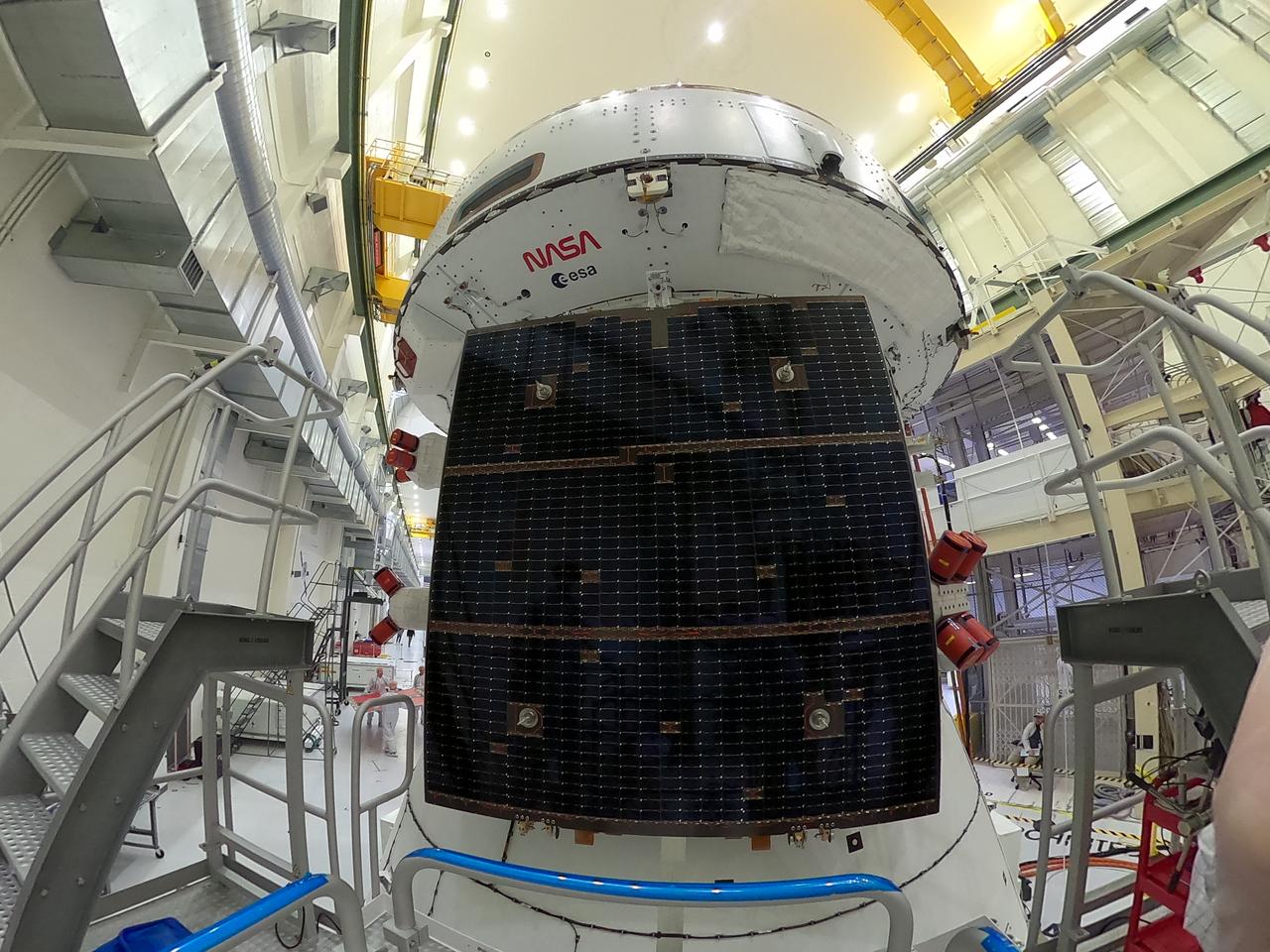
Technicians install four solar array wings on NASA’s Artemis II Orion spacecraft inside the Neil A. Armstrong Operations and Checkout Building at NASA’s Kennedy Space Center in Florida on Monday, March 3, 2025. Each solar array is nearly 23 feet long and can turn on two axes to remain aligned with the Sun for maximum power. Orion’s solar arrays, manufactured and installed by ESA (European Space Agency) and its contractor Airbus, will deliver power to the service module that provides propulsion, thermal control, and electrical power to the spacecraft, as well as air and water for the crew.
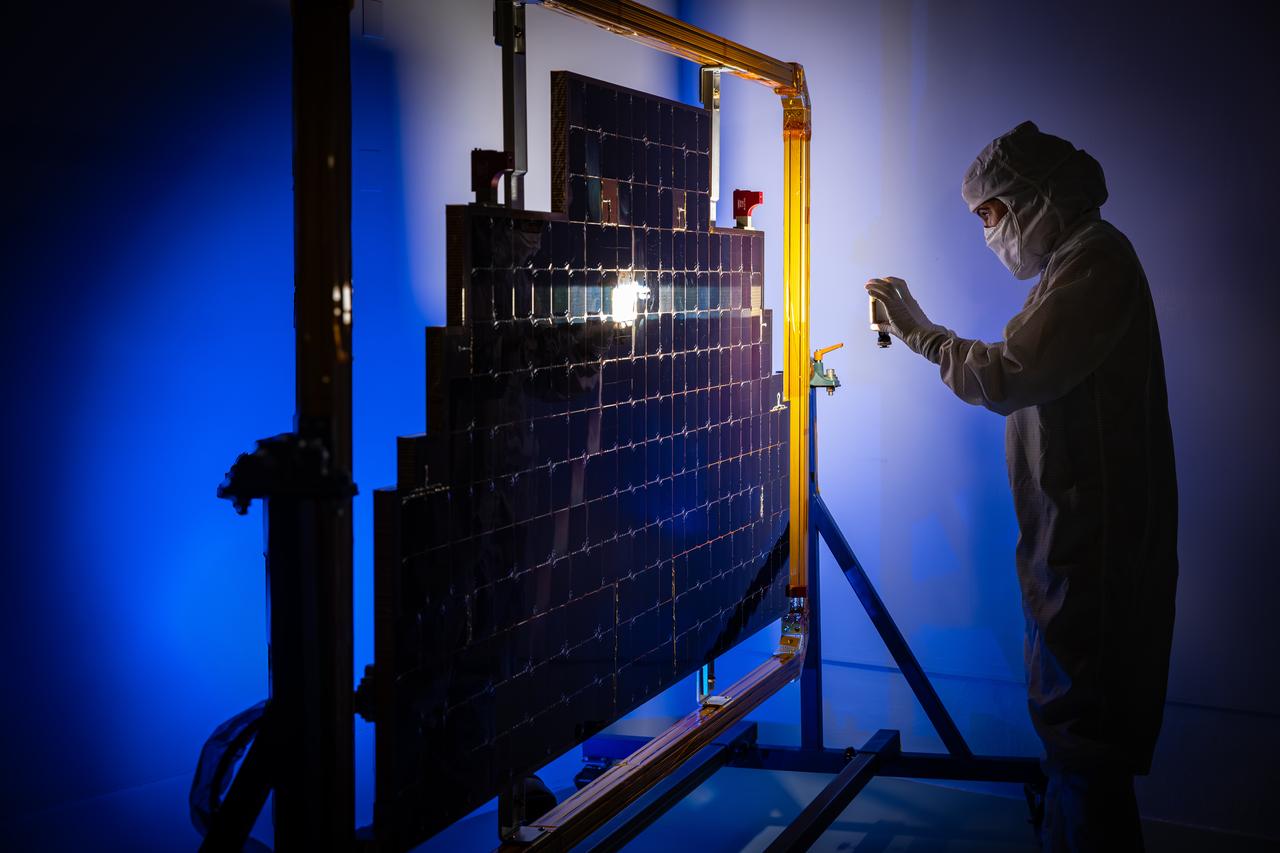
Technicians conduct an illumination test by flashing a bright light that simulates the Sun into the solar array for NASA’s IMAP (Interstellar Mapping and Acceleration Probe) observatory inside the high bay at the Astrotech Space Operations Facility near the agency’s Kennedy Space Center in Florida on Friday, June 20, 2025. The IMAP solar array converts sunlight into approximately 500 watts of power, and IMAP’s spin axis, which comes through the center of the solar arrays, points sunward to provide constant power. Launch is targeted for no earlier than September 2025 aboard a SpaceX Falcon 9 rocket from Launch Complex 39A at NASA Kennedy.
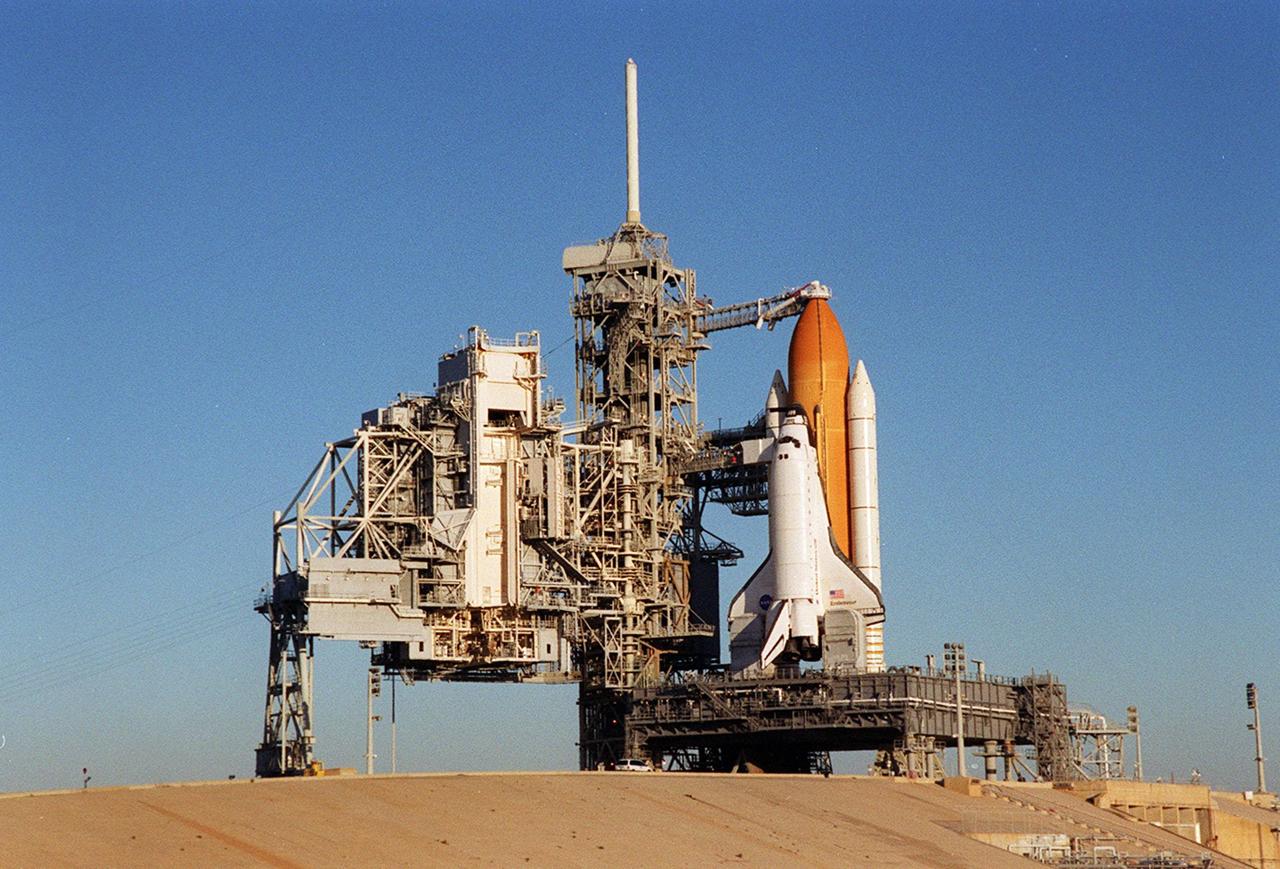
Against a cloudless blue sky, Space Shuttle Endeavour stands ready for launch after the rollback of the Rotating Service Structure, at left. Endeavour is targeted for launch tonight at about 10:06 p.m. EST on mission STS-97 to the International Space Station. The orbiter carries the P6 Integrated Truss Segment containing solar arrays that will be temporarily installed to the Unity connecting module by the Z1 truss, recently delivered to and installed on the Station on mission STS-92. The two solar arrays are each more than 100 feet long. They will capture energy from the sun and convert it to power for the Station. Two spacewalks will be required to install the solar array connections
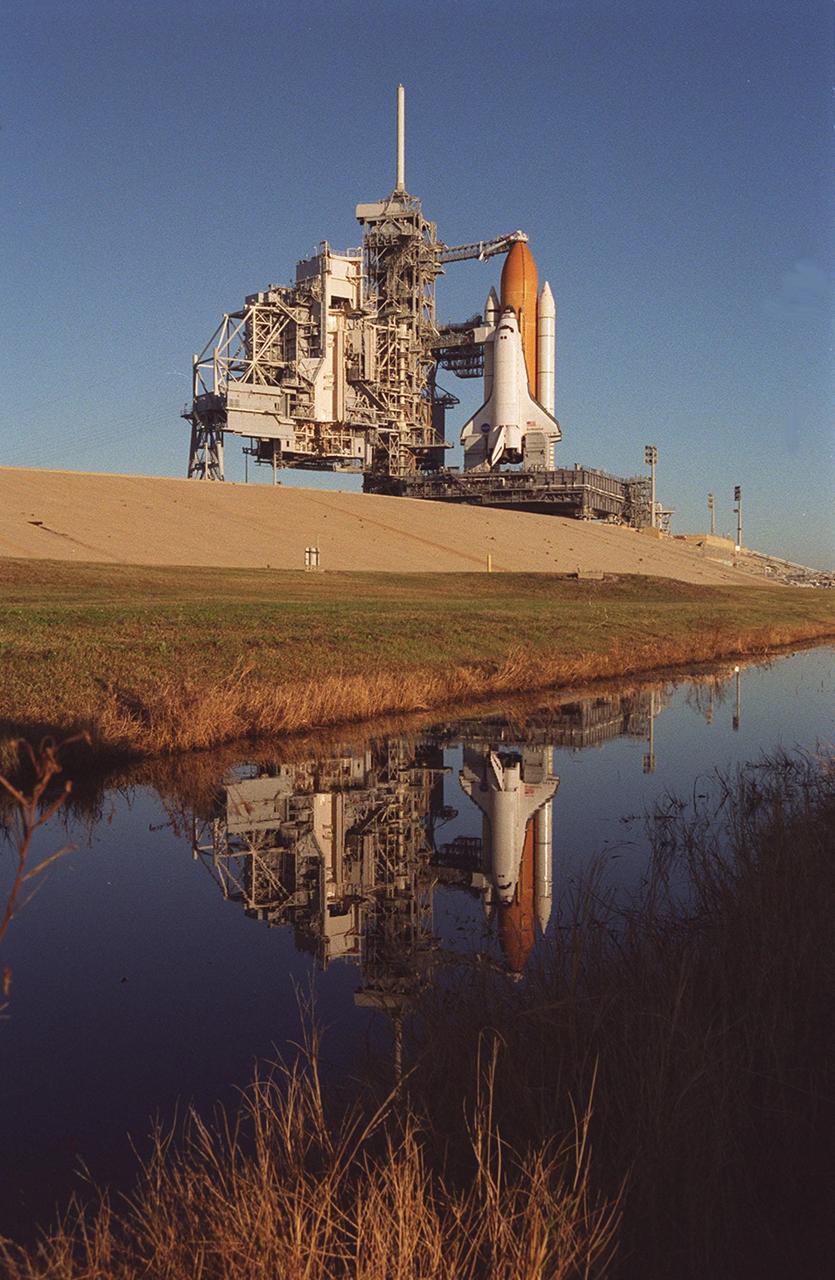
After rollback of the Rotating Service Structure (at left), Space Shuttle Endeavour stands ready for launch targeted for 10:06 p.m. EST tonight on mission STS-97 to the International Space Station. The orbiter carries the P6 Integrated Truss Segment containing solar arrays that will be temporarily installed to the Unity connecting module by the Z1 truss, recently delivered to and installed on the Station on mission STS-92. The two solar arrays are each more than 100 feet long. They will capture energy from the sun and convert it to power for the Station. Two spacewalks will be required to install the solar array connections
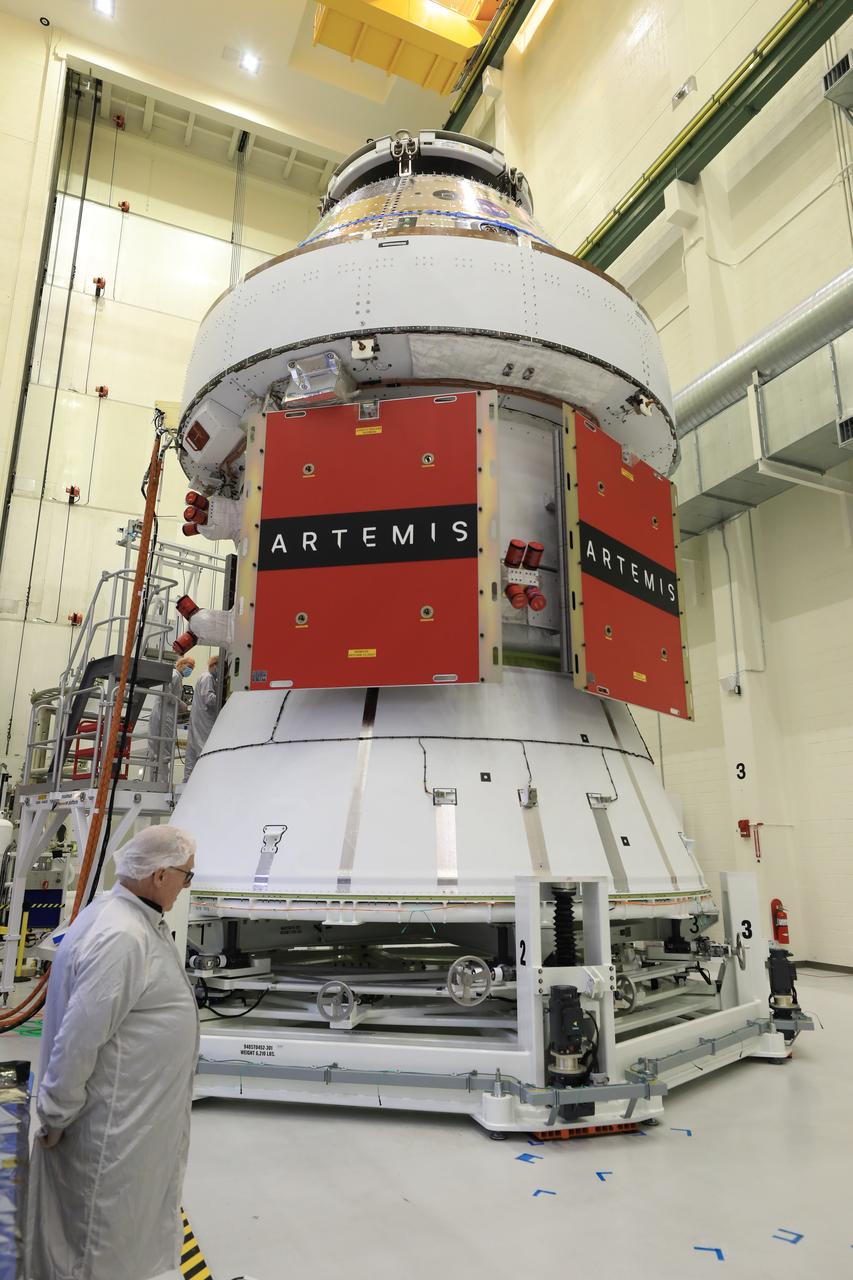
Technicians install four solar array wings on NASA’s Artemis II Orion spacecraft inside the Neil A. Armstrong Operations and Checkout Building at NASA’s Kennedy Space Center in Florida on Monday, March 3, 2025. Each solar array is nearly 23 feet long and can turn on two axes to remain aligned with the Sun for maximum power. Orion’s solar arrays, manufactured and installed by ESA (European Space Agency) and its contractor Airbus, will deliver power to the service module that provides propulsion, thermal control, and electrical power to the spacecraft, as well as air and water for the crew.
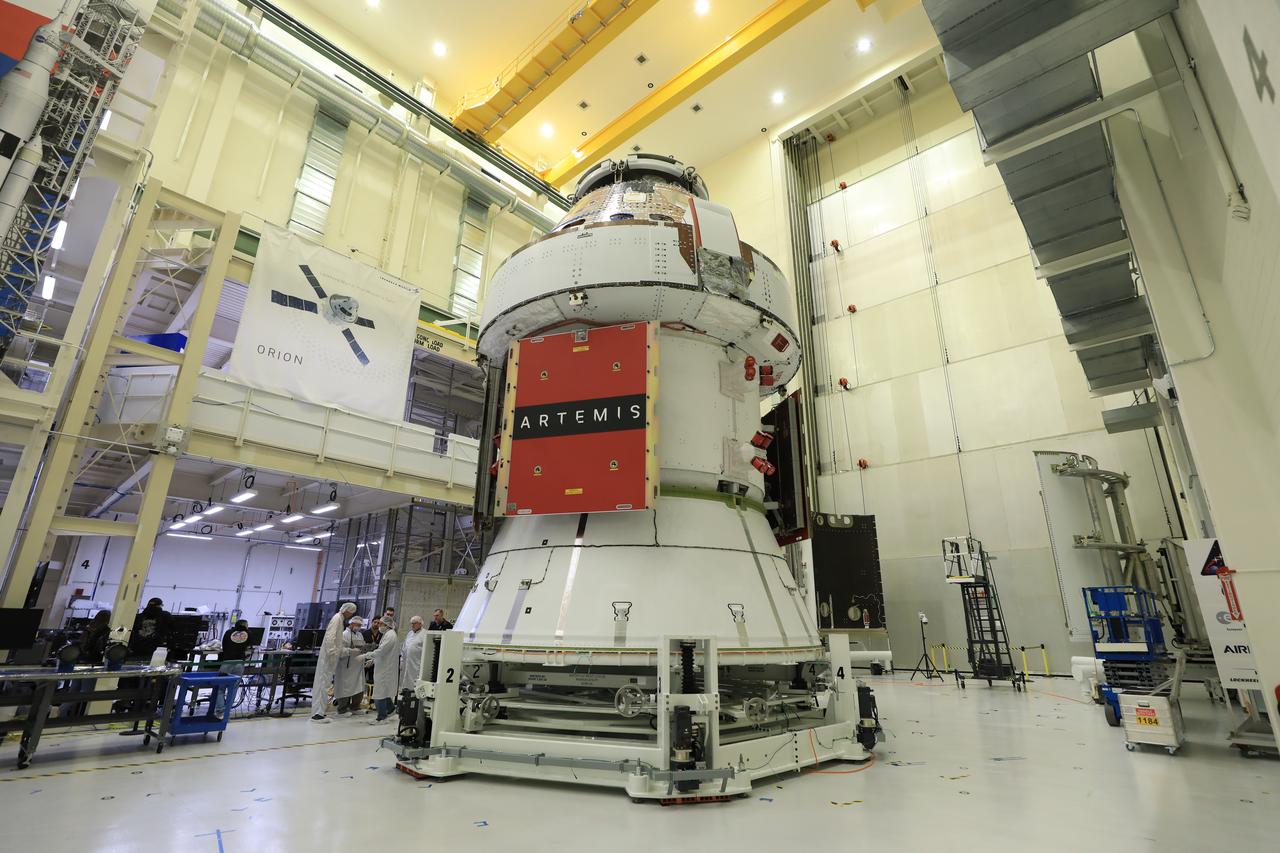
Technicians install four solar array wings on NASA’s Artemis II Orion spacecraft inside the Neil A. Armstrong Operations and Checkout Building at NASA’s Kennedy Space Center in Florida on Monday, March 3, 2025. Each solar array is nearly 23 feet long and can turn on two axes to remain aligned with the Sun for maximum power. Orion’s solar arrays, manufactured and installed by ESA (European Space Agency) and its contractor Airbus, will deliver power to the service module that provides propulsion, thermal control, and electrical power to the spacecraft, as well as air and water for the crew.
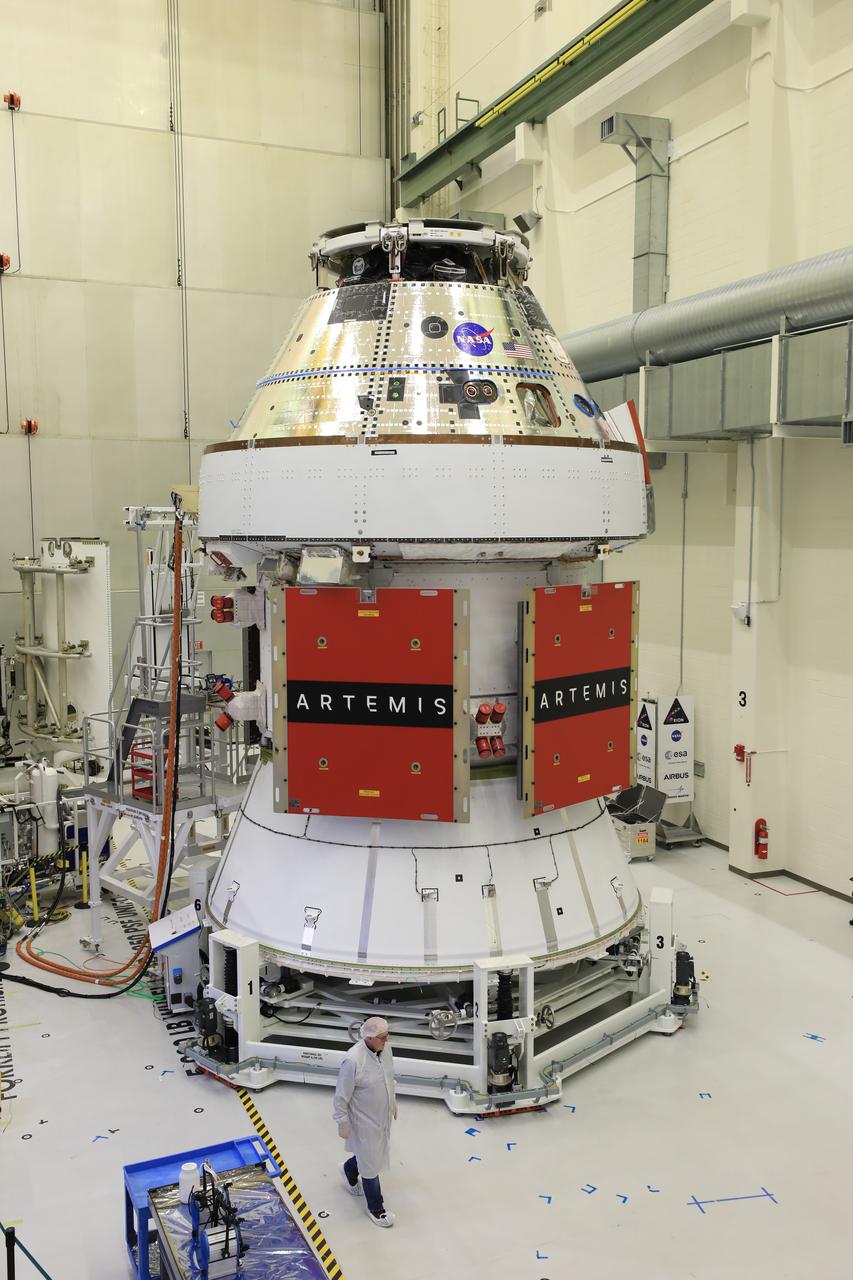
Technicians install four solar array wings on NASA’s Artemis II Orion spacecraft inside the Neil A. Armstrong Operations and Checkout Building at NASA’s Kennedy Space Center in Florida on Monday, March 3, 2025. Each solar array is nearly 23 feet long and can turn on two axes to remain aligned with the Sun for maximum power. Orion’s solar arrays, manufactured and installed by ESA (European Space Agency) and its contractor Airbus, will deliver power to the service module that provides propulsion, thermal control, and electrical power to the spacecraft, as well as air and water for the crew.
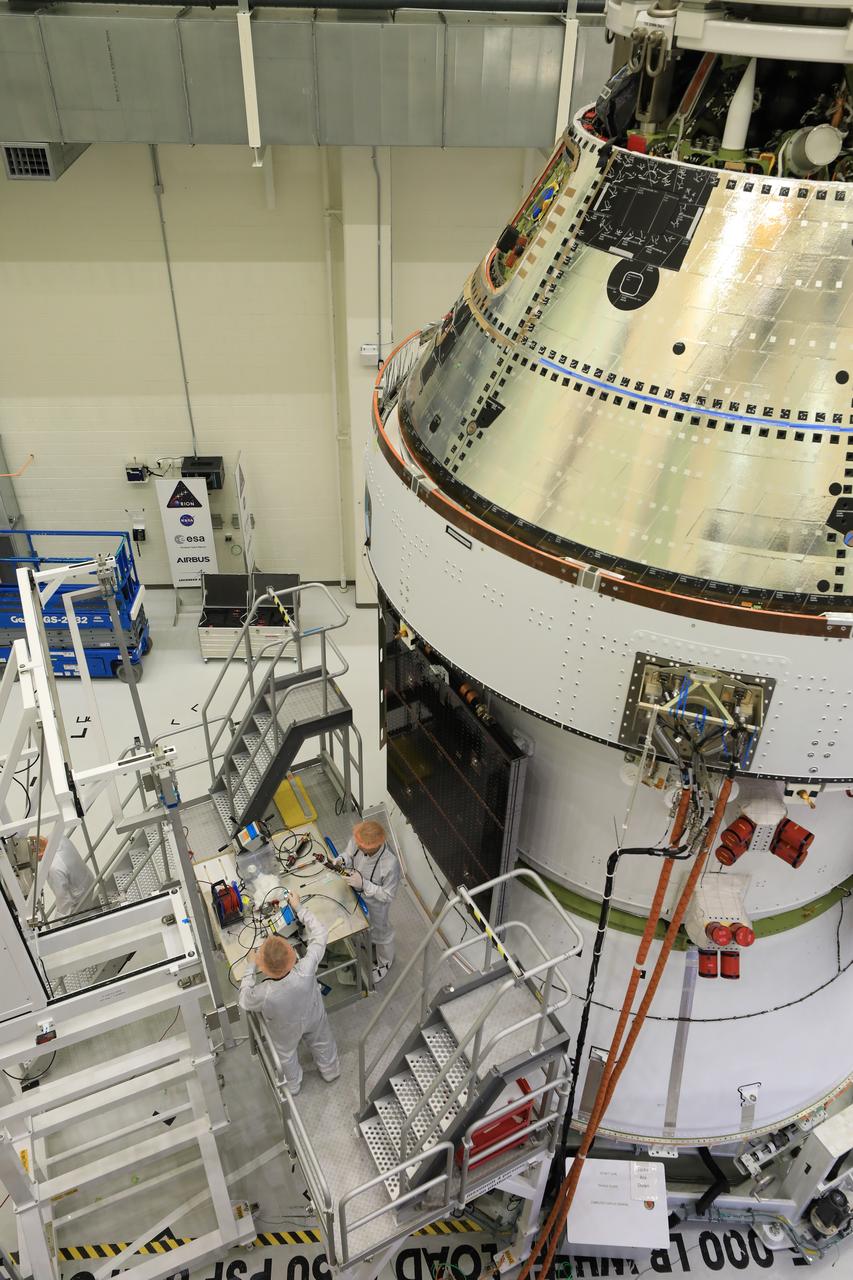
Technicians install four solar array wings on NASA’s Artemis II Orion spacecraft inside the Neil A. Armstrong Operations and Checkout Building at NASA’s Kennedy Space Center in Florida on Monday, March 3, 2025. Each solar array is nearly 23 feet long and can turn on two axes to remain aligned with the Sun for maximum power. Orion’s solar arrays, manufactured and installed by ESA (European Space Agency) and its contractor Airbus, will deliver power to the service module that provides propulsion, thermal control, and electrical power to the spacecraft, as well as air and water for the crew.
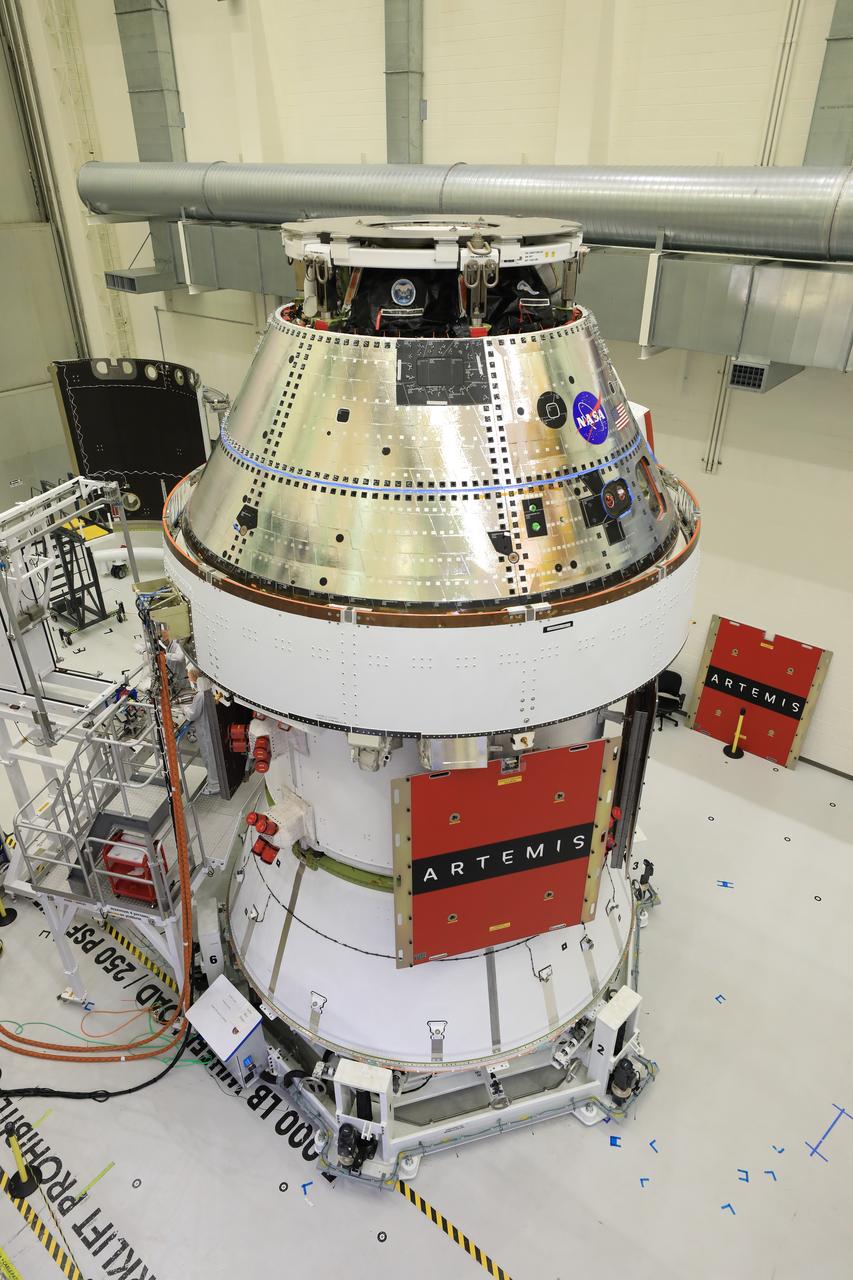
Technicians install four solar array wings on NASA’s Artemis II Orion spacecraft inside the Neil A. Armstrong Operations and Checkout Building at NASA’s Kennedy Space Center in Florida on Monday, March 3, 2025. Each solar array is nearly 23 feet long and can turn on two axes to remain aligned with the Sun for maximum power. Orion’s solar arrays, manufactured and installed by ESA (European Space Agency) and its contractor Airbus, will deliver power to the service module that provides propulsion, thermal control, and electrical power to the spacecraft, as well as air and water for the crew.
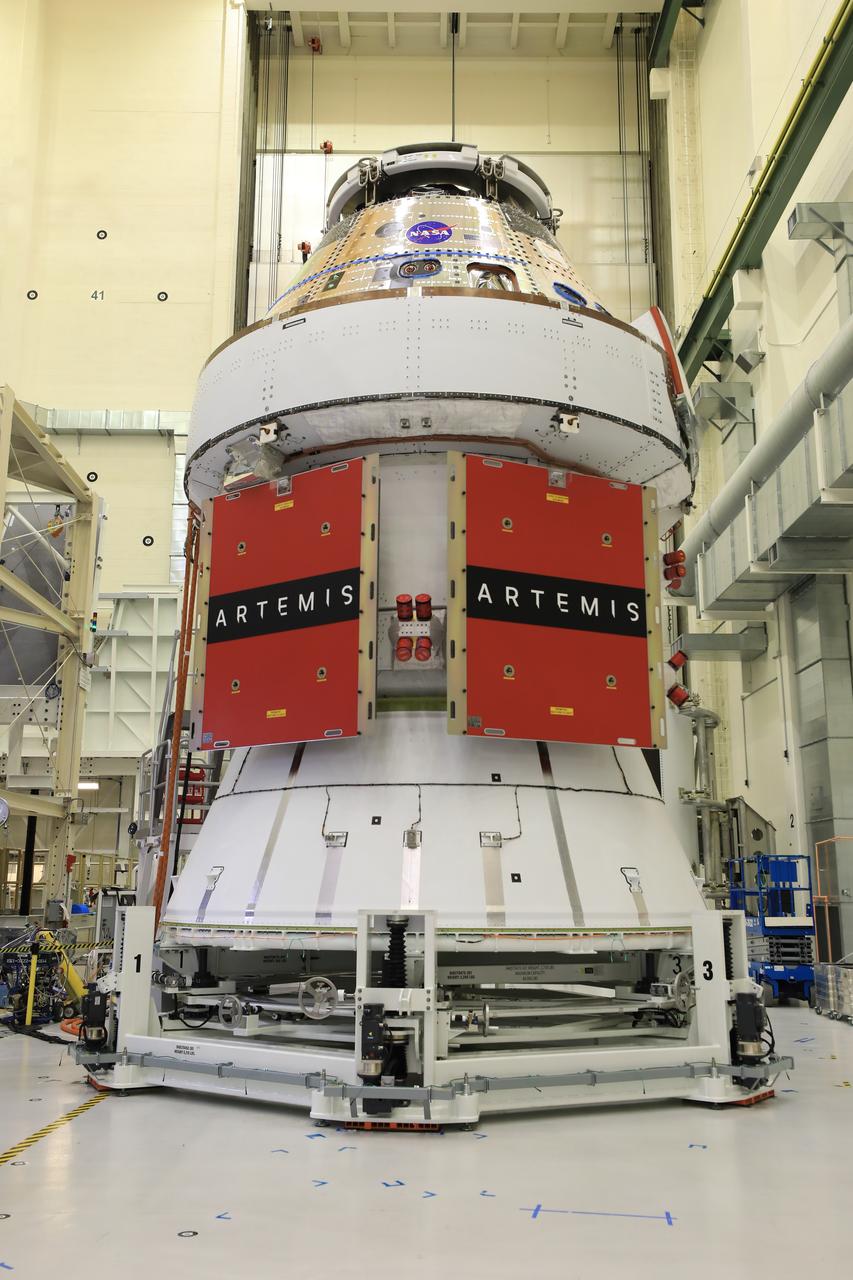
Technicians install four solar array wings on NASA’s Artemis II Orion spacecraft inside the Neil A. Armstrong Operations and Checkout Building at NASA’s Kennedy Space Center in Florida on Monday, March 3, 2025. Each solar array is nearly 23 feet long and can turn on two axes to remain aligned with the Sun for maximum power. Orion’s solar arrays, manufactured and installed by ESA (European Space Agency) and its contractor Airbus, will deliver power to the service module that provides propulsion, thermal control, and electrical power to the spacecraft, as well as air and water for the crew.
Technicians install four solar array wings on NASA’s Artemis II Orion spacecraft inside the Neil A. Armstrong Operations and Checkout Building at NASA’s Kennedy Space Center in Florida on Monday, March 3, 2025. Each solar array is nearly 23 feet long and can turn on two axes to remain aligned with the Sun for maximum power. Orion’s solar arrays, manufactured and installed by ESA (European Space Agency) and its contractor Airbus, will deliver power to the service module that provides propulsion, thermal control, and electrical power to the spacecraft, as well as air and water for the crew.
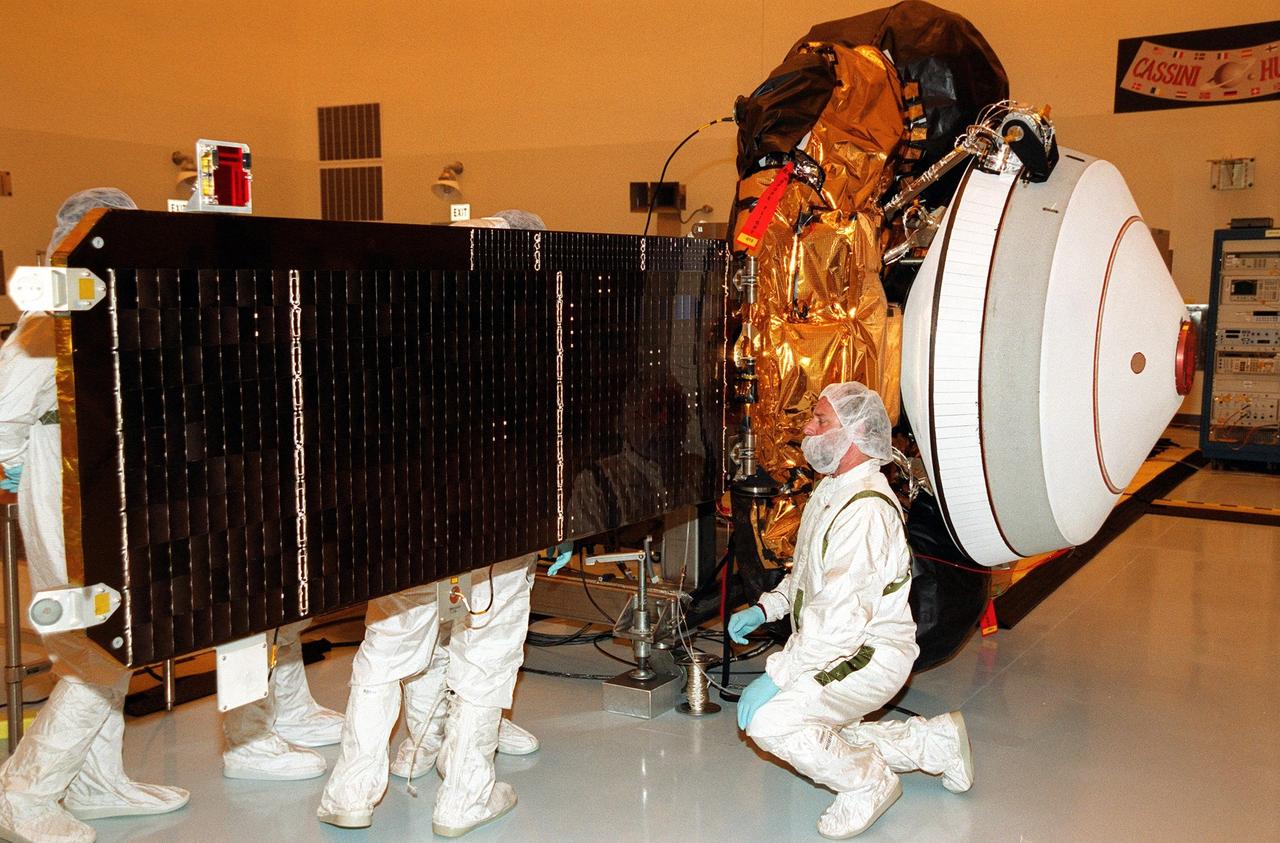
KENNEDY SPACE CENTER, Fla. -- Workers in the Payload Hazardous Servicing Facility check closely the solar arrays on the Genesis spacecraft. Genesis is designed to collect samples of solar wind particles and return them to Earth so that scientists can study the exact composition of the Sun and probe the solar system’s origin. The white object on the end in front of the arrays is the Sample Return Canister backshell, inside of which are the collector arrays. Genesis is scheduled to be launched on a Delta II Lite launch vehicle from Complex 17-A, Cape Canaveral Air Force Station, July 30, at 12:36 p.m. EDT
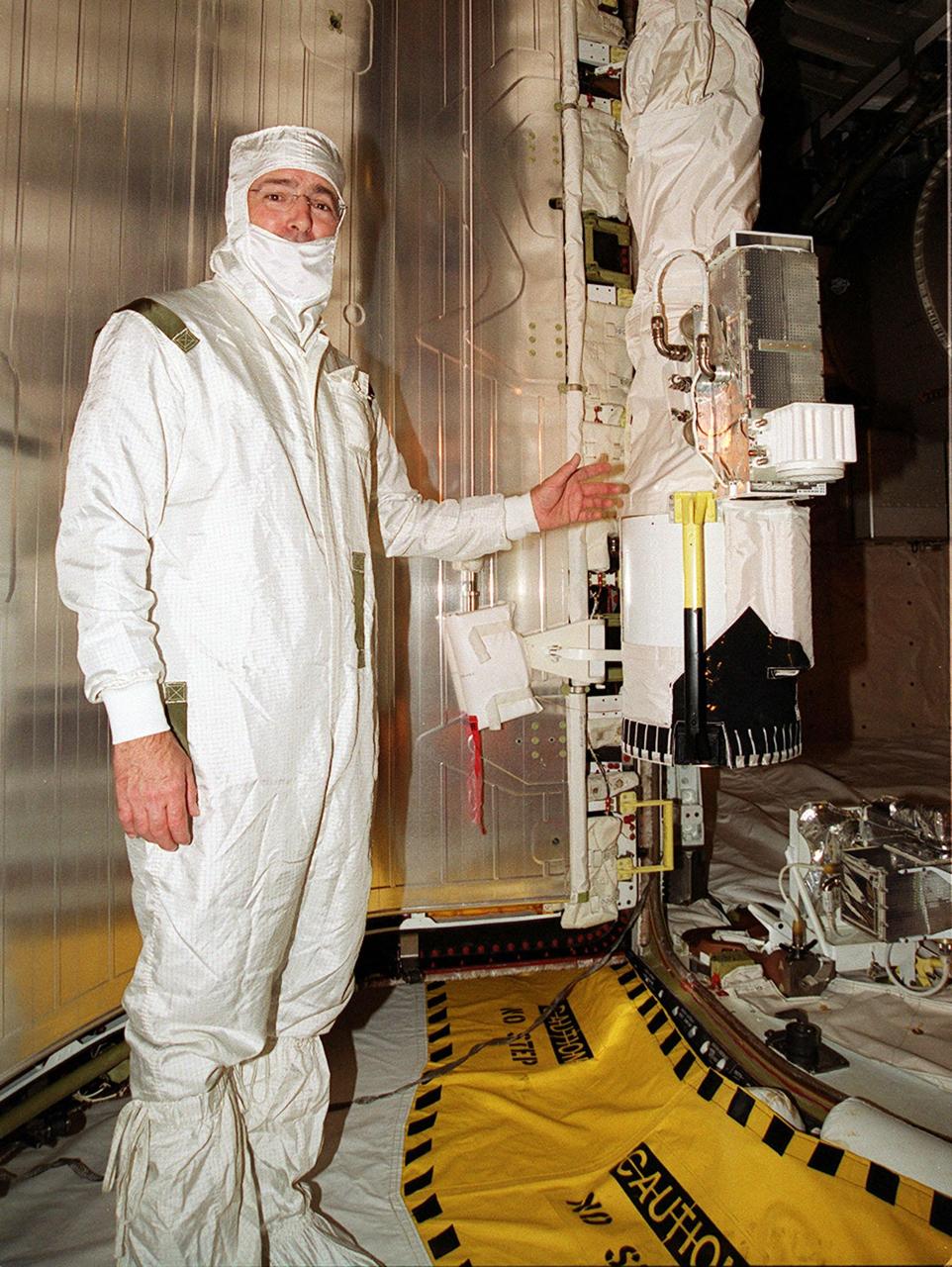
STS-97 Mission Specialist Marc Garneau points to Endeavour's robotic arm that he will use during a spacewalk on the mission. Members of the STS-97 crew are taking part in a payload walkdown from the payload changeout room at Launch Pad 39B. The payload comprises the P6 Integrated Truss Segment, with solar arrays that will be temporarily installed on the recently delivered Z1 truss, connecting them to the Unity module, and batteries. The two solar arrays are each more than 100 feet long. They will capture energy from the sun and convert it to power for the Station. Two spacewalks will be required to install the solar array connections. STS-97 is scheduled to launch Nov. 30 at about 10:06 p.m. EST
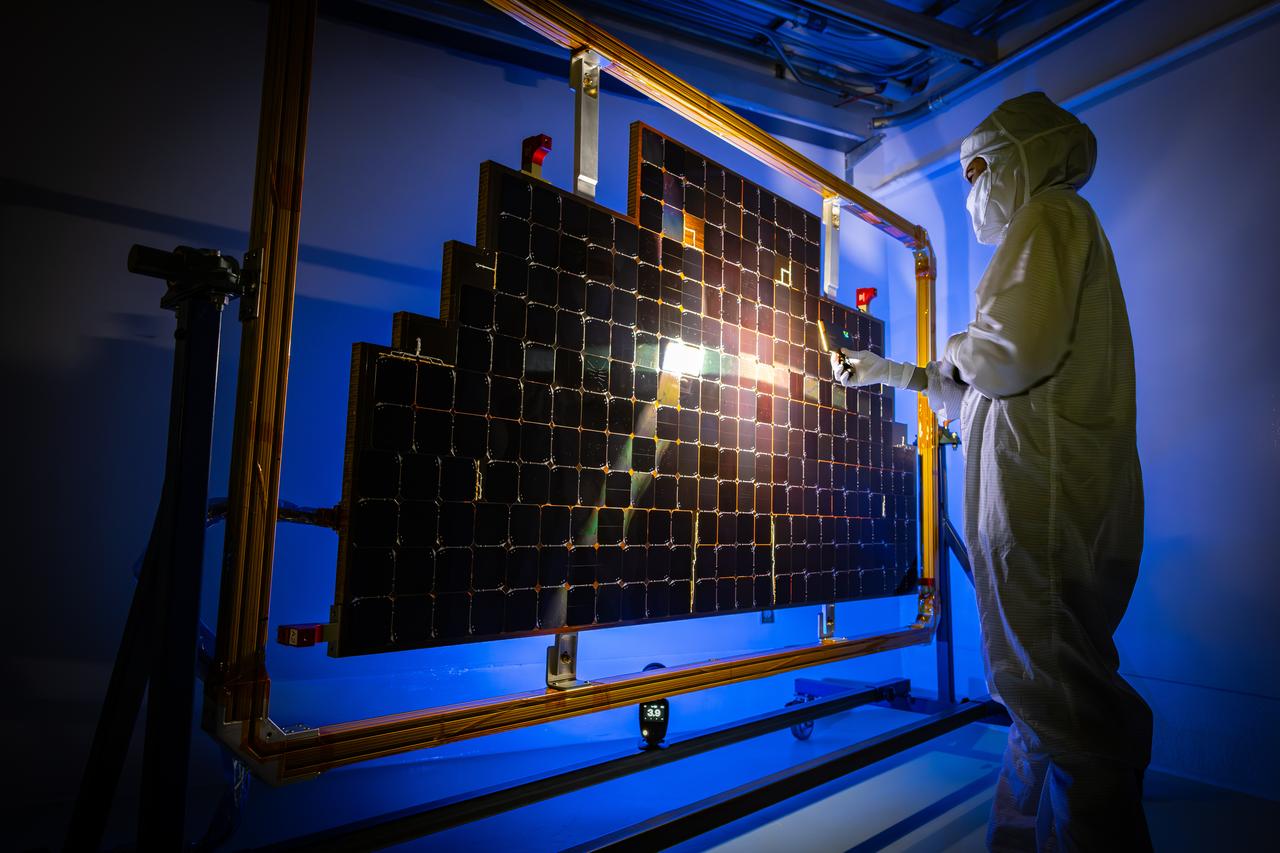
Technicians conduct an illumination test by flashing a bright light that simulates the Sun into the solar array for NASA’s IMAP (Interstellar Mapping and Acceleration Probe) observatory inside the high bay at the Astrotech Space Operations Facility near the agency’s Kennedy Space Center in Florida on Friday, June 20, 2025. The IMAP solar array converts sunlight into approximately 500 watts of power, and IMAP’s spin axis, which comes through the center of the solar arrays, points sunward to provide constant power. Launch is targeted for no earlier than September 2025 aboard a SpaceX Falcon 9 rocket from Launch Complex 39A at NASA Kennedy.
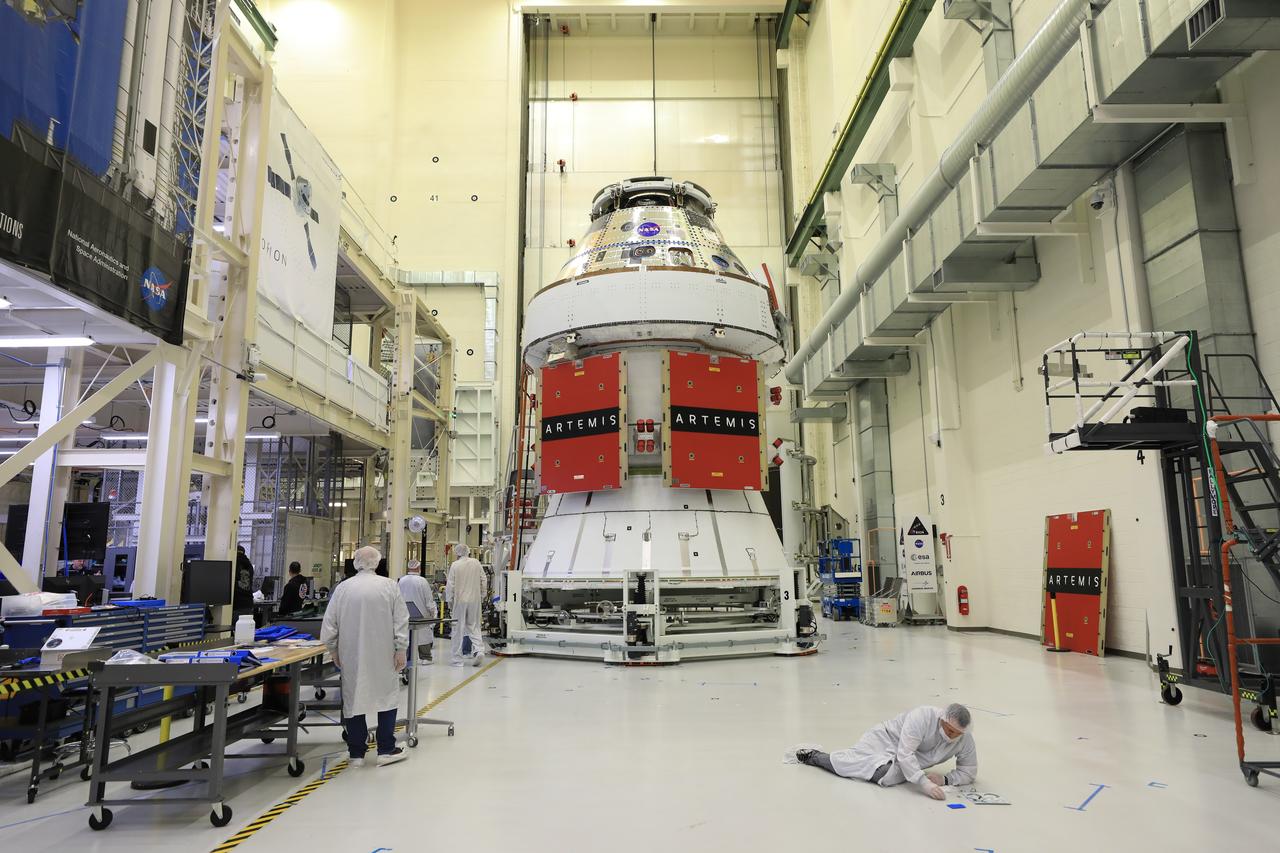
Technicians install four solar array wings on NASA’s Artemis II Orion spacecraft inside the Neil A. Armstrong Operations and Checkout Building at NASA’s Kennedy Space Center in Florida on Monday, March 3, 2025. Each solar array is nearly 23 feet long and can turn on two axes to remain aligned with the Sun for maximum power. Orion’s solar arrays, manufactured and installed by ESA (European Space Agency) and its contractor Airbus, will deliver power to the service module that provides propulsion, thermal control, and electrical power to the spacecraft, as well as air and water for the crew.
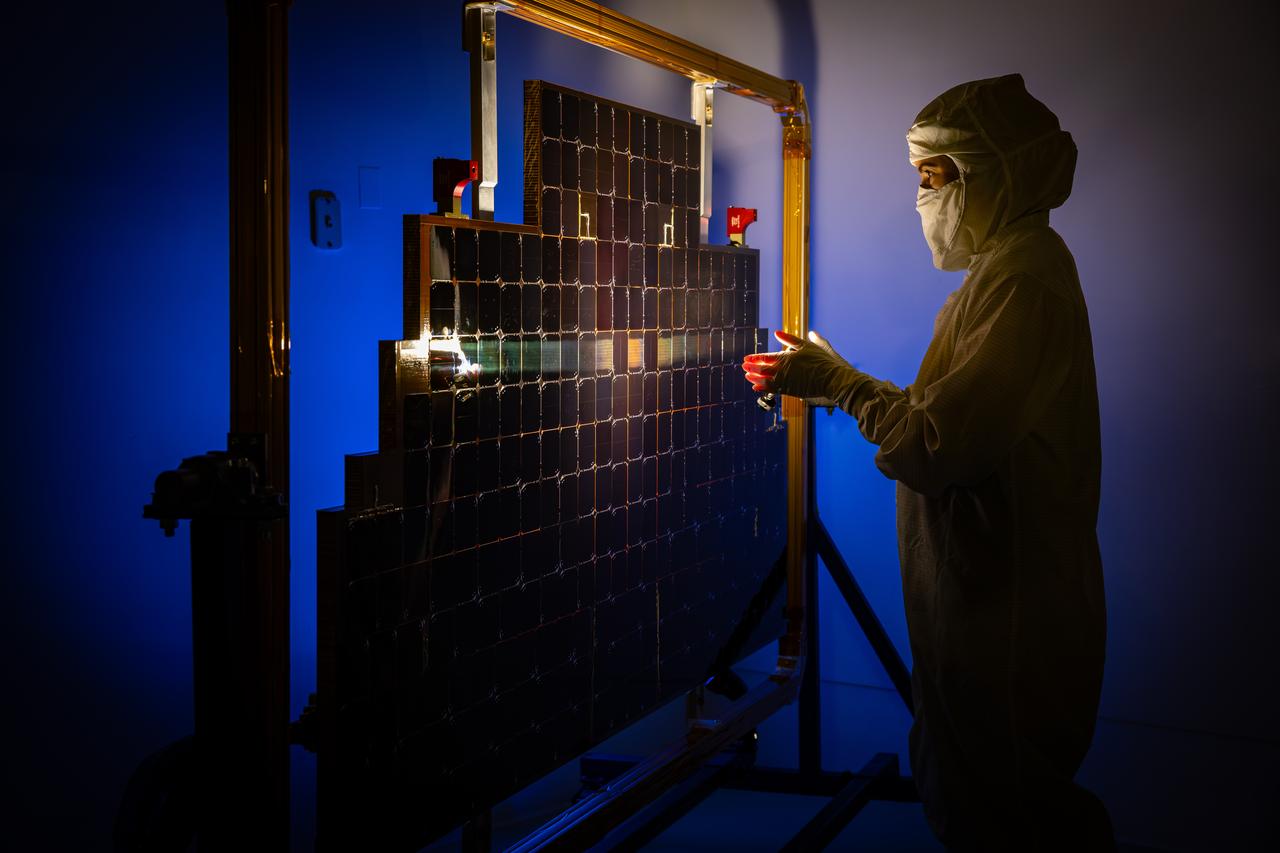
Technicians conduct an illumination test by flashing a bright light that simulates the Sun into the solar array for NASA’s IMAP (Interstellar Mapping and Acceleration Probe) observatory inside the high bay at the Astrotech Space Operations Facility near the agency’s Kennedy Space Center in Florida on Friday, June 20, 2025. The IMAP solar array converts sunlight into approximately 500 watts of power, and IMAP’s spin axis, which comes through the center of the solar arrays, points sunward to provide constant power. Launch is targeted for no earlier than September 2025 aboard a SpaceX Falcon 9 rocket from Launch Complex 39A at NASA Kennedy.
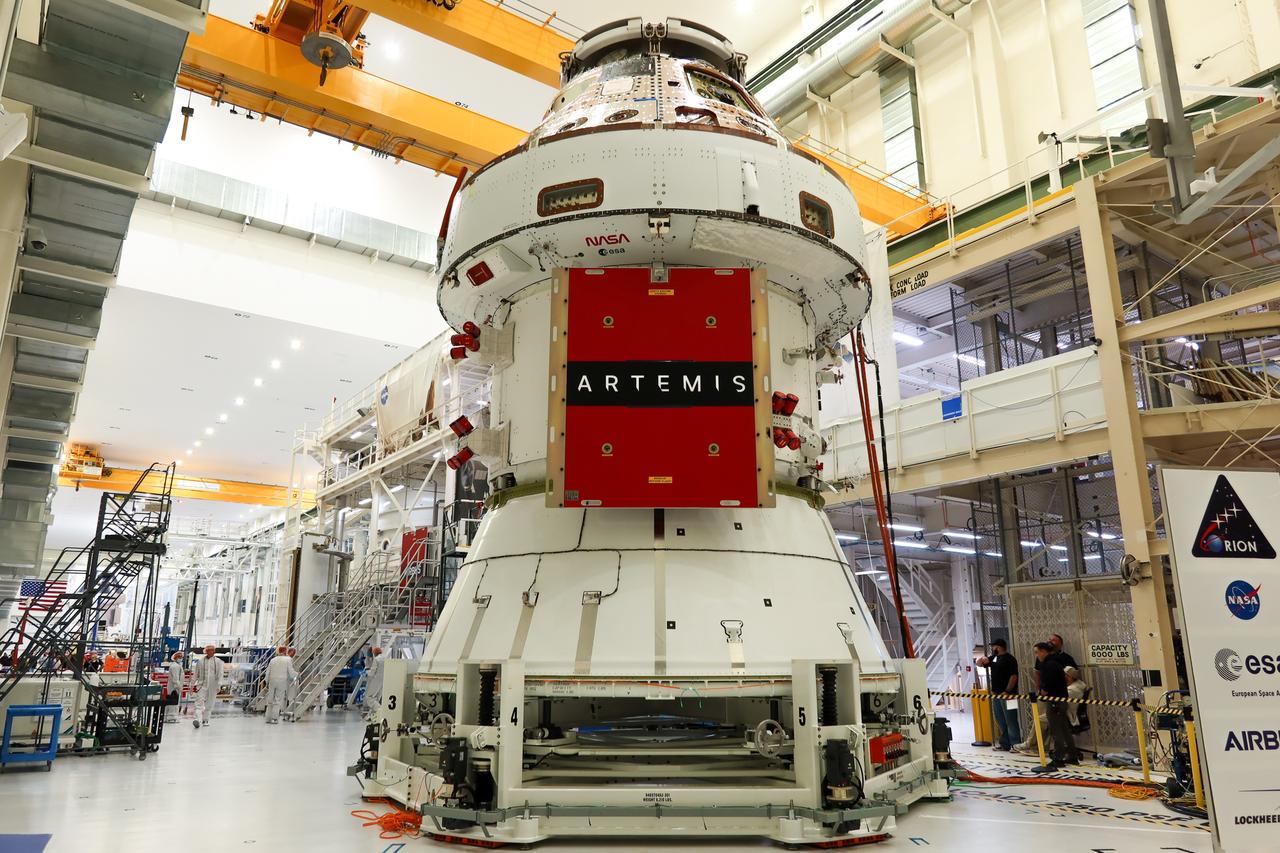
Technicians install four solar array wings on NASA’s Artemis II Orion spacecraft inside the Neil A. Armstrong Operations and Checkout Building at NASA’s Kennedy Space Center in Florida on Monday, March 3, 2025. Each solar array is nearly 23 feet long and can turn on two axes to remain aligned with the Sun for maximum power. Orion’s solar arrays, manufactured and installed by ESA (European Space Agency) and its contractor Airbus, will deliver power to the service module that provides propulsion, thermal control, and electrical power to the spacecraft, as well as air and water for the crew.
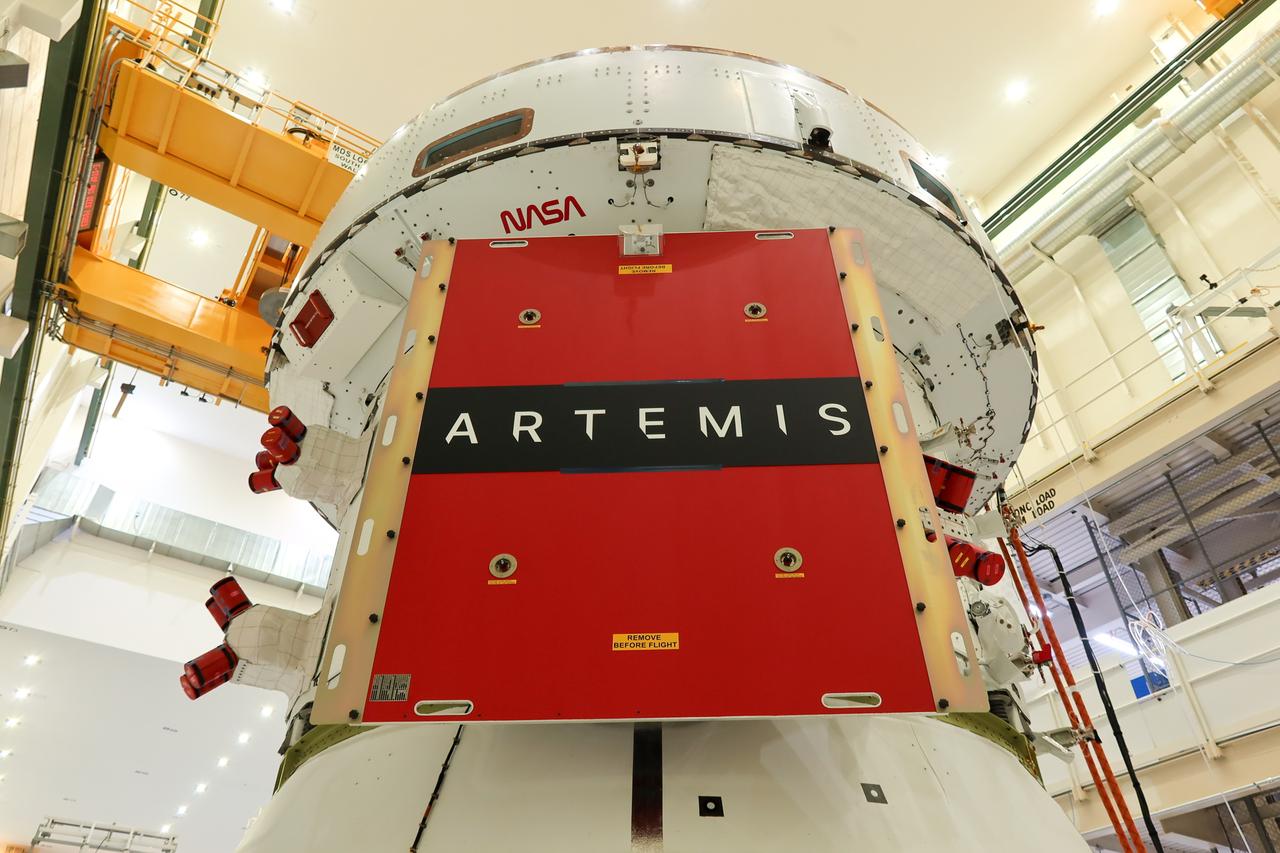
Technicians install four solar array wings on NASA’s Artemis II Orion spacecraft inside the Neil A. Armstrong Operations and Checkout Building at NASA’s Kennedy Space Center in Florida on Monday, March 3, 2025. Each solar array is nearly 23 feet long and can turn on two axes to remain aligned with the Sun for maximum power. Orion’s solar arrays, manufactured and installed by ESA (European Space Agency) and its contractor Airbus, will deliver power to the service module that provides propulsion, thermal control, and electrical power to the spacecraft, as well as air and water for the crew.
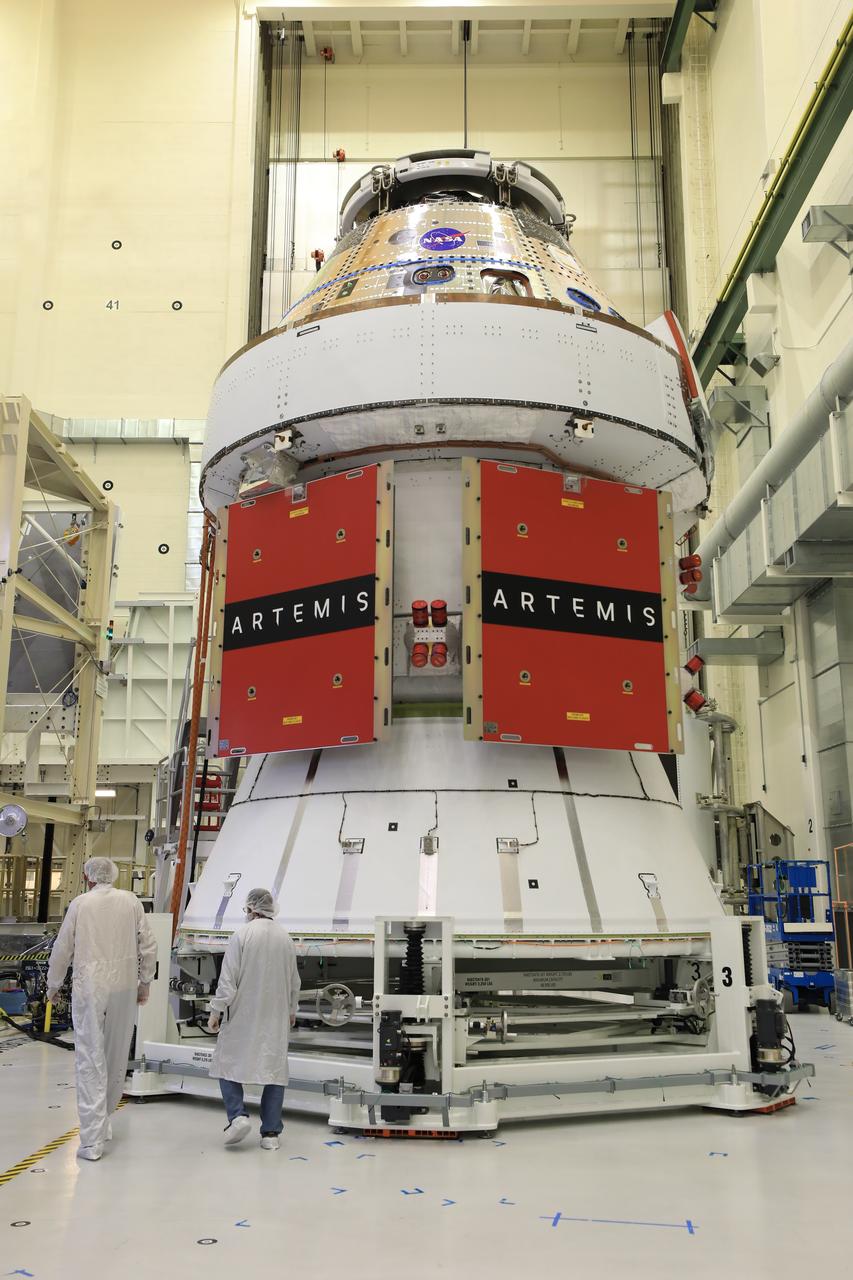
Technicians install four solar array wings on NASA’s Artemis II Orion spacecraft inside the Neil A. Armstrong Operations and Checkout Building at NASA’s Kennedy Space Center in Florida on Monday, March 3, 2025. Each solar array is nearly 23 feet long and can turn on two axes to remain aligned with the Sun for maximum power. Orion’s solar arrays, manufactured and installed by ESA (European Space Agency) and its contractor Airbus, will deliver power to the service module that provides propulsion, thermal control, and electrical power to the spacecraft, as well as air and water for the crew.
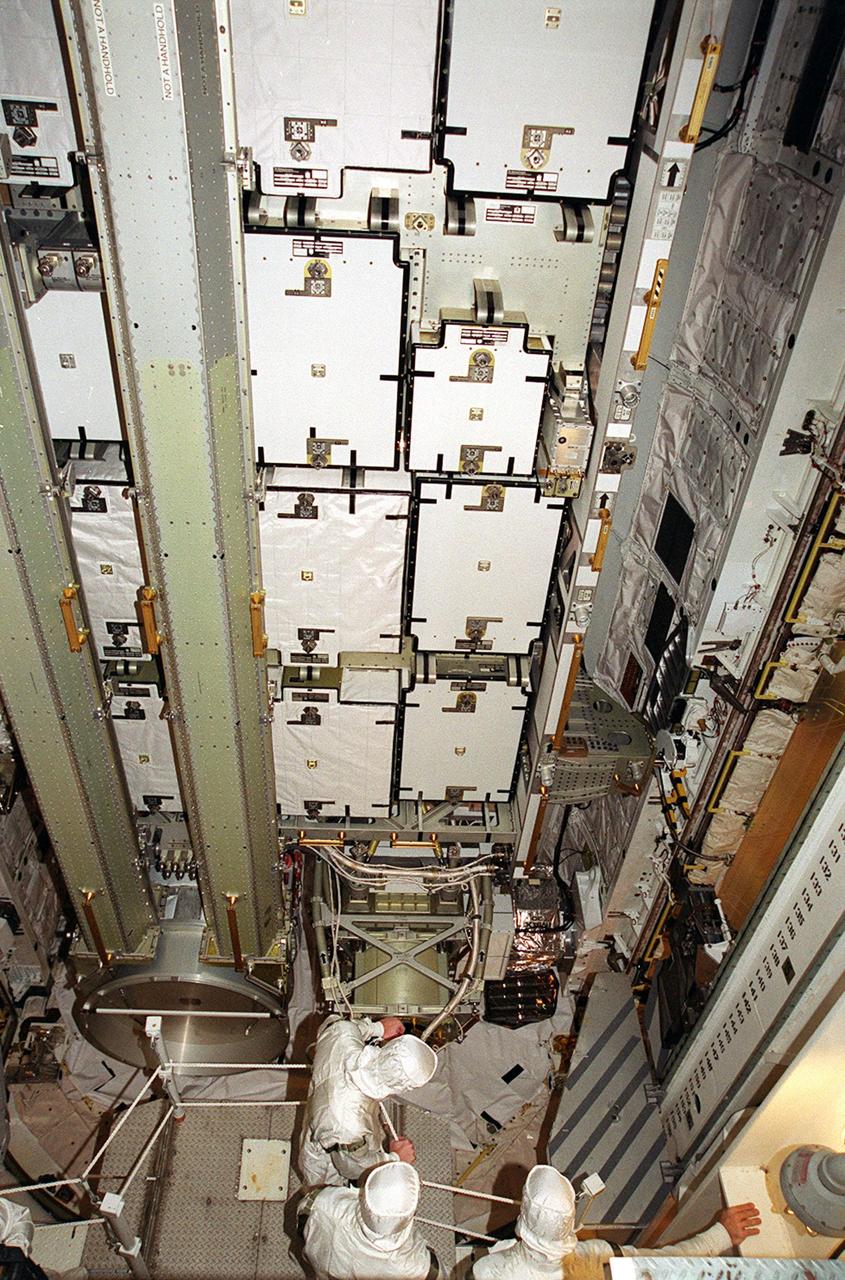
Members of the STS-97 crew take part in payload walkdown inside the payload changeout room at Launch Pad 39B. In the background is seen some of the batteries being carried to the International Space Station on the mission. What appear to be vertical posts at left are the solar arrays. The batteries and solar arrays are part of the P6 Integrated Truss Segment and will be temporarily installed to the Unity connecting module by the Z1 truss, recently delivered to and installed on the Station on mission STS-92. The two solar arrays are each more than 100 feet long. They will capture energy from the sun and convert it to power for the Station. Two spacewalks will be required to install the solar array connections. STS-97 is scheduled to launch Nov. 30 at about 10:06 p.m. EST
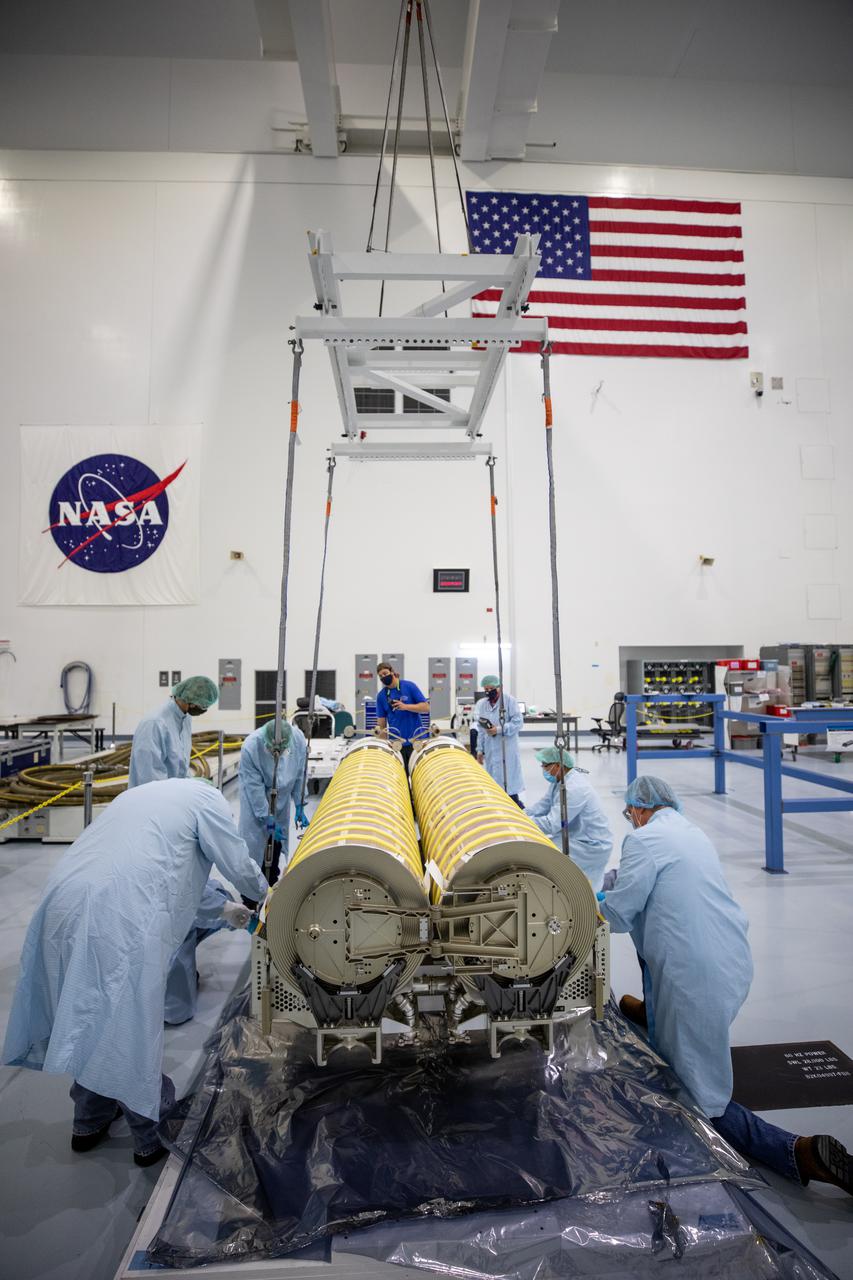
NASA and Boeing workers move solar arrays for the International Space Station to flight support equipment in the high bay of the Space Station Processing Facility at NASA’s Kennedy Space Center in Florida on April 2, 2021. The 63- by- 20-foot solar arrays will launch to the International Space Station later this year. They are the first two of six new solar arrays that in total will produce more than 120 kilowatts of electricity from the Sun’s energy, enough to power more than 40 average U.S. homes. Combined with the eight original, larger arrays, this advanced hardware will provide 215 kilowatts of energy, a 20 to 30 percent increase in power, helping maximize the space station’s capabilities for years to come. The arrays will produce electricity to sustain the station’s systems and equipment, plus augment the electricity available to continue a wide variety of public and private experiments and research in the microgravity environment of low-Earth orbit.
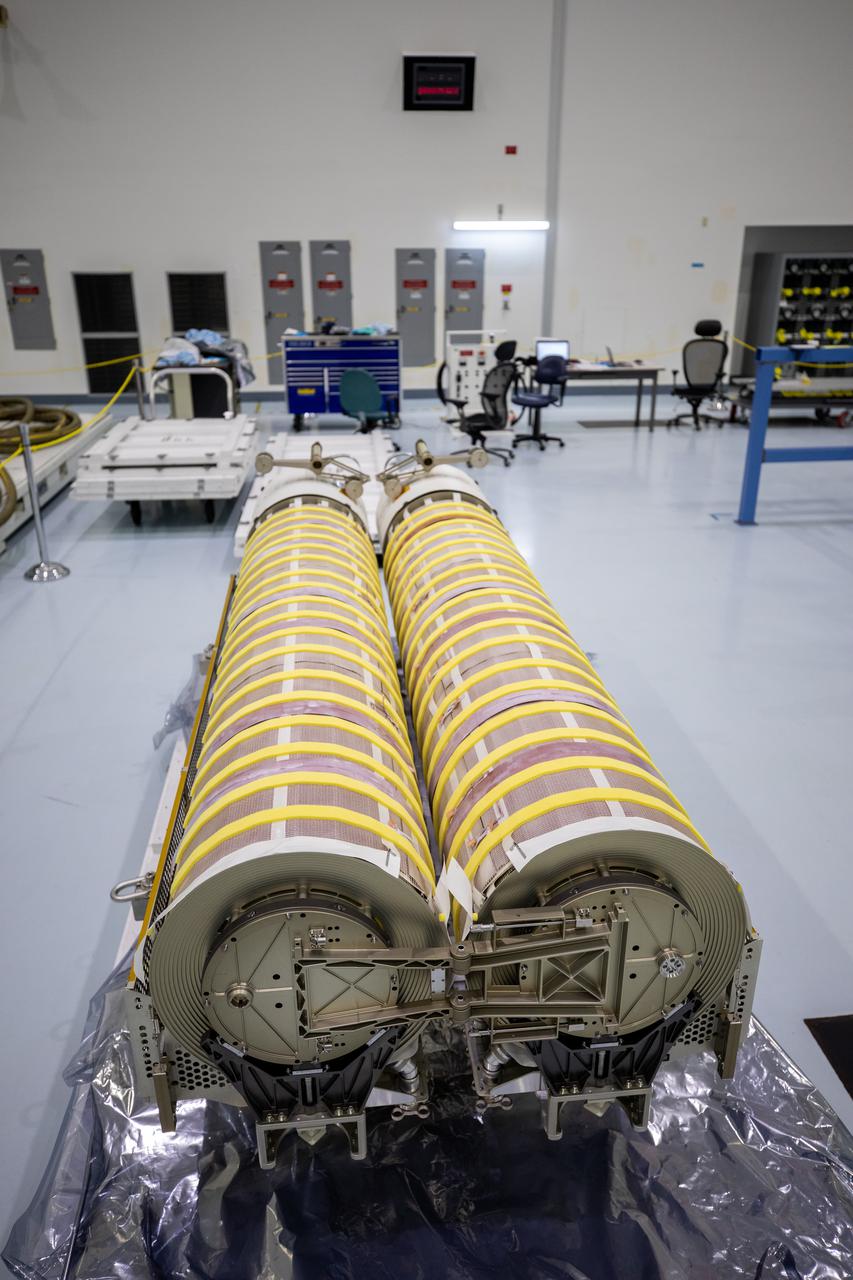
In view are the first two of six solar arrays shortly before NASA and Boeing workers began lifting them into flight support equipment the Space Station Processing Facility at NASA’s Kennedy Space Center in Florida on April 2, 2021. The 63- by- 20-foot solar arrays will launch to the International Space Station later this year. The six new solar arrays in total will produce more than 120 kilowatts of electricity from the Sun’s energy, enough to power more than 40 average U.S. homes. Combined with the eight original, larger arrays, this advanced hardware will provide 215 kilowatts of energy, a 20 to 30 percent increase in power, helping maximize the space station’s capabilities for years to come. The arrays will produce electricity to sustain the station’s systems and equipment, plus augment the electricity available to continue a wide variety of public and private experiments and research in the microgravity environment of low-Earth orbit.
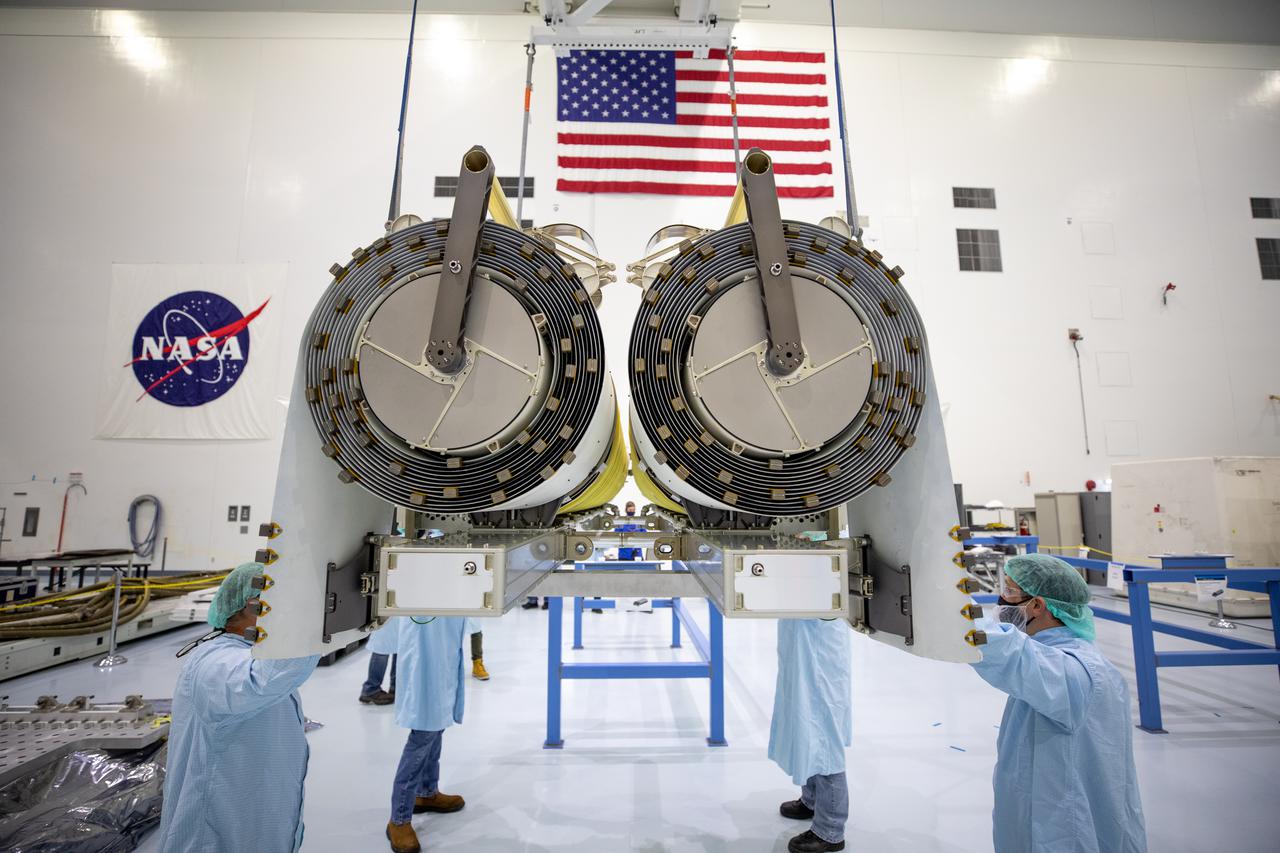
NASA and Boeing workers help position the solar arrays onto flight support equipment inside the high bay of the Space Station Processing Facility at NASA’s Kennedy Space Center in Florida on April 2, 2021. The 63- by- 20-foot solar arrays will launch to the International Space Station later this year. They are the first two of six new solar arrays that in total will produce more than 120 kilowatts of electricity from the Sun’s energy, enough to power more than 40 average U.S. homes. Combined with the eight original, larger arrays, this advanced hardware will provide 215 kilowatts of energy, a 20 to 30 percent increase in power, helping maximize the space station’s capabilities for years to come. The arrays will produce electricity to sustain the station’s systems and equipment, plus augment the electricity available to continue a wide variety of public and private experiments and research in the microgravity environment of low-Earth orbit.
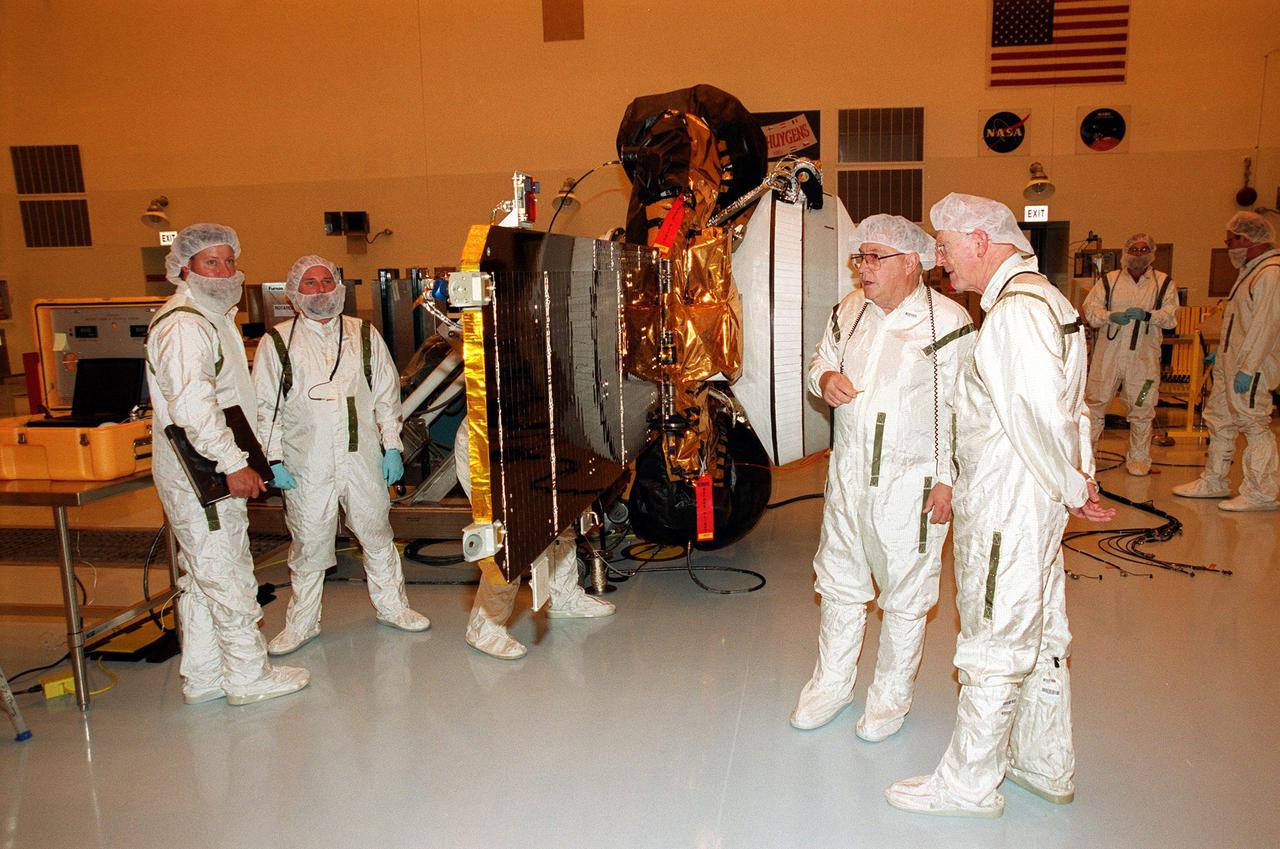
KENNEDY SPACE CENTER, Fla. -- In the Payload Hazardous Servicing Facility, the solar arrays are deployed on the Genesis spacecraft. Workers check both sides. Genesis is designed to collect samples of solar wind particles and return them to Earth so that scientists can study the exact composition of the Sun and probe the solar system’s origin. On the workstand, the spacecraft will undergo processing, which includes a functional test, electrical systems test and deployment of the solar arrays. Genesis is scheduled to be launched on a Delta II Lite launch vehicle from Complex 17-A, Cape Canaveral Air Force Station, July 30, at 12:36 p.m. EDT
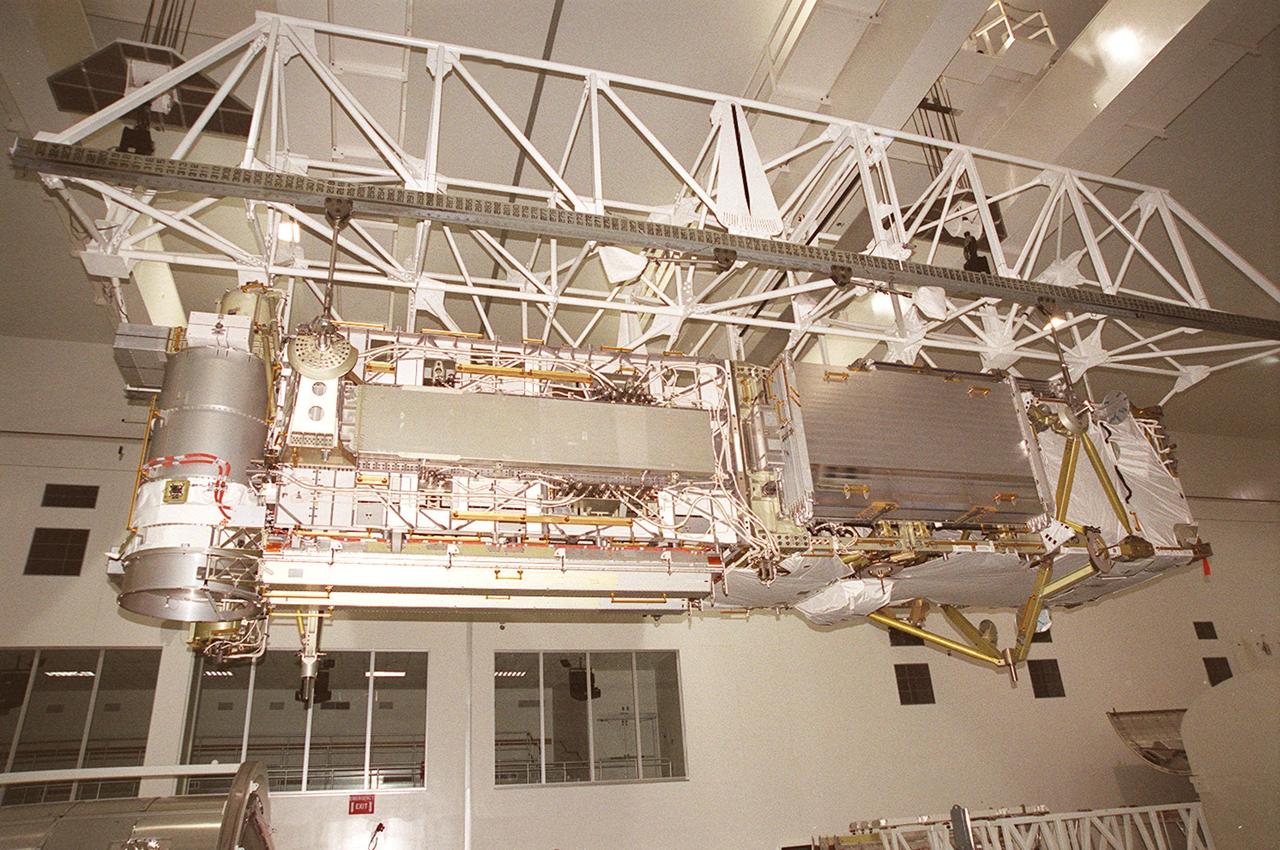
The P6 integrated truss segment hangs suspended from an overhead crane that is moving it the length of the Space Station Processing Facility toward a payload transport canister for transfer to Launch Pad 39B. At the pad, the Space Station element will be placed in Endeavour’s payload bay for launch on mission STS-97. The P6 comprises Solar Array Wing-3 and the Integrated Electronic Assembly, to be installed on the Space Station. The Station’s electrical power system will use eight photovoltaic solar arrays, each 112 feet long by 39 feet wide, to convert sunlight to electricity. The solar arrays are mounted on a “blanket” that can be folded like an accordion for delivery. Once in orbit, astronauts will deploy the blankets to their full size. Gimbals will be used to rotate the arrays so that they will face the Sun to provide maximum power to the Space Station. The STS-97 launch is scheduled Nov. 30 at 10:06 p.m. EST
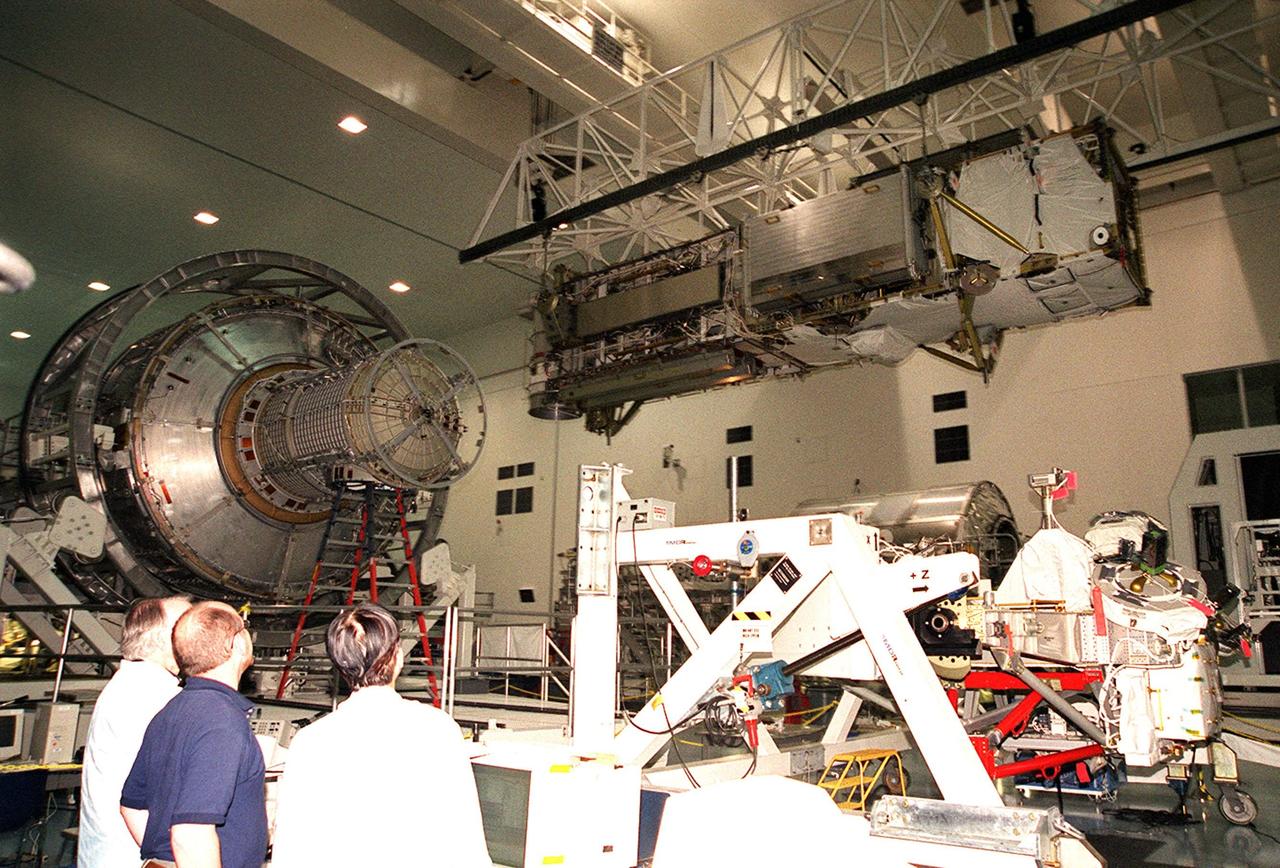
In the Space Station Processing Facility, the P6 integrated truss segment travels across the building to a payload transport canister for transfer to Launch Pad 39B. There it will be placed in Endeavour’s payload bay for launch on mission STS-97. At left is the airlock module, another component of the International Space Station. The P6 comprises Solar Array Wing-3 and the Integrated Electronic Assembly, to be installed on the Space Station. The Station’s electrical power system will use eight photovoltaic solar arrays, each 112 feet long by 39 feet wide, to convert sunlight to electricity. The solar arrays are mounted on a “blanket” that can be folded like an accordion for delivery. Once in orbit, astronauts will deploy the blankets to their full size. Gimbals will be used to rotate the arrays so that they will face the Sun to provide maximum power to the Space Station. Launch is scheduled Nov. 30 at 10:06 p.m. EST
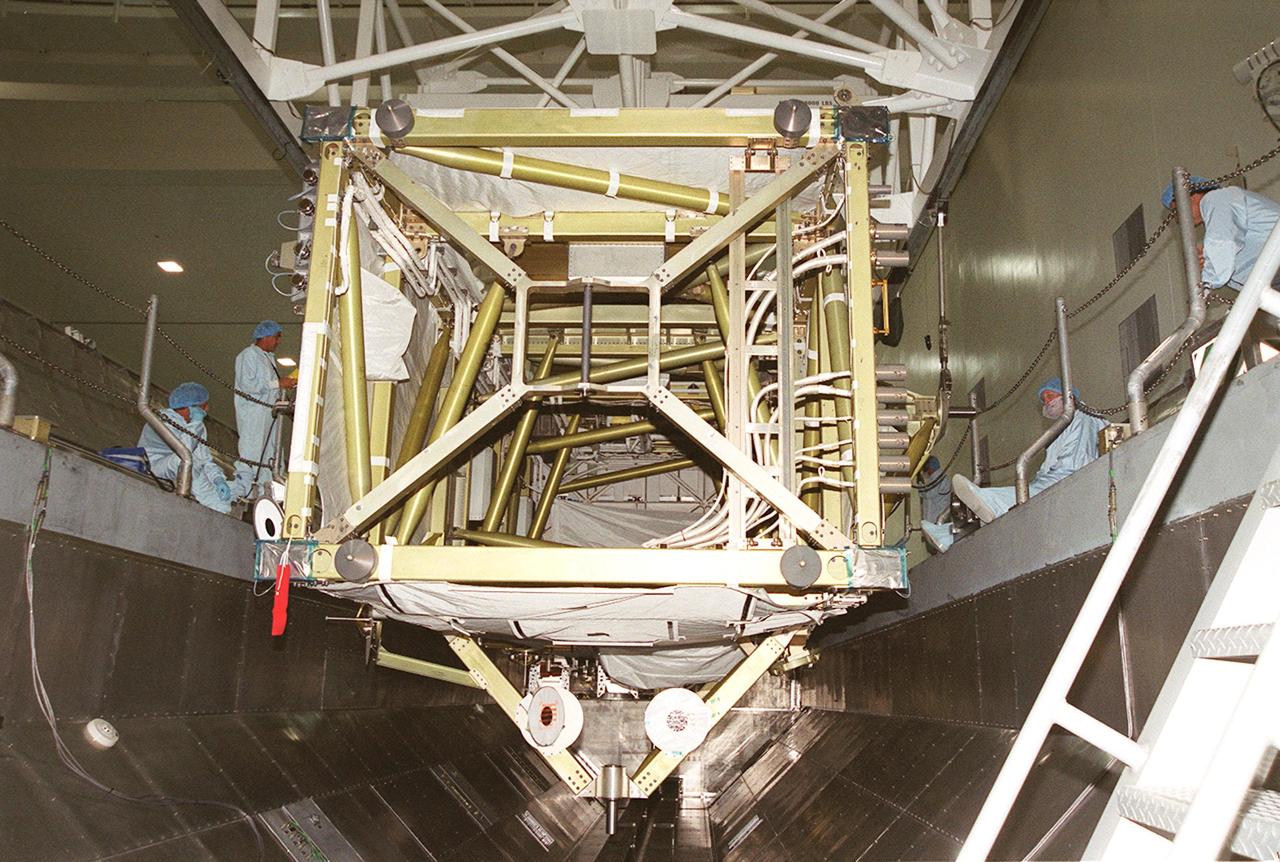
KENNEDY SPACE CENTER, FLA. -- In the Space Station Processing Facility, the P6 integrated truss segment is placed in the payload transport canister while workers watch its progress. After being secured in the canister, the truss will be transported to Launch Pad 39B and the payload changeout room. Then it will be moved into Space Shuttle Endeavour’s payload bay for mission STS-97. The P6 comprises Solar Array Wing-3 and the Integrated Electronic Assembly, to be installed on the Space Station. The Station’s electrical power system will use eight photovoltaic solar arrays, each 112 feet long by 39 feet wide, to convert sunlight to electricity. The solar arrays are mounted on a “blanket” that can be folded like an accordion for delivery. Once in orbit, astronauts will deploy the blankets to their full size. Gimbals will be used to rotate the arrays so that they will face the Sun to provide maximum power to the Space Station. The STS-97 launch is scheduled Nov. 30 at 10:06 p.m. EST
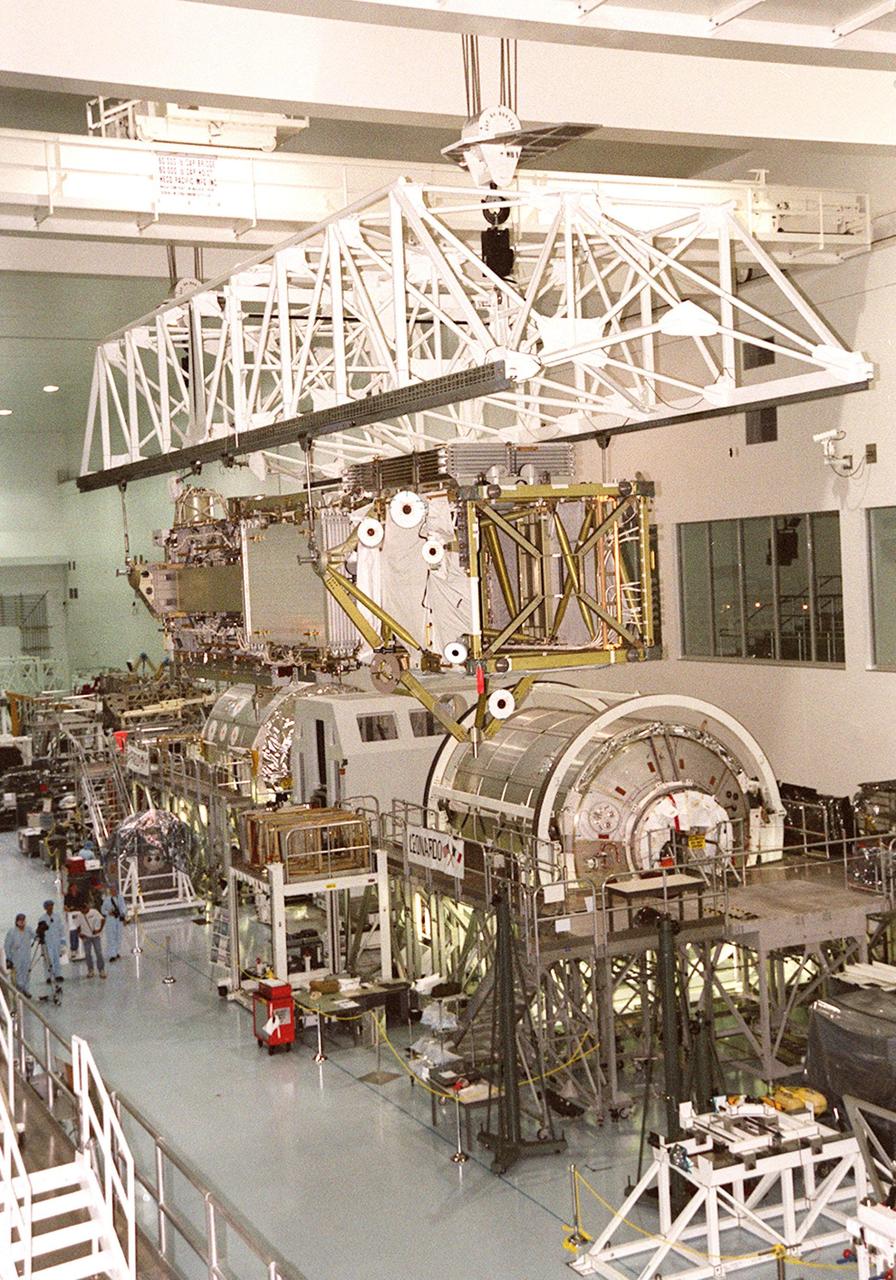
As it travels across the Space Station Processing Facility, the P6 integrated truss segment passes over the two Italian-built Multi-Purpose Logistics Modules, Leonardo (right) and Raffaello (behind Leonardo). The P6 is being moved to a payload transport canister for transfer to Launch Pad 39B. There it will be placed in Endeavour’s payload bay for launch on mission STS-97. The P6 comprises Solar Array Wing-3 and the Integrated Electronic Assembly, to be installed on the Space Station. The Station’s electrical power system will use eight photovoltaic solar arrays, each 112 feet long by 39 feet wide, to convert sunlight to electricity. The solar arrays are mounted on a “blanket” that can be folded like an accordion for delivery. Once in orbit, astronauts will deploy the blankets to their full size. Gimbals will be used to rotate the arrays so that they will face the Sun to provide maximum power to the Space Station. Launch is scheduled Nov. 30 at 10:06 p.m. EST
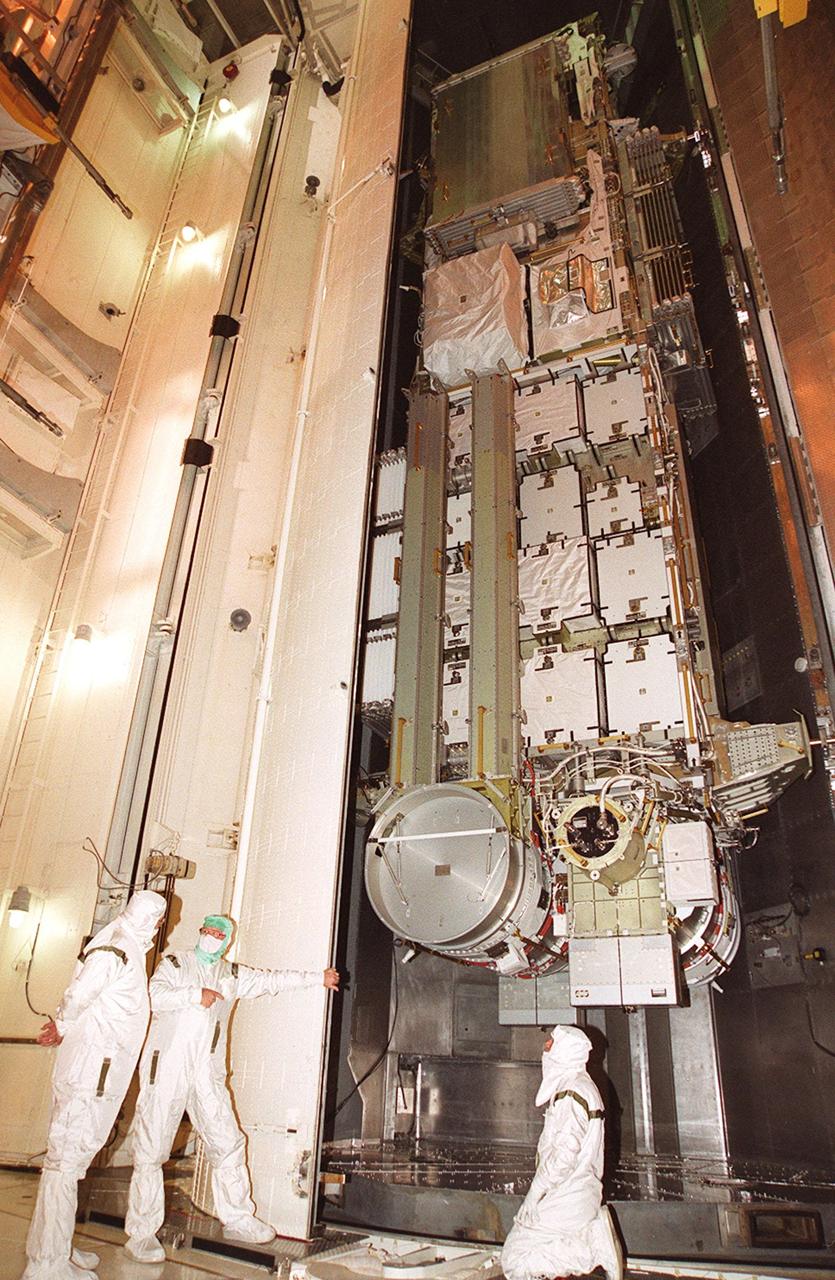
Workers in the payload changeout room stand by as the doors open on the payload transport canister. Inside is the P6 integrated truss segment, which will fly on mission STS-97. The P6 comprises Solar Array Wing-3 and the Integrated Electronic Assembly, to be installed on the International Space Station. The Station’s electrical power system will use eight photovoltaic solar arrays, each 112 feet long by 39 feet wide, to convert sunlight to electricity. The solar arrays are mounted on a “blanket” that can be folded like an accordion for delivery. Once in orbit, astronauts will deploy the blankets to their full size. Gimbals will be used to rotate the arrays so that they will face the Sun to provide maximum power to the Space Station. Launch of STS-97 is scheduled for Nov. 30 at 10:06 p.m. EST
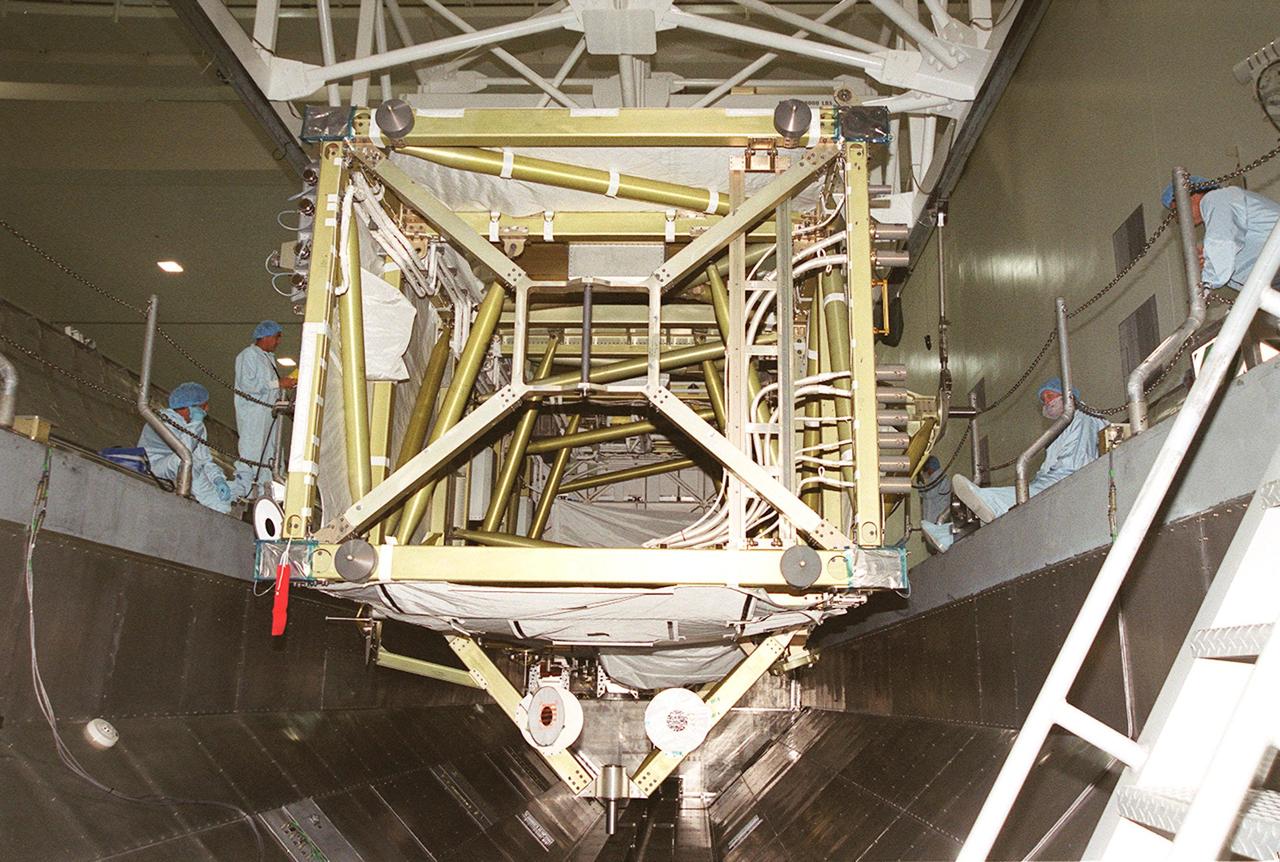
KENNEDY SPACE CENTER, FLA. -- In the Space Station Processing Facility, the P6 integrated truss segment is placed in the payload transport canister while workers watch its progress. After being secured in the canister, the truss will be transported to Launch Pad 39B and the payload changeout room. Then it will be moved into Space Shuttle Endeavour’s payload bay for mission STS-97. The P6 comprises Solar Array Wing-3 and the Integrated Electronic Assembly, to be installed on the Space Station. The Station’s electrical power system will use eight photovoltaic solar arrays, each 112 feet long by 39 feet wide, to convert sunlight to electricity. The solar arrays are mounted on a “blanket” that can be folded like an accordion for delivery. Once in orbit, astronauts will deploy the blankets to their full size. Gimbals will be used to rotate the arrays so that they will face the Sun to provide maximum power to the Space Station. The STS-97 launch is scheduled Nov. 30 at 10:06 p.m. EST
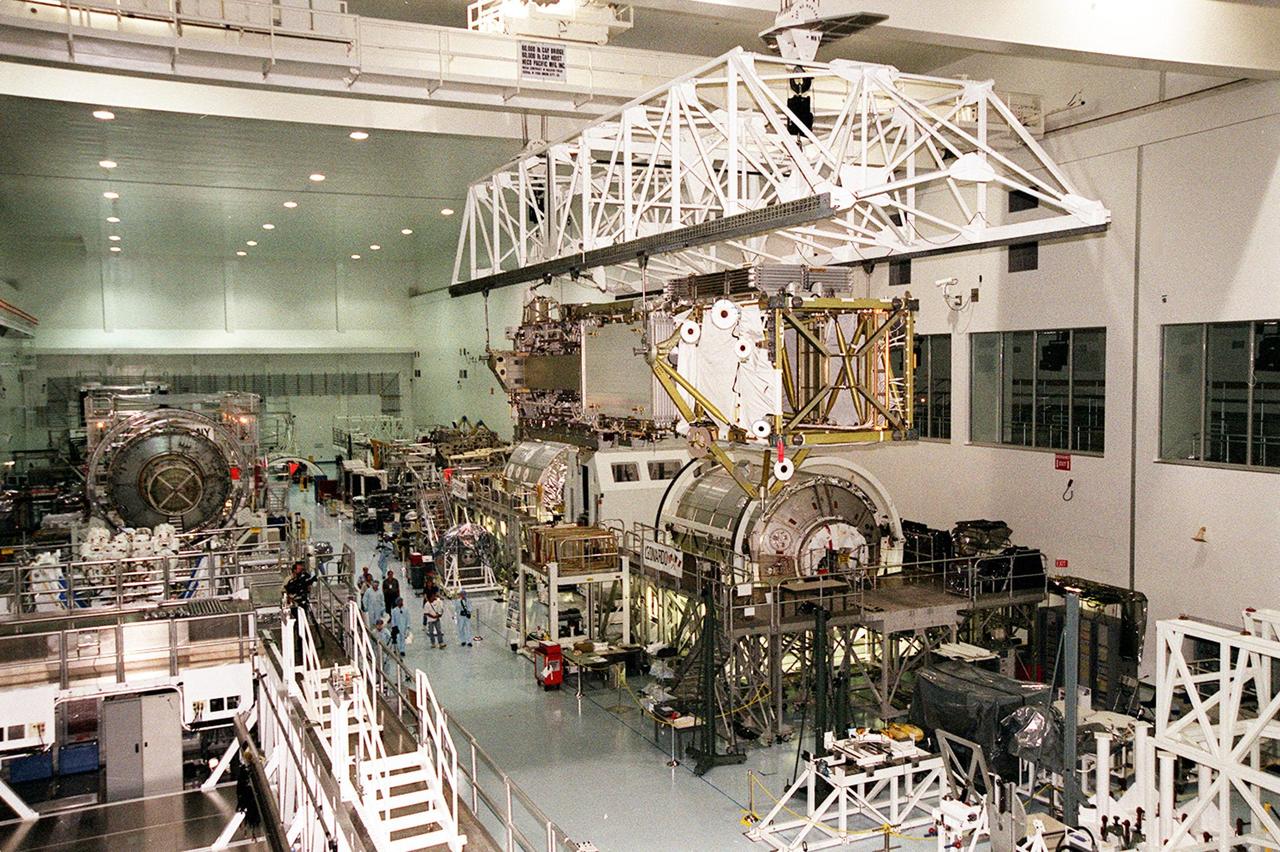
Carried by an overhead crane, the P6 integrated truss segment travels the length of the Space Station Processing Facility toward a payload transport canister that will transfer it to Launch Pad 39B. At the pad, the Space Station element will be placed in Endeavour’s payload bay for launch on mission STS-97. The P6 comprises Solar Array Wing-3 and the Integrated Electronic Assembly, to be installed on the Space Station. The Station’s electrical power system will use eight photovoltaic solar arrays, each 112 feet long by 39 feet wide, to convert sunlight to electricity. The solar arrays are mounted on a “blanket” that can be folded like an accordion for delivery. Once in orbit, astronauts will deploy the blankets to their full size. Gimbals will be used to rotate the arrays so that they will face the Sun to provide maximum power to the Space Station. The STS-97 launch is scheduled Nov. 30 at 10:06 p.m. EST
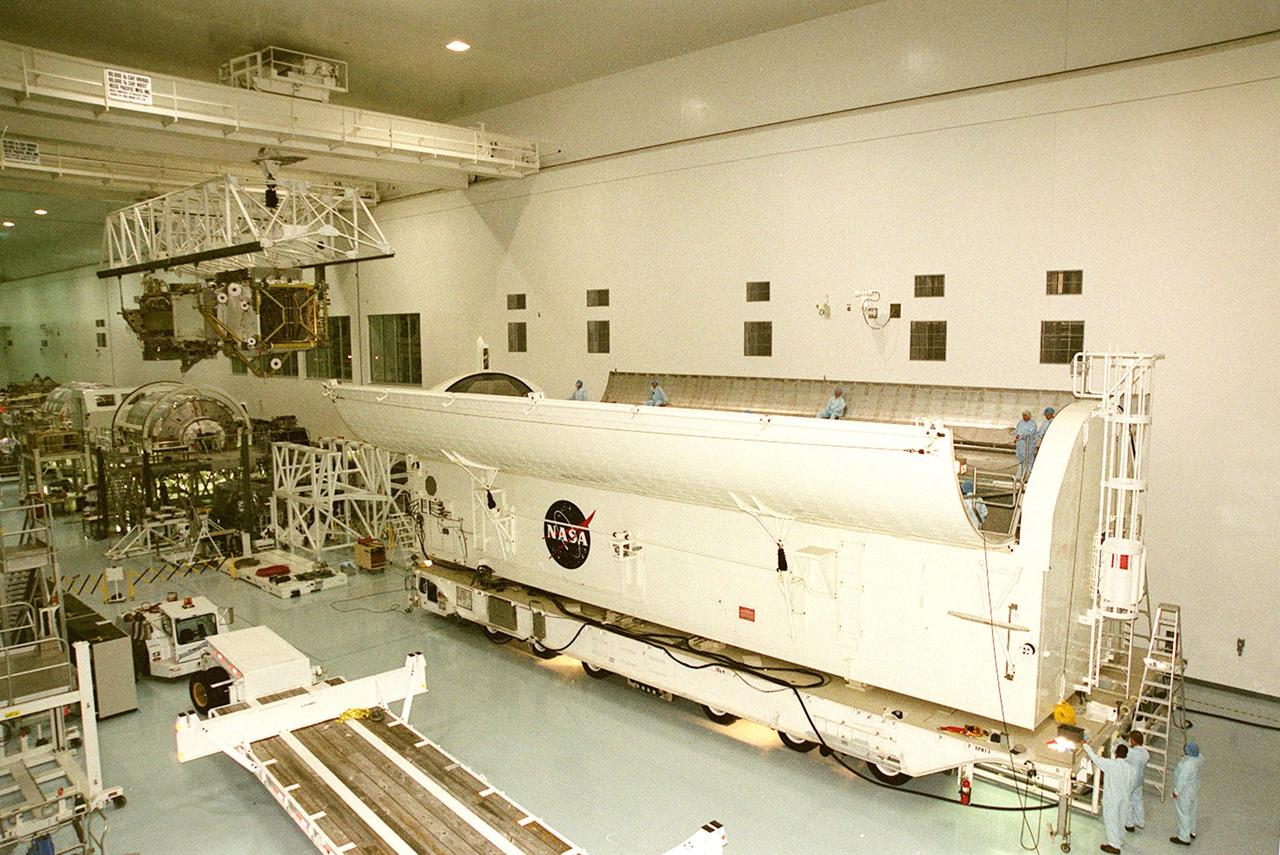
KENNEDY SPACE CENTER, FLA. -- The payload transport canister (right) and workers wait for the arrival of the P6 integrated truss segment (left) carried by the overhead crane. After being placed in the canister, the truss will be transported to Launch Pad 39B and the payload changeout room. Then it will be moved into Space Shuttle Endeavour’s payload bay for mission STS-97. The P6 comprises Solar Array Wing-3 and the Integrated Electronic Assembly, to be installed on the Space Station. The Station’s electrical power system will use eight photovoltaic solar arrays, each 112 feet long by 39 feet wide, to convert sunlight to electricity. The solar arrays are mounted on a “blanket” that can be folded like an accordion for delivery. Once in orbit, astronauts will deploy the blankets to their full size. Gimbals will be used to rotate the arrays so that they will face the Sun to provide maximum power to the Space Station. The STS-97 launch is scheduled Nov. 30 at 10:06 p.m. EST
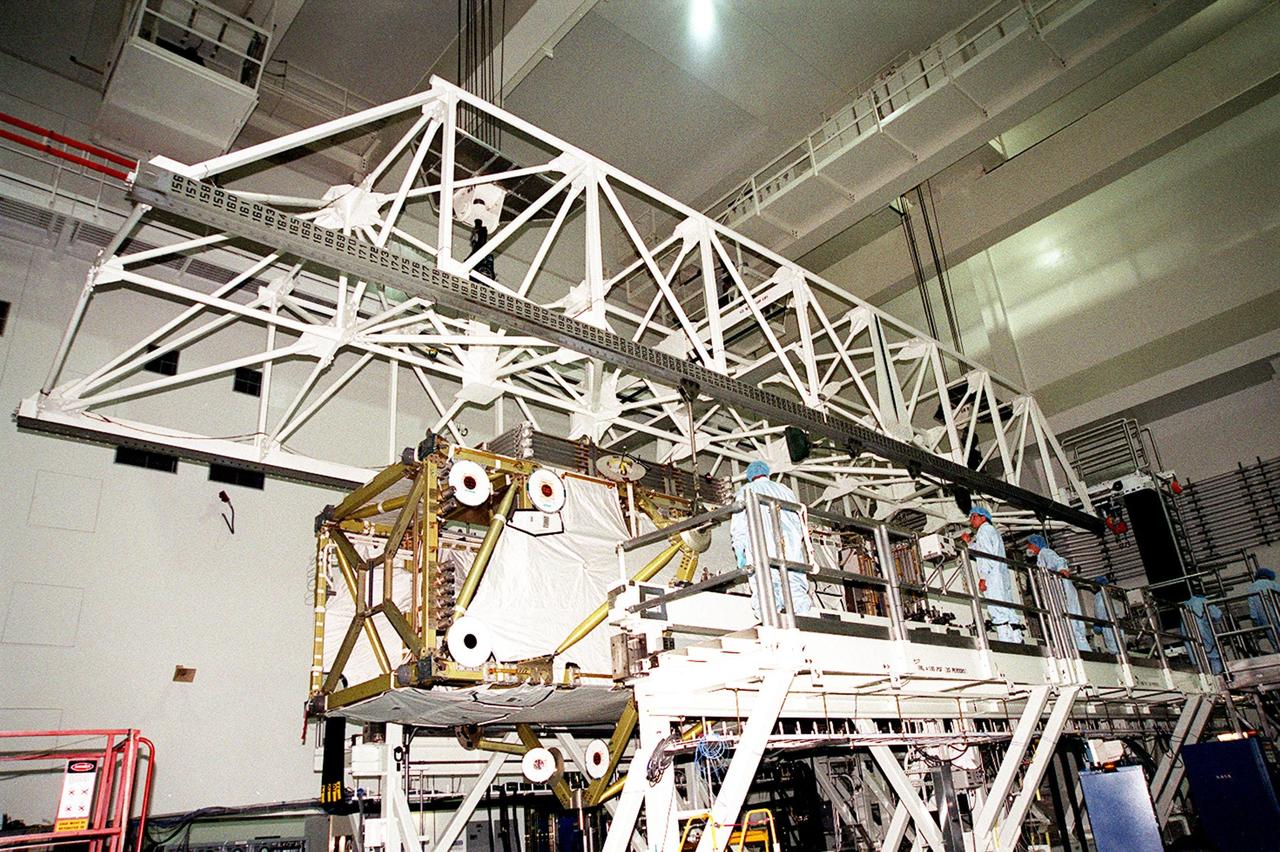
In the Space Station Processing Facility, workers attach an overhead crane to lift the P6 integrated truss segment from a workstand and move it to the payload transport canister for transfer to Launch Pad 39B. There it will be placed in Endeavour’s payload bay for launch on mission STS-97. The P6 comprises Solar Array Wing-3 and the Integrated Electronic Assembly, to be installed on the International Space Station. The Station’s electrical power system will use eight photovoltaic solar arrays, each 112 feet long by 39 feet wide, to convert sunlight to electricity. The solar arrays are mounted on a “blanket” that can be folded like an accordion for delivery. Once in orbit, astronauts will deploy the blankets to their full size. Gimbals will be used to rotate the arrays so that they will face the Sun to provide maximum power to the Space Station. Launch is scheduled for Nov. 30 at 10:06 p.m. EST
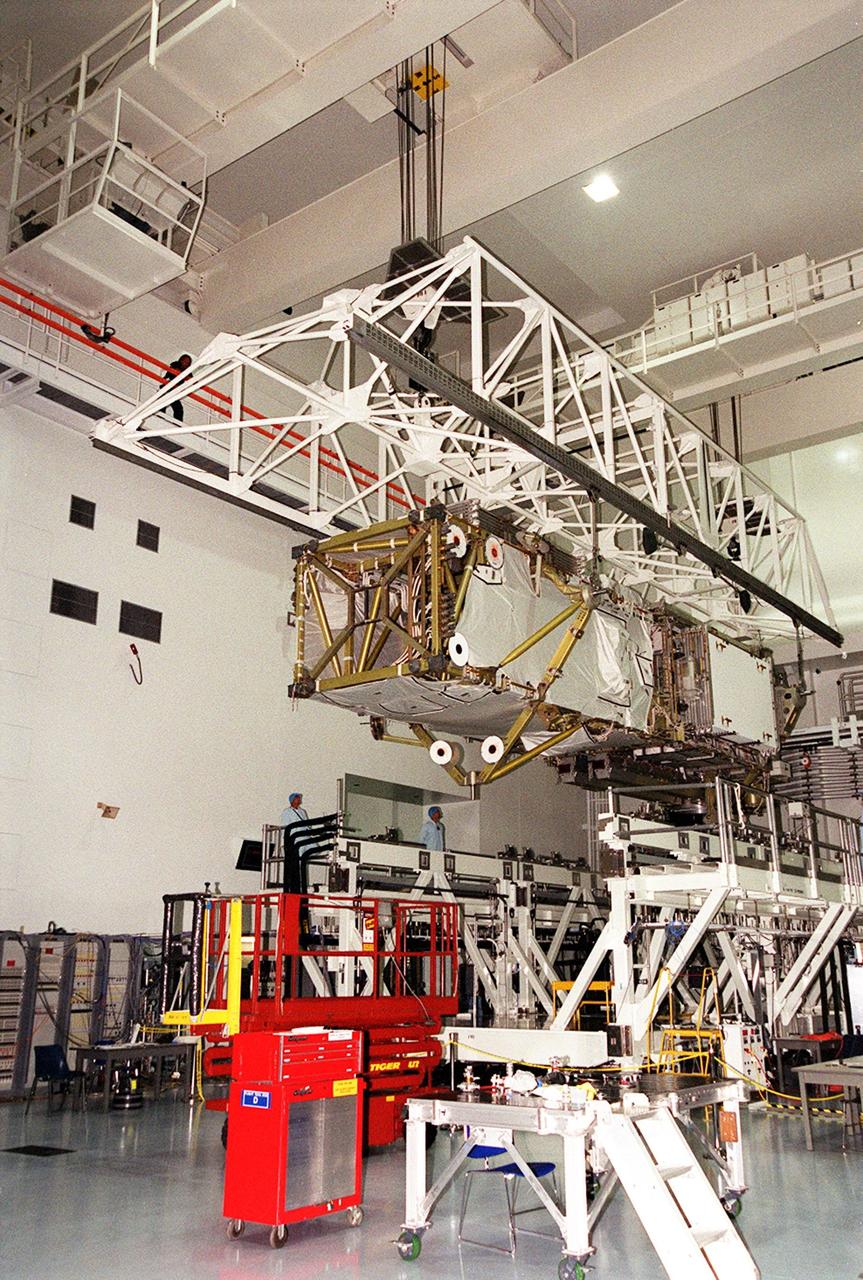
In the Space Station Processing Facility, an overhead crane lifts the P6 integrated truss segment from a workstand to place it in the payload transport canister for transfer to Launch Pad 39B. There it will be placed in Endeavour’s payload bay for launch on mission STS-97. The P6 comprises Solar Array Wing-3 and the Integrated Electronic Assembly, to be installed on the International Space Station. The Station’s electrical power system will use eight photovoltaic solar arrays, each 112 feet long by 39 feet wide, to convert sunlight to electricity. The solar arrays are mounted on a “blanket” that can be folded like an accordion for delivery. Once in orbit, astronauts will deploy the blankets to their full size. Gimbals will be used to rotate the arrays so that they will face the Sun to provide maximum power to the Space Station. Launch is scheduled Nov. 30 at 10:06 p.m. EST
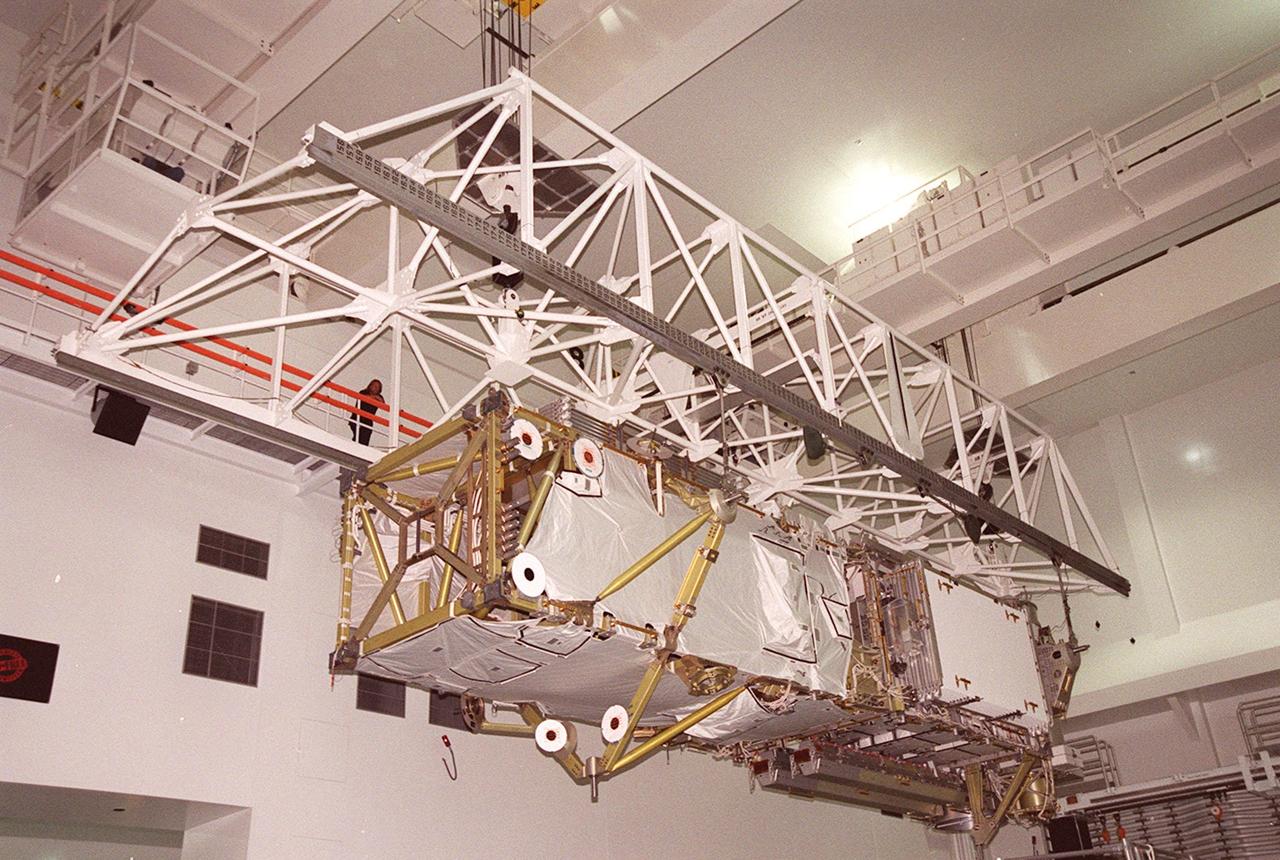
In the Space Station Processing Facility, an overhead crane moves the P6 integrated truss segment to a payload transport canister for transfer to Launch Pad 39B. There it will be placed in Endeavour’s payload bay for launch on mission STS-97. The P6 comprises Solar Array Wing-3 and the Integrated Electronic Assembly, to be installed on the International Space Station. The Station’s electrical power system will use eight photovoltaic solar arrays, each 112 feet long by 39 feet wide, to convert sunlight to electricity. The solar arrays are mounted on a “blanket” that can be folded like an accordion for delivery. Once in orbit, astronauts will deploy the blankets to their full size. Gimbals will be used to rotate the arrays so that they will face the Sun to provide maximum power to the Space Station. Launch is scheduled Nov. 30 at 10:06 p.m. EST
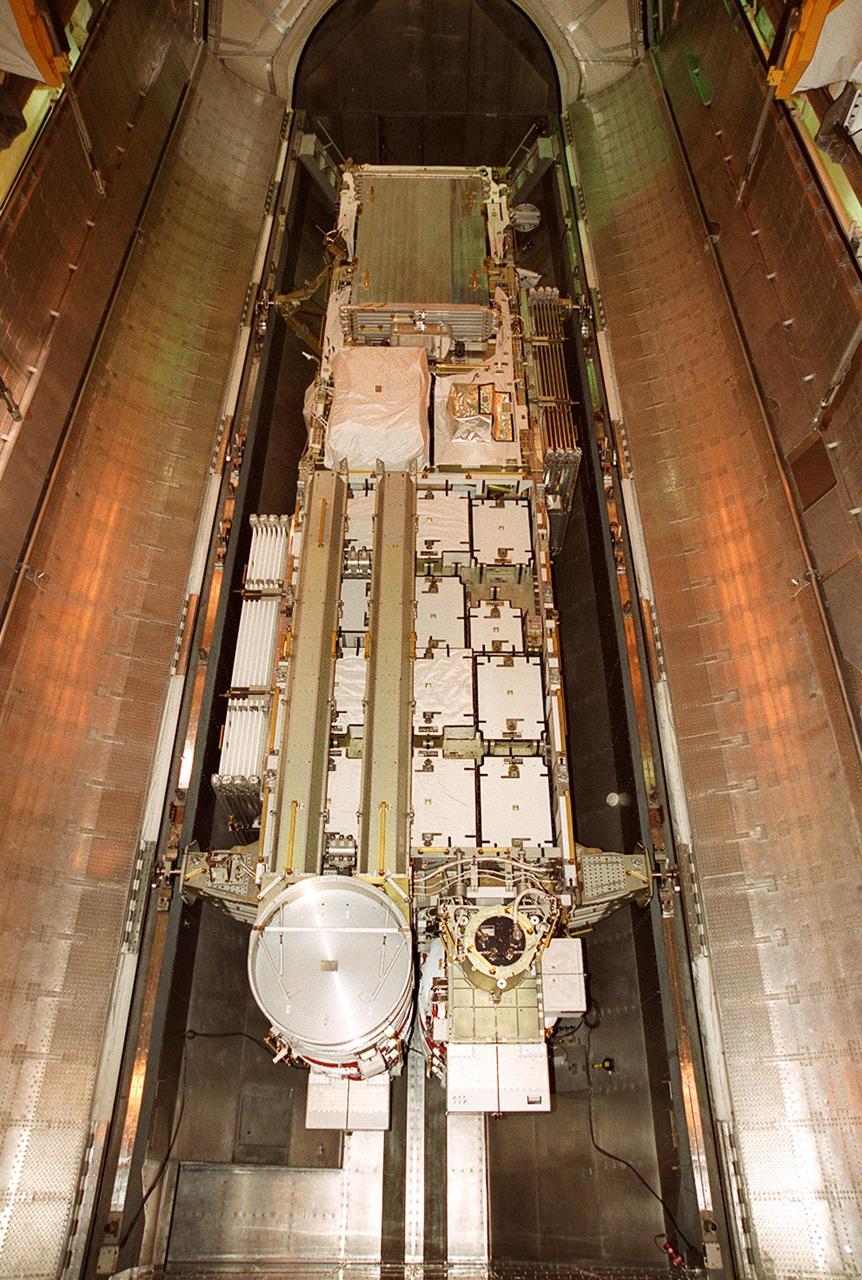
The doors of the payload transport canister are open wide in the payload changeout room on Launch Pad 39B. Revealed is the P6 integrated truss segment, which will fly on mission STS-97. The P6 comprises Solar Array Wing-3 and the Integrated Electronic Assembly, to be installed on the International Space Station. The Station’s electrical power system will use eight photovoltaic solar arrays, each 112 feet long by 39 feet wide, to convert sunlight to electricity. The solar arrays are mounted on a “blanket” that can be folded like an accordion for delivery. Once in orbit, astronauts will deploy the blankets to their full size. Gimbals will be used to rotate the arrays so that they will face the Sun to provide maximum power to the Space Station. Launch of STS-97 is scheduled for Nov. 30 at 10:06 p.m. EST
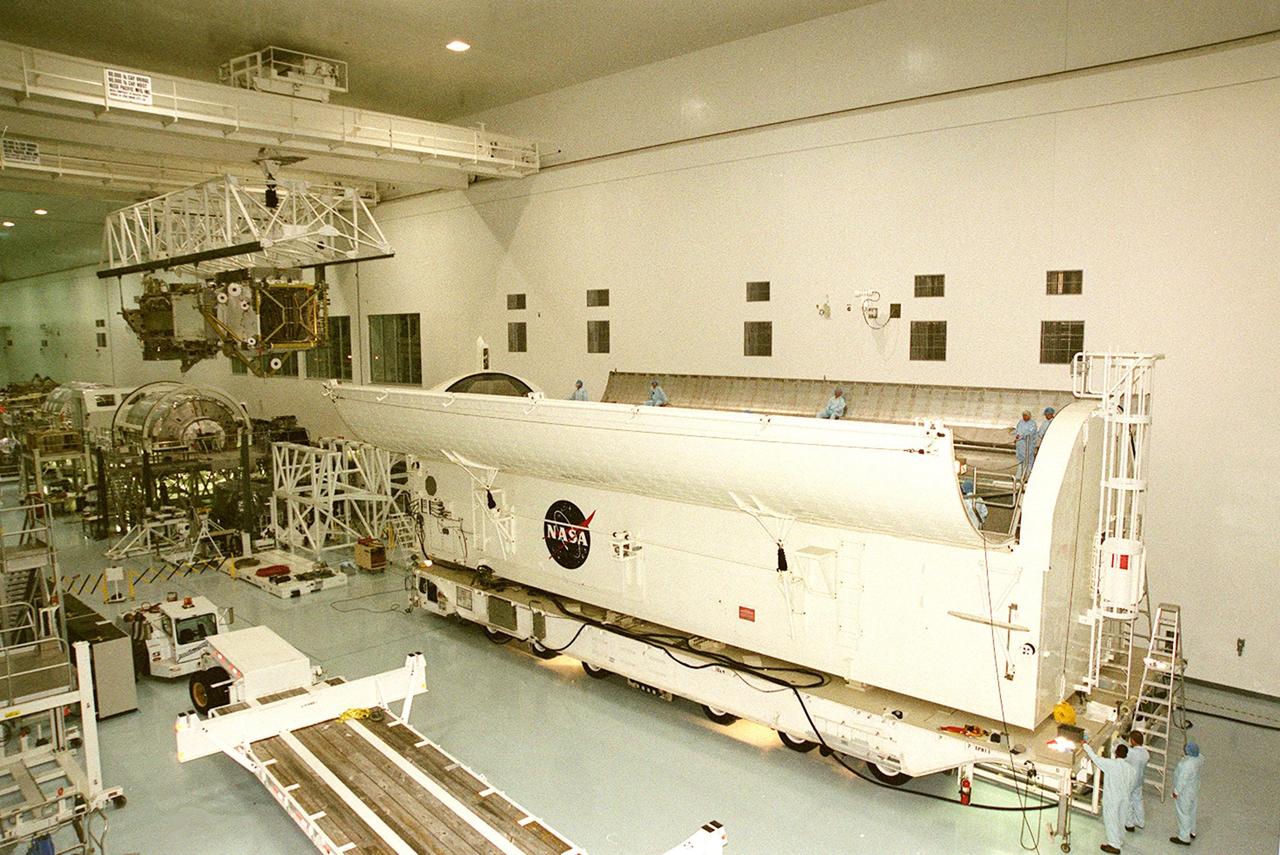
KENNEDY SPACE CENTER, FLA. -- The payload transport canister (right) and workers wait for the arrival of the P6 integrated truss segment (left) carried by the overhead crane. After being placed in the canister, the truss will be transported to Launch Pad 39B and the payload changeout room. Then it will be moved into Space Shuttle Endeavour’s payload bay for mission STS-97. The P6 comprises Solar Array Wing-3 and the Integrated Electronic Assembly, to be installed on the Space Station. The Station’s electrical power system will use eight photovoltaic solar arrays, each 112 feet long by 39 feet wide, to convert sunlight to electricity. The solar arrays are mounted on a “blanket” that can be folded like an accordion for delivery. Once in orbit, astronauts will deploy the blankets to their full size. Gimbals will be used to rotate the arrays so that they will face the Sun to provide maximum power to the Space Station. The STS-97 launch is scheduled Nov. 30 at 10:06 p.m. EST

CAPE CANAVERAL, Fla. – At the Astrotech Space Operations facility in Titusville, Fla., spacecraft technicians manually extend a solar array on the Solar Dynamics Observatory, or SDO, during preparations to test the release mechanism sequence for the arrays using signal commands. SDO is the first space weather research network mission in NASA's Living With a Star Program. The spacecraft's long-term measurements will give solar scientists in-depth information about changes in the sun's magnetic field and insight into how they affect Earth. Liftoff on an Atlas V rocket is scheduled for Feb. 3, 2010. Photo credit: NASA/Jack Pfaller
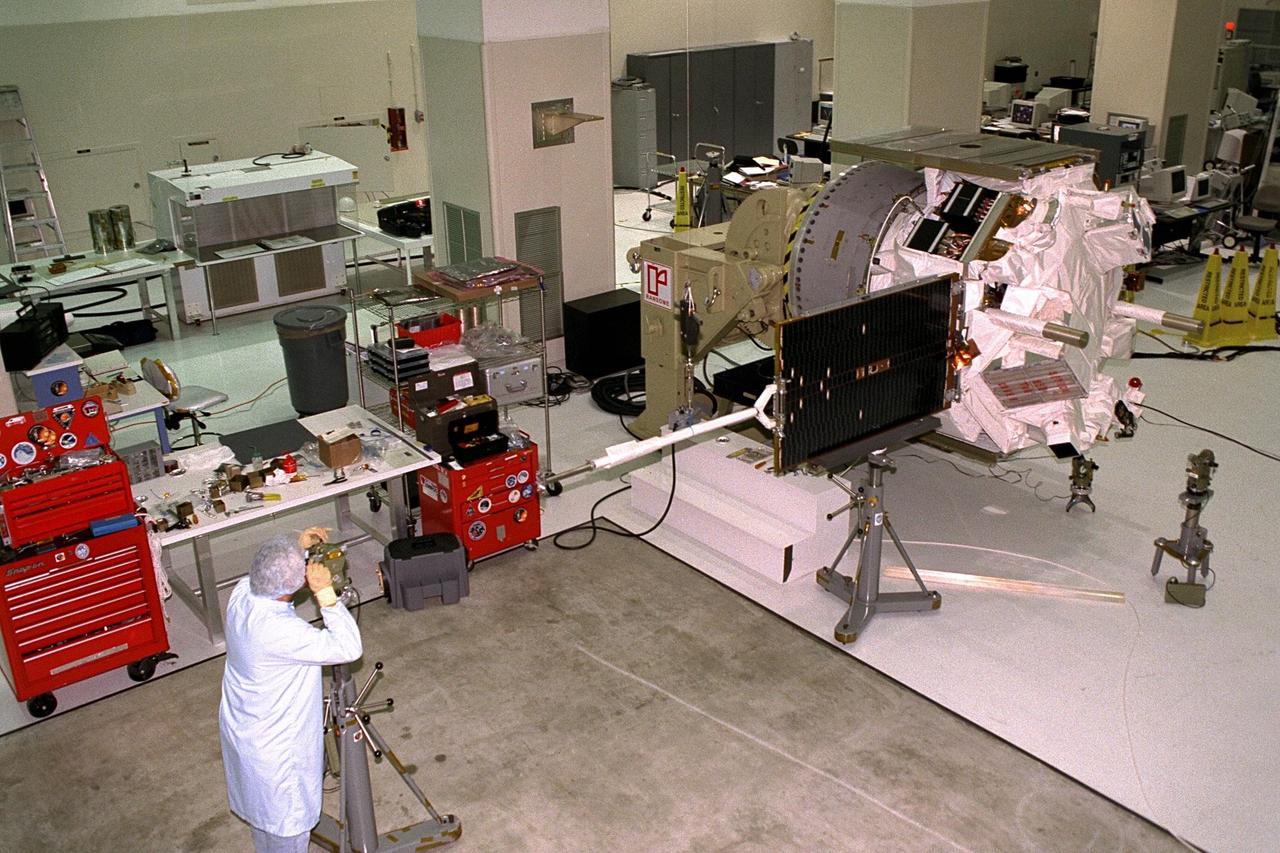
An Applied Physics Laboratory engineer from Johns Hopkins University tests for true perpendicular solar array deployment of the Advanced Composition Explorer (ACE) in KSC’s Spacecraft Assembly and Encapsulation Facility-II (SAEF-II). The white magnetometer boom seen across the solar array panel will deploy the panel once in space. Scheduled for launch on a Delta II rocket from Cape Canaveral Air Station on Aug. 25, ACE will study low-energy particles of solar origin and high-energy galactic particles. The ACE observatory will be placed into an orbit almost a million miles (1.5 million kilometers) away from the Earth, about 1/100 the distance from the Earth to the Sun

CAPE CANAVERAL, Fla. – At the Astrotech Space Operations facility in Titusville, Fla., the Solar Dynamics Observatory, or SDO, with its solar arrays deployed, is ready to receive signal commands to test the release mechanism sequence for the arrays. SDO is the first space weather research network mission in NASA's Living With a Star Program. The spacecraft's long-term measurements will give solar scientists in-depth information about changes in the sun's magnetic field and insight into how they affect Earth. Liftoff on an Atlas V rocket is scheduled for Feb. 3, 2010. Photo credit: NASA/Jack Pfaller

CAPE CANAVERAL, Fla. – At the Astrotech Space Operations facility in Titusville, Fla., a solar array on the Solar Dynamics Observatory, or SDO, is manually extended by spacecraft technicians during preparations to test the release mechanism sequence for the arrays using signal commands. SDO is the first space weather research network mission in NASA's Living With a Star Program. The spacecraft's long-term measurements will give solar scientists in-depth information about changes in the sun's magnetic field and insight into how they affect Earth. Liftoff on an Atlas V rocket is scheduled for Feb. 3, 2010. Photo credit: NASA/Jack Pfaller
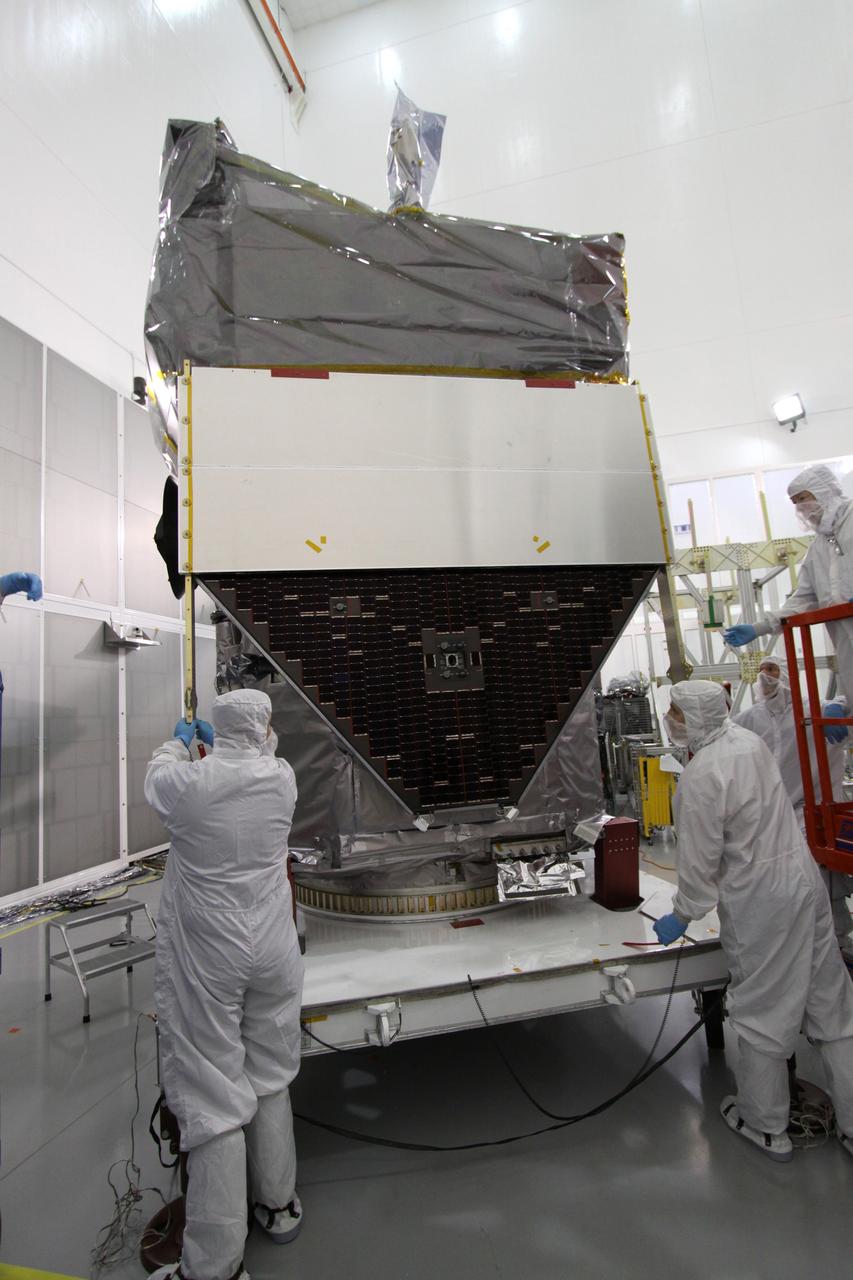
CAPE CANAVERAL, Fla. – At the Astrotech Space Operations facility in Titusville, Fla., spacecraft technicians manually deploy one of the solar arrays on the Solar Dynamics Observatory, or SDO, during preparations to test the release mechanism sequence for the arrays using signal commands. SDO is the first space weather research network mission in NASA's Living With a Star Program. The spacecraft's long-term measurements will give solar scientists in-depth information about changes in the sun's magnetic field and insight into how they affect Earth. Liftoff on an Atlas V rocket is scheduled for Feb. 3, 2010. Photo credit: NASA/Jack Pfaller